May 142017
 

Everyone knows the best conversations come on long walks, where speech naturally matches pace, and where silences are almost always comfortable. Walking was thus the ideal way for Seelig to draw out the reticent and mistrustful Walser. —Dorian Stuber

Carl Seelig
Walks with Robert Walser
Translated by Anne Posten
New Directions, 2017
$15.95; 127 pages

.
For years readers seemed regularly to be rediscovering the work of the idiosyncratic Swiss modernist writer Robert Walser (1878—1956). To be sure, Walser had always had his partisans—readers who delighted in the syntactical and tonal shifts of his quicksilver and devious prose. Already in 1929, for example, the cultural critic Walter Benjamin made Walser the subject of a perceptive and still influential essay. More recently, W. G. Sebald included a lyrical meditation on Walser in his collection of linked essays, A Place in the Country. Yet Walser remained relatively unknown. Even though the great Austrian writer Robert Musil once described Kafka as “a special writer of the Walser type,” Kafka not Walser became a literary and cultural adjective.

In the last decade, however, Walser has become a fixture, not least in the English-speaking cultural world. (This is a turn Walser himself, who never travelled further than Germany in his whole life, and who wondered, “Why should writers travel, as long as they have imagination?” could surely never have anticipated.) Yet I don’t think it’s right to say Walser is now canonical. Something more interesting has happened to him. He inspires creative homage rather than dutiful respect. His most ardent admirers aren’t academics but rather contemporary filmmakers, visual artists, and of course writers. This resurgence has been made possible by the dedication of translators like Damion Searls, Tom Whalen, and above all, Susan Bernofsky, who have made more of Walser’s work available in English than ever before.

But perhaps nothing demonstrates Walser’s unlikely ascent more than this edition of Carl Seelig’s Walks with Robert Walser, first published in 1957 and now translated into English by Anne Posten. English-speaking audiences are getting not just Walser’s own books but also books about him. And this book is definitely worth it. To use a word much favoured by Walser himself, it’s delightful. In it, Seelig resurrects the nearly forgotten Walser and lovingly shows him in all his contradictory but mostly charming moods.

Born into a wealthy family, Seelig was a writer, editor, publisher, and patron to writers across the German-speaking world. His correspondents included Joseph Roth and Kafka’s close friend Max Brod. In 1949 he helped Albert Einstein compile a best-selling autobiographical volume.

Undoubtedly, however, his greatest legacy is his friendship with Walser. Seelig, who became Walser’s literary executor, orchestrated the first Walser rediscovery: the current revival wouldn’t have been possible without Seelig’s attention to the man and his work.

Seelig first corresponded with Walser in 1922. But they didn’t meet until 1936. In the intervening years, Walser had been admitted to the psychiatric clinic Waldau near Bern and then transferred to a sanatorium in the Appenzell. He had written nothing since entering Waldau. Seelig, who “felt the need to do something for his work and for him personally,” arranged with the head doctor to be able to go for a walk with Walser.

Over the next twenty years, until the writer’s death on Christmas Day in 1956, Seelig and Walser met several times a year to go for extensive day-long rambles across eastern Switzerland. Walks with Robert Walser records their itineraries, their conversations and, indelibly, their meals. Walking in Switzerland, then as now, is a civilized affair: even on the remotest mountaintop a refreshing inn or a café awaits.

Walser had always been a passionate walker, as he described in his brilliant autobiographical novella The Walk (1913). In the 1920s, as his mental health frayed and his writing began to dry up, Walser ever more desperately sought solace in walking. He once made it from Bern to Geneva in a single night without stopping, and, another time, again in the middle of the night, from Bern to the top of a mountain in the Bernese Oberland, where, as he later told Seelig, he “blithely devoured a piece of bread and a can of sardines.”

Walking was thus the ideal way for Seelig to draw out the reticent and mistrustful Walser. Everyone knows the best conversations come on long walks, where speech naturally matches pace, and where silences are almost always comfortable. In his description of their first walk, Seelig called silence “the narrow path on which we approach[ed] each other.”

Seelig seems to have been a true mensch: gentle, kindly, and unassuming. We never see him make demands of Walser or expect anything in return for his interest other than the pleasure of the older man’s company. Seelig’s literary talents seem to have been fairly modest, but in Walks with Robert Walser he wisely sticks to a straightforward style and, as his title suggests, focuses his attention firmly on his companion rather than himself.

For the most part Seelig lets Walser be himself, though he can’t help but occasionally prod the older man to resume writing, suggesting for example that the asylum would surely make great material for a novel. (Walser dryly responds, “I should hardly think so.”) Later he asks again: if it could be arranged for Walser to leave the asylum, would he start writing again? Walser is categorically and characteristically evasive: “There is only one thing to do with this question: not answer it.”

Over and over, Walser declares himself satisfied with his life: “In the asylum I have the quiet I need… It suits me now to disappear, and inconspicuously as possible.” He rejects Seelig’s proposal to arrange for Walser to have a room to himself: “ I wish to live with the people and to disappear with them. That is the proper thing for me.” He takes seriously the work asked of him in the asylum—sorting lentils and gluing together paper bags, among other menial tasks—and becomes grumpy when it is interrupted by anything other than the chance to go walking. He seems reasonable, interested in the world, eminently sane.

Robert Walser, c. 1898

Yet he is also withdrawn, sometimes moody, unresponsive to the news of the deaths of his brother Karl and sister Lisa, the siblings he was closest to. He vividly describes the tribulations that led him to be institutionalized: “During my last years in Bern I was plagued by wild dreams—thunder, shouting, a choking in my throat, hallucinatory voices—so that I often woke screaming.” And when Seelig asserts Walser’s literary importance, the writer becomes so agitated—“Quiet, quiet! How can you say something like that! Do you really think I believe your society lies?”—that Seelig has quite a job of it to soothe him.

Seelig has more success getting Walser to talk about what he has written than anything he might write in the future. Walser proves a shrewd, though sometimes harsh reader of his own work: “That is the error of my novels. They are too whimsical and too reflexive, their composition often sloppy.” He describes his writing process, explaining he couldn’t write to commissions: “Everything must simply grow out of me without being forced.” He speaks admiringly of writers, like Dickens and Gottfried Keller, about whom “one is never quite sure whether to laugh or cry.” When Seelig rightly suggests Walser is such a writer himself, Walser begs him not to make such comparisons: “Don’t even whisper it. It makes me want to crawl into a whole, being named in such company.”

Yet Seelig is right, both about sudden shifts in register that characterize Walser’s prose and its general brilliance. Although he also wrote four novels, Walser is best known for the hundreds of miniatures he wrote for European newspapers in the decade before and after WWI. In these small prose pieces, Walser—who once called himself “a clairvoyant of the small”—considered in sometimes rhapsodic and sometimes arch prose encounters with ordinary things: one of his most beautiful pieces is called “Ash, Needle, Pencil, and Match.” He also drew liberally on his own experiences: working as a bank teller, enjoying a balloon ride with his publisher, studying at a school for would-be servants.

Example of Robert Walser’s Microscript

For this reason, to write about Walser’s writing is invariably to write about his life, even though it was by his own account singularly modest and largely undramatic. His prose, almost always told by a first person narrator who like Walser is bemused and surprised by the world’s richness, is at once autobiographical and not, neither fiction nor non-fiction. He offered a fine description of the strengths of his own work when he told Seelig:

I am immediately wary of writers who excel at plot and claim practically the whole world for their characters. Everyday things are beautiful and rich enough that we can coax poetic sparks from them.

With their vivid first-person narration, wealth of observation and reflection, and total disregard for the trappings of conventional plot or character, Walser’s texts anticipate those of contemporary writers like Lydia Davis, Teju Cole, and Ben Lerner.

But in traipsing with Walser through the Swiss landscape, Seelig reminds us that Walser is a small giant of world literature only because he is grounded in such a particular place. For me, Walser exemplifies a particularly Swiss impishness, the kind I encountered regularly in my Swiss relatives, most of whom came from the villages near Biel, the little city where Walser was born and where he spent many of his most productive years. These relatives loved to tease, to take the piss out of everyone and everything, even while they espoused a conventional morality that often descended into sententiousness. Walser’s genius is to ironize these conventional sentiments, so that readers never quite know to take what seem like ingenuous, almost artless exclamations of delight, especially since they reverse so quickly into sharp criticisms of all manner of conventional pieties, from bestsellers to car culture to banking regulations.

Yet although the ideal reader of Walks with Robert Walser will already know and love Walser’s work—anyone who doesn’t will without doubt want immediately to seek it out—and will therefore be intrigued by Walser’s assessment of that work, the real attraction here is Walser himself. By the time Seelig knew him, Walser had largely withdrawn from the world, in his younger days he had cut quite a figure in artistic and even high society. From 1905 Walser joined his brother Karl, an artist who found fame as the set designer for the theater director and impresario Max Reinhardt, in Berlin, where he spent most of the next eight years. The Walser brothers were famous for eating everything at the parties they were invited to or crashed. Their refusal to follow rules of genteel decorum extended to the literary world. Walser impressed the playwright Frank Wedekind with a canary yellow checked suit and mocked Hugo von Hoffmansthal, whom he is said to have asked whether he ever got tired of being famous.

We get glimpses of that impish young man from the provinces in Seelig’s portrayal of the much older mental patient. We watch Walser devour eight tartlets in a single sitting. We observe his horror of overcoats (even with 20 cm of snow on the ground he refuses to wear one) and his love of umbrellas (“under an umbrella one can feel quite at home”). We see him steering clear of barking farmyard dogs, adding “Have you noticed that dogs nowadays are much quieter than they used to be, as if electricity, the telephone, the radio and such robbed them of speech?” And we see him warm up to the patient and kind Seelig, revealing the excitable boy inside. At the end of their outing on April 15, 1938, Walser “shakes my hand several times, runs after my train, and waves until it disappears around the corner.”

Above all he eats. Despite the privations of the war years (on a walk in January 1943 Walser is “amazed” that he and Seelig “need ration cards for a portion of cheese”), food seems plentiful, and he and Seelig eat and drink with gusto. A typical passage reads: “Lunch at Schäfli in Trogen. We both have a huge appetite and clean every plate: the oatmeal soup, the bratwursts, the mashed potatoes, the beans, and the pear compote.” They’ll have a few drinks, smoke a cheroot or a cigar, and then walk ten more miles. None of the food and drink is particularly fancy, but it’s devoured with the gusto and glow of wellbeing of those who have been out in the fresh air no matter the weather.

Earlier I named some of the excellent translators who have tackled Walser’s difficult works in recent years. All of them follow in the footsteps of the great Christopher Middleton, the poet and scholar who was the first to translate Walser into any language. In an entry dated Good Friday, 1955, Seelig tells Walser that Middleton has translated two of his texts “with admirable subtlety,” Walser answers “with a curt ‘Really!’”(In the original, Walser says “So, so!”, a response that acknowledges the interlocutor without committing to agreeing with what he’s said; it’s the very phrase my uncle would use all the time when our conversations reached an impasse and, in its passive aggression, quintessentially Swiss.).

Robert Walser, 1949

Anne Posten—admittedly translating Seelig’s Walser rather than Walser himself—is not quite up to the high standards of English language Walser translations. Her work is more dutiful than excellent. She struggles in particular with Walser’s Swiss idioms. Some of these are impossible to translate (Znüni, literally “a little something at nine o’clock,” is a second breakfast: calling it a “morning snack” is reasonable; I don’t know anything that can capture the full sense of this lip-smacking diminutive except maybe Paddington Bear’s “elevenses,” though that is too twee even for the Swiss). Others are easier to translate, but Posten misses the mark. A Grind is a head, even, depending on context, a mug; Posten’s “noggin” sounds impossibly quaint. And the Postauto is a bus, not a mail van.

Writing this review I came across a reference to a translation of Seelig’s book in progress by a Bob Skinner. I don’t know anything about Skinner or the fate of his translation. Presumably it’s been nipped in the bud by this one. (None of the links I’ve found online to the text of his draft work anymore.) That’s too bad, because the excerpts I’ve seen are terrific, more lively and vivid than Posten’s.

Take this excerpt from the entry for February 5, 1950. Here is Skinner:

In a confectioner’s Robert rolls a shapeless cigarette which starts a little fire when it’s lit. A couple nearby snickers; they think he’s a hick. He says that in the sanitarium he’s now sorting and untying string for the Post Office. This work is all right with him; he’ll take what comes.

And here is Posten:

In a pastry shop Robert rolls a misshapen cigarette. Since it isn’t well tamped, it flares a bit when lit. The couple next to us begins to giggle; they apparently take Robert for an unworldly farmer. He tells me that now he sorts and unravels twine for the post office. But he is content with the work. He simply takes what comes.

Seelig’s original reads:

In einer Konditorei rollt sich Robert eine unförmige Zigaretten. Da sie nicht gut gestopft ist, gibt as beim Anzünden ein kleines feuer. Ein benachbartes Paar beginnt zu kichern; es halt Robert offenbar für einen weltfremden Bauern. Er erzählt mir, dass er jetzt in der Anstalt Schnüre für die Post sortiere und aufknüpfte. Aber ihm sei diese Arbeit auch recht. Er nehme eben, was komme.

Posten’s version is more faithful to the original than Skinner’s. She keeps the explanation of the poor tamping, which Skinner cuts out, and “an unworldly farmer” translates “einen weltfremden Bauern” literally. But the passage is better with the elision, and “hick” is punchy and effective. When it comes to the string, “untying” is a better translation than the portentous “unraveling.” And saying the work is “all right with him” reads better than “he is content with the work.” Skinner makes Seelig come alive. In fact, he seems to be a better writer than Seelig is himself.

But if Posten’s translation sometimes disappoints, this sensation is quickly overcome by gratitude to her and the publisher for bringing the book into English. We’re lucky to have it.

Walks with Robert Walser is a joyous and affirming book. Readers will be left feeling as Walser does when, at the end of one of their excursions, exclaiming over the beauty of the day, he tells Seelig, “Are we not returning richer than we left?”

—Dorian Stuber


Dorian Stuber teaches at Hendrix College. He has written for Open Letters Monthly, The Scofield, and Words without Borders. He blogs about books at www.eigermonchjungfrau.wordpress.com.

.
.

May 062017
 

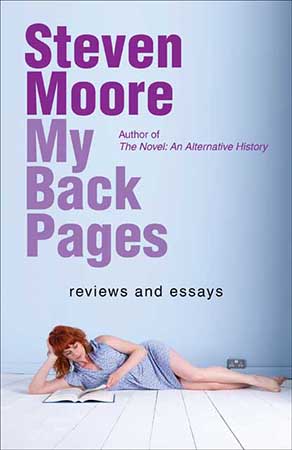
My Back Pages is the closest Moore will ever come to completing his massive study of the emergence and development of the novel —Jeff Bursey

My Back Pages: Reviews and Essays
Steven Moore
Zerogram Press, 2017
$30.00, 767 pages

.
Introduction

In the mid-1980s, while doing research for my thesis on Henry Miller—a person and subject not popular within Memorial University of Newfoundland’s English department, the choice solidifying my dubious reputation among conservative professors from England and Newfoundland—I read Frederick R. Karl’s critical survey, American Fictions: 1940-1980 (1983). Apart from a few generally dismissive remarks on Miller, indicating a lapse of judgment, this work introduced me, in one giant, dual-columned flow of crackling prose and sharp observations, to authors that I never heard about in university classes. One of them was William Gaddis, whose two published novels (at that time) were discussed at great length. What I read intrigued me, but thesis writing and an imminent marriage, as well as a subsequent move, occupied my mind. In 1986, shortly before leaving Canada, I ordered Gaddis’ three works (a new one had come out the year before) and they accompanied me to London, England, where my then-wife’s studies took us. I resisted reading them as the final draft of the thesis required attention. At some point I needed a break, and soon found myself 600 pages into The Recognitions (1955) with 300+ to go, my spirits uplifted by Gaddis’ monumental first book, a reminder of how genius trumps talent, a salutary blast of corrosive satire and humour in a bleak time (little money, grey weather, England under Thatcher), a rebuke to the palsied minimalism of the 1980s that infested magazines and publishing lists—and suddenly Karl’s term for Gaddis, “tribune,” made sense. With the thesis finally sent to MUN, I turned to the remaining pages of The Recognitions, then to J R (1975), whose technical brilliance and humour helped preserve my sanity while I worked in a warehouse, and then the less impressive Carpenter’s Gothic (1985).

Back in St. John’s in September 1989 I came across a segment from another Gaddis novel in a 1987 New Yorker—what would be published in 1994 as A Frolic of His Own—and also, for the first time, read critical books devoted to his work. There weren’t many. At a guess, 1990 marked the year I first encountered Steven Moore (b. 1951) through his invaluable guide to The Recognitions. For 27 years, in one form or another, my Gaddis reading has been deepened and expanded by Moore. A recent example of the continued efforts at explicating Gaddis, who Moore considers “the greatest American novelist of the 20th century,” and how that can lead to a profounder understanding of his literary worth—and the worth of literature itself—can be found here in a joint review of books by Moore, and Joseph Tabbi, another Gaddis scholar who completes, for me, the triumvirate of Gaddis’ best critics.

In the early 1990s, Steven Moore worked for Dalkey Archive Press, home of The Review of Contemporary Fiction (RCF) and one of the most eclectic publishers around. From 1988-1996 he reviewed for RCF and eventually, as an editor, helped bring into print, among others works, David Markson’s Wittgenstein’s Mistress and Reader’s Block and several Rikki Ducornet novels. Behind the scenes, and in front of my eyes, Moore shaped some of my reading (and I daresay that of others). There aren’t many critics so tireless in fighting critical indifference, small sales, and much more for high-risk writing.

There are reasons for this autobiographical introduction. While My Back Pages contains much about Gaddis that, as a fan, I appreciate seeing either for the first time or between covers at last, in this immensely readable, encyclopedic, and essential work there are almost 400 pages of concise reviews, published between roughly 1975 and 2016, of short-story collections, novels, and nonfiction, followed by almost 350 pages filled with meditations on key figures in Moore’s life, including his friend David Foster Wallace, Alexander Theroux, and W.M. Spackman. In these pages—revealed incidentally when its contents were first printed and forming a more than rough sketch when collected—is a partial intellectual autobiography that reveals, now and then, and almost always unexpectedly, his beliefs, his likes and dislikes, his confrontations with ideas and people, and reversals, criticisms, and disappointments in his career and personal life.

Certain figures recur: apart from Gaddis, Markson, Ducornet, and Theroux, there is much on Ronald Firbank, the Beats, Malcolm Lowry, Gilbert Sorrentino, and James Joyce. Certain predilections are as numerous: metafictional and/or experimental works, with occasional excursions into other forms. “It’s the books I write about, many of them forgotten by now, more than the pieces themselves, that deserve to be remembered,” he states outright, though that note of humility goes against the many years in service to literature exemplified by the length and depth of this book (indeed, the length and depth of each Moore book). In individual pieces he is not as shy in taking credit where it’s due.

One of Moore’s best qualities as an explicator is in communicating complex or complicated material in the clearest possible terms, and with humour when possible. Not all is sunshine, though, since every book is written, implicitly and explicitly, against something. There is even the presence of a dark figure that, while not a villain, is an adversary. And there’s sex. How-to guides to crafting correct fiction by James Wood or dreary musings on the uselessness of writing by Tim Parks aren’t going to offer this combination of features.

.

I.

My Back Pages is the closest Moore will ever come to completing his massive study of the emergence and development of the novel: The Novel, An Alternative History: Beginnings to 1600 (2010), and The Novel, An Alternative History: 1600–1800 (2013). (In 2014, the second title won the Christian Gauss Award for literary criticism.) “Rethinking the History of the Novel,” an essay placed near the end of the new book, supplies several reasons why he didn’t proceed with a third volume. Partway through the second volume his self-appointed task “became more like a chore, which is exactly what I had hoped to avoid when I began… by the time I wrote the last page of the second volume, I had no desire to go on to the third volume that I had been planning on from the very beginning.” Further:

Even though I had planned to narrow my focus at that point and concentrate only on innovative, experimental novels, I realized it would take me another five years at least working full-time and another thousand pages to cover 1800 to the present, and I finally had to admit that I had bitten off more than I could chew. Now I understood why no one had written a comprehensive, universal history of the novel before, and also understood why such things are only attempted in multi-volume university press series overseen by general editors with troops of contributors at their command.

Moore states he had no grand plan in mind when he began his labours, and yet, thanks to perseverance, missionary zeal, and an enthusiasm buoyed, I suspect, by ceaseless reading, this full-time independent scholar completed what only university presses could achieve. Perhaps it’s best that writers unthinkingly create their own follies. He felt provoked by “the conservative Bush [the Younger] administration of evil memory”—how those years must now seem, while in no way golden, less terrible than the present Republican government—that allowed “a corresponding reactionary backlash against the innovative, unconventional novels I love…”

Considering the fatigue factor, then, My Back Pages might be a better work than the never-realized third volume. Its content differs from that of the Novel works, which together are a magisterial, yet colloquially spoken, introduction to hundreds of fictions from ancient Egypt, Greece, and Rome, on to Ireland and Iceland, then Mesoamerica, Japan, China, Europe, and North America. Moore’s new work comprises spirited defenses, campaigns, and hosannas for the lineage of “unconventional” writers he has long admired. The tempo is that found in breaking news, in Ezra Pound’s sense, excited but not sensationalized. (I’m reminded of what Sven Birkerts says in Changing the Subject [2015]: “I recognized at that moment that if art really is an act of concentrated attention, then it is also at the same time a power, not only carrying its messages, the content that is its pretext, but also storing—and making available—an enormous compacted energy. I’m talking about the energy that made the vision and expression possible in the first place.” Substitute criticism for “art” and that suits Moore’s energetic prose.) Instead of plot summaries devoted to the literary output of one country, we are provided with brief summaries of works and essays focused on single topics. After the Introduction and Acknowledgements, the sections are: Reviews; Miscellaneous Nonfiction; and, in three parts, Essays (“William Gaddis and Friends”; “Significant Others”; “Personal Matters”).

Set out alphabetically, the reviews (sometimes single entries, at other times sequences devoted to the same author), to provide a brief list, are of works by Djuna Barnes, Robert Coover, Stanley Elkin, Mo Yan, Severo Sarduy, Arno Schmidt, and Marguerite Young. In addition to what Moore has written for Rain Taxi and the Washington Post, among other places, most of the reviews appeared in RCF. He is most often a polite and eager reader, inclined to treat with the greatest respect metafictional works and meganovels that display erudition and contain recondite language used in a playful way, works that emphasize style over plot (or character) and that break the constraints of the novel. The “anemic stories” of minimalists rarely capture his attention, but in considering Stephen Dixon’s Frog (1991) he does concede that this book “represents an interesting new hybrid: a long novel made up of short episodes, a maximalist meganovel written in a minimalist style.” So he can be won over if the writer has done something original. A writer can also be a “vixen,” but only if they write well, like Mary Butts or Karen Elizabeth Gordon. (He doesn’t offer an equivalent term for males.)

Moore’s enthusiasm is contagious, as it’s often combined with casual displays of his wide and deep reading. Plucked almost at random are three samples of his writing style. The first is the opening to a review of Nicola Barker’s Darkmans (2007):

’Tis the season of huge literary novels. Those of us for whom size matters welcome with holiday cheer Denis Johnson’s Tree of Smoke, James McCourt’s Now Voyagers, two new translations of Tolstoy’s War and Peace, Paul Verhaeghen’s Omega Minor, Alexander Theroux’s Laura Warholic, and the 900-page Adventures of Amir Hamza, an old Urdu novel (by way of Arabia and Persia) newly translated for the Modern Library. Crashing this boys’ club from England comes Nicola Barker’s 838-page Darkmans, her seventh and longest novel, and a finalist for this year’s prestigious Man Booker Prize (which went to a much much shorter novel).

After reading a 3,300-page work by William T. Vollmann, Moore concludes:

Rising Up and Rising Down is a monumental achievement on several levels: as a hair-rising survey of mankind’s propensity for violence, as a one-man attempt to construct a system of ethics, as a successful exercise in objective analysis (almost nonexistent in today’s partisan, ideological, politicized, spin-doctored, theory-muddled public discourse), and a demonstration of the importance of empathy, whether in writing a book like this or simply dealing with fellow human beings. It can be an exhausting, depressing read, but with the ever-growing role of violence in our lives, it is an essential read. And the amazing fact that during the 20 years he spent writing Rising Up and Rising Down Vollmann also published a dozen extraordinary books of fiction—many in the 700-page range and packed with historical research as deep as that on display here—elevates this achievement beyond the realm of mere mortals.

Though Moore generally prefers those whose language sparkles with new thoughts set out in long sentences, he can appreciate other styles, as shown in this review of the first volume of Zachary Leader’s biography of Saul Bellow:

The amount of detail here is staggering; Leader apparently left no stone unturned, and succinctly summarizes all the cultural upheavals surrounding Bellow in those heady days. (The biography doubles as a primer on the intellectual climate of the times.) But the details never become too dense or overwhelming, thanks largely to Leader’s clear, brisk style.

This compliment applies to Moore. Apart from providing readers with a long list of titles to look for, his reviews are models of how to balance an examination of style, a short summary of salient points, and a decision as to a book’s worth.

The Miscellaneous Nonfiction section contains essays and reviews ranging in subject from critical works on literature and postmodernism to human anatomy and Buffy the Vampire Slayer. While of varying interest and engagement, this section offers further proof of the diversity of Moore’s taste, which is, incidentally, also shown in the music citations that appear now and then.

.

II.

In Essays, Part 1, under the section “William Gaddis and Friends,” Moore brings together previously isolated pieces on Gaddis (and those who knew him), including Pynchon, Markson, and Chandler Brossard. Particularly noteworthy is “Sheri Martinelli: A Modernist Muse.” She was an artist-model in Greenwich Village who Gaddis and Anatole Broyard (author of, among other books, Kafka Was the Rage [1993]) pursued romantically, “a protégé of Anaïs Nin,” friends with H.D., Charles Bukowski, Charlie Parker, and the Beats. She later entered into a hazily defined friendship or relationship with Ezra Pound when he was at St. Elizabeths Federal Hospital. (This is the stuff of a biopic.) The concentration of influences and animosities (Broyard versus Gaddis, Pound versus almost everyone) that congregated in this almost unknown artist is fascinating.

Part 2, “Significant Others,” deals with, among others, Kurt Vonnegut, Edward Dahlberg, Brigid Brophy, Leopoldo Marechal, and Wallace again. Barring Wallace and Vonnegut, Moore is paying close attention to the obscure, the out-of-print, and the forgotten, something that other critics could seek to imitate. Firbank, one of “the more recherché modernists” who is invoked often and gets connected to Francesca Lia Block and Alan Hollinghurst, as well as many others, is looked at for his playwriting. While I can agree with Moore on many things, we part ways on Firbank, who he admits is a writer “so idiosyncratic that one instinctively likes or dislikes [him], and no amount of critical persuasion one way or another is going to change anyone’s mind.” This may be a blind spot of mine, just as Moore’s low regard of a fellow Modernist, Henry Miller, is inexplicable considering his influence on and way with language, on issues concerning freedom of expression, and as a figure who supported Jack Kerouac’s The Dharma Bums and The Subterraneans, about whom Moore has much to say (as he does on other Beat writers like William Burroughs and Alan Ansen).

Theroux is both reviewed and the subject of an in-depth description of his second novel, Darconville’s Cat (1981), “a dazzling 700-page satire… that surely will soon come to be celebrated as the finest example of learned wit ever produced in American literature.” As Moore mentions in the Introduction, he sometimes wrote with an “optimism” that was misplaced. Theroux’s work matches Moore’s taste for length, wit, language, digressions and allusions, and several modes of presenting material (“poems, fables, nightmares, a diary, an abecedarium, a blank-verse playlet…”), and he offers a persuasive set of reasons for the importance of this novel. What also arises is one of those welcome contradictions that spring up in any person’s record of literary commentary if they do it long enough. In expressing fervent enthusiasm for and belief in Darconville’s Cat—“I want to be buried with this novel clasped to my heart”—Moore has to restrain from commenting negatively on Theroux’s Catholicism. Critics of the Novels volumes, such as Steve Donoghue and Roger Boylan, noted the evident anti-religious stance, the latter saying that Moore “seems constitutionally incapable of finding any redeeming value in the 2,000-year history of Christianity that has been so much a part of Western culture.” This sentiment extends back to when Moore reviewed Lawrence Durrell’s Livia: or, Buried Alive in 1979: “Denis de Rougemont, to whom Livia is dedicated, is the author of the classic 1940 literary-theological study Love in the Western World (still in print and still worth reading in spite of its Catholic bias).” If we didn’t muzzle ourselves now and then when faced with a work that leaps over our convictions we’d hardly be human, so I’m not going to fault Moore for his surprising moderation.

The third section of Part 3, “Personal Matters,” contains “Nympholepsy,” “Rethinking the History of the Novel,” and “Publishing Rikki Ducornet.” The second has been referred to already; the third details Ducornet’s history with Dalkey—who published her books The Fountain of Neptune (1992), The Jade Cabinet (1993), The Complete Butcher’s Tales (1994), and, both in 1995, Phosphor in Dreamland and The Stain—and her and Moore’s author-editor relationship, of which he is clearly proud. As to “Nympholepsy,” that will be dealt with below.

.

III.

As already noted, Moore wrote his two Novel books to stand up for the kind of fiction he saw under assault from 2000-2008, and in his introduction to the first volume he addresses, with withering scorn and an abrasive tone, the narrow-minded criticism that Dale Peck, B.F. Myers, and Jonathan Franzen dealt out to writers of so-called difficult fiction. In My Back Pages there are literary theorists to argue with for their instrumental use of texts “as a springboard to explore socioeconomic/political issues, theories of reading… drifting further and further away from the actual words on the author’s page,” and attempts to redress the “little critical attention” and “critical neglect” experienced by authors like Rudolph Wurlitzer and Richard Brautigan. That’s not to say Moore doesn’t admire this or that critic (full- or part-time); he praises Tom LeClair, Marilyn R. Schuster, and Samuel R. Delaney. Yet the chief foes are those who use this or that text for their own ideological thoughts, and the review outlets that are indifferent to writers, in English or in translation, who present new visions.

One individual does stand out. Those familiar with Dalkey know that John O’Brien is its founder and main force. In the Index there are references under his name, but when the pages are consulted he is identified most often as “boss,” “editor,” and “Dalkey’s publisher.” The Introduction provides context for later remarks:

While at the local warehouse buying stock, I noticed a recently published novel with an irresistible title, An Armful of Warm Girl, read it, and became a devoted Spackman fan thereafter. Shortly after he died in 1990, I began planning an omnibus edition of his complete fiction; it was typeset and ready to go by 1995, but was continually postponed by Dalkey’s boss until a year after I left. (During that time, he moved my introduction to the back and called it an afterword because, as Spackman’s daughter told me, “he felt the length of the introduction might discourage less scholarly readers from starting to read the book.”) The Complete Fiction of W. M. Spackman (1997) was very well received, and I was especially flattered that John Updike referred to my piece as “excellent” in his New Yorker review (but disappointed when he dropped that adjective in his More Matter collection a few years later)… At that time I also prepared a collection of Spackman’s essays that I wanted to publish as a companion volume, but my exit from Dalkey (and the boss’s indifference to Spackman) made that impossible.

The grinding of the axe is audible. Pitting Updike against the “boss” provides pleasure and vindication. Another note airs a different grievance:

I wanted to publish this book [Five Doubts] when Mary [Caponegro] submitted it to Dalkey Archive in early 1996, but the boss adamantly rejected it: “I will not publish this book,” he declaimed in a memo. Upon publication two years later [by Marsilio Publishers], it was very favorably reviewed by Robert L. McLaughlin in Dalkey’s journal, the Review of Contemporary Fiction.

Once again, “the boss” is set up against someone whose opinion dovetailed with Moore’s.

Two final peeks into the workplace demonstrate the toll this took: “Working with Karen [Elizabeth Gordon] was one of the few bright spots during my final dark year at Dalkey Archive.” Lastly: “My years at Dalkey Archive were depressing and frustrating, but Rikki and a few other writers kept me sane and entertained.” The theme here is that Moore felt his editorial instincts were often acute, but that he, apparently, had to wage combat within Dalkey every day. At a future time the full story of the Moore-O’Brien relationship will come out; it won’t be a pretty sight. Without adversaries our lives might be easier, but they do provide fuel for the kind of cold fury that allows a snap to enter one’s sentences.

.

IV.

Above I mentioned this book contains sex. While there are reviews that touch on that, to be accurate I should say that frustrated desire is more often present.

In “A New Language for Desire: Carole Maso’s Aureole,” one of the essays in “Significant Others,” Moore appraises the author’s 1996 novel: “rarely in literature has desire been explored with the intensity Maso brings to Aureole: a pyrotechnic display almost reckless in its abandon, daring in its subversion of literary propriety, and voracious in its erotic hunger.” He goes on to say that Maso

exhibits the kind of bravado and self-exposure that I associate more with rock music divas than with her literary sisters. She has something of Courtney Love’s swagger, P J Harvey’s erotomania (both are mentioned on page 81 of her book), Liz Phair’s bluntness, Kate Bush’s bookish romanticism, Siouxsie Sioux’s dramatic flair, Jane Siberry’s wit, Liz Fraser’s mellifluousness, Shirley Manson’s aggressive sexuality, Tori Amos’s introspection, and Lisa Germano’s heartbreaking insecurity.

This eight-page analysis of a Sapphic love story takes us through each chapter of what Moore considers “Maso’s most innovative book to date.” He adds: “Maso goes further than any writer working today to create a style that does justice to the polymorphously perverse energy of eros.” As literary analysis, it is at the usual high standard of Moore’s criticism, showing sensitivity to language use, to how themes reverberate and parallel other content, and exhibiting deftness in locating outside sources (literary, musical) that contribute to an understanding of the text under investigation.

What interests me most is the curious verdict rendered on a psychological condition mentioned in the novel: “Lust here isn’t the devouring hunger of ‘Anju’ or the sexy games of ‘Make Me Dazzle’ but ‘sex addiction’…, that dreary concept from 1980s pop psychology that seems to have some validity here.” Sex addiction is considered a mental condition that, according to some opinions, is a form of compulsive sexual behaviour. It has at times been labelled nymphomania or satyriasis. Moore, who as far as I know is a medical layman, offers begrudging acceptance of the possibility this condition exists. Present as well is an appreciation for the sexual content of Maso’s novel. For me, this 1996 essay ties into the very personal “Nympholepsy” (2001) from “Personal Matters,” which outlines Moore’s self-diagnosis of a condition brought about by his everyday interaction with Morgan, a female fellow employee at a Borders store. Both deal with lust/love, and both reveal an aspect of the critic that heretofore has not been revealed. To say it comes as a surprise is an understatement.

Listing the three “factors… [that] had led to the attack,” Moore gives as the third: “the realization that soon I would turn 50, and that I was still alone—never married, no long-term relationships—and in all likelihood I would die alone without every knowing what it is like to love and to be loved.” He assesses the qualities in Morgan (not her real name) that attract him:

But she was more than just a pretty face (there were other teenage girls working at Borders, as attractive as Morgan): she was quiet, a bit shy, introverted, bookish, artistically inclined—qualities I shared and that led me to regard her as a soul mate, despite our age difference, qualities I had always looked for in a girlfriend but had never found. And of course she possessed numerous lovable qualities I lacked; I could fill the page with them. I had been waiting all my life for someone like this on whom I could lavish all my dammed-up care and affection, and thus Morgan became the unwitting victim of this flood of emotion.

In time he terms his ache nympholepsy, and consults Vladimir Nabokov’s Lolita for a definition. (In addition to having himself as a client, he is getting a second opinion from a literary work.) Moore being Moore, he can’t resist a joke: “Taking down my hardcover copy of Alfred Appel’s annotated edition, I fumbled beneath Lolita’s tight white jacket for a few minutes until I found what I was looking for.” The rest of this poignant confession involves consulting dictionaries, poetry, music, several bouts of self-criticism and misery, and much else. In the Introduction he says this about the essay: “It’s my favorite largely because its subject inspired me—which was what nympholepsy originally meant—to open up my style, one that I’ve used ever since whenever possible. (You can see that style develop over the course of the essay, which begins in a flat, documentary voice that turns more lyrical, scholarly, and fanciful as it goes along.)”

We can, indeed, look at this admission primarily as a style issue. Yet this is sensitive ground. The essay is surprising and touching in its discussion of desire and loneliness. Consequently, I’ve decided that even though Moore’s life has been filled with words he’s read and words he’s written, a literary review wouldn’t pay proper respect to this piece, and also that every reader will want to arrive at his or her own interpretation.

.

Conclusion

People wonder why criticism exists and what its function is. When voiced by writers this can be unsubtle code for these thoughts: “What’s the point of it if not to get the good news out about my work?” and “Why do I care what some critic I dunno thought? And what’s exciting about reading a review for a book I haven’t read?” There is also a disdain for those who judge art. Moore doesn’t hesitate to discriminate the good from the bad—he has choice words on Norman Mailer’s The Gospel According to the Son (1997)—based on a simple criterion that he finds also expressed in the works of Spackman: “The content of his novels, and his characterization of women especially, will always create problems for some readers, but not for those who agree that style is what a writer is to be judged by.”[1] For some people, this will come across as elitism that verges on canon making. As well, as Stephen Mitchelmore points out, there is often a “prideful disdain for anyone who attempts to articulate the fascinating void, which actually reinforces respect for this aspect of art it is supposed to be dismissing…” We are fortunate to have a handful of astute critics who bring us reports gathered from the outskirts of the familiar literary world about innovative authors busily deepening our collective literary heritage. Steven Moore has been at the vanguard of criticism and publication of outliers and explorers whose artistic visions reinvigorate the capacious form of the novel and the short story, and we are in his debt.

—Jeff Bursey

N5

Jeff Bursey is a literary critic and author of the picaresque novel Mirrors on which dust has fallen (Verbivoracious Press, 2015) and the political satire Verbatim: A Novel (Enfield & Wizenty, 2010), both of which take place in the same fictional Canadian province. His newest book, Centring the Margins: Essays and Reviews (Zero Books, July 2016), is a collection of literary criticism that appeared in American Book ReviewBooks in CanadaThe Review of Contemporary FictionThe Quarterly Conversation, and The Winnipeg Review, among other places. He’s a Contributing Editor at The Winnipeg Review, an Associate Editor at Lee Thompson’s Galleon, and a Special Correspondent for Numéro Cinq. He makes his home on Prince Edward Island in Canada’s Far East.


Footnotes    (↵ returns to text)

  1. In Rebecca Swirsky’s review of Danielle McLaughlin’s short-story collection Dinosaurs on Other Planets, titled “Something else entirely,” the first sentence reads: “Good writers rely on style. Even better writers rely on empathy.” If, as a writer, you prioritize empathy, seek a counsellor; if you prefer writing, look for a stylist who has the ability to show empathy if he or she wishes. Times Literary Supplement, May 13, 2016, Issue No. 5902, p. 22.
Mar 112017
 

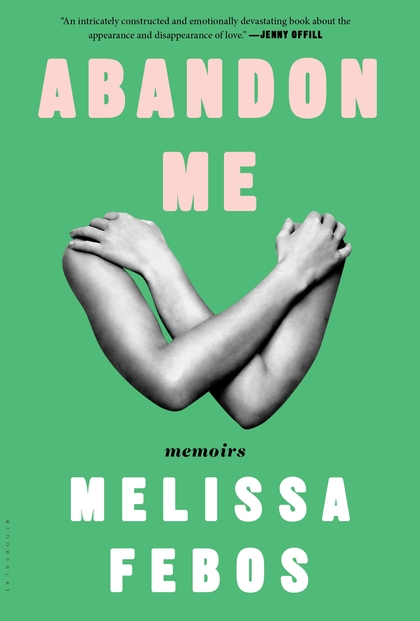
I’m told if you score a bullet across its tip with a pocketknife, first lengthwise then across, your shot will penetrate its target cleanly, but ravage the organs inside. I thought of this when reading the blunt, clean prose of Melissa Febos in her new memoir, Abandon Me. —Carolyn Ogburn

Abandon Me
Melissa Febos
Bloomsbury, 2017
320 pages; $26.00

.

I am told if you score a bullet across its tip with a pocketknife, first lengthwise then across, your shot will penetrate its target cleanly, but ravage the organs inside. I thought of this when reading the blunt, clean prose of Melissa Febos in her new memoir, Abandon Me. Her sentences are short, precise things containing emotional whirlwinds of joy and pain.

Melissa Febos is a writer and teacher who grew up in Massachusetts, earned an MFA from Sarah Lawrence College, and currently lives in Brooklyn. She’s on the faculty of Monmouth University and the Institute of American Indian Arts (IAIA); she serves on the board of VIDA: Women in the Literary Arts, and the PEN America Membership Committee. Her debut work, Whip Smart (2010) is a memoir of her work as a dominatrix. It’s also a story of getting sober, getting honest, and learning to live in her own skin. (It’s also funny: When her therapist asks her what a dominatrix is, Febos responds, “It’s really just one of the most well-paid acting gigs in this city.”) Her essays are found in journals, magazines, and online venues from The Rumpus to the Chronicle of Higher Education Review.

It can be hard to write about staggeringly painful personal life stories without sounding superficial, even trite. Students are encouraged to “write from the scars, not the wounds.” With the passing of time, the story may become more focused; resonances, patterns reveal themselves, and hard emotional truths can be drawn slowly to the surface. In other words, to write a simple truth about your own life, as memoir writers do, requires a great deal of craft. For all its risqué subject matter, Whip Smart was a more or less conventional memoir written by a smart, gutsy writer not afraid to explore her own history with honesty and poise. Febos would have been barely thirty when her first book was published. Now, seven years later, she takes more chances. Abandon Me is a deeper, riskier book.

Abandon Me opens with an epitaph from the psychologist D. W. Winnicott, “It is a joy to be hidden, and a disaster not to be found.” The book’s title, also the title of the novella-length essay found within, is both demand and plea: Abandon me. When written as a sentence—and it does feel like a sentence, both complete thought (the “you” understood, just off-stage) and punishment—the capital-A insists on being heard, a harsh, cruel word; while me is small and subjective.

The word abandon, Febos tells us, comes from the French, abandoner:

to give up, surrender (oneself or something), to give over utterly, to yield utterly.” Derived from a French phrase, Mettre sa forest a bandon, which meant to give up one’s land for a time, hence the latter connotation of giving up one’s rights for a time. Etymologically, the word carries a sense of “put someone under someone else’s control.

While no abandonment is complete in itself—and they’re all, here, ricocheting from the same impulse—the themes of absence, longing, and desire run throughout Febos’ relationships here. One of the abandonments she writes about is the departure of her father, when she wasn’t yet two. It wasn’t a disappearance: he was “a small suitcase that my parents unpacked for me as a child.” His name was Jon; he was “a career drug addict and alcoholic; he was Wampanoag; he played guitar.” She’d grown up knowing another man, here called the Captain, as her father, an Portuguese sailor whom she physically resembled more than she did her mother. The Captain left when she was eight.

In other words, Febos young life was marked by abandonment, the state of being the one left. But she’s also the one who leaves, the abandoner. Switch the words around: I abandon. I leave. “No lover had ever left me,” she writes. “I had spent enough years in therapist to know this was not something to brag about.”

The abandonment of the father mirrors that of the lover (and, in turn, mirrors that of the father), but it’s Febos’ abandonment of herself that is written most deeply throughout these pages. “Fear of abandonment begets abandonment,” Febos writes. “I gave myself away to solve the pain of his leaving and in doing so performed my own abandonment.” But along with biological bloodlines, Febos was parented by books, by story.

If a self can be said to resemble a house, Febos’ home is a library. The memoir begins with the Captain reading Ferdinand the Bull to Febos as a child, dissolving a paragraph later to the adult Febos and her lover reading Hemingway to each other in bed. Febos turns to books, stories, and television throughout the text range from Ferdinand to the Oxford English Dictionary, Salinger to Cervantes, Carl Jung to Scott Peck, William Blake to Salvador Dali, Jim Henson’s Labyrinth to the 1984 fantasy film, The NeverEnding Story. Febos’ story is stitched together with other stories, stories she’s claimed as her own. “To hold the memory of my history was to be searingly awake. I was not awake.” (178) So how much of this is true?

That’s the question everyone wants to ask the memoirist: What really happened? If you’re going to tell the truth, we demand evidence, facts, veracity. But to remember is an performance of the imagination, a deeply creative act.

She’s told us how to read her. In this 2016 essay called “Kettle Holes,” Febos writes:

We are all unreliable narrators of our own motives. And ‘feeling’ something neither proves nor disproves its existence. Conscious feelings are no accurate map to the psychic imprint of our experiences; they are the messy catalog of emotions once and twice and thrice removed, the symptoms of what we won’t let ourselves feel. They are not Jane Eyre’s locked-away Bertha Mason, but her cries that leak through the floorboards, the fire she sets while we sleep and the wet nightgown of its quenching.

We’re all, Febos seems to imply, creating ourselves out of ideas of ourselves, even while we’re living up to our nostrils in emotions that we didn’t choose, feelings (that, she reminds us, aren’t facts) that will not let us go. “Our selves are sometimes the only things over which we wield power,” she writes. “And our means of expressing it are sometimes chosen for us.”

At its most prosaic level, Abandon Me is the story of an affair: Febos fell in love with a married woman; they had a brief, tumultuous relationship, which ended messily. If you want to read the story for the plot points, you’ll find here a familiar story. Between its outlines, Febos weaves the threads of her renewed relationship with her birth father, and the women relatives with whom he lives. She pulls mythology, pop culture, history and philosophy into her narrative, as if surrounding herself with a posse of lively, intellectual friends.

But at its core, Abandon Me is almost wordless. “I had exiled large swaths of my history, and had been denied others. I had spent long stretches of time divorced from my body.” Paragraphs break off mid-thought, conversations are offered in fragments. It’s told in short chapters, often only a few pages long, even these broken into smaller units. Her friends don’t understand what she’s doing, why she doesn’t see them. She can’t explain it any better to her friends than she can to her lover. The best parts of this book make no sense at all.

That’s what I mean by ambitious. A lesser writer would have made her story make sense. She would have filled in conversations with dialogue, remembered what she wore; she would have distracted us from the gut-punch of pain that leaves us reeling with memories of our own. It’s not an easy book to read, not least because it demands that we read it with an honesty of our own.

There are places where Febos’ sentences are tonally repetitive, thudding, insistent. I longed for the distraction of a more lyrical line, and the wry humor that I remembered from Whip Smart. But maybe, more than anything else, I felt uncomfortable with my own memories of my own breathless affairs, the reminder that the most personal experiences are never ours alone, but are, despite all our feelings to the contrary, universal in their particularity. I can’t wait to see what Febos writes next.

—Carolyn Ogburn

N5
Carolyn Ogburn
Carolyn Ogburn lives in the mountains of Western North Carolina where she takes on a variety of worldly topics from the quiet comfort of her porch. Her writing can be found in the Asheville Poetry Review, the Potomac Review, the Indiana Review, and more. A graduate of Oberlin Conservatory and NC School of the Arts, she writes on literature, autism, music, and disability rights. She is completing an MFA at Vermont College of Fine Arts, and is at work on her first novel.

.
.

Feb 142017
 

susan-rubin-suleiman_photo-by-tony-rinaldo_373px

Irene Némirovsky is an odd choice for critics to attack and defend. Surely, in any political climate, let alone today’s, more obvious proponents of anti-Semitism exist than a woman who wore a yellow star and died at Auschwitz. But she asked uncomfortable questions in uncomfortable times that quickly became dangerous times. —Laura Michele Diener

nemirovskyquestion

The Némirovsky Question: The Life, Death, and Legacy of a Jewish Writer in Twentieth-Century France
Susan Rubin Suleiman
Yale University Press, 2016
376 pages; $35.00

“It is impossible, as many liberals believe, to belong to two nations, the Jewish and the French,” –Robert Brasilac, 1938, Je suis partout, French newspaper

“What have I in common with the Jews? I have hardly anything in common with myself”
–Franz Kafka, Diary

.
Exquisitely erudite and boundlessly empathetic, Susan Suleiman’s newest book, The Némirovsky Question: The Life, Death, and Legacy of a Jewish Writer in Twentieth-Century France, is far more than a literary biography of Irene Némirovsky but rather a study of twentieth-century Jewish identity with one writer’s life as the fulcrum. Irene Némirovsky, now most famous for the miraculous posthumous adventures of her novel Suite Francaise, was during her lifetime, a respected and successful writer on the French literary scene. Born to a wealthy Russian Jewish banking family in 1903, after the Russian Revolution, she moved to France as a teenager where she wholeheartedly embraced the language and culture of her adopted country. Classified as a foreign Jew under the Vichy regime, she was arrested by the French police in July 1942, and subsequently transported to Auschwitz where she died a month later. The unfinished draft of a novel (actually two novels, the first of a proposed five) survived with her two young daughters, Denise, age twelve, and Elisabeth, five, to be published to acclaim in 2004. That year, it won the prestigious literary Renaudot Prize in 2004, the first time the award was bestowed on a deceased author.

First French, and then English speakers have adored Suite Francaise, two beautifully executed studies of French civilians under German occupation, rife with tender relationships and written in real time by a sharply observant narrator. World War II has become part of the collective consciousness of many Americans and Europeans, and with its portrayals of the quiet upheavals and wartime romances of an occupied village, Suite Francaise fulfills many twenty-first century fantasies of vintage wartime. Publishers seized the opportunity to reissue her older books and translate them into English, but their portrayals of prewar immigrant Jewish characters—particularly the 2007 translation of David Golder—struck some readers as more archaic and even disturbing. Its original publication in 1929 was Némirovsky’s first big break in the literary world, but she also received criticisms from Jewish readers who questioned the value of a story about an unscrupulous banker.

In the article, “Scandale Francaise,” that appeared in the January 30, 2008, issue of the New Republic, critic Ruth Franklin boldly and uncompromisingly states that “Némirovsky was the very definition of a self-hating Jew” who “made her name by trafficking in the most sordid anti-Semitic stereotypes.” Although she admits that Suite Francaise “is a fine novel,” she questions the absence of Jewish characters, suggesting that “perhaps Némirovsky was incapable of creating sympathetic Jewish characters. Franklin’s article followed other condemnations, including a review of The Dogs and the Wolves in the Times Literary Supplement by Naomi Price, and an article Jewish Ideas Daily, by Dan Kagan-Kans, titled, “Portrait of the Artist as a Self-Hating Jew.” In the end, the crux of these arguments rests on two points, the visibility of Jews and the invisibility of Jews in her fiction, neither of which critics find acceptable. Some of the reviews, like Kagan-Kans’, display an almost astounding blindness towards historical context (he writes scathingly of the absence of Jewish characters in All Our Worldly Goods, a novel Némirovsky published in 1941, when she was already wearing a yellow star and writing under a pseudonym, because Jewish authors were banned), and Susan Suleiman treats them with more politeness than they deserve. On the other hand, Ruth Franklin, herself the author of the recent well-received biography of Shirley Jackson (Shirley Jackson: A Haunted Life, Liveright, 2016) as well as a A Thousand Darknesses: Lies and Truth in Holocaust Fiction (Oxford University Press, 2011) presents a conundrum. She has done her homework, and Suleiman’s book is partially a continuation of an in-person conversation at the Museum of Jewish Heritage in New York, on December 12, 2008, which Suleiman describes as heated. Both women, like Némirovsky, are Jewish women writers deeply concerned about Jewish women as writers as well as women writing about Jewishness. The debate centers around Némirovsky’s views on Jewish assimilation into French society. As Franklin interprets them, assimilation in Némirovsky’s novels is doomed to fail because their inherently negative Jewish characteristics will inevitably surface. “Though the Golders [characters from the 1929 David Golder] have tried to assimilate into French society, Némirovsky makes it clear that Jews can never escape their identity.”

Suleiman carefully outlines the debate and rightly asks, “why reasonable readers can argue with such passion about the alleged self-hatred (or not) of a Jewish writer who has been dead for almost three-quarters of a century?” and why these reasonable readers have always been exclusively Jewish. Non-Jewish critics display little desire or interest to enter that inflammatory conversation. Much of Sulieman’s book examines Némirovsky’s writing as an exploration of deeply divisive questions about Jewish identities, a group as divided today by language, ritual, class, and politics in the 1930’s as they are today.

To do so, she delves into the thorny question of Jewish self-hatred, a concept dating back to the nineteenth century, when the political climate allowed a number of German, Austrian, and French Jews to escape the ghettos and enter mainstream society. The resulting identity crises among assimilated Jews contributed to the outpourings of Jewish artists and intellectuals. In every conceivable medium, Jews questioned who and what they were, and how they fit into the growing nationalisms of nineteenth-century Europe. Can a Jew be a good German? Or a good Frenchman? Or even entirely French?—the latter an incendiary question that burst into full-scale flame in 1894, with the Dreyfus Affair. In addition to questions of patriotism, for assimilated Jews, the even larger question loomed—What is a Jew? If a person distances themselves from language, ritual, and belief, what inalienable element continues to define them as Jewish, and somehow of a piece with other Jews? Suleiman explains:

It is this estrangement experienced by Jews themselves from other Jews that some people call self-hatred or Jewish anti-Semitism. But the fact is that it existed and continues to exist, not only among Jews but also among other devalued minorities, and not only in Europe.

Accusations of self-hatred have been leveled at a fairly respectable group of intellectuals and artists including Franz Kafka, Gertrude Stein, Hannah Arendt, Philip Roth, Joseph Roth, Isaac Babel—proving at least that Irene Némirovsky is in good company and perhaps that the definition of Jewish self-hatred, if such a thing exists, is so all-encompassing as to be meaningless. After all, anyone who explores their genetic and cultural inheritance with anything but the most unflagging enthusiasm could effectively be considered self-hating. Suleiman views the question of Némirovsky’s or anyone else’s Jewish self-hatred as insolvable, and certainly ahistorical, and argues that “rather than speak of Jewish self-hatred, it makes historical as well as philosophical sense to speak of the ambiguities and ambivalences regarding Jewish identity and self-definition during this period.”

The title of her book, The Némirovsky Question, plays on another nineteenth century concept, die Judenfrage, one that Suleiman proffers as “a useful alternative to Jewish self-hatred if one wants to think about dilemmas of Jewish identity in modern times.” Today, the Jewish Question possesses ominous connotations of cattle cars and concentration camps, but before the Nazis repackaged it as “how to get rid of the Jews,” Jewish intellectuals themselves, including Theodore Herzl, Oskar Jaszi, and Anna Lesznai interpreted the question as a series of inquiries into the place of Jews in mainstream society, Jewish group identity, and most acutely, how people characterized more by division than similarities related to each other.

As Suleiman argues, the Jewish question haunted Némirovsky, who lived out the complexities of interwar Jewish identity. Many of her Jewish characters were reflective of her own family members, eastern immigrants to France, wealthy, on the path to assimilation, but at most a generation away from the ghetto. Her father, Leon Némirovsky was from a poor Yiddish-speaking family near Odessa while her mother came from a wealthy Jewish family more assimilated. As in her family, so in her books, the choice of French, Russian, or Yiddish language declares affiliation. The family lived the elegant and fashionable life of the French upper class, and Némirovsky received her education first through a French governess and then the Sorbonne. She enjoyed close friendships with French Catholics, notably the siblings Rene and Madeleine Avot, who would care for her children after the war. But the husband she married at the age of twenty-three, Michael Epstein, was another Russian Jew from a banking family, and one more religious than her own. The couple converted in 1939 to Catholicism, sent their children to Catholic schools, and in their own words, considered themselves entirely French-Catholic. But waves of refugees from Nazi Germany as well as a growing antipathy to foreigners challenged their self-identification with their adopted country. Between 1920-1939, the number of Jews in France tripled, with many of the newcomers Yiddish speaking, religiously observant, and poor. In her novels David Golder (1929), The Dogs and the Wolves (1940), and The Wine of Solitude (1935), she considers the tensions between these groups ostensibly sharing an identity. In her short story, Fraternité, published in February 1937, these uneasy cousins literally confront each other in the encounter between a wealthy assimilated Jewish banker, brilliantly named Christian Rabinovitch, and a Jewish immigrant from Russia, also named Rabinovitch.

No character in Némirovsky is so successfully assimilated that they aren’t haunted by the specter of their poor religious antiquated Jewish selves. These internal tensions among French Jews play out against a context of French anti-Semitism, which in the end, renders issues of Jewish identity null. Ruth Franklin’s accusation becomes Suleiman’s explanation: “Though the Golder’s have tried to assimilate into French society, Némirovsky makes it clear that Jews can never escape their identity.” Sadly, her stories were prophetic, as she lived to experience. She moved through her life from exile to beloved and feted community member and, finally, to exile again, dying far from the home she had claimed. In 1942, she wrote chillingly, “I have written a lot lately. I suppose they will be posthumous works, but at least they make the time pass.”

The scope of Suleiman’s book extends beyond Némirovsky’s life and even her posthumous fame. She devotes the last third of the book to the story of Némirovsky’s daughters, Denise and Elisabeth, and along with them the collective stories of child survivors of the Holocaust. After the arrest of their parents, the girls spent the last two years in Occupied France living under false identities, constantly on the move, mainly under the care of their nurse Julie Dumot. They joined the more than ten thousand Jewish children who had lost one or both parents during the war, and Suleiman considers them as such, employing trauma theory and the literature on children with hidden identities to discuss their experiences. Through their own writing, particularly Elisabeth’s 1992 memoir, Le Mirador, and editing of their mother’s papers, Denise and Elisabeth, both raised and educated as Catholics, sort out their complicated legacies and memories. Suleiman’s own relationships with the family, especially Denise whom she interviewed extensively before her death in April 2013, form the heart of this section, which is entirely unique in terms of Némirovsky scholarship.

The Némirovsky Question represents the culmination (at least so far) of Suleiman’s prestigious academic career. A professor of comparative literature at Harvard, she has written seven books and edited three others on avant garde French literature, women writers, collective and individual memories of the Holocaust, and artistic expressions of trauma and exile. Suleiman portrays Némirovsky as a woman always writing from the middle, a place defined by difference, occasionally by unease, and like Némirovsky, although a generation younger, Sulieman shifted between the fluid identities in post-war Europe. As she reveals in her memoir, The Budapest Diary: In Search of the Motherbook, she was born into a Hungarian Jewish family a few weeks into World War II, and spent her earliest years living under a variety of false identities before immigrating to America after the war. Her parents, with their varying degrees of faith, reflect the extremes of Jewish identities. Only as an adult with two children did she revisit the country of her birth and connect her fragmented memories of a disrupted past. Her familiarity with intercultural identities obviously predisposes her to empathize with Némirovsky’s Russian-Jewish-French-Catholics selves, and the book reads as a labor of love from writer on behalf of another.

Irene Némirovsky is an odd choice for critics to attack and defend. Surely, in any political climate, let alone today’s, more obvious proponents of anti-Semitism exist than a woman who wore a yellow star and died at Auschwitz. But she asked uncomfortable questions in uncomfortable times that quickly became dangerous times. As Suleiman writes about Christian Rabinovitch, which could well apply to Némirovsky’s other Jewish characters, as well as the author herself: “[He] may not be to everyone’s liking. But the questions his story raises continue to resonate.” Issues of identity predominate in the twenty-first century among Jews, for whom politics, particularly American-Israeli relations, even more so than faith, frequently become the dividing line. European Jews also grapple with renewed waves of anti-Semitism, particularly in France, where ultra-nationalists and terrorists make strange bedfellows. But Suleiman’s book reminds us that the Jewish question can become anyone’s question, whenever people struggle to define themselves against a majority society. In a 1934 radio interview, Némirovsky explained her choice of Jewish characters. “I contrive to depict the society I know best, which is made up of dislocated people who have left behind the milieu where they would normally have lived and whose adaptation to a new life is not without shocks and suffering.” Dislocated people, from a myriad of ethnic backgrounds, find themselves just as vulnerable in 2017. The surge of revolutions, occupations, genocides, and dictatorships doesn’t appear to be slowing down, and readers may find Némirovsky’s books increasingly relevant in a world that continues to yield refugees and exiles. One can only hope that they find a more welcoming society than she did.

—Laura Michele Diener

N5

Laura Michele Diener 2

Laura Michele Diener teaches medieval history and women’s studies at Marshall University in Huntington, West Virginia. She received her PhD in history from The Ohio State University and has studied at Vassar College, Newnham College, Cambridge, and most recently, Vermont College of Fine Arts. Her creative writing has appeared in The Catholic Worker, Lake Effect, Appalachian Heritage,and Cargo Literary Magazine, and she is a regular contributor to Yes! Magazine.

Feb 102017
 

Dan Green

When these pieces were isolated in space and time of publication they meant one set of things; placed alongside each other they assert themselves more pointedly. In the culture wars Green refers to throughout he is a combatant, if an unwilling one. —Jeff Bursey

Ebook-1563x2500

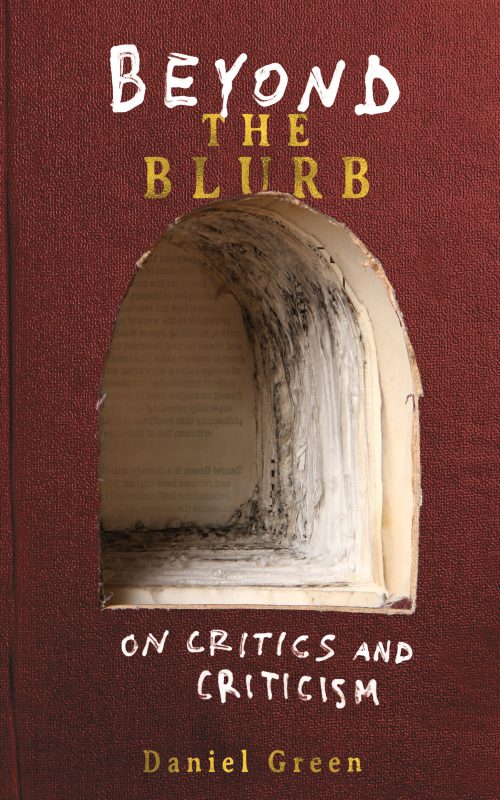
Beyond the Blurb: On Critics and Criticism
Daniel Green
Cow Eye Press, 2017
$14.95; 150 pages

.
Introduction


Many readers of critical writing and attendees of literary conferences will have been either treated or subjected to this or that paper where the literary tail of theory wags the dog of an abject author. The image is more apt when it’s changed to theory having between its slavering jaws the corpse of a work of art, or the corpus of an artist, that will be softened by Gallic or Slavic salivary glands, masticated by deconstruction, postcolonial or queer theory until it becomes digestible matter, followed by its voiding. It’s uncommon in books of criticism nowadays to not encounter references to some or all of the following: Adorno, Althusser, Bakhtin, Barthes, Benjamin, Blanchot, Cixous, Deleuze and/or Guattari, Derrida, Foucault, Kristeva, Lacan, le Man, Shklovsky, and Wittgenstein. What these figures focus on, as do those who cite them, dispute with them, rely on them, and build upon their foundations, is theory, not literature, which has become a resource to provide examples that upholds the Weltanschauung of the theorist. “To the extent that the kind of focus on the ‘literary’ qualities of poetry and fiction, that is, on those qualities that make them first of all works of art,” says Daniel Green in Beyond the Blurb: On Critics and Criticism, “for which I advocate has been dismissed as old-fashioned or superficial, new books are in danger of receiving only the most cursory notice, the most uncritical celebration or ‘takedown,’ otherwise left to fade into future obscurity.” Without dwelling on the experience of my own reviewing, I’ll simply say that I recognize his spirit as the mark of someone conscious he is writing outside the mainstream as embodied, for Green, in such venues as New York Times Book Review, The National Review, and New York Review of Books (regardless of their political leanings), but not in The Quarterly Conversation (or, I would add, The Review of Contemporary Fiction and Rain Taxi, each offering alternative points of view of little-discussed books or fields of study).

At times that first group of journals—one could include the TLS and the London Review of Books—“regard contemporary literature simply as material, sometimes ammunition, sometimes a target, to be employed in the ongoing culture war.” (66) A pirate navigating waterways ruled by this or that thalassocracy, Green nails his colours to the mast:

Readers and critics are perfectly entitled to regard literary works in any way they want, of course, but to deliberately avoid initially engaging with them for their artistic value—the value with which their creators presumably most resolutely attempted to invest them—seems hardly in keeping with the animating purpose of literature as a form of expression. Perhaps readers need not seek out what Nabokov insisted on calling “aesthetic bliss” (although why not?), but that a work of literature might in fact produce such bliss would seem to be a fact about it that a literary critic, at any rate, should need to account for.

The method Green has found that best brings out the literary aspect of a work, and what, in part, makes him think he may be “old-fashioned,” is New Criticism. Not a blind adherence to it, however, for he has the flexibility to modify it and allow other approaches, but as he says, “…I am inclined first of all to read fiction the way the New Critics read poetry, for the integrated effects of language, for the way the parts of the text make a whole and how the parts interrelate. Ultimately, of course, you can’t avoid discussing such things as characters and point of view, but those are themselves the textual artifacts of language.” That will appear untoward or restrictive, refreshing or niche, depending on how well Green defends and advocates for his position.

Beyond the Blurb is set out as follows: Introduction; Part 1: Critical Issues; Part 2: Critical Failures; Part 3: Critical Successes; Bibliography. (There isn’t an index). The Introduction is a concise explanation as to why Green has assembled this book, where the pieces have appeared, what its purpose is, and the rationale behind his thought. He offers six “core tenets” that emphasize that reading a book is the way to get to its meaning: “The experience of reading is the experience of language,” goes one tenet. Part 1 has essays on such topics as close reading, the authority of criticism and critics, and blogs. (Green has his own well-written blog.) Part 2 addresses those critics found wanting, such as James Wood, Christopher Hitchens, and academic criticism. Part 3 focuses on Susan Sontag, Harold Bloom, and William Gass, among others. Each section is packed with argument, generous quotations, and fair-mindedness.

As usual in books of this type that offer up criticism that has appeared on blogs or in the Los Angeles Review of Books there is a certain strain of modesty: “While I do not argue explicitly in these essays that reflection on such issues might be especially important in the critical discussion of current/contemporary literature, nevertheless this is a necessary and underlying assumption.” Sometimes the implicit is much stronger than it appears. When these pieces were isolated in space and time of publication they meant one set of things; placed alongside each other they assert themselves more pointedly. In the culture wars Green refers to throughout, he is a combatant, if an unwilling one.

.

I.

The essays comprising Critical Issues (as with the other parts) generally use one person to centre the argument. Daniel Mendelsohn, in “Close Reading,” comes under the gaze of Green for leaving out one vital feature of a critic: “the ability to pay attention.” This allows for an explanation as to how opinions are only that unless they are backed up by evidence taken from the text, not from such a thing as “taste,” which is a code word used by “guardians of literary culture.” Disliking or liking Jonathan Franzen or Zadie Smith is insufficient. Critics need to argue from the evidence of the work, not from a theory that embraces (or smothers) the work while speaking about anything but its language. This is a mild essay to lead off the book, to my mind, but things pick up with “The Authority of Criticism,” wherein Ron Silliman, whose views are rooted in Marxism, is praised for his “pragmatic perspective” on criticism, and for fitting himself along the Pound-Olson-Creeley axis, one that viewed New Criticism with caution. We are given a thumbnail sketch in literary history (which, like military history, has its own share of pointless wars), a grounding in the work of someone Green respects who challenges New Criticism from a learned perspective, and a rebuttal that takes on board Silliman’s negative comments on New Criticism with poise.

Johanna Drucker is the lightning rod in “Aesthetic Autonomy.” By quoting her right off Green gives readers a taste of her work: “Fine art, artists, and critics exist within a condition of complicity with the institutions and values of contemporary culture,” Drucker says in Sweet Dreams: Contemporary Art and Complicity. Green responds: “I am ultimately fine with this argument, although it’s unfortunate that a defense of aesthetic value in art has to in effect make common cause with mass culture in order to ensure that ‘art’ survives as a viable endeavor to begin with.” Here we have the commodity argument: a painter has truck with commerce (in the purchase or rent of supplies, studio space, models, and then on to labour and selling the finished product). Green’s well-reasoned objection is that this is not a new idea or particularly revelatory, for it is the interpretative framework that supplies the commodity argument, not the art work itself. Through Drucker, Green is able to address the notion of art in service to ideologies as weapons, when, for him, “their refusal to submit to the expectations of ordinary discourse” signifies the autonomy many would deny them.

“The Authority of Critics” is a title that should make us pause. We rarely think of our critical writing as authoritative, especially when it’s spread over a variety of journals that have specialized and small audiences. Yet we maintain the belief that opinions, interpretations, and eisegesis sway the hearts and minds of an unseen multitude. John Carey is the subject of this essay, and Green shows how confused his thinking is in What Good Are the Arts?, classifying it as “absurd in the extreme, essentially inane” after demolishing its principal ideas: that art doesn’t exist, but that it does and that it “does some people quite a lot of good.” It would, perhaps, have made the book stronger to leave Carey out and to focus instead on someone dismissed in the Introduction, Jonathan Franzen, due to his malign and lingering impact on how the literary world divided itself according to his Status and Contract notions. While no more valid than Carey’s, they were more pernicious and, since they drew in various figures, such as Ben Marcus, this could have widened Green’s consideration of classes of fiction.

“Blogs and Alternative Literary Criticism” sets out some arguments for and against this venue of art commentary. It begins with Richard Kostelanetz’s view, from The End of Intelligent Writing: Literary Politics in America (1974), of the “‘New York Intellectuals’” of the 1960s and 1970s as “agenda-setters [who] influenced critical discourse to the extent that challenges to their critical principles (and to their liberal anti-communism) were summarily dismissed when not simply ignored.” From the journals discussed—Partisan and Commentary—it is a short step to academic criticism, which Green once thought would be a suitable place for him. “Academic journals were much more likely to feature experimental and unconventional writers… and gave them more than the cursory treatment afforded by most book reviews.” Times changed, however, and soon academic criticism cared more for “context—historical, culture, theoretical—than with the text, the latter serving only to illuminate the former.” The result is we must find less theory in the hodgepodge of book reviews found in a handful of newspapers that are all too eager to waste column space to the same top 10 titles per season.

Green misses those earlier days, and is dismayed, too, about the online contemporary scene. Once, literary weblogs offered the possibility of “a plausible alternative to print book reviewing,” but this promise never became widespread. It should be said that his blog is substantial and varied, with much long-form writing. But The Reading Experience, as well as Stephen Mitchelmore’s This Space and Litlove’s Tales From the Reading Room, to name two others, are numerically swamped by other blogs that present “…book business gossip, pseudo-literary trivia, and the establishment perspective.” As with print journals, weblogs are haphazardly interested in books, but rarely those that are older than ten months to a year unless it’s an undisputed classic. There’s no hope on the Internet, then, for a renaissance of critical thought.

.

II.

It is beneficial to Green to write against something or someone that irritates him. In Part 2 he targets James Wood, Christopher Hitchens, Morris Dickstein, Hershel Parker, and Joseph Conte for particular failings. Two essays stand out above the others.

I agree with Green, in “James Wood,” that the subject of this essay is “a particularly pernicious influence on contemporary criticism” whose “obvious biases” towards his favoured mode, realism, exclude most fiction that does something else, especially if such works “challenge orthodoxy…” Like Green, when reading Wood I’m conscious that he is reducing the world of literature down to one preferred method of approach, that this is ungenerous to those who think in alternate ways, and that the aim of making anything different conform to a critical perspective rather than choosing to learn something new is to limit oneself needlessly. Quoting Wood on how readers analyze characters, Green states the obvious: “Why would we want to regard characters in a novel as if they were actual people, people with minds and motives and a ‘consciousness’?” This is a common thought, not a special insight Wood has; many publishers still insist they want manuscripts with characters their readers can warm to. But the common reader invoked by Wood might find it unhelpful to use their interpretation of the characters in Bleak House or The Ambassadors to negotiate with colleagues at their workplace. Figures we encounter in books are solely marks on a page, not living beings. (How a champion of realism can’t distinguish between a book, just another object in the world, and the rest of the world is not a subject that troubles Wood much.) In Green’s judgment:

Wood’s account of “how fiction works” is prescriptive, not descriptive: he wants to convince his common readers that the way of reading he presents in his book [How Fiction Works] is the one proper way of reading and that the kind of fiction that most directly satisfies the specified readerly requirements is the only kind really worthy of our attention.

Essentially, Wood regards books primarily as instruments to understand the so-called real world and that therefore impact moral decisions.

In conversation with Karl Ove Knausgaard in The Paris Review, Wood attempts to classify the Norwegian author’s six-volume My Struggle, a tremendous and deliberately unwieldy amalgam of confession, dialogue allegedly recalled from years and years ago, metaphysical conceits, realism, contradictions, airy pontifications, miserable muttering, self-lampoons, artistic manifestoes, wretchedness and hilarity, as realism of a newer kind:

I think it is a general problem. One of the interesting things that’s been happening—in Norwegian literature certainly, but also in British and American fiction—has been an insistence on breaking the forms, not because there’s a postmodern rule that one has to break the forms, but for almost the opposite reason, out of a desire to achieve greater verisimilitude, and a belief that the only way to get there is to break the grammar of realism precisely as you’re describing. In Book Two you say that you’re sick of fiction, you’re sick of the mass production of fictions that all look like the same. You write that the problem was “verisimilitude and the distance it held to reality was constant.” I think this is well put, because it doesn’t rule out fiction-making. It just makes fiction-making harder.

You can sense the strain as Wood tries to squeeze Knausgaard’s epic into a box labeled Realism by appealing to some mythical “greater verisimilitude,” as if there are levels of reality. If there are, then there’s no need for the words greater and, by implication, lesser, but if reality isn’t the same all the way through, then Wood is in serious epistemological trouble. One could also make much of how he feels supremely at ease reading the minds of writers in three countries. That’s just breathtaking.

Green has much more to say about Wood in an essay that he worries might go on for too long, but such is the general obeisance to him and the value of his imprimatur that a considered, and well-mannered, close reading of his words is welcome.

For some reason, Christopher Hitchens was considered to be a worthwhile literary critic and commentator, a low-grade Orwell. In his examination of Hitchens, whose criticism is rarely “non-political,” Green summarizes his contribution to literary criticism this way:

The poets and novelists Hitchens writes about are important to him for what they represent, for the way in which they illustrate historical movements and political ideas, for their beliefs and their habits of mind. Presumably, from Hitchens’s perspective about the most praiseworthy thing that might be said about an author is that he “conducted himself ” as a writer particularly well, not that he (or she—although Hitchens considers very few if any women writers in any of his reviews and essays) actually wrote something especially admirable.

The remainder of this cast of failures, out of one motivation or another, obscure literary works with other matter, although Green finds things to appreciate and regret in the work of the academic Joseph Conte:

If Conte’s discussions of Barth and Sorrentino illuminate qualities of their work that have not previously been as clearly identified, his chapters on White Noise, The Universal Baseball Association and Gravity’s Rainbow to some extent retrod old ground in the critical consideration of these novels. Conte uses information theory, systems theory, complexity theory, and the ideas of the mathematician Benoir Mandelbrot to map the design and debris strategy at work in these iconic postmodern texts, and while the readings that result seem perfectly cogent in elucidating that strategy, nothing very fresh is really added to the commentary on the novels themselves beyond what has already been offered in the voluminous existing criticism of them.

Conte’s final remarks on a move from print to digital reading are briefly mentioned. Green believes in the possibility that “…academic criticism will turn to electronic forms as the subject of ‘advanced’ analysis,” and it’s odd he doesn’t mention that this kind of study is going on at Electronic Book Review.

.

III.

Part 3: Critical Successes presents the literary aesthetics of Susan Sontag, Harold Bloom, Richard Poirier, William Gass, Michael Gorra, David Winters, and S.D. Chrostowska. (It’s a Parallel Lives of the Ignoble and Noble Critics, you could say). Green repeats the well-known encapsulation that Bloom’s thoughts on Shakespeare, the canon, and much else emphasizes “the evidence of influence” over the “formal or stylistic features” of a work and downplays the use of language. “There is still much to be learned from Bloom’s provocations, but probably his kind of reading can’t really be done by anyone else,” Green concludes, and this remark applies equally to Gass, whose idiosyncratic essays will find appeal for anyone who is already a proponent of this very different writer. As for Poirier, an academic critic, Green praises him for his work on Emerson and on style: “…unfortunately there are now few critics like Richard Poirier around to return us to the significance implicit in the reading experience itself, where the reader’s struggle to make the most of the text mirrors the writer’s struggle to allow language to make what sense it can.”

Susan Sontag occupies the polar opposite position in this section from James Wood. Her words are quoted at length, especially from the essay “On Style” that appeared in Against Interpretation. Daniel Mendelsohn’s criticism of Sontag clashes with Green’s own views on her work in a fruitful way as Green examines her theory of writing as erotic and containing a “‘sensuous surface.’” From the following Sontag quotation, it’s easy to see why a current proponent of New Criticism would find her ideas compelling:

To treat works of art [as statements] is not wholly irrelevant. But it is, obviously, putting art to use—for such purposes as inquiring into the history of ideas, diagnosing contemporary culture, or creating social solidarity. Such a treatment has little to do with what actually happens when a person possessing some training and aesthetic sensibility looks at a work of art appropriately. A work of art encountered as a work of art is an experience, not a statement or an answer to a question. Art is not only about something; it is something. A work of art is a thing in the world, not just a text or commentary on the world…

In keeping with his independent streak, Green is not wholly satisfied with Sontag either, for she “can’t finally unburden her argument of the criticisms of aestheticism made by the moralists she otherwise castigates.” By speaking of moral aspects to art she diminishes her own response. “‘Art is connected with morality,’” she says, and this is a needless connection in Green’s eyes. She also doesn’t spend enough time on style—linking her to Hitchens and others—which is another fault. As with Wood, he spends a great deal of time teasing out her thought, and these twin pieces are, to my mind, the best in the book when read in tandem.

Gorra and Winters come in for different types of praise, for their positions on the role criticism can play—paying attention to the art, as Winters does, through “meticulous description and analysis,” and less to the person behind it—while refraining (especially in Gorra’s case) from indulging in the personal:

Of course, very little that is actually offered to general readers in book reviews, magazines, or trade publishing could be called academic criticism. Via the latter, the only attention given to literature is through biographies of writers, which in turn become the prompt for what passes as literary criticism in periodicals such as the New York Review of Books, noodling essays in which the reviewer makes sweeping statements about a writer’s work, often simply repeating the conventional wisdom, while otherwise mostly recapitulating whatever biography is under review.

Both writers earn Green’s respect for devising refreshed approaches to literary works.

Concluding Beyond the Blurb with a sustained and enthusiastic review of S.D. Chrostowska’s Matches: A Light Book, Green takes comfort in how this collection of sharply worded and compact aphorisms is “less a specific model of what criticism might become in the digital age than simply a challenge to seriously reflect on what Matthew Arnold called ‘the function of criticism at the present time.’” It is certainly a way to bring attention to stale methods, yet to some extent I have to disagree. In the same review Green writes:

[C]ertainly readers expecting conventionally realized critical essays, close readings, or historical analyses, the kind of book Chrostowska describes in her introductory “Proem,” in which “the words, erect, line up in columns and salute from every page,” will have to adjust their assumptions about what “criticism” properly entails.

The language in “Proem,” and throughout Matches, comes from a poetic sensibility aligned with a finely tuned critical mind. Most works of literature that we consider personally important—our own canons, not a list of books we’re told we should read—contain revelations and social criticism. They can affirm what we believe in better language than we possess or upend our complacency, even if only temporarily. They undercut long-held beliefs in what can be talked about and what kind of language can be used to get across ideas. Matches is the agonized, at times wry, lament of a liberal mind watching as a general deterioration of the world is leading to a final darkness, and the liberal narrator’s mind becomes inflexible and grim. Without distortion, Green’s “conventionally realized critical essays” can be seen as a set of assays in story-telling forms: the dialogue, the homily, the lecture, the fantastic tale, the pensive meditation on the mundane, the humourous quip, and so on. While not wholly new, the form of Matches confidently includes academic criticism and novelization. “Indeed, it would not be wholly implausible to regard Matches as itself a novel of sorts,” Green admits. What is dispensed with is scenery, character (except for the persona), plot, and so on, and what is most prominent is the attention to form and language; these are hallmarks of much postmodern fiction. Matches is a Janus-faced work.

With this review we come to the abrupt end of Beyond the Blurb.

.

Conclusion

There are some questions raised by the contents of Green’s book. I wonder why Steve Moore, a critic who has redefined what the novel is, and written on many current books, is not the subject of an essay instead of (or in addition to) Michael Gorra. The same goes for Stephen Mitchelmore, whose own excellent collection of essays, This Space of Writing, came out in late 2015. Green does review that book on his site, along with others, and in that review Green describes Mitchelmore’s book as follows:

After reading the entirety of This Space of Writing readers will likely have an adequately clear understanding of what Mitchelmore means by “silence” (and why it’s missing from most conventional literary fiction) and why its lack of “horizon” makes literature uniquely rewarding, but I confess to finding his critical language at times somewhat impalpable or cryptic, at least according to my own admittedly more buttoned-down approach to criticism.

There is a definitely a restraint in Green’s language—though certainly no hesitation to point fingers when required—and it’s only a minor quibble, a matter of taste (a word I use hesitantly here), that some might prefer a more free-wheeling style. The omission of essays on Moore and Mitchelmore strike me as a missed opportunity.

If it appears that I’ve gone on rather long about a book of criticism, it’s partly because in Beyond the Blurb Daniel Green has written an accessible and contrary-minded work that is at war or in agreement (mild or strong) with prevailing trends of critical writing, and the incorporation of so many strands of thought warrants due space. As he writes about a subject that some writers would be thought to have a vested interest in—how their works are received and, potentially of less significance, used—this book can be recommended to them, as well as to the general reader who may be less and less inclined, and with good reason, to rely on the book pages in their local papers (if such a section even exists) for guidance.

—Jeff Bursey

N5

Jeff Bursey

Jeff Bursey is a literary critic and author of the picaresque novel Mirrors on which dust has fallen (Verbivoracious Press, 2015) and the political satire Verbatim: A Novel (Enfield & Wizenty, 2010), both of which take place in the same fictional Canadian province. His newest book, Centring the Margins: Essays and Reviews (Zero Books, July 2016), is a collection of literary criticism that appeared in American Book ReviewBooks in CanadaThe Review of Contemporary FictionThe Quarterly Conversation, and The Winnipeg Review, among other places. He’s a Contributing Editor at The Winnipeg Review, an Associate Editor at Lee Thompson’s Galleon, and a Special Correspondent for Numéro Cinq. He makes his home on Prince Edward Island in Canada’s Far East.

.
.

Feb 042017
 

Nancy, Jean-Luc

In this age of addiction and excessive consumption where massive modes of pleasure are readily available, have we completely fucked ourselves into oblivion? Do we give a fuck about fucking anymore? And now that we have come to the point of post-structuralism, post-modernism, post-privacy and post-truth, have we also arrived at the era of post-pleasure?     —Melissa Considine Beck

coming cover2

Coming
Jean-Luc Nancy with Adele Van Reeth
Translated by Charlotte Mandell
Fordham University Press, 2016
168 pages, $22.00

.
In this age of addiction and excessive consumption where massive modes of pleasure are readily available, have we completely fucked ourselves into oblivion? Do we give a fuck about fucking anymore? And now that we have come to the point of post-structuralism, post-modernism, post-privacy and post-truth, have we also arrived at the era of post-pleasure? There are just a few of the provocative questions that French philosopher Jean-Luc Nancy raises in his book Coming as he explores the tricky, elusive and titillating French word jouissance and its various associations with orgasm, sex, coming, pleasure, joy, property and consumption.

Coming, which is the English translation of the French title la jouissance, takes the form of an interview, divided into five part as Adèle Van Reeth, the producer and host of France Cultural Radio’s daily program on philosophy, asks Nancy a series of questions about the idea of jouissance.  Through the course of this dialogue, Nancy lays out the original meaning of jouissance, which was used solely as a legal term, and he takes us on a fascinating linguistic journey to discover how this word evolved to become associated with sexual pleasure and orgasm and from consummation is now associated with the modern idea of consumption. This book is an excellent introduction for those who are new to Nancy or for those who are familiar with his prolific writings as it contains some of his most favored topics: community, modern psychology, linguistics, Christianity, the body, sex and Platonism, just to name a few.

Nancy made the suggestion of using the infinitive, “To Come” for the English title of this book but Charlotte Mandell thought that the gerund “Coming” would be a better choice to capture the continual nature of movement associated with jouissance. Included in the edition published by Fordham University Press is a beginning note that Nancy writes himself in which he explains the problem with rendering jouissance into an appropriate English title:

In English, sexual orgasm is expressed by the verb “to come.” This has no corresponding noun. What is shared by both lexical registers is an idea of accomplishment. In French, we say venir (to come) for “reaching jouissance,” but the word is mostly used between sexual partners (“viens!” for example.) In choosing the gerund “coming,” Charlotte Mandell aptly brings out action or movement, something that is in the process of occurring, which, in fact, is attached to jouissance and to jouir; that is, precisely, what remains irreducible either to a state or to an acquisition, to an accomplishment or to an appropriation.

It is interesting to note that throughout the text of Coming, jouissance is simply translated in brackets as “pleasure” or is not translated at all, a constant reminder of the elusive nature of this word that has no equivalent translation in English.

.

Defining Jouissance: What the fuck does this French word mean?

Nancy is a master at speaking about the nuances of language and uncovers, unpacks and explains specific French words, with their etymological roots in Latin, that are closely related to jouissance. He begins the discussion with an examination of the French verb Jouir, which means “to enjoy” and “to have an orgasm,” and is derived from the Latin verb gaudere, “to rejoice,” and therefore has no etymological relationship to sex or sexuality. At some point there is a shift in meaning of jouissance from property to sexual pleasure and orgasm. Nancy speculates that this shift begins with the middle French use of joie (joy) which denotes the sensual or sexual feelings of the troubadour poets; these poets have a joy of love that is sensual but jouissance, in the sense of reaching orgasm, is avoided. Nancy exclaims, “One of the ordeals of courtly love even consisted of the knight sleeping with his lady without making love!”

He further explores this shift in meaning by comparing the French words jouissance [pleasure] and joy [joie] and how they are different. Nancy argues that jouisssance corresponds to what Kant called pleasant—when something is pleasant it is something that is felt inside of me because something suits me. Joy, however, is outside of me and carries me towards something else. Nancy goes one step further in the etymological connections of various words to jouissance and explains réjouissance (rejoicing), whose root and meaning are very close to jouissance. Nancy points out that réjouissance is not used very often today and when it is used it describes something that is public such as popular festivities. Nancy concludes about the etymological connection between réjouissance and jouissance:

The idea of festivities, réjouissances, refers to festive excess, to a certain suspension of everyday activities, but also to obligation and finality. That is where we find jouissance, in the sense of joyful acclamations greeting the arrival of an important person, like the jouissance of the people at the arrival of the king.

We can say, then, that joy and réjouissance are like jouissance in that they all denote an excess. The idea of excess and its association with jouissance will be a topic brought repeated throughout Coming. Jouissance is an experience of excessive sexual pleasure in the form of orgasm which experience we seek over and over again.

.

Jouissance as a shared experience: Is it possible to fuck alone?

The style of interview works exceptionally well for Coming because not only does Van Reeth adeptly sum up Nancy’s complicated thoughts, but she also asks him precise questions which elicit more of his ideas; Van Reeth is able to challenge Nancy to expound on his positions and she keeps the dialogue moving forward rather fluidly. In this part of the interview that deals with the subject and the object in the context of jouissance, Van Reeth begins:

Jouissance as experience implies a dissolution of the subject as well as the impossibility of appropriating its object. How then can we define what makes us enjoy [jouir]? And above all, since the question of object goes back to that of the subject: Who is it that enjoys [jouit]?

Nancy insists that jouissance has no specific subject because I am not the owner of my jouissance. How can it be possible for a person to own an orgasm if his or her sexual climax involves another person, another body. What I take pleasure from is just as much my pleasure as it is the pleasure of the other with whom I am engaging in a sexual relationship. Nancy brilliantly anticipates his critics who would argue that masturbation disproves the nonexistence of subject and takes his argument a step further by stating that when pleasuring oneself the other is still present in the form of a fantasy. So when we fuck, we are never fucking alone even if there isn’t another physical body in the room.

It during this part of the discussion that Nancy brings up Lacan and his exploration of jouissance in relation to the pleasure principal. Lacan believes that a subject attempts to go beyond, to transgress the pleasure principal and this brings about pain. It is with this excess, with this reaching of pleasure beyond a limit that Lacan defines jouissance. Although Nancy has been critical of modern psychology throughout his career, he credits Lacan with his effort “to try to find the meaning of jouissance, beyond the fulfillment of satisfaction, into a sortie, outside oneself, into exuberance, ecstasy….”

Van Reeth’s importance in this philosophical exchange is underscored in this section as she further presses Nancy on Lacan’s examination of jouissance:

How do you understand Lacan’s phrase asserting there is no sexual relationship? If there is no sexual relationship, there is no sexual jouissance. But wouldn’t it be truer to understand not that jouissance is impossible, but that it is inconceivable? Just as the fact that there is no sexual relationship would signify that there is no thinkable relationship. It would be a way to preserve the space unique to jouissance as experience.

Nancy’s insight into Lacan is a starting point for his thoughts on jouissance as a shared experience and it will also serve as a prompt from which to discuss the links between aesthetic and sexual jouissance in the next section of the interview:

That is probably what Lacan means. ‘There is no sexual relationship’ can be understood in several ways: There is no proportion, no commensurability, no conclusion either. The sexual relationship cannot be written down. The implication is: there is no account of it, no ‘report’ [rapport, which also means ‘relationship]’ But it is precisely to that extent that there is a real rapport, which demands incommensurability and a form of non-conclusion. A relationship is maintained [s’entretient]. It is not completed. A completed, accomplishment is either a breakup, or a fusion. And in fusion there is no longer any relationship. It would be truer to say, then, that jouissance is inconceivable, not impossible.

In sum, pleasure comes down to a matter of shared meaning whether there is a sexual partner or not. At the end of this section dealing with subject and shared pleasure, Nancy makes one of the simplest, yet thought-provoking statements in this entire volume: Where does sexuality begin and where does it stop? He concludes, “Perhaps it begins very, very far from the sexual act itself.”

.

Aesthetic and Sexual Jouissance: Fucking in motion

Even though Nancy argues that jouissance is never a solitary experience, he also explains that pleasure is unshareable, much in the same way that aesthetic pleasure is a singular experience, unique to each individual.  As he opens thoughts on the link between sexual jouissance and aesthetic jouissance, Nancy points out that it is Freud who first establishes the transfer of aesthetic jouissance to sexual jouissance. Nancy’s criticism of psychology becomes apparent as he disagrees with Freud on his speculation that there is a specific order in which seduction happens—gazing, hearing, touching, must happen first, Freud argues, and only at the end of this progression does Freud finally come to the genitalia through which the tension in the form of orgasm is released.

This part of the discussion in which Nancy brings his reader to understand the connection between sexual and aesthetic jouissance is typical of his very dense, erudite, and multifaceted writing. He references various texts of Freud, he dissects more Latin words via Spinoza, he mentions the young Chilean philosopher Juan Manuel Garrido, he quotes David Hume, and he reaches all the way back to the ancient texts of Plato to make a point about pleasure. As I carefully read his text which is thick with history, philosophy and literature, I take notes, I read or reread authors whose books are sitting on my shelf to whom Nancy has referenced, I search the Internet for authors unknown to me, which laborious activities sometimes feel like a feeble attempt to absorb the full scope of his genius. But all of a sudden, at the end of a complicated series of thoughts, Nancy composes a short, simple, beautiful, concise paragraph that grabs me so forcefully that I pause my frenzy of research:

What we enjoy in an aesthetic form is the movement of this form, even though it ends up being completed. What’s more, an aesthetic form is probably never exhausted and, on the contrary, does not stop enjoying itself (jouir d’elle-meme).

And a bit further on in the same discussion:

In jouissance, they [bodies] become almost formless. Which is radically opposed to that call to eroticism, in advertising or movies, always summoning beautiful, perfected forms. Whereas in eroticism, in eros, these forms become undone.

Nancy reveals in these two simple yet erudite statements that in art there is no formula for what is considered beautiful. Furthermore, we can carry this over to jouissance in which there is no formula to be followed; each person experiences beauty, art and sexual jouissance in his or her own unique way this experience is impossible to share. In a relationship there are no accepted forms or defined forms of beauty, these forms are uniquely decided by the persons within a relationship.

.

The Creative Power of Jouissance: Is There an Art to Fucking?

Nancy’s discussion of the link between sexual and aesthetic jouissance, with a particular emphasis on the art of writing, is the most accessible and interesting piece of this interview. Nancy argues that even when an artist produces a jouissance in his or her viewers, there is always a constantly renewed dissatisfaction that keeps the artist working again and again. “The artist,” he argues, “is in action in his work, and he also takes pleasure [jouit] from being in the process of working. He suffers too, it’s always laborious.”

Nancy is a prominent and well-known contributor to the studies of art and his cultural writings have covered the topics of literature, poetry, theater, music and film. Nancy has written books on the subject of art and has also written pieces for international art journals and art catalogs. He has a text from a lecture given 1992 at the Louvre displayed with the painting ‘The death of the virgin’ by the Italian painter Caravaggio. It is fitting that Fordham University Press has used a Caravaggio painting for this edition of Coming thereby reminding us of Nancy’s interest in the Italian painter.

In order to lead Nancy into elaborating on the similarities between the pleasure of art, specifically the art of writing, and sex, Van Reeth reads a passage from Rilke’s Letters to a Young Poet in which the author asserts that writing and sexuality bring about the same pleasure. In a letter dated April 13, 1903 from Viarregio, near Pisa, Rilke writes:

And in fact artistic experiences lies so incredibly close to that of sex, to its pain and its ecstasy, that the two manifestations are indeed but different forms of one and the same yearning and delight.

Nancy picks up on the idea that Rilke is speaking of writing as working toward the unknown, without a goal, which is also true for artists who work with music or paint. The art passes through the artist to the spectator who experiences the work of art through a plethora of senses. In the end the artist has no real understanding of how his or her work is received, of the various ways in which someone experiences pleasure through his or her art. The pleasure that is experienced by the spectator as a result of interacting with his work is unshareable just as the experience of sexual jouissance. When we speak about sexual pleasure and orgasm, is there really a word or phrase that captures a good fuck? How can we truly and accurately describe the best fuck we’ve ever had? The experience is unshareable when we make any attempt to put it in words.

The true brilliance of Nancy’s dissection of language comes with his elaboration on the verbal similarities of art and sex. Artistic media such as color and rhythm are used to describe both art and sex. Rhythm, for instance, is present in an art’s use of color and can also be applied to the lover’s caress of the body. The best sex is enjoyed when lovers find a rhythm and Rhythm is a coming-and-going, a constant movement a repetition. Nancy concludes about rhythm:

Rhythm in general is born from what is never definitively there, from what does not stay in place and causes us to return, what leads to jouissance. Rhythm is fundamental for humans, bur for nature as well; think of the rhythm of the stars.

Art and sex cannot exist without movement. It is the seduction, the process, the rhythm that leads to artistic and sexual jouissance

.

Suffering and Fucking—Christianity’s Influence on jouissance

The fourth part of the book, dealing with Christianity and its influence on jouissance is the shortest and the least stimulating part of the dialogue. Nancy has been interested in and critical of Christianity throughout his career and we get a cursory survey of his thoughts in this section. Throughout their dialogue on pleasure, Nancy and Van Reeth both tangentially bring up the close relationship between pleasure and suffering. Nancy sites the works of de Sade as an example of jouisssance being the result of pain inflicted on another or on oneself. Pain and pleasure have an intensity in common and in the moments before orgasm the tension that one experiences can be painful. Van Reeth uses the example of Proust’s narrator who, in the beginning of Sodome et Gomorrhe, describes the very noisy sexual encounter between Baron de Charlus and Julien as akin to the sound of a man having his throat split. The narrator concludes, “if there is one thing as loud as suffering, it’s pleasure.”

Nancy begins the section by arguing that Christianity was the calming solution to the disintegration of the theocratic regimes, the loss of which political system caused great anxiety and unrest. Christianity brings to mankind the idea that life is simply a passage to another spiritual side, a passage that is marked by suffering. It is the Passion of Christ that provides us with a redemptive kind of suffering and suffering is specifically attached to life on earth. One must pass through suffering in this life in order to attain salvation. As a result there is a definitive break and distinction between heavenly joy and human joy. Because of Christianity’s condemnation of the flesh, earthly pleasures such as human joy and jouissance become evil and separate from heavenly joy and jubilation. It is fitting that their discussion on Christianity and suffering, even in relation to jouissance, is the most somber part of Van Reeth and Nancy’s dialogue.

.

From Consummation to Consumption: Do we give a fuck about anything anymore?

Nancy explains that Christianity was an attempt to organize people into one community, but the appearance of a modern state served to divide individuals until the invention of capitalism. “which would insert the individual subject into the circuit of a new jouissance: no longer the jouissance of excess, but that of accumulation and investment. It’s a jouissance that can no longer bear that name.” Van Reeth asks Nancy what, exactly, has changed to cause the meaning of jouissance to shift once again.

It was Communism, Nancy argues, that provided the connection between jouissance and profit, which political theory believed that everyone’s hard work will produce profits that can be equally shared by all –this sharing of profits would be a source of jouissance. But nowadays, people are working harder than ever and the profits are accumulated by a very small percentage of the upper classes. Nancy argues that jouissance has now come full circle to be associated with its legal meaning which is that of possession and acquisition.

Today, jouissance has become confused with and associated with profit as well as property.   Excess has now taken on a quantitative definition in that we must possess the greatest possible number of things that we can. Nancy concludes: “It has left heaven, joy, to land again on earth.” With the ubiquity of things that we consume that push us to the brink of addition—little blue pills, a plethora of opiates, internet pornography—jouissance today has evolved into a kind of greedy consumption in which excess has become the norm. With the disappearance of excess what is left that gives us pleasure? Have we landed in an epoch of post-pleasure?

In this final part of the dialogue when Nancy brings up modern ideas of consumption and their relation to jouissance he shows that he has continued to think about philosophical topics and how they can be applied to current social and political situations. Orgasm, masturbation, sexual pleasure, addiction, and jouissance itself are topics that seem more fitting for the field of psychology and have not been explored by philosophers. Despite his years of suffering through grave illnesses and his advanced age, Nancy proves in the publication of Coming that he is as relevant and progressive as ever in his field.

Although Coming is a short book, some might be intimidated by the breadth and depth of Nancy’s thought. It is, however, an excellent and thorough introduction to the wide range of ideas on which Nancy has expertly written and a scintillating discussion of pleasure, sex, orgasm, fucking, desire, pain, and how we experience these things with our bodies. The interview style of the text in which Van Reeth summarizes Nancy’s main points and propels the conversation forward with her questions makes Coming one of his most accessible and fucking enjoyable books.

—Melissa Considine Beck

N5

m-beck-bio-pic

Melissa Beck has a B.A. and an M.A. in Classics. She also completed most of a Ph.D. in Classics for which her specialty was Seneca, Stoicism and Roman Tragedy. But she stopped writing her dissertation after the first chapter so she could live the life of wealth and prestige by teaching Latin and Ancient Greek to students at Woodstock Academy in Northeastern Connecticut. She now uses the copious amounts of money that she has earned as a teacher over the course of the past eighteen years to buy books for which she writes reviews on her website The Book Binder’s Daughter. Her reviews have also appeared in World Literature Today and The Portland Book Review. She has an essay on the nature of the soul forthcoming in the 2017 Seagull Books catalog and has contributed an essay about Epicureanism to the anthology Rush and Philosophy..

Jan 122017
 

Seiji Ozawa, left, and Haruki Murakami. Credit Nobuyoshi Araki (NY Times)

Absolutely on Music is the kind of book that makes you want to go find the music for yourself… These conversations left me wanting more, in the best possible way. They made me want to go sit with a friend in the living room, listening to records, one after another, late into the evening. —Carolyn Ogburn

Absolute Music
Haruki Murakami & Seigi Ozawa
Knopf, 2016
352 pages; $27.95

“…all I want to say is that Mahler’s music looks hard at first sight, and it really is hard, but if you read it closely and deeply with feeling, it’s not such confusing and inscrutable music after all. It’s got all these layers piled one on top of another, and lots of different elements emerging at the same time, so in effect it sounds complicated.” —Seiji Ozawa, Absolutely on Music

.
Absolutely on Music, by novelist and music aficionado Haruki Murakami and legendary conductor Seiji Ozawa (translated by Jay Rubin) is the best kind of eavesdropping. Although the book is (not inaccurately) described as series of “conversations,” the topic throughout is music, and the conversations appropriately become Murakami’s interviews of Ozawa regarding his long and storied career in the aftermath of diagnosis of esophageal cancer. Ozawa explains that “until my surgery, I was too busy making music every day to think about the past, but once I started remembering, I couldn’t stop, and the memories came back to me with a nostalgic urge. This was a new experience for me. Not all things connected with major surgery are bad. Thanks to Haruki, I was able to recall Maestro Karajan, Lenny, Carnegie Hall, the Manhattan Center, one after another…”

Murakami (b. 1949) is best known as a novelist, including Hard-Boiled Wonderland and the End of the World (1985) The Wind-Up Bird Chronicles (1994) and 1Q84 (2009-2010). He has received many awards for his work, including the Franz Kafka Prize and the Jerusalem Prize. He has published several collections of short stories and many works of nonfiction, including Underground, about the sarin gas attack on the Tokyo subway, and What I Talk About When I Talk About Running. Music often plays a strong role in Murakami’s writing. Scholars have long been drawn to exploring the musical worlds evoked in Murakami’s novels; they’ve created playlists  and written dissertations (and created more playlists. There is even a special resource on Murakami’s website that provides references to the musicians, songs, and albums mentioned in his writing. The biography of Murakami written by his long-time translator, Jay Rubin, is titled Haruki Murakami and the Music of Words.

“How did I learn to write?” Murakami asks. “By listening to music. And what’s the most important thing in writing? It’s rhythm.”

Murakami’s and Ozawa’s daughters were friends, but the two artists only knew one another casually. They never spoke of their work to one another until Ozawa became ill with esophageal cancer in December, 2009. Because Ozawa had to limit his work, Murakami noted a new eagerness when they met to turn conversations to the topic of music, noting that it might have been the fact that he was not talking to a fellow musician that “set him at ease.” The task of publishing these conversations came from a story Ozawa told Murakami about Glenn Gould and Leonard Bernstein’s 1962 performance of Brahms’ First Piano Concerto. Murakami writes, “’What a shame it would be to let such a fascinating story just evaporate,’ I thought. ‘Somebody ought to record it and put it on paper.’ And, brazen as it may seem, the only ‘somebody’ that happened to cross my mind at the moment was me.”

Seiki Ozawa (b. 1935) began conducting as a boy in Japan when a rugby injury sprained his hand too badly for him to continue his piano studies. His skill soon brought him to the United States, where in 1960 he won first prize for student conducting at the Boston Symphony Orchestra’s Tanglewood festival. The young Ozawa studied conducting under legendary conductors such as Herbert von Karajan and Leonard Bernstein, who both figure prominently in these conversations. He went on to serve as the music director of the Boston Symphony Orchestra for 29 years, and as the principal conductor of the Vienna State Opera. He has received many honors and awards, including a Kennedy Center Honor and two Grammy Awards.

It’s interesting to note that the collection opens with a discussion of who is really in control during a performance of a concerto: the soloist or the orchestra’s conductor? Murakami initiates these interviews not with Ozawa’s own recordings, but with a discussion of Bernstein’s well-known disavowal of the interpretation of the Brahms First Piano Concerto as performed by Glenn Gould and the New York Philharmonic in 1964. Bernstein spoke to the audience prior to the performance, saying:

I cannot say I am in total agreement with Mr. Gould’s conception, and this raises the interesting question: “What am I doing conducting it?” [Audience murmurs, tittering.] I’m conducting it because Mr. Gould is so valid and serious an artist that I must take seriously anything he conceives in good faith, and his conception is interesting enough so that I feel you should hear it too.

Gould often performed with tempi so eccentric that it was difficult to regulate his interpretation together with that of the orchestra. It was this that prompted a discussion between Murakami and Ozawa as to which artist, conductor or soloist, was really in charge of a performance. But in this dialogue of two renowned artists, Seiji Ozawa and Haruki Murakami, who is in charge?

Though it is Ozawa’s history, the book ultimately belongs to Murakami. The comparison to Glenn Gould is an apt one, I feel, for Murakami’s prosody is, like Gould’s musical syntax, both engaging and strongly idiosyncratic. The language is unmistakably Murakami’s throughout. The syntax and rhythm of the words (at least as translated by long-time Murakami translator Jay Rubin) could be lifted straight from the page of any Murakami novel. I kept feeling as if a cat were gazing silently from the other room. If you are a fan of Murakami’s prose, then you will enjoy this book as well.

The conversational settings (the book consists of six conversations, separated by shorter “interludes”) are described only in the loosest terms. The first conversation, for example, takes place in Murakami’s home “in Kanagawa Prefecture, to the west of Tokyo.” Albums and CDs are pulled off the shelf to play as they talk, but the shelves themselves are never described; it’s as if they are being pulled from thin air. There’s something of the animated drawing about these conversations, the way that the suggestion of a particular recording prompts an immediate search for music. In the example here, the search is immediate. Though we haven’t any idea where the two are seated (or if they are seated), no sense of the room, or the light, the time of day or night, the mention of Lalo’s piece for orchestra and solo violin initiates a small flurry of activity:

Ozawa: “We [the violinist Anne-Sophie Mutter and Ozawa] Lalo’s Spanish something-or-another. She was barely twenty years old at the time.

Murakami: Edouard Lalo’s Symphonie Espanole. I’m sure I’ve got a copy of that somewhere.

Rustling sounds as I hunt for the record, which finally turns up.

Ozawa: This is it! This is it! Wow, I haven’t seen this thing for years.

Here, too, you get a sense of the way in which Murakami, the first-person author, enters the page as himself rather than via the transcriptionist of his own words. He’s “Murakami” except when making “rustling sounds” as he searches for the record he has in mind, which “finally turns up.” Those details—unexplained rustling, the “finally turns up,” which insists on being read with a kind of drama whose merit is uncertain—is classic Murakami.

There’s no doubt, however, that Murakami knows his stuff. As Ozawa himself puts it in the book’s afterward, “I have lots of friends who love music, but Haruki takes it way beyond the bounds of sanity. Jazz, classics: he doesn’t just love music, he knows music.”

One of the most fascinating aspects of this dialogue comes through the two very different ways in which they’ve each come to know the music that they love. For Murakami, his knowledge of music comes through avid and detailed listening to recorded music, supplemented by live performances when possible. As he admits, “a piece of music and the material thing on which it was recorded often comprised an indivisible unit.”

Ozawa, on the other hand, is far less familiar with recorded works, even his own. His knowledge of music comes from his study of it. His first encounter with Mahler was through reading a score: “I had never heard them on records. I didn’t have the money to buy records then, and I didn’t even have a machine to play them on.” The music itself was revelatory, “a huge shock for me—until then I never even knew that music like that existed…I could feel the blood draining from my face. I had to order my own copies right then and there. After that, I started reading Mahler like crazy—the First, the Second, the Fifth.” The first time he ever heard Mahler performed was as Bernstein’s assistant at the New York Philharmonic. Because of the way in which he learned the repertoire, Ozawa, unlike Murakami, was less familiar with the range of recorded performances of any given piece. Murakami is struck by what he calls “the fundamental difference that separates the way we understand music.” He finds that difference between a music-maker and a music lover to be an almost-literal wall, “especially high and thick when that music maker is a world class professional. But still, that doesn’t have to hamper our ability to have an honest, direct conversation. At least, that’s how I feel about it, because music is a thing of such breadth and generosity.”

The first conversation revolves around a variety of recordings of Beethoven’s Third Piano Concerto. A 1957 performance with Glenn Gould and the Berlin Philharmonic under the baton of Herbert von Karajan is compared with Gould’s recording with Leonard Bernstein and the Columbia Symphony Orchestra (composed of members of the NY Philharmonic) in 1959. The two then listen to Rudolf Serkin’s recording of the same concerto with Bernstein in 1964, which is taken at such a rapid tempo that Ozawa exclaims in astonishment, “It’s kind of an inconceivable performance.” They listen to another recording on period instruments, or the actual instruments for which Beethoven would have been writing: Jos van Immerseel performing on the fortepiano, rather than the modern-day piano, for instance. (Oddly, neither the orchestra nor the conductor is named.) This performance provokes the kind of observation that will delight the serious student of music, or anyone who enjoys thinking about sound: Ozawa says, almost as an aside, that in this period-instrument recording that “you can’t hear the consonants.”

Ozawa: The leading edge of each sound.

Murakami: I still don’t get it.

Ozawa: Hmm, how can I put it? If you sing a-a-a, it’s all vowel. But if you add consonants to each of the a’s, you get something like ta-ka-ka, or ha-sa-sa. It’s a question of which consonants you add. It’s easy enough to make the first ta or ha, but the hard part is what follows. If it’s all consonant—ta-t-t—the melody falls apart. But the expression of the notes changes depending on whether you go ta-raa-raa or ta-waa-waa. To have a good musical ear means having control over the consonants and the vowels. When the instruments of this orchestra talk to each other, the consonants don’t come out.

Murakami next brings out the 1982 recording of the piece with Rudolph Serkin again at the piano, and Ozawa himself conducting the Boston Symphony Orchestra. Here, we’re privy to Ozawa’s self-critique—“Now, this is ‘direction.’ Hear those four notes? Tahn-tahn-tahn-tahn….I should have done more of that.”—and his suggestion that Serkin, who was now late in life, realized that it was probably “his last performance of this piece, that he won’t have another chance to record it while he’s alive, and so he’s going to play it the way he wants to. Period.”

Finally, they listen to Mitsuko Uchida’s 1994 recording with the Royal Concertgebouw Orchestra under the baton of Kurt Sanderling. Earlier, the two have discussed the use of silence (the Japanese use the word ma to describe this quality) and the way in which Gould uses ma so naturally in his interpretation. Now they find a similar quality in Uchida’s playing, the silent intervals, her “free spacing of the notes.”

Beethoven: Piano Concerto No.3 / Mitsuko Uchida, Seiji Ozawa. Saito Kinen Orchestra

This concept of ma comes back as Ozawa describes to Murakami the conductor’s role in bringing the orchestra in following a break in the sound:

Murakami: When you’ve got an empty moment and you have to glide into it, the musicians all watch the conductor, I suppose?

Ozawa: That’s right. I’m the one responsible for putting it all together in the end, so they’re all looking at me. In that passage we just heard, the piano goes tee…and then there’s an empty space [ma] and the orchestra glides in, right? It makes a huge difference whether you play tee-yataa or tee…yataa. Or there are some people who add expression by coming in without a break: teeyantee. So if you do it by kind of “sneaking in” as they say in English, the way we heard, it can go wrong. It’s tremendously difficult to make the orchestra all breathe together at exactly the same point. You have all these different instruments in different positions on the stage, so each of them hears the piano differently, and that tends to throw off the breath of each player by a little. So to avoid that kind of slip-up, the conductor should come in with a big expression on his face like this—teeyantee.

Murakami: So you indicate the empty interval [ma] with your face and body language.

Ozawa: Right, right. You show with your face and the movement of your hands whether they should take a long breath or a short breath. That little bit makes a big difference….it’s not so much a matter of calculation as it is the conductor’s coming to understand, through experience, how to breathe.

Each conversation focuses very loosely on a topic, but the strength of this book is found in its soaring, tangential details. The second conversation revolves around Ozawa’s performances of the Four Brahms Symphonies with the Boston Symphony Orchestra, the manner of organization within orchestral groups today, particulars of instrumentation in the horn section of Brahms’ First Symphony; Brahms evokes Ozawa’s mentor, Hideo Saito. Ozawa’s Saito Kinen Orchestra was formed to mark the 10th anniversary of the great conductor’s death. The third conversation revolves around Ozawa’s experiences during the 1960s as he moves from New York Philharmonic, where he was assistant to Leonard Bernstein, to working with the Chicago Symphony, to three recordings Ozawa made with the Toronto Symphony of Berlioz’ Symphonie Fantastique.

Seiji Ozawa conducts Berlioz: Symphonie Fantastique, Toronto Symphony Orchestra 1967. 1st Movement: Rêveries – Passions.

In the fourth conversation, the two discuss the works of Gustav Mahler, a composer who’s work wasn’t widely performed until Leonard Bernstein championed his works in the 1960s. Of course, Murakami explains, one of the reasons Mahler wasn’t performed was that his work, like the works of all Jews, was “quite literally wiped out over the twelve long years following 1933, when the Nazis took power, to the end of the war in 1945.”

This is a fascinating dissection of both the composition and orchestration of Mahler’s nine symphonies and a history of the performance styles that were used over the decades that Ozawa has been conducting them. The emerging prevalence of recordings actually changed the performance styles; as recording moved away from recording the overall sound, focusing instead on individual instruments, so too did the tendency of orchestras to aim for a more transparent, detailed performance. The whole chapter on Mahler is one of the richest in the book. Yet, here’s Murakami, breaking in again to note Ozawa “eats a piece of fruit.”

Ozawa: Mmm, this is good. Mango?

Murakami: No, it’s a papaya.

Other times, Murakami’s interruptions are to provide poetic interpretation that comes in surprising passages, however lovely his descriptions may be. For example, while listening to the third movement of Mahler’s First Symphony, Murakami notes that “the clarinet adds an indefinably mysterious touch to the melody, the strange tones of a bird crying out a prophecy deep in the forest.” The line here, not unlike the mysterious touch of the clarinet, is surprising only because it is so rare; it’s a language from another time. In this book, the magic comes from two skilled craftsmen talking about their work with curiosity and affection.

The fifth conversation revolves around Ozawa’s experiences conducting opera, both staged and in concert performances. He recalls being “booed in Milan” at La Scala. Murakami presses him, asking twice, “Do you think there was some resistance to the idea of an Asian conducting Italian opera at La Scala?”

Osawa replies, “The sound I gave Tosca was not the Tosca they were used to.”

“Back then, weren’t you the only Asian conducting at a first-class European opera house?”

“Yes,” says Ozawa. “I suppose I was.”

That the two men are both Japanese, conversing in Japanese, is an issue that glides just below the surface of the conversation. Many times, Ozawa credits his lack of English fluency to explain why he simply didn’t notice the political waters in which he swam as a young conductor in New York and Europe. When he recalls the days in which Ravinia, the prestigious music festival outside of Chicago, was an all-white establishment (in the context of bringing Louis Armstrong to the festival), neither acknowledge that his very presence contradicts the memory of “all white”.

The final conversation centers on the Seiji Ozawa International Academy Switzerland. It’s a summer chamber music program that works with promising young musicians in small ensembles and extraordinary master instructors such as violinist Pamela Frank, cellist Sadao Harada, violist Nobuku Imai, and violinist Robert Mann. It’s a program designed around the very principles Ozawa learned from his first teacher, Hideo Saito.

Reading Conversations on the subway, or a cafeteria, or a picnic table in the late autumn sun, I could usually call to mind some of the music under discussion from memory, down to the scratchy sound of cracks in the vinyl, the thick humidity of the needle tracing silence between movements, as if it were playing just a the limit of earshot. But when I sat down to write about the book, I felt compelled to search out the actual recordings. I found many of them on Murakami’s website, which (as I mentioned earlier) contains playlists of works referenced in his other books. Other pieces, though not all, can be found online. These conversations left me wanting more, in the best possible way. They made me want to go sit with a friend in the living room, listening to records, one after another, late into the evening.

—Carolyn Ogburn

 Carollyn Ogburn

N5
Carollyn Ogburn

Carolyn Ogburn lives in the mountains of Western North Carolina where she takes on a variety of worldly topics from the quiet comfort of her porch. She’s a contributing writer for Numero Cinq and blogs for Ploughshares. A graduate of Oberlin Conservatory, UNC-Asheville, and UNC School of the Arts, she recently finished her MFA at Vermont College of Fine Arts and is currently seeking representation for her first novel.

Dec 122016
 

john_kaag

To think that this horde of precious and irreplaceable books was sitting in the woods less than 2 hours away from my home in New England sends chills down my spine. —Melissa Considine Beck

american-philosophy-a-love-story-book-cover

American Philosophy: A Love Story
John Kaag
Farrar, Straus & Giroux, 2016
272 pages; $26.00


O Wild West Wood, thou breath of Autumn’s being.
Thou, from those unseen presence the leaves dead
Are driven like ghosts from an enchanter fleeing.

Yellow, and black, and pale, and hectic red,
Pestilence-stricken multitudes: O thou
Who chariotest to their dark wintry bed.

—“Ode to the West Wind,” Percy Shelley

.
Holden Chapel, at first glance, is a small, unassuming, forty-foot, Georgian style, brick building on the campus of Harvard University. But it has a rich and interesting history as the third oldest building at Harvard and as one of the oldest college buildings in America. In December of 1741, Harvard accepted a generous donation of 400 pounds sterling from Mrs. Holden, widow of Samuel Holden, and her daughters to build a chapel on campus. The building was erected in 1744 and from that year until 1772 morning and even prayers were held for students in the quaint building and it also served as a place for intimate and engaging lectures. On April 15th, 1895 the American Philosopher William James delivered his famous “Is Life Worth Living?” essay to a group of young men from the Harvard YMCA.

William James, known as the Father of American Psychology, was the son of Henry James, Sr., the Swedenborgian theologian, and the brother of the famous American novelist Henry James. William James contemplated becoming an artist, but in 1861 he enrolled in medical school at Harvard where he eventually graduated with an MD. But James never practiced medicine and was instead drawn to psychology and philosophy and became a pioneer in both of these fields. During his young adulthood James suffered from long bouts of depression which were diagnosed at the time as neurasthenia. His depression and anxiety, which he calls his “soul-sickness” led him to contemplate suicide and he even overdosed on chloral hydrate in the 1870’s just to see how close he could come to death without actually crossing that threshold. It was the exploration of philosophy and his attempt to answer the question “Is Life Worth Living” that brings him out of his malaise and inspires him to compose some of the most important philosophical pieces that make up the American school of pragmatic philosophy.

John Kaag’s philosophical and literary memoir American Philosophy: A Love Story, begins with the young philosopher’s own “soul-sickness” and his frequent visits to the site of James’s famous lecture, Holden Chapel, in the Spring of 2008. Kaag is on a postdoc at The American Academy of Arts and Sciences when his crumbling marriage, the death of his alcoholic father and the stagnation of his research push him to contemplate what he believes to be William James’s most important philosophical question: “Is Life Worth Living?”

I was supposed to be writing on the confluence of eighteen century German idealism and American Pragmatism. Things were progressing, albeit very slowly.

But then, on an evening in the Spring of 2008 I gave up. Abandoning the research had nothing to do with the work itself and everything to do with the sense that it, along with everything else in my life, couldn’t possibly matter. For the rest of my year at Harvard I assiduously avoided its libraries. I avoided my wife, my family, my friends. When I came to the university at all I went only to Holden Chapel. I walked past it, sat next to it, read against it, lunched near it, sneaked into it when I could—became obsessed with it. James had, as far as I was concerned, asked the only question that really mattered. Is life worth living? I couldn’t shake it and I couldn’t answer it.

Kaag’s clipped and pithy sentences which employ asyndeton for maximum dramatic effect make this book about so much more than philosophy and literature. He is not afraid to reveal his darkest thoughts or lowest moments and he is also not above using profanity or embarrassing stories about himself to get his point across.   The style of deep, private reflection mixed with philosophical dialogue is reminiscent of Robert Pirsig’s Zen and the Art of Motorcycle Maintenance. But, unlike Pirsig, who wrote computer manuals for a living, Kaag’s book is a great personal and professional risk for a philosopher whose two previous books are for a very specific, academic, Ivory Tower audience: Thinking Through the Imagination: Aesthetics in Human Cognition and Idealism, Pragmatism, and Feminism: The Philosophy of Ella Lyman Cabot.

holden_chapel_harvard_universityHolden Chapel, Harvard University

American Philosophy is aptly and cleverly divided into three main parts which recall the journey in Dante’s Divine Comedy: Hell, Purgatory and Redemption. Kaag’s journey starts in Part I, in “Hell,” on his way to the White Mountains in New Hampshire for a philosophy conference on William James at the Chocorua Public Library, but he gets sidetracked for the first of many times throughout the book. There is a sense of wandering and loneliness that punctuates American Philosophy and in this instance, the first real instance of meandering, Kaag can’t even bring himself to his end point which is a professional conference. Instead of going to meet his colleagues at the Chocorua Library, he stops at a German bakery where he meets Bunn Nickerson.   This kind, ninety-three-year old, local gentleman tells Kaag that William Ernest Hocking, the prominent 20th century American philosophy professor from Harvard, has an estate which is nearby and contains a unique library. Bunn offers to take Kaag there to have a look around.

The family still used the Hocking estate, which was named West Wood, in the summer, but in the fall of 2008 all of the buildings were empty of any human inhabitants and the library appeared to be utterly neglected and abandoned. A copy of The Century Dictionary from 1889, a first edition encyclopedic dictionary with more than seven thousand pages and ten-thousand wood engraved illustrations, catches his eye through the window and his decision to enter this library, even though it was trespassing, completely alters the course of Kaag’s life for the better.

Kaag stumbles upon an opportunity to heal his soul in the form of West Wood’s stone library which, upon entering, he discovers is home to more than 10,000 books. The books that Kaag finds inside this unlocked and unheated building, especially the number of first editions, are the stuff of dreams for any bibliophile. Among the rodent droppings, porcupines, termites, various other bugs and dust Kaag finds Descartes’ Discourse on Method–first edition from 1649, Thomas Hobbes’s Levithan-first edition from 1651, the complete, leather-bound volumes of the Journal of Speculative Philosophy, John Locke’s Two Treatise on Government from 1690, Kant’s Kritik der reinen Vernunft from 1781, Emerson’s Letters and Social Aims–first edition, 1875 and on and on. To think that this horde of precious and irreplaceable books was sitting in the woods less than 2 hours away from my home in New England sends chills down my spine.

William Ernest Hocking, the owner of this vast personal library was, like his teacher William James, also a pragmatist who believed that philosophy could have an effect on real life. His personal library was a collection of not only European thinkers and philosophers, but he also amassed books that contained the thoughts of Eastern philosophy. Hocking studied with James at Harvard as well as other American thinkers such as Royce, Palmer and Santayana. In 1908, Hocking moved from his home on the West Coast to accept a teaching position at Yale and in 1916 when his mentor, Josiah Royce died, Hocking took over his chair in philosophy at Harvard. Hocking would go on to spend the next forty years at Harvard making a name for himself as one of the prominent scholars of American pragmatism. Kaag discovers that many of the books in Hocking’s library were once owned by Hocking’s famous teachers and colleagues at Harvard and some of their signatures, notations and inscriptions inside the books were just as valuable as the leather bound books themselves.

hockingWilliam Ernest Hocking

Throughout the course of Part I, Kaag’s “Hell,” he comes to the painful decision that his marriage is a mess and not capable of being saved. He leaves his wife in Boston and spends more and more time at West Wind where he becomes acquainted with Hocking’s granddaughters, Jennifer, Jill and Penny. The sisters are “surprised and releived” that someone is interested in the books and Kaag begins to catalog the massive collection and attempts to save the oldest, most vulnerable books by moving them to dry storage. As he works his way through the books he continues on his deeply personal and lonely struggle with his own purpose and existence. He writes:

In the following months I started cheating on my wife with a room full of books. I made the trip to New Hampshire repeatedly. My wife and mother—in a unison that always infuriated me—demanded to know where I was going. I could have told the truth but instead I chose to lie, making up conferences that needed to be attended and friends I wanted to visit. Up until that point my life had been so routine, so scripted, so normal, so good—but my brief encounter with my dead father the previous year had brought that life to an unceremonious end. Nothing about life is normal. And nothing about life has to be good. It’s completely up to the liver. The question—Is life worth living?—doesn’t have a scripted, public answer. Each answer is excruciatingly personal, and therefore, I thought, private.

One of the greatest strengths of Kaag’s narrative is that he is not afraid to show that his attempt to escape his wretched existence by means of the library at West Wind was not always noble or dignified or pretty. He skips meals, he neglects his hygiene, he drinks excessively, he begins to prematurely age and he sleeps out in the woods behind West Wind where he catches a nasty case of Lyme Disease. Who among us hasn’t hit a low point in our lives to which we can look back and trace our gradual ascent out of the abyss? The stark honesty of Kaag’s narrative is brave, especially for someone who is an academic philosopher, because he includes all of the ugliness of his journey from Hell to Redemption which details he could have just as easily skimmed over or avoided altogether.

The ideas and themes of American philosophy and literature which are unfolded within the pages of Kaag’s book mimic the philosophers own process of discovery as he unpacks and unfolds the wonders of Hocking’s library. One encounters James, Emerson, Thoreau, Coleridge, Camus, Royce, Whitman, Peirce, Frost and Dante just to name a few. Many readers never give much thought to American philosophers, or as Kaag notes, American philosophy is regarded as “provincial” and “narrow in its focus.” Kaag, however, delves into the pages of American philosophical writings with unbridled enthusiasm that is enhanced by his literary ability to tell interesting and engaging stories about the real lives of these great American thinkers. As one example of this, Kaag summarizes the philosopher Charles Sanders Peirce’s struggle with the idea of freedom and the impact chance has on our choices. Peirce took issue with the emphasis of orderly design over chance and freedom that Darwin and the evolutionists promoted. The philosophical theories of Peirce’s Design and Chance are discussed by Kaag in the context of Peirce’s struggle in his personal life with romantic love. The anecdotes and stories about Peirce’s real life struggles makes what could be a dry recounting of Peirce’s philosophical pragmatism into a gripping story about a great thinker who is attempting to make sense out of his confusing and chaotic world.

Kaag spends the next year in the woods at West Wood with Hocking’s books and continues to contemplate James’s important question. As he works his way through the library he reads countless volumes of American philosophy and literature, with a few Europeans mixed in, that help him through the different stages of his emotional and spiritual journey. The most significant turning point in Kaag’s Hell is when he begins reading Thoreau and reflecting on that writer’s own retreat to the woods. Kaag becomes frustrated with Emerson’s idea of self-reliance which he feels is unattainable and unrealistic. Instead he embraces Thoreau’s example of simplicity, cultivating the earth, and turning off and tuning out all of the modern amenities that distract us from searching for real meaning in our lives.

At one point Kaag takes a break from sifting through books in the library asks Hocking’s granddaughter, Jennifer, the least “intellectual” of the sisters, if he can help her clear a field by scything. As he takes in the simplicity of the landscape at West Wood and tries to deal with this very physical task, Kaag comes to realize through this experience of scything that the process of self-discovery needs to happen for him outside of the walls of the stone library and that this process would be slow and couldn’t be forced; he learns to stop and look around him and be mindful of his surroundings and this becomes his first, significant step from Hell to Purgatory.

william-jamesWilliam James

In Kaag’s Purgatory, the subtitle of “A Love Story” is further explained through the first glimpses and descriptions of Carol whom the author confesses he should, by all accounts, have hated. By this point in the book he is divorced and his ex-wife is remarried and moving out west, but Kaag’s loneliness and isolation linger. He continues to spend hours and days and weeks at West Wind and to catalogue Hocking’s library and to save the most precious volumes from the elements. One weekend he invites Carol, a colleague of his from UMass Lowell, a Kantian feminist, who is also his rival for a tenure track academic job, to join him in sifting through the library at West Wood. Carol is married, but her husband lives in Canada so their long distance relationship gives her plenty of freedom and independence to travel with Kaag to New Hampshire on this as well as many occasions.

While sifting through the pages of Hocking’s library and taking hikes through the White Mountains together, it is evident that Kaag’s feelings for Carol become more than friendly. There is a hint in the text that Kaag, in the tradition of Dante, wants to find his inspiration, his Beatrice and he has found just such a companion in Carol. But her marriage and his general uncertainty about the direction of his life makes for an unexpected element of suspense in the midst of the book as he debates how or when he should reveal his true affections for her. Thoughts of American philosophy and James run through his mind as he is mulling over his decisions:

Shall I profess my love? Shall I be moral? Shall I live? These are the most important questions of modern life, but are also questions that do not have factually verifiable answers. For James such answers will be, at best, provisional. There are no physical signs that one is emotionally ready to become a lover or husband, auguries that suggest one will be any good at any of it. In fact, there is often a disturbing amount of countervailing evidence. But human beings still have to choose, to make significant decisions in the face of uncertainty. Love is what James would have called a “forced option”—you either choose to love or you don’t. There is no middle ground.

Kaag deliberately chooses to exclude the details of his development of an intimate relationship with Carol. The decision to keep this part of his personal life between himself and Carol is worthy of great admiration and respect—he knows that an author can cross the threshold into the type of salacious writing that is meant to sell books and Kaag stops just shy of veering into the realm of romance. Kaag simply remarks about their decision to choose love and to choose one another: “Some things are better left unsaid, and others can’t be said at all.”

But we do get a glimpse of their life together in the final part of American Philosophy which has the hopeful title of “Redemption.” Kaag finds happiness, true love and companionship and Hocking’s books find a safe haven in the library at UMass Lowell. But despite the happy ending for all persons and things involved in his journey, Kaag is still all too aware of the ephemeral nature of our existence and he acknowledges that we are responsible for making our own meaning in life with what we are given.

Kaag concludes with a reflection of his time at West Wood and how far he has come from those lonely days in 2008 when he was obsessed with Holden Chapel. In 1780 religious services ceased to be held in Holden Chapel and in 1800 it was converted into a chemistry and dissection lab for the students of Harvard medical school. Bones that were the remains of medical dissections were discovered in the walls of the chapel when it was renovated in 1990. Nowadays Holden Chapel reverberates with the sweets sounds of music as it is used by the Harvard Glee Club for practice. Kaag notes that in the Middle Ages it was not uncommon to bury the bones of the dead in buildings for apotropaic purposes but also because they were good for the acoustics. This strange mix of the sounds of the living occupying the same space as the bones of the dead in this small, historical chapel is reminiscent of the opening lines of Yves Bonnefoy’s Ursa Major:

What’s that noise?

     I didn’t hear anything….

     You must have! That rumbling. As if a train had roared
through the cellar.

     We don’t have a cellar.

     Or the walls.

     But they’re so thick! And packed so hard by so many

centuries…

—Melissa Considine Beck

N5

m-beck-bio-pic

Melissa Beck has a B.A. and an M.A. in Classics. She also completed most of a Ph.D. in Classics for which her specialty was Seneca, Stoicism and Roman Tragedy. But she stopped writing her dissertation after the first chapter so she could live the life of wealth and prestige by teaching Latin and Ancient Greek to students at Woodstock Academy in Northeastern Connecticut. She now uses the copious amounts of money that she has earned as a teacher over the course of the past eighteen years to buy books for which she writes reviews on her website The Book Binder’s Daughter. Her reviews have also appeared in World Literature Today and The Portland Book Review. She has an essay on the nature of the soul forthcoming in the 2017 Seagull Books catalog and has contributed an essay about Epicureanism to the anthology Rush and Philosophy.

.
.

Dec 072016
 

eamonn-sheehy-use-on-top-450pxEamonn Sheehy

x

The Killing (Listowel)

The narrow lane was once a main road that wound its way into the north Kerry market town of Listowel. But at this stage, it was carpeted in green overgrowth with chaotic brambled verges, and abandoned to us. My cousin in his late teens walked ahead. While me and my other cousin sharing the age of nine, followed behind nervous and excited in the early morning sun. We stopped by a wooden shed at the side of the laneway. In here, behind some chicken wire, lay the ferrets buried in the warmth of their straw nest. My older cousin handled the small fiery creatures with care. He wore stiff metal-like gloves. We stood back cautiously. Two ferrets, one black and one silver-grey, were eased in turn into a sturdy timber carry case. The ferrets were animals we knew demanded respect and they had ours without question. They were not to be messed with or to be trusted.

A warm and fresh country breeze carried the dense smell of grass as we walked on. Coming off the laneway, we climbed over a ditch and into the field on the other side. The three of us then entered a valley, sunk deep and hidden between the mountain folds; moving through the scrub until the sky overhead disappeared. We then found ourselves standing under a canopy of twisted, dark green branches. Running uphill over rough ground and past small streams, we meandered through the small forest. Birds sang above us in shrill competition; an orchestra in surround sound. The large burrows were badger dens; wide oval openings in the ground. Their dark tunnels ran deep into the earth. We peered in cautiously. Then one of us crawled in to see how far we could go, hoping to find a secret world hidden from sight – and hoping the badger was out to lunch. But in no time fear started to grip, and we retreated back out of the burrow in a panic. We have all been told. Badgers go straight for your nose when they attack.

The smaller burrows are rabbit holes. These are visible everywhere as we continue toward the exit of the little forest. Emerging out of the shade and into the sun, we continue the trek towards the top of the field. Bees buzz amid sunburnt red ferns now dried and limpid. Here, another ditch is again dotted with small rabbit burrows. I look back at the tangled jungle of thick nature. Downhill, beyond the little forest, I can see the small green laneway leading back to the house which looks like a delicate miniature from this height.

My older cousin lays out the nets at an angle from the ditch. He then carefully lifts the black ferret from the carry case. Its slick immaculate coat shines in the sun. The Ferret – the hot steel of nature. Jumping from his master’s hand onto the grass with a bounce, he is off at speed towards the rabbit burrows. A high pitched curling. An unnatural sound. It was the first time I heard a rabbit scream. The ferret burrows while eating into live flesh. The main strategy is to flush the rabbits out into nets, club them, and then sell them at the Saturday market. But sometimes, during these blood rabid home invasions of sorts, the ferret claimed its prey first. I stood back towards the centre of the field, stepping away from the sound of the killing. My older cousin reached for the carry case, bringing the second ferret out into the sunlight. Lean and muscle-primed, its slick silver hair glistens while its snout flavours the smell of the country air, freshly tainted by the scent of drawn blood.

§

The Nineties (Abbeyfeale)

T

he crystal sharp cold blasted across my teen’d tender face, while I tried to stay on the tarmac between rumbling trucks and tractors. Each morning I straddled my Raleigh racer and peddled like hell down the weathered, half crumbling road to school. There I had a small network of friends; offbeat, misaligned, marginal. For each of us, everything in some way was slightly collapsed. And we each had our clashes to contend with.

The gang of overexcited school boys came pounding down Main Street on a mission; and it was all because of me. I didn’t know whether to be flattered or frightened. I was in a bit of a state. My stomach was light with nerves; a sickening adrenaline rush had me nauseous. Denis had been a splinter in my side for a good while. He was a tall teen, a year younger than me. Pushing and punching his way through school in a botched attempt to find place.

I wasn’t exactly sure how it all came about, but we were set to fight at four o’clock in the basketball court behind the primary school. Perfectly chosen. It was well away from passing eyes. A fight was always planned in advance of around two days. Just to give your teenage brain something to mull over. Something to tear yourself up about and wrestle with; before it came down to some real tearing and wrestling. I was well psyched by fight time. I had a plan mapped out in my head. Denis was a boxer. And with that came his long reach, trained fists and a vague semblance of strategy. I planned to go in swinging. Right into his torso and leave him no room to pick me off with fast punches. I was going to dig deep into his side and stomach, wind him, and get the whole thing over with. I had hoped we could ‘reason’ it out. But reasoning was a non-runner. When it came to a fight, it was a case of carrying it through to the end. Reasoning meant losing face. Fighting it out, even if you lost, would in some way cement your worth; bolster your standing. That’s what this was really all about. Rites of passage or some shit like that. And I was stuck with it.

The fight managed to bring everyone together. Whether you were a pacifist, a fighter or a thinker; everyone came to watch. Small nerdy John stood on a bench trying to secure a clear view through his thick glasses. Next to him, stood his bully, Kevin – swelled with excitement, going foot to foot with his usual droopy smile. Padraig was perched behind them. An academic-minded young man, he was greatly respected by everyone in the school from the rascals to rejects. On a higher bench for that sweeping view, he stood with a frown; quietly concerned, taking in the whole shambolic nature of the event.

Denis now stood out in the blazing sun of the basketball court in fight mode. And as my focus shifted onto him, the rest of the crowd became an abstract vignette. Denis circled, fists held high to his smiling gob. The gradual first moments of the scrap had stirred up a hot reeling tension; an unyielding growing momentum. The excitement of the forty to fifty boys had now broken into an all-out war cry. A staggering chanting teen-machine mob of testosterone and flailing limbs frantically circled Denis and myself.

A few missed swings and some spinning punches from the hungry crowd, and we were off. I rooted myself in the arc of Denis’s ribcage as much as I could; punching as quickly as I could. The line of vision became tunnel. Sounds into muffle. And my punches seemed to fall dull. I heard no squirms of pain. I wasn’t sure if I was making an impact. A bunch of bare knuckles connected with the side of my face and I was back out in the open yard again. Denis didn’t miss the chance. Some fast, long jabs to my head, and a fist of hard knuckles hit me square in the face; left and then right, one after the other. His height was making things difficult, and I began to crumble.

An avalanche of pain came down across my forehead. It was followed by a swift gush of blood running straight to the top of my nose. ‘Keep your guard up! Keep your guard up!’ came the taunts from Denis as punches came over his cracked beaming smile. Another jab connected with my jaw, and I hung again out in the open; a glorified punch bag. I ran straight for him, barging through awkward hands, and scored a punch to the head. I then raised my elbow forward and pushed back his long lanky arms. I swung a fist into his stomach and forced his weight backwards onto the ground. Lying on his back, blood flowed from his nose. I could kick him into the head or square into the stomach. But that would be bad form right? I wanted him to know I now had the chance to take him out, to hurt him and win. ‘Are you going to stay down!?’ I shouted. I was all tense; frazzled and red faced. Shaky voice. ‘Well?!’ I said it again, except harder this time, crunching out the words through gritted teeth and teary-victim eyes. Denis looked up nodding; squinting at me, humiliated. A gob of red spit lands on concrete.

I step back breathless and stupefied, and the crowd around us began to came into view again. I turned for my school bag in the corner. The evening sun washed through the metal grey sky and onto the yard. Then came the shard through the newly won calm; a hard crunching smack into the back of my neck.

§

Risk (Limerick)

I

n the city, the rush of the wind propelled our tripping highs as we sped down the street on our bikes. In the warm summer evening, the sky above formed a tight hood over our electric cloud of humid euphoria. Our feet light on the turning peddles. We turned up some time in the late evening. Dropped our bikes outside in the gravel, and then stood in the boiling chipper in front of the menu for ages. Fresh young faces with large darting eyes; heads cocked up to the bright listings of snack boxes and meal deals. The mind was flooded, reaching bubbling. ‘What can I get you lot?’ Our expressions had all timed out.

Dave stood tall next to me, his mouth agape looking up at the glowing menu and lanky in his dark green army jacket. He had a brown envelope stuffed in his pocket, with magic mushrooms recently picked from the hills around his native Dingle. Dave was off his head at the best of times, a bit of a punk but he could be a bit of a prick too. We tolerated him though. James stood next to him. Shorter and nerdier; and very stoned with his ‘Where’s Wally’ striped hat hanging off his crown. Ellen and Donal were next to him, holding onto each other, in love and beaming with smiles. And I rattled away on my usual dose of LSD, little square tabs of cartooned paper called Tasmanian Devils. Potent, precious and long lasting. What a bunch she had to be dealing with.

She came out from inside the counter and asked again with a mock ‘pleading’ tone. ‘What can I get you lot?’ Her voice drifted into my dripping consciousness. The curtains drew back and I came out of the trance. Sweaty brow. It was good she asked or we’d be standing there all night.

Back at the house and deep into the trip, I was now in wild colour. Over powering smell of plums and sweet chewing gums. A dark excitement seizing. Sitting on my bed and looking out the window, a large bus covered in thick brown mud, indicators flashing to turn left, pulled out of my front garden. I smoked to ease the tension. Then a blue train ran through my room.

In the early hours I was on my way home, and I was being followed at a constant, tense pace. The man also on a bike, stayed behind in the near dark at around the three hundred metre mark. I rounded corners and peddled on through a series of sleeping avenues, and he was still pinned to my trial. Home came into view ahead. I dragged the bike through the gate of the house, banged it in through the front door, after eventually getting the key into the damned lock, and quickly looked behind me to see a road empty and quiet. This was me, in a not too uncommon struggle, trying to elope from a stoner evening elsewhere; trailed by shadows. These were the realities of my imagination, and the fictions of my daily life. It took four months of sitting in a darkened room to regain my smile after all that carry on. Breaking glass moments still occurred in my head – less frequent as time went by. Then the summer broke through the curtains.

The bar was in full bloom by 7pm; slightly rowdy with a ragged mob of rockers. The bar staff were barely keeping up with the call for pints, and Carly hung from the end of the bar waving a ten pound note briskly in the air at the nearest barman. She glanced back to us with a cheeky smile, her ass swaying from side to side before us. We sat back on the couches and low stools around a table, swanning pints and filling the ashtray with chain-smoked ciggs. We had only dropped the yokes an hour beforehand, but were all on the train to blitzville. The drink was flowing down easy. Our group was getting more animated in excited conversation. Everyone dreams. And these abstract strands were seeping in quickly to our little corner; taking full form. They fell out of our heads onto the table like gold chunks, which were anxiously picked up, held aloft and analysed with intrigue by the whole group. The rest of the bar bumped and staggered around each other while wave after wave of Led Zeppelin washed loudly over the bar. Drinks splashed softly from generous pint glasses around the table as we whoo’d and haaa’d into the evening.

The lights were dim but the room warm and crowded. Beats pulsed through the smoke machined club of twisting flesh dancing to house, off-beat alternative sounds and dub reggae. We danced on the floor, then took to the pumping heart of the club – a small stage reeking of weed – when the rhythms of a Happy Monday’s acid track burst through the airwaves. ‘The Termight’s Club’ was in full rave. It operated above an old cinema off limerick’s main O’Connell Street, and was the sole alternative to the stagnation of mainstream nightlife. Four flights of stairs from the main entrance, a few more drinks downed, and our heads were in ‘the zone’. I laid on the dancefloor all goo’d out of it, cha-koo’ing confidently, blissed out as others danced in swirling lights around me. Laura laughed while gripping my arms, trying to drag me upright, in order to evade the prowling bouncers. Distracted, she came down to her knees and contended to try and pry some sticky chewing gum from my straggly fair hair. I lay back with my head on her lap. The gum, lime green, was glued into the strands. She pulled at the tangled mess, and a sharp pain came to my scalp. She was well into the challenge of freeing my hair from the gum, ignoring my pleas to leave it – “sur feckin leave it beee!” But our little operation of two was now on the bouncer’s radar. Our bright dilated pupils shined up at him through the disco lights.

I was quickly heaved up from the corner of the dancefloor and slammed through the crowd toward the door. My head glowed on, as we left Laura behind, confused and gum-fingered. “Take it easy I’m going alright.” But the bouncer’s hard tugging and jerking of my limbs went on; waking me up to more pain as we went. As we banged through the nightclub doors he gripped me hard. And as we quickly took the first flight of metal stairs downwards, I knew this guy was going to be a fucker to deal with. He was tall and bald, but not an old man – athletic in his late twenties. Decked out in black bouncer gear, he stopped at the top of the second flight of stairs. His arm gripped tightly around my neck and closed harder on my windpipe. ‘Leave me go you fucking Nazi!’ And then he held me out, kicking my legs free of the steps into the drop below. I swung from his tough muscled elbow, my legs kicking for ground below. The jolt across my throat sent me into a surge of pain. And then he left go, dropping me into the fall of the metal stairs.

§

Night Train To Moscow

T

he Russian train system is a robust and efficient institution in a country where other basic services barely survive. It is the bloodstream of the nation and an embodiment of the Soviet dream. The sheer number of possible train routes, taking you mostly anywhere across the Russian Federation is a wonder in itself. Down into the Stan countries of Central Asia, into the Russian Far East or up into the anonymous Arctic Circle cities of Murmansk and Arkhangelsk.

Today’s journey was going to be small in comparison. A twelve hour leap from St Petersburg to Moscow. An overnight journey between two iconic cities. This, for many, is the start of the monumental Trans Siberian Railway. But shoe stringing it, I was on board with the cheapest ticket going. It had old, seated style carriages. There were no intimate sleeper coupes with cosy bunks here. And for most Russians this was typical. Seated by the window, I watch the carriage slowly fill up as the minutes count-down to our departure. My rucksack is stashed overhead, with a small day bag tucked underneath my seat, awkwardly making for tight leg movement.

A tall girl with long black hair takes a seat next to me. Long legs in black jeans awkwardly placed in front of her. She nods with a smile and says something in Russian. I nod back unsure. The carriage is now full and everyone is getting organized to settle in. Once bags are put away, head cushions are tucked in to place and tickets lay on laps for inspection. The carriage attendant, suddenly and unexpectedly, throws me a little plastic bag. It hits me on the head. Half startled and with the little bag in my hand hands, I turn to the girl next to me.
‘What is this?’ I ask her.

‘It’s your blanket’ she laughs.

‘Ah yes, I see’ I reply, trying to not look too lost amongst Russian train etiquette. I pull open the packaging and reveal the little blue blanket.

As darkness fell, the train rumbled on. In the half light of the carriage, passing through abandoned suburbs and black forest, a repeating pattern of dark and white washes over the girl. We were getting on well as we navigated conversations in pigeon English and Russian. She was near my age; in her late twenties. After midnight we moved out to the tight space of the gangway. We had bought two beers from the concierge and had slipped quietly out of the sleeping carriage. She towered over me while we stood smoking. Still tied to the language barrier we drank and asked names, countries, jobs, destinations. Moscow, Nina, an office worker. She was coming back from a weekend with her family in St Petersburg to her work in Moscow.

Back in the carriage, she was now sitting slightly turned toward me. Although not really aware of it, I was the same; turned toward her just a little. Flashes of the passing night showed her form. A dark warm shadow with a subtle smile. A face in zoetrope; her eyes looked me over with searching curiosity. As the darkness of the carriage started to merge with the slow embrace of sleep, we started to glide closer together; face to face, bright eyes on bright eyes.

In the morning I watched half-awake through the smudged windows as Moscow’s suburbs drifted past. Swathes of silver industry ran on for miles, with the grey steely sky hanging low over the early hours of the day. I was captivated by the size of the city, a historic sprawl. It was a full-on megacity. Nina guided me out into Moscow’s Leningradsky train station with her long stride in skinny jeans. I followed her towards an open cafe.

‘The metro closed to the city. Not open yet. We can have coffee, here? This is where I get collected.’ Nina said.

I had to wait 15 minutes for the metro doors to open to the public.

‘Cool, coffee it is. Who are you waiting for?’ I asked.

‘My boyfriend, he’s from Kiev, lives in Moscow.’

Standing there in front of the boyfriend, his broadness unnerved me. He was just as tall as Nina, but didn’t have a word of English. She wrapped her arms around his neck in affection. I stood there perplexed and uncomfortable. With a firm handshake, I said hello in Russian, and he smiled back ‘Zdrasvuta’. He was getting an update from Nina. An Irish holiday maker in Moscow… I was on the side-lines for this discussion. I really did feel the need to move on.

Greetings administered, I walked out into the push and tug of the metro. The morning rush hour starts here, in a boundless flow to the city centre. Millions flood towards the start of their day. My rucksack was tied firm on my back. I held my place in the crowd, as everyone squeezed in towards the ticket sellers who were ready with blank expressions behind their windows.

The rucksack felt heavier when sandwiched midway in the shifting human mass. I tried to stand firm. We heaved forward, and then slightly back. The mass staggered as one to the left and then to the right, wedged tight, until somebody eventually popped into the vacant spot in front of the ticket window. As I shuffled slowly toward the ticket seller, I began to feel my rucksack tug downwards. A sudden jolt, spaced by some brief seconds, was followed by another. The pull, too overstated to be my pushy neighbours, had intention. A little boy was working away at the pockets of my rucksack. Barely able to see him, I tried to turn around, arching to get a look, while at the same time trying to stay steady. The little boy moved easily between the shuffling legs of the masses. He had sought out my rucksack for poaching. He stood directly on my blindside. I pushed back to shake him off, which only annoyed those next to me. The boy was focused and he wasted no time. A cap covered his head and shielded his face, and he was now busy trying to break one of the lower rucksack pockets. The zip wouldn’t budge, stuck under the stress of a horde of dirty socks.

He was like a stowaway in my bag, and he was nearly in the pocket at this stage. Seconds later, like a dropped pin in a bowling alley, he went flying across the floor. And at the same time I got pulled backwards through the crowd, spun around and steadied. It was Nina’s boyfriend. He had dug his way in through the columns of commuters; my bright red rucksack in his sights. As he ripped me back out of the scrum my heart sank and I feared for a Moscow-style head-slapping. He then started waving a card in front of my face, swiped the electronic gate and pushed me through the opening into the metro with a laugh.

—Eamonn Sheehy

x

Eamonn Sheehy writes nonfiction that jumps into the deep side of travel, culture and counterculture. His work has appeared in YourMiddleEast.com, Kosovo 2.0 magazine, The Sarajevo Times, The Bogman’s Cannon and others. His first book, Summer In The City State – Ceuta To Tangier Through Fortress Europe, was published in 2016. He is currently working on his second book, Stealing Life, depicting the grating boundaries of youth, set against the backdrop of travel through Russia. Eamonn also produces The Rockers Guide radio show, exploring the punk-alternative underground, for Clonline Radio in Clonakilty, West Cork, Ireland, where he also resides.

x
x
 

Nov 142016
 

laura-thompson Picture: Roger Wyman

To research The Six, Laura Thompson spent many dreamlike hours in the company of an aging Diana (who died in 2003), and experienced firsthand that heady charm that somehow captivated some of the brightest, the best, and the evilest men and women of her age. —Laura Michele Diener

the-six

The Six: The Lives of the Mitford Sisters
Laura Thompson
St. Martin’s Press, 2015
$29.99, 400 pages

.
I.
Thanks to Tolstoy, we know all about happy and unhappy families, and why unhappy families are by far the most interesting. Few families experienced quite such unique interesting incarnations of unhappiness as the Mad Mad Mitfords, the six sisters and one brother whose fates spanned the ideological spectrum of the twentieth century, and whose lives read like great English novels, except they actually wrote the novels, or they were friends with the novelists. Unity Valkyrie, the sister who adored Hitler, was conceived in the town of Swastika, South Africa. What writer could have invented a more perfect irony? As Laura Thompson, author of The Six: The Lives of the Mitford Sisters, declares, “Never again will there be six such girls, raised in such a way, at such a time.” And what times they were, those bright young years between the wars, before the world caught wholly afire. Nancy Mitford, the oldest of the sisters, although by no means the only authoress, wrote about the fictional Radlett family in her bestselling novel The Pursuit of Love, that, “they lived in a world of superlatives.” And rarely was it more clear that she found inspiration in her blood kin.

Their charm was collective as well as singular. Men from John Betjeman to Winston Churchill fell in love with one or the other of them or more likely, the whole lot of them, brother Tom included. After reading Brideshead Revisited, Nancy wrote to Evelyn Waugh: “So true to life being in love with a whole family, it has happened in mine.” Waugh himself was a lifelong devotee of the Mitfordian charm. He fell in love with Diana for a time but admired Nancy far more. Brideshead Revisited and The Pursuit of Love were both published in 1945, the year the war ended, and when great families like the fictional Flytes and the real Mitfords wondered where they fit into the new order. Both novels contain a melancholic nostalgia, but Nancy approaches her’s with out-and-out humor and what Thompson terms “a will to joy” that delighted a war-weary English audience.

Thompson identifies herself as a longtime admirer of Nancy Mitford. She has written a biography of her alone, Life in a Cold Climate (2003). “When I first read her, aged about thirteen, I could scarcely believe (so weighted down was I with Eliot and Hardy) that one was actually allowed this kind of pleasure, that literature could be souffle-light as well as monolithic, and still hold monolithic truths.” It is this tone of truth, delivered with a light and gracious hand that Thompson strives to imitate in The Six. She sparkles, delights, and barbs in the voice of Nancy. In Nancy’s classic style, Thompson peppers her book with epigrammatic gems:

“Feminism notwithstanding—female cleverness is still most acceptable when it spouts orthodoxies, or in some way conforms to a type.”

And then there’s that sharp Mitford prickle: “Few are the women who do not relish Nancy (her sisters were among the exceptions, but that’s another story).”

And a choice amount of dry observations:

“She [Nancy] was not especially good at men. In truth all her sisters (but especially Diana and Deborah) were better at handling men than Nancy. When the men in question include Adolf Hitler, one might justifiably say that this was not a gift worth having.”

And just as Nancy could unexpectedly lapse towards the lyrical, Thompson trills out a lovely turn of phrase. She describes the fortune of Diana’s first husband, Brian Guinness (of the brewery), as “the kind of wealth that shrugs off slumps and depressions, like coats falling from one’s shoulders.” Later she refers to “the strange echoing poetry of the Times social pages.”

Nancy Mitford in 1931Nancy Mitford, 1931

In addition to Life in a Cold Climate, Thompson has previously written a biography of Agatha Christie—Agatha Christie: An English Mystery (2007)—and a biography of the infamous Lord Lucan, who in 1974 may or may not have attempted to murder his wife before he may or may not have committed suicide—A Different Class of Murder: The Story of Lord Lucan (2014). Her first book, the history of greyhound racing in England, won the Somerset Maugham Award. She is clearly fascinated with the eccentric, the wealthy, and the lovely (and, why wouldn’t one be? one of her genteel subjects might easily declaim). And while being healthily critical of class, she waxes nostalgic for the confident cleverness that sustained the Mitfords as they sailed through the grimmest years of the last century, writing, fighting, and speaking exactly as they pleased without apology.

Thompson attempts to describe the particularly Mitfordian way of stringing words together as “part-childish, part-posh, part-1920’s exaggeration . . . yet what makes it durable is the edge of perceptiveness, the nail on the head quality.” Not to mention an insistent British cheerfulness coupled with a blithe self-confidence. As Nancy wrote reassuringly to Jessica, worried about her daughter on holiday in Mexico, “People like us are never killed in earthquakes.”

Although Nancy’s writing became the most celebrated, all the siblings practiced wordsmithery. As children, they remoulded the English language into something quite thoroughly Mitfordian. Like the Brontës, the sibling pairs invented their own languages—“Boudledidge” and ”“Honnish”—and created an increasingly ludicrous string of nicknames: “Muv and Farve” (Mother and Father), “Boud” (Unity and Jessica), “Honk (Diana), and Stubby (Deborah).

II.

Without doubt the Mitford girls were born into immense privilege. Their family was of fine Saxon stock, dating back to pre-Conquest days. Although Nancy famously described their childhood home as unheated and uncomfortable, the girls occupied a cozy space right in the center of England’s interconnected maze of peerage. They possessed all the connections they would ever need to marry men like their father, David, Lord Redesdale, the first cousin of Clementine Churchill’s cousin (and if rumor was to be believed, potentially her half-brother.) Like other men of his class, he exercised his noblesse oblige in the classic manner, chairing charity committees and decrying the Labour Party in Parliament. In his spare time, he mismanaged his dwindling fortune and prospected for gold whenever he needed spare cash. His daughters later insisted they never had any money, and Nancy “came out” as a debutante wearing a homemade dress at a ball in her living room, with her aging uncles as dancing partners. But of course, Thompson remarks, “as poverty went, it was relative.”

Over the next ten years, three more sisters debuted into society, and the world darkened significantly. When the rumbling currents of Fascism and Communism exploded, the sisters gravitated to all ends of the political spectrum. Thompson pinpoints 1932, the year of Unity’s debut, as the moment when the charmed lives of the Mitfords all went to pieces, the year when Diana, sedately married to the charming if somewhat mousey Lord Brian Guinness, met the odious Lord Oswald, and for better or for worse (the reader can decide, but it’s pretty obvious where Thompson’s sympathies lie) hitched her glorious fortunes to his Fascist wagon. In 1932, Mosley was apparently walking sex, Flynn and Fairbanks combined, and had mesmerized a group of disenfranchised working-class men into believing that Fascism was the cure for a Depression-era Britain. An admirer of Mussolini and Hitler, he had begun the New Party, which then became the British Union of Fascists. His appeal to the unemployed working class was somewhat inexplicable: he dripped money, having married one of the daughters of the immensely wealthy Lord Curzon, all the while blithely sleeping with the other two, their step-mother, along with a dizzy array of chorus girls and peeresses. Despite, or perhaps because of his supreme self-confidence, Diana left her incredibly nice husband and his immense fortune, and set herself up in a little Eaton Square house near Oswald, faster than you could whistle “Lili Marlene.” “From that moment the Mitford family began to fall apart,” Thompson writes, “Unity and Jessica’s actions would be influenced by Diana’s nonpareil act of rebellion.” By the following year, the Black Shirts were promising change and threatening violence, and Diana’s adoration of Mosley led her to Berlin. After the unexpected death of his first wife, Diana and Oswald married in Berlin in 1936, with a begrudging Adolf Hitler by their side (apparently he too nursed a crush on the ethereal Diana.)

Diana Mitford, 1932

To research The Six, Laura Thompson spent many dreamlike hours in the company of an aging Diana (who died in 2003), and experienced firsthand that heady charm that somehow captivated some of the brightest, the best, and the evilest men and women of her age. She struggles to reconcile that utterly gracious soul of her acquaintance with the same Lady Mosley who elegantly heiled Hitler in old photographs. There must have been something to this woman who counted Lytton Strachey and Dora Carrington among her closest friends, and it must have been more than beauty (although golly gosh, she was beautiful, with a glamor that only existed between the wars, the kind only captured by black-and-white celluloid. On aesthetic grounds alone, it’s not hard to see why Nancy’s great friend Evelyn Waugh defected to Diana’s side for a few pre-Mosley years, dedicating Vile Bodies to her and adding in her husband Brian Guinness for form’s sake. “She seems to me the one encouraging figure in this generation,” Waugh wrote besottedly in 1929. Like the rest of his Bright Young generation, he was in line for a great deal of disillusionment.

Diana is a little too clearly Thompson’s favorite Mitford sister, and the number of comparisons she makes between Diana and fine sculpture verges on the excessive, (well-defined cheekbones don’t exactly outweigh a vacuum of human compassion), but Thompson does sincerely investigate her moral complexity. In fact, it is a credit to her biographical endeavor that she doesn’t dismiss Diana out of hand, but rather tries to sift through her paradoxes and view them in the context of her age. For generations, the English upper classes had admired all things Teutonic. Their paternal grandfather had been on intimate terms with Wagner, just as their father had been fast friends with his son Siegfried, hence Unity’s middle name of Valkyrie. Others wanted to simply avoid war at all costs. Even Nancy, the staunch patriot of the family, wrote after the war that everyone had gone to the German embassy in London. “They deny it now, of course.” Yet Thompson returns to the same question: “How, one wonders, did the Mitford love of laughter not cause her to fall about at the sight of Mosley in his black and his boots? Similarly—how could she have watched Hitler, screaming his nonsense at full volume, without the family sense of the ridiculous kicking in?”

In discussions of the sisters, Diana and her younger sister Unity get lumped together as the two who were pals with Hitler, but whereas Diana flirted with evil, Unity muddled merrily into its center. Thompson tackles the unexplainable Unity Valkryie, the artless, clumsy, Mitford giantess, who trounced guilelessly into Hitler’s affections, such as they were. At the very least her milkmaid good looks and childish prattling entertained him, so that before 1939, they met about 140 times, at tea parties, opera boxes, embassy balls, and other extraordinarily civilized settings. For all their Germanophilia, her family was baffled by increasingly unstable behavior and responded in their characteristically unhelpful ways. Her vile brother-in-law Lord Mosley referred to her as “stage-struck.” Nancy sent her mocking poems: “Call me early Goering dear/For I’m to be the Queen of the May.” Her alarmed mother tried to distract her with a cruise. Nothing changed, and Unity attended the Olympic games in Berlin alongside the Goebbelses, with whom she had become fast friends.

Thompson refers to her as an innocent, unstable, and generally mad young woman who fell in with the wrong (really the most absolutely wrong possible) crowd. “Perhaps they found the evil in her, as well as the madness.” Had she been born today would no doubt have been diagnosed on one or the other end of a spectrum and heavily medicated. When England declared war with Germany, she shot herself with a Walthur pistol. To her family’s guilty regret, the bullet left her alive but also incontinent and even more childlike (she was said to have the mental age of ten). With “something resembling human emotion,” Hitler returned her to the care of her mother in England, where she chattered away to kindly bewildered strangers about how Adolf would be the perfect name for the eldest of the ten children she knew she would have one day, and bestowed all the lively affection she used to reserve for Hitler on farm animals. “Oh, Boud, I have a Goat!” she wrote ecstatically to her Communist sister Jessica living in America. “In a strange way she had been the happiest of the sisters,” Thompson surmised. “Yet she had not a clue as to how to live.” She died in 1948 at the age of thirty-four from meningitis caused from the bullet wound.

unity-hitlerUnity Mitford and Adolf Hitler, 1936

Unity and Diana defy easy explanation. It’s too easy to dismiss them as monstrous, without plumbing why they chose to spend their days among monsters. “The times in which this pair lived were terrifying: most people crossed their fingers, shut their eyes and prayed for it all to be over. For reasons that can never quite be explained, these aristocratic young women embraced it instead.” Perhaps with the cushions of youth, family, beauty, and money, they thought they had nothing to lose. Unity may never have understood what was at stake, and Diana (no one could call her cowardly) was always willing to risk it. “I can’t regret it,” she freely admitted in 1989. She was referring to her friendship with Hitler but could have meant the rest of it too—the love affair with Mosley, the break with propriety, and even the vitriol that awaited her in her home country.

After Britain declared war on German, the family fortunes shifted to a new set of extremes. Back in England, Diana and Oswald Moseley spent the war in prison as collaborators. Serves her right. She recalled it as an incredibly happy interlude, as for the first and only time in their marriage her husband was entirely faithful. And for a moment, you feel sympathy for this extraordinary woman and the cost of her choices. Family feeling was running high against her, as the other Mitfords did their bit for the war effort and then some. Tom, the inglorious but beloved Mitford brother, fought first on the North African front and then in Burma, where he died from a bullet wound in 1945. Pamela’s first husband, Esmond Romilly, serving as a pilot in the Canadian Air Force, was shot down somewhere over the North Sea in 1941. Nancy, experiencing the terror of the Blitz firsthand in London, went so far as to suggest to her friends in the Foreign Office that Diana was “an extremely dangerous person.” She had been throwing herself into war work since 1939, when she traveled to France to help Spanish refugees, and then back in England, where she operated a first aid post, drove an ambulance, and opened her home to Polish Jewish refugees, to the outrage of her mother (Hitler was her favorite son-in-law, Nancy always quipped). She also informed on her sister Pamela, whom she suspected of Fascist tendencies. Intriguingly, neither Jessica nor Nancy ever blamed Unity for her bizarre adulation of the Führer and the three shared gossipy loving letters throughout the war years.

III.

With their vastly different politics and their lifelong rivalry, Nancy and Diana act as the twin poles of The Six. Yet, as Mitford sisters go, it’s hard to resist the obviously spunky Jessica, who ran off during her debutante season to fight with the Spanish Guerrillas, and then married a Jewish lawyer in San Francisco, while her sisters were enjoying tea in Munich with Hitler. She later became deeply involved in the Civil Rights Congress, campaigned to legalize abortion, and basically fell on the right side of every modern feminist cauJese. She makes Lady Sybil Grantham look like a Tory living comfortably in Sloane Square. Yet Thompson cuts Jessica no breaks, portraying her as an extremist, just “more acceptable to history than that of her sisters. Such is the luck of the left.” She spends almost no time on Jessica’s acclaimed investigative journalism, including The American Way of Death, an expose of the money-grubbing funeral industry.

Jessica MitfordJessica Mitford

Poor old Pamela gets the least amount of space, but she appears less mysterious and controversial than her colorful sisters, spending the bulk of her adult life raising chickens and dairy cows, although apparently she innovated legendary technologies in the field of animal husbandry. Of Pamela, Thompson writes, “She had the unignorable presence of one of her grandfather’s shire horses.” Her rebellion may have been quieter. After her divorce from scientist Derek Jackson (himself a Fascist, but with the good grace to keep his beliefs to himself), she lived discreetly with a Giuditta Tommasi, and according to Jessica, “became a you-know-what-bian.” Like all her siblings except for Nancy and Jessica, she lunched with Hitler before the war, but was chiefly impressed by the chicken served.

The youngest sister, Deborah, came of age while her sisters were already making headlines on either side of the Atlantic. She rebelled against her mad mad family by embracing utter normalcy, at least for her rarified context. Two weeks into her successful debut season, she met her husband, a good Cambridge man, the second son of the Duke of Devonshire. When fate kindly swept him aside and made her Duchess, she resolutely managed her estates, holding up under the impositions of death duties and Labour politics. Despite her sex appeal, “the divine Debo,” as the press nicknamed her, stuck by her first sweetheart till death did them part. Very unMitfdorian, according to the sisters’ general self-assessment. “Debo’s absolutely pure,” Nancy reminded Diana, who had proclaimed, “We’re all adulterers and adulteresses.” While she spent literally three days at school, which she later recalled with self-deprecating horror (“no dog, no pony, no Nanny!”), she clearly inherited her fair share of family wit, publishing her own well-received chatty memoir, Wait for Me! (2010). Her death in 2014 was received with the kind of national outpouring of nostalgia reserved for the Queen Mum.

IV.

What with Unity’s antics, Diana and Lord Mosley’s unrepentant Fascism, and Lady Redesdale’s cheerful Teutonism, the Mitford’s were no one’s favorite family by the end of the war, and a prime example of why the average Brit wanted to chuck the class system down the chute along with the rationed coal. Hence the importance Thompson ascribes to the The Pursuit of Love in the creation of the Mitford myth: “Just as Diana led the troops into the darkness of battle by her defection to the Fascist cause in 1932, so Nancy did the same with her shift into the sunlight of public adoration.” The Pursuit of Love was not Nancy’s first book—she had been a successful novelist since 1931—but it was and would remain her most beloved. The delightfully eccentric Radletts are obviously the Mitfords refracted with affectionate nostalgia through Nancy’s effervescent voice. Their story is narrated by kind sensible cousin Fanny, who experienced life at her cousins’ estates at Aconleigh (based on Asthall Manor) during holidays, and later witnessed their multiple marriages and madcap escapades.

mitford-sistersMitford Sisters

Nancy crisply layers the poignant and the hilarious together with a social observation worthy of Austen. On meeting her aunt’s new betrothed Fanny states: “My immediate impression was that he did not seem at all like a husband. He looked kind and gentle.” Her characters deliver social cuttings, devastating in the innocence of their delivery: “Oh the horror of important people—you are lucky not to know any.” All the elopements and scandals of the Mitfords are played for laughs, as when Linda Radlett leaves her banker husband for a Communist (a playful nod to both Jessica’s elopement and Diana’s affair, although neither appreciated the gesture). Linda innocently laments her new social life:

But I’m always saying to Christian how much I wish his buddies would either brighten up their parties a bit or else stop giving them, because I don’t see the point of sad parties, do you? And Left-wing people are always sad because they mind so dreadfully about their causes, and the causes are always going so badly.

Despite the ingenuousness of its characters, The Pursuit of Love contains a fair amount of darkness as the war threatens and then explodes around the Radlett children. But like Nancy herself, they cheerfully plunge forward into the new world that awaits them.

After the war, flush with the commercial success of her novels, Nancy moved to Paris, from whence she wrote fantastically funny letters to her family in that same tone of wide-eyed knowingness. She was always on, always entertaining. And even though Nancy was the intellectual of the bunch, the sisters were all clever and witty. As Diana wrote, referring to Jessica’s second marriage: “When all was said and done, Jessica was the only Mitford to ever harm a Jew.”

To be honest, it’s difficult to read Thompson’s book and not fall just a little in love with the intelligent, mysterious, and utterly original Mitford girls. Despite having only about two terms of school between them, they produced over twenty-five books, many of them award-winners and bestsellers, suggesting that childhoods full of animals, reading, and prodigious free time are highly underrated. Somewhere between riding to hounds and debuting, they must have learned something besides not putting the milk in first. They were funny enough and joyful enough that people still read their letters, and not just for the references to famous people who clustered around them. And their upper-class mannerisms, while out of fashion, are laced with just enough self-deprecation to read as charmingly ironic rather than insufferable. “After agricultural shows, Marks & Spencer is the place to go shopping, and then Paris,” Deborah declared definitively. “Nothing in between seems to be much good.”

“These girls are prize exhibits in a museum of Englishness,” Thompson insists. “And whatever one’s opinion of what they represent, it is impossible, in truth, to find them boring.” Rather.

—Laura Michele Diener

N5

Laura Michele Diener author photo

Laura Michele Diener teaches medieval history and women’s studies at Marshall University in Huntington, West Virginia. She received her PhD in history from The Ohio State University and has studied at Vassar College, Newnham College, Cambridge, and most recently, Vermont College of Fine Arts. Her creative writing has appeared in The Catholic Worker, Lake Effect, Appalachian Heritage, and Cargo Literary Magazine, and she is a regular contributor to Yes! Magazine.

Nov 012016
 

torino2-018-beterAn Apology for Meaning, Artist’s Book, Genese  Grill

 http://wp.me/p1WuqK-kRQ

.

My real delight is in the fruit, in figs, also pears, which must surely be choice in a place where even lemons grow. —Goethe, Italian Journey

My formula for greatness in a human being is amor fati: that one wants nothing to be different, not forward, not backward, not in all eternity. Not merely bear what is necessary, still less conceal it—all idealism is mendacity in the face of what is necessary—but love it.  —Friedrich Nietzsche, Ecce Homo


In Torino, Italy, once called Augusta Taurinorum in honor of the bull sacred to Isis, goddess of fertility, where Nietzsche went mad, embracing a beaten horse and weeping, dancing naked in his room, and practicing Dionysian rites of auto-eroticism; where, before his collapse, he enjoyed the air, the piazzas, the cobblestones, and the gelato; where the ladies chose the sweetest grapes for this reluctantly German philosopher, it is easy to feel the sensual, life-affirming, Pagan roots of myth-making, to understand those humanistic allegories that sing of life, love, pleasure, and appetite. At the opera, I heard Tosca sing, “Vissi d’arte, vissi d’amore” (I lived for art, I lived for love). I indulged in long wine-drenched lunches on unseasonably-sunny piazzas, and gazed at gleaming artifacts from ancient times in dark museums. There was a secret restaurant where a small fierce woman named Brunilde roughly took my order, displayed magical cakes with her wide toothy smile, briskly removed the empty plates that once held the most delicious food I’d ever eaten, brought me a shot glass with grapes soaked in absinthe with dessert, if I pleased her by ordering it, but growled me out the door if I was too full or too stupid to partake of her pride and joy. I was in residence at the Fusion Art Gallery on Piazza Amedeo Peyron, presided over by the wise and warm painter, Barbara Fragnogna, who told me about the market across the way which sold beautiful mushrooms, wild strawberries, and bread sticks huge, juicy olives. When I wasn’t eating, or wandering in museums, I was building an elaborate book which folds and unfolds, and is painted and glued and stitched, and “gold-leafed” with foil wrappers from the many gianduji chocolates I enjoyed. I threw off the layers of the Vermont winter to feel the wind and sun on my body, and was reminded of how much our conclusions about what life means are influenced by the relationship between our own physicality and the material world which surrounds us.

isis-and-osirisPage from An Apology for Meaning, Artists’ book by Genese Grill

Meaning is not something that we need to artificially superimpose on the objects and events of the world through some transcendental narrative or morality. It is not something we need to be taught or coerced into seeing by external social construction or manipulative indoctrination. If one is healthy, has an appetite, and senses for seeing, hearing, tasting, and touching, beauty will be everywhere, as “the promise of happiness” or, indeed, in the knowledge of happiness’s fleetingness or absence. We are given the gift of colors and sounds, of textures and of temperatures. And if all else fails, this should be enough reason to be grateful for life. In addition to this inherent meaning, this meaning without thought and evaluation, our intellectual response to the physical facts of the world makes us dream, imagine, and invent ever new celebrations and laments. These expressions will survive and proliferate insofar as other humans resonate with them. And what resonates will be made manifest in real made things, in built places, in enacted experiments. This is a discourse and manifestation over millennia, from the ancient cave paintings to today: humans trying to make sense of the terror and tenderness of the world. We do not despair, we artists and “creative subjects”. Nor do we invent meanings that attempt to twist the facts of nature: Gravity and Mortality are real. Instead, we work with what there is, and endeavor to embrace it in all its fractured glory. Thus, also, the things that we make with our hands, out of paper, pigments, wax, string, fire, earth, water and air, will fade, crumble, dissolve in good time. They are already fragile, already very imperfect, already mostly forgotten. And yet, their fleeting presence is of the utmost importance.

I am sitting on a bench in a church entranceway. A gray, cool, dreamy late morning. Some high school students, girls and boys, gather at the other end of the stone courtyard, gossiping, talking, laughing. Old people, alone, walk in and out of the church. It is a Monday, and most shops here are closed, their metal gratings pulled down. Dirty pigeons coo. In the back streets, a gentle squalor; clothing hanging from lines; abandoned bicycles resting against elaborate gates. On the walls, scraps of political agitation, left and right, shreds of old posters, graffiti scrawls. People talk, but I don’t understand. Markets everywhere, with abundance: artichokes and more artichokes, wheels of cheese, sausages, chickens, lamb shanks, lemons. People smoke and joke, are grim or warm. On my walk here I passed a waitress carrying a tray of espresso down the street from a café out of sight, and a silver piece of paper blew to the ground. I picked it up and handed it to her. Grazie, Signora. An elegant lady walks up the church steps now, in perfectly matching brown and gold, soft brimmed hat with gold trim, a brown cane, brown coat with fur collar, a purse of gold and brown plaid, little brown shoes, dark sunglasses. All her belongings and all her faith perfectly intact from another era. Trucks rumble by; otherwise it is quiet, peaceful. Balconies preserve foliage from the summer, not quite dead, but not quite blooming, vines dangling; a single bruised yellow rose lilts; while back in Vermont everything is covered in snow and ice. This is a life. Anywhere is a life. How different, how similar is it to and from mine, from or to yours? And how does it happen that it evolved to be like this here and some other way somewhere else?

As Goethe noted in his famous Italian Journey, an experience of difference both enunciates one’s individuated self and dissolves it. Visiting another world, you imagine that you might have been, could have been, still might be, sort of someone else, leading a different life in a different country, in a different language, with a different family, lover, children, vocation. Your certainties, the things you took for granted, are called into question. You would be more comfortable not examining them, not questioning: why do you and your fellows do what you do? Are these differences a result of customs, habits, social constructions, error, accident, nature? Are they the result of our upbringing, something atavistic in our blood, or determined by the atmosphere, the landscape, or the history that surrounds us? The external differences—are they petty? Do they alter from the outside who we are inside? Or are they representative of who we are, from the inside out? Ask a novelist or a method actor how much each gesture, each phrase, each seemingly minor choice reveals about identity. The way we eat, how much beauty we need, or how much labor, leisure, love, rigor, sleep, poetry, space, air, skyline, horizon, practicality, recklessness.

And now I am experiencing the differences, the strangeness here in Torino, among people for whom all of this is natural, normal. I enjoy this sense of difference, to a point, as most of us do. We seek it out, we are sometimes sick to death of our own lives and want to gaze at, play at others’ lives; but only for a spell. It can be tiring; one feels alien; sometimes wants to cry out of frustration because everything is so confusing and the simplest things seem impossible; and the people look at you like you are an idiot and you are in a way. You are an adult who does not know things that a child knows.

I get lost often. Sometimes a piazza will have four different entryways with a statue in the middle. Who can remember which way one entered or egressed from? Since I am not usually in a hurry, I wonder why this should matter to me. Maybe because we want always to seem like we know where we are going and as if we already have everything we want. And this has something to do with desire and the desire for love, which is sometimes shameful. As a stranger one wants something. Is looking for something. Has left home to find something that one does not already have. Desire is the need to become one with what is foreign, to take it into oneself and to be embraced by it as well. As Ann Carson tells us in Eros the Bittersweet, we long to be one with the other, but when we have assimilated what was once strange, it is no longer the other and no longer serves its purpose. Knowledge comes only at the cost of desire fulfilled; we can only seek out more and more things, people, places, books, mysteries we do not yet know, have not yet seen or solved or read so that we may experience that supreme thrill of coming to know again and again. We crave difference, but we also cannot keep from looking for likenesses. We seek both everywhere. And the new experiences we have are continually threaded back into what we already know.

NietzscheNietzsche ca. 1875

In the Egizio Museum in Torino I am astonished by the way the ancient Egyptians had the same instinct for symmetry as ours; for placing each depicted object or vignette centrally within a frame; for aligning each hieroglyph in a uniform square of space; for leaving the most graceful and harmonious negative space between the hand of the man holding a slaughtered bird by its neck and the fronds of the plant in a vase by his side. A sense of what is beautiful, evidently, is at least somewhat natural and universal. And the works of art or ritual made with this sense of what is beautiful still resonates with a mysterious significance, even if we today cannot fully understand or believe in the things that were sacred to the people who made them. Translation across time and cultures is needed for a more thorough comprehension of these artifacts, but something very powerful, something powerfully familiar is present even without a struggle. What we want is to maintain the strangeness, while approaching a comprehension. What we must avoid is to diminish difference in the interest of a complete and total homogeneity.

I am operating in a language I barely know, but I do make myself understood, more or less, with the few Italian words I mispronounce and the few I manage to understand. A good part of the pleasure of communication is in the frisson of partial misunderstanding, in the incommensurable distance between one mind and another, struggling to approximate a shared vision (as in the erotic desire to become one with the unknown). Translation is necessary even without a language barrier, and we all do our best to reveal and also to conceal our meanings from each other. It is a dance. Sometimes clumsy, but sometimes surprisingly beautiful. The differences between language, as Steiner suggests, may be a result of a human need to differentiate one group from another, to keep secrets, to individuate from what may be a basically universal commonality. There are twin drives to compare and contrast, to find analogies, metaphors, likenesses; and to delineate differences, incompatibilities, untranslatables.

Today our basic assumptions about correspondence and difference are paradoxical. On the one hand, there are those who insist that everyone is equal, the same, indistinguishable (or that they should be, were we to look beyond external, physical differences). On the other hand, these same people tend to insist that it is impossible to understand the other; that there are no universals; that there is no shared sense of value; and that language barely helps us to communicate with each other at all, since it is so very distant from the things it claims to signify as to be more deceptive than descriptive. Both of these assumptions depend on a denial of the importance of the physical world; on a denial of any meaningful relationship between nature and cultural norms, between the physical world and the language that describes it; between the human brain and its sensory apparatus; and, finally, between one human brain and another. In reality, things and people are self-similar and they deviate from sameness; but even the deviations do not prohibit some approximation of understanding.

Those who deny difference and simultaneously insist on incommensurability are trying to do two contradictory things at once: 1. to strip away differences that might cause conflict or justify hierarchies or discriminations, resulting in a neutering and neutralizing homogeneity, and, 2. still paradoxically denying that these newly neutralized beings will be able to understand each other despite the pervasive removal of the characteristics that seem to have caused all the trouble in the first place. Perhaps the unspoken hope is that the neutralization and leveling, the moral rejection of the physical world (beauty, ugliness, pain, pleasure, difference) will eventually really result in a homogeneity so complete that, even if we no longer have anything interesting to say or any unique artistic expressions to make, we will at least make no more war, at least harbor no more resentment or hate against the “other”—because there will be no more other. And no differential qualities whatever to get in the way of perfect passive niceness. On the one hand, we are ignoring the inevitable consequences of our neutralizations, neglecting to weigh how much difference makes life rich and strange and fascinating. And, on the other hand, by critiquing conceptualization, deconstructing symbolic archetypes, and undermining the significance of language, we are denying the natural affirmative instinct for finding likenesses and correspondences.

On one level, seeing shapes and patterns where they are not “really” present may be called “pareidolia,” most often ridiculed as a psychosis that sees Madonna and Jesus faces in rock formations and baked goods, endeavoring to prove through argument and scientific study that the piece of fabric housed in a crypt in Torino once was wrapped around no one other than Jesus Christ. The Shroud Museum has rooms filled with “evidence” of why we should believe the shroud belonged to Him: there are blood stains from where the crown of thorns would have been; stains in the shape of wounds suffered when he was tortured, an exemplar of the instrument with which he would have been scourged. The fact that there is just one wound mark where his feet would have been is explained by arguing that both feet were punctured, one atop the other, with but one nail. There is no mention in the museum of the carbon dating done on the fabric, which dated it to a time much later than Jesus’s supposed death; but there is an example of the loom upon which the cloth might have been woven and an example of a crown of thorns, which is arched like a dome and not open like a wreath. Image after image is presented to convince the skeptic that the shroud belonged to Jesus. At first it is hard to even see the shapes that would suggest any face or any body, but, as if one were gazing at one of those magical illusion pictures, if one looks long enough, the desired shapes begin to come into focus—and fade just as quickly into indistinguishable marks again. Desired shapes: the shapes one wants to see.

torino4-019Page from An Apology for Meaning, Artists’ book by Genese Grill

Fresh lovers often insist that they are “exactly alike,” noting that they both amazingly like chocolate or were born on a Friday as signs that they are made for each other. And even someone as wise and experienced as myself may choose to be deluded into reading into signs that may not be there at all, thinking that the intern at the artists’ residency is making eyes at me, when really he probably just looks at everyone like that. He had told me tales of rituals in his home town where someone would dress up as Dionysus in animal skins and horns, a bag of blood hidden under the pelts, and someone else would chase after him and “kill” him, spilling blood all over the streets. But what did that mean?

Of course, all of our seeing is a process of selecting out that to some extent overlooks the fact that reality is a mass of non-delineated color and light, a mass of shifting molecules temporarily huddled into seemingly distinct shapes and entities. We can question whether the things we see are really rightly to be delineated as separate or if our particular arrangements of what belongs with what or who belongs with whom are comprehensive contextualizations or merely constructed biases, wishful thinking, or limitations. We can say the same thing about words and the concepts that they form—that words are a crime against the multifarious differentiation of reality, that they name and delimit what is really irreducible and unnameable. Names and words and categories pull some things together with other things, leaving other things out, and ignore the qualities of the named and categorized things that do not fit in with the given names—qualities that might render these things more fitting to be named and arranged in different categories altogether. Is the creation of a concept a form of psychosis, hallucination, wishful thinking, pareidolia?

When we note a pattern, say, of bird or insect movement, of repeating forms in nature, in fairy tales, or of habitual actions in our own lives, are we ignoring all of the elements that would render the categorized thing, action, or thought unfitting to be classed within the desired arrangement? Or is there really a way to establish that something is enough like something else to conclude that it is a pattern and thereby attempt to draw meaning from it? Of course, this is essentially the scientific method, but we use it indiscriminately every day, without the necessary “controls” to make our experiments scientifically viable. And science itself is subject to the same kind of criticism: even if its trials are well-documented and avail themselves of responsible criteria for investigation, the scientists have, as we well know, already decided to ask some questions over others, thereby determining what kinds of answers might be found.

But here is the crux: we do all this because we want, we need to draw meaning. And we draw meaning most readily from things that repeat or seem to repeat, from something that seems to be universal or at least not a mere exceptional random aberration. It might be absolutely accurate to say that (at least on a molecular level) everything is everything and thereby all patterns and all names and all conceptualizations are inaccurate and limiting, that the only accurate vision of reality is of a moving mass of colors and light without delineation or individuation. Babies start by seeing that way, but over time begin to recognize (or is it imagine) shapes, distances, faces. Carl Sagan writes that pareidolia itself might be an evolutionary adaptation, since those babies who were able to recognize faces responded to expressions, inducing them to smile, and make eye contact, so that they were cared for, and thus survived. This is rather suggestive, because if we were to consciously try as a culture to repress conceptualization, arrangement, and the meaning-making that rests on this patterning process, we would end up being unable to communicate with each other, and we would simply not survive as either individuals or cultures. Autistic children have a hard time making the kind of eye contact that Sagan suggests was good for survival. And many say that we are now becoming a culture of autism, one in which people do not communicate, one in which people are trapped in their own worlds without the ability to share experience, emotion, ideas. Thus, although the process of making arrangements and making concepts does perforce leave things out, although it may sometimes be inaccurate, although it may sometimes look like psychosis or pareidolia, it is far better to make provisional arrangements and to use language and concepts (always acknowledging that they can change and rearrange) than to exist always in an undifferentiated sea of colors, sounds, and non-shapes, unable to communicate.

But after visiting the Shroud Museum in Torino (the actual cloth is carefully hidden inside its box, only to be taken out on rare jubilee days), I do not believe that the shroud of Turin belonged to Jesus. The form of the body suggested by it is simply not sinuous and beautiful enough to satisfy our mythic desire for him. The image that the experts draw from the bloodstains is of a bulky square-shouldered man, not at all the sweet beloved of the visionary mystics as depicted in paintings over centuries. Just as the scientists who discovered the shape of the DNA molecule knew that they had finally found it because the double helix was the most beautiful configuration, so we can see that the shroud did not belong to the son of God because of the gracelessness of its traces.

256px-full_length_negatives_of_the_shroud_of_turinFull length negatives of the Shroud of Turin

There has to be a difference. Difference is thrilling, is frisson, is friction. If there were no difference, no distinction, no discrimination, no delineation, we would see nothing. Everything would be one blended morass, one moving, shifting mélange of everythingness. No shadows, no lights, no textures, no patterns or deviations. So we like to go away, discover new things, challenge ourselves, compare and contrast the familiar against the strange in order to understand, again, our expanded selves. And yet we find ourselves in a constant emotional oscillation, a cycle swinging between comfort, tedium, restlessness, curiosity, desire, risk-taking, danger, exposure, discomfort, exhaustion, home-sickness, comfort, tedium…ad infinitum.

Thus we come to the necessity of maintaining some borders at a basic level, personally, and then globally. We need secrets, mysteries in order to remain where we are, among our fellows in our homes, in our romantic relationships; or else it is as if we were running rampant around the neighborhood, around the world, continually searching for newness, making so many things the same as we unite with them, making everything homogeneous and known all too quickly. A promiscuous lover is someone who has not learned how to mine the depths of himself and his beloved; is quickly bored; doesn’t have enough inner resources to discern the depths hidden in his lover; thus he moves on quickly in order to stimulate his poor imagination. Curiosity, desire, conquest of new ideas and intellectual territory, all have their value: but they should not be gluttonous. If we are to feast, let us leave time for regeneration of resources; let us make sure we properly savor what we are sacrificing and devouring. The communion of the self with the other cannot be celebrated so swiftly that all differences are leveled out, sanded away, consumed by the Moloch of desire for newness. This touches on the problem and pleasure of materiality. The basic limitation of resources; that they are not infinite. You can melt down idols to make new ones, but then the old idols no longer exist. How can we contrive to keep the old ones and erect new ones, too? Of love we can barely speak in this regard: the old lovers are replaced by new ones, yet they remain, one hopes, still within us, and we within them, in traces, some very potent, as we continue to consume and appropriate and expand, becoming new ourselves and shedding strangeness as we go, exploring our anti-selves, the characteristics we harbor that are anathema to our primary identities and the identities of our native lands and cultures.

After writing The Sorrows of Young Werther, and serving many years as advisor to the Duke of Weimar, Carl August, Goethe “stole” away at three in the morning, from his friends, his duties, and his romantic (but non-sensuous) relationship with Charlotte von Stein, to sojourn in Italy for two years. There he found himself in contrast to the differences he experienced, searched out the ancient remains of classical Rome, learned about architecture at the foot of buildings designed by Palladio, learned to see by looking at Italian paintings, developed his concept of the universal Ur-Pflanze from which all plants metamorphose (Alles ist Blatt), and enjoyed, above all, the weather and the fruit. His wonderful account of his adventures includes detailed descriptions of the geology, flora, and fauna of the countries he passed through), along with evaluations of artifacts, architecture, painting, and peoples (he burdened down his pack with rock specimens as well as heavy books). Referring to the Greek god, who could not be conquered in wrestling matches as long as he remained in contact with his mother, Gaia, Goethe writes, “I see myself as Antaeus, who always feels newly strengthened, the more forcefully he is brough into contact with his mother, the earth”.

The Germans have always harbored a romantic longing for the physicality of Italy, “the land where the lemons bloom,” as Goethe writes, as mythic antithesis of everything Germanic (stoical, cold, disciplined, abstract). Nietzsche sojourned to Torino, a Dionysus on the River Po, in conscious ex-patriot spirit. What meanings did he find there, that philosopher with a hammer who famously denied the existence of “Das Ding an sich,” and called on us to bravely consider the abysmal probability that there is no meaning or purpose to life whatsoever? He certainly meant that there was no predetermined meaning or God-given purpose, no purpose ordained by a God. But he did not mean to repudiate the ways in which the world can be meaningful (affirmed, celebrated, enjoyed). For his rejection of the “thing in itself” was decidedly not a transcendental call to celebrate merely the disembodied life of the alienated mind out of touch with the physical world (a thing in itself, surely, despite Berkeley’s skepticism, and despite the inability to know it absolutely or objectively beyond phenomena). Here in Torino, this city so beloved by Nietzsche, while I am struggling with the question of meaning, I feel compelled to come to terms with him on this question. We are in agreement on the central importance of the material sensuous goodness of the world and on a deep suspicion of any ideologies which aim to affirm something in contradiction to the facts of this real.

goethe_stieler_1828Goethe by Joseph Karl Stieler, 1828.  (Public domain)

Ecce Homo, which he wrote while in this city, begins with a serious discussion of the vital importance of digestion, weather, and music, all experienced by Nietzsche (and clearly by Goethe as well) as fundamental physical requirements for living the right life. The theological-metaphysical questions are deemed unimportant at best, treacherous deviations at worst.   Thoreau, whose first chapter in Walden is called “Economy,” planted beanstalks as the most efficacious conduits to a realm where one might best consider “higher laws”. It makes one wonder what would have happened to Thoreau had he visited Italy (he traveled a great deal, he noted, in Concord). Would he have abandoned his dietary restrictions against drinking coffee? Might he have succumbed to the animal spirits and fallen in love? Margaret Fuller, who translated that comprehensive man of spirit and sense, Goethe, complained about the disembodied tendency of her friend Emerson (and Thoreau was even less sensual than his mentor), did travel to Italy and fall in love, gave birth to a probably illegitimate child, and participated in the Italian revolution. If she had not tragically drowned on her return home, she might have infected all of Concord with a new European sensuality! Just imagine. Nietzsche, who admired Emerson greatly, who was just about as abstemious and celibate as Thoreau, still knew how to reason from the hands to the head, as the bard of Concord counseled—and from the stomach too, though, it would have to be a strong one.

Love of Fate meant for Nietzsche a love of life exactly as it is, which seems to suggest a belief in a thing in itself after all…the world in itself, as it is—mediated by our senses, our tastes, our interests, our desires, yes, but not subject to utter transformation of its basic realities: mortality, gravity, pain, beauty, brilliance, energy, stupidity, music, pleasure, illness, cold, sunshine. Darwin explained all of this in his own way. We don’t live in a friendly universe. The world cares not a fig for our personal happiness, though our genes may well fight mightily for their own generation. And the connection to Spinoza, greatly admired by Nietzsche, may be helpful: the world was not made for us humans, and thus should not be judged according to how well it does or does not serve our aims and desires. The world is good in itself. Is god, is divine in itself, whether we are experiencing petty miseries or committing atrocities. The world is beautiful, even without the concept of beauty invented by humans. We are to look at the world from the “perspective of eternity,” which is not a transcendental perspective, but, rather, one which provides an angle beyond our own particular immediate interests. Objectivity? Well, not quite. With Nietzsche we can speak of a perspective from the mountain top, as far away from the flatland as possible, but with a knowledge of the subjective world of taste and senses. Nietzsche writes, in The Twilight of the Idols, “One would have to be situated outside life, and on the other hand to know it as thoroughly as any, as many, as all who have experienced it, to be permitted to touch on the problem of the value of life.” For, if our reflections seem all-too mercurial, shifting, and arbitrary from the perspective of eternity, closer up they are instinctive and healthy tastes, responses to and engagement with the world.

As subjects, creative subjects, we make of this world as it is what we can. We cannot help but make meanings about it. But let these meanings be in metaphoric harmony with the real facts of nature. Let us make and preserve myths which help us to understand, to celebrate and to weep over the true facts of human existence, and its true pleasures and pains. Gilgamesh is struggling with the death of his friend. He searches for a way to be immortal, to conquer death. But when he thinks he has found it, a snake eats the magic herb he has foolishly left on the shore while he swims. Thus, although humans must be mortal, a snake can continually shed its skin. A true myth. The kind of fiction that Nietzsche railed against was of another kind: a false fiction, one that repressed the reality of death, repressed natural instinct and pleasure, repressed sexuality and the will to power, repressed beauty and energies and great health and desire in the interest of a transcendental Idealism offering an afterlife, and some sense of pious righteousness in exchange for all that made life meaningful. The myth of Christianity he would battle with the myth of the beautiful drunken god: Dionysus versus the Crucified One. Thus, he aimed, not to do away with all myths (that, in fact, was Socrates’s great sin, according to Nietzsche), but to celebrate the myths that are in accord with the true facts of life. Steiner quotes a cryptic passage from Nietzsche’s notebooks: “God Affirms; Job Affirms.” And glosses that Nietzsche was referring to his idea of the aesthetic justification of the world. The world of wonder and beauty. Look at what I made, says God to Job. I made the Leviathan. I am an artist. Don’t talk to me about your petty troubles.

And here in Torino, Nietzsche, enjoying a rare respite from his chronic pain, in withdrawal from Wagner, the Wagnerites, the Germans and their obtuse Idealism and Morality, enjoyed the sunshine and the air and the food and the gelato (but not the wine); enjoyed the graciousness of the people; and the lightness of Carmen (Torino was “tutti Carmenizzatto”). The world that Nietzsche celebrated was not so much a world of the future, a world of future higher men, but a revival of Renaissance and Pagan values. Not at all the postmodern insipid relativity of values with its snide rejection of beauty, nobility, genius, aristocratic individualism.

512px-friedrichnietzscheturinNietzsche dedicatory plague in Turin

Meaning has been attacked from two sides: on the one hand by the commercialization and commodification of life, by the simulacrum covering up an abyss of shallowness and the emptiness that is left over after the orgy of sensationalism, as humans become more and more bereft of any real connection to nature, human relationships, history, culture, beauty, pleasure, divinity, sacredness. On the other hand, it has been attacked by the cold lizards of theory, who feel nothing themselves but only touch us with their clammy hands so that we too feel a chill and cannot sense the heat in what naturally should move us. These theorists even dare to claim Nietzsche as their own. Because he questioned the idea of a transcendent meaning, aiming with his iconoclastic hammer at the ideology that denied the real meanings of the world, they use his words as an attack on meaning altogether. Because he called for a transvaluation of values, they use his words as an attack on values altogether, missing his joyous celebration of the values of nobility, of the Renaissance, of ancient Greece, of great art and great men, of genius and beauty and rapture. Indeed, he had a hammer (though sometimes it was a tuning hammer for a piano, not a bludgeon), and there was smashing to be done. He was a great destroyer, who called himself “Dynamite.” But he destroyed only as a preliminary to creation. The epigones took up his hammer and began smashing even the idols Nietzsche himself had venerated. They smashed veneration altogether. And in their adolescent giddiness, in the din of their mob fury against what was once great, in their ressentiment, they did not hear the most important part of his message: the axes must be turned into chisels, to carve new idols, new values, new words, new forms, new metaphors, ones that honor what is vivid and beautiful in life, ones that affirm the instincts and the senses.

In a museum in Torino I saw a painting of Santa Lucia, her bloody eyes on a plate. She was a good pious girl, promised in marriage to a pagan, whose mother was ill. She was called by an angel to devote herself to Christ instead of the Pagan fiancé, and in exchange, her mother would be cured. She willingly did so, refusing to bow down to the Emperor, and giving her dowry to the Church instead of her future husband. For this, some say, her eyes were gouged out. Or else she cut them out herself so as not to be attractive to her husband-to-be. She is lovely and fierce in the paintings, and probably the man they had chosen for her was a brute and not to her taste; and her devotion to Christ healed her mother; but can we not think of a better story for her? Is this really a model worthy of imitatio? So many of these maiden saints, who refused arranged marriages and gave themselves to the disembodied fantasy of the beautiful, scantily-clad Christ instead, were exercising the only power they had, and for this they are admirable. They found, by these religious subterfuges, one way of protecting themselves from drunken brutish masters in the form of husbands, pimps, and fathers. But their virginity was no great prize. Can we not imagine stories for them with better endings? Lovers to their tastes, freedom to choose, to adventure beyond the convent or house-wifely walls? Instead of continuing to venerate the lives of these pious girls, we would do well to imagine new vitae for them, lives lived in rebellion, not against Pagan Emperors and sexuality, but against the control of their bodies and souls by male authority figures, lives lived in full flowering of their sexuality and pleasure-loving instincts, in celebration of female desire. We must make new saints, and also revive old models worthy of veneration from the archives of history, woman and girls who knew light and dark, pleasure and pain, flesh, the devil, and the divine sweetness of the embrace of a beautiful, living beloved body. Poor Santa Lucia. We pity her and regret the loss of her beautiful eyes. And then, in her honor, we go looking for traces of other myths or at least a few fallen figs from some controversial historic feasts, to savor from the safe distance of a relatively tame and unromantic time.

512px-santaluciaPainting of Santa Lucia, Syracuse Italy

I am on my way to Gardone Riviera, on a pilgrimage to visit Il Vittoriale, the monumental house, shrine, and garden of Gabriele D’Annunzio, Italian novelist, poet, patriot, lover, and aesthete. When I mention him to people here they sometimes seem uncomfortable; because he was wild enough to disregard the Treaty of Versailles and take over the island of Fiume to turn it into an artistic utopia; because of his relationship with Mussolini; because he represents or seems to represent many things that are nowadays in bad odor. To get there I have to take a train to Milan and one to Brescia and then a long bus ride.

It is a misty, cool, warm morning in February, and confusions proliferate: about trains, ticket machines, banks, language, customs. They seem to do everything differently here, but for them that is how it is done. Then I realize that even in my own milieu I am strange. That I am strange, wherever I go. An artist is outside of society, but also very inside it. Inside of life. Observing, but also feeling through and for everyone and everything. After writing that down I wonder if it is arrogant, as if I were suggesting that regular people don’t feel, are not conscious. No, it is not that, but rather that their attention is mostly elsewhere, and ours is so often concentrated on reflection, on the symbolization of everything. Watching gestures and configurations, listening to emphases and choices of words, noticing formal variations and repetitions. As Suzanne Langer notes, to use symbols (rather than just signs) is to talk about the world, not just to denote it, not just to deliver information, but to consider how things are, and even why. And as artists, our lives are consumed by symbols and symbolic interpretations. The entire phenomenal world is to us a sort of symbol-picture of something else. No, not of another world, as Plato would have it; not a bad copy of some perfect original, but actually a symbol-complex of itself.

The phenomenal nature of the physical world means to us. But we don’t make of it what isn’t there, but see in it all that there is to be seen in it. Well, not everything at once—that would be too much, that would be a jumble. But we see many things, one after the other, from different perspectives, in correspondence; we have many ways of seeing meaning in what is. We are curious about how things are made; where they came from; how they were invented; what human need they answered; what history they contain; what natural materials; what natural miracles are evident in their existence; what they tell us about human and animal life, past and present, about desires, fears, curiosities, mistakes, kindnesses and cruelties, despairs and foolish hopes. Thoreau, allegedly an arch anti-materialist, collected and used objects to trace history… as artifacts of material culture, looking, always, for the law and the deviation. Goethe, a naturalist and collector of botanical, geological, and artistic specimens, traced the variety of the plant world back to one original Ur-Pflanze, and then envisioned the entire world of objects and behavior as an allegory for this constant development, this constant Becoming (Werden), from out of the essence of Being (Sein).

All artists mine objects, physical acts, stories, events, speech utterances, places, buildings, man-made and natural, for their significance, for traces of how and what we have dreamt of and done battle for; for their own qualities and also for the way in which they are allegories for other things, feelings, events, experiences; for the way they seem to echo and repeat. When we see repeating patterns we naturally sometimes think we have learned something about life, some tendencies or natural laws…and, despite the doubts shed upon such instinctive correspondence nowadays, often it is true. But it would be foolish to take only one or two experiences and construct a final story about life. The largest, broadest vision would be necessary to oversee all the conflicting narratives before coming to any conclusions. Life is brutal, life is tender. Humans are brave, are craven; are polygamous, monogamous; people of habit, craving change; we like to deviate and to stay close. So, whenever we try to maintain just one thing we discover another side or possibility, but not to the extent that everything cancels everything else out. We may still come to provisional conclusions about the nature of the world, society, our lives, about what works and what does not; in fact we must. But let these not be rigid or polarized, let us not base hasty conclusions solely on either the sum of the good or the sum of the bad experiences. A little hope is healthy, as is a touch of denial, since sometimes things turn out better than one expects, even in the worst of circumstances. As much horror as there is, there is also always good. Neither can be cancelled out by the other. We must see it all. Read it all into what we find before us. Find a way to embrace it all. Amor fati—Love of fate.

I arrived at Gardone Riviera too late in the afternoon for a tour of the house, so began my visit to D’Annunzio’s Il Vittoriale degli Italiani with a sunset stroll around the “most beautiful garden in Italy”. From my Neo-Classical hotel, with its palm trees, classical columns, and reproductions of Roman sculptures, I walked up the steep winding paths and stairways to the grounds, past little houses perched amid orange trees and covered in vines, until I found the gate and entered D’Annunzio’s strange dream: grottos with idols; walkways beneath portentous archways; a sudden St. Francis of Assisi; a fountain encircled with gorgon heads; a lofty monument to the heroes of Fiume; a giant boat docked on land; columns topped with statuesque nudes. A sign before a sun-dappled little garden made up of rocks, small columns and upright missiles, informs the visitor that this is the most sacred spot of all. The “little lake for dancing” is at the bottom of a steep ravine, reached only by winding down hundreds of small stone steps. The large amphitheater is encircled from behind by tall cedars and the snow-capped Alps, and its stage has a gleaming Lake Garda as its backdrop. I imagined Isadora Duncan, one of D’Annunzio’s many lovers, walking there—as if on the water—in consummate Classical grace.

torino2-015Page from An Apology for Meaning, Artists’ book by Genese Grill.

That night I wandered around the out-of-season resort town, looking for somewhere to dine, lighting upon Caffe D’Annunzio itself, one of the only places opened, where three or four locals were crowded around a counter drinking wine. I nursed a negroni on the closed-down patio while wondering what Il Vittoriale means. Why, I wondered, should it make us uncomfortable? D’Annunzio had a sense of the heroic about him that is out of fashion today. A sense of superiority and sacredness, a will to power, a contempt for lowliness, sickliness, vulgarity, cowardice. People may mock D’ Annunzio’s mythologizing, moralistically decrying his frequent bad behavior, I think—or perhaps this is the gin and the absence of a restaurant—, but at least his impulses were signs of life, of appetite. D’Annunzio might well be censured or ridiculed for his celebration of militarism and his association with Mussolini , for his many lovers (whom he adored, but also treated atrociously), for his many dogs and his race cars, for the consciously elaborated mythology of himself as a demi-God, for a combination of wounded pride and delusions of grandeur—except that he was a great writer, and his grand lifestyle enriches our collective imagination.


nunes_vais_mario_1856-1932_-_gabriele_dannunzio_sdraiato_mentre_leggeGabriele D’Annunzio Reading by Mario Nunes Vais (1856-1932)

Compared to the lukewarm morality of today, our smug conformity and communal piety, D’ Annunzio’s mythic theatricality exercises a certain attraction. Considering all of this, I found myself laughing out loud at the mad, mad world, strolling on the closed-down boardwalk. I was dwarfed by a 19th century edifice, crowned with a bright yellow Renaissance-style tower with the words GRAND HOTEL emblazoned in golden-tinted mosaic. It was a huge sprawling place where Churchill and Mussolini, and many other mortally-flawed heroes and villains stayed. Like most everything else here, the historic hotel was boarded up until May, and the boardwalk was surreal, empty, but for a lone palm tree swaying on the promenade. In my drunkenness, with the help of a kind stranger, I managed to work the cigarette machine I found on the way back to my hotel, and smoked a rare cigarette—which, in its rareness, got me even higher—and wondered about the difference between aesthetic individualism and fascism. The cigarette, in its naughtiness, helping me to flirt with the decadent charms of immorality.

Aesthetic individualism is associated with culture, beauty, delicate sensibilities, the collection and preservation of fragile artifacts, and an internationalism that revels in the multiplicity of the creative imagination; fascism is nationalistic, collectivist, brutally destructive, anti-intellectual, a danger not only to human beings and their ethical freedom, but also to the beloved precious buildings, artistic and historical artifacts so admired by the aesthetic individualist. So why would they ever, why do they sometimes keep common cause? In the case of D’Annunzio, we have a man of letters whose only real political affiliation was with the Party of Beauty, but who in fact did collaborate with a man who would subsequently become a fascist dictator. But even before Mussolini came to be Il Duce and to be called by D’Annunzio “an evil clown,” their relationship was strained. They came together at the start of World War I, over a shared vision of a new Roman Empire, a romantic ideal that called for the re-annexation of Trieste, Fiume, and other territories that had once belonged to Italy and which, they both agreed, should once again be theirs. D’Annunzio roused his countrymen to enter the War and to defend the French culture under siege, with speeches and street theater, and fought on the front lines. But after the Treaty of Versailles failed to reward the Italians for their sacrifices in the war, he took history into his own hands, and, with a ragtag militia, easily took Fiume back for the Italians, to the cheers of the mostly Italian populace, and tried to found an artistic utopia with a democratic constitution there. Mussolini kept himself scarce and watched from afar as the dream foundered over the course of a little more than a year, only later to seize Fiume from the Austrians himself, this time, much to D’Annunzio’s displeasure, to make it part of a fascist state. The fascists were frequently embarrassed by D’Annunzio’s eccentric sybaritic antics, his poetry and his displays of what they considered “feminine” voluptuousness; his nude sunbathing and worship of art. His association with workers’ collectives agitating for unions and civil rights also complicated matters. When D’Annunzio was not being swayed by the democratic socialists, or being lured into shady dealings by the fascists, he was doing whatever he fancied, collaborating with composers on operas, writing plays for his lovers, writing sumptuous novels and books of poems about his lovers, spending money he did not have on beautiful books and objet d’art, and making love. He felt that Mussolini had abandoned him at Fiume and that he did not give him the credit he deserved for bringing Italy into World War I; but Mussolini the dictator saw to it that a national edition of D’Annunzio’s complete works was published and that the extensive quixotic renovations of Il Vittoriale be funded in part by the Italian government. D’ Annunzio, in turn, dedicated his house and grounds to the Italian people as a monument to the soldiers who dared to take Fiume with him. It was also a retreat. Although he had dabbled sensationally in politics and war, he was, by nature, an aesthete who enjoyed comfort and sensuality. Luxury, he wrote, was as essential to him as breathing. He liked to sit at the feet of lovely women, and shower them with flowers, leaf through ancient leather-bound books and recite poetry in the dark. Over the course of a five year period, he once wrote over 1000 letters to one woman alone. They don’t make men like D’Annunzio anymore. In the mostly empty dining room of my hotel, there were none to be seen, so I gave myself to a large piece of black forest cake with whipped cream, and the conversation of the owner and his friends, who tried to get me to drink more and more champagne and spoke to me in a mixture of broken English and mostly incomprehensible Italian. Somehow I stumbled upstairs alone, somewhat nauseous, and had a nightmare about D’Annunzio. Or was it a dream?

The following day I made it into the sanctum sanctorum, D’Annunzio’s house. In the entryway to what he called “the Priory” stands a column to divide the guests into welcome and unwelcome. The many creditors would have to wait on the right, the women, mostly artists and poets and actresses, would be ushered in on the left to a room filled with incense burners and a helicopter blade hanging from the ceiling. The lucky ones would be brought to the music room, cocooned in dark tapestries. D’Annunzio had lost an eye in the war and was sensitive to light. Besides, music requires concentration of the mind. The floors are covered in carpets and pillows, for lounging or making love; busts of Michelangelo and Dante, his ‘brothers’, stand like witnesses. Books and music folios line the walls, surrounding life masks, sculptures, lamps of blown glass fruit, leaded windows, an organ, lyres, lutes, bells. The predominant tones are red, gold, and black. From the music room we proceed to a writing room, with a large desk, where D’Annunzio died, and a medicine cabinet filled with drugs. Over the doorway from the writing room to the bedroom, we read: genio et voluptati —genius and voluptuousness. The bedroom is called The Room of Leda and overflows with chinoiserie and silken fabrics and cushions. But genius is not all pleasure and happiness. Consider the Leper Room, for meditation on the death of his mother and Eleanore Duse, which features a bed in the shape of both a cradle and a coffin, “the bed of two ages”. Two leopard skins are draped over the steps leading down from the bed. A painting of Saint Francis embracing the leper hangs near the bed. We are to understand that D’Annunzio considers himself a leper in the eyes of society, in exile here after his failed attempt to raise life to its rightful gloriousness despite the philistine, luke-warm good behavior of his fellows. In his Italian Journey, written back when words like lofty, harmonize, exalt, true, and noble could be read without embarrassment, Goethe commented on the poor reception granted to a number of Palladio buildings:

How poorly these choice monuments to a lofty spirit harmonize with the life of the rest of mankind…it occurs to me that this after all is the way of the world. For one gets little thanks from people when one tries to exalt their inner urges, to give them a lofty concept of themselves, to make them feel the magnificence of a true, noble existence.

Alas, Goethe saw the tendency of things, already at the end of the 18th century. Though I wonder what he would have thought of D’Annunzio’s taste. The Relics room is a syncretic temple to all religions, mixing sacred objects with profane military paraphernalia. There are elephants, bronze Buddhas, medieval crosses, rows and rows of Catholic statuary, and a Fiume flag on the ceiling. Over the doorway is written: “Five Fingers, Five Sins”. Out of the original seven, D’Annunzio had excluded lust and greed. These two were not deadly sins, but virtues in his creed. A broken steering wheel on the altar, which once had belonged to an English racecar driver friend, symbolizes the religion of risk. His workshop, the only room in the house to let in natural light, can only be entered by prostrating oneself beneath a low ceiling and taking a few small steps. The writer had to humble himself before his muse, his great love, the actress, Eleanore Duse, whose bust sits upon his desk, covered with a silk scarf so her beauty would not distract him from his work. La Duse, as she was called, earned the full adulation that Il Duce was denied.

torino4-037Page from An Apology for Meaning, Artists’ book by Genese Grill

D’Annunzio called his house “the book of stones,” and like all good books it is filled with symbols. Everything means something. And the many mottos written on ceilings and round the rims of rooms and over doorways help us should we falter in our interpretation. And yet, I probably will be trying to understand it all for a long time to come. Certainly, although it would be simpler to outright reject grandeur and beauty, because of its sometimes questionable provenance, I cannot moralistically deny myself the intellectual and sensual pleasure it brings. And yet, the provenance and history of objects is significant and fraught with tangled skeins of so much seeming good with so much seeming bad. I will continue to be curious about all the life and the history that can be gleaned from material remains—portals to other worlds and times—and to embrace the wild contradictory nature of humanity with an amor fati—love of fate—communing, even if need be, in occasional discomfort, with all kinds of ghosts, neither assuaging nor simplistically censoring the transgressions of these haunted spirits.

What would D’Annunzio have thought, however, had he known that the souvenir shop outside the grounds would feature not only snow globes with little miniature Il Vittoriales and coffee mugs emblazoned with his face, but also a section devoted to his special friend and nemesis, Mussolini, offering brass knuckles and ominous riding crops for sale? Would he have approved? I would like to think he would he have considered it an impudent intrusion, actuated by purely capitalist vulgarity, a treacherous re-writing of his more nuanced story, rather like the posthumous revision of Nietzsche’s biography by his Wagnerite sister. (Elisabeth-Forster Nietzsche, as is well known, attempted to posthumously present her brother as a proto-Nazi, he, who in reality despised the Germans and who called in his last days for the death of all anti-Semites. The Mussolini display made me feel queasy, so I quickly exited the little shop and walked down the hill to beautiful Lake Garda, which Goethe, on his visit, had called “magnificent,” trying to separate the marvelous and admirable Italian writer from his unsavory companion. I caught the afternoon bus out of town, and made it back to Torino by late the same evening.

I spent my last week wandering around gazing at everything, saying goodbye with my eyes, entering dark churches on rainy afternoons and returning to museums I had already visited. I abandoned my foolish infatuation with the intern from Sardinia. It had been a case of pareidolia after all, or a matter of witchcraft. I visited Brunilde one more time, who had been angry at me after the last lunch for refusing dessert, a strawberry delicacy which the blackboard claimed was “the cake of love.” Probably she had cursed me, and my refusal to eat the cake was the cause of my romantic failure. This time I was all alone with her in the little restaurant. We talked despite my faulty Italian and her non-existent English, and she even gave me the name of another restaurant, scribbling it on a little piece of paper, which I did not lose and used the following day. I knew better now: I would do whatever she said and eat whatever she suggested. Lunch was orecchietti with spinach pesto and a mouth-watering cutlet swamped in delicious artichoke sauce, a glass of red wine, sparkling water, and for dessert a divinely magical zabaione with roasted almonds, an espresso, the traditional shot glass of absinthe-soaked grapes, and something extra this time, to mark my initiation: a little jar of sugar cubes soaked in liquor and spices, which I did not know really how to eat or drink. She became frustrated with me and took it away, “Only the sugar, only the sugar;” but she had accepted me, just the same, this woman whose gruffness was a legend, but whose favor I had longed for. I was sure she was a witch, and that she could help me or hurt me. After the espresso, I paid the bill, but was short some 60 cents. She waved me away; it was a mere trifle between such good friends. I wished her a beautiful life, una vita bella, and Brunilde the fierce blew me a kiss! I was blessed.

torino4-030Page from An Apology for Meaning, Artists’ book by Genese Grill.

On the way to the airport, the Alps, covered in snow, were visible behind the utilitarian architecture at the edge of the city. All along the street, shutters opened and green curtains were extended from inside to out and draped over the little balconies. From a tall building, a white sheet, like a small cloud, was shaken out in the fresh morning air in the wind and sun. Church spires rose up, shopkeepers brought out boxes of fruit for display, and old men in gray caps trundled along the sidewalk, newspapers tucked in the pockets of their old tweed jackets, ready to be unfurled along with the far-off world at the nearest caffè. The time had come to leave, and the following were my last words with which I armed myself for a return to the American landscape of ironic nihilism, that nihilism born in part of a fear of the complexity inherent in material objects and in the often painful distance between dreams and reality which they reveal:

Whosoever today does not respond, does not resonate to the stirrings of beauty and the energetic life force of the world as it is, who is not filled with wonder at its teeming multifarious richness, who mocks those in the past who have made objects and symphonies and wrote poems to celebrate the intricate, elaborate, strange, cruel, and tender rhythms of life, must be dead of spirit. In the Palazzo Madama museum, after bathing in sunlight streaming into a room of baroque golden splendor from a grand window, I entered the tiny tower housing a collection of small treasures, and any lingering doubts about meaning were immediately purged from me. I knew that the doubters were blind, deaf, and dumb. These intricate treasures were immediate palpable evidence of the perennial human need to celebrate the real delights and dangers of nature and civilization. Carved ivories, etched gems, blown glass, cast bronze. Fancy— made out of the real substance of the physical world, its colors and textures and qualities. I was thus armed to do battle against the skeptical intellectuals and their social construction blasphemy. I knew: Whosoever does not love Nature and the artifacts of humankind’s love of matter (colors, curves, sounds, textures, words, flavors, rhythms, light, light, light!) may as well be dead. Such a one is bereft of heat, of senses, of love, of lust, is a lizard of theoretical idiocy; just as much a repressor of the instincts and the body and nature as any inquisition or poison-spider priest. Philistine sophisticates, parading as the new intellectuals and new anti-artists, may you chortle on the dust of your own dreary scoffing. We others, we naïve ones, have been filled with wonder by the beauty of the world.

—Genese Grill

.grill-genese-grill-with-artists-books-cropped

Genese Grill is a writer, translator, and book artist, living in Burlington, Vermont. She is the author of The World as Metaphor in Robert Musil’s The Man without Qualities (Camden House, 2012) and the translator of Robert Musil’s Thought Flights (Contra Mundum Press, 2015). She has just finished a collection of essays entitled Portals: Reflections on the Spirit in Matter, which is looking for a nice publishing house in which it might live. Essays from the collection have appeared in Numéro Cinq, The Georgia Review, and The Missouri Review, and one of them won the 2016 Jeffrey E. Smith Editor’s Prize for Nonfiction. She is proud to be on the masthead of Numéro Cinq as special correspondent.

.
.

Jul 072014
 

Richard

When describing the period in which he researched and wrote God’s Middle Finger, Richard Grant says, “I was in a reckless frame of mind.” If this recklessness put him in danger, it also imbued the pages of his book with a knocking pulse. Here in the prologue, the reader encounters Grant running for his life deep in the Sierra Madre mountain range of Northern Mexico; he is far from the help of friends, law enforcement, or a sympathetic guide. Later, Grant will consider the history of the Sierra Madre, the effects of the Drug War, and the radical hospitality of strangers, but this excerpt introduces us to what is perhaps his principal companion on this journey: the allure of the sublime in all its exhilaration and brutality.

—Dan Holmes

GMF


PROLOGUE

So this is what it feels like to be hunted through the woods at night. My spine is pressed up against the bark of a pine tree. My heart hammers against my ribcage with astonishing force. Here they come again. Here comes the big dented old Chevy pick-up with its engine roaring and its high beam lights swinging through the darkness and the trees. The men in the truck are drunk and they have rifles and now there are other men on foot looking for me with flashlights.

Why? I have done nothing to them. I pose no threat. Nor do the men imagine that I pose a threat. They are hunting me because I’m a stranger in their territory and the nearest law is three hours’ away over a potholed and bandit-infested road and because they are the type of men who pride themselves on their willingness to kill.

“We are the real killers here,” the tall one growled at me in a gruff mountain Spanish, back when I was desperately trying to make friends with them. “Further north they grow more drugs but here we are hundred percent killers.” He had a silver scorpion affixed to his white straw cowboy hat and the first moment I saw him I knew I was in bad trouble.

The lights are swinging closer now and I press back into the corrrugated bark of the tree. I turn my face to the side, afraid that it might reflect the light. My breath comes short and fast and it makes no sound. The lights swing away and I take off running again. Deeper into the forest and the darkness, with the wide eyes and edgy floating gait of a frightened deer.

I come to a creek with a high undercut bank and I wedge myself into a shallow cave under its lip. The earth is damp and cold. It feels like a good place to hide. Then I realize that I can’t see them coming from here and I can’t hear anything except the water rushing through the creek. I have neutralized my two key senses. They could be twenty feet away. What if the men with flashlights are following my tracks? The ground I ran across was bare and dusty with a scant covering of pine needles and the men in these mountains grow up hunting game and tracking stray livestock.

I unwedge myself from the cave and step from one pale silver rock to the next across the creek. My eyes are well adjusted to the starlight from all the watching and waiting and I fear the rise of the moon. Like all hunted creatures, I want darkness and deeper cover.

 On the other side of the creek I start climbing a steep slope covered with dry crunching leaf litter and find a thicket of oak saplings with a large boulder in front of it. I work my way into the thicket, concerned about rattlesnakes and scorpions, and hunch down behind the boulder. My breathing slows and lengthens. My heart no longer feels like it’s going to smash its way through my ribcage and bounce off through the forest.

These mountains have already taught me more than I ever wanted to know about fear. It comes in many forms and normally has an element of numbness and panic but not this time. I feel focused and alert, clear-headed ,and agile, with a deep black dread in my core. I stand up and peek over the boulder. The lights are still strafing the darkness. The fuckers are still out there. How can they be so drunk and yet so persistent? Ah yes, the cocaine. Instead of snorting it like gentlemen, they poured out little white mounds of it on the palms of their hands, threw it down their throats and chased it back with more beer.

“You say you’re alone and unarmed,” said the short fat one. “Aren’t you afraid someone will kill you?”

“Why would anyone want to kill me?”

The tall one smiled and said, “To please the trigger finger.”

The short fat one smiled and said, “Someone could kill you and throw your body down a ravine and no-one would ever know.”

I should have grabbed that warm fleece-lined corduroy shirt when I bolted away from them into the forest. I can keep running and hiding all night but we’re high up in the mountains, at 8,000 feet or so, and I’m already shivering in jeans and a T-shirt and by dawn the temperature will be close to freezing. If I had matches or a lighter, I would walk a long way from here and light a fire. If I had a shirt with sleeves, I would stuff it with dead oak leaves and pine needles for insulation. If I had half a goddamn brain, I wouldn’t be here in the first place.

And now another problem: what sounds like a large wild animal is walking through the dry leaf litter towards me. Its footfall is too stealthy, graceful and purposeful to be a cow or a donkey or a goat. A coyote perhaps? It sounds bigger. A mountain lion? The men said these mountains were full of them. They also said there were onzas — a kind of mutant mountain lion or lion-jaguar cross which has never been photographed and never furnished a verifiable pelt to a scientist. I don’t believe in the existence of onzas  and yet now I see one in my mind’s eye. The brindled elongated torso. The tufted elbows. The low skulking gait.

Whatever it is, this creature needs to know that I’m here and willing to fight. The human voice would be the most effective warning. Wild animals are extremely wary of people here, because the custom of the mountains is to shoot all wild animals on sight. But I daren’t make a human sound. I’m afraid human ears might pick it up. So I make a low snarling growl and the animal stops. I growl again and the footsteps veer away.

Deprived of language, hunted through the woods like an animal — what in the whoremothering bastard name of Jesus am I doing here? That’s the way people talk around here: grubworm sons of their disgraced mothers, filthy offspring of the grand raped whore. What in the goat-fornication was I thinking?

Those people up there will look at you like a great big pork chop. They’ll want to render your fat and eat your meat…

You can’t say I wasn’t warned. From the early planning stages of this long twisted journey, I have been bombarded and deluged with warnings. They came in such quantity that I stopped listening to them. I started trusting to luck and I was luckier than I deserve to make it as far as this thicket.

If you go up there alone, you become prey…

As I shiver through the long cold hours on the wrong side of midnight,  growling to keep the wild animals away, waiting for the men to give up and go home so I can get back to my truck and leave these mountains forever, one quiet husky voice keeps echoing in my head.

—Richard Grant

Richard Grant is a freelance British travel writer based in Mississippi. He was born in Malaysia, lived in Kuwait as a boy and then moved to London. He went to school in Hammersmith and received a history degree from University College, London. He is the author of American Nomads, God’s Middle Finger: Into the Lawless Heart of the Sierra Madre, and Crazy River.

Nov 042013
 

daffodil

The other day Pat  Keane dashed off 10,000 words on Wordsworth’s daffodils and sent them to me wondering if I might want them for Numéro Cinq. He starts off with a detour through the mine field of contemporary American literary criticism, the still fresh battles fought between the proponents of intrinsic criticism and extrinsic criticism, the New Critics who value “close reading” and the contextual critics who bring in tradition, influence, history, biography and sometimes psychoanalysis to help explain a poem. Helen Vendler’s analysis of the Wordsworth poem stands as an example of the former and after giving it fair due, Pat launches into what he whimsically calls “a few contextual elements” — those, um, 10,000 words more or less, starting with Dorothy Wordsworth’s journal entry (see facsimile page below) on the day she and her brother saw the daffodils and ending with Immanuel Kant’s immortal line about the starry heavens and the moral law. This is a gorgeous essay on criticism, on the provenance of a poem, and on Wordsworth (and his sister) — also a wonderful re-visioning of a poem that sometimes is difficult to see because it has, yes, become oh so familiar.
dg
As my doubly plural title indicates, I’ll be wandering beyond the received text of one of the most familiar poems in the literary canon, “I Wandered Lonely as a Cloud”—Wordsworth’s best-known poem, though demoted by some to “that damned thing about daffodils.” Since its initial publication, in 1807, the poem has been parodied and admired, despised and exalted. Today, though it can still produce an occasional groan, it is generally ranked among Wordsworth’s small triumphs, one of his self-described “simple songs for thinking hearts.” That simplicity is complicated by the fact that, while we rightly consider it one of Wordsworth’s “signature” poems, it bears the signature of more than one Wordsworth; indeed, of more than two. Yet it remains quintessentially “Wordsworthian,” both intrinsically and thematically. For “I Wandered Lonely as a Cloud” gives us, writ small, the theme—“the spontaneous overflow of powerful feelings…recollected in tranquility”—of such indisputably major poems as “Tintern Abbey,” the opening Book of Wordsworth’s autobiographical epic, The Prelude, and the great “Ode: Intimations of Immortality from Recollections of Early Childhood.”[1]
SPACE
The mixed reception of the Daffodils poem is not an anomaly. Wordsworth’s road to recognition was a rocky one, and even after he had “arrived,” he was still subjected to withering criticism. No one who has read it can ever forget the opening of Francis Jeffrey’s Edinburgh Review reception of Wordsworth’s long-awaited epic poem, The Excursion. When it finally appeared, in 1814, Jeffrey famously dead-panned, “This will never do.” It’s hard for us to know whether to laugh or to cry; Wordsworth did neither. Seven years earlier, his friend and admirer, Margaret, Lady Beaumont, underestimating the “invincible confidence” of the poet, thought he would be distressed by the disparaging reception of Poems, in Two Volumes (1807). Responding, Wordsworth pronounced himself unperturbed by temporary attitudes. Quoting another friend well known to Lady Beaumont, he insisted that a “great and original” poet “must create the taste by which he is to be relished; he must teach the art by which he is to be seen.”[2] That was certainly the case with Wordsworth, who endured savage, often belittling criticism before he eventually triumphed, becoming the dominant poet of the 19th century, and, after a brief decline in the earlier twentieth century, reemerged in our own time as a monumental figure—widely, if not universally, considered the major poet to have written in English between Milton and Yeats.
SPACE
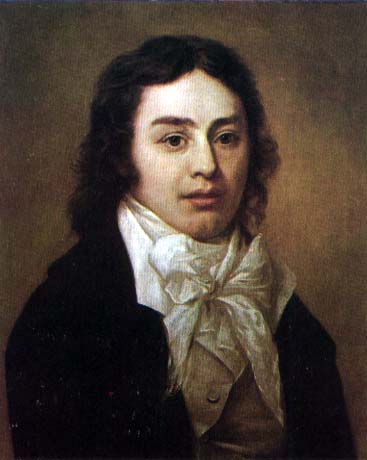
samuel

SPACE

The friend Wordsworth quoted to Lady Beaumont was, of course, Samuel Taylor Coleridge, who inspired, and was inspired by, Wordsworth and who, as a critic, did more than any other single figure to advance the case for Wordsworth as a major poet. But he was also aware of “defects” in his friend’s poetry, and readers who continue to resist that “damned thing about daffodils” will be heartened to know that he, too, thought that whatever flashed “upon that inward eye,” it ought to have been something rather more momentous than a bunch of “daffodils,” which he italicized to emphasize the trivial nature of what was being “retrospected.” As we shall see, given what he considered the bathetic emphasis on mere daffodils, he judged what have become the most famous lines in the poem—“They flash upon that inward eye/ Which is the bliss of solitude”—to be an example of “mental…bombast.”[3] As we’ll also see, though Coleridge presumably didn’t know it, those two lines were actually not written by Wordsworth, at least not by William Wordsworth. But this takes us outside the autonomous, internal world of the poem, and I want to begin with an intrinsic reading.

SPACE

The Daffodils and Helen Vendler

helenvendler

Helen Vendler

1

As it happens, the critic and teacher generally recognized as the most acute living exponent and practitioner of intrinsic criticism, Helen Vendler, writes at length about “I Wandered Lonely as a Cloud” in the third edition of her superb text for college students, Poems, Poets, Poetry.[4] After a brief two-page analysis of Robert Herrick’s “Divination by a Daffodil,” she devotes the remaining pages of her 11th chapter, “Writing about Poems,” to Wordsworth’s daffodils poem. As an intrinsic critic, Helen Vendler preaches and practices close reading, or explication. For her, a poem is essentially an autonomous artifact, a work of art to be experienced in and of itself. And it is to be experienced, she says (323, 329-31) in two somewhat different but equally indispensable ways: temporally (unfolding itself in time, with a beginning, middle, and end) and spatially (viewed from a distance as a space full of elements set in relation to each other). Vendler is, of course, aware of authorial and historical contexts:  who the author is, when he or she wrote, and under what circumstances. But in examining and writing about a poem, she is primarily engaged by the interrelated elements within the particular text itself—its words, families of words, sentences, sounds (alliteration and assonance), rhyme and rhythm, etc.

As one can see from what she has to say about many of the poems in her book, not least “I Wandered Lonely as a Cloud,” this focus on close reading is immensely illuminating. Praising “a good paper,” the sort she wants students to write, Vendler says such a paper “leaves your readers, when they come back to the poem, feeling ‘Oh, yes! And yes! Of course!’ It makes readers see aspects of the poem they may not have noticed themselves, in their more cursory reading of the poem, but now see clearly because you have showed them those things” (336). This is precisely Vendler’s own great gift. “Yes, of course; why didn’t I see that for myself?” so many of us have said over the years, responding to one or another of her brilliant close readings: explications which clarify almost everything. I said “almost everything” by design—as Browning’s Duke says in “My Last Duchess”—because, in her emphasis on the internal dynamics of the individual poem, Vendler omits most external factors. She’s perfectly aware of the contexts beyond the poem.  As she says herself of this particular poem, “I Wandered Lonely as a Cloud”: it can “be set in larger frames,” for example, “among other Wordsworth poems,” or “among other Romantic poems,” or “among poems about memory; and so on” (336). As I’ve already suggested, I will be exploring, among others, precisely those “larger frames”; but, even then, there is much to be said in favor of close reading.

There was a time, prior to the advent of the modern pioneers of close reading, the so-called “New Critics” of the 1940s and ‘50s, when it was perfectly acceptable for college professors, supposedly discussing with their students such a poem as (to choose an example once cited by the critic Richard Fogle in demonstrating old critical shortcomings) Wordsworth’s “Tintern Abbey,” to say little or nothing about how the poem actually “worked.” Instead, they would lecture about the “occasion” of the poem (the tour made by Wordsworth and his sister Dorothy); about the intense personal and literary relationship between the Wordsworths and Coleridge; and about the political context in which the poem was written (the era of the French Revolution, of which Wordsworth and Coleridge were initially ardent enthusiasts). And then, as class-time was running out, the professor would conclude by saying something like: “as for the poem itself—ah, beautiful, is it not!” This was not good enough: indeed, it was just such cursory, or negligent, treatment of poems that gave rise to the New Critics.

It’s not that such contexts don’t matter. Indeed, they mattered to Wordsworth himself, who sometimes incorporated them into the poem, or at least its title. For example, he makes sure, toward the end of “Tintern Abbey,” that readers realize that his sister has been present all along, as a silent auditor (making the poem a kind of surprise dramatic monologue). In addition, his own long title —“Lines Composed a Few Miles above Tintern Abbey on Revisiting the Banks of the Wye During a Tour”—gives us the precise circumstances of the poem’s composition. And his inclusion of the date, “July 13, 1798,” one day short of Bastille Day, the anniversary of the outbreak nine years earlier, of the French Revolution, is intriguing since the poem itself says nothing about politics, an absence which is itself not without interest.  Unfortunately, too many historically-sophisticated critics, especially the so-called New Historicists, have so emphasized this “absence” or “political evasion” on the part of Wordsworth—what is “repressed” or “not said” in the poem—that they de-emphasize what is there, actually present in the poem. Reading through the prism of politics offers its own illuminations, but this re-swinging of the critical pendulum has ironically brought us back to the situation earlier addressed by the intrinsic critics who preceded Helen Vendler: the need to read a poem as a poem, and not as something else, either a political tract or a “message.” In The Prelude and elsewhere, Wordsworth can hardly be said to avoid politics. But a poet has the right to choose his own subject matter and theme; in “Tintern Abbey,” his focus is on his psychological-imaginative engagement with the landscape.[5]

Wordsworth2

2

Vendler begins her discussion of “I Wandered Lonely as a Cloud,” by printing the poem in its final version, accompanied by an imaginary student’s running commentary, noting the poem’s four-beat meter and ababcc rhyme scheme, and raising questions.

I wandered lonely as a cloud
That floats on high o’er vales and hills
When all at once I saw a crowd,
A host, of golden daffodils;
Beside the lake, beneath the trees,
Fluttering and dancing in the breeze.

Continuous as the stars that shine
And twinkle on the milky way,
They stretched in never-ending line
Along the margin of a bay:
Ten thousand saw I at a glance,
Tossing their heads in sprightly dance.

The waves beside them danced; but they
Outdid the sparkling waves in glee;
A poet could not but be gay,
In such a jocund company;
I gazed—and gazed—but little thought
What wealth the show to me had brought:

For oft, when on my couch I lie
In vacant or in pensive mood,
They flash upon that inward eye
Which is the bliss of solitude;
And then my heart with pleasure fills,
And dances with the daffodils.   (WP 1:619-20)

Vendler’s hypothetical student, annotating the opening stanza, wonders why the “lonely” speaker is “like a cloud”; notices the natural scene of hills and valleys; and that “crowd,” generally used of people, here refers to flowers, as does “host,” usually describing “armies” (he or she omits “angels”); then remarks that the line “Beside the lake, beneath the trees,” offers a “closer focus than vales and hills.” The final line of the stanza prompts the student to ask how rooted flowers can be said to “dance”? With the second stanza’s “much further focus—up to the stars,” the student wonders about the “difference between shine and twinkle”; marks the expansion of never-ending and ten-thousand; notes that “saw becomes glance”; and that the dancing daffodils become people, tossing their heads. The waves of the third stanza are “like people too, dancing,” and the “flowers have feelings: glee.” The jocund company indicates that the speaker is “not alone anymore.” The crucial transition from saw to glance to gazed and gazed is noted, as is the glance back to golden in stanza 1 implicit in this stanza’s reference to wealth and show (itself a shift from company). Of the opening of the fourth and final stanza, For oft, the student notes, “past anecdote over, now present tense,” and follows that accurate observation with a flurry of marginal questions: “Difference between vacant and pensive? Flash; not dance or flutter or toss: why? Solitude: different from first lonely? Earlier, eye (outward and inward); now heart?” Finally, the student, observing “same rhyme-sound as in stanza 1,” has noticed at least the rhyme on daffodils in both the opening and closing stanzas.

Vendler then turns to the poem’s words, suggesting that students consult a dictionary to “check out etymologies and different connotations,” since poets have a “very specific sense of the aura around each word.” Her own search reveals words with roots in Old English (crowd, shine, twinkle, bliss), Middle English (glance, glee, gaze, flash), Latin (host, jocund, vacant, pensive, solitude), French (gay), and Greek, since daffodil itself derives from the Greek asphodelos. Wordsworth, she suggests, is “balancing” words, the Latinate (Latin-French) with the Germanic (Anglo-Saxon). She also notes the “families” of words that “help to organize the poem,” focusing on four inter-related clusters: “Glee, gay, and jocund  (a family of being happy, in terms of both meaning and—in the case of the first two—alliteration); Glance, glee, gay, gaze (words connected by alliteration, joining looking and happiness); Saw, glance, gaze (a family of looking); and Float, flutter, shine, twinkle, toss, flash, fill (a family of verbs of motion).”

Discussing sentences and rhythm, Vendler notes that the first two stanzas are periodic; the sentence is the stanza. But, despite our expectation that the pattern will continue, the third and fourth stanzas “together make up the third sentence,” with the “hinge” that joins them “the couplet, ‘I gazed—and gazed—but little thought/ What wealth the show to me had brought.’ This couplet leads into the exemplification of the ‘wealth’ in stanza 4.” And since the “third sentence is twice as long as the other two,” it “bears twice the weight.” The poem’s ababcc rhyme-scheme suggests, says Vendler, an initial statement (the quatrain) followed by an additional observation (the couplet). Of rhythm, she notes that the basic iambic beat of the first five lines is purposefully disrupted in the sixth line, where, “to emphasize the unexpected motion of the flowers,” Wordsworth shifts to a strong syllable followed by a weak: “Fluttering.” She concludes her thoughts on this subject by observing that a “careful reader will see that for his concluding rhyme (‘fills/ daffodils’) Wordsworth has reused one of the rhyme-sounds from his first stanza (‘hills/ daffodils’), giving us a strong sense of the end coming back to the beginning.” (In fact, if we count slant-rhyme, Wordsworth may be said to have reused two rhymes, the final stanza’s “mood” and “solitude” obliquely chiming with the first stanza’s “cloud” and “crowd.”)

Most importantly, Vendler invites us to look at the poem temporally, then spatially. We examine the poem temporally to see what changes we can observe as it moves from A (the opening, with the speaker lonely, as “unconnected to the world as a cloud when floating high above the earth”) to Z (where, though “still alone,” he is “no longer lonely,” since “now he feels the bliss of solitude”). How does Wordsworth move us, persuasively, from A to Z, the point at which, alone in his room, “suddenly, unasked, the daffodils flash into his mind so vividly that he sees them with his ‘inward eye’,” filling “that empty container, his heart,” with a pleasure that recaptures “his previous pleasure on that apparently forgotten day”? How does he convince us that the daffodils have “indeed lasted intensely in his mind, without any conscious effort on his part?” The explanation lies in “all the verbs of motion, all the verbs of seeing, all the verbs of delight”—in short, those “families” of words earlier discussed. Now it is the job of the reader-critic to see, along with much else, precisely how those verbs are deployed in the poem.

Looking at the poem spatially, Vendler draws our attention to three descriptive “glances” at the same phenomenon.” The first glance (“I saw”) shows us the daffodils as many (“a crowd, a host”), in a landscape (lake, trees), and in motion (“fluttering and dancing”). The second glance (“at a glance”) shows us the daffodils as many (like “stars that shine/ And twinkle on the milky way,” “ten thousand”), in a landscape (“along the margin of a bay”) and in motion (“Tossing their heads in sprightly dance). The third glance (“I gazed—and gazed”) shows us the daffodils as many (“a jocund company”), in a landscape (“waves beside them”), and in motion (“they/ Outdid the sparkling waves in glee”). If we considered these three descriptions temporally, we would distinguish between “seeing, glancing, and gazing.” But in considering them spatially, as three reiterated versions of “the same thing” (such “repetition” is actually “intensification”), what marks the daffodils is that (a) they are not alone, but many; that (b) they  feel “at home” in their natural setting; and that (c) “they are not gloomily rigid but in joyous motion responsive to the waves and the breeze.” As Vendler suggests without dwelling on the point, Wordsworth’s prepositions play a crucial role in positioning the daffodils and integrating them into their natural world. They are “Beside the lake, beneath the trees,/ Fluttering and dancing in the breeze,” “stretched in never-ending line/ Along the margin of a bay,” beside “the waves.”

We also notice that the poem, still being examined spatially, is divided into two parts: “outdoors (stanzas 1-3 and indoors (stanza 4).” The outdoor part, in the past tense, tells of the particular day when the poet saw the daffodils; the indoor part, “phrased in the habitual present tense (representing something that happens often), removes the daffodils from a physical scene (in nature) to a virtual scene (in the mind). Wordsworth makes explicit, at the end, the connection between what the eye has seen, glanced at, and finally gazed at (imprinting the scene firmly) and what the heart feels.” Bringing the daffodils indoors, Wordsworth wants us to “recognize that the poem has been brought to closure.” (330-31)

The interaction between speaker and flowers is made credible by the alternation between them. The speaker governs the first sentence, with the daffodils the objects of his observation; but this governing function changes, producing “an antiphonal structure of alternation…in which the poet and the daffodils engage in a ‘syntactic dialogue,’ as first one predominates, then the other. We ‘believe in’ the speaker’s interaction with the daffodils because the poem shows it happening.” In case we missed it, Vendler points out that Wordsworth has put the word dance, in one or another of its variants, in each stanza: dancing; dance; danced, dances. And we notice that “the word dance alliterates with daffodils, making them ‘belong’ together phonetically” (331). At this point, it’s up to the student to write an essay about how the poem “works,” and Vendler devotes the remainder of this chapter (332-40) to suggesting a variety of potentially fruitful approaches to the poem and to ways to organize a coherent and persuasive essay.

 SPACE

The Daffodils in Context
daffodils

3

Thanks to astute observation of the sort she wants students to emulate, Vendler has provided all the preliminary spadework as well as the framework for an intrinsic analysis. I will be doing my own share of close reading; but before returning to “I Wandered Lonely as a Cloud,” I want to bring in a few contextual elements, extrinsic to the poem, at least until its final form. To begin with, we can locate the actual incident that inspired the poem. As by now everybody knows, or else should know, the genetic episode was recorded by Dorothy Wordsworth in her Journal for Thursday, 15 April 1802. She tells us that she and William came across many flowers on this memorable walk, including the Lesser Celandine, that

starry yellow flower which Mrs C[larkson] calls pile wort. When we were in the woods beyond Gowbarrow park we saw a few daffodils close to the waterside. We fancied that the lake had floated the seeds ashore and that the little colony had so sprung up. But as we went along there were more and yet more, and at last, under the boughs of the trees, we saw that there was a long belt of them [six words crossed out] along the shore, about the breadth of a country turnpike road. I never saw daffodils so beautiful. They grew among the mossy stones, about and about them; some rested their heads upon these stones as on a pillow for weariness, and the rest tossed and reeled and danced, and seemed as if they verily laughed with the wind that blew upon them over the lake. They looked so gay—ever-glancing, ever-changing. This wind blew directly over the lake to them. There was, here and there, a little knot, and a few stragglers a few yards higher up—but they were so few as not to disturb the simplicity and unity and life of that one busy highway.[6]

The poem that resulted—originally titled “Daffodils”—was composed later, sometime between March 1804 and April 1807 (WP 1:1005). Some readers have preferred the journal-entry to the poem. A scholar no less distinguished than Ernest de Selincourt, referring to the “unforgettable walk” of 15 April 1802, describes the Wordsworths’ encounter with the daffodils, “which William records in verse,” as “more lovely in Dorothy’s unstudied prose.” Even those who may not agree can see his point. But that prose was not quite “unstudied.” Dorothy’s manuscript (reproduced by de Selincourt on the overleaf that follows his remark), shows that she deleted six words after “a long belt of them” (“the end we did not see”), and jotted in as an afterthought, “This wind blew directly over the lake to them.” It is also worth noting, as Pamela Woof does in her edition of the Grasmere Journals, that Dorothy wrote a letter to Mary this same day, in fact, immediately on returning home from the walk along Ullswater. In this account, the wind is “furious” and “sometimes almost took our breath away”; but, as Woof notes, “it is not a creative force: no daffodils are mentioned, no partnership with the wind in dance.”[7]

In 1815, Wordsworth gave the poem its present title, dropping “Daffodils” for, I would surmise, two reasons: first, to place initial emphasis on the isolated speaker (“I wandered lonely…”), second, to defer the surprised delight of his, and our, first encounter with the flowers to the poem itself. He also inserted a new stanza (see WP 1:1006n), beginning “Continuous as the stars that shine…” A cluster of interrelated questions arise. Why did he feel the need to add these lines? How does this new second stanza affect our interpretation of the poem? What else is there in the poem that isn’t in Dorothy’s journal-entry? Alternately, what does Dorothy give us in prose, “unstudied” or otherwise, that her brother doesn’t?  And what do the differences between journal-entry and poem suggest in terms of experiential response and aesthetic shaping, even, perhaps, in terms of female and male responses to the natural world? Whatever changes he made in shaping his own poem, does knowing that Wordsworth adhered so closely to Dorothy’s journal-entry alter our attitude regarding Wordsworth’s creativity? In what follows, I return to the Daffodils poem in connection with three Wordsworths (William, Dorothy, and Mary); then in connection with Coleridge and Emerson, on the subject of “eyes” and the sublimation of the commonplace. I’ll conclude by placing “I Wandered Lonely as a Cloud” in a larger Wordsworthian and even Coleridgean-Kantian context.

ww

4

Even though two years passed between Dorothy’s April 1802 journal-entry and Wordsworth’s initial draft of the poem, that remarkably perceptive and imaginative entry was obviously in the poet’s mind when he sat down to write, or, as was often his practice, began to chant lines while walking. Of course, we cannot know the precise extent to which he was indebted to his sister’s observations. Considerably, it would seem, though we cannot rule out the possibility that he may have had some influence on her wording in the journal-entry, given the crucial omissions in the contemporaneous letter to Mary, and, especially, given the closeness and reciprocity of the relationship between Dorothy and her brother.
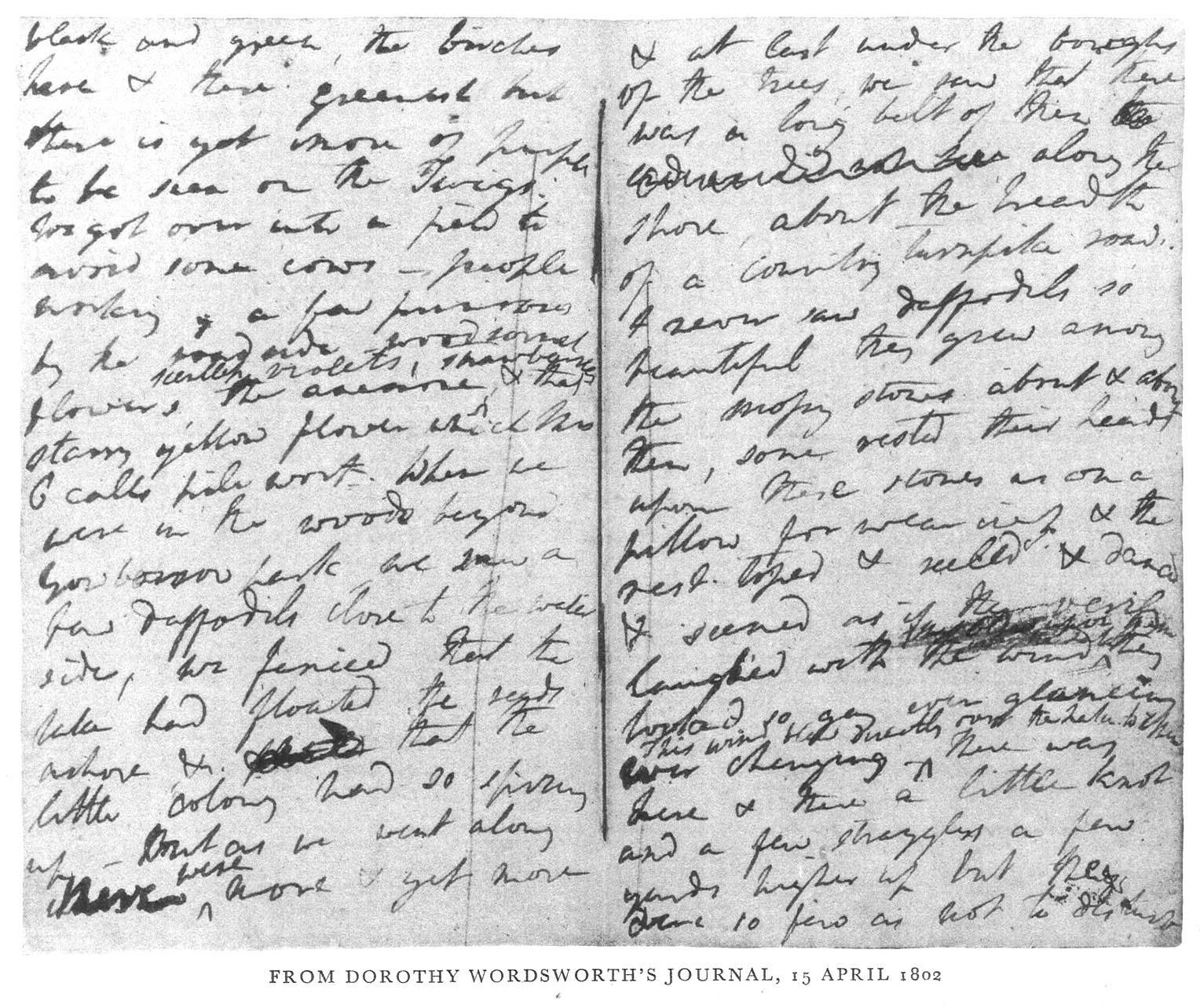
Dorothy  Wordsworth journal

Reciprocity is, in fact, one key to the poem. “So much depends…,” William Carlos Williams opens “The Red Wheelbarrow,” a little poem as alternately loved and resisted by students as Wordsworth’s daffodils. Williams’s opening foreshadowed a mutual dependence: just as the poet depends on what he sees, the things of the world, as necessary raw material, so those “found” objects depend on the poet to perceive, frame, and so order them aesthetically—through unexpected line-breaks, division into three- and one-word couplets and juxtaposed colors and textures (“a red wheel/ barrow// glazed with rain/ water// beside the white/ chickens”)—that they are transformed into a work of art. In a similar reciprocity in “I Wandered Lonely as a Cloud,” the Wordsworthian speaker’s mood is affected by the daffodils, which, in turn, depend on the poet (and, in this case, Dorothy, in her journal-entry, though not in her letter to Mary) to record their gaiety as they “dance” in the breeze. At the same time, as that personification or pathetic fallacy indicates, Dorothy and William are also projecting, attributing human characteristics and emotions (primarily, joy) to the flowers. The speaker in the poem begins by “naturalizing” himself, comparing his loneliness to that of a floating cloud; then reverses the process by personifying the flowers; and, finally, internalizes their supposed joy when every subsequent recollection of them so “fills” with pleasure his momentarily empty heart that it “dances with the daffodils”—all, aside from the related “Fluttering” and “Tossing,” to an iambic-tetrameter beat.

When he started to write the poem, two years after Dorothy recorded her journal-entry, Wordsworth clearly depended on that entry, both to refresh his memory and for emotional coloring. In the poem, he deploys her observations selectively, emphasizing certain aspects, omitting others, most notably her reference to those daffodils that seemed to rest their heads on the stones they grew among. Dorothy, in fact, begins by noticing these presumably wind-beaten flowers resting their heads on the elegiac “mossy stones… as on a pillow for weariness.” Whether or not this reveals a specifically female sensibility, it is a sympathetic, even poignant observation unregistered in her brother’s poem. He focused instead, and exclusively, on the flowers animated by the breeze off the lake. According to Dorothy, they “tossed and reeled and danced,” a joyous movement replicated in the poem: “ten thousand saw I at a glance, / Tossing their heads in sprightly dance.” A later, more orthodox Wordsworth would dismiss Keats’s “Hymn to Pan” (which his young admirer had been pressed to read to him) as “a very pretty piece of paganism,” even though Keats’s main source was a favorite mythological passage in the fourth Book of Wordsworth’s own Excursion. Here, however, he adds to his sister’s head-“tossing” personification of the daffodils a light but detectably pagan note, their “sprightly dance” allying them with sprights or sprites: elfin supernatural beings. I’ll return to this point.[8]

Interestingly, the description closest to his sister’s did not appear in the poem until 1815, in the couplet concluding the stanza Wordsworth added that year. This addition may be his equivalent of the phrase she had deleted, “the end we did not see,” referring to the “long belt of them,” which, together with her reference to the Lesser Celandine, “that starry yellow flower,” may have led to Wordsworth’s belated insertion of this stanza, in which the multitude of daffodils that “stretched in never-ending line” are said to be “Continuous as the stars that shine/ And twinkle on the milky way.” This shifts the focus above the cloud that “floats on high,” and far above Dorothy’s “long belt”—now extended to stars, perhaps reminding Wordsworth of another “Belt,” Orion’s. Not part of our Milky Way, Orion, so familiar to stargazers, is the easiest constellation to find, and so the best way to orient ourselves to viewing the edgewise Milky Way’s “never-ending line,” or “busy highway,” of stars. In short, even Wordsworth’s most distant, sublime, celestial comparison, added more than a dozen years after she made her journal-entry, may still be partially indebted to Dorothy’s original description of the daffodils.

However we judge the relationship between his sister’s journal-entry and the poem, we know that Wordsworth, like Coleridge, valued Dorothy’s acutely sensitive perception of the details of the natural world. In the concluding lines of “The Sparrow’s Nest,” a short lyric grouped with “Daffodils” in the “Moods of My Own Mind” section of the 1807 Poems in Two Volumes, Wordsworth says of Dorothy (lightly disguised as “My sister Emmeline”):

She gave me eyes, she gave me ears;
And humble cares, and delicate fears;
A heart, the fountain of sweet tears;
And love, and thought, and joy.  (WP, 1:529-30)

Though every item in this litany of gifts to her poet-brother is crucial, his priority is, significantly, ocular: “She gave me eyes….” It seems all the more remarkable, therefore, that the lines Wordsworth himself described as the poem’s “two best”—“They flash upon that inward eye/ Which is the bliss of solitude”—were contributed not by the poet’s sister, but (he told Isabella Fenwick) by his wife, Mary. Dorothy may have given him “eyes,” but, in what borders on a co-operative family affair in the creation of this particular poem, it was another female member of the household who gave him his final and sublime image, “that inward eye.” “I Wandered Lonely as a Cloud” is nothing if not an “ocular” poem, one in which the speaker “saw,” and “saw,” and “glance[d],” and, more intensively, “gazed—and gazed”: a pattern culminating in that “inward eye” upon which those gazed-on and imprinted daffodils later “flash.” Wordsworth himself described the poem in 1815 as “rather an elementary feeling and simple impression [approaching to the nature of an ocular spectrum] upon the imaginative faculty, than an exertion of it….” (WP, 1:1006n)

But it must be added that it would be erroneous to over-emphasize the “ocular spectrum” at the expense of “the imaginative faculty.” Even in the note I have just cited, Wordsworth does not deny the exercise of the faculty of imagination, only of the sort of strenuous effort suggested by his italicization of the verb “exertion.” The point is confirmed by the fact that the note was written in the process of Wordsworth elevating the poem, previously located in “Moods of My Own Mind,” to a “higher” status among what he called, in the 1815 re-grouping, “Poems of the Imagination.” What we see with the physical or external eye still matters immensely, for without the initiating and necessary grounding in visual apprehension there would be no Romantic transcendence, defined by David Vallins as “at once a feeling of elevation or sublimity, and a process of contemplating, explaining, or evoking the unity of phenomena.”[9] In “I Wandered Lonely as a Cloud,” the “continuous,” integrated belt of daffodils is further unified and internalized through the power of the poet’s “inward eye.”
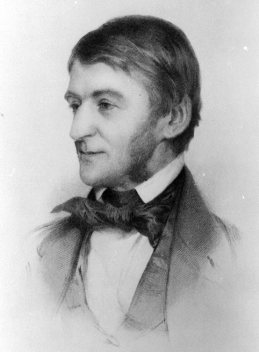
RalphWaldo_Emerson

Ralph Waldo Emerson

5

The phrase I’ve just quoted from David Vallins occurs in his analysis of the reinterpretation of Romantic ideas by Ralph Waldo Emerson. The legacy of the “inward eye” includes the responses of Coleridge and of his (and Wordsworth’s) American disciple, Emerson, both of whom had things to say about the Wordsworthian “eye” engaging the commonplace, the humble things of the world.  Coleridge was the first and, in many ways, the most astute appreciator of the poetry of Wordsworth, a poet he ranked with (and second only to) Shakespeare and Milton. But he devoted a whole chapter (22) of Biographia Literaria to the “characteristic defects” (BL 1:119) of his friend’s work. As indicated earlier, in that chapter, he cited the lines in which the daffodils “flash upon that inward eye/ Which is the bliss of solitude” as an example of a thought or image “too great for the subject,” and thus approximating “what might be called mental bombast, as distinguished from verbal” (BL 1:136). Just as Wordsworth was not minimizing the role of imagination in his 1815 “ocular” note on “I Wandered Lonely as a Cloud,” so Coleridge was not criticizing these lines in themselves; only their misuse, since their very sublimity leads us to expect a more significant “joy of retrospection”—such as the passing before “our conscience” of “a whole well-spent life”—rather than what he considered on this occasion the relative triviality and bathos of a recollection of mere “daffodils” (137).

Coleridge, whose compelling Mariner mesmerizes us as well as the Wedding Guest with his “glittering eye,” was not a man to undervalue the eye. In a crucial and influential passage from Aids to Reflection (1825), Coleridge identified, as a “higher gift” than the life breathed into man and animal alike, man’s “Reflection, or Reason,” associating it with the moment in Genesis when “man became a living soul” (Gen 2:7), and providing an echoing Emerson with what he would later call (in the “Idealism” chapter of Nature), the “eye of Reason.”[10] God has given us a house gloriously furnished, writes Coleridge, “Nothing is wanted but the eye, which is the light of this house, the light which is the eye of this soul. This seeing light, this enlightening eye, is Reflection.”[11]

Coleridge here aligns his biblical quotation—“And man becomes a living soul”—with the moment in “Tintern Abbey” (46-49) when, laid asleep in body, we “become a living soul.” Thus empowered, we are—in Wordsworth’s visual image—able to “see into the life of things” with “an eye made quiet by the power/ Of harmony and the deep power of joy.” Thus, Coleridge might have agreed with Wordsworth, who seems not to have been merely patronizing his wife when he described the “inward eye” lines to Isabella Fenwick as the “two best lines in” the poem. For many subsequent readers, they have certainly seemed to be the poem’s most quintessentially “Wordsworthian” lines, even if they are more Mary’s than William’s.

Of course, just as it is possible that Wordsworth had some influence on Dorothy’s journal-entry on the daffodils, Mary may, like Coleridge, have been remembering that “ocular” passage in “Tintern Abbey.” Three decades later, and across the Atlantic, Emerson, another admirer of Wordsworth, remembered both ocular images, connecting them with the premature death of his closest brother, Charles—a victim of the same disease, tuberculosis, that had earlier claimed both his nineteen-year-old his wife and his younger brother, Edward, and that had, moreover, threatened his own eyesight. Devastated by this third family tragedy within five years, Emerson wondered of Charles, “Who can ever supply his place to me? None,” he answers, for Charles was to him what Dorothy was to Wordsworth: “The eye is closed that was to see Nature for me, & give me leave to see.”[12] Emerson’s partial compensation came in the form of a metaphorical transmutation of his dead brother’s “eye” attuned to the natural world. In the most celebrated moment in his book Nature, written in the year Charles died, Emerson famously or notoriously describes a moment in which, “my head bathed by the blithe air, and uplifted into infinite space;—all mean egotism vanishes. I become a transparent eye-ball; I am nothing; I see all” (E&L,10; italics added). At once lonely and exhilarated, he experiences an uplifting, a rapturous and self-transcending unity with the divine in which “the currents of the Universal Being circulate through me; I am part or particle of God”: a version of Wordsworth’s less explicitly religious “sense sublime” of “A motion and a spirit, that impels/ All thinking things, all objects of all thought,/ And rolls through all things” (“Tintern Abbey,” 95, 100-102). Seven years later, in his great essay “The Poet,” Emerson looks back on that epiphanic moment, remarking how rare and difficult it is to attain “the all-piercing…and ocular air of heaven” (E&L, 451-52). Along with his brother’s “eye,” all-seeing but now closed in death, the American Transcendentalist seems to be recalling both the culminating ocular image in the Daffodils poem, that “inward eye/ Which is the bliss of solitude,” and that “Serene and blessed mood,” in which the affections gently lead us on until, our breath and even the motion of our human blood almost suspended, “we are,” to repeat the lines from “Tintern Abbey,”

SPACESPACESPlaid asleep
In body, and become a living soul;
While with an eye made quiet by the power
Of harmony, and the deep power of joy,
We see into the life of things. (30, 41-49; italics added)

space

Dorothy Wordsworth's silhouette

Dorothy Wordsworth’s silhouette

6

As with so many Wordsworthian roads, this emphasis on seeing leads back to Dorothy, who “gave” Wordsworth “eyes to see,” just as Charles’s “eye” was “to see Nature” for Emerson, and give him “leave to see.” Of course, Dorothy makes an appearance, albeit belated and unnamed, in “Tintern Abbey.” Though we do not find out until the final movement of the poem, “thou my dearest Friend…, My dear, dear Sister!” (119-120, 124), has been silently present all along, on the banks of the Wye, just as she was present when brother and sister saw the daffodils dancing in the wind beside Ullswater. But while Dorothy was there, and while her journal-entry inspired the Daffodils poem, her journal and her presence go unmentioned in “I Wandered Lonely as a Cloud.” It is not hard to guess why Dorothy was left out.

In what is perhaps the most repeated of all definitions of poetry, Wordsworth called it “the spontaneous overflow of powerful feelings…recollected in tranquility.” In the case of this poem, the supposedly spontaneous overflow took place over many years—from 1804, when he first drafted the poem, through its first printing in 1807, and its revised version in 1815, in which Wordsworth, though leaving the final stanza intact, improved the first stanza, replacing “dancing” with “golden,” and “along” with “beside” in lines 4-6. Some devotees of simplicity may prefer the original phrase in line 16, “laughing company,” to the permanent change made in 1815: “jocund company.” Though echoing the “large recompense” in “Lycidas,” the more-than-Miltonic Latinate and polysyllabic “abundant recompense” in “Tintern Abbey” seems ponderous. Here, the Latinate adjective seems less so; in addition, “laughing company” may have belatedly seemed to Wordsworth too close to Dorothy’s delightfully over-the-top surmise that the daffodils “seemed as if they verily laughed with the wind that blew upon them over the lake.” Most importantly, of course, in 1815, Wordsworth inserted an entirely new stanza. As earlier suggested, that stanza’s galaxy of “stars” may echo Dorothy’s “starry yellow flower” and  seemingly-endless “long belt” of daffodils;  and the new stanza concluded by directly echoing Dorothy’s description of the daffodils as they “tossed and reeled and danced.” Nevertheless, it would hardly do to mention that journal-entry, even in an appended prose note, since that would reveal that what was being “recollected” was less the poet’s “spontaneous” feelings than Dorothy’s, jotted down more than a dozen years earlier. An awkward affair best avoided.

Nor could there be room for Dorothy as a character in the poem. Though Keats would later famously and accurately refer to “the Wordsworthian or egotistical sublime,” the omission of Dorothy here has nothing to do with the “mean egotism” Emerson shed when he became a transparent eye-ball. Dorothy’s omission is thematic. “I Wandered Lonely as a Cloud” depends upon the speaker’s initial isolation, wandering “lonely as a cloud,” as preparation for the  moment when, “all at once I saw a crowd,/ A host, of golden daffodils,” and, caught up in their “glee,” becomes part of their “jocund company,” all leading to his very different final “solitude,” when emotion is recollected in a tranquility at once thoughtful and blissful, and his “heart with pleasure fills,/ And dances with the daffodils.” Indeed, the memory of the daffodils seems a talisman against loneliness. As long as he retains this, and other similarly vivid remembrances of Nature, Wordsworth will never be truly alone, or bereft of material for poetry. That initial loneliness and final solitude, associated with the “inward eye” upon which the remembered golden daffodils “flash,” is even more essential in this poem than it is in “Tintern Abbey,” where the repeated “I” finally yields to a petition to his beloved sister that she “not forget” that “after many wanderings, many years/ Of absence, these steep woods and lofty cliffs,/ And this green pastoral landscape, were to me/ More dear, both for themselves and for thy sake! (158-62; italics added). The poem rightly ends by focusing on Dorothy and past, present, and future, for though she has been silent, he has read his “former pleasures in the shooting lights/ Of thy wild eyes,” and caught “from thy wild eyes these gleams/ Of past existence” (121-22, 151-52; italics added).

An ocular presence in “Tintern Abbey,” as a poignant reminder of what were once his own unmediated “wild ecstasies,” Dorothy is an absent presence in the public encounter with daffodils, the poem inspired by her strikingly visual journal-entry. But we know from “The Sparrow’s Nest” that, along with her “eyes,” Dorothy also gave her brother “a heart” and “love, and thought, and joy.” All of these, thought included, are reflected in the final lines of the Daffodils poem. When he intensely “gazed—and gazed” at the daffodils, impressing them on his memory, the poet “little thought/ What wealth the show to me had brought,” but that “wealth” is revealed in stanza 4. There the poet, indoors and in either vacant reverie or in “pensive mood,” transforms an engraved but, at the moment, involuntary memory of the daffodils into a mature joy: a renovating spot of time now restored in the mind and incorporating, along with the initial joy, the “thought” absent in his original emotional and visceral response.

There are Then/Now parallels in the “Ode” and, earlier, in “Tintern Abbey,” which opens: “Five years have passed; five summers, with the length/ Of five long winters….” In the hovering on “length,” the seasonal references, and the triple repetition of that long-voweled “five,” we feel the “heavy and the weary weight” (39) of the world. Back then, when he first “came among these hills,” it was, says Wordsworth, “in the hour/ Of thoughtless youth.” “I cannot paint/ What then I was,” says the poet, who then proceeds to do just that, magnificently:

SPACESPAESPACThe sounding cataract
Haunted me like a passion; the tall rock,
The mountain, and the deep and gloomy wood,
Their colors and their forms, were then to me
An appetite; a feeling and a love,
That had no need of a remoter charm,
By thought supplied, nor any interest
Unborrowed from the eye. That time is past…. (77-85; Italics added)

A similar shift from feeling to thought, from past to present, comes, in “I Wandered Lonely as a Cloud,” with the pivot—syntactical and thematic as well as temporal—from the third into the fourth and final stanza. For now, when the poet is indoors, alone and reclining in “vacant or in pensive mood,” wandering in his mind, the recalled flowers “flash” upon his “inward eye,” his last and most piercing “glance.” That brilliant, intermittent “flash” gathers to a greatness the poem’s light-imagery (shine, twinkle, sparkling). It also becomes a flash-flood, for the sudden recollection of the flowers so “fills” the poet’s heart with pleasure that it “dances with the daffodils.” The “spontaneous overflow of powerful feelings” has been “recollected in tranquility,” by thought supplied, but retaining, in the mind’s eye, the original excitement of what he “saw” with the outward eye. The three “glances” in the poem, and its version of that empowered “eye” that enables us to “see into the life of things,” seem fused in a Marianne Moore poem that also shifts back and forth from perceiver to the object perceived, concluding that works of art “must be ‘lit with piercing glances into the life of things’.”[13]

SPACE

7

Despite Wordsworth’s final fusion of thought and emotion, head and heart, in the Daffodils poem, some readers will concur with Coleridge that too much is being made of too little here; that, following the sublimity of the “inward eye,” the final lines “sink” into bathos. Influenced by such responses, more by the negative British reviews he read than by Coleridge’s momentary fault-finding, Emerson was among those who at first scorned Wordsworth’s penchant for making the trivial sublime. In a June 1826 letter to his Aunt Mary (whose insight into Wordsworth was at the time deeper than his own), Emerson asked, “Is it not much more conformable to that golden middle line…to let what Heaven made small and casual remain the objects of a notice small and casual, and husband our admiration for images of grandeur in matter or in mind?”[14] He had been reading British reviewers who (however inaccurately) caricatured Wordsworth as blubbering over the flower at the end of the Ode. But gradually, as he read more of Coleridge and (with the help of this mentor’s genuine insights) saw more deeply into Wordsworth, he came to admire what he originally dismissed. In Nature and elsewhere, in locating the miraculous in the commonplace, Emerson was emulating Wordsworth, the great poet of the “lowly” and neglected, of the humble, common, and seemingly trivial. Wordsworth’s “imagination” was chiefly engaged, as William Hazlitt pointed out in The Spirit of the Age, “in raising trifles to significance.” It was “his peculiar genius,” Walter Pater added a half-century later, “to open out the soul of apparently little or familiar things.”[15] Wordsworth is able to do so, as Coleridge understood just as well, and even more intimately, than Hazlitt and Pater, because he makes us “see into the life of things,” and to see what had been passed over by earlier poets, who thought such things literally beneath their notice.

space
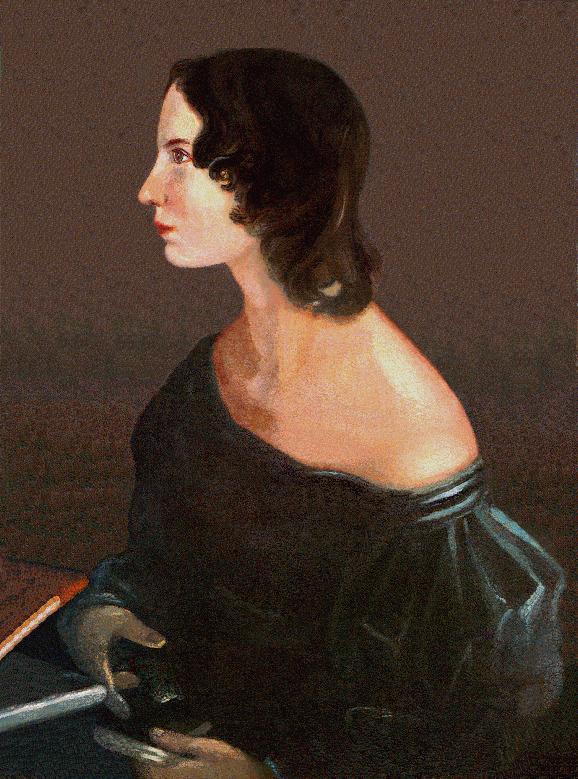
Emily Bronte

Emily Brontë

space

No doubt Dorothy helped her brother see. We will never know just how much “wealth” Wordsworth owed to her meticulous, affectionate, and imaginative apprehension of the “little things” of the natural world, especially flowers. It is a detailed, discerning, and passionate attention that anticipates Emily Dickinson. And the Wordsworths’ Daffodils also anticipated another Emily, Dickinson’s “gigantic Emily Brontë.”[16] In one of the most beautiful passages the latter ever wrote, Catherine Earnshaw’s daughter (the second “Cathy” in Wuthering Heights) describes her “most perfect idea of heaven’s happiness.” She would be “rocking” at the heart of the natural world, “with a west wind blowing, and bright, white clouds flitting rapidly above,…grass undulating in waves to the breeze; and woods and sounding water; and the whole world awake and wild with joy….I wanted all to sparkle and dance, in a golden jubilee.”[17] Cathy’s idea of heaven is an earthly paradise, its primary “literary” source obvious. The entire passage (clouds, waves, breeze, woods, water, the whole world awake and joyous), and, especially, Cathy’s wanting “all to sparkle and dance in a golden jubilee,” reflects Wordsworth’s “golden” host of “Fluttering and dancing” flowers that out-danced and out-sparkled “the sparkling waves in glee,” their “never-ending” line “Continuous as the stars that shine/ And twinkle on the milky way.” Cathy’s description suggests that Emily Brontë was also familiar with William’s source: Dorothy’s loving and dynamic description of those “beautiful” daffodils that “tossed and reeled and danced, and seemed as if they verily laughed in the wind that blew upon them over the lake. They looked so gay—ever-glancing, ever-changing.”

Wordsworthian Emerson was also attuned to the sort of earthly paradise that appealed to both Emilys. He began his 1838 Divinity School Address by fusing the “gladsome pagans” in what was his as well as John Keats’s favorite Book of The Excursion, those pagans who “looked” and “were humbly thankful for the good/ Which the warm sun solicited, and earth/ Bestowed” (4:932-38), with the “pagan” of “The World is Too Much with Us.” Quoting Wordsworth’s sonnet, Emerson shocked his devout audience from the outset by declaring that he, too, would rather be “A pagan suckled in a creed outworn” than a Christian impoverished by being cut off from vital, fecund nature. And he began his Address with a deeply responsive evocation of nature’s vital, sparkling, floral beauty. In “this refulgent summer,” it has been “a luxury to draw the breath of life. The grass grows, the buds burst, the meadow is spotted with fire and gold” (E&L, 75). Those meadows were alive with flowers aglow with the light of Wordsworth’s “golden daffodils,” and sharing the pagan vitality of their “sprightly dance.”

 SPACE

8

Having found the transplanted and transparent “eye” he was seeking in the aftermath of his brother’s death in Mary and William’s “inward eye” in the Daffodils poem, Emerson, reading  his favorite Wordsworth poem, the “Ode: Intimations of Immortality from Recollections of Early Childhood,” again found an emphasis on sight, on the mature eye, and, climactically, on a simple flower. More importantly, he was not alone in finding in this great poem lasting consolation for grief. Like so many, Emerson valued the Ode not only for its intimations of immortality, but for its appreciation of the natural world, both when it seemed, as in childhood, “appareled in celestial light,” and later, when Wordsworth loved it “even more,” though the initial radiance had been irretrievably lost. Innumerable readers in the nineteenth century and after have cherished the poem for the literally thoughtful consolation it offered to those who understand the pains as well as the joys of the human heart. In his “Memorial Verses,” written in the very month that Wordsworth died (April 1850), Matthew Arnold speculated that Time might bring us the wisdom of another Goethe, the force of another Byron; “But where will Europe’s latter hour/ Again find Wordsworth’s healing power?”[18]

That healing power takes linguistic form in the Ode. We can only reintegrate the sundered self, Hegel insists in the Logic, through knowledge, since, in his famous homeopathic metaphor, “the hand that inflicts the wound must be the hand that heals it.” As Helen Vendler demonstrated a third of a century ago in her challenge to Lionel Trilling’s celebrated essay, Wordsworth, in an intricate series of repetitions and alterations, had triumphed over what Trilling considered “the discrepant answers of the second part of the Ode.” The poem’s language reveals an autonomous pattern of self-healing—in Vendler’s phrase, a “homeopathic cure”—largely dependent on thought.[19] For example, in the Ode’s initial pastoral in stanza 3, while the lambs bounded to the shepherd-boy’s tabor and the birds sang a “joyous song,” to the poet “alone there came a thought of grief.” He claims, rather too quickly, to recover and, again “strong,” vows that “no more shall grief of mine the season wrong.” But when the pastoral is replicated in stanza 10, the true recovery fuses joy with cognition: “We in thought will join your throng.” And though the once-bright radiance “Be now forever taken from my sight,” we will “grieve not, rather find/ Strength in what remains behind,” both in the “primal sympathy/ Which having been must ever be,” and in “the soothing thoughts that spring/ Out of human suffering.”

In a now-familiar pattern, the Ode brings together the trinity of eyes, heart, and thought. For “though the radiance which was once so bright”—the celestial light attending the dawn of life, when we came from God, “trailing clouds of glory”—has “now” and forever been “taken from my sight,” the “clouds that gather round the setting sun” are said, in a reciprocal balance, to “take a sober coloring from an eye/ That hath kept watch o’er man’s mortality.” This is not the eye of that “Child,” over whom “thy Immortality/ Broods like the Day,” and who was addressed in stanza 8 as “thou Eye among the blind,” but of a mature adult acquainted with suffering and death. We have an elegiac “gathering” of the clouds around the “setting sun,” and a “sober” coloring imparted to them by a mature “eye.” But the Ode does not end in despair or defeat. Emerson concluded one of his most justly-famous notebook-entries, jotted down in the immediate aftermath of the death of his little boy, “I am Defeated all the time, yet to Victory am I born” (JMN 8:228). Concluding his Pindaric ode, a form used by the Greek poet to celebrate athletic triumphs, Wordsworth employs a similar race-image, pagan and Pauline (Corinthians 9:24), of loss and compensation, defeat and hard-earned victory:

Another race hath been, and other palms are won.
Thanks to the human heart by which we live,
Thanks to its tenderness, its joys, and fears,
To me the meanest flower that blows can give
Thoughts that do often lie too deep for tears.  (Ode, 199-203)

We had heard earlier in the Ode of “The Pansy at my feet” (54) and Wordsworth’s most sublime masterpiece concludes with the “meanest [or, as he first wrote, “humblest”] flower that blows.” And with this, we are back—though with a more sober coloring and accompanied by a decidedly different metrical music—to flowers that, recollected in tranquility, “flash upon that inward eye,” filling, to cite the Ode, “the human heart” and evoking deep “thoughts.” Thus, the conclusion of the Ode brings us, by a route Coleridge called “rondure,” and Joyce “a commodious vicus of recirculation,” back to Dove Cottage and environs. Back to Mary, who supplied that “inward eye,” and to Dorothy, who “gave” Wordsworth “eyes to see,” and who shared with him notebook observations that, while they had nothing to do with the metrical and Then/Now orchestration of the Daffodils poem, provided him with closely-observed and already imaginatively-organized raw material. When we recall Dorothy’s loving and detailed journal-description of the daffodils, and the principal gifts that, by his own account, she “gave” her brother—“eyes,” “humble cares,” “delicate fears,” a “heart,” which was the “fountain of sweet tears,” and “love, and thought, and joy”—it begins to seem appropriate (though by Wordsworth’s order the Ode was to stand last in every collection of his verse) that in John Hayden’s splendid two-volume edition, ordered by date of composition, “The Sparrow’s Nest,” begun in the same month as the great Ode, and, like it, first published in 1807, appears immediately after the Ode’s concluding lines. Dorothy seems an absent presence here as well, though it is crucial to note that, while the final word of the Ode is “tears,” no “fountain of sweet tears” actually flows. Whatever may be invented by careless readers, whether malicious or maudlin, the lines are clear: thanks to the tenderness, joys, and fears of “the human heart by which we live,” the humblest flower that blossoms and blows in the wind can evoke “Thoughts that do often lie too deep for tears.”

If Dorothy did not literally give her brother “eyes to see,” she certainly enhanced his own “eye” for detail and (in this instance) even design, supplying him with a vivid example of his own central theme: the joy intrinsic in vital, personified, nature. Dorothy gives Wordsworth, and us, a “long belt” of beautiful, joyous daffodils that “tossed and reeled and danced” in the lakeside breeze, recollection of which later fills with pleasure the thinking heart of the poet, so that it “dances” with those dancing flowers. Dorothy did not write the poem, but without her notebook-entry, recording precisely what she “saw” on that “Thursday, 15 April 1802”—“I never saw daffodils so beautiful”; and how they appeared to her (“they looked so gay—ever glancing, ever-changing”)—it is doubtful that “I Wandered Lonely as a Cloud,” now considered one of Wordsworth’s signature poems, would ever have been written. Along with the “eyes” he said she “gave” him, Dorothy’s “heart” and her ultimate trinity of gifts—“love, and thought, and joy”—inform her notebook-observation of the daffodils that “tossed and reeled and danced,” seeming to enjoy “the wind that blew upon them over the lake.” Wordsworth was inspired by these details, and, perhaps most of all, by Dorothy’s final noticing of a “few stragglers a few yards higher up,” but “so few as not to disturb the simplicity and unity and life of that one busy highway.”

Here, keen-eyed “ocular” observation kindles into a genuine Vision of what Coleridge called, in a line added to “The Eolian Harp” almost a quarter-century after he originally wrote the poem, “The one Life within us and abroad.” And that “one Life” necessarily extends from earthly flowers into the very universe itself, which seems to me to explain the need Wordsworth evidently felt to add, in 1815, that stanza in which the “ten thousand” daffodils he “saw…at a glance,/ Tossing their heads in sprightly dance,” are said to have “stretched in never-ending line/ Along the margin of a bay,” as “Continuous as the stars that shine/ And twinkle on the milky way.” It has been noted recently, by Pamela Woof, that “the permanence of stars, as compared with flowers, emphasizes the permanence of memory for the poet.”[20] And that’s true, too. But the addition of this stanza emphasizes even more, I would suggest, the extension into the interstellar universe of the continuity, harmony, and unity with which Dorothy concluded her journal-entry. Echoing her previous awe at encountering “more and yet more” daffodils, until, “at last, under the boughs of the trees, we saw that there was a long belt of them along the shore, about the breadth of a country turnpike road,” she ends by stressing (to repeat the key phrase) “the simplicity and unity and life of that one busy highway.”

Orion

Orion’s belt

As with the transmutation of yellow flowers into an angelic “host of golden daffodils,” in the alembic of Wordsworth’s creative imagination Dorothy’s imagery of terrestrial unity (flowers, trees, shore, and country road) is transmuted (through the oxymoronic fusion Thomas Carlyle and, later, M. H. Abrams, called “natural supernaturalism”)[21] into celestial unity: the shining and twinkling of myriad stars on the Milky Way. If, as the final line of this stanza strongly suggests, Wordsworth had returned for inspiration to Dorothy’s journal-entry, he may have linguistically associated her “long belt” of daffodils (as suggested earlier) with Orion’s Belt, and, consciously or unconsciously, echoed her reference, immediately preceding the encounter with the daffodils themselves, to one of his own favorite flowers, the Lesser Celandine, as a “starry yellow flower.” These details may or may not have prompted his belated but sublime likening of her “more and yet more” daffodils in a unified “highway” to our Milky Way’s glowing roadway, that arching band of “continuous” stars splashed across the night sky. Whatever its genesis, the added stanza completes the poem’s (and Dorothy’s) theme of continuity and unity by fusing flowers and stars, microcosm and macrocosm.

SPACE

A Kantian-Coleridgean-Romantic Coda

kant

Immanuel Kant

These thoughts recall the famous opening of the “Conclusion” of The Critique of Practical Reason (1788) by the preeminent philosopher of the age, to whose thought— a pivotal influence on Romanticism—Wordsworth, like Emerson, was introduced by Coleridge:

Two things fill the mind with ever new and increasing admiration and awe, the oftener and the more steadily we reflect upon them: the starry heavens above and the moral law within. Neither of them do I have to search for and conjecture as though they were shrouded in obscurity or in a transcendent region beyond my own horizon; I see them before me and connect them immediately with the consciousness of my own existence.[22] (italics added)

What Immanuel Kant says of the starry heavens above and the moral law within— “I see them before me and connect them immediately with the consciousness of my own existence”—Dorothy and William Wordsworth said of the now-famous daffodils: “We saw a few daffodils….we saw that there was a long belt of them….I never saw daffodils so beautiful….they looked so gay…” (Dorothy).  “All at once I saw…Ten thousand saw I at a glance….I gazed—and gazed…They flash upon that inward eye…And then my heart with pleasure fills/ And dances with the daffodils” (William). Seeing the flowers before them, and connecting them with the consciousness of their own existence, the Wordsworths here, as so often, affirm a loving unity with nature, with the Coleridgean “one Life within us and abroad.” As Kant continued, glossing his “two things,” his sense “of the place I occupy in the external world of sense” is enlarged by an intuition of relationship with the whole: “I am not in a merely contingent but in a universal and necessary connection… reaching into the infinite” (CPR, 154). In “I Wandered Lonely as a Cloud,” the extended, universal, even eternal harmony, the sense of interrelationship from which the “lonely” poet was at first alienated, is expressed in the immediate delight he takes in the daffodils, in the presence of whose companionable “glee,” a “poet could not but be gay.” But it is, to fuse half-lines from Yeats’s “Lapis Lazuli” and “Tintern Abbey,” a gaiety transfiguring all this unintelligible world—a world that at first seemed as aimless as the poet’s wandering, or as fluctuating as the flowers, whose natural “fluttering” was, however, instantly transformed into a no-less-joyous but ordered “dancing.” That dancing, floral and later human and emotional, is also mental, a matter of consciousness. And since that dancing company is “Continuous as the stars that shine,” it all seems part of a cosmic dance, the daffodils and the “heart” that “dances with” them participating in a post-Pythagorean harmony of the spheres.

The transforming power that fuses the infinitesimal with the infinite is that of the orchestrating mind, no longer passively afloat and wandering, but once more active and order-making. That change takes place under the auspices of Kantian Reason. According to Kant’s Theory of the Sublime, through the power of Reason, “a faculty of the mind surpassing every standard of Sense,” one is able to form “an idea of the Infinite.” Often retaining (a cause of confusion) the term “Reason,” the Romantics (Coleridge, Wordsworth, Emerson) identified it with Imagination, with what Coleridge called in the “Dejection” Ode, “My shaping spirit of Imagination” (86). The “wealth” the ocular show “had brought” to Wordsworth in “I Wandered Lonely as a Cloud” —as “Tintern Abbey,” the Ode, The Prelude, and the “Prospectus” to The Recluse demonstrate at length—is directly related to what Kant called the inner law, both moral and epistemological since, in keeping with Kant’s Copernican Revolution, the external world is shaped by what is within us: the co-creating mind, which fits Things to Thought.

In the poem in which he lays out his entire project, the “Prospectus” to The Recluse,  Wordsworth designates “the Mind of man/ My haunt, and the main region of my song,” adding that “the discerning intellect of Man,/ When wedded to this goodly universe/ In love and holy passion, shall find these/ A simple produce of the common day.” As simple and common, we might say, as daffodils. And even the shifting agency in the Daffodils poem, alternating back and forth from poet to flowers, is later philosophized in Wordsworth’s overt adaptation of Kant’s epistemology. At the crux of the “Prospectus,” Wordsworth proclaims “How exquisitely the individual Mind/…to the external World/ Is fitted,” and how, even more rarely and significantly,

The external World is fitted to the Mind;
And the creation (by no lower name
Can it be called) which they by blended might
Accomplish:—this is our high argument. (“Prospectus,” 61-71; WP 2:38-39)

At the conclusion of The Prelude, to which he always referred as “the Poem to Coleridge,” Wordsworth tells his friend and “joint-laborer” that

SPACESPACESACESPACESPACwhat we have loved,
Others will love, and we will teach them how;
Instruct them how the mind of Man becomes
A thousand times more beautiful than the earth
On which he dwells, above this Frame of things,…
In beauty exalted, as it is itself
Of quality and fabric more divine.[23] (14: 446-54)

I may seem to have gone far afield in contextualizing—by setting, in what Helen Vendler called “larger frames”—so “simple” a lyric as “I Wandered Lonely as a Cloud.” There is always the danger of losing the individual poem in a widening gyre of associations, however valid each may seem to be. But had he read the poem in this enlarged context—Wordsworthian, Romantic, and Kantian—Coleridge would surely have been less likely to accuse his friend of “mental… bombast” in making lowly daffodils exemplify “what we have loved.” For these flowers are loved things which, however “common,” are so cherished that, years later, in renovating memory, they “flash” upon the poet’s “inward eye.” And, in keeping with the “out-in-out” dialectic M. H. Abrams has rightly attributed to the structure of the “greater Romantic lyric,” the inward inevitably moves outward. By means of the very poem in which they are immortalized, the daffodils expand their power to delight beyond the immediate pleasure they gave to Dorothy on that long-ago April morning in 1802 and beyond that retrospective “bliss” experienced in “solitude” by her brother, whose suddenly overwhelmed heart dances with them. For, as readers, we, too, join their throng, first as delighted, then as thoughtfully delighted, participants in the daffodils’ “jocund company.”[24]

That is as it should be, for, perceptive as his admirer Keats was in identifying him with the “egotistical sublime,” Wordsworth is a poet who chooses to “sing,” as he says in the “Prospectus” to The Recluse, “Of blessed consolations in distress;/ Of moral strength, and intellectual Power;/ Of joy in widest commonalty spread” (16-18; WP 2:37-38). Along with the “moral strength” and “intellectual Power,” which he associated with Kant, Coleridge considered that last line so quintessentially Wordsworthian that he summoned it up years later in a pivotal afterthought. Just as Wordsworth had added, in 1815, a crucial six lines to the Daffodils poem, first printed in 1807, so Coleridge added, in 1817, several thematically-crucial lines to “The Eolian Harp,” a poem first written in 1795, the year he met William and Dorothy:

 O! the one Life within us and abroad,
Which meets all motion and becomes its soul,
A light in sound, a sound-like power in light,
Rhythm in all thought, and joyance everywhere— (26-29)[25]

Aside from the penultimate line (“sound” being necessary to a poem focused on a wind-harp, its music a response to the ever-changing breeze), the passage might have been written of the Wordsworths’ Daffodils. The “glee” of that “jocund company” in “motion” registers “Rhythm in all thought,” and truly spreads “joyance everywhere,” a bliss culminating in William Wordsworth’s preeminent addition to the joyance Dorothy had recorded in her journal that day: his internalization of the past scene in excited reverie. His fusion, in the present, of joy and “thought” as a result of the renovating “flash upon that inward eye” dramatizes precisely what Coleridge had in mind, and heart, when he cried out, “O! the one Life within us and abroad.”

–Patrick J. Keane

—————————
Patrick J Keane 2Patrick J. Keane is Professor Emeritus of Le Moyne College. Though he has written on a wide range of topics, his areas of special interest have been 19th and 20th-century poetry in the Romantic tradition; Irish literature and history; the interactions of literature with philosophic, religious, and political thinking; the impact of Nietzsche on certain 20th century writers; and, most recently, Transatlantic studies, exploring the influence of German Idealist philosophy and British Romanticism on American writers. His books include William Butler Yeats: Contemporary Studies in Literature (1973), A Wild Civility: Interactions in the Poetry and Thought of Robert Graves (1980), Yeats’s Interactions with Tradition(1987), Terrible Beauty: Yeats, Joyce, Ireland and the Myth of the Devouring Female (1988), Coleridge’s Submerged Politics (1994), Emerson, Romanticism, and Intuitive Reason: The Transatlantic “Light of All Our Day” (2003), andEmily Dickinson’s Approving God: Divine Design and the Problem of Suffering(2007).
Contact: patrickjkeane@old.numerocinqmagazine.com

Footnotes    (↵ returns to text)

  1. In context, Wordsworth’s famous definition is complex rather than paradoxical. His point is that  the spontaneity at the moment of composition is preceded by thought and influenced by poetic skill, and that—in a process central to my argument—the contemplative tranquility itself leads to a resurgence of emotion resembling the original emotion, but now actually “exist[ing] in the mind.” Here is Wordsworth’s complete sentence, quoted from the 1802 edition of the “Preface to Lyrical Ballads”: “I have said that [all good] poetry is the spontaneous overflow of powerful feelings: it takes its origin from emotion recollected in tranquility: the emotion is contemplated till by a species of reaction the tranquillity gradually disappears, and an emotion, kindred to that which was before the subject of contemplation, is gradually produced, and does itself actually exist in the mind.”
  2. The Letters of William and Dorothy Wordsworth. 2nd ed. ed. Ernest de Selincourt. Vol 2: The Middle Years, Part I, 1806-1811,  rev.  Mary Moorman (Oxford UP, 1969), 145-46 (21 May 1807). He adds that Lady Beaumont should “never forget” this point, which “I believe was observed to you by Coleridge.” In the “Essay Supplementary to the Preface” to the 1815 Poems, Wordsworth repeated the point, adding, “This remark has long since been made to me by [my] philosophical Friend. Wordsworth: The Poems, ed. John O. Hayden, 2 vols. (Yale UP, 1981), 2:944. (WP; though, for the major poems, I simply cite line-numbers).
  3. Coleridge, Biographia Literaria, ed. James Engell and Walter Jackson Bate [Vol. 7 of the Collected Coleridge, 1969-2001]), 2 vols. (Princeton UP, 1983), 1:136.  (BL)
  4. Helen Vendler, Poems, Poets, Poetry: An Introduction and Anthology (Bedford/St. Martin’s, third printing, 2010), Chapter 11, “Writing about Poems, 323-40.
  5. Predictably defending poetry and intrinsic criticism, Helen Vendler polarized a 1990 conference on “Revolutionary Romanticism” by fiercely rejecting what she characterized as Marjorie Levinson’s “vulgar” assault on “Tintern Abbey.” Pointing out that Wordsworth did not conceal (or “repress” or “exclude”) his “political investments and political disillusion” in his poetry as a whole, she called it “absurd that he should be obliged to mention them in every poem, or even in ‘Tintern Abbey’ alone.” Along with Levinson’s New Historicist demands, John Barrell’s criticism of the poem on gender grounds was also characterized as an assault in Vendler’s “‘Tintern Abbey’: Two Assaults,” in Wordsworth in Context, ed. Pauline Fletcher and John Murphy (Associated University Presses, 1992), 173-90. The debate is synopsized in my own Coleridge’s Submerged Politics (U of Missouri, 1994), 182-83, and, a decade later, in Eric K. W. Yu’s “Wordsworth Studies and the Ethics of Criticism: The ‘Tintern Abbey” Debate Revisited,” in Concentric: Literary and Cultural Studies 30 (July 2004): 129-54.
  6. Dorothy Wordsworth: The Grasmere Journals, ed. Pamela Woof (Oxford UP, 1991], 85. (DWGJ.)
  7. See Ernest De Selincourt, Dorothy Wordsworth: A Biography (Oxford UP, 1933), 137; DWGJ, 216n; and L, The Early Years, 1787-1805, ed. de Selincourt, rev. Chester L. Shaver (Oxford UP, 1967), 350.
  8. When, in 1817, Keats read the “Hymn” to the now-firmly Christian older poet, Wordsworth famously sniffed, “a very pretty piece of paganism.” This seems both condescending and  ironic, since his young admirer was echoing the rhapsodic aspects of the evocation of Greek mythology in a passage of The Excursion (4:858-64) his friend Benjamin Hayden (marking the lines in his copy) said “Poor Keats used always to prefer…to all others.”
  9. Vallins, Coleridge and the Psychology of Romanticism: Feeling and Thought (St. Martin’s, 2000), 5.
  10. Nature, in Emerson: Essays and Lectures, ed. Joel Porte (Library of America, 1983), 33. (E&L)
  11. Coleridge, Aids to Reflection, ed. John Beer [Vol. 9, Collected Coleridge] (Princeton UP, 1993), 15-16.
  12. Emerson, The Journals and Miscellaneous Notebooks of Ralph Waldo Emerson, ed. William H. Gilman, Ralph H. Orth, et al. 16 vols. (Harvard/ Belknap Press, 1960-82), 5: 152. (JMN)
  13. Marianne Moore, the penultimate line of “When I Buy Pictures.” In her note to the poem, Moore tells us that she borrowed the quoted phrase from A. R. Gordon’s 1919 study The Poets of the Old Testament (which may partially explain her insistence, in the poem’s final line, that an art-work “must acknowledge the spiritual source that made it”). But Gordon, whose final prepositional phrase, “glances into the life of things,” clearly echoes “Tintern Abbey,” may also have recalled the “glance,” and  more piercing “gazed—and gazed,” in the Daffodils poem.
  14. The Letters of Ralph Waldo Emerson, ed. Ralph L. Rusk (vols. 1-6 [1939]) and Eleanor M. Tilton (vols. 7-10, [1964]). 10 vols. (Columbia UP, 1939-1995), 7:148-49.
  15. The Complete Works of William Hazlitt, ed. P. P. Howe, 21 vols. (Dent, 1930-34), 11:88. Walter Pater, “Wordsworth” (1873), reprinted in 1889 in Pater’s Appreciations (Macmillan reprint, 1906), 48.
  16. Letters of Emily Dickinson, ed. Thomas  Johnson and Theodora Ward, 3 vols. (Harvard UP, 1958), 721.
  17. Emily Brontë, Wuthering Heights (Norton Critical Edition, 1972), 198-99.
  18. “Memorial Verses,” in The Poems of Matthew Arnold, ed. Kenneth Allott (Longmans, 1965).
  19. The Logic of Hegel, trans. W. Wallace (Oxford and Fairlawn, N.J.,1892), 56. Helen Vendler, “Lionel Trilling and the Immortality Ode,” in The Music of What Happens: Poems, Poets, Critics (Harvard UP, 1994), 93-114. “The Immortality Ode” first appeared in Trilling’s The Liberal Imagination (Viking, 1942), 129-53.
  20. Woof’s comment was made in a 2009 BBC program on “The Wordsworths and the Cult of Nature.”
  21. . The oxymoronic phrase, its terms at once  paradoxical and complementary, occurs as the title of chapter 8 of Book III of Carlyle’s  Sartor Resartus (first published in Boston, in 1836, with the help of Emerson). It later provided the title for M. H. Abrams’s Natural Supernaturalism: Tradition and Revolution in Romantic Literature (Norton, 1971), a landmark study of the secularization of spiritual motifs in German and British Romanticism.
  22. Immanuel Kant, Critique of Practical Reason. Introduction, Dennis Sweet (Barnes & Noble, 2004), 154.  But I have not adhered slavishly to this slightly dated translation, by Thomas Kingsmill Abbott.
  23. 1850 version, cited from The Prelude, 1799, 1805, 1850, ed. Jonathan Wordsworth, M. H. Abrams, and Stephen Gill (Norton Critical Edition, 1979), 483.
  24. I’m thinking specifically of the shift from the outward to the inward eye and then out again to the eyes of the poem’s readers; but Abrams’s essay on “Structure and Style in the Greater Romantic Lyric” is partially relevant to “I Wandered Lonely as a Cloud” in a larger sense. The Greater Romantic lyrics he has in mind usually begin, writes Abrams, with “a description of the landscape,” which “evokes a…process of memory…closely interwoven with the outer scene,” issuing in a “meditation,” in the course of which “the lyric speaker achieves an insight, faces up to a tragic loss, comes to a moral decision, or resolves an emotional problem. Often the poem rounds upon itself to end where it began, at the outer scene, but with an altered mood and deepened understanding which is the result of the intervening meditation” (77). Our less ambitious poem engages fewer issues. Nevertheless, though it moves from an outdoor to an indoor scene, it certainly “rounds upon itself” since, in the final stanza, the “outer scene” returns and is internalized. There is a deepened understanding as a result of a revived memory, taking the form, of a “wealth” previously not “thought” of.  In short, much, though by no means all, of what Abrams says here, including his later subhead-emphases on “The Coalescence of Subject and Object” (94) and  “The Romantic Meditation” (104), applies, mutatis mutandis, to “I Wandered Lonely as a Cloud.” Abrams’s essay, first published in 1965, is here cited from its reprinting in Abrams’s collection, The Correspondent Breeze: Essays in English Romanticism, Foreword by Jack Stillinger (Norton, 1984), 75-108.
  25. “The Eolian Harp,” in The Complete Poetical Works of Samuel Taylor Coleridge, ed. Ernest Hartley Coleridge, 2 vols. (Oxford UP, 1912), 1:100-102 (for the first version of the poem, see 2:1021-23). Coleridge added seven lines, of which I cite the first four.
Oct 052013
 

Desktop23

What an older writer can do that a younger one can’t is erect, out of the merest wisp of chance memory and association, a brief, complex image of youth, a life, a satanic struggle (“I’ve tasted hell,” he writes sardonically) and ill consequence (you ache for that boy who runs from the spider lady to a milkshake—oh innocence—that later turns to alcohol). Note the apparently casual opening that rhymes (without telling the reader) spider/arachnid with Signora Ragnetti, the spider summoning the writer into the dark labyrinth of the past; the repugnant singing lesson; the precise oscillation in the text between spider and Signora (Ragnetti means “little spiders,” as someone who knows informs me); and the shape: October, fall, tenor—at the beginning and the end—and, in the last line, “spider, Ragnetti.” Sydney Lea makes this look effortless; damn, it’s not.

dg

October’s warm for now, the truer chill yet to come. As it happens, an angler spider, trailing its thread like a fishing line, has just caught me this morning, in exact coincidence with my random recall of Signora Ragnetti, long since dead. Even gone, though, in memory the woman’s still an ogre, the one who terrified me every Thursday afternoon one winter. During singing lessons, fist on high, she led me, barely yet  turned tenor, through cheerless versions of Caro mio ben’ and others.

I arrived, cradling my folio of airs. I’d been sopped and darkened by smutted snow in that stranger’s land, Downtown. The bells of San Cristofero’s tolled a torpid portent of the slow agony ahead. I’ve tasted hell.

I hear it already: “How is this? You do not do so simple things I ask. O Dio, che stupido….

The spider thinks he’s found arachnid heaven. That is if a spider may be said to think, and even if so, in terms aside from food and drink. If he can, not knowing how I’ve shrunk, he has reason to find me quite a catch.  He’s likely drunk with joy, not knowing either how in those old sessions, when (cretino!) failure seemed its own long season, I was hollowed out to a specter. If he tweaked his thread, I’d rise. I’m only air in this nightmare, a whiff of ether.

La signora is five feet one at most, and perhaps eighty pounds. How can she be so huge, then? She wrests the door inward and lets me in with clickings of her tongue.

“So different from my son,” she growls, before I’ve so much as removed my soaking jacket. She turns to study the photo, which shows a middle-aged man with a face as set and stern as hers. She crosses herself and scowls, then sits malignly down. Soon, too soon, her left hand jabs at scales on her piano, the right one in that gnarled fist, as if it held a dagger.

Piu forte! she insists. I wince, as though from actual blows, while we do-re-mi.

“Disaster!” she spits as I grapple up and down those ladders: “Do you visit here for making such a noise, asino?” 

Another note, another Latin imprecation. I grow colder and colder and smaller. My mother, I know, won’t imagine my complaints, on my return home, as other than self-pitying puling.

Released at last, I cross the swarming street to buy a milkshake, icy, laced with malt, scant consolation for all I’ve felt go out of me. My hope is delusion; the treat seems to freeze the fear I’d meant to melt, the poison residue of terror, hate. In coming years, for too long I’ll turn to alcohol, in the same vain longing for numbness.

Once I felt the harsh lash of Ragnetti. Now the spider vainly imagines he’ll take me into his maw.

It’s not yet fall. The years have changed that voice she called a mediocre tenor. The liquor has been banished, and one might think I’d come to accept myself for what I am, no more. I want further to say, but cannot quite: Ragnetti, spider, I amount to something, have gravity.

—Sydney Lea

——————————–

Sydney Lea is Poet Laureate of Vermont. His tenth collection of poems, I Was Thinking of Beauty, is now available from Four Way Books, his collaborative book with Fleda Brown, Growing Old in Poetry: Two Poets, Two Lives, has now been issued in e-book format by Autumn House Press, and Skyhorse Publishing has just published A North Country Life: Tales of Woodsmen, Waters and Wildlife. Other recent publications include Six Sundays Toward a Seventh: Selected Spiritual Poems, from publishers Wipf and Stock, and A Hundred Himalayas (University of Michigan Press), a sampling from his critical work over four decades.

He founded New England Review in 1977 and edited it till 1989. Of his nine previous poetry collections, Pursuit of a Wound (University of Illinois Press, 2000) was one of three finalists for the Pulitzer Prize for poetry. The preceding volume, To the Bone: New and Selected Poems, was co-winner of the 1998 Poets’ Prize. In 1989, Lea also published the novel A Place in Mind with Scribner, and the book is still available in paper from Story Line Press. His 1994 collection of naturalist essays, Hunting the Whole Way Home, was re-issued in paper by the Lyons Press in 2003. Lea has received fellowships from the Rockefeller, Fulbright and Guggenheim Foundations, and has taught at Dartmouth, Yale, Wesleyan, Vermont and Middlebury Colleges, as well as at Franklin College in Switzerland and the National Hungarian University in Budapest. His stories, poems, essays and criticism have appeared in The New Yorker, The Atlantic, The New Republic, The New York Times, Sports Illustrated and many other periodicals, as well as in more than forty anthologies. He lives in Newbury, Vermont, where he is active in statewide literacy and conservation efforts.

May 142013
 

Hilary, girl writer. Photo credit: Bill Hayward.Hilary Mullins, girl writer. Photo credit: bill hayward.

“Elephants Can Remember” is a sweet, all too brief memoir of a grandmother and a childhood from Hilary Mullins, a Vermont writer I have known since she was a student at Vermont College of Fine Arts, yea, these many years ago. Hilary was never my student but she has the gift of making friends, and she used to hang out in Francois Camoin’s room across from me in Noble Hall where a group of us would be drinking wine and talking late into the night. In this essay, Hilary writes about her beloved grandmother, nicknamed Germ, who was a force of nature, a tank, as one of her children called her, and a puzzle. One of the puzzles is how much she loved puzzles and mystery novels, especially the novels of Agatha Christie. This is Hilary’s fourth contribution to NC; she has previously published two sermons and a piece on Hurricane Irene in Bethel, VT. And it’s a gorgeous addition to our growing list of Childhood essays.

As an added perk we also have photographs of the girl writer by the renowned New York photographer bill hayward who happens to be Hilary’s uncle and who took the epic Gordon Lish photos we published a couple of issues ago. In an email, Hilary wrote: “For the record, the black and whites from my childhood were taken by Bill–check out that cowboy hat, eh? He gave it to me for my 5th birthday as I recall, and oh what a big deal it was. When I was 10 and he lived in Vermont too, I really couldn’t think of anything to do that was more exciting than going to visit my uncle Bill.”

dg

—-

One late summer day this year, I went up to the attic of the old house where I grew up, climbing the steep and narrow stairs to the open, slanted space, a familiar musty smell of aged wood and bat dung thick in my nose. Turning right, I walked along the top of the west ell of the house, threading between two long, chest-high mounds made by the sheets my father draped over shelves and boxes long ago to protect them from bat droppings. Though the bats are all but gone now—those little mummies wrapped in wrinkled sackcloth hanging upside down in clusters along the joists like dark seed pods everywhere–the sheets are still here, a sign of hope for their resurrection left so long I’ve forgotten what lies buried below.

But I’ve not forgotten what’s down to the right of the small, spidery window at the end of the ell: my grandmother’s things, boxes of pots and pans and chotzkes. Germie’s corner is how I think of that spot, and my guess is all of us in the family think of it that way: her stuff has been here twenty-five years, since she died one night in January  of ‘87, when I was just twenty-five myself.

Of course not everything my grandmother, whose name was Ethel, had is still here: five years ago, for instance, around the time of the anniversary of her passing, my dad and stepmother brought out a couple boxes of her jewelry, each of us at the dinner table choosing a few things, laughing as we picked through the baubles, fingering clip-on earrings, shaking our heads as we remembered the woman one of her sons, now gone himself, used to refer to as “my mother the Russian tank.”

elephants

So I knew the jewelry was gone. But that wasn’t what I was after: it never was. I was coming at last for the books. I had decided to write a mystery. Never mind I’ve never been a mystery reader myself: my grandmother was, most emphatically, and I thought I might take a clue from her. So pulling away the thin and dusty sheets, ashy attic grime smearing onto my fingers, I began to dig through the boxes until I found what I’d come for:  a book by Agatha Christie, the one writer I could remember for sure my grandmother had loved. And this particular book, called Elephants Can Remember, I even vaguely recognized, a hardcover book clad in an off-white cover, an outline image on the front of an elephant made up of puzzle pieces with one missing, a skull-shaped hole gaping just below his neck, the skull itself floating eerily just above, a bit of levitated, mock ghastliness I dimly remembered, the elephant and the skull and the book itself sitting on the shelf in her place, the top of which I could catch a glimpse of even now through the window in the attic, my grandmother’s two little kitchen windows below.

There in the little apartment fashioned out of the first floor of what once was a barn-slash-woodshed, a place we called, after her own joking suggestion, Ethel’s Luncheonette, she had read this book and done her crossword puzzles, my grandmother the Russian tank, a first-generation German born just after the turn of the last century, a stout woman with big feet and hands and a tissue stuck under the strap of her bra, a working class woman who liked her fancy clothes when occasion called for it, but usually wore colorful sweatshirts and polyester pants. Which, in my mind’s eye, she’s wearing still, enthroned in her large, wood-framed easy chair, sneakers propped on an overstuffed orange plastic hassock before her, cigarette adding its idle punctuation to her nonstop talk, that perennial bit of smoke drifting up from her fingers.

Germ in 1986, shortly before she died in this chair. Photo credit: Janet Hayward Burnham & Bill Hayward

Germ in 1986, shortly before she died in this chair. Photo credit: Janet Hayward Burnham & bill hayward

So, too, at night when Johnny Carson was over and we’d all gone to bed, she was in that chair, sipping her rum and Cokes, smoking her Pall Malls, drifting with her puzzles and er books long and late into the night, immersed in the word.

I, too, already, was immersed in the word back then, was famous—or infamous depending I suppose—for churning out book reports as steadily as our hot-air popper spewed out popcorn, reading books in bed, in trees, in class behind my Junior High English text book. And I was writing. Badly, childishly, but still. Writing. And as I got older and went away to boarding school, my stuff got darker.

My grandmother did not approve. “Why do you always have to write about sad things?” she’d chide me. “Write about something happy. People don’t want to read sad stories.” What did I say to her? I don’t know. All I remember is a little smoke between the ears, that particular keen-edged resentment young people can feel towards their all-knowing elders when they haven’t yet figured out how to articulate their own dissenting sense of a thing. Now, all these years later, it occurs to me we perhaps were after all, the same but different, going to books for analogous causes but in search of different balms. I wanted to find some expression, however transmuted, of the quiet disasters I was enduring. But my grandmother, I’d guess, went in order to think of different things altogether. And for that I cannot blame her.

Ethel Weippert Mullins had grown up poor in a large immigrant family, the oldest daughter of a violent German father who, I’ve been given the impression, would knock you across the room soon as talk to you, a policeman so infamously brutal that African Americans in Newark would cross the street rather than walk in front of his house. Though in the end my grandmother herself was a proud survivor, far as I can make out, life in her family was a series of catastrophes, her brothers drowning themselves in their bottles, one of her sisters becoming a drug addict, later murdered in the bathtub by her husband.

1975 Germ with her remaining siblings. Two--a brother and a sister--have already died (sister's murder is mentioned in essay).

1975 Germ with her remaining siblings. Two–a brother and a sister–have already died (one of her sisters was murdered). Photo credit: Janet Hayward Burnham & bill hayward

No wonder then my grandmother ran off just as soon as she could, fleeing with a handsome Canadian Irish man named Bernard who did not drink but gambled with the same reckless abandon her brothers had all taken to booze. For a while she lived with him in Montreal, doubtless hoping for a new and better life, but three little boys later, in the midst of the Depression, when that better life was not coming to pass, she left him, still so very young herself, and fled again back to the States to live with her mother in Connecticut, raising her sons on the rough side of Danbury and never marrying again.

Germ and her three boys in October of 1934. My father is on the left.

Germ and her three boys in October of 1934. My father is on the left.

So my grandmother, who’d had her fill of sad, quite understandably had no wish to go to books for more. Instead, I imagine her during those long nights alone, savoring her books and crossword puzzles like sweets, using their plots and grids to chart her way across the vast hours of darkness.

Because my grandmother stayed up so late, she also slept in, sometimes till as late as eleven, snoring so loudly that in the summer when we were little, we could hear her through the open window and catch scandalized glimpses of a high lump under the covers where we knew she was sleeping with no clothes on. But she was not to be wakened, a boundary she always reinforced by last thing at night locking her door, a Dutch-style door with an upper and lower half. Many a morning I gave that door a careful, quiet tug to see if it was still latched from the inside, but many a morning, it would not budge. Finally a half hour later, maybe a whole hour, you would hear it, the characteristic iron-striking-iron sound that door made when she popped the deadbolt open and threw back the cast iron swivel-arm that held the two halves together.

Then you were glad: the door was open and you went romping in, hoping for the spaghetti she would fry up with peppers and onions and eggs, hoping for her chipped beef, hoping for a hundred things. Because my grandmother gave continually, putting before us not just breakfast but dinner too some nights, and in between, brownies and chocolate puddings and games of cards, clearing her table to spread out another hand of Go Fish or Kings in the Corner. Summers she took us swimming, stowing a cooler in the trunk of her old Rambler which skittered up and down the dirt roads like an oversized Pepsi can. Then, at the lake, at a place where you could park all day for $3, we kids immersed ourselves like pollywogs in the miraculously clean water while she presided from the little beach in her lawn chair, the kind with aluminum pole legs and colorful plastic webbing, one leg crossed over the other, her big red painted toenails prominent even from out in the water. Finally, at some point she would always heft herself up and come in too, wading her bulk in, letting my little sister and me shimmy underwater through her legs a few times before she headed out for her own swim, using a stroke I still like to use myself from time to time, a combination of side and breast stroke, a strolling way through the water. Or she would roll over and rest there on the surface like a pontoon, placid and still. Her ability to do this mystified me. When I tried, I sank like a little barrel filled with sand. But she floated without even effort, imperturbable, content with her portion of water and sky.

1969, My brothers, sister and me

1969. My brothers, sister and me. Photo credit: Janet Hayward Burnham & bill hayward

Given all this, it was only natural we were keen in the mornings for our grandmother to wake. True, like any Russian tank, she might run us over from time to time—but never with malice, for though she was, to put it bluntly, bossy, she was not unkind. The only way any of us I think ever felt truly flattened by her was through her talk, which at times had a kind of stunning endlessness to it, a tendency which became more pronounced as she got older, the way she would neglect to finish the end of one sentence before taking off on another, fumbling for that tissue under her bra strap to wipe the sides of her mouth and yet still scarcely pausing, her words endlessly surging at you, as if you were trapped beneath a falls, the water coming constantly, bombarding you senseless.

Looking back, it seems to me some of this barrage must have found its springs in her loneliness—to come with us in the late sixties to rural Vermont, with its farmers and fields, our grandmother had left behind the rest of her family and friends back in Danbury, a move that had worked well when we were little, but to a large extent left her stranded as we got older and began to scatter and my parents’ marriage broke up too, leaving her alone for days on end three miles out from town on a back road, a situation that understandably made her not only angry but overly chatty.

Be that as it may however, much of my grandmother’s talk was more than chatter in overdrive: it was conversation, for she was a woman who had things she wanted you to know. And yet, for all her intense need to convey this or that or the next hundred things, there was also a way I began to understand she was not exactly communicating, at least not in the hopeful sense of the word. For that was the other thing: when it came to my grandmother and her talk, I often had this sense of her standing back behind the flood of words as if behind a tree at a river, calculating what she intended, peering out from her shelter to gauge your response. She had a way of leaving a key piece out, of hinting around it to see what you might know or think yourself, as if trying to flush you out first, rather than hazarding a clear statement of her own to begin with. She was always holding something back.

Of course I know now this is, more or less, the way the whole world talks. Always we too are leaving a key thing out, too afraid, too defended, or just too insensible, mis-trained as it were, to clearly say what we see and feel and think. I do it myself. And yet my grandmother did it more, feinting and dodging, retreating behind her words, where, in spite of all she said, she would not declare herself.  And that made her, as my sister-in-law commented recently, “hard to understand, that’s for sure.”

But let me be fair.  There were things plenty easy to understand about her, even when I was little. If I close my eyes for instance, I can still feel her hug, the way she would draw me close in, smushing me right up into her big mamma bear body, her large arms wrapping warmth around me. Truth is to be loved by my grandmother was to have a place in the world and be anchored there.

And so she held us, and so the years went on. And so too, even as we grew older, we still tugged at that door in the morning, and we waited, and we tried again.  And we also saw she was getting older herself, a fact which began to give her locked door another significance: I doubt I was the only one who began to regard it with some misgiving, dreading the morning that door would not open.

Don't know date--my sister and I

My sister and me. Photo credit: bill hayward

As it turned out, when that morning came, I was not there. My sister was though, home from college, with one of my brothers, the two of them finally resorting in the early afternoon to pushing open one of the small windows over Germie’s sink from the outside, my brother boosting my sister up so she could clamber in, crawl across the sink, and lower herself carefully down.  And when she came around the corner to the little sitting room, she found our grandmother still in her chair, crossword puzzle in her lap, already gone.

No more puzzles then, no more books either for our grandmother, just a poem I read at her funeral a few days later, a poem about a child and her kite, a poem that closed with the kite doing what it wants most, what the soul perhaps wants most of all in the end, to burst past night and rise through haze/ of radiance to a sky beyond these skies/where brighter beings float free of earth’s ties.

Was that really what we all believed? I don’t know: everyone has their own ideas about these things. In the end, the only thing we knew for sure was like the kite, she was gone: all we had left was a canister of ashes kept in the cupboard by the fireplace. But we knew they were not ours to keep either. Finally, two and a half years later, on a late summer morning, we took a row boat out into the lake she’d taken us to so many times  and sowed her ashes to the waters, watching the strange trails those powdery shards made across the surface, windings garnished with the wild flowers my sister had cut that morning from a field, a bright yellow profusion strewed out behind us.

1971

1971 Photo Credit: bill hayward

Twenty-five years now it’s been, and I miss her still, not with that stunning acuteness of first loss, but with a kind of keen wistfulness. Because of course I want her back. More than anything that was what brought me up to the attic to find her old Agatha Christie books. Fifty now, gaining on the age my grandmother was when I first knew her, I thought I might get a better sense of her through her treasures, even if those treasures seemed to me a little gaudy, a little cheap, the literary equivalent of her old costume jewelry. But that was ok: I was ready to be wrong about that. I wanted to like Christie. I was looking forward to digging into her pages, to casting around in her passages for some echo of my grandmother, of how she thought about things. Really, to be frank, I would say I was looking for a little philosophy, a little love.

But half a dozen Christie books later, all I can really say I’ve found are puzzles. True, they are most often well-wrought puzzles, wrapped in a requisite amount of deft characterization and dialogue, but it’s a comic world my grandmother’s favorite writer conjures up, not a place of depth. Where I look for meaning, Agatha Christie is producing clues. And yet that must be the key, I figure, when it comes to my grandmother. She loved her crosswords just as much as she loved Christie, probably because both are built on clues, and because the pleasure involved, I suppose, is what you construct in your mind with those clues as you read–along with the completed perfection of the thing at the end when Bingo! all the pieces connect.

Still, for someone with a poetic, even scholarly bent, this is not much to show for my efforts. So what if I’ve discovered my grandmother enjoyed putting clues together? And so the world is round, they say, and goes about the sun. And tomorrow is another day.

But let me temper myself. My disappointment is making me sell them both short. Christie may have thought of herself, for instance, as merely clever, but at her best, she does have a kind of mad genius for these puzzles of hers, especially in her inexhaustible churning out of those clues. For as limited as the settings in her books tend to be—a little clutch of characters in a teacup—Christie’s clues come in stupefying superabundance, the tart Miss Marple or the smug M. Poirot amassing bewildering thickets of them. In Elephants Can Remember, the book for instance, I found in my grandmother’s things, the murder is a dated one, but the same pattern holds, Poirot and his confidante, Mrs. Ariadne Oliver, a mystery writer of all things, flushing out aging clues from aging characters, many of whom make cameo appearances just long enough to contribute their little clue.

And yet even with this potentially slow-as-syrup scenario, Christie keeps the clues coming like a pitching machine gone haywire. And these clues have energy: they direct your attention. One tugs your nose one way, the next yanks you in another, and meanwhile, ten more are coming straight on at you, a blur in succession, a blizzard in your headlights.

Did my grandmother hang on through all this? I wish I could joke with her about it because I certainly didn’t. I just got buried, barely hanging on as chapter by chapter M. Poirot or Miss Marple navigated the way with lanterns, lead explorers in a cave at last clicking on the light, banishing darkness at book’s end to reveal a marvelously intricate design on the walls.

So yes, I can see the pleasure in all this. And yet my grandmother was right when she did not try to share her books with me, the way she did with my mother and sister-in-law, eagerly passing her favorites on. I think even if she did not approve of my tastes—and I’m afraid she didn’t, thinking of me as arrogant–she understood I did not go to books for Bingo, that I was not interested in that delicious moment when the chips all line up–a fact time has not changed. For we are different readers still, my grandmother and me. The only puzzles I really care about are the ones we cannot solve. And she was one of them.

Me the next fall, age 25, after she died in '87. This photo I just had scanned not cause I think it should really go in but because I like it. But it is about the age I was in the scene I describe at the end of the essay.

Me, age 25, the fall after Germ died in ’87. Photo credit: Kristen Mullins

A couple of years after I graduated from college, my grandmother asked me to drive her up to visit her sister-in-law Bernice in Toronto. I remember specially the drive north, the particular pleasure she took in that autumn day, a day that in my recollection is filled with an abundance of light, light on the glittering waters around the Champlain Islands, on the glowing swaths of the still green fields, light suffused in the richly brilliant reds and yellows of the maples.

Then we arrived at Bernice’s. Though she’d left Bernice’s brother so many years before, having nothing to do with him afterwards, I knew my grandmother had always stayed close with Bernice herself. I also knew she had once been a great beauty, but it was hard to discern even faded glory in this nice but shrunken old woman who hosted us, this continual smoker who seemed not so much caved in but hollowed out, as if the gods had sucked at her bones like straws, leaving her skin dry as old paper. She seemed to blink often and never once went out the whole time we were there, never once changed out of her bathrobe, slowly making her way around that small, smoky, always darkened apartment, a cave I was glad to escape from once or twice a day for the long weekend we were there, walking up to the wide open grounds of a local school to breathe and feel my legs again.

Meanwhile, back in the den as it were, my grandmother and Bernice were having their great visit, their last one in fact, something they both must have known was likely. One night they got into their cups and, stationed at one end of Bernice’s bed, which took up nearly the whole of the room, commenced to spin out some story, the two of them made merry and wise by drink, each adding bits to their patchwork of recollection, chuckling and chucking their chins, as people who have known each other for years will do, nodding sadly in one spot, smirking in another.

Because there was nowhere else to go in that stuffy, tiny place, I was in the room too, reading at the other end of the bed but made privy to their talk, the realization gradually dawning on me as their words filled my ears that for the first time, I was seeing someone who wasn’t just my grandmother, but a woman in her own right, a woman like me with an entire life teeming full of friends and work, heart-felt things, dramas, things I was suddenly keen to know about.

So as they sat there, mildly tittering over another thing somebody once had done, I asked a question about it, aware I might be trespassing, but feeling somehow that my motivation was good. Unfortunately my execution probably wasn’t. I think I went about it stumbling, the way a child does on skates the first time, awkwardly stiff, lofting my words self-consciously—or at least that’s how it feels in my guilty recall.

Because no grace came of it. Instead my grandmother turned on me as she never had before, rearing back with a snarl. “You might want to know, but you never will—you will never know the truth about my life!”

Think of a bear that smacks its young with claws out. Without moving from where she was the other side of the room, she landed a direct blow, one that even seemed sharpened with the pleasure she took in her ability to withhold herself from me, some spite in it surging across the years now as clearly as it did then, dazing me even yet because I still don’t understand it, why she reacted that way. And standing alongside her, Bernice in her bathrobe seemed to be wondering at it too, blinking, shifting her weight to another foot, looking away. I retreated.

The next morning I was back outside, walking the windy grounds behind the school up the block. Overhead, the dark sky was thickly blanketed in gray, a color that seemed to be overtaking everything–the field I was walking in and the trees that bordered it, their branches stripped, thrashing in the gusts that now and again tore across the exposed landscape. It was a Saturday or a Sunday, no children in sight, and I had no particular endpoint in mind either. I was just walking, chin tucked into my jacket as I crossed the gradual slope.

Then I saw it, though at first I did not understand what it was, some strange flurry of white in motion that only gradually came into focus: an old dictionary, sprawled on the ground in pieces, as if some defiant student had just ripped through it, shredding out the innards and heaving the covers aside. But rather than being destroyed, the words now were liberated, the pages everywhere, each one intensely peopled with words, and now in the wind they were scattering across the hillside like big bright leaves, they were swirling like a thrumming, eager flock, a gust lifting them at last in an eruption of wings, my baffled heart lifting with them.

August 1950, Germ working as an operator for Southern Bell. Note the bare feet!

August 1950, Germ working as an operator for Southern Bell. Note the bare feet!

The morning our grandmother’s door did not open came a few months after this, on the coldest night of that next winter, my sister finding her in her big wooden chair, the pen she’d been writing with still in her fingers but her spirit flown, her big friendly body uninhabited, an empty place all of us came home to circle around and grieve. And yet, now, even after all these years, we find it’s us she inhabits, secured behind a lock she will not throw back, but dwelling all the same deep within the marrow of our bones and brains, floating in us word on word, our grandmother, exquisitely puzzling, like the line of flowers and ashes she left behind, a bright and silent trail I am following still.

–Hilary Mullins

————————

Hilary Mullins lives in Vermont. She supports her writing habit by teaching college and cleaning windows and has been writing sermons for area churches since 2000. Besides her sermons and essays in NC and Vermont’s Seven Days, she has published a YA novel called The Cat Came Back.

May 032013
 

3NUMEROCINQ-authorpic(Quist)

Donald  Quist just moved to Bangkok, oh, a few months ago after graduating with an MFA from Vermont College of Fine Arts, making a new home and giving NC a chance to add a fascinating new city/country our growing list of What It’s Like Living Here essays. These essays have been part of the NC package from the beginning, adding a wonderfully human and personal aspect to what the magazine offers (which is, well, human and personal anyway). Take time to look through the whole list and then think about where you live, how beautiful it can be just stepping out your door.

dg

  IMG_5051

Start at Wat Arun (Temple of the Dawn)

Climb the large stone steps to the center tower. Careful. The stairs from the second landing are steep. The rock is smooth and it’s easy to slip with sweating hands. There is a single metal rail, rusted red, wrapped in rope. It offers some grip. Pull yourself onto the next level. There are more steps but the incline is too dangerous for visitors. Large strips of pink tarp hug the base of the tower like a castle moat. It prevents you from trying to go any higher.

IMG_5059


Look up. The temple prang is a cone tapering to the sky, a tower covered in thousands of seashells and pieces of colored porcelain. There is a row of clay warriors, their shinning eyes and armor made from tiny tiles. The spire seems to rest on their backs and arms. Circle around the base, clockwise, stopping four times to trace the designs on ceramic flowers with your thumb. They feel like warm dinner plates. Imagine the hands that built these flowers turning into dust. 

Look over the monastery from 150 feet. Watch the monks stroll the temple grounds. Their orange robes are bright against the grey footpaths and green shrubs. Listen. Somewhere monks are chanting. Their voices pour from horn loudspeakers posted throughout the complex. It’s clearer at this height. Listen. It’s a steady tone and rhythm, a stream of soft vowels. It’s gapless. Their words are a river. You’re swimming without water. Had you noticed it before? 

IMG_5049

 Take the Ferry

The east side of Wat Arun runs along the Chao Phraya. There is a dock where you can catch a long-tail boat into the city. The boat rocks against the gentle current. The breeze off the water smells like salt and iron and dirt. Breathe it in. The river is dense and strong. It is a pillar. On the approaching shore, in the shadow of high-rises, are mossy forts and remnants of river trading posts. There is the Grand Palace spackled with flakes of gold, glittering. 

Imagine the Palace last night, covered in lights to commemorate Loi Krathong. All over the city there is singing and music, and fireworks bursting like cannon fire. Sky lanterns rise into the night like blooms of flying jellyfish. Thousands walk down to the river. Imagine you follow them, caught in the wave of a new kind of intimacy. Imagine. You feel their sweat on your naked arms. Together, under the Rama VIII Bridge, you light candles and make wishes and sail them down stream on flowery crowns of banana leaves and coconut husks. You notice a group of boys a few meters south, wading through the muddy water. They are fishing krathongs from the river, blowing-out the candles and selling them to others waiting on the shore. Pray to the river goddess that your real hopes will float. 

IMG_1442

 Head East

Follow the floodwater lines running along the bottom of buildings. Sidestep garbage bags and puddles from dripping A/C window units above the street. The air is heavy, like a dank basement. It carries an angry rot. Get lost in the buzzing of motorbikes and auto-rickshaws. 

Take a right, now, onto an unnamed soi. It is too narrow for a car. The small road is lined with morning street-food vendors tucked under rows of evergreen patio umbrellas. They sell porridge and pastries, soup and dim sum. 

Nod to people as you pass. Smile. They smile back. 

 bkkwires

Make a left on the next street. Follow the webs of telephone wire past a dozen convenience stores. The buildings share a similar architecture. Squat balconies with fat columns, decorative moldings and cornices like a Roman basilica. Patches of black mold stain the paint and facades. 

IMG_1432

Cross a short bridge arching over a canal. Hua Lamphong Railway Station is on the horizon.

Take the Subway at Hua Lamphong

Walk around the front entrance to find an escalator leading down to a long tunnel, trapping the humidity from the city above. The walls are sweating. The high ceiling echoes a hundred sandals slapping the floor. The tunnel ends at a ticket counter. Purchase a fare to Thanon Sukhumvit and then take two more sets of escalators, down, down, to the Metropolitan Rapid Transit platform. 

IMG_1484

The train is arriving. It rolls to a stop, lining-up with the yellow directional arrows painted on the lip of the platform. There is a loud hiss as the doors spring open. A blast of cold air slaps your forehead as you push your way on. It fills quickly. Pinned by a mass of people against the back wall of the passenger car, you can barely lift your arms. 

IMG_1392

Exit at Sukhumvit (Terminal 21 Mall)

The stairs lead up from the subway to the ground-level entrance of a shopping complex designed like an airport terminal. The women at the info desk are dressed like flight attendants. The escalators are decorated like departure gates. Each floor is themed with a global city: Paris, Tokyo, London, Istanbul, San Francisco and Hollywood. You are in Rome. There are pillars, arches, faux frescoes and marble angels looking down on shoppers. 

IMG_4962

English is everywhere, and whether it is a spa promotion or a sale on high-heels, for a moment you are literate again. You understand more than bits and pieces of passing conversations. Two young men walk by wearing tank tops and folded bandana headbands. One of the boys has camouflage cargo pants, while the other has neon pink short-shorts. They are having an argument over which street market is bigger, JJ or Chatuchak. Don’t point out that JJ Market and Chatuchak Market are the same. Do not interject that many places in the city have more than one name in English, and the J sound and the Ch often get confused. Keep it to yourself. Knowing makes you feel like less of a tourist.  

Head West 

At the bottom of the stairs exiting Terminal 21 there is a man with one arm and no legs lying on his belly. He shakes the change in his paper cup. The back of his t-shirt reads, “I LOVE THE KING.” Give him 20 baht, and then turn right. 

The hotels and office buildings block the sun. The tracks of the BTS Skytrain cast a shadow over the six lanes of traffic. It gives the impression of a stormy overcast. The Skytrain rumbles like thunder as it passes above. 

Ignore the thumping club music from the already open go-go bars.  Ignore the peddlers calling out to you. You may not know where you’re headed, or what you’re looking for, but you know it is something larger than a trinket or souvenir. It is something deeper than a watch, bong or bootleg DVD. 

Thanon Sukhumvit turns into Thanon Phloen Chit. There is construction everywhere. Crews of laborers in hardhats and flip-flops are raising new luxury condominiums from the rubble of old luxury condominiums. Above the chorus of jackhammers and drills are the staccato blasts of car horns. The traffic crawls forward as motorists honk in frustration. The exhaust fumes mix with the smell of street vendors grilling pork. Layers of black dust hug the street. It’s harder to breathe. You taste smoke in the air. Somewhere people are chanting. It’s coming from a gated square, ahead on the right.

IMG_4931

Erawan Shrine

Watch the believers light incense. They circle the shrine clockwise laying wreaths of yellow flowers, bowing to the four faces of the Hindu god, Brahma. Some are on their knees, their eyes squeezed tight in prayer. A few feet away, shielded from the sun by an open gazebo, a female dance troupe sways to a chorus of Thai folk songs. They wear towering headpieces and traditional dresses with shimmering layers that wrap around them and drape over their shoulders. Their faith makes them impervious to the heat. 

Scan the crowded square for another statue. Look for a depiction similar to the one at Wat Arun, protruding from the temple prang—Indra, the lord of heaven, riding Erawan, an elephant with three heads. 

IMG_5033

But there is no giant white elephant of the clouds, or his master. There is no Erawan at Erawan Shrine. Only Brahma. 

You may never know why. There may always be some facet of this city that eludes your understanding, even its name. Is it Bangkok or Thonburi Si Mahasamut or Rattanakosin or Krungthepmahanakhon Amonrattanakosin Mahintharayutthaya Mahadilokphop Noppharatratchathaniburirom Udomratchaniwetmahasathan Amonphimanawatansathit Sakkathattiyawitsanukamprasit or just Krung Thep Maha Nakhon for short? Was the city named for its flowers or for its treasures gracing the ocean? The City of angels, great city of immortals, magnificent city of the nine gems, seat of the king, city of royal palaces, home of gods incarnate erected by Visvakarman at Indra’s behest.

Move closer. Look. Listen. Follow the current circling the Shrine. Press your palms together and bow to something beyond your comprehension. Bow, in respect for what you don’t know. 

IMG_4921

—Donald Quist
 _ _ _ _ _ _ _ _ _
Donald Quist earned his MFA in Writing from Vermont College of Fine Arts. His creative work has appeared in several print and online journals, including Hunger Mountain and The Adroit Journal. He lives in Bangkok, Thailand.  
.
.
.
.
.
Feb 102013
 

Bunkong Tuon

God damn it! Books make a difference. They get under your skin and into your brain and attach themselves to your DNA and change you. They become your father and your mother, your brothers and sisters and best friends, your confessor and therapist, your spirit guide and your kindly mentor. They make you fall down and weep, and they make you race to the barricades.

Bunkong Tuon’s grandmother carried him out of Cambodia on jungle trails on her back. In California, he was a lost kid, a dropout working in a donut shop, too bereft to find a footing in the West. One day he pulled a book off a library shelf and it changed him. The book and the author became this fatherless exiled orphan’s new father.

I still have a tough time reading these lines, they are so full of youth, splendor and joy, the young man (or woman) setting out on a life of books and writing.

I also remember walking into a local pawn shop and buying a used typewriter, the one where the keys got stuck after striking the second or third letter.  Still, I typed the night away on that thing, while my aunt slept in her room and my uncle made donuts at his shop in Bell.  I remember the cockroaches coming out of their crevices to keep me company.  It was magical then; the tuition was cheap, something like 200 bucks for each semester, and I had few responsibilities other than to read and write whatever I wanted.

This is a poignant, moving essay about loss, fathers, books, and writing. It is a lament and a confession. It is also a strangely hopeful message for us all.

dg

§

Maybe it was the wine in me that made me blurt out, “You know, I’m annoyed with having to defend ourselves all the time.  The writers I read in my twenties saved my life!”  Then I began to tell the story of how I fumbled into a local library, picked up a book from the shelf, read it from cover to cover, then went back to the same aisle and chose other books by that same author.  I told my friends how the author spoke to me that day and how he changed my life.

This happened at a party to celebrate the end of another academic term.  We were talking about the plight of the Humanities.  A few years ago, a local university eliminated several language, literature, and culture departments.  That fall, the President told the American people that, in order to build a strong future for our nation, we must support our education system—only math and science were specifically mentioned as important areas for development.  In the face of the current 7.9 percent unemployment rate, all of us knew how hard it was to talk about the values of the Humanities to our students, to explain to them why reading, discussing, and writing about literary texts matter.

The hostess of the party, a good friend, asked, “So tell us, BK.  Who was that author you were reading?”

And I couldn’t utter his name.  I was ashamed of him.

Once in an interview with the Franco-Swiss director Barbet Schroeder, this writer got mad drunk, cursed his wife, and literally kicked her off the sofa.  He was not a good man, but he was my literary father.

As for my biological father, I have written about him with pride.  My poems are a kind of love letter from an orphan to a father he never knew.  In “Cambodia: Memory and Desire,” I wrote, “My father sold ice cream in train stations,/ competing with street peddlers with his/ good looks and easy talk” (323).  In “Lies I told about Father,” I went even further with my admiration.

With a son’s quiet adoration, I chiseled you:
a gangster from the East, a Khmer Krom
whose veins bled out Khmer characters (not Vietnamese),
who, guided by fate, found himself in the West
and married mother for her virtue and beauty.

In my poems you drink because, well, real men
drink, curse, and sleep around (the cursing
and sleeping around, you didn’t do, of course,
because of your love and respect for Mother).

My father is mythic in my writing.  He is clearly someone I’m not: a “gangster” with a sense of adventure, a man’s man who can hold his liquor and charm his way out of troubles with “good looks and easy talk.”  The truth is: I never knew my father.  He passed away in Cambodia in the 1980s, while I was a high school student in Malden, MA. When my grandmother, uncles, and aunts left for the UN camps along the Thailand-Cambodia border in 1979, my father decided to stay in Cambodia with his new family.  Like many other Cambodians who had fallen victim to Pol Pot, his wife, my mother, had passed away from sickness and starvation under the Khmer Rouge regime in 1976 or so.  My father took another wife several years later, when Vietnamese forces liberated Cambodia.  Fearful that, as a stepson, I might be mistreated by my new family, my grandmother took me away from my father, carrying me on her back as she and her children trekked across the border, avoiding landmines and jungle pirates, to where the UN had set up a camp, rumored to have an abundance of food and medicine.

This is the story I’ve inherited from my grandmother, aunts, and uncles.  It is the story of a father I never knew, and, in the absence of knowledge, I have the freedom to invent him in any way I want.  Out of a desire to be like my cousins who have the good fortune to have fathers, I “chiseled” him, in that freedom that only imagination provides and that desires shape, in a way that made sense to me, an orphan refugee child.  In my writing about him, I never once mentioned the stepmother and my half-brothers.   The father possesses masculine qualities, or what, at the time, I imagined “masculinity” to be, with the hope that someday I would inherit those qualities myself: rough on the outside but gentle on the inside, good looking and, more importantly, good with words.  He is not necessarily a man of letters.  As long as he is comfortable in a social setting, able to leap with ease from one social group to the next, then this man is my father.  He is the father I never knew; he is the father I created.

The literary father, the one I knew, is the one I’m embarrassed about.  He is Charles Bukowski, the Los Angeles poet of the damned.  In his own belligerent way, the guy saved me, saved me from an early death of the mind and spirit.  In the early 90s, I was working for a maintenance service company in Long Beach, California.  From six in the evening to four in the morning, I’d go to people’s houses, offices, private and religious schools and scrub their tubs, mob their floors, and empty their trash.  Before that, I’d worked at my aunt’s donut shop in Bell, California.  I was never good at customer service.  Although I didn’t get fired, my aunt was quietly relieved when I found a job elsewhere.  And before being a failed donut maker in Southern California, I was a college dropout in eastern Massachusetts.  One day, I just stopped attending classes at Bunker Hill Community College.  I had gone there because a friend’s mother had taken me by the hand, had driven me to the campus, and had enrolled me.  And before community college, I had been a high school punk who had ditched classes one day to go skateboarding, had forged my grandmother’s signature the following day, had been busted and had been sent back home for a two-day suspension.  The school graduated me because they didn’t want me to come back.  They didn’t know what to do with me, just as I didn’t know what I was doing reading Shakespeare and Chaucer in English classes.  Neither the books nor the teachers could explain why I felt so different from my surroundings.  Nothing made sense.

But, for some reason, the world according to Bukowski did make sense to me.  On that day in the local branch of the Long Beach Public Library, Bukowski spoke to me.  I can still remember that day: a typical sunny Southern California day, nothing strange about it.  I got up about ten in the morning after a night of cleaning toilets, mopping floors, and emptying trash bins, and mysteriously, I felt an urge, a summoning, to go to the library.  I borrowed my uncle’s car, drove to the nearest library, and sat in its parking lot, watching children and their parents going in and out and thinking about that closeness—that intimacy and trust with another human which seemed to evade me somehow.  Once the parking lot was empty of people, I got out of the car and made a beeline for the library’s entrance, which I walked quickly through, eyes downcast, towards the walls of books on one side of the large room, where I could hide myself.  I roamed in aisles of books until I found myself in front of the A-B row, picking up and putting back several books until I came to Play the Piano Drunk like a Percussion Instrument until the Fingers Begin to Bleed a Bit.  The world then opened up for me.

It was a world of men and women who had lost their way, a world of sadness and cruelty with occasional beauty, a world of outsiders living on the cultural margins.  Somehow the filth he described in those poems felt pure and honest, and the madness seemed sane, a logical outcome of being exiled from Eden for so long.  Writing, for me, and I think for Bukowski too, has to do with working with that state of exile, where loss is the center of many ghostly things and homelessness is what you have always known.   I don’t think we can ever fill that void, so we write about it.  No matter how much we believe in the transformative power of words and the imagination, loss is eternal.

After devouring Play the Piano Drunk, I began picking out other poetry books by Bukowski and reading them in that section of the A-B row: Burning in Water, Drowning in Flame, The Days Run Away like Wild Horses over the Hills, Dangling in the Tournefortia, and that wonderful collection of poems and short stories, Septuagenarian Stew.  I can’t imagine what it would be like to sleep in roach-infested bungalows and seedy motel rooms, buy cheap wine by the gallon at a liquor store on L.A.’s skid row, or bet on luck at your local race track, but I could relate to the feelings of alienation, loss, desperation, and loneliness from which Bukowski’s bums, drunks, gamblers, and prostitutes suffer.  It was the feeling of being broken and living with it, although I knew then, just as I know now, that our brokenness has different sources.  For me, it was that historical rupture of being ripped away from home—from my mother, my father, my Cambodia.  My poetry collection, Under the Tamarind Tree, came out of this historical moment; it’s a story of a refugee child trying to piece together the broken pieces of memory, of places and lost time, and rebuilding himself.

The title poem, for instance, has to do with my most powerful and early memory of loss, the death of my mother under the Khmer Rouge regime.  Here is my exile from Eden.

The child is sitting on the lap
of his aunt, under the old tamarind tree
outside the family home.

The tree stands still, quiet
and indifferent.  The house sways
on stilts cut from the bamboo tree

in the backyard, where grandfather’s garden lies.
Monks in saffron robe, and nuns with shaved heads,
their lips darkened with betel-nut stain, sit

in the veranda of the family home, chanting prayers
for the child’s mother in Pali, which sounds like
a nursery song from which the boy is excluded.

Incense perfumes the hot dry air.

There emerges a strange familiar song
between the child and his aunt that day—
a distant song, melodic but somehow harsh,
as if the strings are drawn too tight—

Each time the child hears Buddhist prayers
coming from the house, he cries;
each time he cries, the aunt, a girl herself,
pinches the boy’s thigh.

The boy cries because he doesn’t understand
why strangers are making noise while his mother
is trying to sleep.  His aunt pinches the child’s thigh
because it is her first taste of loss.

The Khmer Rouge eliminated from their utopia, their Cambodia in Year Zero, any trace of Western influences, which they saw as corroding the country’s moral and cultural fiber.  Schools, banks, the free market, hospitals, and religion were abolished.  Monks were forced to defrock or face death.  That was how my grandmother came to marry her second husband, the only grandfather I knew.  But, in this poem, I gave my mother a proper funeral rite.  In the face of filial duty and an orphan’s desire to do something right for a mother he never knew, I gave her the dignity and respect of which the Khmer Rouge had deprived her and many others.

On that day in the library, I also found in Bukowski a voice that was clear, direct, and raw.  I was a kid who had barely made it through high school only to become a community college dropout, but I actually understood what I was reading.  There were no tricks, gimmicks, and secret codes to be deciphered by the select few, the educated and well-informed readers.  When the wellspring of Bukowski’s poetry books ran dry at that library (the Dana Branch of the Long Beach Public Library), I turned to his semi-autobiographical novels.  Post Office, the book that put Bukowski on the map, wasn’t exactly Ulysses or Finnegans Wake, and Ham on Rye was no A Portrait of the Artist as a Young ManBut they were easy for me, a college dropout, to understand.  Bukowski was a writer for the common man, who recognizes immediately when someone is in pain, when he is burning in water and drowning in flame.  Pain is pain: it’s immediate and real, and Bukowski was good at capturing it unflinchingly.

So free, so private, so enormous, that moment in the library, that rebirth, and like any birth, so full of possibilities, so hopeful, so alive.  In “How Everything Changed,” I described what happened to me that day:

It was in one such corner, hidden away
from the sight and sound of suburban
mothers and their children, where I
picked a random book off the shelf:
a book of poems by that drunken
old man, a book filled with social misfits
and outcasts, drunks and prostitutes,
barflies, cockroaches, and vomit;
at that moment, I felt my first breath.
I was gasping for air.
I felt my own sweet suffering in others.
Loneliness was extinguished,
and compassion bloomed in my chest.
I am telling you this, so that you know
in the worst storm of your life this mad love
can hit you, smashing you into billion pieces,
interconnecting with everyone and everything.    

On that day, I was somebody new.  I didn’t want to die anymore.  After the poems, short stories, and novels (it had to be in that order, for my child’s mind was still learning to build a mental picture from each joining of words) came the essays, where Bukowski introduced me, in his own arrogant way, to other writers.  Somewhere, somehow, in that web of intertextual electricity, I came to Hemingway and Carver, the French poets (Rimbaud, Baudelaire, and Genet, who scribbled his own dirty notes in prison), and the Russians like Chekhov, Tolstoy, and that great psychologist and spiritual advisor, Fyodor Dostoyevsky.

I wanted to be a writer then, but I knew I couldn’t write.  I didn’t have an education.  I enrolled myself at Long Beach City College, taking classes that interested me, classes in philosophy, history, anthropology, and English—relearning the basic skills of reading and writing and returning to those books I was required to read in high school and couldn’t get through the first page.  I remember reading late into the night Shakespeare’s King Lear for an English class and being moved to tears.  (Many years later, as an English professor, I watched a Shakespeare & Company’s performance of the play with friends from the college, and I still couldn’t hold back the tears.)  As for Chaucer, I found his Canterbury Tales as dirty as, heck, even raunchier than Bukowski’s Notes of a Dirty Old Man.

I also remember walking into a local pawn shop and buying a used typewriter, the one where the keys got stuck after striking the second or third letter.  Still, I typed the night away on that thing, while my aunt slept in her room and my uncle made donuts at his shop in Bell.  I remember the cockroaches coming out of their crevices to keep me company.  It was magical then; the tuition was cheap, something like 200 bucks for each semester, and I had few responsibilities other than to read and write whatever I wanted.  I wrote songs and poems, with occasional flash fiction thrown into the mix.  The writing was amateurish at best; the topics were the usual explorations of angst, love, and death, but there were a handful of poems that were honest, reflecting my life experience, such as “Early Saturday Morning in Malden, MA (1986)”:

Saturday morning
grocery shopping at the only Asian
market in the city;
putting back fish sauce and soy sauce,
picking up milk, bread, and cereal,
I told Grandma to be quiet—

Because Jeanine and her mother were there too.

When I had too many credits at LBCC, they gave me an Associate Degree and transferred me to California State University in Long Beach, where I took a poetry workshop with Gerald Locklin.  Locklin was a rock star to me.  He was the only person I met who had met the man himself, drank with him, and invited him to read at the university.  Bukowski had already been dead several years; so Locklin was as close as I could ever get to my literary father.

After Long Beach, I went to graduate school at the University of Massachusetts in Amherst. I was simply fearful of the life of poverty that Knut Hamsun’s nameless character had suffered in Hunger.  I knew enough of hunger in the refugee camps to keep me from falling into romantic revelries about the starving artist.  In graduate school, I did what I had to do.  Most of my time was spent deciphering the works of Derrida, Foucault, Lacan, Bhabha, and other theorists.  Nevertheless, I managed to eke out a memoir, Under the Tamarind Tree, on which my poetry collection is based.

Then I won the academic version of winning the lottery: I got a job after graduation.

I now teach at a private liberal arts college in upstate New York, working with students whose life stories aren’t exactly like mine.  I’ve shared my story with those students who have come to my office and seem to have lost their way, reminding them of the magic and possibilities in life’s offerings, of finding one’s voice and passion and, in the words of Joseph Campbell, of following one’s own bliss.  But I have yet to talk openly with my colleagues about Bukowski without feeling anxious.  At a place where I can’t afford the cars that some of my students drive, I feel embarrassed, inadequate, that the writer who influenced me, who gave me life, was a bum who roamed skid row, jumping from one rooming house to the next, working odd jobs and writing in roach-infested motel rooms, cursing the world for worshiping other writers while forsaking him, being god-awful mean to women and men, to whites and blacks alike.  I already feel different enough with the way I look and how much money I have in my bank account; I don’t want to also feel different intellectually.

Listen, I’m not suffering from what Harold Bloom calls the anxiety of influence.  I don’t have an oedipal complex with Bukowski: I’m neither denying his influence nor trying to topple him, nor do I tremble under the shadow of his great name or from holding his books in my hands.  I know who I am, know where I came from, and know what kind of stories I like to tell.  Maybe, as is the case with our biological fathers, we don’t choose our literary fathers, no matter who they happen to be.  Maybe Carver is right.  “Influences are forces—circumstances, personalities, irresistible as the tide,” he writes in “Fires.”  Carver became a poet and a master of the short story because he didn’t have time to work on a novel.  When he was learning his craft, Carver was a young father who had little money and felt overwhelmed by parental responsibilities.  He tells us:

During those ferocious years of parenting, I usually didn’t have the time, or the heart, to think about working on anything very lengthy.  The circumstances of my life, the ‘grip and slog’ of it, in D.H. Lawrence’s phrase, did not permit it.  The circumstances of my life with these children dictated something else.  They said if I wanted to write anything, and finish it, and if ever I wanted to take satisfaction out of finished work, I was going to have to stick to stories and poems. (34)

Under “those ferocious years,” Carver didn’t have a room of his own in which to develop his craft. It was his teacher, John Gardner, who offered the young writer his office in Chico State University to write on weekends.  So, by necessity, by circumstance, Carver became Carver.

As for me, I became who I am because of Bukowski, because of the circumstances surrounding my early years, because I left home and lost my way.

I wish I could go back to that party and, without hesitation, without much anxiety, answer my friend’s questions, “Who was the writer who influenced you so much?  What was the book that you read in that library?”

He was Charles Bukowski, a poet from L.A.  The book was Play the Piano Drunk like a Percussion Instrument until the Fingers Begin to Bleed a Bit.

 —–

Works Cited

  • Carver, Raymond.  Fires: Essays, Poems, Stories.  New York: Vintage Books, 1989.
  • Tuon, Bunkong.  “Cambodia: Memory and Desire.”  The Massachusetts Review.  45.3 (2004):
    319-329.

—Bunkong Tuon

————————–

Bunkong Tuon teaches in the English Department at Union College, in Schenectady, NY.  His poetry and nonfiction have appeared in The Massachusetts Review, The Journal of War, Literature & the Arts, The Truth About the Fact: International Journal of Literary Nonfiction, genre, The NYAPD Journal,  Khmer Voice in Poetry, and In Our Own Words: A Generation Defining Itself.


Nov 032012


Photo by Kevin Cosgrove.

NC has a special place in its heart (okay, really, the magazine doesn’t have a heart perhaps, but in the editor’s heart) for mixed forms, hybrid forms and old forms gone out of fashion. They don’t teach sermon-writing in the college workshops, but the sermon is a great and ancient nonfiction form (books of sermons used to be bestsellers), and we have published several on this site. This is the first sermon Hilary Mullins ever gave and dates back to 2000 when she lived in Oakland, CA. She now lives in Bethel, VT, and is a graduate of the Vermont College of Fine Arts MFA in Writing Program and writes and teaches and washes windows in the summer. Her most recent contribution to NC was an essay on her experiences during Hurricane Irene. This her second sermon on NC. See the first here.

dg

—–

One dervish to another, What was your vision of God’s presence?  — Rumi

I’m no dervish, no Sufi mystic. I’m just a writer. And though like Rumi, I too sometimes conceive of God as a baptism of fire, I find that when I sit down to write, water is the vision that keeps returning to me. I’ve been writing about water my whole life. It’s not my only metaphor, but it may be my most frequent. I’ve written poems about rivers and brooks, about lakes and skating on lakes. I’m not sure, but I think it has something to do with the lake back in Vermont I grew up swimming in, the hours and endless hours I spent in that water.

Especially I remember swimming underwater: nosing around submerged parts of trees for the sudden sparkle of a fishing lure, or better yet, pulling myself with wide arm-strokes down the mysterious, green-dark slope where the real depths began.

Experiences like this get under our skin, making a metaphorical sense that sticks with us, informing our lives. Though as a writer, I’m probably more aware than most of the metaphors I use, I think everybody uses them.

And I’m certainly not the only one who thinks this. University of California linguistics professor George Lakoff thinks so too. Lakoff has been championing the importance of metaphor for quite some time now. In a recent book with the delicious title, Philosophy in the Flesh, Lakoff and Eugene philosopher Mark Johnson argue that metaphors are not a mere matter of the words we use. In fact, they claim that metaphors structure the ways we conceptualize our most fundamental experiences.

And furthermore, they say, reeling in abundant evidence from the cognitive sciences, this metaphorical structuring of meaning is largely unconscious and inescapable, the result of our embodied existence.

Let me give you an example. When we are babies, picked up and held, we learn to associate affection with the actual warmth of embrace. And ever after—so the argument goes—those two things become associated in our minds: we think of affection itself as warm, though literally of course it is not.

This linkage, which occurs in the brain, this conceptualization of affection as warmth, Lakoff and Johnson call a primary metaphor. And we have many, many of these metaphors. Think about it: we talk of happiness in terms of being up, we think of intimacy in terms of closeness, of knowing as seeing, of understanding as grasping.

None of this is literal. For instance, happiness, as an emotion we feel in our body is not actually up or down; it has no location in space that way at all. And yet this is how we think of it and therefore how we experience it: happiness, for us, is up.

One of the implications of metaphor theory—if you find it convincing and I certainly do—is that we are not the transcendent rational creatures we have taken ourselves to be for a very long time. To the contrary, Lakoff and Johnson argue that reason is not a transcendent entity somewhere “out there” like some supernatural deity we can commune with through our rational faculty. They claim instead that what we think of as “reason” is actually  a product of our bodies and the ways that we, these bodies, interact with the world. As a result, our reason is largely metaphorical and imaginative.

As someone well-acquainted with the power of metaphor in my own work, I take this to be good news. For I have long noticed that the introduction of a good metaphor can transform a piece of stagnant writing into something else all together, into something with a pulse, something with movement, direction.

For example: Let’s say I tell you about a period of major transition in my life. Let’s say I list the feelings I had during that time, that I describe to you my resulting indecision and hesitation. There’s nothing wrong with such a retelling of course. I could convey something important this way.

But, let’s say I use an image instead, an image about riding a train. Let’s say that I’m standing in an open doorway on that train, straddling a gap between cars, that I’m gazing down the rattling, serpentine-length of that train, all its doors open, the swaying of its motion along the tracks rocking me gently towards my next destination. Yes, let’s say, held in the belly of that train, I am rocked and carried along.

Something in us perks up when we speak of our experiences this way, something vital in us begins breathing, resonating. This is no small thing, for I believe it brings us closer to where we live, which is another way to talk about the search for meaning in our lives, or if you will, the search for God.

But there’s more that I think metaphor can do. I think it can transform us as well.

Let’s think about the train some more. The fact is though my description of riding that train may be imaginative, my actual choice of the train as a metaphor is not. It’s not that I’m criticizing my originality. No. What I want to point out is that trains, planes, and automobiles are metaphors people frequently reach for when they are speaking of their lives.

I remember when I used to work at a teen center, we often played a board game called Life. On the board, point by point, along a curving, broad path were laid out all the conventional mileage markers of  a life: birth, school, first job, marriage, house, children. And each contestant piloted her or himself along this yellow brick road of expectation in a tiny, plastic car.

Of course, it seemed silly, putzing in plastic through a life like that, but the fact is that that board game was a good mock-up of our culture’s concept of life: which is to say we hold life to be a journey, one complete with itinerary, destinations, and  obstacles to those destinations. This can be a useful way to think of life.

And yet it has its obvious drawbacks as well. For conceiving of our lives this way leads us to make judgments about whether we have at any given point in time made it to the “mileage markers” we or others think are appropriate to that period in our lives. People who are obviously successful when they are young, look good according to this reasoning, while some of us late-bloomers can look pretty lackadaisical.

But this is just one way of looking at things. In other countries, people don’t think this way at all. In other countries, there is no journey—there’s just you, living your life.

Lately, with seven years and counting between my first and still unfinished second novel, some of these other countries are beginning to look pretty appealing.

But maybe I won’t have to move. Maybe I can start with countering the concept here, now, in myself. I think to some extent this is possible. We may not have much choice, ultimately, about whether we experience happy as up or affection as warmth (Lakoff and Johnson contend that we do not), but it is possible, I think, to grapple with some of our culture’s more complex metaphors if we find that, rather than bringing us along in some way, they are holding us back.

Think about the ways we talk about our relationships. Again journey metaphors abound. That is, we tend to think of love as a journey, of lovers as travelers with common destinations or paths. Fact is the little plastic car on the Life game board says it pretty well: we think of our relationships as vehicles on this common journey we undertake together. Sometimes our relationships “spin their wheels”, sometimes they “run out of gas”. Or sometimes they hit a “dead end.”

Haven’t you ever hit a dead end in a relationship? A lot of us have. That is, we’ve thought about it just that way. And so, then, did we decide that the whole thing had been a waste of time? A useless trip? The love-is-a-journey metaphor itself could very well lead us to that conclusion.

But what if we conceived of relationships in a different way? What if, as Lakoff and Johnson have suggested, we think of love as a collaborative work of art? Imagine that. Then ask yourself this: is art ever a waste of time?

And yet though I especially like the notion of collaboration that this metaphor offers, I find myself still wanting to salvage the journey metaphor. I like the motion in this image, the sense of distance traveled. Lately though, my own mileage markers don’t have much to do with the conventional signposts on the Life game board. Instead I find myself marking the miles with lessons learned. Sometimes it’s not even a matter of miles so much as it is the depth I’ve managed to get to, whether by myself or in the company of another. Being in relationship with another person for me is sometimes like going for a swim, an underwater dive.  I want to see how deep we can go. And swimming for me is never a waste of time!

This is why I believe the metaphors we use really do matter. Though it may be true that most of them are engrained and automatic, I still think that if you start nosing around in the ones you use, you can sometimes open up a little light in what might be a pretty dark corner. Or you can just as well notice one that’s always been a taproot for you and make more of it.

Some of you may remember a sermon Rob Hardies gave a few months ago where he argued that for religious liberals, thinking about God metaphorically is the way to go. Well, I for one have started to think of God as a writer.

Now thinking about God as a writer is not necessarily helpful to me on a night when I’m feeling lonely, or on a morning when I have something to do that makes my spirits sink. Lately when I’m feeling that way, I imagine God as a massive live-oak tree, someone I can climb into, a place I can rest.

But when I’m in motion, and wondering what to do next in my life, I like thinking of God as a writer. For as a writer myself, I know how important it is to get in tune with the story I’m writing.

This is not a matter of knowing where the story is going, how it will end, or all of what will occur along the way. Indeed, I find that when I try to force the outcome, the whole thing breaks down, that me and my story get flat-out stuck, going nowhere fast.  I find instead that to do well when I’m writing, a certain sort of surrender is required, a trust that the unfolding story itself will take me where it needs to go. I have to strike a balance, as if I were on a bike. Sometimes it even feels like I’m riding with no hands.

So I like to think of God that way, like me, but at the same time not like me at all. I like to think of God as an author writing the world. And in that writing, he’s present but divinely absent-minded too, somehow manifest but not at all embodied.

God the writer. He writes a world with all us characters in it. All of us. It’s not that he winds this story-world up and lets it go, as if it were a Newtonian script. No, writers have to keep writing to keep their stories going. But as any writer will tell you, those stories have a life of their own, a kind of creative free-will. And I have found recently that things go better with me when I pray to find some way to get in tune with the unfolding story—with my own and with the larger one, the multitudinous one I am just another piece of.

This is no guarantee, of course, that things won’t go wrong, that even terrible things won’t happen to me at some point when I’m living from this point of view. The way I look at it, all the characters in this story—God’s story—have free will. Speaking to this very same point, the writer Virginia Woolf once commented that nothing can be done about a drunk with a bat. Me, I’m not as fatalistic as all that—perhaps because I haven’t  live through WWI and II in England, as Woolf did.

Nonetheless the drunks with bats are still out there, and the fact is that we often fail, for one reason or another to stop them. In the face of such possibilities, we might do well then to pray we’ll be able to duck in time.

But if it just so happens that we are not able to get out of harm’s way, then perhaps that will be the day we call on God the shepherd, God the healer. For I think that when God appears, she comes to us in the form we most need at that time.

Let me give you one more example. I once wrote a story about a bear who appeared to me at nightfall, silently challenging me to follow her up a mountainside. In the story—after some hesitation—I met her challenge and tore up the mountain, trying to catch up to her.

Now imaging God as manifested in this great mother bear had wonderful poetic implications for me. For this goddess could take me into her den, surrounding me there with the embracing warmth of her massive body. She could lick me down like the needy cub I was, she could send me off in the morning, reborn, my old skin shed.

Of course it was just a story. But it was more than that too. For though I never literally saw that bear, she was nonetheless a vision. And though I can’t tell you if that bear was a spirit guide, or a gift from what the Jungian psychologists call the collective unconscious or even just the result of hundreds of thousands of nerve cells firing in my brain, I can tell you that this divinely imaginary bear helped me change my life at a time when I badly needed to begin anew.

One dervish to another, What was your vision of God’s presence?

You may not be a dervish either—I bet you aren’t—and yet I am suggesting this morning that you let yourself become more aware of the ways God comes to you. Pay attention! Let your own visions, your own metaphors bubble up.  Live with them. Notice how they live in you. Notice how they move.

For metaphors aren’t stagnant; they evolve. And it is through this transformative power that they transform us. So if God is your shepherd, leading you beside still waters, take a few minutes to enter that scene. Smell the water, feel the good ground under your feet, and let yourself be led.

Let yourself be led.

We can none of us know where our stories are going. But we can try to live in them more deeply. So if God is fire, throw yourself in a while. Burn a little. But if God is water, take a swim. Dive in, let your head break the surface. Pull yourself down as far as you can go, keeping your eyes open for sudden sparkles in the submerged trees. Let yourself slide down that mysterious green-dark slope. And trust that even in those times when you feel you are drowning, God—the source of your inspiration—will show you how to breathe.

Amen and blessed be.

 — Hilary Mullins

—————————————–

Hilary Mullins lives in Vermont. She supports her writing habit by teaching college and cleaning windows and has been writing sermons for area churches since 2000. Besides her sermons and essays in NC and Vermont’s Seven Days, she has published a YA novel called The Cat Came Back.

Oct 152012


Herewith a lovely, touching, immaculately detailed essay about books and reading by Fleda Brown who is the former Poet Laureate of Delaware and Sydney Lea’s friend (Syd is my old friend and the current Poet Laureate of Vermont) which is how I came by “Books Made of Paper.” As Syd explains: “My friend Fleda Brown, lately poet laureate of Delaware but now escaped to northern Michigan, and I are writing a book together. She writes an essay on a topic (food, sex, clothes, houses, illness, and wild animals — see attachment); then I write one on the same topic. Then I write one and she follows suit. Etc. It’s fun, though I don’t know who in Hell will publish it.”

Numéro Cinq is just the place, apparently, for we have published two of Syd’s essays, “Unskunked” and “Becoming a Poet: A Way to Know“. And now we have Fleda Brown’s response, the other voice in the conversation, and she begins with a sweet evocation of childhood and libraries and books — the little girl climbing the narrow dusty steps to the room of stacked books. Oh, to have written the lines: “I think of everything as worn, the floors, the stacks themselves, the central desk. I was entering a privacy, a sanctum with hidden grottos, secrets. All that I did not know felt like an emptiness in my skinny body.”

There is some dazzling yet subtle intimacy in these essays Syd and Fleda are writing; they speak to the reader but also straight to each other, old, literate friends for whom memory and books are the lingua franca. It’s a huge pleasure and privilege to have them here on NC.

dg

———–

The old libraries were upstairs. Up long, narrow stairs. Maybe not all of them, but some. The one I knew. As if it were a secret, a garret. They were all musty. Or some of them. Or, the only one I knew back then, with its severe guardian, or one who seemed severe, who had severe bones and counted the books to the limit of six. When you’re small, I suppose the world itself outside of family feels severe, rule-bound, alien. But what do I know of what it was like for others? I would climb the dark stairs on Saturdays to where they opened out into the grand, narrow stacks, and I would meander my way among them, not a clue what I wanted, how to choose, except by heft, texture, print. All the covers were red, green, or brown cloth-like texture on hardboard of some sort, all the titles pressed into the board in black or gilt, all worn. I think of everything as worn, the floors, the stacks themselves, the central desk. I was entering a privacy, a sanctum with hidden grottos, secrets. All that I did not know felt like an emptiness in my skinny body. What I could know was stacked and turned away, spines out, forbidding, colluding, pulling at me. I was helpless and hopeless, and when I picked out my six, I had no idea if they were the right ones. If they were the ones that would reveal to me any part of what I needed for my soul.

Before that, I remember nothing of libraries. I remember story hour in Middlebury, all of us hanging up our snowsuits and sitting in a circle. I remember the circle but not the stories. How was it that the stories went into me and lodged somewhere unreachable yet sent their perfume into the crevices of my character? I remember the semicircle of first grade, sounding out syllables one by one to hear the ruckus when Dick and Jane chased Spot around the yard. “No, Spot!” Jane called when the leaf pile flew into the air, pictures and words speaking in unison. I can smell the perfect certainty of the book, the waft of its origin, of organic matter. I can feel its soft, cloth-like pages with their slight sheen.

What did I read, after I could?  Mostly easy books, below my level, for a long time. I was a lazy child in that way, wallowing alone in my own mind, wanting my mind separate, I guess, from the struggles toward a book’s difficult language, difficult plot. I read and re-read Gertrude Chandler Warner’s The Boxcar Children, my favorite book in grade school, the story of orphaned children who set up their home in a boxcar, who made it theirs by collecting cracked dishes from a nearby dump, dipping water from a convenient stream, going into town only to work briefly for a few potatoes, a little bread. I loved the way they distrusted the adult world’s ability to look after them and went at it for themselves. I loved their small world. Home was a miniature windowless island on rusted rails on the outskirts of so-called civilization. I also loved The Good Master, by Kate Seredy, the story of a smart and wild Hungarian girl who was partially tamed by her kind uncle. I look it up, now. Amazon has copies in a new cover, but Wikipedia shows the original heart-shape on a blue background. It is only that version that I want. With the jacket a little frayed from use. But it’s long gone, and even if I could have an exact replica, or the original bought from some used book dealer, I would not. It’s the one on our cottage shelves that I want. It is the nine-year-old reading it over and over on long summer days that I want. Not me now.  And Heidi. Another wild girl noticed and loved into good behavior by her kind uncle. Later when my friends were reading Black Beauty; I was being a horse, galloping across the playground. But not reading the stories. I read the Hardy Boys, some of them. I read Nancy Drew, some of them.

What I remember rather than stories themselves is the feel of reading. The way the book and I came together as if we were enclosed under gauze netting, the outside world barely whispering. I remember the graininess, the slightly darkened paper, the words actually pressed into them, the texture of the pressing. My body curled, holding in the story. When I was a teenager, my grandparents gave me a stack of old Readers’ Digest Condensed books. I read them all, one after the other, lying in bed on summer mornings, lying in bed the month I had mono and had to stay home from school. Easy reading. Lazy.

It was as if my mind was needed elsewhere, to just live, to figure out my own life, to muddle through the day-by-day. All I could afford was this small turning away, this coasting into the heart of someone else’s life.  Through high school, I read what I had to—history, the sterile excerpts in my English anthology, I’m not sure what else. Nothing stands out. Even the most modest of writers’ memoirs typically tout a list of books read by high school that I hadn’t even heard of until mid-college.

Ah, college. I should mention I got myself married before I even set foot in the door of college. That’s another story. But within that new stability, that safety, a wide and unforseen world began to present itself. My freshman reading list drove me wild with terror and joy. All I remember is that there were many pages in small type. Dickens, Camus, Tolstoy, maybe. One Christmas holiday, I read War and Peace, page by gloriously laborious page. I have a memory of reading it under a tree in the warmth of a winter afternoon in Arkansas, the snow of Moscow all around me.

Maybe we love what we love because it’s hard going. Maybe we love it because we’re supposed to. Maybe we don’t love it at all, but want to prove something to ourselves. All I know is that my mind quivered with new ideas, with ratification of old ones, with the sheer physical weight of other people’s words I cradled like a baby in my arms back and forth to class.  I don’t remember any back packs. Girls cradled their books and notebooks, stacked in their arms like a baby up to the chin. Boys carried them in one arm alongside. Knowledge had heft and weight, it pressed itself onto the page, it spread itself and turned itself in the breeze like leaves.

Meaning was an amalgam of the physical object: the book, its cover, its pages, and where the words flew into my mind and rearranged themselves according to the whims of my nature. I think it is not the grand and classic narrative, the movement of events, that held the meaning, but the feeling, the interstices, the spaces when I looked up from the page, where I stopped to scribble, and where, later, I brought along a whiff of what was there, to permeate my thoughts.

I am very visual, more than anything, and I would—and still do—recall what the page looks like, how far down the page, whether octavo or verso, where the lines I love appear. Their meaning has to do with font, with ink, with crispness, delicacy, or heaviness of the paper itself. The Norton anthologies with their biblically thin pages, the Boxcar Children with its sturdier ones, my Scotch-taped college copy of Chief Modern Poets of Britain and America, where D.H. Lawrence’s “Whales Weep Not!” begins almost at the bottom of a page and fills up the next one. Where “urgent” and “urge” and “ice-bergs” are circled, with the note in the top margin, “[incantatory], and, and, and,” holding my younger and excited self on the page forever.  At the top margin of Robert Graves’ poems, “always the practical impossibility, transcended only by miracle, of absolute love continuing between man and woman.” My hand, Graves’s words, Miller Williams’ quoting them in class. Each part of a whole, a meaning. Yeats’ “Second Coming,” my ink drawing of a gyre, one triangular whirlwind on top of the next, with the note, “most rests upon A Vision, cataclysm every 2000 years.”

The number of marks on a page is a measure of how engaged I am. Pen or pencil doesn’t matter. For my husband, an Eighteenth Century scholar, books are sacred artifacts, or something close. He will not dog-ear a page of a book or mark it (except back when he was teaching), even when it’s a cheap paperback. For him, it’s respect for the tradition of the book, for the author, for the paper. I, however, want to mark how my mind is moving in and out of the author’s mind. I think of our work as a partnership, and my role involves scribbling in margins. In a novel with a strong plot, I mark nothing, my mind dutifully, practically, racing forward.

On the Kindle, it is possible to underline sections, and then call them up, along with the relevant passages. You can then click on those and return to the page on which they appeared. Very convenient. You can take notes, only that is harder. You have to type them in on the little keypad.  I bought a Kindle. I use it for maybe a quarter of my reading. I like being able to summon books from the ether and have them magically appear. I appreciate not having so many ephemeral paperbacks pile up that I have to figure who to give them to afterward. The print is good on the Kindle: neat serifs, soft background. No doubt whole committees have scientifically assessed the brightness of the screen, the font, the movement of the eye. Good job.

As my eye moves down the Kindle “page,” I am aware of the words as barely being there, disappearing with a click to the next page, gone forever if I remove the book from my device. I feel the futility of saving anything, and interestingly, therefore, I begin to view my mind as the repository, rather than the bookshelf. I am my own bookshelf. And of course even I can’t hold on to much. My mind is slippery and unreliable, unlike the firm book between covers. Unlike the world I imagined existed, the permanent one in the past, the better one, with manners, with tact, with grace and a clear list of what the well-read person has on her shelves.

I love the actual book. I am okay with the Kindle. What’s lost, what’s gained is hardly worth talking about because what’s here is here and won’t go away. Humans will always find the shortest path, given a chance. I just downloaded my first book of poems: Jane Hirshfield’s  Come, Thief.  I’d heard poetry was a formatting problem for e-books, but this one seems fine, if sterile. I will probably use the Kindle mostly for fiction that I intend to get rid of later.

A poem cries out for paper, in my mind. It wants to be located, pinned down. I’m fine hearing a poem spoken or read, but I want to know it resides, at last, on what is for me its native habitat, the page.  Why else the fuss with line endings, with indentations, with stanza breaks? Why else do poets argue with their publishers about fonts and point size? Of all genres, it seems that poetry most wants to be read simultaneously by eye and mind.

There’s nothing more or less “real” about the words on Kindle versus the words pressed onto paper. The words themselves are not real. They’re metaphors for what we “see” (also not “real”) as we read. I could deconstruct all the way down, but everybody knows that. What matters is the relationship with meaning that each insinuates.

Someday this conversation is going to be so dated! Who cares if the molecules form themselves into pixels or press themselves into ink? What difference did it make when Gutenberg began pressing one after another pages, each a copy of the first? Was the work less authentic, being no longer in the delicate script of the copier? Are stone hieroglyphs “better” than print, being more permanent, more solid?

I am the generation who’s been knocked on its tail by the systematic unmooring of all we held sacred. Never in human history has the past disappeared so quickly while at the same time remaining perpetually with us in film and TV.  Our first little black and white Zenith TV entered our home when I was 13, my first computer when I was 40. After a traumatic struggle, I learned to love the word as it flashes at me from my screen. I love it on the page, I love it flying around in the air.  I am a convert, mostly.

At the same time, I’m sad. I think only those of us who were young in a different world know what it is to move more slowly within it, to feel its edges as unrelenting rather than as possessing the infinite regress of the screen. To walk up the many steps to the library, its elevation a signifier of the invisible grandeur of its holdings—even the word “holdings” both warm and forbidding—pull open the long wooden card catalog drawers and run our finger along the cards softened by years of our predecessors, miss the right card, look again and find it! And write down the call numbers on a scrap of paper with a stub of a pencil, then stand in the crevasse between stacks letting our eye travel until—there it is!—our book. By now it is our book only, the one we looked for with our hands and feet and eyes, and found. The one chosen  from the long, skinny drawer of cards. This one. The librarian stamps the borrower’s card and slips it into the pocket at the back of the book. We can read who else has checked out the book. The names remain until that card is full and has to be replaced. Oh, this book hasn’t been checked out in six years! How smart we are to have re-discovered it! We carry it home, place it on the table, and open it, the end of one journey, the beginning of another.

Not that people don’t still do this. But when it was the only way, it seemed more important. Even the book felt somehow more necessary, a lifeboat in a storm, a lone squeee of a radio signal in the wilderness. When each book went through several printings, we could trace that in the front matter, and marvel at how many people must have read it. People. That’s what I mourn, I guess. The thumbprint, the smudge, the marginal note, the hand that works the press. The hand, its slow and sometimes clumsy articulations. The universe is slow, really. The sun takes its own sweet time coming up and going down, tides come and go with time enough between for a sand castle to be built. No matter that it will be washed away. It was something: tall, many crenellated, gritty, its doors and windows made of our own fingerprints. It was right out of King Arthur. You could see the knights crossing the moat-bridge, clamoring their way right out of the book.

— Fleda Brown

—————————————

Fleda Brown was born in Columbia, Missouri, and grew up in Fayetteville, Arkansas. She earned her Ph.D. in English (specialty in American Literature) from the University of Arkansas, and in 1978 she joined the faculty of the University of Delaware English Department, where she founded the Poets in the Schools Program, which she directed for more than 12 years. Her books, essays, and individual poems have won many awards. Her sixth collection of poems, Reunion (2007), was the winner of the Felix Pollak Prize from the University of Wisconsin. She has co-edited two books, most recently On the Mason-Dixon Line: An Anthology of Contemporary Delaware Writers. Her collection of memoir-essays, Driving With Dvorak, was released in 2010 from the University of Nebraska Press.

She served as poet laureate of Delaware from 2001-2007, when she retired from the University of Delaware and moved to Traverse City, Michigan. In Traverse City, she writes a monthly column on poetry for the Record-Eagle newspaper, and she has a monthly commentary on poetry on Interlochen Public Radio. She teaches in the Rainier Writing Workshop, a low-residency MFA program at Pacific Lutheran University in Tacoma, WA, and she spends summers with her husband, Jerry Beasley, also a retired English professor, at their cottage on a small lake in northern Michigan. Between them, they have four children and ten grandchildren.

Sep 222012
 

Christy Clothier is a former student, a graduate of Vermont College of Fine Arts and a US Navy veteran with a story to tell. But her story isn’t just about the Navy; it’s also about the abusive family that nurtured her in its truly malign embrace, also about her courage to transcend her past and grow into the writer she is today and will yet become. NC has already published a segment from her memoir dealing with her arrival at a naval base in California where she worked as an air traffic controller. Another chapter, the one dealing with her near-rape by a Navy Seal, has been turned into a play called The Controller. Christy served in the US Navy from 1997-2003 as an air traffic control tower supervisor.

dg

——-

There are no pictures to show what happened, so I will create the images myself. At age twelve I stood before the princess mirror on my bedroom wall and leaned so close to my reflection that the contours of my cheeks, forehead and chin blurred into the flatness of a photo, an image I wanted to scratch away. I cut my face with cuticle trimmers, safety pins, razors—pain slid red down my cheeks like raindrops on a window pane. If I had paused, I might have seen my face bloody and bruised—and I could have backed away. But I didn’t want to. Once my appearance was distorted I had the confirmation I longed for: that I deserved it, “that pain is weakness leaving the body,” something I re-learned in boot camp. And I believed it. Because long before I donned the olive green military clothes of conflict, I had already trained my body to bear witness to what my mind had to erase.

An inappropriate poke. Oh, come on, Christy, it was just a joke! your parents say. Get over it. Your stomach’s wound tight, but they tell you it’s okay—ha ha—no reason to get upset. You hug them goodnight. Your adopted-stepfather’s hands rest lightly on your back. Sleep tight! You can tuck yourself in, you mother knows. No need to tell Daddy that Mommy made you watch her masturbate that afternoon while he took Jacob and Bret Jr. fishing. What he knows won’t matter: you’re not really his kid. He ignores the bruises — your mother’ll let him add his own, if he wants — “I don’t get involved in Domestic Disputes!” his favorite line whenever your mother bites her children. “Don’t worry, tomorrow’s the first day of the rest of your life,” she says, sending the words after you down the hall as you walk to your bedroom. She’s teaching you to forget.

The next morning starts with Jacob and Bret Jr.’s teasing. They point to the “artwork” your mother bought at a craft fair. A plywood plaque featuring a doghouse with a carpenter nail in the center of it. Alongside the doghouse sit five miniature dogs, each wearing a collar. It’s meant to be funny, only your mother took it seriously and scribbled everyone’s name on the “This is Cute” piece of crap. Someone has placed “Christy” on the nail.

You hang on a wall covered with history: your father’s family crest next to a gold crucifix (a gift from Aunt Linda — you’re only Catholic when she visits). The doghouse and Christ hang next to the military awards given to every male member of the family. And there’s a picture of you and your New Father. He’s stiff in his officer’s dress whites; you’re green in your Girl Scout uniform. Together you stand composed with badges and pins.

You catch your mother’s reflection in the picture frame’s glass. She’s been watching you. Hi, sweetie! She turns you around to get her morning hug. She’s hungry again. She presses your breasts into hers, pinches your nipples. Just showing you love, she says: a mother’s touch. She hasn’t brushed her teeth yet. Instead, she sucks on a cinnamon jaw breaker. The sour-sweet makes you want to vomit. But instead you pour French vanilla creamer into her coffee and spread cream cheese thick on her bagel. The rest of the family takes its assigned seats in the living room. Your father’s in his recliner. His fingertips turning black with newspaper ink. He reads a version of what he already knew yesterday before watching it again later on the news. Jacob and Bret Jr. watch your mother’s morning programs. They laugh anytime she does, nod their heads whenever she argues with the infomercial hosts. Your brothers sit on their hands, knowing your mother’s unjustified indignation is only the start of her daily rage. They won’t look at you, yet you know they are grateful that you take your mother’s blows; they know once you’re old enough to leave the house, they are next. They watch you to see how you survive.

You leave the kitchen. You don’t eat. In this family, meals are issued by rank, and Jacob and you remain the lowest. First your father, then your mother and their biological son get to eat. Then Jacob and you may have whatever is left over, so long as no one is saving it for later. When there is no surplus food, and neither Jacob nor you had enough of your own money to cobble a dinner from snacks at the gas station, you ask your mother what you should eat, already knowing her answer: Fend for yourself! You should feel lucky, your father reminds you, I put a roof over your head.

But you are hungry, so you climb the staircase to your room. You already know how to feed off the girl in the mirror your mother gave you—a gift from her father once she’d turned thirteen. Your skin buckles under your fingernails as you rip off your face. Your reflection changes into swollen, gouged, scared cheeks, chin, forehead and neck, and you’re sated. You walk to your window, curl one foot behind the other, and imagine a life under blue skies streaked white just beyond the orange poppies dotting Southern California’s hills. Past palm trees interspersed with silver dollar saplings on manicured lawns. Past older kids riding their bikes and skateboards along the wide streets that flow like an alluvial fan toward Santee Lakes. I’ll live like Karana, you decide, the main character in the book you know by heart.

Yet I do remember the day that I decided I would never live in the village again. The Island of the Blue Dolphins was my home; I had no other.

I joined the Navy just after I turned twenty, but I’d been heading for Naval Air Station San Clemente Island long before I knew it existed. By age twelve, I’d read The Island Of The Blue Dolphins often enough for the librarian to throw up her hands and give me the book. I never realized the fictionalized setting I’d imagined every night actually existed 75 miles off the coast of California. I followed jet exhaust like em dashes to a place so near to where I had dreamed that I didn’t know I’d been sleepwalking, unable to wake from my own fairy tale.

Now, at 35, a part of me still believes there is such a physical place, somewhere west where I can run and find peace. That same part of me still longs to rest on San Clemente’s porous volcanic rocks and watch the Pacific’s waves filter through them. I let myself go there whenever I need the familiar feeling of being trapped and free to reclaim what was promised and what was lost.

***

Is there anything more seductive than the illusion of safety? Senior Chief Petty Officer Ibsen directed Navy boot-camp Division 265 to march left, left, your left-right-left. A double-wide mass of eighty women—heads erect, shoulders squared, arms strong, hands fisted with knuckles pointed down and thumbs aligned with pant seams—march along the greasy-hot Chicago asphalt. I stared at the back of the recruit marching in front of me; her brushed cotton jacket provided no reflection, so I couldn’t see myself. I lowered my Navy ball cap further down my face and repeated Ibsen’s words to myself like a spell preventing me from thinking about anything else in case one thought led to another and reminded me of everything I knew, which I was certain would break me. I let the sound of boots carry me along in a wave of feet and fists that pounded the pavement until Ibsen commanded, “Division Halt.”

I and the other five-foot-tall recruit wearing a traffic-cone colored road-guard vest over her dungarees ran ahead of our division to “post” in the middle of the intersection. I rushed past the eighteen-year-old, with her short, dark bob; she could have been either the one sitting behind me at indoc crying over having to exchange her blue jeans and sandals for military-issue sweat pants and sneakers or the slender one who sat beside me quietly asking herself, What am I doing here? A month into boot camp, the only thing differentiating any of us was the last names sewn onto the fronts of our shirts, the backs of our pants. My long, dark braid tucked under my standard-issue ball cap, my dog tags bearing the surname of the man my mother forced me to marry at sixteen smacking against my chest under a white cotton tee, I ran into the street.

We had arrived a group of strangers. We filed out of Greyhound buses into a warehouse (it seemed) full of men’s portraits hung under multi-colored flags. I was sure, for some reason, that I was already in trouble. Screaming men in uniform demanded we identify ourselves by last name and social security number. That’s all I was: a name and a number I’d only recently memorized. My past no longer mattered. Only the fear of messing up, of saying the wrong thing in front of people who could tell me what to do, defined the present moment. I recited my most recent name before shouting out the number assigned to me at birth, and it sounded like it came from someone else.

The first few weeks of boot camp flashed by in a series of consecutive movements, as if each time I opened my eyes I was somewhere else on base, less and less myself, a new world widening to me like an eye after a blink. I relinquished all civilian possessions: my clothes, my wallet, the few dollars I’d brought in case of something (I don’t remember), blue jeans, tee shirt, tennis shoes, clothes I wore to do laundry or yard work in, clothes I was ready to be rid of. I was ordered to redress in a blue sweat suit with gold lettering spelling Navy down each leg and to tie on New Balance running shoes. Having shivered in the cold, seemingly unheated, cinder block building, I felt the new outfit as a relief. We shuffled into another room where barbers took their thick shears to many girls’ long ponytails. I’d been told by my recruiter that I’d entered boot camp during a trial phase when they weren’t forcing women to chop off their hair. But no one else had been told, and the Recruit Division Commanders in charge weren’t saying anything. I kept quiet and moved to the back of the room. At my height, it was fairly easy to disappear into the crowd. After one of the men with a pair of scissors in his hands asked, “Anybody else?” and no one stepped up to his chair, a man I’d never see again ushered us into a classroom where I waited to be assigned to a division.

The only vivid memory I have of the weeks that followed that first night, aside from getting “dropped” to do push ups, showing my teeth, getting my sight tested, having flu shots fired into my left arm by a gun, and penicillin so thick it was termed “The Peanut-Butter Shot” stung into my right buttock was the day we went to the military tailors. For two weeks, maybe even longer, my new division, Division 265, had marched and slept in those same sweat clothes, and I hadn’t even noticed. I never paid attention to what we were doing or when, though it was scheduled on a chalk board near the front door. I took comfort in the routine of waking, eating, walking, sleeping—getting yelled at; each day passed into the next.

That morning we marched past the other barracks holding thousands of recruits, past the large parking lot in front of the brick building we’d been dropped off at our first night. The streets were lined with trees and interspersed with grass islands dotted with park benches. It was like every military installation I’d visited as a child or any suburb I grew up in. I marched along, happy with my internal cadence of numb familiarity, happy with being ordered exactly how and where to walk. The tailors consisted of twenty seaman and petty officers—all women—working in a warehouse filled with identical uniforms folded in cardboard boxes stacked on metal shelves up to the ceiling. I stood alongside seventy-nine other women like auctioned cattle in line after line, as the tailors pinched, poked and pinned our uniforms to fit us perfectly. We received summer dress whites and a winter pea coat. We were issued combat boots, black wool socks, white cotton undershirts. We were fitted for bell-bottom dungaree pants and denim chambray button-ups. The women I knew only by their rank were so delicate with me, making sure not to stab me with a needle, that I began to feel like a doll, and I thought it was a trick—they’d poke me, once I relaxed, I was sure. I looked straight through their faces to the white cinder block wall behind them until my vision blurred and I found myself in a familiar haze.

“You have a beautiful daughter, don’t you?” your mother breathes to your New Dad. She yanks you into place and instructs you to stand “Front and Center.”

You look away from your parent’s four knees facing you as they sit on the couch leering over you in your pageant dress. You are a trinket, required to look and play the part before being shelved away to the bedrooms and backyards of your multiple childhood homes. Your mind floats. You make your way up the wall like a balloon knocking itself against the ceiling, having nowhere else to go.

 Since modeling school at the age of ten, I had been trained to stand and receive all the clothes I would need for my Girl Scout banquets, my pageant photos, my enlistment. I stood at attention, locking my knees in front of the tailors circling me, checking proportions and measurements, until someone finally had to ask me to move.

Within a month into boot camp, I sleep walked right out the front door. Before the overhead florescent lights woke eighty recruits from their racks with a 4:30 alarm, I was getting dressed in my uniform and heading toward the galley. My fellow recruits informed me that they had to keep putting me back to sleep. I might have thought they were joking accept that I woke up wearing my dungaree pants and combat boots. Apparently I so relished regulation that I began dressing even before the RDCs arrived and told us to. Or maybe I was just hungry.

Still, when the day came for the hundred-meter jump, I didn’t want to participate. By the time I realized my hesitance I was already standing on the diving platform. The arches of my feet cupped the cement ledge so that it would only take the flex of a shin muscle. The slightest pressure down toward the big toe and I would drop twenty feet (or was it 100?) from the high dive platform into the Olympic pool below. The RDCs urged me on, but they wouldn’t push me. Like the other pass/fail tests in boot camp, jumping off the high dive would have to be my idea. I could back down the two dozen steps I’d just climbed to the platform, but I’d be punished, made to do push-ups until I acquiesced or sent to CID (the Navy’s remedial training that made everyday boot-camp activities like jumping into a pool seem preferable).

I looked down. Under the glassy water divers waited for me, a pedestrian already committed to stepping into the street. Like patient drivers, they waved me on as though motioning from behind a windshield I was about to crash into. Go ahead — their movements exaggerated by the water — we’ll wait for you to pass, ignore the “Don’t Walk” sign warning the light change. By then I’d learned my stark black uniforms were to be called Navy dress blues, my ball cap was a cover, the beds were racks, the cinder block building a ship, and I was an airman recruit. There was no going back. I let myself fall.

I heard the bubbles form overhead as I rushed toward the bottom of the pool. My initial fear over jumping changed with the weightlessness that suddenly surrounded me. Underwater, I couldn’t feel my skin. Everything I had seen before the jump now blurred into abstract forms. I brought my arms together above me and pushed myself even deeper toward the bottom. I wanted to breathe in the pool’s silver-blue anonymity that refracted everything around me for as long as I could. Above water, my RDC Senior Chief Ibsen flapped his arms, urging me to surface. The divers began to advance. If they helped me, I would fail for not having risen on my own. I tilted my head back and rose to the top, expelling any last breath before breathing in new air.

“Keep going!” Ibsen coached, hopping with each syllable as though his own excitement could propel me. “You have to get to the end to pass.” He pointed to the 100-yard-swim marker, which I needed to reach in order to advance to the next month-and-a-half of training, make it to graduation day, through air traffic control school and then complete my six-year enlistment before I could spend the 30,000 dollars promised for college. Behind me, other recruits waited until I was clear before they jumped.

It didn’t seem like that big of a drop once I looked back at the platform from the water. I am doing this for myself, I thought. I stretched my arms out and swam a slow languorous swim, enjoying every last moment before I reached the other side. Looking back, I realize that more than wanting to stay in the comfort of a familiar medium, I, having jumped from one world, wanted to remain in a moment of sheer freedom before pulling myself out of the pool and into another.

After passing the last crucial boot camp test, I knew I only had to make it through each day, which got easier and easier as I learned what to expect. Other than attending shipboard classes I paid no attention to (knowing I was going to air traffic control school, it seemed irrelevant, even to the RDCs who didn’t make me or a few others headed to nuclear engineering school participate in the man-overboard practice drills) I lost myself in the daily marches, concentrating solely on the footsteps ahead and behind me. I felt invisible in a group that, after six weeks, seemed unstoppable, no longer even needing a cadence to follow. We marched perfectly to the drum of each other’s feet pulsing down the streets; we’d been broken down and rebuilt, always carrying with us the fear of getting in trouble, for me of being left behind.

Eventually our RDCs decided they could Division 265 to discipline itself through the night. That gave them the opportunity to sleep at home with their families. But then one night two male RDCs from another division stormed into our barracks, flashed the overhead lights on and demanded we answer the question “What are you doing in my Navy?” They insisted that women only joined the Navy to find a husband, and, to punish us, they interrupted our sleep: a 4-hour respite separating our twenty-hour days. Being female recruits, we were not allowed to strip down to our skivvies for bed; hence, we were already dressed for the occasion.

These men singled out Jaime, one of my shipmates. Jaime was a single mother struggling to raise her child in an inner city. She was strong. She would have to be because the RDCs forced her to stay in push-up position until her hips gave out. Weeks before, another girl had been cycled—exercised—to the point of a heart attack. When she slumped against the metal beds and asked for help, two RDCs taunted her until the ambulance crew arrived and confirmed her near-fatal condition. After that scandal, the prospect of another girl from the same division hospitalized for abuse was too much, so the two men who had burst into our barracks that night were reprimanded and no longer allowed near our racks at night.

I’d come to trust my division’s RDCs, especially Ibsen who tried to be gentle and almost never yelled, because they protected us from other RDCs like the two men who broke in on us. I didn’t think about the fact that we were the lucky few. Those other RDCs led other divisions where they were able to do whatever they wanted (in loco parentis).

I happily followed Senior Chief Ibsen from our barracks to medical, the drill hall or the galley. Two-by-two we’d file through red-and-blue painted bars along with the thousands of other sailors also headed toward the aluminum serving counters. En masse we moved toward other uniformed recruits doling out breakfast in equal portions onto identical plastic trays, ending the transaction by singing the only authorized communication between any of us: “Thank you, Shipmate.”

We weren’t allowed to look around at anyone else, but my short stature allowed me to watch the crowd without getting caught. Most recruits were nondescript. Newbies, called “Rickis,” naturally stood out: lanky men with long hair and unshaven cheeks; girls with streaking mascara and loose ponytails. They never glanced at us, and I didn’t much look at them; it was as though we didn’t recognize each other.

But there was another group that always stood out, those who had made it past the initial first week or two and showed up in the same blue sweat outfits my division had received. I watched them lovingly, remembering my own initiation. Freshly cowed, these new recruits knew to keep their heads down, their eyes glazed, and stare at nothing.

But then one day, across from me dressed in his “Smurfs,” stood my eighteen-year-old brother, Jacob. Both of us forgot our training and rushed to one another.

“Hey Christy!” he said. It was the first time I’d been called my name in over a month. “The food’s pretty good here, huh?” He smiled.

Actually, the food was disgusting. Disguised with the heady aroma of scrambled eggs, sausage links and sweet pastries, under heat lamps warmed the worst breakfast I’d ever tasted. Powdered eggs overcooked into a Play-Doh texture. Pancakes floated in mock syrup that had the consistency of olive oil, which did nothing to mask the metallic taste of excessive baking soda.

But I knew what my brother really meant. When we were children, strangers mistook us for twins, partly because of our similar features, but mostly because our mannerisms, tastes and experiences were identical. We both had our mother’s large hazel eyes, kept the same timing when telling jokes, and Jacob had been forced to join the military before he was a senior in high school, around the same age I had been when I was forced to marry Jerrod, 16. Like me, Jacob also grew up with a mother who sexualized everything, with an adopted stepfather that would lock the pantry, angry over having to feed a teenaged boy who was not his biological son, or would shove him into corners and slap him, goading Jacob to “Go ahead, hit me!” Years later, Jacob would earn a graduate degree in criminal justice and work as a prison case manager, doing everything he could to help ex-cons rehabilitate. But that day, he was my baby brother, his thick chestnut hair recently shaved off by boot-camp barbers, replaced with the red track marks of industrial clippers.

Without thinking, we gave each other a quick hug. The RDCs rushed toward us, screaming for Jacob and I to “Break!” They were as infuriated as they were stunned.

“What in the hell do you think you’re doing?” one asked.

“This is my brother,” I said, pointing to Jacob. He had our adopted surname on his uniform while I wore my estranged husband’s on mine.

“Do you mean your bro, like you guys are cool with each other?” the RDC asked.

“No, my brother-brother.”

“Look at them. They look exactly alike.”

Jacob nodded, confirming our relationship.

“Okay,” the first RDC said, “but you can’t talk to each other.”

Hours later, my division marched home amid the smell of over-saturated maple leaves holding the hot, moist air. We climbed the three flights to take our communal showers, stow our uniforms in the tiny metal footlockers, and dress in our Navy T-shirts and blue nylon shorts for bedtime when Ibsen, Sampson and Claude stormed the room with an urgency beyond what we’d ever seen before.

“Get dressed. You have five minutes,” Ibsen commanded.

We raced to prepare while spinning through the possibilities of what had gone wrong and who had done it.

Then the base lights began to shut off as Ibsen shepherded us to the ground floor, where we braced ourselves against what turned out to be the Lindenhurst tornado shrieking through northeastern Illinois.

I sat at a window and watched clouds. Some recruits buried their heads in their knees. A few cried. Others dug out paper and pens they’d kept hidden and wrote letters openly, realizing that the RDCs didn’t care. Ibsen, Sampson and Claude, separated from their own homes and families, watched over us, projecting their own worries out the windows by staring so hard at the storm outside it was like they were trying to control the weather themselves.

I told jokes. I relished being watched over during an emergency. I didn’t care if the RDCs ordered me to drop and “do twenty,” fifty, seventy, or more elaborate routines. We could get “cycled” by performing sets of exercises until our bodies collapsed, such as eight-count body-builders. We would stand tall then fall to our hands and feet on the tile, bring our feet up to our hands on the ground, and then push our feet back before jumping back into a stand—and that was one. We repeated the routine, up and down, to the count of eight seconds.

Often Sampson would order us to close the industrial windows lining the walls, shutting in Chicago’s summer air. Claude instructed us to “get into Battle Gear.” We stood in front of our racks, pulled our wool socks over the bottom of our dungaree pants, buttoned our long sleeve shirts to our necks. Then we were ordered to run in place for as long as it took for our body heat to saturate the room so that condensation would drip off the ceiling and back onto our faces, all the while the RDCs shouted, “Make it rain, make it rain!”

As far as I was concerned the RDCs could yell at me until their voices gave out and they needed to call for back up, because they never touched us. In boot camp, hitting was illegal. Unlike my parents, the RDCs would never stand by and watch while one or the other slammed my butt with a half-inch-thick piece of plywood fashioned into a fraternity paddle with the words “Board of Education.”  The RDCs could only make us hurt ourselves, something I was good at. With each pushup I performed, Petty Officer Sampson would kneel beside me and yell, “Pain is weakness leaving the body.” I believed her because with exercise I became stronger.

But then graduation day arrived like a disaster. I stood in a blinding sea of dress-white uniforms (several divisions including mine), which reflected the sun sharply into my eyes. I fought tears throughout the ceremony, pretending I was trying to avoid the sun in my eyes. The day I graduated was perfect southern California weather, but after growing accustomed to Chicago, I preferred the rain.

Friends and family filled stadium bleachers to watch us parade, listen to speeches, wave miniature American flags. My relatives did not come. While everyone else embraced, I walked home to the barracks unclaimed. I walked past empty racks to the fire escape landing outside, where I had my first solitary moment in over two months. I took my waist-long hair out of its clip, unwound the long tight braid and let it fall loose over my shoulders, down my back and into the wind. Standing three stories above a prison-like cement courtyard on an iron ledge, I could have told myself anything, but I felt at peace for the first time in my life, having had consistent food, clothing and shelter, and I wasn’t ready for it to end. I left the fire escape for the bathroom. I didn’t bother turning on the lights: I didn’t need to see what I had to do having, suddenly, become aware I was once again alone. I stood in front of the mirror, thought about how my mother forced me to marry my boyfriend, Jerrod, when I was sixteen, and dug my fingernails into my face.

“I love you this much!” Jerrod squeezes your hand, but you don’t see it bloom purple-red. You don’t find the metaphor in the gift he mailed to you from the time he was in Army boot-camp only a few months before visiting from D.C. — the Army-brown chow-hall napkin with the words “You Are Mine!” penned in black Sharpee. You don’t know that he will consume you until you have nothing left but feet and knees and hands with which to crawl. You tack the napkin above your bed like a banner, a warning to your mother. Only he can touch you now! You shift the square into a diamond and wish on it like a star.

You are sixteen sitting next to your nineteen-year-old boyfriend who has visited from Fort Meyers in D.C. You have not learned to wipe your mouth, because nothing spills out for you to clean up after. In a Mexican restaurant, you pick tortilla chips out of a plastic wicker basket while your mother feeds your boyfriend of nine months from across the table.

She talks money, housing — but Jerrod hears family; he doesn’t really have one, either. She must get rid of you. He loves you. Your hands have done her housework for years, but now they are old enough to replace hers. Jerrod promises to take care of you.

Get away from your parents as fast as possible, your high-school guidance counselor warns you. She’s met them, knows that with the easy stroke of a cheap pen your mother abandons you to a man she’d eaten with twice.

At the Idaho State County Clerks Office, your mother’s signature is scratched across the  photocopied permission slip. You don’t know if there is a notary public. No one questions your mother’s intent. In the orphan’s court they assume you’re pregnant. Only your mother and Jerrod know you’re not.

Hand-in-hand, you stand with Jerrod inside a gingerbread cottage at the end of a trail your mother laid out. You want to be pushed into the oven. But he won’t let you, not yet, only later when children aren’t a possibility. He loves the sixteen-year-old with the huge green-brown eyes looking up to him with all the love she needed to give to feel real. Three years later when she breaks, he won’t recognize his “Baby Doll.”

So you suspend disbelief until you can no longer recognize the man who held you by the hand and repeated, “I Do.”

Once my face was covered with blood, I stood back and wondered how a mother could do such a thing to her own flesh and blood. I walked past Sampson on my way to my rack. She said nothing. I’d already graduated, and she was no longer responsible for me.

The next morning Greyhound buses idled to transport a dozen divisions to various technical schools around the country. I couldn’t walk straight while carrying my gym bag full of the civilian clothes I surrendered upon arrival along with everything else I had been issued. Ibsen turned back toward the end of the line of sailors streaming into buses and noticed my hesitant wobbling. I dropped my gym bag on the sidewalk. Ibsen walked to me, picked up my bag and helped me to the bus.

Hundreds of sailors watched out of bus windows as I sobbed like a child in Sampson’s arms. I gripped her like a buoy, hoping to remain within the cold cinderblock walls where I knew what to expect. I wanted the structured organization, every moment of my day scheduled in the hyper-strict atmosphere where felt safe. I wanted Ibsen to take my luggage back to the barracks so that we could continue to be Division 265, and I’d have a family. Sampson rocked me for a few moments before Ibsen took my hands.

“Christy,”  —he knew my first name — “you’ll be fine.” He swung my hands in his and said, “I felt the same way.”

I boarded the bus with the men and women I had lived among for nearly three months, and, for a moment, we all headed in the same direction. I was the only one from my graduating class to be attending Air Traffic Control School. Once my bus dropped me off at Chicago O’Hare, I walked alone to my gate. I felt awkward in my dress whites. I was too nervous to eat. But by the time my plane landed in Pensacola, I was ready to swallow anything they put in front of me.

—Christy Clothier

————–

Christy L. Clothier graduated with a double MFA in writing from Vermont College of Fine Arts. Her recently completed memoir, Trail of Breadcrumbs: Why I Joined and Left the US Navy, follows a fairy-tale structure of a young girl wholly rejected by her “mother,” who believes she’ll find safety in the military, a world populated by men. Another chapter, the one dealing with her near-rape by a Navy Seal, has been published elsewhere and turned into a play. Christy served in the US Navy from 1997-2003 as an air traffic control tower supervisor. She writes short stories, research articles and essays that connect childhood abuse with military service and trauma. Christy’s writing has appeared in Inquiry and Powder: Writing by Women in the Ranks, from Vietnam to Iraq, from which her essay “The Controller” was adapted for the play Coming in Hot. She teaches English to international war refugees in Colorado and lives with her dog, Jauss, named after a famous author.

Sep 062012


Sydney Lea has three books coming out, including his new essay collection A Hundred Himalayas (University of Michigan Press) this month. At an age when old dogs curl up before the fire and dream ancient dreams, Sydney is all spark and vigor which I find endlessly appealing and optimistic. Sydney is also the Poet Laureate of Vermont, and I guess poet laureates hobnob in ways that mere mortals don’t. He and Fleda Brown, recently Poet Laureate of Delaware, have been writing essays back and forth. As Sydney writes, “My friend Fleda Brown, lately poet laureate of Delaware but now escaped to northern Michigan, and I are writing a book together. She writes an essay on a topic (food, sex, clothes, houses, illness, and wild animals); then I write one on the same topic. Then I write one and she follows suit. Etc. It’s fun, though I don’t know who in Hell will publish it.”

Earlier on these pages I published the essay “Unskunked” which is part of this poet laureate interchange. In “Unskunked” we were treated to the image of the author running naked through the dark and dripping forest. In “Becoming a Poet: A Way to Know,” Sydney Lea waxes less overtly spectacular and delivers a lovely, wise account of his education as a young poet. He is a paradoxical intellect; part athlete, hunter and woodsman; part scholar; mostly a poet. This is the story of how these impulses somehow coalesced around his admiration for what we might call the New England old timer (in 2012, there aren’t many of these left). At the center of this is an idea of manliness (not macho posturing but old fashioned manly virtue — a good thing).

Sydney Lea is a great friend and former colleague from my early days at Vermont College of Fine Arts. It’s a source of deep satisfaction that he has found Numéro Cinq a congenial home for his work.

dg

———–

When I was young, who thought I’d choose poetry as my prime mode of knowing the world?

Not I.  It’s true that as a high school punk, despite my enthusiasm for football and my wilder one for hockey, despite my commonplace tough-guy posturing, practiced by so many of us guys at that stage of life, I did secretly like to think of myself as a bit arty too. I was a musician. I could sing. I even thought I drew pretty well. I was a big cheese in the dramatic club, as a senior playing Oedipus in the eponymous play (a lisping king, who addressed “generationth of the living in the land of Thebeth”).

But I don’t remember writing poems, save maybe the sorts that any person may have written, and that he hopes have long since utterly biodegraded: rants about being ditched by a girlfriend, just for the tritest example.

I was also a pretty good student. Indeed, had it not been for what would now be diagnosed as a mathematical learning disability, my GPA would have been of the very highest. My truest proficiency was foreign languages, a gift nourished by the best instructor I ever had at any level, Ted Wright, who taught French. I began to speak the tongue pretty quickly, and I recall how strange it was that the words and the grammar often almost seemed to be granted me by some power outside myself.

It’s a feeling I would later come to recall – if not as often, naturally, as I could wish – when I composed a poem successful in my own eyes.

It’s at once simple and weird: words and phrases, whatever the language, simply enchant me, seduce me, especially if I hear them. Things spoken in my presence, if they have a particular, inexplicable resonance, will lodge themselves in my mind for decades. For example, I lately remembered a friend’s describing the death of his farmer uncle, who fell dead in his tracks while shutting the tailgate of his truck on a calf bound for the abattoir. I heard that description, unremarkable in most respects, about forty years ago. I wrote the poem last week.

Like my exemplar Robert Frost, I want my poems to have something of the ring of actual talk in them. But that’s to get ahead of myself. The college I chose had no writing courses as we know them in our era of too-rampant MFAism. But somehow, on my own, I started to feel an itch to write, which I did, my only audience, really, being my roommates, who tended to think I was good enough, if they thought about my work at all. My genre was short fiction, and I wrote a lot of it in those four years; it seemed to keep me balanced somehow, while everything else – including the alcoholism that would plague too many later years – was doing just the opposite.

Ultimately, of course, graduation loomed, and I had to figure out what I might do. Yale had accepted me as a grad student in French, but much as I loved the language and the literature, something in me recoiled from living as a kind of literary expatriate. I never imagined applying to a place like Iowa, though quantitatively, my portfolio would have permitted me to. (Who knows about the quality?) I had barely even heard of any of the far fewer MFA programs that existed in those days. I never dreamed, either, of Being a Writer.  Professional writing, I assumed, was something other people did; there must be some secret to it, and no one had shared it with me.

I did not want to go to Vietnam, as one those roommates did, becoming one of the earliest casualties of that wrong-headed adventure. And so, because schoolteachers were exempt from the draft at that time, I elected to go back to my own private high school, having no credentials to teach in a public one.

I taught French and English, and came to understand how Ted Wright managed to be so inspired and inspiring a teacher. He simply committed himself to that end every minute of the day right through the evening’s class preparation. No one messed with Ted: he was a big, muscular guy, the football coach, a former semi-pro pitcher. At a mere 21, I didn’t have that sort of gravitas, and I devoted a lot of time to quashing the same sort of ill discipline I’d imposed on all my other teachers, now my forgiving colleagues, just a few years before.

Top quality high school teachers are, to my mind, the heroes of American education. They deserve to be paid a lot more, and college teachers (especially those at the sorts of “prestige” institutions where I myself have taught) a good deal less. To say it tersely, even after one year in a pretty cushy job at that level, I knew I didn’t have the endurance and commitment Ted did. In deed, I concluded there wasn’t enough money in anyone’s bank to keep me at his sort of work. Too hard, too demanding, too much time just being present.

So I did go to grad school after all, not in French, but not in English either. I did comparative literature, wanting to use my languages while I focused on fiction and poetry as fields of study. I was too naïve to know that comparative literature was just then leading such study in the “theoretical” direction that has made it unappealing to me and apparently –  judging from the radical shrinkage in literature majors at the majority of colleges – to most students.

Not that my dabbling in theory didn’t have its heady moments. I particularly recall a fabulous seminar on European Romanticism, presided over by the second best of my many teachers, Geoffrey Hartman. And yet Geoffrey became, quite unintentionally, a bit of a villain in my history. I had settled on a perfectly conventional dissertation topic, Frost and the Romantics, but he persuaded me to expand one of my seminar papers, an examination of several supernaturalist authors of the nineteenth century, most of them deservedly forgotten. Unlike my other choice, he averred, this would be “a real contribution.”

Contribution? What about nightmare? To indicate how sheep-like I’d been in acceding to my professor’s suggestion, most of my texts were written in German, the one major western European language I didn’t really command, which meant that I was forevermore rifling through the stacks for translations from the original into French, Italian or Spanish, few being available in my native tongue.

Good Lord…

In due course I took a job at Dartmouth College, without, however, having finished that accursed dissertation. Indeed, it would take me more than four years to do so.

There were no writing courses at Dartmouth in those days, any more than there had been at Yale when I was there. But a fair amount of clamor arose from students for that lack to be remedied. The result, in my second year, was English 70, an omnium-gatherum offering in which students could write fiction, poetry, drama, personal essays, what have you?

The heavies of the department, many of them good people and true, to be sure, were exclusively male – women adjuncts were referred to as “lady lecturers”! – and white and old, and at least marginally Christian. (These descriptives fit me better as I write this than they fit the people in question then; but such, in my late twenties, was my regard for them, one and all.) They assigned English 70 to me, of all people.

This was meant, though, as an act of kindness. Since in the eyes of those senior colleagues, such a course was not a “real” one at all, not the kind that demanded any genuine thought or preparation, I would have more time to complete my burdensome dissertation.

And yet a strange thing happened  (or perhaps not so strange). In teaching that course, ineptly, I’m sure, given my utter lack of credentials, I found that old itch returning. It had been suppressed for more than half a decade, but now I began to write again myself.

I began, though, to write poetry. Why? Well, pardon a detour to something very relevant: on my father’s side, my family has had a relation to a remote part of Maine that now goes back generations. In these times, my brother and sisters collectively own our cabin there. My time in the neighborhood had exposed me to certain notable characters, ones who would be 120 or so if they lived still. These were men and women whose early lives had preceded the advent of power tools, so that the male lumberjacks had cut millions of board feet by hand. And to call the females “housewives” would be downright laughable: they lacked all domestic conveniences we take for granted. Stunningly hardworking people, they quite literally kept the home fires burning, cooked in wood-fired ovens, slaughtered chickens, skinned game, cleaned fish and did whatever else was called for to sustain a homestead.

Because these people had no electricity, they of course had no radio either, let alone movie theaters or the great drug television. No, they had to make their own amusement, and as a result, man and woman alike were fabulous raconteurs. Their magical turns of phrase ring in my head every day: some get into my conversation, a lot into my poems, as it were, in disguise.

It seemed inevitable that, when I moved for my job to another part of northern New England, I sought out their Vermont and New Hampshire counterparts, who were equally eloquent, grammar and syntax be damned. And even at my young age, I somehow recognized mine was the last generation who would have known these precious souls.

I wanted to get their voices onto the page.

And yet I knew I’d prove no genius. I wasn’t Mark Twain. I wasn’t Willa Cather. I couldn’t resort to dialect without on the one hand sounding condescending, which was the opposite of how I felt, or simply sounding “off,” or both. I came to the conclusion, rightly or wrongly, that if I used poetry to tell their stories – or rather to tell stories suggested by their stories –  I might capture the rhythms and cadences of that old-time, entrancing speech without having to imitate it.

My earliest poems, consequently, were in the main quite specifically narrative ones. And although I have drifted away from overt story-telling in my verse, I have never quit believing in certain narrative values: even if plot remains implicit, I want my reader at least to know who’s talking to whom, and where and why. Character, setting and dialogue: why should we poets have ceded these endowments so readily to the fiction writers?

To this day (and I am old enough now to be indifferent about what the Smart People think), I want whoever encounters a poem of mine to know some literal truths when he or she first sees it. I want to make him or her aware of who the actors are, perhaps especially the one named I. If I can make allies of my readers, I’ll be pleased – and genuinely grateful to them. To these ends, I feel I owe them a welcome. A good poem will be complex, no doubt, but that’s a different thing from complicated. Those who are willing to consider it shouldn’t be taxed to figure out the plain facts of its matter.

Back to the academy. One of the department elders – a man whom I greatly liked from those days up to his fairly recent death – was chairman at a critical juncture. He approached me one day and said, “People are starting to regard you pretty favorably around here, but you know the saying, publish or perish. I’m glad it didn’t apply when I was your age, but without some scholarship in print nowadays, you have very little chance of tenure.”

Okay, then… I liked where I lived. I particularly liked the landscape and that access to the old story-tellers, and since in those days one did not have to publish a book, but rather a few articles, to pass the publish-or-perish test, I thought, well, I’ll just take a chapter or two from my dissertation (a screed still incomprehensible, even to its author) and try to stick it somewhere.

Mind you, I had gotten lucky with my poetry pretty quickly. I’d put poems in The New Yorker, the Atlantic, The New Republic and a slew of high-end lit magazines. But however different things are now at Dartmouth, in those days publishing poetry was not “real” publishing; that my first collection was under contract cut no ice, then.

I took the dissertation over to my library carrel, opened it up, and felt as I sometimes have upon looking over a shear precipice. My head spun, my stomach knotted, and I uttered aloud, despite the fact that I was in my thirties: “This is not what I want to do when I grow up.”

I closed that dusted-over tome, vowing that I would go on writing poetry and let the chips fall where they might. I did not of course get tenure, but was fortunate enough as almost immediately to be hired by Middlebury College, where the tradition of writer-professors had been fairly long established.

I now ponder that cri de coeur of mine, and I wonder why scholarship should not have appealed to me as something to do as a grown-up; why it couldn’t draw me more than it did or does. Understand, after all: nothing I say here is intended as an attack on scholarship. The contrary. I have benefitted enormously from other people’s labor in scholarly endeavor. It’s only that it isn’t for me.

Or not to the exclusion of other things. Oh, I have done a few genuinely scholarly articles since, copious annotation and all, and have even enjoyed doing them. But something always seems missing when I finish. It’s the missing something that’s provided by so-called creative writing, especially the writing of lyric, though I must struggle here and elsewhere to name that element.

For me, poetry is another mode of knowing the world, one that is different from the either/or, syllogistic one whereby people (myself included) generally conduct their business. Nothing wrong with that: if Shelley claimed poets as the unacknowledged legislators of the world, from what I’ve seen of them (myself included), it’s likely a good thing that their legislation does go largely unnoticed.

In any case, the lyrical approach is largely divorced from either/or, is in fact an approach well described, the way Carl Jung did in another context, as either/and/or –which is to say that it enables the writer (and ideally the reader) to see and feel from multiple angles simultaneously. To choose a hyper-obvious example, with the fairly recent birth of each of my grandchildren I have felt an indescribable surge of joy contemporaneously with numbing despond to imagine the world they may inhabit: over-heated, desperate for drinkable water, fratricidal, on and on.

It is this either/and/or quality, I believe, that John Keats famously called Negative Capability: the capacity to be  “in uncertainties, Mysteries, doubts, without any irritable reaching after fact & reason.” Any number of perceptions, emotions, thoughts, and so on can exist in a poem at the same time, including ones like the above, which are evidently contradictory of one another. In these respects, poetry’s path to knowledge, more nearly than any other, seems the path my mind inclines to follow.

And of course there is again the matter of language. All those voices, old and new, anglophone and otherwise, that reverberate in my skull and, more importantly, in my heart. To abandon myself to what I called their rhythms and cadences, to let the words and phrases, as it were, bear me along like a tide to such enlightenment as I’ll ever have – that feels, and not just slightly, like a self-abandonment (allow me) to something divine.

— Sydney Lea

——————–

SYDNEY LEA is Poet Laureate of Vermont. His selection of literary essays, A Hundred Himalayas, will be out from U. of Michigan Press in September. In January, Skyhorse Publications will issue A North Country Life: Tales of Woodsmen, Waters and Wildlife, and in  April 2013,  his eleventh poetry collection, I Was Thinking of Beauty, is due from Four Way Books. His most recent collection of poems is Six Sundays Toward a Seventh: Selected Spiritual Poems, from publishers Wipf and Stock. His 2011 collection is Young of the Year (Four Way Books).

He founded New England Review in 1977 and edited it till 1989. Of his nine previous poetry collections, Pursuit of a Wound (University of Illinois Press, 2000) was one of three finalists for the Pulitzer Prize for poetry. The preceding volume, To the Bone: New and Selected Poems, was co-winner of the 1998 Poets’ Prize. In 1989, Lea also published the novel A Place in Mind with Scribner, and the book is still available in paper from Story Line Press. His 1994 collection of naturalist essays, Hunting the Whole Way Home, was re-issued in paper by the Lyons Press in 2003. Lea has received fellowships from the Rockefeller, Fulbright and Guggenheim Foundations, and has taught at Dartmouth, Yale, Wesleyan, Vermont and Middlebury Colleges, as well as at Franklin College in Switzerland and the National Hungarian University in Budapest. His stories, poems, essays and criticism have appeared in The New Yorker, The Atlantic, The New Republic, The New York Times, Sports Illustrated and many other periodicals, as well as in more than forty anthologies. He lives in Newbury, Vermont, where he is active in statewide literacy and conservation efforts.


Aug 212012
 

Harry Marten writes here a lovely essay on rivers, river books (Huck and  Ratty and Mole) and cancer, the beauty and whimsicality of the one and the grim treatment protocols, anxiety and dread of the other. Born in the Bronx, Marten has spent most of this life living next to the Mohawk River a few miles from where it drops over the falls at Cohoes and joins the Hudson (so he is practically a neighbor of mine). We have also gorgeous paintings by Marten’s wife Ginit Marten of the river that is so precious to them both. Marten is the Edward E. Hale, Jr., Professor of Modern British and American Literature at Union College in Schenectady, also a Conrad Aiken expert which endears me since Aiken has been a teacher and inspiration to me since I cracked open The Divine Pilgrim at the feet of the two-story reproduction of Michelangelo’s David in the library reading room at the Loyola campus of Concordia University in Montreal in 1975.

dg

Mohawk River, Niskayuna

§

Living on the river was nice and easy./People on the river just take their time. / The wind in the summer was warm and breezy. / Wind in the winter, it cut like ice. (Folk Song)

There is nothing – absolutely nothing – half so much worth doing as simply messing about by a river. (A.A. Milne, play version of The Wind in the Willows)

Some childhood things just stick in the mind. Water Rat from The Wind in the Willows, for instance, forever confident, offering words to live by: “’And you really live by the river? What a jolly life! . . . .’`By it and with it and on it and in it . . . . It’s brother and sister to me, and aunts, and company, and food and drink. . . .  It’s my world, and I don’t want any other. What it hasn’t got is not worth having, and what it doesn’t know is not worth knowing. Lord! the times we’ve had together! Whether in winter or summer, spring or autumn, it’s always got its fun and its excitements.’”

But despite Ratty’s words of wisdom, read to me by my sweet father before I had many words of my own, my life remained essentially riverless for more than five decades.  There were plenty of ponds, lakes, oceans, even a reservoir or two, but no river contact to speak of.

For a boy in the 1950s Bronx, the river – East or Hudson – seen through the back window of the family Plymouth driving south to visit aunts and uncles in midtown, seemed to confirm Ratty’s enthusiasm. The shining water was lovely and beckoning. But up close, it was a free flowing garbage dump and a danger zone, home to muggers and addicts. Well known myth had it that even putting your foot in the river was to risk rot or worse; and to walk the shoreline after sunset meant becoming the crime written up in the morning Daily Mirror headlines.

There were always satisfying encounters with imagined rivers, growing in number as I ambled into adulthood  — Marlow’s voyage  into African darkness, Huck’s raft on the Mississippi, Lewis and Clark on the Columbia and Yellowstone, Thoreau’s Concord and Merrimack.  But when it came to actually looking at, touching, smelling the thing itself, I found that I had little desire to muck about by or in, or with or on any river.  Even when I lived near the confluence of the Mississippi and the Missouri for six years, I hardly ever looked up from my work of teaching and paper grading to notice their majesty. When the tropically hot St. Louis summers oppressed our young family, my wife and I followed Huck’s example and lit out for the territories – but not on a river. We were looking for a lake or a beach. We never tried float tripping on the Missouri, the proscribed summer get-away activity for locals; it just wasn’t part of our sense of how the world worked. Instead, we drove hours south to the tacky Lake of the Ozarks, and days north as far as the Upper Peninsula of Michigan, to find a plop-down beach and cool water. For all the impact America’s great rivers made on me, I might as well have been living in the Mohave Desert.  Which is why I was surprised to find myself well into my fifties living alongside a river and liking it.

More than half a dozen years ago, having decided that we’d better do it soon if we were ever going to move from our clattery but comfortable city neighborhood in upstate NY where we’d been just about long enough to pay off our mortgage, my wife and I began to spend our weekends with a workaholic realtor. She showed us suburban ranches in lawnville, country estates where I could pretend to be a small-scale Rockefeller, woodsy cabins ripe for improvement, and upscale colonials crammed with enough electronic gizmos to light up the darkest nights. But nothing clicked until the house on the river  swung into view.   For all practical purposes the deal was struck before I’d even finished locking the car.

My wife and the realtor had gone inside while I stayed back on the driveway for a minute to enjoy the late spring sunshine before following along behind. It was as close as I’d ever come to a Sunday Times Magazine kind of place, skylights and windows filling each room with light and air. The vaulted ceilings were a plus; and the huge two-sided brick fireplace with coppery arched doorways was a knockout. But it was the view that did it, the house set high above the Mohawk River, with a wetland at the base of the river bluff. Along the back of the house, every window, every door, looked out toward the water. I loved the idea of “my river.” That afternoon it was brown and placid, moving slowly south and east toward its grand finale with the Hudson a few miles down the line.

Filled with desire, we bargained badly, pushed ourselves to the limit of our money, said yes, we’ll do it. We hired Mr. Sandman to awaken the gloss of the hardwood floors. We had the place inspected, the shale-driven radon gas remediated with a pricey vacuum system. We tried to persuade our grown sons that we weren’t abandoning their history or their boxes of comic books, vinyl records, Star Wars figures, Transformers, old Tin Tin stories, secret diaries, stuff they could neither use nor throw away. We moved out and moved in, leaving our three story urban Victorian in order to discover a new domestic world in the semi-tamed water wilds.

The blur of the first months became the blur of the first years. Boxes filled the basement and garage, waiting to be unloaded while we lived without really settling in. We went about our business of work and play, noticing the river and the wetland in passing when a big boat went by, or when a heron landed to feed and preen down below our windows. We kept binoculars hanging in the kitchen so we could spy selectively on river life. But for the most part the river neither demanded nor commanded our steady attention. Until the late winter of our fourth year, that is, when normal became abnormal and routine stopped dead in its dull and predictable tracks.

 There was nothing unique about the moment, which had to have happened many times that day and every day on the east coast and the west, in the breadbasket middle of the country, in faraway places I’d never visited or thought to visit. It wasn’t even a first in the family; but it was a first for me and it changed things. Though my wife had had three cancers in ten years, this was my turn, and it came as a surprise.

The clue, I suppose, was the doctor’s office calling to give me the last appointment of the day — “so you and Doctor can talk,” the receptionist said.

“Why do they always call them ‘Doctor?’” I groused to my wife – “like they’re the only one of their kind.” Of course I was nervous and showing it, but I’d really had no negative vibes. My PSA numbers weren’t very high, though they’d been slowly and steadily moving up and lately had jumped. The obligatory biopsy had been humiliating, but painless, and Dr. R., an experienced surgeon even if he looked younger than my children, had told me that this was just a precaution. He didn’t expect cancer, and if he didn’t, I didn’t.

The last appointment of the day takes you out of the examination room and into the comfy chair room, the office with leatherette chairs, lamps instead of neon, a grand oak desk. Everyone, it seemed, had left for the day except me, my wife, and Dr. R, who was quiet, serious, kind, as he explained that much to his surprise the biopsy had been positive, and not only that, my “Gleason Score” – the way of measuring the irregularity, and therefore the aggressiveness, of prostate cancer cells – was near the top of the scale. I had “It,” and a particularly dangerous version of it to boot. With the February evening turning cold and dark outside the office window, Dr. R offered a sobering pep talk. For someone my age, he recommended a radical prostatectomy, surgical removal of the offending organ, as the procedure with the best survival statistics; but he urged me to take my time in deciding what action to take.

There were plenty of choices, from radiation to cryotherapy, leaving me with bizarre echoes of Robert Frost’s world-ending visions of fire and ice spinning round in my literature professor mind. The one option that Dr. R. refused to sanction was the one I wished for:  do nothing now, simply watch and wait. Maybe all of this would take care of itself, turn out to be no big deal after all. I knew better, of course, and handing me a “Prostate Cancer and You” pamphlet, and a list of books I could find at my local Barnes and Noble – everything from Surviving Prostate Cancer by the grand Pooh Bah of Urological Surgeons, to the Prostate Cancer entry in the Dummies series – Dr. R urged me think it through so that I felt comfortable in my decision. The books would clarify, he said.

“Take your time,” it turns out, means take up to four weeks if your Gleason rating is 9 on a 10 scale, hardly a blink when contemplating actions that might leave you incontinent, impotent, or, in a worst case scenario, dead as Marley’s ghost. Not to mention that second opinions typically come from doctors who are booked out months in advance, not weeks. The decision-making tied me in knots – everything that followed was simply a predictable, and therefore manageable, misery.

Too tired and too wired to go home for dinner after the diagnosis, my wife and I ate at our favorite family Italian restaurant. I won’t say that it had become a kind of ritual meal for the condemned, but pasta is powerful comfort food, and we had gone there after my wife had gotten her first cancer report. Then we had been profoundly shocked and disbelieving. Now, ten years and three other cancers down the line, our reaction after the first hour was “OK. Now what do we have to do?” That answer, at least, was clear: like the old Fred and Ginger song said, you’ve got to pick yourself up, dust yourself off, and start all over again. The problem was that only we could decide where to start and how to start this time through.

Oddly enough, one of the things I most remembered from our first encounter with the disease was a trip to the MOMA in New York to see Willem de Kooning’s late paintings. The old man, his disruptive, alcohol-fueled creative rage replaced by a growing calm that came, sadly and ironically, with the onset of dementia, had in the 1980s produced paintings that were fluid ribbons of bright color, objects of great beauty that seemed to offer openness, simplicity, and movement as an intuitive response to gathering darkness. On a weekday afternoon, the museum almost deserted, we’d walked through the show contemplating the sense of sadness, but also the wonder and freedom at the end of life.

A gift from an unexpected source, I thought, next morning, standing in front of the show’s poster that hangs alongside a cactus many feet taller than I am on a second floor landing of our house. Below a large arched window looking out to the river, de Kooning’s ripples of color and light seem to speak to the always moving dark but sparkling water down below.  And that’s where my eyes and thoughts turned those first weeks of decision-making – gliding past de Kooning to the river in winter.

When I wasn’t making arrangements for time away from work, seeing to medical consultations, or discovering in my stack of “how to” cancer books that the subject turns from treatment options to survival statistics when the text shifts to cancers at the top of the Gleason scale, I found my attention drawn to the waters below the house.  While my world seemed to be uprooting, as if slowly tilting down an embankment, the river stayed firmly horizontal, always changing yet visibly stable. In February’s sharp light, unobstructed by leaves or cat tails, the river seemed a study in contrasts.   Blocks of ice capped by mounds of snow formed great uneven ridges across the channel between our street and “Riverview Road” across the way.  But the surface of the water seemed uniformly dark in the early morning, then mirror-flat and shimmering in the cold afternoon sunshine. Contemplating the water, I tried hard to keep my own surface appearance steady in public view, masking the surges of fear and stress that pushed me into turmoil.

My days were filled with a new language, words I’d lived happily without for six decades—abstract, scary words that were hard to grasp because I was bent on forgetting them as soon as they reared up into my consciousness:  bladder neck contracture, external-beam radiation, laparoscopic pelvic lymphadenectomy, neurovascular bundles,  surgical margins. Some of it was military:  there were “zones,” “invasions, “blockades.” Some of it sounded like a collision of Freud and up to the minute sociology – all about “urges” and “dysfunction.” At its best it was a distraction, a chance to practice my standard coping mechanism of irony. At its worst, it was an open sesame into a world of pain and diminishment. Unable to concentrate on pop medical books with catchy chapter titles like “Diagnosis and Staging” and “What Are My Options,” half-hiding, reading as if I was holding my hand up to my eyes, fingers spread wide, so I could see and not see at the same time, I found myself looking more and more toward the steadying river that in its indifference to its surroundings, its regular unflustered downstate movement past my house, never failed to calm and clear my mind.

The Mohawk travels roughly 150 miles from its start as a tiny stream 35 miles or so north of Rome, NY, flowing generally south and east across New York’s  Mohawk Valley through small towns and cities that mix Indian and European names – Oriskinay (“the place of nettles”), Canajoharie (“the pot that cleans itself”),  Alplaus (“eel place”), Schenectady (“across the pine plains”), Niskayuna (“flat land where the corn grows”) – down to Cohoes Falls where it spills some 70 feet down into the Hudson Valley. My own slice of the river, looking full left and right as far as the eye can see from the dining room window without precipitating neck spasms, is about three-fourths of a mile.  The mystery of the unknown, both upstream and down from my window on the watery world, absorbs me. Often my puzzling extends no farther than wondering where that log that’s floating past me broke loose, or when will the ice be breaking up again with its loud and sudden rifle cracks. But faced with my sudden awareness of time’s limits, a  standard subject, of course, for the novels and poems I’ve been teaching for decades but which I seem not to have absorbed viscerally until just yesterday, I find myself wondering too about the history of the place where I’m standing – fifty years ago,  one hundred, two hundred.

On their ways west, how many may have casually looked up to exactly where I’m standing? Did they continue far beyond the bend in the river, or did they stop nearby, set down roots, raise families? Remembering my grandfather who once was a Canadian fur trapper, I think about the European traders who worked the river, and the Indians who were displaced. Remembering the old bridges I’ve driven across lately, I wonder if there were wooden bridges before iron and steel.  What happens to old things along the river, no longer useful, no longer wanted? Do they simply rot and crumble, finally drifting away, never to be seen or thought of again? Will any of the riverside construction I see each day be here when my grandchildren are old enough to notice it? What about the roads now jammed with workers headed into and out of the city? Or the Country Club a river’s width away, that fires glorious tracers into the night sky to celebrate weddings, graduations, and our national independence? The apple orchards down the road, a delicious autumn destination? I’ve no capacity to think in geologic time, of the slow dance of glacier melts and deposits tens of thousands of years ago. Of course I understand that things are always starting and ending; but I know, too, that for all practical purposes the river continues, which is, during these days of uncertainty, a comfort.

Two weeks after my sit down with Dr. R.  I have an appointment for a second opinion. The Head of Oncological Radiology at the hospital is a slender, confident, middle-aged guy, whose office lies deep within the bowels of the building.  To get there, my wife and I are instructed to follow the color coded stripes painted on the floor. Like Hansel and Gretel we keep to our trail of breadcrumbs, which takes us eventually to Elevator C and then to who knows what witch’s house in the windowless basement.

Though he must have a version of this conversation many times a week, Dr.S. is polite, attentive, unhurried. He reads through the chunky file of my medical history, sits forward in his swivel chair, leans into the conversation. He pulls out a yellow pad and begins to draw what he figures is going on inside my body. He talks about clinical “staging,” writes out a dizzying assemblage of numbers and letters that are used to indicate how virulent and how far along a tumor might be, offers a preliminary number and letter for my version of the beast – the bad news being my Gleason score; the good news being the likelihood of this being an early discovery of the tumor.

He explains what radiologists do:  3-D conformal radiation; intensity-modulated radiation therapy; proton beam radiation. Like the good student I have always been, I take notes like crazy, filling up pages of my notebook with fragments of techno-talk. As far as I can tell, all the radiological options do the same thing, burn and destroy tissue, trying to keep to a minimum the damaging of healthy cells while killing the killers.  Then the risks and side-effects part of the conversation:  inflammations, burnings, itchings, crampings, blockages, bleedings, strictures, pain that won’t quit, various diminishments and/or collapses of body functions. This fills up 20 miserable minutes, escalating to anecdotes about worst case scenarios, like the one about a man who has been compelled to use a Foley Catheter for more than a year because he has lost the ability to urinate, before Dr. S. tells me that he simply wouldn’t recommend any kind of radiation for a patient like me – strong enough to tolerate surgery, young enough to expect long life after a procedure, early diagnosis, likely for various reasons to have urinary “issues” after any sort of  beam treatment.   It’s hard to argue with a man who turns away business.

After extravagantly praising Dr. R’s surgical skills and reputation, he talks about my surgical options. The more he explains, the more anxious I become. Though I need to understand what’s coming my way – it is, after all, why we are spending our “second opinion” afternoon together – what  I suppose I’d like to hear from him, though I’d not admit to it,  is “do it this way, and do it now.”  I’d resent and distrust his certainty, but I’d be able to get on with my planning.  Instead, covering the same ground that Dr. R. and the books have mapped, he explains my two options. There’s the old way, traditional open surgery with the surgeon’s hands doing the cutting and in the body, and the surgeon’s senses of touch and sight immediately engaged; and the new way – robotic surgery performed by working a robot from behind a computer screen. Both procedures take you to the same place – removal of the cancerous organ and the cancerous tissue that may surround it.  But the robotic is initially less invasive, less traumatic.  The hospital stay is likely to be shorter, initial recovery quicker.

It seems a no brainer; less pain never loses its appeal. Until he begins to talk about survival statistics, which are generally good for the old ways and “too soon to call” for the new. He says we just don’t have enough data to know if robotic surgery is as effective a treatment as open surgery. Maybe in ten years everyone will be dancing with robots, but now, in this part of the country, it’s only a few, and they’re finding their way as they go. “Want to be part of their learning curve?” he asks,  pointing out that Robotic surgery might well add three to five hours to the time of an already long operation, and every hour under anesthesia comes with the risk of brain cell damage. “How many cells can you afford to lose?” he asks?

The issue of being on the “cutting edge” has never taken on so precise and troubling a meaning. Dr. R practices the old tried and true method and has done many hundreds of these surgeries, a statistic that both pleases me and makes me cringe. Does it matter that I’ve known and liked him for years, and if I switch to the latest technology I’ll just be encountering another surgeon for the requisite 6-8 hours of the procedure – being asleep for much of that time anyway? Should it matter? Am I comfortable with a doctor behind a monitor, a position that he probably hasn’t assumed all that often before seeing my inner organs in, I hope, vivid Technicolor?  Working all my adult life with metaphors not numbers, I’ve always been likely to come down on the side of Disraeli’s “there are three kinds of lies:  lies, damned lies, and statistics.”  But the stats I have before me speak to the possibility of my living or dying, and the debunking quote suddenly seems too cute and coy. Pondering my Gleason score again as I gather up the diagrams and my scribbled notes to leave,  trying to untie the tight knots in my stomach, I find myself hearing the explosive frustration of that other Gleason, Jackie, delivering Ralph Kramden’s  Honeymooners line: “one of these days . . . . one of these day, POW, right in the kisser.”  But is it my POW or my kisser?

If I could just leave the sickness books and notes behind, I think, even for a day or two – take a walk along the river, looking downstream toward the nearest river lock, letting the water and winter sky clear my view of things while all the accumulated information simply moves through me, like river tributaries, I’d know what to do . But the February freeze holds into March, and the ice and snow along the riverbank makes walking impossible. All I can do is look out from the safety of my cliffside perch to the uniform gray of the scene below, hoping to be able to differentiate distinct shapes.

With a smile, my brother-in-law tells me about a busy CEO who picked his treatment and his doctor by finding the place and practitioner nearest to his weekly staff meetings. A friend, snipping the grape vine, recommends a doctor that another has told me to avoid at all cost.  A colleague tells me that in Europe they rarely cut, just wait. Gotta die of something, he says. I make and break an appointment for yet another medical opinion. Time’s running along, and  caution or confidence, I’m really not sure which, keeps bringing me back to the place I began – the doctor I know best and the operating technique that has been around longest.

Much to my surprise, by the time I look up from my intense preoccupation with next steps and survival strategies, the seasons have shifted.  Ice jams have broken, and the surging river is carrying its usual early spring load of winter detritus – wrecked trees, beer cans, even an occasional abandoned cooking grill and kitchen appliance – down toward the falls at Cohoes.  My own stumbling rush to determine and set up my procedure –carrying its full load of fear and other psychic waste suddenly released into turbulent flow of my thoughts – has bumped to a halt against the reality of the surgeon’s schedule and operation room availability. Now knowing more than I care to about my body and the state of prostate cancer treatments, I spend the next month ducking thoughts of pain, disease and death, until finally I’m summoned to unload my medical history and get clearance at a series of pre-op appointments. My internist confirms that except for this disease I’m basically fit to go.  A cardiologist says, yes, my heart is beating. I’m scanned and screened, listing again and again the meds I take, other illnesses and surgeries I’ve had, including childhood miseries like mumps and chicken pox. They ask if there’s a history of cancer in the family, but what can it matter now that I’m not a statistic of possibility but an actual happening?

The admissions clerk who takes my insurance information tells me that she once had a parakeet named Harry. This bird, she says, was remarkable – talkative, with a large medical vocabulary, given to eating table scraps right off the plate, sleeping right on her shoulder during the early evening TV news broadcasts. It flew out the window one summer morning and she hasn’t seen it since. It’s probably dead, she figures, giving me a hard stare as if I were the bird reborn. Sad news, I say, wishing I could fly out the window with my namesake. Good luck, she says, chirpy.

Next morning at the hospital I’m banded like Harry the parakeet, ready to be tracked. Outfitted with a flapping hospital gown and a green hair net, an IV tube that will travel with me for days, I climb up on the gurney that will be my bed for the day. I’m attached to a host of machines that monitor blood pressure, blood chemistry, heart beat. A nurse asks me how I respond best to indicating pain – visually, with a series of smiley and frowny faces that will mark my threshold? Numerically on a 1-5 basis with 1 equal to no pain and 5 as cataclysmic? With actual words like extreme, moderate, mild? I opt for words, as they seem to me to offer the best chance for maintaining dignity. I have one final go at the toilet, a first and last conversation with the anesthesiologist, a jokey exchange with Dr. R about how well rested we both feel, then surgical oblivion.

I wake to nurses flowing around me, like quick water round a floating tree trunk. One leans in to welcome me back, to ask how I’m feeling, to tell me that Dr. R. has already come by and that all went well, though I remember nothing of that and can’t really focus on what it means. He has explained it all to my wife, she says, who’ll be coming in from the waiting room any minute now. Slowly I understand that I’m in the recovery room, fuzzy headed, tightly and heavily wrapped around my belly with some kind of surgical bandages, and, oddly, down near my ankles, fitted with pulsating leggings that rhythmically squeeze blood through my legs and thighs to prevent clotting. I seem engulfed by a spider web of tubes – some, like the catheter and drain, will be my unwanted constant  companions for many days; others are just for the post-surgical moment,  part of testing and measuring my return to the world.

I seem to have questions, but the words I form disappear before they can get from somewhere inside my head to out my mouth. I feel muddy and sluggish, and when my wife comes in, she simply sits, her hand on mine.  Later, when I can listen, she tells me the news – no apparent metastasis, margins and lymph nodes clean. The downside is that given the aggressiveness of the cancer, not all of the nerve bundles on either side of the prostate, the nerves that enable erectile function, could be spared. What I know is that I am still in the world, a doped but recognizable version of myself. The rest, for now, is abstract – issues for some future recovery time.

The nurse who greets me in the place where I’ll be parked for the better part of a week is efficient and cheerful. She demonstrates the morphine drip that I can use for pain control. Just squeeze here, she says. It won’t do more than two jolts every twenty minutes, but that should be plenty.  If you need assistance, she says, just press this button –it’s what I’m here for. I’ve got the room to myself, though a plaster Jesus hangs above me on each wall, watching.  It’s part of the ambience of this Catholic Hospital, the trade off, I suppose, for having private rooms available. His repeated presence on the cross, wracked with pain for all our sins, speaks to my physical discomfort, unsettling the room. The body is what preoccupies me, not my spiritual well being, and if I could move, I’d take him down. Maybe if I ring a nurse she could take the little Jesuses away.  Within minutes, drifting in and out of sleep, I hardly notice them.

The nurses, arriving and departing, mark the minutes and hours of my new days. Every half hour they come to write out the statistics that represent me. When chills and fever flash through me, they shift the cocktail in my IV drip. When my catheter bag is full, they drain it, measuring my urine before they carry it to the toilet. They change my sweat soaked sheets and gown, barely disturbing me. Some are chatty and playful, some quiet, a few somber, cheerless and put upon. With all of them those first few days I try hard not to be a bother; my goal is not to be noticed at all.  Perhaps I’m guided by an instinct of appreciation and cooperation. Or maybe it’s just a way of fooling myself into feeling that I’m not really helpless. The puzzle that no illness guide books prepare you for is just how to give over with grace to being suddenly needy after a lifelong habit of independent action and coping.

As if to throw that question at me, a man I can’t see, but who is clearly in his own world of pain across the hall, screams his discomfort constantly in a voice that can’t be calmed or ignored.  “Nurse, Nuuuuurse, NURSE”—he  shouts it over and over – “Help me.” It comes in waves slapping against the walls of my room, and every room within reach. It kills sleep.

I try to picture my vocal neighbor, frightened and shocked by a kind of pain that’s completely new to him. I want to walk out into the hall, grab the first nurse I see, guide her into his room. “See,” I’ll say, “this man needs you. Do what you can for him. Do what you should for him.”  But for now the best I can manage is to be still, somewhere between lying down in a heap and slumped up in bed. “What’s going on over there,” I ask when a young nurse stops by to run a magical thermometer around my forehead and the side of my face. Not to worry, she says, they’ll get him sorted out. But the wailing goes on, endlessly. Later, when my wife comes in, she shuts the door behind her to dampen the noise. Next time it’s earplugs all around, I say, half smiling. Maybe it’s the morphine haze speaking out of my mouth, or my own pain answering his. Or maybe it’s the real me coming out at last under duress.  I’d like to choke him, I think, Duck Tape his mouth – just enough to bring peace to the surgical recovery wing.

Ever accommodating, Dr. R. manages a room change for me. But to my surprise, by mid- afternoon of my second day, I hear loud and clear from just across my new stretch of hallway, “NURSE. NURSE, Can’t anybody help me?” – as steady as Ticktock in Oz, as shrill as a dentist’s drill. My neighbor’s twin in pain? The man himself, moved down the hall too, so he can keep me awake? This time, laughing in helpless disbelief, I float away on it, the white noise of another man’s discomfort lapping round my head.
“Nothing by mouth,” the sign at the foot of my bed says in scribbled block letters, like a hasty judgment at last on the quality of my communication skills.  It’s one more instruction, of course, about care and feeding, but despite that, I’m given the daily menu which lists grandiose sounding entrees for some, chicken broth, apple juice and jello for others. I’m headed for the clear liquid diet in a few days, and surprisingly in a rush to get there, since I can’t even begin to be considered for release until my digestion is up and running. Before 7 AM of my second morning, a polite and enthusiastic man stops at the bed to collect the menu. Apologetic but optimistic, he assures me that any day now he’ll be there to take my order.  By the time “any day” comes round, “clear liquids only” has replaced my end-of-bed instructions, and Carlos, the food man whom I’ve gotten to know pretty well from his three times a day stop-bys to drop off or pick up menus, seems genuinely pleased to have me moving into his sphere. At lunch, he offers a grand flourish as he whisks the cover off my main course, a bowl of broth, then unveils a hunk of orange jello, my dessert. He wishes me “Bon Appétit,” and he means it, as proud of his presentation as if he were delivering at a four star restaurant.  A sweet man, I think, images dancing in my head of the “poor Chinese baby,” who, lacking a spoon, struggled to discover the flavor of his wiggly jello, and Bill Cosby cooing to his enraptured TV audience about how there’s always room for J-E-L-L-O.

The theory seems to be that when you can eat, you can move – your digestive system, your foggy brain, finally your feet, all ready for essential action. This is beyond sitting up, or transfer from bed to a reclining chair, which happened early-on with a nurse’s persistence and my wife’s help. It’s about walking, the sooner the better –my ticket out. And now that I have full access to a gruel that would make Oliver Twist cringe, but which I’m pleased to call my own, I’m encouraged to try.  Light headed and leaning hard on my wife while a nurse stands at the foot of my bed poised for emergency action should I stumble and fall, I begin with a small shuffle, imagining Fats Waller’s voice declaring “Come on and walk that thing! Oh I never heard of such walkin’! Mercy!”

My first effort gets me out the room door and to the nurse’s station down the hall, clutching at the seams of my absurd gown in a futile effort to maintain some dignity, my IV drip wheeling along beside me, my urine bag flapping against my leg.  In seconds that feel like minutes I’m back in my reclining chair, worn out and sweating, leaking fluid from under my bandages where a drain has pulled loose, and from the edges of my Foley catheter and a partially detached bag of saline solution. I feel wet and swampy, an unwieldy boat stuck in a mucky stream. But it’s a start. Throughout the afternoon and the morning to follow, I float myself out into the stream of hospital traffic, marking my path with repeated trips. Right turn at the door, slow motion to the desks at the end of the hall where the nurses are chatting and collecting meds to give out  to the residents of  the surgical recovery wing,  circling to the other side of the hallway and back to my dock, leaning hard against my wife’s steadying and steering arm.

Trying to be chipper, visibly earnest, well behaved and full of unquenchable optimism, I feel instead like a visible voyeur, aimlessly peeping into rooms as I drift by on my way up the hall to health.  In each I see versions of myself,  exhausted and probably worried men and women too weary to read the magazines, newspapers, books their friends have brought, too tired or drugged to manage more than staring out a window, or channel-flicking through the day’s infomercials or soap operas. But I’m ahead of the game, worthy of ridiculous pride and praise, up and about and not climbing back into bed until I’ve shown the staff and myself that I have enough get up and go to be up and gone.

Fats Domino forever has his walkin’(“yes, indeed”); Nancy Sinatra has her boots made for walking “all over you”; and I have my non-skid hospital slipper socks. By the third day, I’m able to get from C wing all the way into B wing and back. I ache everywhere with it, and sometimes need to stop to breathe; but getting out is a powerful motivator, and by the end of the day I’m told that “if everything still looks good” I should be back by the river tomorrow.  I’m more dependent on my wife and nurses for encouragement, energy, support for all simple tasks, than I can bring myself to face. But the idea of home has taken on huge proportions and every hour I stay in the hospital makes me more fretful and peevish. Home, I think, is the place where I can look out at the sun and water surrounded by my things – feet up on the blue couch,   Paul Simon or Rostropovich on the stereo, Dickens or Tin Tin in my lap – anything’s possible in the right space and place.

Here are the hospital exit questions. Get them wrong and you’re going nowhere: Are you running a fever? Can you keep food down? Any unmanageable pain? Ten on a ten scale? All frowny faces?  Any bleeding?  Any discharge or red streaking around the incision?  Can you pass gas? No need for bowel movements, just plain old American gas indicating digestion in process. This one is make or break, and while modesty suggests restraint, necessity demands rudeness.  If you can fart you can fly. And late in the evening before my possible departure date, my body rewards me with everything I need for a ticket of leave.

Trying to dress for the world out there, I discover that in four days my pants have ceased to fit.  Swollen from the insult of the surgery, and gauze-packed from belly button to groin, I can barely pull up my chinos.  With a loose shirt over me, I just leave the zipper and button alone.  Bending to tie my shoes is out of the question, but my wife laughingly tells me to relax into helplessness while she wrestles on my gold toe crew socks and slips my sneakers over them. I try for nonchalance but physical dependency is a hard swallow. “It’ll be better,” my wife says, “just flow like a river.”

The metaphor is soft, but the drive home is hard, full of bumps and bounces that I’ve never noticed before. “Oh for cripes sake, the car’s not that old,” I complain to my wife, “what ever happened to the shocks?” Though my wife’s driving with exquisite care, each jerk and jolt says hold on tight, steady yourself, you’re not who you thought you were.

Finally, as if returning after a long trip, we turn up toward the house, familiar yet suddenly surprising.  I push myself out of the car, slowly. And up the stairs to the second floor, slowly. Into the queen sized bed with its extra firm mattress, so high off the floor that it hurts to climb in. Weary, worried, but home to heal at last,  dragging along my stiches and aches, my urine tube, catheter bag, hydrocodone tablets,   unsettling memories of the hospital, and Dr. R’s emergency number, I slip off to sleep as my wife shuts the blinds. So this, I think, is my new beginning.

The initial changes are not subtle. Though some only last weeks, some hang on for months or more. Some, it seems will be forever. I learn to sleep on my back to accommodate the large urine drainage bag I’ve come to think of as my new-age piss pot. It sits squat in a large green plastic bucket on the floor to my right. Sometimes the tube that feeds it gets tangled or pulls loose, making a mess that my wife has to clean up since I’m still unable to bend to below waist height. During the day, where I go, my bucket goes, as if I’m constantly looking around for a floor to wash; have bucket will travel. I remember once hearing Odetta sing “there’s a hole in the bucket, dear Liza, dear Liza” and I suppose I should be grateful that this one is whole. But these days I feel Sisyphean, bound to the thing with no end in sight. If I want, there’s another way, a small bag that ties to my upper thigh – my dress bag. But as I’m rarely out and about these days, and the bag is unstable – leaking onto my pants leg rather than into the wash bucket, and needing to be changed often, it’s usually put aside for a “special occasion.”

“Oh, there’ll be some dripping for awhile, don’t let it bother you; it usually passes, ” the hospital resident who gave me my discharge papers had told me, as if I’ve become a faucet that needs tightening. But when the catheter comes out after three full weeks in place to allow the bladder to heal, I present a flood not a slow leak.  And like the overflow of the Mohawk in springtime, there’s no controlling it.

“Do your Kegels,” Dr. R tells me when I call in a near panic at the addition to my pile up of pain and indignity.  He means the pelvic squeezing exercises common to pregnant women and the rapidly aging of any gender. I might as well try to stop a runaway express train by holding out a raised arm or by simply willing it to slow down.  “Be patient,” he tells me. And in the meanwhile, get yourself some pads.”

They come in all sizes, these dams of human effluence. I shopped for them when my mother’s dementia stole her independence and I know the drill, from Super Plus Absorbency to Light Day Ultra Thins, but I’ve never thought of them for myself.  It means new larger underwear to accommodate the bulk; a new intimate relationship with the vagaries of  what I’ve begun to think of as the time bomb that is my body; and a new fretfulness at the prospect of potty re-training.  Depending on my Depends and trying to stay as empty as possible so as not to overwhelm their wick away capacities, I sit through hours at home that became days, then weeks, usually with a book in my hand, but mostly staring out at the river world beyond our house in a kind of trance- like waiting.

Friends phone and stop by, bringing news of ordinary doings from “out there.”    But as nothing stops comfortable conversation like the feeling of the body emptying while visitors sit by unaware of the secret interior drama, and nothing disrupts congeniality like sudden and frequent trips to the nearest toilet to change urine soaked pads, it’s always a relief to regain the quiet of the empty house and the river beyond it.

“A half a day’s journey from the Colonie, on the Mohawk River, there lies the most beautiful land that the eye of man ever beheld,”  Arendt Van Curler wrote in a 1643  real  estate developer’s sort of letter to Killian Van Rensselaer in Holland. There used to be a marker of the spot he meant at one end of Schenectady’s downtown river bridge to Scotia.  Two centuries later, the river was still flowing sweetly in the local imagination, celebrated in the sentimental ballad of “Bonny Eloise, / The belle of the Mohawk vale.” “Oh sweet is the vale,” the song goes, “where the Mohawk gently glides / On, its clear winding way to the sea, / And dearer than all storied streams on the earth beside / Is the bright rolling river to me. ”

But the human history of the river is darker than that, cloudy and roiling enough to make me feel a bit like Tennyson’s Lady of Shalott as I sit by my window on the world contemplating health, an observer “sick of shadows” but fearing a reality that can “come upon” me as “a curse” of recognition of things as they are. The Mohawk that eases me into a mood of recovery with the promise of energy and change in its flux and flow, and stability in its often unbroken surfaces, can fool me with the mirror of its glassy impenetrability that hides entangling weeds, twisting currents, eddies downriver of where I sit.

The word itself discomforts. “Mohowaug,”  the name Mohican Indians gave their enemies, “eaters of living creatures.”  The Dutch made it “Mahakuaas”; our New England forefathers and mothers called them “Mohawks” conjuring up birds of prey, killers of the sky. And killing defined life along the river for hundreds of years.

Along its banks, Father Jogues was murdered and martyred, fingers burned and crushed, flesh cut from back and arms, head lopped off and displayed in plain view, his body thrown into the Mohawk.  Here, as decade passed into decade, war passed into war – involving all river dwellers – French and English, Dutch and Palatine Settlers, Tories and Patriots;  Huron,  Seneca,  Oneida,  Mohegan and Mohawk.  Slaughter in battles bloodied the Mohawk Valley – at Wolf Hollow, Oriskany,  Mount’s Clearing, Fairfield, Stone Arabia,  Beukendaal, Klock’s Field, Herkimer.  It’s one of the first things you learn about the place. At what used to be the North Gate of the stockade in downtown Schenectady, a sign marks the massacre of 1690, when, in the hard February cold of 1690, two French lieutenants with the sweet civilized sounding names of Le Moyne de Saine-Helene and Daillebout de Montet, and the Mohawk Chief Kryn, led a force of nearly 200 into a sleeping town, burning the city to the ground, scalping families, old and young.

Sir William Johnson, Joseph Brant, John and Walter Butler and their destroying Rangers, mythic heroes and bogey men to frighten children, left their shaping marks on memory and imagination along the killing grounds of the river’s fields and flood plains.  Destruction followed the water, yet renewal did as well – the making of forts, farms, outposts and villages, cities, leading finally to houses like the one I’m sitting in.

The river shaped the places built alongside it even as it offered the promise and vision of next places.  Bateaux and Durham boats, eventually Erie Canal barges and packet-boats, carried goods and people east to the heart of commerce, and through the Appalachian Plateau to the unknown continent beyond.

This river mattered , as all rivers matter, because it moved people, things,  stories, along its currents.  But the cost was high. By the early 1900s the river east of Utica was officially declared dead, victim of its many users and abusers – tanneries, factories, sawmills and gristmills, oil and chemical barges spilling into the water at canal transfer stations. The stink was potent until the last quarter of the last century, when New York’s Pure Waters Act sought to undo the disaster, enabling a natural recovery, bringing back the water I watch, as if newly made to wash my eyes each day as I settle in for viewing.

One morning our heron is back.  He comes with the early summer fishing boat that parks from 5 to 7 a.m. each day near the wetlands below our house.  Bird and man are both patient, waiting for underwater movement before flashing into motion.  A few weeks after, snapping turtles, some nearly two feet in diameter, begin their long climb up the river bluffs, stumbling around in the scrub grass of our sandy back yard to find a place to lay their eggs, before falling back over the cliff edge to flip and tumble back to the water.  Dozens of them, their hard work done, climb out on fallen tree trunks in the tidal pond to sun themselves.  At night, red foxes tear up the nests, devour the eggs, but some hatchlings survive to reach the river and enter its protective flow.  Red, green, and yellow canoes and kayaks begin to dot the waters. Silver crew-shells flash by in early morning and late afternoon.   Grand lumbering cabin cruisers push slowly west and east, white caps ruffling in their wakes.  Gulls circle, and now and again a red-tailed hawk or an eagle floats on a big wind, gliding high above the watery world.

That the river is finally unknowable and unconquerable is its saving grace, and my own.  Moving outside me, it returns me to myself, reminding me of the mystery of my own flowing veins, arteries, the twists and turns of my life, always moving, even in what seem to be moments stalled in pain and diminishment.  Months after diagnosis and surgery my wife and I walk together down to the river shore. By now the grass is head high, the ground spongy under foot. Kneeling, I put my hand in the cold flow, pull out a few stones ground smooth by the pressure of the water that embraces and then parts for my hand. I listen to the hush and surge of the water, hear the river’s voice from past to present. Hold steady, it says, for the wild ride to come.

Morning Shadows by the River

—Text by Harry Marten & Paintings by Ginit Marten

————-

Harry Marten has written a memoir (But That Didn’t Happen to You, XOXOX Press) and books on Conrad Aiken and Denise Levertov. His work has been published in The New York Times Book Review, The Washington Post Book World, The Gettysburg Review, The Cortland Review, The Ohio Review, Agenda, Prairie Schooner, New England Review (and NER/BLQ when it was called that), The Centennial Review, Inertia Magazine, other magazines and journals. He taught at Union College, Schenectady, NY, for decades, retiring at the end of August, 2012. “Healing Waters” is part of a book-in-progress concerned with life along three rivers: the Mohawk (NY), the Ouse (UK), and the Corrib (Ireland).

Aug 202012


Herewith a delightfully subversive essay on, well, writing essays and the perils of taking life too seriously by the peripatetic English writer Garry Craig Powell who currently lives and teaches in Arkansas. Today marks the publication of Powell’s new novel-in-stories Stoning the Devil which harks back to the time the author lived in the United Arab Emirates. Of this book Naomi Shihab Nye has written: “Garry Craig Powell has an astonishing ability to create characters with swift and haunting power. His intricately linked stories travel to the dark side of human behaviour without losing essential tenderness or desire for meaning and connection. They are unpredictable and wild. Is this book upsetting? Will it make some people mad? Possibly. But you will not be able to put it down.” (See also the author’s blog, also called Stoning the Devil, also about his experiences in the Middle East — the current post is entitled “Sex in the Middle East.”)

“How to Write an Essay” speaks of an even earlier time in the author’s life, before he launched himself on his world travels, when he was a student at Cambridge University studying history. At Cambridge students learned by writing essays for tutors, essay after essay; it was essay-writing boot camp. But sometimes, as Powell discovered, the great lessons happen beyond the classroom, in bed, for example.

dg

———

During my second year at Cambridge, where I was reading History, I had a good deal of trouble with my essays. The problem lay not so much with style—indeed, I was considered something of a stylist, and was even held up as an example to other students—as with content. I either had so many ideas that I got tangled in them and lost my way, or I had none at all. “Not seeing the wood for the trees” was a frequent comment from my supervisor.

At Cambridge it is not lectures (optional) or seminars (nearly non-existent) which are the basic units of instruction, but supervisions, weekly meetings of one or two undergraduates with a don or research student to discuss an essay set the previous week. Because it ensures individual attention, it’s a superb system if you have a sensitive, congenial supervisor. But most supervisors at Cambridge in the seventies, however brilliant in their research, were hopeless teachers, and mine was no exception. A doctoral student of twenty-five going on forty, a bluestocking—she actually wore them!—with a face that always looked pinched with cold, and elocution so clipped her words cut your ears, each week she gave Jepson and me our essay title and a reading list comprising some twenty books and ten journal articles. I would actually attempt to read most of them, ending up with scores of pages of notes, a miasma of muddled information, which usually engendered a stolid, suet-stuffed essay: thick on facts, thin on ideas. Lower-second standard. (Equivalent to a C, perhaps.) I didn’t much mind: I was content to wander among medieval buildings every day, and spend my afternoons on the river. However, our bony, knife-nosed supervisor was not satisfied with me. “You could do better,” she told me irritably, “if you applied yourself. Must you really waste so much time rowing?” And Roland Jepson, who resembled a thirteenth-century saint with his long, curly golden hair and beard, was as uninspired as I, and fared no better. So each week we sat red-faced in the chilly front parlour of our liege lady, who harangued us with the annoyance of a Henry II berating mediocre counsellors, or ridiculed our efforts with the contempt of a Matilda for her cuckold husband, Stephen. (She admired the strong Henry, despised the weak Stephen. Must have become a Thatcher supporter in the eighties.) And we took it like bondmen, heads bowed, silent. Back to the library, eight hours a day. Waste of time.

Towards the end of the Lent term, however, after nothing but lower seconds (at least I was consistent), a disaster befell my work schedule. My girlfriend came to visit from my home town, and stayed five days. Now Audrey was not the brightest girl I’d known, though she had several times read a book (the same one, The Lord of the Rings, over and over), but on the other hand she was sweet and coy and looked like a wood-nymph from a canvas by Burne-Jones or Dante Gabriel Rossetti. Sylph-like figure, long, dark, coiling tresses: just the sort of creature I liked. Furthermore, although I went home every weekend, in the mid-seventies you still had to keep up the fiction with girls’ parents that their offspring were as innocent as babes in arms, so we rarely had the luxury of a rendezvous in a bed. (How delightfully exact is the French: it means “surrender yourself”.) And finally, I was twenty, Audrey eighteen. Given such premises, you don’t have to be a professor of logic to reach the ineluctable conclusion: we spent the entire five days in bed. To hell with libraries, lectures, books (The Exchequer in the Reign of Henry II); to hell with sightseeing; to Hades with essays. We did get up on occasion, I seem to remember, to eat an infamous meal in Hall—cold mashed potato, cabbage, microscopic meat-balls, the usual—and once we went to a Rowing Club cocktail party, where Audrey, a well-behaved bank clerk, was shocked to discover that the upper-class’s idea of fun was to dress in very expensive clothes and hurl pints of beer at each other. But on the whole the conclusions of the professors of logic are incontestable. The only history I was concerned with was the one we were making between the sheets.

Nevertheless, the time was drawing near, I knew, when I would have to pay for my sins. Audrey was leaving on Tuesday evening; my supervision was Friday afternoon. That meant my essay had to be in by Thursday lunchtime. So I had exactly a day and a half to do a week’s work. A day to scour a score of maliciously learned tomes, to devour a dozen articles of deliberately turgid, tedious prose. Half a day to write the essay itself. An impossible task. Couldn’t be done.

I didn’t even try. The day after Audrey’s departure I rose late, as sated as Byron’s Don Juan after his idyll with Haidee on her island, and strolled contentedly to the hideous university library (not for nothing was it designed by the chap responsible for Battersea Power Station), where I set myself the modest task of reading a single book and a single article. What were they about? What was the title of that epic essay? I fancy that it was on the Vikings, but surely it couldn’t have been, as I was taking Medieval English History during the Michaelmas and Lent terms. Probably, after my glorious five days of lust, I was simply feeling like a proud Viking for once, rather than the downtrodden serfs I usually identified with. Anyway, Thursday morning I wrote the essay, in three hours flat, instead of my usual eight or ten. Six pages in lieu of the standard twelve or fifteen. What did it matter? My marks couldn’t sink much lower. I could get a third; I doubted if even Queen Matilda was mean enough to give me a fail.

Friday, then. Jepson and I cycled together from Selwyn, my beloved Victorian Gothic college, across the city to the icy chambers in which our grim judge awaited us. As usual there was no smile, no small talk, no offer of a cup of something. After all, we were historians. We’d learned from Stephen’s mistakes with his barons in the twelfth century: don’t prevaricate, be decisive. We’d learned from Henry’s experiences with his Exchequer. Efficiency, that was the thing. Straight to business.

“Mr. Powell,” began my stern mistress, and I flinched in anticipation of her imminent scorn, “I am at a loss. I am utterly mystified. What on earth have you been doing since we last met? Your essay bears no comparison with your previous efforts. It’s clear and concise. You come straight to the point. It is the most brilliantly written piece I have read all year, and I’m giving it a first. All I can say is this: whatever you’ve been doing this week, keep it up.”

As you may imagine, I did my level best to follow the lady’s advice.

— Garry Craig Powell

————–

Garry Craig Powell‘s novel-in-stories, Stoning the Devil has just been published by Skylight Press. Powell is an Englishman who lived for long periods in Portugal and the United Arab Emirates, and shorter ones in Spain and Poland. He is an Associate Professor in the Department of Writing at the University of Central Arkansas in the USA. For more information, visit his website where you can also find his blog about life in the Persian Gulf.

Aug 082012
 

This is an essay about fathers and flyfishing (and the fierce competitiveness of fishermen), about the gray aura of death, about nature and love, about coming back to the beginning of things, and about (even if tangentially) becoming a writer. David Carpenter is an old, though (unhappily) seldom seen, friend from Saskatoon, Saskatchewan (where dg was a once newspaper copyeditor at the Star-Phoenix, yea, these many years ago). In an essay on humor published in my collection Notes Home from a Prodigal Son, I use one of David’s books as a example:

Between the twin horrors of love and the loss of love, it often seems there is little opportunity for satisfaction and happiness. So that comedy’s two faces, Janus-like, are a kind of voodoo, at once recognizing and evading the truth we fear.

David Carpenter has written a novel called Jewels about a homosexual librarian from Saskatoon. In a wonderful sequence of scenes, a jealous husband barges into Julian’s apartment accusing Julian of having an affair with his wife; Julian rushes out, leaving his gay friends and the jealous husband to sort out their sexual misunderstandings; he takes a lonely walk by the river, and then retreats to the darkened library only to walk in on the wife and her paramour in the act of love. This is a deliciously stage-managed comedy of errors that deals out pain and laughs in about equal proportion, and the laughs are a spell against our feeling too directly the utter wretchedness of Julian’s life.

Aside from the “utter wretchedness” part, this is about as good an introduction to David Carpenter’s writing as I can imagine — he’s a gentle, witty, generous and very human author.

dg

———-

One June morning in 1968, while wrestling with a stump, my father had a heart attack. He was sixty-two. My mother packed him into the car and drove him to the hospital. That night she phoned and told me to meet her at the cardiac ward the next morning. I saw her standing just outside his room. She had spotted me coming down the corridor, and when we made eye contact, she shook her head. No, she seemed to say, he might not make it.

Dr. Flanagan had a different take on father’s condition.

“Your father is very lucky we got to him when we did.” A moment later he added, “But yes, your father is a very sick man.” I tried to put this very bad, good news together: a not quite massive heart attack. The next week would be crucial in determining his chances for recovery. My father wanted to talk but he could scarcely whisper. I knelt down to hear him.

“It’s amazing,” he said, “in here, how they fix you up.”

We visited with my father and consulted with his team, and I wrote to my brother not to worry; there was nothing he could do but wait for further developments.

After a few days of guarded hopes and worried looks my mother said, “You may as well go fishing with your friends. Not much is going to happen this weekend.”

The doctors claimed that my father was stable, and he did seem to be rallying in small ways. But he’d been thinking about his mortality in the way that first-time heart attack patients do, and he was clearly depressed. He looked gray.

§

There is a cabin belonging to the Anderson family that sits on the shores of Lake Edith, which in turn lies almost in the shadow of Pyramid Mountain in the heart of Jasper National Park. At one end of the lake, a small feeder stream winds through the gloom of a forest of ferns, thick bush and Douglas firs. It bubbles up from beneath the massive roots of an old fir and murmurs its way over the gravel and into Lake Edith. The lake is shaped like a pair of sunglasses, front-on, and it would have been two small lakes but for the presence of a shallow channel connecting the two bodies of water. The water is absolutely clear. From the shallows to the depths, this lake covers the spectrum from pale green to near-purple. The rainbows that spawn in the tiny stream, and in the spring-fed beds of gravel out on the lake, are pampered by a sumptuous array of nymphs, bugs and minnows. The rainbows of Lake Edith, when I was a young fly fishing fool, grew bigger and fatter than any other trout in the Park. Right at sundown the big ones would cruise the shallows for emerging insects a few yards from shore. The water is so clear and placid in the evening that you could see them coming a block away.

§

My father was a practical man and a family man. He never crossed the line on such things as drunkenness, womanizing, gambling or anything of an obsessive nature. He taught me and my brother about fishing, but he could never have predicted how easily I would become addicted to flyfishing. I read Outdoor Life and Field & Stream and stocking stats and fishing guides with the devotion of a literary scholar. Writers like Roderick Haig-Brown or Isaac Walton had conversations with me in my dreams.

On the subject of politics, my father always said, Don’t get carried away. On the subject of idealistic quests, my father said, Don’t get carried away. On the subject of various girls, he said, Don’t get carried away. On the subject of flyfishing, he said, Don’t get carried away. On the subject of saving my money, he said, Now you’re talkin, son.

I learned how to cast flies with my friend Hyndman one winter when I was fifteen. Every Wednesday night we would take the bus to a school in Edmonton’s east end. We would practise casting under the tutelage of an old Scotsman, whipping flies beneath basketball hoops at target patterns on the gym floor. Our guru never tired of telling us, Laddie, y’kenna catch a fesh if yer line’s no in the water. By the end of the winter we could cast a straight line forty feet or more and tie a few basic flies. I remember a streamer we called the Kilburn Killer, which imitated a minnow about two inches long.

My father paid for it all. My first fly rod, my subscription to Outdoor Life, my membership in the Edmonton flyfishing club. Have fun, but don’t get carried away. At fifteen years, I was the monster he created. Thank God my friend Hyndman was just as obsessive as I.

§

The Andersons’ cabin at Lake Edith was a social, psychological, spiritual, piscatorial, culinary smorgasbord of conviviality. When I arrived on the evening of opening day (always June 15th in the Park), Lynn Anderson (lean, tall, a hiker, and incurably sociable) threw open the door. Credence Clearwater Revival was celebrating their love for Suzy Q and everybody was dancing. We were in our twenties. Lynn and I were schoolteachers. She had yet to become a fulltime artist, her boyfriend Lloyd had yet to become a lawyer, and I had yet to become a writer. Anything was possible. That’s what Credence Clearwater was telling us as we danced. That’s what the wine was telling us, what the month of June was telling us: Life, opportunity and Suzy Q were ours for the asking. We were, I’m sure, getting carried away.

The plan was to party till four or five in the morning and then hit the lake. There would be a prize for the biggest rainbow. Perhaps only a few of us took the contest seriously, but I was one of them. My arch rival in this endeavor was Scot Smith, another victim of flyfishing addiction.

Maybe a dozen of us left the party before dawn and went down to the water to cast from shore or troll from the Andersons’ canoe or fish from some other boat. The water was calm and so was the fishing, and then the sun rose, the insects got going, and friend Scot had a hit, and Lloyd got a hit, and one of Lynn’s brothers got a hit and I got a hit, and all over the lake, eager voices, mostly male, were calling out I got one or I lost the (expletive) fish or I just saw a monster or you’ve just crossed my (expletive) line again or I got another one.

By late morning, Lynn was barbecuing a rainbow that was, if I remember correctly, just shy of five pounds. It was one of Scot’s fish, so the bar for the biggest fish had been set.

One by one, weary anglers all over the lake retired to their sleeping bags and their cabin bunks, and when at last I brought in a five-pounder and claimed the prize, Scot was the only angler from our party left out on the water. Before long, perhaps late in the afternoon, he came in with a fat silver rainbow so clearly bigger than mine that I knew my labours had only just begun. I grabbed my waders and set out for the other side of the lake, the shaded end where the little feeder stream flowed in, wearing for itself a shallow channel that dropped steadily off into the deep water where the lake followed the spectrum from pale green to blue to purple.

This was where the last of the ragged ones patrolled the shoreline. The spring spawn was over now, so these ones were legal to catch. Their numbers had dwindled to about a dozen from more than a hundred. When I arrived, these last ones were nosing through the shallows like the last revellers to leave a party. They made half-hearted runs at their rivals and continued to circle past the redds as though caught up and exhausted by the perplexing mysteries of love that Credence Clearwater still sings about.

There were no fish remaining in the feeder stream. The rainbows in the shallows were rolling past in about three feet of water in front of me. They seemed to prefer the gravel here to that in the little stream, where they would have been vulnerable to predators. They all looked pretty big to me, but one dark male seemed longer than any other fish in that exhausted band of spawn-fraught rainbows.

I waded in and stripped some line from my reel.

§

It is fun to imagine my father watching this moment of intense concentration from the beach, or reading this little adventure of mine in a magazine. He would approve. He would say, That’s real living, son. He wasn’t exactly mad about my books. My writing about self-deluded drunks, gay librarians, libidinous women, doomed victims, godless womanisers and reclusive intellectuals probably left him wondering where he had gone wrong. These things were absolutely uncarpentarian. But writing about the sporting life was okay with Paul Carpenter. It was something he could show his friends without embarrassment. He was like most fathers of his generation. He wanted his son to have a good job, a good marriage, and if he had to do this writing stuff, let it be a hobby. Let’s not get carried away.

A few of my friends from that summer were married, and most of them were paired-off and likely entering their own bouts of intense spawning with their partners, so the month of June, up at Lake Edith, had for them even more than me, a sweet and urgent tumescence with which the rainbow trout, decked in their deepest greens, reds, pinks and blues, seemed in tune. Or no, perhaps it was the other way around: my friends, besotted in deepest desire, were in tune with all those pink-sided cupids sweeping their tales in slow, exhausting circles over the gravel beds and ever so often thrusting their bodies into the silted bottom of Lake Edith.

Why did I do this? Was winning a prize for the biggest fish so important that I would disturb this last bout of spawning? Was this done for bragging rights? Or, in the absence of any spawning in my own life, was I simply sublimating into something over which I had some control? Socially at that time, and sexually, romantically, I was a fish out of water.

Enough of this. The fish are still gliding by and I need to tend to them.

I waded as close as I dared to the action before me and sent out a cast that went beyond the school of circling trout.

All day long I had been thinking about my gray-faced father in his bed at the cardiac ward, and how surprised he would be at the sight of a huge trout. I would catch it for him. Well, no, I would catch a big one for me and then present it to him. He’d get a kick out of it and maybe stop looking quite so gray. I wanted my father to be proud of me.

And I was getting carried away. When you want your father to be proud of you, you are probably wading through uncertain waters and unlikely to inspire pride in anyone–until you get over this need to impress him.

I let my line sink to the sandy bottom and began a slow retrieve. The fly I had chosen was my big Kilburn Killer, a streamer fly I’ve never seen in a store. It ploughed through the sand and gravel like a somnolent minnow with a death wish, an inebriate who showed up at the wrong party and risked becoming part of the menu.

When the great dark rainbow came back my way, I pulled the stickleback up from the gravel and drew it towards me in short irregular jerks. The big rainbow went right for it. He mouthed it, I raised the rod, and he was on. He bucked around in slow motion sending the other fish outwards from the spawning trenches in a wide explosion of silt. He moved off to my right, changed directions, flopped around, kicked up a mighty spray with his tail and took off for deep waters.

“Verrrry nice,” someone said.

I couldn’t recognize the voice and I couldn’t turn around. Perhaps he was a cabin owner or a conservation officer. I heard the click of a camera, an expensive sound, an authoritative slide of the shutter.

The old rainbow fought stubbornly, but never once did he jump out of the water or do a high-speed run to take my ratchet into the upper registers.

“If I had a cottage on this lake,” the voice said, “I would not go swimming out there. Not with guys like that in the neighbourhood.”

“He’s a big one,” I said to the voice.

It did not sound like a fisherman’s voice. It was lisping and pedantic, and mildly sarcastic, even when opportunities for sarcasm were unavailable.

“Rots a ruck, buddy.”

This is the point in the story where the angler gazes down on the dark bluegreen back, the wide band of deepest rose on the side, flecked with dark spots from head to tail, and he sees his fly protruding from the corner of the kiped jaw, and he is overwhelmed by the beauty of the old trout. He bends down, detaches his fly. He holds the trout by the tail and moves its body back and forth, opening and closing the gill-covers, reviving his old adversary, and sending him back to spawn again.

That didn’t happen. I brained the old rainbow with a piece of wood and held him up for inspection.

“Do you think you could kind of clean it up for me?”

I looked into the face of a man with a notebook. The mystery voice with the Daffy Duck lisp belonged to a newspaper reporter. Another man, a quiet fellow with a camera, stood beside him.

These two had come all the way from Edmonton to cover opening day for the sports page of The Edmonton Journal. The cameraman shot me and my trout from several more angles while the man with the notebook asked me questions. And then with a rush of purest joy and more than a trace of vanity, I knew how I would give my father a boost.

§

My mother was sitting in a chair by my father’s bed, reading a section of the newspaper and occasionally looking over in my father’s direction. He had gone through the front section and the business reports and the editorials and made it at last to the sports page. He pulled a straight pin from the top pocket of his hospital gown and began to cut out an article. Did other people’s fathers do this? I don’t know. He handed the article to my mother with the usual comment.

“Something for the boys.”

My mother perused the picture and the article, which she had already read, and handed it back to my father.

“Remind you of someone?” she said.

Perhaps my father’s eyesight had been affected by the heart attack, or perhaps he hadn’t been wearing his glasses. Or perhaps he’d become preoccupied with his own mortality. But perhaps as well at this moment my father would have heard a note of mischief in my mother’s voice. He looked once more at the trout in the photo and this time he read the photo caption.

“As I live and breathe.”

 §

As I live and breathe. Coming from a man who was so recently on the critical list, these words seemed well chosen indeed. My father’s recovery dates from the day he saw a picture of his son in The Edmonton Journal. It’s one thing, I guess, to catch a big fish; it’s quite another thing to have it celebrated for all to see. The Carpenter family witnessed a tiny miracle that summer.

I had decided on the shores of Lake Edith that my father needed a homecoming gift. I took my frozen rainbow to a taxidermist. The process took longer than expected, so I presented my trophy to my father on his birthday, more than a month after he’d returned from the hospital. It was attached to an oval mount made of stained maple, a twenty-seven inch stuffed male with all the original spawning colors shamelessly enhanced by the taxidermist. My parents decided to hang it in the den.

A time came when my parents sold their home in Alberta and retired to the gentler climate of British Columbia’s coast. They had to downsize drastically, so they gave me back my rainbow trophy. They did this rather easily, as though the value I had attached to it was in excess of their own sentiments. This makes sense to me now, because if my father had caught the rainbow and presented it to me while I was convalescing, I might do the same.

I hid the stuffed rainbow in the basement of my house in Saskatoon. I suppose I did not want anyone to think that I made trophies from the fish I caught. It seemed, by that time, disrespectful to the fish.

Honor, my girlfriend and a visual artist, agreed. She had been photographing the mounted rainbow in the following way:

Shot #1, the head of my fish just up to the gills; Shot # 2, the tail of my fish; both shots in black and white. She framed the head shot on the left side of my study window and the tail shot on the right side. Missing in the middle, of course, was the body of the fish. An entire window separated the head from the tail.

One winter night in early 1985, Honor said, “Why not return your fish to that feeder stream?”

At first this suggestion seemed like a bleeding heart gesture. But the more I thought about it, her idea gained an aura of atonement, and it took hold. The following August we drove west to the Rockies and found a motel in the Jasper townsite. The next morning we drove out to Lake Edith, and for the first time, Honor saw the Anderson cabin, the view of Pyramid Mountain, the two sections of the lake and the small feeder stream.

There were very few people around the lake and there was no evidence of fish. The Park had stopped stocking many years earlier, and a very small population of trout remained, perhaps the progeny of those few that had managed to spawn uninterrupted in or near the feeder stream.

Honor and I had work to do. The light was fading rapidly as it does this far north in late August. We had brought a hammer and a sturdy five inch nail. We rolled a large log over to a tree we had selected, a black spruce that perched above the feeder stream. I climbed onto the log so that my boots were a good three feet off the ground. I detached the trout from its maple mount and drove the spike through the middle of the trout and into the spruce tree. We rolled the log away, and as Honor photographed my rainbow, I had a last look at him. It was drifting above its creek, pointed upstream towards the pure source of his water.

I was thinking about my father, the man who taught me to fish, but who never made time for himself to learn flyfishing. He had taken me and my friend Hyndman fishing on many occasions when he might more happily have lazed around the back yard, resting from his labours. Now he was an old man living with his wife far from the prairie of his youth, and unaware of this hairbrained scheme cooked up by my girlfriend and me. My father, who didn’t die after all. I was thinking that this moment by the creek, with the sound of Honor’s camera reminding me of another camera from many years ago, was an appropriate ending to our story.

§

But a story doesn’t end until someone writes it down. Honor and I got married in 1990. I had lost that fish-out-of-water feeling of being the odd man out. Oh yes, and she loves to flyfish.

It was time for my annual drive out to British Columbia to see my parents in their apartment. To get there, we had to go through Jasper, so once again we got a motel and went for a drive near Lake Edith. A man was fishing close to the feeder stream, and he noticed Honor and I looking for our old friend the rainbow up in his spruce tree.

We found the tree that had been his resting place, and the spike that had impaled him up there, but the rainbow was gone. We approached the angler, who was not a tourist but a local man.

“Bet I know what you was lookin for.”

“What?” said Honor.

“You was lookin for that Jesus big fish.”

We played dumb. “What fish would that be?” I said.

“Up there, over there, used to be a old rainbow trout, nailed to the tree. Huge thing.” He spread out his hands in that hyperbolic way of anglers. “No guff, it was three foot long. Musta weighed twenny pounds.”

Six pounds would be closer to the mark, several ounces lighter than Scot Smith’s biggest rainbow from the summer of ‘68. From having recently spawned, mine was a lean fish.

The man reeled in a gob of worms and a bobber and checked his bait for signs of predatory behavior. Then he stood and launched his wormy delight far out into the lake.

“Yessir, they’re in here.”

Playing dumb to the end, I asked him, “How did this monster fish get up in a tree?”

“They say it was some kind of a … like a totem, eh? Indian guy?”

I asked him where the fish was now.

“No one knows,” the man said, lounging next to his cooler. “Figure somebody took it.” He looked up at me. “For luck, eh?”

I still have Honor’s black and white photographs, the ones of the tail and the head separated by the window in my study. It’s the big space in between that draws one’s attention and invites one to imagine just how big that trout was. So it’s no longer a trophy, a vanity, a thing to make my father proud of me. It’s just a reminder now of that summer when my father looked over the edge but didn’t get carried away.

— David Carpenter

————————

David Carpenter was conceived in Saskatoon and born in Edmonton, where he grew up on Saskatchewan stories. He moved to Saskatoon in 1975 and began writing the following year. He spent 4 years working on a novel entitled The Loving of Michael Goggins, a modern version of A Midsummer Night’s Dream. His main characters were a Titania-like young woman, a pudgy Bottom-like man, and an homme fatal disc jockey. It was a story of ill-fated love, despair, romantic disenchantment and all those youthful, fun emotions. He finished the novel in 1980 and it was rejected in 18 days, a Canadian indoor record. That same year he finished his first short story and sent it to Saturday Night. They phoned him one evening when he was in his kitchen standing beneath a high beam. He had often tried to jump high enough to touch this beam, but he could never quite reach it. The editor told him that Saturday Night would like to “buy” his story. He had never heard that sentence uttered before. The editor asked him if $2,000 would be all right, and he told the man yes, that would be all right. Carpenter gave this reply in a tone suggesting that this sort of thing happened with boring regularity. When the phonecall ended, he leapt up into the air and slapped he beam above him and returned, very slowly, to earth. His novel Niceman Cometh was his 10th book, a story about a Titania-like single mom, a pudgy Bottom-like dreamer, and a flesh-foolish disc jockey in the Saskatoon of the 1990s. He launched a new book of fiction in the fall of 2009, a collection of novellas entitled Welcome to Canada.

       Carpenter is currently at work on Volume One of The Literary History of Saskatchewan. He also just finished working on a nonfiction book, A Hunter’s Confession, about the rise and fall of hunting as a pastime in North America.

       Carpenter’s writing credo is as follows (and it may not apply to poets): Most writers must learn to make a pact with dullness. Not boredom, or lack of imagination or passion, but dullness of routine. Keep your daily appointment with the computer screen and keep your ass on the chair until you’ve reached your daily quota. However rich your inner life may be, seek also the dullard within.

Jul 122012
 

Herewith an excerpt from Edouard Levé‘s Autoportrait, translated by Lorin Stein and published by Dalkey Archive Press.  On first encounter you might feel reluctant toward Levé’s prose since the sentences tend not to work together as in a standard narrative. The rhythm of his “I like,” “I have,” “I would,” I + verb will pull you along, though.  Also I’ve tried to choose a section with some of the more humorous (note: darkly) lines.

A few months ago, when The Paris Review ran a pre-publication excerpt of Autoportrait, I experimented with writing in its style because it looked too easy, too random.  It proved more difficult than expected.  A page or two was all I could muster.  I felt too exposed, too vulnerable. Also, to my surprise, the truthfulness of what I’d written started to feel rather shaky.  It’s extraordinary that Levé extents his self-revealing for 117 pages, and at times it’s painful. He lays out so much about himself that he seems to disappear in the bluster of his statements, a kind of self-erasure through self-exploratory prose perhaps meant to showcase his life. As he writes: “If I look in the mirror for long enough, a moment comes when my face stops meaning anything.”

Author photo via The Balloon Journey.

— Jason DeYoung

I reuse grocery bags as trash bags. I separate my recycling, more or less. Drinking puts me to sleep. In Hong Kong I knew someone who went out three nights a week, no more, no less. I believe that democracy is spreading in the world. The modern man I sing. I feel better lying down than standing up and better standing than seated. I admire the person who thought up the title The Last House on the Left. A friend told me about the “Red Man of the Tuileries,” I don’t remember what he did but the name still gives me shivers. The pediatrician my mother took me to humiliated generations of children, including me, with this riddle: “If Vincent leaves a donkey in one meadow and goes into another meadow, how many donkeys are there?” all said in a measured voice, and then he’d say, “There’s only one donkey—you” to any child, that is, every child, who didn’t answer “One.” I want to write sentences that begin “Ultimately.” I can understand “It’s the end,” “It’s the beginning of the end,” “It’s the beginning of the end of the beginning,” but once we get to “It’s the beginning of the end of the beginning of the end of the beginning,” all I hear is a bunch of words. I have sometimes annoyed an interlocutor by systematically repeating the last word he said. I never get tired of saying La fifille à son pépère (grandfather’s darling). One of my friends earns the admiration of some and the indifference of others by knowing the name and number of every département in France. My cousin Véronique is amazing. I sometimes think of the witty thing to say an hour later. At the table, I excused myself for splashing food on the spotless shirt of a friend by telling him: “You got in the way of my juice.” I take no pleasure in others’ misfortunes. I do not bow down before a metal idol. I am not horrified by my heritage. I do not till the earth. I do not expect to discover new marvels in classical music, but I’m sure of taking pleasure until I die in the ones I already know. I do not know whether one can improve on the music of Bach, but one can certainly improve on the music of several others who shall remain nameless. I admit to being wrong. I do not fight. I have never punched anyone. I have noticed that, on the keypads of Parisian front doors, the 1 wears out the fastest. I have sometimes turned my interlocutors against me by an excess of argumentation. I do not listen to jazz, I listen to Thelonious Monk, John Coltrane, Chet Baker, Billie Holiday. I sometimes feel like an impostor without knowing why, as if a shadow falls over me and I can’t make it go away. If I travel with someone, I see half as much of the country as if I traveled by myself. One of my friends likes to travel in certain Middle Eastern countries where there is nothing to see but airports, deserts, and roads. I have never regretted traveling by myself, but I have sometimes regretted traveling with someone else. I read the Bible out of order. I do not read Faulkner, because of the translation. I made a series of pictures based on things that came out of my body or grew on it: whiskers, hair, nails, semen, urine, shit, saliva, mucus, tears, sweat, pus, blood. TV interests me more without the sound. Among friends I can laugh hard at certain unfunny TV programs that depress me when I’m alone. I never quite hear what people say who bore me. To me a simple “No” is pleasantly brief and upsettingly harsh. The noise level when it’s turned up too high in a restaurant ruins my meal. If I had to emigrate I would choose Italy or America, but I don’t. When I’m in a foreign country, I dream of having a house in Provence, a project I forget when I get back. I rarely regret a decision and always regret not having made one. I think back on the pain of affairs that never took place. The highway bores me, there’s no life on the side of the road. On the highway the view is too far away for my imagination to bring it to life. I do not see what I lack. I have less desire to change things than to change my perception of them. I take pictures because I have no real desire to change things. I have no desire to change things because I am the youngest in my family. I like meeting new people when I travel: these brief and inconsequential encounters have the thrill of beginnings and the sadness of separations. I wanted to write a book entitled In the Car, made up of remarks recorded while driving. To take pictures at random goes against my nature, but since I like doing things that go against my nature, I have had to make up excuses to take pictures at random, for example, to spend three months in the United States traveling only to cities that share a name with a city in another country: Berlin, Florence, Oxford, Canton, Jericho, Stockholm, Rio, Delhi, Amsterdam, Paris, Rome, Mexico, Syracuse, Lima, Versailles, Calcutta, Baghdad. When I decide to take a picture of someone I see in the street, I have ten seconds to notice the person, decide to take the picture, and go ask, if I wait it’s too late. I wear glasses. In my mouth, time moves slowly for candy. I have deeper to dig in myself. I see art where others see things. Between the solitude of the womb and the solitude of the tomb I will have hung out with lots of people. While driving a car past some meadows these words came to me: a tractor chicken and an elephant tent. I wish treatises were article- not booklength. In the United States I came across a village called Seneca Falls, which I mistranslated Les Chutes de Seneque (Seneca’s Falls). I have seen an ad for a vegetarian vehicle. I would like to see movies accompanied by inappropriate music, a comedy with goth rock, a children’s movie with music from a funeral, a romance with a brass band, a political film with a musical-comedy sound track, a war movie with acid rock, porn with a choir. I make fewer and fewer excuses. After I lick an envelope I spit. I don’t want to die suddenly but to see death slowly coming. I do not think I will end up in hell. It takes five minutes for my nose to forget a smell, even a very bad one, this doesn’t go for what I perceive with my other senses. I have weapons in my brain. I have read this sentence by Kerouac: “The war must have been getting in my bones.” Although I have always translated Deer Hunter as Chasseur de cerf, I still hear the echo of the mistranslation cher chasseur (dear hunter). I remember what people tell me better than what I said. I expect to die at the age of eighty-five. To drive at night through rolling hills by moonlight in summertime can make me shudder with pleasure. I look more closely at old photographs than contemporary ones, they are smaller, and their details are more precise. If not for religion and sex, I could live like a monk. My last and first names mean nothing to me. If I look in the mirror for long enough, a moment comes when my face stops meaning anything. I can stand around in several dozen different ways. I have carried women in my arms, I have not been carried by them. I have not hugged a male friend tight. I have not walked hand in hand with a male friend. I have not worn a friend’s clothing. I have not seen the dead body of a friend. I have seen the dead bodies of my grandmother and my uncle. I have not kissed a boy. I used to have sex with women my own age, but as I got older they got younger. I do not buy used shoes. I had an idea for an Amish punk band. Only once was I the first occupant of an apartment. I got into a motorcycle accident that could have cost me my life, but I don’t have any bad memories of it. The present interests me more than the past, and less than the future. I have nothing to confess. I have trouble believing that France will go to war in my lifetime. I like to say thank you. I cannot perceive the delay in mirrors. I don’t like narrative movies any more than I like the novel. “I do not like the novel” doesn’t mean I do not like literature, “I don’t like narrative movies” doesn’t mean I don’t like movies. Art that unfolds over time gives me less pleasure than art that stops it. The second time I walk the same route, I pay less attention to the view and walk faster. I let the phone ring until the answering machine screens the call. I spend two hours talking to one friend, but it only takes five minutes to end my conversation with another. When I’m on the phone, I don’t make any effort with my face. If I put off a phone call where something is at stake, the wait becomes more difficult than the call. I am impatient when waiting for a phone call but not when I have to make one. I have more good memories than bad ones. When I’m sure I like an article of clothing I buy a few of the same one. I do not wish to shine.

— Edouard Levé, translated by Lorin Stein

———-


Jul 112012
 

The come-and-go as you please nature of the text, which allows for any entry point, equalizes the information.  There is a sense that it’s all happening at once, and that knowing when Levé hears the English word “god” he thinks of the French word for dildo (godemiché) is as important as his druthers to “paint chewing gum up close than Versailles from far away.” — Jason DeYoung

Autoportrait
Edouard Levé
Translated by Lorin Stein
Dalkey Archive, 2012
117 pages, $12.95

Edouard Levé took his own life ten days after delivering his final novel Suicide to his publisher. Assembled pointillisticly, Suicide is without much narrative, but Levé holds your attention through insights regarding the act of suicide and his patient rendering of a man who takes his own life at the beginning of the book.  There is a lot of guesswork on the part of the author in Suicide, but Levé manages to give a poignant depiction of this young man, his personality, eccentricities, and motivations.  Autoportrait and Suicide resemble each other in style, except the former is about Levé himself, and Autoportrait is without the latter’s lucidity, which is in keeping with Levé’s philosophy, as he writes: “Only the living seem incoherent. Death closes the series of events that constitutes their lives. So we resign ourselves to finding a meaning for them.”  When it was written, Autoportrait was about a living person.

Before Suicide, Levé was better known as a conceptual photographer than a writer.  His photographs were often composed scenes that were not as transparent as their titles would suggest, as in his collection Pornography in which models, fully clothed, contort into sexual positions, or his collection Rugby, a series of photographs of men in business attire playing the titular sport. In both, the photos represent an action but are not the real thing.  As Jan Steyn points out in the Afterward to Suicide: “We cannot see such images and naively believe in the objective realism to which photography all too easily lays claim: we no longer take such photos to show the truth.”

Levé background also includes a degree from the ESSEC, a prestigious Parisian business school, and for several years he painted before giving it up during a trip to India. His writing owes a self-acknowledged debt George Perec, a founding member of the Oulipo, short for Ouvroir de littérature potentielle—”workshop of potential literature”—and Levé authored two other books: Oeuvres (2002), an imaginary list of more than 500 books by the author, and Journal (2004), a collection of faux journalism.

As a book, Autoportrait is a radical act of communication, eschewing the complexity of organized thought for the chaos of raw fact.  Written exclusively in declarative sentences, Autoportrait gives an unflinching self-portrait of its author.  In one unadorned assertion after another, Levé creates something personal and individualistic that hints at the multitudes within, while abstaining from narrative (and its attendant techniques): “On the train, facing backward, I don’t see things coming, only going. I am not saving for my retirement. I consider the best part of the sock to be the hole.” Levé own description of “picking marbles out of a bag” aptly describes the apparent order of sentences as they appear over the 117-page, single-paragraph Autoportrait.

If on first encounter Autoportrait seems to be about self-knowledge, it’s not an Apollonian know yourself, find strength within type, but a ridged self-unpacking, brusque and inexplicable.  Page-after-page Levé makes stochastic announcement regarding his life—we find out that he is “happy to be happy,” he likes John Coltrane, and could never “conceive of being altruistic.” Yet, as readers, we are left wondering if these facts get close to self-knowledge, or a complete self-knowledge.  There is no reading into these facts by the author, interpretation being something that bubbles up from the bowels of opinion, which can be rendered untrue. Though precisely written and hewed rigorously to its form, in the end Levé is still oblique, only a phantom of a person has emerged. Levé knows it; he knows his project is a failure of completeness, and throughout the book he drops hints:

“Everything I write is true, but so what?”

“I write fragments.”

“I know how much I’m seen, but not how much I’m understood.”

“Often I think I know nothing about myself.”

“To describe my life precisely would take longer than to live it.”

Not that he trusts writing anyway: “When I read the descriptions in a guidebook, I compare them to the reality, I’m often disappointed since they are fulsome, otherwise they wouldn’t be there.”

So if the author thinks writing is flawed, why read the book? One reason is for the interests in the formal experiment of its style. Levé has dropped the illusion of narrative to write a frenzy of sentences utterly transparent, crystal-rim-tap clear, yet sentences that do not seem to add up to anything other than lists—likes, dislikes, experiences, wishes, complaints, thoughts, et cetera.  A type of graffiti: I am here, such-and-such date, expletive! Existence proven. But without the typical author manipulation afoot, the experience of reading Autoportrait is profound, the way gazing upon a sobbing nude man walking into church during Sunday service might be profound. Asking what does it mean cannot be helped.  And the lack of connecting tissues creates its own tension—each sentences something wholly new. What bit of sexual exploit will he confess next, what tidbits of triviality will he express, who else bores him, what other banality will he mention—“My fingernails grow for no reason.”  Yes, a genial, yet mordant, whimsy lurks in these sentences.

By taking the book’s title and Levé’s photography into consideration, there is another way to read this book. The come-and-go as you please nature of the text, which allows for any entry point, equalizes the information.  There is a sense that it’s all happening at once, and that knowing when Levé hears the English word “god” he thinks of the French word for dildo (godemiché) is as important as his druthers to “paint chewing gum up close than Versailles from far away.”  Reading it this way makes me wonder if his intention wasn’t a book that gave a complete picture—how could it really?—but that each sentence be a portrait unto itself, as a camera on “auto” would rapidly shoot pictures.  Each sentence a glimpse of a Levé in fixed space and time, a portrait album in sentence form.  Thus the visual appearance of a single paragraph book acts as a kind of compression device to create intriguing relationships. But the relationships are so many or so diffuse that Autoportrait becomes a book without a single solution, and in some ways there’s something to relish in its resistance to interpretation, a kind of aesthetic of incomprehensibly in which Levé escapes a tyranny of meaning or acknowledges the absences thereof. As in his photography, these sentences represent their author, but are not the real thing.

As Levé dabs off facts we see there are common ruminations and patterns, however, to his life that revel depth and elicit emotion. And as a wandering mind often does, the book at times comes together for what could be perceived as sustained thought, as in this passage about Levé’s brother:

My brother had two childhood friends, they were all about five year old, and he met them again when he was forty-five in Nice, where all three of them now live. I have no friends from my childhood.  When I was a child, then a teenager, I had one best friend for two or three years, then another, and so on, I never kept a best friend more than four years, I was almost twenty before I had the friends who lasted longer, and almost thirty before I met the friends I have now. I have been more faithful in friendship than in love, which isn’t to say that I cheated on the women I was with, but that my relations with them lasted a shorter time than relations with my friends.  In every friend I am looking for a brother. I have not found a friend in my brother, but I have not, alas, made the effort to look. My brother was too old for us to be friends.  My brother and I are like night and day, and I may be the night. I have often thought that education had little influence over individuals, since my brother and I had the same education and have pursued divergent paths.  I like my brother, this is probably reciprocal, I write “probably” because of my brother we have never discussed it. It moves me to see photos of my brother when he was little, I see that we have the same complexion, the same eyes, the same hair, but I know these similar envelopes contain minds that have never come into contact.  At night it reassures me to hear a few quiet footfalls on the floor of the apartment above.

This is perhaps my favorite part of the book, since in his comparison with his brother, we glimpse a Levé that isn’t somehow held fast in cool prose, we get something like emotion when he writes, “in every friend I am looking for a brother,” with a second meaning of brother emerging. Levé expresses a desire for reconnection and wholeness. He is “moved” to see pictures of his brother. He wants this relationship.  And, for me, that final sentence is the kicker.  Though it could be seen as a return to the normal course of the book—one unconnected sentence after another—there’s something haunting there with the footfall, the acknowledge, “reassuring” presence of the another.  It heightens the pathos felt in his desire for finding the “aleph of the other” (Suicide).  Yet Levé will not let his desire for oneness overpower his art.  Autoportrait is fragmentary after all. It’s not a machine for producing a so-called reality.  Wholeness, at this point, would be fantasy, and the very next sentence after this passages reads: “I do not eat candy, it makes me sick.”

Dodie Bellamy writes in her Barf Manifesto: “Sophistication is conformist, deadening. Let’s get rid of it.”  And that’s what Levé has done here, and that’s what makes Autoportrait extraordinary. Levé has opened himself up to kind of psychological vivisection to show us the mess of his living innards.  Yes, some of Levé is exotic—he is an individual after all—but there’s plenty of loneliness and small-heartedness, biases and loves to commiserate with, too. Reading Autoportrait with the same criteria as reading a standard novel built out of plot, character, and setting won’t do.  It has to be approached as innovative art: its subject is one person and its form is just as unique.

— Jason DeYoung

————————————–

Jason DeYoung, a regular contributor to these pages, lives in Atlanta, Georgia. His work has recently appeared in Corium, The Los Angeles Review, The Fiddleback, New Orleans Review, and Numéro Cinq.

Jun 152012
 

Herewith a delightful What It’s Like Living Here piece from Lisa Roney in Orlando. This is our second contribution from Florida in recent weeks, a sign that all the writers are moving there (well, maybe not). Lisa Roney teaches writing at the University of Central Florida. She is the author of a memoir, Sweet Invisible Body: Reflections on a Life with Diabetes (Henry Holt, 1999), as well as poems, essays and stories. She had the eminent good sense to marry a Canadian.

dg

.

Pelicans against Sunset

PPelicP.

Birds

I live in the sky. Though it is crisscrossed with wires and impeded by billboards that sell big-breasted waitresses at the Wing House, it still dips its bruises in gold, not brass, then blushes at its own riches before waving good night. As I drive from yet another late neurology appointment along one of many six-lane roads that traverse the city, I search above it all, let the fading light guide me home.

Beyond the billboards, the barbequed chicken wings give way to the wings of hawks, eagles, herons, egrets. This evening eight ibis circle stunningly white against the blue, blue sky over the roadway, catching the last light of the day. Last week two bald eagles swooped ten feet above my head as I strolled my neighborhood. Cardinals and titmice flutter around the feeder in front of the kitchen window at morning and dusk, while the barred owls show themselves after midnight in their hilarious song. My husband and I lie in bed sometimes and mimic their “whoo, whoo, hah, whoo-who-oo-ahhh.” It helps my insomnia when my heart is lightened this way at bedtime.

The anhingas even bring sky to the ground, as they sit lakeside with their wings outspread to dry, as if flying on earth. The birds are my favorite thing about Florida..

Bromeliads with Red Blossoms

.

Winter Park

The first summer it rained and rained. In between the thunderstorms, I waited for my new job to begin and went on rambling, hours-long, solitary walks in the chic neighborhood near my homely concrete-block rental. One morning as I typed at my computer, I glanced to the right out the front window and faced a four-foot-long snake wending its way through the bromeliads under the orange tree.

At the time I didn’t know the name of bromeliads. I said to myself, “It’s only a black snake. Cool.” But it might have been an omen of the unpredictable. I find later on that it is indeed adaptive here to enjoy the same creatures that you fear since you can’t get away from them.

Hospital Heart Monitor

.

Medicine

Orlando is home to two of the ten largest hospitals in the country, and one of the three Mayo Clinic sites sits on the coast an hour north in Jacksonville. This does not assure anyone’s good health—probably CEOs chose our locale for the aging (and dying) population of retirees that Florida is famous for. I myself came here young and immediately hit the wall of numerous health problems, as though crossing the border into the land of retirement infected me with oldness.

I came here with thirty years of Type 1 diabetes under my belt already, but my list of ailments has blossomed like a bougainvillea, taken flight like an enormous eagle: carpal tunnel syndrome, adhesive capsulitis, irritable bowel syndrome, rosacea, arthritis of the right foot, lumbago (only one letter different from the purple-blooming plumbago that I had never seen before coming here). The human body is part of nature, though certainly denatured by all the machines now engaged in being sick. In the past two years, I have endured a benign perimescenphalic sub-arachnoid brain hemorrhage and, supposedly in a completely unrelated set of incidents, inflammation of my brain pathways that may indicate M.S. After six months of testing, they don’t really know.

Even though I don’t really want to talk about them, I cannot separate these things from what it is like to live here. The uncertainty seeps out of my skin like the constant sweat of summer.

Everywhere you go in Florida, there is a stark contrast between young and old—the stooped and graying alongside the tanned and buff, the slowest drivers in the world alongside the Daytona 500, the shops for orthopedic shoes alongside the surfin’ bikini boutiques.

For most of us, living in Orlando is like living somewhere in between.

Green Anole

.

Heat

Our summer is our winter. Not that summer’s cold, as in the northern-southern hemisphere switch, but in that we, too, have a season where we stay indoors, protected from brutal weather by our air conditioning. According to the National Weather Service, more people die from heat than from any other weather-related phenomenon, including floods, lightning, tornadoes, and hurricanes. More than three times as many die of heat than cold.

One of the big differences between people who visit here and people who live here is that we are aware of the nastiness of the heat. Everyone stays outside a lot in December, January, and February. But we hide in June, July, and August, and we sweat profusely nine months out of the year.

Earlier this afternoon, as I walked into the doctor’s office, a woman made a face and said, “I fear the spring is over.” We bask in spring, but dread the oppression of summer and fall, the threat of hurricane season.

Everyone in Florida carries a bottle of water. I first came to realize the Floridian devotion to hydration when I noticed that my students would sometimes get up during classes to go out and use the restroom. That is as accepted here as students blowing their noses in class in the north.

In fact, most of the people who die of heat exposure do so in milder climates where so many of the elderly still believe they can live without air conditioning. Down here, we know we can’t. If this makes me wonder why it is that people insist on living in such inhospitable places, I put it out of my mind. If I wonder, as I idle in traffic on my way home from the doctor’s office, why humans have designed their world to be such an ugly and hostile place, I remind myself that the black lady standing at the bus stop on Route 434 with her umbrella up against the sun probably doesn’t have the luxury to worry about it and neither do I, really, not these days.

Sunlight on Wall with Euphorbia

.

Winter Springs

Six years after coming here, I got married and moved to the suburbs, not necessarily in that order. Both of these facts surprise me, and I feel guilty for liking everything about the suburbs but the political tenor and the car-time. Besides, everyone in Orlando drives a lot, no matter where they live. When Men’s Health magazine reported that Orlando is one of the angriest cities in the country because of the traffic, I just nodded.

My new husband cackled. A Canadian, he declares America barbaric. “In Canada,” he often reminds me when we’re together in traffic, “we understand the concept of merging for mutual benefit. Here everyone races to the front and tries to jam their way in.” I assure him that the entire country is not like this, but I feel the shame of American greed.

My own backyard reeks of stereotyped paradise, yet I love it almost as though it were my very own forever home. I was broke for a long time. Now the fountain bubbles, the cats roll on a bricked lanai, tall palms and pines line the fence, and two Adirondack chairs sit by the pool. I swim almost daily, though I did not want a pool and I am a terrible swimmer.

“Why else would anyone live in Florida?” my husband asked when I protested. I am not sorry I acquiesced.

I like being married after 49 single years and hope I still have plenty of years to enjoy it. I find it freeing to be tied. Once I thought I came here for the job at the big school over the previous small one, the moderate-sized city over the small town. Once I thought I would seek perfection until I found it and that excitement would always be mine. What a delight that I was so wrong.

Agave Stalk and Telephone Pole

.

Plants

Because flowers bloom year round here, and because there are few cemeteries, it can be easy to forget that the life cycle ends in death. When I get home, I pull my car into the garage and stand in the driveway, breathing in the aroma of the confederate jasmine I planted along the fence last year. I check on the new herb garden that is spreading exponentially, the way things do here. Finally, I am growing things.

It took nearly three years for me to plant the gardenia that a friend brought to our wedding, and it now has buds nearing bloom. All the other gardenias on the street parade massive, fragrant flowers, but I am thrilled simply that ours is still alive, gardenia and marriage both surviving overwork and hospital stays. The staghorn fern that another friend brought as a wedding gift hangs from a tree in the front yard. On cold nights, the neighbors down the street wrap their huge staghorn in blankets, whereas ours is still small enough to drag in the front door. I wonder if the enormous one down the street testifies to a long marriage and whether ours will get that big.

I have also put into the ground three offsets from an agave that grew in my Winter Park yard. These are an exception to the ever-blooming of most tropical plants. They bloom only once—on a stalk that appears overnight as tall as a telephone pole—and then wither into a heavy stump.

Finally, after the agave amazed me with its theatrics, I started to learn the names of more common plants: saw palmetto, sago palm, bougainvillea, bromeliad, bald cypress, mangrove, ligustrum. We have plumbago, shrimp plants, lorapetalum, and camellias growing in our yard. Knowing the names is almost as important to me as growing them, but I am glad to have reduced the amount of evil St. Augustine grass by half. St. Augustine grass is another one of those peculiar Florida phenomena—a non-native plant ubiquitous for lawns, it tolerates the heat but soaks up ridiculous amounts of water.

The hummingbirds will come to our new fire bushes and spicy jatropha. My newlywed husband will be here tomorrow in spite of my surprise brain hemorrhage and the lesions that could render me crippled or dopey. I will still be able to walk around and deadhead the flowers for some time. That is enough, along with the jasmine, for today.

Why I Live in the Sky

.

Whorelando

The corporate tagline for Orlando is “the city beautiful,” but we have coined the moniker Whorelando, or, in a more Spanish spelling, Jorlandó.

Though it still asserts itself over and over, the beauty of Whorelando is for sale and disappearing fast. I have never seen more strip malls anywhere. When I originally looked for a house to rent, I clicked excitedly on an online ad for an “historic” home, only to find that it was built in 1950. Whorelando is full of concrete block and bulldozers.

I moved here nine years ago and have lived here longer than nearly anywhere in my adult life, yet it still feels alien. Like the narrator of William Gass’s short story, “In the Heart of the Heart of the Country,” I am not of the people, not of the place. Like that narrator, I’ve had my disappointments.

On one of my first drives to work here I watched a man, a bag of McDonald’s on his handlebars, a case of Coke strapped behind his seat, cycling alongside the traffic, his long, grey hippie’s beard and locks flowing in the warm breeze, his pale face grizzled with dirt. Weird is everywhere I look. Sometimes it is the weird that is ultranormal—the made-up housewives with pink sweat suits and boob jobs, the nurse that says my survival is a gift from God, the sleepy kids lining up for the school bus.

I am in the heart of the heart of the heart of the peninsula, land-locked in a state full of beaches. We should get out to the coast more often.

Bougainvillia

.

Disney

Friends and family fly in and stay with us while they visit the “attractions.” Everyone thinks that if you live in Orlando, you live close to Disney, so they are always surprised that we live an hour’s drive away.

I have not been to Disney World since 1972, although I have had Pluto in class, and my husband, Cinderella.

Gator in Pond

.

Sanford

A few weeks ago, Trayvon Martin was shot and killed on a street in the town just across Lake Jesup from where we live. Orlando boasts tourists from all over the world, but just over the lake, whichever lake, there is a dense scrub of raw lawlessness and backwoods sensibility. Trayvon Martin’s death by vigilante is the tragic other side of Peter Matthiessen’s Killing Mr. Watson, in which an Everglades community bands together to murder a greedy bully. Something constantly threatens to be out of control here—the crime, the law, the lawless order, the construction development, the real estate boom and the real estate crash, the bougainvillea vines, the wind, the rain, the heat, the humidity, the drought, the Cuban tree frogs, the alligators.

Lake Jesup is full of alligators, and sometimes during mating season they come down through the creeks and end up in the retention pond across the street from our house. An eight-foot one took up residence the week before we got married in the backyard. “That just makes it a Florida wedding,” my vet’s receptionist told me.

My friends warned me before I took this job—about the fundamentalist Christians who objected to any mention of Halloween, about the hurricanes, about the gators and the palmetto bugs, even about rampant entrepreneurialism, capitalism gone jungle-feral. Some of them have cut me off because I came here. Some others have kept in touch for the vacations. I understand both impulses.

Hawk

.

Rain Storms

After I come in from breathing jasmine air, I find an email informing me that my teaching schedule for next year is in disarray. I spend a moment furious, but it’s the usual way of things in a state with a legislature intent on destroying educational institutions that have only ever had a toehold anyway. The governor just approved creation of a brand new state technical university, with the budget coming out of those of existing schools. Rumor has it that the legislator who sponsored this new school stands to make a killing on nearby real estate. All that valueless swampland once sold to unwitting northerners is now valuable after all.

The next morning, clouds finally move in after more than a month with no rain. We’ve reveled in the sunshine, but the splatting drops on my morning walk break the tension. By afternoon, it will be pouring off and on, and the smell of ozone will waft in through the open sliding glass door as I sit at the computer. I will stay home cozy with my husband in the evening because going out during rain here means getting soaked. We will watch for the neighborhood red-shouldered hawk, who often comes down to the low branches in the rain.

A friend down in Tampa says that she hopes the rain will come their way, though she hopes she doesn’t regret wishing for it once the rainy season socks itself in for the duration.

“Sunshine State” is another misnomer around here. It rains constantly most of the summer.

My first year, I ruined six pairs of shoes by getting caught in unexpected storms. Now I just take my shoes off and smile when I walk barefoot into class or a meeting. Bare-assed, barefoot—I’ve learned to live with both conditions in my professional life.

The second year I was here, three hurricanes marched through Orlando. “They never come this far inland,” a Florida native friend had said. I lay in the hallway of my rental and listened all night as the huge live oaks thundered to the ground in pieces. I thought, this is what the apocalypse will feel like.

Raccoon in Humane Trap

.

Winter Springs Redux

A neighbor told me that her family had installed a new security system for fear of home invasion. Later, after Trayvon, she mentioned that her mother warned her son not to wear a hoodie. I don’t know how to feel about that. Orlando has one of the highest murder rates in the country, but violent crime is concentrated far from where we live, and I find suburban fear rather silly, a little racist. As a white teenager, our neighbor’s son is in little danger. But I am glad that the grandmother sees the absurdity of Trayvon’s death enough to feel the fear herself.

For me, the more salient neighborhood concern is the possibility that I might run over an animal. Though the plants seem to bloom forever, the area is strewn with road-kill. Squirrels feed in the right-of-way, jerking their tails and dashing, often right into the street, when I pass. When one is killed in the street in front of our house, I am glad that the bald eagle that flies in to rip it apart first pulls it into the yard across the street, where it will be safer from cars.
The residential hawk, grabbing an anole, swoops down and pulls out the neighbors’ window screen. My husband tells them so they won’t think it’s a robbery attempt. Anoles dash across the sidewalks, but their squashed bodies are nearly as common as their flickering live ones.

The raccoons take to tearing the screen out of the lanai, pooping in the pool, letting the cats out. We catch a raccoon swinging from the squirrel-proof birdfeeder, back and forth, unhooking it and dumping the contents. We humanely trap and relocate two and an opossum in three days, but more come back. We install a raccoon baffle on the bird-feeder. We install super-strong screens. Then we glue them in.

The armadillos dig up the front grass looking for worms and grubs. When I drive home after dark, four or five cross the street in front of my car. I know they are ready to leap straight up into my bumper.

Maybe living in more urban areas allows other people to forget that they are supplanting so many other forms of life. Here in the suburbs, we can never forget. An uneasy cohabitation prevails. I love the critters, and perform the sign of the cross as I drive by their corpses, but we also battle them.

Over dinner after the clarifying rain, I admit to my husband that maybe Orlando is indeed the quintessential American place—teeming, insane, unstoppable. For better and for worse, I tell him and wink. Probably the future doesn’t look too good, but I have seen amazing turn-arounds happen in my own departure from spinsterhood and my survival of my brain ailments. I have some hope that, after all the people are gone, Florida, if it dies by flame and not by drowning, will rise from the ashes. It seems at least the most likely place for resurrection.

—Lisa Roney

Magnolia Blossom

Jun 132012
 

Author photo credit/copyright to Charlotte Lehman (lehmanc@garnet.union.edu)

“The Battleship of Maine” is a sweetly elegiac memoir of a father, a family genealogy, an homage to old American folk music, and a glimpse of a forgotten upstate New York universe. Jordan Smith is a fine poet and an old friend (see a selection of his poems published earlier on these pages)  also a musician and a story writer. He teaches at Union College in Schenectady, has won fellowships from the Guggenheim Foundation, the Ingram Merrill Foundation, and the National Endowment for the Arts, and has published six books of poetry including An Apology for Loving the Old Hymns (Princeton University Press) and Lucky Seven (Wesleyan University Press). His newest book, just out, is The Light in the Film  (University of Tampa Press). It’s wonderful to have him back.

Author photo credit/copyright to Charlotte Lehman (lehmanc@garnet.union.edu)

dg


I was driving on the New York Thruway from Rochester to Schenectady, and I was listening on the iPod to a compilation by The New Lost City Ramblers, which may already tell you more than you want to know about me. The song was “The Battleship of Maine,” about the Spanish American War, originally recorded by Red Patterson’s Piedmont Log Rollers, and it reminded me, for the first time in years, that my great-uncle Harry St. John had been a doctor in the army during that war. He had lived on South Avenue in Rochester, a few blocks from Highland Hospital, where I had just been arranging hospice care for my father, about to be discharged with what would surely become respiratory failure, although no one knew when. My father was ninety-three. Great-uncle Harry had also lived into his nineties. I hadn’t managed to spot his house on my drives to and from the hospital, but I remembered the oak floors and frames around the doors, the window seat, the hair-drier chairs in the back room he rented to a beauty salon, a chest of toys. Best of all, I remember that he and my great-aunt gave me the run of the place, although I was only seven or so, talked to me as if I were an intelligent and responsible person, and always gave me books for my birthday. I couldn’t have loved them more. And I remember, or think I do, seeing his uniform, a cap and a dress sword and maybe a jacket. I wasn’t old enough to know the questions I should have asked.

I’ve traveled—hitching, in my college years; driving cars, from a ’68 Rambler American to a Prius—across western and central New York over and over, on the Thruway, on Route 31 (“Pray for Me, I Drive Route 31” was a bumper-sticker I spotted on a truck once), or the pretty roads, farther south, that make up New York Routes 5 and 20. Whatever road I’ve been on, it has always seemed more like a journey through history than like driving to a destination. There were the yellow and blue historical markers that the state put up, and where my father would sometimes stop for a quick lesson in what had happened here. There were old locks from the Erie Canal, the decorated mansions of the solid nineteenth century and the equally distinctive plain houses of the canal towns, there were parking lots where battlefields had been and a tree at the site of a massacre. Though my father was the only son of an only son, there were branches and side-branches of his family all through the Catskills, where they had worked on the New York Ontario and Western Railroad (the “Old and Weary,” known for poor maintenance, sloppy management, and train crashes, some featuring my ancestors), taught school, farmed, joined the DAR, ran a country store, played the mandolin. I didn’t have much of this in narrative form, only in brief anecdotes, so recalling it was like looking at the box of nineteenth-century photographs in the cellar and wishing someone had thought to write the names on the backs.

The next song on the cd was “We’ve Got Franklin D. Roosevelt Back Again.” My father would have approved of its anti-prohibition sentiment, but he never, to put it mildly, approved of Roosevelt, and I learned better than to speak highly of the New Deal in his presence. My politics came from what we’ve come to call in my family “the big red history book,” a pictorial history of America with cartoons by Nast, maps and woodcuts, Hearst’s front page announcing the explosion of the Maine, photographs of the American invasion of the Philippines, Teddy Roosevelt’s big stick, FDR at Yalta. It also had, I realized when I reread it later and when the ideological work had already been irredeemably done, a distinctly leftist, or at least liberal Democratic cast, and reading it set me at variance with my father, probably for good. My mother had bought the book, but I think it pleased her because a family friend had once met the author (or was it his father?), and because it was printed on the thin, going-to-yellow paper of the years after the world war. I am not sure what her politics were, exactly. Like my father, she always voted Republican, but she entirely repudiated the prejudices that were part of his heritage.  Over his strong objections, she worked as a volunteer at the Baden Street Settlement House in the Joseph Avenue neighborhood. Once the home of her German family, and then Jewish, it had become the heart of the African-American community, and it would explode, like similar neighborhoods in other cities in the long hot summer of 1964, events that fired my father’s racial anxieties. She took me there once, along with an older boy, to play trumpet duets for her preschoolers, and she enrolled me for music lessons in the Hochstein School a few blocks away. When my father drove me there on Saturday mornings his tension was palpable.

It would not be fair to talk about my father’s reactions to the black faces on the sidewalks and in the newspapers without saying how much of this was due to his upbringing and how much to the combination of anxiety and depression that sent him to the state hospital on Elmwood Avenue, that cost him his job as a test engineer working on sophisticated vacuum coating devices, and that left him nearly immobilized for much of the next decade when he wasn’t working on grounds crews or as a high school janitor. When effective antidepressants became available, and when he got out of the guilt-driven therapy of the Freudians and into the care of a doctor who knew how to help him, he calmed down about many things, race and politics included, and he came to realize that the time when such attitudes had seemed normal was long gone. But he didn’t ever mellow about Roosevelt, and I never understood why. My father’s family was not wealthy, and they never stood to lose anything from the New Deal. They weren’t likely to benefit from repeal of the estate tax or to suffer from regulation of the banks. They were charitable and sympathetic to those in need; my great-grandfather, a trainmaster on the O&W, insisted that his wife feed any tramp who stopped by their back door, and he was known for generosity to the men who worked for him. But, on a tour of Roosevelt’s home at Hyde Park, I found a clue. One of the last stops was the servants’ quarters. I recognized the furniture there immediately. Dark brown stained wood cabinets, with drawers and little doors, and marble tops, it was the furniture from my parents’ spare bedroom. What my family had used and saved and savored, the Roosevelts had cast aside or bought as second-rate in the first place. The Roosevelts were patroons, as far as my father was concerned, and they had assumed authority as some kind of family right. That they might wish to appear benevolent in their use of it meant nothing. He had no objection to the wealth of others, but he had no tolerance for noblesse oblige. Its moral imperatives were too close to taxation without representation; its protestations of concern and understanding too close to condescension.

The mp3 player had shuffled to an anthology of classic American folk tunes from the Smithsonian, and the song was called “Policeman.” Shoot your dice and roll ’em in the sand, says the singer, who earlier had bragged of getting the drop on a cop with his .44, I ain’t going to work for no damn man. My father worked most of his life for one damn man or another, and he took pride in doing his work right whether he was an engineer or a janitor, but I don’t think it was in his nature to have any master but himself, or to feel himself measured by any standard other than his own. When he retired, when his depression had receded, and when it no longer mattered what he had been, but only what he had done or would do, he was able to be free of almost everything except his affections.

History was one of these, especially the history of the Hudson Valley or of railroads. Before reading became too difficult, he was working his way through a biography of Cornelius Vanderbilt. If anything, he preferred a scoundrel. Though he liked what Charles Ives could do with a hymn tune and always loved Sousa, he didn’t share my taste for old-time country, and I don’t think he’d have much enjoyed hearing “Battleship of Maine,” unless I told him that it made me remember Great-uncle Harry and our visits to South Avenue. I wish, before they started him on the morphine, that I’d asked if he remembered the dress sword and cap, or if that was my memory making it up. Either way, it would have pleased him that I cared to remember this, when there was a good deal worse to recall between us.

School kids learn now that there was nothing glorious about the Spanish American War, a trumped-up colonial power grab with a first-rate publicity machine, that led to appalling cruelties in the Philippines, and from which we’ve apparently learned nothing. That’s history, the gift that keeps on giving. So why am I so pleased to have visited, all of seven years old, in the parlor of a tall, thin, white-haired man, a doctor and a soldier, in wire-rimmed glasses who paid me the almost frightening compliment of looking at me with the kind of intelligent appraisal, frank and welcoming and discerning, that, now that I think of it, seems as rare as a just war. I didn’t know anything about how or why he fought. I didn’t know anything about how hard my father, sitting beside we, would have to struggle to find himself changed in a world whose authorities he had every reason to distrust. I didn’t know that I’d grow up by way of books, and my mother’s absolute refusal to discriminate between those who might benefit from her kindness, and my father’s purgatory, to remember the awe I felt, without understanding, in the presence of history, suffering, and healing.

 — Jordan Smith

—————————————-

Jordan Smith‘s sixth full-length collection, The Light in the Film, recently appeared from the University of Tampa Press. His story, “A Morning,” will be in the forthcoming issue of Big Fiction. He lives in eastern New York and teaches at Union College.


May 082012
 

This is a follow to the Christmas murder story Jean-Marie Saporito wrote about in her first “Letter from Taos” in January — intimate, intense, minimalist memoir, Chekhov crossed with Barry Hannah but telling the truth, with a female sensibility that is sassy, unafraid of her own peccadilloes and desires. What was wonderful in the earlier piece and still holds here is Jean-Marie’s ability to create a dense weave of narrative vectors: murder, femme fatale, sobering up, a cowboy lover, an indiscretion, and the words of historical cowgirls. Jean-Marie is a former student of mine at Vermont College of Fine Arts where she received her MFA. She lives in Taos. For her first “letter” she wrote, “If you want, you can add to my bio that I’m dating a cowboy. You know what a cowboy is? A man who can handle cows — ride, rope, herd. I’m learning a lot.”

dg

§

I saw the femme fatale of the Christmas murder at my friend’s party. Let’s call her T. to protect what little may be left of her privacy. The papers had graciously kept her anonymous. T. is 17, a child I’ve known since my son and she were in kindergarten. I had heard that the girl had hid in the closet and listened while Charles shot Dylan and that she’d since sobered up. So when I saw T. at this intimate party of recovering women junkies and drunks, I knew, without asking, she was the girl who’d hid in the closet that night.

At this party we played a raucous game of Cowgirls Ride the Trail of Truth. This board game, which the hostess, M., created several years ago, is a version of Truth or Dare, only the dare is to tell the truth. On the front of the cards are quotes from cowgirls like R.C. Jonas (1904) — “To have courage is to have the life you want.” On the cards’ backs are different categories of questions — family and friends, experience and history, sex and body.

My turn from the sex and body category — “What would you do if you woke up one morning and discovered you had a penis instead of a vagina?”

“Fuck the first girl I could!” someone shouted, another, “Masturbate!” We screeched and laughed at our unseemliness. I noticed T. smiling.

I left the party to see my cowboy. We fought over my admitted indiscretion with another man. My cowboy had a violent past, now many years behind him. Still, I considered the game I was playing.

On Valentine’s day, at a burlesque show at the local solar station bar, I saw T.’s mother. I was there with friends, having refused to see my cowboy lover. Maintaining the pretense of T.’s anonymity, I mentioned to her mother that I had seen her daughter recently, that she is such a sweet girl, that she remembered me. I didn’t have the courage to tell T.’s mother I don’t think the Christmas murder was her daughter’s fault. Instead of taking her hand and lamenting motherhood’s travails, I pretended that nothing had happened, and smiled, commenting on the show and the sweet bits of cake we were eating.

A few days later, my cowboy gave me my Valentine’s presents — jewelry, flowers, and a box of condoms.

From the cowgirl, Kathy Willow (1881): “Everything has a meaning, but sometimes I just can’t figure out what it is.”

 —Jean-Marie Saporito


Mar 302012
 

Herewith an essay on Mormonism, diverse spiritualities, marriage, and a contemporary quest to repair a damaged heart. Phyllis Barber is a dear friend and former colleague from Vermont College of Fine Arts. She’s also a Mormon, a product, as she says, of that “all-encompassing culture,” and an adventurous soul. She is the author of seven books: novels, stories and memoirs, including her delightful early reminiscences in  How I Got Cultured: A Nevada Memoir and her most recent book Raw Edges: A Memoir. Lately she has been working on a new collection of essays, entitled Searching for Spirit (from which the essay below is taken), about her twenty-year hiatus from Mormonism when she traveled the world and participated in many religious and spiritual experiences with shamans in Peru and Ecuador, Tibetan Buddhist monks in North India, Baptist congregations in South Carolina and Arkansas, goddess worshipers in the Yucatan, with African American congregations, and diverse megachurches. The theme of Mormonism is interlaced with these narratives as well as the belief in the Mormon teaching of a personal God. As Phyllis says, this her “attempt to come to peace with co-existence and reiterate the idea of religious tolerance—God being found in the faces of strangers.”

dg


Part One – 1985

My three sons bolt out the side door, late for school, scraping their backpacks against the door frame which is already scarred. I avoid looking at the pile of breakfast dishes. Cold egg yolk. Blackened crumbs. Drowned mini-wheats. I can’t help notice, however, the specks of yesterday’s cake mix, flipped from the wire arms of the electric beater, dotting the kitchen window above the sink. Later for that. Inside the refrigerator where I turn to find inspiration for tonight’s dinner, an amoeba-shaped puddle of grape juice jells on the glass shelf. I close the door covered with magnets and photos of boys with the-orthodontist-needs-to-be-visited teeth. I leave this messy kitchen, this reminder of my ineptitude which will depress me even more if I think about it much longer.

I need to talk to someone. But who wants to listen? Who would I tell anyway? Maybe I should get on my knees and talk to God but I need to move more than I need to stay still. I need to feel my body alive—arms stretching up and out, blood speeding through my veins. Mid-step in the front hall where family and visitors come and go, I’m struck with an idea.

I turn the corner to the family room. It’s filled with furniture, but because I feel compelled to dance, I’m suddenly an Amazon woman. I push the wing chair to the wall. The sofa as well. Now there’s space, enough space, and it feels as though it might be possible, instead of praying to God, that maybe I could dance with Him somehow, that He could take me in His arms. Today. Right now.

I thumb through my stack of albums until I find Prokofiev’s “Concerto No. l for Piano & Orchestra, Op. 10,” lift the record out of the sleeve, and set it on the turntable. Aiming the needle, I find the first groove and wait for the ebb and flow of the orchestra, the in and out. The three beginning chords cause my arms to pimple with goose flesh. I take two steps to the middle of the room and raise my arms above my head in a circle, fingertips touching.

I move, slowly at first, one foot pointed to the right as if I were the most elegant ballerina in the most satin of toe shoes. At first, my right leg lifts poetically, delicately for such a long leg. The other knee bends in a demi-plié. But as the music swarms inside and splits into the tributaries of my veins and vessels and becomes blood, things become more primitive. I stamp the pressing beat into the floor. I bend to one side and then the other, my arms swimming through air. I’m a willow, a genie escaping the bottle, the wind. I’m the scars in the face of the earth opening to receive water that runs heedlessly in spring. I’m light. I’m air. The magic carpet of music carries me places where I can escape—to the Masai Mara I’ve visited on TV, where bare legs of tribal dancers reflect the light of a campfire and beaded hoops circle their necks, or maybe to the Greek islands I’ve seen on travel posters with their red-roofed white houses stark against the cobalt blue sky and water. The music lifts me out of this minute, this hour, this day. I’m dancing to the opening and closing of the heart valves, to the beat of humanity, dancing, giving my all to the air, giving it up to the room. Whirling. Bending. Leaping. Twisting. Twirling and twirling to the beat. Yes. Dancing. Getting close to what God is, I suspect.

After a dizzying finale where the chords build to a climax until there is no more building possible, the release comes. The final chord. The finale. The sound dies away, as if it had never been there. The room still swirls, passing me by even as I stand still, panting, trying to return my breathing to normal once again. I’m dizzy. I steady myself in the middle of the Persian rug and wonder why Prokofiev had to write an end to this concerto. I can hear the tick of the needle on the record in the black space left on the vinyl. I stand quietly until the room stops with me, until the sense of having traveled elsewhere fades away.

I look at this sky blue family room in our home in Salt Lake City where my husband David and I are raising our children—the family pictures on the wall, including one of Geoffrey, our first son who was born with hemophilia and who died at the age of three from a cerebral hemorrhage. I look at his quizzical expression looking back from behind the picture glass. It’s as if he’s asking, “Why, Mama?” I pause, wanting to speak, wanting to answer him, but words have no meaning. Maybe they never did. My eyes shift to the framed copy of David’s and my college graduation diplomas; the Persian carpet with its blue stain where our son, Chris, spilled a bucket of blue paint when he was two; the sandstone hearth where our son, Brad, fell not once, but twice, and split open his head which had to be stitched together in the emergency room. Everything slipstreams in my peripheral vision: the bookcase with its many volumes of books, psychological tomes, religious scriptures, all of which are supposed to have answers; the leather wing chair peppered with the points of darts thrown when I, Mother, wasn’t looking and before I, Mother, hid the darts in a secret place; the wooden floor which I’m supposed to polish once a week with a flat mop and its terry-cloth cover. I, the Mother, stand here looking at the things which verify my place in the world and also at the evidence telling me that I haven’t always been watchful at the helm—I, the Mother who is supposed to make the world all right for her husband and children; I, the Mother, the heart of the home, the protector, the nurturer. I think I should dance again, turn the music loudly before my mind chases me into that place where I feel badly about myself again.

I learned dancing from my father who loved to polka when Lawrence Welk’s Orchestra played on television and at dance festivals sponsored by my church when I was a teenager. We danced the cha cha, tango, and Viennese waltz. At age twenty-one, I danced myself into a Mormon temple marriage and made promises to help build the Kingdom of God here on earth. I gave birth to four sons whom I dressed each Sunday for church meetings. I tried to be a good wife. I canned pears and ground wheat for bread, I taught Relief Society lessons and accompanied singers and violinists on the piano, I bore testimony to the truthfulness of the gospel countless numbers of times. Yet dancing seems to be my real home—the place where I can feel the ecstasy of the Divine, this dancing.

Last night as I twisted and turned in bed with my newfound knowledge that there’s another woman in my husband’s life and with the realization that things are changing in my marriage, which I thought would always be in place and always be there for me, I felt tempted to jump out of bed, open the blinds, and search the night sky for the letter of the law burnished among the stars—a big, pulsing neon sign that said, “Thou Shalt Not Endure to the End.” Except that’s all I know how to do: persist, endure, keep dancing. Things have to work out, don’t they?

Mormons are taught not only to endure to the end, but to persist in the process of perfecting themselves: “As man is now, God once was; As God is now, man may be.” Lorenzo Snow, fifth president of the LDS Church, penned the often-repeated couplet after he heard Joseph Smith’s lecture on this doctrine. I’ve tried for perfection, but maybe I haven’t thought that word through to its logical conclusion. Maybe I haven’t wondered enough about who is the arbiter of perfection.

Perfection. Freedom from fault or defect. Is that possible? Perfection is a nice idea, but that definition makes the idea of becoming like God stifling. It’s tied to shoulds, oughts, and knots that bind, rather than releasing one to live a full life and to dance the dance. Even Brigham Young said, “Let us not narrow ourselves up.”1 Trying to be perfect when the world and David have no intention of complying with my notions of perfection is killing me.

I hear the telephone ringing. I don’t want to leave this room just yet. I want to bring back the music, to keep God here with me, even if he has places to go, things to do, and I, too, have my responsibilities. But, I think, if God is my Father, then I am his daughter. I need to trust that he’ll always be with me somehow, that there will be a next dance.

Ignoring the phone, I think of something William James said in The Varieties of Religious Experience about how a prophet can seem a lonely madman until his doctrine spreads and becomes heresy. But if the doctrine triumphs over persecution, it becomes itself an orthodoxy. The original spring of inspiration dries up and its followers live at second hand in spite of whatever goodness this new religion may foster, stifling the fountain from which it drew its supply of inspiration.

Why am I thinking about William James right now? Do I suspect I’m caught in the web of orthodoxy? Am I inflexible and is my spring dry? Am I living at second hand—unwilling to consider any other options to my parents’ teachings and my Mormon upbringing? But I don’t feel inflexible when I dance. I’m the fountain that bubbles, even the source of this fountain—the water. I raise both arms to the ceiling as if to lift off, hoping I can stretch into the heavens. “Don’t leave me,” I want to call out, though I don’t say that out loud. “I am with you,” I hear him say, though he doesn’t say that out loud either.

Daylight pours through the windows, exchanging the light in this room for that of the day. My hands press flat against each other in front of my heart, “Thanks for the dance,” I whisper. “Thank you,” I think I hear him whisper back. The telephone has stopped ringing. A floorboard creaks beneath my foot. I can hear the refrigerator humming down the hall. Commerce and industry, motherhood, and wifehood, with all of their demands calling again.


Part Two – 1991

One particular Bedouin catches my attention. He’s carrying plates away from our feast, preparing for after-dinner entertainment. Omar Sharif, I can’t help but thinking. What else does a first-time-in-Jordan, U.S. citizen know—those molten eyes and their hint of “the Casbah?” Of course, this is my movie-acquired understanding. He could be a thousand things, maybe a Muslim appearing for tourists to make ends meet, to feed his children, maybe the leader of a motorcycle gang, or he could be, plain and simply, a wanderer or a gypsy. But it’s useless to care about definitions this evening as we gather in this tent in the desert, two small groups of tourists wanting a glimpse into the mysterious life of a Bedouin.

One week before this night, my husband David and I had sailed down the Nile hoping to understand a portion of the ancient wisdom of Egypt. But the Sphinx and the gargantuan pharoahs carved into stone were hugely silent. We could only guess with our clichéd bits of Egyptology—King Tutankhamun, Cleopatra, Rameses, Isis, Ra the Sun King—and our memories from our Sunday School Bible studies: Joseph with his coat of many colors, Pharoah’s dreams, Potiphar’s wife, and Moses, of course Moses.

At nights between visits to Luxor, Edfu, Aswan, on board our sailing vessel, our lively crew, their lithe bodies swaying like river reeds, pulled all of us by our hands to the middle of waxed floorboards. Ouds thrummed; doumbeks pounded. And we danced: a lightening of bones and a suspension of time. We turned and swayed on the boat’s deck until I felt lost in my body—released from my neck, no brain to run the show, swept away by the flow of the unconscious in my flesh and in the other dancers. Nepenthe. A release of cares, such as the fact that David’s and my marriage was on its last legs.

At the end of our Nile run, we boarded a tour bus and headed toward the Sinai Peninsula. We were excited to see the place where Moses parted the Red Sea with his staff, found his way through the impenetrable clouds covering Mt. Sinai, and camped out at the top for forty days and nights, all the time waiting for inspiration. On a cold morning at 4:00 a.m., we laced our hiking boots and set out for Mt. Sinai’s summit, hoping to climb back into the Bible before the Bible was the Bible. Just as the sun slipped over the horizon, we reached the top. With a crowd of tourists speaking every conceivable language, we looked for signs of charred ruins of a bush or crumbled bits of stone tablet. But instead, the mystery seemed to be embodied in the purple, fog-like clouds that bubbled out of the crevices and danced in the valleys between the multiple hills below us. The clouds shifted constantly—a cauldron of mist and fog. David and I agreed this was a superb place for anyone to talk to God.

By mid-morning, we were back to our own exodus from Egypt, heading toward Jordan, our tour bus crossing the Sinai Desert. An hour into this leg of our journey, one woman in the group who had fallen victim to the dreaded tourist’s gambu, shouted at the bus driver to stop, then bolted for the door, telling us she’d be right back, don’t interfere. While we waited for her return, someone caught sight of movement on the wind-shaped, sandy horizon. It looked like the rising of three small ships from the sea. Everyone made their guesses of what this was until we could see three Bedouins riding camels, their heads wrapped in scarves, their feet covered in soft leather.

Bedouin—the word with mystical, romantic properties. My lips formed the word again: “Bedouin,” as several of us climbed off the bus, partly to distract the newcomers from our hapless tour mate who’d hidden on the other side of the bus, and partly from curiosity. I held a packet of pencils in hand, something I’d brought to give to children instead of money or sweets. In broken English, one of the Bedouins asked if we needed help. No, we’d be fine, we answered. The wind teased the fringes of the man’s black and white tribal scarf. I stood in the awkward gap after his offer and our “no,” then took a step forward and handed him the pencils. “For your children.” He swooped low from his seat on the camel’s hump, his hand touching mine.

I wanted to stop time at that touch: me in this frame of Bedouins, the desert gypsies whose heads were swathed in bold scarves, the camels with haughty faces and strong smells. But the bus driver had said, “Time to go.” Reluctantly, we said, “Shukran,” and “Ma’assalama,” and climbed back on the bus to drive off in a black belch of exhaust to the shores of the Red Sea, the Gulf of Aquba our front door.

The next morning, the gigantic sun rising red on the water, the women decided they needed to blend into this exotic setting somehow. Because I’d studied Middle Eastern dance and had mentioned the joy of moving like a W-O-M-A-N rather than a reluctant maiden, they asked if I’d teach them a dancing lesson, these six women-of-all-sizes. Of course. What else did we have to do in the hours stretching before us? After passing out a paltry collection of scarves gathered from everyone’s private stash, we all stood shoeless in the sand where I demonstrated how they could make a figure eight with their hips, snake their arms, and twirl the scarves in the stiff sea breeze.

“Let your scarf be your guide,” I shouted into the wind. “Follow it. Over your head, behind you, to the side of you. Forget who you think you are. Forget about Me, Me, Me. Surrender to the exotic, to the beautiful, to the unconscious.” And for a moment, everyone danced—children opening their arms to falling stars.

When we stopped to catch our collective breath, the consensus was definite. Yes, we needed to perform for our partners tonight. Yes and yes, those we all loved should see the sylphs of the Nile gliding through the sand by the Red Sea. In preparation, we asked our guides to take us to the bazaar where we could buy jingling coin belts, necklaces, finger cymbals, and, of course, more and more gauzy scarves.

The high anticipation of our performance that night was made complete when we noticed two of our Muslim guides peeking through the splits of palm fronds. But the appearance of the Touring Seductresses of the Sinai was short and sweet. We made a dramatic entrance to the accompaniment of a tinny tape on someone’s boom box, clanking our cheap finger cymbals that weren’t well enough made to ring clearly. We didn’t care about perfection, but we did care about something we suspected was possible. In unison, we began with the step/thrust-hip move we’d practiced that carried us across to “center stage.” Then, each woman took her turn soloing with her scarf, turning on the sand, and stretching her arms and herself toward the night sky. The scarves were magic—the way they made willows out of the women who’d been sitting on a tour bus for too long. The transformation almost happened. We almost made it to something worthy of diva status. But the fifth woman to take her solo—a woman who struggled with her considerable weight—lost confidence in both herself and the dance. She stopped. She dropped one end of her scarf into the sand. We coaxed her to continue. She wrapped her hand in one turn of the other end of the scarf, then she giggled. All six of us dissolved into laughter with her. The spell of the dance evaporated. Poof. But laughter had its magic, too.

Afterwards, everyone was in a glorious party mood. We strolled the beach where light from a crescent moon striped the water and a velvet breeze caressed our skin. Each couple slowly returned to their cabanas in the settling darkness. As David and I walked through our open door, however, the interior space felt sterile after the silky night and the laughter. Silence opened its mouth. We’d been trying too hard to solve our differences, both at home and here in Egypt. Trying to renegotiate the ground rules of marriage, neither side giving ground, we’d lost our way. It seemed that we’d worn each other out after thirty years of marriage and that there was nothing more to say. If only I could have revived the seductress in me and spun a thousand-and-one-nights story to leave him wanting more; if only he could have turned to me and said, “My beloved, you are the Only One for me. There is no other.” On that exotic night, we opted for the sound of the ocean lapping at the shore, and the sight of slanted moonlight on the cement floor.

Where was the mystery of the dance now? The mystery of the dissolving self, that sacred place where petty arguments and obsession with other options were nothing. Why couldn’t we reach across our differences and melt into our dance? Instead, beneath our courteous surfaces, we both clung to our stubbornness, recalcitrance, petulance, “It’s my way or the highway”-ness.

Now, as we sit on cushions in a circle in a Bedouin’s tent in Jordan, I watch the man who has cleared plates tuning his bulbous-backed oud and another one warming the reed on his nay. I feel my blood rising in anticipation of music, sweet music, and maybe dancing.

And then there is music. It sounds much like the recordings my teacher had used in Middle Eastern dance classes. Surprise. Out of the blue, it seems, a thin, high-heeled woman wearing a pink linen pantsuit, a gauzy scarf wrapped around her hips, a dangling necklace of metal beads, and an exotic jingling bracelet to match, a woman not traveling with our group, steps into the center of the temporary dance floor and begins to move in the style of the belly dance. To my eye, she knows almost nothing about the dance, maybe one brief lesson in a bar one night, if that, but she’s definitely making the most of her daring. Though she’s flirtatious enough and the object of much attention, there’s no roundness to the undulation of her hips and stomach, no soul to her dance. She doesn’t understand about giving herself to the music. Seduction without the seduction.

It could be a competitive urge, but I think it’s more about my need to say, “Wait, this isn’t what dancing is all about.” I stand up to join her. David watches me rise to my feet. “Go for it,” he says. He claps his hands in time to the music. “Oompah,” our tour director Shirley says, clapping her hands. “Yes. Oompah!” She’s the one who arranged this evening in the Bedouin tent where we’ve broken bread with these men in scarves and robes, our tour group sitting cross-legged, eating hummus, pita, and skewered lamb with another small tour group from England.

I borrow the scarf hanging around David’s neck—the black and white tribal scarf I bought for him at the market near the Red Sea, the one usually worn with a black cord for keeping. Goddess in pink, move over. Twirling the scarf over my head and behind my hips, I commandeer a major portion of the space provided for dancing. Maybe I’m pushy, rude, and self-obsessed, but I’ve heard the call of the dance. I lose awareness of the woman in the pink pantsuit and everything else, then suddenly, I see that “Omar” is swaying with me, his fingers clapping the palm of his left hand, his sinuous torso reminiscent of carved sand dunes changing shape. I toss the scarf back to David who watches with curiosity.

Omar and I circle each other: boy meets girl, boy circles girl, girl weaves the web as her arms snake through the air. Surprisingly, I feel shy as a country girl fresh from milking a cow—something rural in my ancestral memory carrying me back to the condition of bashfulness. But his eyes don’t leave my face. They instruct me to stay. To be here. Now. This dance is beginning to feel intimate, as though it shouldn’t be watched. But gradually, I raise my eyes to his and meet his gaze which isn’t frightening or boorish but rather direct and unflinching. I can almost feel the back of a fingernail brushing slowly across my cheek.

Maybe, because of his unexpected tenderness, I stay with his gaze. As we dance, our feet became unnecessary. I hear the beat of the hand drum and the exotic melody on the oud—someone making love to the strings. This is not child’s play. This is not the awkward teenager with slumped shoulders hiding her new height, being pushed to the center of the living room floor at a family gathering to demonstrate the latest move from her ballet lesson. This is not the one who laughs nervously, then rushes to sit back down on the sofa between the safe shoulders of her brother and sisters.

This is a call to The Dance. It’s a call to be still inside, to be calm, and to listen to every sound outside of the self. There’s no room for the self here. My body is fluid, all parts working together, and our eyes become something besides eyes, something unsolid, more like slow lava rolling over the lip of a volcano. The pounding of the drum inserts itself with a 7/8 beat that mesmerizes in the way only a 7/8 beat can mesmerize, something so foreign to our multiples-of-two or 3/4 rhythms in the West. The dancing. The drum. The plucked strings expand the sides of the tent until the night comes in to dance with us, its stars slipping beneath the flaps.

Maybe that’s how it was in The Beginning when atoms whirled to spark life into being: the creative magnet exerting its force, the female responding. And for a moment, God isn’t up in the sky. He isn’t sitting on a throne in a faraway heaven. He’s here, looking into my eyes, assuring me of the glory of being a female, the one who brings form to God’s ideas. So many times I’ve hidden in that place where I can’t show myself—a snail so bare and squishable outside its shell. But this night, this Bedouin, this man who’s one sliver of God as I’m one sliver of God, speaks silently that there is nothing beyond, outside, or above this moment. No you. No me. Only the now. Maybe we are making powerful love with each other, even though our fingers don’t intertwine, our hands touch only air, the space between us remains open and yet filled at the same time.

Early in my study of Tai Chi, an ancient Chinese discipline of meditative movement, I watch and imitate the form as demonstrated by the teacher a thousand times at least. Having learned a lifetime of dance routines, after all, I imitate what I think is being shown: another dance. But one afternoon, after seeing these moves again and again, I suddenly understand I’ve never seen them at all. I’ve been watching the external movement of the teacher’s arms—the positions, the choreography, the curl of the palm of her hand and fingers. What I haven’t seen is how she works from the center of her body, her chi, her life force, her particular vitality.

* * * * *

After the break-up of both my first marriage and a five-year rebound/dead-end romance, I make yeoman efforts to get back on track again. But, like glue on paper, vestiges of sadness still cling to me. When my friend, Joy, invites me to travel with some Park City, Utah, women to Peru for a visit with a shaman, she also invites me to join her and her husband Miles afterward in Ecuador with another group called Eco-Trek. Thus begins my six week journey to Peru, Bolivia, and Ecuador, undertaken not only for the purpose of meeting with shamans from the indigenous tribes of the Andes and of being taught by their 5,000 year old ancient wisdom, but with the subliminal hope of receiving a healing. Maybe shamans can heal me.

After spending a week with a remarkable shaman in Cusco, everything is anti-climactic when I join up with the Eco-Trek group in Quito. As our eight-person group drives up and down dusty roads between the capital city and Otavalo to meet with various shamans, I feel lukewarm about the perfumeros, paleros, and the tabaqueros we visit. I don’t feel connected in the dark rooms where they preside over tables (looking suspiciously like borrowed school desks covered with sacred implements and lighted candles) and wear headdresses of upright parrot feathers. Feeling more like a curious tourist adding notches to her exotic-travel belt, I half-heartedly participate in a group healing one night where all eight of us stand naked in a darkened room on the bottom level of the shaman’s house (situated next to a room where cattle are kept for the night). Using their mouths, the perfumeros spray each of us with flower water. This healing feels more like a dimly-lit, murky, dankest-dungeon dream where nothing emerges into clarity. What am I doing here, sniffing cattle dung and being sprayed with scented water from someone’s mouth? Why are we submitting ourselves to strange healers who don’t know any of us from Adam and whose bankroll will be substantially fatter when we leave? Do I have a center of myself which is mine alone and which recognizes a boundary?

Things change, however, when we drive to Quilajalo the next morning. In broad daylight, I shake hands with Alberto Taxo, a shaman living with his wife Elba at a retreat nestled in a valley surrounded by the Imbabura, Mojanda, and Cotacachi mountains. First I see a man dressed in an open-collared, pale blue, long-sleeved shirt, and a turquoise blue pair of cloth pants, no shoes. His long, graying hair is fastened in a pony tail with a hand-woven tie. He has a six-inch mostly white beard and clear blue eyes. I’m reminded of Sunday School paintings of Jesus. Even though sunlight flits through the overhead leaves and casts moving pictures on our faces, light radiates directly from his.

“If you wish to have a healing,” he announces, “please wait in the communal room.” He points to a tall building—a thatched-roof lodge built of thin branches and spindly trunks of trees bound together with hemp rope. The others wait outside—having had their fill of healings for the time being. Five of us file in, remove our shoes, and find a seat on the concrete rim circumscribing the hard-earth-floor-in-the-round, fire pit in the middle. Waiting for Alberto, I pray to whatever God will listen that my sadness will lift. Visualizing, as someone has suggested, I gather my sadness into an imaginary burlap bag with a Spanish label and toss it into the fire with the hope it will be purified. I’ve spent enough time with painful teachers. Bastante.

When Alberto appears near the fire burning in the pit, three large feathers in hand, I shift on my sitz bones, unconsciously looking for a soft spot in this concrete. Through the haze of drifting smoke, I witness the individual healings of four members of our group. I watch the long feathers in Alberto’s right hand tracing patterns in the air and the trance-like state of his face.

When it’s my turn to stand by the fire, Alberto looks at the whole of and the extension of me. We don’t speak. Using his large condor feathers and carefully chosen herbs and incense, he begins a ritualized healing, the same as he’s done with the others, circling and humming at random. Then, he stops. He looks at me more carefully. He squints his eyes.

Setting aside the large feathers on a table made from the sawed-off stump of a tree, he moves directly in front of me. Out of nowhere, it seems, he gathers a handful of barely-there downy feathers similar to fluff from cottonwood trees in early summer. He closes his eyes. He raises his head, chin up. While I stand there in hiking pants, yellow T-shirt, and feet free of hiking socks and boots, he circles one hand in front of my heart. I feel exposed in a way I hadn’t been when I’d stood naked in the dimly-lit room the night before. My toes dig into the hardpack to preserve my posture, my dignity, my mask hiding my frailty.

A cloud uncovers the sun’s face above the spacious room, floats past it, away from it. My eyes lift to catch pieces of light piercing the high ceiling of woven grasses, then squeeze shut as, suddenly, I feel an intense pressure against my chest. The bottled-up sadness trapped inside pushes against my skin and toward the open air where it can run free in every direction. I feel scared. This pressure might swamp my heart. But, then, suddenly, it evaporates, poof—a bubble on the surface of a mud pond. I feel boneless. A rag doll.

chi in place of the stagnant water that has been standing too long. Alberto tosses the baby feathers into the fire, nods to me, and walks toward the open door of the lodge into the day. Except I can’t remember him passing through—this man of breath and Spirit. It’s as if he evaporates into thin air.

* * * * *

The noisy, single-engine plane noses through a barricade of clouds. Bold slashes of blue attempt a takeover of the thick, gauzy skies, but the grayness is winning.

Mira,

Un volcán.”Christine, our group leader who sits in the co-pilot’s seat, translates. All eight members of the Eco-Trek tour group strain forward to catch sight of something in our wildest imaginations we never thought we’d see: massive, roily, dust-filled clouds of darkest gray belching out of the earth’s interior; molten magma embellished with lines of fire oozing over the volcano’s lip. But then, too quickly, it fades in the distance behind us, and the pilot points the plane’s nose downward toward the Miazal Jungle in Ecuador’s Oriente. We sink into a sea of even darker gray clouds, drop into a clearing, skid onto an underwater field-of-grass, and plow through mud. Christine pulls a battered rubber sack toward her, then opens it to a disheveled assortment of black, knee-high, rubber boots.

“Always wear these,” she instructs, sorting them into pairs, handing them out.

Most of our feet slip around in the boots, one size too big, but who’s going to complain when we’re about to cross a terrain with who knows what creatures we might surprise?

“Members of the tribe are here to take you to the village,” she says. “The Shuar were a head-hunting tribe until about thirty years ago, but there’s nothing to worry about. I’ve been coming here for a few years now, and I still have mine.” She smiles a mock-satisfied smile. “But remember. They’re a proud people. It’s an honor for you to be here. Show your utmost respect. I can bring you here because they trust me.”

Recalling scalps from Old West movies, my memory sifts through horrific images of shrunken heads—scalps hanging on a branch on a tree next to a tribal village. Fires. Smoke. Frenzied drums.

“Things have changed,” she says. I laugh nervously to myself, wondering if the medical student next to me is taking silent measure of his neck, too.

“One more thing,” Christine adds. “Women, don’t look directly into the eyes of the men as they’ll mistake that for an invitation to go with them into the jungle for big passion.”

“Big passion!” The five women in the group arch their eyebrows at each other. The men cover their smiles. Big passion on the floor of the jungle in the company of ants and tarantulas?

When we climb down the airplane stairs to greet the tribesmen who are approximately 2/3, if not half, our size, and who crowd around us, these thin, small-boned men, wave their hands and shouting in a language I can’t understand as the tropical foliage creeps toward the airstrip. Tarzan. Swinging vines. Question-mark snakes wrapped around tree branches. Nevertheless, we follow them at a quick clip on grass-covered paths, across a line of cutter ants, into dugout canoes, across two swollen rivers, through thick sawgrasses, until we reach a clearing with a compound—a lodge built of thin branches with a precisely-woven palm leaf roof. The natives show us to our rooms with cement floors, well-brushed corners, and the smell of fumigants keeping insects at bay.

The healing I received from Alberto Taxo is alive in me still. Some unyielding place in myself—some useless fortress wall—has crumbled. And so, after we settle into our rooms, four of us hiking on a well-worn path through the jungle that feels like a sauna and arriving at a clear, shallow, broad river, I can’t help myself.

“Are there any piranha in here?” I ask Christine on a sudden whim.

“No.” She eyes me suspiciously. “Why do you want to know?”

Feeling impulsive, I flop back into the clear water to let the slow current carry me. I’ve always felt at home in this element after taking Red Cross swimming lessons in Lake Mead as a child. A tadpole. A frog. A creature of water. Maybe I want to be re-baptized, to immerse myself from head to toe, to be cleansed by water and celebrate the way I’ve been feeling since Quilajalo.

Through the drops of splashing water, however, Christine looks at me with ill-masked horror on her face. She dives in beside me. Suddenly, remembering she’s responsible for any breaking of the tribal code and that maybe I’ve done just that, I think of stopping time and reversing the action. But we are both in the flow of water, floating next to each other, the sound of running water in our ears. Soon we arrive at a widening of the river, a sandy bank, and the shores of the compound. After searching the bottom of the river with our feet to find a secure place to stand, we both shake off water and push wet hair out of our eyes. Gratefully, she’s kind enough not to berate me in front of the two Shuar staring at us curiously from the edge of the river. Anything could have happened, her effort at silence says. You need to respect where we are. I cringe at the thought of my foolish insensitivity, not only to jungle etiquette, but to the natural elements.

That night, my first gaffe behind me, the eight of us are treated to a traditional dinner at rough-hewn picnic tables set on a cement slab. After dinner, more members of the tribe join the dinner staff to demonstrate the old ways of the Shuar people. “Some of these practices are still continued today,” Christine explains, “though mainly by those wishing to preserve tradition.”

Dressed in wrap-around cloth rather than the bare-breasted jungle wear often seen in National Geographic, the members of the tribe portray how they used to greet each other with a complex choreography of spears and how they entered each others’ homes to drink a brew called chicha. “This is made by the Shuar women from manioc root and saliva, which they spit into the mixture and allow to ferment,” Christine continues. “Chicha was carried with them whenever they went for a visit. And still is.”

Before we are sufficiently prepared to think up a gracious way to decline, two of the women approach our table with half coconut shells full of chicha in hand. Saliva. Fermented saliva. Save me, somebody. Their faces suggest they’re fully expecting our pleasure at sharing a drop of their strange brew. In their honor, members of our tour group pass the shell around and partake of this sour concoction with subtly pinched nostrils.

After the chicha, gratefully, two musicians appear with a guitar and a reed flute. They play music from the Andes (the jungle being an extension of the Andes, Christine tells us). Several of the Shuar men walk up to the women in the group and ask them to dance. When a rather minuscule, older man with bones more appropriate for a bird, approaches me, I remember the caution about eye contact. In the light of four inadequate floodlights shining from each corner of the dance floor, I concentrate on his feet while moving my own, and spend much of our dance together laughing internally about how this protective measure defeats the purpose of dancing. When he asks me to dance again, I can’t deal with counting his toes anymore. Impulsively, I reach across to him with my palms up and gesture for him to clap them. It’s a game I used to play with my sons: 4/4 rhythm, clap your knees, clap your own hands, then trade claps with your partner. At first he’s confused, but after a few more demonstrations, he finally claps my hand back. Then the other. Both of us laugh and hop around in a circle. Except, maybe I’m being a disrespectful tourist by playing loose with the natives. I don’t know all the rules here, except I don’t look into his eyes.

When the party has been cleared away and the Shuar disappear, Christine stops me with an amused expression on her face. “Do you know who you were dancing with?”

“No,” I say, raising my innocent eyebrows.

“That was Whonk. He’s the most powerful shaman in the Shuar tribe.”

“Oh.” I panic. “Really?”

“Really.” She smiles and turns to go to bed, leaving me there to stew in my mental juices. The most powerful shaman? Have I done something irreparably wrong by touching the hands of the shaman? If only I’d known. Maybe I should have been more careful. But maybe, intimidated by his title, position, and power, I’d have kowtowed or bowed, or worse yet, avoided him. What does it mean to be a shaman? Is he sacred? Untouchable?

As I pull down the sheets of my bed and search for insect invaders with my flashlight, I think about the word “sacred.” What does that mean to me? Respect? Awe? Veneration inspired by authority? Is sacred always something external to me—a higher being out there somewhere, a holier place than the one where I’m standing, an intermediary between myself and God? It’s good to be with these shamans. Good to drink chicha even if it is fermented saliva. It’s good to dance with the most powerful shaman. It’s also good I didn’t know Whonk’s position. I’d have worried, always concerned with the sacred code of The Other. But, respect aside, what are the things that matter to me and my integrity? I’m only trying to make meaningful contact with strangers.

The next morning, I see Whonk speaking to our translator. In the daylight, I view him with greater clarity. He seems less old, more agile, his skin more honeyed-chestnut brown. I can see strength in this man with small bones, a different kind of strength, a vitality I hadn’t been able to discern in the dim light on the dance floor. He’s no longer a tiny man, delicate as a bird, but powerful in his serenity, with his chi, with his at-homeness in the world.

“Please tell him he’s a good dancer,” I speak up, emboldened by the beauty of the day. “I enjoyed dancing with him, but tell him I apologize if I seemed disrespectful.”

The translator laughs a belly laugh at what seems to be a mammoth joke. “He was just telling me what a good dancer you are. What a good time he had.”

I look at Whonk, even at his eyes that wrinkle into a smile on his sun-worn face, two missing teeth suddenly evident. I smile my orthodontically-corrected, American materialist smile, but at this point, I’m okay with the way my culture has mandated straight teeth. I’m okay with my place in the cosmic order. He and I clap our hands together one last time and laugh as that’s the best language we can speak. This is my most important healing: to have connected to a holy man, not as an acolyte on bended knee in the presence of a sacred totem, but as a partner in the dance.

When I attend Whonk’s ceremony that night, I decide, for the first time during my six-week trip of visiting shamans, not to participate directly in yet another ceremony for healing. I’m not a woman trying to right herself with the world anymore. In the candlelight in the dark of the Miazal Jungle watching other members of my group participate in the last ritual before we leave The Land of the Condor, I know the whole earth is a holy place, maybe know this for the first time even though I’ve heard it said a thousand times. On this night, listening to the sound of Whonk’s chanting, I feel “sacred” at the center of my being, radiating from my life force, my particular vitality. It is Spirit dancing.

—Phyllis Barber

———————————–

Phyllis Barber is the author of seven books, including Raw Edges: A Memoir (The University of Nevada Press, 2010) — a coming-of-age-in-middle-age story. An earlier memoir, How I Got Cultured, was the winner of the Associated Writing Programs Prize for Creative Nonfiction in 1991 as well as the Association for Mormon Letters Award in Autobiography in 1993, and earned her an appearance on the NBC-Today Show in 1997. She has been anthologized extensively, the most recent occasion being Dispensation: Latter-day Fiction (Zarahemla Books, Provo, Utah, 2010). She has published in many literary journals, including Agni Magazine, Kenyon Review, Missouri Review, Crazyhorse, North American Review, Dialogue, and Sunstone, among others, and is one of the founders of the Writers at Work Conference in Utah. She lives in Denver.

1.