Mar 242012


Herewith a selection of images, mandalas from Laura Catherine Brown‘s notebooks. They say something about art and form, stillness within change, and the riot of variation that can proliferate from simple structures. Laura is an old friend, a former student from the time I used to teach novels at the New York State Writers Institute in the summers in Saratoga Springs. In those days, she was working on what became her first published novel Quickening, a stern and lovely book about a girl coming of age in impoverished upstate New York. Here also is a meditation on writing, process, faith and Buddha.

dg

§


So you start something new and it seems good! It has life, freshness, vitality. Sentences flow. Some scenes make you laugh aloud! You hate to put the work aside when life requires you to. You leave your desk reluctantly and, even then, you dwell on the piece of writing like a new love; engrossed in the characters, their associates, certain sentences that you turn and turn again in your mind. You notice how your daily life offers rich, unique material to funnel into this new narrative. It unfolds like a dream sequence, constantly. Siblings materialize for the protagonist, friends and colleagues with backgrounds, dossiers, furies and desires. Internal and external conflicts weave through your thoughts. Plotlines reveal themselves like half-blazed trails and you rush headlong, first here then there, branching off, doubling back, circling around, an eager and breathless explorer.

This state of love-filled delight and eager joy at the prospect of actualizing possibilities is known in Buddhism as “bright faith.” Bright faith, Sharon Salzburg says eloquently, is not blind faith. It is the beginning. And in the beginning we have the opportunity to surrender cynicism, apathy, inertia; and propel ourselves forward into the creative unknown.

The rush of energy and creativity that surrounds a new work is like bright faith: powerful, exalting, euphoric. Until one morning, out of nowhere, you sit at your desk and the shimmering gold dust of your faith dissolves into ash. The trails are lost and you are lost and you find yourself not in a fertile forest but a wasteland so vast you can’t discern earth from sky. You are cut adrift. The gravitational pull of language’s bubbling magma, the metaphors and phrases and names and situations you thought you were inventing have all vanished. There is no escape from the dismal facts on the ground where you still have your day job. And laundry piles up. A broken light fixture in the kitchen dims your whole apartment. Your bathtub won’t drain. And your recently completed novel, a completion marked by circuitous struggles through brambles and detours and steep falls off unseen cliffs, the novel you once, long ago, had the same bright faith in as this new work, is a moribund shell of its ancient potential. A carcass preserved in amber, it passes ever so slowly from one publishing house to another, with an ever so slow drain of polite rejections sucking away your self esteem.

What do you do when it seems that something you’ve grown to rely on has died? When yoga causes injury and tendonitis and writing, too, causes inflammation and muscle spasm and you still have to earn a living, what do you do? Wash your face, brush your teeth and greet the world with aplomb? Put on the mask of cheerful sane persona and play the role. That old platitude? Be glad you have a job to earn a living in. Be glad you’re breathing and the sky is clear and be glad the mewling cats are hungry for if they were not hungry it would signal they were sick. Offer gratitude to your family and your friends. Give thanks for your hands that can lift and drop a question on your plate. Is it working yet? Can you feel it?

Doesn’t matter.

Return to that narrative you once thought had life and attend to the comatose prose that just last week seemed to sparkle and dance. When the energy has died, when faith has worn away, when doubt threatens to destroy what you have built, and futility is the operative word, it becomes obvious that bright faith was insufficient. Hard work must follow, hard work and the disillusion, disenchantment, examination and exploration that come with “verifying faith.” You open the document and begin to tinker, perhaps to sink deeper into what you once thought you had a handle on. Sometimes the practice of writing alone must suffice, faith in action, faith that the dull, pedestrian, meaningless paragraphs will eventually yield up magic. And perhaps this faith in action will lead you to “abiding faith,” through fits and starts and hesitations, through despair and dark nights, not only to a more profound understanding of the craft, the practice, the pain and bliss of writing, but also to your own true connection, woven into the tapestry of literature past and present. One can always try. And try. And try. And try.

—Laura Catherine Brown

——————————————–

Laura Catherine Brown’s first novel, Quickening, was published by Random House Inc. in 2000. Her shorter pieces have appeared in two anthologies, Before: The Big Book on Parenting, from Overlook Press and The Bigger the Better the Tighter the Sweater with Seal Press. In addition to being a writer of fiction, Laura taught creative writing as an adjunct professor at Manhattanville College for over two years. She has been earning a living as a graphic designer since 1990 when she received her B.F.A. at the School of Visual Arts. She is also a dedicated yoga instructor and practitioner, having studied a variety of styles and traditions of Hatha Yoga for over twenty years.

Mar 132012
 

Herewith a lovely, trenchant, hilarious, smelly essay on writing narrative poems, growing up, mothers and sons, and skunks. Some of the delights: the essay is in part a dialogue with a friend and hence the deceptively intimate and casual throw of the long sentences which accrete heft and wisdom from underneath, as it were, slyly and with mysterious suspense. Lovely to read. Also, of course, the unforgettable image of Sydney Lea, naked, slewing down a muddy, dark forest road in a truck, holding a shotgun out the window as he steers one-handed and tries to shoot a skunk. Of the inception of this essay, Syd wrote to me:

“My friend Fleda Brown, lately poet laureate of Delaware but now escaped to northern Michigan, and I are writing a book together. She writes an essay on a topic (food, sex, clothes, houses, illness, and wild animals — see attachment); then I write one on the same topic. Then I write one and she follows suit. Etc. It’s fun, though I don’t know who in Hell will publish it.”

Apparently, Numéro Cinq is just the place.

Sydney Lea is the Poet Laureate of Vermont, a prolific author of poems, essays, and fiction, a former colleague at Vermont College of Fine Arts (where, one wintry eve in Noble Lounge—and I believe I have mentioned this before, becoming garrulous and repetitive in my old age—Syd gave the finest reading I have ever witnessed), and an old friend.

dg

 §


Many, many years ago I wrote a poem called “The Feud.” It got a little acclaim, several commentators applauding my reimportation of elements that most poetry had for some while ceded to fiction: character, plot, setting, dialogue – values of that sort.

In fact I hadn’t set out with any agenda in mind. I’d come to poetry late in life by most people’s standards, having been a conventional academic into my mid-thirties, and I didn’t know much about contemporary poetry. (I’m not yet sure such a thing is entirely knowable, at least to me.) So I wasn’t looking to be idiosyncratic or aesthetically inventive. I merely wanted to tell a tale, and when I did, for some reason it presented itself in blank verse.

“The Feud” is a long poem, some seventeen typescript pages, so it may appear surprising that it came to me intact in less than an hour. I never stopped my fingers on the keyboard, wrote as if possessed. Thereafter, such revisions as I did on the poem were very minimal: I remember excising a single stanza of the many, and changing a handful of words here and there. But that was about all.

As a good Puritan, I was suspicious of any poem’s quality if it presented itself do rapidly. But whatever that quality, I now think “The Feud’s” sudden arrival had something to do with its being the first thing I’d written in about half a year after the death by aneurism of my younger brother, an event so shocking of course as to make me wonder among other things why in the world one would bother with mere poetry at all.

I’m now persuaded that the whole story of “The Feud” is allegorical of my relationship with the man who’d died so tragically young, which was both an intimate and often a heatedly adversarial one, and on which I had of course been meditating for that half-year, even when I didn’t know it. In short, I had been doing so much emotional research, for the most part unawares, that when I began composition the material was right at my fingertips.

My narrative involved a speaker and his hostile dealings with a local have-not family named Walker. That speaker is proud unto vain, and is especially given to righteousness: throughout the tale, he contrasts himself with his sad, impoverished counterparts, seeing respectable ideals in himself, and in them no higher aims whatsoever.

I didn’t like my protagonist much, I still don’t, and it took me more than a year after the poem’s completion to recognize why: his self-absorption and quickness to judge were a lot like mine, particularly when I was even younger, and more particularly with respect to my late brother. In our school years, for example, I estimated my roles as accomplished scholar and athlete to be exemplary, looking down on him because he thought them useless charades. And despite my own shortcomings in her eyes, to my hugely imposing mother too I represented the white sheep, he the black.

I look back on that sad period after he died and I understand why I might have had a negative opinion of the person I’d been up until then. It wasn’t only my scores of petty feuds with the younger brother, which seemed so ridiculously petty in the wake of his passing. I can’t list, either, all the ways in which I was a bad husband to a fine woman, how often I fabricated occasions to look down on her too, as well as on colleagues, neighbors, even dear friends and family.

These introductory musings derive from my unexpectedly thinking, when I set about composing an essay on my confrontations with wild animals (and as an inveterate and devoted hunter I have naturally had many), of a passage from “The Feud.” I shortly recalled, and not at all for the first time, the circumstances that engendered those lines.

“The Feud’s” speaker at one point refers to a time when a skunk, reacting to a rush from his house cat, sprayed copiously enough in a shed under his bedroom to awaken him: “The smell was worse than death,” he remembers,

And till the dawn arrived, for hours I felt

the stink was like a judgment: every sin
from when I was a child till then flew back
and played itself again before my eyes.

Now the closest encounter I myself ever had with skunks goes back to a much earlier period, when I was in fact a child. Fourteen years old, I was mowing a patch of meadow at my great uncle’s farm. Suddenly the tractor’s sickle bar decapitated a mother skunk, though it was set high enough to pass over the heads of her three small kits.

I don’t know where on earth I could have gotten the notion, but I somehow believed – given their tininess – the baby skunks too young to spray. I left them tumbling between windrows and ran to the barn for a burlap sack. I’d heard that skunks made good pets, and I figured my mother, whose only sentimentality was for animals, would surely pay to have their musk sacs removed before they became operational.

I hustled back to the field, holding the bag open and reaching for the first kit. In that instant, all three skunks fell quickly into formation and blasted me from less than two feet away.

I won’t speak for others, but I find the distant smell of skunk almost pleasant, wild and woodsy as it is, redolent, particularly, of spring. To be literally soaked in skunk musk is another matter entirely. Child of the 60s, I know what tear gas feels like, but given a choice between the gas and what I experienced on that morning over fifty years ago, I’ll ask for the cops and their canisters.

Choking, blinded, I bumbled to the pond and threw myself in – which of course did no good at all. Since then, women’s douche solution has proven the best antidote for skunk that I know, and we now keep a lot of it on hand for dog-and-skunk emergencies. But I didn’t have this unlikely remedy then. I submitted to a more traditional one: my bachelor great uncle’s wise and wonderful Irish housekeeper (God bless dear Mary Griffin) doused me with tomato juice, tomato paste, even ketchup, which made things not perfect but a lot better. I soaked in a bubbly bathtub through the afternoon, then took shower after shower, and slathered myself with my great uncle’s cologne, By evening, I’d become bearable to Mary – and to myself.

For weeks after, however, when the weather turned very humid or rainy, the odor of skunk came nauseatingly back, and I recall that for whatever reason, yes, “the stink was like a judgment.”

Now let me leap ahead some twenty years, to a time more patently connected to that portion of “The Feud,” when I lived in a drafty yellow farmhouse with my first wife. One August, two or three times a week the same skunk kept waddling into the shed below our bedroom, even after I moved our rubbish can down-cellar. Having struck pay dirt once, it seemed, the beast imagined with persistence he’d get lucky again.

We had a cat named Wendy, good in the house but in many ways half feral. We left her outdoors at night all year round, and in summer would simply let her fend for herself back home after we went to our Maine camp for almost a month. She was always sleek and fat when we returned, having subsisted on the plentiful voles and red squirrels of the remote neighborhood. Wendy charged that skunk each time it came calling, but somehow managed never to get sprayed herself. The stench would rise up, though, and would indeed wake the sleepers above.

One night, an unusually hot and steamy one for upper New England, I lay up there in the buff, on top of the bedclothes. When the smell roused me from my slumber, I swore I’d had enough. Rushing down to my hunting room, I fetched my12-gauge Browning, a handful of shells and a flashlight. Then I ran to the kitchen door that opened onto the shed.

The animal must somehow have sensed danger, because, under a hazy full moon, I saw it bobbing down the dirt road, about to reach the deep woods west of the house. I knew I’d never catch the skunk on foot, so I leapt into my old Chevy pickup and roared after it, leaning out the window, shotgun in hand, ready to blow the creature to kingdom come from behind the wheel, like one of my childhood cowboy heroes shooting at a bad guy from horseback.

Just as I came within range, ready to hit the brakes and fire, I lost control of the truck and fishtailed into those same woods. I miraculously avoided every tree, but, four-wheel drive be damned, I found myself hopelessly stuck in a wetland pothole.

So there was I, buck naked, toting a shotgun, mud to my shins, perhaps a hundred yards from the house. Thank God, I thought, we live in the middle of nowhere and it’s three in the morning. I started walking homeward.

Then I heard the engine. On looking back I saw headlights pointing upward. Unbelievable. Whoever it may have been was climbing the hill a quarter mile behind me and heading my way.  By now I was out in the meadowland, so I couldn’t just dash back into the forest for cover. I stumbled up into a field and lay my naked body on the stubble of lately cut hay, mosquitoes strafing me, astonished at their good fortune.

To make matters worse, the driver of the car – whose identity I’ll never know – had noticed my truck in the woods and, no doubt with the best of intentions, gotten out to inspect the scene of the accident. I heard male voices, though not at such a distance what they were saying.

Jesus, can’t they see there’s no one there? I silently screamed. The would-be Samaritans seemed to be lingering a long, long time, and I was in plain misery there on my painful bed, prey to the vicious insects.

In due course, the vehicle passed, I picked myself up, returned to the house, showered, went back to bed. But I never slept again through those slow early morning hours. Again, “the stink was like a judgment.” I lay there wondering how in hell I had turned out to be such an unadmirable man. Even minor pecadillos, never mind what I considered my more epical sins, seemed monstrous. Even now, I find that insomnia can have ill effects under the best of conditions.

But even now I also wonder why, after those three skunk kits let me have it at fourteen, I’d felt so unlikable.

I do have a tendency – as my wife often reminds me – to what the feel-good parlance of our time names low self-esteem, and although I don’t want to engage in the very psycho-babble I usually mock, I suspect that this self-laceration goes back to a vexed relationship with that same larger-than-life, animal-loving mother.

I was a good student back in the field-mowing days, and better later along – but I never proved good enough for her. An example: our school still used a numbered grading system, and I recall getting a 96 on my English final in tenth grade. I also, and more painfully, recall her asking what had happened to the other four points.  For all I know, she was joking – but I’m pretty sure not.

It was late in her troubled, if quite productive life that she told me something about her own school days, something I now believe to have been crucial, determinative. She was her class valedictorian, and had just been accepted to Radcliffe, about the toniest women’s college going at the time. When she ran with the news to her uncle, the same man whose field I mowed and who was her virtual father, the biological one having died in her fifth year – when she ran in, breathless, to share that report from Radcliffe, the old man looked her in the eye and said five terse words.

Women don’t go to college.

I am sure our great uncle, like anyone, carried his own bag of rocks. My siblings and I have sometimes wondered if he remained unmarried because he was gay, closeted as the times demanded, though there is no way to prove that either way. For whatever reason, he could be gracious and generous in one instant, explosive in the next.

He was at his most daunting, however, when he turned steely. Women don’t go to college. On hearing that pronouncement, my mother must instantly have known there’d be no appeal.

And so, I suspect, she wanted me as firstborn to be her academic vicar. She may well have withheld approval of my scholastic achievements from a belief that I was squandering a gift that had been summarily denied to her. My every accomplishment, then, amounted to relatively little. It seems never to have occurred to her that I was doing the best I could. Who knows? Maybe I wasn’t. But that is a separate story.

After my mother’s death, and after more than a decade of resenting her memory, I wrote her a letter whose first half catalogued all my grievances, and whose second catalogued the things she’d passed on for which I felt grateful. I went to the columbarium where her remains lay, read the letter aloud, then struck a match to it, watching the paper’s ashes fall to earth around her own. For whatever reason, the resentments vanished in that moment.

My feelings about myself have subsequently improved, at however gradual a rate.

Which, oddly, brings me to skunks yet again. I recall a beautiful forenoon in May, and my even more beautiful wife and I enjoying it in Montreal’s botanical gardens. We had gone to that great city for a romantic weekend, and the blue sky, the brilliant sun, and the countless flowers in bud or bloom – all felt precisely in keeping with that mission.

We were near the Japanese-style temple at the heart of the gardens when Robin noticed a rustling in some pachysandra.

“What do you suppose that is?” she asked.

We leaned over together as I parted the leaves. There stood a skunk, back-to, tamping its front feet, its spray-hole distended almost to bursting. Needless to say, we bolted like hares.

As we walked back to the subway, we marveled at our good luck. Once sprayed, we’d never have been allowed on that Métro; we couldn’t have hailed a cab; it was a full five-mile hike back to the hotel, and once we got there, we’d have been barred from it too. What in the world might we have done?

Why that little creature didn’t let us have it I’ll never know. But while we wandered along, giggling like schoolkids, I suddenly realized that I felt not a trace of the old self-loathing.

Perhaps that equanimity came only from not being sprayed by the skunk. And yet there’s still enough of the romantic poet in me to turn that datum around.

I loathe and, largely on behalf of the animals, have always campaigned against the Disneyfied humanization of wildlife. I know that animals are emphatically not, as some inane bumper stickers would have us beklieve, little people in fur coats; so I also know full well how wrong the following notion is on a literal level. Metaphorically, however, it makes perfect sense to me that the skunk failed to spray simply because I’m a different man at seventy than I was at thirty or even fourteen – a man who, in his own eyes at least, has a lot less to feel guilty or inadequate about.

I’ll keep on dreaming that’s so.

—Sydney Lea

—————————————-

SYDNEY LEA is Poet Laureate of Vermont. His most recent collection of poems is Six Sundays Toward a Seventh: Selected Spiritual Poems, from publishers Wipf and Stock. His 2011 collection is Young of the Year (Four Way Books). Later this year, the University of Michigan Press will issue A Hundred Himalayas, a sampling from his critical work over four decades. A North Country Life: Tales of Woodsmen, Waters and Wildlife (Skyhorse Publishing), a third volume of outdoor essays, will also be published in 2012, and his eleventh poetry collection, I Was Thinking of Beauty, will follow in 2013 from Four Way Books.

He founded New England Review in 1977 and edited it till 1989. Of his nine previous poetry collections, Pursuit of a Wound (University of Illinois Press, 2000) was one of three finalists for the Pulitzer Prize for poetry. The preceding volume, To the Bone: New and Selected Poems, was co-winner of the 1998 Poets’ Prize. In 1989, Lea also published the novel A Place in Mind with Scribner, and the book is still available in paper from Story Line Press. His 1994 collection of naturalist essays, Hunting the Whole Way Home, was re-issued in paper by the Lyons Press in 2003. Lea has received fellowships from the Rockefeller, Fulbright and Guggenheim Foundations, and has taught at Dartmouth, Yale, Wesleyan, Vermont and Middlebury Colleges, as well as at Franklin College in Switzerland and the National Hungarian University in Budapest. His stories, poems, essays and criticism have appeared in The New Yorker, The Atlantic, The New Republic, The New York Times, Sports Illustrated and many other periodicals, as well as in more than forty anthologies. He lives in Newbury, Vermont, where he is active in statewide literacy and conservation efforts.

Mar 062012


erin stagg

Erin Stagg seems to have an aversion for the level places. She grew up in the mountains in Taos, New Mexico, and now lives between the mountains and the ocean in Dunedin, New Zealand, where she works as a ski instructor and writes. Erin just graduated from Vermont College of Fine Arts in January. She was my student that last semester, which was a great pleasure for me, and wrote a stunning craft lecture on character thought in fiction which has already appeared on these pages.

dg

———

The cold is a permanent resident here. Even in mid-summer when the temperature creeps above 70 and the beach is suddenly overcome with girls in bikinis you know that tomorrow the southerly wind will be back, bringing with it the sting of the Southern Ocean. Sea lions sleep on the sand. Ice forms on the inside of your windows. You have to wear a 4/3 wetsuit to go surfing in the summer. The locals have adapted. They wear shorts, flip-flops and down coats. They fly helicopters out to passing icebergs to take wedding photos. They say that the cold keeps the crowds away.

When you paddle out back you see penguins. You sit upright on your surfboard looking out to sea and watch the waves billow towards you. But you do not try to catch them. Instead you drift. You watch the color of the kelp shift beneath you. You listen to the yelping of the gulls. On shore a knot of people stand at the edge of the esplanade waiting for the waves to smash up against the concrete retaining wall and spray them.

IMG_0835

The waves swell beneath you. You grew up in a desert on the other side of the world and so the sheer volume of water is daunting. It is enough just to be out, feeling the ocean and listening to it crash onto land. The first time you caught a wave it closed in over you and drove you down into the tangle of kelp. You don’t like salt water forcing its way into your sinuses.

To the south sprawls the open ocean. You wonder if there are sharks out there, swimming beneath you. Your feet are starting to feel cold.

PB040033

Dunedin, the Gaelic word for Edinburgh. Aotearoa, the Maori name for the country, Land of the Long White Cloud. In February the students come back from summers spent on the temperate north Island. While they were gone the city had felt abandoned and forgotten. But now the streets pulse with youth. There it still plenty of light left in the evenings this time of year. You discover them reuniting downtown over a curry at the Meridian.

Suntanned and certain of their futures elsewhere they complain about the weather. Afterwards they go to a movie or a flat warming party somewhere up near Roselyn while you walk down George Street towards the black stone buildings of the University. Dub music swelters from the Cook. You can see the lights of a cricket game being endured in the new stadium by the water. But you keep going. You pass through the University. You stop at the Leith River to watch a pair of paradise ducks swim upstream. Then you continue onwards until you reach the botanic gardens where you sit on a bench in the antipodes garden.

IMG_0838

From here you can see Mt. Cargil with its cell phone tower crown and, further west, the crease of the Taieri Gorge. A tui whistles from the manuka tree behind you as you watch the sunlight leach slowly out of the sky.

P7300012

Three hours west, on the other side of the sun bleached sheep stations of central Otago, are the mountains, jagged, treeless and lacerated by glaciers. You go there for the weekend with your bike and your boyfriend’s bike wedged in the back of your station wagon. You stop for a mince and cheese pie in Ranfurly. You meet your boyfriend’s uncle for a pint of Speight’s Beer at the Clyde pub.

IMG_0125

By the time you make it to Queenstown it is dark and the Southern Cross is high in the sky refracting off Lake Wakitipu. Your boyfriend decides to go for a swim anyhow, shedding his cloths on the stones at the lake’s edge. You tarry reluctantly. You know the water is glacial. You take off your shoes and slip your toes in. The cold is instant, rushing up your legs. You go no further.

In the morning you will ride your bike along the Arrow River to a ghost town. You will wonder about the gold miners who lived up there in the mountains cut off from everything but the cold.

You notice when the wind changes directions, when it softens and begins to wrap around from the south. You can feel when the weather’s about to change. You can see the southern storms coming, boiling across the water.

Last night it snowed on the hills. The tourists are cold. They come here from everywhere – France, Hong Kong, Perth. They say, “It’s so cold here. We thought it was summer.” You say, “This is summer.” They buy rain jackets and wool socks. They want to know where the steepest street is. They want to see penguins. They think you are from this place. Only the Kiwis can hear the open vowels in your voice, but they are used to immigrants. You are not the first to have been brought here by a kiwi man. This is a country of citizens with multiple passports.

PB130052

After work you walk down to the beach. The tide is out and so you walk along the sand. You can see clear blue skies forming over the water, pressing the storm clouds away.

—Erin Stagg

Feb 282012
 

And so the world has accelerated to the point that one gets left behind in one’s own life. We’ve learned to play catch-up with our digital shadows. As opposed to forging ahead, more and more we feel ourselves getting carried along. This may occur against our will. The best protest we can manage is to clot the dataflow. But even this is an unwinnable war. — Noah Gataveckas

Last time Noah Gataveckas appeared on NC he was burning books. Here now, with pleasure, is Noah channeling Marshall McLuhan in an excerpt from his Symposium: A Philosophical Mash-up, a work-in-progress Noah describes as “a postmodern textbook/encyclopaedia of philosophy, discussing the issues of metaphysics, epistemology, ethics, aesthetics, etc., in a semi-systematic manner. The twist that makes it ‘postmodern’ is that it ‘simulates’ various rhetorical styles of philosophy-writing in doing so (e.g. Platonic dialogues, Thomist theology, Pascalian pensees, the Hegelian System, Nietzschean polemics, Wittgensteinian Tractatus-style lists, etc.). It is an attempt to show the poetry in philosophy. It tries to synthesize research with original composition, but doesn’t use footnotes. Instead, it relies on sections I’ve called ‘Metawords’ that ‘simulate’ conversations between various thinkers over the years, relying on their actual statements, juxtaposed in such a way that it creates a ‘symposium’ of ideas, flowing naturally from one to the next. (I got the idea from the way that DJs are said to ‘mash-up’ multiple songs into a single flow, regardless of source or genre.)”

dg

§


I wish to speak to you about the nature of media.

How do I intend to do this? Through a medium.

That is: I speak, you read/listen. We meet at the nexus of the text.

That is: a formal structure that conditions where and how me and my message are reproduced and represented. For texts are bundles of codes, systems, formulas, alphabets. None of which you or I have any say in creating—except when we do, which is never. Therefore we speak only in inherited languages, on public phones through community trunks.

You might state: ‘But what difference does it make? Either way the speech gets spoken.’

The point is not what gets spoken, but the way.

That is: if you want to listen to what I have to say, you have no choice but to perceive me in this given fashion. And that means I’m immediately assimilated into your past memories and experiences with this immediate medium.

This, of course, is what you – yes, you, the reader/listener – are undergoing right now as you read/hear me write/speak.

The point is that a series of implicit, unnoticed bodily rituals and unconscious expectations are built in toyour perception of me and my message. As such, they can play a distortive role, depending on what you have come to expect from this sort of visual/auditory medium.

Not to mention the medium itself—which, by the way, is my message. Due to the internal apparatus contained within the machine—built into its very fibre—which reconfigures the dimensions of how you and I communicate—which distorts the ratios of how you and I experience language and thought—the bureaucracy of knowledge that is technology—along these lines do me and my message get distorted, too.

Because of this I must necessarily lie. But it also means that I can’t but tell the truth.

This distortion – some of which is a natural result of your personal exposure to the medium, some of which is due strictly to the formal structure of the medium – determines your evaluation of what I say and what it’s worth. Perhaps even more than what I actually say and what it’s actually worth.

If you were to hear me on the radio, see me on TV, read me in a book, and talk to me in person, I would come off alarmist, crazy, cryptic, and intense, respectively. Yet I am all/none of these characteristics.

What I say transcends truth and lies. It exists in a third category. It is elevated above falsity, yet stuck below truth. How is this possible, you ask?

The answer: medium is magic.

But here’s the important question: is this me more real than that me? Where is a message most true: on radio, on TV, in print, or in person? The new world disorder cannot be denied. Truth has become fragmented, fractured, outsourced to automated processes and foreign interests. If you or I are going to make any sense of the situation, we’ll have to extend our theorizing to include those objects that are in the real world which emanate ourselves back to us, like pre-emptive mirrors. Technology acts as if it built us—it pulls us in every direction at once—we are extended ever-so-slightly outside of ourselves…

Media are the extensions of humanity. The psyche has blown up into a multitude of self-regulating information systems. Caught in the skynet of cyberspace, society reorganizes its thoughts and feelings to fit within the virtual schema. It upgrades to Life 2.0. Our public discourse now consist of tweets, txts, bells, beeps, and blue teeth. Everyone is interrupted by the internet. The public mind now hangs in the air like a new dimension, adding social and symbolic depth to the fabric of space-time, distorting humanity’s experience of reality in strange new ways. Idealism coexists simultaneously on top of materialism.

And so the world has accelerated to the point that one gets left behind in one’s own life. We’ve learned to play catch-up with our digital shadows. As opposed to forging ahead, more and more we feel ourselves getting carried along. This may occur against our will. The best protest we can manage is to clot the dataflow. But even this is an unwinnable war. Either tune in or drop out; that is to say, go native, like so many Doomers are planning to do by the time peak oil rolls around. But they will learn that there is no turning off in the age of eternal daylight and twentyfour-hour news broadcasts. Our lives are at the whim of the integrated system.

The new norm for consciousness is distortion. We are always getting blown in one way or another by the prevailing winds of the media landscape. We resist—and we get stretched to new extremes. We seem to have lost our sense of rationality, and now blow tattered in the breeze…

The eyes look through the television, the ears hear through the stereo, the mind thinks through the printed word. All three senses are combined when processed through the computer screen. A new ontological sphere is opened up in this supermedium. All it takes is participation on the part of the audience and, in return, they are taken to another world consisting of its own physics and logic(s). A second life awaits inside the experience machine.

If our senses were outsourced to different media, then what of the mind? Its dissemination goes back to the dawn of civilization. Knowledge was outsourced to libraries, memories to keepsakes and photo albums, character to fashion and accessorizing, anxieties and fears to religions and superstitions, and emotions to the theatre, music, and poetry. Now we are always outside of ourselves. The mind’s little driver has developed schizophrenia.

We live in the age of extended minds. It no longer makes sense to say that the mind is hidden from view. It is now available for public consumption, as advertised on Facebook, MySpace, Youtube, etc. We now enter the noösphere: the mind has projected past our bodies, taking on a material reality that transcends private cognition.

Our technologies do more and more of the thinking for us. Soon enough we won’t have to think for ourselves. This faculty will be outsourced, just like our abilities to sense and feel and know have already been turned into audiovisual technologies and token narratives and online encyclopaedias. Download to the hard drive, register, install, and activate—iThink will manage all cognitions automatically, leaving you free to play solitaire.

The past is trauma. The future is inevitable. The present is all we have, and all we have is a remote control to flip between channels. All flicker and flash. But it doesn’t matter that there’s 57 channels and nothing on—we still watch. (We find the static comforting, like a laugh track.) The rule of the 21st century is that we’re plugged in from birth unto retirement and beyond. ’Til death do we logout…

Dedicated to Marshall McLuhan

—Noah Gataveckas

———————————————

Noah was born in Oakville, Ontario, in 1985, and educated at Acadia University in Wolfville, Nova Scotia. After moving to Toronto to work as a DJ in the entertainment district, he rediscovered his love of reading and writing. He is the author of poetry (“Silence”, “The King of the River”), journalism (“Hijacked: The Posthumous Reinscription of a Socialist in Canadian Consciousness,” “Digital Theft in a Digital World”), polemic (“Why Occupy? An Approach to Finance Capital”), theatre (Five Star), and a book-in-progress entitled Symposium: A Philosophical Mash-up. He lives and works in Toronto.

Feb 272012
 

Strauss

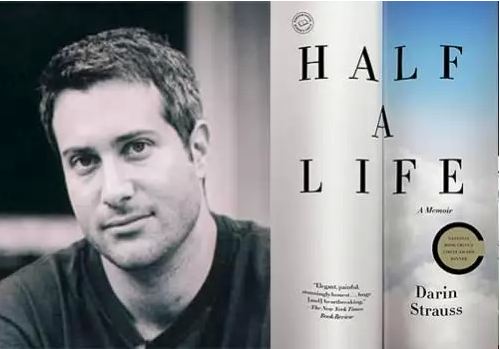
Darin Strauss is an American writer who lives and works in Brooklyn, New York. He is the author of three novels and one book-length memoir. Strauss is married to the journalist Susannah Meadows, and together, they are the proud (and busy) parents of twin, four-year-old boys.

Strauss’ 2010 memoir, Half a Life, won the 2011 National Book Critics Award and was excerpted in GQ and NPR’s This American Life. Half a Life chronicles the aftermath of a motor vehicle accident in which Strauss was the driver. His car struck and killed a young girl whose bicycle swerved into the road. Cleared of any wrong-doing in the accident, Strauss writes about the effect of this traumatic event which haunted him for twenty years. Hailed as a “masterpiece” and as a “memoir in its finest form,” the book has garnered critical acclaim and was named ‘Best Book of the Year’ by NPR, Amazon.com and others.

Chang and Eng, Strauss’ first book, was published in 2000. The novel, which tells a fictional story of the famous real-life conjoined twins, Chang and Eng Bunker, met with widespread critical acclaim. Set in Siam and antebellum North Carolina, Chang and Eng bravely explores the concept of self and other through the lives of the eponymous Siamese Twins, who came to the United States, became farmers, husbands and fathers. Strauss’ unflinching exploration of the twins’ story, told from the point of view of Eng, won many major literary awards and is currently being optioned for a movie. After Stauss’ second novel, The Real McCoy, he won a Guggenheim Fellowship. His third novel, More Than It Hurts You, was published by PenguinPutnam in 2008.

We speak over the phone. I reach him early in the morning and he asks if I can call him back. He is getting his boys ready for school. We talk amidst the street noise of rush hour New York, as Strauss goes for his morning walk through Brooklyn. At one point, I reluctantly offer up that I’m a Patriots fan. His New York Giants have recently defeated my favorite team for the second time in a Super Bowl. He is gracious in victory. I tell him that my son cried for fifteen minutes after the game and he says that I’m the second person who has mentioned this phenomenon. Being a parent changes the way we enjoy sports, in addition to how we live our lives. He is generous and quick with his responses. Once again, I’m reminded that even the most successful writers, and Strauss is clearly one of these, retain a sense of wonder and humility at the practice.


Richard Farrell (RF): Is there a spiritual tradition from which your write? How do ideas of spirituality and religion affect how you approach your work?

Darin Strauss (DS): I don’t know about that one. I’m not a fully LAPSED Jew. I do believe. But I don’t go to temple and I don’t speak Hebrew. I’m a very secular person. I suppose the closest I come to a true spiritual tradition might be the literary tradition. For me, there’s something almost liturgically intense in the best writing. Someone like Tolstoy or Bellow. People like that created texts that have an important gravity; they pull on my brain the way the Talmud would pull on another Jewish person’s brain. I think Tolstoy is the best writer we have ever had. I’m sure he wouldn’t be impressed by someone like me saying that – big whoop, right? — but for me, there is something spiritual about being engaged with reading a work of literature like that.

RF: You wrote three novels before Half a Life was published. Beyond the thematic material, can you talk about the process of writing non-fiction compared to writing fiction?

DS: I find in memoir it is harder to make a coherent whole—I mean an artful structure. The great and  popular writer David Lipsky helped me significantly in structuring the book. I was lost with it. He said do this and change that–he actually did some real stuff in there for me. The material in the memoir was so close to me personally I couldn’t see it. Ask any sea captain: When you are too close to something, it’s hard to get perspective.

In fiction writing, the difficult stuff is testing to see if what you’re writing is believable. For the memoir, that problem vanishes: it’s the truth you’re working with. I just had to figure out how to make the structure of it work.

A lot of people have asked me why I didn’t just write a novel about what had happened? I chose to do it as CNF because for me, fiction has a kind of narrative playfulness about it. There has to be fun involved in fiction, even if its fun played out in a serious way. There’s a gamesmanship to it. All fiction writing involves intellectual play, in other words. I didn’t feel like I could do that with the memoir. It would have been disrespectful to the memory of the girl who died. The thematic and textual art-making in fiction would’ve disrespected the actual events of an actual life.

RF: You’ve talked about being sensitive to critics and reviewers. Does that, for lack of a better word, anxiety, ever work its way into your writing? I suppose what I’m asking is, does your sensitivity make you defensive at all?

DS: I can wall off certain demons. I do read reviews. I mean if I’m going to be reviewed in the New York Times or the Washington Post, I’m not strong enough not to read the review. But it does affect you. You become sensitive to the slights. But I’m good at walling that part of myself off when I write. The reviews don’t get in there, into that place where I’m writing.

Maybe if there was a bad review that seemed to understand my writing—that got at the very specific flaws I know are there—that would bother me more. I think most writers—most of us non-genius writers –know deep down what our flaws are. But I haven’t had a bad review that focused on what I feel are the secret, weak parts of my work. I haven’t had a critic that made a point that could make me think to be a better writer.

RF: I want to ask you about writing sex scenes. I’m thinking specifically about the scene in Chang and Eng where the conjoined twins have sex for the first time to their new brides. I found this scene (really two back to back scenes) highly erotic (and well written). Rather than being turned off by the oddness of the situation, I found myself identifying with Eng in a very personal way. Besides accepting a compliment to your writing, can you talk about how you approach sex scenes, or scenes of physical intimacy in your writing?

DS: (Laughs and points out my inadvertent pun on ‘back to back’) I knew that was going to be one of the main questions of the book. How were they able to father 21 children? I knew I had to address how they had sex and that it was going to be essential.

Sex scenes always create a problem. And they have to serve the story. You can’t just stop in the middle of a scene and forget everything—just for a little textual thrill. I mean, it’s best not to be merely prurient about it. Here’s an analog to sex-scene writing. I think of a scene where a character walks into an ice cream shop. You have describe things that matter, but you can’t stop the forward motion of your story just to have a six-page description of the sprinkles and the cone. How the sprinkles and the cone move your story along, how they affect your particular characters in ways that are particular to them—that’s a good scene.

For that sex part in Chang & Eng, I focused on the conflict between those two men and the trouble with having your brother constantly with you. There was no intimacy, nothing was ever private. But I also wanted to conceive the sex scene as something that could get at what was special about this thematic material and this plot. So I made Eng in love with his sister-in-law. But he could never tell her or touch her because the woman’s husband—his brother—was always with her. The sex was an extension—or an elucidation—of the problem.

RF: Do you have (or did you) other writers you modeled yourself after? Who and how did you escape that influence? How did you get out of its way.

DS: I’m always picking up new influences. You certainly don’t stop being influenced. Zadie Smith said something like, ‘A writer should approach the library the way an eater approaches the buffet table.’ Like: I’ll take from this, from that, and also from that. That cobbled-together meal ends up—if you have enough various dishes in there, in various quantities—being something unique to you.

The writers influential to me include Tolstoy, Nabokov, Lorrie Moore, Martin Amis, John Cheever, Isaac Babel, V.S. Pritchett. Pritchett isn’t read much anymore but he was a great writer and a critic who kept writing late into his eighties. David Foster Wallace too, and Roth. A dash of Updike, a touch of Chekhov.

So I’m always reading and being influenced. I don’t think that ever stops.

RF: How important is voice to you in writing?

DS: It’s important. If there’s a morality in writing, it’s in the voice or the style. Nabokov made that point, and lived it, too. I try to see what other writers do, and to figure out how to do it myself.

Nabokov was great at compressing metaphors. David Lipsky teaches his students to look at what Nabokov does with metaphors and try to find ways to use that. Or David Foster Wallace, and how well he uses incredible modifiers to jazz up the prose.

But, to get less craft-lessony for a second. When I read Tolstoy, it’s a chance to take a ride in the brain of a genius for a few weeks. That’s the part that movies and TV can’t get at, because you are always watching the pictures with your own eyes, and having your own observations. Which I’m guessing are limited than Tolstoy’s. But if you read Tolstoy, you really are existing in his brain, getting the full strength of his thoughts. I think of it like brain vitamins.

RF: My last interview was with Anthony Doerr. He also has twin boys. I hope it’s not something in the well water. How has being a parent effected your writing?

DS: (Laughs) It’s made me have less time to write! My third book was about someone harming a child. But now when I get to a place in a book, maybe it’s harder to go to the cruel places. But I don’t think it’s affected my writing in a negative way, beyond having less time.

RF: In Half a Life you say, “Things don’t go away. They become you. The trailing consequence of further days and hours. No freedom from the past or future.” James Joyce wrote that “History is a nightmare from which I’m trying to awake.” How does writing help this? Does writing about the events offer a glimpse of freedom or only soften prison of the past?

DS: That was an allusion to a T. S. Eliot quote. But writing does help; it has been helpful for me. I used to subscribe to what William Gass said, that if you write well it cannot be cathartic, because you are working too hard. But after writing the memoir, I have to say that either Gass was wrong, or I didn’t do it well. Because it was completely cathartic. It has helped me smooth over the psychic bumps which accumulated from the accident. It helped me heal. I didn’t want to be a self-help book author, but I guess if you write well about these kind of things, the book can be self-helpful, in a way.

RF: What are you working on now?

DS: David Lipsky and I are collaborating on a young adult adventure series. I’m also working on a new novel that’s a mix of everything I’ve done to this point. The book is contemporary and historical and even a mix of fiction and non-fiction.

RF: In your opinion, can writing be taught? Also, and I think these questions are related, is it perseverance or talent?

DS: I think this whole argument, writing can’t be taught, is ridiculous. Yes, few people are super-brilliant writers once they graduate. Is that really a useful expectation, though? You don’t graduate from law school and instantly become Clarence Darrow! Does that disqualify law school? If you do not graduate among the top one percent of lawyers in the world, did law school fail you?

Does an MFA make you, magically, Philip Roth? No. It’s not a practical degree, but I tell students that if you really want an MFA, go where you can afford to go. Go to a school where you can get money to attend.

I also think you need to go to school where the writers you like teach. The economic truth of writing is that you’ll likely have to teach, even if you do publish your books. Even the incredibly successful writers, for the most part, teach. Junot Diaz, Jonathan Safron Foer and Zadie Smith all teach—in fact, they’ve all taught with me at NYU.

But if you can’t afford it, don’t go. You won’t just be able to hang a shingle on your door when you graduate and start making money. But, certainly, yes, writing can be taught. You will improve, you will—if you work hard in grad school—get closer to the last limits of your potential. If you go into it with that expectation, and you know there are no guarantees, and you still want to go, and can afford to go, and end up getting into a good program, then do it.

RF: Keith Lee Morris once wrote, “A father is anyone with answers to the questions that keep you awake at night.” I interviewed him and asked him this question. I’m now going to ask you: Do you think this is the writer’s task, to answer the questions that keep us awake at night? (Interviewer’s Note: Morris, in his answer, talks about exploring and not having all the answers. I didn’t want to give him a bad rap on this one!)

DS: No! It’s a nice line. It sure sounds good. Here’s a plainer one. A father is someone whose sperm helps create a child. I don’t know—I don’t have many answers.

The truth is, fiction writers shouldn’t have too many answers. Debate team captains have answers. Literature is its own way of thinking about things, as Milan Kundera said. Stories that purport to have an answer are not fiction; they’re propaganda. It’s an easy thing to say the answers. Literature transcends answers. Its job is not to tell you what’s right or wrong, but to show how everything is a little bit of both.

—Richard Farrell

Feb 152012


It comes as a shock to think that I have known Robin Hemley for over thirty years. I didn’t think, honestly, that I was that old. We met at the Iowa Writers Workshop in 1980, across a workshop table, I recall, with the then program director Jack Leggett chairing the proceedings. Robin looked too young to be in graduate school, and he still carries himself, even writes, with a kind of wide-eyed, cheery openness to EVERYTHING that is both charming and compulsively readable. Nowadays he’s achieved that remarkable state of being able to turn almost anything that happens in life into something worth writing about. He is an indefatigable world-traveler, prolific author, inspired teacher, and an amiable friend. Here he is taking a group of American undergraduates to Cuba for a winter course. Academia, life, politics and art merge.

Robin Hemley is the author of ten books of nonfiction and fiction, and the recipients of many awards for both, including a Guggenheim Fellowship and two Pushcart Prizes.  His most recent books are A FIELD GUIDE FOR IMMERSION WRITING: MEMOIR, JOURNALISM, AND TRAVEL (University of Georgia Press, 2012) and REPLY ALL: STORIES (Break Away Books, Indiana University Press, 2012).  Indiana University Press is also reissuing his novel THE LAST STUDEBAKER in 2012.  He is also the author of the popular books, TURNING LIFE INTO FICTION (Graywolf Press) and DO-OVER (Little, Brown), and the BBC is currently at work on a feature adaptation of his book INVENTED EDEN: THE ELUSIVE DISPUTED HISTORY OF THE TASADAY (Bison Books, University of Nebraska Press).  He is the director of the Nonfiction Writing Program at the University of Iowa, founder of the NonfictioNOW Conference, a senior editor of The Iowa Review, editor of the online magazine DEFUNCT, and a colleague at Vermont College of Fine Arts .

dg

§

The eighty-three-year old Cuban poet grasped my arm, whispered, “I love your people.  I feel a spiritual connection to them.”  I didn’t know what to say.  I had just met him.  He had spent a dozen years in New York, much like the Cuban National Hero, Jose Marti, who, before dying in battle against the Spanish in 1895, spent fifteen years in New York.  I had spent a total of two weeks in Cuba, and what was I to say?  To lie?  “Right back atcha, Cuba! I feel a spiritual connection to you, too.”  I didn’t.  But neither did I feel a spiritual connection to my own country. I thought that he and nearly every other Cuban we met idealized the U.S. the way Americans idealize Cuba.  The Columbus Syndrome works both ways. Columbus spent a few days in Cuba and then sailed back and said it was the loveliest place on earth, and certainly my students had an enormous case of Columbus Syndrome.

I and a colleague had brought thirteen undergraduates with us to Havana for a Winter term course, as had, it seemed, nearly every other U.S. university.  A bellman at the Presidente Hotel, Gringo Central, told me there were more Americans now than ever, but “they will all go when Obama loses the election.” True, the restrictions have lessened over the last year, allowing more short-term visits by educators, researchers, and students.

Every day, it seemed a new group from George Mason or Randolph College or American University showed up at the Presidente and we compared notes on our respective itineraries: who was going to visit Che’s grave or the hot springs at Las Terrazas or the beaches of Varadero. Canadians, Brits, Russians, Germans, Chinese, Argentines, Colombians, and Japanese have been coming here for years, but for the throngs of young Americans now legally entering Cuba, the approach is not unlike the hordes of shoppers awaiting a midnight sale at Target on Thanksgiving. And what are they waiting so impatiently to purchase? Authenticity, of course.  It’s what the country trades in when all is blockaded.  Cuba es autentica, the commercial warbles.  Tom Miller, a travel writer and Cuban expert along with us, warned my students never to use the words, “quaint,” “nestle,” or “local” in a travel piece, but his warning was of no use.  Any traveler infatuated with a new country sees nothing but quaint nestling locals.

And that’s not the half of it with Cuba, where a powerful strain of Columbus Syndrome, resistant to any known ideological antigen, infects most American tourists who find their way here legally or not. It’s not just the antiquated American cars from the fifties and sixties, belching smoke and plying the uncongested streets of Havana.  Or the two and three hundred year old buildings, some being restored, some too ruined to save.  It’s also the view from the rooftop of the Presidente Hotel at night – the modest skyline with only one or two signs lit by neon.  My colleague and I had wondered if our students would miss the Internet and Facebook and Skype and their cell phones.  Instead, they worshipped the lack of it.  It’s not the U.S. blockade against Cuba that blocks the Internet, but the Castro government, though nearly everything else seems the result of the blockade, including the cars and the crumbling buildings.

What the elevator operator in the Presidente Hotel said about the U.S. elections is true most likely.  If Obama loses the election, the Blockade will undoubtedly continue at least four years more.  No one, American or Cuban alike, could give me a good reason why the Blockade, in place since 1960, continues, except for the most obvious political reason, that the Blockade serves the interests of a minority of Cuban Americans in Florida.  And there’s too much money being made in the maintenance of the Blockade, (including spending 500 million taxpayer dollars annually on Radio and TV Marti, the latter which is blocked by the Cuban government in any event).  The word I heard most frequently was “inertia.”  The Blockade has been in place so long, no one has the energy or will to end it.

Romney must be a little embarrassed by a 2007 speech on Cuba, which he mistakenly ended with the phrase, “Patria o Muetre!  Venceremos!”  It means “Fatherland or Death, We shall overcome,” a phrase that Castro used for decades to end his speeches, and which my students and I glimpsed occasionally on banners strung across Havana’s streets (Gingrich has had a lot of fun with that Romney gaff).  Our tour guide admitted unabashedly as we passed under one such banner, “It works, growing up with those slogans, seeing them everyday.”  Of course, it works, but blockades and embargoes don’t work, unless we hope to push the blockaded country into war.  When was the last embargo that worked?  In the forties, we wanted Japan to leave China and stop massacring its population.  A noble desire on our part, but not an easy solution.  After we imposed an oil embargo against Japan (at the time, America supplied 80% of Japan’s oil), Japan asked FDR for a summit to discuss the matter, but the U.S. said Japan had to withdraw first from China and instead Japan attacked Pearl Harbor.  Go figure.  Why didn’t they just do the right thing and obey us?

Throughout World War Two, comics routinely portrayed Japanese as monkeys, inhuman, not worth a moment’s thought, but now of course, we’re the best of idealizing buddies again.  It could be so again with Cuba.  In his youth, Fidel Castro wrote to FDR addressing him as his good friend and asking him for a ten- dollar bill.  I’m sure he doesn’t give this youthful faux pas a moment’s thought now, and it means nothing because he was a child.  But grown men like Romney and Gingrich should at least be a little realistic when they ask the Castros for something.  They don’t want ten dollars from Raul or Fidel Castro.  They want, in Gingrich’s words to “promote democracy” in Cuba.  They want “free elections.”  Sure, we all do.  We want them in China.  Let’s blockade it.  We want them in Iran.  Let’s embargo it . . . oh, we are?

This just in: Cubans don’t want to drive junker cars.  They’d rather drive new cars, which they now get from China, along with scores of new Chinese busses.  They long to eat Pringles.  But I don’t want them to eat Pringles!  Or Big Macs.  I certainly never want to hear any quaint Cuban locals ordering skinny lattes.  Then all hope for humanity will be lost.  For this reason, I find myself curiously conflicted about the Blockade, on the one hand wondering what good it serves (beyond reasons to do with a small minority of Cuban Americans in Florida).  On the other hand, I was delighted to see so many old American cars so well preserved.  The country seems so real!

During our visit, a rumor spread in the Miami Cuban community that Fidel had died, relayed to me by Tom Miller, who added that such rumors crop up every eighteen months or so.  “Assassination by Twitter.”  I mentioned the rumor later to our Cuban tour guide who assured me it couldn’t be true because if it were, her mother, a well-known journalist, would have been in tears that morning.  Cubans mourning Castro?  Actually mourning him and not in the official North Korean way, in which a family of bears reportedly sobbed by the side of the road upon learning of Kim Jong-Il’s passing? Undoubtedly, few woodland creatures will mourn Castro’s passing, and not many more Americans, but now I wonder if even his passing will signal a change in our policy toward Cuba?

Honestly, ask yourself, don’t you want to visit Cuba before Fidel dies and/or the Blockade ends?  Of course you do.  You want to see Cuba as it exists now, poor and blockaded, but resilient and proud, one of the lone anti-U.S. bastions that’s any fun. If North Koreans had conga lines and made Pyongyang Club Rum, maybe they’d have more visitors, too.  But North Koreans don’t salsa.  At least, the Cubans know how to resist the U.S. with panache.  When the American Interests section, a tall building along Havana’s famous seafront, the Malecon, streamed electronic anti-Castro messages around the building’s rooftop during the Bush administration, Fidel retaliated by erecting over a hundred flagpoles flying enormous flags to block the messages.  The messages are gone now, but the Cuban flags remain, as well as an adjacent plaza, “Jose Marti Anti-Imperialist Plaza.” It was here, on January 1st, the anniversary of the “Triumph of the Revolution,” that my students and I listened to a Cuban singer belting out tunes with a string of young women straight out of a USO Show, as one of the savvier of my students remarked, line dancing on a stage before which thousands were gathered, most of them dancing too.  And between sets the enormous anti-imperialist video screens played the latest American music videos.

 —Robin Hemley

————————————————-

See also Stanley Fogel’s ¿Que Coño Pasa? Snapshots of my Wonderful Cuban Life, a book length essay on living in Cuba published earlier on NC.

Jan 202012


The Parkinson’s Diaries

By Steven Axelrod

.

.

Leaving the Breakers: Escape from Assisted Living


My mother had been diagnosed with Parkinson’s disease ten years ago. Still ambulatory in her late eighties, she was now living in a retirement community in Long Beach, California, on the fifth floor of a beautifully restored hotel from the golden era of Hollywood called The Breakers. The ceiling of the lobby floated twenty feet above the marble floor, with intricately worked plaster panels that put the tin ceilings of Greenwich Village cafes to shame. The peaked red tile of its roofs and turrets lent it a Mission revival feeling, and the top floor restaurant, the Sky Room, earned its name with a spectacular panorama of the harbor, while retaining  a heady whisper of old time movie glamour. The staff was charming and helpful, the suites themselves were spacious and sunny, sparked with period detail in the moldings and baseboards, with high ceilings and water views. The dining room was spacious and congenial, the other residents friendly and patient. You couldn’t ask for a more pleasant and professional assisted living arrangement.

And I hated it, with every fiber of my being.

I hated the way the impeccably courteous, and hard-working staff treated my mother and the other residents as a separate, feeble race, inferior but privileged like hemophiliac dwarf royalty, simultaneously catered to and patronized, deferred to and dismissed. I hated the smell in the hallways, some tragic perfume of disinfectant and decay – the sense, so much like the sense you get in a hospital, of a world where human volition and dignity have been sacrificed to the mechanisms of medical technology and routine.

I also hated the dining hall food, tasteless and generic as if the management actually calibrated how many of the residents had no working taste-buds left and arranged the meal preparations accordingly. I hated the weak coffee and the fuzzy sausages, and the cardboard pancakes, the sense that the particular texture of life, the look and feel and taste of things, didn’t really matter any more.

Continue reading »

Dec 092011
 

Herewith a lovely, meditative essay on the conjunction of poetry, memory, and childhood from Nancy Eimers. The essay draws its inspiration from Proust and the art constructions of Joseph Cornell and draws to a close with Mary Ruefle’s Now-It, an erasure book made from an antique children’s book about Snow White. Nancy Eimers is an old friend and colleague at Vermont College of Fine Arts. In March NC published poems from her new collection, Oz, published in January from Carnegie Mellon University Press. Her three previous collections are A Grammar to Waking (Carnegie Mellon, 2006), No Moon (Purdue University Press, 1997) and Destroying Angel (Wesleyan University Press, 1991). She has been the recipient of a Nation “Discovery” Award, two National Endowment for the Arts Creative Writing Fellowships and a Whiting Writer’s Award, and her poems have appeared in numerous anthologies and literary magazines.  Nancy teaches creative writing at Western Michigan University and at the Vermont College of Fine Arts, and she lives in Kalamazoo, Michigan.

dg

 Charmed Objects: Poetry and Childhood

By Nancy Eimers


The genius of Cornell is that he sees and enables us to see with the eyes of childhood, before our vision got clouded by experience, when objects like a rubber ball or a pocket mirror seemed charged with meaning, and a marble rolling across a wooden floor could be as portentous as a passing comet.  —John Ashbery
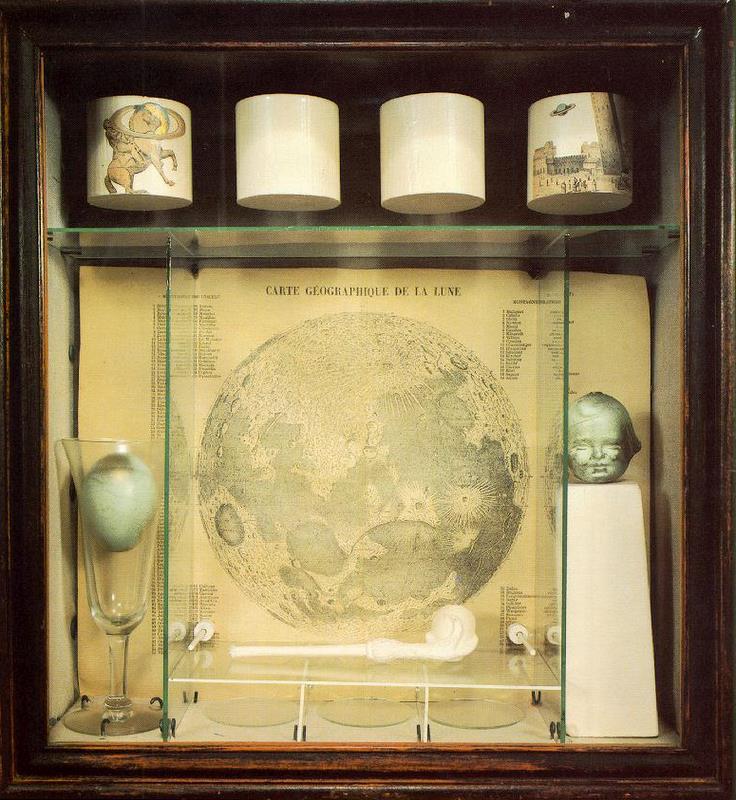
 

Image from Webmuseum at ibiblio

Joseph Cornell’s Untitled (Soap Bubble Set) is a brown box with metal handles on either side. Here is a list of its contents.

—blue cloth
—blue thumbtacks
—a map of the moon
—three glass discs
—light blue egg, in a cordial glass
—doll’s head, painted blue and gold
—three white wooden blocks
—white clay bubble pipe

Really, they are ordinary things, in one world or another.

If you visit Untitled (Soap Bubble Set) in the Wadsworth Atheneum Museum of Art in Hartford, Connecticut, you must keep a distance.  You will not be allowed to open the box and play with the bubble pipe.  Not even if you bring a child.

Now, a look at the box.  But not an image.  Words are the medium here.

Oh roundnesses you can feel in the palm of the hand. The moon’s at the center, silvery blue, and dominates.  Carte Geographique de la Lune.  The doll’s head, cheeks scarred, has been smiling now for how many years?  Also a silvery blue, the doll and the egg are bathed in the thought of the moon.  The discs of glass are laid at the floor of the box; if you picked one up, the rim might cut your hand.  Every circle is synonym to a bubble: doll’s head, egg, bowl of the pipe.  Even the craters of the moon.  One of the books Cornell loved was a series of lectures delivered in 1890 by a scientist, C. V. Boys, to an audience of children, on soap bubbles.  You cannot pour water from a jug or tea from a tea-pot; you cannot even do anything with a liquid of any kind, without setting in action the forces to which I am about to direct your attention.
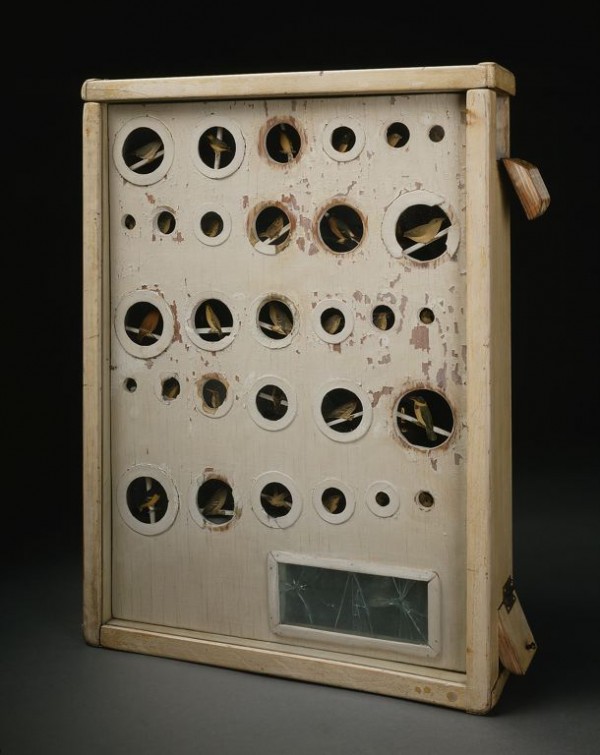
 Image from Rocaille

I haven’t seen that soap-bubble box except in a book, but I’ve seen Untitled (Forgotten Game) in Chicago’s Art Institute.  A pinball-like game of a box with holes behind which there are pictures of birds cut out from the pages of old books.  Inside the box there are ramps down which a ball is meant to slide.  If you could open the little door at the top and insert a blue rubber ball, if the ball were to slide down the ramps and reached the bottom, a bell would ring.  That it doesn’t ring is part of a terrible sweetness.

Forgotten game, blue-silver moon, recessed birds, egg in a cordial glass, to what forces have you drawn our attention?

“Perhaps what one wants to say,” said sculptor Barbara Hepworth, “is formed in childhood and the rest of one’s life is spent in trying to say it?”

 *

I remember a gaudy, jeweled pin worn by my grandmother.  I say “gaudy,” but I didn’t think it was gaudy then.  Costume jewelry is made of less valuable materials including base metals, glass, plastic, and synthetic stones, in place of more valuable materials such as precious metals and gems, explains Wikipedia helpfully.  But I hadn’t read and wouldn’t have been helped by this sentence then.  The jewels, their blue and pink sparkles, enchanted me.  They seemed almost to say, there is this other world.  The pin is lost forever, like Dorothy’s ruby slippers somewhere between Oz and Kansas.  But I feel the pull of a former feeling, not subject to reason, proportion, knowledge of anything likely/unlikely to happen.  In memory, where I am holding it in my hand, the invented and the real haven’t quite parted ways.  You can’t get beauty.  Still, says Jean Valentine, in its longing it flies to you.

I think this will not be an argument but a meditation—held together by asterisks, little stars—on how charmed objects, long lost, come back sometimes in poetry, present only as words, touchstone, rabbit’s foot, amulet, merrythought, calling us back, calling us forth.  What are they, now that we’ve lost them?

*

The Child Is Reading the Almanac

The child is reading the almanac beside her basket of eggs.
And, aside from the Saints’ days and the weather forecasts,
she contemplates the beautiful heavenly signs.
Goat, Bull, Ram, Fish, etcetera.

Thus, she is able to believe, this little peasant child,
that above her, in the constellations,
there are markets with donkeys,
bulls, rams, goats, fish.

Doubtless she is reading of the market of Heaven.
And, when she turns the page to the sign of the Scales,
she says to herself that in Heaven, as in the grocery store,
they weigh coffee, salt and consciences.

In an almanac there are moons, full and half and quarter, and there are new moons that look like black moons.  There are meteor showers, tides and eclipses.  Signs of the zodiac.  Questions of the Day.  Why is the ring finger sometimes called the medical finger?  Weather predictions.  Three misty mornings indicate rain.  Fact and prediction, the seen and the unseen intermingle; the strange is detected in the commonplace, and the commonplace in strangeness.  No wonder the child in this early twentieth century poem by French poet Francis Jammes has been tempted to set down her basket and read.

Jammes “wrote of simple, everyday things,” says the introductory paragraph on the torn yellow book jacket of my copy of his Selected Poems.  And inside the book, in the introduction, Rene Vallery-Radot marvels, “From a little provincial town there rises a voice that ignores all the gods, that tells of life simply, not at all systematized in theories.”  In a photograph just inside the cover Jammes, an old man in round black glasses and a long wispy beard, looks down at a page he is writing on.  For all we know he was writing this almanac poem. The child must have stopped on her way to or from the market (to sell the eggs? having just bought them?).  Perhaps she wonders if even an egg, like the animals in the market, has its counterpart in the stars.  The wondrous almanac testifies that as things are on earth, so they must be in heaven: how miraculous, how natural, that Heaven resembles an earthly grocery store on this most ordinary of days!

Still, Jammes remembers enough not to oversimplify, or presume.  On earth, scales are also associated metaphorically with justice, even by a child.  And like any child, this one must have done something, committed or contemplated committing some small act, a rebellion or peccadillo for which, in some small way, she’d paid, or feared to pay.  She spoke harshly to the donkey.  Maybe she broke an egg.  She dawdled on the way to the market.  Whatever it is, she keeps it secret.  Let us not trespass.

*

It is because I believed in things and in people while I walked along those paths that the things and the people they made known to me are the only ones that I still take seriously and that still bring me joy.  Whether it is because the faith which creates has ceased to exist in me, or because reality takes shape in the memory alone, the flowers that people show me nowadays for the first time never seem to me to be true flower. —Marcel Proust, Remembrance of Things Past

In her autobiographical story “In the Village,” Elizabeth Bishop invents or remembers this from her childhood:

We pass Mrs. Peppard’s house.  We pass Mrs. McNeil’s house.  We pass Mrs. Geddes’s house.  We pass Hill’s store.

The store is high, and a faded gray-blue, with tall windows, built on a long, high stoop of gray-blue cement with an iron hitching railing along it.  Today, in one window there are big cardboard easels, shaped like houses—complete houses and houses with the roofs lifted off to show glimpses of the rooms inside, all in different colors—with cans of paint in pyramids in the middle. But they are an old story.  In the other window is something new: shoes, single shoes, summer shoes, each sitting on top of its own box with its mate beneath it, inside, in the dark.

The child is bereaved, though she doesn’t entirely know what this means.  It is for her too new a story.  Her father—her mother’s mate—like one of those shoes, has been closed inside a box of his own, but forever, unlike the shoes.  This story is one of those houses with its roof lifted off, so the writer, so we, may look inside.  But we may not enter.

Memory affords glimpses: of a flower, a doll or a shoe in a box, a marble rolling comet-like across the floor.  “My life,” writes Tomas Transtromer:

Thinking these words, I see before me a streak of light.  On closer inspection it has the form of a comet, with head and tail.  The brightest end, the head, is childhood and growing up.  The nucleus, the densest part, is infancy, that first period, in which the most important features of our life are determined.  I try to remember, I try to penetrate there.  But it is difficult to move in these concentrated regions, it is dangerous, it feels as if I am coming close to death itself.

Maybe it is important not to explicate our childhoods.  Or simply, merely impossible?  Cornell, from a journal entry, May 13, 1944:

 . . . stopped by pond of waterworks with cool sequestered landscaping—gardens & here had one of profoundest experiences + renewal of spirit associated with childhood evoked by surroundings—it seemed to go deep through this strong sense of persistence in the lush new long grass—the most prominent feature turned out to be “no trespassing” sign

Water, hiddenness, the cool, such things return for a moment from—exactly when and where?  What did it look like there? We can’t quite know, we can’t see inside.  No trespassing.   But the grass is/was lush.

Talking about her younger brother Joseph, Betty Cornell Benton recalls this scrap from their childhood:

Late one night he woke me, shivering awfully, and asked to sit on my bed.  He was  in the grips of a panic from the sense of infinitude and the vastness of space as he was becoming aware of it from studying astronomy.

From an earthly point of view, a comet is stationary, seen at night—then remembered in daylight—then seen—then remembered—over the rooftops.  It is there for a time.  Star with a wake of light.  Then it is gone.  That too is remembered.

*

“Stove” is one of the six end-words of Elizabeth Bishop’s “Sestina.”  A Little Marvel. Brand new, that model would have been painted silver.  Through daily use, it would have grayed; open the door and it would be blackened inside.  MARVEL: the name is on the door.  It dominates like the map of the moon in Cornell’s soap bubble box.  Above, below, on either side there are swirls and curlicues forged in the cast-iron, resembling serious, stirred up clouds.  It has four legs, curving outward, stubby and braced.  In an early twentieth century village, a stove was a daily thing in anyone’s house, but to a child it must have seemed marvelous, like Saturn’s rings.

I have only seen photographs of the Marvel; but they were not photographs of the real thing.  All I found was a salesman’s sample, 16 inches high, still advertised on eBay but already sold.  That ship had sailed.  And a toy Little Marvel, complete with two ovens, burners and lifters.  Nickel plating over cast iron.  All complete and in very good all original condition.

A child in me is entranced.

September rain falls on the house.
In the failing light, the old grandmother
sits in the kitchen with the child
beside the Little Marvel Stove,
reading the jokes from the almanac,
laughing and talking to hide her tears.

House.  Grandmother.  Child.  Stove.  Almanac.  Tears.   Six end-words, like miniatures on a bracelet.  (Even the tears have their charm.)  Each time the words, all nouns, come back, they are in their original form—no juggling with word play or parts of speech, no punning or homonyms.  Simple words, like primary colors, or figures from an old storybook.

Or they are like comets, passing before us seven times from the early twentieth century, Great Village, Nova Scotia.  As in the story “In the Village,” there is death at the nucleus.

tears/house/almanac/grandmother/stove/child
child/tears/stove/house/grandmother/almanac

And so on.  In the ordinary world a grandmother is trying to amuse a child.  Each time a word comes around again it feels sadder.  Even tears get sadder; the teakettle weeps, the teacup fills with dark brown tears.  To the grandmother, tears are recurring, equinoctial. The child senses something.  Unspoken grief is working its magic: the almanac begins to resemble a bird; the stove gets philosophical; the world grows cold.  The almanac knows what it knows but won’t say what.  How much does the child know, what is she warding off?  The poet senses something.  Does the child miss the man in the drawing?  How much can even Bishop have known of the child she was?  “Early Sorrow” was the poem’s original title.  Then withdrawn.  Explication fails, or it is irrelevant.  The child sees little moons in the almanac fall down like tears.  The poem ends, as it began, in present tense.  The child draws another inscrutable house.

That moment of wonder and puzzlement goes on orbiting but it is in the past, forever out of reach.  So are the stove and the almanac, ancient tears, the worried grandmother and the inscrutable child.  All in the past, except for the house in Great Village.  (. . . it is difficult to move in these concentrated regions, it is dangerous, it feels as if I am coming close to death itself.)  That house is still there.  You can visit it; you can go inside; you can even arrange to stay.

*

In her art review of the Ann Arbor exhibition “Secret Spaces of Childhood,” Margaret Price describes certain characteristics of childhood hide-outs:

Almost always the entrance to a secret space is guarded, to protect the privacy and sometimes the fragility of what lies inside. . . .  Moving through the doorway into the space itself is often a rite of passage, and often the point of access is the most highly charged area of the whole secret space: usually elusive, always exciting, and sometimes dangerous.  Often they, or their entrances, are small . . . . being small of stature confers the privilege of access.  A hideout cannot function for a person too large to fit into it.  On the other hand, a child’s small size is a    passing attribute, and children know it.

Peering into the windows of a dollhouse, I feel almost an ache of pleasure.  I think this has to do with its smallness; the feeling is paradoxical.   I am charmed by the inaccessibility; and I yearn to be small enough to step inside.  If I could grow small enough to enter, the house and furniture would no longer seem miniaturized to mini-me and so would have lost their mystery; but I might find among the toys in its nursery (for in a dollhouse there is almost always a nursery) a tiny dollhouse, and who knows, perhaps an even tinier dollhouse inside of that dollhouse’s nursery, and so on and so on, as if longing were satisfyingly infinite.

Is remoteness integral to a certain kind of charm?  In a silk-lined box I keep my charm bracelet, a mercury-head dime and a single clip-on pearl earring.  I know they are there, but I hardly ever look.  I like the look of the hinge that fastens the lid.

from the Art Institute of Chicago

On the basement floor of the Art Institute in Chicago you can visit the Thorne Rooms, a permanent exhibit of miniature rooms behind glass.  These aren’t so much dollhouses as interiors, 68 rooms that, “painstakingly constructed,” as the museum website explains, “enable one to glimpse elements of European interiors from the late 13th century to the 1930’s and American furnishings from the 17th century to the 1930’s.”  The rooms contain exact reproductions of period furniture, carpets, wallpaper, chandeliers, other objects—all somehow failing to interest me, I finally realized with some disappointment the last time I visited.  Perhaps it was more petulance I felt than disappointment; I had come in the spirit of a former child, and being there felt more like studying than play.

What bewitched me, though, were the windows.  Out every window there was a view—an exterior—tiny, intricate gardens with bushes and flowers; patios; benches; trees; and an artificial light from a source that wasn’t visible.  I started over, room by room, looking not at interiors but out the windows, craning my neck to see as much as I could; it was tantalizing, I couldn’t see everything.  Shining faintly into miniature rooms in the basement of a grand museum, the light seemed remote, a late-fall, old-world light.  Out of every window of every one of the 68 rooms was a little world a child might just have begun imagining . . . .

Or perhaps it was simpler, perhaps I just wanted to be inside looking out.  In fact, it occurs to me that may be why (at least in part) I’m so happy when it snows: as opposed to looking into dollhouses or the windows of other people’s lighted homes at night, I finally feel as if I’m inside something.

*

A charm is a miniature object worn on a bracelet.  A sombrero.  A bell.  I am childless, who will I give it to?  You can’t hear the tinkling of the tiny bell for the tinkling of the bracelet when you pick it up.  The use of the word charm as trinket did not occur (was not recorded) until 1865.  But charm has meant “pleasing” since the 1590’s.

It wasn’t until Elizabeth Bishop arrived in Brazil and found herself, for a time, enormously happy, that she began to be able to write of her childhood in Great Village.  She says in a letter to friends, “It is funny to come to Brazil to experience total recall about Nova Scotia—geography must be more mysterious than we realize, even.”

Of course she meant some geography of the interior.

Even from the simplest, the most realistic point of view, the countries which we long for occupy, at any given moment, a far larger place in our actual life than the country in which we happen to be. —Marcel Proust

*

Ghost stories written as algebraic equations.  Little Emily at the
blackboard is very frightened. The X’s look like a graveyard at night. The
teacher wants her to poke among them with a piece of chalk. All the children
hold their breath. The white chalk squeaks once among the plus and minus
signs, and then it’s quiet again.

This is an untitled prose poem from Charles Simic’s The World Doesn’t End.  I have been that child, puzzling over the signs and portents on the blackboard, messages sent by way of math, of grammar, or even handwriting, strange row of continuous l‘s or o‘s.  In a way, it seems like a minute ago.  Did the teachers know how wildly some of us may been mistranslating what they were writing on the board?  Numbers especially, and their plusses and minuses, went beyond the explanations of words, beyond even paragraphs.  I am a teacher myself now, though white boards and dry erase markers have replaced the powdery chalk.  I am still a little frightened, like Emily, standing in front of the class.  The white boards haven’t solved or eliminated the mystery, yesterday’s propositions, assertions, and mistakes still lurking under today’s.

Though the blackboards of my childhood were almost always green, the first blackboards were black, made of slate.  For a newer generation of blackboards, the color green was chosen because it was believed it would be easier on the eyes.  As for the chalk, I can still feel the powder on my hands as I lay it back in one of the crevices of the metal rim.  I had been asked to do a problem on the board.  Or to outline a sentence.  Or maybe I hadn’t touched it at all but was sitting at my desk, watching my teacher, mentally tracing the swoops of her hand (his hand) as it held the chalk.  Oh mysteries of the chalkboard’s palimpsest, yesterday’s sums or sentences only half-erased.  And let us not forget the mystery of the chalk itself, composed partly of limestone, the sum of fossilized sea animals.

*

Vivien Greene, whose family moved repeatedly when she was a child, devoted much of her adult life to the study, collection, and restoration of Victorian dollhouses.  She had seen her own beloved house in London bombed and split open in the Blitz.  It seems that rift was decisive: after that she and her husband (the novelist Graham Greene) permanently lived apart.  (Graham, who wasn’t interested, said Vivien, in either her dollhouses or domesticity, had already formed what they used to call “another establishment.”)  “Houses have influenced my life deeply,” wrote Vivien Greene in a brief essay called “The Love of Houses”; “They have entered into dreams, made me stand enraptured, suddenly in unexpected places, filled me with a longing to possess; or they occasionally frighten.”  Fear of . . . bombs?  Of ghosts, of moving yet again?  She doesn’t explain.  In the evenings during the war, she used to sit behind blackout curtains working on her dollhouses, tearing down old wallpaper, adding the new.  Greene was the author of several excellent books on vintage English dollhouses.  They are filled with exquisitely old-fashioned and discursive descriptions of staircases, windows, doorways, furniture, even the crockery.  At one point, she writes, apropos of nothing,

 As some people ask and need to be stripped of ownership, so we can believe others are hardly fully alive, complete as persons, until certain material things, a horse, a place, a boat, have been loved and owned and afterwards remembered.

*

“In the lyric you can stop time,” said Ellen Bryant Voigt in an interview; “you pick that moment of intensity and hold it. The narrative moves through time.”  In Michael Burkard’s poem “The Sea” nothing really happens.  There is instead a kind of lyrical parallelism that advances no narrative but deepens the shades of emotion.

It could have been worse but for the sea. The watch of it. What was it
Chekhov wrote?—”Self same sea”—Yes. Yes. It was there, as was my mother’s
family, in Nova Scotia. There beyond the sloping meadow near Aunt Dorothy’s
farm, there from Cousin George’s kitchen window. The sea and its often daily fog
permeated everyone, everything. And because there was no electricity in those
days, only candles, lantern light, and no plumbing, it seemed almost a sea more in
the air than in the sea. You could not shut it out.

The poem travels sideways, or inward.  Certain words appearing numerous times, sea, there, now, as if, become on one level sheer sound, a force, a mystery.  They don’t so much stop the moment as return to its vivid pastness, over and over again.  There is something bygone and sepia about the scene described.  “There” suggests something in existence but away.   The landmarks in the poem are family names, a meadow, a kitchen window.  And the sea.  Which is also a kind of weather, an intrusive force or guest.  The residents of the poem are mired there, in a world miniaturized by memory.  Here is the rest of the poem:

And the lanterns we ate by, sat by—how small! Yet this permeated as much as
the sea, as much as the fog from the field, the conversion of one cowbell to
another cowbell in the fog, the red-yellow light flickering, now against a deck of
cards, now against faces and hands playing the cards, now being carried with one
or by one off to sleep. Sleep by the sea, as if the sleep were to last a thousand
years, as if the summer were a medium for color which could become
permanently framed, wearing only so slowly for another thousand years. Self
same lantern light shadows, sea and shadow of sea, and her face there, a thousand
years ago, only to be seen a thousand years hence and then to stay beside her face
for as long as ever is.

The fog doesn’t so much occur as seem always to have been; the family members play cards, listen to sounds, fall asleep.  Memory’s village: perhaps everything wasn’t always filmed over with sadness?  “A thousand years” means one thing to a child looking forward, and something else to an adult looking back.  Is the face that appears the face of the speaker’s mother?  On one side is there and ago, on the other hence and ever.  Stay is not an accomplishment but a plea.  Ever: at all times; always.  Matched by is, the moment stopped in time.  He doesn’t say “forever,” though.  He is, we are, outside the time that is “as long as ever”; it is already over.

Cowbells, by the way, come in various colors and sizes, but the ones I hear in the poem sound silver, and tarnished.

*

We move through time, like characters in a story.  The objects we loved with intensity seem timeless.  Is this because we let them go?  And yet, resurrecting the thought of them, don’t loss and accomplishment co-exist?  The story goes on and we go with it, but part of the story is what we’ve lost.  In “Elegy for the Departure of Pen Ink and Lamp,” Zbigniew Herbert asks forgiveness from three charmed objects:

Truly my betrayal is great and hard to forgive
for I do not remember either the day or the hour
when I abandoned you friends of my childhood . . . .

His “friends” are: a pen with a silver nib, illustrious Mr. Ink, and a blessed lamp:

when I speak of you
I would like it to be
as if I were hanging an ex-voto
on a shattered altar

Herbert’s elegy might as easily be to a soap-bubble, or a forgotten game.  But not to the story that edited them out.

I thought then
that before the deluge it was necessary
to save
one
thing
small
warm faithful

so it continues further
with ourselves inside it as in a shell

There is that moment when we touch something for the last time.  But the child can’t know, as Herbert says, still addressing his “friends,” that “you were leaving forever / / and that it will be dark.”  Against that dark, the poem saves one thing, something that, reimagined, paradoxically remains miniaturized but it holds us: it is we who dwell within.

But before we leave that dark, W. G. Sebald has something else to say about it:

. . . in the summer evenings during my childhood when I had watched from the valley as swallows circled in the last light, still in great numbers in those days, I would imagine that the world was held together by the courses they flew through the air. . . .

Some yearning of the child’s imagination, Sebald suggests, forged those patterns of meaning in the flights of swallows.  If, like the swallows that have diminished in number, some freshness in our early imaginings gets lost along the way, poetry yearns for the “half-created” in things we once perceived.  A Marvel stove, school chalk, cowbells, a blessed lamp, a silver nib, things that once ordered the dark—or were ordered by it.  If nothing can bring back the hour of splendour in the grass, still, isn’t there something swallow-like and mysterious in our yearning, resistant yet integral to the very passage of time?  Poetry imagines the traceries that might once again hold things together, lost possessions, past and present, worlds real and imagined.  It restores the lost moment, shoe, cowbell, basket of eggs or blessed lamp, utterly itself; it is we who are changed, because we know it is lost.

* (last little star)

In Now-It, a collage-and-erasure book Mary Ruefle made out of an old children’s book called Snow White or the House in the Wood, she has pasted the words “the cry of the button” beside the picture of a streaking comet.  Oh you here and there, you cry and streak, all that’s precious in the commonplace!  Now that button and comet have found each other, the child in me believes nothing more need be said.

—Nancy Eimers

———————————————

Works Cited

Art Institute of Chicago, website on Thorne Rooms.

Ashbery, John. “Joseph Cornell,” Art News, summer 1967.

Bishop, Elizabeth.  “In the Village,” in The Collected Prose.  New York: Farrar Straus Giroux, 1984.  261-2.

Bishop, Elizabeth.  “Sestina,” The Complete Poems.  New York, Farrar Straus Giroux: 1983.  123.

Boys, C.V.  Soap-Bubbles and the Forces Which Mould Them.  Memphis: General Books, 2010 (reprinted).

Burkard, Michael, “The Sea,” My Secret Boat.  New York: Norton, 1990.  22.

Cornell, Betty Benton, quoted in A Joseph Cornell Album, Dore Ashton, author.  New York: De Capo Press, 1944.

Cornell, Joseph. Theater of the Mind: Selected Diaries, Letters and Files.  Ed. Mary

Ann Caws. : New York: Thames & Hudson, 1993.  105.

Greene, Vivien.  English Dolls’ Houses of the Eighteenth and Nineteenth Centuries. New York: Charles Scribner’s Sons, 1979.  23.

Greene, Vivien.  “The Love of Houses,” The Independent (London), Nov. 29, 1998.

Hepworth, Barbara.  From notebooks.  Quoted in Barbara Hepworth Museum and Sculpture Museum, St. Ives.

Herbert, Zbigniew, “Elegy for the Departure of Pen Ink and Lamp,” Elegy for the Departure.  Trans.  John and Bogdana Carpenter.  Hopewell, NJ: Ecco, 1999. 127-132.

Jammes, Francis.  “A Child is Reading the Almanac,” Selected Poems of Francis Jammes.  Trans. Barry Gifford and Bettina Dickie.  Logan, UT: Utah State UP, 1976.  23.

Price, Margaret.  “Secret Spaces of Childhood: An Exhibition of Remembered Hide-Outs,” Michigan Quarterly Review, Spring 2000.  248-278.

Proust, Marcel.  Remembrance of Things Past: 1.  Trans. C. K. Scott Moncrieff and Terence Kilmartin.  New York: Penguin, 1954.

Ruefle, Mary.  Now-It.  Carol Haenicke Women’s Poetry Collection, Rare Book Room, Western Michigan University.

Sebald, W. G.  The Rings of Saturn.  Trans. Michael Hulce.  New York: New Directions, 1999.  67.

Simic, Charles.  “Ghost stories written,” The World Doesn’t End.  Boston: Mariner Books, 1989.  13.

Transtromer, Tomas.   For the Living and the Dead: New Poems and a Memoir. Hopewell, NJ:  Ecco, 1995.  25.

Valentine, Jean.  “Then Abraham,” Break the Glass.  Port Townsend: Copper Canyon, 2010.  16.

Vallery-Radot, Rene.  Quoted in Introduction,” Selected Poems of Francis Jammes. Logan, UT: Utah State UP, 1976.

Voigt, Ellen Bryant.  Inteview, The Atlantic Online, Nov. 24, 1999.

Nov 302011
 

.

The Answer I Found in a Fortune Cookie:

Toward a Digital Conception of Nonfiction

By John Proctor

.

I don’t know whether this is an ancient Chinese proverb or a mass-manufactured brainchild of an underpaid copywriter somewhere in Chicago. I do know that it was inside my fortune cookie after I had lunch at Hunan Delight about a year ago, and it changed the way I look at nonfiction. Perhaps I shouldn’t be so quick to gather meaning from mass-produced slips of paper, but isn’t that what books are made of? I come from a family of electricians and mechanics, and though I can barely keep the oil changed in my car and frequently need my wife’s help to operate my MacBook, I know this much: Digital circuits work in bits of information, each bit working into the systematic logic of the circuit. If any bit doesn’t logically fit, the circuit will malfunction. Each bit, though, works in a continuous  strand, but has its own infinitely variable sequential order. I teach a class on convergent media, and one of the things we talk about is how digital online media have changed the way we read, and think. One of the ways we talk about this is by making a distinction between “analog reading,” in which a person reads something from beginning to end without stopping, and “digital reading,” in which a reader stops to analyze a piece of writing into interlocked units.  The first reading of anything is usually mostly analog; subsequent readings, if they happen, are usually digital.

Two years ago, I started writing creative nonfiction in earnest. My first and most looming problem was that I didn’t really know what creative nonfiction was. I’d spent most of my life writing journals, poetry, criticism, fiction, and some freelance journalism, in that basic order. When I applied to MFA programs, most were in fiction. I’d seen the term “creative nonfiction” in passing, and had mostly thought it an unjust term – if it’s creative, can it be truly called nonfiction? And if it’s nonfiction, where’s the room for creativity on the writer’s part? Nonetheless, I was finding myself drawn more and more to nonfiction – about my own life, but also the world I saw around me. In the movie Sideways, a man tells the main character, a novel writer, “I like nonfiction. There is so much to know about this world. I think you read something somebody just invented, waste of time.” I found myself agreeing with the nonfiction reader. But I still felt a bit justified in distrusting a genre that is younger than I am – Lee Gutkind, the “Godfather of CNF,” says he’s been using the term “creative nonfiction” loosely since the 1970s, and the National Endowment for the Arts made the term official in 1983 in order to justify handing out fellowships for it.

That’s where the fortune cookie comes in. If the nonfiction writer’s subject is the world, and his or her place in it, the first responsibility of the writer is to reduce the world into workable units. Much like a reader must read something numerous times to piece out the analog parts and then find the digital circuit at work, the nonfiction writer must find the story-units in the world and then fit them into a working digital circuit of the writing.  In telling the myriad stories the world and the self contain, one of the writer’s first steps is shaping and condensing systematic and narrative units. For our purposes here I’ll coin the term “digital nonfiction” for this process – if an essay or a memoir or a news story (and, universally, the world) can be thought of as a digital circuit, and if all the millions and millions of stories are the analog parts, then the creativity of the nonfiction writer is primarily on how the writer sorts – or lists – those analog stories.

Continue reading »

Nov 182011
 

Author photo by Don Greenfield

Herewith a collection of short essays (okay, call them aphorisms, extended aphorisms, epigrams, essays—delightful, meditative, exciting short thingies often constructed in balanced antitheses or with a Borgesian twist in the tail) by the award-winning novelist Mark Frutkin. These are from his forthcoming book Colourless Green Ideas Sleep Furiously: Short Essays and Alternative Versions (Quattro Books, Toronto, Spring 2012). Frutkin grew up in Cleveland before moving to Canada during the Vietnam War, settling there (he lives in Ottawa) and making his way as a writer. He is one of a brave band of American/Canadians of that era, many of whom had a profound influence on the development of a nascent Canadian literary brand in the 60s and 70s. For a lively recollection of his early years in the Great White North, read his 2008 memoir Erratic North, A Vietnam Draft Resister’s Life in the Canadian Bush (Dundurn).

His latest novel, Fabrizio’s Return (Knopf, 2006), won the Trillium and Sunburst Awards and was a finalist for the Commonwealth Writers’ Prize (Canada/Caribbean region). His most recent publication (September 2011) is a travel memoir, Walking Backwards: Grand Tours, Minor Visitations, Miraculous Journeys and a Few Good Meals. His 1988 novel, Atmospheres Apollinaire, was a finalist for the Governor General’s Award (fiction). Altogether he has published twelve books of fiction, poetry and non-fiction.

dg
.

From Colourless Green Ideas Sleep Furiously

Essays by Mark Frutkin

 .

Fragments of a story

Story is what we use to conjure order out of chaos.

We charm chaos into narratives that replicate and reflect established perceptions of reality.

Though it appears to be nothing but fragments, the world is in fact a unified field: of cities, thoughts, food, language, dreams, bodies, hopes, fears and passions. The unifying factor is story, the ongoing whisper we hear in our heads, the tale we tell ourselves, no more real than any other story, a play we imagine, a dream we dream.

.

 Letters ubiquitous

We glimpse letters everywhere: the H in the ladder and the fence, the S-bend in river and road, the alphabet on the telephone keypad, in the tangled garden, in the limbs of bodies walking the crowded street. The taps pour out letters in foaming chaos, so too do letters fly from the banner whipping in the wind. The Tibetans believe prayer flags, when fluttering in the breeze, release over and over the prayers printed on them. Cars and buses release sounds that represent alphabetic nonsense. Every mouth has a balloon attached, a bubble filled with words. Another balloon stretches and swells inside our heads. The three electric wires passing over my back yard are a lined page waiting to be filled in. The city is a kind of text, Borges’ infinite library broken free of restraint and gone mad, as if the letters and words have been liberated and come pouring out of the neo-classical building like inmates released from an asylum. The letters are a kind of god: ubiquitous and omnipresent. Like a primal foundational energy, they magnetize themselves, gather, cluster, resonate, creating an ongoing story of infinite complexity.

Continue reading »

Nov 112011
 

The author skating two miles from the Lake Ontario shore.

This is a chapter from Steven Heighton‘s Workbook: memos & dispatches on writing (just published by ECW Press)—amazingly enough, a book of aphorisms (epigrams, whatever–short, pungent thingies). Many of you will recall that ages ago, when dg had the energy for such, NC used to have aphorism contests. It was mentioned then that, in fact, people, real writers, often wrote aphorisms and published them in books. It is an astonishing form, little taught in the creative writing schools, and here is living proof of its exuberant viability.

DG had the devil (yes) of a time picking from the book. Every section is deft, dry and delightful. There is a section in which Steven writes to himself as a younger writer.

Let failure be your workshop.  See it for what it is: the world walking you through a tough but necessary semester, free of tuition.

There is a gorgeous section on inspiration (& boredom).

(It’s the Buddhist teacher and writer Thich Naht Hahn who says instead, “Don’t just do something, sit there.” A small act of subversion in a society that has no use for stillness, silence, inward vision—that extols speed, productivity, the manic pursuit of things that by their nature can never be caught and retained.)

This book is an embarrassment of riches. In the end, dg chose the chapter of definitions (the definition is one of the ancient forms of the aphorism).

Steven Heighton’s most recent books are Workbook: memos & dispatches on writing and the novel Every Lost Country.  His 2005 novel, Afterlands, appeared in six countries; was a New York Times Book Review editors’ choice; was a best of year choice in ten publications in Canada, the USA, and the UK; and has been optioned for film.  His poems and stories have appeared in many publications—including London Review of Books, Poetry, Tin House, The Walrus, and Best English Stories—and have received four gold National Magazine Awards.  He has also been nominated for the Governor General’s Award and Britain’s W.H. Smith Award.  In 2012 Knopf Canada will publish The Dead Are More Visible, a collection of short stories including “A Right Like Yours,” which appeared in Numéro Cinq.

See also this little interview with the author. And Steven’s earlier appearances on these pages: A Right Like Yours, Four Approximations of Horace, from Every Lost Country, and Herself, Revised.

dg

.

If God is in the details, the Devil is in the definitions

AMBITIOUS: writer more successful than oneself.

BUZZ: ignorant consensus of readers who have not yet read the book in question and for the most part never will.

COMPLAINT: not actually a form of criticism, though often mistaken as such by reviewers.

DEADLINE: date by which writer must perfect excuses for not delivering in time.

FAILURE: phenomenon that allows writers to retain their friends.

FRIENDSHIPS, OF YOUNG WRITERS: akin to the urgent, insecure alliances of small countries in times of war.

GOOD FICTION: a collaborative confidence trick.

GOSSIP: weapon in the ancient, unconscious war waged by the group against the individual.

HIGH INFANT MORTALITY: problem endemic to literary novels, a low percentage of which survive their first two years.

HUMOUR, WIT: for some reason a proof to many readers, and critics, that a writer lacks aesthetic seriousness (hence, a failure to recognize the seriousness of play).

LITERATURE: an education in complexity.

MEMO: the musing of a harmless drudge.

NEGATIVE CRITICISM: art of creating, out of an instinctive hostility towards work that tests or spurns one’s vision, a calm, orderly argument.

Thus, NEGATIVE CRITIC:  writer in the business of disguising a club-wielding caveman in civilized tweed.

PROMISING YOUNG WRITER: middle-aged writer whose work is finally gaining notice.

PROMISING YOUNGER WRITER: late middle-aged writer whose work is finally etc.

ROYALTY: foreign celebrities who earn more in daily investment income than most writers earn in a lifetime.

WRITER: someone trying to extend childhood—its exuberant creativity, its capacity for timeless absorption—all the way to death, thus bypassing adulthood altogether.

WRITER’S WRITER: one who lives at or below the poverty line.

—Steven Heighton

.
.
.

Nov 072011
 

Danila Botha is a South African-born short story writer who lives in Toronto. She’s the author of Got No Secrets, a collection of stories in the Bukowski-Burroughs-Easton-Ellis tradition of black romanticism/alienation but with young, feisty female protagonists. “Jesus Was a Punk Rocker” was part of that collection and earlier appeared on these pages, as did two new stories “The Other Other” and “Valentine’s Day.”

dg
.

What It’s Like Living Here

From Danila Botha in Toronto


Forest Hill

I am back in Toronto, back at my parent’s house (at 28, after moving out at 18, it feels surreal, to put it mildly). My parents live on a beautiful, tree-lined street in Forest Hill surrounded by large, striking houses: cold, cube-shaped modern structures or light and dark brown brick homes with cottage-style thatched roofs and salt water swimming pools. Their palatial home is full of silk curtains, French antiques, grey and white swirling marble floors, expensive fabrics in shades of cream and gold and dusty pinks. My bedroom has needle point carpets adorned with roses. I stare down at my chipping nails, my wrinkled Black Flag tank top, the new tattoo on my arm. I twirl a strand of greasy hair around my index finger. I am reminded of a Chantal Kreviazuk lyric: “…it’s crowded and I feel lost in here, I’m trying to find a familiar fear/I look everywhere but I just can’t see/there’s not anything that reminds me of me.”

My favourite piece is my bookshelf. It’s beige wood, with light green leaves painted on it, an antique I’ve had since I was five, stuffed with my favourite books: Heather O’Neill’s Lullabies For Little Criminals, Etgar Keret’s The Bus Driver Who Wanted to be God, the Zoe Whittall edited collection of stories called Geeks, Misfits and Other Outlaws, Lynn Crosbie’s Liar, Aryn Kyle’s Boys and Girl’s Like You and Me, and Jami Attenberg’s Instant Love. My collection of first editions is on the top shelf—Catcher in the Rye, Frankenstein, and Naked Lunch. I think they’re the first things I’d save in a house fire. On my mint green and silver leaf antique chair, there’s a pile of my old stuffed animals, including a white owl, a lime green Care Bear, and a two-dollar toy machine creature that resembles a cucumber with eyes.

I go for a walk with my little brother to the plaza near the house. The air is heavy and humid. The plaza feels both comfortably familiar—it has a Second Cup, a Winners and a Shoppers Drug Mart—and horrifyingly foreign, like the nightmares I have when I’m jet lagged. My brother points out the sunset. I know the violets, periwinkles and magentas are the result of pollution, but still–

.

Continue reading »

Sep 242011
 

It probably doesn’t bear reminding, but I will remind you anyway. In the March/April issue of the AWP Writers’ Chronicle, Aleksander Hemon, in an interview with Jeanie Chung, contrasted fiction and memoir and found the latter wanting in some way, even cowardly. Sue William Silverman, my friend and colleague at Vermont College of Fine Arts and a famous practitioner of the art of memoir-writing, wrote a retort which appeared as a letter to the editor and was also reprinted under the title “In Defense of Memoir” on Dinty Moore’s Brevity. Suzanne Farrell Smith wrote a measured summary of the whole story (“Hemon, Silverman, and What Makes Good Writing“) on her blog and pointed out that just months after casting aspersions on the genre in the Chronicle, Hemon published a memoir of his daughter’s illness in The New Yorker. (In the nature of things, he probably did the interview long before he wrote the memoir, but the two came out in ironic proximity.)

Now Sue has contributed a call to the barricades, an inspirational rationale for memoir-writing which, yes, includes a small excursus into her own acts of memoir (and delightful photographs which are a memoir in themselves).

Sue William Silverman is the author of numerous books, essays, and works on craft, and she is a profound influence in the lives of her students (see the recent NC Childhood essay by Kim Aubrey as an example). Her memoir Love Sick: One Woman’s Journey through Sexual Addiction was made into Lifetime television movie. Her first memoir Because I Remember Terror, Father, I Remember You won the Association of Writers and Writing Programs award in creative nonfiction, while her craft book Fearless Confessions: A Writer’s Guide to Memoir was awarded Honorable Mention in ForeWord Review’s book-of-the-year award.

dg
.

The Courage to Write and Publish Your Story: Five Reasons Why it’s Important to Write Memoir

By Sue William Silverman

.


I’m frequently asked why I write memoir. Why reveal intimate details about my life to total strangers? Why put myself, or my family, through the pain—some would even say shame—of telling family secrets? Why not just be quiet, keep personal information to myself?

Here is how I answer:

Growing up, I lived a double life. On the face of it, my family seemed normal, happy. My father had an important career. We lived in nice houses and wore expensive clothes. But all this seeming perfection was a veneer, masking the reality that my father sexually molested me, a reality never spoken aloud.

Later, as an adult, I continued to live a double life—this time as a sex addict. Again, in public, I appeared normal, with a professional career and a seemingly good marriage. No one knew that the shiny façade hid dark secrets: I cheated on my husband; I was close to emotional and spiritual death.

Before I began to write, I didn’t fully understand the effects of the past on the present. For years, the past appeared in my mind’s eye like faded black-and-white photographs in which no one, especially me, seemed fully alive.

Then I started putting words on the page. Finally, I chose to examine my past. Through this exploration, it was as if I slowly began to awake after living in a state of emotional suspension. I wrote my way into the darkness—not to dwell there—but to shed light on it. My entire life changed, all for the better. I no longer lived a lie.

I encourage you to explore, through writing, your life, as well. Whether your childhood was traumatic or not, whether your current life is in disarray, chances are you have a story to tell. Whether, say, you’re figuring out a divorce, finally coming to terms, perhaps, with an alcoholic mother or an absent father, struggling to repair a relationship with an estranged sibling or battling a physical disease, we write memoir to better understand ourselves, as well as to bring a reader with us on our journeys.

Here are five reasons why your life will be enhanced by writing a memoir, by telling your own story.

Continue reading »

Sep 162011
 

.

.

Five years ago today Sion Dayson moved to Paris, the last move, so far, in a peripatetic existence. This essay is Sion’s contribution to Numéro Cinq‘s What It’s Like Living Here series, a vivid, intelligent meditation not so much on place but on the deeper implications of belonging, of identity and strangeness.

Sion Dayson is an American writer living in Paris, France. Her work has appeared in The Wall Street Journal, Smokelong Quarterly, Six Sentences (Volume 3) and the anthologies Sounds of this House and Strangers in Paris: New Writing Inspired by the City of Light. In 2007 she won a Barbara Deming Award for Fiction. She holds an MFA from Vermont College of Fine Arts and is currently putting the finishing touches on her first novel. It recently placed as a Semifinalist in the William Faulkner – William Wisdom Creative Writing Competition (novel-in-progress category). You can read more of her experiences in Paris at her blog, paris (im)perfect, and find out about all of her work at siondayson.com.

dg

.

An Alien Feeling

By Sion Dayson

.

When I was a baby, I had a nanny named Josephine who came from the Dominican Republic. My family lived in New York then – the mythic New York of the ‘70s that I would love to have known.

Josephine spoke to me in Spanish, long before I could understand or form words. There’s no doubt, however, that this early exposure stayed with me. When I started studying Spanish formally in junior high school, the language came easily, my accent hardly noticeable. Vocabulary stuck like scotch tape.
.


.

Cara K., my best friend, took French classes and I teased her endlessly for it.

“What good will French ever do you?” I ridiculed.

In fact, I charged anyone who chose not to learn Spanish as elitist. By that point we lived in North Carolina where the Latino population was exploding. Spanish was not only useful, but to me, completely beautiful.

.
Continue reading »

Sep 142011
 

Read this as a lament, a keen. It was written, to start with, for Numéro Cinq’s series of “Childhood” essays. But this is no island idyll. It’s not even poignant; that’s too mild a word.  It is sad beyond sad. It is a trip to the heart of darkness. It is also beautiful and rich and generous to that which deserves generosity. In places it makes for nearly unbearable reading. And yet it demands to be read. Years ago, I took a chance on an unknown writer and included one of Kim’s stories in the annual anthology Best Canadian Stories which I edited at the time. In the intervening years she has proved out my intuition, growing deeper, more complex, more heartbreakingly open.

Kim lives in Saskatoon, Saskatchewan (she chronicled her move there from Toronto for NC with two lovely “What it’s like living here” pieces).  She is a writer and artist who grew up in Bermuda and earned an MFA in Writing from Vermont College of Fine Arts. Her watercolours have been exhibited in galleries, and her writing has appeared in Best Canadian Stories, The New Quarterly, Room, Event, upstreet and other journals. She recently completed a memoir, The Girl in the Blue Leotard. She is a Founding Member and Editor of Red Claw Press and leads an annual retreat to Bermuda for writers and artists. 

dg

.

I was born and grew up in Bermuda where my father was born and grew up, and a few generations of Aubreys before him. Photos show me as a baby, sitting in a laundry basket full of oranges, fruit as bright, round and juicy as the world must have seemed back then.

Next to the plump oranges, I looked pale and thin. My parents worried I wasn’t gaining enough weight. My father bought me goat’s milk and fussed over me, helping me to sleep by bouncing me in his arms every evening when he returned home from selling jewellery in his shop on Queen Street.

Kim in the orange grove

As a toddler, I was so slight that my mother had to cross the straps of my overalls twice—first on my back, then across my chest. When a big wind rushed in from the Atlantic, she held onto me so I wouldn’t blow away. I loved how the wind pushed against my face, pressing my mouth open, promising to take me someplace new. But I loved the island too—the oranges dangling from their leafy ceiling, the crabgrass tickling my feet, the warm Bermuda earth, red-orange with iron.

When I was six or seven, my parents rented “Rocky Ridge,” a blue bungalow on a cliff overlooking Harrington Sound, where my mother taught me and my brothers, E.R. and Mark, how to swim. We’d run across our backyard to the grey limestone steps, which led down to the sea through a hollowed-out cave, its sandy walls the colour of cream. We’d rub our fingers against the crumbling limestone, stare at the small holes that seemed drilled into it, looking for the creatures that had burrowed there. Sunlight filtered through the cave, cast arcing shadows over its bright surface, enticing us to follow it out into a world of light and water.

Aubrey house with the orange trees

The cave opened onto a long narrow dock stretching out over the blue-green sound. If you stared down from the end of the dock, you might see bright fish or dark sea rays. If you looked out across the sound, you’d notice that it was encircled by land, sheltered, enclosed. But we seldom looked out; we ran for the steps leading down into the clear water where purple sea urchins raised their spikes from the sandy bottom, and shiny sea cucumbers lay waiting for us to squeeze the water out of them.

My mother taught my father to swim too, even though he’d spent his whole life on an island surrounded by water and she’d grown up in a small town in Maine at least an hour from the coast. She’d learned to swim in the cool waters of Great Pond where her aunt and uncle had built a log cabin, while my father had avoided the beach, afraid of the bullying surf that could send you sprawling under, push water up your nose and salt into your eyes.

South Shore Bermuda

The sound could be calm and glassy, or gentle waves could hold you floating. Only in a storm did the water leap up and fly against the limestone cliff, swamping the dock and filling the cave, washing away more sand from its soft walls. Sometimes, the waves would blast up over our house, and once we found a trumpet fish stranded on the driveway out front. My mother flung it over the cliff, back into the water before it could begin to stink.

Trumpet fish are long and thin. They camouflage themselves by standing on their noses amongst strands of like-coloured coral, or swimming with schools of like-coloured smaller fish on which they prey.

Sometimes, my brothers and I fished off the dock. Once I caught a squirrelfish—orange-red with a big dark eye. Squirrelfish usually hide in the reef, emerging at night, protecting themselves by raising the spines on their backs and croaking when threatened. I don’t remember if my squirrelfish made any noise. I kept it in a pail of water for a while, then dumped it back into the sea.

On Good Friday, we flew kites. My father taught us to make them out of tissue paper and oleander or fennel sticks, starting with the traditional diamond shape formed from a cross of two sticks, its flight meant to reflect Christ’s rise to heaven. We nicked slots in the ends of the sticks with a penknife, and threaded twine through the nicks, pulling it tight and knotting it, then covered this skeleton of stick and twine with different shades of tissue paper. One year, my mother could find only white paper, so to brighten my kite, I pasted on oleander petals and cherry leaves. They fell off when the wind stole the kite into the sky.

The whole island flew kites. Good Friday afternoon, the sky filled with their bright shapes and colours. Every March, a radio and TV ad campaign reminded kite flyers about the dangers of power lines, and every Easter on our way to church, my brothers and I would lean out the car windows and laugh to see all the kites stuck in the lines, or on the branches of trees.

In our backyard with its fence marking the edge of the cliff, my father would hold up the kite while I clutched its ball of twine, waiting for the wind from the sound to rustle the taut tissue paper bound within its frame of sticks and string. “Now,” he’d call, and I’d rush forward across the lawn, my kite rising into the air behind me as I hurried to let out more string, the ball of twine flipping in my hand, the kite straining against its narrow lead. Its tail, made from torn-off bits of rag my mother had knotted together, gave it ballast, weighting the kite so the wind wouldn’t toss it around and crush it. I stopped running as the wind lifted the kite higher. Its tail streamed out behind, anchoring it to the clouds.

On Guy Fawkes’ night in November, my father and his younger brothers, Dennis and Peter, set off fireworks on our back lawn near the cliff’s edge. Rockets and fountains burst and shrieked into the night sky. My brothers and I ran around in circles laughing and shouting. When our uncles lit the Catherine’s Wheel, we stopped and clung to our mother, watching the great circle of fire spin and hiss, flinging sparks into the cool damp air.

In the distance, other people’s fireworks cast brief bright shapes against the dark as we waited for Dennis to bring out the Guy. It was made from an old jacket and pants stuffed with newspaper, its head a brown paper bag, also stuffed, topped with a straw hat. I stared at its face, drawn with black marker. Its slit eyes and wide grin leered back at me like a malicious Frankenstein’s monster. I half hoped half feared the fire might spark it into life.

My father, Dennis and Peter built a small bonfire from dry sticks and crumpled paper, lit with several matches. Once the fire caught, spreading through the kindling, they mounted the Guy on top, and we watched the flames burst out from inside his dark pants and shiny jacket, consume his mean face and feed on his crackling hat. Soon the guy was one enormous flame eating away at the dark, launching flakes of ash into the sky.

One night in September, I’d learned that my mind could float free of my body, flying up like a kite or a piece of ash. My parents had gone out to dinner to celebrate my mother’s birthday, leaving my brothers and me with our teen-aged uncle, Peter. Outside, the wind tapped tree branches against the living-room window. Inside, I practiced the pliés I’d learned in ballet class that afternoon, holding my back straight, bending my knees, then rising onto my toes. The reflection of my head bobbed up and down in the darkening window. I was not yet eight and had only begun learning ballet a couple of weeks ago. E.R. was six, and Mark, who had just started nursery school, was four.

For the past year, Peter had been molesting us in the basement of his house where our parents sent us to play on Sunday afternoons, while they sat and drank tea with our grandparents. In that shadowy basement, Peter terrified and shamed us into secrecy, keeping our parents ignorant of what was happening.

If they’d told us he would be baby-sitting, I’d probably have spent the day chewing my fingernails and getting a stomachache, even though I hadn’t believed that he would hurt us in our own house. The familiar ordinariness of the wood-encased TV set, the living-room carpet we sat on to watch cartoons, the purple couch where my parents usually relaxed in the evening seemed to offer a protective spell. Besides, a summer spent visiting our New England grandparents, swimming in cool dark lakes, and picking blueberries in the woods of Maine had already begun to wash out my memories of that basement, making them less vivid, as if those things had happened to three other children.

When Peter yelled, “Stop that jumping!” and lunged after me, I froze at first, then dashed towards the hallway where the bathroom door had a lock. The TV shouted ads from its corner, the wind rattled the windows, and the walls seemed to blur as if suddenly plunged under water. Peter grabbed my arm, clamped my legs between his, pushed my face against his belly. The fibers of his shirt scratched my eyelids. I tried to scream, tried to bite him through his shirt. He gripped my mouth with one hand, forcing me to breathe through my nose, while his other hand crept up my bare leg and into the bottom of my leotard. At first, his fingers tickled, making me feel warm and shivery, then they jabbed into my flesh, sending a sharp pain up through my whole body and into my head. I tried to scream again, tried to bite his hand, but it was pressed too tightly against my mouth. My head felt light and spinny, throat dry and empty.

I learned how to run while standing still, to run until I lifted from the ground and the wind carried me up, a ballast of fear anchoring me to the ceiling. I learned how to pretend something shameful wasn’t happening, and how to clean up the evidence afterwards. Sitting in the bathtub behind a locked door, I washed streaks of blood from my thighs, learned to let the water run until all the pink had swirled away.

The next day, my brothers told my mother that Peter had shown us his penis. I told her I didn’t want him to babysit ever again. I had no words for what had happened. When we visited our grandparents, my mother and father no longer sent us to the basement to play with Peter. My brothers and I forgot what he had done to us. Memory swirled away like a pink stain in water.

Every Good Friday, we flew kites, making them as bright and beautiful as we could, multi-hued hexagons or octagons, borrowing their colours from the hibiscus, the oranges, the cherry leaves, and the clear waters of the sound. We flew kites, cheered when we managed to launch them and they didn’t get caught on a shrub, or drag our spirits to the ground. We flew kites, watching them rise unblemished into the blue, their spokes like outstretched arms, watching them shrink into distant sparks of light, longing to follow, to lift off from the red earth and climb the sky.

—Kim Aubrey

Sep 082011
 

Erika Dreifus and her favourite reader

….
In keeping with the memories of dark times we share this week, here is a thoughtful and thought-provoking essay on writing stories after 9/11. Erika Dreifus casts an intelligently inquiring eye over the issues of politics in writing, political correctness, what used to be called the ethics of appropriation—in general the swirl of thoughts and inhibitions that somehow got in the way of writing about massive public tragedy in America. This essay was written just two years after that sunny September day. One wonders if things have changed, if these concerns still roil the conscience of young writers trying to grapple with the unspeakable or if they have learned to hear Albert Camus’ stern admonition, quoted by Erika below, “to forge themselves an art of living in times of catastrophe in order to be born a second time and to fight openly against the instinct of death at work in our history.”

Erika Dreifus has published stories with connections to 9/11 in The Healing Muse, Midstream, and Mississippi Review Online, among others. Her story collection, Quiet Americans, was published by Last Light Studio in 2011. Erika is a contributing editor for The Writer magazine and Fiction Writers Review, and she serves on the editorial advisory board of J Journal: New Writing on Justice. She also publishes her own amazing online writing resource site, Practicing  Writing.This essay is a revised version of a paper presented at the “Why Write?” Conference held at Columbia University in New York City, 28-29 March 2003. The essay was published originally in Queen’s Quarterly 111/1 (Spring 2004). DG is grateful to Philip Graham for drawing his attention to Erika’s work.

dg

Having previously earned a PhD in Modern French history, I was in my first semester of a low-residency MFA program in creative writing in September 2001. Before I left for work on Tuesday, September 11 (I was teaching at Harvard at the time, and I had a full day of interviewing freshmen interested in my seminar on historical fiction slated), I submitted a new short story for my online workshop (2 other students) and instructor’s review. So fiction-writing will, for me, remain inextricably linked with the events of that day.

I was born in Brooklyn, and although I’d been living in Massachusetts for many years, most of my nearest and dearest were in the metropolitan NYC area that day. The following semester, I found that 9/11 was creeping into several of the stories I was submitting to my workshop. I was shocked by some of the reactions that this work received, and I was flummoxed further by discussions I found elsewhere. I welcomed any and every opportunity to explore all of this. Hence, my interest in calls for papers and conferences, and my need to think through all of these issues in writing.

—Erika Dreifus

……..

KEEPING SILENT? WRITING FICTION AFTER SEPTEMBER 11

 By Erika Dreifus

……..

I noticed an announcement in the Chronicle of Higher Education. It publicized a forthcoming panel at St Edward ‘s University in Austin, Texas, that would examine “Artistic Response to the September 11th Terrorist Attacks.” The announcement provided contact information. I sent e-mails to St Edward’s University. I could not attend the panel. But I wanted to know more.

I wanted to know more because “artistic response” to crisis in the public sphere – especially literary response to national and global trauma – has long fascinated me. From my undergraduate explorations of the intellectuel engagé to my own current work writing fiction I have not escaped the precedents, predicaments, and larger purposes surrounding “response.”

After September 11, 2001, these issues resonated in theory and practice. Sometimes it has seemed that I’ve spent nearly equal time, since then, writing fiction and arguing about it.

I’ve argued with colleagues and teachers, who objected to even the most carefully crafted allusions to the attacks in my fiction. Most surprising were the comments of one workshop classmate. Responding to one story I’d written six months after September 11, he wrote that while he, a Southerner, probably couldn’t understand “how you Northerners are dealing with [September 11], it really did have an effect on everyone. And personally, I am not ready to read short stories referring to [itl yet.”

After I’d recovered from seeing myself and my subject – rather than the actual work – faulted, I continued reading: “I feel like there should be some sort of grace period before it is ok to use that in fiction. It just doesn’t feel right. Like you’re trying to capitalize on that emotion … “

Continue reading »

Aug 072011
 

Illustration by Frank Fiorentino

.

My Owls

Essay by Kathryn Kuitenbrouwer

.
In the stories I’ve been writing lately, all set in and around my neighbourhood, a great many animals have arrived as if in the Eden of my mind, they are a necessity. They are not always kindly creatures. And they are there in the created neighbourhood of my stories even when they are not necessarily in my actual neighbourhood. And even when they are something like the animals that can be found in my actual neighbourhood, they are certainly not real in the way they enter the space of the stories, which can be both violent and inexplicable.

Yet, there are animals in my neighbourhood.

Over the May 24th weekend — a sacred Canadian long weekend — a Screech Owl was spotted in a Linden tree on my street.

It was neighbour # 82 who noticed the owl in his front yard tree and told me about it — actually, stupidly showed me the owl in his tree. He can be forgiven, as he did not know what havoc my imagination would play with this knowledge. The story should start here but this was, in fact, the second central problem, now I see, in retrospect.

Continue reading »

Aug 012011


Photo credit: Kate O’Rourke


Here’s a timely (always timely) essay (exhortation) on the art of reviewing from Michael Bryson who has already contributed mightily to these pages (see his stories “Niagara” and “My Life in Television“). Taking Pauline Kael (the late, great New Yorker movie critic) and Susan Sontag (the late, great novelist, memoirist and critic) as his models, he makes a case for articulate, argumentative, critical criticism, the cut and thrust of literary debate, and the healthy expression of superior literary taste (READ: criticism as demolition) as a corrective to the marketplace. For several years Michael edited the magazine The Danforth Review, a lively, inventive online short story journal that went into mothballs in 2009. He is restarting the magazine this fall, getting ready to take submissions (see full bio and details below the post).

dg

.

Sontag & Kael: Criticism is demolition?

By Michael Bryson

.
For years I’ve wanted to write an essay about criticism: what is good criticism, what is poor criticism, what frustrates me about criticism, what makes me go, yes, yes, yes.

Increasingly I suspect this essay will never get written.

My mind is unsettled. Sometimes I want critics to be harsher: stop waffling! Sometimes I want critics to be more judicious: stop rushing towards unfounded conclusions! Sometimes I abhor mis-readings; sometimes I’m pleased to be shown an unexpected side of a work. Sometimes I’m keen to read a gender-based analysis; sometimes I just can’t take any more; enough already.

Yes, I’m finicky. I’m not the ideal, consistent reader. I don’t have a still point upon which to ground direction to others about how criticism ought to be done.

As I’ve said before, I write reviews. In my reviews I engage the work; I try to provide evidence-based analysis; I try to recognize that interpretation is dialogic (it’s part of a larger give-and-take process). Reviews need to be able to stand alone, be a unit of communication, transmitting meaning.

But I don’t believe in still point truths, or monologues. But, then, sometimes I do. Every once in a blue moon I enjoy a good polemic blasting.

Craig Seligman’s Sontag & Kael: Opposites Attract Me (Counterpoint, 2004), a brilliant compare-and-contrast essay on the work of Susan Sontag and Pauline Kael, has returned me to my unsettled thoughts about criticism.

T.S. Eliot said: “Between the real and the ideal falls the shadow.”

Seligman could be paraphrased: Between provocation and judiciousness lies the graveyard of failed criticism.

Okay, the parallelism is rough. Here’s some real Seligman:

You can’t be a great critic–you can’t even be an interesting critic– without a talent for provocation. An imp of the perverse perches on the shoulder of the critic as she formulates her sentences, a still, small voice will warn her, “Caution! A statement like that is bound to land you in hot water!” And if she’s a genuine critic, her imp will throttle that voice. The aim is to make people think; the means is, much of the time, to make them mad. Judiciousness may be central to all criticism, but judiciousness without provocation of some kind is like nutrition without flavour. Who cares if a boiled turnip is good for you? Through angry responses to something you’ve written can be unpleasant, they’re not nearly so demoralizing as no response. At least they’re evidence–sometimes the only evidence–that the audience has listened (95-6).

Argument is how we learn; argument is how we think (166).

Ninety percent of everything, as Theodore Sturgeon observed, is shit; in criticism, the percentage must be ninety-nine (167).

[Adler] just can’t stand [Kael]. And that’s where criticism begins. Call it sensibility or call it taste, we embrace what we love and trash what we loathe; but the response–the recoil–comes first. In articulating her loathing, Adler gives me a better handle on my love. That makes her a real critic (168).

[Kael] and Sontag were magnificently uncompromised, but their work isn’t bursting with “sympathy and understanding.” Those who can have a moral obligation toward those who can’t, the obligation that Henry James articulated so beautifully when he counseled, “Three things in human life are important. The first is to be kind. The second is to be kind. And the third is to be kind.” But criticism–unfortunately for the criticized–isn’t human life. Notwithstanding their many enthusiasms and their palpable delight in praising, Sontag and Kael don’t deserve any rewards for kindness. And that’s as it should be. Niceness, in criticism, is a form of bad faith (186-7).

We’ve all read hatchet jobs by critics who are scandalously inferior to the artists they’re judging. … I’m talking about geniuses, though, not nitwits, and geniuses, almost necessarily, are monsters. There’s something monstrous in the titanic will it takes to produce a world-class oeuvre, not to mention the coldness it takes to pronounce somebody else’s work wanting (187).

Demolition is probably the primary critical task; to be the bad conscience of one’s time, as Nietzsche charged the philosopher, has now become the critic’s responsibility. In any age, and especially in an age driven by hype and wholly given over to, in Sontag’s phrase, “mercantile values,” somebody has to say no (188).

It’s a measure of [Kael’s and Sontag’s] greatness that what we take away from their work isn’t the no but the yes. They fret, they recoil, they prophesy–but their enthusiasms sweep them away. No one can write great criticism without bringing so much passion to the task that she risks making a fool of herself (189).

Passion. Provocation. Demolition. Titanic wills and monstrous somethings. Argument is how we learn, how we think. The bottom line: how to be a great critic.

Seligman doesn’t waffle. He’s not finicky.


He clearly loves his two subjects, but he rages frequently at Sontag and finds numerous occasions to wish Kael had written something different, something better.

Here’s more Seligman:

I hope you don’t think that because I’m crazy about her writing I bought all of her opinions. “Infallible taste is inconceivable,” she wrote; “what could it be measured against?” If Sontag’s taste seems less controversial, surely that’s because she’s allotted most of her criticism to Olympian work. This determination to play the admirer is what, in her view, justifies her claiming she’s not a critic: “I really do think an important job of the critic is to savage this, to say this is garbage, this is terrible, this is pernicious.” So do I, but her distaste for that side of the job doesn’t free her from the mantle of criticism; it just makes her a critic who doesn’t do half her job. … For a critic to address only what she loves is as skewed as it is for her to confront only what she hates (187-8).

I savoured this book. I didn’t want it to end. I wish I could say one of my well-read friends recommended it to me, but the truth is, I picked it up off a used book table at a sale my employer was having to raise funds for charity.

Chance, in other words, introduced me to Seligman (and a Google search has pointed me–grateful–to more of his work). Kael and Sontag, of course, I was somewhat familiar with. My bookshelf includes Kael’s collected movie columns, For Keeps: Thirty Years at the Movies (1996), and Sontag’s canonical Against Interpretation (1966) and Reborn: Journals and Notebooks, 1947-1963 (2008).

Here’s part of the entry of December 19, 1948, the year Sontag turned 15:

There are so many books and plays and stories I have to read–Here are just a few:

The Counterfeiters – Gide
The Immortalist – Gide
Laccadio’s Adventures – Gide
Corydon – Gide
Tar – Sherwood Anderson
The Island Within – Ludwig Lewisohn
Sanctuary – William Faulkner
Ester Waters – George Moore
Diary of a Writer – Dostoyevsky
Against the Gran – Huysmans
The Disciple – Paul Bourget
Sanin – Mikhail Artsybashev
Johnny Got His Gun – Dalton Trombo
The Forsyte Saga – Galsworthy
The Egoist – George Meredith
Diana of the Crossways – George Meridith
The Ordeal of Richard Feverel – George Meridith

poems of Dante, Ariosto, Tasso, Tibullus, Heinie, Pushkin, Rimbaud, Verlaine, Apollinaire plays of Synge, O’Neill, Calderon, Shaw, Hellman… [This list goes on for another five pages, and more than a hundred titles are mentioned.]

… Poetry must be: exact, intense, concrete, significant, rhythmical, formal, complex

… Art, then, is thus always striving to be independent of the mere intelligence …

… Language is not only an instrument but an end in itself …

Kael is not so easily quoted. Let’s just note that her selected/collected weighs in at 1291 pages.

Both of these women, Seligman notes, were lightning rods for adversaries. Both also became major critics before the late-1960s expansion of feminism.

Titanic wills? Here’s the quotation chosen for the back cover of Reborn: “I intend to do everything… to have one way of evaluating experience–does it cause me pleasure or pain, and I shall be very cautious about rejecting the painful–I shall anticipate pleasure everywhere and find it, too, for it is everywhere! I shall involve myself wholly…everything matters!”

Nothing was going to hold Sontag back, and nothing did. What Seligman finds in her criticism, however, are swells of contradiction and intense sophistication to both hide and reveal herself. She was gay, but for a long time didn’t say so. She identified with the North Vietnamese, but then broke with the ideological left in the 1980s.

On February 6, 1982, Sontag gave a speech at a Town Hall in Manhattan at what was supposed to be an evening of left-wing solidarity. She said:

Imagine, if you will, someone who read only the Reader’s Digest between 1950 and 1970, and someone in the same period who ready only The Nation or the New Statesman. Which reader would have been better informed about the realities of Communism? The answer, I think, should give us pause. Can it be that our enemies were right?

Over boos and catcalls, she neared the end of her speech:

Communism is fascism–successful fascism, if you will. … I repeat: not only is fascism (and overt military rule) the probable destiny of all Communist societies–especially when their populations are moved to revolt–but Communism is in itself a variant, the most successful variant, of fascism. Fascism with a human face.

Uproar. Accusations of betrayal. Surprise from Sontag that the reaction was so vocal.

Seligman uses the example to reinforce that this is what great critics do; they get our attention and make us think. He asks:

Would Sontag’s detractors have been happier if she’d gazed with fiery eyes into the crowd of the Town Hall and declared, ‘Communism resembles fascism’? Oh, God, some of them probably would have. But Sontag has too much pride in her craft to let her language turn into mush (95).

A similar example from Kael, from a 1992 interview with The Oxford American:

OA: I’ve heard a few people say that they have stopped reading you because you have made them feel stupid at times for liking something they shouldn’t. Have you ever–

Kael: Tough (140).

Yes, tough. Good answer. But what I didn’t find in Seligman was a way to separate the geniuses from the nitwits.

If the geniuses are “monstrous,” what are the nitwits? Evil?

If 99% of criticism is shit, what are 99% of critics? Pigs?

And what of the process of reviewing, criticizing, and dialoguing? What of give-and-take? What of that thing superficially called the literary community?

If demolition is “probably the primary critical task,” what of community building? And how much weight should be give that “probably”?

The further I get from the book, the more my finickiness returns.

Yes, demolition is a legitimate PART of the critical process, but the primary task? Isn’t the primary task to know thyself and to be aware of your own biases? And to present a strong (not mushy!) argument (evience-based) that acknowledges the biases? And always, I’ll say it again, to acknowledge that argument is dialogic? That no single argument can dominate and end the debate?

In December 2010, the New York Times ran a series on “Why Criticism Matters.”

The Times introduced the series as follows:

We live in the age of opinion — offered instantly, effusively and in increasingly strident tones. Much of it goes by the name of criticism, and in the most superficial sense this is accurate. We do not lack for contentious assertion — of “love it” or “hate it,” of “wet kisses” and “takedowns,” of flattery versus snark, and assorted other verbal equivalents of the thumb held up or pointed down. This “conversation” is often lively. Sometimes it is fun. Occasionally it is informed by genuine understanding as opposed to ideological presumption.

 But where does it leave the serious critic, one not interested, say, in tabulating the number of “Brooklyn novelists” who receive attention each year in publications like this one (data possibly more useful to real estate agents and sociologists than to readers)? Where does it leave the critic interested in larger implications — aesthetic, cultural, moral?

At the time, I started to make notes to provide my own response to this series, but I couldn’t complete it. My wife, then, was in the middle of four months of chemotherapy to treat her breast cancer. While thinking through questions about literature is part of what sustains me (I have my own titanic will and youthful journals, though they’re nowhere near as intense as Sontag’s), my life-energy was needed elsewhere.

Life/art: it’s a separation rife with unintended consequences.

Anger, Seligman notes, can be a source of great criticism. I distrust my anger. I have written out of anger and later regretted it, though even in reflection I usually think my impulse was true. And the result, pace Seligman, if often more interesting.

I was angry at the Times series. It didn’t go deep enough, I thought. It didn’t provide me with what I felt I needed out of it. Which was what, exactly? I can’t recreate that now. I was in a unique situation then, one what swelled with fear and an intense need to live simply one day at a time.

The situation reinforced my natural impatience for stupidity.

I wanted to write an essay: “Why I hate social media.” But I don’t hate social media. I hate that people post banalities. I don’t care that you’ve just crossed the street, brushed your teeth, or are meeting your friends at the art gallery.

I’m okay with receiving links to YouTube videos, sharing one of your favourite songs from the 1990s, but, please, not twenty times a day.

What I wish more people did, is write reviews, write commentary, write analysis. Don’t just send witticisms about Toronto’s Ford brothers (yes, you’re clever; and Atwood may well make a good mayor), provide argument.

Argument, as Seligman says, is how we learn. Argument is thought.

Go deeper. Compare and contrast. Risk being wrong. Risk contradicting yourself. Risk offending someone.

Risk alienating your friends.

It will make you more interesting.

Please. Please. Pretty please.

Thank you.

—Michael Bryson

——————————————————

Michael Bryson has been reviewing books for twenty years and publishing short stories almost as long. His latest publication is an e-version of his novella Only A Lower Paradise: A Story About Fallen Angels and Confusion on Planet Earth. It’s a book about, well, angels and shit. His other books are Thirteen Shades of Black and White (1999), The Lizard (2009) and How Many Girlfriends (2010). In 1999, he founded the online literary magazine, The Danforth Review and published 26 issues of fiction, etcetera, before taking a break in 2009. In fall, 2011 TDR will once again be accepting fiction submissions. He blogs at the Underground Book Club. He has new fiction forthcoming in The New Quarterly (Fall 2011) and new fiction (“The Places You’ll Go”) recently online at Urban Graffiti. He co-parents a daughter and a son. His wife was diagnosed with breast cancer 11 months ago. She has survived the disease, the treatment, and a lot else besides.

Jul 292011
 

.

Steven Church is the author of The Guinness Book of Me, Theoretical Killings, and most recently The Day After The Day After: My Atomic Angst. His essays have been published widely and his piece, “Auscultation” was selected for the forthcoming 2011 Best American Essays.

His latest work of memoir/criticism/personal essay (we’ll get to the issue of genre in the interview), The Day After The Day After, delves deeply into Kansas culture, Cold War paranoia, and Church’s own psyche, primarily using the mostly-forgotten Eighties scare-flick The Day After, which was filmed in our shared hometown, Lawrence, Kansas.

We went to the same high school in Kansas – I was a sophomore when Church was a senior – but didn’t know each other. I later met Church through his writing when Patrick Madden introduced me to his work. I’d written my own piece that mentioned my own memories of The Day After, and Madden must have wondered what kind of hold this film had on an entire generation of Kansans.

The movie’s effects on the youth of Lawrence at the time were intense and twofold. First, anyone who remembers seeing the film will remember the sheer dread of watching the fictional town of Lawrence blown to smithereens and permanently irradiated in the movie. But second, the reality of the movie’s filming left a permanent impression on an entire generation of Lawrencians, as the entire town was involved. Children were dressed up as radiation victims, the downtown was temporarily “demolished,” and a college town that considers itself a shining light of progressive values in the nation’s most conservative state was asked by the film crew to act as downhome and traditional as possible to fit the fiction of the movie’s narrative.

The Day After The Day After is a meditation on this confluence of fiction and nonfiction, giving fictional characters from the film an almost mythical significance in his own understanding of the world. I began my interview with Church with this thin line between fiction and nonfiction in mind.

– John Proctor

.

The Day After the Memoir: An Interview with Steven Church

By John Proctor

.

JP – One paragraph from The Day After The Day After in particular gave me a deeper understanding of my relationship to Kansas and my relationship to my own work as a nonfiction writer:

“The Kansas I know is like a long novel I finished years ago, a novel of which I remember every word. It was a great story, filled with wonderful characters and compelling plotlines, but it was epic and psychologically cumbersome and, in many ways, mostly fiction.” (180)

SC – Glad you liked that. It took me a while to reach that understanding of home. I think those lines came pretty late in the writing/revision process. It probably took writing the book to realize what I wanted to say about Kansas. Some people in Lawrence didn’t appreciate my “negative” view of home, even questioning whether I’d made up stuff about the Days of Rage,  firebombings, etc. Thing is, I don’t see it as negative, just honest. Lawrence has an underbelly and if it’s going to be a character in my book, I have to make it a well-rounded character, have to expose that belly.

.


.

JP – To me, at least if we’re speaking of the book on a macro level, Danny Dahlberg  seems a logical starting point, as his ghost permeates all four parts of the book, most notably in the “Dahlberg Variations” that serve as interludes from the main narrative and allow you to do some things outside the limitations of your own point of view and story. Perhaps I’ll allow you to describe who Danny Dahlberg is, and how you used him in the text.

SC – Interestingly enough those were some of the first sections I wrote for the book, long ago, mostly just playing around. He is, obviously, a significant character in the film, if only because of the metaphorical significance of his being blinded by the blast [Which can be seen at the 1:10 mark of the nuclear attack scene below – JP]. And he becomes for me both a kind of blind oracle, a Tiresias figure, and an alternate self. I used him initially as a kind of experiment, a fictional device designed to allow me to explore the extreme edges of one’s reactions to the film. And I guess that’s a big part of my process, at least in my first three books, that use of fiction to essay or explore certain ideas. Probably some of that comes from my training in fiction writing.

.

http://www.youtube.com/watch?v=G2H1E02iMHg
Continue reading »

Jul 232011
 

.

In the tradition of J. R. Ackerley”s My Dog Tulip and Christopher Smart’s “My Cat Jeoffry,” Patrick Keane’s “Rintrah” is a gorgeously jubilant, poignant, mysterious paean to the lifelong companionship of a pet. Patrick Keane is a great friend, a brilliant raconteur, an eminent scholar, and, yes, a lover of cats. This is his second contribution to the pages of Numéro Cinq; see his essay on the “lost” Waste Land manuscript here. But first, read “Rintrah.”

—dg
.

Rintrah

By Patrick J. Keane

.

In researching a book I recently wrote on Emily Dickinson, I came across a letter, written in the autumn of 1858, which has become controversial. Overwhelmed by the world of mutability in which she found herself, she seemed to equate the death-by-frost of flowers in her garden with the death of a servant’s “little girl through scarlet fever.” I was reminded of Virginia Woolf’s Clarissa Dalloway, who imagines people saying of her, “she cared much more for her roses” than for human “victims of cruelty and injustice.” But the comparison was unfair. Emily wasn’t being insensitive or callous. In addressing “Democratic Death,” she was really expressing the communion and equality of all living things that come to dust.

The life and death memorialized here span a near quarter-century that began with the end of my marriage and includes the pain-filled final years and death of my mother. Along with the ending of another long relationship, these losses affected me deeply and, though they are not front-and-center in what follows, they are an implicit part of my recounting of the adventures of Rintrah. Since Rintrah was “just a cat,” the love, admiration, and sense of loss expressed may seem excessive. But love is not restricted to our human relationships. Emily Dickinson herself, who anguished over the loss of so many close to her, was devastated by the death in January 1866 of Carlo, her beloved dog and constant companion. Anyone who has had a similar experience with a cherished animal will understand both her love and her mourning for what can never return.

.

1

I didn’t know then, and never found out afterward, where he came from. And, though I wish I could take the credit, I didn’t give him his wonderful name. One of my students did. We had just begun William Blake’s The Marriage of Heaven and Hell when the kitten walked into the classroom. I almost said “strode” because, from the first instant, he displayed complete self-assurance. For all his confidence, he was small, not much beyond weaning. But his front paws seemed large (I later discovered he had six claws on each); and he already possessed a kind of majesty and grace. He even seemed aware that he was beautifully colored: a white mask and underbelly, tawny coat and ears, with that same soft amber surrounding a white star-shape between his gold-green eyes.

He took the measure of the room, then proceeded to stroll among the desks. At the end of his tour, he returned to the front, looked me over, leapt effortlessly to the chair, then to the desk. A student filled a paper saucer with water and placed it near him. The kitten nosed it, then took a few diffident sips. I petted him and he permitted me, despite the affront to his dignity, to pick him up and display him, tummy exposed, to an appreciative audience. The work we had been reading prior to this mysterious visitation opens with a poem that begins, “Rintrah roars and shakes his fires in the burdened air.” The kitten’s boldness and color inspired one of the students to propose Rintrah for a name.

Continue reading »

Jul 192011
 

While salivating my way through the most recent issue of Creative Nonfiction (the “food issue”), I encountered a discussion (some might say THE discussion) that continues to define (plague?) creative nonfiction writing in general.  I am of course referring to the issue of accuracy.  The old argument goes like this: on one hand, this is NON-fiction, so everything must be accurate, wholly accurate, and verifiable.  On the other, this is CREATIVE, so bending, slanting, embellishing is just fine as long as the spirit of truth is upheld.

This debate is not engaged directly in the pages of issue 41, but rears its head in two places.  There is this, in an interview with Ruth Reichl, restaurant critic, former editor at Gourmet, and nonfiction writer:

You can’t [make things up in a memoir] but you can combine things… Certainly in “Tender at the Bone,” for instance, the best story is the one about my brother Bob’s engagement party.  It’s a wonderful story, all true, but it’s really two parties conflated into one….. Nothing in there is made up, but it makes a much better story put all together in one place.  I think one of the great things you get to do with memoir is selectively cherry-pick your memories.

Continue reading »

Jun 162011
 

Editor’s Note: Melissa Fisher’s “My First Job” essay won the 2012 3 Quarks Daily Arts & Literature Prize competition judged by Gish Jen. Gish Jen wrote: “This memoir of growing up in Vermont begs to be turned into a book. At once deeply universal and deeply strange, it is wonderfully unpretentious, completely appalling, and appealingly clear-of-heart.”


Melissa Fisher, already “a person of interest,” as the police say, for her satirical photo essay “And the Sign Said” now offers us a “My First Job” in which she manages to insert blood, mayhem, drunkenness (not the author), underage driving, romance (the brown-haired boy) and a gorgeously hilarious picture of growing up a girl in rural Vermont. Nothing more to be said. Read it.

dg

.

Out There

Growing up with eight older brothers, I had a feeling that I could do anything.  I was keeper at soccer (not afraid to get kicked in the head if it meant making a save) and played first base, feeling pride in the shocking sting across my palm whenever anyone fired one in my direction.  It was the Fishers vs. anyone else in the neighborhood, and I was always the only girl on the field.

When we moved to Vermont, expanding our summer camp into a home, we traded neighborhood friends for trees. Thousands of trees. Our nearest neighbor was a mile south down a single-lane dirt road that was often impassable in the winter.  From our house-in-progress on Cram Hill going west, it was two and a half miles to asphalt, and the first house that way, a log home belonging to the Potters (their name spelled out in stones at the end of the driveway), appeared in the last half-mile.  We had a quiet view of Granville Notch to the west without a structure or speck of light in sight for miles across the panorama.  When weather shifted, a gray sheet of rain would spread across the valley toward us providing a 90-second warning to get the laundry off the line.  Some days the only hint of civilization was a distant loon-like call of the train whistle twice a day, southbound in the morning, northbound at night.

The electric and phone lines didn’t reach us, and cell phones didn’t yet exist.  We had a CB radio for emergencies.  In summers when humidity was high, a skip allowed my father (his handle was Preacher Ed) to talk on the squawk box to southern drawl truckers hundreds of miles away. These were our only conversations with the outside world. We were out there. .

First Babysitting Job, Starts with the Pig Blood in the Yard

So when I was 10, perhaps out of boredom or arrogance, I didn’t see any reason to say no when I was asked to babysit two kids of a couple I didn’t know well (they also lived in a house without electricity).  Later, I saw many reasons why this was a terrible idea, and I also questioned my parents’ judgment in letting me go. But the lure of two dollars an hour trumped any good sense I might have held.

My mother dropped me off in the driveway and backed around leaving me to walk to the house alone along a stone path that led by a stump steeped in blood with fresh blood lying in pools all around. Perhaps, I thought, I should have asked more questions, but how to prepare for this?  When the father, John, opened the door, I turned back to wave and watch my mother’s car head down the driveway back home, realizing suddenly that I was a bit homesick, scared, or both. John explained the blood—I had just missed the pig slaughter.  I wondered if I’d been expected earlier to help out.

The boys, blond-haired and shy, watched me suspiciously.  This was our first meeting so I reached out to them slowly, the way I had with the stray before he became Snowflake, my mother’s favorite cat. It didn’t work with the boys as well as with the cat. Their mistrust lasted long after the parents left for the wedding, and we spent the afternoon only half-playing, half-wondering when the parents would reappear.

I was ten. I didn’t know what a babysitter did. I fed them peanut butter and jelly sandwiches, and we went outside and threw rocks. Boys like throwing rocks. When they’re not eating them they’re throwing them. We stayed well away from the front yard, the stump, the blood.  I didn’t ask about the pig.

The afternoon dragged on. I only wanted to go home but had no idea when that might happen.  I hadn’t been forward enough to ask exactly when John and his wife would return. They were vague. I had the impression it was going to be just a few hours. In my mind, they were coming home at two or three in the afternoon.

The boys moped, grieving abandonment.  “Do you want to read a book?” I asked.  “I want Mommy to read it to me!” “Do you want to go outside with the trucks?” I asked.  “Mommy take me outside!”

By hour five, I had started to watch the driveway incessantly.  I couldn’t call home, of course—in my world calling home wasn’t an option to consider–and I wondered why my parents hadn’t come looking for me.  The boys weren’t the only ones feeling abandoned.

The boys refused to nap. I wondered if I should I walk them half a mile to the closest neighbor?  I didn’t want to get the parents in trouble.  Were they in trouble?

After 10 really, really long hours, and long after dark, headlights finally haphazardly probed up the driveway. When the boys’ parents came stumbling in, I was already at the door ready to go home. The mother drunkenly waved her arm (really her elbow) in the air and disappeared to bed. John’s head drooped. His eyes stared out without focus..

.

Heading Home, the Body in the Backseat

When we finally got into the beat up Toyota wagon, he mumbled something about watching my feet.  At first, I didn’t know what he meant, it was dark, but soon I realized there was a hole as big as my foot in the floorboards.  We didn’t talk.  Something kept clunking in the back.  Turn left, clunk right.

When we hit the pavement, I suddenly could see light at my feet.  I watched a blur of the road between my heels.  Lines would appear, some double yellow, some white.  Back on the dirt road to my house, the clunking returned. Turn right, clunk left.

The driveway ended at the garage, but John drove across the lawn to the front steps. At last, with the dome light on, I could see a large mass in the back seat. I had been afraid to look. I had no idea it was a person. A toolbox maybe. When you live on the back roads things always clunk and roll around, but this was a big clunk.

“My brother-in-law,” John growled.  “He’s a waste of oxygen.”

John walked me to the door—I was only ten. And all I remember after that is going straight to bed, climbing the wooden ladder to the curtained loft room that was mine. But my parents must have seen John’s condition because they invited him in and made coffee. At some point, the brother-in-law wandered in, disoriented either from the repeated head trauma or the unfamiliar surroundings..

.

Aftermath, More Babysitting, Animal Attacks, I Scar a Child for Life

Afterwards, my parents never said anything about that night, whether they wondered if I was okay.  They rarely said what they felt.  They seemed to accept John’s drunkenness without judgment. Oh, that’s just John… Somehow I can’t imagine parents being that open-minded today. And a few years later, when my 17-year-old brother arrived home late after school completely bombed on strawberry daiquiris, my father expressed his disappointment by grounding my brother for a month—a month alone out in nowhere without a phone; it was like solitary confinement.

It didn’t strike me odd that we’d have a drunk or two in the house. Rod, a neighbor well-known for his hundreds of junk parts cars in various stages of impermanence, would wander down the “thrown up” road (now more of a path) from his trailer a few times a year. He refused all food, lived simply on 16 oz. Budweisers or whatever other version of beer was handy.  He was friendly, smelled of urine, booze and cigarettes, and said Jesus Christ more often than my father ever did in the pulpit. Rod had a bony chest and his Dickies hung belted at the waist, cinched around fumes.  Rod’s granddaughter, Belinda, once bit me on the arm because I was using the bathroom. I wasn’t babysitting her.  She was just visiting.

What does (did) surprise me is that my parents ever let me baby-sit again.  But they did, many times.  Through trial and error I learned valuable tips such as Kool-Aid is more complex than Tang and requires infinite scoops of sugar.  And sugarless Kool-Aid on a picnic will destroy a child’s day and will ultimately be tattooed to his or her memory for the next 20 years. (I know because 20 years later I saw this person on the streets of Montpelier and his first words were, “Remember when you (tonal implication of ‘you moron’) forgot to put the sugar in the Kool-Aid?”)

B-Bet (short for Elizabeth) fast became one of my favorite watches and not just because I got to saddle up her mother’s tar-colored brute of a horse, Mischief, from time to time.  Mischief tried to buck me off more than once and would very reluctantly go for halting walks. On the way home he’d gallop if given the chance.  In my limited riding lessons I had only made it as far as a delicate posting trot on a pony. I was afraid even to canter, but I’d learned to hold on like hell.

B-Bet always had to come out to the car when I arrived to save me from Gus and Geezer, the geese watchdogs.  Gus was one-legged and cranky. Geezer was particularly vicious and would make a spear of his body, aggressively flap his wings and repeatedly stab my legs with his beak. I’d yell to no avail.  Two-year-old B-Bet would shake her finger at him, scolding, and he’d ashamedly retreat.

My best friend/rival Beth also babysat and we had our regulars.   One of her families had a cute rhythmic ditty that the father sang to lighten moods:  “Me-lis-sa-Fi-sher, ate-her-ki-tties.  Me-lis-sa-Fi-sher, ate-her-ki-tties.”  I have no idea where this came from.  I had never spoken with this gnomish furniture-maker, though I knew he crafted beautiful stuff. Understandably, his kids never spoke or made eye contact with me, either..

.

Crossing the Line into Criminal Behavior with Accomplice and Small Children

The family I babysat for most often had two charming girls, one of whom once fondly asked me, “Why are you so fat?” At first, I’d put Meredith to sleep in the crib and then read to two-year-old Stephanie.  She would make me read every single book at least once and instantly scream if I stopped for the briefest moment, threatening to wake the baby.

After they were both in bed, I’d engage in battle with the wood cook-stove. I never understood the drafts.  My two options were to keep it wide open, meaning the temperature in the old schoolhouse would quickly escalate to 95 degrees, or damp it down and fill the house with smoke until the fire choked out. Either way, I’d end up opening all the windows and doors.

I loved their parents, Steve and Jude.  At nights on the drive back to my parents’ house, Steve would holler out, “ENGLAND!”then swerve and drive for half a mile on the left side of the empty road, a great belly laugh shaking out of him.

Stephanie and Meredith were terrible secret-keepers.  Once, when I was 14, their parents left me the car keys for the day—for emergencies.  Or perhaps so I could run to the Roxbury General Store for milk.  Along with milk, the store had two well-stocked coolers of cheap beer, gas, a dome-covered cheese wheel, flies, penny Swedish Fish, Charleston Chews—best after being stuck in a snow bank and frozen solid—more flies and Atomic Fireballs but not much else.

I didn’t drive to the store, not at first anyway. Instead I called a brown-haired boy.  Technically, he lived in the opposite direction from the store, but that’s fine. I just figured this would catch his attention.  I loaded the girls in the car, popped in the Genesis Land of Confusion tape I found in the glove compartment, and headed for his house—choruses of “Where are WE GOING?” rising from the backseat.

I was actually a pretty good driver with three years of experience.  My father had taught me to drive his Jeep when I was 12. Given where we lived, he’d been careful to explain about driving on washboards, how to do a hill start on loose gravel, and where to pick up the firewood he’d cut up down the road that needed to get stacked in the shed.

The truck I learned to drive in.

When he handed me the keys, Steve, the girls’ father, had pointed out that the car’s low gas light was on. But he was pretty sure there was enough to get to town and back if we had to.  So when we picked up the brown-haired boy—and not wanting to get stranded—we carefully poured in some gas from a red can in the barn. Then, a bit horrified (a sinking, Oh shit! moment when the gas warning light FAILED to come on), we realized it was too much and proceeded to spend the afternoon driving every dirt road in town until the yellow dot on the dash reappeared. (Okay, it WAS a nice realization that we would sneak around all afternoon, driving unlicensed and free. And 14!)

We weren’t worried about cops. I had never heard of the Roxbury town constable doing anything more than grudgingly volunteering for the position at town meeting.  Also I had heard and fully believed that regular laws didn’t apply to dirt roads (I think my father the minister was the one who told me this questionable fact).  The locals who usually hung out on the store’s porch were in and out of jail for various bits of misconduct—we were known as an outlaw town—but I was never sure how they got incarcerated (this reminds me that my friend Anna used to call jail “Three Hots and a Cot”). When my mother and the planning commission tried to clean up the village, Dave Santee, who lived next to the store, fired up the “Uglification Committee” and promptly hauled a toilet, two rotting dormers, and a one-wheeled tractor to his front yard.

I was aware, yes, that I was taking advantage of the situation, and, being a respectful minister’s daughter down deep (very deep), I was really afraid of being caught. Steve, the father, was a playful and irreverent ex-hippie. He loved it when I was a little bad—he’d say, “Oh, I bet that pissed off Ed and Ellie” and laugh. I adored him and looked up to him, and I hated the idea of losing his esteem. Not to mention the fact that my father might have had some feelings on this one, too (though, clearly, he TAUGHT me to drive at the age of twelve and, if the truth be known, wasn’t averse to a bit of rule-bending now and then either).

Late in the afternoon, when it finally occurred to me that Steve and Jude would be appearing in the driveway any second, we headed for home. I threw the brown-haired boy out of the car at his mailbox, barely stopping. Then I casually, airily (and very carefully) discussed with the girls the fact that what we had done all afternoon was perfectly fine, normal, unremarkable and not worth mentioning to ANYONE. There was no reason to say anything about it to their parents, and besides, their parents wouldn’t care.

We pulled into the empty driveway, unloaded, and were lingering on the lawn when Steve and Jude arrived moments later.  I was in a panic, the hood of the car was still hot, but ALL was well.

Then, suddenly, the girls were dashing toward their parents, screaming, ”Mommy, Daddy, Melissa drove THE CAR! We drove EVERYWHERE and finally the light came BACK ON! She told us not to tell you.”

I thought, Oh shit.

Steve said, “Is that right?” He looked right at me and laughed.

—Melissa Fisher

.

Melissa Fisher is a writer and college administrator still living in Vermont.

.
.

Jun 112011


.

Numéro Cinq is fighting a guerrilla war against a culture that is determined to forget the beauty, grace and precision of well-written words. In this essay, Anna Maria Johnson goes to the barricades with a lovely meditation on a tiny point—James Agee’s unconventional use of colons in his great book Let Us Now Praise Famous Men. A small, small point, but the inspiration is prodigious for beauty of prose (and poetry) begins with attention to small details of correct (or eccentrically creative) technique.

dg

.

James Agee’s Unconventional Colons in Let Us Now Praise Famous Men

By Anna Maria Johnson

.

Ernest Hemingway, in a letter to Horace Liveright dated May 22, 1925, advised,  “My attitude toward punctuation is that it ought to be as conventional as possible . . . You ought to be able to show that you can do it a good deal better than anyone else with the regular tools before you have a license to bring in your own improvements.”   James Agee, unlike Ernest Hemingway, apparently had no compunction against experimenting with punctuation.  Agee’s Let Us Now Praise Famous Men makes both conventional and experimental use of the colon, which appears a grand total of 1,530 times in 424 pages, for an average of ~3.608 colons per page.

Agee’s text is most heavily colon-saturated throughout the more experimental portions of the book (those passages most descriptive, lyrical, and expressive), while his more reportage-styled passages (those with direct quotations, facts and figures, literal information, and directly conveyed scenes) use few colons.

Agee’s Use of Colons

In Let Us Now Praise Famous Men, the colon draws attention to itself most when it appears at the end of paragraphs, and when it is used rhetorical purposes rather than according to syntactical sense. Agee was surely aware of his significant reliance on the colon, even titling one section of the book, “Colon,” as if the whole section were a thoughtful pause or breath, like the Bible’s use of “Selah” in the Psalms.   Agee consistently controls the colon use, using it to different effect in different passages of his book, according to the tone and sense he wishes to convey.

Why did Agee choose to employ the colon so prodigiously in this book, and toward what ends? Let’s explore some of the ways, both conventional and experimental, in which he used the colon, and examine why he may have chosen to do so.

Agee often uses the colon in conventionally acceptable ways.  For example, shortly after the Preface, Agee uses the colon conventionally when he lists the “Persons and Places” of the book as if they are a cast of characters for a play (“FRED GARVRIN RICKETTS: a two-mule tenant farmer, aged fifty-four”).  In the Table of Contents, colons separate section titles from their subtitles, as in “Part One: A Country Letter” (Agee 2).  He also, in the expected way, places a colon before a list, as when he writes in his Preface of the project’s components, “The immediate instruments are two: the motionless camera, and the printed word” (Agee x). Of course, it is allowable to place a colon before a direct quotation, as Agee does on page 13, “By my memory, he [Beethoven] said: ‘He who understands my music can never know unhappiness again.’ I believe it.”  These are inarguably appropriate and conventional instances of colon usage.

Continue reading »

May 182011
 

Stanley Fogel’s ¿Que Coño Pasa? Snapshots of my Wonderful Cuban Life is the first book-length text ever published on Numéro Cinq, another first, another huge milestone in our adventure in digital publishing. I am calling it a “What it’s like living here” because, in fact, it tells us what it’s like living in Cuba today. But, of course, it doesn’t fit the pattern: it’s a book. The first chapter, the introduction, takes the lesson of Edward Said’s Orientalism and applies it to the West’s construction of the so-called Cuban historical fact. The next three chapters are very much a memoir of the years Stanley Fogel has spent living and teaching in Cuba, the personal facts behind the wall of words. Snapshots is thus a blend of the critical and the personal (with a dash of Fidel Castro’s own rhetoric added for flavour). Stanley Fogel is in a good position to see what he sees. A Canadian scholar with a yen to be “displaced,” he has spent about four months a year since the early 1990s in Cuba. He is a quirky, perceptive, thoughtful (critical in the best sense) guide to that other world. He tells a story different from the received wisdom, he fills his story with people and anecdote—our Virgil.

dg

Me: I spent 36 years at the University of Waterloo/St. Jerome’s University where I was overcome by deconstruction and taught critical theory. A travel book, Gringo Star, ECW Press, only partly captures my desire to be displaced in the world. In 1999 I was awarded an honorary degree from Instituto Superior de Arte in Havana. Re. the opus at hand: I have spent c. 4 months per year since 1991 living in Havana, discovering the richness and distinctiveness of Cuban life–culture and politics transformed by the Cuban Revolution. I am retiring there shortly. (Do come visit if you’d like an ‘insider’s’ sense of Havana.) —Stanley Fogel

.

¿QUE COÑO PASA?

SNAPSHOTS OF MY WONDERFUL CUBAN LIFE

By Stanley Fogel

.

clip_image002

.

A mi hermano, Mario Masvidal, y la revolución cubana

.

Thanks to Elizabeth Effinger and Trieneke Gastmeier
for typing and grooming the manuscript.
Thanks, also, to St. Jerome’s University for grants
towards the preparation of the manuscript.
The photos, man with libreta and man with eggs,
were taken by Giorgio Viera.

.

Chapter 1: ¿COÑO, QUE PASA? An Introduction

.

A loose translation of “¿Coño, Que Pasa?” is “Jeez, whazzup?” “¿Que Coño Pasa?” is a grammatically skewed version of the first phrase. Its speaker is betraying more bewilderment and/or astonishment at what s/he has witnessed or heard than in that initial formulation. Both, though, transmit the effusive, gestural nature of Cubans’ speech and flamboyant responses to what is happening locally or beyond. Indeed, to absorb the import of the remark most fully, it is best to hear it uttered by someone, steeped in Cubans’ idiomatic lexicon and delivery, who shortens the noun to “’ño,” confident its meaning will survive. If you’re planning on spending time in Cuba and want to sound authentic, work on your “’ño”; remember, the shorter the syllable the better: taking the first, small bite out of the word “gnocchi” will suffice. Despite the possibly sexist dimensions (coño=cunt) of the formulations, no offense, feminist or otherwise, should necessarily be taken by the addressee of either remark, given that both men and women have been heard to repeat them, most often in gender-free contexts.

Too often, however, the voices of individual Cubans have been muffled or overwhelmed, most noxiously, of course, by pervasive U.S. media disseminating their political leaders’ rabid and hawkish views regarding the island. “A Caribbean gulag” is the mantra incessantly uttered, one which erases any sense of the lively, polyphonic voices existing there. Much more persuasive and compelling than dogmatic right-wing comments, to my ear at any rate, are Fidel Castro’s speeches which offer the vision of utopian and egalitarian possibilities for Cuba’s inhabitants and, indeed, for the world. That impressive voice, however, has come to represent, metonymically and univocally, the diverse people who live in Cuba. In addition, it often offers idealized visions that can by no means always or easily be translated into quotidian life. Nonetheless, not least because Fidel’s speeches have been so influential in shaping Cuban government policy and because they have not had the widespread reach of American anti-Cuban material, excerpts from some of those speeches are presented here, interspersed with my own commentary. They are meant to act more as a parallel discourse than as a countervailing commentary. While it is true, that they can draw attention to a discrepancy between the ideal and the real, they also point to genuine achievements as well as noble aspirations.

These pages, it is hoped, give some hint of the richness of Cuban life, a fecundity jammed, again, to a significant extent by American efforts to isolate the country and to caricature its unique political, cultural and social dimensions. While the U.S. bombards Cuba with messages, threatening, hectoring and proselytizing, Cuban versions of itself and its interpretations of world events and tendencies don’t get a hearing of any kind in North America, unless one subscribes to Granma International or accesses granma.cu on the web. With globalization of an American-capitalist kind that has produced homogenization in much of the rest of the world, the idiosyncratic qualities of Cuba since the Revolution are even more worthy of examination, respect and transmission. In Orientalism, his groundbreaking work that in many ways launched postcolonial studies and strove to articulate a postcolonial sensibility, Edward Said pronounced on the dangers and distortions inherent in a Western imposition of meaning on the East. Surely, U.S. constructions of Cuba are no less pernicious; they may, in fact, be more deleterious given Cuba’s size, its proximity to the belligerent presence immediately to the north and its pre-revolutionary interconnectedness with the U.S.A. To that list, one could add the current constellation of political forces in Florida which dictates, in large measure, the direction of Washington’s policies towards Cuba.

I have lived in Havana for approximately three months a year since 1992, the epicentre of the “periodo especial” [special period], when, after the fall of the Berlin Wall and the collapse of the Soviet Union, then Cuba’s sponsor and ally, food, gasoline and electricity all but disappeared for a time from the lives of ordinary Cubans. I witnessed the seismic shift firsthand when, early in my time spent in Havana, I happened to be passing by the University of Havana Library. Just outside the doors was a large, unsightly pile of Russian language books dumped there unceremoniously by the staff. The special period’s duress may have begun; at least, though, there was the satisfaction of jettisoning a Soviet presence that many felt was joyless, arrogant, oppressive and, possibly even, racist. Traces of that occupation do remain, principally in the numerous Ivans, Liubas and Vladimirs registered in Cuba’s census. Freed from naming their children from such imperialist sources, many parents opt for such freewheeling monikers as Misleidys (my lady) or Roelvis (you’re Elvis) that augment the sense, readily apparent, of Cuban expressiveness and buoyancy. Not that politically-based nomenclatures are passé; there is always the chance of encountering a Usnavi (U.S. Navy) or, more in line with official Cuban sympathies, a Hanoi. Famously, a kid with that latter name in the early 1970s was a “one hit wonder,” singing a song demanding the release of American dissident, Angela Davis, then in a U.S. jail. When she was freed, one of her first stops was Havana where she appeared at a huge rally in her honour.

Continue reading »

May 132011
 

Keith Maillard2

Because he had a difficult time pronouncing “Keith” when he was a child, Keith Maillard called himself “Keats.” Because he was sick a lot, he made up stories; he drew stories on the bathroom tiles and his grandmother cleaned them off every day so he could do more the next. Because he was a kid during the Second World War, he thought Kilroy was a magical, ubiquitous person. Herewith is a second excerpt from Keith Maillard’s memoir Fatherless (NC published “Richland” in March). It goes straight to the heart of childhood, that gorgeous, magical moment in time when adults are mythic creatures, the night holds unspeakable terrors, words are mysterious and difficult to control, illness visits and strange medicines applied, and the self applies itself fiercely and joyously to the task of understanding. Keith Maillard was born and raised in West Virginia. Currently the Chair of the Creative Writing Program at the University of British Columbia, he is the author of thirteen extraordinary novels and one poetry collection.

dg

.

I’ve always had the impulse to tell stories. It must have started with wanting to hear stories. When I was little, my mother put me to bed by telling me the adventures of Bucky the Bug, a tale that she made up on the spot, that evolved day to day. I was so little that I had to go to bed before it was dark. “You never minded,” my mother told me. “You always wanted to hear the next part of the story.” Those summer nights, as they settled down on me, felt as huge as continents. The light would be fading out at the windows; I’d be tucked into bed but not sleepy yet, and my mother would be telling me what was happening to Bucky the Bug right now. I don’t remember the stories, but I do remember the sense of living inside them. When my mother stopped telling me stories, I begin to tell them to myself. As soon as I could, I notated them—first with stick figures, then, much later, with words.

The lower half of our bathroom walls was tiled. Each tile—cream-colored and blank—looked to me like the panel of a comic strip. I’d sit on the bathroom floor and draw on the tiles with a soft lead pencil, filling in each one with the drawing that went with the story I was telling myself, working my way around the bathroom walls until I had filled all of the tiles as high as I could reach. Every evening my grandmother would scrub them clean with Ajax Cleanser so I could start over the next day and do it again. I felt no sense of loss when my comic strips were wiped away. I loved waking up in the morning knowing that I had all those shining blank tiles to fill—more than I could count—unending rows of cartoon squares where I could tell myself stories.

When I got older, I moved from bathroom tiles to paper. I was sick so much as a child that they bought me a bed table and a special wedge-shaped pillow so I could sit up and draw. Whenever I got sick, I had to take unbelievably nasty blue pills called “pyrobenzamine.” My grandmother would smear my chest with Vicks Vaporub, cover it with a layer of cotton, then a layer of cloth—thin t-shirt material. She’d set the vaporizer going in the corner of my bedroom; it hissed quietly, making everything steamy and scented of camphor. She turned on the radio for me—a box made of Bakelite with a green dial. Voices from the radio told me stories as I drew my own stories. The first two fingers of my right hand became callused from holding pencils and crayons. Sometimes I had fever dreams as thick with images as wallpaper. In my earliest years I had visitations that were worse than nightmares.

Night terrors occur in the early part of the sleep cycle when there’s no rapid eye movement. They afflict toddlers and young children, can be deeply frightening to adults if they don’t know what’s happening—as my mother and grandmother didn’t. Adults often describe the children as looking possessed. They cry out. They’re obviously deeply distressed, and sometimes stare fixedly at something just beyond their field of vision. Most children, when they have night terrors, don’t remember them, but I remembered mine. My mother and grandmother kept saying, “Look at his eyes, look at his eyes, look at his eyes.” I don’t know what my version of “Oh, my God!” would have been, but that’s what I was feeling. My mother and grandmother’s voices sounded rumbly, echoey, as though they were in another room, a huge one with stone walls. I couldn’t move a muscle—Wrong with my eyes, wrong with my eyes, what could be wrong with my eyes?—heard them saying over and over again, “Look at his eyes.” My eyes, my eyes?

Another time it was a shower of pins that were many different colors. They weren’t nice colors, like rainbow colors; they were sharp nasty colors—blue and black and red—and they were falling in a thick cloud of little pins all lined up together, not dispersed, coming down all together. From the way I was seeing them, they were above me and to the left—a countless number, millions of tiny pins raining down on me, trying to do something pitiless to me. I don’t know how long I had night terrors, but they made the night dangerous. I tried to keep them out by pushing on the front door to hold it shut. I might have sleepwalked there; I was not fully awake—I know that—and the radiating glow of that awful yellow light, threatening, disgusting, smeared through the curtain on the door, on our door that led outside to where there were things. I drew that shower of pins. “Like that, like that. It looked like that.”

When I’d first been learning to talk, Keith had been hard to say, so I had become Keats. That’s how I thought of myself, and for years that’s how I signed the cards I gave my mother and grandmother at Christmas and on their birthdays. While I was still inside that eternity of “not-in-school-yet,” I consumed comic books like peanuts, and the classic, iconic pop-culture images from the late Forties flowed into my own stories. Like Batman, I drove a sleek, murderously fast car jammed with amazing modern gadgets; mine was called “the Keatsmobile.” My headquarters was a complex series of interlinking caves deep underground beneath our apartment; the walls were lined with jewels—diamonds and rubies and emeralds and sapphires—and I could see them in my mind, fabulously glittering, as I strode down the corridors. This wondrous place, my home inside myself, was called “the Keats Cave of Splendor.” I lived there with a dozen or so of my friends, and I was the ruler of that world, the fearless hero in charge of the whole works. Like Superman, I wore a uniform with a cape; the letter K was emblazoned on my chest. My best friend and constant companion, my advisor, my right hand man in the Keats Cave of Splendor, was Kilroy.

In the war that was just ending—the terrible exciting war I saw in movies and newsreels and magazine photographs—Kilroy had been everywhere. Wherever our soldiers had gone—even into the most dangerous, bombed-out, desolate, death-ridden cities of Europe—Kilroy had always been there ahead of them. He left drawings of himself, two little dots for eyes, his big nose hanging over a fence, and his eternal message: “Kilroy was here.” The GIs kept trying to find some place, any place at all, where Kilroy had not been there ahead of them, but they’d never been able to find it. That’s the story of Kilroy as my mother had told it to me, and I was lucky to have Kilroy as my best friend. Because he’d always been there first, he understood everything. If I was ever confused or upset, Kilroy would come and explain to me what was going on and why things were happening the way they were. He was a magician, a shaman—my tutelary deity, my guide, my mentor—and these are all adult words. In my childhood he was simply my pal. He was a wise man who knew everything, who could tell me everything I needed to know. He was—and it’s taken me sixty years to see this—someone like a father.

My first work of fiction, written in my head and notated in stick figures that were wiped away every evening, was entitled “Kilroy and Keats.” What we did in the Keats Cave of Splendor was fight against evil. I knew what evil was because I had stared at it when no one else could see it, because it had rained down on me like pins. I knew that evil sometimes sniffed around outside our front door. Evil is what the Japs and the Nazis had done to people—the worst things that anybody could imagine—and they’d done it happily and laughing like the villains in Superman and Batman stories. There were things called “concentration camps” where the Nazis had done really evil things, but Kilroy had been there, and he could explain it to me—how people could have done things like that.

I can remember—just barely—when the War was still going on, imagining it on the other side of the river, but I can’t remember it ending. I told my mother that I wanted to build a fort in our back yard. She said she’d help me do it, but that we’d better put little American flags on it so that when our planes came over, they wouldn’t bomb it. I was terrified. If there was even the faintest possibility that our planes would bomb my fort, then I simply would not build a fort, and I never did. Later—how much later, I don’t know—it came to me in a flash: Nobody would bomb a little fort in our back yard. My mother had lied to me. Kilroy would never lie to me.

We were Americans, and we’d won the war. We’d beat the evil Japs and Nazis. We’d beat them with the bombs that I saw in newsreels, atom bombs brighter than a thousand suns. Kilroy knew all about them. He’d been in Hiroshima and Nagasaki and watched them fall.

—Keith Maillard


May 112011
 

photograph by Jessica Pezalla

When he was young (in the last century), dg had a thing for that 1936 (definitely before dg was born) Clark Gable movie San Francisco (with Spencer Tracy and Jeanette MacDonald). DG actually used to want to be Clark Gable when he grew up. Unfortunately, things turned out otherwise. But he did go around for a number of years humming that song to himself even though he lived in Ontario and did not see San Francisco until, um, 1969. But enough about dg. Here’s a lovely “What it’s like living here” piece from Danielle Frandina who actually lives in San Francisco and perhaps never even saw that ancient movie (forever twined in dg’s mind with SF)—a pleasant and striking contrast to the economic doom-sayers and the plate geologists who all see the state sliding into the Pacific figuratively or actually pretty soon. After reading Danielle’s words, I think we should all join Jeanette MacDonald for a rousing chorus or two of “San Francisco!”

dg

.

What it’s like living here

From Danielle Frandina in San Francisco

.

I grew up in Colorado, and if you’re from the West, but not the West Coast, you’re born with an innate suspicion and resentment of Californians.  Back in high school, my boyfriend wanted us to move there after graduation, but I refused, choosing the deserts of New Mexico instead.  During the mudslides and fires that plagued the Golden State in the mid-Nineties, I remember thinking some very insensitive thoughts about Californians, something along the lines of, “They’re getting what they deserve.”  In my mind, California was Los Angeles, and Los Angeles represented all that was despicable and embarrassingly indulgent about Americans.  But eight years ago, I loaded up a borrowed car with little more than my clothes, books and music and headed to the Bay Area for the sweet shelter of my two best friends, the debris of my former life smoldering in the rear view mirror.

.

The Apartment

photograph by Joe Frandina

I live in a lemon-yellow building on Dearborn Street in the heart of San Francisco’s Mission District.  It was built in 1910.  This date matters.  It means it was constructed after the 1906 earthquake, so I can’t gauge how the structure will hold up when another one of that magnitude hits. The Bay windows of my studio apartment face street-side onto three palm trees that guard a locally famous community garden, the oldest in the city.  During a storm, the palms sway and shake so violently that it’s easy to imagine I’m witnessing a tropical storm.  This sight always sends me back to the beach town of Mui Ne in Vietnam, where, as a lone backpacker, I was once bedridden for three days.  In my fevered state, all I had the energy to do was watch the palm trees dance through the glassless windows of my bungalow as monsoon season really took root.  Strangely, this is a soothing memory.  I recall feeling no fear, no resistance, just letting the illness course through my body, being completely at ease with my surroundings and circumstances.  I rarely feel that way.  At ease.

My apartment is around the corner from what is now called the Gourmet Ghetto.  Slow Foods Movement and Farm to Table restaurants line 18th Street.  To explain to San Franciscans where I live, I just tell them my street is catty corner to Tartine, arguably the best artisan bakery in the city.  On any given day, at any given time, there is a line around the block to get in and order a Morning Bun or Croque Monsieur.  And it’s worth the wait.

Continue reading »

Jan 092011
 

No brain left, just enough energy to follow the links and track through the web for delightfully uproarious accounts of dreadful things like this one. My idea of a pleasant Sunday morning—no workshop, lectures, readings, introductions, conferences in prospect.

dg

Organised ranks of men standing under an arrow storm can do one of three things. They can take it, the steepling hysteria, the terror, the incessant keening of the goose feathers, the thud and grunt, the screaming and pleading, the smell of shit and vomit and split gut; they can stand with their skin prickling in mortal expectation. Or they can retreat – get out of the rain, give ground, lose form and purpose, and run. Or they can attack – move forward, confront the butcher, the bloody, unmanly, unarmoured, jeering peasant bowmen.

via Towton, the bloodbath that changed the course of our history | England – Times Online.

Nov 262010
 

Kim Aubrey writes about Toronto, her adoptive home, soon to be left behind. Vet visits, bed bugs, in-laws—and the silence and melancholy of being uprooted and leaving loved ones and things behind.

dg

What it’s like living here

from Kim Aubrey in Toronto


Bathurst Street

You drive the six miles home down Bathurst from your doctor’s office, where you’ve been weighed, measured and questioned about the year’s habits, good and bad. You pass the bagel shops and delis, the Bowlerama where you used to take your daughters for birthday parties, and a little further south, the square squat apartment buildings with their blond-brick facades. A young man in jeans and a light jacket dances up the sidewalk, hips fluid, hands pressed together, long arms flipping outward and upward, as if he’s a yogi praying. When someone approaches him from the opposite direction, the dancer lowers his arms, quiets his body to a walk. You wonder if he’s just being polite and will start up again once he has the sidewalk to himself.  Or if it’s simple Canadian diffidence, only surprising in one willing to dance at the edge of a busy street in the middle of morning.


Yonge Street

Your Jetta crawls in rainy rush-hour traffic up what used to be the longest street in the world. You and your husband were in Paris yesterday morning, eating croissants and jam in a sunny café, the Pantheon cutting its iconic shape into a blue sky. Now you’re both jetlagged, ready for bed at six in the evening.  Instead, you’ve agreed to pick up your daughter and her field spaniel, Iggy, from the vet, who has sliced away the puppy’s testicles and sewn him back up again.

Continue reading »

Oct 312010
 

Institute for Southern Studies, www.southernstudies.org

/

Ah, you useful little “but.”  You have been discussed at length in craft books, lectures, advisor phone calls, and, of course, critical essays.  So much is embodied in your unassuming three letters.  You can almost stand alone (and in French you often do: “Oui, mais…” [insert pursed-lip ‘pfffssst’ here]).  You are king among conjunctions.  You are worthy of an ode:

Oh, but, inherent contradiction,
You give my work such pleasing friction….

I won’t go on.

Recently, I looked at how but-constructions operate not just poetically or grammatically, but functionally, through the course of entire essays.  I examined : Wendell Berry’s “An Entrance to the Woods,” which is about a two-day hiking trip into Kentucky’s Red River Gorge.

In “Entrance to the Woods,” Wendell Berry uses but-constructions to bring himself and his own thought patterns into the narrative.  Out of necessity, he spends a great deal of time describing the landscape through which he hikes, but that landscape triggers his own musings on the interface between civilization and wildness.  The essay, therefore, moves back and forth between rote descriptions of nature, such as, in the 2nd paragraph:

It is nearly five o’clock when I start walking.  The afternoon is brilliant and warm, absolutely still, not enough air stirring to move a leaf.  There is only the steady somnolent trilling of insects, and now and again in the woods below me the cry of a pileated woodpecker.  Those, and my footsteps on the path, are the only sounds.

And more inward-looking sections that are essentially philosophical, such as, midway through the 2nd section:

Wilderness is the element in which we live encased in civilization, as a mollusk lives in his shell in the sea.  It is a wilderness that is beautiful, dangerous, abundant, oblivious of us, mysterious, never to be conquered or controlled or second-guessed, or known more than a little.  It is a wilderness that for most of us most of the time is kept out of sight, camouflaged, by the edifices and the busyness and the bothers of human society.

Thirteen times, however, Berry explicitly uses the word ‘but’ in very close conjunction with the personal pronoun.  These could be considered “But-I” constructions.  Some examples:

That sense of the past is probably one reason for the melancholy that I feel.  But I know that there are other reasons.

And now, here at my camping place, I have stopped altogether.  But my mind is still keyed to seventy miles an hour.

Perhaps the most difficult labor for my species is to accept its limits, its weakness and ignorance.  But here I am.

And so I have come here to enact – not because I want to but because, once here, I cannot help it – the loneliness and the humbleness of my kind.

Notably, most of these thirteen instances even have sentences that begin with ‘but’.  (There are two other instances that fall into this same “but-I” category but use ‘though’ as their contrast word.)

Berry uses “But-I” constructions to introduce a questioning, a lack of assurance, into the essay as a whole.  It seems Berry is puzzling out the answer as he writes.  Though he may be on sure footing with the calls of the woodpecker, he is communicating that he is less sure about the broader questions of wilderness in the context of human culture.  In the above examples, note the use of ‘probably’ and ‘perhaps’ and ‘I cannot help it.’  These words note a less clear-cut view of reality and they appear in nearly every “But-I” circumstance.  The use of “But-I,” therefore, especially when ‘but’ originates a sentence, signals an entry into Berry’s mind’s eye, where the answers are less sure.

In one interesting dual contradiction, Berry uses the “But-I” (in the 8th paragraph) to suggest confidence in his knowledge: But here it has a quality that I recognize as peculiar to the narrow hollows of the Red River Gorge.  Several pages later, however, he introduces the construction again, to essentially contradict that confidence: But I am in this hollow for the first time in my life.  I see nothing that I recognize. He even repeats the word ‘hollow’ in both passages.  The second example introduces a philosophical section about the transience of his presence and doubt about the importance of his very existence: the lack of assurance, again.

There are, however, four instances where the ‘but’ is not accompanied by the first person.  These happen in two pairs – one pair near the beginning of the piece, and the other about two-thirds of the way through.  Both pairs deal with nature, but in different ways.  Here is the first:

I pass a ledge overhanging a sheer drop of rock, where in a wetter time there would be a waterfall.  The ledge is dry and mute now, but on the face of the rock below are the characteristic mosses, ferns, liverwort, meadow rue.

Five following sentences further describe the ravine into which Berry is hiking, concluding the paragraph.  Then:

Finally from the crease of the ravine I am following there begins to come the trickling and splashing of water.  There is a great restfulness in the sounds these small streams make; they are going down as fast as they can, but their sounds seem leisurely and idle, as if produced like gemstones with the greatest patience and care.

In contrast to the “But-I” constructions described earlier, these are far simpler.  They include point and counterpoint within the same sentence.  They further describe the natural elements at hand by establishing the contrasts inherent in them. What seems to be one thing is in fact another.

But there is another message to this pair (to use a but-construction of my own).  These two passages signal the two inherent contrasts that Berry discusses throughout the entire essay.  They introduce the two key themes of the piece.  The first (about the ravine) references the passage of time. The ledge is dry, BUT was once wet.  Berry deals with this theme in addressing the changing landscape.  He begins four paragraphs later by saying the landscape he is in is “haunted” by the ghosts of “ancient tribesmen,” “white hunters,” and “seekers of quick wealth in timber.”  Later, while on the high ridge the next day, Berry sees an inscription on the rock from 1903 and begins to imagine the history of the view he sees.  He addresses the change (over time) in wilderness from being dominant to subservient in relation to human culture.

The second ‘but’ in the first pair (about the stream) references the pace of life. The streams move quickly, BUT they sound leisurely.  Berry regularly brings up the contrast between the expressway and the woods, for the first time just six paragraphs later.  Through the essay, Berry gradually transitions from the high-speed world of his office and the highway to the slower world of the wilderness, and he thinks at length about that transition.

The second pair of nature-centered but-constructions bring the discussion of the passage of time, the pace of the world, and the interaction between humans and wilderness together, thereby forming the crux of the essay (even though there are still pages to go).  The text reads:

On a day like this, at the end of September, there would have been only the sounds of a few faint crickets, a woodpecker now and then, now and then the wind.  But today, two-thirds of a century later, the continent is covered by an ocean of engine noise, in which silences occur only sporadically and at wide intervals.

From where I am sitting in the midst of this island of wilderness, it is as though I am listening to the machine of human history – a huge flywheel building speed until finally the force of its whirling will break it in pieces, and the world with it.  That is not an attractive thought, and yet I find it impossible to escape, for it has seemed to me for years now that the doings of men no longer occur within nature, but that the natural places which the human economy has so far spared now survive almost accidentally within the doings of men.

There are a few things of note here.  Though the first person appears in this passage, it does not appear in direct relation to the ‘buts.’  The contradiction refers to culture and nature, not Berry’s mind’s eye.  There are specific mentions of time (“the end of September” and “two-thirds of a century later”) and speed.  These, of course, refer back to the initial pair of nature-centered but-constructions.

Following this passage, Berry concludes a long paragraph with what can justifiably be called a rant.  This is the height of the essay’s anti-civilization, pro-wilderness rhetoric, even concluding with the unusual (for this piece) mention of specific human evils: “the poison spray, the hugging fire of napalm, the cloud of Hiroshima.”  The ‘buts’ that introduce this section are used to describe today’s wilderness by contrasting their former glory with their current demise.  Long ago there would have been only crickets, BUT now there is engine noise. Once, man was enveloped by nature, BUT today it is, sadly, the other way around.

Interestingly, just as this rant is about to spiral out of control (at Hiroshima), Berry reins it in by using another but-construction – even though he employs a ‘though/still’ combination here instead of ‘but.’ After Hiroshima there is a section break, then Berry returns to the “But-I” technique to, as he has done throughout the essay, cast doubt on his own train of thought.  That passage reads:

Though from the high vantage point of this stony ridge I see little hope that I will ever live a day as an optimist, still I am not desperate.  In fact, with the sun warming me now, and with the whole day before me to wander in this beautiful country, I am happy.

 Where the preceding paragraph was nearly devoid of the first person, instead delivering a treatise on the ills of civilization, the introduction to the next section, in which Berry returns to the pure happiness of being in the woods, presents the ‘I’ several times in rapid succession.  And, to mesh with the dismal viewpoint right before, the contrast moves from pessimism to optimism, low to high.  I am a pessimist, BUT I am still happy.  From this point to the end of the essay, the mind’s eye grows silent, perhaps exhausted, perhaps indicating the author’s final transition to the wilderness.  There is only one “But-I” construction left, and it deals with Berry being physically tired at the end of the hike.

In essence, then, the two pairs of nature centered but-constructions open and close the philosophical section (the opening two-thirds) of the essay.  Within this section are numerous “But-I” constructions that explore both sides of the nature/civilization discussion.  After the 2nd pair of nature ‘buts’ is a long denouement during which Berry simply revels in being in the wilderness.  He lets his mind rest, seeing only nature as it is.  He puts the ‘buts’ away.

—By Adam Arvidson

Oct 192010
 

100_0371

Steven Axelrod is a former student, a painter of houses on Nantucket, an inveterate blogger on Open Salon.com. He also won the 2010 Memoir-in-a-Box contest with a gorgeous piece on the demise of a marriage. Herewith another in an infinite series of Numéro Cinq “What it’s like living here” pieces, in this instance, Steve’s elegiac homage to his adoptive hometown.

dg

What it’s like living here

By Steven Axelrod on Nantucket


Closed for the Season

You walk around your island, stunned by the sudden fair weather, the giant wheel shifting the wind from north east to south west, the air like silk against your face,  the town moving into full dress rehearsal mode for the coming summer: painters sprucing up the store fronts, renovations scrambling to completion, pot holes patched, grass cut, hedges trimmed, waiting for the first boats full of Memorial Day tourists, the first surge of Range Rovers and boat trailers as the summer people take their  seats and the curtain goes up.

Ack 2 Go, Whalers!

Your son Tom graduates from high school today, and you feel ambushed by your own emotions. For years it seems you’ve known every possible sentiment ahead of time, shrugging as they trundled towards you: this is going to make you angry, that will be fun; whatever. But this comes at you from too many directions at once. It’s strange and troubling to have a feeling you can’t identify.

You grasp just bits and pieces of it at first. You feel a tug of genuine suspense when your son was crosses the stage to pick up his diploma … as if something might happen to screw it up, as if the diploma itself might be blank. You know other people feel the same way: You make the joke with a few of the parents you know, and see the nervous smile of recognition on their faces. Then comes the relief.

You call your ex-wife and you talk for a while. Later, you say to your Mom, “No one else knows what this feels like.” And she says, “What about me? I’ve been through it, too.” You hug and you find that you’re crying. She says: “For twenty years you’ve been putting yourself last; now you can finally put yourself first. You can finally do what you want. But what is that?” And you really have no idea. But you feel like some huge changes could begin now; as if you had graduated, not your son.

But even that isn’t all. The graduation unplugs you from a whole community that you didn’t even know you cared about. You weren’t really part of it, in any big way: You didn’t volunteer, or chaperone or substitute teach. But you know these kids, and through them their parents and through those families the real life of the island you live on and the town that had somehow, almost against your will, become your home. Now that living connection is gone, too. The next bunch of kids will be strangers to you; the next crazy teacher won’t be your problem. So this rite of passage isolates you. It makes you feel your age. You finished my fiftieth year, your first real novel and your children’s high school careers, all in the same week. That’s a lot of endings.

Continue reading »