Feb 102017
 

sonnet-l'abbe

x

These three poems are a selection from Sonnet L’Abbé’s current book project — Sonnet’s Shakespeare — an “erasure-by-crowding” in which she overwrites or “colonizes” all 154 of Shakespeare’s sonnets.

I make prosey poems you’d have to erase to find Shakespeare again. Think of the blank page as a territory I want to live on, and Shakespeare’s sonnet as culture I find already there, where I want to be. I don’t stress: I just patiently occupy the space, letter by letter, in between and all around the letters of that first nation until you can’t see it anymore. But it’s still all there, each letter of Shakespeare’s poem, in order, inside mine. The whole thing’s an analogy for colonialization.

— Sonnet L’Abbé, in an interview published in Partisan, August 18, 2015.

.

XXXIX

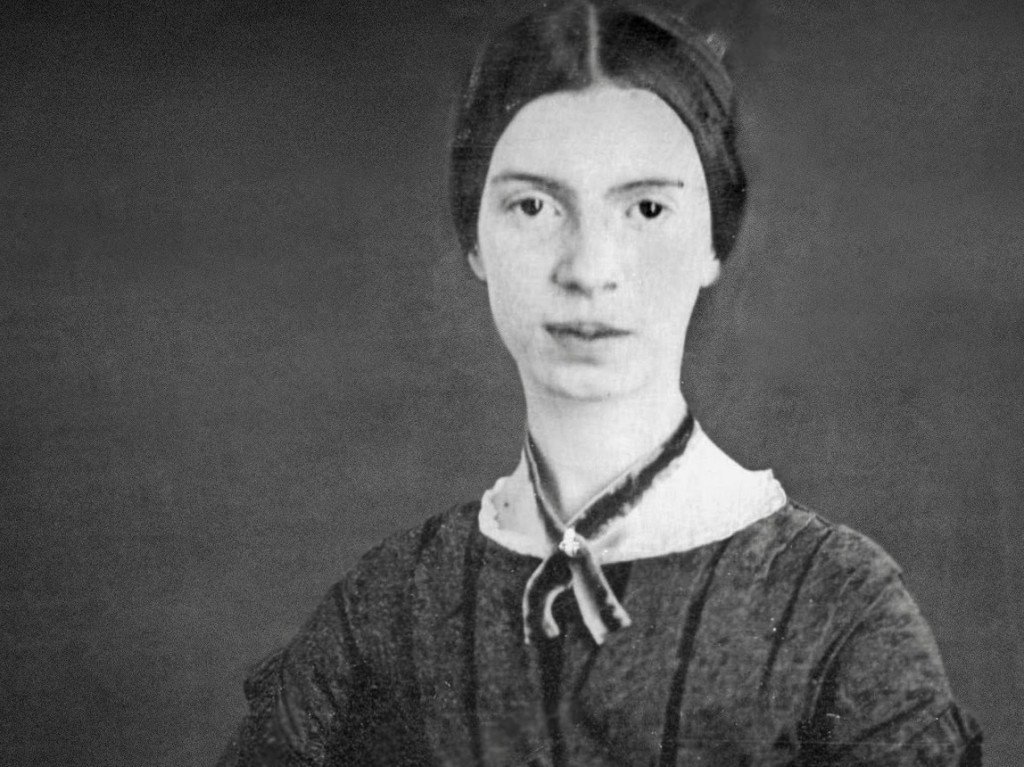
O holy night, what should my words do at this wishful time? Humans want their Charismatic Day. I sing when night thoughts star the dark familiar holiday theatre. A better poet’s art softens me when that cynical enmity threatens to make me disown praise. A poet whose mind frees its owned self brings a kindness I wish for, that isn’t about making sincerity shows for occasion. When Emily praised, the space between her verbs opened onto formless, ethereal consciousness and let us drift above its depths. Would that William’s verse animated our dinner conversations, or that his love’s eloquence seeped into family get-togethers! If only Gertrude’s jingles were intoned in the malls! People might buy back their lost selves, by paying visionary attention. Tonight may I give that sweet duende to those sad-hearted, whose gifts reach out hopefully toward undeserving takers. Christmas loneliness mourns the absence of fellowship that wants story and meaning, of kin that would strengthen our practice of love. We gather together to imitate a normal family that hardly exists, but our likenesses find pleasure in comforting avoidance, in taking sweet leave together from commitments. There are those happy families, resembling each other, whose intimacies we either inhabit or have to struggle to achieve. The rest of us love awkwardly, shoving purchases at family members, adding and subtracting from the account of our generosity. These poems delight a sensibility so sweet and acutely seldom cultivated, that despite their craft and expensive inspiration, they do not charm most of the fellow humans I treasure. Couldn’t the sonnet be how to make an occasion felt? What if instead of buying, we praised in mad flyting the epic mystery of our togetherness? Brother, for whom I stupidly forgot to purchase a thing, let this evidence of your gift prove your mattering to me.

x
x
LXXII

Hole was the mother, fucking. Women smashed. Pennyroyal tea drunks holding out for rupture. Loud substance, a fuck-you for teens to recite—what mess, a pre-Ritalin smellivision, a neediness murderess. Alt-bitch beauty contusions. Housewife on ludes. Love, after Grammy nods, after Kurt’s death—dogeared Love is on the floor, getting media requests. Little Frances is in Vogue. Prove your authentic pop-metal contempt, affect a high-energy nothingness, swore the nineties. Apathy approves the tuneless melody of fucked-up. Washington punk grrrls dated peevish boymen whose fuckboy mentality trivialized grrrls’ true hardcore sound. Sleater-Kinney and Bratmobile do more for me now than mainstream frontwomanned crews like Veruca Salt did – I was innocent, awkward, hanging around more popular party girls who threw up on boyfriends’ records, who teased Rollins boys with ambition. Niggaz barely registered in the truth-wound of plaid thrill-will; Fishbone’s singles played in campus late rotations but let’s face it: Olympia’s revolutionary sluts were acutely pale. Overanalyzing grunge may seem false, but its nevermind ethos informs the anti-sympathy humours of today’s hipster disinclinations. Its alternative to the spoiled, makework eighties rocked Billboard but felt meaningful and true—or maybe my nostalgia just remembers Bikini Kill subculture with more foreshadow than it deserves. My body, having dissociated the anger Dickless expletived, had faith no more but could thrash shame in mosh pits. No one ever mentioned riot grrrls’ lyrics to us, lines full of rape gripes and mock slut-shame. College douchebags played 7 Year Bitch’s anti-patriarchy CDs while coercing frosh virgins; bros being bros before there was a name for such dudes. How shocking that we could be yelling that loud, yet be so Lovelied, mouthing screams like sweet nothings we weren’t worth.

x
x
LXXVIII

The son of the father vanquishes the villain; the values spoken in undertones heretofore, now mighty: multiculturalism, liberalism, a blonde wife. Don’t misunderstand; I’m much relieved, less fearful of this heir than his predecessor. A critical stance in my verse was evidence of my contrary, alien penchant to that government; my words could be used against me. Order under the Trudeau theocracy will, surely, return poesy to its sponsored position? Poetry was once the nation’s keen mythbuilder, the stuff that taught the dumb Ontario high school kids to sing Acorn. Today what earnest verse can stay the ignorance algorithmically grafted into our flag-flying psyche? What kid grieves Canada’s debt to Sacred Feathers? In Toronto the liberal aura now reddens the right wing. I wake and give thanks to unknown grace that Canada’s troubled majesty’s government might yet be most proud of its Charter. The lines which I compose can register less war-whoop, less policed influence. “It’s two thousand fifteen” is the comeback from the golden child, born of the father, who includes mothers and wows dorks. I’ve been the brown mug for do-good leftists before; my trust wants mending, with more than style and nods to the arts. With defaced faith I try to answer to the poet’s grace and sing the braced heart’s belief in the boys’ clubs’ better natures. I’m Cohen’s ohm, saying Joshu was a rapist. I’m Duncan Campbell Scott’s masculinity, articulating Canada’s id. I’m those boys’ meritocratic ideal, my self-governance as highbrow as Literature’s. How now, Justin? How savage are my rude designs on your inheritance?

—Sonnet L’Abbé

x
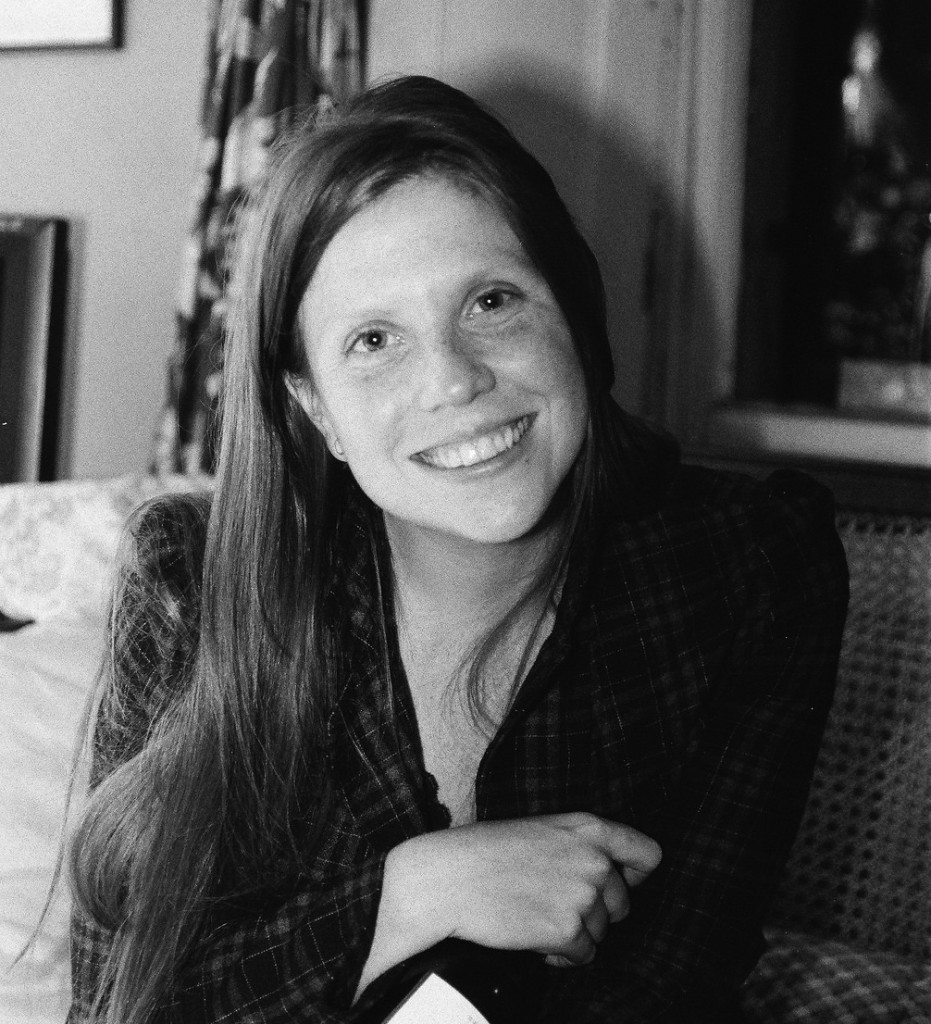
Sonnet L’Abbé is the author of A Strange Relief and Killarnoe, and was the 2014 guest editor of Best Canadian Poetry. Her first chapbook, Anima Canadensis, came out from Junction Books on November 19, 2016 at the “Meet the Press” Indie Literary Market in Toronto. L’Abbé lives on Vancouver Island and is a professor of creative writing at Vancouver Island University.

x
x

Feb 092017
 

Billy Mills

.
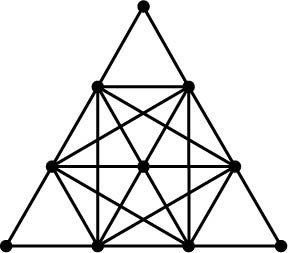
It’s a pleasure and honour to present these lines of verse from the Irish poet Billy Mills. This is the second section from Four, a work-in-progress, a seasonal poem with elements of the four seasons, the four cardinal directions, the four dimensions and the Pythagorean tetractys — a mysterious triangular figure made up of four rows of dots increasing from one at the top to four at the bottom (all sorts of marvelous hermetic and mathematical wisdom attached thereto).

CaptureImage via Digital Ambler

As Four follows the old Irish year, this is the spring section. Four is a collaboration with the composer David Bremner, who will set the complete cycle for soprano and instruments. To give you an idea of how such a collaboration works, here is video excerpt from an earlier Mills-Bremner piece, Logical Fallacies. The performers are Andreea Banciu (viola) and Elizabeth Hilliard (soprano).

.

§

one small bird
whose note’s heard
sharply pointed
………….yellowbill

whose notes fly
on Loch Laig
blackbird’s branch
…………..yellowfilled

.…..

  ……..  *

the buds signal
& sugars rise
plane of each leaf
opens slowly

unfolding its curved
surface to air
& dawn
ever earlier

& vivid with
life erupting
listen: it is
sun on the grass

crisp & flat
‘with all her hues’
that moment between
shower & shower

when nothing happens
but life itself
stirring the green
this sudden spring

sap flows
answer ascending
ask what it is
light eases through

the surface of things
as they awaken
as they arise
imperceptible heat

not heat but not
its absence
a softening
slowly thawing

earth.. water.. air
of which it is
the time not yet
the third is this

new surface stirring
tentative & alive
a mould supports
air’s burden

which is one
& many streams
converge the oak
draws in

that which it needs
is what it will
an aura defined
by light embodied

this morning low
glow cloud around
the far plane
glimmers everything

breathes again
blackbird sings
high in the trees
each to its

other catch then
now wind from
the east chills
incipient life

itself becomes
& is contra-
distinction skim
the skin of things

stretched fine
& breathing light
suffused flat just
as day breaks again

face it feel
the grain of air
refract the early
beam of life

ascending spring
it is now
softly smooth
it spreads itself

pushing through
earth’s meniscus
breaking green
the vivid air

—Billy Mills

.
Billy Mills was born in Dublin in 1954. He has lived and worked in Spain and the UK, and is now living in Limerick. He’s the founder and co-editor (with Catherine Walsh) of hardPressed poetry and the Journal. His books include Lares/Manes: Collected Poems (Shearsman, 2009), Imaginary Gardens (hardPressed poetry, 2012), Loop Walks (with David Bremner) (hardPressed poetry, 2013), and from Pensato (Smithereens Press e-book, 2013).

Since 2007, Billy Mills been a regular contributor to the books section of The Guardian website, including the popular Poster Poems series http://www.guardian.co.uk/profile/billymills. He blogs at https://ellipticalmovements.wordpress.com/.

.
.

Jan 132017
 

Marjan StrojanMarjan Strojan

x

Not in Noah’s Flood

They say, we write to remember and we read
to forget. Ignorant of either, I wished I could
write to grow up, especially the letter Y.
I’ve been practicing Y since I first saw it printed

on the covers of American picture books
arriving in U.N.R.A. parcels, safely tucked away
up in the attic. Y never failed to impress me,
looking both like girls’ legs pressed together

and the forked sprigs we broke off from the alder
trees to place our fishing rods onto when we were
going after the dace; and in my dizzier moments,
like the throats, slit open by broken bottlenecks,

of long coated dark men in cheery hats, who,
a few pages on, turned into corpses, floating in
booze or drowning in some other disastrous liquid,
but not, for all I could see, in Noah’s flood.

x
On Returning a Book to a Public Library

I’ll make this short. Days always surprise me.
So when I’m returning a book to a library
it doesn’t mean I’ve finished it or had no
intention of reading on. It only means that
despite its renewal the library’s lease has
expired and that the times and places and
extravagant fortunes of men, with the traditions
of various schools and institutions of knowledge,
secret societies and writings of all ages,
collected and arranged into chapters

or classified according to their alphabetical
order, have found themselves locked behind
the doors of inscrutable hallways, keys flung
away as carelessly as if they were dandelion
seeds. No doubt they will go on along
the corridors of some cerebral Hades weaving
their lives quite independent of those that
time and again I capture in my glimpses
scattered or overheard in chunks of
fragmented conversation, however inadequate.

So, in the cobwebs of Saint Petersburg’s
Railway Station (in snow) Madame Karenina
still waits to throw herself under a train.
And I’ll probably never find out what Vronsky
could have done at the time, if anything.
Tatiana never finished her letter, though I presume
she had turned down the poet, who ages ago,
in his small neat hand, had been scribbling
in his notebook the names of his lovers.
And Doctor Rieux, even he – what did he,

after the danger had passed, say to a writer
whose fast traveling ladies clattered around
Bois de Boulogne in their carriages – if, indeed,
he survived the ordeal? Is this important?
I don’t know; take the book I was bringing
back this afternoon. I can’t for the sake of me
remember who wrote it; even his middle name,
a common and well-known one, evades me
completely. A tiny collection of verse, like
scenes of renaissance architecture and its triangles

and elegant stairways in precise, condensed
light, the color of salt. It was a book of
poems which now, when forgotten, seem even
better, compact in the language of vague,
unruly translation, opening new and unexpected
prospects on each of its metaphors – sharp and
twofold – like ‘pillars’ and ‘horse.’ There was an air
of something conquering, victorious in far away
places about them, like a clang of a sword drawn
from a scabbard: Vincente Cortázar Paladio.

x
Remembering Hopkins

In our local Clinic stands a Tree of Health,
the branches of its richly grown crown
decorated by various inscriptions like Happiness,
Love, Good Personal Relations,
Friendship etc. Up the tree trunk
lines of multi-coloured twinkling fairy lights
lead on to them, which – in a circuit
as on big Christmas trees – then run down again
to the Tree’s mighty roots, bearing labels like
Recreation, Sleep, Nutrition and Relaxation,
Giving up Bad Habits, Healthy Sexuality, Hygiene.
Lord, send the roots rain.

x
Zinnias in Bloom

Zinnias in bloom; a train
moving on, departing: maids’
work on the balcony.
An electric pole – a hedgehog
trying to climb it: a palm tree
by night. The branch of an elder
bush dressing itself up in black:
the scent of its inflorescence
quietly glowing. Among the wild
rose petals a spider hiding from
the rain. Had it not gone into
hiding it would have stayed hidden.
Night gathers; the starlings flock
onto a sign-board: in the sky
a child from the long gone past
is happily singing. Rain descends from
the heavens; fire licks the star
by the edges. One me coming down
to lie on the earth.

x
Where are you?

I am sitting in the doorway
under the light; the grass is darkening,
the stream below the house
sounds clearer. I’ve been waiting
for I don’t know what, for you
to call me, for weeks. And now –
not in the house, here outside,
from over the hill, from the stream,
from the wind through the branches,
your voice sounds, soft and clear –
Where are you, what are you doing?
Moths are settling on my head.
They are drawn to what’s in there
and want to get to you.

—Marjan Strojan translated by Alasdair MacKinnon

x

Marjan Strojan (1949) was raised on a small farm in Slovenia. He studied philosophy and comparative literature, and he has worked at one time or another as a baggage carrier and load-sheet-man at an airport, a film critic in Ljubljana, and a journalist in London. He lives in Slovenia.

Strojan has published seven books of poetry and many translations, including Beowulf (1992); James Joyce, a selection of his poetry (2000); Lavinia Greenlaw, a selection of her poetry (2000); Robert Frost, a selection of his poetry (2001); John Milton, Paradise Lost (Izgubljeni raj, 2003, 2011); Sydney Lea, a selection of his poetry (Na votlem ledu, 2006), and Geoffrey Chaucer, Canterbury Tales (Canterburyjske povesti , 2012). In 1997 he published his Anthology of English Poetry (Antologija angleške poezije). His latest books are William Shakespeare, Songs from Plays (Pesmi iz iger, CZ, 2016) and Marjan Strojan, Dells and Hollows, Autumn Hill Books, 2016.

x
x

Dec 132016
 

ilhan-berk

The Book of Things enters the agonistics of English language poetry not as a Berkian, but rather a Messoan text, an English text on the scene of English language poetry. —D. M. Spitzer

book-of-things

The Book of Things[1]
Ilhan Berk
Translated by Georg Messo
Shearsman Books, 2016
310 pages, $23.00

.
Where ends, where begins The Book of Things? The straw and russet ground of its cover, the obverse where dark lines like shadows render in positive the title, in contour a tilted figure—recumbent, off-center, nude? The reverse, where dark lines form letters, sentences, text about—here, with emphatic prepositionality—the text? If the latter, the action works centrifugally: which text? The publisher’s statements at the top address Ilhan Berk’s work as “Unparalleled in the English language.” In the third paragraph, the endorsement by Talat S. Halman, the poet is identified as Turkish; Halman declares that those who delight in Turkish poetry—already as slick a category as the the mud and slug mentioned in the publisher’s description (poetry written by people identifying as Turks? Written in Turkey? In Turkish? In Roman or Arabic script, or both? With pre- or post- Atatürkic reform conventions?)—are thankful to George Messo for “faithful and artful renditions.” The reverse seems to indicate a text by Ilhan Berk that defies parallel with English language poetry, establishing an agonistic context for the work, but also a notion of the involvement of Ilhan Berk’s text within that context. However, the book does not present a text by Ilhan Berk. It presents a translation by George Messo; the obverse so testifies in a font absorbed by the palette of the ground—a painting by Ilhan Berk, as the reverse establishes—and by the much larger font for the “author’s” name, uppermost and greatest on the author’s poluchrysaic field. The centrifugal action of the reverse hurls attention from the translation presented in the book and towards another book, one written by Ilhan Berk. The Book of Things is not that book.

The Book of Things enters the agonistics of English language poetry not as a Berkian, but rather a Messoan text, an English text on the scene of English language poetry. The agonistics occur reflexively, upon the book itself, its outwardness, where translator and author, English and Turkish collide and grapple for identity. The only identity available to them, however, is that of non-identity. The play of resistance strives upon the face of the book, where the production, the book design, occludes this non-identity of the translation and a text by Ilhan Berk, a shadow text, a spectral text, elsewhere, immaterial, nevertheless haunting this text: the first leaf bears the lasting haunt of the spectral text in the title beneath—as if grounding—The Book of Things, Şeyler kitabi. Testimony of the inseparability of the two texts that constitute translation. Testimony to the separateness of those two texts: “While 1 pioneers its darkness / 2, as if slashing with a knife, divides 1 in half”; “2’s hardheartedness comes, for sure, from 1 wanting to bind everything / to itself” (Messo 168). The Book of Things comes forward as a thing, reified by its design and attempting to assert its unified identity, yet the fact of its having-been-translated resists, recoils. On the edges the identity frays: where the uppermost entry on the contents page is “Interview with the Author” (Messo 8-11), the final entry is “A Guide to Turkish Pronunciation” (Messo 309), all in English, all in translation.

Rather than project Messo’s text, as if it were a mere simulacrum of, or even further, identical to Berk’s text, into relationships with poetries of the historical moment in which Berk activated and released a Turkish language into poems—with modernist poetries, late 19th century French poetries, for example, as Peter Riley has done in his review of The Book of Things in The Fortnightly Review[2]—Messo’s translation might converse better with of those figures and their poetries seen to be of importance in a reading of Berk’s work. The work under review is, after all, not Şeyler kitabi by Ilhan Berk, but rather, Ilhan Berk: The Book of Things, by George Messo. How, then, does Messo’s text comport itself with recent English translations of these poetries? To advance such a project would make use of a stereoscopics that suspends in view each author’s (Messo and Berk) context and the language matrices where their voices develop, cycle, and gestate. This question will not be pursued here, but it may provide an illuminating way to position a review or critical reading of Messo’s Ilhan Berk: The Book of Things that would bring into focus the translation, its context(s) and significances.

Within and between the paratextual material, the text’s three-part architecture moves from “THINGS THAT COUNT / THINGS THAT DON’T” through “LONG LIVE NUMBERS” to “HOUSE.” Of these, the first spreads out over one hundred thirty-five pages, nearly half the pages of the book; the second, over ninety-two pages; the third, fifty-three pages. Each previous section exceeds its sequel by approximately forty pages; the sections diminish in a regular fashion through the book’s unfoldings. The poetry takes place as and within this architecture, in the same sense that the house is (or can be) a home, though the two are not identical. In Messo’s Ilhan Berk: The Book of Things, multiple ways of articulating the book’s architecture come into play, pulling at the non-identity of the house|home relation. Here are two ways of reckoning the inner-architecture:

1)    within part one, “THINGS THAT COUNT / THINGS THAT DON’T,” are nine sections, most or all of which could be considered poetic sequences

2)    part two, “LONG LIVE NUMBERS,” has four sections that are not sequences

3)    part three, “HOUSE,”

1.    a.  is composed of twenty-four sections, some of which could be construed as poetic sequences
2.    b. is composed of five sections, some of which could be construed as poetic sequences.

Just as with the poems whose “meaning is seldom grasped” (Messo 22), the very organization waivers in its function as organon. Several meanings might become available, and this diversification at every level of the book may be one way of the overcoming of meaning, raised in the poem “Lyre,” which forms a condition for poetry or, at least, for talking about poetry (Messo 21); another possibility is that no meanings become available, only the bruta facta of the book. If option “a” is followed for describing the organization of “HOUSE,” the overall organization disrupts a consistency or self-similarity between parts and sections: against the reduction of parts’ lengths works the dual motion of a reduction in the number of sections from part one to part two, ending with a vast dispersal of particulars in “HOUSE.” Developing option “b,” on the other hand, would let the book engage in some of the arithmetics found throughout, but particularly in its final moment “WINDOW,” where subtraction of leaf from house gives window (Messo 282). Subtraction: take part one (9 sections), subtract the sections of part two (4 sections), and the five sections of part three remain: 9-4=5. The book both authorizes this type of scrutiny and derides it as the work of the eye:

Partitioning, encoding, freezing still.
An image predator.
Where in the house, it says, is better to see outside?
(Window believes the view is there for itself.)
Its presence too is indebted to absence.
It has grabbed the world before it.
(The window faces forward.)

Is it a child passing by?

‘A child’s passing!’ it will say. (Messo 282)

Predatory, an optics that brings things to a standstill, is the eye; the poem levels charges against the eye immediately following the subtraction of leaf from house, the book’s final arithmetic statement. Messo’s text will summon and resist this kind of operation by which the book’s organization moves along and out of the numbers. And note that the child’s passing (‘A child’s passing!’) both figures the disfiguration of the book-as-house by the overdetermining subject and prefigures the book’s own end—“Balcony, / the house’s alcoholic child” (Messo 306; underlining added), sounding “child” into the demise of paratext, the chaos of a pronunciation guide to a Turkish that isn’t there, the absence constituting, giving rise to, behind and motivating (presumably), the whole book.

The book’s organization itself animates an interrogation of its title and its section titles. An ambiguity sways across the grammatical regions of a genitive construction not fiercely determined by a context: the things’s book, a book belonging to things; the book pertaining to things, where things are the objects towards which the book is related. An undecideability hovers in the title even as the terms of a relationship stand firm: things and book, primarily; then also, a dynamics between plurality (things) and singularity (book); of generality (things) and specificity (book); lastly (but likely not finally), in an even more rarefied sense, concept (things) and object (book). In its non-linguistic moments, The Book of Things offers a figuration of this dynamics from a Christian illustration showing the modes of relation among the persons of the holy trinity (Messo 219). The possibility of the triune deity depends on both the non-identity of its elements as they relate to one another and the identity of its elements with the central term, deus. So the image composes the nexus of relations in circles for each member of the trinity (pater, filius, spiritus sanctus) triangulated around a smaller, central circle in which deus is inscribed. Each circle is an angle of the triangle, with channels connecting them with the words non est, while the channels linking each circle to the inner circle say est. The book, itself triune, finds itself reflected in and reflecting, in its own organization, the imago dei and its entanglements of being and non-being.

Within each of the three sections circulates a variety of poems and things, images of things. Early in the volume appear re-imaged objects—images of images of things such as a paint roller, a pin, jewelry, garden shears (Messo 16-17). The representations defy a single scale of reference apart from the reader|viewer’s experience of them and the near-legislated mapping of that experience onto the images as given, such that, although the reproduced image of a hairpin exceeds in size that of the paint-roller, a scale drawn from experience of those items operates against what is given and produces a dissonance. Each page contains what appears to be a collection of four separate images of things placed upon a single ground then re-imaged—photocopied, scanned, photographed—as a composition. The volume thus opens the ancient three-part distancing of mimetic art from reality.[3]

How does a viewer|reader engage such pages? Are they read? Does their arrangement address something, mean something? Turning on itself as reflexion, the following page inquires “—If objects had language, what would you want them to say for you? / —I would want every object to say, all together, ‘He’s one of us’. / I have abided by the untouchability of things” (Messo 18). And again, poem turns on itself, thing reflecting thing: “The poem is where the word disappears, the place where it is /  almost impossible to fix meaning” (Messo 24). In the book’s opening through images the word disappears and meaning is, from the outset, suspended, entered into the chaos “where reality reaches its / furthest limits in language, where that relationship between language / and reality’s other side comes to a halt, and how it comes to a halt”(Messo 21).

The more attention falls on these pages of images near the book’s opening the more evident become the different tonalities of the dissonance: the jarring and hectic strain energized by this collision of given and thought, to borrow from Immanuel Kant modes of subjective encounters with objects.[4] The collages stage an insurrection against “the subject’s sovereignty” by, in concert with the objects of language, becoming somehow object-centered and thoroughly resistant to the rulership of the “I”: the work seeks “To draw near to the subject from all / sides; but never fully grasp it; only to circle it; to start going round again / just when you draw near…” (p. 21). This dizzying cycle rattles the presumptive subject-oriented relation to things, where the subject subjects objects to the grasp and threat of its conceptual epistemics.

This relation the book seeks to undo, problematize, or at times invert. In a dialectical reversal spoken in the alternation of the title of part one from all capitals to all miniscules, the reader|viewer takes a position early in the book as a thing among and opposed to other things: “THINGS THAT COUNT / THINGS THAT DON’T” becomes “things that count things that don’t” (Messo 13, 15). Undoing the line-break shifts the whole phrase. Count moves from intransitive in the all-capitals instantiation to transitive in the miniscule, implicating human beings as those who count things that do not count other things, i.e. that are do not perform the cognitive operation of enumerating. But it does not seem to be an indictment. The book asks to be counted even as it cancels parts of itself, as in pages of text overlaid with “X” as if destined to be excised (Messo 221-223). So Messo’s Ilhan Berk: The Book of Things reaches through and beyond itself: “Anyway, to reach out and grab the outer edges of things is to be in / the world” (Messo 255). Here—at this very moment in the book’s work, in the alphabetized three-columned (triune!) list that opens the sequence “house I” (255), the translation ruptures the spell of identity.

—D. M. Spitzer

N5

d-m-spitzer

D. M. Spitzer is currently a doctoral student at Binghamton University in the Philosophy, Literature, and Theory of Criticism Program within the Department of Comparative Literature. He  works primarily on early Greek thinking and its modern and contemporary reception and on translation theory. In August, 2016, Etruscan Press published his book of poems, A Heaven Wrought of Iron: Poems from the Odyssey. Recent work has taken the form of collaborations with his wife, Sara Shiva Spitzer, a visual artist. He live in Harrisburg, Pennsylvania, with his family: Sara and three children Maya, Ani, and Luna.

.

.
.

Footnotes    (↵ returns to text)

  1. Special thanks to Sevinç Türkkan for bringing this book to my attention & for motivating me to write this review.
  2. Riley, Peter. “Poetry Notes.” The Fortnightly Review. http://fortnightlyreview.co.uk/2016/06/ilhan-berk/, 28 June, 2016. Accessed 29 October, 2016.
  3. Plato. Res Publica. Platonis Opera, Vol. 4, edited by John Burnet, Clarendon, 1902.
  4. Kant, Immanuel. Kritik der reinen Vernunft. Könemann, 1995.
Dec 112016
 

nepveu-pic

.

The prose poems brought together in this selection are infused with the landscape along the shore of the Saint Lawrence River in the south-west part of Montreal, adjoining the neighborhoods of Verdun, Lasalle, and Lachine. The section “Lachine Stations” makes a more explicit reference to the area of Montreal in the south-west, upstream from the rapids bearing the name “Sault Saint-Louis” at the time of New France. Until the opening of the canal in 1825, enabling one to bypass the rapids, Lachine was the departure point for the “voyageur” canoes, hired by the great companies engaged in the fur trade in the north-west. Those pages of “Lachine Stations” devoted to the fictional character, Jean Mongeau, sketch the portrait of one of those singular men who became voyageurs. They were inspired by Carolyn Podruchny’s book, Making the Voyageur World: Travelers and Traders in the North American Fur Trade (University of Nebraska Press and University of Toronto Press, 2006), translated into French by Anne-Hélène Kerbiriou, as Les voyageurs et leur monde. Voyageurs et traiteurs de fourrure en Amérique du Nord (Presses de l’Universitè Laval, 2009) – as well as the book illustrated by Gilles Bédard, Les voyageurs d’Amérique (Éditions GID, 2012). I extend my thanks to both authors, to whom I am greatly in debt.

—Pierre Nepveu

.

Notebooks of Jean Mongeau,
…….summer-autumn 1803

I walked by the edge of the wood,
torn between the grain’s fervour
and the chill exhalation of ferns.

I had either to stay or to leave.

In me, life sickened
each day a bit more

and my soul was heavy with loss
God-divested and imploring
life’s grace be restored to me.

I loved you, Marie, but it was
a music unmastered, a lame plod,
my hands grasping at the void,

while voices on high called to me, fraught,
nameless, faceless voices,
and I gave heed to them in the forest, wanting
to cede them my moorings, my lodgings,
while our dog, who yapped far off
in the hay at high tide
somehow knew
he was no longer my vassal
and that he’d lost me..

*

Sometimes I see again the road leading to Lachine,
I hear the cart squeal
that carried us out of the city
weighed down with horses and tipsy sailors,
and all along the port we saw
large-skirted women whose beauty
tore at us suddenly like a farewell,
I remember having hailed one of them
with my hand, and having blushed
at the smile she tossed me,
then it was a rough forest trail
along the Sault Saint-Louis
where you felt the presence, both hidden and near,
of the humid river that would bear us,
its water luminous as a deliverance..

*

The eve of our departure we’d danced and drunk long into the night. Something held us to the land, drunk as we were and near to madness, like those sailors who in the end repudiate the sea, too wide, that renders alien, to the soul’s peril, the nearness of bodies and things. Then we left in the direction of Nipissing, the Big Water, and we were greeted by Algonquin women, all comely, save an old toothless one who smiled like the others but seemed the very embodiment of death.

***

(Inventory for loading):
– twenty rifles.
– thirty boxes of gunpowder.
– thirty boxes of lead shot and balls.
– twenty wool blankets.
– two big rolls, blue cloth, red cloth.
– knives, scissors, hatchets, awls, sewing needles, lighters.
– flour, sugar, salt, dried meat.
– two boxes of jewels: necklaces, earrings, bracelets.
– a bag of red powder to color the skin.
– mirrors, magnifying glasses, decorative porcelain, glass pearls, brass and steel wire.
– Thirty shirts, thirty ceintures fléchées.
– tobacco, brandy..

*

I kneeled a moment
in the last church
then I feared the wind
and I shivered..

*

On leaving: a baptism of peace
and light to bless two lakes.

I thought myself a new man
armoured with hope and prayers
and a providence of rocks and cascades
and fierce rains to freeze the soul,

but I found prairies first,
a great sweetness of grasses
and the night with its shrillness of crickets,
the distant pounding of a drum
rising from a village beyond the fields

I miss Maskinongé already,
but I sense a fire within me
never before felt, a strength that defies
its trials as the days pass and I reach
that breaking point where my body
must sing if it’s not to sleep,

I think of you, Marie, alone under the quilt
naked and warm in the lunar room
entering a long languorous summer
a deep fever of silence and idleness,

while far up I voyage within myself,
seeking valor in exhaustion
and knowing no more the reasons for my flight.

*

For days La Grande River
was our only home
along with the obsessive lapping of the paddles
counting the seconds and in the process
undoing all hope of reaching shore and sleeping there,
until the sudden squawk of a bluejay
entered my ear and in a trice
I stopped feeling my arms
and my hardened backside and my bent legs
and it was like a clearing inside
as if the landscape
had at last found in me
a place to lodge its light.

*

After La Grande River and the hard law of rocks
that seemed to assert on earth
God’s dominion over human failings,
we encountered the ghastly La Vase Portage,
all the world’s hardness abruptly undone
all matter molten and the ground stripped away
under our boots and it seemed to me suddenly
that evil was rampant in this place
seeking to cow our courage,
as if we’d broken faith with our own desire
for a combat on equal terms,
and against all expectations tainted the assurance
of a rugged land and pure water
that would christen us one more time.

*

(Letter from Marie Saint-Arnaud to Jean Mongeau, October 1803)

The house is empty of you but I often pass
your shadow in the dark, I feel
your breath rush upon me,
your handsome charmer’s mouth
bite my breast,
but I’d love as much
for your voice to wrap me round and shelter me
from the hardness of the world
for you said things with wisdom
and swore love with that gentle tremble
that makes men’s voices falter
when desire undoes them,
I’d like tomorrow to be filled
with your body and your hands,
and your peaceable step when at the window
I saw you going by the fields
towards the dark edge of the wood
when all the day’s power
seemed yours
as if your heavy gait
enjoined it to yield,
tell me on what river do you paddle,
on what lake and if the time is long
crossing over hills with a heavy burden
and if the black water sometimes brings you fear
and if it bears off comrades
who have not kept their footing.

*

Early morning, scarred fire, noble bones, woodland song, men’s and women’s voices among the trees. I am the dust of ages, whirlwind of the deeps, escapee from the first caves. I tremble at being what I am, do you hear me, woman of the woods, of wool woven under the lampshade and the trellis of blood that shivers in the window? Do you know the calendar of wounds and joys that appear, at times, when night and day conspire to undo order and reason, when limbs are harnessed to other limbs to shift the weight of dread? Who are you? I founder in another river that becomes another lake that becomes a new river. Sometimes the running water no longer suffices for the needs of man and sometimes supplies must be shouldered, without horses or donkeys, to sidestep death. This business destroys us, yes, but to live is something else again, and the nightly feasts, and the dried bison and the bear fat that smears our fingers. We are beset with hunger before the rock that quakes. We are mad not to bow low before this god.

*

Despite the splendor of these paddler’s arms,
it’s the soul’s indigence
and human weakness
that have brought me here
to this harsh land and load-bearing water,
the treacherousness of roots
and the astonishment of animals,
me chilled to the bone,
unnerved by rains and frothings,
loving kin to whispering grasses
and thrown full force onto stoical rocks
against which at times I lean my ear
towards the far-off realm when time
laboured sedately and in darkness.

*

Spare me this rise to climb, these slimy stones beneath my soles, this fatigue of bodies that know only steepness and stumbling. There is anguish too great for just one man, and regrets that smother the soul, when prayer’s succor is all for naught. Give me back the ardour of forests and the burning pine needle carpet, give me back cold springs and the gentle drift in the carefree bends of rivers sheltered by the sky and the brows of rocks. I see far off the great prairie open wide, riddled with mosquitoes, and the banks of the Red River where, they say, the peoples of this land grow grain. And on the lakes at night the Northern Lights cast a spell and set even the stars to dancing. You arrive wearied at the trading posts, you gorge yourself with oily corn and draughts of rum, and unknown languages rip at your heart. You never come home, and you hear in the distance a great rush of dust and sand rise up which, out of the south, foists thirst on man and beast and makes drought a primal verity, underpinning all gifts and the glories of love. Restore to me, Lord, the blessing of this desert, spare me the hard road back.

*

Rock me, rock me, take
my broken body, my routed heart
for I lost my footing,
slid on a solid stone
while seeking support,

saw the water darker
than the deeps of our souls
and the time of man
shrunk to nothing,
rock me for what remains of beauty
when the foundering sun
shuts the book of wonders,
the sweet legend of a peopled world,
while the rapids far off, their froth abated,
roar on through the night
like beasts that stalk their prey.

Rock me, woman who douses the lamp,
go to sleep now alone so as to feel no pain,
I journey on under a heavy weight
and eternity is for me a deep chill,
my solitude counts for less than your own,
it vexes even the dusk
where I seek forgiveness in vain.

— Pierre Nepveu, Translated from the French by Donald Winkler

.

Pierre Nepveu is a poet, essayist, novelist and professor emeritus at the University of Montreal. Since 1971 he has published several collections of poetry, primarily with the Éditions du Noroît, including Romans-fleuves, Lignes aèriennes, Les verbes majeurs, and most recently, La dureté des matières et de l’eau, which appeared in 2015. In addition to his essay collections dealing with Quebec literature and the literatures of the Americas, including L’écologie du reel and Intérieurs du Nouveau Monde, his is the co-author with Laurent Mailhot of the anthology La poésie québécoise des origins à nos jours, which has appeared in several editions. He published the biography, Gaston Miron. La vie d’un homme, in 2011. Several times a winner or finalist for the Governor General’s award, he is also a member of the Royal Society and the Order of Canada.

§

wiinkler-pic

Donald Winkler is a Montreal based documentary filmmaker, and a translator of fiction, non-fiction, and poetry. He is a three-time winner of the Governor General’s Award for French to English translation, most recently, in 2013, for his rendering of Pierre Nepveu’s collection of poetry, The Major Verbs (Les verbes majeurs). His translation of Nepveu’s most recent collection, The Hardness of Matter and Water (La dureté des matières et de l’eau), will be published by Signal Editions in 2018.

.

Dec 052016
 

elsa-crossElsa Cross

.

This month’s edition of Numero Cinco finds our newest addition to the NC masthead, Dylan Brennan, speaking with translator Anamaría Crowe Serrano about her work with Mexican poet Elsa Cross. They discuss Serrano’s involvement in bringing Cross’s work to an English audience, as well as the difficult decisions translators must make when doing so. 

After the interview, we have a selection of poems by Cross, both translated from the Spanish by Serrano and in their original language.

— Benjamin Woodard

.

Dylan Brennan (DB): How did you get involved in this project?

Anamaría Crowe Serrano (ACS): I’ve been involved with Shearsman Books for several years, first with a collection of my own, and then with translations of some of Elsa’s poems that were included in a Selected Poems in 2009. The editor, Tony Frazer, publishes several titles in translation every year – as well as collections in English and the Shearsman poetry journal – and at some point he asked if I’d be interested in expanding on the original translations I had done. I didn’t have to think about it twice.

selectedpoems

DB: How much did you know about Elsa Cross beforehand and how much did you have to learn as you went about translating?

ACS: I had met Elsa in London at the launch of her Selected Poems, so I knew a little about her. She teaches philosophy of religion and comparative mythology at the National Autonomous University of Mexico, and has published extensively, but I am always curious about the person behind the biographical note. It’s a bonus when I can make some connection with the poet I’m translating because I like to enter the poet’s world. In some ways translating is a little bit like method acting – for me, anyway – in that I like to absorb the poet and his/her mood if I can, in order to translate the work as faithfully as possible. It means that I adopt a slightly different persona each time I translate a different poet, and it’s one of the reasons why I’m not particularly experimental with the text of the translation itself.

What struck me about Elsa during our conversation in London was that her poetry reflected her personality: gentle, contemplative, self-assured. It seemed that the mysteries and uncertainties inherent in the world around us, which philosophy constantly probes, rather than cause angst, in some paradoxical way provide a source of strength for this poet. I got a sense that she accepts that not everything can be known, and there’s comfort in that place of acceptance. The idea of immersing myself for several months in Elsa’s poetic world and worming my way through her raw material was very appealing. As I’ve said, I had already translated some of the first section of Beyond the Sea, so I was familiar with Elsa’s style as well as the setting for the poems. Her collections are often written against the backdrop of a particular locale which works as an anchor for her thoughts. In Beyond the Sea, we find ourselves in Greece. The sound of waves, cicadas in the afternoon heat, plants stirring in the breeze, wings flapping, ancient ruins, are a constant accompaniment, like a leitmotif, to the philosophical thoughts and questions posed in the poems.

DB: Did you get in contact with Elsa Cross to discuss the poems? If so, how was that? Did she have any role in the translation process?

ACS: Yes, I did. I think all translators have questions about the text, so it’s an advantage to be able to ask the poet directly. In this case Elsa was very generous with her answers, clarifying specific words or images or nuances, such as what kind of “filo” she meant in the first line of poem 5 of “Dithyrambs”. I wasn’t sure if it might be a blade, a trickle of some sort, a thread… It’s wonderful to be able to consult the author because it means that the end result is as close to the intended meaning of the original as it can be; there’s very little guess work on the translator’s part, although individual lexical choices and phrasing are ultimately subjective. In my experience, poets are always happy to collaborate with the translator if they can because a translation can seem quite alien to the poet. Poets get attached to their specific lexical choices and even to the spaces between them. Every word of the original is so charged for the poet that it can be a terrible disappointment to realise that the translator has misinterpreted something that is very meaningful to you as a poet. Having some control over the translation process goes a long way towards assuaging those concerns.

Elsa’s English is excellent, which meant she could make very useful suggestions. The draft translation that was emailed from Dublin to Mexico City and back many times is peppered with comments ranging from uses of the definite article or prepositions or possessive adjectives, to whether the translation should include footnotes for words such as “tezontle”, to what the subject of a particular verb is (given that it’s not always specified in Spanish, which can sometimes allow for ambiguity, whereas it must be specified in English, destroying the ambiguity).

Over the years I’ve come to think of a translation as the child of both the author and the translator. A translation contains the linguistic DNA of each through a process that explores language at a microscopic level. When the translator can work with the author, the symbiosis is more complete: the child resembles both its parents more closely than it might had there been no collaboration between them. In Beyond the Sea, Elsa’s input was so valuable that I suggested the cover should read “translated by Anamaría Crowe Serrano with the author”, but she was too modest to want to claim any credit for the translation.

beyondthesea

DB: Is translating poetry something you find easy or do you find it agonizing at times? What about the Greek elements of the book? Something you had to research or was it all known to you already?

ACS: Sometimes you come across a poem that you can translate quickly; the words just come to you and the result is satisfying. But those occasions are rare. Usually it requires many hours of thought – more than might seem apparent from the length of a poem. The end result that appears in print is just the tip of the iceberg. Beneath that tip lies the bit the reader never sees – the process – which for a collection could be up to a year’s work. But I absolutely love translating. (The only thing I agonize about is the inadequate pay, completely out of line with the hours and skill involved in the process.) Lines or words that are problematic might take several days – or longer – but the process is hugely enjoyable, like trying to solve a difficult brain teaser. The funny thing is that often what seems relatively easy to translate, where the language itself is simple, might turn out to be the hardest thing because you want to avoid using a particular word (if it had been used before), or you want to keep the rhythm of the line nicely balanced and the literal translation won’t work. In the second line of poem I of “Las cigarras” (Cicadas), for example, the line reads: “las cigarras empiezan sus odas lentas” (literally: the cicadas begin their slow odes). There’s nothing complicated about the language here, and “the cicadas begin their slow odes” is acceptable in English except for the fact that I didn’t like the strong vocalic assonance of “slow odes”. If you say it aloud it sounds like you’re trying to say something with an egg in your mouth. I’m conscious of the phonic effect of words, so semantic exactitude doesn’t always satisfy my ear. The problem then is that there are so many synonyms of “slow”. It took me ages to finally settle for “unhurried odes”, which also reflects the lilting, languid rhythm of the original.

There are many references to Greek mythology in the collection, some of which I was familiar with, and some not. A quick online search can clarify that a kouros is a free-standing statue of a young boy, often a representation of Apollo, and while any reading of these poems is richer if you are familiar with the Greek references, from the point of view of translation, once I could find the English equivalent, lack of detailed knowledge about artefacts or gods was not a significant problem.

DB: Any crossover with your own work, similar themes or styles?

ACS: Not really. The work I translate is quite different in theme and style from my own work. That has happened by chance, but I’m not sure I’d like to translate someone’s poetry if it reminded me a lot of my own. It’s nice to take a break from the usual preoccupations and discover other ways of writing, images that would never have occurred to you because they’re very foreign or because they come from a discipline that you don’t often engage with. The process of discovery adds to the pleasure of translating.

DB: I’d love to know of any difficult translation decisions, if there were any for you, what were they, how did you go about resolving them?

ACS: The use of idioms often poses problems for the translator, of course, resulting in the classic case of something being lost in translation. There was one instance of that in this collection with the word “cántaros”, which are clay pitchers or jugs for water or wine. It appears as the title of one section in “The Wine of Things” and is also repeated in several poems in a general way. But it’s also used in the expression “A cántaros”, which means “cats and dogs”, as in “it’s raining cats and dogs”. Clearly, when it’s used in Spanish to mean “cats and dogs”, none of the generic English translations works. It’s a shame because it means that the repetition of the word throughout the entire section is slightly lost. Not only that, “cats and dogs” has a totally different connotation in English compared to the Spanish “cántaros”. Cántaros are receptacles, for a start. The fired earth they’re made from has some echoes of antiquity and domestic labour. In comparison, “cats and dogs” sounds completely trivial at best, and if we take the origin of the phrase to be related to Jonathan Swift’s “A Description of a City Shower”, where cats and dogs drown in the downpour and flow along the flooded streets, then it’s completely disgusting. Either way, it won’t work as a translation. Another option might be “pouring” or “pouring rain”, but you lose the image of the container. In the end, I opted for “Bucketing”, even though the tone is a bit colloquial.

That presented yet another problem. The cántaros of the title should ideally be the same word that is used in the poems. I had opted for “pitchers” as a generic translation, with “bucketing” when referring to rain, but I didn’t like either of these as a section title. I suppose I might have settled for pitchers and been forever dissatisfied with its ambiguity had I not mentioned the problem to Elsa. Her solution – to use the Greek word “kantharos” – seemed perfect. Not only does it encompass all versions of kantharos (jugs, pitchers, buckets), and is in keeping with the Greek setting of the entire collection, it slightly elevates the tone of the more common “cántaros”, making up to some extent for the fact that the idiom is lost in English.

The other translation difficulty that arose was in the Aeolides, Oceanides, and Nictides sections. Here, the poems are of haiku-like brevity, often beginning with a verb conjugated in the third person plural (“they”). The subject is the daughters of the wind, sea or night, depending on the section in question. The fact that Spanish does not require the subject pronoun to be stated – because it is incorporated in the verb conjugation – allows for a profusion of lexical diversity in each poem. Here’s an example from “Eolides, 7”:

Despeinan
…………..al joven eucalipto
hacen caer sus resinas
……………………………..sobre los barandales

Zumban amorosas
como abejorros
………………….en el hueco de las cañas

Llenan la mirada de hormigas amarillas
……………………de la avispa

English, being a language that requires the use of the subject pronoun, would transform each of the verbs (Despeinan, hacen, Zumban, Llenan) into “They uncomb”, “they make”, “They buzz”, “They fill”. Repeating the subject pronoun in each line of such a short poem creates unpoetic monotony compared to the breezy freshness of the Spanish. Avoiding the subject pronoun so often – there are many of these poems in the collection! – was probably the single greatest challenge that required various different solutions. Sometimes I use the subject pronoun once at the beginning but don’t repeat it for the second verb, in the hope that it will be understood to be implied, or I use gerunds for subsequent verbs. That’s what I did in the above example (They uncomb, making, Buzzing, Swarming):

They uncomb
…………………….the young eucalyptus
making its resin drip
…………………….on the handrails

Buzzing, amorous
like bumblebees
…………………….in the hollow stalks of canes

Swarming our gaze with yellow ants

On other occasions I changed the word order and/or the grammatical function from active to passive so as not to begin a line with the subject.

Someten a su ritmo                         (They subject…)
………..las flores encrespadas
………..el lomo de los cerros

Todo lo vuelven piedra lisa                      (They turn everything…)

becomes

Rimpled flowers
and hilltops
………..are subjected to their rhythm

Turned by them to smooth stone

DB: What do you think of the poems? How would you describe the book to someone down the pub? Why should people read this book?

ACS: If you don’t know Elsa Cross’s poetry, this book is as good a place to start as any. It’s a bilingual edition, which is always useful for the reader. Cross is considered one of Mexico’s leading contemporary poets and has been praised by Octavio Paz for her interplay of complex thought and clarity of expression. In my opinion, this is the key element in her work. There’s a strong sense of the poet sitting still, absorbing her surroundings through the senses first of all – sound, sight and touch in particular – as if she were meditating, then very deliberately using these senses as a conduit to something deeper. Small details of nature, or of a Greek statue, have the potential to reveal something worth knowing, but the slightest sound or movement, even too much sunlight, can shatter any meaning that might be contained in the moment (“meaning becomes / an incongruous stroke, / a particle that marries with dust.” Stones, 4). The elusiveness of meaning marries with vivid imagery ever so delicately, even when the poet paradoxically finds the image devoid of meaning. Take, for example, the opening of poem 3 of “Cicadas”:

The night swings
on the call of owls hooting.
Flapping,
words heard in a dream
……………………………take flight
at the sound of the first cicada
now fitfully cutting
……………………the silence of dawn.

Words wanted
……………………beyond what they are—
yet when we try to grasp them
their flight is slowly undone
………………………………like ritual gestures.
They empty of image,
are no more than voice—
……………………gloomy alliterations
……………………in a lower key,
resonance,
……………………the sea’s craving for its creatures.

I love her exploration of the ambiguity of what is real and what isn’t; her allusions to Dionysian indulgence, for which the poet clearly has a preference (“The only instrument is passion”, Cicadas, 4), counter-balanced by Apollonian ideals that are harder for humans to achieve (“You light up everything, / but who sees your shadow?” Offerings, “Paean”); the mysterious absence on occasion of a figure that seems to be central to the poet (“a presence not present”), whose footsteps she follows only to find that they disappear “mid-step”.

The book itself is divided into two sections: Beyond the Sea, and The Wine of Things. In keeping with the Greek theme, the first section is a series of Odes, while The Wine of Things contains dithyrambs that read, among other things, as a contemporary homage to the gods. The multiple layers of striking images, connotation, mythology, and the contemplative quality of these poems makes them endlessly fresh and appealing against the soothing backdrop of the Aegean.

DB: Tell us about yourself and your own work, what you’re working on now and what’s next.

ACS: At the moment I’m going through literary labour, waiting for a few books to be published. A collection of poetry is due out any day with Shearsman and will probably be available by the time this article is in print. It’s called onwords and upwords, and is a collection in which I continue to tease out the technicalities and function of language, and play around with form. I want to find different modes of expression all the time, which is quite hard – for me, anyway.

There’s another collection pending publication that was written with actress and poet Nina Karacosta where we challenge each other on a phonic level, with words in Irish (for Nina) and Greek (for me) to which we have to apply some kind of meaning in poetic form. That was a fun project, partly because we worked very closely together, spending a few weeks of the year deep in discussion, bouncing ideas off each other, developing a pattern of work that suited that particular project.

I’ve had these two collections in the pipeline for a while, along with Elsa’s book, and have found that I can’t think about the next project until I have these out of the way, so I haven’t done much writing recently. But I do have an idea up my sleeve which I might try to work on if I get some time. It should be a move away from poetry, though hopefully it will have poetic elements and, at the very least, I’d like it to be uncategorizable as a genre. I might approach it differently to my usual way of working. I work freelance, so my day is not dictated too much by a routine. I can usually write whenever I feel the need. One thing, though, I hate long hand! I hate the visual mess of text scribbled out, arrows pointing to afterthoughts, not being able to make out my own handwriting the next day… The pc ensures I always have a clean text in front of me. I edit and re-edit every line as I go along so that by the time I’ve written the last line, the poem is pretty much as I want it. I rarely make changes afterwards.

With poetry, I never have an overall vision for a book when I start. I write in response to some unconscious need to address individual issues, although in the process of writing, the form can take precedence over the substance. That’s what I discovered was the unifying element in onwords and upwords – hence the title. However, for the next project, I have a better sense of where it might lead. The reason for that is that, unlike with poetry collections, I have a theme in mind for this next experiment. I’ll put a few ideas together during the summer, a general skeleton. If it has decent limbs and a backbone I might try and flesh it out.

Another project I have to tick off the to-do list is a novel I wrote many years ago. It’s called The Big e, and has been fully edited and ready for publication for a while, very frivolous and fun, and unlikely to have a sequel or to appeal to publishers, so I’ll self-publish it at some point. With that, I was pretty structured in how I wrote, trying to get something on paper every day, usually in the morning. The fact that the writing went on for about three years didn’t really appeal to me, even though it’s fun to live in the parallel universe of your characters for extended periods and see things through their eyes. Overall, I prefer brevity, even when translating. I’ve translated a few novels and have found that the process becomes a bit tedious half way through because you still have another 150 pages left and will have to spend another few months with the same characters.

For translations I have a deadline that I stick to very rigorously. With poetry it’s always a generous deadline because poets and publishers of poetry understand the need for time to allow a text to settle (not so in the case of novels where there are commercial demands that don’t apply to poetry). I work methodically, setting aside the time I will need for a first draft, followed by a few weeks where I put the translation aside and forget about it so as to come to it from a fresh perspective for a full edit. During the first draft I put together whatever queries I have for the poet, incorporating the answers when they come back so that after the full edit I can send the manuscript to the poet for an overview. There are always more queries and comments at that stage. I go through several complete edits before the manuscript is ready for the publisher, and when it comes back for proofing I make additional final changes. Even after publication I wish I could make more changes. The process is never finished for me. I’m rarely fully satisfied with the result but have come to accept that a translation can only be the result of the translator’s reading of the original text at one particular moment in time. Tomorrow, the translator’s world view and state of mind and experience of language will have shifted ever so slightly.

§

cross_ntx_leer

Selections from Beyond the Sea, by Elsa Cross, translated from the Spanish by Anamaría Crowe Serrano.

From Beyond the Sea

WAVES

1

Your face appears.
Sinks into milk,
like the well-begotten Lamb
………………………………………….in the Mysteries.

The fire approaches without touching us.
Blue more intense
than the elation building towards the islands.

Trembling,
as if behind smoke,
…………………………………your face appears.

The conch mixes the sea
with wonder itself
…………………………………in our ear,

waves surging
………….where the mind’s islands navigate,
flashes—
……………………Beyond the sea.

Movements of thigh and hip
tentatively outline
……………………………….a dance.

…………..The sea stretches
…………………………………in unbreaking waves.
Movement—
the last vowel
……………………….reverberates in the ear.
…………..The sea stretches
…………..beyond time
…………..…………..immovable.
A tremble,
…………..…………..an echo of movement—
hushes
and speaks to us
…………..…………..in its other tongue,
like that fire burning within,plays and spreads
until it quietens in a vertical ray.
Omnipresent,
…………..…………..the language of touch without hands.

.

4

A manly sound, that language of the islands.
Strong syllables,
…………..…………..honed vowels
like colours separating the sea from the crags.

Island emerging from nowhere,
place where no one is born
…………..…………..…………..or dies.
Only the course of its ground is followed,
piling its broken signs
…………..…………..…………..…………..on the grass—
stelae
unfold their argument on the waves,
…………..hold it,
…………..…………..bend it, withdraw it
…………..…………..—seduce the eye—
…………..…………..…………..…………..…………..repeat it.

The music of that tongue rises to the retentive ear,
and the ear stays open
…………..…………..…………..in its intoxication—
maybe it translates the tumble
…………..…………..of the wave rushing to die on the sands,
or the delight
…………..…………..of she who is born from the spray.

Is there anything that does not come from the sea?

Names that don’t attract death
…………..…………..…………..but maybe sweeten its arrival:
…………..…………..She of the Delectable Voice
…………..…………..She of Nascent Desire
…………..…………..She Bathed in Light—
…………..…………..…………..…………..She the Inevitable.

.

5

Silent women,
chiselled plaster on the wall
…………..…………..…………..—asymmetries.

From the crest of a moon
olive trees balance
…………..…………..…………..precariously
as evening declines.
Summer carts make their way up
…………..…………..…………..…………..to hillside houses,
and with the setting sun
a bright snake
…………..…………..—a bicycle lamp—
meanders through the vineyards.

Venus and the waning moon
…………..…………..…………..…………..in conjunction
light up the waters.
The island
copies the shape of that half-moon
bending its back
…………..…………..…………..between two ridges—

 remains of its body float
…………..…………..…………..like charred bones.

Thus the sea of dreams joins or devours
fragments of the divided substance.

On the wing of an insect the fabrics of vision:
the city twinkles
…………..…………..through veils of plumbago,
over beaches almost blurred from view.
In enclosed courtyards
the light seems to rise from a hidden well;
desires gleam—
…………..…………..such is the accumulated transparency.
And the memory of a disaster.

Fragments of consciousness
emerge
…………..………….. and submerge
…………..like those islands.

.

CICADAS

5

Jellyfish lesions on skin,
as if each cicada
…………..…………..were stabbing with a hairclip
or armies of ants were leaving burning trails
…………..…………..…………..…………..…………..in their wake.

Pale skies as summer unfolds.
And all that light,
…………..…………..the whiteness of a marriage bed,
those terraces where the night slips in
on a silver thread,
…………..…………..inaudible strumming,

are all still there,
when we’ve been around
the crest of the new moon
…………..…………..…………..at one end of our heart.
And the sea—
at twilight it takes on
the colour of our golden wines.

The wineskins are empty.
The hour bites our temples,
disrupts
…………..the journeys;
what we gave and didn’t give each other
sparkles
…………..under the sun as it moves away.

No sea as blue,
no light
…………..as white,
even though that splendour
may already have held
…………..…………..…………..the caress of darkness.

 .

From The Wine of Things

NICTIDES

9

They are repeated insomnia
a little sting
…………..………….. the flapping
of memories not sheltered
…………..…………..…………..by presence

 .                 

10

They are a white shadow
innocence in the yellow phrases
…………..…………..…………..……….of a dying man
the catastrophe of the voice

.

11
They are vague emotions
…………..…………..…………..in the stillness of the day
hollow bells

mist crouching
…………..…………..in your chest
like a doubt

.

12

They are transversal signs
…………..…………..…………..withered tributes
fragments lifted from the debris

They are hidden diamonds

.

THE WINE-RED SEA
(On the Dionysus Kylix)

…………..…………..…………..…………..for Ursus

O waves so red,
confluent streams
…………..…………..where grapes and dolphins almost meet,
and the vertical mast,
now trunk and branches,
…………..…………..…………..spreads its arms east and west.
And the dolphins freely swim
…………..…………..…………..…………..—old sailors
guarding the vessel.
And the sail bulging white
…………..…………..…………..under lavish grapes,
and the graceful ram at the prow,
what beach are they pointing at?
where will they dock
…………..…………..…………..if the blissful god
neither charts the course nor guides
but merely sips
the pleasant breezes
…………..…………..and the scent of the wine-red sea?

§

De Ultramar

Las Olas

1

Aparece tu rostro.
Se hunde en leche,
como el Cordero bienhallado
…………..…………..…………..en los Misterios.

El fuego se acerca sin tocarnos.
El azul es más intenso
que la ebriedad creciendo hacia las islas.

Tembloroso,
como detrás de humo,
…………..…………..…………..aparece tu rostro.

El caracol mezcla el mar
al propio estupor
…………..…………..en el oído,
oleaje donde navegan
…………..islas de la conciencia,
destellos—
……………Ultramar.

Movimientos del muslo y la cadera
esbozan al tiento
…………..…………..una danza.

…………..El mar se extiende
…………..…………..en olas que no se rompen. 

Movimiento—
la última vocal
…………..…………..reverbera en el oído.

…………..El mar se extiende
…………..más allá del tiempo,
…………..…………..…………..
inamovible. 

Temblor,
…………..…………..eco del movimiento—
calla
y nos habla
…………..en su lengua otra,
parecida a ese incendio de adentro,
juega y se difunde
hasta aquietarse en un rayo vertical.
Omnipresente,
…………….lenguaje del tacto sin manos.

…………..

4

Sonido varonil, ese lenguaje de las islas.
Sílabas contundentes,
…………..…………..vocales definidas
como colores que separan el mar de los peñascos.

Isla salida de la nada,
lugar donde no se nace
…………..…………..…………..ni se muere.
Sólo se sigue el decurso de su suelo,
que apila sobre la hierba
…………..…………..…………..sus signos rotos—
estelas
despliegan en la onda su argumento,
…………..…………..lo sostienen,
…………..…………..…………..lo curvan, lo sustraen
…………..…………..–seducen al ojo—
…………..…………..…………..…………..lo repiten.

La música de esa lengua sube al oído retentivo,
y el oído queda abierto
…………..…………..…….en su embriaguez–
quizá traduce el tumbo,
…………..de la que corre a morir en las arenas,
o el gozo
……………de la que nace de la espuma.

¿Qué cosa no viene del mar?

Nombres que no atraen a la muerte
…………..…………..…………..pero tal vez endulzan su llegada:
…………..La de Voz Deleitosa
…………..La que Despierta el Deseo
…………..La Bañada en Luz—
…………..…………..…………..…………..La Inevitable.

…………..

5

Mujeres taciturnas,
cinceladuras de yeso en la pared
…………..…………..…………..…………..–asimetrías.

Desde una cresta de luna
los olivos se equilibran
…………..…………..…………..precarios
en el declive de la tarde.
Suben las carretas del verano
…………..…………..………………hacia los caseríos altos,
y al ponerse el sol
una serpiente luminosa
…………..…………..…………..–fanal de bicicleta—
ondula en los viñedos.

Venus y la luna menguante
…………..…………..…………..…………..en conjunción
iluminan las aguas.
La isla
copia la forma de esa media luna
quebrando su espinazo
…………..…………..…………..entre dos puntas—
restos de su cuerpo flotan
…………..…………..como huesos calcinados.

Así el mar del sueño junta o devora
fragmentos de la sustancia dividida.

En un ala de insecto los tejidos de la visión:
la ciudad parpadea
…………..…………..en veladuras de plúmbago,
sobre playas que apenas se distinguen.
En los patios cerrados
la luz parece ascender de un pozo oculto;
brillan los deseos–
…………..…………..…………..tanta la transparencia acumulada.
Y una memoria de desastre.

Fragmentos de conciencia
emergen
…………..y se sumergen,
………..como esas islas.

…………..

LAS CIGARRAS

5

Huellas de medusas en la piel,
como si cada cigarra
…………..…………..punzara con una horquilla
o legiones de hormigas dejaran rastros quemantes
…………..…………..…………..…………..…………..de su paso.

Cielos pálidos al transcurrir el verano.
Y toda esa luz,
…………..…………..esa blancura de tálamo,
esas terrazas por donde entra la noche
en un filo plateado,
…………..……………..rasgueo inaudible,
siguen allí,
cuando hemos recorrido
la cresta de la nueva luna
…………..…………..……….en un extremo del corazón.
Y el mar—
toma al crepúsculo
el color de nuestros vinos dorados.

Los odres están vacíos.
El vino muerde ahora la sien,
trastorna
…………..las travesías;
lo que nos dimos y no nos dimos
brilla
…………bajo un sol que se aleja.

Ningún mar tan azul,
ninguna luz
…………..tan blanca,
aunque ese esplendor
ya llevara consigo
…………..…………..la caricia de lo oscuro.

 …………..

De El vino de las cosas

NICTIDES

9.

Son insomnio repetido
un pequeño aguijón
…………..…………..………….. revoloteo
de recuerdos no amparados
…………..…………..…………..…………..en la presencia

…………..

10.

Son sombra blanca
la inocencia en las frases amarillas
…………..…………..…………..…………..del moribundo
la catástrofe de la voz

…………..

11.

Son emociones difusas
…………..……….en lo inmóvil del día
campanas huecas
niebla que se agazapa
…………..…………..en el pecho
como una duda.

………….. 

12.

Son signos transversos
…………..…………..…………..homenajes marchitos
trozos levantados de los escombros

Son diamantes ocultos

…………..

EL MAR COLOR DE VINO
(Sobre el kílix de Exekías) 

Para Ursus

Oh mar tan rojo,
corrientes encontradas
…………..…………..casi juntan racimos y delfines,
y el mástil vertical,
vuelto cepa y sarmientos,
…………..………..abre brazos a oriente y a poniente.

Y van a su albedrío los delfines
…………..…………..…………..………..viejos marinos
custodiando la nave.

Y la vela tan blanca que se abomba
…………..…………..…………..bajo las uvas pródigas
y el espolón gracioso de la proa
¿hacia qué playa apuntan?
¿en dónde atracarán si el dios
…………..…………..…………..……….dichoso
no marca ruta o guía
y solo bebe
los vientos placenteros
…………..…………y el aroma del mar color de vino?

— Elsa Cross, translated from the Spanish by Anamaría Crowe Serrano

.

.

Elsa Cross was born in Mexico City in 1946. The majority of her work has been published in the volume Espirales. Poemas escogidos 1965-1999 (UNAM, 2000), but a new complete edition of her poetry appeared in 2013 from the Fondo de Cultura Económica in Mexico City. Her book El diván de Antar (1990) was awarded the Premio Nacional de Poesía Aguascalientes (1989), and Moira (1993) won the Premio Internacional de Poesía Jaime Sabines (1992), both in Mexico. Jaguar (2002), is inspired by different symbols and places of ancient Mexico. Her more recent books form a trilogy: Los sueños — Elegías, Ultramar — Odas, and El vino de las cosas, Ditirambos.

Her poems have been translated into twelve languages and published in magazines and more than sixty anthologies in different countries. She has also published essays. She has a M.A. and PhD in Philosophy from the National Autonomous University of Mexico (UNAM), where she holds a professorship and teaches Philosophy of Religion and Comparative Mythology.

In 2008, Elsa Cross was awarded the most prestigious poetry prize in Mexico, the Xavier Villarrutia Prize, an award that she shared with Pura López-Colomé.

§

Anamaria Crowe Serrano

Anamaría Crowe Serrano is a poet, translator and teacher born in Ireland to an Irish father and a Spanish mother. She grew up bilingual, straddling cultures. Languages have always fascinated her to the extent that she has never stopped learning or improving her knowledge of them. She enjoys cross-cultural and cross-genre exchanges with artists and poets, the most recent of which is her participation in Robert Sheppard’s EUOIA project and her involvement in the Steven Fowler’s ‘Enemies’ project.

She has published extensively and her work has been widely anthologised in Ireland and abroad. Her publications include Mirabile Dictu (blurb, 2011), one columbus leap (corrupt press, 2011), and Paso Doble, written as a poetic dialogue with the Italian poet Annamaria Ferracosca (Empiria, 2006).

Anamaría has translated some fourteen books, including Elsa Cross’s Beyond the Sea for Shearsman Books.

.

Nov 132016
 

background-el-saltoLeslie Ullman


Renderings of some Oblique Strategies (subtitled Over One Hundred Worthwhile Dilemmas) by Brian Eno and Peter Schmidt.-

In 1975, the authors created the original pack of over 100 oblique strategies cards, a project born from their approaches to their work respectively as musician and artist. Each strategy is designed to help composers get “unstuck” by encouraging lateral thinking. 

§

Ask people to work against their better judgment

Go ahead—fling yourself against it
As in: take away the net; thrum
with vertigo; surprise yourself in dark
glasses and brimmed hat pulled low,
so mysterious, you might ask yourself
for an autograph. As in: slip
from the conference room and not tell
yourself where you’re going—

out of the neighborhood and all
the dependable gridlocks. Into a fifth world
that simmers beneath the topography
of your thoughts. Beyond the language
that has served you like a slipper
and the careful walls that kept out
rains fragrant with dirt and damp leaves….
You may not see yourself again

but watch for someone
faintly familiar, still
in transit, fumbling
a new tongue into hand signals
and hybrid phrases, fingers
alight, alive, and something
about to be said perhaps
for the first time.


Consider different fading systems

Maybe they’ve moved
elsewhere, now seen by
other eyes—or what might pass
for eyes—as patterns of
sound-wave, molecular traces,
jet streams and planetary
wanderings still vivid where we
can’t follow. We’ll never know.
They leave in their wake threads of gravity and broken

chains, half-outlines
sketching themselves beyond
the mind’s canvas.
the mind must break out of itself
to paint something new
over itself—the vanished parts,
embellished. So, when a few notes
rise from the universe of half-sleep
and then start to fade, consider
the invitation.


A line has two sides

if you let your eyes soften and even
cross a little as you stare at that line.

Soon you find yourself seeing from a soft
third eye, one you didn’t know

was there, and the line’s two sides blur
to three. It’s like teasing apart

then reuniting voices of rain all night while drifting
in and out of sleep: bouts of wind

and soft drops that rustle the leaves
and then torrent-noise that fills the open window

as a gutter overflows, drowning out what started
so gently. But the three sounds

remain, rushing and subsiding
and inviting you to listen for the ones

you can’t hear, or didn’t hear at first. And you can
do this all night, through the one ear

not buried in the pillow
then both at once.


Are there sections? Consider transitions

Consider an absence—space
between dots, no-man’s land dividing
claimed turf, mundane event left
off the page, break in dialogue, intake

of breath, pause before decision—
as volte. A presence. Where something quiet
happens or holds up or is preparation

for the next demand. Not a completion.
Not the blank I drew when I first
learned to jump horses, so relieved
to have cleared the fence and stayed
aboard, I forgot for a moment

there was another one ahead.
I forgot to breathe. I stepped away
from myself and then

had to regroup, all monkey-mind
and indecision as we approached the next
place to leave the ground. The horse
flicked an ear, wondering if I was

still there. Hence the difference
between apprentice and master—
seeing the demand between demands.
Showing up inside it.


Destroy-nothing-the most important thing

This journey is not sanctioned

or trackable. Where it
leads cannot be

found on the map
wrought from spyglass
and ink, artifacts embalmed

in history, plumed pen
and the scent of parchment

anchored beneath a circle of quiet light.

Step into a
something, a nothing

or the slow burn that renders bone
to sand, to ash, loved body
returned to the elements

from which it arose. This

is a form of kneeling. Now
wait. Two legs may not be

enough to raise you
this time. You’ll need
wings. Eventually

you’ll have to grow them.


Do the washing up

and, since you’re in a tepid
state, sponge cat hair from the sofa,
water that desperate plant—the one
dropping leaves all over the tile—
gather the leaves and dump the trash—
there’s something to be said for

empirical progress. Run a substance like
baking soda only more complicated
through the coffeepot, returning it
to what’s said to be its pristine
brewing condition, which may not
be obvious right now, but will be
tomorrow morning when your brain
is tricked into the taste of coffee resurrected…

is it time for a cocktail? Do you really
want a cocktail? By now you like
the idea of cocktail, and this slight shift
of inner weather is encouraging —you
started to say “slightful.” Slothful. Sightful.
Still off your stride but warming, you
strip off the rubber gloves.


Cut a vital connection

Your childhood, by
all accounts, was much
better than average. You want
to age gratefully, you want
to honor those who ruled there, all
rectitude and good intentions,
and you want not to abandon
memory’s seat at the table

around which a viable family
gathered each night, circle
of feet facing each other
underneath as the faces did
over the four food groups,
everyone’s right to be there
unquestioned. In this sense
you were loved.

The albatross that returns
now and then, trailing something
broken from where you’ve tied
and tied it down, is how you,
what little you then knew of you,
remained in question: That’s all
in your imagination, said their
tunnel vision. You’re wrong, said

their notion of what it meant to have
their version of the world and you
be theirs. In this sense, you remained
half-known, a cipher bearing a weight
of fears they harbored where they
had no words and, until you yourself had
the words, you were cloaked in wrong   
and later learned to thrive below a surface

none of them could penetrate.
They did their best. You would
do anything for them now
but where to put the voices
that sometimes dig up that unproven
you, drag it into the light
and place what you’re slow to
recognize, even after all this time,

as a gloved hand across your throat?

—Leslie Ullman

x

ullman-book-cover-image

Leslie Ullman is the author of four poetry collections, most recently Progress on the Subject of Immensity, published by University of New Mexico Press in 2013. Her third book, Slow Work Through Sand, won the 1998 Iowa Poetry Prize (University of Iowa Press), and her first collection, Natural Histories, won the Yale Series of Younger Poets Award in 1979 (Yale University Press). Dreams by No One’s Daughter was published by University of Pittsburgh Press. Her hybrid book of craft essays, poems, and writing exercises, many of which began as lectures given at VCFA, is titled Library of Small Happiness is just out with A Taos Press. She also is the recipient of two NEA Fellowships.

Now Professor Emerita at the University of Texas-El Paso, where she taught for 27 years and established the Bilingual MFA Program, she has continued to teach on the faculty at Vermont College, which she joined in 1981. She also does freelance manuscript consultations and teaches skiing every winter at Taos Ski Valley in northern New Mexico.

x
x

Nov 032016
 

jody-and-nicky

x
Trakl’s Daughter

Her hands are cramped in the rain
and the air outside is grey as ruined skin.
Her village is eaten by shame.
Four horses stand waiting
in the wet. As they climb the hilltop
they have a readiness
clenched in their shoulders.
She cannot see them very well,
nor smell the breath from their nostrils
as they loom, ready and huge.
Her hands twist through cold water; tonight
they’ll sleep upside-down against her throat.

I share my father’s birthday —
you can call me Gretl, Elena, Amina, Jane;
There’s nothing mysterious about me.
I could sit down next to you on the train
or hand you the foaming cup across a counter.

Conceived at the edge of a cliff, born
into propriety, I was the wrong fish
in tiny denim overalls playing
with that red, wind-up bird which had flown to me
right out of my father.

For Papa?   Blue apples and lanterns
to blackmail him out of the fog.
The stained slope has darkened, boot-prints and blood.
Is she ready to walk up another ragged hillside?
Dawn drips honey on the horizon
but the way she travels remains in shadow
and the blue apples barely shine.

I trusted you!
But all you gave me was incessant moonlight —
its syringes, glint,
and a bowl of broth
that had already been bitten through.

nc

Talking to Myself on New Year’s Eve

Let me speak for the horse torn by crows
one horse, no rider. Left foreleg
raised up into those crows which have rushed
at his hide, his mane, his flesh
to eye socket and bone.

Let me tell of the small girl, thumb
in mouth, stepping down the street
as she looks side to side and over her shoulder
hair fringed by blood.

Let me sigh for what lived in the forest
and now is ash.

Let me write for the crash of water into the sheepfold,
for the saturation
where nothing will grow and,
xxxxxxxxxxxxxxxxxxxxelsewhere,
for those drying winds:
the suffocating crust where nothing
sprouts, or rises even an inch
into the shaken air.

Let me find what calls me to sit for a moment,
sift out my tightened, held breath;
let me write so no one’s shadow
crosses the page without soon
moving freely away –

nc

More Beautiful

Nothing made the evening more beautiful than memory, not that the memory itself had to be lovely or even pleasant, just that the glow of recognition slid warmly down her throat and settled between the ribs. Outside her window the constant gentleman watched. He was never visible but she could feel the flick of his eyes across her shoulders light as silk and it was a comfort to her.

The gentleman in his long wool coat and fedora kept away from the corner streetlamp. Watching the quiet woman sit with her book was calming as though he’d swallowed a joy so deep it could never leave him.

Some evenings the trees were full of leaves, thick and absorbent. Others, the air was chilled, shiftless – the leaves a bitter brown or even fallen and blown away into the cold season. But the street itself always smelled sweet; it was that sweetness which shaped memory out of its drift of smoke.

The woman knows that sometimes memory is brutal and while the gentleman can never rescue her she will, the next morning, stretch out of her bedclothes—imperfect and alive.

nc

Baby

Baby has sweet toes & the boughs
Of the willow drape
gritty with shade. Mum & Dad
swing their knives
through kitchen air while Sister
plucks at Baby’s nose, tickles
her feet. Mum presses at the nick
on her upper arm; Dad’s
flung his knife away. His boot-steps
vanish down the street.
Baby giggles, then wrinkles up her face.
Sister wants to fall asleep
or swim with friends in the boy-flecked lake.
Mum wipes off the kitchen counter,
lifts down bread, jellied meat, mustard
& cheese. She doesn’t want
to call her daughters in, doesn’t
want, but has to.

nc

Only Child

I had a dove and she was fiction.
As I lay on summer grass
looking up through leaves,
she flew right down to me.

I kept my dove beneath my shirt.
At night she roosted on the bedpost
at the edge of dark pools
only I could slip my body into.

I wasn’t the kind of child
who carried death
like an opened book before her.
I tried to keep small, unnoticed.

I had a dove and she told me
stories; her voice,
low and rounded, comforted the air.
In winter we shared a rocking chair

by the icy like window. I held
her small heartbeat against my cheek.
My dove, who said she never lied,
taught me how to.

nc

The Scent of Phlox

travels with her
ahead  .    a dark twist of clouds
and stones spinning up off the highway

her windshield cracks

yesterday    on the window ledge   a dragonfly
caught in a spider web

she touched it with one finger
a moment’s last breath

the purple   phlox
lives in the corner of her eye

her windshield shatters

the road is slick and churning
as she peers straight ahead

two hands tight on the wheel
she remembers when she was five

how tall the bright short-lived sunflowers
between house and barn –

a first telling
of light from the earth

—Pamela Stewart

x
Pamela Stewart (known as Jody) is a true “boomer” and New England born and bred. She took up writing in grade school because she couldn’t draw. She received a BA from Goddard’s ADP Program and an MFA (sort of) from University of Iowa. She’s taught creative writing at several universities including ASU, University of Arizona, UC Irvine, and University of Houston. In 1982 she received a Guggenheim and traveled to Cornwall in the UK, where she returned to live for seven years. Jody came back to western Massachusetts in 1990, and in 1994 she and her then-husband moved to a farm at the edge of Hawley. Over the years she’s published in a number of magazines, received three Pushcart publications, and is the author of six full-length books of poems: The St. Vlas Elegies (L’Epervier press, 1977), Cascades (L’Epervier Press, 1979), Nightblind (Ion Books, 1985), Infrequent Mysteries (Alice James Books, 1991), The Red Window (University of Georgia Press, 1997), and Ghost Farm (Pleasure Boat Studio, 2010.) A chapbook, Just Visiting, was published by Grey Suit Editions, London, in 2014. (All of this quite surprised her mother.) Jody continues to live on the farm with seven dogs, a number of elderly sheep, a rescued race horse, a couple of goats, and some old pigs and birds. At some point she intends to tackle a “new and selected” if the dogs let her, but first she’ll arrange and write a forward to some delightful letters sent between the late poet Lee McCarthy and Guy Davenport. She has a lot to be grateful for.

x
x

Oct 032016
 

olzmann

Olzmann relies on a prosaic first-person style, rhyme-less, rhythm-less, too indifferent to metre to even be properly considered free verse. Many, many poets today employ a similar style. —Patrick O’Reilly

contradictions_cover

Contradictions in the Design
Matthew Olzmann
Alice James Books, 2016
100 pages, $15.95

.
Early in Matthew Olzmann’s latest collection of poetry, Contradictions in the Design, we are introduced to a young boy. For his birthday, the boy has been given a box of hand-me-down tools. “Immediately, he sets out to discover / how the world was made / by unmaking everything the world has made” (“Consider All The Things You’ve Known But Now Know Differently”, 9). The boy may serve as a stand-in for Olzmann himself, who excels at finding connections between the broken, the incomplete, and the obsolete, and who eyes every artificial thing with skepticism. As he claims in one interview, he is “the type of writer who understands the dark only by flicking the lights on and off a couple dozen times. I understand the deep end of the pool by splashing through the shallow side.”

With his award-winning debut Mezzanines (Alice James Books, 2013), the Michigan-born poet earned a reputation for his humour and accessibility, and his talent for juxtaposing seemingly incongruous images. Now residing in North Carolina, and armed with the confidence a well-received debut brings, Olzmann continues to explore his sometimes-jarring narrative style in Contradictions in the Design.

One stand-out poem is “The Millihelen”, named for “the amount of beauty that will launch exactly one ship.” Olzmann discovers such overlooked poetic sources with ease, and elaborates them masterfully. “The Millihelen” revisits the Trojan War, and considers a single ship leaving the entire fleet. Is this a ship carrying a disillusioned soldier away from the beachhead of Troy to a love he left behind? That’s not entirely clear, though it certainly seems that way. In any case, this ship is given more importance than the thousand Greek frigates sailing towards battle, a part bigger than the sum.

In “The Millihelen,” beauty is a destination. But that raises a possibility: perhaps this ship is the one which carries Paris and Helen away to Troy. That would be more consistent with the rest of the collection, where beauty and art are positioned as false virtues, traps which an audience could fall prey to. Certainly Paris’s own overly-enthusiastic pursuit of beauty had disastrous consequences.

The idea of beauty presents challenges for the artist as well. “Femur by mandible, I know what it means / to watch your good fortune change its mind,” Olzmann writes in “The Skull of an Unidentified Dinosaur”. That’s every poet’s pain, no doubt. But the poem itself depicts a dinosaur skeleton made up of mislabeled and mismanaged parts, the product of misguided creative labour, and exposes the blind faith and false assumptions required to not only appreciate, but to create art.

How Olzmann himself struggles for or against this artificial beauty is not always clear. There is little to suggest the kind of painstaking editing necessary to more intricate or experimental verse. Throughout, Olzmann relies on a prosaic first-person style, rhyme-less, rhythm-less, too indifferent to metre to even be properly considered free verse. Many, many poets today employ a similar style. What recommends Olzmann above them is the sense of cohesion in these poems: while most poets of a similar style still go in fear of literalness and overstatement, often to the point that their poems devolve into non-sequitur, Olzmann spares no effort to ensure that the reader follows every step of his associative process.

Olzmann’s talent lies not in his simple situational observations, but his observation of the whole metaphor, his observation of actors in a metaphor. He pursues the metaphor from its superficial meaning down to its pulp, showing the reader just where and why that metaphor is so poetically resonant. Think of him as a miner with a silver hammer, tapping the vein all the way to the motherlode. Oddly, Olzmann’s gift for drawing connections does not extend to other forms of comparative language. His similes, for instance, are usually duds: houses go “dark / like condemned buildings”, hair unfurls “like a flag”. These suit Olzmann’s unfussy, conversational style, but add nothing.

Olzmann is a noticer, rather than a craftsman. Coincidences and contradictions occur to him, and he draws them into the right perspective, but he never shapes them. This usually works. While not “formal poetry” in any traditional sense, nearly every poem in Contradictions in the Design operates under a particular formal apparatus wherein the poem is set up as a meditation on some single object or situation, then veers off in a completely unforeseeable direction, before returning to its thesis. This strategy, which I’m calling the “Olzmannian diversion,” makes it nearly impossible to quote from one of these poems and do justice to the whole poem, but it allows Olzmann to consider his subject from every angle, as though walking around a statue rather than merely looking at one face-on. As such, most poems in Contradictions in the Design have a satisfying sense of completeness.

Take, for example, “The Man Who Was Mistaken”, about a man who reconnects with his own sincerity thanks to a drug-addled roommate. The poem begins by mentioning the speaker is often mistaken for another professor at his university, who in turn is often mistaken for Moby, the electronica artist beloved by the speaker’s roommate. Then the turn:

Once he thought our furnace was talking to him.

Which is when I said, Why don’t you tell me
what the furnace was trying to say?

Which is when he said, It said
that me and it would always be enemies.

Which is when I said, Son, that’s a fight you can never win.

Which is when he said, Okay, and then went outside
to dance on the hood of his car.

Which is when the cops came.

Perhaps he was right. Jesus was inside the music.
And that music was inside my roommate.

And the state could not tolerate it.

I should note that this is just one small part of a long chain of events; “The Man Who Was Mistaken” follows Olzmann’s typical form: an opening gambit, a turn into shaggy dog territory, and then a return to the original theme in the third act, sort of like a sitcom. And the poem, already a page and a half long when this anecdote begins, goes on for another fifteen lines. The final line in the excerpt serves as that second turn, bringing the poem back to its original line of thought. While it acts as a punchline, dripping with false indignation toward “the Man,” it is also filled with genuine dismay that such harmless enthusiasm should lead to police intervention. The line rests precisely between the cynical and the sincere, which is where much of Olzmann’s best work happens.

But Olzmann’s competence can be its own trap. This is not a book one should read cover to cover. Taken at random, and with few exceptions, any one poem in this collection would be considered very good. The imagery is evocative, the humour charmingly ironic. But this one jarring, book-ended form would be more effective if used more sparingly. Reading Contradictions in the Design comes with a sense of degradation: inevitably some poems don’t seem to hit as hard as those which came before, and add nothing that earlier poems didn’t imply to greater effect. The Olzmannian diversion can lend a poem a sense of efficiency that it does not usually deserve.

This is a limitation to Olzmann’s style, as well. While the hyper-colloquial first-person narration affords him a degree of freedom not found in other poetry, it can also lead him to strain for importance. Such is the case with “Still Life With Heart Extracted From The Body Of A Horse” (16), a clearly personal, pointed poem, which devolves into bromides and clichés and eventually ends with a thud. When Olzmann gets political, as he does with this poem or “Imaginary Shotguns” (14), his politics are unthreateningly liberal[1], more bumper sticker than rallying cry.

What does one look for in a poetry? How can one define it? Olzmann himself might view even the question with suspicion. The poems which make up Contradictions in the Design are not challenging in any sense, but some might assert that “not challenging” is not necessarily the same as “not good.” I find myself, admittedly to my own surprise, in this camp. Olzmann draws insightful, even profound, connections between object and meaning. An artful poem, where several components work together in harmonious efficiency, such that you cannot replace a single mark for fear of breaking it, offers a kind of wonder. Here is a thing that shouldn’t exist, yet can’t possibly exist any other way, a made thing that feels innate. Olzmann’s poems are robbed of this wonder. But if the poems are without wonder, they still provide something like relief: that thing you noticed about the photocopier? Matthew Olzmann noticed, too, and he’s found some meaning in it that you hadn’t. Sometimes that’s enough.

—Patrick O’Reilly

N5

Patrick OReilly

Patrick O’Reilly was raised in Renews, Newfoundland and Labrador, the son of a mechanic and a shop’s clerk. He just graduated from St. Thomas University, Fredericton, New Brunswick. Twice he has won the Robert Clayton Casto Prize for Poetry, the judges describing his poetry as “appealingly direct and unadorned.”


Footnotes    (↵ returns to text)

  1. Be advised: this is the opinion a Canadian critic. Issues like gun control and same-sex marriage, more or less settled here, may demand a less daring or incisive take in the United States.
Sep 132016
 

2014-06-02-Merwin1

W. S. Merwin’s Garden Time is a book about aging, about the practice of trying to live one’s life in the present. The recurring themes are loss and old love, memory and forgetting, and a kind of precognition that the whole of what we are was with us from the beginning —Allan Cooper

garden time

Garden Time
W. S. Merwin
Copper Canyon Press, 2016
96 pages, $24.00

.

We seem to live many lives before we die. One of the great joys of growing older is when one of those accumulated moments comes back with sudden clarity, when we least expect it. We are young and old, male and female, and sometimes even two redstarts perched on a plum twig return to find us:

…in the dusk
two redstarts
close together before winter
lit on a plum twig
near my hand
and stayed to watch me

(“Portents”)

W. S. Merwin’s Garden Time is a book about aging, about the practice of trying to live one’s life in the present. The recurring themes are loss and old love, memory and forgetting, and a kind of precognition that the whole of what we are was with us from the beginning:

ONE SONNET OF SUMMER

Summer has come to the trees reaching up for it
it has come in daylight without a sound
it arrived when the trees were dark in sleep
they dreamed it and woke knowing it was there
but I am an autumn child and my first
summer I was here but was not yet born
I heard the leaves whisper on their branches
and the cicadas growing in their song
I listened to all the language of summer
in which the time was talking to itself
I was born in autumn knowing the sound of summer

There are many questions in this book, questions about life, death, and the passage of time. The opening poem repeats the phrase “would I love it” several times like a mantra:

THE MORNING

Would I love it this way if it could last
would I love it this way if it
were the whole sky the one heaven
or if I could believe that it belonged to me
a possession that was mine alone
or if I imagined that it noticed me
recognized me and may have come to see me
out of all the mornings that I never knew
and all those that I have forgotten
would I love it this way if I were somewhere else
or if I were younger for the first time
or if these very birds were not singing
or I could not hear them or see their trees
would I love it this way if I were in pain
red torment of body or gray void of grief
would I love it this way if I knew
that I would remember anything that is
here now anything anything

Memory is a major theme in “Black Cherries”– how we store the past, those moments of clarity and understanding and carry them forward. In this poem a synergy is created between the goldfinches “flutter (ing) down through the day” and Merwin eating black cherries:

Late in May as the light lengthens
toward summer the young goldfinches
flutter down through the day for the first time
to find themselves among fallen petals
cradling their day’s colors in the day’s shadows
of the garden beside the old house
after a cold spring with no rain
not a sound comes from the empty village
as I stand eating the black cherries
from the loaded branches above me
saying to myself Remember this

A small poem called “Rain at Daybreak” is about living firmly in the present. It ends with a Zen-like koan: “there is no other voice or other time.” W. S. Merwin first came to Hawaii to study Zen Buddhism with Robert Aitken in 1976. Merwin doesn’t wish to chat about Buddhism in a casual way, and I respect that. But in an interview with Ed Rampell of The Progressive (October 25, 2010) Merwin talks a bit about this, and the connection between Buddhism and Christianity:

Certain things, if one pays attention and is concerned about them, in one’s temperament, in one’s outlook on the world, in one’s attempt to understand something about the world, certain things confirm what one is groping one’s way towards. I didn’t have the words for that, but there it is… For me, there are various places where one can find things like that. Blake, or Daoism, there are even things in the New Testament. I’m not a Christian but I think Jesus was an amazing occurrence on the planet and I think we’ve made of him something that he never was or ever wanted to be. But there are incredible things that he said. I heard a Japanese teacher say where Christianity and Buddhism are very close is when Jesus said: “The kingdom of heaven is within you.” If it’s not there, it’s nowhere.

Merwin also understands that at this time, many of us have less and less knowledge of the natural world. In this excerpt from “After the Dragonflies” he begins:

Dragonflies were as common as sunlight
hovering in their own days
backward forward and sideways
as though they were memory
now there are grown-ups hurrying
who never saw one
and do not know what they
are not seeing

Rather than being stewards of this planet, we have literally lost touch. Merwin seems to imply that what we do not know, or do not want to know diminishes us. The poem ends with “there will be no one to remember us.”

And yet there are ways to reconnect with the world. Thoreau built his small cabin, ten feet by fifteen feet near the shores of Walden Pond as part of his mission to live in a closer relationship with the land. For Merwin it was Maui, where he bought three acres of land depleted by erosion, logging and pesticides. Over the years, he and his wife Paula built a house there and began restoring the land. The Merwin Conservancy is now 19 acres and contains over 800 varieties of palm trees. It is “one of the most comprehensive palm forests in the world.” (Merwin Conservancy, biography.) Merwin doesn’t speak of meditation as such in his poems, specifically Zen sitting or zazen, but it seems that his translations, his own poetry, and his work as a gardener in his palm forest are all a personal form of meditation. We could say there is a connection between his creative life, his gardening life, and what we might call his spiritual life. They flow into one another and form a kind of third consciousness. When we spend more time in the natural world, our reservoir of fear, which is immense in this century, tends to lessen. Then there can be commerce between the human world, the natural world, and the invisible world where the old gods – if we’re lucky – step out to meet us. In “Voices Over Water”, Merwin says “There are spirits that come back to us…some of them come from the bodies of birds.”

§

There are moving, heartbreaking poems about childhood in Garden Time. As a friend said to me recently, when we hear the right words that express our loss and our grief, our visceral response is to weep. “Loss” is about his stillborn brother and how his mother tried to come to terms with it. Merwin understands loss; he also understands how our attempts to dismiss it rarely work. In this poem Merwin faces it head on, naming it in the opening stanza:

Loss was my brother
is my brother
but I have no image of him

his name which was never used
was Hanson
it had been the name
of my mother’s father
who had died as a young man

her child had been taken away
from my mother before
she ever saw him

to be bathed I suppose

they came and told her
that he was perfect in every way
and said they had never
seen such a beautiful child
and then they told her that he was dead

she sustained herself by believing
that he must have been dropped
somewhere just out of her sight
and out of her reach
and had fallen out of his empty name

all my life he has been near me
but I cannot tell you anything
about him

In the second poem Merwin becomes his mother’s way to find her life again – the laughing child. Nowhere in this collection is the sense of the past as extant in the present more evident. It is one of the finest poems of the last 60 years.

THE LAUGHING CHILD

When she looked down from the kitchen window
into the back yard and the brown wicker
baby carriage in which she had tucked me
three months old to lie out in the fresh air
of my first January the carriage
was shaking she said and went on shaking
and she saw I was lying there laughing
she told me about it later it was
something that reassured her in a life
in which she had lost everyone she loved
before I was born and she had just begun
to believe that she might be able to
keep me as I lay there in the winter
laughing it was what she was thinking of
later when she told me that I had been
a happy child and she must have kept that
through the gray cloud of all her days and now
out of the horn of dreams of my own life
I wake again into the laughing child

The Canadian poet Alden Nowlan said we experience these moments somewhere “between tears and laughter.”

§

Many of us would agree that poetry is one of our oldest and most poignant forms of expression. The poem is a container for those things that move us profoundly but which many of us can’t quite put into words. The poet names things, gathering them in images which centre and focus our experience. Here are a few of Merwin’s ideas about the uniqueness of poetry, again from The Progressive interview:

Poetry uses the same words as prose but it’s physical. It was that way – poetry may be the oldest of the arts. Because it’s probably as old as language itself. Its closest relation would probably be music and dance. Those three things together; before the visual arts, the first Paleolithic paintings, and things like that. Anyway, it’s very, very old, and theories about the origins of language suggest a different source for it, very close to poetry, in the origins of language itself. A number of theorists think it comes out of an inexpressible emotion, something that was just so, so urgent that the forms of expressing it weren’t adequate to it.

The final poem in Garden Time is called “The Present.” We don’t know for sure if Merwin means the present, the now, or a gift which has been given. Coleman Barks in one his poems says “mountain laurel overhanging the water, letting blossoms go to keep us constantly in the same thought with the falling rain: the gift is going by.” Merwin says:

As they were leaving the garden
one of the angels bent down to them and whispered

I am to give you this
as you are leaving the garden

I do not know what it is
or what it is for
what you will do with it

you will not be able to keep it
but you will not be able

to keep anything
yet they both reached at once

for the present
and when their hands met

they laughed

Hands touching, then laughter: W. S. Merwin catches those urgent, inexpressible moments in his poems. Like Han Shan, the Chinese recluse poet, he faithfully tends the garden of compassion and sudden awareness that is inside all of us.

—Allan Cooper

N5
allan cooper

Allan Cooper has published fourteen books of poetry, most recently The Deer Yard, with Harry Thurston. He received the Peter Gzowski Award in 1993, and has twice won the Alfred G. Bailey Award for poetry. He has also been short-listed three times for the CBC Literary Awards. Allan intermittently publishes the poetry magazine Germination, and runs the poetry publishing house Owl’s Head Press from his home in Alma, New Brunswick, a small fishing village on the Bay of Fundy.

N5

Aug 102016
 

Ben Lerner is seen in Brooklyn, New York on Monday September 14, 2015. Adam Lerner / AP Images for Home Front Communications

“The fatal problem with poetry: poems.” — Ben Lerner

lernerbookshot

The Hatred of Poetry
Ben Lerner
Farrar, Strauss, and Giroux, 2016.
Paperback, 86 pages, $12.

.

Ben Lerner’s monograph, The Hatred of Poetry, is an extended meditation on the nature of poetry (or, Poetry) and its relationship to the reader. Lerner first broached this topic in his 4000-word essay for the London Review of Books in 2015, in which he concludes, “You can only compose poems that, when read with perfect contempt, clear a place for the genuine Poem that never appears.”  While much of The Hatred of Poetry is derived from thoughts shared in this essay, the revised version is subtler, cannier, and ultimately claims, if only in passing, “a place for the genuine.”

The essay can be read as a tribute to Lerner’s teacher, Allen Grossman, the late poet and critic, and Grossman’s influence on this writing is found everywhere. Only a few pages in, Lerner recollects Grossman’s retelling of the story of 1st century Caedmon, the earliest known Anglo-Saxon poet. The illiterate cowherd was, according to the account rendered by the Venerable Bede, transformed through a dream into a poet; the poem with which he awoke, however, was never as good as the one in his dream, “for songs, be they never so well made, cannot be turned of one tongue into another, word for word, without loss to their grace and worthiness.” From Bede’s rendition of Caedmon’s dream comes Grossman’s characterization of the poem as “necessarily a mere echo” of the truer poem, the “virtual poem” existing just out of reach for the poet. “In a dream your verses can defeat time,” Lerner writes, “your words can shake off the history of their usage, you can represent what can’t be represented (e.g., the creation of representation itself), but when you wake, when you rejoin your friends around the fire, you’re back in the human world with its inflexible laws and logic.”

From this apocryphal beginning, Lerner deftly sketches a characterization of poetry as a long-beleaguered medium, wearily defended and just as wearily attacked for millennia. Lerner himself, of course, is a poet, author of three volumes of verse. His first collection, The Lichtenberg Figures, won the Hayden Carruth Prize; his second, Angle of Yaw, was a finalist for the National Book Award. His two novels, both of which feature self-reflexive narrators (the first, Leaving Atocha Station, is told by a successful poet [Adam] abroad on Fellowship money; his second novel, 10:04, is told by Ben, a poet in the wake of a surprisingly successful first novel) have been widely acclaimed. Born in 1979 in Topeka, Kansas, Lerner has already been awarded a Guggenheim and a MacArthur Fellowship. He has every logical reason in the world to rest comfortably, yet his work brims with self-abnegation, a “self-subverting whisper” which persistently threatens to spill over into self-pity, but never actually does.

The Hatred of Poetry may be Lerner’s answer to his own unspoken questions. Of poetry – “I, too, dislike it,“ he asserts in the well-known words of Marianne Moore –Lerner writes, “Sometimes this refrain (which Lerner has made of Moore’s words) has the feel of negative rumination and sometimes a kind of manic, mantric affirmation, as close as I get to unceasing prayer.”

The rest of Moore’s poem, quoted on Lerner’s opening page, reads, in its entirety: “Reading it, however, with a perfect/contempt for it, one discovers in/it, after all, a place for the genuine.” In order to reserve such a place, however, a great deal must be cleared away. In Lerner’s telling – harking back to Grossman’s “virtual poem” – poetry itself is used as a means to provoke negative capability, poetry meaning poetry showing what poetry is not, i.e., words on the page. Whether dissecting the doggerel of William Topaz McGonagall or Emily Dickenson’s broken lines (“a mixture of virtuosity and willed dissonance”), Lerner suggests that poetry makes “a place for the genuine by producing a negative image of the ideal Poem we cannot write in time.”

That negative image of the ideal Poem (that poem that “we cannot write”) is reinforced through poetry critique. From Plato’s provocative (to contemporary readers) banishment of the poet as citizen of the ideal city, through, for example, Mark Edmundson (“The Decline of American Verse) and George Packer (“Presidential Poetry”) who bemoan the current state of poetry as being mired in the particular to the expense of the universal, Lerner’s point is that prose written about poetry upholds the place that poetry provides for the “glimmer of the virtual.” In other words, the “defense itself becomes a kind of virtual poetry – it allows you to describe the virtues of poetry without having to write poems that have succumbed to the bitterness of the actual.”

Lerner closes with a relatively extended meditation upon the virgule, signifying the slash, the virgula or “little twig” used to indicate line breaks when quoting poetry in the context of prose. He observes that Claudia Rankine, in the pre-publication galleys of Citizen: An American Lyric, used the virgule “where it could be read as a typographical representation of verse’s felt unavailability.” In the final copy, however, these virgules were gone, leaving only what Lerner calls “a kind of restraint, verging on flatness, exhaustion, dissociation” behind. Rankine’s Citizen, is named lyric where otherwise that quality would not be likely assumed: the poem is, after all, comprised almost entirely of prose. “What I encounter in Rankine,” he writes, “is the felt unavailability of traditional lyric categories; the instruction to read her writing as poetry — and especially as lyric poetry — catalyzes an experience of their loss, like a sensation in a phantom limb.”

The seeming divide between poetry and prose is a border that Lerner has blurred before: in his first novel, the narrator (a poet) writes, “I tended to find lines of poetry beautiful only when I encountered them quoted in prose (…) where the line breaks were replaced with slashes, so that what was communicated was less a particular poem than the echo of poetic possibility.” He quotes this passage twice in the pages of The Hatred of Poetry, before making a final – and, yes, lyrical – segue towards the essay’s coda. The virgule, he writes,

can be heard in Virgula Divina, the divining rod that locates water or other precious substances underground…(It can be heard) in the name of Virgil. Dante’s guide through Hell. And in the meteorological phenomenon known as “virga”… streaks of water or ice particles trailing from a cloud that evaporate before they reach the ground. It’s a rainfall that never quite closes the gap between heaven and earth, between the dream and fire; it’s a mark for verse that is not yet, or no longer, or not merely actual; they are phenomena whose failure to become or remain fully real allows them to figure something beyond the phenomenal.

Throughout the book, references to Grossman are made, off-stage as it were, including Lerner’s telephoned conversation with poet/critic Aaron Kunin (“also a student, not coincidentally, of Grossman’s”), or recognitions of Grossman’s influence on this or that observation. Then, abruptly, a few pages from the book’s close, Lerner writes: “Today, June 27, 2014, Allen Grossman died.”

In Frank O’Hara’s “Personism: A Manifesto,” the poet writes:

(O)ne of its (personism’s) minimal aspects is to address itself to one person (other than the poet himself), thus evoking overtones of love without destroying love’s life-giving vulgarity, and sustaining the poet’s feelings towards the poem while preventing love from distracting him into feeling about the person. That’s part of personism. It was founded by me after lunch with LeRoi Jones on August 27, 1959, a day in which I was in love with someone (not Roi, by the way, a blond). I went back to work and wrote a poem for this person. While I was writing it I was realizing that if I wanted to I could use the telephone instead of writing the poem, and so Personism was born. It’s a very exciting movement which will undoubtedly have lots of adherents. It puts the poem squarely between the poet and the person, Lucky Pierre style, and the poem is correspondingly gratified. The poem is at last between two persons instead of two pages.

O’Hara’s manifesto is typically read as mocking; Lucky Pierre is a slang term for the middle person in a 3-person sexual encounter. Of course Lerner, with his love for ambivalence, would produce a manifesto of his own, one placed “squarely between the poet and the person.” But which is which? Who is the person, and the poet – is it Lerner? or is it his teacher, Grossman? Who, of course, can no longer be reached by phone.

Not to put too fine a point on it, but I would suggest that perhaps The Hatred of Poetry could be read as a poem “between two persons instead of two pages.” Lerner writes that poetry is, “where relations between people must appear as things.” Its final pages certainly merit such a reading, as it. By the second to the last paragraph, Lerner can assert that poetry “is on the one hand a mundane experience and on the other an experience of the structure behind the mundane, patches of unprimed canvas peeking through the real.” We might not have initially considered the comparison, but Lerner introduces it: “why not speak of it — fucking and getting fucked up was part of it, is, the way sex and substances can liquefy the particulars of perception into an experience of form. The way a person’s stutter can be liquefied by song.” Like sex, like speech itself, poetry is forever seeking purchase in the real, yet exists only in “the glimmer of virtual possibility.”

One of the aspects of Lerner’s writing that I find most compelling is the way he distrusts his own facility with language, his self-conscious working against a fluency that he cannot seem to dismantle (as he writes, in Mean Free Path: “I was tired of my voice, how it stressed / its quality as object with transparent darks / This is a recording.”) If, as he writes, the “closest we can come to hearing the ‘planet-like music of poetry’ is to hear the ugliest earthly music and experience the distance between them,” then the acknowledgment of that distance is itself the truest kind of faith. In The Hatred of Poetry, we find, I think, the truest kind of love.

— Carolyn Ogburn

.
Ogburn

Carolyn Ogburn lives in the mountains of Western North Carolina where she takes on a variety of worldly topics from the quiet comfort of her porch. She’s a contributing writer for Numero Cinq and blogs for Ploughshares. She’s studied at Oberlin (B.Music), UNC-Asheville (MLA) and Vermont College of Fine Arts (MFA). She writes on literature, autism, music, and disability rights and is at work on her first novel.


Aug 072016
 

Ray

.

A complicated wood 

I spend my morning wondering
about your covered wrists,
the long silences, like those left
in the treacherous sounds
between islands after ships are lost.

I watch the precision
as your fingers navigate a paper-clip,
unlock, then remake the bends,
again, again, again.

At night I exhume, re-wind
Klein and Jung and Winnicott.

My grandmother had a music box
her father made; each time I visited
she’d wind it up, lift the wooden
lid to let the mechanism plink
its mournful Hornpipe
as a siren pirouetted on a rock.

It sits above my desk.
She lies beneath the knotted wood
wrapped in a familiar scent.

Diatom1The glass images between the poems are examples of work by the poet Michael Ray. More can be seen here and here.

.

An island turning over on its side

Like insomnia, our meeting wasn’t planned.
She sat opposite the only empty chair.
Madame Bovary lay shut beside her tea.
There was music in the thinness of her wrists.
We talked until the café dropped its blinds,
walked across the city to her bed.
After the tide receded we lay naked.
The gutter pipes were choked,
sheets of rain cascaded.
I watched as she turned over on her side;
the sweep of headlights undoing her youth.
In her left eye, a small red island
floated in a blue unstable sea –
a country I was too young to understand.


Livres de la solitude
…….
After Louise Bourgeois

The room is lit
for an interrogation.

The floor, a raised
white platform.

A ring of grey sticks
is growing up –

a cleft fence
or whittled children.

Inside, books of red
cloth are stacked;

the raw edges, bound
with blue thread.

A column
as tall as a woman.

This is love
balanced, sewn shut.

couple

Speed my slowing heart

Outside, liverish leaves are falling
on the lawn, reticulated by the wind’s
bitter this way and salt-flung that.

Autumn has left our picnic spot side-parted.
A bald patch shows the blackbird’s small
white packet and in the air a flick-knife

panic to where he perches in the tree,
and no doubt wonders why dawn and worms
and cats always come in that order.

The thought of breakfast takes me from last night’s
failure, to the cloud gathering above our kettle,
and the sky which couldn’t be more loaded.

Snow begins to fall, reminds me of spring
and us looking out beneath the willow’s
canopy of fluff, speculating why the foxglove

only trumpets every other year;
and how its stem of empty seed-heads
stands like a spent and tattered phallus.


That life 

Who paints the bargeboards blue and oils
the gate that used to creak? And despite
seagulls littering the roof, risk of full moons
flooding the yard, who chose the ruined
church, sinking into bracken, for their view?

Who walks a lurcher along the shore,
parks their battered black car a cat’s
hiss from the window box, rioting
violets massed along the sill?

Who sleeps in this cottage with its attic
room of wormy boards sloped towards
the early morning sun? And who
is stood barefoot, on those kitchen
flags that gave such cool relief?

Melt

We break milk

move to solids
and trees shoot
leaves like a fix
for breath

we break ice,
and boats move
like small fingers
through slush

we break cruths –
truss the feet
of young girls,
vacuum pack fruit.

We break down
and listen with
the psychomechanic,
to the fault.

— Michael Ray

.

Michael Ray is a poet and glass artist living in West Cork, Ireland. His poems have appeared in a number of Irish and international journals, including The Moth, The Irish Independent, The Shop, Cyphers, The Penny Dreadful, One, Southword, The Stinging Fly, Ambit and Magma. In 2012 he was a winner in the Fish International poetry competition. In 2013 he was shortlisted for the Hennessey award. In 2016, he won the Poetry Ireland Café poetry competition. Michael’s visual art has been collected by the Irish Craft and Design Council, the Department for Foreign Affairs and the National Museum of Ireland.

.

May 122015
 

John Malcolm BrinninJohn Malcolm Brinnin 1916-1998

Brinnin published five books of poetry between 1942 and 1956 but his work was not embraced by a large audience. It’s true that Brinnin’s meanings are not easily grasped on first reading. Norman Rosten, who published the Communist review The New Masses, complimented Brinnin by calling him a “poet’s poet” (that kiss of death in terms of popularity) but explained his decision not to publish Brinnin’s work in the magazine by saying, “You, being a fastidious worker of images and rhythms, are not too easy to grasp. A compliment, really. But the revolution must go on – even with lousy poetry.”

—Julie Larios


Imagine this scene in Florida’s Key West: the sun beats down on a white sand beach,  a hot breeze blows the palm fronds, and six middle-aged men sit around a table playing anagrams. They rearrange the letters of words to make new words; they argue about the rules; they yell a lot. If it sounds to you like these men should be Morty Seinfeld and Frank Costanza and their friends, I agree. But the group consists of composer Leonard Bernstein, journalist John Hersey, and poets John Ciardi, Richard Wilbur, James Merrill and John Malcolm Brinnin.

Anagrams A Favorite Pastime Among the Literati of Key West

Three or four times a week, depending on how many of them were in town, these men played anagrams and poker together in Key West. Ciardi was the most aggressive of the group and, according to his biographer, expected to win every game. Bernstein, according to the same account, insisted on his own rules. They were all successful and well-known artists – all, that is, but John Malcolm Brinnin, who was described by the literary critic Phyllis Rose this way: “Even some of us who saw a good deal of John Malcolm Brinnin in his later years forgot he was a poet….John was known to us, his friends, for the high drama of his eye glasses, massive horn affairs that were as much a product of his wit and conscious choice as his courtesy, his conversation, his skill at anagrams. A lot of poetic spirit went into his self-presentation.”

Of the several poets presented in the Undersung series here at Numero Cinq, there is not another one among them who could be said to have had his or her poetic reputation subsumed by self-presentation, and I think Rose chose the words of her reminiscence carefully. In it, she implies both affection for Brinnin and criticism of him – she enjoys his elegance and his contribution to the party atmosphere (“He dressed so well one always looked forward to his getup as part of the fun of a party….”) but chastises him for his “conscious choice” of style over substance. To subordinate your talent to self-presentation (though some people might call self-presentation an art in itself) is a puzzle. What Rose seems to be saying is that Brinnin was  – like a good formal poem – elegantly composed, but also  – like a bad poem – overfabricated.

Well, we don’t have to judge poets by their self-regard, nor by how well they dress. We can choose to judge them by the poems they wrote, and Brinnin’s work more than measures up. It’s true that the poems in his first book (The Garden is Political, 1942) were called “mannered” by one critic who was, most likely, eager for the diction of poetry in the 1940’s to to be looser and more modern. It’s true, also, that Brinnin’s work does not sound loose; his language is denser, more opaque than the broken lines of prose that became more and more popular as the 20th-century progressed. Not many authors survive the curse of being called old-fashioned. But whatever the reason for the mannerisms some critics accused him of, Brinnin’s poetry pleases me in the same way Shakespearean monologues and sonnets please me: they’re the product of someone with large things to say, someone using his or her intelligence to put pressure on the English language to be simultaneously truthful and beautiful.

La Creazione degli Animali

Here that old humpback Tintoretto tells
Of six day’s labor out of Genesis:
Swift from the bowstring of two little trees
Come swans, astonished basilisks and whales,
Amazed flamingos, moles and dragonflies,
to make their lifelong helpless marriages.
Time is a place at last; dumb wonder wells
From the cracked ribs of heaven’s gate and hell’s.
The patriarch in that vicinity
Of bottle seas and eggshell esplanades
Mutters his thunder like a cloud. And yet,
much smaller issues line the palm of God’s
charged hand: a dog laps water, a rabbit sits
grazing at the footprint of divinity.

From the largest moments of that poem (Heaven, Hell, Time, divinity) to the smallest (a dog lapping water, a rabbit at the feet of God) Brinnin offers up the “dumb wonder” a person feels in the face of such an ambiguous world, and in the presence of work produced by a master artist.  The poem follows some of the rules of a sonnet – fourteen lines, with a slight turn or refocus after the eighth line. But Brinnin is no stranger to adapting the rules to his own purpose – the rhymes assert themselves clearly but without establishing a conventional pattern (ABCA/DEAA/FGHG/HF.) The couplet which usually closes a conventional Elizabethan sonnet is buried mid-poem (“Time is a place at last; dumb wonder wells / From the cracked ribs of heaven’s gate and hell’s.”) The full rhyme of “vicinity” and “divinity” still chimes loudly despite being separated by four other rhymed lines – not an easy task.

Tintoretto - la creazione degli animaliTintoretto – la creazione degli animali

Brinnin published five books of poetry between 1942 and 1956 but his work was not embraced by a large audience. It’s true that Brinnin’s meanings are not easily grasped on first reading. Norman Rosten, who published the Communist review The New Masses, complimented Brinnin by calling him a “poet’s poet” (that kiss of death in terms of popularity) but explained his decision not to publish Brinnin’s work in the magazine by saying, “You, being a fastidious worker of images and rhythms, are not too easy to grasp. A compliment, really. But the revolution must go on – even with lousy poetry.” Rosten rightly said that “the question of ‘popular’ understanding is very important to a revolutionary magazine.”

So Brinnin was not a poet of the people; his poems are layered and dense and must be worked out slowly. I suspect hearing them aloud would untangle them more quickly than reading them on the page. In fact, when I read Brinnin, I often imagine someone reading his poems to me – someone like Ian McKellen or John Gielgud. Again, his work has a Shakespearean elegance. Being read aloud, the complications of syntax might settle down, while the musicality of them would shine. Brinnin’s sentences are long, which ups the level of difficulty; the verbs sometimes hide within the verbiage, so their narrative thrust – that is, their “sense” — is not immediately discernible. Brinnin’s words will never make their way onto a revolutionary’s placard, and clarity is not their goal. Take this example:

A River

A winkless river of the cloistered sort
Falls in its dark habit massively
Through fields where single cattle troll their bells
With long show of indifference, and through
The fetes champetres of trees so grimly bent
They might be gallows-girls betrayed by time
That held them once as gently as Watteau.

Electric in its falling, passing fair
Through towns touched up with gilt and whitewash, it
Chooses oddments of discard, songs and feathers
And the stuff of life that must keep secrets
Everlastingly: the red and ratlike curios
Of passion, knives and silks and embryos
All sailing somewhere for a little while.

The midnight drunkard pausing on the bridge
Is dumbstruck with a story in his eye
Shuttling like his memories, and must
Outface five tottering steeples to admit
That what he sees pass under him is not
Mere moonlit oil and pods of floating seed,
But altogether an astonishing swan.

The river, I mean, for all is riverine,
Goes slowly inward, as one would say of time,
So it goes, and thus proceed to gather in
The dishes of a picnic, or the bones
Of someone lost contesting with the nations,
Glad in the wisdom of his pity to serve
Though the river’s knowledge, whelming, overwhelms.

This isn’t subject/predicate/object territory; a sadistic high school English teacher could make her students suffer by requiring students to diagram the sentences of it. Each seven-line stanza is a single sentence, nouns often sit quite a way from the verbs they depend on, and lush dependent clauses make readers push to figure out exactly where the sentence goes. The effect of this poem is similar to a cubist painting; like Duchamp’s “Nude Descending a Staircase,” we see the movement before we quite understand the figure; we grasp the gestalt before we deconstruct the individual lines. From “fetes champetres” on, we know we’re in for some work. Questions pile up: In what way was the artist Watteau gentle? What does it mean to say that a river goes “slowly inward”? What does the river represent – to me, to other readers – and what did it represent to Brinnin himself? Who exactly, or inexactly, is “lost contesting with the nations”?

Answering or not answering these questions is a matter of personal preference; I’m comfortable being “riverine” and flowing past some of the difficulty, then following up later with a little research. Without much trouble I find images of Watteau’s paintings and realize that many of his people face away from us, just as “the stuff of life that must keep secrets.” I can ponder that for awhile, and isn’t pondering part of the pleasure of poetry? I read the best of Brinnin’s poems again and again, and I understand them better each time; I find new beauties each time. I’ve read the following poem several times and still have questions; to my mind, that’s a plus.

Rowing in Lincoln Park

You are, in 1925, my father;
Straw-hatted, prim, I am your only son;
Through zebra-light fanwise on the lagoon
Our rented boat slides on the lucent clam.

And we are wistful, having come to this
First tableau of ourselves: your eyes that look
Astonished on my nine bravado years,
My conscious heart that hears the oarlocks click

And swells with facts particular to you –
How France is pink, how noon is shadowless,
How bad unruly angels tumbled from
That ivory eminence, and how they burned.

And you are vaguely undermined and plan
Surprise of pennies, some directed gesture,
Being proud and inarticulate, your mind
Dramatic and unpoised, surprised with love.

In silences hermetical as this
The lean ancestral hand returns, the voice
Of unfulfillment with its bladelike touch
Warning our scattered breath to be resolved.

And sons and fathers in their mutual eyes,
Exchange (a moment huge and volatile)
the glance of paralytics, or the news
Of master-builders on the trespassed earth.

Now I am twenty-two and you are dead,
And late in Lincoln Park the rowers cross
Unfavored in their odysseys, the lake
Not dazzling nor wide, but dark and commonplace.

Brinnin was perhaps best known to his generation as “the man who brought Dylan Thomas to America.” As head of the Young Men’s Hebrew Association Poetry Center (now known as the 92nd St. Y) from 1949 to 1956, Brinnin founded a series of poetry readings that included some of the best known poets in America and Britain. He acted as Thomas’s “agent” in America, scheduling readings and arranging for places Thomas could stay. During the Welsh poet’s last cross-country tour in America, Thomas fell ill; despite efforts to fulfill his public obligations, he ended up being taken to a hospital in New York City where he died a few days later; Brinnin’s strange lack of response to the emergency (he didn’t come down to New York from nearby Connecticut until several days later, after the poet had died) stirred up quite a bit of controversy, especially when Thomas’s doctors assigned the cause of death to pneumonia and Brinnin claimed it was alcohol poisoning. The postmortem showed no signs of alcohol being involved in Thomas’s condition, and doctors insisted it had not been an alcoholic coma that Thomas was in but a severe bronchial condition; nevertheless, Brinnin’s assertions played into the myth of the Poet as Self-Destructive Madman, a myth quite popular at the time (and, possibly, still popular now.)

Even more controversy was caused by Brinnin’s publication of the book Dylan Thomas in America, in which he continued to propagate his assertions about the poet’s death and to paint the poet – not completely undeservedly – as a boozer and a womanizer, out of control, in a self-destructive spiral, and functioning without a strong sense of duty to his professional, collegial or marital relationships. Thomas’s family considered Brinnin persona non grata for failing to attend to the poet’s needs while in America and for spreading gossip about him. One reviewer of the biography had this to say about it: “A fascinating read, even if you are not interested in DT. On the surface, a story of wretched excess and inevitable self-destruction, but even in this entirely one-sided account one senses an anxious, self- serving agenda. It was keenly interesting to later read the accounts of Thomas’ family, who regard Brinnin as an exploitative hanger-on who added character assassination to his almost criminal failure to help the dying poet.” Critics have considered the possibility that Brinnin’s indifference and inattention at that crucial time was due to Brinnin being in love with, but rejected by, Thomas. The fact that Brinnin kissed Thomas full on the lips in public on the occasion of one of Thomas’s departures from America might have contributed to that theory.

In spite of the controversy (or perhaps because of it), Dylan Thomas in America sold well, better than Brinnin’s poetry collections had. Brinnin resigned his position at the Poetry Center but continued to spend time with and write about other celebrities in the literary world, many of whom he had met there. He published books about Gertrude Stein, William Carlos Williams, T.S. Eliot, and Truman Capote (a lifelong friend who, according to Brinnin, abandoned his talent and took on “the role of mascot to cafe society.”) Maybe Brinnin submerging himself in the world of other poets meant withdrawing from that world as a poet himself. As he once told an interviewer, ”I think I’m as well known as I deserve to be.”

In any case, he wrote less poetry after the controversy, publishing only one more collection twenty years later, and he focused on cultivating friendships, editing anthologies, and writing biographical pieces and accounts of travel on ocean liners (a passion of his – he crossed the Atlantic Ocean over sixty times.)  In some way, his role in Key West was that of the leader of a private literary salon, making sure he was a star in that firmament. His book Sextet is full of gossipy anecdotes about celebrities, including some his own friends or the friends of friends. T.S. Eliot, according to Eliot’s roommate, John Howard, was no slouch when it came to self-regard. Hayward told Brinnin “On the day Time magazine came out with his face on the cover, [Eliot] walked for hours looking for wherever he might find it, shamelessly taking peeks at himself.” Christopher Lehman, who reviewed Sextet for the New York Times, said, “…there’s something about these six easy pieces that makes a reader faintly uneasy in the author’s company – something that makes one feel slightly compromised by having to meet these people under Mr. Brinnin’s auspices.” And Brinnin could be vicious. In a review of one of William Meredith’s books of poetry, Brinnin kills three giants with one stone: “In poetic terms, Meredith takes us into a region recently charted by the knuckleboned asperities of Robert Lowell and by the vaudeville turns of conscience played out in the ‘Dream Songs’ of John Berryman.”

I’ve met enough poets and sat through enough lunches with them to know that their personalities are not always in sync with their poetry — affable and upbeat people can write pessimistic and mean-spirited poems; conversely, whiny and egotistical people can write poems that lift our spirits and fill us with wonder. For me, Brinnin the Gossip comes across at times witty, at other times narcissistic; Brinnin’s poetry, on the other hand, is humble and full of wonder. Without wonder (and its co-conspirator, curiosity) poetry cannot exist, and  I agree with Brinnin’s own take on the subject: “Unfortunately, a sense of wonder cannot be instilled, installed, or otherwise attained. Rather it is something like a musical sense — if not quite a matter of absolute pitch, a disposition, something in the genes as exempt from judgment as the incidence of brown eyes or blue.”

The Giant Turtle Grants an Interview

How old are you, Old Silence?
…..I tell time that it is.
And are you full of wonder?
…..Ephemeral verities.
What most do you long for?
…..No end to my retreat.
Have you affections, loves?
…..I savor what I eat.
Do shellbacks talk to shells?
…..Sea is a single word.
Have you some end in mind?
…..No end, and no reward.
Does enterprise command you?
…..I manage a good freight.
Has any counsel touched you?
…..Lie low. Keep quiet. Wait.
Your days – have they a pattern?
…..In the degree of night.
Has solitude a heart?
…..If a circle has a center.
Do creatures covet yours?
…..They knock, but seldom enter.
Have you not once perceived
…..The whole wide world is yours.
I have. Excuse me. I
…..Stay utterly indoors.

Choosing to put Brinnin’s work in front of the readers of Numéro Cinq, I found myself wondering whether we need to admire an artist — the man himself or the woman herself — whose work we admire. The question was raised pointedly in the movie Amadeus — Mozart as a man is a giggling fool but as a composer is a genius, while Salieri the man is serious and committed to his art while the art he produces is mediocre. Some days I find myself thinking that if a poet is a son of a bitch, a bigot, a boozer, a racist, a loud-mouthed fool, a shameless self-promoter and/or a misogynist in real life, I’d rather not read his work, thank you. Other days, I couldn’t care less who the poet is — I just want to see if the necessary element of wonder is present in the poems; if it is, I can relish them and ignore everything else. My conclusion right now is this: John Malcolm Brinnin may, like Capote, have wasted his talent and become another mascot to café society, but he was wrong about himself — he is not as well-known as he deserves to be. I might not choose to play anagrams or poker under a beach umbrella in Florida with someone like him — by many accounts backbiting, gossipy, and self-aggrandizing . But that has nothing to do with how much I enjoy and admire his poems.

Key West Writers“A Day at the Beach, 1984” – Key West Writers

From top left: James Merrill, Evan Rhodes, Edward Hower, Alison Lurie, Shel Silverstein, Bill Manville, Joseph Lash, Arnold Sundgaard, John Williams, Richard Wilbur, Jim Boatwright. From bottom left: Susan Nadler, Thomas McGuane, William Wright, John Ciardi, David Kaufelt, Philip Caputo, Philip Burton, John Malcolm Brinnin. Photo by Don Kincaid.

— Julie Larios

.
Numero Cinq photo

Julie Larios is the recipient of an Academy of American Poets Prize and a Pushcart Prize; her work has been published in journals such as The Threepenny Review, Ploughshares, The Atlantic, Ecotone and Field, and has been chosen twice for The Best American Poetry series.

.
.

May 022015
 

AliceFulton_Hank De LeoPhoto Credit: Hank De Leo

The subject matter itself is often grim. And in their way, these lines can take on a bleak dimension of their own, a nihilistic push off the cliff of linguistic certainty. But silence, once it has been confronted, must be pushed out. — Patrick O’Reilly

barely composed_978-0-393-24488-5

Barely Composed
Alice Fulton
W.W. Norton & Company
112 pages ($25.95)
ISBN 978-0-393-24488-5

.

Robert Pinsky once wrote against “the stupid, defeatist idea that poetry, especially modern or contemporary poetry, ought to be less ‘difficult.’” After all, he argued, “people still read the poems of [Marianne] Moore and [Wallace] Stevens because they don’t wear out, because they surprise and entice us—and maybe, in part, because they are difficult”[1]. Difficulty takes on many forms, and comes with its own rewards.

Barely Composed is a difficult piece. It is Alice Fulton’s first new book in more than a decade and in some ways I am still waiting for it because it continues to reveal itself in increasingly exciting ways. Employing virtually every linguistic trick there is, and lighting on themes from art to love to death to time, the poems of Barely Composed demand the reader parse the lines again and again in new and creative ways. In that sense, the book’s title is a taunt to the reader, a challenge: catch me, if you can.

The most striking feature Fulton’s writing is her maximalist approach to language. Barely Composed is built on a fragmentary style where shrewdly broken lines constantly heighten ambiguity. As they go, Fulton quotes Shakespeare and Celan while dropping in the occasional emoticon or snatch of Esperanto; puns and nonce-words abound. Repetitive artificial forms and meandering vers libre are equally welcome. High and low language coexist harmoniously, but not peacefully. One result of this approach: there is not a single page of this book in which I couldn’t find an astonishing line or image. I’m not sure I’ve ever read a poet who adventures through language so broadly and enthusiastically. Lines like these, from “Wow Moment,” exemplify the book’s usual tone:

……………………………..The gentle interface of yawn and nature.
It would soothe us. It would soothe us. We would be soothed
by that slow looking with a limited truth value. See

how the realtor’s lens makes everything look larger
and there’s so much glare the floor looks wow
under the smartificial xmas tree.

……………………………………………………………(24)

A Fulton line seems as effortless and thrilling as a Muhammad Ali spar session, but it can be just as dizzying if the reader is not paying attention. A tribe of disembodied pronouns roam across the landscape, and the purposeful ambiguity of the phrasing can send the reader on the wrong track unnoticed for lines at a time.

This difficulty isn’t frustrating if one is willing to be taken wherever the words lead them, and find an individual meaning in every line. Even a passive reading of this book offers more than the usual amount of surprise. This play-impulse becomes a powerful argument in its own right: what is poetry for, if not to test the limits of language, to bend things to the point of breaking, then cobble them back together? And certainly, a number of poems, such as “The Next Big Thing” and “’Make It New’” attest to poetry’s inherent value. As a defense of poetry, or of “art for art’s sake,” Barely Composed would stand just fine on its own. However, as Fulton writes in “Triptych For Topological Heart,” “Without ardour, / theory suffers” (19), and there is a more stable bedrock below the swift current.

Barely Composed is not merely a case of style in lieu of substance; the dense verbiage can occasionally obscure, but not replace or negate, the somber contemplation at the book’s core. For example, the longer poem, which begins the book’s second section, “Forcible Touching,” questions the ability of art to respond to trauma. True to form, the poem weaves a variety of narrative voices together, including the advice of a children’s grief counselor, a children’s story about death, the anecdote of an animal control officer whose voice is “Un-American,” and a modern re-telling of the story of Philomel[2]. Throughout, however, more conscious poetic voice lurks within the text:

……………………………….The voice of the shuttle = =

as on a clumsy native loom she wove a brilliant fabric,
working on words in red. When the child colors One day
…………Chipper’s mom told him his sibling
…………had died it is all right
…………to suggest crayons for the blotchy insides
…………of the ears and the blank circles in the eyes
…………that indicate reflection. Unmellow Yell-
…………ow Cool and Crazy Blue. The Animal Control

guy trembled in the one tongue
…………that must do for all his days. I hear the animal soundings.

…………Cage cage scream scream. So pain.
…………In this point I scared. I sad

…………I’m gonna lose job here after.

………………………………………………….(30)

The blend of clinical jargon with broken English, and the application contemporary language to an ancient narrative, plays to the imagery of the Philomel story, while also conforming to the established style of the book (at least in the sense that one can “conform” to a style the strength of which is constant motion, incorporation, and evolution). More importantly, these stylistic jumps enact and reaffirm the impenetrability of narrative, forcing the reader to interrogate just how well narrative can convey trauma, let alone repair it. Nonetheless, the poem concludes “It is a good idea. It is quite surprising” (34).

No subject is explored more thoroughly than parental death and abandonment. The image of a dying mother recurs throughout the book, and especially in the fourth section, which deals with the topic most directly, and which is comprised mainly of elegies; the linguistic experiments, while present, are more restrained here than anywhere else in the book. These poems become a record of the mother’s passing and the child’s anxiety, a perspective in which “the future is a room / so small you can sit in the middle and touch / all the walls” (“Doha Melt-Down Elegy,” 73-74), and where the speaker passes time in the waiting room, editing “a sweat of student essays, changing is to was” (“Still World Nocturne,” 66). The language here becomes conspicuously scientific, making allusions to nuclear energy – a slight tonal shift which emphasizes the cold, post-traumatic space of the clinic. The grief swells and warps, reshaping all previous imagery; by the time the book reaches its ending, the “quietude” and “snow crystals” invited in the opening poem (“Because We Never Practiced With The Escape Chamber,” 11), are invaders, colonizing forces, best kept at bay by writing (“Personal Reactor,” 60); “Make It New,” 83).

The subject matter itself is often grim. And in their way, these lines can take on a bleak dimension of their own, a nihilistic push off the cliff of linguistic certainty. But silence, once it has been confronted, must be pushed out. The “gift” imagery which appears throughout the book reassures the reader, and the speaker as well. A continual appraisal of what a gift is, its purpose and reason and significance, begins in the very first poem and lasts to the very end. It is often mirrored by a self-reflective discussion of writing itself. Having spent the book refining the idea of “gift” – “Love is a gift” (“Triptych For A Topological Heart,” 19); “A gift cannot be cynical / unless the giver is” (“Triptych For A Topological Heart,” 21); “giving it away / doesn’t make a thing a gift” (“Malus Domestica,” 37) – Fulton concludes this thread with the lines “and when you said I gave you what I wanted / myself I gave you what I didn’t want” (“You Own It,” 92). That gift is grief, repurposed into language. Writing becomes a response and a salve for pain, “the fire / that burns fire” (“A Lightenment On New Year’s Eve,” 88). Seeking solace in reading, the speaker of “Doha Melt-Down Elegy” remarks “It was a good book to be lost with. I began taking notes / and by the end realized I’d transcribed every line” (76); that statement is such an accurate description of reading Barely Composed, one cannot help but see it as an anecdote about writing the book, as well. This book, more than most others, has not been completed until it has been read.

The fifth and final section of Barely Composed is fixated on newness – the newness of poetic language, and the newness that defines aftermath. One poem takes its title from Ezra Pound’s famous modernist axiom, and declares “New / breaks the reckoning frame and rests / in pieces,” before requesting “Let me collect its DNA / from the tears on your desk” (“’Make It New’,” 84). “End Fetish,” the last poem in the book, is made up of that DNA – the final line of the previous poems. Taken together, the end-lines serve as an inventory of what it took to crawl through grief, and an index of the gift now being given.

It happens sometimes that a reviewer encounters a book which is smarter than he is. He knows it’s good somehow, but articulating the reason or root of that good-ness is beyond his capability; he is overwhelmed and hyperactive, leaping from one highlight to the next, never pitching down anywhere just long enough, and must be satisfied to say “trust me” until he finally learns his way around. I’ve read Barely Composed a half-dozen times now, maybe more, and I like it a little more every time – each time, the darkness becomes a little more palpable, the structure more instinctual. But the language never becomes less surprising; I plan to reckon with it a few more times at least. Whatever work the reader puts in is well-rewarded here. Trust me.

— Patrick O’Reilly

.
Patrick O'Reilly2

Patrick O’Reilly, from Renews, Newfoundland and Labrador, is pursuing an MFA in Writing at the University of Saskatchewan. He earned his BA at St. Thomas University (Fredericton NB), where he was a three-time winner of the Robert Clayton Casto Prize for Poetry. His poetry has appeared in Qwerty, untethered, and Numero Cinq.

.
.

Footnotes    (↵ returns to text)

  1. “In Praise of Difficult Poetry,” Slate, April 23, 2007.
  2. In the story of Philomel, the titular woman is raped by her sister’s husband, who cuts out her tongue; she reports the assault to her sister by weaving the narrative into a tapestry.
Mar 152015
 

RW-with-trout (1)

In truth, there is no accounting for Robert Wrigley.  No explanation necessary. The mark of all true great poets. His poems account for themselves. I was thrilled to include him recently in Numéro Cinq — he was generous enough to share some new poems. Well, if you are like me, that was not enough; and so I am adding a few links to other recent poems and an interview. No, really, no need to thank me. Thank Mr. Wrigley instead and the wonderful publications that, against the odds, somehow survive (catch and release) and continue to promote great literature.

Split Magazine

Terrain

Bark  lovechild of Willow Springs

—Gerard Beirne

Mar 072015
 

Ralph-Maud-via-commonground.caRalph Maud via www.commonground.ca

A mappamundi of values is what we are after, / the satisfaction we need before we die. / It’s why older people, even dying people, / read the paper avidly. / Shall we revise the prayer?

.

Ralph Maud, an old friend of novelist Keith Maillard and his wife, Mary Maillard, died on December 8, 2014. Ralph is best remembered as a scholar ahead of his time — an authority on Charles Olson, expert on Dylan Thomas, a Welsh Nationalist, a collector of northwest aboriginal mythology, and documentary film maker — but he also, as he was approaching death, considered that topic in a purely personal way, leaving behind an eight-page monograph entitled “Make My Way Plain.” In the found poem that follows, Mary Maillard has attempted to distill the essence of Ralph’s thoughts. Every word is Ralph’s.

Poetry and AudiencePoetry and Audience, edited by Ralph Maud

Hereford Mappa Mundi c.1285Hereford Mappa Mundi c.1285

.

Ralph Maud’s Prayer: Distilled

1.

Is this the way?
The complexities of being human
on the edge of chaos?
Faced with an edge-of-chaos problem,
I found a way out.

Is this the way?
My father’s innate reticence,
my mother’s Celtic duplicity,
that spark of camaraderie and laughter
in the most dire circumstances?

Is this the way?
Minted in the molecules,
repeated throughout our life,
we are always the next step.
Given matter, the rest follows.

Is this the way?
In a materialistic world we get a sense
of making decisions for ourselves.
Hang onto that feeling;
it’s where value lies.

We can be self-satisfied in our originality,
as we are modest before the fact of determinism:
creatures of medical science, laboratory animals,
we are deluded to think
that we can be known.

2.

My subject is a prayer:
“Make my way plain.”
To whom am I addressing this plea?
As an atheist, I have to say
that I have nobody in mind.

I find myself saying, “Thank you, Lord,”
once a day. After a successful bowel movement –
“Thank you, Lord.”
Breathing is, of course, quite as important,
so perhaps later I will bless my breaths.

Who will make my way plain, then?
Why, Jiminy Cricket, of course.
The mechanism for self examination and guidance
seems common to all humans.
I have seen stubbornness avoid such consultation,

rage obliterate conscience.
I have lived a sheltered life.
I have seen the wholly bad as an exception,
the stony face of unreason: “And if you disagree, you die.”
I made my escape as soon as I could.

3.

A mappamundi of values is what we are after,
the satisfaction we need before we die.
It’s why older people, even dying people,
read the paper avidly.
Shall we revise the prayer?

“Make my way complicated?”
The mappamundi seems to be such
when we consult the abacus of the heart,
that tool for pinning down value,
our excitement is immense and rewarding.

Add goodwill and time to complexities –
that’s what we mean by “making plain.”
One works on one’s own map
and contributes to the world map.
No, we haven’t time to settle things properly.

4.

Down in this eternity of the moment,
we have in us the vestiges of hope for heaven.
Our end in perfect blackness, materialistic determinism –
most of us cannot let in that kind of hopelessness.
We just can’t.

“We just can’t.” There is the rock,
in spite of all our pathologies,
the rock on which we build.
We go on with our lives.
We can’t do otherwise.

We would find our place in Zion.
We would make our own destiny.
We could not do otherwise.
I lived the archetype of the immigrant.
The implication is that one can escape.

5.

William Saroyan’s words still sing for me:
“If I have any desire at all, it is to show the brotherhood of man.”
If there is a solution to “make my way plain,”
it will have something to do with
“the brotherhood of man.”

6.

The pilgrimage now reaches its end.
I am entangled in the end game.
Make my end plain.
I’m not quite there or I could not be writing.
What can I say hurriedly, for us, the dying?

The only sensible thing – when the line is crossed,
the nightmare should be short.
Joking and sociable to the end: I do not think so.
I am breathing with anxiety.
Make my end plain.

One wants to get out of life “with dignity,”
not waiting until life is unbearable.
One should be able to choose when enough is enough.
In principle, the way is perfectly plain
but the practicalities are elusive.

7.

As one puts in the bookmark and turns out the light,
there is the feeling that at least tomorrow is assured,
since the world would not, surely, deny one the solution
to come with the next day’s reading. There’s also the fellow feeling
as we get used to the idea of death.

 Ralph-Maud

Lines distilled by Mary Maillard, January 3, 2015, from Ralph Maud, “Make My Way Plain,” privately distributed, Vancouver, February, 2013.


Mary-Maillard-Photo-

Mary Maillard is an independent scholar and documentary editor from Vancouver, British Columbia. Her primary interests are in 19th century southern women and mixed race studies. She is the editor of the Skinner Family Papers and has written a monograph introducing three collections of southern antebellum coming-of-age letters, A Map of Time and Blood: An Introduction to the Skinner Family Papers 1826-1850 (2014). Her article, “‘Faithfully Drawn from Real Life:’ Autobiographical Elements in Frank J. Webb’s The Garies and Their Friends,” appeared in the July 2013 issue of the Pennsylvania Magazine of History and Biography, and, in 2013/2014, she received an Albert M. Greenfield Foundation Fellowship in African American History from the Library Company of Philadelphia for her research on the letters of Louisa Jacobs and Annie Purvis to Eugenie Webb, 1879-1911. Mary has contributed biographical entries to blackpast.org, including Frank J. Webb, Julia Chinn, George Lowther, and Pierre and Juliette Toussaint.

.
.

Mar 062015
 

StaffordWilliam Stafford via the Poetry Foundation and others


At the library of Congress in 1994 there was a memorial tribute to William Stafford, the brilliant American poet who, in 1970, had been what is now called the Poet Laureate of the United States.

There were the usual accolades: Bill Stafford was a poet whose plain language fitted his flatland Kansas sensibility. He was a man who thought peace (Stafford was a conscientious objector during World War Two) was good; war was wrong. There were other kind words. About the self-evident and the oblique stories in his poems. About those poem’s gifted reticence. Then something extraordinary was said. One of his children, his daughter Kit I think, told us of her father’s repeated advice to them as they were growing up: “Talk to strangers.”

By chance I was Bill Stafford’s student in the sense that I learned from him about writing and life: Do it all and do it all now. The threshold is never so high as you imagine. The beginning may not be the beginning. The end may not be the end. These aphorisms applied not only to his craft and mine, but to the way we lived. And there was a sense in what I learned from Bill Stafford that the two might not be easily separated.

Not far where I live in Kansas (and about the same distance from where Bill Stafford grew up) there is a high school in a town of roughly a thousand that has a video security system of which they are especially proud. I had been asked to be part of a literary program there (my talk was on Bill Stafford), and came to know about the surveillance cameras because I saw one posted in the room where I was speaking. Later, I saw the black and white glow of the monitors in the school’s office. I watched as the system projected pictures of the gymnasium (empty on this autumn Saturday); various hallways (also empty); our meeting room (adults milling around drinking coffee and eating donuts); and finally a shot outside the school: the wide Kansas prairie as background, a small Kansas town in the foreground.

One of the school’s officials and a parent stopped to say that you couldn’t be too careful these days, what with Columbine and Amber alert. Bad things happen in schools. And out of schools. Better to be vigilant than be sorry. When they left, I could see them on the monitors as they walked across the buffalo grass lawn to where they were parked. They talked for a moment over the bed of a pickup truck, and then drove off, safe, I suppose, in the knowledge that someone might have been watching them.

Over the years Bill Stafford and I wrote back and forth: letters, post cards, copies of our work sent to one another with inscriptions. As he was one of the most prolific poets of the 20th century, I got plenty more of the latter than did he. But no matter how far apart we were, Bill in Oregon and me in Kansas or in Europe, he would sign off with something like “Adios” or “Cheers”, and then, as if we were just across the pasture, he’d note: “And stop on by.” My sense now is that when I’d get to him, windblown and dusty from the walk over, he’d want to know if I’d met any strangers on the way, and what stories they had to tell.

Have we become an America where it is stupid to give the same advice to our children that Bill Stafford gave his, and where stop on by means please don’t? Have we come to believe that surveillance cameras in the high schools of tiny prairie towns will teach our students the eternal vigilance they’ll need to live in towns beyond their own? Or in their own? What with Columbine and Amber alert. Or is the answer from Bill Stafford’s poem Holcomb, Kansas?

Now the wide country has gone sober again.
The river talks all through the night, proving
its gravel. The valley climbs back into its hammock
below the mountain and becomes again only what
it is: night lights on farms make little blue domes
above them, bring pools for the stars; again
people can visit each other, talk easily,
deal with real killers only when they come.

Or are we all real killers?

There may be no reclaiming Bill Stafford’s vision of America, but once upon a time, in his plain voice, didn’t he speak for you?

— Robert Day


Robert Day

Robert Day is a frequent NC contributor. His most recent book is Where I Am Now, a collection of short fiction published by the University of Missouri-Kansas City BookMark Press. Booklist wrote: “Day’s smart and lovely writing effortlessly animates his characters, hinting at their secrets and coyly dangling a glimpse of rich and story-filled lives in front of his readers.” And Publisher’s Weekly observed: “Day’s prose feels fresh and compelling making for warmly appealing stories.”

.
.

Feb 122015
 

Susan Paddon

This is a reminder that it’s foolhardy to demand like-ability or noble stoicism from our narrators, because one of the strengths of this book is Paddon’s depiction of Susan’s growth from a figure of self-pity, to one who is both sympathetic and sympathizing. —Patrick O’Reilly

Two Tragedies cover

Two Tragedies in 429 Breaths
Susan Paddon
Brick Books
96 pp., $20
ISBN 1-926829-94-8

 .

THE MOTHER IS DYING, and soon. There are few new memories to be made, no place to keep them, and no time at all for rehashing half-forgotten romances and arguments. But what Susan wants most from her mother is a finished story, a memoir ideally, which could adequately sate her own curiosity. As the mother’s death draws urgently near, it becomes clearer and clearer to Susan that she is not going to get it, that whatever secrets, stories, even anecdotes her mother has will go with her. Like anyone else, the mother is both finished and uncompleted, leaving Susan with the fragments of a story and no satisfying conclusion. This lack of finality may be why Susan has become so consumed by Anton Chekhov, a playwright whose own life was both celebrated and scrupulously edited by his executors.

This is the parallel that drives Two Tragedies in 429 Breaths, the debut poetry book from Susan Paddon. Chekhov and Susan’s mother, both victims of respiratory illness, are imagined by Susan as similar figures: important, intriguing figures whose lives are the victim of redaction (self-imposed or otherwise), the details of which Susan is itching to discover. Other figures from Susan’s life have Chekhovian counterparts as well. Her withdrawn father and pregnant (and therefore reasonably preoccupied) sister share the role of Olga Knipper, Chekhov’s inconstant wife. Even Chekhov’s curious, admiring visitors are represented by Leona, the lonely next-door neighbour. The parallel strongly established, but also fairly flexible, allowing the characters to sometimes step out of their roles and exist as themselves.

It might have been tempting for Susan to cast herself as Chekhov in the ongoing drama, but she wisely identifies with Masha, Chekhov’s sister, to whom the opening poem of every section is addressed, and who protected Chekhov in life and death,. It may be that Susan’s frustrations stem from the fact that without answers to her questions, she is unable to protect, and control, her mother’s legacy as Masha did with Chekhov. These questions are elaborated on in the poem “Yellow” (34-35): “Who was Penny again? Why did you leave Fort Lauderdale? / Did dad ever write you letters? Are they under your bed?” Without these details, Susan is forced to focus on “record[ing]” the more observable aspects of her mother’s life. Susan soon reveals “I have already imagined after,” a telling line from a speaker who often alludes to her own authorial aspirations, adding a layer of meta-narrative to the book itself.

In reality, the mother is not an especially mysterious figure, and the answers are gradually meted out later in the text: a few youthful flings, maybe, a long-lost friend, nothing that rewards this level of curiosity from Susan. Instead, Susan chafes against her mother’s hesitancy to answer any and all questions; it confounds her, spites her, when Susan considers all she has given up to be at her mother’s side. Before returning to rural Ontario to care for her mother, Susan had lived an implicitly bohemian life with “J.” in Paris. The series of “Unsent Letter” poems, addressed to J., aim to establish a kind of Prozorovian nostalgia for the Paris Susan left behind. Unfortunately, these are generally unsuccessful. “Unsent Letter #2” reads

Today is the Ouvres Portes. On your way up the hill, you will pass three / boulangeries with meringue in their windows, resist each time because there / are milles feuilles on Boulevard Simon Bolivar worth holding out for. The street / cleaners will spray the sidewalks as you pass. (45)

The second-person voice, the future tense, the abundance of unnecessary French, all contribute to a sense of speculation, implying a Paris that is more imagined than experienced. Ultimately, the “Unsent Letter” poems only add to an already lengthy list of diversions from the main text, and reiterate Susan’s self-absorption.

Susan’s frustration is clear not only to the reader, but to her family as well, to the point that her mother, dependent though she is, suggests “Why not / get your hair cut? How about / giving Tammy a call?” (54). From Susan’s perspective, her father is only minimally attentive. The sister’s absence, encouraged by the mother’s insistence on not worrying her with details while the baby is due shortly, reawakens Susan’s impressions of favoritism and sibling rivalry, as depicted in the two poems titled “My Sister” (38, 64). Left with the burden of single-handedly caring for her mother, and without at least the compensation of a startling revelation from her mother, Susan’s resentment is understandable, but no less obvious.

This is a reminder that it’s foolhardy to demand like-ability or noble stoicism from our narrators, because one of the strengths of this book is Paddon’s depiction of Susan’s growth from a figure of self-pity, to one who is both sympathetic and sympathizing. Susan’s development comes as steadily and surely as the mother’s death (another parallel), and pays off with the one-two punch of “Jacksonville” and “The Minister’s Visit.”

“Jacksonville” finds the mother in the hospital. Susan, sitting at her mother’s bedside, begins musing on her mother’s beauty, both her physical beauty and her inner beauty. As she’s thinking, a handsome young doctor comes in to tend to her mother. Susan identifies him as someone who could be swayed by her mother’s beauty, even by something as simple as the taste of her blueberry pie. She begins to imagine herself bargaining with the doctor, convinced that her mother’s beauty and her own grief should be enough to halt the train. For the first time, we sense how imminent and undeniable the mother’s death really is. For the first time, we see the depths of Susan’s fear and desperation, previously obscured by the daily business of caring for her mother. The bargaining gives way to a list which emphasizes her panic, a show of desperation and dependency which echoes the mother’s. “I want,” Susan says, “to show him the Jackson / shot to see if your beauty can inspire a miracle. / I want to shake him in to God” (91).

Within a few pages, the mother has died, disrupting the parallel. Susan is no longer Masha, or Chekhov; With J. leaving Paris for Egypt with her own mother, Susan is no longer even the Susan who writes in her journal and ruminates on her worldly past-life. Instead, in “The Minister’s Wife,” she assumes a third-person voice centered on Leona, the nosy neighbour. Leona is sitting on her couch when the minister arrives. She’s been expecting him (she had already assembled the ingredients for a consolatory quiche), but his appearance provides a concrete image of finality, a cause for external grief. “Oh, God no. Oh, God no.” she says. The speaker continues

….When she is finished, she cries
for everything bad that has ever been.
Not because this loss
is so great, but because loss
is a reminder of other losses. (96)

This is the apex of the book. Susan’s resentment and self-absorption are completely washed away by Leona’s tears. Through the actions and emotions of a (literally peripheral) other character, Susan comes to understand her grief as not hers alone. It is one grief of many, significant, but not singular.

These are strong poems, and when they appear they have real emotional impact. However they are two bright lights in a technically troubled book. Two Tragedies reads very much like a novel, to the point that calling it a “collection” feels inaccurate. Though this isn’t bad in and of itself (“novel-in-verse” is a genre for a reason), it leans uncomfortably close to prose. The poems push forward in a punchy, journalistic writing style, steadily chugging toward their destination, but there is none of the precision, and none of the metaphorical illumination, of truly great poetry. Whatever could be gained through metaphor, surprising enjambments, or complex metrical shifts is missed here. Any allusion to Chekhov’s life is inevitably underlined by the direct explanation of that allusion. Take, for example, “This House,” in which Susan compares her mother’s house to a stage:

No two props set more than three steps apart,
the distance she can travel now
without a pause. I am her leading stagehand,

Danchenko: driver, bodyguard. (20)

It’s a clear case of over-telling, drawing didactic lines to Chekhov in a way that overwhelms the poems. The sentences are concise to the point of fragmentation, and still somehow too heavy.

It would be more charitable to say that Paddon is as committed to telling Masha and Chekhov’s story as she is to telling Susan’s. Occasionally this leads to some stirring moments, like the catharsis of “Dearest Maria” (97). More often, it leads to the intrusion of epigraphs, allusions, and diversions from the more urgent contemporary narrative. Paddon makes frequent use of epigraphs from Chekhov, but these are not often in service of the poems, and sometimes appear to their detriment. “Chekhov’s Bishop Dreams” uses another favourite tool of Paddon, the bridging title. This first-line/title is immediately followed by an epigraph from Chekhov’s “The Bishop”, thereby interrupting the poem to no apparent purpose. It’s a glaring technical misstep, and the poem suffers.

The truth is Two Tragedies is a little overstuffed, indecisive of just which story it should be telling and how much to tell. Another pass of the editor’s pen, a stronger focus on Susan’s own story, and the omission of some less-effective poems and epigraphs (three before the first poem even starts), could have greatly served the book. That Susan finds solace in her reading and her writing is important to her character, and to her story, but it’s not the whole story. Nonetheless, when she’s focused, Paddon is capable of some of the most touching, human poetry I have seen in a while. It is her first book, and I’m more than willing to chalk up any missteps to earnestness, enthusiasm, and commitment to the idea.

—Patrick O’Reilly

.
Paddy O'Reilly

Patrick O’Reilly was raised in Renews, Newfoundland and Labrador, the son of a mechanic and a shop’s clerk. He just graduated from St. Thomas University, Fredericton, New Brunswick, and will begin work on an MFA at the University of Saskatchewan this coming fall. Twice he has won the Robert Clayton Casto Prize for Poetry, the judges describing his poetry as “appealingly direct and unadorned.”

.
.

Jan 052015
 

ian-duhig

As writers, I often think we treat language as something to be dominated and controlled rather than something to be lived with and lived through. In this way, we become detached from language, indeed become fearful of it. Not so with Ian Duhig. Duhig’s poetry while steeped in form trusts the sound of language, its musicality, to lead the way as he relentlessly explores the complex connections between a seemingly diverse range of subjects. Since our knowledge of the world, however, comes not through our comprehension of its elements but rather the relationship between these elements, Duhig’s poetic gaze is focused exactly where it needs to be. The insight provided emerges from a writer who dwells within his words and is fearlessly willing to follow where they might take him.

Duhig was born in London to Irish parents and he says, “’London-Irish’ is definitely how we thought of ourselves growing up.” ‘Grand Union Bridge’ (based on a film poem with Alastair Cook), he tells me, explains his relationship with Ireland as a child of immigrants. ‘?’ he says, “demonstrates the sort of skewed understanding of great events being at one remove from them as a second generation Irish youth might have, while ‘A Double Bolide’ deals with a real character I discovered by accident recently, who both the Irish and English would like to keep out of history entirely as an embarrassment to both, to the one a traitor, to the other a paid informant.”

It may be fanciful to imagine that this hyphenated identity led to his formal interest in connectivity within his poetry but, be that as it may, fanciful is good enough for me.

—Gerard Beirne

.

I was the eighth child in my family and the first born in England where they’d moved to so my father could find work – he’d served in the Irish army but there was nothing for him in 50s Tipperary when he left. My Mother knew a huge amount of Irish poetry by heart, which was how they learned it at school in her youth. I grew up listening to that in a London-Irish community where poetry was still valued and however often we visited “home” (as Ireland was always called) the place for me was made out of words more than earth. I explored the world of Irish poetry more than the country. When I did live there it was in Belfast, where I ran a hostel for young offenders, but I came into contact with the work of an astonishingly-accomplished generation of Northern Irish poets – Heaney of course, but also Longley, Mahon and the amazing Muldoon. I published my first poetry in The Honest Ulsterman and then stumbled off on my own journey. There’s that old joke about the Irish boomerang – it doesn’t come back it only sings about coming back – and there is a sense of estrangement from home which is central to the Irish tradition and I’ve always felt at home with estrangement.

—Ian Duhig

.
Grand Union Bridge

I’d take this bridge across Paddington Cut
where PC Dixon was shot in The Blue Lamp
when I’d go to the cinema robbed by his killer,
the teenager Riley, with his pal Spud Murphy,
betraying Irish lines from this canal’s cutters
up to the likes of my family, over to find work.

Is it called Paddington because of the Paddys?
I’d get asked at school. Back after a lifetime,
from the Grand Union’s winter skin of black ice
I make my song this coat, the old Cut it’s cloth,
to slip into the otherworld of the eternally young
who would only age if they touched our land.

I remember that young Irish suicide landed here,
her own gas inflating the mae west of her flesh,
turned over again, an iceberg of tears, melting,
told the fairy story, promised a gold ring, falling
with child, into this wedding dress of water silk.
O commemorate me where there is water…

I remember police writing in their notebooks.
If you want to know the time, ask one of them.
He knows it can be suspended like a sentence,
although back then the sentence for a Riley
would be for him to dance the Paddington Jig,
in the measure called the Home Office Drop.

But PC Dixon would rise again from the dead,
go on to star in a much-loved television show
that was as black and white as its writers’ plots,
a show running softly for over twenty-one years,
the length of a whole youth back in those days,
birth to the wedding cake with black icing. Cut.

.

?

Of all my questions still unanswered

regarding the heroical-pathetic Easter Rising,

such as whether England might have kept faith

when World War I was all said and done

or which Castle cretin sent in the Lancers

against well-trained urban guerillas,

whether Constance Markiewicz really shot

Police Constable Michael Lahiff,

whether Ireland would have been better served

if James Connolly had stayed in bed,

if Captain Bowen-Colthurst was mad

before he was sent to Ireland

and, if so, why nobody noticed it

or at least some behavioural giveaways

or if madness was considered acceptable deportment

for officers of His Majesty’s forces

or why anybody should have been surprised

that starving Dubliners would loot the shops,

my one, persisting, small, ignoble nag

dismissed impatiently by the committed over years

is why exactly was the General Post Office

still open on the Bank Holiday?

.

A Double Bolide

Scientific dating tests connect the Hambleton pallasite
from Kilburn’s White Horse with the 1783 Great Meteor,
a brilliant double bolide heard then exploding over York.
In another report of the event in the London Magazine,

an officer on a British warship moored north of Ireland
related that a little time after he first noticed the meteor,
“in the north-east quarter, he saw it moving back again,
the contrary way to which it came” in Sternean fashion.

Perhaps it presaged that year’s Irish stage premiere:
‘Tristram Shandy: A Sentimental Bagatelle in Two Acts’.
This adaptation, playing up patriotic aspects of the text,
was by Leonard McNally, whose book on the law fixed

our criminal trial standard of “beyond reasonable doubt”
indebting future civil libertarians to this Dublin barrister,
a man who came to play many parts during his own life,
with this starring role only coming to light after his death:

McNally was a founding member of the United Irishmen,
informing on them for pay and, when acting as counsel
for the Rising’s leaders, he collaborated with the Crown
to guarantee their convictions beyond reasonable doubt.

McNally was also the lyricist of that sentimental ballad
Sweet Lass of Richmond Hill which invented the cliché
a rose without a thorn and was a favourite of George III’s
since its first airing in the year of the French Revolution.

O the pikes must be together by the risin’ of the moon
declares one sentimental ballad about the Risin’ of ‘98,
reminding me that Sterne coined the word ‘sentimental’,
how his name meant star in the Hanoverians’ language.

.

Games

Weber could not tell a Punjabi from a Kilkenny man.
-Christy Campbell, ‘The Maharajah’s Box’

The former prospective Tory parliamentary candidate for Whitby
Maharajah Duleep Singh, Sikh ‘Chess King’ in “the Great Game”,
slipped into Russia as Patrick Casey, the Republican dynamitard.

He bore proposals for stationing Irish volunteers on their border
to guard the building of a railway for the Czar’s invasion forces,
effecting his aim of the liberation of the Indian sub-continent.

The King maintained clandestine links with Russian intelligence
(noted the Department for the Supression of Thugee and Dacoity)
through the Aryan League of Honour, rogue Calcutta Theosophists,

their agent in the British Isles being Yeats’ ‘Mohini Chatterjee’,
who misinformed him on Vedantic philosophy, so Yeats confused
Brahman, the Supreme Being, with Brahmin, Chatterjee’s caste.

Yeats’ ‘Mohini Chatterjee’ “quotes” his guru: “I have been a king,
I have been a slave”, although the next verse goes on to state
Mohini Chatterjee/Spoke these, or words like these…” How like?

Poets tell lies and cause confusion too. Look at Plato’s ‘Republic’.
Even ‘Campbell’, surname of the supplier of this poem’s epigraph,
means ‘Crooked mouth’ in Gaelic. Check that with a MacDonald.

.

‘Pontypool’

Poetry wants to be a contagion — Jorie Graham

At the fleapit in town
I watch ‘Pontypool’,
“a semantic schlock
zombie apocalypse.”

Set on a radio station,
news that stays news
is of flesh-eating mobs
who can’t speak French

as airborne plague rides
honeyed English words,
a xenotext in the matrix
of Canadian intercourse.

Like some new love poet,
our hero, the shock jock
broadcasts to survivors
how he spread the virus,

how meaning is Plague
to be purged from words,
we mustn’t make sense
to return to our senses,

how life means death
in a language of sin,
love’s a fatal disease
and to kill means kiss

then kisses the woman
his own words infected
who asked to not to die
a Donne Newfoundland,

but live where zombies
are all Hungry Horaces,
searching for the poet
in her disjecta membra.

—Ian Duhig

.

Ian Duhig has written six books of poetry, most recently Pandorama (Picador 2010). He has worked on productions of a wide range of music from the medieval to the avant-garde and this year he published Digressions (Smokestack), the book of a project with the artist Philippa Troutman based around Laurence Sterne’s home, Shandy Hall in Yorkshire. He has won the Forward Best Poem Prize, the National Poetry Competition twice and three times been shortlisted for the TS Eliot Prize.

/
/

Jan 012015
 

PicsArt_1413674718519Roger Weingarten

.

To the Day [Prague 7/13/08; Burlington 3/13]

the panhandler on her knees, forearms
and forehead pressing the tourist
littered street, cups her hands.

To the day I closed
in on the clean
shaven red-cheeked man who lifts

the vagrant to her feet and cups
her face in manicured fingers, chanting
to her in a tongue I’ll never

get the real
gist of, his
smile—like the cuckolded

Joseph cradling his infant
stepson—aglow. Months
ago, to the day, when the deep-set

hazel eyes of this
Lazarus open to what
seems to be someone else’s

heart executing
a tango with itself on two
monitors, I ask the hovering

jowls filling the green
mask, when can I have
sex. Wrong

question, my little Isaac,
it smirked. Your heart’s
undamaged and you can screw

the world into the next
century only
when I say so. To the day

when I ask the Joseph smile if he
speaks English, and he nods. Then ask
this woman if it’s easier

to die if you
are already dead. Who, he asks,
going pale, the hell are you,

then lifts the tattered
beggar into his arms
and walks away.


Self-Portrait in the Convex Bumper of a Ford Woody

Hunched woman
in a babushka waddling

up the subway
stairs shlepping her

life in the two
bags under her eyes,

spits, but he’s
a jew to the un

dead voice in her head. Good
shabbos, old

mother, I offer, and touch
a fingertip to my black

skullcap, and take a shot
at a smile. Please, Little

Mike, she coaxes, carry these
bags to the street, and if you’re

nice, I’ll give you a nickel. My childhood
name slashed

across her face and the pale
blue numbers of hers

tattooed to her wrist pull
the breath out of my lungs and me

back to a self
portrait in the convex

bumper of a Ford
woody easing

its way out of the gates
of a neighborhood restricted

to Jews. Tow
headed boys toss in the back

seat, while a woman
wearing a hat and net veil

over her eyes mouths
kike through the passenger

window. My eight-year old
jaw dropped while what remained
of my childhood straddled
my bike.


Dear Reader, Dear Father, the Last

time we spoke you were peeved
I told you my brother backed

his Harley over your plot, dis
mounting to water the fake

bouquet. Please forgive that
artifact. This

time, I wake next to my half
gentile wife mysterious in pink

ear plugs and eye mask
to behold—sticking out

of my most blocked
aperture—your chemo-blotched

skull wondering
why you didn’t have the moil

throw me away and keep
the foreskin. Father, aren’t you

supposed to be rolling
over in your gated high

rise ultra reform air conditioned
catafalque somewhere along the eastern

seaboard? Roger, after
your mother’s ill will flew in to recite

your masterpiece—“Old Fart Leaves
Millions to the Hezbollah”—the congregation

voted to disinter. I hadn’t heard, Pops, but after
Uncle Manny of Lost Causes blurted to the millennial

Passover table that Stalin
pronounced Mayakovsky’s death a suicide,

he whispered into his napkin tucked
into his collar that you were jealous

when you said you never
fathomed a word I wrote. Zun, your brother still

owes me a finfer and eight cents,
your sister hasn’t spoken

to me since I cut her
out of my life, and the gravy

over it all is your ex-
stepmother’s shtupping

a one-legged republican semi-
retired cosmetic surgeon, so I

have no one and nothing to haunt
from this grave but you and this blood

feud of a poem. My period’s
weeks late, Mystery Wife

mutters to my dream
counterpart. What are you, sweet

husband, going
to do about it?


See Below

See beneath the Poughkeepsie
Picasso pasadoble

premonition projected
on the domed
planetarium night. See behind eyelids

cupping red-eyed
grief churning weeds into drifting

toward a great
northern loon and her bobbing
chick about to plunge

through a daydreamed
hand that lifts me into a whispered

you need to wake now and leave
through the emergency. Plumb white
capped haze that

surrounds the capsized—you
put your left foot in, you put

your right foot out—canoe, under
which Little Brother’s
knuckles—clutching metal

thwarts cursing our father who aren’t
in heaven—slap the dome, upside

down and bobbing
on a wake, a wake
replete with schnapps and honey

cake crumbs scattered
across linen, absent

the hokey pokey first and tipsy
second born. Low-rise
low brow post

modern plumber/anti
Rilkean prankster, don’t I,

like Pablo’s Minotaur
with Javelin and a Woman
Hostage, just

love my life? Never
wake. Never. Hallelujah.


For the Smoker

You know who you are and how
sorry I was to read in The Times that

even tertiary smoke, in wall
paper, carpet or oozing

out of pores under
your thinning mop had

proven toxic. After a toad
in the hole and grits slathered in hot sauce

pick-me-up, you tell me your two
packs a day is strapped

to a brown study wrapped
in an exploding star. Because

your ex wrote in lipstick, Dear
Ashtray Breath, no one ever offered

to bronze my pussy on your vanity
mirror you tried to erase with a gold

fingertip, I tried to console. I’m not
complaining, compadre—I can twig to hanging

out in twenty below stomping
my feet with a clot of future

lung cancer patients trailing
oxygen tanks, whistling That

Reincarnated Buzzard Blown
off a Shit Wagon by the Smell

of Your Breath Blues.
I’ll never forget

leaning my chair back into a hot
radiator in the urology ward next to my

post-op crony—who just had a conga line
of venereal polyps removed from his

busy day—watching ephysema
help the old guy across the aisle breathe,

like a chainsaw cutting stone, his last
as the steaming metal branded

the back of his liver
spotted hand. My granddad punched

cows in Wyoming his seventeenth
year on this planet, the first

Jewboy cowboy according
to his sister, who told me over a box of old

snapshots he’d have lived
forever if he didn’t vote for Nixon or roll

his own from makings he grew behind
a stone tool shed. She dug

pre-Socratic Greek poets, pink
meringues, devoted her

life to cancer research, and slipped
away in her sleep at a hundred

and seven while we were snowshoeing
a mountain trail we had, at our

age, according to Who
Gives A Flying Fuck, no business on. Your one

habit, you say with a smirk, crushing
a butt underfoot, in your most

monastic voice, before we bend
over a frozen mound of bear scat.


Light Year of Mr. and Mrs. Hammered Horseshit

Bubonic insomnia surrounds the darkest
part of their shadow falling

out of both sides of a pillow
top model of the solar
system in which planetary

phases and feline
satellites move at relative
velocities around Herr
und Frau Gehämmert Pferdeäpfel’s
mechanical bed. Like stressed

desserts, they pull the Hidden
Star heirloom quilt fondant-taut
over a nebula of flannel
sheets soft as Depression
Cake then step
into a constellation of cat
puke in the hall. Frau looks

down at meteoroids shooting
across her night
blue toenails. Herr looks up
through charged
particles in the magnetic
field between them, and says—just
as asteroid Belle Starr
the Cat brushes his ankle—I’m pretty
sure you think I’m just a sleepless
sentimental slob in close
orbit around the celestial

aureoles of your soul, but I can’t
breathe without your moon
square Venus. Quasi
stellar in her threadbare
bathrobe that radiates
a redshift, she slows,
stops, and moves in the opposite
direction. It’s OK, she says, reciting
primes and reaching
for the planemo of his
left hand, pulling it
back into perigee with her belly
climbing their ultra-galactic
bed chamber orrery, from which,
with the Littlest
Dipper of his right foot,
he clicks the door.

—Roger Weingarten

.

Roger Weingarten, author of ten collections of poetry, and co-editor of eight poetry and prose anthologies, has lectured, taught and read at writers’ conferences, poetry festivals, and universities nationally and internationally. He founded and taught in the MFA in Writing and the Postgraduate Writers’ Conference at Vermont College. His awards include a Pushcart Prize, a Louisville Review Poetry Prize, a National Endowment for the Arts Award, and an Ingram Merrill Foundation Award in Literature. Stranger at Home: American Poetry with an Accent: co-edited with Andrey Gritsman, Interpoezia Press, was published in 2008, Premature Elegy by Firelight by Longleaf Press in 2007, and Open Book: Essays from the Postgraduate Writers’ Conference, co-edited with Kate Fetherston by Cambridge Scholars’ Press in 2007. The poems published here are from his new collection, The Four Gentlemen and Their Footman, due out with Longleaf Press in 2015.

Dec 062014
 

emily_dickinson_daguerreotype_-large-


1

Given the magnitude of her achievement, it is hard to believe that Emily Dickinson’s poetry was not presented in an accurate text until 1955, almost seventy years after her death. And since those poems (almost 1,800 in number) continue to surprise and dazzle us with their linguistic ingenuity and psychological penetration, it is even harder to believe that Emily Dickinson was born 184 years ago!—on December 10, 1830. Famously, she spent much of her later, secluded life in her garden or writing in her room in the family house in Amherst. Yet, on Keatsian “wings of poesy,” she traveled the universe, from the microscopic to the cosmic. Her penchant for privacy far exceeded that of Thoreau, who had augmented Nature, the seminal work of his mentor Emerson, with Walden, the record of a temporary retreat to the woods, to live and write in solitude. Emily Dickinson’s only rivals for creative eminence in later nineteenth-century America were notably expansive: world-famous, globe-trotting Mark Twain, sea-voyaging Herman Melville, and that “kosmos,” Walt Whitman, who spread himself amply, in line-length and in the panorama of his Democratic vistas. In contrast, reclusive Emily Dickinson’s genius was in scrimshaw-like concision, economy, distillation. Yet her reach matched theirs in capaciousness. She took “For Occupation—This—/ The spreading wide my narrow Hands/ To gather Paradise—” (657).

But what did Emily Dickinson think of when she imagined “Heaven” or “Paradise”? More often than not, she clung to Emersonian and Thoreauvian “nature.” Her poems and letters on death and paradise, in which the human and the floral are often conflated by this gardener-poet, provide examples of what Thomas Carlyle, in Sartor Resartus, termed “natural supernaturalism,” a phrase made part of Romantic criticism’s permanent vocabulary with the publication of M. H. Abrams’s landmark study of the secularization of the sacred—Natural Supernaturalism: Tradition and Revolution in Romantic Literature (1971). In an August 1856 letter to her friend Elizabeth Holland, Dickinson’s natural supernaturalism and her pervasive human/floral analogy are explicit, with a fortunate exception: “I’m so glad you are not a blossom, for those in my garden fade, and then ‘a reaper whose name is Death’ has come to get a few to help him make a bouquet for himself.” This follows a passage that assumes the analogy, claiming that this earth would be Paradise enough were it not for frost and that Grim Reaper. This paragraph begins (Dickinson’s letters often combine prose with poetry) in modified ballad meter: “If roses had not faded, and frosts had never come and one had not fallen here and there whom I could not awaken, there were no need of other Heaven than the one below, and if God had been here this summer, and seen the things that I have seen—I guess he would think His Paradise superfluous” (Letters, 329).

The relatively open-minded Christianity of Elizabeth Holland and her husband may have freed Dickinson to confide such thoughts. A few years later, she would put this fusion of Nature and Heaven, of the physical and spiritual senses, into poetry. What we see, hear, and know is Nature: a harmonious Heaven whose simplicity is superior to our supposed wisdom:

“Nature” is what we see—
The Hill—the Afternoon—
Squirrel—Eclipse—the Bumble bee—
Nay—Nature is Heaven—
Nature is what we hear—
The Bobolink—the Sea—
Thunder—the Cricket—
Nay—Nature is Harmony—
Nature is what we know—
Yet have no art to say—
So impotent Our Wisdom is
To her Simplicity. (668)

Dickinson’s Romantic vision of an Earthly Paradise, its minute particulars as cherished as its sublime manifestations and all the more beautiful because it is under the shadow of death, is reminiscent of Wordsworth, before he froze over, and of Dickinson’s beloved Keats, who never froze over. Keats told a religiously conservative friend, Benjamin Bailey, that his own “favorite Speculation” was that “we shall enjoy ourselves here after by having what we called happiness on Earth repeated in a finer tone, and so repeated” (Letters of John Keats, 1:184-86). In one of the most beautiful passages ever written by Emily Brontë, Catherine Earnshaw’s daughter (the second “Cathy” in Wuthering Heights) describes her “most perfect idea of heaven’s happiness.” She would be “rocking” at the heart of the natural world, “in a rustling green tree, with a west wind blowing, and bright, white clouds flitting rapidly above; and not only larks, but throstles, and blackbirds, and linnets, and cuckoos pouring out music on every side,…grass undulating in waves to the breeze; and woods and sounding water, and the whole world awake and wild with joy….I wanted all to sparkle and dance, in a golden jubilee” (Wuthering Heights, Norton Critical Edition, 198-99).
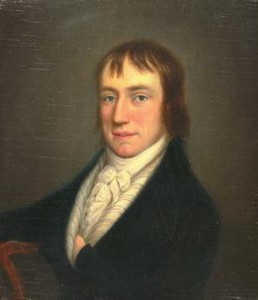
William_WordsworthWilliam Wordsworth

Such passages explain Dickinson’s reverence of “gigantic Emily Brontë” (Letters, 721), one of whose poems (“Last Lines,” also known as “No Coward Soul Was Mine”), a favorite of Emily Dickinson, was appropriately read at her funeral service. Wonderful as it is, Brontë’s description of a naturalized “heaven” or “paradise”—a world in motion, in which the speaker actively and joyfully engages in her surroundings—is both Keatsian and Wordsworthian. The final gathering (waves, breeze, woods, water, the whole world awake and joyous), especially Cathy’s wanting “all to sparkle and dance, in a golden jubilee,” unmistakably recalls Wordsworth’s (and Dorothy’s) “host of golden daffodils,/ Beside the lake, beneath the trees,/ Fluttering and dancing in the breeze.” Those flowers, which outdo “the sparkling waves in glee,” comprise “a jocund company” in whose presence a “poet could not but be gay,” a joy recalled whenever “They flash upon that inward eye/ Which is the bliss of solitude;/ And then my heart with pleasure fills,/ And dances with the daffodils.” (“I Wandered Lonely as a Cloud”)
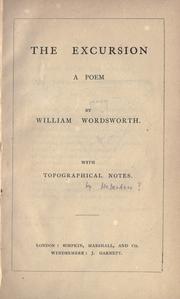
Wordsworth_Excursion

Wordsworth’s head-“tossing” flowers are personified in a delicately pagan manner, their “sprightly dance” allying them with sprights or sprites: elfin supernatural beings. That disciple of Wordsworth and mentor to Emily Dickinson, Ralph Waldo Emerson, was also attuned to the sort of earthly paradise that appealed to both Emilys. He began his famous or infamous 1838 Address to the Harvard Divinity School by fusing the “gladsome pagans” in what was his as well as Keats’s favorite Book of Wordsworth’s epic poem, The Excursion (those pagans who “looked” and “were humbly thankful for the good/ Which the warm sun solicited, and earth/ Bestowed” [4:932-38]), with the “pagan” of “The World is Too Much With Us.” Quoting Wordsworth’s sonnet, Emerson shocked his pious audience from the outset by declaring that he, too, would rather be “A pagan suckled in a creed outworn” than a Christian impoverished by being cut off from a vital, fecund nature sacrificed to both an austere religion and a crass materialism of “getting and spending.” Accordingly, he began the Divinity School Address with his own deeply responsive evocation of nature’s vital, sparkling, floral beauty. In “this refulgent summer,” it has been “a luxury to draw the breath of life. The grass grows, the buds burst, the meadow is spotted with fire and gold” (Essays and Lectures, 75). Those meadows were alive with flowers aglow with the light of Wordsworth’s “golden daffodils,” and sharing the pagan vitality of their “sprightly dance.” Emerson, like early Wordsworth, would have concurred with Emily Dickinson’s speculation in the letter to Elizabeth Holland: Had God “seen the things that I have seen” this summer, he would—Dickinson boldly or blasphemously surmised—“think His Paradise superfluous.”

It seems a shame that Emily Dickinson, who knew and admired Emerson’s essays, stayed in her room when, in 1872, the great man, after a lecture at Amherst College, visited her brother and sister-in-law, living just next-door. With his acute eye, Emerson would surely have recognized genius, just as he did when he first laid eyes on Whitman’s then-unpublished poetry. There are many passages in which Emerson, a peculiarly grounded Transcendentalist, evokes an earthly paradise. In his essay on Swedenborg in Representative Men, Emerson claimed that the only thing “certain” about a possible heaven was that it must “tally with what was best in nature.” It “must not be inferior in tone…agreeing with flowers, with tides, and the rising and setting of autumnal stars.” “Melodious poets” will be inspired “when once the penetrating key-note of nature and spirit is sounded,—the earth-beat, sea-beat, heart-beat, which makes the tune to which the sun rolls, and the globule of blood, and the sap of trees.” (Essays and Lectures, 686-87)
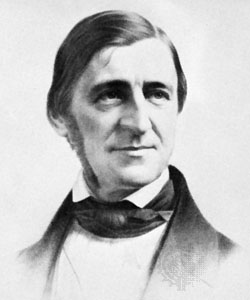
iemersr001p1Ralph Waldo Emerson

Like Keats’s “a finer tone”—descriptive both of the unheard music in the “Ode on a Grecian Urn” and of the repetition of earthly happiness “here after”—Emerson’s “not…inferior in tone,” and stress on key-note, melodiousness, and tune, echoes a text familiar to both Keats and Emerson: Wordsworth’s Excursion, and the Solitary’s reference in Book 2 to “Music in a finer tone” (2:710). Even later Wordsworth, tamed-down and religiously orthodox, never ceased to be a lover “of all that we behold/ From this green earth” (“Tintern Abbey,” lines 104-5), a poet who found his “Paradise, and groves/ Elysian”—provided the human intellect was “wedded to this goodly universe/ In love and holy passion”—to be a “simple produce of the common day” (“Prospectus” to The Recluse,” lines 43-55). Even in revising from a more conservative perspective his account of his early enthusiasm for the French Revolution, Wordsworth never recanted the desire initially expressed, to exercise his skill, “Not in Utopia” or some other ideal place, “Heaven knows where!/ But in the very world, which is the world/ Of all of us,—the place where, in the end,/ We find our happiness, or not at all!” (The Prelude [1850 version]), 11:140-44).

“Oh Matchless Earth,” Emily Dickinson exclaimed in a one-sentence letter, “We underrate the chance to dwell in Thee” (Letters, 478). She was borrowing from the “Prologue” to Wordsworth’s Peter Bell. Having sailed into the heavens in his little boat in the shape of a crescent moon, and having described the constellations and planets, the speaker asks rhetorically, “What are they to that tiny grain,/ That little Earth of ours?” And so he descends: “Then back to Earth, the dear green Earth…See! There she is, the matchless Earth!” (Peter Bell, lines 49-56). Dickinson herself might be “glad” that others believed they were, in the opening exclamation of her early poem, “Going to Heaven!” But, for herself,

I’m glad I don’t believe it
For it would stop my breath—
And I’d like to look a little more
At such a curious Earth! (79)

There is yet another parallel to Emily Dickinson’s thought that “Nature is Heaven,” or that Heaven would be superfluous, if only our earthly Paradise were free of frost and death. In a passage familiar to Wordsworth, Keats, Emerson, and Dickinson, Milton’s archangel Raphael offers a speculative analogy. Explaining to Adam the mysteries of celestial warfare by likening spiritual to corporeal forms, he adds: “Though what if Earth/ Be but the shadow of Heaven, and things therein/ Each to the other like, more than on earth is thought?” (Paradise Lost 5:573-76). Emily Dickinson echoed and altered this passage in an 1852 letter to “Dear Susie” (her soon-to-be sister-in-law, Susan Gilbert). Reversing Raphael’s “therein,” Dickinson locates love “Herein,” and concludes by taking literally the angel’s rhetorical but intriguing question: “But that was Heaven—this is but Earth, Earth so like to heaven that I would hesitate should the true one call away.” (Letters, 195; italics in original). Milton himself may have been open to the idea of Heaven as a projection of earthly happiness complete with a terrestrial landscape. In his fusion of the Classical and Christian in “Lycidas,” the pastoral elegist leaves us free to imagine the risen man as either “saint” in Heaven or as the “genius of the shore,” drowned, but now, through the power “of him that walked the waves,” mounted to a place “Where other groves and other streams along,/ With nectar pure his oozy locks he laves” (lines 172-75).

In a jocoserious, life-affirming poem looking back to Romantic and Emersonian “nature worship” and ahead to the earth-centered female persona of Wallace Steven’s “Sunday Morning,” Dickinson rejects religious ritual, a formal “church,” and an other-worldly Heaven in favor of an earthly paradise, a God immanent rather than transcendent, and salvation as a daily process rather than a static end-state:

Some keep the Sabbath going to Church—
I keep it, staying at Home—
With a Bobolink for a Chorister—
And an Orchard for a Dome—

Some keep the Sabbath in Surplice—
I just wear my Wings—
And instead of rolling the Bell, for Church,
Our little Sexton—sings.

God preaches, a noted Clergyman—
And the sermon is never long,
So instead of getting to Heaven, at last—
I’m going, all along. (324)

In an 1863 letter to Thomas Wentworth Higginson, in which she describes herself as “not reared to prayer,” Dickinson pronounces “the ‘Supernatural’…only the Natural, disclosed” (Letters, 423-24). In a poem written that year or the year before (Johnson dates it 1862, Franklin 1863), dawn and noon seem symbols of what she calls “Heaven.” The skepticism implicit in the setting of “Heaven” in quotation marks is confirmed in the final two stanzas:

The Rapture of a finished Day—
Returning to the West—
All these—remind us of the place
That Men call “Paradise”—

Itself be fairer—we suppose—
But how Ourself, shall be
Adorned, for a Superior Grace—
Not yet, our eyes can see— (575)

In two letters of 1873, Dickinson subverts Paul’s text (“For this corruptible must put on incorruption, and this mortal must put on immortality”) about the dead being raised and changed as a consequence of Christ’s Resurrection (1 Cor. 15:52-53). In the first letter (April 1873), she pronounces the novelist George Eliot (whom she knew to be a woman, Marian Evans) a “mortal” who “has already put on immortality,” adding that “the mysteries of human nature surpass the ‘mysteries of redemption,’ for the infinite we only suppose, while we see the finite” (Letters, 506). Later that year, in a letter to Elizabeth Holland, Emily notes that her sister Lavinia, just back from a visit to the Hollands, had said her hosts “dwell in paradise.” Emily declares: “I have never believed the latter to be a supernatural site”; instead, “Eden, always eligible,” is present in the intimacy of “Meadows” and the noonday “Sun.” If, as Blake said, “Everything that lives is holy,” it is a this-worldly truth of which believers like her sister and father are cheated: “While the Clergyman tells Father and Vinnie that ‘this Corruptible shall put on Incorruption’—it has already done so and they go defrauded” (Letters, 508). In a notably legalistic affirmation of earth, included in an 1877 letter to a lawyer, her increasingly skeptical brother Austin, she goes even further:

The Fact that Earth is Heaven—
Whether Heaven is Heaven or not
If not an Affidavit
Of that specific Spot
Not only must confirm us
That it is not for us
But that it would affront us
To dwell in such a place— (1408)

Wallace Stevens, who, in “Sunday Morning,” imagines his female persona asking if she shall not “find in comforts of the sun,” in any “balm or beauty of the earth/ Things to be cherished like the thought of heaven?” insists elsewhere that “poetry/ Exceeding music must take the place/ Of empty heaven and its hymns” (“The Man with the Blue Guitar,” section 5); that we must live in “a physical world,” the very air “swarming” with the “metaphysical changes that occur,/ Merely in living as and where we live” (“Esthetique du Mal,” section 15). Stevens seems to be recalling Wordsworth’s “Prospectus” and Emerson’s seminal book Nature, along with that ardent disciple of Emerson, Friedrich Nietzsche. He might as well have been thinking of Emily Dickinson, and her audacious, even blasphemous preference for the tangible things of this earth, to be cherished above thoughts of an otherworldly Heaven, an abstract place offensive to our nature. Nietzsche’s Zarathustra’s beseeches us in his Prologue to “remain faithful to the earth, and do not believe those who speak…of otherworldly hopes!” She never accepted the Nietzschean premise, the Death of God, but, when she was only fifteen, Emily confided in her friend Abiah Root that the main reason she was “continually putting off becoming a Christian,” despite the “aching void in my heart,” was her inability to conceive of an existence beyond this earth as anything but horrible: “Does not Eternity appear dreadful to you?….it seems so dark to me that I almost wish there was no Eternity.” Two years later she tells a friend that, while she regrets that she did not seize a past opportunity to “give up and become a Christian,” she won’t: “it is hard for me to give up the world” (Letters, 27-28, 67). She is not referring to that material “world” of getting and spending that is “too much with us,” but to this “matchless Earth” indistinguishable from, and perhaps preferable to, Heaven.

2
signature

The problem, of course, is that this Earth, however “matchless,” is not free of frost and death, so often almost indistinguishable in Dickinson. The invasive force in her Earthly Paradise was less the worm than the frost. The link between the fading and freezing-by-frost of her flowers on the one hand, and the death of those she cannot waken on the other, becomes a dominant motif. Her cherishing of a Heaven-like Earth is sometimes connected with the pain inflicted from above. In one poem, while noting the “firmest proof” of “Heaven above,” she significantly adds that, “Except for its marauding Hand/ It had been heaven below” (1205; my italics). In another letter to Elizabeth Holland and her husband, Heaven’s “marauding Hand” seems both a grim Reaper and a cruel Leveler. Writing during a period (autumn, 1858) when an epidemic of typhoid fever had struck Amherst, she cries out, not in concluding but in opening the letter: “Good-night! I can’t stay any longer in a world of death. Austin [her brother] is ill of fever. I buried my garden last week—our man, Dick, lost a little girl through scarlet fever….Ah! Democratic Death! Grasping the proudest zinnia from my purple garden,—then deep to his bosom calling the serf’s child” (Letters, 341).
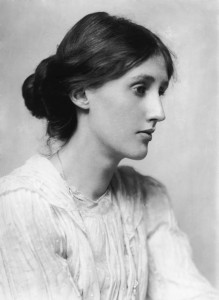
virginia-woolfVirginia Woolf

This letter has become controversial. The admittedly jarring reference to the “serf’s child,” both “politically” and historically incorrect, has been described as insensitive, shocking, an indication of casual snobbishness at best and class-conscious callousness at worst, compounded by (in the phrase of Albert Habegger) her “equating ‘the serf’s child’ with her frost-killed flowers” (My Wars Are Laid Away in Books: The Life of Emily Dickinson [2001], 363). We may be reminded of Virginia Woolf’s Clarissa Dalloway, who imagines people saying of her, “she cared much more for her roses than for” such human but distant “victims of cruelty and injustice” as those who perished in the Armenian genocide (Mrs. Dalloway [Norton Critical Edition], 88). But the best response to the attack on Dickinson’s “callousness” in this letter seems to me that of Judith Farr. After acknowledging the “insensitivity it projects,” she reminds us that “Austin’s [serious] illness and the coming of winter are also equated” in the letter. She then makes her central point, one I would emphasize as well:

To begin with, it is simply the case that Emily Dickinson loved flowers quite as much and as if they were human; her implicit comparison was…not intended to diminish the “little girl,” as she is rather tenderly called….With the cadences of Ecclesiastes and the Elizabethans always vivid in her ear, it was only natural that Dickinson should express the communion and equality of all living forms in death. Indeed, her letter’s zinnia and child commingling in Death’s grasp calls up such lines as Cymbeline’s “Golden Lads, and Girles all must,/ As Chimney-sweepers come to dust.”….Not snobbery, but the power of the aesthetic impulse to which she was subject is chiefly manifested in Dickinson’s much-discussed letter. (The Gardens of Emily Dickinson [2004], 56)

I would add only that Dickinson’s equation, not limited to the influence of Ecclesiastes and Shakespeare, also had Romantic auspices. Between Death’s “grasp” on a proud flower in her royally purple garden and the death of the little child of a servant there is no more gap than we find in “Threnody,” Emerson’s elegy for his little boy, Waldo. Also a victim of scarlet fever, dead at the age of five, that “hyacinthine boy” and “budding man” was never to blossom, though his father prepares for him, in the conclusion of the elegy, an appropriate Heaven: not “adamant… stark and cold,” but a rather Wordsworthian or Keatsian “nest of bending reeds,/ Flowering grass and scented weeds” (“Threnody,” lines 15, 26, 272-75). In a less-discussed but similar letter to Elizabeth Holland, whose child had suffered a crippling injury, Dickinson notes that “to assault so minute a creature seems to me malign, unworthy of Nature—but the frost is no respecter of persons.” In other letters, starting in the 1850s, Dickinson assumes this floral/frost/human analogue, making explicit what is implicit in poems like “Apparently with no surprise,” where “the Frost beheads” the “happy Flower” (1624): namely, her pervasive connection of flowers and frost with human life and death. At times at least, she includes a vision of transcendence for believers, the hope of spiritual resurrection.

Even when “the frost has been severe,” killing off flowers and plants that try in vain “to shield them from the chilly north-east wind,” there can be an imperishable garden. I am quoting from a touching letter of October 1851, anticipating the arrival of Austin. She had “tried to delay the frosts,” detaining the “fading flowers” until he came. But the flowers, like the poor “bewildered” flies trying to warm themselves in the kitchen, “do not understand that there are no summer mornings remaining to them and to me.” But no matter the effect on her flowers and plants of the severe frost brought by the “chilly north-east wind,” she can offer her brother “another” garden impervious to frost. The theme kindles her prose into poetry, minus the line-breaks (in fact, Johnson prints it as a poem, #2). She offers a bright, ever-green garden, “where not a frost has been, in its unfading flowers I hear the bright bee hum; prithee, my Brother, into my garden come!” (Letters, 149). As Judith Farr remarks, such a garden—which “could never exist, except in metaphor”—is “the garden of herself: her imagination, her love, each of which, she says, will outlast time.” As much as any poem in her canon, this early letter-poem, probably written when Dickinson was twenty-one, “discloses the rapt identification she made between herself, her creativity, and her flowers….‘Here is a brighter garden’ instinctively focuses on the garden of her mind, with its loving thoughts that transcend the ‘frost’ of death.” (The Gardens of Emily Dickinson, 56)

A third of a century later, we have a remarkably similar letter in which, at least for her beloved brother, there is an autumnal harbinger of a spiritual as well as a natural spring to come. In this late letter of autumn 1884, the same year she wrote “Apparently with no surprise,” she tells a family friend, Maria Whitney:

…………...Changelessness is Nature’s change. The plants went into camp last night, their tender
armor insufficient for the crafty nights.
……………That is one of the parting acts of the year, and has an emerald pathos—and Austin
hangs bouquets of corn in the piazza’s ceiling, also an omen, for Austin believes.
……………The golden bowl breaks soundlessly, but it will not be whole again till another year.
………………………………………………………………………………………………………………………(Letters, 848)

Anthropomorphizing (as in the 1851 letter, where the flowers try to “shield them[selves]” from the autumn wind), she presents the “tender armor” of her flowers as inadequate to protect them against the autumnal frost. So, alert to their needs, she brings them indoors, into the “camp” of her conservatory. She ends by quoting the admonition from Ecclesiastes, that we are to remember God before the body disintegrates, before “the silver cord be loosed or the golden bowl be broken” (12:6). But Emily differentiates herself from her brother Austin, a closet skeptic who, for the purposes of this letter, “believes”—has faith, that is, not only in the seasonal rebirth of corn from seeds, but in the spiritual resurrection of the body. His sister, adhering to a seasonal form of natural supernaturalism, confines her hope to a natural spring; her “golden bowl” will “not be whole again till another year.”

Two of Emily Dickinson’s most beautiful, and most Keatsian, poems, mark her major seasonal transition, from summer to autumn. In “As imperceptibly as Grief,” summer has “lapsed away,” a beloved season that can’t quite be accused of “Perfidy” since she was always a “Guest, that would be gone.” The poem ends with summer, like Keats’s nightingale, having “made her light escape/ Into the Beautiful,” a Platonic realm beyond us, leaving behind only the memory, which is to be cherished here on earth (1540). In “Further in Summer than the Birds,” which has been described, by Charles R. Anderson, as “her finest poem on the theme of the year going down to death and the relation of this to a belief in immortality” (Emily Dickinson’s Poetry: Stairway to Surprise [1966],169), Dickinson employs liturgical language to commemorate, as in Keats’s “To Autumn,” the insects’ dirge for the dying year. “Pathetic from the Grass,” that “minor Nation celebrates/ Its unobtrusive Mass,” their barely noticeable requiem nevertheless “Enlarging Loneliness.” The music of the crickets, coming later in the summer than the song of birds, is a “spectral Canticle.” Their hymn typifies—in the transition from summer to autumn, with “August burning low”—the winter sleep to come, a “Repose” perhaps implying eternal rest on another level.

In the final stanza, Christian and Hebraic vocabulary yields to pagan. At this moment of seasonal transition, there is, “as yet,” no “Furrow on the Glow” of sunlit, burning August, “Yet a Druidic difference/ Enhances Nature now” (1068). That final religious image, whether we take the Druidic reference as stressing primarily the sacrificial or the animistic element in Celtic nature-worship, powerfully reinforces Dickinson’s own reverence for Nature, its beauty enriched and intensified less, perhaps, by what Anderson calls a “belief in immortality” than—again, as in the ode “To Autumn”—by time’s evanescence and the pathos of mutability, the deeply moving contrast between seasonal return and human transience. That transience extends to all animal life. This poem, written in late 1865 or early 1866, was enclosed in a laconic January 1866 note to her epistolary semi-mentor, Thomas Wentworth Higginson, with whom she had not corresponded for eighteen months. Referring to her beloved dog and constant companion, Emily Dickinson restricted herself to a single statement, and a wry question, less pleading than ironic, perhaps bitter: “Carlo died….Would you instruct me now?” (Letters, 449).
Samuel-BowlesSamuel Bowles

Though of course haunted by the thought of immortality, Dickinson was also dubious. In an 1858 letter to Samuel Bowles, she adopts an ironic, pretension-mocking tone. Distinguishing between nature and “us,” she at once anticipates and deflates modern “species chauvinism,” wondering, tongue-in-cheek, how it is that we mere humans, described by her pastor as a “worm,” should also be the very species singled out for a majestic and special end: a resurrection allegedly obviating any need for mourning, including mourning the death of what would seem to be paradise enough for us: summer with its cherished fields, its bumblebees and birds:

Summer stopped since you were here. Nobody noticed her—that is, no men and women. Doubtless, the fields are rent by petite anguish, and “mourners go about” [Ecclesiastes 12:5] the Woods. But this is not for us. Business enough indeed, our stately Resurrection! A special Courtesy, I judge, from what the Clergy say! To the “natural man,” Bumblebees would seem an improvement, and a spicing of Birds, but far be it from me, to impugn such majestic tastes! Our pastor says we are a “Worm.” How is that reconciled? “Vain, sinful Worm” is possibly of another species. (Letters, 338-39)

By this time, the 1730s’ thunderings of Jonathan Edwards against the moral ills of New England’s sinners in the hands of an angry God had lost some of their resonance, even in Calvinist Amherst. But in his debasement of man as a “worm,” Dickinson’s pastor may (the trope is hardly restricted to Edwards) have been echoing the great Puritan’s description of man as “a vile insect,” a “little, wretched, despicable creature; a worm, a mere nothing, and less than nothing” (The Justice of God in the Damnation of Sinners [1634]). Edwards himself—whose “Martial Hand” of “Conscience” Dickinson presents threatening “wincing” sinners with hellfire, the “Phosphorus of God” (1598)—was echoing Bildad, the second of Job’s false comforters. From the outset, he had advised the innocent sufferer to abase himself. In his final discourse (Job 25:2-6), Bildad wonders if it is even possible for man to “be righteous before God.” To this fear-instilling God of “dominion,” even the moon and stars are unclean; “how much less man, that is a worm? and the son of man, which is a worm!” How indeed, as Emily sardonically inquires, is that abject status reconcilable with our potential for “stately resurrection”?

Man’s biblical genesis and Fall seemed to put that glorious end in doubt. Prior to ejecting guilty Adam and Eve from Eden, the “Lord God” tells them, “dust thou art, and unto dust shalt thou return” (Gen 3:19). For Hamlet, man is “the paragon of animals.., how like a god,” and yet, to him, “what is this quintessence of dust?” (2.2.305-7); Wordsworth, in the opening book of The Prelude, tries to “reconcile” the contradiction: “Dust as we are, the immortal Spirit grows/ Like harmony in music” (1:340-41). Dickinson can engage this tension in the grand tradition, observing that “Death is a Dialogue between/ The Spirit and the Dust,” with Spirit triumphant, “Just laying off for evidence/ An Overcoat of Clay” (976). But she takes a different tack in a couplet-poem she opens by ironically addressing God as “Heavenly Father”:

“Heavenly Father”—take to thee
The supreme iniquity
Fashioned by thy candid Hand
In a moment contraband—
Though to trust us—seem to us
More respectful—“We are Dust”—
We apologize to thee
For thine own Duplicity—(1461)

So much for Bildad-like groveling! Like the image of the worm, that of dust reflects the Calvinist estimate of human worthlessness. But here the “worm” turns, with the “sinful” creature finding fault with the Creator. Despite his seeming straightforwardness, God committed a dubious act (an inconsistency emphasized by the alliterated candid and contraband). In fashioning us as he did, he set up, between dust and immortal spirit, not so much a creative tension as a radical contradiction. He thus stands accused of double-dealing, and any “apology” we make to so duplicitous a God will be less an acknowledgement of our own guilt, or a seeking of pardon, than a self-justifying defense—an apologia in the form of j’accuse directed against a divine adversary. That vindictive God himself supplied the right word. “For I the Lord thy God am a jealous God, visiting the iniquity of the fathers upon the children” (Exodus 20:5). Dickinson, who, like Mark Twain, cherishes the role of lawyer for the plaintiff when it comes to amassing evidence against God’s supposedly benign providence, has the children of Dust visit the charge of injustice upon an anything-but-paternal Heavenly Father, accusing him—blasphemously, though appropriately, given his supreme power—of “the supreme iniquity.”
Emily Dickinson 2

If this reading is accurate, our apology to God for his “own Duplicity” allies the poem with the most blasphemous of Omar Khayyám’s quatrains addressed to God, at least as adapted by Edward Fitzgerald in a translation the Victorian world accepted with a shock of recognition:

Oh Thou, who Man of baser Earth didst make,
And ev’n with Paradise devise the Snake:
……….For all the sin wherewith the face of Man
Is blackened—Man’s forgiveness give—and take!

The work of such writers as Carlyle, Tennyson and Arnold, and, later, Hardy and Housman, all responding in their different ways to Darwinian and other scientific and rationalist challenges to religious belief (including Biblical Higher Criticism) places an imprimatur on the judgment that Fitzgerald’s version of the Rubáiyát “reads like the latest and freshest expression of the perplexity and of the doubt of the generation to which we ourselves belong.” That acute observation was made, however, not by a British Victorian but by an American—the scholar and man of letters Charles Eliot Norton, writing in 1869, a decade before Dickinson wrote “‘Heavenly Father’—take to thee.” Not only the “doubt,” but the “perplexity” as well, is reflected in Dickinson’s poem, for the syntax of her opening lines suggests petition even more than protest. James McIntosh (Nimble Believing: Dickinson and the Unknown [2004]), identifying “humankind” as “the supreme iniquity,” takes these lines to mean: “Father, take humans, who are the supreme iniquity, to thee” (47). Perhaps; but what, then, of the poem’s final lines? My own reading is closer to that of Magdalena Zapedowska, in her 2006 American Transcendentalist Quarterly essay, “Wrestling with Silence.” She argues that, in this poem, Dickinson focuses, not on the Fall as original sin,

but on the subsequent expulsion from Paradise, which she blasphemously construes as the original wrong done to humankind by a God who first offered people happiness, then distrustfully put them to the test, and finally doomed them to suffering. Undermining the dogma of God’s benevolence, Dickinson contemplates the terrifying possibility that the metaphysical order is different from Calvinist teaching and that the human individual is left wholly to him/herself, unable to rely on the hostile Deity against the chaos of the universe. (“Wrestling with Silence,” 385)

At such moments, Emily Dickinson sounds like her considerably more public contemporary, Mark Twain, who made no secret of his religious skepticism, but who nevertheless refrained from publishing his most vitriolic attacks on the Judeo-Christian God, a divinity he described, even before his dark final decade, as both duplicitous and cruel. As the examples of Emily Dickinson and Mark Twain illustrate, for all our immortal longings, we are haunted, and angered, by the death implicit in our originating dust—in the case of both Dickinson and Twain, what Byron called “fiery dust.” And if the “Heavenly Father” who presides over this beautiful but doomed world really is an indifferent and “Approving God” (1624), Emily Dickinson seems to care less for him and for a posthumous, perhaps empty Heaven, than for this Earthly Paradise—the perishable beauty that must die, everything she wishes could “transcend the ‘frost’ of death,” but which she strongly suspects will not.

“Man is in love and loves what vanishes,/ What more is there to say?” That haunting question was posed by W. B. Yeats in one of his greatest poems, “Nineteen Hundred and Nineteen.” He was not suggesting anything so trite as that we love things and then they disappear. He was reminding us that we love beautiful transient things because they are mutable, doomed to vanish. That is precisely why we cherish them so, recognizing, as Wordsworth poignantly acknowledged even in the great Ode in which he claimed intimations of immortality, that “nothing can bring back the hour/ Of splendor in the grass, of glory in the flower.” These splendors and glories are part of a “supernaturalism” that is “natural.” That great enemy of otherworldly hopes and cherisher of the earth, Nietzsche, referred in a December 1885 letter to irretrievable beauty. In a floral image that would have appealed to Emily Dickinson, who would die shortly after this letter was written, he spoke of Rosengeruch des Unwiederbringlichen: the faint rose-breath of what can never be brought back.

Of course, with Wordsworth, Keats, and Emerson as her precursors, we do not really need Emerson’s disciple Nietzsche and Nietzsche’s disciple Yeats to explain why Emily Dickinson’s Earthly Paradise is not only beautiful but death-haunted. I quote Yeats and Nietzsche (and Emily would, I think, approve) for the poignant beauty of their language in commemorating the pathos of mutability, what Wordsworth—deeply moved by the humblest “flower” that blossoms and blows in the breeze—called, in the final line of the Intimations Ode, “Thoughts that do often lie too deep for tears.”

— Patrick J. Keane

Author’s Note: Though most Dickinson scholars prefer the three-volume edition of R. W. Franklin (Harvard U.P., 1998), Emily Dickinson’s poems are here cited by number from the one-volume Complete Poems of Emily Dickinson, ed. Thomas H. Johnson (Little, Brown, 1957, and often reprinted). Her letters are cited from the three-volume but continuously-paginated The Letters of Emily Dickinson, ed. Thomas H. Johnson and Theodora Ward (Harvard University Press, 1958). Wordsworth, Keats, and Emerson, are cited from: Wordsworth: The Poems, ed. John O. Hayden, 2 vols. (Yale UP, 1981); The Letters of John Keats, ed. Hyder E. Rollins, 2 vols. (Harvard UP, 1958); Emerson: Essays and Lectures, ed. Joel Porte (Library of America, 1983).

.
PAT kEANE

Patrick J. Keane is Professor Emeritus of Le Moyne College and a Contributing Editor at Numéro Cinq. Though he has written on a wide range of topics, his areas of special interest have been 19th and 20th-century poetry in the Romantic tradition; Irish literature and history; the interactions of literature with philosophic, religious, and political thinking; the impact of Nietzsche on certain 20th century writers; and, most recently, Transatlantic studies, exploring the influence of German Idealist philosophy and British Romanticism on American writers. His books include William Butler Yeats: Contemporary Studies in Literature (1973), A Wild Civility: Interactions in the Poetry and Thought of Robert Graves(1980), Yeats’s Interactions with Tradition (1987), Terrible Beauty: Yeats, Joyce, Ireland and the Myth of the Devouring Female (1988), Coleridge’s Submerged Politics (1994), Emerson, Romanticism, and Intuitive Reason: The Transatlantic “Light of All Our Day” (2003), and Emily Dickinson’s Approving God: Divine Design and the Problem of Suffering (2007).

s

Dec 042014
 

139056374STranslator David Need

.

When poet and translator David Need began translating Rainer Maria Rilke’s French poetry in 2001, it was in part an attempt to get closer to one of his favorite writers, to fashion a “close workshop with someone” of remarkable ability. Rilke’s often-overlooked second-language work presented a convenient inroad for Need, whose proficiency in French at the time exceeded his knowledge of German, the poet’s first language. This practicality proved fortuitous as he began to focus his attention on a discreet series of short “rose poems,” written by Rilke in 1924. Need felt the rose poems constituted a unique arm of Rilke’s oeuvre, one that if considered on its own terms can be found to contain the generous whole of the poet’s vision in miniature. As he continued to translate Rilke, completing work on the rose poems and moving on to the German material, he began to incorporate his ideas on Rilke’s aesthetic into a book that would present a variety of the poet’s German and French pieces along with an essay and commissioned ink drawings, all serving to support a thesis embodied by the heart of collection: the rose series.

Roses: The Late French Poetry of Rainer Maria Rilke is first and foremost a set of fine translations. Each two-or-three-stanza poem in the rose series is given its own page opposite the French original, which encourages the reader to proceed slowly and attentively. If one wants to stop there, satisfied with Need’s fresh take on these under-read poems, the book is a worthwhile read, an enlivening encounter with one of modernity’s greatest poets. But a patient reader eventually realizes that Roses, like the flower that inspired Rilke’s meditations, is constantly seeking to open up for us toward a more potent aesthetic revelation. This is because Need has invested the book with a varied and generative infrastructure that forwards a larger argument through a series of dialogues. Most conspicuous in this regard are the 27 sketches by artist Clare Johnson that react to each brief rose poem with an image that engages the text, but does not attempt to “portray” its content in an overtly literal or didactic way. The images, which range from atmospheric depictions of silhouettes on a city street, to rain-streaked windows, to abstract patterns, act out of Johnson’s response to widen the confines of the multi-media dialogue. The sketches echo the poems and in so doing help us to reconstrue their meaning. Another important interlocutor in Roses is Need’s essay, “The Room Next Door: The Impossible Affordance of the Rose.” The essay is a convincing distillation of the translator’s ethos that considers the influence of Aestheticism and figures like Rodin and Cezanne on Rilke’s vision and situates the poet’s artistic response within a millennia-old incantatory tradition in poetry that goes back to the Rgveda, India’s pre-Hindu epic written around 1400 BCE. Need argues that Rilke uses the rose motif to take a firm stand against the reduction of the material to a kind of impenetrable surface, urging us to consider the ways in which nature creates room, or “affordances,” for the various—at times contradictory—facets of our being. The combined effect of the essay, sketches, and poems is one that collaborators across genre and medium strive for: a ringing of distinct yet concordant tonalities that elevate the piece to something more than the sum of its parts.

David Need teaches in the Department of Religious Studies at Duke University. A specialist in Indo-Tibetan Buddhism and Hinduism, he sees confluence in philosophies of religion and art and often speaks of them in overlapping terms. It’s a point of view I found instructive when I was his student at North Carolina State University in 2003. We’ve kept in touch over the years and, upon learning of the publication of Roses, I was eager to set up an interview. He invited me to his home in Durham, North Carolina, where we talked at length about Rilke, translation, and the implications of an existence that might somehow be, in the poet’s words, “Infinitely restrained and infinitely lavished.”
—Dan Holmes


Dan Holmes (Holmes): What brought about this turn toward translating in earnest? How is this situated in your creative development?

David Need (Need): There are two parts to that. One is that I think it’s always good for an artist to be working in two modalities. It’s important to think about your medium in a couple of different ways, or to think about a problem in a couple of different ways. I’ve noticed that when I spend time doing a lot of singing, I start to have ideas about writing that are new and fresh. There’s something about the singing that presents a set of problems to me, like problems of rhythm or problems of shape, but it presents them in this other form. Then when I come back to write, the music of the writing is being informed by what I’m doing with the other thing. For me it doesn’t happen just by listening, I have to be involved in some kind of making. Same thing with translating. Translating gives you this really close workshop with a particular writer’s language. When you translate really good writers you’re getting a close workshop with someone whose ambitions or skills in poetry is extraordinary. In translation, you get what’s going on completely, but you have to make some decisions about it. And in some ways those are the same problems you have with respect to your own gestures and skills. When working on my poetry, I can pull out an image and put it down, but I learn something from working with Rilke about how heavily to weight that image. And I learn other things, like, reading him I’ve learned he leaves messy things in his poems sometimes deliberately. He just leaves little thumbprints and you know he’s clearly got an ability to be smoother and it hasn’t happened there. That was an important lesson for me: that I didn’t always have to smooth and that I could mix diction at times if that was the way the poem was emerging.
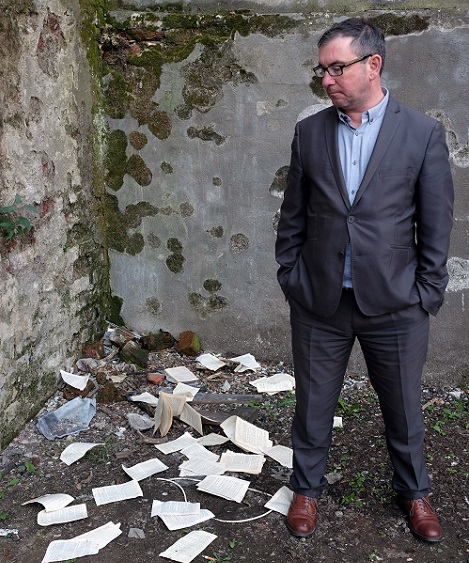
The other thing is that I think any art is basically translation. Talking now, I’m translating. When I’m teaching I’m constantly translating—that’s all I’m doing. I’m standing in front of a class, I’ve got this body of information I’ve been interpreting, then I’m putting it into forms for the students, and their ability to understand this stuff is related to the reading they’ve done, and what they bring to the class, how old they are, the ideas they already have about spirituality. I have to see those and figure those out and translate to them. Also when I’m working with different religious traditions I’m constantly needing to translate, from talking within a Christian context to talking within a Buddhist context to talking within our context here—it is a lot like translating. “Now I’m in this field. Now I’m in this location. And this is the way you think inside this situation.” I have a sense of the world, or music in the world, and I’m trying to get that vision or image to happen for you. There’s a translation or a telepathy there that happens in the reading. I know as a reader and writer that’s what I’m looking for—to make other people see things that aren’t visible commonly but might be common in our imaginations.

Holmes: I can imagine two approaches to translation: one is to render as clearly and accurately as possible what you’re seeing within the context that you understand the writer wrote it, and one is to draw out the germ of it and further express it.

Need: I’m a really more the first kind of translator. A lot of times when I’m looking at other people’s translations, I’m impatient if I see they’re getting away from the word count, the words that are there in the original. If there is any “thing” that the poem is, I don’t think it’s the ideas, or only the ideas—I think it’s the words. The words are these little material edges that are the latticework of the poem that the reader catches on. Some people that have their own lyric sensibility take a poem and say, “I see the image and I’m going to render that image in my own lyric terms.” I’m not comfortable with that. I think it brings too much of your own reading to the material and doesn’t leave the material open enough in something like its original form.

The people that I’ve translated so far are good for the kind of translation I do. I have a lyric sensibility, so when I’m faced with choosing some words, I go for a quiet music that will work as a poetics for the reader, so it will read lyrically. But the word count and the grammar I’ve almost always just transformed it into an English word count, and grammar and line count, and things like that. Rilke is not a poet where there’s a lot of punning. He tends to use words directly and simply so he’s easier to translate. I can establish a word without worrying about the fifteen meanings the word Rilke chose in German has that a reader might pick up. Celan has been more challenging for me because there’s a lot more play going on and what’s worse, or better, is that Celan is a translator, so the puns aren’t even just in German. He’s constantly making these really wicked puns with English and English phonemes that are buried in German and French. So sometimes I find that I actually leave the third language or fourth language that he’ll use, and I don’t translate it. I’ll run into objections with readers who don’t want to put the time in. But if that person is interested and curious then that little thing—which is like a little smear that Celan has left there because he shifted into the other language—will look like a smear instead of being fixed out of being a smear. There is a way in which that multilingual capacity can grow in a reading and still be connected to the writing that he does.

551-12.jpgRainer Maria Rilke

Holmes: Rilke wrote these poems in French, which was a second language for him. Is that different for you than translating a German Rilke poem?

Need: Not in the end. When I first sat down and did it I didn’t have German yet. I had the sense that the French was a little strange, but I didn’t try to do anything to make the strangeness apparent. I just translated the weight of the language. My approach is the same with German. I’m not as comfortable in German so I have to do more dictionary work and I have to go, “Okay, that’s a dative” and work out what all the grammar is, but my approach isn’t that different. He’s not a completely different person in French.

Holmes: Like Beckett’s French. It feels to me like a second language.

Need: Yeah. And there’s been some great second language writers like Conrad, who are just unbelievable, but there’s a little bit of the haunt of it, that fact that it’s a second language. Or Kerouac. People are starting to focus on that, that he is actually a second language writer.

Holmes: What drew you to the rose poems? Have they been neglected? Are they emblematic of your aesthetic in some way?

Need: I did work with them because they were in French, and they were a discreet set, and because I like flowers and they haven’t been translated that much. So French because back then I didn’t have German and I wanted to work with some Rilke. Roses because it’s a discreet set and kind of simple. And I have a bit of a disposition to the pastoral. So the rose works for me at the level of motif. I’m similar enough for finding floral or seasonal things as the beginnings for certain kinds of meditations. There was a rapport there.

I translated them back in 2001 and even then I was beginning to develop an argument about Rilke in relation to contemporary poetics. So there is actually an aesthetic argument that I’m using Rilke to make. I think when it comes down to it it’s the idea that post-60’s and 70’s there was this turn to the surface in poetry. To lots of attention to the surface and a distrust of any kind of depth at all… a criticism of depth as always referring to the romantic subject that we were supposed to dispel as good progressives, because somehow the romantic subject was this feudal encrustation that could only create bad things in our relationships with other people. So I already knew that in Rilke I had somebody that I could use to argue for interiority—for the aesthetics of interiority. In the writing itself, right from the first one he says, “Rose you’re this thing that’s infinitely unfolded and absolutely withdrawn at the same time.” That really fit with ideas that I was having at the time about the human situation, that the human is a being who has this exteriority that continues to unfold; there continues to be this play on the surface, but there is also this interiority that never gets completely seen by anyone else or even by the person, or gets completely exhausted. That seemed to be really important in terms of arguing for a place of freedom despite the way people were thinking about language and culture, because so many people felt that we were in this hegemonic era with commercial culture dominating all production and value and I felt: no, that’s not quite true. We’re buying into and shutting off access to something within ourselves that we shouldn’t cut off access to, that actually is freer that we imagine, but also at stake. And what people who want freedom can never quite understand is—and obviously this reflects a kind of commitment but—we don’t have some kind of “drive your car in all directions without ever having to be accountable to anything” kind of freedom. We have life, but we’re in relation to others and we’re always at stake in those relationships.

Rilke just seemed to be another person coming out of modernity—early on in modernity—who seemed to be really caring about the world, and arguing that the lyrical and what we feel as beauty and desire are not to be shut off, or cut apart, or dismantled because of the harm we do each other. We have to work hard to make the choice not to harm each other. And I felt like a lot of peoples’ construction of interiority and the unconscious has been wrong, so I felt that the rose poems were a good small vehicle, a simple study, that were themselves making an argument that was consistent overall with the way Rilke used the trope of the rose in his work. The idea I’m arguing I think is an idea that was Rilke’s, actually rooted in what he was doing with the rose.

cover

Holmes: Do you see the Rose poems as a culmination in miniature of Rilke’s vision? Or an anamoly?

Need: I think it’s a miniature. He finishes the Duino Elegies and writes the Sonnets to Orpheus in 1922 and he spends a lot of the rest of the year finishing a translation from French of Paul Valery. There are two things that are going on: he’s already starting to work on ongoing lyric projects in German. One of the things I translated (for the book) was actually a suite. Most of the poems are from ’23 and ’24 in German and he put it together at the end of his life and gave it to his publisher as something to bring out for the estate. And there are about 80 poems there. He was working in German but I also think he got the idea from working with Valery to do some studies in French. And he had started doing the Valais Quatrains within about a two-week period. They were studies. I think he was a good enough artist to apply himself to a material. But not just any material; it was one of his leitmotifs, something he’d brought up at different times to try and make a certain kind of argument. And that argument is there again in miniature. It’s almost like somebody who had been painting larger scale paintings of roses decided to do a series of line drawings. That’s not because he doesn’t want to do the big project. It’s because he’s decided to do a setting that’s a line drawing setting. So I see this as yet another setting.

A lot of them are what I call—and I think this is important regarding surface and depth—a lot of them are half-sonnets. Not “half,” but what you can call broken sonnets. He wrote often in the Italian sonnet throughout his life, and once he found the Italian sonnet it appears in all the published books. Not all of the Rose poems are broken sonnets, but many of them are just two quatrains, which means for the Italian sonnet he didn’t add the two tercets at the end. But I feel like he was still thinking “sonnet”. He just drew the sonnet that far and then left it blank, so it feels to me like he drew in the visible part of the sonnet and left the turn part not visible. They weren’t casual at all. He was still working and thinking on a project that was related to the ideas he was working on in his life.

Holmes: Rilke describes the rose in #3 as “Infinitely restrained and infinitely lavished.” He’s always showing us the rose as paradox, as something interior that is inseparable from its surroundings. He considers the relational nature of “features” and forms in order to glean something of their essence. Can you talk about what you think he’s doing by setting up and undermining these dualities?

Need: Thinking in terms of antimonies is characteristic of human thought. Certainly in Europe post-Hegel, thinking in terms of antithesis tended to be a mode of thought that people thought was a real structure. Any kind of opposition you found, its resolution would be in this dialectical process. That’s how you worked with problems like the tension between mind and body, or spirit and body, or life and death—any thing that you could think of in those terms. I think lyric poetry in general, and post-Romantic poetry, was trying to argue for a different status. To actually argue for “both/and” rather than a conflict. Even though Hegel’s model—thesis, antithesis, synthesis—moves towards a “both/and,” the synthesis actually erases the difference. I think Rilke was really interested in the fact that another way of thinking would say that impossibly we were “both/and.” So his problem is how to get us to break the Hegelian way of reading, or to recognize that there’s another way to resolve that kind of antithesis.

Hegel’s model is a very combative model. It’s a model of unresolvable antagonisms. It can’t imagine the resolution. Rilke is trying to say “I want to have a relationship to the world that doesn’t erase it. I want to have a relationship to other people where I’m not taking away the space or being taken over. I want to somehow be in a situation where impossibly this difference can exist, together.” So I think he’s presenting us over and over again with a problem, but also trying to get us through contradictions to consider impossible things, such as the possibility of being “infinitely restrained and infinitely lavished.” We’re encouraged to think of both of those at the same time. And we could be like that. We are fundamentally limited by being incarnate at the same time we have openness in us. It’s not that one or the other wins, but that we’re impossibly both of those things.

Holmes: Had he read into Eastern religions at all? That cutting away of dichotomies is an insight that I associate with that kind of thinking and it’s interesting if he had that insight on his own. Had he read any of that?

Need: No. The stuff he writes about the Buddha is not…it doesn’t look to me like he read the material about Buddhism. I take Buddhism as arguing for both/and but a lot of people take Buddhism as arguing for just one. Just this. I think Buddhism is saying that impossibly there is both form and emptiness at the same time. And that it isn’t possible to work it out, but you can bear or realize that, impossibly, appearing forms are what they are without any grounding and it doesn’t hurt.

pic1Illustration by Clare Johnson

Holmes: These poems feel linked to me, almost like a single poem of many stanzas. Some of the most gratifying reading I had was when I would read it for a long time and feel the perspective shift just enough; it starts to mount and become a larger aesthetic experience.

Need: He’s a suite poet. He composes suites. All of his books are set up—this one feels musical to me—but other ones are set up as picture galleries, where you’re supposed to walk through and see this image and then that image and then that image. Each poem has a setting in relation to the other ones. He thought a lot about that. And it is really gratifying. There is an intelligence about theme and variation that I’ve been moved by in my own life. I can’t imagine trying to write any longer except in that way. He recognizes that any poem is a version, and therefore what links the poems is the project of starting out. The series of poems don’t have to be about a particular argument. They’re essays, and they can be linked essays by which you don’t just tell people there is a series of infinitely repeating moves. The one freedom we have is that when we’re crossing the street, and we’re doing the street-crossing routine, we can shape through “crossing the street” in different kinds of ways. In the same way, when you’re working with “the motif” you can show an interesting aesthetic freedom by showing there are a number of different aesthetically valid ways through this space. Like when you go through a well-hung show at a museum, you feel instructed by it. It’s an experience that has informed you beyond what any one poem could do.

Holmes: There seems to be a larger ontological inquiry happening here, something beyond the Rilke poems (or perhaps a continuance of their gesture) that is uniquely yours. Are you conscious of employing the poems, the drawings and the essays toward the end of a personal aesthetic statement?

Need: Yes. I think it would be hard not to. I’m pursuing a line and Rilke is a co-conspirator. I don’t feel I’m being unfaithful to him. It is part of a larger aesthetic related to looking for beauty or care, and an argument about beauty and care in the face of other arguments about freedom or power that other people have.

Holmes: And if you just read the poems themselves, that’s one thing, but if you read the whole book there is a kind of collaboration. You mention in “The Room Next Door” that Rilke thought of the poems as sketches or “brief drawings.” Did this provide the impetus to commission the sketches? How did your collaboration with Clare Johnson come about?

Need: Right from the beginning the poems seemed like little line drawings—very careful line drawings that I saw right from the beginning. I wanted to bring that plastic quality out by having a series of images commissioned. I wanted someone who would create a set of images that weren’t illustrations of the poems; I wanted them to have their own integrity as a suite and yet somehow have a relationship to the poems, and Clare got that. She thought it was an interesting project and wanted to try her hand to it. I was grateful and Clare’s been doing other kinds of projects in this post-it note series, working in a small space, and also doing black and whites on a larger field.

When you work with somebody you’re looking for a kind of intelligence. You could, I guess, be looking for someone that had precisely your sensibility of the beautiful. I had a sense of Clare’s commitment and her effort. She had serious standards about beauty; she has graphic problems that she’s working on. The actual images might or might not be the first thing that would come out of my mind, but when you’re working collaboratively, what’s more important is that there has to be a common agreement about that workshop practice side of it. That the person is actually thinking about the work, and has a project going on in which they are thinking again and again about certain kinds of problems. She seemed to connect with the project.

One thing to add to that is that Rilke was planning to bring out another one of his French suites that would have drawings that were commissioned in exactly that kind of “Not an illustration, but alongside.” His partner who was an artist was going to do that. So I felt like this wasn’t far from what Rilke was thinking at that time anyway.

Holmes: The multimedia approach feels apt here, because the poems themselves are dialogical. One way to look at this book is as a framing of dialogues: of the rose with its surroundings, of Rilke with the rose, of you with Rilke, of Clare with Rilke, and of you with Clare. Even the way the print interacts with white space. To what extent was it a conscious structural decision to embed a series of dialogues within the book?

Need: One of my fundamental principles—and I don’t know if it’s one of Rilke’s fundamental principles, but I think we might agree—starts from this idea of “impossible doubledness.” One correlate of that for me has been the idea that things acquire resonance and open up for the reader in ways that are hard for us to talk about, like a dream that we have that somehow has an affordance for us. So I have some kind of—I don’t know if it’s metaphysics—some sort of desire in general in my work to try to create things that have the possibility of opening up these affordances for others. Right now my guiding thought has been that you do that by establishing dialogue and difference, and what happens because of that isn’t that you just keep bouncing, but that actual resonance happens. And if resonance happens then the imagination can come alive.

It’s deliberate about keeping the difference there, especially in America where there’s so much pressure all the time to make everything common, or to erase difference, or to act as if difference doesn’t exist. And I feel like, “No.” We actually deprive ourselves of some of our dignity and some of our real worth by doing that. We don’t actually become common with each other and we lose the ability to talk about our differences. Our whole economy is based on a zero-sum game. So how do you make money that’s not there? How do you make energy that’s not there? What I’m curious about is, if you’re rigorous about doing this, is it possible to create this thing-that-isn’t-there for other people? So that they actually have energy they didn’t have before, because of paying attention to the dialogical structure. I don’t know if that’s for real or not.

Holmes: I think it is. I’ve read multi-genre books before but this one really popped for me and I think it’s because it’s so well thought out and holistic.

Need: And you know that thing when people get together and they want to go a multimedia thing, so they get some musicians and they throw some images on the wall and they do a couple of other things. But nobody is actually thinking about those things as being different, the idea is that they’re just kind of letting them loose in there. I think that’s a dead end. It doesn’t produce what people would hope a multigenre or multimedia thing would do.

It was hard at times. Dave (Wofford of Horse & Buggy Press), Clare, and I have really different ideas at times and I had to make some decisions. For the image weight and the image layout, Clare’s the boss. It just doesn’t matter if I like it. In terms of finally being the person that was paying for it, there was some level at which I got to make decisions like that—some of the decisions were actually not to make decisions, which ended up sometimes being frustrating for me and for the other people too.

Holmes: When you ran into those difficulties, what was your guiding light? Was it always back in the poems or in your larger aesthetic project?

Need: My aesthetic. I keep talking. This is the kind of directorial move that is consistent with the overall project. We did talk about that and just sort of set that out intellectually at the beginning. But when it got down into it, with actual material things…it’s easy to have an idea, but it’s harder when you’re deciding “is the book going to be blue? Red? What’re your color choices?” I’m not very good at those decisions. You could show me a blue one and a beige one and a yellow one and a red one and I’d find ways to like each one. So I’m not great at that. I had to make decisions at times with what that person has generated. But I also felt that was consistent with my overall practice there. If you thought about it as a bandleader, I really did have to let this person bring this kind of music out. I couldn’t get in the way of that because they couldn’t be a part of it unless they could do what they do. I had to go with their notes.

Holmes: That’s the only way to make it strong I think.

Need: I think so. I got that from Miles Davis actually. I was listening to a lot of Miles Davis when I was working out these principles. I was listening to the Columbia session recordings.

Holmes: That’s how he put those great bands together. He was a nurturer of talent, not just the bandleader.

Need: Right. And that’s consistent. My goal is to bring out the possibility of each person’s capacity but in a structured way, not just “here is the thing, now run.”

https://www.youtube.com/watch?v=r4jdau4XqCo

Holmes: Translation is perhaps often misunderstood in its creative potential. Can you say something about what happens in this dialogue between poet and translator?

Need: When people think about artists, they tend to like the idea of “out of nowhere” creation, but I don’t think that’s how creativity works. I think we’re playing along with the reading that we’re already doing. We’re already reading in the world and we’re reading the options that people are presenting to us, whether it’s music, or reading a lot of books, or looking at paintings. We have seen options. Some people have this idea, kind of a Platonic idea, that the real poem is there somewhere. I might say that the real painting is there in a way that the real poem isn’t ever there. And I feel like maybe the real song isn’t ever there. We have these different ways that we mark the song; we write down music, we make “a” record of the song. But even when we write down music there’s a gap that exists between the piece and the various performances of the piece. Even for the author of the music itself.

If we’re talking about a piece where the author sits down and writes a piece of music out and then plays it, I bet that something happens that’s not recorded in the writing down of the music. And I know as a writer, one of the things that happened for me was, in the beginning, I was more of an oral poet than a written poet; I would write and I would hear it when I wrote, so it wasn’t that I wasn’t having the performance when I was writing. When I would read it out loud, it would come alive, but I was trying to perform again that thing that I was hearing, and sometimes that meant that I would do things that we’re not that reproducible on the page. A page only has a line break. It’s hard to create a word that somehow gets suspended. Type doesn’t give you the ability to create that sense of suspension easily. But suspension can be done in music. You can create these kinds of suspended turns. So I would look at that and see there’s a suspension happening there, but how do I mark that? So from the very beginning I never was bothered by the idea that my translation of the poem wasn’t the real poem, because I’ve always felt that the poem exists in reading anyway, and I’m in a sense creating a translation of some kind, or I’m doing a reading of it that heads toward being a translation. And I have my own sense of music and a sense of the music that I see some echoes of in Rilke’s work but I never try to go beyond, or ambitiously try to get some fine move he made if it didn’t come simply in my own language. I never got hung up on those.

Holmes: Like you were saying with the Celan, “that’s a fourth language, I’m not going to be able to tackle that.”

Need: Right. So I’ll just leave it. Because I want to create a text that does something of what the original text does in some way. Or not the original, but the one that we have. Because they are all how people set them as printed texts. So to some degree I have decided to commit to printed settings.

The other things I’ve felt—and this is probably just my own romantic imagination—I really felt with Rilke that his poetry had interceded in my life; it had given me a possibility that didn’t exist before I read it, when I really read it in grad school. I sat down and it was just “Oh my God, there’s more. And there’s somebody with me.” And I was stunned by the sense of “This is somebody who knows some of the things that I experience that are so hard to talk about to other people.” He’s made a place where we are laughing across the surface of the poem together in the way that people that are chronically sick nevertheless have joy. When I did the translations I felt, “I’m being allowed into the room where I’m getting to sit down with this poet and his intelligence is still present in the poems, even though he’s dead. This isn’t just somebody who’s teaching me how to think, but is somehow making a place for me.” So you can make art that isn’t just an artifact, but actually has energy and can come to life years after you’re dead. The translations are a way of trying to do that, of trying to make settings or versions. It’s not going to work for everybody but there is some of that, “Wow, this medicine really worked for me; I hope it works for you.” It was about the pleasure of being taught by this profoundly caring intelligence whose instincts I wanted to get something from.

Holmes: Was it in part the encounter with that intelligence and the intimacy of it that made you feel the existing translations were not quite adequate?

Need: Sure. The existing French translation, it wasn’t quite…I felt that there was only one and I wanted to try my hand at it. It wasn’t that I wanted to cancel it or erase it, but I felt like I could try my hand at it and not be too influenced by all the other translations and the whole process. It was still simple enough for me to take a swing at it. (Translator A. Poulin) had made some choices that seemed less musical than the French. I thought I might have slightly better instincts at the level of music in some cases. There’s only so far the translation can go. I didn’t struggle to not use words that he used and things like that. I made decisions so that I could feel it was my own, but I didn’t try to force that either.

Since I’ve been translating the German, I’ve been trying to place the German within the larger project of me ventriloquising Rilke. At this point, I feel like I’ve developed a voice that is my voice-language in which Rilke is translated. So when I now turn to things like A Sonnet to Orpheus, or things that have been translated a lot, what I’m doing is my Sonnets to Orpheus based on the voice and practice that I’ve already established. I’m hoping that the passion I feel in the voice produces a poem that has more of that passion in English.

I really want to see if I can bring out these two unpublished German sequences that Rilke put down (before Orpheus). They haven’t been worked over that much, so they’re like Rilke exhibits that people haven’t been taken through yet. I remember a couple of years ago I was thinking, “God I wish there was just one more thing by Rilke that I’ve never read.” Then somebody brought something out that I hadn’t read and that was exciting. But I can’t be the only person who’s read Rilke enough that it would be cool to see one more film by him.

rilke baby

Holmes: Can you tell me about your work translating the Rgveda and how that informed this work?

Need: I learned translation working on the Rgveda and Buddhist texts, and early Sanskrit material. There is some connectivity there. It was one body of literature that I worked closely with, that I thought was actually still relevant, looking at the way poetry and art are working now. I don’t think our relationship to the world or language is in certain important ways that different. It’s not clear to me that we’ve solved the problem they were working on. A lot of that has to with the imagination, with understanding the relationship of the imagination to the world. I think that we have this radical capacity to amplify the world for ourselves through weaving our imagination into physical forms and the kind of amplification that occurs through doing that—I think human beings have been using and then refining a whole range of media for staging their imaginations and that it’s always been important.

Holmes: Like what you said earlier about the reaction toward poetry that is more surface… Rilke seems to be unapologetic about what he thinks poetry can do, and there’s that link to the Rgveda, or other religious scriptures, where there’s a willingness to go further with it.

Need: Yeah. I know some people feel that they can’t go there but I don’t know what else we can do. We have not solved it by just becoming secular creatures or by killing the romantic subject in ourselves. We’re just as hostage to the violence that we do each other. I think that in doing that we rob ourselves of a great deal of possibilities that we might bring to bear in our relation to each other.

I think World War II and everything since then indicated that we do tremendous violence to each other and certainly one response to that would be to want to have a huge revolution to change that, or to become deeply suspicious of any desire that you have. You can almost see that as a coherent trauma reaction if you were dealing with things on a smaller scale. But I think we would get a lot more if we really understood that it’s not just what we’ve done but that we continue to be at stake in our relationships now. And we still desperately need to finds ways to nurture, to create affordances for each other, to create impossible economy and space for each other. And we can’t do that just through strict rational means. The 20th century has pretty much proven that just getting grain someplace is not what makes culture happen or nurtures people. Not that art necessarily does it, but at least art is making the argument that it should be our goal.

—David Need & Dan Holmes

.
David Need is an Ohio/Massachusetts boy who has lived in Durham, North Carolina since 1994. David’s academic background is in Asian Religions; he has taught at Duke University in the Department of Religion and the Slavic and Eurasian Studies Department since 1997. His poetry and essays on poetry have appeared in Hambone, Talisman, Golden Handcuffs Review, Spoke, and Oyster Boy. Since 2009, he has curated an occasional long-poem reading series “Arcade Taberna.” David’s chapbook, Offshore St. Mark, is scheduled to be published by Three Count Pour in 2014.

§

DanHolmes

Dan Holmes lives in Atlanta, Georgia. His writing has appeared or is forthcoming in Litro, Numéro Cinq, Paste, and Digital Americana.

.
.

Dec 032014
 

551-12.jpg

The following selections from David Need’s Roses: The Late French Poetry of Rainer Maria Rilke provide an illuminating glimpse into the ways Rilke uses the rose as motif. The poems seek to elucidate how time’s ceaseless transformations do not rectify or allay the contradictions they invoke. The living rose is “fully awake” but discreet, possessing “many pages / of detailed happiness / we will never read.” Rilke is fascinated by these irreducible relationships: the flower’s vitality belies its eventual death; its blooming won’t diminish the impenetrable density of its petals. Clare Johnson’s attending illustrations reinforce Rilke’s assertion that the rose of these poems is “a supple spoken word / framed by the text of things” and that this “framing” constitutes a relationship binding our transitory hopes to “the tender moments / in the continual departure.”

—Dan Holmes

cover

Roses
Rainer Maria Rilke
Translation by David Need

Illustrations by Clare Johnson
Horse & Buggy Press, 2014
224 pages, $27.34


I

Si ta fraîcheur parfois nous étonne tant,
heureuse rose,
c’est qu’en toi-même, en dedans,
pétale contre pétale, tu te reposes.
 
Ensemble tout éveillé, dont le milieu
dort, pendant qu’innombrables se touchent
les tendresses de ce coeur silencieux
qui aboutissent à l’extrême bouche.


I

If your blooming sometimes so astonishes us,
happy rose,
it’s that, petal against petal, you rest
within yourself, inside.

Fully awake, your petals, whose surroundings
sleep, though numberless, meet
this silent heart’s tendernesses
which end in these urgent lips.

Untitled1

II

Je te vois, rose, livre entrebaîllé,
qui contient tant de pages
de bonheur détaillé
qu’on ne lira jamais. Livre-mage,
 
qui s’ouvre au vent et qui peut être lu
les yeux fermés…,
dont les papillons sortent confus
d’avoir eu les mêmes idées.


II

I see you, rose, book half-opened,
having so many pages
of detailed happiness
we will never read. Mage-Book,

which is opened by the wind and can be read,
eyes shut …
from which butterflies scatter, confused
to have had the same ideas.

Untitled2

VI

Une rose seule, c’est toutes les rose
et celle-ci: l’irremplaçable,
le parfait, le souple vocable
encadré par le texte des choses.
 
Comment jamais dire sans elle
ce que furent nos espérances,
et les tendres intermittences
dans la partance continuelle.


VI

A single rose, it’s every rose
and this one—the irreplaceable one,
the perfect one—a supple spoken word
framed by the text of things.

How could we ever speak without her
of what our hopes were,
and of the tender moments
in the continual departure.

Untitled3

XIV

Été: être pour quelques jours
le contemporain des roses;
respirer ce qui flotte autour
de leurs âmes écloses.
 
Faire de chacune qui se meurt
une confidente,
et survivre à cette soeur
en d’autres roses absente.


XIV

Summer: to be for a few days
the contemporary of roses;
to breath what drifts about
their blooming spirits.

To make of each who dies,
a confidant,
and to outlive this sister
among the other, wandering roses.

pic1

XVIII

Tout ce qui nous émeut, tu le partages.
Mais ce qui t’arrive, nous l’ignorons.
Il faudrait être cent papillons
pour lire toutes tes pages.
 
Il y en d’entre vous qui sont comme des dictionnaires;
ceux qui les cueillent
ont envie de faire relier toutes ces feuilles.
Moi, j’aime les roses épistolaires.


XVIII

All that we feel, you share,
yet we ignore what happens to you.
There would have to be a hundred butterflies
to read all your pages.

There are ones among you like dictionaries;
those who gather these
are tempted to bind all the pages.
Me? I like the roses which are letters.

Untitled4

.
David Need (translator) is an Ohio/Massachusetts boy who has lived in Durham, North Carolina since 1994. David’s academic background is in Asian Religions; he has taught at Duke University in the Department of Religion and the Slavic and Eurasian Studies Department since 1997. His poetry and essays on poetry have appeared in Hambone, Talisman, Golden Handcuffs Review, Spoke, and Oyster Boy. Since 2009, he has curated an occasional long-poem reading series “Arcade Taberna.” David’s chapbook, Offshore St. Mark, is scheduled to be published by Three Count Pour in 2014.

.
.

Jul 102014
 

Robert Graves, Poet and Novelist…and Playwright…and Scholar

Some writers who gain fame as novelists continue to write poetry “on the side,” not unlike the little smear of cream cheese offered up with a bagel. Some writers quite sensibly refuse to be labeled; they write whatever they please, whenever they please….And some writers who are truly talented poets get shanghaied by the success of their fiction and never regain the courage or the emotional space to re-establish themselves as poets. The categories are many.


“I am a failed poet. Maybe every novelist wants to write poetry first, finds he can’t and then tries the short story which is the most demanding form after poetry. And failing at that, only then does he take up novel writing.” So said a fine novelist you might have heard of: William Faulkner. He knew a thing or two about writing, but his sense that every writer longs to be a poet can’t possibly be true, not if MFA programs around the country are any indication. The fiction track students hoot and holler at poets and mock them at every turn. The poetry track students do the same right back. At one reading, the poets might emote earnestly while the fiction writers snore; at another, the fiction writers read on and on and on while the poets pass around derisive notes in the form of double dactyls. Looking down on the proceedings, the gods would never guess there were prose writers lusting after poetry’s compression, nor poets longing to try out a novel’s expansive narrative thrust.

That said, there are a surprising number of novelists who started out as poets. Thomas Hardy wrote poetry throughout his life and considered himself a poet despite the fact that he published no poetry until he was 58 years old, having gained fame with his novels – Far from the Madding Crowd, The Mayor of Casterbridge, Tess of the D’Urbervilles, and Jude the Obscure – long before that. After the publication of his first collection of poems, he did not write another novel. James Joyce first published poetry; some might even make a case for sections of Ulysses and all of Finnegan’s Wake reading more like poetry than prose. D.H. Lawrence was a poet before he turned to fiction. Vladimir Nabokov published four books of poetry before ever attempting a novel. John Updike’s first book was a collection of poems, as was one of his last, published posthumously. In between, he published six other volumes of poetry, a fact which surprises quite a few of those MFA students mentioned earlier.

The list of poet-novelists is a long one and includes Rudyard Kipling, Robert Graves, Muriel Spark, Randall Jarrell, Czeslaw Milosz, Michael Ondaatje, Margaret Atwood, Anne Michaels, Fred Chapelle, Russell Banks….I’m sure you can think of more. Some writers who gain fame as novelists continue to write poetry “on the side,” not unlike the little smear of cream cheese offered up with a bagel. Some writers quite sensibly refuse to be labeled; they write whatever they please, whenever they please. Some continue to think of themselves as poets first, novelists second, no matter what the sales figures or their publishers tell them. Some are definitely better fiction writers than they are poets and admit it, but continue to write poems; some are in denial and their publishers don’t want to antagonize them by saying, “Enough” – those poems get published despite their poetic failures. And some writers who are truly talented poets get shanghaied by the success of their fiction and never regain the courage or the emotional space to re-establish themselves as poets. The categories are many.

Both Robert Graves and James Dickey fall into the troubling category of poets whose reputations rest on a single novel that the wider public embraced – Deliverance for Dickey, I, Claudius for Graves. These men considered themselves primarily poets, but today few people read their poetry. It’s not just time and changing taste that accounts for that.  Maybe Hollywood contributed to the switch – it’s hard to fault Sir Derek Jacobi for delivering Graves’s Roman emperor to us in a way that burned him into our consciousness forever. Ditto the talent of director John Boorman when taking four men on a fictional hunting trip down a river in Dickey’s northern Georgia.

James Dickey at his desk…

There’s no doubt at all that James Dickey deserves to be remembered as a poet. After a late start with his writing (he worked for an advertising agency until he was thirty-seven), he produced five books of poetry in just five years (1960 to 1965), won a Guggenheim Fellowship, won the National Book Award and was named Poetry Consultant to the Library of Congress (equivalent to today’s Poet Laureate.) But his reputation now seems to rest on dueling banjos, Georgian hillbillies, and a down-on-all-fours-pig-squealing rape scene in his novel-turned-film, Deliverance. The novel was a bestseller and the film brought national attention to Dickey (who made a cameo appearance in it as a Southern sheriff.) His adapted screenplay of the story even brought him a Golden Globe. But Dickey’s accomplishments as a poet suffered for it (he never again had a collection of poems that was a critical success, despite more than twenty volumes of poetry in the three post-Deliverance decades before his death.) The New Georgia Encyclopedia says “His misbehavior at public events, his disorderly personal life, and his self-destructive alcoholism only enhanced his public image as a masculine, burly poet and man of American letters,” but it’s more likely that Dickey’s wonderful work as a poet will get dusty on academic library shelves, and Burt Reynolds will take home the honors for masculinity.

…and on the set of Deliverance with Burt Reynolds

Dickey’s style involves a precise ear for the rhythm of the words – his poems might not adhere to rules of form, and there is no formalized rhyme in the poem that follows, but Dickey definitely constructed it with a spoken cadence in mind. Reading it aloud, you hear the often eight- or nine-syllabled lines distinctly, you hear their three strong beats carried through to the final line. As the poet and Orange-Prize-winning novelist Helen Dunmore said, “Maybe it’s because the first things I wrote were poems – and very likely the last things will be poems too – that I’m convinced work has to grow into its own rhythm, inside the head.” Dickey, too, as a poet first and last, hears the rhythm of words. His sometimes violent imagery (in his poetry as well as in his novels) made many people squirm – it engaged “nature,” but not Mary Oliver-style, not as a source of inspiration and self-awareness; rather, Dickey’s nature (both poetic and – from what I can tell – personal) was primitive, full of blunt force, and sometimes theatrical. He once said, “I want a fever, in poetry: a fever, and tranquility.” The fever more often than not trumped the tranquility, but I think he managed to capture both in my favorite Dickey poem, “In the Tree House at Night.”

In The Tree House at Night

And now the green household is dark.
The half-moon completely is shining
On the earth-lighted tops of the trees.
To be dead, a house must be still.
The floor and the walls wave me slowly;
I am deep in them over my head.
The needles and pine cones about me

Are full of small birds at their roundest,
Their fist without mercy gripping
Hard down through the tree to the roots
To sing back at light when they feel it.
We lie here like angels in bodies,
My brothers and I, one dead,
The other asleep from much living,

In mid-air huddled beside me.
Dark climbed to us here as we climbed
Up the nails I have hammered all day
Through the sprained, comic rungs of the ladder
Of broom handles, crate slats, and laths
Foot by foot up the trunk to the branches
Where we came out at last over lakes

Of leaves, of fields disencumbered of earth
That move with the moves of the spirit.
Each nail that sustains us I set here;
Each nail in the house is now steadied
By my dead brother’s huge, freckled hand.
Through the years, he has pointed his hammer
Up into these limbs, and told us

That we must ascend, and all lie here.
Step after step he has brought me,
Embracing the trunk as his body,
Shaking its limbs with my heartbeat,
Till the pine cones danced without wind
And fell from the branches like apples.
In the arm-slender forks of our dwelling

I breathe my live brother’s light hair.
The blanket around us becomes
As solid as stone, and it sways.
With all my heart, I close
The blue, timeless eye of my mind.
Wind springs, as my dead brother smiles
And touches the tree at the root;

A shudder of joy runs up
The trunk; the needles tingle;
One bird uncontrollably cries.
The wind changes round, and I stir
Within another’s life. Whose life?
Who is dead? Whose presence is living?
When may I fall strangely to earth,

Who am nailed to this branch by a spirit?
Can two bodies make up a third?
To sing, must I feel the world’s light?
My green, graceful bones fill the air
With sleeping birds. Alone, alone
And with them I move gently.
I move at the heart of the world.

As for Robert Graves, how sad it will be if his poetry fades into the background and the light only shines on his fiction.  Yes, he wrote plays, he wrote literary criticism, he was a consummate scholar, he wrote I, Claudius, but he was also a poet’s poet, with a command of so many formal poetic devices that reading his poems is akin to alchemy – base metal into gold.

robert graves 1A young Robert Graves

The best example of his thoughts on the nature of poetry is found in his poem, “Flying Crooked.”   Substitute “poet” for “butterfly” and you’ve got a perfect description of what a poet does.

Flying Crooked

The butterfly, a cabbage-white,
(His honest idiocy of flight)
Will never now, it is too late,
Master the art of flying straight,
Yet has- who knows so well as I?-
A just sense of how not to fly:
He lurches here and here by guess
And God and hope and hopelessness.
Even the acrobatic swift
Has not his flying-crooked gift.

I hope you will go back, read the poetry of Dickey and Graves, read the poetry of  Atwood, Carver, Hardy, Nabokov, Ondaatje or any of the others I mentioned. There is something addictive about flying crooked, that’s for sure. And the plain truth is that few writers with a knack for it ever stop.

—Julie Larios

.
Author Photo

Julie Larios has had poems chosen twice for inclusion in the Best American Poetry series. She is the winner of an Academy of American Poets Prize and a Pushcart Prize, and has published four collections of poetry for children.

.
.

Jun 162014
 

But Lax has for too long been a cult figure; his originality and significance insufficiently recognized. If justice is poetic, Beer’s selection will do something to rectify this. —David Wojahn

Capture1

§

Desktop4-002Lorine Niedecker

Lake Superior reminds us that the creative process is one that combines learning with mental collage-making, serendipity, immense seriousness of purpose, happy accidents along with unhappy dead-ends, flashes of insight, and a willingness to fashion from the quotidian a haunted but enduring knowledge —David Wojahn

Capture2

Lorine Niedecker was once called the Emily Dickinson of the Twentieth Century, and Robert Lax was known as the hermit poet. David Wojahn, who himself was a finalist for the Pulitzer Prize in 2007 and, in an earlier time, won the Yale Series of Younger Poets prize for his book of poems Icehouse Lights, pens here a special guest review essay, which begins as a paen to Wave Books, fast aligning itself with the great old independent presses like New Directions and Grove, and then considers the lives and works Lax and Niedecker. Wojahn has read long and thought deeply; it’s terrifically bracing to absorb his fluency with poets and traditions, the ease with which he epitomizes lives, works and influences. Such brevity and compression only comes with the profound familiarity and respect. I don’t think it takes a poet to read a poet, but Wojahn makes a good case.

dg


Poems 1962-1997
Robert Lax
Edited by John Beer
Wave Books
Paper, 400 pp., $25.00

Lake Superior
Lorine Niedecker
Wave Books
Paper, 91 pp., $16.00


Over the past several years, Wave Books has carved out a special niche for itself among independent presses, one that brings to mind—on a smaller scale—the role played by the great vanguard presses of the ‘50s and ‘60s, New Directions and Grove. These presses not only published some of the finest “non-mainstream” writers of the era—New Directions’ list included, among others, Robert Duncan, Denise Levertov, Stevie Smith, and George Oppen—but they were also adamant in their desire to introduce American readers to important modernist writers in translation, and unjustly neglected works (sometimes semi-scandalous ones) by figures in the tradition. Thus Grove’s list included all of Beckett’s important drama and fiction, the first credible English translation of Garcia-Lorca’s surrealist masterwork, Poet in New York, the 18th century’s wonderfully campy and salacious proto-Gothic novel, Matthew Lewis’ The Monk (this with an introduction by John Berryman), and Frank O’Hara’s legendary Meditations in an Emergency.

It was not just their discerning eclecticism that made New Directions and Grove great publishing houses; it was also the fact that the offerings of both presses had a look. New Directions titles favored eerily murky covers—the jacket descriptions as often as not printed in white ink against black backgrounds—and photos of often unrecognizable objects that looked vaguely cubist. When you looked at the cover of a book such as the New Direction translation of Sartre’s Nausea—with its badly superimposed photos of two hipster-ish men who seemed to be suffering from the effects of arsenic poisoning—even the uninitiated reader could tell that angst and dread were likely to ooze from every page. New Directions books seemed designed for two purposes—they wanted to make you take the book very seriously, and they wanted you to know that if the book didn’t look depressing, then it clearly wasn’t serious. The Grove titles were a little more colorful and lively, and were often illustrated with drawings that has a vaguely De Stijl look. They screamed modernity, much in the way the covers those classic Be-Bop albums from Prestige and other labels did.

Well, Wave publications have a signature appearance too. Like the classic New Directions and Grove covers, Wave’s dust jackets and covers are very adamant about projecting That Serious Look. The book designs are as minimalist as they come—there are apt to have no cover illustrations: we get a title, the author’s name, the book’s price, and most astonishingly of all, no blurbs. Yet there’s certain elegance to a Wave collection; the pages and covers are printed on high quality cream paper, and many are hardcovers. When you take off the book jacket, you find that the boards are colored with the same quite luscious shade of ivory.

But Wave has a list to match its Look, and its titles are almost as eclectic and discerning as those issued by Grove and New Directions during their heyday. They publish a good many poets of considerable reputation, among them Mary Ruefle and Eileen Myles, but also work by promising younger poets such as Geoffrey O’Brien. They’ve also done some exciting works in translation—Graham Foust and Samuel Frederick have recently issued a revelatory selection of the German poet Ernst Meister, a contemporary of Celan who seems to me almost as good as that great master. And last, but surely not least, Wave has started to issue new editions of neglected twentieth century American poets. The most recent titles in this series are both quite exemplary—the first is an exquisite selection of the vastly eccentric and utterly original Robert Lax; the second is Lorine Niedecker’s Lake Superior, a book that reprints one of Niedecker’s most ambitious poems. And, like one of those multi-disk box set reissues of a classic rock or jazz album, the book contains all sorts of secondary and related material—essays on Niedecker, a travel journal the poet kept in preparation for writing the poem, and historical documents she consults and borrows from in its final text. It’s a most engaging volume, almost sui generis.

Lax_Poems_for_website_1024x1024

Let me first discuss John Beer’s edition of Robert Lax’s Poems 1962-1997. Lax, who was born in 1915 and died in 2000, was a prolific writer, but many of his books are hard to obtain. He was also a somewhat uneven poet, and did not arrive at his mature phase—the one that Beer draws from—until relatively late in life. Even that work is rather hard to classify. Although the modernist era saw its share of poets who combined non-academic careers with poetry—doctor poets such as Williams and Benn; lawyer poets like Stevens and MacLeish—few other figures among the modernists who could be labeled a “hermit poet.” But such was Robert Lax, who spent most of the last four decades of his life in self-imposed retreat from the world, living in sometimes abject poverty on various Greek Islands, among them Patmos, where tradition has it that another hermit poet, John the Apostle, composed the book of Revelation.

Before getting to the islands, Lax’s career took many twists and turns and it’s a pity that he has yet to be the subject of a readable biography. As a student at Columbia in the ‘30s, Lax was mentored by the then-quite influential poet and critic Mark Van Doren, and began a lifelong friendship with his classmate, Thomas Merton. Both were Roman Catholics, and political progressives with literary aspirations. These concerns eventually led Merton to join the Trappists, and with the publication of his autobiography, The Seven Storey Mountain—a surprise bestseller in 1948—Merton became the most famous monk of the past century. Lax did not settle down quite as quickly. He succeeded James Agee as the movie critic for Time, published a number of Auden-derived poems in the New Yorker, and eventually became a staff writer there. He taught at the University of North Carolina, and for a brief time was a script-doctor in Hollywood. He also became obsessed with circus life, and traveled through Canada with the Christiani Family Circus. This experience provided the material for Lax’s first published collection, The Circus of the Sun, a highly peculiar work in which the big top becomes the stuff of Christian allegory.

But in the early ‘60s, around the time Lax moves to Greece, his work changes dramatically. It furthermore becomes very hard to classify, although many critics have tried. As Beer observes in a lucid introduction to the volume, Lax now seems to compose not in lines as much as in columns, and the lines grow so short as to make even those of a poet such as Robert Creeley seem positively corpulent. There not much room in the poems for content, save for a kind of koan-like repetition. Here’s a piece from 1962’s New Poems:

things
into
words

words
into
things

things
into
words

words
into
things

words
into
things

words
into
things

things
into
words

words
into
things

Taken from the context of a larger body of work, this sort of hyper-minimalist method seems unintentionally comic—this is Williams’ “The Red Wheelbarrow” without even the rainwater or the chickens; Lax’s one-time mentor Van Doren scoffed at pieces such as this, calling them “raindrop poems.” And for better or for worse, Lax arrived at his late style around the time that “concrete” poetry, with its concern for shaped poems and picture poems, had its brief vogue, and Lax’s name invariably became associated with this school. But Lax, as Beers very nimbly point out, is neither a concrete poet nor a “minimalist” in the mode of composer Philip glass or visual artist Donald Judd. Something else is at play in his work.

I think it’s best to see Lax as extending a tradition of devotional poetry that in the West begins with the Homeric Hymns, continues through Metaphysical poets such as Henry Vaughn and George Herbert–Herbert also penned shaped poems, “Easter Wings” being the most notable example—reaches the threshold of modernism with Hopkins, and continues through figures such as Paul Celan. Lax is of course much more whimsical than these writers, but no less earnestly devout. The book-length sequence Sea and Sky, published in 1965, is Lax’s masterwork, and is best seen as an impish set of spiritual exercises. The verticality of the lines, the drone-like repetitions–sometimes reiterated exactly for several pages, sometimes containing very subtle variations in wording or stanza formation—are highly incantatory. But this effect is achieved through nothing resembling meter or traditional concepts of free verse lineation. It’s instead the mantra-like recurrence combined with the visual effect of Lax’s “columns” that makes the sequence memorable. To prove this I’d have to quote at least ten or twelve pages from the sequence, since it is clearly designed to have a cumulative effect on the reader that can’t be suggested through brief quotation. But here’s a representative passage, drawn from the sixth section:

as
oce-
an

as o
oce-
an

re-
flects

the
sky

the
cities
of
man

the
citi-
y

(of
God)

as
oce-
an

as
oce-
an

re-
flects

the
sky

the
cit-
ies

of
man

(of
God)

what
cur-
rent

what
cur-
ent

is
un-
der

the
sea

what
cur-
rent

what
cur-
rent

is
un-
der

the
sea

Lax wrote other sorts of poems in his mature phase. In collections such as Two Fables he employs his column method to offer some very oddball parables, but these are much less satisfying than efforts such as Sea and Sky.  Lax was often also in the habit including in some of his collections prose pieces drawn from his notebooks. These pieces are improvisational, seemingly unrevised, and filled with Cummings-esque linguistic and punctuation mannerisms that give them a tone of preciousness, a quality that also afflicts the many letters he wrote to Thomas Merton. (Their letters to one another are collected in an interesting but exasperating volume entitled When Prophecy Still Had a Voice.) Beer’s selection—wisely—reprints only a smattering of the parable poems, and none of the notebook entries.

It goes without saying that the work of Robert Lax is not for everyone. But Lax has for too long been a cult figure; his originality and significance insufficiently recognized. If justice is poetic, Beer’s selection will do something to rectify this.

Lake_Superior_for_website_1024x1024

William Carlos Williams reportedly called Lorine Niedecker the Emily Dickinson of Twentieth Century poetry.  This comparison is only partly apt and is in some respects simply more evidence of the good doctor’s penchant for hyperbole. But, like Dickinson, Niedecker labored for much of her writing life in obscurity—a couple of small collections appeared during her lifetime, and the literary luminaries who championed her work, most notably Louis Zukofsky, also managed to be quite condescending toward it, much in the way that the boneheaded Thomas Wentworth Higginson was toward the Belle of Amherst. Also like Dickinson, Niedecker strove for poetry of the utmost precision and brevity.

But here the similarities end. Dickinson lived a life of entitlement and privilege, and the Amherst of her day was a hotbed of intellectual activity. Niedecker lived a singularly unprivileged life of rural poverty, and Fort Atkinson, Wisconsin—where she lived for years in a shack without plumbing, built on a floodplain—was as far out into the sticks as you can get. Niedecker tried in various ways to escape Fort Atkinson, but these efforts usually ended in failure. She left Beloit College after only two years—thanks to the depression, her parents could no longer pay the tuition. And a very brief move to New York City in 1933 ended miserably. After being knocked up by her literary mentor Louis Zukofsky, she aborted their child and went back to Wisconsin, where she subsisted for decades at various bad-paying jobs, one of them being a cleaning lady at a local hospital. When Niedecker died of heart failure 1970, at the age of 67, the prospects for any sort of posthumous reputation looked bleak. But thanks mainly to Jenny Penberthy’s edition of her Complete Writings, which was issued by the University of California Press in 2002, Niedecker has now taken her rightful place among the essential modernist poets. Her work has at last been featured in anthologies, most notably the third edition of the Norton Anthology of Modern Poetry (for better or for worse the industry standard). She’s been the subject of a decent full-length biography by Margot Peters; collections of critical writings about her have appeared, and someone has made a rather schmaltzy documentary film on her life.

Although it is a gross oversimplification to say it, Niedecker wrote two kinds of poems, and mastered both sorts exceptionally well. The first is an imagist lyric as it was reinterpreted and refined by the Objectivist poets with whom she is often grouped. Short, presentational, wary of both statement and of elaborate metaphors, Niedecker’s efforts in the mode are vivid but over almost as soon as they begin. They are also laconic in a way that is quintessentially Midwestern. The most representative poem in this vein is a terse ars poetica:

Grandfather
advised me:
……Learn a trade

I learned
to sit at desk
……and condense

No layoffs
from this
……condensery

Sometimes the poems in this manner, especially those which appeared in her 1948 collection, New Goose, employ end rhyme in a kind of misanthropic homage to Mother Goose and jump rope ditties. The poems make you understand why Williams, who worked toward a similar sort of self-conscious primitivism, so admired Niedecker.

But in the final decade of her life Niedecker’s writing changed. She began to experiment with longer poems—longer for her, at least. These efforts, which run to several pages, often make use of found historical material, much in the way that the writings of her fellow Objectivists George Oppen and Charles Reznikoff do. “Jefferson,” for example—the final poem Niedecker completed before her death—draws from extensively from the third president’s letters and other writing, another poem applies a similar collage method to the writings of Darwin. The new approach which Niedecker undertook in these longer and more meditative works may be partially explained by a change in her circumstances—she finally escaped Fort Atkinson, thanks to a late marriage to one Al Millen, a factory worker with a drinking problem, and a move to an apartment in Milwaukee. The marriage seems to have been less than blissful, but it allowed the poet to quit her menial jobs and devote sustained periods to her writing. Matrimony even enabled Niedecker to travel, though her late-life equivalent of the Grand Tour was a trip by car with Al around Lake Superior.

It is this journey which inspires “Lake Superior,” the poem to which the Wave volume is devoted. The poem itself occupies the first six pages in the volume; it is surely not a piece of epic proportion, but it arguably falls within the rubric of the sort of modernist long(er) poem which John Matthias has termed a “pocket epic”—not The Cantos or Paterson, but rangy and fluent enough to seem much grander than a mere six-page poem. It reckons with nothing less than the entire history, human and geological, of the Lake Superior region—its flora, fauna, and minerals; its Native American tribes and French and American explorers; the vast lake and its many river tributaries, among them the Chocolate River, the Laughing Fish River, and the River of the Dead.  This history is a fraught one—we’re introduced to the French explorer Radisson, his “Fingernails/pulled out by Mohawks,” and the Jesuit proselytizer Father Marquette, whose bones were ”sun and birch bark floated to the straits.” There are passenger pigeon flocks, croppings of “Wave cut pre-Cambrian rock” and the mammoth cargo ships that carry iron ore from Minnesota’s Masabi Range to points east—in Niedecker’s time the ore deposits had yet to be depleted.

The poem confronts what Douglas Crase, in a masterly essay included in in the volume, labels  “the evolutionary sublime.” Yet it is also about human ruthlessness and a kind of ecological terrorism. The Mohawks, passenger pigeons, French Canadian “voyageurs” with their schooner-sized canoes, and the vast fields of iron ore all are returned to the earth. The poem refuses to rhapsodize nature or human history, but in geology Niedecker sees a metaphor for endurance and timelessness. For Niedecker, “Ruby of corundum/lapis lazuli/from changing limestone” is equivalent to what daffodils were to Wordsworth.  Minimalist as it at first might seem, “Lake Superior” is a poem of cranky grandiosity. Still, like all of Niedecker’s best work, the poem is never full of itself. The poem ends on a wonderfully deadpan note:

I’m sorry to have missed
…..Sand Lake
My dear one tells me
…..We did not
We watched a gopher there.

But is a poem of only six pages, “pocket epic” though it may be, significant enough to warrant an additional eighty-two pages of supplemental material, including not only the Crase essay, but the travel journal Niedecker kept as she made notes for the poem, writings by the explorers Radisson and Schoolcraft, a section of Basho’s Back Road to Far Towns (a possible inspiration for Niedecker’s travel journal), letters to her fellow poet Cid Corman that were composed shortly after Niedecker’s road trip, and a mediation on the extinction of the passenger pigeon drawn from Aldo Leopold’s classic volume of lyrical  nature writing, A Sand County Almanac? My answer to this question is an unequivocal yes. Niedecker’s travel journal is a delight—observant, wryly witty even when pedantic, and further enlivened by its many shifts in diction and approach. Thus a passage such as this, describing Schoolcraft’s journey to the headwaters of the Mississippi–

A lake in or near the St. Louis River turned out to be remarkable for its fine carnelians and agates—they named it Carnelian Lake. Over the scrub oak prairies they spent a day and a half hunting buffalo—“The buffalo meat is rather inferior to that of the bear.” On one of the gravelly banks as they went on into the Minnesota River Valley (then called St. Peter’s) Schoolcraft found a piece of agate-ised wood. It was noted that white sandstone overlaid with secondary limestone appears at St. Anthony’s Falls—the first time since Lake Superior.

comingles with this:

We stayed last night in Little Falls, Minnesota, Lindbergh’s old home town. Here All bought some salami. Restaurant living is beginning to pall:
I: Good. It even shines a little.
AL: That’s from horse’s hooves. Horesemeat, maybe?

Lake Superior reminds us that the creative process is one that combines learning with mental collage-making, serendipity, immense seriousness of purpose, happy accidents along with unhappy dead-ends, flashes of insight, and a willingness to fashion from the quotidian a haunted but enduring knowledge. Niedecker says this much better than I can. At the end of a letter to Cid Corman, almost as an aside, she writes:  “Strange—we are always inhabiting more than one realm of existence—but they all fit in if the art is right.”

In Lake Superior, Wave has compiled something much more compelling than simply a poem, a journal, and what the book’s title page terms “other sources, documents, and readings.” The book is instead a kind of primer on the process of imaginative composition—an eccentric one, perhaps, but no less important because of that. And the book’s foray into the mysteries of poetic composition is accompanied by a further mystery. This slyly and scrupulously edited volume bears the name of no editor. There is a certain chutzpah to the publisher’s decision to issue the book in this fashion, but I hope that in subsequent printings of the volume-and let’s also hope it remains in print for a long while—that its editor will come forth, for that person has done a commendable service, both to Niedecker and to modern poetry in general.

—David Wojahn

Copy of Wojahn Pub photo Noelle

David Wojahn was a finalist for the Pulitzer Prize in Poetry in 2007 for Interrogation Palace, also winner of the Yale Series of Younger Poets prize for his first collection Icehouse Lights. His eighth collection of poetry, World Tree, was issued by the University of Pittsburgh Press in 2011, and was the winner of the Academy of American Poets; Lenore Marshall Prize, The Library of Virginia Literary Award for Poetry, and the Poets’ Prize. His collection of essays, From the Valley of Making: Essays on the Craft of Poetry, will be issued next year by the University of Michigan Press. He teaches at Virginia Commonwealth University, and in the MFA in Writing Program of Vermont College of Fine Arts.


Jun 112014
 

Jody Bolz

Shadow Play recounts in untitled and narrative poems a journey across Asia taken in the mid-1970’s through the contemplative eyes of its narrator decades later. At its core is the dissolution of a young marriage and the imagined discourse the narrator has with her former husband about the mystery of love, whether it ends or not. Her perplexity over the question leads the narrator to conclude that “Love’s a puzzle. A test. / A miracle, I guess.” Inconclusive perhaps, but hard won, as she argues with herself through the conjured voice of her former husband. As far-flung as Shadow Play is in setting,  it’s also domestic and close to the heart. These are poems with the intelligence and vigilance that Paul Valéry says might serve to represent and restore what “cries, tears, caresses, kisses, sighs, etc., try obscurely to express…”  Herewith is an excerpt of Jody Bolz’s novella in verse, Shadow Play.

—Jason DeYoung

bolz

.

Shadow Play

On the train across Java
we slept in a knot:
my head in your lap,
your head on my back,

two hundred miles
through the tropical dark
in shuddering third-class.
At every major stop,

a skirmish of shouted light—
vendors hawking tea and rice
to sleep-drugged passengers—
receded in a rush,

the jasmine-scented silence
sweet and abrupt.
When the station’s speakers
keened their exit song,

the train lurched on.
Whirr of palm and banyan,
gibbous moon, skewed night sky—
green stars above the village mosque

jumped and scuttled by
in deranged constellations.
We stretched, switched positions:
your hair red as rose stalks

against my faded dress,
my braids strict shadows
on your moonlit back,
our fractured dreams resettling….

Outside Bandung at dawn,
I shook my buzzing limbs,
cracked our dusty window open
to mountain air.

A boy wrapped in a shawl
shot past in the brightening field.
One child, then another—
a horde of barefoot children

in tattered pastel sweaters
raced beside the tracks,
calling out for coins,
for candies,

falling far behind us
by the time we reached
their shanties: tin roofs
at the rail-bed’s edge—

doorways set in sloping walls,
a threshing floor,
an open sewer.
As our train slowed

a pregnant girl,
waist-long hair undone,
stepped out of a hovel
fastening her sarong.

We passed her without speaking,
tugging at the taut string
of our marriage
as it rose over rice-fields,

climbing into monsoon clouds,
swaying there—spiraling—
not some thing,
not a child’s kite:

our common life, flown
above another Asian city
in the year we made a home
out of our bodies.

§

I’m shaping a mosaic
out of broken bits…
not exactly a gift.
Not exact—

a waking dream of India,
brazen as a blue-skinned god
rank with rotting marigolds
or silent on a riverbank:

the Hooghli in Calcutta—
sludge-gray, chest-deep water
blossoming with saris.
Young matrons bathe together,

an old man squats and strains near
a woman filling copper jugs.
A bloated ox, stiff legs up,
slips by under sail,

a vulture on its belly
coiled in slick entrails.
We linger on a bridge,
transfixed by the blind beak

gently teasing white from pink.
The rotting vessel
slowly shrinks,
then floats out of view.

What corpse am I
scavenging for you?

§

You’re offering me a metaphor?

But—we were there.

You’re looking for something more.
What is it?

I’m not sure.

We have other lives now.

This isn’t a betrayal.

How can you tell?

§

Twenty years ago, you woke me
in a hut near Brujenkhola
reeking smoky thatch and goat dung.
Beyond the unglazed window,

full night on the valley floor,
featureless, obscure—
but you pointed to the sky.
Your shoulder pressed mine.

A triangle of coral light
hovered in the blue-black dark:
the mountain
we’d walked days to see,

fish-tailed Machha Puchhare,
flaring like a sun
an hour before dawn.
We lay on our bedrolls,

awake, and watched the light grow.
Later, after clay-red tea,
we gathered up our packs,
paid our host and said goodbye.

The inn-keeper’s deaf daughter
waved, chasing her sister,
as we started for the river.
Ten minutes to a narrow bridge

across the Seti Khola,
wooden slats half rotted—
cables frayed, too far apart
to grab with our arms out.

We had to walk a line of boards
nailed loosely down the center,
bisecting our vision
of pale-green glacial water

in its bed of chalky boulders
more than twenty feet below us.
You tapped your toe
against each plank

and made your way across,
agile as a gymnast,
hands see-sawing for balance.
After heart-stopping seconds,

you yelled above the rapids’ roar
Wait there and dropped your pack.
Faster, you retraced your steps
to bring me back,

coaxing from three yards ahead,
Take a step—
now take another.
Don’t look at the river
.

Head throbbing,
I stepped staring
at the battered boots
that moved in jerks

above the milky current:
one foot, then the other,
stepped—and stepped again—
until I stepped on land.

We shouted and kissed there,
laughing as we sprawled on shore
guzzling water,
brown and iodine-bitter.

Soon we were singing,
climbing the stony track
through thick rhododendron,
juniper, yew.

By noon, dry and dizzy,
we trudged into a clearing
where an angel was waiting
in a whorl of dusty sunlight.

Poised on the ridgeline,
a shirtless boy, eight or nine—
beautiful despite one blind-blue eye—
held out a bowl of oranges

Suntalla, sahib?
and they glowed like gold.
We bought as many as he’d sell,
tore away the bitter skins

with stinging fingertips.
Back to back
in the shade of a banyan,
we sat eating oranges

as if nothing could harm us,
no crossing part us.

§

You’re policing failures.

We spent fourteen years together—

And the next fourteen apart.

Which proves the first a failure?

You forget that you loved
someone else for most of that time.

I loved you.

And—

I was eighteen when we met.

I was a child too.

Now you’re close to fifty.
Why don’t you forgive me?

—Jody Bolz

.

Jody Bolz was born in Washington, DC, and attended Cornell University, where she studied with A.R. Ammons. After receiving her MFA, she worked as a journalist for two major conservation organizations (The Wilderness Society and The Nature Conservancy) and taught creative writing for more than 20 years at George Washington University. Her poems have appeared widely in such magazines as The American Scholar, Indiana Review, North American Review, Ploughshares, Poetry East, Poetry Northwest, Prairie Schooner, and Southern Poetry Review—and in many literary anthologies. Among her honors is a Rona Jaffe Foundation writer’s award. She edits the journal Poet Lore, founded in 1889, and is the author of A Lesson in Narrative Time (Gihon Books, 2004).

Jun 102014
 

DSC_0580-Version2

Meditative and passionate, Shadow Play works its way toward an approximate answer to the question it opens with, a quotation from Roland Barthes: “How does a love end? —Then it does end?”
—Jason DeYoung

bolz

Shadow Play
Jody Bolz
Turning Point Books, 2014
$16.20, 77 pages
ISBN: 978-1625490575

.

T

o imagine talking to a former lover about shared history is ordinary, but in Jody Bolz’s new book, Shadow Play, she takes this common lover’s discourse a step further when her narrator conjures the voice of her ex-husband to the page to recount the exhilaration and eventual dissolution of their all-too-young marriage. In this examination of estrangement, through the scrim of memory in lyric and fragmented narrative, its characters perform a complex and, at times, spectral dance, rich in emotional immediacy.

A novella in verse, the first poem in Shadow Play gives the impression that what is to come will be a standard book of poems. Brightly drawn, untitled, it’s a story of a train trip through Asia, where the narrator and her husband “slept in a knot” for “two hundred miles.” In these sensuous and vivid lines, their love and marriage is secure, a “common life, flown / above another Asian city.” Yet happiness is short-lived, and the second poem drops us from this nimbus of young love as the narrator lays bare her intentions, which portend more vexing complexities:

I’m shaping a mosaic
out of broken bits…
not exactly a gift.
Not exact—

Reflective, this second poem rummages through a mixture of images of beauty and death (“rotting marigolds,” “sludge-gray” river waters “blossoming with saris,” a “bloated ox, stiff legs up, / slips by under sail”) and ends with the lines: “What corpse am I / scavenging for you?” The person addressed is the former husband.

Careless interrogation perhaps, but it becomes the catalyst that sets this book on its path. This insult summons the voice of the husband to challenge the narrator’s memory and aim: “You’re offering me a metaphor?” he asks.

The second voice, which Bolz says in the interview below “ambushed” her because it “wasn’t a conscious choice,” is a commanding presence in the book, at times refusing the narrator’s remembrances, reminding her that they “have other lives now,” and that she might not know what she is doing combing through their past. The unbidden voice of the living ghost (as it were) of the ex-lover propels Shadow Play into a multi-layered conversation between past and present, as it alternates poems in dialogue form with the narrative staple of the book’s beginning.

Artifice arguing with artifice, the made-up voice of the husband isn’t the narrator’s puppet. He is actively resistant, perceptive, and mature, so unlike the “giddy” boy he was in Asia. But he is still a voice, one the narrator has created, and acknowledges as a creation. Shadow Play is aware of itself, taking as its primary device wayang kulit, Indonesian shadow theatre, where puppets are manipulated behind a white screen on which their shadows are cast. As Shadow Play progresses, it becomes a kind of theatre, the narrator’s voice modulated and thrown in an effort to see “what’s true.”

Our story’s over
despite what we remember
[the husband says]

So forget it—or revise it.
But what if it survives us?

Meditative and passionate, Shadow Play works its way toward an approximate answer to the question it opens with, a quotation from Roland Barthes: “How does a love end? —Then it does end?” For even in present day, happily married in Maryland, the narrator finds her heart in the East, longing to remember:

I turn away
from hearth and garden,
marriage bed and childbed—
I turn back

to lean over a map
of the country where I’m young,
my parents strong,
my luck untried.

I’m looking for a route
through time…

She retraces her past, falls deeper into memory, until returning to Asia:

Everywhere the terraced fields,
tropical and prosperous:
the moon is coming back,
rice is ripening.

But still the voice of the former husband won’t let her have her sweetest reminiscences, and often undercuts the beauty of her narratives: “How like you to contend with Time— / no challenge too absurd.” In denying her craft, he denies her philosophy. Indeed, by the middle of the book, he is drumming up scenes for their wayang, asking to revisit episodes from their year in Asia, and then asking her to speak of Ithaca, New York, where they met, and of other men and of the narrator’s betrayal. Invigorating and intricate, Shadow Play refreshes once again Sartre’s conclusion that “the order of the past is the order of heart.”

Although the proximity and urgency of two voices in Shadow Play dominate the text, to pay too much attention to their recitative dialogue would be at a loss of the music in the poems about Asia, lyrics that rise from the book with gorgeous images and insight:

I’ve never heard a sound
as sad and as sure,
though this is my voice
chanting for Shiva:

a big stone shape
enshrined at Prambanan.
Whoever carved the face
must have been surprised to see

how gracefully, implacably,
it registers each death
and stands accountable—
how smooth the lips and eyelids,

how lovely the look
of all that besets us.

Shadow Play ends with a poem originally published with the title “False Summit.” Yes, the book ends offering metaphor—“One minute we were climbing, / next minute we looked up // and the world had changed / ….another summit.” Carrying us close to the sky once more, the book’s attempts at reckoning ask us to recognize the lover’s discourse as the translated affair it is: a “trick of perspective,” light and shadow. A book of dreams, Shadow Play organizes itself within the wisdom of experience, knowing that despite impermanence and suffering, longings are what move us through our lives and how we remember.

—Jason DeYoung

wayang_kulit_javanese_jawa_schattenspielfigur_marionette_shadow_puppet_gift_da15_2_lgw

.

Over the last few weeks, Jody Bolz and I exchanged a few emails regarding Shadow Play, its origins, its road to publication, and what compels us to read something that is imagined. Jody is a wise and generous poet, teacher, and editor, and her story of studying with A. R. Ammons and her insights on editing the poetry journal Poet Lore are not to be missed.

Jason DeYoung (JD) Can you talk about the origins of Shadow Play? It’s a very different sort of poetry book with a secondary voice coming on the scene to challenge the primary voice’s narrative authority.

Jody Bolz (JB) Years ago, I had a semester off from teaching college and was writing in the “quiet room” of the local library, hoping to draft some new poems.  I began working on the opening pages of Shadow Play (a narrative about riding a night train in Java) without knowing that the poem was a point of entry into a book-length manuscript.  What startled me was the way the poem opened out at the end into a broader view of a longer journey, both literal and psychological. I felt unsettled, as if I’d started to explore something beyond my reach.

In the days that followed, I wrote about another emblematic moment from that journey in Asia—an afternoon along the Hooghli River in Calcutta, during which a dead ox floated by with a vulture on its belly. Again, the poem made a sharp turn at the end, posing an emotionally charged question: “What corpse am I scavenging for you?”  It was clear to me then that I was writing some kind of sequence—that the second poem had followed from the first, and that its ending demanded some kind of response. I didn’t know where I was going with any of this, but I was eager to find out.

The next day, something unforeseen (unforeseeable?) happened as I was writing in the library. Having revised the poem about the Hooghli River, I was struggling to move forward from its confrontational finale, and I turned the page and stared at it for a minute or two before writing a single line:

“You’re offering me a metaphor?”

It was a question in response to a question, a question in another voice. It ambushed me, which is to say it wasn’t a conscious choice. Is there such a thing as a subconscious choice?  In any case, that was when I began to see how I might continue this exploration. I had no idea, then, that the manuscript I was starting would have two intertwined “through lines”—the arc of a narrative (the story of a journey in Asia) and the arc of an argument (the shadow dialogue between the two people who took that journey)—but I was all in.

Narrative time

JD: At your reading at Politics & Prose, you mentioned that you were working on this book before your previous book, A Lesson in Narrative Time, was published.  Why do you think Shadow Play took longer to finish?

JB: It didn’t take very long to write, but it took forever to publish. I finished the first draft within six months, and after a year or two of revising, I felt ready to send it out. Without my knowledge, a couple of writers to whom I’d shown it nominated it for an award from the Rona Jaffe Foundation, and I was lucky enough to receive a grant. This was way back in 1998 (the last century…the last millennium, in fact!), and the recognition gave me hope the book would find its way into print.

I submitted it over and over in those early years, and though it was picked out a number of times in contests (as a semi-finalist or finalist) and often received encouraging comments from small-press publishers, no one said “yes.” Those who said “almost” praised the lyricism of the narrative portions but found the passages of dialogue baffling. One editor suggested I write a play instead. The general advice was: cut the dialogue, and then we’ll see.

By that time—well, maybe all along—I was committed to the book’s form. I saw it as integral to the story. Maybe the whole project was a failed experiment, but I wasn’t going to pull it apart. Writers I respected, novelists and poets alike, had found it inventive and engaging. They’d said it was the kind of book that teaches a reader how to read it. Disappointed that no publisher had taken it, though heartened that sections were appearing in literary magazines as stand-alone poems, I stopped sending it around. I wrote and published A Lesson in Narrative Time—another book-length sequence, but one without the genre-muddling issues that the Asia book presented.

In recent years I resurrected the manuscript, changed the typography a bit, gave it a new title (there had been three or four others), and put it in the mail again. When I discovered Turning Point Books, an imprint that focuses on narrative poetry, I thought it might be a good fit—and it was.

ACCESS TO WATER AND SANITATION IN DEVELOPING COUNTRIESHooghi River, India

JD: The secondary voice in Shadow Play (which is a voice the narrator conjures) says at one point “this whole episode is pure pretense,” yet we keep reading, we keep reading this narrator who is essentially talking to herself about lost love.  In one of your emails to me you wrote that “the notion of speaking ‘as if’ to the other person, while realizing you are talking to yourself, was significant.”  Why is this significant?

JB: I think that’s the most important question one might ask about this book—or, perhaps, about literature in general.  What compels us to read something that was merely imagined?  In Writing the Australian Crawl, William Stafford talks about the nature of authority in poetry (as opposed to the nature of authority in the sciences, for example) and suggests that whatever authority you have as a poet “builds from the immediate performance, or it does not build.” If a line or an image or a posture feels false, we close the book.

From the earliest exchanges in Shadow Play, the reader knows the second speaker is a projection. He accuses the narrator of making him up, saying, “This voice is another trick” (she disagrees and calls it “artifice”)—but what matters is the authenticity of the argument, however internal. As the book progresses, the dialogue becomes more forceful and eventually dominates the story line. In a way, the shadow conversation enacts a partial answer to the book’s opening question: “How does a love end?”

If you’re asking why the ventriloquism is significant to me, I’d say it’s significant because it enabled me to write a book about the mystery of estrangement. It offered immediacy and intimacy while admitting that immediacy and intimacy no longer exist. A friend who’s studied Jungian psychology recently told me about the concept of “active imagination”—and from what I’ve read about the practice, it sounds like wide-awake dreaming in an effort to understand oneself or resolve problems. I think the imagined dialogue in Shadow Play has a kinship to that process.

AR_AmmonsA. R. Ammons

JD: In every bio of yours I’ve read you mention that you studied with A. R. Ammons. He must have had a profound influence on your poetry (perhaps your life). Could you talk a little about his influence on you?

JB: I met Archie Ammons when I was a sophomore in college. If I hadn’t studied with him and learned from his example, I’m not sure how my writing life would have evolved. I’d always loved literature and had written poems and stories since childhood, but at 19 (in the Age of Aquarius…) I was open to so many things—and I might well have followed interests in other fields (anthropology, psychology). His relationship to poetry was something I responded to immediately. He didn’t posture, and he had no patience with those who did. He was an unconventional creative-writing teacher, more Zen master than editor-coach. He’d guide us by pointing us toward our best work, even if that meant nothing more than placing a check mark beside the one successful line in a poem. Archie taught by example, showing us what a life in poetry looked like—revealing its out-of-the-way beauty.  To hear him read your poem aloud was an astonishing, and sometimes humbling, experience. He didn’t sing, of course, but his voice was melodic and slow and had a beguiling lilt (he was from North Carolina). You could hear what was right with the poem, and you could hear what was wrong. He always listened to us read our own poems aloud twice: first for the music and then for the meaning.

Late in my junior year, I began to find a few students in our workshop unbearable. I thought they were posing as world-weary geniuses though they were clearly rank beginners. I went to talk to Archie one afternoon to say I’d be missing class the next day, though I can’t remember whether I made an excuse or admitted I was going nuts and needed a break. In any case, he got the message. He spoke in general about teaching writing workshops and said he found it reassuring to view every poem—however weak, however false—as revealing of character and, in that sense, true. I wasn’t sure I understood the claim well enough to agree with it, but I stopped fretting about authenticity in the classroom and almost enjoyed regarding puffed-up poems as “true” expressions of phoniness.

I stayed on at Cornell for graduate school, and at some point during those two years, I began to feel I didn’t have the discipline or the drive to be a poet. I wondered out loud what it all meant (writing poems)—what it could mean to me in my life. He listened and nodded, but there was something in his demeanor, however gentle, that suggested I was over-complicating the question. And then he answered with a question of his own:

​“Isn’t poetry just a matter of paying attention?”

I felt something shift in my chest. I knew he was using the idiom “paying attention” in a new way, and though I couldn’t take it all in at once, I recognized myself in its message. Being a poet wasn’t a career choice or even a choice.  It was a way of being in the world.

JD: One of my favorite questions to ask writers is what is their definition of the “job” of writer, because they each have their own.  What’s yours?

JB: What Ammons said about “paying attention” comes very close to my definition of the job. Writing, for me, is a way of moving through my own bafflement, of making connections and attempting to make sense of my experience—or, at least, to give my confusion a meaningful shape. Henry James wrote that a writer should be someone “on whom nothing is lost.” That’s the job description as I see it.

As I’ve often said in connection with my work as an editor of Poet Lore, poetry provides us with a record of human feeling, while history provides us with a record of events. Everything we’ve ever felt, everything we’ve loved and struggled to protect, everything that’s thrown us down or allowed us to recover will eventually be lost—but poetry can hold all of it and more.

photo1387

JD: You co-edit Poet Lore with the poet and teacher E. Ethelbert Miller, and have been doing so for more than 12 years. How’s Poet Lore doing? And does editing a poetry magazine influence your own writing?

JB: Poet Lore’s doing well. Maybe someday we’ll manage to break even!  No, really—our readership is growing steadily, and we’ve been receiving welcome attention recently as we celebrate the journal’s 125th anniversary in print. There was an article in The Writer’s Chronicle early in the year, and this spring book critic Ron Charles wrote a wonderful piece in The Washington Post about Poet Lore’s history and the challenges of editing a poetry journal. That kind of media interest has given us a big boost. And we’ve been encouraged by the many poets who’ve become ambassadors for the cause and are helping us spread the word.

I don’t know whether reading 1,000 yet-to-be-published poems each month, looking for the few we’ll take, has changed my own writing in terms of subject matter or style; but that discipline has given me a broader, deeper education about what’s possible in poetry. I’m a closer reader after 12 years as a journal editor—a more patient reader—and I feel lucky to have a role within in a community of engaged and engaging writers, hundreds of whom I’ve corresponded with over the years.

Ethelbert and I have joked that we’d probably reject our own work if it showed up on our desks—but it’s truer to say that we’re careful to read poem by poem, rather than poet by poet, and that we do our best to make choices without regard to reputation. We’re proud to have published many gifted young poets for the very first time. Among those is Reginald Dwayne Betts, who sent us poems while he was serving time in prison for a juvenile offense. How did we manage to pick him out? We read his work with the respect it deserved.

That sense of discovery keeps us going—as does our partnership as co-editors, which is an invigorating delight. Despite the necessary scut work (the copyediting and proofreading and subscription-pitching and fundraising), keeping Poet Lore going in its second century is a fascinating job—and I’m grateful to be doing it.

—Jody Bolz & Jason DeYoung

Jody Bolz was born in Washington, DC, and attended Cornell University, where she studied with A.R. Ammons. After receiving her MFA, she worked as a journalist for two major conservation organizations (The Wilderness Society and The Nature Conservancy) and taught creative writing for more than 20 years at George Washington University. Her poems have appeared widely in such magazines as The American Scholar, Indiana Review, North American Review, Ploughshares, Poetry East, Poetry Northwest, Prairie Schooner, and Southern Poetry Review—and in many literary anthologies. Among her honors is a Rona Jaffe Foundation writer’s award. She edits the journal Poet Lore, founded in 1889, and is the author of A Lesson in Narrative Time (Gihon Books, 2004).

Jason

Jason DeYoung lives in Atlanta, Georgia. His work has appeared in numerous literary journals, most recently in Corium, The Los Angles Review, TheNewerYork, New Orleans Review, Monkeybicycle, and Houghton Mifflin Harcourt’s Best American Mystery Stories 2012. He is a Senior Editor for Numéro Cinq Magazine.

May 122014
 

Patrick OReilly-001

Patrick O’Reilly is a bona fide discovery. I met him in an undergraduate senior projects creative writing class at St. Thomas University in Fredericton. He was wearing a tweed suit. With his mustache and parted hair, he looked a bit like pictures of E. M. Forster — Edwardian, an aesthete. He is from Newfoundland. He’s got poetry in his genes. His poems have an Irish registry, something in the rhythm, phrasing and diction. That gives him a glorious air, an authority, which, coupled with what he has learned from the Imagists and the early Moderns, renders him unique amongst the young poets I have come across. He already fits within the tradition. He has read and absorbed tradition. But then you’ve never read anything quite like this. Biblical, epic, dramatic, hammers and tongs, surgical phrasing. You just wish he’d go on.

dg

#
What Wolves Eat

Twice-banished, blood-spotted Cain
limps across the barrens,
the mute, unyielding ground of Half-brother Country,
far-far-east of Eden.

Eight wolves sprawl and watch
with indifference:
choosy beggars,
they will not eat scavengers,
tramps, trash-eaters.
Cain does not know what wolves eat;
he keeps walking, keeps not breathing.

He walks ’til sundown. Every limb pleads
“It wasn’t me. The first murderer was God.”
Adam in furs. Adam forcing the plough. Amateur.

Shivering among twigs,
his back to the cold cold ground
his chest to the cold night air,
he falls asleep inventing names for himself:
Cain the First Born Man,
Homebody,
Stanza-Maker,
king and government and nation.

Then, always, the vivid dream:
a fist reaching into the wheat,
clenching a paleolithic stone,
red tendon, white knuckle, black stone
raised high against the sun,
smacking him into wakefulness.

x

The Offer

I’m sitting on a rock,
throwing rocks at the harbour,
chewing on the word husband.

Love is a corset word,
snug on the girl
that can hold her breath.

But husband.

That’s a word about a house,
and I’ll be good
god-damned if I’m hitched
to three rooms, seven youngsters.

x

Lost

His collar’s been dry this ages.

I heard nine different places

his ship spun round
like a crumpled needle.

But he won’t talk about it.
What monsters, murders
he beheld
in that crumbling ocean-close                                                         

I’d only be making up.

 x

i mBolc

Rubbers sob at every step.
He’s come to the high place of the meadow
this first thawed day of spring.

The Ground quivers – swelled belly,
starved for whatever’s near:
booted feet, the heads
of shovels, picks, beads of sweat.

The constant striking aches – strike, strike,
gaffing the ground,
gouging down to the meadow’s toothless maw.

He feeds the meadow his horse;

junk by salt-stained junk she falls
into the ground like coppers.

x

Croft

Last New Year’s Eve (or day, it’s hard to tell
’cause every other soul was gone aloft),
while the dregs of rum were settling in the keel,
himself stayed up with the backhoe driver, Croft.

The bottle drained, Croft stumbled to his feet:
“Before I go, now, do one thing for me.
You sang a song once, this time years ago,
sing that song – I’ll dig your grave for free.”
Half-dreaming in the hallway I could hear
how, instantly, that voice shivered with shame,
but then the old man’s voice came, keening clear,
smashed to Hell, but singing just the same.

On the day they put the body down,
Croft shivered with the handful dressed in black,
and cried to see that casket in the ground,
then turned to go and never would turn back.
At any rate, that grave was dug for free.

No one knows this story, now, but me.

x

Clothes He Never Wore

His pallmen hitched their gloves around the rail
and down he crossed the bar.

We waited, sole in gravel,
until the drizzle dried into our coats
until the paper flowers burst
until we knew he’d never
pull himself from the dirt.

Just the same, we backed to the truck.
Just the same we left.

/////////////

That night we ransacked the closet, mined
a trashbag’s worth of oily sweaters, the shoes
from last Christmas, laces curled beneath the tongue,
three piece suit, sans mourner. But no

secret will, no pirate’s map, no
letter from a bastard brother.
Nothing but the clothes he never wore.

x

The Dance

In a disaster of movement, accordions gasping,
their feet flash off the floor, sounding claps like sparks
flying into the awestruck eyes, mouths of the guests.
Awestruck eyes – the bride’s, the groom’s
fixed to each other: her brown hair shaken
against the fine lace patterned shoulders, a smudge
of blackberry wine on her upper lip, moving too fast
for a kiss. It must have happened then:
some time in the dance, suddenly.
The next morning he rose
and she rose,
announced the arrival,
the spark flung between them,
gestating.

x

Oldest Man in Town

One afternoon he might have
one memory after another
wrecking themselves
against his idleness.

His eyes are vices
squeezing every flinch
of every dog for scrutiny.
Things have changed here.

Sundays from his window,
watching the procession,
the long procession
heading to mass,

he can see
what others must miss:
the bodies shifting in time,
their clothes rising and falling

in and out of fashion, their bodies
rising and falling from old age
to fresh youth over
and over and
over.

>

A for Argyle

On the day the Argyle was first due in spring
the baymen waited for hours at the landing,
sitting with their chins in their hands like girls
waiting for the boys to come dancing.

When they heard the steamstack’s trumpet
they followed it to the water’s edge:
the loud mechanical trumpet blast that beat just once
before she rose above the horizon, a plated beast,
the bowels belching soot, the rivets straining
like a harness around oxen shoulders.

They lifted their eyes in terrible faith,
but I was watching the little girl
cowering behind her mother’s sepia dress,
her eyes grown big enough
to reflect the whole of the monster.

x

Shelter

His was a body in want of a bar –
a corner of West Country shebeen,
his face lit by a mug of punch,
scratching doggerel on a scrap of rolling paper.

Instead he’d sit on the daybed,
browned and bow-shouldered
like rum out of the bottle.

Instead he’d sit on the daybed,
loudly quiet,
his breath barely white on the window,
and his bones not content with the room.

Sure he was never big.
Still they say he starved himself
right down to the ribs, as animals do,
and excused himself to the quiet
shelter of his stable.

—Patrick O’Reilly

#

Patrick O’Reilly was raised in Renews, Newfoundland and Labrador, the son of a mechanic and a shop’s clerk. He is studying English with a Concentration in Creative Writing at St. Thomas University, Fredericton, New Brunswick, and expects to begin work on his MA this coming fall. Twice he has won the Robert Clayton Casto Prize for Poetry, the judges describing his poetry as “appealingly direct and unadorned.”


May 092014
 

Ripped and torn (4371)-crop

I met Martin Mooney in August ’95 at The Poet’s House (where he was a faculty member) in Portmuck, on the Antrim coast in the northwest of Ireland. I have memories of musty mornings in damp stonewalled cottages without electricity, stormy days filled with writing and workshops, dark evenings of readings and raucous conversation, and scandalous nights best forgotten.

Somewhere amidst all of this he signed my copy of Grub (Blackstaff Press), his first collection. A remarkable book of poetry that had burst out into the world in 1993 – winner of the  Brendan Behan Memorial Award,  nominated for the Forward Prize, shortlisted for the Rooney Prize for Irish literature, and a Poetry Book Society Recommendation to boot – socially aware poems of shipyards, pubs, punks, and politics.

A few years later, as an occasional reviewer for Poetry Ireland Review, his chapbook Bonfire Makers (Dedalus Press) landed on my doorstep. I can feel the brunt of its words yet –  “Picture yourself drinking with your father,/the talk collapsing down through itself like/badly-erected staging. You are both/on the verge of drunk, and everything/is either forgiven or forgotten” (Painting the Angel) or “It’s no fucking metaphor,/The stuff comes in hundredweight/drums, like dehydrated rage,/a bad temper you could add to water” (Caustic).

“Martin Mooney is a poetic force to be reckoned with,” I wrote, and later on in the same review, “In a world filling ever increasingly with bad poetry, Mooney is a godsend.” He sent me a note of appreciation some time afterwards, but as an atheist apparently had some reservations about being a ‘godsend’!

The fragments below are a departure, prose fragments from a book in progress – snatches of memory – or as he himself says, “For me, remembering is like looking out of the window of a ferry in a heavy chop – just random slashes of sea, sky, coastline.”

— Gerard Beirne

I have a terrible memory. The past is fits and starts, jump-cuts, snatches of sights and sounds too trivial to be called epiphanies. ‘Moorfield Street’ is an attempt to gather together some of these fragmentary episodes into some kind of autobiographical order. As a document it falls far short of memoir, and if it is poetry I’d be the first to admit it struggles to attain that condition. And it avoids narrative connectedness, because I can’t help suspecting that narrative connectedness could only be – given my terrible memory – confabulation. Not of course that there aren’t confabulations in here still.

But by way of narrative background, or context: Moorfield Street in east Belfast is where my maternal grandparents James and Isabella Kirkpatrick lived, from the 1940s until my widowed grandmother moved to a sheltered housing complex. My parents had their troubles, and I spent a lot of time during my childhood in the Kirkpatricks’ Victorian terraced house. I remember it as another kind of sheltered dwelling, a safe house and bolt-hole, and it feels good to renew acquaintance with that security.

There is also, in middle age, the realisation that what one remembers of childhood is now historical. The house in Moorfield Street is still there, modernised with parquet floors and indoor bathroom. But the world of the 1960s and 70s – which in east Belfast was still the postwar world – has been dissolved in the annotations of local historians. These texts are a species of precipitate.

—Martin Mooney


Fragment

I envy your memory, the way you recognise people on the street and know their names, the way you can correct me so confidently. For me, remembering is like looking out of the window of a ferry in a heavy chop – just random slashes of sea, sky, coastline – or trying to watch something through binoculars, magnifying and multiplying every blink of the eye, every shake of the hand, every twitching muscle in my forearm.

.

Moorfield Street

At the turn of the stairs in Moorfield Street there was a window onto the back yard. The glass was old, uneven, with that gel-like pooling towards the bottom of the frame. Around the edge of the window, smaller frames in coloured glass. Sometimes I’d sit quietly on the top stair of that flight and watch sunlight take colour on the old wallpaper, moving its oblongs of red, blue, green as the morning passed.

The house was louder with clocks than any I’ve known before or since. The coal fire – we had gas – crackled and spat in the grate, and individual lumps of coal hissed out tiny plumes of smoke. A Swan Vesta would crackle, dottle bubble in my granda’s pipe stem. When he spat into the fire, phlegm sizzled on firebrick.


martin mooney

James Alexander Kirkpatrick and Isabella Shaw Kirkpatrick. In a photo booth, sometime in the 1970s.

.

The Bridge

With Granny Kirkpatrick on the up line platform on Sydenham halt. It must be late July or August, there’s the high summer smell of oil shimmering on the gravel track bed, of the putrid black mud of nearby Connswater. She is holding my hand. We have to cross to the other platform to catch the train that will take us a few miles to Holywood where we can sit on the tiny beach and watch the ships come into the port of Belfast. At the far end of the platform, the iron footbridge seems to buckle slightly in the heat haze, then pull itself together. All of a sudden – I don’t remember hearing thunder – the bridge is struck by lightning and glows faintly blue. We stare, then walk on and tentatively cross.

.

Sounding Moorfield Street

Factory sirens in the morning and afternoon. My post-war ears hear warning and all-clear, howling over the rooftops. Early on, before I am up but long after Granda Kirkpatrick, the whirr and chime of the Co-op electric milk float. The Maine man’s lorry, heavier lemonade bottles clanking in their crates. A short run through the entry, the electricity sub-station hums behind its bars. I know I could squeeze between them, but the steel and smoothly-moulded ceramics of the Frankenstein apparatus frighten me. A Skyvan’s twin-engined throb. Incongruous chickens cockadoodldoing somewhere nearby.

.

Flora

From Moyard to Newtownards, my father’s home town. Ian and I spent the night in a big bed in Granny Mooney’s house, shared with aunts and uncles not much older than ourselves. Next day we moved into the new house on the new – the still-unfinished – estate on the slopes above the town. This had been pasture, hazel and holly woodland, and the roads and avenues were named after the flora torn up by the builders. Whin. Juniper. Ilex.

.

Does He Know?

Granny Kirkpatrick: Does he know?
Mum: Does he know what?
Granny Kirkpatrick: Does he know?
Mum: What, Mai?
Granny Kirkpatrick: About his Daddy?
Mum: What about his Daddy?
Granny Kirkpatrick: You know what.
Mum: What?
Granny Kirkpatrick: That he’s RC?
Mum: Oh for God’s sake!

.

What We Ate

Egg boiled and beaten in a cup with butter and salt. Lentil soup with the heel of a plain loaf dipped in. Toast made on the gas ring. Boiled potatoes served with butter and salt. Stewed beef from a tin. Fray Bentos pies with layers of damp flaccid suet pastry under the dry crisp flaky pastry top. Cheese triangles. Chops and sausages. Shepherd’s pie. And what I wouldn’t eat: onions, tomatoes, baked beans, peas.

And later, Toast Toppers. Cremola Foam. Chicken Tonight. Soda Stream. Birds Eye steakettes. Oven chips. Vesta beef risotto. The microwave. Frozen stir-fry. Crispy Pancakes filled with a volcanic paste of mushroom and minced beef or poultry fragments, blistering the roof of my mouth.

.

Hallowe’en

The bin lid was upturned and set back in the mouth of the galvanised dustbin. Newspaper was crumpled, sticks for lighting the fire put on. A bonefire for Hallaseve. We had sparklers, false-faces, a box of Bengal matches. Bully Martin. Bully Ian.

.

Wall

As if he lives in a fortress, as if he feels himself under siege, Granda Kirkpatrick has cemented pieces of glass into the top of the back yard wall. They are the bottoms of bottles, different shapes and sizes, shark’s-fins of different coloured glass catching the light. The smoky glass of a milk bottle, the brown of beer bottles, the vivid blue fang of Milk of Magnesia.

.

Glossary

To dress in the morning was to get on you, and to undress for bed was to get off you. If it was cold I kept my simmit on. In the toilet, to pee was to wee-wee – boys used their wee man – and a turd was a loadie. When she was upset or sad Granny Kirkpatrick would sigh something that sounded like ‘lawnie days.’ When I was upset or sad they told me to straighten my face. My feet were kebs, my ears lugs, if I swallowed Bazooka Joe bubble gum it would stick in my puddings. A splinter under the skin was a skelf, to be dug out with a sewing needle or it would fester.

—Martin Mooney

.

author_174_51c05446e4ce7-290x0

Martin Mooney is the author of four collections of poetry – most recently The Resurrection of the Body at Killysuggen (Lagan Press, 2011). He was born in Belfast and has worked as a civil servant, creative writing teacher, arts administrator and publican. As well as writing poetry, he has collaborated with visual artists on a number of site-specific projects, and with composer Ian Wilson on ‘Near the Western Necropolis’ for mezzo soprano and chamber orchestra.

Eyewear magazine recently called Mooney ‘…one of the best Irish poets writing under the age of 50.’ And according to Sinead Morrissey, ‘Gritty, disturbing, often uncomfortable, terse, controlled, aggressive, lyrical, Martin Mooney, at his best, extends the boundaries of what is and is not appropriate subject matter for poetry.’


Apr 142014
 

Download5

Numéro Cinq has a thing for hybrid art, for cross-genre art, for parody and mixed form, more Menippean satire and art made out of books and in that vein we offer here encaustic paintings by the Boulder, Colorado, artist Marco Montanari along with poems by Elaine Handley from Saratoga Springs, New York. The poems and the paintings combine; the paintings inspired the poems. They are ekphrastic and hybrid. Ekphrasis is the Greek rhetorical device of inserting the description of a work of art into a text as a way of creating meaning (by analogy or parallel). Coincidentally, the standard classical example of ekphrasis is Homer’s description of the shield of Achilles in the Iliad (also Hesiod’s description of the shield of Hercules). It’s a device with an ancient tradition, never abandoned. For example, here’s a stanza from W. H. Auden’s “The Shield of Achilles.”

She looked over his shoulder
For athletes at their games,
Men and women in a dance
Moving their sweet limbs
Quick, quick, to music,
But there on the shining shield
His hands had set no dancing-floor
But a weed-choked field.

And so it’s delightfully literal that Handley and Montanari have chosen warriors and shields as their central motif, adding to an ancient tradition that in this instance they have reanimated with more recent wars and warriors. Gorgeous, sad, dignified, violent images and words, given yet another twist by the poet’s particularly female point of view.

dg


4 My Father’s Helping HandMy Father’s Helping Hand – I. Encaustic paint on board with gold, bronze washes and dustings, 21×42 inches, 2013

Out of Hand

1

Their fluttery needs, their choking
insistence, too powerful for words,
gestures of desire, insatiable.

2

The fingers more nimble than the brain,
they take flight or become nests on a lap:
their instincts all their own
to seize a pen write a poem
cradle an egg pluck a weed
brush back hair stir a cake,
slap a cheek smash a plate
tear a hole poke an eye
mend a sock button a shirt
clutch grab snatch grip
trace the boundaries of a kiss
hang dumbly from the wrists.

3

Like mouths they are always
hungry, and sometimes the palms
are lonely as the sky, fingers as fast
and nervous as moths.

4

Hers
neatly folded, quiet,
like the still wings
of a shot bird.

/

6 Dark Merging to light IDark Merging to Light – I. Encaustic paint on board with gold, bronze washes and dustings, 30×36 inches, 2012.

Rapprochment

When war ends ghosts rise up
to blossom white against
the world gone black,
color like hope, bled out.

How can we stand such times
and live? What we have destroyed blinding
as bright snow. Self‐righteousness
hatching into responsibility; guilt
flies around like wild birds.

More hauntings will come from those
who were there, who ate the landscape
and try to live with its poison in their craws.

Like snow, death covers everyone,
everything with its sameness. Grief,
white breath in cold air, last words
and all expectations stilled
with your heartbeat.
But annihilation is another matter.

Can light emanate from darkest deeds
the way opposites love each other:
now we speak of the pearly cell
of peace. The arithmetic
of possibility. Its labyrinth.

War ending:
door closing or opening
darkness light,
the grayness of promise.

/

7 Entering a Contrary Moon IEntering a Contrary Moon – Phase I.  Encaustic paint on board with gold, bronze washes and dustings, 17×25 inches, 2011.

Entering a Contrary Moon

Enter the contrary moon.
See how it tumbles,
bright scrape in the sky
turning and turning
its measured dervish way.
Its silvered light
milk we drink.
Its circles
what we are made of,
how we live.

To be contrary is to be truest
to ourselves, all clash and remedy:
harlot, saint, demon, beggar.
What you are Sunday is not
what you are Tuesday. Impulses
flick like leaves in wind;
what you see gets clouded
and then emerges
bright and clean again.

Let the moon tumble
in its wanton way
and let us live our contrary lives
confused and laughing
at how we contradict
the alchemy of light and dark,
belief and action, thinking
we confound the ellipse of life,
but we cannot, no more
than the gold stain
of moon can erase
its corona from the sky.

/

8 Open CircleMaiden, Mother, Matriarch of the Spiritual Warrior Woman – I. Encaustic paint on board with gold, bronze washes and dustings, 28×31 inches.

Open Circle

After every war
someone’s got to tidy up.
Things won’t pick
themselves up, after all.
From “The End and The Beginning” by Wislawa Symborska

Women have done it for generations,
for centuries, in fact, throughout all time.
Quietly, they set about making repairs.
First they must solder together
what has been broken
in themselves. Hard to do
and clumsy. Sometimes they give
up and make do. Jagged fragments
float in the bloodstream,
lodging close to the skin.

Next, they have to cauterize time.
When he returns it must be as if
no one has changed, feelings have not
clotted, he is the beloved returning.
She still knows him even though
he is now a stranger.

And so they colonize; it is not
spoken of, this new life
as aliens, exiles living
in the wreckage of the familiar.

He is looking for the secret passage
from war to the present, from war to her.
She sees his shadow from the mouth
of the cave, but to look back means
losing him forever, and who
will she see him with?

It is the bottom of the morning
in their lives, scarred compatriots,
lonelier than they have ever been,
subsisting on memories and dreams
they wrote each other, what fed them before.

She has tried to tidy up, she knows things now
she didn’t know before about cost.
They have children who feel amputated
and are yet whole. They live like ghosts.
The truth is not hers to utter,
but there is no one else to say it.

/

9 Dismantled-to-the-Blood-MoonDismantled to the Blood Moon – I. Encaustic paint on board with gold, bronze washes and dustings, 23×27 inches, 2013.

Securing the Perimeter

I

Once I loved a man
who secured only
his own perimeter,
heart razor-wired shut
wandering eye on patrol.

I waited for him, hoping to dismantle
what ticked inside him
trying to navigate
the concussion of his moods,
to ignore his dereliction
of duty.

What did I know of war,
but what I tasted
on his lips?

II

If you don’t tell it, maybe you didn’t see it.
If you don’t tell it, maybe you didn’t feel it.
If you don’t tell it, maybe you didn’t do it.
If you don’t tell it, maybe you can forget.

Maybe the war will stop some day
festering in your gut, marching
to the flat knock of your heart.

III

Who counts the bodies
after war is over?
How long does friendly
fire last? Who listens
to children crying in their beds
missing fathers
already home?

IV

He wears memories like skin
so close we are heartbeats
away from the flash.

V

The dead should not sit at table with us;
They have their own places to be.
We might then stop feeding the children
annihilation with every meal. And no, dear, no
wine for me, the color of blood.

VI

He lives in no woman’s land, a boundary
between dying and dying. Between the war
torn raggedness of us now and what we planned.

VII

Were Adam and Eve this lonely?

Did they make love in the light
Of the blood moon?
Did she lie awake listening to
his breathing, patrolling the shadowlands
of his dreams?

Did Adam stalk the perimeter
of the garden while Eve watched,
brushing away the scorpions
crawling toward her
in the unforgiving sun?

—Images by Marco Montanari; Poems by Elaine Handley

SPACE

Born in 1952, Marco Montanari was raised in Buffalo N.Y. His art education includes a minor in Fine Arts at Erie Community College and classes at the State University of N.Y., as well as ongoing study in sculpture, life drawing and painting throughout the years. In 1993, while living in Saratoga Springs N.Y., Marco developed a process of sculpting wax on a wood lathe and then painting the sculpted surfaces with paraffin wax. These sculptures were designed as luminaries with the painted surfaces glowing when lit. In 2000 Marco began to experiment with translating these techniques into encaustic painting. He developed his alternative to traditional encaustic and as a result has produced a distinctive body of work that has been exhibited throughout the country. In 2003 Marco and wife, Kathy Zilbermann, relocated to Boulder Colorado where he is currently working exclusively in encaustic painting.

Elaine Handley is Professor of Writing and Literature at SUNY Empire State College.  She has published poetry and fiction in a variety of magazines and anthologies, and has won the Adirondack Center for Writing Best Book of Poetry Award, with writing partners Marilyn McCabe and Mary Sanders Shartle, in 2005  2006 and 2010. Their latest book of poetry Tear of the Clouds was released by Ra Press in 2011. Handley’s most recent chapbook of poetry is Letters to My Migraine and she is completing a novel, Deep River, about race relations during the Civil War.