Aug 142017
 

Credit: Ebru Yildiz

.
These two poems are excerpts from Wayne Koestenbaum‘s forthcoming book, Camp Marmalade, to be published in February 2018 by Nightboat Books. Camp Marmalade is the sequel to The Pink Trance Notebooks, which Nightboat published in 2015. Both The Pink Trance Notebooks and Camp Marmalade consist of notebooks — chains of aphorisms, linguistic tidbits, aleatory ruminations, lyric or narrative fragments…
.
.

#20 [thick book on mother-shelf pinnacled me o’er Tums]

.

……………………..good morning,
punctuated self—

_________

Lee Krasner proves it—stay
awake to the redemptive glyph

_________

………….scrutinized first chapter
and thought every statement dead wrong
except chartreuse and neon orange

________

……………………..cough
hurts right lung—even when I don’t
cough, the right lung has a lumpy
vanilla crunch feeling—in my arteries too

_________

………….M said Faerie
Queene is boring but thick book of it
on mother-shelf pinnacled me o’er
Tums—

_________

………….Hans Bellmer
receives hate mail USPS
grab bag of slain doll parts

_________

………….irenic
or oneiric gabbing
like 4-H club for gay hoofers
and Oona O’Neill
will be there and Nicole Kidman
good Nicole not bad Nicole
like moon Nicole versus Apollo Nicole—
but moon isn’t versus Apollo

_________

………….what is the
Harlequin Romance equivalent of
“friends, Romans, countrymen”?

_________

………….obtuse
is an ob word like obscene or
oblate or obsequy—

_________

……………………..to stretch
one’s loins across the public domain—

_________

……………………..why
do shrinks even when off-duty
refuse warmth and ebullience?
or do I specialize
in non-ebullient shrinks?

_________

use her talky head to block
the blinding sun

_________

tidbit was dead woman’s word, we
shared tidbit and also transcendent
and now she’s dead and I never told
her we shared tidbit and transcendent

_________  

………….seeing I Never
Sang for My Father with my mother
long ago in a movie theater—

_________

be glad you never sang
for your father

_________

………….trying to prove that I
was Jewish despite ignorance
of the covenant—

_________

……………………..I saw a disgruntled
bride in flipflops lift her wedding dress
and walk at rush hour past Penn Station—

_________

stretched out like her dead
nurse mother whose
malted milk taste I still can’t fathom

_________

………….mother whose car
we wrecked in stop-and-go traffic
en route to Richard III or The Oresteia 

_________

……………………..reaching
toward narrative but not necessarily
approving of the reach

_________

which Kafka was I glad to meet
in Mykonos dream?

_________

or a Massenet opera that might
not exist like La Bouillabaisse—
a long river cutting through Manon
a good river advocating conversion
to frivolity—

_________

reunion cakewalk for retiring
kindergarten teacher who
expresses recognition when seeing me—

_________

……………………..rose glow
reflected on dull warehouse, blue
sky shined flat and pink by emigration
of rival color—

_________

sped up from pink extrojection,
wanting to subdue him in a scenario
of erotic torture based on my thinness
and his fatness—

_________

woman who ran a French
restaurant in St. Croix—
I envied her boozy
leathery ease—motorcycle—finality—

_________

writing on a paper napkin
a few un-causal enlightenment
nouns, like junk, hazard,
dumbness, Dillinger,
sexpot, dysfunction

_________

………….two hours of giddy
threshold consciousness—

_________

a few stunned lyrics
to signalize my stupor

_________

again the hilly outline’s Pompeii
lump as the Jew hears it—
“the Jew” means not a
generality but a specific listener
who actually likes sex
and told me so

_________

………….unless I’m this Jew, too,
doublecrossing the earlier,
spread-out, novel Jew—

_________

………….stiff box for requested pearl
granted but lost, a pearl I didn’t
understand though I craved it
as girl-sign under night-cover
of boy-dawn

_________

everyone has a nadir, a
Nadja—even Nadja has a Nadja

_________

………….I spoke about
the solidity of nouns,
a U in the regarded
eggy or jizzy corner

_________

………….my throat
is not my own, it has become
a colony of national interests

_________

………….green soot posing
as lake cover

_________

………….cream of spinach
soup, my mother’s body when she suspected
food poisoning or experienced its greeny
symptoms—

_________

………….indiscreet
revelation about her ex—
I love triangulating
via unwise confessions

_________

……………………..my lips
logical except when I teach
my baby sister the art of shoplifting—

_________

Miltonic or Latinate relation to sideburn
length and thickness, George
Burns and Robert Burns and
Raymond Burr and Burl Ives—

___________

…………………………………leave Burl
off the list of treasured burns

_________

Blythe Danner isn’t burly

_________

……………………..Morton Feldman
was once my mother’s friend—
is that fact her property?

_________

………….we have in common
a predilection for killing plants—
no ability to keep a plant
alive—that’s an exaggeration—
three roses in her sideyard, maybe more

_________

………….Carlotta my unmet
unphotographed step-grandmother,
to designate her with regal sobriquet

_________

another green succulent
covering a pond
surface with scum

_________

………….skim the nitwit
coating off my tongue

_________

………….Thoreau died at 44,
killed by Apollo

_________

………….you have to be killed
by someone, might as well
be killed by Apollo

.

§

.

#15 [imprisoned within Busby Berkeley or the ethereal phlox]

.

………….I draw butt
well because butt is elementary

_________

we say nautical because
we want to avoid naughty

_________

imprecise speech stovepipes
our position and we come
to love the stove
and its scarred pedigree

_________

immoral penis is the obvious
place to juxtapose somno-
fascist and dewlap?
figuration and abstract bagel?

_________

is Tachisme a movement
celebrating rough clumsy
texture—why sigh again like
Ophelia or her supporters?

_________

dipping into Frigidaire
we praise the book and
know its contours are
orderly, governed by proxy
and whim in lower region

_________

the sick mental wife drops
glove, and law helps,
law is recourse
when stents bloom, if bloom
squeezes his daffodils
or the ethereal phlox

_______

he pretends to know my sex
and photos it—

_________

………….1940 is she ten and
reading Black Beauty
watching Waterloo Bridge
Vivien Leigh?

_________

………….1958 I’m reading
Marjorie Morningstar, sending
emails to Leigh’s agent

_________

………….because syntax
has credibility and purse-like
we see syntax and can predict
its maneuvers and love
and forgive them in advance

_________

………….stones receive
sunlight, small
like teen friend dick-bush still
remembered

_________

lichen too has an unconscious—

_________

………….but his face
is so improbably handsome I
could die, his hair so phenomenal
I might need to do something radical—

_________

putting on lipstick
I wrote about fashion
classics in the Catskills

_________

………….he holds
himself like a hamburger,
hep to the hemisphere, an ass
presented to the camera
unconventionally

_________

………….Lauren Bacall
was Jewish and she died and I
really hope she doesn’t
show up because that would hold
a certain amount of bliss
in its pocket

_________

………….seersucker
yellow dream mother was
coherent, and the coherence fell
away like the difference
between ages 83 and 89—

_________

he treats me suddenly
with knife voice
edge shattering
Brünnhilde upon me

_________

………….the leaf of
when she thought I was her
favorite son and I leaned
upon her knee or its in-
dentation like A Star Is Born
oceanic suicide

_________

like a handsome guy in
basement doing laundry
and refusing to recognize me—

_________

my mother’s draught
of raw egg, raw beef blood
and onion—to ease
the ache of being
a girl in that household

_________

men were attracted to me
because of my big hips
she said

_________

cup with Sudek facets—
specialize in simple
forms and render them clearly—

_________

syntax contains only a few
available slots, capitalize
on each

_________

………….I called
my mother and she resorted,
bless her, to polite formula

_________

the recourse was mah-jongg,
the caregivers were three

_________

he sees me as evil but has
no prosecutor with whom
to share his verdict—

_________

………….it boils down to
a strange narcoleptic
cult of seriousness, to
be considered evil
by a quorum

_________

a consciousness defined by
the status (washed, unwashed)
of a coffee pot or a
cock (cut, uncut)—

_________

carving out a piece of
my Nachtigall stomach

_________

………….an eye imprisoned
within Busby Berkeley
corollas

_________

………….find
eros in blankness,
then behold his blotches—
don’t cry, he survives his
blotches and neither splices
nor censors them—

—Wayne Koestenbaum

.

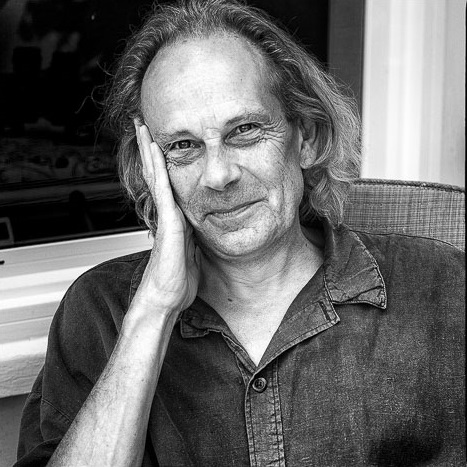
Wayne Koestenbaum has published eighteen books of poetry, criticism, and fiction, including Notes on Glaze, The Pink Trance Notebooks, My 1980s & Other Essays, Hotel Theory, Best-Selling Jewish Porn Films, Andy Warhol, Humiliation, Jackie Under My Skin, and The Queen’s Throat (a National Book Critics Circle Award finalist).  He has had solo exhibitions of his paintings at White Columns (New York), 356 Mission (L.A.), and the University of Kentucky Art Museum. His first piano/vocal record, Lounge Act, was issued by Ugly Duckling Presse Records this year. He is a Distinguished Professor of English, Comparative Literature, and French at the CUNY Graduate Center in New York City.


Aug 122017
 

Takacs

.
Blush

They took the district psychologist for a body search
to the drugstore office thanks only to her professional
myopia, because she couldn’t have imagined
that the substitute security guard with erection
problems could flop so badly as to take her
for a thief, and that he was so hard on her
heels in the empty store minutes before closing
time, solely to catch her in the act. So she was
summoned to return at once the (old) blush
she had sunk into her handbag, while conscientiously
placing an identical one in her shopping cart
so that, after payment, she could powder her cheeks
with it for the award ceremony of the Freud medal
for lifetime achievement, to be handed her
by the minister of education himself. ‘But I’ve seen her
steal it with my own eyes!’, the security guard protested
and in his indignation kicked a cardboard box
full of condoms, making a sizable hole
in it. The therapist’s face had no need for the blush
to burn. But her calling, to ease the guard’s bewilderment,
proved stronger than her shame, and with the battle
cry, the patient is always right, she sprang to the guard’s
defense in front of the manager who, blaming
the heat wave, in his embarrassment
hastily put on his long winter overcoat.

.
Revolt of the Extras

We long to be continued after the last
episode, although the producers opened
the champagne and gave us a small farewell
party. This afternoon even we sit
on the kitchen stools in front of the camera
hoping to see ourselves in the new chapter: we have
played our part for a full year and this recent
indifference to our fate, the plotlines unfolding
without us in the new scenario
hurt us to the quick. No, this is not
what kept us pacing up and down the street,
shivering as usual at winter’s
end. Is it possible that the audience is losing
interest in us? Has our time passed
for good, our story passé, even though we are still
stirring? Coming and going we can hear
the camera’s buzz. As before, we tread with nimble
feet, but a low growl comes from the machine’s
jaws. We fear it might be disapproving.

.
The Other Side of the Coin

To bear the unsayable agony
of the lovers seated on an anthill,
the rhythmic squeaking of bedsprings at the moment
of climax, a rumble of the stomach in the midst
of an ardent declaration of love, to mix up the dear
addressee’s name when reunited at last.
While contemplating suicide by the open
window, to be soaked not in springtime
melancholia but in grenadiermarsch[1] stench.
To suffer the priest’s flu-inflected
staccato prayer over our dead body.
After a night spent awake due to the weather
turning, to drowse off when our life
sentence is announced.
Instead of ours, to enter the hotel room
of the lust killer who is shaving naked
in front of the full-length mirror. To go raspy
when given the right to the last word.
To meet ourselves on the staircase
(she going upstairs, I tumbling down).
Incensed, to shove our manhood
into the bread slicer instead of bread.
To knock on our own door, waiting to be let in.
With our mouth full of spinach to choke
convulsively on some antediluvial joke
on the silken sofa of the newly wed.
To eat gilded-edged caramel custard
while changing diapers. To shake
hands with the disciple who tries
to sell us the dead master’s gold tooth.
To see the light under shadowy circumstances.
To remain standing for good, half-dressed,
in front of the cupboard, or sitting
in the bathtub until icicles grow on the tap
out of a penchant for parallelism.
…………………………………………..And if not, let go!
Then the day will come: the grenadiermarsch
smell in the open window, the killer
with the razor will come to cut off the ice
from our skin. And spring! spring will come!

.

A Royal Day

During his visit now and then the king
stops on a whim, and throws a look
across his realm. Winter has worn out
the city, the fences lean in, the frost drove
new cracks in the pavement.
Snow, black, is blocked in the gutter mouths.
Open lorries carry sand to a nearby
construction site, fine dust
drizzles down. With light fingers he wipes
the grains from his brow. On tram fifty-nine
homeless bums are yelling across to each
other over the passengers’ heads
in a tongue of the realm he barely understands.
He arrives at Déli Station. Descends
into the subway’s draughty inner
halls. The brass band strikes up
a fanfare. He spots the mutilated
Romanian sitting in the same corner,
a babbling would-be greeting on his cardboard sign.
So his faithful subject has come to him,
travelling all night on the blackened train,
or defecting across the green border of hope!
He waves at the man kneeling at his feet, whose
eyes run over with tears. Daily routine.
On a mouth organ a duke plays operetta.
The hailing, the attention directed at him,
the loud calling of his name, the hands grabbing
the hem of his robe wear him out, he feels repulsion.
And yet: he was born for this, when all the bells
spoke of hope, I will be one of them,
he said, but now it is as if he were watching
in a microscope the beings, invisible to the naked
eye, scurrying, worming on the ground.

.

Innocence

I dreamed I gave birth to a child: by him.
But they warned me beforehand: it is stillborn.
The most awful of all was my indifference,

I didn’t care what was happening with me,
I felt not pain but ennui rather. A huge,
waxen newborn was laid out on the table

covered in transparent nylon.
Next to it, under a damask cloth,
props of an unfinished breakfast.

We must behave as if he were alive, the midwife
said and cried out twice: Look,
how cutely he is wobbling!

.

I knew I was to be sentenced

I started eating. On the newborn’s brow
above the bridge of the nose, a wound cut
with a blade appeared, I tried to smooth it out,

fighting my repulsion, but couldn’t. No
blood oozed from it: it was final.
Like the outcome of something long-planned,

done in cold blood, it was: concrete.
I knew I was the one who wounded him, unawares
when slicing the bread. I even recalled how

the knife ran into the still protesting skin.
I felt fear and hazy remorse.
I knew I was to be sentenced.

.

For everything around us is: life

Surely I cannot be the killer of our love?
Surely it was the child of another, a stranger,
not yours, and by no means mine?

It was a strange child laid out on the table,
stillborn, since the wound didn’t bleed:
this should be sufficient evidence.

Most likely it was a wax doll. Someone
must have made a savage joke,
for everything around us is: life.

And inside me too: you surely know me!
Even if leaves are falling on the rails
and the tram turns the corner with long shrieks.

.

The Chain and the Link (A Lánc És a Szem)

(1) The most exquisite movement (A legszebb mozdulat)
It is now clear that the forcefully united
stands out in parts. Needless to resist
anymore: as I have always wanted,

the chain and the link crumble a-part.
(I never managed, as I now realize,
to align, however hard I tried.)

Leaf, how gently you fell on the lake’s
water. Gentler than any lover
on the craved pudenda.

This was the most exquisite movement, thank
you, leaf. You didn’t mingle. You didn’t quiver.
This was the most exquisite movement.

(2) To leave (KIMENNI)
the crowded room at the height
of ovation when the arch-funereal
clowns perform their lightning-fast

jest, not to be duped by their countless
tricks, to break through the elated
row, to reclaim from the mesmerized

cloakroom girl hat, coat and umbrella
for a song, to cross the city when its theatre wings
are being rearranged but the night shift

has not arrived yet, the clocks stand
still, our sole companion the disinfectant
smell on the last pestilential streets.

(3) Going on (FOLYTATÁS)
Not to call anyone (the greenery will
outgrow their pots anyway and, pushing
open the window, lean out),

not to avenge, nor to get over
insult, not to have tooth-ache, inflamed
cornea, leukemia treated,

not to open the door when the house is aflame,
not to cling on when drowning, to turn back
from the loathed door at the moment

of arrival. Not to look forward on the way
but backward only. To stand up to the clash.
Then on the water a leaf may fall.

.

Yearning for an ancient cup

To not rebel, even if you possess the necessary
skills, but execute the emperor’s order.
To smuggle my remembrance into the manner of the farewell,
the moral of experience paid with blood, the gift
of clear-sightedness, before my eyesight is
blurred and my pupils hitch upward.
Where does bargaining begin, the withdrawal
of consent, the defensive fidgeting, the living
for the last moment, the hour stolen
for banqueting, or making love? I might
lapse there as well – our emperor left the decision to us,
but Socrates forbids cowardly action.
If I linger on among you for a while, it’s only
to say, I owe a cock to Asclepius.
But since you had promised to pay my debt,
what would hold me here still? The command
summons me, to quote the tragic poet, and it’s high time
to arrange for a bath. I’ll drink the cup right after.
The sand sifting from my eyes will settle on
the borders of Athens. I have never believed in borders,
yet feel no triumph. My legs go heavy,
I lie down on my back, as the man
who brought the hemlock advised.
The world loses its contours, grows cold.

— Zsuzsa Takács, Translated from the Hungarian by Erika Mihálycsa

 .

Zsuzsa Takács is the doyenne of Hungarian poetry. She started publishing in the early 1970s, gradually developing a consciously understated, slightly elegiac lyric voice coupled with profoundly personal themes, addressing both private and historical traumas. A former professor of Romance literatures, she has translated St. John of the Cross, Pessoa, Borges and others into Hungarian. Her story “Conference Hall” originally appeared in her 2007 volume A megtévesztő külsejű vendég. Önéletrajzaim [The Deceptive-looking Guest. My Autobiographies]. Her work is widely anthologized, and has been translated into English by George Szirtes, Laura Schiff, and Ottilie Mulzet, among others. Her poems and stories have appeared recently in World Literature TodayThe Missing Slate, and Locomotive Magazine. Reviews of her work and an interview can be read on Hungarian Literature OnlineShe lives in Budapest.

§

Erika

Erika Mihálycsa is a lecturer in 20th-century British literature at Babes-Bolyai University Cluj, Romania, a Joyce and Beckett scholar. She has translated works by Beckett, Flann O’Brien, Patrick McCabe, William Carlos Williams, Anne Carson, Julian Barnes and others into Hungarian. Her translations of contemporary Hungarian prose and poetry have appeared to date, or are forthcoming, in World Literature TodayThe Missing SlateTrafika Europe, and B O D Y Magazine. A regular collaborator to various Hungarian reviews, she is editor, together with Rainer J. Hanshe, of Hyperion, issued by Contra Mundum Press.

 x

x

Footnotes    (↵ returns to text)

  1. Translator’s note: Potatoes and pasta stewed with onions, some sort of meat or bacon, and eventually anything else that could be thrown in – in this respect, a bit like the famous Irish stew. It is very consistent, and became a food of the poor. The smell would have been of onions stewed in pork grease, into which the mixture is then thrown with water. Appropriately bathetic.
Aug 102017
 

Alexander Tinyakov

http://wp.me/p1WuqK-kRQ

x
The poems below are the work of Alexander Tinyakov (1886-1934), a Russian poète maudit who ended his days as a professional beggar on the streets of Leningrad. They are, to my mind, every bit as vibrant and prickly as they were when they first appeared a century ago. Tinyakov was a difficult man: a combative alcoholic, resentful of his fellow poets’ success and perfectly willing to compromise his own principles (that is, if he had any to begin with) for a good meal. And yet, his verse remains compelling – not in spite of his flawed character, but precisely because of it; he is completely and electrifyingly honest about his baseness, his desperation, his animalistic drive to survive at any cost. For a number of reasons – many of them quite legitimate – Tinyakov’s fellow poets began to lose patience with their colleague in the 1910s, and most broke all ties with him in the 1920s. In the third poem below, “Joie de vivre,” Tinyakov predicts the death of Nikolay Gumilyov (1886-1921), one of the era’s major poets. Gumilyov would be arrested by the Soviet secret police (Cheka) on August 3, 1921, for alleged participation in a monarchist conspiracy, and executed on August 24. The poem appeared after Gumilyov’s death, and was interpreted as a celebration of his demise. This may have been the final straw. For the rest of his life, Tinyakov was a pariah.

—Boris Dralyuk

*

How blessed to be a gob of spit
racing down a dirty gutter –
I can hug a stubbed-out cig,
find a piece of fluff to cuddle.

Say they spat me out in fury,
in a moment of despair –
skies are clear, I’ve got no worries,
breezes fill me with good cheer.

I may hunger for the freedom
of the river’s blue expanse,
but for now I’ve got the pleasure
of this dirty gutter dance.

1907


Belated Rook

Bitter cold – the puddles slumber
under frosted panes.
An old rook, all stiff and lumbering,
flaps a heavy wing.

He lingered here despite the chill –
it’s almost blizzard time.
Now he can’t escape the pull
of warmer southern climes.

He scrapes his beak with icy foot:
Must he really fly?
While fallen leaves circle about,
rustling their goodbye.

December 1909


Joie de vivre

Lovely new coffins are headed my way,
full of the finest young men.
Pleasure to see them, simply a joy –
pretty as birches in spring!

You’ve kicked the bucket, you pitiful dogs.
Me? Well, I’m doing just fine!
They’ve sealed you tight under big heavy lids.
I can look up at the sky!

Say every coffin holds some kind of genius,
say that one there’s Gumilyov. . .
But I, who am hated and spat on by everyone,
am fit as a fiddle, you know!

Sure, soon enough I’ll be one of them – carrion,
nothing but worm-eaten filth.
For now, I’m still here and rejoice at the sight of them –
people that I have outlived.

July 28, 1921


A Prayer for Food

Fate, I beg you, I implore you,
give me food that’s good and sweet –
promise me a single morsel,
I’ll commit the vilest deed.

I would curl up like a ram’s horn
and go crawling on my knees.
I’d blaspheme the Lord in heaven
and defile even my tears.

I’d befoul the purest soul,
trim the wings of lofty thought.
I would burgle, I would steal –
lick my enemy’s bare feet.

I’d go down to hell, plod barefoot
through the Russian frost and mud –
for a piece of bread and horseflesh,
for a pound of rotten cod.

Put a yoke around my neck,
just as long as I can eat.
Life is sweet for well-fed lackeys –
honor’s bitter without meat.

November 1921

—Alexander Tinyakov translated by Boris Dralyuk

x

Boris Dralyuk is an award-winning translator and the Executive Editor of the Los Angeles Review of Books. He holds a PhD in Slavic Languages and Literatures from UCLA, where he taught Russian literature for a number of years. He is a co-editor of the Penguin Book of Russian Poetry, and has translated Isaac Babel’s Red Cavalry and Odessa Stories, both of which are published by Pushkin Press.

x

Aug 092017


Oath

I made a vow to love whoever I encountered.
It wasn’t true yet, but came to me in the bathroom
looking at the purple tufted rug that boys’ shoes had trucked on.
There was a salt jar there too. And all these abstract paintings
I was entering and leaving. I stepped out
of the bathroom and saw the host’s white bedspread,
a corner of it, and some fabulous pillows.
I pictured a slew of children and mythological characters
sleeping together in front of the television. It was cozy there
in the silence, words floating up from below.
And it made me want to try harder.


Salve

In Italy, the buildings are for beauty,
and beauty, says Joseph Brodsky, is the enemy
of a hostile world. “Salve,” says the customs man
when he stamps my passport.
Which means, “Hello.” With the ve
jutting out its lower lip. Salve, at the bar.
And in the chapel built by plague survivors,
salve, says the cupola. Salve, says the floor.
In the Giovanni and Paolo hospital
the old wing opens out like fields and windows
in a Van Gogh painting, light penetrating halls
and making space in silence. No one’s there at all,
but—salve, salve, salve, salve.
When I return to my more brutal realms
the word comes with me. I don’t declare it.
How light in my suitcase it is, how old-fashioned
and almost ethereal, but in some lights
real, and close enough—to salvage.


Appointment in Samarra

30 people in chemo today multiplied by
x hospitals in y countries and z universes.

Back here, H smiles through 4 syringes of chemicals, 2 bags of saline,
and a flush of life-giving killer liquid.

Twin sisters in their 70’s share clippings of their modeling days
with shirtless men in big cars, take selfies holding up their matching drips.

A woman in the corner looks exactly like what is happening to her.
Pale and bald like coal after a fire.

Slap me good and hard with mortality while I’m strong.
My body wants to run as though it’s seen a ghost.


My Sisters’ Sisters

I am one of my sisters.
The one who refuses, goes inside
and draws her knees to her heart in a small ball
turns toward the wall waiting for someone to come
and for no one to come.
I am one of my sisters: I do not cross
the threshold where danger lies, its flank
on a couch of cossacked hopes
roaring its helplessness through the malice
of tongue and hands.
That one who closes the door
who remembers only enough
of what was inside to stiffen at its name.
I am one of my sister’s sisters who pounds
more than a thousand nails,
one for each name of her missing sisters, into dead wood.
I can feel her shiny hammer on my shiny head.
One sister raises her sisters
on her hands in an auditorium of her sisters.
I am the cancelled and begun again sister, reinsistered,
the one who goes back into the room
to tear the air from the walls.


A Blessing for the Waning

Here’s to the last suck before the birth of separation, before gums have teeth.
To skin that’s soft, brown, rough, cracked, bruised, itching, callused,
folding over, touched. To the body held, whole unto itself.

Here’s to what the body was before anything changed, which was never.
To the original flat chest of everyone.

Here’s to the growths, hoped for and maligned.
The deletions, depilations, bargains and beseechments.

Here’s to loss of consciousness remembered waking up in the morning, in recovery,
bewildered, with toast in your mouth.

To the sleep that was good but is now interrupted and induced.
To pain that lodges and travels.

Desire breathes like a tide, goes a long way out
and surprises when it comes back in a swell.
The way grief does.

Here’s to falling and to falling, and to falling falling.

To the curse of forgetting and its gift, forgetting.
To the gift of remembering and its curse, memory.

To having had a life. Us creatures and our smells.

Here’s goodbye to clothes that fit another body.
To the last embrace you didn’t know was last until there were no more. Here’s to
kissing the last mouth on yours. Pucker up. Pucker up now and go.


Back Pain

Then the light on the television went out.
I turned over on the heating pad trying
for a comfortable position on the floor. I got
to the section of the 400 page book called epilogue
and did not want to go on.
I went for my notebook, but the pen
was just too far on the dark field of the carpet.
Maybe the radio.
Instead I lay quietly listening
to the subway, feeling it under me
like an animal rubbing itself
along my personal earth
and beginning to enjoy it.

—Ronna Bloom


Ronna Bloom has published five books of poetry, most recently Cloudy with a Fire in the Basement (Pedlar Press, 2012). She is Poet in Community at the University of Toronto and Poet in Residence at Mount Sinai Hospital. Pedlar Press will publish her new book, The More, in October 2017. Her website is www.ronnabloom.com.


Aug 042017


“So what do we have now in its place?”
xxxxxxxxxxxxxx(Rumina Sethi)

In place of prudence this tumble of gulls
and vultures effervescing from bulldozers
along archipelagoes of landfills.
In place of justice, hybrid tea roses
and cockapoos, puggles, labradoodles.
In place of temperance, pop-up surveys,
monogrammed collars, logoed zipper pulls.
In place of courage, postal holidays.
In place of faith, profiling, surveillance,
data mining, intelligence satellites.
In place of hope, adjustable-rate loans,
spin-offs, takeovers, derivatives, bailouts.
In place of love, speed limits in school zones,
reflective vests, flashing yellow warning lights.

X

“You love anybody yet?”
xxxxxxxxxxxxxx(Alyson Hagy)

Which one you counting on love to transform:
you or your lover? This lover love you back?
Figured out how to stick to one at a time?
Find familiar sweeter than exotic?
Always prefer what you got to what you don’t?
Believe you’re the exception to the rule?
Think things’ll get easier at some point?
Sure this time love will prove too big to fail?
Storybook, destined for a happy ending?
Not planning to get old like the rest of us?
Botched it before, but you know what you’re doing
this time? Have a backup plan in place?
How much more inventive will your lover’s
treatment of “fidelity” be than yours?

X

“What happened to the suburbs, the exurbs, the shopping malls, and the edge cities?”
xxxxxxxxxxxxxx(Julie Abraham)

That one year in high school Kevin Wilton
bought a Gremlin that didn’t look like much
(had been wrecked, body didn’t quite sit on
the frame), and didn’t so much roll as lurch,
but got us to track practice and the mall
and once a double date (I remember
his date but not mine). He was tall,
strong, broad-shouldered, but (I learned much later)
his father still raped him and beat his sister.
One time, only once, he drove us backward,
mall to freeway, by the off-ramp, faster
than I’d have driven even faced forward.
No cars were exiting, we lived. Too late now
to pay him that gas money I still owe.

X

“Go back to what?”
xxxxxxxxxxxxxx(Jennifer Atkinson)

Go back to storm warning and rain delay.
Go back to parchment, papyrus, vellum.
Go back to land line and gravel driveway.
Go back to blent, unbent light, pre-prism.
Go back to samekh, yodh, zayin, aleph,
great auk, ivory-billed, passenger pigeon.
Go back to cave painting and petroglyph.
Go back to mask, to God from the machine.
Go back to compacted cosmos, the size
of a penguin’s egg, steadied by webbed feet,
stayed from snow, against God’s belly feathers.
Go back to left hand does know what the right.
Go back to stage fright, recurring nightmare,
back to Houston, we’ve had a problem here.

X

“That something has to come undone?”
xxxxxxxxxxxxxx(Jenny Boully)

Or that, of what in fact did come undone,
we have to tell ourselves it needed to?
The same way I say I had no part in
the things I’ve done but can’t believe I’d do?
Or that, because we think we’re better than
others and could teach them a thing or two,
some blemish we’d managed to keep hidden
from ourselves will force its way into view?
Or that the something now coming undone,
much bigger than we are, includes all our
trivial undonenesses in its one
vast undoing, entails that we ourselves are
undone already, no matter what we do,
and undone ultimately, through and through?

—H. L. Hix

X

H.L. Hix’s recent books include a poetry collection, Rain Inscription (Etruscan Press, June 2017), an art/poetry anthology, Ley Lines (Wilfrid Laurier Univ. Press, 2014), and a translation of selected poems by Estonian peasant poet Juhan Liiv, Snow Drifts, I Sing (Guernica Editions, 2013), translated in collaboration with Jüri Talvet.

X

X

Aug 012017


Midlife

To select different options, click here.
Timed out waiting for a response.
Ten minutes ticking.
If you do not book now, the future into which you would have flown
will be irrevocably erased. No more husband and kiddies
at the park, the little one dangling in the baby swing,
wailing, as big brother tackles the slide for the first time.
Instead you will wait in an airport lounge for a stranger.
You will live on a floodplain and the worst will happen.
A fault will open and your car will plunge.
Earth will fill your mouth.
The beautiful tree, the one with the reddest leaves up top
(always the first to fall) will crash the window midsleep.
You will not hear it coming.
You will fall on the stairs and forget where you came from.
You will blink out please end this now
and no one will understand.
You will win a million bucks.
You will look like a million bucks.
You will have the eyelashes you always dreamed of.
Your tattoo of a wildebeest will scroll from your ankle to your knee.
You will strut your stuff.
You will gather feathers.
You will cocoon all winter and emerge a sculptor with your first exhibition
scheduled for the MOMA five years hence.
You will have a five-year plan.
You will dance to the end of love.
You will wonder a lot.
You will twiddle your thumbs.
You will stroll with a stroller.
You will be pushed in a stroller.
This is your life.
Your mother will bend toward you with an unremembered tenderness,
her fine hair swept from her brow by the wind.
You are the centre.
Your body is the universe.
There are things on your eyelashes that call you home.
Every second another.
Every second a pyre or a hole in the ground.
Every second a generation.


Selfie

Wherever you go, there you are.
Someone can see you on a screen.
This is being monitored for safety reasons.
This call may be recorded for quality assurance purposes.
We have you in our care.
In front of the Mona Lisa, everyone with an iPhone.
The girl who’s never crossed an ocean
asks if it’s true that they’re all Japanese taking selfies.
This one goes out to the one I love.


Mother

Six little ducks went out to play over the hills and far away.
Over a sunset far in Vermont.
Where Frost set his “Out, Out.”
A landscape Shakespeare never imagined.
And the saw that leapt
from the boy’s hands
the boy’s hand
out of the classroom in which the teacher read those lines
cool as mist in her loose dress.
The childfree teacher,
she of the fuddy-duddy husband and the pugs.
And forever the blood in your mind.
And forever the palms of your hands
made as they were made
inside the body of the woman you aren’t.


Lost

Mother duck said quack quack quack quack.
Something old, something new.
Borrowed and blue you leave the house,
borrowed and blue you find them,
leave them alone and they’ll come home.
Seven Chinese brothers swallowing the ocean.
Each with a particular gift, none greater
than his love for the others.
You’ve always looked out for number one.
But only five little ducks came back.
And the one who wandered
went a long way into the forest
where he found an abandoned house.
On the floor a trail of seed.
He gobbled his way through the kitchen,
down the stairs, and into the cellar
where they kept the people they would eat.
He did not know this.
He thought he was a person too.
And so he stayed there until
the rest of the last people in the world
returned from their hunt empty-handed
and roasted him with one of their captives
and his skin crackled and popped under the feathers
and they ate of that which they loved and it was good.


Bad Dream

In the corridors of the Overlook hotel,
in the mirror at the end of the dark hall,
in the room with the red drapes called the Black Lodge.
What happens there is the mind twisting a mobius strip.
The worst is never the worst, those fears
are not the fears that will take us,
it is the ordinary fears, the fast car
and the girl on the corner, the hot dog in the throat,
the late-night walk through the dogless park.
No horror films about the apartment fire, the hurricane.
The mutations after the nuclear disaster of your choice
bloom too quietly for the screen.
The descendants with their insides on the outside.
The worst has not been born.
The room goes on. In the throat
the herringbone floors.


Noise

We have digressed.
In the middle there is a lot of that.
The life of the out the life of the in.
Languages clatter their sabers.
I can’t hear you. I can’t hear you.
Orders and wrongs.
The middle is a long place,
low to the ground, with little sense of vista.
Capability Brown was never here.
The crops sustain and, depending on the season,
flash the blue of flax or gold of mustard.
Mustard fields.
No end in sight.
The sea darkening.
I think that’s it.
The middle is rife with references.
Can only really be named long long after,
when end begins to whinny its arrival.
And no one will want that name.


Once

There was a day we were not grateful and what happened was terrible.
Rain fell from the sky and we griped.
It turned to ice.
Dogs followed us, biting.
The slick sidewalk held our sagging haunches which,
had we been older, would have broken and marked the beginning
of the end. Too thrifty for heat, we shivered
enough to anger ourselves. Or, when they said vigour
we heard anger. The cornucopia grew mold, its magnificent shell
made badly of papier mâché, a piñata,
stuffed with warty gourds not meant to eat.
Then the sun came out inside our heads. What we had squandered.
The baby slept for hours and what we wrote was glorious
and even though it all was lost in the great crash of the laptop
the happiness lasted.


Strandbeests

Meanwhile the wind through the limbs makes the beings seem to exist
as other than hope and plastic.
Makes them seem to be being.
Avoiding red meat decreases mortality but at a certain point it’s a question of
happiness.
Chicken’s better but what of the cages, fish but what of the mercury.
The exploitation of the harvesters of soy.
Who has suffered more and why.
Fatigue gathers behind the eyes and in the throat. Though not tired, the subject
becomes anxious about being anxious.
He made them only out of PVC at first, then added propellers, then a sort of wings.
In comparison we are needy.
At the end of the world will be plastic.
They walk on their own and keep walking.


Niceville, FL

There really is a place.
There it is dimly. Mulchy beds of growth
hide the residences while smallish red-flowered trees
pop up intermittently as Bluewater Boulevard clicks by.
Grass is patchy there are no sidewalks an overcast
spring it was then it looks more highway than street
but on the map a quaint community of crescents and the like
nestled against lake and what looks like ocean but the zoom’s too zoomed
to check. Yup that’s a golf course there are the lucky few
captured in their carts that day a lone jogger we’re
zooming now across the median into the shrubbery
a word too English for this this is not vacation land
dark with growth how thick it is no names
for the blur that emerges the closer we get to what
it’s not called. Someone thought this place
a place people would want to be. There it is
from farther out on a big bay on the Gulf Coast
cheaper there no doubt though from here we think
holiday we think the fingerrub of money but that was before
the bottom dropped before the article about the sinkholes
where rain’s acid’s leached deep into the earth
if that is what we call the earth and through a hole a lake drained
until kids could grab the fish and through a hole
a room in which a man sleeping his brother
woke to hear a sound (what sound?) and there was
no room there was nothing there was
a hole into which he pushed or fell and later
was pulled out alone forever. Impossible
to wake and find that lack. To wake and feel a wetness
on one’s face and find in the mirror one’s face
is not a face is barely is not a thing is worse than the dream of falling
teeth there are eyes to see the space where the face
was the feel of it not real the look of it
a hole into which one plunges the crazy thought
of a joke, While I slept the dog ate my face.
Not that it happens but it happened. Such things
are not for Niceville where a spray keeps the course
mosquito-free but why so dark beneath those plants
along the road why are the houses so far in so far
off as though there were no view no lake no
ocean to look at as though there were nothing forever.


Wet

Rain on the lake willows.
Rain on the shore willows.
Rain on the swallow house.
Rain on the swallow.
Rain on the ash treated with a pesticide.
Rain on the lawn treated with a herbicide.
Rain on the mallards.
Rain on the pricey houses and the cheaper.
Rain on the ice cream stand.
Rain on the house in England that was his a while.
Rain where he slept.
Rain where he stood to read the paper at the grand piano.
Rain on the playground.
Rain on the corner shop with its varieties of sweets.
Rain on the violet creams.
Rain on the London suburb air.
Rain on the London country air.
Rain on what he came for.
Rain on his dead father’s garden.
Rain on him dead at the grand piano the newspaper open before him.
Rain on the phone ringing and ringing.
Rain on the doorbell.
Rain on the door opening.
Rain on the lake the centuries of the lake that is not a lake.
Rain on the name on the sign.
Rain on the planters of begonias and bougainvilleas.
Rain on the elsewhere.
Rain on the fresh-washed car.
Rain on the goldenrod.
Rain on the uppermost branches.
Rain in runnels down the trunk.
Rain on the crying girl.
Rain on the library.
Rain on the naptime the little tent the dolls left out.
Rain on the playhouse the swings the twisty slide.
Rain where it counts.
Rain on the clicks of the red-winged blackbirds.
Rain on the gravel path.
Rain where the fireworks will blast.
Rain on the dryer huff.
Rain on the doormat the umbrella left out.
Rain on the e-mail.
Rain on the name.
Rain on my friend in Montara California.
Rain on her drive to make enough to live in Montara California.
Rain on her husband not yet dead.
Rain on Nicholas and William.
Rain on Harry and Sasha.
Rain on Aidan.
Rain on Katriona and Nicola.
Rain on Gabrielle, Felix, and Myriam.
Rain on Pip and Tom.
Rain on Naomi and Isabel and long gone never gone Josephine.
Rain on Josephine, Nora, and Patrick.
Rain on Béatrice.
Rain on Nina and Martin.
Rain on Sam and Clara.
Rain on Henri and Sam.
Rain on Max and Gus.
Rain on Sam and Naomi.
Rain on Abby.
Rain on Isabelle.
Rain on Isabel.
Rain on Alex and Theo.
Rain on Shayle and Theo.
Rain on Emily.
Rain on Erin.
Rain on rain on rain.
Rain on Beatriz.
Rain on Nora and Johanna.
Rain on Andrew and Joanne.
Rain on Patrick and Andre.
Rain on David, Cindy, Barbara, Tim, and Danny.
Rain on Stephanie and Kevin.
Rain on Madeleine and Éloïse.
Rain on.
Rain in runnels down the street.
Rain that bears repeating.
Rain that’s rained.
Rain we don’t need.
Rain they need.
Rain that California.
Rain that Vancouver.
Rain that the reservoirs.
Rain across the nation.
Rain in the interior.
Rain at the northernmost reaches.
Rain on the new green metal roof (ping ping).
Rain on the neighbours.
Rain after the walk.
Rain before the recess.
Rain at the latest.
Rain in this time zone.
Rain on caffeinated.
Rain on chocolate.
Rain on the leftovers.
Rain on the barbeque cover.
Rain away mosquitoes.
Rain away the days.
Rain into the trajectory.
Rain on the silver car on its way.
Rain on the old streets with the new laid bricks.
Rain on the new streets with the old laid pipes.
Rain on the one-month old.
Rain on Mila and Gabriella.
Rain on Lucca, Gabriella, and Matteo.
Rain on Emily and Louise.
Rain on Gabriel and Lucas.
Rain on Sophia and Gordon.
Rain on Bulgaria.
Rain on the former places.
Rain on the end of the nineteenth century.
Rain on the cemeteries.
Rain on Lordship Lane.
Rain on the Caribbean.
Rain where they came from.
Rain on Landscroft Road.
Rain where I stood.
Rain twenty years ago.
Rain where my grandmother left.
Rain of decades.
Rain on the first taste of tarte pom’sucre and Belgian fries with mayo.
Rain on the newfound apartment.
Rain on all the unanticipated sadness.
Rain on the winter.
Rain on the frostbite.
Rain on the last places rain on the first places.
Rain where my grandmother.
Rain where my grandfather.
Rain on the voyage.
Rain on the waves.
Rain on the Victorian era.
Rain on the Victrola.
Rain on clematis.
Rain on the trellis.
Rain on the darkness.
Rain into the darkness.
Rain on the girls in the painting sheltered under hydrangeas.
Rain on the continent.
Rain in the well.

—Stephanie Bolster


Stephanie Bolster is the author of four books of poetry, most recently A Page from the Wonders of Life on Earth. Her first book, White Stone: The Alice Poems, won the Governor General’s and the Gerald Lampert Awards in 1998. Born in Vancouver, she teaches creative writing at Concordia University in Montréal.


Jul 112017
 

Kate Hall

.

THIS PRIMORDIAL SHAPE IS A GENERALIZATION OF THE SHAPE

A figure is contained by the shape of only one.
Only is the extremity. For example a beast.
And if only is added to a beast then it stands small and unbefriended.
And if only is subtracted from a beast then its shadow may loom and
terrify.
Other things being equal, in both ways, a beast suffers.

I is a figure contained by the shape of only one.
Only is the extremity.
And if only a beast is added to I then I will be forgotten.
And if only a beast is subtracted from I then, truthfully, something is overlooked.
Hence, I am contained in the beast or the beast is contained in I.
Other things being equal, both ways, I suffers.

Somewhere there is less shame.
But we know only so far.
Hence, somewhere there is disappearance.
And there is a precise only-sized hole in the cage.

.

AND THEN THE GENERALIZATION ERROR WAS CALCULATED

(1) I am learning to suffer in your language and (2) it ends differently depending on who does it. Also, (3) I’ve learned how suffering can be minimized with elastics. (4) The necessity of error. (5) The dog came home with a snout full of porcupine quills. Here, (6) I’ve outlined the distance between the ideal arrangement and the tangible crystal, which has to bear its irregularities. Even though, (7) I am the one explaining the meaning of heading down the wrong track and despite the fact that (8) the weighing and balancing of certain limits is hard to understand, (1) I am learning to suffer in your language and (2) it ends differently depending on who does it.

.

LET US FIRST CONSIDER THE ROLE OF ERROR

Captured in journeys through water.

In aquariums.

In jars of tap water.

As in, a little pond water has been added.

And of course there is blame.

Which no one can answer.

That the light passes through.

That widespread devastation.

That in great abundance.

A single red eye.

Then many.

That colored the sea for miles.

Ephemeral puddles.

As habitat.

Transparency.

As in, a fact not found.

Despite The Field Book of Natural History.

Predators.

To sink into deeper water by day.

To feed by night.

For being the less common.
For being fresh-run from the sea.

A container for the impossible.

That fell 9 days from heaven.

That and then 9 more.

.

A TOY SYSTEM CLOSE TO THE REAL WORLD

Moments of communion had consequences;
each one made a baby.
And the world was forced down the throat of this tiny I
which caused it indigestion.
It’s true that the baby is only the idea of a baby
but still it cried for a long time,
until the words blocked off the place where the world was lodged
like the body creates the abscess
and thus, the I grew and became enormous and parentless.

This is a story of creation.
Our separate same stories
we construct and reconstruct in a dark,
enclosed as the I is in its dark room,
adrift in its systems—
organs, tissues and cells—
so full of world lodged somewhere unlocatable within or without.
Our words surround the world;
when we find them, we cling to them.
Yet, we never understand what each other is saying;
our languages are so different.

And in the end what actually saved us was not the names of things,
not the capsule of words that held the world back,
it was the gesture.

The elegant arc of these fragile manipulative hands as they
coaxed each O into existence, each I into existence.
And this was the moment of communion,
the moment of creation,
the slow tango,
the pounding of the fists against the wall of the self:
the gesture of my O and yours so separate and sudden and strange.
How two Is can bump into one another:
one I rub against the boundary of the other I,
so that eventually one I was taken into the other
and the other I was taken into the other.

.

And in the end we were not for what we thought.
We were for the gesture,
as the night for the lift of the moon and not the morning,
as the plant for the breaking of the soil and not the flower,
as the grapes for the feet and not the wine.

The words are just practice;
they are misunderstandings.
And the misunderstandings are practice
for the inevitable loss of one I or the other
and the world sequestered there.
The loss that comes when we stop,
when the sun streams through the window
and morning breaks in.

—Kate Hall

x
Kate Hall lives in Montreal. Her first book of poems, The Certainty Dream, was published by Coach House Books (2009).

x
x

Jul 092017
 

.

Herewith, a fragment of Ricardo Cázares’s long poem entitled . Cázares began writing the poem in 2008 and has, to date, published two volumes of the work (around 500 pages) in Mexico.  is constructed on various strata (personal, historical, mythological, scientific, etc.) with long prose passages, compressed word segments, graphics pushing towards what the poet describes as “an uncertain archaeological and mythological consciousness” that slowly reveals itself. Cázares composes in Spanish and does the English translation himself. He says, “I have been translating poetry into Spanish for 17 years and think of myself not only as a poet but as a translator. However, translating one’s work is a different thing. I don’t think one can ever feel satisfied with the end result, simply because one is perhaps too attached to a certain syntax and rhythm that underscores the original mental and verbal impulse of the writing. There are very few passages that I’ve felt capable of working out in English.  For the present fragment I purposely avoided a literal translation, as I felt that some of the sounds and nuances that one finds in these ‘clusters’ only develop at a very basic, syllable-oriented level. I consider it a sort of ‘writing over’ the surface of the Spanish originals, which obviously breathe differently.”

— Dylan Brennan

.
a fragment from 

PLEASE INSERT COIN

if you wish to continue
insert coin
please
take a coin out of your pocket and
insert on
forehead or
nose

insert on eyelid
slowly til you reach
what touches us
now touch the matter
insert your hand
the coin now in the lobe
proceed with care now
stroke
the left
parietal
lobe

count to 14
thousand million years
insert your hand in
the rock for
a preliminary probe
and touch—that is if
you want it
if you really do want
it
it is possible to score to
scratch the surface of
the source
please insert
a hand
a coin
turn on your drill re-
move the overlying residue
from stratum scrap
outline an excavation plan
the tunnel dam the pass
a pathway will be ready in
5 years

if you wish to continue
insert
if you desire
if desire moves you to
burrow through the bulk
insert
enter now
if you desire you are
certain push
move onward to the
tertiary stratum
5          -7 thousand
million years
now open up
your mouth and
sing
you heard me right
yes sing just
open up your mouth
clear throat line
out just
bring your own mouth closer
to the mouth around the cave
listen for
the undertone inside
your voice your dead
tongue muttering
to matter you presume
at least for
23                    25
thousand years

if you would like to continue
please bore
bury your hand in your skull now
insert
an awl
trepan I tell you
don’t panic
puncture clear
inside the rock
5-6-10 blows
will do don’t
fear
the grinding purr the pain
is temporary it is not
the time yet see
the light
I tell you do
make progress as you can
that it be that it is done
say now
speak now
the road
by force

open up now say aaahhh
say it be done
the light
the form flooding
the tunnel palpate ah
the cavity you
now detect
a feeling
of well-being envelops
your hand envelops
the patina uncovers
the rough surface
of the rock you
let yourself be overrun
by light the memory
divides
your body mens your
mind now
opens up says
voice the voice now
guides you to
your body your lungs whistle
kindly calmly telling you to
breathe            hear here
the vulva opens up the
mater matrix
mother opens up her womb
not earth don’t
let her listen no
no one has any right to
refuse you now
stay calm
breathe in again don’t
get all worked up she don’t have to
that bitch hear me out you
are the keeper
lord and master no
no one
hear now
the way the grinding
of the mechanism brings you
a breath
a breath away
from the realm

— § —

INSERTE una moneda por favor

si desea continuar
inserte una moneda

por favor
saque una moneda del bolsillo
e introdúzcala en su frente
o su nariz
insértela en su párpado
despacio hasta alcanzar
lo que nos toca
toque ahora la materia
introduzca su mano
la moneda en el lóbulo
avance con cuidado roce
ahora el lóbulo parietal izquierdo

cuente hasta 14
mil millones de años
inserte su mano en la piedra
para una exploración preliminar
y toque—bien
si desea
si usted lo desea
de veras
es posible rozar el principio
sólo inserte una mano
una moneda
encienda su taladro ex-
pulse los sobrantes
del estrato trace
ahora un plan de excavación
el paso túnel presa
la vía estará lista en
5 años

si desea continuar inserte
si desea
si el deseo lo mueve
a explorar el cuerpo de la piedra
inserte
entre ahora
si desea está seguro
usted avance al estrato terciario
5          -7 mil
millones de años
ahora escuche abra
su boca
cante
sí le digo
escuchó bien
cante
abra la boca
aclare su garganta cante
acerque su boca
a la boca de la cueva
escuche oiga su voz
hacer eco
oiga su voz su lengua
muerta escuche la materia
usted desde hace al menos
23                                25
miles de años

si desea continuar perfore
hunda la mano
en su cráneo inserte ahora
un punzón
trepane le digo
no tenga miedo
perfore la piedra
dele 5-6-10 golpes
no tema
no le tema al crujido
el dolor es temporal
no es momento vea la luz
le digo
avance como pueda
hágase se haga
diga usted
camino a empujones

abra ahora
diga aaahhh
diga hágase
la luz
la forma inunda
el túnel palpe ah
la cavidad ahora
usted percibe
una sensación
de bienestar recorre
su mano recorre
la pátina descubre
la superficie rugosa
de la piedra usted
se deja invadir
por la luz la memoria
divide su cuerpo
mens su mente ahora
abre dice voz
la voz lo conduce
hacia su cuerpo
su pulmón izquierdo silba
le dice respire con
tranquilidad aquí
se abre la vulva
mater la matriz
la madre abre su seno
no la tierra no
se lo permita escuche
nadie tiene por qué rechazarlo
tranquilo respire otra vez no
se agite no tiene por qué
esa perra oiga usted
es dueño el amo
y señor no nadie escuche
cómo rompe la herramienta
lo acerca a sólo un aliento
del reino

 —Ricardo Cázares

.

Ricardo Cázares (Mexico City, 1978) is the author of several collections of poetry including Drivethru, Es un decir, and the long poem simply titled . His work as a translator includes the first complete Spanish translation of Charles Olson’s The Maximus Poems, Maleza de luz, Selected Poems of Ronald Johnson, Robert Creeley’s Pieces, John Taggart’s Peace On Earth, Truong Tran’s dust and conscience, James Laughlin’s Remembering William Carlos Williams, and a comprehensive anthology of the British Poetry Revival. He is an editor and founding member of Mangos de Hacha Press, and the editor for the poetry and arts journal Mula Blanca.

§

Dylan Brennan is an Irish writer currently based in Mexico. His poetry, essays and memoirs have been published in a range of international journals, in English and Spanish. His debut poetry collection, Blood Oranges, for which he received the runner-up prize in the Patrick Kavanagh Award, is available now from The Dreadful Press. Twitter: @DylanJBrennan

.

Jul 072017
 

.

Magnolias

Another trick spring, another month of mothering
the neighbor’s dumb magnolias from my window.

Another March spent warning, willing their velvet purses
shut with only my mind, because I don’t speak

their language, and because they are not mine
to mother. I have no trees, not even a houseplant,

of my own. The first thing I kept alive was a child.
Talk about a high-stakes dry run. Today that child

is at school, and I am chiding the neighbor’s twin
magnolias with my eyes—don’t open, remember, this spring

isn’t spring at all. But every year their pink tongues
lap snow, lick the thin, cold air. These trees

have seen my son, head back, mouth open,
doing just that. The sun is shining, its warmth

through glass a kind of lie, and I am practicing
telepathy with trees who can’t hear me, again,
.
or they can, but I’m too late: a handful of soft gray
clutches are unclasped on the lawn, empty.

.
I’m a Monster

in the lake’s murky mirror,
skin wavering green,

wrinkled by wind.
My eyes, blurring

in their sockets,
are still my father’s.

My mouth, my mother’s.
What parts of me are not

borrowed, pieced together
from other bodies?

Even this poor reflection
is proof I was cut

from a body, born
an animal. Proof I am

never without the ones
who made me.

I dip a stick in the lake
and stir my face away.

.
After the Second Miscarriage, My Daughter Teaches Me about Eggs

Ladybug, lemon yellow,
the size of the period
at the end of this sentence.

Moth, lime jellybeans.

Butterfly, pearls inlaid
on a leaf’s veiny back.

Spider, silk purses
slung under the basement stairs.

Flying fish, drops of blood.

Wood frog, blue eyes,
pupils dilated in the dark.

Turtle, white leather.

Black pine snake, marbled
white stones, the kind
you pocket and rub.

Ostrich, thick as a nickel.

Emu, fifty-carat emeralds
buffed smooth, facetless.

Duck, palest green,
as if white had tinted itself
with the faint memory of a lake.

.

A Cloud in Each Field

I found my daughter at the table, cutting square clouds
from a shirt box, gluing them in a neat white grid
to scribbled-blue paper. A day had never looked so
orderly. She colored the sun a quarter each yellow,
orange, red, black. Later I caught her inspecting
the scene for flaws, using a dollar-bin kaleidoscope
as a jeweler’s eye. When she finished, she handed me
the paper, called it her sky contraption. My daughter
invented it herself, or as she says, guessed it up.
And I—or my body in its genius—guessed her up,
the girl whose sun is a quarter black, whose sky
is a kind of spreadsheet, a cloud in each field, value
undetermined. She autosums the clouds until
the formula should fall apart, but it doesn’t.

.
Study

I’m beginning to suspect this life
is a study for another one,

research for a larger project
still taking shape. I don’t mean

heaven, no. If these days
are notes that will serve me later,

I’m taking copious notes.
If this world is not the real world—

I mean, not the final version—
will the real world at least

resemble this draft? I’m beginning
to suspect this life is practice,

and what of these practice
children—are they mine

to keep? What can I carry
forward except these reminders?

Each day is a note I jot down
under the day before.

.

I’m Reconsidering Burial

because if I were lying
in that narrow twin bed

under the sod, you might be
tempted to lie down there

at night, the stone a cold
headboard, and look up

at the sky—moon, stars,
wisps of cloud, etcetera—

and feel you are falling
asleep on the top bunk

and I am still tucked in
below you, telling you

my secrets in the dark.
.

—Maggie Smith


Maggie Smith is the author of Weep Up (Tupelo Press, September 2017); The Well Speaks of Its Own Poison; Lamp of the Body; and three prizewinning chapbooks. Her poems have appeared or are forthcoming in The Best American Poetry 2017, Paris Review, Ploughshares, Kenyon Review, Southern Review, and elsewhere. In 2016 her poem “Good Bones” went viral internationally and has been translated into nearly a dozen languages. The recipient of fellowships from the National Endowment for the Arts, the Ohio Arts Council, and the Sustainable Arts Foundation, Smith is a freelance writer and editor.


Save

Jul 062017


My Old Pal Venus

Oh yes, my old pal Venus —
there she is — or ought to be.
One moment, and that brilliant light
will have sunk below the hospital,
that rims the hilltop of our street.
(The lesser lights, that seem to spire
away from her, subsided too.)

I went outdoors to search
pin prickles in a flannel sky —
no waiting here for the Perseids,
our heavens scummed by street lamps,
cars — as if to keep us local, fixed.

Now, as I drag the trash can out,
not even the North Star still beams through.
The moon, a little cockeyed, glints.
I’m grateful for the company,
such as it is.


May Rocks

Spring. The May rocks butt and push;
the soft lawn’s jagged with dragon’s teeth.
new stones rise up, while last year’s stones
sink under moss
as if the mud were pulling back
what it so strongly had put forth
(the mud inconstant, fidgety.)

The house, too, teeters on its slab,
perched as it is on deciduous rock.
The water that melts down our hill,
erodes the city underground,
silts up the gravel river-plain.
The planet itself is no sure thing,
though, mornings, I’d want to bet on it.


Do You Remember?

Do you remember the alder woods
where we used to camp?
Overgrown now, with aspen, larch
and hackmatack.

I slept there once in a hammock,
roofed tarpaulin
whose net sides let in saline air.
Small creatures thumping over me,
their tiny feet
dinted its roof.

Dew in the morning; we lit a fire.
Rememberx tea inx plastic mugs,
the wetness of green raspberries?

Remember those summers, when xxblueberry hills
were patch-worked xmagenta, xcrimson, orange,
and those grey sand xshores xwhere swirling birds
opened and closed the evening skies?

I remember trying to photograph
what was mostly air.

And the long drive home,
together, xdusk,

and fields of broken cornstalks
turning brown.


The Lid

It seems a lid on final things,
that sea edge, sliver of bright steel
that rims the slowly darkening marsh.
The muddy hammocks seem to catch
and drag the slowly sliding sun
across their shell heap middens,
scarfy with groundsel and dusty reeds.
The water turns to silver as we watch.


Live in HD

The smell of rancid butter, slightly scorched,
drenches the crowded atrium.

Outside, snow falls on the parking lot,
a trifle dreary but mystical
in the softened neon of afternoon.

The mall is crowded, sleazy,
warm. A prototype for Paradise?
Almost. Friendly, comfortable.

But that semi-forest across the street
seems nearer to a paradise
I could imagine, beautiful–

but I can’t stroll
among those winter-blistered trees,
the candled tufts of withered weeds
skimming the thin-iced pond.

Here I can wait for the opera,
warm, friendly, safe–

the video games still audible,
and the smell of rancid butter, slightly scorched.


“Deep Listening”

I first heard of Janet Thom Hammock’s essays on “deep listening” when she read from two of them at Fredericton’s “Odd Sundays” poetry readings.

I think I have always gone in for “deep listening”—but especially as, now, my hearing decreases. Had I as a child ever heard silence? So many of my memories of childhood seem connected with sounds. Water and weather of course. The aches and creaks of a house—and the groans, ticks, and murmurs of the machines within it. The thumps and scurrying of cats, the roof thuds of squirrels, and, scraping about in the walls, my unpaying tenants who leave their tiny turds along the top of the basement bookcases.

Then there’s the street with its cars, the bus, the buzzing street lights, its chatty or (late night) drunken students—and the highway, not all that close, but constantly in roar. No matter how late at night it is, I can hear the highway.

And all those beasts: the hunting owl, the courting raccoons—someone downtown has bought fireworks—and there is the ambulance, once again!

And if I go out to the forest, aren’t the trees noisy? Cracking or whining or rattling their branches. And brooks do babble! Even the pond taps gently at its spongy rim.

I no longer hear bats, some birds. Mumbling, whispering poets and academics have merged for me into the sounds of water on stone or wind on trees.

I remember in Costa Rica, lying still in a slightly creaking hammock under more stars than I had ever imagined, with the waves patting the seacoast, and distant thunder lighting, occasionally, the horizon’s rim. The candle on the table next to me uttered a tiny, somewhat prickling, sigh.

—M. Travis Lane


M. Travis Lane lives in Fredericton, New Brunswick, and has published seventeen books of poetry. She has won numerous awards, including the Lieutenant-Governor’s Award for Excellence in the Literary Arts in 2016, and was short-listed in 2015 for the Governor General’s Award for her book Crossover. Her most recent publications are The Witch of the Inner Wood: Collected Long Poems and Heart on Fist: Selected Prose.


Jul 052017
 

.

Elegy

Illegible November of smoke and ash
Here is the trigger
Guard against the hours
& on the tag tied around a metal ring
Brother tag smeared red with thumbprint
Our name misspells us
Where someone killed the swollen bottle fly
Dear cages over the reliquary
The line reads on and on dear cages
Over the naked man
Cages to shelter racing dogs
Who race no more
Weariness of the grey muzzle
Weariness so thin it might be paraffin
Or rough fur or a hundred dollar bill curled by flame
Not knowing what it’s doing
Money burns inside its own gutted clock
On a weedy lot
Of scattered pills
O my wineskin o my shekinah
Look inside my greyhound’s mottled ear
To see its tattooed number
The animal won’t lift its head
Heat opens like a vault
Dispatching currents of sunlight and shade
Across the body of a naked god on his feverish cupola
Thresholds dappled with fill-in-the-blank
Having pulled the iv’s from his body
My brother climbs from his metal crib
To escape the ICU
Picc line catheter this is a good story
A god’s story my brother’s story
And I’m sticking to it read the entrails
Follow the pills they will tell you where he is
As they tell you the one story
His and mine
He walks the road until I find him

.

Nocturne

The broken guitar made desert feel nothing
Like night on earth you kept asking broken
Questions can I stay here are you
Alone are you sure you
Want to die alone will you please
Answer me I screamed no until my answer woke me
Was there always one lit house
In the grey circuitry of the master-
Planned but never finished community?
As if draws & ranges were a reflection
Of a desert I couldn’t see
Your hand held out a cup of water
Houses floated in the smeared chrome
Of office furniture left in the street
Old music played think glow line over hills &
Nightfall smoothing edges
No lights to greet us back think of me
& a child across the cul-de-sac waiting for his mother
To come home from the dollar tree on her bicycle
Cobalt sifted through missing frets
Tension wires & ditches across chaparral
Penumbral & half-charred
Harmonics rang out from the little boy on his front step
& the tinny echo of Duane Eddy crackled
From speakers on a timer in a model home
Were we really living in the capsule of dead astronauts?
Each night it happened poorly improvised as a tragic dream
Your appearance at my bedside & the expansion
& contraction of the quiet before chain finds its gear
As if crossing conductive traces
My voice still lashing out at your angry wake

.

Reservoir

From bleached bone, sandstone bank before dawn,
Steep where drought had dropped the water level to
Canyon depths, someone hiding up there
Looking down might see us — two bathers
Wading out into the reservoir — first me,
Then you. Was there a shadow loose on the hinge of the wind?
Maybe a windmill, rust that heat
Warps back into place, a voice to call me back,
A gloved hand to seize me?
There was a time in my life when I could
Hope for a grackle trapped in ductwork and little more
Where sharp wings wheeled behind window screens
As something larger pursued me, a lash
Of falcon from ornamental gray
Lung-work in a fenced-in garden a lifetime ago,
In a garden my tired father kept where our bad dog
Burrowed and ruined row after row
Radishes and bean tendrils, lattices and poles
Upended. Consider the axe handle — crude tool
Ancillary to memory’s hot metal, a sharp wedge
That slips away from wizened pine.
It could kill us both. In a rage my father grabbed the nearest
Thing to beat the dog. His rage I bear
As my own, my ratchet, my talk radio.
How to leave the air drills of rage and talk?
Used tire centers mistook for heartbeat
And blood where the father’s headless torso and legs
Take long strides across the landscape
In my bedroom window, how he keeps searching for me.
And the dog barks and snaps
Where I bleed as I try to save its life.
So I wade out and wait for a hand
To press upon me, to push me beneath the surface,
For a faint guttering at the end of dirt roads,
For the mind’s clenched fist, an animal fist
To loosen, fingertips spread.
For your hand, my hand’s companion, to form
A muzzle of fire to reach into a cry’s fissure,
Water’s skin, horizon, sky, spreading inside us.
As I look away you touch my shoulder
And not a father’s voice says wait for me —
Green water around our thighs
Brimming with a stranger’s weight —
Hold your breath. Open your eyes.

.

Sanctuary

Can you hear the hammers?
Blood still warm
Stirred with warmer forearms
Let thicker and darker cursive
Encircle and enclose
Obedient to its wheel the axe is a tremor
And the hammer a tiny bell
But not the kestrel you thought
Stigmatism against white field
Falco tinnunculus
Macula against a policeman’s winter
Windshield
Gone as you look right at it
No second thought
Who doesn’t want to protect a child?
You’re holding it wrong
Where is your body
To mantle his body from the gunman?
No second thought
Let the axe be river the river’s half-built bridge
Or a stalled train or a mirror
See the snow falling on the old Amtrak observation cars?
You are on the wrong side of it
Stop screaming
Where is the angel against anything?
The hand to stay the blade
Think of it like a sharp hammer do you know
How to hammer a nail?
No one wants this
Your one verb broken
Over the back of your throat
Not your mother not the officer behind bulletproof glass
Driving you through the frozen rain
Let’s let the verb go on
Screaming a place inside
The animal assigned to you
After it’s all over
You can bathe by candle and bucket
And listen to the workers as they free jezebel and her dogs
From limestone
There she is there’s the sound
Of your heart
As for the angel’s hand and the father’s axe —
Can one ever exist without the other? — the stone
Is still blind and uncut
But they’re close
Can you hear the hammers
Your heart beating?

—Miles Waggener

.
Miles Waggener is the author of three poetry collections: Phoenix Suites (The Word Works, 2003), winner of the Washington Prize; Sky Harbor (Pinyon Publishing, 2011); and Desert Center (Stephen F. Austin State University Press, 2016); as well as the chapbooks Portents Aside (Two Dogs Press, 2008) and Afterlives (Finishing Line, 2013). Since 2006, he has been a faculty member of the University of Nebraska at Omaha Writer’s Workshop.

.
.

Jul 042017
 

S E Venart

X

Epiphany

The tenth month an unlikely location
for it, or this morning or this afternoon when

you are a mother who used to be a poet.
You sit at the desk and have one hour to find it.

It’s here somewhere in the mind’s tiny grey flags
in the millions of scraps piling up.

Or maybe you left it in the dark bleeding gums
of the dog you love, watching her clench another

rock from the tide twelve years ago. What was she
looking for? What if she stopped looking?

Metaphors were easy then, not only the sky,
but migrating everywhere. And now everyone is arrow

arrow, arrows. Everyone harpoons. And
I am the big heart, aren’t I?

When the black dog is being put down, in her last
second I whisper, Squirrel.

X

Attenborough

First month of kindergarten, out of the blue
slabs appear at the bottom of her artwork.
Ocean, she says to inform you. A second wedge

appears, light blue, crowning her paper with
a sky in which a two-inch Kea soars downward
for his lunch: red stripe of fish on a box

with wheels and windows. I am the smartest animal
on earth, she chants. I am the smartest animal.
Okay, you concede. And not to debate the thesis

so much as to develop divergent thought
you press play on YouTube. On the screen
birds of paradise do the work of pop-up pomp

firework faces appearing on the black stage
of their wings. They’re puppets, she bluffs.
But! The strongest muscle in my body is my tongue!

Just like that, she flutters off to the mirror down the hall
where she watches her reflection flip
a glittering headband back and forth between its palms.

It’s best if you stay hidden, quiet behind the laundry basket.
Bower bird! she’s singing with a hunch
in her shoulders— Giraffes can clean

their ears with their tongue, this infant human
says to her reflection before she shapes her fingers
into a heart using twenty-nine hand bones.

X

The Standstill

We fought in the folded hours after the children
were in bed. We fought while scraping plates

gathering glasses after the guests had gone. Sometimes
the fight was vapour, vanishing in the living room

air when we came down for breakfast. Like you,
I believed there was a series of words, or a single

word that would solve things. We searched for it.
I walked the football field, the dog straining against

its lead. You walked the dog where you walked it.
Before bedtime we cleaned our children’s bodies

carefully. We brushed their teeth quickly, leaving
the rest up to fate. I wanted to find that word, but

sometimes I come into the kitchen
as you leave it and just like that, fault fills

every jar in the fridge. On these nights I wait in bed
and breathe in the dark. Maybe tonight a child

will come in here and out of her oblivious
spread-eagle sleep will seep into this space

where we sometimes meet
a simple explanation, a pure reason.

X

Origami / Cat’s-Cradle Digression

Sometimes at night I don’t try to get up
and get it down, one poem folds into
the crease of another connection, they

point their corners into other
corners: the word daughter almost certainly
contains the word duty when you fold it so— xxxxxxxxxThere is a Kenyan

tribe, they take dust in their mouths, make paper from it
send it to Japan where eleven-year-old Siberian
girls wait in tiny pleated apartments

to be models. Is it not true that watching
a thing become another thing— xxxxxwatching string for that matter
turn into the Eiffel tower with only three fingers

and a mouth pulling at its peak— is also art?
I don’t always write them down. xxxxI watch
this girl on YouTube demonstrate

Jacob’s Ladder, witch’s broom, cradle for a tiny cat,
with hands so small the connections are effortless
in front of me in real time, being made and vanishing.

X

Albert County Breeder

It was years before I could walk back
to that doorway, figuratively hold

the post of your fallen porch
with its thousand green Mason jars

staring out towards the weathered barn.
On each window your dust held the shapes

of the cobwebs underneath.
Your father comes out the kicked door.

Inside I’ve seen the hard-packed dirt
on your kitchen floor, ketchup caked

to the spoons, the bucket in the corner
for the winter toilet. Outside we have more

in common: bus shelter for the wait at the end
of the lane, a broken look to our crab

apple too, blue spruce, red pines, rows
of crows on the electric wires and

the same wild square eyes in our animal
we brought to be breed with your animal.

X

When Life Widens Wider

In I suppose a pinprick of hope, I look out his windshield
wanting it to be true: northern lights or meteor showers
or something to be there above the valley so his hand
on my thigh has an explanation, a need to point out
exhilaration instead of the trope of furniture-maker/rig driver
driving his babysitter home and stopping the car in the ditch.
At two in the morning there’s so much I think has answers—
the black map of pinpoints above can be joined to form
bears and containers of milk, archers with arrows pointing
to North, to Hercules. But this all dissolves where his hand rests
casually on my thigh, same hand that I think leaves porn magazines
for me between the couch cushions, leaves cereal and sour milk, leaves
the nails of his children dirty and grasping for their one shared
tooth brush. I squint into the distance above the hills
to clear the chatter inside myself. If I want someone
to be grateful for me, I don’t know it yet. If I want
a man’s hand on my jeans, I don’t know it yet. He decides
to point to a series of dots above us. And among the voices in my head
I hear him saying, See? This is a kind of map. And I don’t hate him
for showing me that because yes, I see it too, it’s a mess.

—S. E. Venart

x
S. E. Venart’s writing has been published in New Quarterly, Malahat Review, Fiddlehead, Maisonneuve, This Magazine, Prism International, and CBC Radio. She is the author of a chapbook, Neither Apple Nor Pear, Weder Apfel Noch Birne (Junction Books 2003) and Woodshedding (Brick 2007). She lives in Montreal and teaches at John Abbott College.

x
x

Jun 132017
 

Jane Clarke


Promise

After the talk with the palliative nurse
over cups of tea in the kitchen, my mother
tells me she’s already asked my father

to promise he’ll make it through the winter –
it’ll be sixty years in April, Charlie.
Sixty years since she walked down the aisle

in her dress of pristine lace, beaded bodice
and tiny satin-covered buttons at the nape,
a full skirt of tulle falling from her waist

to red and black tiles. Ballymoe Church
is tumbling now, stone by stone,
beneath the weight of brambles, ivy, ash.

I was eager and silly as a suck calf, she laughs,
as she readies his tablets, a whiff of silage
rising from the coats drying by the stove.


When he falls asleep

at the kitchen table and drops
another cup, my mother bends
without a word, sweeps up

the broken pieces in her hands,
looking out for shards in case
he wanders bare foot in the night.


Planting Trees

Dad taught us that paper
comes from trees and the word for book

comes from beech. He showed us
the olive-grey bark, smooth as river rocks,

how to tell the light hues of young wood
from the gloom of the old

and how to count the rings – starting
at the centre, working out towards the edge.

He’s unable to move from his bed,
but when we ask about the row of beech

beside the bridge, he’s clear as a bell,
my father’s father’s father planted them,

a shelter-belt for a nursery, when the British
were giving grants for planting trees.

Tomorrow, I’ll get dressed,
we’ll go down to see them again.


I’ve got you

Through days of morphine,
tidbits to tempt his appetite,
there’s nowhere else to be,

I hold his teacup to his lips,
wash his face and the hands
I rarely touched.

During the night old hurts
and worries surface
like stones in a well-tilled field.

What time is it now? he asks
on the hour. He sings to himself
and murmurs lines he learned

as a child, ‘All we, like sheep
have gone astray, we have turned
everyone to his own way’.

When he asks to get up,
I hold his wrists,
brace my weight against his.

For a moment he’s confused –
it’s ok Janey, I’ve got you,
go on now, you can stand.


Respects

From Roosky, Creemully, Louglyn,
Kiltoom, Kilbegnet, Moyliss,
Brideswell, Lecarrow, Creggs,
Athleague, Ballinleg, Carrowkeel,
they came to pay their respects.

They shook hands with us,
stood by his body and bowed
their heads. Cattle men,
sheep men, carpenters, teachers,
foresters, nurses,

mart managers, vets;
they said prayers, laid their hands
on his chest and blessed
themselves, then filled the kitchen
with the man they knew,

a grand man altogether,
always out early, a hardy hoor,
a good judge of a bullock,
fierce man to work, a man of his word,
he had woeful hands.

I slipped out for a while to see
the flawless orange globe
hung low over the Common
and a flock of whooper swans
feasting on the last of the winter grass.


Dunamon

i.m. Charlie Clarke

They dig slower as they go deeper,
taking turns to heave shovels of clay,

throwing bigger stones and rocks
up into the tractor box.

Son, grandson, nephew, neighbours,
they’ve already gone down five feet,

when they lay their tools aside,
drink tea, light up for a smoke

and agree they couldn’t have
a better day for digging a grave –

not a cloud to be seen,
sunshine melting last night’s frost,

and, from the woods behind them,
a chaffinch singing his heart out.

—Jane Clarke

x
Jane Clarke’s first collection, The River, was published by Bloodaxe Books in 2015. Originally from a farm in Roscommon, Jane now lives near Glenmalure, County Wicklow. In 2016 she won the inaugural Listowel Writers’ Week Poem of the Year Award and the Hennessy Literary Award for Poetry. She was shortlisted for the Royal Society of Literature 2016 Ondaatje Literary Award. www.janeclarkepoetry.ie

x
x

Jun 092017
 

Photo by Jada Lillo

x
Widdershins King

after Robert Graves’ The White Goddess

The augur reads your body as a map to the stars,
a map to ourselves. Your hollow-leg limp, your
slanted dance becomes our left-handed magic.
What for you is necessity, for us is harvest and a
night’s sleep from which we all wake while you
ache all night, grown too tall for your withered
hips. You whisper into the solstice flames, and
we follow your fixed-point starlight toward the
future. You pivot left then fall, but we rescue
you from the dust. When we stake your torso to
the forked oak tree in the center of the grove,
before we touch fire to the cured wood, you
warn us you cannot die, have already died long
ago, and learned to keep one foot hidden beyond
the threshold.

X
Teeth

In the booth behind me, a woman speaks to a man.
“Thank God we didn’t try to have a baby,” she says,
“my tumor would have eaten them, would have gained
superpowers!” She laughs, but laughter faded as gray
skin. The man does not reply. I wonder which
superpowers she means. Telekinesis?
Cancer with wings?

What poisons seed my cells?
What malevolent mouth might my body feed?

Admitted to hospital Monday,
transferred to hospice Thursday, Jana
died Sunday.

After, I helped clean out her apartment.
Dust thick as frosting, a sour smell—dog
piss and dirty drains and insane cells
celebrating Carnival in her ovaries, her
lymph nodes, her lungs.

Her words written inside the cover of a calendar five-years
old—THIS YEAR I WILL:
TRAVEL TO DENMARK! PERFORM STAND-UP! SEE
MY CHILDREN SETTLED AND HAPPY!
Her spiral notebooks, scarred by ball-point pen—blue
letters, a forest of upper-cases where her left hand cast
a faint shadow of ink as it crossed the page.
I bagged her notebooks in green plastic bags and threw them away.

The fox’s road-kill teeth etch each afternoon
as I drive home. Sharp white bordered by gums
black as cave glass, black as fresh tar
skinned from the off-ramp closest to home.
Day by day, the fox collapses into herself,
into the dark spaces she left behind in the gutter.
Along the horizon, mountains muzzle
the west wind. Volcanic rock wears down
into brown dust the color of the fox’s pelt.

Why do I crave my daily peek at death—shrunken body,
gleaming teeth, black gums—but this afternoon the dead
fox vanished, teeth and all? Famished, I gnaw my arm to
bone with pointed fox’s teeth.

When my turn comes, I will swallow my prescribed pills.
I will never wear a pink wig, but I will slice off diseased
bits of flesh to toss into the flame.

I will appease the gods. After all this time, we
still believe in gods hungry as ourselves.

X
de novo

Any minute now, the neurologist will open the door & introduce us to the MDA rep. We will fill out forms & sign our name, initial here & here. Each form will read, diagnosis—unknown/in progress. M— dances from square to square, counting floor tiles. Not until the moment when the doctor transforms from work-a-day technician to palm reader, do you fully appreciate the blessings of an unknowable future. Or course, an existential dilemma looms in every instant the proverbial bus misses your vulnerable bones or the apocryphal lightning preserves your tender skin. Yet the absurdity of consciousness amidst the cosmic soup of mystery rests far easier on the mind in healthy times. Listen to the oracle whose voice outlines a vast unknown in a series of appointments and procedures—blood draw; genetics testing, cardiologist; orthopedist; muscle biopsy; MRI; neurologist.

Once home, we comb our digital photo files & compile a timeline of milestones. This age M— army crawls. Remember how he used to roll his toys, scoot after them, playing fetch with himself? We called his game Adventure Time. Here’s the age he crawls—here he pulls himself up to standing, takes steps. Maybe a little late. This age his heels creep off the ground, & when his stance widens, his skinned knees & elbows never go away. He tries to ride a bike & can’t get the pedals around more than twice. For years he can’t skip or hop but see here? Here he leaps, both feet leaving the ground.

In the process, we discover a video from the Airplane Museum: M— in a yellow bi-plane toy, built for toddlers but just big enough for our 5-year-old with his long legs & tiny frame. After an initial push, M— gets the pedals going, his laugh echoing off the concrete floors & metal girders of the hangar’s roof. I film while J— chases her brother & you juggle between our son-the-yellow-missile & museum exhibits—bombers & fighters & helicopters spanning 70 years of American wars. He shouts, I’m in the jet stream! The video bounces & cuts on my, Sh!

Then I’m weeping into your T-shirt. You hold me & ask, What is it? I say our son’s name, only his name, but your grip tightens. You looked it up, didn’t you? I nod. The doctor told us not to look it up! An already-written future at work inside his cells shapes his body whether we know its name or not.

X
Waiting for the Turn

We tread the wave. The Pacific yearns landward and the
tide rises. Once the wave passes, we settle on the long
shelf of sand and holding hands, we balance beyond
the break. My son watches the wave
crest and crash into gauzy white foam, but I
watch the open ocean, timing the swells
until we can leap into the next wave.
Here he is, my boy, singular offspring of countless kisses.
Inside his body history coils, which is to say he contains
the future as the ocean contains us and a sea of air contains
this singular gold-and-blue bead of October afternoon.
Swells build and my son clings to my shoulders
when our feet float free from the sand.
In a time of transition, no amount of time
makes you accustomed to the taste of grief. How will we survive
this suffering? Variants of unknown significance
perform their invisible, broken work inside the membranes
of his cells while another wave pulses warm water
closer to shore and we buoy ourselves in this warmth, my son
and I. We laugh, delirious in the sunlight, and my son touches
his crooked finger to salt drops beading on my face.
He believes the drops are broken bits of wave.

X
How you will learn to ride a bike:

1) Press your thumbprint into your cells’
structures until you don’t know
what will happen yet; 2) Round the shape
of your head with my soft sounds; 3) See
ahead, the horizon of a new
structural bend in the happenings
of boys & dragonflies; 4) What flies
is not time but belief in time’s promise;
5) Forget all I’ve ever said; 6) Discover
within yourself novel repetitions with wings;
7) Fly along the horizon:
try to remember you’ve always known how.

X
Spaceboy, I Miss You

You dance across the ceiling.

You wrap arms around my neck, a hug, a plea
for rescue. I hold you to me. You curve your
body into the spaces between us, and hold me
until you’re full then you float upward to
dance. Under your feet the ceiling’s white, flat
paint wears away.

Nightblue pajamas outline your body, like the sky
your fragile arms, legs, hips, tummy and back, traced by
constellations— Ursa Major, Orion, Castor and Pollux, the
Scorpion, the Forgiving King glow in the dark.

Your walls grow thin.
Rhymes told slant, your tiny narrow fingers stretch
back and fold until they nearly meet the tender skin
binding your hands. You shake and sinew over the
ceiling, and I watch your joy in body, your star-
sprinkled pajamas. You twinkle through the space
between us, and I want you inside my arms, held
close. I wish to speak, to call you back to me, but you
move high on your toes and dance.

Knees jut, hips swizzle,
elbows and wrists and hands knot the air like wings.
From the twisted knots of your ankles, always lifting
you to your toes, you fashion ache into song,
into dancing stars, ceiling not strong enough to hold
such joy.

Come back to me. Come back
to me. I’ll rewrite your constellations.
I’ll repair the scrambled syntax. I will hold you,
stronger than the ceiling, my star-walking son.

I will not lose you to hollows.
I will not forget how you dance.

X
Scar Powder

after The National, “Graceless”

I am invisible and weightless, fine bone
powder voice dissolved in water you
caught inside the vase to feed stems of
goldenrod and firewheels, California
poppies and bluebells plucked from
Colorado meadows rescued from my
childhood summers. Bluebells.
My grandmother calls them witches’
thistles, her voice transparent as water.
As water I will rise up stems because
there’s a science to rising through
windows and my grandmother’s voice
calls through glass—witches’ thistles,
not for malice but for magic—listen, all
my thoughts of you become orange, red,
yellow, blue blooms in the vase
up on the shelf where you will say
it is the side effects that save us,
scars give us grace.

—Erin Lillo

x

In addition to writing, teaching, and parenting, Erin Lillo reads too much and listens to music too loud. She also has an ongoing competition with her husband to see who can work the most lines from The Big Lebowski into everyday conversation. Currently she’s losing. Her work has appeared in Chicago Quarterly Review and The Tishman Review. She has an MFA in poetry and fiction from Vermont College of Fine Arts.

x
x

Jun 082017
 

Clint McCown

.

Entropy

Knowledge
is to understand
the differences;
wisdom
is to bridge the
common ground.

Suspenders and
suspense, for example:
shoulder to shoulder
but otherwise unattached.

Which is the one
to learn from?

Even on our worst day,
we can draw abstractions
from the concrete.
Even an unanchored
suspension bridge
can be easily supported
by the simple suspension
of our disbelief.

But abstractions leave us
none the wiser.
Let’s get practical here.

The river is beautiful
only until
we have a need
to cross it.

The river is ugly
only until
we reach
the other side.

Back and forth
we go.

The earth is as much
pendulum as ball:
so even the
peaceable kingdom
will know a day
of slaughter.

And another.
And another.

Progress, it seems,
takes us nowhere
we haven’t already been.

The earth is as much
pendulum as ball.

The river is beautiful,
the river is ugly,
but the river is not
the flooded landscape or
the drought-cracked bed.
The river is only the river.

The pendulum
slows,
revealing every star
as finite.

Fire reduces
half the universe to ash;
what’s left will freeze
into atomic dust.

Don’t wait for the sun
to fill the sky.
If there’s a worm hole,
take it.

Remember that
shade tree
in your old back yard.
You’re there now.
Stay a while.

.

If Left Alone

every blade
unsharpens
over time

every color fades
toward neutral

every fruit drops

every drop dries

every strength
falters

every breath
every light
goes out, and

every memory,
good or bad,
is lost

I am now here
or
I am not here:

two states
separated by
one letter,
one infinity
of difference

which is the one
to celebrate?

which is the one
to mourn?

.

On Claudia’s Birthday

Friends aren’t what they used to be.
The circle has widened beyond
all horizons, and now people
we don’t know
wander in from the street
to rummage through drawers
and stare into the refrigerator.

In this third year after her death,
Claudia, or the fact of her,
prompts the ghosted internet
to tell the world
that it’s her birthday.
That’s not inaccurate, of course:
beginnings are indelible.
But still.

Old-fashioned friends, who know
a platform is no place to live,
send love and share the grief.

But here and there among the posts
the clueless barge right in:
Do something special today!
one tells her.
Have a fun week! says another.
Many happy returns!
Someone sends a birthday song.
A winking smiley-face.

Claudia herself
might have laughed off
these misplaced hints of immortality.
But who’s to say?

Every form of parchment
fades in constant light;
what once was clear becomes illegible.
Now we see through a glass darkly
and then darker still.
No doubt this same congratulation
will make the rounds again next year.

When you see it,
remember the snuffed light
of blown-out candles.
Think how much you’ve lost.

.

When Death Comes Knocking in the Night

Oh, you again, I say.
The terror has worn thin.

Habit teaches us to live
with anything, I guess —
the way I stopped worrying
about the atomic bomb
in sixth grade
after the fiftieth false alarm,
all us kids huddling
beneath our desks,
waiting for the final flash.

He still leans on that famous
scythe — a habit of his own.
I think he carries it
only to scare the children,
to keep them at a distance.

He’s not such a bad guy,
just lousy at making friends.
And in spite of what
you may have heard,
he’s terrible at chess.
He’s cool about it, though —
whether it’s a thousand
or ten thousand games,
one win is all he wants.

Our routine is almost playful now.
Stop me if you’ve heard this,
he says. But he never stops.

How many dead people
does it take
to change a light bulb?
He grins his trademark grin.
The number doesn’t matter!
he howls.
There aren’t any light bulbs
in the grave!
Then he cackles like a
drunken sorority pledge.

The humor, he believes,
lies not in the joke itself,
but in the way he tells it.

He tells it repeatedly.

How many dead people
does it take
to change a light bulb?
he asks again.
This is the only joke he knows;
for him it never gets old.

But for once I surprise him.
The number doesn’t matter,
I interrupt.
Dead people can’t climb a ladder.

Death gapes at me,
eye sockets wide,
grinning uncertainly
at my departure.

But the third time,
inspired, as he often is,
by the breaking of fresh ground,
he tries a variation of his own.

The number doesn’t matter!
he cries with sibilant glee,
The dead don’t need light bulbs!
They’re dead!

He thinks he’s hysterical
and laughs so hard
he unhinges his jaw.

How many dead people
does it take,
he begins again.

This goes on for a while.
He’s on a roll now,
as possibilities unfold
without end.

Eventually, boredom sets in.
I tell him I’m still listening,
that I’ve closed my eyes
only to concentrate
on his infinite comedic range.
I tell him his eternity
of punchlines is amazing.
I think he buys it.

How many dead people
does it take,
he intones
for the umpteenth time,

but I’m drifting away,
forgetting the joke entirely.

I ease down
through the sweetness
of the shadow.

Words release me
from their mystery,

and I sink, dreamless,
toward the usual slumber,

not knowing
how long, or how deep.

— Clint McCown

.
Clint McCown has published four collections of poems and four novels, the most recent of which, Haints, received the Midwest Book Award. He directs the MFA program at Virginia Commonwealth University and teaches in the Vermont College of Fine Arts low-residency MFA program.

.

Jun 062017
 

x

The Elements of Cohesion Must be Weakened

And there was a good way off from them
an herd of many swine feeding.
(Mark 5: 30)

In the Gospels demons hurl themselves head-long
Into a herd of swine and the swine promptly rush
Over a cliff and drown in the sea. It is easily a scene
Goya imagines quite closely in another context: when
Revolutionaries in the hours before dawn, sleepless
For several nights, walk now closely together, as if
Synchronized after a long rehearsed performance
And prepare to execute two brothers. A two-year old’s
Tantrum likewise is always preceded by a trespass
Into a country of endless exhaustion. No one present
Notices how he passes over that border. Soon he trips
And slips out of his mind, screaming and convulsing.
His eyes evidence a far away look. Cities are bombed out
Beneath them. Outside the tombs two men press
Their heads into their hands because of the demons.
Nearby, the smell of swine. With Goya it is the same:
Innocent bystanders hide their faces behind their hands
As in a game of peek-a-boo. Recall how in Kurosawa’s Dreams,
When over the decimated landscape of the hills demons wail,
It’s because their pain is too much: sharp bones protrude
Through their skulls. In Goya’s painting we cannot see the eyes
Of the revolutionaries who will do the shooting. Their backs
Are turned, their heads are cocked low to the butts of their rifles.
We see how the surviving brother pleads. And we see how the one
Holding him steady stares out of his skull as if he will never sleep again.
I can see the city roofs and the spire of a church over low hills.
Beneath the cliffs, which are not visible, the sea is inaudible.
Perhaps Christ is about. Who knows! Goya’s painting hangs
Close by on my wall. The revolutionaries locked in step, eyes unshut.

x
The Scene From Here

So I see near the beach beside the docked
and decommissioned ferry, a makeshift flagpole
on which hangs, half-mast, the French Tricolore.

I run past. The route I take follows
the trail beside the channel, its slow waters
flowing from lake to lake, its currents shallow,

benign, so that no danger troubles the swimmers
who recline and drink on their rubber floats before
they leap in and submerge. Nothing is hidden of summer

in the Valley where all along the shore
children build tiny sand castles, dig twisting moats
into the mud. Lone suckers feed on the lake floor.

It’s been a weird July. Every afternoon for over a week
storms break over the mountains—lightning, thunder—
the rain falls hard. Conversation turns to the weather.

What’s the worst they’ve seen (if they’ve seen it before)
those who’ve been here a long time can’t recall
or won’t say, and the weather anyhow has its own way

of doing things. It’s easy to stare at the hills and think
about nothing. As if the mountains would have you wander
into them, burrow into fallen pine needles, stay there.

Soon I turn from the trail and run up-hill on the old track
or where the railroad tracks were that once ran the span
of the valley from the coast into Alberta. History marks

landscape like a scar, like the flesh healed into woven stitches
above my right eye, so that a reddened furrow is cut close
but hardly visible except to those women who’ve pressed

their fingers there. In the evenings I’m reading Euripides
on my mother’s patio, near the lakeshore where a giant peach
is open until late; teenage girls inside serving ice cream floats

later flutter about the beach above the glow of their cell-phones.
Early in the morning last week I woke to the sound of a voice
announcing on a megaphone the names of marathon runners

as they crossed the finish line. AC/DC’s Thunderstruck, applause,
all the spent athletes like in Ovid, that story near the end
about the runner who had escaped the finale of the last age,

when iron returned to fire and fire to sand. He moved like an ant
below the gods who at that point were left with little to do;
they say Apollo caught him easily, pressed him between his finger

and thumb, squished and ground him up until he too was sand,
flicking him down to where he was left with the rest of civilization,
subject to the wind’s shifts. In the afternoon my three year old son

learns to swim. I prop him on my knees in the lake, cup my hands
underneath his arms; he does not let me relax my grip but screams
delight and terror when I throw him into the air and let him fall

again into my hands and collapse into my arms, cold water
washing over his face and hair. He cries because of his wet eyes,
all the water in his nose and mouth. Later, on the sand, he tells me

Babi, you protect me, right? I recall that version of Theseus’ myth
where he wanders without a spool of yarn stashed in his pocket.
My boy is a diamond cut into the air. My own midway inclines toward dust-

dry ponderosa bluffs, the shelter of my ear like caves carved into the clay
cliffs which rise here on either side, the trail metamorphosed into scree.
The Trojan Women all wail and wail. There is no happy conclusion.

The ships on which they sail take them elsewhere far away.
Last week in Nice a few young drunk Brits took selfies next to a family
mourning their dead. Life returns to normal quickly.

Out on the lake the boats pull skiers; above the water a man
harnessed to a parachute is pulled around awhile. The scene
from here shows him minuscule, like a dead man in an airborne pulley.

What is normal? The air I breathe is dry, dry. The mountain flowers
are yellow. No sound from the trees.
Not even birds.

x

The Etymology of Ideology

They didn’t know what they were doing. The train
Tracks on the hills behind their minuscule town were long
Abandoned; the last train passed through years before.
So the body they found, the horses near the pastures,
The dogs unleashed in fields, all this took on its own
Larger contour, like a collective vocation, an invisible
Order into the late afternoon, the hours before stray parents

Called one another and inquired into their children’s
Whereabouts. I have not seen them at all, not for a long
Time. Up in the bush the fires begin intentionally. Because
The hero of the story, the smallest, is bored too easily. Or
Because—it’s anyone’s guess, really—he is already insane.

x

Archaic Torso of Apollo

We cannot know his ordinary head
except from photographs, eyes wholly terrified.
And yet his torso, bent over his bound hands,
is like a light flickering in some empty apartment,

illuminating: a table, a cracked cup, itself. Otherwise
he’d be merely bare life, unlucky in foreign lands,
a common captured adventurer, hostage
to barbarians in a bombed city, almost a fiction.

Otherwise you could forget him. His body,
beneath vacant space, poised before collapse,
would not hesitate, tremble as if a living man:

he would not, from all the borders of his headless corpse,
burst like a dumb star: for there is no place left
where you aren’t seen. Your life will change.

x

On the Origins of Utopia

Many people have long felt the desire to do something
With their lives besides consuming goods. They desire
To interact and develop but for this there is no remedy
Calculable in classical economics. This gets me
Wondering. It would be a fine thing, all that flourishing,
Along with everyone else, but also decently private
So as not to burden one’s neighbors with too much noise
Or such a torrent of dumb ideas all at once. Space required
Is also allocated into the general scheme of the better life,
If not the best life, since the latter wedges its dissatisfaction
Into the minds of each of us according to our old desires,
Childhood vistas, incurable heartbreak by the age of sixteen.
It was silly then but also so totally serious that now our leaders
Wage their private warfare, their revenge, and we’re all implicated.

x

On Tyranny

Such hateful things. Heiro and Simonides,
Reclining through the uninterrupted afternoon,
Contend that the tyrant cannot do better than
To immediately hang himself. This is not bad advice
Except for the tyrant’s refusal to listen to Heiro and Simonides,
Who’ve fled together into Goya’s painting, Shooting of the Third of May.
But they fail to outrun the tyrant’s many admirers—
Those armed men, bored silly, lonely, who otherwise have nothing to do.
Now they’re occupied with the At-Oneness of the tyrant’s intentions:
The execution of Heiro and his friend, the poet, Simonides, dying beside him.
Still, Heiro does not cease to give his two cents worth; he raises his arms;
If the blood-muck pooling beside his feet became a common fire
Around which those who are lonely tell stories,
Then this is Heiro’s final story before the end of all that is Heiro:
Thus he stands and raises his arms above the earth, his gestures
The size of cosmos, his complaints Promethean,
Against fickle gods, against the machinery of lust,
A Tyrant’s boredom, against those whose bodies
Are equal to mass times distance, whose ignorance
Is dense as a failed universe, hopes dismantled
Like the station wagon of a family shot dead, in cold blood,
Ill-favoured and forgotten…Heiro sees it all,
Claims the remainder for the Greatest Story Ever Told,
The incredible bulk of a husband’s failure; the noblest
Scholar on his hands and knees, barks on command,
While furtive urchins run towards the river,
Lie on the ground, cover their bodies in mud, turn into slugs.
Now Heiro sees it all so quickly, he wants to tell it all,
But he vomits as he commences—with what great fortitude!—
To utter his final dispatched breath. Such hateful things.

—Darren Bifford

.
Darren Bifford is the author of Wedding in Fire Country (Nightwood Editions, 2012) and Hermit Crab (Baseline Press, 2014). His next book of poetry will be published with Brick Books in 2018. He lives in Montreal.

.
.

May 152017
 

Michael Catherwood


Radio Jazz
“No photographs of Pinetop Smith are known to exist.”

The gray riverbank
was dry with snakes of tree roots
and the radio

waves bounced the static-
charged air with night time jazz.
Pinetop Smith clicked keys

in a fresh boogie
woogie: “hey don’t move a peg
until you shake that

thing.” Pinetop Smith killed
in a Chicago dance hall
by a stray bullet.

The clear evening sky
is fresh ink now as I stand
by the Missouri

forty years later.
Music dances on my arm
like breath. The full moon

shines blue where stars
dot my wrinkled hands
steps from the river.

Tires kick and crunch
in the gravel where the past
clings to the thick light

while Pinetop pounds keys
over distances of years,
over brave currents.


Public Works District Yard 6


I
I organize these summer months
and reduce tasks to numbers,
fixate on numerals in a mantra:
rise at six, work at seven, lunch
at eleven-thirty, break at two,

punch-out at three-thirty, drink
Absolut from five to twelve, sleep at one,
cut four swipes into an overgrown lot
then circle three times along the fence line.
We search for addresses of empty lots

to mow: at 3123 Patrick there’s no house:
broken bottles and weeds and gravel.
If I find a house at 2958 Burdette, 3016
would slide in here. Often we cut
the wrong lots. We unload the Bush Hog,

cut fence wire from the flail blades
after the previous job. Then mow.


II
My last day at District Yard Six,
I bolt on flail blades and my hand
slips, my forearm catches
a jag of metal. The blood stands
like Jello. My foreman finds

some butterflies and we make
a quick patch job. Driving home
I think in a week I’d be back
combing newspapers, searching for work.
I drive home along the Missouri River,

by the automobile boneyards,
past factories and welding shops, by
the trailer courts filled with kids
celebrating in their blue plastic pools,
past the faded Go-Go Lovelies sign

and shaggy parks and a dim cafe. Along
the river I turn onto an access road and park,
watch the current churn up logs
and bright litter. I stand there for a long time
as the bank boils whirlpools,

then think for a moment the world is dying,
that we were all suffocating. The moment
passes and I get back in my rusted Pontiac,
turn on the radio, fire up a cigarette,
then spin over the gravel in triumph. In

the rearview the gray dirt rubs out the sun.
The gravel sings along in my fender wells.


The Subject

Both I still see dead—Mark
thin on a gurney in the hospital,
Pat sitting on his living room floor,
tv on, his chemo pack pulsing.

I could have done better, could have
looked out for my younger brothers
more. We all took defiance seriously
so we laughed at death, expected,
courted it, a gift Dad gave us,
along with excess.

xxxxxxxxxxxxxxxxWe are in the park,
climbing pine trees,
the sticky balm on our hands,
its scent in the air.
xxxxxxxxxxxxxxxxWe ascend with grace,
grip tightly the branches,
always moving up to light.

—Michael Catherwood


Michael Catherwood’s second book of poems, If You Turned Around Quickly, was published by Main Street Rag 2016. In 2006, The Backwaters Press published his first book of poems, titled Dare. His third book, Projector, is forthcoming from Stephen F. Austin Press in 2017. He has published poems, reviews, and essays in various magazines, including Agni, Aethlon, Black Warrior Review, Borderlands, Burning Bush 2, Georgetown Review, Hawai’i Review, Laurel Review, Louisiana Literature, Midwest Quarterly, South Dakota Review, Sycamore Review, Westview, and others. He writes essays for Plainsongs and has recently published poems in The Common, Poetry South, Solstice, Louisiana Literature, Measure, the minnesota review, New Plains Review, Bluestem, and the Red River Review. His awards include Intro Journals Award for Poetry from AWP, two Lily Peter Fellowships, the Holt Prize for Poetry, and National Finalist for the Ruth Lilly Prize. In 2003, he received an encouragement award from the Nebraska Arts Council. He was nominated for a Pushcart prize in 2014. His website is http://michaelcatherwood.net.


May 132017
 

Denise Blake

x

The Beaching

The pod of whales beached themselves on Rutland Island,
chose the isolated sweep of the Back Strand to come ashore.
My grandmother in her final years would have understood.

Those long-finned pilot whales suffered some trauma,
became distressed and confused. And so for her that winter
when told her grownup daughter had died suddenly.

Three years later, hearing that her eldest had also
passed on threw something within her off-kilter.
Sent her mind homing towards the Back Strand.

The whales had wandered together, over thirty of them,
swam through Scottish waters to the Sound of Arranmore,
heading towards the crescent of shoreline and their ending.

She would have understood, the Rutland-born woman
who had long left the island but yearned for that place; called
for it constantly, rose from her sickbed in the middle of the night.

I need to go now. They will be waiting; it will soon be low tide.
She wanted to journey, follow those already gone,
float ashore, let grief beach her there on the Back Strand.

x
Circus Days

You don’t have to run away to join,
it comes to you around their thirteenth year.
You hadn’t even noticed they were in-training
until you sense excitement,
strong as fumes, building up in your home.

Music gets louder, nights and mornings confused,
every room is taken over as the friends, arriving
in single file, increases to friends of friends
to claim every available seat, even yours.

The circus builds around one son, then the next
and the next until soon, three rings are running
full flow. You try to become the ringmaster,
the one in control, while you collect tickets at the door,
take further bookings, supervise training, do the laundry,
provide meals for the performers, refreshments
for the audience, try to watch all that is happening.

And just as you notice that one son is putting his head
into the lion’s mouth, the other is walking a tightrope
without a net, you look over to the furthest ring
at the clown juggling madly. He makes the slightest
gesture, out of sync with his act, and your heart stops.

His show has become the riskiest. He is juggling
frantically, the big smile really is painted on,
his hands are shaking and he is about to drop
everything, as those who you thought were his friends
are not laughing but jeering. You clear the ring,
silence the noise, take him into your arms and hope
that he will begin to talk, tell you what is wrong.

You watch when he starts to go back to his ring,
lifts a club, two clubs, four, until he is juggling well again.
While in the distance, his brothers are starting to pack up.
The show goes on until the troops move to another city.
Your house has become calm, you miss the circus days.

x
Mother Goddess

Demeter: mother of Persephone, goddess of the harvest
and the cycles of life. The Universal mother whose daughter
went missing, who did not drink, eat or bathe until she found her.
Mother of grain and crop, the bountiful gift, blessings on
those who looked after her own. The curse of unquenchable
hunger on those who brought harm to the ones she had borne.
Mistress of the home, producer of life, she sent her cubs
through a darkened cave into immortality and a blessed afterlife.

As it was with her, it was with my grandmothers and my mother.
Good mother, blessed mother, working mother, fairy godmother.
Guardian angels; tooth fairy, baker of birthday cakes, lovelorn healer,
soother of hot fevers, stitcher of torn hems, night-time story teller
who taught us how to walk, talk, sing, dance, cry a river and then smile.
Mother Nature full of fresh berries, wild roadside flowers, lilac
filled fields. A lioness, black bear, white vulture, all-present mother.
Watch over my clan, watch over their future, watch over their care.

The Goddess mothers: Anu, Gaia, Toci , Rhea, Durga, my own;
a Cailleach and Bríghde, Glinda the good witch, moody woman, crazy
kitchen-dancer. Mommy, Mummy, Mum, Ma, Granny, a Mháthair.
Creator of cycles, unconditional love and hurricanes. The core of peace.

Give me guidance, nourishment and strength. Help me to hold on
and let go, be present and absent, wise and foolish, the past and future.
Help me to be the mother my own sons need, the person they will cherish,
and the woman who will warm a hollowed soul in those who need a mother.

x
The Dream Turns

Everyone sees what happens on the front porch,
we were lucky to have a swing-set in the back yard.
I was going to be a ballerina, until I saw how much
practice it took be left standing on my tippy toes.

Holy smokes Batman. My mother saw me belly-flop
off the high diving board. She was stuck behind the fence.
There were birthday parties on picnic tables in the park,
lightning bugs and fireworks on the fourth of July.
The Yellow Submarine was just one long cartoon.

I was thrilled when Oswald was shot. Hated LBJ, Nixon.
How could they ever trump that? They should have seen
when the Cuyahoga River went on fire,
that pollution takes a long time to implode.
How are things in Glocca Mora, will you go lassie go?
We used to throw the cat down the stairs, to prove he would
land on all fours. We wondered why he turned vicious.

x
Aboard

Wave-beaten pier, a leap into the craft, lap of sound against the boat,
gurgle of bilge pump, life jackets, life saver, the punt propelled in motion,
surge of cloud on sea-blue heavens, rudders through the harbour, thrash

of buoys, tangle of ropes, crush and curl, swell of turning white waves
washing back to the Port. The growing roll of engine denotes
a journey has begun, anchors long lifted, our spirits buoyant, emotion

crests with the plunge and surge, waves of wind. Grey seagulls splash
into bottle-green depths, rise above the stern, fly overhead and behave
as victors, irritate the vanquished with shrill calls from sea-scorched throats.

The ferry passes. Dorys slop, splash, roll and fall in our southwesterly vision.
Sweep of air, taste of salt, tinge of marine, flounder of foam. Wave-wash
lifts the hull, turn of spring tide, sink to low tide as seafarers brave
gales: small craft warning Sea area Erris Head to Carlingford Lough.

Oar, tiller, winch and moulding, bulkhead, portside, aft and mooring.
Crab nets, lobster pots, leap of dolphins, slink of seals, diving oystercatchers,
mackerel, herring, hook and sinker. A cuckoo calls. Light abounds as we follow
the coastline, the full flow of seawater in our blood, head to the open ocean.

x
Seaweed and Rotten Potatoes

This ridged inlet of shale and rock facing the Atlantic
contains a cruel, cragged beauty and a fierce knowledge.
Its history holds a summer’s day when a white fog stole
up the sides of these cliffs, over the hills, in a cold trail
that left a black blight in its wake and a terrible odour.
A bank of shingle covers the coastline and my boots shift
as I try to walk along the shore. I can’t hold my balance.
I think of that question, why did they not eat fish?
Some whose lineage survived still question their resilience.
But boats were stripped to bare bones and pawned off.
Makeshift fishing gear was sold for bags of meal.
Fragile currachs smashed off the savage shoreline.
Fish rotted putrid if left sitting out for any length.
Men rowing home drowned in sudden squalls
and when the ocean stilled, what remained was silence.
Others who edged along the sheer cliff-face searching
for black tar lichen and kelp trails met brute-force waves.
So they came to this beach in their droves. Whole families
climbed steep rocks, barefooted through jagged shingle,
searching for limpets, periwinkles and seaweed,
scraped out what minuscule nourishment could be found
inside a small shell and ate it raw. They fed from barnacles
and salt-soaked bladderwrack straight from the shore.
They scavenged until the limpets and bárnachs
were depleted, until the bare stones could give no more.

—Denise Blake

x
Denise Blake’s collections, Take a Deep Breath and How to Spin Without Getting Dizzy, are published by Summer Palace Press. She is a regular contributor to Sunday Miscellany, RTE Radio 1. Her poems have been published in many poetry journals. Denise facilitates creative writing in schools and with adult groups.

x

May 122017
 

Sombrero Galaxy composite image from Hubble and Spitzer space telescopes

x

I shall find the dark grow luminous, the void fruitful, when I understand that I have nothing; that the ringers in the tower have appointed for the hymen of the soul a passing bell.

—Yeats, Per Amica Silentia Lunae


The Soul. Seek out reality, leave things that seem.
The Heart. What, be a singer born and lack a theme?
The Soul. Isaiah’s coal, what more can man desire?
The Heart. Struck dumb in the simplicity of fire!
The Soul. Look on that fire, salvation walks within.
The Heart. What theme had Homer but original sin?

—Yeats, “Vacillation,” VII


“Her favorite reading as a child was Huxley and Tyndall,” Virginia Woolf tells us of Clarissa Dalloway. As Yeats was fond of saying, “We Irish think otherwise.” He was quoting George Berkeley, reinforcing his favorite philosopher’s resistance to Lockean empiricism with his own defense of visionary powers. In the section of The Trembling of the Veil covering the period 1887-91, Yeats says he was “unlike others of my generation in one thing only.”

I am very religious, and deprived by Huxley and Tyndall, whom I detested, of the simple-minded religion of my childhood, I had made a new religion, almost an infallible Church of poetic tradition, of a fardel of stories, and of personages, and of emotions… passed on from generation to generation by poets and painters with some help from philosophers and theologians.[1]

Though Yeats was never “religious” in the normative sense, he did seek a world, as he says later in this passage, that reflected the “deepest instinct of man,” and would be “steeped in the supernatural.” That was his own instinct. It was his conscious intention, as well, to offset the scientific naturalism of John Tyndall and T. H. Huxley, “Darwin’s bulldog,” and to buttress his rebellion against his skeptical father’s Comptean positivism. In making up his own religion, Yeats relied essentially on art (“poetic tradition,” “poets and painters”), but he included in his “fardel” strands from interrelated traditions Western and Eastern. Seeing them all as a single perennial philosophy, “one history and that the soul’s,” he gathered together elements from Celtic mythology and Irish folklore, British Romanticism (especially Shelley and Blake, whose Los tells us that he “must create a system or be enslaved by another man’s”); Platonism and Neoplatonism; Rosicrucianism and Theosophy, Cabbalism, Hinduism, and Buddhism, along with other varieties of spiritualist and esoteric thought, including Gnosticism. Though Yeats was not a scholar of Gnosticism, neither a Carl Jung nor an Eric Voegelin, let alone a Hans Jonas, there are persistent themes and emphases in his thought and poetry that Gnostics, ancient and modern, would find both familiar and congenial. Others, not so much.

William Butler Yeats by George Charles Beresford 1911Yeats by George Charles Beresford, 1911

After this preamble, I will, in discussing the spiritual dimension in Yeats’s work, focus more often than not on Gnostic elements. But this is an essay on Yeats rather than Gnosticism. Having mentioned Gnostics “ancient and modern,” I should make it clear that, for the most part, I bring in historical Gnosticism and the tenets of certain Gnostic sects only where they illuminate particular poems; for example, “A Dialogue of Self and Soul” and “Crazy Jane and Jack the Journeyman.” Otherwise, I will have little to say of the religious movement drawing on, but competing with, Judaism and Christianity in the Eastern Mediterranean in the first and second centuries, CE.[2] Instead, I will emphasize gnosis as differentiated from historical Gnosticism, precisely the distinction made at the 1966 international conference, the Colloquium of Messina, convened to examine the origins of Gnosticism. In the colloquium’s final “Proposal,” the emphasis was on the attainment of gnosis, defined as “knowledge of the divine mysteries reserved for an elite.”

Such knowledge was individual: one’s “intuition” of revealed truth. For most Gnostics, this intuitive esoteric “knowledge” had nothing to do with either Western philosophic reasoning or with the theological knowledge of God to be found in orthodox Judaism or normative Christianity. For spiritual adepts, such intuition derived from knowledge of the divine One. For poets like Yeats, it was identified with that “intuitive Reason” which, for the Romantics—notably, Wordsworth, Coleridge, and their American disciple, Ralph Waldo Emerson—was virtually indistinguishable from the creative Imagination, which, for Yeats, was most powerfully exemplified in the prophetic poetry of Blake and Shelley.

At the same time, there is no denying the centrality of spiritual quest, of esoteric knowledge, of mysticism and “magic,” in Yeats’s life and work. In July 1892, preparing to be initiated into the Second Order of the Golden Dawn, he wrote to one of his heroes, the old Irish nationalist John O’Leary, in response to a “somewhat testy postcard” the kindly old Fenian had sent him. The “probable explanation,” Yeats surmised, was that O’Leary had been listening to the poet’s skeptical father, holding forth on his son’s “magical pursuits out of the immense depths of his ignorance as to everything that I am doing and thinking.” Yeats realizes that the word “magic,” however familiar to his own ears, “has a very outlandish sound to other ears.” But “as to Magic”:

It is surely absurd to hold me ‘weak’…because I chose to persist in a study which I decided deliberately four or five years ago to make, next to my poetry, the most important pursuit of my life….If I had not made magic my constant study I could not have written a single word of my Blake book, nor would The Countess Kathleen have ever come to exist. The mystical life is the centre of all that I do and all that I think and all that I write….I have always considered myself a voice of what I believe to be a greater renaissance—the revolt of the soul against the intellect—now beginning in the world.[3]

Just as he had emphasized art and a “Church of poetic tradition” in the creation of his own “new religion,” even here, in his most strenuous defense of his mystical and magical pursuits, Yeats inserts the caveat that they were paramount, “next to my poetry.” But this is hardly to dismiss the passionate intensity of Yeats’s esoteric and mystical pursuits. What seemed to W. H. Auden, even in his great elegy, “In Memory of W. B. Yeats,” to be “silly” or, worse, to Ezra Pound, to be “very very very bughouse” (it takes one to know one), or by T. S. Eliot to be dreadfully misguided, was taken, not with complete credulity, but very very very seriously, by Yeats himself. His esoteric pursuits, in many heterodox guises, remained an energizing stimulus, if not an obsession, throughout his life. In his elegy for Yeats, written just days after the poet’s death in January 1939, Auden says, “You were silly like us; your gift survived it all.” But it was more than that. What Auden and Eliot and Pound dismissed actually enhanced Yeats’s artistic gift.[4]

§

I just mentioned the Golden Dawn, which makes it time to briefly fill in Yeats’s esoteric resume, some of which will be familiar to many readers. He was, along with his friend George Russell (AE), a founding member, in 1885, of the Dublin Hermetic Society. It quickly evolved, in April 1886, into the Dublin Theosophical Society. Though, as he tells us in an unpublished memoir, he “was much among the Theosophists, having drifted there from the Dublin Hermetic Society,” Yeats declined to join, believing that “Hermetic” better described his own wider interests as a devotee of what he called the study of “magic.” He did join the Theosophical Society of London, in which, eager to push mystical boundaries, he became a member of the “Esoteric Section.” In 1891, he resigned; he was not, as rumor sometimes had it, “expelled,” let alone “excommunicated.”

Yeats was, of course, for more than thirty years a member of the Hermetic Order of the Golden Dawn, which he joined in London in March 1890; he stayed with the Golden Dawn until it splintered, then joined one of its offshoot Orders, the Stella Matutina. During its heyday in the 1890s, the G.D and its Inner Order of the Rose of Ruby and the Cross of Gold (R.R. & A.C.) was “the crowning glory of the occult revival in the nineteenth century,” having succeeded in synthesizing a vast body of disparate material and welding it into an effective “system.”[5] Yeats took as his Golden Dawn motto and pseudonym Demon Est Deus Inversus (D.E.D.I.). That sobriquet’s recognition of the interdependence of opposites is a nod to both William Blake and Helena Petrovna Blavatsky, the 11th chapter of whose seminal text, The Secret Doctrine (1888), bears this title.

's Rose Cross National Library of IrelandYeats’s Rose Cross, Order of the Golden Dawn, photo © National Library of Ireland

The most extraordinary of the many exotic figures that gathered in societies and cults, making Victorian London ground zero in the revolt against reductive materialism, Madame Blavatsky (HPB to her acolytes) was, of course, the co-founder and presiding genius of the Theosophical Society. In a letter to a New England newspaper, Yeats referred to her with wary fascination as “the Pythoness of the Movement.”[6] Unless we accept her own tracing of Theosophy to ancient Tibetan roots, the movement was born in 1875, in part in Blavatsky’s New York City apartment, where she kept a stuffed baboon, sporting under its arm a copy of Darwin’s Origin of Species to represent the creeping tide of scientific materialism she was determined to push back—though it should be mentioned that The Secret Doctrine was an audacious attempt to synthesize science, religion, and philosophy.

While he never shared the requisite belief in the Tibetan Masters who supposedly dictated her theosophical revelations, Yeats, without being anti-Darwinian, did share her determination to resist and turn back that materialist tide. And he was personally fascinated by the Pythoness herself, whom he first met in the considerable flesh (she then weighed well over 200 lbs.) in 1887 when he visited her at a little house in Norwood, a suburb of London. She was just 56 at the time but looked older (she would live only four more years). Young Yeats was kept waiting while she attended to some earlier visitors. Finally admitted, he “found an old woman in a plain loose dark dress: a sort of old Irish peasant, with an air of humor and audacious power.” Their first conversation was a whimsical exchange on the vagaries of her cuckoo clock, which Yeats thought had “hooted” at him. On subsequent visits he found her “almost always full of gaiety…kindly and tolerant,” and accessible—except on those occasions, once a week, when she “answered questions upon her system, and as I look back after thirty tears I often ask myself, ‘Was her speech automatic? Was she a trance medium, or in some similar state, one night in every week?’”[7]

Her alternating states were adumbrated in the phases, active and passive, HPB called, in Isis Unveiled (1877), “the days and nights of Brahma.” Yeats had read that book and Blavatsky’s alternating phases tally with, and may have influenced, his lifelong emphasis on polarity, the antinomies: the tension between quotidian reality and the spiritual or Romantic allure of the Otherworld, in forms ranging from the Celtic Faeryland to that city of art and spirit, Byzantium; and, early and late, between things that merely “seem” (Platonic “appearance,” Hindu maya) and the spiritual reality perceived by Western visionaries and Hindu hermits contemplating on Asian mountains. After reading Isis Unveiled, Yeats had delved into a book given him by AE. This was Esoteric Buddhism (1883) by Madame Blavatsky’s fellow Theosophist and sometime disciple, A. P. Sinnett, whose earlier book, The Occult World (1881), had already had an impact on Yeats. “Spirituality, in the occult sense,” Sinnett declared, “has nothing to do with feeling devout: it has to do with the capacity of the mind for assimilating knowledge at the fountainhead of knowledge itself.” And he asserted another antithesis crucial to Yeats: that to become an “adept,” a rare status “beyond the reach of the general public,” one must “obey the inward impulse of [one’s] soul, irrespective of the prudential considerations of worldly science or sagacity” (101). That Eastern impulse is evident in Yeats’s three “hermit” poems in Responsibilities (1914).

A quarter century earlier, three poems in Crossways, his first collection of lyrics— “The Indian upon God,” “The Indian to his Love,” and the lengthy (91-line) “Anashuya and Vijaya”[8]—were written under a more direct and visceral influence. For the lure of the East had another source, also related to Madame Blavatsky. Yeats had been deeply impressed with the roving ambassador of Theosophy she had sent to Dublin in April 1886, to instruct the members of the Dublin Hermetic Society in the nuances of Theosophy. The envoy was the charismatic young Bengali Swami, Mohini Chatterjee, described by Madame Blavatsky, with perhaps more gaiety than tolerance, as “a nutmeg Hindoo with buck eyes,” for whom several of his English disciples “burned with a scandalous, ferocious passion,” that “craving of old gourmands for unnatural food.”[9] Despite his inability to resist the sexual temptations presented to him (he was eventually dispatched back to India), Chatterjee preached the need to realize one’s individual soul by contemplation, penetrating the illusory nature of the material world, and abjuring worldly ambition. His book, published several months later, described reincarnational stages, and ascending states of consciousness. The fourth and final state, which “may be called transcendental consciousness,” is ineffable, though “glimpses” of it “may be obtained in the abnormal condition of extasis.”[10]

Madame Blavatsky photo taken between 1886 and 1888Madame Blavatsky, photo taken between 1886 and 1888

Yeats later said that he learned more from Chattterjee than “from any book.” Hyperbole; but there is no doubt that he was permanently affected by the concept of ancient and secret wisdom being passed on orally from generation to generation, fragmentary glimpses of an ineffable truth. There are distinctions between East and West, but, as in Gnosticism and Neoplatonism, the Theosophy of Madame Blavatsky and Mohini Chatterjee presents an unknown Absolute, from which souls emanate as fragments, or “sparks,” separated from the divine substance, and longing to return to the One from which they came. The principal Eastern variation is that, to achieve that ultimate goal, they have to “make a long pilgrimage through many incarnations, live through many lives, both in this world and the next.”[11]

Many years later, in 1929, Yeats wrote an eponymous poem, “Mohini Chatterjee.” Its final words, “Men dance on deathless feet,” were added (though attributed to various “great sages”), by Yeats himself “in commentary” on Chatterjee’s own “words” on reincarnation. There is no reference to a personal God, and we are to “pray for nothing,” but just repeat every night in bed, that one has been a king, a slave, a fool, a rascal, knave. “Nor is there anything/ …That I have not been./ And yet upon my breast/ A myriad heads have lain.” Such words were spoken by Mohini Chatterjee to “set at rest/ A boy’s turbulent days.” When that boy, almost forty years later, published “Mohini Chatterjee” in The Winding Stair and Other Poems (1933), he placed it immediately preceding what is certainly his most “turbulent” poem of spiritual purgation and reincarnation:  “Byzantium,” in which impure spirits, “complexities of mire and blood,” are presented “dying into a dance,/ An agony of trance,/ An agony of flame that cannot singe a sleeve.” Yet, like most of the other poems we will examine, “Byzantium” participates, though in this case with unique fury and surging energy, in the dominant Yeatsian agon between Time and Eternity, flesh and spirit.

§

As we’ve seen, Yeats wondered if, on heightened occasions, HPB’s speech might not be “automatic,” and herself a “trance medium.” But, since he never gave full credence to the “astral” dictations of Blavatsky’s Tibetan Masters, it is ironic that his own major esoteric text had a related genesis. His book A Vision, first published in 1925 and revised in 1937, is based on the “automatic writing” for which Mrs. Yeats discovered a gift when, in the early days of their marriage in 1917, she sensed that her husband’s thoughts were drifting back to the love of his life and his Muse, the unattainable Maud Gonne, and to her lush daughter, Iseult, to whom Yeats had also proposed before marrying his wife. Whatever their origin, psychological or occult, the wisdom conveyed to George by her “Communicators,” and then passed on to her husband, preoccupied the poet for years. Alternately insightful and idiosyncratic, beautiful and a bit bananas, A Vision may not be required reading for lovers of the poetry, even for serious students. As one Yeatsian wittily put it, speaking for many, “a little seems too much, his business none of ours.”[12]

But Yeats’s purpose was serious, and, as always, a balancing attempt to exercise individual creative freedom within a rich tradition. In dedicating the first edition of A Vision to “Vestigia” (Moina Mathers, sister of MacGregor Mathers, head of the Order of the Golden Dawn), Yeats noted that while some in the Order were “looking for spiritual happiness or for some form of unknown power,” clearly Hermetic or historically Gnostic goals, he had a more practical and poetry-centered object, though that, too, reflects the intuitive Gnosticism of poets and other creative artists seeking their own personal visions. Even back then, in the 1890s, he claims, he anticipated what would finally emerge as A Vision, with its circuits of sun and moon and its double-gyre, its tension between Fate and Freedom: “I wished for a system of thought that would leave my imagination free to create as it chose and yet make all that it created, or could create, part of one history and that the soul’s” (A Vision [1925], xi). A few years earlier, T. S. Eliot, though he had no more patience than did W.H. Auden with Yeats’s esoteric pursuits, had memorably described creative freedom operating within a larger and necessary historical discipline as the interaction between “Tradition and the Individual Talent.”

If it is not mandatory that those drawn to the poetry read A Vision, it was absolutely necessary that Yeats write it. It illuminates the later poetry, and even provides the skeletal structure for some of his greatest poems, the single best known of which, “The Second Coming,” was originally accompanied by a long note, reproducing the double-gyre, that central symbol of A Vision. Yeats tells us, in the “Introduction” to the second edition of A Vision, that, back in 1917, he struggled for several days to decipher the “almost illegible script,” which he nevertheless found “so exciting, sometimes so profound,” that he not only persuaded his wife to persevere, but offered to give up poetry to devote what remained of his own life to “explaining and piecing together those scattered sentences” which he believed contained mysterious wisdom. The response from one of the unknown writers was welcome news for him and for us: “‘No,’ was the answer, ‘we have come to give you metaphors for poetry’.” [13]

Yeats's GyreYeats’s Gyre

Yeats was a man at once credulous and skeptical. His lifelong quest for esoteric knowledge was countered by the circumspection of an intelligent, self-divided man and a notably dialectical poet. But he had no doubt that there was a spiritual realm. He strove to acquire knowledge of that world through any and all means at hand: studying the “perennial philosophy,” but not excluding the occasional resort to hashish and mescal to induce occult visions, and belief in astrology and séances, of which he attended many. A séance is at the center of one of his most dramatic plays, Words upon the Window-pane (1932), which helps explain the emphasis on “a medium’s mouth” in his cryptic poem “Fragments,” written at the same time, and which I will later discuss at some length.

Though it is difficult to track and disentangle intertwined strands of thought and influence, let alone make conclusive pronouncements, two significant Yeats scholars, Allan Grossman (in his 1969 study of The Wind Among the Reeds, titled Poetic Knowledge in Early Yeats) and that titan, Harold Bloom, in his sweeping 1970 study, grandly titled Yeats, both concluded that their man was essentially a Gnostic. The same assertion governs an impressive though unpublished 1992 Ph.D thesis, written by Steven J. Kelley and titled Yeats, Bloom, and the Dialectics of Theory, Criticism and Poetry. My own conclusion is close, but less certain.

§

There is no question that Yeats was a lifelong Seeker and that the “knowledge” he was seeking, whether poetic or Hermetic, was compatible, often in close alignment, with the quest for gnosis: that internal, intuitive knowledge of spiritual truth believed by Gnostics, ancient and modern, to provide the one path to deliverance from the constraints of material existence, and thus to be essential to salvation.  On the other hand, he wanted, as he told “Vestigia,” to participate in a spiritual tradition that “would leave my imagination free to create as it chose.”  The power and passionate intensity of much of his best poetry derives from Yeats’s commitment to the paradox that the “sacred,” unquestionably valid, was to be found through the “profane,” and in the here and now.

A profound point was made three-quarters of a century ago by a perceptive student of Yeats’s life and work, Peter Allt, later the editor of the indispensable “Variorum Edition” of the poems. Allt argued persuasively that Yeats’s “mature religious Anschauung” consists of “religious belief without any religious faith, notional assent to the reality of the supernatural” combined with “an emotional dissent from its actuality.”[14] In Gnostic terms (which are not Allt’s), Yeats, as a student of secret wisdom, responded, not to the orthodox Christian emphasis on pistis (God’s gift of faith), but to gnosis: the esoteric knowledge derived from individual intuition of divine revelation, often, as in that most formidable of Gnostics, Valentinus, in the guise of myth garmented as philosophy.[15] What Allt refers to as “emotional dissent” illuminates Yeats’s resistance to Christianity, and his occasional need to “mock Plotinus’ thought/ And cry in Plato’s teeth,” as he does in the final section of “The Tower” in the very act of preparing his “peace” and making his “soul.” But emotional dissent and the making of one’s own soul in an act of self-redemption are hardly alien to the concept of individual gnosis.

Paramount to understanding Yeats as man and poet is recognizing the tension between the two worlds, between what he called the primary and the antithetical, the never fully resolved debate between the Soul and the Self (or Heart). As we will see, that tension plays out from his earliest poems to the masterpieces of his maturity. The theme begins with his first published major work, The Wanderings of Oisin (1889), a lengthy quest-poem centering on the debate between paganism and Christianity, between the Celtic warrior Oisin and St. Patrick. The theme continues with his pivotal Rosicrucian poem, “To the Rose upon the Rood of Time” (1893), and culminates in the great debate-poems of his maturity: “A Dialogue of Self and Soul” (1927) and the condensed, career-synopsizing debate between “The Soul” and “The Heart” in section VII of the poetic sequence revealingly titled “Vacillation,” which appeared forty years after “To the Rose upon the Rood of Time.”

The final section of “Vacillation” ends with the poet blessing, yet—gently and gaily, if somewhat patronizingly—rejecting the Saint, here represented by the Catholic theologian Baron von Hügel, who had, in his book The Mystical Element of Religion, stressed “the costingness of regeneration.” In the last and best of his Four Quartets, T. S. Eliot aligns himself with von Hügel by endorsing, in the conclusion of “Little Gidding” (lines 293-94), “A condition of complete simplicity/ (Costing not less than everything).” In section 2, in the Dantesque ghost-encounter (seventy of the finest lines he ever wrote and, by his own admission, the ones that had “cost him the most effort”), Eliot respectfully but definitively differentiated himself from the recently deceased Yeats. In that nocturnal encounter with a largely Yeatsian “compound familiar ghost,” Eliot echoes in order to alter Yeats’s poem “Vacillation,” and the refusal of “The Heart” to be “struck dumb in the simplicity of fire!”[16] In the context of the theme of this essay, the contrast between Eliot and Yeats is illuminating; and Eliot is right to perceive as his mighty opposite in spiritual terms, W. B. Yeats, whom he pronounced in his 1940 memorial address, the greatest poet of the century, “certainly in English and, and, as far as I can tell, in any language,” but who was also, from Eliot’s Christian perspective, an occultist and a pagan.

The charges were hardly far-fetched. The final section of “Vacillation” begins with the poet wondering if he really must “part” with von Hügel, since both “Accept the miracles of the saints and honor sanctity.” And yet he must, for although his heart “might find relief/ Did I become a Christian man and choose for my belief/ What seems most welcome in the tomb,” he must

xxxxxxxxxxxxxxxxxxxxxplay a predestined part.

Homer is my example and his unchristened heart.

The lion and the honeycomb, what has Scripture said?

So get you gone, von Hugel, though with blessings on your head.

In sending the poem to Olivia Shakespear, his first lover and later most intimate lifetime correspondent, Yeats, having just re-read all his lyric poetry, cited that line, and observed: “The swordsman throughout repudiates the saint, but not without vacillation. Is that perhaps the sole theme—Usheen and Patrick—“so get you gone Von Hugel though with blessings on your head’?” (Letters, 790)

§

In referring throughout to Yeats as a Seeker, I am alluding to a very early, little-known “dramatic poem in two scenes” with that title. Though Yeats later struck The Seeker from his canon, its theme—the perennial quest for secret knowledge, usually celebrated but always with an acute awareness of the attendant dangers of estrangement from “mere” human life—initiates what might be fairly described as the basic and archetypal pattern of his life and work.[17] The “Seeker” of the title is an aged knight who sacrifices the normal comforts of life and shirks social responsibilities in order to follow a mysterious, beckoning voice. In his dying moments, he discovers that the alluring voice he has been pursuing all his life is that of a bearded hag, whose name is “Infamy.” That final turn looks back to Celtic mythology and to Book I, Canto ii of Spenser’s Faery Queen, where the evil witch Duessa, outwardly “faire,” is actually “fowle.”  It also anticipates Rebecca du Maurier’s short story, “Don’t Look Now” (later turned by director Nicholas Roeg into a haunting film starring Donald Sutherland and Julie Christie). Of course, Celtic mythology also has instances of reversal. In the most famous modern version (Yeats’s 1902 play Cathleen ni Houlihan, written for and starring the poet’s beloved Maud Gonne), the old hag is climactically transformed into a beautiful woman: “a young girl with the walk of a queen,” who is Ireland herself, rejuvenated by blood-sacrifice.

Maud Gonne in Cathleen Ni Houlihan Project Gutenberg eTextMaud Gonne in Cathleen Ni Houlihan

As in that seminal precursor poem for Yeats, Shelley’s Alastor, this theme, with its tension between the material and spiritual worlds, is at once Gnostic and High Romantic. As such, the Seeker-theme illuminates, along with several of Yeats’s most beautiful early quest-lyrics, two quintessential, explicitly Rosicrucian, poems: “To the Rose upon the Rood of Time” and, a poem I will get to in due course, “The Secret Rose.”

“To the Rose upon the Rood of Time,” the italicized poem opening the 1893 volume The Rose, establishes, far more powerfully than The Seeker, this poet’ s lifelong pattern of dialectical vacillation, of being “pulled” between the temporal and spiritual worlds. In his 1907 essay “Poetry and Tradition,” Yeats would fuse Romanticism (Blake’s dialectical “Contraries” without which there can be “no progression”) with Rosicrucianism: “The nobleness of the Arts,” Yeats writes, “is in the mingling of contraries, the extremity of sorrow, the extremity of joy, perfection of personality, the perfection of its surrender; and the red rose opens at the meeting of the two beams of the cross, and at the trysting place of mortal and immortal, time and eternity.”[18]

In “To the Rose upon the Rood of Time,” the symbolist poet seeks to “find” the immortal within the mortal; yet there is an inevitable tension between “all poor foolish things that live a day” and “Eternal Beauty wandering on her way.” That mingling, or contrast, concludes the first of the poem’s two 12-line movements. The second part begins by invoking the Rose to “Come near, come near, come near…,” only to have the poet suddenly recoil from total absorption in the eternal symbol. He may be recalling Keats, who, at the turning point of the “Ode to a Nightingale,” suddenly realizes that if he were to emulate the nightingale’s “pouring forth thy soul abroad/ In such an ecstasy,” by dying, he would, far from entering into unity with the “immortal Bird,” be divorced from it, and everything else, forever: “Still wouldst thou sing, and I have ears in vain—/ To thy high requiem become a sod.”

Yeats’s recoil in “To the Rose upon the Rood of Time” is no less abrupt, and thematically identical:  “Come near, come near, come near—Ah, leave me still/ A little space for the rose- breath to fill!” This sudden recoil, marked by a rare exclamation-point, is a frightened defense against the very Beauty he remains in quest of—like his precursor, the Shelley of the “Hymn to Intellectual Beauty.” But Yeats hesitates, afraid that he will be totally absorbed, engulfed, in the spiritual realm symbolized by the Rose. Along with Keats at the turning-point of the “Ode to a Nightingale,” another parallel may be illuminating.

The Latin Epigraph to The RoseSero te amavi, Pulchritudo tam antiqua et tam nova! Sero te amavi—is from The Confessions (“Too late I have loved you, Beauty so old and so new! Too late I have loved you”), a passage (X, 27) in which St. Augustine, addressing God, longs to be kindled with a desire that God approach him. Yeats would later, in 1901, quote these same Latin lines to illustrate that the religious life and the life of the artist share a common goal.[19] But the plea for “a little space” in “To the Rose upon the Rood of Time” may remind us of a more famous remark by Augustine, also addressed to God, but having to do with profane rather than sacred love. A sinful man, still smitten with his mistress, he would, Augustine tells us, pray: “‘O Lord, give me chastity and continency, but not yet!’ For I was afraid, lest you should hear me soon, and soon deliver me from the disease of concupiscence, which I desired to have satisfied rather than extinguished” (Confessions XIII, 7:7).

Title page of Summum Bonum by Rosicrucian apologist Robert Fludd 1629Title page of Summum Bonum by Rosicrucian apologist Robert Fludd, 1629

In pleading with his Rose-Muse to “come near,” yet “leave me still/ A little space for the rose-breath to fill,” Yeats also fears a too precipitous deliverance from the temporal world. Augustine is “afraid, lest you [God] should hear me too soon.” Yeats is afraid “Lest I no more hear common things that crave.” Becoming deaf to the transient world with its “heavy mortal hopes that toil and pass,” he worries that he will “seek alone to hear the strange things said/ By God to…those long dead,” and thus “learn to chaunt a tongue men do not know.” The hidden wisdom and eternal beauty symbolized by the Rose is much to be desired. But this quester is also a poet; and “a poet,” as Wordsworth rightly said in the Preface to Lyrical Ballads, is above all, “a man speaking to other men.” The “rose-breath” is the crucial “space” between the two worlds. Here, as elsewhere, self-divided Yeats is pulled in two antithetical directions. Hence the debates, implicit and often explicit, that shape so many of his poems.

§

A memorable paragraph in his most beautiful prose work begins, “We make out of the quarrel with others, rhetoric, but out of the quarrel with ourselves, poetry.”[20] Almost forty years after he wrote “To the Rose upon the Rood of Time,” Yeats presented, in section VII of his poetic sequence “Vacillation,” a debate between “The Soul” and “The Heart.” Once again, and more dramatically, the more Yeatsian of the interlocutors resists the option of chanting in “a tongue men do not know.” The Soul offers “Isaiah’s coal,” adding, in an imperious rhetorical question, “what more can man desire?” But the Heart, “a singer born,” refuses to be “struck dumb in the simplicity of fire,” his tongue purified but cauterized by the spiritual fire of that live coal the rather Promethean angel took from God’s altar and brought to the prophet’s lips in Isaiah 6:6-7. Having just refused to “seek out” spiritual “reality,” the “Heart” goes on, after indignantly rejecting Isaiah’s coal and “the simplicity of fire,” to adamantly spurn Soul’s final promise and threat: “Look on that fire, salvation walks within.” The Heart anachronistically but dramatically responds, “What theme had Homer but original sin?” Though it firmly stands its antithetical ground, the Heart does not deny the lot-darkening concept of original sin, and accepts the notional distinction (Platonic, Neoplatonic, Christian) between spiritual “reality” and material “things that [merely] seem.” But since it is these resinous things of the world that fuel an artist’s fire and provide a “theme,” the Heart emotionally dissents. The tension between contraries, and the titular “vacillation,” persist, as does the desire to merge the antinomies at some “trysting place,” Yeats’s language characteristically “mingling” the spiritual and the erotic.

Before turning to “The Secret Rose,” which appeared in Yeats’s next volume, two other poems from The Rose merit comment: “Who Goes with Fergus?” and, immediately following, “The Man who Dreamed of Faeryland.” Both are beautiful, and both embody the tension between the two worlds. The first suggests that the peace promised by an alluring Otherworld is more tumultuous than it appears; the second, like The Seeker and “The Stolen Child,” emphasizes the human cost of seduction by Otherworldly dreams. I intend to return to “The Man who Dreamed of Faeryland” later in this essay, juxtaposing it with “What Then?,” a poem written almost a half-century later, and which, I believe, amounts to a point-by-point refutation of the earlier poem—except, crucially, for the refrain.

“The Man who Dreamed of Faeryland” is a catalog of might-have-beens. The “tenderness” of love; the “prudent years” that might have freed him from “money cares and fears”; the maintenance of “a fine angry mood” leading to “vengeance” upon mockers; and, finally, “unhaunted sleep” in the grave: all have been lost, spoiled by the repeated “singing” of “an unnecessary cruel voice” that “shook the man out of his new ease,” paralyzing him so that he dies without ever having lived.[21] The voice—a variation on the siren call of the faeries in “The Stolen Child” (“Come away, O human child!”) and on the “voice” that beckons and deceives the victim of The Seeker—emanates, of course, from the Otherworld, in this case from a Celtic “woven world-forgotten isle,” where

There dwelt a gay, exulting, gentle race

Under the golden or the silver skies;

That if a dancer stayed his hungry foot

It seemed the sun and moon were in the fruit;

And at that singing he was no more wise.

The poem ends, “The man has found no comfort in the grave.” But that closing line is immediately preceded by a rather cryptic couplet: “Why should those lovers that no lovers miss/ Dream, until God burn Nature with a kiss?” Presumably, in Faeryland, where the boughs are “changeless” and the waves “dreamless,” all dreams are fulfilled, as are the desires of those perfect lovers, who are together, and therefore do not “miss” one another.[22] Thus, there is no need for further dreaming, “until” (always a pivotal word in poems, and notably in Yeats’s poems) “God burn Nature with a kiss.” Yeats’s early poetry has its apocalypses, among the most dramatic the windblown Blakean conflagration in “The Secret Rose.” But the apocalypse in the Faeryland poem is unexpected, unless one has come across Yeats’s story “The Untiring Ones,” where the faeries dance for many centuries “until God shall burn up the world with a kiss.”[23]

We also have a supposedly perfect world, with the “deep wood’s woven shade” and lovers who “dance upon the level shore,” in “Who Goes with Fergus?” Originally a song in the earliest version (1892) of Yeats’s play The Countess Kathleen, it was a favorite among the early Yeats poems memorized by James Joyce—the song he sang in lieu of the requested prayer at his mother’s deathbed and whose words haunt his alter ego, Stephen Dedalus, throughout Bloomsday. Fergus, the king of Ulster who put aside his crown to live in peace and “pierce the deep wood’s woven shade,” invites a young man and maid to join him in his forest paradise, where, he promises, they will “brood on hopes and fear no more”;

And no more turn aside and brood

Upon love’s bitter mystery;

For Fergus rules the brazen cars,

And rules the shadows of the wood,

And the white breast of the dim sea

And all disheveled wandering stars.

That enchanting final line has sexual precursors; it fuses the “golden tresses” Eve “wore/ Disheveled” and in “wanton ringlets” (Paradise Lost 4:305-6) with Pope’s echo in The Rape of the Lock, which ends with Belinda’s shorn tresses consecrated “midst the Stars”: “Not Berenices’s Locks first rose so bright,/ The Heavens bespangling with disheveled Light.” Those sexual undercurrents are present in all three of the concluding lines. Despite the emotional respite promised by Fergus, the poem’s climactic imagery—“shadows of the wood,” the “white breast of the dim sea,” the “disheveled wandering stars”—embracing earth, sea, and the heavens—extends to this supposedly peaceful paradise all the erotic tumult of “love’s bitter mystery.”

§ 

The quest-theme first established crudely in The Seeker, beautifully in “The Stolen Child,” “The Man who Dreamed of Faeryland,” and “Who Goes with Fergus?,” and, perhaps most seminally in “The Rose upon the Rood of Time,” also provides the thematic structure for the two Byzantium poems, featuring, first, a sailing after knowledge and, second, a process of purgation, both of which turn out to be simultaneously spiritual and erotic. Looking ahead several decades, therefore, I’m compelled to note that something similar happens in both Byzantium poems, whose subject is the opposition of flesh and spirit, life and death, natural flux and spiritual form, but whose shared theme is that these antitheses are polarities—Blakean Contraries ultimately and inextricably interdependent. The Byzantium poems seem proof of the artistic truth of Yeats’s Golden Dawn name, Demon Est Deus Inversus, and of Blake’s proverb, “Eternity is in love with the productions of time.” That proverb is from The Marriage of Heaven and Hell, Blake’s affirmation of the polar nature of being, privileging, in the dialectic of necessary Contraries, “Energy” and the active “Prolific” over the “Devouring,” the passive and religious.

In “Sailing to Byzantium,” a sixty-year-old and temporarily impotent poet, painfully aware that the world of youth and sexual vitality is “no country for old men,” sets sail for and has finally “come/ To the holy city of Byzantium.” Everything, yet nothing, has changed. The opening stanza’s “young/ In one another’s arms, birds in the trees,/—Those dying generations at their song—” are reversed yet mirrored in the final stanza. “Once out of nature,” the aging speaker, his heart “sick with desire/ And fastened to a dying animal,” imagines that heart consumed away and himself (with what Denis Donoghue once wittily characterized as “the desperate certainty of a recent convert”) transformed into a bird of “hammered gold and gold enameling,” set “upon a golden bough to sing/ To lords and ladies of Byzantium/ Of what is past, or passing, or to come.”

Yeats later in lifeYeats later in life

In a 1937 BBC broadcast, Yeats glossed the golden bird and Virgilian golden bough as symbolic “of the intellectual joy of eternity, as contrasted to the instinctual joy of human life.” But these golden artifacts are still, however changed, recognizable “birds in the trees,” so that, whatever the ostensible thrust of the poem, the undertow of the imagery recreates—as in the “white breast” and “disheveled” stars of the supposedly tumult-free final stanza of “Who Goes with Fergus?”—the very world that has been rejected. Further, the now-avian poet is singing to “lords and ladies” of Byzantium, the sexual principle surviving even in that “holy city”;  and his theme, “What is past, or passing, or to come,” repeats—in a Keatsian “finer tone,” to be sure—the three-stage cycle of generation presented in the opening stanza: “Whatever is begotten, born, and dies.” “Caught in that sensual music,” those “dying generations….neglect/ Monuments of unageing intellect.” But that golden bird set on the golden bough, however symbolic of unageing intellect, seems still partially caught in that sensual music, singing of the cycle of time to lords and ladies. Nature is the source of art, which, in turn, expresses nature; and the audience will always necessarily be men and women.

I’ve already referred to “Byzantium”—borrowing the adjective from “Mohini Chatterjee,” the poem that immediately precedes it—as Yeats’s most “turbulent” engagement in the tension, marked by conflict and continuity, between flesh and spirit, natural and supernatural, Time and Eternity. Though he admired the first Byzantium poem, Yeats’s friend Sturge Moore expressed a serious reservation: “Your Sailing to Byzantium, magnificent as the first three stanzas are, lets me down in the fourth, as such a goldsmith’s bird is as much nature as a man’s body, especially if it only sings like Homer and Shakespeare of what is past or passing or to come to Lords and Ladies.” It’s difficult to believe that this was news to Yeats; but, agreeing with Moore to the extent that his friend had shown him that “the idea needed exposition,” he set out to address the issue in a second poem.[24]

The result was “Byzantium,” a poem that complicates rather than resolves Sturge Moore’s intelligent if limited quibble. Holy and purgatorial though the city may be, we are told, as the “unpurged images of day recede,” that the Emperor’s soldiery are “drunken” and “abed,” perhaps exhausted from visiting temple prostitutes, since we hear, as night’s resonance recedes, “night-walker’s song/ After great cathedral gong.” Amid considerable occult spookiness, including a walking mummy, more image than shade or man, two images of the Eternal emerge, the works of architect and goldsmith; both transcending and scorning the human cycle, sublunary and changeable:

A starlit or a moonlit dome disdains

All that man is,

All mere complexities,

The fury and the mire of human veins.

The second emblem of eternity reprises the first poem’s icon of “hammered gold and gold enameling,” the form the speaker of “Sailing to Byzantium” imagined himself taking once he was “out of nature.” This avian artifact,

Miracle, bird, or golden handiwork,

More miracle than bird or handiwork,

Can, like the cocks of Hades crow,

Or, by the moon embittered, scorn aloud

In glory of changeless metal

Common bird or petal

And all complexities of mire and blood.

However golden and immutable it may be, that the miraculous bird can be moon-embittered and scornful suggests that it may be “almost as much nature” as the golden bird Moore found insufficiently transcendent in the first Byzantium poem. Even in the overtly primary or soul-directed Byzantium poems, the antithetical or life-directed impulse is too passionate to be programmatically subdued. We remember (as with the Byzantium poems’ precursors, Keats’s Nightingale and Grecian Urn odes) the rich vitality of the sexual world being “rejected” in the first poem, and the ambiguity of the famous phrase, “the artifice of eternity.” And the final tumultuous stanza of “Byzantium,” especially its astonishing last line, evokes a power almost, but not quite, beyond critical analysis:

The multitude of souls (“Spirit after spirit!”) riding into the holy city, each “Astraddle on the dolphin’s mire and blood,” cannot be controlled, even though that surging power is said to be broken by the Byzantine artificers and artifacts. The poem ends with a single extraordinary burst, asserting one thing thematically, but, in its sheer momentum and syntax, suggesting quite another:

xxxxxxxThe smithies break the flood,

The golden smithies of the Emperor!

Marbles of the dancing floor

Break bitter furies of complexity,

Those images that yet

Fresh images beget,

That dolphin-torn, that gong-tormented sea.

The marbled floor is not only the site for the preceding stanza’s ritual of purgation, where the spirits are envisioned “dying into a dance”; the floor itself seems to be “dancing,” the city almost lifted off its dykes under the inundation of the prolific sea of generation. The Emperor’s smithies and marbles, we are twice told, “break” (defend against, order, tame) these “furies,” “images,” and the sea itself. All three are the direct objects of that one verb; but, as Helen Vendler has brilliantly observed, “Practically speaking, the governing force of the verb ‘break’ is spent long before the end of the sentence is reached.”[25] The artistic defenses erected to order and transform the flood end up emphasizing instead the turbulent plenitude of nature, and those spawning “images that yet/ Fresh images beget.”

We are left—in one of the most remarkable single lines in all of English literature—with “That dolphin-torn, that gong-tormented sea.” Along with the images that yet fresh images “beget,” that final line recalls but overpowers the teeming fish and flesh—all that is “begotten, born, and dies,” the “salmon-falls, the mackerel-crowded seas”—of “Sailing to Byzantium.” The dolphin is at once the mythological savior and transporter of souls to paradise and kin to us, who share its complexities of “mire and blood.” Inversely, the “gong,” though emblematic of Time, also, since it recalls the semantron of the opening stanza, the “great cathedral gong,” has to be seen and heard as tormenting the surface of life, yet pulling the sea of generation up, to the spiritual source of life’s transcendence. Once again, though more powerfully than usual, we are caught up in the dialectical conflict between Time and Eternity, sexuality and spirituality, Self and Soul.

§

We will shortly be returning, at long last, to the second of the Rosicrucian poems earlier mentioned. “The Secret Rose” (1896), the last of his explicit Rose poems, appeared in Yeats’s next collection, the autumnal The Wind Among the Reeds (1899). This fin-de-siècle and symboliste volume (his friend Arthur Symons’s influential The Symbolist Movement in Poetry appeared the same year), evokes a fallen world, soon to be visited by a longed-for apocalyptic wind. This volume includes what may be Yeats’s most beautiful early poem, the exquisite “Song of Wandering Aengus,” which projects ultimate union between the temporal and eternal as a “trysting place,” sexual and, in its mingling—as in that dreamt-of “Faeryland,” where “the sun and moon were in fruit”— of lunar apples of silver and solar apples of gold: a marriage of alchemy and Deuteronomy. The long-sought immortal, transformed from fish to a woman of the Sidhe, and Aengus, a notably human god, will meet in Eternity, an earthly Paradise where he will

xxxxxxkiss her lips and take her hands;

And walk among long dappled grass,

And pluck till time and times are done

The silver apples of the moon,

The golden apples of the sun.

Less entrancing poems in The Wind Among the Reeds feature a world-weary speaker who, to quote the longest-titled poem in a volume of many long titles, “mourns for the Change that has come upon him and his Beloved, and longs for the End of the World.” That consummation devoutly to be wished is far more dramatic in “The Secret Rose.” The poem begins and ends, “Far-off, most secret, and inviolate Rose”: a rondure suggesting that all is now enfolded (the verb “enfold” appears twice in the poem) within the petals of the symbolic flower. The speaker, and Seeker is among those questers who “have sought thee in the Holy Sepulchre,/ Or in the wine-vat,” a questing alternately Christian or Dionysian. Wandering Aengus sought his elusive beauty (the “apple-blossom in her hair” allying her with Maud Gonne, associated from the day Yeats met her with apple blossoms) “through hollow lands, and hilly lands.” The Seeker in “The Secret Rose” also, over many years, “sought through lands and islands numberless…/ Until he found”—unsurprisingly since this poem, too, was written for Maud Gonne—“a woman of so shining loveliness” that one desired consummation suggests another. No sooner is the beautifully-tressed woman of shining loveliness “found” (a state  projected in “The Song of Wandering Aengus,” where “I will find out where she has gone…”) than we are told:

xxxxxxxxxxxxxxxxxxxxI, too, await

The hour of thy great wind of love and hate.

When shall the stars be blown about the sky,

Like the sparks blown out of a smithy, and die?

Surely thine hour has come, thy great wind blows,

Far-off, most secret, and inviolate Rose?

This apocalypse, with its approaching “hour” and final questions, looks before and after. That “surely” anticipates (“Surely some revelation is at hand,/ Surely the Second Coming is at hand…”) Yeats’s most powerful, terrifying, and yet longed-for apocalypse, in the most-quoted poem of the past hundred years. The “vast image” of the sphinx-beast that rises up from “sands of the desert,” coming “out of Spiritus Mundi,” in “The Second Coming” had its occult (as opposed to literary) origin in an 1890 symbolic-card experiment conducted with Yeats by MacGregor Mathers, head of the Order of the Golden Dawn. Yeats suddenly saw “a gigantic Negro raising up his head and shoulders among great stones,” changed in its published version to “a desert and a Black Titan.”[26] And “The Second Coming,” like “The Secret Rose,” also terminates in a mysterious question mingling breathless anticipation with ambiguity, an uncertain certitude. “But now I know,” Yeats began the final movement of “The Second Coming,” but the poem ends with a question, the mark of the terrified but excited reverie that defines the Sublime. Intriguingly, whatever gnosis (‘now I know…”) the visionary poet claimed in the final version of “The Second Coming” was reserved, in the drafts, to the apocalyptic “rough beast” itself: “And now at last knowing its hour come round/ It has set out for Bethlehem to be born.”[27]

But I said that the apocalyptic “hour” of “The Secret Rose” looks before as well as after; and just as “The Second Coming” had a genesis both occult and literary, so too with the apocalypse of “The Secret Rose.” In both cases, the primary literary source is Blake. The slouching rough beast of the later poem fuses (among other creatures) Blake’s sublime Tyger with his striking illustration (in The Marriage of Heaven and Hell and elsewhere) of bestial Nebuchadnezzar slouching on all fours. In the earlier poem, the precursor passage is Blake’s description of “The stars consumed like a lamp blown out” (The Four Zoas, IX: 826), which reappears as Yeats’s “stars…blown about the sky/ Like the sparks blown out of a smithy.” Even Yeats’s substitution of a smithy for a lamp pays tribute to Blake’s great creative figure, the blacksmith-god, Los (in Eternity, Urthona).
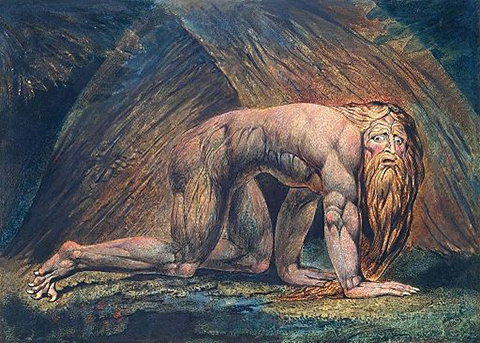
William Blake Nebuchadnezzar (Tate copy)William Blake’s Nebuchadnezzar

The Blakean echo is hardly accidental. Of the three Rosicrucian short stories Yeats wrote in the 1890s (“Rosa Alchemica,” “The Tables of the Law,” and “The Adoration of the Magi”), “The Secret Rose” is, as the titles alone suggest, most closely related to the first. The world-traveling hero of “Rosa Alchemica,” the magician Michael Robartes, is a student of comparative literature, especially drawn, as was Yeats himself, to the prophetic poems of William Blake.  Blake’s epic The Four Zoas (originally titled Vala, and abandoned in manuscript in 1807) was rediscovered and published in 1893 by none other than Yeats (and his co-editor, Edwin Ellis). In the finale of The Four Zoas, from which Yeats lifted the lines about the “stars” being “blown” about the skies like “sparks,” redeemed Man, having finally purged all the evil in himself, can look at infinity unharmed.  Los “rose in all his regenerative power”; the hour of transformation arrives:

The sun has left his blackness & found a fresher morning,

And the mild moon rejoices in the clear & cloudless night,

And Man walks forth from midst of the fires, the evil is all consumed:

His eyes behold the angelic spheres arising night & day;

The stars consumed like a lamp blown out, & in their stead, behold:

The expanding eyes of Man behold the depths of wondrous worlds.

Here we have the potentially divine Man envisioned by so many Gnostics, Hermeticists, Cabbalists, and Rosicrucians: Valentinus’s “new man…more noble in his glorified state” than he was before “the conflagration”: a Man fully human, liberated from all imprisoning limitations, whether of materialism, the merely bodily (Lockean/empiricist) senses, or political tyranny. In the final lines of The Four Zoas, Urthona, the eternal form of Los (and, of the four, the Zoa least in need of redemption) “rises from the ruinous walls/In all his ancient strength.” According to one of Yeats’s (and Joyce’s) favorite phrases of Blake (from an 1800 letter to William Hayley), “The ruins of Time build mansions in Eternity.”  In Blake’s anything-but-static Eternity, Urthona, though still ready for combat, is now armed to wage “intellectual war,” the “war of swords” having “departed.” In his single most famous and concise appeal for an imaginative art prophetically inspired and intended to achieve individual and societal redemption, Blake says his “sword” will not “sleep” in his hand. But the weaponry (“Bow of burning gold,” “Arrows of desire,” Spear, and “Chariot of fire”) is to be employed in ceaseless “Mental Fight.” He has, Gnostics would say, achieved gnosis.[28]

§

Gnosis takes many forms. I have already noted what the visionary poet of “The Second Coming” claims to “know,” and mentioned the very different assertion in the drafts, where the rough beast, “knowing its hour come round,” possesses whatever gnosis there is to go round. In “Leda and the Swan” (1925), the sonnet that begins the three-part cycle that ends with “The Second Coming,” we have another annunciation of a new historical era, beginning with a birth, and a hint of gnosis. Did Leda, raped by the swan-god Zeus, “put on his knowledge with his power/ Before the indifferent beak could let her drop?” Here is another poem, like “The Secret Rose” and “The Second Coming,” ending in a question, the mystery-marker of the Sublime. There is, of course, no question about the brutality of the sudden rape, and the indifference of the God following the “shudder in the loins,” which, impregnating Leda, completes Zeus’s mission.

For in fathering Helen of Troy, he also “engenders there” the Trojan War (depicted in imagery at once military and sexual: “The broken wall, the burning roof and tower”) and its sequelae (“And Agamemnon dead”), initiating an historical cycle destined to last until, two thousand years later, another lady, the Virgin Mary, would be visited by the Holy Spirit: another divine bird, his “great wings beating about the room” in Yeats’s “The Mother of God” (1931), a dramatic monologue spoken by the terrified village girl singled out to bear “The Heavens in my womb.” The question raised at the end of “Leda and the Swan” is not merely rhetorical. Did Leda, “her thighs” rather tenderly “caressed/ By the dark webs,” so intrigue the swan-god that he inadvertently held her just long enough (“Before the indifferent beak could let her drop”) for her to participate momentarily in “his knowledge,” the divine gnosis of Zeus himself?

Leda and the Swan by Jerzy Hulewicz 1928Leda and the Swan by Jerzy Hulewicz, 1928

Gnosis also figures in the cryptic poem, “Fragments,” which features, like its  far better-known cousin, “The Second Coming,” a strange birth, and a revelation derived from counter-Enlightenment intuition, gnosis. Written between 1931 and 1933, this epigrammatic poem is in two short parts. Here is the first:

Locke sank into a swoon;

The Garden died;

God took the spinning-jenny

Out of his side.

In this parody of Genesis, the role of sleeping Adam, from whose side God took Eve, is usurped by a swooning John Locke, whose empiricist epistemology and distinction between primary and secondary qualities seemed to Yeats, as to George Berkeley and Blake before him, to have fractured the organic unity of the living world, and thus destroyed not only nature but its archetype, the Edenic “Garden.” That the resultant birth, that of the “spinning-jenny,” bears a woman’s name accentuates the irony, and the horror. It was not altogether to the benefit of humanity and a sign of progress, Yeats once mordantly observed, for the home spinning wheel and the distaff to have been replaced by the robotic looms and masculinized factories of the Industrial Revolution. Blake’s god of the fallen world, Urizen, presides over an Enlightenment world-machine perceived as “the Loom of Locke” washed by the “Water-wheels of Newton,” all “cruel Works” with “cogs tyrannic” moving each other “by compulsion” (Jerusalem 15:15-19)

Yeats is never closer to Blake than in this first part of “Fragments,” where he emulates not only his mentor’s attack on Locke (and Newton), but also his genius for epigram and crystallization, Blake being “perhaps the finest gnomic artist in English literature.” In Yeats’s gnomic vision in “Fragments” (I), which has been called “certainly the shortest and perhaps not the least comprehensive history of modern civilization,” the Enlightenment is revealed as a nightmare for the creative imagination; and the monster that rides upon this spirit-sealing sleep of reason is the mechanistic conception of matter, indeed the whole mechanistic rather than organic way of thinking (a crucial contrast Yeats knew from Coleridge, who had borrowed it from A. W. Schlegel), here symbolized by the invention that epitomizes the Industrial Revolution.[29] Yeats replaces the divinely anesthetized flesh of Adam with Locke’s imaginatively inert body (sunk into that fall into division Blake called “Single Vision & Newton’s sleep”), and substitutes for Eve, the beautiful embodiment of Adam’s dream, a mechanical contraption, a patriarchal cog in the dark Satanic mills of which it is proleptic.

Spinnng room in cotton mill 1916Spinning room in a New England cotton mill, 1916, photo courtesy National Archives

But how does Yeats know all this, and know it to be the “truth”? It wasn’t only from absorbing Blake. Or only from reading Alfred North Whitehead’s Science and the Modern World (1925), a chapter of which, “The Romantic Reaction,” Yeats synopsized with a related variation of the Genesis 2 creation-metaphor, jotting in the margin: “The dry rib (Pope) becomes Eve (Nature) with Wordsworth.”[30] Yeats answers his own question in “Fragments” II:

Where got I that truth?

Out of a medium’s mouth,

Out of nothing it came,

Out of the forest loam,

Out of dark night where lay

The crowns of Nineveh.

Is this mere occult mumbo-jumbo, intended to twist the tail of positivists and empiricists? Well, yes and no. But before coming to conclusions, let’s pause to appreciate the wit of the lines, alive with reversals and allusions. Yeats’s ironic reversal of the birth “out of” the side of Locke takes the form of a counter-“truth,” born “out of” (repeated four times in succession) a variety of sources. The anaphora is Whitmanian— “Out of the cradle endlessly rocking,/ Out of the mocking bird’s throat, the musical shuttle,/ Out of the Ninth-month midnight.” And Whitman’s birth-images may have suggested Yeats’s equally fertile sources: the female “medium’s mouth,” the “forest loam,” and “dark night,” all in organic and fecund contrast to the mechanical, sterile “birth” of the spinning-jenny.

Yeats deliberately begins with what rationalists would dismiss as among the least reputable sources of “truth”: “Out of a medium’s mouth…” Even Madame Blavatsky, whose own experiments had been discredited, told Yeats, who reported it to John O’Leary in a May 1889 letter, that she “hates spiritualism vehemently—says mediumship and insanity are the same thing” (Letters, 125). In “Fragments” (II) Yeats is having some fun, but it is worth mentioning that the poem was written shortly after the first production of one of Yeats’s most dramatic plays, The Words Upon the Window-pane, which centers on a séance, climaxing with our shocked recognition that the female medium is authentic. The one scholarly skeptic who had attended, a specialist in the life and work of Jonathan Swift, is refuted once the post-séance stage is bare except for the female medium, who is suddenly revealed, not to be faking it as he had been sure all along, but to be channeling the tormented ghost of Swift, and thus speaking the sort of spiritual truth Yeats, half-skeptic himself, sought all his life. “All about us,” he concludes his Introduction to the play, “there seems to start up a precise inexplicable teeming life, and the earth becomes once more, not in rhetorical metaphor, but in reality, sacred.”[31]

The second source is philosophically and theologically scandalous. Subverting the venerable axiom, ex nihilo nihil fit, employed by metaphysicians from Parmenides on and by theologians arguing for the necessary existence of God, Yeats boldly declares that the “truth” revealed to him came “Out of nothing,” only to instantly add details that deepen the mystery and sharpen his thrust against the Enlightenment. Coming “Out of the forest loam,/ Out of dark night…” Yeats’s “truth” is generated from fecund earth, once more become “sacred,” and teeming with inexplicable “life,” replacing or restoring the “Garden” earlier said to have “died.” It also comes, out of a mysterious, or occult, “dark night.”

If the spinning-jenny epitomizes the Industrial Revolution, Alexander Pope’s intended epitaph for Isaac Newton epitomizes the Scientific Revolution and the Enlightenment: “Nature and Nature’s laws lay hid in night,/ God said, Let Newton be! And all was light.” Pope’s couplet, like Yeats’s opening quatrain, plays off Scripture, with Newton now assuming God’s role as Creator by verbal fiat: “And God said, ‘Let there be light,’ and there was light” (Genesis 1:3). Pope avoids blasphemy; after all, it was God who said “Let Newton be!” Until the advent of the principal scientific genius of the European Enlightenment, the universe existed, but “Nature and Nature’s laws lay hid in night.” Adopting that darkness, and reversing the “laws” that prior to Newton “lay hid in night,” Yeats tells us that his Counter-Enlightenment truth came “Out of dark night where lay,” not Nature’s scientific laws, but “The crowns of Nineveh.”

Nineveh image by archaeologist Henry Layard CC 4.0Archaeologist Henry Layard’s image of Nineveh

Why Nineveh in particular? For one thing, Yeats loved Arthur O’Shaughnessy’s “Ode” celebrating poets as music-makers and prophets. The famous final stanza (and these are the lines Yeats always cited) begins: “We, in the ages lying/ In the buried past of the earth,/ Built Nineveh with our sighing,/ And Babel itself with our mirth.” When, in “Fragments,” the golden crowns of Nineveh flame up “Out of dark night,” what is evoked is more O’Shaughnessy’s city of the poetic imagination than Ashurbanipal’s capital, majestic as that may have been. For Yeats was looking, not merely back to old Nineveh, but cyclically ahead, to the resuscitation of the ancient—a past buried, dark, chthonic, and, here, female. For, as Yeats seems to have known, the Assyrians named their capital city Nin-evah—after “Holy Mother Eve,” the Mother-womb, or Goddess of the Tree of Life in their mythology. Displaced by a machine in the withered Garden of the first part of “Fragments,” Eve, in a return of the repressed, is restored, re-surfacing in the final word of part II, in the disguised but detectable form of the city named for her. Recalling the role of Sophia, often opposed to the male Logos in esoteric tradition, including Gnosticism, I’m reminded as well that gnosis is a Greek female noun.

At his most winning, Yeats reminds us of Hamlet’s rejoinder to his skeptical and scholastic friend: “there are more things in heaven and earth, Horatio, than are dreamt of in your philosophy.” But we are right to be wary when Yeats crosses the threshold into the occult. Though concurring in, in fact shaping, Yeats’s cavalier dismissal of Locke and Newton as Enlightenment icons, Blake would be appalled by his disciple’s delving into the occult darkness. Though Yeats tended to mystify and occultize him, Blake in fact condemned the heathen “God of this World & the Goddess Nature/ Mystery, Babylon the Great” (Jerusalem 93: 22-25). But what Blake rejects here are the very things his prodigal son celebrates as the matrix of vision: the forest loam and the mysterious dark night where lay the crowns of ancient Nineveh, repository of Assyro-Babylonian mythology.

Of course, Yeats’s recourse to the occult is one measure of the intensity of his need to expedite what he called in that earlier-cited 1892 letter to John O’Leary “the revolt of the soul against the intellect” (Letters, 211). That is, somewhat reductively, a description of the Romantic Revolution, the noble attempt to beat back, through restored wonder at a re-enchanted nature and the transformative power of the creative imagination, the passivity of mind and mechanistic materialism that had reigned (Yeats insists in introducing his 1936 anthology of modern poetry) since “the end of the seventeenth century” down to the present. With, he emphasizes— as had Alfred North Whitehead, though his Romantic hero was Wordsworth rather than Blake or Shelley—“the exception of the period beginning at the end of the eighteenth century” and ending “with the death of Byron”: that is to say, the “brief period” of the Romantic revolt, a span “wherein imprisoned man beat upon the door.”[32]

That compelling metaphor was repeated the next year in “An Acre of Grass,” Yeats’s late poem (a companion of “What Then?”), in which he prays to be granted the creative “frenzy” and “old man’s eagle mind” he had read of in Nietzsche’s Daybreak. He also specifically invokes “That William Blake/ Who beat upon the wall/ Till truth obeyed his call”—a “truth” related to, but not identical to, the “truth” Yeats claimed in “Fragments” (II) came to him “Out of” Counter-Enlightenment sources both Romantic and, most dubiously, out of a mysterious “dark night” whose counter-Enlightenment frisson will be offset for many readers by resistance to the dangerous irrationality of the occult.

§

Night was not normally privileged over day in Yeats’s thinking. Blake and Nietzsche, his great mentors, were both celebrators of daybreak, of Blake’s “glad day.” In 1902, enthralled by his “excited” reading of “that strong enchanter, Nietzsche,” Yeats drew in the margin of an anthology of selections from the German philosopher a diagram crucial to understanding much if not all of Yeats’s subsequent thought and work. He grouped under the heading NIGHT: “Socrates, Christ,” and “one god”— “denial of self, the soul turned toward spirit seeking knowledge.” And, under the heading DAY: “Homer” and “many gods”—“affirmation of self, the soul turned from spirit to be its mask & instrument when it seeks life.”[33] Reminiscent of Madame Blavatsky’s alternating “days and nights of Brahma,” that  diagrammatical skeleton, anticipated by the pull between eternity and the temporal in such early poems as “To the Rose upon the Rood of Time,” is later fleshed out by Yeats’s own chosen exemplar in “Vacillation”—“Homer is my example and his unchristened heart”—and Self’s choice of Sato’s sword wound in “embroidery” of “Heart’s purple”: “all these I set/ For emblems of the day against the tower/ Emblematical of the night.” Ultimately, they are the emblems of a life-seeking Poet who, without “denial of self,” attempts to transcend the antithesis set up a quarter-century earlier in that Nietzsche anthology, usurping Soul’s role by also being oriented “toward spirit seeking knowledge,” or gnosis.

“A Dialogue of Self and Soul” is in many ways Yeats’s central poem since its ramifications reach before and after, and it features perhaps the greatest of Yeats’s fused symbols: the “ancient blade” (the gift of a Japanese admirer, Junzo Sato) scabbarded and bound in complementary “female” embroidery. That sword and winding silk are not only “emblems of the day against the tower/ Emblematical of the night.” Fusing the sacred and the profane, war and love, the phallic and the vaginal, the sheathed and silk-wound sword becomes Yeats’s symbol of gyring life, set against the vertical ascent urged by the Neoplatonic Soul. What Gnostics put asunder, body and spirit, Yeats unites. And yet, as we will see, Self’s final act of self-redemption, magnificent but heretical, is as Gnostic as it is Nietzschean.

In the opening movement of the poem, the half in which there is still a semblance of actual dialogue, hectoring Soul repeatedly demands that Self “fix” every thought “upon” the One, “upon” the steep ascent,  “upon” the occult Pole Star, “upon” the spiritual quarter where all thought is done. But the recalcitrant Self remains diverted by the Many, by earthly multiplicity, by the sword wound in embroidery replicating the windings of mortal nature. In unpublished notes, Yeats describes “Dialogue” as “a variation on Macrobius” (the “learned astrologer” of “Chosen,” the central poem of A Woman Young and Old). Yeats had been directed by a friend (F. P. Sturm) to Macrobius’s Neoplatonic Commentary on Cicero’s Somnium Scipionis. In Cicero’s text, despite the admonition of Scipio’s ghostly ancestor, “Why not fix your attention upon the heavens and contemn what is mortal?,” young Scipio admits he “kept turning my eyes back to earth.” According to Macrobius, Scipio “looked about him everywhere with wonder. Hereupon his grandfather’s admonitions recalled him to the upper realms.” Though the agon between the Yeatsian Self and Soul is identical to that between young Scipio and his grandfather’s spirit, the Soul in Yeats’s poem proves a much less successful spiritual guide than that ghost.[34]

Turning a largely deaf ear to Soul’s advocacy of the upward path, Self (revealingly called “Me” in the drafts of the poem) has preferred to focus downward, on life, brooding on the consecrated blade upon his knees with its tattered but still protective wrapping of “Heart’s purple.” Its “flowering, silken, old embroidery, torn/ From some court-lady’s dress and round/ The wooden scabbard bound and wound” makes the double icon “emblematical” not only of “love and war,” but of the ever-circling gyre: the eternal, and archetypally female, spiral. When Soul’s paradoxically physical tongue is turned to stone with the realization that, according to his own austere doctrine, “only the dead can be forgiven,” Self takes over the poem. He goes on to win his way, despite difficulty, to a self-redemptive affirmation of life.

Winding stair in Thoor Ballylee tower c Jacket2 CC 3.0Walt Hunter viaWinding stair in Thoor Ballylee tower, photo by Walt Hunter via Jacket2 CC 3.0

Self begins his peroration defiantly: “A living man is blind and drinks his drop./ What matter if the ditches are impure?” This “variation” on Neoplatonism, privileging life’s filthy downflow, or “defluction,” over the Plotinian pure fountain of emanation, is followed by an even more defiant rhetorical question: “What matter if I live it all once more?” “Was that life?” asks Nietzsche’s Zarathustra. “Well then! Once more!”[35]  But Self’s grandiose and premature gesture is instantly undercut by the litany of grief that Nietzschean Recurrence, the exact repetition of the events of one’s life, would entail—from the “toil of growing up,” through the “ignominy of boyhood” and the “distress” of “changing into a man,” to the “pain” of the “unfinished man” having to confront “his own clumsiness,” then the “finished man,” old and “among his enemies.” Despite the Self’s bravado, it is in danger of being shaped, deformed, by what Hegel and, later, feminist critics have emphasized as the judgmental Gaze of Others. Soul’s tongue may have turned to stone, but malignant, almost Archon-like ocular forces have palpable designs upon the assaulted Self:

How in the name of Heaven can he escape

That defiling and disfigured shape

The mirror of malicious eyes

Casts upon his eyes until at last

He thinks that shape must be his shape?

This would be, as Yeats says in “Ancestral Houses” (1921), to lose the ability to “choose whatever shape [one] wills,” and (echoing Browning’s arrogant Duke, who “choose[s] never to stoop”) to “never stoop to a mechanical / Or servile shape, at others’ beck and call”: Yeats’s rejection of “slave morality” in favor of Nietzschean “master morality.” The centrality of “A Dialogue of Self and Soul” is enhanced by its repercussions in Yeats’s own work and its absorption of so many influences outside the Yeatsian canon. Aside from the Body/Soul debate-tradition, from Cicero to Milton and Marvell, and the combat between Nietzsche on the one hand and Neoplatonism on the other, this Yeatsian psychomachia incorporates, among other poems in the Romantic tradition, another Browning poem, “Childe Roland to the Dark Tower Came,” which supplies those “malicious eyes” that cast upon Self a distorting lie so powerful that he temporarily falls victim to it, and Blake’s feminist Visions of the Daughters of Albion.[36]  Self’s eventual victory, like Oothoon’s, is over severe moralism, the reduction of the body to a defiled object. In Yeats’s case, Self’s victory is a triumph over his own Neoplatonism. Though Gnosticism, too, seeks liberation from the body, the heterodox Gnostic emphasis on self-redemption makes it compatible with Blake, Nietzsche, and Yeats. “Dialogue” represents Nietzschean Selbstüberwindung, creative “self-overcoming,” for, as Yeats said, “we make out of the quarrel with others, rhetoric, but of the quarrel with ourselves, poetry.”

 §

Since “Dialogue” is a quarrel with himself, the spiritual tradition is not simply dismissed, here any more than in the Crazy Jane or Woman Young and Old sequences. For Yeats, the world of experience, however dark the declivities into which the generated soul may drop, is never utterly divorced from the world of light and grace. The water imagery branching through Self’s peroration subsumes pure fountain and impure ditches. There is a continuum. The Plotinian fountain cascades down from the divine One through mind or intellect (nous) to the lower depths. As long, says Plotinus, as nous maintains its gaze on and contemplation of God (the First Cause or “Father”), it retains the likeness of its Creator (Enneads 5.2.4). But, writes Macrobius (Commentary 1.14.4), the soul, “by diverting its attention more and more, though itself incorporeal, degenerates into the fabric of bodies.”

Viewed from Soul’s perspective, Self is a falling off from the higher Soul. When the attention, supposed to be fixed on things above, is diverted below—down to the blade on his knees wound in tattered silk and, further downward, to life’s “impure” ditches—the Self has indeed degenerated into the “fabric,” the tattered embroidery, of bodies. And yet, as usual in later Yeats, that degradation is also a triumph, couched in terms modulating from stoic contentment through fierce embrace to a casting out of remorse, leading to self-forgiveness and redemption:

I am content to live it all again

And yet again, if it be life to pitch

Into the frog-spawn of a blind man’s ditch,

A blind man battering blind men;

Or into that most fecund ditch of all,

The folly that man does

Or must suffer, if he woos

A proud woman not kindred of his soul.

X

I am content to follow to its source

Every event in action or in thought;

Measure the lot, forgive myself the lot!

When such as I cast out remorse

So great a sweetness flows into the breast

We must laugh and we must sing,

We are blest by everything,

Everything we look upon is blest.

Following everything to the “source” within, Self spurns Soul’s tongue-numbing Neoplatonic doctrine that “only the dead can be forgiven.” Instead, having pitched with vitalistic relish into life’s filthy frog-spawn, Self audaciously (or blasphemously) claims the power to forgive himself. In a similar act of self-determination, Self “cast[s] out” remorse, reversing the defiling image earlier “cast upon” him by the “mirror of malicious eyes.” The sweetness that “flows into” the self-forgiving breast redeems the frog-spawn of the blind man’s ditch and even that “most fecund ditch of all,” the painful but productive folly that is the bittersweet fruit of unrequited love.

That sweet flow also displaces the infusion (infundere: “to pour in”) of Christian grace through divine forgiveness. It is a claim to autonomy at once redemptive and heretical, and a masterly fusion of Yeats’s two principal precursors. “Nietzsche completes Blake, and has the same roots,” Yeats claimed. If, as he also rightly said, Blake’s central doctrine is a Christ-like “forgiveness of sins,” the sweetness that flows into the suffering but self-forgiving “breast,” the breast in which Blake also said “all deities reside,” allies the Romantic poet with Nietzsche. He had been preceded by the German Inner Light theologians, but it took Nietzsche, the son of a Protestant minister, to most radically transvalue the Augustinian doctrine that man can only be redeemed by divine power and grace, a foretaste of predestination made even more uncompromising in the strict Protestant doctrine of the salvation of the Elect as an unmerited gift of God. One must find one’s own “grace,” countered Nietzsche in Daybreak, a book read by Yeats. He who has “definitively conquered himself, henceforth regards it as his own privilege to punish himself, to pardon himself”—in Yeats’s phrase, “forgive myself the lot.”  We must cast out remorse and cease to despise ourselves: “Then you will no longer have any need of your god, and the whole drama of Fall and Redemption will be played out to the end in you yourselves!”[37]

But, as I earlier suggested, this is as Gnostic as it is Nietzschean. The most formidable of the historical Gnostics, Valentinus, claimed that the person who received gnosis could purge himself of the ignorance associated with matter. He describes the process in the “Gospel of Truth,” a Valentinian text unearthed at Naj Hammadi in 1945. In stark contrast with the orthodox Christian doctrine of salvation through the grace of God, Valentinus declared that “It is within Unity that each one will attain himself; within gnosis he will purify himself from multiplicity into Unity, consuming matter within himself like a fire, and darkness by light, death by life.” In the best-known Valentinian formulation, “what liberates us is the gnosis of who we were, what we became; where we were, whereunto we have been thrown; whither we hasten, from what we are redeemed; what birth is, and what rebirth.” Here (Excerpts from Theodotus) and elsewhere in Gnostic literature, salvation is defined, as it is in Romanticism (from which Gnosticism often seems less a deviation than a precursor), as an escape into the self, where, through introspective private vision, we find true knowledge, gnosis. The spiritual quest is solitary. When Sturge Moore, who was designing the book cover for the volume containing “Byzantium,” asked if Yeats saw  “all humanity riding on the back of a huge dolphin,” Yeats responded, “One dolphin, one man” (Yeats-Moore Correspondence, 165). There is no real need for any Other; the individual who has attained gnosis is the whole and sole agent of redemption.[38]

In the now-famous Gospel of Thomas, the most audaciously heterodox of the Naj Hammadi texts, the Gnostic Jesus of Thomas tells us, “Whoever drinks from my mouth will become as I am.” The central teaching, again, is internal salvation, redemption from within: “If you bring forth what is within you, what you bring forth will save you. If you do not bring forth what is within you, what you do not bring forth will destroy you.” If Emerson hadn’t been speaking more than a century before the Gospel of Thomas had been rediscovered, he might have been accused of plagiarizing from that long-suppressed text in his Divinity School Address, the bombshell he exploded at Harvard in 1838. Emerson celebrated Jesus not as divine, nor even as Lord, but as the religious thinker who first realized that “God incarnates himself in man.”  He informed the shocked ministers and thrilled graduating students in the audience: “That is always best which gives me to myself. That which shows God in me, fortifies me. That which shows God out of me, makes me a wart and a wen.” As heterodox as Thomas’s, Emerson’s Jesus is imagined saying, in “a jubilee of sublime emotion, ‘I am divine. Through me, God acts; through me, speaks. Would you see God, see me; or see thee, when thou also thinkest as I now think.’” [39]

It is primarily under the twin auspices of Blake and Nietzsche, as manipulated by Yeats, that the Self finds the bliss traditionally reserved for those who follow the ascending path. But that heretical self-redemption is also Gnostic. Whatever its various “sources,” Yeats’s alteration of the orthodox spiritual tradition completes Blake, who considered cyclicism the ultimate nightmare, with that Nietzsche whose exuberant Zarathustra jumps “with both feet” into the “golden-emerald delight” of self-redemption and Eternal Recurrence, exultantly embraced as the ultimate affirmation of life in the “Yes and Amen Song” that concludes part III :

In laughter all that is evil comes together, but is pronounced holy and absolved by its own bliss; and if this is my alpha and omega, that all that is heavy and grave should become light, all that is body, dancer, all that is spirit, bird—and verily that is my alpha and omega: oh, how should I not lust after eternity and the nuptial ring of rings, the ring of recurrence?[40]

We might say that Zarathustra here also “jumps” into a cluster of images and motifs we would call Yeatsian, remembering, along with Self’s laughing, singing self-absolution, “Among School Children,” where “body is not bruised to pleasure soul,” and we no longer “know/ The dancer from the dance”; the natural and golden birds of the Byzantium poems; and the final transfiguration of Yeats’s central hero, both in The Death of Cuchulain and “Cuchulain Comforted,” into a singing bird.

In “A Dialogue of Self and Soul,” the Yeatsian-Nietzschean Self, commandeering the spiritual vocabulary Soul would monopolize, affirms Eternal Recurrence, the labyrinth of human life with all its tangled antinomies of joy and suffering. In subverting the debate-tradition, Yeats leaves Soul with a petrified tongue, and gives Self a final chant that is among the most rhapsodic in that whole tradition of secularized supernaturalism Yeats inherited from the Romantic poets and from Nietzsche. In a related if somewhat lower register, it is also the vision of Crazy Jane and the Woman Young and Old.

Of course, Self and Soul are aspects of the one man, and, as Yeats jotted in his 1930 Diary, “Man can only love Unity of Being.” The internal “opponent” we debate with “must be shown for a part of our greater expression” (Essays and Introductions, 362). This resembles the Valentinian Unity “each one will attain himself,” overcoming “multiplicity.” Yeats’s friend, AE (George Russell) to whom he sent a copy of The Winding Stair, said that of the many superb poems in that remarkable volume he liked “best” of all “A Dialogue of Self and Soul.” Acknowledging his friend’s gift, he wrote, “I am on the side of Soul, but know that its companion has its own eternal claim, and perhaps when you side with the Self it is only a motion to that fusion of opposites which is the end of wisdom.”[41]

Having astutely synopsized the central Yeatsian dialectic, Russell was tentatively noting its reflection in the poem’s impulse, beneath the manifest debate of opposites, toward fusion. We seem to achieve fusion in the secular beatitude of Self’s final chant. But Yeats was not AE, the “saint,” as Mrs. Yeats described him, to her husband’s “poet,”[42] and the poet in Yeats, the Self, gives us—in the whole of “A Dialogue of Self and Soul” and particularly in this magnificent final affirmation—an overcoming of Christian and Neoplatonic dualism and defilement of the body by way of a heterodox, “heretical” self-blessing at once Blakean, Nietzschean, and Gnostic.

§

Despite Self’s triumph in this central poem, Yeats remained torn between what he called in “Vacillation” (echoing Kant) “the antinomies” of soul and body, by antithetical longings for the Otherworld and, on the most autobiographical level, for Maud Gonne: that extravagantly beautiful but never fully attainable femme fatale, the Muse that haunts the life and work of the twentieth century’s greatest love poet. His occult speculations were always entangled in his emotional life. “His aim,” Graham Hough concludes, “was to redeem passion, not to transcend it, and a beatitude that has passed beyond the bounds of earthly love could not be his ideal goal” (The Mystery Religion of W. B. Yeats, 119). Unsurprisingly, then, in the alembic of Yeats’s paradoxical imagination, the search for hidden spiritual knowledge is often merged with carnal knowledge. Even then, however, the beloved proves to be ultimately unattainable, even if physical consummation has been briefly attained, as it was, in December 1908, with the elusive Maud. Yeats was both impressed and deeply moved (responding to both human tragedy and Latinate rhetorical majesty) by a resonant phrase he encountered—“The tragedy of sexual intercourse is the perpetual virginity of the soul”—in reading John Dryden’s translation of Lucretius, one of whose arguments in De rerum natura is that sexual union can never provide complete satisfaction.

Maud GonneMaud Gonne

In a 1931 conversation with John Sparrow, then Fellow of All Souls’ College, Oxford, Yeats cited and expanded on Lucretius’ famous lines from the end of the long passage (1030-1237) on sexual love concluding Book IV of De rerum natura. In glossing Dryden’s translation of the Roman poet, Yeats seems to echo the Gnostics’ doubly radical dualism, a dualism between man and nature, but also between nature and the transmundane God who is utterly Other, Alien, and unknowable—except through gnosis. Yeats’s citation and commentary also seem worth quoting because he appears to me to be looking back to four of his own poems, three of them written in 1926-27, the fourth in 1931. Two of them, “A Dialogue of Self and Soul” and “Among School Children,” are indisputably major. The other two, lesser lyrics but closely related to those major texts, are “Summer and Spring,” from Yeats’s Man Young and Old sequence, and, the most splendid of the Crazy Jane lyrics, the poignant yet triumphant “Crazy Jane and Jack the Journeyman,” written in 1931, the same year as his conversation with John Sparrow. But here, finally, is what Yeats told Sparrow:

The finest description of sexual intercourse ever written was in John Dryden’s translation of Lucretius, and it was justified; it was introduced to illustrate the difficulty of two becoming a unity: “The tragedy of sexual intercourse is the perpetual virginity of the soul.” Sexual intercourse is an attempt to solve the eternal antinomy, doomed to failure because it takes place only on one side of the gulf. The gulf is that which separates the one and the many, or if you like, God and man.[43]

In “Summer and Spring” (poem VIII of the autobiographical sequence in which the poet is masked as an anonymous “Man Young and Old”), two lovers grown old reminisce “under an old thorn tree.” When they talked of growing up, they “Knew that we’d halved a soul/ And fell the one in t’other’s arms/ That we might make it whole.” We recall, as we are meant to, “Among School Children,” written in the same year. In transitioning from the first to the second stanza of this great poem, we shift abruptly from Yeats’s external persona as senator and school inspector, “a sixty-year-old smiling public man,” to the private, inner man, the poet himself reporting an incident Maud Gonne once related from her childhood:

I dream of a Ledaean body bent

Above a sinking fire, a tale that she

Told of a harsh reproof, or trivial event

That changed some childish day to tragedy—

Told, and it seemed that our two natures blent

Into a sphere from youthful sympathy,

Or else, to alter Plato’s parable,

Into the yolk and white of the one shell.

In “Summer and Spring” there is gnosis; the lovers “Knew that we’d halved a soul.” The tragedy in this stanza of “Among School Children” lies in the qualifying “seemed” and in the need “to alter Plato’s parable”—a “Lucretian” alteration, since the blending here is empathetic and partial (yolk and white remain separated even within the unity of the “one shell”) rather than the full sexual union of Aristophanes’ haunting fable in Plato’s Symposium. It is precisely this “whole” union that the old man claims in “His Memories” (poem VI of A Man Young and Old)[44] and in “Summer and Spring,” which concludes with a sexual variation on the Unity of Being symbolized by the dancer and “great-rooted blossomer” of “Among School Children”: “O what a bursting out there was,/ And what a blossoming,/ When we had all the summer-time/ And she had all the spring!”

But even here, despite that “fecund” blossoming, it is all memory and heartache. Two decades later, that night in December 1908, no matter how fleeting, remains paramount among the “memories” of Yeats’s “Man Old.” In “real life,” however, after their night of lovemaking in that Paris hotel, Maud had quickly put the relationship back on its old basis, a “spiritual marriage,” informing Yeats in a morning-after note that she was praying that he would be able to overcome his “physical desire” for her. In a journal entry the following month (21 January 1909), Yeats referred despairingly but realistically to the “return” of Maud’s “old dread of physical love,” which has “probably spoiled her life….I was never more deeply in love, but my desires must go elsewhere if I would escape their poison.”

Gonne1Maud Gonne

William Butler Yeats and Wife GeorgieYeats and his wife Georgie, late 1920s

Hence, those “others,” including Yeats’s wife, destined to become “friends,” or sexual partners, if never a fully satisfactory replacement for “that one” (as he refers to her, namelessly and climactically in his poem “Friends”).  Since Maud was, ultimately, “not kindred of his soul,” Yeats sought complete union, if only in memory, in poetry, and masked as “A Man Young and Old” or, empathetically switching genders, in the vision of Crazy Jane. Partly based on an old, crazed Irish woman, Jane is not merely promiscuous. Yeats’s occult experiences had led him to a belief in feminized, often sexualized, spirituality, early embodied in the beautiful, highly-sexed actress Florence Farr, one of the most gifted women visionaries of the Golden Dawn (and, briefly, his lover). Such female adepts, whose powers he admired and envied; women of “second sight” (his own sister, “Lily,” his uncle George Pollexfen’s servant, Mary Battle); his experiences at séances, where the mediums were almost invariably women: all convinced him of a female and erotic dimension in spirituality. The artistic result was the two powerful poetic sequences, A Woman Young and Old and the Crazy Jane poems. The third poem in the Jane sequence, “Crazy Jane on the Day of Judgment,” begins:

“Love is all

Unsatisfied

That cannot take the whole

Body and soul”:

And that is what Jane said.

It ends with Jane still holding forth, now emphasizing her version of gnosis, but one that would certainly resonate with most Gnostics. While mystical experience was possible during life, virtually all Gnostics believed that the true ascent, in which (in Jane’s phrase) “all could be known,” took place after death, with the return of the spirit to its divine origins, the spark of life redeemed and reunited with the One from which it had been severed and alienated by its immersion in the material, temporal world. For most of the Crazy Jane sequence, unconventional Jane, making the most of her time on earth, will take a decidedly unorthodox Itinerarium mentis ad Deum. But here we find her, yearning for Time to disappear and gnosis to be achieved:

“What can be shown?

What true love be?

All could be known or shown

If Time were but gone.”

Jane’s male interlocutor—responding, “That’s certainly the case”—might be Yeats himself, who thought Lucretius remained “justified” in insisting on the “failure,” in this life, to bridge “the gulf,” the insuperable “difficulty of two becoming a unity.”

The poem that immediately follows Jane’s thoughts on the Day of Judgment, “Crazy Jane and Jack the Journeyman,” responds more personally, magnificently, and certainly more audaciously, to Dryden’s Lucretius-  and Epicurus-based assertion that “The tragedy of sexual intercourse is the perpetual virginity of the soul.” Writing in 1875, the Victorian essayist J. M. Symonds qualified what Dryden before him and Yeats after him designated a “tragedy,” though Symonds goes on to emphasize, even more than Yeats, the Lucretian, Epicurean—and, I would add, Gnostic—bleakness and frustration of lovers whose immaterial souls are entrammeled in the flesh: “There is something almost tragic,” writes a sympathetic but austere Symonds, “in these sighs and pantings and pleasure-throes, and the incomplete fruition of souls pent up within their frames of flesh.”[45] Symonds seems to reflect, along with the frustration described by Lucretius (and Platonism and Neoplatonism in general), the dualism of the Gnostics, concerned above all with freeing the spirit dwelling within (to quote two passages from Genesis well known to Gnostics) that “coat of flesh” imprisoning “the spark of life” (3:21, 3:78).

In the beginning (in what Shelley would later call “the white radiance of eternity”), we were “in the light,” uncreated, fully human, and also divine. What makes us free, in the present and future, the Gnostics insisted, is the gnosis of who we were back then, when we were “in the light.” Crazy Jane, returning to the One, “Shall leap into the light lost/ In my mother’s womb.” That Blakean infant joy marks the exuberant climax of her vision. But she had begun by asserting her own gnosis, shaped by earthly experience:

I know, although when looks meet

I tremble to the bone,

The more I leave the door unlatched

The sooner love is gone,

For love is but a skein unwound

Between the dark and dawn. …

Her knowledge of the transience of sexual love has not driven Jane to abstinence, despite the hectoring of the Bishop (her antagonist in this sequence) that she should “Live in a heavenly mansion,/ Not in some foul sty.” In that poem, “Crazy Jane Talks with the Bishop” (sixth in the sequence), Jane tells the Bishop, a “religious” Soul-spokesman nevertheless fixated on “those breasts,” where her God—neither Jehovah nor Jesus, but Eros—has “pitched” (temporarily set up as one would a tent) his mansion. It is not up among the stars as a “heavenly mansion” (Yeats has the Bishop borrow that lofty sty-disdaining phrase from Platonism and Christianity, from Pietro Bembo and the Gospel of John, 14:2). Love’s mansion is “pitched” (with, I suspect, a pun on darkened), not up but down, inter urinam et faeces, “in/The place of excrement.” And her final, definitely punning but serious news for the Bishop, is that “Nothing can be sole, or whole/ That has not been rent”: a sexual/spiritual variation on the archetypal cycle of original unity, division, and reunification and completion.

Despite the graphic nature of her language here, Jane is no more a simple materialist than is Augustine, or Swift, or Blake, whose excremental yet visionary vocabulary Yeats has her echo. What Jane insists on is the beauty of both the physical and the ideal world, with “Love” the tertium quid mediating between them. Love is the “great spirit” or “daemon” celebrated by that Sophia-figure, Diotima, presented in the Symposium by Socrates, whose simplistic dualism between good and evil, “fair” and “foul,” she corrects by presenting Love as “a mean between them,” a yoker of apparent opposites, a creator of unity out of division. (Symposium 202-3).

Statue of Diotima at University of Western Australia

Whatever its other parallels and sources, Jane’s vision is also Gnostic, at least reflective of some aspects of Gnosticism, which is, in general, hostile to “law,” especially to Old Testament law and the sort of puritanical strictures the Bishop wants to impose on Jane. Historical Gnosticism ran the ethical gamut from extreme asceticism to, at its most unconventional, robust promiscuity. The charges, by early Christian opponents, of Gnostic orgies were exaggerated (or at least unsupported by evidence). However, two Gnostic sects (the Carpocrations and the Cainites) held that, in order to be freed from the power of the Archons, the world-creating angels who would “enslave” them, men and women had to “experience everything.” No one, said Carpocrates, “can escape from the power” of the Archons, “but that he must pass from body to body until he has experience of every kind of action which can be practiced in this world, and when nothing is any longer wanting to him, then his liberated soul should soar upwards to that God who is above the angels, the makers of the world.” By “fulfilling and accomplishing what is requisite,” the liberated soul will be saved, “no longer imprisoned in the body.”[46] This is certainly in accord with Jane’s notably embodied theory of illumination through a sexual liberation that is ultimately spiritual and salvivic:

A lonely ghost the ghost is

That to God shall come;

I—love’s skein upon the ground,

My body in the tomb—

Shall leap into the light lost

In my mother’s womb.

x

But were I left to lie alone

In an empty bed,

The skein so bound us ghost to ghost

When he turned his head

Passing on the road that night,

Mine must walk when dead.

Most readers of Yeats, even Yeatsian scholars familiar with the finale of the Enneads of his beloved Plotinus, misread the central and crucial stanza, a misreading based on an understandably negative response, when the word is taken out of context, to the adjective “lonely.” It is in fact an ultimate affirmation. Jane will come to God as a “lonely ghost,” the climax of her “flight of the alone to the Alone.” These, the final words of the Enneads, are also memorably recalled by Yeats’s friend Lionel Johnson at the climax of “The Dark Angel,” a poem Yeats rightly admired: “Lonely unto the lone I go,/ Divine to the Divinity.”

Jane’s transcendence is earned not (to echo the final stanza of “Among School Children”) through a body-bruising, soul-pleasuring abstinence, but (since nothing can be sole or whole that has not been rent) by utterly unwinding, through experience, what Blake called (in The Gates of Paradise) “the sexual Garments.” Though “love is but a skein unwound/ Between the dark and dawn,” if left unwound, it would bind her to the earth, condemning her ghost, like that of her true lover, Jack, to “walk when dead.” That skein fully unwound, we are to go to our graves (to use a Miltonic phrase, but hardly his meaning), “all passion spent.” Yeats told an interviewer at this time, “If you don’t express yourself, you walk after you’re dead. The great thing is to go empty to your grave.”

To be liberated from those world-making angels who would enslave us, we must, Carpocrates and some other Gnostics insisted, “experience” every action possible on earth; then, with nothing left to be experienced, the liberated soul will “soar upwards to that God who is above the angels,” those makers of the fallen world. Yeats confided to Olivia Shakespear, “I shall be a sinful man to the end and think upon my deathbed of all the nights I wasted in my youth.”[47] He was fond of quoting a passage from Blake’s Vision of the Last Judgment: two sentences which, with their emphasis on both the “realities of intellect” and the need for the passions to “emanate” in a way alien to Plotinus, would appeal to some Gnostics: “Men are admitted into Heaven not because they have curbed and governed their passions, but because they have cultivated their understandings. The treasures of heaven are not negations of passion, but realities of intellect, from which the passions emanate uncurbed in their eternal glory.”[48] The Gnostic Carpocrates would endorse that vision of the Last Judgment. Whatever he might have thought of Crazy Jane’s promiscuous theology, Blake himself saw no puritanical line demarcating the human heart and loins from the human head and spirit.

 §

Finally, the Seeker-theme, the quest for gnosis, informs a number of late, great poems. I’m thinking of “Lapis Lazuli,” and of three death-poems:  “Cuchulain Comforted,” “Man and the Echo,” and the seemingly colloquial debate-poem, “What Then?” If I had to select just one last testament of Yeats, aside from Self’s chant at the end of “A Dialogue of Self and Soul,” the choice would narrow to the final movements of “Lapis Lazuli,” “Cuchulain Comforted,” and “Man and the Echo.” In their own ways, each of these poems constitutes wisdom writing, a quest for gnosis, or the acknowledgment that it may not be attainable in this life. That is true as well of the apparently more casual, but no less momentous, “What Then?”

Written in July 1936, “Lapis Lazuli” was published with war imminent. Yeats is annoyed by those who cannot abide the gaiety of artists creating amid impending catastrophe, unaware of the deep truth—known to Hindu mystics, to Nietzsche, and to Arthur O’Shaughnessy, whose creative artists “built Nineveh” and Babel out of their own “sighs” and “mirth”—that “All things fall and are built again/And those that build them again are gay.” To counter the consternation of those who are “sick of the palette and fiddle-bow,/ Of poets that are always gay,” women dismissed as “hysterical,” Yeats presents Shakespearean figures who—like Ophelia, Cordelia, and (by implication) Cleopatra—“do not break up their lines to weep.” Above all, “Hamlet and Lear are gay;/ Gaiety transfiguring all that dread.” Fusing western heroism with Eastern serenity and Nietzsche’s Zarathustrian joy (“He who climbs the highest mountains laughs at all tragic plays and tragic seriousness”), the poem turns in its final movement to the mountain-shaped lapis lazuli sculpture given to Yeats as a gift, and which, in turn, giving the poet his title, serves as the Yeatsian equivalent of Keats’s Grecian urn.

Two Chinamen, behind them a third,

Are carved in lapis lazuli;

Over them a long-legged bird,

A symbol of longevity;

The third, doubtless a serving man,

Carries a musical instrument.

Aside from the obvious resemblance to the Grecian urn, the repeated “or” in the lines that follow seals the connection, with description yielding to a stunning exercise of the creative imagination, worthy of its precursor, the fourth stanza of Keats’s ode. Since the place of origin of the figures in the sacrificial procession is not depicted on the urn, Keats speculates: “What little town by river or seas-shore,/ Or mountain-built….” Yeats ups the ante to four repetitions:

Every discoloration of the stone;

Every accidental crack or dent,

Seems a water-course or an avalanche,

Or lofty slope where it still snows

Though doubtless plum or cherry-branch

Sweetens the little half-way house

Those Chinamen climb towards, and I

Delight to imagine them seated there;

There, on the mountain and the sky,

On all the tragic scene they stare.

One asks for mournful melodies;

Accomplished fingers begin to play.

Their eyes mid many wrinkles, their eyes,

Their ancient glittering eyes are gay.

Yeats turns every discoloration and “Every accidental crack or dent”[49] into a feature of the mountain landscape. But the even greater creative leap in this exquisite final movement is the setting of those sculpted figures, frozen in lapis as Keats’s were on the marble urn, into motion, with the poet delighting to “imagine” them having attained the prospect of the gazebo half-way up the mountain. That the perspective is not quite sub specie aeternitatis; that the “little half-way house” is situated at the midpoint rather than on the summit, makes this a human rather than divine vision. To that extent, the Chinese sages’ mountain-vision may not achieve the gnosis attained by the naked hermits caverned on another Asian mountain, in Yeats’s 1933 sonnet, “Meru.” Those hermits, aware of the “manifold illusion” of one passing civilization after another, “know/ That day brings round the night, that before dawn/ [Man’s] glory and his monuments are gone.” Yet the affirmation of the Chinese sages of “Lapis Lazuli” is also registered in full awareness of “all the tragic scene.” The eyes of these Yeatsian visionaries, wreathed in the wrinkles of mutability, glitter with a tragic joy lit by the poet’s own creative “delight,” and by something resembling the Gnostic “spark.”

's lapis lazuli carving c. National Library of Ireland

Yeats’s lapis lazuli carving, (photo above courtesy National Library of Ireland)

's lapis lazuli carving

The end of mutability is death. The ancient Chinese sages’ gaiety in the face of tragedy may remind us of Yeats’s central mythological figure, Cuchulain, the hero of several Yeats poems and a cycle of five plays, ending with The Death of Cuchulain. The poet’s final encounter with his Celtic Achilles takes place in a ghostly poem completed on January 13, 1939, two weeks before his death.[50] The magnificent and eerie “Cuchulain Comforted,” composed, appropriately, in Dante’s terza rima, finds the nameless hero, wounded in battle and slain by a blind man, in the Underworld among “Shrouds that muttered head to head,” and “Came and were gone.”  He “leant upon a tree/ As though to meditate on wounds and blood.” He is among his polar opposites— “convicted cowards all,” according to one “that seemed to have authority /Among those birdlike things,” and who informs the still armed hero: “Now must we sing and sing the best we can.”

The poem ends with the hero’s apotheosis imminent. Having joined these spirits in a kind of communal sewing-bee, making shrouds, he is soon to undergo their transformation, described in haunting final lines reminiscent of Zarathustra’s vision of evil absolved by its own bliss so that all that is “body” becomes “dancer, all that is spirit, bird”:  “They sang but had nor human tunes nor words,/ Though all was done in common as before.//They had changed their throats and had the throats of birds.” That uncanny final line, the pinnacle of the Yeatsian Sublime, is also a final fusion. Marrying the posthumous continuation, as in “Sailing to Byzantium,” of a bird-like poet’s need to sing with the transformation and liberation of the soul, it should thrill Romantics and Gnostics alike. According to Valentinus, “what liberates is the knowledge [gnosis] of who we were, what we became; where we were, whereunto we have been thrown; whereto we speed, wherefrom we are redeemed; what birth is, and what rebirth.”

Cuchulain's death illus by Stephen Reid 1904Cuchulain’s death, illustration by Stephen Reid, 1904

This, the best-known Valentinian formula of salvation, is cited by Harold Bloom as a “good motto” for “Cuchulain Comforted,” which Bloom considers “Yeats’s finest achievement in the Sublime.”[51] The triumph of this mysterious and yet revelatory death-poem is that it discloses, along with an unexpected aspect of the solitary hero, Yeats himself: the man under the many masks, “one that,” in yet another bird-image, “ruffled in a manly pose/ For all his timid heart” (“Coole Park, 1929”). It recalls the similar if more personal triumph-in-defeat of “Man and the Echo” (1938), a poem that comes, like the ghost of King Hamlet, “in a questionable shape,” and, appropriately, borrows the questioning and tetrameters of Coleridge’s confessional “The Pains of Sleep.” A “Man” halted in a rock-cleft on the mountainside shouts “a question to the stone.”

All that I have said and done,

Now that I am old and ill,

Turns into a question till

I lie awake night after night

And never get the answers right.

Did that play of mine send out

Certain men the English shot?

Did words of mine put too great strain

On that woman’s reeling brain?

Could my spoken words have checked

That whereby a house lay wrecked?

It is unclear what Yeats might have said to save Lady Gregory’s Coole Park, or have not said to preserve the sanity of Margot Ruddock, the infatuated and crazed girl memorialized in “Sweet Dancer” (1937). That “play of mine” is, of course, Cathleen ni Houlihan, the ostensible celebration of blood-sacrifice written for and starring Maud Gonne as Ireland herself. It did send out men that were shot in the Easter Rising; in fact, the first to die was an actor cast in a revival of the play. The “terrible beauty” born that Easter had many causes, but Yeats, fingering the “links in the chain of responsibility,” wondered “if any link” was forged “in my workshop.” Here, his responsibility for its impact is the first “question” that causes him to feel guilt and to “lie awake night after night.”[52]

Here is Coleridge, as sleepless and anguished as Yeats: “All confused I could not know/ Whether I suffered or I did: / For all seemed guilt, remorse or woe.” Yeats concludes his questioning in the same perplexity: “And all seems evil until I/ Sleepless would lie down and die.” Echo: “Lie down and die.” But that, Man responds, would be “to shirk / The spiritual intellect’s great work.” There can be no thought of ending life until he can “stand in judgment on his soul.” Once “all’s arranged in one clear view,” and “all work done,” he will be ready to “sink at last into the night.” But, given Echo’s sardonic repetition, “Into the night,” that prospect only raises more, and more metaphysical, questions (“Shall we in that great night rejoice?/ What do we know but that we face/ One another in this place?”), until all cerebral self-centered thoughts stop together, interrupted:

But hush, for I have lost the theme,

Its joy or night seem but a dream;

Up there some hawk or owl has struck

Dropping out of sky or rock,

A stricken rabbit is crying out

And its cry distracts my thought.

“Take physic, pomp,” cries a chastened Lear out on the storm-beaten heath, finally exposing himself to feel pity for life’s naked victims. The greatness of “Man and the Echo” has to do with a similar intervention from the existential physical reality outside Yeats’s own self-absorbed thoughts about death and the fate of his soul. Gnostics would not approve of this external interference that “distracts the thought” of the thinker. But Yeats is not only philosophizing, he is writing a poem, and the poem’s triumph lies in the old man’s setting aside, as in “Cuchulain Comforted,” of the “heroic mask”— of Swiftian arrogance or Nietzschean master morality, of the perspective of the predatory hawk, of Cuchulain, that “great hawk out of the sun”—in order to fully and humbly accept common mortality: the radical finitude he shares with human rags and bones, with cowards, with the pitiable death-cry of a rabbit, struck down by hawk or owl.

At the end of “Man and the Echo,” amid uncertainty (“joy or night,” “hawk or owl” dropping out of “sky or rock”), the one certitude is death. “Mortality touches the heart,” epitomized by what Virgil (Aeneid 1:462) calls the “tears that are in things” (Sunt lacrimae rerum et mentem mortalia tangunt). Yet here the tears are unshed from “an eye” that has “kept watch oe’r man’s mortality.” Like Wordsworth at the end of the great “Ode: Intimations of Immortality,” Yeats is touched by the human heart’s “tenderness, its joys, and fears.” Responding to the death throes of a humble, transient creature of nature, he is left, as Wordsworth was, with “Thoughts that do often lie too deep for tears.” Both of these great poets end, not crying, but thinking. Having registered “all the tragic scene,” they achieve, amid uncertainty, at least a limited gnosis, though Yeats’s question, “What do we know?” continues to resonate.

§

Two years before his death, Yeats received a request for a “representative” poem for The Erasmian, the magazine of his old Dublin high school. He selected “What Then?” (1937), which lays out for the Erasmus Smith students a planned life of disciplined labor, aimed at achieving what Yeats’s “chosen comrades” at school believed to be his destiny: the conviction, in which he concurred, that he would “grow a famous man.” Writing intimately though in the third person, “he” tells the young students and us that he “crammed” his twenties “with toil,” and that, in time, “Everything he wrote was read.” He attained “sufficient money for his need,” true friends, and that predestined yet industriously sought-after fame. Eventually, “All his happier dreams came true”: house, wife, daughter, son; “Poets and wits about him drew.”

But this self-satisfied rehearsal of accomplishment has been challenged by the refrain ending each stanza: “‘What then?’ sang Plato’s ghost, ‘What then?’” As in “Man and the Echo,” despite best-laid plans, an ultimate uncertainty attends the certainty of death. In the fourth and final stanza, as the litany of achievement mounts in passionate intensity, the opposing challenge from the world beyond earthly accomplishment also reaches a crescendo:

“The work is done,” grown old he thought,

“According to my boyish plan;

Let the fools rage, I swerved in naught,

Something to perfection brought”;

But louder sang that ghost, “What Then?”

In “The Choice,” written a decade earlier, Yeats had declared that “the intellect of man is forced to choose/ Perfection of the life, or of the work.”  The “something” brought to “perfection” in “What Then?” is clearly the second choice. Must “he” therefore, as in “The Choice,” “refuse/ A heavenly mansion, raging in the dark”? Momentous in import despite its casual tone, “What Then?” revisits the “Dialogue of Self and Soul,” with the spiritual spokesman, despite being restricted to two words, at last mounting a potent challenge. The refrain Yeats places in the breathless mouth of that formidable ghost— “What then?”—fuses the Idealism of that “Plato,” who (in “Among School Children”) “thought nature but a spume that plays/ Upon a ghostly paradigm of things,” and the Hindu tatah kim (you may have gained glory and accomplished all your desires: what further?), with the question raised in the synoptic gospels: what does it profit a man to gain the whole world if he lose his immortal soul?

That relentless question, “what then?,” also tallies with the Gnostic insistence that the liberating spirit within, the “divine spark” of which most remain ignorant all their lives but which alone constitutes true humanity, was the sole agent of salvation. That inner spark of divinity, once ignited, redeems the “inner” spiritual man, freeing him from the Archon-imposed limitations of an alien body in an alien world, from enslaving attachment to earthly things. However, powerful though the Otherworldly challenge is in “What Then”,” here as always—beginning with the crucial “The Rose upon the Rood of Time”—dialectical Yeats is not quite succumbing to the spiritual, a realm at once alluring and demanding. “His” litany of achievements, in the poem Yeats himself chose to represent his life-work to the students of his former high school, are triumphs of the imagination even more than they are flauntings of material success; and, given the massiveness of Yeats’s poetic achievement, “his” is far from empty boasting. “Plato’s ghost” gets the last word, but “What Then?” consists of more than its refrain. Taken as a whole, the poem presents Yeats once again vacillating “between extremities” or “antinomies” (“Vacillation,” I), and, in the process, making poetry out of the quarrel with himself. It was Nietzsche—Yeats’s chosen counter-weight to Plato and Christianity, that “Platonism for the people”—who said, “It is precisely such ‘contradictions’ that seduce one to existence.”[53]

Nietzsche’s prophet famously advises us, at the outset of Thus Spoke Zarathustra, to “remain faithful to the earth, and do not believe those who speak to you of otherworldly hopes.” In “What Then?,” Yeats seems in part to be following Zarathustra’s imperative; but he had not yet been introduced to Nietzsche when, almost a half-century earlier, he wrote “The Man who Dreamed of Faeryland,” a poem to which “What Then?” responds almost point for point. As we have seen, in that earlier poem every earthly pleasure and achievement had been spoiled by a repeated, cruel “singing” whose theme was a golden and silver Faeryland, an Otherworld of immutable, but unattainable beauty. Everything lost in the early poem, including the “fine angry mood” required to rebut mockers, is re-gained in this late poem, where the speaker, his work done, cries out, “Let the fools rage, I swerved in  naught,/ Something to perfection brought.” The mature, accomplished man has “succeeded” beyond his dreams, and thus exposed the folly of the man who wasted his life away by fruitlessly dreaming of Faeryland. And yet, that “singing” from the Otherworld persists: “‘What then,’ sang Plato’s ghost, ‘What then?’”—a “singing” that grows “louder” the more the speaker rehearses his accomplishments. The tension between the two worlds persists.

x

************************

x

Harold Bloom, who has over the years come to half-accept the Gnostic vision he once rejected, most harshly in his 1970 book Yeats, ended the essay he wrote a half-dozen years later—“Yeats, Gnosticism, and the Sacred Void”—by contrasting Yeats to his own formational  precursor, Shelley, and to Schopenhauer. Though Bloom doesn’t get into the lineage, Schopenhauer was an “educator” of Nietzsche, “that strong enchanter” whose “curious astringent joy” allied him in Yeats’s mind with Blake, and so helped transform the Irish poet from a lyricist of the Celtic Twilight into the most powerful poet of the Twentieth Century. But here is Bloom:

Shelley and Schopenhauer were questers, in their very different ways, who could journey through the Void without yielding to the temptation of worshiping the Void as itself being sacred. Yeats, like Nietzsche, implicitly decided that he too would rather have the Void as purpose, than be void of purpose.[54]

Though Bloom does not mention it, Yeats seems to me to have been thinking of the Gnostic vision when he ended one of his final letters by declaring, “The last kiss is given to the void.”  Some context is instructive. No more a believer in linear progress than Nietzsche (for whom the “theory of progress” was a “modern” concept, “and therefore vulgar”), Yeats, under Indian influence, came to consider cultures and civilizations a succession of provisional illusions: that “manifold illusion” or maya, seen through by those who, in “Meru,” realize that “man’s life is thought,” its ultimate destructive/creative goal to “come/ Into the desolation of reality.” As earlier noted, such seers as the ascetic hermits caverned on Mount Meru or Everest, “know/ That day brings round the night, that before dawn/ [Man’s] glory and his monuments are gone.”

Bhutanese thanka of Mount Meru and the Buddhist universie 19th centuryBhutanese thanka of Mount Meru and the Buddhist universe, 19th century

Those who have, after “Ravening, raging, and uprooting,” finally “come/ Into the desolation of reality,” have come far, but—despite the gay farewell to civilizations, “Egypt and Greece good-bye, and good-bye, Rome!”—they may not have attained the state of “bliss” attained by Bhagwan Shri Hamsa, who describes climbing Meru in The Holy Mountain, read and introduced by Yeats shortly before writing “Meru.” In that Introduction, Hamsa is quoted describing his attainment of ineffable “bliss’—all merged in the Absolute Brahma!”[55] Yeats’s sonnet registers the strenuous mental steps to the Absolute, but does not culminate in the merging joy expressed by Hamsa. Nevertheless, Yeats’s hermits, by coming to “know” the truth underlying illusions, have achieved a considerable degree of gnosis.

In the letter I began with, Yeats insists that there is “no improvement, only a series of sudden fires,” each fainter than the one before it. “We free ourselves from delusion that we may be nothing. The last kiss is given to the void.”[56] Commenting on this letter, the great Irish critic Declan Kiberd perceptively observed that, for Yeats, “the only hope of humanity was to break out of this diminishing series of cycles by recasting life on an altogether higher plane of consciousness.”[57] Kiberd does not dwell on the “void,” or connect this “higher plane of consciousness” with gnosis, but those familiar with Gnosticism well might. I believe Yeats himself did.

The memorable paragraph in Per Amica Silentia Lunae that begins, “We make out of the quarrel with others, rhetoric, but out of the quarrel with ourselves, poetry,” ends: “I shall find the dark grow luminous, the void fruitful, when I understand that I have nothing; that the ringers in the tower have appointed for the hymen of the soul a passing bell.” Practical men are committed to the world and to social conventions symbolized by the marriage bell. By contrast, the Poet must concentrate on what is scarcely attainable. The soul achieves its “hymen” or marriage when it forsakes the gratifications of this material world, a forsaking symbolized by the “passing bell,” or death knell. Again, we “free ourselves from delusion that we may be nothing. The last kiss is given to the void.” A lifelong Seeker, Yeats seems at times as much a Gnostic Quester as he is a Romantic Poet.

In his last letter, written to Elizabeth Pelham on January 4, 1939, three weeks before his death, Yeats concluded:

I am happy, and I think full of an energy, an energy I had despaired of. It seems to me that I have found what I wanted. When I try to put all into a phrase I say, “Man can embody truth but he cannot know it.” I must embody it in the completion of my life. The abstract is not life and everywhere draws out its contradictions. You can refute Hegel but not the Saint or the Song of Sixpence. (Letters, 922)

One has no wish to resist let alone refute this gay farewell. But Harold Bloom, in his 2004 book Where Shall Wisdom Be Found? resisted that Yeatsian emphasis on embodiment by choosing, in keeping with his title, to focus on wisdom rather than that “truth” Yeats said could not be “known” but could be embodied. “Of wisdom,” writes Bloom—and he thought his reversal of Yeats important enough to place in splendid isolation on the back cover of his book—“I personally would affirm the reverse. We cannot embody it, yet we can be taught how to learn wisdom, whether or not it can be identified with the Truth that might make us free.” His final, somewhat skeptical allusion is to the Gospel of John (8:32), but Bloom’s emphasis on being taught how to learn wisdom would appeal to all Seekers, certainly Gnostic Seekers.

—Patrick J. Keane

x
Patrick J Keane smaller

x
Numéro Cinq Contributing Editor Patrick J. Keane is Professor Emeritus of Le Moyne College. Though he has written on a wide range of topics, his areas of special interest have been 19th and 20th-century poetry in the Romantic tradition; Irish literature and history; the interactions of literature with philosophic, religious, and political thinking; the impact of Nietzsche on certain 20th century writers; and, most recently, Transatlantic studies, exploring the influence of German Idealist philosophy and British Romanticism on American writers. His books include William Butler Yeats: Contemporary Studies in Literature (1973), A Wild Civility: Interactions in the Poetry and Thought of Robert Graves (1980), Yeats’s Interactions with Tradition (1987), Terrible Beauty: Yeats, Joyce, Ireland and the Myth of the Devouring Female (1988), Coleridge’s Submerged Politics (1994), Emerson, Romanticism, and Intuitive Reason: The Transatlantic “Light of All Our Day” (2003), and Emily Dickinson’s Approving God: Divine Design and the Problem of Suffering (2008).

x
x

Footnotes    (↵ returns to text)

  1. Yeats, Autobiographies (London, 1956), 114-15. For Clarissa Dalloway’s reading, see Virginia Woolf, Mrs. Dalloway (Ontario, 2013), 106-7.
  2. Even that Gnosticism is syncretist and complex, steeped not only in Hebrew and early Christian writing, but with roots in India, Iran, and of course in Greece (Orphism and Pythagoreanism, Platonism and Neoplatonism). That kind of cross-fertilization simultaneously enriches the tradition, from the mysterious Simon Magus to the formidable Valentinus, and complicates analysis. In addition, the various sects were secret. Because of its value as the way to break out of our imprisonment by the flesh and the material world, and thus the path to salvation, the knowledge was kept hidden, reserved for the spiritual elite capable of achieving and exercising gnosis.
  3. The Letters of W. B. Yeats, ed. Allan Wade (London, 1954), 210-11.
  4. A very different response to Yeats’s apparent possession of mysterious wisdom is registered by Virginia Woolf. When she met Yeats in November 1930, at Lady Ottoline Morrell’s, Woolf knew little of his thought and not all that much of his poetry, but she was overwhelmed by his personality and by an immediate sense of a body of thought underlying his observations on life and art: “I perceived that he had worked out a complete psychology that I could only catch on to momentarily, in my alarming ignorance.” When he spoke of modern poetry, he described deficiencies inevitable because we are at the end of an era. “Here was another system of thought, of which I could only catch fragments.” She concludes on a note seldom found in Bloomsbury self-assurance: “how crude and jaunty my own theories were besides his: indeed I got a tremendous sense of the intricacy of his art; also of its meaning, its seriousness, its importance, which wholly engrosses this large active minded immensely vitalised man.”  The Diary of Virginia Woolf.  5 vols. Volume 3 (London, 1980), 329.
  5. Ellic Howe, The Magicians of the Golden Dawn (New York, 1972), ix. The ceremony of admission to the R.R.& A.C., based on the legend of Christian Rosenkreuz, required an initiate to commit him- or herself to the “Great Work,” which was, with divine help, to “purify and exalt my Spiritual nature,” and thus,”gradually raise and unite  myself to my Higher and Divine Genius.” In 1901, Yeats wrote an important pamphlet titled “Is the Order of R.R. & A.C. to Remain a Magical Order?” His main point—that frivolous “freedom” is inferior to “bonds gladly accepted”—illuminates his own philosophy in A Vision, and the tension in his poetry between freedom and traditional forms.
  6. Yeats, Letters to the New Island: A New Edition, ed. George Bornstein and Hugh Witemeyer (London, 1990), 84. The volume collects pieces Yeats sent between 1888-92 to The Boston Pilot and the Providence Sunday Journal.
  7. Yeats, The Trembling of the Veil (1922), in Autobiographies, 173-74, 179. An almost Yeatsian mixture of fascination and skepticism was evident in the report issued on Blavatsky by Richard Hodgson, a skilled investigator employed by the Society of Psychical Research. Though the SPR report assessed her claimed activities in India to be fraudulent, it concluded that she was “neither the mouthpiece of hidden seers, nor…a mere vulgar adventuress. We think she has achieved a title to a permanent remembrance as one of the most accomplished, ingenious, and interesting imposters of history” (cited in Peter Washington, Madame Blavatsky’s Baboon: Theosophy and the Emergence of the Western Guru [London, 1993], 83). Yeats, writing in 1889, and still registering Blavatsky’s magnetism and skills as an eclectic magpie, found that conclusion simplistic, noting, with his usual mixture of skepticism and credulity, that “the fraud theory” at least at its most pronounced, was “unable to cover all the facts.” Memoirs, ed. Denis Donoghue (New York 1973), 281.
  8. The latter, though, poetically, a false start, anticipates Yeats’s debate-poems as well as two powerful late poems: the sonnet, “Meru” (1933), centered on Hindu hermits caverned on Mount Meru, and “Lapis Lazuli,” that marvelous poem based on a Chinese sculpture ending in a blessing and mountain vision. In the Crossways poem, the young priestess Anashuya compels Vijaya to swear an oath by the gods “who dwell on sacred Himalay,/ On the far Golden Peak; enormous shapes,/ Who still were old when the great sea was young;/ On their vast faces mystery and dreams” (lines 66-70). Like Meru, Golden Peak is a Himalayan sacred mountain.
  9. Quoted in Peter Washington, Madame Blavatsky’s Baboon, 88-89.
  10. Chatterjee, Man: Fragments of a Forgotten History (London, 1887).
  11. The quoted phrase is from the succinct synopsis of Graham Hough, The Mystery Religion of W. B. Yeats (Sussex, 1984), 39. Consisting of three Northcliff Lectures given in London in 1983, fleshed out by a fourth chapter on A Vision, Hough’s short book offers an illuminating introduction to the subject. But while he provides a humane counter-weight to the learned but crabbed studies that were threatening to bury Yeats in esoteric commentary, Hough, though a fine reader, discuses very few of the poems, and none at length.
  12. William York Tindall, W. B. Yeats (New York, 1966), 27. With a few notable exceptions, preeminently the late, great George Mills Harper, the best guides to A Vision are not the occultist commentators, but two brilliant literary critics: Helen Vendler (Yeats’s Vision and the Later Plays, 1963) and Harold Bloom (Yeats, 1970).
  13. “Introduction” to A Vision, 2nd ed. (London, 1937), 8. It’s hard not to imagine that Yeats was relieved when advice arrived, conveniently, that he should relax, and recall that he was, above all else, a poet.
  14. Peter Allt, “W. B. Yeats,” Theology 42 (1941), 81-99.
  15. Valentinus’s “revelation” came when the Greco-Christian Logos appeared to him as a child. Unsurprisingly, his greatest disciples Ptolemaeus and his pupil, Heracleon, both interpreted the Gospel of John as a Valentinian text.
  16. Both the drafts and the final version of the passage, riddled with echoes of “Vacillation,” “Man and the Echo,” and  of Yeats’s Dantesque death-poem, “Cuchulain Comforted,” make it clear that the ghost is primarily that of  Yeats, an identification confirmed by Eliot in letters to John Hayward, Maurice Johnson, and Kristian Smidt. For details, see Helen Gardner, The Composition of Four Quartets  (New York, 1978), 64-67, and Terence Diggory, Yeats and American Poetry (Princeton, 1983), 115-17, 239. That Jonathan Swift is also part of the compound ghost only reaffirms the dominant presence of Yeats, since Eliot’s reference to “lacerating  laughter at what ceases to amuse” echoes Yeats’s poem, “Swift’s Epitaph,” and nods toward the presence of Swift’s own ghost in Yeats’s play The Words upon  the Window-pane.”
  17. A lengthy text for Yeats (91 lines, like “Anashuya and Vijaya”), The Seeker appeared in 1885, in the Dublin University Review, and was re-printed in the poet’s first book, The Wanderings of Oisin and Other Poems (1889).
  18. Yeats, “Poetry and Tradition,” in Collected Works of W. B. Yeats, IV: Early Essays, ed. Richard J. Finneran and George Bornstein (London, 2007), 186.
  19. Essays and Introductions (London, 1961), 207.
  20. The paragraph, the conclusion of which I will return to in  my own conclusion, occurs in the Amina Hominis (“The Soul of Man”) section of Per Amica Silentia Lunae,  its Virgilian title (“through the friendly silence of the moon”) taken from Book II of the Aeneid.
  21. In a jauntily bleak poem written twenty years later, “Miniver Cheevy,” the American poet Edward Arlington Robinson gave us another frustrated Romantic dreamer (as chivalry-intoxicated as Don Quixote) who, wasting his life, “sighed for what was not,/ And dreamed, and rested from his labors.”
  22. Much in “The Man who Dreamed of Faeryland” is reminiscent of the “Ode on a Grecian Urn,” reminding  me that, many years later, the old woman of “Her Vision in the Wood” (poem VIII of A Woman Young and Old) asks a Keatsian question of other immortals: “Why should they think that are for ever young?”
  23. Yeats, Mythologies (London and New York, 1959), 78.
  24. W. B. Yeats and T. Sturge Moore: Their Correspondence, 1901-1937, ed. Ursula Bridge (London, 1953), 164.
  25. Vendler, Yeats’s Vision and the Later Plays (Cambridge, Mass, 1963), 118. The floor is ambiguously “marbled.”  Yeats originally envisioned a marble pavement, but another draft, referring to the emperor’s “bronze & marble,” suggests statuary, as in in the statues of “Among School Children,” that “keep a marble or a bronze repose.”
  26. Memoirs, ed. Denis Donoghue (London, 1972), 71; Autobiographies, 180.
  27. The photocopied drafts of the poem (in the Yeats Archives at SUNY, Stony Brook) have been transcribed by Jon Stallworthy, Donald Torchiana, and myself; here, I cite my Yeats’s Interactions with Tradition, 100, italics added.
  28. In the Preface to his epic poem Milton, Blake, having  requested his prophetic weapons (“Bring me my Bow of burning gold,/Bring me my Arrows of desire,/ Bring me my Spear,/O clouds, unfold!,/ Bring me my Chariot of fire”), pledges, in the final quatrain, that “I will not cease from Mental Fight,/ Nor shall my Sword sleep in my hand,/ Till we have built Jerusalem/ In  England’s green and pleasant Land.” The passage earlier quoted from the apocalyptic Ninth “Night” of The Four Zoas includes lines IX:798, 822-27, and 849-51. Valentinus is quoted from the “Fourth Key”: “At the end,…the world shall be judged by fire,” and “After the conflagration, there shall be formed a new heaven and a new earth, and the new man will be more noble in his glorified state than he was before.” The Hermetic Museum, trans. from the 1678 Latin text, ed. A. E. Waite, 2 vols. (London, 1893), I, 331.
  29. For Blake’s “gnomic” genius, see Northrop Frye, Fearful Symmetry: A Study of William Blake (Boston, 1962 [1947]), 5. For the remark on Yeats’s synopsis of modern civilization in “Fragments” (I), see Douglas Bush, Science and English Poetry: A Historical Sketch, 1590-1950 (New York, 1950), 158.
  30. Edward O.Shea, A Descriptive Catalog of W. B. Yeats’s Library (New York, 1985), item 2258.
  31. Reprinted in Explorations (New York, 1962), 369.
  32. Yeats, “Introduction” to The Oxford Book of Modern Verse (London, 1936), xxvi-vii. For Whitehead, in his similar account (in Science and the Modern World) of the Romantic reaction to the limitations of the Enlightenment, the principal figure was Wordsworth, as influenced by Coleridge on Imagination and Organicism.
  33. The diagram was drawn on p. 122 of Nietzsche as Critic, Philosopher, and Prophet: Choice Selections from His Works, compiled by Thomas Common (1901). Given to Yeats as a gift in 1902 by attorney and patron of the arts John Quinn, it is now in the Special Collections of the library at Northwestern University. First mentioned by Richard Ellmann (The Identity of Yeats), these annotations were transcribed for me many years ago by another late, great scholar, Erich Heller.
  34. For these unpublished notes, connecting Cicero’s Dream of Scipio and Macrobius’s Commentary with Balzac’s Swedenborgian novel Séraphita and Paul Gaughin’s Intimate Journals, see my Yeats’s Interactions with Tradition (London and Columbia, 1987), 142-47.
  35. Thus Spoke Zarathustra  III.2:1, in The Portable  Nietzsche, ed. Walter Kaufmann  (New York, 1954), 269.
  36. In the opening stanza of Browning’s quest-poem, Childe Roland first thought was that he was being “lied” to by that sadistic cripple, “with malicious eye/ Askance to watch the working of his lie/ On mine.” (The earlier allusion, to Browning’s Duke, refers of course to “My Last Duchess.”) Even closer to Self’s temporarily mistaken belief that that “defiling” shape “cast upon” him by mirroring eyes “must be his shape” is the initially deluded, masochistic cry of Blake’s Oothoon (2: 36-39) for her “defiled bosom” to be rent away so that she “may reflect/ The image” of the very man (the moralistic sadist, Theotormon, who, having raped her, now brands her “harlot”) whose “loved” but unloving “eyes” have cast upon her precisely this “defiled” shape—one of Blake’s, and now Yeats’s, grimmest ironies. But both recover.
  37. Nietzsche, Daybreak, trans. R. J. Hollingdale (Cambridge, 1982), 186-87, 48 (§437, §79).
  38. Theodotus was a leading Valentinian of the Eastern school. The 2nd-century Excerpts were quoted and thus preserved by Clement of Alexandria.  In his 1970 study, Yeats, Harold Bloom viewed Gnosticism as the pessimistic opposite of Romantic affirmation, especially in Blake and Shelley. Within a half-dozen years (hardly the span of “light years” he jocoseriously refers to), he no longer saw Gnosticism as a “deviation from Romanticism.” Indeed, it “could be argued that a form of Gnosticism is endemic in Romantic tradition without, however, dominating that tradition, or even that Gnosticism is the implicit, inevitable religion that frequently informs aspects of post-Enlightenment poetry.” “Yeats, Gnosticism, and the Sacred Void,” in Poetry and Repression: Revisionism from Blake to Stevens (New Haven, 1966), 212.
  39. Emerson: Essays and Lectures, ed. Joel Porte (New York, 1983), 81; italics added. The Divinity School Address evoked a ferocious controversy that shook New England. Condemned as a “pagan,” an “infidel,” and a “cloven-hoofed” pantheist who had defiled the sacred citadel of Unitarianism, Emerson was ostracized from his alma mater for thirty years. For the “bringing-forth” passages, see Elaine Pagels, Beyond Belief: The Gospel of Thomas (New York, 2003), 49, 32. As Harold Bloom is right to say, “there is little in the Gospel of Thomas that would not have been accepted by Emerson, Thoreau and Whitman.” Where Shall Wisdom Be Found? (New York, 2004), 260.
  40. Thus Spoke Zarathustra III.16:6, in The Portable Nietzsche, 342.Yeats read the work in the 1896 Alexander Tille translation and, excerpted, in the Thomas Common anthology given him by Quinn.
  41. Letters to W. B. Yeats, ed. Richard Finneran, et al, 2 vols. (London, 1977), 2:560.
  42. Yeats quotes George in a letter to Dorothy Wellesley, written shortly after Russell’s death in July, 1935:  “My wife said the other night, ‘AE’ was the nearest thing to a saint you and I will ever meet. You are a better poet but no saint. I suppose one has to choose.” (Letters, 838).
  43. Quoted in A. Norman Jeffares, The Poetry of W. B. Yeats (London, 1961), 267.
  44. Aside from “To a Young Girl” (1915), addressed to Iseult Gonne, “His Memories” is the only poem where Yeats claims that his passion for Maud was sexually reciprocated. Readers, used to the Maud /Helen association, would know who “The first of all the tribe” was who lay in the speaker’s arms, “And did such pleasure take—/ She who had brought great Hector down/ And put all Troy to wreck—/ That she cried into this ear,/ ‘Strike me if I shriek’.”
  45. “Lucretius,” Fortnightly Review 17 (1875); in The Cambridge Companion to Lucretius (Cambridge, 2007), 12.
  46. The Carpocratian doctrine is synopsized in Against Heresies (§2952), by Irenaeus, the Bishop of Lyon. Though his motive was to condemn Gnosticism, which at the time (174-89 CE) was spreading in Gaul, this work of Irenaeus has been invaluable to modern scholars studying the beliefs of various Gnostic sects.
  47. Letters, 790. W. B. Yeats: Interviews and Recollections, ed. E. H. Mikhail, 2 vols. (London, 1977), 2:203.
  48. Yeats: Essays and Introductions, 137-38. Blake continued by excoriating those who, “having no passions of their own, because no intellect, have spent their lives in curbing and governing other peoples’.” Yeats’s Bishop comes immediately to mind, especially since Blake is thinking of “the modern church,” which “crucifies” the “true” imaginative Christ “upside down.”
  49. Damage to which I very nearly contributed in 1995, when I almost dropped the piece of lapis I’d been invited to examine during a visit to the home of Michael and Gráinne Yeats.
  50. A week later, dictating to his wife days before his actual death, Yeats wrote “The Black Tower,” in which he resumes the heroic mask shed in “Cuchulain Comforted” and “Man and the Echo.” Here, “the men of the old black tower,” though down to their last provisions and faced with a relentless, sordid enemy, remain “all…oath-bound men;/ Those banners come not in.” Their final exclamation—“Stand we on guard oath-bound!”—echoes an assertion Yeats liked to quote from his favorite Anglo-Irish hero. Defending the merits of the Ancients against the Moderns, Jonathan Swift pronounced himself a man “appointed to guard a position.” “The Black Tower” has its own merits, but we are right to regret its place of honor as Yeats’s very last poem.
  51. Bloom, Poetry and Repression, 230, 228.
  52. Along with pride at its popular success, Yeats felt guilt in having produced a patriotic but propagandistic play that was, at heart, a love-offering to his own terrible beauty, Maud Gonne, and a betrayal of his own better judgment. We cannot simply dismiss some of later Yeats’s ranting and his theatrical waving of Sato’s sword, and cry for “war,” in responding to an Indian visitor’s request for “a message for India.” But Yeats, like Joyce, was opposed to the rabid nationalism embodied in the crude and violent “Citizen” in the “Cyclops” episode of Ulysses. That one-eyed Fenian, a reincarnation of Homer’s Polyphemus, may also be a male equivalent of Ireland’s own one-eyed Morrigu, the overtly dark side of Cathleen ni Houlihan. I have a suspicion amounting to a conviction that Yeats thought “that play of mine” not really his (in fact, most of the dialogue, though not the lyric passages, was written by Lady Gregory), and that, when he wasn’t basking in its popularity, sometimes wished it had been omitted rather than committed.
  53. Nietzsche, On the Genealogy of Morals. III.3. J. M. Kennedy, the first translator of Nietzsche’s Die Morgenröte (Dawn or Daybreak), also translated, in the same year (1913), the Satakas (or Wise Sayings) of the Hindu hermit-poet, Bhartrahari, one of whose texts (Vairagasataka §71) I paraphrased in glossing tatah kim.
  54. Bloom, “Yeats, Gnosticism, and the Sacred Void,” in Poetry and Repression, 234.
  55. Yeats, “Manduka Upanishad,” in Essays and Introductions, 479-81.
  56. W. B. Yeats and T. Sturge Moore: Their Correspondence, 154.
  57. “W. B. Yeats—Building Amid Ruins,” in Kiberd’s Irish Classics (Cambridge, Mass., 2001), 454.
May 072017
 

.
That Summer with Charlie

The summer I needed money for college
I hit every construction office in town
and finally got my chance, a new motel
going up three miles east on the highway, be there
by eight and they’d find me something to do.
My dad bought me a pair of steel-toed boots
and the next morning drove me out to the job site.
The foreman put me with Charlie, a little guy
with the strength of a Clydesdale horse.
His grip, when we shook, was callus and grit.
He was good with power tools and hammers,
good with cement, with tampers
and edgers, bull floats and trowels,
had me sweating to keep up with him.

Charlie drove down Coteau every morning,
picked me up at the corner close to our house,
telling me stories about what it was like
to be a soldier in the war, and how much
those Dutch girls loved the Canadian guys,
Charlie with the window always open,
cigarette spraying ashes over his shirt.
Once, when laying a pad of cement
for the long line of motel rooms, it meant
overtime for some of the crew, and Charlie
told the boss that I always rode with him,
I might as well stay; thirteen hours we worked,
it would be the biggest payday of my life.

Afterwards, driving home with Charlie at dusk,
I kept dozing off in the passenger seat, Charlie
tapping my shoulder at the corner, grinning
and telling me, don’t forget, tomorrow morning
I’ll pick you up the same time as usual,
Charlie who died a dozen years ago,
and not till I read his obit in the paper
did I think of our long gone summer together,
and realize how stupid I was, the kid
who never once thought to chip in for gas.

.

The Town He Remembers

He pulls off the Yellowhead, finds Railway Avenue in Paynton,
no sign of McGee’s General Store where the clerks knew his name,
no sign of Joe Luke’s Cafe where Joe sliced him free cherry pie.
He swings the truck and trailer to the side of the street,
stares at the road running south. Little chance for a u-turn there.
“My grandmother’s house,” he says, “is up this way.”
His wife and kids follow him out of the truck,
along a line of pines and broken poplars
toward the last house at the end of town.

Two storeys, weathered clapboard, empty windows.
The hobby horse that he rode will be gone now,
and the Indian hammer from Cut Knife Creek.
Yes, and the wind-up bird he feared
with the beak that might seize his ear.
No trace of the barn with the deer’s head on the wall,
the dark eyes that stared and stared at his own.
He points to an upstairs window.
“I remember watching a storm from there,
the whole house starting to shake
black clouds rolling in, not even noon,
the town and prairie dark as night.”

The kids keep glancing back at the truck,
edging away. There’s not much to see.
A screen door opens across the road,
a woman steps out, hands on her hips.
We aren’t trespassing, he thinks,
but she’s calling them over. He explains
about Grandma Mondy, but she shakes her head,
says they were looking at Gus Schrank’s place,
Ida Mondy’s house was the next one south,
torn down years ago to make for a bigger field
when the price of wheat was high. He feels
disoriented, a bit foolish, but she invites them in,
offers them lemonade and cookies, asks
about his mom, his aunts, and he thinks
it’s still the town he remembers.

.

Where I’ve Lived Most of My Life

I’m sitting on a bench on Main Street,
wind turning the corner by City Hall,
bringing with it chocolate bar wrappers,
a crushed styrofoam cup, a torn envelope,
crumpled sheets of newspaper, scraps
of our lives tossed on the street.
People hurrying by, their eyes half-shut,
a whirlwind of dust rising around them,
I consider how long I might sit
before someone passes I’ll recognize.

I used to delight in trivia games.
What band leader once sang backup
with the Hilltoppers? Billy Vaughn.
Who left his second best bed to his wife
when he died? William Shakespeare.
Who was on base when Bobby Thomson hit
the home run that won the ‘51 pennant?
Clint Hartung and Whitey Lockman.
With the slats of the bench grown hard
on my butt, a sudden thought blows in
on a swirl of wind: Who trusts memory anyway?

Thirty years I taught in this town.
I knew the name of every girl, every guy
in grade twelve, every last one of them.
When they came to my class, I put them
in a seating plan, warned them I was
watching them, but not to worry,
they hadn’t sprouted warts on the nose,
I was matching names with their faces.
And where are those names today?

A woman swings out of the Pita Pit,
hair lifting over her collar. She walks
toward me, high heels rapping,
the start of a smile on her lips.
She looks like someone I may recognize,
but this is the moment the wind
hurls grit in my face. I close my eyes,
hear her footsteps fade and vanish.
Trust memory? At this moment I’m not
even sure why I’m waiting here in the wind?

.

What His Mother Said

Sometimes, she said, a man’s flaws
are the size of elephants.
They might be rearing, trumpeting,
he wouldn’t notice a thing.
The boy was sure she meant his father,
was just as sure she wouldn’t say it.
I think I understand you, she said,
but who knows by the time you’re grown?
Most men are a mystery to their wives,
themselves too. They don’t say what they mean.
Fact is, they seldom know it themselves.

The end of the day as long as the sun,
a pale moon already riding the sky,
the boy with his nose at the window
watching his father trudge in from the field,
his hand slapping bugs on the back of his neck.
His mother began to slice the overdone roast,
a cross-rib, he supposed, his father’s favourite.
Wealth, he remembers her telling him once,
isn’t the money you store in the bank.
The sound of the opening door. The blaze
that flared in her eyes like the candle flame
when she let him light the wick at Easter.

.

Coming Home at Night

He pulls into the driveway, snow in the headlights,
tracks smudging the walk, a drift over the shovel.
He turns off the lights, the ignition, and sits
where he is, hand gripping the wheel, radio silent,
a ping under the hood, metal contracting
as the engine cools. After a while he notes
how his hand hangs on the wheel, drops it
to the arm rest, later notices the cloud
of breath on the windshield, and beyond that
the house, no light at the front step, no light
in the windows. She must be in bed.

The streetlight down the block casts a pale glow
through the yard, and he can see curtains
lowered in the master bedroom windows.
When he understands that he’s shaking
with cold, he opens the car door, steps out,
picks his way through the snow and enters
the dark house. Hangs his coat in the closet,
tiptoes down the hall to the bedroom.

He opens the door, stands, listening,
her breathing like that of someone asleep.
He sheds his clothes in the dark, warm air
on his legs, the furnace exhaling below.
Clad only in shorts, he steps to his side of the bed,
slides under the covers, the bed sinking, a sigh
deep in the mattress. The quiet house.
He matches the pace of her breaths
with his own. How easy it is.
On the far side of the bed
her body curled like a fist.

.

Another Dark Hour

When she slips from their bed in the night
he’s sprawled half out of the covers, breathing
easily, right arm dangling over the mattress edge.
How can he sleep so soundly, she wonders.
She walks toward the kitchen, the hall floor
creaking as she passes the second bedroom.
The living room on the left is dark, not a hint
of light through the picture window sheers,
the street lamp on the corner burnt out again.
She stands for a while with the fridge door open,
the light falling around her as she stares
at the vegetable bin. Cold air pressing against her.
She considers the pitcher of water, reaches
for it and sets it on the counter top, the fridge door
open behind her, her slim figure framed
at the kitchen window, her image on glass.
She closes the door, looks out on the dark yard,
the ragged hedge that divides their garden
from the grounds of the school in the distance, a single light
burning in the lot where the teachers park their cars.
At this hour there are no children climbing the gym set,
no children kicking balls on the soccer field,
and she can hardly imagine them there in the light.
The pitcher forgotten on the counter before her,
she stares at the school, sombre and empty.
Her hands clasp her shoulders, but can’t stop
the shivers. She turns suddenly and walks
back down the hall, the hardwood creaking
at the door of the second bedroom,
the room with the bed that is empty
and will always be empty now.

—Robert Currie

.
Robert Currie is the author of eleven books, most recently The Days Run Away (Coteau, 2015) which was a finalist for the 2016 High Plains Book Award for Poetry.  Back in the 70s he edited and published Salt, a little magazine of contemporary writing.  More recently he served two terms as Poet Laureate of Saskatchewan (from 2007 to 2010).  In 2009 he received the Lieutenant-Governor’s Award for Lifetime Achievement in the Arts. Email him at robertdmcurrie@yahoo.com

.
.

Apr 102017
 

Afric McGlinchey 500px

.

I, a travelling country of windows

All the bony roads,
spokes shaking off a mouthful
of sleet, and you
further forward than me, or inward perhaps
– a heaped bush – stop.
Fleeting shock of silence;
and then the rattling again,
struggling past the cages. Say one lunges
from above, tipping its point
like a Damocles sword – dare I?
I know what is in that box
stiffly packaged in white canvas
– the first of the seven sorrows –
this, then the next to come tumbling
will be – no, let’s
travel back, round the coastline up north
where the mattress groaned under
our bouncing feet and feathers flew
from the bolsters – wait!
Was that the creak of a door, pink
glow of the landing wallpaper?
He’s here! And fast as the smallest
laughing fury, we’re under the sheets:
one on the floor, pretend-sleeping
the silence intense as the thickness
of snow set across pillows
and pillows of fields.

.

Cha
after All my Friends,
an electronic composition by Edan Ray

Laugh! I nearly ran to the riptide
confluence where stories
are peripheral, and simply water
works. Only you know
the notion of it. Only you keep me
laughing. Only you rush
into the pedal of the music
or crossover
silence that smacks
up against wayward torques
squeaking liquid and you and you
and you, my friends, run backwards, slow
motion as the ocean. Shhh…
or bass it. Strobe-light-fix
each gesture in distortion,
loose-wristed, star-fired, brainless
with excitement. Cha.

.

Nine ways to identify an alley cat

l
Her lashes are upstart
ravens’ nests;
serrated shadows.

ll
Her coquettish circling
is accompanied by a throaty,
insistent growl.

lll
She sets a flat rock
with found risks,
until others hanker too.

IV
She cadges guts
from harassed butchers,
then lays them in the dirt.

V
She almost always
escapes the bolt.

VI
Yes, she’s scratched, but still,
quickens with the music.

VII
She rattles
in a crowded corner.

VIII
Her hooping, toppling,
wounded movement’s like the lick
of a failing candle.

IX
Her thought-ghost proves
that death’s mutation’s
merely a ruse.

.

Faith is the thing with feathers

Beneath the vaulting,
the elderly, deeply-kneeling

and kyphotic,
rock like a pendulum.

In each radiating chapel, a candle
forest is offered up to souls.

The choir’s complex
harmonics echo across pews.

Incense is a series
of hovering exhalations,

visible as umbrellas
in the narthex.

Prayers flutter, three
hundred breaths a minute.

Lungs, rain-licked,
hum white; each tongue

an edelweiss. Leadlight
vignettes glitter

in the clerestory: an angel’s
wing-lashed fire,

in twenty-one-gram
refractions, holding all this.

.

End of the blessing

To me you were the heart’s X
against my Guernica wall,
drowning out calamity.

I was addicted to your trip trap
words, lush as ferns,
all the way to fractal.

And the tandoor of my body grew
wide awake; tongue, a fire
racing through the field.

You seduced my mind,
till it was perpetually
undressed.

What’s left inside me, now
you’ve drifted off,
taking all the alleluias?

.

Montage

The old philosopher is sharp as ice in winter,
fracturing all the wicked weights,

the resonance of his voice, lacerating
so-called safe spaces,

until they are ripped and sewn again,
upright as trees.

His words are gateways to the sublime,
conflating human agency

with the natural order, the body
of shared memory with the vanished sign.

There should be flowers, he tells us
in a clear-cut voice, simple as ink.

Every night, his teachings turn to the blue
laws, or stallions

or the book of hours. Come dawn,
he reaches the double zero

in a landscape of confession – luminous
and ferocious, divine and apocalyptic,

inviting invocation and resistance
to those overpouring

toward war – that avenue
lined with little lamps of snow.

—Afric McGlinchey

.
Afric McGlinchey was born in Ireland. She grew up in Southern Africa, moving frequently between countries, and received degrees from Rhodes University and the University of Cape Town. She has also lived in London, Paris, Dublin and Spain. She returned to Ireland in 1999 and currently lives in West Cork. Her début collection, The Lucky Star of Hidden Things, published by Salmon Poetry in 2012, was translated into Italian and published by L’Arcoloaio. Among other awards and honours, in 2011 she won the Hennessy Poetry Award, and in 2012 she was nominated for a Pushcart prize, commended in the Magma and shortlisted in the Bridport competitions. In 2015, she won the Poets Meet Politics prize and was awarded an Arts bursary to complete her second collection, Ghost of the Fisher Cat (Salmon Poetry), which was nominated for the Forward Prize for Best Collection in 2016. Runner up in the 2014 Sabotage Awards for best reviewer, she is also an editor. www.africmcglinchey.com

.
.

Apr 082017
 

The two poems which follow are taken from Make Yourself Happy, the latest collection of poetry by Eleni Sikelianos. These particular poems were chosen by our reviewer Julie Larios specifically because they made her happy—and because they represent a level of energy, concern, wonder, and engagement (with both the beauty of language and the beauty of the natural world) that is typical of the poems in the book. The review of Make Yourself Happy may be read here. We also have an interview of Ms. Sikelianos for Numéro Cinq readers here.

—Julie Larios


Making the Bird Happy

House finches bobbing on the branches
like fitful punctuation marks, comma in a puff of snow, blobs
of feathered exclamation
points bouncing
in the cold. They
decorate the view and entertain
the cat with red-winter tail feathers and caps. But
an hour later they’re gone. How/where
did they go?

They’re in the back of the bird book
with low “burry notes’
The red-shafted flicker who was also in the tree gives
a soft muffled bwirr
contact call, a clear keew
close contact call, a soft lilt
………..wik-a-wik-a-wik-a

Every beautiful bird is in Texas.
Indigo bunting.
Lazuli bunting. Look at that bird’s
bright-blue forehead!

Say’s Phoebe says
…………pidiweew, pidireep, pidiweew

a phoebe never mistakes herself
for a bird………………she will never mistake herself for someone’s happy nest

“that’s not the way the bird would see it”………..soaking
…….in ultraviolet spectrum,….magnetic fields,……….sunset’s polarized glow
….a feather drab to us hovers in bird-world in pearlized light

yet when Parker plays “Ornithology” even the cat looks up
belief, the bird is happy
to the bird I keep applying what I think I know

N5

Do Nothing Fancy

I shall do nothing fancy
to make myself happy. Help!
I dwell here because I do not dwell
among the dead. But sunlight
is lethal to some, so shall I
make a golden ring that replicates itself or build a golden
hour from which is banished grief to
make the hour so roundly happy? Some will bind
themselves in beautiful things and some
in chains. Some made a fetter from
………..–     the sound of a cat’s footfall
………..–     the beard of a woman
………..–     roots of a mountain
………..–     sinews of a bear
………..–     breath of a fish
………..–     spittle of a bird
but what kind of beard?

Name your letter….name it Gleipnir
(a manackle smooth and soft as a silken ribbon)

call it the wolf-joint………or call it the wrist, it is
where the wolf or the world will bite
(put your hand it its mouth as a pledge)

Now: How will you settle an argument with only one hand?
wrist…..wreathe….wrest…..writhe….wr – to twist
the human mouth makes the movement-sounds
twisting out of the bindings
twisting away from how
make yourself happy moving
freely towards the experimental sky
and language the false start to love is

Eleni Sikelianos

N5

Eleni Sikelianos is a poet, translator, memorist and professor of creative writing at the University of Denver. Her books include Make Yourself Happy, The Loving Detail of the Living and the Dead, Body Clock and many others.

N5

Apr 082017
 

.

Eleni Sikelianos is the author of several books of poetry (one of them a book-long single ode titled The California Poem) and two hybrid essay/memoirs (The Book of Jon and You Animal Machine); she has translated work by Greek, Russian, Chinese, and French poets.  She received her MFA from the Naropa Institute in 1991 and currently teaches at the University of Denver, where she is the director of the creative writing program.

Ms. Sikelianos generously agreed to answer some interview questions from our reviewer, Julie Larios; the poet’s responses can be read in conjunction with our review of her new book, a collection of poems titled Make Yourself Happy.


Julie Larios (JL): Can you tell our readers a bit about Naropa University and your MFA studies within the Jack Kerouac School of Disembodied Poetics? That one word—“disembodied”—is especially interesting. What does it mean to you in terms of your own work?

Eleni Sikelianos (ES): I went to Naropa in the late 80s and early 90s, and was lucky enough to study with or be around an incredibly range of writers and artists: Allen Ginsberg, William Burroughs, Kathy Acker, Amiri Baraka, David Hockney and Marianne Faithful are among the most well-known. But I had classes with Anne Waldman, Diane di Prima, Alice Notley, Bernadette Mayer, Susan Howe, and these all marked me in various ways. Perhaps one of the most important things I learned at Naropa — besides being exposed to groundbreaking, culture-changing work — was to think of the poet as a figure of engagement. Engagement can mean many things: working in at-risk communities, or studying Sanskrit, but it means doing your work in a serious way.

I think “disembodied” came in as a bit of a joke (I wasn’t around at the founding of the school in the 70s), since the writing school was named for a dead man, and there were lots of dead writers who were genii loci, inspirational figures. Language itself is disembodied, you could say, despite its relation to the body that sounds it or writes it or reads it. One of the things I strive for as a poet is to embody (thought, feeling, experience) in language — and that is one of the great experiments of poetry — the ongoing journey back and forth between embodiment and disembodiment that the medium of language necessitates.

JL: You’ve been called an “experimental” poet. What do you think of that designation and/or the whole idea of designations and categories when it comes to poets?

ES: I was on the radio last month, and the radio host introduced me as an “experimental poet” about fifty times. My graduate students who heard it wondered why he couldn’t just say “poet.” I’m not that interested in categories in this regard, although I do feel fiercely loyal to communities and very connected to lineages. “Experimental” is kind of a stand-in word for a number of things, one of which might be writing that creates meanings as it makes itself, rather than heading toward predetermined meaning. Just a quick look in the Merriam-Webster will tell you a lot:

Experiment

1 a : test, trial

make another experiment of his suspicion — William Shakespeare

b : a tentative procedure or policy

c : an operation or procedure carried out under controlled conditions in order

to discover an unknown effect or law, to test or establish a hypothesis, or to

illustrate a known law

2
obsolete : experience

So, a kind of writing that allows the tentative nature of the world into its proceedings, that admits that meaning and reality aren’t fixed and sets out to test them, to discover and to try (the root meaning of “experiment”). And that has a historical connection to experience (which might itself be becoming somewhat obsolete). If we define it thus, then, yes, it’s a good designation. And if it’s a way for people to understand an approach to writing and reading in a meaningful way, then I’m for it.

JL: Your work indicates an interest in science as well as language. Some people approach poetic investigation and scientific investigation as if they were diametrically opposed perspectives on—and responses to—the world we live in. Why do you think that is?

ES: Well, science is itself a language, a way of communicating things about our world. The word “experiment” serves us perfectly here. I think of both poetry and sciences as ways to test out and discover things about the world, about meaning and structures. I’m not sure most people do think of science and poetry as diametrically opposed, but if they do, it might be because of a cliché about poetry’s sole or primary function as affective. That is not to say that carrying emotion isn’t an important behavior of poetry, it’s just not the only one.

JL: Any recommendations for our readers of poets whose work you're inspired by or of writing in general that interests you and/or informs your own work?

ES: For Make Yourself Happy, I went back to some of the poets who have been important to me for a long time. I was thinking about the joy and bounce in Frank O’Hara’s Lunch Poems, about the devotion of Lorine Niedecker’s sequences, and the combination of astringency and delicate care in Reznikoff’s Testimony. Ed Dorn’s fresh encounter with genre (the Western) and experiment in Gunslinger was in my mind, too. Although these didn’t go into the writing of Make Yourself Happy, recent books I’ve been excited about are Simone White’s Of Being Dispersed, Fanny Howe’s The Needle’s Eye, Dolores Dorontes’ Style (translated by Jen Hofer), and my student Carolina Ebeid’s You Ask Me to Talk About the Interior. I just started Valerie Mejer Caso’s This Blue Novel, and am loving it.

—Eleni Sikelianos & Julie Larios

N5

Eleni Sikelianos is a poet, translator, memorist and professor of creative writing at the University of Denver. Her books include Make Yourself Happy, The Loving Detail of the Living and the Dead, Body Clock and many others.

Julie Larios is a Contributing Editor at Numéro Cinq. She is the recipient of an Academy of American Poets prize and a Pushcart Prize, and her work has been chosen twice for The Best American Poetry series.

N5

Apr 082017
 

The book’s purpose is not to suggest that language muddies things up permanently; instead, language in Sikelianos’s hands has a fluid quality to it, it has a round-about-ing quality. There is pleasure—and an increased appreciation of the strangeness of words and the power of words – when a reader goes with both the swirl and the forward movement of the river Sikelianos creates.
—Julie Larios

Make Yourself Happy
Eleni Sikelianos
Coffee House Press, 2017
170 pages, $18

.

Reviewers sometimes bite their lips with trepidation when a review copy comes in that has been written by an “experimental” poet. Will the experimental nature of the work in their hands be understandable to someone not fully aware yet of the parameters (the “controlled conditions”) of the experiment? Will the reviewer’s unfamiliarity with the poet’s style, if that style is linguistically challenging, get in the way? Will the knee-jerk desire for a normal narrative line or for easily-absorbed syntactical structures obscure the reviewer’s grasp of meaning? That is, will the reviewer (me, in this case) have the energy and the patience to “get it”?

Eleni Sikelianos is described by critics as an “experimental” poet, but her latest book, Make Yourself Happy, calmed my reviewer-related anxieties quickly. The poems throughout do play around with normal narrative thrust and sequencing, and there are syntactical structures that require a second look, and a slower look. So yes, energy is required. But there is nothing about the poems that provokes impatience, nothing that leaves the reader behind, wondering what just happened. The cumulative effect of reading the poems in sequence, from cover to cover (not something I always do with books of less inter-dependent poems) is inclusive—the poems draw you in one after another, and you travel with them (even the title refers to this second-person “you” engagement with the poet—you are invited to make yourself happy, though you sometimes might mis-define or misunderstand what “happiness” involves.) The book’s purpose is not to suggest that language muddies things up permanently; instead, language in Sikelianos’s hands has a fluid quality to it; it has a round-about-ing quality. There is pleasure—and an increased appreciation of the strangeness of words and the power of words—when a reader goes with both the swirl and the forward movement of the river Sikelianos creates.

Eleni Sikelianos Reading at Naropa, 2013

Make Yourself Happy is divided into five sections, prefaced by a few reconfigured lines from William Carlos Williams in which he chides his readers, “Come on! / Do you want to live / forever?” and ends by calling poetry the art of “listening / to the nightingale / of fools.”  Then Sikelianos begins in earnest with the first—and title—section, thirty-nine individual poems—individual, yes, but interconnected by their juggling with and questioning of the word “happy.” The opening poem (“Through the lower window”) ends with this advice: “Get on a donkey / and learn some grammar Get on a donkey / and ride.” Who can resist that imperative?

On second thought, is that advice imperative? The next poem—the title poem—makes us wonder: “We do confuse what is a command and what / a prayer / statement and threat, question / and answer.” So we’ve been warned to be careful, as we read further, about the assumptions we make in our lives: those assumptions might not make us happy. At least, not happy in the way sunlight or a croissant in Paris or butter standing “in a bright rectangle of light” might make us happy, says the poet, nor in the way that the ear “tends to hear what it needs to make itself happy.”

We make assumptions, we create the idea of happiness, we are taught it, sometimes incorrectly. Sikelianos recognizes that we feel happy when we eat ordinary bread, or when we see the buds on the lemon trees. But “Tomorrow / we’ll learn all things to undo in the Making Ourselves / Happy school.” Further along in the first section, at the end of the poem which begins “I had taken the long way home…” , we hear the speaker say, “I would not wish to live anywhere, ever, where everybody’s always / happy.”

A choice must be made between “the pursuit of property or of happiness,” and a difference must be established between relief and happiness. People get confused, they sometimes mistake their privileged status for happiness. So we need to be careful with definitions, Sikelianos suggests. Maybe by doing “nothing fancy” we can make ourselves happy. Or, in the poem that begins “To make myself happy in the face of error…” she admits that the sounds of words can make us happy. “To make myself happy in the face of error I repeat / bandicoot long-nosed bandicoot. You / try it. And see how happy / is the b, the oo.”

It’s clear that Sikelianos—a poet, translator, memorist and professor of creative writing at the University of Denver—enjoys the sound of words, and enjoys the way words themselves seem physical (embodied, capable of movement.) Early on, we begin to hear chiming and rhyming, with the word “ombre” sitting next to “hombres,” and, later, the word “wrist” morphing into “wreathe…wrest…writhe.” Later in the book we hear blue/hue/shoot/thru; in another poem, spare/air/there, and in a poem only six short lines long, we hear softshell, sinner, saved, saved (again), saint and shrine. In the poem which begins “How Happy Are You” (which includes Likert-test boxes measuring our responses to what is being said, from Less True to More True) Sikelianos states, “O how a word can hover in its surroundings between sense and sorrow / a narrow   sound   shivering / as if the world itself rushed in decay toward that trembling.”

There are many guesses and suggestions in this first section about the how-to of making yourself happy (and about the how-not-to’s.) In the same poem about the sound of the b and the oo, Sikelianos writes, “I look through the pine trees and think / of children who are hungry / somewhere, this poem / can’t feed them. That is not / a right way.” Poetry can’t, of course, become embodied enough to substitute for what materially feeds us. But Sikelianos said this in a recent poem-essay titled “Experimental Life” (American Book Review, July/August 2016):

My concerns now as a so-called experimental poet, are different than they were / …when I wanted to tear everything apart and start anew / …but certainly from when I was dedicated to the poetic performance of language above all else. Now it has come to seem that culture-making and art-making are preservationist acts / For salvaging some thinking and feeling among the tatters.

Poetry can, she suggests, matter. It is a “sensory remnant, as if we could still taste it on our tongues.” Sikelianos recognizes “the tatters” that exist, and she commits herself to examining how to live as a creative person in that kind of world. Further into the ABR essay she says this about life (“animation,” we are told, is the word Aristotle used):

…to consider only material in the abstract (like capital or language) / Is a way of reducing us to bare life / But to consider material’s animation, its movement and interactions / Means to take spiritual, emotional, political, personal and material risks in the poem / And these things (we will call them) together are what make context / (from the Latin: to weave together) / Which is a way to live in the world

For Sikelianos, happiness seems to mean that a way has been found to salvage thinking and feeling and to establish context. As a poet, she must work to “animate” language, to weave what is material with what is abstract, and to take risks with words. She enjoys “… the sound of each word rubbing up against the others / The rhythm of each jostling in its context / Rhythm being one of the things that animates the living.”

As she says in the poem that begins “One Way,”

a fuzz of white pine sapling says yes yes
in the wind then
no, no!             when it says yes
and when it says no make a
go of
it. It
is how to live.

We must do our best to make a go of it, she suggests, just like the pine saplings do. And one of the tools poets use to do their best is language. Of course, language can be a fierce wind, too, blowing on those saplings: “Gustave Flaubert’s father / had a voice like a scalpel, able / to skin the feeling right off / the surface of the body.” We hear another warning: Be careful not only with definitions but with words themselves.

As the first section proceeds, it becomes clear that Sikelianos is interested in dichotomies—life/death, inside/outside, money/honey, green/grief (“coming to be” and decay), the natural world / the constructed world. This interest becomes even clearer in the second section of the book, titled “How to Assemble the Animal Globe,” which consists of thirty-one poems divided into seven sub-sections, all relating to extinct species (“lastlings”) on seven continents, all the extinctions due directly or indirectly to human action / inaction. This is the natural world vs. the constructed (man-made, man-destroyed) world.

The poems in this section contain many lines of encyclopedia-like information about the animals. For example, these lines about the Bubal Hartebeest of North Africa: “…when viewed head-on, the horns / formed a U; the last captive female. died November 9, Jardin des Plantes, 1923.” I can find no poetic language, only information, in the poem about the Tasmanian Tiger. But many of the poems in this section also break into lyrical passages, like the poem about the Mauritius Blue Pigeon which ends with a ship’s artist who “up in the river gorges, saw / the plucked earth coming”.

There is a whole song of extinction in this section, as well as several small, haiku-like poems. About the Pied Raven, Sikelianos writes “over hill and dale   the only thing moving / like a riddle a raven/ is as little in its yellow eye / as mine.” A poem titled “Great Auk” uses alliteration with abandon (beautiful / bird / bizaare / burning / burning /body’s / buried / bones / beaks) and tops it off with clever near rhymes: auk—skin / auction / unction. It’s a pleasure to see the poet enjoying the tools in her toolbox.

Two poems (“For You to Write About” and “Lost and Found (Lazurus Species”) do what many great poets love most – they name things. These two lists of extinct animals beg to be read aloud, with names that roll around on the tongue: “Broad-faced Potoroo / Darling Downs Hopping Mouse / Crescent Nail-tail Wallaby / Pig-footed Bandicoot….” In a footnote to the Lost and Found poem, we learn that the Lord Howe Island Stick Insect was also known as “the walking sausage or the land lobster.”

The fourth section—a 34-page poem titled “Oracle Or, Utopia”—charts a path through the jungle of man’s abuse of the planet (“…what it means to be live alive, when the world made its first sounds / …what it means / to be gone agone) and the possibility of weaving one world from the previous two (man/nature or past/future.) Of course, nothing about this path is easy; “Utopia” is an imagined place, and an “oracle” is a prophecy with ambiguous meaning. The section focuses on the future, but it sneaks in lines like this: “Then if the past / comes bustling in like a band of cocked revolvers…” Trying to determine how the past and the future can flow together smoothly, with “all the pictures moving forward and back / the old rock dust and the new new planet” involves poetry, which can move between “rupture” and “rapture.”

“Is There a River Here / Epode,” the fifth section, offers up a lovely 2-page poem ending on a welcome note of optimism, as does the sixth and final section, “There Were Ancient Questions Inside My Head (Rider.)” Added after the last poem are fascinating endnotes—often expanding on scientific principles mentioned in the book—and acknowledgements for the many images used throughout.

For readers of Numéro Cinq who shy away from experimental writing, I encourage you to give Make Yourself Happy a try. Consider the words of critic Warren Motte, who said this in his essay titled “Experimental Reading”:

[T]he experimental text involves us, enrolling us willingly or unwillingly in the process of textual production, and enfranchising us in that process as full partners. In the first instance, it may shock and bewilder us insofar as it beggars traditional, normative strategies of reading and interpretation. Yet by the same token, it grabs us and demands a reaction from us; it engages us and insists that we do something with it; it rejects outright a passive reception in favor of an active, articulative one. …Experimental writing obliges us to read experimentally….

We go at the experimental text hammer and tongs, gradually realizing that the text has been conceived with that very process in mind, and that in fact it anticipates our interpretive efforts. In other words, whatever else the experimental text may speak about…it also (and crucially) speaks about us, and about our efforts to come to terms with it. Moreover, it addresses that speech directly to us, in an unmediated manner—just as if it were inviting us to engage in a conversation….

This is the conversation Eleni Sikelianos invites us to in Make Yourself Happy. She starts the conversation by asking us what happiness is, and though she doesn’t feed us answers, she closes the conversation six sections later with these lines:

Of happiness, what have we lost? What wilds it?

My loves

I call all
of you.

Here, I want you entirely happy.

—Julie Larios

Note: The poet – whose poetic voice is generous and inclusive—also generously responded to questions for a Numéro Cinq interview running concurrently with this review. You can link to her responses here. And you can read two of the books poems (“Making the Bird Happy” and “Do Nothing Fancy”) in their entirety here, with thanks to Ms. Sikelianos and Coffee House Press for their permission to reprint these poems from Make Yourself Happy.

N5

Julie Larios is a Contributing Editor at Numéro Cinq. She is the recipient of an Academy of American Poets prize and a Pushcart Prize, and her work has been chosen twice for The Best American Poetry series.

N5

Apr 052017
 

N5


1. THE FIRST TO RISE

I

miss my friend Robin. Robin Kilson. She was a black panther who was raped by the Black Panthers. And I met her when I was fairly young and she taught me a lot about betrayal, and betweenness, and belonging. And she died ten years ago and they say not to look into the face of what is sacred and to close your eyes or to avert your eyes or maybe just cover your eyes because then your eyes are still open and what you’re seeing is something beyond sight.

I think Robin talked so much about deprivation of belonging, and all of the places that she fought to belong in and arrived at only to realize she didn’t belong and she didn’t want to belong and I wonder if she feels that way now that she’s dead.

Does she feel a sense of belonging with the dead?

She’s not my relative. There’s no blood between us but she has felt like an ancestor ever since she passed away. More of an ancestor than my own ancestors, and there’s no reason for me to belong to her but I feel that I belong to her. And somewhere there’s a long thread that hasn’t been broken between the two of us.

Most of what we talked about were broken threads. Most of the time we spent together was holding threads to see if they would reach. She was a sixty year old quadriplegic African American Black Panther and I was a 19 year old lost child in the west and we would take these strings and somehow they tied together and the knots still hold but I know for her there were strings she tried to tie to people she thought were like her, other black panthers, other women, other afro-caribbeans, other people from Boston, other professors, other people in wheelchairs, other people with shaved heads.

I don’t think the strings that we always expect to connect are the ones that hold.

But the one that we tied, has held.

2. THE SECOND TO RISE

I must have been around nine probably when my blood grandmother said she had a very exciting day planned. And we packed a picnic together.

There were crickets in the summer. It was absurdly green in the South in June with noises of bugs and leaves and flowers bursting out and we were making fried chicken and ham sandwiches and Dr Pepper bottles and I knew we were going for a picnic that’s all I knew that we were going for a picnic and we got in her car and we drove and we got out and it was a beautiful place but it was a cemetery and a graveyard and I asked her why we were there and she seemed so happy. And so full of joy about the surprise that was awaiting me. And this adventure that we were on. And she said I can’t tell you, I can’t tell you, and we ran through the graves in her housedress and me in my brother’s clothes like a little boy and we reached a tulip poplar tree full of huge pink flowers falling all around and she pointed glowing at the ground and she pointed and pointed and pointed and she said, look look look, here’s your grave.

And I realized somewhere that day that she had bought my funeral plot. She had gone to the cemetery and bought me my grave. And that she hadn’t done this for anyone else. It was just for her and my grandfather. And she said, So that you’ll always be here. You’ll always have a place to belong.

And we ate our fried chicken and our Dr Pepper and its bottles on this beautiful green sloping blossom-filled path, where I had been given a place to decompose.

And I realized that was not where I belonged.

I think she wanted me to lay with my ancestors but the ancestors that I had were not her.

The thread that I tried to tie to her was not a thread that tied and held.

3. THE THIRD TO RISE

We have pipelines threading underground. The Black Snake pipeline. The Dakota Access Pipeline, the black snake of prophecy that is connecting the north to the south of this continent and is burrowing through the sacred and its eyes are open but it’s not seeing. The people who are destroying the earth and tunneling through the graves of the ancestors are not seeing. Their eyes are open and they are not seeing and I want to say, go to your grave, and lie there, and open your eyes in the darkness. Who will reach out to you? When you descend that far, whose string will follow you down?

There’s a sense that the pipeline doesn’t belong. It doesn’t belong in sacred space. It doesn’t belong. Oil doesn’t mix with water. Oil doesn’t belong in our water. Gas doesn’t belong in our water. It has its own grave. Which perhaps are dinosaurs. Perhaps bringing the fossil fuels from the earth is the most ancient grave robbery we’ve ever known.

All I know is that at night when it’s dark and my eyes are open I want to reach down farther than a drill, farther than any equipment could go, to the birthplaces and death places and sacred places that are under what we take for granted.

I was raised not believing in dinosaurs. My mother said that dinosaur bones were placed in the earth by god during the seven days of creation so that when they were found in the 19th century, in the 20th century, in the 21st century, they would test the faith of the nonbelievers. And it wasn’t until I was 20 that I learned that dinosaurs were real. The black snake of oil, of gas, of fossil fuel. A fossil is a body. Is a dead body of something that was once living. That people have chosen to exploit. My grandmother decided where I would be buried while I was still alive—even at nine that felt like a form of exploitation.

How—how do we see the dead?

4. THE FOURTH TO RISE

I was in Vienna working on a project that involved the archives of the anthropology department at the museum and there was a young anthropologist who had found some disturbing files. She was a woman, and the department was male dominated and they didn’t like her around. Interrupted their reality, I suppose. And they put her down in the vaults, which are underneath all of the beautiful Hapsburg plazas of Vienna. And she said, I’m afraid what I found is going to get me fired. And I’m afraid my supervisor will destroy them. And they have to be seen by someone who can see them. And I didn’t know what these were. She told me to bring my camera and told me I needed to see.

And I saw hair and fingernails and she explained they were from Jews collected for anthropological purposes a few days before they were murdered in the gas chambers. And each of the envelopes had a number. And each of the numbers corresponded to a name. And each of the hairs were different. Some were light, some were dark, some were straight, some were curly—there were fingernails of infants, there were fingernails of old men, everything numbered and I thought this is what I’m here to see, the remains of the dead something sacred, and she said, no there’s more. We must have to go down deeper. So we took the elevator and we went down for a long time. It was the longest elevator ride I’ve ever taken. And at the end of it were tunnels and more tunnels and at the sides of the tunnels were climate controlled—almost prison cells—but they called them archives and she opened the door with a key and there were banana boxes everywhere. As far as you could see down the metal industrial shelving cold—so cold—so far underground—banana boxes. Banana boxes from the 1930s, the 1920s, the 1950s, and then older boxes that were also fruit boxes that said—in languages from all over the world—bananas, oranges, and she looked at me and I knew I was supposed to see, I was seeing boxes of fruit but maybe if I closed my eyes I would see what she wanted me to and I did and it felt terrible down there. It felt terrible down there.

And she led me over to a box, and it was full of carefully marked femurs. And she said, this was a tribe in Niger. And we walked a little ways further and there was another row of shelves and there were orange boxes and there were newspapers and she just said, we’ll just unwrap the first newspaper. And there were finger bones and wrist bones—an assortment of tiny fragments and she said this was an aboriginal tribe in Australia and this, this continued through every continent. Another collection of fruit boxes filled with such strange fruit, and I asked her as I tried to breathe why the fruit boxes and she looked and me and she said, they so closely correspond to the size of human bones.

And I realized the orange is the hand. The fist. The black fist of Australia. Is the size of an orange on a ship brought back to a museum in Austria. And a banana is the length of the femur of a pygmy tribe in Africa, brought back by camel, by train, carried down stairs after stairs after stairs down into a cold basement in Vienna where they were fossils. And they were fossil fuels. They were fuel for hatred. They were a fuel for power. They were a fuel for control. A fuel for sadism over other people.

We don’t get to choose very often where the fossils of us remain. I don’t know how I feel about an afterlife. If Robin… The Robin I remember from the Black Panther photographs. The Robin I remember as she lay in bed dying still loudmouthed, still brave, still damaged, still full of threads.

Is she an ancestor fossil? I draw strength from her but I don’t desecrate, and I want the oil workers and the gas workers and the everyday people with their pipeline and their black snake to go down deeper. They don’t respect the fossils.

How far down do they need to go to learn respect?

And will it take their lives, as well as ours?

5. THE FIFTH TO RISE

In the middle of the United States there’s a town called Saint Louis. There’s the Saint Louis Arch, which would go by the name of a landmark. A landmark. A mark on the land that we all can agree upon perhaps when it’s erected, when it’s an arch that’s erected in a town like Saint Louis with the Mississippi River running below this arch that connects nothing with nothing to nothing. White is not connected to black. The segregation of Saint Louis is not affected by this landmark, arch, bridge from nowhere to nowhere.

It was 1992, I feel like it was before we recognized bombs as something that could land on us, here, there were stink bombs and smoke bombs for Fourth of July. Winter. New Years Eve. A holiday where a smoke bomb could be lit off against a white bank of snow or a dusky twilight early in the evening for children to be out. A flash of magenta or a flash of turquoise the gorgeous colors of smoke bombs from roadside fireworks stands. But in 1992, I only knew magenta and turquoise and saffron and cyan as the vivid colors coming from bombs that did not explode but only smoldered.

And so I was in Saint Louis with a young man my age who was very angry. And he was not interested in smoke but he was interested in bombs. And this young man had gotten me into his car and we had driven and driven and driven—I had no idea where he was taking me and then in front of us is this archway. And an archway is a gateway is a point in a journey where you’re crossing a threshold. But the threshold was so unclear. It didn’t cross the Mississippi, it didn’t cross, nothing was connecting, it wasn’t a bridge it didn’t make sense, and then we were in the elevator. The elevator at the Saint Louis Arch is a box that ascends a staircase it rocks the shape of the architecture the bend of the steel. The chamber is so small—it’s crypt-like—your knees are touching knees and you’re rocking as the car, a cube, is making a journey up an angle that is circular and there’s the roundness that doesn’t fit with the squareness and yet by god you’re going to the top.

By god, I went to the top. And this is where the bombs were not going to be smoke bombs but incendiary bombs, explosive bombs, bombs that would bring the arch down. The arch from nowhere to nowhere would explode in the name of this boy’s anger.

At the top of the arch it’s surprisingly narrow and you lie on your stomach at a strange angle that’s not standing up or not lying down, it’s suspended but you’re supported, it’s the angle of flight but gravity is still pushing you down onto this carpeted surface and there are windows and you look out on black Saint Louis and white Saint Louis and the Mississippi River and he says to me I’m going to blow it all up. And in that moment in that position in the arch from nowhere to nowhere, the gateway was the belief that I and everyone around me was going to die. It’s not a question. Might we die. Could we die. We’re in the process of dying. It’s—we are about to die. And since that threshold, that was crossed with no visible explosion, I have never since been human again. Not in a sense of being mortal and not in a sense of being immortal, but at that angle, suspended, between lying down and standing up, lying down and standing up. Lying down and standing up. In the space in between the two where you’re at an angle, traveling towards a destination that is no longer human.

6. THE SIXTH TO RISE

To escape this man, I got a bus going anywhere. I was in Nambé Pueblo, I was in Española, I was at a Greyhound station, it was blindingly bright and it was as far as my money would take me. Somebody—I don’t remember who—a woman, came up to me and she said you look like you need help. I’m not sure she used the word help. Then her husband was standing beside her. And I remember nothing about the word help. I just knew that I was to go with them. And when I arrived in their adobe there were ravens on the windows, one by one, each window I would look at and they, they said again this thing to me that was not help, it was not, you need our help, it was a word that I cannot remember. And they kept saying, you need, you need, and I was not lying down, I was not standing up. I was not human, I was not alive, I was not dead I was not mortal, I was not immortal, and they gave me peyote and I became a scorpion.

For five days I was a scorpion. I was not a scorpion but I was a scorpion. I was not a human who thought she was a scorpion. I was not a scorpion who thought she was a human. I was neither a scorpion nor a human. I was a human and I was a scorpion.

They told me my tail had the capacity to kill. I had never thought of myself as having the capacity to kill. I looked at myself and I was black and shiny and deadly. I had never been deadly before. For five days I was deadly. I walked. I walked outside. I walked the pueblo. I was not dead. I was not alive.

I was not human, I was not scorpion—I was deadly.

I asked them what I was supposed to do with this capacity to kill. What was I supposed to do with this capacity to cause pain? Was it justified as self-defense? Could I light this bomb of poison in the name of something like justice? Like revenge? Could it be a firework display of power to say, I can choose to make the living dead.

For five days I walked. I didn’t kill anyone.

7. THE SEVENTH TO RISE

Years later, I was working in northern Mexico, on the Tohono O’Odham. We were finding parts of women. They hardly seemed dead. They would have a leg with a shoe, and I would expect it to walk. The desert was full of bodies of women who were fossil fuels but they were desiccated and buried after they were exploited. There was no river of their blood coursing through a land of genocide, it was drying in their veins under the soil—sometimes I knew their names and sometimes… Sometimes there was no name.

I was walking in a forest in northern Europe, and there was a pile of ashes as high as I am tall. As wide as I am long. Grey. A kind of grey the sky will never turn. The kind of grey a rock will never be. Only a human incinerated will turn that color grey. It’s not forgettable.

How much have we forgotten in our landmarks? How many of us know the land on which we walk? The black snake pipeline. What does it really travel through?

Interstate 10. What does it truly travel past?

The Autobahn. Over whose ashes is it built?

8. THE EIGHTH TO RISE

I sleep at night but it’s not sleep, it’s something else. It’s not a human sleep because I don’t wake from it. All I know is there’s darkness, and I know I’m dead, and I’m lying down, I’m aware, I’m lying down and there’s darkness, and I’m dead and this lasts and it lasts and it lasts until the shapes of my room come back—the squares the circles, the angles, I sit up, I stand up, I’m upright. Upright is alive. I go outside into the desert so that I can feel the land and I feel like stomping. I feel like pounding. I feel like I should be on all appendages—scorpion legs. Human legs. Arms. Everything pounding, to let out what’s in the earth

Those who are sleeping are not quiet. Our ancestors who sleep—are they dead?

My grandfather sleeps in a green Naugahyde chair after dinner and we’re happy that he’s peaceful, we’re happy that he’s not angry, we’re happy that he’s fallen asleep after an insubstantial meal, and we go about our evening so delighted that he’s resting until we realize his chest isn’t moving, there’s nothing rising and falling, there’s no up, there’s no down—there’s just him at this angle, at this slanted angle suspended in a green Naugahyde easy chair and his heart has stopped and he’s here, but he’s not here.

9. THE NINTH TO RISE

For animals when they are fearing death, they have three choices. They can fight, they can take flight, or they can freeze. Those are the only three options. Those are the only three options for survival. Fight or flight or flee. And we who are not human who have not earned the title of human, those of us who are dead or have become something else—we have these choices, fight flight freeze, fight fight fight flight freeze, up down over, standing, lying, leaning.

And in the morning when the sun has come up, and I think it might be possible that I’m alive, and I stomp my feet on the desert floor—I want them to rise. I want all of them to rise. I want the trafficked women to rise. I want the genocided tribes to rise. I want the lynched to rise. I want the incinerated to rise.

Do I want them to fight? Do I want us to fight?

And I’m a scorpion again and I know I’m dead and I’m deadly and they’re dead and they’re deadly. And the living are dead and the dead are living and we’re in pain.

And I think, can this tail be used for justice? Is it possible? Can we protect and not protest? Can we have our tail and not be forced to use it? And some mornings as it turns to autumn and the fog rises from the Bosque and for a minute I think, yes, we’re rising—I can’t tell who fought back and who did not. Who froze and who fled. Who fought and who fled. Who fled then fought then froze. Who froze then fled then fought. There’s too many. There are too many. They go on. And on. And the deeper the soil and the deeper the rock the deeper they’ve climbed out and we stand and we look at each other and we say, we want justice, what do we do now?

—Quintan Ana Wikswo

N5

Quintan Ana Wikswo is the author of The Hope Of Floating Has Carried Us This Far (Coffee House Press), a collection of photographs and stories, and a forthcoming novel with photographs, A Long Curving Scar Where The Heart Should Be (Stalking Horse Press, 2017). Other work appears in magazines such as Tin House, Guernica, Conjunctions, the Kenyon Review, and Gulf Coast, and in anthologies, artist books, and exhibition catalogues. Her projects have received multiple solo museum shows in New York City and Germany, including the Berlin Jewish Museum, F.A.C.T. (UK) and are presented in galleries such as Ronald Feldman Gallery (NYC) as well as in museum and public collections throughout the United States and Europe including the Brooklyn Museum, the Jewish Museum Munich, and People for the American Way.

This Polaroid series created during a ritual walk for Thanksgiving Day, along the Jornado del Muerto (Journey of the Dead Man) desert of El Camino Real de Tierra Adentro: the genocidal road of the Spanish conquistadors, the site of the explosion of Trinity (the plutonium infusion fission nuclear bomb), and the American Indian Wars against the Apache and other Native Nations. The bones depicted in these photographs are of the skulls of cows left chained to fence posts. Thanks to the Creative Capital fellowship and the Theo Westenberger Estate. These images are part of a multidisciplinary collaboration in progress with Matt Contos and Andrea Clearfield.

N5

Apr 032017
 

Nance van Winckel


In Book of No Ledge, one of her new collections, poet and writer Nance Van Winckel brings together poetry and visual collage in a series of brilliantly reimagined encyclopedia entries and maps that are a pleasure to read. Witty, both lyrical and satirical, beautiful to look at, and wonderfully inventive, the collection lives up to poet Mary Ruefle’s description of it as “a book of wonder.”

rsz_bookofnoledge

Recently Nance Van Winckel spoke with U.S. poetry editor Susan Aizenberg about Book of No Ledge in a series of emails. Numéro Cinq is thrilled to present here two of the collages from the collection, together with a summary of their conversation, and a third, more recent piece of what the poet calls “wall writing.”

Susan Aizenberg (SA): I love your charming Introductory note, in Book of No Ledge, in which you describe a child first infatuated with a handsome door-to-door encyclopedia salesman, and then in love with the books themselves. Though there was no handsome door-to-door salesman in my experience, I remember feeling as a child a similar fascination with encyclopedias and illustrated guides of various kinds. I’m wondering if you would talk a little about your childhood experiences as a reader as they relate to this book.

Nance Van Winckel (NVW): Well, I was a reader as a kid and I was very interested in the sciences. Because my family moved frequently, I was often the new kid in school, and I read in the lag time it took to make new friends. Books were a “constant” in my life. I liked the diagrams of how things worked— especially bodies and body parts. Early on in life I wanted to be either A.) a spy or B.) a laboratory scientist. And perhaps becoming a writer/poet was a sort of melding of those two professions.

SA: I love the idea of writer/poet as a melding of spy and scientist. I’m particularly drawn to your vivid description, in the intro, of the point of view and voice of the encyclopedia, wonderfully personified as “Mr. Explainer,” and how they change over time as Mr. Explainer realizes the “you” has become a much older woman with “nice sharp scissors and even X-acto blades” – another image I love – who questions his authority. This idea of voice or voices seems important throughout the book, which is rich with wordplay, satirical humor, puns, and seemingly effortless shifts in diction. I’m wondering if you would speak a bit about voice in your work, and how the idea of being in dialogue with Mr. Explainer shaped (if it did) the series of photo-collages.

NVW: Yes, exactly! Talking back to Mr. Explainer from a future quite different from the one he (Commandant of the Past) posited so definitively, so upbeat and full of happy endings—that was very much the tone, which for me is a kind of fuel. I have to get the stance before almost anything else. The attitude. If only as an adult I could again be the imp-kid, the sassy girl, I was when I was ten. That girl got smacked sometimes or sent to her room. I squashed her down. But hey, apparently she ain’t dead yet!

SA: Clearly, and thankfully, she is not! Can we talk a bit about the conception and creation of the book, which seems to me equally a work of literature and visual art? It is, first off, a lovely physical object; the pages are silky (like encyclopedia pages?) and the collages quite beautiful. There is so much to look at and read and consider on every page – I love the richness of it. I don’t think I can overstate what a genuine pleasure it is to read. Would you talk a bit about your process?

NVW: I worked on these pages over the course of about five years. The encyclopedia I altered is actually 13 volumes, and at about a sixth grade level. As I paged through it, it brought back those memories from girlhood and reading, and I fell back in love with all the graphic elements. So I mainly used pages that had a lot of visual material on them. My method was to work on these very “visual” pages, which were all in black and white, and part of what I was doing was teaching myself—as I most always am these days—new techniques in colorizing, cut-and-paste, and many other things available from my old friend, Photoshop. (I’ve been noodling around with that program since back when I was a magazine editor [of Willow Springs] and designing the magazine with a program called PageMaker, which evolved into Photoshop.) As I worked on the visual layout of a page, I would often write new text to replace the old text. Sometimes I just carried printouts of the pages around with me in their waiting-for-text states, i.e. big blocks of space where text would go. I liked this method because I could work on other projects simultaneously—linked stories, other “regular” poems, etc.—and these encyclopedia pages would wait patiently for me and, as I mentioned above, I sort of knew the persona to slip into when I returned to them.

SA: You’ve generously shared with us two of the pieces from the collection. Would you speak a little about them?

NVW: One of the aspects I’m drawn to in this work is how the visual material can interact with the text—fill in gaps in the “story,” provoke a nonlinear kind of logic, or suggest a larger worldview/context than the text alone permits. This page, now titled “He Who? She When?”, was originally called “Advancements in Medicine.” I don’t feel in any way obliged to stick with the original subject matter of a page. For me, it’s all about the interplay of words with images that have “tangential” connections, thread-like, or tonal. The sense the pieces make, I hope, is more intuitive than conscious and rationale.

He Who, She When?

I haven’t said anything about the maps, and I’d like to. Most of these were not part of the encyclopedia I altered. Rather, they were from an online website (from New York Public Library’s “digital collection”) of public domain “rare” maps. I used these in the book a little like section dividers, and I am forever grateful to Pleiades Press for allowing them to be double-page spreads and displayed so well. (I’m grateful to Pleiades for so much! The support of the editors and designers there has been extremely helpful to me.) Here, my little bit of text—”We were in a boat and we were in love and we maybe made you in the blackest moments of this sea”—is spread out upon a map of The Black Sea, a place I’ve actually been. The text is stamped around into the sea with all sorts of variations on the arrangement of these words. This felt like a kind of homage to ancestry, not just mine but “ours.”

Map

SA: Thanks so much, Nance! Can we end with you sharing with our readers what you’re working on now?

NVW: Yes, my eighth book, Our Foreigner, received the Pacific Coast Poetry Award and is just out from Beyond Baroque Books. I’m working on a book that’s primarily a memoir; it has many sorts of hybrid forms going on in it, including some visual black and white collages.

Our Foreigner book cover

And I continue to do a little wall-writing. This is a recent piece.
I have a website for examples of this work.

Wall Writing example


Nance Van Winckel is the author of eight books of poetry, most recently Our Foreignerwinner of the Pacific Coast Poetry Series Prize (Beyond Baroque Press, 2017), Book of No Ledge (Pleiades Press Visual Poetry Series, 2016), and Pacific Walkers (U. of Washington Press, 2014). She’s also published five books of fiction, including Ever Yrs, a novel in the form of a scrapbook (Twisted Road Publications, 2014) and Boneland: Linked Stories (U. of Oklahoma Press, 2013). She is on the faculties of Eastern Washington University’s Inland Northwest Center for Writers and Vermont College of Fine Arts’ MFA in Writing Program. The recipient of two NEA poetry fellowships, the Paterson Fiction Prize, Poetry Society of America’s Gordon Barber Poetry Award, a Christopher Isherwood Fiction Fellowship, and three Pushcart Prizes, Nance lives with her husband Rik Nelson in Spokane, Washington.

aizenberg-thumbnail

Susan Aizenberg is the author of three poetry collections: Quiet City (BkMk Press 2015); Muse (Crab Orchard Poetry Series 2002); and Peru in Take Three: 2/AGNI New Poets Series (Graywolf Press 1997) and co-editor with Erin Belieu of The Extraordinary Tide: New Poetry by American Women (Columbia University Press 2001). Her poems have appeared or are forthcoming in many journals, among them The North American Review, Ted Kooser’s American Life in Poetry, Prairie Schooner, Blackbird, Connotation Press, Spillway, The Journal, Midwest Quarterly Review, Hunger Mountain, Alaska Quarterly Review, and the Philadelphia Inquirer and have been reprinted and are forthcoming in several anthologies, including Ley Lines (Wilfrid Laurier UP) and Wild and Whirling Words: A Poetic Conversation (Etruscan). Her awards include a Crab Orchard Poetry Series Award, the Nebraska Book Award for Poetry and Virginia Commonwealth University’s Levis Prize for Muse, a Distinguished Artist Fellowship from the Nebraska Arts Council, the Mari Sandoz Award from the Nebraska Library Association, and a Glenna Luschei Prairie Schooner award.


Mar 112017
 

Susan Elmslie

X
X
A Poet Has Nine Knives

One to trim the fat
One to cut the line
One for father’s back
One for that crook Time
One to keep it sharp
And to slice it thin
One that’s sly and jagged
As a gutted tin
One for keeping sheathed
One to pick the latch
One whose only deed’s
To carve your epitaph

X
X
THREE POEMS FROM “TRIGGER WARNING”

Unteachable Moment

woe to the innocent who hears that sound!
xXX—Odyssey 12.44, Fitzgerald translation

In lockdown, I’d been desperate
to hear sirens; once outside, safe,

they were too much. Paroxysmal,
dopplered, they blared past me hur-ry

hur-ry on the way to
my daughter’s daycare,

and at home, in our living room, on the TV:
looped footage. Our near silence

punctured by the stifled lament
of police cars, ambulances careening to the ER,

converging on the scene
I’d just escaped.

My husband and I,
slumped on the couch,

unable to get out the oars, were watching
our daughter playing on the floor.

“That?” she asked, pointing
at the screen. “Ambulance,” I said,

but she shook her head, still pointing,
her finger stirring the air.

I turned it right down, but I could still hear it.
I told her, “That’s a siren,”

waited to see if she was satisfied
with just the word, or if she’d press me

for what the sound itself meant
this moment. I was queasy

watching my school on the news, as if learning
who and how many

could stanch the genre, as if the next
“kept to himself” wasn’t also taking cues,

gearing up— shooting selfies, posed with his Glock—
and again, on every channel,

sirens will serenade kids filing from schools,
some with their arms on the shoulders of the kid ahead,

looking for all the world like anguished rowers.
I got down on the floor.

X
If

(after James Hoch, Miscreants)

if he had taken up guitar, played
ping pong or Ultimate Frisbee, tried
deep breathing, accepted human frailty,
adopted a mutt at the SPCA,
shovelled his neighbour’s walk,
did a year abroad
if there were more ways in than out
if he felt that someone was listening, maybe
a boy on the beach, after parasailing
at Île Sainte-Marguerite, the scent of umbrella pines
and eucalyptus in the air,
taking sips from a can of Kronenbourg
if his favourite aunt had been a police officer
if he’d had a favourite aunt
if his car had gotten a flat, and he’d taken this
as a sign to take a spiritual U-y
if he had smelled fear and been able to name it,
if he could laugh at himself
if he’d read Dostoyevsky, Ian McEwan, Tim O’Brien
if he’d preferred the Guggenheim and techno gadgets to guns
if he made a mean gulab jamun or tiramisu or quindim
if it was so simple it was beautiful
if he’d had a sibling with cystic fibrosis, a teacher from Trinidad,
a chum who medalled in Taekwondo, a summer of love,
a walk in the park, a hug around the neck,
a Sudoku habitxxxxxxif he had talked
to his doctor or mother and tried meds
and planted some sub-zero roses
if he had been pulled over for unpaid tickets,
bowed to cosmic irony and vowed to give peace
a chancexxxx.if he had not been born, or was somehow reborn
xxxxxxxxxxxxif we could recognize him this turn,
xxxxxxxxxxxxslipknot time, help him
xxxxxxxxxxxxto feel good in his skin
xxxxxxxxxxxxwhen he begins this
xxxxxxxxxxxxday and when he lays his head down to dream

X
Conventions

the same message: how horrible it was, how little
there was to say about how horrible it was.
xxxxxxxxxxXXXxXXxx—Bob Hicok, “In the Loop”

The running and then
the footage of people running.
After the chaos there is silence,
a failure of words but not of sound,
which we know travels in waves,
and the speed of which is still the distance
travelled per unit of time.
The sound of a firearm going off
in a school hallway is not unlike the sound
of a metal locker slamming inside your head.
The colleagues you hugged
and who hugged you will go back
to arms’ length, which is healthy.
Maybe you will cry
one night doing dishes,
up to the elbow in thinning suds,
combing for straggling flatware,
which might suggest something poetic
about the correspondence of the elements
or, when you think about it, the extraordinary
capacity of the workaday to anchor
and unmoor us.

X
Faith is a Suitcase

You’ve lugged it
down narrow aisles,
hoisted and stowed it overhead
with the ersatz pillows,

leaned on it
during the layover, dozed,
head nodding like a monk at prayer.

Hello split seam, wonky wheel.
Who wouldn’t blame the gorilla?
Locked, key lost.  It waits
in the corner of the room
like an agèd aunt.

X
Ativan

Fleck of wherewithal.  Just
to have it in a tiny faux-
abalone box, to know you can
lift it with a licked pinkie,
if required.  Bitter
plaster-of-Paris smear
under the tongue
xxxxxxxxxxxxxxXxbecause
the mind’s default is flee
and your baby’s lumbar puncture
is scheduled for 2:30.  Necessity
and consent
in a slow dissolve.
Not so much a buffer
as the strength to stand
beside the hospital bed
and be two of the hands
holding him for the needle’s kiss.

Descent

My baby was still nursing, and I’d lean over
the bed’s steel rails to give him the breast,
let him twist his fingers in my hair until he slept
anchored by electrodes, gauze bonnet, fat snarl of wires
twisting into a Bob the Builder backpack
that housed the Trackit box near the call switch.
I could not leave the ward though they urged me to
go home, get a shower, change.  At night,
an infrared video camera captured our quiet ballet.

I could not leave, could not leave.  On the third day
I was sent down to the basement,
to the abandoned locker room.
Past the heavy steel door that would not quite close,
I stood under exposed ducts, frazzled fluorescent tubes
in a ship’s bilge. Whiff of mildew, occult drip.
In the dim light I found the one narrow
shower stall, the slick edge
of the torn plastic curtain, pulled it back.

No one to hear me.  My baby
lay in a bed flights up, electrodes
pasted to his scalp, helmeted in gauze.
I stripped, hung my milk-sour track suit
and hospital towel on a hook, stepped over the lip
onto a flattened shopping bag spread like a lily pad
on the blackened grout, institutional-green tiles.
The first cold water,
my baptism.

—Susan Elmslie

x
Susan Elmslie is a poet and college (CEGEP) professor of English and Creative Writing in Montreal. Her collection I, Nadja, and Other Poems (Brick, 2006) won the A. M. Klein Poetry Prize and was shortlisted for the McAuslan First Book Prize, the Pat Lowther Memorial Award and a ReLit Award. Her poems have appeared in several journals and anthologies—including the Best Canadian Poetry in English (2008, 2015)—and in a prize-winning chapbook. Susan has been a Hawthornden Poetry Fellow and has read her poems in translation for the series curated by Guy Cloutier for Les poètes de l’Amérique française. A first-prize winner in the Arc Poem of the Year contest, Susan has been longlisted and shortlisted for other national and international poetry contests. Her book Museum of Kindness is forthcoming with Brick (Fall 2017).

x
x

Mar 102017
 

Fleda Brown

We’ve published poems and essays by Fleda Brown before, but this is something special, an apotheosis of sorts. Thursday, March 16, 5-7 pm, she’ll launch The Woods Are on Fire: New & Selected Poems at the Corner Loft in Traverse City, Michigan. The book contains 20 poems selected from seven earlier books plus 48 new poems and comes out with the University of Nebrasks Press in its Ted Kooser Contemporary Poetry series. The eminent Ted Kooser himself wrote the introduction.

x
Fleda Brown book cover image
The Woods are on Fire: New and Selected Poems
Fleda Brown; Introduction by Ted Kooser
University of Nebraska Press, 2017
Paperback, $19.95
978-0-8032-9494-3

x

The Winner of the Art Prize

Is a 15-foot quilted forest scene
hundreds of trillium from puffily
quilted at one end to sewn-on
tatters at the other. I was saying
I don’t understand the bombs
that blow off the heads of children
and soldiers how bombs can be
expelled from their casings
with a rapture by rapture I mean
the desire to ignite and whether
this is evil or springtime-mechanized-
outsourced-multiplied-stretched
unto exhaustion. Jerry’s back
has seized up electrodes have been
fastened to various locations
to repeatedly fire to wear out
the muscles so they might return
to their previous pattern except
new pains keep coming seedlings
edging up from the dark white blasts
of trillium a natural law. Odysseus
returns after Troy, after the Cyclops,
the Sirens, Scylla and Charybdis
the bloody heads of his crew their
bodies eaten or lost at sea Odysseus
after twenty years returns to Penelope
sword unsheathed suitors slain
even old Laertes murders all around
as if peace is death in other words
so what I don’t get is the quilt how
those thousands of tiny piercings
and piecings for weeks and months
when you stand back mean a forest
serene sun-dappled flowered.

x

Burial

—for Thomas Lynch, undertaker

You’re right, it’s good to have a body
in state, satin-surround, to kiss the face,
open the ground, see how it is with all
of us, how it was with my classmate
Frank who died of measles, his pillowed
freckles dark and done.
Good, the blatant coffin, the procession,
the undertaker, the taking under.
To turn a body to ash—I can see how
it flies in the face of full-on facing
how slow the earth means to be.
XXXXXJack, however, yesterday opened
a tiny wooden box and dropped
Nancy’s ashes in a hole. We each spaded
in loose dirt. What ashes were left,
that is, after he’d launched most of them
in the lake: an advantage,
to unhouse ourselves fast and float
where we will, lonely, maybe, without
even the worm’s witness, but delicately
dispersed.
XXXXXI’m thinking, though, of the gar
my uncle Dick dropped in a planting hole,
the huge white pine that peaked thirty feet
above the rest, the legend of that lain
at the foot of the tree, what one
hands the other by way of heft, the air
ponderous with it all these
eighty years.

X

Not Dying

He says he wakes and it feels momentarily
like he’s finally dying, a giving way, a sinking
or hovering, can’t say, but momentary: a window swung
open you don’t realize until a breeze.

I take him for a ride along the tongue
of land, west looking east, looking back at the city
from a point. Jet trails. He points them out, strung
like necklaces, one fresh, with its glint out front.

We talk glaciers how they stuttered and glinted
down Michigan, pools for each pause,
those excellent lapses. And branches bare because
the trees are all dead, he says, forgetting the time of year.

No, I say, dormant. Road hum. Ducks with their flawless wake.
It hurts to turn his head. I slow and turn. Each new thing
needs to be dead center, unencumbered. The names:
mallard, jet trail, Power Island. Boat slips claim

blank water breathing in their hollows. He says it feels
like dying, he says it as if he had been lit up from the inside,
a room waiting, a waiting room. Not an ordeal,
but road hum and light.

At night the aides come by. One kisses him goodnight
on the lips, he says. Where? The lips. He smiles
as if he’s gotten away with something. He’s miles
away, a faint agreeable aftertaste. Nothing he can describe.

X

Too Much Going Wrong

I want to quit thinking about
trouble and instead praise
the cars moving exactly right
along the curved roadway, not
bumping each other or the curb.
Days that were thick and watery,
everything at its summer: gerbil,
peanut butter, tippy-cup, days
that started over and over
and were still small as a VW
with its hard shocks and no
seat belts and you beside me
in the Infant Seat made of wire
and plastic and facing forward,
held down by nothing yet
at the intersections my arm
flew out to hold you back
so that nothing would happen
while everything was happening.
Sheets on the line, diapers tumbled
at the Laundromat for softness,
and in the mirror, Look, you found
yourself and me, hair and tongue,
the most delightful shapes,
words just beginning, slobber
and drool as if the universe had
thought this up, in particular,
and showed us as if in a dream
and we dreamed our way, through
nights and days, without crashing,
and inside the car the sweet
music and the small feet
bouncing up and down.

—Fleda Brown

x
Fleda Brown has published nine collections of poems. Her newest book, The Woods Are On Fire: New & Selected Poems, from U. of Nebraska Press, in the Ted Kooser Contemporary Poetry Series, is just out. Her memoir, My Wobbly Bicycle: Cancer and the Creative Life, came out in 2016. She is professor emerita at the University of Delaware and was poet laureate of Delaware from 2001 to 2007. She now lives with her husband, Jerry Beasley, in Traverse City, Michigan. She is on the faculty of the Rainier Writing Workshop, a low-residency MFA program in Tacoma, Washington.

x
x

Mar 042017
 

Yannis-Livadas 480px

.

An adventure that you can neither embark on nor finish. You are, therefore, under duress, even within the illusion of a borderline, evergreen clearing. All you need do is work. Wanting to and, at the same time, not. By a causality that’s not a matter of will. It is a matter of principle. That principle instantaneously gives rise to a will by means of which you are liberated from the principle. You go up in the world, you gain faith, but you mainly take pleasure in losing more than you could possibly have lost.

To stand before chaos “out of which everything emerges,” you need to live in the present, not simply to relate to the present as one aspect of a descriptive system. Poetry is not framed by a narrative but by the poetic capacity and, therefore, by the poetic nature. It does not make sense through the absorbing of the shock of some kind of rhetoric or schematic ploy (which is the exact opposite of the shock created by the content, irrespectively of form) nor with the citing of chosen stylistic consequences. Even, that is, if you stand before chaos, you are at a disadvantage in relation to the one who eventuates, who continually emerges out of chaos. The present which assimilates the future.

Parthenogenesis does not exist, although “parthenophany,” the pretension of virginity, does. You go to sleep being the one and you wake up being the other. Nor will there be an outcome if you do not conceive why you went to sleep as well as why you opened your eyes again. You may close them once more.

Yet, what the thing is that one needs to depend on what you do or (predicated by a short-lived “unfortunately”) what you count on doing. By what penetration does the need ensue for this discussion? Is there more significant priority than the ability of mental penetrating, that is, revelation? Why be concerned with parthenogenesis when there is nothing virginal around? Since we presume nothing virginal has existed apart from what was created in order to concede the virginity of its reality.

So, then, how can the poetic revelations matter, since even a minute before you experienced them, you were a mere novice? And a novice every time, for the umpteenth time. Does this phenomenon make the poetic awe lesser or greater? This is also a state of virginity. A figure of poetic speech, or a statement in a poetic way, the sense of which is indebted, which may only exist as a trope, waiting in line to be shocked at yet a deeper level, in order to become dimensional and substantial. Even the foolishness of advanced experience could support more importance, where all these facts may sound amusing, where nothing is heard while one could be longing for a break of poetic silence. The so-called absent preexists. Poetry forges the senses into consciousness though not as metals. As molecules of air. Winged words of empty promises issuing out of ignorance.

Essence or beauty, depending on how you name the supremacy of the sacred, has been portrayed in words through the endless wandering in the alleys or the highways of basic notions, and the consecutive reading of such notions. These alleys and highways gradually become chains of the poetic naturalness. The real poetic erections are stretching these chains. If the chains do not resound, it means that the poet neglects or breaches his naturalness. When such a thing happens, all the traits of the basic notions, of the poetic state (that is, the void), dismiss its meaning, dismiss the inner bond with what is humane in poetry.

Then comes a pandemic of idle info-lovers, who invent pre-approved confrontations in order to use them as literary “ideologies.” Beguiling insinuations of a foundation under fate’s feet; that is why noble rivalry is so rare nowadays.

The more poetry resigns to itself, especially for no specific reason, the more it is empowered. The more it is recreated thanks to the providence of poets, the more the poets belong to the Arcanum. The poet illegitimately enacts his deadly nature so as to become a newborn crucial dead; i.e. deriving from within his poetic essence, not concerning his essence.

What is born is condemned to death and to being absorbed by the newly born. The newly born is more specifically regulated by death. The newly born is the exchange value of death. Life, is the daemon – poetry, is the teaching of the absolute nullity. The irreversible perforation of what has been poetically affirmed by those who are still spendable.

I observe an immense difficulty in the intellectual movements of most of the people who write poetry, a difficulty within flow. That difficulty is very important. Yet it can’t be dealt with by writing poetry. Poems may be created once people have become attuned with flow. In a similar manner, man can return to a developmental trajectory, to a tradition which, despite the rough patches, won’t be the heralded dystopia but some other, less preordained future necessity.

The fate of poetry rests with the fact that it doesn’t need to seek assessments of its testimony. Only human degradation requires something of that sort, since it itself constitutes the dominant factor, which claims to be transcendence: the labor of Sisyphus, but without the rock and the landscape. Where speech is not born out of transcendence, a macabre dismemberment intervenes. Everything crawls, everything is fragmented and scuttles away to form layers in the outer extremities

Most contemporary poets say, or imply that, they have conquered the ways of poetry, so everything can function as a prototype, everything can fend off the stereotype. Luckily though, the time of the signifying insinuation has been and gone, when it was occasionally expressed through the artful deterrence of paying extreme attention to it; as long as one is nowadays knowledgeable about the dichotomy between the mirror and the mirrored, so as to create poems rather than massify. Might as well, then, consider the plot of this story finished, along with all the rest of these disturbing facts; unless some imbecilic craving for legitimacy turns us into “chatterboxes of the universe.”

One of the typical forms of foulness of those pretending to be poets is the persistence of dishonest empiricism. Instead of decollectivizing and transforming concepts, they merely revise them. Essentialists, dedicated to the martyrdom of their monophonic identification with poetic practice, are not poets, even though their texts be considered “poems.” The subjugation of difference lends cohesion to their views, that is, the tendency to assimilate everything, the sacred offspring of fanaticism imposed via misrecognitions. In most of their writing, those far from naive petty tyrants care mainly about one thing: the condition of their self-definition in a construction of words.

They have given up life and are doing art, which is why they have neither. The texts are written to play the part of a bribed juror. The outcry of people who deserve an outcry. Criticism by people who need criticism. An attempt to enlarge the mouth that silently gapes so that it appears to swallow everything up, so that the subjugation can appear benevolent; so the spirit can be fettered at goodwill.

Yet, being right, just like being wrong, is a macabre means of consent in that those who bow to their spiritual tyrant (whether that is oneself or another) have also worked hard to establish him in power. Because although the process of denudement can often be understood, the denudement itself cannot.

Poetry is middleness, as much chaos as it mediates order. It only offers what is lacking and it is defined by the abolition of the dilemmas of creativity. The definition of poetry is fluid and risky, resembling its nature. The way of its attainment is equally fluid and risky because although poetry is a permanent thing, it avails itself of contingencies, through which it is sought and out of which, simultaneously, it proceeds.

Poetry is not a theory about things, or a danger-free method for approaching things. It is a non-theory: a practice, a structure and, alongside these, some, at least, of their records. The constitution of a poetic subject is possible only as an intervention. Imagination rather than philosophy. Wisdom rather than morality.

A text without qualms is the clear imprint of a person. A text full of qualms, that is to say a text that casts shadows on its own naturalness and serves up the imprint of someone else, though it may find easy acknowledgement and recognition, is nobody’s imprint. This evasion of an imprint gets a response through the readers’ already formed habit of being supportive towards imitation, copying, towards what is a permissible, i.e., widely acceptable. This is particularly the case when the “poems” are by the hand of a “specialist.” The text will be received as major because it will be satisfactorily occupied by the readers’ generic truths and, also, will full-heartedly contribute to the ongoing barrage of likeminded individuals.

If an imprint exists, it will wake up in the reader the consciousness of existence, which, as long as I find out, is neither pleasant nor desirable. It will automatically strand the reader without supporters or allies in the quagmires of information and sociability. And if a desire for an imprint manifests itself, it happens to the extent that the reader is allowed to control the text through his own way of thinking, so that, in case of emergency, i.e. when he comes face to face with poetry, there is always an escape hatch available.

But how can an antimetathesis[1] in the void work with anything that pales before the void? Even a remarkable style will come undone if it does not remain exposed to the forces that fuel it. Just like, for instance, an implication or an allusion can very well come to reliably augur boundless sentimentality if it fails to discern that honesty is the summit of transformation. Honesty forces you to address others only if you have already addressed the most dangerous otherness, yourself.

Almost everyone thinks that poetry is a buoying encounter of subjectivities, a transcultural narrative of existing encounters, yet that is not the case. If it were, the art of poetry couldn’t be the carefree endeavor which continually advances the unattainable; in contrast to strictly academic writing, slam poetry, hip hop ranting, poetry committed to ideologies, adherent movements, etc.

All kinds of accentuations reveal the extent of the familiarization which besets human nous: the familiarization with the thing represented, which stands for familiarity, of both the accentuation and the aforementioned division of the roles that are necessary for discharge; the intermezzo, the predetermined recycling of the entire phenomenon.

At a time when original, individual poetry, affects a non-ideological anarchism; it reveals the conjunction of aesthetics and ethos (which are the same thing) in the void. It enjoins without confusing and it distinguishes without dividing. A live address to what has escaped the notice.

—Yannis Livadas

.
Yannis Livadas  is a Greek poet, born in 1969. His work constitutes the idea of experimentalism based on “organic antimetathesis” — the scaling indeterminacy of meaning, of syntactic comparisons and structural contradistinction. He is also an editor, essayist, translator of more than fifty books of American poetry and prose, and an independent scholar with specialization in American modern and postmodernism literature, plus haiku. He contributes to various literary magazines, both in Greece and other countries. His poems and essays have been translated into eight languages. He lives in Paris, France.

This essay is an excerpt from his book Anaptygma: Essays and Notes on Poetry (Koukoutsi Books, 2015).

.
.

Footnotes    (↵ returns to text)

  1. Ιnversion of the organic antithesis.
Feb 132017
 

allan-cooper-cropped-imageAllan Cooper by Frédéric Gayer

x

Just to whet your appetite. These are brand new poems by Allan Cooper. One of them — “I Have My Silence” — will be published in his imminent collection Everything We’ve Loved Comes Back to Find Us to be published by Gaspereau Press in April.


EVENING PRIMROSE

How often they’ve come back to me
in the tall house of summer
like the scent of the evening primrose
rising from the earth

men and women who worked the fields
and woods and kitchens,
who dreamed and loved and despaired
the same as we do, who held new infants

in their arms and rocked them
by oil light burning down
to a small flame, the rhythms
of their conversations

gone out further now
than any star we will ever see.
My grandfather opens
the woodshed door, a pail

in his hand, walking to the fields
where he will dig the new potatoes
before the heavy rains. My grandmother–
who at eighty taught me how

to clean the spring head
where the water flowed from bedrock–
is singing to me through my fever, her voice
mingling with the sound of the brook.

I swear my small body rose above the house
and looked down on the black roof,
the winglike shadows cast across the lawn
as if someone would come and carry me

x

away, and maybe they almost did.
When my fever broke, I could feel the damp
cloth on my forehead, replaced again
and again throughout the night.

I could hear my grandparents
talking low in the kitchen. It’s good
when they come back to find us, hold us,
guide us. They loved us unconditionally.

Someone places a hand on my forehead,
then their footsteps fading down the hall
as I drift in the sound of the running spring,
the deep sleep of boyhood.

x

x

GLENN GOULD PLAYING

My moods are more or less inversely related to the clarity of the sky
—Glenn Gould

Glenn Gould, in large rimmed glasses, is stooped low over the
piano
like a rider on a horse. His face is what music looks like
when it takes on a human form. His fingers are ten reins guiding
the notes,
eighty-eight of them, low notes as if rising from Hades,
high notes like the feminine tone of spring.

His hands change positions, the right playing the low notes
quickly,
like fox sparrows suddenly arriving in spring, the sounds
that a human heart makes when it’s totally in love with the
world.

Glenn Gould is playing, and he seems a little unsteady in the
saddle,
his chair a bit rickety, as if it might fall at any moment;
but it doesn’t, and he hovers so close to the keys he can taste
them,
coaxing the flavour and fragrance from each note. Now he’s
singing to the keys,
like a monk saying prayers, and the notes move faster,
almost too fast for us to follow;
it’s as if the piano could resonate at a certain frequency
and suddenly implode, the strings collapsing on the sound board,
the sound board falling through the wooden frame…

Things grow softer. These are notes we’ve heard before, but never
so gently,
feathery, like a father singing to a child, the last words we’ll say
to someone,
an entire barren field suddenly filled with volunteer poplars.

The notes begin to chase each other. They are waves breaking
over waves
on the shore of Lake Superior, thousands of neutrinos moving
through our bodies
at once. It’s a Bach fugue, and the sound is like losing yourself in
something
for the first time, the sound of cells dividing, and you’re nameless
again
as you were the moment you were born.

Glenn Gould is playing, and for the black horse of the piano
there is only one rider, and for that rider
there is only the light drawn from the gloom
and darkness clinging to the edges of the light.

x

x

THE SNAIL AND THE ROSE

Is there a symbiotic relationship between these pale yellow-
green snails and the old Irish roses? This one has climbed over
three feet up a stem which is guarded by thorns that would
pierce my finger if I grasped it. The snail is about the size of a
quarter, although there’s no money in this snail’s life. He lives for
free, as most things do on this planet. I’ve seen them before,
clinging to a leaf, or making their way up through a wild jungle
of leaves.
More and more it is the quiet things around me that give me
pleasure. If this snail makes any music, or has a voice, I can’t hear
it. He lives in the heaven of his day, carrying his house on his
When he dies the house will be left behind a little while, like
the spinsters’ house with grey clapboard, the dolls in the cedar
chest still waiting for the whisper of a child.

x

x

THE APPLE TREE

—in memory of Galway Kinnell

One afternoon in the 1940s, in summer,
a car from the Boston States or the Carolinas
or the tip of the Florida Keys
drove by this gravel bank,
and someone opened a car window
and threw out an apple core, that landed
precisely here, and one dark brown
seed, the oval of a water shrew’s eye, took root
and began to grow, at first a thin, small question,
then a wiry, almost defiant voice…

Its thick, squat trunk is as shaggy as a Shetland pony,
wild as those Zen Buddhist monks
who sit quietly, cross-legged,
smiling inwardly.

In late May or early June
the blossoms begin to open from taut buds,
at first a rosy pink, then
a rich whiteness blending in,
like cream poured into a china bowl.

And when the rain falls, the leaves
make a tapping sound,
like someone knocking lightly
at a door, someone who has
come a long way to be here, now,
in this world; someone rich
with the odour of spring, pungent
as wet earth, the first blades
of new grass, the smell of bark,
like an old keeper of small horses.

And an old woman, rich in perfume
that carries with it
rosewater to an altar
where the earth is worshipped,
and the transformation that will happen
when a winged one comes near
and enters a blossom…

A grandmother, who loved Evening in Paris,
gathered apples from the wild trees each fall
and carried them in buckets or bowls
to her steaming autumn kitchen;
she made apple sauce, apple
pies, apple strudel, apple crisp,
and baked apples in brown sugar,
where nothing is wasted.

So many wild trees at the side of the road,
in ditches, in sudden meadows and clearings,
growing from stone walls, cellar holes,
through ribs and femurs
gathered back by the earth.

And for every ancient tree that
falls, another takes its place,
and another, in the long lineage
of trees, one ring at a time, one
blossoming and fading at a time.

Apples ripen, and the deer come,
and some stand on their hind
legs like men reaching up
into the highest branches for
the sweetest and most coveted apples,
which have been kissed by the sky.

Old apple trees that, if they were love poems
would be both male and female, male and male,
or two young girls holding hands beneath the branches
as the rain comes down
on a day that will never end for them.

A day when the blossoms were ready
to fall, and high up
in the branches
three dozen cedar waxwings in a row,
and as one petal fell
it was taken in the beak of the nearest bird
and passed to the next,
and the next, male to male,
male to female, until it reached
the last waxwing at the end
of the branch, and she ate it…

Not one thing is wasted,
not one petal or word, like these words
that I pass to you now: compassion,
care, tenderness, hope, joy,
forgiveness; and love, that final word
at the end of our branch, the end of our rope,
that stubborn word we carry with us,
tough as a seed, the best for last.

x

x

I HAVE MY SILENCE

I’ve lived a good time.
Not as long as a saguaro cactus
or a sequoia, but a good time.
One second can last a thousand years.
And no amount of study or joy can prepare us
for the ecstasy that Rumi and Mirabai felt.
I’ve seen and felt things
and remained silent.
I’ve watched the fox sparrows migrating in fall
and kept quiet, although inside
I’ve felt a wing rising,
moving out across the waters.

The last thing I like to do
at the end of the day
is walk out and greet the dusk.
I say nothing.
But I might just show
this multi-coloured coat
like Joseph’s, woven from everything
I’ve ever loved. Can you see it?
I’ve lived a good time.
I have work to do. I have my silence
as the sky does
every morning when the sun breaks over the hills.

—Allan Cooper
x

x
Allan Cooper has published fourteen books of poetry, most recently The Deer Yard, with Harry Thurston. He received the Peter Gzowski Award in 1993, and has twice won the Alfred G. Bailey Award for poetry. He has also been short-listed three times for the CBC Literary Awards. Allan intermittently publishes the poetry magazine Germination, and runs the poetry publishing house Owl’s Head Press from his home in Alma, New Brunswick, a small fishing village on the Bay of Fundy.

x
x