Jan 102013
 

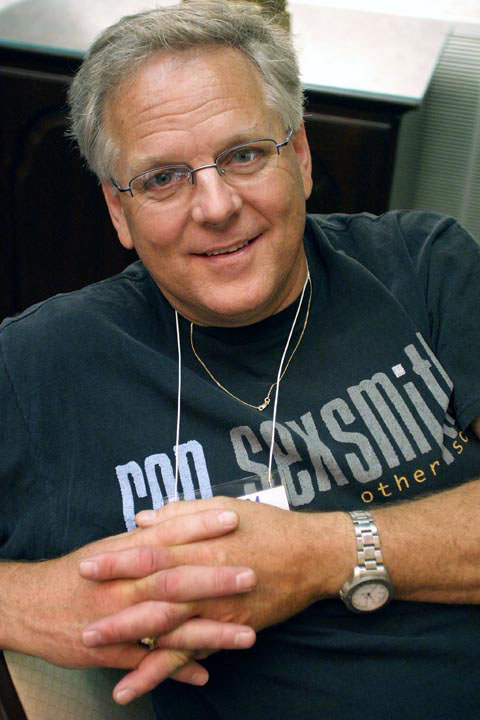
Mishler Photo

Herewith, poems from Peter Mishler, introduced to me by Emily Pulfer-Terino. Very cunning, deft and graceful poems. In “Demolition” a chance detour (on his way to work) leads the poet by an Econo Lodge which becomes a screen for his imagination and the stage for a dark, alienated story (words like “gurney” and “wrist” implicate the scene with dread). A week later, the detour signs disappear and the poet metaphorically wakes, sort of, from the dream of his imagination. It’s an ancient, haunting plot. Some tiny change in the humdrum routine of the world thrusts the dreamer into another world of darkness and disorder. Then he returns, not himself any longer, but changed. (Think: Hawthorne’s “Young Goodman Brown” for example.) He finds the humdrum now inflected with dream (“I walk the darkened, sea-foam hallways”). The poem ends with a lovely whispering repetition (morning, morning), the owl-like assonance (who, whom), and a shade of doubt.

I walk the darkened, sea-foam hallways
to my desk—and when the people
that I pass say, Morning, I say,
Morning, too, so that I can’t
be certain who is waking whom.

dg

§


DEMOLITION

For a week a detour takes me
past the windows of an Econo Lodge.
I invent what’s on the other side
each morning, beginning
with what I know is there:
an absent clerk, an empty lobby
some dark green carpet
joined in places with duct tape.
I add a chair for myself to sit
and make the smaller arrangements:
a door to a bedroom closed
just enough to hide a figure inside;
open enough to reveal a bed
that looks like a gurney,
a wrist laying face up
on the sterile and steamed
white sheets. What am I
intending to have happen here?
Hard to tell if it’s my wrist
or someone else’s that’s meant
to emerge from that room.
I’m getting a feel for the lobby, though:
within days I learn to fix
a sugar drink from sweetener
packets and sink-water.
I place a styrofoam cupful
in front of the bedroom door
and watch for movement.
But by the end of the week,
the detour signs are pulled
and my car is directed
back to the highway,
granting me another view:
the demolished building
the city was shielding me from.
A crane now sifts through fragments
and debris, sorting them into one pile
or another. As it holds
each piece of metal to the air
to let it flicker for a moment,
for me it is lifting the door,
the bed, the sheets, the wrist,
and the cup that should now be filling
with an early sunlight on the floor
of the motel. I watch in the mirror
as each object hangs, then drops.
My car approaches my building, and work.
I walk the darkened, sea-foam hallways
to my desk—and when the people
that I pass say, Morning, I say,
Morning, too, so that I can’t
be certain who is waking whom.


PERIPHERY

You are evading me.
You are just beyond me.
You are the length
of the hood of a car
away from me—
and thinner
than I remember,
dressed as if undressed
after work.
I reach until
I can meet your hand.
But you are in front of me
like the moon
on one week,
then behind me
like the moon on another.
You are trying
to move toward
the doors of a church
we both know,
and I won’t let you.
I step in front of you
and you step to the side
saying, Stay
on the periphery
and we’ll be in touch
this summer.
But what’s here
that won’t let me
speak to you—
that prevents me
from letting you
go inside,
that makes you
want to go inside?
I tell myself, Yes,
I know I must
stay here and lie
whenever I try
to retell the story.
Once, two friends stood
on opposite banks
of a stream.
Then, they were men
and a river,
and then, two ghosts—
the story becoming
more distant
or strange
the more I fear
the person listening.

.

HARUSPEX

The office lights chose
to remain half-lit
for the rest of the fall.
I went whistling
the song of two crows
down a hall unknowingly.
Through my phone
an exam room
slipped into my ear
and unfolded
its expanses brightly.
How does one
get to sleep
in a city of snowfields?
My father sent me
an absentee ballot,
and asked did I think
my future was secure?
I day-dreamt throughout,
and my eyes flew doubly
over a man, on a raft,
down-river—
his body, thin;
his liver, a white star
pressed against his skin.
It asked me to extract it
for its portents.
Back in the office,
my xeroxes spilled
through a seam of light.
They handed me
a memory of warmth
from distant fires.

CLOSED LOOP

You try again
to shut your eyes—
rejoin your head
and heart—
afraid of being
called back to the house
and broken from
your little spell.
But no one is home
to call you home.
Nobody stops you
from pausing
in the last days
of August
like you do.
You’ve stepped outside
some nights
and wanted
to get back in.
There were lists
to be made,
glasses of water
to shift from table
to nightstand.
Stay and let yourself
be known
from the vantage
of sky and window—
your body centered
in a sprawl of lawns
that narrows
away from you
into a vanishing point
of smaller
and smaller houses,
where younger
and younger children
sit behind glass
looking out
onto increasingly
darkened streets,
imagining
unreal figures
at play beneath them—
beginning here
where you stand.
From window
to window,
childhood’s rules
are passed above you
endlessly:
all a boy must do
is close his eyes
and you can disappear.

—Peter Mishler

———————

Peter Mishler’s poems have appeared in The Antioch Review, New Ohio Review, and Crazyhorse. He teaches Creative Writing and English at Liverpool High School in Central New York.

Jan 082013
 

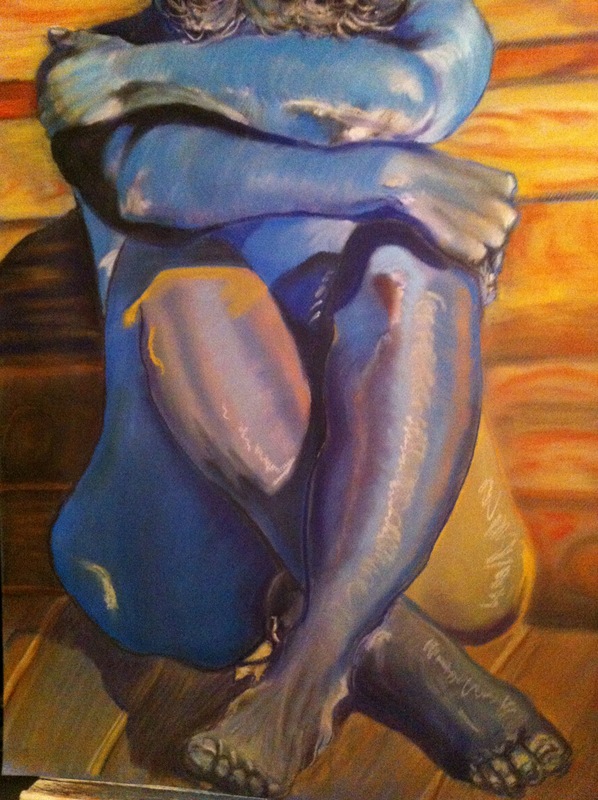
Jane Eaton Hamilton painting 2

What I thought when I read this poem: My God we have stopped writing about sex as sex, the joy of flesh and play and excitement. In my cultural stupor, I had not noticed. But Jane Eaton Hamilton has reminded me, cracking open the great epic theme of the body once again. We need more like this.

Jane is an old friend, closing in on 20 years now since we met in Saratoga Springs one summer. I put one of her stories in 1991 edition of Best Canadian Stories, back when I still edited that estimable volume. She earlier contributed a short story called “Bird Nights” to these pages. She is a prolific artist, a poet, fiction writer, essayist, painter (the female nude above is a Jane Eaton Hamilton painting). “Sleepless” is an extraordinary love poem, a frank and passionate poem about sex between women. You need not look here for titillation. Rather what Jane Eaton Hamilton offers is wonder, and a raw, real, rhythmic, sensual, earthy paean to physical love, love incarnate in the act. It’s a deeply honest and observant poem, and sometimes even funny. “…what I call Exorcist sex where I struggled back to reality and my head/was on backwards…”

You also get Jane reading the poem (click the sound player and listen while you read the poem) which is a delight (and she has always wanted to be a voice-over artist). I listened again this morning to the reading of the poem and it’s lovely, eerie, and very beautiful, Jane’s voice coming out of the ether, the language and rhythms of the poem, the returns, the little jokes in the midst of passion and sex — so intimate, Jane’s voice not straining to project, almost whispering.

dg

.

,

Sleepless

We did not sleep and were made insane by it, and loved the stupidity
after years of girdled hearts—gads, it was just the thing
all that rutting, our senses electrified wires
honeyed bee stings, sparks, slow sinking mudslicks—sex
meted out in silken slaps on a slow summer landscape of skin
Skin the most extraordinary vehicle—more to us than Lamborghinis or
Ecosse cycles; more than soaring through cerulean skies.  Skin was
licked, bitten, scorched, smoothed, twisted, puckered, rubbed raw
hickeyed, blown on, finger-tipped, surprised, heated, cooled, exalted
Every time we fucked it was a brand new thing.  Brand new, I say
like a cotelydon leaf through spring soil, like starlight each brimming night
that is as old as time but seems born
Every time we fucked it was a spank of newness, groundbreaking
Her voice rose in mewls and murmurs and mine was a hosanna
a liturgical worship—  Did we hear a choir of lesbians?
Cries and exclamations and groans and caught breath and occasional
exhortations of pain as leg cramps or ovaries knocked or a
nipple tweaked past good pain.  Let me talk about
my lover’s frankness, the way she opened me as an orange
stripping off bumpy rind, the way she peeled me and exposed me
so I came apart in sections juicy and dripping through her hands
encompassing everything, my head thrown back, my throat rippling
power, how she asked me show her fucking myself
I stopped time for that. Wouldn’t you?  Fuck, wouldn’t you?
Masturbating naked on her deck in the sunshine
my skin sweated and hot and prickling with burn while she watched
hungry-eyed, slack-jawed, wanting, taking it in
Fuck, if you could, wouldn’t you stop everything
and just–

And besides that, the first thing—
(It wasn’t the first thing
but neither of us kept notes … the actual first thing was
the moon fingering shadows through arbutus leaves
while my lover lifted her Folk Fest t-shirt
and I moved like silk behind her, my breasts globular and firm and
ran my tongue up the bones of her spine, bump, valley,
bump, valley and so on.  Before a kiss, I mean
[I seriously mean that—before a kiss], or even, the next night in another town
weeping against her, sobbing for the cruelties that are illness)
–her fist struggled to fit inside me, slow lubed penetration, agonizingly sweet
and harsh.  My cunt which can at times become a balloon, a hollow, filling
with this woman’s richest tactility, her 27 bones, her 14 phalanges,
opisthenar, knuckles, and began to–  She began
interphalangeal articulations.  I mean she began to move
against my tissue, my red leaking bruised flesh, she began a
postural rotation, I mean her wrist turned  and I reached to feel her there
fisting me, and I could see her move inside me by watching above my
pelvic bone outside me, the shape of her fingers almost visible
and I was gobsmacked, really gobsmacked, that a woman
was taking me like that, punching me, if you will, if you go where
bdsm goes (which we didn’t—we did not, that, quite).  I arched my back and
began to ululate and roll my eyes back in my head as she
flung me over Saturn like an extra moon, like Titan.  I was all head
and no head at the same time, blown like gunshot, blown like
an intellect erupting into space.  Eventually everything ends, and when she
slipped out it was the closest thing to childbirth without a baby
and it felt endless and hard-edged and astonishing and I melted
I held her hand; it was soft, humid, hot, and I thought how it was, touching her wrist while it was inside me, I marveled at that–
We were doing everything—it’s not like it stopped there, I mean, would you?—
floral sweetness versus immutable rigidity
hot air huffed into our earlobes, kisses, teeth nipping
we moved our vulvas together, rubbing them fast like itches
laughing and giggling and turning over and over like rolling softballs-
and what I call Exorcist sex where I struggled back to reality and my head
was on backwards.  She had a hickey on her cheek I swear I never put there

Wait.  Pause here.  That’s barely the start.  Barely registering what it was like
on the couch, on the floor, on the beach, on the deck, in the lake with the dive-bombing
turquoise dragonflies and the lily pads and the reeds
All day long, no matter where I went, the bank, the beach
all I saw was her ass, her cunt, her clit, her rough nipples, her kneeling above me
her fingers moving in her own black bush, her palm moving up her ribs
to cradle her spatulate breast, her long thin fingers touching her own nipple
It was colour.  I kept seeing her in blues and I painted her like that.  I saw her in an explosion of oranges and reds and I painted that too.  I kept hearing her as cello music
and I painted that too. I thought of the things that were stop-frame—I sucked my own nipple; I sucked her lavendar cock.  Her tongue was everything
an artist could pray for—articulate.  We went to films until our eyes bled and while I watched, I thought of the soft rounds of her tits moving over the twin globes of my ass.  I thought of the time we fucked under a meteor shower, stars exploding over her head

But also—I spent a lot of time inside her, and the moment when I slipped in her drip
when I entered her elastic vagina, I always gave an ecstatic gasp, a cry of devotion
and then her sympathetic and parasympathetic nerves either gripped me or belled around me, her vagina a spongy muscle, strong, that sucked at me greedily–and I lowered my face to her cunt, that valley between such muscular thighs
the sharp, musky white-peach taste, that salty, tangy, lemony, acidic, musky flesh over hard bone.  The sloppy sound of kissing.  Unhooding her clit and finding that slippery smooth bead, and sucking it
jittering the flit of her clit—but, but–
everything, fuck.  Everything we did soaked into my skin and heart
as if it had bleached me, as if it could reach down through the layers of my epidermis
and mark me and alter me and make me–
We didn’t sleep and we were made crazy by it, lunatical, fresh—every day
was stupidly sunny; even as summer passed and fall began, it wouldn’t rain

— Jane Eaton Hamilton

.

uke

Jane Eaton Hamilton is the author of Hunger, a 2002 collection of short fiction shortlisted for the Ferro-Grumley award.  She is also the author of Jessica’s Elevator, Body Rain, Steam-Cleaning Love, and July Nights and Other Stories.  Her books have been shortlisted for the Ferro-Grumley Award for LGBT Fiction, the MIND Book Award, The Pat Lowther Award, The VanCity Award and The Ethel Wilson Prize in the BC Book Prizes.

Short pieces, which have appeared in such places as the New York Times, Maclean’s, Canadian Gardening, Fine Gardening, The Globe and Mail and Seventeen magazine as well as in numerous anthologies, have won the CBC Literary Awards, the Yellow Silk fiction award, the Paragraph fiction award, the Event non-fiction award, the Prism International fiction award (twice), the Belles Lettres essay award, the Grain non-fiction award, the This Magazine fiction award and The Canadian Poetry Chapbook Contest.  Stories have appeared in the Journey Prize Anthology and Best Canadian Short Stories, Tarcher Putnam’s The Spirit of Writing: Classic and Contemporary Essays Celebrating the Writing Life, and The Writer’s Presence (Bedford/St.Martin’s USA).  They have been short-listed for the Pushcart Prize and Best American Short Stories.

.
.

Jan 012013
 

Watched/heard Ilya Kaminsky read tonight in the chapel at College Hall, Vermont College of Fine Arts, from Dancing in Odessa and his elegy for Osip Mandelstam. Something that must be shared. Of course, I don’t  have video of tonight’s reading, but I found some others on the web.

But to start with here is a snippet from a great Thomas Lux profile of/interview with Kaminsky:

I wanted to know more about his coming to America, and he said, “I can only speak for myself, since my family came to a place only a few immigrants ever come to: upstate New York. If we came to Brooklyn, we would be a different story. But in upstate New York, when our plane landed and the cab took us to our apartment, it was snowing, it was Saturday, and there were no people on the streets [emphasis his]. Coming from Odessa, which is pretty cosmopolitan, I honestly never before experienced the situation when you drive down the street in the broad daylight and there is not a single human being walking. My first experience of USA was surreal. Like there is an atom bomb attack and everyone’s just disappeared. It’s a lonely country. Of course, I got used to it.”

You can read the whole profile at the San Diego Reader.

dg


Nov 092012
 

—Author Photo by Britt Olsen-Ecker

I have known Elise Levine since 1994 when my co-editor Maggie Helwig and I included three of Elise’s stories in our annual anthology Coming Attractions (now edited, by the way, by Mark Anthony Jarman who has appeared often on these pages). Oh, she can write! She has a hip, dark, extravagant flair for language, an alienated edge, a way of making the bourgeois world look, oh, so dull. In other words, she makes you stand up straight and look at yourself. Her story “Angel: starts: It was midnight, Angel, and I’ll never forget. We did it in the doorways up and down Church Street, my back against rotting wood or my hamstrings hurting, crouched down on grey concrete, the club where I’d cruised you receding as we twisted down alleyways and across half-empty parking lots. And then a decade later, actually 2005, I put an Elise Levine story in Best Canadian Stories. She is that good that you are always curious about what she is doing NOW. And so just so you know, here is a video poem, an example of what she is doing NOW, where her questing mind is taking her. City street sounds, pigeon wings, hand-held video, the words coming in bursts or sound and image, the strange beautiful “no, about, no” turning your toward home.

dg

I’ve always been attracted to hybrid literary forms, little monsters like the prose poem, the lyric novel — the way they embody neologism and thus the desire to transform, transfer, mutate. The video poem offers yet another opportunity to ironize and complicate. Layering audio tracks, images and text amplifies the words, creates larger resonances.

—Elise Levine

Late

 —Elise Levine

————————–

Elise Levine is the author of the story collection Driving Men Mad and the novel Requests & Dedications. Her work has also appeared in publications including Joyland, Sententia, Hotel Amerika, Gargoyle, Coming Attractions, Best Canadian Stories, The Journey Prize Anthology, and Prairie Schooner. A graduate of the MFA in Creative Writing at Vermont College, she is currently an Assistant Professor in the MFA in Creative Writing Program and the Department of Literature at American University in Washington, DC.

Nov 062012


(photo credit: Don Denton)

These most recent poems from Nicole Markotić are raunchy little imp dances; they’re a lover that won’t stop punning, half love, half madness. Each “sentence” gives and then takes away, coy perhaps, but in charge. No Scheherazade poetics here you’ll see soon enough; there’s a painfully lovely dawning awareness that we’re the ones who dance here, and we dance for her.

— R W Gray


Staying In

a boat skims the surface, plastic rudder aligns with the pond’s sundial, the canons prepped and
aiming. toys for US

who let the cat into the bag?

curtains drain the sun, your air conditioning follows Mars. I’ll bet it’s noon, now. I’ll bet it’s
break-time in Copenhagen

worry from your lower back, down. a crisis of German emerges from the ankles up

do you fing-er, or do you fing-Ger? long-er, or long-Ger?

aqua naps help cut the string that pulls maps closed

but only by name tag

there’s been a pneumatic leakage, a quarantined seepage, lay people lay about, their intention is freakage

my angle, usually indigenous, remains bent at the elbow

thigh high, my big toe plays abacus in the cricket park, a bat per person

we’re all thumbs today, meaning my finGers are toe-like

close every ocular door with a deaf testimonial, and remind the lip-reading alligators that kennels proliferate

ken you ken where I’m kent?

hurry and ketchup, the sundial’s ticking


wrinkling the cut-offs

Not only Echinacea Purple Cone, but dried Arugula and Potato Vines. A berry crawls across the rough cement, thirty-seven moths sneeze irregularly, and succulents refuse to believe in westward shade.

Calandis blows on her Peruvian flute, covering the middle tubes with her mouth, and Shao-Chiu
wears his spider-man mask. It’s too big, so his nose hole sits on his forehead between the insect-
blue eyes. She climbed the windows, he lurched from the television. Pleats in their shirts mean
ironing might be closer than you think. A popsicle during the heat wave simply

Motor vehicles insist that twelve times twelve equals, but does today count if it’s past midnight?

I meant to look up IESB, but Firefly parodies took over.

A racket of scrambling, a drip of Shala-sweat, a wrist-bone releases, and fingernails flutter to the tiles. I have counted up the list 49-million times and the answer always equals.

Sonnets breathe 14 yoga inhales. Each one a pause, pause in German. Rush home while the rushing’s good. Ghosts slip up as often in the mortal world. Could you walk that way? Do you bury saws? Two screws in the lawnmower, one above the kitchen counter. Check. Don’t dismiss this information as poetry.

I’m still stopping.


at risk or at least?

sloping from the TransCanada:

a road crew to repair the prairie rain that slid the hill down the sidewalk

three riders on one wheelchair, chasing cross-traffic

a pedestrian bridge where kids leap up, just as the cars pass beneath

used spiderman webs, dangling from rescue trees

wading pool asthma

and three blackbirds, pecking at peanut shells beside the hot yoga shala

could tomorrow pack in murderball and taxes, a porch sonata and processed wedding speeches, emails to two Karls, and leg passports?

when didn’t hot-and-bothered last all night?

but how much ink on paper defines a thorough edit?

A Voice, then a Crow.

friends fly east, west, and north. I sit facing south, in the shade, late in the evening, on a flat piece of cement, dying for loopholes

and when tomorrow isn’t what the early-bird brings?


Count Down

Bamboo sheets and then the covers, in waves. Soft and caramel, but only in the morning. A dripping and a placebo. Misty. We’ve stroked the fibres of thick thickness, and double for tissue need, but not on weekdays. Whoever could have? A cardboard box, a cardboard railing, a cardboard pre-packaged breakfast extravaganza. And yes, just as good! Fourteen raisins and three eggs and five pills and the dregs off loose tea. One mug. Not my nose, not my shoulder, not the kneecaps, not seven of the toes, not the light switch instead of paint-stained berber. Elevator doors, but only on the way down. Remind me to pulse a few times on the 13th. Remind me to swallow. Did I ask?

Yes, swishing air, but not so’s y’d notice.

A metal handle, four car keys, and the wheel inside the wheel, ever-burning. Four times a scratched nose, and sixteen hair-flips but who says for show? The inside of an orange peel, but only twice by accident. Seventeen times on the radio, six on the computer. Ahem.

A sneeze that twirled inside niacin. But basically because Benjamin demanded diced celery at the precise corner of Pine and Windy. I’m not making this up. Too many buttons, or knobs, or “press one for”s or keypads or take-out packets to list. I’ll list as I lean. Lean as I learn. Learn from the fingertips, in. Yes, the bah dies. Bathe eyes.

A series of pages, not all poetry, but enough to justify the gutter restraints. Tainted by re. Re-up the upside, or the insect, or the smash-up. Windsor rain, on the downside. Seven doors. More books, in retail. More pens, in trade. More sleeves and file folders and dust that doesn’t count and counter surfaces that do. A penultimum of half-price merchandise.

And finally: each other, but as explicitly as yummy digitals.


“Thefts, Contortions, & Yogic Breathing: Nicole Markotić’s Trickster Poetics”

Nicole Markotić’s poetry is kinetic. In both of her collections, Minotaurs and Other Alphabets (1998) and Bent at the Spine (2012), her aesthetics torque the prose poem until it transforms into something hectic, witty, and earnest. For Markotić, the loosely structured versification of the prose poem avoids the “and/or” pitfalls that Western traditional poetry and prose rely on. By disregarding formal line breaks and punctuation, her prosody conveys a more natural pause. This genre-crossing makes for a paratactic exploration that broaches complex questions concerning nationalism, feminism, and language.

She further complicates this exploration through her inclusion of overheard conversations. These dislocated voices often become her titles. They underscore her interest in multiple perspectives and reveal how her attentive eavesdropping comes from being preeminently concerned with physical and metaphorical margins—margins which locate the cultural idiom through sound bites, double entendres, and puns that stack the poem with polyvocal suggestion. Markotić’s work exhibits a trickster quality in that she steals language and then returns it in altered forms. Her intertextual links rework language within the poem and provide a way of listening attentively to the world.

As the selection below attests, her poetry grows out of the sentence. It is the “sentential piece,” in her words, that encourages “plasticity resistant to notions of purity in either prose or poetry.” Markotić’s use of the prose poem is her way of subverting the Western traditional poem, the poem that she deems a patriarchal device that doesn’t provide ample space for marginal voices. “I’m always stopping,” she remarks as though her thoughts cannot be completed because the medium does not encourage it or because she is hesitant in her own abilities to speak through the tradition. She reinforces this difficulty, in the selection here, in a variety of ways. In two of the poems, for example, she evokes “shala.” as “the hot yoga shala” and “Shala-sweat.” As it’s unclear if she is referring to the war goddess Shala, or to the Sanskriti word for yoga studio, she emphasizes the arbitrariness of language. Both meanings, however, may be anchors—avatar and shelter—for celebrating Markotić’s assertion that subversions of language demand closer attention. “Too many buttons, or knobs,” she reminds us in another place, “’or press one for’s or keypads or take-out packets to list. I’ll list as I lean. Lean as I learn.” And here the word play on “list” suggests lists of problems in a techno-centric world that no longer provides person-to-person encounters. “List” also alludes to listening, enclosing an area for battle, desiring, accepting a challenge, stitching something together, and, among still others, to leaning to one side or losing equilibrium. All of these definitions add complexity and suggest that there are no absolutes.

Because Markotić’s world is without absolutes, she often alludes to uncertainty.  Even ephemeral elements play an important part in her explorations. As she observes in “wrinkling the cut-offs,” “Ghosts slip up as often in the mortal world.” Through this statement, she subsequently generates the question: “Could you walk that way?” The question confounds and conflates. It is unclear if it responds to the statement, meaning should we act as ghosts when we make mistakes? Or is her question an independent thought, a tangent triggered by something physical in her periphery, something that interrupts the previous thought?  This is one way she keeps her language in motion.

The physical body is also essential to her re-workings of language and movement. It is often a field for converging discomforts, emphasizing that, for her, “the prose poem is a poetic strategy embedded within the structure of narrative, and a feminist response to patriarchal language and forms.”  Even the title, Bent at the Spine, suggests physical contortions, a doubling, as well as splitting something, such as a book, in an irreparable way. “Staying In,” from this selection, is a good example of how Markotić slides from the personal and physical to global concerns through her stylistic and formal innovations. The sentence, of course, provides interconnectivity for her shifts between lenses. She writes, “worry from your lower back, down. a crisis of German emerges from the ankles up.” Elsewhere, she writes, “Sonnets breathe 14 yoga inhales,” thus becoming a manifestation of body and language.

Her line breaks and tumbling thoughts are also physical impositions onto the poem. They embody the reader, highlighting her inclusive project. By incorporating colloquial language and found speech fragments from public places, she beguiles the reader into a kind of subtext to the dialogue. On a re-reading, however, the strangeness and ragged breathing patterns that may have been overlooked the first read, pushes through. She asks in this selection, ”Do you bury saws?” And before we have a chance to find our footing and an answer, she’s off on a strangely domestic and disconcerting check-list that sounds vaguely familiar: “Two screws in the lawnmower, one above the kitchen counter. Check. Don’t dismiss this information as poetry.” The essential nature of Markotić’s world is made up of these glimpses and fleeting moments.

While this discursiveness is present in Minotaurs and Other Alphabets, Bent at the Spine is much more fractured and concerned with accommodating more voices. It is perhaps an ethical turn: by situating her own voice as one among many, she encourages autonomy and community.  By fusing these voices to both her attention-deficit sentence and to the body, she conveys the repressiveness she feels in having to lock down her thoughts. Marcotić isn’t interested in polite, normative poetics and she doesn’t meander on the neat path through traditional structure. Her sentences stand discursive beside each other in order to capture the rhythms of an uneasy urban vernacular. If we have normalized our isolations and shortened our attention spans to cater to dramatic transformations of movement and interaction, then poetry, for her, is panacea for jarring us out of this state of quickening. So that patch of Trans-Canada, that hot yoga studio or that hard rain is familiar to us but still strange. It’s Marcotić’s plasticity again, her resourceful poetics steeped in re-mapping the phenomenal and outcries of the body in order to prompt you: Look again. Take none of this at face value.

–Tammy Armstrong


Tammy Armstrong’s poetry has appeared in literary magazines and anthologies in Canada, US, Europe, UK, and Algeria. She has been nominated for a Pushcart Prize, the Governor General’s Award, and short-listed twice for the CBC Literary Prize. She is currently a PhD candidate at the University of New Brunswick, working in Critical Animal Studies and North Atlantic Poetry.

Oct 082012
 

Micheline Maylor writes poems with dash and élan, attack poems, full of desire, heart, dangerous men and revenge. A woman ties her husband to the kitchen chair and whips him with the letters of former lovers (and he watches the “black serpent of her hair flickering its tongue down her back”). “I Was a Pack of Dogs Last Night” is a gorgeous orchestration of dream, desire, dogs hunting, and the epic squeeze of time as the grains of sand drop through the funnel of the hour-glass. These lines make you ache with envy.

And for a second, just a second, sand tucked itself into itself
to pass through the gullet of the time keeper
and for that second, that one squeeze of time
the totality of hunt crushed my ribs with its bite
and I stopped in recognition the way a woman might stop
at a grocery store or a light
to see a lover at a distance…

Micheline Maylor is by way of becoming an old friend, though we’ve never met (a deficiency soon to be rectified since she’ll be introducing me Wednesday night at Wordfest in Calgary). She comes from Windsor, Ontario, but lives in Calgary where she writes poetry, teaches writing at Mount Royal University and edits FreeFall Magazine. Her first collection Full Depth: The Raymond Knister Poems was published in 2007. (Raymond Knister was an early 20th century Ontario poet, story writer and novelist, something of a cult figure in Canadian literary circles for his early promise and the tragic way he died. His daughter used to live in Waterford, dg’s hometown.) She has a new collection due out in 2013. It’s a huge pleasure to have her back on the pages of Numéro Cinq.

dg

————

Even the Done

Marisol tied her husband, Juan, to a kitchen chair and with the letters of her ex-lovers she inflicted deep paper cuts in his skin. On the third day he begged her unfairness. He pleaded to her. Marisol sliced with a quote from Carlo’s pen,

“You were eternally beautiful in the garden last night,
when you kissed me, only then, the stars took flight.”

Juan asked for Marisol to look at her clothes, look across her garden that he had sown for her. He gestured to his work, his provisions, all for her. Marisol nipped a letter into the corner of his eye until he bled a tear. “You tell me no sweet things, Juan. I will never forgive you.”  Juan protested then remembered his necessary words, the demands, the could yous, the would yous, the will yous, and the nos. He surrendered, said nothing more. She continued to slice him each morning then brought him warm supper in the evening so he wouldn’t lose his strength. Marisol did not relent. On the twentieth day, Juan watched through the window as his crop wrinkled in the late August heat. He watched the spell her hips cast as she left him wounded, the black serpent of her hair flickering its tongue down her back. Still, he said nothing except with his eyes.

Eventually, even the edges of love notes brought from lovers become dull. Juan’s skin toughened. The letters no longer bled him weak. In his defiance, Marisol remembered the blush in Juan’s cheek, watched his forearms taut on the chair, and remembered his bedroom sigh in her ear. The lovers’ notes were not as warm as she recalled. Juan’s pain was no longer red. She asked Juan if he’d had enough and he answered, ‘the wind blows only softness into my heart for you, Marisol.’ She untied the rope and when he rose, he held her and called her “precious” and “ darling” and “love”. He looked out the window at his ruined crop and unkept walk. With his chin nestled in her scented hair, “My angel,” he said, “even this can be undone.” He remembered sweet words then. He’d learned that much.

§


I was a pack of dogs last night

I was a pack of dogs last night,
in my dreams, moving as one.
A solitary mind, the pack, chuffing at the hunt
and it might be fair to say the hunt was meat
but I knew the hunt was something else,
something ethereal, something more substantial,
less brutish, less blood,
something impossible to grasp with teeth or paw.

We, or should I say I? Whatever the semantics, we moved as grains
of sand through the belly of the hourglass and just as fast
towards a mound of shiver-light and intuition. We already felt satisfaction
in our throats, that fat satisfaction as it sometimes sits
under stars, summer feisty in the air.

And somehow, though no audible sound yipped aloud,
somehow I was one and all,
all speed, all fur, all dogs, all one,
and led them like organs follow bone and muscle to places they wouldn’t go alone.
Somehow I knew this journey was mine to lead,
to bounty, to consequence, both mine and ours.
And for a second, just a second, sand tucked itself into itself
to pass through the gullet of the time keeper
and for that second, that one squeeze of time
the totality of hunt crushed my ribs with its bite
and I stopped in recognition the way a woman might stop
at a grocery store or a light
to see a lover at a distance with a new lover or child,
long enough to accept a different choice in a different moment
might never have led to this present
a present with a new future in it. And I thought of you.
That night. That rightness in our fingers ranging. And your hands tell the whole story for just that moment, that finite spark of time, that small balance
where glass narrows.

I stopped long enough to look at that choice, that grain of time,
before it fell out of sight. I must have stopped longer than I thought,
for the pack cued nose to haunch in stalactite shapes
and those black muzzled swimmers nudged me on. And we, the pack, ran on.
We and I, the pack ran as one into a forest of light, paw after paw striding the dirt.
Nothing to fear. The anxiety of moment lifted into the flow, under our feet,
into the slip of time, out of your hands. And I, and we pant, and they, and I pant,
each leaf under paw, over grain, a tint of yellow, of green, of red, of day,
a day in a life, a leaf underfoot, a colour, a memory, a molecule, a pack, and the pack ranges on, in this surrender to time, in this finite hourglass, though that narrow tip between all things done and undone.

§


Mercury

When Rob said, look at this,
he snapped the bottom off a glass thermometer.
Mercury bled into his hand
while adults downstairs conversed.

He snapped the bottom off a glass thermometer.
Ebb and flow in laughter
while adults downstairs conversed,
he whispered, quicksilver.

Ebb and flow in laughter,
down his heart-line, up his life-line,
he whispered, quicksilver
until his hot fingers tipped the ball

down his heart-line, up his life line
into my palm and I felt it slide
until his hot fingers tipped the ball
down my life-line, up my heart-line

into my palm and I felt it slide.
It’s poisonous, you know.
Down my life-line, up my heart-line.
Get it in your mouth and it can kill you

It’s poisonous, you know.
Then he darted his tongue
Get it in your mouth and it can kill you.
He tasted his own skin where the mercury had been,

then he darted his tongue
his eyes never moving from mine.
I tasted my skin where the mercury had been.
I let the ball roll into a pop-bottle cap

his eyes never moving from mine
did the same with my own tongue.
I let the ball roll into a pop-bottle cap
with my quaking hand.

I did the same with my own tongue.
And certain death never came
at my own hand.
Me and him, eye to eye

certain death never came
in the bedroom of
me and him, eye to eye,
my first dangerous man.

— Micheline Maylor

————————

Micheline Maylor’s  newest collection titled Whirr and Click is due with Frontenac House in spring of 2013. Her recent publication Starfish, a chapbook with Rubicon Press, sold out in 2011. She became a recent graduate of the May Studio at the Banff Centre in 2010. She was named honourable mention in the UK’s 2007 Petra Kenny poetry awards. She has upcoming fiction and poetry in The Shyness Anthology, and Stampede Noir Anthology. Her latest works can be found in the Planet Earth Poetry Anthology, University of Las Vegas Review, and The Freshwater Pearls Anthology. She attained a BA with honours at the University of Calgary in English, a Masters degree with distinction in creative writing at Lancaster in Northern England, and a Ph.D. at the University of Newcastle Upon Tyne in English Language and Literature with a specialisation in Creative Writing and 20th Century Canadian Literature. She has been the recipient of the Overseas Research Scholarship, the International Research Scholarship and Alberta Foundation for the Art grants. She has poetry published in over 70 journals in 5 countries. A certified poetry fanatic, she teaches creative writing, poetry, fiction, non-fiction, and composition at Mount Royal University. She serves as the President and co-founder of Freefall Literary Society, and is the editor of FreeFall literary magazine: www.freefallmagazine.ca. Her first book is titled Full Depth: The Raymond Knister Poems (2007) and is available through Wolsak & Wynn www.wolsakandwynn.ca.

Oct 022012
 

David Helwig here reminds us that poetry is a kind of divine tomfoolery, a playful messaging that oscillates between meaning everything and meaning nothing, that never means but momentarily and then the meaning shimmers away like a leaf blowing in the wind, catching here and there and moving on. He sent this to me calling it poetry. Actually what he said was more like he couldn’t figure out what it was so he called it poetry. On some level it enacts a messianic parody; it gives the year 2051 a mysterious significance; I like the stenographer drawn in a cart by a Newfoundland dog; I like the Four Lads and all the words beginning with Q; it lifts one’s heart.

David is an old friend and an amazingly prolific author of poems, translations, stories, novels and a memoir. In 2007 he won the Writers’ Trust of Canada Matt Cohen Prize for distinguished lifetime achievement. In 2009 he was appointed to the Order of Canada. His book publication list is as long as your arm. He founded the annual Best Canadian Stories which he edited for years. Biblioasis is on the cusp of a collection of David’s magnificent translations of Chekhov stories, the title story “About Love” originally on Numéro Cinq. See also his poems on NC here and here and here and here!

dg

§

You’d see them by the shore on those greenest of green days, Himself in conversation with Quigley, adding newly minted sayings, in the distance one of the fishers wading barefoot, steady in one place as his bare feet step gently up and down in search of the lump in the mud, the hard shell of the quahog, bending to lift each small edible bivalve out of the sludge, drop it in the floating container he dragged behind him, like a ghost towing his hard fate. Further out an oysterman probed the bottom with a set of tongs. And beyond that yet the tiny image of a lobsterman pulling traps on the shimmer of water, silver under the light-infused clouds and on in a hint of forever to the line of horizon. In the air the fine metallic flex and curl of birdsong, the tiny musicians hidden in the green reeds or the tall grass or the thick accumulation of succulent new leaves.

Himself would be bent a little forward, walking ten steps one way, then ten steps the other, intent, speaking his words, and Quigley staring at him while he went on, the big Q, so he said, remembrancing every word of it, so later to scratch it all down and share it with the Four Lads, in the years when the entirety of them westered into the secret underground, and were known only by the initials, Q for Quigley, though many said it was for some Latin or foreign word, Q not for Quigley at all, though he was called that in the farmyards and on the highways, and among the high lines of travel, while the Lads were known by their initials M and M and L and I, MMLI adding up to 2051 in the ancient numeration, and it was prepared that in the year two thousand and fifty one, some Final Secret would be told, Himself achieving his place at last. Never such demand for Last Things, and Big Quigley had a whole bundle of prophecies of the Third Coming and the Fourth, always more, like a couple, adulterous or even not, who have just at last caught the pace of it and climb the holy mountain at all hours.

At low tide the radioactive seals, flopping out of the ocean like fat mermaids, gather on a rock shoal not far from shore, grunt and boom and snarl.  No one could remember the name of the arctic goddess who once reigned in the icy waters, and governed their lives.

Nearby, observing, silent, is a tall hard man with a shaven skull. He never speaks. Then Mad Mary, in an opalescent shirt full of flesh, tiny shorts defining white thighs, strides out of a tent in the long green ferns where she has passed the time with whomever, contributions to the fund, all her big mad teeth in a grin as she goes aboard the school bus, with its beds and galley and chemical toilet and with a bending and shifting of her bare long legs and heft of muscular arms she lifts and places cardboard boxes, sweeps up, and the holy scrolls filed once more in their rack, she sets to packing up dehydrated veg and salt fish, with fresh water for the next voyage, a hip canted to one side as she lugs the buckets.

Big Quigley watches her. Whatever his claims to holiness, he is not to be trusted, of course, who would try to cheat the shell-fisher of his catch, or anyone else of any manner of thing, better conceal him as the letter, Q for quaestio, a seeking or searching, Q for quies, rest, Q for questus, complaint, Q for quisquiliae, rubbish. And his ways of remembering served to augment confusions in what was said of what was done, each of the Four Lads recording what each believed he knew, late at night debating the matters and sharing out their stories. His record, the spoken and claimed and imagined basis of it all, would finally be vanished forever, so that nothing was left but an image of an image, Mad Mary’s bright eyes and heavy sunlit hair caught in the mirror of a puddle, where she glimpsed herself with all her devils gone off, Himself seen over her shoulder in the water, come up on her from behind. Himself must use the tools at hand, what is in the world is in the world. She will read the Parmenides scroll to him in the shade late some afternoon.

Now, the packing and preparation done, she comes out of the bus with a wooden bowl in her hands, down to the water to fill, then goes to the firepit, where there is a faint trace of smoke winding up into the air, and Himself arrives to her and sits in the old upholstered seat taken out of the bus each time they set up camp, and she takes off his summer sandals and kneels, sun glittering on the waterdrops as she washes his feet, and as she bends toward him, he put his fingers through her thick hair with its metallic highlights.

They will march down a main street for the final parade, some of the willing natives gathered by the wayside, some watching on their eyeglass screens, and when she has washed his feet, Himself tells her a mystery while she combs out his hair and beard, making him handsome for the public presentation. Big Quigley studies it all. He is standing in the long green ferns, and down by the jetties, he sees two women climb from a rowboat and walk to a waiting air-bicycle, and he stares them so hard that they grow naked to his eyes, and in his way he possesses them both entirely.

The sunlight catches the thin smoke and the wisps thicken to clouds until the firepit is all whirling whiteness. Himself and Mad Mary vanish from sight, and the two of them gone, the Four Lads appear on the scene in their royal T-shirts each with his letter – TWO-ZERO-FIVE-ONE – as they sing out their stories in plainchant, then the unison dissolves into the chords of a march, and out of the vast smoke rolls the schoolbus, Mad Mary at the wheel, her bare arms exposing shifting tattoos, big hands gripping the wheel. Himself stands on the roof beating time, and all around it marches a phalanx of drum majorettes, in white satin skirts, tall boots, and red satin shirts.

Big Quigley, riding behind in a horse drawn carriage, has a notebook in his hands, and he is scribbling in it as fast as he can, but he can’t keep up, so he turns on his eyeglass phone and begins to dictate into it. Behind him, in a cart drawn by a tremendous black Newfoundland dog, sits a stenographer receiving his dictation and putting it down in shorthand. Behind the orange schoolbus, marching with their knees high, come male and female cheerleaders in silver bikinis, two of them holding a banner with the words EAT FRESH SEA FOOD. With the fingers of both hands Quigley forms the letter Q, and the cheerleaders wave to him and some of them make the same digital gesture. Each observer’s portable device records their progress into the city.

Then the bus vanishes with its smoke and noise, the long street is empty.

A van is parked in front of a snack bar, and a young man climbs out, who wears a Boy Scout hat, holding a stick ending in a nail in his right hand, a canvas bag in his left, and he strolls along the boulevard picking up the chocolate bar wrappers and chip bags and popcorn boxes.

 — David Helwig

————————–


Sep 122012
 

Poetry here from Irish author Gerard Beirne who attacks the notional divide between science and art head on and makes rhymes out of sines and cosines and the nature of colloidal suspensions. In ancient times Pythagoras theorized upon the nature of music and mathematics without making a distinction between the two. It is only in our day (and mostly in the popular imagination) that science, mathematics and art have drifted into a strange opposition. Perhaps it is only an ill-educated assumption that science is not beautiful. In any case, Gerard Beirne, in his new book Games of Chance: A Gambler’s Manual (Oberon Press) from which these poems are taken, makes poetry out of science and science out of poetry. And sometimes he uses science as a luminous metaphor for the spirit. Of circles and squares, he writes:

The relation of X’s to Y’s
the hows and whys
of the pleasure derived
from being true to themselves
or from pushing
…………………..at their boundaries

dg


Properties of Solutions: The Colloidal State

Take atoms, molecules
assume their use theoretically
if not practically
believe in them (or not)
if you will.

Accept (for now) that this
is elementary theory
to avoid a state of confusion.

Focus on colloidal dispersion
the scattering of light (for instance)
by particles of dust
in the path of a sunbeam
through a partly opened door
(call this the Tyndell effect).

Take these small sparkling specks
(these giant steps)
and follow these points of reflected light
observe the constant random motion
(name it Brownian movement).

Publish if you must
a mathematical analysis
of nonuniform random collisions
caused by the unequal number of molecules
colliding on either side.

(Answer if you dare
to the name of Einstein

or Perrin if you prefer
a Nobel Prize.)

Verify experimentally
remove the last doubts surrounding
atoms and molecules, offer
the proof of your own existence

(act surprised)

the notion of its constant
random motion
the human condition.

Believe in it (or not)
if you will

(but accept for now
that this is still

elementary
………………..theory.)


The Pressure of Gases – kinetic molecular theory

Torricelli immersed
at the bottom of a sea
of elemental air
considers the existence of a vacuum

(a space repugnant to nature
and philosophers
who advocate resistance)

but Torricelli bearing up
under the oppressing weight of hot air
fills a tube of glass
a dish with mercury
inverts the tube within
observes the empty space which forms

a place where nothing
(natural) he believes
can be contained

(unawares of molecules
of mercury vapour
ascending upwards)

a vacuous state of being
devoid of God or life

(at least on paper)

light-headed (and swimming
beneath the surface)
Torricelli endeavours
(and succeeds) to measure
the pressure of the atmosphere

like some exotic fish
he gauges the rise and fall
within the tube
floats easily amongst it all

the internal and external forces
rarefaction and density

(Torricelli breathing
at the bottom of the sea)

where all and nothing happens
an emptiness filled
with relentless intensity

Torricelli (like others
before him) sees mankind
struggling to its knees
in the lower regions
of the atmosphere

(quicksilver rising in a tube of glass)

a place cohabited with animals
meek and wild

while on the peaks of mountains high
closer to the heavens and the sky
(where prayers come to pass)
the air is pure and light
and finally measurable

the next step (unimaginable)
surely flight?


Form

After this
………….I lead you into form

triangle, rhombus, square, helix
circle, rectangle, ellipse

and from there
………………….to their equations

their defining features.

The relation of X’s to Y’s
the hows and whys
of the pleasure derived
from being true to themselves
or from pushing
…………………..at their boundaries

a circle stretched into an ellipse
a rhombus pressed into a square

but erstwhile
……………….there is the line

(like light concise
taking the least journey
…………………………….between points
adhering to Fermat’s Principle of Least Time
“nature always acts by the shortest course”).

Archimedes, Appolonius of Perga,
Euclid, Pappus of Alexandria

awaiting fourteen centuries more
to extend the shape of their knowledge

Gerard D. Desargues,
Blaise Pascal, Rene Descartes

mathematicians defining concepts
…………………………………..in words
simple sounds
intricate with meaning

tangent, locus, vertex,
asymptote, focus, directrix,
………………………………eccentricity

the complexity
of geometrical theory.

Beyond this
………………..images and symbols

points aligned in space
specified by their coordinates
outlining inordinate quantities
of thought

and out of all of this a purpose
beyond the rapture of near perfection
an application?

The parabolic surfaces
of reflector lights, say
showing the way
or antenna in radio astronomy
solar furnaces
ballistic calculations

shots fired in the dark

satellites orbiting the earth
above the critical speed
needed to remain aloft
and hark
…………….transmitters locating ships.

But which from which

the bullet or the ellipse
the form or its intent?

Or by necessity
………………….both together
creating their own trajectory

forces never spent.


— Gerard Beirne

———————

Gerard Beirne is an Irish writer who moved to Norway House, a Cree community in Northern Manitoba, in 1999 where he lived for three years. While living there, he interviewed Elders in the community and edited for publication an anthology of those interviews. He received an MFA in Creative Writing from Eastern Washington University and is a past recipient of The Sunday Tribune/Hennessy New Irish Writer of the Year award. He was appointed Writer-in-Residence at the University of New Brunswick 2008-2009 and is a Fiction Editor with The Fiddlehead.

His novel The Eskimo in the Net (Marion Boyars Publishers, London, 2003) was shortlisted for the Kerry Group Irish Fiction Award 2004 for the best book of Irish fiction and was selected as Book of the Year 2004 by The Daily Express. His most recent novel Turtle was published by Oberon Press, 2009.

His short story “Sightings of Bono” was adapted into a short film featuring Bono (U2) by Parallel Productions, Ireland in 2001 and released on DVD in 2004.

His poetry collection Games of Chance: A Gambler’s Manual has just been published by Oberon Press- Fall 2011. His collection of poetry Digging My Own Grave was published by Dedalus Press, Dublin. An earlier version won second place in the Patrick Kavanagh Poetry Award.

Sep 062012


Sydney Lea has three books coming out, including his new essay collection A Hundred Himalayas (University of Michigan Press) this month. At an age when old dogs curl up before the fire and dream ancient dreams, Sydney is all spark and vigor which I find endlessly appealing and optimistic. Sydney is also the Poet Laureate of Vermont, and I guess poet laureates hobnob in ways that mere mortals don’t. He and Fleda Brown, recently Poet Laureate of Delaware, have been writing essays back and forth. As Sydney writes, “My friend Fleda Brown, lately poet laureate of Delaware but now escaped to northern Michigan, and I are writing a book together. She writes an essay on a topic (food, sex, clothes, houses, illness, and wild animals); then I write one on the same topic. Then I write one and she follows suit. Etc. It’s fun, though I don’t know who in Hell will publish it.”

Earlier on these pages I published the essay “Unskunked” which is part of this poet laureate interchange. In “Unskunked” we were treated to the image of the author running naked through the dark and dripping forest. In “Becoming a Poet: A Way to Know,” Sydney Lea waxes less overtly spectacular and delivers a lovely, wise account of his education as a young poet. He is a paradoxical intellect; part athlete, hunter and woodsman; part scholar; mostly a poet. This is the story of how these impulses somehow coalesced around his admiration for what we might call the New England old timer (in 2012, there aren’t many of these left). At the center of this is an idea of manliness (not macho posturing but old fashioned manly virtue — a good thing).

Sydney Lea is a great friend and former colleague from my early days at Vermont College of Fine Arts. It’s a source of deep satisfaction that he has found Numéro Cinq a congenial home for his work.

dg

———–

When I was young, who thought I’d choose poetry as my prime mode of knowing the world?

Not I.  It’s true that as a high school punk, despite my enthusiasm for football and my wilder one for hockey, despite my commonplace tough-guy posturing, practiced by so many of us guys at that stage of life, I did secretly like to think of myself as a bit arty too. I was a musician. I could sing. I even thought I drew pretty well. I was a big cheese in the dramatic club, as a senior playing Oedipus in the eponymous play (a lisping king, who addressed “generationth of the living in the land of Thebeth”).

But I don’t remember writing poems, save maybe the sorts that any person may have written, and that he hopes have long since utterly biodegraded: rants about being ditched by a girlfriend, just for the tritest example.

I was also a pretty good student. Indeed, had it not been for what would now be diagnosed as a mathematical learning disability, my GPA would have been of the very highest. My truest proficiency was foreign languages, a gift nourished by the best instructor I ever had at any level, Ted Wright, who taught French. I began to speak the tongue pretty quickly, and I recall how strange it was that the words and the grammar often almost seemed to be granted me by some power outside myself.

It’s a feeling I would later come to recall – if not as often, naturally, as I could wish – when I composed a poem successful in my own eyes.

It’s at once simple and weird: words and phrases, whatever the language, simply enchant me, seduce me, especially if I hear them. Things spoken in my presence, if they have a particular, inexplicable resonance, will lodge themselves in my mind for decades. For example, I lately remembered a friend’s describing the death of his farmer uncle, who fell dead in his tracks while shutting the tailgate of his truck on a calf bound for the abattoir. I heard that description, unremarkable in most respects, about forty years ago. I wrote the poem last week.

Like my exemplar Robert Frost, I want my poems to have something of the ring of actual talk in them. But that’s to get ahead of myself. The college I chose had no writing courses as we know them in our era of too-rampant MFAism. But somehow, on my own, I started to feel an itch to write, which I did, my only audience, really, being my roommates, who tended to think I was good enough, if they thought about my work at all. My genre was short fiction, and I wrote a lot of it in those four years; it seemed to keep me balanced somehow, while everything else – including the alcoholism that would plague too many later years – was doing just the opposite.

Ultimately, of course, graduation loomed, and I had to figure out what I might do. Yale had accepted me as a grad student in French, but much as I loved the language and the literature, something in me recoiled from living as a kind of literary expatriate. I never imagined applying to a place like Iowa, though quantitatively, my portfolio would have permitted me to. (Who knows about the quality?) I had barely even heard of any of the far fewer MFA programs that existed in those days. I never dreamed, either, of Being a Writer.  Professional writing, I assumed, was something other people did; there must be some secret to it, and no one had shared it with me.

I did not want to go to Vietnam, as one those roommates did, becoming one of the earliest casualties of that wrong-headed adventure. And so, because schoolteachers were exempt from the draft at that time, I elected to go back to my own private high school, having no credentials to teach in a public one.

I taught French and English, and came to understand how Ted Wright managed to be so inspired and inspiring a teacher. He simply committed himself to that end every minute of the day right through the evening’s class preparation. No one messed with Ted: he was a big, muscular guy, the football coach, a former semi-pro pitcher. At a mere 21, I didn’t have that sort of gravitas, and I devoted a lot of time to quashing the same sort of ill discipline I’d imposed on all my other teachers, now my forgiving colleagues, just a few years before.

Top quality high school teachers are, to my mind, the heroes of American education. They deserve to be paid a lot more, and college teachers (especially those at the sorts of “prestige” institutions where I myself have taught) a good deal less. To say it tersely, even after one year in a pretty cushy job at that level, I knew I didn’t have the endurance and commitment Ted did. In deed, I concluded there wasn’t enough money in anyone’s bank to keep me at his sort of work. Too hard, too demanding, too much time just being present.

So I did go to grad school after all, not in French, but not in English either. I did comparative literature, wanting to use my languages while I focused on fiction and poetry as fields of study. I was too naïve to know that comparative literature was just then leading such study in the “theoretical” direction that has made it unappealing to me and apparently –  judging from the radical shrinkage in literature majors at the majority of colleges – to most students.

Not that my dabbling in theory didn’t have its heady moments. I particularly recall a fabulous seminar on European Romanticism, presided over by the second best of my many teachers, Geoffrey Hartman. And yet Geoffrey became, quite unintentionally, a bit of a villain in my history. I had settled on a perfectly conventional dissertation topic, Frost and the Romantics, but he persuaded me to expand one of my seminar papers, an examination of several supernaturalist authors of the nineteenth century, most of them deservedly forgotten. Unlike my other choice, he averred, this would be “a real contribution.”

Contribution? What about nightmare? To indicate how sheep-like I’d been in acceding to my professor’s suggestion, most of my texts were written in German, the one major western European language I didn’t really command, which meant that I was forevermore rifling through the stacks for translations from the original into French, Italian or Spanish, few being available in my native tongue.

Good Lord…

In due course I took a job at Dartmouth College, without, however, having finished that accursed dissertation. Indeed, it would take me more than four years to do so.

There were no writing courses at Dartmouth in those days, any more than there had been at Yale when I was there. But a fair amount of clamor arose from students for that lack to be remedied. The result, in my second year, was English 70, an omnium-gatherum offering in which students could write fiction, poetry, drama, personal essays, what have you?

The heavies of the department, many of them good people and true, to be sure, were exclusively male – women adjuncts were referred to as “lady lecturers”! – and white and old, and at least marginally Christian. (These descriptives fit me better as I write this than they fit the people in question then; but such, in my late twenties, was my regard for them, one and all.) They assigned English 70 to me, of all people.

This was meant, though, as an act of kindness. Since in the eyes of those senior colleagues, such a course was not a “real” one at all, not the kind that demanded any genuine thought or preparation, I would have more time to complete my burdensome dissertation.

And yet a strange thing happened  (or perhaps not so strange). In teaching that course, ineptly, I’m sure, given my utter lack of credentials, I found that old itch returning. It had been suppressed for more than half a decade, but now I began to write again myself.

I began, though, to write poetry. Why? Well, pardon a detour to something very relevant: on my father’s side, my family has had a relation to a remote part of Maine that now goes back generations. In these times, my brother and sisters collectively own our cabin there. My time in the neighborhood had exposed me to certain notable characters, ones who would be 120 or so if they lived still. These were men and women whose early lives had preceded the advent of power tools, so that the male lumberjacks had cut millions of board feet by hand. And to call the females “housewives” would be downright laughable: they lacked all domestic conveniences we take for granted. Stunningly hardworking people, they quite literally kept the home fires burning, cooked in wood-fired ovens, slaughtered chickens, skinned game, cleaned fish and did whatever else was called for to sustain a homestead.

Because these people had no electricity, they of course had no radio either, let alone movie theaters or the great drug television. No, they had to make their own amusement, and as a result, man and woman alike were fabulous raconteurs. Their magical turns of phrase ring in my head every day: some get into my conversation, a lot into my poems, as it were, in disguise.

It seemed inevitable that, when I moved for my job to another part of northern New England, I sought out their Vermont and New Hampshire counterparts, who were equally eloquent, grammar and syntax be damned. And even at my young age, I somehow recognized mine was the last generation who would have known these precious souls.

I wanted to get their voices onto the page.

And yet I knew I’d prove no genius. I wasn’t Mark Twain. I wasn’t Willa Cather. I couldn’t resort to dialect without on the one hand sounding condescending, which was the opposite of how I felt, or simply sounding “off,” or both. I came to the conclusion, rightly or wrongly, that if I used poetry to tell their stories – or rather to tell stories suggested by their stories –  I might capture the rhythms and cadences of that old-time, entrancing speech without having to imitate it.

My earliest poems, consequently, were in the main quite specifically narrative ones. And although I have drifted away from overt story-telling in my verse, I have never quit believing in certain narrative values: even if plot remains implicit, I want my reader at least to know who’s talking to whom, and where and why. Character, setting and dialogue: why should we poets have ceded these endowments so readily to the fiction writers?

To this day (and I am old enough now to be indifferent about what the Smart People think), I want whoever encounters a poem of mine to know some literal truths when he or she first sees it. I want to make him or her aware of who the actors are, perhaps especially the one named I. If I can make allies of my readers, I’ll be pleased – and genuinely grateful to them. To these ends, I feel I owe them a welcome. A good poem will be complex, no doubt, but that’s a different thing from complicated. Those who are willing to consider it shouldn’t be taxed to figure out the plain facts of its matter.

Back to the academy. One of the department elders – a man whom I greatly liked from those days up to his fairly recent death – was chairman at a critical juncture. He approached me one day and said, “People are starting to regard you pretty favorably around here, but you know the saying, publish or perish. I’m glad it didn’t apply when I was your age, but without some scholarship in print nowadays, you have very little chance of tenure.”

Okay, then… I liked where I lived. I particularly liked the landscape and that access to the old story-tellers, and since in those days one did not have to publish a book, but rather a few articles, to pass the publish-or-perish test, I thought, well, I’ll just take a chapter or two from my dissertation (a screed still incomprehensible, even to its author) and try to stick it somewhere.

Mind you, I had gotten lucky with my poetry pretty quickly. I’d put poems in The New Yorker, the Atlantic, The New Republic and a slew of high-end lit magazines. But however different things are now at Dartmouth, in those days publishing poetry was not “real” publishing; that my first collection was under contract cut no ice, then.

I took the dissertation over to my library carrel, opened it up, and felt as I sometimes have upon looking over a shear precipice. My head spun, my stomach knotted, and I uttered aloud, despite the fact that I was in my thirties: “This is not what I want to do when I grow up.”

I closed that dusted-over tome, vowing that I would go on writing poetry and let the chips fall where they might. I did not of course get tenure, but was fortunate enough as almost immediately to be hired by Middlebury College, where the tradition of writer-professors had been fairly long established.

I now ponder that cri de coeur of mine, and I wonder why scholarship should not have appealed to me as something to do as a grown-up; why it couldn’t draw me more than it did or does. Understand, after all: nothing I say here is intended as an attack on scholarship. The contrary. I have benefitted enormously from other people’s labor in scholarly endeavor. It’s only that it isn’t for me.

Or not to the exclusion of other things. Oh, I have done a few genuinely scholarly articles since, copious annotation and all, and have even enjoyed doing them. But something always seems missing when I finish. It’s the missing something that’s provided by so-called creative writing, especially the writing of lyric, though I must struggle here and elsewhere to name that element.

For me, poetry is another mode of knowing the world, one that is different from the either/or, syllogistic one whereby people (myself included) generally conduct their business. Nothing wrong with that: if Shelley claimed poets as the unacknowledged legislators of the world, from what I’ve seen of them (myself included), it’s likely a good thing that their legislation does go largely unnoticed.

In any case, the lyrical approach is largely divorced from either/or, is in fact an approach well described, the way Carl Jung did in another context, as either/and/or –which is to say that it enables the writer (and ideally the reader) to see and feel from multiple angles simultaneously. To choose a hyper-obvious example, with the fairly recent birth of each of my grandchildren I have felt an indescribable surge of joy contemporaneously with numbing despond to imagine the world they may inhabit: over-heated, desperate for drinkable water, fratricidal, on and on.

It is this either/and/or quality, I believe, that John Keats famously called Negative Capability: the capacity to be  “in uncertainties, Mysteries, doubts, without any irritable reaching after fact & reason.” Any number of perceptions, emotions, thoughts, and so on can exist in a poem at the same time, including ones like the above, which are evidently contradictory of one another. In these respects, poetry’s path to knowledge, more nearly than any other, seems the path my mind inclines to follow.

And of course there is again the matter of language. All those voices, old and new, anglophone and otherwise, that reverberate in my skull and, more importantly, in my heart. To abandon myself to what I called their rhythms and cadences, to let the words and phrases, as it were, bear me along like a tide to such enlightenment as I’ll ever have – that feels, and not just slightly, like a self-abandonment (allow me) to something divine.

— Sydney Lea

——————–

SYDNEY LEA is Poet Laureate of Vermont. His selection of literary essays, A Hundred Himalayas, will be out from U. of Michigan Press in September. In January, Skyhorse Publications will issue A North Country Life: Tales of Woodsmen, Waters and Wildlife, and in  April 2013,  his eleventh poetry collection, I Was Thinking of Beauty, is due from Four Way Books. His most recent collection of poems is Six Sundays Toward a Seventh: Selected Spiritual Poems, from publishers Wipf and Stock. His 2011 collection is Young of the Year (Four Way Books).

He founded New England Review in 1977 and edited it till 1989. Of his nine previous poetry collections, Pursuit of a Wound (University of Illinois Press, 2000) was one of three finalists for the Pulitzer Prize for poetry. The preceding volume, To the Bone: New and Selected Poems, was co-winner of the 1998 Poets’ Prize. In 1989, Lea also published the novel A Place in Mind with Scribner, and the book is still available in paper from Story Line Press. His 1994 collection of naturalist essays, Hunting the Whole Way Home, was re-issued in paper by the Lyons Press in 2003. Lea has received fellowships from the Rockefeller, Fulbright and Guggenheim Foundations, and has taught at Dartmouth, Yale, Wesleyan, Vermont and Middlebury Colleges, as well as at Franklin College in Switzerland and the National Hungarian University in Budapest. His stories, poems, essays and criticism have appeared in The New Yorker, The Atlantic, The New Republic, The New York Times, Sports Illustrated and many other periodicals, as well as in more than forty anthologies. He lives in Newbury, Vermont, where he is active in statewide literacy and conservation efforts.


Aug 282012
 

 Two Rigoberto González poems to die for. Nothing else to be said really. I got part way through the first poem and thought, This is the motherlode. Look at this stanza.

where there never was a father
there never was a child. if not
a birth, then not a love. if not
conception, then not a thought.
if not a wish or possibility, if not
a miracle, then not.

The poem is a meditation on the poet’s knowledge that he will never have children even though there is in him the capacity to love a child, the paternal element, as it were. And this is the climactic moment of the poem. Rigoberto runs as series of sentences that are simple parallel constructions, relentlessly repeating “if…if…if…if”/”not…not…not…not…” within which pattern he juxtaposes a set of paired nouns: father/child, birth/love, conception/thought (beautiful pun), wish/possibility and miracle/not where the final “not” breaks the rhythm of the parallels and by the magic of language becomes also a noun, a homonym of nought, nothing, zero. This is gorgeous writing. The effortless play of the poet’s mind keeps the poem from descending into sentimentality. He holds his sorrow in a container of words and prolongs the emotion to a terribly bittersweet breaking point.

Rigoberto González is a friend and colleague at Vermont College of Fine Arts. It’s a deep pleasure to publish his poems on NC.

—dg

 ————-


Bodies of Little Dead Children
…..after a painting by Forrest Bess

inside of me, i who will never be
a father to any he is my son or she
is my daughter or that’s my baby
mirror glaring its crooked teeth back
at me.

…………yet i must know something
about parenting. at night my torso
splits apart, a cradle for my heart
to pound and tantrum to delirium.

dare I wish the little thing had
never been? dare I ignore it,
let its cry shrink to a squeak that i
can place over my tongue?
this squirming pillbug, dare i
ingest it?

………..oh cashew in the sack,
interrupted dream my barren sister
had—the pitter-pat of baby feet
vanishing like sweat on the tile
turned steam. oh vacant nest.

will she resent the way I squander
my fertility? bless the tumbleweed
that chases after rain all summer
yet only flowers in a fire.

……….what am i but an apple tree
indifferent to the fruit that blisters
and spoils, that clings to a dress
like accessories that do not flatter.

oh lover-thief, if you steal my seeds
it doesn’t matter. you’re taking
nothing personal away—i will not
call the removal of my dead
a loss.

………i will not name them, either.

where there never was a father
there never was a child. if not
a birth, then not a love. if not
conception, then not a thought.
if not a wish or possibility, if not
a miracle, then not.

………let my calvary be this:
to fade without a trace like all
that chromosome and protein
laid to waste across the sheets.
let my flesh go just as white
and just as cold without a soul.

let the ghosting haunt me.


Picture Me Awake: The Immortal Ramón Novarro

………  Razor me
a mustache;
……….shape my shrieks
………………..into kisses me.

…………………

Young men collect
grains of sand that might turn

into pearls in their trunks.
I dream of such discoveries.

The beach bursts with light.
My housecoat splits

apart like an oyster.
I spill like sludge on the porch.

…………………

……….On my knees
a glow prayers me.
……….I soften anything
…………………hard and mean.

…………………

Papi, I too used to wear
such confident skin.

My nipple lifted like a finger
and silenced the room.

!Atención!: a duet of blasts
in black on my skull and on

my crotch. You too sing
that naughty tune. I nuzzle

with my old horse nostrils.
My eye is not so dark anymore

but it can still expand
to take you in completely.

…………………

………………..Say you see
the youth of me
………………..beneath
the truth of me.

…………………

Ladies, who do you want me to be?
A Spanish caballero, a sheik?

Fantasies are no disgrace.
Press your hand to my chest,

it Hollywoods a heartbeat. Caress
my mask, it slow-mos to a face.

I know this speed. I too lust for men.
In my greed I can inhale like a whale

and swallow one whole. My final role–
fish that bites two baits–is no pretend.

One winks. His brother leans in.
Come closer, love. My whiskers twitch

when one tongues the other’s lips. This
plunge into a barbed-wire bed I can’t resist.

…………………

…………………Picture me
awake.                  …… Picture me
angelic and alive.               Beautiful me,
intact,           winged—
undeathed—                      . me.

…………………

I am not a tragedy.
I am not the reel of film

that snaps and leaves
blank the movie screen.

I am not the afterimage
bursting to a blood-blot

then just as quickly draining
back into the puncture.

If I exit from the picture
I sky like a god. My teeth

a dazzling marquee.
Say my name. I glitter

in my gown of stars.
Don’t walk away,

José Ramón, or I’ll be
the comet that careens

around your neck.
You will be the welt

blistering with tears
and muffled scream.

Bésame, lindo–
I will breathe in you

an immortality.
Ay, José Ramón,

quédate bonito, maricón,
or you will die without me.

 —Rigoberto González

——————————————-

Rigoberto González is the author of ten books of poetry and prose, and the editor of Camino del Sol: Fifteen Years of Latina and Latino Writing. He is the recipient of Guggenheim and NEA fellowships, winner of the American Book Award, The Poetry Center Book Award, and The Shelley Memorial Award of The Poetry Society of America, and a grant from the New York Foundation for the Arts. He is contributing editor for Poets & Writers Magazine, on the executive board of directors of the National Book Critics Circle, and is associate professor of English at Rutgers-Newark, the State University of New Jersey and a member of the MFA in Writing faculty at Vermont College of Fine Arts.


Jul 132012
 

Numéro Cinq is delighted to announce that Sharon McCartney’s poem “Katahdin,” published in NC last July, has been selected for the 2012 edition of the annual The Best of Canadian Poetry in English. The guest editor for this edition is Carmine Starnino. The continuing advisory editor for the whole series is Molly Peacock.

Congratulations all around but especially to Sharon. NC readers are advised that this is one of those occasions when it is appropriate to raise a glass of Talisker or two or three.

dg

May 212012
 

I met Emily Pulfer-Terino on the jet to Chicago for the AWP Conference last, a comical, sleepy morning meeting made somewhat impossible by my grumpy desire not to talk to ANYONE. Later, at the conference, we re-met with CONTEXT and it came out that she is a poet. Actually, a lovely poet who teaches at a girls’ private school in Massachusetts and has to do amusing things like chaperone dances. Emily Pulfer-Terino can build a beautiful line. Watch the verbs and verbals. Everything is moving, shifting, pelting, fraying in these poems.

this heaving air, the sound of air inborn
as effort. And what washes up, limp, inside-
out, jellyfish, empty skate, cartilage
fraying.

Meditate upon the gorgeous concision of these lines. Think about the powerful rhetoric of lists and series and the dense concreteness of the words. Watch the way the grammar and drama of the sentences surges beyond the line to the next and the next.

dg

———–

The Vineyard

November wind persuades the dunes
You’ve brought me to. Dunes thin and swell.
Near, gray trees strain. Your friends
build houses and couple here;

I prefer mountains. But your heart
pelts against your ribs. You trudge
at wind and turn, grinning
over your shoulder at me. Constant here,

this heaving air, the sound of air inborn
as effort. And what washes up, limp, inside-
out, jellyfish, empty skate, cartilage
fraying. And there’s your dog,

who into the pluming water follows tossed planks,
again pleased and flapping, again,
salted by seaspume. Even in this
constant reshaping of ground by wind, of wave

by wind, with these cold shocks
of beachwinter numbing the skin,
how isolate each breathing thing must be.
Scents of wet wood, aged fish wed

these drowsy ions. I hate it here.
The way you clasp against this afternoon
into me, our two breaths chalking one,
your face a mortifying pink.


Tinctures

Yarrow, she says, wading through the weeds
beside the mountain road, will purify the blood.

Gathering plants to make tinctures and balms,
serious and thinner now, my friend is learning

how to heal. Red clover lowers fever, quiets
frantic nerves. Stinging nettle soothes the skin,

the pain of aging joints. Saint John’s wart, common
yellow flower, homely as a pillowcase, soothes the pain

of life itself. Well, pain has made a pagan of my friend.
At twenty-two, she has already learned to celebrate

death: friends, her father. Alone in her sugar shack home
up here, grown sinewy and stern, she studies the natural world

as if the names of living things, repeated, were a spell to undo loss.
She gives me what she gathers—hawthorn blossom, elder,

comfrey—to seal in jars with stones and alcohol. We’re pulled over
here forever. The sun, once heavy gold with heat, is growing tired

over us, pale white light of evening setting in. Soon, she’ll stop
and we’ll start to enjoy what we always do together: at her place,

sepia sounds of guitar steeping from the record player, outside,
lake water steadying slowly under lowered sun. And we enjoy

the wine she makes: dandelion, lemon mint. Tasting of flowers
and of fire. Strong wine, and good, it puts us under fast.

 — Emily Pulfer-Terino

——————————

Emily Pulfer-Terino grew up in Western Massachusetts, where she lives and teaches English at Miss Hall’s School, a boarding school for girls. She holds a BA from Sarah Lawrence College and an MFA in Creative Writing from Syracuse University. More of her work is published or forthcoming in Hunger Mountain, Stone Canoe, The Louisville Review, The Alembic, Oberon, and other journals and anthologies.


May 102012
 

Here’s a poem by Mark Lavorato, not about Nature so much as about Being, about the surprising thereness of our mysterious collisions with the wild, that sudden glimpse into the eyes of a startled animal, the eyes looking into your eyes. Unforgettable are lines like

and with two bounds of flaming grace

it slipped through a slot in the long grass
the candle flame of its tail doused
into a thin wick of shadow

I read herein faint echoes of D. H. Lawrence and also reminders of an American poet, Robert Wrigley, whose nature poems I admire greatly. Mark Lavorato is a Montreal writer (poems, novels, also he takes photographs and composes music). This poem is from his new book Wayworn Wooden Floors, due out imminently with Porcupine’s Quill.

dg


Happiness

A true story: Found a fox once
bright coil rusting in the spring grass

looked like it’d died in its sleep
its nose drowned in the fur of its tail

so I crouched down to touch
the still-glowing embers of its pelt

when, with a wild and frozen start, it woke up
I will never forget the electric green

of its eyes fixed to mine, and the
rushing sense that I was looking

into something I’d been scanning for
for miles or years or fathoms

and had found at precisely the moment
I wasn’t prepared to, butterfly net in the closet

My need to swallow splintered the exchange
and with two bounds of flaming grace

it slipped through a slot in the long grass
the candle flame of its tail doused
into a thin wick of shadow

Must have stayed there an hour
wondering if he’d come back

— Mark Lavorato

————————————-

Mark Lavorato is the author of three novels, Veracity (2007), Believing Cedric (2011), and Burning-In (forthcoming). His first collection of poetry, Wayworn Wooden Floors, is published by the Porcupine’s Quill (2012). Mark lives in Montreal, where he also does work as a photographer and composer.

May 012012
 

I first heard Jordan Smith read poetry at the Iowa Writers Workshop in 1980 (or thereabouts) when we were both students in the MFA program. He was one of the poetry stars, at that time writing a series of poems on historical themes — yes, they were that striking, I still remember them (when I don’t remember much else). He went on to teach at Union College in Schenectady, win fellowships from the Guggenheim Foundation, the Ingram Merrill Foundation, and the National Endowment for the Arts, and publish six books of poetry including An Apology for Loving the Old Hymns (Princeton University Press) and Lucky Seven (Wesleyan University Press). His newest book, just out, is The Light in the Film  (University of Tampa Press).  It’s an immense pleasure to publish on these pages five new poems by Jordan Smith — beautiful dense poems that jam words and thoughts and quotations together, halt and reverse the vectors of meaning, and exude a light autumnal air of loss and fatality wrapped now and then in a sly bit of humor.

……The cemetery deed from the Twenties
Was filed neatly with my father’s will, signed
By his father’s father. I go to prepare a place,
The pastor read. Her black coat swirled. Dirt
In a wedge on my thumb. No frost on the flowers yet,
The caretaker said, though it’s so late. I shook
His hand. Come back, he said, now that you’ve been.

The photo of Jordan and Malie Smith above was taken by Evan Smith.

dg


A Poster of Steve Earle in Lerwick
— for Hugh Jenkins

In a grocery store window. The rain drives straight down
The glass, and no one’s on the glazed stone streets.  I buy
A couple of sweaters I couldn’t get anywhere else,
And a meal I could, and in the Shetland Times Bookstore
A Penguin edition of a saga about the earls of places like this.
It was brutal for years, the croft families scraping potatoes
Or barley from a little storm-raked soil, the men gone for months
In the sixareens for the offshore fishing, then salting
The catch to pay the laird his tax on a house that wasn’t theirs
In perpetuity and by divine right a bailiff enforced, so of course
It’s beautiful, this place people fled so as not to wreck themselves
In labor, and to sing of it you’d need a voice that calls
Us home, all of us, and not like sheep at shearing time, and not
To dwell on a cliff edge that was a mountain once, an earth
That was an earth, before history’s mantra of theft took another
Turn, and left us well enough alone, a tuft of wool on a stone fence.


Reading Another Swedish Mystery
One can still go slowly on skis in the winter sun…
                        — Tomas Transtromer, After a Death

We can go on skis. The body is always a little further
Than the snow, wandering a little further than sight. The snow
Is a cliff’s edge, the sound of skis a stalking. The detective
Drives a fine car, a necessary car though the suburbs,
Through the security of the state. He knows what we were promised,
How little we understand, how we undervalue it. He knows
Too little, too little for now. And somewhere, don’t ask yet,
The killer watches a dvd, or perhaps records one, a kind
Of documentarian. Is it cause or effect; is it ritual or enactment?
A grouse drums. The detective drums on his steering wheel.
In the intervals, consciousness seeks its level. Plumb and centered,
The man with the knife clicks Record.


Mr. Berryman in Ireland

The pictures in that Time-Life photo shoot,
Serious, kindly listening in the pub, the wild
Love of it, gestures rendering reason moot,
Embraces, his daughter helped through the stile
In the sheep fence and over wood and stone,
Such self-approving joy. For which, atone,

Atone. In the ruined chapel on Inish More
I built a little cairn upon the altar
As others had, as if I’d no more quarrels
With god or stone or self, as if I’d faltered
Happily into repentance, caught in the cant
Of going in fear of getting what I want.

The worst, he said, is the best gift.
On the Galway train, I want this calm of post-
Post-confessional, post-sabbatical thrift
Of heart, a solitary pint, a toast
To no one much. He interrupts. His songs,
Unquiet, grave brief lives. Art’s long.


On the Suicides at the NY/Canada Border

Yes, they step in the same river twice.
They present their bad passports, their reasons, their distracted evasions.
No, they will not be staying long, they tell the customs agents.
There are a thousand islands where they might reconsider,
Some with ruined castles, some with cabins that might have cramped Thoreau.
They stumble at the questions about age and destination. They swear allegiance
Too easily to our anger and our pity; they profess to honor
The deserters from the unjust war. They’ve had enough of fighting.
They imagine a city of bistros, accordions, tables on the sidewalks,
But it is under snow. They are safe. No tourist will mistake them for a compatriot.
In the bar, the old violinist plays a song that’s not sad enough,
And they share his panic as the notes fall off pitch. His fingers are stiff;
They share his suffering. They forgive his dissonance.
They forgive the fog, the geese that pass so loudly overhead.
They are in a position to forgive all imperfection, all transience, to forgive even us,
Burdened with our snapshots and souvenirs, who will not join them,
Not yet, at the café of good intentions and unmeant consequences
Where they have fallen—is it sleep?—into and despite of our sorrow.


The Burial of the Dead

The caretaker said there were five places left
In the family plot. My wife and I traded glances:
That’s one problem solved for our heirs and assignees.
A few minutes later I was kneeling, dirt caught
On my jacket sleeve and watchband as I placed
The urns, my mother’s, my father’s, in one grave.
It was windy now; October. The pastor read
Her sure and certain. What more could there be?
What solemn music? In high school band I played
William Byrd’s The Burial of the Dead. Sonorous,
And sad, and simple and tricky to make it so, not
Just the usual baroque complications.  The drive
From the interstate was all uphill on smaller
And smaller roads. My youngest son put a flower
On the grave; no one told him to. He knew.
The strife is o’er, the battle won. On every side,
Millers, Launts, Chamberlains, St. Johns. Kin.
No one told me to feel at home or offered a hand.
Not yet. The cemetery deed from the Twenties
Was filed neatly with my father’s will, signed
By his father’s father. I go to prepare a place,
The pastor read. Her black coat swirled. Dirt
In a wedge on my thumb. No frost on the flowers yet,
The caretaker said, though it’s so late. I shook
His hand. Come back, he said, now that you’ve been.

— Jordan Smith
—————————-

Jordan Smith’s sixth full-length collection, The Light in the Film, recently appeared from the University of Tampa Press. His story, “A Morning,” will be in the forthcoming issue of Big Fiction. He lives in eastern New York and teaches at Union College.

Apr 032012
 

Marilyn McCabe herein presents trenchant meditations on the mysterious and heart-rending duality (good and evil) of the human soul (think: Proust/Idi Amin). Marilyn is an old friend, a poet, translator, singer, and cross-country skier from Saratoga Springs. She is pretty much a regular contributor to these pages. See especially her translations of Rilke, Éluard, Silvestre, and Apollinaire (the last three put to music—sung in this instance by the uber-talented Ms. McCabe). These poems come from Marilyn’s brand new book Perpetual Motion, just out with The Word Works (2012).

dg


Found

There’s a baby
in the crisped litter
of a roadside wood today, made pale
and lovely by an October snow.
Then even the skin is brittle.

It’s never the big thing
but the fine and permeative that destroys
often beautifully. How are we a thing that hates
and is so hard to hate?

There’s a boy
tucks a note into the pocket
of a coat he’s sending a stranger, saying
“Have a good winter. Please write back.”

A branch breaks, a lamp flickers,
the dog digs at a flash of something
paler than snow. A boy uncrinkles a note.
What happens next?


Lost

In the zoo’s amphibious tanks’ blueglowcurved
half hidden things dark dim dark dim

Kierkegaard said that we are two
selves divided, one divine, one sullied
by its reflection in the group;

I look up no one I recognizeI am
eight years old and my group has disappeared

to try to see the self in others
is despair, but despair is the beginning
of the shadowed path toward God.

Run to the open doors run through the bucking storm
where’s my group I cry no one no self to find myself

And who are we without each other,
sweat smelling, shuffling,
God so far away and flickering?
dark dim dark dim dark


Wasp Nest   
after Vallejo

Professor of nesting, teach us to adhere,
to mongrel, to creep in purpose, to suspend
with aplomb and be the center of desirous flying,
the center of love.

Rector of eaves, teach us to look down backwards
at the angry citizens always wanting entry, to refuse
the attentions of sky by hiding well
and shouldering the cloak of architecture.

Technician of wonder, teach us to travel by mud,
to house in humility, hum
without sound. We make you from our bodies
but you are more than we will ever be.
You build us to build you to build us to build you
in buildings you may outlast.

Professor of such little beauty.
Rector of refusal.
Technician of this short time.

—Marilyn McCabe

————————————————–

Marilyn McCabe’s book of poetry Perpetual Motion was chosen by judge Gray Jacobik to be published as part of the Hilary Tham Capital Collection by The Word Works in 2012, and her chapbook Rugged Means of Grace was published by Finishing Line Press, 2011. She is a regular contributor of poetry book reviews for Connotation Press, and her poetry has appeared in print and online in such magazines as Nimrod, Painted Bride Quarterly, Numéro Cinq, and the Cortland Review.

Mar 272012


The world is a poem, repetition rules, influence is rhyme. In his self-introduction to his poem Garry Thomas Morse refers to an essay by Robin Blaser. I interviewed Blaser, one of my first radio shows, when I hosted The Book Show on WAMC in Albany, NY, in the mid-90s, just after his amazing collection The Holy Forest came out. Blaser was originally from Idaho, but his poetry evolved out of the San Francisco Renaissance epitomized by Jack Spicer and Robert Duncan. But he was also part of a general and often under-acknowledged surge to the north, American writers and artists heading to Canada in the 60s, for political reasons and other. Blaser moved to Vancouver in 1966 where he became an immensely influential figure in Canadian poetry. Black Mountain poetry, the  San Francisco Renaissance, conceptual poetry, surrealism, and even the sound poetry of Ponge have had an amazing second (or third or whatever) incarnation in Canada. Fred Wah, the current Canadian Poet Laureate, is an heir to the movement. He was there in Vancouver, on the scene, when Charles Olson made his famous 1963 visit and read from the Maximus Poems.

Garry Thomas Morse typifies an emergent generation of Canadian poets in the tradition. He’s exciting to read, fun to look at on the page (my son Jonah, 17, discovered a print out of this poem on my desk and charged in saying, “Who wrote this? This is great. He’s got the FONTS talking to each other! Look at this ‘scalar darkness’ line.”). We have here a work that is intimate yet cerebral, aware of itself as typed words on the page, yet exploding into myth. Wonderful to have it, and to have a chance to limn its context.

dg

Garry Thomas Morse: In his Own Words

My lifelong long poem The Untitled (thus far) approaches personal biotext in terms of compositional method, transmuting (or transmutating) quotidian aspects of life into refractions of poetic form in which the continuous lyric is subject to disjunctive fragmentation, for example, in more than one case into operatic fragments. I think it is fair to agree with what has been said, that my poetry has a “tendency toward epic” and is very much informed by the work of Rainer Maria Rilke, Ezra Pound, Louis Zukofsky, and Robin Blaser, to name but a few. As for the compositional structures and ideas of Mozart, Haydn, Beethoven, Stravinsky, and Mahler, hopefully the reader will on some level perceive them.

Poet Sharon Thesen recently sent me a quote from Robin Blaser’s essay on Charles Olson in The Fire that made her think of my project The Untitled, and this caused me to reflect upon the relationship between the individual and rerum natura:

“What I have noticed in the poetry and poetics of the most important poets is that they are arguing, weaving, and composing a cosmology and an epistemology. There is no epistemological cut-off in our deepest natures, nor in our engagement with life. Nor is the ambition of what is known short on its desire for cosmos. It is this structuring, large and deep in the nature of things, that still thrills us in Hesiod’s struggle for the sense of it….Repeatedly in the history of poetry we find ourselves returning to epic structures….I suggest that great poetry is always after the world–it is a spiritual chase–and that it has never been, in the old, outworn sense, simply subjective or personal.”

The Untitled (91) is something of a parody of much poetic and conceptual praxis, where the “concept” of a city “narrative” breaks down into interweavings of Artaud and Adorno, who as Leonard Bernstein has pointed out, “didn’t get the joke” where Stravinsky was concerned and thought him a demon. I’d say my lyrical demonry bears comparison with Stravinsky’s methodologies, stacking linguistic constructions like so many tritones on top of one another in order to try and resuscitate the lyric mode. And it’s kinda messy.

To paraphrase the lovely and witty dramaturge Lucia Frangione, perhaps this is the only way to tell the pie you’ve made is homemade and not store bought, ie. tidy, angular, and geometric, pretentious or inedible. Real food is thrown together.

I suppose Gustave Mahler’s heart is giving out somewhere in the poem, and so is my Anglo-Jewish grandmother’s in the hospital. By assuming these fragmentary associations, this jumble of repetitive images may live on, in dare I say, the real world.

—Garry Morse

—Garry Thomas Morse

—————————————————————————-

Garry Thomas Morse has had two books of poetry published by LINEbooks, Transversals for Orpheus (2006) and Streams (2007), one collection of fiction, Death in Vancouver (2009), published by Talonbooks, and two books of poetry published by Talonbooks, After Jack (2010) and Discovery Passages (2011), finalist for the Governor-General’s Award for Poetry and finalist for the Dorothy Livesay Poetry Prize. Morse is recipient of the 2008 City of Vancouver Mayor’s Arts Award for Emerging Artist and has twice been selected as runner-up for the Robert Kroetsch Award for Innovative Poetry.


Mar 202012
 

A gifted poet, playwright, screen writer and legendary performer of his own material, Gary Moore recently retired from his day job as dean at Vermont College of Fine Arts and now sips ambrosia on the beach on the Blessed Isle of Puerto Rico and looks at the ocean which has become his muse and companion. He is sorely missed, irreplaceable, but, we firmly believe, has gone to a better place.

Gary’s play Burning in China, directed by Academy Award nominee Caleb Deschanel, was one of the hits of last year’s New York International Fringe Festival, where its two-week run was sold out after it was featured in both The New Yorker and The New York TimesBurning in China made its way to New York through a series of over twenty other presentations from San Diego to Istanbul.  His bi-lingual rap opera The Great Emancipator Meets the Monkey King, produced in Shanghai in 1988, introduced rap music to the People’s Republic of China.  His fully-scored verse drama Beaver Falls was produced by the much-honored regional company Lost Nation Theater and won the Artist Fellowship of the Vermont Arts Council.  His script for the documentary film Valley Forge, narrated by Henry Fonda, was honored when that film won awards at three foreign film festivals along with the Golden Eagle, the highest artistic award of the U.S. State Department.

You can see his earlier contributions to Numéro Cinq here and here.

dg


THE LONELY OCEAN

I saw a stream once lonely as a stick-thin child
And rivers can be downright grown-up lonely
The way you’ve seen them in the wilds of northern valleys
Where the craggy green haunts their silent turns
And a lake, my god, a lake longing like a mirror
With mountains between it and any others of its kind
Consigned to distance the way the blind are
Whose lives compel them to faith and hope
But the ocean, the ocean – there is nothing so lonely
You can’t see the ocean without a broken heart
Or you might but only if it’s not your ocean
The one that like you has no like and no mate
That invites but forewarns you
As if it were your soul vast flat and gray
Willing but not able to hide all you’ve done
Spreading itself the way that first woman did
Set forth in me and you’ll touch all there is
Before it swallows the sun at the end of the day
In that distance no one can see beyond


YOUR OCEAN

It’s true that the ocean comes in just for you
The way you need it to now that you’re alone
The white rollers spelling your name in code
That only you read and know as it disappears
Because there’s no need for names when you plunge in her waters
Through the foam whose infinite nimble fingers
Edge the blue that they used to make goddesses of
The ones who live within you still
Changing robes before mirrors in the wind’s white rooms
Knowing the surf crashes and whispers to get what it wants
Because they’ve always done the same
Although now that your name’s gone there’s no language here
None that we find on our maps of going
Or even on that map of return you learn in her belly
From which only heroes ever emerge
Always glistening in the hands of the spirits inside you
Who smile at each other as they give you to the world


COMING HOME TO THE WAVES

When I was somebody the waves came sliding
Rising from forces pushing forward to shore
Never giving a damn
Or maybe they were laughing spilling shining foam
What the hell did I know?
Or crying so deep their bellies might break
As if they’d just washed Christ at the crucifixion
It was all so beyond me when I was someone
And it’s no different now
Still that rhythm you can count on
Though it’s never the same
Like something a guy who’s lost in the world
Finds to come home to
Not the wife you adore with her hair in her eyes
And her housecoat open
But the waves, not one of whom anyone’s ever seen in town
Coming in again and again
And spreading themselves on the shore

—Gary Moore

————————————————-

Mar 122012
 

John B. Lee is Poet Laureate of Norfolk County on the north shore of Lake Erie where I grew up on a tobacco farm smack in the middle of a geologic formation called the Norfolk Sand Plain. He lives in Port Dover, home of the peculiar fresh water fishing boat called the turtle back (photos provided upon request), also Fred Eaglesmith, the singer, and a bar called The Brig in the basement of which several American interlopers were held captive during the War of 1812 (not an unpleasant prison experience, one imagines, as these things go). John is an old friend and a prolific author of more than 60 books. These poems are part of a forthcoming collection entitled Let Us Be Silent Here (Sanbun Publishers, New Delhi, India, 2012). The poems were translated into Spanish by Manuel de Jesus Velázquez Léon for a recent reading John gave in Havana, Cuba, and we also have, here, the Spanish versions. But the poems themselves are based on a trip John made to the Holy Land and his reading of Palestinian and Israeli poets. This is a vast message loop–Canada, Israel, India and Cuba–something to get your minds around as you read these poems. But the poems themselves are gorgeous meditations on that thorny, dry land, birthplace of great world religions, refuge for the Holocaust remnant, where the geology is a book of prayer and story blossoms in the ruins.

this is the closest I will ever come
to seeing
through the eyes
of the Messiah
this mask of stars
this moon

John has contributed to Numéro Cinq twice before. See those earlier poems here and here.

dg


Book cover detail from The Rooftop, a painting by Israeli poet/artist Helen Bar-Lev


Linen and Wool

 a poem in honour of Israeli poet Yehuda Amichai and Palestinian poet Mahmoud Darwish[1][2]

“you must not wear a garment woven from linen and wool”  — Deuteronomy

I have retted the linen
and carded the wool
of two voices
and my hands are rich
and smooth
with the lanolin
of my work
anointed by the silkening
oil of the seed of the field

and from these
I have fashioned
a garment of sky
for the mind and the soul
imaginary blue
haunted by the absent dazzle
of stars in the dark

and next to my skin
I fasten a shirt of earth
where the heart
falls in green
through green
like the crimson drop
of a peach hooked high
in the sun
let loose from the pull
of a ripening stem
and it plunges and subsides
plunges and subsides
like the soften gone still
of fruit on a bruise

it releases its colour from form
like the fading
of rain on damp loam

this gloaming
inclusion of grey

this wearing away
of the tattering light

this dew
on a web in the heat

unwinding a glistening thought

old memories dream
in dry land

when the water’s the past
in a well

one thirst will empty the cup

another’s a cup
we must fill


Lino y lana

un poema en honor al poeta israelí Yehuda Amichai y al poeta palestino MahmoudDarwish[1][2]

“No usarás ropas tejidas de lino y lana” — Deuteronomio

He humedecido el lino
y cardado la lana
de dos voces
y mis manos se han vueltofértiles
y suaves
con la lanolina
de mi trabajo
ungidas por el sedoso
aceite de la simiente del campo

y de estas
he confeccionado
un vestido celeste
para la mente y el alma
azul imaginario
hechizado por el resplandor ausente
de las estrellas en la oscuridad

y cerca de mi piel
me abrocho una camisa de tierra
donde el corazón
cae en el verde
a través del verde
como una gota carmesí
de un durazno suspendido alto
en el sol
soltado del tirón
de un tallo que madura
y se desploma y decae
se desploma y decae
como la suavidad aquietada
de la fruta en el cardenal

derrama su color desde la forma
como el desvanecimiento
de la lluvia en la arcilla húmeda

esta inclusión de
gris crepuscular

este desgastarse
de la luz desgarrada

este rocío
en la telaraña del calor

desdoblando un pensamiento resplandeciente

sueño de viejas memorias
en la tierra reseca

cuando el agua es el pasado
en un pozo

una voluntad sedienta vacía la copa

es la copa de otro la
que hemos de llenar


A Sadder Music: meditation on YadVashem

“the sad music of humanity”
—William Wordsworth

I have entered into this place
of the lost
lost elders, lost children of Europe
with its death-grey
housefly-grey   burnt-ash grey
crematorium
what the cruel past calls
historical
once horror beat in the breast
like a great-winged bird
where its flame-shadow
fell in the blood
and its season’s plunge
was a sea of fire

how is it that we set the lists
in volumes tall as life
and learn where quiet ladders lean
to say the darkness in the names
that burn the pages through
with ink gone into smoke—sing
softly, softly, let’s be silent here—

oh reverent grief
that war is done
those lives
have lined the earth with bones
like rootwork of a thousand-thousand-thousand
wind-broken trees

the soul of man
grimes over
like a lamp of oil
and shame shines through
the tainted light we touch


Una música más triste: meditaciones sobre YadVashem

“La triste música de la humanidad”
—William Wordsworth

He entrado a este lugar
de los perdidos
los ancianos perdidos, los perdidos hijos de Europa
con su crematorio
gris como la muerte
gris como las moscas   gris de cenizas quemadas
lo que el pasado cruel llama
histórico
una vez que el horror golpeó en el pecho
como un gigantesco pájaro alado
donde su sombra flameada
cayó en la sangre
y el desplome de su época
fue un mar de fuego

como es que fijamos el listado
en volúmenes tan altos como la vida
y comprendemos donde se apoyan las quietas escaleras
para decir la oscuridad en nombres
que queman a través de las páginas
con tinta convertida en humo—cantar
suavemente, suavemente, hagamos silencio aquí

oh la aflicción reverente
por la guerra que ha acabado
esas vidas
han cubierto la tierra de huesos
como el trabajo de raíces de mil millares de millares de
árboles fertilizados por el viento

el alma del hombre
se enturbia toda
como una lámpara de aceite
y la vergüenza resplandece a través de
la luz mancillada que tocamos


Night Sky Over Jerusalem

this is the closest I will ever come
to seeing
through the eyes
of the Messiah
this mask of stars
this moon
pale as a sickly child
and in the daylight
blue heaven blooms
with those invisible
constellations
subsumed by the sun

my son asks
“why did Christ make no mention
of dinosaurs?”
American critic Harold Bloom
says, “Christ was a mortal
god—and we humans
are immortal animals …”
one Toronto theologian suggests
“Christ’s life is the same
as the life of ancient
Egyptian god Horace
and the Beatitudes are
plagiarized
from mythologies
far older
than the gospels”and I
looking up at Cassiopeia,  at
Orion’s belt
at the inconstant drift of the milky way
with my contemporary
contemplation
of this much-storied universe

consider Aristotle, Copernicus
Galileo, Newton, Einstein
Hawkins, the resonant
music of cosmic strings
living here in these entropics
on this event horizon
my life like a snowflake
falling onto the surface
of a great water
or an ember
briefly breath-crimson in the grey glow
of a larger ash

pull the bow on the arrow of time
from nock to tip
at this motionless moment
the quiver is full
as a clutch of ornamental reeds
and the one wound I make is doubt
and the other
pure belief, and I feel
in the presence of placeless place
and in the absence of timeless time
a common faith
in the sorrowful joy
of letting the arrow      sing


El cielo nocturno sobre Jerusalén

esto es lo más cerca que alguna vez estaré
de ver
a través de los ojos
del Mesías
esta máscara de estrellas
esta luna
pálida como un niño macilento
y a la luz del día
el cielo azul florece
con esas constelaciones
invisibles
subsumidas por el sol

mi hijo pregunta
“¿por qué Cristo no mencionó
a los dinosaurios?”
el crítico americano Harold Bloom
dice, “Cristo era un dios
mortal—y nosotros los humanos
somos animales inmortales…”
un teólogo de Toronto sugiere
“la vida de Cristo es igual a
la vida del antiguo
dios egipcio Horacio
y las Beatitudes han sido
plagiadas
de mitologías
mucho más antiguas
que los evangelios”
y yo
mirando a Casiopea, al
cinturón de Orión
y la deriva inconstante de la vía láctea
con mi contemplación
contemporánea
de este universo tan celebrado por la historia

considero a Aristóteles, Copérnico
Galileo, Newton, Einstein
Hawkins, la música resonante
de las cuerdas cósmicas
viviendo ahí en los entrópicos
sobre este evento de horizonte
mi vida como un copo de nieve
cayendo hacia la superficie
de un agua magna
o una pavesa
brevemente alentada hasta el carmesí en el fulgor gris
de una ceniza más vasta

tiro del arco en la flecha del tiempo
desde la muesca hasta la punta
en este momento detenido
el carcaj está lleno
como un puñado de cañas ornamentales
y la única herida que hago es dudar
y la otra
creencia pura, y siento
en la presencia del lugar sin lugares
y en la ausencia del tiempo sin tiempo
una fe común
en el júbilo triste
de dejar a la flecha    cantar


In the City of Megiddo

 “in the city you didn’t find the city”
—Mahmoud Darwish from “Hoopoe”
 

I stand in the slipping heap
on the rocky berm
of a seven-thousand
year old excavation
and evidence is everywhere
that we vanish when we die
as in ashes
as in dust
on the sun-blackened stone
not one scrap
of bone, nor tool
to thrill the tell
the shovel turns
its voice on basalt
broken from a broken wall
imagine here
a house, and here        a well
wherein the water’s ghost
descends
beyond the darkest dark
to dry the falling cup

and yet, see here
they lived—
these ancient people
of a former time

they loved and thrived
and bore their children
out of hope
they worked the fields
and flailed the grain       and died
to keep their store
as heroes die and die again
in endless war

the sun
improves my shadow
with a sharp-edged light
what drums I hear
are of my living heart
please take my word
that I was here
and thought of you
as dry wells
think on rain


En la ciudad de Megiddo

“en la ciudad no encontraste la ciudad”
—Mahmoud Darwish de “Hoopoe”

estoy parado en el cúmulo resbaloso
sobre el borde rocoso
de una excavación de
siete mil años de antigüedad
y las evidencias están por todas partes
de que nos desvanecemos al morir
bien en cenizas
bien en polvo
sobre la roca ennegrecida por el sol
ningún pedacito
de hueso, ni de utensilios
que haga el relato emocionante
la pala devuelve
su voz sobre el basalto
roto de una rota pared
imaginen aquí
una casa, y aquí    un pozo
en el que el fantasma del agua
desciende
más allá de la oscuridad más oscura
para enjugar la copa que cae

y sin embargo, miren aquí
vivieron ellos—
estos antiguos
de un tiempo remoto

amaron y prosperaron
y parieron a sus hijos
desde la esperanza
trabajaron los campos
trillaron el grano    y murieron
por mantener sus provisiones
como héroes murieron y murieron otra vez
en una guerra sin final

el sol
perfecciona mi sombra
con una luz afilada
los tambores que escucho
son los de mi corazón viviente
por favor reciban mis palabras
de que estuve aquí
y pensé en ustedes
como los pozos secos
piensan en la lluvia

 —John B. Lee & Dr. Manuel de Jesus Velázquez Léon

——————————————————-

John B. Lee is the author of over sixty published books.  His most recent book, Let Us Be Silent Here, is forthcoming from Sanbun Publishers in New Delhi, India.  He is currently working on a memoir of his life in hockey. Under the working title, You Can Always Eat the Dogs: the hockeyness of ordinary men, it is forthcoming from Black Moss Press in the summer/fall of 2012.  Inducted as Poet Laureate of the city of Brantford in perpetuity, he was also recently appointed Poet Laureate of Norfolk County where he now lives in Port Dover, a fishing town located on the south coast of Lake Erie.  A recipient of over seventy prestigious international awards for his writing, the poems taken from Let Us Be Silent Here, were inspired by an eighteen day journey through Israel and Jordan.  He and Manuel have collaborated on translations on several occasions, the most substantial project being Sweet Cuba, a bilingual anthology of Cuban poetry in original Spanish with English translations.

Manuel de Jesus Velázquez Léon is a professor at University of Hoguin.  A co-founder of the Canada Cuba Literary Alliance, he is editor-in-chief of the bilingual literary journal, The Ambassador.  He and John B. Lee collaborated on the 360-page bilingual anthology Sweet Cuba: The Building of a Poetic Tradition: 1608-1958, (Hidden Brook Press, 2010).  Sweet Cuba has been called “the most significant book of translated Cuban poetry ever published.”  He lives in Holguin, Cuba, with his wife and their young son and is the publisher of Sand Crab books which recently printed a bilingiual editon of Saskatchewan Poet Laureate Glen Sorestad’s book, A Thief of Impeccable Taste.

Footnotes    (↵ returns to text)

  1. … the poetry of Yehuda Amachai is a challenge to me, because we write about the same place.  … so we have a competition: who is the owner of the language of this land?  Who loves it more? Who writes it better?  — Mahmoud Darwish, Palestinian
  2. “the linsey-woolsey of our being together…”  is  from a poem by Jehuda Amichai inspired by the concept of ‘shatnez’
  3. … la poesía de YehudaAmachai es un reto para mí, porque escribimos acerca del mismo lugar. …así que tenemos una competencia: ¿quién es el dueño de la lengua de esta tierra? ¿Quién la quiere más? ¿Quién escribe acerca de ella major? — Mahmoud Darwish, palestino
  4. “la tela de dril de estar juntos…”  — de un poema de JehudaAmichai inspirado por el concepto de ‘shatnez’
Mar 022012


READINESS PRACTICE


Fighter jets loop fat chalk
marks on a turquoise

sky while I’m daydreaming
out my third grade

classroom window. The air raid
siren blasts and Mrs. Fisher hollers,

“Kids, get under your desks, arms
over your heads!” I crouch beneath

my pink metal bomb shelter, eyes
squeezed shut, waiting for the end. This

is what the last minute will be like,
I narrate to myself, The bomb

drops just like that, an enormoid
ball of flame bigger than the sun, but

it’s like reading The Weekly Reader out
loud and my mind drifts. Through

the classroom’s open door insects
pop and click. Weeds reeking

in desert sun: stinkweed, goat heads,
and alfalfa by the tether balls where

I practice praying to see if
it works. Please, make Dean Posey

love me. But he turns his buck-toothed
smile toward that nasty Cindy Mercer

and a sonic boom shakes the swings when
he asks her to play kickball. I punch

the deflated yellow ball against
its whining pole, hard, and I picture

the shrunken ball sucked away and
swallowed by a relentless

heaven. The fragile thread attaching
me to gravity

snaps and I whoosh into space,
whirl farther and farther above

this little earth, crash into John Glenn
and the Cosmonauts. Cracking open

one eye, I peek at my desk’s moonscape
underbelly of gum wads and dried

snot, wondering if the sky has
a ceiling like my bedroom at home

with its glow-in-the-dark stars, and maybe
you smash into it when you die, but what’s

after that? Now, Mrs. Fisher’s voice
slams me awake, “Children, readiness

practice is over. Your arithmetic
test is next.” And, climbing back

into my seat, I smell eraser
dust. Cindy Mercer’s eating paste

again; Dean Posey throws up
his baloney sandwich, and everything’s

back to normal.

—Kate Fetherston

———————————-

Kate Fetherston’s first book of poems, Until Nothing More Can Break, is due out from Antrim House later this spring.  Her poetry and essays have appeared in numerous journals, including North American Review, Hunger Mountain, Nimrod, and Third Coast. She co-edited Manthology:  Poems on the Male Experience, (University of Iowa) and Open Book:  Essays from the Postgraduate Writers’ Conference, (Cambridge Scholars Press). Kate holds an MFA from Vermont College and was a finalist for the Pablo Neruda Prize in 2008 and 2010. She’s received Pushcart nominations from 2002 to 2011. Kate is a psychotherapist in private practice in Montpelier, Vermont. 


Feb 172012
 

Marilyn McCabe has a new book of poems —Perpetual Motion— just out in the Word Works Hilary Tham Capital Collection selected by Gray Jacobik. But today we feature another of her gorgeous translation and performance pieces. It became something of a tradition for French composers in the late 19th and early 20th centuries to set lyric poems by their poetry contemporaries to mélodies for solo voice and piano. Inspired by the poetry of the likes of Verlaine and Baudelaire, composers from Berlioz to Saint-Saens created these musical settings, attempting to “translate,” in a way, the lyric into a musical format that created a form greater than the two elements. This time Marilyn sings a little surrealist poem by the highly eccentric (he abandoned surrealism, eventually, for communism and revered Joseph Stalin) French poet Paul Éluard (1895-1952), set to music by Francis Poulenc (1899-1963).

See also Marilyn McCabe Sings (& Translates) a Guillaume Apollinaire Poem and Marilyn McCabe Translates (& Sings) a Paul-Armand Silvestre Poem. Marilyn’s chapbook Rugged Means of Grace was published by Finishing Line Press, 2011. She earned an MFA in poetry at New England College.

dg


Click the player and listen to Marilyn’s voice while you read the poem.


Une Ruine Coquille Vide
By Paul Éluard

Une ruine coquille vide
Pleure dans son tablier.
Les enfant qui jouent autour d’elle
Font moins de bruit que des mouches.

La ruine s’en va à tâtons
Chercher ses vaches dans un pré.
J’ai vu le jour, je vois cela
Sans en avoir honte.

 Il est minuit comme une fleche
Dans un coeur à la portée
Des folâtres lueurs nocturnes
Qui contredisent le sommeil.


A Ruined Empty Shell
Translated by Marilyn McCabe

A ruined empty shell
weeps in her apron.
The children who play around her
make less noise than the flies.

She goes groping
to search for cows in a meadow.
I saw the day; I see it here
without shame.

It is midnight like an arrow
in the heart open
to the folly of night’s gleams
that deny sleep.

—Translated and sung by Marilyn McCabe

————————————————————–


Feb 072012
 

Nights caught in small cold moments of crystallized fire. Winters here about temporary shelter, the unmittened hands of friends, and accidental warm bodies. Strung lights across the darkness. This is how we find our way.

He and I walk in the dark woods. We call out and point at the constellations. We each know only four. A short game. But it makes sense of the darkness, our breaths rising, converging, in the air above us, our gloved hands pointing, reaching, like children too small to grab the lowest branch. Round the corner, dip in the tree line, sudden fire of the moon rising, hanging burnt orange.

He tells me how his mother brought oranges home box by box from the grocery store, each orange in its small green paper nest. Satsuma, Clementine, Tangerine, Owari, Tangor.  Each sounding like a country he might someday visit. Early morning, his mother at the kitchen counter peeling his father’s oranges for his lunch, so he could eat them later without the citric acid from the peels stripping the machine grease from his hands. How she saved him from black oranges. Love in the small lunch-box gestures.

I tell him how in my town I knew a boy who worked at the grocery store who had been bitten by a tarantula that had been accidentally packed or stowed away in a case of bananas. I still think about that tarantula so far from the warm, so far from home. Did he get to see snow? After that, I opened each box of oranges my mother brought home carefully, wondering what exotic things might come along with them. What stows away, escapes, what bites you and your greedy hands.

I tell him, too, of that Christmas when my mother told my brother and I how the oranges had vitamin C, which would make us grow up big and strong. How when she was out shoveling snow off the steps, we took turns eating an orange and then lifting the end of the couch. She was right, we decided with each lift. Soon we would lift the trailer. Soon we would tear it from its blocks and roll it to another town, one with more oranges. And we would be gods. Orange gods. But how instead we spent the next day fighting for the toilet.

A conversation beneath this conversation glowers between us. The erratic space between our hands as we walk. How, later, on the wide bare bed, he will explain that an orange is a question of distance: from tree to hand that picks it, from hand to box, from box to home, to hand, to mouth, to tongue. Says we are all reaching for the branch. Even oranges.

I explain how oranges, mandarins, offer themselves up, shuck peels, let segments fall away from one another, like a too eager lover naked at the foot of a bed waiting. They are always waiting.

And other aches of time. Time between each segment placed on a tongue. Span of time before bodies can no longer keep one another warm so the duvet has to be retrieved from the hardwood floor.

For now, though, we walk deeper into the woods, the soldier, bare trees reaching for the stars. But once you’ve seen an orange, you can’t help but see oranges everywhere. In the darkness, each star caught in the wide blackness might be an orange gloaming there instead of a planet. Celestial bodies, the hurtling rotations and orbits of great oranges, galaxies just spilled boxes out of reach.

I want to quote Neruda. Something about his lover’s “orange laughter.” But I can’t remember how it goes. So we walk on, a waltz of bumping shoulders, the quiet hum of the star flung, mandarin sky.

— R. W. Gray


R. W. Gray is a writer with commitment issues when it comes to form. He has published his poetry and prose in numerous journals and in the anthologies Seminal, And Baby Makes More, Queering the Way, and Quickies 1 and 2.  His first collection of short stories, Crisp, was published by NeWest Press (2010). Ten of his short scripts have been produced and the most recent, “alice & huck,” won awards at festivals in New Orleans, Beverley Hills, and Honolulu. He currently is a professor of film and screenwriting at University of New Brunswick. He is also senior editor at the helm of Numero Cinq’s NC at the Movies.


Feb 052012


Mary Ruefle is a vastly brilliant poet who seems mainly to function in life at the level of the oracular. She is an old friend and colleague at Vermont College of Fine Arts, which makes me one of the lucky ones. You watch Mary read or listen to one of her lectures and think, Oh, right! That’s what I am supposed to be doing with my life. Art! Poetry! Books! Her restless intelligence and passion for text has led her from poetry to erasure books to these little assemblage poems, texts snipped from old books combined with antique postcards picked up at the secondhand bookstores she haunts. These are very strange objects, doubly inspired by absence (or nostalgia), words that once meant something else in a different context and images of forgotten places and people, and by ironic juxtaposition. Detritus & irony. She mailed me a large stack of these; I offer here the ones I liked the best.

 dg

Moonlight Memoroes


Camels


Insects


strangely


Fivefold


old woman


Atheism


Narrative

————————————
MARY RUEFLE‘s latest book is Selected Poems (Wave Books, 2010), which won the William Carlos Williams Award. Her many publications include A Little White Shadow (2006), a book of erasures; Tristimania (Carnegie-Mellon University Press, 2003), Among the Musk Ox People (2002); Apparition Hill (2001); Cold Pluto (2001); Post Meridian (2000); Cold Pluto (1996); The Adamant (1989), winner of the 1988 Iowa Poetry Prize; Life Without Speaking (1987); and Memling’s Veil (1982). Also a book of prose, The Most of It (2008), and a comic book, Go Home and Go To Bed (Pilot Books/Orange Table Comics, 2007). A collection of her lectures, Madness, Rack and Honey – all of which were given at VCFA over the years – will be published by Wave in the fall of 2012. She has won many awards for her work, including an NEA, a Whiting Award, a Guggenheim, and an Award in Literature from The American Academy of Arts and Letters. She also makes one-of-a-kind erasure books, which have been exhibited in museums and galleries. Mary lives in southern Vermont.

Jan 252012
 

Adeena Karasick is a one-woman semantic explosion. She writes in the spirit of verbal play and experiment and RIOT out of Gertrude Stein and bpNichol, among others (spoken word, rap, Black Mountain). And how can you NOT like a poem that admits its own “unraveling” and bills itself as an “asterisk taker” and contains lines like “oh, just lick its/ ideological infrastructure” and dances between contemporary cultural filigree and theoretical/philosophical references (“ontic gap”)? See below, a video of Adeena reading from the beginning of the poem. The images scattered through the poem were made in collaboration with Blaine Speigel. The whole poem, called “This Poem,” will be published as a book this fall by the great and storied Vancouver publisher Talonbooks.

Adeena Karasick  is an internationally acclaimed and award winning poet, media-artist and author of seven books of poetry and poetic theory: Amuse Bouche: Tasty Treats for the Mouth (Talonbooks 2009), The House That Hijack Built (Talonbooks, 2004), The Arugula Fugues (Zasterle Press, 2001), Dyssemia Sleaze (Talonbooks, Spring 2000), Genrecide (Talonbooks, 1996), Mêmewars (Talonbooks, 1994), and The Empress Has No Closure (Talonbooks, 1992), as well as 4 videopoems regularly showcased at International Film Festivals. All her work is marked with an urban, Jewish, feminist aesthetic that continually challenges linguistic habits and normative modes of meaning production. Engaged with the art of combination and turbulence of thought, it is a testament to the creative and regenerative power of language and its infinite possibilities for pushing meaning to the limits of its semantic boundaries.

Her writing has been described as “electricity in language” (Nicole Brossard), “plural, cascading, exuberant in its cross-fertilization of punning and knowing, theatre and theory” (Charles Bernstein) “a tour de force of linguistic doublespeak” (Globe and Mail) and “opens up the possibilities of reading” (Vancouver Courier).  She is Professor of Global Literature at St. John’s University in New York.

Composed in the style of Facebook updates or extended tweets, This Poem is an ironic investigation of contemporary culture and the technomediatic saturated world we’re enmeshed in. Mashing up the lexicons of Gertrude Stein, Loius Zukofsky, Shakespeare, Walt Whitman, the contemporary financial meltdown, semiotic theory, Lady Gaga, Jacques Derrida and Flickr streams, “This Poem” a self-reflexive romp through the shards, fragments of post-consumerist culture. Both celebrating and poking fun at contradictory trends, threads, webbed networks of information and desire, and the language of the ‘ordinary”, it opens itself with rawness and immediacy to the otherness of daily carnage.

A deeply satiric archive of fragments, updates, analysis, aggregates, treatise, advice, precepts, echoes, questions, erupting in a voluminous luminous text of concomitance. divergence, dis/integration and desire.

A serial poem that textually proceeds in the tradition of such poets as George Oppen, bpNichol,  Robert Duncan, Jack Spicer committed to the shape of a life lived with the lyric irony of textuality; taking on the search for definition punctuated with strong incursions of eros, pleasure, terror and social networking. —AK

dg
.

This Poem

By Adeena Karasick


Part II


And in the rapturous apertures
of perspicacity (purse capacity),

of its bootstrap boobietrap of ear-tickling
hyper-inflated speculative frenzy

This Poem just wants a “happy ending”

like a ring-a-ding swinger
foursquare tech ticker, fecund licker

elbowing its way through a persnickety
kwik-pic sticky dictic,

and wants to lick you immeasurably,
your vesicles and crevasses, lick the lips of your
pixilated proxy, paroxysms of purring tragedy

wants you to smack it
up against its inky-vexed lexis,
mixological excess, slide down
its rumpy pumpy amped-up optates,
jacked clad cock of the walk ecto-flecked vectors

.

Continue reading »

Jan 112012
 

Denise Evans Durkin writes poems that glow with a gentle melancholy (all memory is tinged with melancholy) unexpectedly laced with joy and wonder. They are wonderful to read, not just for their warm humanity, but for their loving attention to detail, details that seem to accrete spirit and luminescence as the poems develop. She was raised in Brooklyn and lives in Putnam County, New York, with her husband. She wishes me to note that the poem “Letter to My Sister from Bellevue’s Prison Ward” includes a line from Gil Scott Heron’s “Dirty Low-Down.”  These are her first published poems.

dg

.
Impedance
………(circa 1979)

The girl downstairs waits mostly. Sitting on her luggage
by the cattails, side of the road. Embroidered each star
on the velvet pillow of sky — they glitter
through the pin-pricks.

She waits, lonesome as the notions in her felted sewing box —
mismatched buttons, thimbles and threads in bright
remembered colors — bobbins and hat pins —
good things going away.

She’s there in the spaces where the dime store and
the pay phones used to be. The cart that sold ice-cream and
hot waffles. Relics.

Seeping cold. Click, drag, stop — over
imperfect stones. Her gradual world — ohms build
between receiver and vintage turntable on the dresser
in the bedroom she has not visited in thirty years.
Glass & leaves falling. Dust falling down in the hush —

.

Letter to My Sister from Bellevue’s Prison Ward

Traveling up from blue-black dreaming
those first pin-pricks of pale blue light give such sudden joy.

Once at a farm I saw eggs that color blue; the class learned
about farms, about far-off things and places where people
know their food, know their land and don’t live like we do.

Do you remember when we used to sing it?
Said I wonder, wonder, wonder, wonder who put those ideas in your head?
You closed your eyes when you sang back up; we got it right.

Mornings are my best time — even the doctors agree — when I wake
full of hope, and my hope is the color of morning, and my eyes

the color of the sea and I know all that the seas know.

A thrum of bees where my heart should be when my eyes flutter
open mother your face dissolving in the water swirling in the silver bowl —

were you here in your white nurses’ shoes? I thought I saw you
in your white dress adjusting the tubes that feed me, that dispense
the medicines, checking my bandages, and my restraints I thought
I felt all the little red lights on the living machines
silver mechanical fireflies that blink and glow redder
through the gauze of my forgetting pieces of what I thought was
my life and I can no longer remember how I got here —
I watch your white shoes walk away squeaking on the tiled floor.

Don’t think I don’t know nothing but the sea stays around
long enough to get old — and all I do in here is imagine
this gossamer daylight everyday — all just going by —

.

Come September

This morning the darkness is thicker — like spider’s webs
spun especially for the heavy snow they know is coming.
Crickets sing in the perpetual twilight of the field beyond my patio —
my small wilderness — where even now leaves are falling.
The vine wound up around that oak; some of its leaves
are already red. This is how I measure time: by leaves
changing color, by feeling the dew clinging to grass,
to wildflowers, waiting for the late summer sun.

The day you left draws nearer now.
Noted on my calendar, of course, but I don’t need reminders.
This is how you return to me: in the small twigs I pick up
for kindling, in the rain battering my old house,
beating the glass skylight, letting me know everything
is the way it’s supposed to be. I walk my solitude
past the fading clapboard and the weeds, deer at dusk
and whitecaps on the lake. These are what you left me.

.

Fall Notebook: Prayer & Dream

Inside a deep longing I dream alone by the sea.
Wooden table laid ready with black beans, rice and cornbread.
I imagine an indigo sky and wild horses.

Here I dream closer to the weather, to the light, to any decision.
Angel, how long is this bridge?

Over my heart on a lanyard of silver stars, my tiny imagined locket
opens into a mansion where my necessary delights reside.
These rooms full of one wish: for the sisters who
look in on me when darkness falls, who brush sweet almond oil
into my skin, my hair. Lord, my needs are small.

Mother returns in firelight, starshine, moonlight — her fingers
touching the top of my head, reminder that everything is what it is.

Deep cobalt sky and then the moon laying on its cold blessing —

.

Soothsayer
………spoken by my mother

Rootworker they call them in the Carolinas where I was married far from Georgia
where I was born and raised — farther still from these misty Coney Island streets
strewn with blown paper, dirt and sand.

Across the street from the Mount Zion Baptist Church where I sing in the choir,
collect tithing baskets and light white votives at sunset, my sisters wait at the bus stop —

old women with knitting in their straw totes, they nod without looking for me —
like they know I’m in here —

and they do. They know rootworkers are never welcome in this church or any other —
unnecessary anyway with the devil in the first pew every Sunday loudly singing
hymns he knows much better than my choir ladies in their cloches tipped down
on one side threaded with beads like bits of sea glass keeping close together
moving in tune as they file down into the pews, careful
not to touch him whom they have always known.

Lord, I am your child, walking and talking right, gone to the river and
baptized into the ease of your arms, my heavenly home.

Choir leader of my church under this indigo sky —
vesper-quiet in here with this cross and these candles
constant flame of love in my heart —

ruler of this elemental kitchen magic
my sisters call me Soothsayer
and I know what I know.

—Denise Evans Durkin

.
.

Jan 082012
 

“Let’s start by making ourselves unfamiliar,” Laura Behr begins one poem, and she does, continuously through her poems that are filled with sudden leaps, surprising twists, non sequiturs, surrealistically tinged phrases—anything to let us see the world and our relationships in it anew. Laura has been a private student of mine for a few years now, starting after we met at the Iowa Summer Writers’ Festival. To be honest, when she began I wasn’t enthusiastic about the work but she is a voracious reader and reviser, and she has become one of my favorite all time students. I look forward to every poem she sends and shake my head in wonder at the new ways she finds to see herself, all of us, in the world. She’s the kind of original that makes us more original ourselves.

—Richard Jackson


Cave Diving With Einstein

Poems by Laura Behr


Reflections on Magritte’s Painting The Therapist: You Are My Suitcase


Let’s start by making ourselves unfamiliar.
Listening, to the puzzles of silence. Travelling
as far as we can go. We’ll form an Optimists Club.
Rewriting ordinary things: a straw hat, reed cane,
the red blanket. I can see every third page is missing,
so you can wear the blanket first.  Later, I’ll try it on
for you and invite you into my lap. I want you
to look into my bird cage. If you’d like I’ll turn
and show you my dove-heart, and you can sit
on the heart-ledge of my cage cooing, and keeping
my dove-heart company. Sky and water open the illusion.
Every particle of yellow sand, atoms of myself sitting
resolutely on the beach, the darkness of a midnight-blue sky,
my Sunday hat, meld with every particle of you
collecting inside my portrait. Bring your Lindy Hop,
and uncover me in the quiet music of waves. Breathing in
the scent of sand pines. Stop and rest with me in these
exotic blues of children’s books and imagination.
We’ll lose our bearings, mixing up horizon-lines and dreams,
falling open to each other, learning to love in solitude.
We’ll need a pair of carrier pigeons, trained to carry messages
written in invisible ink. Let’s wash away the old answers,
letting the horizon form a new tracing-line decoding the cipher
between us leading on to the future. Sit with me. The future
of the thing, sees for us without a face, with its well-trained heart
and finds itself in balance, if mystery lifts her veil. The weight
of things, two birds: one free, the other caged by a lover’s cross,
as primal navels open insides first to love all bird-cage heart.

On the Banks of the Cedar River Finding a Rare Igneous Rock


All he wants. A soul’s weight. Washed up
from a century’s flood. Not the rock he pressed
into nameless hands long ago. The felt how
of living. His words bent by gravity and time.
Her name long forgotten.  Smooth, black,
almost volcanic. The world outside is not enough.
Pressing his rock into her small hand at recess.
He imagines her now. Her face, nameless.
And every word exchanged transgresses memory.
Working things through as the world wakes.
At the mercy of one task. He wants to be
a time traveler. The best day of his life could be
in the future. Stripping down.  Jump and crossing over.
Freed by the river’s forward moving questions.
The chaos seems insurmountable. Time moves truth
into view. Where to go from here? A still quiet moment
poses in dark woods. He wants to go back, capturing stars
hanging above the silent pines. Falling back
into night’s silver lining, as its spirited double-helix hums
an incantation in star-speak counter measures.
And even his affection for living can’t hold him safe
enough to see his own ignorance. He wishes he had
been smarter, moved faster. A regret. Still, the future
is alive with a promise which marks the things he carries
of her into infinity. Uncharted in shadows, he wants.
The world’s beauty, recovering eyes that wonder.
Silent, in a moment that doubts the mystery. Its haunting
stripped and smitten as words lose meaning slipping
into ambivalence. A perfect set of magnets, and closeness
enough to touch fingers and toes. That is all he wants.
Eternity, reliving what has yet to be lived.


Owen Meany at the Alamo


A few stone buildings, a neatly trimmed lawn,
a nice place to take a picture. A reason
to take off a hat. None of it changes the ending.
It’s happening now, expected signs and all the rest.
A home for missionaries and Indians,
a freak storm hits in shirt-sleeve weather.
If you dare ask what will kill you. The ghosts
will tell you. Or ask how you know
what you don’t know. Be willing to do something.
Act like a baby or a fallen star. Both roles have merit.
When life isn’t so beautiful it’s hard
to put into words. Faith isn’t pure
or sure of itself or of you.  It’s a word born and blurred,
in veils and regret.  It proves itself against
the disorder.  Blow it up, you can’t leave it undefended.
How do you hold happiness? It’s the oddest things,
the unexpected turn of a moment you don’t see coming
but you see, and there are no survivors. Practice.
Living with what is missing, an arm,
a father, it’s a no win argument, chosen, human.
Faith in faith means walking, not figuring it out.
A hero is only a street light away.


Cave Diving with Einstein


Two minutes underwater and the last thing
you see is the pale gray shadow of clouds
falling down to uncover angels dancing
within the electric blue glow. Eternity is blue,
holy as the first touch of skin radiating light
thru deep black waters. Within its light lies
the weight of everything that we cannot say.
And, waiting on the lap of gods for a second wind
or a kiss, as ghosts walk, as rain falls clearing the air,
we laugh. Dreaming of love’s savages warm
and expecting summer rains. Suppose the earth
above us is the illusion. Water rushes, siphoning silt
thru a slit in the rocks. Grounded by live oaks
and scrub jays the sandy path above is the netherworld.
The Harrier hawk mid-flight and lost is a Firebird,
his feather tips are your hands. Will you believe
with me in implausible things? A turbulent
storm-tossed sea. Electric blue spheres of light.
Enwombing us, in the binding intensity of heat.
Gravity healing and unruly, shifts its boundaries
and leaning in forces jumps of spiritual force
that spread out and over the tides to woo us away.
Facing the whiteness of surf light, looking into
the blue-sky water, I watch as the shadow borders
of ordinary life disappear. Entering with you
into dimly lit worlds, hidden below a glassy surface,
I hold my breath. Listening for the strange music
of a seashell over a roar of waves, the music tells stories
of our very natures and of places beyond this, where
things are truer than real. Waiting to see this murky
dreamscape with the soul’s eye, we uncover in the quiet
music of waves the taste of salt on tongues, the scent
of ambergris and an ever growing feeling of buoyancy.
Sometimes, when we talk about things the light seems
to go away from us, as lightening over the sea
follows the wind. We almost always need more
than we can ask for and so we don’t ask for anything.
And though we can make anything out of light,
darkness into tender night, we cannot make
things un-happen. This is what makes all the rest
so hard. Even as night is grave, waves erase.
The way it used to be. The way you want it to be now.


This Land Who Could Know


Smelling of cigarettes, you ask me
to turn my bones into a beaded necklace
for Timordee bartering. It’s not that easy.
It wasn’t so much that I didn’t want to tell you
what I felt that night, I didn’t know how
to tell you. Splayed out like a broken cross,
my chest rising and falling like fire coils inside a star
or a wave of slaked breath crosses, a catch of longing
wanting more. I was willing to be with you, asking
nothing, taking what comes. Pretending with you,
this can go on forever. There was only one star
in the sky, the moon hidden by a navy haze.
I took that as permission, the moon’s illusion
of what counts. I was older than I’d ever be,
commanding the star to reverse. Giving myself away,
learning the business of love, stuck in the past
where anything worth knowing looms contented
and even the future doesn’t know everything.
Where everything beautiful is a trick. If you knew
anything, you’d know how to run your hand
up my thigh, running your hand over my why not,
until practiced eyes leave off unexpectantly and pass
over truth. But it’s not that easy. Neither of us can say
when it started or how long it took the wind to carve
an arch thru the flagstone wall. I walked thru at the place
where truth pleads for a way to betray or to put up
with each other and the world. It felt like an invitation.
I can’t remember the beginning. So ask
a different question. I remember wavering
and waiting for you in dangerous moments
with empty hands. I remember trying all night
to convince the light to mold itself into an apology.
Wanting to hear, All is forgiven. Learning instead
what goes unsaid never gives fair warning. Today,
the lavender sky takes the light away with you,
all tangled purple-heart. And I can see in the secret goings
of stars the advantages of losing. The night looked
into me to speak. My eyes stripped and final,
a reason to love is destination enough. A lasting solo.
What comes after? All that exists is love’s simple intent.
More than anything precious a cooing then sleep.

—Laura Behr

———————————————————————————

Laura Behr lives in Montgomery, Alabama. She is a psychotherapist, a partner in a business consulting group advising business and its leaders on mental health and preventative wellness from a combined Neuroscience, CBT, and Psychoanalytic framework, and the mother of two girls. She has published in The Café Review.

Dec 212011
 

Here are three spoken word poems & recordings from a brand new collection by Toronto poet Liz Worth who is also the author of an unforgettably named nonfiction book Treat Me Like Dirt: An Oral History of Punk in Toronto and Beyond. The poems are personal/social commentaries, incantatory, and replete with surrealistic detours and juxtapositions and the three-syllable latinate nouns characteristic of the genre. The collection is called Amphetamine Heart, published by Guernica Editions. Liz Worth has also written three chapbooks, Eleven: Eleven, Manifestations, and Arik’s Dream. She lives in Toronto. (Author photo by Don Pyle.)

dg


Amphetamine Heart: Poems & Readings

By Liz Worth
.

.

On Cheetah’s Speed

we are taut and directionless,
networks of revolutions suspended
like fingertips to a temple,
poised and blurring into white spider legs,
their ends painted an intrusive shade of red.
At this angle everything looks better from the left,
even the accelerated aging of blondes.
Warts of perspiration radiate,
glossed by black lights and exit signs.
We are marked as wounded, fragile,
the stimulated strength beneath us, between us,
imperceptible.

. Continue reading »

Dec 142011
 

Sprezzatura is a Renaissance term/style: nonchalant, natural, apparently careless though, in fact, the opposite—a pose in a sense, an attitude, a rhetorical stance.

Alan Michael Parker is a poet-novelist, that is, he began his career as a poet, has published five volumes of poetry, an impressive and expanding opus. The last book Elephants & Butterflies is, as it should be, perhaps his best, confident, urban, urbane, knowing, acerbic, witty, quick, cutting and surprising. Parker has a way of talking about God and TV dreck in the same moment. He has made sprezzatura his own.

Dear God who made me act
in whose gaze I am rerun
now I lay me down

Alan is an old friend and colleague from dg’s stint as the McGee Professor of Writing at Davidson College in North Carolina. He had the good taste to marry a Canadian, the painter Felicia van Bork. He is a prolific poet and a novelist, a poet-novelist, a wry, energetic presence with a gift for teaching and satire.

dg

Sprezzatura with Two Rabbits

By Alan Michael Parker

.

Talking to the two rabbits in the herb garden, I could be Gerald Stern,
the way he talks to everything, my god,
and really Gerald Stern is always singing to everything,
and everything is singing back.

I tell the rabbit on the left her name is Plato,
and the rabbit on the right she’ll have to wait for a name
because so many names are just a necessarily lesser quality
of an original thing. I call both rabbits “she.”

I describe to the rabbits Gerald Stern’s childhood in Pittsburgh,
his Greek roses and his Borscht Belt beauty and his poem about Auden;
predictably, the rabbits don’t seem to care about my story,
jittery and motionless in their agitation, while the stiller I have to stand

to keep my audience, the more some muscle in my left arm
starts to twitch like a bad rhyme,
or like a captive princess kicking over the table
in a fable when the witch wants rabbit stew.

But since I killed so many rabbits in a poem in 1996
with a shotgun—my best weapon then, before I learned to
write about my family—I feel too guilty in advance
to kill and skin and cook and eat

a rabbit named Plato or her pal.
Writing poems makes me hungry for what I can’t have, sometimes,
which I think Plato probably knew about poetry, but I need to Google it.
FGI, I tell myself all the time, Fucking Google It.

But now one of the rabbits is named Plato and the other’s Gerald Stern,
a combo I’m surprised by, although I suspect that
this poem suspected so all along, and named both rabbits
“she” only as a ruse. Hop away, hop, hop,

hop away free, you bunnies: go back to the greatness
of the garden, your fur dusted with sage and thyme, your lives
opening into a warren filled by the mind of God,
with carrot tops, twenty-seven brothers and sisters, and endless sex;

free of the human need to name, or our crude ambitions
to see whatever light we hope to see,
and hop up and down as we shout the light! the light!
before we’re gobbled up by mystery.

—Alan Michael Parker

Dec 092011
 

Herewith a lovely, meditative essay on the conjunction of poetry, memory, and childhood from Nancy Eimers. The essay draws its inspiration from Proust and the art constructions of Joseph Cornell and draws to a close with Mary Ruefle’s Now-It, an erasure book made from an antique children’s book about Snow White. Nancy Eimers is an old friend and colleague at Vermont College of Fine Arts. In March NC published poems from her new collection, Oz, published in January from Carnegie Mellon University Press. Her three previous collections are A Grammar to Waking (Carnegie Mellon, 2006), No Moon (Purdue University Press, 1997) and Destroying Angel (Wesleyan University Press, 1991). She has been the recipient of a Nation “Discovery” Award, two National Endowment for the Arts Creative Writing Fellowships and a Whiting Writer’s Award, and her poems have appeared in numerous anthologies and literary magazines.  Nancy teaches creative writing at Western Michigan University and at the Vermont College of Fine Arts, and she lives in Kalamazoo, Michigan.

dg

 Charmed Objects: Poetry and Childhood

By Nancy Eimers


The genius of Cornell is that he sees and enables us to see with the eyes of childhood, before our vision got clouded by experience, when objects like a rubber ball or a pocket mirror seemed charged with meaning, and a marble rolling across a wooden floor could be as portentous as a passing comet.  —John Ashbery
 

Image from Webmuseum at ibiblio

Joseph Cornell’s Untitled (Soap Bubble Set) is a brown box with metal handles on either side. Here is a list of its contents.

—blue cloth
—blue thumbtacks
—a map of the moon
—three glass discs
—light blue egg, in a cordial glass
—doll’s head, painted blue and gold
—three white wooden blocks
—white clay bubble pipe

Really, they are ordinary things, in one world or another.

If you visit Untitled (Soap Bubble Set) in the Wadsworth Atheneum Museum of Art in Hartford, Connecticut, you must keep a distance.  You will not be allowed to open the box and play with the bubble pipe.  Not even if you bring a child.

Now, a look at the box.  But not an image.  Words are the medium here.

Oh roundnesses you can feel in the palm of the hand. The moon’s at the center, silvery blue, and dominates.  Carte Geographique de la Lune.  The doll’s head, cheeks scarred, has been smiling now for how many years?  Also a silvery blue, the doll and the egg are bathed in the thought of the moon.  The discs of glass are laid at the floor of the box; if you picked one up, the rim might cut your hand.  Every circle is synonym to a bubble: doll’s head, egg, bowl of the pipe.  Even the craters of the moon.  One of the books Cornell loved was a series of lectures delivered in 1890 by a scientist, C. V. Boys, to an audience of children, on soap bubbles.  You cannot pour water from a jug or tea from a tea-pot; you cannot even do anything with a liquid of any kind, without setting in action the forces to which I am about to direct your attention.
 Image from Rocaille

I haven’t seen that soap-bubble box except in a book, but I’ve seen Untitled (Forgotten Game) in Chicago’s Art Institute.  A pinball-like game of a box with holes behind which there are pictures of birds cut out from the pages of old books.  Inside the box there are ramps down which a ball is meant to slide.  If you could open the little door at the top and insert a blue rubber ball, if the ball were to slide down the ramps and reached the bottom, a bell would ring.  That it doesn’t ring is part of a terrible sweetness.

Forgotten game, blue-silver moon, recessed birds, egg in a cordial glass, to what forces have you drawn our attention?

“Perhaps what one wants to say,” said sculptor Barbara Hepworth, “is formed in childhood and the rest of one’s life is spent in trying to say it?”

 *

I remember a gaudy, jeweled pin worn by my grandmother.  I say “gaudy,” but I didn’t think it was gaudy then.  Costume jewelry is made of less valuable materials including base metals, glass, plastic, and synthetic stones, in place of more valuable materials such as precious metals and gems, explains Wikipedia helpfully.  But I hadn’t read and wouldn’t have been helped by this sentence then.  The jewels, their blue and pink sparkles, enchanted me.  They seemed almost to say, there is this other world.  The pin is lost forever, like Dorothy’s ruby slippers somewhere between Oz and Kansas.  But I feel the pull of a former feeling, not subject to reason, proportion, knowledge of anything likely/unlikely to happen.  In memory, where I am holding it in my hand, the invented and the real haven’t quite parted ways.  You can’t get beauty.  Still, says Jean Valentine, in its longing it flies to you.

I think this will not be an argument but a meditation—held together by asterisks, little stars—on how charmed objects, long lost, come back sometimes in poetry, present only as words, touchstone, rabbit’s foot, amulet, merrythought, calling us back, calling us forth.  What are they, now that we’ve lost them?

*

The Child Is Reading the Almanac

The child is reading the almanac beside her basket of eggs.
And, aside from the Saints’ days and the weather forecasts,
she contemplates the beautiful heavenly signs.
Goat, Bull, Ram, Fish, etcetera.

Thus, she is able to believe, this little peasant child,
that above her, in the constellations,
there are markets with donkeys,
bulls, rams, goats, fish.

Doubtless she is reading of the market of Heaven.
And, when she turns the page to the sign of the Scales,
she says to herself that in Heaven, as in the grocery store,
they weigh coffee, salt and consciences.

In an almanac there are moons, full and half and quarter, and there are new moons that look like black moons.  There are meteor showers, tides and eclipses.  Signs of the zodiac.  Questions of the Day.  Why is the ring finger sometimes called the medical finger?  Weather predictions.  Three misty mornings indicate rain.  Fact and prediction, the seen and the unseen intermingle; the strange is detected in the commonplace, and the commonplace in strangeness.  No wonder the child in this early twentieth century poem by French poet Francis Jammes has been tempted to set down her basket and read.

Jammes “wrote of simple, everyday things,” says the introductory paragraph on the torn yellow book jacket of my copy of his Selected Poems.  And inside the book, in the introduction, Rene Vallery-Radot marvels, “From a little provincial town there rises a voice that ignores all the gods, that tells of life simply, not at all systematized in theories.”  In a photograph just inside the cover Jammes, an old man in round black glasses and a long wispy beard, looks down at a page he is writing on.  For all we know he was writing this almanac poem. The child must have stopped on her way to or from the market (to sell the eggs? having just bought them?).  Perhaps she wonders if even an egg, like the animals in the market, has its counterpart in the stars.  The wondrous almanac testifies that as things are on earth, so they must be in heaven: how miraculous, how natural, that Heaven resembles an earthly grocery store on this most ordinary of days!

Still, Jammes remembers enough not to oversimplify, or presume.  On earth, scales are also associated metaphorically with justice, even by a child.  And like any child, this one must have done something, committed or contemplated committing some small act, a rebellion or peccadillo for which, in some small way, she’d paid, or feared to pay.  She spoke harshly to the donkey.  Maybe she broke an egg.  She dawdled on the way to the market.  Whatever it is, she keeps it secret.  Let us not trespass.

*

It is because I believed in things and in people while I walked along those paths that the things and the people they made known to me are the only ones that I still take seriously and that still bring me joy.  Whether it is because the faith which creates has ceased to exist in me, or because reality takes shape in the memory alone, the flowers that people show me nowadays for the first time never seem to me to be true flower. —Marcel Proust, Remembrance of Things Past

In her autobiographical story “In the Village,” Elizabeth Bishop invents or remembers this from her childhood:

We pass Mrs. Peppard’s house.  We pass Mrs. McNeil’s house.  We pass Mrs. Geddes’s house.  We pass Hill’s store.

The store is high, and a faded gray-blue, with tall windows, built on a long, high stoop of gray-blue cement with an iron hitching railing along it.  Today, in one window there are big cardboard easels, shaped like houses—complete houses and houses with the roofs lifted off to show glimpses of the rooms inside, all in different colors—with cans of paint in pyramids in the middle. But they are an old story.  In the other window is something new: shoes, single shoes, summer shoes, each sitting on top of its own box with its mate beneath it, inside, in the dark.

The child is bereaved, though she doesn’t entirely know what this means.  It is for her too new a story.  Her father—her mother’s mate—like one of those shoes, has been closed inside a box of his own, but forever, unlike the shoes.  This story is one of those houses with its roof lifted off, so the writer, so we, may look inside.  But we may not enter.

Memory affords glimpses: of a flower, a doll or a shoe in a box, a marble rolling comet-like across the floor.  “My life,” writes Tomas Transtromer:

Thinking these words, I see before me a streak of light.  On closer inspection it has the form of a comet, with head and tail.  The brightest end, the head, is childhood and growing up.  The nucleus, the densest part, is infancy, that first period, in which the most important features of our life are determined.  I try to remember, I try to penetrate there.  But it is difficult to move in these concentrated regions, it is dangerous, it feels as if I am coming close to death itself.

Maybe it is important not to explicate our childhoods.  Or simply, merely impossible?  Cornell, from a journal entry, May 13, 1944:

 . . . stopped by pond of waterworks with cool sequestered landscaping—gardens & here had one of profoundest experiences + renewal of spirit associated with childhood evoked by surroundings—it seemed to go deep through this strong sense of persistence in the lush new long grass—the most prominent feature turned out to be “no trespassing” sign

Water, hiddenness, the cool, such things return for a moment from—exactly when and where?  What did it look like there? We can’t quite know, we can’t see inside.  No trespassing.   But the grass is/was lush.

Talking about her younger brother Joseph, Betty Cornell Benton recalls this scrap from their childhood:

Late one night he woke me, shivering awfully, and asked to sit on my bed.  He was  in the grips of a panic from the sense of infinitude and the vastness of space as he was becoming aware of it from studying astronomy.

From an earthly point of view, a comet is stationary, seen at night—then remembered in daylight—then seen—then remembered—over the rooftops.  It is there for a time.  Star with a wake of light.  Then it is gone.  That too is remembered.

*

“Stove” is one of the six end-words of Elizabeth Bishop’s “Sestina.”  A Little Marvel. Brand new, that model would have been painted silver.  Through daily use, it would have grayed; open the door and it would be blackened inside.  MARVEL: the name is on the door.  It dominates like the map of the moon in Cornell’s soap bubble box.  Above, below, on either side there are swirls and curlicues forged in the cast-iron, resembling serious, stirred up clouds.  It has four legs, curving outward, stubby and braced.  In an early twentieth century village, a stove was a daily thing in anyone’s house, but to a child it must have seemed marvelous, like Saturn’s rings.

I have only seen photographs of the Marvel; but they were not photographs of the real thing.  All I found was a salesman’s sample, 16 inches high, still advertised on eBay but already sold.  That ship had sailed.  And a toy Little Marvel, complete with two ovens, burners and lifters.  Nickel plating over cast iron.  All complete and in very good all original condition.

A child in me is entranced.

September rain falls on the house.
In the failing light, the old grandmother
sits in the kitchen with the child
beside the Little Marvel Stove,
reading the jokes from the almanac,
laughing and talking to hide her tears.

House.  Grandmother.  Child.  Stove.  Almanac.  Tears.   Six end-words, like miniatures on a bracelet.  (Even the tears have their charm.)  Each time the words, all nouns, come back, they are in their original form—no juggling with word play or parts of speech, no punning or homonyms.  Simple words, like primary colors, or figures from an old storybook.

Or they are like comets, passing before us seven times from the early twentieth century, Great Village, Nova Scotia.  As in the story “In the Village,” there is death at the nucleus.

tears/house/almanac/grandmother/stove/child
child/tears/stove/house/grandmother/almanac

And so on.  In the ordinary world a grandmother is trying to amuse a child.  Each time a word comes around again it feels sadder.  Even tears get sadder; the teakettle weeps, the teacup fills with dark brown tears.  To the grandmother, tears are recurring, equinoctial. The child senses something.  Unspoken grief is working its magic: the almanac begins to resemble a bird; the stove gets philosophical; the world grows cold.  The almanac knows what it knows but won’t say what.  How much does the child know, what is she warding off?  The poet senses something.  Does the child miss the man in the drawing?  How much can even Bishop have known of the child she was?  “Early Sorrow” was the poem’s original title.  Then withdrawn.  Explication fails, or it is irrelevant.  The child sees little moons in the almanac fall down like tears.  The poem ends, as it began, in present tense.  The child draws another inscrutable house.

That moment of wonder and puzzlement goes on orbiting but it is in the past, forever out of reach.  So are the stove and the almanac, ancient tears, the worried grandmother and the inscrutable child.  All in the past, except for the house in Great Village.  (. . . it is difficult to move in these concentrated regions, it is dangerous, it feels as if I am coming close to death itself.)  That house is still there.  You can visit it; you can go inside; you can even arrange to stay.

*

In her art review of the Ann Arbor exhibition “Secret Spaces of Childhood,” Margaret Price describes certain characteristics of childhood hide-outs:

Almost always the entrance to a secret space is guarded, to protect the privacy and sometimes the fragility of what lies inside. . . .  Moving through the doorway into the space itself is often a rite of passage, and often the point of access is the most highly charged area of the whole secret space: usually elusive, always exciting, and sometimes dangerous.  Often they, or their entrances, are small . . . . being small of stature confers the privilege of access.  A hideout cannot function for a person too large to fit into it.  On the other hand, a child’s small size is a    passing attribute, and children know it.

Peering into the windows of a dollhouse, I feel almost an ache of pleasure.  I think this has to do with its smallness; the feeling is paradoxical.   I am charmed by the inaccessibility; and I yearn to be small enough to step inside.  If I could grow small enough to enter, the house and furniture would no longer seem miniaturized to mini-me and so would have lost their mystery; but I might find among the toys in its nursery (for in a dollhouse there is almost always a nursery) a tiny dollhouse, and who knows, perhaps an even tinier dollhouse inside of that dollhouse’s nursery, and so on and so on, as if longing were satisfyingly infinite.

Is remoteness integral to a certain kind of charm?  In a silk-lined box I keep my charm bracelet, a mercury-head dime and a single clip-on pearl earring.  I know they are there, but I hardly ever look.  I like the look of the hinge that fastens the lid.
from the Art Institute of Chicago

On the basement floor of the Art Institute in Chicago you can visit the Thorne Rooms, a permanent exhibit of miniature rooms behind glass.  These aren’t so much dollhouses as interiors, 68 rooms that, “painstakingly constructed,” as the museum website explains, “enable one to glimpse elements of European interiors from the late 13th century to the 1930’s and American furnishings from the 17th century to the 1930’s.”  The rooms contain exact reproductions of period furniture, carpets, wallpaper, chandeliers, other objects—all somehow failing to interest me, I finally realized with some disappointment the last time I visited.  Perhaps it was more petulance I felt than disappointment; I had come in the spirit of a former child, and being there felt more like studying than play.

What bewitched me, though, were the windows.  Out every window there was a view—an exterior—tiny, intricate gardens with bushes and flowers; patios; benches; trees; and an artificial light from a source that wasn’t visible.  I started over, room by room, looking not at interiors but out the windows, craning my neck to see as much as I could; it was tantalizing, I couldn’t see everything.  Shining faintly into miniature rooms in the basement of a grand museum, the light seemed remote, a late-fall, old-world light.  Out of every window of every one of the 68 rooms was a little world a child might just have begun imagining . . . .

Or perhaps it was simpler, perhaps I just wanted to be inside looking out.  In fact, it occurs to me that may be why (at least in part) I’m so happy when it snows: as opposed to looking into dollhouses or the windows of other people’s lighted homes at night, I finally feel as if I’m inside something.

*

A charm is a miniature object worn on a bracelet.  A sombrero.  A bell.  I am childless, who will I give it to?  You can’t hear the tinkling of the tiny bell for the tinkling of the bracelet when you pick it up.  The use of the word charm as trinket did not occur (was not recorded) until 1865.  But charm has meant “pleasing” since the 1590’s.

It wasn’t until Elizabeth Bishop arrived in Brazil and found herself, for a time, enormously happy, that she began to be able to write of her childhood in Great Village.  She says in a letter to friends, “It is funny to come to Brazil to experience total recall about Nova Scotia—geography must be more mysterious than we realize, even.”

Of course she meant some geography of the interior.

Even from the simplest, the most realistic point of view, the countries which we long for occupy, at any given moment, a far larger place in our actual life than the country in which we happen to be. —Marcel Proust

*

Ghost stories written as algebraic equations.  Little Emily at the
blackboard is very frightened. The X’s look like a graveyard at night. The
teacher wants her to poke among them with a piece of chalk. All the children
hold their breath. The white chalk squeaks once among the plus and minus
signs, and then it’s quiet again.

This is an untitled prose poem from Charles Simic’s The World Doesn’t End.  I have been that child, puzzling over the signs and portents on the blackboard, messages sent by way of math, of grammar, or even handwriting, strange row of continuous l‘s or o‘s.  In a way, it seems like a minute ago.  Did the teachers know how wildly some of us may been mistranslating what they were writing on the board?  Numbers especially, and their plusses and minuses, went beyond the explanations of words, beyond even paragraphs.  I am a teacher myself now, though white boards and dry erase markers have replaced the powdery chalk.  I am still a little frightened, like Emily, standing in front of the class.  The white boards haven’t solved or eliminated the mystery, yesterday’s propositions, assertions, and mistakes still lurking under today’s.

Though the blackboards of my childhood were almost always green, the first blackboards were black, made of slate.  For a newer generation of blackboards, the color green was chosen because it was believed it would be easier on the eyes.  As for the chalk, I can still feel the powder on my hands as I lay it back in one of the crevices of the metal rim.  I had been asked to do a problem on the board.  Or to outline a sentence.  Or maybe I hadn’t touched it at all but was sitting at my desk, watching my teacher, mentally tracing the swoops of her hand (his hand) as it held the chalk.  Oh mysteries of the chalkboard’s palimpsest, yesterday’s sums or sentences only half-erased.  And let us not forget the mystery of the chalk itself, composed partly of limestone, the sum of fossilized sea animals.

*

Vivien Greene, whose family moved repeatedly when she was a child, devoted much of her adult life to the study, collection, and restoration of Victorian dollhouses.  She had seen her own beloved house in London bombed and split open in the Blitz.  It seems that rift was decisive: after that she and her husband (the novelist Graham Greene) permanently lived apart.  (Graham, who wasn’t interested, said Vivien, in either her dollhouses or domesticity, had already formed what they used to call “another establishment.”)  “Houses have influenced my life deeply,” wrote Vivien Greene in a brief essay called “The Love of Houses”; “They have entered into dreams, made me stand enraptured, suddenly in unexpected places, filled me with a longing to possess; or they occasionally frighten.”  Fear of . . . bombs?  Of ghosts, of moving yet again?  She doesn’t explain.  In the evenings during the war, she used to sit behind blackout curtains working on her dollhouses, tearing down old wallpaper, adding the new.  Greene was the author of several excellent books on vintage English dollhouses.  They are filled with exquisitely old-fashioned and discursive descriptions of staircases, windows, doorways, furniture, even the crockery.  At one point, she writes, apropos of nothing,

 As some people ask and need to be stripped of ownership, so we can believe others are hardly fully alive, complete as persons, until certain material things, a horse, a place, a boat, have been loved and owned and afterwards remembered.

*

“In the lyric you can stop time,” said Ellen Bryant Voigt in an interview; “you pick that moment of intensity and hold it. The narrative moves through time.”  In Michael Burkard’s poem “The Sea” nothing really happens.  There is instead a kind of lyrical parallelism that advances no narrative but deepens the shades of emotion.

It could have been worse but for the sea. The watch of it. What was it
Chekhov wrote?—”Self same sea”—Yes. Yes. It was there, as was my mother’s
family, in Nova Scotia. There beyond the sloping meadow near Aunt Dorothy’s
farm, there from Cousin George’s kitchen window. The sea and its often daily fog
permeated everyone, everything. And because there was no electricity in those
days, only candles, lantern light, and no plumbing, it seemed almost a sea more in
the air than in the sea. You could not shut it out.

The poem travels sideways, or inward.  Certain words appearing numerous times, sea, there, now, as if, become on one level sheer sound, a force, a mystery.  They don’t so much stop the moment as return to its vivid pastness, over and over again.  There is something bygone and sepia about the scene described.  “There” suggests something in existence but away.   The landmarks in the poem are family names, a meadow, a kitchen window.  And the sea.  Which is also a kind of weather, an intrusive force or guest.  The residents of the poem are mired there, in a world miniaturized by memory.  Here is the rest of the poem:

And the lanterns we ate by, sat by—how small! Yet this permeated as much as
the sea, as much as the fog from the field, the conversion of one cowbell to
another cowbell in the fog, the red-yellow light flickering, now against a deck of
cards, now against faces and hands playing the cards, now being carried with one
or by one off to sleep. Sleep by the sea, as if the sleep were to last a thousand
years, as if the summer were a medium for color which could become
permanently framed, wearing only so slowly for another thousand years. Self
same lantern light shadows, sea and shadow of sea, and her face there, a thousand
years ago, only to be seen a thousand years hence and then to stay beside her face
for as long as ever is.

The fog doesn’t so much occur as seem always to have been; the family members play cards, listen to sounds, fall asleep.  Memory’s village: perhaps everything wasn’t always filmed over with sadness?  “A thousand years” means one thing to a child looking forward, and something else to an adult looking back.  Is the face that appears the face of the speaker’s mother?  On one side is there and ago, on the other hence and ever.  Stay is not an accomplishment but a plea.  Ever: at all times; always.  Matched by is, the moment stopped in time.  He doesn’t say “forever,” though.  He is, we are, outside the time that is “as long as ever”; it is already over.

Cowbells, by the way, come in various colors and sizes, but the ones I hear in the poem sound silver, and tarnished.

*

We move through time, like characters in a story.  The objects we loved with intensity seem timeless.  Is this because we let them go?  And yet, resurrecting the thought of them, don’t loss and accomplishment co-exist?  The story goes on and we go with it, but part of the story is what we’ve lost.  In “Elegy for the Departure of Pen Ink and Lamp,” Zbigniew Herbert asks forgiveness from three charmed objects:

Truly my betrayal is great and hard to forgive
for I do not remember either the day or the hour
when I abandoned you friends of my childhood . . . .

His “friends” are: a pen with a silver nib, illustrious Mr. Ink, and a blessed lamp:

when I speak of you
I would like it to be
as if I were hanging an ex-voto
on a shattered altar

Herbert’s elegy might as easily be to a soap-bubble, or a forgotten game.  But not to the story that edited them out.

I thought then
that before the deluge it was necessary
to save
one
thing
small
warm faithful

so it continues further
with ourselves inside it as in a shell

There is that moment when we touch something for the last time.  But the child can’t know, as Herbert says, still addressing his “friends,” that “you were leaving forever / / and that it will be dark.”  Against that dark, the poem saves one thing, something that, reimagined, paradoxically remains miniaturized but it holds us: it is we who dwell within.

But before we leave that dark, W. G. Sebald has something else to say about it:

. . . in the summer evenings during my childhood when I had watched from the valley as swallows circled in the last light, still in great numbers in those days, I would imagine that the world was held together by the courses they flew through the air. . . .

Some yearning of the child’s imagination, Sebald suggests, forged those patterns of meaning in the flights of swallows.  If, like the swallows that have diminished in number, some freshness in our early imaginings gets lost along the way, poetry yearns for the “half-created” in things we once perceived.  A Marvel stove, school chalk, cowbells, a blessed lamp, a silver nib, things that once ordered the dark—or were ordered by it.  If nothing can bring back the hour of splendour in the grass, still, isn’t there something swallow-like and mysterious in our yearning, resistant yet integral to the very passage of time?  Poetry imagines the traceries that might once again hold things together, lost possessions, past and present, worlds real and imagined.  It restores the lost moment, shoe, cowbell, basket of eggs or blessed lamp, utterly itself; it is we who are changed, because we know it is lost.

* (last little star)

In Now-It, a collage-and-erasure book Mary Ruefle made out of an old children’s book called Snow White or the House in the Wood, she has pasted the words “the cry of the button” beside the picture of a streaking comet.  Oh you here and there, you cry and streak, all that’s precious in the commonplace!  Now that button and comet have found each other, the child in me believes nothing more need be said.

—Nancy Eimers

———————————————

Works Cited

Art Institute of Chicago, website on Thorne Rooms.

Ashbery, John. “Joseph Cornell,” Art News, summer 1967.

Bishop, Elizabeth.  “In the Village,” in The Collected Prose.  New York: Farrar Straus Giroux, 1984.  261-2.

Bishop, Elizabeth.  “Sestina,” The Complete Poems.  New York, Farrar Straus Giroux: 1983.  123.

Boys, C.V.  Soap-Bubbles and the Forces Which Mould Them.  Memphis: General Books, 2010 (reprinted).

Burkard, Michael, “The Sea,” My Secret Boat.  New York: Norton, 1990.  22.

Cornell, Betty Benton, quoted in A Joseph Cornell Album, Dore Ashton, author.  New York: De Capo Press, 1944.

Cornell, Joseph. Theater of the Mind: Selected Diaries, Letters and Files.  Ed. Mary

Ann Caws. : New York: Thames & Hudson, 1993.  105.

Greene, Vivien.  English Dolls’ Houses of the Eighteenth and Nineteenth Centuries. New York: Charles Scribner’s Sons, 1979.  23.

Greene, Vivien.  “The Love of Houses,” The Independent (London), Nov. 29, 1998.

Hepworth, Barbara.  From notebooks.  Quoted in Barbara Hepworth Museum and Sculpture Museum, St. Ives.

Herbert, Zbigniew, “Elegy for the Departure of Pen Ink and Lamp,” Elegy for the Departure.  Trans.  John and Bogdana Carpenter.  Hopewell, NJ: Ecco, 1999. 127-132.

Jammes, Francis.  “A Child is Reading the Almanac,” Selected Poems of Francis Jammes.  Trans. Barry Gifford and Bettina Dickie.  Logan, UT: Utah State UP, 1976.  23.

Price, Margaret.  “Secret Spaces of Childhood: An Exhibition of Remembered Hide-Outs,” Michigan Quarterly Review, Spring 2000.  248-278.

Proust, Marcel.  Remembrance of Things Past: 1.  Trans. C. K. Scott Moncrieff and Terence Kilmartin.  New York: Penguin, 1954.

Ruefle, Mary.  Now-It.  Carol Haenicke Women’s Poetry Collection, Rare Book Room, Western Michigan University.

Sebald, W. G.  The Rings of Saturn.  Trans. Michael Hulce.  New York: New Directions, 1999.  67.

Simic, Charles.  “Ghost stories written,” The World Doesn’t End.  Boston: Mariner Books, 1989.  13.

Transtromer, Tomas.   For the Living and the Dead: New Poems and a Memoir. Hopewell, NJ:  Ecco, 1995.  25.

Valentine, Jean.  “Then Abraham,” Break the Glass.  Port Townsend: Copper Canyon, 2010.  16.

Vallery-Radot, Rene.  Quoted in Introduction,” Selected Poems of Francis Jammes. Logan, UT: Utah State UP, 1976.

Voigt, Ellen Bryant.  Inteview, The Atlantic Online, Nov. 24, 1999.
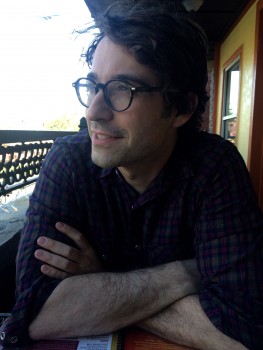
Nov 282011


Okay, one of the best things about Numéro Cinq is the serendipity of the network reaching out (which is its nature, and it is insatiable). DG’s friend Haijo Westra, a just-retired classics professor at the University of Calgary, wrote an essay about dg’s novel Elle which, some years ago, out of the blue, he sent to dg, and they became friends (and later the essay was published in French and then in an English translation on NC). Manifesting his enthusiasm in all ways, Haijo gave a copy of Elle to an Australian poet named John Watson who was in Calgary while his wife worked on her doctorate. Then John Watson wrote a poem in response to Elle and sent it to dg. Now dg and John Watson are becoming friends, and, as winter sets in around dg, John Watson WILL INSIST on sending him emails such as:

We had a foretaste of summer heat last week. We had driven to the Central Coast hoping to spend the night in a little cabin. Towards dusk the beach was listlessly hot, the cabin stifling with no Southerly change expected. So we drove another 3 hours back home so as to sleep…

And this:

We went today (2 hours) south of Sydney to the beach behind the house where DHLawrence lived in Thirroul for 3 months and wrote Kangaroo. The first day after a week of rain. Full sun with a large pale edge of rain run off before the dark blue water.

But dg did admire that poem—delightfully exuberant, digressive, Menippean (if you will) and droll (see poem below).

The poet, upon request, sent dg a bio to go with the poem. It went like this:

John Watson the author of A First Reader (Five Islands Press, 2003), Montale: A Biographical Anthology (Puncher and Wattmann, 2006), Erasure Traces (Puncher and Wattmann, 2008), Views from Mt Brogden & A Dictionary of Minor Poets (Puncher and Wattmann, 2008), River Syllabics, (Picaro Press, 2009) and Four Refrains, (Picaro Press, 2011). He won the Newcastle Poetry Prize (2002) and the Blake Prize for Poetry (2009).

But then John Watson wrote a disclaimer:

The bio too is rather austere. No mention of the influence of voluptuous aunt in early days, nor keen interest in Brigitte Bardot films, pursuit of freakish weather events like waterspouts, St Elmo’s Fire, etc.

This seemed intriguing, so dg asked for another bio, the expanded version. Soon a far more exuberant bio arrived (unfortunately still lacking the “voluptuous aunt” story). Bio and poem together are pleasant and diverting reading.

Since in retrospect actual events seem to fade beside literary ones, a brief biography might be possible in terms of influences. Earliest memory: The Three Bears (the pleasures of uncertainty: “Who’s been sitting in my chair?”) Early adolescence: the stories of H G Wells and particularly the romance of The Door in the Wall. (The notion of idyll, loss and longing “which will persist with Watson for the rest of his life.”) A couple of years later, reading aloud The Windhover, with especial delight in the uncertain function of the word “buckle.” First stirrings of poetry as “the force that through the green fuse drives the flower.” Then Lampedusa’s story Lighea with its sexual blaze, Nerval’s Sylvie, Daphnis and Chloe, Beroul’s Tristan, Kleist’s Marquise von O. All of these he will subsequently versify i.e. rewrite in iambics. “The impulse to read more closely by means of versification” derives no doubt in part from Borges’ reviews of non-existent authors. Watson’s Dictionary of Minor Poets (read imaginary poets) (2008 but written 20 years earlier) is also part of that impulse.

Continue reading »

Nov 252011


.

Peering over the Precipice

A Review of Fall Higher by Dean Young

By A. Anupama

.

Fall Higher
By Dean Young
Copper Canyon Press
96 pages; $22
ISBN-13: 9781556593116
.
Trying not to be one to judge a book by its cover, I opened Fall Higher to skim the table of contents and immediately laughed. The title of the first poem in the collection is “Lucifer,” which struck me as the opposite direction I was expecting the collection to take, given its title. This first moment, its instant detonation of my assumptions, was a good preface to the rest of the experience of reading this newest collection by Dean Young.

This particular concoction of poetry manifesto, imaginative integration of tradition, and lyric exploration exposes Young’s passion for the art of poetry and his technical skill in this, his ninth collection. But amazingly and tellingly, just days before the book’s publication, Young underwent heart transplant surgery, which was a triumph for the poet after over ten years with a life-threatening degenerative heart condition. Many of the poems in Fall Higher peer over the precipice of that struggle. In the poem “Winged Purposes,” for example, he describes falling higher as “voices hurtling into outer space, Whitman / out past Neptune, Dickinson retreating / yet getting brighter.”

Young is among the very accomplished in contemporary American poetry: he currently serves as the William Livingston Chair of Poetry at the University of Texas at Austin, and his collection Elegy on Toy Piano (2005) was a finalist for the Pulitzer Prize. He has been awarded Guggenheim and NEA fellowships, among other honors. Young was born in Columbia, Pennsylvania, in 1955, and received his MFA from Indiana University. His poetics are self-described as being influenced by the New York School and the French surrealists, and in this most recent collection the influences come from many other corners of the poetic tradition.

Young’s engagement with the themes, devices, and specific works of the Western canon are rendered as a kind of dispersed ode running through the collection. He plays with rhyme in some poems, sometimes embedding them deep within the lines instead of at the ends.

Since the book begins with Lucifer, evoking the traitors of Dante’s Inferno, my first guess was that betrayal would be a major theme in Young’s lyric. This guess, at least, was right on. The poem “Elemental,” is one of those heartbreakers. Young leans toward the pantoum with characteristic four-line stanzas and a heavy dose of repetition, but within the lines and every which way. So the form is evoked for beauty, but the emotion has its willful way within the poem, refusing to acknowledge the form’s rules of repetition:

Walked into the burning woods and burning
walked into me. One day we’ll wade
into the sea and see. Your coming
won’t summarize your leaving

nor waking sleep, sleep our dreams,
fireflies over wet grass, ice
settling in an abandoned glass. Winter
can’t summarize that summer, your body

in my hands won’t summarized be
by your body far from me.
Already you’re in the air
and my hands are nowhere,

my dreams mostly water.
This end won’t summarize our forever.
Some things can be fixed by fire,
some not. Dearheart, already we’re air.

In the poem “Madrigal” Young uses end-rhymed lines throughout, saying

You feel like something fallen from its shelf,
a yo-yo with a busted string, chipped ceramic elf
because all you can think about is not there,
the eyes not there, not there’s hair.

Here, the poem cops an attitude of disregard for contemporary poetry’s aversion to rhyme. But, at the end of the poem, Young pulls the form away and leaves us the unrhymed fragment “detonating with laughter.”

With the poem “Non-Apologia” Young makes a deliberate gesture of defying the craft of poetry by writing a poem about it. He begins “Maybe poetry is all just artifice, / devices, hoax, blood only there / to rhyme with mud.” He goes on to defend the way that meaning and symbol keep escaping back into words, he defends metaphor and the way that poetry offers delight. He ends by saying “Soon shadows are all that’s left, / that’s why poetry is about death.” He’s broken the secret rule about not saying what poetry is about. He’s broken the standard rule of creative writing instructors: “show, don’t tell.” The arc of contradictoriness instead of conclusions, however, makes the poet’s point by showing the way.

In the poem “The Decoration Committee” from the collection Strike Anywhere, Young has this to say about lyric poetry:

I know of no studies concerning and in how many cases
the lyric poem eases heartache by initiating 1.
the beloved’s return, the door flies open,
the bra unstrapped, the moose dappled
with dew and/or 2. a getting-over-it
happiness at just having written/read the poem
which is about misery in the old way
but also in a new way and then noticing
the pretty barmaid…

Young is tracking something more than relief from heartache in his lyric. The odes in Fall Higher have a lyric sensibility in them, especially “Infinitive Ode,” but Young seems to use these poems to explore the disjunctions in the human experience of time and space. “Irrevocable Ode” presents a litany of images of moments that can’t be repaired or taken back and the resulting experience of regret. The poem concludes lyrically, referring to careless betrayers, “maybe you’ll search and petition / and wander until you’re heard from no more.” “Omen Ode” gives the opposite perspective of everything connected: “Maybe a million strings connect / tomorrow to now.” In “Infinitive Ode” the cleverness of using the infinitive itself as the object of praise is immediately tempered by the dark superimposition of imagery: “To see the pile of skulls Cezanne sketched / as practice for his painting of hovering peaches” and “To see in the pantomime of invalids / the corps de ballet.” Theories break down, and the end of the poem illuminates the inquiry:

To preserve the dream under the tongue
all day, not garbling a word. To wash
with cold water. All the way to the ground
the sky comes, just lying down we’re flying.

In Young’s recent book on the craft of poetry, The Art of Recklessness (Graywolf Press, 2011), he writes, “The poet is like one of those cartoon characters who has stepped off the cliff only to remain suspended. But while the cartoon character’s realization of his irrational predicament brings about its fall, for the poet imagination sustains this reckless position over the abyss; it is what extends the view. As readers, we are charmed by the postponement of our plummeting even as we are made aware of its inevitability.” Fall Higher does exactly this, vastly opening up the view.

–A. Anupama