Jun 122017
 

Signs for Lost Children has none of the prolixity, the sentimentality, or the melodrama often associated with “neo-Victorian” novels. — Rohan Maitzen

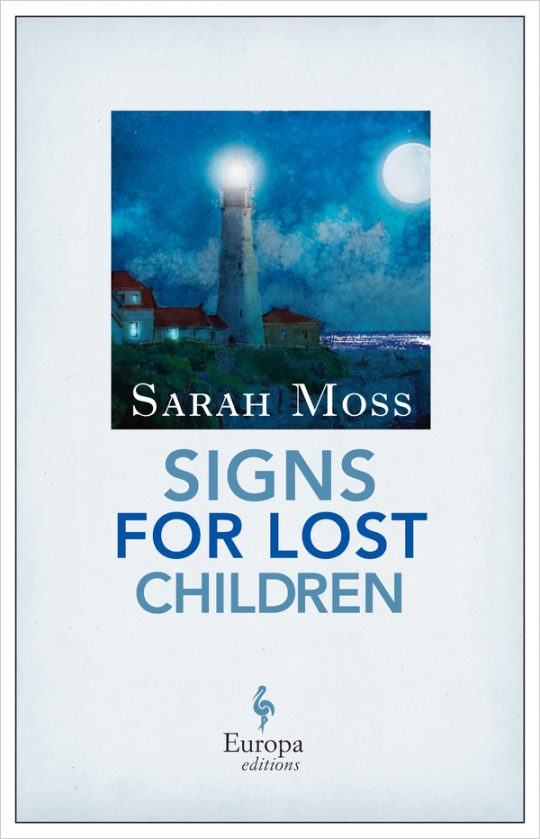
Sarah Moss
Signs for Lost Children
Europa Editions, 2017
368 pages; $19.00

.
It is a commonplace that historical fiction is always about the present as much as the past—that the stories we tell about what once was are prompted and shaped by what is. Historical fiction is not therefore condemned to anachronism: rather, at its best, it disrupts our tendency to take our own world for granted, and to think of history as a stable set of facts instead of a constantly shifting and contested array of stories.

Sarah Moss’s Signs for Lost Children, the sequel to her earlier Bodies of Light, is just such an unsettling novel, refracting Victorian life through a distinctly modern lens. Both Bodies of Light and Signs for Lost Children tell the story of Alethea Moberley, born in the mid 19th-century to Alfred Moberley, an artist, and his austere evangelical wife Elizabeth. Wholly committed to her charitable work on behalf of poor and ruined women, Elizabeth has little time and no love to spare for her own daughters, Alethea, called Ally, and her younger sister May. When Ally is a baby, she seems to Elizabeth little more than a vexing interruption to her work:

The baby is crying, its rage spreading like smoke through the house, curling under the ceiling. She has lost her blotting paper. . . . When she has finished this one and the next one, she will see what there is for her lunch, and feed the baby. It cries. It is taking the baby a long time to learn that screaming for what we want does not bring gratification.

The girls are raised in uneasy vacillation between their mother’s severity and the sensual bohemianism of Alfred and his artist friends. For better and for worse, it is Elizabeth’s influence that is most enduring for Ally. Elizabeth treats every vulnerability as a despicable weakness: in her eyes “a nervous, silly woman is entirely useless.” Ally “must learn self-discipline,” Elizabeth holds, and she considers it her duty to instill it. When Ally suffers from nightmares, her mother wakes her with a slap, then dunks her head in cold water before locking her in the scullery. “You must and will learn not to indulge yourself,” she tells her shivering child.

Ally carries this lesson with her throughout her life: “She doesn’t want to be hysterical.” It is a paradoxical legacy. Elizabeth’s ruthlessness is oppressive, yet combined with her insistence that women are capable of accomplishments well beyond the domestic trivialities to which so many Victorian women were restricted, it also empowers Ally to pursue a radical ambition: to become one of England’s first woman doctors. “There is strong opposition to women’s medical education,” Ally’s teacher Miss Johnson warns her; “You are choosing not only to be a doctor but to be a pioneer, a fighter in the vanguard.” When Ally goes to the University of London on a special scholarship for women medical students, she knows she carries “the hopes of many,” and that her own success or failure will define the possibilities for those who come after. The responsibility is daunting and the training is difficult, but Ally knows her work represents a great step forward. Looking back on her miserable childhood from the perspective of her aunt’s more humane London home, still suffering the after-effects of her mother’s severity, Ally nonetheless cannot wish “Mamma had allowed her to grow up in bovine contentment, without ambition or self-discipline”—without Elizabeth, she would never have come so far or be set to achieve so much more.

By the time she graduates, though, Ally has realized that the weaknesses she was raised to despise might in fact be not just natural to her as a person but valuable to her as a doctor. Her mother’s quest for impervious perfection is mistaken:

If she is to be a doctor—as she is to be a doctor—she will be a broken doctor, her own hurt as much part of her practice as her healing. A doctor who can see her own damage and not run away to hide.

“Nerves and hysteria show a weak and foolish disposition,” Elizabeth had insisted, but maybe, Ally thinks, what gets called madness in women is in fact an understandable, even a reasonable, response to their circumstances. What if outbreaks such as her own should be treated with kindness rather than condemnation—and considered cause, not for confinement, but for reform?

These are the questions that underly both Ally’s personal development and professional work in Signs for Lost Children, which takes up her story where Bodies of Light ends. Though the plots are continuous (in the North American edition, some chapters from Bodies of Light actually recur word for word in Signs for Lost Children), the two novels are differently structured in ways that reflect their different thematic interests. Bodies of Light interleaves its family story with commentaries on paintings by Alfred Moberley or his close associate Aubrey West (whose relationship with Ally’s sister May forms a subplot of the novel). These insertions highlights tensions in the novel between art and life, especially between inhabiting bodies and gazing at them, and between appreciating and subjugating them. The novel’s title comes from Matthew 6:22 (“if therefore thine eye be single, thy whole body shall be full of light”); one way of understanding Ally’s struggle in this book is that she must learn to see her body as itself a source of light: look with, not through, it, to inhabit it without shame or fear.

The chapters of Signs for Lost Children, in contrast, alternate between Ally’s point of view and that of her husband Tom Cavendish, an engineer whom she meet and marries at the end of Bodies of Light. This formal structure, in its turn, reflects this second novel’s interest in marriage, which purports to combine two people into one common identity. Across the novel, Tom’s and Ally’s experiences diverge significantly: can the result nonetheless be one family? and if so, at what cost? Given the legal, social, and economic realities of marriage for Victorian women, this is a vexing question especially for Ally, who worries about losing both her individual and her professional identity. From the beginning, she and Tom focus on defining “new rituals” to represent the kind of relationship they want their marriage to be:

Ally will not promise to obey; it seems a bad idea, says Tom, to begin a marriage with an undertaking made in bad faith. Not being a parcel, she declines to be given away.

Her married name, Ally resolves, will be “Dr. Moberley Cavendish”—but to some, as she quickly learns, she will always be only “Mrs. Cavendish.”

Tom is a good partner for Ally. He supports and defends the work she undertakes at an asylum near their new home in Cornwall: “the majority of patients are female,” he explains to a dubious neighbour, “and many of their troubles begin in exactly those crises of life where it is most desirable that women should be attended by women.” When he goes on a business expedition to Japan without her, it is a sign of the strength of their relationship, but also of the risk they are taking in trying to build a marriage on such unusual terms. On the eve of his departure, Tom tries to reassure her:

“You know—Ally, I am sure the time will pass quickly once we are accustomed to it. At least we both knew from the beginning that this separation was to come. And you will have your work, itis not as if you will need to seek distraction.”

Their separation is a sign of their mutual trust and dedication to preserving each other’s autonomy, but they are apart a long time, and the divided narrative highlights the distance that grows between them, both literally and figuratively.

For Ally, this period of separation frees her to focus single-mindedly on her work at the asylum. She struggles to accept its coercive environment, which seems to her premised on the impossibility of actually healing the patients:

It is not an original thought that the overall effect of the asylum is maddening, that the insane compound each other’s insanity. And this, after all, is why her new profession beckons: how might one devise a regime to cure the mind? It is not the taxonomy of madness that intrigues her but the possibility of individual salvation. If some situations are maddening, others must be—ought to be—sanitary.

She worries that her sympathy for the patients is a sign of her own instability. “So which are you, Alethea?” she imagines her mother demanding: “A madwoman or a doctor? . . . You chose the asylum, Alethea, because you indulge yourself in feeble-mindedness. Because despite all your training and all your so-called qualifications, you are still crazed.” Finally, however, she is unable to bear the inhumanity and intervenes on a patient’s behalf: “‘No. Nurse, stop this. You are unkind. . . . She is like you, and like me. Like all of us. Only more sad.’”

That troubling assertion of likeness between the mad and the sane is at the heart of the novel as well as of Ally’s experience. “How is sanity defined?” Ally wonders. How far is hysteria, for instance, not an illness or a defect but a reaction to being a woman—or a way of seeing women as intrinsically defective? What if the family, supposedly women’s natural domain, sickens rather than nourishes them? What if “there are sick households,” she wonders, “as well as sick individuals”?

Her own outburst in the patient’s defense is considered—including, at first, by Ally herself—as a breakdown, but it leads to a professional breakthrough that is also a crucial step in her personal healing. After a disastrous visit to her parents, Elizabeth’s continued severity drives Ally to run away, fearful that she will be labelled mad and unable to escape the self-perpetuating cycle she has seen destroying the asylum’s inmates. She takes refuge at her aunt’s home, where she is allowed to rest and be comforted. Her own recovery prompts reflection on how other women might benefit from being helped rather than punished for their emotional suffering:

She wonders if anyone has tried to invent at least a temporary refuge from both the madhouse and the mad home, a compromise between an institution and a family. A place where people chose to be, not a place of confinement. . . . An institution where the damage of homes, of domestic life, can be undone, or at least healed. A place where the shape of sanity might emerge.

From this idea comes Rose Tree Cottage, where, under kindly supervision, at least a few patients can regain their dignity and return, rehabilitated, to their lives.

As Ally finds her way towards a new kind of personal and professional peace, so Tom’s travels in Japan lead him towards new insights about his life. If the asylum is in some ways all too familiar to Ally, literalizing her own more abstract experiences of repression, in Japan Tom experiences for the first time what it means to be immersed in the unfamiliar—to be out of his element and unable to take anything for granted, from food to baths to myths and mores. He is drawn to the order and ritual of Japanese life. “Europeans mistake quantity for quality,” he reflects,

filling great rooms with useless objects as if the accumulation of possessions is an object in itself. He remembers De Rivers’s house [in Cornwall] and shudders; it is not silks and teapots the English should be importing but houses. Architects, if not engineers. Missionaries, perhaps, to teach us what is worthy of veneration.

Yet he checks his own tendency to idealize the differences: it took “a thousand years of violence and oppression, he reminds himself,” to achieve the very features he finds so beautiful.

Though Tom and Ally get equal time in Signs for Lost Children, it still feels primarily like her book, perhaps because she has the weight of Bodies of Light behind her. Tom’s voyage of self-discovery is tied to the urgency of finding a “new man” to go with what writers of the late 19th-century called the “New Woman”—independent, self-directed, not looking to men or marriage to define her life. What kind of husband, if any, can a woman like Ally have, or would a woman like Ally want, once she has discovered, as Ally does, that “it is not in romance, nor even sex, that we find the human purpose, but in good work faithfully done”? The key lies, or so Ally’s friend Annie suggests, in the kind of re-education Tom has undergone. “I imagine,” she writes to him,

that when you were in Japan you were always trying to guess what people wanted and what they meant, trying to guess how you might appear in their eyes? . . . But if it was like that for you, if you were watchful and hesitant from first waking until sleep, then you know how it is to be a woman and especially to be a woman entering a profession. We are always strangers in a strange land. I think Ally is like that all the time, hunted and cunning, because she has had no safe place, no home. . . . Rose Tree House may be the first place where she doesn’t have to guess or see herself through another person’s eyes.

“So many of women’s griefs,” Ally herself thinks, “begin in marriage, in the expectation of a happily ever after set into perpetual motion by romance.” Though she once vehemently denied Annie’s suggestion that “a woman must choose between her work and her family obligations,” by the time Tom returns “she has found a way to live and it does not involve the institution of marriage”: “She can work, she thinks, she can be a doctor, she can write articles and perhaps eventually a monograph, but she cannot be someone’s wife, not anymore.” Yet Signs for Lost Children ends with a new beginning between them, based on the fragile conviction that there is value in “the act of living, of continuing to be with each other in the world.”

Signs for Lost Children takes up many themes and issues central to Victorian novels, including the social consequences of industrialization that contemporary writers called “the condition of England question.” “In the mills,” Ally thinks as she crosses the country by train,

machinery bangs and roars. Children pull carts of babies through the streets, taking them to be fed by mothers who sacrifice their own moment to eat in doing so. The weight of outrage and unmet need presses down on this country like wet cloud. Burn it all down, wash England away into the sea, and start again.

This is the revolutionary energy that made Victorian writers like Elizabeth Gaskell worry about class warfare and use fiction to call for reform and reconciliation. Moss’s exploration of gender and madness is reminiscent of the sensation novels of the 1860s, especially Wilkie Collins’s The Woman in White, in which—as Ally fears for herself—the heroine is immured in an asylum, unable to prove her own sanity, her distress only confirming what those policing her behaviour already believe about her.

In its style, however, Signs for Lost Children has none of the prolixity, the sentimentality, or the melodrama often associated with “neo-Victorian” novels. In some respects the result is welcome: Moss eschews the mannered prose, the array of gratuitously quirky characters, and the proliferation of subplots often seen in novels aspiring to be “Dickensian.” Unlike her subjects, her prose in both of these paired novels is distinctly of the 21st-century: deliberate, restrained, well-crafted. The attention to detail, particularly of the landscapes, yields passages of memorable understated beauty:

They walk to the sea down a green lane, where the trees meet over their heads to form a tunnel of leaves. Alfred shows her bluebells and wild garlic edging the path, and points out violets under the brambles. The gorse is furred with yellow bloom and dark blades of thorn and gives off an unfamiliar scent. There is birdsong but no visible birds, as if the day signs to itself. In Manchester, there will be brown fog, and heat. . . . They round a curve, and the sea is there. Flat rocks make a continuation of the lane onto the beach, into the water, as if inviting her to keep walking into the sea.

There is a cost to such precision and control, however. Descriptions of scenery are delivered in the same tone as descriptions of cadavers; expressions of love and outbursts of lunacy have the same flat affect. In eschewing overt drama, Moss almost seems to reproduce Elizabeth’s prohibitions against hysteria: the powerful feelings that Ally realizes deserve recognition, that may in fact be destructive if suppressed, remain submerged under the polished language of the novels. There’s something apt about that, of course, but by the end of these two novels, both wholly self-possessed and cerebral, I longed for some of the Victorians’ own urgency and flamboyance to break through Moss’s artfully modern rewriting of their world.

— Rohan Maitzen

N5

Rohan Maitzen teaches Victorian literature in the English Department at Dalhousie University in Halifax, Nova Scotia. She is an editor at Open Letters Monthly and blogs at Novel Readings.

N5

Jun 112017
 

In The Nightingale Won’t Let You Sleep, Heighton mashes up the best parts of the geo-political thriller, the historical narrative, an in-depth character study, lashing all these elements together with lyric prose and breathtaking design. — Richard Farrell

The Nightingale Won’t Let You Sleep
Steven Heighton
PenguinUSA, 2017
352 pages, $18.00

.
We are a species hellbent on escaping circumstance, deterministic nomads, forever obedient to the belief that ‘better’ exists ‘elsewhere.’ Utopian societies hold a special appeal in literature. From Eden to Plato’s Republic to Swift’s Lilliput, the allure of alternate reality has long captured the imagination of writers and readers alike. And while post-modern versions tend toward the dystopian—one thinks of Orwell, Huxley, and later Cormac McCarthy and Margaret Atwood—the temptation to enter other worlds remains just as strong.

Steven Heighton’s latest novel, The Nightingale Won’t Let You Sleep, takes place in the war-ravaged ruins of a Mediterranean ghost town, effectively blending utopian elements into a dystopian village. On the politically divided island of Cyprus, lies Varosha. Once a thriving Riviera resort, this now-shuttered city on the U.N. Green Line was abandoned in the aftermath of the 1974 fighting between Greece and Turkey. Some 20,000 citizens of Varosha fled the bombs, leaving behind parked cars, tables at sidewalk cafés, and shops still filled with clothing.

Block by block Varosha too seems more unreal, if increasingly visible. The moon has risen behind him, over the sea, and though not yet clear of the beachfront towers, it lends an indirect glow. Where vines and creepers have not engulfed the signage he can read the names of businesses, in Greek, English, both—a bakery, a steam laundry, a small nightclub, a café whose heavy tables still line the street although the chairs have vanished—and he can tell the makes of the occasional cars melting into the pavement.

Inside Varosha, however, a hidden community survives. Heighton’s ragtag band of misfits, idealists, exiles, and castoffs have built a secret but sustainable commerce-free zone, where orchards of almond, cherry, and pistachio trees thrive in the Mediterranean sunshine. Snare traps catch rabbits, fig trees drop fruit, and what the village cannot produce, they trade for with the friendly Turkish officer in charge of an adjacent military outpost.

Into this secret world stumbles the battle-weary, Greek-Canadian solider, Elias Trifannis. Dispatched to Cyprus for R&R, Elias is haunted by battlefield nightmares. While drinking in a bar, he meets Eylül Sahin, a beautiful Turkish journalist. The two talk, flirt, and fend off hostile attention from a group of Turkish soldiers. Later, after an amorous coupling on the beach (a sex scene replete with turtle hatchlings scurrying seaward in starlight) those same soldiers reappear, drunker, angrier, and armed. Shots are fired. Eylül falls in the crossfire. Thinking she’s dead, Elias—injured and dazed himself—escapes through a hole in the fence, and slips into the hidden world of Varosha.

Outside the fence, an investigation begins. With a Turkish journalist shot, a Greek-Canadian solider missing, and a tenuous peace between rival nations in the balance, the political ramifications of the incident reverberate far and wide. Before lapsing into a coma, the gravely wounded Eylül overhears her attackers hastily concoct a cover story: “The Greek attacked her, we tried to help, the Greek attacked me, you tried to shoot him, you hit her. Simple enough?”

The next morning, these events are reported to the commanding officer of the adjacent, Turkish military garrison. Colonel Erkan Kaya immediately doubts his soldiers’ tale, but also knows “this was a story that would have to disappear.” Suspecting that Elias may have escaped into Varosha, Kaya wants no part of an on-going investigation that could topple his cushy command. “Things right themselves—they always do,” is more than just Kaya’s motto, it is the man’s pervasive ethos. He declares Elias dead, tosses his phone into the water, and reports that the man’s body washed out to sea.

Kaya is a remarkable construct of Heighton’s imagination. The colonel is so likable, so enigmatically decent, that you root for him despite his bumbling attempts to keep secrets. A military officer cut from the mold of Jeff Lebowski rather than Rambo, Kaya’s idyllic life mirrors that of the Varoshans. He lounges at the officers’ club, beds exotic women, and quaffs on mouthwatering lunches of figs, olives, lamb, and raki. His primary struggle is not war, but a stalwart defense of the status quo.

In a sense, two idealistic worlds exist, one inside Varosha, and one at Kaya’s officers’ club. But reality constantly encroaches, and in Heighton’s world, that reality has a name: Captain Polat.

If good stories work through compelling opposition, then Kaya and Polat are wonderfully paired opponents. From the moment he first appears, in a wonderfully taut, almost comedic tennis match, Polat seems determined to defy his boss. Where Kaya is a gentleman of leisure, Polat exemplifies the ambitious, career-minded soldier. Suspecting Elias has slipped away, the young adjutant wants to enter Varosha and unearth its secrets. “Allow me to lead a—sir, I would be honoured to lead a platoon in there—immediately.”

Meanwhile, inside Varosha, Elias recovers from his wounds and two perilous escape attempts that set back his recovery. Part prisoner, part refugee, Elias struggles with his fate. Should he remain in this village, free from the demands of commerce, war, and corruption? Or should he escape, fulfil his duty, and tell the truth about what happened?

In some ways he will be almost sorry to leave. This pocket in the ruins of a dead city seems more like a singularity outside of time, so that past events out there beyond the mouth of the wormhole are coming to feel, by light of day, like hallucinations. Another few months and they might seem to belong in the bio or obituary of a stranger—though by then he will be back out there and dealing with the fallout of the real events.

Heighton’s spellbinding world is under constant threat. The inhabitants are aging. Even the most recalcitrant villagers recognize the half-life of their exile. And the longer Elias remains, the more entangled he becomes in the lives of these villagers. What happens if the obsessed Polat returns? What happens when Kaya is eventually transferred? Though Varosha has existed for more than 40 years, it is a world on the edge.

Months pass. A love affair develops between Elias and Kaiti, the mother of twins, who is poised to abandon the village. Kaya transfers Polat to combat duty in Syria, where he becomes a combat hero. Elias attempts to escape again, and nearly drowns. Kaya’s children visit Cyprus, and his teenage son develops a fixation on weapons and exploring Varosha. Kaiti gets pregnant. And then Polat returns, even more singularly obsessed with searching the village and unlocking its secrets.

§

War and its horrors tremble at the margins of this story, in Elias’s memories of a grisly raid in Afghanistan, in the escalation of fighting between the Turks and the Syrians, and in the tension of soldiers willing to kill simply because the guy in the bar wears the wrong uniform. Heighton mostly keeps combat off-stage, but it haunts, a constant bell that chimes. Contemporary violence accretes atop ancient scars, the way wars always must.

Again and again, Heighton doubles his themes, uncovers linkages between his imagery, loops back on history and story. War and peace. Love and loss. Home and exile. Freedom and servitude. On both a macro and micro level, parallel patterns abound, creating wonderful paradoxes, rich layers of detail, and story puzzles to delight.

Heighton delivers another stunner in this his 15th book, and fourth novel. Winner of the 2016 Governor-General Prize for Poetry (The Waking Comes Late) Heighton has never shied away from formidable themes or complex plots. In The Nightingale Won’t Let You Sleep, Heighton mashes up the best parts of the geo-political thriller, the historical narrative, an in-depth character study, lashing all these elements together with lyric prose and breathtaking design. I found myself thinking of Robert Stone’s Damascus Gate, Shirley Hazard’s The Great Fire, and John Fowles’ The Magus.

In fact, Heighton has always reminded me a bit of John Fowles. Both writers are serious craftsmen and rigorous thinkers, with a profound respect for history, nature, and culture. Both populate their stories with strange but fully rendered characters. And both men dazzle their readers with depictions of mesmerizing worlds, elegant storylines, and serious themes. And like Fowles, Heighton is a writer who interrogates notions of reality, examining the borderlands between commerce and community, between mere existence and a deeper, sacred sense of being.

In his compact but brilliant book of writing advice, Work Book: Memos & Dispatches on Writing, Heighton describes the act of reading this way:

Vertical resonance means a downward echoing, the potential for soundings into a textual subconscious, the swimmer’s thrilling sense, when crossing a mountain lake, of unmeasured depths in the dark below the thermocline.

The Nightingale Won’t Let You Sleep is an invigorating swim into such unmeasured depths.

—Richard Farrell

N5

[updated bio requested]

Mar 122017
 

In The Long Dry, Jones writes very well about ducks, their sex lives, and their feces. In fact, if there were an International Literary Prize for Writing about Ducks, Their Sex Lives, and Their Feces, Jones would easily win it. These passages are moments of levity in an otherwise dark, brooding, brutal and devastating novel. –Mark Sampson

The Long Dry
Cynan Jones
Coffee House Press, 2017
136 pages; $15.95

.

If there’s one thing novelist Cynan Jones knows very well, it is the menace of ducks. Ducks are a menace. Anyone who grew up on or near farmland knows this. Ducks have a way of wreaking havoc on a farm, especially with their feces. Cynan Jones knows this. In his novella, The Long Dry, Jones writes very well about ducks, their sex lives, and their feces. In fact, if there were an International Literary Prize for Writing about Ducks, Their Sex Lives, and Their Feces, Jones would easily win it. Behold:

Given the way they have to have sex, it’s remarkable that there are any ducks. More remarkable that they have sex often. The male more or less drowns the female, who has to focus hard on staying afloat, and they both have to deal with wings and beaks and water and feathers, and it looks nasty, and they still have sex. So there were a great many ducks. And they all shat everywhere.

It became a problem for the tourists, and the locals didn’t like it. People talked about the ducks in pubs, and if you stood in lines at the local shops you heard people talk about ducks … If you put your washing out, somehow the ducks knew, and by some defiance of physics managed to crap on it. And duck crap isn’t nice. It’s green like baby shit. If you fed a baby on broccoli for a week …

The reason why they shat so much … was because “the people” fed them chips, whoever “the people” were. A duck should eat things from the water; that’s what they’re designed to do. But they were lazy and so hoovered up whatever people threw them, fighting off the seagulls and the errant starlings and the pigeons and, if they had to, fighting off each other, too. This poor diet is making the poor ducks poo. That was one take. Answer: we should give them proper food. Genius. So they tried. It was not the answer. They ate the food put down and the fish and chips and had sex even more. Ducks’ arses were no tighter than they’d ever been. There were simply too many ducks.

This passage is a moment of levity in an otherwise dark, brooding, brutal and devastating novel. The Long Dry is Jones’ debut book, first published in the U.K. in 2006 and made available in North America this year by Coffee House Press. Jones has published several other books in the years since, including The Dig, Bird, Blood, Snow, and Everything I Found on the Beach. His prose has been compared to that of Cormac McCarthy and Ernest Hemingway – that is, lines of spare, almost taciturn beauty that belie the tension and fraught emotions that coil below the surface by using short, compact sentences with a deceptively simple syntax that carries a surprising amount of descriptive weight. It is a style that could (and, perhaps, should) be labelled derivative of those two masters, but it is also one that serves the setting and themes of The Long Dry well.

This short novel (my reviewer’s copy is paginated at just 119 pages) is set on a hardscrabble farm in Wales. Jones structures the book using many briefly, almost elliptical chapters that act as a kind of narrative pointillism, slowly painting us a bigger picture. Our protagonist is Gareth, who inherited the farm from his father and lives there with his wife, Kate, and their two children, Dylan and Emmy. A couple of issues become apparent at the beginning of the book: a harsh and unforgiving drought has swept across the countryside, and a pregnant cow on Gareth’s farm has gone missing. These two misfortunes will prove the catalyst for a series of vignettes that will reveal the various physical, financial, sexual and psychological deprivations surrounding this family. As the reader soon learns, Gareth’s is a world plagued with miscarriages, sexual frigidity, infidelity, money woes and a looming family tragedy.

The novel’s central tension exists between Gareth and his wife, Kate. They do love each other but they are, we come to learn, very often on opposite sides when it comes to matters of the farm and their own success on it. Much of what divides them is the hard road they had to travel to give birth to Dylan and Emmy, as the couple suffered multiple miscarriages between their births:

They continued to try, first easily then with more need, to give their son a brother or sister. She miscarried twice. On the third time they told her she couldn’t have children then. She was thirty-four and damp like autumn, not wet in the way young women are, like spring, but damp and rich and earthy, and it didn’t seem right that she could not have a child. She was fertile and hungry, like fallen leaves.

In the midst of all this, Kate allows her herself to engage in a brief and regretful dalliance with a farmhand one day while Gareth is away. The encounter is short and loveless – the farmhand basically fucks her against a filthy tractor tire in the shed – and yet it casts Kate into a deep depression and acts of self-harm. Gareth, as far as we can tell, does not learn the truth: “It was two years before she was well again but she still feels sick now when she thinks of what she did, and the nagging doubt haunts her sometimes. It has never been the same since then. He blamed it on the miscarriages.” Through her depression, we can see how much more the farm means to Gareth than it does to her, and this divide will lead to an explosive exchange between them near the end of the novel.

Gareth’s father purchased the farm in 1951 to quit a job at a bank that he hated. Jones gives us little detail about how the father’s views on farming varied from his son’s, but one is left with the impression that Gareth’s holds an idealized view of what this land meant to his father and he is desperately trying to live up to an unspoken sense of expectation. A key link between the previous generation’s farming and Gareth’s is the story of Bill, who comes from the farm next door. Bill’s father killed himself after the hogs he had invested money in contracted a rare disease and had to be destroyed. Bill himself is described as “simple”, and never fully grasps that his family actually sold the farm prior to his father’s suicide or that the family must move into the village afterward. In an act of charity, Gareth’s father gives a portion of his land to Bill in the wake of his father’s death, a kind of pretend farm that Bill is free to work on, and it’s a kindness that Gareth himself continues to extend:

So Gareth’s father gave some land to Bill. He fenced off a few acres by the road and said to Bill it was his land now, and he could farm it. So he takes the orphaned lambs and grows things there and helps out on the farm when help is needed, like a shearing time, and he cuts grass for old ladies in the village and takes people spuds and cabbage, but underneath, as Gareth knows, he doesn’t understand still.

Perhaps fittingly, Bill’s situation on the farm features prominently in the climatic argument between Gareth and Kate near the novel’s end. Kate, fearful of their future, is pushing her husband to sell some of their land to home developers, but Gareth refuses to pull the carpet out from under Bill’s feet. “My father gave him that land,” he tells his snarling wife, “and I won’t take it from him.”

The biggest, and also darkest, irony in The Long Dry is that neither the lingering season of drought nor Gareth’s lost cow about to calve are the worst tragedies about to befall this farm, this family. We are told, in a kind narrative aside, that nine days from the conclusion of the novel’s main action, a fate will befall daughter Emmy that will lead to her sudden death. Emmy, we learn, will lose her life after eating a poisonous mushroom while out for a walk in the woods. The mushroom she eats is one of the most poisonous found in Europe: the amanita virosa, or “destroying angel.” It is especially lethal due to a delay between initial ingestion and the onset of symptoms.

Indeed, Jones goes into great chemical detail as to what happens to Emmy’s body as the toxins move through her after she eats the fungus; and it is startling how much emotional power he’s able to rend out of such a clinical description. Emmy’s death hits us hard, not because we have gotten to know her particularly well over the preceding 80-odd pages, but because Jones frames her death as just another hardship that comes from farm life, from an existence so very dependent on grappling with the natural world in all its capriciousness. Somehow, this makes Emmy’s fate even more devastating.

Thankfully, there are glimmers of hope that come near the end of The Long Dry – in the somewhat predictable form of the arrival of rain. It is what we, and Gareth’s family, are left with: the sky opening up and giving us a reprieve from all that has taken its toll on us, but also a reprieve from the even darker tragedies that await us in the wings.

—Mark Sampson

N5


Mark Sampson has published two novels, Off Book (Norwood Publishing, 2007) and Sad Peninsula (Dundurn Press, 2014), a short story collection, The Secrets Men Keep (Now or Never Publishing, 2015), and a collection of poetry, Weathervane (Palimpsest Press, 2016). His new novel, The Slip, is forthcoming from Dundurn Press in 2017. Mark’s stories, poems, reviews and essays have appeared in numerous literary journals throughout Canada and the United States. Originally from Prince Edward Island, he now lives and writes in Toronto.

.
.

Mar 062017
 

By the way, no one in this novel is clearly named or called Jesus. Only the title teases that one of the characters is—perhaps—the historical Jesus. Perhaps post crucifixion, perhaps not? Perhaps this isn’t the historical Jesus at all—perhaps Coetzee is  playing a game on us. Perhaps not. But the reader can’t help looking for parallels. —Jason DeYoung

The Schooldays of Jesus
J. M. Coetzee
Viking, 2017
272 pages; $27.00

.
I.

“T his is how it is. There is no before. There is no history. The boat docks at the harbor and we climb down the gangplank and we are plunged into the here and now. Time begins. The clock starts running.” Ironically, this here and now is the afterlife.

Characters eking out lonely lives in an unrecognizable historical situation or in an altogether invented milieu are classic narrative approaches in J. M. Coetzee’s novels. But where The Childhood of Jesus and The Schooldays of Jesus differ is that its characters have no past. They have come to this novel “world” washed clean of their former lives, without their memories, and given new names—given new ages! One might arrive a child, another a 41-year old male. They are set on their new paths with their new names to find new work or new caregivers. They are forced to learn to read and speak a new language, and given only the most modest of starts in a place called Novilla—a “no town,” where “things do not have their due weight.”

Perplexing and certainly stranger than Coetzee’s other works, these novels continue the departure from his more well known realistic fiction found in such novels as Disgrace or Age of Iron. Indeed, his new works are less concerned with standard storytelling altogether. As David Attwell describes in his critical biography J.M. Coetzee and the Life of Writing (2015), after Coetzee won the Nobel Prize in 2003, the “simple urge to represent” no longer seem to interest him, instead he is currently engaging in “secondary-order” questions such as, “What am I doing when I represent? What is the difference between living in the real world and living in a world of representations?”

These “secondary-order” questions have appeared as meta-fictional adventures in recent novels, such as Elizabeth Costello and Slow Man. But for the current set of novels, he has dropped the meta-fictions for something different, something more abstract and foreign. These characters are new: new to these pages, new to the world itself depicted within these pages, coming up against all this new world’s original customs and beliefs. Its literary touchstone is more Don Quixote and less Matthew, Mark, Luke, & John.

For all their newness, however, these novels are as narratively straightforward as they come, broken into regular chapters and standard scenes, written in Coetzee’s economical, direct prose.

II.

In The Childhood of Jesus one of the first things that becomes apparent is that the majority of its characters are without desires or passions—they are on whole contended individuals. Hard manual labor is done without complaint or imagination, food is primarily bread and water, and sex isn’t a notable consideration because, as you see, it doesn’t “advance us,” as one character explains. Of this dry world it is said: “[I]t is so bloodless. Everyone I meet is so decent, so kindly, so well-intentioned. No one swears or gets angry. No one gets drunk. No one even raises his voice.”

This is Simón, the point-of-view character for both The Childhood of Jesus and its sequel The Schooldays of Jesus. Simón is literally fresh off the boat, arriving on the same ship as Davíd, a young boy whom he takes care of, yet Simón is not his father. While on board the ship, the boy had lost a letter that explained who he was and who his mother is. And one of the main plots of The Childhood of Jesus is a quest to find Davíd’s mother, which turns out to be a woman Simón just “thinks” or “believes” to be said mother. And Simón’s “feeling” feels as random as it sounds. The woman, Inés, eventually accepts that she is indeed the child’s mother despite having no recollection of the child. Remember each person arrives in this world “washed” clean of their previous life, without memories, without connections.

The setting for The Childhood of Jesus is a fictionalized town where everyone is expected to speak Spanish and where housing is provided for. There isn’t much pleasure outside of football, and Simón can’t even find spices at the grocery to make the food better. The novel itself is episodic but can be broken down into three broad movements: arrival, search for Davíd’s mother and her acceptance of that role, and finally setting up Davíd’s education. The Childhood of Jesus ends with the three characters on the run from the law, because Novilla’s officials want Davíd in a special school for children with mental deficits, either mental or emotional. Davíd is without a doubt a special child, yet he doesn’t have deficits. He is playful, willful, and hates authority.

By the way, no one in this novel is clearly named or called Jesus. Only the title teases that one of the characters is—perhaps—the historical Jesus. Perhaps post crucifixion, perhaps not? Perhaps this isn’t the historical Jesus at all—perhaps Coetzee is playing a game on us. Perhaps not. But the reader can’t help looking for parallels.

III.

The Schooldays of Jesus takes on the same episodic structure as its prequel, and can seem scattered and unfocused at its outset. But at its core The Schooldays of Jesus is the examination and dramatization of concepts related to education. Its opening chapters establish that Simón is the primary agent of education for young Davíd. He is the one who explains and defines the child’s understanding of the world, but as the novel progresses, we see both characters attending school, and we hear Simón philosophizing on the educational values of confronting immoral men and, indeed, the final “showdown” is a debate between measurable science and artistic passion.

The novel opens as the three main characters arrive in Estrella (another city “which has no sensation, no feelings”), where they hope to lay low and avoid the Novilla authorities who might or might not be looking for Davíd. The three end up on a farm, where Simón and Inés pick grapes, while Davíd plays with the other children, slowly becoming the leader of the group. The “gypsy” life doesn’t suit Simón or Inés but it certainly suits Davíd, whom they’ve “never seen so active, so full of energy.” The owners of the farm take particular interest in Davíd and suggest to Simón and Inés that this highly intelligent and gifted child be sent to school. As it is explained, there are four choices in Estrella: public education, which Simón and Inés tried in Novilla to disastrous ends, or the Academies—singing, dancing, and Atom. Davíd chooses dance, despite having no interest in dancing whatsoever.

At the Academy of Dance, however, Davíd becomes awestruck by his teacher, Ana Magdalena Arroyo, who is an ethereal beauty, with the kind of splendor that “stands up to closest scrutiny”; Davíd also takes quickly to the school’s cockamamie philosophy of “dancing the numbers.” “Just as there are noble metals and slave metals, there are noble numbers and slave numbers,” Ana Magdalena explains. “You will learn to dance the noble numbers.”

This numerology, this cosmology is explained over and over in the novel without much success—both Simón and the reader are left flummoxed. “The numbers are in the sky. That is where they live, with the stars. You have to call them before they will come down,” we are told. But “you can’t call down One. One has to come by himself.” This mystical rubbish leads Simón to declare Ana Magdalena to be a preacher: “She and her husband have made up a religion and now they are hunting for converts.” To which Inés undercuts Simón’s assertions by saying that is how you “teach small children.” In her previous life in Novilla, Inés says she too taught small children. She gave each letter of the alphabet a personality, “making them come alive.” The novel is unremittingly dialectic.

The relationship between Inés and Simón is fraught, tenuous, and unsatisfying on both accounts. They are indeed on opposite poles. There isn’t a modicum of chemistry between the two. In fact, they seem repulsed the other. In the apartment they share, Simón feels more like a lodger than an equal member of the family. Simón at every turn pushes Davíd to accept Inés, but she is a “hard-hearted” and clumsy mother. When Davíd moves out to become a boarder at the Academy of Dance, Inés is quick to suggest Simón find a place of his own.

After a rather subtle introduction, a character named Dmitri begins to insert himself into the lives of the three characters. Dmitri is an attendant at the museum next door to the Academy of Dance, and he, in is own words, “worships” Ana Magdalena: “I am not ashamed to confess it.” Dmitri is a man of passion. The children love him; he often has a pocketful of sweets for them after school. Simón reflects on Dmitri thusly: “How wholehearted, how grand, how true Dmitri must appear to a boy of Davíd’s age, compared with a dry old stick like himself!” Indeed, Dmitri is set up as a counter beat to Simón’s pragmatism. Lovely Ana Magdalena, however, treats Dmitri coolly. And initially, Dmitri doesn’t seem all that important to the novel, but in a “crime of passion” he kills Ana Magdalena.

After the death of Ana Magdalena, the story turns to an examination of how we are to know someone else, how are we to know someone’s true identity. In regards to Dmitri, Simón repeatedly warns Davíd that he doesn’t know why Dmitri takes him into his “confidence”—a word that reappears frequently—because “you don’t know what is going on in his heart.” After Dmitri’s subsequent trial and conviction, Simón, Inés, and Davíd try to reassess and reassemble their lives. In the messy aftermath, Simón takes a writing class of all things. He reveals (with near-comic results) in business letters and résumé cover letters that he has come to a “crisis” in his life, and that meeting Dmitri (whom he dislikes and, from a moral point of view, despises) “has been an educational experience for me.” He continues, “I would go so far as to list it among my educational qualifications.” To be sure, these are the schooldays of Simón as well!

IV.

Critics haven’t praised these novels quite the way they have Coetzee’s previous work, calling them “dry as sawdust” and an “ascetic allegory.” I personally enjoy the direction these novels are taking: they’re attempting something different in a landscape glutted with novels and stories just trying to exist within an established tradition. They remind me of Coetzee’s early novels—In the Heart of the Country, Waiting for the Barbarians, and Life & Times of Michael K.—with their rather alien environment and imaginative leaps.

In something more traditional, Dmitri’s trial and conviction might have make for a proper ending, but here the narrative is pushed forward to complete the novel’s theme, and the ending is more cerebral, a showdown between a man of science and a man of art, vaguely concluded on purpose, perhaps in agreement with Camus, who wrote: “solely the balance between evidence and lyricism can allow us to achieve simultaneously emotion and lucidity.”

Richly enigmatic, The Schooldays of Jesus leaves off precisely where another volume might be necessary to give us our final answers. The two novels are so much about this shaky lad and dad relationship that you want to see how it comes out in the end.

—Jason DeYoung

N5
Jason DeYoung
Jason DeYoung lives in Atlanta, Georgia. His work has appeared or is forthcoming in numerous publications, including Booth, Madcap Review, Corium, The Austin Review (web), The Los Angeles Review, New Orleans Review, Monkeybicycle, Music & Literature (web), and Houghton Mifflin Harcourt’s Best American Mystery Stories 2012. He is a Senior Editor at Numéro Cinq Magazine.

.
.

Dec 062016
 

henry-green

I would argue that we should understand Green as a writer who suspends the literary categories of his time.—Dorian Stuber

green_loving_2048x2048

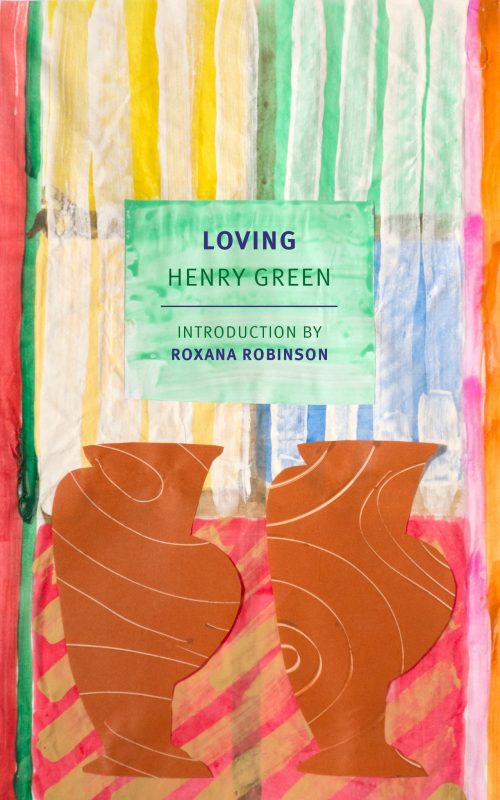
Loving
Henry Green
New York Review of Books, 2016
224 pages; $14.00

.
The English novelist Henry Green wrote nine beautiful and elliptical novels, all worth reading, but Loving (1945) is the best of them, indeed, one of the best English novels of the 20th century. This new edition—part of a welcome plan to reissue his works in the US—is cause for celebration.

Loving is set during WWII at a sprawling estate in Ireland called Kinalty Castle. Kinalty is owned by the ironically named Tennant family; fittingly, the Tennants are newcomers who have purchased rather than inherited the property. Mr. Tennant is dead; his son is fighting in the war. Mrs. Tennant lives with her daughter-in-law, Violet, Violet’s two small children, and a large group of servants.

In classic upstairs-downstairs fashion, the masters are not particularly important in the book (indeed, they are off in England for much of the time). Instead the servants are front and center, and we follow their sometimes rancorous, sometimes affectionate relationships. There’s Charley Raunce, recently ascended from the position of footman to butler, full of bluster and fear and the occasional kindness who finds himself out of his depth when a flirtation becomes something more. There’s Agatha Burch, the much put upon head housemaid, who oversees Edith and Kate, the two lovelorn under-housemaids. There’s Mrs. Welch, the alcoholic and suspicious cook. There’s old Nanny Swift, who took care of Violet as a girl and now looks after her girls. There’s Albert, the pantry boy, naïve, kind, and touchy. And there’s Paddy, the Irish lampman (the house has no electricity), who only Kate troubles herself to understand.

Much of the material for Loving came from Green’s childhood; servants had always been part of his life. Born Henry Vincent Yorke in 1905—he took his deliberately banal pseudonym as a way to separate his writing and business lives—Green grew up at Forthampton, the family seat in Gloucestershire.

In his memoir Pack my Bag, Green claims, “Most things boil down to people, or at least most houses to those who live in them, so Forthampton boils down to Poole, who did not live in but was gardener about the place for years.” Young Henry was fascinated by Poole, even though the man did not like Green’s mother and spoke badly about her to the boy. (The family legend is that he never forgave her for making him bowl sugar beets across the lawn for her to shoot at.) Green, who adored his mother though he seldom saw her, was torn apart by these calumnies yet unwilling to repudiate the one who made them.

It seems that Green knew already at a young age what he would explore in this novel in particular: that loving is a messy business, bound to lead to hurt feelings. In his life and writing alike Green was at home with complexity, especially in terms of social class. Green, who memorably described himself as “a mouthbreather with a silver spoon,” at one stroke both acknowledging and ironizing privilege, said that his childhood taught him “the half-tones of class”. It’s fair to say that Green knew the family servants, to whom he devotes the first pages of his memoir, better than either his mother, whose primary interests were shooting and riding and with whom the boy spent only one precious hour a day, or his father, a formidable Victorian polymath who pursued an interest in archaeology while running a company that cleverly manufactured both beer-bottling equipment and bathroom plumbing.

Young Henry was sent to Eton, where his contemporaries included Eric Arthur Blair, who would himself take a pseudonym and publish under the name George Orwell. Later he went up to Oxford, where he befriended Evelyn Waugh and shared rooms with Anthony Powell. He hated both schools. At Oxford he drank a lot, went to the movies twice a day, and wrote his first novel, Blindness, before leaving without a degree. He went to work the floor of the family factory in Birmingham, an experience he fictionalized in his second novel, Living. Later Green moved from the factory floor to the office, rising to become managing director.

Green published his memoir in 1940, when he was only thirty-five, because he was convinced he would be killed in the coming war: “surely it would be asking much to pretend one had a chance to live.” Happily he did live, and even thrived. He published five books during the war years and during the Blitz served courageously and happily in the Auxiliary Fire Service. But Green’s production slowed markedly after the war. He wrote three more, increasingly laconic books (the last two composed almost entirely in dialogue). Then, after 1952, silence, even though he lived for another twenty-one years. Jeremy Treglown, Green’s excellent biographer, vividly describes him in his last years as a vagrant in his own home, drinking because he couldn’t write and unable to write because of his drinking.

The downward trajectory of Green’s life is at odds with the sly pleasures and enlivening strangeness of his prose. The first thing readers of Loving will notice is its vivid dialogue. Here’s Edith revealing to Kate her feelings for Raunce:

‘All right then I’ll learn you something, Edith said and she panted and panted. ‘I love Charley Raunce I love ‘im I love ‘im I love ‘im so there. I could open the veins of my right arm for that man.

And here’s Miss Burch responding to Kate’s half-fearful, half-longing speculation about what would happen to them should the Germans invade:

‘Mercy on us you don’t want to talk like that,’ Miss Burch said. ‘You think of nothing but men, there’s the trouble. Though if it did happen it would naturally be the same for the older women. They’re famished like a lion out in the desert them fighting men,’ she announced.

These examples are moving and funny and a little alarming—characteristic of the emotional roller coaster the book puts us through. The absence of punctuation paradoxically makes the pauses and emphases clearer. Green delights in the clichés and hackneyed images (“I could open the veins,” “They’re famished like a lion out in the desert”) of speech without looking down on the speakers.

But the novel’s narrative voice is even more memorable than its representation of speech. To be sure, narration is simply opposed to speech in the novel. Sometimes narration apes the agrammatical or idiomatic qualities of speech, such as when it uses adjectives as adverbs: “He picked it up off the floor quick”; “He stood face averted then hurried smooth and his quietest to the roll-top desk.” Sometimes it takes on the rhythms of speech, its unpunctuated flow: “Bert stood motionless his right hand stiff with wet knives.”

But sometimes the narration is stranger than anything we find in its speech. Whereas the latter aims at clarity, the former finds meaning in obscurity. Such uncertainty is especially true of its unsettling of traditional English-language syntax. In this example from early in the book, Kate and Edith come across Paddy asleep in the old stables. The windows of this room are covered in cobwebs. As, it seems, is Paddy himself:

Over a corn bin on which he had packed last autumn’s ferns lay Paddy snoring between these windows, a web strung from one lock of hair back onto the sill above and which rose and fell as he breathed.

Note the excess of qualifiers in the first half of the sentence: Paddy snores “over a corn bin” and “between these windows”; the placement of that last modifier emphasizes the phrase “snoring between these windows,” which highlights in a peculiar, excessive way the specificity of an action. “Snoring,” after all, is hardly dependent on place. (In fact, the verb here is not “snoring” but “lies snoring”: the inversion of subject and verb—“Over a corn bin… lay Paddy snoring” is odd, almost archaic.) Also typical, and related to this ambivalent specificity, is the demonstrative “these” rather than the definite article “the,” a tendency the critic Frank Kermode once described as Green’s way of hinting that the text is singular, not easily reducible to something else.

Certainly the most singular quality here—though it is in fact typical of Green’s style—is the sentence’s unstable grammar. The sentence pivots (or collapses, as the case may be) on the comma after “windows.” What comes after it—“a web strung from one lock of hair back onto the sill above and which rose and fell as he breathed”—seems at first to be a subordinate clause, but on re-reading proves to be something else, something agrammatical. Adding that ungainly phrase “and which” turns this subordinate clause into the dominant clause for the sentence’s final bit of information. Bewilderingly, “web” is both a predicate referring to Paddy (it is strung from a lock of his hair to the sill above) and a subject in its own right (it rises and falls as he breathes). On a first reading we expect the final “and” to connect “above” to another preposition (so that it would read something like: “the sill above and beyond him”). When this expectation is foiled, we stumble over what comes next, the adjective clause “which rose and fell as he breathed.”

Green’s prose disguises its strangeness as ordinariness. He’s not an overtly ostentatious writer. Yet his ostensibly straightforward prose is profoundly unsettling and unusually hard to parse. The longer we pause over a sentence like this one the weirder it seems. In this way, he reveals himself to be one of the most genuinely experimental writers in the English tradition, writing prose that both demands and resists interpretation. (Webs being a conventional figure for interpretation, we could read the spider webs in this scene as a joke about our felt need to make sense even of things that resist sense.)

What is true of Loving’s syntax is true of its use of plot and character as well. Neither of these attributes is as straightforward as it seems. In general, Loving is not much concerned with plot. Even the question of whether Raunce will get together with Edith—the event that most approximates a conventional plot arc—is supplanted by the more intriguing but more difficult to answer question of what the two even want from each other. Several subplots are braided around the Raunce-Edith relationship, each of which rises to a crescendo of antic complexity that would be more at home in a P. G. Wodehouse novel but each of which fizzles out before coming to any resolution.

Take, for example, the business with the peacocks. The castle’s extensive grounds are ornamented by some two hundred of the birds. When they suddenly disappear, Mrs. Tennant summons Raunce for an explanation. Raunce, new at his job and insecure, as well as constitutionally shifty, does not want to tell her what has really happened: namely, that the nephew of the cook, a belligerent nine-year-old recently evacuated to Kinalty from London to escape the bombing, has strangled a peacock that had the temerity to peck at him, and that Paddy, the Irish lampman, has locked the rest of the birds up for safekeeping.

In his interview with Mrs. Tennant, Raunce equivocates about the convoluted, variously incriminating event. Unsatisfied, Mrs. Tennant continues to mull over the matter. She confides to her daughter-in-law that Raunce seemed afraid of something, adding:

“Frightened of what I’d like to know? I put it to Raunce. But he couldn’t or wouldn’t say.”

“Which is just like the man,” the younger woman interrupted. “Always hinting.”

Violet’s insistence here reflects her unshakable belief that everyone is always talking in code about her affair with a neighbouring landowner. The exchange between Mrs. Tennant and Violet is typical: Loving’s characters repeatedly talk at cross-purposes. But the passage is unusual in that by explicitly referencing hinting it talks openly what is otherwise hidden: that Loving challenges our interpretive abilities. Everything is a hint, nothing is a clue.

The novel’s distinctive narrative voice is particularly vexing. Unlike many writers of the period, Green doesn’t have much use for free indirect discourse: his third-person narration doesn’t slip into and out of the perspective of particular characters. We rarely have access to what characters are thinking or feeling. Consider a passage in which Raunce studies the notebooks left behind by the previous butler, Eldon, and learns that Eldon has been systematically cheating his employer, for example about her whisky:

Not only had Mr. Eldon never credited her with the empties, that was straightforward enough, but he had left whole pages of calculations on the probable loss of the volatile spirit arising from evaporation in a confined space from which the outside atmosphere was excluded. He had gone into it thoroughly, had probably been prepared for almost any query. Charley appeared to find it suggestive because he whistled.

Admittedly, we could read this material as coming from Raunce’s perspective: the aside “that was straightforward enough” could certainly be his. Yet the passage’s use of names is puzzling: we might expect Raunce to call Eldon “Mr.” but he in fact is anything but deferential to his predecessor’s memory. Something like “the old man” would have fit better. And why Charley, rather than Raunce, which is what the text usually uses? Moreover, the description of the evaporation—“the probable loss of volatile spirits”—doesn’t sound like Raunce at all, he’s nowhere near that articulate. Are we supposed to think Eldon has written something like this in the notebooks that Raunce is parroting, as if reading aloud? Impossible to say: we know almost nothing about Eldon.

But the strangest thing here is the passage’s final sentence. Just when we would expect the prose to inhabit Raunce’s consciousness most clearly so as to tell us what he makes of the situation, we’re left with nothing but uncertainty: Raunce “appeared to find it suggestive.” Why doesn’t the text know?

Green answered this question in a radio interview from the 1950s:

And do we know, in life, what other people are really like? I very much doubt it. We certainly do not know what other people are thinking and feeling. How then can the novelist be so sure? … We get experience, which is as much knowledge as we shall ever have, by watching the way people around us behave after they have spoken.

For Green, art follows life. All a narrator can do is to observe what people say and how they behave and then make guesses about the relationship between them. Loving is littered with such expressions of narrative uncertainty:

“Well now if it isn’t Arthur,” this man said hearty and also it appeared with distaste.

“And that reminds me,” he went on seeming to forget he had just given another reason for his presence.

Then she added as though unable to help herself, “It should do you a mort of good.”

Miss Burch fixed a stern eye on Kate so much as to say a minute or so ago just now you were about to be actually coarse.

“Ah Mrs Jack,” Miss Burch put in as though sorrowing,

“It was Edith,” he answered at random and probably forgot at once whom he had named.

On the one hand, these narrative amplifications tell us much more than a simple “he said” or she replied.” Moving down our list of examples, we learn that one man dislikes someone called Arthur, though he pretends he doesn’t; another man can’t keep his stories straight; a woman is at the mercy of her (at least ostensible) concern for another person; and so on down the list.

And yet on the other hand they tell us much less. We learn only that characters seem to say things in a particular way, with particular consequences or implications. “Seems” and its variants “Seeming” and “seemingly” appear regularly; they are accompanied by similar expressions of doubt: “it appeared,” “so much as to say,” “as though,” “probably.” We always have to choose between the specificity of these descriptions and the hesitant manner in which they’re offered. Whenever the narrative tells us something it casts doubt on that telling.

This is, to say the least, disorienting for the reader. When Edith and Raunce argue over whether to give back a missing ring they’ve stumbled upon, Edith throws the ring into the fire before hastily rescuing it:

“Ouch it’s hot,” she said, dropping the thing on the rug. They stood looking down and from the droop of her shoulders it could be assumed that her rage had subsided.

Are we able to ignore the suggestion that Edith is no longer angry? Once the hint’s been made, aren’t we forced to take it? But hints can’t be hints if they’re really just disguised orders. We have to hear the “it could be assumed” as much as the “her rage had subsided.” Loving doesn’t let us naturalize its repeated qualifications. We have to take them seriously, for the book’s aim is to force us not just to read about but also to experience the uncertainty that its characters feel towards each other and in relation to their historical moment, in which it is by no means clear how the war will end.

This uncertainty is mirrored in Green’s title. Whether we take it as a gerund or as a progressive verb, “loving” is hard to pinpoint. The noun would refer to an abstraction that doesn’t just apply in a single case. The verb would describe a continuous action nullified or completed were it ever to stop and therefore without beginning or end. Words like “loving”—Green titled several of his novels in similar fashion: Living, Party Going, Concluding—suspend meaning. Like Raunce in Violet’s description, they are “always hinting” but never resolving.

I would argue in similar fashion that we should understand Green as a writer who suspends the literary categories of his time. True, he was published by Leonard and Virginia Woolf’s Hogarth Press and possessed like many modernist writers a brilliant, inimitable style. And yes, he had gone to school with or traveled in the same social circles as many of the leading writers of the 1930s and wrote social comedies that sympathize with the working class. Yet Green is neither a modernist nor a social realist. He wriggles free of categories, the true strangeness of his prose not always evident until we slow down to see it has been hiding in plain sight.

Yet it wouldn’t be right to say, as earlier readers have done, that Green is like no one else. (The American novelist and screenwriter Terry Southern, for example, famously called him not a writer’s writer but a writer’s-writer’s writer.) Instead, Green is like a handful of other English writers from the middle part of the century who don’t fit into prevailing narratives of twentieth century literature, writers who subtly distort realism without abandoning it, writers like Ivy Compton-Burnett, Elizabeth Bowen, and Barbara Comyns. Like them, Green hints that there is still much to be discovered in a literary tradition too often thought of as timid and unadventurous.

—Dorian Stuber

N5

ee5dd2a0-4260-4ff5-bcca-eb49f4d01f3c-3

Dorian Stuber teaches at Hendrix College. He has written for Open Letters Monthly, The Scofield, and Words without Borders. He blogs about books at www.eigermonchjungfrau.wordpress.com.

.
.

Nov 112016
 

nell-zink

Nicotine is written in a relentless present tense, which has the effect of relinquishing any feeling of trajectory towards a destination. —Carolyn Ogburn

nicotine

Nicotine
Nell Zink
Ecco Press, 2016
304 pages, $26.99

.
It’s the stories we tell ourselves that cause all the problems, one character tells another in Nell Zink’s new novel, Nicotine. “That was something your dad used to say, about how it’s the stories we tell ourselves that cause all the problems. If you look reality straight in the eye, you end up a lot less confused. It’s a matter of signal-to-noise ratio. Any story you tell has to be all signal. Any distraction is noise. Anything extraneous is noise. Now try to define extraneous. In life, nothing’s extraneous. There’s no noise. It’s all signal.”

In Nicotine, Zink returns to areas she’s taken on in her previous novels: identity and identity politics, class, race, and sex. Lots of sex. But it’s really the stories surrounding these rather than any particular issue itself that seems to interest Zink, and she’s not writing to convince anyone of anything. In fact, she doesn’t seem to care what the reader believes, or doesn’t believe. Zink’s writing is immersive, demanding the reader’s trust. You’re either on board, or you’ve missed the boat, with Zink.

Every aspiring midlife novelist will likely be familiar already with the oft-recounted biography of Nell Zink, but her story seems to remain somehow blurred, evocative, just enough like every one of us to be any one of us but also distinctly, markedly unique. It doesn’t dull with repetition. Zink, like many of us, missed the “5 Under 35,” and the “20 Under 40,” mailed off her first manuscript in her late 40s to the novelist Jonathan Franzen, with whom, in a twist of fate that only real life can contrive, she’d begun exchanging emails about the songbirds of the Balkans. Her emails (which he would describe using words like feisty and presumptuous) were both remarkable and relentless; Franzen assumed she was a writer he’d met already, and playing some sort of a joke. When he finally understood she was not, he actively encouraged her to try writing fiction. Zink is said to have replied: “Oh, I’ve already done that.”

Nell Zink was born in Corona, California in 1964; she and her two brothers were raised in rural King George County, Virginia. She finished high school at Stuart Hall School in Staunton, VA, then majored in philosophy at the College of William and Mary. After undergrad, she moved to Philadelphia where she lived in anarchist coops (not unlike the ones she describes in Nicotine) and where, from 1993-1997, she published Animal Review, a ‘zine that interviewed punk musicians about their pets. She moved to Tel Aviv, then Berlin. She earned a doctorate in media studies at the University of Tübingen. She got married, and unmarried, and married again. She’s worked as a secretary, a technical writer, a translator; she’s waited tables and worked construction. She worked for four years as a bricklayer in the Tidewater area of Virginia, a job, she told Kathryn Shultz in the New Yorker, that was “more valuable for my intellectual life than my entire college career. In college, they allow you to be entertained and let your mind wander, which is not good training to do anything difficult.”

In other words, she lived the kind of private life of many people who, not being famous, do not have to explain their lives. As Zink says, “there’s a very clear distinction between taking your career seriously and taking your writing seriously.”

Because Zink was taking her writing seriously. For over fifteen years, she wrote fiction that she showed no one but the Israeli writer Avner Shats, to whom she’d been introduced by her second husband, the Israeli poet Zohar Eitan. (Two of the novellas Zink wrote for Shats have been published this month under the title Private Novelist.)

At the age of 50, Zink’s first published novel, Wallcreeper, was named as one of the New York Times’ 100 Most Notable Books of 2014. Wallcreeper explores the topic of marriage through bird watching and eco-terrorism. Her second, Mislaid, takes on racial and sexual identity; it was long-listed for the 2015 National Book Award.

§

Nicotine is the story of Penny Baker, a young woman in her 20s. Her father, Norm, is a self-help guru with massive real-estate holdings and a following of self-actualization groupies. His second wife, Amalia, is Penny’s mother; Amalia was a child of 13 when Norm first met her in the Colombian town of Cartagena. He adopts Amalia in order to bring her back to the United States after his first wife disappears, leaving her two sons, Penny’s half-brothers behind. In this free-wheeling familial structure, one that echoes the anarchist households in which the adult Penny will live, the boys’ mother’s absence is barely noticed.

Here’s what’s Zink writes about those self-help groupies who seek the promise of a better life, a description which again harkens forward to those communities Penny will find herself in as an adult:

There is tacit agreement among Norm’s followers that they make the world a better place by loving in it. They don’t change it. They redeem it, through the searching way they live their lives. The cult is populated by realist aesthetes. A cult of personality for those cultivating personalities. Expecting nothing more from life than self-actualization, accepting nothing less. Willing to settle for others’ self-actualization if their own turns balky.

Amalia is first shown at the age of thirteen; Penny is first shown at the age of twelve, naked and smoking and, shortly thereafter, accusing her decades-older half-brother Matt of attempting to rape her. The accusation is quickly dismissed both by her father and even Penny herself, but incest hovers like a palimpsest throughout.

The story proper opens in April 2016, exactly a year from the novel’s actual date of completion in April 2015. She tells us Penny, now in her 20s, is a graduate of an unnamed business school; her half-brothers, Patrick and Matt, and her mother, Amalia, are in their mid-40s. Her father, Norm, dies within the first pages of the book, and it’s his death that triggers a series of dissolutions that frames the narrator’s existence, if not the plot of the book itself. Zink’s book describes as closely as I’ve ever seen the transient nature of a certain variety of intimate relationship.

The first dissolution is Penny’s first encounter with death. She loves her father, seemingly the only one who does. She stays by his side as he enters Hospice care, whose dictate to do nothing to either prolong life or speed death means that he doesn’t get pain relief, and it’s up to Penny to swab out the crust from his throat. It’s not every novelist who would take on Hospice care in a satirical manner, but Zink’s attention is a serrated knife that takes no prisoners.

Once Norm dies, the family enters the well-known stages of estate management, another form of dissolution. In Norm’s case, this means primarily real estate holdings, some of which have already been sold, and others claimed. But, Penny is told, there is Norm’s parents’ home in Jersey City, which had been abandoned for years. When Penny is evicted from her father’s rent-controlled apartment upon news of his death, her step-brother offers her the abandoned house, advising her to evict the squatters living there. Instead, she falls in love, and moves in as a squatter herself.

As it turns out, the home, called Nicotine, is one of many semi-organized illegally occupied group houses throughout Jersey City. Though Zink describes only one of her many characters as “ageless and about thirty-five,” this breezy description could apply to just about everyone living in these collectives. There’s Stayfree, a feminist collective (“of both men and women”); Tranquility, whose residents protest for indigenous peoples’ rights; the DJD, the environmental collective that’s named for the enormous and enormously expensive couch that resides in the house. Nicotine’s ostensible purpose is to advocate for tobacco users’ rights, but most of the residents’ abundant free time is spent in the kinds of discussion familiar to anyone who’s ever spent any time with the rootless, international community of artists, grad students, armchair philosophers, and trustifarians who, while drawn from a diverse cross-section of racial, ethnic, religious, sexual and gender identities, share the same attitude, both cynical and speculative, toward identity as they do towards property in general. That’s globalization; that’s modern life, Zink seems to be hinting. The reader quickly loses track of residents who come for discussions of, say, class or gender privilege, only to disappear, never to be heard from again. The dissolution of identity, whether politics, gender, sexuality or any other belief system also plays a major role in the novel. Forget the regional distinctions of nationalism; forget the myth that some people are indigenous and others aren’t. When a character (Sunshine) tells Penny, “It’s just context-dependent! That’s how identity works,” the reader, like Penny, starts to feel a little queasy. There’s a vague feeling that we’re being led on: a lot of this is satire, after all. But where the lines of satire are drawn is far from clear.

Aphorism may be Zink’s most natural setting. “Smoking is like moving to Fukushima for the privacy,” she writes. Or, “You can’t understand the modern world if you can’t imagine selling what you love best.” Zink’s cultural references are drawn with journalistic precision: she briefly references Donald Trump’s campaign, and a fictive President Hilary Clinton; includes 2016 state-of-the-art Virtual Reality sex toys, and describes a character retreating to her bedroom where she eats an entire pint of Ben and Jerry’s and watches two episodes of Nurse Jackie. But the most contemporary element in Nicotine may be Zink’s slightly manic level of attention which offers what it needs to in two or three sentences before moving on. Almost everything is said via dialogue, in this style of writing, the ideas expressed more important than the character expressing them. This is literature styled by Twitter-feed, hashtagged by topic. Facebook is for old people.

Like Twitter, Nicotine is written in a relentless present tense, which has the effect of relinquishing any feeling of trajectory towards a destination. It’s a kind of self-actualization of a narrative arc, pushing the reader into stasis, to rest in whatever is already known in the moment rather than pulling the reader towards what isn’t yet revealed. There’s a reason thrillers and mystery novels aren’t typically written in the present tense, but in the past. “And then I saw the gun, there, on the bed,” is inherently more suspenseful than, “I see the gun, there, on the bed.” (In fact, both a gun and a bed, make appearances in Nicotine; though both are used as guns and beds are often used, and occasionally in ways they’re not, there’s little in the way of suspense, which I place squarely on the use of the present tense.)

Zink herself refers to her choice, in a playful tongue-in-cheek way that’s characteristic of her writing. The rally against the TTIP (no one can quite remember what it stands for, but it’s clearly referencing the controversial Trans-Pacific Partnership) is coming up and two Nicotine residents (Rob and Anka) are brainstorming slogans which can be converted to hashtags for their protest signs:

“How about TTIP SUX?” he suggests.
“Present tense is a tactical error,” she says. “Makes it sound like we already lost.”

And maybe we have, in fact, already lost. We, westerners of whatever background or belief, live in a time of global dissolution and climate collapse that none of us understand. There is a despair that pervades this seemingly light-hearted novel. When Zink writes, “A cigarette fights intense humidity in utter darkness. Its dim firefly of tobacco flies upward and brightens with an intake of breath. It falls and comes close to dying,” the reader almost feels the deep, smoky intake of breath herself, can almost see that breath drift across the warm night air. It’s one of the few passages that’s written to slow down attention, to welcome reflection.

The novel’s end finds the residents of Nicotine scattered—another form of dissolution—and the home itself transformed into a different kind of community center. Penny takes a job at her mother’s bank and shacks up with the no-longer-asexual Rob. The ending seems to belie the premise of the book’s title: nicotine, after all, is the addictive portion of tobacco. Nicotine isn’t what kills the smoker, not directly. Nicotine is what makes smoking so difficult to quit.

At one point, the novel’s sexy siren Jazz looks up from reading Jean Cocteau’s memoirs, sighing “He’s got that breezy, casual sophistication I’m always aiming for and never hitting.” Zink surely aims for breezy, casual sophistication, and in Nicotine, she almost hits it.

—Carolyn Ogburn

N5

Carollyn Ogburn

Carolyn Ogburn lives in the mountains of Western North Carolina where she takes on a variety of worldly topics from the quiet comfort of her porch. She’s a contributing writer for Numéro Cinq and blogs for Ploughshares. She’s studied at Oberlin (B.Music), UNC-Asheville (MLA) and Vermont College of Fine Arts (MFA). She writes on literature, autism, music, and disability rights and is at work on her first novel.

.
.

Nov 052016
 

fullsizerender

Gauer’s novel is a burst of fresh air, and it resembles a Tarantino movie in the energetic drive of the prose, the jumbling of time, unexpected humourous lines or scenes, quasi-rhapsodic passages about the quotidian, direct addresses to the reader along with other meta-fictional flourishes. —Jeff Bursey

novel-explosives

Novel Explosives
Jim Gauer
Zerogram Press, 2016
722 pages, $15.95

.
Introduction

For a long time, writers have been advised to be economical in their speech; to exercise restraint in the use of adverbs and adjectives (if they were compelled to use them at all); to show, not tell; to keep in mind that consumers want (or can only handle) friendly texts that are easy to grasp, mentally and physically; and to not mix genres overmuch for fear of sowing confusion. Exceptions to these rules include the works of Thomas Pynchon, William T. Vollmann, Richard Powers, and Joseph McElroy, living exponents of the encyclopedic novel. (Past members range from Gustave Flaubert through James Joyce and Robert Musil to William Gaddis, Roberto Bolaño, and David Foster Wallace.) After reading Novel Explosives, with its rich vocabulary owing much to philosophers such as Wittgenstein, Marx, Heidegger, Kierkegaard and others, to armaments manuals, to oenology, and to the inner workings of Mexico as well as the geography of Ciuldad Juárez, among many other apparently unrelated groups and sub-groups of knowledge, I consider Jim Gauer of the United States a member of that select group. I also feel, foolishly and falsely, that, at various times in my reading of his long, but never too long, first novel, I would be able to identify guns despite never seeing or touching them in real life, to know the purpose of different scalpels, and to slow down the world so as to notice everything, from the perspective of a turkey buzzard or a child astride a garbage heap.

What I mean to say is that in his novel Gauer, self-described on the back cover as “a mathematician, published poet, and possibly the world’s only Marxist Venture Capitalist,” gathers together facts and data, transforms them into knowledge about systems that are then distributed among his main characters, and through this understanding of how things work, the author creates a narrative that indicts his home country for, at best, and only in some instances, willful blindness, but more often for serious and long-standing morally criminal activity concerning drug use and commerce in weaponry. It is also a performance that expresses deep anger, and possibly loathing, for his country, authority, and human behaviour. Those emotions are not plentiful enough in our better-known contemporary novelists, and may be considered impolite, unseemly, undisciplined, and not easily aestheticized. Yet this book is not a rant or screed. Alongside the anger, and not contrarily, it is playful, replete with narrative ingenuity and a command of form. It has a middle finger unflaggingly raised against the rules described in this review’s opening sentence. Gauer’s novel is a burst of fresh air, and it resembles a Tarantino movie in the energetic drive of the prose, the jumbling of time, unexpected humourous lines or scenes, quasi-rhapsodic passages about the quotidian, direct addresses to the reader along with other meta-fictional flourishes (“Even characters in books deserve an evening now and then… [to] laugh at the creations they’d somehow been ensnared in, and the mind-numbing narratives they’d been forced to adhere to…”), and the threat or use of violence, though for anyone who’s seen The Counselor or Sicario (let alone the Saw movies) this novel is sedate, in its way.

I.

Set out in three parts, the action takes place from 13-20 April 2009, mostly in cars, hotels, houses, and buildings in El Paso and, primarily, Juárez and Guanajuato, Mexico. The book begins with an amnesiac trying to figure out who and where he is. A “United Kingdom driver’s license, with an address in Scotland,” identifies him as Alvaro de Campos, one of the many heteronyms[1] created by the Portuguese writer Fernando Pessoa (1888-1935), with an 80-year-old photo of Pessoa to match. The amnesiac isn’t taken in, and later on becomes Probably-Not Alvaro for a short while. Underlying the surface calm in the presentation of his situation is an edginess of mood when faced with no idea who he is, how he came to occupy his hotel room with a crude photo card, an ATM card with no PIN, and a large bump on the back of his head, or why a FedEx package with clippings showing mass graves relates to his life.  The second narrator is the nameless capitalist who provides a brief summary of his early life, mostly from the business angle, leaving out the identities of his first and second wives, but eager to discuss his financial successes, aside from a venture involving Dacha Wireless. The third narrative thread follows two gunmen, Raymond and Eugene, as they search for the venture capitalist whose financial gain from Dacha bothers their Mexican cartel drug lord boss, the Shakespeare-quoting Gomez. There are a few ancillary men and women whose lives intersect, briefly or longer, with these figures.

Despite Alvaro’s understandable bewilderment as to his own identity, he has a great deal of knowledge about money, poetry, and a host of other things; the nameless venture capitalist, who comes to be called Douchebag, understands computers, the stock market, wines, resorts in other countries, and more; while Raymond, whose thoughts we are privy to more than Eugene’s, is a veteran from the wars in Iraq and Afghanistan and therefore equipped with combat experience. Alvaro and VC narrate their (partial) lives; an omniscient third-person narrator describes the gunmen’s adventures and misadventures.

What will strike a reader early on in this book, apart from the fact that no one really goes by his or her name (in addition to Alvaro and Douchebag/VC, Raymond and Eugene are often called Ray and Gene), is the vocabulary each character has. Alvaro is aware his alleged name is a Pessoan invention, and that he can explain “how Riemannian geometry laid the foundations for General Relativity…” As well, his “meditation on wealth and irregularity, while seated on the Cathedral steps, personifying the streets, viewing them as sentient beings, reminded me once again that I still had a tendency toward poeticizing reality.” VC speaks in the language of hedge fund managers:

We’ve structured the deal as a Redeemable Preferred, with a 40% slug of cheap Common, with $4 million going in at $2 million pre; assuming the company cashflows on plan, we’ll get our Redeemable bait back in 36 months, and own 40% of the company with nothing at risk. If the company sells before the redemption, we’ll be holding a standard Participating Preferred, with a 4X liquidation preference, so even a real fire sale, at $20 million, leaves us with just under $18.7 million of the proceeds…. We set the Protective Provisions at a two-thirds supermajority, and have dragalong rights on the 28% of common held by the Founders, so we can block a sale even if we’re holding common, or force a sale under either scenario.

Ray and Gene, while negotiating a drug deal, think in their own terms:

The Russians, or Montenegrins, or Bulgarians, or whatever, were waving around oh shit not-this-again Micro Uzi’s, apparently intent on speeding up the process, a use for which the Uzi is an excellent selection: not only does it fire at 1,200 rounds per minute, but its grip-mounted 50-shot sheet-metal magazine gives it a highly distinctive and memorable profile, while the telescoping overhung bolt, wrapping as it does around the breech end of the barrel, makes for a nice clean compact well-balanced weapon, ideal for clearing bunkers in a timely fashion; the only real drawback, out here in the open desert, was that the Uzi has the exact same open-bolt blowback-operated who-gives-a-shit design that made the TEC-9’s prone to firing parabellum rounds almost anywhere in the world but where they were intended.

It might be concluded, from the second and third examples, that the usual language of the novel form has been abandoned in favour of prospectuses and Jane’s military publications, as if Guar had pasted in dry chunks of inert technical prose to pad out a long novel. (Anticipating objections to the length of this book and/or charges of logorrhea, Gauer has Alvaro say early on: “To make a long story short, before once again beginning the process of making a short story longer…”) The unfamiliarity of the terms can slow the reading down, but if the language is allowed to wash over one then a general sense of what’s going on gradually becomes clear.

For some, these may remain as serious obstacles to enjoyment, and bring up the questions: Why? And how is this literary prose? Years ago, someone I once knew came up with a handy triad (or else appropriated it from goodness knows where) that can be applied in diverse situations: esoteric—knowledge of which you approve; arcane—knowledge of which you are afraid; anachronistic—knowledge of which you are ignorant. It is no less intrinsically worthy to read about “Redeemable bait” than a description of a park or a character’s haircut. What matters most is that these distinct vocabularies assist in presenting and thickening the milieux the characters’ thoughts spring from. What at first look to be unwieldy fragments of language are entirely germane to the worlds inhabited by VC and Ray. As Ludwig Wittgenstein—a definite touchstone for Gauer—says in Tractatus Logico-Philosophicus (1922): “The limits of my language mean the limits of my world.” Of course, nothing says those defining limits are claustrophobically confining.

II.

Novel Explosives itself is not restricted in theme and import simply because it is set in the United States and Mexico. Life in this novel, like life in any society—for example, a camp in Calais, pre-Brexit Great Britain, US cities where at any moment a uniformed individual will shoot a citizen, a leaking boat in the Mediterranean—is filled with terrifying precarity. There’ll be more blood, decapitated corpses, and gruesome backyard and desert graves due to cartels fighting over turf and riches than most of are likely to see, but that’s a matter of scale. Many people—to use shorthand, the 99%—are one blow (to the head, or wallet, or from snorting cocaine or partaking of another drug) away from losing their livelihoods, memories, and identities. This novel—an aspect not hidden by random and premeditated acts of mayhem or the specialized language—is built on connections: VC and Alvaro need each other, Ray and Gene are friends, the drug leaders feed off each other as well as their customers; one world crosses over into other worlds, not so much disregarding Wittgensteinian limits as never having heard that theory.

Very near the end the narrator speaks to us: “We warned you all along to stay out of Juárez… What were your [sic] even doing in Juárez in the first place? What’s that you say? That wasn’t you? You had nothing to do with any of this? We should leave you out of it? It’s a little late now to be protesting your innocence. It’s as if you think the world is somewhere else, somewhere far away, without you in it.” The connections are drawn more sharply a little later:

…fortunately for all of us, this [mass and indiscriminate killing] is a Mexican problem, the Mexicans, while lovely, are evidently quite a violent people, and through it has nothing at all to do with us, and the $30 billion in drug profits we lend to the cause, much of it repaid in armaments purchases, we are, let’s say, concerned for their health, which is why we read these stories with such avidity, since the moment the last true Mexican dies, we’ll feel totally bereft of violence pornography…. You’ve been wandering around Juárez like a zombie in a thought experiment, an experiment in collective guilt, where the zombie is shown the morgue-slab photos, and responds by saying I’m truly sorry, and making out a check to Amnesty International…

III.

Almost 700 pages in, an extraction or confession that rings a change on E. M. Forster’s “Only connect!” is demanded of us, a charge that we should accept that our participation in the world’s ways—through drug use, support of governments that deal in arms, passivity, short-sightedness, and greed, however we might like to describe it—have led to the condition of present-day Juárez, as it has before to the detriment of countless other places. The omniscient narrator refers to Germany before the Second World War: “How, after Auschwitz, is beauty even possible?… Brecht’s warning to the world, and those born later, about the rise of the Nazis in the 1930s, and we, those born later, having already been warned, why do we act as if we haven’t heard the news?” (Yet in a puzzling omission, at no point does the omniscient narrator refer to the famines, purges, dispossessions and mass population movements in the USSR that killed many and destroyed in other ways the lives of others; or even to Mao or Pol Pot.) What is our response to another story about bodies spread across the Mexican landscape? The narrative calls on us to be aware of our actions and to take on the burden—not the guilt, Jim Gauer isn’t Graham Greene—of the ramifications of those actions.

Novel Explosives ends twice, in two registers, but it would go against the skillfully wrought architecture of this fizzy, fierce, maximalist, encyclopedic, allusive and word-drunk book to give away the conclusion. It deserves to be read and connected with.

—Jeff Bursey

N5

Jeff Bursey

Jeff Bursey is a literary critic and author of the picaresque novel Mirrors on which dust has fallen (Verbivoracious Press, 2015) and the political satire Verbatim: A Novel (Enfield & Wizenty, 2010), both of which take place in the same fictional Canadian province. His newest book, Centring the Margins: Essays and Reviews (Zero Books, July 2016), is a collection of literary criticism that appeared in American Book ReviewBooks in CanadaThe Review of Contemporary FictionThe Quarterly Conversation, and The Winnipeg Review, among other places. He’s a Contributing Editor at The Winnipeg Review, an Associate Editor at Lee Thompson’s Galleon, and a Special Correspondent for Numéro Cinq. He makes his home on Prince Edward Island in Canada’s Far East.

.
.

Footnotes    (↵ returns to text)

  1. A heteronym is something like an alter ego to which Pessoa, the originator of this device, gives characteristics that set it apart from his or her creator, and it lives an independent existence.
Nov 042016
 

dusan-sarotar

The magic of a novel like Panorama is, in the end, independent from any need to determine absolute truth. —Joseph Schreiber

panorama-cover[larger image requested]

Panorama
Dušan Šarotar
Translated by Rawley Grau
Peter Owen World Series,  2016
208 pages, £9.99

.
Some literature defies simple description. Case in point, Panorama, by Slovenian poet and writer Dušan Šarotar. One might be inclined to define it as a meditation within a travelogue within a novel. Or perhaps you would prefer to rearrange those terms, it probably wouldn’t matter, because in spite of its subtitle: A Narrative about the Course of Events, Panorama stands at a curious angle to space and time. It is a novel of remembering, of telling and retelling, narratives within narratives, bound together by a coarse thread of repeating themes that are at once timeless and timely.

One of three Slovenian novels to be released this fall as part of the Peter Owen World Series, a new collaboration between Peter Owen Publishing and Istros Books, Panorama is Sarotar’s fourth novel, and his first to be translated into English. Born in Murska Sobota in northeastern Slovenia in 1968, he studied sociology and philosophy at the University of Ljubljana. In addition to his novels, he has published collections of short stories, poetry, and essays; and has written numerous screenplays. His prose, as exemplified in Panorama, has a poetic and richly cinematic feel.

So, maybe we could start with a short piece of film. This novel is narrated by an unnamed man who resembles Šarotar—a Slovene writer, of approximately the same age, who travels to various locales, either to work on a manuscript or give a reading. Here then, is a glimpse of the author himself. The setting is the Ljubljana Railway Station. A light snow is falling, and the trains come and go. This video is part of an online documentary project entitled Gathered: The Secret Side of Things We Share in which a number of prominent Slovenian writers, artists, philosophers and other academics were invited to offer their reflections—to muse out loud—about the state of modern society and the impact of technology on our relationships with nature and each other. It dates from 2013, the year before Panorama was originally published and presents, perhaps, a broad context for some of ideas he was exploring at the time.

Šarotar admits that when he sits at the railway station (an activity that will ground several important encounters in the latter part of his novel) he always thinks about time and space: “We are basically determined by time,” he says, “and by the fact that we are mortal, that we come from silence and we are returning to silence.” He goes on to consider that although we have very efficient modern means of transporting people, information and money; the most basic and fragile things, those that capture the essence of our humanity, are always the most difficult to transport through space:

A change in human society always followed a radical change in transport. At first, humans were conquering the steppes, then came the next generation braving the oceans and now we live in a time when mankind has conquered the entire globe and reached the limit. There are no ships, trains or aeroplanes that can take us beyond. We have reached what I call the limit of the universe. Today’s man is ready to head for the universe. It’s an imaginary limit of space and time. Poets, however, would say that the universe is a space within us. So I think it is no longer a question about communication or logistics, it is more about correspondences between the visible and invisible, between what’s the deepest inside us and everything that is furthest outside.

Panorama opens in Galway. The narrator has come to this Irish county, set at the very edge of Europe, to find a quiet place to work on an unfinished manuscript. Upon his arrival, he meets Gjini, an Albanian immigrant who will serve as his occasional driver and tour guide during his stay. Much of his time will be spent exploring the windswept mountainous landscapes and rugged coastline of the Connemara region. Here, and back in Galway City, he is haunted by thoughts of the thousands of starving refugees who set sail from these shores to face a dangerous and uncertain journey across the Atlantic during the years of the Great Famine. The crumbling abandoned houses and the solemn monuments stand as silent testament to these desperate souls. Migrants and refugees will be a recurring motif throughout the book, as will the related connections between landscape, memory, language, and loss.

As Gjini, who is also a writer, accompanies the narrator on sight-seeing adventures—hikes though the hills, a rough trip out to an outlying island by hydrofoil, a visit Kylemore Abbey—he shares his experiences as a newcomer, arriving eleven years earlier without a word of English, his wife left waiting behind until he can find his footing. Woven into his story, is an account of his friendship with Jane, a woman who had come from North America, to make sense of her own roots and identity. Her father was born in Connemara area. After the Second World War, some good-hearted nuns had put him on a ship bound for Canada, along with other war orphans and immigrants. Her research and journeys had taken her, he said, to Belgium and France and on into Central Europe as far as Sarajevo. As two outsiders, with a connection, however loose, to an area of the world close to the home he was missing, he was happy to have her company and offer his services as a driver. Gjini, and through him Jane’s story, become part of a key thread that will be picked up again, as the narrative progresses.

Shortly after his Irish visit, the narrator travels by train from his home in Slovenia to Brussels. This time, the main purpose of his visit is to give a reading in Ghent. The landscapes that attract his eye here, are urban—gothic structures played against inner-city decay and ruin. While in Belgium he will meet or re-connect with colleagues who have some tie with the states of the former Yugoslavia; individuals who articulate, in their own ways, the complex interrelationship between language and identity, and how it becomes distorted through time. And he will meet up again with Gjini who now, in his role as a freelance journalist, is intent on tracing yet another line of Irish-related migration, that of the Benedictine nuns who abandoned their destroyed convent in Ypres and made their way to Connemara after the First World War. Finally, chronologically speaking at least, the peace the narrator has been seeking for his work on his manuscript is found in Sarajevo where he stays with some friends.

On a superficial level, given this rather rough outline, Panorama might sound like a travel diary. The grainy black-and-white photographs that illustrate the text reinforce this impression. However, the narrator’s travels do not delineate the narrative, as much as they offer a framework against which the voices of his characters can be woven into a larger multi-layered meditation. He allows those he meets and spends time with a space to articulate the tensions they feel between their inner experiences and their relationships to the borders they have crossed in the course of their lives—whether those are lines marking identity, nationality, or even the policed barriers of a city under siege. The disorientation caused by the loss of one’s language, or the lack of contact with others who share one’s native tongue, is a persistent theme. Gjini describes it well on one of their early outings:

When you are far from your language, you are also far from your home, more and more each day, and the distance increases and deepens with every new word; the lost word is usurped, seemingly replaced, by the other, more convincing, better word, which everyone can understand but which is still foreign; the immigrant, this eternal guardian but also suppresser of his own language, knows that the loss, the void, the dissolved malt of forgetting within it, which he tenaciously envelops and fills with learning, which is the only vaccine against loneliness, despair and madness, is nevertheless irreplaceable, painful and incurable, like love, Gjini said and noticeably slowed the speed at which we were driving.

While in Brussels, he reconnects with Caroline, a fellow writer whom he had met on his first trip to Belgium a few months earlier. At that time, she had told him, “I don’t have my own landscape, I search for and invent the spaces of my language,” explaining that although she was born in Belgium she lost her mother tongue growing up in Spain before she went on to study Romance languages and work in Paris and Nigeria.

…I think, Caroline had said, that the idea of some inner bond between language and place is still alive for most people, it’s still a given, something eternal and immutable; I would say that it was their only tangible identity, but for many this bond has been broken, or lost, or seemingly transcended – many people, painfully and sometimes tragically, are forced, or for pragmatic reasons desire and are able, to transcend and break this bond; consider, she had said, people who are immigrants, refugees, the various diasporas, and so I ask myself what is still left to the writer’s experience.

The act of writing, the nature of tangible memory, and the complex relationship between language and landscape are the questions that ground this richly textured novel. Šarotar’s long, winding sentences evoke the meandering flow of reminisces while his narrative effectively compresses time—the encounters the narrator describes are not locked in the moment, they are broken and retrieved, guided by his remembrances of previous meetings, the memories recounted by these friends and colleagues, or even the tale of a complete stranger who buttonholes him after a reading in Ghent, to share—or perhaps confess—a family secret. The absence of chronological consistency creates an ebb and flow of recollections—some directly experienced, some reported and some imagined. In the beginning, the absence of quotation marks within paragraphs that extend for pages on end, can make it difficult to tell exactly who is speaking. Yet, with surrender to the movement between speakers and accounts, the reader will find the confusion falls away as the narrative repeatedly returns to pick up earlier threads and move forward.

The influence of W. G. Sebald is unmistakable, witnessed in the unnamed narrator with a curious similarity to the author, the long sentences, and even longer paragraphs, and by the employment of imbedded photographs. Šarotar has read and been inspired by Sebald’s work. Toward the end of Panorama, he even offers a direct allusion to Austerlitz as the narrator waits to meet a friend at the iconic Antwerp Station. However, Šarotar’s style is not strictly imitative. If Sebald acquired some of his narrative energies from Thomas Bernhard (seen, for example, in the repetitive occurrences of “Austerlitz said” in the secondhand accounts that form the basis that eponymous novel), Šarotar’s work maintains an even stronger Bernhardian sensibility at times, especially in the nesting of Jane’s story within Gjini’s accounts:

… a few times I remember when, after we’d been driving around all day in the car or just walking in the countryside, usually by the sea – she loved the bluffs, the high cliffs with the waves crashing far below; yes, that’s something you still have to see, he said, I’ll definitely try and organize it – yes, so, late at night, when we got back and had already said our goodbyes, he said, Jane would say, I’m going for a swim. I was surprised, of course, and tried to talk her out of it – not now, Jane, it’s late, it’s raining and the waves are rough, I’d tell her, and it’s night, there’s nothing you can see now, Gjini said; the lighthouse, Mutton Light, is shining there in the distance, Jane said; I can see its beam in the darkness, so you go on now, I’m going to have a swim; I’ll meet you here in the morning – good night, Gjini, Jane said; good night, Jane, Gjini said.

As well, with respect to the use of photographs, Šarotar, himself a photographer, is—or at least appears to be—using his images more intentionally. Sebald was a great collector of flea market finds around which he crafted his narratives. The portraits included in this text seem to stand in for characters who may or may not actually exist, but another significant influence on Šarotar’s photography is the work of German photographer and painter, Gerhard Richter. In fact, it is Richter’s retrospective show, “Panorama,” that gives this novel its name. The dramatic stormy cloudscapes that feature in so many photos are especially reminiscent of Richter’s well-known images of clouds.

cloudGerhard Richter, “Cloud Study”

In tone, Šarotar’s prose maintains a distinctly rhythmic poetic feel, captured beautifully in the translation by Rawley Grau. His narrator, a writer, imagines himself in line with the traditions of other Balkan literary heroes, especially Slovenian poet and songwriter, Gregor Strniša, and Bosnian writer, Ivo Andrić. The latter’s poignant short story “Letter from 1920” figures toward the end of this novel, as yet another echo of the endless trend of leaving one’s homeland when a viable future can no longer be imagined. This piece is one of a number of Andrić’s stories that could be said to be of questionable autobiographical authenticity, as if truth and imagination are somehow incompatible. Panorama raises the same questions about where the line between fiction and nonfiction lies. But why is that an issue at all?

For Šarotar, it comes down to the way that literature is understood in Central Europe. If asked to draw a distinction between literature and journalism, he says that, for him, literature deals with the soul, that is, it begins with memory; journalism, by contrast, starts with “facts.” He claims to be writing from memories—writing about what it was, not how it was.[1] To enhance that sense of memory, small intentionally misremembered facts are left uncorrected in the text. As a more specific example, he offers an interview with Amos Oz from the Paris Review. When asked about the very serious way Hebrew writers seem to be taken in Israel, in contrast to the way they are seen in the west, Oz responds:

We have a somewhat different tradition. In the West, at least in English-speaking countries, writers, even great writers and poets, are usually regarded primarily as entertainers. They can be fine, subtle, deep, but still they are entertainers. Even Shakespeare is regarded as a magnificent, perhaps the greatest, entertainer. By contrast, in the Judeo-Slavic tradition, writers are regarded as prophets. This can be a terrible burden, for unlike the prophets I don’t hear voices from above, and I don’t think I’m any more equipped to be a prophet—to foresee the future or serve as the people’s conscience—than an American or a British writer. Yet there is a huge expectation here, and so it is also in Russia or Poland.

The magic of a novel like Panorama is, in the end, independent from any need to determine absolute truth. Whether any of the characters, even the narrator, bear more than superficial resemblance to “real” people does not matter. This is a work that gets at the heart of important truths that couldn’t, at this moment, be more relevant. As the human flood pouring into Europe reaches crisis proportions it is more important than ever to remember that this is not a new phenomenon. The forces driving the desperate movement of men, women and children—conflict, violence and poverty—have similarly forced individuals, families, and communities to cross waters and borders for millennia. This meditation on memory, time, identity, language and loss circles continually back to the price that migrants and refugees pay and the wounds that never completely heal.

—Joseph Schreiber


N5

jschreiber

Joseph Schreiber is a writer and photographer living in Calgary. He maintains a book blog called Rough Ghosts. He is an editor at The Scofield. His writing has also been published at 3:AM, Minor Literature[s], The Quarterly Conversation, and Literary Hub. He tweets @roughghosts


Footnotes    (↵ returns to text)

  1. D. Šarotar, (personal communication, Sept. 28, 2016)
Oct 092016
 

ra2

Alameddine uses the structure of his novel—as Proust did—to recreate the impression of memory. The Angel of History, with its fragmented, alternating, multiple points of view and multiple plots is a structural triumph, not in spite of these qualities, but because of them. —Frank Richardson

the-angel-of-history

The Angel of History
Rabih Alameddine
Atlantic Monthly Press, 2016
304 pages, $26.00

.
What if you were Satan’s chief delight? How chilling, how disturbing, how psychosis-inducing would it be to discover Satan—yes, the actual devil, Mephistopheles, the Morning Star, Lucifer—said that you rejuvenated his jaded heart? Who would want to know that? In The Angel of History, Rabih Alameddine’s newest novel, we learn the answer to this question, for Jacob, a Yemeni-born poet and survivor of the AIDS epidemic, is Satan’s delight, and the fallen angel makes it his mission to rescue Jacob from forgetting his past.

The Angel of History is Rabih Alameddine’s sixth book and fifth novel. Born in Amman, Jordan, he spent his youth in Kuwait and Lebanon. After moving to the United States, he first pursued an engineering career, but gave that up for painting, and then writing. In 1998 he published his first novel, the critically acclaimed Koolaids, a blistering indictment of war and a harrowing examination of the ravages of AIDS. His other novels include the experimental I, The Divine: A Novel in First Chapters (2001), The Hakawati (2008), which draws on the tradition of Arabian fables, and the bibliophile’s delight, the sublime An Unnecessary Woman (2014), which won the California Book Award Gold Medal for Fiction and was a finalist for the National Book Award.

Now fifty-six, Alameddine spends his time between San Francisco and Beirut. Once again exploring the subjects of AIDS and war in the Middle East, with The Angel of History, Alameddine gives us provocative storytelling at its finest, a fabulist tale that explores how we grieve and how we succeed and fail in confronting our most painful memories.

Jacob’s Elegy

Ya‘qub, the protagonist and narrator of two-thirds of The Angel of History, arrives one rainy night at a crisis psychiatric clinic in San Francisco determined to be admitted. The fifty-something Ya‘qub has used the Americanized ‘Jacob’ since moving to San Francisco in the 1980s as a young man. Jacob explains to the triage nurse that he has been suffering from hallucinations again and is depressed. His employer had suggested he seek counseling, but it wasn’t until Jacob saw a report of another U.S. drone-strike on a Yemeni village, this time his mother’s hometown, perhaps the one where he was born, that he finally broke down. He needs an emotional holiday, and his ideal version would be three days in the psychiatric unit of Saint Francis Hospital with a nice Haldol-Ativan cocktail served with a chaser of Lexapro—after all, drugs had helped before—something to quiet the voices, something to deaden the pain, something to turn out the light of memory.

The majority of the 300-page novel is arranged in three titled sections—“Satan’s Interviews,” “Jacob’s Journals,” and “At the Clinic”—each of which is divided into twelve chapters, many with titled subchapters. Alternating in sequence, the three major sections present three parallel plots from multiple points of view providing a nonlinear reconstruction of Jacob’s history.

A poet who earns a living as a word processor for a law firm, Jacob lives alone in his San Francisco apartment except for his large black cat, Behemoth, whom he named specifically after the infernal feline in Mikhail Bulgakov’s The Master and Margarita—another novel featuring a well-tailored Satan. Jacob suffers survivor’s guilt. All of his friends, including his beloved partner Doc, died from AIDS-related diseases twenty years ago during the height of the epidemic in the late 1980s. Overcome with anguish for his lost friends, Jacob hasn’t been able to write poetry for some time, but his old muse, his “angel of remembrance,” Satan, has returned.

The primary plot of the novel, set in the notional present and narrated by Jacob in the “At the Clinic” chapters, covers his breakdown the night he seeks admission to the hospital. Jacob’s narration is often in a stream of consciousness style, mimicking thought, as in this example where he explains the reappearance of Satan in his life:

It has been getting worse, Doc, I don’t seem to be able to cut him off, I am all wound with adders who with cloven tongues do hiss me into madness, it wasn’t always this bad, I went along for years doing rather well, didn’t hear his voice, but then one day he reappeared, and he’s been getting more demanding, more irksome, hissing, hissing, and I get headaches, I fear the return of the great migraine storms, I need a break, Doc, I need a break.

Devastated when his friends died, Jacob spent time as an inpatient in the same hospital to which he is once again applying. He had thought he was stable, he had thought he had escaped the trauma of history: of losing his friends and his mother and the memories of his childhood. As he writes in his journal, always addressing Doc:

While my mind processed the chaos that passes for thought in the early morning, I had cracked five eggs by the time I realized I was about to make you an omelet as well. Decades may have passed and sometimes it feels like only yesterday that we had our breakfast together. . . . I’d had a life since you left . . . I did yoga . . . I went to art openings . . . I watched bad television shows . . . I was living, I thought I was content, I was told I was happy. I did a marvelous impression of a man not crushed by dread.

Moments such as these reveal Jacob’s deep grief and give the impression of a hollowed out life. Jacob’s tender admission evokes the tone of Christopher Isherwood’s A Single Man, another novel that addresses living day-to-day with heartache for a lost partner.

“Jacob’s Journal” is part requiem, part confession, and it is also where we learn what Jacob remembers about his mother, a teenage Yemeni maid who became pregnant by the equally young son of her wealthy employers in Beirut. Kicked out, she becomes a homeless wanderer through squalid desert villages where she is forced into prostitution. Mother and child finally settle in a Cairo whorehouse for the most stable and in many ways happiest time of Jacob’s childhood. But these memories have been repressed, or lost, or ignored for too long. Jacob writes about his childhood:

You, Doc, wait, I need someone to hear this, listen to me. . . . I don’t know why I tell you all this about me, I need to, I guess, but with this need to tell comes the concomitant desire to forget everything . . .

An assiduous Satan has been working against Jacob’s “desire to forget,” and Jacob’s journal and ensuing breakdown have been the result. In an allusion to Walter Benjamin’s commentary on Paul Klee’s Angelus Novus, Jacob tells a bartender, “I am your angel of history”; namely, a being who sees the past as a single, unalterable catastrophe.

Paul Klee: Angelus Novus, 1920Paul Klee: Angelus Novus, 1920

Angels and Ministers of Grace

The most significant subplot of The Angel of History unfolds in “Satan’s Interviews” and involves Satan’s attempt to rescue Jacob from forgetting his past. One of the most entertaining, often hilarious, and clever parts of the novel, “Satan’s Interviews” features third-person omniscient narration, usually limited to Satan’s locus of perception.

Being supernatural, Satan simultaneously coaxes Jacob to leave the clinic and hosts interviews with his son, Death, and a group of Catholic saints at Jacob’s apartment. The devil has a long tradition in literature, with some of the most memorable and most human versions found in Milton, Goethe, and Bulgakov. Alameddine’s Satan is eerily human with a voice as beguiling as one might expect from the personification of temptation. Jacob does a fine job describing Alameddine’s Satan (in a sly metafictional stroke) when he writes in his journal how Doc “endowed the devil with wickedness and perseverance, you made him fun, witty, intelligent, frisky, lively, ironic, and above all, petty, all too human, like us.” But for Jacob Satan is Iblis, Islam’s whispering jinn, a sulking, lonely creature with nothing better to do than torment him.

Satan is a fully realized character, complete with his own conflicts and a clear desire: he wants Jacob back. During Jacob’s first hospitalization he was drugged to near catatonia, and after leaving the hospital he spent many years on antidepressants and a variety of pharmaceuticals, both legal and otherwise. Satan doesn’t want his favorite whipping boy tumbling down that rabbit hole again.

In the first of “Satan’s Interviews” Death—whimsical, mocking, irreverent—asks his father why he is intervening in Jacob’s life now; Satan replies: “Because he has been sleepwalking through life since his friends died, because he has been so lonely without me, because his poems were getting more and more boring, his dreams more banal, and worst of all, he began to write stories.” However, it could be worse, Satan concludes, horror of horrors, Jacob “could write a novel.” Satan’s motivation, ostensibly for the benefit of Jacob’s art, is, not surprisingly, purely selfish: Jacob “rejuvenates my jaded heart” Satan confesses to Saint Blaise. Furthermore, Satan tells Jacob that it was him, not the saints, who saved Jacob from AIDS:

funny you should credit the silly saints with healing you, and not me, Death came for you and I intervened . . . I sat him down, told him your soul was mine, a long time ago I claimed you, you child of pestilence, you squashable worm . . .

And this is part of Satan’s interest in Jacob, namely Jacob’s squashability—most clearly reflected in his sexual history. Jacob’s experience with sex begins violently when a customer of the Cairo whorehouse demands that the ten-year-old paint henna on his penis. In his Lebanese boarding school Jacob is beaten and repeatedly humiliated by bullies. As an adult in San Francisco, jealous of Doc picking up another man, Jacob visits an S&M club where he is whipped—and it will not be his last indulgence in masochism.

Death asks Satan if he is going to interview “the others”—meaning the saints that Jacob prayed to as a child and as an adult until AIDS took everyone from him. In a Catholic tradition dating to the Black Plague, there are a group of fourteen saints—known as the Fourteen Holy Helpers—who are prayed to for specific maladies. Satan doesn’t interview all fourteen, but he does call upon them, remarkably, for assistance. It seems that Satan has done his job all too well in helping Jacob remember and now he needs help in keeping Jacob sane and off memory-impairing medication. Death, whose job is to offer the cup of forgetting, the waters of Lethe, expects Jacob will choose him, and so the dance between remembrance and oblivion begins.

In his depiction of the saints, Alameddine shows us compassionate but weary caregivers, for eternity is long and people exasperating. The interviews also offer humorous, welcomed breaks from Jacob’s somber memories. For example, Satan is unnerved by Saint Denis holding his decapitated head in his lap and insists he return it atop his neck, and Saint Margaret mocks Satan by holding a balloon of a baby dragon, for according to legend, Satan, in the form of a dragon, swallowed her but then choked on her cross. It is Saint Margaret who asks Satan to bring Jacob back to poetry: “A poet is tormented by the horrors of this world, as well as its beauty, but he can be refreshed, reborn even; he can take to the sky once more.” Saint Catherine sympathizes with Jacob’s past choices, she feels he only “did what he had to do during the time of sunder, he girded himself against the dirge,” but in the present she agrees with Satan’s assessment: “We must wake him and hazard the consequence. We must offer the apple.”

14-helpersTilman Riemenschneider workshop, The Fourteen Holy Helpers, c. 1520

War All the Time

In addition to the three major divisions of the novel, there are three sections labeled “Jacob’s Stories,” each containing a single short story independent of (but harmonizing with) the novel’s plot. The elegiac tone of Jacob’s journal changes to bitter resentment when he thinks of the humiliating final stages of his friends’ suffering, and his anger, inflamed by the interminable carnage he witnesses in the land of his birth, is vented in his stories.

Alameddine displays a formidable gift for satire in “Drone” and “A Cage in the Penthouse.” The latter, reminiscent of George Saunders’s equally acerbic “The Semplica-Girl Diaries,” features a wealthy couple who keep a caged Arab as a pet in their Manhattan penthouse. In “Drone” we see U.S. drone strikes through the point of view of a sentient, self-righteous attack drone named Ezekiel.

 Through Jacob’s thoughts and his stories, Alameddine reminds us how easily wars are forgotten. Indeed, one of the epigraphs is from Milan Kundera (a writer who has had much to say about war and memory): “The struggle of man against power is the struggle of memory against forgetting.” War tears through the countries of the Middle East daily, and for Alameddine—who grew up in Lebanon and spends much of his time there—this subject runs through his fiction like a scar.

Finding Time Again

The Angel of History shares more than a few characteristics with that paragon of memory novels, Proust’s In Search of Lost Time, and Jacob’s past is what Satan and the saints are there to help him find and keep. Alameddine’s talent for nonlinear narrative—evident in Koolaids where the Lebanese civil war is starkly juxtaposed with the AIDS epidemic—shines brightest in The Angel of History with its exquisitely interlaced chronology, multiple plots, and points of view.

“Jacob’s Journals” presents a conventional memoir: Jacob thinking about his past. “At the Clinic” is more complex; here Jacob is thinking about his present, past, and future, but the narration feels like an extension of his journal, as if the events of his night at the clinic are added to his journal in the future. Satan’s interviews take place concurrently with Jacob’s night at the clinic but tell the story of Jacob’s mother and his childhood through the saints’ recollections. Satan’s imperative to the Fourteen Holy Helpers is clear: “What I hear he remembers . . . Remind him of himself.” Each interviewee recalls different parts of Jacob’s history which Satan then channels to Jacob. The ingenious conceit of the interview chapters is that, given the supernatural nature of the interlocutors, time is irrelevant and all the interviews can be simultaneous in an eternal moment. Furthermore, in these chapters Alameddine uses third-person, taking advantage of a wider range of point of view. These shifting times and points of view reveal Jacob’s memories in manner much like the actual process of remembering, a process during which we often take two steps back for every step forward.

Alameddine leaves little doubt about his admiration for Proust’s fiction in An Unnecessary Woman. Here as well, Proust informs Alameddine’s novel, from the simple homage—naming Jacob’s roommate Odette—to more direct references. For example, Jacob has moments of involuntary memory, such as in a grocery store where “the mephitic aroma of disinfectant assaulted my senses, and you jumped the levee of my memory. Proust had his mnemonic madeleine, but bleach was all ours, Doc, all ours.” Note, Alameddine doesn’t miss an opportunity to layer his images, here alluding to Mephistopheles. But to emphasize such references, as fun as they are, would be to neglect the genuine beauty of how Alameddine uses the structure of his novel—as Proust did—to recreate the impression of memory. The Angel of History, with its fragmented, alternating, multiple points of view and multiple plots is a structural triumph, not in spite of these qualities, but because of them.

§

In An Unnecessary Woman, Aaliya pleads with writers to “Have pity on readers who reach the end of a real-life conflict in confusion and don’t experience a false sense of temporary enlightenment.” Rabih Alameddine is not a fan of epiphanic endings, and you won’t find one here. The Angel of History asks questions and raising issues for which there are no simple answers. Is ignorance bliss? Can we deny our past? Should we try? The Angel of History tasks us with the necessity of facing our memories, even the most painful ones, for to neglect them is to surrender to Death, to drink from the river Lethe, to become complacent drones (pun intended). Alameddine’s book is a statement on memory, on surviving loss, on war and disease and how we cope with them, and finally on art; and that poetry, or any art, cannot exist in a memoryless (and thus painless) vacuum.

On his walk home from the clinic through the nighttime streets of San Francisco, Jacob stops to write impromptu poems and statements on storefronts he remembers from happier times; on a No Parking sign he writes:

You all dead
I still walk
Therefore I am
I know it is so
For I long
I long for solace
How does one find such
Among so many ashes?

Jacob’s question cannot be resolved in a single moment of enlightenment, and like him, we too must confront our losses, for there is no solution to grief other than learning how to live with a shadow of hell.

—Frank Richarson

N5

Frank

Frank Richardson lives in Houston and received his MFA in Fiction from Vermont College of Fine Arts. His poetry has appeared in Black Heart Magazine, The Montucky Review, and Do Not Look At The Sun.

.
.

Oct 072016
 

mel-headshot

It is at once exhilarating and humbling to see a writer as immensely talented as Melanie Finn take a standard formula and turn it inside out, to subvert it so thoroughly, so brazenly, so originally. –Mark Sampson

gloaming-finn_cov

The Gloaming
Melanie Finn
Two Dollar Radio, 2016
318 pages, $16.99

.
Stop me if you’ve heard this premise before. A sensitive but troubled character, at or near the threshold of middle age, suffers some major or minor tragedy in his or her life, and, looking for a fresh start, or reboot, or whatever, decides to travel to a far-off and “exotic” land, which, through the sheer scope of its exoticness, its novelty, provides the precise experiences or perspectives that our intrepid protagonist needs to learn something important about him or herself, or life in general, or whatever.

Yes, from Heart of Darkness and The Quiet American to Eat Pray Love, there are many works whereby the allure of foreign landscapes, of exotic adventures, supplies the writer with fecund and fruitful narrative soil. I myself have admired many novels that follow the general template described above, and, yes, even published one myself a couple of years ago. So it is at once exhilarating and humbling to see a writer as immensely talented as Melanie Finn take this standard formula and turn it inside out, to subvert it so thoroughly, so brazenly, so originally, in her new novel, The Gloaming. If you yourself are a writer and thinking about forging your own “going aboard to learn something about yourself” kind of story, you would do no harm to it by reading this small masterpiece. It’s good to know what you’re up against.

Finn certainly holds some serious “foreign land” credentials. Having lived in Kenya until age eleven, she was educated in the United States and engaged in a busy journalism and screenwriting career while living in no fewer than six countries. Beyond her well-received debut novel, Away from You, published in 2004, she is also known for working alongside her filmmaker husband, Matt Aeberhard, to create the acclaimed 2008 documentary film, The Crimson Wing: Mystery of the Flamingos, in Tanzania. Reading The Gloaming, one gets the sense that this is a writer who knows Africa intimately, who understands the rich panoply of its cultures, its histories, its contradictions. To say this novel offers an unvarnished view of Tanzania would be an understatement, and yet there is a raw and terrifying beauty to the abject privation and misery that Finn unpacks in these pages.

The particulars of The Gloaming’s plot do not do justice to the emotional journey it takes the reader on. Our hero, a young, attractive, thirtysomething woman named Pilgrim Lankester (née Jones) is the wife of a successful human rights lawyer named Tom, whose work takes them to various countries around the world. When they end up in Switzerland, Tom meets, falls in love with, and leaves Pilgrim for a younger woman named Elise. Pilgrim, now stranded in a bland Geneva suburb called Arnau, is devastated by both the suddenness of her husband’s betrayal and its sudden flourishing (Tom and Elise have a child together very soon after pairing up). But the real tragedy of Pilgrim’s life is yet to come: while out on a drive, she loses control of her car and slams into a bus shelter, killing three young children on their way to school.

This horrific accident would be bad enough if it had occurred as a result of negligence on Pilgrim’s part and she was declared a Kindermörderin (“child murderer” in Swiss German). But it’s almost worse when the investigation and subsequent court judgment rule that what happened was, in fact, a “no fault” accident. Pilgrim becomes a pariah on the streets of Arnau, receiving regular insults and death threats from the locals, so she decides to flee Switzerland and her divorce and travel to Tanzania. After a guided tour takes an unexpected turn, she disembarks in the impoverished town of Magulu and decides to stay.

Now going by her maiden name, Pilgrim begins to meet a curious swath of characters who are in Tanzania for a variety of noble or ignoble reasons. There is the diminutive doctor, Dorothea, who tries to provide health services to Magulu despite a lack of supplies and a surfeit of superstition. There is the ruthless mercenary from eastern Europe, Martin Martins (his name conjures an allusion to Lolitia’s Humbert Humbert) who spends the early part of the novel referring to Pilgrim as “Princess” and trying to get her into bed. Later, we meet the character of Gloria, an “ugly American” stereotype who has much more going on than what first appears: she is in Africa on humanitarian work after the death of her son, and we soon learn that her grief may hold a key to Pilgrim dealing with her own guilt over the children she killed back in Switzerland.

An air of the damned soon descends over Pilgrim’s journey into the chthonic heart of Africa when a mysterious package arrives in Magulu. The box holds the remains of an African albino – the telltale curse of a witch doctor – and Pilgrim offers to get the box out of town and to its proper recipient. Yet this action prompts a journey that will reveal just how closely associated Pilgrim’s accident back in Switzerland is to the life she is now trying to live in Africa. She will eventually learn that the figurative distance between these two worlds is not as wide as she first thought, and certainly not wide enough for her to escape what she has done.

Indeed, the narrative structure of The Gloaming shows just how tightly linked the place Pilgrim has fled from is to the place she has fled to. For the first sixty per cent of the novel, Finn alternates chapters between what happened in Arnau the previous winter/spring and what is happening to Pilgrim in Africa now. This flipping back and forth is expertly rendered, and in the process we meet two Swiss men who have the largest impact on Pilgrim’s pilgrimage to Tanzania. The first is Paul Strebel, the Geneva detective assigned to investigate the accident that killed the children. Trapped in a loveless marriage to his well-meaning wife, Ingrid, Strebel develops a brief but intimate relationship with Pilgrim during the investigation, and he soon finds himself obsessed with her. The other is Ernst Koppler, the father of one of the dead children. Koppler is a deeply tragic figure – he lost his wife to cancer not long before his daughter is killed in the accident – and he too becomes obsessed with Pilgrim. Strebel eventually learns that Koppler, in his grief, has tracked Pilgrim to Tanzania and is travelling there with perhaps the idea of causing her harm. Lying to his wife about attending a police conference in Iceland, Strebel follows Koppler to Africa in the hopes of intervening in whatever plan he has in store for Pilgrim.

This additional thread is what sets The Gloaming apart from other stories that use the well-worn trope of travelling abroad to escape an unseemly event at home. Most novels, if they tie in the tragedies of the past, do so lightly, symbolically, allowing the present action in the foreign locale to dominate the narrative. Finn has opted for the opposite approach. Instead of having Pilgrim be figuratively unable to escape what happened back in Switzerland, Finn literally makes those events an integral part of her character’s journey. This creates a tightness, an intimacy between the past and the present that is often absent in books with a similar structure. Instead of relying on an “emotional” inability to let go of the past, The Gloaming makes the past an actual character in the present action, affecting events in a very literal sense.

Along the way, Finn shows an adept hand at balancing all the characters she has created, the two landscapes that dominate her book, and the themes that weave their way through it. Every aspect of The Gloaming’s complex structure reveals a clear-eyed vision and a near-perfect execution. The shame and threat of violence hanging over Pilgrim’s appearance in Magulu is almost immediate (there is a scene not long after she arrives when she is briefly terrorized by a gang of children) and reminds us of the atmosphere captured in another great African novel, J.M. Coetzee’s Disgrace. Through just a handful of short descriptions, we get a sense of Pilgrim’s stilted, stunted life as “Tom’s wife,” the way she tried to remain an anonymous cipher so that he could build a successful career: “For hours at any given dinner table I was able to deflect to reveal not a single thing about myself while giving the impression of participating in the conversation.”

There are other resonant flourishes. Finn captures the jingoism and xenophobic paranoia that seems to grip a lot of Swiss culture; her creation of Pilgrim’s mettlesome Arnau landlady is a wonderful view into that. She also does a great job of showing what it’s like to be an itinerant global citizen, the way you can feel at once like a worldly, urbane ladder-climber while at the same time be completely alienated from the succession of adopted homes where your (or, in this case, your spouse’s) career takes you. Yet, in the end, The Gloaming’s penetrating insights into Africa is where it shines best. The vividness, the poverty, the fear that Finn is able to exact upon the page is palpable. One scene stands out in particular. Pilgrim and Gloria are travelling through Tanga in May, looking to visit the Amboni Caves just north of the city. These dark, complex caverns, so reminiscent of the Marabar Caves in E.M. Forster’s Passage to India, hold a deadly legacy: a husband and wife got lost in them while chasing after their errant dog and were not able to find their way out. Pilgrim’s discovery of this from a tour guide becomes full of ominous portent:

The ground without warning, a socket; impossible to see unless you were looking for it; impossible to know its depth. ‘The husband and wife decided to climb in to try to get the dog because they could hear it barking.’ He pauses for effect and to make a small sigh. ‘They were swallowed by the cave. Never seen again. Completely gone.’

This episode is rich in symbolic foreshadowing of what is about to happen to Pilgrim in Africa, what the continent itself is threatening to do to her.

And then a curious thing happens around page 175 of this 310-page novel. Finn diverts from Pilgrim as her protagonist and dedicates each of the remaining chapters to one of the secondary characters we have already met. It’s a daring narrative risk, but one that succeeds by the sheer luminosity of The Gloaming’s prose and character insight. By ditching Pilgrim’s singular, centralized viewpoint, Finn is able to flare out the wider aspects of this story like a fan, giving us much more access the book’s narrative arc. The strongest of these chapters is the ones focused on Strebel. We get a profound sense of his struggling marriage, the dangers and inanities of being a police detective, and just how deeply he falls in love with Pilgrim during their one, brief sexual liaison. By the time we are finished with his sections of the book, we feel as if we know Strebel just as well as we have come to know Pilgrim herself. Dorothea, Gloria, and even Martin Martins get their own chapters of varying length, and with each switch in the point of view we realize just how immersed Finn is in the lives of all these characters, and how close to the surface each of them remain in her story.

The Gloaming, in the end, defies convention and carves a new and innovative path for itself in the canon of expat literature. Finn has fashioned a book that is rich, dark, engrossing and infinitely complex – much like the continent it spends many of its wonderful pages portraying.

—Mark Sampson

N5

Mark Sampson has published two novels, Off Book (Norwood Publishing, 2007) and Sad Peninsula (Dundurn Press, 2014), a short story collection, The Secrets Men Keep (Now or Never Publishing, 2015), and a collection of poetry, Weathervane (Palimpsest Press, 2016). His new novel, The Slip, is forthcoming from Dundurn Press in 2017. Mark’s stories, poems, reviews and essays have appeared in numerous literary journals throughout Canada and the United States. Originally from Prince Edward Island, he now lives and writes in Toronto.

Aug 012016
 

Brightfellow1

Herewith is a passage from Brightfellow in which its main character changes identities. No longer is he known as Stub—a strange and lost figure—but as Charter, a young, Fullbright scholar. The identity of Charter is a lie, of course, but in this brief section, he sees the possibilities and promise of becoming someone new. Asthma is a daughter of one of the other professors who lives on the Circle. She has captured the imagination of Stub/Charter, who believes she is the key to recapturing his lost childhood. —Jason DeYoung

.

Everything changes. Because Billy, Professor Emeritus, lonely, long in tooth, all angles, all elbows and knees (and he has always been this way, graceful and unwieldy at the same time, his broad shoulders holding it all together), open-faced, of sunny disposition, an optimist, wearing a cotton shirt the color of Dijon mustard, hunts down Charter Chase and finds him.

“There you are!” he says. “I’ve been looking all over. Been prowling the stacks!” He puts out his hand and they shake, like gentlemen. Billy cuts to the chase. “Charter,” he says, “I’ve been wondering about . . . well. About your digs.Are they adequate?”

“Ah . . . well . . .” Charter laughs uncomfortably. “You know what it is like to be a poor student, but—”

“Of course I do!” Billy cries. “Indeed I do! So here’s the thing, son,” and he pats Charter on the shoulder paternally (or so Charter supposes, having never received anything like this from his father). “I live alone, ” Billy continues as they make their way together down the steep library steps and into the full light of day. “The house is far too big. I barely enter the upstairs. There’s an entire living space up there, bedroom, bath, study.” They approach Faculty Circle and he points to one of the several gracious faux-Tudor houses with pitched roofs and screened-in porches. The stucco façade is a pleasant shade of sand, the wooden window frames painted a rich chocolate. “The place is shipshape of course. Nicely kept up by buildings and grounds. But I imagine you are familiar with the Circle.”

Charter is not only familiar with the Circle, but with Billy’s house. It was Billy’s countertop that had once provided him with a cooling pie. Charter nods. Says, “Yes. The Provost had a little get-together for the foreign students a while ago—”

“Of course!” Billy considers his rehearsed delivery. “Uh,” he says. “Here’s the thing. Here you are, a Fulbright scholar far from home living—or so I imagine—in inadequate housing and, well, surely you can see where I am coming from.”

“Sir. I do. I do. I do not dare . . . it’s too kind, far too kind.” Charter runs his fingers through hair he knows is in need of some attention, and which Billy addresses at once.

“Have you, have you . . . been to an American barber?”

“No, sir—”

“Billy.”

“No, Billy. Short on funds and as you can see I am personally not too handy in that direction.”

“I’ll take you to town. I know a good man there. Now, the upstairs is nicely done up.” They stand together on the Circle now, looking at his house, which shares a lawn and a lilac hedge with Asthma’s.

“Terrific closets. Full use of the screen porch,” Billy says, “the kitchen. Do you cook?”

“No—”

“Of course not. You are busy. With Loon! Who could have imagined this! My own days of being busy are over. I’ll cook for the two of us. I am bored cooking for myself. Losing touch! Look at this scar.” He throws a hand into Charter’s face. “Trimming a radish.” He thrusts the tip of a thumb into his mouth and sucks it. “I am, therefore, in all simplicity, no strings attached, proposing a proper dwelling, nicely done up by Margaret, who blessedly is gone to Wisconsin and out of our hair, yours and mine. One of the perks of being a college professor—in case of divorce, the professor cannot give the spouse the house! My campus digs are…on the house! On the house!” He laughs almost to tears, raving as they pace together around the Circle. I’ll get the upstairs tidied up and then, Charter, it’s yours. In the meantime, come for supper. Are you free?” Charter nods. “Six. I’ll show you your digs, get the cleaning lady—she’ll be here later in the week—to give the place a thorough…Do you need help moving?”

“Sir, Billy. You will be amazed by the little I have. My things, such a nuisance, but it’s o.k., really, were lost in transit. The authorities… nothing doing!” (Already Charter was picking up on Billy’s manner of speech.) “Nothing doing! But, hey! I get by! On a shoestring, of course …”

“That’s my boy!” Billy slaps Charter on the back. “Till six!” And off he goes.

Charter has a new good-looking back pack purloined from Hum Hall at the final semester’s end a month earlier: solid canvas duck, color of good tobacco, hand sewn, leather trim and straps—a Brunchhauser! He will pick up a pair of serviceable rubber-soled leather boots, heavy for the season but good for walking the woods, a top-of-the-line sweater, and two handsome striped shirts, all currently in a gym locker. He makes his way to the gym and showers, thinking: This could be good. Despite the risks. The heavy price if discovered. Then, suddenly ecstatic, he roars. That night he writes:

The chapel bells guide my hours. To their chimes (every fifteen minutes!) time unspools, the seasons and their constellations spill across campus like a sea. I set off for Billy’s a few minutes before six and arrived just as the bells chimed:

Doing! Dang! Doing!

Doing! Dang! Doing!

As I walked up the Old Boy’s path holding my head high, I considered the nature of destiny. A garden snake rode the grass beside me, the smell of garlic and tomatoes stimulated every nerve in my body, and a flock of swifts disturbed the quiet blue of the sky: And let fowl fly above the earth in front of the vault of Heaven. (Vanderloon quoting the Bible.)

*

Billy could not be happier having popped the question (a silly way to put it!). Once, he had popped the question to Margaret (fatal mistake!); this time he has simply offered a few vacant rooms to a young scholar. But loneliness has been leeching the marrow from his bones and as he tends to supper, rinsing greens thoughtfully, stirring spaghetti sauce, exuberance overtakes him. The boy, he is certain, will be an easy, grateful companion. He needs attending to; there’s something unfinished about him; he’s wounded somehow, much too thin, older than his years. Billy will feed him the meals he does best: spaghetti, beef with gravy—solid American middle-class fare—along with some of the great dishes of Normandy he came to love during summers spent abroad. Billy also bakes a pie. (Once, he had baked a perfect rhubarb pie that had volatilized as it cooled on the counter. He liked to say it was a miracle: That pie was so flawless it went to Heaven! But things did have a way of going missing on the Circle. Goldie insisted it was poltergeists.)

Billy sets the table. He grates the Parmesan, sets out a small bowl of red-pepper flakes, and sprinkles a pinch of oregano into the sauce for its final fifteen minutes. Precisely at six Charter arrives and the two sit down to supper, the one facing the other. Looking into a deep white dish brimming with hot noodles and large meatballs sweating juice, Charter is moved nearly to tears.

“Biblical!” he exclaims.

“Why biblical?” Billy wonders.

“It’s ambrosial and…gives off beams of light!”

“You’ve been reading too much Loon,” Billy jokes. “I’ve only served you a dish of spaghetti.” Yet he is pleased. “Curious you say that, though…” He tells his young guest about the vanishing pie. Charter blushes, but briefly. Billy’s innocence in the matter is evident. “Are you religious?”

“No,” Charter tells him. “Although I like to consider just how horny Noah’s toenails were when he hit six hundred.”

“Moses had horns…,” Billy muses and then confides: “I am a private sort. Reclusive you could say. In this way I am much like your friend Vanderloon, although he has taken it to extremes. Perhaps campus life breeds recluses. Well. What I mean to say is you will find it quiet in the house. You will be able to work undisturbed. The Circle could not be more conducive to study. Well…there are the children and they have their games, but still…they really don’t create much disturbance. Let me show you your room!”

What impresses Charter about the house first of all is that there are no photographs, no family pictures on the mantel or sideboard, no dead parents, ancestors, pets. Apparently Billy is not only wifeless, he’s childless. This is comforting. If there had been photos everywhere Charter would have felt like an intruder. But he thinks instead that he can do well here. He will enter into a serious study of Vanderloon’s ideas, not just collect them as one collects curiosities. Not just wander in the books aimlessly.

The house is spare; apparently Margaret had brought along a great deal of family furniture that left the house when she did. Billy has gone for a certain modernist minimalism, uncommon on the Circle. The few pieces he has acquired are angular, blond, the lamps as disquieting as space aliens. On the walls are a few framed museum posters, someone named Rothko who Charter thinks must have been a house painter, and a Dalí that causes him so much anxiety he will stay clear of it during his tenure in the house. An inscrutable Boz Heiffer.

Together they climb the stairs and reach a hallway lit by a clearstory: the light! Billy leads him to a large room furnished with a desk and chair, a reading chair, and a number of those peculiar lamps, each one pointing at them accusingly. “Ah!” Billy laughs. “The cleaning lady, I don’t know why…” He redirects them into a more serviceable angle.

Above the desk is a large window. Stub’s heart leaps; his ears are ringing; he feels like singing: the room has an unobstructed view of Asthma’s own.

—Rikki Ducornet

This excerpt is reprinted by permission from Brightfellow (Coffee House Press, 2016). Copyright © 2016 by Rikki Ducornet.

N5

ducornet01_body

Rikki Ducornet is the author of eight novels as well as collections of short stories, essays, and poems. She has been a finalist for the National Book Critics Circle Award, is a two-time honoree of the Lannan Foundation, and is the recipient of an Academy Award in Literature. Widely published abroad, Ducornet is also a painter who exhibits internationally. She lives in Port Townsend, Washington.

.
.

May 112015
 

Sam-Savage-author-photo1-923x1024Photo by Nancy Marshall


.

Sam Savage was born in Camden, South Carolina, on 9 November 1940, the fifth of seven children of Henry Savage, Jr., and Elizabeth Jones Savage. Henry was, to quote the author, “a polymath: lawyer, architect, civic leader, historian, naturalist, and author of several books of history, biography, and natural history,” while Elizabeth’s tastes “were more literary. She was well-read to an exceptional degree.” Savage exhibits a combination of these skills. Though not entering school until age seven, as discussed below, he attended the University of Heidelberg and Yale, graduating from the latter with a degree in philosophy.

For much of his adult life Savage has written poetry and fiction, publishing intermittently from the age of twenty, but not finding his true voice until late in life. In 2005 his first book appeared, The Criminal Life of Effie O., a novel in verse that Savage considers an “amusement.” His career as a fiction writer changed with the publication the next year of Firmin: Adventures of a Metropolitan Lowlife (2006), a first-person narrative told by Firmin, a male rat that can read. The Cry of the Sloth (2009), an epistolary novel, features every word, right down to grocery lists, written over the course of three months by Andrew Whittaker, minor writer and small-time slum lord. In 2011 came Glass, a first-person set of reminiscences by Edna, who spends her days typing. The Way of the Dog (2013) is a set of reflections by a male narrator named Harold Nivenson, who observes things out the living room window of his home and recalls his former activity within the art world. Savage’s most recent novel is It Will End with Us (2014), a collection of connected memories put down by Eve as she recalls her Southern childhood. All works except the first have been published by Coffee House Press.

This interview was conducted in February and March 2015 via email. My thanks go to Sam Savage for his patience.

 * * * *

Early life and education

Jeff Bursey (JB): Perhaps we could begin with something about your family. What kind of people were they? What did you think of them when growing up, and what do you think of them now?

Sam Savage (SS): Both sides of the family have roots in America going back to the mid-1600s, my mother’s side in Virginia, my father’s in Massachusetts. My father owned large tracts of timberland. We were local gentry of sorts. My father was probably the town’s most prominent and certainly its most admired citizen.

What did/do I think of them? My parents were kind, upright, generous people, utterly devoted to their children. In manners they presented a seamless blend of Yankee restraint and Southern courtesy.

JB: What religion were you raised in?

SS: I attended the Episcopal Church until I was about twelve, when I lost faith in the existence of God.

JB: You had a period of rebellion in your teens, the kind that comes upon many. What were you rebelling against, and what form did that take?

SS: Against everything and nothing—mindless encompassing anger, a condition of such unrestraint that parents would not let their sons and daughters get in the car with me for fear I would entangle them in some catastrophe. It’s a miracle I got out of that alive.

JB: What does it mean for you to consider it a “miracle” you got out of your teens alive?

SS: My teenage years were marked by extremes of recklessness that I can scarcely compass today. The “miracle” is that they did not end with prison or death by automobile.

JB: If we can stay with this for a moment, I’d like to know how you mean the word “miracle” to be taken. It’s a charged religious term, and readers of your work know you are quite often exact, even when being ambiguous. Does it have a particular meaning for you?

SS: I just meant the odds were long.

JB: In The Way of the Dog, your lead character, Harold Nivenson, says: “By the time I was eighteen I was already practically insane. By the time I was twenty I was already completely crazy. I must have been crazy for a long time before that, perhaps from birth.” That sounds like your own experience.

SS: Well, the manner in which we were crazy was different.

JB: With reference to your parents’ manners of restraint and courtesy, where did the “mindless encompassing anger” come from, and where did it go? Were you antagonistic towards those manners? Did these feelings flare up from nowhere and burn out as mysteriously?

SS: I was intensely loyal to my family. No rebellion there. On the contrary, I experienced the house as a place of calm and refuge. Leaving the South lifted a great weight off me, in Boston first, then New York, then France. With each move I felt freer.

JB: Anyone reading your books would know that most of the main characters are simmering with anger, fear, resentment and other emotions, but the narrative only provides brief glimpses of their past. That repression coupled with the at times unhinged nature of Edna or Andrew—their manias, if that’s not an inapt word, shown more than their genesis—creates a lot of the energy and power found in your novels. Do their states owe anything to the intense feelings you had?

SS: I don’t suppose I could ascribe to my characters emotions or states of mind that I had never experienced, but the fact remains that the lives of these characters bear little resemblance to my own.

JB: You speak of losing faith at age 12. In his The Life of Ezra Pound, Noel Stock says one of Pound’s uncles “inclined towards the Episcopal Church because it interfered ‘neither with a man’s politics nor his religion.’” I read that Darwin was a favourite of your father’s. The dearth of any Supreme Mover or Higher Power or God, however one wants to phrase it, is noticeable in your books. In a review of Glass I suggested this: “One wonders if Sam Savage is indicating that we live in a Godless universe, with Edna just one more creature in a glass cage, unloved and not made to last. If so, then this is a chilling picture of old age and contemporary society.” Up to the loss of faith you mentioned, did you feel a tug between science and religion, or was there something more intimate going on?

SS: My answer to your earlier question about religion ought to have been more nuanced. I never had “faith” in any real sense. I attended church with my family when I was quite young, but I never gave two thoughts to what was said there. My first encounter with God was with an absence. I suppose the problem, put crudely, is that I have in the course of life developed a religious sensibility and a scientific mind – a problematic combination. Though I don’t explicitly talk about it, the absence of God is, I think, a presence in all my books, like a shadow falling over them.

JB: That combination—how do you see that working itself out in your life and fiction?

SS: The characters in the novels are searching for meaning in the world and in their lives. I regret if that sounds terribly old-school and cliché. Meaning is not something you can invent, something you can freely choose. If you can choose it you can unchoose it just as easily. It has come from without in some sense. It has to make a claim upon you. Nothing I have seen in the world as I understand it (the natural-scientific world) is capable of making such a claim, and all my protagonists experience that.

JB: It doesn’t sound old-school to me. I would ask where you think meaning resides when you say it “has come from without…”

SS: I mean it has to come from beyond and be independent of our ratiocination and whim. Meaning is something you discover. It is something you experience, not something you can just make up. Where it resides now I have no idea. For a large segment of Western culture there was a general collapse of meaning, a disenchantment and desacralization of the world, between Darwin and the end of the First World War. Modernism in literature and art can be seen as a response to this, an attempt to reckon with the new reality.

glass

JB: Where did the first years of your education take place, what type was it, was it satisfactory, and were there particular teachers you got something from or who saw something in you?

SS: I hated school from the moment I stepped through the schoolhouse door when I was seven. I hated the teachers, the books, the building. I was in and out, refusing to go and (when sent to boarding school) running away. I was twenty when I finally graduated from high school. Except for a smattering of mathematics, everything useful I had learned by that time I had taught myself or absorbed by osmosis from my family. I went to Yale (admitted on the strength of SATs), disliked it there, and dropped out after three months. I returned five years later, finished the undergraduate program in three years, graduating in 1968.

JB: Were your feelings about school, at age seven and a little more, understood or tolerated by your parents, even as, I assume, they insisted you keep attending?

SS: The Savage family did not have harmonious relations with schools. Some of my siblings had relations nearly as stormy as my own. My parents understood perfectly that the fault lay in the stupidity and unconscious petty brutality of the schools and not with their children, who wanted nothing better than to be encouraged to learn in their own way. They did not insist that we continue, once they had grasped what torture it was for us.

I started at seven because the school was overcrowded and there was no room for me the previous year. I had attended a total of seven schools by the time I graduated, and I had gone one year without attending school at all. For most of that epoch I was more interested in cars than books. I wasn’t made to feel peculiar. I always had friends. I think some people thought I was crazy, but that didn’t bother me. I was thoroughly miserable through most of my teenage years, but not more so than a lot of other people at that age. Given a time machine, it is not a period of my life that I would willingly visit.

The 1950s were an awful time—oppressive, violent, hypocritical, frightened, and suffocating, doubly so in the deep South. I don’t know if a decade can kill a man, but the 1950s came close to killing me, I think Norman Mailer remarked somewhere. I wasn’t quite a man yet, but it was a rotten epoch to come of age in. My wife jokes that I can’t talk about the 1950s without, as she puts it, “frothing at the mouth.”

JB: Did you know how to read before going to school at what seems a late age?

SS: I was read to, but with four older siblings I was not read to as much as I am sure my mother would have liked. I taught myself to read in the first week or so of school, and I had no use for school after that. In those first days we were drilled in the alphabet. There was a moment of insight: I suddenly saw how it all worked, how the code worked, with letters standing in for sounds. That was a Friday. My mother told me I sat in the house for two days puzzling it out. On Monday I could read.

JB: I’ve not heard of any child figuring out how to read like that. Was this something your siblings could also do?

SS: I don’t know. Understand that I wasn’t jumping into Dickens—I was just reading my first-grade books: See Spot run. See Jane run, and so forth.

JB: What did you like to read at that age?

SS: I read all sorts of things. Hardy boys of course, and endless comic books, Jules Verne, Conan Doyle, Rafael Sabatini, the historical novels of Kenneth Roberts, but also Walter Scott and Dickens. A child doesn’t read like an adult, processing language; he dreams the book. I read Ivanhoe, Rob Roy, Waverly, Quentin Durward, Great Expectations, Oliver Twist, A Tale of Two Cities, completely untroubled by the hundreds of words I didn’t know, sailing right over them. I would give anything to be able to read like that again.

JB: The words you didn’t understand in those books you read as a child, did you ever look them up?

SS: I don’t think so. I don’t remember making use of a dictionary as a child. I remember that my oldest sister, four years older than me, spent a long time memorizing Webster’s Collegiate Dictionary, so she wouldn’t have to bother looking up words anymore. I remember being terribly impressed by that. I must have been eleven or twelve when she was doing that.

JB: You say: “everything useful I had learned by that time I had taught myself or absorbed by osmosis from my family.” What were those things? And do you mean useful for you alone or useful for anyone?

SS: I mean useful to me as a writer—the capacity to recognize a good sentence, a fondness for clarity and wit, a boundless admiration for artistic achievement and its corollary: sympathy for those who strive and fail.

JB: Your phrase about how a child “dreams the book” brings two things to mind. First, in Henry Miller’s The Books in My Life, he talks about “the physical ambiance of the occasion,” and the feel of the book, the smell of the pages. In that book Miller also says he’d love to have a library of the books he read from childhood to becoming a young man, which seems to echo your thoughts.

SS: I have had feelings like Miller’s. I used to love buying new books. I loved having them in the bookcase. These days not so much. I use the public library when I can, except for books by living authors. Those I always buy: I don’t like depriving an author of his or her meager pittance. I got rid of almost all my books a dozen years ago, thousands of volumes, but now they are piling up again. As Edna remarks, books are rather unsanitary objects. They collect dust easily, have a tendency to mold, and are among the rare personal items that cannot be washed.

Sam&Son 1982 (637x640)Sam and Son, 1982

JB: Second, that phrase would seem to encapsulate the form of your narratives as spun out by your characters: they write letters, memoirs, notes, and impressions, on typewriters and by hand, all in an effort to reach some imagined or real Other. Though it might be more accurate to say they nightmare the book.

SS: I don’t see the narratives as dreamlike except maybe in the way they are not governed by any overarching schema, in the way the narrative wanders down a path that has no goal or preset destination, where paragraph 38 is there because paragraph 37 is there, or maybe for no reason at all, because it popped up in the narrator’s head at just that moment.

JB: Before talking further about your books, can you describe in a bit more detail your time at university, and your studies? Were there any professors you recall fondly or otherwise? What kind of philosophy did you prefer studying, and has that interest changed over time?

SS: In September 1960 I entered Yale the first time, disliked it there and dropped out after three months. I went to the University of North Carolina at Chapel Hill for spring semester 1961 and dropped out. I went to New York at the beginning of 1962, left for France in early 1963, and returned to Yale in the fall of 1965. I don’t remember the name or face of a single classmate from those years.

I was at the University of Heidelberg for three semesters in 1970-1971 while still in graduate school at Yale. I did not take a degree there. I went to Heidelberg to study philosophy and improve my German, and because Hans-Georg Gadamer, a prominent post-Heideggerian, was a professor there. Two professors at Yale had a strong effect on my thinking then, and even today to some extent: Karsten Harries, who taught Heidegger, and Robert Fogelin, who taught Wittgenstein.

Two hours after defending my doctoral thesis (on the political thought of Thomas Hobbes) at Yale I was on a train to Boston. I have never been back.


Career

JB: Though you left Yale quickly after the defense, while you were a student did you imagine a career as a philosophy professor or as a philosopher? What kind of philosophy did you prefer?

SS: I spent most of my time on German philosophy, Kant to Heidegger. But also classical Greek philosophy and Wittgenstein. In my final year as an undergraduate I was named “Scholar of the House,” which meant that I was exempted from course work that year and allowed to spend all my time on a thesis, rather like a Master’s program. I wrote my thesis on Nietzsche. I also taught Nietzsche at Yale during the three semesters I was hired as what they called an Acting Instructor, which meant basically a full-time teacher who was paid very little. I also taught an introduction to ethics and a course on Marx.

I enjoyed teaching, but I never wanted a university career. I finished graduate school in 1972, taught for a while, as I said, and got my Ph.D. in 1979. In the years between 1973 and 1978 I was living in France and making fitful stabs at writing fiction, actually imagining myself as a writer but not accomplishing anything, and at the same time doing nothing to advance my doctoral studies. In 1978 I decided to complete the doctorate, for no good reason, just so as not to have another abandoned project on my conscience. It took me six months to research and write the thesis. It was a fine, almost intoxicating feeling, to be through with the academic world for good. I went back home to South Carolina, to a little town of 400 souls, stayed there for the next twenty-three years, raised two children, and wrote doggedly, living all the while on my small income, occasional jobs, and the labors of my wife.

JB: On the academic world. Harold Nivenson says: “The university as presently constituted… is a death-trap for the mind, I have long thought.” Does that come close to your own beliefs?

SS: Yes.

JB: What about being employed, at odd jobs or more regular work, in childhood, as a student, or later?

SS: I never held after-school or summer jobs while growing up. My mother thought it wrong for the children of more affluent families to take summer jobs that would otherwise go to those who needed them more. She was right of course. I later worked at several jobs intermittently over the years, none for very long, except for those few years teaching, first as a teaching assistant and then as acting instructor.

It is important to note here that I always had a small inherited income, not enough to live on easily, but enough to keep me free of the economic restraints that drive many people into careers they dislike. I was fortunate in being naturally handy, I actually enjoyed physical labor of the less grueling sort, and neither I nor Nora minded living on little. People like to talk about the unusual jobs I have held, but some of those were actually of no importance, more like pastimes than work.

JB: Apart from studying, and writing, was there something enjoyable outside academia? Theater, museums, films, or travel, for instance. Or was it all work?

SS: Films, of course, especially those of the Nouvelle Vague, and I was crazy about ballet, used to sit all night on the sidewalk for a ticket to see Nureyev dance. Besides getting a degree, I read a lot of philosophy at the university. I am at a loss to say how or to what degree that immersion in philosophy has affected my writing.

JB: What did you like about ballet, and is that still an interest?

SS: I still love ballet. I love the brave and futile challenge to gravity and to the burden of a human body. Witnessing a fine ballet is for me like watching angels taxiing for takeoff.

JB: Do you go to live ballet performances now? How has that art changed, in your opinion, since you first started going?

SS: Every year, when we lived in South Carolina, Nora and I would attend the ballet performances at the Spoleto Festival in Charleston. Sometimes a decent dance company shows up in Madison, but I am not able to go anymore. With such sporadic attendance I am not in a position to comment on the evolution of the art.

JB: What did you take away from time in France and Germany?

SS: From Germany, mostly a little better understanding of the polyvalence of history and a lot better grasp of spoken German, which I have, alas, almost entirely lost in the decades since. France is different. I have always felt most at home there. I lived in France for a total of over eight years. Many of my closest friends have been French. I was married to a French woman for seven years. I have a son who was raised in France. Nora Manheim, mother of my two other children, who has stuck by me for forty years now, is an American who grew up entirely in France, daughter of expatriates there. I haven’t been back in a long time.

JB: You mentioned having friends when in school but not remembering anyone from university. Was socializing with classmates not important, or did whoever you meet at that time simply fall out of your life once you were done with the institution?

SS: You have to understand. I was 25 years old, I had been around, and now I was once again a freshman at an all-male institution that was, socially, indistinguishable from an elite New England prep school. Most of the students lived on another planet from me. Furthermore I was married and father of a child. I lived off-campus, something no other undergraduate students did at that time. I am talking about undergraduate years. I do remember some of my fellow students in graduate school, though I haven’t kept in touch with any of them.

JB: I understand you would like to leave some matters alone, so we can move on. What was the appeal of South Carolina? Where did you move after that, and why?

SS: It was a place where, after so many years, I found I was comfortable again. It was still unjust in many ways, but the violence was mostly gone and you could see progress every day, something that was hardly the case in the rest of the country. I like to sit with Southerners and talk. They still tell the best stories. I love the swamps and marshes. My wife and I, with the help of friends, built a house in the woods there. I would be there still if I could. We moved to Madison twelve years ago. We moved because we have a disabled daughter, and this is a better place for her than isolated among the pine trees in South Carolina.

With Nora 2013(640x424)Sam and Nora, Madison, Wisconsin, 2013

JB: What is life like in Madison? Are there storytellers there, like in South Carolina?

SS: Life in Madison? I work. I used to take walks in the neighborhood. Now I look out the window. In the warmer seasons Nora and I go out to lunch once or twice a week. My sons come for long visits every year. Friends come from South Carolina and from France. I don’t know anybody in Madison apart from neighbors, a couple of Nora’s friends, and doctors. I can hardly be said to live here. I feel I am just passing through, practically unobserved, like a ghost.


Health and writing

JB: In the 1970s you learned you had alpha-1 antitrypsin deficiency. What is that, in your own words?

SS: I am missing a blood component that protects the lungs from attack by some of the body’s own enzymes. The consequences vary widely. Chief among the more serious are liver failure and lung destruction in the form or early onset emphysema. I noticed breathing problems before I was thirty, but assumed it was asthma. It’s an ineluctable, irreversible process.

JB: Does your health feed into your fiction?

SS: It must, though I am hard put to say how. Illness is a world of its own. Everything is colored by it. I have outlived my prognosis by many years, but for decades the illness would not let me contemplate a “normal” life stretching into a vague and distant future. All my narrators are, one way or the other, in the process of dying.

JB: When you say you have “outlived your prognosis,” I think of the tenacity of certain characters in your novels, but it’s of a kind that comes from the most basic instinct for survival. No one in your books, human animals or non-human animals, to use a current distinction, lives well. As you say, they’re “in the process of dying.” Do you explore the extinguishing of life with your own health in mind because it’s a topic of interest, to have a conversation with yourself, to communicate something that can’t come out any other way, or for other reasons?

SS: Had I been in booming health, I might have written differently, I suppose, though there are also reasons to think otherwise. There was a long period, in my twenties and early thirties, before I became really noticeably sick, when awareness of death in the form of a boundless encompassing dread was so persistent and unbearable that I contemplated suicide in order to escape it. I thought: better die now than experience this dread every day, possibly for decades, and still die in the end. I am constantly amazed that not everyone seems to feel this. I suspect a cover-up. Maybe a genetically based survival mechanism that lets us be deliberately stupid in this regard, so we can get on with our lives as if nothing were amiss. Bad faith on a planetary scale. Maybe being sick—and during the last twenty years quite obviously so—has made me more sensitive to the blitheness with which we normally—and I suppose I can say mercifully—go about the business of living. But there is such a thing as truth in fiction. A novel, if it is any good, ought to let us see the lies we tell ourselves. It is not a novelist’s job to be merciful.

JB: That dread of death ended before you became sick. Obviously it never felt so overwhelming as to make you commit suicide. What kept you alive? And did the dread taper off or end because you became sick?

SS: What keeps anybody alive? Love, distraction, I suppose, and, above all, an unwillingness to do that to my children.

JB: Kjersti A. Skomsvold is the author of The Faster I Walk, the Smaller I Am. She had been diagnosed with an illness, and went home to her parents’ basement to die. There she began to write that novel. At a PEN event she gave a talk in which she said: “I was very lonely those years, and scared. When I was lying there, looking up at the ceiling, I started to think about death. I wonder if the inevitable loneliness of being human is due to the fact that when we die, we die alone.” That seems to be one of the merciless truths your novels explore, especially in Firmin and The Cry of the Sloth, but being alone is present in the other works too.

SS: We die alone, of course. No one can die my death for me. The awareness of death throws us back into the essential solitude of the self as nothing else can. We are talking now about something more fundamental than loneliness, which can be relieved by other people. We are talking about aloneness, that state in which we are genuinely ourselves and not anyone else, when the social world with its myriad deceptions has fallen away. All my protagonists dwell, each in his or her own way, in that aloneness.

JB: “All my protagonists dwell, each in his or her own way, in that aloneness.” With your health the way it is, and the early dread of dying, would you say that your awareness of aloneness is given to these characters or is it impossible to write them without that as a precondition?

SS: I think one can write about all sorts of things one has not experienced. I imagine that with enough research I could set a fairly credible novel in prison or in Moscow. But I doubt the same is true of states of consciousness.


Publication

JB: When did you start writing, and what did you start with? When did you start writing for publication? What sort of reception did it have? I know in Poets & Writers you stated there were only a few poems published and that you stopped writing at age 55. Had writing, as an activity, pleased you up to a certain point and then, due to not being accepted, ceased to be that? What had it become by the time you stopped?

SS: I was eighteen when I first imagined becoming a writer. By the time I dropped out of college at twenty I saw writing as what I essentially did, everything else being ancillary to that. And so it has been ever since except for the five or six years I was obsessed with philosophy. I wrote a great deal, mostly poetry, but fragments of novels as well, and disliked what I wrote, and threw it out. I was not discouraged by rejections. I submitted rarely, was accepted as often as I could expect. It was not a rewarding thing to do, publishing poems of no interest alongside other poems of no interest in journals that nobody read. Publication has never been the goal; rejection has never been the problem. The writing I did for forty-odd years was not coming from the place that real writing comes from, and I knew that, and that was the problem. Genuine writing, writing that is true and good, is a product of compulsion. It possesses the shape and content it does because you can’t do it any other way. It took me a long time to feel that what I wrote was coming out of that kind of necessity.

JB: What happened to change things?

SS: I don’t know. One day the writing was different, and I knew it.

JB: What kinds of poetry did you write at first, and what kinds of fiction?

SS: Between the time I left Yale and the time I returned I was primarily interested in the poetry coming out of Black Mountain: Olson, Creeley, Oppenheimer, Duncan. Also W.C. Williams and the whole objectivist school, George Oppen and Charles Reznikoff in particular. And behind them all, of course, the poetry of Ezra Pound. I wrote a fair amount in a sort of objectivist vein. Nothing survives from that time. I doubt it was any good. Most of my fiction efforts in those early years were attempts to make money so I could live as a poet: unfinished crime and science-fiction novels, and even an attempt at a romance novel. That one turned rather lurid, as I recall.

JB: What appealed to you about the Objectivists and the Black Mountain poets? Has that lasted?

SS: I think it was the economy, the avoidance of cliché and worn-out rhythms, and the sparseness of the verse. I haven’t read any of them in decades. The poet I feel closest to, the one who has spoken to me in the most personal way for decades now, is John Berryman. He alone in modern literature is able to achieve a truly Shakespearian pathos.

JB: What fiction writers, beyond Williams and, I suppose, Reznikoff, did you read? Who do you read now?

SS: I am not familiar with any fiction by Williams or Reznikoff. A list of the books I have read over my many years would be exceedingly tedious. Among the modern writers who “knocked my socks off,” as Firmin liked to put it, the first time I read them would be Céline, Hamsun, Joyce, Beckett, Bernhard, Faulkner, Gaddis, Lowry. I read less now than I use to, and I read more slowly now. I don’t know much about contemporary fiction, meaning the works of writers younger than me. I reread a fair amount. Here’s what I read this past winter: I reread The Brother’s Karamazov for the third or fourth time; I read two novels and a memoire by Natalie Sarraute (The Golden Fruits, Do You Hear Them?, and Childhood), The Mussel Feast by Birgit Vanderbeke, and Henry James’s The Bostonians. Not a long list. And I notice it contains only one contemporary writer. But it is typical, probably, of my reading in recent years.

JB: Does reading inspire you to write, or make you think, “I could do something with that”? A related question: when you’re writing, do you stay away from reading certain writers or genres?

SS: I received from my parents, from their own attitudes, the gift of admiration. While reading a novel I often think how wonderful it would be to write like that. This past winter I was reading The Golden Fruits. Nora passed through the room, and I said something to the effect that this was a wonderful novel. She laughed and said, “You always say that.” I was interested to see, when David Markson’s library ended up at the Strand, that he wrote marginal comments in the novels he read, often highly critical comments, as if arguing with the author. I don’t do anything like that.

As for avoiding certain writers or genres, I stay away from books that I suspect might resemble the thing I am working on.

Sam&Nora 1993 (640x433)Sam and Nora, 1993

JB: Did you, or do you, feel part of a community of writers? Here I mean not only connected to those who you read but those who you met. Not that you felt part of a group—that would surprise me—but if you perceived that individual contemporary authors were on the same wavelength as you. If that does exist, is that shared interest—in topics, approach, what have you—important for your morale? Does it help keep you going? Or do you feel lonely as a writer?

SS: I have two writer friends, one of whom I haven’t seen in fifty years, and neither are remotely on my wavelength. Do I feel lonely as a writer? I don’t know that lonely is the word. I feel isolated.

JB: In your published novels there is often a mystery as to what’s going on, where the fault lines are in a character, how they landed where we see them, and, as mentioned, with very little history given. The reader is expected to piece things together. Is that a lingering effect—a good one, in my opinion—from trying to write crime novels?

SS: I don’t think so. If that tendency came from anywhere it was more likely from reading Faulkner and Ford Maddox Ford. You are right that I require readers to be more active and engaged than maybe most novelists do. I want to make it so readers have to participate in the creation of the story. I want them to lend their consciousness and lifeblood to the characters, so those characters can come alive inside them.

JB: What kind of science fiction did you write? And romance—I’m imagining a younger and more cheerful Eve Taggart, from It Will End with Us, in a sweltering southern city, with beaus and such.

SS: Dystopias, of course. I don’t remember my attempt at a romance novel. I only recall my judgment of the fragments I managed to produce: dishonest and second-rate, even for pulp.

JB: If publication has never been the goal, what has been, and has that goal changed over time?

SS: I once, only half facetiously, made a list of three things I wanted to accomplish in life: run a marathon, learn to play the saxophone, and write a great poem. I have failed at all three.

In fact I have always had only one goal: to write one truly good poem, or later, one truly good novel.

JB: Twenty-three years writing. What did you learn about yourself in that time? Patience, I assume.

SS: I learned that I am a certifiable lunatic who can’t quite admit the jump is too high for him to clear.

JB: What keeps you trying to make that jump?

SS: God only knows. A lot of free time, maybe, and a mulish temperament.

JB: Before getting into what these books are about, I’d like to know when the title comes to you.

SS: All the titles were chosen after the novels were written. While in progress they bore the names of their narrators: Firmin, Whittaker, Edna, Nivenson, Eve. I would like to have kept those names as the final titles, but the publisher wouldn’t have wanted to do that.

JB: I know you like Gilbert Sorrentino, whose last books were also published by Coffee House Press. He wrote in an essay called “Genetic Coding” that he has “an obsessive concern with formal structure…” Many of your works could be said to fall into the category of memoir, since we don’t get the particulars of the lives of these figures. Is this revisiting of that form, if indeed that’s what it is, on one level similar to what Sorrentino is referring to?

SS: While I admire Sorrentino, his integrity as an artist, his capacity for formal invention, and the frequent brilliance of his writing, we have almost nothing in common. He once remarked, I believe, that for him content was an extension of form. For me the opposite is true. I am, I fear, an old-fashioned realist at heart. However, looking back on it all, I can see there is a structure common to all the novels. They are, as you observed, first-person narratives, confessions really. The speaker is always confined in a dwelling of some sort (bookstore, apartment, house, etc.). All the narrators/protagonists are attempting to complete a work of some sort, and in most cases that work is the one we are reading. Another odd thing, which I am at a loss to explain: every novel has an emblematic animal: rat, sloth, rat and fish, dog, birds. In one case (Firmin) the narrator might (or might not) actually be an animal. In another he imagines himself as an animal (Sloth). In The Way of the Dog the animal becomes emblematic of acceptance and wisdom. In Glass the rat and fish are emblematic of Edna’s confinement and separation from the world (by sheets of glass). In It Will End with Us the birds are emblems of transcendence, I suppose I can say.


The novels

JB: Was The Criminal Life of Effie O. your first completed book? Is there an earlier completed manuscript in a desk drawer? How long before your work was accepted by a publishing house, and did that experience work out as you had hoped?

SS: Nothing in the desk drawer of any interest. I found a publisher (Coffee House Press) in a matter of weeks—no dramatic tale of artistic suffering and perseverance there. I have no complaints about Coffee House Press. There are obvious disadvantages to publishing with a small house, but they have never interfered in the writing itself. They have stuck by me through thick and thin (a lot of thin lately), something no commercial press would have been able to do.

Effie O. was written as an amusement, a joint project with my sister, who illustrated it. I published it only because I didn’t want her to have wasted her time on illustrations for a book that would stay in a drawer. I don’t know if it will ever be of interest to anyone. I toy with the idea of taking it out of print. It would make a good basis for a musical, though, and maybe somebody someday will find some such use for it.

JB: Are you musical?

SS: Though I love music, I have no musical talent. Unhappy lessons on the flute as a child were proof of that.

JB: Can you say something about the kinds of music you like?

SS: Classical and jazz, for the most part. And Dylan. But he’s an outlier.

JB: Particular composers or epochs? Do you go to concerts?

SS: In classical, pretty much any epoch, though I am not musician enough to enjoy some complex modern works. Most of Schoenberg, Webern, and Carter, for example, is beyond my reach. In jazz, it’s the 1950s and 1960s. Coltrane, Davis, Monk, Mingus, etc.

JB: Do you write with music playing?

SS: Never. In fact I don’t understand how some people can do that. When I write I have rhythms in my head that are impossible to hear when other rhythms are being laid on top of them.

effie

JB: Why would you think of taking Effie O. out of print?

SS: I had hoped that the relative success of Firmin would prompt people to take a look at Effie O., but that seems not to have happened. It was not intended to be a great artwork. It was meant to entertain. If it fails to do that, I don’t see the point of it. It is like when you tell a joke and no one laughs. All you feel is embarrassment.

JB: Andrew Whittaker asks himself if his jokes “were ever funny, or did I just make them seem so by my laughter.” It’s one of the many sad comments he makes.

Could you say a little about how each book came to be?

SS: The process is always the same. I write the first paragraphs, more or less out of the blue, without knowing who is speaking or where it is going. Mostly those paragraphs go nowhere. But rarely (meaning it has happened five times) several other paragraphs follow, I catch a voice, a way of speaking and writing unique to that character. I am usually well into the novel before I get a glimpse of the shape it will take in the long run. I don’t know how it will end until I get there. Everything else in the novel gets revised or shifted about but those first paragraphs remain unchanged, almost word for word the way I wrote them.

JB: Where does the “voice” come from for the paragraphs that become novels?

SS: I have no idea. It is suddenly there. I don’t of course mean an audible voice: a way of speaking, a way of seeing the world from an angle so specific that it defines the character of the person who is viewing the world in that way.

JB: The first book of yours that I read was Firmin. That a rat—or an apparent rat, to keep your distinction in mind—could elicit sympathy is a feat of the imagination. He lives on chewing books, but also becomes literate, though he can’t speak anything other than, well, Rat. He is ostracized by his family for his astonishing abilities, and he can’t connect to the human world, represented by Pembroke Books, where he lives. He is outside everything. I assume that no one could have predicted the popularity of this book. Tell me about its reception and how it affected you.

SS: I thought the book was good, and I thought it would get a favorable reception, but I assumed this would come from a very narrow audience. If somebody had suggested the book would sell three thousand copies I would have scoffed. When it started selling in the hundreds of thousands in Europe I was flabbergasted. Flabbergasted by the numbers, of course, but also by the fact that people seemed to be reading a book I didn’t know I had written. They were encountering a lovable character, some even found him “cute” (the unkindest compliment of all), when I had meant to model him on the despicable self-loathing narrator of Dostoyevsky’s Notes from Underground. I thought I had a written a tragedy. I thought it was desperate book. I felt like shouting, “But that’s not what I meant, that’s not it at all.” This widespread reading was reinforced by Random House, which issued a hideous edition of the book with a big bite taken out of the cover and little mice in the margins of the pages in what I think was a deliberate effort to trivialize the novel, trivialization being, in the publishing world, widely viewed as a recipe for success. It might have been better if subsequent publishers had kept the marvelous illustrations Michael Mikolowski did for the original Coffee House Press edition, which have a much harder edge than the later ones by Fernando Krahn.

I recognize that an author’s intention is not the sole criterion for the interpretation of a work, that it is the reader’s privilege to see the novel differently from the way I meant it, but nevertheless I was thoroughly disconcerted by the discrepancy. I sometimes feel that I am not actually the author of that book that sold in those hundreds of thousands. A bystander, an innocent witness to the hoopla.
Cover_of_firmin_novel_by_Sam_Savage

JB: Especially since in Firmin there is this line: “I despise good-natured old Ratty in The Wind in the Willows. I piss down the throats of Mickey Mouse and Stuart Little. Affable, shuffling, cute, they stick in my craw like fish bones.” That would seem warning enough to a reader not to view this as a novelty tale.

You’re surprised by how this book was received, that you meant to convey something different than what many readers came away with. Do you think people misread the book? Do you think there were themes and emotions in that novel that might have seemed minor to you, or escaped you entirely, but that were primary for other readers? I wonder if you think eisegesis was performed by many.

SS: Clearly there are themes and emotions that escaped me. Some readers found a book I didn’t know I had written, that perhaps I might not have written had I been aware of it. But in no way am I denying that I wrote it, however inadvertently.

I certainly don’t resent the success. But I do think it has probably hurt the reception of my other novels. It has given a lot of people a wrong idea of the kind of writer I am. They come to those other novels with certain expectations, and they are disappointed. And then of course they blame me for it, as if I had written a bad novel rather than a pretty good novel that was just not for them. Or they don’t come to the other novels at all, thinking that I am only the author of a funny rat story.

JB: As you said, intention is not the only criterion. Leaving aside The Confessions of Effie O. and Firmin, which of your other novels has been received and understood more like you wanted?

SS: I don’t have any complaints in the case of the last three. The reception of The Cry of the Sloth was sometimes problematic for me. People tended to pigeonhole it as a satire of the so-called literary world, which it really isn’t, at least not fundamentally. I don’t know anything about the literary world and have no interest in satirizing it. The novel was meant to be a satire of the human capacity for ambition and delusion, in whatever milieu, and a study of a certain complex self-parodying individual at war with himself and his environment.

JB: Do you stay away from the literary world?

SS: Not expressly. I am simply not part of it, have never been part of it. I don’t live in a writerly world, in Brooklyn, for example, and I am not connected to a university. When I began to publish I was already too sick to do writerly things like readings, book fairs, and so forth, where I might have encountered denizens of that world.

JB: The diction and tone, grammar and perspectives, of your novels are always very precise. In a letter to his ex-wife, Andrew says: “Even at the time of your departure at least half of them”—he’s talking about houses they own—“were white elephants or worse, and they are now so heavily mortgaged, so deteriorated, they barely suffice to keep my small raft afloat while it is being tossed about on an ocean of shit, meager as it is and weighted with the barest of necessities. (I mean to say the raft is meager; the ocean of shit is, of course, boundless.)” Edna is also careful in her language: “And I ought not to have said that the doorbell rang suddenly. After all, how else could it ring? Unless it were outfitted with some sort of crescendoing device that would let it gradually work its way up from a tinkle.” Does this precision occur, or have to occur, in those first paragraphs, is it natural for you to write that way, or do you introduce this finicky aspect into the narrative as you build the character?

SS: No, it is not natural for me to write that way. This was a trait belonging to those characters, not to me, a trait reflective of their personalities, though it functions differently in the two cases. I don’t in fact write like any of my characters.

JB: After those first few paragraphs, if they look to be going well, do you make notes about things you would like the character to say?

SS: Yes. Things like that pop into my head at all hours, and I jot them down and later put them in a folder that I label “material.” Some end up in the novel, a lot more prove useless.

JB: How do you know when a project is or isn’t going well?

SS: I know it isn’t going well when it stops going, when further paragraphs fail to appear. I struggle with it for a while – where “struggle” means staring out the window – and if nothing comes, I drop it. That’s the usual way. Lots of false starts. But now and then the character takes over. It’s a feeling many novelists have, I think – that the character, or the writer’s unconscious mind, takes command of the story to such an extent that you feel you are taking dictation.

JB: I’ve mentioned how a tale about a rat can be affecting. Did you think that as you wrote? I don’t mean that you’re calculating how to wring pathos from vermin. But do you feel the emotional truth of your writing as you go on, line by line? In case anyone thinks that there is only misery and grief in your novels, I should say there are passages and lines that have made me laugh, unexpectedly most times. Do you feel enjoyment when you write?

SS: I frequently laughed out loud while writing The Cry of the Sloth. It’s an odd thing: I have to force myself to begin writing in the morning. I will find all sorts of excuses to put off doing it. When it is going well I can’t say whether I enjoy it or not, I am so completely lost to myself. Nabokov referred to his characters as his slaves. Maybe that is a common sentiment among grand Apollonian novelists. But in my case it is just the reverse of that.

JB: Are you, then, a slave to the characters?

SS: Absolutely.

JB: You say you’re “an old-fashioned realist…” I might differ when you leave it there. But perhaps you might define that term before we go on.

SS: I don’t mean anything technical by it, just that I hope I have created thoroughly believable characters who live in a world we recognize as our common world, however distorted it might appear when seen through the eyes of my narrators, and that includes Firmin. Most of the richest characters in literature belong to the realist tradition. I think it is mainly the subjectivity of my works that distinguishes them from classically realist novels.

JB: Whenever I read your books and the works of some others—Gabriel Josipovici, Cesar Aira, and Karl Ove Knausgaard are examples—I become wrapped up in them, even with pen and notepaper at hand, and my notion of reality gets nudged sideways. The intensity of the way you present manias and severe anxieties, set within a claustrophobic environment of one character’s consciousness and one person’s physical space, displaces my own consciousness temporarily, an aim I assume you have. It therefore robs me of whatever reality I own (however provisionally), a state of affairs that lasts for a bit after I close the book. I feel my presence and the narrator’s presence—or maybe saying the narrative’s presence is more accurate—mingling. Slowly my mind becomes my own again, but it is coloured—it has been coloured since Firmin—with what you have written. Hopefully—hopefully on more than one level—I’m not the only one who responds that way. I close the book and your reality is there, and what was mine is not, not right away, and not in the same way after.

What I want to get at it is that your version of a “common world,” perhaps against what traditional or current realists (Jonathan Franzen, perhaps) say is theirs, replaces what readers experience, if they allow themselves to sink into the writing. We can agree that the characters are subjectively realistic, but how are you only a realist when, first, the thinking and experiences of Firmin, Andrew, and Edna, to use the most extreme cases, are skewed or “distorted,” according to conventional standards, to the extent that they aren’t in what some would consider the real world—by which is meant the sane, commonsense world—and, second, when you posit alternate worlds with such fidelity and relentlessness?

SS: I am happy that in your case the books have had such an effect. And, as I said earlier, that is precisely my intention. But I insist, my characters are in the common world. All I have done, through the skewing and distorting you mention, is simplify that world so everyone can see, to use William Burroughs’ phrase, what is on the end of every fork. I would guess that if the state of affairs presented in the novel temporarily displaces your own consciousness, as you say, that is because you recognize that it is your world too.

JB: I’ll consider that last remark, but away from this interview.

That “sparseness of the verse” of the Objectivists and Black Mountain poets remains with you as you aim to simplify?

SS: I don’t think so, not in the sense they intended. Except for It Will End with Us I don’t think of my novels as sparse. “Concise” is the word I would choose. As I said, I feel closer to Berryman, who is about as far from those guys as you can get.

JB: Where and how do you write? By hand, on a typewriter or computer? And could you describe your process of revision? Is there much editorial discussion with Coffee House Press?

SS: I write on a computer. Before computers, I used a typewriter. On a computer I am able to try out sentences, turn them this way and that, as many times as I like, something one is loath to do on a typewriter or in longhand. I fiddle with them endlessly. When revising I save the work as a new file and rewrite from the beginning. I seldom go back and rewrite individual parts, since by doing that I would lose the feel of their place in the whole, the tempo, for example, or the overarching mood in which they are inserted.

I have rewritten a novel many times before Coffee House ever sees it. They get a clean piece of work. The editors make some suggestions, but they never attempt to override my decisions. All writers should be so fortunate. After reading the manuscript of Glass the late Allan Kornblum, publisher and founder of Coffee House Press, said, in a warning, “It’s hard to recover from a book like this,” meaning I was heading for disastrous sales and a reputation for not selling that would dog all future books. He was right, of course, but he published it anyway.

JB: Do you print parts of or the whole manuscript and edit by hand after writing on the computer?

SS: No. The only novel I printed out before finishing was Glass, and it is also the only novel whose parts were radically rearranged ex post facto. I printed the novel and chopped it into pieces, maybe forty or fifty, and spread them out on the floor of the living room. Then I walked around and rearranged them. It was the only way I could manage an overview of the whole thing.

sloth

JB: We’ve talked about the kinds of writing you attempted before finding your true voice. In The Cry of the Sloth Whittaker’s letters make up the bulk of the novel, and we are also presented with his diary entries and fragments of his own fiction. Did you use discarded writings of your own or were these bits created during the process of writing?

SS: They were all invented for the occasion.

JB: How was it to write those parts?

SS: Writing for me is a form of impersonation, I think I can say, and so this novel was the occasion for a much larger variety of “experiences” or, maybe, “performances.” If I had a chance to relive the writing of one of my novels, I would choose it.

JB: You mentioned laughing while writing this book. Was it fun to create such a waspish figure as Whittaker? He has some very good lines.

SS: Yes, it was often fun, but sometimes he would break my heart.

JB: What meaning does Whittaker search for, and do you think it’s fruitless? When I read that book, with its time setting in the Nixon era, it seemed to bring together the mess of his own home and the devaluation of property, as mentioned above, with systemic corruption of an organizing entity. How could Whittaker find positive meaning when surrounded by such competing forces?

SS: Near the end of the novel Whittaker says, “I have unpacked my soul and nothing is in it.” He has arrived at the end of his illusions. The image of himself that had guided and oppressed him has been shattered, and he is free. Free for death, possibly, but also free for another kind of life.

It is at that point, in that spiritual desolation, where the constructed self has come undone, that the next three novels begin.

JB: Are these novels a quartet or quintet, then, if we include Firmin? Or do Glass, The Way of the Dog, and This Will End with Us make up a trilogy? How would you characterize the sequence, and would you have an overall title for the works?

SS: I didn’t intend them that way, but in retrospect I can see that the last three do form a sort of trilogy. I would love to see them in a single volume. Maybe I would steal a title from Raymond Chandler and call it The Long Goodbye.

JB: Edna in Glass has to type. This seems to be what she does most. How did you come up with that?

SS: I’m not sure. She was already typing when I met her. But forty years ago I was friends with a man who lived in a basement and “processed” his life, as he put it, writing down everything he thought or experienced in one notebook after another. Though he worked at it for hours every day, he was falling steadily behind, life was unrolling faster than he could record it, to his great distress. He might have been the inspiration for Edna.

JB: In the novel there appears this passage: “I could not think of anything to type at Potopotawoc. Sometimes I copied things out of magazines, I typed an entire issue of the New Yorker, including the ads.” When critics responded to The Cry of the Sloth by thinking it to be a satire of the literary world, you found that not to your liking. But here is another of your characters who performs, unwittingly, an act of uncreative writing. Are there grounds for reviewers to wonder how far apart from the literary world you are? Or maybe you’re far apart from that world, but not from its interests, movements, and concerns.

SS: I am a writer, and writers of all stripes have concerns and interests in common. So in that sense I am a part of the literary world. I read the New York Times Book Review, I subscribe to Bookforum. It’s just that other writers are not participants in my social life, such as it is.

JB: We can’t trust Edna’s version of events any more than we can Whittaker’s. She has a very jaundiced view of her dead husband, Clarence Morton, a writer. The at times unpleasant Whittaker, though that’s not by any means a rounded view of him, is also a writer. Is it a simple convenience to choose writers as figures of derision or do you think negatively of them as a class or group?

SS: I don’t think negatively of writers generally. I don’t care for the ones who are windbags, pontificators, or arrivistes, but who does?

JB: In Glass Edna repeats a comment Morton made, that she thinks too much. Is that possible?

SS: If happiness is the aim then one surely can think too much. I suspect that’s what Morton was suggesting.

JB: Could Morton have meant something else that Edna skewed to her liking?

SS: Sure. He might have been expressing his frustration with a mind that turns in circles, or, better, in spirals, and with a woman whose “unmarketable” ruminations are a silent reproach to him and his hunger for “success.” But as to what he “really” meant, your guess is as good as mine.

JB: At the end of Glass there appears to be deliverance for Edna from her state, to speak vaguely so as not to ruin the experience for future readers. It’s one of the ambiguous endings frequent in your books. How much time did you spend on those last pages?

SS: A lot. I rewrote those pages dozens of times. There was the absolutely important final phrase, “and then I will see,” and I struggled to build a scaffold to it.

JB: To me, Glass is the most overtly philosophical novel you’ve written, due to Edna’s focus on language and her exactitude of impressions, and the dusty glass in her eyrie-like apartment that gets murkier as her economic state declines, speaking, perhaps, not only to Edna but to humanity’s condition of humanity. Do you view the book as your most philosophical?

SS: I don’t know that it is the most “philosophical.” I would apply that label to The Way of the Dog, with its ruminations on story and meaning. But I suppose the judgement here will depend on what sort of thing one regards as philosophical. That said, I have no objection to your description.

The-Way-of-the-Dog11

JB: In The Way of the Dog you move from the writing world to the art world, but the picture you provide is no more positive. Did you have bad experiences in the art world?

SS: I have known more painters than writers, but I have no bad experiences to report.

JB: What painters? What were those interactions like? Do you collect art?

SS: My oldest friend in the world is a painter in France. Impossible to describe such a friendship, short of a book. I don’t collect art.

JB: Harold Nivenson, the narrator, is unwell, and is missing Roy, his dog, who as you said is “emblematic of acceptance and wisdom.” I suppose I could start by asking about your experience with dogs.

SS: I grew up with dogs all around and have lived with dogs, often multiple dogs, whenever circumstances permitted. We have a dog now. I am fond of her, I show it, and she responds. Her predecessor, a marvelous fellow, was dying at my feet while I was writing the novel.

JB: Had you started the novel knowing he was dying, or did this start partway through?

SS: I wrote the first two paragraphs thinking of him, of his impending death, of myself without him. At the time I thought I would not live to write another novel. Hence the paragraphs:

I am going to stop now. A few loose threads to cut, some bits and pieces to gather up and label, so people will know, and then I stop.

I had a little dog. We went through the world together for as long as he lasted, through the world this way and that, just to be going. At the end he had grown so weak I had to prod him onward with my shoe. He is buried somewhere. His name was Roy. I miss him.

So the entire novel, in a sense, came from the presence of the dog at my feet at that moment. I should have listed him a co-author. His name was Bertram. I miss him.

JB: Nivenson is often mean, though to balance that he does love Roy, his dog, and is aware of how he behaved when younger. People drift back into his life, like Molly and Alfie, but before that has much effect we are treated to his impressions of his neighbours. For you, this is a large cast. Was there a different kind of thinking present to accommodate the presence of other characters than from your earlier books?

SS: I don’t see a big difference in the kind of thinking. More people make appearances in this novel than in the others, but none except Moll and the painter Meininger rise to the level of being characters.

JB: Unnamed family members and unnamed former wives are mentioned. This may seem an odd question, but what does it take for a character in your books to be bestowed a name? For it often seems like a dispensation.

SS: They get names if I want to be able to refer back to them in a later passage. If there is only one sister, for example, she becomes “my sister.” Her name doesn’t tell us anything, so why say it?

JB: The presence of Buddhist sayings in this novel is not a typical feature of your works. What significance do they have, and were they used only for the book, or do you see something in Buddhism that appeals to you?

SS: At one time I read a lot of Buddhist works. I still do sometimes. My younger son is in his ninth year at a Tibetan institute in India, undergoing the traditional training of a lama. When I am reincarnated I hope I will have the good sense to become a Tibetan monk.

It-Will-End-with-Us-683x1024

JB: We’ve come to It Will End with Us. Last year for Numéro Cinq I reviewed it, and I’d like to come back to something you said a while ago about your mother, as it relates to Eve Taggart, the narrator of this latest book. Her mother, Iris, is an unpublished poet who’s slowly losing her mind. Eve says this about her writing: “I was fifteen when I finally understood that my mother’s poems were not literature.” In your interview for Poets & Writers from fall 2011 you talked about your mother’s ability to recite poetry from memory, and how much she admired Keats. Did you find her abilities—and I think how you learnt to read, and your sister’s memorization of the dictionary—normal and worth emulating?

SS: Of course. She was a fabulous reader, a great “admirer” in the sense I explained earlier. My family was unusual in many respects, and for me unusual was normal. I can’t begin to even approach my mother’s knowledge of literature nor, I think, do I have the capacity to draw from it the comfort that she did.

JB: What do you draw from it?

SS: Pleasure, of course, at times exquisite; distraction from daily care; insight into what Yeats called the foul rag and bone shop of the heart

JB: In that same interview, you also say your mother “‘…had less of a life than she should have had.’” Readers of It Will End with Us will think of Iris and compare that portrait to what your mother was like. Elizabeth Jones Savage wrote poetry that was published, but I gather that was not enough. Could you say a bit more about her life, and how much she was a model for Iris?

SS: She was not a model for Iris, except very tangentially. My mother would probably have been happier in a Northern city than in a small Southern town, but she was not a tormented woman like Iris. She was extremely kind and gentle. She was soft-spoken and witty. She was, I think, a very wise person. She would have been happier elsewhere, but she had a rich life, and it was a happy life on the whole.

JB: In It Will End with Us Eve is conscious of the absence of animals in her new home, especially birds, and at one point she lists species she used to see in Spring Hope, where she was born. Her family has no descendants, the South is shown in decline, and in the largest sense, the world is fading away as animals slowly disappear from sight. Eve and Spring Hope could be Eve and Eden. Since your latest novel potentially includes everyone in its title, and addresses global concerns, are we meant to see it as an epitaph, an appeal, a warning? With humanity on the brink, is the first woman seeing herself as the last woman?

SS: As regards the natural world, the title can be seen as all three, I suppose, but the mood of the novel is mostly one of mourning, so I think “epitaph” would be best. It is important to note that the “declines” you mention are not at all parallel. In the case of the South the decline is of the old South, the premodern South, a conservative and deeply unjust region that during my childhood was rapidly vanishing beneath the homogenizing imperialism of American cultural sameness, and becoming what the “Old South” is today—a vulgar and ugly parody of itself, the historical wing of Disney World. My childhood is deeply attached to the old dying South (with no caps or quotes), and I can still summon the love I felt for it, but I can’t in good conscience mourn its passing.

JB: Do you have a dim view of our collective future? This isn’t that dystopian novel you tried to write in the science fiction genre, but is it aiming towards that?

SS: I have a bleak view of our collective future. That humankind will survive in the long run does not look like a safe bet at this point. I am not even sure that human survival is something we should wish for. I have no difficulty imagining a not-so-distant future so awful it would be better to have no future at all.

JB: Is there a connection between the use of Biblical imagery here and Buddhism in The Way of the Dog? I mean in your technical use of both and in drawing useful imagery from these sources for the narrators to comment on or, in Eve’s case, perhaps embody.

SS: The imagery was appealing, given the circumstances, but the two cases are quite different. In one it sets up a theme of compassion and acceptance against Nivenson’s bitterness and anger. In the other it evokes a lost paradigm of innocence and perfection in the life of the planet to parallel Eve’s recollection of her banishment from the small Eden of her childhood.

JB: You have a story in the latest Paris Review (No. 211, Winter 2014), “Cigarettes,” one paragraph over two pages of a man and his landlady talking about smoking. She says she should quit but can’t, and often borrows a cigarette from the unnamed male narrator. One thing she says is: “‘Next time I decide to stop, you need to tell me it’s not worth it.’” On the surface it’s an amusing sentence, in context, but here’s a woman looking to have her aim deflected even though she knows smoking is unhealthy. What makes your characters undercut their own motivations?

SS: Well, it seems to me that there is often, and maybe even always, a difference between what we tell ourselves we want or even sincerely believe we want, and what we really do want. The human project, so to call it, often involves finding the right lies to tell ourselves so we can get though the day, and the right tune to whistle as we walk past the graveyard. We are, needless to say, frequently unsuccessful in this project, often because we have other yearnings that undermine it. This is basic Dostoyevsky, by the way, and basic Freud: living characters are never mere collections of traits—they are collections of elements at war with one another.

JB: Is this story part of a collection or an excerpt from a novel?

SS: While I am waiting for a novel, I write little things. They are, I suppose, the debris left behind by my searches for a novel, outgrowths and trimmings of aborted starts. Some are ten or fifteen pages, many are not more than three or four sentences. Some of the shorter ones were published a few years ago in the journal Little Star.

JB: Are there plans for a collection of those pieces? I’d like to see them in book form.

SS: I play with the idea sometimes, of ways I might arrange them so as not to present just a grab bag of disparate stuff. I have a lot of trouble estimating the value of many of them.

JB: Who are you writing for? Do you have an ideal reader?

SS: The ideal reader, I suppose, would be myself as other. By that I don’t mean that I write for myself, far from it, but that I think of my reader as being someone with tastes and inclination more or less in line with my own. That is not, given my personality, a great formula for success in the market.

Savage 2007 (640x480)Sam Savage 2007

Conclusion

JB: Do critical reviews of your work mean much?

SS: By “critical” I suppose you mean negative and not the sort of literary-critical review that you, for example, have written. The answer, in that case, is that I have never received a negative review that I felt touched by. I have never in fact received a negative review at all, if by “review” we mean more than a half-dozen sentences and the granting of little stars, just like in first grade. That, I think, is because a reviewer doesn’t earn any stars for him- or herself by negatively reviewing a book which people weren’t going to read anyway. You get creds in the review world by climbing in the ring with somebody other than some weird old guy who just wandered in off the street.

JB: Is there any question you’ve wanted to be asked but have not been? If so, here is an opportunity to answer it.

SS: Maybe something like the question that Nora Joyce is rumored to have asked Jim: Why don’t you write something that makes sense so we can get a refrigerator?

His answer was not recorded. Nor will mine be.

JB: Before we end, I’d like to return to the subject of your unpublished fiction and poetry, as well as your letters, and any other material a writer might leave behind for institutions and biographers. I’m rather regretful, if you don’t mind me saying, to hear you tossed away so much, and I wonder why that’s your practice. Biographers will be frustrated.

SS: I am a very private person (weird in this day and age, I know). I don’t like the idea of strangers rummaging without restriction in my life, in my past, or in work that I thought not good enough to publish.

—Sam Savage & Jeff Bursey

NC

jeff again (3)

Jeff Bursey is a Canadian literary critic, and author of the forthcoming picaresque novel Mirrors on which dust has fallen (Verbivoracious Press), and the political satire Verbatim: A Novel (2010), both of which take place in the same fictional Canadian province. His academic criticism has appeared most recently in Henry Miller: New Perspectives (Bloomsbury, 2015), a collection of essays on Miller and his works by various writers. Bursey is a Contributing Editor at The Winnipeg Review and an Associate Editor at Lee Thompson’s Galleon. His reviews have appeared in, among others, American Book Review, Books in Canada, The Quarterly Conversation, Music & Literature, Rain Taxi, The Winnipeg Review and Review of Contemporary Fiction. He makes his home on Prince Edward Island in Canada’s Far East.

May 072015
 

A koan- or haiku-like style of description in bursts of short sentences…Lish’s writing is as composed as a soldier: methodical, precise, on mission. —Tom Faure

Preparation for the Next Life
Atticus Lish
Tyrant Books, November 2o14
417 pages, $15.00

Many challenges can assail the lost person in a single given night—when there’s no bed, no radiator nor space heater, no roof nor figurative womb to enfold and heal the daily shredded spirit. The forgotten characters of the night wade through a dark terror punctuated by McDonald’s arches, Chinese calligraphy, imperfect halogen, and harsh sounds like billy clubs dragging down fence railings and cash register ka-chings tearing at the tired mind’s fractious sense of reality.

Such muddled, taurine-riddled minds are front and center in Atticus Lish’s outstanding debut novel, Preparation for the Next Life. Released in November by boutique publisher Tyrant Books, the novel just won the 2015 Pen/Faulkner Award for Fiction. Lish’s characters live on the margins, but this is not a pity party. If anything, it’s an introduction to globalization. We do not distinguish between the empty roads of Queens and those of Mosul. Nor their trash-filled alleys, nor their migrant workers, nor their deceptive blue skies. The difference is not even clear to the well-trained eyes of Brad Skinner, a stop-lossed, three-tour Iraq War veteran who sees IED risks even in the tumbleweed saunters of an empty plastic bag. Now in the United States, Skinner and an undocumented fast food busser, Lou Zei, are star-crossed lovers trying to get by in the melting pot of Flushing, Queens.

Skinner and Zou Lei (Thunder, in her Uighur dialect) are from near-opposite worlds, but Romeo and Juliet is not the only analogy to draw—Lish’s protagonists are a Beauty and Beast who discover each other literally in an underground food court, an apt crossroads for an aspiring illegal worker and a traumatized, depressed soldier. Lish’s touch is so deft that he does not come off as cloying or contrived in choosing an overtly fitting setting like a black market for these lovers struggling to survive in the shadows of the crumbling towers of the American dream. On the contrary, the novel, while deeply empathetic, seems uninterested in heartstrings. It is caring, but unpitying and unforgiving.

Looking for work early one day, Lou Zei walks from neighborhood to neighborhood, noting that Roosevelt Avenue’s graffiti changes every few blocks, but what does not is the steady sound of locks pulled down and shutters pulled up—of business, the great Sino-American common ground, cranked manually by the working poor in the liminal limbo between twilight and dawn. The lucky ones still are senseless, hearing nothing: they are asleep. The rest are senseless, too: they are exhausted. The problem for Zou Lei and Skinner, ultimately, is that this melting pot of multicultural poverty does not mix well. Violence spills over, not willing to spare young love.

The most devastating aspect of Preparation for the Next Life is not its rich, understated description of wealthy nations and poor people in the Age of Terror. It’s the love story. It’s the characters in general—convicts, cops, veterans, immigrants, and the many combinations thereof. Everybody’s just trying to get by. Skinner rents a basement room, goes to the gym, and relives the horrors of combat on the internet. He sees mangled corpses in folded pizza slices; he holds his gun to his head and dreams of relief. His landlord’s son returns from a ten-year stint in prison; the house is not big enough for the both of them.

*

How to explain Atticus Lish’s prose? It reads first as if he is overly fond of sentence fragments—but he actually does not use fragments in abundance, save for the occasional litany of descriptive images. The seeming effect comes from a koan- or haiku-like style of description in bursts of short sentences, as well as the omission of dialogue indicators. A typical passage intertwines calm eddies of four- to eight-word sentences driven by rich, concrete verbs, with the occasional hypnotic sentence that stretches into Fitzgerald-like lyricism, employing active participles and gerunds to string images and observations together in a style resembling almost the stream of consciousness—though his prose does not suffer from the hectic spasmodic urgency of Beat sentimentality. Lish’s writing is as composed as a soldier: methodical, precise, on mission:

His body jerked. He moaned. […] In his dream, he knew what was happening. When they had first arrived, they hadn’t known, having yet to learn. Their unit had provided security for a colonel on daylong sector-assessment missions called SAMs that lasted into the night, and they had seen very little action. If this is war, I’m disappointed, Nowling said, pulling security in the spectacular heat. […] It was hard to sleep. People said I miss my girl. I wanna get some. They manned a checkpoint and shot up a car. Their doc from Opa-locka poured a bag of clotting factor in an Iraqi’s chest. Mom’s head was gone. White-faced, Sconyers ran and got a beanie baby for their daughter.

[…] In the basements, they found electronic equipment, stiffened rags, a crumbling prayer book. Children stared at them. The corpses were few at first, but then they started finding bodies every day. Some were mummified by fire. A bomb went off and spit a person out of a doorway. That smell is burning hair. A truck drove by them full of men with beards and satisfied expressions. Why are we letting them go? Sconyers asked. I don’t get it—Sconyers who carried a copy of the Report of the 9/11 Commission in his assault pack.

Because this is the army. Because this is their country. Because this isn’t supposed to make sense.

Lish’s writing is allusive without lacking concrete immediacy. The description mixes panoramic observations with implied exposition. Implied—because, he laces new expository detail into his scenes without pause or explanation. This is expertly done and contributes to the unsentimental tone of the novel. Take for example this revelation that Skinner has proposed to Zou Lei:

When she came outside in the purple dusk at quitting time, he was waiting. They ate pizza slices while the streetlights came on, went down past the gas station and walked along the river.

She was so moved she didn’t talk for nearly a mile.

What are you thinking?

You have a great heart, Skinner!

He liked it that she was happy

Just you say you will marry to me, it’s incredible.

Lish has suggested he avoided seeking help from his father Gordon—the renowned author, editor, and Raymond Carver’s blue pencil—but there’s something Lish-like here. Maybe it’s in the blood. The answer to this authorial originality question doesn’t matter. What the link does, rather, is illustrate how this author still early in his career is well on his way to becoming a master of story-telling:

The house was two houses. On the first floor, there were the lace curtains and plastic on the couch, the kitchen had a cuckoo clock on the wall, and there was a velvet picture of Elvis looking handsome above the couch his mother sat on. The saints and elves were in the yard. The rooms upstairs were a mess of clothes and junk where his mother and Erin lived among bottles of perfume and shampoo and tarot cards and curling irons and maxi pads and beer can empties and cigarettes and photo albums. You could open a drawer in a broken dresser and find a stack of Polaroids of people and scenes you did not recognize, then look at yourself in the mirror and wonder who you looked like.

He begs rereading.

I don’t know exactly when it was—maybe page 40, maybe 50—but I started rereading some of Lish’s pages backwards. I would reread each of its sentences in reverse order. This reading contained a strange wisdom. Here’s a glimpse of a typical Lish page in which we see the city, the lovers, and his writing style:

When she went back into his room to get her jeans, she saw what they had done to the bed, the mauled sheet. His camouflage gear and clothes were all over the floor. He slept in his poncholiner. On the bedside table were his pills and his lifter’s magazine and a strip of four condoms with blue wrappers. The room smelled like him and her, their sweat, latex, and tobacco. All about the room were empty beer cans he used as ashtrays. Under the bed, there was a used yellow wet latex condom. Another one was twisted in the poncholiner. Her eyes scanned over his cigarettes, his jeans. His boots were lying where he had kicked them off. A pair of blue faded cotton panties had fallen on them, hers.

He came up behind her and put an arm around her waist and put his face in her neck. She held his hand. His face smelled like tobacco. They rocked back and forth like that.

[…] They went out into the quiet night and started hiking down Franklin Avenue until the small American houses gave way to ghetto buildings and then the huge cathedral of Chinatown, over the hill through the dark trees and down the longblock that extended out to the freeway like a jetty.

Now you have to go all the way back, she said.

That don’t matter. I can’t sleep anyway.

[…] The sheds were built open at the top like changing rooms, and when she pulled the chain, her light disturbed her neighbor, who muttered behind the plywood. She switched the light off and kneeled down on her broken mattress, on her coverlet bought in Chinatown, showing teddy bears in bowties. By feel, she plugged her cell phone into the charger, her link to him, and the screen lit up indigo in her hands for several moments shining through her fingers.

Combined with the other characteristics of his writing style, the unified yet non-linear nature of Lish’s prose reminds the reader of the vast multitudinous nature of the various wars the characters are facing. There is no one voice in control, there is no up or down, no central organizing order or clear causality, no beginning or middle—but there is an end. A devastating end.

—Tom Faure

a

Tom Take 4

Tom Faure received his MFA in Fiction from Vermont College of Fine Arts. His work has appeared in Waxwing Literary JournalZocalo Public Square, and Splash of Red. He lives in New York, teaching English and Philosophy at the French-American School of New York.

Contact: tomfaure@old.numerocinqmagazine.com

.

Apr 112015
 

19Max Blecher

Adventures in Immediate Irreality is a short, powerful dispatch from the heart of European literary modernism—part idiosyncratic coming-of-age novel, part prose poem to the terrifying intensity of the everyday. The book traces, in retrospect, a series of internal crises a young man undergoes in a provincial Romanian town of the 1920s. —Eric Foley

cover

Adventures in Immediate Irreality
Max Blecher
Translated by Michael Henry Heim
New Directions, 2015
112 pages ($14.95)
ISBN 9780811217606

.

In his Journal 1935–1944: The Fascist Years, Mihail Sebastian recounts a visit he paid to his fellow Romanian writer Max Blecher in September of 1936, the same year Blecher’s first book, Adventures in Immediate Irreality (Întâmplări în irealitatea imediată), was published:

I left overpowered and exhausted. He lives in intimacy with death. Not with the abstract, unclear, long-term death. It’s his death, precise, defined, known in every detail, just as an object . . . I wanted to burst into tears a few times when looking  at him. At night I heard him moaning and screaming in his room, and I felt that there was another person at home with us, maybe death or faith—I don’t know who.

At the time of Sebastian’s visit, Blecher had just turned twenty-seven. He had less than two years left to live.

Born in 1909 in Botoşani and raised in the town of Roman, Max Blecher belongs to a remarkable group of Romanian writers who came of age in the 1930s—a generation that included, among others, Mircea Eliade (b. 1907), Mihail Sebastian (b. 1907), Eugene Ionesco (b. 1909) and Emil Cioran (b. 1911). Like his friend Sebastian, Blecher was born a Romanian Jew, yet neither man was fated to die from the fascist exterminations that demolished nearly half of Romania’s more than 700,000 Jews during World War II. Sebastian survived amidst increasing persecution only to be hit by a truck mere weeks after the Nazis surrendered, dying on May 29, 1945, while Blecher succumbed to spinal tuberculosis at age twenty-eight on May 31, 1938. Blecher had contracted the disease nearly a decade earlier while studying medicine in Paris. Thereafter, he spent his adult life confined to various European sanatoria, and finally to his parents’ estate outside of Roman. His condition required him to wear a painful body cast; the majority of his work was completed while reclining in a state of partial paralysis.

blecher2Max Blecher

Adventures in Immediate Irreality is a short, powerful dispatch from the heart of European literary modernism—part idiosyncratic coming-of-age novel, part prose poem to the terrifying intensity of the everyday. The book traces, in retrospect, a series of internal crises a young man undergoes in a provincial Romanian town of the 1920s. It’s the kind of place that gives the unnamed narrator “the vague feeling that nothing in the world can come to fruition,” and a time in his life when he has nothing to do “but saunter through parks, through dusty clearings burnt by the sun, desolate and wild.” Although they coincide with the onset of adolescence, the narrator’s crises have little to do with the usual growing pains. Rather, they stem from a profound confusion between his internal and external worlds. The crises arise particularly through the young man’s interaction with objects, what Blecher refers to as brute matter. “I had nothing to separate me from the world,” the narrator tells us, “everything around me invaded from head to toe; my skin might as well have been a sieve.”

Eugene Ionesco referred to Blecher as “the Romanian Kafka,” while others have compared his work to that of Bruno Schulz, Marcel Proust, and the French Surrealists (Blecher corresponded with André Breton, not to mention André Gide and Martin Heidegger). Adventures in Immediate Irreality reads like a searing combination of Dostoevsky’s Notes from Underground and Sadegh Hedayat’s The Blind Owl (a book Blecher could not possibly have read), yet Blecher also possesses a great deal of originality as a writer. His use of similes, for example, brings an unexpected depth to his images. As Herta Muller points out in her introduction, “Blecher’s eroticism of perception requires the constant comparison of one thing with a hitherto unimaginable other.” You know you’re reading an unusual work of literature when the narrator doesn’t bother to describe his appearance until the book is more than half over:

I was tall, thin, and pale. My spindly neck rose awkwardly out of my tunic. My long arms hung from my sleeves like newly skinned animals. My pockets so bulged with papers and objects that I could scarcely extract a handkerchief to wipe the dust off my shoes when I arrived in the ‘city center.’

The simile here—arms that hang like newly skinned animals—is visually appropriate, in keeping with Blecher’s death-haunted prose, while simultaneously conjuring the image of a boy who feels he has been violently thrust into adolescence. The simile also evokes the narrator’s extreme sensitivity: this is a young man who lacks the ordinary layer of protection between himself and the world that others possess. Earlier in the novel, he tells us: “It was what was most humdrum and familiar in the objects that disturbed me most. The habit of being seen so many times must have worn out their thin skins, and they sometimes looked flayed and bloody to me—and alive, ineffably alive.” If the narrator’s arms are like flayed animals, so are the objects that surround him. Both are skinned yet “ineffably alive,” forced beyond their comprehension to participate in this thing we call life. Nearly all of the objects the main character perceives so intensely come from the human world. Even the landscapes he interacts with have been shaped by people:

There was another cursed place at the other end of town on the high, loose banks   of the river where my friends and I would go to bathe. At one point the bank had caved in. Just above it there was a factory that made oil from sunflower seeds. The workers would throw the discarded seed husks into the section of the bank that had caved in, and over time, the pile grew so high that it formed a slope of dry husks extending from the top of the bank to the water’s edge.

My playmates would descend to the water along that slope, cautiously, holding one another by the hand, sinking their feet deep into the carpet of rotten matter. The walls of the high bank on either side of the slope were steep and full of outlandish irregularities—long, fine channels sculpted by the rain, arabesque-like but as hideous as poorly healed scars, veritable tatters of the clay’s flesh, horrible gaping wounds. It was between these walls, which made such an impression on me, that I too climbed down to the water.

One of Blecher’s great themes is the intensity of perception, particularly as regards the faculty of sight. His prose wrestles with the call and the challenge of the visible world: “Such is what I had to struggle with, what implacably opposed me: the ordinary look of things.” An individual of the narrator’s uncommon sensitivity might have encountered such crises in any era, but Blecher came of age in the 1920s, and his book is awash with reference to the technologies, old and new, that proliferated at that time; photography, cinema, chemical experiments, mirrors, and waxworks all provide the narrator with reflections of the unreality that surrounds and inhabits him. They also provide him with the opportunity to repeatedly, playfully, interrogate the process of mimesis. Blecher’s narrator sees imitations as paradoxically more “real” than life itself: “The bullet-riddled, blood-stained uniform of a sad, sallow Austrian archduke”, he tells us, “was infinitely more tragic that any real death.”

Early on, in what could stand as a central trope of the book, the narrator watches a young woman apply her make-up. “The mirror was so old that the polish had completely worn off in places and actual objects showed here and there through the back of the mirror, merging with the reflected images as in a double exposure.” This is only one of numerous occasions where Blecher presents us with an image of a world that consistently breaks through the attempt to represent it. Blecher’s acute awareness of such crises of perception and representation, as well as his articulation of the necessity of searching for new means to express them, is one of the hallmarks of modernism:

Ordinary words lose their validity at certain depths of the soul. Here I am, trying to give an exact description of my crises, and all I can come up with are images. The magic word that might convey their essence would have to borrow from the essences of other aspects of life, distill a new scent from a judicious combination of them.

Throughout the book, Blecher blurs the line between representation and what is represented, calling into question both the act of perception and the act of rendering what one perceives in language. In the context of this interrogation of mimesis, it is perhaps worth remembering that 1936, when Adventures in Immediate Irreality was published, was also the year Erich Auerbach began teaching at the Turkish State University in Istanbul, where he would eventually write his epic Mimesis: The Representation of Reality in Western Literature. For Blecher, mimesis is always deliciously bound up in materiality. Here is how the narrator describes a movie-going experience in his hometown:

One day the cinema caught fire. The film tore and immediately went up in flames, which for several seconds raged on the screen like a filmed warning that the place was on fire as well as a logical continuation of the medium’s mission to give the news, which mission it was now carrying out to perfection by reporting the latest and most exciting event in town: its own combustion.

Scenes like this have led Andrei Codrescu, rightly, to call Max Blecher “a recording diagnostician of a type the twentieth century had not yet fully birthed”.

Blecher’s episodes flow not according to chronology, but via the associative logic of memory. By the end of the book, the narrator has even undergone a change of sorts, thus satisfying the requirements of a conventional narrative, yet this is hardly the point of the book. The real pleasure of Adventures in Immediate Irreality lies in how miraculously and minutely Blecher conjures a series of vanished surfaces—bringing an idiosyncratic collection of people, places, and objects to life while remaining focused on the question that Beckett’s Molloy asks: And what do I mean by seeing and seeing again? The “seeing again,” of course, refers to the process of memory.

If the provincial town the narrator inhabits seems at times excessively strange, perhaps many places were once so, before globalization. Indeed, one of many reasons to read this book is for a glorious reminder of just how unusual our planet once was. Blecher excels, in particular, at portraying how one layer of reality can quickly give way to another:

Once, as a child, I was present at the exhumation of a corpse, a woman who had died young and had been buried in her wedding gown. The silk bodice was a mess of long filthy rags, and what remained of the embroidery had mixed with the soil. Her face was more or less intact, however, and one could make out nearly all her features even if the head had turned purple and seemed modeled out of cardboard that had been soaked in water.

Someone ran his hand over the face as the coffin was being raised out of the ground. All present were in for a terrible surprise: what we had taken for a well-preserved face was nothing but a layer of mold about two inches thick. The mold had replaced its skin and flesh down to the bones, thus reproducing its form.  There was nothing but the bare skeleton underneath.

This is a world that will never come again, a world that may never even fully have existed except inside of one young man, but the beauty of literature is that it has been preserved for us, so that we may partake of it repeatedly, in all its strange melancholy.

Blecher3

One further reason to read the newest edition of Adventures in Immediate Irreality is to witness a literary translator at the height of his powers. This was one of the last projects Michael Henry Heim completed before his death in 2012. In order to demonstrate the degree to which Heim has succeeded in breathing new life into this English version, I’d like to take a closer look at the passage from Blecher’s original where the narrator finally gives a physical account of himself:

Eram un băiat înalt, slab, palid, cu gâtul subțire ieșind din gulerul prea larg al tunicei. Mâinile lungi atârnau dincolo de haină ca niște animale proaspăt jupuite. Buzunarele plezneau de hârtii și obiecte. Cu greu găseam în fundul lor batista pentru a-mi șterge ghetele de praf, când veneam în străzile din „centru”.

Here is Alistair Ian Blyth’s respectful, highly competent translation, published as Occurrence in the Immediate Unreality by University of Plymouth Press in 2009:

I was a tall, thin, pale boy, with a slender throat poking from the overly large collar of my tunic. My long hands dangled below my jacket like freshly flayed animals. My pockets bulged with objects and bits of paper. I used to have a hard time retrieving a handkerchief from the bottom of these pockets to wipe the dust off my boots, when I reached the streets of the ‘centre.’

And here, once more, is Heim’s version:

I was tall, thin, and pale. My spindly neck rose awkwardly out of my tunic. My  long arms hung from my sleeves like newly skinned animals. My pockets so bulged with papers and objects that I could scarcely extract a handkerchief to wipe the dust off my shoes when I arrived in the ‘city center.’

As we can see, Blyth is much more faithful than Heim to the syntax of the original, following Blecher almost word-for-word. In Blecher’s second sentence, for example, the Romanian word “Mâinile” unquestionably means “hands”, while “proaspăt” would indeed most commonly be translated as “fresh.” Heim inserts a period in the first sentence where Blecher employs a comma, and he omits the word “boy” (băiat) altogether. Interestingly, Heim turns Blecher’s final two sentences into one long one, thus retaining the same number of sentences (4) in the paragraph. Yet in taking such liberties, Heim arrives at a version that reads more crisply and elegantly in English. I would also argue that he succeeds more fully in transmitting the intensity and idiosyncrasy of Blecher’s prose.

“My struggles with uncertainty no longer have a name”; the narrator of Adventures in Immediate Irreality tells us; “all that remains is the simple regret that I found nothing in their depths.” Indeed, life often is sad. We don’t know why we’re alive, or for how long. One goes out for a walk in the street and feels baffled by each thing one sees. Yet sometimes, reading marks left by others on a page or screen, it’s possible to be lifted cleanly away from one’s confusion. Sometimes, if the vision is intense enough, we feel ourselves become more fully alive, our faculties of perception realigned. In such moments the act of existing even acquires a kind of momentary meaning. At the end Adventures in Immediate Irreality, I found myself looking up from the page like Blecher’s narrator:

I would peer around me wide-eyed, but things had lost their usual meaning: they were awash with their new existence. It was as if someone had removed the fine, transparent paper they had been wrapped in till then, and suddenly they looked new beyond words. They seemed destined to be put to new, superior, fantastic uses  beyond my power to divine.

The miracle of Blecher’s writing is the miracle of literature itself: that strange human endeavor that always must occur in “the immediate irreality.”

—Eric Foley

NC
eric foley2

Eric Foley holds an Honours BA in English and Literary Studies from the University of Toronto and an MFA from Guelph University. He was a finalist for the Random House Creative Writing Award and the Hart House Literary Contest, also winner of Geist Magazine and the White Wall Review’s postcard story contests. You can see his work at Numéro Cinq and InfluencySalon.ca. He divides his time between Toronto and Eastern Europe.

.
.

Mar 022015
 

Tom McCarthy
By allowing us to extend our perception to multiple images simultaneously, the image pattern creates a sense of multiplicity, a feeling of participation in a larger, more complex process than our experience in the present allows. That is one of the great rewards of reading, and when a story is crafted with the care and attention to detail like Satin Island, then sometimes, for brief moments, we might recognize something familiar, yet beyond; something we know is true, yet are unable to express. —Frank Richardson

satin-island-cover

Satin Island
Tom McCarthy
Alfred A. Knopf
Hardcover, $24.00, 192 pages
ISBN: 978-0307593955

.

S

ATIN ISLAND BEGINS, appropriately, with an epigraph from Stéphane Mallarmé’s “Limited Action.” Beyond anticipating themes and motifs, this epigraph is felicitous for two reasons: first, Mallarme’s symbolist poetry prefigures Tom McCarthy’s multilayered, intricately patterned novels, and second, like the French poet, McCarthy is hailed as his generation’s avant-garde. Now in his mid-forties and living in London, Tom McCarthy has been described as inheriting the literary mantle of unconventional authors such as Alain Robbe-Grillet, Maurice Blanchot, and J. G. Ballard.

Author of the acclaimed novels Men in Space, Remainder (winner of the 2007 Believer Book Award), and C (shortlisted for the 2010 Man Booker Prize and Walter Scott Prize), McCarthy has also published a book of literary criticism (Tintin and the Secret of Literature) and numerous essays. In 2001 McCarthy, with friend Simon Critchley founded the International Necronautical Society, a “semi-fictitious” organization of artists, writers, and philosophers that promotes a diverse range of art projects. McCarthy calls the INS “a literary project . . . played out through the art world.” McCarthy’s newest novel, Satin Island, a palimpsest of meditations on life in the twenty-first century, is as ambitious as it is rewarding.

.

The Construct

For now, let’s call the book a novel, the only subtitle not crossed out on the cover of the US edition. Some of the nixed ones? Confession. Treatise. Report. Confession comes closest, for that is the tone that the first-person narrator, known only as U., adopts. U., a 40-something man living in London in contemporary time, an anthropologist by training, works as a corporate ethnographer for “the Company” – the type of business whose least sinister operation might be the personalized pop up ads on your web browser. Consider how U. describes the Company’s Koob-Sassen Project:

It will have had direct effects on you; in fact, there’s probably not a single area of your daily life that it hasn’t, in some way or other, touched on, penetrated, changed; although you probably don’t know this. Not that it was secret. Things like that don’t need to be. They creep under the radar by being boring. (12)

Between U.’s single-initial name and organizations like the Company, the influence of Kafka’s legacy is clear.

Apart from his daily work for the Company, U. has been charged with creating a “Great Report,” a document that will be, in the words of U.’s boss Peyman, “The First and Last Word on our age,” a summary vision of the world, a “brand-new navigation manual.” Flummoxed by his exuberant boss’s request, U. spends most of his time compiling vast dossiers on subjects as diverse as oil spills, parachuting accidents, and the rituals of native Pacific Islanders. Eventually, his research begins to merge with the assignment, and he becomes lost in a quest of anthropological hermeneutics:

What fluid, morphing hybrid could I come up with to be equal to that task? What medium, or media, would it inhabit? Would it tell a story? If so, how, and about what, or whom? If not, how would it all congeal, around what cohere? (71)

U.’s attempt to complete Peyman’s mandate is the nominal plot of the novel. The chronology moves toward a notional present from a moment a few years in the past when U. was stranded in the Turin airport. Except for a few dips into the past, the narrative time is linear. The novel’s form, although of the memoir type, feels scientific, like entries in a lab notebook: fourteen numbered chapters are subdivided into numbered paragraphs designated by decimals (e.g. 1.1, 1.2). There are no other section breaks. The only dialogue is summarized by U. or reported within his paragraphs without quotation marks. As arid as this may seem, it is this very style that McCarthy mines for this novel’s greatest rewards. Like a Chuck Close portrait composed of a thousand painted squares, McCarthy’s mosaic of paragraphs has a gestalt quality – the whole is greater than the sum of its parts.

Chuck Close, Self Portrait, 1997Chuck Close, Self Portrait, 1997

 .

Call me U.

McCarthy said in a 2011 interview (The White Review) that his character Serge in C, like Leopold Bloom in Ulysses or Slothrop in Gravity’s Rainbow, is “a kind of prism.” The same could be said of U. – he filters information. When he introduces himself, McCarthy’s protagonist borrows the form of another famous eyewitness with the sentence “Call me U.” But U.’s occupation forces him beyond mere observation of the world; Peyman expects him to synthesize a meaningful interpretation of it. Inevitably, U. fails at his Great Report, for what could U. achieve that would satisfy Peyman’s requirements? Uncertain how to proceed, U. moves from day to day through a haze of depression and mounting obsessions (a signature characteristic for McCarthy’s protagonists). Besides his boss, U.’s only interactions are with his colleague Daniel, his friend Petr, and his girlfriend Madison. U.’s tone can be terse, clinical, the tone of a scientist. For example, when Peyman texts him the news the Company won the lucrative Koob-Sassen Project, U. replies:

Good, I texted. The answer came more quickly this time: Good? That’s it? I deliberated for a few seconds, then sent back a new message: Very good. (7)

But this isn’t U.’s sole voice, and while he may be a scientist by training, his musings are by turn philosophical:

People need foundation myths, some imprint of year zero, a bolt that secures the scaffolding that in turn holds fast the entire architecture of reality . . . (3)

poetic:

as I slipped into a flecked and grainy sleep, oil seemed to lie around the very cloud-patches the wing-lights were illuminating: to lurk within and boost their volume, as though absorbed by them, and to seep out from them as well, in blobs and globules that hovered on their ledges, sat about their folds and crevasses, like so many blackened cherubs. (11)

and mystical:

That final spur, the one that carried skydivers across the threshold, out into the abyss, was faith: faith that it all—the system, in its boundless and unquantifiable entirety—worked, that they’d be gathered up and saved.[1] (78)

Although haunted by the ghost of Camus’s Meursault, especially in his apathetic interpersonal relationships, U.’s character is buoyed up by sentiments such as these and his genuine desire to find meaning.

.

A Choir of Images

Several of U.’s favorite subjects are present in the quotes above. The subjects and words McCarthy chose are not accidental. Regarding Ulysses, McCarthy said:

Everything becomes this huge network in which any division between outer space and inner space collapses. There’s a total consistency and continuity. And I love that – it’s what life is actually like. It’s what literature should try and somehow produce. (The White Review)

In Satin Island, McCarthy delineates his own network. U. is obsessed with buffer zones and with domains both outer and inner: a parachutist falls from the sky, oil bubbles up from below, and both meet in the present. Between the poles of outer and inner extremes, U. searches for connections, for the networks that link them together. He compiles dossiers and connects literal strings between images pinned to his walls. The question is, will some “this is it” coalesce? This is what Peyman wants for the Great Report. He wants U. to “name what’s taking place right now” (57).

McCarthy is a master weaver of recurring images, and he does so to great effect in Remainder and C. Repetition of words and ideas in a novel creates patterns of images that lend structural coherence to the story and suffuse it with a poetic quality. Satin Island is a tour de force of interwoven image patterns. The central image pattern is of something lying beneath, some mystery that might be revealed. On the first page, U. is shown thinking about the shroud of Turin, and how the image of Christ (or so it was supposed at the time) emerged after people examined photographic negatives. U. tells us that “We see things shroudedly, as through a veil, an over-pixellated screen” – a metaphor that recurs at the end, framing the novel. If the allusion to Corinthians is extended, then U. might hope, despite seeing the world through a glass darkly, to someday see clearly. Indeed, this is his primary conflict: how to make sense of the world, to see it clearly, to reveal the underlying, secret substrata of existence. While working in his basement office U. hears noises through the ventilation, finds patterns in them, and indulges his imagination:

Sometimes these patterns took on visual forms, like those that so enchanted eighteenth-century scientists when they scattered salt on Chladni plates and, exposing these to various acoustic stimuli, observed the intricate designs that ensued – geometric and symmetrical and so generally perfect that they seemed to betray a universal structure lurking beneath nature’s surface . . . (15) [my emphasis]

Stephen Morris, Square Chladni plateStephen Morris, Square Chladni plate

Such musings on underlying structures, on something hidden beneath a surface occur repeatedly throughout the novel. For example, U.’s job is to “lay bare some kind of inner logic” (21); regarding his hero, the anthropologist Claude Lévi-Strauss, U. writes:

Describing sunsets, he saw spun webs of lit-up vapour [sic], a whole architecture of reflective strands that both revealed and hid the source that lay behind them; even landscape seemed to him to withhold, in its layers and strata, some kind of infrastructural master-meaning of which any one layer was a partial, distorted transposition. (28)

Revealed patterns, buried layers, structures hidden beneath – this is the language of McCarthy’s central image pattern. U. imagines giving a presentation on oil spills, claiming “Beneath all these dramas . . . there lies a source code” (103). The oil image repeats often; here in context with Petr’s cancer:

the dark lumps were still pushing up from under the skin’s surface, clouding it . . . . If Petr’s flesh was turning black it was because he’d let the world get right inside him, let it saturate him, until he was so full of it that it was bursting out again . . . (133-134)

All the Company’s actions “creep under the radar,” beneath the perception of the people it affects. Even in rare descriptions of physical movement, McCarthy capitalizes on the pattern: “We pulled into a docking bay beneath this building, parked beneath huge arches and got out” (93). Intersecting with this backbone, this infrastructure, are the recurring images of a different type of mystery, the mystery of faith: parachutists and Vanuatans taking literal leaps of faith; the shroud of Turin; Muslim pilgrims performing the Hajj.

.

Mysteries

From U.’s obsessions McCarthy composes a mosaic of images that forms the backbone of the novel. This harmony of images, more than a conventional plot, gives Satin Island its coherence and its poetry. Direct assaults on the mysterious, the ineffable, rarely yield anything but sentimentality. The image patterns that McCarthy creates are a method of approaching the mysteries of the human condition – what U. tries and fails to tap – indirectly.

By allowing us to extend our perception to multiple images simultaneously, the image pattern creates a sense of multiplicity, a feeling of participation in a larger, more complex process than our experience in the present allows. That is one of the great rewards of reading, and when a story is crafted with the care and attention to detail like Satin Island, then sometimes, for brief moments, we might recognize something familiar, yet beyond; something we know is true, yet are unable to express.

McCarthy has spoken of Remainder, C, and Men in Space in terms of the protagonists’ failed transcendence (Interview Magazine). And so it goes for U. But his loss is our gain, for in the wake of his failure to write the Great Report, comes “this not-Report you’re reading now, this offslew of the real, unwritten manuscript” (114). Where U. fails, McCarthy succeeds in letting image patterns work their peculiar magic. Here we can stretch our sensory perception from oil oozing from a cracked pipeline to the cancerous tissue bubbling up under Petr’s skin; here we can imagine a parachutist plummeting to his death at the same time a Vanuatan plunges off a tower in a jungle clearing; here we begin with the image of Christ emerging from the shroud of Turin and end with the image of a ferryboat crossing the river Styx. Here we might make a connection with the mysterious, with some meaning lying beneath the surface of our lives. McCarthy leaves us, not with a confession, manifesto, treatise, or essay, but “a novel.” He might equally have borrowed another line from Mallarmé’s poem and called this peek behind the curtain “a choir of pages.”

—Frank Richardson


Frank Richardson bio pict 2

Frank Richardson lives in Houston and is pursuing his MFA in Fiction at Vermont College of Fine Arts. His poetry has appeared in Black Heart Magazine, The Montucky Review, and Do Not Look At The Sun.

.
.

Footnotes    (↵ returns to text)

  1. Hear McCarthy reading this excerpt in a clip from a promotional film made by the author in collaboration with Johan Grimonprez.
Nov 102014
 

Sam-Savage-author-photoPhoto by Nancy Marshall

A common feature of the five prose novels is that  Savage assumes, without being presumptuous, that what he wants to get across about interior states can be told, despite the obstacle of language and in however provisional a fashion. Clearly his narrators don’t share that hard-won assurance, and we witness how their opinions often are not so much nuanced as worried down to a nub.
—Jeff Bursey

Layout 1

It Will End with Us
Sam Savage
Coffee House Press
Paper, 150 pp., $9.99

.

1.Sam Savage was born in South Carolina in 1940, and became visible as a novelist with his first prose work, Firmin: Adventures of a Metropolitan Lowlife (2006), published by Coffee House Press. (His first novel, The Criminal Life of Effie O.: An Entertainment [2005], is in verse). It is a first-person narrative told by a Boston-born rat, living in a bookstore, which can read, an ability that, unsurprisingly, ostracizes him from his fellows. This aptitude is insufficient to make him understandable to humans since he is not able to speak in a language they understand. Comic, at first, the tale darkens as the supports of life, such as family, shared experiences, finding someone to talk with openly and the bonds of community, depart or are denied, and the story moves into territory that is genuinely affecting without being sentimental. The Cry of the Sloth (2009), Glass (2011) and The Way of the Dog (2013) share those emotions as well as certain technical elements: one narrator, a restricted setting, a set of interconnected topics that are divulged slowly if incompletely, and exactitude of language.

In The Cry of the Sloth and Glass, instead of speech we are given typewritten letters and memoirs written by lonely people. Andrew Whittaker and Edna, respectively, sit and type whatever comes to mind, with a degree of articulateness that quickly shows itself as a disadvantage instead of an asset. Their precision, wit and energy provide no abiding pleasure or comfort and are useless when it comes to dealing with the real world, coupled as they are with obsessions, narrowness of vision and an isolating prickliness. Nothing good happens for Whittaker by the end; Edna has a moment of relief from the worst of her misery, but her ways of thinking will persist. In The Way of the Dog Harold Nivenson orders his thoughts on scraps of paper; most of his views are harsh about neighbours, former friends and others, but over the course of the novel a few people insert themselves into his life, against his will, and change things for the better, at least temporarily.

One might wonder if this is limited terrain. Savage addresses that in an interview with his editor, Chris Fischbach:

Chris Fischbach: Gilbert Sorrentino once said to me, “I just write the same book over and over. I don’t really have very much material.” Given the similarilies between Glass and your previous novel, Cry of the Sloth (the setting of each being a writer sitting at a typewriter in front of a window), would you say the same about yourself?

Sam Savage: I suppose that might be one of the reasons I like Sorrentino, that he keeps digging at the same vein. But I have to confess that I never noticed the similarities among his books, I just thought each time I opened one that here was another “vintage Sorrentino,” which was exactly what I wanted. Now that you bring it up, I suppose I would say the same thing about myself. Or maybe I write the same book over because I didn’t get it right the first time.

Savage persists, but his books do differ, and It Will End with Us is about more than it initially seems.

2.

A common feature of the five prose novels is that Savage assumes, without being presumptuous, that what he wants to get across about interior states can be told, despite the obstacle of language and in however provisional a fashion (thus the revisiting of concerns, something present in the works of his contemporary, the sadly under-read Gabriel Josipovici.) Clearly his narrators don’t share that hard-won assurance, and we witness how their opinions often are not so much nuanced as worried down to a nub. Generally, the voice we spend so much time with is firmly located in an apartment or house set in a nameless suburb or city. The narrator of It Will End with Us, Eve Taggart, writes notes, though we’re not told to whom or for what purpose, on memories of her childhood in South Carolina. (In addition to being born in the same state as her creator, Eve shares her year of birth with him.)

She is not a first-time writer—“I once wrote an entire book that I called A History of My Suicides”—and this collection of reminiscences of the mid-20th century South, often of only one- or two-sentence paragraphs, are not strung together to present a clear history:

Now that I am at my desk again for more time than it takes to write a postcard, I am fond of mornings in particular, especially when the sky is clear and the white of the building across the way is splashed with sunlight, splashing back onto my face.

Writing on typing paper in pencil. A little something, even if only a sketch.

On the first page Eve reveals that this is not the first time she has tried to set down thoughts on what her childhood and family were like. “I wasn’t going to begin again, having stopped, apparently, and started up again, foolishly, too many times already, attempting to write about my family and Spring Hope and myself there with them and later there without them.” (The commas indicate lingering indecision.) We slowly learn about the gradual decline of her family: parents Iris and an unnamed father, both dead, and her two siblings, Edward (perhaps dead, perhaps missing) and Thornton. The family home in Spring Hope has flaking paint, holes in the screens and mushrooms growing out of the wood; the father runs a furnishings store and instead of being able to build upon the successes of past generations must, like his predecessors, start from the bottom up; the land the house is on, and in the region generally, is in rough shape.

Images of unpainted shacks and tumble-down sheds in small acres of poor-looking fields, mules in paddocks, hogs in makeshift slab pens, and strange dirty barefoot children my own age standing among the wandering chickens in the yards, looking up at our car, staring, unsmiling usually but sometimes waving, unsure, flow through my mind the way they flowed past the car.

I remember looking out the rear window at a cloud of dust curling behind us, and coming to a stop and the dust catching up with us and rolling over the car.

While the father runs a failing business, and spends more time dismantling parts of the house instead of fixing anything, the mother, Iris, an artist in her heart who favours lavender-coloured dresses, fills notebooks with poems that are seldom published. “I was fifteen when I finally understood that my mother’s poems were not literature,” Eve notes. These two people—one mercantile and brutal, the other not temperamentally equipped for a provincial, hardscrabble life—do not comprehend the extent of their personal decline nor that of the surrounding area, and consider themselves above others, passing this false notion on to their children. “I remember always knowing that we were superior to other families of our acquaintance,” (86), Eve writes; “I thought of us vaguely as ‘illustrious.’”. Yet the evidence of their true station is everywhere: tattered fabrics or chipped paint can seem irrelevant when placed among other considerations, but in this way Savage shows, before being explicit, how Eve’s life in Spring Hope started in ruin and became worse, though she herself may have escaped becoming either her mother or father.

Told through haphazard recollections, It Will End with Us portrays the Taggarts as troubled by the father’s offhand brutality (arguments with his sons, bloodying Eve by dragging her across a schoolyard) and the mother’s unraveling mind (tearing out her hair, and almost daring her husband to shoot her), located within dire economic and environmental conditions. The myth of the fertile South is replaced with the reality of a parched region losing its resources—dusty land can’t bear crops, neither Eve nor Thornton produce children (the family line likely expiring with their generation), and the crumbling family home a rebuke to the prosperous Big House frequently featured in Southern history. Savage’s foray into Southern fiction bears some resemblance to Faulkner in its capturing of the deterioration of a self-important family and its host culture, but in Eve there is a larger theme at work, to my mind, than that of the decline of the South. She does not look back with self-pity. Whether we can trust her is open to question.

 3.

Like Modernist and Postmodernist writers, Savage prefers to dislodge certainty from its purchase rather than provide sudden plot twists. Eve sums it up: “If I had to describe my situation in a word… it would be indeterminate” (italics in text). To unsettle the narrative, Savage supplies details that look unrelated and, more obviously, removes the possible validity of Eve’s memories when, alongside having her say she imagines this or that or repeatedly uses the phrase “I remember”—books by Joe Brainard (I Remember [1970]) and Georges Perec (I Remember [1978]) come to mind—he has her confess: “I suspect a number of my early memories might actually belong to Thornton or even to Edward, and I just took them over, ingested them, so to speak, after hearing one or the other talking about them.” Iris is the name attached to her dead mother and to “a phantasm of no fixed or definite shape that draws and clusters to itself a host of other images like filings to a magnet [that was] born with the first opening of my mind onto the world and will die with me, finally.”  The concrete world vanishes, the real world is subordinate to what the imagination constructs, and we are asked to accept, and trust, a simulacrum of recall. What can be trusted when the memory is Eve’s and yet not hers, and who is Eve, really?

The integrity of the main character and of the story told, fascinating topics deftly handled, lead into another aspect of her that is equally rich. A character named Eve who focuses on a childhood when her family was intact invites us to entertain the possibility that this novel, certainly at one level about the mythical/real South, at a deeper level plays with religious myths through the creation of a Biblically-named figure from Spring Hope—a debased name for Eden—who is trying to retrieve a pre-lapsarian world that never existed. Throughout It Will End with Us we are told of dead bears, dried-up swamps, vanishing trees and other decimations of the natural world. After Eve declares that “National Geographic magazine is the saddest thing I have ever read” we are given lists of animals extinct and endangered, and ones more numerous in Spring Hope than the undefined “here” where Eve currently lives. Cats “kill two billion birds every year in the United States” creating “Dead Bird Mountain” on what Eve calls “Planet Dearth.”

Eve is the bearer of the names of creatures but does not bear children nor remember the names of classmates; her father’s killing of stray dogs illustrates the hardness of the male heart; and she mulls over the concept of the soul, eventually giving up this pursuit, but not before tying together the small and large themes of the novel with resignation: “The world seems to me such a poor and barren place, I can’t imagine what a soul would find to live on here.” This Eve, containing impressions of scarcity and imminent death—as the title suggests—and who is scarcely more, in her mind, than a mingling of “figments” named Iris, Spring Hope, and so on, is a figure we must consider taking seriously, and if we do, what happens then? Sam Savage, once more, elicits our admiration and aesthetic appreciation for reminding us not to be complacent, and to interrogate what Eve terms the “inner reaches”—our inner selves—and what we believe, in a compact with others, to be the real world.

—Jeff Bursey

.
jeff again (3)

Jeff Bursey is a Canadian literary critic and author of the political satire Verbatim: A Novel (2010).

.
.

Nov 062014
 

lodovico

The narrator depicts a Milan where everything is a carefully constructed series of symbols, never representing anything more profound than the artist who made them, the store they were bought from. It’s a Milan that “exists only as much as the name of a city stamped on a luxury brand shopping bag,” where self-actualization isn’t any sort of expression of a fundamental self, but a recurring fashioning and refashioning. —Charlie Geoghegan-Clements

Nicola Milan

Nicola, Milan
Lodovico Pignatti Morano
Semiotext(e) Native Agents, 2014
$14.95, 127 pages

Lodovico Pignatti Morano’s Nicola, Milan is in many respects a coming-of-age novel, but it affects less a traditional bildungsroman and more a postmodern shrug. A novel about a young man who moves to Milan “to steal someone or something’s cultural authority,” it is a search for meaning in a milieu made up of only surfaces, where identity appears to be little more than a snakelike change of skins. The dubious triumph of Nicola, Milan’s narrator amounts to a forfeiture, a realization that his feelings of emptiness and barren insignificance which characterize the book’s world are indicators that the present is thinning at the elbows, pointing toward the next attractions in postmodern capitalism’s perpetual changing vogue.

Restless and unnamed, Nicola, Milan’s narrator is a twenty-five year-old expatriate from London, who works as a “brand strategist,” but this is mostly titular since he never seems to work at all. The narrator meets Nicola at a party, and quickly becomes obsessed with him. Nicola, in his thirties, is the creative superior to Morano’s narrator. He has access to all the parties, drugs, and new artist; he has age, experience, and connections that the narrator doesn’t. Almost immediately the narrator imbues Nicola with mystery and power. Indeed, Nicola has the “cultural authority” the narrator covets, and the older man becomes a role model of sorts. Early in the novel, the narrator begins consciously aping Nicola’s behavior: “I try to familiarize myself with [Nicola] descison-making process, to get comfortable with his intuitions…I try to find situations similar to his and superficially behave the same way I observed him behaving.”

And much of the book continues this way. Nicola moves, and the narrator follows, watching his every move, puzzling over who he is, what his motivations are, and what, if anything, they mean. In the way that echoes the Existentialist fiction of the earth 20th century, Nicola, Milan is a novel of a young man’s experience of meaninglessness and alienation. But unlike the existentialists’ discovery of authenticity in profound freedom and individual responsibility, Morano’s narrator comes to the realization that there’s no essential self to be alienated from, and no significance more meaningful that pulling off a daring new fashion.

In 1967, French social theorist Guy Debord described our world in his influential text Society of the Spectacle as one where “everything that was directly lived has moved away into representation.” Morano’s world could just as accurately be described in this way, and it comes as no surprise that Morano’s publisher is Semiotext(e), which has been long at the forefront of publishing writing on capitalism and the individual under the shadow of Debord and other likeminded theorists. Morano’s description of Milan seems to draw directly from Debord’s understanding of the contemporary world—what he called a “spectacular society.” For Debord, all individual activity is mediated by capitalism and the to-and-fro of commodities. Finding meaning outside of the market is impossible. For Morano’s narrator, this takes the form of his inability to find any sense of himself or Nicola as an individual outside of purchase and affectation.

Mid-way through the novel, the narrator and Nicola discuss a jacket that Nicola is having custom made. The jacket will have “all my personal references, the things people know me by, my hotel room number I always take, my old nickname, the logo of my more famous blog from when I was in L. A….” Nicola’s jacket is emblematic of the spectacular form of identity itself. He is attempting to create some stable sense of self through designing his own commodity. And soon, after this discussion, the narrator imagines himself wearing the jacket, becoming Nicola, but in doing so, realizes that there’s nothing beneath the symbolic spectacle that Nicola uses to represent who he is, that his life is no less a playacting than anyone else’s: “‘Anything he can do I can do,’ I tell myself, believing it sincerely, somewhat moved by the truth of the statement I’ve made to myself…It is true, a profound realization, another shifting of the ground bboreeneath my feet.”

This fundamental hollowness of the individual is mirrored in Morano’s dispassionate style of writing. At times his prose reads like the disengaged notes of an ethnographer writing a study of the moneyed and schmoozing members of Milan’s creative class: “He’s wearing a white suit, it probably cost a million euros.” There is a semiotic allowance made for these Tweet-like observations of who’s present at dinners, bars, and parties, what they are wearing, what Nicola is doing and with whom as Morano shows how each person who populates this Milan has carefully crafted their exterior personas. Morano never gives away any more than the characters do, never dips into omniscience. As the narrator says when describing Nicola’s apartment: “Things appear as signs, they exist in a descriptive capacity.”

In this way, the narrator depicts a Milan where everything is a carefully constructed series of symbols, never representing anything more profound than the artist who made them, the store they were bought from. It’s a Milan that “exists only as much as the name of a city stamped on a luxury brand shopping bag,” where self-actualization isn’t any sort of expression of a fundamental self, but a recurring fashioning and refashioning. To read Morano’s short, sharp book is to follow a narrator in a fruitless quest for something more, some kind of agency beyond the spectacular world. In a sense Nicola, Milan is a search for a round character in a sea of flat ones, which makes for somewhat disconcerting reading, as the emptiness of everything is described literally, and yet through the seeking eyes of Morano’s narrator, potentially hiding significance. This terseness, combined with the narrator’s suspicion that there is some depth beneath the façades resemble the tension and suspense felt in the best literary thrillers.

Late in the novel, the narrator stalks Nicola online, finding pictures from Nicola’s mythic time abroad—in Mexico, China, and Los Angeles. Despite the narrator vividly imagining Nicola in these places, the pieces never fully fit together to form a whole person. The narrator’s obsessive Goggle-ing also leads him to a blog that refers to a man whom he presumes to be Nicola. The blog outlines a sadomasochistic relationship between Nicola and the blog’s author:

The girl writes about things that, as far as Nicola’s image is concerned, never happened—and this makes me nervous as I sit in front of the computer, reading material freely available to the public, with nothing but a genuine curiosity; they are the zones one never sees in him. It dawns on me that these things she describes actually happened with him, in Milan. And later, as I begin to attach his face to the action, I grow perturbed.

After so long seeing only surface it finally seems the narrator has found some sort of hidden self to Nicola: an identity or a core, an essence. Like a ball of mud rolling down a hill, as the narrator obsesses over Nicola’s online artifacts, imagining him in all manner of situations beyond his ken, the Nicola-fetish picks up more and more significance completely independent from reality. In studying Nicola, the narrator begins to see how the styles and affections don’t cohere and form a whole, cogent identity. When, beneath it all, the narrator discovers a private life to Nicola—a somewhat transgressive one, but still essentially common love affair—he is thoroughly disappointed and quickly begins to fade away from Nicola’s circles in Milan.

It is perhaps no accident that Lodovico Pignatti Morano has made his narrator a brand strategist. After graduating from London’s Goldsmiths University, where he studied Fine Arts, Morano moved to Italy to work in the cycling industry, working with such legendary Italian bicycle brands as Cinelli and Columbus. Although Nicola, Milan is his first novel, Morano is the author of the book Cinelli: The Art and Design of the Bicycle and the editor of a monograph on the Italian Sportswear pioneer Massimo Osti. As Morano explores the emptiness and ciphers of the Milanese creative class in his identity thriller we sense that he knows firsthand the banality of corporate branding, the fiction behind commodities, all of which he dramatizes in Nicola, Milan. These fictions, these banalities are at the core of Nicola’s betrayal because it isn’t that there was another hidden and more significant life, but that it was just as lacking in depth as the surface life which Nicola publicly enacted. When the fetishized commodity is truly viewed up close, it can be seen as the imperfect object it is.

Morano’s narrator’s dissatisfaction that beneath the surface of Nicola is nothing less quotidian than secret sex is also at the heart of the fast changing, never significant, setting of the novel. Fundamentally, dissatisfaction is built into the world of this book, for if a brand (or identity) were to satisfy, the consumer would never need to buy another, or another, or another. Nicola, Milan is a search for the unmediated, and the acceptance that doesn’t exist. And this tense and somewhat fatalistic book is a bored sigh, the resignation that in a world structured by the fickleness of postmodern identity there is no “self” putting on the clothes, just a person-shaped rack.

—Charlie Geoghegan-Clements

.
CharlieOs
Charlie Geoghegan-Clements‘ work has been published with theNewerYork, Marco Polo Quarterly, Tin House, 3:AM Magazine, and Versal. His short story collection Superhero Questions is available from ELJ Publications. More information can be found at ACrannog.com.

.
.

Oct 122014
 

daniel-kehlmann-5

Brisk, utterly readable, yet with philosophical drifts drawing from Zeno to Kant to Baudrillard, F is a powerful, unassuming novel exploring the contours of absence and the hallucination of truth, while refreshing the family novel with wonderfully drawn characters and plots awash in humor and irony. It is an unusual novel with familiar faces. —Jason DeYoung

F

F
Daniel Kehlmann
Translated by Carol Brown Janeway
Panthenon, 2014
$25.95, 256 pages

F is “for people who don’t trust family novels,” Daniel Kehlmann said recently in an interview. F is for fate and family and father and fake and fraud and forgery, too. Brisk, utterly readable, yet with philosophical drifts drawing from Zeno to Kant to Baudrillard, F is a powerful, unassuming novel exploring the contours of absence and the hallucination of truth, while refreshing the family novel with wonderfully drawn characters and plots awash in humor and irony. It is an unusual novel with familiar faces.

Daniel Kehlmann is famous in Germany, roughly a wünderkind, with something akin to the American readership of Donna Tart. His first novel was publish when he was twenty-two, while he was working on a doctoral thesis on the sublime in the works of Immanuel Kant. His novel Measuring the World (2005) became the best selling novel in Germany since Patrick Süskind’s Perfume (1985). Just thirty-nine, he’s written five other books, many of which have been translated into English by Carol Brown Janeway, including Me and Kaminski and Fame. But he doesn’t have the readership in America that he might deserve. The superb F might change that.

Broken into six sections, each part of F operates both as its own story and within the context of the novel. The opening scene sets up the family dynamics. Arthur Friedland is taking his twin son’s—Ivan and Eric—from a current marriage, and an older son, Martin, from a previous marriage, to see a traveling hypnotist show. Arthur is something of a stay-at-home dad who writes novels no publisher will take. He has a particular itch for quoting Nietzsche and a child-like disposition for arguing with his sons about animated movies and Yoda’s speech patterns.

The boys are set at odds by marriages and brotherhood. Martin is clearly intelligent but shy with his younger half-brothers whom he looks upon distrustfully because of their close bond. Eric, already at thirteen years old, is well-aware that his father is pitied by others for his failure and unemployment, and has resolved not to be like Arthur. Ivan is steeped in insecurities, worries about talent and intellectual gifts, and wonders how people without them “put up with their existence.” These opening pages subtly portray a fractured family, members who don’t know one another very well.

At the show, the hypnotist will call Arthur to the stage. Arthur will tell him that he cannot be hypnotized. But something happens, because after the show, Arthur will leave his family. In fact, he leaves them so swiftly, Martin is left stranded.

When we next meet the brothers, it’s some twenty-five years. Each brother gets his own section in F, and each section takes place on one day—8 August 2008. Martin is the first brother examined. Overweight and obsessed with the Rubik’s cube (an obsession he’s carried from youth), he has gone into the priesthood, yet his reason is too strong, and he’s not entirely certain he has faith in God. Eric has pursued money, but has committed fraud through a pyramid scheme, and he’s on the verge of being caught by his biggest investor. Lastly, Ivan has become a painter, who begins to paint pictures for a mediocre artist, yet Ivan adds innovative turns into the artist’s work, and this strange form of forgery grows the older painter’s reputation and makes him famous. With patient characterization and expansive narrative, Klehmann dramatizes each son’s fakery, each man’s simulation of their profession. The irony the brothers share is the belief that others—colleagues, family—can “see through them,” see their dishonesty and their small “wounded” selves. Of course, their sham is too convincing, their fake is too good.

Moving in and out of the novel’s story lines is Arthur who since leaving his family has gone on to write a number of successful, experimental novels, one so bleak and powerful as to cause a few of its readers to commit suicide. Whether it was the hypnotist’s doing or Arthur’s true character, we are never made privy to why it is he left his family. The hypnotist holds that a person under hypnosis will never do something he or she doesn’t want to do, but it’s a strange moment in the book, full of uncertainties and doublespeak, when the Great Linderman puts his hand on Arthur’s shoulder and says: “This is an order, and you’re going to follow it because you want to follow it, and you want to because I’m ordering you, and I’m ordering you because you want to me to give you the order. Starting today, you’re going to make an effort. No matter what it cost.” The “effort” referred to is Arthur’s ambition to be a novelist, the profession he tells the Great Linderman he’d failed at doing.

Perhaps he wanted the order, perhaps not? But unlike his sons, Arthur doesn’t have the same pretensions—he is not faking. Later in the book Martin will confront him about it. “Obligations,” Arthur says, “we invent them when required. Nobody has them unless they decide they have them.” Still, he will tell Martin that he had to learn to live with the guilt and regret of leaving.

Inspired by the work of Roberto Bolaño and magical realism, the novel acknowledges without examination a supernatural or otherworldly presence within our own. Martin is convinced that the devil attacks him on the subway; Eric sees cloven feet disappear around hedges; Ivan is met several times by different people trying to tell him his future. Ivan’s experience with the supernatural is particularly interesting and delves into the book’s more metaphysical issue. Is fate true or an illusion? F’s response in this instance is that it is true, as the universe is trying to tell one of the twins “not to get involved with the three,” which turns out to be the novel’s wicked subplot. As we are told in the beginning, the twins lose track of which one is which. The universe, however, doesn’t know the boys accidentally switched places (Eric and Ivan might not know it either) and thus the message goes to the wrong brother, and for one of the twins life ends tragically.

Although the central questions of the novel are the same ones we’ve been dealing with since our beginnings, F handles its material with originality and modern sensibilities, offering responses to the questions about fate and meaning, but not real answers. As Kehlmann himself has said: “Novels are all about ambivalence.” While F is built on traditional plot mechanics, it does have some experimental turns. For example in the third section of the novel, we have a short story written by Arthur about a linage of fathers. Working from his own generation back to the Middle Ages, it operates like the information dump found in traditional family novel. While Kehlmann might be satirizing the tradition, the actual story (which does disregard traditional plot structure) tells something far more horrifying about our lives—when they are all written out, they’re all unhappy in the end, that if our ancestors hadn’t survived there would be “others in our place, others who regarded their existence as inevitable.”

Yes, something of Tolstoy’s comes to mind here, but this is also integral to the novel’s overall ambiguity, and Kehlemann’s storytelling. Fate is part-and-partial with the sublime and ineffable. As Ivan asks late in the book: “What if you could read the universe? Perhaps that’s what is behind the terrifying beauty of things: we are aware that something is speaking to us. We know the language. And yet we understand not one word.” (By the way, the only ancestor in Arthur’s story who lived contentedly was a man who accepted that God had sent him on a “mysterious path” which he walked without complaint.)

Daniel Kehlmann said that with F he wanted to write a character-driven novel, a novel for which he had no clear destination for, just a general notion of wanting to write about three brothers and their various social milieus. The success of F lies partly in the fact that it is one of those rare philosophical novels that doesn’t shackle its story to a preconceived theory but sets its characters adrift with their own conflicts and demons, allowing them to have their own life-altering insights, even if those insights are contested, if not made fun of, by the other characters. Told slowly with gradual assemblage of deceptive details which are revealed in the end to be masterfully constructed, F is the best kind storytelling, filled with doubles and switchbacks, it constantly playing with what we know and what we think we know to bare witness to how many lives are built on that shakiest of foundations: faith.

—Jason DeYoung

 IMG_3723

 IMG_3723

Jason DeYoung lives in Atlanta, Georgia. His work has appeared or is forthcoming in numerous publications, including REAL: Regarding Arts & Letters, Corium, The Austin Review (web), The Los Angeles Review, New Orleans Review, Monkeybicycle, Music & Literature, and Houghton Mifflin Harcourt’s Best American Mystery Stories 2012. He is a Senior Editor at Numéro Cinq Magazine.

Jul 102014
 

Robert Graves, Poet and Novelist…and Playwright…and Scholar

Some writers who gain fame as novelists continue to write poetry “on the side,” not unlike the little smear of cream cheese offered up with a bagel. Some writers quite sensibly refuse to be labeled; they write whatever they please, whenever they please….And some writers who are truly talented poets get shanghaied by the success of their fiction and never regain the courage or the emotional space to re-establish themselves as poets. The categories are many.


“I am a failed poet. Maybe every novelist wants to write poetry first, finds he can’t and then tries the short story which is the most demanding form after poetry. And failing at that, only then does he take up novel writing.” So said a fine novelist you might have heard of: William Faulkner. He knew a thing or two about writing, but his sense that every writer longs to be a poet can’t possibly be true, not if MFA programs around the country are any indication. The fiction track students hoot and holler at poets and mock them at every turn. The poetry track students do the same right back. At one reading, the poets might emote earnestly while the fiction writers snore; at another, the fiction writers read on and on and on while the poets pass around derisive notes in the form of double dactyls. Looking down on the proceedings, the gods would never guess there were prose writers lusting after poetry’s compression, nor poets longing to try out a novel’s expansive narrative thrust.

That said, there are a surprising number of novelists who started out as poets. Thomas Hardy wrote poetry throughout his life and considered himself a poet despite the fact that he published no poetry until he was 58 years old, having gained fame with his novels – Far from the Madding Crowd, The Mayor of Casterbridge, Tess of the D’Urbervilles, and Jude the Obscure – long before that. After the publication of his first collection of poems, he did not write another novel. James Joyce first published poetry; some might even make a case for sections of Ulysses and all of Finnegan’s Wake reading more like poetry than prose. D.H. Lawrence was a poet before he turned to fiction. Vladimir Nabokov published four books of poetry before ever attempting a novel. John Updike’s first book was a collection of poems, as was one of his last, published posthumously. In between, he published six other volumes of poetry, a fact which surprises quite a few of those MFA students mentioned earlier.

The list of poet-novelists is a long one and includes Rudyard Kipling, Robert Graves, Muriel Spark, Randall Jarrell, Czeslaw Milosz, Michael Ondaatje, Margaret Atwood, Anne Michaels, Fred Chapelle, Russell Banks….I’m sure you can think of more. Some writers who gain fame as novelists continue to write poetry “on the side,” not unlike the little smear of cream cheese offered up with a bagel. Some writers quite sensibly refuse to be labeled; they write whatever they please, whenever they please. Some continue to think of themselves as poets first, novelists second, no matter what the sales figures or their publishers tell them. Some are definitely better fiction writers than they are poets and admit it, but continue to write poems; some are in denial and their publishers don’t want to antagonize them by saying, “Enough” – those poems get published despite their poetic failures. And some writers who are truly talented poets get shanghaied by the success of their fiction and never regain the courage or the emotional space to re-establish themselves as poets. The categories are many.

Both Robert Graves and James Dickey fall into the troubling category of poets whose reputations rest on a single novel that the wider public embraced – Deliverance for Dickey, I, Claudius for Graves. These men considered themselves primarily poets, but today few people read their poetry. It’s not just time and changing taste that accounts for that.  Maybe Hollywood contributed to the switch – it’s hard to fault Sir Derek Jacobi for delivering Graves’s Roman emperor to us in a way that burned him into our consciousness forever. Ditto the talent of director John Boorman when taking four men on a fictional hunting trip down a river in Dickey’s northern Georgia.

James Dickey at his desk…

There’s no doubt at all that James Dickey deserves to be remembered as a poet. After a late start with his writing (he worked for an advertising agency until he was thirty-seven), he produced five books of poetry in just five years (1960 to 1965), won a Guggenheim Fellowship, won the National Book Award and was named Poetry Consultant to the Library of Congress (equivalent to today’s Poet Laureate.) But his reputation now seems to rest on dueling banjos, Georgian hillbillies, and a down-on-all-fours-pig-squealing rape scene in his novel-turned-film, Deliverance. The novel was a bestseller and the film brought national attention to Dickey (who made a cameo appearance in it as a Southern sheriff.) His adapted screenplay of the story even brought him a Golden Globe. But Dickey’s accomplishments as a poet suffered for it (he never again had a collection of poems that was a critical success, despite more than twenty volumes of poetry in the three post-Deliverance decades before his death.) The New Georgia Encyclopedia says “His misbehavior at public events, his disorderly personal life, and his self-destructive alcoholism only enhanced his public image as a masculine, burly poet and man of American letters,” but it’s more likely that Dickey’s wonderful work as a poet will get dusty on academic library shelves, and Burt Reynolds will take home the honors for masculinity.

…and on the set of Deliverance with Burt Reynolds

Dickey’s style involves a precise ear for the rhythm of the words – his poems might not adhere to rules of form, and there is no formalized rhyme in the poem that follows, but Dickey definitely constructed it with a spoken cadence in mind. Reading it aloud, you hear the often eight- or nine-syllabled lines distinctly, you hear their three strong beats carried through to the final line. As the poet and Orange-Prize-winning novelist Helen Dunmore said, “Maybe it’s because the first things I wrote were poems – and very likely the last things will be poems too – that I’m convinced work has to grow into its own rhythm, inside the head.” Dickey, too, as a poet first and last, hears the rhythm of words. His sometimes violent imagery (in his poetry as well as in his novels) made many people squirm – it engaged “nature,” but not Mary Oliver-style, not as a source of inspiration and self-awareness; rather, Dickey’s nature (both poetic and – from what I can tell – personal) was primitive, full of blunt force, and sometimes theatrical. He once said, “I want a fever, in poetry: a fever, and tranquility.” The fever more often than not trumped the tranquility, but I think he managed to capture both in my favorite Dickey poem, “In the Tree House at Night.”

In The Tree House at Night

And now the green household is dark.
The half-moon completely is shining
On the earth-lighted tops of the trees.
To be dead, a house must be still.
The floor and the walls wave me slowly;
I am deep in them over my head.
The needles and pine cones about me

Are full of small birds at their roundest,
Their fist without mercy gripping
Hard down through the tree to the roots
To sing back at light when they feel it.
We lie here like angels in bodies,
My brothers and I, one dead,
The other asleep from much living,

In mid-air huddled beside me.
Dark climbed to us here as we climbed
Up the nails I have hammered all day
Through the sprained, comic rungs of the ladder
Of broom handles, crate slats, and laths
Foot by foot up the trunk to the branches
Where we came out at last over lakes

Of leaves, of fields disencumbered of earth
That move with the moves of the spirit.
Each nail that sustains us I set here;
Each nail in the house is now steadied
By my dead brother’s huge, freckled hand.
Through the years, he has pointed his hammer
Up into these limbs, and told us

That we must ascend, and all lie here.
Step after step he has brought me,
Embracing the trunk as his body,
Shaking its limbs with my heartbeat,
Till the pine cones danced without wind
And fell from the branches like apples.
In the arm-slender forks of our dwelling

I breathe my live brother’s light hair.
The blanket around us becomes
As solid as stone, and it sways.
With all my heart, I close
The blue, timeless eye of my mind.
Wind springs, as my dead brother smiles
And touches the tree at the root;

A shudder of joy runs up
The trunk; the needles tingle;
One bird uncontrollably cries.
The wind changes round, and I stir
Within another’s life. Whose life?
Who is dead? Whose presence is living?
When may I fall strangely to earth,

Who am nailed to this branch by a spirit?
Can two bodies make up a third?
To sing, must I feel the world’s light?
My green, graceful bones fill the air
With sleeping birds. Alone, alone
And with them I move gently.
I move at the heart of the world.

As for Robert Graves, how sad it will be if his poetry fades into the background and the light only shines on his fiction.  Yes, he wrote plays, he wrote literary criticism, he was a consummate scholar, he wrote I, Claudius, but he was also a poet’s poet, with a command of so many formal poetic devices that reading his poems is akin to alchemy – base metal into gold.

robert graves 1A young Robert Graves

The best example of his thoughts on the nature of poetry is found in his poem, “Flying Crooked.”   Substitute “poet” for “butterfly” and you’ve got a perfect description of what a poet does.

Flying Crooked

The butterfly, a cabbage-white,
(His honest idiocy of flight)
Will never now, it is too late,
Master the art of flying straight,
Yet has- who knows so well as I?-
A just sense of how not to fly:
He lurches here and here by guess
And God and hope and hopelessness.
Even the acrobatic swift
Has not his flying-crooked gift.

I hope you will go back, read the poetry of Dickey and Graves, read the poetry of  Atwood, Carver, Hardy, Nabokov, Ondaatje or any of the others I mentioned. There is something addictive about flying crooked, that’s for sure. And the plain truth is that few writers with a knack for it ever stop.

—Julie Larios

.
Author Photo

Julie Larios has had poems chosen twice for inclusion in the Best American Poetry series. She is the winner of an Academy of American Poets Prize and a Pushcart Prize, and has published four collections of poetry for children.

.
.

May 132014
 

Photo on 2014-01-28 at 09.48

This is Donald Breckenridge’s brutal, sad memoir of his father dying. Stark and beautiful and full of our common humanity; pity, love, kindness, stubbornness, squalor and valor. The language is matter of fact, the only apparent artfulness is in the unconventional punctuation and, sometimes, the way the dialogue breaks up the sentences. There are two narratives: one works back and forth over the story of a life, two lives, father and son, and the father’s declining days; the other, more mysterious, follows Breckenridge to a diner, the subway, the train station. We get detailed accounts of conversations with the diner owner. We oscillate between donuts and staph infections, but by the genius of construction and understatement, horror and hopelessness accumulate. The word “love” isn’t thrown around, but the son patiently bandaging dabbing medication on those awful sores tells you more than words. You are fascinated, cannot turn away.

This is from a memoir/novel in progress, a new book (please read the NC interview with Breckenridge and two earlier pieces of fiction we’ve published here — links at the bottom of the piece), equal parts fiction and autobiography. This is the first autobiographical section.

dg


I asked the waitress for a chocolate donut and told her that I didn’t need a bag. She handed me the donut with a serrated sheet of wax paper folded over it, “That will be ninety cents,” and two napkins. I removed a dollar from my wallet and gave it to her. She rang up my purchase then handed me a dime. When I thanked her she told me to have a nice day. I pocketed the dime, pushed open the door and ate the donut while walking to the corner. I wiped my mouth with the napkins then dropped them and the wax paper into a trashcan before descending the stairs at the subway station entrance.

I was washing the dishes when the phone rang. “Can you get that?” A cigarette was burning between his fingers, “It’s not for me,” another one smoldered in the ashtray. Poker chips, two soft packs of Marlboro 100’s, wallet, magnifying glass, notepad, checkbook, beige coffee mug filled with ballpoint pens, and a worn deck of cards were crowding his end of the table. Three chairs, “Of course it’s for you,” with the brown vinyl cushions torn open, “it’s your birthday,” that leaked powdery chunks of yellow foam all over the floor. “So?” December sunlight filled the broad row of casement windows in the living room, “Why would they be calling here,” facing the tall trees, “if it wasn’t for you?” Brown paper grocery bags, empty cigarette cartons, five or six months worth of the Washington Post, beige plastic shopping bags overflowing with the blue plastic bags the Post was delivered in, glossy color circulars for Christmas, Thanksgiving, Halloween, Labor Day, Back to School, July 4th were piled on the floor. He tried sounding resolute, “You get it.” Pizza boxes stacked atop the microwave. My hands were submerged in warm water, “I’m busy.” Blackened chunks of rotten countertop surrounding the sink held puddles of suds. My sister hired a maid service to come and clean his townhouse twice a month but they quit a few years ago. My father got up, “It’s a robot,” and made his way into the kitchen. I turned to him while saying, “You can’t know that until you pick it up.” He was wearing flip flops and tube socks, jeans that were baggy at the knees and stained with urine from the crotch to the waist, an oversized grey cable-knit wool sweater pocked with cigarette burns, long wispy grey beard, an eye patch coated with dried mucus, and a Band-Aid that covered most of the large open sore near his right temple. “Someone is trying to sell me something.” I saw him, “You shouldn’t be getting those calls anymore,” once and sometimes twice a month during the last few years of his life. He cleared his throat, “They still call.” I washed the dishes and did his laundry, bought groceries, vacuumed the carpet, and occasionally cleaned the bathroom. “A hundred dollars says it’s not a robot.” Coffee grounds, dropped food, ashes, spilled milk, strands of pasta glued to the splintered linoleum floor. He had a distinctive smokers croak, “You’re sure about that,” that I still hear while recalling this conversation. I would open the window above the kitchen sink to get some air and frequently lingered there—especially in winter. “Absolutely.” The window overlooked a well-tended lawn, clusters of bushes and trees, a park bench at the foot of a towering Sweet Gum tree, and rows of two-story red brick townhouses constructed during the Second World War. A high-rise dominated the skyline and the faint drone of traffic from 395 always accompanied the view. Despite his grumbling, “We’ll see about that,” there was no mistaking the anticipation in his voice. He picked up the phone and said hello. I turned off the faucet then dried my hands with a paper towel. He told the caller that he had, muttered thanks and hung up. Tomato sauce was smeared on my elbow. “And?” He walked through the kitchen, “The phone company was asking about the yellow pages,” returned to his chair. “What?” He picked up the cards, “They wanted to know if I got the new one,” and began to shuffle them. I stood in the doorway and said, “Those assholes.” He turned to me with a deflated smile, “You owe me a hundred dollars.” I balled up the paper towel and tossed it in the trash. The garbage disposal was still working. Filmy water vibrated in the sink before being sucked down the drain.

I encountered the owner of the diner and an elderly waitress standing behind the counter. They were discussing the best place to display the sign for a new online delivery service. The owner greeted me like a long lost friend while handing me the sign, “You can order what you want on there.” I recognized the logo, “I’ve seen this advertised on the subway,” placed it on the counter and asked the waitress for a coconut donut then added that I didn’t need a bag. The owner proclaimed, “You can now order that on your computer through the internet.” I was taken by his enthusiasm, “That’s really great,” although I’ve never purchased anything, “I hope you get more customers that way,” except the donuts, “Your donuts are really great,” the food has never looked appetizing, “the best in the neighborhood.” Bleached color enlargements lining the walls above the counter are backlit by dim fluorescents and feature dozens of greasy dishes undoubtedly made with the cheapest ingredients available. The waitress handed me the donut with a serrated sheet of wax paper folded over it, “That will be ninety cents,” and two napkins. I removed the dollar from my wallet and handed it over while wondering if a purchase this small would make the minimum for free delivery. If I asked the owner that, even if he knew I was joking, it would only prolong our conversation. He proclaimed, “This will change the way my customers order food.” The waitress rang up my purchase then handed me a dime. When I thanked her she told me to have a nice day. I pocketed the dime then congratulated the owner while pushing the door open.

I removed the metrocard from my wallet and swiped it at the turnstile. A woman picked up her baby in the stroller and hoisted it over a turnstile. Another woman was pushing an old man in a wheelchair. They were headed toward the stairs leading to the Manhattan bound trains. A rowdy group of high school kids were on the platform yelling at each other and clearly enjoying the aggravation they were causing around them. All of the seats on the bench were taken—the West Indian homecare attendant eating a bag of BBQ potato chips, two old Asian women talking quietly, a teenage boy dressed in black with techno leaking out of his earbuds and two teenage girls in Catholic school uniforms engrossed in their cell phones.

In 1968 (the same year I was born and adopted) the doctors removed a small growth from the tear duct of my father’s left eye. Further tests revealed a massive brain tumor behind his nose. After being told of his condition, he overheard a group of doctors in the next room discussing his x-rays, and one doctor expressed surprise he was still alive, all of them doubted he would live more than a few years. He was 31. My father underwent a number of invasive brain surgeries over the next decade to remove those tumors. My brother and sister were born in ’76 and ’77; having two biological children with my mother while fighting for his life gave him the strength needed to defeat cancer. In the early 80’s he took part in an experimental neutron procedure to rid his brain of the tumors. The operations of the previous decade had taken an awful toll on him and the doctors were out of options on how to approach his cancer. At the time only three patients were willing to undergo this experimental procedure, of those three, he was the only one who survived.

When the donut was gone I wiped off the corners of my mouth with the napkins then dropped them and the wax paper into a trashcan before descending the stairs at the subway station. I removed the metrocard from my wallet and swiped it at the turnstile. The train arrived and the doors opened. It had been a long day and I was (finally) on my way home. I took a seat. I was going uptown to my job on 207th street. I was going to the Port Authority to catch a bus. I was on my way to JFK. Our flight to Athens was in three hours. I had to catch a train at Penn Station. The Chinatown bus left for DC every other hour. I was meeting my publisher for drinks at Grand Central. My corduroy jacket was too thin and I left my scarf at the office. They couldn’t start the reading without me. The subway ride to the bus that went to Laguardia would take an hour. I had to meet with the bank manager before 5 o’clock. The library book was overdue. I promised to mail all of these documents yesterday. I needed to take a piss so hopefully the train wouldn’t be delayed. I was late for my next appointment across-town and hadn’t called ahead. I should have brought a book. It was a warm spring evening growing dark and I wouldn’t get to Alexandria until early in the morning.

I would dab at the sores on his forehead with a paper towel that was soaked in rubbing alcohol before covering them with an over the counter ointment for Staph infections. “That hurts.” After searching the Internet I’d concluded that it was a Staph infection. The puss-filled lesions were black around the edges and gradually tearing through his broad forehead already scarred by repeated brain surgeries. “Does it burn?” The most familiar looking images of Staph infections that I found were from photographs of corpses. The sweet smell of rotting skin is stronger than cigarette smoke.  He looked up at me with obvious discomfort, “It tingles.” In the summer of ’04, a horn-like bump appeared on his forehead, instead of consulting a doctor and getting it removed, he simply cut it off with a pair of scissors.

Seated across from me were two teenage boys in blue tracksuits and running shoes, an Orthodox Jew with poor eyesight reading the Talmud, an old woman staring vacantly at the subway floor.

Cigarette smoke effectively mutes your sense of smell and it’s only hours after leaving a smoke filled environment that it returns. My sense of smell would come back on the bus, usually a few miles before we pulled into the Baltimore Travel Plaza, and although I knew what to expect, the stench of nicotine on my hair and clothes always embarrassed me.

IMG_0556

When you sleep time no longer exists. Sleep is the best relief for pain. Death is better but you cannot will yourself to death. The sores gradually burrowing into his forehead began as an ugly thumb-size wound that appeared above his right temple in the late spring of ’08. He refused to see a doctor, and the infection gradually spread from there. My father passed two kidney stones in the summer of ’08, alone and lying on a couch in his sweltering living room, with a broken air conditioner, no fan, and the windows closed. When I saw him that August, I begged him to go to the hospital, pleaded with him, cursed him, and ultimately failed to convince him to get any medical attention. A few years earlier my siblings and I attempted an intervention—to get him to give up his car, sell the townhouse and move into an assisted care facility—we only succeeded in hurting his feelings. “I think that means that it’s working.” He was tired of living and wanted to die but dying is hard work. “How would you know?” Understanding why someone you love wants to die isn’t the same thing as accepting that decision. “I don’t.” Standing by as my father continuously refused medical care while living in absolute squalor was one of the hardest things I have ever experienced. “Why don’t you go and see a doctor?” If you can go through your life without entering into this kind of agony, you may be short on experience, but you are very fortunate. “I’ve had enough doctors.” We were nearing the end of our very long thread. “Then tingles means it’s working.” I stood above him and applied band-aids to what became the lethal skull infection that killed him ten months later. I was completely helpless and tremendously grateful for all of the time we had together. My father lived far beyond everyone’s expectations. I was so afraid that he would die at any time, and my only regret, now that he is gone, was not lingering after saying goodbye. I never rushed out the front door but leaving him in that filthy townhouse after we embraced always made me feel unkind.

He would go weeks without answering the phone. I would call the fire department and ask them to check up on him and tell them to tell him to call me. I got so fed up with being unable to reach him, after the third or fourth time of having the fire department check in on him, that I took a Chinatown bus down to DC and woke him up long after midnight. The ringer was off because answering the constant barrage of telemarketing calls was a pain in the ass and he simply forgot to turn it back on. Getting those calls to stop was as simple as putting him on a do not call list. Surviving could have been as simple as making an appointment and taking a cab ride to a doctor’s office. His insurance offered fairly good coverage but getting him to care about his health was impossible. “Ok, doctor.” He was still smoking three or four packs of cigarettes a day depending on how many hours he slept. He would only leave the house to go to the supermarket. “It’s almost finished.” The ancient looking man with grey hair and a scraggly beard, eye patch, glasses with heavy black frames, brown windbreaker, white dress shirt, worn at the knees blue jeans, canvas sneakers dyed beige from nicotine slowly pushing a shopping cart through the Giant on South Glebe Road once a week. That was my father. Maybe you saw him there? He always paid with a check. His diet consisted of waffles drowned in syrup, black coffee, tall glasses of milk, candy bars, ice cream, occasionally canned vegetables, bananas, sometimes pasta, mashed potatoes, and grilled meat that would frequently begin to rot in the fridge before he got around to cooking it—unless one of his children found the souring Styrofoam packages first and threw them away.

The West Indian nanny feeding grapes to an unhappy child strapped in a stroller, the young Mexican mother with her two daughters wearing identical pink dresses and haircuts although one was a few years older and taller than the other, the West Africans standing around the metal pole having an animated conversation in French, a scowling Haitian teenager texting someone, the Dominican boy playing with a Spiderman action figure, an attractive brunette reading a paperback and showing plenty of thigh, two young black boys jumping on their seats antagonizing their distracted and clearly exhausted mother, an old drunk with his eyes closed and head resting on the window, the Chinese man slowly walked by playing something that sounded vaguely like Mozart on a bamboo flute and there was a lull in the noise as everyone took in his waltz-like refrain.

The neutron procedure worked and my father beat cancer although he lost an eye and his ability to smell. His marriage ended soon after, my mother had stood by him through some of the most difficult years of his life, but now found him changed physically and mentally to the point where she could no longer live with him. They split-up in ’83 and he moved from Virginia Beach to Alexandria for work. I joined him in his townhouse two years later, attended high school and lingered under his roof for another year before moving to New York City. My father never remarried, never dated, after being downsized in the early ’90s he never held another job, and rarely left his townhouse.

I grabbed a few pairs of socks and some underwear. Monday was our laundry day so my options were limited. A few clean T-shirts, a dress shirt, a pair of jeans, toothbrush, and the phone charger went into the backpack. A paperback copy of Théophile Gautier’s My Phantoms got tossed into the backpack—although I doubted I’d be able to read on the train.

Born and raised on a dairy farm in Oneida County, New York, my father was the third of six children. Photos from his teens reveal a very handsome and ambitious young man. He was the high school senior class president and the only one in his family to finish college. He earned a masters degree in mechanical engineering from the US Naval Postgraduate School in Monterey, California. He commanded a Swift Boat in Danang, Vietnam in ’69 -’70 and saw combat although he never talked about it. He was the cool sailor in dress whites and the decorated officer with a storied and distinguished career. He was a plainspoken dairy farmer. He possessed an intrinsic sense of decency and extraordinary tenacity in the face of impossible odds. He was an epic procrastinator. He had a terrific sense of humor. He never locked the front door to his townhouse. He was incredibly stubborn–pigheaded to the point of being a public menace. It was only after plowing into a DC Metrobus and totaling his car while driving legally blind on an expired license that he started taking a cab to the supermarket. My father wasn’t vain, and although he rarely acknowledged it, the drastic alterations to his physical appearance were extremely difficult for him to accept. Every look in the mirror—regardless of how diminished his sight or filthy the reflection—was a reminder of what cancer had taken from him.

I tried calling after purchasing the ticket—thinking he would be able to get off the couch, walk across the living room and answer the phone. Or maybe the phone was on the coffee table and he would be able to reach it. I wanted to tell him that I was on my way. I would be there as soon as possible.  It rang and rang as I crossed Penn Station then the line went dead. I tried again and finally gave up after a recording informed me that the person I was calling was unavailable, that I should try calling later. The TGIF was nearly empty. I ordered and downed a shot of Jameson but didn’t have time for another because the train to Washington was boarding.

Wake up around 8, have coffee and waffles, read the funnies, do the crossword, play a few games of Solitaire, Sudoku, then nap until lunch, nap after lunch, watch television, more Solitaire or left hand vs. right hand Scrabble, have dinner, watch the local and national news, Wheel of Fortune, Jeopardy, sports or sitcoms then fall asleep on the couch around 10—nearly everyday for two decades. I walked to the supermarket while he napped and picked up a steak, some potatoes, and a container of mixed greens. I brought down a strawberry cheesecake from Juniors and a bottle of red wine. We always drank good wine together. If I’d known this was going to be his last birthday I would’ve bought more wine. Why hadn’t I forced him to go to the hospital? I could have just picked him up, tossed him into the back of an ambulance—strapped him onto the gurney and away we go. I could have prolonged his life. Everyone who loved my father tried to convince him to take better care of himself and now he is gone. A few bites of steak and half a helping of mashed potatoes, he barely touched his salad after drowning it in Ranch dressing and only drank half a glass of wine—it was a Saint-Chinian—but managed to eat a sizeable wedge of strawberry cheesecake and washed that down with a tall glass of milk. I finished off the wine and smoked his cigarettes with the filters torn off while we sat at the table talking and playing poker. My brother called while we were watching How I Met Your Mother to wish him happy birthday. He was 72.

Four months later he took a cab to the supermarket and fainted in an aisle. He told me later that he was simply tired and needed to lie down. The manager called an ambulance. He spent three days in the hospital before he was released, took a cab home, made it up the stairs and collapsed on the floor. He lay on the carpet for two or maybe three days before a neighbor called to tell me that the newspapers were piling up on the porch, that he wasn’t answering the door, or the phone. Should she call an ambulance? Would it be okay to check on him? I told her to go in and that I would stay on the line. Instead she promised to call me back when she knew what was happening. I spoke to him after she got him onto the couch and he assured me that there was nothing to worry about, that I shouldn’t come down, everything was going to be okay.

I was lulled to sleep after Newark and woke up just as the train pulled into Baltimore. I could have been the only person in the car. The weirdly glowing vegetation that clung to the rocky embankments surrounding the empty platform and my reflection in the window gradually superimposed over a warehouse. We crawled by deserted loading docks, a staggered sequence of orange lights as the train curved through a tunnel, slipping by blocks of desolate row houses, theatrically lit graffiti adorning brick walls, running along a tall chain link fence topped with razor wire, a billboard glaring defiantly into the darkness, carried above empty intersections, through swaths of dark green, long white lights and patches of trees, flashes of suburban lawns, parking lots, illuminated vegetation glistening beneath streetlights, prefabricated condos, darkened strip malls just off the highway now adjacent to the tracks, red taillights vanishing into headlights casting onto rain-slicked roads, gas stations like small islands awash in cold fluorescents, empty intersections, darkened houses, churches, restaurants and racing over a large body of water while watching for a sign that never arrived.

When hailing a cab outside of Union Station I learned that drivers pick up two or three passengers going in approximately the same direction before leaving the station. Since the Metro closes at midnight and there is a shortage of cabs I shared the ride with a chubby Delta Airlines pilot who had been stranded at BWI due to a thunderstorm and a sleep deprived Army officer just back from Afghanistan. The officer, seated on my left, remained silent throughout the ride to Crystal City. The pilot was seated beside the driver and never stopped talking about how he had been inconvenienced by the weather. His car was in the long-term parking lot furthest away from the arrivals building at Reagan National. He drunkenly apologized for parking so far out of the way, had he known that the storm was going to cause his flight to be diverted, had he known that he was going to take the train down from BWI in the middle of the night, had he known that he would have to take this ridiculous cab ride, had he known all of that he would have parked much closer to the airport. He wouldn’t shut the fuck up and when we finally reached his car he couldn’t get out of the cab fast enough. I was relishing the thought of kicking his ass until I realized that would have only prolonged this unbelievable delay. I asked the driver stop at the 7/11 closest to my father’s place so I could get cash out of the ATM to pay for the ride. It was two-thirty in the morning when I finally pushed open the door and climbed the stairs. My father was lying on his back between the couch and the coffee table. He had fallen while attempting to answer the phone. He was soaked in piss and shit. I picked him up and got him onto the couch, assuring him that I was there, and that everything was going to be okay. Would he like a glass of water? Yes. A cigarette? No. Would he like to take a shower and change his clothes? No.

 —Donald Breckenridge

Donald Breckenridge is the Fiction Editor of The Brooklyn Rail, co-editor of InTranslation, Editor of The Brooklyn Rail Fiction Anthology (2006) and The Brooklyn Rail Fiction Anthology 2 (2013), and the managing editor of Red Dust Books. In addition, he is the author of more than a dozen plays, the novella Rockaway Wherein, and the novels 6/2/95You Are Here, and This Young Girl Passing. He recently completed his fourth novel, And Then, and he is currently working on a new book and a one-act play.


Feb 032014
 

Marcom 2

A few months ago, Micheline Aharonian Marcom emailed thanking me for a review I wrote of her new novel, A Brief History of Yes, which you can read an excerpt from on Numéro Cinq. It was thrilling to get an email from an author whose work I admire so much. While writing the review, I’d become fixated with each of her novels because of their remarkable mixture of passion and formal inventiveness. They often recall for me passages of William Faulkner and Clarice Lispector. Gorgeous and original novels, they seek obsessively the ineffable within language. Here’s an exemplary passage from her most recent novel:

And yes is the hillside grove; the invisible songbird inside of it. Yes the three-legged dogs in the white clay city. The blue pushing the sky out like a girl pushes from behind her mother’s skirts with her hand to see what she has hidden from only moments ago. His feet, bony, ugly and black, and her toenails painted with lacquer a red or brown. Water. The water in the glass. The clear glass, the clear water. Water and the glass the same color which is clear and the word clear which doesn’t say the yes of the color or the isness of all the life in the color or nothing in the glass holding water oxygen like refracted on the glass which is the image on glass of the window, the blue peeking sky, fingerprints, greasy and earthy, so that the glass doesn’t fly off into ethereal metaphors and the girl herself, Maria, in the glass: thin stretched-down face, dark eyes, the right darker than the left, the right hand lifted in prayer, in benediction, and the mouth smiling now, open, saying, singing herself.

—A Brief History of Yes (Dalkey Archive Press, 2013)

After her initial email, I took the opportunity to ask her some questions about her novels, her working habits, and artistic vision. As Marcom says below she takes her obsessions with “stories that go untold” as the subject of her work and turns them into inquires. She has explored the Armenian genocide in her first three novels (Three Apples Fell from Heaven, The Daydreaming Boy, and Draining the Sea) and female sexuality in her most recent work (The Mirror in the Well and A Brief History of Yes). In each of these books, she proves herself again and again to be a writer with an unremitting gaze, depicting acts both tender and monstrous that push her characters to places—whether internally or externally—that is beyond or without language. Our interview took place over email in late 2013.

Herewith is an interview with Micheline Aharonian Marcom.

—Jason DeYoung

§

Jason DeYoung (JD): You’ve written a trilogy on genocide and now you are writing (or have written) a trilogy of ‘domestic dramas,’ as you’ve described them. What is it about trilogies that attract you?  How do they serve you as an artist?  And are there trilogies that have influenced you?

Micheline Aharonian Marcom  (MAM): I don’t think, in either case, I knew or planned to write a trilogy—it was more that when I was finishing my first novel I realized that everything I wanted to think about would not “fit” into one book, and also the second one began to emerge in my mind. I realized, or decided at that point, that naturally there would follow three books, following three generations of Armenians, and in some manner, following my own family’s timeline and geographical movements (although neither the second or third book in that trilogy is biographical). Whereas the second trilogy I wrote, what I think of as a “domestic” one spiraling around women narrators in relations with men, and the questions of love including its big themes—adultery; unrequited love; the forces, drives and mania of eros—I didn’t realize until I had probably written the third one, The Nothing on Which the Fire Depends, that these were in fact three and in some kind of relationship to one another, and hence a kind of trilogy. Beyond those six novels, I have written three others which are not trilogies…so perhaps it had more to do with the subject matter into which those books inquired more than anything else. And three is an old and stable number: a triangle…the trinity. It is the “culmination of manifestation” as the Dictionary of Symbols says: nothing can be added to it.

JD: You said in your interview with Context that “books… ‘make’ writers into the writers that they are.”  Could you talk about or describe what you mean by this?

MAM: I often tell my students that the books they are writing, especially, perhaps, the first one, “makes” the writer. When I was writing Three Apples Fell From Heaven that book was so beyond my ken, my skills, what I thought I was capable of, and so it pushed me—the material mattered so much to me, not only because it was the story of my own family’s survival of the Armenian genocide, but I also felt a responsibility to the unknown dead whose stories had not either been widely told. So there was high bar in the writing of that book, a steep learning curve.  And language already didn’t feel like it could hold the stories, the losses, but it had to try to do so. I had to try my best and the book, as it emerged, responded in some way: perhaps this is the great mystery of making books: that the writer does her best, studies craft, reads and reads and reads, “everything,” as William Faulkner exhorted us to do—and she writes and fails and writes more—to fall into the rhythm of the stories and the “voices” and find, ultimately, and make, a book’s final form. Writing for me is akin to how I experience consciousness: it contains its highs and lows—the spiritual and the very mundane—one must, after all, sit in one’s chair and write and revise for years on end, it’s a quiet, unadventurous vocation, and yet the gods do come in…inspiration is also part of the process.

brief-history-yes

JD: I just finished up a large project on Joseph McElroy, and during my research I came across his essay on 9/11 and in it he asks himself “what knowledge have I that’s of any use.” This statement really shook me because (as I took it) here is one of the great fiction writers of the Twentieth Century asking what his role is in the face of this tragedy. But his question got me thinking again about the role of the writer, and the many definitions I’ve read; two that come quickest to mind are E. L. Doctorow’s assertion, “The ultimate responsibility of the writer is to witness”; and William T. Vollmann’s “We should portray important human problems.” Each writer seems to have a personalize definition of the “job.”  What’s yours?

MAM: I respect William T. Vollmann’s work tremendously and am, I think, in great accord with what you’ve quoted from him how a writer “should portray important human problems.” Writing for me is inquiring.  And what I inquire into has varied and continues to vary as my interests broaden, my concerns are raised, my heart and mind are involved…my obsessions reveal themselves.  I am always interested in stories that go untold, are censored, denied, erased: the interstitial stories, the ones, also, that many turn their heads from, where shame is a form of censorship.  I suppose you can see these “obsessions” already in my earliest novels: the genocides of Armenians and the Ixil-May in Guatemala, but they are also evident in Mirror with its story of unhindered uncensored female sexuality, and in my latest novel, The New American, about an undocumented Guatemalan-American college student who is deported to Guatemala and returns to California riding on cargo trains with other Central American migrants. I guess you’d say I only write about things that feel urgent to me, that I believe matter. But this also includes small things—like the hummingbird I wrote about that came and sat on my back porch, or the orb spider who spins his web anew each night in September in the garden. Natural beauty matters also.

JD: From what I can gather from looking at some other interviews with you, you are a deeply read person. I’m always curious about author’s reading habits and how they read. Do you have a method to your reading, to the texts you study? Are you looking for anything in particular?

MAM: I’d like to be a deeply read person, I love books, and there are so many I haven’t yet read or read only one time. When I began writing and studying more seriously in my late twenties I read everything—the old, the new, the recently released, etc. Now I find I am only more or less interested in reading books that are masterful, that are “at pitch”…something which years of reading means I can now sense more quickly.  With the books we call classics we trust that there is this “aesthetic achievement”: they’ve lasted and been lauded for a reason.  With newer books one must trust one’s own instincts and follow one’s own predilections, because time cannot yet help us. But I am always so happy to discover new writers and new books! And basically toward this end I ask writers and critics and deep readers I know for recommendations. I try to read widely, across time and space. I’ve never understood reading only one’s peers in one’s own country. But I also think of someone like Montaigne who read fewer books, great ones, over and over again—that seems to have tremendous merit as well: reading deeply. Many books won’t stand up to a second reading, after the plot is discovered, all the energy falls out of the book—it’s why a second read (and third and fourth) tells you so much, reveals so much about a text.

mirror

JD: One of the striking characteristics of your writing—and something I admire—is your exploration of the body, as in A Brief History of Yes, the lover’s concave chest; in The Mirror in the Well, the woman’s cunt; and, of course, Draining the Sea has a lot to say about the body and bodies. Some of it is beautiful and some ugly (but there’s a freedom and warmth toward that ugliness, too, of giving it witness). What role might the visceral, the body, the flesh play in your work?  This question is in part inspired by two sentences in A Brief History of Yes: “Have you not seen your Christ on the cross? And why does the Protestant deny the image where the knowledge can be felt.”

MAM: In his wonderful essay “A Propos of Lady Chatterley’s Lover,” and in response to fierce criticism of that novel, DH Lawrence wrote: “The body’s life is the life of sensations and emotions. The body feels real hunger, real thirst, real joy in the sun or snow, real pleasure in the smell of roses or the look of a lilac busy; real anger, real sorrow, real love, real tenderness, real warmth, real passion, real hate, real grief.  All the emotions belong to the body, and are only recognized by the mind.” In response to your question, I would say that I have long been and remain interested in the real, and intuitively and sometimes consciously, as Lawrence says it here, I know that the real is experienced in the body. It’s how we know anything. He goes on to say: “The Christian religion lost, in Protestantism finally, the togetherness with the universe, the togetherness of the body, the sex, the emotions, the passions, with the earth and sun and stars.” Perhaps that’s part of my “writing the body,” my interest in writing the whole, the “togetherness.” I have long thought that there ought to be a word in English that encompasses to think-feel, this seems to me how we come to know things, and then just recently I realized that the Latin word “sentire,” which in English we define as “to realize” and is the root of words like “sentiment,” actually does mean that! Think-feel.

JD: You’ve spoken about your novels being inquires, and that you write by instinct, but at some point formal concerns must become a priority. Can you talk a little about that point? Does the work expand or contract at this point? How do you think about the patterns in your work?

MAM: I always am thinking about form, and patterns. It is not an afterthought, but concurrent with the making of a book. I follow what I think of as “heat” as a writer. Write scenes as and where I feel energy, I guess you could say. Over time, the mind makes patterns and the form begins to become apparent. But I make a lot of conscious and deliberate decisions about form, I’m the artist and I know it’s my job to hold the reins of the book, fine-tune it, order it, etc.  To that end the editing process can be a very long and detailed one. First drafts I’m kind of free-wheeling, but later I batten down the hatches and read and edit and revise until a book is finished. Until every comma is where I want it. Every word. To the degree I am capable of.

JD: You’ve written “social” novels and “domestic” novels, can you give any insight about the process of writing the two, the differences? Do you value one over another? Or are they the two sides of one coin, meaning one cannot exist without the other?

MAM:I write what I feel like writing, what I feel called to write, what is urgent.  The only real difference between the “historical” and “social” novels I’ve written is that the former usually require a significant amount of research and travel, whereas the latter have needed less. Although as I say that, I then remember how I traveled to Portugal to write A Brief History. I also did a lot of research about Lisbon and fado music and listened to fado regularly as well as studied icon painting and its history and went to museums to look at them, and then at some point found myself studying bird migration and hermit thrushes. So in some ways all of my books go hand in hand with some things I’m researching and learning about. I suppose it’s not only that writing is inquiring for me, it’s also that I’m curious and like to know better than I do and books are one way for me to deepen my various interests of the moment and plus everything I’m interested in tends to make its way into my books!

marcom-draining-the-sea

JD: You are (or have been) a teacher. What is the one teachable component to writing? What would most students say you teach them?

MAM: I’ve been teaching for twenty-five years, one subject or another—I was a teacher before I became a writer actually. For the past eleven years I’ve been teaching in an MFA program, working with creative writers. I teach writing from my own experience as a writer.  The biggest influence on my teaching style was my former teacher, Ginu Kamani, who taught me to “apprentice” with books. The one teachable component to writing? Read! Love books and read read read—the books are the teachers. I think my students might say that I encourage them to be their own best editors, to train themselves to be their books’ best readers, and to trust themselves: the work is theirs, and only they can do it and only they can determine if it’s done to their satisfaction.

JD: Any new work forthcoming?

MAM: My sixth book, The New American, will be published by Simon & Schuster.

—Micheline Aharonian Marcom and Jason DeYoung

Micheline Aharonian Marcom is the author of five published novels. The first three—Three Apples that Fell from Heaven (2001), The Daydreaming Boy (2004), and Draining the Sea (2008)—take as their subject genocide, and operate loosely as a trilogy. Her new novel, A Brief History of Yes, is the companion novel (and the second in a new trilogy) to The Mirror in the Well.  She is the recipient of a Fulbright Fellowship, the Whiting Writers’ Award, the PEN/USA Award for Fiction, and a Lannan Foundation Literary Fellowship.  She lives in Berkeley, California

MarchelineMarcom


Jason DeYoung lives in Atlanta, Georgia.  His fiction and other writing has appeared recently or is forthcoming in REAL: Regarding Art and Letters, Music & Literature, New Orleans Review, The Los Angeles ReviewNuméro Cinq, and The Best American Mystery Stories 2012.

IMG_0683

Jan 012014
 
Herbert Read

Hulton Getty Archives

The Green Child is a triptych of allegories…
The little book is part Arthurian legend, part Candide, part Plato,
strung together with the expertise of Barthelme.

0green

The Green Child
Herbert Read
New Directions, October 2013
208 pages, $15.95

What do you do when the stream of time—which has always, in your memory, flowed forward, or at least in a certain, unwavering direction—one day appears to have taken upon itself to reverse course and headed in the opposite direction? Do you follow the current as it traces its way back to its source?

This is just one of the various mythopoetic—not semantic—possibilities that puzzle the Quixotic hero of Herbert Read’s The Green Child, an entrancing fairy tale of the highest order. The British critic’s only novel, it was originally published in 1935 by Heinemann, then introduced to the American public by New Directions in 1948, with a lovely afterword by Kenneth Rexroth. Now New Directions has reissued it with an introduction by Eliot Weinberger.

Once a renowned Marxist-cum-anarchist literary critic, Read has faded out of the fickle canonizing history books—but those he influenced have not. A Bunny Wilson of his time, Read counted T.S. Eliot, Ezra Pound, Stravinsky, and Picasso as friends. He died in 1968 remembered as a knighted anarchist and mediocre poet, but he was first and foremost a prolific critic who celebrated (and in some cases, helped launch) Eliot, Barbara Hepworth, the British Romantics, the early Surrealists, Carl Jung, and Jean-Paul Sartre in equal measure.

The Green Child is a triptych of allegories. After faking his own assassination, General Olivero—a.k.a. Schoolmaster Oliver, in his native England—returns to his homeland out of existential angst and curious boredom. While walking along a favorite path of his, he notices that the stream no longer runs from, but rather towards, the old church. Heraclitus knew that one can not step into the same river twice and Olivero does dip his hand into the stream,  perplexed as he is into a dualist examination of his own senses, his memory, his existence.

“For something like an hour Olivero remained as if transfixed to the white railing; for the whole structure of his memory was challenged.” A few pages later the small quest continues: “He was now quite certain that his memory had not deceived him, and that the direciton of the current had actually changed. The reason was still to seek. He recrossed the culvert and took the path which led round to the back of the mill, to the dam and the weir.”

In this first of three parts, he follows the stream until he discovers the green child, a waif-like woman of verdant tint, held captive and forced to drink lamb’s blood by what turns out to be her husband, Kneeshaw—who, as a boy, wound his teacher Mr. Oliver’s model train too tight and broke its spring, leading to the schoolmaster’s early-life crisis and departure[1]. When he sees this tortured woman, Olivero’s revolutionary instincts kick in and he frees her.

The little book is part Arthurian legend, part Candide, part Plato, strung together with the expertise of Barthelme. Though the largest section of the book (Part II) tells the story of how Olivero became, rather passively, the president of a Latin American colony, The Green Child is not strictly speaking a satire, but rather more celebratory—like an ode to form and tradition. That middle section, which switches to Olivero’s point of view, plays with the inspiring ideas and military improvisations of a good revolution. The narrative is complete with its own hybrid Declaration of Independence and Constitution, geared toward the Marxist language of Historical Materialism. We see here Read’s skepticism of bourgeois liberal revolutions, of the ease with which the “display of intellectual arrogance” of one leader can quell the spirit and judgment of a people. In his introduction Weinberger notes Read’s cynicism about American democracy:

One of the most curious characteristics of this people is their complete misunderstanding of democracy. They do not believe in equality, but in “equality of opportunity.” They confess that again and again, with pride, without realizing that “equality of opportunity” is merely the law of the jungle, that they are not egalitarians, but opportunists…

Olivero’s conquest of the fictitious Roncador colony comes down to a matter of necessity. Self-assured, European, he is mistaken for a revolutionary when he steps off the boat from Cadiz: “Though oppression had engendered the spirit of rebellion, yet the agents necessary to organise and lead such a popular movement were completely lacking.” After twenty-five years of rule, Olivero has his little republic running like a well-oiled machine. Bored and devoid of existential meaning, he plans his escape—because, indeed, he must escape, cannot simply walk away from the machine he has helped erect.

But this political adventure is sandwiched between a myth—a reimagined story of the green children of Woolpit, which Read had praised as “ideal fantasy” in his 1931 English Prose Style.  And just who is this green child?

Feeling infinitely tender towards such a helpless victim of man’s malice, Olivero lifted one arm and began to chafe the bruised wrist. It was then that he noticed a peculiarity in her flesh which explained her strange pallor. The skin was not white, but a faint green shade, the color of a duck’s egg. It was, moreover, an unusually transparent tegument, and through its pallor the branches of her veins and arteries spread, not blue and scarlet, but vivid green and golden.

In one margin I noted, “she’s a fucking mood ring.” At another I marked, “E.T.?” She is passive—like Olivero in his rise to dictatorship—and turning yellow, dying in the domestic prison her husband has created. She only lights up when she can spend time by the stream, in the woods. Kneeshaw had found her so compelling in part because of her lack of sexuality: “He could not conceive that anything so feminine (and therefore so strongly attractive to his masculinity) could be without what we in the learned world call sexual characteristics, and the blind motive of all the attention he devoted to the Green Child had no other origin. It was a research into the mystery of the Green Child’s heart. But pursued in a dumb instinctive fashion.”

The story begins and ends with Olivero and his perplexed existence in a vacuum of time. The book is thoroughly existential, every sentence infused with Olivero’s psyche, the story resembling a dreamlike escape from Plato’s cave, in which Olivero accompanies the green child back to her home under the water basin from which his stream originates (and now ends), his eventual Socratic mausoleum. When Olivero rescues her, he first becomes maître to her sauvage, until she leads him to the end of this stream. Once they descend, in Part III, under the water, they do not die but instead enter a new world, the one the green children came from (an ideal). The green child has returned to her people, indicating that Olivero would like to live among them. Then Olivero separates from his alien guide and moves deeper into the grotto-like world, alone, in search of the highest of existential meaning.

The village sign showing the children.  Photo by Rod Bacon

The village sign showing the children. Photo by Rod Bacon

Can a critic, well, create? It’s a fallacious question[2] that The Green Child will fail to answer. Without a doubt the first part is superior to the later ones—scholars suspect he might have penned it in a single sitting. The novel is at least an exquisite illustration of what one can do with a mastery of language. As Rexroth wrote, “certainly the book is one of the most sustained products of conscious rapture in our literature.”[3] The writing is economical yet expansive, imbued with a diction that cannot but purposely invoke other writers’ narratives. Perhaps it takes the mind of a critic to craft such different textures as:

He sat listening to intimate sounds—voices in the soft dialect he had spoken, the click of a raised latch, the rattle of a milk-pail, the chiming of clocks in the houses; and underneath all these occasional sounds, the persistent lapping of the stream in its pebbly bed. A white railing opposite him ran along the edge of the stream, and presently he got up and went across to this railing, and leant against it as he gazed down into the rippling water.

and

Kneeshaw had lived a life of isolation. He was unread and almost inarticulate, facing the problems of life with direct instincts, acting from day to day as these instincts dictated. He was now faced by a man who obviously belonged to another world—a world of easy speech, of ideas and sentiments, of complicated experience. There was no natural impulse to communicate with such a man. But tragedy drives us beyond natural behaviour, on to a level where imagination and phantasy rule.

and

I answered blindly, at first with the desire to be complaisant. But I had not taken these three steps before I perceived that I had entered on a strange path, which led I knew not whither. Never had I been more conscious of my destiny, that obscure force which drives us to impersonal action, to the surrender of the self to the event.

The heavy presence of Read’s influences and interests lends the allegory an openness to very different interpretations—Freudian, Platonic, anarchist—that bear the mark of either quiet genius or a lack of control. I cannot presume to know. What I know is that Read’s writing and the world he creates carry such crystalline purity that the story, in its own fabulous way, works. I’ve certainly never read anything like it. They don’t make them like they used to, I guess. Here’s one for the lovers of nature, myth, and the finally solitary individual’s quiet, fatal search for wisdom.

—Tom Faure

————————————————————-

Tom Take 4

Tom Faure is an MFA in Fiction student at Vermont College of Fine Arts. His work has appeared in Zocalo Public Square, Splash of Red, Chattanooga Times Free Press, The Journal News, and undergraduate magazines at Columbia University. He lives in New York, teaching English and Philosophy at the French-American School of New York.

Contact: tomfaure@old.numerocinqmagazine.com

Footnotes    (↵ returns to text)

  1. My favorite passage of the novel, a brutal and not uncaring articulation of the teacher’s despair: “‘It was a little thing, but it broke a tension in me. My mother was dead; I disliked my father. I had never planned to spend my life as a village schoolmaster, a calling for which I had neither the physical nor the mental aptitude. I thought I might become a poet, but my poetry was gloomy and obscure, and nobody would publish it. I felt impotent and defeated, and longed for external circumstances to force action upon me. I struggled feebly with the ignorance and stupidity of you and your companions, but as I had no faith in knowledge, my only desire was to leave you in possession of innocence and happiness.”
  2. Then why ask it? As Weinberger’s introduction explains, the question of whether Read could or should write fiction is a pertinent one. Ford Madox Ford had recommended he become a novelist so “as to avoid turning your soul into a squirrel in a revolving cage.” Read went literally to the woodshed (in his garden) and turned out the retooled myth in about six weeks. The book was very well received by some, deemed inscrutable or boring by others.
  3. Rexroth writes: “The sheer perfection of the writing is very rare in English since the loosening of standards in nineteenth-century fiction […] Landor wrote this way, and Bagehot, and Mill, and Clerk Maxwell, and various explorers and scientists, but the novelists mostly have forgotten how.” Later, Rexroth throws down the gauntlet: “I am not going to tell you the meaning of Read’s allegory—the secret of his myth. […] All myth, all deep insight, means the same as and no more than the falling of the solar system on its long parabola through space.”
Dec 042013


JM1


The first book I reviewed for Numéro Cinq was Joseph McElroy’s Night Soul & Other Stories. It was a book that shook me like few other have. Its sentences were often long, articulated in a style that was erudite and meticulous. But length and erudition wasn’t all, these sentences frequently seemed to syntactically dislocate, or bloom formally and then mutate colloquially, or grow fractal-like with a multitude of subordinate structures resisting simplicity to achieve a kind of nonhierarchical fiction.

The complexity and range of these stories were beguiling, like a new experience, displacing what I thought fiction could do. At the time I knew very little about Joseph McElroy’s fiction, and in my naiveté I compared the stories in Night Soul to wooly, homemade machines; I compared them to a radio slipping between stations. But here’s how novelist Kathryn Kramer says it: “[A]s you wend your way through some of McElroy’s sentences, you find, not so much yourself, as yourself in the process—yourself not lost through diffusion but enlarged through connections.”[1]

While reading for that review I stumbled upon this from Joseph McElroy in which he writes: “What can happen? my stories ask, as I ask of my life and yours. Not only what did happen.” This in many ways helped me to read and appreciate McElroy’s fiction more, understanding that his imagination didn’t stop at the aesthetical, but pushed beyond.  “The Man with the Bagful of Boomerangs in the Bois de Boulogne,” a story from Night Soul & Other Stories, is available on Numéro Cinq to get a little of the flavor of what I’m talking about.

Joseph McElroy is the author of nine published novels, including Cannonball (2013), Actress in the House (2003), Letter Left to Me (1988) Lookout Cartridge (1974), and the twentieth-century classic, Women & Men (1987). He has also written a book of essays and three plays. Dzanc Books will be reissuing several of McElroy’s books in the coming year, including the aforementioned collection of essays, Exponential, in e-book form, and his second novel, Ancient History: A Paraphase, in paperback.  He is the recipient of the Award in Literature from American Academy of Arts and Letters and a fellowship from the Guggenheim, Rockefeller, and D. H. Lawrence Foundation and twice from the National Endowment for the Arts. Now in his early 80s, he doesn’t seem to have lost any steam for writing remarkable prose. Cannonball, his most recent novel, has the robustness in style and execution that characterizes his work without a hint of looking back, but with an enthusiastic pressing forward.

Over the last few weeks, Joseph McElroy was gracious enough to take some questions.  We talked on three topics: his unique writing style, Cannonball, and his upcoming books. As you’ll discover, Cannonball is about many things: conspiracies, competitive diving, bogus religious texts, the United States’ most recent war in Iraq, and more.  So, in the way of offering some guidance through the interview, I’ll just mention a few facts. Zach is the novel’s narrator.  At the beginning, Zach is a teenager, and he befriends Umo, a 300-plus pound (possibly illegal) immigrant after seeing Umo dive so elegantly at a community pool.  Zach’s father is the coach of a local swimming club and he has ambitions of coaching a swimmer to the Olympics. Zach brings Umo to see his father, thinking that Umo is the one who’ll help his father. The Chaplin who is mentioned below becomes important mid-way through the novel after Zach has enlisted in the army, receiving a somewhat mysterious offer to be a photography specialist despite his lack of talent as a photographer.  Zach meets the Chaplain twice: once during training and a second time after an explosion at a palace in Iraq. Zach discovers the wounded Chaplain holding what appears to be ancient Scrolls “purporting to be a first-hand first-century live interview with a Jesus” in a water system running underneath the palace. Zach takes from the Chaplain a scrap of the Scrolls, which is later used to prove their inauthenticity.

I’ll leave it that and let Cannonball’s author speak.

—Jason DeYoung


Jason DeYoung (JD):  Your style of writing has often been described as difficult, challenging, demanding. Your sentences are often mysterious, long, and multifaceted; they are often wonderfully exuberant with words, too.  You seem to be interested in pushing the English language to “do more.”

Joseph McElroy (JM): I’m only using it for myself, to get at whatever it is I think I’ve found or I’m up to. It’s a great language, the Germanic and the Latinate and Shakespeare’s new words and Anthony Burgess in A Clockwork Orange—the novel and its glossary. American English, too, no matter what people say, the variety of vocabularies overlapping and migrating like people who happen to come to you at a big moment or even who deny you something. When I was teaching at Hopkins in 1975 I wrote down a bunch of short statements about the sentence and said them aloud in class, however gnomic they might have sounded, and felt badly afterward but was told that what I said was OK. I have added to that list, maybe there are forty of those statements. Maybe I’ll publish it and be paid for it someday.

I think about the sentence as drawn between a need to get somewhere and end and then not to end if it can find its continuing shape in what comes next. Thurber on Henry James wanting to say everything at once. Proust both thinking summarily of a whole narrative of things all in one sentence with particulars and wonderful generalized coups of insights, the last sentence of “Swann in Love where he concludes with a longing, almost corny, but shattering climax, that Odette wasn’t even his type—his genre (in the French); James Joyce a great composer of syntactical fragments and of long sentences—in Ulysses xvii, especially on water, where the seriousness, the comprehensive well-informedness implied humorously and lovingly by Joyce in Leopold’s science and municipal technology become also the ongoingness of the sentences, the  “prose” as well as Leopold’s happiness to be giving this young guy Stephen some hospitality in the middle of the night boiling water for tea. Sentences are like home for me, even a wilderness, yes, to seek what I have perhaps found. Eudora Welty, Donne  (his sentences in the poems), poor Cheever recalling DeQuincey in Bullet Park, Jane Austen (the mind of all those fine ironies all at once in her sentences), Nabokov in Pale Fire (even granting a truth in Nadezhda Mandelstam’s charge that the expatriate never achieved maturity), Henry Adams in The Education, the nursing mother whales we look down and see suspended in the watery vault “eyeing us” in Melville’s close to miraculous Grand Armada chapter—sentences so many of our younger memoirists running off at the mouth would do well to have heard and given some thought to— Intricate the passage and the sentence are my unit, pretty much, and can be sometimes several thoughts enfolding one another, passing through one another like neutrons or my reciprocal fortunate memories—and is Melville not a thinker?

JD: But how do you see your style?  Do you see it as those things, as I mentioned?

JM: A rhythm of amazement and precision, risk maybe sometimes like Faulkner’s in Absalom or As I Lay Dying, his best—blunt elusiveness like Beckett’s?  Beckett maybe in The Letter Left to Me.

JD: Could you talk a little about the evolution of your style, how you developed it, influences, philosophy?

JM: Philosophy? Read it all, Barthelme advised. Haphazard. Dos Passos and the collage of informational forms in the USA trilogy made a huge impression. Japanese legends of warriors, black armor. Great Expectations, the great sources in a kid’s helpless snobberies, the first novel I ever took apart and analyzed, I mean a teacher in second year high school told me to—I mean I saw that this story was a thing made and could be studied as to how it worked. Technique, structure. I can’t think where my style came from at the moment. Science reading. The fear of not gathering what I wanted into a sentence. Don’t trust the writer answering this personal question. Sentences, though.

JD: Well, how do you think about sentences?  How do you know when they’re done and what are you looking for?

JM: I thought I had to curb my syntaxes when I was ten or eleven years old and writing stories. It wasn’t till I was in college that it occurred to me that the structures of my sentences might be truer than… —I wonder if the highly inflected Latin I had four years of in school in an amiable way suggested to me that I might find truthful structures in English while positioning parts of a sentence as if I were working with declensions, dative, ablative, accusative, a nominative toward the end, say, of the sentence. I have only a little graduate school German, whatever I kid myself I get in facing-text renderings of Rilke—so I never thought about holding the verb off till the end.           

cannonball

JD: Cannonball is your ninth published novel. What are some of the discoveries you made while writing (these could be technical or emotional or something else) or what surprised you the most about writing Cannonball?  This question is inspired by those wonderful three sentences in your essay “Socrates on the Beach”: “Writing is thinking. Getting somewhere. Even into ignorance.”

JM: Sounds like you want to take readers away from the book itself, but no, not you, Jason.  “Ignorance” I mean here is an achievement, right? Limits crashed into for now, a dark space you fall into. But limits which if you live in them are like the next question, which is even, Why the need of questioning?

Cannonball takes the mess afflicting its characters to a new stage and is clear about it.  Some of it is learning how things began. Why the huge, in fact corpulent Asian probably “illegal” teenager who can dive so astonishingly well came into Zach’s life to begin with. It’s all there. How things happen. Something’s at stake for the reader. This is my most uneasy-feeling or darkest book. More than Lookout Cartridge. My only really dark book, upshot after upshot, though with a young voice that itself isn’t dark.

Stanley Elkin, in the days of carbon paper—was it that early?—said somewhere more or less that your American novelist makes his POV hero six or seven years younger than himself; this is what is known as Carbon 14 dating, Stanley explains. My hero, and at the end of it all he is something of a hero, is six decades younger than I and I’ve been happy to hear from some young readers (they’re all younger now) that Zach is convincing. He’s a remarkable witness, for all he doesn’t quite know. You have to look at what happens. People sometimes they come to you at the right time asking you for what is needed. What does William James say about this in the Varieties of Religious Experience: What actually happens. It’s right there. What do we learn from the Chaplain? What are we to make of it? And what of him is saved by Zach—one of the best surprises in the story. Somewhere between Catch 22 and The Red Badge of Courage, I’ve heard said of Cannonball. That doesn’t come too close. Closer to Crane if I have to compare. But Crane? Hemingway admired The Red Badge—who said: You make it up out of what you know—though he didn’t know much about women and men together.

“Surprised,” you said? I was surprised how the closeness between brother and sister developed. What it has to do with the war and diving. I let the characters be. That means make the scenes speak. Brother and sister in the car toward the end, things changing between them slightly – one of the best things I have done. Each new book asks the reader to read what it says. Many readers would rather talk about something else. The father is seen by one reviewer as an absence. But we know a lot about him. Maybe for some readers each scene the father’s in might seem to leave out some dumb confessional explanation by him of himself some reader thinks is needed. It’s not. The son Zach doesn’t know him too well, perhaps.  Zach tells what he knows. The father seems to find fault with the son. But not only.  What the main character Zach sees gives us even richly these extraordinary limitations of the father character.  He recedes but not into indefiniteness. Proust would have given us a wonderful analysis of the man. I might have in another novel. Proust the greatest novelist of the twentieth century, so much closer to me than these other names I hear myself placed with and am so unlike.  Doesn’t mean I write like him. In this novel, did father sacrifice son to get what he wanted? The father probably doesn’t see it that way. Attentive reader grasps the question. By the time of his enlistment Zach makes his own choice.  But he’s invited to enlist, remember, and if you read, you can find how he came to be invited. The reader might try accepting the characters as given. All the information’s provided—a lot, and often I would say American information.  The chaplain, what happens to him and before he recedes, all that he leaves us with. Lazarus. Zach’s half-unknowing influence on events. Government thinks one character is alive but isn’t, another dead but isn’t.

lc

JD: I’m interested in the idea that you wrote Cannonball out of your “anger about the Iraq war,” as you mentioned in another interview.  Were your emotions purged or lessened by writing the novel? Or is the point of writing with these strong emotions meant to be a transference of sorts of your emotions onto the reader? And if that’s so, do you agree that writing is a “hostile act,” as Joan Didion called it so many years ago?

JM: Transferred into the story, I would say. Story stands between the reader and the writer: there it is, for the reader to take or leave, and not for the writer to explain, much less explain where it came from. Writer probably does not entirely know. I say the Scrolls, one source. An American curse, mouthing some Christianity lipservice to justify any damn thing we do as a nation. So from archaeology and weapons of mass destruction and confirming all our self-promotions comes an ancient transcript torn and fragile and part-lost derived from what we know and what we do purporting to be a first-hand first-century live interview with a Jesus not at odds with American success myths. Lawrence meant something else when he said “The essential American soul is hard, isolate, stoic, and a killer.” But the cruelty in a whole segment  of our politics (right wing? the word “wing” is misleading) is hard to believe. [2]

I guess the Scrolls are near the source of Cannonball. But springboard diving another point of departure definitely.  Perhaps never quite been done like this before in a novel.  Even the calculus of it at the very end connects it to the war and the brother and sister and the Hearings about Competition.

For me there are no individual beginnings for a novel—several points of departure, impulses, subjects scattered out there, that I let myself be at sea with or in orbit around or they in orbit half out of reach around me and gradually the subjects gather their relations. The diving accident, as the reader will understand, draws so many of the book’s elements together; but so does the brother-sister relation; and friendship; and the Scrolls, and so on.

JD: What about “hostile act”?

JM:  What exactly, and who, am I, as you put it, agreeing with? Anger could be out of control. Anger could be a clarifying force. Writing is fighting, I think Nietzsche said. Only as it’s trying to think something through. It’s meditation, too. I have it both ways. There are the sentences and there are the people.

201105140057260.LgWomen-and-men

JD: One of the more interesting facets of your style is the confluence of simultaneous events for instance early in Cannonball, Zach, the narrator, is shooting onto film one of Umo’s dives, while at the same time Zach is being told about a question Corona’s wife has asked E, Zach’s sister; but also there is a “breaker fluke,” and the power flashes, and on to that an “old woman” “materialize[s]” to speak.  This is all captured in an 18-line sentence.

JM: (An 18-word sentence would have been better.) It’s an embrace a love a prayer but to whom(?), so many parts of one in-motion act—vision like a dive you might want to see all the parts of but at the same time as William James in that late book refutes Zeno’s infinitely dividing up the space traversed so supposedly you never get there?

Everything at once may make hash of causality. It’s also the way we can feel—not overwhelmed so much as in touch with a lot suddenly, our decision-making all but dissolved or some aesthetic thrill at the changing core of things if there is one. A reader might note that a character close to Zach is interested in what happens right before an event; another what comes right after. A nose for how things happened. Something to do with photography, too—what seems to take Zach to the War, Army’s employing him for that. Reader might follow why. Zach’s not a pro. Really not much of a photographer. Though maybe that makes the photography more interesting. It’s not photography that takes him back to the War the second time.

JD: In a lot of Cannonball, sports and war and religion are all mixed up, and it is in many ways a political novel.  Do you believe that sports are (or can be) a replacement or placeholder for war?

JM: Sure. Who doesn’t? Conflict coming at you unavoidable—doesn’t mean that knife-fighting is the ultimate moral test as Cormac McCarthy, a great landscape writer, would have us believe, who dismisses Henry James. You have to decide how far the always interesting pressures of a competitive sport can take you. Character-building as coach says, whose own character may have been stunted by it; it lives in fantasy—but imagination, finding new combinations and possibilities is our social and ethical genius if we would seek it in ourselves. Diving, soccer, karate—art? Maybe, or some texture or task like how to live. Football takes brains, all those playbooks, but the allegiances and simple-mindedness and insane fandom, God.  Preoccupation with sports makes us trivial but it’s dramatic, too. Degrees of difficulty in competitive diving measure beauty too. Never apart from the behavior of the water.  Yeats, the “fascination of what’s difficult” —Orwell, the overcoming of something difficult in writing, hence a density. Someone says “difficult” —of art—but “difficult” is never spelled out, it’s conveniently left indefinite, it’s never voiced as a word that refers to a clear idea or standard, though it pretends to in readers’ mouths. What are we willing to look for in other people?  Intricacies of courage.

Joseph_McElroy,_Ancient_History,_cover

JD: Ancient History being re-released just a few months after your most recent novel, why Ancient History: A Paraphase and not, say, Hind’s Kidnap? Or is the latter forthcoming?

JM: Partly an accident of publishing; Hind’s Kidnap is coming out as an e-book, and I hope for a print reprint.  A young writer friend of mine thinks Ancient History (1971) has a lot to say to young people now, so we pushed for a print reprint.  Jonathan Lethem wrote an intro.  What publishers choose to bring back, it’s all something of a lottery.

JD: I’ve read that your next project is a nonfiction book on water.

JM: It’s been in progress nine years. Almost done. I don’t think there’s anything like it. One small side of it visible in an essay that appeared recently in New England Review, “Wetland Reflections,” about a made wetland in lower Bronx River. I’m interested in what water is to us.

JD: Any other new work?

JM: Sceenplay. Children’s book. Libretto.  A novel called Voir Dire begun in 1991.  600-some pages so far. An excerpt published a few years ago. And another novel at last getting finished was the first effort I ever made to understand what I was doing—being made to move by outside forces yet somehow within their restrictions making my world move—sorry about that word “world” —and what awaited (though not necessarily me). You sign up for what you think the job is and it turns out to be something entirely different. More to it, you know, than that. It gives me the chills how that novel is still clear in my mind. I started it around 1948, do you believe me? Been sort of writing it since I was 18. It’s getting done by Spring.

—Joseph McElroy and Jason DeYoung

JM2

Joseph McElroy is the author of nine novels including A Smuggler’s Bible, Lookout Cartridge, Actress in the House, and Women & Men.  He has also published a book of short stories—Night Soul & Other Stories—and a collection of essays—Exponential.  He received the Award in Literature from the American Academy of Arts and Letters and fellowships from the Guggenheim, Rockefeller, and D. H. Lawrence Foundations, twice from Ingram Merrill and twice from the National Endowment for the Arts.  He was born in Brooklyn, New York in 1930.

Jason DeYoungJason DeYoung lives in Atlanta, Georgia.  His fiction has appeared or forthcoming in REAL: Regarding Art and Letters, New Orleans Review, The Los Angeles ReviewNuméro Cinq, and The Best American Mystery Stories 2012

Footnotes    (↵ returns to text)

  1. Kramer, Kathryn, “Dr. McElroy, Homeopath: What One Goes to Him For,” The Review of Contemporary Fiction. Spring 1990. Vol. X, No. 1. Page 80
  2. The full D. H. Lawrence quotation from Studies in Classic American Literature: “The essential American soul is hard, isolate, stoic, and a killer. It has never yet melted.”
Nov 112013
 

Gerard Beirne

charlie tallulah cover

Charlie Tallulah is on the run, has always been on the run. He left Ireland to escape his family, now he is on the run across the Canadian prairies from a man named Krotz after, um, losing $40,000 (Charlie is possibly not the most dependable of men). The locale of this particular novel segment is woodland near a Cree reserve, the borderlands as it were, where there is precious little law and people live as in a slum except that you can walk out of your hovel and shoot dinner. Charlie has a girl named Cindy and a Gila monster (nameless) when they drop in on his old friend John Lee who lives in a hut and deals guns and homemade whisky.

This is from Gerard Beirne‘s new novel Charlie Tallulah, out imminently with Oberon Press in Ottawa. The language is sharp and precise, the dialogue is punctuated à la Joyce using em-dashes instead of quotation marks (see also Robert Day’s serial novel on NC). Two things to note especially: 1) Having lived in the Canadian north by a native reserve for  several years, the Irish-born author knows whereof he speaks; and 2) the author’s way of patterning his text with luminous phrases that reach out of their context toward some larger and more mysterious meaning.

He saw her eyes drift towards the open door. John Lee stood there watching them.
-Sorry. I was just passing. But he did not go anywhere.
– What is it you can’t see? Cindy asked.
– A way out, John Lee replied.

And there is a great scene with a girl and a bear skin (as you all know, this is right up my alley).

dg

Somehow the stories of Charlie Tallulah’s life never seem to add up, are always less than the sum of their parts, amount to nothing in the end. In this particular story, Charlie is on the run, not only from his past – a previous life and identity in Ireland – but from Krotz who believes Charlie has stolen money from him. Charlie believes otherwise and is surprised when Krotz gives chase – across the Canadian prairies. Charlie meets Lucinda working in a liquor store in Brandon, Manitoba. She too is unhappy with her life and when Krotz shows up, Charlie and Lucinda both take to the road together – in the back of the truck, beneath a tarp, a large glass tank with a Gila Monster Charlie bought, from a store dealing in illegal exotic animals, as a gift for both of them – in the glove compartment, a gun. With nowhere better to go, Charlie follows the back roads to where an old acquaintance of his hides out in a cabin in the woods – John Lee Harper, a gun-runner who had finally stopped running. John Lee now brews illegal alcohol which he sells up North on a ‘dry’ Cree Indian reserve. 

—Gerard Beirne

§

The cabin was set back in the trees, impossible to see from the road. It took five kilometers of dirt to drive there and then a five minute hike in. The structure was small. Three rooms and an outhouse. Water pulled from a well a hundred yards behind. Even at this hour of the morning Charlie and Cindy were sweating from the walk and the sun.

– How do I look? Cindy stopped at the edge of the clearing. Her hair needed washing. Her clothing was stained from dirt and sweat.

– You’re good.

– Well, Charlie, you look like shit.

She carried her soiled jacket in her folded arms. Charlie carried his over his shoulder. He climbed up the steps, opened the screen door and knocked hard on the inner one.

– This place doesn’t look lived in, Cindy said. Are we chasing wild geese?

Charlie knocked again. The thin shredded bark of paper birch lay scattered on the ground. Pine trees and Quaking Aspen. Charlie saw a patch of garden to the side, tall stalks of fresh corn, green potato leaves.

– Somebody’s living here.

He knocked again, called out John Lee’s name. He waited, then heard the sound of something striking wood, the squeak of door hinges. Cindy pulled at her grimy blouse, tucked it into her skirt.

A tall thin man, with a long down-turned moustache and stubble opened the door, looked out at them through the screen.

– Well fuck me!

He wore a red tee-shirt and blue and white striped boxer shorts. He opened the screen door which creaked.

– Charlie-fucking-Tallulah!

He took a double take on seeing Cindy, ran his hand through his swept back greasy hair.

– Can we come in?

John Lee shook his head in mock self-disgust.

– Forgetting my manners, Charlie.

He stood back to let them in. The room was bare except for an armchair, an old pioneers’ pine table and dresser, four mismatched chairs and two propane lanterns on the window sill. Magazines and newspapers were spread at the base of the armchair.

– You’re lucky. I usually greet my guests with Old Bess. He nodded to the shotgun leaning against the wall inside the door. Take a seat. I’m going to make some coffee.

Charlie and Cindy sat at the table. They heard him fill the kettle. He came and stood in the doorway of the kitchen and scratched at the back of his boxer shorts.

– I ought to dress.

– It’s your home, Charlie said.

– I’m not used to ladies here is the thing. Like to say I don’t have much need for them, but that would not be the truth. He pulled at the side of his moustache. As a race we’re a fucking mess. Slaves to our desires, you’ve heard it before.  He turned back into the kitchen. My bedroom’s through this way, he said. I will dress for the occasion.

– He’s okay, Charlie reassured her when he was gone.

John Lee came back a few minutes later wearing the same tee shirt, a pair of blue jeans and green socks. His hair was wet where he had thrown water on it. He carried a pot of coffee and three chipped mugs.

– So to what do I owe the pleasure? It is pleasure, isn’t it? He pulled at his moustache again. I don’t do guns anymore.

– I know, Charlie said. I know that.

– Just so’s you know.

– This is Lucinda.

John Lee nodded.

– You must be hungry, he said. I’ll cook you up my special.

Cindy and Charlie watched him cut up sausages, bacon, tomatoes, and potatoes. Then he fried it all up in beaten egg with shredded cheddar and mozzarella cheese, a little salt and pepper.

– Man! Charlie said when they had finished. It was worth travelling all the way for that.

John Lee opened the curtains a little. A shaft of light fell across the table. Their stomachs were full now, it was time to talk.

– All what way?

– Vancouver, Saskatoon, Brandon, I don’t know.

Cindy heard what sounded like children fighting outside. Neither John Lee nor Charlie seemed to notice.

– Sounds like you’re running, John Lee said.

The noise got louder, clearer. Geese. Cindy could see them through the gap in the curtains.

John Lee went over, picked up his shotgun and walked outside. The geese sounded excited all talking at once loud and unstoppable. Then the gunshot and the shocking momentary silence which followed as though even these basic animals were capable of recognizing their mortality and were stunned by it in turn. The silence that ended as suddenly. The scattering and screeching.

Cindy looked at Charlie. He held his mug, gave nothing away. They waited there until John Lee returned carrying a goose by its neck. He placed his shotgun back against the wall, then threw the goose on the table.

– Dinner. He washed his hands in the kitchen, came back in and sat down.

Cindy saw the red stained feathers. Its large limp body. Its dark grey head and neck, its soft white cheek and undertail, its gnarled webbed foot. She couldn’t look it in the eye.

– Who are you running from?

Charlie leaned back on his chair, watched the random motion of the specks of dust trapped in the shaft of light.

– A guy named Krotz, you know him?

John Lee nodded.

– Yeah, I dealt with him in the past.

– Maybe Lyle.

– Lyle? John Lee sounded surprised. Toque Lyle?

– He’s with Krotz now. They both came bursting in on me in Brandon. I was out at the time. Lucinda took the call.

John Lee looked at her with what could be mistaken for concern.

– Did they harm you?

She shook her head.

– I don’t know about Krotz, John Lee said. I don’t really know how far he would take it. I sold him two .375 magnums. What he does with them is anybody’s guess. I don’t want to be the one to find out.

Charlie took in John Lee in his home, this cabin of plywood and metal siding which contained him, his sparse room, bare floor boards, white and green cotton print curtains, stubble, drooping moustache, Old Bess. He didn’t seem happy or unhappy. He had a small garden, a dead goose on his kitchen table. There was a still, moonshine hidden away someplace.

Cindy looked at the two of them. She wondered how far back they really went. She was wedged in between them, stuck somewhere in the middle of Charlie’s life, caught up in her own.

– Do you have soap? The words just came out, almost unintended.

– Do I look unwashed?

– Not you, me, Cindy said. I haven’t had a proper wash in days.

– I have a tub out back. No hot water I’m afraid. But yes I do have soap.

John Lee brought her through the kitchen and out the back door. An old aluminum tub stood on a rectangle of dirt reclaimed from the wild grasses. A black plastic pipe ran from the faucet to a water tank perched on a plinth above it. The plug hole led directly to the ground where a channel covered in gravel drained the dirty water away.

– It’s the best I got to offer. He looked around at the grass and tall trees. Can’t ask for much more privacy than this. I got towels inside.

He brought her some towels and went back inside with Charlie. He knocked on the kitchen window. Cindy looked in at him.

– We’ll be up front. Take all the time you need, John Lee said bending down to open the cupboard beneath the sink. He took out a four litre milk container filled with a clear liquid. What time of day is it? he asked

– Time enough, Charlie said emptying the remains of the coffee from their mugs and washing them under the tap.

John Lee brought the container into the front room and sat down. Charlie put the washed mugs still dripping with water on the table beside him. John Lee filled them half-ways up.

He banged his mug against Charlie’s. Charlie took a sip.

– Jesus H!

John Lee laughed.

– Who buys this stuff? Charlie asked.

John Lee swallowed, savored the taste still fused to his throat.

– There’s a line. This is good, trust me.

– I do.

– 65 proof. That, he said pointing to the four liters, sells for sixty bucks.

– You’re joking.

– I kid you not.

Charlie took another drink and lit a fuse all the way to his stomach.

– It’s the fourth of July!

– I sell most of it to the reserves.

– So that’s your business.

– They’re good customers.

– What about the law, are they onto you?

– They don’t care. It’s like the good old days. Fire water. Keeps the natives distracted while the government shits on them more. Colored beads, that sort of thing.

– Doesn’t it bother you? Isn’t that why you gave up the guns, the unpleasant outcomes?

John Lee fiddled with the cap on the milk container.

– Maybe you’ve got me there, maybe you haven’t. The way I see it this stuff is in their own hands, under their control. Criminals always abuse guns, that I should have known, but people don’t have to abuse this. John Lee stood up, did not seem convinced by his own argument. Now, I could say I need to do something in the kitchen, he admitted, but if you don’t mind I would like to look at my tub. I have never seen it with a woman bathing in it before.

– What if she minds?

John Lee raised his eyebrows.

– Maybe I should go and ask her.

He stood to the side of the kitchen window and looked out. Cindy was stretched in the tub, her eyes closed, her shimmering breasts floating on the top.  Beneath the water the sheen of her stomach perhaps, maybe the shadow of her thighs. He would like to have seen her turn over, or for her to stand up and dry herself off. He came back in and sat down, pushed his lips together, twisted the ends of his moustache.

– I ought to feel ashamed, he said, be saddened by my behaviour. He took a drink, wiped his lips.  I am unworthy of her, that much I know.

Cindy lay back in John Lee’s tub unaware of his eyes upon her. The grass grew wild around her. The trees quaked in her presence. The cold water lapped at her body. She watched a blue jay fly overhead, perch on the nearby branch of a pine tree. Perhaps this was all it took, a chance encounter. Relationships were fraught with risk. When the fear subsided Cindy was happy to be with Charlie, happy to be on his arm. She closed her eyes, breathed in the fresh air. Her job in Brandon was tedious, her life uninteresting. Charlie was not the answer, but it felt to Cindy as though he was part of the solution. The problem was not so clear. It certainly had something to do with her father’s death and her absence. It was accentuated by this, amplified. But it had not begun there, had been at hand as far back as Cindy could recall. She had always felt absent as though her place in her family eluded her.

Cindy’s sister, Jackie, had phoned her shortly after she had moved out to complain.

– I thought you were supposed to be taking care of Father.

– Where are you? Cindy asked.

– You know I can’t come back. I am already obligated. But you had no reason to leave.

– No reason?

– He’s ill for heaven’s sake. I can’t believe you left our mother to mind him on her own.

– You left me on my own with them.

– You’re being unreasonable, Lucinda. He wasn’t ill at the time. There was no need for me to stay then. But you were needed. What were you thinking of?

My life, she should have replied.

When he died her sister called again to tell her what her own mother would not.

– Daddy died, Jackie simply said. You didn’t even know did you? Well I am here with her now. She says there is no need for you to come.

– Of course I’ll come, Cindy said. I’d have come sooner if I had known. Why didn’t you call me as soon as you heard?

– If you had been here, you would have known.

I’m not the only one at fault here, Cindy wanted to tell her. Yet I’m the one bearing the faults of all.

Throughout the time of the funeral her mother barely looked at her, speaking only when necessary.

– You can go now, she said the day after he had been buried. You have been here long enough.

Cindy returned to Brandon. She talked to her mother a few times on the phone, but her mother made it clear that she did not wish her to call anymore, made it clear she was not welcome anymore in their home.

How little it takes for a life to fall apart. Cindy lay in the tub with her eyes closed and listened to the songs of the birds, the rustle of the tall grasses. Despite all that had occurred she felt strangely at peace now. Such things were possible it seemed.

– So tell me, why is Krotz on your tail?

– He thinks I let him down.

– And did you?

– I don’t know. How do you know when you’ve let someone down?

– They tell you, I guess. In words or other ways.

Charlie put his hands flat on the table and held them there as though he could make it levitate.

– He wanted something I couldn’t give him.

– What was it? John Lee watched Charlie’s hands as though he thought levitation was entirely possible, could happen right before his eyes.

– I could say it was money, but that would not be entirely accurate. Charlie seemed to give up. He took his hands from the table, looked at them forlornly. He wanted a part of me, he said.

– Doesn’t everyone? John Lee looked disappointed as if Charlie had somehow let him down. So how much money?

– Forty thousand.

– That is by no means a small amount.

– It was not my money, Charlie told him. I was merely the delivery boy, but in the end I failed to deliver. Charlie folded his arms in front of him, trapped his hands beneath them.

– How wise was that?

– I know.

– So what did you do with it? You didn’t bring it here did you?

– The thing is, I lost it.

John Lee looked at him in disbelief.

– You lost forty thousand dollars?

– In a manner of speaking.

Cindy came back in the room wrapped in one of John Lee’s towels. They both glanced up at her, distracted now from Charlie’s tale.

– I washed my clothes out, she explained. They’ll soon dry in this heat.

John Lee grinned.

– I’m not complaining.

– I feel much better, thanks. I feel like the dirt of the world has been lifted off me.

– Another illusion, Charlie said.

Cindy made a face at him.

– Don’t be mean spirited.

– Speaking of mean spirit, John Lee said, fetch yourself a mug.

Cindy pulled the towel more tightly around her, twisted it under her arms. She turned around to enter the kitchen, the towel adhering to the line of her buttocks. John Lee glanced at Charlie forlornly.

– It’s early for me, she said, bringing the mug back in.

– It’s early for us all. John Lee unscrewed the cap and poured them a drink.

– Be warned, Charlie told her.

– I hear a voice, John Lee said.

Cindy took a cautious sip.

– Whoh!

John Lee looked at her, smiled. He had seen beneath her towel. Be warned, the voice repeated. Whoh! John Lee answered.

He was happy with them here. He hadn’t had company in quite some time.

– You can stay here as long as you need to, he told them. It’s no Super 8, but hey the liquor’s good.

– Appreciate that, Charlie said. Just until I get a plan, do some logical thinking. We’ve been running blind.

John Lee thought of Cindy’s clothes drying outside, felt oddly pleased.

– You two can take my room. I’ll make up something here on the floor.

– We’re good here, Charlie told him.

– This is the way I’d prefer it, John Lee said. It’d give you more privacy, me more peace of mind.

Charlie remembered Gila.

– There’s something else. Another guest.
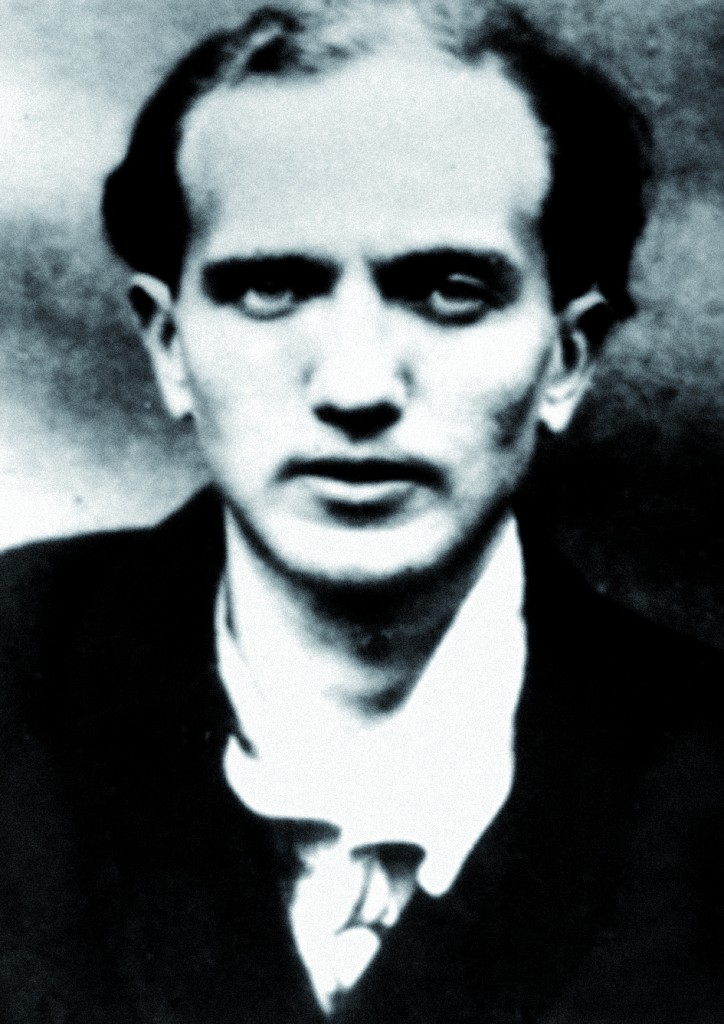
John Lee looked uncertain.

– What are you springing on me now?

– Don’t you worry about it. He’s a man after your own heart. Charlie left the two of them there and walked back for Gila.
– So how long have you known Charlie? she asked.

John Lee scratched his head.

– I can’t say I’ve ever known him. We met in Vancouver about six years back. Moved in the same circles. John Lee laughed, showed teeth that were going yellow. We hung out together sometimes. He helped me, I helped him. Mostly we got drunk together. John Lee shrugged with one shoulder. Even then Charlie was not entirely committed. What about you?  How long have you known him?

– A few days.

John Lee’s lips drooped like his moustache.

– That figures. So what do you think?

– About what?

– Charlie, you both? I don’t know.

Cindy laughed.

– I don’t know either.

– And Krotz, what did you think of Krotz?

– He scared me. I thought he was going to do me some harm.

– He still could. You running with Charlie and all that.

– I know that. Cindy felt her fear return.

– Just so’s you do.

– I took off with Charlie because of Krotz. He knew where I worked. I was afraid he would come after me if he couldn’t find Charlie.

– It’s not unlikely.

Charlie came back in a short while later with Gila. He put the tank down on the table. John Lee squinted into the tank, screwed his face up in disgust.

– Jesus, Charlie, what is that?

– Gila monster. Sort of like an overgrown lizard.

– Is he safe? He doesn’t look safe.

– You’ve got to be careful. Can’t get too close. He must be starving though. We haven’t fed him more than a couple of mice in days.

– He’ll do alright then. We’ve got plenty of mice around here, rats too. Don’t worry, he told Cindy, they don’t usually come in the house.

John Lee fixed up the room for them, moved his belongings. Cindy was tired, woozy from moonshine. She excused herself to rest up a while. The room was small. Apart from an old double bed there was a chest of drawers with a propane lantern on top, a trunk, and a wooden chair. Traps hung from one wall, a large fish stuffed and mounted on another, and a bear-skin lay on the wooden floor as a rug. The window had the same cotton print curtains as the front room. Cindy pulled them over and stepped out of the towel. She lifted up the bear-skin and wrapped it around her, covering her head with its head. Then she turned the skin around and wrapped in its fur climbed into bed. She was losing track of the days already. She tried to trace them in her mind but soon drifted off to sleep.

John Lee told Charlie he’d bring him out to show him his still. He took his shotgun and walked with Charlie back out onto the dirt road where Charlie had parked. He walked over to the trees and moved some heaped up branches to disclose a hidden track. About fifty yards into the forest John Lee stopped and pulled away more branches to reveal a tarp covered truck.

He winked over at Charlie.

– I’m not at home if I don’t want to be.

He got in and started the engine. We can drive some of the way, but after that we’ve got to hike. They drove through dense forest hacked back to make way for a vehicle. They bounced over tree roots and rutted ground. Low branches scraped against the roof and windows. Sunlight filtered through the treetops. Wood pigeons flew from above. After about fifteen minutes of driving, John Lee abruptly stopped the truck.

– Road’s run out, he said taking his shotgun from the rack. We got to hoof it from here.

A small foot-worn trail led through the trees. John Lee whistled as he went.

– This is bear-country, need to let ‘em know we’re coming.

A grey squirrel ran up the tree-trunk to Charlie’s side. John Lee raised his shotgun, got the squirrel in his sights.

– Boom! He laughed, lowered his gun. Haven’t eaten a squirrel since I was a kid. You ever eaten one?

Charlie shook his head.

– Where’d you grow up anyway? John Lee swung the shotgun over his shoulder.

– I never grew up, Charlie replied.

– I guess not many of us do. You sound like you come from out east.
– Further east than you think.

John Lee lifted up a low lying branch and ducked his head under it.

– Are you telling me you weren’t born here?

– That’s right, said Charlie sidestepping the branch as it swung back at him.

– So where were you born?

– That’s a long time ago.

– Not so long you can’t remember.

– This is between you and me.

– Right.

Charlie saw a yellow and black ladybug land on his shoulder. He placed his finger in its path so that it walked on it. He held it out in front of him examined the frail shell of his spotted wings.

– Ireland.

– Ireland!

Charlie flicked the ladybug off his finger, saw it fall then fly to safety onto a branch. Charlie had never told anyone this before. He was on the run from his past. If he hadn’t been laden with John Lee’s moonshine, he most probably would not have told him either. If he hadn’t been running from Krotz. He regretted it immediately.

– Listen John Lee, I don’t want to talk about this.

– Well fuck me, Charlie, there’s a lot of things we don’t want to talk about. I mean I don’t want to talk about this moonshine, and yet here we are. They stepped into a small man-made clearing. John Lee pointed with his shotgun to a small wooden shed.

– Welcome to my world.

Charlie heard the whir of a pump. John Lee opened the lock and pushed the door inwards. A large steel barrel stood in the middle of the floor with a long copper pipe extending upwards from it. Clear plastic tubing attached to the pipe connected into a cylinder and out the bottom into another barrel. Eight ten-gallon oil drums were stacked to one side and a row of plastic containers on the other.

– Bush whiskey, John Lee said.

– How does it work? Charlie asked.

– A little bit of chemistry, nothing more. He pointed to the containers. That’s where I make my mash from. Cornmeal, sugar, yeast, malt, water. You just mix it and let it ferment in the boiler. He kicked at the base of the stainless steel barrel. You heat it up until the mash vaporizes and then condense it. I just keep it pumping around.  Fractional distillation if you remember anything from your school days. Separates the different substances. The water boils off at 100 degrees. The stuff you and I want is Ethyl-Alcohol. That separates out at 78.8 degrees. After that it’s Methyl-Alcohol, turns your brains to jello. That stuff I keep for fuelling my truck.

John Lee started the boiler up. Charlie watched as he fiddled with the faucet and thermostats adjusting the flow until a clear liquid trickled into the barrel. John Lee poured them off a sample in two tin cups. They brought them outside and sat down with their backs against the shed.

– A fucking Irishman! John Lee grinned over the top of his tin cup.

Charlie looked up at the sky through the gap in the trees. A large black mushroom cap cloud had blown in. Cream colored light played at its lower edges.

John Lee  took a drink, tasted its rawness on his throat. So why did you leave?

– I needed a break.

– How long ago?

– Fifteen or so years.

– That’s a long break, Charlie. You ever been back?

Charlie shook his head.

– But you still got family there, right?

– I don’t know.

– You don’t know?

– I never got around to telling anyone I was leaving. Charlie stared into his cup, leaned back against the shed. I needed to start over, he said. Take another shot at it. Turn into the person I wanted to be, not the one everyone else thought I should be.

John Lee nodded in agreement.

– I had a family who drove me to distraction too. A father who drank himself to death and a mother who followed him soon after just so’s she could watch him rot in hell. A sister who disapproves of my lifestyle, and well who can blame her? I do of course, so we hardly ever see one another. It’s possible for years to go by.

Charlie looked around at John Lee’s hiding spot. Another alternative. To clear a path into the heart of the wilds, cover your tracks, stay put.

– Who else knows about this place?

– It’s not a place I bring people to. This is my own illicit part of the universe.

– You’ve got it made.

– You know, Charlie, I believe I really do. He drained the rest of his cup. I’ve got a run to do tomorrow. You want to come with me, bring Lucinda too? There’s a reserve I got to deliver to. We just head north ‘til the road disappears. It’s gravel after that. It’ll take a good four hours to get there. I know a lady there. I sometimes stay a day or two then head back down.

– So there is a lady in your life?

– I wouldn’t put it like that. I see her on occasions. That hardly constitutes my life. So what do you say, Charlie, d’you want to come?

– I would like to go, he said. I believe I really would.

Charlie looked in on Cindy when they returned. He saw her tucked beneath the blankets. He went over and climbed in beside her. As soon as he did she shucked the blankets off them and leapt upon him covered in the bear-skin, growling hungrily.

 Charlie wrestled her down on the bed, rubbed her furry rump. She dug the bear claws into his chest, tore at him. He pushed hard and turned her over on the mattress. The bear-skin fell free of her naked body. Cindy’s arms were raised in the air holding Charlie’s strong wrists.

He saw her eyes drift towards the open door. John Lee stood there watching them.

-Sorry. I was just passing. But he did not go anywhere.

– What is it you can’t see? Cindy asked.

– A way out, John Lee replied.

/

Cindy said, why not, when asked about the trip north.

– You mean it? Charlie asked still recovering from their lovemaking. In the midst of her passion she had bitten him hard on the leg. Charlie screamed with the pain, almost kicked her in the face as he freed his leg from her bite.

– Have I complained this far?

– I just wanted to be sure.

– Well don’t count on that. I’m not sure about anything.

– You’re in good company, Charlie told her. He squeezed her bare shoulder, saw the flush of their passion on her neck and upper chest. He heard the geese again outside. The continual migration.

– What’s up with John Lee?

– Lonely, I guess.

– Aren’t we all, but we don’t go peeping in at other people.

Charlie looked up at the stuffed walleye. It stared back uneasily at him. A different fish entirely than the one John Lee had caught. Its innards removed, its painted skin, its false eyes which stared down at them. Trophy. The traps on the walls looked ready to spring.

Charlie and Cindy arose later that evening. The smell of goose cooking drifted in from the kitchen. John Lee had scalded the goose in boiling water, plucked it on the table. He fed Gila now the gizzard, heart and liver.

– So you guys finally got done. Come and join me.

– We were almost going to say that to you, Cindy said.

John Lee looked embarrassed, wiped his hands on his jeans.

– I’m not used to company.

The black clouds continued to blow in from the east. Thick rolled-over swathes of darkness folded towards the earth. Flat harvested fields, broken-down homesteads, lone trees, ancient machinery. The tireless steel wheels of early tractors, the rotted remains of fencing, loops of unattached wire, giant cylinders of pale nicotine fingered hay, torn strips of clear sky. The humid air was laden with heat, tension.

– It’ll break soon, John Lee said.

As he spoke the trees began to sway, and the forewarning winds swept through. A metal bucket rolled across the yard. A door slammed repeatedly on its hinges. A yellow fork of lightning flashed in the distant sky. Cindy waited for the sound of thunder which never came. The sound of rain, maybe hail, on the roof. Beating against her bedroom window. Huddled into her sister for comfort. Another flash.

– The last storm started a fire a few miles west, John Lee said. Lightning hit a tree. It was so dry the whole thing went up. They had to fly water bombers in, dropping thousands of gallons on top of it, took a couple of days before they got it under control. If the winds had changed, I’d have been out of here for good.

The door rattled and the flaps on the air vents outside smacked down. Gila looked uneasy, his eyes flicked back and forth.

– Had a dog once that would have spent the day howling, John Lee went on. When it finally came he would run and hide beneath the table. There are things those animals can intuit we cannot. A portion of our senses we have forsaken for consciousness. It’s a raw deal when you think about it. Just watch two dogs humping. Going at it as if nothing else mattered, then moments later not giving a fuck about that either.

He spoke now to Cindy as though to explain something to her that would make her feel better about his life.

-That’s why I am alone out here. I’m trying to regain my senses.

A purple sheet of lightning flashed through the window. Cindy felt the flesh of one thigh touching the other uncomfortably. She crossed and uncrossed her legs. A rumble of thunder, ongoing like simmering anger. Charlie remembered the gun in the glove compartment. Telling John Lee where he had come from had unsettled him.  For the first time since he had left, he began to doubt if there was any such thing as a clean break.

Another flash and a louder roar. The world a little edgy. These were the moments of bar room brawls, unprovoked attacks, inexplicable violence. John Lee tapped his feet on the wooden floorboards. Cindy shifted in her seat. Her recently washed clothing already damp with sweat. Charlie’s face unshaven.

John Lee challenged him to an arm wrestle. Cindy watched their gritted teeth, the hard lines of their tensed jaws, the clenched whitened hands, the thick veins of their forearms, the bulge of upper-arm muscle. She recalled the innards John Lee had torn from the plucked goose, how he had dropped them into Gila’s tank, slimy and red raw. Gila devouring them as John Lee devoured Charlie’s strength and resolve, slamming his arm to the table, the bones of his hand cracking down on the wood.

John Lee grunted, let go Charlie’s hand with no expression of pleasure in his friend’s defeat.

– The goose, was all he said and stood up to go to the kitchen.

Charlie looked at his hand and arm as though they were detached from him, and then across to Cindy as if to ascertain that she was not likewise removed.

– You put up a good fight, she said.

Charlie lifted his arm from the table, clenched and unclenched his fingers.

– You cannot depend on me, remember that.

Cindy walked over to the window. The dark cracked open into light. The loud retorts. Charlie looked at Old Bess lying against the wall beside her. Loaded, ready for action. John Lee came back in with the cooked goose on a large wooden breadboard. He laid it in the center of the table. Cindy sat back down. And as lightning flashed around them and thunder roared, they tore pieces off the goose’s plump body with their sweaty fingers and greedily ate the greasy flesh.

 —Gerard Beirne

—————————–

Gerard Beirne is an Irish author who moved to Canada in 1999. He is a past recipient of The Sunday Tribune/Hennessy New Irish Writer of the Year award. He was appointed Writer-in-Residence at the University of New Brunswick 2008-2009 and continues to live in Fredericton where he is a Fiction Editor with The Fiddlehead. He has published two previous novels including The Eskimo in the Net (Marion Boyars Publishers, London, 2003) which was shortlisted for the Kerry Group Irish Fiction Award 2004 for the best book of Irish fiction and was selected as Book of the Year 2004 by The Daily Express (England). His poetry collections include Digging My Own Grave (Dedalus Press) which was runner-up in The Patrick Kavanagh Award.

Nov 102013
 

Diane-Lefer

I have a weakness for the smart girls of history, and Diane Lefer has invented an amazingly smart, innocent (yet bold) 18th century Italian girl, a mathematics prodigy, hidden away in her father’s home till Balsamo, the spiritualist fraud, comes to rescue her (sort of) and wrest from her the occult numerological secrets of the ancient Jews. Just out with Loose Leaves Publishing, Diane’s new novel The Fiery Alphabet is a road book, a little tour of the esoteric philosophies of the age, and a peek into a young woman’s heart — presented as a faux document discovery the author made in her research (see author interview here). The excerpt presented here plays a bit on the combination of Daniela Messo’s naïveté (she offers herself to Balsamo but doesn’t quite know the “form” of seduction; she mis-identifies Jesus as the old man who pooped on the floor) and her brilliance with tenderness and a gently comic irony.

Diane is a dear, old friend of mine from the days when she taught with me at Vermont College of Fine Arts. She as a multiple recidivist, having contributed over and over — works of beauty, passion and commitment — to the pages of Numéro Cinq; she is one of the old guard.

dg


FALcover

 If I had not been raised to be a genius and if Pope Benedict had lived a few more years, my father would not have suffered a stroke on the afternoon of April 14, 1760, my thirteenth birthday. If not for the events of that day, we would not have cut ourselves off from the world, here behind these walls.

If Papa had been in good health four years later, when you first asked to be admitted to our home – a stranger, a Sicilian, without introductions or name – I suspect he would have said no. Instead, he heard your request and looked up for a moment. “Library?” he repeated. “Uh, yes,” and returned to his breakfast, a mush of bread and eggs.

If we had not been trying to save my father’s life and restore his lost youth, we would not have stood before one another naked. Perhaps I should never have reached the point of knowing I would do whatever you might ask.

“Give yourself to me,” you said, and it was as though one of Leibniz’s monads, independent and oblivious to every other monad moving through space – unaware that Pope Benedict and my father, the integral calculus, the deadly man in scarlet cap were all part of the harmony – should suddenly step back and see the entire pattern that brought you to me and made you my destiny. Balsamo.

Give yourself to me, you said. But how is it done? I am willing, don’t you see? I stepped into your arms as easily as I would hand Fiammetta a shawl, and yet I saw you weren’t satisfied. How does one give?

You can give someone a plate of noodles, but then the noodles must be eaten. It is not enough for the gift to offer no resistance – I offer none to you – but it must be offered in a form in which it can be consumed.

The problem: I am not a serving of pasta, nor a pair of lace cuffs that I can give you and even help to fasten at your wrists, an ornament to accompany you in the world.

The solution: I give up my suspicions, I hold you first in my heart and in my mind. I have entertained your friends and I have trusted you with my father’s life. Yet none of this is useful, none of it in the proper form. I have failed you.

This morning, I went to your room.

So much has happened in these short months since you first appeared. I remember you, a slight figure in threadbare clothes, a Southerner, and not quite civilized. Your dark curling beard, your hairy frame made me think of a malnourished satyr. I felt sorry for you then, you were so ugly.

This morning I sat on the edge of your bed. “I love you, Balsamo.”

“Dani,” you said, “you are so innocent.”

“Ignorant.”

“No. Innocent,” you said. “Who are you, Daniela? I want to know you.”

And I started to cry, because you do know me. No one knows me as well as you.

“You keep your secrets, Daniela.”

I have no secrets. I stood before you naked. Not even I have seen myself as you have seen me. I have looked at my arms, my thighs; I studied my breasts as they grew. But I have never seen myself whole. Only these fragments, this part, that. My face in the mirror. Balsamo, no one but you.

No, this is all wrong. I sound like a silly girl and that, above all, is what I am not. Try again.

* * *

God may not watch the world from on high, but I do. A third-story window leads onto the roof and I have scrambled over the tiles to my flat and secret hiding place and I have looked out over Rome. Here, from our house on the hill, while I look down on the church of Santa Francesca and the convent, the bell tower rises in the distance, almost on a level with my eyes. The ruined arch at the near end of the church seems to be getting higher, growing up to poke through the screen of trees. If the arch means something – and Balsamo says it does – I swear I know nothing about it.

Daniela Messo was my mother’s name and what they called me at birth. But I have no mother. I am Minerva, sprung forth with a yell from my father’s skull. He raised me to be a genius, though I have been called other things. Now, at seventeen, I cannot be counted a prodigy anymore, so what am I to be?

I am what I know. So put it all down, Daniela. Then mystery must yield to study, and fears to facts.

“When I think of all I tried to create in this world,” my father once said, “your mind is the one unqualified success.”

That mind has conquered Latin and Greek, chemistry, the integral and differential calculus. I have never before turned it to look at my life.

* * *

My father, Don Michele Messo, is a very good looking man – slender, small and well-defined. His nose comes to a sharp point and his eyebrows form two straight silver lines. His eyes glinted like metal when we bent our heads together over the secrets of algebra and geometric forms, but now those eyes are nearsighted enough to be gentle and dim. My father has always been a non-conformist – perhaps because his only child is a daughter and not a son – yet his bearing is – was – that of, I imagine, a military man. Before his health failed, he had the most wonderful way of standing up from his chair. He never unfolded his body the way some, especially taller, men do. Counting on nothing but the strength of his thighs, he would push himself up, without effort or hurry, his back absolutely straight.

Even before his stroke, I can remember, now that I think back, his memory had become confused. One day, in the spirit of radicalism, he told us – the servants Carlo and Fiammetta, and me – that we were to call him “Michele” from that day forth. We were embarrassed, but he insisted and so we agreed. “Michele,” I said, trying to get his attention. “Michele?” But perhaps he had not heard the word spoken without its preceding respectful Don since he was a boy. At any rate, he had forgotten the sound of it and no longer answered to his name. “Father,” I said at last, and then he looked up and scolded me for my formality.

Papa taught me at home. By the age of seven, I was fluent in Latin and French and could read and translate from Hebrew and Greek. I learned philosophy, and so I could have reminded my father that matter is neither created nor destroyed. He has not made me – at most, he has recombined my elements.

In those early years, I wasn’t kept here at home. I was free, or so I thought. I made my own choices though, now I see, all with the aim of pleasing him. My ignorance of Art is an echo of Papa’s disdain. We agreed that busts of the Emperors glorified tyranny; graven images of saints, gods and angels sprang from disordered minds. In the old days, by which I mean before I was thirteen, my father would call for the carriage and we’d visit his friends – priests, mostly; most every man in Rome is either a beggar or a priest. To dress respectably, even my father often wore a black cassock, and we would go and visit somber homes and palaces, vast, ill-lit and dreary, with bloody crucifixes on every wall, tables covered with bric-à-brac and pretty clocks and stones, and prayer stools arranged so cunningly that a child couldn’t help but trip over them in the dark.

Once, at a time when I could not have been more than two or three, I remember a room where murmurous women petted me and made me stand before the crucifix, looking up at the ragged, punished man upon the Cross. “And you know who He is, don’t you?” they asked, as they kissed me and fussed. I’d had no religious education. The only Cross we had at home hung over our door so that men relieving themselves in the street would show respect and squat a little further down the road.

“She doesn’t know,” the women murmured. “She’s just a baby, a tender babe.”

Even at that age, I was used to being praised for giving answers and didn’t like being treated as a child. “I do know!” I cried. “I do!”, and guessed: “That’s the dirty man who made caca on the floor.”

I can remember quite clearly the women’s shock and my own feelings of shame, but I only know the words themselves because my father loved the story and repeated it many times, but only to the most discreet and trusted friends.

 —Diane Lefer

 ————————————–

Diane Lefer is a playwright, author, and activist whose recent books include a new novel, The Fiery Alphabet, and The Blessing Next to the Wound: A Story of Art, Activism, and Transformation, co-authored with Colombian exile Hector Aristizábal and recommended by Amnesty International as a book to read during Banned Books Week; and the short-story collection, California Transit, awarded the Mary McCarthy Prize. Her NYC-noir, Nobody Wakes Up Pretty, is forthcoming in May from Rainstorm Books and was described by Edgar Award winner Domenic Stansberry as “sifting the ashes of America’s endless class warfare.” Her works for the stage have been produced in LA, NYC, Chicago and points in-between and include Nightwind, also in collaboration with Aristizábal, which has been performed all over the US and the world, including human rights organizations based in Afghanistan and Colombia. Diane has led arts- and games-based writing workshops to boost reading and writing skills and promote social justice in the US and in South America. She is a frequent contributor toCounterPunchLA ProgressiveNew Clear Vision¡Presente!, and Truthout. Diane’s previous contributions to NC include “What it’s like living here [Los Angeles],” “Writing Instruction as a Social Practice: or What I Did (and Learned) in Barrancabermeja,” a short story “The Tangerine Quandary,” a play God’s Flea and an earlier “Letter from Bolivia: Days and Nights in Cochabamba.”


Nov 092013
 

Andre MaroisAndré Marois

The ten-year-old narrator of André Marois’ new novel 10 ans, pas méchant (published by Éditions La courte échelle in Montreal) starts out by pushing a friend into a thicket of brambles — “It was very bad, holes like a colander” — turning him into “a perforated kid.” He doesn’t know why (a bit like Meursault killing his Arab in Albert Camus’ The Stranger but with a juvenile lead). But our narrator, yes, is not really evil, mischievous perhaps, a bit ADHD perhaps, given to perpetrating serial indiscretions and acts of violence. He likes to “get the villain out” as his mother says, so he can calm down. The story is told deadpan, the tone is mordant, black, and insistent.

Marois was born in France but lives in Montreal where he has published a long list of novels, story collections, crime novels and books for young adults. The text is in French; that’s not a new thing; longtime Numéro Cinq readers know that we do publish occasional untranslated works in French. We even have a Special Feature page for this called Numéro Cinq | En Français. Get out your translation dictionaries. It’s not so hard. It will sharpen the mind.

Also, perhaps it does not need pointing out, but Marois sent in the best author photo ever published on NC.

dg

couv 10 ans

J’ai dix ans.

Je ne suis pas méchant.

En tout cas, quand ça m’arrive, je ne le fais pas exprès. Je suis un enfant normal, mais je n’aime pas toujours jouer comme les autres. Je m’en suis rendu compte la fois où je parlais avec mon copain François. Nous étions dans la descente de la voie David, une petite rue près de chez moi. Il tournait le dos au gros buisson de ronces et moi, sans aucune raison, je l’ai poussé dedans. François s’est retrouvé au milieu des ronces, transpercé de partout par les aiguilles. Il a hurlé. Il avait très mal, troué comme une passoire. Philippe l’a aidé à sortir de là. François est parti chez lui en pleurant. J’ai regardé le sang qui coulait sur ses jambes. Je ne comprenais pas ce que j’avais fait.

Mes bras avaient bougé sans que je le décide. Il fallait que je le pousse dans les ronces. C’était sa place, même si je ne savais pas pourquoi.

François n’est pas mon meilleur copain, mais quand même. Il est gentil. Pas le genre à faire de mal à une mouche. Il ne m’a jamais fait de mal. Je n’avais aucune raison d’être méchant avec lui.

Pourtant, je l’ai été.

Je suis rentré à la maison, je n’ai rien raconté à ma mère. Un peu plus tard, celle de François a sonné chez nous. Elle criait. Elle tenait son fils par la main. Il avait du mercurochrome un peu partout, ses yeux étaient gonflés d’avoir beaucoup pleuré. Sa mère a expliqué à la mienne ce qui s’était passé. Elle m’a engueulé comme du poisson pourri. Ma mère lui a dit de se calmer le pompon. Elle me protégeait. François se planquait derrière sa mère. La mienne a dit qu’elle allait régler ça avec moi. Elle s’est excusée aussi. François et sa mère sont repartis. Elle parlait fort dans la rue, en agitant les bras en l’air. Comme si elle voulait gifler les nuages. Je crois que François a recommencé à pleurnicher.

Ma mère m’a dit qu’elle avait honte de moi et que j’allais voir ce que j’allais voir. Pour me punir, elle m’a envoyé dans ma chambre. Je me suis endormi sur mon lit, alors je n’ai pas vu grand-chose.

Elle n’a pas pu me priver de télévision, comme le font les mères de mes copains, parce que nous n’en avons pas. Ma mère m’a privé de bandes dessinées et de dessert. J’ai été obligé de lire un roman pour passer le temps et oublier l’odeur de la tarte aux pommes.

À l’école, tout le monde a entendu parler de l’affaire des ronces. Il faut dire que l’arrivée de François transformé en gamin perforé n’est pas passée inaperçue. Comme s’il avait la varicelle juste en arrière du corps. Il jouait les martyrs. Il m’énervait.

Les filles me regardaient bizarrement. On aurait dit que j’étais un monstre échappé du zoo.

François me tournait le dos dès qu’il me voyait.

Une fois, il faisait ça et il s’est retrouvé avec la face à trente centimètres du mur de briques dans la cour de récréation. J’ai eu très envie de le pousser dessus. Je suis allé vers lui. J’ai sorti les mains de mes poches. J’ai fait un énorme effort pour me retenir. J’aurais pu lui casser les dents de devant ou le nez. Je voulais vraiment le faire, mais j’ai fermé les yeux et j’ai passé mon chemin.

Ce n’était pas un accident, le buisson.

J’ai le droit de m’amuser, c’est tout.

Mes meilleurs copains s’appellent Jean-Marc, Philippe et Stéphanie. Nous nous connaissons depuis notre naissance. Je sais tout sur eux, parce qu’ils habitent à côté de chez moi. Ce sont mes voisins. Nous jouons tous les jours ensemble dans la rue, nous allons à l’école ensemble. Je regarde la télévision chez eux. Nous nous prêtons des bandes dessinées.

Mes copains ne m’ont jamais rien dit sur l’histoire du buisson de ronces. Ils n’ont pas rigolé non plus. Ils ont juste fait comme s’ils n’avaient rien vu. Ils avaient envie d’oublier ma mauvaise blague. Moi aussi.

Nous jouons avec des karts dans la voie David. Ce ne sont pas des vrais karts de course avec un moteur et tout. Nous n’avons pas d’argent pour acheter ça.

Nous fabriquons chacun le nôtre avec une grosse planche et des roues de poussette fixées sur des barres en bois à l’avant et à l’arrière. À l’avant, il y a un axe vertical dans un trou percé au centre de la planche pour la direction. Nous posons un pied de chaque côté de la barre et, quand on la pousse du côté gauche, on tourne à droite, et le contraire quand on la pousse du pied droit. Il y a aussi un siège avec un petit coussin et un dossier, une sonnette de vélo, des accessoires. Nos karts sont peints avec des gros numéros dans des ronds et nous y ajoutons tous les autocollants qu’on peut trouver. Comme si c’était une voiture de course.

Le plus dur à trouver, c’est les roues. Parce que des planches, tout le monde a ça chez soi. Quand t’as des bonnes roues avec des bons roulements à billes qui ne font pas de bruit, tu vas beaucoup plus vite que les autres. Moi, je n’ai pas de très bonnes roues. Elles grincent un peu, même quand elles sont bien graissées.

Le début de la voie David est en pente, après c’est plat. Nous partons d’en haut en courant, nous sautons sur notre bolide et nous faisons la course à fond jusqu’en bas.

Nous avons le droit de nous rentrer dedans et de faire des queues de poisson, mais pas trop fort. Je suis le champion là-dedans. Les autres essaient juste d’aller le plus vite possible. Ils se penchent pour que l’air ne les ralentisse pas. Et moi, je fonce dans leurs roues arrière. Ça les bousille.

Je n’ai pas le choix, je ne suis pas grand. Ceux qui prennent le plus de vitesse dans la descente, c’est les plus lourds, comme Philippe et Jean-Marc. Moi je suis maigre, alors je dois piloter avec ma tête.

Comme eux, je veux arriver le premier.

Quand je leur rentre dedans, ça les énerve.

Il faut remonter nos karts en les poussant jusqu’en haut de la côte. C’est super fatigant. Chacun de nous souffle et transpire et se jure de mieux réussir la course suivante. Alors, quand nous repartons après une descente où j’ai heurté Philippe ou Jean-Marc, ils disent qu’ils vont me percuter à leur tour. Mais ils ne le font pas souvent.

J’adore quand ça arrive.

C’est ce que j’ai découvert.

Quand je suis méchant avec quelqu’un, ça le rend méchant à son tour. Ou bien il a peur et il s’enfuit, mais ça n’a aucun intérêt. Alors quand l’autre devient méchant à cause de ma méchanceté, je suis content.

Je ne suis plus tout seul, ça me rassure.

Nous finissons par avoir un accident, mais comme nous n’allons pas très vite, nous nous faisons juste des écorchures aux genoux et aux coudes. Pour les mains, nous portons des gants sans doigts. Ils ont ça, les pilotes de Formule 1. Nous avons aussi des vieux casques de motos. Il fait chaud là-dessous.

Je rentre chez moi en nage, calmé. Le méchant est sorti, je peux aller dîner sans agacer ma petite sœur.

C’est ma mère qui dit ça : il faut faire sortir le méchant. Je ne l’ai pas inventé. Ça veut dire qu’on a du méchant en nous. Tout le monde.

Je le fais sortir le plus que je peux. Par la bouche, en disant toutes les choses qui me passent par la tête. Par les mains, en poussant du monde dans les ronces, par exemple. Par les pieds, en donnant des coups dans les tibias de ma petite sœur sous la table. Par les yeux, en lançant des regards bizarres à plein de gens. C’est tout ce que je sais faire pour l’instant.

Le méchant sort, mais j’en ai encore dedans, c’est ça qui est bizarre. Il se reconstitue.

Ce n’est pas toujours facile, surtout avec les adultes. Ils ont vite fait de vous donner une claque si vous les embêtez. Je commence à mieux m’y prendre avec eux. Je les surprends en faisant des choses qu’ils n’attendent pas. Je leur lance des œufs sur la tête, par exemple. Ça les énerve beaucoup. Ils ont du blanc et du jaune plein les cheveux. Ça dégouline sur leur col de chemise, dans leur cou. Ils sont furieux.

Je m’arrange pour qu’ils ne me voient pas. Je les bombarde depuis l’arbre qui monte au-dessus du poteau de l’arrêt d’autobus. Aussitôt que j’ai atteint quelqu’un, je saute par terre et je pars en courant. Je cours plus vite que tous mes copains. Je suis le meilleur en sprint à l’école.

Des fois, ceux que j’ai touchés me poursuivent en criant. Des fois, même pas.

Il faut aussi s’entraîner au tir. Je lance des cailloux de la taille d’un œuf sur une boîte de conserve dans la voie David. Je commence à être très adroit.

Le plus dur, c’est de voler des œufs sans se faire attraper. Au début, je les prenais à la maison, mais ma mère a commencé à s’en rendre compte. Maintenant, je les vole dans le frigo des parents de mes copains. Un œuf par ci, un œuf par là, ça ne se remarque pas. Je dois juste faire attention à ne pas en casser un dans ma poche.

Ça m’est déjà arrivé.

Ma mère m’a demandé ce que j’avais fait, et j’ai répondu que c’était François qui m’avait fait une blague pour se venger du buisson de ronces. Elle a trouvé ça bête, mais elle n’a pas eu envie d’aller crier après la mère de François. Pour un œuf, ça ne vaut pas le coup de se déplacer, même si un œuf, c’est de l’argent. Et chez nous, on n’a pas beaucoup d’argent.

Mon père est mort dans un accident de chantier. Il est tombé d’un échafaudage en recouvrant une maison de crépi. Il était maçon. C’est chouette comme métier, maçon. La bonne nouvelle, a dit son patron à ma mère, c’est que mon père n’a pas souffert. Il est tombé sur la tête et PAF ! Mort.

C’est arrivé il y a quelques mois, alors je me rappelle bien de lui, mais des fois, je l’oublie un peu.

Ma mère, elle travaille. Elle n’a pas le choix, comme elle dit. Elle fait des réunions Tupperware pour vendre des boîtes en plastique à d’autres dames. Elle en a une valise pleine. Elle dit qu’elles sont incassables, pas comme les œufs. Elle les laisse tomber par terre pour prouver que c’est vrai. Les dames trouvent ça drôle et elles lui achètent plein de boîtes vides avec leurs couvercles. Il paraît que c’est la meilleure vendeuse de la région, mais nous sommes quand même très pauvres. Je me demande comment font celles qui ne vendent pas autant de boîtes que ma mère. Elles doivent avoir encore un mari vivant.

Mes copains non plus ne sont pas riches. Personne ne l’est.

Si leurs mères apprennent que je jette leurs œufs par les fenêtres, je vais me faire disputer.

Mais c’est plus fort que moi.

Ma mère trouve que j’ai beaucoup d’imagination, surtout pour les mauvais coups. Mais souvent ce n’est même pas moi qui les invente. Je fais des trucs que j’ai entendus, des trucs que tout le monde fait.

Par exemple, je coince une épine d’acacia entre mes doigts. On ne la voit pas. Puis je serre la main de mes copains. Ça leur fait mal. Ils crient, retirent leur main, et moi je rigole. C’est juste une petite piqûre de rien du tout, pour rire.

Je sais bien que la méchanceté va continuer. Si je pique Philippe, il va piquer Jean-Marc, qui va piquer Stéphanie, qui piquera François. Ça s’arrêtera là, parce que François n’osera jamais me piquer. Il sait de quoi je suis capable. J’aime ça, savoir que je lui fais un petit peu peur.

Une autre qui me dérange, c’est ma sœur. Elle m’aime tout le temps, même si je ne suis pas gentil avec elle. Elle me regarde avec des yeux de biche, elle ne comprend pas pourquoi je suis méchant avec elle. Comme quand j’attache les lacets de ses chaussures sous la table, et qu’elle tombe en voulant marcher.

C’est ça que j’aime le plus, quand ça me fait rire.

Quand on est juste gentil, on ne peut pas rire autant. Si je cache un caillou dans une boule de neige que je lance à Jean-Marc, il va être surpris, et sa tête en sang fera rire tout le monde. Il aura un peu mal, bon, mais pas vraiment. Et pendant ce temps-là, les autres et moi, nous rirons comme des baleines.

Surtout moi, je sais.

Ma mère dit que je ne suis pas toujours drôle.

Les parents, ils ne rient pas des mêmes blagues que les enfants. Ils disent des choses entre eux et ils nous bouchent les oreilles et ils pouffent. On entend quand même. On dirait qu’ils ont honte de rire. Moi, je ne me cache pas, je n’ai pas honte. Je ris si c’est drôle, c’est tout.

Tout le monde n’est pas drôle, c’est vrai. Moi, oui. Stéphanie rit quand je raconte une blague. Je sais ce qui la fait rire et j’aime voir ses dents. Je n’ai jamais été méchant avec elle. C’est comme ça, allez savoir pourquoi. Stéphanie, elle a une tête de plus que moi. Si elle voulait, elle pourrait me donner des coups de poing très forts. Mais elle est trop gentille pour ça.

Je ne lui fais pas mal, pas parce que j’ai peur qu’elle m’assomme, mais par principe. On ne frappe pas les filles, c’est comme ça.

Même si des fois on en aurait envie.

Il y a plein de filles à l’école qui m’énervent beaucoup, mais je ne les touche jamais.

Ce que j’aime le plus, c’est quand je trouve une nouvelle idée. Je suis excité comme une puce. Je veux essayer mon tour le plus vite possible.

Comme dévisser la chaise du professeur pendant son absence.

La dernière fois que j’ai fait ça, monsieur Laporte, qui nous enseigne la musique le mardi matin, est tombé de l’estrade sur le plancher, et son front a frappé le pupitre de Jean-Marc. Jean-Marc est au premier rang en classe, sinon il parle tout le temps avec ses voisins.

Monsieur Laporte a eu très mal. Ça se voyait. Il a crié des grossièretés en me regardant, comme s’il n’y avait que moi qui pouvais être le coupable. Il était super impressionnant, avec du sang qui lui coulait au milieu du visage, un peu comme Dracula. Je ne riais pas avec ma bouche, mais en silence dans ma tête.

Le directeur est venu dans notre classe. Il a demandé qui avait fait ça. Tout le monde m’a regardé. J’ai dit que je ne le referais plus.

Personne ne m’a cru. J’ai été renvoyé de l’école pendant deux jours. C’est une très grosse punition dans notre école.

Ce midi-là, Jean-Marc, Philippe et moi, nous avons beaucoup ri. Ça aussi, c’est un truc que j’ai remarqué : on peut rire plusieurs fois du même tour, juste en le racontant encore. On peut même rire de plus en plus fort.

Jean-Marc a expliqué qu’il y avait du sang de monsieur Laporte sur sa trousse à crayons. Un peu dégoûtant, mais marrant.

L’après-midi, ma mère n’était pas à la maison à cause des Tupperwares. Je m’ennuyais pendant que les autres étaient à l’école. Moi j’étais puni chez moi.

On ne peut pas faire une course de karts quand on est seul. Ni pousser un copain dans les ronces.

Je ne peux quand même pas me taper dessus pour faire passer le temps.

À force de m’ennuyer, je cherche de nouvelles idées.

— André Marois

—————————————————-

Né le 21 mars 1959 à Créteil (France), André Marois étudie deux mois en arts plastiques et cinéma à l’université Paris VIII, puis deux ans par correspondance pour obtenir le brevet de technicien supérieur (BTS) en publicité, en 1981. Il effectue ensuite son service militaire comme dessinateur chez les pompiers de Paris, puis démarre une carrière de concepteur-rédacteur publicitaire en 1982, dans diverses agences parisiennes. Il émigre à Montréal en 1992 avec ses deux enfants, pour travailler comme publicitaire pigiste jusqu’en 2006. Il y habite toujours, en plein cœur du Plateau-Mont-Royal.

Depuis 1999, il publie des romans noirs pour les adultes, des romans policiers et de science-fiction pour les enfants et les adolescents, ainsi que des nouvelles pour tirer sur tout ce qui bouge. En 2013, son roman Les Voleurs de mémoire a gagné le Prix jeunesse des Libraires du Québec. Depuis, 2006, il donne des ateliers / conférences auprès d’étudiants de primaires, secondaires, cégeps et universitaires sur l’écriture, le polar, la nouvelle noire : Edmundston, Gatineau, Montréal, Vancouver, Winnipeg, UQAM, Bordeaux (France), Sudbury, Gatineau, Québec, Toronto, Windsor, and Calgary. Depuis 2010, il est chargé de cours à l’Université de Sherbrooke : créativité et rédaction.[1]

/

/

/

/

/

Footnotes    (↵ returns to text)

  1. Bibliographie
    Romans
    201310 ans, pas méchant, Éd. la courte échelle
    2013La Fonction, Éd. la courte échelle
    2010 9 ans, pas peur, Éd. La courte échelle
    2010 Sa propre mort, Éd. La courte échelle
    2008 Passeport pathogène, Éd. Héliotrope
    2003 – Les effets sont secondaires, Éd. la courte échelle (Édition de poche 2006)
    2000 – Tête de pioche, Éd. Les Allusifs
    1999 – Accidents de parcours, Éd. la courte échelle (Édition de poche 2006)

    Recueils de nouvelles
    2013 Santé !, Éd. L’Atelier Mosécu, France (coauteur)
    2012 Printemps spécial, Éd. Héliotrope (coauteur)
    2011 Petit Feu, Éd. La courte échelle
    2010 Tab’Arnaques, Éd. Québec Amérique (coauteur avec Luc Baranger)
    2008 M.O. Crimes of Practice (Crime Writers’ Association Anthology), Comma Press, UK (coauteur)
    2006 – Du cyan plein les mains, Éd. la courte échelle (Édition de poche 2006)
    2005 Boucs émissaires, Éd. Les 400 coups (coauteur)
    2001 – 38 morts dont 9 femmes, Éd. Trait dʼunion
    1998 Circonstances particulières, Éd. L’instant même (coauteur)

    Romans et albums jeunesse
    2013 – Petit Pat tome 1 : Tout le monde dehors !, Éd. la courte échelle
    2013 – Les voleurs de mémoire, Éd. la courte échelle
    2012 – La Forêt des insoumis, Éd. Boréal
    2011 – En mai, fais ce qu’il te plait, Éd. Boréal
    2010 – Mesures de guerre, Éd. Boréal
    2010 J’aime pas les mascottes, Éd. Les 400 coups
    2008-09 – Les Allergiks, feuilleton en 13 épisodes, Éd. la courte échelle
    2008 Papy, où t’as mis tes dents ? Éd. Les 400 coups
    2006 – La main dans le sac, Éd. la courte échelle
    2006 – Au feu!, Éd. la courte échelle
    2005 – Vol à l’étalage, Éd. la courte échelle
    2004 – Avis de recherche, Éd. la courte échelle
    2002 – Meurtre à l’écluse 50, Éd. la courte échelle
    2001 – Les voleurs d’espoir, Éd. la courte échelle + réédition en janvier 2013
    2000 – Blanc comme la mort, Éd. Boréal
    2000 – Tueurs en 4×4, Éd. Albin Michel (France)
    (trad.allemand, Mürder im Geländewagen, Éd. RoRoRo)
    1999 – Un ami qui te veut du mal, Éd. Boréal
    1999 – Le Chat botté à New York, Éd. Les 400 coups
    1999 – Riquet à la Houppe, Éd. Les 400 coups

    Prix et mentions

    – Les Voleurs de mémoire, Prix jeunesse des libraires du Québec, 12-17 ans, 2013
    – Mesures de guerre, finaliste au Prix jeunesse des libraires du Québec, 9-11 ans, 2011
    Sa propre mort, finaliste au Prix Saint-Pacôme du roman policier 2010
    – Les effets sont secondaires, finaliste au Prix Saint-Pacôme du roman policier et au Prix Arthur-Ellis Crime Writers of Canada en 2003
    Mon œil, Grand prix des Magazines du Québec, catégorie Chronique d’humeur, 2008 et 2010
    Petit feu, 2e prix au concours des prix Littéraires Radio-Canada, catégorie ouvelles, Montréal, 2006.
    – Le tueur autodidacte, gagnante du concours de nouvelles policières de Ligny, Belgique, 1999.
    Belle mort, gagnante du concours de nouvelles de la revue Stop, Montréal, 1995.
    Dialogue de sourds, gagnante du concours de nouvelles de la revue Nouvelles Fraîches, Montréal, 1994.
    – Van Gogh a encore frappé, gagnante du concours de nouvelles policières du journal Voir, Montréal, 1993.

Oct 122013
 

Robert Miner in Cyprus

For years, I’ve listened to Robert Miner’s stories of his time in Turkey and Greece, when he was young and carefree, if not downright mischievous. Once as a boy, he set fire to a Turkish village by accident and burned half of it down. Once in Greece during the civil war, a servant took him out at night and he saw a tank drive by festooned with human heads. Bob is an old, old friend — we used to be young writers together, skiing at Gore and Stratton or on the backwoods trails behind Lake Desolation in the winter, going on roads trips in the summer, talking, talking about writing.

This is an excerpt from a novel-in-progress called Night Work, a long ongoing project based very loosely on his own and his parents’ experiences in Turkey where his father was a teacher at Robert College (as was Bob, later in life) and then a diplomat (and probably a spy). Bob’s mother came from a distinguished Anglo-Turkish family threaded with exotic businessmen, beautiful women, elegant learning and dashing adventurers. The stuff of legend.

I give you fair warning. This chapter is not for the faint of heart. It wreaks of a kind of evil that exists in places where cynical wealth enables desires we mostly cannot conceive of except in police reports or United Nations exposés of sex trafficking and tourism. It has its literary roots: Justine frantically searching the child brothels of Alexandria for her lost daughter in Lawrence Durrell’s Alexandria Quartet (remember the walls decorated with tiny anonymous childish palm prints?) or the amazing porn movie scene in Nathanael West’s great Hollywood novel Day of the Locust. Money, decadence, depravity and the mysterious seductiveness of transgression, of going beyond.

dg

At night they look like huge prostrate skeletons, looming for miles at the edge of the old city.  Massive stone block walls fifteen feet thick, forty feet high.  They’ve been there in one form or another since AD 413 when the Byzantine Emperor Theodosius II had them built from the Sea of Marmara to the Golden Horn.  Behind these walls with their ninety-six towers and triumphal gates, their treasure rooms, torture rooms, and dungeons, the city multiplied, secure.

Definitions of security have changed since.  The walls in places have been allowed to sag into ruin by a people more fatalistic, or perhaps merely defeated by manipulations of time that no walls, however formidable, could withstand.  Still, in one section of the walls, the most temporary of peoples has found a permanent existence.  No one knows how long they have lived in the catacombs and cisterns, deep inside the secret passages between huge walls and ancient dungeons, but huddled against the fortifications of the northwest section of the old city live the gypsies of Istanbul.

It was here I found myself staring at the giant slumbering bones of the city walls late one night in May, 1935.  The moon traveled across the battlements under hot, fast-moving clouds.  No other light could be seen, though a city of gypsies murmured in the shadow of the Fifth Military Gate, the section of the walls the ancients called Murus Bacchantes.

This night Prescott was dressed in what he called his nocturnal missions costume — his mackintosh, walking stick, monocle and hiking boots. Weekends lately, he had methodically dressed himself in this manner after classes on Friday, then disappeared for two days on solitary ventures into what he called the geology of place.

Ian  — and Frau Begus in her vigorous teutonic determination — had been leading us along the moat, now a gentle grassy valley parallel to the walls.  We’d passed no one and hadn’t seen a car.  Dogs barked, and I remembered Stefan Genotti’s stories of wild dog packs. We passed a silent group of dark bodies curled together in the ditch by a donkey cart. In my agitated state they looked to me like the victims of some casual wartime atrocity, left to rot.

Ian was looking for something as we walked. He kept stopping and studying the walls. We’d walk a bit, feeling nervous and exposed and horribly out of place, as if the hordes who’d been frustrated by these walls a thousand years before might tonight return to wreak their revenge on us.

Ian found what he’d been looking for. He headed across the moat toward a dark space on the wall that soon showed itself to be an arched entrance to the old city.  Once it would have had metal doors, but the archway was open now, and as a cloud moved across the night sky above us, I could see moonlight slide across a narrow road inside the walls.

“Now it’s essential that we keep quiet till we get to the house,” whispered Ian. “Not everyone here welcomes such intrusions. And besides,” he said, laughing, “who knows that manner of ancient pestilence you might inhale.”

There were seven of us, not all Americans. There was the Armenian wife of an English teacher from the German girls’ school in Pera. She had dark hair that shone almost blue, like a grackle. She talked in explosive whispers with her husband, grabbing at his sleeve, and she glanced everywhere around as if each look were her last. Prescott walked next to Ian, pointing at parts of the wall with his stick. Frau Begus had her arm around a stocky blond British woman — a nurse from the hospital, from what I had gathered when we met at the bus station earlier in the night. The nurse had said very little and seemed unaccountably somber in the midst of all these nervous talkers.

We walked for five minutes through a series of very narrow alleys between the walls and tall rickety looking wooden houses. In places the houses were built into the orifices of the walls and I could see candlelight flickering through arrow slits and murder holes the architects had built into the masonry. There were no streetlights and the alleys were slippery underfoot.

Once, incredibly — almost as if it were out of time — we heard engine noise and saw the beams of a car light as it squirmed down a nearby alley.

Frau Begus was knocking on a bright green door in a kind of wooden wall over the face of a giant doorway in the walls. I looked up and could see windows fitted into similar wooden barricades over other openings in what I now realized was a large octagonal stone tower, perhaps sixty feet high.

“Buyurunuz. Please come in,” a woman’s voice was saying in Turkish. But there was a strange lilt to the language which made it seem peculiarly foreign. Frau Begus and Ian had gone in first, followed by the English teacher whose name seemed to be Bunny and his black-haired wife. She was still vigorously whispering to him. Next went in the British woman whose name I didn’t know. She was tall and bovine but with long blond hair that the lady of the house ran her hands across, saying something admiring.

Prescott went in ahead of me, carefully stepping over the battered stone block that served as a threshold for the door. I could see the gypsy woman clearly. She had mahogany skin and very curly black hair. Her eyelids had been heavily painted hummingbird green and she was wearing lipstick the color of arterial blood. I couldn’t tell if her eyes were really almond shaped or just painted that way, but the effect either way was unnerving.  I wanted just to notice the artifice, but instead I found myself taken in.

She nodded and said something to Prescott. I wondered if they’d met before. Now the woman was smiling at me. It unnerved me again, a smile so genuine, as if I were actually giving her some secret pleasure that very moment.

Inside, the place smelled intoxicating. Onions cooking. Oregano. Fried liver. Hot cheese pastry. Thyme. Sumac. Cinnamon. There were oil lamps on two small wood tables in the corners of a sizable room, whose back walls were the soot-blackened blocks of the fortifications we’d just passed through. The floor was soft underfoot with dark-colored carpets. Lining the walls were huge thick pillows made from camel saddlebags, also of some kind of carpeting.

There were perhaps ten other people seated already, and I selected a pillow in a corner. I was being scrutinized by a thin man whose gold teeth shone like machinery in the lamp light. He was impassive except for his eyes which didn’t seem to blink. Why was he staring at me, I wondered. There were all these other foreigners here.  All these other voyeurs.

I wondered if that was what I was, too, simply a voyeur. Is that why I had come? “These things are never the same,” Ian had kept saying when I asked for details. But now, seated in the back of a dark room in an unnerving place, surrounded by strangers, I realized I could not have imagined how I might feel. Maybe, though, that is what he was saying: you can’t have an experience without having the experience.  You can’t fake it.

Two girls in long flowing red dresses and noisy earrings came in from another room. They carried trays.  One handed us plates from hers, balancing it in one hand and bending effortlessly to set plates on the floor for people who were talking too animatedly to notice her. The second girl carried small glasses of clear liquid.  Each of us got one — along with a piercing open look from her. I wondered if she were memorizing our faces for some reason.  I wondered why I wondered all these things.  Why couldn’t I just enjoy myself as the others seemed to be?

Frau Begus, for example.  I saw her reach for the girl’s hand and pull her closer to whisper something. The girl merely grinned and Frau Begus laughed, smiling almost menacingly at Ian. She had been carrying a small case, about the size of a doctor’s bag.  She was pointing at it, smiling perfect sharp teeth at Ian, who kept making mock gestures of dismissal with his hands. As if the thought were preposterous. The very idea….

Frau Begus got to her feet and her voice took on a sudden soft edge which silenced all talk. “Gentlemen” (it sounded like “Jentelmen”) “and ladies, of course. We must toast Mademoiselle Nina, our hostess tonight.  And a toast to the djinns of the city, the spirits of the underworld.  We are in their world tonight — no?” She studied us, daring someone to disagree. In the muted light her skin glistened metallic like antique copper. “Raki,” she said, pronouncing it so it rhymed with “khaki,” the way the British pronounced it. She was pointing to her glass which she held in her right hand at a slight angle.  “Let us begin,” she said, and downed her drink.

I, too, downed my drink. It felt like some vast vacuum I’d swallowed, absorbing my tongue and throat into it, sucking them dry. My eyes watered, and I tried to wipe them secretly with my sleeve as I held my glass high in the air for the serving girls. They came around again with trays, one for the empties, one with a new full glass for each of us.

Ian stood, brushing back his long hair and looking slightly crazed.  His voice was higher by an octave.

“Welcome to the Inferno, gentle friends. Here we stand outside ourselves. Ex-stasis. We are traveling with no cultural baggage, gypsies tonight of the senses. Deep in this tower there is an inscription from a French ambassador, imprisoned here awaiting torture.  It’s neatly scratched on the wall and says:  ‘Prisoners, who in your misery groan in this sad place, offer your sorrows with a good heart to God and you will find them lightened.'”

Frau Begus reached for Ian’s arm, signaling him to be quiet. “Ah, forgive me,” Ian said. “My companion here is being exigent. Women are always in a hurry. Though I suppose without that, Eve mightn’t have discovered sin for us.”

He said something in Greek — or it sounded like Greek. We drank again. I noticed the man and woman of the house had joined in that one. A new round of drinks, this time accompanied by a tray of meze — appetizers of crisp hot pastry filled with goat cheese and spices. Lamb liver fried in olive oil, served with freshly washed, nude leeks. Another round of raki. This time no watering of the eyes and I wondered if I were drunk. I didn’t feel  drunk. I felt paralyzed, a  pillar of salt.

We were sitting in a semicircle in the front half of the room, facing the dark stone walls; on one side, what was once an ornate marble doorway, framed in geometric slabs; on the other, a rough, dark stone entrance, leading, I assumed, into the tower and its adjoining walls. I had a momentary vision of corridors like a ship, like a submarine, populated by generations of gypsies who never saw the light.

The talk was deafening. I’d been shouted at and had shouted back at the Armenian woman, whose name is Annie. We’d been exchanging exclamations about the fried mussels and the kukaretzia. The gypsy woman appeared with an accordion. The man had some small pottery drums, shaped like hourglasses, with skin stretched across one end. Frau Begus and Ian could be heard expostulating. She was embracing him ostentatiously, as if for someone else’s benefit. Not hers or his, certainly.

“Ah, enfin,” said Annie. “Now just you wait, uh—what was your name?”

“Lewis.  Lewis Dyer.”

“Well, Lewis.  Yes.  Just you wait.”

“So you’ve seen this before?” I asked.

“Not exactly.  But Bunny — my husband — has.  And he’s told me.”

Frau Begus got up and went to the tables to blow out the oil lamps.  The gypsy woman lit one to our side and turned it up, so we were in darkness while the empty part of the room, between the doors, turned yellow.  Specks of mica sparkled in the stone.

I realized that the drums had begun and were only now becoming loud enough to hear. I had felt them before I could hear them, sound waves bouncing off the stone.  The gypsy was seated by the wall to my left and he’d brought a thin long stick with him, decorated with woven ribbons of bright colors.

The drums increased in volume and then the accordion began. One of the serving girls — the taller, older one — returned with a tray of glasses, and we all, I noticed, drank greedily. The anise taste, before somewhat cloying, now seemed merely voluptuous. The music flexed and rippled to the pumping of the drum. Someone was clapping. I found Annie’s hand on my hand, though she was looking the other way.  I wanted to be thrilled, but I was embarrassed instead. I didn’t dare move my hand and I didn’t dare respond.  My hand felt as if it were going to sleep.  Pins and needles.

When the first girl emerged it was almost an anticlimax. She looked so young now, more painted up and with fewer clothes on.  She was wearing thin, almost transparent pants gathered at the ankles.  And a thin blouse gathered at the elbows. I was reminded of Catherine, long-ago, when she’d dress in my mother’s clothes and try to make up her face. The child — and I now saw she was very young, perhaps twelve — had begun to rock her hips and twist her shoulders to the music.  It seemed pathetic, a desperate attempt to force her sex too early out of hiding. Now she turned to face away from us and was rocking her hips more, bending slightly so that her buttocks made firm outlines against the loose pants.

Annie was rocking. The pressure from her hand on mine increased rhythmically. She still hadn’t looked at me and she began to work her fingers down between mine, her palm massaging the top of my hand. Still I didn’t move a muscle. For a while I had managed to forget I even had that hand.

There was a quick, violent silence. The girl stopped suddenly, then turned rather too dramatically towards us, unbuttoning the blouse as she did. The drums began again and the girl opened her eyes wide so that the painted eyelids almost disappeared. The dark black lines made her eyes look trapped, something human where there should have only been the votary, the child whore.  She was pressing her chest forward, pulling the shirt against it and twisting her shoulders at the same time.  I could see small mounds the size perhaps of a cupped hand. A child’s cupped hand. The nipples traced a crease in the material of the blouse. For a moment the audience went quiet and I thought for some reason the girl looked frightened.

The buttons were opened — I noticed how small her hands were — and the girl now turned away from us again opening the blouse and working it off as she rocked her hips. The music became louder, and Annie more insistent. Her fingernails dug between my fingers into my palms. I looked to see if anyone had noticed.  Everyone else seemed rooted on the young girl dancing.

Frau Begus moved closer to the dancer. The English lady was sitting bolt upright, her long yellow hair making her look from the back like Alice in Wonderland on her long neck. She didn’t seem to move at all for the long instant I watched her. I wondered idly, if someone next to her, perhaps, had a hand somewhere even more intrusive than Annie’s on mine.  Or if maybe that woman, too, had been turned into a pillar of salt.

Prescott was back against the wall to my right by himself. He had removed his monocle but otherwise seemed expressionless and really rather relaxed. He might have been at a faculty tea. That same professionally bored but alert look.  I envied him his grasp.

By now the dancing girl had turned again and was holding a hand over each place where her breasts should have been. She was squeezing herself, trying to look aroused. For a moment I was taken — I found myself believing — then the sensation was gone, and I began to wonder what she thought as she looked at me.  She seemed to be looking hard at me. Could she see me in this dark?

“Bravo.” It was Ian’s voice. And it sounded like two words.  “Bra-vo.” I wanted to think it was ironic, and that I was not the only apostate. But Ian was clearly urging her on because he had begun clapping his hands hard, to the music, holding them way in front, towards her. I saw her smile, then slowly slide her hands off her breasts and towards her thighs. Others began to clap. I stared at her breasts, barely a cupped hand’s worth. Tiny whitish nipples. I remembered stories boys told of how dancers and models had to have their nipples stimulated to make them stand out. Who had done that for her back there? The other girl? I wondered if I was losing my grip, thinking such things.

For a while the drums stopped. The man appeared from the kitchen carrying two large hookahs. They had been primed and lit and as they were set down people began to take eager turns at the nozzle.

Now a great shout broke out, much vehement clapping and talk. The music had slowed to a canter and the girl had turned to the wall, rocking her tight little buttocks in a slow perfect circle. She pulled at the top of her pants and slowly worked them down about half way over her buttocks. The accordion music stopped. The drums began, ever so slowly, again.

Just the drums and the sudden quiet of the audience. The girl’s pants were down at her ankles and she was stepping out of them as she clenched the cheeks together.

I don’t think it was either the raki or the hashish — though they are the most conventional explanation — but only parts of the rest of the evening remain clear to me now. I know there was another dancing girl. I remember her mostly because she seemed older and had more to work with. She didn’t remind me of my sister Catherine.  Poor Catherine.

She danced and undressed for a while alongside the first girl. It had been she, I remembered, who smiled when Frau Begus had whispered at her, but it was the younger girl Frau Begus took upstairs with her.

That part I remember clearly. I had been smoking the hookah, sharing it with Annie (who still held my hand impaled, like a hawk with its prey) and concentrating on the apparatus and the fearful lotus sensations I expected.

I heard a rhythmic clapping and looked up to see the accordion  player poised near the younger girl, a long colored switch in her hand. She was flicking it at the girl’s body in time to the drums. And the clapping.  Now the girl arched and twitched as she was stung by the whip. There was something fascinating about this. It reminded my of the cool businesslike violence of certain hockey players I’d known. Nothing personal, you understand. Just doing my job. Had the woman been angry, or even the girl angry, it would have been different. Instead it was just pure disembodied discomfiture, perhaps a kind of art. The tempo of the drums increased, the whip came faster and left angry marks. The girl yelped and tried to continue her dance. Once she opened her eyes wide and stared at me. I’m sure at me this time, and I was stunned again by that look.

Frau Begus was up and shouting to Ian. At first Ian refused whatever it was she was urging, then people around him took up Frau’s chant.  To much hilarity and cheering, Ian found his way to his feet. Frau had her bag in one hand and had taken the younger dancing girl by the forearm, pushing her in front of them as they moved toward the tower door. Several people in the audience were on their feet, clapping and shouting. The three of them disappeared through the door, then I noticed a lull, many of those same people looking strangely somber and tired.

While the other girl danced and flexed herself and the hashish was passed, several more youngsters paraded into the room behind her.  Most of them could have been no more than twelve. Two of the boys were quickly spoken for and left with older men from the audience through the stone gateway to the right, accompanied by the gypsy woman.

Annie had unclenched herself from my hand and was quietly holding both her husband’s hands.  She seemed subdued. Perhaps it was the hashish.

The gypsy woman brought a girl to me at some point, a somber little girl, older perhaps with beautiful arms and huge brown eyes hiding behind a garish painted face. I shook my head, horrified. Or scared. Maybe they are the same thing, I don’t know. The woman was trying to tell me something complicated. I couldn’t understand. I kept shaking my head, the girl looking more and more frightened. She tried caressing my face, this strange, quiet girl. It was like having your child comfort you, only she seemed also so much older than her body. And she seemed infinitely sad. She tried running her little hands down inside my shirt, fumbling for my nipples. I wondered if maybe it was just a ruse to pick my pocket. Other girls were fondling people in the audience, men  and women alike. I imagined little magpie hands running over jewelry and rings and private parts.

Finally the gypsy woman said something to Annie. Annie said something harsh back to her. Then Annie leaned over to me, looking at the girl with new interest. “She wants to sell her to you.”

“Yes. I assumed that. I’m not interested.”

“I don’t think you understand.”

“Oh yes, I do. The youngest member of the oldest profession — correct?”  I felt worldly and ashamed at my callousness at the same time.

“Not correct. You forget perhaps where you are. What you are. The gypsy woman is offering the girl, not just her body.  She wants you to buy the girl, take her away from here.”

The gypsy woman misread the look of astonishment on my face, for she began talking very fast to Annie, and hissing something at the girl, who stared at me, then caught herself and looked down at her feet.

The girl reached to her knees for the end of her shift and a little two quickly pulled it over her head.  She was more voluptuous than the other girls we’d seen, with fuller breasts and pronounced hips. I didn’t look below her waist. The gypsy woman took her by the shoulders and turned her around. Skinny back, very straight, with several distinct rows of small thin scars. She was standing on her toes, I noticed, perhaps trying to make herself more for the money.

“Annie, what’s going on? I’m no white slaver, for Chrissakes. This isn’t ancient Rome  — or Byzantium —“

“Oh yes it is. Nothing changes here. But listen: she tells me this is her daughter. Her own daughter. Liane.  The others — merchandise. But the woman wants you to take the girl away from this.”

“How, for God’s sake. This is insane–“

“Away from what waits for her here.”

Indeed, just before she said that we had all heard two quick stifled screams from the tower. Then a longer drawn out one. Almost in time to the music, almost drowned out by it.

“You want Frau Begus to doctor this one, too?”

This girl had turned around again, at first covering herself with her hands, then, with a start, uncovering herself, dropping her hands to her sides. I stared at her, appalled even to have to imagine such a choice.

I found the gypsy woman looking at me now. I couldn’t read her face, but it had the same expression I’d noticed when she smiled at me at the door. As if I were special to her.  How did she know that?  What did she know that I didn’t know?

“Listen.” It was Annie again, sounding tired. “I got carried away. Forget it. This will happen again and again.  You must do only what you want in this city. The others here, they’re doing what they want. No one wants girls — except, of course, Frau Begus.”

Annie turned away quickly, clutching at her husband who seemed oblivious to the whole exchange. She stole one more long look at the little girl and seemed to shudder. Her husband put his arm around her.

I didn’t notice how much time had passed when a tall gray-haired man returned with one of the girls, then two men with boys. The children stayed at the doorway looking matter of fact. The men took their places in the audience quietly for the most part. Frau Begus and Ian returned more noisily. More clapping and laughter from their friends. The girl was dressed in a shift and her makeup had run about the eyes. She looked curiously innocent. She tried a brave smile as she entered the room, but her eyes filled with tears that sparkled in the light and she turned away.

“Well, what would you have done with her, dear?” I heard Ian say to a man next to him.

Frau Begus was showing something in her case to a nondescript man with spectacles. “The finest ivory,” she was saying, “perhaps a bit much for a young one, eh?  But just right I’m sure for you, if you’d like, my dear?” Her smile seemed genuine, almost solicitous. I wondered if I were mishearing the conversation, inventing it from some unspeakable parts of myself.

We left the house long after midnight. The moon was lower and the walls cast deep shadows over the streets. I was exhausted, barely able to make my legs work right and for a while trailed behind the rest. I tried not to think about the horrors the walls had witnessed, but I kept imagining the anguish, the cleavered limbs and heads falling to the bloody pools at the base of the towers, being washed out to sea.

Pariah dogs slunk across the streets, looking sideways at us. I was reminded of the look the gypsy woman gave me when I left, the look you give someone you think is mean and petty, too righteous to care. I felt sick. The tram station was empty and stayed that way. A taxi passed and we crowded into it. Except, that is, Ian and Frau Begus who elected to stay and try another place.

“It’s almost as if they tempt the fates,” I said to Prescott, “asking to get hurt.”

“For a change, Lewis, you got something right. Not that you would understand, of course. But for them that, too, is a kind of escape from the obligations of what we call civilization.”

—Robert Miner

———————————————-

Robert Miner has published two novels, MOTHERS DAY and EXES , worked at Newsweek, and has written for The New York Times, The Washington Post, Newsday, Esquire, Outside, Adirondack Life, Redbook, Glamour, etc.  MOTHERS DAY was nominated for the National Book Critics Circle Award. The New York times called it “relentlessly savage…picaresquely comic,” the Financial Times of London found it “extremely funny…an extraordinary first novel.”

Oct 122013
 

wilson_St_pauls

wilson_ballistics_hc

Ballistics
by D.W. Wilson
Bloomsbury Publishing (US & UK), Hamish Hamilton (Canada)
384 pages, $26.00

In a novel called Ballistics, you expect a gun to go off. The reader is satisfied in this respect very near the beginning of D. W. Wilson’s first novel. We learn about the gun from Archer Cole, one of the novel’s two narrators: teenager Jack West puts a bullet in the leg of Archer, a U.S. army deserter, as Archer is trying to break into the West’s hunting cabin. Jack’s father, Cecil West, tackles Archer (they “scramble like beasts”). Archer’s introductory story is, as his daughter Linnea says, “hyper-masculine”: Archer studs it with such phrases as “what went down,” “in your sights,” “the old bastard,” “hunched like a guerilla,” “tear-assing,” and “hearing gunfire like popcorn in my skull.” Archer describes Cecil as having “a menacing way of moving forward, as if he knows how to handle himself, as if he’s going to rip me a new asshole.”

Cecil West does not rip Archer Cole a new asshole. Instead of handing him over to the authorities, Cecil does the right thing: he sews him up, offers Archer and Linnea a place to sleep, finds him a job. Befriends him. While there is no date given for the beginning of these relationships, we know it is towards the end of the Vietnam war, as this is Archer’s third call up. Archer’s narrative throughout the book takes place in the early 1970s.

Archer Cole is looking back. The main action, in the present of 2003, is narrated by 28-year-old Alan West, the first narrator. In Alan’s story Archer Cole is a bitter old man dying of cancer. There are eight chapters in the novel, and in every chapter, Alan speaks first, then Archer speaks second. Until halfway through the novel, Archer gets about ten more pages than Alan. When the past catches up to infant Alan’s abandonment by his parents (Jack West and Linnea Cole) 30 years ago, or when the past starts to help us understand the present, Alan West’s tale takes up more pages, including the whole of the last chapter. And rightly so, because Alan is the catalyst of the action: his grandfather, Cecil West, believes he is dying. Gramps sends Alan on a quest, to fulfill his dying wish, to bring home his son Jack, whom he has not seen in three decades.

There are, of course, obstacles to Alan’s quest. The most physical is the forest fire raging between him and his destination. The setting is the Kootenay Valley in B.C. — familiar territory to D. W. Wilson, as he grew up there (and set his first book there — the short story collection Once You Break a Knuckle, 2012).

breakknuckle

Although Alan West is the first narrator and the man on a mission, he is not the main character in the novel. Rather, the two families are. Wilson is interested in connections: how past actions affect the present, how one person’s action can affect five people even thirty years later. How the Wests could not have what they desired, and what the Coles desired caused pain to others. As Wilson’s narrators tell their stories, they also tell us what it was like to live in the Kootenay Valley, in that place at that time. Similarly, in Once You Break a Knuckle, Wilson tries to create a sense of place, of community, by having characters appear in more than one story, and through their (sometimes violent) interactions with the outdoors. In “The Dead Roads,” the story that won the BBC National Short Story Award in 2011, the landscape – bare, trees laid waste by beetles – presses itself in on the consciousness of the characters. In Ballistics, the forest fire forces Alan West to make an alliance with Archer Cole, who will guide him through the logging roads.

When Alan realizes that Archer is his maternal grandfather (Linnea’s father), he demands the truth about his parents, a truth Gramps would never talk about. This request is not only the premise for Archer’s stories (he often begins, “Here’s a story about…”) but also a motive for Alan to abandon his PhD thesis and drive towards a forest fire with an old man he doesn’t know. He wants to know why they left him to be raised by Gramps.

Archer, however, is not a reliable narrator. He lies to himself, to his best friend, to his daughter, and in the end, to Alan West. We have to pay attention to catch him at it. Sharing an unzipped sleeping bag with his 14 year old daughter, he contents himself with “I like to think I made a pretty good dad.” But there are hints that he is a bad father. He “barked” orders at her, he whistled for her to come out of hiding, he left her alone with the boy who shot him. He subdues her by his “military what’s-what.” He never tells us a good story about her, or a song she sings, or even her favourite anything. In one of Alan’s sections towards the end of the novel, Linnea’s partner calls Archer “a shitty dad” and tells him that Linnea left her father “for good reason.”

When 19-year-old Linnea informs her father that she is leaving home, she says simply, “I’m pregnant. But I can’t stick around to raise a kid with Jack. I’m sorry, Dad. You’ll have to let me go.” Straight and simple. Tough and to the point. But after she has gone, what does Archer tell Jack? “She said she didn’t think you’d make a good dad.”

Alan must extract the truth for himself. When he finds his mother, Linnea, he asks why she left. First she volunteers, “We were kids, Alan. Doesn’t matter what he [Jack] tells you. We were kids.” But when Alan insists (what drove you to leave) we see that it has nothing to do with Jack: “There are so many ways to live… So many ways life can go. And you have to pick, Alan, somehow, even though you can never know what’s right. There might not even be a right. But you have to choose. I chose to leave. It was just more terrifying to stay.”

And what is Alan West’s reaction? Someone calls someone a coward, but we are not sure who speaks, as there are no separating quotation marks, no speaker indicated. After he hears this, after all that has happened, Alan takes us back to landscape: “The wind hushed down off the Purcells, a chinook almost, and breezed over my arms, lifted the hairs like goosebumps, but I sat there and stared at nothing and wished for a beer, or sleep.”

His lack of reaction may have to do, as he admits, with not setting out to find her. She was not the purpose of his trip. Or it may be that he has already seen her as her father’s daughter. On finding Linnea, he immediately starts calling her ‘mom’ in his thoughts. When it slips out verbally, she says, “I’m not your mom.” Alan thinks, “Pettiness: Archer’s daughter.” The very first time he sees her, he thinks, “she resembled Archer in about every way a daughter can.” The way that affects him is that, like Archer, she leaves, and she takes no responsibility for how her departure might affect others. Like her father, she looks after herself first, as a teenager and as an adult. Wilson furthers this point by making Linnea and then Archer use the exact same unfeeling phrase: “It is what it is.”

Where Archer’s narrative is verb-driven, Alan’s is more thoughtful. He is given to more descriptive phrasing, such as the sentence above. Such as his offhand remark about his fight with his partner: “girlfriend drama that for many months has been only a few bubbles shy of boil-over”; or the deliberately amusing  “…a poorly ventilated evening in May.” Sometimes he forces the language, which doesn’t work for me: “I smelled the pinprick sensation” (can you smell a sensation?) or the freshening of a cliche with verbosity, as in “when the emotional shit strikes the Great Oscillator.”

The young man is also hiding behind his longer descriptive sentences. At the moment that his mother rejects him again, he numbs down by talking about a breeze and sleep. At the anticlimax, he writes not of how he might feel about seeing his long-lost father, but of what he sees. He displaces his emotion onto Jack’s roof: “shingles curling up like anxious, thirsty tongues.” He notes that the smoke of the forest fire “smelled like my childhood, like good times with Gramps.” He wipes his sweaty palms on his shirt and continues to observe the clean landscaped campground: “The whole moment, all the time it took me to take it in, was like stepping into someone else’s dream: a striped canvas lawn chair had been angled at the setting sun – it looked well-sat-in; at the foot the green-wood stairs, a football tottered in the wind; inside the house, a low orange light flared up, and then went dark. I felt like I was on the verge of a memory, or on the outside of one, looking in.” Dreaming, sleeping, distancing himself. The closest we come to emotion is through his penchant for making declarations: “The saddest truth of all is that we either lose the ones we love, or they lose us.”

That last quotation, “the saddest truth” comes from Alan’s account of Archer’s reunion with Linnea. Their reunion is in the present action, and therefore Alan is in charge of that story. Alan stays outside, watching through a window, and Archer goes inside to meet his daughter after 30 years. This is part of what we get of that charged scene: “I could see Archer and my mom squirm through those first moments of reunion. His lips moved like a chastened man’s and in his lap his hands picked themselves raw. She towered above him…” The scene stays in long-shot, until Alan wanders off. The reunion concludes the next morning, when Linnea asks why Alan brought Archer, saying “It’s more mouths to feed. And he’s a cripple now.”

The father-daughter reunion is a powerful scene, yet the reader is kept distanced from it. Is this Alan’s inability to cope with so much emotion? Just as he ran away from Toronto after being dumped by his girlfriend? Or is it the young author, D. W. Wilson, who evades bringing the scene into close-up? Just as he displaces Alan’s emotion through description? Wilson is delivering the reader into an explosive story of loss and betrayal. Perhaps, then, the reader needs to step away from this scene and share a quiet moment with Alan.

Ballistics is a page turner. You want to find out not only whether Alan fulfills his quest, you also want to know if Alan understands what motivated his parents and grandparents to make the decisions they did. A large part of the enjoyment of the book comes from Wilson’s skill at lathing a well-turned phrase, fresh as the smell of cut wood, carefully shared out between the two narrators, from Archer’s muscular and verb-heavy sentences (“Jack perked forward”) to Alan’s intimate descriptions, such as this one of an outing with Gramps.

…he and I swung into his truck – an old four-by-four reeking of hides and the rusty scent of bled animals – and drove down Westside Road, past the ostrich farm, to the gravel pits where highschool kids built bonfires big as campers, and there we’d waste the day and a carton of rimfires on emptied tuna cans and paperback books Gramps had deemed uninteresting at best.

Now there’s an incentive to write a good book. Ballistics is one book Gramps would not use for target practice.

— Debra Martens

———————————-

Debra MartensDebra Martens has published short stories in New QuarterlyGrainRoom of One’s OwnDescant and in four anthologies. Her essays and book reviews have appeared in the Montreal Gazette, the Ottawa CitizenDescantParagraphBooks in CanadaQuill and Quire, and most recently in Numéro Cinq. She earns her living from freelance writing and editing.

Debra Martens previously interviewed D. W. Wilson for Canadian Writers Abroad. That interview is available here.

Oct 092013
 

javier-marias

   Infatuations
The Infatuations
Javier Marías
Translated by Margaret Jull Costa
Knopf, 337pp., $26.95

Ask an American why certain international imports, say, soccer and French film, have yet to be fully embraced by the culture and he or she may answer, “Because nothing really happens” in them.  Perhaps the same complaint could be leveled at acclaimed Spanish author Javier Marías, who has sold more than seven million books in forty languages world-wide but has yet to find a significant following stateside.  Marías is a master of crafting plots that are light on the action and accelerated pacing American readers have come to expect.  In his novels, pages upon pages, entire chapters even, are devoted to isolated, apparently stagnant scenes in which characters contemplate and/or discuss from every angle the sometimes minor, often bizarre circumstances in which their author has placed them.  Marías’ latest novel, The Infatuations is no exception and it is splendid.

Though born during the dictatorship of Francisco Franco, who imprisoned Marías’ philosopher father Julián for his opposition to the regime, Marías has mostly refrained from injecting politics into his work, though his nation’s history often casts a shadow.  In February, 2013, he told The Guardian, “The idea was that writers, as far as censorship would allow, must try to raise the consciousness of the people about the terrible situation. I thought it was well meant, but had nothing to do with literature.  My generation knew that a novel couldn’t end the dictatorship, and so as writers we did as we wanted.”  His first novel, Los Dominios del Lobo (The Dominions of the Wolf), published when Marías was twenty years old, was what he calls a “tribute” to mid-twentieth century American cinema.  He published several more novels while at the same time establishing himself as a translator of American and English writers before achieving international acclaim with the publication of 1992’s A Heart So White. Known for his sprawling narratives, dark, intellectual humor and, at times, tryingly digressive voice, Marías is often mentioned as a contender for the Nobel Prize.  The Infatuations, his twelfth novel, is the first to be released in the United States by a major publisher.

The Infatuations is the story of a murder as seen through the eyes of a woman who becomes part of the victim’s life in the aftermath of his death. Marías has a fondness for beginning his books with an act of violence then spending the course of the novel realizing its significance, both to the characters and to the greater metaphysical truths of life. In “Tomorrow in the Battle Think On Me,” a man’s attempt to start an affair with a married woman ends when the woman dies in his arms.  In “A Heart So White,” a new bride shoots herself in the heart.  In “The Infatuations,” a happy husband is stabbed to death by a homeless man he has never met.  The murder has great psychological consequences for the narrator, María Dolz, a timid Spanish woman who has been secretly admiring from afar the husband and his elegant wife at the café where she enjoys her breakfast each morning:

“The last time I saw Miguel Desvern or Deverne was also the last time that his wife, Luisa, saw him,” writes Marías in the novel’s first line, “which seemed strange, perhaps unfair, given that she was his wife, while I, on the other hand, was a person he had never met, a woman with whom he had never exchanged so much as a single word.”  Such an opening triggers a tantalizing series of questions: Why does the murdered man have two last names?  Who is the narrator and what is at stake for her in this gruesome affair?  And, of course, how and why did the murder happen?

Rather than using the revelation of the crime to kick off the plot’s sequence of events, or to start answering these questions, Marías immediately decelerates into the first of countless digressions in which he allows his characters to ponder the philosophical minutiae of their circumstances.

His last thought must have been that the person stabbing him was doing so by mistake and for no reason, that is, senselessly, and what’s more, not just once, but over and over, unremittingly, with the intention of erasing him from the world and expelling him from the earth without further delay, right there and then.  But why do I say ‘too late,’ I wonder, too late for what?  I have no idea, to be honest.  It’s just that when someone dies, we always think it’s too late for anything, or indeed everything – certainly too late to go on waiting for him – and we write him off as another casualty.

In the pages that follow, Marías provides what might be considered by American standards as parenthetical, if not completely unnecessary details to a plot device as bold and dynamic as murder: María, the narrator, describes how observing the couple each morning provided her with “a vision of an orderly or, if you prefer, harmonious world;” she goes into extensive detail about the pair’s looks and personalities, her reasons for admiring them and her fantasies of their life together that, before Desvern’s passing, gave her “a feeling of relief that in the real world there could exist what I believed to be a perfect couple;” she recalls the day when the couple failed to appear at the café leaving her with an existentially uncomfortable awareness of “‘how easy it is for a person simply to vanish into thin air.’” Marías spends an entire chapter in the publishing house where María works as she interacts with her pretentious clientele, a scene which touches more on the arrogance and oddness of writers – “you have to be slightly abnormal to sit down and work on something without being told to” – than Desvern’s death.

The crime, set up in the provocative opening line, seems to promise a narrative packed with high drama, offering the relentless twists, turns and confrontations one might expect from a thrilling albeit highly literary whodunit.  But as this is a Javier Marías novel, actual events are few and far between.  After forty-three pages of contemplation and digression, María finally approaches Luisa in the café, which is only the second “event” of the plot after the murder.  And what is the plot?  Desvern is murdered (some time before the novel begins), María befriends his wife, meets and becomes lovers with a family friend who has been tasked with caring for the grieving widow, then discovers the apparently random murder may not have been so random after all.

The five main events of the plot – the murder, the meeting between the women, the beginning of the love affair, the moment of discovery and subsequent conversation revealing the truth – are the points that move the story forward, though it may be more accurate to describe them as the ties in the thread that carry the reader through an exploration of ideas.  Rather than laying the tracks of a well-ordered plot, the author seems more invested in exploring themes.  Thus, what may seem like tangents or superfluous meditations might be better interpreted as the real purpose of the author’s work.

Marías separates the novel into four parts; each part presents a plot event and muses upon one of the book’s themes.  In part one, Desvern is murdered and María befriends the wife, which leads to a meditation on death.  In part two, the characters explore romantic desire and the nature of existence, including the advantages of death, after María becomes lovers with Javier, the Desvern family friend, and finds out there may be more to the mystery of Desvern’s death.  Part three revolves around a conversation between the lovers and takes crime as its theme, while part four shows María’s life after the mystery is solved and ponders truth.

Thus, what makes up the bulk of the novel are the characters’ lengthy meditations and conversations about the circumstances in which they find themselves and the larger metaphysical issues arising from them.  These passages lay the philosophical and psychological groundwork from which the readers are invited to engage with the few doses of actual plot.

For example, when María approaches Luisa in the café, more than a month after Desvern’s death, Marías writes, “That was when I decided to go over to her.  The children had left in what had been their father’s car, and she was alone.”  A more conventional plot structure might require María to go directly to the table where a conversation would begin.  Instead, María moves inward, “‘How many small eternities will she experience in which she will struggle to make time move on,’ I thought, ‘if such a thing is possible…You wait for time to pass during the temporary or indefinite absence of the other…as our instinct keeps whispering to us, and to whose voice we say: ‘Be quiet, be quiet, keep silent, I don’t yet want to hear you, I’m still not strong enough, I’m not ready.’”

María introduces herself, the two women bond over having noticed one another in the café then end up in Luisa’s home where, for the next three chapters of the novel, they talk about Luisa’s feelings about the crime.  The passages are made up mostly of an extensive monologue in which Luisa reveals her angst –

“The most painful and irremediable thing is that the person has died,” she says, “and the fact that the death is over and done with doesn’t mean that the person didn’t experience it…What came after that moment is beyond our grasp, but, on the other hand, when it took place, we were all still here, in the same dimension, him and us, breathing the same air”

– and María’s thoughts about it –

Perhaps Luisa clung to me that afternoon because with me she could be what she still was, with no need for subterfuge: the inconsolable widow, to use the usual phrase.  Obsessed, boring, grief-stricken.

Marías provides tidbits of information readers will need to make sense of the revelation at the novel’s end, but mostly María’s internal monologue and the prolonged dialogue between the women is a philosophical examination of mortality.  As is the case throughout the novel, the movement for readers to follow is not the movement from one plot event to the next, but from one thought to the next or one thought cycling back to a previous thought.  At times, movement stops altogether in order for the characters to linger to the point of exhaustion on one idea alone.  There is even hypothetical dialogue, for instance the imagined conversation in which Desvern asks Javier to take care of his wife should something happen, which lasts eleven pages.

“You shouldn’t confuse us, the living me and the dead me,” Desvern says in María’s imagination. “The former is asking you for something that the latter won’t be able to question or remind you about or else check up on you to see whether or not you have carried out his wishes.  What’s so difficult, then, about giving me your word? There’s nothing to prevent you from failing to keep it, it will cost you nothing.” Contemplation is the action here, not only for the characters but also for readers.

Death is the overarching theme, a menace that obsesses each character.  It is the unpredictability of death, its instantaneous erasure of the individual from the planet, that haunts María as she imagines beginning “a day like any other with not the faintest idea that someone is going to take your life” and fixates on reports that the murderer killed Desvern while screaming, “You’re going to die today and, by tomorrow, your wife will have forgotten you!”

She also contemplates death vicariously through Luisa: “You cannot fantasize about a dead man, unless you have lost your mind,” María thinks, “and there are those who choose to do that…those who consent to do so while they manage to convince themselves that what happened really happened, the improbable and the impossible, the thing that did not even have a place in the calculation of probabilities by which we live in order to get up each morning without a sinister, leaden cloud urging us to close our eyes again, thinking: ‘What’s the point if we’re all doomed anyway?’”

Some of the book’s more original, and often humorous, reflections on human mortality consider the tiny inconveniences of death and its aftermath: “From the start, though, we know – from the moment they die – that we can no longer count on them, not even for the most petty thing, for a trivial phone call or a banal question (‘Did I leave my car keys there?’  ‘What time did the kids get out of school today?’), that we can count on them for nothing.  And nothing means nothing.”

Is Marías suggesting life is ultimately pointless?  “You only have to glance around the room of the person who has vanished to comprehend how much was interrupted and left hanging,” he writes, “how much becomes, in that instant, unusable and useless; yes, the novel with the page turned down, which will remain unread, but also the medicines that have suddenly become utterly superfluous.”  Perhaps human beings are useful only for the life they bring to other things – to their belongings, to relationships, to other people’s days – and so are useless in and of themselves. “They’re alive one moment and dead the next,” says Luisa, “and in between there is nothing.”

The leitmotif in which all other themes are rooted in the book is certainty.  Marías uses the word and words like it – precise, irremediable, definitive, solid, firm, concrete, final, guarantee – repeatedly throughout the novel.  The characters may seem obsessed with mortality, love and truth, but really they are all on a search for certainty in life when there is none; or, at least, they seek a return to the illusion of certainty with which they lived before Desvern’s murder.

They suffer because of the uncertainty of life and also the uncertainty of love – whether it will be returned, whether it will last, whether it will be interrupted by death, whether it even exists in the first place. “I could never be certain that my visit would end up with our bodies entangling,” María says of her rendez-vous with Javier.  “I both liked and didn’t like that strange uncertainty: on the one hand, it made me think that he enjoyed my company…on the other hand, it infuriated me that he could hold off for so long, that he didn’t feel an urgent need to pounce on me without further ado.”  The novel begins with María more or less spying on the couple because of a desire to see the world as “orderly” and “harmonious,” a desire Desvern’s death crushes.

It is particularly challenging to suspend the need for action near the end of the novel when the mystery of the murder is on the verge of being solved.  Marías goes into an extensive interpretation of the psychology of the character about to reveal the truth and even repeats some of the ideas he has already covered extensively in the preceding pages.

In the Paris Review, Marías discusses his penchant for taking such detours by describing a scene from his novel “Your Face Tomorrow, Volume Two,” in which a character is about to slit another character’s throat until the action is interrupted by, “a reflection on the sword: what a sword means, what a sword has meant in history, what it means nowadays and how anachronistic it is, and how, precisely because of this, it is feared maybe even more than a gun because a gun—the possibility of its being drawn—is something that you would expect if you are attacked.  There is a long reflection for many, many pages.  No one knows what has happened to that sword that has just been drawn.  If someone would skip those pages to find out whether the man is going to be beheaded, they are free to do that, but my intention—my wishful thinking—is that all digressions in my books should be interesting enough in themselves to make the reader wait, not just for the sake of waiting, but to say, OK, this writer has interrupted this and I would like to know what happens with the sword, but what he is telling me next instead of what happened with the sword is something that I am interested in, too.  I try the reader’s patience on purpose but not gratuitously.”

The Infatuations is packed with dense, obsessive, unanswerable and inconclusive ruminations about life, love and death.  In Reading for the Plot, writer Peter Brooks called plot “the internal logic of the discourse of mortality” and that, to paraphrase Walter Benjamin, “we seek in narrative fictions…that knowledge of death which is denied to us in our own lives.” There is meaning in death because its finality allows us to craft stories with beginnings and ends, stories forever linked to the endless cycle of life.  Though clarity may seem to emerge from those stories, Marías warns, “the truth is never clear, it’s always a tangled mess.  Even when you get to the bottom of it.” María’s search for answers in Desvern’s demise mirrors a universal search for certainty and meaning, a futile search but one that gives life its shape.

Moreover, it is these ruminations that distinguish Marías’ work from his American counterparts’ as he offers a rare opportunity to slow down, to invite the mind to labor over intellectually complex and even tormenting ideas, to follow a train of thought or a desire without ever achieving completion or closure.  To let nothing happen in the outer world so that the inner world can come fully alive. For this, The Infatuations is a treasure.

—Laura K. Warrell

———————————————-

Laura K. Warrell is a writer and educator living in Boston.  She teaches writing at the Berklee College of Music and UMass Boston.  Her work has been featured in Salon.com, Racialicious.com and the Boston Globe, among other publications. Her essays, short stories and reviews have appeared in Numéro Cinq.

Laura Warrell

Oct 032013
 

BleedingEdge1

pychon

Bruce Stone pens here a stylish, exuberant review essay on the latest Thomas Pynchon novel Bleeding Edge. Phrases like “polymathic autism” and “swarming with goombas of paradox” are alone worth the price of admission (not to mention gorgeous encapsulations of Pynchon’s prose). But Stone, himself a literary polymath of sorts, brings all the weight of long reading and intelligent discernment to a serious and important analysis of the legendary American author.

dg

Bleeding Edge
By Thomas Pynchon
Penguin
477 pages; $28.95

.

Bleeding Edge, the new novel from Thomas Pynchon (yes, that Thomas Pynchon, our Thomas Pynchon), could prove to be his most saleable book to date. This is either an insult or a compliment, depending on your loyalties. The novel taps two deep and plasma-rich veins of contemporary culture: digital technologies and the “11 September” catastrophe. In the historical coincidence of the Internet’s accelerated rise and the Towers’ unthinkable fall, the book finds causality, elaborating a convoluted link between the two phenomena. Because this is Pynchon’s world, Bleeding Edge also encompasses Korean karaoke, progressive school curricula, classic video games, a recipe for Tongue Polonaise, Madoff ponzi schemes, designer Russian ice-cream, the continental drift of Manhattan’s urban landscape, the defunct playlist of WYNY, IKEA rage, time travel and much more. Conveniently, this compact encyclopedia of a book volunteers two apt phrases to describe its own agenda: it’s both a kiss-off “Valentine to New York” and, like the Deep Web interface that anchors the plot, a “dump, with structure.”

GravitysRainbow

As a novel, Bleeding Edge is the work of a master yet in his prime, the Indian summer of a legendary career (at 76, Pynchon is still chronically hip); it’s funny, wise, handily plotted, unerring in its style, generally user-friendly and eminently readable. If anything, the book is a little conventional, almost pulpy: embarrassingly linear, with off-the-rack noir clichés and oodles of dialogue (albeit excellent dialogue) to carry the narrative along. What’s most surprising about Bleeding Edge is its fluency in classic novelistic techniques: it features an artful density in its character portraits, a subtly echoing plot. That is to say, Gravity’s Rainbow it ain’t. However, if you can imagine that magnum opus narrated, or shot, from a single stationary tripod, manned by a competent and sane operator, with turn-of-this-century America for a backdrop, you might get something like Bleeding Edge. If the work disappoints somewhat as art, it remains a welcome—no, a priceless—addition to the Pynchonian catalogue and to the archeological record of Western letters: the book is a chemical peel for the face of the modern nation, a tactical assault on some cherished cultural pieties.

Set among the pan-ethnic precincts of millennial Manhattan, the novel chronicles the events—both the domestic day-to-day of the protagonist and the international intrigue of the dot-com bad guys—surrounding the 9/11 attack, and the intention is to stoke, determinedly, those period rumors of US complicity in the event. The heroine is Maxine Tarnow, a private fraud investigator, recently decertified by the fraud-investigator certification board (apparently such a profession exists), and the whole novel fits in her hip pocket as she chases down an array of bookkeeping irregularities that lead her straight into the heart of the Deep Web and its corollary 9/11 conspiracy theory. If, like me, you have no idea of what the Deep Web is, the novel offers an erratic user’s guide: the term refers to a layer of cyberspace invisible to web crawlers and search engines, a repository of sites criminal and goofy, unfit for public consumption, as well as a junkyard of surface-web offerings that have expired from “linkrot.” Applications in this domain can be accessed by invitation only, with a special passkey. For this sub-hyperspatial dimension, Justin McElmo and his partner Lucas, California transplants, have built a platform called DeepArcher (a pun on departure) with a diabolical security design that makes it untraceable and unhackable, script features that are especially attractive to Web-giants and poachers (think, Microsoft and the US government). In this case, the code is more interesting than the content because DeepArcher appears to be a kind of SecondLife for cultural dropouts, those surfers who plug in with the sole purpose of vanishing from the grid (it’s ironic).

Maxine logs a lot of hours at the keyboard, “dowsing” this cyber-landscape, clicking on its nested links, and the time isn’t entirely misspent. Some of the novel’s most artful lines arise in the act of evoking screenscapes:

The screen begins to shimmer and she is abruptly, you could say roughly, taken into a region of permanent dusk, outer-urban somehow, … underpopulated streets increasingly unlit, as if public lamps are being allowed to burn out one by one and the realm of night to be restored by attrition. Above these somber streets, impossibly fractal towers feel their way like forest growth toward light that reaches this level only indirectly….

What’s more, the virtual world courses with the book’s thematic energy, its peculiar mysticism, its antagonism of capitalist economics, its potential to steer actual human destinies, and even its promise to sustain a digital afterlife for the departed. The biggest thug in the scrum surrounding DeepArcher is Gabriel Ice, impresario of a computer-security company named, with an improbable pun, hashslingrz. Like most of the novel’s men—from Bernie Madoff (offstage) to Vip Epperdew, a peripheral point-of-sale fraudster—Ice is a crook, embezzling funds from his company through the undecryptable back alleys of the Deep Web: he might also be funneling money to the Middle East, financing the terrorist attack with the government in cohoots. But readers should notice how carefully Ice’s biography echoes that of Nicholas Windust, the novel’s ersatz-Rocketman figure, a black-ops agent who is either abetting or hampering Maxine’s investigation. Both men start out with clear eyes and fresh faces—Ice in the computer sciences, Windust with a nonspecific government agency—yet time and experience corrupt both men irreparably: fully fledged, they both engage in pseudo-sadistic sex practices, and both appear to have blood on their hands (in roughly similar quantities).

These harmonic character portraits are, in fact, typical, almost ubiquitous, in the novel, with its populace of male embezzlers and female adulterers (Ice’s wife, Tallis, nicely synthesizes these gender-skewing malfeasances). Of the latter faction, one dramatic example is Maxine’s long-time friend, the City College professor Heidi Czornak, who has overlapping affairs with Carmine Nozzoli, a cop with a hard-on for petty street crime, and Conkling Speedwell, a “professional nose” (someone with superheroic olfactory senses) who helps Maxine sniff out criminals; she also admits to some more distant hanky-panky with Maxine’s estranged day-trader husband, Horst. Of the men, besides the likes of Vip Epperdew and the Russian mobster Igor Dashkov, Lester Traipse also engages in Icy behavior, having the gumption to siphon money out of hashslingrz’s Deep Web accounts. These lists go on, and while this is old-school novelistic artifice, here Pynchon seems to exacerbate the technique, which might contribute to the book’s big-picture obscurity: it becomes a little hard to keep straight who’s doing what when everyone’s up to the same narrow range of no good. Even so, by Pynchon’s standards, Bleeding Edge is a breeze: call it beach-reading with fangs.

Along with the combustible subject matter, what most recommends Bleeding Edge to a wide audience is its impeccable style. Pynchon’s facility with language is unrivalled—he’s an expert voice imitator, but in the new book, rather than pillage the history of literary manners, he plies this talent only to render the idiosyncratic voices of his characters. As a rule, the prose in Bleeding Edge has a studied laxity, a colloquial inflection; of these playfully virtuosic sentences, most channel the cluttered, wise-cracking speech, wry and hardboiled, of his Jewish-mother protagonist. Pynchon shows a special taste for vexed syntax, a kind of deadpan convolution, in the book; see this description of Tallis Ice:

Black silk slacks and a matching top unbuttoned halfway down, which Maxine thinks she recognizes from the Narciso Rodríguez spring collection, Italian shoes that only once a year are found on sale at prices humans can afford—some humans—emerald earrings weighing in at a half carat each, Hermès watch, Art Deco ring of Golconda diamonds which every time she passes through the sunlight coming in the window flares into a nearly blinding white, like a superheroine’s magical flashbang for discombobulating the bad guys.

Against the glitz of the accessorizing, the syntax preserves a homespun feel, and in a similar spirit, Pynchon also stoops repeatedly to retread clichés, some of which are especially pungent with age: “Maxine approaches the address from the other side of the street, and as soon as she catches sight of it, her heart, if it does not sink exactly, at least cringes more tightly into the one-person submarine necessary for cruising the sinister and labyrinthine sewers of greed that run beneath all real-estate dealings in this town.” This might be a dubious practice if the results weren’t so routinely excellent, and besides, the novel is, in certain lights, a cultural salvage yard, so we might as well spruce up the place with some recycling.

Over all, this is Pynchon at his most companionable and readable, and yet, there’s a steady brilliance luminescing in the prose, which occasionally flares up into bravura genius. In one of the novel’s best set-pieces, Pynchon offers this description of an actual island garbage dump, with a bird sanctuary cordoned off in its middle: “Neglected little creeks, strangely luminous canyon walls of garbage, smells of methane, death and decay, chemicals unpronounceable as the names of God.” The place evokes comparison with DeepArcher: “This little island reminds her of something, and it takes her a minute to see what. As if you could reach into the looming and prophetic landfill, that perfect negative of the city in its seething foul incoherence, and find a set of invisible links to click on and be crossfaded at last to unexpected refuge, a piece of the ancient estuary exempt from what happened, what has gone on happening, to the rest of it.” Perhaps the most breathtaking passage of the novel arrives later, as a “Geek Cotillion” breaks up, on the night of September 8; as partygoers head for the exits, one metastatic sentence lightly captures the spirit of the dot-com bubble while throbbing with the awful burden of foreknowledge:

Faces already under silent assault, as if by something ahead, some Y2K of the work-week that no one is quite imagining, the crowds drifting slowly out into the little legendary streets, the highs beginning to dissipate, out into the casting-off of veils before the luminosities of dawn, a sea of T-shirts nobody’s reading, a clamor of messages nobody’s getting, as if it’s the true text history of nights in [Silicon] Alley, outcries to be attended to and not be lost, the 3:00 AM kozmo deliveries to code sessions and all-night shredding parties, the bedfellows who came and went, the bands in the clubs, the songs whose hooks still wait to ambush an idle hour, the day jobs with meetings about meetings and bosses without clue, the unreal strings of zeros, the business models changing one minute to the next, the start-up parties every night of the week and more on Thursdays than you could keep track of, which of these faces so claimed by the time […]—which of them can see ahead, among the microclimates of binary, tracking earthwide everywhere through dark fiber and twisted pairs and nowadays wirelessly through spaces private and public, anywhere among cybersweatshop needles flashing and never still, in that unquiet vastly stitched and unstitched tapestry they have all at some time sat growing crippled in the service of—to the shape of the day imminent, a procedure waiting execution, about to be revealed, a search result with no instructions on how to look for it?

The book can be majestic when it peers into the near future or the not-so distant past, but usually, as it roots through the gutters of the fictional now, its beauty is matter-of-fact: consider this description of Ground Zero: “They’re up on the bridge again, as close to free as the city ever allows you to be, between conditions, an edged wind off the harbor announcing something dark now hovering out over Jersey, not the night, not yet, something else, on the way in, being drawn as if by the vacuum in real-estate history where the Trade Center used to stand, bringing optical tricks, sorrowful light.” If the tone sometimes edges into an apocalyptic gravitas, comedy is never very far away either: to describe a phenomenon that the book calls “virtuality creep,” minor ruptures in spacetime as “DeepArcher … overflow[s] out into the perilous gulf between screen and face,” Pynchon writes, “Out of the ashes and oxidation of this postmagical winter, counterfactual elements have started popping up like li’l goombas.” A pidgin contraction has never before made me want to throw my arms in gratitude around a writer, but this one does.

As the antic style suggests, for all its catastrophic events and big-ticket conflicts, Pynchon’s novel is scrupulously unsentimental; it draws what little emotional heft it has from the agonies of 9/11, evoking these deftly, often by indirection and understatement. One of the rarest feats of Bleeding Edge is that it renders a strange hiccup in stock-trading activity that will cause you to catch your breath. In the same vein, one of the most haunting passages is an inconspicuous moment, a mere paragraph, in which Horst, shortly before the 9/11 attack, lightheartedly translates the term Inshallah, as spoken by a Muslim cab driver: “‘Arabic for “whatever,”’ Horst nods. They’re waiting at a light. ‘If it is God’s will,’ the driver corrects him, half turning in his seat so that Maxine happens to be looking him in the face. What she sees there will keep her from getting to sleep right away. Or that’s how she’ll remember it.” This tendency toward attenuation emerges radically in the depiction of the event itself, which arrives about two-thirds of the way into the book; the attack is viewed only on television, almost casually glossed in two scant sentences: “Maxine goes home and pops on CNN. And there it all is. Bad turns to worse.” But this just goes to show that Pynchon’s interest lies in the matrix surrounding the event, rather than the epicenter itself. And the book might miff a few readers as it punctures the patriotic illusions that sprouted from the ruins of the Towers. Bearing the brunt of the abuse is the NYPD, whose officers, per Bleeding Edge, menacingly brandish their mantles of heroism. Also, the real-estate wolfpack gets its comeuppance for crimes past and present: they not only rapaciously churn under Manhattan’s urban identity in a death march to a capitalist dystopia, they also start wrangling immediately, even as the rubble smolders, for the rights to profit from this sudden cavity in the downtown realty market. The book reserves a special venom for Republican politics, which it implicates in the terrorist attack for the usual reasons (to keep us scared, etc., maybe also to herd us online), but Democratic standard-bearers aren’t spared either. One of the book’s heroes is a crusader of the far-left named March Kelleher, but her virtue lies precisely in her distance from the capitalist position trumpeted in the Newspaper of Record, as the book contemptuously refers to the Times.

The targets here are clear, yet the book’s plot still feels diffuse. Like many Pynchon novels, this one has a stately sprawl: he seems to construct a narrative centrifuge that holds a Byzantine myriad of bright shards in orbit, but ultimately succumbs to entropy, tapering off rather than converging climactically. That is, we get a lot of Windust in our eyes, but nothing in the kaleidoscope really comes into sharp focus. The novel breeds new characters as a matter of convenience (including an oracular bike messenger) to carve fresh turns in the labyrinth, and the narrative shuttles rather abruptly between its bipolar storylines: the homely arena in which Maxine tends to her family and friends and the pot-boiling Web-thriller action. At times, these segues veer into the implausible. When Maxine, in the course of her sleuthing, stages an amateur performance at a strip club—a set-piece that concludes with her gifting a footjob to the code-geek Eric Outfield—the action feels flimsy psychodramatically.

A few other red herrings surface in the plot: for example, the 9/11 conspiracy includes a dubious Plan B, involving rooftop operatives with surface-to-air missiles, to ensure the mission’s completion. However, the strangest glitch in the narrative fabric arrives when Maxine breaks into Ice’s Montauk hideaway and discovers a secret passage giving on to an eerie lair, a government laboratory with shades of alien encounters and time travel. It’s not entirely clear why Ice’s mansion would be the designated site for this government-sponsored creepiness, but in any event, the threat dissipates with cartoonish ease as Maxine puts her Air Jordans to work. The strangest thing, to my mind, about the episode is that the book seems self-aware of this cranial soft spot. In the wake of the 9/11 attack, the city’s residents, we learn, have been “infantilized,” and characters report encounters with weirdly childlike adults, figured in the novel as a variant of time travel. Elsewhere, the book reminds us that irony was another casualty of the 9/11 event: “Everything has to be literal now,” one flummoxed character gripes. The book appears to tease readers persistently with this interplay between the literal and the figurative: maybe the Montauk incident wants to be read as a literal translation of the metaphorical changes experienced by the populace. As such, the chapter might be dubious by design, a means of making transparent, or aggravating, this alteration between irony’s twin poles. That is, if the figurative infantilization of the city is irrational and scary, so is its literal corollary.

Here, we start to see the book’s carefully counterpointed plot construction, which, though subliminal amid the tsunami surge of the narrative, is almost Shakespearean in its precision. Early in the book, those small-time point-of-sale crooks have gadgets that allow them to both dip into unsuspecting tills AND to neutralize such invasive technologies: the same guys play both economic ends—demand and supply, crime and security—against the patsy of the middle. Later, the Deep Web plotline also hinges crucially on the manufacture and use of vircators, devices that similarly disable machinery through electromagnetic bursts. On a smaller scale, the novel evokes the pop-cultural cliché of rival East and West Coast rappers; the same bicoastal rivalry informs the portrait of the tech-sector gurus. More pointedly, the devastating collapse of the Twin Towers also has its miniaturized antecedent: the reported destruction of a pair of “colossal” Buddhist statues in Afghanistan. We find calculated artifice underlying even the worst of the novel’s mayhem.

Maybe the most resonant of these correspondences emerges when Maxine’s kids beta-test a jokey FPS videogame for the Deep Web, designed by Justin and Lucas as an offshoot of DeepArcher: the gameplay requires the kids to punish, vigilante-style, typical New York obnoxious behavior: shoppers illicitly grazing on supermarket produce, parents abusively reprimanding children, etc. Surprisingly, the novel’s plot appears to replicate the experience of the game: on the Thanksgiving following 9/11, as Maxine stands in line, waiting to purchase the bird for her main course, an aggressive patron, cutting his way viciously to the front, is felled by a frozen turkey lobbed in from the wings. In touches like this, the book suggests some link between the experience of the Deep Web and that of reading this novel, as if truly “the Internet is only a small part of a much vaster integrated continuum” that spans the poles of cyberspace and “meatspace.” This existential permeability works the other way, too, as some intrepid explorers of the Deep Web actively seek out a mystical “horizon between coded and codeless.” It’s hard to say if this is simply a proposition that the novel floats without leading to some rational terminus, or if it’s another teasing iteration of those phase-shifts between the literal and the figurative, or if in fact, there is something urgent and apprehensible to be drawn from the pattern (could it be all three at once?).

In any case, this convergence of Deep Web and Bleeding Edge begins to blunt some of the otherwise devastating critique of the Digital Age in its infancy (with proleptic nods to its current adolescence). Through the tech-savvy cast of characters, Pynchon skewers both the Net’s capitalist designers and its end-users almost equally. Reg Despard, the filmmaker who initiates Maxine’s investigation of hashslingrz, has a distinctive non-narrative, mindlessly-point-and-shoot aesthetic, which he sums up as a self-deprecating prophecy: “someday, more bandwidth, more video files up on the Internet, everybody’ll be shootin everything, way too much to look at, nothin will mean shit.” Later, the same proliferating trend is glossed more sumptuously: “The Internet has erupted into a Mardi Gras for paranoids and trolls, a pandemonium of commentary there may not be time in the projected age of the universe to read all the way through, even with deletions for violating protocol.” Maxine’s father, Ernie, gets the final word on the subject when the two debate the Net’s cultural potential: “It was conceived in sin, the worst possible. As it kept growing, it never stopped carrying in its heart a bitter-cold death wish for the planet.” Ernie also seems to anticipate the NSA’s Big-Brother machinations presently making headlines; however, all of this incendiary commentary founders when the book suggests that it is itself an analogue of DeepArcher and its offshoots. Is the book dramatizing the coercive power of the Internet, or does it betray, in a self-negating turn, its kinship with those pernicious virtual worlds? The latter seems more likely. Against the retail cacophony of advertising and masturbation that is the surface web (which houses some pretty fine magazines and blogs, as well), the Deep Web is, at least initially, in the hands of Justin and Lucas, an idealistic enterprise, a push for some antidote to the murderous virus of the US economy. And maybe this is what Pynchon has in mind with regard to his own novel: it too is an anarchistic affront to the status quo, but maybe, like DeepArcher, it is inescapably mired in the very economic forces that it attacks.

The current of nostalgia that courses throughout the book is also likely to dull the impact of the counter-cultural rabble-rousing. Bleeding Edge features occasional montages that seem to eulogize the comparatively innocent era of Times-Square peepshows and video arcades where kids once plugged quarters into the cabinet consoles of Galaga and Robotron 2084. Web apologists and urban planners might jeer at this as a dated technological conservatism, but one thing the book isn’t is naïve. Against an endemic pessimism and paranoia, the book does, however, hint at a few imperiled stays; in the end, it suggests that there might be at least one last sanctuary for nesting birds available, a safe harbor for citizens of the twenty-first century.

Pynchon’s work has long been notorious for its polymathic autism, its astounding range of erudition but its bumbling trade in human emotion. However, Bleeding Edge reveals a clear affection for its scrappier cast members, and Pynchon records convincingly the freezes and the melts in familial relations. The book warmly portrays the resurrected affection between Maxine and Horst, and as the plot trips along, we’re led to worry about their respective well-beings, but just a little. Maybe Pynchon’s appetite for, and startling ability to retain, cultural trivia tends to suppress the naturalistic heat of the characters’ relationships. There might even be a thematic upshot to these off-kilter balances between private desires and public detritus, as if identities are both saturated and dwarfed by the culture that houses them. My sense, however, is that these artistic cross-currents are Whitmanian in origin, reflecting the limitless fecundity of Pynchon’s imagination. (While this talent allows him to write metaphors that seemingly storm off into other novels, I wouldn’t mind if the book’s Ace Ventura reference, for example, fell victim to linkrot.) That is, the debris-collecting flair might not motivate the character portraits; instead, maybe the character portraits help to catalyze the wash of period details. The cast in Bleeding Edge is rigorously, even myopically, sketched, fully alive and breathing. Consider this little vignette of a tag-team Russian goon squad, distracted by Game Boys as they ineptly proctor an investigative tete-a-tete:

For a while, Maxine has been aware of peripheral armwaving and hand jive, not to mention quiet declamation and deejay sound effects, from the direction of Misha and Grisha, who turn out be great fans of the semiunderground Russian hip-hop scene, in particular a pint-size Russian Rastafarian rap star named Detsl—having committed to memory his first two albums, Misha doing the music and beatboxing, Grisha the lyric, unless she has switched them around.

Amid the roiling of world events, the minor dramas of these characters, their peculiarity and quiddity, their loves and triumphs, seem soft-pedaled, muted, whittled down to flashes of tenderness. But it’s here, at home, where a select few characters manage to bypass the socioeconomic matrix of criminal capitalism and mercenary sex, ultimately hinting at the book’s moral center. It’s a surprisingly domestic, even conventional space, but the novel insists that we hearken to it. As the book cycles to its close, these family affairs come to the foreground, eclipsing the convulsions of global terrorism. The dramatic switchback recalls the epilogue to War and Peace: against the marital relations of Pierre and Natasha, Napoleon is just a dissolving memory.

Of the many things that add some (bleeding) edge to this fuzzy familial warmth is that most of these characters, the surviving good-guys, possess a kind of ESP, a talent that leads the novel’s vision beyond the mundane. Maxine routinely exercises her intuitional second-sight when she detects, unaided, the lies and evasions of her suspects (even her bladder is a sensory detector of this type). Horst also uses his idiot-savant instincts to strike it rich in the market and avert disasters. The two share this ability with one of Speedwell’s colleagues, a “proösmic” nose, who can foretell catastrophes: after an olfactory premonition, she abandons Manhattan late in the summer of 2001. The novel appears to honor ratiocination and scrupulous domestic bookkeeping, but it lays down a healthy wager, as well, on the side of the supra-rational. Moreover, notice again how Horst blandly exercises the same preternatural ability as that clairvoyant nose: Bleeding Edge continually crosswires its twinned narrative poles, as if maybe all along a closer artistic correlation binds the private comedies and the public tragedies. The book doesn’t argue for a moral equivalence between domestic misdemeanors and terrorist atrocities, between the family tree and the body politic, but it does force us to view these loci and their transgressions on a behavioral continuum. In our last glimpse of Ice, we see him as just another rabid ex-husband-to-be, hell-bent on custody-battle payback: a strange curtain call for a supervillain, but there it is.

In the end, the book might be a Mobius strip, more artistic Easter egg than ideological hand-grenade. Maybe the digital-doomsday prophesies, the 9/11 conspiracy mongering, and much else besides are driven and subsumed by an aesthetic necessity, the book an involute web of sound and fury, ultimately signifying nothing. If this sounds like writerly passive-aggression, it helps to remember that art has always been so, going back at least to the Grecian urns memorialized by Keats. Some readers might accuse Pynchon of bad taste in bending such high-stakes material to his novelistic purpose, but I take the opposite view: I can’t shake the feeling that, in the novel’s evasive and ultimately peaceable vision, as the characters roll with the world-historical punches and reclaim their ordinary lives, Pynchon has missed an opportunity to etch some harsher, less delible mark on the national psyche. The book’s conspiracy theories, its demonization of dot-com capitalism, feel like the whirrings of a historical novel, a little feeble, an accurate snapshot of what was (and is) rather than some more revolutionary glimpse of what might be.

Even under these vitiated conditions, swarming with goombas of paradox, Bleeding Edge still offers one handy brick to hurl at the heads of thick-skulled Republicans, hypocritical Democrats and tech-sector pollyannas alike. As the book calls bullshit in the face of the collective storytelling enterprise that is our civilization, it manages to deliver a serious wallop before retreating, almost reluctantly, into its artful silence. (Above, behind, or below everything else, the loathing for “post-late capitalism” sticks, even if it grades, by force, into self-loathing.) And if the narrative surface is a little slushy and porous, the deep structure is taut, intricate and humming with voltage. Such a performance suggests that Pynchon has, to this point, staved off the decline that often befalls writers in their autumn years. Instead, he seems to be morphing (agreeably, for some, churlishly, for others) into your average marketable novelist with closet-virtuoso skills. But just as the book imagines a future in which cybergeeks might topple the capitalist forces of the Web, maybe we too can hold out hope for even greater things from this one-man panopticon and his omnidextrous English. If nothing else, Bleeding Edge will surely boost Pynchon’s notoriety for twenty-first century readers. But who knows, maybe it will prove to be a gateway to harder stuff, all around.

— Bruce Stone

,

Bruce Stone

Bruce Stone is a Wisconsin native and graduate of Vermont College of Fine Arts (MFA, 2002). In 2004, he served as the contributing editor for a good book on DG’s fiction, The Art of Desire (Oberon Press). His essays have appeared in Miranda, Nabokov Studies, Review of Contemporary Fiction and Salon.  His fiction has appeared most recently in Straylight and Numéro Cinq. He’s currently teaching writing at UCLA.

.
.