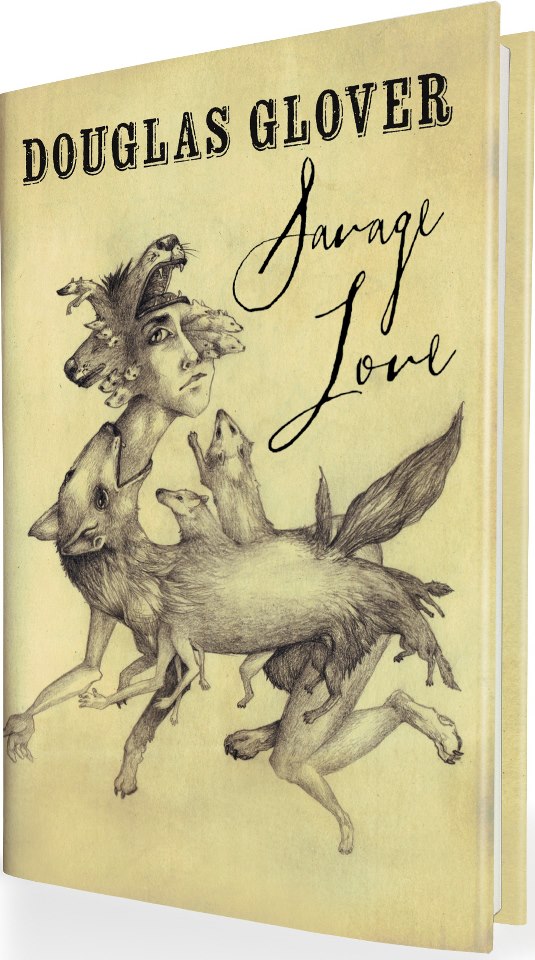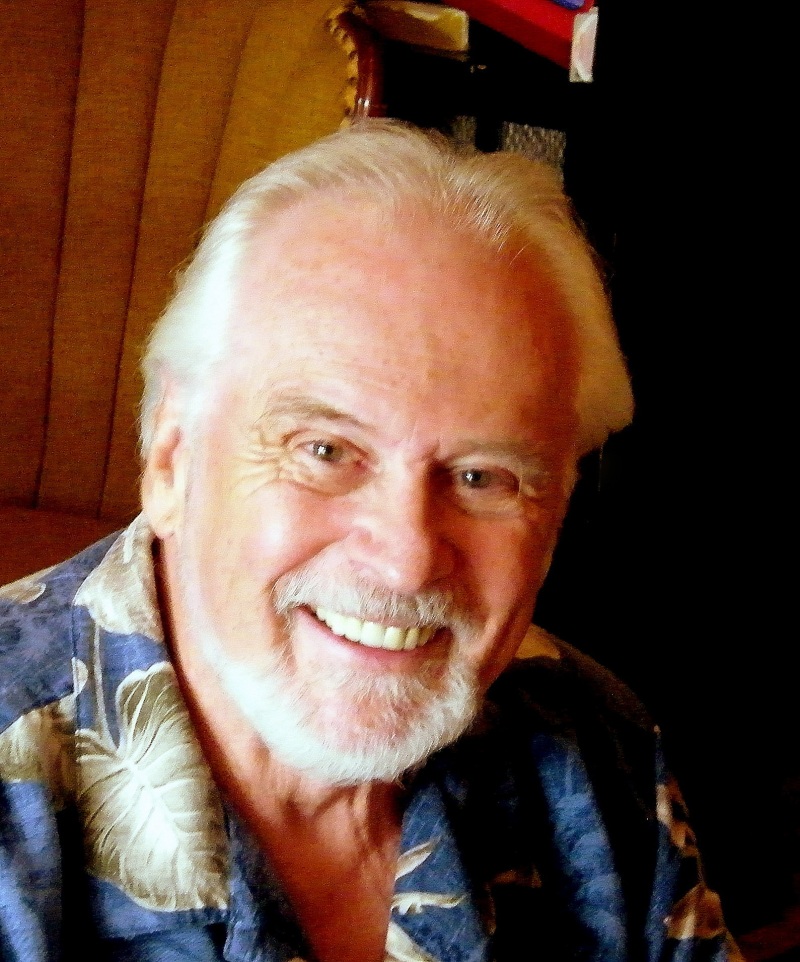
Douglas Glover

Apr 052014
 

Turned cold, started to snow last night, huge feather-shaped flakes falling in the pools of water, deep pools of slush, am not going outside ever again, all is lost, moribund and obscure. Then I found this post at Distractify (am reading student manuscripts so naturally anything with the word “distract” in it distracts me.

dg
capture1

Capture3


Capture2

View the rest of the images and text @ Distractify

Apr 052014
 

leslie-ullman_09
I’ve found a guide and companion for this season and country in the poet Leslie Ullman and her new collection of poems, Progress on the Subject of Immensity. I have been enthralled with a book of poetry that by its title alone seemed to promise a journey of intensity and possibility, of questions both philosophical and spiritual, and of movement toward insight and understanding. The book delivers on those promises — more than one could imagine setting out. —Summar West

Ullman
Progress on the Subject of Immensity
Leslie Ullman
University of New Mexico Press
Papeback, Online Price $13.27


Iam writing from the edge of winter, from a landscape where the weather has refused release despite the seconds ticking toward spring. The cold and the expanses of snow in Vermont have set me pondering questions that arise when a person repeatedly confronts forms of vastness. I’ve found a guide and companion for this season and country in the poet Leslie Ullman and her new collection of poems, Progress on the Subject of Immensity. I have been enthralled with a book of poetry that by its title alone seemed to promise a journey of intensity and possibility, of questions both philosophical and spiritual, and of movement toward insight and understanding. The book delivers on those promises — more than one could imagine setting out.

Ullman explains her subject of immensity in some detail on her website; the poems began during a leave-of-absence from teaching, and she says they

…found themselves questioning, lightly at first, the efficacy of the human mind…this spirit of inquiry nudged subsequent poems into larger questions—an exploration of spaces inside us as well as outside us: the rhythms of seasons, the earth suspended in its matrix of space, the life of the body, the limitations of conventional Western religion, the nature of desire, and the pleasure—often the sensuous pleasures—of inquiry itself.

We should not be surprised by the ambitious nature of this subject matter, the level of skilled craftsmanship and the depth of feeling in the individual poems; this collection marks the fourth book (previous collections include Slow Work through Sand, Dreams by No One’s Daughter, and Natural Histories) by this poet, teacher, and artist whose writing career spans over thirty years. Ullman has much to say, and to those poets, writers, readers, and daydreamers—anyone who goes out to the edge—we would do well to take heed to a directive in one of the poems at the heart of this book:

at dawn, a telegraphy that fills the morning
too full for one pair of ears—
one might as well listen with the whole body.

Progress begins with the poem, “Abrupt at Dawn,” where the speaker is awakened by a sound.

I was sure the sound
of engines came from
inside me, thrum of labors
that had driven me
in and out of sleep.
And then coyotes, scores
of them, sent out
ribbons of sound strangely
close to the house—something
disembodied, metallic,
the high, shrill gears
adding to whatever the sun
was using to ratchet itself up.

Later, we hear this sound of the machinery of the mind in “the cogs and wheels of dreams” in the poem “Night Opens the Foothills,” and in the poem “The Guises of the Mind” the relentless mind that “pounds and pounds…running on fumes.” But in these short, rhythm-pumping lines above, the words sonically wrap around us (a technique used in many of the poems where the poet relies on short-syllable lines and the pleasing sound devices of alliteration, euphony and sibilance; this is notable in the poem “A Visible Life” that begins, “The mind is a small city / whose street signs show me / what I already know” and in the poem “Mudra” where we hear “How was I like the pinecone / that outlived me? / Shingled, yes, with / aspects of a singular life— / certain wounds and the impulse / to cover them, a preference / for winter…”); the sound the speaker hears and questions is both external and internal.

This type of juxtaposition is seen throughout the book in poems where we go in and out of our speakers’ bodies and minds, the past and the present, silence and noise, realities and dreamscapes. In “Zone by Zone,” for example, we experience noise as light in the technological and the natural, where “coffeepots blinked on, small eyes, / as each day arranged itself into blocks” and where “…the new leaf / on a begonia cutting unfolded visibly / in a cubicle window…”; one of the most compelling examples of Ullman’s use of juxtaposition and doubling of meaning is in the poem “Ice Apples” where the apples that are “locked in ice” remind the speaker of her own memories of love, both the falling in and out of it as seen in these haunting lines: “…We drift in and out / of memory that is less event / than atmosphere—the alertness, / a pastel wash with bold strokes / of umber when love first arrives, / and the greater alertness—burnished / gold behind the eyes, dark grooves / celebrating the texture—when it leaves / yet again, innocence and experience.”

One of the recurring images that Ullman uses to achieve movement through these spaces is the wind. In the last stanza of this first poem, the speaker tells us:

Now, winter sage outside my window
trembles, bends and springs back
and bends again, and I realize
the first sound I heard was wind
blowing in a front. The machinery
of real weather. And I am simply
in its path like any creature,
not wrongly placed,
though the day, like a boat
in hard sea, churns
so fiercely beneath me.

The wind here is not pretty nor delicate nor is this just another nature poem. When the wind and other elements occur, as they do so throughout the book, they are always as forces that command attention. In a poem like “And My Life Wandered On,” “a strong wind has found / its way into these woods, where it / rarely goes,” and transports the speaker into a memory of another life and landscape in Bolivia; equally important, the wind as seen in the concluding lines of the poem “Hole in the Mind Filling with the Present” is the essential element that moves through us all as we’re told, “…Your body, now / clothed thinly  / in skin, filling with / holes—only something / porous like this can feel / what has always been wind.”

Feel the way light enters in the poem “Equinox”:

Water, black water
has turned to ice and lulled
the long valley into a doze—soon
we’ll all sprout gills, drifting
in a sleep beyond memory,
beyond the residual lung,
beyond the spent coals.

of desire. But that first
drop of juice—so
sweet-startling—a sacrament—
light in a throat from which
song has nearly faded—
could it guide me back
to shore? An orange, small sun
dawning from the inside
to resurrect the mammal body

Light as sacrament, as resurrection—Ullman’s metaphors are big, and in her small lines they startle us into awareness of how and where they live inside us.

As an important footnote to the book, this poem begins with the question,

Who will buy me an orange
 to console me now?

The lines are from a translation of José Garostiza’s poem “Who Will Buy Me an Orange?” and Ullman borrows these and other lines from several Latin American poets, giving us still further spaces of entrance in the collection.

We also go inside the subject of the mind in Progress in a series of poems scattered throughout the three sections. The poet excels in her use of personification with these poems and uses it to question the mind’s constructs, limitations, patterns, quirks and eccentricities, and experiences both harrowing and profound. My favorite poem of the mind series falls into this latter category. Listen to these heart-wrenching lines in the last stanza from “Guises of the Mind”:

How they clomp through the wild flowers and thick
grasses of August—they might as well be crossing
hot asphalt against traffic. They can’t remain
still enough to feel the slow ripening that could
be theirs—the nectar turning, beneath a thickened
rind, its stored sugars to the late October sun.
They’ve never let grief spear them and have its way
before moving on; every one of them pounds
and pounds at the door of the one house
that won’t accept them, the one heart, the one
indifferent ear—willful, running on fumes,
they throw themselves against that hardness.

While we may leave that poem feeling powerfully slammed against the pavement or door, we have the contrast of a poem like “Water Music” where a more pleasurable and surprising form of movement emerges. The poem begins with the speaker telling us,

I have fashioned a miniature fountain
from scraps of dream…

Those two lines alone could be enough to carry the rest of a poem that might simply describe the dream or the fountain or both in an aesthetically pleasing way, but as with so many other poems in the collection, it turns toward something larger; we go to the past through

a sound
that makes me long to be touched by upheaval. History
bearing me somewhere I haven’t been.

In second stanza, we’ve made it to the realm of a perceived separation and barrier between the sexes, a realm where the speaker tells us

                       Yet when I read the great
poems written by men who lived
before me, I find myself peering through
museum glass, waiting to be allowed
inside. Then outside. Against the rigors
that might forge and pound into shape
a significant life, there is something else
I crave—maybe grace, a sense of my feet
caressing the ground…

By the third stanza, the speaker who began by looking at her fountain made “from scraps of dream” imagines men and women joining to dance in a form where the weight of the past has been let go, where the body gives way to music, and we’re left with this question:

when their hips give in to the music
and I can see in their faces the world’s business
has loosened its hold, how can I not love them,
how can I think my minor note
unaccompanied?

In this poem where the speaker has imagined, speculated, and dreamed her way to this question-as-conclusion, we arrive at a place of love and gratitude; whatever the method of movement—and prepare yourself for a multitude of forms—in Progress, that is often the place of arrival though it is not the only one.

With a book of this scope, it seems reasonable to ask where we arrive by the end, what answers Ullman ultimately gives to her questions. Here’s a hint: the final poem involves subjects as large as absence and the sky, what we lose and what we find. This poem, like so many in the collection, turns in a way that is both surprising and down right breathtaking. I urge you to take the journey with this book; maybe you’ll start with that last poem and find your way to what the poet as companion and guide has been telling us to do all along, “Consider Desire.”[1]

—Summar West

 Summar shot

Summar West was born and raised in East Tennessee. Her poems have been published in a variety of journals, including Tar River Poetry, Ellipsis, Appalachian Heritage, and Appalachian Journal. She currently resides in Montpelier, Vermont.


Footnotes    (↵ returns to text)

  1. See a selection of Leslie Ullman poems, including “Consider Desire” earlier published in the magazine here.
Apr 042014
 

lorrie-moore3

What lengths will we go to in order to avoid being alone? Why are we so hell-bent on love? These are age-old questions, ones that philosophers, poets and priests have been unable to answer. Moore’s rendering of scenes, her dramatization of the beginnings and endings of love, is nothing short of a profound examination of the quintessence of the human condition. Why do we love? Why do we tell stories or create art? We are trying to close the gap, between self and other, between idea and reality, between life and death. –Richard Farrell

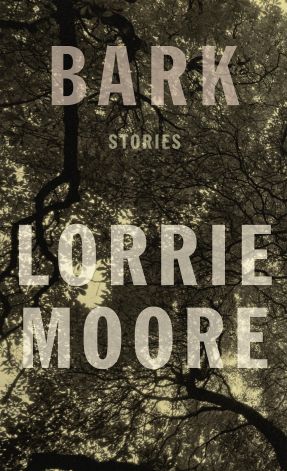
bark

Bark
Lorrie Moore
Alfred A. Knopf
Hardcover, 192 pages, $24.95
ISBN: 978-0-307-59413-6


The landscape of love, booby-trapped with the broken-hearted and littered with deteriorating destinies, is familiar territory for Lorrie Moore. Moore’s latest collection of stories, Bark, explores the underbelly of Eros with wit, wisdom and unflinching honesty. Each of the eight stories in Bark, her first story collection since the wildly successful Birds of America, contends with romantic relationships, most in some state of decline, a few in outright freefall. But lest this all sound too heavy, it’s important to remember that we’re talking about Lorrie Moore here, a writer who delights in the uncanny juxtapositions of humor and pathos to tug a story along. Her verbal pyrotechnics and structural harmonies can always make you smile, even amidst the bleakest affair of the heart.

“I can’t live without love in my life,” says Ira—the protagonist in the opening story, “Debarking.” Ira, recently divorced, has reached an existential conclusion: even bad love is better than no love at all. A middle-aged Jewish man thrust back into the dating scene, Ira skips Passover Seder in order to meet a woman at a Lenten dinner with his Christian friends. To mask his nervousness, Ira cracks resurrection jokes. “Then he began milling around again, apologizing for the Crucifixion. ‘We really didn’t intend it,’ he murmured, ‘not really, not the killing part? We just kind of got carried away’” Ira seems hell-bent on his own comic demise until he meets Zora, another divorcee, who laughs at his oddball jokes, sparking off their bizarre coupling.

Over the course of this 46-page story (the first of two very long stories in Bark), Ira and Zora contend with families, dating rituals and sex, and in most cases, without much success. After the aforementioned dinner, Ira sends Zora a short note and his phone number on a postcard with a picture of “newlyweds dragging empty Spam cans from the bumper of their car.” Moore makes the vivid image of this postcard resonate with irony and meaning. The postcard is funny, but also loaded. Are the newlyweds destined for unhappiness? Is all love like a string of empty Spam cans? And why a postcard? For Ira, the hapless and hopeless romantic, a postcard represents the “geometric halfway point between stalker and Rip Van Winkle.” Desperate but cautious, Ira tries to make all the right moves. But Moore wants us to remember that there is nothing rational about human desire, and she constantly pricks at every attempt to make it so.

A few days later, Zora replies in kind, also sending Ira a postcard, but her message copies the very words he wrote. “Wasn’t that precisely, word for word, what he had written to her? There was no too, no emphasized you, just the exact same words thrown back at him like some lunatic postal Ping-Pong. Either she was crazy or stupid or he was being too hard on her.”

Zora’s strange mimicry hints at what might be a profound emptiness behind the ritual. Maybe all the moves a lover makes are for naught. Maybe the palace is only a façade. Moore’s exploration of zany relationships (few are zanier than Ira and Zora’s) reveals much confusion about the nature of love. What’s happening here? Why is everyone acting, playing a part in a carefully orchestrated dance without music or steps? To mix the metaphor a bit, if love is a mirror, a reflection of the lover cast back upon himself, then the expected response is one of the familiar, some ting of recognition. But Moore’s mirrors belong in funhouses. The reflections they send back distort, and the images are grotesque parodies of any romantic ideal. Rather than recognition, Ira finds perversions, warped emotions, and confusion. Nowhere is this more evident than in the wonderful scene when Ira finally calls Zora to ask her out on a date.

He phoned Zora four days later, so as not to seem discouragingly eager. He summoned up his most confident acting. ‘Hi, Zora?’ This is Ira,’ and then waited—narcissistically perhaps, but what else was there to say?—for her response.
‘Ira?’
‘Yes. Ira Milkins.’
‘I’m sorry,’ she said. “I don’t know who you are.’

In this story about acting, about seeming, about playing games with the heart, misapprehension shatters hope. This reversal, Zora’s failure to recognize Ira, underscores not only the narcissism of falling in love (don’t we all expect to be loved back?) but also the more desperate need to be noticed, to be seen and heard by another human being. We can’t be loved without first being visible, but if all we present is a mask, then when are we ever truly seen?

Moore takes the idea of invisibility to a much higher level in “Paper Losses,” a shorter story (at 12 pages) than “Debarking,” and one that deals with the end of love, rather than its beginning. Kit and Rafe are a married couple in the process of splitting up. They’ve stopped having sex, stopped talking, and even stopped caring about these things. Rafe descends nightly into the family basement to assemble model rockets, and the lonely house fills up with fumes of paint and glue.

She seldom saw him anymore when he got up in the morning and left for his office. And when he came home from work, he would disappear down the basement stairs. Nightly, in the anxious conjugal dusk that was now their only life together, after the kids went to bed, the house would fill up with fumes. When she called down to him about this he never answered. He seemed to have turned into some sort of space alien. Of course later she would understand that all this meant he was involved with another woman, but at the time, protecting her own vanity and sanity, she was working with two hypotheses only: brain tumor or space alien.

The epitome of dissolution is not fighting. When couples argue, they are still holding on to something. But when silence prevails, when a person stops answering, when muted apathy fills the home, there isn’t much to be done. The lover turns into a space alien, a creature so utterly foreign as to be unrecognizable.

Rafe serves Kit with divorce papers while he’s still living in their home. “‘Honey,’ she said trembling, ‘something very interesting came in the mail today.’” But before Kit and Rafe can call it quits, they must decide what to do about a previously-planned family vacation. Kit decides she wants to go. “What bimbo did he want to give her ticket to? (Only later would she find out.)” This is vintage Lorrie Moore. Circumstance beats down her characters, but never defeats them.

The vacation, naturally, is a disaster. Kit loses her luggage and must wear gift shop clothes. Rafe continues to ignore her, even in the bright sunshine of the Caribbean. With characteristic humor, Moore takes a few shots at the notion of the idyllic family vacation: “They all slept in the same room, in separate beds, and saw other families squalling and squabbling, so that, by comparison theirs—a family about to break apart for ever—didn’t look so bad.” This subversion—the divorced family appearing more normal than the happy family—reiterates the theme: love is a confusing mess.

At one point, Kit thinks, “This at last was what all those high school drama classes had been for: acting.” Appearances can be contradictory at best, outright lies at worst. And everything about their vacation (no less their marriage) involves keeping up appearances, about pretending, even at the bitter end. Miserable families pretend to be happy and disintegrating families pretend to be intact.

When they left La Caribe, its crab claws of land extending into the blue bay, she was glad. Staying there she had begun to hate the world. In the airports and on the planes home, she did not even try to act natural; natural was a felony. She spoke to her children calmly, from a script, with dialogue and stage directions of utter neutrality. Back home in Beersboro she unpacked the condoms and candles, her little love sack, completely unused, and threw it all in the trash. What had she been thinking? Later, when she learned to tell this story, as a story, she would construct a final lovemaking scene of sentimental vengeance that would contain the inviolable center of their love, the sweet animal safety of night after night, the still-beating tender heart of marriage. But for now she would become like her unruinable daughters, and even her son, who as he aged stoically and carried on regardless would come scarcely to recall—was it past even imagining—that she and Rafe had been together at all.

If natural was a felony, it’s no wonder that Kit began to hate the world. She will invent a story to contain the mystery, the inviolable center of love. Perhaps this is the best we can do, but Moore shows us that it’s nowhere near good enough. Love, ever elusive, can only be glimpsed in our messy, fumbling pursuits of it, or in the way we ruin it.

What remains, then, is a high-stakes quest for companionship. Kit, Ira, maybe the rest of us too, are all trying to stave off the cold loneliness of the world. What lengths will we go to in order to avoid being alone? Why do we continue to seek out love? These are age-old questions, ones that philosophers, poets and priests have been unable to answer. Moore’s rendering of scenes, her dramatization of the beginnings and endings of love, is nothing short of a profound examination of the quintessence of the human condition. Why do we love? Why do we tell stories or create art? We are trying to close the gap, between self and other, between idea and reality, between life and death. In Bark, the closer the characters get to the unbridgeable chasm, the more desperately they chase, and the more certain their own isolation becomes. Love proves almost impossible, so everyone wears a mask, which defeats the very purpose, in almost solipsistic logic. The manifestation of the act—the eventual coupling between Ira and Zora, the decoupling of Kit and Rafe—verges on the farcical. Luggage is lost, empty Spam cans are tied to bumpers. Lovers remain forever strangers.

Still, it would be an over-simplification to say that all of the stories are strictly love stories. Moore is too sharp a writer to be so easily categorized. In “Foes” and “Subject to Search,” Moore dabbles overtly in contemporary politics. In “Juniper Tree,” she summons her inner Dickens and tells a delightful ghost story. “Wings,” the other novella-length story in the book, is about a washed-up musician who befriends an elderly philosopher. It is probably my favorite in the book. Of course, the friendship goes wrong when the geezer philosopher tries to stick his tongue down the woman’s throat. We just can’t seem to get this stuff right.

Bark contains heartbreaking, hilarious, and honest stories. It is a wise meditation on the human struggle for affection, for identity, and for meaning. Less transcendent than Whitman’s barbaric yawp, more restrained than Ginsburg’s howl, Moore’s bark sounds a weary note. Like a dog tied to a tree, we bark, hoping only to be heard, to be released from the ties that bind. Or perhaps bark refers to the tree itself, to the hard outer core which protects the inner pulp, the life force flowing through each of us, so fragile, so hidden beneath an impenetrable shell. “The end of love was one big zombie movie,” Moore writes. Perhaps. But in every zombie movie, a human or two always survives, someone to wander through the chaos and squalor, seeking, holding out, carrying on. Whatever holds us back, whatever constrains us, also reminds us that there is something more out there, something worthwhile beyond the chain, inside the bark. Despite the misery, despite the empty-Spam-can destiny that surely awaits the seeker, the pursuit continues unabated. We bark, or we die. Moore puts it more eloquently, if not a bit more bleakly:

Living did not mean joy piled upon another. It was merely the hope for less pain, hope played like a playing card upon another hope, a wish for kindnesses and mercies to emerge like kings and queens in an unexpected change of the game. One could hold the cards for oneself or not: they would land the same regardless. Tenderness did not enter except in a damaged way and by luck.

—Richard Farrell

Rich Gun-001

Richard Farrell is the Creative Non-Fiction Editor at upstreet and a Senior Editor at Numéro Cinq (in fact, he is one of the original group of students who helped found the site). A graduate of the U.S. Naval Academy, he has worked as a high school teacher, a defense contractor, and as a Navy pilot. He is a graduate from the MFA in Writing Program at Vermont College of Fine Arts. His work, including fiction, memoir, essays, interviews and book reviews, has appeared in Hunger Mountain, New Plains Review, upstreet, Descant, and Numéro Cinq. He teaches at Words Alive and the River Pretty Writers Retreat in the Ozarks. He lives in San Diego.


Apr 032014
 

Okay, not to be morbid, but this is a hoot. Now I have a plan for rebinding my collected works after I am gone (note to self: rewrite will, inform sons). So much better than a jar of ashes.

dg

The book’s 794th and final page includes an inscription in purple cursive: ‘the bynding of this booke is all that remains of my dear friende Jonas Wright, who was flayed alive by the Wavuma on the Fourth Day of August, 1632. King Mbesa did give me the book, it being one of poore Jonas chiefe possessions, together with ample of his skin to bynd it. Requiescat in pace.’

via Harvard discovers three of its library books are bound in human flesh | Roadtrippers.

Apr 032014
 

OLYMPUS DIGITAL CAMERA

Why do we write? Why bother to write? I remember the advent of Game Boy, the beginning of the current culture wherein the signal gesture is eyes downcast concentrating on some hand held device, and thinking, well, it’s all over now. Readers gone, illiterate sons, no point. But then my sons grew up to be writers and one persists. And we started the magazine (so that now, when I see someone bent over a phone, I think, ah! another reader — okay, wishful thinking). But the question persists, always persists — why write?

Genese Grill, who in February contributed to Numéro Cinq her insightful and erudite essay on Marcel Proust and Robert Musil, herewith delivers an apologia (ancient form — nothing to do with apologizing) for writing, a passionate, persuasive, eloquent (not to mention well-written) defence of the realm of writing. Read it and rush to the barricades (or get out your laptop and start writing). This essay is the preface to a book of essays in progress. Genese (have I mentioned that she is an artist, also a scholar and a translator of Musil?) also created a room-sized hand-painted accordion book with one of the essays painted on the panels; we’ve included images of that as well (photos by Rebecca Mack). Because in this day and age, as we see over and over in Numéro Cinq, the word is art.

dg

When so many others have written before us, illuminated, explained, shown, arranged, described the world and human existence, when so many others more eloquent, more learned, more witty, more poetic have polemicized and preached about what is important, about how we must live, about what is wrong with society, with our lives, with our thinking, when the world is arguably in countless ways even worse now despite all the words, when it is even less humanistic, more materialistic, less poetic, more utilitarian, when humans seem even less connected, more isolated, even after generations of  writers have toiled to share their insights and to inspire to a better existence —we persist in writing, in feeling that writing might be a meaningful way to save the world, save our souls, to right the wrongs, make up for  disappointments, overcome alienation and despair.

In addition to all of these common complaints lodged against writing, there are even people who believe that reading and writing belong to a hopelessly corrupt past, that they are the tainted remains of a paternalistic Enlightenment attempt to control people’s thoughts by an elite which, the theory goes, misguidedly or even treacherously posed as reformers, teachers, fellow human beings. Such theorists, in the spurious interest of freeing mankind from the discipline, authority, and standards of the old world, have contributed greatly to the denigration of so much which makes life worth living. They have aimed—when they aimed at culture—at the wrong enemy; and if today’s citizens are more free than they were two hundred years ago, we need only ask, as Nietzsche did: free for what? To go to the mall whenever they please? To never challenge themselves at all? To live lives where natural and artistic beauty, reflection, relative silence, awe and wonder are present in only the scantiest proportion compared to the fragmented technocratic busy-ness and consumerism that has become the norm? Is there no other way to get free?

Are great books really something to defend against, to ridicule, to knock off a pedestal? Or have they not always, mainly, been a powerful force of liberation, often a critique, often a means toward humanizing, toward inspiring tenderness and compassion? Ironically, the great books of the past seem to have increasingly induced a sort of revolutionary fervor which has itself taught people to doubt, to deconstruct, to denigrate books themselves. The educated Marxist professor snarls at the great works of the past like an ungrateful cur or a parasite who has forgotten who first taught him the word freedom. Like Caliban, who complains that Prospero taught him language, the ingrate only knows how to curse the magic of culture. But poor Caliban, the reader may object, is Prospero’s colonialist slave, so he may well begrudge his master’s “kindness”. Quite right, my skeptical post-modern reader, quite rightly read. Yet who but Shakespeare taught us this?

OLYMPUS DIGITAL CAMERA

Now that people read so little it is even more difficult than ever to measure the “use” or benefit of writing (leaving aside for just a moment the all-important  non-utilitarian aspects of writing). We might even ask why, if writing is efficacious, it has not succeeded in ensuring a practicable love of reading in our society, where, apparently, the average person reads but one book a year—at most. If we really want to change the world, if we really want —indeed, even in a maligned Enlightenment tradition—to inspire reform, reach people, impart urgency, does writing a book make sense?  Who will read it? What will it do? Won’t it just be ignored?

Do words and ideas impact the world at all, or are we raising our voices like that passionate orator Mynheer Peeperkorn in The Magic Mountain, howling at the edge of a riotously loud waterfall, our words hopelessly drowned out by the spray and sensation of a force — in our case of media, convenience, technological  sensationalism, consumerism, novelty and speed—a force far stronger than all our dusty fusty intellectual intensity and our airy ideations?  Why do we persist in writing when writing seems sometimes to make so little palpable difference?

Do we continue out of a self-indulgent personal love of a way of life that has now become solipsistic or stubbornly antiquarian? Because it is what we like to do or because it is the only thing we know how to do?  Or can it be that the act of writing itself—yes, real writing, inscribing, on paper, with ink, for printing  in books that one can hold in one’s hands—is now something of a revolutionary act in itself, an act that is more than just an empty fatalistic last gesture in honor of some lost world?

 I wager that, yes, to write books, to read and treasure books and ideas and intellectual discourse is a revolutionary act (if somehow simultaneously reactionary).  I might even venture that one of the reasons reading is so out of fashion is not that it is boring and ineffectual but because it has the power to function as a sort of flaming conscience illuminating the “bad faith” of a general state of denial and a neglect of higher ethics and spiritual aesthetic values.  As Kafka suggested, a really great book is like an axe that breaks the frozen sea within us.  Do today’s humans care to be thus destroyed, broken down, burnt up, challenged? Whether they do or no, it is imperative that we strain and strive to rouse to wakefulness whoever is still even the least bit conscious, even if it means pouring a bucket of cold water upon our fellow humans and, yes, even upon ourselves in  our most comfortable and ethically lazy hiding places.  To write is to challenge the negligent, disinterested, laissez-faire status quo.  Culture, in the coinage of my friend Stephen Callahan, is the new Counter-Culture.  We may not win the war, but we have no choice but to fight, or write, as the case may be.

OLYMPUS DIGITAL CAMERA

But let us return to the aforementioned non-utilitarian aspects of writing and reading. These aspects are inextricably bound up in everything which is to be gained or lost along the way.  Outside of the content and import of what there is to be said and argued and persuasively insisted, the experience of writing (reflective, committed, difficult, grappling, ruminative, essayistic, careful, aesthetic, emotional) and the experience of reading (in relative quiet, with respect to the considered ideas of another human being,  critically, with margins, with emotion and inter-subjectivity, with devotion) bears its own weight and its own significance in the context of today’s fragmented and casual society. In other words, the way in which we read and write is directly commensurate to the way in which we construct meaning and measure value in our lives, our world, our history, our future, our fellow beings.  Reading and writing are two very representative practices that demonstrate the essential dynamic relationship between spirit and matter.  Ideas and words, living and breathing in books and sentences, synthesizing, dissecting, and re-animating realities, influence and engender our physical world. By altering these practices or marginalizing them, we are, in essence, altering the very way we conceptualize, share, proffer, process and manifest ideas. Thus I begin with an underlying assumption about the ability of spirit to matter in questions of matter and in hopes of breaking internal frozen seas on an individual and universal level, one reader at a time, one tiny fissure, one tiny idea at a time.

Writers all sometimes believe that they have something new and important to say that has not been said in quite the same way and quite the same context as before.  Other times they fear they have absolutely nothing at all of value to add. Even our own “freshest” ideas are but reanimations and reworkings of mostly the same things that have fascinated us since the beginning of our personal consciousness. We think we have come upon something new only to find it in much the same words in a notebook from a decade ago. Yet the slight variations of syntax, the context into which we have now placed an idea, may make worlds of difference, may be the small strand of hay that breaks the proverbial camel’s back.  A small idea may be waiting, hidden in a large book, for the right reader, just like a despairing romantic inside a country house deep in the woods, with just a candle in the window, is waiting for a surprise visitor.

Something another writer has said may make us furious, or egg us on to verbally spar; we may be exhausted by received ideas, by the sort of questions which seem to leave only two possible and unsatisfactory possibilities as answers. We may think we know how to pose a new question altogether or provide a third or fourth answer which, as Cummings hoped, asks its own new question and so on and so on. I am reminded of the utopian visionary Charles Fourier, whose preface to his opus The Four Movements claims that he alone, finally, after so many centuries, has discovered the single most important secret to human happiness that no one, not one person ever, has even begun to imagine before him.  An outrageous, majestic, beautiful and absurd claim! Nevertheless, it is true that each new voice may add something invaluable to the conversation. Imagine how bereft the ensuing centuries would have been had Fourier not had the courage of his crowing and had kept his revolutionary ideas to himself?!  This French visionary is an apt exemplum of the way in which spirit works on matter, because his ideas were, in fact, directly influential on actions. The words that he committed to paper in a tiny room in Paris formed a good part of the basis of American utopian communities (like the late Brook Farm), even if a slightly puritan-tinged interpretation of his phalansteries and phalanxes left out some of his wilder and more improbable imaginings (the sea that would turn to lemonade, the evolutionary development of human tails, the benefits of unhindered passional attractions).

OLYMPUS DIGITAL CAMERA

On the train to Concord Massachusetts to attend a transcendentalist conference, I met a fellow scholar and we fell quickly into a surprisingly heated argument about whether or not the intellections of the abolitionist movement had had anything significant to do with the ending of slavery. This fellow maintained that all the ideas, all the writing, all the speechifying, all the newspapers and broadsheets of the period had really had no significant influence on the success of abolitionism  in comparison to that effected by the Northern soldiers’ experience going into Southern states and seeing the horrors of slavery with their own eyes.  While it certainly makes sense that this real life experience was revolutionary, it seemed rather odd to me to deny that ideas and words had contributed to changing things.  The eye-witness experiences of these soldiers were, in fact, written down in letters home or in essays for Northern journals; and other first-hand accounts, by escaped slaves, penitent owners, or in fictional accounts, such as Uncle Tom’s Cabin, surely crystalized vivid experiences into words, ideas, and theories.

Why then did my fellow traveler want so much for it to be so that words did not do anything, that ideas were ineffectual in history?  I knew why I wanted the opposite to be true. I needed, with every fiber of my being, to believe that ideas changed the world, for better or for worse; and he, whose dislike of Emerson turned out to be no accident, needed to believe the opposite. He wanted to take the power out of the hands of the educated classes, and away from the individual, self-reliant, supposedly elitist genius, and place it in the many hands of the illiterate soldiers, or into the slippery hands of fate, as Tolstoy tries to do in War and Peace, where he argues, implicitly in his story and explicitly in his essayism, that history is not made by individual choices or heroes, but by the random forces of accident.

But this dualistic split between the elite educated classes and the illiterate masses is, to my mind, a dangerous and largely unexamined construct that demands unpacking and re-visioning.  Is it really necessary to throw out culture and intellect because one portion of humanity has traditionally had a unique access to it? Would it not be better to work toward providing more members of society with the skills and the agency to critically consider philosophical, social, and aesthetic ideas and to participate in a meaningful and reality-relevant conversation about how we are best to live and function as a society? Anti-intellectualism seems to be a persistent American trait which somehow is inextricably bound up with the mythology of democracy. But is the vilifying of culture really a helpful response to our current problems?

My desire to believe in the efficacy of ideas and writing combines a commitment to the preservation of high culture and committed scholarship with a conviction that the realm of ideas and words should never be something to which only one class of people has access.   I am also certain that such culture is best, most lively, most meaningful, when kept in the closest possible contact with our real lives and experiences, not separated into mere abstractions or de-contextualized from social practices or the lives of others. I believe that almost anyone can learn to read, write, and think and that the insights and depth of consideration to be gained through the process of wrangling with the written word is a richer and fundamentally different process than that to be acquired through the more casual and relatively non-committal process of conversation (though speech might also meaningfully aspire to more careful and sacred consideration). I also maintain that almost anyone has the power to change the way the whole world sees and acts and lives, with little more than curiosity, some learning, and some passionate discipline, and that the words and ideas of any one individual can and do and will move others immeasurably.

In my years as a community college instructor I have seen with my own eyes how even those students with little to no academic preparation, students who are struggling to hold two jobs, go to school, and raise children on their own, can and do become immediately passionately engaged in the philosophical, social, and aesthetic questions which need to be considered before beginning to live a considered, ethical, and socially-responsible life. While it is of course easier by far to engage in philosophical and poetic activity when one is not under the constant strain of putting bread on the table or buying a new pair of shoes for one’s children, to thus conclude that only those who have easy access to leisure can participate in reflection, critical thinking, and spiritual aesthetic experience is really the worst form of cynicism—one which hides a treacherous snobbery under its supposedly compassionate condemnation of the alleged elitism of culture.

For to deny anyone the right or responsibility to participate in the communal reflection on and creation of the world is to me a crime. To do so is to deny that person his or her humanity. Instead of silencing further those whose concerns and ideas have all-too-often been traditionally undervalued, this is a call to innovative and  positive inter-action rather than continual  complaint about the restrictive and technocratic megalithic structures and systems that seem sometimes to confine and define us; a call to utilize the language and the raw material given to us instead of stubbornly calling foul and refusing to participate in a system, history,  and culture that are, indeed, deeply flawed and haunted by ghosts and demons of all kinds. This communally created labyrinth of oscillating desires, repressions, rebellions, resistances, and generativity remains, despite or even by virtue of its darker shadows, also a culture rich in beauty, humanism, tenderness, striving, passionate inquiry, imagination, and myriad evidences of the most ecstatic forms of life and love.

OLYMPUS DIGITAL CAMERA

The conflict between intellectual culture and popular action had of course been rehearsed before we 21st century humans repeated it on the suburban train out of Boston—by former now-famous Concordians. The transcendentalist movement notoriously split off into two factions comprised, on the one hand, of individualist thinkers and writers, and, on the other, of engaged activists and communal utopians.  But this narrative of a clean split is quite misrepresentative of the complexities and overlappings that really obtained.  Bronson Alcott, possibly the least grounded of all the Concordians, felt impelled to actually experiment with his ideals in the real world, and founded the Fruitlands community, which eventually foundered on an unworkable proportion between the physical and the spiritual realms.  George Ripley founded Brook Farm, which made a formidable attempt at bridging the gap between ideal and reality.  Both utopian communities featured excellent progressive schools and were fundamentally attempts to give working people access to higher learning and to give the all-too dainty middle and upper class intellectual the chance to get his or her hands dirty. Hawthorne quickly learned that he could not get any literary work done after a day’s toiling in the fields; but others found the combination of matter and spirit salutary if not precisely conducive to the creation of great works of literature. Finding the right balance of body, mind, and soul is never easy.

Hyper-educated “bluestockings” like  Elizabeth Peabody and Margaret Fuller (who claimed she had the headaches of a genius)  suffered myriad physical pains in their striving for intellectual transcendence (but Margaret, at least, finally ran off to fight a real revolution in Italy and take on her first lover, supposedly an Adonis with limited intellectual talents). Elizabeth educated herself prodigiously, wrote, edited, taught, and ran the most intellectually exciting bookstore in Boston, while simultaneously supporting and caring for a large and unruly family of siblings and various unstable and sick relatives. Her two sisters, Mary and Sophia, won away from her the only possible suitors she entertained (Nathanial Hawthorne and Horace Mann).  It may be difficult to measure the effect of her genius (despite her own share of headaches) on the real world, but I think, although largely unappreciated, it was not minor after all was said and done.

The abolitionists (spear-headed by fiery women strategists) kept spreading the word, with and without the intellectual authority of rousing speeches by Emerson and Thoreau; Thoreau built a real house in the woods, instead of just writing about an imaginary one, but scorned the jailers who tried to imprison his soul within the walls of the Concord jail one night (because his soul, his conscience, his mind was free) ; committees and clubs were founded; gardens were  planted; journals begun, printed, proliferated, and abandoned; walks were taken; hands were grasped;  love was and was not consummated;  letters were written and sometimes not sent; and, as Emily Dickinson cryptically noted from nearby Amherst, “people must have puddings”.

Bronson Alcott’s inability to take the physical world into consideration (exemplified by his comic attempt to move his family home without putting a foundation under it) was counteracted by his daughter Louisa’s intense focus on ensuring material security (with Little Women, she earned more money from her pen than any other writer of the period, with the possible exception of  Harriet Beecher Stowe); but her traumatic experience with an inept spiritualist father may have kept Louisa from ever daring to enter into conjugal relations with a man. When a visitor asked if there were any animals laboring on the farm at Fruitlands, Louisa’s mother famously answered, “Only one woman,” but of course there were more women than one: the daughters helped too.   Ironically, Louisa’s practical innovations were all in the interest of avoiding more physical labor by providing herself and her family with the financial support necessary to dream and imagine. In a similar strain, Thoreau began his peon to transcendence with a chapter entitled “Economy”—an economy calculated to afford its readers with a  model most conducive to musing, intellectual activity, aesthetic experience, walking and communing with Nature, the World All, and the timeless reverberations of morning moods.

The painted trays, quilts, and pies made by abolitionist women supported the more ineffable traveling lectures given by escaped slaves as well as the writing and publication of propaganda journals and the legislative process of lobbying and advocacy.  The theories and words of social intellectuals were answered by the actions of smugglers on the underground railroad and even more violent physical acts of daring such as the raid on Harper’s Ferry—or perhaps the actions inspired the words;  quilts and pies and gunpowder and risked lives worked in tandem with ideas, words, and ideals.

The idea craves and creates action and manifestation; the experience and the action are object lessons, rituals, or manifestations that inspire ideas and fresh conceptualization.  The experimental enactment is spurred on, checked, re-evaluated, and given meaning by the idea, the vision, the transcendental imagination.  Material choices are made on the basis of spiritual values and spiritual values must be made on the basis of certain unavoidable material realities. Of course there are times in history or in one’s personal life when actions may be taken that fly in the face of physical practicality and prudence, when a person literally sacrifices his or her bodily comfort, convenience, or even existence for an idea or ideal. For ideas and values that are not lived or have not touched and changed or colored our lives and perceptions may as well not have been thought or written down at all.

OLYMPUS DIGITAL CAMERA

We write in the hopes that our words could mean something to someone, somewhere, across time and space. Has Walden made a difference in the world? Have Thoreau’s words been heeded? On the one hand, when we see the mass of men and women in quiet desperation who prefer to go on with their accumulating and wage slavery rather than consider living a different way, his words certainly do not seem to have mattered much. When we see the persistent and total destruction of the ecosystem, we may wonder about the power of his statement:  “Thank God they cannot cut down the clouds”.  For, as if in refutation of a cryptic oracle, they (or is it even we?) really have managed this seemingly impossible feat, as clouds are visually cut down by skyscrapers, airplanes, and countless towers of technology.  On the other hand, we know “many a man has dated a new era in his life from the reading of a book,” as Thoreau himself noted in his chapter on reading.  We ourselves know how much certain books have meant to us, how they have changed our lives both materially (in terms of conduct of life) and spiritually (in terms of directing how we see the world).

Like the awkward anti-heroes of a fairy tale, like Dumb Hans or the Goose Girl, we write as if we were attempting to complete some impossible task against all odds. We are climbing the mountain of glass, separating the millions of lentils from the millions of stones, weaving gold out of straw before dawn, trying to guess the magic word in three days, and scooping the ocean out with a leaky thimble, day after day, decade after decade, on the chance possibility that some drop, some one word or phrase of what we write, will get through to someone, make us, make a possible reader feel less alone, confirm our own suspicions, solicit a response, an echo, a challenge, across the watery abyss.  And if it sometimes seems as if writing has made no impact at all on the rushing, raving world, let us at least consider that it might have been an even uglier, an even colder, an even more callous world still, without the absurdly Sisyphean labors of writers and thinkers who have constantly brought all their small weight to bear against the weighty downward slide, who might, in fact, be the ones responsible for keeping total chaos, destruction, and utter indifference at bay—just until now.

 If we were to let up at long last, give up, resign ourselves to silence — I dare not even suggest what might happen, what horrific indifference and simulated emptiness might ooze into every last crack and bury  us alive, unable to remember the slightest thing, unable to form sentences or consider our actions, unable to value, denounce, celebrate, or dream.  We may never know what nasty nightmare our often thankless little efforts keep at bay.  But let us, at the very least, write in thanks and tribute to those who have persisted in the past, against such odds, in believing that writing, that ideas, that visions and images, do matter.  One thimble-full of salvaged words, one pearl of sweat or salt tear, one drop of ink, made of belief, commitment, made of love of humanity, of history, of culture, and of nature, no matter how humble, no matter how seemingly quiet, inarticulate, or out of tune, no matter how seemingly unheeded, may be precisely the enlivening, moistening alchemical liquid needful to keep the well of inspiration from going dry once and for all.  Was it in despair or in hope that Robert Burton in his Anatomy of Melancholy counseled thusly: “Writers! Open the vein!”? Did he mean we had better end it all? I like to think, rather, that he meant we ought to write as if our own life blood, all our experiences, thoughts and feelings, were flowing onto the page, that we might die even in the midst of writing—in making visible and hopefully intelligible— whatever it is we have within us.

—Genese Grill, with photographs by Rebecca Mack

.G photo for BBF

Genese Grill is an artist, writer, and translator living in Burlington Vermont and the author of The World as Metaphor in Robert Musil’s ‘The Man without Qualities’: Possibility as Reality (Camden House, 2012). “Apologia” is part of a collection-in-progress entitled, Keepsakes: On Matter, Immateriality, and the Making of Meaning. She currently is pursuing the mad task of possibly re-creating the world through metaphor by building and inscribing a giant room-sized hand-illuminated accordion book portal containing an essay from this collection, and by working on a series of translations of previously unpublished Robert Musil writings (to be published by Contra Mundum Press beginning in 2015).

Apr 022014
 

What does a typical day look like for you? How much time you spend writing? Do you have any routines that you find help foster productivity?

I am not an ideal writer, I’m afraid. I live pretty much like everyone else, well, everyone else who doesn’t have a day job. Put the dog out, coffee, look at the news, do some work, put the dog out, coffee, run some errands, talk to my mother, go to the gym, walk the dog, talk to my girlfriend, talk to my sons, put the dog out, more coffee, scotch, and a book at bedtime. Up until recently, my two sons were living with me and my day bent around them, their needs and schedules. But they are both away at university now. None of this is noteworthy or mysterious. I am an intermittent writer, which is fine with me. And, aside from the annual virgin sacrifice in the woods behind my house, I don’t do anything to foster productivity.

Read the rest @ Douglas Glover – nineteenquestions.

Apr 022014
 

Coover

 The Brunist Day of Wrath reflects a decade’s worth of labour and attention; it is a book that should, and does, take time to read, a book that, through mysterious means, nonetheless feels pressed on by some urgency. It seems feverish—serious and self-committed—though it is also pun-funny and clever-funny, daffy and delirious. And yet its eye, casting itself around like a billiard ball, picking up small-town grit and gossip, is uneasy, and should be, for it is accountable for its thousand crimes, self-conscious of its own apocalyptic imaginings… —Natalie Helberg

Day  of Wrath Cover Pic

The Brunist Day of Wrath
Robert Coover
Dzanc Books
1100 pages, $30.00
ISBN: 978-1938604386


Robert Coover’s The Brunist Day of Wrath is a boisterous, bloody, jaw-dropping, awe-inspiring—for any writer, humbling—sometimes painfully, but always expertly, protracted ride. Countless characters and their countless voices well up out of its thousand pages, mingling as subplots crisscross and ramify: Cultists clash with the local and power-laden in a high-profile scrimmage for property; cult benefactors drain joint bank-accounts, screwing local, power-laden husbands out of their underpinning monies; skeptics balk, hoot, and forewarn; believers pray, persist together, at odds, or else, defecting, wail for reckoning; trailer-brats rapture cats; fathers disown sons and sons abandon fathers; signs are deciphered, then, ad hoc, re-deciphered; God is named, variously; musically-inclined yokels hit it big; an aspiring saint is gang-raped; demons are conceived, and, on a rooftop in the midst of a bloodbath to end bloodbaths, a murderous, evangelical biker is volatized by choppers.

The book before the book, The Origin of the Brunists, like the fictive doomsday cult whose origin it catalogues, begins with light. An explosion. Confused prose conveys its confused wake: ‘There was light and / post drill leaped smashed the/turned over the whole goddamn car kicking / felt it in his ears, grabbed his bucket, and turned from the face.’ Light: Two shadows, miners, duck out of sight; a cigarette in a small earthen chamber disintegrates the next instant. Gas. Light. Flame feeding flame. Black smoke furling into shafts, tunnels. Blocked passageways and rubble. The sentient shadows die. Or live. Many die. Most. Laboriously, for lack of oxygen. Singly and in groups. A message wrapped in a preacher’s fingers—stiff fingers—makes it to the surface. It prophesies the coming of light, the end of the world.

The accident at Deepwater No. 9 Coalmine, the essence of West Condon, ushers in the town’s demise, its economic and spiritual ruin. It gives rise to the Brunists, who inaugurate and so-name themselves so as to better await an end that, as livelihoods are lost and reputations are ruined, as sermons bubble forth alongside bar talk and smack talk, as lechers skulk to their lovers, and as poseurs pose to achieve base purposes, is endlessly deferred.

The Brunist Day of Wrath picks up here: Five years later, not much has changed. Those who lost everything in the first novel have lost or are in the process of losing more. The Brunists, having dispersed, gather once more in anticipation of the End’s anniversary (puzzling, they know). Only this time there are hellions: The children of the tyrannical Reverend Baxter—wife-beater, child-beater, convert but erstwhile Brunist nemesis #1—a man as fiery as the Book of Revelations itself—have grown up. Once friendly, neighbourhood terrorizers flaunting a charred human hand, eldest and youngest son are now cold-blooded gangsters. They bow to a ferocious god akin to that of the Old Testament (‘the Big One’) and, with a clutch of armed bikers—not Brunist-endorsed, though their tats are Brunist—not to mention with Nitro foraged from the abandoned mine site, plan to rev up, rip through and blitz West Condon.

Thus The Brunist Day of Wrath, like some horrible ouroboros, curls back to touch its origin: The mine explodes, ejecting prophecy—‘the Coming of the Light’—which, moving through a complicated chain of human intercessors, begets further explosion.     

And yet there is a day beyond this day of wrath, an end beyond the end: an epilogue in which the novel becomes fully self-reflexive; this is a text about a writer, writing. It reminds us that The Brunist Day of Wrath, like most of Coover’s work, is largely preoccupied with signs and symbols, stories, story-forms and tropes. It is a book about the power they have over us, about the fact that they are human-generated, the fact that they rigidify around us in deleterious ways (or become crusty, as Coover says), and the even more momentous fact that they are tractable to invention: they can be appropriated and rejiggered; they can be wildly embellished upon.  

Coover has devoted his art to shifting and embellishing upon them, partly by creating work that is self-interrogating (he is called a fabulist for this reason): In books like Briar Rose, in which an old crone subjects a sleeping beauty to innumerable variations on the eponymous tale, he creates the tale anew as a series of its own novel versions, and this despite the princess’s unremitting protestation (perhaps representative of a culture’s) that this is not how stories are told. But these stories, repeated, are both the dreams the child (culture) dreams and her waking reality; to not refashion them, to merely accept what has—for whatever corresponds, in real time, to Beauty’s 100-year slumber—been handed down, would be, for the crone, to risk sinking into ‘a sleep as deep’ as the princess inhabits: a dangerous, unnecessary, and even laughable automatism.

In Pricksongs and Descants, Coover uses a similar technique to refresh the short-story form; in, for example, “The Babysitter” from that collection, he varies a handful of scenarios across a series of short, disconnected paragraphs. The story is ‘modular’ in Madison Smartt Bell’s sense of the term: Key details are altered or swapped for reasonable facsimiles in corresponding paragraphs (text blocks): in one, the baby has asphyxiated on a diaper pin; in another, it is screaming; in another, she, the babysitter, strangles it; in still another, it is at the bottom of the bathtub, ‘not swimming or anything.’ Text blocks can corroborate or contradict one another; they ‘mean’ together paratactically, or resonate with more than follow from one another. Thus tone can shift from block to block, as can point of view; in fact anything, as Bell says, can happen.[1] Variation, as a technique, is reflective of what Coover has called his wish to unpack a piece’s full range of possibilities, of an effort, as he puts it, ‘to explore the whole.’  

Though The Brunist Day of Wrath has a realist quality uncharacteristic of some of Coover’s other work, it nevertheless preserves a drive toward narrative playfulness and the absurd. That being said, the book’s flights of fancy, unlike those in a work like Pricksongs and Descants, remain at all times recuperable by something like realism: It is not the case that anything can happen from, say, one free-floating text block to another: In fact, in both The Origin of the Brunists and The Brunist Day of Wrath, if we encounter something disjoined or surreal, this is likely because we are reading a character’s letter or journal entry. Similarly, Jesus, in the latter narrative, who has taken up residence in an apostate, cannot disappear into thin air; his presence, not to mention his bantering sacrilege, his fun, off-colour reasoning, can be explained using the real-world term ‘alter-ego’; he both is and isn’t a mere voice in a mind—a fact which doesn’t preclude carnal baptisms with members of his ex-congregation:

‘I’m ready to do anything for you,’ Prissy whispers, peeling down her leotards…She steps into the tub and kneels between his feet and commences to wash them, one at a time. And then she lifts them and kisses them. ‘You are so beautiful,’ she says. ‘You are the most beautiful man I have ever known.’ When she says this, she is gazing affectionately past his feet at his middle parts, which are beginning to stir as though in enactment of the day’s [Easter] legend. It is not hard to prophecy what will happen next. Is he being tested? Be anxious for nothing, Jesus says. As it is written, no temptation has overtaken you that is not common to man. She has a car, she can be helpful to us. I, too, have known the company of helpful women of dubious morals.

What is notable on a stylistic level about The Brunist Day of Wrath is the sheer excess of Coover’s prose (the paragraphs in this work sprawl), and, relatedly, the amount of detail packed into nearly every character imagined: These characters are full-bodied, notably unique—unique as any of us are, perhaps more—and very far from the stock figures that dominate so many of his other pieces: princesses and private eyes, dames and woodsmen, characters whose respective profiles are, understandably and likely intentionally, blank as a trope’s. In some ways, the work is working realism through excess—conventional realism, anyway, since, as a character points out, ‘The conventional way of telling stories is a kind of religion,’ of course ‘the true realists are the lens-breakers’; ‘[t]ight-assed little paragraphs laid out like snapshots in a photo album are not for me.’ If the project, then, does, to a certain extent, locate itself within, and limit itself to, realism, it does so in order re-locate, or push, realism’s very mode of telling. Perhaps this pushing of realism is the reason Jesus, in the text, remains at all times plausible (certifiable). Perhaps it is also the reason characters, not Coover, pen the work’s zaniest digressions.

The text’s catalogue of kinds of signs and symbols—its interest in how ideas, experiences and phenomena are encoded and translated—is another point of excess; it is likely not unrelated to Coover’s commitment to the text’s full (and, in this case, metaphoric) potential: Dreams, dances and gypsy cards pepper these pages; if they are interpretations themselves, they must again be interpreted. Mute stroke victims blink eyes as visitors suss out their communications. Two bible college drop-outs even attempt to reconstruct the history of the Brunist cult’s formation; they use newspapers, stories, pornographic photographs and tape-recordings—versions, in short, to create a newer version. The Origin of the Brunists itself is more or less translated into the sequel, where it is mediated by the other characters’ acts of retrospection: We get it a second time in mosaic form, each pane perspectival.

Though The Origin of the Brunists shares some of the above preoccupations, musing on similar themes, specifically on ‘messages’—there are messages everywhere: ambiguous messages which are therefore as meaningful as they are meaningless: ‘the spirits never [say] things plain’ and ‘sometimes, well, words can mean two things, that’s all’—it nevertheless refrains from insisting on a message. This is perhaps less true (but not untrue) of The Brunist Day of Wrath. While in true postmodern fashion, The Origin of the Brunists mobilizes contradictory voices, allowing perceptive renderings of devout thought-processes and those of the incredulous, mocking, opportunistic newspaper editor (and perhaps absurdist), Miller, to exist on par, The Brunist Day of Wrath cedes itself to Sally:

Sally is Miller—one of the few central characters not carried over into the sequel—re-envisioned. She is a skeptic, a wit and a writer, and, in the epilogue it is she who, self-taxed, writes a version of the apocalypse, as it was manifest in West Condon. This book within the book, mentioned in a chapter written so as to seem to reference—so as to riff off the existence of—The Brunist Day of Wrath, institutes, within the text, the spectre of the author (for one thing, Sally is advised to try her hand writing from a male perspective—she uses some biographical details, though changes others). In some ways, she seems to channel Coover, who was inspired to complete his novel after George W. Bush was elected: the fundamentalists rose up and terror with them (Coover says ‘Young Bush,’ writes ‘Young Baxter’). As Sally says, ‘It’s like people are caught up in a dangerously insane story and they don’t know how to get out of it…’

This is why Sally, like Coover, in her capacity as a writer, aspires to shred story, to mutate the domain of the interpreted and the interpretable, to maintain its fluidity, or eat dreams (so she puts it). For in her text-world, truth is no more than a mode of rendering; lies expressed in the correct mode become true and effective, while truths expressed as opinions are dismissed in court. Even beyond the courtroom, a slick simpleton garbles facts to tenderly manipulate the dying and a West Condon reprobate lies to himself long enough, and elaborately enough, to confect sweet, false memories. Perhaps the only thing Coover’s book insists upon is story’s ontological potency. The work teems with real-world significance precisely because it is a story about story.

The Brunist Day of Wrath reflects a decade’s worth of labour and attention; it is a book that should, and does, take time to read, a book that, through mysterious means, nonetheless feels pressed on by some urgency. It seems feverish—serious and self-committed—though it is also pun-funny and clever-funny, daffy and delirious. And yet its eye, casting itself around like a billiard ball, picking up small-town grit and gossip, is uneasy, and should be, for it is accountable for its thousand crimes, self-conscious of its own apocalyptic imaginings: ‘What’s the toll now from all this madness?’ Sally asks, answering, ‘You might say a story has killed them all.’[2]

Natalie Helberg

  Helberg reviewer pic

Natalie Helberg is from Edmonton, Alberta. Some of her experimental work has appeared on InfluencySalon.ca and in Canadian Literature. She recently completed an MFA in Creative Writing with the University of Guelph. She is working on a hybrid novel.


Footnotes    (↵ returns to text)

  1. Joel Katelnikoff quotes Bell’s Narrative Design in his dissertation SCROLL / NETWORK / HACK: A Poetics of ASCII Literature (1983-1989). He also suggests that Coover’s stories in Pricksongs and Descants are modular in design, though without discussing particular examples
  2. See also an interview with Robert Coover on Numéro Cinq and readings and interviews at the University of Pennsylvania’s Pennsound.
Apr 012014
 

Victoria_Redel_jpg_1-2

Herewith a superb interview with Victoria Redel, the brilliant and prolific author of stories, novels and poems, also a former initiate of Captain Fiction himself, the irrepressible and undaunted Gordon Lish. Redel’s most recent books include Woman Without Umbrella (poems) and a story collection Make Me Do Things, both reviewed in NC. Conducting the interview is Jason Lucarelli, our resident Lish expert, conversant in all things Lishian, author of the foundational essays “The Consecution of Gordon Lish: An Essay on Form and Influence” and “Using Everything: Pattern Making in Gertrude Stein’s ‘Melanctha,’ Robert Walser’s ‘Nothing at All,’ and Sam Lipsyte’s ‘The Wrong Arm’.”


What is “story”? What is “necessary fiction”? What’s the difference?

It’s funny, really, that it should seem at all a daunting question—what is story?—when each day, many times a day, we hear stories, we tell stories. We make artifice of our lives almost immediately—You can’t believe what happened at work today…I heard the most amazing exchange in line at the supermarket…You’re not going to believe this but…We shape narratives inventing bits of dialogue, implying motives though describing gestures—what someone did or didn’t do, what was or wasn’t said. We shape narrative—eclipsing, conflating, inflating events, facts, and characters—because, instinctually, we know when to speed up or hold back. We want our listeners to listen with urgency and so we engage engagingly.

What we know everyday is this human urgency to express the uncanny. And we really all appreciate that family member, that friend, that stranger at the next table who pays a story out slowly, circling back through strange phrases, observations, the teller who takes us down a weird circuitous path and we go along—wary, excited—because we can’t figure out where it leads and yet the teller has made it essential that we follow. The story can be ragingly funny or plain spoken, quiet or raucous. Oddly every method of telling works if it feels authentic. Authentic—seems like an abstraction but it’s not. We are authenticity hounds, sniffing for fraudulence all day, everyday.

We know the difference between the story that never stirs us—through shape or language—and the story that jolts us further awake and alive. Somehow the witness, the telling, the engagement of the speaker feels original. By original I don’t mean that they’ve used a new-fangled anything. I don’t mean they’ve worn a clown’s nose or written in Pig Latin. By original I mean that the speaker has allowed herself to look and speak without yielding to received vision or language. It is being told then exactly as it must be told. And we listen; we can’t stop listening because we feel that we stand the chance of living better of being changed. You’re not going to believe this but…and just sometimes, right away, we feel something stunningly possible in that simple even over-used phrase. Despite skepticism, resistance to being changed, fear of being hood-winked or manipulated—right away, we inch closer to the speaker, we hold our fork to our lips, we grip the book closer to allow something new to happen to us.

I’ve told this teaching story before to students but I’ll try to tell it again. I was invited to teach a weeklong workshop at a university in the Midwest. I had students write every night and each day we’d read in class. I kept trying to get them to identify sentences in each other’s work that were essential and that were necessary. They could do it. Ears were well tuned. But they found it harder to identify a true sentence in their own writing. I sent the group home every night saying, “How did it sound in your kitchen? What is a necessary object for you?” One woman, a Spanish Literature Professor, dauntingly the most learned in the room, came in day after day with sentences, with paragraphs of prose that were so god-awful, so full of bullshit, phony, fancy-assed sentences. And I kept saying, “Nope, nope, not this.” On the fourth day the Professor of Spanish Literature came in clearly agitated. I thought, “Yikes, I’ve gone too far and really pissed this woman off.”

Then what happened was extraordinary. She began to read a piece about a blue bowl in her mother’s kitchen. The language was syntactically like nothing I’d heard before. Was it actually even English? Who cares, it was beyond gorgeous. When she finished, when we could finally breathe, one of us said, “Read that again.” After her second—or was it her third reading—I asked, “What happened? What was that?” She said, “I almost did not come to class today.” I said, “But you knew, you knew.” And she didn’t answer. “Where did that language come from?” I asked. She was quiet, looking more agitated than ever. It turned out that she came from a crevice in the ArkansasMountains where the language seemed at once to have twists of Elizabethan English and French. She was the first in her family to leave the area, to go to college, to learn to speak “proper” English. Well, she’d actually gone further, now was a Spanish Professor. She told us that after she wrote the piece, she felt certain that her PhD would be stripped away, her tenure taken away. It made her actually feel ill. That gorgeous, original paragraph of literature felt more dangerous than she could manage. She felt exposed, betrayed.

The press of a human heart up against the page. Language in necessary disequilibrium, in jeopardy, most of all with itself. That blue bowl, her mother’s bowl. The collision of event and character and language. The possibility of seeing into another human heart. “Well that’s just what some folks will do,” a neighbor said to Flannery O’Conner after reading some of her stories. That is a necessary fiction.


In a BOMB interview with Honor Moore, you talk about how “collage is the only way that [you’ve] figured out how to write something long in fiction.” But I also see this strategy at play in your short fiction too. The elliptical movement that was your vehicle in your early stories, specifically in Where The Road Bottoms Out, seems dialed down, or, at least, more subtly employed in Make Me Do Things. How do you see yourself—as of late, and in your new collection—exploring new narrative techniques?

Maybe it’s something I’ve borrowed from poetry. The poem can move by association—by image or language patterning to accrue a larger sense and a larger mystery. The stanza can often signal that kind of leap. So can the line. Extending this kind of patterning—image and language—in fiction provides you with another narrative strategy. In the novel I used collage by which I mean I wrote sections in chunks, sections that were linked to other sections by image or place or situation. I didn’t know how exactly to think about ordering initially. But I knew that once I’d created a thread I had to use it again. That was how I created plot. It made sense to have that kind of fragmentation because of the narrator’s state of mind. With the second novel I was confident that I would do it differently. More of a straight shot. No such luck. Novels have proven different altogether—maybe more compositionally like a poem.

When I began to write fiction I discovered, in a wholly new way, possibilities within the sentence. I discovered the joys of syntax. This seems ass-backwards; I should have found syntax first as poet. It seems that it was simply developmental, I was at last seeing what the music inside a sentence, the intelligence inside a sentence, the personality within the sentence might be. In those first stories things seemed possible and more than possible it felt essential at times to have three prepositional phrases jammed up together, to take the sentence in one direction and then press it into another direction. I began to consider what I could do with postponement or preponement of, for example, the subject of a sentence. I love that book of stories if, for nothing else, how dizzy and blissed out I was with just how to construct story sentence by sentence.

But how I went about the composition of a poem and a short story was kind of different. I usually write a draft of a poem in one sitting. And then, subsequently begin to mess around, add, subtract, rearrange, merge it with other poems, turn it bottom to top. With short stories I write pretty much sentence by sentence by paragraph by paragraph. The revision happens line by line so that when I get to the end I’m not revising. I’m usually done. I take that back. I often have written it too tightly and need to go back in and dilate from within.

You asked about the first book of stories and the second—which were published 18 years apart with novels and poetry collections in between. As you can see in this book I’m pretty interested in a close third person—I wanted to have a third person voice that’s as close to a first person POV as I could get. At least that’s true for a bunch of the stories. You say they are less elliptical. Are they? I probably move in real time more in these stories. And I slow down, wanting to drill into a moment longer. But I wonder if some of the shift has more to do with age. Many more of the stories in Where The Road Bottoms Out focus on children—that collective voice of children that occurs in many stories. In Make Me Do Things the focus—even when there are kids in the stories—seems closer to the adults.

But maybe, it is all developmental—a lifelong apprenticeship with language, character, how what is story. And mixed in with that are the particular fascinations—conscious and unconscious—at any given moment.


You write “sentence by sentence by paragraph by paragraph” but in that fight to get to the sentence, how do you navigate between sense and sound? How soon do you squash possibility and clamp down on character, incident, and story? For example, recently, your contemporary and friend, Noy Holland said, “I go word by word by ear for as long as I can, according to my awareness of what I’ve said and did not mean to say…The ordering impulse is crucial but I don’t want it to be dominant or inhibiting. When it’s dominant the terms we commonly use—character, voice, plot, setting—begin to make sense; the story bleeds out; it’s anybody’s.”

I think I understand your question, Jason. And I believe I understand what Noy is getting at. A single sentence could potentially spawn many potential next sentences. Sometimes it is daunting. And the challenge is to find the one that is truest—not only true with respect to the linguistics and the acoustics. But the sentence has to move forward character, stance, action, and do so with inevitability and risk. It wants to complicate the mystery. Poets talk about sound and sense, Pope’s the “sound must be an echo to the sense.” Honestly, this all makes the writing seem so much more laborious than it really is.

.

How do you view your evolution as a writer of fiction, and how has your growth as a poet influenced your narrative tendencies in fiction?

My hope in these new stories is probably not unlike the hope I’ve always had in writing to push into the difficult places. Sure, that has something to do with the dark places of hearts and minds. But I’m also interested in Joy—the ways we shun it, why we fear joy. And why in midst of real happiness we conspire to fuck it up. I suppose how we understand bravery shifts with age and experience. One of my internal cajoling’s has been—you have permission—which on the page can mean permission to be plain spoken or exorbitant, permission to say what feels dangerous to say and, almost more importantly, to find language that isn’t worn thin, to have the permission to make the language singular. But right now I also find myself interested in the ways I can bend and keep bending inside the story to dig up something I don’t know. Which, heaven knows, is most days most things. What else and what else and what else is right here, right now. Because, of course, everything is right there, all the old hurts and hopes, all the new ones and all the invented convolutions of the current mind. I love the way in our dark moment we say hilarious things. I am interested in the way we bungle things up. Despite our certain efforts to get it right.

You ask about my evolution as a writer. Probably a writer is the worst person to try to identify her evolution. There’s the question of fascinations—with certain images, with kinds of situations. Sometimes I fear that I’m writing the same kind of story over and over, walking around some few subjects that emerge again and again, even when I imagine I’m breaking into new turf. Okay, maybe that’s simply that we can’t escape our deep concerns, our central objects. In this new story collection, people have noticed the last story, “Ahoy,” saying something different is happening in that story. Maybe I should be bummed out that every story doesn’t seem to break new ground but I confess excitement because it’s the last story I finished for the collection. So to feel that I broke into something new there feels hopeful. I’m not sure if others mean new subject or new form, I don’t know if I care. Probably, it would frighten me too much to look closely at my evolution. Where have I slackened? Where am I repeating old tricks? Why do so many of my characters behave in kind of obsessive ways?

As for how poetry connects with the fiction, I’m not sure. I used to maintain that they originated from the same impulse, the same desire to experiment in language, to render and make witness to the world. But I’m less certain of this now.

.

May I ask if you, when you write as a poet or a fiction writer, do you ever find yourself responding as a fiction writer to the pieces you’ve written as a poet, or vice versa?

Wow, your question makes me sound like a strange and divided person. Honestly, I don’t think it works that way. The work is the work and you try to come at it with a rigorous sense of possibility. It’s always a balance, right? On the one side to detect lapses, opportunities not taken by failure of sight or patience or heart. And on the other side is keep the composition playful so that you allow for accident and the unconscious to emerge. That’s true in whatever form one works.

But now that I’ve reread your question and wonder if what you’re asking is do I ever take on similar subject in fiction and in poetry? And, I suppose here the answer is yes. Not intentionally. But because ultimately I am not such a divided creature I’d like to believe that different forms allow me to come at my interests, obsessions, concerns from differing angles.


In “He’s Back,” a father comes home to his wife and son together in the tub. This bathtime, a way of being rather than a common nightly occurrence, has accumulated into a breaking point inside the narrator, who’s put off by the constant bathing. He questions the closeness between mother and son (“she was no doubt letting him look at the whole thing”), becomes jealous (“there was hardly a moment she would let him have alone with the boy”), and finally annoyed to the point of action (“He would teach them both a thing or two”). While this story seems to touch on familiar thematic territory for you (the nature of family and familial relationships), you chose the first-person male point of view. In certain stories, can the choice between the gender of a narrator propel the drama?

The story “He’s Back” arrived—as many stories will—with an initiating image. A father coming home to his wife and child who are in the tub. It’s not all that strange an image. All across the world, on any given evening or morning a parent is showering or bathing with a child. Not strange or scandalous. Easier to get in that shower to soap Junior. But what I glimpsed in that initiating moment is a feeling—also common—to come into a room and see your child and spouse engage in anything—a game, a conversation, a book—and feel out of their orbit. Feel displaced by that beautiful, exclusive place a parent and child might occupy for a moment. And even as we see the beauty of the moment, happy for their closeness, at the love and pleasure they share, we feel excluded. We feel jealous. This complex rub interests me in fiction. That displacement, real or imagined, interests me. You ask does the gender propel the narrative? One could absolutely imagine a mother displaced. It happens all the time. But in this story the triangulation is rendered from the man’s point of view and I hope it is specific and particular enough to feel that it is not an interchangeable voice, it’s not a woman. Triangulation always interests me; it is inherently dramatic. Spend any time with two parents and a kid and you’ll notice the pushes and pulls in every direction. Territorial displacement can shift ever so minutely and it is felt profoundly. That is true in marriages, in friendships, in parent/child relations.  And how jealousy manifests, well that’s endlessly interesting and usually not simple. The great challenge for people everyday is not to use a third person as protection or weapon against someone they love.

I didn’t set out to write a collection that featured writing from men and from women’s points of view but clearly it happened. It makes some sense (at least retrospectively) because no gender seems to have the prize for blundering personal lives or for trying to make sense and manage a life.


In between Where The Road Bottoms Out and the publication of Make Me Do Things, you published poetry, novels, and continued to publish short fictions. Can you talk a bit about your process in assembling this new collection? For example, “He’s Back” seems like an orphan of your first collection, and, in fact, I believe the story predates all other stories in the collection. What criteria did you use to decide which stories would make the cut?

You’re right that “He’s Back” is an older story. It predates Loverboy. And I suppose has some connections to Loverboy, or at least shows a bit of my path of inquiry that I had not exhausted. It was written around the same time as “Stuff” and “Third Cycle” and “The Horn”. The stories in this collection span from those stories to “Ahoy” which was the last story that I wrote. But to confuse things, I’d written some pages of “Ahoy” years ago and then couldn’t figure my way and left it. I remember interviewing Grace Paley some years ago. Grace had just had a story published in that week’s New Yorker. She told me it was one she’d begun a decade before and that she’d put those first pages in a folder which had the stories she couldn’t get right or finish. Her dud folder. She said that she often went to the folder, pulled out a story and, reading the pages, thought, “Hey, that’s not bad.” And right away started editing and playing with it and writing a bit more. It was so different than the way I worked but, boy, I remembered it. And, well, those opening pages were something I’d looked at more than once in the intervening years. Then last year I thought, I want that story. I want to figure it out, to figure him out.

There were other stories that didn’t make the cut. I’d keep them in the mix for awhile, mostly to make me feel good that I was close to a finished collection. But when I’d write a new story, I’d let another go. And when the story was knocked out, I’d feel relieved. What’s the criteria? If I can still feel surprised by a story. If I feel there’s sufficient language or sufficient true hard looking. If I don’t think I was faking somehow. I know there’s a lot of different tones in this book. Maybe some would feel critical of that—I don’t know—maybe it shows a lack of consistent music. But I like the variation. I want it. Hopefully, others do too.

.

As a teacher, how do you instruct students who are interested in reconciling the differences between fiction and poetry in their own work? Do you have a list of writers you cite as lyrically inclined, yet who still stick close to story?

There are so many interesting prose writers who have great density of language, a real lyricism in their work. Hello, Christine Schutt. Hello, Dawn Raffel. Hello, Michael Ondaatje. I teach their work in poetry classes. Others too. Anne Michaels who wrote Fugitive Pieces, a book I love. I teach Robert Frost in fiction classes.

The lyrical fiction writer (student) has to keep remembering not to get so lost in language that the importance of a dramatic situation, of an instigating problem is forgotten. The key is to keep swerving, letting language become part of the dramatic insistence. Otherwise, it all spins into pretty. We lose sight of characters.


Dawn Raffel and Diane Williams edited a story or two in your new collection, if I’m not mistaken. Can you speak about the differences or similarities in editing styles between these two friends and former Lish students? At what stage of a story might you allow these particular readers to read one of your pieces?

Yes, Dawn edited a story and so did Diane. Actually, Diane published two stories from this collection. One in NOON and the other in an issue of StoryQuarterly. I trust both their judgment so implicitly that I think I took the suggestions both gave. Dawn had two suggestions that were a function of hearing an off-ness in word choice. Dawn has a great, uncanny ear and, well, she was right.

As for when I show things…I don’t show stories early. In fact, not till I’ve got them as done as I can get them. My agent, Bill Clegg, is a great reader and he pushed on some of the last stories. Finding moments where he’d felt I’d lost nerve and gone an easier route. He was right. I knew it instantly. And I could even recall the failure of nerve. So it was good to go back and carve a tougher route.

.

You were quoted as once saying, “Everything you need to know about the next line in a story is actually present in the words of the sentence that preceded it.” Phrased another way, Amy Hempel’s way: “You do what you do because of what is prior.” Obviously, this is something Gordon Lish preached to his students, but it’s also, I’ve noticed, a phrase that his students, who now teach, seem to preach to their students. Why is this compositional strategy so powerful? What has this recursive principle taught you about story and the degrees of so-called story?

I simply cannot imagine anyone who has truly listened to Gordon Lish speak of writing not teaching a recursive principle. Gordon Lish spoke more persuasively and generously about composition than anyone I’ve ever listened to. I’m betting that you could walk into a class taught by Amy Hempel, Mark Richard, Christine Schutt, Dawn Raffel, Noy Holland, Ben Marcus, Peter Christopher (God rest his soul), Sheila Kohler, Patricia Lear, Rick Whitaker, Sam Lipsyte, Lily Tuck, and the list continues on and on of those who have gone on to write and teach—the notion of the prior would be, as you say, preached. This principle, once grasped, is essential. And once grasped, you see it in all stories. This is because story is composed. It is made. If you think of this composition as a weave, a fabric, then it makes complete, natural sense that you are pulling threads through from beginning to end. And those threads—call them objects, call them rhetorical elements, call them syntactical events, call them parts of the sentence—all need to be utilized. Do you knit? If you knit you know that you can’t drop a stitch unintentionally without creating a hole in the garment. Same deal with story. Why would you want to forget any element that is prior? What is prior provides the deeper mystery. What is prior provides what can—no—what must be unpacked. You go vertical with it, not just forward. What is prior is what informs the sound of the story. It is the mind of the story. It’s important, Jason, to realize that recursive writing does not create any specific sound or mind. What is prior presents the terms for what is ahead. Look, going back to my knitting analogy. If—for god knows what design reason—you made a garment with an intentional dropped stitch in the first rows. You’d probably want to create drop patterning throughout the garment. It might actually have been unintentional. But by noticing it, repeating it, shifting from one dropped stitch to three dropped stitches you take that which was error and make a rightness of it. A great sweater, maybe. Maybe not. Which is also to say that just being recursive does not make a story. This is where swerve comes in. This is where actually making sure you’ve plunked yourself down in a worthy domain that provides friction and jeopardy and dramatic possibility.

Look at any writer you admire and I’ll bet you a good sum that is there is this weave I’m describing. This is how patterning begins to occur in story and in the novel. It means that the architecture of the work is inevitably built from local materials as it were. I could really go on about this. But I’ll chill out and shut up.

—Victoria Redel & Jason Lucarelli


Victoria Redel is the author of four books of fiction (Make Me Do Things, The Border of Truth, Loverboy, and Where The Road Bottoms Out) and three books of poetry (Woman Without Umbrella, Swoon, and Already The World). Her work has been translated into six languages. She teaches at Sarah Lawrence College

jason-lucarelli-photo

\
Jason Lucarelli is a graduate of the MFA in Creative Writing program at the Vermont College of Fine Arts. His work has appeared in Numéro Cinq, The Literarian, 3:AM Magazine, Litro, Squawk Back, and NANO Fiction. He lives in Scranton, Pennsylvania.


Apr 012014
 

About midnight, I went to let Lucy out and realized that in the past couple of hours we’d had nearly a foot of new snow. This after two days of steady sleet and snow mixed. The plow guy came twice over the weekend. He’ll have to come again in the morning. In the kitchen just now, Mark looked at me and said, “This never happened before you came to live here.”

The light is terrible and I can’t take pictures, but I wanted you to get a sense of what being a Writer-in-Residence is like, the stark grandeur of the elements, the threat of imminent death by exposure and starvation. I ate my last can of Irish stew tonight. There is nothing left to eat but banana bread Clarissa brought home from a wake Saturday. Rob has a half-eaten carton of Gelato. We’ll be fighting each other for that soon enough.

It’s now officially April 1.

dg

Waterloo Row from the front second floor window.

DSCF7522

Out the back door.

DSCF7523

DSCF7525

DSCF7534

DSCF7527

Walking out toward the street.

DSCF7537

DSCF7538

The front of the house.

DSCF7539

DSCF7540

Lucy waiting by the backdoor.

DSCF7542

Mark finishing his book. This is the literary part of the post.

DSCF7545

Mar 312014
 

Julie Jacobson

Julie Jacobson is an Athabaskan native from the Copper River Basin in Alaska now living on a ranch in Colorado, one of those people who live stories. All she has to do is peek out the window or remember an old auntie and the words come spilling out of her, assured and exhilarating. She’s my student at Vermont College of Fine Arts this semester; her packet cover letters read like great essays, they read like this—

dg

March 8

I am writing this in my ranch truck, watching a cow try to have a calf.  It must be a big boned thing, because her mother has been up and down four times and can’t get the position right to push.  Sometimes they have to stand up, walk a bit, then try again.  The front legs have to come first and I’ve seen the silver bag around two hooves a couple times now.  She just needs to get “comfortable”.

Hopefully my husband, Brent, will be home today (he is in Denver with his mom, who is in the hospital again) and I can get off calving watch (which means checking every four hours in good weather – I’ve had 6 beautiful black babies since Tuesday night) and back to the kitchen table to finish.  Today I moved 92 head and pulled two circles of electric fence with my 12 year old.  He is good company and getting to be quite a hand.  The farmers we lease from are pissed that we are not off their ground yet, so I’m under the gun to get it all done yesterday.

So, the cow finally had her calf.  On her own.  Which is good, because I’m always a little nervous about being a doctor out in the mud with anxious mothers all around me.  My son’s iPod battery is dead so we will make one last pass through the mothers-to-be and head home.

March 31

I’m doing well, just writing today.  It is windy as hell here.  The terrible howling, sky darkening, dirt blowing kind that closes roads and schools.  I can see the dust come in the tiny gaps in the doors and windows and settle uniformly on my kitchen table and laptop.  I don’t know why anyone ever thought this would be good country to live in.  Miserable for livestock, too.  When we drove through the cows this morning, we noticed that their eyes are all clotted up and pressed shut against the shit dust forced on them in swirls around the windbreaks and bare trees.

I have a new baby calf in my bathtub,  born last night and feeble like he isn’t sure if he wants to live yet or not.  His mother died, so we are going to try to graft him on to another cow when the wind settles this afternoon.  We lost twins night before last and that mother (K.A. #74 Orange tag) is heartbroken.  We have been trying to graft a crooked faced calf off of a thin poor milking cow (K.A. #802 yellow tag) to her, but I’m not sure if she wants to be a mother bad enough yet.  I’m writing about the grafting experience.  Maybe I’m simple, but it is really something.  It reminds me so much of experiences I’ve heard of and had with humans – in a stripped down sort of way.

It is time to check cows again.  The wind has slowed down and we are going to skin one of the dead calves and put the “coat” on the crooked faced calf, milk the foster mother out, bottle feed the calf and then pour the rest of the milk on him and his new coat to help trick the cow into taking him.  Wish me luck.

—J. M. Jacobson

Mar 242014
 

Lucy & dg in the surfDG & Lucy at Lawrencetown Beach outside Halifax. Photo by Jacob Glover.

DG has been on the road for eons, it seems, reading from Savage Love, being a Writer-in-Residence. He has finished many books along the way including Trollope’s The Way We Live Now (very long) and three Evelyn Waugh novels, hitherto kept on hand for emergencies. A new essay is forming: “Novel Structure Lite” (more on this another time). We were in Halifax for the March 13 reading at the University of King’s College, which I’ve already written about). But then we stayed on and went to the beach (yes, Halifax, compared to Fredericton, is positively sub-tropical).

Savage Love Cover

Here’s another picture (bad lighting, I know) from King’s, Jacob introducing dg.

DSCF7348

Then dg and Lucy at Lawrencetown Beach again. She gets very excited about surf. Note dg’s trademark camo cargo pants and baseball cap purchased at a high-end art boutique in Venice.

dg & lucy2

dg and Lucy Lawrencetown Beach

Then home to Fredericton briefly and on to Saint John. My hotel room gave onto the harbour (when I was extremely young, I covered the port for the local daily newspaper — I was there when the first container cranes started working).

DSCF7401

DSCF7404

And here is the Martello Tower in West Saint John (behind the container terminal), which figures prominently in dg’s short story “The Obituary Writer” from which the name Numéro Cinq is taken. It was cloudy, rainy, windy — everything looked a bit, well. forsaken.

DSCF7479

The port in Saint John is at the mouth of the Saint John River (which goes by Mark Jarman’s house where I live in Fredericton). In Saint John, the river flows one way part of the time and then it flows the other way (hence the famous Reversing Falls just upstream from the port). Just above the Reversing Falls is the giant Irving paper mill.

DSCF7406

As a cub reporter, dg once helped police snag a drowned man out of the river on the rocks just across from the mill. The man had been in the water for a very long time, and parts of him were falling off as he came to shore. This, too, became a short story with the gruesome title “Floater,” one of those stories that got published in a magazine and then never reprinted (for really good reasons not to be dwelt upon).

And here’s the newspaper building where dg worked. It was then called The Evening-Times Globe (I took this picture through the car window at a stop light — a noble genre).

DSCF7489

DG worked here for a year. There was a printing press on  the lower floor, a lovely old thing with bells and the smell of lead and oil. Now it’s no longer there. The newspaper is printed in Moncton. The building backs onto Courtney Bay with the huge Irving Oil refinery and docks and transshipment terminal.

DSCF7493

DSCF7485

All this is kind of dull as imagery, but somehow it wreaked of old excitement and familiarity to dg (despite the wind, rain, sleet, etc.) who was something like 23 at the time (and, yes, dreamed of sailing away on a steamer).

Friday (March 21) was the Moncton reading, at the Aberdeen Cafe, hosted by Lee Thompson who took pictures. (Note dg’s beer strategically placed on a spare baby’s highchair within reach of the microphone.)

DSC05677

DSC05690

DSC05686

For the Saint John-Moncton epic, Lucy stayed home.

Fifi and Lucy

Last stop, a reading at Odd Sundays at Molly’s in Fredericton this coming Sunday.

dg

Mar 202014


Patrice Leconte’s La fille sur le pont  (Girl on a Bridge) tells the story of Gabor (Daniel Auteuil), a knife thrower, who returns to a certain bridge in Paris looking for suicidal women to be his assistants, for they, usefully, have nothing left to lose. When he meets Adele (Vanessa Paradis), he finds more than an assistant, he finds a woman who might as well be throwing the knives back.

la_fille_sur_le_pont_reference

Though I encourage you to see the whole film, there is one three-minute scene that stands on its own as a well-wrought short film. In this scene, Gabor throws knives at (or, more accurately, near) Adele. The scene derives its power primarily from the intense anxiousness of Gabor and the ecstasy of Adele.

We begin in the audience and then we pinball between the knife thrower, the target, and the faces of those who watch enraptured, fearful, and envious. Much of the pleasure in this scene is derived from the expressions of others in a way similar to  Woodkid’s “I Love You.” The chorus of faces in this film that layer and shape how the story is told: the face of a woman in the audience as she leans to see better and, backstage, the various circus performers, the small woman with the massive floral headdress and the stricken clown with the oblivious dog. The circus performers, more than the others, instruct us to be fearful, because they do this for a living every day but they seem worried.

We are all of them and yet we are not simply them. The camera lets us behind the sheet and in a medium shot we get to see what Gabor cannot: Adele’s ecstatic experience. We also see what Adele cannot, in close-up: Gabor’s concern, his worry, his focus. Later in the film, Adele and Gabor are able to communicate with one another over great distances, letter writing to one another without the writing, and this seems possible because of their intense connection. This moment reads us back to the theatre and the knife throwing where we, the audience, were caught between them and the sheet lightening connection to the enraptured onlookers. We see we inhabit the air between them all and were, perhaps, amorousness itself.

go_on-470x215

Of all the spectators in the montage, it is particularly Irene, the woman backstage dressed somewhat like a showgirl, who stands in counterpoint. Irene gives us every indication that she is vicariously deriving a great deal of pleasure from the spectacle. She is identifying with Adele. Does this envy encourage us to also identify with Adele’s pleasure or does it just make Adele’s pleasure more real? Regardless, what plays across her face is a pleasure both envious and nostalgic, as though she too once knew a pleasure like this.

The worried faces, we find out at the end of the scene, were right to worry: one of the knives has nicked Adele and drawn blood. It is for Gabor an admission that he can’t see the way he used to. It also foreshadows that he cannot see Adele clearly enough and this might not bode well for them.

For Adele, the cut is more complicated. What would be different if every knife had lodged perfectly around her and there had been no cut? This is in some ways the knife thrower’s version of Michael Ondaatje’s “The Cinnamon Peeler.”

what good is it
to be the lime burner’s daughter
left with no trace
as if not spoken to in the act of love
as if wounded without the pleasure of a scar

The ecstatic joy on Adele’s face seems connected to this, wounded, the experience now written on her body. Indeed, if all the love songs tell the truth, then the amorous experience threatens the lover the way the knives do here. There is always the threat of loss of the self but the pleasure of being made specific.

12 The Girl on the Bridge(La fille sur le pont) 1999 Vanessa Paradis, Daniel Auteuil

That the film is presented in black and white makes this a nostalgic cinema with a hankering for the way romances used to appear on the silver screen. This coupled with Marianne Faithful’s broken glass and whisky vibrato creates a peculiar tension between the nostalgic and the primal. As Roger Ebert notes in his review of the film, its take on romance stands in resistance to the current take Hollywood has on the genre:

Occupations like knife-throwing were not uncommon in silent comedy, but modern movies have become depressingly mired in ordinary lifestyles. In many new romantic comedies, the occupations of the characters don’t even matter, because they are only labels; there’s a setup scene in an office, and everything else is after hours. Here, knife-throwing explains not only the man’s desperation to meet the woman, but also the kind of woman he meets, and the way they eventually feel about each other.

What Ebert is essentially saying is that Leconte here presents a romance that is specific. This is echoed in Gabor’s act of knife throwing. He cannot throw the knives the same way twice. We see him study the contours and outlines of Adele’s body before he pulls the white sheet over her to begin. She has become specific. Even the gesture of pressing his index finger to her forehead pins her in that specificity.  Amorous discourse is this battle between the specific and the generic. When “I love you” is the most cliché thing one can say, the rest must conspire to free the sublime experience from the generic.

— R W Gray


Mar 182014
 

goinghomeNC

In the heart of Tuscany the age-old rite of the hunt for wild boar rages long and lethal. Every Saturday and Sunday from November through January hunters converge in the hilly country spreading beyond the shadow of Siena’s Duomo. Men gather—no women in their number—with dogs and rifles, knives and bullets, walkie talkies and cell phones. Outfitted with modern equipment, today’s hunters are but a few in the long line that stretches back through the Renaissance and the Middle Ages to the days of Caesar and Odysseus. Ancient Roman reliefs depict boar hunts, while one tale recounts how the ancient Greeks baptized an island in honor of the beast; this was Kapros, now called Capri.

HoundsNC

This morning, to one side of Monte Maggio, or May Mountain, men section off fields and cassocks, swells and dips. They pull numbers from a bag, assigning post to pursuant. Then the fifty or more shooters, tiratori in their camouflage, wind through the woods. For kilometers they tramp, then for hours they wait in their appointed spots along one side of the drifts and dales, rifles skyward. When a boar draws near they shoot ahead, never sideways, where fellow tiratori hide. No friendly crossfire tolerated. Meanwhile, twelve canai, doghandlers with their packs of sniffing hounds and growling terriers, park their jeeps on the far side of the woods and set off across the expanse toward the line bristling with tiratori. Scouring and routing, the men and their dogs startle and flush the boar, propelling them forward.

Boar Hunt Underway

Boar Hunt Underway

On the periphery of this elaborate orchestration today: my father-and law and I. I’m armed with my camera and am tolerated only because my father-in-law is a hunter of long standing. “We don’t want to end up on the front page of the animal rights group paper,” his comrades say in jest, but just barely, when they learn that he’s brought me here to take photos of the hunt. Siena with its Palio where horses are often injured in the famous race around the square in town already attracts a fair share of unwanted attention by animal rights advocates.

EntranceCelsaNC

CelsaNC

Today the canai’s dogs rootle through the woods above Celsa castle. The owner is an Aldobrandini prince who lives in Rome. Weathered marine pine line the avenue to the entrance. Someone has opened a couple of windows facing the sun. In the summer the castle is open to the public but now I wonder if the prince has come to his country estate for Christmas vacation. Or perhaps a maid is simply airing mildew out of the stony rooms on a bright and sunny winter’s day.

HoundRoadNC

Hounds howl and bark and then several shots ring out. One who has lost the scent emerges onto the road near the abandoned carabinieri station that once controlled the area. When Monte Maggio was a tougher place, three-quarters of a century or more ago, bandits lurked here and the carabinieri chased them. After that, during the war, partisans hid in the caves. The Black Shirts and Germans hunted them.

The dog runs in circles, nose to the pavement. A woman in a Jeep spots it. She tries to lure it into her vehicle with a length of jerky.

“Scandalous,” she says. “Poor dog could get hit out here on the road.”

My father-in-law suspects she’s part of an animal rights group. He thinks she’s trying to sabotage the hunt by rounding up the dogs.

“But I bet she eats meat,” he says. “Probably pappardelle with wild boar. Take a picture of her license plate.” Then he pulls out his phone and calls il duca—the duke—one of the canai. The man’s not really a duke; it’s a nickname he’s earned one way or another. I suspect it has something to do with his less than genteel ways.

“A lady’s trying to lure one of the hounds into her car,” my father-in-law says. “Over here, on the road by the carabinieri station. We’ve got her license plate number. But maybe you should send someone over.”

I can hear il duca cursing into my father-in-law’s ear. No run of the mill obscenities though; he insults saints and the Virgin. Then he wants to speak to the lady. My father-in-law passes the phone over. It turns out that il duca and the lady know each other.

“Okay, I won’t. But get it off the road,” she says into the phone. In the meantime, the hound has already run off, back into the woods, having found the scent.

HoundonTrailNC

TuscanfarmhouseNC

My father-in-law started hunting here when he was eighteen. Sixty-seven years he’s been hunting. At first, he hunted for hare and pheasant. He kept his own bird dogs—Jack and Tom, English names for Italian hounds—in a pen behind an old stone farmhouse. Then in the sixties when boar populations grew and overran the woods, he gave up Jack and Tom and turned to boar hunting. He loves the woods out here on Monte Maggio. He knows every centimeter. He comes when it rains, when it snows, when it’s warm and sunny like today. He’ll still keep coming as long as he’s able. He’s not sure how much longer that will be. He won’t think yet about when the hike, the interminable wait, the bad weather and the mountain itself will conspire to keep him home.

GrassSheepPDL

He goes to the woods for the peace, he says, and for the camaderie after. But best is when he’s the one to bag the prey. You can tell when the boar approaches. The dogs’ howling grows loud, the brush and bramble tremble. You take up your gun and aim, but only when you see the boar’s dark eyes. If you shoot into the waving thicket you risk killing a dog. You face that beast—black and fierce and angry, ringed by thirty or more frenzied dogs.

I imagine the jolt. I think the hunter’s heart must whip like pine boughs in a windstorm.

“No,” says my father-in-law, “it’s not like that. At least not for me anymore. You feel a strange sensation, but it’s more wrapped up with blood and life, the ebb and flow.”

“I see,” I say even if I don’t quite.

We find a break in the woods. “Here,” my father-in-law says. The hunters will pass by on their way back to their cars, parked on the rim of the road behind us. “We’ll wait here. Then you can shoot them as they hike through.” He grins. He likes how we’ve turned the tables on the hunters. I grin back.

We wait. Then we wait some more. While we wait we pull ivy off old oak and pine. Bark flies, red bugs scuttle, the air fills with sap, the sun shines through branches in filmy snatches. “Is this what it’s like,” I ask him, “when you’re a tiratore? Do you tend to the trees then too?”

cinghialtrio1NC

“No,” he says. “Not when you’re stalking boar. You can’t make noise. You can’t smoke. You can’t eat. You can’t even pee. You wait ever so quietly for that one brief moment when you squeeze off a shot.”

DraggingboarNC

After an hour or more, we hear voices. Men surge forward. One short, chubby hunter, a middle-aged man nicknamed Smilzo, or Skinny, drags a small boar up the path. My father-in-law thinks Smilzo’s boar may weigh 30 kilos—if that. Since Smilzo shot it, he will get the ears, tail, heart, liver, kidneys, lungs and tusks in addition to his share of the meat which will be divided equally among all hunters present. “In Tuscany,” he says “no part of the boar goes to waste. Make sure you write that.”

We follow the hunters to their shack in the woods. They roast sausage and steaks they brought from home, drink Chianti and exchange tall tales. My father-in-law recounts how we rescued several dogs from an army of animal rights do-gooders. Listening, il  duca insults several more saints. Smilzo describes how his boar almost tore his leg off. Feroce, or Ferocious, a small man whose real name no one remembers, scoffs. Burlacche, or Wiseass, jokes about Smilzo’s small boar and how it couldn’t have torn off a toenail.

butcherngNC

butchersNC

CingSkinnersNC

Butchers gut and section the carcasses. Hunters light cigars, cigarettes and pipes. Hounds wait in small trailers, their noses poking out through bars. Two canai discuss returning to the woods with their dogs to look for a boar that someone swears is wounded.

My father-in-law’s cell phone rings. It’s my mother-in-law. She’s been keeping lunch for us even though it’s almost 4 p.m.

Hounds1NC

“You get what you need?” my father-in-law asks. I nod. We say goodbye to il duca, Smilzo, Feroce, Burlacche. On the way home he tells me the menu. Polenta with stewed wild boar that he shot last season.

“Okay,” I say. I realize I’m hungry after hours of tramping through the woods. Eating the kill is part of the ritual. And my mother-in-law is an ace at stewing boar. It’s fiery and rich; red pepper in the sauce is one of her secret ingredients, a tribute of sorts to the animal itself.

CountrysidePiniNC

When my father-in-law and I first met, he wasn’t sure how he felt about having a foreigner in the family. I wasn’t sure how I felt about someone who thought killing was a sport. Over the years we’ve gotten to know each other. Now he’s warm and proud to show me where he loves to spend his weekends from November through January. And I’m glad to have had the chance to witness this chapter in his life, one that won’t go on forever.

 —Natalia Sarkissian

Natalia Sarkissian

Natalia Sarkissian has an MFA in Writing from Vermont College of Fine Arts and has been an editor and contributor at Numéro Cinq since 2010. Natalia divides her time between Italy and the United States.


Mar 172014
 

Karen Mulhallen

Code Orange is a hospital term, a warning to staff indicating a bomb threat, a radioactive spill, a person with mental issues is loose in the halls of the hospital. Sometimes it means everyone should evacuate a soon as possible. Karen Mulhallen’s “Code Orange Emblazoned Suite” is among other things a meditation upon the possibility that we are living in a Code Orange world, that we should all get ready to evacuate, though in the event she finds moments of beauty even in the midst of war.

…………………..…some old god
rising  tall below the Red City,
or his companion, younger, seated still
smiling archaically before the caves

Karen Mulhallen is an old friend, a child of Souwesto (as am I), that triangle of cultural territory that stretches south of Toronto to Windsor and north to Alice Munro country. She is a Blake scholar, founder and publisher of Descant Magazine in Toronto, and a prolific poet, undersung, protean, brilliant. I edited her collection of selected poems Acquainted With Absence and wrote the introduction, which you can read here, and tells you all you need to know.

dg

I began to write the Code Orange poems as a response to the invasions of Afghanistan and the media flurry of photographs. There was such a disjunction between what one saw and what one was told to see that the formality of the quatrain seem to create a frame around the physical beauty, a beauty which was destroyed not only by the Taliban, but also by all the invading forces. “The Elegy” which follows on the death of the book man, and perhaps on the death of libraries, also required some classical interventions. Iambic pentameter, but also blank verse stanzas in the way of Milton’s Paradise Lost with intervention within passages of psalmic structures, their repetitive harmony: “perhaps he felt, perhaps he felt.” Throughout the whole suite I was drawn to the hymns of my childhood, spent on hard pews, snuggled in damp proximity to my nana’s big black sheared beaver coat on cold wet snowy days. And finally, as I moved through the whole sequence I felt a need to explore other stanzaic forms, the two-line, the four-line, even for moments William Carlos William’s three-lined, stepped stanza. I needed all of these to contrast to the media bullets which were pervading my consciousness as I wrote. My most recent title for the sequence is “The Code Orange Emblazoned Suite” since to emblazon is to embellish, but to blazon a body is to hack that body into pieces to create fragments as trophies.

—Karen Mulhallen


To emblazon is to embellish
but to blazon a body is to hack
that body into pieces to create fragments as trophies.

 §

In the sweet, (In the sweet), by and by, (by and by),
We shall meet on that beautiful shore, (by and by),
In the sweet, (In the sweet), by and by, (by and by),
We shall meet on that beautiful shore.

§

Two gates there are that give passage to fleeting dreams;
 one is made of horn, one of ivory.
The dreams that pass through sawn ivory are deceitful,

 bearing messages that will never be fulfilled;
The dreams that pass through the gates of polished horn
are future truths for the dreamers who can see them.
Homer, The Odyssey, Book XIX


I

The First War

Afghanistan, first war of the twenty-first century
in our shame little did we anticipate the rewards
those dailies pounding out
the propaganda brought us

faces of startling beauty. Some man,
some woman, some children, each assembled
so that Vermeer waking from his northern grave
would have gasped with joy.

Here a lip, there a profile,
always the superb curve of the head
blowing demonic rhetoric to smithereens,
not by a smart bomb,

but by a smarter one, some old god
rising  tall below the Red City,
or his companion, younger, seated still
smiling archaically before the caves

and tunnels and frescoes, in the rubble
of the Valley of Bamiyan, his hands
resting on the knees of his crossed legs,
his pakhool brim rolled and set

at a cocky angle, his thumbs and first fingers
forming an eternal oval, the other
six fingers extended to catch the rain
of his own blessings.

.

II

Revolutionary Meeting at the Royal Ontario Museum

After we met you, under the Moorish cupola,
in the foyer of the palatial Art Deco museum.
After we stood silently, Simon, Mairi and I—
Simon, Jewish, Glaswegian, a Londoner,

Mairi, his wife, Christian, Scottish, a Londoner,
I, the Canadian, mongrel yoking of Mediterranean
and  Caucasus, sea, desert, mountain: people of the book all.
Have we given away too much?

You come rushing in, lanky like a colt, getting its first legs,
your wonderful smile, your brown teeth,
late, held up by an eager interviewer,
asking more and more and more.

We ascend to the restaurant, overlooking the street,
four displaced persons, one a refugee, all perched
in Toronto’s shopping danger zone, where clothes
change hands for thousands of dollars,

and begin to order lunch, but first, you say, something to drink—
La Heim, Prosit, Cheers. I give you Simic, Louvish, Lakowitz,
Laucke, MacDonald, Nejedsky, Nelles and Naylor.
You don’t eat much, and Simon doesn’t drink,

so Mairi and I do our best to right the balance,
as you begin to discuss artillery and your interview.
You are wearing a black sweater and black jeans.
You are always in black, I’ve noticed, and the two of you talk

about your brothers, the right wing Israeli—
the father  Moishe Dayan’s right hand man—
and the Bosnian General, you spoke to him only last night,
carefully, evading the war, your exile, your Moslem wife,

your children. Your beautiful thin face, its Oriental eyelids
heavily laced, like the intricate ethnic lines of a Serbo-Croatian-
Bosnian-Montenegrin topographical map. You are used to interviews,
and your brother whom you love, so you talked of fishing,

never mentioned the two-page spread in Le Figaro
that other morning. You’ve been on the road two years
fleeing the war, Italy, Belgium, Scotland, England,
Canada. Now here, Toronto, a real pause,

Luna, and Darius, happy, Amela, not too lonely;
you always out front, on the road, on the stage.
That long Parisian print interview, the war,
the death of your mother, the sorrow of Sarajevo,

opening it that morning, having poured out your heart,
to find opposite your own hollow cheeks, bloodshot eyes
creased and rimmed in wrinkles, your brother’s round
well-fed cheeks, greased and smiling like a pig.

.

III

The Bookman’s Passing

The sinews no longer hold flesh and bones together—
these are all prey to the resistless power of fire
which burns the body to ashes, once life slips from the  bones;
and the soul takes wing as a dream takes wing,
and afterward  hovers to and fro.
Homer, The Odyssey, Book XI

There is something final about an obituary.
Not the brief death notice.
It is the testimonials—a sentence or two, please—encapsulating—
What would you say he was?
How was? How important?
How would you characterize? When did you meet?

And then the career path, marriages,
significant others.
Born on a farm, you say? A real horse trader?
Shaggy. Loved to smoke and drink…never before noon—
Are you sure?

Cancer, a pity—common enough these days—
So, a generation—
But wait a minute—a library—nearly a million volumes—
manuscripts—pictures, ephemera—
The house that Richard built.

There were many stops on that last road.
Sometimes you were at home, taking the sun on your deck.
Enjoying a drink at last, after so much treatment.
And your hair, beginning to grow back, whisps of white beard.

St Michael’s Hospital, where I came early one morning,
bearing the Farmers’ Market  flowers.
Your face smeared with peanut butter, yoghurt—
who would have thought you’d have an appetite?
But you were farm bred, all appetite:
The dance of libido and intellect, a real farm bred appetite,

and that’s the nature of a true horse trader.
You got it, sport those cowboy boots, that Stetson hat,
stompin’ Richie has got the mojo,
and he’s making a whole world of words.

Mount Sinai Hospital where meals appeared punctually:
Breakfast at 7:30, lunch at 12:30, dinner at 5 p.m.
Marie on the bed holding your head,
Sweetheart, sweetheart, I am here.

And first you were eating. Emptying the trays,
the meals, the treats from Harbord House,
and other friends’ small packaged offerings.

But there were no nuts at the last stop, at Perram House,
except the bereaved. The end of life hospice,
no charge, and no expectations.

I feel like I am in transit—
     You are in transit.
I am crossing the border, the time zone between north and south.
You can’t come here because you would disappear—
     I will meet you anywhere.
Last sighting, Wednesday, Toronto, Perram House,
heading for Room 8, 4 Wellesley Place.

The pick up ambulance arrives promptly at 10 a.m.
In the street, in front of Perram House, a film is being shot
as the ambulance arrives from Mount Sinai hospital.

The attendants move him out of the ambulance.
They carry him across the divide, between the film crew,
the cameras, the electrical lines, the catering van and dressing rooms,

the outside and the inside, the before and the after,
the now and the not now.

They are nearing the front  door of Perram House;
the elevator to the second storey is out of order:
Perhaps he felt the air in the street, as he became agitated.
Perhaps he felt the hesitation at the portal.
Perhaps he felt the line between then and now, before and after.
Perhaps he sensed the beginning of an ending.

Nothing convenient in a death.
Moments later, in the parlour, he died.

The parlour, they said, was just like home.
Pavilioned in splendour,
like the Ancient of Days,  girded with praise:
So the earth with its store of wonders untold
bountiful is—what tongue could recite
how streams from the hills, descend to the plain
………………………………..and are sweetly distilled, in the dew and the rain.

.

IV

Suburban Hospital

For the past two days I had been thinking about the story
told to me by a friend last Wednesday evening.
It was a story about a doctor, a Chinese woman
who had examined a very young girl in the emergency department
of a suburban hospital  in the north east of a large urban centre.

The girl had bleeding from her anus; the doctor found a two-inch tear.
It was odd, she thought, how could there be such a tear?
As she talked to the girl, who was nearly silent,
she noticed that her head was tilted strangely,
her neck tipped to one side.

The more she looked at her, the more uneasy she became,
not about the anus, but about her head.
She called another friend, a doctor with access to an MRI machine,
and she sent the girl for an immediate MRI.

The results were astonishing.
On one half of the girl’s head there was a tumour
which was growing down the neck  from the brain stem.
It was a tumour of the sort sometimes found in AIDS patients.

She called in the girl’s mother; she talked to the girl.
The girl had been repeatedly raped and sodomized,
first by her father, and then by her father and her older brother.

The mother denied the story; the girl refused to repeat it for the police.

There is a green hill far away, outside a city wall
where the dear lord was crucified, who died to save us all.

.

V

The End of September

Early evening, and we meet to talk over the last events.
You said, you said, he said, he said,
I said, I said,
………….the years
………all have their lists, and learn
….learn to put aside lists, list to
the list, what’s at issue here,
what’s to be seen,
seen, seem, scene, difference,
different desires, different capacities,
sense, a sense, the sense of an ending:

Arranged I wait, as the light falls,
as the light falls on College Street, in Toronto.
…..A yellow room, the waiter’s sickled skin,
your face, your face with its tiny lines,
my face
…….our years together:
Hail, hail and farewell.

.

VI

How Beautiful With Earrings

I was thinking of that afternoon
when Nancy and  Ethel and I sat in the sunlight
of the gravel court of those old barns
with the raised garden beds and espaliered trees
at the Priory of Notre Dame d’Orsan
and drank champagne

and of Nancy and Ethel and me on another afternoon
or maybe it was all one afternoon
or maybe I have merged all our afternoons
seated at tables on the gravel court
near the green glade in Nohant by George Sand’s house

and Nancy was wearing a black and white printed dress
and at her throat and on her ears
a necklace and earrings also in black and white—
some geometric design of African origin
in bone and wood

and as Nancy smoked, the sun dappled in the courtyard
and we three talking in the grace of that softness
and the light falling all around and the green glade
just beyond and the raised beds
just over there

and the little puppet theatre just inside the house
a house where she had loved the composer
but insisted on wearing the trousers

and I exclaim how beautiful you are
Nancy in pools of light, Nancy in black and white
here in this speckled gravel place
Ethel does not miss a beat chimes
so beautiful no sense jealousy.

Then, it is a fall day, New York, noon,
Gramercy Park brunch, Ethel’s ninetieth year,
her small apartment, her crazy driving
from Connecticut, her beautiful gold earrings,
how beautiful Ethel in old
gold earrings, Adam swooping her up
in his  long strong young arms, so beautiful
farewell  oh green eyed creatures
of the green glades, farewell.

.

VII

In Slow Motion

Seeing you at table, a lunch
before Christmas, wondering if you remember,
surprised that I have.

You are much taller than I remember
I much smaller than I feel
as we walk west  along Bloor Street
that summer night

decades ago, a summer evening,
my blue tube top, my long white
silk skirt, turquoise Hawaian shirt,
long black straight hair,

pushing my white bicycle
along the wide sidewalk west
from the great glass hall, out
of the Courtyard Café

into the gentle night, from the glitter
and the Basque salad  you conjured for me
when it was no longer on the menu
and we talked and talked

and someone once said we were meant
for each other, but it was never so,
so out of the dining room, out of the hotel
in slow motion toward my white apartment

in slow motion toward my golden bed,
in slow motion, in slow motion
holding your cock, remembering her bangs,
as we kiss and part.

.

VIII

The Writer’s Saturday Night

Sure enough over night the canal had frozen
and there was ice in the Ottawa River
when I awoke after an evening at dinner
at the residence of the Turkish Ambassador;

I was due to read later that day
at the Sasquatch Performance series
and all the way  here I’d dreamt I’d forgotten my book
but read Jean Rhys over and over

learning who called the shots, who cringed,
who felt the need of a fur coat for cover.

I was on a bit of a roll with Sea Light
and with the Chateau Laurier;
I had a champagne cocktail in the bar
then headed out to the Ambassador’s house.

Darkness was coming at the Sasquatch bar
the house was full and I dove right in
opening up with the light on the lake
and the birth of the world. Water, water, everywhere

time bound in to the flow of the tides.
There was an odd smell as I surfed my text,
but the audience was rapt
and I kept right on

to the final ebb and flow of the surf.
Then they took me sweetly by the hand and asked me to
come back again to read to them, real soon,
but I knew I had done my last gig in a subterranean space

with a backed up sewer
and I hopped back on that rolling train
right down  to my lake and the city
where the lights never go out.

.

IX

Cherries in Snow

The man in The New Yorker  ad
seated on a folding wooden chair

scarf tied in a knot at his neck,
shows cherries in the snow.

He holds a single cherry by the stem
in the  fingerless glove of his left hand

and in his right a simple wooden bowl
brimming with fruit.

He leans back on the chair
boots barely laced, legs splayed—

a good cap upon his head.
He is looking out at us.

Contented, conspiratorial smile,
dark beetle brows.

A friendly face, intelligent
shrewd but not unwelcoming.

The snow is white, a few trees
visible in misty distance near horizon.

An admirable open tweed top-
coat, ditto knotted sweater.

He is wedged right at the front of the magazine
just after a photograph of Ralph Lauren

advertising his own American—Made in England—
Purple Label Collection.

Cherry man has slipped in to The New Yorker
just before the Table of Contents

which this month, September,
and not winter, as in his photograph,

features men in blue and asks
Are we too hard on cops?

Should we take the kids out of the jails?
What really killed Princess Di?

Is the new Getty Art Centre too  good for Los Angeles?
Can technology set Tibet free?

And so, with a kind of crazy piety
he holds his piece, leans back

offers us cherries in winter,
peaches in spring.

It’s not about weather,
it’s packaging.

And for that he’ll answer to the world.

You bet.

 —Karen Mulhallen

Karen Mulhallen has edited more than 150 issues of Descant magazine. She has published eighteeen books, including books of poetry, and collections of criticism, as well as two visual arts catalogues.  Her essays on the arts have been published in North America and Europe. A new volume of her poems is due out from Black Moss Press in Fall of 2014.


Mar 152014
 

Savage Love Cover

I know you are all breathless keeping up with my meandering ways. Some clarification follows.

I’m reading at the University of New Brunswick’s Saint John campus Wednesday night, a return visit, not sure, in fact, if I’ve been there since I taught philosophy at in the early 1970s. I am wondering if the place has changed, though I remember this building (Ganong Hall), named for a New Brunswick chocolate-making family. I may have said this before, but when I taught Schopenhauer to undergrads at UNBSJ, I had the longest hair on campus. Those were great times. I sometimes held classes in my apartment, which I shared with a guy named Wolfy (who had no teeth) and which contained no furniture (we all sat around the living room parquet drinking wine and burning holes in the floor with candles listening to Carole King’s Tapestry — I dunno, I was about twelve at the time). Once a student of mine, returning from a class, was discovered by police asleep in his car parked on a railroad crossing in the early hours of the following morning. (Should I be saying this before my reading?) As I recall, the police were very understanding and followed him home.

The next evening, Thursday, I’ll be giving my generative workshop (lesson, prompts, exercises — everyone will come out writing like Leo Tolstoy or James Joyce).

And the evening after that I read at the Attic Owl Reading Series in Moncton.

Then I will go home to Fredericton and rest for five minutes.

dg

unbsj

unbsj2

Mar 152014
 

DSC_0046Photo by Will Johnson

Meet Shepps and Gwen, Sid Vicious and Nancy Spungeon avatars, young and punk, but without even a hint of the aura of glamour that seemed, briefly, to redeem the stars. This is a love story of a decidedly bent sort, droll, fiercely witty, Rabelaisian, candid, amoral, real. Did I mention real? Susan Sanford Blades is a discovery. Her story has panache. She spanks out line after quotable line as if she speaks in aphorisms. “This one lied due to the unbearability of truth.” “Parenting is simpler for the absent.” Sentences carved out of the ether but anchored in an incredibly convincing, grubby, and hilariously inept reality. “She let him come in five minutes, tuck his limp sea cucumber into his pants, and slosh away because Gwen was twenty-one years old and beautiful boys didn’t need to try.”

dg


Shepps appeared at Pluto’s Diner carrying a duffel bag stuffed with Dorothy’s Rainbow posters and a roll of masking tape. He wasn’t an official band member but they let him play second bass sometimes. They’d adorn him with a black spiked wig and track marks on his forearms—a nod to Sid Vicious that guaranteed him a Nancy after the show.

Pluto’s offered two waitresses that day for the young and horny gentleman wandering Cook street with a stomach for grease. Tiffany of the two-inch tall sprayed-straight bangs and bra-less, off-the-shoulder sweaters and Gwen of the bleached-blonde witch’s broom and ever-moist Fire Red pout.

Shepps introduced himself to Gwen as the lead singer of Dorothy’s Rainbow but she had a nose for liars. Shepps couldn’t command a sentence, let alone a stage. Boredom and intrigue for this flop-footed sprout drove Gwen to let him lie to her at a booth in the corner while he drank glass after glass of apple juice. He told her he dug the band but wanted to quit. He bemoaned his toad voice. The girls. Every night like a line up for the dole outside his van—myriad desperate faces with ready palms. Shepps’ lies endeared him to Gwen. This one lied due to the unbearability of the truth.

She let him eat her out in a booth after closing that day, his lips sticky from the apple juice. When Gwen came he leaned his head on her slick thigh and said, you’re delicious.

Gwen kept strict rules for Shepps. He could visit her at the diner but not at home. He could fall in love with her if he wanted but he could not call her girlfriend. They smeared themselves over every inch of vinyl in the diner. Gwen’s boss pulled her into a booth one morning and said, “smell the bench, Gwen. What is that? Bleach? Pancake batter?” She dipped her nostrils, shrugged and told him Tiffany closed the night before.

Gwen attended her first Dorothy’s Rainbow show flanked by her roommates Mona and Christie. Mona blew Hubba bubbles and yelled menstrual anxieties into Gwen’s ear. “Can you tell I’m wearing a pad? Is there blood showing? I felt a gush.” Christie, a Bryan Adams fan, stayed only because the bassist was cute.

Shepps played second bass to Donny. Donny ferried to Seattle every five weeks to give blood for a living and, due to his anemic state, was the most punk-rock looking member of the band. Both twiddled their E strings with the same useless fervour. The real lead singer was Damian Costello. He was not 1983 beautiful. His hair had not made the acquaintance of gel. His testicles had not been heated to the point of sterility by a pair of tight, acid-washed jeans. His beauty transcended decades. God, how he moved. Skinny and lithe as a garden hose. Johnny Rotten’s death grip on the mic stand without the toothy maw.

The after party took place in Shepps’ home—an orange Westfalia he parked at Clover Point. Donny grabbed the available flesh around Christie’s waist and took her up to the pop top. The drummer, Ricky, supplied the band with weed, a steady beat, and a throaty guffaw from time to time, but spoke little and was therefore considered sexless. Damian stretched and released Mona’s bra strap a few times then excused himself to wade in the ocean.

“Keep Mona company,” Gwen said to Shepps. “You can finger her a bit, I won’t mind.”

“Where are you going?”

“I need to pee.” Gwen opened the sliding door. “Mona, I’ve told you about Shepps, right?”

“Sure,” Mona said. “Inarticulate, likes to eat pussy?”

Damian was out to sea, knee deep in kelp.

Gwen plunged out like a spoon through Jell-O and said, “howdy,” then wished she’d opened with something more punk-rock, like oi!, then realized that was too effortful and howdy was so unpunk-rock it, in fact, was punk-rock, then felt satisfied with herself. Smugly so.

“How’d you like the show?” Damian remained at attention to the Olympic range.

“You sucked.”

He spun to face Gwen. “Yeah?”

“Yeah. ‘God Save Pierre Elliott Trudeau’? What is that?”

“I live in Chinatown on Daddy’s dime. How about you?”

“My parents disowned me when I bleached my hair.” Gwen scratched her scalp. “They still pay my rent.”

“We’re privileged Canadians. We could never be punk-rock.”

“I know,” Gwen said, then felt stupid because if she knew, why ask?

Damian yoinked a sea-salted strand of Gwen’s hair and said, “why look like Nancy Spungen? She was psychotic.” And everything Gwen had ever wanted for herself, at least since high school, shrank. “You look cute though,” Damian said. He lifted Gwen and carried her and splashed and stumbled and shimmied her onto the beach and banged her head on a rock like the furthest thing from a punk-rocker. She let him fuck her like a man who’d returned home after a day inking paper to his aproned wife and slipper-bearing dog, meatloaf firming in the oven. She let him come in five minutes, tuck his limp sea cucumber into his pants, and slosh away because Gwen was twenty-one years old and beautiful boys didn’t need to try.

Next month Damian’s coffee table supported five bags of Cheetos, an ash tray, Gwen’s bare ass, two guitars, seven pipes, Ricky’s spare change, Damian’s heels, Gwen’s heels, Damian’s bare ass, the soles of Gwen’s shit-kickers, one issue of Flip Side, seven tea lights, one burning stick of patchouli, three boogers, one wad of Hubba Bubba, and a small, terrifying white object.

Gwen pointed to the urine-soaked blue line and said, “do we want this?” Damian noodled on his guitar a few minutes, then peered over the sides of his knees toward the coffee table.

“Has it been long enough?”

“The line doesn’t disappear with time.”

“Baybeh.” Damian half-sang this and Gwen wasn’t sure whether it was a noodling emission or a proclamation of their future.

“So?”

“Do-we-want-a-baybeh.” Damian sang this.

“So, no?”

“Do-we-want-to-kill-a-baybeh.”

“I don’t think I do.”

“Me neither.”

“Which one?”

“The killing one.”

Damian put down his guitar. Gwen watched him pull up his socks from the corner of her eye. His saggy socks. She wondered if Johnny Rotten wore socks, and if he did, were they from the sale bin at Thrifty’s, greyish white with the elastic gone.

Damian picked up the test. “Fuck, yeah. A baby. An experiment. Mind control.” He waved the test around. Conducted.

“It’s not in the stick.” Gwen raised her eyebrows. Pointed to her stomach.

He tossed the stick back onto the coffee table. “I know, Gwen.” He grabbed the waistline of her shirt. Clenched, one-handed like he was unloading hot socks from the dryer. “We’ll get married,” he said.

Gwen smiled.

“We won’t tell anyone.”

Gwen frowned.

“Except Shepps. He’ll be the ring-bearer.”

Gwen smiled. “And the flower girl.”

“We’ll make him wear a dress.”

“Such a sad flower girl.”

Shepps did not wear a dress but he grasped the flowers like a little girl. Held with index finger and thumb, flopped over to the side as though ambling to the tune of his daydreams. He brought them himself. Lavender and daisies he’d picked on the way to City Hall. “I love lavender,” Gwen said. Shepps said “I know,” though he never knew.

Gwen wore her grade twelve graduation dress—a fuschia, puff-sleeved, polka-dotted number—because punk-rock would soon die but polka dots were forever. Damian wore something Gwen had never seen. Low-cut corduroy bell bottoms he’d rolled up tight to conceal their outdated girth and a black suit jacket sized for a ten-year-old boy. He looked like a lanky giant dragging two lumpy doughnuts at his ankles. Gwen wondered if she should marry someone whose full spectrum of pants she was not yet acquainted with.

Once declared man and wife by the province of British Columbia, Shepps took Gwen and Damian to Pluto’s for a milkshake. “My treat,” he said. Shepps hadn’t been to Pluto’s since he’d last secreted into a booth. Gwen cringed at the ease with which he sauntered in, waved his wallet around, said hello to Tiffany, lingering on the Ls to flaunt his skilled tongue. And Damian. How, when Tiffany nodded toward Gwen’s shoulder soufflés and asked “what’s the occasion,” he said “it’s Gwen’s birthday.” Then turned to Gwen with a finger to his lips, as though the secret was theirs to share.

Shepps shuffled into the postnatal ward of the Royal Jubilee Hospital two days after Sara Rae Costello was born. He had always been loose-gaited but that day he seemed invertebrate. Gwen was without company, baby, or makeup. She looked less desperate-for-heroine, more desperate-to-have-her-hemorrhoids-looked-after.

“You had a baby.” It was the most punk-rock thing Shepps had ever said.

“Long time no see, Shepps.”

“How’s married life?”

“The masochist in me loves it.”

Shepps smiled and looked at Gwen as though to say you’re delicious but he said “you’re tired.” Gwen asked him how he was and he nodded and said, “good” in a sleepy elastic tone that made her not want to know how good. So she said, “good.” And they sat and looked at the walls until a nurse brought in the baby. Shepps said, “she’s beautiful. You look beautiful holding a baby. You look beautiful feeding a baby.” And they sat and looked at the baby until he said, “I should go.” He left a pile of lavender on her night stand. Typical Shepps, to bring flowers without a vase.

Sara had a sly smile Gwen loathed. The same smile Damian formed when conjuring alibis. After two years of marriage, Gwen’s nose was full of lies. Sara reserved her smile for moments of mischief. Cheerio-paste paintings on the carpet, feces on the bathroom wall. She sensed Gwen’s frustration and up those lips curled, followed by a plea for Daddy. Daddy received genuine smiles. Giggles, even. Sara offered Gwen a jowly, Churchillian scowl.

Gwen dreaded all times Sara was not close-lidded. Dread of building blocks, tea parties, empty hours. Dread of mistakes. Every motion, emotion, utterance potentially lethal. This child weighed too much. At times, she would offer Gwen respite. Run a peanut-buttered finger through Gwen’s ratted hair and pronounce her unicorn-pretty. Allow Gwen’s lips to reach the crown of her head. Succumb to sleep on Gwen’s downy stomach.

Damian had no trouble with the girl. She responded to his muted commands. Parenting is simpler for the absent. Gwen understood. Damian’s quiet disinterest was a siren to her as well.

Sara’s limbs had softened to curlicues around afghans and bears and mythical creatures. Gwen retreated to the balcony. She watched passersby and felt glad she wasn’t them. They were old and crippled. Saddled with groceries and offspring. Fashion victims. Having obvious, pretend fun. Slumping along, zombie-like as though every crack in the sidewalk were an abyss to traverse.

Gwen yelled through the bars, “who’s that trip-trapping past my balcony?”

Shepps swayed like a poplar in the July breeze. “Is that you, Gwen?”

Gwen was dishevelled, though now not purposefully. Thinner of face, thicker of hip. A small plum under each eye. Her hair long and unbleached. Squirrel brown.

“You’re not playing tonight?”

“There’s no gig.”

“Oh. Then where’s Damian?” Gwen dangled her arms between the bars. “Why don’t you come up?”

“You know why.”

“Why don’t you come up?” Her fingers grasped at the air as though to bail out the sky between them.

“Because,” Shepps said. “Maybe for a minute.”

“Five more minutes,” Gwen said. “Come in. Talk to me. Lie with me.”

Shepps lay with Gwen in her bed, a paternal palm to her hip. He told her the truth. About pumping at the Esso. She smelled his sweet and sour fingers. About quitting the band. “I don’t know if they need two bassists,” he said.

Then Shepps lied to her about a girl. Cindy or Sandy or Mindy. Worked the coffee stand at the Esso. Filled her uniform well. “Snug,” he said. She’d been to his van for a beer. He’d undone a few of her buttons. And a few more. He might take her up island, introduce her to surfing, black bears, his parents. “You don’t even have parents,” Gwen said. She pressed her palm to his palm on her hip. Gwen thought about his sickly sweet tongue. How disposable it once was. And how much depended on it right now.

—Susan Sanford Blades

Susan Sanford Blades lives in Victoria, BC. “Poseurs” belongs to a manuscript of linked short stories she’s currently working on. Two others from said manuscript have been published recently in Grain and Filling Station.


Mar 142014
 

So dg read from Savage Love at the University of King’s College in Halifax last night, hosted by the King’s Co-op Bookstore. DG’s son Jacob did the introduction, a first, a sweet & unsurpassable moment not vouchsafed many writers (or fathers). The lighting was a bit dim, but here is a photo, just for the record.

DSCF7349-002

Mar 142014
 

Donna Tartt
This is an ancient brand of literature, reaching back beyond Stevenson and Sir Walter Scott, to Daniel Defoe and the Lais of Marie De France and even further to Murasaki Shikibu, whose Tale of the Genji invented the novel more than a thousand years ago. These are the books Donna Tartt curled up with under the covers, sneaking a final chapter with the aid of a flashlight. Maybe there’s some girl doing the same thing tonight with The Goldfinch. I certainly hope so. —Steven Axelrod

gf2

The Goldfinch
Donna Tartt
Little, Brown & Co.
771 pages, $30.00
ISBN: 978-0-316-05543-7


Describing a book you love is like describing a woman you’re in love with. Adoration turns anodyne; genuflection, generic. Of course she’s “beautiful and smart and funny.” Naturally, the book is thrilling and immersive. Words feel puny in the face of experience, tied to reality by a slender filament of connotation.

Better to just introduce the woman to your friends – or put the book into their hands.

For a reviewer it’s a daunting challenge, but an intriguing one: convey the book’s delights without tarnishing them, share the book’s story without squandering its surprises, celebrate its complexities without overwhelming the reader.

One friend of mine finished The Goldfinch and instantly started it again from page one. There was too much to absorb in one reading and she didn’t want the experience to end. One writer friend said simply “I wish I’d written it”; another said, “I feel like I did.”

For my wife it was like all the books she loved in her childhood, rolled into one: Ivanhoe and Hans Christian Andersen, David Copperfield, Nighthawks of Nantucket, Narnia and The Secret Garden and Treasure Island and more.

Donna Tartt has mentioned during interviews that Robert Louis Stevenson was a special favorite of hers, growing up, and that she loved the feeling his books gave her – the rush of story, the thrill of cascading events. The heroine of Tartt’s previous novel The Little Friend (2002) shares these predilections. The inimitable, indefatigable (and occasionally insufferable) Harriet Cleve loves Treasure Island, and maintains its spirit of adventure when she launches into some frightening adventures of her own.

For me, The Goldfinch recapitulates an even larger trove of literary tradition, from Tom Jones to Huckleberry Finn, from Pride and Prejudice to Catcher in the Rye, from Tolstoy to Capote, from Jules Verne to Elmore Leonard. Yes, along with being a Romance and a Picaresque, a novel of manners, an old-fashioned bildungsroman and a classic Hero’s Journey, The Goldfinch by the end, becomes, along with everything else, a surprisingly hard-boiled and suspenseful piece of all-American crime fiction.

For Theodore Decker the journey and the crime begin on a rainy autumn afternoon in Manhattan, when he ducks into the Metropolitan Museum of Art with his mother, taking shelter from a rain storm.

They wander up the grand stairway and through the upper galleries, pausing by Carel Fabritius’s small masterpiece, which lends its title to the novel it haunts, inspires and animates. The 32-year old Delft artist Fabritius was killed, and his studio leveled, by a gunpowder magazine explosion in October of 1654. The Goldfinch was one of the few of his paintings to survive the blast.

It survives another explosion, more than three hundred and fifty years later, a fictional one this time, the result of the terrorist bombing that sets Donna Tartt’s story in motion. Theo’s mother Audrey is killed, having strolled into the gift shop – ground zero for the blast. Theo had lingered behind in the Dutch Masters exhibit tracking a fascinating old man and his companion, a lovely red haired girl with whom Theo sensed an instant wordless connection.

Theo wakes up in the smoking wreckage, the girl and his mother nowhere to be seen. Staggering through the rubble, he comes upon the old man. Delirious and dying, he instructs Theo to rescue the Fabritius painting, which has been blown off the wall, a “tiny yellow bird, faint beneath a veil of white dust.”

The old man, his name is Welty Blackwell, pulls a heavy gold ring with a carved stone off his own hand and thrusts it into Theo’s with the words, “Hobart and Blackwell”  and the instruction, “Ring the green bell.” The old man dies in Theo’s arms. Then Theo takes the painting and the ring and flees through the shattered labyrinth of the museum, and out a side door to the street. He goes home, chased away by the first responders, hoping to find his mother waiting for him. Of course she’s not there and his life as he once knew it is over.

We are drawn into this vacuum by the precise beauty of Tartt’s prose. She has called herself “a minimalist, painting a wall-sized mural with a brush the size of an eyelash.” To understand the power of the book you have study the brush strokes themselves:

According to the clock on the stove, which I could see from where I sat, it was two-forty-five in the morning. Never had I been alone and awake at such an hour. The living room — normally so airy and open, buoyant with my mother’s presence – had shrunk to a paler cold discomfort, like a vacation house in winter: fragile fabrics, scratchy sisal rug, paper lamp shades from Chinatown and the chairs too little and light. All the furniture seemed spindly, poised at a tiptoe nervousness. I could feel my heart beating, hear the click and ticks and hisses of the large elderly building slumbering around me…And what would I do? Part of me was immobile, stunned with despair, like those rats in laboratory experiments that lie down in the maze to starve.

I tried to pull my thoughts together. For a while it had almost seemed that if I sat still enough, and waited, things might straighten themselves out somehow. Objects in the apartment wobbled with my fatigue, halos shimmered around the table lamp; the stripe of the wall seemed to vibrate.

Theo eventually makes his way to Hobart and Blackwell, an antiques store in the West Village. This is the first of many hidden worlds in the book. The store is dark, apparently closed; the green bell marks an unobtrusive side door.

When Mr. Hobart – Hobie – comes to answer the bell, Welty’s ring grants Theo admittance, and a roof over his head another glimpse of the little girl, Pippa, now recuperating from the explosion in Hobie’s townhouse. For Theo their bond is affirmed, even amplified by their joint survival, but Pippa is still too dazed to fully reciprocate his inchoate feelings.

Theo gradually drifts into the center of Hobie’s life, becoming an apprentice in antique furniture restoration.

After school amidst the drowsy tick of the tall-case clocks, he taught me the pore and luster of different woods, their colors, the ripple and gloss of tiger maple and the frothed grain of burled walnut, their weights in my hand and even their different scents – “sometimes, when you’re not sure what you have, it’s easiest just to take a sniff” – spicy mahogany, dusty smelling oak, black cherry with its characteristic tang and the flowery amber-resin smell of rosewood. Saws and counter-sinks, rasps and rifflers, bent blades and spoon blades, braces and mitre blocks. I learned about veneers and gilding, what a mortise and tenon was, the difference between ebonized wood and true ebony, between Newport and Connecticut and and Philadelphia crest rails, how the blocky design and close-cropped top of one Chippendale bureau rendered it inferior to another bracket-foot of the same vintage with its fluted quarter columns and what he liked to call the “exalted” proportions of the drawer ratio.

Downstairs – weak light wood shavings on the floor—there was something of the feel of a stable, great beasts standing patiently in the dim. Hobie made me see the creaturely quality of good furniture, in how he talked of pieces as “he” and “she”, in the muscular, almost animal quality that distinguished great pieces from their stiff, boxy more mannered peers, and in the affectionate way he ran his hand along the dark glowing flanks of his sideboards and lowboys, like pets.

But it can’t last. Soon Theo is taken out of Hobie’s world by the bureaucracy that controls the lives of orphans (Theo’s father has been AWOL for years), and placed in the posh home of his school friend, Andy Barbour. This is another hidden world, a dark grotto of privilege, barricaded behind doormen and a long dark lobbies, gated elevators and heavy oak doors. The life inside the Barbour’s vast, gloomy pre-war apartment evokes Cheever and Chekhov – dwindling money, gin-soaked father, busy socialite mother; and a Salinger-like Glass family of squabbling siblings – the younger kids Kitsey and Toddy, older brother Pratt. It’s tricky at first. “Though nothing was required of me, still the effort to blend into their polished and complicated household was an immense strain. I was desperate to vanish into the background – to slip invisibly among the Chinoiserie patterns like a fish in a coral reef.”

All of this comes to an end when Theo’s father shows up, cheesy girlfriend Xandra in tow, and sweeps Theo away from everything he knows into a very different hidden kingdom: the deserted outer suburbs of Las Vegas, where abandoned McMansions bake in the heat beyond the range of bus lines and even fast food deliveries. Arid and bleak outside, sterile and over-air-conditioned inside, this new life would be lethal if not for the one friendship Theo strikes up at school, with renegade Ukrainian teen-age con artist Boris, who gleefully name-checks himself with every namesake from Yeltsin to Drubetskoy to Badenov.

If Hobie is the Protector in this journey, Boris is the Trickster, whose role is to disrupt, and he does a splendid job of it, right from the start, introducing Theo to pornography, drugs, and petty crime, while regaling him with the tales of his father’s oil wildcatting across Asia and South America, in several different languages.

The only stable thing in Theo’s life remains the Goldfinch, which he has carried with him to Las Vegas, wrapped and taped and now attached to the back of his bed’s headboard. Theo is terrified that Boris or his father might discover it, so he only takes it out on rare occasions when he’s sure he’s alone. But the picture haunts him, as it obviously haunts Donna Tartt and anyone else who has ever seen it. The lovely little bird is held to its perch by a delicate chain that seems to signify all the tragedy of life as well as the essence of life itself, the breath that leaves the body only to be pulled back again, over and over.

At one point Theo reads an Interpol report in the newspaper, detailing the value of the paintings stolen from the museum after the terrorist attack. A Rembrandt worth forty million was taken, but the Fabritius Goldfinch, clumsily hidden in a Las Vegas boy’s bedroom, is “unique in the annals of art and therefore priceless.”

Priceless! He had to get the priceless one. The little boy getting drunk on stolen whiskey in a desert suburb has somehow become an art thief of impossible global proportions, hunted by the FBI and Interpol. His father is a crook, too, though on a much smaller scale: a low-rent gambler heading for trouble. Eventually, Theo’s father encounters an unfixable string of bad luck. Genteel men with baseball bats appear at the front door, and his father dies in a car crash, speeding to escape his lethal creditors. Theo grabs the Goldfinch, some loose cash, and a handful of drugs to sell, and flees the city.

He winds up back in New York with Hobie, and the narrative jumps eight years into the future.

Clearly they were uneventful years: the soft fizzing of a long fuse. A chance encounter draws Theo back into the Barbour’s world, where he learns that Andy and Mr. Barbour have died in a boating accident off the coast of Long Island. He falls into a love affair with Andy’s sister Kitsey, and a trip to Hobie’s storage space in the Brooklyn Navy yards reveals a whole other side of the artisan’s art: a warehouse crammed with fake antiques. Hobie creates them for his own amusement, and he’s been doing it for decades. They are extraordinary pieces, and Theo starts selling them to the very collectors who have had such a difficult time getting into Hobie’s shop to buy the authentic articles. The deception, rather like his father’s gambling, starts out well. Theo sells many hutches and chairs and escritoires, showing a salesman’s skill and verve not unlike that which Welty built the business thirty years before. Soon Hobie’s business is in the black again. Hobie is too otherworldly to ask many questions about this financial miracle. But the truth is closing in on Theo fast.

It arrives in the person of one Lucius Reeve. Reeve’s curiosity was spiked by one of Theo’s fakes; a year of research later he’s tracked all of them down, and threatens to turn his evidence over to the police. But it’s blackmail, not moral outrage that motivates Reeve. He wants something.

“I know about the museum,” he says. “Here’s what I wonder. Why did James Hobart go about repeating that tale to everyone in town? You turning up at his doorstep with his partner’s ring? Because if he’d just kept his mouth shut, no one would have ever made the connection.”

Theo pleads ignorance, but it’s no use. Reeve is relentless. “You want me to spell it out? Right here? All right, I will. You were with Welton Blackwell and his niece, you were all three of you in gallery 32 and you were the only person to walk out of there. And we know what else walked out gallery 32, don’t we?”

The rest of Reeve’s story just sounds crazy – Theo and Hobie working together, using the painting to broker deals and raise money with thieves and terrorists all over the world. Actually, the painting is stowed safely in an East Side storage space with a load of camping equipment. Clearly someone has been hawking a forgery. Reeve offers a million dollars for the picture – against the threat of police prosecution for the furniture fakes. Theo has no idea what Reeve is talking about or what he can do.

Then Boris shows up.

At this point the plot, which has been cracking and creaking like a giant snowfield in an early spring, fissures into an avalanche and it would be unkind to reveal the events that follow in any detail. Suffice it to say that Theo is swept into the criminal world of Europe and winds up after a harrowing journey, cleaning his bloody clothes in an Amsterdam hotel room.

That moment leads us back to the very beginning of the novel, set in that same Dutch hideout. Turning to the front of the book, I wanted to see how exactly Tartt had whisked me fourteen years and thirty six hundred miles back to that rainy afternoon in Manhattan where everything started.

Deconstructing the transition brought back many of my old feelings about the author. When The Secret History came out in 1992 I read it in one frenzied gluttonous sitting, broken only for work and sleep. I loved the book but the author irritated me, as she no doubt irritated many other forty-something struggling writers who couldn’t get arrested with their work unless they happened to be carrying it in a valise when they were stopped for J-walking in Los Angeles. Tartt was 28 when the book came out, but she’d been working on it for years and must have begun it just out of college. How was that possible? Some childish part of me screamed: Me first! I have seniority! The world tilted into a grotesque carnival injustice thinking about all the languages Tartt’s book had been translated into, and all the money she was making. Of course, someone with actual seniority would have taken the whole affair with more aplomb. Well, five and then six and then seven years passed, and no new book came out and I (together with my grubby consort of the petty and bitter – which included quite a few critics and academics) began to feel better about Donna Tartt. The Secret History had been a fluke, a one-off. She was now suffering from epic writer’s block, crushed by the old sophomore slump, paying her dues belatedly but double or triple, with interest. Then, exactly ten years after the first novel, Tartt published The Little Friend. It seemed like an over-heated mixture of Intruder in the Dust, To Kill a Mockingbird and Harriet, the Spy, written not in Tartt’s dry allusive first person but in an purple pastiche third. A failure! This was getting better and better. I was actually starting to like Donna Tartt. I never read beyond the first ten pages of The Little Friend until I finished the new novel … eleven years later. Then, like Theo, I began to realize the exact nature of the situation. A Google search revealed numerous rave reviews for Tartt’s southern gothic, as well as sales figures and translation statistics that proved beyond a doubt the second novel I had dismissed was in fact another massive success. So I read the book and I loved it and resigned myself: This brilliant woman was going to write a book every ten years, and it was going to be a masterpiece and the best I could do about that ineluctable fact was wait and re-read and pre-order.  And, perhaps, write an occasional essay to express my chastised and belated awe.

To begin at the beginning, then: it starts with Theo dreaming about his dead mother, the glamorous Audrey who remade herself in the big city after a Midwestern childhood; the evocation of Holly Golightly, one of so many allusions that tie the novel into our cultural history, could not be an accident. Pippa evokes everyone from Astrid Lindgren’s Pippi Longstocking to Robert Browning’s Pippa Passes:

Is she wronged?–To the rescue of her honour,/ My heart! /Is she poor?–What costs it to be styled a donor? /Merely an earth to cleave, a sea to part. /But that fortune should have thrust all this upon her!

Hobie evokes echoes of Gepetto and Fagin and Obi-Wan Kenobi; Mrs. Barbour takes on the aspect of Miss Havisham as she ages; and of course Theo is Holden Caulfield, as well as Tom Sawyer and that other Pip, the much put-upon hero of Great Expectations.

And the dream of Theo’s mother opens into the memory of his last day with her, on the hinge of a single sentence: “Things would have turned out better if she had lived.” He describes her briefly and the next crucial sentence slips in page and a half later: “Her death was my fault.” The final stroke happens after a one more short paragraph: “It happened in New York, April 10th, fourteen years ago.”

And we are there, with the Amsterdam hotel where we started lost in the Manhattan rain, a fading dream of the future. So we dismantle the machinery of narrative, but the mystery remains. Tartt identifies this duality when she deploys an art critic to discuss the title painting:

“But Fabritius, he’s making a pun  on the genre … a masterly riposte to the whole idea of trompe l’oeil …  because in other passages of the work – the head? the wing? – not creaturely or literal in the slightest, he takes the image apart very deliberately to show us how he painted it. Daubs and patches, very shaped and hand-worked, the neckline especially, a solid piece of paint, very abstract. Which is what makes him a genius less of his time than our own. There’s a doubleness. You see the mark, you see the paint for the paint, and also the living bird …It’s a joke, the Fabritius. It has a joke at its heart. And that’s what all the greatest masters do. Rembrandt. Velazquez. Late Titian. They make jokes. They amuse themselves. They build up the illusion, the trick – but step closer. It falls apart into brushstrokes. Abstract, unearthly. A different and much deeper sort of beauty altogether. The thing and yet not the thing.”

Goldfinch

And this is Tartt’s joke, too beyond the wry humor of her character’s voice, the sublime prank of all great writing: to take this jumble of twenty-six letters, arrange them into words and sentences and paragraphs, to leave you with memories more vivid than the ones you made yourself from the crude materials of your actual life, peopled with characters more vivid than the acquaintances you see every day. This is an ancient brand of literature, reaching back beyond Stevenson and Sir Walter Scott, to Daniel Defoe and the Lais of Marie De France and even further to Murasaki Shikibu, whose Tale of the Genji invented the novel more than a thousand years ago. These are the books Donna Tartt curled up with under the covers, sneaking a final chapter with the aid of a flashlight. Maybe there’s some girl doing the same thing tonight with The Goldfinch. I certainly hope so.

                                                                                                                                           — Steven Axelrod

Steven Axelrod

Steven Axelrod holds an MFA in writing from Vermont College of the Fine Arts and remains a member of the Writers Guild of America (west), though he hasn’t worked in Hollywood for several years. Poisoned Pen Press will be kicking off his Henry Kennis Nantucket mystery series in January, with Nantucket Sawbuck. The second installment, Nantucket Five-Spot, is scheduled for 2015. He’s also publishing his dark noir thriller Heat of the Moment next year with Gutter Books. Two excerpts from that novel have appeared in the most recent issues of “BigPulp” and “PulpModern” magazines. Steven’s work can be also be found on line at TheGoodmenProject and Salon.com. A father of two, he lives on Nantucket Island where he writes novels and paints houses, often at the same time, much to the annoyance of his customers. His web site is here.


Mar 132014
 

Gillian-Conoley-448

Peace quietly lends two quarters for a coffee in the hospital lounge while I wait, reading. White space percolates this lyric, while the current lull in American military actions forms the occasion of this book, Gillian Conoley’s seventh poetry collection. With poems titled “late democracy,” “[Peace] contrary to history,” and “Trying to Write a Poem about Gandhi,” the work pulls one way and then pushes back another, testing the inner ground for breath. — A. Anupama

Peace-Cover

Peace
Gillian Conoley
Omnidawn Publishing
112 pages, $17.95
ISBN: 978-1-890650-95-7


Peace quietly lends two quarters for a coffee in the hospital lounge while I wait, reading. White space percolates this lyric, while the current lull in American military actions forms the occasion of this book, Gillian Conoley’s seventh poetry collection. With poems titled “late democracy,” “[Peace] contrary to history,” and “Trying to Write a Poem about Gandhi,” the work pulls one way and then pushes back another, testing the inner ground for breath.

Conoley is founder and editor of VOLT, the literary magazine of Sonoma State University, where she currently works as professor and Poet-in-Residence. A book of her poetry translations, Thousand Times Broken: Three Books by Henri Michaux, is expected out later this year (City Lights Pocket Poets Series). Previous collections include The Plot Genie (Omnidawn Publishing), Profane Halo (Wave Books), and Tall Stranger (Carnegie Mellon University Press), which was a finalist for the National Book Critics’ Circle Award. Other honors include the Jerome J. Shestack Award from The American Poetry Review, the Fund for Poetry Award, and a National Endowment for the Arts grant. She was born in 1955, in Austin, Texas, where her parents owned and operated a rural radio station. Her father fought in Guam during WWII and was honored with a Silver Star for bravery and three Purple Hearts.

In an interview with Rusty Morrison, Conoley comments on her process of poetic inquiry: “In the longer sequence poems, “Begins” and “Peace” I found a formal construct that seemed to me to work well with the question or notion of whether or not peace and war could co-exist on an experiential plane, if we are to have any peace at all. So the short lines began to press against one another line to line, oppositionally, in a paratactic way. I love that parataxis is Greek for ‘placing side by side,’ because I called this short lyric form I started to work in “Sapphic paratactic”—that was my private name for it.”

Parataxis, according to the OED, is a grammar term for “the placing of propositions or clauses one after another, without indicating by connecting words the relation (of coordination or subordination) between them, as in Tell me, how are you?” In the poem “The Patient,” Conoley cunningly plays this unhinged element of poetic craft against firmly attached biological and material elements.

I am the patient. That is my mineral fact.

I have long term storage in double helixes

my two long polymers of nucleotides

my backbone made of sugars and phosphate groups

joined by ester bonds. I see imagist pears dissolving down

golden arms I hear needle-less the sleep aid cd’s

real violins, then float blue-black

at the eventide, injure

of the taut to and fro, cut-back

asphalt road, a path of greening twigs nourishing

nothing personal…

The poem continues for five pages, shaking loose any false adhesions. In Conoley’s paratactic tactics, the phrases are often balanced in length and only separated by the line break, not punctuation. Another five-page poem, “My Mother Moved My Architect,” takes the inquiry deeper, this time plying parataxis with the grain of the physical disconnections.

My mother moved
my architect
cutting out newspaper clippings
making the life-long collage
had I sense
I would have
papered the hallways with
instead it is an ephemeral art

a flaxen gene
her left shoulder
out of its socket

The end of the poem continues the line of inquiry through doubling of images (echoes, heads, tail lights, gloves), and then turns quietly to become an ars poetica.

My mother moved my architect
bade fair
she slipped the bolt
upright
like the great sea chest
none of us
had ever seen open

My mother moved my architect
she made it pump and eat

She made this lake
where I come to

over-identify with the dead and call

Dear Echo to my echo,

She made me nude —sheer— and nude again
She made it interesting right up to the end

So that
I have to think what is with

these two heads blurred and blended, this veil
not seen back through

Tail lights,
white gloves with the green stain

as you entered the sunless woods
best to keep the road a little feral where the color is

and your world part dust
fed and unkilled            I am not through
being a poet or a being

What fallen ash
is the power to live

what pituitary
is the grace to keep
doing so

and what good
is temporary measure—

did you say thank you                   and were you                   thanking

The shorter poems in the sequence titled Peace use parataxis in tandem with opposites (descend v. ascend, vision v. blind, vagina v. cock, peace v. war). But in the sixth part of this sequence, the oppositional forces dissolve a bit, and the caesurae (by which I mean the spaces within the lines indicating pause) reveal time working up through the lines while the breath slips down deep.

one mystery of the breath: it does not hover

in the body but spirals

and up to two hours            in the less known

mammalian diving reflex            water must be

ice-cold            some people survive

if time began we would do it again

the lungs two oars in the middle of the ocean

Conoley envisions specific people and events in her inquiry, too, as in “Opened,” which includes references to both the tragic shooting of Representative Gabrielle Giffords and the tsunami that devastated Japan in 2011. From the second page of this six-page poem—

so that’s where

the two bullets went through.

What sphinx pushes up out of the fog in the parking lot

turning each

upon each

our moral imaginations. If it’s a gun law,

this tragedy will pull through.

And what was there to                        and did she

see, gritty blue sink of desert night sky            with her

off to the side like a wonder, or

your basic hospital room, sleep,

a solitary male nurse, a husband.

 In her interview with Rusty Morrison, Conoley explains some of her inquiry into peace and nonviolence in the process of writing this collection: “I was initially concerned that some might read the title as a call to action, or a promise of peace, somehow. The book contains neither, but is really more of an extended meditation/inquiry of the notion…. Once I began to realize what I was writing about, I started to read about the lineage of nonviolence that runs through Thoreau to Tolstoy to Gandhi to Martin Luther King. Gandhi’s notion of ahimsa (nonviolence) dates back to the Upanishads, 8th or 7th century BCE, which bars violence against all creatures (sarva-bhuta). I began to think about these historical figures who wrote about peace and how to get it, and how they may still operate in or haunt our lives.” In the poem “Trying to Write a Poem about Gandhi,” the speaker moves between abstract reflection and the concrete actions of doing laundry and looking outside at the garden. Without shying away from the great leader’s failings, Conoley’s poem seeks balanced footing on a field of percolating magma.

Why think
God doesn’t like

pussies, cocks, girls, Gandhis           all together

well, you’d have to ask the girls,
and later

It’s a subrosa geological planet, with shifting hot mantels of tectonics,
someone should tell Einstein—
even though it’s too late—who said,
“Future generations will hardly grasp that
such a man as this walked upon the earth.”

Conoley attempts a glimpse of Rev. Martin Luther King, Jr., in “Toughness of the Serpent,” which ends this way—

MLK really tired at this point.

Wonder what he’s got on his mental sky.

Moon yellow scorch of the morning iron, serene, serene

The 12-part poem that ends the collection is titled “Begins,” and it does exactly that, offering no conclusions, offering instead to launch you in a dozen different trajectories with the caffeine hidden in the parataxis—

for one eye, a small Mesopotamian figure

for one eye, a big abstract

I look, and your face is like a part of speech not spoken

a tragedy so near its comic ash

one eye is my future, one eye, my mausoleum

the divine in what is seen

in which we view only the shade of

possibility: a semi-reluctant scribe I read her book trembling

Peace holds some beautifully revealing poems in the middle of the collection, especially “A hatchet with which to chop at the frozen seas inside us” and “Plath and Sexton,” which deserve their places at the center. In these, the duality is stripped away—from the first: “what if paradise was only lifting the veil to flirt.” And from the beginning of “Plath and Sexton”:

there should have been a third
my friends and I

to not feel so incomprehensible
we were carrying your dead books

we were washed in the blood of them
but we were wanting one more

The collection’s overall organization seems to concentrate these central poems at the heart. Though Conoley claims to offer no answers, she insists on the energy of inquiry throughout her lyric. Peace lends us the price of using the percolator, even as the K-cups in the vending machine are steep.

—A. Anupama

.
A. Anupama

A. Anupama is a U.S.-born, Indian-American poet and translator whose work has appeared in several literary publications, including The Bitter Oleander, Monkeybicycle, Fourteen Hills, and decomP magazinE. She received her MFA in writing from Vermont College of Fine Arts in 2012. She currently lives and writes in the Hudson River valley of New York, where she blogs about poetic inspiration at seranam.com.


Mar 122014
 

William Gassvia This Recording

The first blue words of this book seem to form “a soft quality in the air, a color, a flutter: permanent in their passage.” Like starling murmurations on cold winter mornings, for Gass, blue is a thought without a centre; meaning softly gathers around the word the way lint collects and, at the turn of a forgotten page, takes flight. In this sense of the word, Gass writes in blue with the language of birds… —Sebastian Ennis

On Being Blue
.
New York Review of Books
Softcover, 91 Pages, US $14.00 / CAN $17.00 / UK £7.99


In spite of its philosophical dressing, On Being Blue is really a long essay on language written with elegant exaggeration and a self-mocking pretentiousness. First published in 1976, it reads like a flight of fancy. Gass is noticeably freer with his prose here than in his earlier fiction and he uses that freedom to explore language in its broadest sense as a way of forming meaning in the world (a recurring theme in his later literary essays). Michael Gorra, in his introduction to its republication this month, places On Being Blue within the linguistic turn of that period’s academic criticism, at a time when written English had grown ever closer to the spoken tongue. Now we’re used to taking liberties with the written word to make it sound more like speech. So I suspect few people will sympathize with Gass’s highbrow defense of the art of language, what is best described as his French aestheticism, which he masks with American grit. That being said, I’m one of those people. I believe language is more than its uses, more than the way we commonly speak. It’s figurative, too. So take a word like blue—it’s straightforward, you can point to its correlative in physical experience, it’s there. When we say it we think we know exactly what we mean. But then follow Gass from cover to cover and you may begin to see and say things differently.

First, ignore the philosophy that says there’s any strict or arbitrary relationship between words and things. Gass was a philosophy professor at Washington University, but he avoids theory here and so should we. Let’s just talk blue: “Blue pencils, blue noses, blue movies, laws, blue legs and stockings, the language of birds, bees, and flowers as sung by longshoremen, that lead-like look the skin has when affected by cold, contusion, sickness, fear.” Gass begins with this list, which he returns to over and over again.

Read it out-loud for all to hear! (No, really…give it a try.) The first blue words of this book seem to form “a soft quality in the air, a color, a flutter: permanent in their passage.” Like starling murmurations on cold winter mornings, for Gass, blue is a thought without a centre; meaning softly gathers around the word the way lint collects and, at the turn of a forgotten page, takes flight. In this sense of the word, Gass writes in blue with the language of birds—but I’ll return to this.

Now listen. Blue. Sound it out slowly. I hear a stone dropped in water as someone blows dust off a book jacket; it’s a wet syllable caught in flight between the lips that the stumbling tongue elbows. When we speak we seem to spit blue. While ink fills blank spaces with form and meaning between nouns and verbs, the physicality of the word, Gass reminds us, with tumbling breath over pursed lips, comes from the heart of language and is released into the world.

Yet of all the colours worth the ink and all the words of breath’s embrace, why choose blue? Let’s not mix words here . . . or let’s, Gass certainly does: “Whether slick light sharp high bright thin quick sour new and cool or low deep sweet thick dark soft smooth heavy old and warm: blue moves easily among them all, and all profoundly qualify our states of feeling.” The country of blue that Gass takes us to is an inner world, unfolding in language: flung past milky tooth and watered sanguine gum, dragged behind dripping nib, and tossed by battered key.

If Gass offers us a lesson here it’s that feelings, like colours, do exist; and not entirely without words, which flock and swarm and come to rest upon the world. Blue is spoken seen felt read and thought, in the world and the heart and the mind, and in all the places in-between where words collect.

Gass, a writer’s writer, chronicles this pursuit of language, which seems to dwell everywhere and nowhere and in-between the two in that place he calls blue. It’s the in-between he’s after. Just as the sky touches the ground, but only in the distance and only on clear days: it’s a shade of blue he can’t quite put his finger on. Thankfully, many writers, artists, scientists, and philosophers seem to have journeyed there or thereabouts, and some appear in Gass’s thick, dark prose.

Yet it’s the blue-hue of his own writing that caught my eye. He writes blue lists that transcend nowhere: “blue bloods, balls, and bonnets, beards, coats, collars, chips, and cheese.” Tongue-in-cheek, his rambling voice follows the booming, brazen blue smear his hand drags across the page, painting a vivid picture of all the blues that fill the world. Other times, he wrestles with language for sheer sport, producing a fearless literary slapstick between the covers. And as for the blue we find there, well . . . it’s “appropriate that blow and blue should be—at our earliest convenience—utterly confused.” It takes an author like Gass to tackle words with such rough wit and yet embrace the very sound of writing as if it were a lover’s howl.

It’s the literary equivalent of a wink and a nod, but he makes his point. Reading Gass, words get mixed up with each other and with the things they describe. But Gass is unapologetic. On Being Blue is no guide for the perplexed. Language is not so cut and dried; it’s wet and torn, coffee-stained, beaten, broken, and scorned, twisted and crumpled, contorted, thrown away, and then forgotten, lost near the tip of tongue, found by index finger and thumb, and set flying with a flick of the wrist. That is, for Gass, it takes a great deal of confusion to say or write anything that truly means something. And that’s not a criticism. Nor does it imply that great writing must be complex. It celebrates the way language sets things in relation to one another and utterly confuses words, feelings, thoughts, colours, and things.

So Gass doesn’t hold too tightly to words, but lets them fly: “blue pencils, blue noses, blue movies . . . dumps, mopes, Mondays . . . watered twilight, sour sea.” They’re all blue when spoken in the language of birds. On Being Blue will have you coughing up feathers, picking words from your teeth that don’t stick to your tongue, and, by the end, chirping like a madman until you’re blue in the face.

—Sebastian Ennis


Sebastian Ennis
 
Sebastian Ennis is a future law student living in Vancouver. He has a background in Classics and contemporary French and German philosophy.
/


Mar 112014
 

Savage Love Cover

New event, just arranged: Attic Owl Reading Series event in Moncton, New Brunswick, on Friday, March 21. Moncton has a major airport so we are arranging charter flights from large cities across the continent for fans, also special buses and trains from the eastern seaboard down to Key West. This is a late-breaking appearance for dg, so possibly only the most devout readers and party animals will manage to get there in time. (Let me just say that some of you are in danger of having your fan club cards revoked for non-appearance — really, we don’t care if it’s winter and you have infants and a job.)

Actually, the Attic Owl Reading Series is an ancient and well-loved event. There will be music as well, though dg won’t be singing “songs from the Sixties” as some reports have suggested. He might hum a little if pressed.

There is a Facebook event page here.

Details: Douglas Glover at Attic Owl

Time: 7pm.

Place: Café Aberdeen, 140 Bostford Street, Centre culturel Aberdeen, Moncton, New Brunswick.

Mar 112014
 

Djimon Hounsou in the Julie Taymor film adaptation of "The Tempest" (2010), starring Helen Mirren as "Prospera." Hounsou also played the leader of the slave mutiny in Steven Spielberg's 1997 film "Amistad."Djimon Hounsou as Caliban

Pat Keane’s casual and encyclopedic erudition has become legendary on the pages of Numéro Cinq; he’s an eloquent magician who can pull an apt argument or a lengthy quotation out of his hat as if he were ordering breakfast at a diner. After reading one of his essays, I am always asking myself, Does he ever look anything up, or does he just remember it all? It doesn’t really matter how he does it; Pat’s years of reading and writing, his vivid recall of same, are his gift to us, his readers.

This time, following his essay on Keats and identity in our January issue, Pat goes after Defoe’s Crusoe (Friday) and Shakespeare’s Caliban, also Bloom, Coleridge, and Aimé Césaire, and fashions a dense, exhaustive (he rather cutely says it’s not exhaustive at the end, but you can see him trying to get everything in) and brilliant ramble through the arguments of identity criticism of, say, the last fifty or one hundred and fifty years. This is an essay bursting its seams with ideas and fine degrees of discrimination, a book-in-an-essay, as it were, explosive, wise and generous. And it all starts with Pat simply wondering why the anti-slavery Coleridge, who loved Defoe’s Robinson Crusoe, never seemed to mention the fact that Crusoe is a slaver, odd oversight.

All this is fascinating to me personally because, of course, my novel Elle is, in part, a revision of Crusoe (like Crusoe, my heroine is an agent of colonization and she finds a footprint, first sign of the Other, first inkling that she is not living in a solipsistic, all-white universe).

One small thing that I admire excessively in this essay is Pat’s habit of clearly untangling influence and school of thought. In an essay about identity, he carefully parses identity and point of view (perspective) for each of his litigants. As you will see, he begins by telling you who he is.

dg


As we have become increasingly aware, we all have multiple identities, a plurality of affiliations, depending on context. I am a male white heterosexual American senior citizen of Irish heritage fascinated by literature in the Romantic tradition, the racehorse Secretariat, the St. Louis Cardinals baseball team, film noir, women with aquiline noses, and the absurdity not only of the excesses of political correctness but of the even greater excesses of the extremist wing of the contemporary Republican Party. These and similar “identities” are mostly benign, overlap with little or no friction, and are subsumed within my sense of shared membership in the human race. The danger comes when affiliations become exclusionary and fanatic, and thus subject to ideological manipulation. Nobel Prize winner Amartya Sen, who personally experienced the transformation of “within-group solidarity” into “between-group discord” during the Hindu-Muslim riots in 1940s India, demonstrates, in Identity and Violence (2006), how, in this and similar cases, “Violence is fomented by the imposition of singular and belligerent identities on gullible people, championed by proficient artisans of terror” (2).

“Identity politics,” whether in the form addressed by Sen (a sectarian Islamist violence we now see threatening much of the Greater Middle East, Africa, and beyond), or in its less lethal but still problematic and potentially destructive electoral forms, is distinguishable from but often necessarily overlaps with religious, sexual, cultural, and racial “identity.” Our gender, sexual orientation, religion, ethnicity, and race, though they need not be wholly determinative, obviously play an enormous role both in how we conceive of ourselves and how we respond to the world around us. That world includes, along with the sociopolitical realm, the world of art: the world artists create or reshape, and the art to which the rest of us respond.

The past four decades or so have witnessed the rise of “cultural studies,” in which attention has been focused on works marginalized or excluded by the dominant political and aesthetic ideology: white, male, and European. The more recent marriage of “new historicism,” “multiculturalism,” “postcolonial studies,” and “identity theory” has bred many books and articles urging readers, not only to expand their sense of the literary canon, but, in reading traditional canonical texts, to shift their sympathy, whatever the original author’s intentions, from the dominant to the subversive characters in literary works of art, especially novels and plays. The various agendas range from aesthetic “correction” through a humane rebalancing, to overt calls for political action to redress injustices.

Like traditional humanists, these theorists place the human subject at the center of the scene of writing, interpretation, and political action. However, the humanistic emphasis on universalism is replaced by an insistence on one’s identity as part of a specific group: as the member of an ethnic, racial, or sexual minority. In this counter-narrative to the “master-narrative” of Western hegemony and imperialism, the “subaltern” (suppressed, different, “other”) is privileged over the “master.” As early as 1950, when French colonial civil servant Octave Mannoni published Psychologie de la colonization, but increasingly in the wake of Edward Said’s influential Orientalism (1978), postcolonial writers and theorists have resisted both overt oppression and the more insidious forms of “internalization” that infect the very discourse of colonized peoples, upon whose indigenous culture has been superimposed the culture of the conquerors.

When I was recently invited to participate in a two-day panel discussion of “Identity” (the proceedings will be published later this year in Salmagundi), I found myself, now retired, casting a retrospective cold eye back on my professional life as a literary critic. When I did, I benignly envisioned a person—myself—attempting to be open and receptive, trying to discover rather than impose, even striving to be “objective”: an impossible goal, but one worth aiming for in the attempt to at least approximate what can never be fully attained. Though a practitioner of intrinsic criticism, “close reading,” I did not slight history and the sociopolitical world in which literary works were embedded. In discussing the great first-generation Romantic poets (Blake, Wordsworth, Coleridge), I always placed their texts in the inevitable context of the French Revolution—which Shelley, a second-generation Romantic, rightly designated “the master theme of the epoch in which we live.” No less obviously, in discussing in the classroom works of literature in which, for example, race or Western imperialism was an element, I stressed those dimensions in trying to illuminate the text. But in my published work, I belatedly realized, I had only occasionally engaged issues of race and identity.

.

2

They did come up some twenty years ago in a book titled Coleridge’s Submerged Politics. Though my focus in that book was The Rime of the Ancient Mariner, I devoted some initial attention to Coleridge’s later marginalia on a novel he had loved from boyhood on, Robinson Crusoe, whose isolated protagonist was kin to his own Mariner, “alone on a wide, wide sea.” In  reading those annotations, and at the risk of swelling the ranks of poststructuralists given to scratching their knowing heads about “not saids,” “gaps,” and “significant silences” in texts, I was puzzled that a man on record as being morally, intellectually, and emotionally appalled by slavery and the traffic in human flesh should not only say nothing about Crusoe’s slave-trading activities but should actually propose him as the “Universal representative” of humanity: an Everyman whose actions, thoughts and emotions we can all, according to Coleridge, imagine ourselves doing, thinking, and feeling (Marginalia, 1:165-67). We “get” the gist of what Coleridge is saying, but it does not take a contemporary Identity theorist to resist the elevation of Defoe’s flawed Crusoe to the stature of a representative of universal humanity.
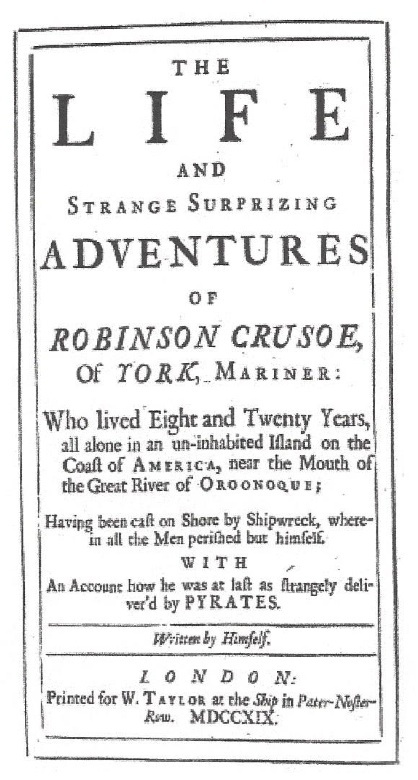
PJK4

Of course, those annotations were jotted down,  not in, say, 1795, when a revolutionary and egalitarian young Coleridge had written “On the Slave Trade,” his searing assault on the moral atrocity of slavery, the horrors of the slave trade and the Middle Passage. Nor in 1798, when he wrote The Ancient Mariner (in which for some readers, beginning with William Empson, the curse and eventual shipwreck hint that the Mariner’s ship was a slaver). He annotated Robinson Crusoe half a lifetime later, in 1830, by which time the former radical, no longer egalitarian though still an advocate of abolition, had turned culturally and politically conservative. Nevertheless, even given Coleridge’s socio-political shift, and taking into account the exercise of historical imagination by a sophisticated reader perhaps unwilling to condemn Crusoe and his creator for a sin more obvious in his age than in Defoe’s, I remained puzzled by the absence of even a passing reference to slavery and the slave trade. Of course, I realized that to push this theme exclusively would itself be a sin: a sacrifice of the splendor of Defoe’s achievement in giving the world an iconic book and popular myth that has fascinated children and adults ever since it was written. For Coleridge was surely right about a major aspect of Crusoe as “Universal representative”; though, in an age of specialization, few of us could match his ability to adapt, we all respond to Crusoe’s “practical-man” energy and inventiveness in surviving, even thriving in the course of his quarter-century on the island.

Yet I remained troubled by the seeming lacuna in the marginalia when it came to Crusoe’s slaving activities, as well as his subsequent relationship with Friday. After all, under all the shifts and oscillations in Coleridge, there seemed to me to be an abiding, and deeply moral, identity. I still think so, though the question of identity now seems to all of us, and certainly to me, far more perplexed and perplexing than it did twenty years ago. Back then I wanted to make a sharp distinction between Coleridge the political and moral Man and abolitionist, and Coleridge as a supposedly apolitical appreciator or literary Critic, sitting down to re-read a much-loved work of literature, a fable that had always fired his own creative imagination. Without succumbing to any politically correct urge to beat Coleridge about the head and shoulders for his failure to so much as mention slavery in his extensive Robinson Crusoe marginalia, I’m less able now to sustain that sharp distinction. Will the real Coleridge stand up? And he will, claiming, not without considerable justice, that there is consistency beneath the difference, an underlying identity. Yet that claim is more justifiable, and more palatable, in terms of his political shift than any Coleridgean claim to an underlying continuity regarding his shifting position on race.

Like his friend and “fellow-laborer,” Wordsworth, Coleridge always maintained that the French Revolution betrayed itself, and that their move from radicalism to conservatism reflected that Gallic betrayal. To employ E. P. Thompson’s terms, “disenchantment” rather than “default” explains their disillusionment and reactionary shift to quietism. That shift— accompanied by their insistence that the authentic agent of change was not political activism but the creative Imagination—will perhaps always inspire mixed feelings on the part of their readers, readers who are themselves politically divided. But it is almost unrelievedly painful to witness the regression of Coleridge on issues of race, from uncompromising advocate of egalitarianism and liberation to a defender, on the basis of pseudo-science and the need for societal stability, of white superiority. And yet, since he remained an abolitionist, there is still a continuum between early and later Coleridge, his identity somehow subsuming antagonistic perspectives.

Variations on that dualistic theme may obviously be found in many writers. I recently published in Numéro Cinq an essay titled “Keats and Identity: The Chameleon in the Crucible,” in which I try to reconcile Keats’s two apparently antithetical conceptions of “identity.” To name just three other peripherally interrelated cases: there is self-divided Sam Clemens/ Mark Twain, whose masterwork, Huckleberry Finn, at once reflects and opposes racism; that Mark Twain enthusiast, Friedrich Nietzsche, a relentless seeker of the very truths he did more than anyone else to undermine; and  W. B. Yeats, who found in Nietzsche a “strong enchanter” whose aristocratic brio, employment of masks, and “curious astringent joy” (Letters, 379) propelled the Irish poet out of the Celtic Twilight into modernity and political conservatism. Yet there is a continuum here as well, and Richard Ellmann was right in both titles of his pioneering studies: Yeats: The Man and the Masks, followed a decade and a half later by The Identity of Yeats.

.

3

In brooding over Coleridge’s marginalia on Robinson Crusoe, I eventually gave up trying to bridge the gap separating the author of “On the Slave Trade” from the annotator who had nothing to say of slavery and the slave trade in celebrating Crusoe as a universal representative of all mankind. Some years after publishing the Coleridge book, in the course of re-reading The Life and Adventures of Robinson Crusoe, I found myself unwilling to follow the vast majority of Defoe critics who insist on another sharp distinction: in this case, between author and character. Defoe, we are told, was “ambivalent” about slavery and “ironic” in his fictional handling of the subject. He may be elsewhere; he is neither ambivalent nor ironic in his most celebrated novel. Playing off Coleridge’s claim that Robinson Crusoe is a “Universal representative,” I published an essay titled “Slavery and the Slave Trade: Crusoe as Defoe’s Representative.”
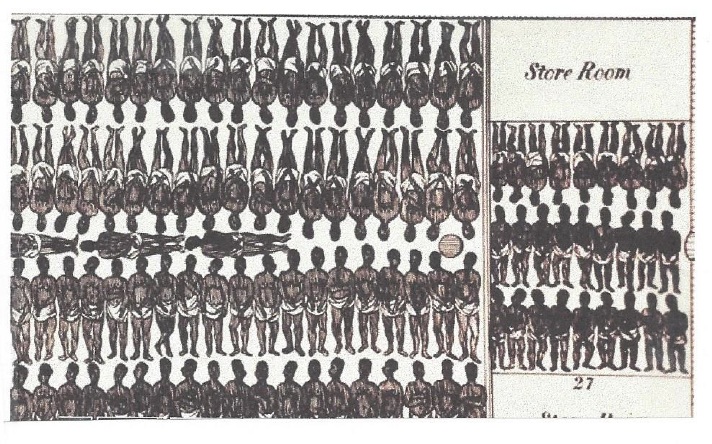
Interior of a Slave Ship. This detailed drawing shows how the “cargo” was arranged to maximize capacity.

There I argued, to the annoyance of some prominent Defoe scholars, that while Crusoe (as mercantilist and imperialist as his creator) may not be, strictly speaking, identical to Defoe, on the issue of slavery and the slave trade there seemed little to choose between them. Crusoe, newly engaged in slave-trading when he is shipwrecked, never, in his many years of hand-wringing religious rumination, thinks to attribute his calamity to the sin of buying and selling human beings. Nor does it occur as a possibility to Defoe, who, after all, had the option of enlisting Crusoe in another line of work. Though slavery and the slave trade become tangential once ship-wrecked Crusoe has been marooned on his island, they nevertheless, as Michael Seidel observed in 1991, “hover like something of a curse” over the entire novel (Robinson Crusoe, 106), re-emerging in a more benign but persistent and unironic Master-Slave relationship once Crusoe has saved from cannibals the near-victim who will become his Man Friday.
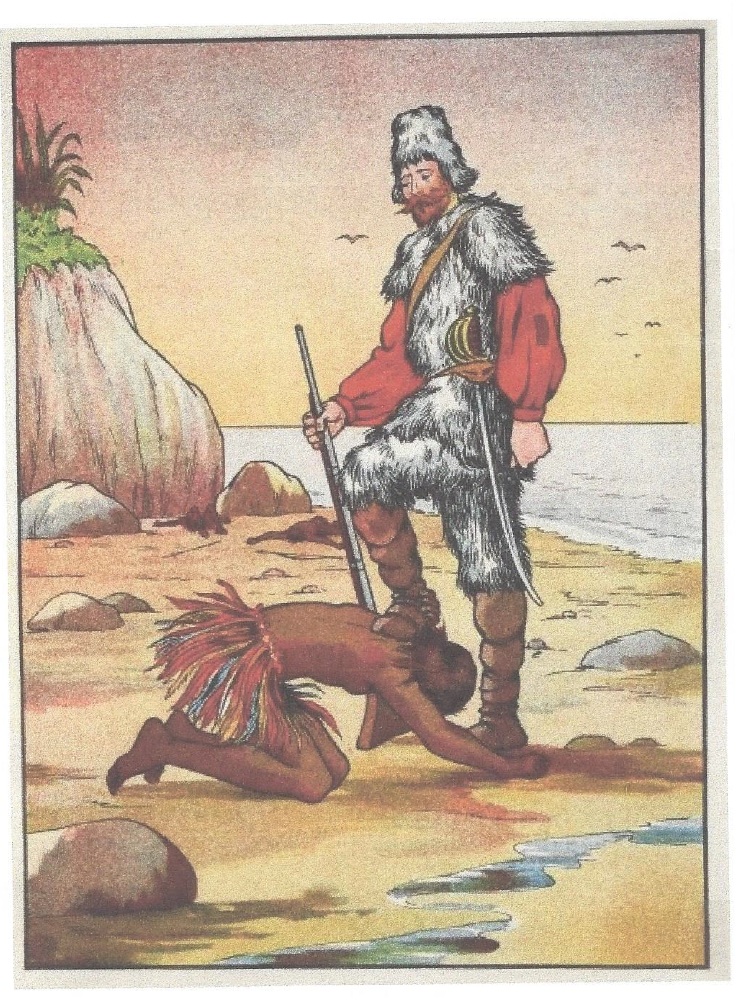
Robinson Crusoe, chapter 23: “At last he lays his head flat upon the ground, close to my foot, and sets my other foot upon his head, as he had done before; and after this made all the signs to me of subjection, servitude, and submission imaginable, to let me know he would serve me as long as he lived…I began to speak to him and teach him to speak to me; and first, I made him know his name should be Friday, which was the day I saved his life;…I likewise taught him to say ‘Master,’ and then let him know that was to be my name.”

Though most Defoe scholars insist on their author’s double-mindedness on these issues, many who emphasize his ambivalence mistake Defoe’s criticism of the cruelty inflicted by traders and owners for condemnation of the institution itself. Writing in the 22 May 1712 number of his Review, Defoe had this to say about English slaveholders in Barbadoes:

The Negroes are indeed Slaves, and our good People use them like Slaves, or rather like Dogs, but that by the way: he that keeps them in Subjection, whips, and corrects them, in order to make them grind and labour, does Right, for out of their Labour he gains his Wealth: but he that in his Passion and Cruelty, maims, lames, and kills them, is a Fool, for they are his Estate, his Stock, his Wealth, and his Prosperity. (Review, VII, 730)

Having mistaken utilitarianism for altruism, many apologists for Defoe then compound the misperception by translating his alleged ambivalence into authorial “irony” when slavery and the trade feature in the fictional works, including The Life and Adventures of Robinson Crusoe and the later Farther Adventures of Robinson Crusoe. Whatever his divided, even contradictory, feelings regarding the slave trade (expressed, for example, in his 1702 poem, A Reformation of Manners, or in such novels as Captain Singleton and Colonel Jack), Defoe adamantly defended the trade in essays, especially the series published in his Review between 1709-13. He considered the slave trade a perfectly respectable business, bought stock himself in two companies engaged in the traffic, thought it indispensable to British colonialism, and most certainly admired the profits to be made from it. Most Defoe scholars notwithstanding, when it comes to Daniel Defoe and Robinson Crusoe on the issues of slavery, the slave trade, and white superiority, there seems less distinction, let alone difference, than identity.

Daniel DefoeDaniel Defoe

This remains essentially true even when it comes to Crusoe’s relationship with Friday: a relationship, in most readers’ memories, preserved in amber, aureoled by a soft, nostalgic glow. Though Defoe’s realism breaks through some barriers of racial prejudice and notions of primitive man, that breakthrough is severely limited by Defoe’s, and Crusoe’s, historical time and temperament. The “quest for the white man’s burden tends to end,” as Ian Watt remarked in The Rise of the Novel, “in the discovery of the perfect porter and personal servant.” The relationship between Crusoe and Friday, often touching, is hardly sentimental, and it remains as it was established from the outset. As a “first” step in communication, Crusoe, having let the man he rescued “know his name should be Friday, …likewise taught him to say Master, and then let him know, that was to be my name” (Robinson Crusoe, 209). The iconic Crusoe-Friday image is that of the master’s foot on the bowed head of the grateful but abject slave.

In their Farther Adventures, in Lisbon and London, Friday is either forgotten by both Crusoe and Defoe, whose memory of off-stage characters is notoriously short, or is reduced (as in the lengthy and gratuitous episode in “the Pyranean mountains,” where Friday clowns with the bear for the diversion of the white folk) to a comic entertainer. In his final role as “white” interpreter to the natives, Friday, having returned with Crusoe to their now populated island after an eight-year absence, is in the process of becoming just another in a crowd of native faces when he is singled out for one last task by his master. Answering, as always, the call to duty, he dies—heroically, to be sure, but more in keeping with Crusoe’s requirements, “useful, handy, and helpful” to the end. He has, in keeping with Crusoe’s imperative, proven loyal “to the last Drop.” The Master’s characteristically restrained grief is focused on the loss of a valuable servant. Revealingly, with Friday almost instantly eclipsed from his memory, Crusoe thinks at once about capturing another cannibal as a substitute slave (Farther Adventures, 73, 74).

.

4

The cost (cultural, emotional, and at last existential) to the perfect servant—never inquired into by either Crusoe or Defoe—has been imaginatively explored by such twentieth-century anti-Robinson French novelists as Jean Giraudoax, Suzanne et le Pacifique (1921) and  Michel Tournier, in Vendredi: ou Les limbs du Pacifique (1967), and by South Africa’s J. M. Coetzee, in Foe (1987); as well as by poets: Derek Walcott, in “Crusoe’s Journal” (1970), Elizabeth Bishop, in “Crusoe in England” (1976), and A. D. Hope, in “Man Friday” (1985). The most sustained reworking of the Friday-theme occurs in Charles Martin’s remarkable 14-part poetic sequence, Passages from Friday (1983), in which Friday not only speaks, but writes. And the sequence ends in an astonishing semi-fusion of identities between Master and Slave.

As we move toward the conclusion of the book-length poem, Crusoe and Friday together build a means of escape: a great canoe, wrecked before it can be launched. The loss of the canoe and thus of “Deliverance,” prove “1 Disaster/ too many” for Crusoe, who grows absent-minded, and given to wandering off with his jug of raisin-wine. On one drunken expedition, he falls, eventually succumbing to his injuries—despite Friday’s nursing and prayers, notably including a repetition of Christ’s words at the Last Supper, “Take ye & eat/ of my owne flesh in the Remembrance of me” (XI).  Martin may be remembering that Derek Walcott’s Crusoe, seen through the eyes of a descendant of Friday’s, is said to have altered “us/ into Good Fridays” who pray, “parroting our master’s style and voice…converted cannibals/ we learn with him to eat the flesh of Christ.” Having presumably (though we are never quite sure) reverted to cannibalism, a barbarous version of identity, Martin’s Friday, alone and without orders to obey, turns artist, carving wooden figures, both European and cannibals. But soon, suffering another and proto-Marxian crisis of identity, he grows alienated from the artifacts he has created, finding “no place for Friday in what Friday made; /then I was suddenly stricken….” (XIII)

First in feverish dreams, then in apparent reality, self-divided Friday, rigged out in Crusoe’s goatskin and hat, carrying “his Rifle & his Powder-Horn,” and “his Umbrella,” approaches that point on the island where his former Master had originally saved him from the cannibals. Friday is on a quest, but why and whither he cannot say:

For it was not I who set owt, nor was it him,
Nor was it the both of us together;
I know not who it was; but, as in my Dream
Of the Night befor, when I was neither

Master nor Friday, but I partook of each,
So was it that Morning. Whatever my Intention
I find myself walking on that Beach
to-ward that Poynt which I have earlier mention’d

and when I pass it by un-harmed, I collaps
upon the Sand    I lay ther in great Fear
for a good long Time   no savage Shapes
assail mine Eye   no screeching payns mine Ear (XIV)

Though, as the poem had confirmed from the outset, there is no hope of returning to his true “home,” Friday, at poem’s close, at last takes imaginative possession of the “inchanted Island” formerly ruled by Crusoe, of whom Friday would seem to have “partook” in more senses than one. Appropriately, his passing of the critical Point “unharm’d,” and his final assertion of liberation from savage sights and colonialist sounds (“no screeeching payns mine Ear”) signal Charles Martin’s thematically-related allusion to Caliban’s imaginative possession of his enchanted island in Shakespeare’s Tempest: his enjoyment of the sounds that “hum about mine ears” in the exquisitely un-savage passage in Act III of The Tempest, beginning, “Be not afeard, the isle is full of noises,/ Sounds, and sweet airs, that give delight and hurt not” (III.ii.131-32).
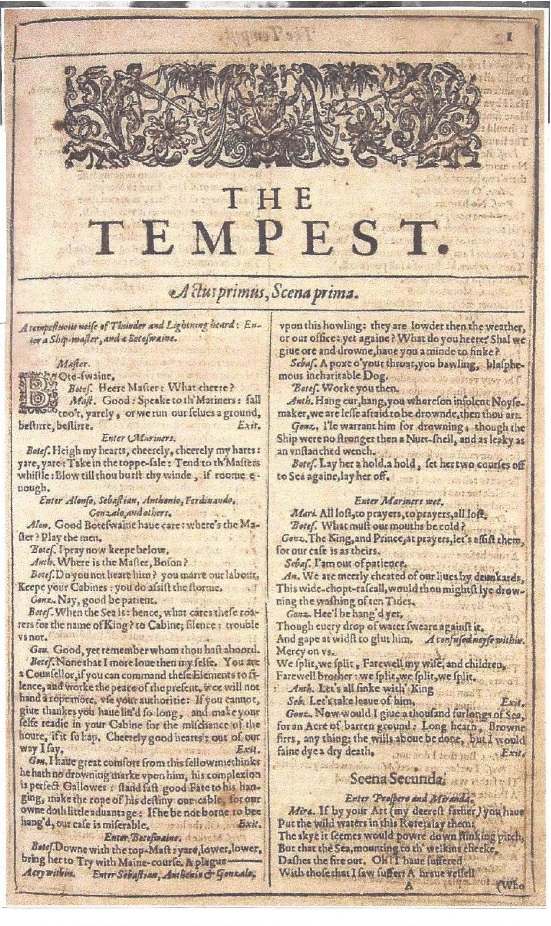
Title page of "The Tempest," the first play in the "First Folio," 1623Title page of “The Tempest,” the first play in the “First Folio,” 1623

And Caliban knows the isle, knows it as his own. As he had earlier cried out to Prospero, his initial liberator become his tormenter after the attempted rape of Miranda, “This island’s mine, by Sycorax, my mother,/ Which thou taks’t from me/…Which first was mine own king” (I.ii.331-42). One might point out, accurately, that Sycorax originally took the island from Ariel, a delightful and freedom-loving spirit hardly likely to stake out, as Caliban does, a possessive, indigenous claim. Thus Caliban’s claim has merit; but while Charles Martin’s Friday takes possession of the island, Shakespeare’s Caliban will again be dispossessed, carted off with the others to Milan, where he will perhaps resume his interrupted tutelage under Prospero: a prospect less incongruous when we put aside for the moment his brutish gabble and recall the beauty of that speech which not only describes but exemplifies the beauty of the island’s “Sounds, and sweet airs, that give delight and hurt not.” Like Martin‘s Friday and Joyce’s Leopold Bloom, Shakespeare’s Caliban has a touch of the artist about him. He will, to be sure, cut a very strange figure in Milan, but, as Shakespeare may hint in the final words he gives to him (“I’ll be wise hereafter,/ And seek for grace”[V.i.294-95]), the half-human, even “demi-devil” Caliban may be both educable and, unlike the incorrigibly villainous Antonio and Sebastian, redeemable.

However we judge Prospero’s tone, he does say, “This thing of darkness, I/ Acknowledge mine” (V.i.275-76): an observation taken up and amplified by Aimé Césaire in perhaps the most striking of the many postcolonial Latin-American and African re-envisionings of Shakespeare’s play, one in which the cleavage between Master and Slave, Prospero and Caliban, is replaced by Identity. Writing in 1990, Stephen Greenblatt noted that it would take different artists from different cultures to “rewrite Shakespeare’s play and make good on Caliban’s claim” (“Culture,” 232).  He was thinking of the Cuban critic Roberto Fernandez Retamar’s Caliban and Other Essays (trans. 1989), and of other cultural critics who, contending with Shakespeare, choose Caliban over Prospero and Ariel. Greenblatt may also have had in mind, along with other postcolonial re-writings, Césaire’s reimagining of The Tempest in a play in which the identities of Caliban and Prospero are fused into a unity resembling yet different from Friday’s hallucinatory “partaking” of both himself and Crusoe in Charles Martin’s Passages from Friday.

.

5

Like Robinson Crusoe, The Tempest has become a critical and cultural battleground, perhaps the most prominent site for combat between aesthetic and historicist readers. Exercising the hermeneutics of suspicion, many New Historicists depict intrinsic readers who insist on giving priority to what is actually there in a text—say, the text of this Shakespeare play—as both knowing and sinister: “hegemonic” reactionaries conspiring to keep the text’s “real,” if unintended, political meaning from being uttered. That “real” meaning, usually conveyed inadvertently by a politics-effacing author, typically has to do with the dominant (Western) culture’s sexist, classist, and racist suppression of its victims. Even more than Defoe’s novel, The Tempest has been the prime text for postcolonial theorists to insist on a shift of sympathy, whatever Shakespeare’s own intentions, from the dominant to the subversive character, from master Prospero to the enslaved Caliban. For decades now, The Tempest has been criticized, revised, and politically re-envisioned by directors, cultural critics, and creative writers. Last year, the Theater Department at my own college mounted a production of the play in which Caliban’s mother, the evil hag-witch, Sycorax, referred to but absent from Shakespeare’s play, was a central on-stage figure, the practitioner of a sorcery indistinguishable from Prospero’s!
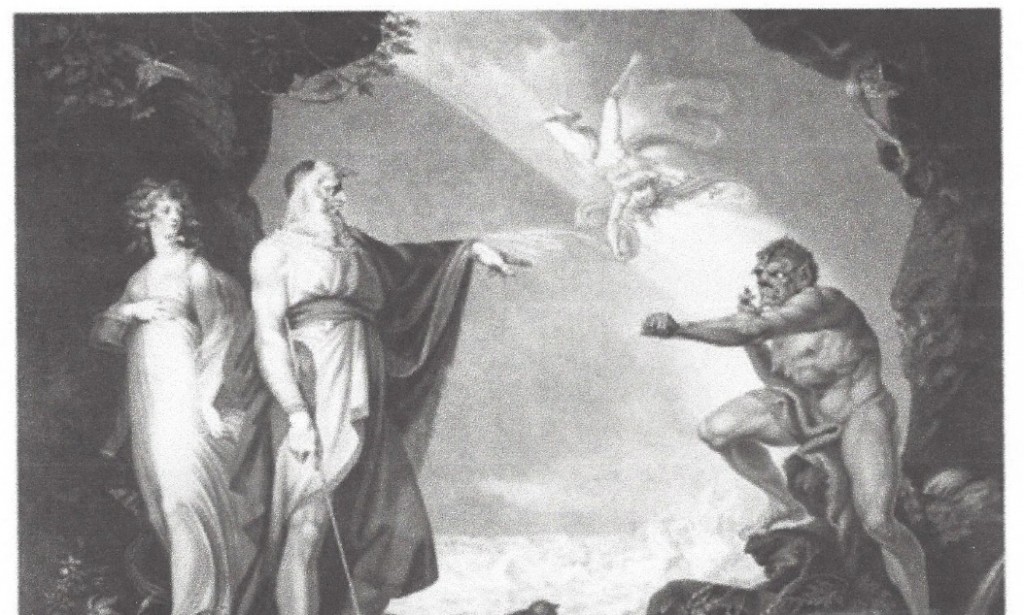
Prospero, Miranda, Ariel, and Caliban “The Enchanted Island: Before the Cell of Prospero” (Henry Fuseli, 1797)

In the case of The Tempest —its island set in the Mediterranean but reflecting Shakespeare’s reading of Montaigne’s “On Cannibals” and of contemporary accounts of shipwreck and salvation in the Bermudas—Latin-American writers have been particularly active pro-Caliban revisers, beginning with Nicaraguan Rubén Dario’s 1898 essay “The Triumph of Caliban.” (Two years later, Uruguayan statesman José Enrique Rodó identified Latin American culture with Ariel.) As early as 1904, W. T Stead had objected to the imperialism represented in the play and sided with indigenous cultures; but a resurgence of interest in anti-colonial readings followed Octave Mannoni’s influential Psychologie de la colonization (1950), earlier mentioned, which was translated more pointedly into English six years later as Prospero and Caliban. Most notably, Aimé Césaire of Martinique in 1969 rewrote The Tempest in his own play, Une tempête, adapted for a Black Theater, and first performed in Tunisia (where Alonso’s daughter Claribel became queen in the wedding that set Shakespeare’s court party to sea in the first place and so subject to the magical storm conjured up by his magus). Césaire’s Prospero is a white master, Ariel a mulatto, and Caliban a Black slave; while Echu (named for the Yoruba god) threatens to “smite with his penis.” In Une tempête, Caliban, unlike resistant but non-violent Ariel, is an advocate of revolution, a Malcom X to Ariel’s Martin Luther King, Jr. Declaring that “now it’s over,” Césaire’s Caliban rebels against the hated “image” imposed on him by Prospero, and finally threatens that “one day,” he will raise his “bare fist” against his Shakespearean master.
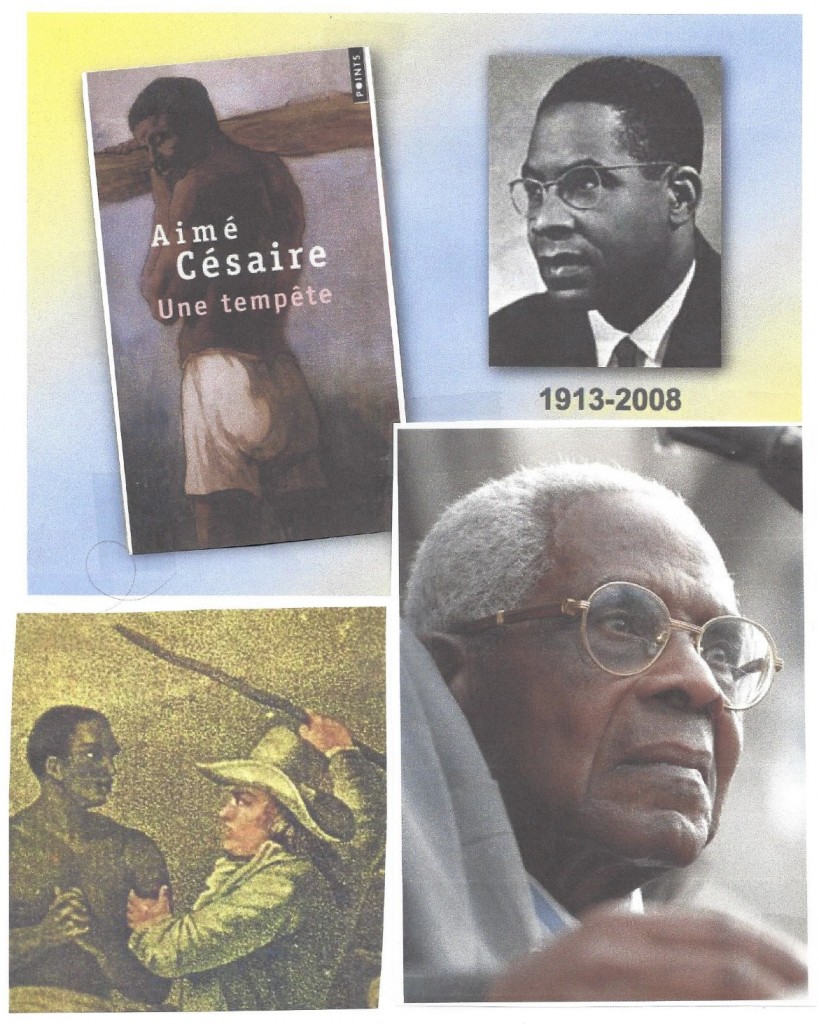
Aime CesaireAimé Césaire

In Césaire’s revision, a fusion of Western surrealism and his own vision of négritude, master and slave end up trapped on the island when the others have left. After many years together, indicated by the curtain’s being lowered halfway, then raised, Prospero appears in semi-darkness, “aged” and weary. “Ah well, my old Caliban,” says he, “we’re the only two left on this island, just you and me. You and me! You-me! Me-you!” In having Prospero suddenly think of himself and Caliban as indistinguishable, Césaire at once (as we’ll see in a moment) echoes Shakespeare’s play, and, as Joan Dayan suggested in her 1992 essay “Playing Caliban: Césaire’s Tempest,” undermines the idea that either the “original” Shakespeare play or his own  have priority. In his Prospero’s “You-me! Me-you!” fusion, she argues, Césaire “recognizes the force of mutuality, the knot of reciprocity between master and slave, between a prior ‘classic’ and his response to it.” This “labor of reciprocity” accounts for “the complexities of Césaire’s transformation: a labor that defies any simple opposition between black and white, master and slave, original and adaptation, authentic and fake.”

At the same time, Césaire, who, for all his postcolonial revisionism, seldom loses sight of the play he is adapting, may be recalling those lines already quoted from the final moments of Shakespeare’s Tempest. Indeed, Césaire’s “You-me! Me-you!” fusion may also have influenced Charles Martin’s later variation on the theme, when, at the end of Passages from Friday, the speaker-writer tells us that he is neither himself nor Crusoe, nor both together; “neither/ Master nor Friday, but I partook of each.” Martin’s Friday and Césaire’s Caliban might seem to flesh out, even fulfill, the reluctant concession of Shakespeare’s Prospero: “this thing of darkness I/ Acknowledge mine.” But Martin’s Friday seems to have literally consumed Crusoe, and by the time Césaire’s Prospero finally claims identification, Caliban himself has disappeared. The last word the audience hears—echoing and altering Caliban’s delusory and ignominious cry of “Freedom!” at the end of Act II of Shakespeare’s play—is the genuinely triumphant offstage cry, “LIBERTY!” (in Philip Crispin’s translation) or (in Richard Miller’s) “FREEDOM!!”—the distinctive Western value, as Orlando Patterson demonstrated at length in his award-winning two-volume Freedom.

The factors informing such rewritings—ethnicity, economics, social class, colonial history—are among the historical and perspectival elements that condition our responses to the world, and to texts. It is hardly surprising that some readers—politically engaged postcolonial readers of The Tempest, for example—will want to creatively fill in perceived absences and silences in ways that remold the text nearer to their own heart’s desires. In the Age of Theory, a poststructuralist era largely shaped by Nietzsche, most of us will agree that literary texts are not verbal icons hermetically sealed off from the world. They reflect and are influenced by the social and historical contexts in which they are complexly anchored, and they require readers, similarly influenced, to “actualize” them in what Hans-Georg Gadamer calls a hermeneutic or dialogic “fusion of horizons” (Truth and Method, 320). The danger is that in in “recontextualizing” a work of art, we may temporally limit it to its own, now “outdated,” historical moment; or that, in properly asking questions from our present socio-economic horizon, we will also impose answers on the past. Either way, we can hardy avoid inflicting aesthetic injury in the process.

Often, New Historicist readings, whatever their many illuminations, are closed monoreadings that risk losing the palpable poem in the attempt to recover sociopolitical realities the original author supposedly tried to evade. Marxian theorists—for example, Pierre Macherey in A Theory of Literary Production—insist that these silences and absences are inevitable, ideologically predetermined. Deconstructionists invariably find text-unravelling aporias; what many New Historicists must look for, and invariably find, in “privatized” poems is the effaced “public” dimension, the vestigial politics still lurking in the unspoken but no longer quite inaudible subtext. The claim that often follows, whether explicit or implicit, is that, having ferreted out these buried meanings, we have succeeding in “decoding” the poem, revealing its “absent” and therefore primary level of meaning—the interpretation having the highest priority. In the case of The Tempest, the admonition of Frank Kermode (one of the play’s two best editors, the other being Steven Orgel) is pertinent. Even when the political dimension is actually there, in Shakespeare’s text—however blind earlier readers seem to have been to the layer of meaning often over-emphasized in our own age—these relations, though they exist in the play, should be “secondary to the beautiful object itself” (Shakespeare’s Language, 300).

.

6

In concurring with Kermode that our actual “highest priority” should be aesthetic, I am not suggesting a simplistic return to the art-for-art’s-sake school of rarified, Paterian “Appreciation.” In the specific case of The Tempest, I would not go as far as one of my own cherished mentors, Harold Bloom. Inveighing against the contemporary critical trends he dismisses (deliberately echoing Nietzsche’s famous condemnation of ressentiment) as “the School of Resentment,” Bloom declares: “Of all Shakespeare’s plays, the two visionary comedies—A Midsummer Night’s Dream and The Tempest—these days share the sad distinction of being the worst interpreted and performed. Erotomania possesses the critics and directors of the Dream, while ideology drives the despoilers of The Tempest.” These characteristically judgmental sentences open the chapter on The Tempest in Bloom’s 1998 study, Shakespeare: The Invention of the Human. He goes on to make it clear that he is open to such creative re-visitings of the play as Robert Browning’s remarkable dramatic monologue, “Caliban upon Setebos,” and W. H. Auden’s prose address, from The Sea and the Mirror, titled “Caliban to the Audience,” which, though “more Auden than Shakespeare,” catches, as Bloom acknowledges, much of Caliban’s “dilemma” and his “pathos.” What stirs Bloom’s Nietzschean wrath are the political reconfigurings I’ve already mentioned, specifically the transformation of Caliban, “a poignant but cowardly (and murderous) half-human creature,” into “an African-Caribbean heroic Freedom Fighter,” a move Bloom dismisses as “not even a weak misreading.”

Djimon Hounsou in the Julie Taymor film adaptation of "The Tempest" (2010), starring Helen Mirren as "Prospera." Hounsou also played the leader of the slave mutiny in Steven Spielberg's 1997 film "Amistad."Djimon Hounsou in the Julie Taymor film adaptation of “The Tempest” (2010), starring Helen Mirren as “Prospera.” Hounsou also played the leader of the slave mutiny in Steven Spielberg’s 1997 film “Amistad.”

This condemnation is less political (Bloom is on the permanent Left) than an allusion to his own long-held literary theory, which celebrates strong, but decidedly not weak, “misreading.” From The Anxiety of Influence on, Bloom has famously apotheosized the “strong reader,” one who brings to bear his own personality, and reads the work of others above all to stimulate his own creativity. Bloom has repeatedly acknowledged that his theory and practice derive primarily from two exemplars: Emerson and his disciple Nietzsche. Emerson insists, in “The American Scholar,” that there is “creative reading as well as creative writing,” and announces, in “Uses of Great Men” (in Representative Men), that “Other men are lenses through which we read our own minds.” At the very outset of Ecce Homo (in the chapter “Why I Write Such Good Books”), Nietzsche claims that, “Ultimately, nobody can get more out of things, including books, than he already knows.” (He then goes on, perhaps “inconsistently” but certainly prophetically, to complain that anyone who claimed to understand his work “had made up something out of me after his own image.”)

This Emersonian-Nietzschean line of revisionary reading Bloom labels “antithetical,” this time borrowing his term from Yeats, who famously contrasts an italicized and preferred  antithetical to the primary; who called Nietzsche his “strong enchanter”; and who declared in his 1930 diary, “We do not seek truth in argument or in books, but clarification of what we already believe” (Explorations, 310). Bloom champions “strong” misprision (misreading), repeatedly asserting, from The Anxiety of Influence on, that “really strong poets can read only themselves,” indeed, that for such readers “to be judicious is to be weak.” Bloom’s dismissal is therefore all the more damning when he insists that the post-colonial reinterpretation of Caliban “is not even a weak misreading; that anyone who arrives at that view is simply not interested in reading the play at all. Marxists, multiculturalists, feminists, nouveau historicists—the usual suspects—know their causes but not Shakespeare’s plays” (Shakespeare, 622).

One of many sinister Calibans

Without rejecting it, I would qualify the indictment. Those “suspects” are reading the play, but reading it badly, allowing their political “causes,” which really are implicit in Shakespeare’s text, to become primary rather than remaining, in Kermode’s term, “secondary.” The stock of Prospero, that valorized magus and Shakespeare-surrogate of much of the earlier criticism, has fallen in the twentieth century. Postcolonial critics have charged that the admiration of Prospero so prominent in the nineteenth century reflected a willful evasion of crucial aspects of the play. Though Prospero retains majority support, his (often justified) harshness, always there in the text, has become more evident, both to readers and, depending on the director, to theatergoers. Having become more sensitive to the irascible, bullying aspects of Prospero, many have consequently become more sympathetic to the plight of the dispossessed, subjugated, and always fascinating Caliban. Bloom himself describes Caliban as “poignant” and applauds Auden for stressing his dilemma and pathos. What Bloom resists is the determinism, ideological and theoretical, of the political readers and re-writers of The Tempest. For them, Caliban, suppressed not only by Prospero, but by Shakespeare as well, must be the play’s hero. Here, the return of the repressed takes the form of Identity politics, returning with a vengeance.

Detail from Henry Fuseli's engravingDetail from Henry Fuseli’s engraving

.

7

It is, in general, an intriguing poststructuralist phenomenon that so many who theoretically pronounce texts indeterminate—bereft of authorial meaning, with text and interpretation alike determined by the inevitable linguistic gap between signifier and signified, by temporal limitations, by political ideology, class or gender bias—also, in practice, repeatedly claim to have decoded, “unmasked” or “exposed,” what is “really” going on: what a play such as The Tempest “conceals” as well as what it “reveals,” even to “correct” what has been “distorted.” As Richard Levin asked in 1990—cocking a mischievous eye in his PMLA article “The Politics and Poetics of Bardicide”—who is more guilty of what the indeterminists dismiss as “hubristic objectivism.” Is it those who believe that literary works are written by actual authors whose meanings (intention having become achievement) are there in the text, to be interpreted? Or is it those for whom the “hermeneutic vacuum” left by the Death of the Author must be filled by “a universal law” that “dictates what one must look for, and must find, in every [text]?”

I would add, in the case of The Tempest, what may be too obvious to need saying: that Aimé Césaire has every right to recreate Shakespeare in forging his own work of art, especially since Une tempête, as Malcolm Bowie noted in reviewing the 1998 Gate Theater production in London, “is not simply a new reading of Shakespeare but an original play of astonishing power.” But for the most part we are dealing with cultural revisionists who, having not found the political subtext of The Tempest adequately expressed, are compelled to “foreground” or “privilege” it in ways which—however creative,  illuminating, and even liberating—inevitably distort the original play. Both as an “immoralist” moralist and as a philological “good reader” able to “read off a text as a text” without “falsifying it by interposing an interpretation,” Nietzsche (going, in this passage from The Antichrist §52 and its original formulation in The Will to Power §479, against his usual insistence on “perspectivism” and “interpretation”), would approve of Bloom’s enrollment of such revisionists in “The School of Resentment.” For the crucial Nietzschean concept of ressentiment—stemming from the contrast introduced in Beyond Good and Evil §260 between “master morality and slave morality,” and fully developed a year later in On the Genealogy of Morals—has to do with frustration, psychological and political, arising from a sense of inferiority inseparable from subjugation. Of course, to again state the obvious, this is precisely what postcolonial “appropriations” of The Tempest set out to rectify, focusing inevitably on the subjugated figure that seems to embody both the plight and the hope of the victims of colonial oppression  To quote Cuban Fernández Retamar’s famous and defiant rhetorical question: “what is our history, what is our culture, if not the history and culture of Caliban?” (Caliban and Other Essays, 14).

Finally, in terms of the revisionist act of creative reading performed by Césaire in Une tempête: the philologist in Nietzsche would probably concur with Milton’s famous distinction in Sonnet XII: there are those  that “bawl for freedom” and “still revolt when truth would set them free./ License they mean when they cry liberty.” FREEDOM/ LIBERTY! cries Césaire’s Caliban. The cry is thrilling as an expression of belated, if incomplete, postcolonial liberation; but it “means” (not as a legitimate act of creative rewriting, but as a dubious act of literary interpretation) “License” in regard to the original Tempest. To be sure, as New Historicist Stephen Greenblatt remarked in 1990 (the year he borrowed from Caliban the title of his collection of essays, Learning to Curse), Shakespeare’s imaginative mobility, genius, and empathy enabled him “to display cracks in the glacial front of princely power and to record a voice, the voice of the displaced and oppressed, that is heard scarcely anywhere else in his own time.” If, Greenblatt concludes, “it is the task of cultural criticism to decipher the power of Prospero, it is equally the task to hear the accents of Caliban” (“Culture,” 232).

And that’s true, too. But nothing is got for nothing. One version of what Amartya Sen titularly juxtaposes as Identity and Violence is the textual violence that can be done, and increasingly has been done, to the last masterwork completely written by Shakespeare, of whose authorial death rumors have been greatly exaggerated. Just as he went against the prejudicial grain of his age to enable us to hear what is most moving in the speeches of Othello and Shylock, Shakespeare intended that we should hear the authentic accents of Caliban. But even in a play as mysterious as The Tempest, we can detect an overarching authorial intention. Intentional fallacy notwithstanding, an author’s intention is not dismissed even by such radical linguistic skeptics as Nietzsche and Derrida. The latter, founding father of deconstruction, refers to authorial intention as an “indispensable guardrail…protecting” readings from going over the cliff, into that abyss of wild excess otherwise sanctioned by his notorious term “freeplay” (Of Grammatology, 158).

We want and need to hear the accents of a disinherited and exploited Caliban, as Shakespeare clearly intended we should. But not if amplifying Caliban’s voice through the filtering ear-trumpet of modern Identity politics comes at the cost of distorting the play Shakespeare actually wrote. I may find more difference than identity between early and later Coleridge in dealing with race, and more identity than difference between Defoe and Crusoe on the issue of slavery. Though Césaire’s “Adaptation for a Black Theatre” may be “based” on Shakespeare’s play, we are obviously intended by its author to find more difference than identity when it comes to the treatment of Caliban in Une tempête, a revolutionary text that is at once an adaptation and a despoiler of The Tempest. We will be moved and instructed by both plays; but, in the end, we should render unto Césaire the things that are Césaire’s, and unto godlike Shakespeare the things that are Shakespeare’s.

N.C. Wyeth illustration of Robinson CrusoeN.C. Wyeth illustration of Robinson Crusoe

.

Afterword

This brief essay, as personal as it is “scholarly,” makes no attempt at an exhaustive examination of the vast body of modern criticism that has focused on the cultural, historical, and political aspects of The Tempest. For those who wish to pursue the subject, the following provide excellent starting points.

The Tempest and Its Travels, ed. Peter Hulme and William H. Sherman (Reaktion Books, 2000), brings together specially commissioned critical essays on the play’s various contexts and intertexts; the volume also includes poems and visual images. Along with excerpts from Césaire’s play, the editors include excerpts from two other stage versions: Raquel Carrió and Flora Lauten’s Otra Tempestad, put on at The Globe (London) in 1998, and Tempest(s), staged at the Terra Nova Theater Institute in Copenhagen the following year. Arguing against the dismissal of anti-colonial readings and “appropriations” of Shakespeare’s text, Peter Hulme insists that such readings and stage-performances “do, actually…speak to the real text.” We should “listen to them and write a place for them in Shakespeare criticism” (233).

In a study illuminating the “New World” aspect of Caliban, Hulme had earlier explored that historical context, discussing colonial encounters between Europe and the Native Caribbean from 1492-1797. See Hulme, Prospero and Caliban (Routledge, 1986). The origin of the figure of Caliban and his disparate metamorphoses in stage history through 1993 is expertly examined in Shakespeare’s Caliban: A Cultural History by Alden T. Vaughan and Virginia Mason Vaughan (Cambridge UP, 1993), and in Constellation Caliban: Figurations of a Character, eds. Nadia Lie and Theo D’haen (Amsterdam, 1997).

A year earlier, Jonathan Hart, going beyond both an ideal Prospero and a heroic Caliban, and attending to the play’s various genres, explored the interaction of the “political themes” of authority and rebellion (or freedom and slavery) with “the romance themes of survival, regeneration, and wonder.” See Hart’s “Redeeming The Tempest,” Cahiers Elizabethains (April, 1996): 23-38.

Works Cited

Bloom, Harold. Shakespeare: The Invention of the Human. Riverhead, 1998.   

Bowie, Malcolm. “Island Infamy” [review of Une tempête] TLS (9 October 1998), 22.

Césaire, Aimé,  Une tempête, “Based on Shakespeare’s The Tempest—Adaptation for a Black Theater.” Translated by Richard Miller (Online: firstyear.barnard.edu/Shakespeare/tempest/tempete), and by Philip Crispin (in 1998, for the Gate Theater production, and published by Oberon Books).

Coleridge, Samuel Taylor. Marginalia, vol. 1, ed. George Whalley. Princeton UP, 1984.

____________________. “On the Slave Trade,” in Lectures 1795: On Politics and Religion, ed. Louis Patton and Peter Mann. Princeton UP, 1971.

Dayan, Joan. “Playing Caliban: Césaire’s Tempest.” Arizona Quarterly 48 (1992), 125-45.

Defoe, Daniel. The Life and Adventures of Robinson Crusoe, ed. Angus Ross. Penguin, 1965.

__________. The Farther Adventures of Robinson Crusoe, in vol. 3 of the 14-volume Shakespeare Head edition of Defoe. Basil Blackwell, 1927.

__________. Defoe’s Review, ed. Arthur Wellesley Secord. Facsimile Text Society, 22 vols. Columbia UP, 1938.

Derrida, Jacques, Of Grammatology, trans. Gayatri Spivak. Johns Hopkins UP, 1976.

Emerson, Ralph Waldo. “The American Scholar” and “The Uses of Great Men” (Introduction to Representative Men ), both in Emerson: Essays and Lectures, ed. Joel Porte. Library of America, 1983.

Gadamer, Hans-Georg. Truth and Method. [1960] Seabury Press, 1975.

Greenblatt, Stephen , “Culture,” in Critical Terms for Literary Study, ed. Frank Lentricchia and Thomas McLaughlin, pp.225-32. U of Chicago P, 1990.

________________.  Learning to Curse: Essays in Early Modern Culture. Routledge, 1990.

Keane, Patrick J.  Coleridge’s Submerged Politics. U of Missouri P, 1994.

_____________.  “Slavery and the Slave Trade: Crusoe as Defoe’s Representative,” in Critical Essays on Daniel Defoe, ed. Roger D. Lund, pp. 97-120. G. K. Hall, 1997.

Kermode, Frank. Shakespeare’s Language. Farrar, Strauss, Giroux, 2000.

Levin, Richard. “The Poetics and Politics of Bardicide.” PMLA 105 (1990): 491-502.

Mannoni, Octave. Prospero and Caliban: The Psychology of Colonization. Praeger,1956.

Martin, Charles. Passages from Friday. Abbatoir Press, 1983.

Nietzsche, Friedrich. The Antichrist, in The Portable Nietzsche, ed. and trans. Walter Kaufmann. pp. 565-660. Viking Press, 1968.

________________. The Will to Power, trans. Walter Kaufmann and R. J. Hollingdale. Random House, 1967.

Retamar, Fernández. Caliban and Other Essays, trans. Edward Baker. Minneapolis, 1989.

Shakespeare, William. The Tempest, Arden Edition, ed. Frank Kermode. Routledge, 1964.

__________________. The Tempest, Oxford Edition, ed. Steven Orgel. Oxford, 1987

Seidel, Michael, “Robinson Crusoe”: Island Myths and the Novel. Twayne, 1991.

Sen, Amartya, Identity and Violence: The Illusion of Destiny. Norton, 2006.

Stead, W. T. “First Impressions of the Theatre.” Review of Reviews (October, 1904): 360-67.

Thompson, E. P. “Disenchantment or Default: A Lay Sermon” [1969], reprinted in Thompson, The Romantics: England in a Revolutionary Age. Free Press, 1997. pp. 33-74.

Walcott, Derek, The Gulf: Poems by Derek Walcott. Farrar, Straus, and Giroux, 1970.

Watt, Ian. The Rise of the Novel. University of California Press, 1957.

 Yeats, W. B. The Letters of W. B. Yeats, ed. Allan Wade. Rupert Hart-David, 1954.

__________. Explorations. Macmillan, 1963

 — Patrick J. Keane
Patrick J Keane 2

Patrick J. Keane is Professor Emeritus of Le Moyne College and Contributing Editor at Numéro Cinq. Though he has written on a wide range of topics, his areas of special interest have been 19th and 20th-century poetry in the Romantic tradition; Irish literature and history; the interactions of literature with philosophic, religious, and political thinking; the impact of Nietzsche on certain 20th century writers; and, most recently, Transatlantic studies, exploring the influence of German Idealist philosophy and British Romanticism on American writers. His books include William Butler Yeats: Contemporary Studies in Literature (1973), A Wild Civility: Interactions in the Poetry and Thought of Robert Graves (1980), Yeats’s Interactions with Tradition (1987), Terrible Beauty: Yeats, Joyce, Ireland and the Myth of the Devouring Female (1988), Coleridge’s Submerged Politics (1994), Emerson, Romanticism, and Intuitive Reason: The Transatlantic “Light of All Our Day” (2003), and Emily Dickinson’s Approving God: Divine Design and the Problem of Suffering (2007).


Mar 102014
 

IMG_0486

Bianca Stone is an amazing poet/comic creator/illustrator/hybrid/amalgam artist who, yes, changes the weather a bit because she goes where she pleases, much like Anne Carson, with whom she collaborated on the book Antigonick (New Direction, 2012), Carson’s translation of Antigone. Stone has a new book just out, Someone Else’s Wedding Vows (Tin House/Octopus Books, 2014), and she has great genes, being the granddaughter of the of the poet Ruth Stone. We have today an interview between NC’s own amalgamated poet/artist Nance Van Winckel and Bianca Stone, delightful and knowing. Note especially Stone’s analogy between drawing and the poem on the page.

And when I draw—poof! There’s suddenly a physical thing there, that can talk, that can move. And I take advantage of that. The body itself, the air around the body, the expression on the face—these things can work just like a poem. Speaking, but not saying everything.

dg


NANCE VAN WINCKEL: In some of your comics the text can seem suggestive of a state of mind, a thinking-feeling condition. I’m thinking of, for example, “It’s like there’s a house in my skull with a woman waiting for someone to resurrect and take her outside.) The artwork itself, however, often gives this more “lyric” text a kind of narrative context: a physical space, characters, and situation. Can you comment on your own sense of how narrative and lyric impulses combine for you—in process and/or technique?

American+Sentances+American+Sentances+

BIANCA STONE: I’ve always had a great love of narrative. But I prefer also to allow surrealism in to complicate the narrative. I think that’s just how our minds work. In my poetry comics it’s the perfect space to explore the two. You have the push and pull of the visual image (which is so much more immediate than words), and perhaps work against the literal. And against abstraction.

That line you mentioned, for example—how could I possibly draw that without wrecking the imagination of it? I don’t want to draw it. I want to imagine it; more importantly, I want the reader to imagine it. So I draw something that lies beside it, so to speak, like another line of the poem. So that it moves forward, avoiding the didactic, the static.

NVW: Regarding the Practicing Vigilance Series in Notnostrums.

“No coins left in heaven/ you say every day/ to the coin-operated wind.”

In this series I especially like how you get at one’s impulse to “speak,” to give voice to inner turmoil, “someone’s lipstick burning in your skull.” The bats in this series fly like bits of language into the urban brew-ha-ha. Many of your poem comics seem to be haunted by what I’d call “incomplete linguistic transactions.”

Bianca StoneVigilant

BS: I love that you imagined that the bat was bit of language. Because isn’t language, in a way, an image? Especially a poem—which uses the page like a canvas, and appreciates white space, the shape and sound of words, the drop at the end of a line. It’s beautiful for the eye (or perhaps hideous to the eye).
And when I draw—poof! There’s suddenly a physical thing there, that can talk, that can move. And I take advantage of that. The body itself, the air around the body, the expression on the face—these things can work just like a poem. Speaking, but not saying everything.

And often I’ll use poems for a drawing that perhaps need a little more. That aren’t done enough to be on their own. I’ll be using a poem, and take a line out because suddenly, while it’s all alone on the page, I realize it’s not strong enough. Thus, it often creates the non sequitur method that you find in more experimental comics and poetry. But also that method resists the narrative and allows more for music.

Some day soon I’ll be making a comic that’s much more narrative…that’s more a prose poem.

IMG_1397

NVW: You say that in your poetry comics you “want to use the image as another element of form in poetry.” Could you talk a bit more about this text & image “gestalt?”

BS: Again, one is constantly resisting “illustration, ” in its traditional definition. You don’t want to draw what’s being said, because that’s redundant.

It’s damned abstract to talk about, frankly. An image as a line in poetry—it doesn’t make entire sense! But I believe it.

BlackTightsBlack Tights

NVW: Regarding Antigonick, your collaboration with Anne Carson, is it true you didn’t even see her written text until after you’d done the illustrations? But of course you no doubt knew the play. Did you come away from this project with any new understandings about the collaboration process?

BS: Not entirely true! What I did see (read, spend hours with) was Anne’s text. I had it beside me while I did the art. I worked from it, as I do with all my poetry comics.

However, Anne and Robert Currie didn’t show me the hand-written text until I was finished. And then Currie magically came up with a method to put the images and text together.

Collaboration is hard. Very hard. You make endless false starts, and you spend a lot of time alone, weeping internally, worrying about everything. But then you come together and put things together like a couple of curious, eager architects. You step back and you have this one giant product. And you’re so proud. Your ego isn’t too wrapped up in it, because you all did it together.

It’s something that you do with people you trust artistically, and emotionally. And it makes you a better, more humble person.

NVW: I loved the poem “Elegy with Judy Garland (and Refrigerator).” I so admire how the language synchs with the music and the graphics. The intermix of drawing and film, of music and voice-over make for one of the better poetry videos I’ve seen. Does the poem come first, and then the animation take shape around that? And is poetry video a main direction for your work these days?

BS: I’ve always loved making videos. Ever since I was a teenager and had a massive VHS camcorder. The past few years I’ve been doing it again, and it’s really something I’ll keep doing.

It takes a long time. But the main things to remember are:

1. Use a good, finished poem.

2. Make a high-quality recording of it. (Read it well. Read it slowly.)

3. As I preach in my poetry comics, avoid “telling” the poem. Let the poem speak for itself. Use ghosts of subjects in your poem, but not verbatim.

Then comes all the hard work of figuring out the visuals. I’ve developed a kind of stop-animation process with my drawings, which is time consuming and bizarre. The process itself is a kind of performance piece (drawing free-style with a camera blocking half my view; trying not to move the paper or my camera.)

Thinking of the video-making process as part of it will slow you down, and help you make a better video.

A lot of poem videos are kind of awkward…it’s important to pick the right tone (music, sounds, title font, footage).

FridgeFridge

NVW: I know you’re the granddaughter of Ruth Stone, a poet who’s near and dear to my heart, and I know too that you’re running the foundation to make her Vermont house a writer’s retreat and artist space. Could you talk a bit about how her life and/or her poetry have influenced your own? In your video, “Because You Love You Come Apart,” I could swear the first voice is Ruth’s.

BS: YES, the first voice is grandma’s voice, with me pantomiming it. She was an amazing reader.

Well, how to begin with this….grandma’s poetry is the most important poetry to me in the world. Her voice, her words, her love, is why I’m a poet.

I’ve written a lot about it. But to kind of sum-up, I spent my childhood with her (living with her in Binghamton while she was teaching there, traveling to readings, spending summers with her in Goshen, VT). We wrote together all the time, read her poems out loud; created together. I was raised by a single mother, so we spent a lot of our life dependent on my grandmother. My whole maternal family really revolved around her.

InfinityInfinity

Since her house in Vermont has always been a haven for her writing, and for students, poets, artists (and of course my mother and aunts), I’ve always dreamed of making it into a writer’s retreat. Sadly, the house needs about 500,000 worth of renovation (it’s also a historical landmark, so that price includes the parameters of restoring such a house). People tell me to tear it down, and I just want to scream! I wouldn’t dream of it! I’ve been toiling away with whoever will help, raising as much money as we can, trying to save it. All her writing and books and my family’s history is in there, getting eaten by mice and consumed by the elements. This summer I’ll be up there full-time. I’m going to get married there!

Honestly, anyone who can, please donate here at the Ruth Stone Foundation site and read more about what we’re doing.

weddingWedding

NVW: I know you have a new book, Someone Else’s Wedding Vows, just out with Tin House/Octopus Books. Does it include visual art? Or did visual art—your own or others—inspire the poems in the book?

BS: I did the cover. (Which, I at first said I wouldn’t do, because art sometimes trumps words.) But besides that, it’s all about my poems. However, you’ll notice in the book that several poems are also poetry-comics and/or poem-videos out in the world.

I’ve been looking forward to my first book for a long, long time. I was patient in the end, waiting until I had it right. Now I’m thrilled with the whole trajectory of my poetry. I just wish grandma were here to see it.

—Nance Van Winckel & Bianca Stone
.


Bianca Stone grew up in Vermont, and graduated with an MFA from NYU’s Creative Writing Program. She is the author of Someone Else’s Wedding Vows (Tin House/Octopus Books, 2014), several poetry and poetry comic chapbooks, and is also the illustrator of Antigonick, (a collaboration with Anne Carson). Her poems have appeared in magazines such as American Poetry ReviewTin House, and Crazyhorse. She lives in Brooklyn.
SPACE
§
Nance Van Winckel is the author of six collections of poems, including After A Spell, winner of the 1999 Washington State Governor’s Award for Poetry, and the recently released Pacific Walkers (U. of Washington Press, 2013). She is the recipient of two NEA Poetry Fellowships and awards from the Poetry Society of America, Poetry, and Prairie Schooner. Recent poems appear in The Pushcart Prize Anthology, The Southern Review, Poetry Northwest, Crazyhorse, Field, andGettysburg Review. She is also the author of three collections of short fiction and a recent recipient of a Christopher Isherwood Fiction Fellowship. Her stories have been published in AGNI, The Massachusetts Review, The Sun, and Kenyon ReviewBoneland, her fourth collection of fiction, is forthcoming in October from U. of Oklahoma Press. Nance’s photo-collage work has appeared in Handsome Journal, The Cincinnati Review, Em, Dark Sky, Diode, Ilk, and Western Humanities Review. New visual work and an essay on poetry and photography are forthcoming in Poetry Northwest and excerpts from a collage novel are forthcoming in The Kenyon Review OnlineClick this link to see a collection of Nance Van Winckel’s mash-ups of poetry and photography, which she calls photoems. She is Professor Emerita in Eastern Washington University’s graduate creative writing program, as well as a faculty member of Vermont College of Fine Arts low-residency MFA program. She lives near Spokane, Washington with her husband, the artist Rik Nelson. Her personal web page is here.
Mar 092014
 

author photo color

Your Moon Cover

Ralph Angel is a brilliant poet, master of the laconic veering toward silence. Like his beloved Pierre Reverdy, he writes lines that turn your mind inside out, something always yielding to its opposite, presence and absence intertwine.

I painted the walls and the ceiling an even white.
Then I knocked out a wall.

The words emerge from the white space of the page, hesitant, whispered into the silence, uncertain of return. Melancholy, mysterious, precise.

These are poems from Angel’s new book, Your Moon, just launched from Western Michigan University’s amazing press New Issues Poetry & Prose.

dg

Ralph_Angel

Panic

In one breath of air
I swam to the bottom of the ocean and brought back the earth.

I painted the walls and the ceiling an even white.
Then I knocked out a wall.

On the lake a swan folds herself into her wings
forever.  It was that

time of year.  The snakes are making rain.


Being Back

Sooner or later I am out folding chairs again, and so
leave myself behind, though flirting
with an angel a few stairs
above me
feels just as real
and keeps things moving.

A golden retriever licks my hand.  It’s Christmas
in Chicago.  The family’s here
and from the cemetery
there’s talk of food
and family.

It’s flat
and cold in Dallas.  And then a bursting
cloud of grackles.

An old man pees himself.  His wife
takes her seat and thanks me.  In Louisville,
Kentucky, a baby’s
handed me.

In Seattle (must I go there, too?), I’m here
for you, and I know

I won’t be back.


The Traffic Is Going Down the Hills

The traffic is going down the hills
above the city to the harbor

and back again, past the statue
of a goddess poised

in her abandon.  Her arms
hang to the side

without touching her body.

At her feet a beautiful young girl
holds a plastic bag

in her hand, ready to pick up
her pet’s

droppings.

Little sister, arranging
bottle caps.  Little brother, back

and forth you run
from one side of the pier

to the other.

Oh young mother
pulling your thin dress

to yourself
tighter

and tighter.

 —Ralph Angel


Ralph Angel’s latest collection, Your Moon, was awarded the 2013 Green Rose Poetry Prize. Exceptions and Melancholies: Poems 1986-2006 received the 2007 PEN USA Poetry Award, and his Neither World won the James Laughlin Award of The Academy of American Poets. In addition to five books of poetry, he also has published an award-winning translation of the Federico García Lorca collection, Poema del cante jondo / Poem of the Deep Song. Angel is the recipient of numerous honors, including a gift from the Elgin Cox Trust, a Pushcart Prize, a Gertrude Stein Award, the Willis Barnstone Poetry Translation Prize, a Fulbright Foundation fellowship and the Bess Hokin Award of the Modern Poetry Association. He lives in Los Angeles, and is Edith R. White Distinguished Professor at the University of Redlands, and a member of the MFA in Writing faculty at Vermont College of Fine Arts. His personal website is here.


Mar 082014
 

Cover

In 1996, less than a decade after the major state-run publishers closed during the revolution, the Romanian publishing house Humanitas, philosopher-owned and focused on critical nonfiction, published a suitably cerebral novel by the name of Orbitor: Aripa Stângă or Blinding: The Left Wing. Its author, the poet and essayist Mircea Cărtărescu, had spent the previous decade firmly establishing himself as one of the foremost figures in Romanian literature. The Left Wing, which Archipelago Books published in late 2013 as Blinding, is the first in a trilogy of books which seek out a greater human consciousness by uniting memories of the past with intimations of the future in a prophetic, far-seeing present. Humans lack a fundamental symmetry, Cărtărescu proposes in Blinding, and in this way we are like butterflies with only one wing.

Blinding focuses on that wing of the past, a thing wrought of memory and nostalgia. In a way it is autobiographical: the narrator-protagonist is Mircea Cărtărescu, and much of the story revolves around his childhood in Bucharest and his parents’ experiences in the Romanian capital before he came into being. But Blinding is welded together by fantasies and hallucinations. When facts are scarce and memories end, Cărtărescu fills the pages with his dreaming.

The following excerpt, featuring Cărtărescu’s future parents Maria and Costel (here they’re just young romantics) as they explore bombed-out factory wreckage in the wake of a pleasant movie date, shows the author’s talent for sliding casually into the realm of the unreal. Maria, feeling as if she has been chosen for this purpose, has just called down an elevator from a shaft that is miraculously still standing – the Allies bombed Bucharest heavily in the Second World War in an effort to disrupt railroad lines and destroy oil reserves – and when the glowing chamber reaches the ground, the doors open and this is what emerges.

The excerpt is published with permission from the publisher, the amazing  Archipelago Books. See my review of the novel here.

—Adam Segal


Inside the walnut-paneled car, between the crystal windows that doused the area with prisms and rainbow iridescences, seated on a little chair, was a rubicund, naked woman, blinding in the milky maturity of her skin, who held in her arms, like a swan and just as heavy, an immense butterfly with a thick, velvety body, six nervous legs that ended in claws propped on the woman’s breasts and stomach, a round head with enigmatic eyes, and a proboscis rolled up like a clock spring. The wings, unable to unfurl completely in the tight space, lined the car with an electric blue that hurt your eyes to look at, like the flame of a welding torch. The woman was at least forty years old. She had rings under her glassy, intelligent eyes, her breasts turned slightly toward the ground and their bluish curves were marked with small blue veins, and her stomach was creased with several deep folds. Her hair had grown down to the ragged floor of the elevator and the last tendrils were spread on the ground, wrapping her right thigh in curls and distinct locks. A subtle scent, dissolving rapidly in the sweet spinning of spring, wafted from her icon-like pose. A large, melancholic Omega was gouged between her eyebrows.

For a long time, she barely moved, staring at the two young people surrounded by the crepuscular light. When she stood, they sensed the fully female power of her hips. Her delicate webs of dry, curly hair did not quite cover the curved whiteness of her pubis, marked by a vertical velvet fissure. Released from the confining walls, where it left blue smudges like eye shadow, the butterfly beat its wings several times. Unfurled, they were more than three meters across. Although the woman held on to it as strongly as she could, hugging her arms around its ringed body, it still managed to pull itself free, to circle like a bird of prey over the vacant lot and rest, finally, on the warm wall of the house at the end. With its wings spread almost as wide as the yellow wall, it basked a few moments in the already rubicund rays of the sun, and then it brought its wings together and rested like the tail of a gnomon, casting a peaked shadow over the dandelions and chamomiles growing at the foot of the cracked wall. The underside of its wings took relief in the light that fell on their veins and nerves, a much paler blue below than the one above. Over the house’s pointed roof and chimneys, on the stillafternoon sky, blue, just visible, was the thin fingernail of the moon.

“You are Maria,” the woman said, stepping outside the box where she had waited for twelve years, feeding the strange infant from her breast, and dreaming, maybe, or gazing in a trance into the mirror on the elevator car wall. Because the mammary glands and tear glands are skin modified by the same hormone, the butterfly had fed alternately on tears and milk. Now the woman walked gracefully on the warm sidewalk, enveloped in spring. Costel and Maria walked very slowly, on either side of her, down the empty street. “Charlie told me about you. We only met for a moment, but he was able, in that moment, to tell me everything. The years from that time until I met you have passed so quickly, it’s like I was in a book and the author wrote ‘and then twelve years passed’. . . Just that much, as long as a phrase, an endless phrase that enclosed my child and me in a vial of liquid time. When I was young, I read the fairy tale about the djinn trapped in his bottle for millennia, and I quaked wondering how it was possible to experience something like that, the silence and endless stillness, your mind devouring itself in convulsions, nails growing into the heel of your hand, until they came out the other side, teeth plunging savagely into your tongue just to feel something, and from time to time, powerful hysteria rising inside you, dissolving you in its poisoned acid. . . So much better to choose the nameless tortures of a true, honest, inferno, with concrete objects that smash your mouth and crack your eyes and rip your kneecaps from your flesh! Even screaming, even writhing, you know you exist, that you are in history coming from somewhere and going somewhere, albeit another horrible suffering.

“It was different with me, it’s different with women. I lay in my chrysalis like a hard-shelled louse, degenerate, just a stomach full of fat and eggs, without eyes, without nerves, without hopes or expectations. Not like a consciousness that follows a thought to its end, then remains empty until the end of time, but like a thought from another, much greater someone, like a letter in a book, like a dot of color in a painting. I did not suffer, because I am woven from suffering; I did not think, because I am part of another thought, the fantastic intellection at the root of the world. My message is encoded in me, it is me, the way the host is the Savior, and the words of this message, meant only for you, are my fingers, lips, hips, spleen and vertebrae and large intestine. How odd, to live through someone else’s history, as though you were a dream creature, created entirely by the mind and yet complete, with personalities and desires, and with brown eyes with green flecks, without interiority, and which does not think, see, hear, or know it is alive. To be a secondary character in someone else’s novel rather than the enormous world of your full complexity, to be only one who brings a tray with a letter. To Hell with your heart and vulva and beliefs! Did you deliver the message? You will never appear again, not in this book or any other. And still, how pleasant it is to bear a message of good news. . . To be the Angel, kneeling with folded wings, speaking with a different kind of vocal apparatus than humans have, amidst the sounds of a triangle and carillon: ‘Rejoice, Maria!’ And then dissolving, not to disappear forever, but to return to the Intelligence whose fold you were, as though the fold would flatten or the smile depart, leaving the face serious, smiling only in its celestial eyes. . .

“I, this crumple in the sheet, this pleat of the Divine. This imperfection, this shard. This negativeness, which, much more blinding than beautiful, exceeds the flesh and mind in monstrousness. Ringworms, scorpions with translucent tails, octopi, abyssal fish that are all teeth, spiders and scabies, hunchbacks, lepers, cretins and newborns with only one eye in their foreheads are all less hideous than a beautiful woman in the splendor of her youth. For she is a piece plucked from God, a biopsy of his organ of light, a painful lumbar puncture that squirts a jet of liquid. She leaves a cavern in perfection, and she travels a much greater distance than monsters or any nightmare. It is terrible to possess beauty. Over twelve years I often looked at myself in the mirror, until my sin, my greatest and most unforgivable sin – because arrogance is another name for beauty – became clear and unbearable. Such joy I felt to find, now and then, a ring or wrinkle! Such a relief when my forehead was blotched with freckles! And when a pimple appeared on my lip, I was happy for days; it was as though a supernova had exploded in the abysses of constellations, destroying shameless matter, filling entire parsecs with blood. Aging, I offended the Flame less and less, my spark gained more and more of the delicate texture of ash. That’s all, all I wanted to be: a letter in a book, a snowflake of ash. . . Blessed, then and welcome may my double chin be, my sagging breasts, stretch marks, and varicose veins. I feel my beauty ebbing out of me like plasma, illuminating my contour and returning to the Beauty of the limitless one. . .”

Costel and Maria came to the end of the street, with the grand odalisque between them, her nipples turning wine-scarlet in the declining light. They stopped, contemplating the vanishing point of the nearly deserted boulevard. Some groups of young people passed occasionally, high school students with caps and briefcases, college kids with their hair combed flat over their heads, girls with their hair all in curls and eyebrows oddly plucked, their “eyebrows abroad,” as Tomazian teased on the radio; you might see a gentleman with a lavalier, a cane in hand, and a suit so elegant you wondered if time had gone backwards and the “Befores” ridiculed in magazines had become the “Afters.” Even though people passing by smiled at the three of them – they’d stopped at the corner, by the storefront of a funeral home, with a coffin leaned against the wall – nobody seemed to notice anything unusual. Walking on tip-toe, with her hair down to the backs of her knees, the last ringlets tickling the soft flesh there, oval like a closed eye, the woman from the elevator seemed to be made of honey-colored air. Maria suspected, despite their passivity, that everyone else could see the woman just as well as they did, but she matched so well the odd, nostalgic corner of Bucharest and the nightfall that she didn’t register in their minds. Her image descended directly into the obscure depths of their emotions and dreams.

They turned back, passing the unmoving houses again. Behind the curtains and windows covered with blue paper, a light would appear here and there. Maria remembered, charmed, the wonders in her landlord’s room on Silistra: dolls with pink and blue dresses, vases with painted feathers, pictures of wooly kittens. . . There could be so much of this kind of beauty behind every one of those curtains! She would never lose the taste for knick-knacks, macramé doilies, little framed photos: and in ten or fifteen years, on Ştefan cel Mare, she would fill her house with little angels, squirrels or kaolin ducklings, at two or three lei apiece, bracing herself resignedly for her husband’s sarcasm: “You brought another hen? If you won’t throw them all out, I will, just wait!”

“I had no childhood or youth. I page through my memory pointlessly, the way you pointlessly try to remember the eternity before you were born. Yet, there is a gray light there, a nuance somewhat lighter than the black we use for nothingness, and which, without representing, without showing something, signifies that the apparatus exists through which something might show itself. There are blind people who know they used to see, but, through an accident of fate, do not, and there are others who have no knowledge of any lack, for whom sight is unimaginable, the way we cannot imagine what we would feel if a sensory organ opened in our forehead like a flower, or if we grew bushy antennae like a moth. I always knew I was made to exist, full in body and mind, like the large, limpid eyes of the blind or dead, but also that I could not perceive existence. What does a millipede perceive, hanging in a slow spiral beneath a rotting leaf? What can a paramecium, writhing in a cup of tea, sense of the world’s spectacle? I experienced and sensed only that much for more than twenty years, as though I lived within the vague and mediocre dream of a railway clerk. I probably whimpered all night, wrapped up tight in wet diapers, struggling to get my hands out. I think I later went to school and shoved my classmates during recess, and I dirtied my nails with ink, and my cheeks and even my tongue. . . Or maybe I was sweet and awkward at thirteen, when anyone could do anything, embarrassed and revolted by the painful growth of my breasts. . . putting my first pad in my shorts and feeling, with more and more irritation, the wetness there. . . Maybe I was courted by a carbuncular apprentice who carried my books home and clowned around. . . I have no idea. None of this even weighs as much as a film that my mind confuses with all the others when I emerge from the dark theater, squinting my eyes against the August light, the sparking windshields and shop windows full of colored inscriptions. I only know this much: until the bombing I was, for a year, the elevator operator in this office building of a RomanianGerman petroleum corporation. For a whole year, eight hours a day, I sat on my little chair, opening and closing the elevator door, sliding the iron gate over, pushing buttons, carrying the clerks and their perfumed secretaries up and down, without any thought beyond doing this my whole life and then retiring from this less-than-two-square-meter box. Day after day within the four walls, thinking that I could have been a worker in a fertilizer factory, spitting out my lungs after a couple of months, or a waitress carrying ten plates or eight pints of beer at once with my butt bruised from pinching, or a whore bearing all the pigs and drunks on earth. . . So, at least I had a chair to sit on, at least, sometimes, the polite gentlemen smiled (even though they would try to touch me almost every day when, to my horror, one would enter the elevator alone and I had to take him to the top; sometimes I even had happen what any operator will tell you is normal: a gentleman shows you something before you can close your eyes, and you end up – you, a virgin with romantic dreams – with that pink stalk on your retina, unable to get it out of your mind, crying through the night on your lonely bed), at least the air smelled of cologne and Havana cigars. . . I had my proud moments and small satisfactions: I thought everyone admired the way I could stop the elevator, with a quick, decisive motion, right at the floor, not a millimeter too high or low. . . In the evenings, after the corporation closed, I would go, with my stiff back, through the ash of the streets, and, after a dreamlike hour of walking, reach my room, where I curled up on the bed like a kitten. I never saw anyone, never went out. Sundays it always rained, and all I did was sit by the wet window and look outside, at the yard behind the house, and watch the single tree there shake under gusts of rain. But I would not get lost in reveries or lamentations like other unmarried girls. Too great was my lack of experience, too obvious that all I touched turned to ash. It became ever clearer, precisely because no one chose me, that I was a chosen one. Not the Chosen One, because I sensed how small and weak I was. But still, something was going to happen, there would be significant moments, or hours. I would exist within a story, even if it wasn’t my story. It would give me coherence and dignity within a world, even if it was the most illusory world of all. Because you get reality from a story, not a substance. You could be carved in stone and not exist, lost somewhere inside endless dunes. But if you are a phantom in a dream, then the great light of the dream justifies you, constructs you. And there, in the story twisting in the mind of a person sleeping, you are truer than a billion inhabited worlds.

“And when, one evening in spring-summer-fall-winter (I had lost, if I ever had it, the thread of days and seasons) I found myself stuck in the top floor of the elevator shaft, with the electricity suddenly cut and a diffuse smell of fear floating around me like an arabesque of cigarette smoke, I knew at once that my astral moment had arrived. The sirens howled deafeningly outside, it was like you could hear, in a metaphysical sense, the engines of the approaching bombers, and when the quakes and explosions began, like a summer storm when the scary lightning flashes and you taste metal on your tongue and the children scream with their heads under blankets. This kind of blinding flash of lightning disassembled, in a single blow, the brick and lime flesh of the building, leaving only a skeleton of beams and black mesh. Up on the top floor, in my box of wood and crystal, with nighttime Bucharest around me, violently illuminated, from time to time, by the anti-aircraft guns and the ravishing explosions of carpet bombing. In contrast to the disaster below, a massive crystal moon, in its first quarter, wove itself around me like a motionless spider’s web.

“Then I took off my clothes, and I stood completely naked to await my winged groom, there, in the narrow nuptial chamber. He knew I was there, before he saw me from his cabin, he sensed the pheromones emanating from below my stomach (he felt with his brain, not his nostrils, because the brain is no more than the monstrous blossom of the olfactory bulb), and he dove toward my ziggurat of grease and metal. Suddenly he was in my cabin, blond and naked, with butterfly wings between his shoulder blades, his penis erect, powerful and golden, his dog tags on a silver chain around his neck. I clung to him and everything became luminous, fabulously colored, as though we had entered the mystical aura of a chakra with dozens of petals. When he broke my seal, he inserted in the center of my abdomen not only an ivory liquid, but also complete knowledge, as though his cannula of supple flesh had become a cord of communication between our two minds, through which, in a flash, we said everything to each other, we knew everything about each other, from the chemistry of our metabolisms to our complexes, preferences, experiences, and fantasies. He was Charlie Klosowsky from Baton Rouge, Louisiana. He was accompanying the bombers that took off almost daily from an airbase in Malta. A lieutenant with almost a thousand hours of flight time in the supple Spitfire which, through an ingenious mechanism, fired through propeller blades that rotated so fast they became invisible, he had flown many times over the Balkans and Romania. He had watched the steel cylinders of the Ploieşti refineries explode and the stations at Câmpina crumble to bits as though made of matchsticks. He had run through the sky, like he was playing tag, with IARs and Stukas; he had seen flak tear balls of fire and black smoke from a bomber’s stomach, and the mushrooms of dust grow, three thousand meters below, on scratches as abstract as a map of the earth. It was like he had done nothing his whole life: held the joystick, pushed the triggers of his guns, and looked at the indicator panel, alone in his cabin, for hours and hours, just as I, in the elevator cabin, pushed buttons and watched the succession of floors. We both rose and fell, and neither of us had memories or a life of our own. We had come into the world (but which one?) only for the moment of our coupling, like two insects, in a halo of concentric circles of light. And that was how we would always be: standing, stuck together, united above in our gazes and below by that seminal cable, through which we felt millions of bits of information invading me. We stayed like that, in that closed circuit, in that wheel through which the man flowed into the woman through her sex and the woman into the man through his eyes, even when we released each other, even when he stepped backwards and took a moment to gaze at my belly and breasts, both wet with sweat. I looked once more at the curly hair on his chest, also wet, and his soft sex, and then he was in his ashen cabin again, and he was completely ashen, like in a black-and-white film from wartime, racing on through the calm or cloudy skies with the planes of enemy hunters, shot down the same day or surviving until the depths of old age, bouncing grandchildren on their knees and telling them how they fought in the war. Who cares?

“As for me, I stayed in the cabin, aging for twelve years, and raising my child. From the beginning, I felt it in my uterus, first like a revolting larva, with, fortunately, soft mandibles, frightening to look at. I saw it, as though my stomach had turned to crystal. It ate my placenta like a worm eats a cabbage leaf. Then it grew limbs and its wings budded in its armpits. And from one day to another it became a butterfly. It spread through my uterine canal like the showcase of an insect collection, its proboscis sucking at the gelatin plug that separated it from our world. It was born completely wrapped in its wings; it came out dirty with blood and placental liquid and its own feces, that I had to clean afterward, for days on end, with my saliva, tears, and milk. After a week it was puffy and fresh, with sparkling eyes, and it spread its wings, which had room then to curve freely through the space between the mirror and the grill. At first, the tips of its wings were not more than two hand-widths apart, and their blue didn’t flash like it does now. It was a female which must, someday, reach maturity. I combed my fingers daily through the soft fur on its belly, and I felt, near the last rings, how the tubes were growing that would fill the air, for hundreds of kilometers, with scents only their antennae can perceive. Pheromones: a single molecule suffices for one cubic kilometer of air. Yes, soon I will have suitors for my little girl. . .”

The suitors appeared, but they looked so pitiful! Passing the last five-story apartment block before the lot, the three people watched, amazed, behind the tower of black mesh, a scene from a fantasy. At the far end of the lot, the entire wall of the house was covered with butterflies. In the center, its enormous wings wide and sparkling, rested the elevator woman’s grand butterfly. Its knob-capped antennae symmetrically framed the window where the old woman with a sucker in her mouth reappeared. Around its immense wings, placed symmetrically and in an orderly fashion, were countless other butterflies, each one unique, of all shapes, sizes, and colors, making up a carpet of ravishing beauty. Even in the distillated twilight, the colors glowed like glass, yet velvety, in soft nuances that merged and separated, making waves, turning toward a unanimous brown and flashing again in green, azure, lemon, mahogany, and carnation, so pure that you would have thought that they were the flames of a quartz prism, or that they were the light of dawn, like a needlepoint of drops of dew, on a violet crocus. The moon above showed its strong, sharp peaks.

The golden, naked woman opened her mouth wide, until the curved tip of her tongue became visible, held from below by a flap of skin, and she let out a piercing sound. The great butterfly abruptly lifted from the wall, blowing away the others with the beat of its azure wings. It turned again over the vacant lot and threw itself, like a hawk diving at a field mouse, onto its mother’s breast. The velvety body was almost as long as she was. The woman held it in her arms and turned to Maria: “It will be soon,” she said, smiling so sadly and strangely, that, years later, that smile would reappear to Maria in her nightmares. And, before the young people could recover, the woman pushed the butterfly into the elevator. She knelt before the girl, large and heavy, wrapped in her fibrous hair, and kissed her right hand. The lips on the back of her hand appeared to release a volatile substance that rose into Maria’s brain and, for a moment, made it sparkle. Costel saw clearly (but he would soon forget) a crown of light around the temples of his beloved. The woman rose and turned, showing her imperious hips, with her dark, almost animal, vulva beneath them, and went into the elevator cabin, sat again on the chair and took the butterfly back into her arms. In all this time, the air was so dense with the other thousands of lepidopterae that the two of them simply breathed them in, pulling them into their nostrils and lungs, feeling how they fluttered in the alveoli, and exhaling them again into the dusk. But in the end, together with the almost complete nightfall and the apparition of the first stars on the summer sky (since it had become, without doubt, summer, and the night was hot and scented), all the butterflies flew into the elevator, as though into a luminous trap, filling the space completely. Behind the grill, the woman and the great butterfly were no longer visible. Maria closed the metal door, and the elevator slowly started upwards, making the tower of pitch tremble. At the top, it stopped beneath the great wheel, and it would have become completely invisible if the moon hadn’t beat blue light on its crystal windows.

Maria took her dark young man by the hand and set off, overcome with sadness, through the spectral streets, toward home. They crossed the city in little more than an hour, hardly speaking. Costel was completely focused on the small, damp palm of his girl, whose fingers twitched at the caresses of his own. The heat intensified and the trees along the streets smelled of fleshy leaves and sap. A tram would pass on its way to the train yard at Vatra Luminoasă, rattling and shaking on the rails. Garbage men filled bins beside scavengers, and the street cleaners stood in twos and threes, leaning on their brooms and smoking. Some factories had their workshops illuminated and inside pieces of machinery twitched: the night shift. They came, finally, to Colentina. From the soap factory came an unbearable smell of rancid fat. They went two more stops on the tram, passing the short and dilapidated houses, covered with tarred cardboard like garages. Costel, who had been enveloped by the endless afternoon, almost without his knowing, in an egg of translucid yet impenetrable amber – because to intuit a miracle you need a different synaptic make-up than the step-by-step macramé of short strings in the left hemisphere, and Costel was a true believer in the left hemisphere, the logician of melancholy – hummed a song to himself that at the time was on everyone’s lips:

And one, and two, and nine, and ninety-nine,
Tell me, Gardenia, tell me,

and he wondered again what spring or lever to push to make Maria’s neck muscles contract and turn her gaze toward him, so that later, through another adroit maneuver, the way he worked the metal sheer in the ITB plant, he could provoke at least a little smile, at least one gentle lift of the cheek bones, or that complex and ineffable coordination of peribuccal and periorbital sphincters that produced an expression of tranquility. He was four years younger than Maria, and in his still-virginal mind, he pictured a large table, like the one for logarithms, sines and cosines in the musty book he had in his room, a table of the thousands of gestures, words, corporeal shifts, facial expressions, hairstyles, clothes, shoes, cigarettes, cirrus patterns, cloud cover, constellations, political events, sidewalk chips, flashes of memory – matching all the possible reactions of the female youth, in a direct, unequivocal, and immutable relation. But it took hundreds of parts of this mechanism, activated at once and in synchronization, for her to graze his poorly shaved cheek with her hand, hundreds of thousands of meshing gears and transmitting belts for her to embrace him, and (here, Costel had no doubt that all his mechanical aptitude would not help him at all) a mechanism vaster and more complex than the universe, with more components than there were photons running through space, for Maria ever to say to him, “I love you.” The table, as yet, included very few certainties, many hypotheses, and a host of erasures and revisions. It stretched, step by step, in unforeseeable and heteroclite directions.

They entered a tangle of streets on the right of the main road, through the darkness that smelled like dirty wash-water . Crickets chirped, dogs barked, and from time to time an old man in a beret poked his head out of his gate, looked up the street and mumbled something. Then he closed the gate and disappeared into a vault of grape vines. In other yards, people were eating outside, around a table covered with a cloth, under a light bulb hung over a branch. Thousands of flies and mosquitoes glinted as they flew around the bulb. But most houses were silent and dark already, covered with a powder of stars.

A triangular piaţa, dimly lit by a streetlight, had a round place in the center with flowers and a cheap statue of a plaster soldier, smaller than life-size, with his gun raised. One hand had fallen off long ago, leaving a stub of rusty iron, the kind used to reinforce concrete. It was an unspeakably sad place. Entering it, you grew just as pale and immaterial as everything around you. But exactly there, Maria stopped, turned toward Costel and said seriously, almost angrily, “Kiss me.” The Bănăţean felt his mind make a popping sound and the world order shake. The effect came before the cause and time ran backwards. In a moment, he tossed the limitless table into the fire, since it foretold nothing, and he abandoned himself as living prey, to the other hemisphere, where contradictions disappear within a tender light, a universal solvent. He awkwardly took the girl by her waist, the way he’d seen in movies, and he tried to open her mouth with his lips and tongue, but she resisted, and their kiss was a typical 1950s kiss, romantic and almost chaste, the way everyone imagined their mother and father kissing before they came into the world. And that’s what it was: a Hollywood kiss, with mimed passion and no drop of eroticism. Even the light on Maria when they let each other go and Costel could see her face directed up at him, seemed studied, like a lighting effect meant to emphasize her sparkling eyes and her teeth as perfect as yesteryear’s divas’. Maria had not put her arms around Costel’s neck but held him lightly on the shoulders, as though they were dancing. She didn’t know why she had told him to kiss her. Maybe it was fear. She had thought again and again about the woman with the butterflies and her terrible message. She was chosen, she didn’t doubt it – but for what? And why her exactly? Lord, she thought, it’s frightening to be chosen, to feel the angel’s finger point toward you like a dagger. To feel that you have left the obscurity of your freedom behind, that you are in the light, that you are observed, every moment of your life, and that nothing belongs to you, not even your own soul. It is so extraordinary for the gaze of Someone so powerful and incomprehensible to stop on you, that it doesn’t matter whether you are chosen for beatitude or torture. We should pray, daily, in hope and despair, “Lord, do not choose me, Lord, never let me know you, do not keep me in your book. . .” Maria trembled with fascination and horror, because from now on, she could not escape. Yes, out of fear she had kissed the apprentice, fear she would love him and marry him and stay with him her entire life. How clear it was! She looked at the young man carefully, as though for the first time: was he even worth loving? Was he going to be the man of her life? She saw black eyes and pale cheeks and sad lips. Suddenly, she was indifferent to it all. “Why her exactly? Why her?”

They parted, after they had talked a little more, holding both hands, at the gate by her house on Silistra. It seemed like they were deep at the bottom of an ocean, that the stars were just the reflections of waves under the moon of another world. The oleander in the yard was sweet and dizzying. They kissed again, their lips barely touching, and Maria went inside. In their wire cage, the peacock and the peahen pecked a stump of wood. Marinache ruffled his wings in sleep, sensing the girl pass, but his squawk stopped in his throat, and his comb rested pale and soft, hanging over his beak. A few windows, covered with blue paper, were lit, and there were men’s and women’s voices, talking quietly or arguing. The girl went up the narrow stairs, in an almost total darkness, down the hall that creaked terribly with every step, and unlocked the door to her room.

Through the window comes the moon,
It comes into our room,

she murmured, because, actually, the scythe of moon threw a bluish light on the floor and side of her bed. She felt, all at once, terribly alone. She curled up on her mattress, pulled her sheet over her head, and fell asleep, after weeping like a child for a long time.

Costel had stayed a bit by the gate, inhaling the suffocating air of the slums, where the peppery smell of the stars mixed bizarrely, nostalgically, with barking from far-away dogs. His hands in his pockets toyed with a few coins, turning them between threads and crumbs. Maria. For him, Maria was the woman with the butterflies, even her lips were the butterflies every man waited for mystically, and which he had tasted there, beneath the piaţa’s dim lightbulb. Like through sparkfilled stillness, the image of his beloved, completely psychic (because even though he had held her, Costel would never have dared to imagine that he would one day master the empire of tissues, glands, and memories that carried the name Maria, and to whose ports he would send galleons loaded to the masts with hopes, gazes, caresses, sperm, dusks, a desperate flotilla of impossible communication), ran drop by drop through his venous system. It reached his heart, now surrounded by the rays of the moon. From the auricles it rippled into the ventricles, and then it was shot by a powerful contraction into the jugular arteries, where it separated into thousands of filaments and tubes that pushed their tiny fingers into his brain and wandered through the axonic pipes. Billions of identical Marias in glucose tunics housed themselves like parasites in every starry cell and every glial cell like enchanted spirochetes, they met in halls and corridors and merged one with another, like beads of mercury, into the greatest and most hieratic Sea, until, in the supreme hall, on the brain’s supreme throne, framed by griffons, a single, immense Maria shook again, reflecting the pleasant bas-relief of the skull, under which she barely fit, and where she was venerated by a deceased Polish poet from two centuries ago. After the light went out in the girl’s window, Costel lit a cigarette and went back through the sweltering labyrinth, starting at every shadow. With each step, he felt his skull wobble gently, like a gyroscope.

Soon, the night became suspect. The muddy streets multiplied, and the stars above were not the same. They were dull and close like naïvely painted scenery. The fences, where he ran his fingers, absentmindedly, began to shine like cardboard. The houses blurred their barely visible outlines, becoming unformed mounds of earth, and the dogs’ barking rarified and spread over scales in ever slower glissandi. “What the hell?” said the young man, passing a hand through his hair. His hair was now as dense as a piece of rubber. When his hand fell over his face, he felt dull, softened features, as though modeled in porcelain. Even the visual space seemed full of cobwebs. Costel looked, like a sleepwalker, at his left hand: his fingers were shrinking into his palm. In a flash, he realized that he had left the Story, that he had reached the wings, where everything was crosshatched, a world barely formed, its space and time still budding. He continued moving forward, until there was nothing left of him but the forward movement. The world now was dirty and diaphanous, like modeling clay when you’ve mixed all the colors together, all the figurines, all the trees. Soon, any property would be reabsorbed into the final matrix: the night. Which also dissipated into the unthought, the unwritten, the nonexistent. Into the white page, above which I lean, and which I will no longer desecrate with the obscene seed of my pen.

—Mircea Cărtărescu, Translated by Sean Cotter

Desktop45

Mircea Cărtărescu was born in Bucharest in 1956. Cărtărescu began his writing career in his early twenties, and soon became a celebrated cultural icon for his poetry. Cărtărescu has written of his youth in Romania as living in a sort of prison, because of the pervasive communist oppression and because he subsequently could not conceive of a reality beyond Romanian life, excepting what he read about in books. In 1990, the year following the revolution, Cărtărescu left Romania for the first time and visited several cities across the US, an experience whose massive shock left him feeling “as miserable as a Kafka character” and greatly impacted his writing. Cărtărescu continues to be prolific in poetry, fiction, and essay, and has won a number of international prizes including the Berlin International Prize for Literature, the Romanian Academy’s Prize and the Vilenica Prize. This is the first time any of Cărtărescu’s Orbitor trilogy has been published in English


Mar 082014
 

Desktop45
The novel’s binding element is thus not an ordered chronology but a fascinating system of concepts and images. Early on Mircea introduces an idea that soon emerges as one of the novel’s central conceits, that humans “exist between the past and future like the vermiform body of a butterfly, in between its two wings.” However, like a butterfly with just one wing, “we all have memories of the past, but none of us can remember the future.” The strange, spectral energy driving Blinding is a desire for that symmetry denied to us as mortals, the memory of both past and future. —Adam Segal

Cover

Blinding
A Novel
Mircea Cărtărescu
Translated by Sean Cotter
Archipelago Books
Paperback; 380 Pages; $22 US/$24 CAN


There is an extinct volcanic cinder cone a few blocks from my house, named Mount Tabor after the mountain in Israel where Christ, according to tradition, experienced transfiguration. At 636 feet, less than one third the elevation of its Holy Land namesake – dwarfed in the daylight by Mount Hood, which looms white-peaked in the distance like an imprisoned moon – the average hiker can hardly expect to undergo a divine metamorphosis on Tabor’s summit, crowned as it is by westward-pointing statue of newspaperman Harvey W. Scott. But the view sure is fine. Fine enough that some nights ago a friend and I stole up to the summit to sit on a bench and observe.

Through a deltoid clearing in the pines we watched a slice of Portland: the flickering boulevards, the nigrescent scar of the Willamette, the glowing city, the softly lit clusters in the hills beyond. Suddenly the focus broke, the wind died, and we were overtaken for that moment by some otherworldly turbulence. If I were a believer I might have called it a communion with God. But, mind tempered by a book I’d been reading, I supposed instead that it might have been an intimation of Something Else, a fleeting whiff of a world beyond human perception.

That book is Mircea Cărtărescu’s Blinding: The Left Wing. Originally published in Romanian in 1996 as Orbitor: Aripa StângăBlinding takes place – nominally, anyway – in Bucharest, Romania’s capital and largest city. This is where narrator-protagonist Mircea (Cărtărescu) lives in a dark apartment and writes; this is where most of Mircea’s characters hail from or eventually find themselves.

But the novel’s true setting is hardly a physical one: Blinding occupies a liminal space between lucid “reality” and the imagined. It is a subjective empire built of memory, nostalgia, and absurdity; as well as the crushing anxiety that results from imagining all that may exist beyond the grasp of human sensory organs. Though where Blinding really exists, as Cărtărescu is keen to remind us, is simply in words on a page, words bled from the mind of one lonely man. In a passage that haunts the rest of the novel, Mircea – for it is the fictional stand-in who allegedly writes the book – concludes an early chapter chronicling the fabulous origin story of his grandfather’s rural village thus:

The bar was a place to toast the Devil, the Lord’s little brother… to kill each other with tomato stakes over a woman, to hold vigils over old men in agony, so that they wouldn’t have to die without a candle on their chests, and to look for rainclouds in the sky, all without ever imagining that, in fact, they weren’t building houses, plowing land, or planting seeds on anything more than a grey speck in a great-grandson’s right parietal lobe, and that all their existence and striving in the world was just as fleeting and illusory as that fragment of anatomy in the mind that dreamed them.

Cărtărescu’s prolific and continuing career as a poet, novelist, and essayist began in the late 1970s. He carries the torch of Onirism, a Romanian surrealist literary movement that flourished in the 1960s but was soon quelled by government censorship. “Oneiric,” a charismatic little word signifying something dream-like, is a frequent guest throughout Blinding’s multitudinous pages.

For simplicity’s sake I’ll continue to refer to the novel as Blinding, although The Left Wing is actually the first book in the Orbitor trilogy, followed in 2002 by Corpul, (“The Body”) and concluded in 2007 by Aripa Dreaptă, or “The Right Wing.” I find myself wishing the title had not been translated; Orbitor is a gorgeous word, stately and majestic. In an interview with Bookforum, Cărtărescu explains, “Orbitor is a special word in Romanian, it signifies both a dazzling light and a mystical light, and I wanted to do something mystical, something without any similarity to any other book in the world.”

“You do not describe the past by writing about old things,” Mircea muses in the novel’s introductory sequence, “but by writing about the haze that exists between you and the past.” If this is true, then Mircea’s haze is unlike any I’ve yet to encounter. It is a concealing mist, at once luminous and opaque, out of which nearly anything might emerge. Cărtărescu’s vast imaginative potential is essentially unhindered by the fact that Blinding is loosely framed as memoir. “I try to avoid changing historical facts and instead fill the gaps in my memory with fantasies,” says Cărtărescu in an interview for The Quarterly Conversation, adding, “When information is hard to come by, I let my pen do the work.”

So it should hardly surprise that Blinding struggles like a proud and cautious beast against traditional summary. We learn of Mircea’s mother Maria and her life as a young woman brought from the countryside to work with her sister in a Bucharest factory before and after the Allied bombings during the Second World War. We learn of Ion Stănilă, the state-employed statue-cleaner and onetime admirer of Maria who soon finds himself an agent of the Romanian secret police. And of course we learn, in dizzying, anxiety-ridden bursts, about Mircea: his multiple hospitalizations, his dreams and writings, his struggles to make sense of his own life as it relates to all human life and to all incomprehensible existence. These storylines, along with dozens of others, drift into and rise out of one another freely and without warning.

The novel’s binding element is thus not an ordered chronology but a fascinating system of concepts and images. Early on Mircea introduces an idea that soon emerges as one of the novel’s central conceits, that humans “exist between the past and future like the vermiform body of a butterfly, in between its two wings.” However, like a butterfly with just one wing, “we all have memories of the past, but none of us can remember the future.” The strange, spectral energy driving Blinding is a desire for that symmetry denied to us as mortals, the memory of both past and future. This symmetry would offer us a heightened consciousness and make us all prophets, or angels, or gods. “Yes, we are neural embryos, tadpoles caught in atavistic organs… How strange we will be when, like cetaceans, we complete our departure from the firm earth of inert flesh and adapt to the new kingdom, where we will bathe in the mental fluid of enormous knowing…” Blinding is a psychedelic dream of transfiguration.

So keen is Cărtărescu to remind his reader of the butterfly’s symbolic power that the insects appear in almost every scene, not as saccharine representations of sunny summertime innocence but as winged behemoths trapped under vaults of ice, as loyal children fed on human milk, as subterranean monstrosities whose piercing proboscises bore into brains and deposit eggs straight into the victim’s mind. But Blinding is a gallery full of recurring images. Nipples and vulvae are frequent visitors (“All around the walls of the granite vagina where we traveled”), alongside machines wrought of bone and blood, and organic bodies composed of concrete, rebar, marble, steel. Towering statues of disfigured humans stand as reminders of our imperfections, monuments to the blindness we don’t even realize we suffer from.

Mircea’s revelries, though they hinge on familiar images, know few limits. “There were ghost towns there,” he says of his mental space, “villas with crystal columns, and torture chambers with instruments of gold. There were crematoria with violet smoke coming from their chimneys. There were Flemish houses lining canals where cephalorachidian fluid flowed lazily.” Cărtărescu has a vocabulary that seems to press against the very limits of human knowledge. “Three quarters of the books I read are scientific books,” he admits in the Bookforum interview. “I’m very fond of the poetry you find in science. I read a lot about subatomic physics, biology, entomology, the physiology of the brain, and so on.

And it shows. Human knowledge drips from the pages, it seasons every sentence, one’s hands get sticky with it. Exploring the wreckage of a bombed-out factory elevator, Mircea’s mother “held out her hand with such grace that it seemed to cascade from her body, like a pseudopodium full of florescent corpuscles.” This is a rather concentrated sampling, but it is hardly a misleading one. Cărtărescu weaves together a massive interdisciplinary lexicon and uses it to build marvelous structures of text. While reading I often felt that were I to earn a degree in biology, or medicine, or pure mathematics, I might gain something new from the novel each time I returned to it with fuller understanding.

Yet just as Cărtărescu masters the protean majesty of the dream world, he also faithfully recreates its almost claustrophobic sense of unknowability. Blinding is a difficult text, one I predict some readers – those partial to conventional storytelling and a more cohesive narrative – might find alienating. No one is more aware of this fact than Cărtărescu himself, whose narrator-persona “Mircea (which Mircea?)” sees himself “writing a demented, endless book, in his little room,” and elsewhere ponders “my senseless and endless manuscript, this illegible book, this book…” Is this a genuinely apologetic aside, and does the author truly find his work to be unworthy, or is it part of the game Blinding is playing with identity and self-reflection? I suspect these options might not be mutually exclusive.

The novel’s finale takes place in an unspeakably large hall with a mirrored floor, billions of doors leading to everywhere on Earth, and a central light source that is “a column of pure, liquid flame.” It is, on one hand, an exposition of technical brilliance. With unapologetic prose, Cărtărescu crafts a hellscape that – in terms of utter visual insanity – rivals Bosch’s depiction of the underworld in The Garden of Earthly Delights. And yet, after all the hallucinatory voyages of the first few hundred pages, the novel’s culmination left me oddly underwhelmed. The horrific butterflies, the rhetorical inclination toward duality, and the constant transmutation of organic bodies; after so many encounters these images begin to lose some of their wonder.

In an early scene, Mircea visits a woman whose scalp is adorned with arcane tattoos. He loses himself in the tattoos. In a segment that mirrors the way one might approach this very novel, Cărtărescu writes, “exploring any detail meant you had to choose one branch, ignore the rest of the design, and concentrate on just one detail of the original detail, and then a detail of the detail of the detail. This plunge into the heart of the design could be deadly for one’s mind to even attempt.” Mircea, scouring the scalp for hours, massaging it and entreating it, eventually sees “Everything, and everything had my face. Looking directly at the middle of the fontanel, I saw my face in a convex reflection.” Spend some time with Blinding. Search its pages, approach it from new angles, get lost in it. Then please, tell me what you see.

—Adam Segal

AdamPhoto

Adam Segal is a writer and culinary professional in Portland, Oregon. He graduated from the University of Iowa some time ago, and has since interned for Graywolf Press and contributed extensively to Whole Beast Rag magazine, among myriad other adventures.


Mar 072014
 

Download4

Taiaiake Alfred is an old friend and a fierce and eloquent advocate for his people. Among other things, we agree on a fundamental premise: the colonization of North (and South) America and the displacement of indigenous people is not an event that took place in the distant past, not a fait accompli, but a complex ongoing economic, social, spiritual, and psychological act. Until this premise is accepted and understood, most attempts to resolve indigenous issues will come to nothing, will in fact be little more than an extension of the colonization process (think, for example: residential schools).

I’ve been mulling this over lately and it occurred to me that NC might be a good place to pull together a collection Taiaiake’s speeches and lectures, to give you the measure of the man and sense of his thought. He’s very smart, studied, thoughtful and ethically fierce. Like Edward Said in a different arena, he is attempting nothing less than a complete revolution in the way the white European west views indigenous people.

From here you should go to his books:

  • Heeding the Voices of Our Ancestors: Mohawk Politics and the Rise of Native Nationalism (Oxford University Press, 1995). [This book is out of print but you can track down a copy easily enough or download a pdf here.]
  • Peace, Power, Righteousness: An Indigenous Manifesto (Oxford University Press, 1999).
  • Wasase: Indigenous Pathways of Action and Freedom (Peterborough: Broadview Press, 2005).

dg


http://www.youtube.com/watch?v=8n7Cd–kwrw

See also some of Taiaiake’s published papers.

Click to access Alfred_and_Lowe.pdf

Click to access GTA.AHF%20restitution%20article.pdf

Click to access Being%20Indigenous%20GOOP.pdf

Click to access V5_I2_Colonialism_02.pdf

And, finally, you can see a piece of his fiction, which we published here on NC — “Smoke is Still Rising.

.
.

Mar 072014
 

Desktop44

I kept hearing his name, usually associated with the question, “Have you read…?” Have you read Reality Hunger? Have you read the new Salinger biography? Have you read How Literature Saved My Life? I believe the word is buzz.

By almost any standard, David Shields has been enjoying quite a ride. Since 2010, when Vintage Books published Reality Hunger: A Manifesto, Shields has written or edited 5 books. Most recently, he co-authored Salinger with Shane Salerno.  Shields also appeared in the PBS documentary produced and directed by Salerno.

On occasion, Shields has been pilloried by the controversy surrounding Reality Hunger, a book comprised mainly of appropriated and loosely attributed quotes by various writers and artists. He is unabashedly proud of the book, calling it one of his most personal and passionate. After exchanging a series of emails and speaking with him on the phone, what becomes readily apparent is that Shields cares intensely about reading and writing. His books are an extension of his deep abiding search for meaning, an exploration he calls a ‘radical epistemology.’

Shields’ writing pushes boundaries, often enflaming critics and detractors. At the same time, his style continues an ongoing conversation with literature that is certainly not new. Our interview ranges from Stanley Kubrick to Walter Benjamin, from Virginia Woolf to J.M. Coetzee, from V.S. Naipaul to David Foster Wallace. Shields is a prolific writer, a thoughtful and deep reader, and an artist not afraid to transcend boundaries.

–Richard Farrell


RF: Anne Carson writes, “I’ll do anything to avoid boredom.”  There’s a similarity of intent between Carson’s work and your work.  And what’s interesting is that you both do a lot of the heavy lifting for you readers, so that what is produced is anything but boring. The work appears effortless, but I suspect the exact opposite is true.

DS: That’s high praise, on a number of levels. People say, “Oh what did you do, come up with this clever idea and then look for passages that would fill up the book?” I don’t see how that kind of book would be any good. It would just been a one-trick pony. A lot of my friends, quite justifiably, think of Reality Hunger as my most personal and my most passionate book.

The book began when I started teaching a graduate course in fiction-writing at the University of Washington. I had this huge blue binder of full of quotations of stuff I really liked: passages from Heraclitus to D’Agata that were articulating and embodying what began to feel like a new aesthetic: not fiction, not as journalism, not scholarship, but essay as “radical epistemology.” Work that uses the frame of “nonfiction” to explore the most serious questions about existence: What’s real? What’s knowledge? What’s memory? What’s truth? What’s a self? How much can a self know about another self?

So I was gathering all these quotes. The packet was full of repetitions of the same quotes, misspellings, doodles. I started organizing passages into little rubrics or chapters. And year by year this course packet deepened, and then I realized I had the rough draft of a book, at which point I really went to work on it.

It’s a strange book. People think it was some kind of IED, some sort of attention-getting mechanism, but I thought twenty people would read it. I thought it would get published by a university press. It was intended for fellow writers and readers and students: for those of us bored by conventional fiction and conventional nonfiction, here’s a way forward. But because of the book’s purposeful withholding of standard citation, the book developed a kind of bad-boy aura.

reality-hunger

RF: You take the novel to task pretty hard in places, but I don’t think you’re attacking the novel so much as you’re attacking genre. Is your argument more about genre than it is about fiction versus nonfiction?

DS:  Right. One of the book’s epigraphs is from Walter Benjamin: “All serious works of literature either dissolve a genre or invent one.” I think it’s so ridiculous that so many people who are supposedly serious writers get praised for being Dickensian writers or Tolstoyan writers. Dickens and Tolstoy were great writers, but the reason they’re great is that they pushed the form forward, “altered the face of an art form” in Pauline Kael’s phrase. This is even truer for Flaubert or Virginia Woolf or Beethoven or Monet or Picasso.

I listened to a guide in the National Gallery who was asked what makes Mark Rothko a great painter. And the guide ended up saying, “Rothko’s great because he changed the weather for everyone who came after him.” Everyone afterward had to deal with Rothko. That’s the standard I’m trying to hold up for myself and fellow artists. It’s not that I have some minor quarrel with writer X, Y, or Z. The novel is supposed to be something new. That’s what “novel” originally meant. And yet it’s become unbelievably formulaic. I really care about the future of literature, and I’m trying to push it in an exciting direction and away from a dead direction.

RF: I wrote a portion of my critical thesis in graduate school on Leonard Michaels’s “In the Fifties.”  I read it and treated it as fiction. After all, it was included in a story collection. But then a classmate of mine treated the same piece as a nonfiction list essay.  This really annoyed me for awhile, until I recognized how little these distinctions mattered. It’s simply an elegant piece of writing.

DS: The only thing that matters is how Michaels arranged the material into a meditation on how the private narcissism of the fifties became the public violence of the sixties. I think that’s all that really matters. Plath. Catullus. Berryman. Whitman. We grant poetic license to the speaker. I’m seeking the same freedom for the essay as we’ve always had for the poem.

01-14literature_full_600

RF: Patricia Hampl talked about starting out as a nonfiction writer.  She said they didn’t know where to put her books when she first started out. I know you quote her in How Literature Saved My Life. I had the chance to spend some time with her in Vermont a couple of years ago and heard her say that it shouldn’t be called creative nonfiction, but non-poetry, because the writing is closer to poetry.

DS: I think I quote her in Reality Hunger rather than in the later book. She talks beautifully about how related the poem and the essay are. Both are meditative, contemplative, consciousness-drenched forms.

I’ve learned a lot from Trish. So many people, when they write an essay, think if they just the story of what happened, that in itself is compelling, but it’s not. Hampl is very good on this, as are Gornick, Lopate, D’Agata.

The essay is a meaning-making machine. That’s what’s so exciting about it.  It says, Okay, I served in Fallujah or my sister is an alcoholic, whatever the situation is—some aspect of dramatic existence. But then what the essayist has to do is to wrench that into meaning, often by wiring the material through the self, by making the self complicit with the experience. It’s not reportorial journalism; it’s not academic scholarship, although it might partake of both. You’re trying to arrive at nothing less than wisdom, which I think is what makes the form so, so exciting.

If you write a bad essay, people think, I really don’t like you. But if people really like your essay, and you’ve said tough-minded things about yourself and others, and people still connect to you, that’s a very serious embrace between writer and reader. That’s a serious, existential act. You actually have made the world significantly less lonely. David Foster Wallace is really great on this: We’re existentially alone on the planet. I can’t know what you’re thinking and feeling. You can’t know what I’m thinking and feeling. And writing is a bridge constructed across the abyss between the loneliness.

Wallace goes awry when he goes on to say, “Don’t worry, all the little contrivances of fiction are hoops we can jump through and still cross the abyss of human loneliness.” It’s completely obvious that far and away Wallace’s best work is found in his essays.

Did Trish Hampl critique anything of yours?

RF: She read a fiction story of mine and tore it up pretty good, but that opportunity, to have such an experienced writer cut through all the “workshop bullshit” and tell you the truth—that was invaluable.

DS: It’s interesting that you mention “workshop bullshit,” because it’s absolutely the prevailing mode of contemporary literary discourse. Just read “major” reviewers: they’re basically still reviewing work according to the workshop model, which for me has nothing to do with what it feels like to be alive now. There are works of fiction that definitely surprise me and that I love with all my heart and soul. Say, Ben Lerner’s Leaving the Atocha Station.

RF: I once heard Robert Vivian talk about “vestibular space,” which is the space you pass through before you enter the sacred places you write from. Do you ever contemplate your vestibular spaces?

DS: I do unbelievable amounts of research before I sit down to write, even something quite short. I gather all this material, and I just gather all the notes: stuff from the web, books that I read, journalistic reportage. I develop this huge, very rough, very loose, inchoate mess of stuff. I find that a terribly useful process. That’s my vestibule, for sure.

Then I just marinate in it, to mix metaphors. I just spend a huge amount of time with that material. I develop material around a very broad topic: death or love or art or celebrity. Then I try to find the very occasional passages that have for me some potential, some life. I often color code the passages, endlessly rewriting them. Then I try to put the passages into a trajectory both within a chapter and within the book. In a way it’s not time- or cost-effective, but I need that endless luxuriating in the material. Other people can apparently just sit down and write a five-thousand word essay and, in a way, I’m just amazed they can do that. It’s not the way my mind works. I seem to need all those data points, just to hold in my hands. A box of rocks, say; I find the 127 rocks that really glint and throw off light. Then I shape the rocks, sharpen them, and then I put them, very crucially, into the right order. For better or worse, that’s how my mind thinks.

RF: There’s a documentary about Stanley Kubrick called Boxes; it documents the trove of material the great director gathered around him when shooting a scene. For one particular scene in Eyes Wide Shut, Kubrick had thousands of photographs taken of doorways and gates in England. He spent months documenting and examining these photos for a single shot in a single scene. I think there might be some resonance between Kubrick’s method and your own.

DS: I’d like to watch that documentary, but it also sounds like a bit of a cautionary tale. One can definitely get trapped in one’s own processes. I certainly like some Kubrick quite a lot. Dr. Strangelove is great, as is Lolita.  But there are some films in his last couple of decades in which he got so attuned to his own mental processes that the work suffers. I’d have to go back and watch all of Kubrick.  For all I know, those films hold up beautifully.  He’s obviously a major artist.  But I can see how, in this process, which I do, and which Kubrick does in his own way, there’s a real danger that that all you’re doing is staring at your own reflection.

That risk interests me, but I work incredibly hard to avoid those traps.  I try to make sure the work is about something more than my own reflection.  If you write a poem, there is a danger that you’re performing only a series of technical verbal maneuvers; when you write a novel, there is a danger that you’re only carnival-barking, merely entertaining. And if you write personal essay or even literary collage or collage essay, you run the risk that you “writing only about yourself.” You want to go so deeply into yourself that you come out the other end into a “universal” space, or as Montaigne said, “Every man contains within himself the entire human condition.” That may sound grandiose, but in the great essays, we recognize that nothing less has happened.

RF: A lot of the experimental work pushes boundaries.  That seems to be what you are drawn to, both as a reader and as a writer.  Is that true?

DS: I’m definitely not interested in experiment for experiment’s sake. V.S. Naipaul says, “If you want to write seriously, you have to be willing to break the forms.” Coetzee deconstructs his own work: it’s not great because it never deformed the medium in order to say what only he could say. If you’re not doing that, why bother? Writing ought to be a deadly serious act of investigation and exploration. It shouldn’t be you with your little sewing kit trying to make a perfect little hand puppet. “Is this workshop-worthy? I’ve put all my soldiers into a perfect order, but I’ve produced this perfect little dead thing.” That can’t be a living model.

—David Shields & Richard Farrell


farrell

Richard Farrell is the Creative Non-Fiction Editor at upstreet and a Senior Editor at Numéro Cinq (in fact, he is one of the original group of students who helped found the site). A graduate of the U.S. Naval Academy, he has worked as a high school teacher, a defense contractor, and as a Navy pilot. He is a graduate from the MFA in Writing Program at Vermont College of Fine Arts. His work, including fiction, memoir, essays, interviews and book reviews, has appeared in Hunger Mountain, New Plains Review, upstreet, Descant, and Numéro Cinq. He teaches at Words Alive and the River Pretty Writers Retreat in the Ozarks. He lives in San Diego.

David Shields is the New York Times bestselling author of fifteen books, including The Thing About Life Is That One Day You’ll Be DeadSalinger (co-written by Shane Salerno); Reality Hunger, named one of the best books of 2010 by more than thirty publications; Black Planet, a finalist for the National Book Critics Circle Award; Remote, winner of the PEN/Revson Award; and Dead Languages, winner of the PEN Syndicated Fiction Award. He lives with his wife and daughter in Seattle, where he is the Milliman Distinguished Writer-in-Residence at the University of Washington. His work has been translated into twenty languages.


Mar 062014
 

Montale 1970Montale and Friend

First, a few disclaimers: My knowledge of the history of Italian poetry is limited.  There is Dante’s Divine Comedy, which I studied reluctantly in college and have only grown to appreciate over the years, especially the brave and foolish translations that try to bring Dante’s terza rima forward from rhyme-rich Italian into rhyme-impoverished English. After Dante there is…let’s see…Petrarch and his sonnets, with their non-Elizabethan rhyme scheme, and… Boccaccio was a poet, wasn’t he? But all I remember of Boccaccio is that he wrote The Decameron, and those are stories written in prose.

At this point I have to jump from the Middle Ages up to the 1800’s – there was an Italian poet named Leopardi, but I know nothing about him, only his name and that he lived around the time John Keats lived. There it is: in one jump, five centuries of Italian poetic tradition lost to me. In the 1900’s there was someone named Campana – or was Campana Spanish? No, Italian, I think. And there was definitely a modern Italian poet named Ungaretti but I’ve never read his work – or was Ungaretti a woman? No, a man, I’m sure. I remember thinking his name sounded like an expensive espresso machine.

So in writing about Eugenio Montale, a Nobel-Prize-winning poet few North Americans have heard of, I admit freely that I am not a fluent guide, only a fan. I don’t know the traditions that his work springs from.

11/12/1960  Eugenio MONTALE nel salotto di casa sua (1896 Genova - 1981 Milano)  Poeta italiano FARABOLAFOTO 391103

I do know he was born in Genoa in 1896 and died in Milan in 1981. Growing up, he spent holidays with his large family in Monterosso, one of the Cinque Terre villages which hangs dramatically from  the cliffs of Liguria, a landscape that shows up literally and metaphorically in much of Montale’s poetry. I know he had a contentious relationship with Ezra Pound, who was arrested for treason after a pro-Fascist stint as a radio broadcaster in Mussolini’s Italy (Montale was famously anti-Fascist, forced from his job after refusing to join the Fascist Party.)

In preparation for this look at Montale’s work, I consistently ran up against the term “hermeticism” to describe his circle of poets. Hermeticism? And specifically Italian hermeticism? The term was tossed around casually enough and linked to French surrealism, but I had to go to the Encyclopedia Britannica for a solid definition (“…modernist poetic movement originating in Italy in the early 20th century, whose works were characterized by unorthodox structure, illogical sequences, and highly subjective language.”) In other words, the poet locks himself into his poems and leaves the reader out. Since I disagree with that assessment of Montale’s poems, I don’t believe it’s the reason behind why the poet is not well-known here.

One credible reason might be his late-in-life pessimism, seldom far from the surface. In fact, his Nobel Prize lecture is not the most optimistic of speeches, ending on this downbeat note: “It is useless then to wonder what the destiny of the arts will be. It is like asking oneself if the man of tomorrow, perhaps of a very distant tomorrow, will be able to resolve the tragic contradictions in which he has been floundering since the first day of Creation….” Poets with a reputation for pessimism are not embraced warmly by the general public. (As counterbalance to this reputation, try the charming video at this link, which shows Montale having a great time with an interviewer, then reading a section of Ossi de seppia which begins, “Forse un mattino andando in un’aria di vetro, /arida, rivolgendomi, vedro compirsi il maracolo….” (Maybe one morning, walking in air / of dry glass, I’ll turn and see the miracle occur….”

Montale - Nobel PrizeMontale receives the Nobel Prize from the King of Sweden

Another contributing factor to his lack of popularity here is this:  Even North Americans who love poetry – and practice it – are sadly uninformed about individual poets (and whole schools of poetry) beyond their borders, including poets who have achieved fame at a broad international level. Is it the fault of our insularity – an ocean wide and deep at each edge of our “sea to shining sea” – and of our misguided sense of exceptionalism in general? Maybe the triumph of English as a global language has become a linguistic substitute for the defunct geographical concept of Empire. If that’s true, we can claim our ignorance is due in part to our superiority – an oxymoronic (and ridiculous) conclusion. Or maybe our educational system simply fails us, and we are left with wide swaths of ignorance in certain areas, including the learning of foreign languages to begin with. Maybe I shouldn’t even say maybe to that.

There’s one more possibility I can think of, a more attractive one which does less finger-wagging and makes me less embarrassed by gaps in my education, and that is the one Robert Frost offered: “Poetry is what gets lost in translation.”  If we accept the idea that the key element which distinguishes poetry from prose is its musicality (and not just those line breaks) then we have to accept the idea that translations which cannot capture the cadences of the original are, to a certain extent, failures. As Iris Murdoch said after being questioned by someone about her translations of French poetry, “The activity of translation…turned out to be an act so complex and extraordinary that it was puzzling to see how any human being could perform it.”

Adequate literal translations – yes, those are possible. Brave attempts to reproduce formal elements – rhyme and meter – and make them work alongside the literal translation? Yes, those exist and are laudable. But can we ever hear and know, at a visceral level – heartbeat and hoofbeat – the effect of a poem whose original language is not our own? I’m not sure. I suspect not. And maybe it is this – translation’s intrinsic failure – that makes us avoid poetry written in other languages. Vladimir Nabokov said it well in his poem “On Translating Eugene Onegin”: Reflected words can only shiver / Like elongated lights that twist / In the black mirror of a river / Between the city and the mist.

Which brings me back to my reading of Eugenio Montale, the great Italian poet of the 20th century, whose translated poetry deserves to be much more widely read, but whose name usually evokes the response “Who?” His poems seem to me to be filled with music.  Though I don’t speak Italian, I do speak Spanish, and I’ve always thought that the Latinate origins of those two languages helped me in my reading of Montale. But is my sense of its musicality justified?

Here is the original Italian of one of his most famous poems, published in his first poetry collection, Ossi di seppia  (“Cuttlefish Bones”), in 1925.  The English translation follows. To my ear (as I imagine it read aloud by someone who speaks fluent Italian) it sounds like river water rippling around well-polished rocks:

I Limoni

Ascoltami, i poeti laureati
si muovono soltanto fra le piante
dai nomi poco usati: bossi ligustri o acanti.
lo, per me, amo le strade che riescono agli erbosi
fossi dove in pozzanghere
mezzo seccate agguantanoi ragazzi
qualche sparuta anguilla:
le viuzze che seguono i ciglioni,
discendono tra i ciuffi delle canne
e mettono negli orti, tra gli alberi dei limoni.

Meglio se le gazzarre degli uccelli
si spengono inghiottite dall’azzurro:
più chiaro si ascolta il susurro
dei rami amici nell’aria che quasi non si muove,
e i sensi di quest’odore
che non sa staccarsi da terra
e piove in petto una dolcezza inquieta.
Qui delle divertite passioni
per miracolo tace la guerra,
qui tocca anche a noi poveri la nostra parte di ricchezza
ed è l’odore dei limoni.

Vedi, in questi silenzi in cui le cose
s’abbandonano e sembrano vicine
a tradire il loro ultimo segreto,
talora ci si aspetta
di scoprire uno sbaglio di Natura,
il punto morto del mondo, l’anello che non tiene,
il filo da disbrogliare che finalmente ci metta
nel mezzo di una verità.
Lo sguardo fruga d’intorno,
la mente indaga accorda disunisce
nel profumo che dilaga
quando il giorno piú languisce.
Sono i silenzi in cui si vede
in ogni ombra umana che si allontana
qualche disturbata Divinità.

Ma l’illusione manca e ci riporta il tempo
nelle città rurnorose dove l’azzurro si mostra
soltanto a pezzi, in alto, tra le cimase.
La pioggia stanca la terra, di poi; s’affolta
il tedio dell’inverno sulle case,
la luce si fa avara – amara l’anima.
Quando un giorno da un malchiuso portone
tra gli alberi di una corte
ci si mostrano i gialli dei limoni;
e il gelo dei cuore si sfa,
e in petto ci scrosciano
le loro canzoni
le trombe d’oro della solarità.

William Arrowsmith is probably the best known translator of Montale’s work, but the following English translation of “I Limoni” is by poet Lee Gerlach (who also deserves to be more widely read.) I prefer it especially for that wonderful turn of phrase “the jubilee of small birds,” which Arrowsmith translates as “the gay palaver of birds”:

The Lemon Tree

Hear me a moment. Laureate poets
seem to wander among plants
no one knows: boxwood, acanthus,
where nothing is alive to touch.
I prefer small streets that falter
into grassy ditches where a boy,
searching in the sinking puddles,
might capture a struggling eel.
The little path that winds down
along the slope plunges through cane-tufts
and opens suddenly into the orchard
among the moss-green trunks
of the lemon trees.

Perhaps it is better
if the jubilee of small birds
dies down, swallowed in the sky,
yet more real to one who listens,
the murmur of tender leaves
in a breathless, unmoving air.
The senses are graced with an odor
filled with the earth.
It is like rain in a troubled breast,
sweet as an air that arrives
too suddenly and vanishes.
A miracle is hushed; all passions
are swept aside. Even the poor
know that richness,
the fragrance of the lemon trees.

You realize that in silences
things yield and almost betray
their ultimate secrets.
At times, one half expects
to discover an error in Nature,
the still point of reality,
the missing link that will not hold,
the thread we cannot untangle
in order to get at the truth.
You look around. Your mind seeks,
makes harmonies, falls apart
in the perfume, expands
when the day wearies away.
There are silences in which one watches
in every facing human shadow
something divine let go.

The illusion wanes, and in time we return
to our noisy cities where the blue
appears only in fragments
high up among the towering shapes.
Then rain leaching the earth.
Tedious, winter burdens the roofs,
and light is a miser, the soul bitter.
Yet, one day through an open gate,
among the green luxuriance of a yard,
the yellow lemons fire
and the heart melts,
and golden songs pour
into the breast
from the raised cornets of the sun.

As much as I admire this translation, it’s clear that the music in the first stanza alone – the long “e” rhyme of all those internal and end-line words (ascoltami, i, poeti, laureati, si, nomi, usati, bossi, ligustri, acanti, erbosi, fossi, ragazzi, i, ciglioni, ciuffi, negli, orti, gli, alieri, limoni)  has been lost. Does Gerlach’s free-verse English have a subtle music of its own? It does (“Tedious, winter burdens the roofs, / and light is a miser, the soul bitter.”) But does this evoke, much less reproduce, the music of the original? Can we say we understand what Montale does with sound in his poem by reading this translation?  No.

Montale - Lemon Tree“…the yellow lemons fire / and the heart melts….”

In fact, the more aggravating question might be this: Do we understand the sound register of the original at all? Or do we romanticize the Romance languages, pleased by their multisyllabic flow, believing them to be mellifluous just because we are accustomed to the monosyllabic chunks of granite that English inherited from its Anglo-Saxon ancestors? Montale himself felt his native tongue was weighed down by exactly what I take to be its quickness and its flow, saying once that he fought “to dig another dimension out of our heavy, polysyllabic Italian.” One critic I read said he would have to go all the way back to Dante to hear an Italian poem as guttural as “I Limoni” (specifically referring to the doubled consonants in many of the Italian words.)

Guttural? That surprised me as much as the word “hermetic” did when applied to a poem which feels so wide open, accessible, and generous-hearted.  Maybe “guttural” in this case suggests a sprung rhythm I can’t quite hear, in the style of Gerard Manley Hopkins, whom Montale read and was influenced by.  If so, the translation provided here fails in a more serious way, since Hopkins (“fresh-firecoal chestnut-falls; finches’ wings, / landscape plotted and pieced—fold, fallow and plough….”) is nowhere to be found in it. I’ve wondered at the translatability of Hopkins – Montale was only one among others who attempted to translate the English poet into Italian, a formidable task considering Hopkins’ penchant for vocabularies and phrasings that were Germanic.

There might be poets who are singularly unsuited to translation into particular languages. And maybe the whole idea of what is “lost in translation” has less to do with poetry and more to do with cultural constructs in general; that is, maybe the failure of some translations (“Translation is the art of failure,” said Umberto Eco) is not only a failure of sound reproduction but of emotional connotations, linguistic anomalies and cognitive connections.  The way we think (and so, the way we hear and process language) is determined by our mother tongue.  It’s enough to make a translator throw in the towel – but thank goodness, some do not. If translation is our only access to certain poets, isn’t a flawed attempt better that no attempt at all?  For anyone who wants to explore issues of translation more deeply, try reading Douglas Hofstadter’s quick essay, “What’s Gained in Translation,” as a teaser to get you interested in his doorstop-size book, Le Ton Beau de Morot: In Praise of the Music of Language.

In any case, I don’t hear Hopkins in Montale’s “I Limoni.” And I can’t quite see the “obscure” nature of Montale’s poems that so many critics moan about. Yes, his poems are deeply personal. No, his frame of reference is not everyone’s – it includes his wife, his lovers, a landscape (Liguria) we are not completely familiar with, and politics that we are only marginally aware of. Montale was a firm anti-Fascist, and some of the allusions in the poetry will go over the heads of people unfamiliar with how those political issues played out in Europe during the 1930’s and 1940’s.  We have to pause and hunt a bit to understand a few of the references. Easy, no. But “characterized by unorthodox structure [and] illogical sequences” as the Encyclopedia says?  I don’t see it.

Maybe this is just a case of a poet’s work being ahead of its time, in the way paintings by Paul Klee might have seemed indecipherable to those who loved Monet.  To put it in a more contemporary frame, maybe people two generations out will be reading the work of L=A=N=G=U=A=G=E poets and wondering why people (me, for example) once thought of them as non-linear, illogical and difficult. It pleases me to think that the critics might be wrong about the “difficulty” of Montale’s work.  As the poet himself once said, “I have never purposely tried to be obscure and therefore do not feel very well qualified to talk about a supposed Italian hermeticism, assuming (as I very much doubt) that there is a group of writers in Italy who have a systematic non-communication as their objective.”

My goal is not to argue with literary critics but to encourage the reading and enjoyment of Montale’s work. You don’t have to figure out whether his poetry is fluid or guttural, emotionally open or hermetically sealed. It’s intriguing and worthwhile, no matter what labels are attached to it. I am all for reading any poet who calls nature “rough, scanty, dazzling” and who says, “I wanted my words to come closer than those of the other poets I’d read. Closer to what? I seemed to be living under a bell jar, and yet I felt I was close to something essential. A subtle veil, a thread, barely separated me from the definitive quid. Absolute expression would have meant breaking that veil, that thread: an explosion, the end of the illusion of the world as representation. But this remained an unreachable goal. And my wish to come close remained musical, instinctive, unprogrammatic. I wanted to wring the neck of the eloquence of our old aulic language, even at the risk of a counter-eloquence.”

Montale published only five books in fifty years of writing, so he was not prolific. I’ve brought this up previously as one possible cause for poets being under-appreciated, though the spacing of books is less the issue here than the suspicions we all have about translation in general. But consider the lovely English translation (by William Arrowsmith) of  “Il fuoco e il buio” :

Fire and Darkness

At times, because of dampness,
gunpowder fails to flash, and sometimes
catches without matches or flint.
A pocket lighter with one drop
of fluid could do the trick. And anyway
there’s no need for fire at all,
indeed, a good sub-zero curbs
that boring great-grandmother, Inspiration.
She was none too spry a few days ago
but she managed to disguise her wrinkles.
Now, ashamed of herself, she seems
to be skulking in the folds of the curtain.
She’s lied too often, now let darkness,
void, nothingness fall on her page.
Rely on this, my scribbling friend:
Trust the darkness when the light lies.

If you have only one book of Montale’s work on your shelf, it should be The Collected Poems of Eugenio Montale 1925-1977; the entire collection is translated by William Arrowsmith.  It’s still possible to get the poems in individual volumes: Ossi di seppia (“Cuttlefish Bones”), Le Occasioni (“The Occasions”), La Bufera e altro (“The Storm and Other Things”),  Xenia and Satura; it’s interesting to see how different translators handle the original Italian (poets Charles Wright and Jonathan Galassi take on the task with different collections, and Ghan Singh both translates and analyzes Montale’s work.)  But The Collected Poems, set out in the chronological order in which the poems were published, offers both Italian originals and English translations (on facing pages for easy comparison) and it is carefully indexed with both Italian and English titles of poems, making individual poems easy to find. The real genius of this collection for anyone interested in translation is the section containing William Arrowsmith’s notes – 107 pages of them in a 793-page book. In an age where translators rarely get any public recognition for their work other than their names in smaller-than-average font on the title page, that kind of permission given the translator – to go into the particular nuances of translation and the frame of reference of the original – is exhilarating. As poet and critic Rosanna Warren says in her introduction to the collection, “In each phase, [Montale] invented new ways of putting poetic language under stress and of realigning poetry with prose.” Warren, by the way, goes on to praise Arrowsmith for what she calls his “idiomatic, surging versions, ever alert to the pull and swerve of the original.”

Here’s one more small poem to pull you Montale’s direction:

My Muse

My Muse is distant: one might say
(and most have thought it) that she never existed.
But if she was my Muse, she’s dressed like a scarecrow
awkwardly propped on a checkerboard of vines.

She flaps as best she can; she’s withstood monsoons
without falling, though she sags a little.
When the wind dies, she keeps on fluttering
as though telling me: Go on, don’t be afraid,
as long as I can see you, I’ll give you life.

My Muse long since left a store room
full of theatrical outfits, and an actor costumed by her
was an actor with class. Once, she was filled
with me and she walked proud and tall. She still has
one sleeve, with which she conducts her scrannel
straw quartet. It’s the only music I can stand.

For all his insistence on the inadequacy of language to capture the true essence of anything (he called it “inexpressibility”) Montale managed to use the tools of language with grace, clarity and power.

— Julie Larios

 Author Photo

Julie Larios is the recipient of an Academy of American Poets Prize, a Pushcart Prize for Poetry, and a Washington State Arts Commission/Artist Trust Fellowship. Her work was chosen for The Best American Poetry series by Billy Collins (2006) and Heather McHugh (2007) and was performed as part of the Vox series at the New York City Opera (2010). Recently she collaborated with the composer Dag Gabrielson and other New York musicians, filmmakers and dancers on a cross-discipline project titled 1,2,3. It was selected for showing at the American Dance Festival (International Screendance Festival) and had its premiere at Duke University in July, 2013. For five years she was the Poetry Editor for The Cortland Review, and her poetry for adults has been published by The Atlantic Monthly, McSweeney’s, Swink, The Georgia Review, Ploughshares, The Threepenny Review, Field, and others. In addition, she has published four books of poetry for children. She lives in Seattle.

Mar 052014
 

LydiaDavisPhoto by Theo Cote

122 stories make up the volume, broken into 5 sections, and throughout, pockets of theme gradually surface—travel, loss, subconscious thought—and ostensibly unrelated pieces lock together to form intriguing puzzles that call into question life, happiness, and memory. — Benjamin Woodard

CantandWont

Can’t and Won’t
Lydia Davis
Farrar, Straus and Giroux
256 pages ($23.00)
ISBN 978-0-374-11858-7


T
he stories of Lydia Davis tend to challenge the general notion of what most consider “story,” rarely following a recognizable structure—rising action, climax, dénouement—and instead focusing on brief moments and recollections, some of which take up no more than a single line of text. Because of this, Davis’s narratives hew closer to that of vignette or prose poem than fiction, lyrical interludes designed to impact without the fuss of narrative webbing. But while this argument holds weight visually, it falters in that it constrains the idea of fiction to that of firm rules and chartered courses, muffling the elasticity and wonder of storytelling. In a 2008 interview with The Believer, Davis defined “story” as any writing with “a bit of narrative, if only ‘she says,’ and then enough of a creation of a different time and place to transport the reader.” This classification is a fine way of looking at the oeuvre of the author herself, for though her stories always contain some form of protagonist—even if said protagonist is the speaker of the story’s lone sentence—they purposefully dodge other expectations, shuttling the reader into an unfettered territory of language and verbal exploration. In Can’t and Won’t, Davis’s fifth collection, due out next month, the author continues to push the boundaries of narrative. The book is a remarkable, exhilarating beast: a collection that resumes the author’s overall style—short narratives, with the occasional longer piece—while simultaneously expanding her vision. 122 stories make up the volume, broken into 5 sections, and throughout, pockets of theme gradually surface—travel, loss, subconscious thought—and ostensibly unrelated pieces lock together to form intriguing puzzles that call into question life, happiness, and memory.

Two story cycles, peppered throughout the text, anchor Can’t and Won’t. Both are quite strong, and in each, Davis plays with the concept of preserving the past. In the first, “dream pieces,” snippet narratives recall the nocturnal fantasies of Davis and her family and friends. These are, as one might expect, odd, but they permit Davis, so often clinging to the tangible, the opportunity to stray from reality, to bend the “regular” world. In “At the Bank,” patrons win cheap arcade prizes for guessing the correct amount of change in their deposits (“…I choose what I think is the best of them, a handsome Frisbee with its own carrying case.”). “The Piano Lesson” concerns a woman wishing to learn piano from her friend. She is given the assignment of learning several pieces, with the plan of meeting in one year’s time for the actual lesson. And “Swimming in Egypt” explores deep-sea tunnels that lead to the Mediterranean. What’s so very interesting about these stories is that, like all dreams, they contain unspoken meaning and do not follow logic. Still, Davis meets all moments of absurdity with complete seriousness, presenting each vision with little embellishment, acting as agent between the cerebral and the page, refusing to attach meaning, or to shape each discharge into a clear picture. As a result, these pieces float as if engulfed in haze, clues to an unknown psyche, snapshots of moments originally intended to not live on, but to evaporate with wakefulness.

Conversely, “Stories from Flaubert,” a 14 story sequence composed of material culled from letters between Gustave Flaubert and his lover, Louise Colet, sees Davis again seizing upon past events, but using these junctures to create parallels between old and new, breathing life into moments of universal emotion. Translated, modified, and arranged by the author, these works both capture the language of Flaubert and remain complimentary to Davis’s modern narratives. Narrative echoes between the two allow Davis to reach across 160 years and demonstrate how little human thought and reaction have matured, how, regardless of advancement, there are many questions—particularly those of the mind, of life and death—that endure, haunting the human condition. One striking example of this comes in “The Visit to the Dentist,” in which Flaubert, after travelling to have a tooth pulled, passing through a former execution ground, is haunted by his subconscious, which fills his head with images of the guillotine. This same process of storytelling—building through subconscious connection—flourishes in Davis’s non-Flaubert story, “The Force of the Subliminal,” where a conversation about birthdays sparks a series of triggers, leading the protagonist to interrogate the path in which she processes thought.

A beautiful illustration of Davis’s writing at its sharpest, and perhaps most accessible, comes in the story “The Language of Things in the House.” Here, funny, playful translations of the noises produced by household items (“Pots and dishes rattling in the sink: ‘Tobacco, tobacco.’”) find juxtaposition with italicized passages of narration trying to make sense of each translation:

Maybe the words we hear spoken by the things in our house are words already in our brain from our reading; or from what we have been hearing on the radio or talking about to each other; or from what we often read out the car window, as for instance the sign of Cumberland Farms; or they are simply words we have always liked, such as Roanoke (as in Virginia).

The result is a story with equal parts humor and gravity, one that introduces ideas of language and compels the reader to acknowledge and consider the way in which we as a people go about daily routine. Again, the concept of subconscious thought returns, creating another narrative echo, but the piece also, and this is something Davis is extraordinary at, paints a story within the blankness of the overall narrative, for the lack of information concerning the narrator (is it Davis? someone else?) creates a vacuum that requires the reader to mentally construct the life of the speaker. The point of the narrative is less that of the written text—though the written text is quite intriguing—and more that of the person writing.

Can’t and Won’t’s numerous fictional complaint letters—at 6, there are nearly enough to qualify as a third story cycle—continue to exploit the concept of “the writer” behind the story. In all but one—“The Letter to the Foundation,” at 28 pages, fills in most narrative gaps—the intention is not to present the reader with a list of why, say, a vegetable manufacturer should redesign its packaging (“Letter to a Frozen Peas Manufacturer”), or to submit to a confectionary company evidence of weight shaving in its products (“Letter to a Peppermint Candy Company”), but rather to create curiosity in who exactly would write such letters, as in “Letter to the President of the American Biographical Institute, Inc.,” where “Lydia Davis” takes umbrage with a company peddling a paid-inclusion vanity compendium:

You said that in researching my qualifications, you were assisted by a Board of Advisors consisting of 10,000 “influential” people living in seventy-five countries. Yet even after this extensive research, you have made a basic factual mistake and addressed your letter, not to Lydia Davis, which is my name, but to Lydia Danj.

The passage is deadpan comic, yet it further raises questions as to the motivations of the writer. Why, exactly, would someone take the time to write such a missive? What does this say about “Lydia Davis,” the character? Why enshrine this particular sliver of history through word? When examining these narratives with such a thought in place, each letter gains an enormous amount of dramatic heft, shaking away any coldness presented in the calculated, measured physical text. This abutment grants an immense amount of pleasure, and a slight case of uneasiness, for the unknown writer—mysterious, eccentric—lingers long after the story has completed.

At the center of Can’t and Won’t is a long story called “The Seals.” Like a distant cousin of Thomas Bernhard’s novel, The Loser, the story covers a very short amount of present time—in this case, a portion of a train ride down the East Coast—yet delves deep into memories, constructing for the reader a solid, palpable relationship between a woman and her deceased family members. As Davis’s protagonist, entombed in a train car, periodically moves or looks out the window, she recalls her sister and father, and the combination of real-time experience and remembrance is highly effective, providing Davis a showcase to meditate on the idea of bereavement. At one point, her character proclaims to the reader:

That fall, after the summer when they both died, she and my father, there was a point when I wanted to say to them, All right, you have died, I know that, and you’ve been dead for a while, we have all absorbed this and we’ve explored the feelings we had at first, in reaction to it, surprising feelings, some of them, and the feelings we’re having now that a few months have gone by—but now it’s time for you to come back. You have been away long enough.

This decree, both heartbreaking and selfish, cuts to the bone and drives the narrative, yet the sentiment acts as an umbrella shading the entirety of the collection. For with Can’t and Won’t, Davis deftly hones the art of looking backward, of calling the dead to life, of retaining the moments in life intended to remain fleeting. The result is a tapestry of method, style, and structure, all with the same objective: to possess that which has passed, to capture the lost and the unidentifiable.

Benjamin Woodard

Benjamin Woodard lives in Connecticut. His recent fiction has appeared in decomP magazinE, Cleaver Magazine, and Numéro Cinq. His reviews and interviews have been featured in Numéro Cinq, Publishers Weekly, Rain Taxi Review of Books, and other fine publications. He is a member of the National Book Critics Circle. You can find him at benjaminjwoodard.com and on Twitter.

Woodard