Douglas Glover

May 102014
 

Earlier this week, I moderated a Skype event at the Noah Webster Library in West Hartford, CT, featuring writers Laura van den Berg, Ethan Rutherford, and Jessica Hollander (You may recall my interview with Ethan printed in NC last year). The program, in celebration of National Short Story Month, was a mix of interview, reading, and Q&A, and the three spoke about crafting fiction out of doubt, the thematic elements of their work, and how drastic life changes influence their style. You can watch the full event (it’s about an hour long) below:

— Benjamin Woodard


May 092014
 

AskildsenPhoto

 Where would I have gone? one character asks. Is this question meant to illustrate his entrapment? Where would I have gone: there’s nowhere else I can go. Or is it an expression of preference? We walk a line, always, between obligation and isolation. Can you make peace with what you owe to your partner? What do you mean when you tell her, where else would I have gone? — Adam Segal

Selected Stories Cover

Selected Stories
Kjell Askildsen
Translated by Seán Kinsella
Dalkey Archive Press, May 2014
Paperback, 100 Pages, $11.95.


When Ameir discovered that I was a nonbeliever, he was incensed. We worked in a kitchen in downtown Iowa City; it was mid July and sweat was plentiful. What began as a jocular conversation about the benefits of certain religious dietary rules had become an expression of more radical thought: the most just society, argued Ameir, would be a total theocracy populated only by faithful adherents. He was a master provocateur, somehow believing this sincerely while simultaneously saying it simply to goad me. What about atheists, I said. They don’t belong in any society, he said. So I began to make my case.

The ensuing debate was lengthy and passionate but likely unremarkable, having been played out by young students for centuries. But one of Ameir’s more compelling barbs connected, and has stayed with me for years. If you’re so certain there’s no God to judge you, he says, and no afterlife to reward or punish you for your deeds, then why are you still here? Here, in Iowa City, in the July heat, in a restaurant kitchen. The mundane Here and not the seductive Elsewhere. His challenge presupposed questionably that the forces holding me in this Midwestern college town (close friends, need for financial stability, general contentment, crippling postgraduate uncertainty, etc.) were moral obligations as opposed to practical ones. But the challenge stung, and the challenge lingered, because in truth I’d been contemplating escape. In truth I’d been wondering just what ties were holding me in place.

This May, Dalkey Archive Press is publishing a taut little collection of fictions by the Norwegian author Kjell Askildsen.  Askildsen has been writing consistently since the 1950s, though these Selected Stories have been gathered from four collections published in the ‘80s and ‘90s. Askildsen is currently in his eighties. His writing has not yet been widely translated into English.

I think of this encounter with Ameir when I think of Askildsen. Selected Stories is a meditation on individual freedom, a book fraught with the day-to-day pressures of human life.

The nine brief stories collected within can all be described in terms of absences. The absence, for example, of experimental or ornate, “flowery,” prose. The absence of unnecessary characters. The absence of exotic or alien locales, or of complicated plot arcs. The emotional landscape is barren, bleak. The stories, on first glance, exhibit such stark similarity that it’s almost alarming. The first four take place prominently in suburban gardens and on the overlooking verandas. Very few of the protagonists mention work, none of them are seen working, and only one, in the three-page “The Nail in the Cherry Tree,” has a named profession. He is a poet. Only in the opening story, “Martin Hansen’s Outing,” is a young child involved or even mentioned. Parents are aging, ailing, or freshly dead. One senses that Askildsen is delicately, deliberately seeking answers to a particular set of nagging questions, and is never quite satisfied with what he uncovers.

Askildsen’s stories are thus constrained, quiet, and at times they even feel polite. But they are not simple.

It does at first seem odd, the overwhelming lack of employment. Where, after all, is this idle world in which one’s primary concerns consist of caring for guests and tending to the vegetable patch, a world in which several stories can begin with some variation of, “We drank morning coffee in the garden”? But it is precisely in this idleness that Askildsen is able to pursue his obsessions. He is fascinated by human pettiness. His characters lie in hundreds of small ways, grow unfairly annoyed with one another, expect much and offer little. They refuse to forgive, and never apologize.

“Martin Hansen’s Outing” sees the titular protagonist lie to his wife about having to meet his brother, just so he will be able to spend his evening drinking alone on the town. Elsewhere characters pretend not to hear their wives, berate grieving relatives for not having enough ashtrays, empty bottles of wine down the drain to create the illusion they got drunker than they did, and stand around in the middle of an upstairs room, simply to “let time pass.”

These antics are variously sad, cruel, and uncomfortably relatable. But Selected Stories is not just a comedy of minor indiscretions. Martin Hansen’s lie about his brother, for example, hints at further lies, and deeper infidelity. Martin comes clean and is asked by his wife “what’s the point of all this sudden honesty?” a question that keeps him up all night, wondering, “what does she know about me that I don’t know that she knows?” Askildsen convincingly plays out the multifaceted tensions and aggressions that arise between siblings and lovers alike. These stories, with very few words, evoke whole years or even decades of family history.

The peaceful, almost pastoral setting in which these stories take place does very little to abate the characters’ strife. Askildsen avoids lingering in his descriptions of nature. In “The Dogs of Thessaloniki,” the protagonist casually takes stock of what is perhaps the collection’s most vivid depiction of Norway’s natural splendor: “I had the fjord and the distant, wooded hillsides in front of me. The murmur of hushed conversation and the gentle gurgle of the water by the shore put me in a drowsy, absentminded state.” Otherwise one gardens in order to ignore one’s family, walks in the woods as a means of hiding from one’s spouse, discusses the weather to cover up all the things one ought to say but refuses to, or can’t. “A Lovely Spot,” a story about a married couple visiting the family summer home, repeatedly employs the title phrase as a sickening joke to illustrate just how incapable the couple is of genuine communication.

—Isn’t this a lovely spot, she said.

—Certainly is, he said.

One of Askildsen’s more acute concerns in these stories is the nature of adult male sexuality, which to him contains subtle underlying elements of violence, rapaciousness, and exploitation. Martin Hansen stares out the window at his daughter’s 15-year-old friend and finds that “it wasn’t difficult” to close his eyes and picture himself “taking her.” Another character reads a “rape-like scene” in a novel, and “felt [himself] aroused.” He develops an intense sexual interest in his new sister-in-law, commenting several times on “how easy it would be to lift her up.” None of the male characters act on these darker urges. But the urges are there, contributing to the sense that the thoughts and actions bubbling up to the surface in Askildsen’s stories–the lies, evasions, and little betrayals–are just superficial manifestations of the forces really at play.

In fact the depictions of male desire reminded me often of the work of J.M. Coetzee, whose aging, overeducated protagonists are often disgusted by and at odds with the power their lust still holds over them. But where Coetzee’s protagonist philosophizes and self-interrogates, reining in the influence of his phallus as if it were an excitable beast on a chain, Martin Hansen and his compatriots are much less interested in self-study. There is very little guilt or shame to be found within these pages. Defending his curious, evasive behavior while home for his father’s funeral, Bernhard, the protagonist of “The Unseen” declares, “I can’t help the way that I am. If I were to kill a person, for instance, I couldn’t help it, but I’m not about to kill anyone, that’s not how I am. Everything that I do, I do because that’s how I am, and it’s not my fault that I’m the way that I am.” Only in “The Unseen” is this idea so explicit, but a soft fatalism envelops every one of Askildsen’s stories.

I have, on several occasions, attempted to comfort myself and close friends in the wake of a breakup with the observation that, individual human desires being as they are so fleeting and disparate, it’s really something of a miracle that any romantic relationship manages to last at all. I acknowledge that the verity of this observation, as well as its usefulness as a soothing agent, are open to debate. But it strikes me now that if youthful romance is “miraculous,” then a lifelong committed marriage must be an exercise in impossibility. Two unlike and unlikely lives, welded together by tradition, eros, child-rearing, desire for fiscal responsibility.

At very least, this might be the thought of many of Askildsen’s characters, who view marriage as a form of oppression in direct opposition to their freedom. Martin Hansen (who, it seems, makes for the perfect prototypical Askilsenian protagonist) wonders for some time just why it is he lies to his wife, and eventually lights upon the realization that “my non-disclosure and falsehoods were prerequisites for my freedom.” Another character lies about visiting his sick father in order to get away from his wife for a few hours. He, too, is attempting to reassert control over his life: “Later on, as he was driving out of town in the direction of R, he felt almost cocky, and he thought: I do as I please.”

“Do you remember the dogs of Thessaloniki,” asks the protagonist’s wife Beate in the story of the same name, “that got stuck together after they mated… All the old men outside the café shouting and screaming… and the dogs howling and struggling to get free from one another.” This unsubtle little allegory makes it clear that all parties feel equally choked by the marital bond, and also brilliantly depicts the overwhelming agitation – the howling and the struggling – hiding beneath all this small talk over coffee in the garden. But how to break free? Beate’s husband, out for a walk earlier in the story, confides: “I noticed I was reluctant to go home, and suddenly I thought, and it was a distinct thought: if only she were dead.”

What, exactly, is this sort of freedom that manifests itself in such childish, petty ways? Why is it so important to establish one’s autonomy through minor deceptions, just so that one can go smoke cigarettes down by the fjord? It turns out that marriage isn’t the real culprit. What these characters want, more than anything, is to be free of all obligations, to be owed nothing and owe nothing in return.

It’s no coincidence that friendship is almost completely missing from these stories. The closest thing any protagonist has to a friend is described as “a man my own age who lives in the area, with whom I have a somewhat forced relationship, because he once saved my life.” This same character explains to his sister that he has no girlfriend because “I prefer women who don’t make any demands of me, but who give, take, and go.” In “The Unseen,” Bernhard is shown contentedly allowing his sister and her fiancé to carry on a conversation without him: “It had grown darker, their faces weren’t completely distinct, he felt almost unseen. Almost free.”

So it’s appropriate that so many of these stories are about family visits and homecomings: the homecoming is the time when one’s current self is weighed against old expectations and aspirations, when weddings and funerals shake up or reify the accepted family dynamics. Longtime conflicts, neglected or forgotten, seethe and push against expectations of civility. In an environment of increased pressure, it’s hard not to dream of escape.

But Askildsen’s stories don’t ever build to a level of tragic, operatic family collapse. The conclusions are anticlimactic, the conflict is rarely resolved. There is generally a return, or a resignation. There is an uneasy acceptance of the fact that one is trapped in the same situation as before. “The Grasshopper,” a story of admirable subtlety and palpable sadness, ends with the husband finding his wife–with whom he has of course had some quarrel–alone and afraid in their bedroom. “I thought you had gone, she said. Where would I have gone, he said.”

Where would I have gone?

Is this question meant to illustrate his entrapment? Where would I have gone: there’s nowhere else I can go. Or is it an expression of preference?

Askildsen’s Selected Stories present a world in which one can never truly escape from one’s obligations. There is one character who gets close. His wife is dead and he is ambivalent; he speaks with her father and feels “something approaching satisfaction thinking about how, now that Helen was dead, he was no longer my father-in-law, and Helen’s sisters were no longer my in-laws either.” In all this loss of ties he seems to lose his humanity as well. Contemplating life alone on a large, empty estate, he closes his eyes and sees “that great deserted landscape, that’s painful to see, it’s far too big, and far too desolate, and in a way it’s both within me and around me.” There’s only one place we’re certain to be freed from our debt: the grave.

We walk a line, always, between obligation and isolation. Can you make peace with what you owe to your partner? What do you mean when you tell her, where else would I have gone?

— Adam Segal

.

Adam Segal

Adam Segal is a writer and culinary professional in Portland, Oregon. He graduated from the University of Iowa some time ago, and has since interned for Graywolf Press and contributed extensively to Whole Beast Rag magazine, among myriad other adventures.


Read “A Great Deserted Landscape” on Electric Literature

May 092014
 

Ripped and torn (4371)-crop

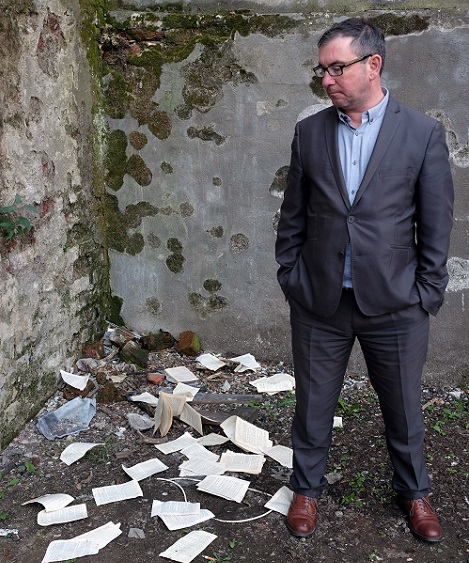
I met Martin Mooney in August ’95 at The Poet’s House (where he was a faculty member) in Portmuck, on the Antrim coast in the northwest of Ireland. I have memories of musty mornings in damp stonewalled cottages without electricity, stormy days filled with writing and workshops, dark evenings of readings and raucous conversation, and scandalous nights best forgotten.

Somewhere amidst all of this he signed my copy of Grub (Blackstaff Press), his first collection. A remarkable book of poetry that had burst out into the world in 1993 – winner of the  Brendan Behan Memorial Award,  nominated for the Forward Prize, shortlisted for the Rooney Prize for Irish literature, and a Poetry Book Society Recommendation to boot – socially aware poems of shipyards, pubs, punks, and politics.

A few years later, as an occasional reviewer for Poetry Ireland Review, his chapbook Bonfire Makers (Dedalus Press) landed on my doorstep. I can feel the brunt of its words yet –  “Picture yourself drinking with your father,/the talk collapsing down through itself like/badly-erected staging. You are both/on the verge of drunk, and everything/is either forgiven or forgotten” (Painting the Angel) or “It’s no fucking metaphor,/The stuff comes in hundredweight/drums, like dehydrated rage,/a bad temper you could add to water” (Caustic).

“Martin Mooney is a poetic force to be reckoned with,” I wrote, and later on in the same review, “In a world filling ever increasingly with bad poetry, Mooney is a godsend.” He sent me a note of appreciation some time afterwards, but as an atheist apparently had some reservations about being a ‘godsend’!

The fragments below are a departure, prose fragments from a book in progress – snatches of memory – or as he himself says, “For me, remembering is like looking out of the window of a ferry in a heavy chop – just random slashes of sea, sky, coastline.”

— Gerard Beirne

I have a terrible memory. The past is fits and starts, jump-cuts, snatches of sights and sounds too trivial to be called epiphanies. ‘Moorfield Street’ is an attempt to gather together some of these fragmentary episodes into some kind of autobiographical order. As a document it falls far short of memoir, and if it is poetry I’d be the first to admit it struggles to attain that condition. And it avoids narrative connectedness, because I can’t help suspecting that narrative connectedness could only be – given my terrible memory – confabulation. Not of course that there aren’t confabulations in here still.

But by way of narrative background, or context: Moorfield Street in east Belfast is where my maternal grandparents James and Isabella Kirkpatrick lived, from the 1940s until my widowed grandmother moved to a sheltered housing complex. My parents had their troubles, and I spent a lot of time during my childhood in the Kirkpatricks’ Victorian terraced house. I remember it as another kind of sheltered dwelling, a safe house and bolt-hole, and it feels good to renew acquaintance with that security.

There is also, in middle age, the realisation that what one remembers of childhood is now historical. The house in Moorfield Street is still there, modernised with parquet floors and indoor bathroom. But the world of the 1960s and 70s – which in east Belfast was still the postwar world – has been dissolved in the annotations of local historians. These texts are a species of precipitate.

—Martin Mooney


Fragment

I envy your memory, the way you recognise people on the street and know their names, the way you can correct me so confidently. For me, remembering is like looking out of the window of a ferry in a heavy chop – just random slashes of sea, sky, coastline – or trying to watch something through binoculars, magnifying and multiplying every blink of the eye, every shake of the hand, every twitching muscle in my forearm.

.

Moorfield Street

At the turn of the stairs in Moorfield Street there was a window onto the back yard. The glass was old, uneven, with that gel-like pooling towards the bottom of the frame. Around the edge of the window, smaller frames in coloured glass. Sometimes I’d sit quietly on the top stair of that flight and watch sunlight take colour on the old wallpaper, moving its oblongs of red, blue, green as the morning passed.

The house was louder with clocks than any I’ve known before or since. The coal fire – we had gas – crackled and spat in the grate, and individual lumps of coal hissed out tiny plumes of smoke. A Swan Vesta would crackle, dottle bubble in my granda’s pipe stem. When he spat into the fire, phlegm sizzled on firebrick.


martin mooney

James Alexander Kirkpatrick and Isabella Shaw Kirkpatrick. In a photo booth, sometime in the 1970s.

.

The Bridge

With Granny Kirkpatrick on the up line platform on Sydenham halt. It must be late July or August, there’s the high summer smell of oil shimmering on the gravel track bed, of the putrid black mud of nearby Connswater. She is holding my hand. We have to cross to the other platform to catch the train that will take us a few miles to Holywood where we can sit on the tiny beach and watch the ships come into the port of Belfast. At the far end of the platform, the iron footbridge seems to buckle slightly in the heat haze, then pull itself together. All of a sudden – I don’t remember hearing thunder – the bridge is struck by lightning and glows faintly blue. We stare, then walk on and tentatively cross.

.

Sounding Moorfield Street

Factory sirens in the morning and afternoon. My post-war ears hear warning and all-clear, howling over the rooftops. Early on, before I am up but long after Granda Kirkpatrick, the whirr and chime of the Co-op electric milk float. The Maine man’s lorry, heavier lemonade bottles clanking in their crates. A short run through the entry, the electricity sub-station hums behind its bars. I know I could squeeze between them, but the steel and smoothly-moulded ceramics of the Frankenstein apparatus frighten me. A Skyvan’s twin-engined throb. Incongruous chickens cockadoodldoing somewhere nearby.

.

Flora

From Moyard to Newtownards, my father’s home town. Ian and I spent the night in a big bed in Granny Mooney’s house, shared with aunts and uncles not much older than ourselves. Next day we moved into the new house on the new – the still-unfinished – estate on the slopes above the town. This had been pasture, hazel and holly woodland, and the roads and avenues were named after the flora torn up by the builders. Whin. Juniper. Ilex.

.

Does He Know?

Granny Kirkpatrick: Does he know?
Mum: Does he know what?
Granny Kirkpatrick: Does he know?
Mum: What, Mai?
Granny Kirkpatrick: About his Daddy?
Mum: What about his Daddy?
Granny Kirkpatrick: You know what.
Mum: What?
Granny Kirkpatrick: That he’s RC?
Mum: Oh for God’s sake!

.

What We Ate

Egg boiled and beaten in a cup with butter and salt. Lentil soup with the heel of a plain loaf dipped in. Toast made on the gas ring. Boiled potatoes served with butter and salt. Stewed beef from a tin. Fray Bentos pies with layers of damp flaccid suet pastry under the dry crisp flaky pastry top. Cheese triangles. Chops and sausages. Shepherd’s pie. And what I wouldn’t eat: onions, tomatoes, baked beans, peas.

And later, Toast Toppers. Cremola Foam. Chicken Tonight. Soda Stream. Birds Eye steakettes. Oven chips. Vesta beef risotto. The microwave. Frozen stir-fry. Crispy Pancakes filled with a volcanic paste of mushroom and minced beef or poultry fragments, blistering the roof of my mouth.

.

Hallowe’en

The bin lid was upturned and set back in the mouth of the galvanised dustbin. Newspaper was crumpled, sticks for lighting the fire put on. A bonefire for Hallaseve. We had sparklers, false-faces, a box of Bengal matches. Bully Martin. Bully Ian.

.

Wall

As if he lives in a fortress, as if he feels himself under siege, Granda Kirkpatrick has cemented pieces of glass into the top of the back yard wall. They are the bottoms of bottles, different shapes and sizes, shark’s-fins of different coloured glass catching the light. The smoky glass of a milk bottle, the brown of beer bottles, the vivid blue fang of Milk of Magnesia.

.

Glossary

To dress in the morning was to get on you, and to undress for bed was to get off you. If it was cold I kept my simmit on. In the toilet, to pee was to wee-wee – boys used their wee man – and a turd was a loadie. When she was upset or sad Granny Kirkpatrick would sigh something that sounded like ‘lawnie days.’ When I was upset or sad they told me to straighten my face. My feet were kebs, my ears lugs, if I swallowed Bazooka Joe bubble gum it would stick in my puddings. A splinter under the skin was a skelf, to be dug out with a sewing needle or it would fester.

—Martin Mooney

.

author_174_51c05446e4ce7-290x0

Martin Mooney is the author of four collections of poetry – most recently The Resurrection of the Body at Killysuggen (Lagan Press, 2011). He was born in Belfast and has worked as a civil servant, creative writing teacher, arts administrator and publican. As well as writing poetry, he has collaborated with visual artists on a number of site-specific projects, and with composer Ian Wilson on ‘Near the Western Necropolis’ for mezzo soprano and chamber orchestra.

Eyewear magazine recently called Mooney ‘…one of the best Irish poets writing under the age of 50.’ And according to Sinead Morrissey, ‘Gritty, disturbing, often uncomfortable, terse, controlled, aggressive, lyrical, Martin Mooney, at his best, extends the boundaries of what is and is not appropriate subject matter for poetry.’


May 082014
 

Here’s a little onstage interview I did at Wordfest in Calgary last fall when I was out promoting Savage Love. As you can clearly see, I got myself into trouble talking about copulas and copulate. Sometimes, I think I shouldn’t be let out of my cage and allowed to roam at will. It’s not safe. But the interviewer’s reaction when I start to talk about sex is priceless. One of the disappointments is that you can’t hear the audience laughing. The audience had a good deal of fun with this.

dg

May 082014
 

A. AnupamaA. Anupama

A. Anupama, one of our regular contributors, dusts off her translating skills, bringing us hilariously sexy, curiously modern couplets from the classic Tirikkural, a vast book of over a thousand rhyming couplets written in ancient Tamil and dating from about 2,000 years ago. They run the gamut from agricultural advice to law to flirting couples (the most charming).

I thought about you, I said. Then sometimes, you forgot, she reminded,
keeping out of my arms, pretending to be peeved.

A. Anupama gives us a rare glimpse into this ancient world, also providing us with a brief gloss on the difficulties of translation and her modus operandi, plus, joy of joys, some sound files with the original Tamil verse (beautiful liquid sounds) and the English translation.

This is not her first translation effort. See also her “Poems from Kuruntokai” and “Sweet to my heart | Translations of Tamil Love Poems.”

dg

A


Tirukkural is a collection of 1,330 rhyming couplets (called kural) written by the Tamil poet-saint Tiruvalluvar perhaps around 30 BC (dating is vague). The verses were meant as a comprehensive portrait of Tamil culture, a description but also an epigrammatic guidebook in verse to the formulas of this south Indian civilization. The poems cover every aspect of society and right living from the conduct of kings to the sowing of fields, from aspects of ascetic virtue to the intricacies of lovers’ quarrels, and from the art of friendship to dire warnings against vice.

I gaze at her, admiring her every line, while she scowls
with whom do you compare me, staring like that?

The couplets are organized into chapters of ten each, and the entire work is divided into three sections, Virtue, Wealth, and Love. Tirukkural differs from other classical Indian philosophical literature (e.g., the Yoga Sutras of Patanjali) by not including the fourth section of traditional teaching on spiritual release. Tirukkural emphasizes domestic life over ascetic or religious practice.

Tiruvalluvar_statue_LIC

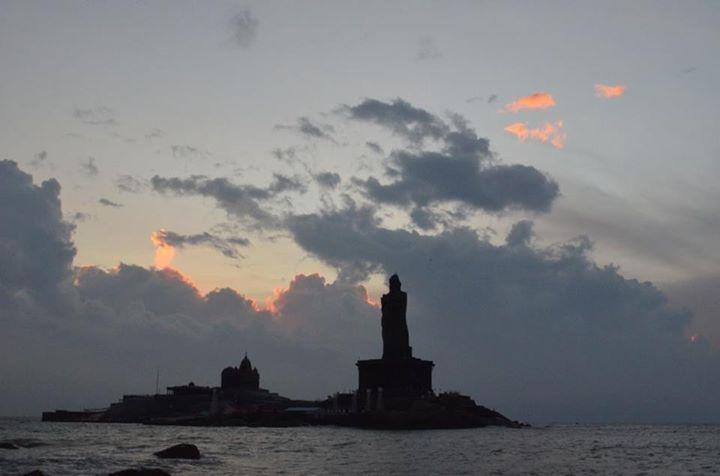
The colossal statue of Tiruvalluvar built on a small islet at the meeting of the Indian Ocean, Bay of Bengal, and Arabian Sea, just offshore from the town of Kanyakumari at the southern tip of India, represents the poet’s legendary status. Designed by sculptor V. Ganapati Sthapati, this granite monument stands 133 feet high, representing the 133 chapters of Tirukkural. The height of the statue’s base, at 38 feet, represents the 38 chapters of the first section, Virtue, symbolically setting the foundation of the other two sections, Wealth and Love. The poet is depicted holding up three fingers, a stylized and definitive gesture of Tirukkural’s three sections.

According to tradition, Tiruvalluvar lived in about the first century BCE (though estimates vary by a few hundred years) and was a weaver from Mylapore, near present-day Chennai in the state of Tamil Nadu. The Tamil culture and language are the oldest of Dravidian heritage, originating in the southern tip of India.

Tamil Nadu

Tamil is the oldest living language in the world, with a rich classical literary history. Tiruvalluvar’s work dates from the period of the classical Cankam, a famous gathering of poets, scholars, and sages in the ancient city of Madurai. His poetic couplets are the shortest verse form in Tamil literature, and his work was known and referred to by the writers of classical Tamil epics like Cilappatikaram and Manimekhalai.

If you search YouTube for “kural recitation,” you’ll find videos of young schoolchildren reciting memorized couplets, sometimes with a little prompting, but mostly with ease and confidence. The boy in this video recited chapter 40 from Tirukkural, a set of ten couplets on learning.

On the other hand, centuries of erudite commentary on Tirukkural have revealed its subtlety, and its influence on modern thinkers and writers has been significant. Leo Tolstoy quoted several couplets from it in a letter to an editor at Free Hindustan, a letter that was later translated into Gujarati and published by M.K. Gandhi. Albert Schweitzer said about Tirukkural, “There hardly exists in the literature of the world a collection of maxims in which we find so much of lofty wisdom.”

I couldn’t find a tougher or more rewarding translation challenge than this. Arthur Schopenhauer in his essay “On Language and Words” remarked, “Take translations of authors from antiquity: they are as obvious a surrogate as chicory for coffee. Poems cannot be translated; they can only be transposed, and that is always awkward.”[1] W.S. Merwin in the prologue to his collection Selected Translations, cites advice he received from Ezra Pound: “He spoke of the value of translation as a means of continually sharpening a writer’s awareness of the possibilities of his own language… Pound also urged—at that point and to me, at least—the greatest possible fidelity to the original, including its sounds.”[2] Tirukkural is a particular gift to the translator because in addition to offering fresh mental vistas, it invites one to stricter attention through the voice and the ear.

The couplets, like most proverbs, are designed to be easy to remember and repeat: the alliterative and assonant strength of the compositions aids memory, and tight line-length keeps each verse within a single breath. These same qualities make the couplets difficult to translate, requiring the translator to create equivalencies in sound and sense in a very tight space. Kural 12 showed me quickly how impossible it might be to honor the sound of the original. “Living” sounds nothing like “thupakith,” and yet, the poem in English requires the repetitive transformation of the single word for the purpose of the poem’s sense. The Tamil “Thupaarkuth thupaaya thupaakith thupaarkuth thupaaya” turns into “living,” “live,” “life-giving,” and “life” in my translation.

Still, I found that evoking the original’s sound was possible in many places, with some effort and luck. For example in Kural 18, the “s” sounds in the first line and the “v” sounds in the second line were reproducible, though they lack the alliterative effect of the original. In Kural 20, I added the words “nearness” and “farthest” at the beginnings of the lines to mimic the sounds of the Tamil words “neerindru” and “vaanindru,” which altered the sense only slightly by emphasizing the nuance of distance in the poem’s imagery.

Nearness of rain—without which all worldly work ends, whomever you are.
Farthest skies—without which all natures end.

Word order and integrity of the poetic line are another challenge, because Tamil syntax runs in the opposite direction from English. Subject-verb-object in English often translates to object-verb-subject in Tamil, and even prepositions become postpositions. Sometimes, I could maintain word order, as in Kural 19: “Charity and penance, twins, make their exit from our world, / sky unyielding.” In Kural 20, however, I had to flip word order for sense, translating the two phrases “all worldly work ends” and “all natures end” exactly inverted. The rest of the word order, as well as the couplet’s line integrity, I carefully maintained.

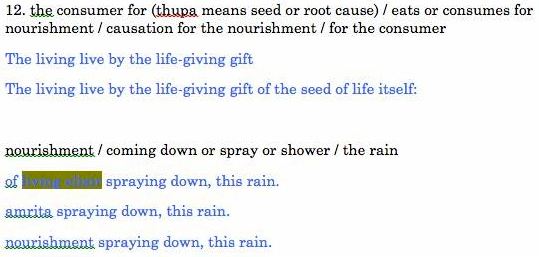
I learned my method of line-by-line translation in Richard Jackson’s translation workshop at Vermont College of Fine Arts in the summer of 2011 when Patty Crane showed us her work translating poems by Tomas Tranströmer. For each line of poetry, I add directly underneath it a literal translation, maintaining the syntax of the original. Alternative word choices are included in this step. Then, directly under that is a first draft of my literary translation of the line. I continue in this way, adding lines for each line of the original poem. I keep everything, every attempt to translate stays in the document. If the lines of poetry get too far away from each other in the process to look at on the computer screen, I copy and paste what I want to work with on a new page in the same document.

Kural 11 in Tamil
Capture

Kural 12 in Tamil

Capture2

In this work with Tirukkural and in my previous translations from Kuruntokai, I relied on my co-translator B. Jeyaganesh for literal translations and recorded readings of the original poems. B. Jeyaganesh is a native speaker of Tamil, the son of a scholar with a Tamil PhD, and a fellow self-described non-expert in this classical literature. For this selection from Tirukkural, we spent over three hours coming up with alternative word choices in English and discussing the relative emphasis of words in the couplets. I listened to the recording over and over to gain a familiarity with the poems’ sounds. I used the recordings again to check my work, often reading my drafts aloud for comparison. Another helpful tool was an English transliteration of the full text online along with the original Tamil and the classic translation by Rev. Dr. G.U. Pope from 1886.

Palm-leaf manuscript

I chose this particular set of couplets to translate (the second chapter and the penultimate chapter) from Tirukkural partly to keep this first try easy for me and easy for a reader unfamiliar with this work. The poet intended these very specific moral edicts and proverb-like statements for people living in a certain cultural and philosophical context, making translation for a contemporary reader in English difficult. The universality of the need for rain and of quarrels between lovers is obvious, and I found this a generous place to begin. My idea was to bracket the work as a whole, but also to bring its didactic verse and its elegant love poetry close together in this small set. The couplets in the third section on love are beautiful, witty, and very different from those in the preceding chapters. In words, sounds, and imagery, however, the thread of the work from beginning to end is wonderfully consistent. The recent drought in South India, and its continuing effects in the region, also inspired me to bring this poetry off my shelf and to translate the chapter on rain.

Tiruvalluvar statue and Vivekananda memorialPhoto by Bennet Anand

In two instances in these couplets, I departed slightly from the literal meaning in order to evoke the sense of the whole work. In couplet 17, my eco-poetic commentary in the addition of “those who don’t give from within” reflects Tirukkural’s moral standard of generosity and right action, as in Kural 211: “Duty expects not anything in return / just as rain expects none.”[3] The literal translation of the line is roughly “gives not, if that’s the state of things.” The state of things today is marked by the urgency of eco-conscious moral imperatives. I found in this a beautiful opportunity to investigate how Tirukkural in translation might evolve in order to retain its original function, which was to describe the cultural, ethical ideal. My initial idea for the change in this line, however, came from the poem’s sound: the end-word “vitin” sounds like my “within.”

My second departure from the literal translation is in Kural 1323, the couplet taken from the last chapter of Tirukkural. My version ends “with earth and water inseparable as in a clay vessel: the water drum of the heart,” while the literal includes no mention of a clay water vessel. My addition of the object attempts to bridge the distance between that specific culture and universal understanding. While this image would hover in the subconscious mind of a Tamil reader 2000 years ago and offer another level of mystery to the poem, a contemporary reader from another culture might miss it.

These departures from the literal in my translation are experiments based on an essay by David Damrosch, titled “Translation and World Literature.”[4] In writing about the problem of translating one of the oldest known lyric poems—an Egyptian poem inscribed in 1160 BCE—he observes, “Some literary works, indeed, may be so closely dependent on detailed culture-specific knowledge that they can only be meaningful to members of the originating culture or to specialists in that culture; these are works that remain within the sphere of a national literature and never achieve an effective life in world literature.” In regard to the Egyptian word mss in that poem, which has been variously translated as tunic, dress, loincloth, and clothing, he writes,

…however mss may be translated, most readers will be unable to visualize the ancient garment in all its authentic particularity. Yet as long as the translation doesn’t impose a wholesale modernization, we won’t assimilate the mss directly to our modern experience, as we remain aware that we’re reading an ancient poem: whatever we think a mss is, we won’t envision it as a Gore-Tex windbreaker, though this might be a modern equivalent of the original item. All the same, we can never hold the poem entirely away from our own experience, nor should we. As we read, we triangulate not only between ancient and modern worlds but also between general and personal meanings: however the mss is translated, different readers will visualize it very differently, and this variability helps the poem to resonate with memories from the reader’s own life. (Italics mine.)

In my translation, adding the material object of a water vessel creates a specific resonance and aids the reader’s associations within the ancient world of the poem. Adding the phrase “or if by those who don’t give from within” aids the reader’s associations in the modern world, simultaneously awakening moral consciousness, which is the original objective of Tirukkural. Though I initially felt awkward treating translation as a sort of geometry problem, I felt that the result brought me closer to the text. The availability of many complete translations of Tirukkural also lessened my concern over maintaining literal exactitude in every line. I hope that my work inspires more readers to take a close look at this ancient literary treasure.

—A. Anupama


Translations from Tirukkural


Chapter 2: On the excellence of rain

The sky, so distant, gives to our living world
rain, its own self, living essence.

The living live by the life-giving gift of the seed of life itself:
nourishment spraying down, this rain.

The sky, yielding no rain in spite of these steep surrounding seas,
will bite you from inside your hunger.
.

.

The plow won’t plow if the farmer’s awaited downpours, which sow
and grow their wealth, ebb.

Drought’s devastation crushes lives and brings ruin, while its reverse is
restoration in rain.

The sky’s quell of falling raindrops upsets
the lush grass, whose heads will then hide from sight.
.

.

The enormous sea, voluminous and teeming, will diminish if not diminished by clouds,
or if by those who don’t give from within.
.

.

Grand rituals and extravagant offerings will end if the sky is
rain void, serving the little gods no festivals.

Charity and penance, twins, make their exit from our world,
sky unyielding.

Nearness of rain—without which all worldly work ends, whomever you are.
Farthest skies—without which all natures end.
.

.

Chapter 132: On pretending to sulk

I—She

Women’s eyes savor your every line,
but mine won’t embrace your broad chest.

Our silent spat dragged on, so he sneezed on purpose, so that I would say
“bless you.” So he thought.

II—He

A whole branch of blossoms for a garland, and you accuse me of wearing it to catch another woman’s glance,
showing off how I’m dressed.

I love you more than anyone, I said. She sulked,
demanding more than whom, whom!
.

.

In this life, we will never be apart, I said.
Eyefuls of tears, she replied.

I thought about you, I said. Then sometimes, you forgot, she reminded,
keeping out of my arms, pretending to be peeved.

She blessed me when I sneezed, then altered, asking
Who thought about you to make you sneeze?

My next sneeze I quelled, but she cried, someone is thinking of you,
I know, you’re hiding it from me.

She spurned all my assurances, imagining the other women for whom
I’ve offered the same.

I gaze at her, admiring her every line, while she scowls
with whom do you compare me, staring like that?


from Chapter 133: On the pleasures of lovers’ quarrels

Inside this lyric sulk, a heaven nears, with earth and
water inseparable as in a clay vessel: the water drum of the heart.
.

—A. Anupama

.

A. Anupama is a U.S.-born, Indian-American poet and translator whose work has appeared in several literary publications, including The Bitter Oleander, Monkeybicycle, Fourteen Hills, and decomP magazinE. She received her MFA in writing from Vermont College of Fine Arts in 2012. She currently lives and writes in the Hudson River valley of New York, where she blogs about poetic inspiration at seranam.com.


Footnotes    (↵ returns to text)

  1. Schopenhauer, Arthur. Peter Mollenhauer, transl. “On Language and Words,” in Theories of Translation: An Anthology of Essays from Dryden to Derrida. Rainer Schulte and John Biguenet, eds. Chicago: University of Chicago Press, 1992.
  2. Merwin, W.S. Selected Translations. Port Townsend, WA: Copper Canyon Press, 2013.
  3. Rajaram, M., transl. Thirukkural, Pearls of Wisdom. New Delhi: Rupa Publications, 2009.
  4. Damrosch, David. Translation and World Literature: Love in the Necropolis,” in The Translation Studies Reader, third edition, Lawrence Venuti, ed. New York: Routledge, 2012.
May 072014
 

Ingrid Ruthig - at Station GalleryIngrid Ruthig

Ingrid Ruthig is a protean artist, a poet, fiction writer, editor, recovering architect (now dealing in architexts), hybrid artist, text artist (dealing in dBooks and recodings and TexTiles, i.e. puns, visual and verbal), the very epitome of the kind of artist we like to feature on Numéro Cinq, a hungry spirit who breaks forms and recombines them, who is always trying a little something new, the kind of artist Contributing Editor Nance Van Winckel is always on the look-out for, to interrogate and display, as in here, below, the latest in her amazing series of Off The Page art & interview pieces.

dg


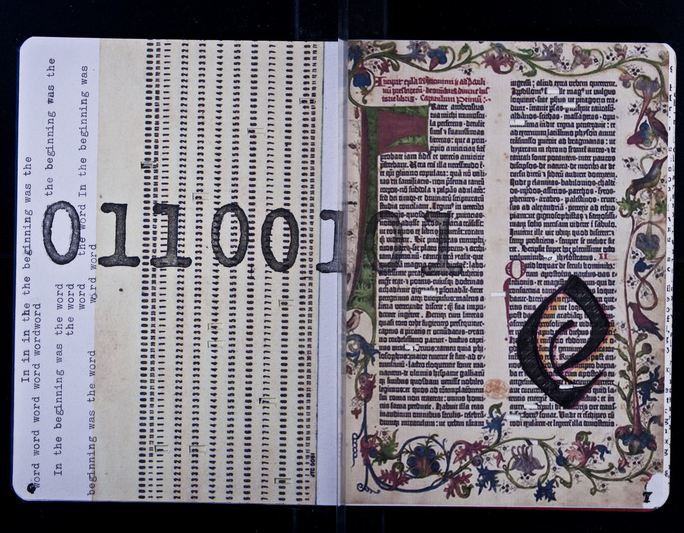
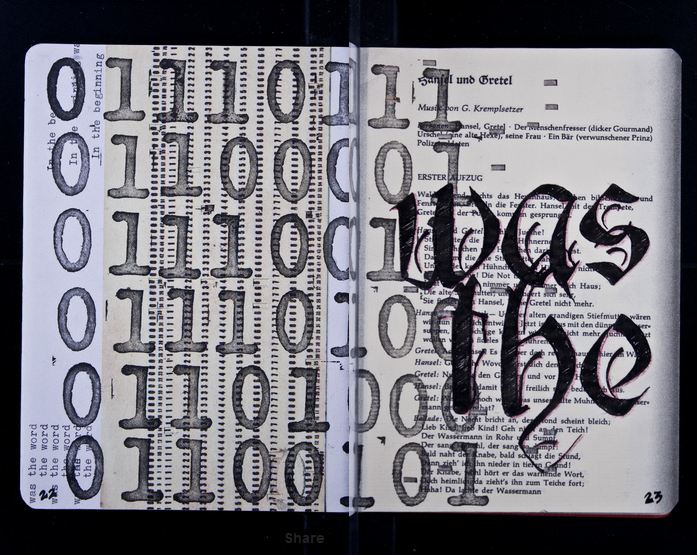
oneTwo facing pages from BinaReCodings: ‘In the beginning was the word’ Click on the image to view the entire book.

NVW: BinaReCodings. I recently read Kenneth Goldsmith’s book Uncreative Writing, in which he talks about these binaries (of 0 and 1) as the basis for all computer “language.” If a jpg image file won’t open, it comes to us as linguistic code. In referring to a Charles Bernstein poem, Goldsmith explains that the “text becomes active, begging us to perform it, employing the spaces as silences.” (p. 18) Goldsmith goes on to say that “Never before has language had so much materiality—fluidity, plasticity, malleability—begging to be actively managed by the writer.” (p. 25) And, I might add, re-managed by the reader! It seems to me your BinaReCodings sketchbook suggests similar ideas. Here, I’m thinking specifically about remaking and repurposing what has gone before, but with a focus on an elementary nature of linguistic activity, a 1 and a zero, a something and a nothing.

Ruthig: When a viewer responds to the work as you have, it’s both exciting and disquieting, because it forces the artist to revisit and reconsider what was deliberate, intuitive, serendipitous—that is, can she actually explain the work? does she want to? Well, here goes!

Yes, on the surface BinaReCodings breaks down language to building blocks, to the letter, in order to prod new connections as we re-see it. It also documents how, through a type of repurposing of pages from history, it has been key to human progress. However, in terms of language, I see the process as akin to translation or transposition. If I use music as an analogy, the original libretto remains, but the score’s been shifted into another key. And the soloist sings in Cantonese rather than Italian, and the oboes play the first violin’s part, and all this happens against a changing backdrop, a contextual repositioning. The result alters how the reader-viewer engages with the original. But let me backtrack a little . . .

twoTwo facing pages from BinaReCodings: ‘In the beginning was the word’

While studying architecture at the University of Toronto in the early 1980s, I took an elective on computers. I must have been intrigued partly because I worked as a bank teller during summer holidays, and new ooo-aah robo-digited computer systems had recently replaced pen-on-paper record-keeping. It all sounds incredibly antiquated now, but this was the era of UNIX OS and dot matrix, that held-breath moment before software and personal home computers, such as the Commodore 64, exploded off the digital launch pad. Along with punch cards, much of what the elective offered has dissolved into the shadows of the ancients. Yet the basic premise that everything can be reduced to “On” and “Off”, “1” and “0” remains, and thirty years later, its impact infiltrates our everyday lives.

BinaReCodings reexamines language by putting it into a state that confounds immediate meaning. It draws on Viktor Shklovsky’s notion of “defamiliarization” and aligns with Goldsmith’s take on language as ever-present material. Words are symbols of ideas, holding meaning so long as we know the language and take time to decode it. Using the usually invisible 1 and 0 elements of binary code, I translated the biblical phrase “in the beginning was the word.” But “word” is no longer capitalized and, rather than referring to God, instead references the human facility for language. Letter by letter the recoded phrase then spreads throughout the sketchbook, superimposed on images of key historic pages, those language vehicles.

By showing us where we are, surrounded by invisible (binary) language, as well as where we’ve been, by presenting words from history, by mixing things up, by juxtaposing then and now, known and unknown, BinaReCodings forces the viewer to relinquish assumed meaning and look again, look harder, see something different. Significance is not quite lost, only less obvious. BinaReCodings does manage and demands managing of text as well as image. In the end, drawing connections is what matters.

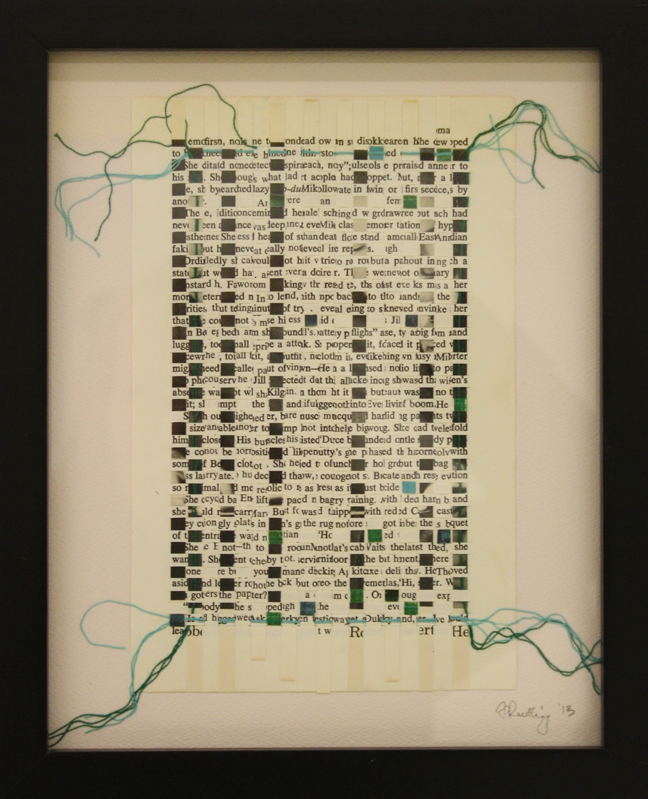
Sci Fi - from the TexTiles series 2013Sci Fi from the Textiles Series 

NVW: Several visual artist friends have told me this, or variations on this: “Nance, when people go to a gallery, they don’t want to READ; they want to LOOK.” This is an issue I struggle with— how to tempt someone not necessarily to “read” per se, but to want to interact with the text AS text. As both a poet and a visual artist, could you share your own thoughts on this, and perhaps with regard to this particular piece of yours I love, (detail) from TexTiles. To what degree does the semantic meaning of the words themselves illuminate or further the “looking” experience, or does it? Is it important to you that someone do something akin to “reading” while experiencing this piece?

Ruthig: A wild synchronicity is at work here… I tripped across this read/look issue a few days ago, so I’m glad you’ve brought it up. I understand the galleried inclination—I’ve caught myself responding that way to worded works. And if I’m honest, it usually stems from laziness on my part, especially if the text is oriented off-horizontal—I think, Seriously? I’m to stand on my head to read this? Just as we approach visual art with expectations, we approach language with assumptions, programmed so we have one less decision to make, and in a way that’s indolence on the collective scale. Yes, reading does require more from us. We have to process written language. To refer to Goldsmith’s Uncreative Writing—which, like you, I only recently read (another intriguing synchronicity)—“the act of reading itself is an act of decoding, deciphering, and decryption.” We can’t connect with the ideas or images until that language processing has taken place. I might argue with myself here, and say that, if words are recited aloud, it’s entirely possible to preempt meaning by connecting through sound—I think of how mesmerizing it is to listen to Gertrude Stein’s work. But if we accept the usual premise about text, gazing at an image seems less daunting by comparison, because it taps intuition and is more immediately sensual, regardless of how it makes us feel.

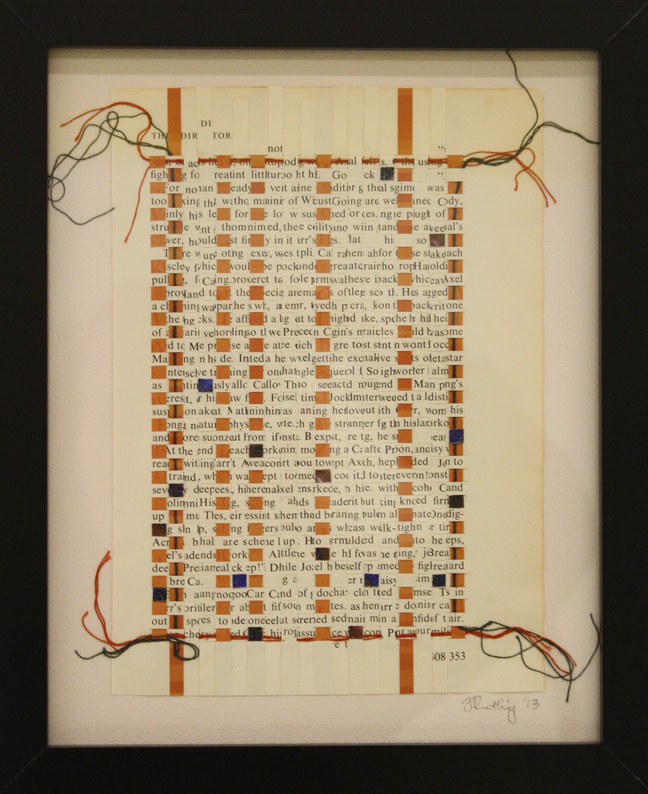
The way someone experiences any of my textworks is going to be as unique as the person. If she’s inclined to read each word, great. If not, that’s fine too. I’d be happy to know that someone simply liked to look at it, that it was visually appealing. Just as I reassure those who insist they “don’t get” poetry not to worry so much about getting it, similarly, I’m open-minded about how viewers take in my art. To a degree, response does depend on the work—certain pieces are configured for reading, while others aren’t. Any approach is valid, though I believe the deeper the engagement with any work, the more the reward—in other words, the more you put into it, the more you come away with. The only thing that’s critical is to engage. In the case of TexTiles (based on sketches I made while preparing other work for the 2012 exhibition Reading the Image), the work questions assumptions and hopefully prompts the viewer to look again, to see print language less for what it means and more for what it is—i.e. a vehicle with form, one we expect will tell us something. The work plays upon our compulsion to seek (even concoct) meaning, to uncover story in what we don’t immediately grasp. And if we can’t make sense of it, is it still true? Was the original text even true? What was it? And does it matter?

70's POTBOILER - from the TexTiles series 201370s Potboiler from the TexTiles Series

When TexTiles was first shown, a viewer asked if he could tell me what affect it had on him. Of course! He said he came to it believing he would read what were obviously pages from a book, and they would reveal something. Then he realized the language, while still familiar in form, was remade and now unreadable. He found he was seeing the pages in a new way, and reading his own expectations. He also found himself thinking that, if only he could access the strips of woven text, he could realign the words and unlock the mystery. By letting me in on his experience, he revealed my own work to me. It’s easy to forget that we’re never merely looking—we’re always reading and shaping connections, even when words are not involved.

dBooked by Ingrid Ruthig. (mixed media on canvas) dBooked (mixed media on canvas)

NVW: In your artist statement about dBooked  you talk about how with this work we “become archaeologists, asking What was the story? Who told it? Where? And with whom did it once connect?” I’m interested in this idea of reconstruction too, in ways the reader/viewer “remakes” a whole out of pieces. It seems to me this is quite akin to how we live our lives: gathering pieces that seem increasingly fragmented, then holding and sorting these pieces, hoping to infer connections or patterns, albeit not necessarily a “whole.” With this particular piece, can you talk about how you think a reader/viewer might engage with it, i.e. your own understanding of how this “remaking process” might best occur.

Ruthig: Driven by curiosity in a wired world bursting with the incomplete, we’re reclaiming or inventing back-story all the time now. It’s second nature. My own inner archaeologist can’t pass up a chance to puzzle the pieces. The first series I did, Fragments of the Missing, happens to echo something of Walter Benjamin’s preoccupation with the modern world’s fragmentary nature. As a series of deconstructions and reassemblies, Fragments visually stitches shards of language from a variety of sources into a figurative, semi-semantic, patchwork quilt. Lacking punctuation and the usual paratextual guides, the narrative is further remade by each reader, who forms connections with words and phrases and reads the text based on the way the panels are arranged in relation to each other.

In contrast, dBooked is a single work of dismantling and a remaking of a different sort. The viewer confronts in two dimensions the remains of what once existed in three: a skeleton of pages nearly devoid of text flesh; segments of dust jacket, cover, endpapers, its physicality; library markings indicating a previous life; conjunctions and a sequence of chapter headings. Paratext is otherwise absent, though its original locations are still apparent. Most of the language has been removed word by word from the first page of each chapter of a novel, then reintroduced as visual streams and pools without semantic continuity. As the words drain away, the vivid, colourful picture they painted evaporates, the story disappears. Anything that might have been an obvious clue has been deliberately erased. The reader becomes viewer who must look beyond the words.

dBooked is less a commentary on language’s inherent metamorphosis than it is a reflection of the book’s apparent decline as iconic cultural object, as quintessential container for language and conveyor of narrative. In a sense, it is reverse architecture applied to text, where mindfulness of context is achieved by dismantling. The exercise is to take what has come before and deconstruct it for a new perspective. I think the viewer arrives at a similar place as with Fragments of the Missing, by searching for clues that might answer the questions it evokes. Though the original story is undone by the book’s undoing, and may never be rebuilt, language continues to exist and to offer a fresh, if different, narrative.

Your Heart Like A HouseYour Heart Like A House

NVW: Your Heart Like a House. With this one I think about the kinship of the actions of the heart and of reading: passages in and passages out, intake and output (responding). Little by little what enters us becomes us; the “house” is a construct. This piece is a sensuous mix of materials, of text and image so beautifully married. Those four quadrants/ventricles. And what is the text here? Might you speak a little about your process with this one: how did text and imagery find each other or “arrive” together?

Ruthig: Thanks, Nance. Words are at the heart (pardon the pun) of the textworks, usually arriving first, then driving the visuals forward. This piece is no different. It flipsides traditional ekphrasis, in that I wrote the poem “Your Heart Like A House” years before I thought to attempt a visual representation. The poem, which surfaced hard on the heels of unexpected news that overturned my view of the future, begins “I lie down in the rooms of your house / and listen to a new creaking / of timbers that contract and expand, / flexing to the weight of your sleep / while the wiring, unseen, / pulses from space to space / in the walls that contain us both. . . .” Years after it was published, after everyday life had again settled down, after I realized the poem’s images would not leave me, I began to experiment with a visual incarnation. I guess my architectural background is never far from the surface, because I’m inclined to interweave disciplines and mine the rich territory found in the crossover—as when a poem is visually transmigrated, or an image spawns words.

Yes, the quadrants mimic the cardiac chambers, and even at risk of pissing off the viewer, I chose imagery to reiterate that construct—I love how complex and beautiful the actual human heart appears, especially as rendered in historical anatomy books. The poem itself provides the rest of the framework. It loops in its entirety on and on in the background, circulating in red and blue from one space to another, reminiscent too of how we follow a stream of words from page to page when we read. In large font, foreground lines regenerate the stanzas, more or less, and also pass from room to room.

Adages are ingrained in us, and no doubt “home is where the heart is,” as well as Bachelard’s “abode” from Poetics of Space, found their way in, as did a lot of traditional residential and construction imagery—anything that felt as though it belonged. Your Heart Like A House has a lot to do with how we create and inhabit physical and psychic space, how we fill each with expectation, memory, our everyday vision of life, and what happens when that vision is shaken to its foundations.

The creative process, for me, is like stepping into a canoe and choosing a direction as I start to paddle. Then the current takes over. I can’t control it, but if I trust in the flow of words, images, textures, and imaginings into layers, discovery becomes arrival.

Antoinette's Head - a TexTileAntoinette’s Head 

NVW: Antoinette’s Head. Ah, a diptych, a hinged “book.” Here I like how the “head” image gives way—or opens upon—the more language-based material. Even the title  gives the work a luminous context. I think, for instance, of Marie Antoinette, and all that was in that lovely head . . . perhaps even as it left its body. You use weaving in some of your new work, and I wonder if you could talk about that craft in general with your work and perhaps in particular with this piece.

Ruthig: Here’s where I wax rhapsodic about titles for a moment! The way I see it, a title is a key to unlock the work, the point of entry, especially for a poem, that might also set the stage or mood. While providing one isn’t critical, it’s an opportunity for the artist to invite the viewer inside. I find, even as the artist, a well considered title helps gel the work in my mind. So I pay close attention to them, and it’s good to hear how this one let you in!

Antoinette’s Head is based on two portraits of Marie Antoinette and two pages of text, all from a fairly recent biography.  Reweaving the images and text let me confront a number of perceptions. On one level, it continues the exploration of the weft and warp of language, especially print language. On another, it examines our perception of books as repositories of truth. If we stop to consider what we take for granted as historically ‘true,’ we might realize a historic figure, in this case a queen, had to have been misread and a far more complex person than the one some historian or painter claims she was. There’s a literal warp to how people in history are portrayed. Even we ordinary people are storified differently by each person who knows or has ever met us, and each version is a reflection of the individual experience of whoever is relaying the image. In this era of the Web’s tightly woven net and social media’s image-massaging filter, it’s even harder to break the fictional code. What’s true? I want to suggest that we should recognize then question. Rather than read and accept, we should consider the fluid nature of text and image, the telephoning of story that inevitably takes place, even if fact-driven.

By physically shifting image and printed word to illegible states, Antoinette’s Head hopefully shifts assumptions of the reliability and integrity of any documentation, and encourages questions. Arguably, every work of documenting is the product of a narrator who filtered, translated, transposed, and in the process often composed a fiction, intentionally or unintentionally. What we think we know is more than likely false to some degree. Truth is threaded through the language we use to describe everything, but it’s tough to decode it then extricate it from the larger fabric.

Antoinette’s Head, as an extension of the TexTiles series, surreptitiously tapped into the personal. In the mid-1800s, my great great grandfather, an Austrian textile industrialist, founded the family business, which flourished despite war, upheaval, and relocation, and remained in the family until my grandfather died. The inherited stories linger in me, and some latent tactile knowledge, more tangible than one might think, prods me to visit his craft through mine. Antoinette’s Head is a way to explore the weft and warp of language, stories, history itself. It’s also carrying me into a new series of works. I’m well into the current now, and there’s no knowing where it will lead!

 —Ingrid Ruthig & Nance Van Winckel

.

Ingrid Ruthig - in the studio
INGRID RUTHIG graduated from the University of Toronto with a Bachelor of Architecture in the mid-1980s. For more than a decade in Toronto she practised as a member of the Ontario Association of Architects – a profession in which word and image are inextricably linked – then retired her licence to write full-time. She also co-edited/co-published the Canadian literary journal LICHEN from 2000–2007, and later, was an associate editor for Northern Poetry Review. Her poetry, fiction, and nonfiction have appeared widely in Canada and abroad, in The Best Canadian Poetry in English 2012, The Malahat Review, The New Quarterly, National Post, Canadian Notes & Queries, and many other publications. Her textworks have been shown in galleries, public venues, and are in private collections. Her books include Slipstream (a poem sequence / artist’s book), Richard Outram: Essays on His Works (as editor/contributor), Synesthete II, and she recently edited The Essential Anne Wilkinson (Porcupine’s Quill, fall 2014). Ingrid lives with her husband and daughters near Toronto. Her web page is here: www.ingridruthig.com.

Nance Van Winckel

Nance Van Winckel is the author of six collections of poems, including After A Spell, winner of the 1999 Washington State Governor’s Award for Poetry, and the recently released Pacific Walkers (U. of Washington Press, 2013). She is the recipient of two NEA Poetry Fellowships and awards from the Poetry Society of America, Poetry, and Prairie Schooner. Recent poems appear in The Pushcart Prize Anthology, The Southern Review, Poetry Northwest, Crazyhorse, Field,and Gettysburg Review. She is also the author of four collections of linked short stories and a recent recipient of a Christopher Isherwood Fiction Fellowship. Boneland, her newest book of fiction, is just out with U. of Oklahoma Press. Her stories have been published in AGNI, The Massachusetts Review, The Sun, andKenyon Review. Nance’s photo-collage work has appeared in Handsome Journal, The Cincinnati Review, Em, Dark Sky, Diode, Ilk, and Western Humanities Review. New visual work and an essay on poetry and photography appear in Poetry Northwest and excerpts from a collage novel are forthcoming in Hotel Amerika and The Kenyon Review OnlineClick this link to see a collection of Nance Van Winckel’s mash-ups of poetry and photography, which she calls photoems. She is Professor Emerita in Eastern Washington University’s graduate creative writing program, as well as a faculty member of Vermont College of Fine Arts low-residency MFA program. She lives near Spokane, Washington with her husband, the artist Rik Nelson. Her personal web page is here.


May 062014
 

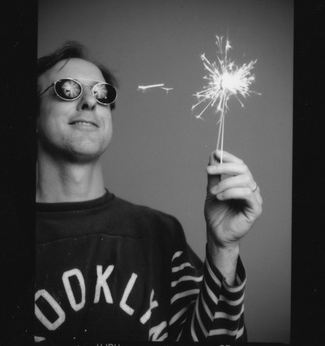
Trinie Dalton Trinie Dalton in Teotihuacan on her birthday in sunglasses courtesy of Mary Ruefle

Camden Joy (aka Tom Adelman) is a rock star music journalist, fictionalist, and musician, something of a legend and a verbal riot and it needs a writer like that, with some voltage of her own, like Trinie Dalton, in fact, to take his measure. Trinie is a music journalist, also story writer, artist, collagist, book assembler, a generally high-energy dynamo of vertiginous genre mixing, an incredibly perceptive reader and eloquent decoder of form, also a friend and a colleague at Vermont College of Fine Arts. What you get here is not just an essay on Camden Joy but also an essay on form, on the consciousness of form and variation that makes art, not just one subject but five, deftly interwoven and self-demonstrated. See also Trinie’s amazing story “Escape Mushroom Style” published earlier on these pages.

dg

Camden JoyCamden Joy from Presidential Coins (2012) Album Cover

.

All through this, I’ve always thought that if you thought of all of it as a book then you have the Great American Novel, every record as a chapter. They’re all in chronological order. You take the whole thing, stack it and listen to it in order, there’s my Great American Novel.

— LOU REED, Rolling Stone, 1987

In music feature/biopics, the pressure to dramatize every microscopic detail of a short visit with a total stranger is inherent to creating story—what editors want. In my own experience of music journalism, this contrivance began as a fun challenge and has come to drive me nuts. I’d rather just invent stories of my own. This is where my appreciation for Camden Joy begins. In light of the prerequisite that one must pressurize nonfiction to establish somewhat artificial tension up front to carry intriguing and suspenseful delivery of “facts,” a piece of good music journalism can come to feel like a Jane Austen novel—that is to say fictional. With any subjective interpretation of the mise-en-scene, genre boundaries slip away—this is what invites me as a reader into the excitement of the “story,” and what attracted me to music journalism in the first place. But I find that need to deliver facts or an “angle” according to some other person restrictive & repellent, too prone to misrepresentation and divergence from the artist’s POV.

The musician performs for the journalist, the journalist describes it; there’s a voyeuristic dance devoted to writing music features, power dynamics clearly defined from the get-go, in which the writer/recorder/observer adopts the swagger of the star for a few thousand words while informing the readership about where the artist has been and is going. Somehow, however, good writers manage despite this form’s predictability, to transform it into lasting art by showing, paragraph-by-paragraph, how discoveries and revelations (the unexpected) spring from a simple meeting, a single ecstatic listen to a record. This is the art of the variant. Maximizing a writing form and making it yours can be poetry, can be in this case a transliteration of rock and roll.

Capture

Post-swagger in New Journalism is where Tom Adelman, aka Camden Joy, finds lineage, namely with the Manifestos and personal essays collected in Lost Joy—with the impetus to 1/ depressurize reportage in favor of author’s lived adventure driving story, and 2/ insertion of author as character into the storytelling; both in the vein of Tom Wolfe’s Electric Koolaid Acid Test. Next, to disconnect from the narrativity of actual event completely in favor of total artifice, loosely constructed upon heaps of pop cultural reference. Adelman’s novels do this. But historical fiction does this, too—nevertheless it typically doesn’t deal so much in contemporary cultural referencing. Fictocriticism, or fiction that develops setting and character through musical referencing—in the vein of Joan Didion, Michael Taussig, Lynne Tillman, Dana Spiotta, Dana Johnson, Darcy Steinke, Ben Greenman, Jonathan Letham, Dennis Cooper… Joy’s brand of irony finds architecture here, but pushes even this trajectory. His novels are closer relatives to countercultural dystopian satire—think Ken Kesey—contaminated with what Raymond Federman in 1973 called Surfiction: conceptual projects that seek to expose the artifice of fiction as a process. In both genres, the politic is not simply implied in the content—it’s engrained in syntax, sentence construction, concept. Joy’s critiques of music in the novels aren’t explicit, then, but embedded in their reclamation of pastiche and in the seamless dedication to the conceits he sets in each story. The concept is high artifice, possibly camp per Sontag’s definition, crossbred with the exploitation of transparent metaphor.

To underscore irony, though, is the sincerity evident in the accuracy of the music lore, the obvious fandom implicit to each text’s concept. In Joy’s work, music journalism saves the day. Gathering facts and slavery to veracity—odious, dull, and rote back then to burgeoning New Journalists—what compelled rebellion and invention of new genre—experiences through Joy’s writing a fiery reversal. Weirdly, the more conceptual Joy’s novels are, the more journalistically accurate they feel to me. Maybe it’s because they convey, through the juxtapositions of hyper-specific (journalistic) musical fandom with poetic license to fictionalize—what Werner Herzog calls “ecstatic truth.” I’d call this “ecstatic truth” poetry through allegory, after Goethe’s adage that links allegory to poetry by differentiating them:

It makes a considerable difference whether the poet seeks the particular as a function of the universal or whether he sees the universal in the particular. In the first case we have allegory, where the particular is valid only as an example, as an emblem of the universal, whereas in the second case the true nature of poetry is revealed: the particular case is expressed without thinking about the universal or alluding to it. (Goethe, quoted by Umberto Eco)

In the novels, musical heroes are humanized, portrayed as flawed characters—not just because flawed characters are necessary to real stories; Joy’s journalistic style proposes that the best way to tribute a hero is to retain and uphold their humanity. (Ironically, though, since they’re fictional characters whose identities Joy has co-opted.) In this, they’re allegorical and poetic, ironic and sincere.

\\

I was introduced to Camden Joy’s work through Dennis Cooper’s assignment of my first book review for the LA Weekly Literary Supplement, on the release of Joy’s novella trilogy: Palm Tree 13, Hubcap Diamondstar Halo, and Pan. In re-reading, I still find this triptych appealing and brilliant—back in my original review I wanted to offer a tribute even more metafictional & sincere than Joy’s ultra-meta treatments of Mark E. Smith & Glen Frey—an impossible task. Joy’s metafiction is absolute in those stories—his conceits unwavering and apparent, the satire loud and clear. So much so that he furthers the declarative style from his Manifesto series by transforming the declaratives into revelations that admit the aim of the books’ themes and conceits…for example in Palm Tree 13, Joy admits how easy (and predictable) it is in fiction for the reader or author to search for and to grasp metaphorical & allegorical intent:

After all, it took little brainpower to grasp that the department store was, in truth, a livery stable, and that the firehouse and the bank and the liquor store were all much older than they first appeared. They would simply travel the whole town, walking backward to a hundred years ago. They would defrock the present and will themselves into the frontier period that patiently awaited. (74)

This “defrocking” is exactly the project in all three books; Frey’s cowboy frontier as metaphor for the music industry, in this case, takes the notion of Swagger literally as Frey moves through a frontier that is tough for those in it (artists) and a seemingly glamorous, nostalgic stage set for those looking in from the outside (fans).

Here is the scene from on-lookers’ POV:

On hot summer days, everyone left their doors wide open. There was always music playing. Women wearing aprons peddled corn on the cob from tamale steamers. Men in sequined sombreros rested on corners practicing mariachi tunes. JD leaned out of the window and fired his capgun to delight the neighbors. Mahogany beauties sat on porches with grandparents in rockers, eyeing the world with suspicion. It was a place of crude language and cheap liquor. (63)

And here is Frey’s worn and tarried cowboy vision of it:

Melcher’s words slowly sunk in. They confirmed something Frey had long suspected to be true. The frontier was dying. Frey suddenly saw that it wasn’t just him who was looking to settle down, but the whole darn country. The spirit had gone out of the open prairie; the frontier was dying. (47)

Capture

It’s interesting to me how during the moments of epiphany allegory is double-edged, acquires double meaning because of the journalistic, essayistic undertones. Frey’s frontier parodies the music industry, sure, and does so through pastiche: by mashing “frontier” themes into a study of LA in the 70s. But more importantly, this impetus & narrative strategy belies a deep dig into the “stories” of Glenn Frey, Neil Young, David Geffen, Joni Mitchell, Jackson Browne, and others who populate this book…to tribute by humanizing them through the reinvention of story that fiction allows. Similar strategies were employed in James Schuyler’s What’s for Dinner, in which the characters from a Norman Rockwell painting come to life and run amok; or Ted Berrigan’s Clear the Range, a pastiche as tonally swaggery as Palm Tree 13, but made literally from cut-up cowboy novels.

Music journalism (or art criticism in Schuyler’s case) as nonfiction for magazines perhaps couldn’t previously accommodate this kind of effort, especially given the necessary wall erected between journalist/critic and artist—that is, conflict of interest rules. Conflict of interest rules are important, but on the flipside they breed journalism that perpetuates myth and rumor; which again ironically, is what transforms a musician into a rockstar.

Capture

Joy’s overt myth-making is a radical bifurcation, or maybe tributary, of music journalism’s habit of mythologizing musicians. Mythologizing is a main function in fiction too, of course; and Joy acknowledges this throughout the trilogy. In Hubcap Diamonstar Halo, the protagonist constantly considers how to turn his lived experience of a car accident into song:

G’ll be working on a song when acutely he recalls a detail of the accident. The windshield buckling, for example, disassembling as it gushes back to shower him in a great many pebbles and splinters of grass. How to make that into music? (19)

This serves as allegory that transcends journalistic scrutiny—every creative person can relate to compulsion to make art from experience. In Hubcap, the allegorical aim is so inclusive, inviting all artists as readers in on G’s efforts to musically catalog his near-death car crash, that Joy switches occasionally to usage of 2nd person POV:

You inform him his system is undergoing a condition of extreme shock. He nods as if sympathizing with the complaints of a stranger, then gives a shudder and goes limp. For some reason this does not stir your concern. You find yourself without the urge to go for help. (25)

The usage of 2nd person obliterates boundaries between observer and observed—inviting the reader into the artist’s mind. This sets up sympathetic relationship for later in the story, when G. broaches larger philosophical questions about the nature of stardom and creativity:

Do you think any star can still derive even the most basic ego pleasure from expressing themselves artistically? The coordinator shakes his head. I doubt it. I seriously doubt it. (37)

 //

I’ve made much of the differences between writing critically and writing fiction here, in an effort to delineate what genres are capable of and how Adelman combines them to expand their possibilities, but ultimately I think working in any genre or medium is about discovery of authorial opinion; all creative processes clarify and organize experience. My favorite aspect of Camden Joy novels is—just as Goethe found poetry in specificity—that they reiterate the compatibility of genres through highlighting distinctions between them.

//

ENDNOTE—SWAGGER in OED, as dating back to 1600:

a. intr. To behave with an air of superiority, in a blustering, insolent, or defiant manner; now esp. to walk or carry oneself as if among inferiors, with an obtrusively superior or insolent air.

b. spec. To talk blusteringly; to hector; †hence, to quarrel or squabble with; also, to grumble. Now only (directly transf. from prec. sense), to talk boastfully or braggingly.

In my usage, I shuffle past superiority to reclaim the proactive, confident aspects of the term: to promenade, to revel, to take possession or to own, to pimp, to create dizzying pageantry. Swagger can be unassailable, magnificent, rebellious, durable, and alluring (opposite of punk in historical/original usage = punching bag, man-toy, whore).

—Trinie  Dalton, adapted from a paper delivered at MMLA 2013, Milwaukee.

.

Trinie Dalton is the director of the Vermont College of Fine Arts MFA in Writing and Publishing Program. She has published six books, most recently Baby Geisha (Two Dollar Radio). She teaches fiction and critical writing at Vermont College of Fine Arts, Art Center, and USC. She has forthcoming fiction and poetry in Santa Monica Review, The Austin Review, GAG (Capricious Publishing), The Milan Review; she has art writing forthcoming in books about David Altmejd (Rizzoli), Laura Owens (Rizzoli), Dorothy Iannone (Siglio), Dorothy Iannone’s Retrospective (Berlinische Galerie/Migros Museum), and Abstraction in Contemporary Video Art (UC Press). Visit her at sweettomb.com.

.

May 052014
 

Darfur, Minnesota - Birthplace of Adrien Stoutenburg Darfur, Minnesota – Birthplace of Adrien Stoutenburg

.

The goal here is not really to determine the why
behind a poet’s lack of reputation and readership.
But it’s such a puzzle – this business of a rising star failing to rise –
that the temptation to try to solve the puzzle always lurks in the background.

—Julie Larios


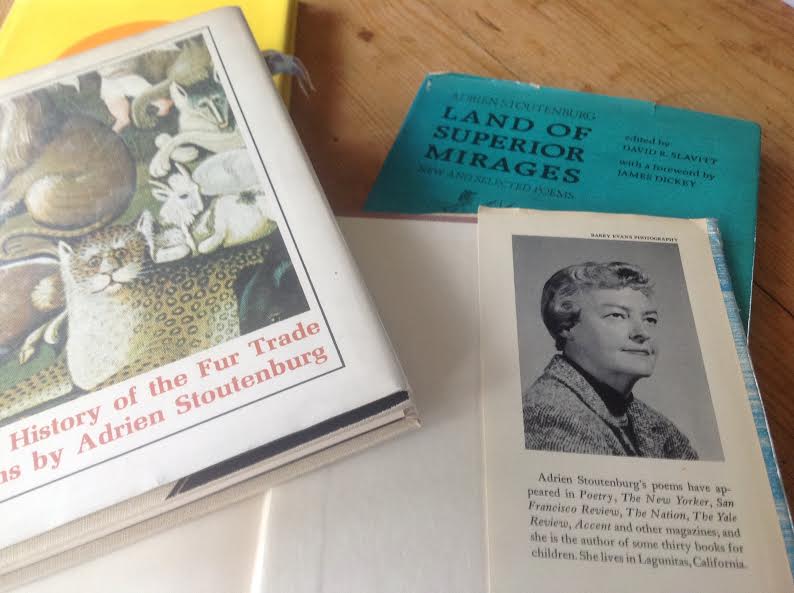
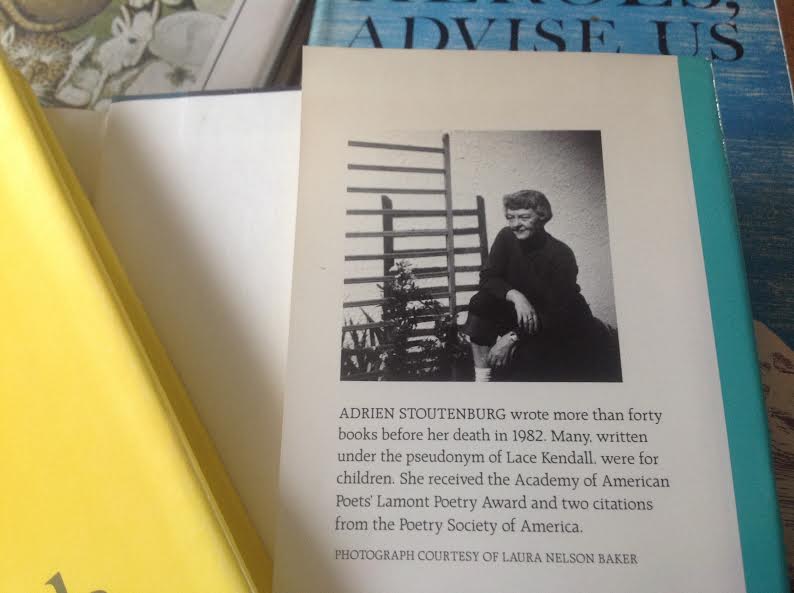
I often begin my treasure hunts for Undersung authors by looking for just the right author photo – one that will gaze back at us while we gaze at it, one that will allow the poetry to radiate out through the eyes, the smile, the averted glance, the stare. The treasure hunt this time around was for poet Adrien Stoutenburg, born Darfur, Minnesota, 1916; died Santa Barbara, California, 1982, aged 66. I had only two photos, both low-quality, both from the back jacket flaps of her books. The one below is on the flap of Heroes, Advise Us – her first poetry collection.

From Jacket Flap of Heroes, Advise Us (Scribners, 1964)

From Jacket Flap of Heroes, Advise Us (Scribners, 1964)

In terms of author photo categories (author as seductress, author as girl next door, author as bad ass, author as somber academic) this author photo of Stoutenburg might be placed in the “author as Republican great-great aunt” file. In it, the poet looks mild mannered but tightly coifed (her father was a barber, her mother a hairstylist.) Possibly a 1950’s country-club member and/or a Faculty Wives’ bridge player. But not even remotely the poet that critics once described as “ferocious” and “terrifying.”

So I looked for another picture. No luck. I couldn’t find a single photo of her on the Internet. I couldn’t find much at all, in fact, about the poet Adrien Stoutenburg —one quick Wikipedia entry. A few mentions as an author of children’s books. But little else. Below is the poem that made me stop in my tracks several years ago when I first read it in a used book store:

Rhinoceros

I have never seen that beast
with his snout bearing a pagoda
and his eyes like little fragments
and his haunches carrying hills
with them. His teeth, I have read,
are monuments, and his heart colder
than a key in winter,
though he sweats from pores round as goblets
and full of swamps.
The white hunters have killed him
a thousand times over.
I think of myself walking toward him
and preaching a love of creatures,
leaves in my palm, or a loaf of sugar,
and his great horn still,
the knees waiting,
and between us, like birds,
a twittering hope,
or merely the pause
between monster and monster.

—from Heroes, Advise Us

I’m not sure Stephen King ever wrote a more ominous line: “…his great horn still, / the knees waiting….” Ready to charge, that’s what’s implied. What poet, I wondered, looks into the face of a rhinoceros and sees a fellow monster? 

"...his great horn still, / his knees waiting....

“…his great horn still, / his knees waiting….

On the basis of that poem alone, I bought the book, then proceeded to hunt down every other one of her four books that I could find. But finding Stoutenburg takes some doing.

It’s not easy to suffer obscurity or anonymity  (or achieve it, depending on your point of view) on the Internet these days, not with the decades of digitally archived material available, and it’s certainly not common if the object of the hunt is a prize-winning author. Nevertheless, I couldn’t find a photo of Adrien Stoutenburg anywhere online— not a professional portrait, not one of her at a lectern, nor one in a professorial workshop pose, and not even one where she stands at the elbow of – or peeking out from behind – a more famous poet at a conference somewhere.

Was I missing some key word to type in that would get me to a photo? Might there be a photo of her in a literary journal or academic review in a narrower database? I checked, but no. Next I tried to find images online of the covers of her books of poetry – there were four titles to post pictures of – Heroes, Advise Us (Scribners, 1964), A Short History of the Fur Trade (Houghton Miflin, 1969), Greenwich Mean Time (Univ. of Utah Press, 1979) and Land of Superior Mirages (Johns Hopkins, 1986.) Again, I came up empty – other than an unusable 115×115 pixel photo somebody posted at a used book site, there are no pictures of her poetry books online, not even via the increasingly amazonian Amazon. Apparently, the poet Adrien Stoutenburg is not only undersung, she’s invisible.

How is that possible? Heroes, Advise Us won the Lamont Poetry Prize from the Academy of American Poets in 1964; her second poetry collection, A Short History of the Fur Trade, won a California Commonwealth medal and was under serious consideration (a “close competitor”) for the 1970 Pulitzer Prize (Richard Howard won, but one of the judges – James Dickey – declared later in a letter to Stoutenburg that he believed her book should and would have won had not W.H. Auden insisted on Howard – and, as the poet David Slavitt said, “Auden… prevailed—he was Auden, after all.”) Joyce Carol Oates praised the book, calling it “brilliant” and referring to Stoutenburg as “a really striking artist.”  Poet Henry Taylor helped get Greenwich Mean Time published at the University of Utah Press, saying “[Stoutenburg] has a wonderful eye for the right detail, and the tact to arrange observed details toward deep conclusions.”  Consider this poem:

On the Wagon

In between drinks I go on the wagon
which is sometimes a sleigh
and always filled with children,
the ears of horses like furred leaves,
the reins black over rumps
that resemble gray, cleft apples,
the smell of leather strong as brown medicine.

It is sometimes summer
and my cousin and I
actually ride the horses
and feel their backs—
broad, alive, and separate—
under our legs
thrust out, spraddled,
like short tan oars.

Sometimes there is hay in the box,
and that is a wood-sweet, wild-smell,
hot-heady bundle
of what was rooted, clovered, seasoned,
and sickled into a great, riding pillow
where we can roll under the passing sky.

It is at other times winter
and the smoke of the horses
is like the breath of fires,
and if I could, even now,
I would sneak inside,
stow away and lean against those hearts
stroking above every kind of ice and sweat
and desire.

Filled, furred, straddled, rooted, clovered, seasoned, sickled – just the sound of the words furls you and unfurls you, as do the unexpected comparisons – those horses’ rumps as cleft-apples, the smell of the leather like brown medicine, the children’s short legs sticking out like oars. It’s a passionate poem that goes deep, certainly not one that stays at the level of surface “glitter.” It throws off the same heat as Rhinoceros, and I could post another twenty here that do the same.

How invisible are other Lamont Poetry Prize winners from the 1950’s through the present day? The list includes poets Kay Ryan, Adrienne Rich, Czeslaw Milosz, Philip Levine, Lawrence Ferlinghetti, Robert Hass, Carolyn Kizer, Jane Hirshfield, Kim Addonizio, Gary Snyder, Kenneth Rexroth – stars in the poetry firmament, with abundant photos of each one online.  But Adrien Stoutenburg – author not only of award-winning books of poetry but of forty well-received books for children – can’t be found. One-time editor of Parnassus Press. Frequent contributor to the New Yorker, Saturday Review, the Nation, Yale Review, Commonwealth, and Accent. A Poetry Society of America’s Michael Sloane Fellowship winner. Winner of nine Borestone Mountain poetry awards  – yet not one photo.

Heroes, Advise Us contains a 39-page multi-sectioned poem /narrative (“This Journey”) focused on the tragic Scott expedition to the South Pole, as well as another 70 pages of strange and powerful stand-alone poems. The collection won prizes, but the Kirkus review of it at the time said the following: “Although the poems sometimes glitter, they lack a basic warmth.” For me, the poems have such heat that I feel like moving slightly back from them for fear of getting scorched at the edges. I love Stoutenburg’s work with its startling metaphors and convergences, its physicality, its dark imagination and heat.

But no one I’ve ever asked has  heard of her.

There is a second photo, this one from the jacket flap of her posthumously-published fourth collection, Land of Superior Mirages:

Jacket Flap from Land of Superior Mirages

Jacket Flap from Land of Superior Mirages

This photo shows what might be a younger Stoutenburg, despite the later release date (posthumous, actually) of that book. Younger or not, she appears more approachable and relaxed – like a kind, small-town librarian, which she actually was for awhile.  Stoutenburg, like another of our Undersung poets, Marie Ponsot, earned much of her income over the years by publishing work for children, with Ponsot translating French fairy tales and Stoutenburg interpreting American tall tales and publishing historical fiction and non-fiction for middle-grade school children. Several of her kids books were published as collaborations with the woman Stoutenburg lived with for almost twenty years, Laura Nelson Baker; the books were well-reviewed but not award-winners. Stoutenburg’s writing for children put food on the table just as medicine did for William Carlos Williams, insurance for Wallace Stevens, mortuary work for Thomas Lynch and Brooks Brothers clerking for Spencer Reese. Many of Stoutenburg’s children’s books were published under a pseudonym (most commonly “Lace Kendall,” the first and middle names of her father) – it doesn’t take too large a leap to reach the conclusion that a pseudonym was used because she didn’t want to be known primarily as an author of children’s books.

The reference book Contemporary Authors Online lists Stoutenburg’s authorial status as “Juvenile Writer” despite the fact that all the honors described in the CAO entry are for her poetry for adults.  First comes the long list of not particularly stellar children’s books, then comes the category “Other,” under which her poetry titles rest, like afterthoughts that don’t quite count.  The category itself –“Juvenile Writer” – is that a kind of ghetto-ization? And is that part of the reason readers of poetry have not heard of her?

I’m thinking right now of the photographer Vivian Maier, whose boxes (and boxes) of negatives were purchased by several people at a public auction (the most well-known of the three serious collectors was John Maloof, whose film, Finding Vivian Maier, is currently in release around the country.) Maier worked for forty years as a nanny to private, wealthy families; the fact that seems to surprise people most is that she supported herself by working with children. “A nanny? Really?” is the common reaction, and it comes out with a kind of derisiveness (am I projecting?) that sounds different than it would if people said, “A car salesman? Really?”  Photographers like Joel Meyerowitz and Mary Ellen Mark now say Maier was one of the great street photographers of the 20th-century, on a par with Weegee and Garry Winogrand. Maier, however, never published any of her photos, nor did she share them with anyone. Eventually, she descended into mental illness and true self-neglect. Maier was determined to remain anonymous, Stoutenburg was not, and Stoutenburg did achieve some recognition during her lifetime. But the paradox of being undervalued (people failing to be curious enough to find out who they actually were) due to work with and for children lingers around both these artists.

Two Girls, France - Vivian Maier

Two Girls, France – Vivian Maier

Perhaps it was difficult for Stoutenburg to present herself in a coherent way professionally, with feet in both the adult and the children’s worlds. Her final book talks about mirages:  “All images are bent / through time, and some most prized are fraudulent— / as mine may be.”  I wonder how clearly we can see a writer who moves between stories about Paul Bunyan and John Henry for six-year-olds and a poem like the following:

Acclimation

After my cousin, the choir boy,
murdered his mother with bitter candy;
and after my brother, the air force hero,
ruined his wife with a linoleum cutter;
and after my neighbor ignited his house,
and my best friend took a child to his room,
their gentle faces hung like jerky
from the live ceiling my bed looked up to.

Facts seemed fatal, at the beginning,
as the raw world must have
when it was imagined
with all its teeth and dung and passion.

Time tranquilizes, and bedrooms are cozy.
I rest most nights in the fearless moonlight
as well as the choir boy or the major
in their deep cells, or the child (grown-up now)
or the empty mothers.

Each day the pound master records the dead.
Bones of kittens burn like ignorant trees.
Headlines blur after too much reading
and the patched-up ceiling turns to mist.
I am chilled by the cold blue lisp of mice
hunting for traps arranged in my closet.
One grows accustomed even to this.

It’s hard to imagine a woman writing and publishing that poem if she wanted to be remembered for her children’s books. And since there is little to no critical writing about her, it’s hard to get a picture – both literally and figuratively – of who this woman was. Clear definitions of artists makes things easier for people who like to  pigeon-hole their art.

The goal here is not really to determine the why behind a poet’s lack of reputation and readership. But it’s such a puzzle – this business of a rising star failing to rise – that the temptation to try to solve the puzzle always lurks in the background. Maybe it comes down to what the photographer Saul Lister (himself unsung) once said about his own reputation:

I’ve never been overwhelmed with a desire to become famous. It’s not that I didn’t want to have my work appreciated, but for some reason — maybe it’s because my father disapproved of almost everything I did — in some secret place in my being was a desire to avoid success…My friend Henry [Wolf] once said that I had a talent for being indifferent to opportunities. He felt that I could have built more of a career, but instead I went home and drank coffee and looked out the window.

Fascinating – that something as simple as indifference (is it a character flaw or a character blessing?) or ambivalence (ditto) determines whether a writer’s work will or will not be read by subsequent generations of readers. Success obviously has many definitions, but isn’t it universally accepted that the trajectory should be, must be, consistently upward? Maybe the whole vertical model is wrong, and by reading poets like Adrien Stoutenburg we have a chance to restructure things, make our understanding of “success” more horizontal, less competitive, find those artists whose work we love but who were “indifferent to opportunities” and share their work with each other.

I look at Adrien Stoutenburg’s books on my shelf and feel lucky to have them. All four are out of print, and the used hardcovers (none went to paperback) online usually number in the half-dozen or so per title.  Who can explain this kind of obscurity for a poet described by James Dickey as having “an imaginative energy matched by few poets at any time, in any language” and who David Slavitt called “the toughest, most unrelenting, most terrifying poet I can think of.”  Slavitt, in fact, for an essay included in his book Re Verse: Essays on Poetry and Poets, addressed the way success eluded Stoutenberg. He reached this conclusion:

…as I now see, there were two things happening in the po’biz that were adversely affecting Adrien’s chances. One was that most trade publishers were abandoning the enterprise entirely, leaving the activity to the University presses. The other was the feminism had hit, and certain female poets had figured out that there were more readers for politics and protest than there were for poetry. If the likes of Adrienne Rich, Marge Piercy, and Denise Levertov were in fashion, then Adrien Stoutenburg wasn’t, and the publishing houses are always sensitive to that kind of trend. They don’t know about literature, and they don’t know about business, but they do know about lunch, and they are good about picking up what’s out there in the air, which is a vulgar knack, but then publishing is, in the root sense of the word, vulgar….If you’re not a member of one club or another, it’s mostly a crapshoot, and not always an honest one, either.

Greenwich Mean Time, Stoutenburg’s third collection is dedicated to Slavitt.  I’ll leave you with a poem from that collection. It’s a fairy tale, yes, but hardly for children.

Riding Hood, Updated

There had to have been a wolf that night,
alive in his rank fur and throat,
ears twigged, wild feet leaving flowers
on spring-deep earth. The howl was there;
his shadow kept house behind every bush.

Remember, dead grandmother,
me in my hood, and the old rifle swinging
between us, ready for that hot tongue’s flash?
There was a moon, too, skull-shaped but red.

Clouds leaned against it,
and the pines were windy harps.
A lake beckoned blue somewhere
like sky at the end of a downhill road.

There must have an owl, as well,
feather-corseted, hinged with claws;
and a bobcat’s cry.
Who knows what other things
lurked there?

It is nothing now to you
snug in your bonnet of earth,
out of the howl, forever wolf-free.
Here, where the hunt goes on,
and unimaginable beasts are loose,
it’s different for me.

I encourage you to try to find Stoutenburg’s books. It’s worth the search. Then sit down with them and wonder why this poet – her poems precise, white-hot and fierce – is not more celebrated.

—Julie Larios


Julie

Julie Larios has had poems chosen twice for inclusion in the Best American Poetry series. She is the winner of an Academy of American Poets Prize and a Pushcart Prize, and has published four collections of poetry for children.


May 042014
 

CaptureGiulio Mozzi via www.wuz.it

“I read Giulio Mozzi’s first book with real enthusiasm. What struck me most was his everyday language. Even when his subjects rely on metaphor, his words are plain, and so turn mysterious.”
—Federico Fellini

Giulio Mozzi’s This Is the Garden is an astonishing debut short story collection that English readers can now enjoy thanks to Open Letter Books. First published in 1993 (and winner of the Premio Mondello) and translated this year by Elizabeth Harris, these short stories all play in some way in the garden of the mind, the sandbox of introspection. Reminiscent of the work of Borges and Kafka, Mozzi’s psychologically acute, trenchant prose explores the self-conscious idiosyncrasies of the troubled mind. 

The story below is “Claw,” in which Mozzi imagines the later years of Yanez, the right-hand man of well-known Italian fictional pirate Sandokan. The once-infamous Yanez, known as the Tiger’s white brother, has now for years sat peacefully in his small, square, and white house, relying for subsistence and cigarettes on the daily visit of a woman from the nearby village. He sits in his small, square, and white house, smoking his cigarettes and looking meditative—but we do not believe he is meditating. The villagers react to the arrival of their “first real Englishman,” a threatening missionary who claims to be a saint sent by God. The villagers wonder how their own outsider Yanez will react. You can read my review of This Is the Garden by clicking here.

—Tom Faure

Capture

.

T

he house is small, square, and white. The roof is flat. The door, centered on the eastern side, is just a curtain with red and yellow flowers. The other sides have one square window, also centered. There’s no glass in the windows, just yellowing, loosely woven cotton rags nailed to the wood like mosquito netting. The house sits on a slight rise in the middle of the plain, and anyone looking out the windows could see a long way. Down the slope from the door, there’s a water pump. A leather razor strop hangs from a couple of nails in the pump’s wooden handle. A small washboard rests against the pump. The house has just one room. A hundred feet to the west, there’s a small shack for bodily functions. The house has a packed dirt floor. Two feet off the floor, a built-in shelf or bench runs along all four walls, interrupted only by the doorway. At the center of the room, there’s a wooden table, a single chair. A few things sit on the shelf: a bowl with a set of flatware, one fork, one knife, one spoon; a covered metal bucket with a curved handle and inside, a thick soup or mash; a basin with a few soap chips and a brush; a tiny, round mirror in a metal frame, a straight-edge razor resting on the mirror; a small rectangular basket with a lid, probably for linen or clothing; a rolled-up mat. On the table, there’s a white enamel pitcher with a blue rim and next to it, a slightly flared drinking glass, the bottom thick, rounded. The glass is cloudy, tinted pink. On one corner of the table, there’s a canister of cigarettes with a lighter. There’s a white man sitting on the chair. He has on khaki trousers and a light, collarless jacket, also khaki, but faded nearly white. He’s extremely thin: those clothes were meant for someone more muscular. The man’s face has a few deep lines. He doesn’t have a hair on his head. He could be fifty, someone who’s spent his life outdoors, but you can tell he’s extremely old because he’s so unnaturally thin. Another way you can tell his age: he barely moves. The man sits, facing the door, smoking. He’s not looking at anything in particular, or maybe he’s focused on the red and yellow curtain stirring just slightly in the breeze. The man sits rigid on the chair, left hand in his lap, right hand resting on the table, holding the cigarette, bringing it to his lips now and then. This man is Yanez, the Tiger’s white brother, and this ground where his house stands is far, far from any sea, in a part of India that appears on British maps as just a milk spot scratched with a few uncertain paths that could be swallowed up at any time by thriving forests or flooding rivers.

Once a day, in the morning, a woman comes from the village (which is close, just past the line of trees to the south), and she carries the bucket of food, and once a day, in the evening, she takes the empty bucket back again. Yanez has lost his teeth and his sense of taste; the bucket holds a milky broth with small bits of meat, boiled vegetables, rice. When he started eating only from the bowl, he gave the woman his metal plate but kept the fork and knife in case a large piece of meat needed cutting. Over the years, his throat has nearly closed. The woman also brings him soap and cigarettes when he runs out and sometimes a lantern wick or a piece of flint for the lighter. Sometimes the woman brings Yanez a shirt or a pair of pants, used, but still good enough to wear. She’s the only one who goes inside his house. Anyone could, but no one does. Yanez hasn’t asked to see anyone in years. For what the woman gives him, Yanez gives her nothing in return. When he dies, his few belongings will clearly go to her. But no one will live in the house—no one in the village can live outside the village. Yanez only leaves the house to fill the pitcher at the pump, or to wash his few clothes or to wash himself, pouring water over his body with the soup bowl; or else he’ll go to the small outhouse and relieve himself. To work the pump, Yanez must lean on the handle with all his slender might. Once a year, around the time of her wedding anniversary, the woman goes to Yanez’s house with her three sons dressed in their newest, cleanest clothes. She has her sons wait by the door, she pulls back the curtain, and Yanez looks at them a while. Years ago, there were two sons, and before that, one. Yanez looks at the young man, the youth, the child, and after a while, he smiles. Then the woman drops the curtain and sends her sons away. They’re healthy, handsome boys, and she’s a healthy, handsome woman—she hasn’t really changed with age. Yanez has never seen her husband. Years ago, Yanez went to the village by himself sometimes for supplies. The villagers knew who he was, but they never asked him any questions. The woman went to his house for the first time after they all realized no one had seen Yanez in nearly twenty days. She went once a week in the beginning; for years now, she’s gone every day. The two times she was in labor, her mother-in-law took her place, but didn’t go inside the house; the bucket of food she left outside the door in the morning was there by the door in the evening, empty. Yanez has given the woman two gifts: the metal plate, and on another occasion, his one book, a volume the size of his hand, three fingers thick, an English merchant vessel’s log of a voyage along the eastern coast of China.

The book was filled with small pictures: strange animals, strange plants, strange buildings, men and women with narrow eyes and strange clothing. The woman’s sons spent hours on boring or rainy days staring at those pictures, imagining all the strange and wonderful things he must have seen in his long, long life—this thin, silent man that people spoke of as a hero, a sea voyager, a great hunter of man and beast, brother in spirit to the Tiger. One day, before the youngest could even walk, the two older boys crept as close as they could to Yanez’s house and hid in the high grass and brush and watched Yanez leave his house with a torn shirt, the basin, the brush and soap. They watched him strain to pump a little water in the basin and wash the shirt, scrubbing it on the small washboard with the soap and brush. Then Yanez pumped a little more water, rinsed the shirt, and hung it over the pump handle to dry. They were quite impressed that he’d done this women’s work so easily, and they decided he could do anything at all. They never told anyone about their expedition and only admitted it to their little brother a few years later, after he swore a thousand oaths of secrecy. Their little brother knew he’d been made part of a great mystery, and he always kept his pledge.

No one knew what went on in Yanez’s mind. Some of the villagers thought he’d grown old and simple. Others thought he passed the time, in the absolute silence of his house, remembering his great adventures, his friends and brothers in spirit killed by accident or men, the thousand places where his name had been pronounced with reverence or rage, friendship or fear, love or loathing. When he first arrived from an unknown place and built his isolated, small white house, even then, Yanez was silent. He only said his name. And apparently, though he’d never been to this or any other nearby village, he knew his name would be enough for whatever he needed. And he needed little. He barely spoke, only if he needed something. When he still went to the village marketplace, he barely spoke a word. For years, the rumor had been that Yanez had died, but then he arrived in the village. The village boys imagined he’d taken refuge in this safe and tranquil place to plan his next great adventure. And they waited for him to tell them that they had to choose: either the safe, boring life of the village or the brief, glorious life of the hero.

But Yanez never told them. After almost a year of talking, meeting, stalling, the most spirited boys finally gathered up their courage and went to his house. They sat by his door and waited. Yanez came out almost at once, and then the boys spoke to him, taking turns, speaking passionately, for a long time. They recalled his great adventures, told him of their own desires to win glory in this life and honor in the next. Any adventure would do—it didn’t matter—it would be a glorious adventure, and they were ready for victory or defeat, because defeat at the hands of an overwhelming enemy would also bring glory on earth and honor in the heavens; they didn’t know their enemy, but they weren’t afraid; they’d fight anyone in his name, on the plains or in the mountains, in the rocky desert or the woods, even on the ocean that no villager had ever seen, but they knew it must be like a river with just one bank, and they weren’t afraid of any river or riverbank. Yanez stood in the doorway and listened, paying close attention to each boy, fixing his eye on the one who spoke, and when they’d all said their piece, and it was clearly his turn, the minutes passed in silence, and then he bowed stiffly and stepped behind the curtain. The boys spent a long time talking about this silent answer, what it could mean. Some boys started belittling Yanez, almost mocked him. Suddenly his race mattered. Others said, “The Tiger’s Claw has broken,” and they were sad. It took a few years—time for the village boys to become village men—before most of them realized what Yanez’s answer meant. The village was isolated, distant, and no one had ever seen an Englishman, but there still wasn’t a home without something made in England that had passed through a thousand peddlers’ hands. One villager, though quite suspicious, bought a sack of seeds from a bragging peddler, and it yielded thirty times the normal crop; from that year on, the children grew stronger. Some of the young men who longed to travel had gone off with peddlers to villages closer to the English, and they came back with stories of English medicines that cured almost anything and tools and machines that helped with every sort of labor. Who could resist the English when they brought such useful things? The village men wanted to consult with Yanez—he’d know everything about the English, everything good and bad—he’d fought them for so long and, really, was almost one of them, and the men wanted to know whether it was right or wrong to let the English take the village, even with fertile seeds, and strong medicines, and useful tools. The men talked a long while, but in the end they never went to Yanez—it was absurd, really—they could never keep something out that made life so much better. And then, around that time, a small caravan of peddlers arrived and brought the village its first real Englishman.

He was extremely robust, both muscular and fat, dressed all in black, with strange hair the same color you saw behind your eyelids when you closed your eyes and faced the sun. The Englishman’s hair shone in the sun, seemed almost to course with blood—not the dark blood of the body—a thinner, brighter blood. The Englishman could almost speak their language, but he used strange-sounding words, and once in a while, he’d go on and on when he was really saying something fairly simple, the same way children ramble when they’re first learning to talk. In the village square, the Englishman’s voice thundered that he was a saint of the English god, come for their own good, to save their souls from certain death, a death they’d all soon face, he insisted, if they refused his help. The village elders met for a long time, and finally they went to the square and told the Englishman they truly didn’t understand how a god, even the English god, could want or even allow men to die whom he hadn’t known existed until yesterday. The English saint laughed and said he admired the village elders for their intelligence and thought their answer was especially appropriate, coming from men who had understood the best ways of thinking when considering gods; but, he added, perhaps he hadn’t made himself quite clear, or the elders hadn’t quite understood. He asked permission to stay a while in the village, and they agreed. For a year, all the children, women, men, and elders listened every night while the English saint told stories about his god and the people to whom his god had first appeared. The English god treated his people (who weren’t English yet) like any good, stern father might treat his young son bursting with energy, both good and bad. When his people made mistakes, he punished them severely, and when they behaved, he rewarded them with his moderation. In the end, the English god wanted to teach his people a definitive lesson about the one true path, so he came down to earth as a man, yes, a real man who left his home and family when he was thirty and traveled around teaching the true path and living off the charity of others. Was he a buddha? the village asked. No, he wasn’t a buddha: he was god. An avatar? Something like that. A person could get along with this English saint; his topics were interesting and sparked debate. And he knew so many other useful things: how to cure certain childhood diseases, how to get an even larger yield from English seeds. The village men thought the god of the English saint seemed just and good, though they weren’t sure what to make of this idea of one god only; they might be willing to admit that he was a great god, and maybe—and this was extremely delicate—even a god more dignified and powerful than all the rest; but the English saint just kept insisting, ignoring all the evidence, that his was the one true god, and this, the village elders thought, was virtually insane; this pretense, this boundless pride was so out of character for a god who seemed so just, and kind, and good.

The English saint had been there almost a year, when much to everyone’s surprise, Yanez—who hadn’t left his house in years—showed up one night in the village square. He asked for the Englishman—so this was why he’d come. The English saint was astonished to see him, though Yanez didn’t say his name, at least in public, and somehow no villagers had mentioned it, either, so they’d kept Yanez hidden almost a year by just not saying anything. The English saint and Yanez wanted to be alone; they shut themselves away in the room of a house, and someone spying on them through a crack in the planks said Yanez dropped to his knees before the English saint, and stayed on his knees for over an hour, almost whispering—you couldn’t tell what he was saying—and the English saint listened, face attentive. You couldn’t see Yanez’s face, but his voice, that voice you couldn’t understand, that was the voice of a crying man, a man pleading to a vast superior, even pleading to a god. After a long time, the English saint and Yanez came out from the house, the saint in front, looking as if he could scarcely believe what he’d seen with his own two eyes; behind him came Yanez, his face, as always, revealing nothing. Together they went to Yanez’s house; meanwhile, in the village, people were making up stories; some were furious that Yanez had bowed down to this English saint, who maybe wasn’t so saintly after all; some said if the Tiger’s Claw welcomed the English saint into his home, the English saint must be good; but then others wondered if this applied to him and him alone, or whether all English saints were good (the English saint had said there were many saints like him spread all over the world, commanded by a saint of saints who lived in a very ancient city with a name that rolled beautifully off the tongue . . . Rome); and then what about the rest of the English—saint or otherwise—were they good, too? They discussed this in their homes; later, in the village square; finally, in the council of the adults and elders; and since they couldn’t send a delegation to Yanez and violate his privacy, they went directly to the English saint and questioned him in the square for an entire day, the people crowded all around him. They wanted to know—and the English saint could see the change right away—they wanted to know what his intentions were, not as a saint of his god or a saint in general, but as an Englishman, if he was there on his own or if he’d been sent by other Englishmen, and if anyone else, saint or otherwise, might be coming; quite simply, they wanted to know who he was, this man who’d made Yanez kneel down and cry and plead, this man who could break the Tiger’s Claw with just his presence, or better, who was so powerful, the Tiger’s Claw had come down to the village of his own free will, to be broken. But their questions served no purpose. The English saint still seemed like a good man, English, yes, so different from other men, but a good man all the same.

He’d lived in the village nearly a year and told wonderful stories. He’d taught the children new ways of doing figures. He’d taught the boys and men how to make English seeds yield more. He’d taught the women how to lower a child’s fever. He’d talked with the men and elders about the gods, about suffering and death. He’d laughed at births and cried at deaths, always in good measure. But he’d humiliated Yanez, they all said or thought. That isn’t true, someone stood up and said: Yanez humiliated himself. Following this day of questions came a night of talk, and in the morning they all said: Yanez humiliated himself. It was a surrender, not a defeat. The English saint could stay.

After his confession, Yanez barely slept. When it grew dark, he would unroll his reed mat and lie down, but he barely slept. He’d always been a light sleeper, but he slept often. Now he lay stretched out on the mat with his eyes closed, not sleeping, and this was like sitting and staring at the curtain moving slightly in the doorway, and really, if staring at the curtain was doing nothing, staying awake with his eyes closed was doing even less. He had only a short time to live, and he wanted to live every second of it, awake. He’d made himself a bet: if the priest absolved him and kept his confession, then god existed and was good and great, because only a true, and good, and great god could do great deeds with small men; and Yanez knew that he’d committed many large sins and pardoning them was a great deed, but above all, Yanez knew that even the smallest sin was enough for damnation, so even pardoning the smallest sin, and saving a soul from damnation, was a very great deed. If the priest refused to absolve him, then he had every reason to doubt the priest’s god. Yanez always knew the only one he could really count on was himself. He’d sailed a hundred seas, built and destroyed cities, been king and beggar, Portuguese and Oriental, loather and lover, friend and foe, only to find in the end that salvation comes not from what you take or lose, but from the gifts you’re given and keep forever. Yanez had been given three gifts: the friendship of the pirate Sandokan, the Tiger of Malaysia; the friendship of the woman who brought him food; and, maybe, the friendship of god. Sandokan had been dead for many years now, but their friendship wasn’t dead. They were friends together and friends apart, and now the great distance between them didn’t matter at all. Sandokan died young and handsome, as he should—a life like that couldn’t end with a frail body, a toothless mouth, a nearly closed throat, and soup trickling down your chin. This was Sandokan’s gift: the lesson that all lives are different, and each ends as it should. The woman was alive and gave Yanez almost everything, asking almost nothing in return; she fed him, honored him, named her sons for him. Yanez didn’t mind the woman’s devotion; he knew the woman considered this to be right because of what he was: an old man who needed her. Yanez knew the woman honored him for his age and for the wisdom gained with age. That’s why Yanez wanted to gain some wisdom, after so many years of life, because it was all he could give the woman in return for all her silent care. His desire for wisdom was the woman’s greatest gift. The English priest came just when Yanez realized that, for all his effort, wisdom was slipping away, because, quite simply, he wasn’t worthy: he’d wanted to live a thousand lives instead of one, the right life, his life. Perhaps the priest had the power to free him from all those superfluous lives, to strip him down to the least, the poorest. This power, perhaps the priest had it, and Yanez went to the village the day he felt strong enough and weak enough to find out. Now Yanez lies stretched out on the reed mat, awake, eyes closed, and he feels like a newborn child in a basket of rags who doesn’t know yet that he has arms, legs, a belly, and a back, who sees those limbs waving all around him without knowing that they’re his. Yanez grabs his left hand with his right; he clasps his hands, knits his fingers; he touches his face, his neck, his chest, his belly, and his thighs; he squats, hugs his knees, caresses himself, lightly kneads his lower back; he counts his toes, touches his hard soles, the backs of his knees; he hugs his shoulders, touches his throat, the back of his neck. He struggles to his knees, as he’s done only a few times by choice and as he was forced to do as a child. On his knees, almost without thinking, he prays, he gives himself.

Now he can die. When god’s claw decides to strike him.

—Giulio Mozzi, Translated by Elizabeth Harris

Giulio Mozzi was born in 1960 in the small town of Camira Vicentino in Northern Italy. He is the author of over two dozen books of fiction, poetry, and writing craft, and is credited with helping to launch the careers of numerous young writers in Italy. “The Apprentice,” a story from This Is the Garden, appeared in the anthology Racconti italiani del Novecento, edited by Enzo Siciliano for Mondadori Press. Mozzi lives in Padua.

§

harris

Elizabeth Harris‘s translations include Mario Rigoni Stern’s novel Giacomo’s Seasons (Autumn Hill Books), Giulio Mozzi’s story collection This Is the Garden (Open Letter Books), and Antonio Tabucchi’s novel Tristano Dies (forthcoming with Archipelago Books). Her prizes include a 2013 Translation Prize from the Italian Ministry of Foreign Culture (Rome), a Banff Centre Translation Residency, and a PEN/Heim Translation Fund Grant from the PEN American Center.


May 032014
 

Capturevia www.paolomerenda.it

Beyond the raw emotion and deft psychology contained in these stories, each of Mozzi’s parables drifts into the tall grass of that other garden—the garden of creation, of story-telling, of finding the right word. —Tom Faure

Capture

This Is the Garden
Giulio Mozzi
Translated from the Italian by Elizabeth Harris
Open Letter Books
Paperback, 121 pages, $13.95
978-1-934824-75-7

.

What is a garden? For Adam and Eve, it is the warm kingdom of innocence from which they have fallen. For Candide, it is the final plot he must dedicate his life to cultivating. For Giulio Mozzi, the garden resembles a Borgesian labyrinth—a mysterious, perplexing place in which people constantly write, read, and rewrite the ever-shifting planes of some elusive salvation. Mozzi’s garden is both the sandbox of the imagination and also an idyll his sad, thoughtful characters can never seem to achieve.

Mozzi’s This Is the Garden is easily the most rewarding book I’ve read this year. First published in 1993 (and winner of the Premio Mondello) and translated this year by Elizabeth Harris for Open Letter Books, these short stories each explore a combination of metaphors that plague and sanctify the human experience: the word, the letter, the sheltering garden, and the postlapsarian dream of succor.

The first piece in this brief, eight-story collection gives us a petty thief writing to his most recent victim. He is returning two letters he found in the purse he snatched. While detailing the thought process of a criminal observing potential victims, he digresses into disclosures such as that letter-writing seems more honest than the ephemeral, blunt honesty of direct conversation: “I don’t want you to get the wrong idea about me, and perhaps that’s making me too verbose; my apologies.” Such an existentially conscious and narcissistic character offers his victim enough gems about the letters that perhaps she’ll even forget her material suffering:

“Anyway, since your friend’s descriptions were completely unreal, I took to them at once. Children view reality this way, too, and I’m not sure if it’s instinct or habit that makes adults tell fairytales and stories to reinforce this idea of the world as somehow magical, or if adults are too lazy to explain the way things really work.”

A perfect opening to a story collection, “Cover Letter” tells us what to expect: very fine sentences, outcast characters, tacit ruminations on everything from first impressions to deontology and consequentialism, all held in check by a steady hand. Control is the order of the day and it is mesmerizing to see how much Mozzi packs into just under 120 pages.

His Kafkaesque characters—old, young, male, female, adroit, spacey—do not know what plagues them, necessarily. The second story, “The Apprentice,” tells of a young man who wishes to be more than just a delivery boy, but rather a true apprentice who might grow in time into “a man, a worker.” He experiences the joys and pitfalls of laboring for an uninterested boss who might hold, not only the keys, but the existential manual, to his future. He suffers the futility and anomie of his work, furiously certain that “he’s certainly much more than nothing, even if he doesn’t know what.” The boy haplessly considers the merits of punishment as biblical path to salvation, recalling the garden in which men first foolishly attempted to be like gods.

Each of these stories does indeed evoke or otherwise explicitly depict a garden, but the collection is not purely religious in nature. It’s thoroughly human, it’s Kafka, it’s experience of love and the puzzles of human connection and communication.

“To Mario, the dreams you can’t remember are the most important kind—they protect your vital secrets.” Mario is whiling the time on a five-hour train ride that reminded me in its style of Venedikt Erofeev’s masterful fugue Moscow to the End of the Line.  “Today, Mario is headed to Rome where, perhaps, a woman is waiting for him. A few days ago, he got a letter from her saying: ‘I miss you’ and ‘I wish you were here.’ But the letter didn’t say: ‘Please come.’”

“What he thought were her dreams turned out to be his instead.” What a line—and Mozzi offers many like this. “Trains” is my favorite for its relentless burrowing—again, a Kafka reference of Mozzi’s—into the seismic trepidations of the romantic experience.

Beyond the raw emotion and deft psychology contained in these stories, each of Mozzi’s parables drifts into the tall grass of that other garden—the garden of creation, of story-telling, of finding the right word.

“You might say that in some letters, maybe all letters, the important thing is only said after the final sentence, in the silence that follows.”

Or: “I ask myself what compels all this to hurl itself headlong into something so precise and defined as a story that has a beginning and an end. I think there must be some kind of grudge against reality in all this.”

But fear not—Mozzi does not stake his claim to meta-narrative navel-gazing. The experience that fascinates him most seems to be more primal, more guttural: a person’s simple search for how to speak to another, for how to begin, for how to end: “There’s something I keep trying to say, that grammar won’t permit, won’t allow.”

“I’ll never forget this pain. I beg you, all of you here, and I think I’ve finally managed to say what I had to, after all this hemming and hawing that was more from fear than anything else, because just bringing up certain things is scary, I beg you, please, try and understand my pain even a little, or at least try to accept it as something that could happen and could be true. The books I’ve read have taught me many things, but above all, they’ve taught me to preserve my life and to tuck my voice away inside my life and keep it safe—my voice, unique and private: my unique treasure and my health. I love you all.”

This is not easily digestible and forgotten. Mozzi’s is a European sentence—meandering, introspective, borderline Proustian at times. It is a sentence that demands its place on the page, that, without meaning to, reminds us of how many sentences don’t merit the space we give them. His words breathe in the vastness of their own possibilities, do not want to waste their breath.

“There have been many times, during intense conversations full of affection and emotion, with people I loved very much or at least wanted to love very much, that my words slowly disappeared, until all I had left in my head was one tiny phrase, or a few phrases, incongruous, but full of meaning, mysterious phrases, impossible to say. And in those moments, you can almost hear your brain creaking, straining to raise too great a weight. To say these words, to transform their mystery into a simple sequence, compressions and decompressions of air, to hear them disperse, scattered, useless, this would have been too much. As I stop writing this letter, I apologize to you that I can’t even sign it. Good luck.”

But to rave about the maestro’s sentences is insufficient—what of plot, drama, explosions? There is plenty of that here, in Mozzi’s dream garden. The conflict is buried deep in and burrows deep into the psyche of these perturbingly mundane characters. Mozzi’s little gem is not called This is the Garden, but rather This Is the Garden. The first thought upon finishing the last story of the collection is: ah, yes—there—I must return.

—Tom Faure


Tom Take 4

Tom Faure is an MFA in Fiction student at Vermont College of Fine Arts. His work has appeared in Zocalo Public Square, Splash of Red, Chattanooga Times Free Press, The Journal News, and undergraduate magazines at Columbia University. He lives in New York, teaching English and Philosophy at the French-American School of New York.

Contact: tomfaure@old.numerocinqmagazine.com


May 022014
 

Helen Oyeyemi

With Boy, Snow, Bird, the author treads a well-worn path alongside novelists who give voice to the most notorious villains in the Western literary canon. But she distinguishes herself by weaving a tale that digs at the deeper, uglier roots of human behavior and culture so that we can see ourselves reflected in her story. The novel is as stunning, complicated and magical as the women it presents. —Laura K. Warrell

boy-snow-bird

Boy, Snow, Bird
Helen Oyeyemi
Riverhead Books
Hardcover, 320 pages, $27.95


Fairy tales may communicate the universal principals of life but a good story told from a villain’s perspective is often a more delectable read.  Certainly, there is much to learn about the human psyche through contemplating the souls of the wicked; thus we have a tradition of novels, like John Gardner’s Grendel, that retell time-honored tales from the points-of-view of monsters. British novelist Helen Oyeyemi adds her voice to this ever-expanding catalogue, offering her own series of fabulistic novels that weave yarns as bewitching as the classics.

For her fifth book, Oyeyemi wanted to write a wicked stepmother story.  In an interview with Canada’s National Post, she said, “I wanted to rescue the wicked queen from Snow White, because she seemed to find being a villain a bit of a hassle in a lot of ways.”  In Boy, Snow, Bird, Oyeyemi reimagines the tale of the girl “with skin as white as snow” and the jealous stepmother who banishes her. Oyeyemi artfully explores the same themes of beauty, vanity and motherhood as the Brothers Grimm did in the source material, but adds other enticing layers of meaning.  The story takes place in a small Massachusetts town in the 1950s when the American South was fully segregated and magazines predicted the “End of [the] Negro race by 1980.”  But even more intriguing is the secret the characters’ family has kept hidden away for generations: they are black people who have been passing for white. Thus, the novel becomes not only an exploration of the worship of beauty, but an elegantly twisted tale about race and identity.

A writer who has been compared to both Edgar Allen Poe and Emily Dickinson, and who bristles at the “magic realism” label often affixed to her work, Oyeyemi seems fascinated by the mystical and macabre. Whether the Bluebeard-inspired story of an author’s muse coming to life in Mr. Fox or the eerie tale of a troubled child’s relationship with a ghostly new friend in The Icarus Girl, Oyeyemi’s novels straddle the real and unreal. She published The Icarus Girl, her first novel, at the age of nineteen and since then has become one of the youngest writers to be added to Granta’s list of “Best Young British Novelists” and won the Somerset Maugham and Hurston/Wright Legacy Awards.

Born in Nigeria, Oyeyemi grew up in South London where she spent most of her childhood in libraries rewriting classic stories. “I had so many problems with [Little Women]” she said in a National Public Radio interview. “I was so upset with Beth dying, with Jo and Laurie not getting married.  So I just crossed out all those things and wrote new endings. Then I went from there to writing my own things and never really looked back.”

Boy, Snow, Bird begins in New York City where Boy Novak, a beautiful white girl with blonde hair, lives with an abusive father who catches rats for work.  Such a horrifying set of circumstances – “the rats that are blind and starving are the best at bringing death to all the other rats, that’s your father’s claim” – prompts a twenty-year-old Boy to run away to a sleepy New England town called Flax Hill. There, she meets Arturo Whitman, a jewelry maker and widower, and his mesmerizingly beautiful daughter Snow, “a medieval swan maiden, only with the darkest hair and the pinkest lips, every shade at its utmost.”

Arturo eventually proposes to Boy with a handmade bracelet instead of a ring; “a white-gold snake that curled its tail around my wrist and pressed its tongue against the veins in the crook of my elbow…All I could think was: I will fear no evil…That snake was what he’d made for me…was maybe even what he thought I was, deep down.”  Boy’s fate as a wicked stepmother is sealed.  When she gives birth to her daughter Bird, a nurse tells her, “‘That little girl is a Negro’” thus prompting Arturo to reveal his black family’s history of “passing.”

In his mind he was no more colored than I was…his parents were the only ones from their families who’d decided to move north from Louisiana and see if anyone called them out on their ancestry.  His father had stood in line behind a colored man at the front desk of the Flax Hill Country club and eavesdropped as the colored man tried and failed to gain membership…Gerald liked golf and didn’t see why he shouldn’t play it in those surroundings if he could get away with it.  Gerald had thought: Well, what if I just don’t say…what if I never say?  He’d passed that down to Arturo, the idea that there was no need to ever say, that if you knew who you were then that was enough, that not saying was not the same as lying.  

Arturo’s mother Olivia has also passed for white and so refuses to accept her black grandchild, suggesting Boy send Bird to live with Clara, the daughter Olivia sent away for being “dark.”  Instead, Boy sends Snow to Clara, thus alleviating her growing jealousy of the beautiful girl “everybody adored.”

The novel is divided into three parts and the second is told through Bird’s point of view.  It begins with the adolescent girl turning to writing as a way of coping with a family she embarrasses while also trying to connect with her mother who is unashamed of her but cold.  Snow is a regular topic of conversation among the Whitmans who recall the girl’s mythic beauty and grace.

“I have a letter to Snow that I have never sent,” Oyeyemi writes in Bird’s voice.  “Dear Snow, Have you really got to be everywhere?

After Bird discovers a box of letters written to her from Snow, letters her mother has kept from her, the sisters develop a correspondence and more secrets are uncovered.  The third section of the novel returns the narrative to Boy’s point of view as the older, more reflective woman contemplates her choices.  One last secret is revealed in the book’s final chapters, a shocking turn that further underscores the novel’s exploration of the dualistic nature of identity.

Oyeyemi is faithful to much of the Snow White tale: the dead wife Boy replaces in the Whitman family is presented as saintly and “good,” Snow is described as a girl who “looks like a friend to woodland creatures,” and of course, the innocent young beauty is banished.

“Snow is not the fairest of them all,” Oyeyemi writes in Boy’s voice, echoing the Brothers Grimm’s tale.  “And the sooner she and Olivia and all the rest of them understand that, the better.”

But Oyeyemi is also faithful to the literary qualities of fairy tales as she infuses the narrative with supernatural elements.  When Boy arrives in Flat Hill, “insects dropped onto my shoulders, tentatively, as if wondering whether we’d met before.”  Later, she becomes aware of a ghostly presence “on the other side of the saplings” as she takes a walk.  Bird fears that trolls live in her bedroom and believes she can talk to the swarm of spiders she thinks are congregating in her room.

Such moments in the story suggest a curiosity on Oyeyemi’s part to explore what is “real,” but the author seems uninterested in drawing clear lines between these natural and supernatural planes.  The two co-exist in her work, creating an enchanting continuity between the spirit world, the real world and the characters’ imaginations.  There are as many allusions to the fabulistic – Alice in Wonderland, Red Riding Hood, genies and poisons in bottles – as there are to the painfully concrete – black boys teaching a parrot to say “Fuck Whitey,” references to the Black Panthers, Ebony magazine and Emmett Till, the fourteen-year-old black boy beaten to death in 1955 after allegedly flirting with a white woman.

Within this context, the contemplation of beauty becomes profoundly more loaded.  In The Guardian, Oyeyemi stated that in Boy, Snow, Bird she wanted to explore the feminine gaze, the ways women seek approval and “who gets to be deemed the fairest of them all.”  Perhaps in no work of literature is the supremacy of white beauty made more explicit than in the tale of Snow White, in which a mother yearns for a child “with skin as white as snow.”  Boy’s white loveliness contrasted with what the Whitman family considers Bird’s unappealing blackness is only the first layer of the author’s exploration.  It is the Whitman family’s passing, in particular Snow’s apparently white beauty, that gives the novel its philosophical spine and its evil queen her dimension.

“Snow’s beauty is all the more precious…because it’s a trick,” says Boy.  “When whites look at her, they don’t get whatever fleeting, ugly impressions so many of us get when we see a colored girl – we don’t see a colored girl standing there.  The joke’s on us…From this I can only…begin to measure the difference between being seen as colored and being seen as Snow.  What can I do for my daughter?  One day soon a wall will come up between us, and I won’t be able to follow her behind it.”

One way to read Snow’s expulsion from the Whitman home is as an attempt by Boy to protect herself from the threat of the girl’s beauty, this from a woman who has been presented throughout the novel as obsessed with her appearance.  However, another way to read Boy’s decision is as an attempt to protect her black daughter from Snow, who otherwise would act as a constant reminder of the adoration and social inclusion Bird will undoubtedly be denied.

Oyeyemi includes a lengthy but beautifully written series of letters the sisters send to one another, which she uses to dig deeper into the notion of passing.  Snow lets Bird know that their family has been practicing “calculated breeding” for generations, monitoring the skin tone and hair texture of family members and lamenting the birth of dark children like Clara and Bird.  Living in a more racially diverse town, Snow has experienced racism in a way Bird has not, and describes how she avoids racist taunts yet feels unable to defend her black friends against them.  She also describes how her political awareness has evolved having spent most of her life with the exiled black members of the family.

“You can’t feel nauseated by the Whitmans and the Millers without feeling nauseated by the kind of world that’s rewarded them for adapting to it like this,” she writes to Bird.

Bird repeatedly asks Snow to describe how she experiences her immense beauty, a request Snow mostly denies until finally she admits, “I may or may not have hated my own face sometimes.  I may or may not have spent time thinking of ways to spoil it somehow.”

The sisters bond over many things but nothing connects them more than their shared inability to see themselves in mirrors.  Oyeyemi uses mirrors in the novel more than any other image or symbol, in fact, it is the backbone to the plot, much like her original source.  In “Reading Snow White: The Mother’s Story,” scholar Shuli Barzilai discusses Lacan’s analysis of the mirror stage in human development and suggests that the magic mirror in Snow White is central to the evil queen’s connection to and separation from herself, her daughter and the world around her.

“The queen’s confrontations with her magic mirror,” Barzilai writes, “set and keep the plot of ‘Snow White’ in motion.”

Mirrors perform the same function in Boy, Snow, Bird.  All three of the main characters, and some of the minor characters, interact intimately with mirrors, which reveals the internal conflicts that push the story forward.

“Nobody ever warned me about mirrors,” says Boy in the first line of the novel.  “So for many years I was fond of them, and believed them to be trustworthy.”  To Boy, everything becomes a mirror; she ogles herself in picture frames, brass pitchers and dessert spoons.  Mirrors are a way for Boy to come to “familiar terms” with herself as she communicates with and understands her identity through viewing her own reflection, for instance, when she tells her reflection “look what I got you” after finding a husband in Arturo.

“Mirrors see so much,” she says, a concept that supports a Jungian interpretation of the Snow White myth put forth by Barzilai, which suggests that Snow White is not a separate person whose presence threatens the queen but the queen’s shadow side, i.e., the “Snow White in herself.”  Such an interpretation seems even more viable after Boy becomes pregnant and is unable to see her reflection clearly in the mirror.

“When I stood in front of the mirror,” Oyeyemi writes, “the icy blonde was there, but I couldn’t swear to the fact of her being me.  She was no clearer to me than my shadow was.  I came to prefer my shadow.”

Bird’s interactions with mirrors are the opposite of her mother’s.

“Sometimes mirrors can’t find me,” she says.  “I’ll go into a room with a mirror in it and look around, and I’m not there.  Not all the time, not even most of the time, but often enough.”  Bird decides that the reason she is unable to see herself is because she is either not human or “someone [was] wishing and willing me out of sight.”

Snow also fails to show up in mirrors but she has a different explanation than her sister’s.

“My reflection can’t be counted on, she’s not always there,” Oyeyemi writes.  “But I am, so maybe she’s not really me.”

Mirrors, which also feature in the surprise twist in the plot’s final chapters, are only one of the elements working within the stratums of meaning Oyeyemi layers into this piece.  With Boy, Snow, Bird, the author treads a well-worn path alongside novelists who give voice to the most notorious villains in the Western literary canon.  But she distinguishes herself by weaving a tale that digs at the deeper, uglier roots of human behavior and culture so that we can see ourselves reflected in her story.  The novel is as stunning, complicated and magical as the women it presents.

—Laura K. Warrell

.Laura K Warrell
Laura K. Warrell is a freelance writer living in Boston. She teaches writing at the University of Massachusetts Boston and Northeastern University and is a July, 2013, graduate of the MFA program at Vermont College of Fine Arts. She has previously published both fiction and nonfiction in Numéro Cinq.


May 012014
 

Davis:Theo Cote

(Photo: Theo Cote)

How does one introduce Lydia Davis? By listing her accolades (which include the 2013 Man Booker International Prize)? Her acclaimed story collections, like Samuel Johnson is Indignant and Varieties of Disturbance? Her exquisite translations of Proust and Flaubert?

Since breaking through with Break it Down in 1986, Lydia Davis has stood at the forefront of American literature, constantly crafting fiction that both provokes reaction and mines the depths of the English language. In my review of her latest collection, Can’t and Won’t, I write, “The book is a remarkable, exhilarating beast: a collection that resumes the author’s overall style—short narratives, with the occasional longer piece—while simultaneously expanding her vision.” In addition, the translation work by Davis has both reintroduced classics (Madame Bovaryand ushered lesser known works into the libraries of avid readers.

It was a pleasure to connect with Ms. Davis for the following interview. We began speaking in February via email, and conducted this conversation over a series of electronic messages that lasted through the end of March.

— Benjamin Woodard


Benjamin Woodard (BW):
The 14 “Flaubert stories” in Can’t and Won’t feel right at home with your other narratives, often echoing ideas and themes from other stories. Were you drawn to these while translating Madame Bovary, or did they come earlier?

Lydia Davis (LD): Actually, I stumbled upon them as I was reading through the letters that Flaubert wrote during the time he was working on Madame Bovary. The letters were interesting for many different reasons, but the nicest reward was to come upon a little self-contained story that he was telling his correspondent, about something that had happened to him recently. I took whatever liberties I needed to—these were not meant to be “straight” translations—and shaped them into little stories.

MadameBovary

BW: How did you shape the narratives?

LD: Sometimes, I barely touched them. Usually, though, I would make little changes—combine two sentences or cut some material out of one. In the first story, about the cook, I added the phrase “and yet it has been five years since he left the throne”—because a contemporary American reader would not have the same information that Flaubert’s correspondent did as he wrote the letter. I tried to write this, and other additions, in Flaubert’s style and tone. In another story, I added some information about one of the characters, since he was otherwise unidentified. Yet another story, the one called “After You Left,” actually combines material from two letters. On his way home in the carriage, Flaubert remembers riding home on another occasion in a sleigh—in my story. In fact, he recounted that sleigh ride in another letter.

BW: Does translation work ever affect your style in English?

LD: Usually, for whatever reason, the style of the work I’m translating does not creep into my own—although I noticed when I was translating Proust that my emails became longer and more digressive. But I certainly like the little Dutch stories I’m translating at the moment, by A.L. Snijders, and I’m sure I will begin writing stories modeled on those, if I haven’t already.

CantandWont

BW: The “dream pieces” story cycle is another type of translation altogether. What prompted this cycle, and how did you decide to interpret these surreal tangents?

LD: What prompted these was a combination or confluence of two things—often the case. A French Surrealist and ethnographer, Michel Leiris, had published a book that collected his dreams over forty years. What interested me about this book was not just the dreams but that he included waking experiences that were like dreams. I had this book in an English translation by Richard Sieburth. It sat on my shelf for a long time. But then one day I had a waking experience that was so like a dream that it inspired me to see what I could do with narrating dreams so that they were dynamic and vivid, and narrating waking experiences so that they were believable as dreams.

BW: Does your approach differ when writing an extremely short piece like “Ph.D.” compared to “The Seals,” one of the collection’s longest stories?

LD: Oh, yes. Many of the shortest stories occur to me already almost complete—though not the one you mention, which was actually shortened from a longer “dream” piece. Often, all that these very short pieces need is the right title, and I take some time over finding that. But a long, fully developed narrative, like “The Seals,” requires going into a sort of trance, allowing the inner voice to begin speaking, and letting one paragraph suggest the next. There is a lot of material in a long story that was not planned in advance but that occurred during the writing. Then, there is the problem of structure, which I don’t really have in a very short story. Will one part balance another part in a good way? Is the conclusion thoughtful and strong? And in the case of that story, I had to pay attention to how often the narrator’s present situation, sitting on a train, came back into the story, so that it wasn’t lost. Much more complicated, altogether, than the shortest stories. But on the other hand, the shortest stories have that challenge of being substantial enough, in their few words, to carry full weight as finished pieces of writing.

BW: How does the idea of travel fit into your storytelling? Your characters often find themselves on physical journeys. For example, “The Seals” takes place on a train, alternating between present and past, in a way reminiscent of Thomas Bernhard’s The Loser.

LD: The simple fact is that I was traveling when I began many of these stories, since I find that sitting on a train or in an airplane is actually very conducive to letting my thoughts roam around freely in a relaxed sort of way, which sometimes produces a thought that leads to a story. At home, more stationary, I may be translating, or writing something non-fictional, like an essay. So the travel stories arise from incorporating what is going on at that moment. I like traveling—I like the feeling of suspension that one has at those times. You are between home and your destination, you are surrounded by strangers, you have a fellowship or bond with a group of strangers, for better or worse. It is very interesting. And often I am also in a foreign place, which means a foreign culture. I enjoy the contrast between that and my domestic, rural, home existence.

BW: Thematically, Can’t and Won’t plays quite a bit with the idea of capturing different forms of history, be it dreams or memories or subconscious realizations. Was this a deliberate effort on your part?

LD:  Well, your insight is interesting—I rarely stand back and look at the pieces as a group. It is true that I’m very interested in history—as I never was in school. But as for a deliberate effort, no, I do not think ahead of time about themes. Stories occur as they want to occur—I try to impose as little as possible on them. They simply reflect whatever is on my mind at that time. Only sometimes, as in the case of the Flaubert stories or the dream stories, or the letters of complaint—of which there are five in the book—I see that there is a form I like and want to explore, to see what it might yield.

BW: Finally, what are you reading now? What writing inspires you?

LD: Interesting question. Actually, two quite different questions, possibly. I do keep reading the small stories of the Dutch writer Snijders—since he sends them out by email. And they inspire me to translate him. At the same time, I’m reading a biography of Glenn Gould, because he continues to fascinate me as pianist and person, and I want to know more about him. But that book would not inspire me to any kind of writing. W.G. Sebald’s novels inspire me—I’d like to do what he does;  so do Thomas Bernhard’s, though he is so surpassingly negative about everything—but funny. There is a wonderful, probably not very well known thin book by the Canadian Elizabeth Smart with one of the best titles I know: By Grand Central Station I Sat Down and Wept. It is a story of obsessive love, and it is most eccentrically written. I know that title will seep into me and come out somewhere, sometime, and maybe the structure and style of book itself will, too.

— Lydia Davis & Benjamin Woodard

.

Lydia Davis is the author of one novel and seven story collections. Her collection Varieties of Disturbance: Stories was a finalist for the 2007 National Book Award. She is the recipient of a MacArthur fellowship, the American Academy of Arts and Letters’ Award of Merit Medal, and was named a Chevalier of the Order of the Arts and Letters by the French government for her fiction and her translations of modern writers, including Maurice Blanchot, Michel Leiris, and Marcel Proust. Lydia Davis is the winner of the 2013 Man Booker International Prize.

.

Woodard

Benjamin Woodard lives in Connecticut. His recent fiction has appeared in decomP magazinE, Cleaver Magazine, and Numéro Cinq. His reviews, interviews, and essays have been featured in Publishers Weekly, BuzzFeed Books, Numéro Cinq, Rain Taxi Review of Books, The Bygone Bureau, and other fine publications. He is a member of the National Book Critics Circle. You can find him at benjaminjwoodard.com and on Twitter @woodardwriter.


Apr 192014
 

I wear many hats in my professional life, one of which finds me plugging away at my local library four days a week as a Library Specialist. What is a Library Specialist? Well, it’s not a Librarian (I don’t have a MLS degree), but it’s someone who has worked up the food chain a bit, who has knowledge that’s devoted to a specific department. In my case, that knowledge goes into promoting the library, writing press releases, contacting authors, etc.

Anyway, as a library employee, I take a certain umbrage when I see the stereotypical depictions of librarians in movies and on TV. So, for National Library Week, I compiled a little list of contemporary librarians in fiction that buck the trend of shy, scared wallflowers, and the good folks at BuzzFeed Books were kind enough to publish it. It is a tad silly, yes, but the writers I included are worth a look.

Here’s a bit of my intro:

Though the librarian stereotype continues to thrive in television and film, it is thankfully shattered in the world of literature. Rather than offering up dry, buttoned-up types (or their opposite: the sex-crazed nymphomaniac hiding behind a pair of horn-rimmed glasses), many contemporary writers attach the occupation to immensely complicated characters forced to confront their own morals.

You can find the full list of librarians here.

— Benjamin Woodard

Apr 192014


In Michael Venus’s music video for “The Hunt,” a woman (Katja Danowski) blanched and polyestered by life is haunted by the band Parasite Single, two outfit-coordinated hipster angels, who call to her and torment her with their pop song and provoke her to the possibility of something other than her sweat-pant suit life.

From the first shot in the furniture store we are in an uncomfortable space: the angles askew, florescent lights running to the left of the frame into the distance, their static hum scratching our ear drums, the woman’s prone body running from the centre off to the right. She’s wearing a yellow sweatsuit, but this is yellow drained of any allusion to lemons, sunshine, or fluffy baby chickens. This is yellow defined by the absence of yellow.

470669947_640

Sidebar: I don’t think mattress merchants as professionals are prepared for the intimacy and vulnerability of people going prone. They should have to have some training or certification to prepare for this burden.

470434091_640

In the second awkward shot, a foot’s eye view, we look up the length of the woman, up her nose, and along her arm outstretched, spanning the empty side of the bed to the right of the frame. Either she sleeps like a horizontal crucified Christ each night, board straight and perpendicular, or perhaps her arm and that space of empty bed signify something.

Then, in an insert shot, we see her fingers fumbling with the mattress’s plastic cover, trying to get past the plastic or pondering the empty space that is the other side of the bed to her. Her eyes close slowly in pained longing as the plastic cover crinkles in deaf response and we see that the back corner of this cold furniture store is reserved for longing.

Venus composes each of the first shots with awkward angles, plays with empty space and underscores the sequence with a minimalist sound design, just crinkling plastic and the buzz of the lights, all to emphasize this woman’s loneliness and isolation before the hipster angels’ music begins.

471292536_640

The musical duo proceed to plague and torment polyester woman in various locales: the furniture store, her work at a car garage, the grocery store and a laundromat. In what follows there are three small moments that define her journey: the sack of unshelled peanuts, the discarding of the shopping cart, and when she mimics the band.

The first moment is just after her second sighting of the band, in her office at work: she escapes outside where she sits on a potted palm, shelling and eating peanuts from a sack slight desperation.

Sidebar: unshelled peanuts must be the unofficial snack for depressed polyester wearers. It explains why country and western bars are littered with their remains.

Sidebar to the sidebar: unshelled pistachios, on the other hand, are too coy, salty smooth, and hard shelled to every get caught in a country and western bar, though they have, undoubtedly, seen it all before.

The second moment is when she sees the band in the grocery store and, not so coincidentally the word “love” on a cake decorating box. Here she breaks, shoving the grocery cart away from herself.

Then, around the 1:47 mark when the hipster angels take a break for coffee in the laundromat, polyester woman has had enough and she picks up their instruments and mockingly pretends to play with the same hipster joy they do. It’s a tiny moment and if you blink you’ll miss it, but it foreshadows the angry catharsis to come.

These three small moments define this character, her resistance to the gaudy coloured pop angels that are pressuring her to break out of her drab life.

maxresdefault

So when catharsis comes for her, after the hair salon and dressing up, in a bar full of gambling machines, angry, glorious dancing is the answer.  In a nice turn, the strobed shots draw her in to the same frame as the hipster angels, showing us they were part of her all along; they are connected. Moreover, Venus places her in the centre of the frame, positions her as their lead singer, their missing piece.

She is, however, not done. In the last shot, ragged and sweaty from her angry dancing, she stands in profile, then turns her head and looks at the camera, a mix of defiance and Teflon:  if at any point we, as audience, lacked compassion or took amusement from her journey, here she wins, and its her victory not ours.

Over at the site Director’s Notes,  there’s an interview with Venus where you can read more about his work with Curtisfilm  and about how they shot the film. If your German is better than mine you can consider supporting the band and their future creative endeavours through their crowdsourcing campaign.

— R. W. Gray

Apr 182014
 

DG is on his way home, though at this stage of life home is a moving target, indeterminate and scattered, more like a field of destinations than a particular place. Let’s just say he gets mail at a lot of different addresses.

But his sojourn as Writer-in-Residence at the University of New Brunswick is over and on April 16, as new snow blanketed Fredericton and the St. John River continued to rise across the street from Mark Jarman’s house, he left town (and was subsequently nearly swept away outside of Lancaster, NH, where the Connecticut River had flooded over Bridge Street in two places).

Last events included a reading at Odd Odd Sunday’s on Friday at Molly’s (postponed from the week before due to a blizzard) on April 11 and another reading at the Qwerty Reading Series at the Grad House Pub (which used to be Alden Nowlan’s house where dg, in a different incarnation, went for dinner a couple of times in the early 1970s) on April 14.

Most fun in the last weeks? Shoveling water with Mark in the flooded backyard where the cars were parked. Yes, shoveling water. Don’t ask. Just think: a couple of guys, estimable writers, trying to avoid work, shoveling water and drinking beer in the sun. Clarissa’s response? Irrepressible disbelief and glee at the strangeness of men. Rob’s response? This will go away if I ignore it.

What does dg feel like leaving? Time to move on but lots of regrets. What does Lucy feel? No, I don’t want to go. This is the best place ever. I have friends. I have put down roots. You can’t make me leave.

For anyone wishing to review the whole unseemly chronicle of events since last September, you can click through the Writer-in-Residence Blog.

dg

Jack Lucy and FifiJack, Lucy and Fifi

DSCF7573Mark on top of the snow mountain in the backyard, April 3

DSCF7547

mMark Anthony Jarman

DSCF7557

DG at gradhouseDG’s last reading as Writer-in-Residence at the Grad House (formerly Alden Nowlan’s house), April 14 (Photo by Stephanie Doucette)

DSCF7651-002Lucy and  Clarissa go for a last run together

Back yad Apr 16Backyard from second floor window, April 16

DSCF7654Lucy refusing to get in the car, tucked in her favourite spot on the loveseat, where she spent many happy hours watching television, reading and offering editorial advice to Mark and Clarissa

Apr 162014
 

madden_montaigne

Yesterday, Brevity Magazine‘s blog posted Patrick Madden’s short essay detailing Madden’s family outing to Michel de Montaigne’s tower:

The first goal on the Madden Family European Road Trip Vacation (after my semester directing a study abroad program in Madrid) was my own pilgrimage to Montaigne’s tower in the Perigord region east of Bordeaux. We arrived after a long day in the car and were surprised to find a chain blocking the entrance. Turns out the site was closed not just on Mondays, as David Lazar had warned me, but on Tuesdays as well.

What follows is an insightful look at opportunity, charity, and the quests writers take on to complete their work.

Read the rest here. (And read Madden’s NC contribution, “Essay as Evolutionary Advantage (après Borges),” here.)

— Benjamin Woodard

Apr 162014
 

dms 2

Where is poetry? the poet asks at the beginning of this poem/essay — call it an epode, call it an extended epigram, a form that somehow contains balanced contraries in dynamic tension, the heart of metaphor, of art. Written in response to an essay by Ralph Angel that we published in January last year, D. M. Spitzer’s “Mythology” oscillates between monster and marvel, labyrinth and sanctuary, fragment and whole, tapping ahead with his words for solid ground and offering, yes, a mythology of the poem, of the imagination (dangerous, contained within a force field — form). Beautiful to read, surging and lapidary in its rhythms, erudite and cunning in  its weaving together of legend, text, word play and reference.

Also one of the best author photos in ages.

dg


part 1:  (muthos) labyrinth & sanctuary

“And if I can make a sanctuary of reading, of poems and stories complete unto themselves and, therefore, whole, I must make that which is not whole my sanctuary—its traces and glimmers, its countless fragments.”

—Ralph Angel, “The Exile and Return of Poetry:  Essay
Numéro Cinq vol. vi, 1 (January, 2013).

Unspool the thread given by Ariadne, in whom the ecstasy of oblivion awaits the coming of Dionysos. The end precedes the beginning and a certain movement of form collects both. Dionysos already presents himself in the form of desire. Unspool the thread down narrowing and widening passages. Daidalos, poet-exemplar, modulates light and darkness, clarity and obscurity in the labyrinth. To isolate the final cause of this structure, peel away at the Minotaur: Minos and shame, Pasiphaë and desire, desire and the god of translation (Zeus). Dionysos stands at the threshold of the labyrinth and in the mind of the poet-architect. Into the sacred labyrinth let thread follow. Thread protects against loss and wandering and a hungry monster inhabits the structure.  Monster is monstrum, something that elicits wonder, a marvel.

Risk:  to be consumed by the hunger and isolation that motivates wonder.

Where is poetry?

A poet designs a sanctuary into which imagination—a genuine monstrum—is led.  Fear of the creative imagination in the full range of license, and a shame, rooted in modality, of the creative imagination’s potency, force the creative imagination into the sanctuary—that is, a world-making creativity will also be world-devouring. Shelter it within sanctuary. Labyrinth is sanctuary.

Sanctuary:  a forbidden vein of dark blood writing the holy secrets across its innermost holy place, a place of healing.

Into the labyrinth unwind thread. Poetry is labyrinth, but a poem takes flight from the surrounding walls. Ikaros too with wings of syllables and breath lifts himself out of the sanctuary’s enclosure unto the bright morning air, the island’s craggy shoreline diminishing. Into the open.

Or sing the poem from the open place near the labyrinth’s center. Write poems on papyrus scraps and send them to the skies on wings of smoke and flame. Too near the sun they have already burned to ash and their flight continues. Poem needs no ground save the whole of things; air discloses the whole.

Unwinding thread towards the interior of labyrinth, find the shield of Achilles blazing in midday light. Everything reflects there. It burns the eye and the mind falls to its knees.  A fire-god rends the metal earth into folds that look just like earth and the poet’s god is the god of fire. There on the shield read one’s own face in bronze embossed where the surface is whole. Everything there terrifies. None dares to look.  Begins the fire-god a poetry of metal fragged from deep veins beneath the surface of earth. Tear open the surface of things and make beginnings in the dark material hidden there. A whole rent down to the interior of fragments stripped and reshaped in time-present’s forge where everything else collapses into forgetting. Unmake whole make fragment into whole in which a face echoed recalls its fragmentation. Tragedy builds its shield from the shield of fire given from god to man. Poet beneath it all, blindness shielding from the tragedy of wholeness. Where whole forms itself into stability there loses all into unself. Whole will encapsulate in its message of bronze the perishing of what you want:  the city of gold, walled with lapis tesserae and medallions of everything precious, gods’ hands pressing stone towards the sun into a wall impenetrable. Down tumbles wall and the quiet household gods into flame of the poet’s limping god. A fierce jaw breaks spear after spear into the torso of a warrior who is also a son, a father watching unable to look away. Down tumbles what the whole speaks in its ekphrastic visioning. Down.

At the labyrinth’s center, Minotaur shakes loose his must-covered voice:

mind sleeps and wakes and stirs and rests and poetry cycles

turning & turning the spirit moves as it cycles once more into itself[i]

Fragmentary remains in the manner of the cycling going-under of things.  Take it up from the ruins, or from the labyrinth where it was found lying in midday sun.  Out of a ruined whole brings forth the poet a second world that looks out upon another contained within itself.  The thread leads deeper into labyrinth’s ordered chasm.  Light is channeled into momentany into dark by the architect of moving-images[ii] and prisons.  The poet chains everything in artifice, released in the mouth and ear of the reader.

Back to sanctuary only ever half-finished, abandoned when tyranny fell. Footsteps glish in blood and stain the foundation.  The wonder is, after all, only half human.  The rest is untranslatable.  Leave the traces of holiness along the eastern wall where temple and labyrinth are one.

.

part 2:  (logos)  literary dynamism

“And if I can make a sanctuary of reading, of poems and stories complete unto themselves and, therefore, whole, I must make that which is not whole my sanctuary—its traces and glimmers, its countless fragments.”

This sentence traces the belonging-together of whole and not whole. The sentence says:  if a subject is able to produce a sanctuary out of literary wholeness, that subject must produce a sanctuary of the fragmentary.  It says, in fact, nothing about the making of a literary sanctuary, but rather about the power to make such a sanctuary and the necessity, because of that power, to create a sanctuary for the fragmentary.  Accordingly, the fragmentary involves a dynamism that exceeds and excludes the whole.

However, wholeness comes first.[iii] Only after the presencing of wholes to consciousness do the fragments begin to appear, light-catching as glass-shards. To be sure, wholeness as a concept both precedes and precipitates a notion of the fragmentary; coming across a potsherd on the island of Delos, for instance, one immediately recognizes the fragment of pottery as having been a part of a now ruined whole.  The sentence above, the starting point of this brief inquiry, on one level simply asserts that, since the production of a sanctuary for wholeness can be carried out, wholeness exists in some way, and then what applies to the whole applies necessarily to the parts.  Yet, this assertion is complicated by the idea that the sanctuary produced for wholeness exists in modality, while that produced for fragmentariness exists as a dynamic and necessary movement towards a whole.  It is further complicated by the notion that such a whole, as the sanctuary seems to describe, takes place as not only whole, but also fragmentary.  For, a sanctuary marks off an area that is described by its boundaries and is a kind of whole, yet one which also explicitly does not contain the wholeness for whose praise and worship it has been created.  In principle, that which is limited, while perhaps whole in itself, is nevertheless fragmentary insofar as it has been segregated from all else.  Emerson communicates something like this principle in the essay “Circles,” writing that “around every circle another can be drawn.”[iv]

Fragments exemplify the coexistence and belonging together of whole and fragmentary while also pointing to different ways in which the fragmentary is related to the whole.  A literary fragment, such as those attributed to Sappho, leans toward the imagination as a medium in which the dynamism of fragmentariness delivers itself and raises itself and exceeds itself into a poetically engaged wholeness.  This entails a dialectic, an inter-activity, a potent engagement of the imagination with the poetic fragment. “[N]ot everything can be given straight away to the understanding through the work of art,” as Schopenhauer noted, “but only what is needed to set the imagination on the right path; it must always leave out something—indeed, the final thing—for the imagination to produce for itself.”[v] Out of this engagement the fragmentary poem overcomes itself and reaches its latent wholeness, which consists in the belonging-together of literary art and the thoughtful auditor or reader.  All strives for wholeness.[vi] Imagination reaches out for the dynamism inherent to phenomena, as phenomena strive towards an outside-of-themselves that completes them. The ancient Greek epic phrase kluthi moi…ophr’ eipo (listen so that I might speak) expresses this cycle.[vii] Without the correlative of an outside-of-self listening, speaking cannot take place; the being of each depends on the other.

The Sapphic fragments also reach in the direction of the lost whole; splintered from that whole, the fragments bear an enhanced attitude of longing.  This raises the relation of fragments within a context of wholeness.  In complete works lines, phrases, and episodes exhibit a kind of ecstasy of their own whereby each part as a fragment overcomes itself by semantically stepping beyond and outside itself when taken independently, which is how the reader or hearer initially perceives them while also assembling these, by means of the memory and imagination, into and towards a wholeness.  Each phrase can be experienced both in its fragmentariness and in its condition of literary ecstasy:  a stance thrust beyond the self into and towards the self—the whole—it has power to become. The outside-of-self, however, can only emerge into being from the self’s unfolding, such that the outside-of-self towards which a thing strives consists within the self itself as a power to be that which the self not yet is.  A work’s literary dynamism in this sense takes place as its movement towards itself—its latent wholeness—through continuing its self-overcoming.  That is, the whole gains itself through each phrase-as-fragment overcoming itself, gathering and overflowing into the next and the next.  Each fragment inheres to the literary dynamism and does so because of a work’s wholeness.[viii]

Ecstasy—standing beyond self—shows itself as an essential feature of the relationship between wholeness and fragmentariness. This is at the center of literary dynamism, at once ecstatic in its reach for the ever-outside-itself and rootedly inward, inherent.  The shadow of this thought also comes forward:  in striving towards wholeness, fragments move away from a previous condition, fragmenting themselves in the very moment of overcoming themselves into wholeness. Herakleitos speaks this movement:

out from the teeming plenitude of all things one

out from the quietus of unity all things[ix]

The Herakleiteian double-move takes place in the manner of Angel’s articulation of the belonging-together of whole and fragment.

In the end, Angel’s “exile and return of poetry” traces the movement of entities coming-forth from wholeness into fragmentation and returning, in their time and by means of dynamism, from fragmentation into wholeness.  Relations with other entities provide the context and ground for the actuation of this dynamism and may point to an underlying unity of those related entities.[x]

n.b.  All ‘translations’ given above are original by the author.

— D. M. Spitzer

.

After undertaking graduate studies in liberal arts, philosophy, and classics (each at different institutions), D. M. Spitzer completed a Master of Fine Arts in writing (poetry) at Vermont College of Fine Arts.  He is currently working on a number of poetic projects:  eurydike relapse, a performance-poetry event that will incorporate choreography, large-scale mask/puppetry, and transfigurations of poems by Rilke, Goethe, and Ovid; a hybrid literary work tentatively titled Genealogy of the First Person; and another performance-poetry piece that transfigures the ancient philosophical poem of Parmenides.  In addition, Mr. Spitzer is developing an essay that explores the use of hyphenation in the work of the late American poet Gustaf Sobin.  Some of his work can be heard at exaudes.wordpress.com.  Mr. Spitzer lives in Pennsylvania with his wife and their three children.

Footnotes    (↵ returns to text)

  1. Transfiguration of Ecclesiastes 1:6.
  2. Plato uses as a simile the moving statues of Daidelos in the Meno [97d.6-10].
  3. Aristotle likewise observes, at the outset of Physics, that “for the most part to our sight and taste first arise things in a mixed-together state, and then later, from things of that sort, the elements and the sources (arkhai) that set things apart are discernable.  In light of this, inquiry should proceed from the wholeness of things (to katholou) towards each separate thing, since, aesthetically, the whole is more knowable and the wholeness of things is a kind of whole” [184a.21-25].  
  4. Ralph Waldo Emerson, “Circles,” in Ralph Waldo Emerson:  Essays and Poems, ed. Tony Tanner & Christopher Bigsby (J. M. Dent:  London; Charles E. Tuttle:  Vermont, 1995), 146.
  5. Die Welt als Wille und Vorstellung, vol. 2, ch. 34 (Stuttgart, Frankfurt am Main:  Cotta-Insel, 1960), 523:  “…durch das Kunstwerk nicht alles geradezu den Sinnen gegeben werden darf, vielmehr nur soviel, als erfordert ist, die Phantasie auf den rechten Weg zu leiten:  ihr muß immer noch etwas, und zwar das letzte zu tun übrigbleiben.”  
  6. Compare Aristotle’s thought at Physics A.9 [192a.16-25] that hule (typically translated as “material”) yearns for eidos (“form”).
  7. See, for example, Hesiod, Theogony, 644-645:  keklute meu…ophr’ eipo ta me thumos eni stethessi keleuei.  The last part of the expression emphasizes the impulse to reach beyond the self.
  8. For example, Robert Creeley’s poem “Fragment,” in Echoes (New York:  New Directions, 1993), 67 achieves its art through appealing to the reader’s sense and expectation of wholeness, even if it intends to show the radical absence of a whole.  Similarly, Sappho’s poems are so alluring on one level because they never attain themselves, they leave in play the desire for wholeness, a taut bow never released.  
  9. This is a transfiguration of the last section of Herakleitos, fragment 10 (Deils-Kranz).
  10. The image of literary dynamism may work to understand the more practical problem of “writer’s block,” which I take to be at issue in Angel’s “exile and return.”  If the practice of what is called “writing” can be thought in terms of a dynamic interplay of fragmentariness (or silence, or a period without writing) and wholeness (productivity, writing), we might make a sanctuary of the whole process that includes periods of speaking and hearing, of writing and reading, of reading and quiet, a process that is inherently fragmentary in its wholeness.
Apr 152014
 

Andre Narbonne

More fable than short story, yet also something of a noir parable, a grim psychological mystery of compulsion and erotic self-abnegation, André Narbonne’s “The Doctrinal Murder of a Socratic Beggar in St. Suzette” tells the tale of a frustrated artist whose wife commits a murder to save her husband’s work from mockery. André Narbonne is an old acquaintance; I selected a wonderful story of his for the 2006 edition of Best Canadian Stories (in the time before time when I edited that estimable volume).

dg


At first, Martin Verloc drew pleasure from the slowing of the crowd. They were construing him; he recognized the pace. He watched from above, peering through rust-pocked metal railings while rush-hour pedestrians beneath the bridge hesitated at the sight of his installation—a five-panel theatrical fixture, sculpted and embossed, entitled The Shield of Achilles. Occasionally, Martin observed an expression of admiration and he felt himself pleasant: disconnected and attached.

Securing funds for his creation, his Gesamtkunstwerk, had been a long and uncertain process, which had galled Martin considerably. When he left St. Suzette, Quebec, to apprentice in Paris, he never considered coming back, but here he was, middle-aged and grey, a celebrated son, his residency so significant it was mentioned in tourist brochures. The city should have been honoured by his proposal, but the public art committee balked at the idea of a Greek metaphor being the muse for a work commemorating the city’s tercentennial celebration. Their minds were filled with explorers and Jesuits and military men—all the dirt of history, the provincialism that ignored the beautiful intractability of myth. He had had to explain, even browbeat the committee so that when he set to work the stakes were enormously high. But it had all paid off, and in secret he had welded an inscription to the underside of a panel—Γεννημένος της ιδιωτικής λαμπρότητας και αυξημένος σε έναν δημόσιο χώρο (born of private brilliance and raised in a public space).

The Shield of Achilles was installed under a bridge where commuters walked in competing streams every morning and evening. They walked through and around the art, immersed in Homeric imagery: weddings, murders, farming, dancing—every human endeavour known to antiquity as catalogued in Book XVIII of The Iliad. Martin’s explication of a three thousand-year-old poetic passage was the sort of critical success that cannot be diminished by its popularity. And it didn’t scare him that he had no more ideas, that he walked to the bridge daily in a sort of emotional torpor so that his only inspiration came from without, from his appreciation of his audience. Like a doddering man with a young child, if he never created another work, he could take comfort in his final inspiration to last until the end of his days.

“Go on,” he whispered to passing strangers below. “Interpret me.”

Only one thing distressed him: a panhandler who one day perched on the edge of the middle panel, cap in hand. Once would have been alright—a found poem in human form, or a comic moment intruding on a stage dressed for tragedy. Unfortunately, having decided the crowd offered a rich enough vein for him to prospect, the beggar kept returning. The man was neither young nor old, neither ugly nor pitiable. If anything, he stood out for being nondescript. But the beggar was a distraction, and Martin found his continued presence disturbing.

Martin brought home his disgust at the beggar to his wife, Betty. As always, Betty listened to her husband’s litany of sarcasms without moving. It was a trick she had learned early in their marriage. Had a kettle been boiling, the steam whistling at a high pitch, she would have ignored it. Martin was the centre of her understanding of herself, never mind the affairs that had been more muse to him than Greek poetry. His flaws as a husband didn’t make her love him less. They made her fear him. And so she listened, as always, to Martin’s description of the crowds and of how the beggar still sat there, an idle nuisance disturbing the natural flow of things.

When he was finished, she replied, “Well that’s different.”

It was what she always said, and the expression was offensive to Martin, who prided himself on being different.

*     *     *

He was there again the next day when Martin watched the crowd. The cap he held out was dirty, the hand that held it, equally so. The effect didn’t create distaste but apathy. Well-dressed women and men who’d only a moment earlier been looking around, perhaps judging themselves in relation to their fellow pedestrians, stared at their feet. They passed the panels without considering them, the beggar having reduced them to a point of philosophical and aesthetic vacuity.

“It’s more than a man can take,” Martin opened as he approached the man. “Every day you are here. Have you nowhere else to go?”

The beggar looked up. Martin was a heavyset man. He wore an expensive greatcoat calculated to make him look like he belonged to an earlier century.

“Who are you?” asked the beggar. “You are not the police.”

“Of course not. I am an artist.”

“An artist? What’s that?”

“I built the art you sit on.”

The beggar looked around. “This is art?” he asked.

In the voice of a lecturer exhausted by a back-row student’s stupidity, Martin answered, “It is a representation of the shield the goddess Thetis brings to her son Achilles in The Illiad. The forms you sit on are a besieging army. There, behind you, is a sortie lead by Ares and Athene. Strife, Panic, and Death stand beside them. Above you, bolted into the underside of the bridge are the constellations. Over there…”

“Constellations? Then who is that man?”

“Orion the Hunter.”

“I see. A man as stars. It’s very good.”

“What do you mean by that? Are you mocking me?”

“Not at all. Look at me. Where can I sit? This is very good at shielding me from the rain. Soon it will snow and your art will protect me. The music—is it a lute that plays constantly?—will soothe me.”

“That is not its purpose!”

The beggar only shrugged.

“Will you not leave?”

“No.”

“And why not?”

“Everywhere I go I am asked to leave. This time I have decided to stay. This is a very comfortable place. You have built something that is very useful to me.”

“It’s not meant to be useful.”

“Then why build it?”

“It is art. Art is meant to be appreciated.”

“I appreciate it.”

*     *     *

That night, Martin’s anger was a second man growing inside of him, mastering him. He raged until Betty feared he would go out like he did the nights when he’d been working on his designs and his muse left him. On those nights, his muse, when he found it, kept him late. Once he was gone for two days. Loving him, she had to acknowledge, was a tawdry business. She could not imagine any other life and she suspected that was why he kept her. She had no connection to his friends, who made no effort to conceal the fact that they tolerated her. She had no opinions on his art. He’d silenced them with his defenses, with his satire. She could offer nothing for his mind. True, she was one of those women who kept her beauty as she aged, but she assumed he was able to provide for his bodily desires elsewhere. And yet he always came back.

She wondered if there wasn’t some way she could keep him other than through her passivity.

“I feel imprisoned by idiots,” Martin spat. “First the grocer, now the beggar.”

Betty knew a cold shock of fear at the mention of the grocer.

The grocer had been kind to her. He always addressed her politely. And then, a mistake. In Martin’s hearing he had one day complimented her dress. A glass shattered in her mind. She grew dizzy and nearly fell. Martin, as she knew he would, offered to fight. He berated the grocer, who was married, in front of a full shop, accusing him of making advances on his wife. Even in this age, wasn’t marriage sacred? From that day on, Betty stayed clear, walking the three extra blocks to the next store for groceries. One day she met the grocer on the street and smiled politely, but he returned a resentful look. She wondered if he held her to blame, if he imagined that she had preyed on his good nature to arouse her husband’s passion.

What she didn’t know was that the grocer was insidious. He watched them. At times, after closing his shop, he stared into their windows, tried to catch a glimpse of treason through a gap in the curtains. He muttered under his breath and grew increasingly strange.

“I know what I’ll do,” said Martin. “I will give that beggar money to leave. Yes, that’s what I’ll do.”

“How much?”

“Oh, not too much. A man like that is used to getting by on very little.”

She noticed how, having made up his mind on a course of action, Martin’s mood eased. Action could placate. Maybe it could placate a bad heart.

It was a family inheritance. There was no cure for the fearful shudder, the quick coldness that sometimes left her breathless, other times too weak to walk. The best she could do was to reduce stress, which she had for years attempted to do by standing statue-still when she felt most threatened.

*     *     *

“Ah, here you are, my friend. How did I know I would find you here?”

“It is you who are mocking me.” The beggar was eating a take-out salad from a plastic bowl. He spoke through a mouthful of spinach.

“Do you remember our conversation?”

“Who could forget meeting a genius?”

“Genius? I would never call myself a genius.”

“Perhaps. But you would imply.”

“You are a man who knows how to frustrate. I am here to offer you a trade. I will give you…assistance…if you agree to beg somewhere else.”

“Why would you do that?”

“Because art does not exist without an audience. It doesn’t matter what I have made of this space. With you here, no one sees it.”

“I see it.”

“But you do not count.”

“I told you, you were mocking me. How can you expect me to agree that I do not count?”

“You know nothing of metaphor and can neither appreciate nor critique the strength of my sentiments. Have you read Homer?”

“I have no time.”

“No time? But all you do is sit.”

“Being poor is time-consuming. You have no idea.”

“Then I shall tell you what it is you are looking at, and you tell me whether that is what you see. When Achilles, the great Greek warrior, decides to return to battle against the Trojans his goddess mother asks Hephaestus, the god of the forge, to make him a suit of armour. The shield that Hephaestus creates is a work of art. In Homer’s poem, it shows moving scenes, marriages and wars, deceit and comfort. Everything is on the shield…”

“What is that twirling thing?”

“It stands for abundance. The purple on the one side is a vineyard on a king’s estate, on the other side, the gold is his corn.”

“Oh, abundance. Let me see then if I can recognize metaphor, now that you’ve taught me.”

“I am not done…”

“Shhh, don’t give me any hints. There? No. There? No. No, I don’t see it.”

“See what?”

“Poverty.”

“There is no poverty. The shield is rich, not poor.”

“And I am poor, not rich. All that I see is shelter.”

“Do you not see art?”

“Can art be shelter?”

“No.”

“Then I do not see art.”

“That’s perfectly understandable. I understand that you are an idiot. Will you take my money?”

“What makes your money any different from the other money I am given?”

Martin pulled several bills from his pocket and showed them to the beggar.

“Oh.”

“However many you want. All of them, if you think it a fair trade—just to leave and not come back.”

“You are asking me to lie.”

“What?”

“You want me to make promises I will not keep. If you give me your money, I will spend it. Then I will still have to live, and I will come back. My promise to you will mean nothing to me. Listen. I am being honest. I am fighting against deceit, which is our common enemy. If you give me the money, I will return.”

“Even if you promise to stay away? It’s outrageous!”

“Is it? But why? I do not count. Why should you expect the things that do not count to have more integrity than the things that do count?”

“You are hopeless.”

“I agree.”

*     *     *

The storm seemed to this time reduce Martin to the level of an infant. Like an infant, he was indiscriminately cruel. He ridiculed Betty’s choice of outfits for the party in Martin’s honour they were to attend that evening. He was in the habit of dressing her. Their tastes never matched and she always felt awkward in overly-loud arrangements. Tonight, she had tried to predict his tastes and had dressed in what she imagined an appropriately extroverted fashion. Martin had rained on her all the ridicule she would have felt herself for the clothing, only magnified to the point of indicating character flaws.

“Wear black,” he told her at last. “Just wear black.”

At the party her dress seemed dangerously provocative. She came across as a middle-aged vamp and the men who’d gathered to celebrate Martin’s public achievements but knew little about his private life stared openly. It was Martin’s habit to distance himself from Betty at public events. She walked the margins of the room, occasionally narrowing the distance between them enough to hear bits of conversation.

“He’s determined to make a spectacle of himself,” she heard Martin say to a man in a gabardine suit.

The man replied, “Then you think he’s targeted you?”

“He says so himself. He’s like the woman who sprayed paint at the Mona Lisa. His only purpose is to destroy art.”

“But surely that can’t be right. That woman’s purpose was political. She was protesting for the rights of the handicapped. Maybe this man is political, too.”

“What politics could a hobo have?”

“The politics of the dispossessed.”

“Bah. He is a nuisance. You should see him. His life is miserable and so he intends to make my life miserable. It is his way of playing God.”

She could only hear a little at a time. All the conversations seemed to go that way, and she felt her heart pounding painfully when she listened to them. Towards the end of the night, when Martin found the sympathy of a young woman in a white ermine jacket, Betty heard a rush in her head like a powerful wind blowing from side to side. She gripped a chair for support, the tension pushing her to the point of collapse.

“How terrible! So much beauty! So much creativity suppressed by an ignorant illiterate man,” she heard the woman say.

To her surprise, Martin answered, “I don’t know that he’s illiterate. He seems to have a fine grasp of argument.”

Martin’s eyes met Betty’s then. He had a talent for reading images. She wondered what he saw.

“Excuse me,” he said, and he rushed to his wife’s side. “My love, are you okay?” He looked frightened.

“Yes, I’m okay. I’m tired. I’ll sit down.”

“No, you will go home.”

“Oh please don’t make me…”

“I will come with you.”

He was all consideration and she knew the storm had blown over and she realized that despite the fact the marriage would probably prove fatal, she loved him powerfully.

*     *     *

The beggar wasn’t there when Martin arrived the next morning. There was no sign of him ever having been there. Even so, Martin had an eerie sensation of being followed. He looked about several times, but could find no reason for his suspicion.

For the first time in what seemed like a very long while, Martin was able to observe the reaction of the crowd that passed his artwork. To his surprise, they did not stop. Had they not noticed it before? Of course they had—when it was new. It was four-months-old now and was no longer capable of holding their interest. Martin had never before been aware of himself being ignored. He had been hated and revered. That he’d known. This was puzzling.

Was this why he imagined himself being followed? Was his mind compensating to protect him, inventing the interest of strangers?

He had always been good at protecting his sanity. He didn’t consider himself a bad man, although he had done bad things. All the bad things were in the service of preserving his mental health and so he forgave himself for them. In rough seas, they could be jettisoned like steerage from a lifeboat.

Martin tried to comfort himself with the thought that he wasn’t done producing art. There would be more works that would stop the crowds and return the sun to his atrophying patch of identity. But the thought brought no respite from depression. He hadn’t had any ideas for a year, and he had gone to antiquity for his last.

In Martin’s mind, the lines from Homer’s poem were an expression of futility. That’s what had secretly drawn him to his concept. Everything that can be done, has been done, the cuckold god of the forge seemed to be saying. Why not kill yourself, Achilles? All life is repetition of past lives.

Martin never told anyone that his plan was to produce a monument to redundancy.  The art was vibrant, but it took a verb to express neutrality. Someone, he thought, might catch sight of his meaning. Somewhere in the crowd that passed daily en route to the stultifying business of middle-class sameness must be someone who would recognize the statement in the art. What that person would do with himself or herself next, he could not guess. What he himself had done with the absolute and classless knowledge of futility was to sink deeper inward.

He was looking to his audience for indications of a way out. And he no longer knew what his audience looked like.

He heard a noise, a different tread. The beggar at last. Martin understood a feeling of shame and dodged behind a concrete pillar, the better to observe without being seen. The beggar had a game leg that dragged in such a way as to cause his steps to be measured but to never add up. He moved with obvious pain. When he sat, it was with the slow deliberation of a king sitting on a concrete throne. He didn’t put out his hat at first, which surprised Martin. He’d assumed that the beggar was begging all the time. What other purpose could he have? Instead, he seemed to content himself with looking around. He fixated on the fourth panel, which portrayed a wedding and a murder. For a long while he did nothing. His reverie was disturbed at last by a man offering a coin. The beggar nodded, said, “God bless you,” mechanically and took off his cap. Then he went about his work.

In the time that passed while Martin watched the beggar consider his panel, his feelings underwent a sea change. He walked home feeling an unaccountable joy. As he walked beside the water, he observed fish in the canal, dark forms dodging into the depths, and decided that he liked them.

Late that night, he felt around in the darkness for a glass of water he knew he had placed somewhere near the bed. Betty, who anticipated his needs, held it out.

“Oh, thank you,” he said. “Are you still up?”

“I am the bearer of water.”

“The bearer of water,” he considered her joke. “You should be the one who sleeps and gets better. You are not well.”

“Not well? Do you worry about me?”

“I worry about you more than you can ever know. But that’s my fault. You will know how much I love you. I make this my promise. I have been very stupid. It has occurred to me now. Slowly, I’ll admit. But I think…I think I have seen something. You will think it impossible.”

“My love?”

“I will show you. Yes. We didn’t do all of this for nothing. We did all of this for us.”

She thought for a moment.

She said, “My love, I will show you, too.”

*     *     *

“Ah, back again,” said Martin a day later.

“As you see.”

“It got dark early tonight.”

The beggar followed his gaze up into the black. A loose string of grey-white, a V of birds, laboured to till it.

“It’s coming. Can you feel it?” asked Martin.

“Winter?”

“Yes.”

“I smell snow,” the beggar replied, agreeably.

“What does it smell like? Death?”

“Snow is not a metaphor. It is a thing. Snow smells like snow. You know it or you don’t. How would I know what death smells like? Death is not a thing.”

“You live so close to it.”

“We all live close to it, and to life. What does life smell like?”

“Wedding cake. Is that what it smells like to you?”

“You mock me. Go away. You are bad for business.”

“A very rational answer. You don’t sound crazy. I don’t understand. Aren’t all street people crazy? Are you bi-polar? Schizophrenic?”

The beggar looked at him crossly and sighed. “None of those things. Although I have heard that same charge made against artists.”

“If you are not mad, why do you choose to do this?”

“To live? I did not choose the way I live, I only choose to live.”

“Why not work?”

“Listen, it is possible to fall so far from the rest of the world that you cannot get back. I fell. When I did, I destroyed my leg. Yes, I was crazy then. There is no coming back now. This is where I live. In this body. In these clothes. I will tell you no more. Consider me an abstraction, a figment of your conscience, if you have one. I do not like being spied on.”

“I, spy on you?”

“I saw you. Behind that pillar. And I have heard you other times this week. I was grateful to see that it was you, so I did not say anything. Do not embarrass the man you thought was a demon, that’s my dictum.”

“Dictum? Such language… Anyway, you are paranoid. I was being polite.”

“Why be polite?”

“An artist must be polite to his audience.”

“I am not your audience.”

“On the contrary. You are my only audience. You are the only person who is aware of my work. Whatever you see in it must therefore be right. If my art is shelter, then it is shelter. Who am I to disagree? It meant other things for me when I designed it, but your assessment of its utility is as good a reading as mine and, indeed, confirms my ideas. There is nothing new. Everything is the same as it was before it was what it is.”

“You’re not going to offer me money?”

“You don’t want it.”

“I didn’t say I didn’t want it. I said I didn’t want to lie. It’s not the same thing.”

“My offer tonight is to leave you alone.”

“Why?”

“Because I believe I have been a very bad man, and I never meant to be. Well, no one does. It is always a surprise when a man finds out bad things about himself. And I have found things out. I have been ungenerous where I should have been most kind.

“Do you know, I left St. Suzette when I was nothing? I was not even a genius, as you call me. A genius doesn’t exist until someone else says he is one, and no one said that about me. I worked in Europe where, over time, I got wise. I married a very beautiful woman. We had a nice house. Not luxurious, but nice. I saw no purpose in returning here. It was my wife’s idea. She wanted to see what egg I had hatched from. We booked a holiday, spent two weeks here and at the end of two weeks decided that this is where we would be at our best.

“For my wife it was a matter of pleasing me. I used to know that. I used to know that she was a woman capable of great sacrifice. She sacrificed leaving her family and her friends because she thought this was where I’d be happiest. And I was happy here. That surprised me, too.

“One morning at the beginning of our visit, I went for a walk by the canal. There was a particular spot I had passed by maybe a thousand times as a child and a youth. This time something struck me, a vista I had not noticed before. I understood the form of the buildings and the water in a way I had not understood them when I was young. I was struck by the extreme beauty. It wasn’t just one thing or the other. It wasn’t just architecture or countryside, but the connection between them. So many dead hands had built something that was aesthetically perfect. I have been to Rome. I have seen great buildings. There was nothing great in what I looked at. It was no Arch of Trajan—I mean, of course, the one in Benevento, not Ancona—but all of it together composed the greenest of greens. It was like a field in which humanity and nature had bloomed as one body. And I could not see it before. I had to approach this age before I had lived long enough to come in contact with the serene honesty of this vision, this beauty. It was then that I knew I belonged here.”

“Because you saw beauty?”

“No, because I, alone, saw beauty. No one else stopped. I walked there every day for two weeks. I was the only one who noticed. And I knew that I had a responsibility.”

“Because you saw beauty?”

“Because I saw great beauty. And how does one view great beauty? From my own experience I can tell you that it is not with feelings of joy but with a deep sense of inadequacy.”

“Sense? You make no sense.”

“But I do. And I was the keeper of that knowledge of inadequacy. I was the one who knew we were insufficient. That’s why I had to be here—to watch and to know. And now I have been troubled by another understanding, this time a vision of ugliness in myself. I have been a bad man. I see that. My wife’s mother died of a bad heart. It took a year during which I witnessed her family’s grief. I know what it means, this hunger that consumes, this anguish. I know what it means to die for someone you might better have lived for.

“My wife and I were out and I saw her collapse. She wouldn’t believe it herself, but I know how ill she is and I know my place is to care for her. I renounce my genius. I will go back to being a husband. What I love is not art. It is my wife. As an artist I am merely a beggar like you, begging for pennies of approval.”

“You are crazy. Everything you say is crazy. It is you who are bi-polar.”

*     *     *

Maybe the beggar was right.

Certainly, there were times when Martin’s life seemed under the direction of an unseen needle in a magnetic storm. That those times coincided with his creative periods was suggestive. There were nights when he would walk the city alone and on no clear course and come home late to work demonically. During one of his expeditions, the needle began to spin. No amount of alcohol would settle it. It spun for two days. Sleeping under a picnic table in the park, he became aware on the second night of another man sleeping in the bushes, a shoeless doppelganger. When he returned home, Betty took his coat and poured a bath. She asked no questions. He was humbled by the way she simply understood. He felt a debt of appreciation for her silent knowledge.

And now, on his walk home, he was teased again by inspiration. Some quality in the night seemed to speak to Martin, a form buried in the darkness that was restless to emerge. He saw a thin man, the beggar. He plucked him out of an enormous sky. He registered how the beggar clenched his fists when he staggered. More shapes crowded the fertile dark of his imagination: more beggars. He saw that his beggar was the ur-beggar by which the others would be understood. He saw judgement and quality; he imagined form, but it wanted an action to complete the analogy.

It struck him: a beggar and a genie’s lamp. Better: a beggar as a genie’s lamp. Yes, that was it. The lamp was the hard flesh imprisoning the spirit within. The heart craved but the body confined. He would find out the beggar’s name and he would name the statue after him. He arrived home chuckling.

For the second night in a row, Betty was out. He told himself, “Don’t be angry.”

He went through the kitchen in search of something to eat and discovered that she had not been home since supper. The dishes were untouched, and no food had been prepared for his evening snack. He imagined her leaving shortly after him, but where could she have gone? The possibilities were an endless affront.

“This will be your first test,” he told himself. “When she returns you will be kind. That will show her.”

All the same, he turned the lights off and waited in the dark.

*     *     *

He must have fallen asleep. He didn’t hear her return, didn’t hear the key in the lock. He wasn’t aware of her presence until she threw on the light and he awoke with a start to see her standing in front of him. She was shaking, a motion that seemed to have no epicentre but that owned her body. A deep, dark smear of blood crossed her cheek.

“What is it?” he cried.

“Oh, I have done something terrible,” she replied.

“What have you done?”

She lifted her hand to show him a butcher’s knife. It was red with blood as was the hand that held it. He saw blood on her coat. It was splashed across her chest. It ran down her arms, down her legs. He saw now that the blood on her cheek went further. It touched her forehead and nose. There was blood on her ears.

“I do not understand,” he said, blind to the image before him, unable to put it into coherence.

“I have killed him.”

There was blood on her boots and her boots bled on the floor.

“Killed whom?”

“The beggar.”

“The beggar? I don’t understand.”

“I thought I could hide the body. It was heavy and I had to be fast and he…he saw me. He will call the police. I am finished.”

“He? Who?”

“The grocer. He was there. I don’t know why he was there. He was laughing.”

For a moment, Martin imagined with horror the art of what he had created: the dead beggar’s corpse, Betty’s realizations as she stooped to roll him into the canal while looking at the cruel face of victory belonging to the grocer. All of it was frozen in his mind in a vision too large to contain. His mind had always protected him from itself, always repelled logic whenever necessary, and he viewed the scene he had authored from a safe perspective, as a metaphor, and when he did he started to laugh. He laughed and laughed and laughed. He laughed for a very long time while, outside his house, cars pulled up to the curb.

 —André Narbonne


André Narbonne sailed for ten years as a marine engineer on bulk carriers, fishery patrol and hydrographic vessels, and tankers before attending university and completing a PhD in English at the University of Western Ontario. His writing won the Atlantic Writing Contest, the David Adams Richards Prize, and the FreeFall Prose Contest and was anthologized in Best Canadian Stories. He is the father of Ottawa writer Aeriana Narbonne. See a chapter of Narbonne’s novel Carte Blanche here.


Apr 142014
 

Download5

Numéro Cinq has a thing for hybrid art, for cross-genre art, for parody and mixed form, more Menippean satire and art made out of books and in that vein we offer here encaustic paintings by the Boulder, Colorado, artist Marco Montanari along with poems by Elaine Handley from Saratoga Springs, New York. The poems and the paintings combine; the paintings inspired the poems. They are ekphrastic and hybrid. Ekphrasis is the Greek rhetorical device of inserting the description of a work of art into a text as a way of creating meaning (by analogy or parallel). Coincidentally, the standard classical example of ekphrasis is Homer’s description of the shield of Achilles in the Iliad (also Hesiod’s description of the shield of Hercules). It’s a device with an ancient tradition, never abandoned. For example, here’s a stanza from W. H. Auden’s “The Shield of Achilles.”

She looked over his shoulder
For athletes at their games,
Men and women in a dance
Moving their sweet limbs
Quick, quick, to music,
But there on the shining shield
His hands had set no dancing-floor
But a weed-choked field.

And so it’s delightfully literal that Handley and Montanari have chosen warriors and shields as their central motif, adding to an ancient tradition that in this instance they have reanimated with more recent wars and warriors. Gorgeous, sad, dignified, violent images and words, given yet another twist by the poet’s particularly female point of view.

dg


4 My Father’s Helping HandMy Father’s Helping Hand – I. Encaustic paint on board with gold, bronze washes and dustings, 21×42 inches, 2013

Out of Hand

1

Their fluttery needs, their choking
insistence, too powerful for words,
gestures of desire, insatiable.

2

The fingers more nimble than the brain,
they take flight or become nests on a lap:
their instincts all their own
to seize a pen write a poem
cradle an egg pluck a weed
brush back hair stir a cake,
slap a cheek smash a plate
tear a hole poke an eye
mend a sock button a shirt
clutch grab snatch grip
trace the boundaries of a kiss
hang dumbly from the wrists.

3

Like mouths they are always
hungry, and sometimes the palms
are lonely as the sky, fingers as fast
and nervous as moths.

4

Hers
neatly folded, quiet,
like the still wings
of a shot bird.

/

6 Dark Merging to light IDark Merging to Light – I. Encaustic paint on board with gold, bronze washes and dustings, 30×36 inches, 2012.

Rapprochment

When war ends ghosts rise up
to blossom white against
the world gone black,
color like hope, bled out.

How can we stand such times
and live? What we have destroyed blinding
as bright snow. Self‐righteousness
hatching into responsibility; guilt
flies around like wild birds.

More hauntings will come from those
who were there, who ate the landscape
and try to live with its poison in their craws.

Like snow, death covers everyone,
everything with its sameness. Grief,
white breath in cold air, last words
and all expectations stilled
with your heartbeat.
But annihilation is another matter.

Can light emanate from darkest deeds
the way opposites love each other:
now we speak of the pearly cell
of peace. The arithmetic
of possibility. Its labyrinth.

War ending:
door closing or opening
darkness light,
the grayness of promise.

/

7 Entering a Contrary Moon IEntering a Contrary Moon – Phase I.  Encaustic paint on board with gold, bronze washes and dustings, 17×25 inches, 2011.

Entering a Contrary Moon

Enter the contrary moon.
See how it tumbles,
bright scrape in the sky
turning and turning
its measured dervish way.
Its silvered light
milk we drink.
Its circles
what we are made of,
how we live.

To be contrary is to be truest
to ourselves, all clash and remedy:
harlot, saint, demon, beggar.
What you are Sunday is not
what you are Tuesday. Impulses
flick like leaves in wind;
what you see gets clouded
and then emerges
bright and clean again.

Let the moon tumble
in its wanton way
and let us live our contrary lives
confused and laughing
at how we contradict
the alchemy of light and dark,
belief and action, thinking
we confound the ellipse of life,
but we cannot, no more
than the gold stain
of moon can erase
its corona from the sky.

/

8 Open CircleMaiden, Mother, Matriarch of the Spiritual Warrior Woman – I. Encaustic paint on board with gold, bronze washes and dustings, 28×31 inches.

Open Circle

After every war
someone’s got to tidy up.
Things won’t pick
themselves up, after all.
From “The End and The Beginning” by Wislawa Symborska

Women have done it for generations,
for centuries, in fact, throughout all time.
Quietly, they set about making repairs.
First they must solder together
what has been broken
in themselves. Hard to do
and clumsy. Sometimes they give
up and make do. Jagged fragments
float in the bloodstream,
lodging close to the skin.

Next, they have to cauterize time.
When he returns it must be as if
no one has changed, feelings have not
clotted, he is the beloved returning.
She still knows him even though
he is now a stranger.

And so they colonize; it is not
spoken of, this new life
as aliens, exiles living
in the wreckage of the familiar.

He is looking for the secret passage
from war to the present, from war to her.
She sees his shadow from the mouth
of the cave, but to look back means
losing him forever, and who
will she see him with?

It is the bottom of the morning
in their lives, scarred compatriots,
lonelier than they have ever been,
subsisting on memories and dreams
they wrote each other, what fed them before.

She has tried to tidy up, she knows things now
she didn’t know before about cost.
They have children who feel amputated
and are yet whole. They live like ghosts.
The truth is not hers to utter,
but there is no one else to say it.

/

9 Dismantled-to-the-Blood-MoonDismantled to the Blood Moon – I. Encaustic paint on board with gold, bronze washes and dustings, 23×27 inches, 2013.

Securing the Perimeter

I

Once I loved a man
who secured only
his own perimeter,
heart razor-wired shut
wandering eye on patrol.

I waited for him, hoping to dismantle
what ticked inside him
trying to navigate
the concussion of his moods,
to ignore his dereliction
of duty.

What did I know of war,
but what I tasted
on his lips?

II

If you don’t tell it, maybe you didn’t see it.
If you don’t tell it, maybe you didn’t feel it.
If you don’t tell it, maybe you didn’t do it.
If you don’t tell it, maybe you can forget.

Maybe the war will stop some day
festering in your gut, marching
to the flat knock of your heart.

III

Who counts the bodies
after war is over?
How long does friendly
fire last? Who listens
to children crying in their beds
missing fathers
already home?

IV

He wears memories like skin
so close we are heartbeats
away from the flash.

V

The dead should not sit at table with us;
They have their own places to be.
We might then stop feeding the children
annihilation with every meal. And no, dear, no
wine for me, the color of blood.

VI

He lives in no woman’s land, a boundary
between dying and dying. Between the war
torn raggedness of us now and what we planned.

VII

Were Adam and Eve this lonely?

Did they make love in the light
Of the blood moon?
Did she lie awake listening to
his breathing, patrolling the shadowlands
of his dreams?

Did Adam stalk the perimeter
of the garden while Eve watched,
brushing away the scorpions
crawling toward her
in the unforgiving sun?

—Images by Marco Montanari; Poems by Elaine Handley

SPACE

Born in 1952, Marco Montanari was raised in Buffalo N.Y. His art education includes a minor in Fine Arts at Erie Community College and classes at the State University of N.Y., as well as ongoing study in sculpture, life drawing and painting throughout the years. In 1993, while living in Saratoga Springs N.Y., Marco developed a process of sculpting wax on a wood lathe and then painting the sculpted surfaces with paraffin wax. These sculptures were designed as luminaries with the painted surfaces glowing when lit. In 2000 Marco began to experiment with translating these techniques into encaustic painting. He developed his alternative to traditional encaustic and as a result has produced a distinctive body of work that has been exhibited throughout the country. In 2003 Marco and wife, Kathy Zilbermann, relocated to Boulder Colorado where he is currently working exclusively in encaustic painting.

Elaine Handley is Professor of Writing and Literature at SUNY Empire State College.  She has published poetry and fiction in a variety of magazines and anthologies, and has won the Adirondack Center for Writing Best Book of Poetry Award, with writing partners Marilyn McCabe and Mary Sanders Shartle, in 2005  2006 and 2010. Their latest book of poetry Tear of the Clouds was released by Ra Press in 2011. Handley’s most recent chapbook of poetry is Letters to My Migraine and she is completing a novel, Deep River, about race relations during the Civil War.


Apr 132014
 

Heaney paintingCatherine Edmunds’ 2013 sketch of Seamus Heaney painted by Patrick J. Keane

Today would have been Seamus Heaney’s 75th birthday and to celebrate that celebrated absence we offer an essay by Patrick J. Keane who does what the best critics do: he goes straight to the heart of the man through the poems and thence to the poems again. In 1972, Heaney famously and controversially moved from the bloody ground of Northern Ireland to Wicklow in the Republic, abandoning outright political action and commitment for a more contemplative and poetic life. He did not make this decision easily, and out of his personal struggle came the poems in North, what Keane calls his “most powerful and controversial collection.” Keane takes us through Heaney’s discovery of the famous “bog people” and the mythic method of poetic argument, his identification with the dispossessed peoples and the people of the earth, into the complex battle between Hercules and Antaeus (whose strength was always renewed by contact with mother earth) and finally to crucial culminating poem “Exposure,” a poem that begins

It is December in Wicklow:
Alders dripping, birches
Inheriting the last light,
The ash tree cold to look at.

dg


1

Had he lived, Seamus Heaney would have been 75 on April 13, 2014. For poetry lovers and, even more, for those who came to know him as a warm and generous human being, it’s hard to believe that that magnanimous presence is gone. Hard to believe, too, that it is almost 40 years since the publication of his most powerful and most controversial collection. When North appeared, in 1975, it was greeted enthusiastically by major critics as varied as Helen Vendler, Conor Cruise O’Brien, John Jordan, and Christopher Ricks. But strong reservations, politically-related and having to do with Heaney’s use or alleged misuse of archeology and myth, were expressed by Ulster writers Edna Longley and Ciaran Carson, among others. The hostility of some poets and critics in Northern Ireland was influenced, or at least complicated, by the fact that Heaney had left his native province in 1972, just as the sectarian conflict was intensifying.

In the wake of Bloody Sunday, in January 1972, when British paratroopers fired into a crowd of Catholic civil rights marchers in Derry, killing twelve and wounding thirteen, a consensus had understandably solidified among the Catholic minority in the North. In one of their sustained interviews, conducted over a half-dozen years, Heaney told Dennis O’Driscoll that one of the reasons he moved from Belfast to Wicklow in the Republic was precisely to “get away from the consensus culture that had built up among us.” That culture would be reflected a few years later in the response from the North to North. “I’d left the party,” as Heaney put it to O’Driscoll, “and that complicates things for everybody, for the one who goes as well as the ones who stay. You get my side of that in the last poem of the book, ‘Exposure’.” [1]

The present essay takes its thematic and structural cue from Heaney’s specific response to a question. Asked about the “new direction” his poetry had taken after the “archeological and mythological” emphases in North, Heaney observed that such a “new direction is already being followed in North, in poems like ‘Hercules and Antaeus’ and ‘Exposure’” (SS, 162). The former, which closes Part I of North, revisits and revises “Antaeus,” the poem that had opened Part I; and the reconsiderations, or second thoughts, implicit in that revision prepare us for “Exposure,” which brings to a close the volume as a whole, including the more discursive and directly political poems of Part II. In Heaney’s canon, from the beginning through his death in August 2013, there is no more crucial text, personally and politically, than “Exposure,” not only the final poem in North, but the one poem he chose to stress—quoting it almost in full (OG, 419-20)—in “Crediting Poetry,” his 1995 Nobel Prize Acceptance speech.[2]

Heaney was very conscious of “the artistic doubleness,” the “double aspect,” of North.  He continued, in the Stepping Stones interview, to say that “the Hercules poem” is, “for all its mythy content” (characteristic of Part I), expressed in “plain speech”—the language of Part II. (SS, 160, 162). Yet “Hercules and Antaeus,” a literally pivotal poem, remains “mythy.” Like “Antaeus,” the poem it echoes in order to alter, it derives, obviously, from Greek mythology. In general, however, Heaney famously drew in North on a mythology and archeology rooted in Northern Europe. In order to address the horrors unfolding in his native province in the late 1960s and early 1970s, Heaney in effect played a variation on what T. S. Eliot had called, in his cogent 1923 Dial review of Ulysses, “the mythical method.” Joyce had paralleled Homer’s Odyssey with the events of his own pedestrian epic of Leopold Bloom, and so taken, said Eliot, “a step toward making the modern world possible for art,” a step toward “order and form.”

In using “myth,” Eliot went on, “in manipulating a continuous parallel between contemporaneity and antiquity,” Joyce was “pursuing a method which others must pursue after him,” not as “imitators,” but as “a way of controlling, of ordering, of giving a shape and a significance to the immense panorama of futility and anarchy which is contemporary history.”  Eliot was keenly aware (as was Joyce himself) of his debt to Ulysses in The Waste Land. He was also aware that Yeats had reanimated Cuchulain, made his Maud Gonne a modern Helen of Troy, set his apocalyptic rough beast slouching toward an anything-but Christian rebirth in Bethlehem, and had, in his great poetic sequence “Nineteen Hundred and Nineteen,” juxtaposed the Persian destruction of the “ingenious lovely things” of Athenian civilization with the eruption of modern barbarism. Eliot was right to note: “It is a method already adumbrated by Mr. Yeats, and of the need for which I believe Mr. Yeats to have been the first contemporary to be conscious….Instead of a narrative method, we may now use the mythical method.”[3]

In North, Heaney uses the mythical method to engage the anarchic panorama presented by the sectarian, political, and deep-rooted cultural conflict in Northern Ireland that erupted in the late sixties and continued well beyond the publication of North in 1975. Though a lapsed Catholic, Heaney continued to identify with those in his tradition, “my wronged people.” But he realized, as he says in the second half of North, in the poem “Whatever You Say Say Nothing,” that the “liberal papist note sounds hollow,” and that “the ‘voice of sanity’ is getting hoarse” (OG, 123). Clichéd rhetoric at the journalistic level of daily reportage, or echoing (or bemoaning) the simplifications imposed by rival sectarian ideologies, was inadequate to the atrocities occurring on the ground. In a dramatic move, Heaney set the contemporary Troubles in the deep historical context provided by P. V. Glob’s text and “unforgettable photographs” in The Bog People, a book that deeply moved Heaney as a man and creatively galvanized him as a poet.

BogPeople

Attracted by its title, he’d bought The Bog People as a Christmas present for himself in 1969, the year the book was published. A “line was crossed,” he told O’Driscoll (SS, 157), with “The Tollund Man,” published in Wintering Out (1972), the collection immediately preceding North. When he wrote that poem’s first line, “Some day I will go to Aarhus” (OG, 62), he felt that he was in “a new field of force.” He compared Glob’s book to a gate. “The minute I opened it and saw the photographs, and read the text, I knew there was going to be yield from it.” Even, he insisted, if there had been no Northern Troubles, he would still have been drawn to the stunning pictures and descriptions of the Iron Age bodies exhumed from the peat. There was a hiatus, but he knew that he was not finished with The Bog People. “I didn’t really ‘go back’ to the book,” he said in 2006 or so, “because it never left me. And still hasn’t” (SS, 157-58).
Glob2

Heaney later wished that, in public readings, he had played down his application of the bog material to the political situation in the North. It “would have been better…for me and for everybody else if I had left [the poems] without that sort of commentary.” Above all, it “would have been better for the poems,” which had their own “biological right to life.” That was the “point and remains the point and I never had the slightest doubt about them in that regard” (SS, 159). Nevertheless, Heaney obviously saw current atrocities mirrored in the preserved bodies of those murdered Iron Age victims (the Bog Queen, Tollund Man, Grauballe Man): all part of the blood-saturated, “skull-capped ground” of the “old man-killing parishes” of the Scandinavian and Irish North; while the adulteress of “Punishment,” unearthed from a bog in Germany, was even more controversially identified by Heaney with his tribe-betraying sisters, heads shaved and “cauled in tar” for fraternizing with British soldiers in contemporary Belfast. (OG, 62, 113)
Tollund Man

As deployed in North, Heaney’s archeological-mythical method was unquestionably powerful and attention-getting. But the primary challenge remained: to concentrate on getting things right, not in deeds, but in words and images—befitting emblems of adversity that would record what happened, bear witness without exploiting the tragedy of the Troubles, and remain true to oneself. This demanding task, confronted in the bog poems and in the more immediately political poems of the “Singing School” sequence in North, culminates in “Exposure.” But the trajectory begins (once we are past the two exquisite dedicatory lyrics) with the first of the two poems centering on the mythic and symbolic combat between Antaeus and Hercules.

.

2

Some familiarity with these titular figures from Greek mythology is required to grasp what Heaney retrospectively came to regret in the case of the bog poems: the application to the political situation in Northern Ireland at the time. The Hercules-Antaeus conflict is also relevant to his own position at the time, which was anything but static. During the Troubles, quoting Czelaw Milosz’s Native Realm, Heaney said of himself, in his poem “Away From It All”:

I was stretched between contemplation
of a motionless point
and the command to participate
actively in history.[4]

It was a variation on an old theme. As Henry Hart has observed, “at the root” of the work of this “poet of contrary progressions” is a “multifaceted argument with himself, with others, with sectarian Northern Ireland, with his Anglo-Irish [poetic] heritage, and with his Roman Catholic, nationalist upbringing on a farm in County Derry.”[5]  In that dialectical context, the perennial combat embodied in the mythic wrestling match between Hercules and Antaeus becomes emblematic of the dynamic between the first and “second thoughts” of Seamus Heaney himself, “stretched between” contemplation and the pressure to participate actively, a man of “two minds” both poetically and politically. In “Terminus” (from The Haw Lantern, 1987), Heaney, graphically illustrating his double-mindedness, says he “grew up in between,” describing himself in Part 1 of the poem as suspended between past and present, between the native earth of the Derry farm of his childhood, and the machinery of the modern world:

When I hoked there, I would find
An acorn and a rusted bolt.

If I lifted my eyes, a factory chimney
And a dormant mountain.

If I listened, an engine shunting
And a trotting horse.

Is it any wonder when I thought
I would have second thoughts? (OG, 272)

Both in her 1998 book, Seamus Heaney, and in her not-yet-published 2014 obituary, Helen Vendler emphasizes these “second thoughts,” even going so far, in the book, as to have a “Second Thoughts” section as a sort of postscript or coda to each chapter. The theme of reconsideration is embodied in Heaney’s two treatments of the Hercules-Antaeus story, and their placement. Readers of Opened Ground, the poet’s own selection of verse from 1966-1996, will be misled by the Contents page, which indicates that “Antaeus” (the only poem in Opened Ground parenthetically dated) appeared in his first collection, Death of a Naturalist. It didn’t. Though it was written in the year that inaugural volume was published (1966), it first appeared in print in 1975 in North, immediately following “Mossbawn,” incorporating the two introductory ut pictura poeisis (Vermeer and Brueghel, respectively) poems dedicated to his Aunt Mary.

That warm domestic and pastoral preamble (OG, 93-94), twinned poems of love (“like a tinsmith’s scoop/ sunk past its gleam/ in the meal-bin”) and benign communal activity (potato seed-cutters in a Brueghel-like “frieze/ with all of us there, our anonymities”) is in striking contrast to the violent subject-matter of most of North: violence introduced by the poem that opens Part I of North, “Antaeus.” Heaney’s second poem on the struggle between the two Greek heroes, “Hercules and Antaeus,” closes Part 1. In Opened Ground, Heaney evidently wanted to put some distance between “Antaeus” and the poems he selected in 1998 to represent his work in North—understandably, since there had indeed been second thoughts. “Hercules and Antaeus,” in which the poet grudgingly recognizes the inevitable triumph of the Hercules figures of the world, not only revisits but in part reverses the 1966 poem in which he clearly identified with “Antaeus.” Before proceeding, we should pause for a backward glance at both Greek heroes.
Hercules and Antaeus

The son of Zeus and Alcmene, a mortal woman, Heracles (Hercules is the Latin form of the name) was intended by his father to lord it over all others. Though he became the greatest and most popular hero in Greek mythology, renowned for both brawn and brains, he had obstacles to overcome from the outset. The jealous wife of Zeus, Hera, unsuccessful in preventing Heracles’ birth, tried (Pindar tells us) to destroy him as an infant, sending two snakes to strangle him in his cradle. Little Heracles strangled the snakes instead. Hera later contrived to have the destiny Zeus intended for his son conferred instead on the king of Argos, Eurystheus, to whom Heracles would eventually become subject, forced (as punishment for the murder of his wife and children during a Hera-inflicted fit of madness) to perform the famous Twelve Labors.[6] In Book 11 of the Odyssey, the ghost of Heracles tells Homer’s hero of his suffering: “Son of Zeus that I was, my torments never ended,/ forced to slave for a man not half the man I was:/ he saddled me with the worst heartbreaking labors.” Those labors included, among others, killing the Nemean Lion, cleansing the Augean stables, and (the task he specifically mentions to Odysseus), retrieving the three-headed hound Cerberus from Hades; “no harder task for me, he thought,/ but I dragged the great beast up from the underworld to earth.”[7]

Prior to hauling Cerberus up from Hell, Heracles had been tasked by Eurystheus to find and bring to him the golden apples originally given (by Ge, mother of Antaeus) to Hera to celebrate her marriage to Zeus. The apples were secreted in the distant Garden of the daughters of Atlas, the Hesperides, where they grew from a Tree guarded not only by these three singing nymphs, but by the hundred-eyed serpent Ladon, coiled protectively about the trunk. In the most prominent variation on the legend, Heracles, wandering about seeking advice on the location of the Garden, encounters Prometheus, chained to the rock in the Caucasus, waiting by night for the eagle that returned daily to feed on his liver. When Heracles shoots and kills the eagle with his bow, a grateful Prometheus advises his savior to enlist his brother Atlas, who knows the location of the Garden. Atlas was also being punished by Zeus, condemned to support the sky on his back forever in order to keep heaven and earth apart. When he finally finds cloud-mantled Atlas, Heracles asks for his help in getting the apples. The Titan agrees, providing that Heracles, in exchange, will shoulder his burden. Heracles agrees. But when Atlas returns with the apples, clever Heracles tricks him into resuming his burden and departs with his prize.

In his long and meandering journey to the remote Garden of the Hesperides, Heracles, in addition to helping Prometheus, engaged and conquered two dangerous enemies in Northern Africa: the king of Egypt, Busiris, and the less tyrannical but even more formidable king of Libya. This was the invincible wrestler, the giant Antaeus, son of the Earth-goddess Ge and the sea-god Poseidon. Antaeus was always victorious in his matches because, when he was thrown to the ground, the Earth, his mother, renewed his strength. In their famous match, Heracles, unaware at first of that special relationship, started by wrestling Antaeus in the normal way. But, smart as he was powerful, he quickly realized what was going on. Lifting the giant up, Heracles held Antaeus aloft in the air, weakened him, and slowly crushed him to death with his bare hands. In his two poems on the subject, double-minded Seamus Heaney identifies in the first with with the earthy Antaeus, then, reluctantly, acknowledges the power and intelligence of Hercules.

.

3

The 1966 “Antaeus” begins with a probable echo (one among several, to which I’ll return) of Heaney’s predecessor and fellow Irishman and Nobel laureate, W. B. Yeats. Heaney would seem to have in mind as well lines from Robert Frost—his “favorite poet,” he later confided to a surprised Helen Vendler. In the two concluding quatrains of “To Earthward” (1923), Frost yearns for an Antaeus-like relationship with the earth, a joyous contact so intense as to include pain and tears, “the aftermark/ Of almost too much love.”

When stiff and sore and scarred
I take away my hand
From leaning on it hard
In grass and sand,

The hurt is not enough:
I long for weight and strength
To feel the earth as rough
To all my length. [8]

And here are the opening lines of Heaney’s gravitational poem, also written in quatrains:

           When I lie on the ground
I rise flushed as a rose in the morning,
In fights I arrange a fall on the ring
………..To rub myself with sand

           That is operative
As an elixir.

Antaeus’ earth-connection is chthonic and natal. “I cannot be weaned/ Off the earth’s long contour, her river-veins,/ Down here in my cave,” he says. “Girdered with root and rock/ I am cradled in the dark that wombed me,/ And nurtured in every artery.” The final two quatrains introduce Heracles—supposedly just one of many challengers (“Let each new hero come…”), but identified by the references to the golden apples, to Atlas, and to the fatal wrestling match:

           Let each new hero come
Seeking the golden apples and Atlas.
He must wrestle with me before he pass
………..Into that realm of fame

           Among the sky-born and royal:
He may well throw me and renew my birth
But let him not plan, lifting me off the earth,
………..My elevation, my fall.  (OG, 15)

It is hard to gauge the tone (pride, bravado, fear, petition?) in the punning and paradoxical final lines, in which Antaeus envisages and yet resists Heracles’ victorious strategy in the received myth. Let my opponent “not plan,” says Antaeus, even in elevating me off the earth, “my fall.”

Renewal in descent is a Yeatsian theme as well. In his late, summing-up poem, “The Circus Animals’ Desertion,” the “foul” heart in which the ladderless Yeats at last “must lie down” is the fecund source of the artist’s creativity, enabling him to be, as Heaney’s Antaeus puts it, “nurtured in every artery.” But the closer Yeatsian parallel to Heaney’s “Antaeus” occurs in a related summing-up poem, “The Municipal Gallery Revisited” (also written in 1938). Yeats had identified (in the Preface to A Vision) with another Greek hero, terrestrial Oedipus, who “descended into an earth riven by love,” rather than with celestial Christ, who ascended into the abstract heaven. (Yeats is recalling his “translation” of the Messenger’s speech in Oedipus at Colonus; Heaney has described as one of “the things I’ve done with most relish,” his own version of the Messenger’s account of Oedipus disappearing, “assumed into earth rather than into heaven” [SS, 472]). In the Municipal Gallery poem, Yeats, asserting the gravitational pull of his art and cultural nationality alike, alludes directly to the Antaeus myth, applying it to himself and his principal Abbey-Theatre co-workers. Along with that earthy aristocrat and collector of Irish folklore, Lady Augusta Gregory, and “that rooted man” John Millington Synge, Yeats thought

All that we did, all that we said or sang
Must come from contact with the soil, from that
Contact everything Antaeus-like grew strong.[9]

Early Heaney would agree. Like Antaeus, son of Mother Earth, the poet of Death of a Naturalist (1966) and Door into the Dark (1969) seemed an instinctual and earth-centered child of the natal soil. In an essay published in 1980, five years after North, he, too, like Yeats, described Synge as one who, Antaeus-like grew strong, having discovered in his experience on the Aran Islands a tangible “power-point.” Like Heaney himself in his archeological digging into the remote pre-Christian past in North, Synge, “grafted to a tree that had roots touching the rock bottom, …had put on the armour of authentic pre-Christian vision which was a salvation from the fallen world of Unionism and Nationalism, Catholicism and Protestantism, Anglo and Irish, Celtic and Saxon—all those bedevilling abstractions and circumstances.”[10]

.

4

But, however bedeviling and abstract, those antithetical forces could not be ignored or wholly transcended, and Heaney’s proclivity toward “second thoughts” would not allow him to rest with a too-easy “salvation” in the form of empathetic alliance with one side of the agon. As his cherished Robert Frost acknowledged, “I have been pulled two ways and torn in two all my life.”[11]At the time he wrote that, in a 1915 letter, Frost was just five years older than the author of North. Though Heaney was similarly torn, Antaeus—his alter ego in the 1966 poem—was, for all his myth-defying insistence or petition, still a defeated figure. When he takes up the theme again, in the wake of the renewed violence in Northern Ireland beginning with Bloody Sunday in January 1972, Heaney concedes in advance the defeat of Antaeus at the hands, and head, of Heracles, a figure of superior strength and “intelligence.”

In the earlier poem, Antaeus had boasted that the challenger must wrestle with him before he could “pass/ Into that realm of fame//Among sky-born and royal.” That successful passage is acknowledged (repeating the very phrase) at the outset of the new poem—which is written in the third person and whose opening lines go on to allude to Heracles’ feats: from the precocious choking of the snakes sent to strangle him in his cradle, through his ingenious cleansing of the accumulated cattle-dung in the Augean stables, and his successful quest for the golden apples, culminating in his apotheosis, laden with earned prizes:

Sky-born and royal,
Snake-choker, dung heaver,
His mind big with golden apples,
his future hung with trophies,

Hercules has the measure
of resistance and black powers
feeding off the territory.

The forces of resistance whose “measure” has been taken—doubly “grasped”—by intelligent Hercules, a violent light-bringer, are primordial, instinctual “black powers/ feeding” off the nurturing soil, the native “territory.” Antaeus himself is introduced as “the mould-hugger.” In the earlier poem he had claimed, “I cannot be weaned off” the earth and its “cradling dark.” Now he is described as “weaned at last” from his Mother-Earth. In the past,

a fall was a renewal
but now he is raised up—
the challenger’s intelligence

is a spur of light,
a blue prong graiping him
out of his element
into a dream of loss

and origins—the cradling dark,
the river-veins, the secret gullies
of his strength
the hatching grounds

of cave and souterrain,
he has bequeathed it all
to elegists. Balor will die,
and Byrthnoth and Sitting Bull.

“Light”—masculine and intellectual—defeats the cradling “dark” that had, in the earlier poem, “wombed” and “nurtured” Antaeus. Now the intelligent but phallic and brutal “spur” and “prong” of Hercules has succeeded in “graiping” (an obscure but forceful Scots verb for lifting, perhaps derived from William Dunbar) Antaeus “out of his element” into a dream of “loss” and nostalgia for his chthonic “origins” in the mothering soil: the hidden river-veins, gullies, caves and underground networks that once nourished his strength, and over which Heaney lingers.

Heaney’s lingering identification with Antaeus and the poetic, cultural, and nationalist dimension of this poem are confirmed by a 1979 interview, in which he recalled a conversation with a “fine” British poet, but one with a “kind of Presbyterian light” about him, “essentially different from the kind of poet I am.” The “image” that came into Heaney’s mind after the conversation “was of me being a dark soil and him being a kind of bright-pronged fork that was digging it up and going through it.” In “Hercules and Antaeus,” he continued, “Hercules represents the possibility of the play of intelligence,” resembling the “satisfaction you get from Borges,” so “different from the pleasures of Neruda, who’s more of an Antaeus figure.” Such thinking, he says, “led into the poetry of the second half of North, which was an attempt at some kind of declarative voice.” In that voice, the victory of the trophy-laden conqueror, his “light” too Protestant and “Anglo” for Heaney to ever endorse, is registered, but with reluctance.[12]

Forcefully severed from contact with the dark soil that is the source of his strength, Antaeus must lose, bequeathing his legacy to “elegists” lamenting the death of other indigenous fighters defeated and dispossessed by invaders. Heaney singles out mythic and historical losers, united by fate and alliteration: the one-eyed Irish god-king Balor, killed by the Tuatha de Danaan, the legendary invaders of Ireland; the Anglo-Saxon earl Byrthnoth, slain by Vikings in the massacre of his forces at the Battle of Maldon (991); and the chief of the Lakota Sioux, Sitting Bull, victor at Little Big Horn in 1876, but shot and killed by Indian police when, a decade and a half later, his followers tried to rescue him from reservation captivity. Transatlantic, but emblematic of all the native peoples overwhelmed in the inexorable advance of whites colonizing the American continent, Sitting Bull belongs in this trinity of the dispossessed and defeated—principal among whom are Heaney’s own “wronged people,” driven out or subjugated by the English invaders and planters, and still subject to violence and discrimination.

The final two stanzas present the victor in an iconic pose (archaic, but repeated from Churchill to “Rocky”), along with the transformation of the defeated into the topography and mythology of resurrection so often resorted to by the vanquished: arrogant “Hercules lifts his arms/ In a remorseless V,” his “triumph unassailed/ By the powers he has shaken,”

And lifts and banks Antaeus
High as a profiled ridge,
A sleeping giant,
Pap for the dispossessed.  (OG, 121-22)

The defeated Antaeus is lifted, crushed to death, and banked, his profiled corpse becoming part of the ridged landscape. In both Native American (Ojibway) and Celtic mythology and popular legend, a Sleeping Giant will one day awaken to lead his defeated and disinherited people to triumph. This desperate cultural-political wish-fulfillment, applied to his own tribe in Northern Ireland, is spurned by Heaney, brutally and caustically, as “Pap for the dispossessed”: the sentimental mythology of false hope that simultaneously sustains and deludes an uprooted and oppressed people. Later, in Station Island, the ghost of James Joyce himself will advise Heaney to stop “raking at dead fires” and “rehearsing the old whinges at your age./ That subject people stuff is a cod’s game,/ infantile” (OG, 245).  Though Heaney is not dismissing the reality either of oppression or of the need to rectify injustice, he is harshly critical of what Neil Corcoran succinctly describes as a subject people’s “hopeful but puerile” mythology. Yeats, too, in Celtic fin-de-siècle poems like “The Secret Rose” and “The Valley of the Black Pig, and, more obliquely in “The Second Coming,” had reminded us that oppressed people always dream apocalyptic dreams of deliverance, of what the distinguished Quaker philosopher Rufus M. Jones has memorably called “the fierce comfort of a relief expedition from the skies.”[13]

In that climactic line, “Pap for the dispossessed,” Heaney, conceding victory to Hercules, refuses to dwell on either the nostalgic “dream of loss/ and origins,” or the apocalyptic pipedream of the projected awakening of a “sleeping giant.” In Greek myth, Heracles will himself eventually be defeated, poisoned by the toxic shirt of the centaur Nessus. Though that dark future offers no comfort in this poem, it is also true that the combat between what is antithetically represented by Heaney’s Hercules and Antaeus (a spur of light/earthy darkness, “male” reason/ “female” instinct, victory/defeat) is itself a transitional phase, a “stepping stone” in a larger and more complex dialectic, both poetic and political. The forces symbolized in “Hercules and Antaeus” will wrestle again, and on a far more nuanced level, in the culminating poem in North, “Exposure.” By “bidding farewell to the chthonic elegiac myth of Antaeus, by finding something to praise in the ‘spur of light’ in ‘the challenger’s intelligence,’ Heaney,” writes Helen Vendler, “opened himself to the more authentic—if more dubious and shifting—figures animating “Exposure”—figures of exile, of flight, of sequestration and, above all, of second thoughts, ‘weighing and weighing,’ as he says, ‘my responsible tristia’.”[14]

.

5

Seamus Heaney began his Nobel Prize Acceptance speech, just as he had begun “Terminus” eight years earlier, by presenting himself as having grown up “in between”; “in suspension,” he says in the speech, “between the archaic and the modern.” His life as a “pre-reflective” child safely insulated from the outside world in a crowded traditional thatched farmstead was “an intimate, physical, creaturely existence in which the sounds of the horse in the stable beyond one bedroom wall mingled” with other sounds—“rain in the trees,…a steam train rumbling along a railway line one field back from the house.” This was during World War II, and so, conveyed by the wind-stirred wire leading from atop a chestnut tree to the family radio, the sounds included the voice of a BBC newsreader announcing in “resonant English tones…the names of bombers and of cities bombed, of war fronts and army divisions,” and intoning as well “those other solemn and oddly bracing words, ‘the enemy’ and ‘the allies’.” (OG, 416)

That child in the bedroom listening simultaneously to sounds of the pastoral and modern worlds was “already being schooled for the complexities of his adult predicament”: a future involving the conflict between the Provisional IRA, British troops, and loyalist paramilitaries during the renewed Troubles, centered in Northern Ireland but radiating out to bombings in Dublin and London. A no-longer “pre-reflective” child, Heaney was now an adult who would, as he told his audience in Stockholm, have to “adjudicate” among “promptings” that were

variously ethical, aesthetical, moral, political, metrical, skeptical, cultural, topical, typical, post-colonial and, taken all together, quite impossible. So it was that I found myself in the mid-nineteen-seventies in another small house, this time in County Wicklow south of Dublin, with a young family of my own and a slightly less imposing radio set, listening to the rain in the trees and to the news of bombings closer to home…feeling challenged yet steadfast in my non-combatant status when I heard, for example, that one particularly sweet-natured school friend had been interned because he was suspected of having been involved in a political killing. (OG, 418)

In August 1972, the year that had begun with the second Bloody Sunday, when British paratroopers killed and wounded the Catholic civil rights marchers in Derry, Heaney resigned his teaching post at Queens University in Belfast, moving with his wife and two young sons to Wicklow in the Republic. It was, he has acknowledged, the “most intense phase” of his life, “and not just of the writing life.” Referring to his family as well as himself, he told O’Driscoll, “we were at a turning point,…exposed and ready in a new way.” He had “no more alibis. That much was clear the first morning I took the children” to their new school “and the headmaster wrote ‘file’ [poet] in the column of the rollbook where he had to enter ‘Occupation of Parent.’ No more of your ‘lecturer’ or ‘teacher’” (SS, 156).  They settled in “Glanmore,” a cottage (formerly the gatekeeper’s on the Synge estate) rented to them by their friend, the Synge scholar Anne Saddlemeyer. As noted earlier, the decision, much commented on in the media, was criticized by some Northern Catholics, including fellow writers, who felt that the poet best equipped to be an engaged spokesman for “their side” had abandoned them. In these circumstances, says Heaney in the Nobel Prize speech, what “I was longing for was…a way of crediting poetry without anxiety or apology.” It was then, he says (OG, 419), that “I wrote a poem called ‘Exposure’.”

Aside from “Punishment,” in which he accuses himself of complicity and passivity in the tribal vengeance exacted against his “sisters” brutally punished for fraternizing with British soldiers, “Exposure,” the sixth and final poem in the sequence “Singing School” in North, is the most controversial poem in Heaney’s most controversial and powerful collection. Epitomizing the rival claims of the private and public voice, of art and action, of poetry and political engagement, “Exposure” traces several “exposings.” The first is to the natural elements in a rural environment. The poem, written, like “Hercules and Antaeus,” in unrhymed quatrains, begins:

It is December in Wicklow:
Alders dripping, birches
Inheriting the last light,
The ash tree cold to look at.

In this damp, darkening, low-wicked end of the year, there were other cold looks. The second “exposing” was to the unaccustomed criticism already mentioned, both private and in terms of the media publicity occasioned by the decision to move to the Republic. The poet is critical himself—at least, as in the case of Horatio on the battlements in Hamlet, “a part of him.” In an image that will recur in the poem’s final line, he refers to the opportunity to possibly make a difference at home as “A comet that was lost,” and should at least

                             be visible at sunset,
Those million tons of light
Like a glimmer of haws and rose-hips,

And I sometimes see a falling star.
If I could come on meteorite!
Instead I walk through damp leaves,
Husks, the spent flukes of autumn,

Imagining a hero
On some muddy compound,
His gift like a slingstone
Whirled for the desperate.

Instead of a wrestling Antaeus, we have a stone-slinging potential Cuchulain or David defending his people against physically superior (Goliath-like) strength. Heaney’s “gift,” though weapon-like, would be (as in his canon-opening poem, “Digging”) that “pen” mightier than sword or gun (or slingshot). But the “desperate” here are the same “dispossessed” battening on “pap” in “Hercules and Antaeus.” In any case, it is all a fantasy. The million-tonned luminous comet is already “lost,” its glimmering roseate track not even “visible at sunset”; the lesser “falling star” is glimpsed only “sometimes”; and the recluse self-exiled in the Wicklow woods is, in this declension, reduced to hoping for the diminished excitement of coming upon “meteorite.”

Walking through “damp leaves,” the husks of an “autumn” as “spent” as the meteorite, and merely “imagining” himself a potentially salvific “hero,” Heaney sounds remarkably like the middle-aged Yeats of The Wild Swans at Coole, shuffling among the littering autumnal leaves and burning “damp faggots” while, in contrast, a man of action—Irish Airman Robert Gregory, driven by a lethal and “lonely impulse” to hurl himself into combat—“may consume/ The entire combustible world” in the “flare” of a single courageous if reckless decision. Like Heaney, who presents himself in this poem “weighing and weighing” options, Yeats’s Airman claims to have “balanced all, brought all to mind.”  But the fighter-pilot impulsively leaps into his “tumult in the clouds,” while Heaney and Yeats “sit,” or walk through “damp leaves.” And yet one senses, at the deepest level, that for both poets, however they may momentarily envy and even glorify it, the role of the combustible “hero” is, in the final weighing, just more infantile pap.[15]

In the next two stanzas, the media exposure attending Heaney’s controversial move to the seclusion and safety of the Republic is made more intimate by the many-faceted “counseling” of friends  (whether well-intentioned or the equivalent of Job’s comforters) and the more blunt hatred of ideological enemies, whose “anvil brains” generate more heat than sparks of light:

How did I end up like this?
I often think of my friends’
Beautiful prismatic counselling
And the anvil brains of some who hate me

As I sit weighing and weighing
My responsible tristia.
For what? For the ear? For the people?
For what is said behind backs?

The Latin word signals a double-echo: an allusion to another internal émigré, Osip Mandelstam in the Stalinist Soviet Union, whose poems in exile, titled Tristia, in turn echoed the Tristia of Ovid, exiled by Augustus from Rome. But “for what,” Heaney asks himself, does he sit weighing and weighing incompatible responsibilities? He momentarily casts doubt even on the claims of poetry, in terms both of its adequacy in the face of the atrocities in the North and in purely aesthetic terms: the artistic labor required to create sounds to please a discerning “ear.” Feeling, as he said in the Nobel Prize speech, “challenged yet steadfast,” he implicitly resists as well civic responsibility in the form of politically engaged labor on behalf of “the people,” and spurns, though acutely sensitive to it, the sniping of those who talk behind one’s back.

But there remains self-criticism and the final and most important “exposure”: the revelation of his own deeply-conflicted feelings and thoughts. He hears, in the symbolic utterance of the rain through the alders (the familiar rain-in-the-trees image with which the poem had opened), self-accusation and a nagging fear—since each raindrop recalls the “diamond absolutes” beyond endless weighing of alternatives—that he may be a less-than-noble escapist whose quietist quest has caused him to dodge the violence and miss a momentous chance:

Rain comes down through the alders,
Its low conducive voices
Mutter about let-downs and erosions
And yet each drop recalls

The diamond absolutes.
I am neither internee nor informer;
An inner émigré, grown long-haired
And thoughtful; a wood-kerne

Escaped from the massacre,
Taking protective colouring
From bole and bark, feeling
Every wind that blows;

Who, blowing up these sparks
For their meagre heat, have missed
The once-in-a-lifetime portent,
The comet’s pulsing rose.  (OG, 135-36)

.

6

“Exposure,” in which Heaney puts extraordinary pressure on himself, is an intimate self-examination and meditation on what Robert Frost famously called “the road not taken.” But against the vacillation and conflicted thoughts that led him both to self-protectively escape “the massacre” and to miss the not-taken and once-only opportunity to stay in the North and perhaps even make a difference politically, we have to weigh, as Heaney may well have, not only the nuanced subtext of sedentary Yeats’s ostensibly unflattering contrast of himself to heroic Robert Gregory, but the older poet’s insistence, in “The Second Coming,” that it is the “best” who lack conviction, while “the worst/ Are full of passionate intensity” (YP, 235). In addition, though they give off but “meagre heat” compared to the comet’s “million tons of light,” the “sparks” to which Heaney refers in the final stanza are poetic sparks.

According to Heaney in a 1997 interview with fellow poet Henri Cole, what he was asking, with “anxiety,” in “Exposure” was: “what am I doing striking a few little sparks when what the occasion demands is a comet?”[16] But those little sparks were still inspired sparks, blown by the “wind” Heaney  feels as a “wood-kerne” hidden and camouflaged—like the Irish soldiers Spenser had described in A View of the Present State of Ireland (1596)—by protective bole and bark, the autumnal woods surrounding Glanmore Cottage. To my ear, “these sparks” evoke Shelley’s final petition to that “breath of autumn’s being” in the “Ode to the West Wind”:

Drive my dead thoughts over the universe
Like withered leaves to quicken a new birth!
And, by the incantation of this verse,

Scatter, as from an unextinguished hearth,
Ashes and sparks, my words among mankind!

In the end, Heaney, neither informer nor internee, confirms (though not without misgivings) his decision to become an internal émigré and noncombatant. In moving to Glanmore Cottage, a secluded retreat and place of writing he came to love and eventually to purchase, Heaney committed himself full-time to poetry, recognizing—as had Wordsworth, in an earlier time of political “catastrophe” and with the support of his sister Dorothy—his “true self” as “Poet,” file. In the third of the “Glanmore Sonnets” (in Field Work, 1979), Heaney starts to compare himself and his wife to “William and Dorothy,” only to be interrupted by Marie (OG, 158)—who may, however, have played a role not unlike that of Dorothy. Asked by Helen Vendler about separations and other difficulties, Marie insisted that “all I want is for Seamus to be able to write his poems.” That was what mattered as well to Dorothy, that “belovéd woman” and “companion” who had, in a time of political and emotional turmoil, Wordsworth insisted,

Maintained for me a saving intercourse
With my true self…preserved me still
A Poet, made me seek beneath that name,
And that alone, my office upon earth.[17]

But “poetry,” as Auden famously insisted in his elegy for Yeats, “makes nothing happen.” Even (OG, 102, 103) lying “down/ in the word-horde” and “jumping in graves” (as Heaney, a self-mocking “Hamlet the Dane” does in the “skull-capped ground” of North) cannot effect political change any more than the imaginative “flames” of Yeats’s “Byzantium” (YP, 298) can “singe a sleeve” in the material world.  As Heaney says, echoing Auden and Yeats: though poetry is “unlimited” in its capacity for “pure concentration,” “no lyric has ever stopped a tank.” [18] Nor, in “Exposure,” can “meagre sparks” outweigh the comet’s million tons of light.

As man and poet, Heaney had to acknowledge the passionate intensity and terrible beauty of that climactic comet’s “pulsing rose.” But there is an implicit caveat in that very image, a reservation taking the form of repetition and rondure. For this final image in the final poem of North—the “comet’s pulsing rose”—not only echoes the absent afterglow of the comet’s tail,  imagined resembling the fruit of the rose, the ripe seed-receptacles that remain after the petals have been removed (“Like a glimmer of haws and rose-hips”); it also curves back to “Antaeus,” the opening (post-Dedication) poem in the volume, and to what proved to be the earth-renewed wrestler’s over-confident and punning assertion: “When I die on the ground,/ I rise flushed as a rose.” The internal “rose”-echo is obvious, and I take the oblique allusion to “Antaeus” also to be deliberate, an echo adding to the undermining of the pulsing comet’s combustible political force.

For in the trajectory of North, atavistic Antaeus had been forced to yield. Not, finally, to the strength and spurred light of hubristic Hercules, but to the responsibility-weighing tristia and “second thoughts” of Seamus Heaney, acting in his true office upon earth: that of Poet. A poet may make, as Heaney often has, public statements; but a poet’s resistance to pressure to become overtly “committed” is usually accompanied, as in the case of Wordsworth and Coleridge (disenchanted by the course of the French Revolution), by a belief that the authentic agent of change is not political activism but the creative imagination, with its implicit assertion of the essential autonomy of poetry. This is a claim certain, in a time of troubles, to frustrate readers who want their poets to “engage” rather than fiddle. And yet we find, at the end of “Exposure,” a poet, or file, scattering, not the spent ashes of partisan politics and sectarian hatred, but those vestigial yet undying “sparks”—his inspired words—among us all. Seamus Heaney’s four decades of creativity following North, defending and reaffirming the central value of poetry, have amply vindicated the pivotal decision publicly wrestled over in “Exposure.”

— Patrick J. Keane

 

Patrick J Keane 2

Patrick J. Keane is Professor Emeritus of Le Moyne College and Contributing Editor at Numéro Cinq. Though he has written on a wide range of topics, his areas of special interest have been 19th and 20th-century poetry in the Romantic tradition; Irish literature and history; the interactions of literature with philosophic, religious, and political thinking; the impact of Nietzsche on certain 20th century writers; and, most recently, Transatlantic studies, exploring the influence of German Idealist philosophy and British Romanticism on American writers. His books include William Butler Yeats: Contemporary Studies in Literature (1973), A Wild Civility: Interactions in the Poetry and Thought of Robert Graves (1980), Yeats’s Interactions with Tradition (1987), Terrible Beauty: Yeats, Joyce, Ireland and the Myth of the Devouring Female (1988), Coleridge’s Submerged Politics (1994), Emerson, Romanticism, and Intuitive Reason: The Transatlantic “Light of All Our Day” (2003), and Emily Dickinson’s Approving God: Divine Design and the Problem of Suffering (2007).


Footnotes    (↵ returns to text)

  1. O’Driscoll, Stepping Stones: Interviews with Seamus Heaney (NY: Farrar, Straus and Giroux, 2008), 159-60. (Henceforth cited parenthetically as SS).
  2. “Crediting Poetry,” in Seamus Heaney, Opened Ground: Selected Poems 1966-1996 (NY: Farrar, Straus and Giroux, 1998), 415-30. Opened Ground is cited parenthetically throughout as OG.
  3. Eliot, “Ulysses, Order, and Myth.” The Dial 75 (November 1923); cited from Selected Prose of T. S. Eliot, ed. Frank Kermode (NY: Farrar, Straus and Giroux, 1975), 175-78 (177).
  4. Station Island (NY: Farrar, Straus and Giroux, 1984), 17.
  5. Hart, Seamus Heaney: Poet of Contrary Progressions (Syracuse: Syracuse UP, 1992), 2.
  6. Among his many heroic exploits, Heracles led the Theban army to victory in battle, and was rewarded by the king, Creon—the tyrant who has rebellious Antigone buried alive (Heaney would later publish a version of Sophocles’ great tragedy Antigone under the title The Burial at Thebes). In gratitude, Creon gave Heracles in marriage his daughter Megara, with whom he had three children. When he regained his senses after killing his family, Heracles was commanded by the priestess of Apollo to obey Eurystheus, who assigned him the Twelve Labors (athloi: contests undertaken for a prize).


  7. Homer: The Odyssey, trans. Robert Fagles (NY: Viking, 1996), 269-70. Book 11: 621-24.
  8. The Poetry of Robert Frost (NY: Holt Rinehart and Winston, 1969), 227.
  9. W. B. Yeats: The Poems [henceforth, YP], ed. Daniel Albright (London: Everyman’s Library, 1992), 367-68, and  395, for “The Circus Animal’ Desertion”);   A Vision (London: Macmillan, 1962 [1937]), 27-28.
  10. Heaney, “A Tale of Two Islands: Reflections on the Irish Literary Revival,” in Irish Studies 1, ed. P. J. Drudy (Cambridge: Cambridge UP, 1980), 1-20 (9).
  11. The Letters of Robert Frost, vol. 1 (of a projected 3), 1886-1920, ed. Robert Sheehy, Mark Richardson, and Robert Faggen (Cambridge: Harvard UP, 2013).
  12. John Haffendon, “Meeting Seamus Heaney,” reprinted in Viewpoints: Poets in Conversation. (London, 1981), 57-75. My colleague David Lloyd rightly insists that Hercules is “too Angloish for Heaney to get too near.”
  13. Corcoran, Seamus Heaney (London and Boston: Faber & Faber, 1986), 100. Jones, The Eternal Gospel (NY: Macmillan, 1938), 5. For the Yeats poems, see YP, 87, 83, 235.
  14. Vendler, Seamus Heaney (Cambridge, Mass.: Harvard UP, 1998), 89-90.
  15. Ostensibly pure hero worship, both “An Irish Airman Foresees His Death” and “In Memory of Major Robert Gregory” (YP, 181-85) hint at subversive caveats.
  16. Cole, “Seamus Heaney: The Art of Poetry No. 75.” The Paris Review 144 (Fall, 1997).
  17. For Marie’s comment, see Vendler, “Seamus Justin Heaney 13 April 1939-30 August 2013” (2014), p. 2. Wordsworth, The Prelude (1850), XI. 340-47. In North, in the sequence “Singing School” (its title taken from Yeats’s “Sailing to Byzantium”), Wordsworth figures as well as Yeats.
  18. Heaney, The Government of the Tongue: Selected Prose 1978-1987 (NY: Farrar, Straus and Giroux, 1989), 107-8. “In one sense, the efficacy of poetry is nil—no lyric has ever stopped a tank. In another sense, it is unlimited.” Though not politically “instrumental,” it functions “as pure concentration.
Apr 112014
 

Capture

So this is one of the movie scenes that gets to me. It’s from the film A League of Their Own about a women’s professional baseball team in the 1940s. Tom Hanks is the alcoholic former big leaguer, Jimmy Dugan, called in to manage. Geena Davis is Dottie Hinson, the female lead, the team’s catcher. Jimmy (“There no crying in baseball“) Dugan at first ignores the team, then pushes too hard. Dottie decides to go home to Oregon. Then we have a scene culminating in Jimmy’s unforgettable speech. Jimmy is trying to get Dottie to stay. Dottie says, “It just got too hard.” Jimmy turns away, then swings back. “It’s supposed to be hard,” he says. “If it wasn’t hard everyone would do it. It’s the hard that makes it great.”

dg

Apr 112014
 

john lee portrait

In poetry, the local is the universal. As William Blake wrote:  “To see a World in a Grain of Sand / And a Heaven in a Wild Flower, / Hold Infinity in the palm of your hand / And Eternity in an hour.” John B. Lee is an old friend, published many times in Numéro Cinq, who lives in Port Dover, Ontario, just down the road from the farm where I grew up. We both have a special affection for Norfolk County, to me, always both local and an epic ground, filtered with blood of ancestors (see my anthology of Norfolk County history “A Geography of the Soul“). And in these poems, he remembers a relative of his, Ida Wright, born in Waterford, the farming town, where I went to high school. Ida went to China as a missionary — the rest I will let John tell. But notice, yes, how these poems rise by degrees to compass all life (and beyond), from a southwestern Ontario schoolroom to eternity.

we all share our nature with the dead
one name carved deep in the cave
of every empty desk is yours
and one name there is mine

We have also translations of the poems into Spanish (we’ve done this before as well), courtesy of John B. Lee’s Cuban friend and colleague Manuel de Jesus Velázquez Léon.

dg

The poems in this document are taken from a manuscript in progress called Into a Land of Strangers. The central figure in the poems is my great-aunt Ida Wight née Emerick, born in Waterford, Ontario, and raised by her father and mother in Bothwell, Ontario. After a brief stint as an elementary school teacher in Highgate, she joined the Mission to China and she became a missionary in China in the late 1800’s where she married a fellow missionary. Widowed during the Boxer Rebellion, she and her baby daughter fled on foot along with other westerners, surviving by eating boiled cotton and shoe leather. She spent two years in Canada before returning to China where she became superintendent of missionary schools. During the Second World War, she fled  to Hong Kong where she was eventually placed in an internment camp by the Japanese. Liberated by the Americans in late 1944, she traveled to Durban, South Africa, where she remained until her death on January 1, 1952. Her grandchildren were also interned in a camp for the duration of the war. The book Into a Land of Strangers tells the story of three generations of the Emerick family beginning with the German-American late-come Loyalist Francis Emerick who served on the Canadian side in the Lincoln militia during the War of 1812 after which he farmed a farm in what is now Middlesex County in southern Ontario. 

—John B. Lee

.

A Person on Business from Porlock

There is an imam
mosqued in the empire of the west
who preaches
that the greatest sin
in the land of the golden mountain
is the American lawn
even the burning earth
of south Texas, even there
on the torpid border of old Spain
that stolen-water-green thing thrives
with a great thickening
of wide-bladed
low-growth St. Augustine grass
even there
in the blue boil
of the unusable summer pools
of suburbia
in that necessary evaporate cool
all along the arroyos
the dry brown rivers
of parched clay
thirsty mud cracking open
like oil on old canvas
in the brilliant mirror of an unreflecting sky
the monolithic malady of modern paradise
insists itself
between the dream houses
of every middleclass mind

if one thinks of Cathay
and the Khan’s palace
in the city of Chandu
where mare’s milk spills
like moonlight on marble
and light falls in chords through cracks
like strands of silk that brace the bamboo palace
where leopards slip the saddle
in let-loose leaps
and the jessed hawks fly
over the claw shade of a shadow-measured wall

as I think now
of my own neighbour
mowing his yard for
the fourth time today

or as it was
with the woman next door
who plucked cut blades
one by one
from the sweet fragrance
of her wet-sock work with a similar care
one might use to pull stray thread
from a new garment

and I also recall
the mad lady nursing lost leaves
at midnight
in the candle-glow under star-dark heaven
when the world is otherwise laudanum black

and behind the forehead
like stones in a deep stream
something sleeps
turning green

.

Una persona de Porlock en negocios

Hay un imam
en una mezquita del imperio del oeste
que predica
que el pecado más grande
en la tierra de la montaña áurea
es el césped estadounidense
incluso la tierra ardiente
del sur de Texas, incluso allí
en la frontera letárgica de la vieja España
esa cosa verde del agua robada prospera
con un gran espesamiento
yerba de San Agustín
de anchas hojas
incluso allí
en el corral azul
de inservibles piscinas de verano
de los suburbios
en ese fresco necesario que se evapora
a lo largo de los arroyos
los secos ríos pardos
de árido barro
fango sediento que se resquebraja
como el óleo en el lienzo viejo
en el espejo brillante de un cielo sin reflejos
el mal monolítico del paraíso moderno
insiste
entre las casas de sueños
de cada mente de clase media

si uno piensa en Catay
y el palacio del Kan
en la ciudad de Chandu
donde la leche de yegua chorrea
como luz de luna sobre el mármol
y la luz cae en acordes a través de las grietas
como hebras de seda que apuntalan el palacio de bambú
donde los leopardos se deslizan de la montura
en saltos sueltos
y los halcones encorreados vuelan
sobre la penumbra desgarrada de una pared medida por su sombra

mientras pienso ahora
en mi propio vecino
cortando el césped de su patio por
cuarta vez hoy

o como fue
con la mujer de la casa de al lado
que recogió las briznas cortadas
una a una
desde la fragancia dulce
de su trabajo de medias mojadas con cuidado similar
al que pondríamos para sacar hilos extraviados
de una nueva prenda de vestir

y también recuerdo
la señora loca cuidando hojas perdidas
a medianoche
al fulgor de una vela bajo un cielo oscuro de estrellas
cuando el mundo está por otra parte negro como el láudano

y detrás de la frente
como piedras en una corriente profunda
algo duerme
tornándose verde

.

The Superintendent

looking at the comfortable room
in the luxurious home
she had built for herself
in the orient
my cousin said
of our late aunt
posing like widowed gentry
lolling amongst her precious things
“I thought missionaries
were supposed to be poor …”
her silk pillows
embroideries
gilt upholsteries, silver
tea service, fine cloth
painted vase, and
exotic 
high-buttoned
tight-bodice
dress, the tats
and flounces—doyen
of the wealthy classes
mistress of a private school
privy to
the Sino-Victoriana
of a distant land that changed the mind
like the slow conversion of green
in slanting shade
where everything greys
in the lonesome lamentation of a solitary light
growing older
in a homeland no longer home
in the piano parlour silence
with that deep-toned quiet
of untouched ivory, each key
yellow as a smoker’s tooth

who does not fear
or loathe to hear
the superintendent of schools
with her disapproving
and ultra-grammatical
crepitation, clearing her throat
with a phlegmy “ahem”
from the back of the room
her spine as stiff as a pointer
she strides
her heels cracking the floor
as she seizes the chalk of the day
and with white streak
screeching

is it a sin or is it a dream of sin
to see through the third eye
how the children tremble
shading their work
for a smudge of errors
the grand failures
we feel
in the pedagogical squint
of the once-a-term stranger
in a classroom smelling of spilled ink
and the bass notes of old plasticine
fragrant in bent fingers
and multi-coloured snakes of clay
rolled flat on the modeling board
one name carved deep
in the cave of every desk

for we are the bullied, the shy
the wild, the plump
the brilliant, the lost
the bratty, the eager-to-please
the quiet, the pimpled
the unclean, the poor
the criminal, the crippled, the maimed
the doomed-to-die young
the bad seed, the sniffling, sniveling
easy-to-hate tattle tale
the pampered
the beaten, the bewildered
the too-stupid-for words
learning one lesson in a tall cone-shaped hat
under tousled hair

and one in the tasseled
mortarboard

we all share our nature with the dead
one name carved deep in the cave
of every empty desk is yours
and one name there is mine

.

La superintendente

mirando el aposento confortable
en la casa lujosa
que ella construyó para sí
en el oriente
mi primo dijo
de nuestra tía difunta
posando como viuda aristocrática
reclinada entre sus objetos preciosos

“creía que los misioneros
se suponía que fueran pobres…”

sus almohadas de seda
bordados
dorada tapicerías acolchadas, servicio de
té de plata, finas ropas
jarrones pintados, y
exótico
vestido abotonado hasta arriba
con corpiño
ajustado, los encajes
y cenefas—decana
de clases acaudaladas
maestra de una escuela privada
consejera en
la Sino-Victoriana
de una tierra distante que cambió la mente
como una lenta conversión del verde
en matices sesgados
en los que todo se torna gris
en la triste lamentación de la luz solitaria

envejeciendo
en una patria que ya no es hogar
en el silencio del salón del piano
con ese silencioso tono profundo
de marfil intacto, cada tecla
amarilla como los dientes de un fumador

que no teme
o detesta escuchar
la superintendente de escuelas
con su traqueteo reprobador
y ultra-gramatical,
aclarándose la garganta
con flema “ejem”
desde el fondo del cuarto
su espalda tan tiesa como un puntero
camina a grandes pasos
sus talones golpeteando el suelo
mientras toma la tiza del día
y con un trazo blanco
chirreando

es este un pecado o el sueño de un pecado
ver a través del tercer ojo
como los niños tiemblan
sombreando sus trabajos
por un borrón de errores
los grandes fallos
que sentimos 
en la bizquera pedagógica
del extraño de una vez un trimestre
en un aula que huele a tinta derramada
y las notas bajas de la plastilina vieja
fragante en los dedos doblados
y las serpientes de barro multicolores
enrolladas y aplastadas en la tabla de modelar
un nombre gravado profundamente
en la caverna de cada pupitre

porque somos los intimidados, los tímidos
los salvajes, los regordetes
los brillantes, los extraviados
los niños malos, difíciles de complacer
los callados, los espinillosos
los sucios, los pobres
los criminales, los lisiados, los mutilados
los condenados a morir jóvenes
la mala semilla, los que se sorben los mocos, los llorones
fáciles de odiar parloteadores
los consentidos
los golpeados, los atolondrados
los demasiado estúpidos para las palabras

aprendiendo una lección en un sombrero de alta copa
bajo el pelo desgreñado

y uno en el birrete
adornado con borlitas

todos compartimos nuestra naturaleza con los muertos
un nombre gravado hondo en la caverna
de los pupitres vacíos es tuyo
y un nombre allí es mío

.

The Impossible Black Tulip

“The men of old see not the moon
of today; yet the moon of today
is the moon that shone on them.”
……………………—Chinese proverb

I wonder, Ida
when you joined the mission bound for China
did you know the name
Matteo Ricci, the Jesuit priest
from Italy
the man the Chinese still call
“the scholar from the west”
a sixteenth century Catholic polymath
wearing the robes of a Buddhist monk
impressing the mandarins
of the Ming
mastering the culture and
language of the middle kingdom
and then, mapping the world beyond the world
tracing coastlines on the impossible black tulip
of cartography wherever Magellan sailed
and Columbus lost his way
where the Portuguese, the Spanish, the French
the English, the Dutch
went warring for land
and the madness of gold
and the minds
of the savage
and the bodies of slaves
the rivalries of red-haired kings
and red-robed churches
barbarians and buccaneers uncouth humans
in the era of inquisition
after Copernicus spun the globe
and Galileo gave heaven away for fear of burning alive
and there the new lands were named
even the home of your birth Jiānádá
first named and thereby known
by the learned classes
who opened their eyes to the west
and the faith of the west
inscribed with the allegory of the Holy Land
and he, the first westerner
to enter into
the Forbidden City
died a failure to evangelize
though he built a cathedral
in the capital
and still, long after
the gunboats have fallen silent
and the opium wars
have burned away
and the Boxers razed
your home and murdered your kind, and the Japanese
imprisoned you and your children
for the sins of empire—his name
lives on
in reverence—
like Li Po’s drowning moon
held loose
and glowing in the drunkard’s palm
of a midnight pond
the one we might see
if we dare to dream
of a darkness yet to come

.

El tulipán negro imposible

“Los hombres de la antigüedad no ven la luna
de hoy; sin embargo la luna de hoy
es la luna que brilló sobre ellos.”
…………………………………….—Proverbio chino

Me pregunto, Ida
cuando te uniste a la misión destinada a China
si sabías el nombre
Matteo Ricci, el sacerdote jesuita
de Italia
el hombre que los chinos aún llaman
“el sabio del oeste”
un erudito católico del siglo dieciséis
que usaba la túnica de un monje budista
impresionando a los mandarines
de los Ming
que dominaba la cultura y
la lengua del reino medio
y luego, trazaba mapas del mundo más allá del mundo
dibujando la línea de las costas sobre el tulipán negro imposible
de la cartografía dondequiera que navegara Magallanes
y Colón perdiera su ruta
donde los portugueses, los españoles y los franceses
los ingleses, los holandeses
se fueron peleando por tierra
y la locura del oro
por las mentes
de los salvajes
y los cuerpos de los esclavos
las rivalidades de los reyes pelirrojos
y de las iglesias de mantos rojos
bárbaros y bucaneros humanos groseros
en la era de la inquisición
luego de que Copérnico hiciera girar el globo
y Galileo entregara al cielo por temor a que lo quemaran vivo
y entonces se nombraron las nuevas tierras
incluso el hogar de tu nacimiento Jiānádá
primero nombrado y por tanto conocido
por las clases ilustradas
que abrieron sus ojos al oeste
y la fe del oeste
inscrito con la alegoría de la Tierra Santa

y él, el primer occidental
que entrara en
la Ciudad Prohibida
murió en el fracaso de evangelizar
aunque construyó una catedral
en la capital
y aun, mucho más tarde de que
las cañoneras se han callado
y las guerras del opio
han consumido en llamas
y los Bóxer arrasaran
tu hogar y asesinaron a tu gente, y los japoneses
te hicieron prisionera con tus hijos
por los pecados del imperio—su nombre
perdura
en reverencia—
como la luna inundada de Li Po
suelta
y luciendo en la palma del borracho
de una laguna a medianoche
la que veríamos
si nos atrevemos a soñar
en una oscuridad aún por venir

.

Considering Ancient Chinese Erotica

in the spring palace
behind high walls
of the Forbidden City
the perfumed concubine
lolled with her bound-as-a-child body
lamed by beauty
the crimson water lily of the royal house
playing bring on the clouds and the rain
with the wealthy lords
of the Ming
in the court of songs
otherwise dishabille women
their misshapen bones
broken in slippers
crippled by pain her feet made small as a deer
for the visual delight of men
well-born girls
wearing bow shoes embroidered in silk
walking with the lotus gait
the short-step sway of pampered ladies
even in time the eldest daughter of the poor
wanting to marry highborn
achieved the crescent moon
of the cramped arch
with its erotic allure
an intimate and chaste concealment
lasting a thousand years
until the corseted Christians
came at the time of the heavenly foot
their own vital organs cramped
in whalebone
their tight breasts swaddled
in winding-cloth white wear
sending home souvenirs
amazing the congregation
amusing the minister
tantalizing all future museums
where horrified visitors troupe past
in clicking stilettos and blushing tattoos

.

Considerando la antigua erótica china

en el palacio de invierno
detrás de las altas murallas
de la Ciudad Prohibida
la concubina perfumada
se arrellanaba con el cuerpo envuelto como el de un bebé
lisiada por la belleza
el agua de lilas carmesí de la casa real
jugando a llevar al emperador al éxtasis del placer
con los señores acaudalados
de los Ming
en la corte de las canciones
por otra parte mujeres en traje de casa
sus huesos mal formados
rotos en las sandalias
lisiadas por el dolor en sus pies hechos pequeños como los de un venado
para el deleite visual de los hombres
muchachas bien nacidas
usando zapatos de arco bordados en seda
caminando con el modo del loto
el bamboleo de paso corto de las señoras consentidas
incluso con el tiempo las hijas mayores de los pobres
que querían casarse con los de alta cuna
alcanzaban la luna nueva
del arco agarrotado
con su encanto erótico
un casto disimulo íntimo
que dura mil años
hasta las cristianas encorsetadas
llegaron en la época de los pies celestiales
sus órganos vitales agarrotados
entre barbas de ballena
sus apretados pechos envueltos
en blanca ropa enrollada
enviando a casa suvenires
que sorprendían la congregación
divertían al pastor
tentando a todos los museos futuros
donde los visitantes horrorizados pasaban en grupo
en chasqueantes estiletes y tatuajes ruborizados

.

Into a Land of Strangers

the muddy root
of the lotus, also
desires the sky

………………..*

tropical lotus
blooms in the night
white flesh a white moon dreams

………………..*

black water, blue sky
two minds
consider one light

………………..*

undulating cutwater
darkens beneath
the white of a single cloud

………………..*

the lotus open
in the moon-wane of morning
how young a fading white

………………..*

how might the lotus thirst
in the ever-evaporate black
of a deep pool

………………..*

into a land of strangers
she comes
a stranger to herself

………………..*

in the seed pearl
of her beloved moon
the sand grain of her soul

………………..*

celestial stranger
your secret revealed
to a secret concealed

………………..*

an unpainted lotus
imagines the mind
wet brush dampens dry water

………………..*

here in the seam of true silk
the chrysalis clings
to the force of an unborn wing

.

A tierra extranjera

en la raíz lodosa
del loto, también
desea el cielo

………………..*

loto tropical
florece en la noche
blanca carne que una luna blanca sueña

………………..*

agua negra, cielo azul
dos mentes
consideran una luz

………………..*

ondulante rompeolas
se oscurece bajo
el blancor de una nube solitaria

………………..*

se abren los lotos
en el cuarto menguante de la mañana
qué lozano el blanco mortecino

………………..*

como puede el loto languidecer de sed
en el negro en evaporación
de una laguna profunda

………………..*

a tierra extranjera
ella llega
una extranjera para ella misma

………………..*

en la perla seminal
de su amada luna
el grano de arena de su alma

………………..*

extranjera celestial
tu secreto revelado
a un secreto guardado

………………..*

un loto no pintado
imagina la mente
el pincel mojado humedece el agua seca

………………..*

aquí en la sutura de la verdadera seda
cuelga la crisálida
ante la fuerza de un ala por nacer

—John B. Lee & Manuel de Jesus Velázquez Léon

.

John and I (1)Manuel Leon, translator, and John B. Lee

John B. Lee is the author of over sixty published books and  the recipient of over seventy awards for his writing. Inducted as Poet Laureate of the city of Brantford in perpetuity, he now lives in Port Dover, a fishing town located on the north coast of Lake Erie. He and Manuel have collaborated on translations on several occasions, the most substantial project being Sweet Cuba: The Building of a Poetic Tradition: 1608-1958 (Hidden Brook Press, 2010), a bilingual anthology of Cuban poetry in original Spanish with English translations.

Manuel de Jesus Velázquez Léon is a professor at University of Hoguin. A co-founder of the Canada Cuba Literary Alliance, he is editor-in-chief of the bilingual literary journal, The Ambassador. He and John B. Lee collaborated on the 360-page bilingual anthology Sweet Cuba: The Building of a Poetic Tradition: 1608-1958, (Hidden Brook Press, 2010). Sweet Cuba has been called “the most significant book of translated Cuban poetry ever published.”  He lives in Holguin, Cuba, with his wife and their young son and is the publisher of Sand Crab books which recently printed a bilingual editon of Saskatchewan Poet Laureate Glen Sorestad’s book, A Thief of Impeccable Taste.

.
 

Apr 102014
 

author photo 2013

The moral overhang of plants, in the present case a disregarded bonsai, is the notional subject of this deft, intricate essay (with photographs) by Shawna Lemay, an essay that is also an anthology of quotations (about plants, art and people) and gnomic phrasing, an essay that almost seems to unwrite itself as it is written. “…we understand each other illegibly.” “In this way we come to know the unrepeatable secrets of flowers, and then to forget them.”

dg


The bonsai, now. Purchased years ago from the hardware store. A wish, a pretension, a desire for peacefulness, with an envious thought to the serious practitioners, precipitated its purchase.

Relegated to the basement when it sensed I was not living up to its requirements for emptiness, calm, and a true tenderness. It became too lush and I could not be severe in bringing it back to balance. Years later, it re-emerges. Parts of it have died, irretrievable. Unbalanced but splendid and we understand each other illegibly.

At the stage where she was dreaming, conjuring, The Waves, Virginia Woolf wrote in her diary, “A lamp and a flower pot in the center. The flower can always be changing.” There would be, “…a perpetual crumbling and renewing of the plant. In its leaves she might see things happen. But who is she?”

Bonsai-7

Quickly followed by the wish she remain unnamed. The leaves would most certainly see things happen.

I forge a plan which I quickly abandon, to ask women I know about the plants they have on their windowsills, kitchen tables, desks. I imagine receiving answers about geraniums being overwintered, about African violets, and about bouquets of grocery store tulips and about long stemmed, candy coloured daisies, and roses that deliberately open. Once, someone told me about the aloe vera plant she has on her desk  which has vast properties of healing and with which she conducts séances and hearing this made me too delicate.

We breathe the plant in and the plant receives our exhalations and our chakras align accordingly.

Of course, with Clarice, I’ve been thinking about the sadness of flowers in order to feel more fully the order of what exists for a very long time.

As Cixous said, we have all lived one or two flowers. We have felt the light of them, the light they attract and which goes right through them, and also the heaviness, the gravity, and we have known, perhaps, as the painter Francis Bacon called it, the violence, of roses. Not just the thorns, but the colours changing and bleeding and seeping out of those generous, soft, petals. The way our souls might rise up and speak to flowers, met by flowers, their breathing, the faint breath of them. The pain of finding we can’t quite sip, can’t quite internalize the answers, to the question of scent.

Bonsai-11

I imagine the pots and vases of flowers on a table near a window in time lapse photography, one that encompasses several years. The first day emerges deliberately. It begins in a veil of morning light, I place a vase of garden roses on the weathered table. The pink-orange petals are so various, each one a slightly different combination of pink fluttering into orange. They have opened under the sun, been changed by breezes gentle and ardent and arduous. Insects have nibbled and continued on their way. And now the light becomes more diffuse, evens out, brightens, declines again, and then moonlight comes in and bathes the roses, they soften and at the same time become more radiant, full. The leaves droop a little, curl, the water clouds, the edges of the petals wither, turn a greyish brown, and the pinks become less vibrant, and the orange deepens, lessens. They begin to look tattered in the repetition of this cycle, more graceful, more noble. At one point a hand comes into the frame, and shoves the vase from the center of the table to the edge, to the far end.

In this way we come to know the unrepeatable secrets of flowers, and then to forget them. We learn opening, opening. And then empty, drunk, we succumb to their heavenly sadness. It is the sadness of flowers that reminds us to keep the secret.

The table is empty for several days. The time lapse speeds up. A geranium arrives in a terracotta pot. The stems are thick and gnarled. The plant has lived and lives on in the slips that have been taken. It grows, leaning toward the light through the day, a slow dance. And then the cuttings are removed, and it must grow more leaves, and it does, small sprouts emerge. At which point someone takes it to make room for a gift, a vase of flowers. A ghostly image enters the frame and leaves, which reminds one of security camera footage.

An arrangement, a gift. A florist’s concoction. Tulips, roses, hydrangeas, snapdragons, bits of greenery in a  rigorously balanced and visually interesting triangle. Light pink, fresh green, and lavender. For days they stay as placed, rather too perfect. But then the tulips begin to droop through the course of a single day and are nearly done in.

The time lapse slows and then speeds up, and this feels alarming, how the flowers move as though in a deep conversation, the intensity of their gestures, leanings, listings, to and fro, petals drop in what could be happiness one moment, anger the next, then resignation.

Those which have perished are removed, and the bouquet is awkward, strange. A hand removes the bouquet, the arrangement returns in another form, the remaining flowers cut down and placed in a water glass. They last a day or two more. And at this point, the light in the room becomes grainy, and I can’t help but think about the clouds which must be responsible for this effect.

Bonsai-14

It goes on like this. Long periods where the space is empty. Shadows of people pass over the table. A bird flies by and casts a low and fleeting shadow. Snow falls so the window resembles a 20th century television screen at three a.m. The window is opened and the curtains blow into the frame, ever so gently. Punctuated by moments of flowering. Flowers changing. And changing.

It goes on like this. The fragrance. The colours. The fading. The beauty of decline, the simplicity. All of the attendant moods arrive and pass in waves, swelling and subsiding, at dawn, at dusk.

While I’m imagining the flowers on a table I’m also thinking about 17th century Dutch flower paintings. The way that artists would make and collect studies of  flowers so that they could paint them into lush floral bouquets that couldn’t really exist as the specimens wouldn’t naturally bloom at the same time. Sometimes an artist would share a particular study they’d made, so that another artist would have the exact same rendering of a flower in their own floral painting.

I also remember the painting by Remedios Varos called Still Life Reviving, which is the last thing she painted before her unexpected death. At the center of a small round table with a tablecloth draped on it is a lit candle. Swirling around and hovering above the table are plates, and above them various fruits which at times collide and explode, all of this witnessed by dragonflies. Seeds drop from the colliding fruits, and plants are being born from them before they hit the ground.

I remember the way things appear to lose their magic, and later regain it.

Paper whites in winter. An amaryllis bulb, forced. Spring plum blossoms. Forsythia. Peonies. Roses. Tiger lilies.

The flower is always changing which is dizzying. Which is why, still life.

—Shawna Lemay

Shawna Lemay is a writer, blogger, editor, photographer, and library assistant. She is the creator and co-editor of the website, Canadian Poetries. She has written five books of poetry, All the God-Sized Fruit, Against Paradise, Still, Blue Feast and Red Velvet Forest, a book of essays, Calm Things, and a work of experimental fiction, Hive: A Forgery. A book of poems and poem-essays, titled Asking, is forthcoming in April of 2014. Her daily blog is Calm Things.  She resides in Edmonton, Canada, with her partner, Robert Lemay, a visual artist, and their daughter, Chloe.

Apr 092014
 

Julie Larios

Herewith impish, gracile, nimble poems by Contributing Editor (one of our own) Julie Larios whose continuing Undersung series has become a mainstay of the magazine and a model of poetic discourse. Julie’s poems are playful, yes — the body “poor sot” and men! who only need “A belief in the afterlife, or in the theory / that size doesn’t matter” — and her language is fast, packed with snappy rhythms, sly puns and rhymes that twist and curl meaning from word to word. Just read this:

of how the living, soft-bodied, feed at the bottom
of these lists, how we list too often, as in you lean, you lose, 
or at the very least or most, moist and semi-soft,
we end up ripened and spread too thin

But prosody aside, she has also a lovely set of themes, always coming back to a view of life, mischievous yet grand, the comedy of the body that won’t stop, that has its knowledge, that faulty and doomed as it is nonetheless is holy, the house of the spirit. And Julie, I think, never loses sight of the current of spirit that runs beneath appearances. Oh, to have written that line.

I love, God says, whatever steers the boat of that bird’s body.

dg

What Body Knows 

Body
knows how
to go
slow now,
to fool Doom,
to bow down –
to grow
old.

Body
knows not
how to grow
cool, nor cold,
knows not
how
to stop,
poor sot.

.

What Every Man Needs

A pot to piss in.
A Porsche.
A few pit stops.
And to mark the right spots, several X’s.
Great sex or— on slow nights— a few seeds
to spit off the porch into the dark.
Down any mine shaft, a bright torch.
A daft aunt or two for comic relief.
A belief in the afterlife, or in the theory
that size doesn’t matter.
A mother, ha, like a hole in the head.
A starry sky in the Wild West, a loyal horse.
And to carry him down off his cross, a Blessed Virgin.
On New Year’s Eve, champagne’s satin fizz.
In July, a slow drizzle after the long drought.
In October, sun out after rain.
A magic grain of rice from a folk tale.
A tall tale about the one that got away.
A day on a raft on the Mighty Mississippi,
home-fried catfish and Huck’s Jim  for a buddy.
Beauty minus her Beast.
And the best BBQ baby back ribs
this side of Hell or Heaven.
A 7-11 on one corner, a Jiffy Lube on the next.
An exit plan for every war gone wrong.
And after a long day’s work, just a little peace
and quiet, for Christ’s sake,  can’t a man get
a little peace and quiet?

.

Proposal for a Whole New Scale
………………with a nod to David Letterman

Being the new measurement of how things scratch,
that is, what scratches what, which surfaces face
which other surfaces down, as in showdown,
screw-up, or turnover, what marks the softer body
with its harder body by turning over and over,
what breaks last when heated or frozen, relative
to the heart and/or the balls, what clangs the bell
or strikes up the band, what wins hands down
the Grand Prize on the scale opposite the prize
known as Booby, and being also the new measurement
of how the living, soft-bodied, feed at the bottom
of these lists, how we list too often, as in you lean, you lose,
or at the very least or most, moist and semi-soft,
we end up ripened and spread too thin, half-empty
rather than half-full, while sneaking up behind us
and hindering our progress or congress or aiding
our regress are the Straightened, the Leanless,
the Unsnackable and NonSpreading, aka the Moribund,
so tough and tactless, the pins of their blue ribbons
scratch more than our surfaces, then pop
the inflatable lifeboat and we’re surfacing for the first
the second, the last time, trying to breathe which is
an unchangeable characteristic of the living no matter
what scale we draw or weigh in on, including this one,
even when we give the grid a twist, a tweak, or toss in
an extra handful of beans, and even when
we’ve been snookered and when we begin again,
with a new batch of statistics, optimistic as we leave
an inch or two of air at the top, give the whole thing
a new moniker, make it a game called Will It Float?

..

I’m Telling That Story Again

The one where I pull into the driveway
and see a cop car and a hearse and my feet
don’t touch the ground until I’m inside the house
and find out the kids are fine, it’s my father
who’s in a body bag outside only this time
I tell the story without the hearse and without
the cop car and without the body bag,

so this is the story where it’s summer
and my feet touch the ground and I stay
in my body all the way out to the beach
where my kids are playing at the low tide line,
there, where the rocks meet the saltwater,
they’re playing with my father, and I
can only say thank god it’s not the story I told

where my feet didn’t touch the ground
because I was actually the one in the bag,
because once when I told that story I had to
change the part about my feet, due to confusion
about whether I was still in my body or not
at that stage, and I had to change the part
about the beach and my kids and my father
and summer and all of our several bodies,
and I had to admit that I wasn’t much of a storyteller
because my memory was so bad,  though I do remember
every detail about the low-tide line and the saltwater

and would anyone mind if I started over and told
another story, a better story, about somebody else’s body,
since I’m pretty sure it will be about a body—
no matter how confused I am, all my stories now
seem to end up being about bodies and seasons
and the point at which feet do or do not touch the ground.

.

Upon Coming to Plate XI in A Nomenclature
of Colors for Naturalists and Compendium
of Useful Knowledge for Ornithologists

………………—for Daphne Kalmar

God draws a bird then names its parts:
mandible, crown, the lesser, middle and greater coverts.
He names the rump. He names the contoured flight feathers
in the tail, calls them rectrices: Helmsmen.

Which do you love most, the philosopher asks,
those feathers or the metaphor?

I love, God says, whatever steers the boat of that bird’s body.

—Julie Larios

Julie Larios

Julie Larios has had poems chosen twice for inclusion in the Best American Poetry series. She is the winner of an Academy of American Poets Prize and a Pushcart Prize, and has published four collections of poetry for children.


Apr 092014
 

annie bleecker

Here’s another packet cover letter from my student Annie Bleecker in New Orleans (oh, I am blessed this semester with students who excel as letter writers). I published excerpts from her previous letter a month ago. You may remember it, you legions of NC readers. Annie is witty, spritely and aphoristic (read her last line on Viktor Shklovsky below). Also hilarious. Very droll. Also very liberated in her use of alternative forms (hourly diary, capitalization, mathematical symbols, parentheticals). She often couches her observations as binaries, contending contraries — even when she is not writing aphorisms per se, her thinking processes bend to the form. Much to admire. (I’ve cut out the bits that too specifically relate to our packet business.)

dg

.

Quickly, I want to give you a rundown of yesterday today, Saturday, the day I mistakenly thought was the packet due date

5:00 am: Alarm goes off. This is my weekday alarm, but I figure I’d better go with 5:00 today too because my three-year-old’s biorhythms are keenly attuned to the days of the week. She’ll throw a fit if she catches me sneaking out on the weekend.

5:05: Plan foiled. Fit thrown. I spend the next hour bribing her with food to go back to sleep / stripping her bed of peed sheets.

6:30: Leave house. Drive to work. Get a flat tire. Realize that this will be the second time in a week that I have called AAA. Realize that I don’t have AAA [card], so will have to get my husband (and thus, three-year-old) to come to the office to be here in person with the AAA card when the tow truck arrives. Realize the tow truck will not be able to fit in the parking garage. Ignore all of these realizations so that I can focus on finishing my packet.

7:00: Arrive at office. Take elevator to 24th floor. Put headphones on. Start writing. Scream bloody murder when a security guard appears in the doorway of what I thought was an empty office. Bitterly digest the information she tells me—that the lights and the air conditioning will be shut off at noon. Ignore this announcement so that I can focus on packet.

12:00: This begins the half of the day in which I write in the dark, sweating.

§

Moving on…This cover letter has become a form of procrastination in its own right, mainly because it’s so much more fun to write. This leads me to a conundrum I’ve been thinking a lot about: I get that you would like me to write my creative stuff in the way I write these letters. I would also like that. However, I cannot think of something to write about in this tone. I don’t like to admit this because it seems simple, but I’ve not been able to come up with anything. It’s not like I only want to write all this dark shit all the time, but that is what occurs to me to write about.

§

On Writing a  List Essay I find the list essay liberating. It is what I falsely imagine fiction writing to be like in the sense that it provides me with a vehicle for indirectness, a way to get around myself.

A bit of irony: one of the first list items is “fixate on identifying a narrative of decline.” When I was finishing the list, it occurred to me (because, as you know, very obvious things placed in front of my nose are never obvious to me) that the very act of writing a list about the past few years is precisely that—trying to identify a narrative of decline. There is something “so meta” about that, as the young folks say.

The deeper I got into the list, the more worried I became that I wasn’t going to be able to form a narrative arc with a beginning and an end from what I had. But the more I wrote, the more it seemed like a subtle transition was arising on its own, that of “the narrator” becoming a bit less of an asshole and slightly more engaged. I noticed that toward the end, I was advising the “narrator” not to say what she was really thinking, to instead smile and nod; whereas in the beginning of the essay, I would have instructed the narrator to do precisely the opposite. That wasn’t intentional. What is interesting is that I don’t even know if these instructions are what actually happened or is happening in reality or if I’m willing it so with the story. Getting into meta territory again here.

If I had to categorize this month it would fall under “Profound Doubt.” While first elated by the list essay and the distance / detachment it provided me, I now worry that I’ve abused the form. I’m not being evasive about action, but by avoiding writing about feelings, emotions, consequences, etc., I am still not giving a full picture. On the other hand, for me that was kind of the point.

Oh, and it’s supposed to be funny, and if I didn’t pull that off, then I’m really fucked because I just sound like a psychopath. So there they blow, the details in all their twisted glory. Do me a favor and drink a scotch (this is what I picture you drinking) before reading.

I went to hear Pam Houston talk at a bookstore hear after she published Contents May Have Shifted (which I hadn’t read but was persuaded to buy that night because of the intense stink-eye the bookstore clerks delivered). She said that it took her a few years to write the book and then she spent another few years just ordering and rearranging the snippets. This sounded ludicrous to me (though she did admit that she loves teaching and that’s why it took her so long), but I feel like I get that now. I wrote this essay really quickly (list essay = liberating), but then tinkered with the bits endlessly. I suspect this had something to do with tinkering and rearranging being easier than revising another essay. I even literally cut out each item with scissors and attempted to categorize. This is when I had to begin locking the closet in my office because I had a long row of stacks of tiny papers with a yellow post-it atop each stack that read things like “SCHOOL” and ‘BETTERMENT” and “MARRIAGE.” Again, something that could easily implicate me as a sociopath.

Lastly, I hate the title. The only alternative I could think of was “Shit Creek: A Navigational Guide (Exit Not Guaranteed)”.

§

On Audience Mid-month I attended a literary area festival in New Orleans (the one literary festival in New Orleans). I’d planned to go all year but I was privately hoping it’d recharge me in the way that residency does. What it did was make me want to read other people’s books, and did nothing to spawn ideas of my own, but there was a panel discussion that I keep thinking about. I don’t remember the topic of the panel, but the discussion had turned to writing with a specific audience in mind. A man named Kiese Layton (whose book I would very much like to read but they had SOLD OUT of it at the festival…I didn’t know that happened at literary festivals) was saying that no one writes to young black women and that young black people in general are alienated from literature because no one writes with them in mind. I am positive that this is true, but the idea he brought up—writing creatively for a specific audience—scared the shit out of me. I do that every day in copywriting—I have to—(e.g. “is this targeted to the accounts payable manager or to the c-level executive?”), but I actively try to erase any kind of audience when writing creatively. I have a hard enough time not writing with my advisor in mind, which is absurd, and surely nothing good can come of it. Finally, one of the panelists, Laura Van Der Berg, said exactly what I was thinking, that if she had to write with a specific audience in mind, she would never write a thing. And then, that she has to fool herself into believing that no one will ever read what she’s writing, that she is doing it only for herself. And she is a fiction writer!

§

On Micheline Ahoronian Marcom I was intrigued by Marcom after reading her interview on NC. I chose Mirror in the Well over her other novels because it was about sex (or “unhindered uncensored female sexuality” as she put it on NC) and the others were about…well, I can’t remember because it was something other than sex. Easy choice.

§

On Viktor Shklovsky I swear to you that I am not shirking the reading list we drafted. I did open Viktor Shklovsky several times this month in the hopes that he would provide me a succinct and formal statement about theme that I could supplant Mary Ruefle’s with in my critical essay. He did not, unless he called it by a different word, like “motif”, but still, I failed to make a connection to my critical thesis (Damn you, Shklovsky!). I am finding reading him to be like eating flourless chocolate cake—wonderful but dense as hell, thus I can only digest a little bit at a time.

—Annie Bleecker


Annie Bleecker lives in New Orleans, where she writes ad copy for accounts payable automation software by day and creative nonfiction by night. She is pursuing an MFA from Vermont College of Fine Arts. 


Apr 082014
 

IAN & ACCORDION

Today, yes, a little entertainment, a gorgeous music/text thing (with layers you can delve)  by my old friend Ian Bell (Ian’s father was my Grade 11 history teacher; his mother was a weaver and the village librarian). First of all, we have Ian’s lovely, comic lament “Signor  Farini,” a song about The Great Farini, a 19th-century (he lived till 1929) tightrope walker famous, among other things, for doing somersaults over Niagara Falls in 1860. But The Great Farini was really a man named Hunt, born in Lockport, New York, and Ian’s song is as much about the mystery of creation as it is about tightrope-walking and fame. It’s about having the courage to make oneself, to change, to gamble and risk, to take a chance in life. And beyond that (there’s more), Ian also offers an insightful and readable account of song-writing, the art itself.

dg


Signor Farini is one of a couple of songs I have written about my own unwillingness to throw myself headlong into the music business. This has mostly been for fairly uninteresting reasons having to do with my need to spend time with children and other loved ones.

Guillermo Farini was one of the 19th-century daredevils who made his name crossing the Niagara Gorge on a tight-wire, but who then went on to a distinguished career in British circuses and theatres – developing the human cannonball act and inventing the folding theatre seat, before becoming an African explorer who sought lost civilizations in the Kalahari, and eventually returning to Canada to write a best-selling book on how to grow begonias. (I’m not making any of this up – in fact, I’ve left quite a lot out)

I first heard about Farini in an interview on CBC Radio. Peter Gzowski was talking to author/playwright Shane Peacock about a play he had written about the daredevil. I loved the whole story. Most of all I loved the idea that “The Great Farini” was in fact a guy named Bill Hunt, from Port Hope Ontario.

ninofariniandwilliamhunt

Shane talked on the radio about a Farini Festival that had been staged in Port Hope, to which the organizers had invited not only descendants of Farini, but descendants of the man who had held the rope for him. I thought this was very Canadian, and decided that if there was ever going to be a song about Farini it should be from the rope-holder’s point of view. Not wanting to get too hung up on what Canadian director/playwright Paul Thompson calls “historical resonance” I wrote the song – and then I read the biography.

After I wrote and recorded the song, Shane called me up to tell me how much he liked it. He was particularly taken with the line “Walking on air with the greatest of ease – a tangle of barn swallows sharing the breeze”, and he told me a story about the time his play was performed at Fourth Line Theatre, an outdoor venue in Millbrook, Ontario. Every night at dusk, when the tightrope walker stepped off the roof of the barn, the swallows who lived inside would make one last foray into the evening air and buzz “Farini” as he traversed the wire. “How did you know to put that in?” he asked me. “Sorry Shane”, I had to tell him. “I just made it up”.

The actual making of this song started with the chorus, which I believe I carried around inside my head for a few weeks before anything else manifested itself. Then the rest popped out one day.

I never consciously choose a rhyme scheme for songs before I start writing them. Usually the first verse pours out in a rush and then gets a chorus attached to it. Once it does, I consider the rhyme scheme and meter to have been set and that’s that. I always do my very best to stick with it. It can become challenging once I get further into the song – but that’s all part of the fun. This one turned out to be AABBBB for the verse and AABBB for the chorus. In another song, I wrote a first verse I really liked while driving somewhere. When I got home and wrote it down I was a little dismayed to find that it took 16 lines for the rhyme to resolve.

Maybe resolving a rhyme isn’t the usual term — I should explain. What I mean by resolving, is completing the entire pattern of the rhyming lines in a unit of the song, (like a verse) so that you’ve brought the reader/listener back to the beginning of the rhyme cycle, and you’re ready to launch into whatever’s coming next (like another verse — or a chorus).

I’m generally of the opinion that a song shouldn’t need more than three verses, a chorus and a bridge. There are plenty of exceptions to this rule (even in my catalogue) but this isn’t one of them.

A bridge can be a useful thing. Some people call it “the middle eight” and it’s part of a song that is neither verse nor chorus and usually only comes up once somewhere in the middle of the song. Paul McCartney is really good at bridges. It not only creates a bit of musical interest, but also provides a platform for lyrical ideas that might not be an obvious part of whatever narrative agenda the verses may be. It’s a good place for asides or other editorializing. In Farini the bridge comes after the second chorus.

I like creating little word movies which I hope will will be screening in my listeners’ heads, and with any luck may include some interesting surprises as they spool out. I think I’m usually copping ideas from the filmmakers who made an impression on me in my long-ago hipster youth; people like Fellini and Bergman – mostly Fellini I think.

In Farini I tried to make this happen right off the top, where we begin with a pastoral daybreak scene on the old family farm and by the last line of the verse somebody is stepping off the barn roof.

I’ve always secretly wanted to hear Leonard Cohen or Marianne Faithfull sing this song.

—Ian Bell

.

You can read all about Farini in Shane Peacock’s book The Great Farini – The High Wire Life of William Hunt. The song is part of the album Signor Farini and Other Adventures and can be downloaded from CD Baby.

Ian Bell is a traditional folk musician and singer-songwriter who also worked for many years as a curator in a number of Ontario museums. he has recorded several CDs of Canadian traditional music as well as his own compositions. He lives in Paris Ontario. www.ianbellmusic.ca

Apr 072014
 

Here’s a screenshot from the current Indigo Books page for my book of short stories A Guide to Animal Behaviour. See the highlighted tags under the menu bar. The book is being marketed as “zoology” thus demonstrating a COMPLETE LACK OF IRONY in the data input department (I restrain myself from accusing Indigo as a whole, though if the shoe fits…).

Why do I find this hilarious? Perhaps it’s the total naivete. At Indigo, you CAN judge a book by its cover.

dg

.
Capture

Apr 072014
 

Desktop51

Lost love, unrequited love, love all too achingly brief (and yet ever so slightly comical) is the subject of this excerpt from Álvaro Pombo‘s novel Where The Women (translated from Spanish and introduced by Brendan Riley). Here we get the story of poor Aunt Nines, packed off to a convent (the Sisters of Adoration in Letona) after she refuses to eat for lost love. Not just lost love, her only love, the deliciously named Indalecio, whose life is cut short by a swimming accident. “Oh, how Indalecio went running along the beach! He charmed everybody that summer.” Meet also the divine Aunt Lucia who lives in a tower and tells everyone what to think. A gorgeous, sprawling novel inscribed in this short sample.

dg

Álvaro Pombo is one of Spain’s major writers. Poet, novelist, and political activist, Pombo has won multiple awards awards, including the 1983 Herralde Novel Prize, for El héroe de las mansardas de Mansard (The Hero of the Big House; trans. Margaret Jull Costa) and the 1996 Spanish National Novel Prize for Donde las mujeres (Where the Women), from which the excerpt below is translated.

Pombo was born in Santander, in the northern Spanish autonomous province of Cantabria on the Bay of Biscay, in 1939. He holds degrees in philosophy from the Universidad Complutense in Madrid, and from Birkbeck College in London. He has published some six volumes of poetry and twenty novels and collections of short stories. He is a fascinating and gifted author whose novels offer finely drawn characters, compelling narratives, and keen psychological insights, all presented in richly woven tapestries of lyrical color and the finely tuned Castillian Spanish of his native Cantabria. Despite his enormous reputation in Spain, few of Pombo’s works have yet been translated into English.

Where the Women, Pombo’s eighth novel, is a book with many virtues. Primarily set in northern Spain along the Cantabrian Sea, (with one of the final chapters in Madrid), Where the Women offers a vivid portrait of an aloof, upper-class family in the decades following the Spanish Civil War.  In addition to the captivating, unnamed narrator who is the family’s oldest daughter, Pombo creates a slate of memorable characters: the mother who might be a good woman; the angular, venomous Aunt Lucia; her dutiful German aristocratic lover Tom Bilfinger; the stolid, matronly governess Fraulein Hannah; and the vain, petulant younger siblings Violeta and Fernandito. Gabriel, the narrator’s architect father whom she never meets until the novels end, when she is 31, appears in a ruthless, devastating cameo, in which he seems to embody the sterility and silence of Franco’s Spain.

Donde las mujeres is an unqualified pleasure, told in the voice of the young woman, intimate, authoritative, self-aware, and engaging. She invites the reader’s sympathy as she struggles to become a thoughtful person amid a family whose self-conception demands that it, especially the women, not think too much.  As the narrator’s mother tells her, she should speak less and draw more; drawing things makes them clear, but words misrepresent them. Even when she coquettishly flirts with the hearts of her young suitors, what remains most interesting is her honest self-appraisal; she knows what she is doing and why. Pombo deftly inspires our desire for her to succeed, either in her studies or love affairs, but then deliberately subverts any hopeful fruition; this emphasizes the narrator’s ultimate isolation: her home life is fancy but sterile and unfulfilling; her studies are mere dilettantism; she is being prepared for no real future, and her family offers nothing in the way of practical, worldly or spiritual wisdom except the eventual vague notion that she should someday find a husband.  Instead, thanks to the cruel revelation of Aunt Lucia, she inherits the paradox of unknown identity; like her deceased Aunt Nines, whom she regrets not properly mourning, she is the product of a loveless affair which her mother has always concealed. Thus, she is not the daughter she has been brought up to believe in, and her upper class status, as she comes to suspect, is a sham.

So, what initially seems like a familiar coming of age story turns out to be a sombre and beautifully executed philosophical meditation.  As the narrator goes to Madrid to confront her father –Gabriel– there is some expectation of mutual recognition or self-discovery, but Pombo pursues the path of alienation to the end. Gabriel is even colder, more vain and self-centered than the rest of the narrator’s family; he cavalierly refuses to acknowledge her. Their brief, chilly meeting in the capital powerfully refocuses the novel on Spain as a whole. Although set during the harshest years of the Franco regime, the political struggles and suffering endured by millions are hardly mentioned. Lately, even after the long dictatorship and the somewhat tarnished decades of a new, apparently open democracy, Spain still struggles with its past; its postmodern identity is built firmly upon a denial that reaches back to its civil war, and the new present cannot endure if the past is known.  

At the end the narrator cannot return home. She wakes up from her atheistic, bourgeois slumber to find out that there is nothing special or reassuring about her life; she is 31 years old, without family love, friends, money or prospects.

Where the Women is an eloquent and reflective novel, virtuously transparent and believable, an intriguing balance of sentimental exploration and psychological insight. Álvaro Pombo’s lyrical prose achieves a finely shaded composition of intimate reveries, disdainful bourgeois chatter, modern cynicism, and tightly reined irony which allows the narrator’s clear, thoughtful, and often humorous voice to carry us from beginning to end with impressive sustain, fluidity, and conviction. Where the Women is a masterful, beautifully written book which awaits and deserves an equally captivating English translation. 

—Brendan Riley


.

But you can’t take Nines seriously! She’s suffering from something, no one’s disputing it, not me, not anybody. But it’s not an illness.”

“She was really in love; that’s like an illness!” my mother commented from the other end of the dining room table where the whole family was having tea.

“So what? What does being in love have to do with not eating? Nines is just completely apathetic, that’s what. Tell me, how many people, as far as you know, have stopped eating because of love? Nobody!” Aunt Lucia assured us, answering her own question.

Violeta and I looked at each other, horrified and delighted by the stormy turn that Aunt Lucia’s statements had started to take. Sitting bolt upright in her chair away from the seat back, she opened wide her large blue eyes, bright with the slight opposition she seemed to be offering my mother.

“Your egg, Lucia! Eat your egg. Later, when it’s cold, it’ll feel like a lump in your stomach.”

But at that moment Aunt Lucia was not interested in the temperature of her food.  She simply gave the egg a sharp tap with her small elegant ivory spoon.  Nobody could have prevented Aunt Lucia from saying what she wanted to say about Aunt Nines.

“What’s happening is that Nines has compromised her health by not controlling herself, and she won’t control herself, not even if you kill her. There’s no decent doctor, no nurse, no nun, nobody who can bend a will like hers. She has decided that she’s going to starve herself to death, and that’s the end of it. She already weighs less than 100 pounds, just like Gandhi!”

Violeta and I looked at each other again. The storm was getting worse by the moment.  My mother responded to her in a calm, quiet voice, a voice calculated to irritate Aunt Lucia—she was the oldest of the sisters, followed by my mother and then Aunt Nines:

“It’s quite unfair and quite absurd what you’re saying. You know how everything happened. I’m not just talking about her misfortune. I’m talking about everything. Poor Nines. Her life, how it was and how it is now. It’s not that she wants to starve to death. She doesn’t want to die. What she doesn’t want is to go on living, which is something very different.”

A long silence floated over the unbleached linen tablecloth and my grandmother’s elegant china. Violeta and I shrugged our shoulders and stared fixedly at our plates. Neither the argument nor the fuss were new. It didn’t matter; that wasn’t necessary for them to be incredibly fascinating. The word “justice” shifted Aunt Lucia’s attention to regions of great profundity and nervousness. The supposed injustice committed against Aunt Nines was absorbed and nullified by the larger idea of justice which Aunt Lucia was busy expounding in that moment. The corresponding balance of the scales of justice ended up getting completely twisted around, along with the saucer and spoon and cup of tea which danced wildly in Aunt Lucia’s left hand. Despite being frequently on the verge of falling, they never did, something which we would have all preferred: for us all to come crashing down. And to rest in peace, smashed to pieces alongside the china and justice, across the tablecloth puddled with tea, without the least bit of style. But her style never faltered; it was as if Aunt Lucia had a magnet set right in each of the five fingertips of her left hand, with their proportional counterparts of steel or metal in the spoon, the plate, and the cup. It allowed for a wonderful imbalance at the heart of Aunt Lucia’s most elegant equilibrium, and in her voice and her manners.

It was November. Aunt Nines no longer lived at home. On medical advice, Aunt Lucia had taken her to live with the Sisters of Adoration in Letona. In a separate wing of the convent they had rooms, each one with its own mirror and washstand where, during Lent, the ladies from Letona went for three-day retreats and spiritual exercises. Throughout the year the nuns rented out rooms for the elderly who could no longer take care of themselves, or people like Aunt Nines who were suffering from nerves, who had to be watched discretely, keeping an eye on them without offending them because they were still not completely crazy.

It was noticeable that, now that Aunt Nines was gone, we talked about her incessantly. We had never done that while she lived with us. According to my mother, the decision to move Aunt Nines to live with the Sisters of Adoration was not, in any way, an easy one to take. My mother and Aunt Lucia had to meet with Doctor Mazarín and his assistant to carefully weigh the pros and cons that the move would mean for her. Aunt Nines herself had no part in the discussions nor, it seemed, the decision itself. She simply said: “Whatever you decide will be fine by me.”  In Aunt Lucia’s opinion it was a completely apathetic comment, although it was enough to make it understood that she was leaving the house on her own, without anybody pushing her. She was moving in with the Sisters of Adoration of her own free will. No one deliberately meant to isolate her. Once at the convent, little by little, Aunt Nines stopped eating or being interested in life at all.

In November, they talked about Aunt Nines’s stubbornness, one afternoon after another, all through tea and afterwards. Aunt Lucia carried all the weight of the conversation, at times giving the impression that she was speaking not only with us but also, at the same time, to an enormous crowd of people gathered in a grand theatre, one which required clear, precise explanations pronounced in a voice a few octaves higher than what is customary in homes at tea time. Throughout December and January she classified Doctor Mazarín and his assistant as both eminent authorities and imbeciles, sometimes in the same breath. By the middle of March, Doctor Mazarin came to be, in Aunt Lucia’s eyes, a perfect incompetent, incapable of distinguishing between bodies and souls. And yet, for all that, at the end of that year, he was the one responsible for preventing Aunt Nines from slowly killing herself as a result of her depression. It was depression and perhaps her desire to be united, there beyond, in death, with Indalecio, the only boyfriend that she ever had, and whom she had lost. Aunt Lucia always stressed—and my mother always discretely assented to this—that Aunt Nines wasn’t crazy but was really just as sane as any of us. And the proof was to be found in the fact that when they found her lifeless one morning, her two eyes were open and eloquent, tenaciously fixed on the bare ceiling of her private room with its own washbasin, with an air of peace and confidence in what awaited her in the next life.

In this life, on the other hand, Aunt Nines had nothing special to look forward to. And for this reason it was such a great surprise when, without expecting it, the chance to be happy came upon her. Her life had passed slowly until Idalecio appeared. They fell in love; they were going to get married; it all happened in the blink of an eye. And very suddenly it ended.

Violeta and I talked about it all in our bedroom until late at night without figuring it out, but we didn’t share the same attitude. I felt that with Aunt Nines installed in the convent of the Sisters of Adoration that there must be a solution and there, at that stage of the tragedy, was where we would find it. For Violeta, talking about Aunt Nines seemed to be simply making pointless conversation for the sake of talking. On the other hand, perhaps for being two years older, I talked to try to modify the sad situation. But it was sad exactly because it could not be changed, and that was why we talked about it so much that winter: more than deepening it, our talking about the sadness ennobled and embellished the situation. The fact that it was all so sad also made it exciting, not just in general, but in every detail, too.  Specifically, it was very sad that Aunt Nines was not really even my mother’s and Aunt Lucia’s sister; nor was she, like them, the daughter of my grandmother and grandfather. She was nothing more than a stepsister, the daughter of my grandfather and the person whose flat he used on his trips to Madrid. Violeta and I learned this fact as a result of Indalecio’s accident. It had been ignored until then because since long before my memories began to take hold, we had always called her Aunt Nines and she always lived at home.

In the parlor there is a photo of the three of them, seated on the front porch with grandmother, who has her head turned to highlight her Greek profile. Aunt Nines stands out a little from her two sisters; she is somewhat taller—it’s an old photo—with her hair combed in a different style, dressed more severely, in a different fashion. It’s as if she were the oldest one, but she was really the youngest of the three.

Oh, how Indalecio went running along the beach! He charmed everybody that summer.  That included the two of us, who went running as soon as we saw him from a distance coming down to the beach each morning, with the excuse of asking him what time it was, just to hear him say: “Are you going home already?”  It was exciting to answer, almost like a chorus: “Not yet because it’s still early, we usually leave at three.”  And Indalecio would take us by the hand, one on each side, hanging on, just our feet brushing along the sand. It was something that served as an excuse for him to come over to our awning and take Aunt Nines for a walk, down along the beach, to the cliff where the sand ends by the big rocks. They would walk back very slowly, the two of them staring at the ground, taking their steps one at a time. It was thrilling to see them walk away and not be able to see them, then see them again, dallying right before our very eyes, until it was well after three o’clock.

Indalecio was a good fellow, he was invincible: only the sea could beat him. The sea always betrays; there is no such thing as an easy sea. Indalecio drowned for not taking that into account, for letting himself be infected by the thoughts the sea brings to light, which seem not thoughts of the sea but of man. The more green and swollen, the more loquacious it seems, the more mute and deadly it becomes once you are within it. Indalecio knew the sea very well but it did him no good. He owned a white yacht with a bright red jib. From the balcony our house, no matter how far out he was racing, you could pick him out from all the rest at a glance: tacking wide to take best advantage of the wind; the sky, the race, the blue light of the open sea and the summer, the adventure. But Indalecio was younger than the sea; that’s why he drowned. In spite of his considerable charm and his unpretentious seriousness. In spite of his long arms and large hands, and his wrists, thick and strong from rowing. In spite of his black spherical watch, rustproof and water resistant, that drowned with him but which, unlike Indalecio, didn’t resurface. Under its fogged glass the hands count the hours at the bottom, water resistant still. By chance, Aunt Nines wasn’t home when the accident happened. My mother informed her over the phone. It’s almost impossible to deliver such news well. My mother delivered it to her curtly, dryly. For Aunt Nines it must have been more terrible than the most terrible thing, as we saw afterwards in her careless self-abandon and her lack of desire for living. It stuck to the roof of her mouth, like a limpet, until it killed her.

 .

That winter was the wintriest of any winter.  No one could remember a worse one, neither in San Román nor in the other fishing towns on that part of the coast. We stopped attending school on the 4th of December in the afternoon, a Monday, because my mother said that it was better to be at home than anywhere else. That it was impossible to go to school was a marvelous impossibility.  Aunt Lucia was already installed in her tower, and that weather did not let up a bit.  At high tide, the waves released their pent-up energy against the wharf and the little bridge that connects to our part of the coast. It’s like an island. On the maps it looks like a peninsula—although on the maps it’s not called la Maraña—but it’s really an island. It has an isthmus at least two kilometers wide, a beach whose sand is swept by the waves and the northeast wind, secured by a partially hidden rocky place and the wild broom and weeds of the dunes. Having it look like a peninsula on the maps was unfortunate, although infinitely superior to living on the mainland like other girls. On the island, well, on La Maraña, we lived alone, just us, in two houses. Ours was the one closest to the bridge, a two-story chalet surrounded by a small garden and a privet hedge filled with holes that were, when we were small, secret doors for sneaking in and out. Facing ours was Aunt Lucia’s much bigger house with a semidetached tower and large grounds enclosed by a brick wall with an obelisk in the very center. From the bridge by our house you could only see one side of its slate roof.  On the other hand, the tower and the dormer windows of Aunt Lucia’s large house overlooked the highest part of the island. It faced the grey-white sky of winter like a dark lighthouse casting a gloomy shadow over the sea, useless and menacing, like a castle keep. Every year, at dawn on New Year’s Day, Aunt Lucia lit a fire in a large can of pitch atop the tower, which illuminated the whole wild flying sky with its sharp, capricious, incomprehensible flames. Aunt Lucia was an event all by herself. It was impossible for Violeta and I to listen to her and not end up arguing back in our bedroom about what she said and what she did. Her annual arrival, at the beginning of October, was a delightful holiday, blowing like a gale through the entire autumn and winter until the middle or end of April. “The spring won’t catch me here, not even dead!” Aunt Lucia used to say. It was true, because as soon as the air seemed to soften and the sun linger before setting, and we began to shed our sweaters, Aunt Lucia got ants in her pants and went off to Iceland, to Reykjavik, where Tom Bilfinger had built a chalet in the suburbs out of tar-covered logs and wood, the way they do in Iceland for the cold. Tom was essential for Aunt Lucia’s glamour: her High German suitor from a rich, noble Protestant family, whom Aunt Lucia never wanted to marry. Nor did he ever marry anyone else, perhaps in the hope that Aunt Lucia’s fierce iron will would soften as she grew older and they could at least have a civil wedding.

When we were little, it surprised us that Aunt Lucia didn’t live the whole year in her house with the tower, facing the sea, with its tall trees and gravel paths throughout the grounds, designed, as I believe, by Tom Bilfinger himself, in imitation of romantic English gardens.

“Why doesn’t Aunt Lucia stay all summer, since summer is so nice here?” Violeta and I asked my mother each time Aunt Lucia departed.

“Because Aunt Lucia is vain and doesn’t want her skin to get damaged a bit. In the North, it seems, with the humidity and the fog, her skin stays soft. Eternally young, as you can both see.”

“Well, if she’s vain then she’s stupid,” Violeta declared on one occasion. “Mother Maria Engracia said that everyone who is vain is stupid. Besides that, they always end up worse than bad. That’s her experience and she’s already grown up.”

“What does that nun know!” answered my mother. “If she specifically said that your aunt is stupid, then she’s mistaken. And if she said it about women in general, then I don’t know what to think about her anymore.”

“Well, it must be because of Aunt Lucia,” answered Violeta, “because when she said it she stared at me.”

“It’s always been that way,” exclaimed my mother,”because they all hate us in San Román, our family and us, the nuns and priests more than anybody. Because we don’t go to Mass. And your grandfather’s reputation as an atheist… We’re eagles, and always have been, and the nuns are chickens. That’s why they pray for everything, even to Saint Anthony when they lose their hairpins. Because, unlike us, they are incapable of taking care of themselves. They envy us because they’re nobodies. Meanwhile, just by being here, we shine like archangels, the way Lucifer shone. Don’t they teach you that in religion class?”

We both admitted that they did teach us that in religion, and in the chapel, about Lucifer, who lost God’s love because of his pride. The most beautiful archangel that existed. And just by looking at the two of them, at Aunt Lucia and my mother, it was more than well understood what Lucifer thought and what God thought as he cast him down to the inferno: that he shone too brightly, the way they shone and, by extension, the two of us and our little brother Fernandito, and the whole island of La Maraña, where we spent our childhood and youth.

 .

Aunt Nines’s misfortune meant much more to me than I was capable of expressing aloud at the age of fourteen.  “It’s a tragedy,” I told myself, without knowing how that word could be applied to two events, as distinct as Indalecio drowning—an accident—and, in little less than a year, Aunt Nines losing her desire to eat, to take care of herself, and to live. This was not an accident. Quite the opposite, really: it was the result of a decision, except that it was composed almost entirely of omissions and denials. It was a tragedy just the same, even if the incomprehensibility and inexpressibility didn’t come randomly but throughout a whole year instead, as the result of a decision.

They took her away in a taxi. A taxi from Letona and not San Román. I knew that they were taking her away that day, and I was watching from the window in the hallway. I saw the rattling taxi arrive, backfiring, and I saw how Doctor Mazarín, who came seated next to the driver, got out. I saw Aunt Nines leave the house, walking between my mother and Aunt Lucia as if they were escorting a prisoner between the two of them. I watched the scene from above, in the grayish light of the autumn dawn on La Maraña. It seemed like the end of a silent movie; Doctor Mazarín was the executioner and Aunt Lucia and my mother were two high ranking officers or two prosecuting attorneys who see it all very clearly and are just following orders. My feet were cold and I felt an intense curiosity. At the same time I had a very strong sensation of not feeling what I should, or perhaps an ambiguous feeling of guilt by simply observing that scene from the window instead of running down to kiss Aunt Nines goodbye. She left without saying goodbye to us. And we let her go without saying goodbye, just the same way that the cooks and maids and nannies almost always left the house at that hour. It seemed we stopped loving them as soon as they left. That’s why, perhaps, for my not having said goodbye to Aunt Nines, Violeta and I talked about her almost every afternoon. At first I missed her at tea time. Her empty place and chair reminded me of Aunt Nines before Indalecio: laborious, confusingly similar to Fräulein Hannah, Fernandito’s governess. Aunt Nines took us out for walks, she went out with Violeta and me on the stormiest days, with the hard rain slanting against our raincoats, and the ferocious wind that turned our umbrellas inside out. I saw her empty place and I remembered in vain—like those who remember a sum but forget the numbers they added up—the way that Aunt Nines spent whole Sunday afternoons with us playing Brisca or Parcheesi or the Game of the Goose.  Violeta and I learned those three games from Aunt Nines. As painful a memory as it was, the sadness did not make me sad—and for that reason it was confusing, incomprehensible, and strange.

At fourteen years old, the meanings of my experiences appeared and disappeared like instantaneous flashes; they were explosions that I was incapable of reconciling with the rest of my life. So, only a few days after Indalecio’s accident (Aunt Nines was still at home, shut up in her room. Manuela or one of us took up her meals which she hardly touched; she only seemed to want some puree, some rice or noodle soup, or a cup of broth from the stew), Violeta and I had just come home from school and the two of us were in our room, dressing to go downstairs to tea. It was going to be a special tea because we had visitors: three ladies who were, perhaps, the same age as Aunt Lucia or my mother, but at first glance seemed older; deliberate, corseted, matronly, and domineering. We’d seen them seated in the parlor with my mother. The oldest one was a blonde woman that Violeta said was the president of Catholic Action. The other two were less important, perhaps younger. We didn’t know who they were. Violeta was looking at herself in the mirror, smoothing the pleats in her dark blue skirt, her uniform for Sundays and holidays.  I was sitting on the bed shining our shoes. Violet said:

“Doesn’t it seem strange to you, it does to me, not to wear any mourning clothes today?  It’s a formal visit today, a courtesy call…”

“If you’re saying that because of Indalecio, that’s silly, because he wasn’t related to us.”

“What do you mean he wasn’t related to us?  He had to have been something, being Aunt Nines’s boyfriend. He was her sweetheart before he drowned.”

“They weren’t quite sweethearts yet, you know? And since Indalecio drowned, they’re not even sweethearts anymore.” I said it solemnly, and immediately felt a pang of confused guilt.  I felt cruel for talking that way to Violeta. It was very unpleasant to feel cruel: I looked at myself in the mirror, and the cruelty showed on my curved lips. After all, I hadn’t brought it up, it was Violeta who started talking about mourning. So I said: “You shouldn’t have said that, about mourning. You shouldn’t have even thought about it; it’s like we’re laughing at Aunt Nines.”

Violet had come closer while I was talking and she looked at me with surprise.

“But what are you talking about? Aunt Nines has nothing to do with it. I said that about mourning because I’d love to wear black in the afternoons—a smooth black suit and just a simple necklace of Austrian silver with strawberry-colored Russian enamel. Aunt Lucia always says that black complements people with complexions like ours, with those cheekbones of hers – white– as if they were always painted with some kind of lacquer.”

It was always about Aunt Lucia! Listening to Violeta talk about the black suit that she’d like to wear in the afternoons, I couldn’t fail to recognize it. I felt her same persuasive influence just as strongly in myself. Nevertheless, while going downstairs I thought about something that Aunt Lucia would not have thought: how false I had been to instinctively blame my displeasure at feeling cruel on Violeta: I wanted to be innocent by any means, to see myself blameless at any cost. I entered the parlor behind Violeta, not knowing how to consider what I had just thought about while talking with her, nor what I felt in that very moment. To watch her during the visit, just to see her making animated conversation with Aunt Lucia and my mother, who simply smiled, occasionally exchanging a few words with her, erased in me any feeling of regret and reduced it all to a solemn joy. It was the objective happiness which almost any visit, of the few we ever received, held for me when I was fourteen years old. It was fun to greet the three of them, one by one, and then take my place on a settee. Facing them all I put on a mature face, pretending that we were taking everything that was said quite seriously instead of simply observing them so that Violeta and I could laugh later on in our room, imitating them. Every fourth sentence, with rhythmic interjections, they said something like “Nines! Oh, the poor thing!” or “Indalecio, may he rest in peace.”  It seemed like they were trying to brighten up their three monotonous monologues a little. They really weren’t like us at all. They were brood hens; that’s why they made us laugh. It made sense, I thought suddenly, that my mother had withdrawn to live alone on La Maraña when we were little: she came here to escape from these hens and their clucking. “Better alone than in bad company,” I said to myself. And I felt a solemn shiver of hot grandeur, like a swallow of grappa in my throat, my esophagus, my soul. It was fascinating to be visited like that from time to time, the way queens, or queen mothers, or princesses are visited: by fat, swollen brood hens, all dressed up for the occasion. With delight I imagined them trying on their gloves, then hastily sewing up the unstitched fingertip, because they only saw us on special occasions, such as a funeral or a wedding or a Te Deum to celebrate the victory of the Nationalists. We were never really seen; they only glimpsed us occasionally, never very close up, only for a holiday or a parade, at a distance…  That gratifying daydream entertained me that afternoon like so many other times! I thought that it was all true. The proof came on the day of the funeral for the eternal rest of Indalecio. After the prayers for the deceased, my mother and Aunt Lucia—with the two of us following—approached Indalecio’s mother and family to offer our condolences. Everyone stood up all at once—there must have been twenty of them, because they filled the first two pews—and they approached us as if we were the ones suffering, as if the duty of presiding over the mourning belonged exclusively to the four of us, and not to them.

— Álvaro Pombo, from Donde las mujeres (Where the Women), translated by Brendan Riley

Brendan Riley

Brendan Riley has worked for many years as a teacher and translator. He holds degrees in English from Santa Clara University and Rutgers University. In addition to being an ATA Certified Translator of Spanish to English, Riley has also earned certificates in Translation Studies and Applied Literary Translation from U.C. Berkeley and the University of Illinois, respectively. His translation of Eloy Tizón’s story “The Mercury in the Thermometers” was included in Best European Fiction 2013. Other translations in print include Massacre of the Dreamers by Juan Velasco, and Hypothermia by Álvaro Enrigue. Forthcoming translations include Caterva by Juan Filloy, and The Great Latin American Novel by Carlos Fuentes.


Apr 062014
 

Nuala Ní Chonchúir author photo

Nuala Ní Chonchúir, like Doireann Ni Griofa who was featured in last month’s Uimhir a Cúig, is bilingual although she writes predominantly in English. A prolific writer of novels, short-story collections, flash fiction, and poetry, she utilizes a variety of constructs and perspectives often to explore the intimate issues of gender, sexuality and the corporeal.

In her story “Tinnycross,” Ní Chonchúir alludes to the prodigal son parable, but here the unexpected presence of a wife in the family home repositions the fraternal conflict. Her assertive influence shapes the emotional and material divides, internally and externally, yielding ultimately a resolution with hints of forgiveness if not exactly salvation.

The vocabulary rarely comforts. Not surprising since the returning son finds that “the familiarity of everything” is “both balm and thorn to him.” He is at odds not just with his brother but “with every blade of grass on every acre of the land.” To this end, Ní Chonchúir uses language like a plow, turning over the upper layer of the brothers’ hardened relationship to bring to the surface the roots of abandonment in the hopes of cultivating some form of reclamation. A cruelty borne out of rectitude, decency even.

—Gerard Beirne


By the time Oliver drove the avenue under the horse chestnuts, the bluebells were already thinning out. He had noticed puddles of cherry blossom along the pathways in the village. It struck some tender part of him that another year was hurtling towards summer, leaving him in a muddled January place, trying to catch up. The house lay squat and crabby ahead, and Oliver could feel his mood switch to match it; the undulating angst that always accompanied him at Tinnycross began to roll through him. He was a young man again, suckled and strangled by the place, and at odds with every blade of grass on every acre of the land.

He pulled up in front of the house and sat for a while to quell his building rage. Oliver knew that like all such rages his agitation was mixed with a kind of love. He often longed for Tinnycross – for home – for a version of it or the past, but it also repelled him. Wanting to be calm when he confronted Bunny, he sat in the car and waited and willed himself peaceful.

 After five minutes Oliver got out and went around the side of the house to the back door; the front door was never used. He stepped into the kitchen and was assailed by its brightness. And then by the sight of a woman standing at the table – his mother’s deal table – kneading dough with care in a cabled bowl. She was silver haired, neat as an egg, and she – for it could only have been she – had reawakened the kitchen. His mother’s furniture still stood: the table, the dresser, the chairs, but all of it looked fresh and the walls were painted. Things were immaculate again.

‘You must be…’ Oliver searched on his tongue for the right term. ‘You must be the cleaner,’ he said, eventually, settling on that word because he could come up with no other.

‘I’m Bunny’s wife.’ She threw a glance his way as if she had been expecting him.

‘His wife?’ Oliver said, and snorted. The woman stopped kneading and stared at him. ‘Is Bunny home?’ he asked.

‘He’s below in the field. Will I ring his mobile?’

‘No, I’ll go down to him.’

She wiped her fingers on her apron and came towards him with one hand out. ‘Fidelma,’ she said.

‘Oliver O’Donnell.’

She smiled. ‘I know who you are.’

Oliver left the kitchen and stood in the yard. The land fell to the river – Tinnycross was one huge field with no ditches or fences to mark it out. Hay bales sheathed in black plastic were dotted around like giant cuts of liquorice, and a stand of rape burned its yellow among the green and brown. His heart swelled into his throat and he drew a few deep breaths. The familiarity of everything was both balm and thorn to him. It was quiet in the yard but he could hear the far off burr of a tractor and the bird calls that were the same bird calls as forty years before. Oliver gazed down over the land. How could a field – one ordinary field – have such a pull on him?

He looked at his shoes, then at the muddy track that lead from the yard to the land. A wife? Well. That surely changed things. By what luck had Bunny, of all people, got himself a woman? Oliver shrugged and headed down the track, at first treading the verge to avoid the muck and save his shoes, then staying off the grass because it was littered with pearls of sheep shit like beads scattered from a rosary. The brother is a quarehawk right enough, he thought.

Oliver looked up to find Bunny strolling towards him; he was a shambles as always in his torn fisherman’s jumper and folded down wellies. The wife’s ministrations had extended only to the house, it seemed. Bunny was swinging a stick like a dandy.

‘Olly,’ he said.

‘Bunny. How’s the form?’ They shook hands. ‘And it’s Oliver. Please.’

‘So I don’t get to be Bernard but you get to be Oliver. Big man Olly.’ Bunny slapped the ground with his stick.

‘Did you get my letter?’ Oliver said.

‘I got a letter from Folan and Company, if that’s the one you mean.’

‘We need to settle this, Bunny, for once and for all.’

Bunny whacked the tree beside him with his stick; it was the old hawthorn, bent sideways by the wind, its branches beseeching the tree beside it. That hawthorn was their mother’s favourite tree; she would stand under its dense crown to call daddy from the field.

‘Settle, Olly?’ Bunny said. ‘What’s to settle?’

‘Ah, don’t start.’ Oliver put his hands on his hips and stood in front of his brother.

‘You think you’re the prodigal coming back here. Well, you’ll get nothing out of me.’

‘Bernard.’ Bunny’s wife had come down from the house without either of them noticing. They both looked at her. ‘Why don’t we go inside and talk?’

‘It’s none of your business, Fidelma,’ Bunny said.

‘Oh, I think you’ll find that it is,’ she replied.

She walked behind them up the track towards the house, a shepherdess herding a pair of recalcitrant rams.

Oliver stood in his parents’ bedroom, watching dust waver in the air. Their marriage bed had become Bunny’s. The lousy shite hadn’t even bought his wife a new bed. Oliver recalled his father’s last days in that bed. Daddy had started to say their mother’s name again; it fluttered out of his mouth like a butterfly looking for somewhere to land. It sounded alien launching off his tongue: ‘Catherine. Catherine. Catherine.’ He hadn’t called her by name for years; hadn’t cajoled her, or pleaded, or thanked her with her given name. Their mother sat by the bed day after day, holding their father’s hand, soothing him, wiping his drink-haunted face.

‘It’s all right, Daddy,’ she said. ‘I’m here, I’m here. Your Catherine is here. I’m right beside you, Martin.’

Mammy was gone now too – Oliver had not witnessed her death – but he could feel her in the house still, a revenant gliding from room to room. He put his hands on the cold iron of the footboard and gripped hard; he rocked himself and pushed his chin to his chest.

‘Come through to the kitchen, Oliver.’ Fidelma stood in the doorway; her voice was gentle. ‘I’ve made tea. We’ll talk.’

He didn’t turn to look at her. ‘Both mammy and daddy died in that bed.’

‘I know that. Bernard told me.’

‘I’m not trying to be cruel,’ Oliver said, hanging his head. ‘I just remember. This place makes me remember.’

‘Memory is a true thing, but it can make fools of us too,’ Fidelma said.

‘This all ends with Bunny and me. No offence, but you won’t be producing an heir. Tinnycross will go to God-knows-who.’

‘Let’s talk it out and see what we can come up with between us.’

Oliver followed her into the kitchen; Bunny had their father’s seat at the side of the table near the range. If visitors ever deferred to daddy, wanting him to take the head of the table, their father always said, ‘Wherever O’Donnell sits is the head of the table.’

Oliver said this to his brother, hoping to make him smile, but Bunny ignored the remark.

‘We’ll give you a third of the market value,’ he said. ‘There’s the three of us in it now.’

‘Mammy died during the boom; I’m entitled to half of what it would have gone for then.’

‘Are you trying to put me out of my home?’ Bunny crashed his fist onto the table. ‘Are you trying to kill me?’

‘I only want what’s mine.’ Oliver rattled a teaspoon around his mug. ‘My business has gone under. The bank is talking about repossessing my apartment.’

‘Well, boo fucking hoo. If you can’t look after yourself, it’s no concern of ours.’

‘Tinnycross belongs to both of us, Bunny. Mammy always said it. There’s no way around that.’

‘You took your time looking for your share.’

‘I thought you’d give it to me and, then, well, you didn’t.’

‘And bankrupt myself? Are you fucking mad, Olly?’

Fidelma reached across and squeezed Bunny’s arm. ‘We have my money, love; the money from my house.’

‘You want to give the man who killed my mother your money?’

Oliver stood. ‘Ah, here, there’s no need for that.’

Bunny dropped his head and spoke his words to the table. ‘Mammy asked you to come to Tinnycross and you wouldn’t come. She asked you again and again.’

‘It wasn’t that simple, Bunny, and you know it. I was in Dubai for Christ’s sake.’

‘Your mother begged you to come and you turned your back on her. You turned your back on Tinnycross.’ Bunny pushed back his chair, stood and left the room.

‘Not to worry, now,’ Fidelma said, patting Oliver’s arm.

‘That was harsh. Bunny knows I was abroad, I couldn’t get on a plane every time she asked me to; she was always trying to get me to come. I helped mammy in other ways.’

‘I know you did,’ Fidelma said. ‘Bunny is very attached to this place; we both are. He lashed out there and he shouldn’t have.’

Oliver suffered a twist of jealousy – Bunny hadn’t just landed himself a woman, but a decent woman, one who was happy with what she was made of; a woman secure in herself and the world; someone who liked to give.

Fidelma invited Oliver to stay the night. He didn’t want to, but he didn’t want to leave everything undone either; he hesitated.

‘Sure stay. Do,’ she said.

‘I will so,’ Oliver said, and thanked her.

Fidelma made up his childhood bedroom. He could barely get himself across the threshold and into the bed, the room bulged with so many memories: days spent in sickness fevers, nights spent in girl-induced ones. At least it smelled different now – he couldn’t have stood it if the room held the small boy and young man stench of himself.

Oliver lay rigid in the narrow bed, watching the moon with her mouth agape, spilling light over Tinnycross. He could see the corner of the barn, lidded with corrugate and lit up by moon-glow. He felt the presence of his parents and was unsettled by the knowledge that through the wall his brother was in their bed with his wife. His decent, loving wife. Sleeping warmly beside her or, perhaps, complaining about him in a low voice.

In the morning Fidelma propped a neat envelope against the milk jug that sat on the table in front of Oliver. He was breakfasting on his own; Bunny was already out on the land. Oliver picked it up, knowing without opening the flap that the cheque would have her signature on it; hers alone.

‘Are you sure?’ he said.

‘I am. It’s best to leave himself to me; I can deal with him. I’ll sort it out.’

‘Thanks a million, Fidelma,’ Oliver said.

When he had finished eating he shook her hand.

‘Don’t be a stranger,’ Fidelma said, and she let him out the front door and waved him off as he drove away.

The plains around Tinnycross were green and dappled with sheep. Every other field held an inky lamb among its white brethren. This lamb was always a maverick, sitting or standing apart from the others, living its own quiet destiny. Oliver drove past and watched the lambs, willing the dark ones to gambol and play with the others, but they stayed where they were, resolutely alone.

He thought about Tinnycross as he drove further and further away from it, on towards the city. He could feel the backward pull to it, to its green and its yellow and its light. Oliver knew he might never see the place again. Is it possible, he wondered, to be in love with a field. And if it is possible, is it wise?

—Nuala Ní Chonchúir


Nuala Ní Chonchúir author photo

Nuala Ní Chonchúir was born in Dublin in 1970; she lives in East Galway. Her fourth short story collection Mother America was published by New Island in 2012. A chapbook of flash Of Dublin and Other Fictions was published in the US in late 2013 by Tower Press and Nuala’s second novel The Closet of Savage Mementos appears April 2014 from New Island. Nuala’s third novel, Miss Emily, appears 2015 from Penguin USA and Penguin Canada. www.nualanichonchuir.com


Apr 052014
 

Capture

Kurt Cobain died 20 years ago today. Here’s a longish interview with him. In the opening, he talks about his favourite book and how it influenced him — Patrick Süskind’s 1985 novel Perfume: The Story of a Murderer. Actually, a surprisingly thoughtful and amiable interview. Aura of sadness. Poverty at the back of story after story. I’ve never noticed this interview before. So it startled me.

His song “Scentless Apprentice” came from the novel.

Below are the trailer and the birth scene from the movie based on the novel (not for the faint of heart).

Put this all together and what do you have?

dg