Mar 072015
 

Ralph-Maud-via-commonground.caRalph Maud via www.commonground.ca

A mappamundi of values is what we are after, / the satisfaction we need before we die. / It’s why older people, even dying people, / read the paper avidly. / Shall we revise the prayer?

.

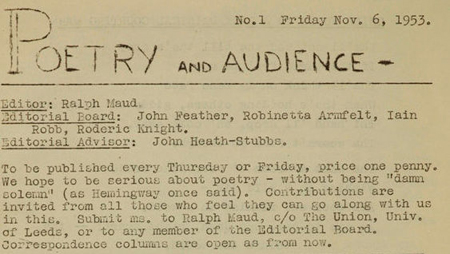
Ralph Maud, an old friend of novelist Keith Maillard and his wife, Mary Maillard, died on December 8, 2014. Ralph is best remembered as a scholar ahead of his time — an authority on Charles Olson, expert on Dylan Thomas, a Welsh Nationalist, a collector of northwest aboriginal mythology, and documentary film maker — but he also, as he was approaching death, considered that topic in a purely personal way, leaving behind an eight-page monograph entitled “Make My Way Plain.” In the found poem that follows, Mary Maillard has attempted to distill the essence of Ralph’s thoughts. Every word is Ralph’s.

Poetry and AudiencePoetry and Audience, edited by Ralph Maud

Hereford Mappa Mundi c.1285Hereford Mappa Mundi c.1285

.

Ralph Maud’s Prayer: Distilled

1.

Is this the way?
The complexities of being human
on the edge of chaos?
Faced with an edge-of-chaos problem,
I found a way out.

Is this the way?
My father’s innate reticence,
my mother’s Celtic duplicity,
that spark of camaraderie and laughter
in the most dire circumstances?

Is this the way?
Minted in the molecules,
repeated throughout our life,
we are always the next step.
Given matter, the rest follows.

Is this the way?
In a materialistic world we get a sense
of making decisions for ourselves.
Hang onto that feeling;
it’s where value lies.

We can be self-satisfied in our originality,
as we are modest before the fact of determinism:
creatures of medical science, laboratory animals,
we are deluded to think
that we can be known.

2.

My subject is a prayer:
“Make my way plain.”
To whom am I addressing this plea?
As an atheist, I have to say
that I have nobody in mind.

I find myself saying, “Thank you, Lord,”
once a day. After a successful bowel movement –
“Thank you, Lord.”
Breathing is, of course, quite as important,
so perhaps later I will bless my breaths.

Who will make my way plain, then?
Why, Jiminy Cricket, of course.
The mechanism for self examination and guidance
seems common to all humans.
I have seen stubbornness avoid such consultation,

rage obliterate conscience.
I have lived a sheltered life.
I have seen the wholly bad as an exception,
the stony face of unreason: “And if you disagree, you die.”
I made my escape as soon as I could.

3.

A mappamundi of values is what we are after,
the satisfaction we need before we die.
It’s why older people, even dying people,
read the paper avidly.
Shall we revise the prayer?

“Make my way complicated?”
The mappamundi seems to be such
when we consult the abacus of the heart,
that tool for pinning down value,
our excitement is immense and rewarding.

Add goodwill and time to complexities –
that’s what we mean by “making plain.”
One works on one’s own map
and contributes to the world map.
No, we haven’t time to settle things properly.

4.

Down in this eternity of the moment,
we have in us the vestiges of hope for heaven.
Our end in perfect blackness, materialistic determinism –
most of us cannot let in that kind of hopelessness.
We just can’t.

“We just can’t.” There is the rock,
in spite of all our pathologies,
the rock on which we build.
We go on with our lives.
We can’t do otherwise.

We would find our place in Zion.
We would make our own destiny.
We could not do otherwise.
I lived the archetype of the immigrant.
The implication is that one can escape.

5.

William Saroyan’s words still sing for me:
“If I have any desire at all, it is to show the brotherhood of man.”
If there is a solution to “make my way plain,”
it will have something to do with
“the brotherhood of man.”

6.

The pilgrimage now reaches its end.
I am entangled in the end game.
Make my end plain.
I’m not quite there or I could not be writing.
What can I say hurriedly, for us, the dying?

The only sensible thing – when the line is crossed,
the nightmare should be short.
Joking and sociable to the end: I do not think so.
I am breathing with anxiety.
Make my end plain.

One wants to get out of life “with dignity,”
not waiting until life is unbearable.
One should be able to choose when enough is enough.
In principle, the way is perfectly plain
but the practicalities are elusive.

7.

As one puts in the bookmark and turns out the light,
there is the feeling that at least tomorrow is assured,
since the world would not, surely, deny one the solution
to come with the next day’s reading. There’s also the fellow feeling
as we get used to the idea of death.

 Ralph-Maud

Lines distilled by Mary Maillard, January 3, 2015, from Ralph Maud, “Make My Way Plain,” privately distributed, Vancouver, February, 2013.


Mary-Maillard-Photo-

Mary Maillard is an independent scholar and documentary editor from Vancouver, British Columbia. Her primary interests are in 19th century southern women and mixed race studies. She is the editor of the Skinner Family Papers and has written a monograph introducing three collections of southern antebellum coming-of-age letters, A Map of Time and Blood: An Introduction to the Skinner Family Papers 1826-1850 (2014). Her article, “‘Faithfully Drawn from Real Life:’ Autobiographical Elements in Frank J. Webb’s The Garies and Their Friends,” appeared in the July 2013 issue of the Pennsylvania Magazine of History and Biography, and, in 2013/2014, she received an Albert M. Greenfield Foundation Fellowship in African American History from the Library Company of Philadelphia for her research on the letters of Louisa Jacobs and Annie Purvis to Eugenie Webb, 1879-1911. Mary has contributed biographical entries to blackpast.org, including Frank J. Webb, Julia Chinn, George Lowther, and Pierre and Juliette Toussaint.

.
.

Jan 012014
 
Herbert Read

Hulton Getty Archives

The Green Child is a triptych of allegories…
The little book is part Arthurian legend, part Candide, part Plato,
strung together with the expertise of Barthelme.

0green

The Green Child
Herbert Read
New Directions, October 2013
208 pages, $15.95

What do you do when the stream of time—which has always, in your memory, flowed forward, or at least in a certain, unwavering direction—one day appears to have taken upon itself to reverse course and headed in the opposite direction? Do you follow the current as it traces its way back to its source?

This is just one of the various mythopoetic—not semantic—possibilities that puzzle the Quixotic hero of Herbert Read’s The Green Child, an entrancing fairy tale of the highest order. The British critic’s only novel, it was originally published in 1935 by Heinemann, then introduced to the American public by New Directions in 1948, with a lovely afterword by Kenneth Rexroth. Now New Directions has reissued it with an introduction by Eliot Weinberger.

Once a renowned Marxist-cum-anarchist literary critic, Read has faded out of the fickle canonizing history books—but those he influenced have not. A Bunny Wilson of his time, Read counted T.S. Eliot, Ezra Pound, Stravinsky, and Picasso as friends. He died in 1968 remembered as a knighted anarchist and mediocre poet, but he was first and foremost a prolific critic who celebrated (and in some cases, helped launch) Eliot, Barbara Hepworth, the British Romantics, the early Surrealists, Carl Jung, and Jean-Paul Sartre in equal measure.

The Green Child is a triptych of allegories. After faking his own assassination, General Olivero—a.k.a. Schoolmaster Oliver, in his native England—returns to his homeland out of existential angst and curious boredom. While walking along a favorite path of his, he notices that the stream no longer runs from, but rather towards, the old church. Heraclitus knew that one can not step into the same river twice and Olivero does dip his hand into the stream,  perplexed as he is into a dualist examination of his own senses, his memory, his existence.

“For something like an hour Olivero remained as if transfixed to the white railing; for the whole structure of his memory was challenged.” A few pages later the small quest continues: “He was now quite certain that his memory had not deceived him, and that the direciton of the current had actually changed. The reason was still to seek. He recrossed the culvert and took the path which led round to the back of the mill, to the dam and the weir.”

In this first of three parts, he follows the stream until he discovers the green child, a waif-like woman of verdant tint, held captive and forced to drink lamb’s blood by what turns out to be her husband, Kneeshaw—who, as a boy, wound his teacher Mr. Oliver’s model train too tight and broke its spring, leading to the schoolmaster’s early-life crisis and departure[1]. When he sees this tortured woman, Olivero’s revolutionary instincts kick in and he frees her.

The little book is part Arthurian legend, part Candide, part Plato, strung together with the expertise of Barthelme. Though the largest section of the book (Part II) tells the story of how Olivero became, rather passively, the president of a Latin American colony, The Green Child is not strictly speaking a satire, but rather more celebratory—like an ode to form and tradition. That middle section, which switches to Olivero’s point of view, plays with the inspiring ideas and military improvisations of a good revolution. The narrative is complete with its own hybrid Declaration of Independence and Constitution, geared toward the Marxist language of Historical Materialism. We see here Read’s skepticism of bourgeois liberal revolutions, of the ease with which the “display of intellectual arrogance” of one leader can quell the spirit and judgment of a people. In his introduction Weinberger notes Read’s cynicism about American democracy:

One of the most curious characteristics of this people is their complete misunderstanding of democracy. They do not believe in equality, but in “equality of opportunity.” They confess that again and again, with pride, without realizing that “equality of opportunity” is merely the law of the jungle, that they are not egalitarians, but opportunists…

Olivero’s conquest of the fictitious Roncador colony comes down to a matter of necessity. Self-assured, European, he is mistaken for a revolutionary when he steps off the boat from Cadiz: “Though oppression had engendered the spirit of rebellion, yet the agents necessary to organise and lead such a popular movement were completely lacking.” After twenty-five years of rule, Olivero has his little republic running like a well-oiled machine. Bored and devoid of existential meaning, he plans his escape—because, indeed, he must escape, cannot simply walk away from the machine he has helped erect.

But this political adventure is sandwiched between a myth—a reimagined story of the green children of Woolpit, which Read had praised as “ideal fantasy” in his 1931 English Prose Style.  And just who is this green child?

Feeling infinitely tender towards such a helpless victim of man’s malice, Olivero lifted one arm and began to chafe the bruised wrist. It was then that he noticed a peculiarity in her flesh which explained her strange pallor. The skin was not white, but a faint green shade, the color of a duck’s egg. It was, moreover, an unusually transparent tegument, and through its pallor the branches of her veins and arteries spread, not blue and scarlet, but vivid green and golden.

In one margin I noted, “she’s a fucking mood ring.” At another I marked, “E.T.?” She is passive—like Olivero in his rise to dictatorship—and turning yellow, dying in the domestic prison her husband has created. She only lights up when she can spend time by the stream, in the woods. Kneeshaw had found her so compelling in part because of her lack of sexuality: “He could not conceive that anything so feminine (and therefore so strongly attractive to his masculinity) could be without what we in the learned world call sexual characteristics, and the blind motive of all the attention he devoted to the Green Child had no other origin. It was a research into the mystery of the Green Child’s heart. But pursued in a dumb instinctive fashion.”

The story begins and ends with Olivero and his perplexed existence in a vacuum of time. The book is thoroughly existential, every sentence infused with Olivero’s psyche, the story resembling a dreamlike escape from Plato’s cave, in which Olivero accompanies the green child back to her home under the water basin from which his stream originates (and now ends), his eventual Socratic mausoleum. When Olivero rescues her, he first becomes maître to her sauvage, until she leads him to the end of this stream. Once they descend, in Part III, under the water, they do not die but instead enter a new world, the one the green children came from (an ideal). The green child has returned to her people, indicating that Olivero would like to live among them. Then Olivero separates from his alien guide and moves deeper into the grotto-like world, alone, in search of the highest of existential meaning.

The village sign showing the children.  Photo by Rod Bacon

The village sign showing the children. Photo by Rod Bacon

Can a critic, well, create? It’s a fallacious question[2] that The Green Child will fail to answer. Without a doubt the first part is superior to the later ones—scholars suspect he might have penned it in a single sitting. The novel is at least an exquisite illustration of what one can do with a mastery of language. As Rexroth wrote, “certainly the book is one of the most sustained products of conscious rapture in our literature.”[3] The writing is economical yet expansive, imbued with a diction that cannot but purposely invoke other writers’ narratives. Perhaps it takes the mind of a critic to craft such different textures as:

He sat listening to intimate sounds—voices in the soft dialect he had spoken, the click of a raised latch, the rattle of a milk-pail, the chiming of clocks in the houses; and underneath all these occasional sounds, the persistent lapping of the stream in its pebbly bed. A white railing opposite him ran along the edge of the stream, and presently he got up and went across to this railing, and leant against it as he gazed down into the rippling water.

and

Kneeshaw had lived a life of isolation. He was unread and almost inarticulate, facing the problems of life with direct instincts, acting from day to day as these instincts dictated. He was now faced by a man who obviously belonged to another world—a world of easy speech, of ideas and sentiments, of complicated experience. There was no natural impulse to communicate with such a man. But tragedy drives us beyond natural behaviour, on to a level where imagination and phantasy rule.

and

I answered blindly, at first with the desire to be complaisant. But I had not taken these three steps before I perceived that I had entered on a strange path, which led I knew not whither. Never had I been more conscious of my destiny, that obscure force which drives us to impersonal action, to the surrender of the self to the event.

The heavy presence of Read’s influences and interests lends the allegory an openness to very different interpretations—Freudian, Platonic, anarchist—that bear the mark of either quiet genius or a lack of control. I cannot presume to know. What I know is that Read’s writing and the world he creates carry such crystalline purity that the story, in its own fabulous way, works. I’ve certainly never read anything like it. They don’t make them like they used to, I guess. Here’s one for the lovers of nature, myth, and the finally solitary individual’s quiet, fatal search for wisdom.

—Tom Faure

————————————————————-

Tom Take 4

Tom Faure is an MFA in Fiction student at Vermont College of Fine Arts. His work has appeared in Zocalo Public Square, Splash of Red, Chattanooga Times Free Press, The Journal News, and undergraduate magazines at Columbia University. He lives in New York, teaching English and Philosophy at the French-American School of New York.

Contact: tomfaure@old.numerocinqmagazine.com

Footnotes    (↵ returns to text)

  1. My favorite passage of the novel, a brutal and not uncaring articulation of the teacher’s despair: “‘It was a little thing, but it broke a tension in me. My mother was dead; I disliked my father. I had never planned to spend my life as a village schoolmaster, a calling for which I had neither the physical nor the mental aptitude. I thought I might become a poet, but my poetry was gloomy and obscure, and nobody would publish it. I felt impotent and defeated, and longed for external circumstances to force action upon me. I struggled feebly with the ignorance and stupidity of you and your companions, but as I had no faith in knowledge, my only desire was to leave you in possession of innocence and happiness.”
  2. Then why ask it? As Weinberger’s introduction explains, the question of whether Read could or should write fiction is a pertinent one. Ford Madox Ford had recommended he become a novelist so “as to avoid turning your soul into a squirrel in a revolving cage.” Read went literally to the woodshed (in his garden) and turned out the retooled myth in about six weeks. The book was very well received by some, deemed inscrutable or boring by others.
  3. Rexroth writes: “The sheer perfection of the writing is very rare in English since the loosening of standards in nineteenth-century fiction […] Landor wrote this way, and Bagehot, and Mill, and Clerk Maxwell, and various explorers and scientists, but the novelists mostly have forgotten how.” Later, Rexroth throws down the gauntlet: “I am not going to tell you the meaning of Read’s allegory—the secret of his myth. […] All myth, all deep insight, means the same as and no more than the falling of the solar system on its long parabola through space.”
Nov 272013
 

Helberg reviewer pic

Natalie Helberg is joining the Numéro Cinq masthead as a contributor. Wonderful to have her (along with the two other recent new hires, Gerard Beirne and Adam Segal). Natalie’s first contribution to the magazine was the deliciously smart review of Adrián Bravi novel The Combover in the current (November) issue.

It’s worth adding that not only does Natalie join the masthead, she joins the extended NC community of editors and contributors, a cadre, so to speak, of alert, intelligent, creative, bookish, adventurous individuals who, despite living at the far corners of the continent (and beyond) manage to commit to the magazine, form friendships, foster an esprit de corps and, often, be very funny communicating with one another. It’s a little world, highly entertaining and inspiring.

dg

Natalie Helberg is from Edmonton, Alberta. Some of her experimental work has appeared on InfluencySalon.ca and in Canadian Literature. She recently completed an MFA in Creative Writing with the University of Guelph.


Oct 132013
 

Relaunching the NC at the Movies page, which, yes, has been needing a bit of a facelift for a while. Holiday weekend, nothing to do but —

dg

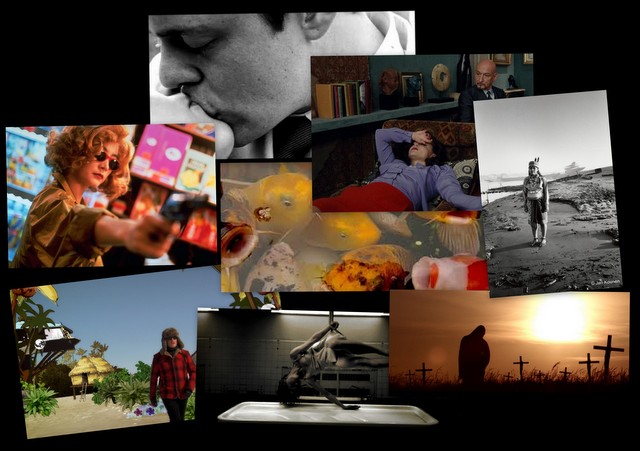
Numéro Cinq’s unique and unparalleled collection of short films and commentary edited and (mostly) written by R. W. Gray. Other contributions from Jon Dewar, Sophie Lavoie, Philip Marchand, Megan MacKay, Jared Carney, Erin Morton and Taryn Sirove.

via Numéro Cinq at the Movies | Edited by R. W. Gray » Numéro Cinq.

Aug 092013
 

Christ Church Cathedral, Fredericton

Lucy and I are heading to Fredericton, New Brunswick, in September for a gig as Writer in Residence at the University of New Brunswick (I am going to be the writer, Lucy will be the dog in residence). I’ll be there until May more or less. There will be no disruption in service to NC readers, except for the usual disruptions. I will dedicate a page on NC to my activities as WIR, readings, special workshops, parties, masked balls, protests, riots, police arrest reports, and such. No doubt many of you will be chartering jets and buses (bring your passports).

New Brunswick is familiar ground to me. I taught philosophy at the University of New Brunswick in 1971-72. I worked as a reporter at the Evening Times-Globe, a daily newspaper in Saint John, 1972-73, my first (of many) newspaper jobs. I was the Writer in Residence for a year at the university in the the late 1980s. The Saint John River Valley is a beautiful and mysterious place to me. I particularly love walking home down University Avenue late in the evening on a fall night. And I have many friends there. My longtime, loyal, and beloved publisher, Goose Lane Editions, is located in Fredericton. I’ll be living in Mark Anthony Jarman‘s vast warren of a house on Waterloo Row (another denizen is NC Senior Editor R. W. Gray). NC’s famous weight-lifting poet Sharon McCartney also lives in Fredericton. As does Gerard Beirne among others including several contributors to the NC at the Movies slot.

dg


Aug 052013
 

A. Anupama

A. Anupama used to be on the NC masthead, but she decided to take time off from her onerous duties here to do necessary things such as care of her family, finish her MFA, and polish her book manuscript. Now she is back. Look for more of her poetry reviews, poems, essays, and translations on a more regular basis. She has already contributed a LOT! Please check out The A. Anupama NC Archive Page for the whole collection.

dg

A. Anupama is a U.S.-born, Indian-American poet and translator whose work has appeared in several literary publications, including The Bitter Oleander, Monkeybicycle, The Alembic, Numéro Cinq and decomP magazinE. She received her MFA in writing from Vermont College of Fine Arts in 2012. She currently lives and writes in the Hudson River valley of New York, where she blogs at seranam.com.

Jul 242013
 

Julie Larios has been a continuous presence on NC almost from the beginning: contributing poems, essays, contest entries — she has repeatedly joined the fray with élan and delight. It seems only fitting that now she should officially join the masthead. In the August issue, Julie will begin a series of contributions under the title Undersung, beginning with an essay on the life & poems of George Starbuck.

dg

Heads

Julie Larios is the author of four books for children: On the Stairs (1995), Have You Ever Done That? (named one of Smithsonian Magazine’s Outstanding Children’s Books 2001), Yellow Elephant (a Book Sense Pick and Boston Globe–Horn Book Honor Book, 2006) and Imaginary Menagerie: A Book of Curious Creatures (shortlisted for the Cybil Award in Poetry, 2008). For five years she was the Poetry Editor for The Cortland Review, and her poetry for adults has been published by The Atlantic Monthly, McSweeney’s, Swink, The Georgia Review, Ploughshares, The Threepenny Review, Field, and others. She is the recipient of an Academy of American Poets Prize, a Pushcart Prize for Poetry, and a Washington State Arts Commission/Artist Trust Fellowship. Her work has been chosen for The Best American Poetry series by Billy Collins (2006) and Heather McHugh (2007) and was performed as part of the Vox series at the New York City Opera (2010). Recently she collaborated with the composer Dag Gabrielson and other New York musicians, filmmakers and dancers on a cross-discipline project titled 1,2,3. It was selected for showing at the American Dance Festival (International Screendance Festival) and had its premiere at Duke University on July 13th, 2013.

Jul 242013
 

DW-Ark_Codex

The July issue of Numéro Cinq is up and complete. Featured this month is Nance Van Winckel’s stunning interview with Derek White, in which White talks about his “authorless book,” Ark Codex.  The interview covers the biblical Noah, collage art, Derrida, and much more. A must read!  Also featured are Jeanette Lyne’s lovely poems about the 19th century poet John Clare, a writer who imagined himself as Shakespeare and ended up dying in a lunatic asylum. And we’re proud to bring an excerpt from Anna Kim’s recently translated (from German) novel, Anatomy of a Night, a story about a small village in Greenland that endured eleven suicide attempts in a matter of a few hours one night.

The nights in Amarâq are an impenetrable black mass, what one imagines nothingness is, an image the eye cannot comprehend.

anna_kim from

Also featured this month is a translation (from Bulgarian) of Angel Igov’s mesmerizing novel of the Balkans, A Short Tale of Shame and the opening five chapters from Micheline Aharonian Marcom’s new novel, A Brief History of Yes.

Laura K Warrell

Rolling Stone created a controversy last week by featuring the “Boston bomber” on its cover, in a rock-star pose, but Laura Warrell got there first. Her short story, “Birthday Girl,” pits teenage obsession against the infamous celebrity of the hunted bomber, forcing the reader out of any place remotely comfortable. Staying on the theme of politics, Robert Day’s essay, “Chance Encounters of a Literary Kind: Sarah Palin and Coriolanus,” tackles Shakespeare, the former vice-presidential candidate and the Tea Party in a dialectical essay based upon a conversation (and attendance at a play) with the co-editor of the Folger Shakespeare.

Collages2

Shifting to zombies, senior editor Robert W. Gray writes a startling analysis of the movie Zombie Longings. Blood, guts and shocking sexuality abound. Maybe this is politics too?

Dad MM Bus stop-1

Steven Axelrod’s heartwarming/heartbreaking essay simply titled “Father.” (Part of an ongoing Numéro Cinq essay series, Fatherhood). Axelrod’s father was a big-time Hollywood screenwriter, and his essay recalls A-listers, including Frank Sinatra.

Reviews continue to be an important feature of each issue. This month Jason DeYoung reviews Micheline Aharonian Marcom’s A Brief History of Yes; Eric Foley reviews Ana Kim’s Anatomy of a Night; and the newest contributor to Numéro Cinq, Tom Faure, reviews Angel Igov’s A Short Tale of Shame

Cynthia Sample’s “On the Occasions that Lula Sought an Answer from her Mother’s Bible Concordance” is a witty, strange and wonderful example of genre displacement. Sample arranges Bible verses based on key words and a Bible concordance to compose a contemporary list story of love, marriage, lust and adultery.

Amber Homeniuk

Amber Homeniuk’s brings together lovely series of poems (and photographs) about life on an Ontario tobacco farm. Ben Woodard interviews fiction writer (and guitarist!) Ethan Rutherford about his prize winning collection The Peripatetic Coffin, with wisdom thrown in from no less than Charles Baxter and Jim Shepherd mixed in. Noah Gataveckas trots out a nifty treatise on philosophy and style that links together Nietzsche, Freud, Lacan, and James Joyce. And finally, two fine examples of  nonfiction craft essay, the first on voice from Maine writer Susan Hall the next on the personal essay by Sophfronia Scott.

Sophfronia Scott

A damn-fine lineup, considering the sequestration and heat waves and summer doldrums. It’s a staggering thing to step back and take it all in, even more staggering when you consider that this has become the standard fare, month-in and month-out, here at Numéro Cinq.

—Richard Farrell


Apr 242013
 

I’ve been writing books for decades, teaching writing on and off for less than 20 years. Teaching makes up much less of who I am or how I present myself to myself than writing, being a father, etc. But it does provide me with a measuring stick (what are people thinking and reading these days?) and an occasional locus for thought (how does one explain how a work of literature is built?). One of the things I’ve noticed in my years of teaching is how few people come to the craft with much understanding of the context, the cultural backdrop, the history of ideas that informs works of art now. This is kind of like driving a car while wearing a blindfold. There is a huge difference between writing a sketch of a story or a bit of memoir and creating a work of art out of that sketch, between just getting down the bare facts and writing something beautiful, between anecdote and a short story, novel, essay, memoir. Modernism, as Gabriel Josipovici talks about it in his book What Ever Happened to Modernism? arises out of this distinction, the distinction between bare communication and art, between the naive use of language and the use of language that is aware of its own contradictions, glories and insufficiencies. I have a page on NC, the Necessary Books page, which lists some of the books I have found helpful in informing my own sense of context. And recently I’ve been telling students and the poor, long-suffering writers on the NC masthead, to read Josipovici’s book. No book tells the whole story, spells out the answers; we all have to assemble our own sense of tradition. But the ideal is always to be moving toward a larger and larger awareness of the intellectual furniture of the world. I append here three reviews of Josipovici’s book to whet your appetite. And then, to complicate matters, because matters should always be made more complicated, I add a link to David Winters’s review of Shane Weller’s Modernism and Nihilism.

dg

A long time ago Philip Roth said that there are around 60,000 serious readers in the United States. That is 60,000 who would buy a Philip Roth book, maybe, but realistically there are much fewer serious readers. The kind of readers who sit up late with Ulysses, or who consider Kierkegaard’s Either/Or to be beach reading. What’s more, of these readers I would guess that a significant percentage of them have a go at writing fiction or poetry. Even if they were all lucky enough to be published, a single popular novel would be enough to sap all the media attention away from them (even in the age of the internet, which, by the way, is conspicuously absent as a force in this book. I’m not complaining; it was actually a serene delight to read a new non-fiction book that did not pour on the dreaded “e” prefix remorselessly.) The fault is not with the authors, as such, but with the culture and the criticism surrounding them. It is this that Josipovici wants to change.

And it is a gargantuan task. If contemporary culture has taught us anything it’s that a worldwide web, a few dragging steps towards equality, and a more inclusive attitude in general have almost no impact on public taste. Most people just don’t care enough about the arts to do anything other than lie supine and wait to be entertained, and one wonders if this book can have any traction in a culture that resists elitism so stubbornly. And yet I can’t help but feel that this book is so alive because the world is turned the other way. Even with insurmountable resistance, What Ever Happened to Modernism? is an inspiring, sometimes electrifying, call to arms; a serious book for serious readers.

via The Millions : Getting Serious: Gabriel Josipovici’s What Ever Happened to Modernism?

§

For Josipovici modernism is a response in art (all art, music and painting too for example, not just literature) to the “disenchantment of the world”. That disenchantment is the loss of the Medieval sense of the numinous as being part of everyday life. In short, the Medieval vision of a world filled with purpose and divine meaning gave way to what would ultimately become the Enlightenment with its vision of a secular world governed by reason and natural laws (yes, I did just gloss over about 400 years there).

This is absolutely critical to everything that follows. The death of enchantment does not mean that people were happy in the middle ages but disillusioned thereafter. It is not a personal loss of enchantment. The point is that the European concept of the world changed from it being a place in which the natural and supernatural were different facets of the same reality to a world in which the natural and the supernatural were firmly separated (and in which the supernatural could therefore potentially be discarded entirely).

With the death of enchantment comes the death of meaning. Before the disenchantment of the world it is possible to speak with authority, because the world has meaning from which authority can be derived. After that disenchantment there is no longer such an authority. The only authority that exists is that which we assert.

via The death of enchantment | Pechorin’s Journal.

§

The Modernist project has been around for far longer than you might think: from Euripides, looked at one way; or from Rabelais, looked at another; certainly since Cervantes. “Somewhere in La Mancha, in a place whose name I do not care to remember …” is how Don Quixote begins, and it is as if the rest of the book is itself a huge piss-take of the very idea of narrative, a healthy scorn for plodding literalism. When Duchamp – he of the urinal in the art gallery – was asked in 1922 for his views on photography, he replied thus: “Dear Stieglitz, Even a few words I don’t feel like writing. You know exactly how I feel about photography. I would like to see it make people despise painting until something else will make photography unbearable. There we are.” Josipovici notes the “very Beckettian style” of this (pre-Beckett though it may be); and it reminds us that the Modernist avant garde is by no means without a sense of humour.

via What Ever Happened to Modernism? by Gabriel Josipovici – review | Books | The Guardian.

§

To consider the concept of nihilism, Simon Critchley once remarked 1, is to take up the trail of ‘Ariadne’s thread’, a theoretical route through the labyrinth of history. For Critchley, the story of nihilism is the story of what it means to be modern, and to read the philology of nihilism, of the nihil, is to look through a lens at modernity’s underside. Shane Weller’s survey of the web of relations between Modernism and Nihilism proceeds from the same supposition. His book unpicks the thread where it’s at its most knotted, in the high modernist literatures of the early twentieth century. For Weller, what’s at work in the works of the modernists – from Tzara to Kafka to Cioran – is a discursive puzzle for which ‘nihilism’ would seem to be the key, the master term that could unlock and make sense of the modern. Yet the thrust of his thesis is the fact that it fails to do so; the way that whatever it touches is rendered resistant to interpretation. So, on the one hand, thought and talk about ‘nihilism’ is ubiquitous across modern culture: wherever the modernist moment is, nihilism sits alongside (or inside) it. On the other, modernism proves unable to reduce nihilism to its propaedeutic, its explanatory toolkit. Rather, nihilism is what haunts modernism, as its ghost or double, a tense co-presence forever unsettling its meanings.

via Modernism and Nihilism by Shane Weller « Book Review « ReadySteadyBook – for literature….

Apr 092013
 

Last week, for the first time, NC had over 10,000 views.

Last week Jennica Harper’s Sally Draper Poems, published in March, went viral. They were even quoted in Slate Magazine.

This week so far Jason Lucarelli’s essay on Gordon Lish, published in February, was cited in 3AM Magazine in the UK and Mary Stein’s review of Kjersti Skomsvold’s novel The Faster I Walk, the Smaller I Am, published in March, 2012, was linked in the UK Guardian books section. Skomsvold made the list of finalists for the prestigious IMPAC Award; apparently we were one of the few, if not the only magazine to recognize what a brilliant novel she had written.

It’s time to take a moment and reflect with some pride on the international notice we’ve managed to achieve. We are publishing intelligent, original, cutting edge work at NC, and, though we sometimes seem to be labouring in obscurity, we are beginning to be part of a larger conversation.

dg

Apr 062013
 

Okay, now this is interesting yet mysterious. NC has a page, apparently, at the Utne Reader Altwire site. We’ve been picked by the editors as an “influencer” and they aggregate our Twitter feeds. Being called an “influencer” is strangely daunting but pleasant. We are in the “mainstream radar” and “hand picked to follow” — music to our ears. On the the other hand, we have a “mojo” rating of 14 (out of a thousand) — time to bring the whip to the masthead.

dg

 Click here for the NC “raw feed” as they call it.


Some  explanation gleaned from elsewhere on the site.

About Utne AltWire

AltWire is an aggregator of new ideas and perspectives that allows users to track what other people are reading. The software follows hundreds of groups and individuals picked by Utne editors, and records the links they tweet from a variety of sources. So, when the National Resources Defense Council tweets a story about Obama’s environmental policy from OnEarth Magazine, it pops up here. Fully searchable and updated constantly, AltWire is a powerful tool to see what’s happening below the mainstream radar right now.

What are those Influencers toward the top of the page?

These are people and groups that Utne editors have hand picked to follow on Twitter. Many of them, like Tom Philpott and Jay Rosen, are flesh-and-blood reporters and academics. Others, like Grist Magazine and NASA, are publications and agencies that sometimes tweet stories before they have a chance to reach headlines (we assume there’s a flesh-and-blood person behind NASA’s Twitter feed, but you never know). When one of our Influencers tweets about a new study or news article, you can see it here.

Apr 052013
 

Jennica Harper and her Sally Draper Poems, published on Numéro Cinq in March, have gone viral — over 2700 views in the last  three days. Now she’s being quoted in Slate Magazine.

dg

I leave you with this stanza from a poem by Jennica Harper, part of a cycle of poems written in the voice of Sally Draper:

But today I’ll wear red.
The red of a cherry
on a sword in a virgin
cocktail I’ll have to sip
through a straw.

via Mad Men Season 6 preview: Let the saturation coverage begin. – Slate Magazine.

Mar 082013
 

dog

RWGray Victoria

I’ve left this too long. Mea culpa. My bad. Little noticed in the high-speed fizz of daily life at NC, Senior Editor R. W. Gray has been doing some exceptional curatorial and development work. It’s time to pay attention, say what is what, give credit where it is due. Rob came onto the masthead to curate the NC at the Movies section of the magazine, way back in the misty time before time (I have now forgotten when, almost two years ago, I think). But I also told him he could think of his position on the masthead as a kind of fiefdom; he could be a Lord of the Marches and develop his area of the magazine as he saw fit.

He managed the movie part just fine, but he also started cultivating a doughty band of younger writers and movie critics. So we ended up with fine movie pieces introduced by Jon Dewar, Megan Mackay, Sophie Lavoie and Jared Carney. There was “sheepdogging” involved (our word for herding writers through the gates to publication): consultation, editing, rewrites. It’s easier and faster to curate the piece yourself, let me tell you. But that’s not the point. As Rob realized quite quickly, NC is meant to be inclusive and an access point for new writers, people with energy and ambition. We don’t take submissions; this is the way we engage.

A few months ago Rob launched himself into an even more arduous and ambitious project. He wanted to showcase poets he had noticed, often poets with a heterodox approach to putting words on the page. But he also wanted to make this project inclusive in other ways. He decided to match the poets up with outside critics, younger academics in most cases. More work for the poor man. Sheepdogging poets AND critics. We had middle of night despairing email interchanges. Luckily, most of you will never know the agonies of getting poetry layouts right on WordPress. Rob learned the hard way. I fear it burned him out. He is a mere shell of the man he once was. But look at what the magazine got in return. Nicole Markotić’s at risk or at least? Poems  — With an Afterword on her Poetics by Tammy Armstrong; Shane Rhodes’s Stray Dog Poetics — With an Afterword by Rob Ross; and in this month’s issue, Jennica Harper’s amazing The Sally Draper Poems: A Poem Cycle | Introduced by Tammy Armstrong. These are gorgeous, wonderful productions and, in a couple of cases, incredibly difficult to put into print. R. W. Gray’s name is not on any of them, though he was everywhere in the background, sheepdogging (or curating).

This is very informal, my way of letting you all know the work Rob has been doing behind the scenes. Not everyone “gets” the magazine the way he does; and, of those, very few are so happy to put others forward and stay out of the limelight.

Good Old Shep.

Time to break out the company Talisker.

dg

Jan 212013
 

Douglas Glover & Sydney Lea

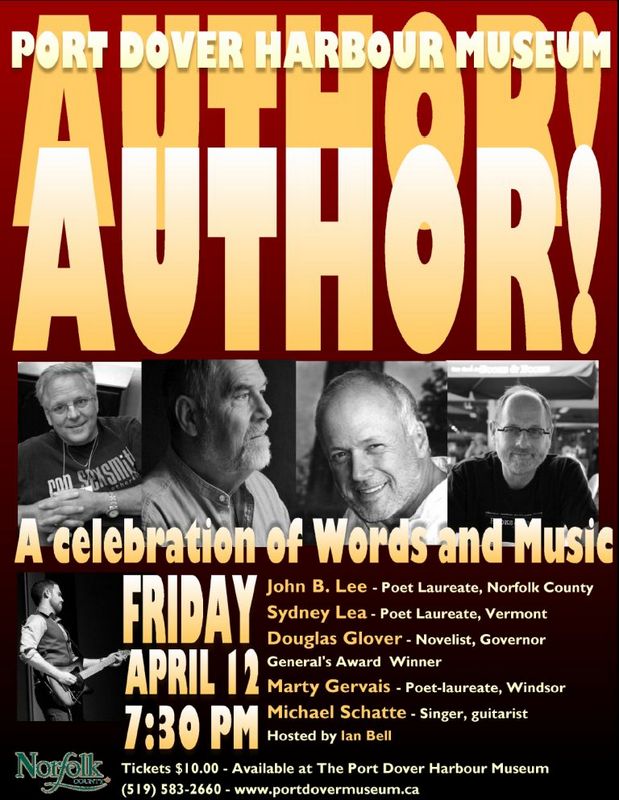
Numéro Cinq‘s own Douglas Glover and Sydney Lea (also Poet Laureate of Vermont)  are on the marquee for a reading EXTRAVAGANZA in Port Dover, Ontario, April 12. (Imagine Port Dover as the Riviera of southern Ontario, sort of.) The reading has been organized by our mutual friend, the poet John B. Lee (who has contributed poems and translations to NC). You should all fly up for the event. Talisker will be flowing in the gutters. It will be epic!


Jan 162013
 

Sydney Lea Book Cover

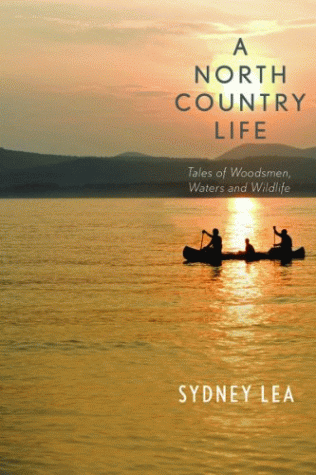
Skyhorse Publishing in New York has just released a third book of North Country reminiscences, outdoor essays and stories by Numéro Cinq Contributing Editor Sydney Lea. As we here know, Sydney writes some of the most perceptive, intimate, deeply felt, and sometimes hilarious essays about the northeast woods you will ever read.

These days Sydney is nothing if not prolific. The University of Michigan Press recently issued A Hundred Himalayas, a sampling from his critical work over four decades, and his eleventh poetry collection, I Was Thinking of Beauty, will be out later this year from Four Way Books.


Jan 092013
 

It’s a great pleasure to announce that Sydney Lea is joining the magazine as a Contributing Editor. Syd was shortlisted for the Pulitzer Prize in poetry in 2000. He founded New England Review in 1977 and was the editor until 1989. He has published 10 books of poems, a novel, essay collections and short stories. He is currently Poet Laureate of Vermont.

dg

Sydney Lea is Poet Laureate of Vermont. He founded New England Review in 1977 and edited it till 1989. His poetry collection Pursuit of a Wound (University of Illinois Press, 2000) was one of three finalists for the Pulitzer Prize for poetry. Another collection, To the Bone: New and Selected Poems, was co-winner of the 1998 Poets’ Prize. In 1989, Lea also published the novel A Place in Mind with Scribner, and the book is still available in paper from Story Line Press. His 1994 collection of naturalist essays, Hunting the Whole Way Home, was re-issued in paper by the Lyons Press in 2003. Lea has received fellowships from the Rockefeller, Fulbright and Guggenheim Foundations, and has taught at Dartmouth, Yale, Wesleyan, Vermont College of Fine Arts and Middlebury College, as well as at Franklin College in Switzerland and the National Hungarian University in Budapest. His stories, poems, essays and criticism have appeared in The New Yorker, The Atlantic, The New Republic, The New York Times, Sports Illustrated and many other periodicals, as well as in more than forty anthologies. His selection of literary essays, A Hundred Himalayas, was published by the University of Michigan Press in September, and Skyhorse Publications just released A North Country Life: Tales of Woodsmen, Waters and Wildlife. His eleventh poetry collection, I Was Thinking of Beauty, is due out in April from Four Way Books.

Jun 022012
 

Sydney Lea and John B. Lee, two poets brought together via/by/through their appearances on the pages of Numéro Cinq are going to fight it out (I guess) together in Ottawa June 19 at the American Embassy as THE DUELING POETS. Sydney Lea is the Poet Laureate of Vermont (not Vermonth as it is spelled on the U.S. Embassy website — http://canada.usembassy.gov/news-events/2012-news-and-events/june-2012/1-june-2012-embassy-to-present-dueling-poets.html — when I checked–maybe someone there was thinking vermouth?); John B. Lee is the Poet Laureate of Norfolk County (where I grew up), Ontario. Sydney is also a former faculty member & board member at Vermont College of Fine Arts.

dg

May 272012


You try to tell people what it’s like living here, but you’re not sure you know. You’ve lived here nearly your whole life, and you’re numb to this place. You have to push yourself to see it. — Jennifer McGuiggan



 Town & Country: Part 1

You tell people that this small town, situated thirty-five miles southeast of Pittsburgh, is the last bastion of suburbia before the routes go rural. You live in a thirty-year-old subdivision of single family homes and townhouses. One way in, same way out. No one drives by your house unless he’s headed to or from one of your neighbors’ houses. The well-tended lawns reach right up to the curb, no sidewalks needed in this quiet maze of streets. Yet even in all of this deliberate, manicured space you notice bits of the wild popping up close to the ground: purple crocus and green onion peeking out from the undergrowth in spring; yellow dandelions gone downy white polka-dotting the yards by mid-summer; crackly piles of jeweled leaves lining the curbs in autumn; and bleached twigs littering the mulched beds in winter.

Two minutes from your front door stand a dozen cows, and sometimes one lone goat, in the field next to St. Emma Monastery, where a handful of Benedictine nuns live out their days. People use the parking lot between the monastery and the cow field as a sort of informal, unmanned swap meet. They leave all kinds of junk there, sometimes with a sign that says “Free,” but more often with the simple assumption of freedom. Recently there was a small cardboard box of old Christmas cookie tins and a large, upholstered chair with carved wooden legs and arms, castoff seating for one. Every day for nearly two weeks you spotted the chair’s orange, mustard, and cream flowers as you drove past. Now you look for new treasures to pop up—and for the cop who sometimes sits in the parking lot waiting for anyone to break the 45-mph speed limit.
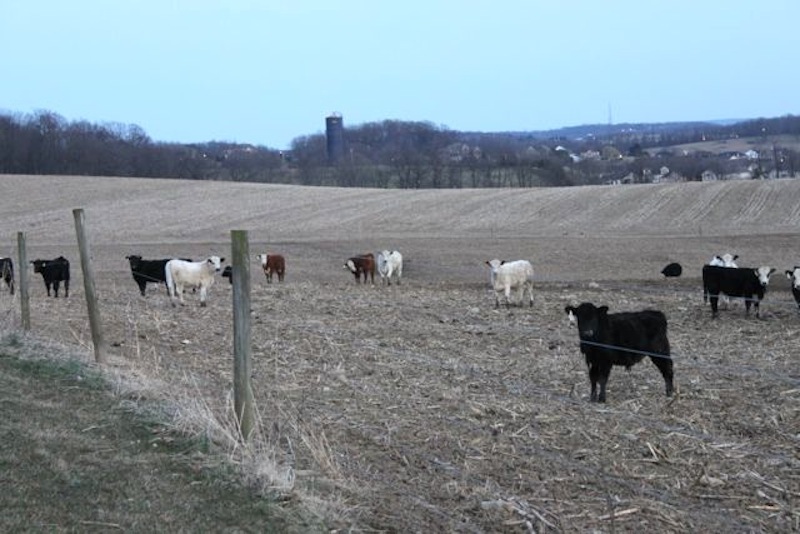


If you drive five minutes more down the road, you’ll be bobbing along in farm country: rolling hills, corn fields, metal silos, the occasional sheep. On Sundays you drive along the sweetly winding backroads to Bardine’s Country Smokehouse, where you can buy fresh chicken breasts, all manner of beef and pork, and more varieties of sausage than you knew there were names for. The folks at Bardine’s wear shirts that read “Nice to meat you” across the back, and they’re always happy to answer your questions and cut your meat to order. Blue ribbons, award plaques, and glossy photos of prize-winning pigs line the walls. There are cows and a barn out back of the store. When you ask if the chickens are their own too, the woman behind the counter says they come from Michigan. You wonder why there aren’t more locally available birds.



Along the way to Bardine’s you pass more fields of cows and try not to think about their sisters, whom you’re about to see splayed out, red and naked, in the display cases. It’s hard to be a vegetarian in this part of southwestern Pennsylvania, but you give it a try every few months. Going out to eat is your undoing, since most non-meat options here are limited to pasta with soggy vegetables. You have to drive thirty minutes for the nearest Indian restaurant, and thirty more past that to find Thai food, both good options for meat-free meals. But your real downfall is bacon, which you sometimes pick up at Bardine’s with a twinge of guilt, placing it on the counter alongside one of those Michigan chicken breasts. Most weeks you can’t bring yourself to buy the beef.

If you time the Sunday trip just right you can catch part of “A Prairie Home Companion” on NPR. Garrison Keillor’s molasses voice makes the country way of life sound so lovely, so vivid, so very nice. You listen because it fits the landscape, and because for those fifteen minutes each way, Garrison and his guests charm you into thinking that you’re cozy at home in these green, green hills, even though you know in your heart you’re not really a country girl.


Town & Country: Part 2

If you come out your front door, drive past the cows and the nuns, and keep going for ten minutes in the opposite direction of Bardine’s, you’ll run into the sad asphalt of highways, big box stores, and strip malls saturated with fast food. But if you want to avoid all that (and you do, unless you need groceries), you can be smack-dab downtown in five minutes. Here in the county seat, “smack-dab downtown” amounts to just a few streets’ worth of small-town city. The big draws, for you, are the library and the post office, which face each other across Pennsylvania Avenue. You occasionally treat yourself to a red velvet with cream cheese icing at the cupcake shop that recently opened around the corner, evidence that all good trends come to those who wait, even in small town America. More often, you stop by the coffee shop just down the street. They make a decent latte, and the vibe is funky, with angry, edgy art that you don’t really like, but that you appreciate just for existing in this little town. You hear that they’re planning to stay open until 9:00 on Friday and Saturday nights. This is good news, since the one or two other cafés that manage to stay in business here close by 6:00 p.m. during the week and 2:00 p.m. on Saturdays. There aren’t many places to go in this town after business hours unless you fancy one of the many bars: sports, dive, biker, or—the newest addition—the county’s first hookah bar, which opened last year in the strip behind the mall, sandwiched somewhere between Buffalo Wild Wings and Hallmark. But let’s face it, you’re not much of a bar girl.



This should be a college town, but it’s not quite that. Within a ten-mile radius sit four colleges and universities, albeit small ones. You’re well past college age, but you wonder where all the students are, where they go and what they do. Where are the late night caffeine-and-study haunts? The street musicians? Where’s the diversity? More to the point, where are all the young people? And by young people you don’t mean the 2.5 kids for every family on your street. There’s a sizable under-18 demographic in this town, rivaled only by the over-65 population. In 2007 U.S. News & World Report named Greensburg one of the best places to retire. From hookah bars to bingo nights, what’s a girl like you to do?

To be fair, there does seem to be a mini-Renaissance subtly taking shape here: cupcakes, evening coffee shop hours, flavored tobacco, even a few locally-owned, independent restaurants to combat the fluorescent chains along the highway. One of them features a menu of local and sometimes organic offerings, including meat from Bardine’s. (You think again about that Michigan chicken. Does five-hundred miles count as local in the world of food?) You’re really trying to be a small-town girl.
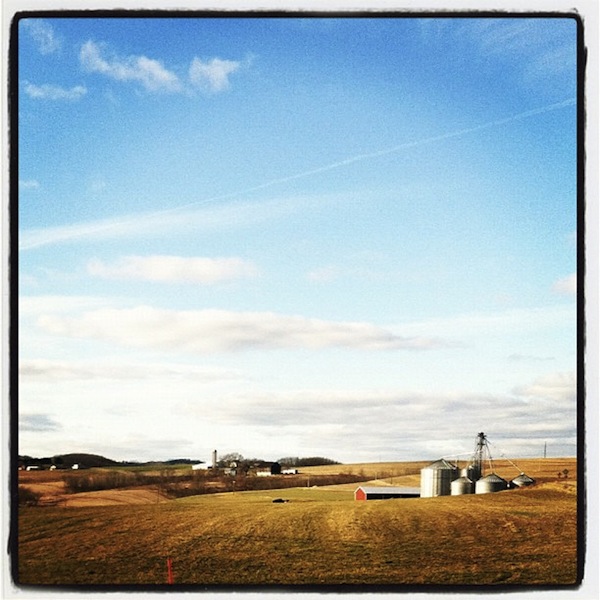

The In-between

As a teenager you had a boyfriend who loved living here, touting its ideal location halfway between the mountains and the city, forty-five minutes either way, he said. He was technically correct, but fifteen years later you’re still not buying it. It’s not the math or the mileage that’s wrong, just everything else. The problem is that neither the mountains nor the city on either side of this small town satisfy you. The Laurel Highlands to the east aren’t much when it comes to mountains, just Appalachia’s afterthought foothills. Pretty enough, sure, but nothing that catches your breath.

To the west, Pittsburgh keeps trying to shrug off its old blue collar, Steel Town image with new biotech firms and glossy marketing initiatives. But beneath the progress and the gloss, it’s the same old gritty city, the same squashed-voweled accents of the local “Yinzer” dialect, the longstanding adoration of Primanti Brothers sandwiches with their french fries and coleslaw piled high atop the meat and cheese, as though the sandwich itself were in a hurry for you to eat it. You’re just far enough outside of the city to be disconnected from the art scene that you hear is buzzing. People who live closer in think you live out in the sticks, and maybe you do (think of all those cows). You once went to an evening event in the city and someone asked if you were driving “all the way” back home that same night. One hour by car is a world away.

The city offers plenty to do. There’s the Pittsburgh Symphony, the Pittsburgh Opera, and the Pittsburgh Public Theater, but looming above all of these are the Pittsburgh Steelers. Football reigns supreme here in the capital city of “Steeler Nation,” a geographically amorphous land populated with just as many women as men. You don’t really care about football, which is considered unnatural and blasphemous in these parts. This somewhat frivolous outcast status serves as the symbol for all the ways you don’t feel at home here. You daydream about cities like Portland, Oregon, cities with good public transportation, public recycling bins, and bicycle culture. Places where you—wearing a dress over your jeans and with small swatch of pink hair—aren’t the most outrageous hipster on the scene. You wonder if this makes you a snob in some way. (You fear that it does.)



Land and Sky

Pittsburgh’s three rivers notwithstanding, this is a landlocked pocket of earth. Lake Erie grazes the top of the state three hours to your north, but that’s not local, even if it is closer than those Michigan chickens. And this is the crux of your discontent: You are an ocean girl. You daydream about it the way you used to daydream about your old love who lived across the continent and then across the Atlantic. All of this land maroons you from your true self.

But all of this land is why you love the sky so much: It’s the closest thing you have to the sea and the only thing that seems to change much around here. On good days you watch the currents of the sky, the tide of blue and white and grey ebbing and flowing. But even the sky stays the same for too many days on end here, with more cloudy days than the Pacific Northwest, which, incidentally, is where you’d like to live—between the evergreen mountains and wild seashore. On winter days, when slate grey skies fit over these pale winter lawns like a too-tight skullcap, you feel claustrophobic inside and out, cabin fever that has nothing to do with walls.

Still, the sky is your saving grace. Late in the afternoon, when tentative patches of blue sometimes peek through the cloud lid, you go out for a walk. Every day around this time a fat hound dog cries with an alarming and mournful insistence. On one of your walks you see the dog and its owner. The hound snuffles in circles for all it’s worth, hot on the trail of something along the cold asphalt, braying every few seconds in a plea or an announcement or some triumph, you can’t be sure which.

These feeble splotches of color in the anemic sky remind you that above the colorless canvas that you can see is a wide space of blue that you cannot. Of course, above that lurks the cold dark of space, but that’s neither here nor there. The point is this: The sky is out there. This is how you feel in general: Things are out there, somewhere. Beyond the grey sky; beyond this solidly middle class, suburban development; beyond this small town creviced between the city and the foothills; beyond the farmland and rolling hills; thirty-five miles from urban culture, three-hundred miles from the nearest shoreline, and two-thousand-six-hundred-seventy-four from that beach you love the most on the Oregon coast.

When you force yourself to look at this place where you’ve lived for 35 of your 36 years, you can’t help but wonder what “home” really means. Is it where you hang your hat? Where you lay your head? Or is it, to mix the metaphors, where you hang your head? Even as you think about moving across the country, you push yourself to see this place you call home. You notice the pleasing contrast of brown branches against the whiteout sky, the melancholy music of the hound dog, the sinewy energy of angry art on coffee shop walls. As winter ends, warmer weather creeps back in, the sky blooms into a soft blue, and each spring you notice more purple crocus pushing their way up through the dry sticks of last year’s growth.
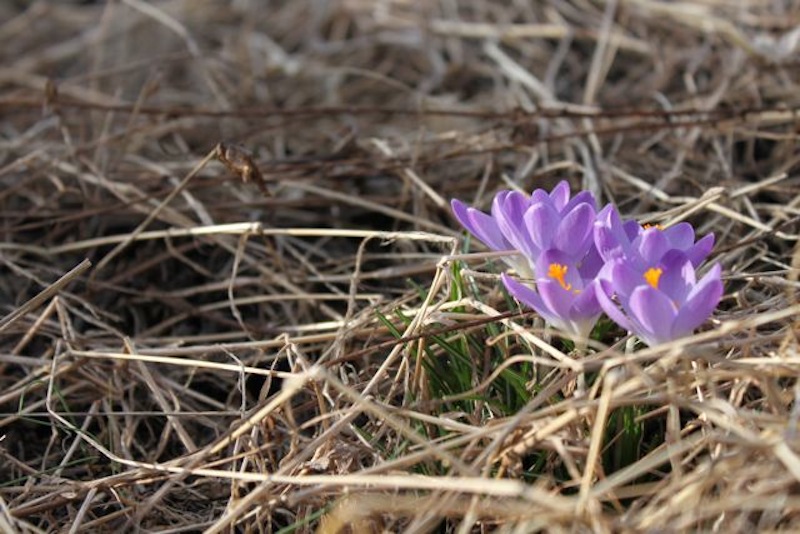


   — Jennifer McGuiggan

—————-

Jennifer (Jenna) McGuiggan lives in the rolling hills of Pennsylvania and longs for the sea. To soothe her wanderlust she is working on a collection of essays set at seashores around the world. She holds an MFA in Writing from Vermont College of Fine Arts. In 2009 she curated and published Lanterns: A Gathering of Stories, a collaborative collection of prose, poetry, and photography celebrating women in creative community. Visit her in The Word Cellar, where she writes about everything from navigating the writing life to venturing into the world of roller derby.

This is the 38th “What It’s Like Living Here” on NC. See the complete collection here.

   ——————————————–……