Mar 012016
 

Ivan Seng

.

Ivan Seng is an astonishingly gifted classical pianist and composer based in Asheville, North Carolina. His concert recitals reflect his wide-ranging interests: Bach, Shostakovich, Chopin, Haydn, Mendelsohn, Prokofiev; as well as contemporaries such as composer Kenneth Frazelle, with whom Seng has partnered in concert many times.

He’s a North Carolina native, traveling from his home in Boone to study with Clifton Matthews at UNC School of the Arts in Winston-Salem as a boy, then attending the school’s prestigious residential high school program. He left NC to attend Oberlin Conservatory of Music, where he worked with Joseph Schwartz and Sanford Margolis, and returned to Winston-Salem for graduate study, where he studied composition with Michael Rothkopf in addition to his continued study with Matthews. Seng has won numerous regional awards in both solo and chamber performance, including the College Chamber Music Competition, and was selected to perform in the Asheville Rising Stars concert series. He frequently collaborates with the ensemble Pan Harmonia and other chamber ensembles. When he talks, he bears an air of slight preoccupation, paired with a laser-sharp attention. He’s got a youthful appearance, but speaks as a old-fashioned professor: not in powerpoint bullets but in penciled phrases that are frequently, beautifully, revised mid-clause.

Seng’s compositional interests are deeply immersed in mathematics, in which he finds description of the natural patterns of the universe. Like one of his major influences, the post-World War II composer Iannis Xenakis, who was among the first to use computer programs to compose music, Seng draws his compositional forms not from classical constraints, but through mathematical formulas. As Seng says, “I think it is important to have an emotional relation to these concepts, because it is the universe that we live in. We do live in a universe that’s not ordered. It’s not planetary spheres that orbit each other, in these very harmonious patterns. The heavens are not ordered.”

Xenakis was composing during a time ruptured by two world wars and the rise of totalitarianism in his own country, as well as the hugely influential compositional development that was serialism. Today’s rupture is both social and environmental, and Seng is one of the composers addressing climate collapse in his compositions.

Seng doesn’t talk about himself easily or often, but he graciously agreed to spend several afternoons discussing his compositional process with me following a concert performance of his work, part of a series of house concerts together with other electronic music composers in Asheville. The room had been dimly lit when Ivan took the stage. He explained that he would be premiering five works done using the SuperCollider programming language, gestured to the laptop whose screen was turned to the wall.  He inclined his head, as if taking the pulse of the room, and pressed a button on the computer.

Play.

Sounds fell from the screen, single tones, stretched, extended. Clusters, then, a barrage, then – silence. Despite no apparent sense of structure – there was no sign of a theme, no underlying motif to hold these sounds together – there was, nevertheless, a sense of unity to his music. Someone commented, after it was finished, “It was if it were raining, on a tin roof, and the roof receives the rain in a different way, every drop.”

Changes in the musical texture occur in sudden bursts and at a fairly rapid pace. Each burst affects only one musical feature at a time, such as speed, density, tone color, shape, or movement of sound. These happen in fairly rapid succession, and at unpredictable intervals of time.


Carolyn Ogburn:
 It seems to me that being a composer must be in some way like being an architect – well, I was thinking Xenakis, and of course that was his background. He didn’t even study traditional counterpoint and harmony, right? Because he was about 30 when he came to Paris, started working with Le Courbousier as an engineer and draftsman.  Then he tried to find a composition teacher – He tried to study with Nadia Boulanger, and she was like, Nah, I got no time for you – here you are, a 30-year-old beginner, and I’m Nadia Boulanger… so then he finally found Messiaen.

Ivan Seng: I think it was incredibly insightful of Messiaen [not to make Xenakis learn counterpoint.] Xenakis had a lot of mathematical training and a lot of drafting skills. His graphic abilities were incredible. So I think that Messiaen realized that he [Xenakis] could use all the skills he already knew – they were unique, not many musicians had these skills, why force everyone into the traditional mode?

CO: Would you call that modernism?

IS: Yeah! Well, maybe. A late stage of it. We had Schoenberg and Webern and Stravinsky; that was the high point of modernism. Then you’ve got the post-World War II serialism, and (those composers) all studied counterpoint. Boulez was brilliant at counterpoint, traditional tonal counterpoint. You can definitely see influences of contrapuntal thinking in his music. How these out-of-control multiple voices can be moving at the same time. It’s very similar to how they would do it in the Renaissance. I mean the intervals – were maybe not the same [laughing]… He doesn’t choose the consonant intervals as often as he does the dissonant intervals.

Xenakis doesn’t approach it that way. He  actually was very critical of the serialist composers and the kind of complete – the total serialist, and serialism in general. He bases his music on very different principles. Sometimes it sounds similar, but what he realized, basically, is that when you take music to that level of complexity we just can’t hear those tone rows anyway. Basically, his criticism was if you have, if it’s that dissonant, that complex, our ability to follow voices – we hear scattered voices, chaotic and kind of random – we don’t connect it.

CO: Because it’s too complex for us to process?

IS: I think they took complexity to such an extreme… I mean, in Bach, everything is controlled in such a way that you can hear the top voice responding to a bass voice; there’s many things you can pick up with your ear, and with your mind. With Boulez, maybe the low voice will be doing this [waving hand above his head] and the top voice will be doing this [waving the other hand about his waist], and so how can you actually process the differences?

So what ends up happening is that you don’t hear two voices; you hear the combined texture, or mass, of notes. I think Xenakis liked the sound of that but he realized that there’s really no point in having all [those] complex structures behind the scenes that you can’t – they’re not audible at all – so why bother creating those structures? Why not just deal immediately with surfaces. So he uses mathematics to do that. So now rather than using 12-tone rows in patterns, becoming so complex you can’t hear them anymore, he just uses mathematical formulas,  and creates the same kinds of structures. But there’s nothing to listen FOR in them.

See, you always feel like, in Schoenberg, you’re supposed to be hearing something, but you just can’t quite… get it. Unless you study the score, you can’t really hear it. I don’t know that I’ve ever sat down and listened to Schoenberg, and been like, “Oh I heard The Row!” Except if it’s completely isolated…

CO: Otherwise you’ve got to find it through visual interpretation of the score?

IS: Yes. I mean, sometimes Schoenberg will make a row into an obvious theme and maybe, after one or two listenings, you can recognize the theme. It’s not easy, and maybe you can hear one or two variations… but most of the time you don’t really. You hear shapes and patterns emerging, but you don’t hear that background structure of the row.

But with Xenakis, it’s not even there.  You don’t even bother trying to hear those patterns. You listen to the overall texture, and globally where it’s going.  Like, is this texture gradually becoming more dense? Like maybe it starts sparsely, and then you can hear this building of density, it gradually starts to collect notes and becomes more dense. You can hear [everything you need to].

Random Walk X Winter Solstice: The changes have become smoother. Instead of sudden bursts, each musical parameter undergoes nearly continuous transition from one state to another.

CO: What you’re describing feels very visual, very textural, like a sweater pattern or something. Like, not all that auditory? Or, am I missing something?

IS: It’s actually completely auditory. It’s based on all kinds of mathematical principles and formulas. But I think what [Xenakis] really wanted to do was emulate the laws of nature. Like say you go out on a hike and you see a geological formation that’s been sculpted by many forces over time, and it creates this overall impression of complexity –

CO: And unity?

IS: Perhaps… but I don’t know if these kinds of formulas create unity. That has to come from a sort of intuitive sense of the entire shape of the piece. It’s not formulaic. He uses formulas to create local texture – he wants to keep human patterns out of the immediate surface.  Humans tend to create a certain kind of order. You can look at this room, and see there’s certain kinds of shapes that humans prefer. He wants to keep that out. He wants it to be like – in the natural world there’s a certain complexity – we don’t naturally produce that.

CO: I want to ask you more about the pieces at the concert the other night. The Random Walk pieces. Like, I really want to know about that name, for instance. But also, you said they were composed using a SuperCollider software program?

IS: Yes, but it’s not a software program. It’s actually a programming language, designed for sound synthesis. I don’t know if it has anything to do with the other [the large particle accelerator] or not.

CO: So, basically, the composer sets parameters for what sounds the computer will produce, and then presses ‘play’. And, if he ever wants to hear that same piece a second time, he simultaneously presses ‘record’; for if he does not, neither he nor anyone else will ever hear that piece again. It’s completely ephemeral, not unlike a live performance of any other improvised piece of music.

IS:  Pressing the ‘record’ button also will slightly alter the parameters as well in ways that are unpredictable.

CO: And then there’s the title of these pieces – Random Walk. I was really surprised by that. It’s unpredictable, but can you really say it’s random? Because, it seems to me that these compositions are anything but random. You – as the composer – put in the parameters, you decide each element, and if you don’t like the result, you can immediately delete it. It’s almost like you have total control at the very beginning and at the end, while in the middle, the computer runs through the patterns in ways that only math can interpret.

IS:  Well, random walk is a mathematical term. It comes from Brownian motion. Do you remember the story of the guy [botanist Robert Brown] who was looking though his microscope at tiny particles in water. He saw these particles and he saw them bouncing around – he saw that these particles were following this completely random motion, Brownian motion – and I think it’s how they realized that there were atoms, because it ended up being that these atoms were bouncing off of these small little particles and it was pushing the particles around… So if we took a very basic motion… say you have a 3-sided die, marked 0-1-2, and each number correlates to a particular movement.  And [your particle, or sound, in its own placement is affected by the dictates of the die] and you start at a certain number, 0, and you can go up a step or down a step. But it’s unpredictable.

CO: But you cannot predict which direction the die will dictate. And that’s only one example, right? One aspect of the piece, like pitch or duration?

IS:  Right.

CO: So, the title is supposed to evoke…?

IS:  It’s a random walk through a parameter space. By parameter space, I mean it’s multidimensional – each parameter you add, adds a dimension. So pitch, duration are 2 dimensions. And you could move through that space in this random walk – but it’s really like 28–29 dimensional space at this point. So imagine this random walk not just going through 2-dimensional space, but 28–29 dimensions. That’s where the title comes from. I mean, really what these pieces are, they’re sketches. Then my intention is to go on to develop pieces where I have chosen [more definitively]…

CO: But these sketches, they’re wonderful. What do you like better?

IS:  That’s  a complicated question. I sometimes think that the complete – the computer doesn’t have any kind of preconceptions, about what should happen next. So sometimes things will happen that I would never have thought of, or I would not have thought would be interesting. and I really like it. It sounds fresh, and new.

I think that’s why I do it. It lets me know what can happen in this sound world that I’ve created without any of my own preconceptions – although they always seep in. For instance, before I press that play button, if I choose a scale – well, that’s already decided something. The scale has already altered the sound of the piece. And so that’s one thing. I can give it certain… I can choose specific [how would you put it?] states. Let’s take volume, for instance. I can say choose between this volume and this volume, and so now it has two choices.  Then I can say, well, there’s a 75 percent probability that it will choose this volume and a 25 percent it will choose this one and so now I’ve made another decision.

But another example is, for instance, let’s take density – I could say, let’s start the whole piece very low density and gradually, toward the end, climax at maximum density, but it creates a shape that you can see already.

In some sense I’m letting the computer pick them but of course I’m telling the computer what to do – basically, I give it boundaries to work in and then I kind of let it go. I also tell it the rate of change – so it might change, on average, once every 40 seconds. So one parameter is volume. So I give it a center volume, for a certain amount of time, and then it changes. It could change in exactly one second [but that’s not likely] or it could change in – well, there’s a very small probability that it would sustain for one year, but the probability is so small that it never happens.

CO: I was struck by the way you just pressed “play” on your computer the other night, and sat down. If you listen to the pieces online, you know that there are five pieces, because they’re visually separated on the website. But you didn’t want to separate them?

IS:  Well, I did put in pauses. It might not have been obvious enough. I think it was kind of obvious when a piece ended, but maybe not. I guess it’s a little like chapters in a book.

I could have talked in between but I would have had to get up in time to stop it and I didn’t want to do that… I didn’t want anyone looking at the computer. I turned that away.

CO: Because when you see the “playlist” you can definitely tell when it’s changing from one piece to the next, and absent that, you – or, I, at any rate, found myself inserting my own structure. Like, oh, there’s this sustained note, or this consonance. That must be a punctuation of some sort. But, you know, maybe not?

IS:  Yes, but really, I was thinking more about the – the visual. For instance, in terms of visual, you know [the pianist] Sviatoslav Richter? Later in life, he became more eccentric – and he performed in the dark, with a lamp, and there was no other light in the auditorium. There was more focus on the listening. We’re so visually oriented that we tend to watch performers rather than listen to music.  So, I think one of the things I didn’t want was for the computer screen to be a distraction. Maybe to become more aware of sounds and less dependent on visual cues. I’ve been less and less interested in the visual aspects of musical performance, in general.

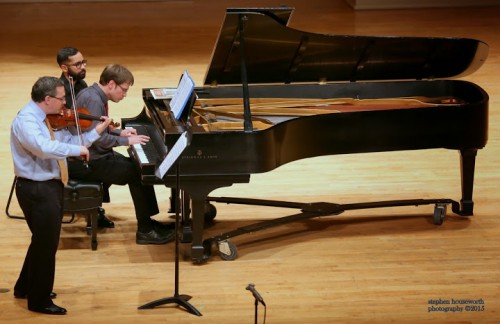
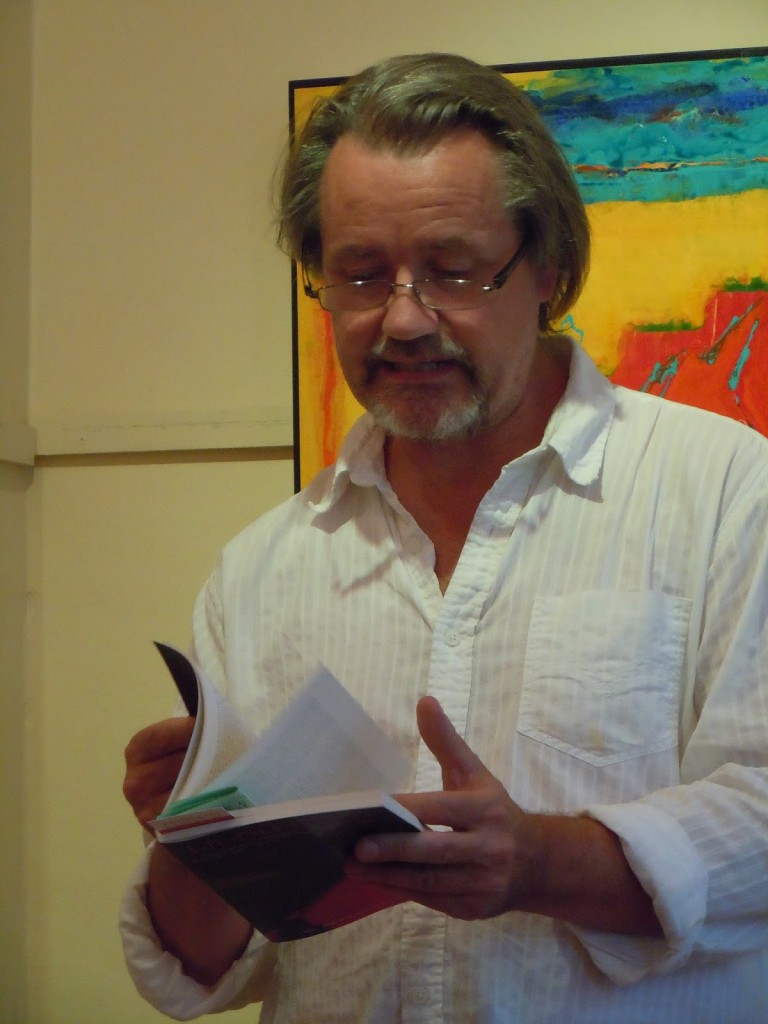
Ivan Seng in concert

I think we can if we hone in on auditory information, I want people to start having the kinds of sensitivity that a blind person might have to sound. I want that kind of attention to the sound rather than gesticulations. When a person is up there – you’re always trying to find some kind of correspondence between the visual and the auditory information. It’s interesting to see what happens when you let go of that a little bit.

CO: Density is a word that comes up a lot in our conversations here, and it’s not – well, that’s not a word often used in talking about music, in general. But it’s, you know, it’s exactly the right word for this, I think.

From dense masses of notes emerge structures that soon unravel again into chaos.

IS:  And with electronic music, it can get pretty dense! Hundreds of sounds per second.

CO: There’s no way to actually hear each sound, not in any way that you can actually interpret. So, there’s density, and there’s sound. I couldn’t help but feel like I was hearing articulation of instruments at times. There were some sounds that were less articulated, almost flute-like, and then others that sounded almost plucked. Did you do that on purpose?

IS:  When it sounds like an instrument, that’s a byproduct of the process I’m using. It’s not intentional. What was intentional was I wanted to take whatever sounds I had and through manipulating the envelope create lots of variety, and also distinct groups of sound – I mean, with huge masses of sound – I wanted some to – like if you see a flock of birds in the air, and they’re all the same kind of bird, there’s a kind of similarity. I wanted to create similarities that would create flocks of notes.

And also transitions, mutations, where you hear these dense masses of notes that gradually they change sound into something else.

CO: The envelope? Did you just say, manipulating the envelope? That’s a great phrase.

IS:  [laughs] Yes, well, it refers to setting certain parameters of sound, attack, sustain, decay… I wanted to manipulate the envelope – or, rather, the program was manipulating the envelope – to create as much variety as I could.

CO: So like when you program your algorithm, it’s possible that a note could sustain for over a year, but it’s just not likely.

IS:  Right.

CO: Because of the laws of probability?

IS:  Let me give you an example. The other night, there was a geologist talking about history of the earth, about huge climatic extinctions and meteors hitting the earth – that’s a perfect example, meteors. There’s hundreds or thousands of tiny objects that hit the earth every year. It’s something very frequent. Something not so significant happens a lot at a high frequency. And then larger, maybe 100-foot, objects hit much less frequently, only every decade or so. And then there’s objects the size of Mount Everest. And those hit like every 65 million years or so. But you never know – it’s possible that two could happen very close together. It’s just not likely.

Giant meteorites could hit us and we have these formulas that could tell us when these giant meteors could hit us but they can’t tell us with any certainty. They can tell us one every 60 million years but we don’t really know…. We live in a very dangerous universe. We can make all these predictions, but we can’t have certainty.  So that I think that informs the music. Especially with the issues we have in climate change.

We’re living in a giant exponential curve at the moment. Carbon parts per million in the atmosphere are growing exponentially. We feel it. Population is exploding exponentially. We do have an emotional connection with these things.  We are living in these forms as we speak. We can pretend that we’re living in a static form all we want, but we’re not.

—Ivan Seng & Carolyn Ogburn

.
Carolyn Ogburn

Carolyn Ogburn lives in the mountains of Western North Carolina where she takes on a variety of worldly topics from the quiet comfort of her porch. Her writing can be found in the Asheville Poetry Review, the Potomac Review, the Indiana Review, and more. She writes on literature, autism, music, and disability rights. She is completing an MFA at Vermont College of Fine Arts, and is at work on her first novel.

Ivan Seng photographs by stephen houseworth photography

.
.

Mar 012016
 

Capture1

We’re featuring the contributions of Jeff Bursey who has only been here just over a year but has already had a massive influence on the NC culture. We’ve published his reviews, of course. That’s his bread and butter job here. But also his fiction and a gorgeous, compendious interview with the novelist Sam Savage. But bey0nd his own words, he has contributed by bringing new writers into the fold, wonderful writers like S. D. Chrostowska and the experimental novelist Larry Fondation. A spectacular instance of this background curating work is the fact that in this issue we have a huge Sam Savage annex, as it were, including an appreciation of the life and work by Jeff himself plus a new Sam Savage short story and an entire book of poems.

Jeff Bursey is a Canadian writer. He lives in Prince Edward Island. He’s indefatigable, lovely to work with, and we’re very, very glad he is part of the crew.

Feb 222016
 

gayraud3-001Joël Gayraud

March is coming, the new issue, the Exotic/Quixotic issue, the overflowing cup issue!

Striking a blow for freedom of expression and the protean nature of art, we like to publish things that don’t fit in conventional slots, especially those academic creative writing niche slots like the personal essay (you know, where you write about something interesting but bring in your relationship with your boyfriend as well). We love the aphorism, the short nonfiction form. We publish aphorisms and extended aphorisms and essays that are formally long aphorisms. We also publish memoir and place pieces and book reviews that bring in craft and structure. In the latter, I am firmly convinced, you express yourself in the choices you make (without having to mention, um, yourself or your boyfriend).

One of the highlights of this issue is the excerpt from Joël Gayraud’s The Shadow’s Skin, translated from the French by S. D. Chrostowska (whose own incendiary book of extended aphorisms MATCHES: A Light Book we excerpted in our December issue). Books like these owe much to the example of Nietzsche who wrote in fragments or mini-essays or thought experiments or, perhaps, Adorno’s Minima Moralia, one of my all time favourites.

It’s also worth noting that in this issue we have a veritable plethora (you have to get the word “plethora” in every six months or so) of book reviews. This is a consequence of our policy of (like the airlines) double booking reviews, which have a way of not coming in on time or disappearing entirely (this has more to do with the vagaries of publishing schedules and the mail than our tribe of reviewers, a punctual and hardworking group). But then every once in a while a whole bunch of reviews arrive at once and suddenly the double booked flight is, well, double booked.

So this is a huge issue!

The development of sadomasochistic practices contributes more effectively than many revolutionary discourses to undermining the psychological foundations of power. When, in the intimacy of their bedroom, couples experimented with the game of submission and dominance—even where the sexual roles themselves remain uncriticized, the mere fact that this game took place enables the objectification of old fantasies of domination and slavery—fantasies that, as a consequence of the brutal and barbaric establishment of relations of domination, have been buried deep in the breast of humanity. — Joël Gayraud

Chrostowska_s_d_retouched_scaled_croppedS. D. Chrostowska

CaptureFrank Stanford

Allan Cooper reviews What About This, The Collected Poems of Frank Stanford. Stanford was a great, undersung, Mississippi-born cult poet, one of those divine eccentrics. The book has been named a finalist for the National Book Critics Circle Award in Poetry, winner to be announced March 17.

If we’re lucky, once or twice in a generation an artist comes along who changes the complexion of our entire landscape and gives us a way of seeing the world as we have never experienced it before. Often these artists receive little or no recognition in their lifetimes, and it takes years–sometimes generations–for their genius to be acknowledged. I think of the work of William Blake and John Clare, Emily Dickinson, Vincent van Gogh, Paula Modersohn-Becker and the haunting, other-worldly poems of Frank Stanford. —Allan Cooper

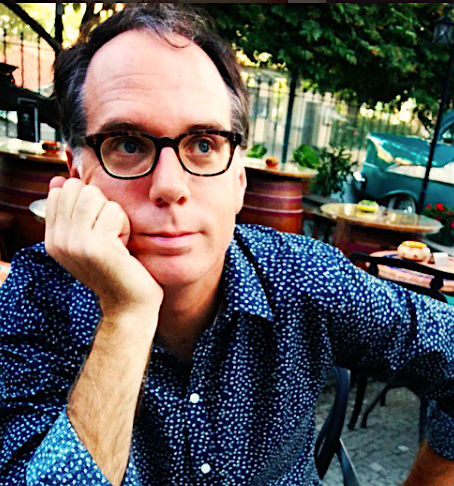
Ivan Seng in concertIvan Seng

New to the magazine, Carolyn Ogburn answered one of my want-ads for a music writer. This is her first contribution, an interview with the North Carolina musician/composer Ivan Seng. The title of the piece is “a random walk,” but you need to know what a random walk is. See below where Ivan Seng explains.

Well, random walk is a mathematical term. It comes from Brownian motion. Do you remember the story of the guy [botanist Robert Brown] who was looking though his microscope at tiny particles in water. He saw these particles and he saw them bouncing around – he saw that these particles were following this completely random motion, Brownian motion – and I think it’s how they realized that there were atoms, because it ended up being that these atoms were bouncing off of these small little particles and it was pushing the particles around… So if we took a very basic motion… say you have a 3-sided die, marked 0-1-2, and each number correlates to a particular movement.  And [your particle, or sound, in its own placement is affected by the dictates of the die] and you start at a certain number, 0, and you can go up a step or down a step. But it’s unpredictable. —Ivan Seng

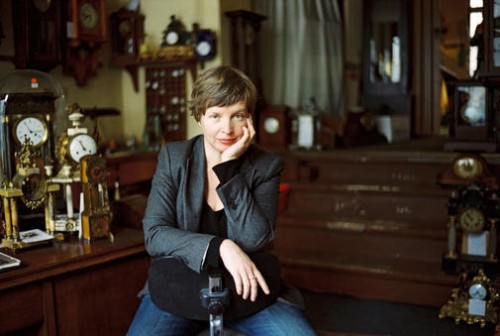
Carolyn OgburnCarolyn Ogburn

Kenneth HarrisonKenneth E. Harrison, Jr.

We also have a fist full of poems from Kenneth E. Harrison, Jr., delicate, lambent, melancholy.

A morning difficult to walk across
the slain crocuses a song
or a silent movie
a memory of a wound
floated out to sea
at the beginning of the war
the fields covered by searchlights
at the edge of a garden before we were born

—Kenneth E. Harrison

Lina WolffLina Wolff

Mark Sampson reviews the wild and wooly collection of fragments/stories Bret Easton Ellis and the Other Dogs by the Swedish writer Lina Wolff.

Wolff’s project – a text at once fragmented enough to pass for a short story collection and yet untraceably centred on the character of Alba Cambó, a writer of violent, horrifying tales who has been diagnosed with terminal cancer – draws a connection between the canine-like nature of human males and the limitations of revenge against their more animalistic natures by women.  — Mark  Sampson

Georgi-TenevGeorgi Tenev

Natalia Sarkissian reviews Party Headquarters by the Bulgarian novelist Georgi Tenev.

In Party Headquarters Georgi Tenev reduces the traditional novel with its linear time, clear relationships, memory and complex characters to an indissoluble essence. Characters, for example, are nameless—they are merely bodies or even types. Memory, hallucination and current narrative merge creating a fluid world where time is relative. —Natalia Sarkissian

Alan-Cunningham-03 19.33.08Alan Cunningham

We have this month inspired, comic, eccentric, Monty Python-esque fiction from the Irish writer Alan Cunningham.

Idea for a script, no, play.

No, idea for a novel.

A man – no, woman – too many men in literature, opens a suitcase in a living room of a building apartment, starts to place all these, like, well, all these different objects into it. Not sure what they could be – yet. She puts all these – well, things – she puts all these things into the suitcase, leaves her apartment in a city – let’s say, London – and starts walking. —Alan Cunningham

Richard SkinnerRichard Skinner

The English novelist turns his hand to short story analysis and structure, beginning his exploration with Alice Munro’s short story “Jakarta,” using a device called the Greimas Semiotic Square to parse a set of relationships he finds crucial to the short story.

All these magnificent stories are highly organised, intense studies of humans interacting and behaving oddly with each other. They throw light on sublimated desires and warped motives. Ultimately, however, in all of these stories, it is some kind of lack, absence or failure of one corner of the square that triggers catastrophic change and collapse in the other three. There must be a black hole, a sacrificial lamb, for the story to work and it is these black holes that are the secret keys to the stories. Through them, we slip down a wormhole and emerge at the story’s end with fresh understanding of just how weird and wonderful human beings can be. —Richard Skinner

Julian_bioJulian Hanna

Julian Hanna contributes an offbeat What It’s Like Living Here piece, Julian walking in Madeira where he lives, a tale of a complicated beauty, of a place both difficult and enticing.

If I dig deep, I think it’s that I love the contrast – between the breathtaking beauty, the tropical flowers and sun and sea on one hand; and the plague of traffic and stupidity and all kinds of human failings, which are universal failings, on the other. Anyone who has travelled in southern European cities like Athens or Barcelona or Naples, not to mention the cities of the global south, knows this contrast and its peculiar frisson. Something about the ugliness and beauty of human life, the union of pain and pleasure, is ultimately why I live here and why I walk. I like things to be difficult. —Julian Hanna

Karen MulhallenKaren Mulhallen

Karen Mulhallen returns to the magazine with a handful of love poems, mad love, foolish love — is there any other kind?

It can’t be helped
I wasn’t ready, or maybe I was really ready
ready for love
had no defenses
wasn’t prepared
just jumped in
and now
the undertow is
taking me down.

—Karen Mulhallen

Richard FarrellRichard Farrell

Richard Farrell continues to mine the stories of his past, especially his years as a prospective U. S. Navy pilot — this time a sublime and sublimely sad essay about a classmate, a plebe, who committed suicide at the Academy.

Ten years after the Worcester Air Show, still pursuing my dream of becoming a Navy pilot, I returned from physics lab to my room at the United States Naval Academy, only to find that a plebe from 10th Company had climbed out of his fifth-floor window and plunged to the brick walkway below.

His shattered, uniformed body was visible from my window as paramedics rushed in vain to save his life. Ambulances, fire trucks, and police cars had cordoned off the road, but the air was eerily still. I expected sirens, but heard only the chirping of birds, the rustle of a breeze off the Chesapeake. Again, it was September. A warm, clear day sparkled. Spinnakers billowed on the Severn River as sailboats tacked their way out to the hazy bay. —Richard Farrell

Jenny ErpenbeckJenny Erpenbeck

Frank Richardson reviews a book he loves, Jenny Erpenbeck’s The End of Days.

The End of Days, a book of elegant style and penetrating insight, filled with arresting characters and provocative questions, is a book to come back to a second time, and a third, and . . . who knows how many times? Erpenbeck writes with a gentle intensity—a feeling light as a dream yet so grounded in the moment that if a grenade exploded outside your window, you wouldn’t jump. Although death frames the novel, The End of Days celebrates the beginning of days, for it affirms life’s multiplicity and the potential of every human life. Erpenbeck quotes W. G. Sebald’s Austerlitz in an epigraph; in part, he asks—“where will we be going now?” This question vibrates throughout her novel and remains with us as we move on from this book, and this life, to the next. — Frank Richardson

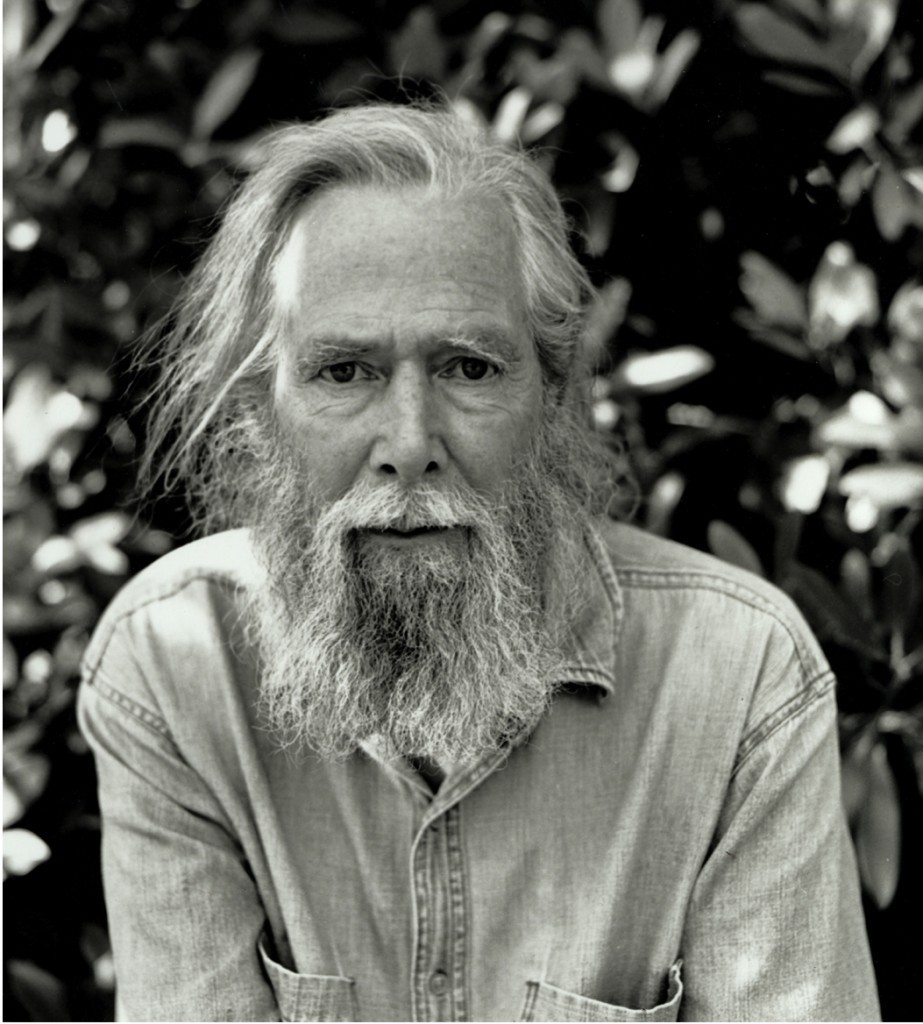
Sam-Savage-author-photo1-923x1024Sam Savage

Jeff Bursey sums up the life & works of the great Sam Savage.

Sam Savage has a genius for getting inside his characters’ heads and bringing out their worst and best traits in such a way that we are never in doubt that the individual—it can be man or woman or, yes, animal—is a presence who has felt pain and sorrow and has a story to tell. His lead characters are intensely believable because the language is intense and believable. This exquisite combination of words and psychology, along with Savage’s knowing penchant for idiosyncratic behaviour, is rare indeed, not found in fiction as frequently as we might desire. —Jeff Bursey

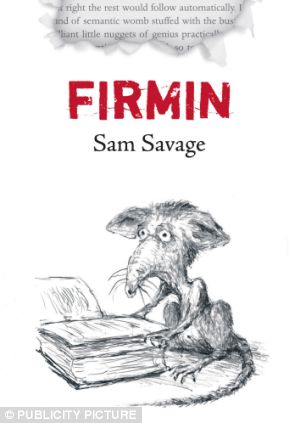
Cover_of_firmin_novel_by_Sam_Savage

jose_eduardo_agualusa_0José Eduardo Agualusa

Jeff Bursey, who appears twice, yes, in this issue, reviews the novel A General Theory of Oblivion by history-obsessed, Angolan-Portuguese author José Eduardo Agualusa.

…strong women, women praised for their beauty, ignorant men, thick-headed and greedy men, victims of tragedy, and the kind-hearted. Above them all is Ludovica (Ludo) who has accompanied her sister, Odete, and her new brother-in-law, Orlando, from Portugal to Angola just before independence is brought about. She is the figure Agualusa focuses on. Through her, despite her isolation in an apartment building, we are given an overview of Angolan history and society. —Jeff Bursey

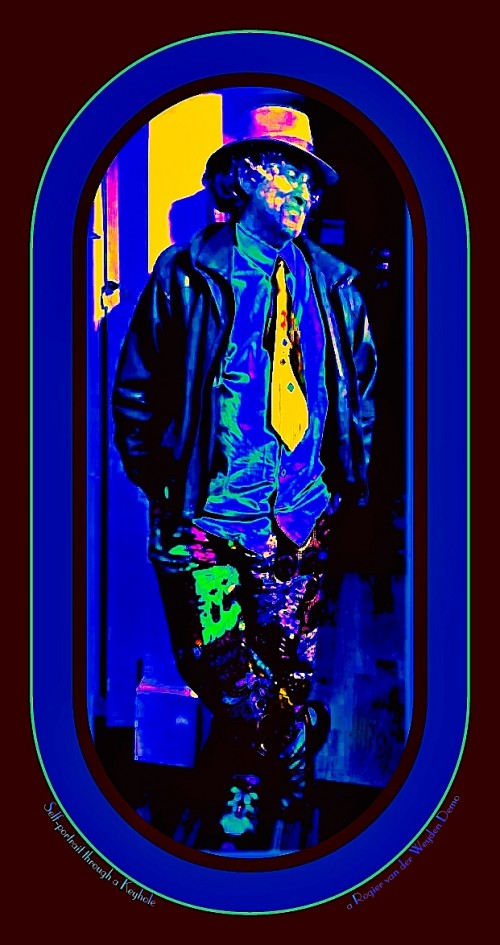
self-portrait through a keyholeRoger Weingarten, Self Portrait through a Keyhole

And there is, as I always say, MORE! Including art work from the poet Roger Weingarten, excerpts from the anthology DIRT: A Love Story, a new NC at the Movies, and new work from Ireland.

Feb 142016


.

Darwin Serink’s short film “ABAN + KHORSHID” tells a non-linear tale of romance from a prison cell. Khorshid fashions a flower out of a piece of paper, then lies down facing it. He remembers his lover Aban, sleep tousled, waking up next to him, in their apartment, in a honey-drenched room. The film then cuts back and forth between two timelines: the lovers wrestling, eating and teasing one another on their life raft of a bed during one endless morning and the two men in their separate prison cells, an impregnable wall between them.

ROnoSd8

In their morning bed, Khorshid makes a film within the film, recording the beauty of his beloved with his smart phone, so we — in the place of the camera eye, Khorshid’s eye — are invited to behold the pulpy-lipped beloved Aban. “When I see beauty I have to record it,” says Khorshid. Thus so do we. It is, after all, essential we fall a little in love before the lovers are torn asunder.

Aban-and-Khorshid-380x229

How then does one make a viewer fall in love in less than a handful of minutes? This kind of romantic love, the melodramatic (in the film genre sense), requires a keen attention to time. Even the lovers are in neighbouring cells, even though they can hear one another’s voices, they will, very likely, never see one another again. Time is up. Linda Williams describes this in “Film Bodies: Gender, Genre, and Excess” as the “too late” of melodrama. She references the Italian critic Franco Moretti who “has argued, for example, that literature that makes us cry operates via a special manipulation of temporality . . . at the precise moment when desire is finally recognized as futile.”

15429653998_d41213b7d8

Williams adds that in Moretti’s analysis of the genre, there is a tension between what we desire and an incompatible reality. “Pathos is a surrender to reality but it is a surrender that pays homage to the ideal that tried to wage war on it” (Moretti, 1983, 179). Moretti then stresses a subversive, utopian component in what has often been considered a form of passive powerlessness.” For Aban and Khorshid, that ideal is romantic love.

And it is too late, but it’s also something else. The scenes on the bed remind me of the end of Gaspar Noé’s Irreversible. Noé’s entire film is built to shock and create discomfort, but the film ends with the beginning: a man and a woman naked in bed, expansive, endless lovers’ moments before all the destruction to come. Moments we have already seen thanks to the film’s reversed chronology.

irreversible-mise-en-scene-4

We have the awareness of “too late” thanks to the frame of the narrative, but inside that we have the small moments of fullness and denial of time that are the lovers’ domain, their amorous prerogative. These remind me of Roland Barthes in A Lover’s Discourse discussing “the amorous embrace”: “Besides intercourse . . . there is that other embrace, which is a motionless cradling: we are enchanted, bewitched: we are in the realm of sleep, without sleeping . . . this is the moment for telling stories, the moment of the voice, which takes me, siderates me. . . everything is suspended: time, law, prohibition: nothing is exhausted, nothing is wanted: all desires are abolished, for they seem definitively fulfilled” (104). Noé’s naked lovers, Serink’s playful men waking up, eating, chatting in love. These quiet thrumming, full moments abolish time.

What both Irreversible and “ABAN + KHORSHID” share then is this double sense of time: a frame where time is running out around a core where time is suspended. So the film structure encourages us not just to be desiring subjects, but amorous ones, holding on to sweet full time that we know is already gone. “Time destroys everything” reads the title card at the end of Irreversible. Yet “ABAN + KHORSHID” lets the sweet triumph a little over the bitter.

The film was inspired by the photos of two young men, Mahmoud Asgari and Ayaz Marhoni, that circulated in Western media in 2005, outraging LGBT rights groups. The two men were condemned for allegedly raping a 13-year-old boy, though many were skeptical and argued that they two young men were being persecuted for being gay.

Regardless of the controversy, the photos are arresting. Haunting. The boys in their clean shirts, blindfolded, looking ready for school.

Serink’s tale takes only the idea of persecution, elaborating from that a story of one lover showing the other that the prison walls cannot hold them, can’t cause them to despair and lose their love. Khorshid is the one who adores, the one who knows he has to show Aban that their love is limitless. The story would not have worked with two boys, both despairing. In this sense we share Aban’s struggle to not suffer since he cannot see the beloved, and we share Khorshid’s deep desire to help Aban see that despite that wall they are still in love. This is the subversive, utopian force that Moretti pointed to.

maxresdefault

“ABAN + KHORSHID” has screened at over forty film festivals world wide and won many prizes.

–R. W. Gray

.
.

Feb 142016
 

Ben Jelloun

Although Ben Jellouns writing is simple and straightforward, he does take chances in structure and effect. The narrative shape of The Happy Marriage is corrugated and layered—like the broken and fretful marriage it depicts. It is problematized by withheld information and the character’s anguish and paranoia. —Jason DeYoung

the Happy marriage
The Happy Marriage
Tahar Ben Jelloun
Melville House, 2016
$25.95

.

“If we knew what went on between women and men,” Mavis Gallant once said, “we wouldn’t need literature.” This quotation played over in my mind as I read The Happy Marriage, a novel that at times I thought uninspired and clichéd (albeit self-aware of it), and yet at other moments heartbreaking and authentic. The Happy Marriage is about that most ancient and indefatigable topic: betrayal. Only in The Happy Marriage we glimpse it through the eyes of a man and woman during social changes in Moroccan laws and customs, when men no longer hold all the power to determine when a marriage has ended, and when women are enacting more control over their own lives.

Born in Morocco in 1944, Tahar Ben Jelloun was the first North African writer to win the Prix Goncourt Prize for his novel The Sacred Night (1987) and has been short listed for the Nobel Prize for Literature. The author of over fifteen novels, he’s is best known for a trilogy about the life of Ahmde/Zahra, a girl who is raised in Morocco as a boy. More recently, he won The International Impac Dublin Literary Award for his novel This Blinding Absence of Light (2000), a novel that depicts the real-life, twenty-three-year prison sentence of a survivor of King Hassan II’s desert concentration camp, where political enemies were kept in lightless, underground cells with little food or water. Most of his novels, however, are more like The Happy Marriage, preoccupied by the daily life and relationships between men and women in Muslim society. They often focus on escaping its dogmas (Leaving Tangiers) or returning to its comforts (The Palace in the Old Village).

Ben Jelloun lists the typical Western pantheon of influences—Joyce, Cervantes, Pessoa. But he is on record of saying that he doesn’t really identify with other writers, “rather with certain filmmakers: Orson Wells, Federico Fellini, Yasujiro Ozu, Akira Kurosawa, Michelangelo Antonioni.” These cinematic influences inform nearly all of is fiction, generally through one of his characters being a movie aficionado. He does, however, state in interviews that Jean Genet, who he knew in the 1970s, gave him one piece of important advice, which Ben Jelloun has followed: “When you are writing, think of the reader, be simple,” Genet advised.

Although Ben Jellouns writing is simple and straightforward, he does take chances in structure and effect. The narrative shape of The Happy Marriage is corrugated and layered—like the broken and fretful marriage it depicts. It is problematized by withheld information and the character’s anguish and paranoia. It is novel in two parts—one male, the other female. Part One is entitled “The Man Who Loved Women Too Much” and Part Two is “My Version of Events: A response to The Man Who Loved Women Too Much.” It’s a tit-for-tat kind of book, similar to another of Ben Jelloun’s novels, The Last Friend (2006).

Part One is the man’s side of things. Known only as the painter, his narrative opens in Casablanca, February 4, 2000. He is bedridden after a stroke, and he is unable to paint. At one time he was a celebrated artist, but now he lives out his days being cared for by a pair of twins who helps him get a round, and is visited by Imane, a physiotherapist, who is helping him regain muscle control. It is a portrait of an invalid that Ben Jelloun presents, but the painter’s mind is still alive, vivid, and over the course of the first part of the novel, he reflect back over his life, dwelling mostly on his unhappy marriage.

At first the marriage is indeed a happy one. The painter and his bride are very much in love. They are, however, from two different strata of Moroccan society (he from something higher than she), and there is also fourteen-year difference in their ages (he is 38; she is 24). “Nobody present [at their wedding] had been happy, apart from the painter and his wife,” we are told. “Nobody had wanted them to get married. One had to be absolutely crazy to want to bring such different worlds together.”

It’s difficult for the painter to trace the beginnings of their marital troubles, saying, “once their son was born, his wife gained a great deal of confidence and her attitude and behavior underwent a vast transformation.” Slowly the small moments of martial discord become a stridency of outrages and indignities. The wife is portrayed as irascible, irrational, and prone to fits. The painter freely confesses to a multitude of affairs, some as short as one night, others that went on for years, followed with heartbreak. Yet, he never sees himself completely in the wrong: “At no point did the painter feel guilty,” we’re told. “He was doing nothing wrong, he was simply looking for some equilibrium outside of his marriage, which only functioned intermittently.”

What’s not revealed until late in the novel is that the painter’s section is being written by an amateur writer, who visits the painter regularly during his convalesce. The two friends chat, the writer types and polishes (reshapes, I often wondered) the story the painter has told, and the pages are kept in the painter’s safe. It is this manuscript—in which the painter blames his wife for all his misery and illness—that the wife finds and prompts her to pen her response.

Part Two is a first-person narrative and a rejoinder to the painter’s side of the story. Unlike the painter who never reveals his own identity, the wife proudly states her name—Amina Wakrine. In comparison to the painter, Amina doesn’t seem to shy from her flaws. Her first words sum up how she sees herself: “Before giving you my version of events, I must warn you that I am nasty.” The wife has a cold eye for herself and for others. What we learn from her more clinical approach to the story of their marriage is that the painter, whom she calls Foulane, an Arabic word used to refer to “any old guy,” is that their marriage had more complexity that he revealed. Yes, there were the infidelities, but also he withheld money from her, despite earning more than enough from his paintings. But his family—not the one he created with Amina, but his siblings—was always his first concern, and he made his wife and children live off a small allowance.

For a while we take the wife’s side of the story as truer—both her petty and principal complaints seem more sincere than the husband’s—until she begins to edge into paranoia, and rants about all the evil spells she believes the painter’s family have cast on her:

Foulane said he didn’t believe in such things, but I had proof that the women in his family were using sorcery against me… I cleaned the house from top to bottom. My friends helped me and we found little packets wrapped in tin foil all over the house, tucked under each bed and inside the toilets. The house was overrun by spells designed to make me ill.

And just like in the painter’s half, we begin to doubt her integrity. Suspicious spreads like an epidemic in this work.

The end of the novel leaves us with our own decision to make (if we care to, that is). Who’s right? Who’s wrong? In both parts, we have common statements of awareness:

While he’d never necessarily wanted his wife to one day grow docile and submissive, he had always harbored a secret hope that she would at least become loving and obliging, calm and reasonable, in short, a wife who could help him build a family life and then share it with him. It had been his dream. But he’d been misguided and he had instead oppressed his wife, forgetting to acknowledge his share of responsibility for that failure. (The Painter)

My mistake was to think people can change. None of us change, not least of which a man who’s already lived out most of his life… (The Wife)

Clearly, both narrators are flawed, and Ben Jelloun does a fine job of not betraying loyalty or agreement with one character over the other—unless you equate giving the wife the last word as consensus. In a Paris Review interview with Ben Jelloun, he says that his “job is not to give answers or to find solutions, but to ask questions, to testify in a human situation….[to] tell a story in hopes that it will incite reflection, provoke thought.” If provoking thought is his goal, I feel he’s done so. As I sit here parsing out this book, I keep coming back to the fact that I just don’t like these characters, neither one. The painter is an ass; the wife is mentally cracked. But then, why do I think these things? Why do I judge them so harshly?

The novel is keenly aware of the changing tensions between men and women in Moroccan society. Often the painter’s section reeks of chauvinism, while the wife’s section smartly leans in a more feminist direction. The infidelities and betrayals, which are damaging yet described quite rightly as “banal,” are in some ways pretense to show the changing political values. Whereas a lesser novelist might have chosen younger characters to portray this change, Ben Jelloun chooses middle-age characters, those whom perhaps would feel the change more intensely. Amina acknowledges “in our culture, a woman who cheats on her husband no longer has any rights, everyone thinks badly of her, even if she was victimized by a lying, violent husband.” Thusly, she enacts her revenge through the changed marriage laws, refusing to divorce the painter, stating:

I’ll never leave Foulane, I’ll never leave him alone. He has to assume his responsibilities. I couldn’t care less about his health, mood or state of mind. I’ll never stop hating him so long as my thirst for revenge isn’t quenched. One day I’ll rebuild my life, but not before he’s paid the price. So long as he refuses to atone for what he’d done to me, or publicly confess in front of everyone, I’ll revue to let go! I’m too proud to leave him. I’m full of hate, and if anyone were to shake me, drops of poison would inevitably fall out.

If this is a happy marriage, it’s not a sense of happiness that many will identity as such. Despite their early nuptial contentment, these are two miserable people, made so by life, ego, family, and conflicting desires and ambitions. One of the tropes that Ben Jelloun uses in the novel is montage: the painter dives deep in his memory, pulling images of the women he loved up and remembering their time together. The Happy Marriage in many ways is part of montage of unhappy marriages that I’ve seen, and perhaps you’ve seen, too. I can’t say this is a good place to start reading Ben Jelloun in English—I’d give that to The Last Friend or Leaving Tangiers. But what The Happy Marriage does do well is give us a solid portrait of two flawed individuals, and their example, one can only hope, might help to make the next marriage a happier one.

—Jason DeYoung


Jason DeYoung

Jason DeYoung lives in Atlanta, Georgia. His work has appeared or is forthcoming in numerous publications, including Booth, Corium, The Austin Review (web), The Los Angeles Review, New Orleans Review, Monkeybicycle, Music & Literature (web), 3:AM, and Houghton Mifflin Harcourt’s Best American Mystery Stories 2012. He is a Senior Editor at Numéro Cinq Magazine.

.
.

Feb 132016
 

GerryBeirne

A word of introduction: “What a River Remembers of its Course” is a story from NC Senior Editor Gerard Beirne’s brand new story collection In a Time of Drought and Hunger just out with Oberon Press in Ottawa. Gerry and his wife Eilish, when they first came to live in Canada from Ireland, moved to Norway House in northern Manitoba. The stories in this book stem from that experience, the north, the alienation of the people (native and poor whites) from the land, the poverty, and the isolation. Oberon is a great old  Canadian Press. They have published two books of mine and continue to publish the annual Best Canadian Stories volume, which I used to edit. “What a River Remembers of its Course” is the story of a river and a dam and a native protest occupation told from the perspective of a white man who came north to build the dam and married a native woman who later died, the dam, the protest and the marriage forging a mesh of relations, guilt, and responsibility, the peculiar fraught moral climate of the colonial north.

dg

Drought and Hunger from pdf-large

.

L

eo could tell you about the dam being a run-of-river structure. He could explain how the water flow is used immediately instead of forming a forebay upstream. He could talk about the spillway adjacent to the powerhouse, the five thirteen metre square steel gates, each over one metre thick with heaters fitted inside their hollow interiors to prevent freezing and condensation. Each gate, he might add proudly, weighed over one hundred tonnes. He could tell you those things over a mug of tea at his kitchen table or he could tell you them while standing on the granite shield fishing for pickerel or while out in the forest hunting late winter moose. What he couldn’t explain was the group of over one hundred protesters who had marched almost twenty kilometres from their small remote community, the same one Loretta had been from, to the dam to occupy it.

He heard the commotion first as he left the powerhouse on his afternoon break. The protesters were marching in a long procession through the gates, singing and beating drums, holding up homemade banners. One man at the front carried the tribal flag and two others a large cardboard sign that Leo later found out was an over-sized eviction notice. He recognised the Chief and some of the other people from the community. Although not at the front, it was hard to miss Mervin, a relative of Loretta’s. He was six and a half feet tall and wore his long black shoulder-length hair in a ponytail.

Leo went back inside to advise the other workers – the operators, distributers, dispatchers, supervisors, technicians, and maintenance staff. They came out after him to watch as the plant manager and several security officers went forward to speak with the protesters. The Chief handed over the eviction notice and ordered the staff to leave immediately. The RCMP were called while the manager tried to negotiate, but by mid-afternoon only key personnel remained. The other staff had left under police escort. The housing complex was locked and the tribal flag raised above it. Leo, a maintenance supervisor, was one of the few permitted to stay.


“It’s going to be a peaceful protest,” Mervin told him when he went over to speak with him that first evening. “But we are digging in for a long occupation.” A teepee was being erected on the grass beside the powerhouse where he and Mervin stood. A few young men were building a fire off to the side. A sacred fire, Mervin explained. A lone drum struggled to be heard against the water surging through the spillway.

“Is there no other way to resolve this?” Leo asked.

“We have tried doing it their way. We have sat around their tables and signed their pieces of paper but still no benefits have flowed to us. They violate our Treaty rights and hide behind lawsuits. They have polluted our waters, destroyed our land, disrupted our way of life, left us only despair. It is time for us to take charge, assert our rights.”

Leo understood this. Loretta had suffered the same indignities. When she fell from the boat and slipped beneath the murky water, did not every indignity since the beginning of creation attach itself to her body and weigh her down?

“You do what you have to do,” he said and walked back to the office.


Despite the enormity of the structure, there was only so much regulation of the water levels of the lake the dam could control. No amount of concrete and steel could fully compensate for wind and precipitation. Ongoing erosion heavily impacted the shoreline. During high winds, Leo had heard of there being as much as an eight foot difference between the north and south basins, and due to its shallow depth the water was impeded from circulating back to the windward side of the lake, piling up instead on the leeward side. Furthermore, the north end of the lake was experiencing post-glacial rebound from the huge weight of the ice-sheets that had existed there thousands of years before. The land gradually rising back upwards, the lake slowly tilting from the north and moving southward.

It had been necessary to excavate the spillway and powerhouse channels through solid granite bedrock. A year later the first concrete was poured. Leo remembered it vividly. He was barely nineteen. That was almost forty years ago. Forty years that had flowed past like the water through the dam. Years that had been diverted, regulated even. Years that had been stored up and then let go. It had taken six of those years to get all of the generating units up and running. Leo was twenty-five by then. Loretta was twenty-three. She was thirty-six when she toppled from the boat and was swept downriver into the log-boom that prevented debris from entering the intake gates. The found her body trapped between the mounds of piled up logs looking for all the world as though she was clinging on for dear life.

Loretta started work as a cook in the camp about three years after Leo arrived. Her family were wary of the dam, the effects it might have upon them, but they were given assurances by the government and the company, and, besides, you take whatever work you get, Loretta told him. “My grandfather worked for the Hudson Bay Company.” She shrugged. “It provided food for his family, my father.”

For almost a year, Leo sat at his table in the camp and watched her while he ate the food that she had prepared, and for almost a year she sometimes watched him back. Tables of men, young and old, chewing and swallowing, talking loudly, swearing and laughing, belching. Their coarse talk and their rough hands swollen from manual labour. Leo’s skinny frame filling out with muscle and flesh. His mild manners peppered with grains of crudity.

“She likes you,” Glenn said. He was almost ten years older than Leo. His wife lived down south with their two young children. Glenn drove an excavator. The work was dangerous, but he didn’t think about that. He couldn’t afford to, he would have answered if he was asked.

They were finishing off their breakfast. Grits and gravy. Leo felt himself blush. “She’d be a good catch,” Glenn said. He washed his food down with a mouthful of coffee, picked at a back tooth. “All the food you can eat.”

“I’m not interested,” Leo lied.

Glenn looked him right in the eye. “Course you’re not.” He nodded, pushed his plate into the centre of the table “Why would you be?” He stood up, burped. “You’re a young man. You’ve got the whole world in your grasp, isn’t that so?”

Leo wasn’t sure how to respond, but Glenn stood there as though waiting for a response.

“I mean, she is nice,” Leo said, “but…”

“That’s right,” Glenn said. “But….” He wiped his lips with the back of his hand. “The whole fucking world.” He sighed heavily, looked past Leo now.

“I’m not saying…” Leo said.

“What I’m saying is that I’ve got children half your age.” He abruptly gathered up his cup, his plate and cutlery. “Now if you don’t mind, there is some earth out there I’ve got to go dig great big holes into.”

Leo sat there after he left. Loretta was somewhere out of sight. He had no real idea how he had ended up where he was, in the middle of nowhere, shut off from the world by trees and inhospitable land. How was it that people were living here? Glenn was right. He would talk to Loretta, suggest that they take a walk together after they were both done their day’s work. A walk amongst the trees or by the banks of the formidable river. That was what people did, was it not?


Leo liked to find older cutovers, areas that still had some woody browse but offered cover and protection, small pocket cutovers that were a little further off the beaten track. The thick stuff at the back down impassible winter roads. At that time of year, moose tended to group up. He often found several together in search of food. Leo would survey the trampled snow, the damaged brush, and maybe then the outline of a bull moose a few hundred yards away, the two feet of antlers looping out from each side of its head, the heart stopping moment, the adrenalin pumping through the veins. The bull might still be in the back of the cut, Leo getting glimpses of it through the trees trying to draw it out with bull grunts and then it disappearing inside the bush line.

After the rut tapers off in late October, the moose hole-up. There are some who think they are drained by the rut, but Leo believed they were simply transitioning into their wintering areas. In any case, there is a lull. When Loretta was alive, Leo and she would fill that lull by making love. At least, that is how Leo remembers it. But Leo knows his memory is not dependable anymore. What, he wonders, does a river remember of its course? If Loretta had lived, there would have been children by now. They would be grown. But instead Loretta had stood up to cast her line and she had lost her footing somehow, and Leo was distracted lowering the block of metal he used as an anchor.


Leo would stop and talk with Mervin every few days. The Chief was trying to come to some agreement with the company and the Province. Mervin would tell him what he knew about the progress being made, if any, and Leo would let him know the mood of the workers, but mostly they talked about the fishing and the hunting, the way things had changed since the construction of the dam. The good and the bad. They would talk about the geese migration, and they would talk about people they knew in common. People from Mervin and Loretta’s community. They did not talk about Loretta, at least not at first, but as the protest, the occupation, went on over weeks, Leo knew that Loretta’s name which had been far upriver was drifting nearer and nearer.


Mervin was related in some way to Loretta. Leo never really knew how. She had endless relations none of which he understood clearly.

“Surely it is the same for you,” Loretta had said one time, but Leo could not say it was.

“I know most of my cousins, but after that…” He held his hands up in uncertainty. “We are spread far and wide. British Columbia, Alberta, Ontario.”

“We live next door.” Loretta smiled. “I do have a distant cousin who moved to North Dakota. Someday we will go and visit him.”

Leo thought of this while speaking to Mervin. He had never been to North Dakota, and he did not think he ever would go now.


It was the fifth week of the occupation when Loretta’s name swept in upon the shore. Tensions were getting high. A truck, with parts and equipment, had tried to pass through the blockade without permission. The driver had been pulled from his cab. Punches had been thrown. Leo had gone forward to try and help calm things down. Mervin, all six and a half feet of him, was already standing between the driver and the group of angry protestors by the time Leo got there. It took forty five minutes of negotiations for the parts and equipment to be unloaded and the driver to get back in his truck and drive away.

Leo walked over to Mervin to thank him for his intervention, but Mervin was angry, infuriated by what had just occurred. “He need not think,” he said referring to the driver, “that he can trespass on our land whenever he feels fit to.” His voice was raised, his eyes glowering at Leo. And then he pointed his finger at him. “You know which side Loretta would be standing on if she was here. You know.”

Although Leo had for a long time been expecting this, he was nevertheless caught by surprise. Not just by the mention of Loretta’s name but the overwhelming rush of his own inner turmoil, the dam gate release of emotion. He stood there on the gravel road with the river in the background and the vast concrete walls that held it back and the endless forest of trees overshadowing all and Mervin fuming in front of him pointing his finger and Loretta, and Loretta, being washed up as if for the very first time. Leo felt his knees weaken and his legs begin to shake. And in the cascade, other accidents and other corpses. Tom Farrell who had been crushed when the large concrete wall section being swung into place had swung wide, and Michael Simmons, barely eighteen, who slipped from the scaffolding on the spillway, and Ed Williams who was struck by a steel crossbar while removing a roof from a Quonset that had housed concrete, and all the others who suffered tragic misfortunes and succumbed to their deaths at once.

There have been long periods of time over the years when Leo did not think of Loretta, weeks on end, maybe months if he was being truthful, and then something would bring her back to mind. When he first realised this he felt guilty, as though he had somehow let her down, even more so by how he had let her down by turning away to lower the anchor. But the thing was, and he knew this now, that Loretta was always in his mind even if not in a conscious way. There was no thought he had or action he made that Loretta did not influence. The general course of his life she had gouged out in front of him, and he was just following along.

Mervin was wrong. Leo did not know what side Loretta would be standing on. He could not determine the course of her life as clearly as he could his. Hers had taken an irreversible diversion after all.


When Leo and Loretta were first married, they moved back to Loretta’s community and lived there with her brother and his wife and three children. It was not ideal but, as Loretta said, it was a start. They could not afford their own house just yet, and this after all was Loretta’s home. She had lived there all of her life. Being white, not everyone welcomed Leo’s relationship to Loretta. Her grandparents on her mother’s side both disapproved. Her grandmother on her father’s side also disapproved, but her grandfather did not. Her mother said she understood, but Loretta thought that she probably did not. Her father said it was none of his business. “He is a hard worker. That’s good enough for me.” Leo was a hard worker. He helped his in-laws with cutting wood, hauling it, stacking it. He rode his skidoo and his ATV on their behalves. He worked on the engines of their vehicles. In time he was accepted.

Each day he and Loretta drove the nineteen kilometres to work. They talked about their plans for their own home together, about banalities, work details, and they sat in silence too and thought about those things that people think about in their lives that they scarcely remember later.

After the dam was built and the short-term construction jobs dried up, Leo moved into maintenance and Loretta was put in charge of keeping the lodgings for the workers clean. She was one of the few from her community still employed there. “We push brooms and fill plates,” she said.

They eventually got their own house about halfway between Loretta’s community and the dam. A small house not far from the river with a dirt road access. They got a boat, and they fished the river and nearby lakes. And if the accident had not occurred…


“We are not asking that the dams be removed,” Mervin said. Leo had stopped by the fire to talk with him before leaving for the day. One of the protesters would open up the blockade later, permit him to drive through. “We only ask that they apologize for the wrongs and make amends. Our people are frustrated, angry, but equally determined. This is not easy for anyone. Being away from family. The nights are cold and long.”

“Why not stay in the lodgings? You have them under lock and key.”

Mervin shook his head. “We have stayed in too many of the white man’s lodgings. No more.”

“Do you want me to leave and not return?” Leo asked. “Maybe I am now ready to do that.”

“We are not asking to go back to the way it was before. What is here is not going away.”

A young woman and a small boy approached the fire. She did not look like Loretta, but still he was reminded of her. Mervin shrugged. “There were many of our people who worked on the dam during its construction. You do what you have to do to survive.”

Unlike Mervin, the woman was too young to remember what the land had looked like before the flooding, and yet here she was. Leo put his hand in his jacket pocket and cradled the car keys. Could it be said, he wondered, that Loretta had survived?

It was time to go. He would walk to his car now and drive back to the house that he and she had built together.


When Leo and Loretta got their house by the river, they thought then that this was it, that they had reached a place in their lives where they were finally located, a place they would never wish to leave. The water flowed past their front door unobstructed, and it seemed to them that their life together was unobstructed also. They fished the waters and trapped along the water’s edges. Leo took his gun and hunted in the forest and in the skies. They drove the dirt roads and the snow-covered roads to and from their work at the dam, leaving in the early light of dawn and returning in the fading light of dusk. Loretta skidded off the road one time and ended up buried deep in the snow. She had to climb out through her side-window and walk the three miles remaining back to their home. She cried when Leo pulled her in towards him and put his large arms around her. There was no damage done to her or the vehicle, and if there was a hidden fault within their relationship, the shock of the accident and Leo’s comforting of her later surely repaired it. But despite all of this, when Loretta drowned, Leo would often think that they only had gotten their due. It was not necessarily something he had been aware of as he worked to build and maintain the dam, but deep down within him he had always known that there would be a price to pay. Even when he had travelled north for the first time, he had known he was not of the place, that in some way he was an impediment upon it. Initially in his relationship with Loretta he had thought this too, that he was an impediment to her. “I am not truly welcome by your family,” he said after first meeting them. “At best I am tolerated.” “We are who we are,” she reminded him. “That’s all there is to it.” And later, “there were white people in my family before.” When she drowned, he knew there were many of her relatives and friends who blamed him entirely, and he could not fault them for that.

Loretta and he had stood at their door and watched the river hurry past them. They had tried to stand their ground.


The skeleton crew of workers could hear the steady beat of the drumming as they went about their work. Leo tried to avoid the conversations that denounced the protest. Like everyone else, he wanted it to end as quickly as possible, for his life to return to wherever it had been before this interruption, but unlike his co-workers he wanted it to end in such a way that everyone was content with its outcome, that both sides could be accommodated, the gaps between them bridged. They spoke callously before him as though Loretta had never existed or as if uncaring that they might give offence. He felt certain that the beat of the drums that they heard were of a different rhythm to ones that sounded in his ears.

Loretta had heard plenty of abusive talk when she was working there too. There was no manner of insult she had not endured.

“We are an evolving species,” she told Leo on one occasion. “In our case, our skin has grown thicker over the centuries. They can say what they like about me or my people. It is they who grow weaker, become defenceless. Ultimately it is they who will die out.”

“Does that include me?” he had asked.

He remembered how she had looked at him with a mixture of surprise and disappointment. “You and I may not be the same, but we are not that different.”

That is what he wanted to tell his co-workers, we are not that different. There is nothing that the protesters are asking for that we would not expect. They have no anger that we too would not feel, that we would not wish to express.


Leo’s parents died two years apart, down South, twenty-three years after the construction of the dam. He had seen them maybe three or four times a year at most after moving up North. They were only a few hundred miles away but worlds’ apart. He had a sister married in a neighbouring town to his home town who had visited their parents almost weekly, a brother who still lived and worked at home. When Leo and Loretta got married none of his family travelled up for the wedding. Instead they waited to celebrate almost two months later when Leo and Loretta came to them. His father in particular was proud of him for the work he had done on the dam, his brother in his own way too, his mother pleased because his father was proud. His sister had no feelings about it in one way or another. You take work wherever you get it.

What is more, they did not travel up for the funeral either. They sent their condolences by phone. Leo although saddened understood this. There was a forest, a granite shield, expansive lakes, heaving rivers, a harsh climate separating them. White-water rapids, portages too arduous to undertake. A people who did not resemble them with a language they could not understand.

He had dialled their telephone number and waited for someone to answer. He wished it could be his brother or preferably his sister. Instead his father had picked up the phone. At least not his mother.

“Loretta is gone,” was what Leo said.

At first there was silence, and then his father replied, “Gone where?”

“She drowned.”

And still the white-water rapids were impassible and the portages too difficult.

“Drowned?”

“She’s dead.”

The forest was thick and dense and unmapped. The lakes and rivers unnavigable. The words strange and incomprehensible.

“Dead?”

Leo’s one wish was that she had died upstream of the dam, that her body had never been recovered.

“I could have lived with that,” he told Mervin on the last day of the protest, after the Province and the Chief finally came to an agreement.

Mervin nodded as though he understood.


Here is what no one else knew. Two weeks after Loretta drowned, Leo drove out to the dam in the middle of the night. He parked his car facing the spillway and let the beams from his headlights light it up. He sat in the driver’s seat and looked at the scene made visible by his lights as though he were at some huge outdoor theatre. He looked at the massive rectangular concrete and steel supports the spillway gates were hydraulically hoisted up and down upon to regulate the water’s flow, and he watched the rapid white-water that poured through them. Further up, unseen beneath the surface, water streamed through the intake and around the turbines underneath the generating station before emerging from the draft tubes to calmly reform as a river once more. Was it possible, he wondered, that a single human life could be diverted from its course, divided into parts, withheld and released, expending its energy to empower someone else’s world and then be brought back together again as a whole to carry on as if nothing had altered at all?

He stepped out of his car leaving the driver’s door open and walked towards the lower road that ran along the spillway. The lights from the station gave just enough visibility to carefully make his way. The shield, the spruce and brush to one side, the upper main road across the dam on the other. He heard a rustling in the brush and stopped, wondering if it might be a bear. He waited in the near-dark but hearing nothing more walked cautiously on. He passed along the back of the spillway, its towering support walls and gates rising to his left. The noise of the swiftly flowing water sounded oddly like radio static at high volume. He walked past and down behind the generating station, leaned over the protective railing and stared into the gushing water. If her body had broken free of the wood held back by the boom, it would have been swept mercilessly through the intake and around the turbine to be shredded in the furiously spinning blades before being discharged. Was it possible that a single human life could be diverted from its course, divided into parts and brought back together again? What no one else knew is that as he leaned over the railing he thought to find out the answer to that. Back up on the gravel and dirt, his car’s engine was still running, the driver’s door was wide open, and the lights splayed their beams uselessly.


Glenn, the one who had first encouraged him to talk to Loretta, was another casualty of the dam when he was just weeks away from retirement. He was hauling dirt to stablise the shores when the slope he was driving on gave out and his truck fell into the river with a million cubic yards of dirt. His Thermos, hardhat and lunchbox floated to the surface eventually, but his body was never found. At his memorial, Glenn’s son brought the recovered Thermos, hardhat and lunchbox in proxy of the body. There were others who had died from blasting, falling rocks, electrocution, heavy equipment accidents, and drowning of course. Exhaustion, pneumonia, heart trouble. Most of the deaths got a line or two in local papers if that.

Loretta’s got little more. She may never have existed as far as the outer world was concerned, Leo thought. “She’d be a good catch,” Glenn had said except Leo had let her fall through his fingers.

After she died, he threw himself into his work, taking on extra shifts, overtime. Often he stayed overnight at the lodgings. The house was empty without her. He would go back to her community to visit the grave occasionally but rarely visited with her family. He had done more harm to them than the government ever had. He had flooded them with grief.

Instead Leo made a memorial to her down from the house on the shore of the river and laid a few of her belongings there in place of her body.


In the dull evening light, a group of around twenty people either sat on folding chairs or stood around the fire in pants, winter jackets, toques, hoodies, and gloves. Men, women and children. Young and old. One elderly man stacked tall logs against one another over the flames as if he was about to burn the frame of a small teepee. Meanwhile people entered and left the white canvas teepee over by the powerhouse. Despite the cold, the overcast sky, there was loud talk and laughter. Leo could tell that something was in the air. He went over to speak to Mervin.

“We have signed a memorandum of agreement,” Mervin said. “We are negotiating a settlement. But there is a lot to be discussed yet. The locks will not come off until the agreement is finalised and an official apology is delivered. But at least we are on a path forward now.”

“Good.” Leo like most was eager for the occupation to end.


That night as he had stood at the edge of the dam contemplating joining Loretta in the water, Leo looked back to the strand of trees where he had heard the rustling earlier. An animal had emerged from the trees and was standing in the near dark as a large shadowy outline on the granite shield. As Leo watched, it turned its head and its massive antlers, and green reflective eyes made themselves visible. Leo stared at the bull moose and saw himself within it – a lonely creature waiting on the call of a female that might not come. The moose stood observing Leo for a few moments then backed up, turned and disappeared again into the dark.

“We are not asking to go back to the way it was before,” Mervin had said. Leo knew he was right, there was no going back. The moose that had sensed Leo’s presence and returned to the darkness was no longer the same one that had stepped out of it in the first instance. The river could not reverse its course and flow back the way it had come. The young man, a boy really, who had gone north in the first place could at best stand there momentarily before stepping forward precariously into the uncertain future.

—Gerard Beirne


Gerard Beirne is an Irish author who moved to Canada in 1999. He is a past recipient of The Sunday Tribune/Hennessy New Irish Writer of the Year award. He was appointed Writer-in-Residence at the University of New Brunswick 2008-2009 and continues to live in Fredericton where he is a Fiction Editor with The Fiddlehead. What a River Remembers of its Course is from his recent collection of short-stories, In a Time of Drought and Hunger. He has published three novels including The Eskimo in the Net (Marion Boyars Publishers, London, 2003) which was shortlisted for the Kerry Group Irish Fiction Award 2004 for the best book of Irish fiction and was selected as Book of the Year 2004 by The Daily Express (England). His poetry collections include Digging My Own Grave (Dedalus Press) which was runner-up in The Patrick Kavanagh Award. His short story Sightings of Bono was adapted for film featuring Bono (U2).

.
.

Feb 132016
 

Chrostowska_s_d_retouched_scaled_cropped

It can be said that the entire book is a working out of how a Western-educated liberal, free from acquaintance with Eastern philosophy (apparently), and bereft of much human contact, sees his world—a Man without Qualities in a novel of ideas for our time when the idea of the nation-state is being replaced by the mechanisms of a large private limited company. —Jeff Bursey

Matches_Cover_Front_Mockup_07182015

Matches: A Light Book
S.D. Chrostowska
Punctum
Paper, 538 pp., $25.00
9780692540732

I

An apt place to start discussing S.D. Chrostowska’s new work is with the cover, where the representation of untapped fire in the form of matchboxes rests in our hand along with the book itself to summon forth imagery of conflagrations ignited by congregations of ignorance, inbred fright and hostility, where the State and/or citizenry burn books gleefully or, where restrained, banish them from library shelves for their views on gender issues, same-sex marriage, explicit descriptions or the use of offensive words defined as such by those eager to protect their children. The pyrotechnics continue on the copyright page—that overlooked dead leaf in most books (would that there existed a work made up solely of idiosyncratic copyright pages)—where Punctum states:

This work carries a Creative Commons BY-NC-SA 4.0 International license, which means that you are free to copy and redistribute the material in any medium or format, and you may also remix, transform and build upon the material, as long as you clearly attribute the work to the authors (but not in a way that suggests the authors or punctum endorses you and your work), you do not use this work for commercial gain in any form whatsoever, and that for any remixing and transformation, you distribute your rebuild under the same license.

Anything goes, then, this book is practically a box or kit filled with gears and levers, you can make out of its contents a soapbox racer or a towering edifice to Marxism, a paean to the life of the public intellectual or a scrap with philosopher-sociologist Bruno Latour, and the book performs its own self-transubstantiation from the top line on the back cover where booksellers are aided in commodifying it by the heading “Philosophy/Essays,” like that first word will propel sales or encapsulate the pith of Matches by offering a partial truth—a fragment of the truth—of what Chrostowska has achieved, for what we have here is a multi-sided work: the unnamed narrator (hereafter referred to as N.) as a goad, as a cynic despairing of humanity’s chances, watching while the world comes to a slow and distasteful end, and occasionally winking at this or that outrageous statement. (Who’s to say that essays can’t be spoken by a persona?) The decline is presented in stages, with themes, walk-on parts for minor figures, costumes (verbal dressing of arguments), and sharp attacks (verbal dressing downs). “Before you level at me the charge of inkhorn writer, you must try to understand my reason for choosing ‘bookish words’: they remind me there used to be such things as books” (“Inkhorn”).

Nostalgia, sentiment (not sentimentality), days of golden glory long gone to rust, a cultural milieu fast disappearing, a long battle with inanition and lowering standards—what is this all for? While it contains philosophy, Matches is more an intellectual biography of a fractious mind in contact with long-standing and current crises engendered by politics and science as well as fads and paradigm shifts, sparing scant glances at the stuff of the sensory world. Real people are almost absent, and when they are encountered it’s dramatic and disturbing:

As the bus pulled into the station at the end of the line, I took a tactical position and, passing him, ran my shoulder into his—instantly realizing, however, that my puniness may have left the wrong impression (of an accident, not deliberate aggression). Fearing cowardice and loss of composure, with shame already coming on, I turned around to give him one final look with all the urgency I could muster. (“Angel of Death”)

Instead of a moment of significant impact there is an instance of insubstantiality. Wispiness of N.’s physical self, a life that does not include many descriptions of meals, surfing, broken bones, or guitars, is countered by vigorous cerebral activity. But to be as precise as N., the scene of his running into a man dressed in the regalia of a Nazi SS officer is as vaporous as this: “It is a comforting thought that the extremes of good and
evil as we knew them are a thing of the past, that in our attention-deficit economy good and evil are losing their edge, growing closer together” (“The Gulf of Inattention”). We pause to take in both the humour and the sting. Yet there’s nothing actually going on beyond the press of ink on paper; nothing has happened. Despite the acknowledged limitations of the page Matches makes clear a larger world lies beyond it. But it’s not a safe place, as N. notes: “No scaffold is too elevated for a writer’s execution. He has come into being as a public figure, and it is only fitting that he be helped to die as one” (“Literary Public Execution).

II

Matches has seven sections: Proem (a kind of preface), Books I-V, and Paralipomena (defined as things omitted but added as a supplement). Proem as a whole is a joy to read aloud, and here is the first paragraph:

I had a vision of a book that shed light. A torch book to light my way. A comet book, its luminous tail to leave a trace for me. Its brightness so intense that closing it submerged whoever broke it open in deeper darkness than before. I fancied a kind of sempiternal flame that shot up again as one resumed where one had left off.

Notice the small steps that lead from a personal light to an object “whoever” can use, and then the subtly implied external (and therefore potentially larger) audience of “one” that may find illumination in what’s to come. Attention to assonance and consonance in service to both the embrace of a widening audience and an abiding metaphor persists to the book’s final, slippery words: “Endings: Can be eelusory.”

The bulk of Matches contains threads of discussion, picked up and dropped as N. loses interest, on writing and books, indigenous people, the pursuit of knowledge, Utopia and what that recurrent idea says about the world we inhabit, sensitivity, art, and dreams, but these categories only hint at what resides in this book. Here are random examples:

This work of art may have been made by your neighbour, but in it he seems a stranger. (“Work of Exception”)

What, at base, is resentment, if not the need for equality clumsily expressed? (“Resentment”)

Nature seems never
 to have cared less for our micro-minded designs for self-preservation than in our present age. Twice marked, once wise, we make do in the killing fields without admitting this bleak and ageist thought. And our horrid work isn’t exactly getting any easier. But when our turn comes, let’s not flatter one another. It is nature that pulls the trigger—not in our name, no, but in its own. (“Sapiens sapiens, or Nil Admirari”)

Matches is a work that is replete with fragmentation, a literary incendiary device that changes a marathon reading to a deliberate exercise in sifting cultural rubble. “What do all these fragments have in common?” asks N. “What unites them? Or is their fragmentariness meant to point us in the direction of the titular ‘threshold’?” (“Cannonball”) That question isn’t directed inwards; it’s left to readers to discern what we can from the one-liners, the puns, the pastiches, the wry tone, and the longer considerations of this or that topic. Perhaps figuring out the narrator might help the book cohere.

III

What is N.’s nature? I built in my mind over the course of 450 pages the following figure: a garrulous aunt you primarily see at weddings, funerals, and festive celebrations, stationed by the food, drink in hand but not drunk, a little shorter than average, maybe known as Madge, peppery, quick-tongued, cognitively aware, and unafraid to say what came to mind, a woman wearily aware of the passing of time and the ends of things, nearer to pessimism than meliorism. In “Making Up Lives” N. says: “My biographer might write, based on my work: he was interested in X because he had experienced something like, or something of, X.” He. Everything I had concocted exploded by this pronoun. Recalibration of motivations began, but why had I led myself astray? Does gender change ideas that much? In Chrostowska’s novel Permission (2013), where a one-sided epistolary affair collects tension as to whether or not the recipient of the letters will refrain from responding, the action is made up of recollections and hypotheses, to the point where one might feel bored, until there is a sudden shift, a confession from the letter writer (Fern) that cautions the reader from making complacent assumptions. Chrostowska has executed a similarly smart move in Matches dislocating the point of view so casually and so deep in the work that I’m left questioning myself.

When N. writes about commerce, culture, and civilization, bracing his remarks with long and short quotations from this or that public intellectual, there is a reserve of anger that emerges in flashes of impatience or, more commonly, a forced resignation (or powerlessness) to accept the way things are or look to be going. Matches can be seen as protest literature, though without strikes, demonstrations or civil disobedience. Whatever action the narrator might contemplate is never more than a thought. Passion and humour are present, yet what’s most prevalent is the ambivalence and melancholy about everything from political activity to the use of aphorisms (in a book filled with them), and skeptical or dismissive of such things as “the grasping hand of Christianity in the shape of the modern capitalist state,” life coaches, and “the revolutionary power of social media.” In “Faster! Faster!” N. addresses technology: “Some say that we are modern if and when we accelerate. Such a modernity would be worth celebrating only if things were moving faster and in the right direction.” This leads him to speak on efforts to forestall climate change: “And technological acceleration as a way of outpacing nature’s decline—to save it at the other end—is something of a vicious circle. Has anyone ever succeeded in catching someone they had themselves pushed off a roof?” The Anthropocene age is embraced decisively (as is “the Age of the Troll” [“Naming Contest”]). How to not descend into an even more drastic state is, as any newspaper or newscast will show, a question left to those in power: billionaires and their factotums (so-called world leaders), corporations, and advocates of globalization.

As the entries mount N. comes across as an impotent, ineffectual, dejected liberal who, at times, sounds like a neoliberal or a conservative. The thinkers brought in to bolster a case on this or that topic—de Man, Foucault, Habermas, Nietzsche—are flawed or far removed from the public they ostensibly understand and seek to represent. N. is most withering when he invokes Marx (pilloried not long ago but Lazarus-like since the Great Recession started) in this passage from “Mutatio mundi”:

But Marx’s words cannot themselves accomplish what they call for, which is new to philosophy. They are conscious of communicating a novelty to thought. They are a call for a new totality (the world), in the making of which philosophy can—must—cannot but participate, and the enormity of the task requires marshalling the totality of philosophy, a move so revolutionary as to pull thought out of its orbit. In theology, exegesis, prayer, the task of thought exceeded its worldly limit; with modern philosophy, thought sets for itself a task at once greater than itself and within its new limits, which it projects and identifies with those of the world. The last Feuerbach thesis is furthest out in this respect, jutting out like a pier into swelling waters, its pillars firmly planted in the ocean floor. At the end of it stands the revolutionary visionary. Diverting his gaze from the dreamy horizon now back towards dry land, now down into the depths below, is the tension in his breast between the beachcomber and the pearl diver. (253-254)

In this image there is the liminal space between earth-bound reality and liquid illusions (hopes), and the visionary—the philosophical visionary only—is hesitancy incarnate. A ditherer. The poor, as N. states in “Means without End,” though willing to take some course of action, are unable to act: “After all, how can the slavishly exploited. . ., the truly solidary who willingly gave up their spare and excess means in return for the truth of struggle against ‘scarcity,’ who make ends meet in the struggle’s day to day, who instead of ‘minding the gap’ between where they are and where they’d like to be have wound up dwelling in it bodily—how can they actively prefigure a collective utopia?” The book is redolent of what might be termed negative Whiggishness—a view that everything declines, and that that is natural.

To draw such a clever image as that revolutionary on a pier—pointedly not at a barricade—is to indulge, as N. frequently does, in binary oppositions. This Manichean view of issues—in politics, criticism, social theory—requires false dilemmas and straw men. Far from being a weakness, that suits one of the narrative’s intentions, I believe: through polemics, to make us side (or not) with N.’s black-and-white positions and then catch ourselves for not considering every side. (Men of action will get on with things.) N. has a short entry that removes the option of empathy: “A soft spot for the opponent in a political debate indexes decay in one’s own position” (“Mushy Criticism”). Politics is a blood sport, but not a team one, as shown when religious imagery is used to illustrate more about the individual than about God or His people (the public is often invoked but is never a felt presence):

The simpler the life, the more pronounced its religious features. We carry the world’s expectations of us into our hermitage, priding ourselves on our private orderliness. As long as the mind does not deviate, we feel our days have been well-spent, and we have fulfilled our duty to the world: rising, the first meal, light or heavy, the first stimulant of the day. Morning ablutions, drying and dressing of the body. Choice of activity, planning out the rest of the day, exercise, a look at the budget, concluded with entertainment of some sort. We know it all well enough, take pleasure in this simple discipline, and yet when other things come to occupy our mind, these private rituals quickly lose their gravity and precision. It is still possible to be devout, as long as mind and body worship each other without interruption or intermediary.

A pleasant, unruffled, and still life sanitized of children, pets, parents and siblings, employers, neighbours, and their needs. Nowadays even the ring of a telephone is disruptive. Everything has to have a filter. No wonder social media is so pleasing.

In “Heart & Home” N. looks at this splendid isolation from another angle:

Political ignorance extends to the idea that the nation-state is just a bigger home, in which all the nation’s families live in harmony as in a communal dwelling.

The cosmopolitan, whose knowledge of political community breaks with such sentiments, rejects this Aristotelian conception of the state as home-land—as much as the idea that politics needs a fixed abode—fixed by familial-national attachment. Regardless of what he calls home, his true home is his heart—his cosmopolitan heart. And this home is his politics.

Syrian refugees? Forget about them. And there’s no wish to side with the 99% when your heart is the only residence you need. Who wants to contain multitudes these days? Isn’t selfishness more appropriate for this world than, say, a return to the demeaning German conceit of Kinder, Küche, Kirche, taken on in the last century by the English, and seemingly doing well in the Republican Party?

Narrowness of vision, attributed to the entire populace and shared, to some degree, by N., has contributed to the degradation of practically everything. Yet N. is at times blind to what is glaringly obvious, as when he writes: “Thieves need banks to deposit their stash without accounting for it. This to keep it from being stolen by others like them” (“Safety Deposits”). The 99% believe the real thieves are the banks and bankers, as N. knows, but he sits alone, diagnosing the maladies afflicting the body politic yet barely raising his own pulse through taking part in a struggle for change. He always has more words to buffer his heart, however grimly, as in this creed:

Thinking as source of certainty, and its mouth.

Thinking as the bed of certainty, and its bank.

Thinking as the cradle of certainty, and its grave. (“Three Clear Thoughts”)

There are set pieces when N. distances himself from his own thoughts, perhaps to explore alternate viewpoints in external form. In addition to quotations from Adorno, Benjamin, Foucault, Cioran, Gombrowicz, and daily papers, which allow for debates on items major and minor, there are dialogues between entities labelled A and B and A and A1. After a while you start to think of A and B as a refined Statler and Waldorf. They glide along in their speeches about what is human and what isn’t, on publishing, and nostalgia, as examples—though we are reminded by N. of “the naive embrace of the benefits of eloquence” with TED talks the epitome, for him, of the debasement of communication—and have a patter that, while occasionally showing irritation, reinforces the notion that they’ve gotten used to each other over time and enjoy their parole. Never mind the camouflage, however; this is N. thinking through subjects.

It can be said that the entire book is a working out of how a Western-educated liberal, free from acquaintance with Eastern philosophy (apparently), and bereft of much human contact, sees his world—a Man without Qualities in a novel of ideas for our time when the idea of the nation-state is being replaced by the mechanisms of a large private limited company. The comparison to Robert Musil’s work finds some underpinning in “Not Taken Lightly,” where N. writes:

. . . what better evidence that 
we are more discerning when we negate? Surely no one 
today would draw the more obvious conclusion: that there are more reasons to believe or more things to affirm than to disbelieve or disaffirm. But that won’t do. Refusal is often dangerous in going against the ruling consensus, it is courage to belief’s cowardice; it is safer and therefore easier to say yes. You don’t need much brains to say yes or no, but it takes nerve even to jangle your chains—sometimes conscious nerve. Negators expect to be held to account for their nos rather than patted and fed for their yeses. What’s more, negation is not always the result of whim or contrarian adolescence; not infrequently, it comes after thinking things over, thinking them twice (considering the risks of opposition). And expecting to be made to defend itself, it arms itself with arguments so as not to appear irresponsible. Either way you look at it, obviously a form of cognitive refinement.

N. doesn’t fight vigorously against anything, so he has chosen to put down his thoughts while attempting to fix himself in the shifting world. What started as notes has become, over time, a rough profile of his internal life. The fragments can’t be glued together, but they do suggest a lost wholeness that is impossible to reclaim in this breaking world. Has N. unwittingly shown more than he imagined?

IV

In “‘The younger the more clear-sighted’” N. offers this opinion:

Why should we look up to the future as we do? Why should we expect it to go where we cannot lead it by example? Time will not separate the good from the bad. It will not judge better, only similarly or differently. Posterity will not know to hold in high regard what we now fail to appreciate. But we can be sure that it will look down on us—not because we deserve it, but just because it has superseded us.

Posterity contains condescension and youthfulness, and it’s not a smarter time or a safe repository for deferred respect. What does that mean when applied to Matches: A Light Book?

It must be apparent that the 538 pages that make up this book offer an abundance of streams for critics to attempt to chart and cross, choosing to pay attention to certain ones over others. (One could just as easily focus on N.’s aesthetic views as his politics, for example.) N. has many acute and, at times, severe remarks about those who write on books, and the most fitting may be this: “Critics today need to feel the writer had reason for what they did, reason to innovate, reason to be daring” (“Novel Experiments”). Is this work in need of justification? Not solely critics, of course, but any reader of Matches, now and in the future, will offer an answer to that and an interpretation if they’re open to its arguments, ready to disagree or to be persuaded, after which revelation will follow on revelation, an oecumenical group activity, as each person makes of it what he or she wants, and perhaps needs, since its fragments can be read in numerous ways, under bright and dim light shining straight on or pitched at an angle to throw up facets as the shards are handled gingerly or roughly caressed. No one can piece these entries together to form one wholly, catholic, and postulated assemblage. That’s part of its genius, to allow for and provoke debate on its essence, on the identity of N., and, since this is the way things go, what its creator meant by writing it.

A truly thorough examination of Matches: A Light Book would map all the terrain and take an unusual form: a multi-week course containing lectures, slides, video, theatre, playtime, and interactivity. S.D. Chrostowska is a writer of importance, and with this work she has raised her own personal bar, as well as challenged her countrymen to do the same.

The final words go to N.’s stand-ins where the occasional gloominess is relieved by mordant wit:

A The life of the mind is nearly extinct.
B Leave it to brains-in-vats! Leave it to the machines . . .
A You think they’ll revive it?
B But of course! We’ll transmit to them what we admire but have no more time for. (“Vita contemplativa”)

—Jeff Bursey

nc

Jeff Bursey

Jeff Bursey is a Canadian literary critic, and author the novel Mirrors on which dust has fallen (Verbivoracious Press, 2015), and the political satire Verbatim: A Novel (2010), both of which take place in the same fictional Canadian province. His academic criticism has appeared most recently in Henry Miller: New Perspectives (Bloomsbury, 2015), a collection of essays on Miller and his works by various writers. Bursey is a Contributing Editor at The Winnipeg Review and an Associate Editor at Lee Thompson’s Galleon. His reviews have appeared in, among others, American Book Review, Books in Canada, The Quarterly Conversation, Music & Literature, Rain Taxi, The Winnipeg Review and Review of Contemporary Fiction. He makes his home on Prince Edward Island in Canada’s Far East

Feb 122016
 

Palermo balcony


Balcony for dreamers. There is no floor: abandon gravitation ye who step out here. Turned so entirely outward that it got refined out of existence, there not to detain but to accelerate the gaze. The wrought iron railing as an exercise in minimalism in this least minimalist of cities: how to draw the minimal line that can hold the maximum of time.

For 400-500 years the balcony has been working on mastering the art of flight. In the meantime the palace has grown wrinkled and bald and liver-spotted. The thinner and more brittle its walls, the more it fills up with swallow-sky. Swallow-sky is no ordinary sky, and is entirely different from seagull-sky, not to mention pigeon-skies. However, it does show some similarity to bat-sky, although the latter is a night sky of course. The sky graffitied over by the gulls’ trajectory is broad-gestured, self-confident action painting, while the swallow-sky is made up of the spent pixels of untraceably swift, self-effacing movements. Its negative is the airway system of deep blue light.

The swallow-sky is the best introduction into the nature of chaosmos.

O rondine che arrondini lu mare. The way of being of sea swallows is to fly round the sea, round mini-seas that fit into the ellipses drawn by their frenzied hither-and-thithering. There is demented purposefulness in their movement as they whirl in flights, but each swallow’s trajectory is lonesome. It is the sea-sky they are after, not mosquitoes.

One could draw the city map like a puzzle of roof terraces. Like a Klee, but much more jumbled. It is impossible to make an accurate aerial image of the old town because satellites cannot distinguish between roof terraces on one or two levels, or those with a tile or tin roof or one grown over with greenery, and a regular rooftop. Only the swallows know the city’s true map: imagining the morphology of the houses on the basis of their ground plans is as impossible as it is to represent a forest by drawing the circumference of tree trunks. Only the swallows and the cats. A cat can roam the roofs of entire districts, the Cassaro, the Kalsa, only the main thoroughfares block its way with their violent straight lines: the Via Maqueda, the Via Roma, the Corso Vittorio Emmanuele. It is not impossible that Palermo cats have learnt to fly, with a discreet flutter like bats. They probably drink not milk but coffee that careful hands place in their way beside the de rigueur canned tuna, at dawn parachute on top of the most trustworthy-looking parked car, tiny electric sparks at the tips of their moustache. The young ones sometimes fall to their death on the broken tarmac that feels like sea pebbles to the feet, like young birds dropped from the nest. Like that ginger kitten thrown by the curbside on my third day here, almost completely buried in litter and dust by evening.

The inhabitants seem to be practicing levitation day and night. Women walk on dizzyingly tall platforms. It is easy to spot tourists in the thick crowds: they are the only ones who fix their eyes on the sidewalk. The locals’ gaze is dispersed at eye level, yet they seem to have feelers for rugged curbstones. The palaces turn their faces to the sky like the martyrs of the darkened baroque altarpieces; what you see from the narrow vicoli, the upwards-broadening piazzette and claustrophobic street corners is mostly their loose double chin. Towers stretch upwards until they glimpse the sea. The domes only exhibit themselves to the top floors, they rotate with their maiolica skirt swollen out round. The sky above them is the sea’s reflection. Looked down upon, the shamefaced sidewalks keep to the walls, try to elevate themselves with obsessive tectonic uplift under the belly of parked cars that take up most of their surface.

Palermo street

As the sidewalks keep vanishing, so do the parked cars adhere to the walls like the mollusks, plastic bottles and rags washed ashore on the breakwater rocks. The little, disused chapel at the entry of my street has an A4 sheet of paper between two brutal steel padlocks pleading with drivers to leave the entrance open at all hours. One and a half cars and two motorbikes are squeezed in front of it.

In place of the thinning tarmac, trash sediments: in the city of dreamers nobody bothers to clean up. Above the trash bins overflowing with pungent stench of rot and urine a slightly squinting Madonna leans out, two subdued Christmas lights stuck into her garish mantle. Below in thick white letters, IN TRASH WE TRUST. The Il Capo bazaar shops, the street-food carts of the Vucciria, the baroque-oriental fish, meat, vegetable, fruit stands of the Ballarò all spill over onto the streets, blocking the distraught motorini with the clients’ shopping bags, the leaves and peels and offal and the liquid stench dripping from the fish stands (the sea creatures are sprinkled with icy water, generous quantities of which end up on the customers’ clothes).

There is a difference of at least fifteen shades between the cornices dipped in the morning and evening light, and the base of the same walls. And of at least fifteen shades between the zones of sky immediately above the most light-filled cornices and the blue in the middle of the sky. Era il ciel un arco azzurro di fulgor. The blue diluted in the middle of the sky is Sahara blue, like the lapis lazuli mantle of Antonello da Messina’s Virgin Annunciate turning her eyes away from the spectator who is offered a privileged position as the bearer of the crushing word. There is no position more voyeur-like, yet Mary withholds herself from the gaze. The Messina-born Antonello, who had learnt to paint in the Flemish way, invented the theatre of the invisible.

The small Byzantine domes squatting on top of their box-like churches are champagne bottlenecks. Each one encloses the explosion of desert skies: the foam petrified into mosaic tiles a thousand years ago, but keeps fizzling still, ready to pop its stone cork any time.

Palermo shore

Inhabitants resist the sea while they can. The old town turns its back to it, the pretentious twin elevations of the Porta Felice flanking the Corso Vittorio Emmanuele’s sea end cannot fool anyone: where the street goes over this threshold into the open, traffic stops spilling, only a few people drift over, but inwards the artery is clotted with humans and machines moving in honking clusters to the spasmodic rhythm of streetlights. The planks of the benches along the deserted seawall are practicing disappearance, just like the balconies’ marble floors. Legions of teens elbow their way on to bus 806 (blue, of course) to Mondello beach, armed with radios that keep screaming even an hour later when they are kneeing their way in the sand among sunbathers’ towels, in earnest competition with the thundering disco music off the bars and fried calamari, ice cream, cotton candy, fruit and coffee stands. A guy carries a roaring oversize loudspeaker on motorbike towards the rocky edge of the crescent-shaped beach, while Arabian-sounding Sicilian songs, syrupy pop and merciless techno crash into the traffic jam from pulled-down car windows, covering the convulsions of the engines. As if existence had to be proved in front of the sea’s vast emptiness. In the city only the refugees and the recently immigrated are quiet. On Piazza Pretoria, which is almost completely filled by the late-Renaissance fountain populated with marble nudes, there is a compact slab of 50-100 demonstrators, mostly Africans, in front of the regional parliament. One man is sitting on the ground with two handwritten banners propped up against the fountain’s edge: DIRITTO AL LAVORO – DIRITTO ALLA VITA. An eerily soft-spoken demand. Their silence is as out of place as the fountain itself, originally designed for the garden of a Florentine villa: the statues’ classical mold looks almost cheap here.

Palermo facade

The island and the city on its edge look at their own countenance in the sky and gather shells. Before the Normans they had already gathered a dozen peoples, including Arabians. The Normans took it away from the Arabians, but learnt their language beside Greek, Latin and Hebrew. Their words, gestures, bodies, singing voices got mixed and the city started speaking islandese. Those who speak islandese change their timbre with every sentence. The French and Spanish also landed here with the ambition to rule over it, not recognizing its mirage-like nature. The Greeks and Albanians fleeing from peril all round didn’t attempt to rebuild their lives from scrap but abandoned themselves to this place that never made up its mind which continent to belong to. The rough edges of their names, the Arab gutturals, Latinate consonants, lisping Greek endings were smoothed down like pebbles in the throaty local vowel strings. In the small blind street I stay in and which bears the respectable name Via Bologna, although it has as little in common with the full-bodied leftist university city as its neighbour with Trieste consumed by two-worlds schizophrenia, there is a street tap. In the mornings and evenings people from neighbouring streets come to fetch water. The water they spill while filling their plastic tanks is the only washing the street gets. In this district there are lots of gutted-out houses, semi-demi-ruins with no sewage, this is what the poorest newcomers get. Some of the more consolidated balconies with mass-produced marble slab floors hold massive amphorae or watertanks. The recently arrived sit on the benches of the strangled little park in front of the train station all day long, waiting for connections. Those who are new to the job of waiting are startled by every noise and gesture, at once try to establish and to avoid eye contact. Further up the street in the evenings I can hear five or six languages, of which I only understand Italian and Romanian. Yet all the intonations sound familiar after a few days. Balconies almost rub shoulders, even with the blinds down we can see into each other’s bedrooms. Smells cross over from the kitchens and musics from the TV sets: besides fried calamari and caponata there is thyme, incense and unknown spices that knock me on the head like the scent of jacaranda trees on the streets. When a jacaranda tree blooms, it transubstantiates into scent, the sidewalk beneath is dressed as if for a wedding. Because they can see right into each other’s homes, people stop locking their doors. The ground floor entrances are wide open in the evenings, some sit out to chat with the neighbours, others fool around with a ball trying to amuse children. When dark falls two or three cats queue up for their dinner. From my second day here, I and the two little old ladies who plant themselves in front of the house greet one another. Pingg, go their smiles to my too-loud Buona sera, as I apologetically try to hide the camera with one hand. The street is like a vertical village.

Palermo wall mural

In the mornings a feral tabby eyes me up and down from beneath a parked car. Several people feed it, as they do most strays. Here each square is fitted out with its resident stray dogs, plump and large-size, that lie flat on their sides, not moving an eyelash in the craziest jamboree even. Their eyelids only stir when they dream. They dream often, and then they smile more. They look on the bat-like and invariably anxious-looking miniature dogs walked on leashes with the placid benevolence of aunties. People are genuinely and spontaneously kind to all sorts of stray animals and stray people. On the island even plants are immigrants: tropical jacaranda trees line the posh alleys and the decidedly non-posh thoroughfares that go straight landward for kilometers on end to the margin of the edge of town, and in a place of honour in the lush parks there is always a giant magnolia-fig tree, Ficus macrophylla columnaris, that drives aerial roots into the soil, veritable pillars that grow reptile-like feet, so the exponentially spreading parallel trunks grow to thirty times the width of the mother tree. One tree is a whole forest.

Last morning as I pull my suitcase along the street I glimpse the tabby in the middle of the street. Some car or motorino flattened it in a beastly manner. Before reaching the corner of Via Roma I stop for a moment at the bougainvillea spilling over the broken fence, this commonplace explosion. I can’t help thinking that the cat ended not run over but falling from the rooftop because it was blinded in its flight by the morning splendor.

—Erika Mihálycsa


Erika

Erika Mihálycsa is a lecturer in 20th-century British literature at Babes-Bolyai University Cluj, Romania, a Joyce and Beckett scholar. She has translated works by Beckett, Flann O’Brien, Patrick McCabe, william carlos williams, Anne Carson, Julian Barnes and others into Hungarian. Her translations of contemporary Hungarian prose and poetry have appeared to date, or are forthcoming, in World Literature Today, The Missing Slate, Trafika Europe, and B O D Y Magazine. A regular collaborator of various Hungarian reviews, she is editor, together with Rainer J. Hanshe, of Hyperion, issued by Contra Mundum Press.

x

x

Feb 112016
 
Domenico_di_Michelino_-_Dante_Illuminating_Florence_with_his_Poem_(detail)_-_WGA06422

Dante Illuminating Florence with his Poem by Domenico di Francesco via Wikipedia

Divine Comedy

.

THERE IS A PHRASE coined by the critic Harold Bloom “the anxiety of influence,” which once raised the dust of a herd milling around its allure. Without paying Bloom, a prominent bad-boy, the compliment of either expounding or contradicting the truth of his book The Anxiety of Influence, his phrase “influences” me if only to retort upon it.

I draw my greatest satisfaction as a novelist and a writer of short stories, though the scholarship of others has been a major influence on both my fiction and non-fiction. As a novelist I have written three books that speak to two authors who have drawn the attention of scholarly critics and researchers, Shakespeare and Dante. This perhaps is a form of academic cross-dressing but in the past few months I have returned to think about Dante, since the editor of a literary journal asked me to interview the poet, who has been holed up in his grave for well over half a millennium. As I finished a first draft, I was struck by the coincidence of a note arriving from the wife of the novelist John Barth, saying that she had found my book, Dante Eros and Kabbalah on her husband’s shelf and was reading it. We printed in Fiction Barth’s story of Ulysses setting sail with the princess Nausicca for a new life to the west of Greece, excerpted from Barth’s novel Tidewater Tales. That particular tale was one of those that inspired me in speculating on Dante. Shelley Barth’s curiosity about Dante just as I was returning to the poet was a bit uncanny and it suggested my lecture’s real title.

Dostoyevsky’s Underground Man asks his audience, “But what can a decent man speak of with most pleasure?

“Answer: Of himself.”

What follows is how I came to read Dante as closely as I could and returned to Dante’s Comedy influenced by a 13th century classic, by literary criticism, the scholarship of others and the way a work of literature often embodies the influence of texts that have preceded it, an enthusiastic if mischievous re-reading of texts that precede it. That sounds like a more generous way to put it than Bloom’s “anxiety.” I could call what follows as advertised “The Anxiety of Laughter,” or “The Generosity of Influence,” or but the title, which seems to ring right is, “The Coincidence of Influence.”

cover

I don’t know what the guiding principle of scholarship is but I feel that coincidence is what dictates the novel and the epic poem alike, since it is what sets the direction of the plot. I think that when one is drawn to a writer, a work of literature or scholarship, it is because one senses that coincidence has played its magical part. Your life and the life of the writer become entwined and you exchange identities. Isn’t that what happens when you fall in love? Dante talks about how he met Beatrice at nine years old and then nine years later Beatrice appears before him in a miraculous way; how nine seems to keep reoccurring as a magical number between them. This coincidence he assures us is a sign of Divine intention. And of course three times three makes nine, and the Comedy will be organized in the basis of three—even to its triple rhyme.

I first read Dante in high school. It was the first volume of the Comedy, the Inferno, and it was in John Ciardi’s translation. I read it out of curiosity—I was an omnivorous reader—but although I found it interesting, I did not find myself in it. The world of cruel punishments was repellant. As little boy I was more than once set upon and beaten by juvenile delinquents from the nearby streets of poverty stricken Irish for “killing Jesus” and paraded by canvases of Jesus crucified in the Museum of Fine Arts that made me cringe. The laughter and complexity of the poet descending his Inferno did not bleed through to an adolescent. Dante remained for me through college and graduate school a writer I could admire but not understand. In my mid twenties, however, I received a fellowship to the Breadloaf Writer’s Conference presided over by the poet John Ciardi. Unexpectedly, since the young editor at Simon and Schuster, who procured the fellowship for me, did not like my novel, Thou Work Jacob, Ciardi did; praised it, and wrote several sentences for its publication that still make me blush with gratitude.

Ciardi’s generosity sent me back to Dante. I was now a disciple of Ciardi. He had endorsed me; given me hope that what I wrote would be touched by the poetry of language he said he had found in my first novel. I wanted to be influenced by Dante, the poet to whom Ciardi’s name was so prominently linked. I re-read Ciardi’s translation of Inferno, but decided I ought to read the whole of the Comedy and bought the Modern Library prose version, slowly making my way through Inferno again, then Purgatory and Paradise. The Comedy seemed to be about the three obsessions of my life; sex, politics, and religion, but its drama remained at a distance and though I read with more understanding, I felt no empathy.

At twenty-nine, my mother died. I took up a book that the rabbi at Harvard had given me as a junior or senior, Gershom Scholem’s Major Trends in Jewish Mysticism. At twenty-one I had read three or four pages. It made no sense and I put it down. It was beyond me. Now I read it as a guide to the world beyond, a world to which my mother, abruptly, at fifty-six, and in a startling metamorphosis recovering her beauty as a slim adolescent before her final awful dissolution, had gone. I was left in nightmares and hallucination. Scholem’s lucid scholarship about the Jewish imagination seeking to read the “Other World” led me to the Zohar, the major mystical or Kabbalistic text of Jewish Spain in the 13th century, which Scholem’s volume explicates. Reading the Zohar’s abridged English translation I had just enough understanding of the Biblical world and the Talmud to respond to its flights of wild story telling. Scholem’s warning that there were elements of parody, and deliberate fiction, including the Aramaic, which was an artificial construct of the 13th century, not the 2nd century as it claimed, stimulated my own imagination and its details seeped into my fiction. I became a student of Scholem’s, a group that included I would learn, Harold Bloom and Jorge Luis Borges.

I was unaware what would happen when I tried again to read Dante. Suddenly the poet spoke to me. I had absorbed a language of imagery reading the Zohar, a language that made the barriers of Italian, Aramaic, the world of l3th century Spain and late 13th century Italy, seemingly sealed against each other, fall away as I recognized their common share in neo-Platonic philosophy. Scholem had taught me to hear the laughter in the Zohar as a vast hot spermatic flood burst out of the earth and drowned a hapless world of sex abusers; a world fathoms beyond Melville’s dreams of the White Whale. Now I heard Dante’s bitter self-laughter for the first time but I could not have gone many steps beyond the opening cantos of the Inferno if I had not found myself the beneficiary of coincidence and the generosity of influence. About this time I had several interviews with Professor Harry AustrynWolfson who was described at the time of his death in The NY Times obituary as the world’s greatest scholar. Wolfson’s unexpected friendship extended as a result of some articles I wrote about the Boston Jewish world in the Sunday Globe brought me the gift of his witty, mischievous presence, his extraordinary books, and their insights into the poetry of religious philosophy. In particular just at the moment when I was absorbing Gershom Scholem, I read in Wolfson’s short masterpiece, Religious Philosophy, a startling essay called “Immortality and Resurrection” which viewed the possibilities of the Afterworld from the perspective of the Church Fathers. To my father, Harry Wolfson, his freshman tutor at Harvard, was the final authority on Maimonides, Spinoza, Philo. Wolfson I would realize was also a pre-eminent scholar of the Church Fathers and the Islamic Kalam. An essay of Wolfson put what I believe was the key to Dante’s search for Beatrice in my hands and Wolfson was my guide through Purgatory and Paradise though I could never have turned the lock without the coincidence of reading Scholem roughly at the same time.

Now several figures step out of the shadows with their books and thoughts. For long before I met John Ciardi and decided to solve for myself the mystery of Dante’s authority, I was prepared by one of the two professors at Harvard who are responsible for my career. This was the critic, Albert Guerard, who wrote the first important critical study of Andre Gide in English, and is still an authority on Conrad. It was Albert who announced to me in his workshop that I was an important writer, who chastised, encouraged, drew me close, smacked me down. He shared his paranoia and his dreams, and I slowly assimilated his critical perspectives. Both as a teacher and in my three books on Shakespeare and Dante I find myself working out Albert’s dictum that one can always find the writer in his or her work. (A former City College chairperson, who wrote a single book on Shakespeare talking about the difference between the Folio and Quarto versions of plays, dismissed the first of mine, The Absent Shakespeare as “a book for the Humanities,” implying that it had nothing of scholarly value though I had found some value in his.) With the insights of Scholem, Albert Guerard, Wolfson in hand I went searching for Dante in the Comedy. I determined to try to read him in Italian encouraged by another coincidence. Speaking about my thoughts on Dante in Paris during a sabbatical to Andre Le Vot, who was a professor of American Literature at the Sorbonne on my way to Italy he urged me to try to read Dante in Italian. I protested that I knew no Italian. He asked if I could Chaucer in Middle English. “Yes, easily, ” I laughed and added that when I was required to basically memorize the whole of Troilus and The Canterbury Tales I found myself dreaming in Middle English. “Then you will be able to hear Dante in Italian,” Le Vot insisted. I had been sketching to him, the possibility of a radical revision of what I considered the “pious view” of the mass of critical literature on the poet. The text that suggested this to me was Max Frisch’s William Tell, in which the Swiss novelist using footnotes as his sly knife in the back lacerated the Swiss myth of William Tell as a hero, We had published Frisch’s William Tell in the magazine I edit Fiction. I was and remain in awe of Frisch and I decided to draw on his tactics writing about Dante. Max, his wife Marianne and I were seated in a sunny window of a restaurant outside Zurich, where I was his guest. Frisch smiled faintly when I outlined my project and that was enough of a blessing to continue.

cover

I found myself in Florence and above it in the Tuscan countryside at Bernard Berenson’s villa months later, with a copy of the Sinclair translation that has the Italian facing it on the other side of the page, walking with Dante. I began to understand him, hear him though I had the echoes of the Russian poet Osip Mandelstam’s essay whistling in my ears, and Howard Nemerov’s (who had been as generous as Ciardi to me), thoughts on the Comedy as well. Albert Guerard showed a first draft to one of the deans of Dante studies in America, John Freccero who wrote that I was “the Philip Roth” of Dante scholarship, that I had treated Saint Augustine, shamefully, but that he would have loved to have me in his graduate seminar. Closer to home it was City College’s Renaissance scholar, Frederick Goldin, who confirmed that I was indeed on the “la diritta via,” Dante’s “right track.” I had become the director of the M.A. in Literature and Creative Writing at the college. After hearing a lecture by Professor Goldin I asked to sit in on his class on medieval romance. As he translated at will from the Provencal poets who had brought the neo-platonic notion of love into the vulgar languages and created the literature of Provence, Italy, France and Germany—I recognized the laughter and dreams that underlay Dante’s Comedy. Indeed Dante himself acknowledges the debt, but to feel it alive, leaping from one world to another, that would have been difficult without the aura of Frederick Goldin’s class in which scholarship made vivid the French Arthurian romances, the German Parsifal, their radical implications, texts that as he taught them became what one might call with sly appropriation, the true, the blissful “magical realism.” Frederick in one sentence about Dante confirmed an intuition that I felt but had not dared to give words to. At every turning in his descent through the tortures of Hell, Dante sees the punishment of his own sins. My own sins often coincided with Dante’s and this gave me a sense of how pride, covetousness, deception, if truly recognized has to haunt us all at some level of consciousness not to mention the deep sexual riddles to which our bodies seem to consign us regardless of human will. Dante keeps asking these questions in the Purgatory, and in Paradise, something that many readers do not recognize.

Finding the essay by Cecil Roth on Emannuel Ha-Romi the Italian-Jewish poet of the Renaissance who wrote a parody in Hebrew of the Comedy led me to think about a series of poems that Roth discussed. Dante’s contemporary and friend Cino da Pistoia, in an exchange with Bosone da Gubbio, put both Emmanuel and Dante in the same circle of hell with Alessio Unterminei, a truly filthy one where the condemned sit under caps of shit for using their talent as writers to seduce young women. That lit up the character of Dante, as seen by his contemporaries and it was an element of biography ignored by almost all conventional Dante scholars. It was funny and cruel and yet Dante and Emmanuel might have had a good laugh at their contemporaries’ exchange—one at least gave them hope of an escape from Hell. Another precious contribution came from a scholar at NYU who invited me to join a seminar on medieval philosophy, Professor Alfred Ivry. His lucid article on the degree to which Maimonides was influenced by the Shiite doctrine of concealment, was another proof for me that Dante too was concealing secrets. El-Farabi’s dictum, on which Leo Strauss built his remarkable book, Persecution and the Art of Writing, posits that poets in a society in which freedom of speech is not allowed, particularly doubt about a faith that the State endorses, learn to leave their real meaning concealed from the vulgar eye. Three times Gershom Scholem, whom I met in Jerusalem, then in Zurich, then again in Jerusalem, —not knowing anything about my manuscript on Dante asked me if I had read Strauss’s book When I finally read Strauss a shiver passed through me as if the master of Jewish mystical doctrine, Scholem, had read my secret. The coincidence was uncanny so was the Dante I found in the Comedy whose burning question to Beatrice was—what body will I find you with here in Heaven? Will I experience you in the body you had on earth. Isn’t that the question I had to ask my mother in the dreams that came after her death? Isn’t the hope of some extraordinary coincidence or its defeat what drives one great novel after another? The Dante I fell in love with was a poet who had secrets to whisper to those who could read between the lines and I found many, unconventional scholars, few of them however among the guardians of Dante as a Catholic puritan, willing to assist me. The footnotes of Dante, Eros and Kabbalah are crowded with such voices.

I was asked last year if I would interview Dante and the idea renewed my curiosity in associating anew with the poet. I tried through a fiction to make contact with him again, to hear his voice, and in pursuit of that took up the bi-lingual pages of the Hollanders, which some said had displaced the Sinclair as the best edition in that regard. I had a painful disagreement with Robert Hollander when I was invited by his wife Jean to their home in Princeton. I had no idea that Robert was a preeminent Dante scholar, but reading his notes on the Inferno now I understand how deep I put my foot in my mouth at supper suggesting that Dante had slept with Beatrice. The company laughed but Professor Hollander at the head of the table turned to ice and the atmosphere became glacial. Despite extraordinarily learned and witty notes on Dante’s Comedy, the poet’s sources and influences, Robert Hollander insists there that Dante has no real sympathy for the tormented. His Dante is a resolute Puritan, while mine is a laughing sinner. And yet my deeper quarrel now is with his wife, Jean’s translation, which however talented I feel misses the art of Dante in ignoring the frequent repetitions of words. And to introduce the uncanny into this story, I must add the coincidence of my friend, the Biblical scholar, Edward Greenstein’s lecture on the campus just a few weeks ago, which reacquainted me with his essay on Biblical translation. For Edward’s definition of “literal” translation, which he redefines as “literary” translation, is in fact the summation both of the rationale of my work on Dante, to lose myself in the Comedy, or rather, to find myself by finding Dante. Not to understand the “meaning” of the Comedy, which must finally be elusive, but to find oneself in the Comedy itself. To do that, however, one must enter the Comedy, enter its words, its associations, and I think every serious writer understands that this requires as literal an understanding as possible. I am going to quote Edward Greenstein at some length in this regard.

The novelist Vladimir Nabokov . . . translated Pushkin “into a rigorously literal and consequently rather ugly English version” because he felt that only in this manner could one lead the reader to the poem itself . . . John Berryman, the lyric poet employed a fairly literal style of rendering the Book of Job into English, contending that such a translation would be “truer.” The early Twentieth century German poet Rainer Maria Rilke expressed a clear preference for a more literal translation of the Mesopotamian Gilgamesh Epic over a more recent but less literal one. It is hardly coincidental that many Biblicists, as well as some serious amateurs, who devote themselves to the literary analysis of Scripture tend toward the more literal styles of translation. A work of literary art is essentially an arrangement of words, as music comprises tones and silences and as sculpture comprises matter and space. If one loses the words, one loses the art, just as one loses the music if one loses the tones or the silences. But aside from a purist’s devotion to words, there are two other foundations supporting more literal translation. The one is stylistic. The meaning of a biblical passage may hinge on the repetition of a word or an allusion. For example, in 2 Samuel 7 the word bayit house’ interweaves three themes: King David had already established his kingship and was dwelling in a royal house: the Lord, his god, was then dwelling in a tent-shrine, not in stable house: David will build for the Lord a house and the Lord will assure the enduring prosperity of David’s dynasty, which is expressed in Hebrew by “bayit house.”: The more literal rendering of the King James (or Authorized) Version (KJV) of 1611 translates bayit consistently as ‘house’ so that the literary device of verbal repetition reaches the English reader. The more idiomatic rendering of the British New English Bible (NEB) of 1970 translates bayit as “house” when it refers to the king’s palace or the future temple but as ‘family’ when it refers to David’s dynasty. The super-idiomatic Today’s English Version (TEV, entitled the Good News Bible) of the American Bible Society (I976) renders bayit as “palace,” “temple,” and “dynasty” in its respective references, completely obliterating the thematic connections of the original.

I could go on and on here but my subject is Dante not the Bible. There are two more quotes, from Greenstein, however, relevant to my conclusion.

Walter Benjamin (d. 1940), in his “unequalled” essay on “The Task of the Translator,” insisted that “a literary work” does not in any essential way tell anything or impart information! It does, it is. In the “literary” view it is perhaps more crucial to convey the rhetorical features of the text and the manifold connotations of its words than it is to convey the denoted or ideational message of the text. Philological translation endeavors to pin down meaning while literary translation seeks, as in literary analysis, to proliferate meaning . . .

As the German Romantic Friedrich Schleiermacher put it, in his epoch-making essay “On the Different Methods of Translation”: “Either the translator leaves the author in peace, as much as possible, and moves the reader towards him; or he leaves the reader in peace, as much as possible, and moves the author towards him.”

cover

That is what the novelist or poet, reading Dante most often wants to do, on the one hand to “proliferate meaning”; on the other to “move towards” the author. I found myself frantic reading Jean Hollander’s translation as I watched her ignore the repetition of words in Dante’s Inferno in order to convey the different shades of meaning she thought they had in the varying context of specific cantos. In doing so, the subtle associations intended by Dante in repeating a word were lost. Long ago at Harvard I learned the tenets of New Criticism under Reuben Brower and Richard Poirier—one could decipher a work though the repetitions of key words by an author. (Shakespeare’s hammering at “nothing” in King Lear, as it is flung in her father’s face by Cordelia then by the Fool, taken up by Lear, Kent, Edmund, Edgar — echoed over and over in the action, Lear crying “the thick rotundity of the world” to “be struck flat” to nothing, and looking for a breath of life in the play’s last moments where there is no life, nothing). Jean Hollander by changing Dante’s deliberate repetition of a keyword was making it impossible to trace Dante’s intentions. Even her husband Robert became uneasy at this as I found when I read his notes to Jean’s translation — particularly in regard to one word that had caught my attention.[1] It was the word on which the whole of my book Dante, Eros and Kabbalah depended, smarrita or smarrito—which can be translated as I do “bewildered” but also “confused,” or “lost,” and which provided me with the understanding of what was happening throughout the Comedy as Dante groped his way down and up through the windings of the Other World. The way at the beginning is not so much “lost” as “confused” for the poet is, “bewildered” in life. Preparing these remarks, I wondered—could it be there at the very end of Paradise? I had not asked that question in my book. If Dante began with human bewilderment, however, surely before the final overwhelming vision of the Unknown in the whirling geometry of the Heavens “bewildered” would show up but in a very different context. Coincidence, the Divine laughing coincidence of plot assured me that the great poet would spin bewilderment into his resolution. Finding it there, I laughed with glee.

I think that from the keenness that I suffered
Of the living light that I would have been smarrito, bewildered
If my eye had been turned from it.

Paradise, 33, 76-78

This is the true laughter of the Comedy. Dante turns his confusion “smarrito,” upside down in a volley of geometrical fireworks. His verse implies that while once bewildered, lost, etc., and yet would be if he looked away, now absorbed in a vision, he never will be.

—Mark Jay Mirsky

.

Mark Jay Mirsky

Mark Jay Mirsky was born in Boston in 1939. He attended the Boston Public Latin School, Harvard College and earned an M.A. in Creative Writing at Stanford University. He has published fourteen books, six of them novels. The first, Thou Worm Jacob was a Best Seller in Boston; his third, Blue Hill Avenue, was listed by The Boston Globe thirty-seven years after its publication in 2009, as one of the 100 essential books about New England. Among his academic books are My Search for the Messiah, The Absent Shakespeare, Dante, Eros and Kabbalah, and The Drama in Shakespeare’s Sonnets, A Satire on Decay. He edited the English language edition of the Diaries of Robert Musil, and co-edited Rabbinic Fantasies, and The Jews of Pinsk, Volumes 1 & 2, as well as various shorter pamphlets, among them one of the poet, Robert Creeley. His play Mother Hubbard’s Cupboard was performed at the NYC Fringe Festival in 2007. His latest novel, Puddingstone, can be found on Amazon Books, both in digital and print-on-demand editions.

He founded the journal Fiction, in 1972 with Donald Barthelme, Max and Marianne Frisch, Jane Delynn and has served since then as its editor-in-chief. Fiction was the first American journal to publish excerpts in English from the Diaries of Robert Musil. Subsequently it has published translations of plays and other materials of Musil.

Mark Jay Mirsky is a Professor of English at The City College of New York.

.
.

Footnotes    (↵ returns to text)

  1. See page 201, of The Inferno, A Verse Translation by Robert Hollander and Jean Hollander, Anchor Books, 2002, where Robert Hollander does acknowledge that Jean’s translation cannot convey the associations of “ “The word used by Virgil to describe Dante’s difficulty is smarrito, a word that has been associated with the protagonist’s initial lost and perilous condition (Inf I.3) and then occurs again (Inf XV.50) with specific reference to his lostness at the outset of the journey for the last time in the poem It is also used in such a way as to remind us of his initial situation in Inf. II, 64, V.72 and XIII.24; in the last two of these scenes the protagonist is feeling pity for sinners, emotion that the poet fairly clearly considers inappropriate.”

    I do not have the space here to challenge that remark about “pity” where Robert Hollander assumes (as he does throughout his notes) the role of Inquisitor who will not allow Dante or his readers to feel any sympathy for sinners against Catholic doctrine. I do however want to acknowledge Jean’s brilliance in her translating e sanza alcun sospetto, as “without the least misgiving” in the Fifth Canto and her catching the deadfall at the end of this canto (which a much praised translation by another contemporary poet makes a complete hash of) by exchanging the hard c’s of the Italian for the d’s of English, “E caddi come corpo morto cade, And down I fell as a dead body falls.” To return to smarrito, in line 72, in this Fifth Canto, where Dante earlier writes, pieta mi giunse, e fui quasi smarrito” and Jean translates, “pity over came me/ and I almost lost my senses.” Robert remarks (p. 105) “The repetition of the word smarrito to describe Dante’s distraught condition, also recalls the first tercet of the poem Here we can see his reuse of key words from previous contexts in order to enhance the significance of a current situation in the poem.” Yet how does “lost my senses” signify to the reader that the key word “smarrito” has been repeated. Even Robert’s “my distraught condition” is closer to the “bewildered” that I choose in my translation.

    Of course the reason for the Hollanders’ joint choices in translation are revealed in this note (as in others), “69-72 di nostra vita. The echo of the first line of the poem is probably not coincidental. Dante was lost “midway in the journey of our life,” and we will later learn, some of his most besetting problems arose from misplaced affection.” (p. 105) The Hollanders’ Dante is an author who is in their view, not Dante, the character; a character who is a benighted “lost” soul. This is not my Dante; a Dante who on the contrary as the author, chooses to reveal himself in the fiction of his character Dante, a Dante who is bewildered at the beginning but not at the end of the whole Comedy; not bewildered “smarrito” in the final canto, because he does feel sympathy, pity, throughout his journey, and because his affection was never “misplaced” but rather the source and rationale and end of his journey which brings him to its final laughing revelation.

Feb 102016
 

Chirbes

Chirbes’ literary guides, the ghosts he claimed to regularly engage with, formed a personal pantheon of deceased writers that included Cervantes, Tolstoy, Montaigne, Yourcenar, Lucretius, Virgil, Faulkner, Proust, Balzac, Eça de Queiroz and others. It is perhaps fitting that he relied so heavily on this collection of dead authors for guidance, because as a novelist he saw the past— more specifically, history—as a necessary catalyst for the development of a literature that would allow him to “bear witness” to his time. – Joseph Schreiber

On-the-edge

On the Edge
Rafael Chirbes
Translated by Margaret Jull Costa
New Directions, January 2016
$18.95
464 pages

For the Spanish writer, Rafael Chirbes, there was no room in the creative process for an aesthetic devoid of ethics. As a documentarian of his native country, from the post-war years through the transition to democracy in the 1970’s, and on into the opening decade of the 21st century, the late author offered a defiant chronicle of the point where social, economic, and political dynamics intersect with the harsh realities of the human condition. He argued that if the artistic endeavour aims to stand at that intersection, no perspective could remain neutral:

A point of view situates you somewhere, in a location where potentialities—ways of being—battle one another. When you write, or paint, as when you read or look at something, you have to be conscious of the fact that the author wants to invite you to look where he’s looking. Your mission is to protect yourself. Know that they want to seduce you.

This advice, from a brief interview segment in A Thousand Forests in One Acorn: An Anthology of Spanish-Language Fiction[1], should serve as fair warning before one enters into the emotional labyrinth that is Chirbes’ lauded ninth novel, On the Edge. Recently released by New Directions, in a measured yet lyrical translation by Margaret Jull Costa, this book will serve as highly anticipated introduction for English language readers, to a writer at the height of his powers: a writer who has chosen, in this instance, to stand on the rapidly shifting ground of a country in the throes of economic collapse.

Born in 1949, in a small town in the province of Valencia, into a family with republican roots—that is, on the losing side of the Spanish Civil War—Rafael Chirbes would be influenced and shaped by the post-war environment in which he was raised and educated. When he was four years old, his father committed suicide, but not before teaching his precocious son to read. His mother, who worked as a switchman until she herself was detained by the authorities, was unable to afford to support him; so young Rafael was sent to an orphanage for the children of railway workers. His schooling would soon take him away from the Mediterranean coastal community of his birth; he spent his childhood and adolescence in the landlocked Castile region of Spain during one of the bleakest eras of the dictatorship. At the age of sixteen, he moved to Madrid to study Modern and Contemporary History. There he became involved in underground anti-Franco activities that would see him spend time in prison.

Always a voracious reader, Chirbes supported himself working in bookstores and writing literary criticism prior to heading to Morocco to teach Spanish. Returning to Europe he spent time in Paris, Barcelona, La Coruña, and Extremadura before ultimately making his way back to Valencia. He engaged in a variety of journalistic activities until 1988 when, at the age of 39, he released his first novel, Mimoun. From that point on, he would produce a series of novels that merged elements of realism and introspection with history and storytelling to fashion caustic portrayals of modern Spain.

Chirbes’ literary guides, the ghosts he claimed to regularly engage with, formed a personal pantheon of deceased writers that included Cervantes, Tolstoy, Montaigne, Yourcenar, Lucretius, Virgil, Faulkner, Proust, Balzac, Eça de Queiroz and others. It is perhaps fitting that he relied so heavily on this collection of dead authors for guidance, because as a novelist he saw the past— more specifically, history—as a necessary catalyst for the development of a literature that would allow him to “bear witness” to his time. And through Esteban, the anguished protagonist at the heart of On the Edge, the last of his novels to be published before his death from cancer in August of 2015, he has created a powerful testimony to the devastating personal impact of the economic crisis on his fellow countrymen. And, without preaching, he deftly sheds light on the broader currents flowing through a society plagued by concerns about poverty, violence, xenophobia, Islamophobia, human trafficking, prostitution, moral corruption, and environmental degradation.

Originally published as En la orilla in 2013, On the Edge opens with a gruesome discovery on the morning of December 26, 2010. Ahmed, a Moroccan migrant worker, presently unemployed, spends his days fishing in the marshlands outside the fictional communities of Olba and Misent where, as in other regions of the country and the continent, the economic collapse of 2008 has left its mark. Unemployment is high and climbing higher, while the detritus of the burst housing bubble can be seen along the roads lined with building projects left abandoned in various stages of conception and construction. Two dogs fighting over a piece of carrion attracts Ahmed’s attention, disturbing his quiet interlude; but when he realizes, to his horror, that the contested meat is, in fact, a human hand, he panics, making a hasty retreat lest he be wrongly connected with the scene of a possible crime. The lagoon, he knows, hides a decaying legacy of discarded goods, the spoils and evidence of all manner of legal and illegal activities.

Moving back almost two weeks in time, the majority of Chirbes’ novel will unfold over the course of a single winter day. Seventy year-old Esteban is a man at the end of his rope. Swept up in the euphoria of greed when it seemed there was no end to the burgeoning property explosion, he mortgaged all his father’s land and possessions, including the carpentry workshop and the family home above it, to enter into a partnership with Pedrós, a local developer with grand schemes—a man who has now suddenly disappeared leaving his creditors in the lurch and Esteban completely bankrupt. Forced to lay off his employees and say good-bye to Liliana, his cherished Colombian housekeeper, he is left with the thankless task of attending to his aged father’s personal care while awaiting imminent foreclosure and the loss of absolutely everything.

On the crisp, clear day in question, Esteban leaves his father secured to a chair in front of the TV, and heads out to the marshlands with his dog. As he makes his way through the reeds, along wet, obscured trails, ripe with the pervasive smell of rot and decomposition, he engages in a long and convoluted series of melancholic soliloquies. He recalls his Uncle Ramón, his father’s younger brother, who taught him to hunt and fish, made him toys and was more of a true father figure than the cold, gruff man, now aged and decrepit, presently tied to into an armchair at home. The blunt lessons about life and death that Ramón passed on to his young nephew on their hunting and fishing expeditions to the marshes will haunt Esteban’s own reasoning to the very end:

[T]he fisherman who fails to choose the right bait does so because he doesn’t know how fish think, and a fisherman or a hunter has to become the thing he’s hunting, the real fisherman falls in love with his victim: he’s hunting himself. Hold the hook like this, no, we’re not going to use the dough we normally use for bait, today we’ll use this stuff. Smell it. Disgusting, isn’t it? What a stink! Well, fish love that smell. And so do crabs. Everything rots. We’ll end up rotting as well and we’ll smell quite a lot worse. Many years from now, you’ll rot too—and it’s that rotten smell that the fish like. When you get older, you’ll realize that they’re like humans in that respect. Don’t go thinking you’re not going to end up smelling like a dead fish, Esteban.

Some sixty years on from these marshland lessons, Esteban is, as he combs the area—the lagoon, the canals, and the muddy pathways—closer to being both hunter and his own prey than he has ever been.

Another ghost that inhabits his retrospective musings is Leonor, his first love; the woman for whom he had returned to the town of his birth after a brief attempt to flee. She would soon abandon him, in effect condemning him to a lonely life of sawdust and wood glue, beside his father in the family carpentry workshop while she headed off to Europe to marry his best friend, Francisco—a man who did manage to escape and would, for decades, lead a life of glamour and prestige, before returning, after Leonor’s death, to assume an existence of cultured semi-seclusion in the finest house in town.

Lack of ambition, environmental factors—I used to think: I am the owner of my own deficiencies. The only thing I own is what I lack, what I cannot reach, what I’ve lost, that’s what I have, what is actually mine, the empty vacuum that is me. I have what I don’t have. And I felt infinitely sorry for myself, filled with a bitterness that sometimes verged on hatred of her, a false hatred (no, I don’t think I ever hated her, I still felt aroused whenever I saw her, I desired her, yes, I desired her right up until the end, she was the only woman for me), and a false hatred of Francisco which extended to my father (and did I really hate him, do I still hate him?), or vice versa: love in absentia. They were two sides of the same coin—on one side, what seemed to me unattainable and, on the other, what was denied to me: Francisco showing me what could have been, and my father showing me the depths of the nothingness that had become my sole property.

Chirbes allows his protagonist ample space for extended, rambling rants and remembrances—long sentences unwind in single paragraphs that stretch on for pages—peppered with asides, often directed at his father, who is silent, or to Liliana, from whom he imagines and integrates affectionate responses. Rhythms of resentment, nostalgia, and regret play out against each other, driving Esteban’s restless inner monologues forward as he catalogues and re-catalogues his history of failures and betrayals. Repetitiveness often arises, one part perseveration, one part forgetfulness; balanced by a healthy measure of witty observation and philosophical musings. In spite of himself, Esteban is a captivating narrator.

He is however, no less a complicated, conflicted and paranoid human being. Over the course of more than 400 pages we spend so much time inside his ruminations that it can be tempting, as Chirbes himself might warn us, to only see what our protagonist is choosing to see. And this is where On the Edge is so much more than the claustrophobic internalized ravings of one isolated man. No social situation is ever that simple. And the stage on which Esteban stands, in fact where he is planning to orchestrate and perform his own denouement, is inextricably bound to, and echoes, the whirlpool of rapidly declining economic circumstances around him.

So, other voices are invited to contribute. First there is a recurring Greek chorus of sorts, mediated by Esteban, mind you, who take turns speculating on the present state of social and economic affairs (Where could Pedrós have disappeared to?) over nightly card games at the local bar. These are, for the most part, Esteban’s peers—old friends—each carrying their own baggage, secrets and culpabilities. Yet, are their pasts really as shady as our guilt ridden and suspicious narrator imagines?

Then there are the recurring passages where otherwise silent supporting characters are granted an opportunity to step up and own the stage for a moment. Background stories briefly surface. We hear from disgruntled former employees of the carpentry shop, or their beleaguered spouses; their lonely, frustrated, and weary accounts cut through Esteban’s monologue. His father even speaks from the past through reflections recorded on the pages of an old calendar, and, eventually, his precious Liliana is allowed to offer her own brutal perspective. But perhaps even more revealing is the fact that some of the most important players—Ramón, Francisco and Leonor—essentially remain silent, known primarily through our protagonist’s memories and perceptions.

Esteban’s small corner of Spain, the one in which he finds himself in late middle age, belongs to the ordinary man, the small town resident—running a business on the bright or shady side of the law, or perhaps both. One imagines that it would have been almost impossible not to get caught up in the excitement of economic promise; an excitement that might have sounded more loudly for a the citizens of a nation that had come, relatively speaking, late to democracy. Here our narrator stands divided between his resentment of his father’s stubborn adherence to the socialist values that restricted his expansion of the carpentry business; and his bitter envy of Francisco, the son of a family with a dark fascist past, who fled Olba to ride the coattails of a world enamoured with the pleasures of fine wine and dining (with a line of coke and a beautiful escort on the side, of course). But as he nurses his regrets and calculates the sum of the injustices life has dealt him, Esteban’s strongest emotion is one of resignation to his fate, the one last thing over which he can exercise any control.

In her Afterward, Valerie Miles describes On the Edge as a “poetic spasm, an epic of the garbage dump written by a witness who breaks the underclass’ legacy of silence during a crisis that is not merely economic, but social and acutely moral.” The setting reinforces this reality most vividly: the fetid, polluted marshes, with the blue glint of the sea shining in the distance. Here the solidity of the ground can be dangerously deceptive and even the beautiful blooms betray their origins in their scent. Chirbes’ Mediterranean is no romantic playground—it is harsh, unforgiving, and unforgettable—like the monumental novel that he anchors in this desolate wasteland.

– Joseph Schreiber

NC

Joe Schreiber

Joseph Schreiber is a writer and photographer living in Calgary. He maintains a book blog called Rough Ghosts. He tweets @roughghosts.


Footnotes    (↵ returns to text)

  1. Valerie Miles, A Thousand Forests in One Acorn: An Anthology of Spanish-Language Fiction (Rochester, NY: Open Letter Books, 2014), electronic edition.
Feb 092016
 

IMG_1516

.

On the corner of Myrtle and Carlton the old man yelling out an open window: What’s today? He was bald with no eyebrows: What day is today? My best guess must have satisfied him because he disappeared behind a torn curtain without another word. After the line was disconnected I put the phone in a drawer. A one-act play about a young woman giving her baby up for adoption—the father was one of her professors—I worked on it nearly every day for three months but it didn’t survive a second draft. Earlier that week I discovered my wife’s letter to a mutual friend where she stated that our marriage was over and that her plans for when she returned to New York in the fall did not include me. I would read novels until late at night, until I couldn’t focus on the sentences, then turn out the light and listen to the radio until dawn. Three blocks later I discovered it wasn’t Thursday and that one of Don Imus’s lungs and a hotel in Thailand had collapsed. If sleep didn’t come I would quit trying then make coffee and sit down in front of the manuscript while the sky turned blue. The Daily News also told me that the city was still sweltering. Walk by the Korean market, pharmacy, another diner, Italian bakery, dry cleaners, and a bank. The box fan I found on the street worked for an hour before the motor began to smoke. On our first wedding anniversary I destroyed the old upright piano in the front room with a hammer and screwdriver. Living off infrequent loans and a twenty-pound bag of rice. Most of the keys were broken so stripping the piano down to its heavy brass frame enabled me to pound on every out of tune string. Rice and eggs for breakfast, rice and beans for dinner, anything leftover went for cigarettes and beer. Each character was assigned a row of strings, I built cascading passages around pages of dialogue, seeking greater contrast between the lines, hoping that would help me define the characters, and yet no matter how intricate the passages or how many hours I pounded on the strings, every one of them remained bloodless stand-ins mouthing clichés in an airless suburban melodrama. I had absolutely no interest in even considering the possibility of looking for a part-time job. Another bank, bodega, liquor store, and a barbershop. Our mutual friend was a willowy Brazilian with waist-length red hair who spent part of the previous winter living with us after being evicted from an East Village loft. The ceiling in the room where she slept leaked whenever the snow on the roof began to melt, so on those nights, while brown water gradually filled the pots lining the floor, she would join us on the big futon in our bedroom. On the night we drank a fifth of bourbon alone together she informed me in her heavily accented English that sadly, my marriage was a green card sham, I might have thought it was love, but no …pointing a long index finger in my direction…You are being delusional and she is using you … Can’t you see that? I quietly tried to justify what must have appeared to be an extremely one-sided relationship as we talked in semi-coherent circles about the nature of unrequited love until the bottle was empty. The next day I asked if she remembered our conversation and with a sheepish smile she said, No, I had a blackout. Our mutual friend eventually found another place in the East Village where she lived for a few more months on her parents’ dime. I was already alone when she turned up in late March with the suitcase I was to store for her while she went back to Brazil. I finally opened it, after convincing myself that I was only looking for money, to discover a jumble of colorful polyester dresses a few books and the letter from my wife.

It was about a mile off the interstate and the first left after the gas station. She told him about being blindfolded for a psychology class then slowly led into what turned out to be a large greenhouse filled with dozens of varieties of orchids. He drove cautiously with both hands on the wheel, desire linked to anticipation, accommodating her running narrative with an appreciative silence through miles of Franklin County farmland. The TA asked her to identify all of the things she could smell in that humid room. Sunlight hung over the wide stream, a long drum roll as the Skylark ran over the wooden bridge, above the clear water that sparkled where it pooled. She came up with an insightful analogy for being in a greenhouse, that blindfolded visit was her first but would certainly not be her last, something she thought he would find amusing, but it isn’t coming to me just now, and looking out the open window at the endless wooden horse fence running alongside the road while searching her memory could not bring it back, I’ll probably remember in another minute when I’m thinking of something else, instead she recalled the damp clouds of musky sweet human-flesh-like-flower scents, sharp chemical smells of fertilizers and herbicides, the close proximity of the TA, apparently he’d forgotten to let go of her forearm, with his cheap aftershave and stale coffee breath, but she made no mention of those smells so as not to offend him, knowing that would have a negative impact on her grade, instead she reproached herself for the disgusting nicotine stench on her own fingers, then quietly added, and something that smelled just like cold rice.

I used to come around with zombie movies or we would listen to his Johnny Thunders bootlegs while we got high. His place was on Ryerson between Myrtle and Park, about halfway down the block on the right if you were heading toward Park, the brown tenement with the torn screen in the middle window on the third floor. My tired line about just dropping by to ask for a small favor got swallowed by the math—it had been nearly two years—I rang the bell anyway and was buzzed in. The stairwell smelled of frying fish. The door opened, “Holy shit,” when I reached the second floor landing, “how’s it going?” We shook hands, “Hey Tom,” before I walked in, “how are you?” He worked nights as a doorman, “I just started my vacation.” The blinds were down and the air conditioner was rattling away in the window while turning out cold air. “Have a seat,” the television faced the couch, “you want a beer?” A cigarette was burning in the ashtray. “Sure.” Tom grew up in Bensonhurst, “You’re a little early for the party,” but had lived in the neighborhood forever. The opened pack of Marlboros on the coffee table. “Party?” I called after him. The store-bought painting of an amber sunset seeping through a cluster of bare trees that hung on the wall to the left of the television was slightly crooked. I needed at least five dollars to get through the next five days and put off looking until everything was gone. The advertisement for replacement windows ended with a familiar jingle. Tom’s roommate appeared wearing a blue apron and said hello. “Isko’s been cleaning,” Tom followed him back into the room, “and cooking all day,” then handed me a cold bottle of Budweiser. “It smells really good.” Isko asked if I was hungry. I opened the beer before telling him that I’d just eaten. He gave me a skeptical frown before returning to the kitchen. “In a few hours,” Tom sat down, “this place is going to be swarming with Filipino dudes.” I laughed before asking, “Just guys?” “Afraid so.” Leaning back on the couch, “Are you going anywhere?” He took up the cigarette, “I’ll probably retreat to the bar,” flicked away the ash. “No, for your vacation?” He shook his head, “I’m just going to catch up on my sleep.” Tom was an irregular fixture at the bar around the corner. Sears was having their annual back to school sale. “Nice.” He would usually come in drunk and fill the jukebox before getting into an argument with another regular over a real or imagined slight then get thrown out of the bar before any of his songs came on. The blonde mother selected a dress for her smiling daughter: Featuring styles to fit every budget. We bonded over pitchers on a Tuesday night and early that Wednesday morning, while pushing each other along Myrtle Avenue in a wheelchair that we’d rescued from a pile of garbage, I realized that I’d discovered a kindred spirit. The black mother presented her teenage son with an orange sweater before admiring an array of colorful scarves for herself. “Can I grab one of those?” Indicating the cigarettes. The brunette looked over paint samples with a grinning salesman by her side. “Sure.” I took one from the pack, “You remember that girl I used to go on about all the time?” Our dedicated sales staff is always on hand to help with all of your home improvement projects. He passed me the lighter, “Can’t say that I do.”

The broken yellow line ended before the road narrowed. He asked her what cold rice smelled like and she laughed while saying that sperm smelled just like cold rice. The car slowed as towering oaks and maples crowded out the blue June sky. If the human race possesses the highest form of consciousness, or so says the collective wisdom of that very same human race, she turned to him before stating, then we still have so much to learn from nature. This nineteen-year-old college sophomore majoring in English literature who also wrote plays was my biological mother. If his left hand was anticipation then his right hand was desire. According to the papers I received from the adoption agency in Palo Alto when I turned eighteen, my biological father was in his mid-thirties and married with three children, apparently he was an insurance adjuster who enjoyed playing the piano. More like a warm envelope, she undid the metal buckle, that greenhouse, and slid over to the center of the wide dark blue vinyl seat, like being embraced inside a humid envelope, draped her left arm over his shoulders, enveloped in a warm envelope, but that isn’t quite right. I’ve always told people that he was one of her professors, or an older writer who was mentoring her, and that the career title she bestowed upon him while signing me over at the agency was an allusion to Franz Kafka.

A keycard illustrated with instructions on how to unlock the beige fireproof door —insert face up in slot above handle/turn handle after green light appears—that opened into room 201. Curtained afternoon sunlight in stale air-conditioning backed with the faint smell of commercial-grade disinfectant. The door locked automatically when it closed. A blue and white Do Not Disturb door hanger attached to the handle. A two-toggle vertical brass wall plate at shoulder height left of the door contained switches for the brushed nickel-plated ceiling fixture above the full-sized bed and the pale green ceramic cottage table lamps with cylindrical beige canvas shades atop both nightstands. The peephole offered a fisheye view of the fluorescent illuminated blue beige hall. The fire exit plan with security instructions on when and how to safely evacuate the room and building in the event of a fire —illustrated with two human figures fleeing orange flames—beneath a map of the 2nd floor with green arrows pointing toward the stairs. A notice for safe storage availability at the front desk beneath the exit plan along with instructions for locking the door in addition to suggestions on how and when to open it. The room was carpeted in the same thin blue-grey fire retardant nylon and Polypropylene blend that covered the floor in the hall while the walls were pasted in fine textured vinyl coated beige wallpaper. The stuccoed ceiling was painted off-white. The empty black compact refrigerator stood beside the beige pasteboard bathroom door opposite the six foot tall and seven foot wide accordion door finished in shimmering vinyl oak veneer that pulled back on narrow metal runners to reveal four wooden anti-theft hangers suspended from a narrow metal rod spanning the length of the shallow closet.

Did you know, kissing his cheek, that of the thousands of species of orchids that there is one called the bee orchid? Perhaps he was an actual insurance adjustor and my insistence on having her outfit him with a literary subterfuge is nothing more than romantic mythmaking, although it is much easier for me to imagine her being intimate with a man she shared a passion with in addition to their mutual physical attraction, especially considering their difference in age at a time when it was considered deeply reactionary for anyone in their teens or twenties to trust much less be romantically involved with someone over the age of thirty, and while I’m proof that exceptions do exist, he must have held something for her other than a briefcase full of policy drafts. Why is it called that? I know that he was of Welsh and Scottish descent and that she was from a large Irish Catholic family. Its blossom mimics the appearance, scent and even the tactile experience of the female bee. According to the papers her only request was that I be placed with a family that had liberal religious beliefs. When the bee attempts to mate with the flower these yellow pollen sacks get attached to his back. I do not know how they met, how their relationship began or ended and I can only presume that they were fond of each other otherwise she probably would have terminated the pregnancy. The car slowed to a near stop before turning left onto a gravel road. Unless her desire that I be placed with a family that had liberal religious beliefs was in response to a repressively devout upbringing and she didn’t terminate the pregnancy out of fear of being excommunicated by her family. A cabin eventually appeared between the trees. Birth control is considered a sin by practicing Catholics, which might help to explain its fumbled use or complete absence. Pollinia, she recalled before swinging the car door closed. At the time abortion was illegal so having one done was either prohibitively expensive or a risky, unprofessional and potentially life threatening procedure. The pale stones bordering the walkway glistened with rainwater. I owe my existence to some unknown combination of love, faith, and the lack of an affordable alternative. They look like little saddlebags, adjusting her orange mini-skirt, attached to its back as he flies off in search of a real female bee.

I tore off the filter then lit the cigarette while telling Tom about the girl I met in school, he picked up the remote and muted Hawaii 5-0, how beautiful she was, her amazing body, her intuitive intelligence, describing our incredibly passionate relationship that lasted until I got someone else pregnant, we were both twenty-one, and we lost touch after it ended, after I ended our relationship because I wanted to do the right thing, my biological mother had me when she was twenty and gave me up for adoption so I’m not about to try and convince anyone to get an abortion, although that someone else who got pregnant had a miscarriage, like less than a month later …Anyway… We lost touch but I never ever stopped obsessing over her, exhaling smoke, three years later, that winter, not this last one but the one before, picking a stray bit of tobacco off my lower lip with my thumb and middle finger then flicking it away, we ran into each other on the corner of Lafayette and East Eighth, here I combined the words incredibly romantic and magical renewal in a sentence that eloquently described the rebirth of our relationship while leaning forward and crushing what was left of the cigarette in the ashtray, further elaborating on her beautifully body, above the undone smoke, claiming I experienced a love previously unknown to me … a love I’d never even imagined was possible … we spent that entire spring in Europe, I described weeks in Paris, Amsterdam, Rome, on the island of Sardinia, telling him that we got married at the end of last summer here in Brooklyn and lived together for seven blissful months before she decided that that was enough of being married, quickly adding, not to me specifically but in general and she went home …taking another swig from the bottle before telling him that I followed her in April, quietly confiding that we fought constantly, it was the exact opposite of the previous spring, I described a few of our more vicious fights, bleak hotel rooms in Frankfurt and Prague, endless losing walks through Vienna, our tearful goodbye in Milan, how out of desperation I begged my father for money and that by some miracle he actually wired me fifteen-hundred dollars, that I spent nearly all of June by myself in Rome where I sat on the same bench in the Villa Borghese every day and worked on this play that I’m still trying to finish, coughing into my open palm, but I ran out of money and had to return to her parent’s house, that when I did it was war all the time, finally when I was absolutely convinced that our marriage was finished I took a packed commuter bus down a winding alpine road to the Innsbruck train station and boarded a Munich bound train, from there I snuck onto the subway and rode it to the airport then boarded a flight to JFK, that I arrived in New York with a dollar in my wallet and vaulted the turnstile at JFK then took the A to the C back to Fort Greene and for the last month I’ve been afraid to leave the house because she is coming back to me and I have to be there when she does … I’m only here right now because all the flights from Europe are in for the day and—

The full-size mattress with freshly laundered white cotton sheets—fitted sheet beneath loose sheet beneath a soft white thermal herring bone cotton blanket—two sets of foam pillows encased in sky blue stripped sateen pillow cases and a solid aquamarine polyester bedspread. The nightstands with their tightly woven pattern of banana leaves over honey-finished plywood were positioned at both sides of the head of the bed. Pale green ceramic cottage table lamps with single setting sixty-watt incandescent bulbs and cylindrical beige canvas shades atop each nightstand. Located on the left nightstand—if you were standing at the foot of the bed with your back to the television— was the digital alarm clock indicating the correct time in faint green LED numbers and the television remote. Atop the nightstand on the right was a small metal tent sign illustrated with an exed out cigarette informing guests that they were occupying a non-smoking room. The drawer below the sign contained a copy of the Gideon Bible. The bulky dark grained plywood credenza with storage space that included three empty drawers and two side cabinets with two empty shelves. Atop the cadenza was the beige push button telephone with instructions bordering the keypad—Dialing the Front Desk, How To Make A Wake-Up Call, Calling Collect, 1+800 Numbers, Local, International Calls beside the thirty-two inch color television where Steve McGarrett and Danno were exchanging vital information over the phone.

They were seated at the metal table on the screened in porch when the fireflies came out. The narrow slate walkway lined with ferns led to a flowerbed where rose bushes bloomed before a low stonewall. The blue grey dusk creeping over the outdoors as a steady breeze moved through the trees. Wavering candlelight. She smoked another cigarette while they talked about Hesse or Faulkner or Barthelme or Camus or Gass or Chekhov or Elkin or Yates. More wine? She nodded then asked him why he didn’t like Brautigan.

A two-toggle horizontal brass wall plate at shoulder height just left of the door with separate switches for the track lighting that framed the mirror above the sink and the circular overhead fluorescent encased in a semitranslucent plastic shade. Both switches activated the ventilation fan built into the wall above the door. Light beige tile floor with matching vinyl coated wallpaper, a standard shower stall with three shatterproof glass walls, a chrome showerhead that resembled a drooping sunflower built into the beige tile wall, complementary four-ounce plastic bottles of fresh citrus scented shampoo and creamy citrus hair conditioner tucked into the beige ceramic shelf beside the single handle chrome shower faucet. Thick white bath towels hanging at waist height from the outer shower stall door and on the metal rod behind the beige toilet. A new roll of white toilet paper attached to the ceramic beige holder. The toilet seat and cover were down. Beige faux marble countertop, beige ceramic toothbrush/cup holder mounted to the wall with a disposable plastic cup incased in clear plastic placed in the holder. Beneath the toothbrush/cup holder were three small bars of soap individually wrapped in pale glossy paper and illustrated with bright yellow lemons. Twelve clear 40-watt incandescent bulbs framed the wide spotless mirror. A single handle polished chrome faucet—left for cold and right for hot—with matching pop-up drain. The squat black plastic coffee machine cradled the glass pot embossed with the manufactures name and a row of even numbers in vertical ascending order 2-4-6-8 at half-inch intervals. The black cord for the coffee maker was plugged into the bulky three-pronged outlet beside an unopened box of beige tissues. A small wicker basket contained five ounce Hotel Brand coffee packets—two regular, two French Roast, one decaffeinated—three coffee filters, three Lipton cinnamon tea bags, two thin wooden coffee stirrers, two Styrofoam cups individually encased in clear plastic and three of each—non-dairy creamer, raw sugar, processed sugar and artificial sweetener—in individual five gram packets.

Standing up, “I should get going,” as I made my way to the door, “I don’t want to burden you with this,” the room began to spin.   “Can’t you just call her and find out when she is coming back?”

“The phone is disconnected.”

“Send a letter?”

“I have but I haven’t heard anything.”

“Do you want another beer?”

Isko walked in with a steaming bowl of soup, “You should eat,” chunks of grilled fish, cellophane noodles, bean sprouts, and cilantro in a clear broth.

“Eat.” He placed the bowl on the coffee table then presented me with a Chinese soupspoon and some chopsticks.

“This looks amazing.”

Or maybe they sat on the couch and held hands in the same room where he wrote when he wasn’t neglecting that manuscript. Making time to write must have been challenging with a teaching job, a wife, three children, and a teenage lover. Dark oak floors, walls stained a lighter shade of blonde, exposed beams running beneath the high vaulted ceiling. Was he between chapters or had something big just been sent off to an editor? A cast iron wood-burning stove stood silently in the corner. It’s almost too bad that it’s too warm for a fire. Maybe disillusionment with a stalled manuscript caused their relationship to take shape. Or maybe he was enjoying some modest success, she had been an early admirer of his work, and their relationship simply grew physical from there. Or maybe he played her recordings of Maggie Teyte singing Debussy’s Proses lyriques after Baudelaire, accompanied on the piano by Gerald Moore, where the atmospheric arpeggios suggest the play of sunlight on water. These 78s were made during the blitz while the Germans were trying to destroy London, and here he might have added, although Teyte was considered past her prime when these recordings were made they are some of my favorite pieces of music.

Blue-grey flame resistant blackout drapes and a semi-transparent white nylon lining hung before the broad double paned sealed window that pulled back to reveal a second floor view of the employee parking lot. A battered red Cadillac Eldorado with a torn black canvas top beside a green Volkswagen Beetle, three rows of sun bleached yellow parking slots on weathered asphalt, a green dumpster and an empty laundry bin. Yellow arrows indicate the left entrance into the parking lot and right exit onto the service road that ran parallel to the six-lane interstate. The thru-wall air conditioner spanning the length of the window blowing cold stale air into the room accompanied the endless lines of traffic racing beneath a cloudless blue sky. Across the interstate and another service road a group of office workers—four women and three men—were gathered at a bus stop. Beyond the bus stop was a fenced in parking lot and a boarded-up service station.

She listened attentively—discounting the pops detracting from the flowing sound—and wanted to say something intelligent, not just that the music was beautiful, she wanted to convey the genuine impression that hearing this with him right now was uniquely relevant, that this moment belonged solely to them no matter what the future held. She wanted to say something memorable to equal his enthusiasm and tried to read his expression while speaking over the music. Her attempt at being profound, to explain exactly why the music moved her probably came off as performative, naïve, the language she used was awkward and ultimately unnecessary because she had conquered him on the very same day she agreed to spend the weekend alone with him in this out of the way place. Maybe he told her that, and not in so many words, maybe it had been conveyed silently, maybe she could read him well enough and she knew, or at least suspected she knew just how real this moment was for him as well, so they were holding hands and listening in silence as Maggie Teyte and Gerald Moore evoked the fragile beauty of a profound yet temporal love entwined in perfect harmony with nature. I’ll never know what they had together, and of course relationships such as theirs are frequently occasioned by quick furtive physical encounters, but I want to believe that they did have at least some time to enjoy each other in an idyllic place, and maybe I wasn’t conceived in the backseat of a car or in some dank motel room. Seven months after a certain date in June of ’67 she would leave Central Ohio to go and live with her aunt in San Francisco. She gave birth to me there in the middle of March. I was adopted two months later and in the spring of the following year she contacted the agency to see if I had been placed.

“One penny weighs two point five grams,” I was telling Tom about the pretty Dominican cashier at Key Food, “fifty cents is nine ounces,” who was always so gracious, “a dollar weighs one pound and two point five ounces,” whenever I paid for groceries with my pockets full of pennies. Tom shook his head before asking, “How can you walk around with no money in your wallet?” After ringing me up she would weigh the coins on the scale above the register. “What are they going to steal?” Empty beer bottles strategically placed before us. “That’s a great way to get shot.” “Bullets are expensive,” I shrugged, “and it’s not worth the hassle.” “These kids don’t think like that,” Tom leaned forward, “you’re just another opportunity,” and took his wallet off the coffee table, “they get angry when you don’t give it up,” removed a ten, “you know that.” “All the more reason not to leave the house.” “Here you go,” he handed it to me, “Howard Hughes.” I tucked it into my wallet while promising to pay him back.

The television in the living room of her shared Telegraph Hill apartment shows color footage of battle-weary Marines gradually emerging from the jungle while a young male reporter, in a helmet and flack jacket, standing off to the side with a microphone in his right hand relates the objectives of Operation Oklahoma Hills. The soldiers disdainful expressions are captured as they trudge by the reporter as he continues speaking: During the last eight-weeks Marines from a number of battalions along with an ARVN regiment cleared out the base camps of two NVA regiments. Although the NVA avoided major confrontations throughout the operation the Marines were able to inflict a substantial number of causalities while suffering relatively low losses. The scene had shifted to the CBS newsroom in New York City when the telephone rang and she got off the couch then quickly crossed to the kitchen before it rang again. It was the woman from the agency who apologized for the delay in getting back to her, but yes, a family adopted her baby nearly two months after he was born. She expressed surprised relief and thanked the woman for returning her call before hanging up the phone.

 .

A jetliner appeared low and massive on the immediate left—silver and blue with the landing gear down—making its final approach to the nearby airport. The metallic whine of its engines rising over the droning air conditioner and maybe you glimpsed a few faces in the row of oval windows before the shadow of the plane flashed over the interstate and blue city bus approaching the group of office workers.

—Donald Breckenridge

.
Donald Breckenridge is a novelist and the fiction editor of the Brooklyn Rail, co-editor of InTranslation, and managing editor of Red Dust Books. He is currently co-adapting Laura Raicovich’s A Diary of Mysterious Difficulties for the stage and working on a new novel. His writing has recently appeared in Vestiges, BOMB and is forthcoming in Black Sun Lit.

.
.

Feb 082016
 

Mooney

.

Golf Pro, Monobloc, A Theory of the Firm

I’ve been told certain seabirds travel inland
bringing cold, bewildered prey. Heavy prey.
Or that airplanes find their pilots’ fingers heavy,

so they purge their swollen bellies over grasslands.
Deck chairs, paperbacks, anything. Any falling manifest
can catch the air and zombie feather-headed down

to where it drapes its dead body on the trap by fairway eight,
or the dogleg bend beyond the reach of eager heavyweights.
I didn’t used to be like this. I made the college team

on the strength of college arms. Went bald and lost my knee.
I took the job we all take. Weak-winded, undersized,
I still drove the ball far enough to teach lessons.

But now the sky is falling. Every morning brings cast-aside lumps
or lightest finery. A monobloc chair made the tumble unslighted,
hero to its factory cousins turtled under heavy sitters.

An eight-iron away, Jensen’s A Theory of the Firm.
I pulled the chair up to reread it, bent to help
the last Sumatran spider through a crack in its cage.

One summer day: pianos. Dotted obstacles downed as if
they stumbled on a conference of cartoon antagonists.
It went on like this. We ran out to scavenge antique doors

and christening gowns. The club built a house but we moved into
the basement. Played the radio loud to drown out falling parcels.
My game slowed down but we picked up better hobbies.

My daughters learned falconry and fencing. My son wore
the pelts of soft endangered mammals. My wife found the memoirs
of some far-off Casanova and left to learn his language.

On hole four’s island, I found a bubble-wrapped trestle desk.
I dropped my clubs, pulled the chair up and my Jensen.
I have lived long enough and there is no one left unlike me.

.

Doomer Meet-Up, University of Toronto

A chance of rain.
Always, somewhere, there will be a chance of rain.

It’s not true what they say about Pizarro and the Mayans.
The minotaurs. We repeat that story but we know it isn’t true.

Incans.

There is a certain kind of stove that refuels with only water.
If you know of any water, or can trap it.

I applied to have my road renamed Condensation Trail.
Just go to the archives and ask.

Jewish? Then I don’t have to tell you.

My grandfather farmed in silt so I suspect I have the knack.

Let’s not get distracted by video games. We are here to share skills
and to network. Who responded to the thread about lettuce?

A pamphlet on domesticating wolves.

The Mongols. Dan Carlin said they’d half-fill a cup with horse milk,
then nick the horse’s neck to mix in a half cup of blood.

We need to accept that the doom will foster monsters.

We think the end will be a noun when it will really be a verb.

No. Best to collapse the future in front of you:
You will die or your child will be taken by the dying.

.

Ladies and Gentlemen, the Irrational Exuberants!

Six hours later, slumped against the Bay bus sign that reads
…………….No Sunday Service,
it will embarrass you to learn the bar is not a chain.

The plastic-wrapped menu with its store of stock images,
…………….the staff’s zone defence.
Despite all this and more, there is only one Banknote,

and only one You. Go home and hunt tomorrows. All the
…………….unknotted ties in Toronto
wash their wounds in the water gushing wild from

the runoff. It was not supposed to rain. You were supposed
…………….to go to bed.
Listen to the band over a gossip of olives.

Three aging spreadsheet jockeys who had someone teach them
……………. fingerpicking
pitch the best of college radio, 1995. The dips

in their set list spell out the next recession. All the English majors
…………….in the bar are
made to wear miniskirts. Make your mind up –

on every chewable political topic of the day, do it now. This.
…………….This pivot table
in the soothed centre of your selfhood. These functions:

this payout. This is the middle-class poem
…………….you’ve been writing
all your life since you stepped into the bar.

.

The Italian maestro sits

on a chest of lesser flautists,
on oboe meat and things unstringed.

Pauper-prince, democrat, he lifts
his one long finger, finds the note

below the verb for first advances.
Gesture source and sorcerer;

some young souls simply buy their seats
while others are born fully clothed,

marked in major-fifth arrangements
and dusted like a bun. The Italian maestro

sits on memory; no score for five hours,
a stiff lapel away from weary soloists.

The Italian maestro sits on a trunk
marked Your Plans After College

as the trumpet stutters forward in its cage.
Given to tantrums and paid

by the day, the Italian maestro sits
through fundraising shticks

with a butt plug and cigarettes, coos
in the ears of unpaid interns.

Corner historian, five-foot-two, the Italian
maestro mounts his seat, kicks out a stand

for the cymbals stashed inside it.
The Italian maestro sits by your bed,

rearranging your books by
how much of them you’ve read.

Somewhere in the second hour tossing
in your sleep, the Italian maestro leaves.

He walks from your apartment
into the arms of someone new.

—Jacob McArthur Mooney


.
Jacob McArthur Mooney‘s books are The New Layman’s Almanac (2008), Folk (2011), and Don’t Be Interesting (forthcoming 2016) all from McClelland & Stewart. Folk was a finalist for the Dylan Thomas International Prize and the Trillium Book Award in Poetry. He is also the host of the Pivot Reading Series in Toronto and was the Guest Editor of The Best Canadian Poetry in English, 2015 (Tightrope Books).

.
.

Feb 072016
 

diane-williamsAuthor portrait by bill hayward.

Despite disruptions of her own reputation, Williams remains most adept at dropping readers into an inarticulate present where something is always amiss and each sentence conveys a syntactically spry sense of yearning, however vague or fleeting that sense may be. In the stories throughout Fine, Fine, Fine, Fine, Fine, narrative jumps beg to be bridged, implied meanings considered, and absences filled however readers see fit to fill them. —Jason Lucarelli

dianewilliamsfinefinefinefinefine

Diane Williams
Fine, Fine, Fine, Fine, Fine
McSweeney’s Books, 2016
136 pages, $20.00

.

Inside every Diane Williams story lives a tense and turbulent narrative, where pressurized and peculiar sentences carry epiphanies and ambiguities—and sometimes both in the same sentence.

To read one of her stories is to forget what you know about conventional storytelling. Forget the rise and fall of dramatic action. Forget plot. Revel in the inconclusive. These fictions are fractured, and many of them last for only a page or two. But their brevity is impactful, an unexpected slap.

What Williams has created over eight collections of condensed fiction is an enigmatic genre of prose that falls somewhere between language game, parable, and poetry. And her exploration of this genre-bending territory continues in Fine, Fine, Fine, Fine, Fine, her newest collection of stories.

Diane Williams has been described by Ben Marcus as “a startlingly original writer worthy of our closest attention.” She has taught at Bard College, Syracuse University, and the Center For Fiction in New York City. As current editor of the well-respected literary annual NOON, she publishes authors like Gary Lutz, Greg Mulcahy, Deb Olin Unferth, and Noy Holland, and stories that “leave one conscious of powerful meanings not yet fully absorbed.”

Williams’ own stories have been called “unsettling,” “sensual,” “cryptic,” “strange,” and “revelatory.” They leave us asking, “What is this?” Here’s a taste from Fine, Fine, Fine, Fine, Fine:

The Bucky’s waitress says she is happy to have back that amorous part of her life and that this makes her less of a Plainer Jane.

And, with an old man named Humphrey, she says she’s made a pretty bargain.

Today she said, “I’ll take some of this, too!” and she took a gulp of my water.

And we enjoy laughing about the poor hot beverages she serves and about our divorced husbands. Although my partner in marriage, Ray, was nobody to laugh about—Ellie always says she’ll clear the decks to ignore that. (“Flying Things”)

Readers looking for insight into Williams’ narrative logic should turn to Gordon Lish, her teacher of many years and the editor of her third collection of stories The Stupefaction. Lish holds that there is a “combative relationship between sentences,” and that while each sentence is born from the prior sentence, “every sentence is in contest with what has been said.” His method of composition is based on students saying “no” to the prior sentence, and “swerving” away from its intended direction. Lish would instruct his students to write each sentence by “looking for how it’s saying something other than what you think it’s saying, and exploring that rather than what you think it intended to say.”

With Williams, this method of composition, this continuous swerving away from the expected, lends her fiction a suppressed quality where narrators engage syntactically but remain proactively evasive. An absence or break in logic becomes a source of narrative momentum. In an interview with The White Review she said, “I don’t think I’d be happy if I were clear about everything that ends up on the page. I’d like to get beyond what I know as far as I can. In my fiction I like to provide some mystery, a place to meditate, where I might be nearing a new insight, if in fact I haven’t reached it.”

Her latest collection of 40 short stories, Fine, Fine, Fine, Fine, Fine, contains tales of characters encountering ghosts, marital woes, pesky gophers, second husbands, thieving sisters, dinner parties, and, above all, impending death. These new stories are as short or as long as anything Williams has written in the past, yet the finest fictions here are the longer ones, the ones persisting beyond three pages. In these stories, Williams demonstrates a new willingness to linger, to follow an intended direction and extend a narrative arc beyond a few sentences or a paragraph. This new continuity is not purely a function of length. Rather than deflect the flows in her prose as she has seemingly done in the past, Williams appears to embrace them. By balancing ambiguous phrases beside narrative assertions, she allows readers to enter the action instead of being barred from it.

The collection kicks off with “Beauty, Love And Vanity Itself,” a story told in first person perspective with a length of two pages, 380 words. A woman, who is largely unconcerned with her appearance, is looking for love. While the “real thing” comes along, she chooses instead to go forward on the “funny path” pursuing her “vocation.” The narrator makes her way through a town and keeps to a path along a fence where she looks into the distance. Suddenly, she is poolside at The Marriott Courtyard where she seems to witness three women drowning in the hotel pool. When she alerts the lifeguard, he says that the women do not “know what the rope is” even though “everybody knows what a rope means.” She asks the lifeguard why he failed to tell them that, and he says because he doesn’t “speak Chinese.” The story ends with the narrator and lifeguard watching the surface of the water.

Yes, a Diane Williams story in summary form does not appear a compelling read nor an accurate conveyance of her uncompromising vision. To summarize Williams is to miss the actual drama of the work, which is in her aggressively organized sentences. This drama is not always character-on-character fiction, but the inner workings of characters, the switching of gears, the erratic battle between competing motives enacted by the grammar in each sentence.

Let’s look at a few examples from “Beauty, Love And Vanity Itself,” starting with the first sentence:

“As usual I’d hung myself with snappy necklaces, but otherwise had given my appearance no further thought, even though I anticipated the love of a dark person who will be my source of prosperity and emotional pleasure.”

The story begins “as usual,” as most of Williams’ stories do, in the middle of things, in a world already awry. In this sense, “as usual” points back to the narrator’s habits off the page, the habits that got us to this place of engagement. The sentence’s terse drama turns twice on not one but two “but constructions” (the use of a conjunction to reverse, revise, surprise, or contrast). The first “but” initiates an interior drama in a narrator who chooses to accessorize instead of focusing on improving her physical appearance. This conflict is amplified by the variant but construction “even though” as readers realize that the best the narrator can do in anticipation of a “source of prosperity and emotional pleasure” is to throw on a few necklaces. Continued re-readings allow the phrase “hung myself” to behave figuratively, as if this is a narrator who often sabotages her own desires. It’s a theme that reappears throughout the collection: our ability to impede our own progress.

What follows from here is a narrative arc that draws out this conflict, until the narrator swerves so steeply she changes tense mid sentence:

“The real thing did come along. Bob—Tom spent several days in June with me and I keep up with books and magazines and go forward on the funny path pursuing my vocation.”

After introducing the “real thing” and confusing his name—Bob or Tom—the narrator abandons her desire entirely. She neglects to define her “funny path” or her “vocation,” and as she walks through town the language leans metaphorical. The narrator says, “And isn’t looking into the near distance sometimes so quaint?—as if I am re-embarking on a large number of relations or recurrent jealousies.” At this point, the form of the story seems to embody its content. This is a narrator whose attention is hard to hold.

The story concludes with the indifferent narrator and lifeguard watching the drowning women. The narrator says:

“Our eyes were on the surface of the water—the wobbling patterns of diagonals. It was a hash—nothing to look at—much like my situation—if you’re not going to do anything about it.”

This commonplace description is made verse-like through the alliteration in “water” and “wobbling,” and the assonance shared between “surface,” “patterns,” “diagonals,” “hash,” and “at.” Attention to linguistic force is evident in all that Williams writes, but her attention is especially fine in sentences where sound and sense work as one. As readers try to understand what the narrator’s “situation” is, the phrase “if you’re not going to do anything about it” points a metafictional finger at readers to arrange the mess into a straightforward conclusion. Readers are directed back to the spaces between sentences, to the unsaid, and, in this way, the final sentence frames the rest of the collection: active participation is required.

Readers looking specifically for a formula or to excavate traceable patterns of desire in each story may find gentle hints or remnants in shorter works, and more opportunities for connective tissue in longer ones. In “The Romantic Life”—three pages, 567 words in length—a love-deprived, life-shy houseguest has a run-in with a ghost named Gunther who leaves her with much-needed confidence. Nested among the story’s sentences is the narrator’s pattern of desire captured in two lines, before and after Gunther’s appearance. The first sentence, in which her desire is expressed:

“And, really—wasn’t this a lavish new world with new and possibly better rules?—so that I would no longer be sitting along the curbing.”

And, the second, where she confirms that desire’s fulfillment:

“I stayed at Rohana’s another day or two before I went home with a new backbone for my plodding along.”

These sentences establish a contextual connection between expectation and closure, making the story one of the collection’s most startling cohesive pieces.

Despite disruptions of her own reputation, Williams remains most adept at dropping readers into an inarticulate present where something is always amiss and each sentence conveys a syntactically spry sense of yearning, however vague or fleeting that sense may be. In the stories throughout Fine, Fine, Fine, Fine, Fine, narrative jumps beg to be bridged, implied meanings considered, and absences filled however readers see fit to fill them.

In a half-formed family history, “Head Of The Big Man”—two pages, 439 words in length—Williams appears to speak outright at the notion that she abandons or under develops the desires of her characters, when she concludes the story with: “Young farmers and rural characters, obstetrical nurses, scholars, clergy—all the rest!—will have their great hopes realized more often than not—unless I decide to tell their stories.”

In “Gulls”—one page, 212 words in length—a woman says to her husband, ‘“We’ll have to knock ourselves into shape, won’t we?”’ Yet whatever that shape is—the shape of a happy couple?—is left unmentioned.

One of the collection’s longer stories, “To Revive A Person Is No Slight Thing”—three pages, 625 words in length—describes the dangerous early days of being a newlywed. The reader drops in on an argument between a wife and husband for which there is little context: “I ripped off some leaves and clipped stem ends, with my new spouse, from a spray of fluorescent daisies he’d bought for me, and I asserted something unpleasant just then.”

In “Perform Small Tasks”—two and a half pages, 589 words in length—a secret relationship is brought into the light, and the male narrator says, “…I wondered if I would rise to my own occasion.” It’s a phrase that carries the same expectant quality in the collection’s epigraph by Leo Markun: “How long will Harry Doe live?… Who will win the war?… Will Mary Jane Brown ultimately find a husband…?” Any reader upended in suspense might ask similar questions. But readers of Williams’ fictions would do better to reconsider what is reasonable.

Viktor Shklovsky held that the technique of art is “to make objects ‘unfamiliar,’ to make forms difficult, to increase the difficulty and length of perception because the process of perception is an aesthetic end in itself and must be prolonged.” Despite the brevity of her surreal fictions, Williams extends this “length of perception” as far as it will go. Her stories may be short, but their mysterious centers are nearly unreachable—and reaching them is not always part of the exercise. As Williams once said, “How unlifelike to understand perfectly.” Instead of reinforcing normal human habits of perception, her fiction exists to subvert them.

The characters in Williams’ stories sometimes rise, sometimes don’t, and sometimes readers just don’t know. The real fun is in her sentences that stick inside the mind and mouth where—with enough wrestling—they may shake loose stark revelations about human existence. Her incisively plain language has a delightfully weird way of reintroducing the uneasy drama in everyday life, and distorting its familiar forms into something you’ve not seen before.

— Jason Lucarelli

 .

jason-lucarelli-2016

Jason Lucarelli is a graduate of the MFA in Creative Writing program at the Vermont College of Fine Arts. His work has appeared in Numéro Cinq, The Literarian, 3:AM Magazine, Litro, Squawk Back, and NANO Fiction.

.
.

Feb 062016
 

Sean Riley Sean Riley in Morocco

.
One eye sees, the other feels. – Paul Klee

I first saw the work of artist Sean Riley at the Arts Center of the Capital Region in Troy, NY. His exhibition “Everyday Will Be Sunday” included paintings, sculptures and a series of quilts made solely from his father’s clothing (ordinary blue jeans and sweatshirts, etc.), which he inherited upon his father’s death. These garments were painstakingly dismantled and reconstructed into incredibly moving art objects, one quilt featuring hand-embroidered words from a traditional gospel hymn, “Glory, Glory, Hallelujah, When I Lay My Burden Down, Everyday will be Sunday.” There are some mysteries about these works I would like to leave intact; others that have become obsessions, which have stayed with me since 2012.

Indeed, many poets have written about the clothing of the dead. There’s Anne Carson’s “Father’s Old Blue Cardigan,” and “The Sadness of Clothes” by Emily Fragos, but I have found no art with the impact of Riley’s. And so, I have repeatedly watched the few video interviews of him, one with artist Michael Oatman, one with Tracy Baker-White, and caught a few of the phrases, a few of the subjects that interest him, as if trying to find loose threads upon which to pull when engaging this thoughtful, sometimes reticent young man.

Exhibition View EDWBSEveryday Will Be Sunday, 2012
[Exhibition view, Arts Center of the Capital Region, Troy, NY]

MKJ: You speak about collecting objects of utility and having an interest in simple objects that have an honesty or truth inherent in them. What do you think elevates ordinary things to the realm of “sacred” (if this is the correct word)?

SR: I certainly don’t find all utilitarian objects sacred, and that’s kind of why I like them, because they can be so ordinary. And I think their ordinariness comes from the fact that they are created to perform a specific task, and in that, their form becomes very unique in order to perform that task. I have a particular interest in kitchen objects, because they can be so strange. Sometimes I don’t even know what they are made for, but can tell they are very specific to a certain task.

I like to leave room in my own practice so that the function of the work or purpose of the work dictates the form. I try to allow any type of media to be possible or available to me when I’m working, so whether it be quilting, embroidery, painting, or sculpture, it’s all there to serve a greater purpose, whatever I’m following, or whatever I’m seeking.

MKJ: You also talk about the connection between “the eye, the hand, and the picture plane.” Is it the original investment of the maker’s eye, hand and time that elevates objects? Is the special quality inherent in the object?

SR: What makes something sacred is what I’m exploring in this body of work. To me, the fabric that I’m using, the fabric that I’ve inherited from my father has become sacred to me. It cannot be replaced. The denim I have of his, there’s a finite amount of it. It can’t be regenerated, and so, to me, that’s sacred. The challenge is in trying to make it into art and trying to do justice to the material without exploiting it.

No More Wednesday - detailNo More Wednesday (detail), 2012
[hand-embroidered inherited denim segment]

(de) Weave I - detail(de)Weave l, 2014
[inherited denim segment weft removed by hand, 12 x 36″]

So, if you were just to look at denim jeans and I told you that they were my father’s and that my father had passed away, they probably wouldn’t mean anything to you. But if I could do something to alter the fabric in a certain way, put something of myself into that fabric, then I think that it has the potential to be sacred (or appear sacred) to many more people than just myself.

I’m trying to figure out how to do that and I approached it in the quilts that you saw on exhibit at the Arts Center, and since then I’ve been trying other means to do it as well: like deconstructing the denim jeans into fragments. I am now taking the denim down to individual threads, removing the individual weft strands (all done by hand), in a very labor-intensive process.

MKJ: Your quilts are certainly of a different essence than many so-called “memory quilts” or craft quilts, in my view. This is not to devalue the work of others, but yours are certainly elevated to “high-art.” I’m trying to get at what made this happen. There was certainly the presence of your father in the clothes, his hard work, day in and day out, and your care in dismantling them, pressing them and re-working them, adding commitment, dedication, ritual, and devotion. But I think it could have to do with the way the quilts evolved from your paintings in some organic way as well. Certainly the quilts could not have happened without the paintings.

SR: Right. I think it’s important to remember that when I decided to make the quilts I had never sewn anything in my life. The idea of memory quilts has been around for a long time, but to use the inherited clothing to make quilts, to me was a radical idea, because it meant learning a whole new craft to carry this out. So I didn’t have the skill and/or the baggage of a quilter going into the project. All I could really offer was my knowledge as a painter.

Gearing up for the quilting project, before I started cutting the clothes or sewing the fabric, I started making paintings and collages that mimicked quilt-making procedures. I was researching how to do that and then doing it in my paintings, making strips on paintings or with collage and joining those strips together to make a full rectangular image. When I finally came to the quilts, I had a general idea of how to do it, at least in two-dimensions, and I brought to it my color sensibilities and my compositional sensibilities as a painter and the first couple of quilts were quite rudimentary, simple in their construction. But the visual experience with them is very rich, as I knew how to manipulate color, space and form.

HurricaneHurricane, 2009
[gouache on canvas, 20 x 16″]

Triangles CrazyTriangles Crazy, 2009
[gouache on unstretched canvas, 88 x 66″]

MKJ: And I understand that you sew on your grandmother’s sewing machine.

SR: Right, so there’s that connection to ancestry that I never really considered before.

When I think of what my goals were with the quilts, I knew I wanted to keep them anonymous, so that there are no real signs of my father in them. There are no logos, no images, and no “text” in the fabrics themselves. There’s nothing you could really point to and identify with my father. I did that intentionally because I wanted the viewer to approach the works and hopefully be moved by them just because of their visual qualities, and if it stopped there for the viewer, that was fine for me. But if they wanted to go further and read the text on the wall or read the exhibition label and find out that they were made entirely from my father’s clothing, that would add another layer of meaning to the quilts.

MKJ: I would argue that it had an additional effect (which I have also heard from other viewers): it tapped into a collective consciousness. I believe this relates to a narrative or memory embedded in the artworks, embedded in the body, in the fabric, which is what I was trying to get at earlier, a shared memory, or “collective loss.” And I think this generalization on your part facilitated that effect.

EulogyEulogy, 2011
[inherited clothing quilt, machine-pieced,
hand-tied, hand-embroidered, buttons, 94 x 72″]

Clearly we are not the lone authors of our narratives; rather, our self emerges from our interactions with others, (as George Herbert Mead and psychologist William James told us). Did you know that this narrative effect, this transference, and collective response would happen?

SR: I think so, simply because for some reason I was drawn to the quilt medium. Looking back, it just seemed to be the natural choice. Like I said, the memory quilt has been around for a long time. There’s an inherent property to fabric that we identify with other human beings, a tactile quality, a softness that relates to the human experience. So I think it was very fitting for me to deal with my experience of loss in an artistic sense by using fabric. It’s not something I would even try to approach in a painting or drawing. It never made sense to me in those mediums, but it does in fabric.

MKJ: It’s so interesting to me that even though those quilts don’t have the specificity you described, they do indeed seem very specific. It’s an enigma!

SR: That’s what I realized. They are very specific because they come from one person’s clothing, and that person had a palette, a style. My dad was a fairly simple person, at least stylistically, so that the clothing has uniformity in many ways, and that becomes very specific to him. And I have a specific visual language, which I’m imposing on the clothing as well. So even though I tried to keep it anonymous and broad, there is an underlying narrative to it.

Broken Dishes VariationBroken Dishes Variation, 2010
[inherited clothing quilt, machine-pieced, hand-tied, 94 x 75″]

MKJ: When I think about our selves emerging from our interactions with others, and the possibility of your work being an exploration of the self, and certainly an exploration of your relationship with your father, as well as a tapping into the collective, I’m also reminded of a performance piece by Marina Abramović , documented on video by the PBS NewsHour in one of their “Brief but Spectacular” moments. She describes how she invited gallery guests to sit across from her in silent presence as she stared into their eyes for an extended period of time. There were some people she knew, some that were strangers.

Your work somehow reminds me of hers, in its meditative quality. Like Abramović, I find you to be fully “present” in your work, and in “Everyday Will Be Sunday,” I found that you did in fact invite someone (your father? the viewer? yourself? all of these individually?) to metaphorically sit across from you in silent presence. Your work and hers, in my view, require the viewer to be fully present as well. Can you elaborate on how your work is an exploration of the self?

SR: I like the idea of a viewer being silently present in front of my work. I hope that they can experience the same joy and wonder that I did when creating the work. My practice is certainly a quest for understanding myself. That is certainly at the root of it, an understanding what I am capable of, what I’m not capable of. I am constantly trying to push my own personal boundaries in an attempt to create something very unique.

I think that working with the inherited clothing has allowed me to explore that. I’ve begun a deeper exploration of myself, my place in the world, my own personal timeline on the planet, and of what objects we leave behind and where they can then go. Working with my father’s clothing has led me to look at my own personal art and artifacts differently and consider how they become evidence of time and our existence.

MKJ: You have also said to me, “And now after seven years, I can’t really make the paintings without the clothing/fabric. It is always in my mind – that what I am doing is ultimately a study for what will happen to the fabric. It has really changed the way I approach painting – I see it completely differently. My understanding of these works and the process is directly related to my other studio work – painting, drawing, collage.”

You are currently working on a series of shield images, which I find fascinating, because after all, isn’t the quilt a form of shield, both protecting us and encasing us? An art object with a protective property? I saw a video of the layered process involved in the making of one of these pieces and it does look very much like a quilt-making process. Is this true?

SR: Yes. I made my last quilts in 2013 and since that time I’ve been using fabric in a lot of other ways. I’ve really been exploring the fabric much more deeply, looking at how it was made, how the fabrics were dyed, and really getting into the process of weaving. At the same time, I’m also looking at the form of the shield throughout many different cultures. It’s a much more open form and can really take just about any shape, from full-body size to something that can easily be held in the hand. But it always has a relationship to the body.

And that’s what I’ve been most interested in. Of course the quilts also have a relationship to the body, because they’re made to cover the body (or two bodies), so they have this certain scale and the shields have that same idea of scale or proportion, but they are much more malleable. And I’ve been really excited about that; I don’t feel as constrained to a rectilinear framework. I can do much more in the shield format.

I’ve also been using a lot of elements in my painting and collage work that I’ve learned from the quilting process: like the binding of the quilt, the tying of the quilt, the different types of marks you can get with thread. I’ve done things like sew on paper or use the sewing machine without thread to mark paper. I’ve embroidered into paper and made marks that resemble embroidery. So, at present in my studio I have fabric out, the sewing machine and embroidery, as well as painting, drawing and collage. And it’s exciting because they’re all speaking to each other.

Shield Study Yellow Blue StripesShield Study with Yellow & Blue Stripes, 2015
[acrylic, gouache, watercolor, colored pencil,
pencil & charcoal on Arches paper, 40 x 26″]

Shield Study lShield Study l, 2015
[gouache, acrylic & colored pencil on Arches paper, 40 x 26″]

When I’m approaching a painting, making marks for a painting, I’m thinking about how those marks would translate if they were done with thread or through embroidery or with the sewing machine. How would they translate in a real, tactile sense? But then, because it’s a painting, it has much more freedom in a sense than a fabric work could have. And from that freedom I also learn about how I can push the fabric work in different ways, ways that I might not have gotten to if I hadn’t learned them through the painting process.

MKJ: So they are all interconnected.

SR: Very much so. And when I come up against an obstacle in the painting I usually find the answer through the fabric and vice versa. Answers for the fabric can be found through painting. It’s a great relationship that I think has a lot to give.

Shield Painting lShield Painting I, 2012
[acrylic, gouache on canvas, 18 x 14″]

MKJ: It is so natural for humans to resist uncomfortable emotions that it is touching to find someone courageous enough to move toward grief, reminding us that a quilt is also something upon which we can lie down in surrender, and a shield can be something that empowers us. We reach another enigma, because it seemed you made your loss public, yet you did so in a very reserved, quiet way.

SR: I have come to think of the quilt as protection or armament, as a shield, and yes, this is where the work has since progressed. After I started working on the quilts, I found that what I was really doing was communicating, speaking to people through my art. It was the first time that I really felt like I was using art to communicate. I’d always known that in a sense about myself – that making images, making art was my preferred means of communication, but when I was displaying the quilts, it really became clear. I made the quilts out of a compulsion. I felt like I had to make them, without really knowing why, but it certainly felt like it had to be done, in retrospect. It was a way to allow myself to talk about my experience of losing my father, and doing it through art was really the only way that I could do it. Because, as you know, as most people know, it’s really a difficult thing to talk about, and many would prefer to avoid the subject. But it’s something you don’t want to forget. You know, I don’t want to forget him. And the experience of losing him was so profound that I think that it deserves the attention that I’m giving it.

Shield StudyShield Study, 2013
[acrylic on paper, collage, 16 x 12″]

—Sean Riley & Mary Kathryn Jablonski

.

Sean Riley was born 1977 in Wareham, MA. In 1999 he received BFA in Painting from the Massachusetts College of Art and Design. In 2004 he received an MFA in Sculpture from the University of Pennsylvania. Upon receiving his MFA, Riley was awarded a grant from the Joan Mitchell Foundation; given to only 10 graduating MFA students nationwide at that time. From UPenn he was also awarded the Charles Addams Memorial Scholarship given to one graduating MFA student per year. Since that time has held several solo exhibitions and been included in many group shows throughout the Northeast. He has been a resident at Yaddo and the Vermont Studio Center. He lives in Providence, RI and works from a studio in Pawtucket, RI.

Sean Riley WEBSITE

MaryKathrynJablonski2015

A gallerist in Saratoga Springs for over 15 years, visual artist & poet Mary Kathryn Jablonski is now an administrative director in holistic healthcare. She is author of the chapbook To the Husband I Have Not Yet Met, and her poems have appeared in numerous literary journals including the Beloit Poetry Journal, Blueline, Home Planet News, Salmagundi, and Slipstream, among others. Her artwork has been widely exhibited throughout the Northeast and is held in private and public collections.

.
.

Feb 052016
 

.

I

N THE 1940s, we travelled sixty miles in the old utility truck to visit my grandmother. She lived with my aunt Marjorie on the edge of the Liverpool Plains at the village of Bundella in northern New South Wales. Petrol was scarce and rationed, so we didn’t go there often, perhaps once every six months. We crammed in – my father and mother, my sister and I – bumping along the roads with the windows up despite the heat, because of the dust. It still seeped in through crevices in the dashboard and up through the floor. We drove from our hilltop house, past the small coal mine, then turned south, down the valley beside the wheat paddocks of Narrawolga towards Quirindi, but only as far as Quipolly. We crossed the rackety wooden bridge and turned west, then the scene opened out to the plains. They stretched as far as the distant blue of mountains. It was a good fifty miles from there, mostly across black soil, to my grandmother’s. The crags of the Liverpool Range loomed just ten miles to the south.

The Range

To me it was a magical place with rusty remains, like the single-furrow plough once pulled by heavy horses, my great-grandfather plodding behind. There were outbuildings of battered corrugated iron which included the wash-house. There were the old slab stables (part of the woolshed), housing the abandoned buggy and the sulky. Horse collars, harness and chains still hung from rusty nails and hooks. It was where my mother grew up.

1918In 1918 by the woolshed, mother second left.

There were saddles in the harness shed and a rusted iron bedstead where mum had met the fox. There was the anvil, dull from neglect, the bellows and the tools. Bridles hung in a row from the vertical slabs and a side-saddle, the leather blackened, dried out, cracked and dusty. ‘Grandma Ewbank’s saddle’, Mother had said. It belonged to my great-grandmother who’d left Bundella in offended silence in 1908 when she was sixty-five. She had no further use for such a thing as a side-saddle.

D. Caption 'My Great-grandmother c. 1874'My Great-grandmother c. 1874

Now there were no horses. At night by the light of the kerosene lamp, I studied the faded snapshot of the man sitting tall on the high horse – my grandfather who died before I was born – beside four of his five children on horseback – my mother the young girl in the wide-brimmed hat on The Creamy.

E. On horses (Caption 'In 1922')In 1922

Life at Bundella behind the village Store and Post Office was simple but tough – no electricity or gas, no town water supply (only the rain and it often didn’t rain very much), plus hard well water for the bath, heated on the fuel stove or in the copper, carted in a bucket to the bathroom. I’d sit with a cake of Pears soap in an inch of water at the bottom of the old white tub which had feet like a lion. And down the backyard I’d clutch the edge of the scrubbed pine seat in the lime-washed slab-walled dunny, holding my breath because of the smell as I balanced over the cesspit, hoping not to fall in. Then I’d open the crooked door with its leather hinges and run past the fowl house, scattering chooks and grey-and-white-spotted guinea fowl as they foraged in the yard. I’d detour through the wild garden, under the trees, round the shrubberies and scented flower beds, keeping an eye out for snakes.

The house

My grandmother sold up in 1950 at the age of seventy. She moved from Bundella to the city with Marjorie. We went out in the ute to clean up the sheds. My father couldn’t come because the mine was flooded, so Charlie from the pit was at the wheel in his greasy hat. We squeezed in beside him, my mother in her best hat and gloves. I, being the smallest, had to straddle the gear stick that rose from the floor. There had been flood rains and the black soil road was treacherous. No dust but plenty of mud. Charlie smoked incessantly, rolling his own as he drove.

When we arrived, Marjorie was sitting as usual, prim-faced at the switchboard, her thick black plait pinned firmly over the crown of her head. She waved us a greeting but said to a subscriber at the other end of the line, ‘Sorry, the number’s engaged. I’ll try again shortly…Number please?’ In the kitchen, the heavy blackened kettle was boiling on the fuel stove and my grandmother made tea. Charlie ladled in the sugar, then tipped the tea into his saucer. He blew on it and drained it down.

Family 1946

Marjorie & my grandmother 1950Marjorie & my grandmother 1950

My mother removed her hat, donned her overalls and went out to the shed. My grandmother temporarily took over the switchboard so Marjorie could lend a hand. She rushed up with a sack over her shoulder and dropped it with a clank on the ground. It contained rusting rabbit traps that were put to one side ready for the auction. A bonfire burned in the yard. Charlie hurled on everything my mother condemned to the flames. By evening the shed and other outbuildings were bare, the bonfire a heap of smouldering ashes.

The goods for the auction were piled high: saddles and pitch forks, axes and ploughs together with the mangle, the anvil and the galvanised iron wash tubs. At the centre of a heap of dusty objects I spotted the gleaming statue of Grace Darling.[1] She was about my height and I was seven. Jim and Fred from up the creek had carted her from the house. She’d always been in the dark hallway, peering out at the raging sea and that shipwreck. At least that’s what my mother said. She said Grace Darling was a heroine. Now she stood on her pedestal in the mud, holding the lantern high and gazing out across the sodden plain, her hair and gown, as always, blowing in the gale.

It was wet the day of the auction and a bleak wind scoured the paddocks. I peered out between the lopsided doors of the shed to watch old Johnny Ferguson playing the auctioneer. He stood on a battered crate, felt hat down to his eyebrows, pulling at his braces to adjust the sagging trousers. ‘Come on you lot,’ he admonished the bedraggled onlookers. ‘How about these rabbit traps or that there box of pony shoes.’ But times were tough; few people were bidding. Next day, after friends had been in to help themselves, Fred and Jim carted truckloads of junk a few miles down the track and dumped it in a gully.

‘What ever happened to Grace Darling?’ I asked my mother years later, but she couldn’t remember. Nowadays when I look back, I see Grace Darling lying somewhere across that black soil plain, still holding her lantern.

The Plains

Parts of this essay first appeared in the memoir ‘Vanished Land’, published in 2014.


Messages

I never knew what to expect when I picked up the heavy receiver of the antiquated telephone attached to the wall in our hallway. My mother took many of the coal orders, but from the time I was able to answer the phone, I relayed messages to her and later was able to write them in my childish hand in the untidy message book.

Small orders came from householders in town who needed coal for their fireplaces, their fuel stoves and their laundry coppers. Conversations went something like this:

‘That the coal mine?’

‘That’s right.’

‘Mrs. Mingay ‘ere. Tell yer dad I need quarter of a ton, an’ I don’t want none of them big boulders.’

‘Yes Mrs. Mingay. I’ll tell Dad when he gets in.’

Large orders came from Tamworth, twenty-eight miles away, from the Power Station, the hospital, the butter factory and Fielders Flour Mill where they made the bread. There were calls from mine inspectors and the NSW Government Railway’s head office, and the NSW Coal Board in Sydney. The Coal Board always wanted the coal production figures for the week. I’d say in my best seven-year-old voice (as my father had instructed): ‘The output was the same as last week.’

Sometimes there were calls from truck drivers – those hard-working, easy-going, likeable men who drove the fleet of battered and unreliable coal trucks: Bedfords, Whites, Internationals and Macs. Some were ex-army vehicles, for it was only a few years after World War II.

The Coal TrucksThe Coal Trucks

I had little knowledge of the workings of trucks, so I passed on messages, sometimes with little understanding, but often with some merriment. The calls varied:

‘Tell yer Dad me engine’s buggered, just outta Currabub.’

‘Got a punsher an’ me spare’s ‘ad it.’

‘Me muffler’s busted. Sounds like a flamin’ tank.’

‘Blew me gasget’, ‘Think it’s me pistons’, ‘Stripped me gears’ and one day ‘smashed me sump on a bloody tree stump’. I kept careful records in the message book.

There was one particularly memorable call:

‘’Ello. That the coal colliery?’

‘Yes,’ I said.

‘It’s Bill ‘ere. Tell yer dad I done me big end, out by the cemetery. I’ll sit ‘ere and wait for a tow.’

‘Right-o Bill. I’ll tell him as soon as he comes up from the pit. You’re not hurt?’

‘Strewth no! Jus’ blew up.’

I finished the call and carefully replaced the receiver. Before I could write anything in the book, the image of the overweight and balding Bill with his exploding big end got the better of me. I just couldn’t stop laughing.


Keep Out

1953

Keep Out

Remember when we went to live in Tamworth, and you said we were going to explore that haunted house up the top of the road? Old Mr. Hill lived at the back there somewhere. We used to see him galloping his horse and sulky down the slope with all the kids hanging on, and Mrs. Hill petrified beside him. He’d be shouting, ‘Shut up you bastards!’ at the kids. But we hadn’t seen him for ages, had we. You thought they’d gone away, so we walked up the road after school. You read out the notice painted on the old piece of tin nailed to the front gate: ‘Private. Keep Out’ so we went round the back and scrambled through the thorny hedge. I got scratched on the arms and the face, but you said, ‘Come on, don’t be a baby.’

The wooden house was derelict. My father always said it had never seen a coat of paint in its life. I could see the grass and weeds growing up between the floorboards of the back veranda. The back door was chained with a padlock, but you kicked it, and the padlock just fell off, and the door flew open. You went in first, and the floor rocked up and down when you stepped on it. The place was empty and dark with cobwebs and dust. I remember those old portraits in curly gold frames still hanging on the wallpapered walls, all flowers, and the chair with the broken leg lying in the middle of the room and that old chamber pot full of soot in the fireplace.

‘Look in here!’ I said, but you said, ‘Shhhhhhhhh!’ and we heard someone crashing through the undergrowth somewhere down the back, then ‘Clear off out of there you bastards!’ from a distance. ‘Quick!’ you said, and I tried to open the front door. It was locked, but you managed to heave open the front window. I didn’t like cobwebs and spiders, but you said, ‘Come on, scaredy cat’. You gave me a leg up and pushed me over the splintery window sill. I fell out onto the veranda. ‘Run!’ you said as you climbed out too. We clattered down the front steps into the jungle and fought our way through the thorny hedge. Old Mr. Hill was shouting ‘Get the hell out of there!’ at the back door, but we were taking off for home down the gravel road.

Mother was in the front garden pruning roses. ‘Don’t stop,’ you said to me as we streaked by. We thought Mr. Hill was charging after us. ‘Don’t wave. Don’t let him know where we live!’ and we kept running – past Mrs. Chaffey’s and round the corner into the back lane, then into our garden through the back gate. ‘Now don’t you go tittle tattling to Mum’ you said when we’d stopped puffing.

‘I saw you girls tearing past this afternoon,’ Mother said later when we came in for tea. ‘What was all that about?’ ‘Nothing,’ you said as you spread the Vegemite on your toast. I just pushed the spoon right down inside my boiled egg . . . Remember?

With my sister & Buster

—Elizabeth Thomas

.

L_Writer. Elizabeth Thomas

Elizabeth Thomas is an Australian, born in inland New South Wales before the end of World War II. Her professional life has been devoted to music education. She studied at the Sydney Conservatorium of Music before taking her Education Degree in music from London University in 1973. She initially taught in England. On returning to Australia, she taught at all levels over the next thirty five years, from preschool to tertiary (the latter in the 1980s at the Tasmanian State Institute of Technology, now part of the University of Tasmania). She was involved in the formulation and writing of a new school music curriculum for the NSW Department of Education during the early 1980s. In the last twenty years she has run her own private music studio in Sydney. Over the years she has published (in education journals, music teacher and parenting magazines) material on child development and music, and aspects of music pedagogy. Her final work in this field was a regular essay in the journal of the United Music Teachers’ Association of NSW between 2005 and 2012. Creative writing and poetry have been important leisure activities since childhood although publication was never in mind until the completion of a memoir, Vanished Land, published in 2014.

.
.

Footnotes    (↵ returns to text)

  1. Grace Darling was an English heroine of Victorian times. As a young woman she rowed out through raging seas with her father to rescue survivors from a sailing ship wrecked on rocks in the storm.
Feb 042016
 

AineGreaneyPanelÁine Greaney


In an article for The Village Voice, John Berger, writing about European emigration to the United States stated that, “Originally home meant the centre of the world – not in a geographical but in an ontological sense.” It was a place where two lines intersect. “The vertical was a path leading upwards to the sky and downwards to the underworld. The horizontal line represented the traffic of the world, all the possible roads leading across the earth to other places. Thus, at home, one was nearest to the gods in the sky and the dead in the underworld.” The immigrant, meanwhile, “never finds another place where the two lines cross.”

For Berger’s emigrants, leaving home was often forced upon them and rarely chosen, but as Aine Greaney wrote in a recent article in The Irish Times, emigrants now have a “diversity of stories and joy and tears. One person’s economic displacement is another’s once-in-a-lifetime opportunity.” And furthermore, they at least have the “guts and the vocabulary” to talk about their loss of home. Indeed she counters this with, “If there’s one thing I’ve learned from living abroad, among Irish and other-nation expats, we might auto-cite the default reason (economics), but there’s nearly always a secondary driver, always another reason for leaving.”

In her memoir, What Brought You Here? (from which there are two chapters extracted below), Greaney bravely seeks to answer that near impossible question posed by the title. When told in America that she had “courage” to leave her home, she reminds herself that, “For us immigrant women, “courage” means looking around at our own country, the country of our mothers and our grandmothers and our great-grandmothers, and declaring, “No. Not for me.””

“Home,” for Berger was “the starting point and, it was hoped, the returning point for all terrestrial journeys.” Fortunately, for us, Greaney’s writing has the courage to talk about that place where the two lines may never cross but where the language now exists to communicate (at a point of near return) with the gods above and the dead below.

—Gerard Beirne


Dublin Blood and Stateside Fables: Visa Day at the U.S. Embassy

.

The Americans said I had courage.

They said it just as I got to that part about the fries or salad or soup, and how our restaurant customers could choose one side dish with each selected lunch special.“Are you from Ireland?”

“Yes, I am.”

“How long have you been over here?”

“Three months.” Then, “Six months” Then, “Two years.”

“Oh! What brought you here?”

The wife asked these first questions. The husband had his own set of queries: “North or south?” “Catholic or Protestant? “Are your French fries hand cut or frozen?”

Dressed in my emerald green pub shirt, my black trousers and waitress’s apron, I raised my voice to answer their questions, to get heard over the Irish music on the bar stereo.

“Oh, my God!” The woman would say. “That must have taken such courage.”

The evening shift and the dinner hour were too busy for these tableside chats and my short-order immigration tale. But the lunch shift gave me all the time in the world. At age 24, at least in the eyes these chino-clad couples en route to the family cottage in the Adirondacks, I became that woman who strides through the airport in dusty hiking boots, with nothing between her and the big bad world but a Kindle full of Lonely Planet Guides.

No. Scratch that. Actually, I was even braver than Ms. Hiker Boots. For us immigrant women, “courage” means looking around at our own country, the country of our mothers and our grandmothers and our great-grandmothers, and declaring, “No. Not for me.”

Often, as I stood there with my pen and order pad, I heard that woman’s undertow of regret. I wondered if she glimpsed herself at my age, if my story evoked her own roads not taken, her own botched tests of courage. Did she mourn that job or that lover that her small-town mother had talked her out of? Had she spent a grown-up life, a marriage, wondering about that man whose cologne and touch she can still conjure? A man far sexier but riskier than the paunchy husband inquiring about his lunchtime French fries?

For others, I knew that I embodied this woman’s worst fear: That one day, her own 20- or 30-something daughter, the apple of their parental eyes, would buy an airline ticket to move 3,000 miles away.

In the end it was easy to diffuse the whole courage thing, to divert this nice couple back to their lunch order and choosing their accompany sides. It was extra easy if I laid on the Irish accent: “Oh, now, I don’t know would you call it courage or just a streak of daftness.”

Even now, almost three decades after landing at JFK Airport, New York, I’m at a dinner party or some evening fundraiser thing, and someone will ask and I will tell and it gets said again: That must’ve taken some courage. Nowadays I have the benefit of online articles on youthful impetuosity and how our under-25-year olds cannot foresee or care about the consequences of their actions. Standing there in my summer linens or corporate jackets, in my best expatriate patois I say: “Courage? Sure at that age none of us knows what the heck we’re doing. If we did, we’d have done nothing at all.”

It’s another diversion tactic, guaranteed to garner a counter story about a teenage son who texts while driving, or a daughter who won’t make school-night curfew.

How I loved that all-American makeover. It was so guileless and generous—at least until that day’s restaurant shift was over, when I shed my gussied-up Irish shtick and waitress’s getup to stand under the shower. As I scrubbed away the smell of French Fries, the whole courage thing felt (and still feels) like a private joke. I am that girl who gets crowned beauty queen when, in fact, it’s all been a secret Botox job.

My Lonely Planet odyssey started on that Friday, November 28, 1986. I had planned to spiff it up and look good for my visa interview at the American Embassy. But the Dublin morning was cold and drizzly, so I abandoned the interview dress-up for one of those padded winter jackets. I remember: it was cream-colored, machine washable, a high, zip-up collar but no hood. As I left the house to catch my city bus, I doubled back to grab a knitted hat from the overflowing coat pegs in the hallway.

When the double-decker bus creaked to a stop in Fairview, on Dublin’s north side, I clamored upstairs to sit with all the other smokers, and for a top-down view of the terraced houses, the school playgrounds, each city neighborhood with its butcher’s and newsagent’s and bookie’s shop.

I bit my nails. My right thumbnail had started bleeding. I stubbed out my Players Blue cigarette on the floor and, seconds later, lit up another. On my lap was my brown leather satchel that contained everything I would need to get to America: the Embassy appointment letter; my green passport with the gold harp on the cover; and an airmail letter from an expatriate friend, Mary, with her American phone number and her offer of a couch to crash on once I landed. If I was granted my visa, then I would telephone Mary at her shared house somewhere in the San Francisco Bay Area. If she meant what she said in the letter, then I would empty out my Bank of Ireland savings book to buy a transatlantic ticket from Shannon to San Francisco. I planned to leave immediately after Christmas. So the flight ticket had to be bought soon, with enough advance purchase time so that the money in my bank book would actually cover the cost of the flight.

Also in the letter was a snapshot of her sitting by an American swimming pool, wearing white shorts and a yellow T-shirt.

“Note the shades,” Mary had written and underlined on the back. Yes, of course I had noticed the shades. And I saw how much brighter and bolder she looked in her new life, working as a live-out nanny for a Bay Area family who let her drive their “extra” Volvo car.

If they saw me at all, I am certain that none of my fellow Dublin bus passengers nudged and whispered to a seat mate: “Jayzus, would you look at yer wan in the white bleedin’ coat. Now, there’s a little daisy that looks like she has loads of courage.”

That morning, I was another wanna-be, 1980s émigré joining the 200,000 others skedaddling from our small island with its runaway inflation and public debt and, in some regions, a 20% unemployment rate. I was fixing to become a small addendum to our three-centuries-long Irish emigration saga.

On that bus, this retrospective, historical stuff was too big and scary to consider. The immediate alternative was a 100 times scarier. If I flunked the interview and the Americans refused my visa? I would be a girl with no job and no place to live and barely enough money to see me past the upcoming Christmas holiday. Much worse, my family would have to witness and cringe over my looser-state, and, even worse, I would have to witness their cringing and shame. I knew this because I already had.

Whatever those online psychology articles say, the impetuous young brain is actually a blessing. Plus, young or not, fear and desperation will regress any of us to that myopic thinking in which we can only behold this city bus, this morning rain, this day’s errands.

I was afraid. And desperate. Though these, too, are retrospective.

Without that short-order mind-set, I would have clamored down those bus steps and walked out into Dublin traffic to find a piss-smelling alleyway where I would have curled up and wept.

In Dublin’s city center, I pulled on my knitted hat to walk in the rain up Talbot Street past the just-opened shops, turned left into O’Connell Street and across O’Connell Bridge that links Dublin’s north and south sides.

In winter the up-river whiff of the Guinness Brewery always made the River Liffey and that part of the city centre smell like stale coffee. This was before the construction cranes dotted the skyline, before city-centre apartments incited estate agents’ bidding wars. The Ha’penny Bridge, the houses and shops along Bachelor’s Walk, the Four Courts. It was and is the post-card view of our capital city, but it always looked in need of a good power wash.

I walked up D’Olier Street and along the walls of Trinity College, Europe’s oldest university and home to the Book of Kells. Outside Trinity, on the corner of Nassau and Grafton Streets, I waited for my second bus, a Number 7 or 7A or 6 or 6A that would take me south to Ballsbridge and the Embassy.

It’s a short bus ride from the city center to Ballsbridge. On a drier day, on a day when I wasn’t so petrified to be late, I would have walked it.

In those weeks before I left for America, I was sleeping on the floor of my younger sister Frances’s rented house that she shared with her college-student friends. I had moved across the country to stay in Dublin because I had enrolled in one of those commercial “business schools” and this crazy, new-fangled sounding class, “Introduction to Word Processing.” Every day, we students, all women, sat before a bank of computers the size of washing machines, squinting at our black screens as we cursed and muttered at that blinking cursor.

On the opposite side of the country, in my small-town convent school in County Mayo, we had never been offered typing classes (the Sisters of Mercy deemed typing classes to be far too working class). So the business school woman demanded that I enroll in an extra, add-on session, “Basic Typing,” where a few of us clanked away on black Royal manuals while the typing teacher strode between our desks shouting: “Left hand: A-S-D-F. Stop. Right? Everyone O.K.? Now, girls! Right hand: Semi-colon, L,K,J. Ready? Now, girls, type the following sentence, but without looking down at yer typewriter.”

Today, I was skipping both classes to do all my American errands.

Among the many then-rumors about America was that one about how the Yanks could hardly tie their own shoes without switching on a computer. So if you knew how to type some words on a keyboard, the American jobs were just there for the taking—especially in hospital administration.

Hospital administration. It had a lovely ring to it, but I doubt any of us had the slightest idea what it actually was. A hospital was a place full of antiseptic smells and old men in plaid robes and nurses in their stiff white hats, so why would you need a computer for any of that?

At night, cocooned in my sleeping bag on my sister’s bedroom floor, I dream-typed that day’s business-school exercises: A, S, D, F. Stop. Semi-colon, L, K, J.

I also pre-dreamed this day, this hour of reckoning that was waiting at the end of my second bus ride. In my dreams, I got on the wrong bus. Or, when the city bus got there, I begged the driver to stop, please stop, but he just sped on toward Dún Laoghaire. The Embassy was suddenly, permanently closed. Or it was open and everything was fine until, when I reached the top of that long emigration queue, an American man stood up to scream across his desk and to banish me from his country.

Heart thumping, I would wake up to lie there in the dark and wait for my younger sister’s breathing, where she lay in the single bed next to and above mine, to lull me back to sleep.

On that second bus, I lit one last cigarette and opened my leather satchel to check my paperwork one last time. And the knitted hat. According to the rumors, the emigration queue would extend, Soviet-style, down the Dublin footpath and I would need my knitted rain hat.

From the footpath, the American Embassy with its glassy, Lego-look frontage didn’t seem like the kind of place that could make or break your Friday or the rest of your life.

Inside, a woman with a Marcia Brady accent directed me to Consulate Services. The queue? Where was the reputed queue of doleful, desperate people waiting to flee our 32,599-mile country?

I crossed that room with its line of pale desks flanked by giant American flags, my footsteps clack-clack-ing. I stood behind a white line on the floor, a queue of one waiting for that 60-something man in the white uniform shirt to look up and beckon me forward.

Another American rumor: They all spoke loudly, whereas I had been told (and told) that I spoke way too softly, and if I wanted to seem like the kind of person suited for the land of the free, then I’d better project my voice.

Right. Well, here I was at last, sitting in the chair across from him, and here came the questions whose answers I had rehearsed and was ready to shout out like a quiz contestant.

Adequate financial means to travel and live in the United States?

YUP. OH YEAH. Through my satchel, I fingered my Bank of Ireland savings book and was ready to produce it.

Secure accommodation?

ABSOLUTELY. ALL FIXED UP THERE. NOT A PROBLEM.

Valid passport?

IT’S ALL THERE, SIR.

Suddenly, he stopped leafing through my paperwork to give me a what-is-your-problem look. Hard of hearing? Tourettes? Some kind of anger issue?

Christ. I was certain that the Americans wouldn’t want or welcome any one of those infirmities. So here was my nightmare about to come true. He was going to scrape back his chair and point, Christ-like, to the glassy entrance behind me. I was about to be pre-banished from America.

He returned to the paperwork, his face impassive. Then, without meeting my eyes, he stamped my green passport and handed it back to me.

I whispered, “Thank you.”

§


America Had Big Blue Freckles

.

Why in the name of Christ was nobody hitting the call buttons? Or had I just imagined what I had just seen down there, dotted amid the buildings and roads and gardens of America?

I scooched back across the empty seat to my tiny airplane window. No. No joke. There were blue freckles, giant, azure-tinted mercury spills on Long Island, New York.

Eight months earlier, on April 26, 1986, the Chernobyl Nuclear Power Plant had exploded in the Ukraine. Now, the Americans had had a similar disaster and of course, this would all have to happen on the very day that I was flying here. While the Aer Lingus flight attendants were serving up tea and drinks and miniature meals, while all my fellow passenger in the smoking section seemed determined to drink out the in-flight bar, nobody had bothered to warn or divert us?

My hand-knit wool sweater was so hot that the sweat had pooled in my armpits.

The pilot made another announcement. Oh, would these drunken yahoos all around me just shush up to hell? What did he say exactly? I was terrified to ask. Our plane descended. My ears buzzed.

The blue freckles finally disappeared. Then, here they were back again, only bigger this time, some of them rectangular and bright green, not blue.

Swimming pools. Jesus! Bloody swimming pools. Down there, on that forked tongue of land surrounded by ocean, the Americans had installed their own backyard swimming pools.

We trooped down the skybridge, and my ears popped and my older sister Mary’s voice replayed in my head: JFK is the busiest, the loudest place in the world.

The wool sweater was even hotter, even wrong-er for that florescent-lit airport and the huge immigration processing room where a uniformed woman herded us down a corridor and around a corner toward a long bank of Plexiglas windows where another woman yelped at us, herded us into queues. Here, the heat-flushed Irish faces merged with the black and brown and taupe faces, and our immigration queues were a calico blend of pale and dark, of wanna-be, various hued immigrants lined up before each window and its corresponding INS man.

Jackets and sweaters got shed. Men rolled up shirt sleeves. People stepped out of the queue to check the delay, how many more people left to process? Except for the shuffle of clothes and bags and feet, everything was eerily silent.

The Caucasian guy in front of me had awful body odor. I probably did, too. But mine was only eight hours’ old.

Someone else just got stamped and admitted. Like spectators at Wimbledon, heads turned to watch that person’s jaunty walk toward the glassy airport doors.

The queue moved on. I tried not to stare too hard at the dark-skinned people, to gawp at how different they were, what a shock it was to be here with them—the same, but not.

Now the sweat had lodged between my breasts.

Just pull the damn geansai or sweater off. I stepped out of line for a distant glimpse of my INS man in his silent, glassed-in animation. Under the sweater I had a faded yellow T-shirt from a long-ago concert. Maybe that INS fellow didn’t like concerts or girls who went to concerts? Didn’t like music overall? Didn’t like musicians? Especially hated Irish musicians who secured American landing pads for their sisters in law?

Now, I was about to test the American factoid or rumor that really mattered. One false step, one type-o or misspelling of your name could set the INS computers flashing and auto-unleash the airport Alsatian dogs who would herd you to a holding room where you’d spend the night sleeping upright in a plastic chair until they deported you back to Shannon Airport and your father would have to apologize to the gaffer and forgo his overtime pay to drive down to get you.

No, no striptease acts here. Just sweat it out and practice your immigration quiz responses, the same information you gave to the Dublin Embassy over a month ago.

As the well as the body odor, the guy in front had a huge pimple sitting dead center above his shirt collar. I kept staring at it while begging and promising myself that I’d stop staring at it, stop breathing in his smell.

My sister’s voice: Remember to write the date backward. Month, then day, then year. That’s how they do it over there.

When I got to the beehive window, the INS questions were rapid-fire fast: Where to, how long, adequate financial means to live in the land of swimming pools?

I fingered the little wad of $200 cash in my jeans front pocket. At Shannon’s Bureau de Change desk, I had wrapped the wad of dollars in the lined notebook page with Bob, my sister’s American friend’s phone number.

“I’ll pay it all back,” I had assured my mother when she had lent me that money. “You have my word.”

“Yes,” I told the INS agent now. (Act confident. The Yanks like confident).

“Yes, I have adequate means.”

Thunk. I was in.

The Arrivals Hall was a mad mass of smiley, waiting families, lovers with their bunches of flowers, Indian families with their luggage trolleys piled high and the women in brightly colored saris. Here people spoke with their hands flailing, as if a dozen wasps swarmed around their heads. Lots more black people. Brown. Tawny. Old white women in colored sweat shirts and stone-washed jeans. Old white men with paunchy bellies. Wait! These people knew they were headed to America’s most important airport, but they couldn’t put on a pair of nylons or a decent sports coat?

Trainers. Young men, young women, even the hobbling elderly with their travel belts. The Indian men with overcoats over their kurtas and dhotis. Well over half of this airport was wearing trainers or sneakers.

Don’t gawk. Whatever you do don’t gawk.

But Jesus! How could I not gawk at this giant indoor souk? How could I not flinch at the shouting, the laughing, the tack-tack-tack of foreign, non-English words?

My rucksack bopping against my back, I sidestepped around each group. I checked my $200 again. No pickpockets. Yet.

Follow the signs for Ground Transportation. Ask about the bus to Albany, New York. My sister’s instructions were a bullet-pointed list in my head.

The woman at Ground Transportation jabbed her forefinger at a paper brochure on her desk. “The Holiday Inn, Wolf Road, Aww-lbany,” she said. “That’s the last stop, where the bus will take you. It’s about three hours; maybe more.”

Ha. Ha. Well, this was a bit of a joke. I grinned up at her. The Holiday Inn? When he bought his hotel, this Albany fella couldn’t come up with a less obvious name than the Holiday Inn?

No. No joke. There was, in fact, something about me that was obviously pissing this woman off. She nodded me toward another set of glassy doors. “Wait out there.”

The airport doors slid open to a giant, outdoor fridge. It was dark now, and the freezing air was fogged with car exhaust fumes. I watched the mad dodgem-car race of yellow cabs and courtesy vans and black livery cars. Everyone zipped up coats, pulled on hats and gloves. Not me. I lit up a Players Blue cigarette and stood there in my sweater, no jacket, letting my body heat rise and convect into the New York night.

Finally, when I could no longer feel my feet, I pulled on my jean jacket, but the denim seemed to attract, not insulate against the December cold.

After the airport exit, our bus nudged onto and along a stop-and-go motorway. The distant lit-up skyscrapers were straight out of the old King Kong movie, and I presumed I was looking at Manhattan (I wasn’t). Soon, a giant brown apartment building overflowed the edges of my bus window. I held my breath at the enormity of it. Just as that building slid out of sight, here came another, then another, each with its row upon row upon row of Christmas-lit windows. I was glimpsing and gliding past hundreds of American lives, hundreds of squabbles and fights and tears and hugs, a thousand breakfasts and suppers and bedtime stories. Yet, it was safe to assume that these lives were as unfathomable to each other as they were to a just-arrived Irish girl on a Trailways bus. I scrunched down and dipped my head to find a horizon, because somewhere, I thought, all that brown brick had to end, had to collide with an amber-lit night sky.

Another motorway. This one passed by old wooden houses with petrified back gardens and chain link fences. Suddenly, the amber city lights disappeared from the sky, and we were tunneling into endless darkness. In less than an hour, we had gone from a jungle of crammed-in lives to an abandoned place where no dog barked from a roadside gateway. Nobody maneuvered between the cars on his bicycle. Nobody stood by the side of the road with his thumb out hoping for a lift. Except for the car and the motorway lights slithering over our passenger faces, this place had no human life.

Over the motorway hung these giant green signs: Tarrytown. Newburgh. New Paltz. Kingston.

Albany. It was the last bullet point on my travel list. Albany and the Holiday Inn. If I nodded off asleep, if I didn’t pay attention, I could end up in Canada. So I sat with my rucksack propped on my lap, watching and reading the green motorway signs.

—Áine Greaney

.

Áine Greaney grew up on a remote farm in County Mayo. In 1986, after a brief career as a primary-school teacher in the Irish midlands, she moved to America, and she now lives and writes on Boston’s North Shore. As well as her four books (Simon & Schuster UK, Flume Press, Syracuse U.P. and Writers Digest Books), she has placed and broadcast personal essays and short stories in consumer and literary publications in the U.S., Ireland and the U.K. Her non-fiction essays and fiction have appeared in “Creative Nonfiction,” “The Feminist Wire,” “Salon.com,” “The Boston Globe Magazine,” “Forbes Women,” “Cyphers,” “National Public Radio Boston,” “Natural Bridge,” “Books Ireland,” “Sunday Tribune New Irish Writing,” “The Fish Anthology” and other publications. Her essay, “Green Card” (listen to Áine read her essay here) was selected as a “notable” in “Best American Essays 2013,” while her essay, “Sanctuary” was nominated for a Pushcart Prize. Áine Greaney holds a B.Ed in education and an M.A. in English. She is on the MFA Faculty at Baypath University where she has developed and teaches a writing course on narrative medicine. She has also led writing classes and workshops at various conferences and arts organizations in New England and presented at the National Writers Digest conference in New York City. www.ainegreaney.com

Feb 032016
 

Gregory Howard


He met Fuchs in Belem. It was during the Cirio de Nazare, the great procession of the Virgin and as they met the thousands sat in the trees, pulled at the rope, dragged the Virgin to her Cathedral home, waving giant totems above their heads, hands, legs, larger heads, mouths: parts of themselves to be healed. Fuchs was taller than my father expected. He had imagined, for some reason, a small man. A small man with large, owlish eyes. But Fuchs was slender and his face was “the face of a man who talked with people professionally.” They met in a café. My father talked of us and the brilliance of Niemeyer, while Fuchs mostly nodded and said things like “yes, of course” and “very interesting.” My father was tired. He felt at times that he was talking with Fuchs the way you talked to cat on a rug. Fuchs looked at the street while he talked, occasionally bringing his eyes back to meet my father’s and then looking at something else again. His cup, a spoon, the trash on the street. This was the correspondence of men. On the way back to his hotel he stopped to watch the procession. A young girl stumbled and was submerged into the mass, pressed and trampled for what seemed like hours — was he the only one that noticed? — around him people waved their totems and finally the girl emerged, pulled up bloody and crying, tears and blood running into each other all over her face. And she cried and cried and the crowd kept lurching forward towards the river and the cathedral, towards their ecstatic communion. That night my father couldn’t sleep. Fireworks intermittently lit the sky and the crowds of Belem rang bells and sang hymns. My father read passages from a book. He masturbated without interest. The face of the girl came back to him. Bloody and distorted bearing a rictus of pain. In his mind her face was the face of the Virgin as she was pulled inexorably toward the river. The little girl had turned and looked pack in panic. Looking around for her mother and father. She had sought anchor and was still carried away. Yes, of course. Very interesting. Into the night the faithful sang hymns to their immaculate Virgin. All of seeing. All of hearing. Every fragrance we perceive, they sang.

The next day Fuchs took my father upriver into the jungle. On the boat he was quiet and polite just as he had been in the café but did not elaborate on their itinerary. What my father knew was this: the trip would last the day and into the night; once the boat was docked there was a long hike into the jungle to the construction site; there my father’s skills, such as they were, would be employed. What he also knew was this: every trip upriver into the jungle is the same trip. On the boat with Fuchs and my father were two other men. Young men. A native Paran and another German. They sunned themselves on the deck and argued about music. The German was saying that the function of music was inductive and that its primary goal was the creation of new psychological states. In the future, the German said, this would be accomplished through the construction of strange new instruments, the implementation of computers and the proper utilization of giant pipe organs. The Paran shook his head at everything the German said and repeated: “No, no, no.”

The hike to the site was treacherous and miserable though not very long. They used flashlights to find their way. The jittery beams strafing the jungle’s dark curtain reminded my father of a scene in an American science fiction movie he had seen years ago in which a group of mostly young and attractive archeologists hike into the jungle to prove the existence of an ancient civilization. After a series of misfortunes in which the leader of the group, an older man with wild eyes and a beard, dies by falling prey to a giant carnivorous plant, the group, lost and consumed with bickering and mourning, somehow happen upon the temple where they make a terrible discovery. The film was dubbed badly and at times the actors’ mouths moved silently while others voices spoke for spells after the mouths had shut and eyes gazed at each other with suspicion and longing or into the distance thoughtfully. In the theater with my father, down in the first row, was a couple, a skinny teenager and a woman with curled hair who kissed loudly and ignored the film. There was also an old man two seats down from him who watched the couple instead of the screen and massaged his thighs. The previous week, sitting in that same seat, my father had seen a movie in which a poor family—a mother and father and their sons—wander through the drought-choked northeast trying to find sustenance but find only misery, set-backs and rebuke. Their farm is taken; the father jailed; they must eat their beloved parrot; they almost eat their beloved dog. The film seemed to have no beginning and no end. What do you do, it seemed to ask, when everything has conspired to keep you in motion? How do you arrange a world? There was almost no dialogue and the lighting was washed out, over exposed, making the actors faces seem hollow, etched, like death masks, as if they were already dead, which they probably were, which everyone probably is, he thought suddenly, and the whole theater began to feel hot and dry like the drought-choked Northeast and being there felt to my father like a punishment for some sin he could not remember committing, the sin of ignoring sin (in one scene the father is painted in black face forced to wear a dunce cap and ride a donkey in a parade; in another, he cries alone in the desert), which was not why he came there in the first place, it was not, to the movies, to this small movie house, where on weekends different men came and let their mouths hang open and stared intently at the screen; he did not want to feel like this man, this imbecile father who goes where he is told because he is docile, because he does not understand his own worth, in other words, because he is a father; this man who, at times, he already felt like, vacant, drifting through a blunt landscape, his wife at home, pregnant, waiting for him, thinking he was working late, singing songs to her belly, the belly he used to run his hand along, the belly no longer his belly (he swallowed with difficulty) and the children on the screen seemed suddenly terrifying and also alluring, their thin, naked bodies inviting violence, something slow and pleasurable so that it was hard to look at them, he wouldn’t look at them and yet . . . The woman suddenly moaned; the boy was no longer visible; the old man startled awake, a gurgling sound crawling from his throat. (This was not a new world, this was not escape.) The four young and attractive archeologists were now inside the temple, and the hero, who is in love with leading lady, a third rate blond , who is in turn of course married to the temperamental, undeserving best friend, looks up, the camera framing his square and manicured head for a moment and says “I don’t think this is a temple at all.” And at the end of the film it is only three of them. They have discovered the temple was in fact a machine built by an alien race, a kind of terrible radio, that once triggered will emit a signal transforming those who hear it into aliens themselves, or at least facsimiles, intent on destroying humanity and the world. They have already seen it in action. One of their party began to twitch upon the signal’s activation. He swooned. Upon awaking he attacked and killed the radio operator and in turn had to be killed by the hero, who then looked with despair on the corpse of his former friend. The camera frames his handsome face. He has a cleft chin and haunted eyes. Now the temple is crumbling. The remaining three barely make it out. Their flashlights strafe the jungle’s dark backdrop. Soon one of them will transform. They pick their way through the underbrush, stumbling towards a changed world. A victim, a monster, a hero. Which one, he wondered, was he?

By the time they reached the site, everyone was covered in terrible, stinging bites. Unseen things kept biting them. The Paran, muddy and whimpering because had fallen and twisted his ankle, was being helped by the German who was lamenting the whole thing by, as far as my father could understand, muttering dialogue from a movie or tv show or play. Fuchs found the generator and turned it on. The four of them stood and in the rain and looked at the house, a glowing thing in the jungle’s wet mind. They looked at it without expression. In his field notes he wrote, “The house is a catalyst. It is also a dying whale.”

That night they stayed there, rolling their sleeping bags out on the wood floor. The rain tapped against the glass, the walls and windows, echoing an erratic, anxious pulse through the empty house. Without speaking they all separated. Fuchs took the master bedroom. The Paran and the German took the smaller bedroom. My father stayed in the great living area, which was mostly glass. Though he was tired, exhausted, he could not really sleep, which is to say he fell immediately into a deep sleep but woke soon after. He woke violently, in a panic, thinking, for a moment, he was in dark, violent water, giant swells rising all around him, his heavy legs treading, and he couldn’t see, water in his mouth, land anywhere and where was the, roar everywhere, where was the, no. He started awake. The house slowly came back into shape. The dark and empty house. It unnerved him. He felt as if he himself was the one that was empty, hollow. Him, not the house. Hollowed out and waiting. He got up and walked to the door. His arms and legs burned with swollen irritation and it was difficult to swallow. Outside, inside, there was a deep darkness. He could still feel the ocean all over him. The salt and panic. It was hot and humid. His arms and legs and face and neck itched and burned. The generators, he wondered. Were they out?

He stared into the darkness and felt for a moment that something was staring back. He could hear its movements, muted through the glass. There are unexpected dimensions to an animal’s face, he would later say, surrounded by scarred and limping dogs, that, if understood properly, can open for you, if only for a moment, certain windows. On the way in, as the dusk fell, hundreds of tiny lights began to dot the trees, flickering. Fireflies. In the jungle’s of southwest Asia—Thailand, Cambodia, Vietnam—where now men cut off the feet of other men and hid in holes in order to kill quickly and unexpectedly and dumped poisonous chemicals on each other in large quantities, Fuchs stopped the party to say, groups of fireflies like these now had been witnessed slowly synchronizing their flashes. Their lights, once a kind of blinking babble, became like a pulse. No one knows yet what this communication is for. On. Off. On. Off. On.

Then suddenly Fuchs was next to him. He could feel the proximity. Something landed on his arm, sending a ripple of panic through his body. Something inside. Then it was gone.

He shuddered.

Fuchs held a bottle of scotch, almost empty, gently by the neck, in his left hand. He took a drink and handed the bottle to my father, who took a drink and shuddered again.

In the small bedroom the German was kissing the Paran, who was chilled and sweating, gently on the head.

He waited for Fuchs to say something. For Fuchs to explain and how it was that a glass box sunk in the muck of the jungle demonstrated the glory of his country and its embrace of the future. He scratched his arm. He wanted to scratch his leg, which stung and burned in too many places.

He heard Fuchs swallow. The sound of something emerging.

I was once asked to build a house in the Apennines for an Italian industrialist, Fuchs said finally, suddenly. A scion. A blue-bood. Presented as eccentric in the usual way.

His voice was soft and hoarse. He made a gesture in the dark my father could not apprehend to indicate what was usual.

The industrialist, he had about a twenty sons, said Fuchs. Indiscriminate sons. Sons from different mothers. Ex-wives and girlfriends. One night stands. This was a necessity, he told me. His family line was long and distinguished. A great house. A great house with a long history. But a great house now brought to the brink. Once there had been allegiances with powerful families. Once there had been noble actions in desperate conflicts. He mouthed a word I couldn’t understand and narrowed his eyes into a look of significance, as if there were people in the walls and cupboards who could hear him. Who could hear him and report to someone or something. His great grand uncle Fabrizio, for example, he said, who created a specific time-saving farming process without thought of patent protection and just gave it away to the farmers. Because of his love for his people. You have do what is necessary for the love of the people, the industrialist said.

We were sitting in his large but dingy Turin apartment, Fuchs said. The industrialist’s face was pock-marked and thin. Around him and throughout the apartment many small and shaky dogs slept and yapped and pissed on the floor. The apartment was dark and smelled of sweat and urine. Two of the dogs were resting on his lap. Greasy looking Pekinese with runny eyes. Intermittently, the industrialist put his face down towards the dogs and let them lick him on the face and mouth. First one, then the other.

Everything he did, the industrialist told me, was to preserve the bloodline. His degrees, his career, his life compacted into this travesty, he said waving a hand at the room and the rooms beyond it. They were in all in service to this one determining fact. This one precious thing. The bloodline, he told me, is all. What was now necessary, he said, for the family to secure once again its place again amongst the noble families of the province and, indeed the county, was an estate befitting their admittedly but still great station. A structure so radical and important it could not help but mark the reemergence of this once great provincial power. Look, he said to me. He did not much care for modern design. In point of fact he hated it. In certain art forms there were heights, apexes after which everything degraded, after which it was all merely pantomime and arrangement. Architecture was one such form. No offense, he said. But could anything top the majesty of the great hunting lodge of Stupigni? It’s cavernous vaults and twisting arabesques? Didn’t Petronius say: without decoration there is no life? He took several small oily fish from a bowl on the coffee table between us. It is often a mistake to think in terms of progression, he said and put the fish in his mouth and then licked his lips. But he understood full well that they must look to the future for their legacy, if they were to have a legacy, degraded as it was, the future. The past was a swamp of terrible decisions and poorly applied love, he said. The family’s past. It is unwise to build on a swamp. This much I know.

A swamp, a cemetery, a jungle, my father thought. Yes.

He was clearly insane, Fuchs continued. But I was young and eager to make my name and felt, perhaps intuitively, that this crazy, probably syphilitic, and certainly dying industrialist could be manipulated into letting me corrupt his ridiculous dreams into my own. Dreams, Fuchs said, handing the bottle back to my father, which are so often easily disfigured, transformed.

Outside it began to rain again in heavy sporadic drops.

So we began to work together, Fuchs said. I stayed in a hotel, paid for by the industrialist, near the train station. At the time I didn’t think about the location and its implications. From my window I could watch people arrive and depart. There was a park near the station. A small park with trees where people sometimes ate lunch and sometimes . . . made arrangements. In my hotel I could hear their sounds. Voices loud then soft. Muffled, distorted. During the day I sketched in two sessions. I met the industrialist for lunch and then again for dinner, which was taken late and lasted for hours with multiple courses. Head-cheese ravioli, fish stuffed with almonds, capon tart and candied pears. We met at the same restaurant every day, a large, dim and dirty place where the only other diners were an older couple who, during their incessant meal, would not talk to each other. Instead they communicated through the waiter, a tall thin, bored man with a stoop, who relayed their messages back and forth, leaning in to hear one and then walking to the other, crouching down to explain. During the dinner the industrialist would talk about his lonely, ridiculous childhood, about how, when, he was young he was not allowed to leave the estate walls but that his parents would bring in children from nearby villages for him to play with, to chase around the estate and bully with a wooden sword. If you think of that as playing. But without these children, he said, I would not have learned how to think about other people. One’s parents, such as they are, don’t become people until later, if ever. And besides they were too much in love with each other to care adequately about me. And so the children taught me. How other people are like energetic dogs that we must exercise. It was hard to understand him at times. We sat at table for four and he would use all the silverware, picking forks at random from different places. Behind him there were dusty carnival masks, dull, feathered things. My sketches would be spread out in front of him in between his many plates and bowls and tureens and he would glance down at them while he talked. At the end of the dinner he would tell me that these were no good. What he wanted, he would say, was something, with more force, more . . . discipline.

Force, discipline, excellence, Fuchs said. These were the words he used. He was rarely specific and when he was he quickly changed his mind. I had a photo of the place where he intended to build. One he’d given me. In the photograph I could see a rocky precipice and below a narrow valley with a stream. The photographs were overexposed and so everything looked both faded and scorched. There was also in them a man and a teenager, a boy or a girl. Their figures were dark and small, both there and not there, ghostly figures, against the hot dry sky.

For months we continued in this way, Fuchs said. Maybe three, maybe four. We continued our uneasy embrace. I brought him sketches; he told me stories. Sometimes I felt like I had never been anywhere else. Like I woke up on boat in the middle of the ocean with a crew that I didn’t recognize that kept calling me captain. My hands were cramped and my stomach sick. I was tired of eating rich, undigestible food, which settled into my stomach and stayed there alongside my doubt. I was tired of walking in the Turin heat and standing in the Turin rain. Bored of the girl I was sleeping with and sick of myself for sleeping with her. Our lovemaking became baroque, absurd—entangled and ridiculous. Pleasure always a horizon. Our mouths like the industrialist’s mouth, something to be licked over. Sleeping, lovemaking, the temerity of words, what crutches, when we find ourselves waist-deep in the life of our making, we use. And me? I had become part of the sounds of the hotel. Somewhere in one of the other rooms, someone was sitting and thinking as I had sat and thought, in the room with its rectangular bed and rectangular bedsides tables, its bed tightly made, its carpet dull, the smell that is the absence of smell, the place that could be anywhere. Somewhere in the hotel was me. So this one day, I didn’t go to lunch and I didn’t go to dinner. I stayed in my bed. I slept and didn’t sleep. I went to the movies, where a terrible horror movie was playing. The plot was familiar. Two men who were probably criminals escape some unseen terror only end up at a secluded chateau with a sinister dandy. From the first, you understood that this would not end well. The way the chateau was filmed it seemed endless, expansive. There were constant long scene of the camera wandering into room after room, each one looking basically the same. The creeping terror of similitude. One criminal and then the other wake up to find themselves in new wings of the chateau’s labyrinth. The dandy appears and talks to them as if they have been there for days or weeks. Women and men appear, lithe and young, and talk to the criminals as if they have been friends for a long time. The same conversation happens several times. There are constant shots of a large computer in some kind of chamber. Then people start dying. Hands begin grabbing people in the dark and slitting throats, cutting bodies and pulling them into the chamber. It’s always hands, a close-up on the hands, almost unattached to anything, hands and wrists. In the end the criminals escape, or seem to. But it’s not really clear what they’ve escaped from or to. It was crap but when I returned to the hotel I felt like the lithe young extras and Turin felt like those hands—cutting at me, grabbing me, again and again, mere bodies, a mere body, and I packed my suitcase with the few things I desired to keep and walked to the train and took the first one north.

A few months later I received a large brown envelope from an Italian law firm. Inside the envelope was a smaller envelope and a letter on heavy cream-colored paper with a water seal. The letter explained that it had the great misfortune to inform me that my “dear friend” and “employer” had passed away and that in keeping with the execution of his last will and testament, which had been amended to include the following only a month before his tragic and untimely death, the sealed envelope currently in my possession was to be delivered, without delay, into my hands. For a while I did not open the second envelope. I had taken work with an architectural firm in Cologne and was busy working on building museums and governmental offices. These were, at the time, all the rage. Everyone building a quarantine for memory, a conduit for appropriate action. (Fuchs made the sound with his throat again). The founder of the firm defied convention by working with brick and cement instead of glass and steel. He advocated a return to the right angle. The founded column. The classic forms. Moving backwards is the way to forward, he said. He had a slight lisp and a runny left eye. It was difficult to look at him without thinking of his disease. So I worked and thought of his disease and quarantined memory and each night I returned home to the envelope, which lay on my desk, a reminder, an invitation, a taunt, a rectangle like the rectangles I worked with every day. And it was a small room, where I lived. In some ways it was just another hotel. I knew this about rooms, how they mutate thoughts, limit action and finally, one night I drank enough brandy to open the letter. I held it in my hands. Outside my window, drunk students were singing songs. Everything was now a possibility again, at least for some people, and I imagined the industrialist, his dogs finding him on the couch, licking, hesitantly, his stiffened lips, his mouth and thought about how this is what it meant to be alive and young in this moment, a dog licking crumbs from the mouth of a corpse, and so I opened the envelope. I opened it with but not with expectation. Of course, I thought in that moment, of a large sum of money, I thought of our dinners and thought of money, of my hotel room and money, of the Turin streets and Marissa’s legs and arms bent into angles and the number rose and fell but what remained was the possibility congealing into certainty that in my hand was a large sum of money that would take from this room and my diseased employer with his runny eye to another place, some place I hadn’t even thought of, where I could begin to execute my vision, or what I thought of at that time as my vision. Fuchs emitted a sound that was like a chuckle. The rain had stopped. My father looked at Fuchs who looked through the window into the darkness outside. What to make of this intimacy? He wanted to put his arm around Fuchs. My hands trembled a little, Fuchs said, as I slid the knife into the envelope’s sticky seam. But inside there was nothing. Which is to say, inside was not a check but another envelope, this one smaller but in every other way a replica of the first. Understanding the perversity of the industrialist, his games, I thought how he would want to make of this a performance, to make me dance or beg for scraps at his table one more time and though I was angry I slide the knife in again and opened this second smaller envelope in which I found yet another even smaller envelope. Even smaller and equally smaller. I cut this second envelope with a knife. I cut again. Another envelope. And I cut and cut and each envelope revealed another envelope, the envelope’s paper thick and tactile like goose-bumped flesh and on each envelope there was a word typed over the so that to open the envelope properly you had to tear the word apart. The letter from his attorneys indicated that the last will and testament had been changed a month before I left, as if he knew I would leave, knew I would return, and I remembered the terrible film I had seen with the criminals and the endless chateau and I remembered too his story about the children his parents brought into their compound and it seemed like now I was both a criminal and a child in this scenario and I suddenly understood what the whole thing had been, that whole experience in Turin, the long lunches, the descriptions of his life, the calls at night, the dogs that licked and shit in equal measure, that all of this was in fact the house the industrialist had wanted to build all along, that there was never going to be an actual house, a structure, no glass, no steel, no cement, no marble, not even brick, that I had hoped to deform his dreams but had been swallowed entirely by them. The words, I remembered, the words on the envelopes comprised a line from a book the industrialist had shown me. What can you do with such things? Fuchs said. Things that happen and settle into your mind and stay there like mice. Quiet, patient, unhealthy. The mice in your mind. What do you do with them?

—Gregory Howard

.
Gregory Howard is the author of Hospice (FC2). His fiction and essays have appeared in Web ConjunctionsHarp & Altar, and Tarpaulin Sky, among other journals. He teaches creative writing, contemporary literature, and film studies at the University of Maine.

.

Feb 022016
 

spiritualpilgrimwoodcutIn two places at once _ Spiritual Pilgrim, Woodcut, anonymous German artist, circa 1530. Jung, CW 10, plate VIIThe Spiritual Pilgrim Discovering Another World (Woodcut) 17th Century

.

Athanasius Kircher: Harmonia Nascenti Mundi (1650)

“When one analyses the pre–conscious step to concepts, one always finds ideas which consist of ‘symbolic images.’ The first step to thinking is a painted vision of these inner pictures whose origin cannot be reduced only and firstly to the sensual perception but which are produced by an ‘instinct to imagining’ and which are re–produced by different individuals independently, i.e. collectively… But the archaic image is also the necessary predisposition and the source of a scientific attitude. To a total recognition belong also those images out of which have grown the rational concepts.” 

  Wolfgang Pauli – ATOM & ARCHETYPE

.

Sea Time

I

n my twenties, as a merchant marine crossing both oceans and several seas, I spent hours at the rail watching the mysterious relationship between sea and sky. At times they existed peacefully, like sleeping lovers, fused, with no defining horizon. Afloat in seamless space, I glimpsed the plenitude of timelessness. More often, water and air colluded in creating spellbinding iterations of light. Most incredible were their sudden declarations of war. And with each shift of mood between them, I identified a corresponding one in myself so that concentrated thus, in this floating world, the only secure anchor was the observing eye that contained the image linking both worlds.

Crossing from San Francisco to Vietnam, by way of the Philippines, in late August, 1965, the first week out held the kinds of wonders one glimpses when the waters are calm and the sky responds with amplitudes of light at all hours dancing on its surface. Sea-spouts rose between mothering ocean and covering air, ladders for sunlit angels at mid-day, shadow columns supporting an invisible Parthenon at dusk. Following seabirds in our wake. Flying fish leaping into plain sight where our bow sliced the water. And then suddenly, in the middle of the Pacific, the mood changed. Wind driven clouds drawing strength from the water set up a fierce exchange of disorienting forces. We spent the next two weeks with hatches battened. The storm that raged around us was Shakespearean, the kind that battered ships and scattered sailors to unknown islands. It had the most startling effect on me, one I couldn’t explain. Only to observe that it drew me more powerfully than all the days, sights and moods that had come since we weighed anchor in Alameda, and passed under the Golden Gate.

Every day, at the height of turbulence, as the S.S.Esparta plunged and rolled, I made my way past the spinning cylinders of our twin screws to the end of the shaft alley.  Where the alley narrowed, and the shafts disappeared a narrow metal ladder bolted to the bulkhead extended straight up. I climbed from my engine room station five stories below deck to a small hatch at the top. It was the only one on the ship unsecured from the outside. I held its weight open slightly to gauge the strength and direction of the wind, then, when I judged it safe, climbed out. The hatch opened on the fantail, behind the paint locker, which afforded minimal protection. Holding the rails on the side of the paint locker, I made my way to the stern and held on for dear life. Twice a day, for ten or fifteen minutes, I stood there as sky-scraper swells lifted our twin-screw refrigerator ship like a bathtub toy. It rose so high on the swell I could see the top of mountain ranges, Appalachians, Ozarks, Adirondacks—shapes carved in stone—for an immutable instant, before we fell. The descent was as steep as it was sudden. At the bottom, nothing existed but the trough, and the black white-veined wall liquid marble that loomed like a canyon overhead.  

Those who spend time at sea, out of sight of land, can tell you that there is a quality  in which time and space, inner and outer, dissolve, and that the experience extends beyond becoming conscious of a particular moment to becoming consciousness itself. On the ship’s fantail, I did not so much witness the spectacle as participate in it. From that point of view, I apprehended the world through feeling and intuition, and the images they provided as guides, contained by the observing eye that links the individual psyche to the word soul. 

.

Je Suis Quelque Je Trouve

According to Aristotle, we gain knowledge not by talking about horses, but by direct contact with a particular horse; feeling its material qualities rooted in our sense-perception leads to an intuitive grasp of the universal in the particular, its horseness. Feeling and intuition as a way of knowing build on a degree of participation in what it is to be the other. Aristotle further observed that our souls shared a “nurturing” aspect with all living things.  This may speak most pointedly to the idea that as infants we learn to read the world through what we see mirrored back at us in those responsible for our nurture. This early “mirroring” experience may explain why intuition, the handmaiden of inductive reasoning, remains a relevant epistemological tool. Its feel for correspondences and probabilities has survived to the present day. On the other hand, early mirroring may not inoculate us against advances in technology; fractal geometry, spectroscopic measurements, nanophotonics, particles that exist for femtoseconds, three dimensional and holographic imaging—information systems that break down the object of knowledge into unrecognizable components. What happens to “knowing” when we deconstruct the mirroring face of nature, and it becomes possible to understand a horse, or a storm at sea most efficiently as a series of algorithms?

MIND+FUNCTIONS (1)Mind Map: The psychology of C.G. Jung Walter-Verlag (1972)

C.G. Jung posited that we get to know our world through four basic functions, two of which are primary and two supportive. On the (primary) vertical axis “thinking” and “feeling” are in opposition, while on the (supportive) horizontal axis “sensation” and “intuition” occupy opposite sides. Each of the four provides a specialized stream of intelligence. According to this paradigm, one function on each axis develops at the expense of the other; one becomes “dominant” and the other “inferior”. Extreme imbalance can create serious issues. If a culture elevates “thinking/sensation” and diminishes the importance of “feeling/intuition”, then the ability to incorporate value and connection as essential components of knowledge may diminish or even atrophy. One can’t underestimate the importance of nurture in the formation of empathy. Or empathy as the engine of cognitive development. When mirroring nurture is replaced by video games, and cognitive development, harnessed to unreflective information gathering, the ability to read each other deeply becomes grotesquely distorted or ceases to exist; the inner landscape gives birth to the outer landscape, and both will be a Waste Land.

.

Navigating the Numen

Quantum prophet Werner Heisenberg concluded in that we cannot observe phenomena without effecting them. His work on a sub-atomic level indicated that the movement of matter/energy responds to our consciousness. He also noted that we could calculate the speed or position of a particle, but not both. At least in that arena, it appeared that enthroned analytical intelligence had reached the limits of measurement and calculation. After his pronouncement in 1927, we were left with probability rather than certainty in our ability to predict the behavior of the fundamental elements of our world.

On the other hand, his observation suggested a backdoor to Aristotle’s theory of knowledge, since we were once again participants in the field of activity, not simply witnesses. But just how could we apply our elusive understanding of sub-atomic particles to knowing the horse? Certainly the situation that exists on such a basic level must affect us globally. How does one participate in what one can’t see? Or could we enlist the imagination to bridge these worlds?

Einstein employed “thought experiments” as an essential part of his process. In order to formulate the problem he’d been thinking about, Einstein created a way to explore it visually. Here is a train moving past a station. I am both inside the train and standing on the platform. If there is a flash of light at the center of the car inside the train, I will see it at the same time from both points of view, but experience the event differently.  From inside the car the flash will appear at the center. From the platform, it will appear to be moving to the rear of the car. This difference in perception of a simultaneous event, according to the relative position of the observer, though the speed of light remained constant, proved what Einstein called his special theory of relativity. As in a dream state, he’d had to see the event from both points of view at the same time. The exercise invites the imagination (which one might argue already operates according to the laws of special relativity) into a participatory experience.

Einstein’s waking reveries allowed him to use his complete sensorium to experience the operations of his imagination as in a lucid dream. We respond differently to dream images that arise autonomously in sleep as if from a separate intelligence. Often there’s no waking memory of what’s been seen under these conditions. Many dismiss what they remember as fragmentary or irrelevant. For others, the intelligence embedded in these autonomous images that flesh our dreams opens the doors of perception. Einstein spoke reverentially of intuition as a guide to this process.

Developing a relationship with the intelligence that creates dreams and reveries requires finesse. An attitude of trust deepens the connection. As in any relationship, this is usually based on past experience of the benefits, and our willingness to accept a degree of uncertainty. Fully grasping the content of a given dream may be like trying to know both the speed and position of an electron at the same time. A mathematical impossibility. On the other hand, we can evaluate the truthfulness or intention of the image- and symbol-forming function only when we recognize its psychological products as facts, demonstrable and undeniable.

Coll IMJ,  photo (c) IMJPaul Klee: Angelus Novus (1920)

In my practice as a psychotherapist, I encounter this repeatedly in a variety of ways. Recently, my twenty-five year old client, Nick, an artist of considerable talent, related that I appeared in his dream in a wheel chair. It was at the opening of a solo exhibition of his work. He welcomed me, told me how glad he was that I had come, then asked how I was feeling. I replied: “The world is dangerous. The world is thoughtful. I’m all right.”  The words resonated deeply for me. They summed up what, in fact, I hoped to model and convey to him in the course of our work. Understood in this way, the dream remains a concrete visual reference point and may be viewed as a psychological fact. A Memphite Tablet from pre-Dynastic Egypt, 5,100 years ago, tells us the creation of the world and everything in it issued from Ptah’s invisible heart-thoughts which materialized in his spoken word.  “Every divine word has come into existence through the heart’s thought and tongue’s command…”

Thought takes shape in the dark, becomes visible to the mind, before it incarnates in material form: so I read the message of Paul Klee’s Descending Angel. The same one I hear in my client’s dream: 

The world is dangerous

The world is thoughtful

I’m all right.

Problems arise when we find ourselves beyond the ability of the imagination to form a picture of thought. The Higgs-Bosom “God Particle” in quantum physics couldn’t be seen, but was intuited in 1960 as necessary to explain sub-atomic behavior. Forty years later its existence has been tentatively confirmed by the CERN accelerator. In 1930 Nobel Laureate Wolfgang Pauli expressed the hope that he would live to see the invisible “thought” he named the neutrino.  It became visible in 1956 at a nuclear reactor on the Savannah River. Pauli died in 1958, two years later, without seeing his offspring. Today the neutrino is thought to be essential to the cohesion of particles, but is unconstrained by any of the laws that govern them; lacking an electrical charge, neutrinos pass through great distances in matter without being affected by it. They leave no footprint. Put another way, the neutrino remains unimaginable.

.

The Descending Angel

At twenty-four, Austrian-Swiss theoretical physicist Wolfgang Pauli (1900 – 1958) had established “The Pauli Exclusion Principle” that revealed the structure of matter and predicted the death of stars. He went on to discover the fourth quantum number and the theory of “spin” which explained the way electrons behaved inside an atom, calculated the hydrogen spectrum, and posited the existence of the neutrino. In spite of these achievements, the Nobel Prize genius spent much of his life in quantum physics desperately unhappy.

outer space stars galaxies hubble darkness gas (2)The Hubble: Colliding Spiral Galaxies

Pauli worked closely with Neils Bohr and Werner Heisenberg to formulate basic quantum theory as part of the Copenhagen Experiment in 1924. At that time, challenges posed by the hitherto unknown sub-atomic world were galvanized by discoveries like “complementarity”, the dual nature of energy as both particle and wave elaborated by Bohr in 1928. These waters were as uncharted as any crossed by Europeans in the 15th Century on their way to the New World.  Physicists on the sub-atomic ocean also felt comforted close to shore on which the flora and fauna of the imagination provided a template. But even Einstein’s early “thought experiments” were less available to them as they sailed away from land into a featureless sea.

Without the imagination, and its productions, we are lost in deep space, directionless in utter darkness. Images, geometries, and analogies anchors us. How much more vivid deep space becomes if we compare it to a Paleolithic cave. Spinning galaxies and stellar explosions become the photonic equivalents of bison and wooly mammoth emblazoned on its walls. Physicist/astronomer Sir James Jeans wrote in 1930, the universe begins to look more like a great thought than like a great machine. Mind no longer appears as an accidental intruder into the realm of matter; we are beginning to suspect that we ought rather to hail it as a creator and governor of the realm of matter…

Bohr AtomBohr Model Atom: UNSW, Australia

We suspect mind and matter want to imagine themselves each mirrored by the other. In this way, they remain comprehensible to us. Pauli challenged that when he questioned Bohr’s visualization of the atom as a planetary system.  The last thing he wanted to do was destabilize that structure, but what he observed in the behavior of electrons made it impossible for him to do otherwise.

Pauli’s assault on Bohr’s atomic theory was inadvertent and devastating. Central to the theory was the image of the atom as a planetary system with electrons orbiting a nuclear “sun”. Pauli found himself moving away from Bohr’s solar model. His attempt to answer the questions it raised led him to what became known as Pauli’s “Exclusion Principle.” One of the conclusions Pauli arrived at was the existence of “spin” as a property of the electron. The fact that electrons “spin” in opposite directions explained why they didn’t collapse in a heap. But sub-atomic “spin” was impossible to visualize. Gravity-based, planetary spin did not operate inside the atom. Still, Pauli’s “spin” accounted for so much. Along the way, it dissolved any possibility of an inert core (sun) at the center of orbiting electrons.  By 1925, it was clear that Bohr’s model of the atom could no longer be sustained.

The atom had become unimaginable.

FLUDD Utriusque cosmi maioris scilicet et minoris [_] historia, tomus II (1619), tractatus I, sectio I, liber X, De triplici animae in corpore visione.Robert Fludd: Utriusque Cosmi Maioris Scilicet et Minoris, Tomus Ii (1619).

Arthur I. Miller’s book, 137, Jung, Pauli, and the Pursuit of a Scientific Obsession, describes the reaction of Pauli and his colleagues to the loss of this image. Visual support for atomic theory had provided a concrete link to shared experience. In its absence, the void beckoned. It triggered depression in Pauli, and created anxiety in his colleagues—especially Bohr. They tried to comfort each other. Pauli expressed his hope that eventually quantum theory would make sense of these ideas.  “Once systems of concepts are settled,” he told Bohr, “then will visualizability be regained.” (62)

Pauli moved forward even as he grieved over what had been lost. The products of his own formidable intelligence haunted him. As he would say about his notion of the neutrino:  “I have done a terrible thing. I have postulated a particle that cannot be detected.”

Aware that imagination was giving way to numbers, Einstein wrote, “There is no logical path to these laws; only intuition, resting on sympathetic understanding of experience can reach them.” He was talking about the only way he knew to glimpse “the ‘pre-established’ harmony of the universe.” (93)

quote-i-have-done-a-terrible-thing-i-have-postulated-a-particle-that-cannot-be-detected-wolfgang-pauli-71-21-59Wolfgang Pauli

With the collapse of Bohr’s solar model, atomic physics seemed to lie in ruins.

Arthur Miller writes about this turning point in intellectual history: “It was time for atomic physics to move on from trying to visualize everything in images relating to the world in which we live.” (63) Heisenberg put the fine point on it when he suggested that as scientists, and perhaps as a species linked by an inter-connected field of consciousness, we had moved into an area of nature that defied imagination.

.

Fish Talk

frida_kahlo_1Frida Kahlo: Sun and Life (1947)

Gott ist tot, announced Nietzsche in “The Gay Science” in 1882. On the centennial year 1900 Freud’s “The Interpretations of Dreams,” revealed a hole in consciousness full of hidden meaning, dark fears and desires, repressed instinctive material. What we walled off in order to protect civilization, had spilled from the divided Victorian psyche as Mr. Hyde, Frankenstein, Dracula, and Jack the Ripper. Almost unnoticed, gods from Olympus, Saini, Ararat, Meru, Kailish, Machu Pichu, Zion had fallen into the cultural unconscious. By 1929 C.G. Jung observed that

the gods have become diseases;  Zeus no longer  rules Olympus but rather the solar plexus, and produces curious specimens for the doctor’s consulting room, or disorders the brains of politicians and journalists who unwittingly let loose psychic epidemics on the world. (Introduction to “The Secret of the Golden Flower.”)

We had swallowed our mythological offspring. No longer to be summoned by name, the archetypal energy the gods represented were now expressed in a variety of somaticized disorders—whole Pantheons translated into stress-related clinical symptoms.

Gertrude Stein made clear that the rate of change in the 20th Century was greater than in all of those preceding it.  The speed exerts a G-Force equivalent to that which affects astronauts in rockets attempting to burst free of earth’s atmosphere. We have yet to understand the long range effects, how this may change us as a species. But it is also true that the function and structure of the deep psyche hasn’t changed since our ancestors painted images on rock walls where the sun never shines. The cave of our unconscious and its content is as rich in imagery as those at Lascaux and Trois Freres. We visit this Paleolithic space in dreams.  Mythic figures come and go, accompanied by emotions that make our waking ones pale.

Vestiges of these immemorial images survive in comic books, cartoons, video-games, niche marketing campaigns and cinematic special effects—simulations of awe. Certain image rich fairy tales and cartoons stir the unconscious. I am thinking of “The Last Unicorn,”  “The Dark Crystal,”  “The Triplets of Belleville,” the Slavic “Baba Yaga,” and Hans Christian Anderson’s “The Little Mermaid.” Archetypal figures emerge in apocalyptic high-relief like the emotionally compelling robots in films like “Blade Runner” and “The Terminator,” or the perplexing amalgam of human and machine called Darth Vader, or in disguise as Robin Williams in “The Fisher King.”

Perhaps the richest archetypal figure for me is the original wounded Fisher King, Amfortas, portrayed by the 11th Century minnesinger Wolfram von Eschenbach in his romance, Parzival.  Once the custodian of the Holy Grail, Amfortas has violated his role by doing battle with a Saracen knight whom he kills. But he is wounded and lives unhealed, in perpetual pain, most severe when in the presence of the Grail. It is eased only when fishing. Amfortas, whose name means “without strength”, must wait for Parzival to arrive in order to heal him and restore what has become a Waste Land.

FishMap 3Wayne Atherton: Fish Map #3

Amfortas is every fisherman. I imagine that he may have been internalized along with all the other defrocked archetypes and now exists inside of us. I hope that for all our sakes he continues to ease his pain by fishing interior depths. And what happens if he feels a tug on the end of his line? I wonder what  he will bring to the surface.  In stories by the brothers Grimm, and Alexander Pushkin, it is a talking fish.

In Pushkin’s poem, “The Tale of the Fisherman and The Fish” (1835), an impoverished Fisherman catches a golden fish in his net who begs for his life. The Fisherman, moved by his plea, throws him back. But the Fisherman’s Wife, after hearing about this encounter, sends her husband back to ask the fish to grant a wish in return. The fish grants the Fisherman’s first wish of a house to replace their hovel. Not satisfied with the house, she sends her husband back repeatedly with an increasingly grandiose list of wishes. Along the way, his wife becomes a queen, and then a tsarina and finally the Ruler of the Sea in order to subjugate the fish to her will. In an earlier version of this folk tale collected by the brothers Grimm and published in 1812 as “The Fisherman and His Wife,” the fish, a flounder, claims to have been an enchanted Prince, but offers to grant the fisherman a wish in return for his life. The wife in an ongoing series of demands moves from a hovel to a castle surrounded by untold wealth. Her queenly crown is replaced by a Papal miter, and then the unvarnished demand that she become God. At that point the fisherman and his wife in both stories are cast back down into their original condition.

There are a couple of minor but noteworthy differences in these two versions. Pushkin describes a gold fish while in the Grimm tale it is an enchanted Prince turned into a flounder. One Fisherman mistakes the gold color for the promise of material wealth. The other one is blind to the omen that he is destined to flounder. Both fail to discriminate between the visible fish as a magical wish-granting function, and the unseen power it draws on. In spite of the fact that both couples have been living on what they draw from the sea, they make no conscious connection to what lies beneath the surface. With every new demand to grant a wish, the sea becomes increasingly disturbed. The princely flounder leaves a trail of blood as it sinks to the bottom. One can’t help but feel for the wounded fish, and the increasingly bloody body of water that shelters it, any connection to the submerged source of abundance eclipsed by the greed of the fisherman and his wife.

Impoverishment and greed remain at the end what they were at the beginning. No one is changed by the narrative—except perhaps the reader.  Andersen and Pushkin have given us a cautionary tale: those who mistake the talking fish for the source of its power, are in the end impoverished.This disconnection between the fish and the fisherman may be more important than what appears to be the moral center of the tale.

What does this mean for the Fisher King?

Will we grow numb to his wound, and lose connection to him in the deep psyche?

If we do, will he simply ride metatstaically through our liver, kidneys and lungs?

 On the other hand, if we invite him into our hearts, might he fish up a new image to reconnect us—or a quantum fairy tale?

Reframing the Questions

OWLOwl Mobbed By Other Birds, England, Beastiary, (1250)

There has seldom been a more moving example of the Fisher King than Wolfgang Pauli. Once the keeper of the Grail, now disconnected from it by the unhealed wound of his own devising, few have fished more passionately for what is hidden beneath the surface. At a time when physics and psychology were undergoing a sea-change, the boundary between them ever more unclear, Pauli wanted to reconcile mind to matter as a unified field. Perhaps we can best grasp the spirit of this period in astrological terms where the imagery describes the movement of the equinox as it shift from Pisces to Aquarius. In Pisces we swam like fish in the ocean of the unconscious. As Aquarians, we will hold the amphora dispensing the element that once contained us. Caught in the transition, Pauli sails into the unimaginable.

Let us say, to extend the Arthurian metaphor, that the loss of the imaginal function in Pauli’s physics was the equivalent to being disconnected from the Grail, and to its abundance. Quantum Knights of the Round Table were stunned by what they faced, the emptiness.  They understood that to reconcile gravity to spin (reclaim the Grail) required imaginal equivalents, but that these wouldn’t happen overnight. For the time being, they could only express their ideas as equations. Pauli, the Fisher King, confided in Werner Heisenberg: We must adjust our concepts to experience.

Pauli stood resolutely at the stern with his line in the water. He became such an exacting critic of his peers floundering theories he became known to them as “God’s whip.” The failure of the imagination to express ideas remained an unhealed wound.

His personal life, too, went into a downward spiral.  In 1927 his mother, Bertha, a brilliant journalist, poisoned herself in response to his father’s desertion following an extra-marital affair. Pauli’s marriage to a cabaret performer proved stormy and short lived. Back in Zurich, he went on drinking binges. His forays into the bars became increasingly violent and he began to argue with colleagues at the university. He might easily have been confused with Fredrick March in the hit movie of 1931, Dr. Jekyll and Mr. Hyde. Pauli may have started off as a Gold Fish at twenty-four, but at thirty, like the Princely Flounder in Grimm’s fairy tale version, he sank to the bottom trailing blood and the invisible neutrino.

In danger of losing everything, he sought help from C. G. Jung, whose vision of the collective unconscious mirrored Pauli’s understanding of the quantum universe. The relationship between the conscious and the unconscious in analytical psychology was analogous to that of particle and wave in nuclear physics. Working with Jung, Pauli recovered the application of his powerful imagination in the existence of the archetypes. These constellated patterns of energy could be expressed in physical form. Pauli used them to reclaim the sense-experience that had been lost to quantum physics.

Through the language of symbols that emerged in his dreams, Pauli once again harnessed the image-making faculty to his formidable analytic abilities in mapping out new terrain, one shared by science and psychology. It was as though someone had whispered in his ear, “What ails thee?”

.

Briefly Mapping the Terrain

In Bronze Age cultures a temenos indicated a place apart, a sanctuary or sacred grove dedicated to a god. Represented archetypally as a circle squared, it is repeated architecturally in the traditional plaza—a square where (usually) four paths lead to a circular fountain at the center. Jung found the form represented universally in spiritual iconography as the Mandala. A symbol like the temenos is comparable to the neutrino. But its extension into the physical world is preceded by its existence as a psychological fact. Lacking an electrical charge, the neutrino moves through matter without creating a ripple, but holds it together.

CircletriangleSeal of Solomon

My client Perry, a charismatic fifty year old man, went into a tailspin when suddenly abandoned by the only women in years to capture his heart. In our sessions his voice trembled, he became tearful or angry. Then one day he appeared for our session composed, and presented a dream. He found himself on a rock ledge facing a cave. A green curtain covered the entrance. As he watched, a face formed in it, a mouth and eyes. He parted the curtain. It wasn’t damp inside, but warm, the air fragrant. In the middle stood a fountain with water streaming down four staggered round bowls into a square basin. When he stepped out again, the face in the curtain announced: “I’m here.”

Parting the veil, Perry had discovered the temenos within himself. It continues to inform him today. Though visible to no one else, he can enter and leave it at will. Perry now says that he goes there when he wants to collect himself. Pauli’s apprehension of the neutrino, and Perry’s encounter with the temenos, were experienced by senses interior to those we use when awake.  The absence of a visible image left Pauli uneasy. How could he fully know what he couldn’t see, even guided by his profound intuition. As Gertrude Stein pointed out after returning to Oakland, CA, and finding her childhood home gone: there is no there there.

Symbols like the temenos that bridge inner and outer worlds convey a comforting sense of intention. The naked intuition of the neutrino, on the other hand, alludes to a darker, impersonal mystery. In his work with Jung, trolling the waters of the unconscious, Pauli found his way back to the symbol-forming intelligence. The man who stripped sub-atomic physics of visual equivalents, fished up an image that links deep psyche to the creation of stars. It surfaced, like a talking fish, during his early years of dream analysis with Jung, but in this fairytale took the form of what Pauli called The World Clock.

.

The Invisible Number

Pauli’s focus on dreams drew him into the mystery of archetypal representations and their transformative power; trolling these waters eased his pain. It also strengthened his conviction: the intelligence embedded in the unconscious, not logic, connected us to what Einstein called “the ‘pre-established’ harmony of the universe.” Ideas that knit the atom to the cosmos could be developed mathematically, tested in equations, but as mathematical formulae could never explain the mystery of consciousness, or account for intuition. As Miller tells it:  “Jung’s theory of psychology offered Pauli a way of understanding the deeper meaning of the fourth quantum number and…went beyond science into the realm of mysticism, alchemy and archetypes.” Pauli continued to flesh out his ideas with the symbolic language of these traditions independently, and in consultation with Jung, for the next twenty-six years.

Edvard_Munch_-_Jealousy_Edvard Munch: Jealousy

Pauli and Jung co-authored a book, The Interpretation of Nature and the Psyche, to probe the connection between science and psychology. In it they explored the notion of synchronicity, or “meaningful coincidence,” and its sub-atomic equivalent, “entanglement,” where two or more particles with nothing connecting them exhibit identical behaviors—what Einstein called, “spooky action at a distance.”

No better example of this phenomenon could be found than in what became known as “The Pauli Effect,” which was witnessed with some regularity by a number of people on various occasions over the years. When Wolfgang Pauli walked into a laboratory, test tubes shattered, beakers exploded, and objects fell off the shelves. There have been a number of theories put forth to explain this, among them his almost palpable stress-driven intensity, and an overly active pineal gland.

Synchronicity dogged Pauli’s footsteps.

Pauli’s mentor, Arnold Sommerfeld, discovered the number 137 as the value of the “fine structure” of light emitted and absorbed by atoms. Along with the fingerprint, or DNA of each wave length, 137 emerged as a dimensionless fundamental constant in nature, central to relativity and quantum theory and necessary to the existence of life. It is also the numerical sum of Hebrew letters in the word “Cabbala.” Pauli found the number resoundingly archetypal and linked to ancient wisdom traditions. Einstein and the Zohar employ “intuition resting on sympathetic understanding,” as a way to read the book of the world in number and symbol.  137, the constant of underlying unity was such a number, and perhaps a symbolic equivalent for the Holy Grail.

When questioned by a colleague as to what he might ask God if the opportunity arose, Pauli answered, “Why 137?”

On Friday, December 5th, 1958, Pauli collapsed while teaching, then complained of stomach pains. He was transported to the Red Cross Hospital in Zurich, where a friend, Charles Enz, who had accompanied him, noticed Pauli was agitated. When he asked why, Pauli indicated the number above the door. He had been placed in room 137, and announced to his friend quite accurately that he would not be leaving it alive. After the removal of a massive pancreatic carcinoma, on December 15th Pauli died in Room 137.

.

Ending on a Synchronistic Note

Hubble-Pillarso Creation-Eagle NebulaThe Hubble: The Pillars Of Creation

Given his interest in time, and obsession with the fine structure constant, Pauli felt his dream image of The World Clock was a visual resolution to questions he had harbored for so long, and captured the mystery of the unified field. It might have amused him to learn that according to the calculation yielded by the Hubble space telescope measuring the speed at which galaxies are moving, the age of the Universe, that is the time elapsed since the Big Bang, is currently calculated at 13.7 billion years.

.

Winding the World Clock

Wolfgang Pauli always felt incomplete as a scientist. Even though “The Pauli Exclusion Principle” revealed the structure of matter and predicted the death of stars, he might’ve been a visitor to the exploration that measures its conclusions in vanishing traces of light, and particles that exist for a femtosecond. String theory accounts for things otherwise unaccountable, like the teleological argument used by Thomas Aquinas to prove the existence of God. Pauli had spent his life in pursuit of a disembodied science that according to Heisenberg defied imagination.

Early in his career Pauli responded to the unimaginable by splitting in half. The professor who by day tail-walked quantum waves, turned by night into a dark figure who raged in bars and brothels. He might’ve split definitively had he not found a temenos in Jung’s psychology. It was already familiar. Pauli had earlier intuited an equivalence between the unconscious and the quantum universe: “even the most modern physics lends itself to symbolic representations of psychic process.”

Certain critics suggested Jung manipulated his subjects to produce the archetypal dream material. He took a pre-emptive approach to his work with Pauli by making sure the content of Pauli’s dreams was “…absolutely pure, without any influence from myself.” For this reason, when Pauli entered treatment, Jung assigned him to a fledgling student of his, Erna Rosenbaum.

During five months with Erna, Pauli retrieved hundreds of dreams. Jung found the symbols that appeared in them similar to those in Medieval Alchemy. Jung chose four hundred of Pauli’s thirteen hundred dreams for his research into alchemical symbolism in the modern psyche. Quite apart from Jung’s research, Pauli probed his own symbol production with detailed notes and illustrations. Included among these notes is a description of the “sublime harmony” he experienced followed his “great vision”: Pauli’s revelation of The World Clock.

As he predicted long ago to Bohr, once system and concepts settle “then will visual imagery be regained.” The structure in Pauli’s great vision is assembled to evoke consciousness as a process of interlocking geometries held in the mystery of the unconscious, which exists outside of space-time. Writing later of Pauli’s vision that arrived on the back of a blackbird (Hermes’ bird) on the wing, Jung says: “It seems to be an attempt to make a meaningful whole of the formerly fragmentary symbols, then characterized as circle, globe, square, rotation, clock, star, cross, quaternity, time, and so on.” He characterized the vision as proof of a “conversion.”

Jung used this “religious” term to indicate the depth of Pauli’s transformation: the wound that had divided his psyche was healed. This vision reconciled science and psychology, along with other formerly opposing elements of his personality, in a complex representation of cosmic harmony, the unus mundus.

Pauli wrote Jung from Zurich in 1938:  “The relationship of these images is strongly affective and connected with a feeling that could be described as a mixture of fear and awe.

Pauli_s_World_ClocknewW. Beyers-Brown: The World Clock

Pauli writes about emerging from his vision in a peaceful state. What moved his genius to significant discoveries in quantum physics was never accompanied by such a profound sense of well-being. Pauli tells us The World Clock brought to light “deeper spiritual layers that cannot be adequately defined by the conventional concept of time.” In that moment, he produced an image that was in itself, and through which he became, a vehicle for transcendence. Jung describes it as “a moment when long and fruitless struggles came to an end and a reign of peace began.”

/

Channel Fever

Channel Fever is a state of extreme agitation that afflicts seamen on their way into or out of the harbor. Settled on the beach one is anxious to get back to sea. Conversely, still in the channel returning from sea one can taste, see, and smell the beach. Observable symptoms: pacing the companion ways at night, painting valves and gauges in the engine room the wrong colors, compulsive masturbation and emotional lability. I recall watching an able-bodied seaman on a decrepit freighter spend an hour trying to heat a can of soup on a toaster. A more extreme case was the oiler who kept trying to go over the side while we waited for the pilot to take us into Port Newark. As though he might beat us there doing the back stroke. I ran into him a year later at the old Drum Street union hall in San Francisco. After a session with the union shrink, and a brief period on disability, he was again possessed by channel fever, and on his way back to sea.

Something turns inside out in those who spend days adrift in sea-time. Especially fishermen on the troll. Most seamen, when given the opportunity, will throw out a line.  Few would have difficulty accepting the idea that the man next to him at the rail has heard a fish talk. Or admit that he had been recently talking to one himself.

Years after disembarking in Seattle on my return from Vietnam to a world I didn’t recognize, I discovered the writings of those who sailed the unconscious, an order of seamen who not only talked about or to fish, but to a range of invisibles.  Jung cultivated relationships with figures in his reveries, dreams and reflections. Similar to Einstein’s “thought experiments, Jung called this practice “active imagination.” Both situations set up an interrogation of the psyche that allows the observer to engage the Other outside the constraints of space-time, to participate in what is observed like the man who is simultaneously in the train and on the platform.

Notable among the imagined figures Jung cultivated was Philemon, a wise old uncle who became over time Jung’s spirit guide. Many such encounters with archetypal figures can be found in Jung’s Red Book, a record of confrontations with his unconscious based on experiences between 1913 and 1917. It became the seed-bed of ideas he developed over the next forty-five years. In a reverie at the end of the Red Book, Philemon appears at Jung’s door with a gathering of dead souls and informs him: These were seekers and still hover over their graves. Their lives were incomplete, since they knew no way beyond the one to which belief had abandoned them.

Jung revised this discourse as Septem Sermones ad Mortuos in a private edition for friends. He later appended it to his autobiography, “Memories, Dreams & Reflections,” published posthumously in 1962, in which he also describes the occasion when the dead appeared to him in a reverie on Sunday, January 30th, 1916. It started with a restlessness that grew into a sense of other presences filling the room.  “They were packed deep right up to the door, and the air was so thick it was scarcely possible to breathe. As for myself, I was all a-quiver with the question: ‘For God’s sake, what in the world is this?’”

In the last version of Seven Sermons to the Dead, Jung’s doorbell rings and he answers it to find the Gnostic sage, Basilides, who flourished in Alexandria about 125 AD.  Basilides answers Jung’s question with the opening line from the Red Book:

The dead came back from Jerusalem, where they found not what they sought.  They prayed me let them in and besought my word and thus I began my teaching.

Jung studied the Gnostic systems for analogies to the structure of the psyche. Basilides conceived of gnosis as light descending from an ineffable God to become entangled in progressively dense layers of matter. Light generated by the deep unconscious is broken into dreams at the threshold of mind and matter. Sparks of that light known to the mind are held in the heart.  The Greeks called the soul-spark, synteresis, which Aquinas would later link to a “knowledge of first principles.” Today, symbols that capture its light, like a Mark Rothko painting, may be reduced to the size of a postage stamp.

ROTHKOSTAMPUS Postoffice: Mark Rothko’s Yellow & Orange (1965)

At Jung’s door, Basilides declared: Hard to know is the deity of Abraxas.

In the earlier draft, Philemon tells us that Abraxas is a God mankind forgot, though he stands above the one they remember. If Basilides were at the door today he might say simply that Abraxas is hard to hold.

Basilides could be describing the quantum world when he tells us: Abraxas is effect. Nothing stands opposed to him but the ineffective; hence his effective nature unfolds itself freely. The ineffective neither exists nor resists.

Before Heisenberg’s Uncertainty Principle, there was Abraxas.

abraxgemAbraxis Coin, Roman, (300AD)

He is improbable probability, that which takes unreal effect.  The forgotten god perfectly suited to a quantum world that defies imagination. The notion of scattered sparks of gnostic light may find equivalent in the scattered amplitudes of particle interaction in a quantum field. It is hard to explain the most recent advance of mathematical physics. But how does one visualize the Amplituhedron?

Basilides might say we could call it Abraxas. It is an all-inclusive geometric notion which is not built out of space-time, and described as a “multi-faceted jewel in higher dimensions” that encodes basic features of reality as “scattering amplitudes”?

amplitudaeronAmlituhedron

Where in the face of unimaginable amplitude do we cast our net into the waters of the imagination? A quantum net constellated to hold the stars and the unseen properties of an entangled universe. A net of entanglements to reassemble fragments of scattered light.

Abraxas = the Neutrino.

.

The Pre-conscious Step

In my reverie, I am sitting in the crew mess, and feel the rush of channel fever. I itch for solid ground. But I can’t see the beach, except as a distant shore. I remember fifty years ago climbing the ladder at the end of the shaft alley to the open hatch behind the paint locker and pushing myself into the storm. Standing at the rail as the fantail rose and fell, I merged with what I saw, what links psyche to the word soul, to know the horse, or a storm as Aristotle suggests we know anything, by becoming it.

philemonC.G.Jung: Philemon (The Red Book)

Even though I can’t see it clearly, I feel the ship that carries me coming into the channel. I consider raiding the “night lunch”, or heating a can of soup on the toaster but understand neither will address my hunger. I hunger to know what moves people to put a human face on transcendence, then die or kill to defend it. A hunger that verges on instinct. I hunger to be comforted by something greater than my hunger. In a world that defies imagination, I hunger for the reassurance of a fairytale.

I leave the crew mess. Standing at the rail on the bow, I scan what is ahead. The engines slow almost to a stop. We might be preparing for the pilot to come aboard, as we must before we can dock. He will take us in. The pilot knows the currents and shoals. But his boat is nowhere in sight. I wait, eyes closed. When I open them again I’m standing at the water’s edge holding a line. It appears I have caught and released a fish. The goldfish that pokes out of the water has Wolfgang Pauli’s face, complete with the square jaw tending to jowl. He tells me that he will grant one wish, and asks me what I want.  I reply that I would like to pull up from the depths the answer to my most profound question, which I have not yet framed even for myself.

Ancient+Roman+Mosaic+Revealed+Israel+_0IL5cgUVXQlAncient Roman Mosaic, (Israel): Fish

The Paulifish frowns, then declares he will do even better and instructs me on how to constellate a quantum-net to capture the theory of everything. I take mental notes, follow his directions precisely in drawing the plan.

When I get home, I find a pad and pencil, then draw what I remember, the directive voice clear in my head. I’m disappointed with the result. What I see on the paper looks like a newt.

I return to the shore. The Paulifish appears again.  I describe to him what happened when I followed his instruction. “I ended up with a newt, not a net.”

He repeats my words, a newt, not a net. Shakes his head.

I protest again that I adhered exactly to his directions.

You’re not even wrong,” he repeats his well-known response to a cowering student. Then laughs. “Newton’s net is not what it used to be. I’m talking about gravity. Highly over-rated in the scheme of things. Even a nitwit knows a newt is not a net.”

 It’s not supposed to work this way, I tell him. This interchange between us is supposed to be richer, magical, a way of riddling existence.

He is somber, this Paulifish, nods. If there is something I want from him, I must say it and stop demanding he both ask and answer my question.

“Fair enough,” I agree.

Again that smirk.

“Ok,” I tell him. “I want a concrete image to reveal what I know so deeply it remains invisible to me.”

“Be specific,” he insists.

“I need a pilot to guide me to the harbor I can’t see from the ship in my mind. And to see the ship from the beach where I now stand talking to you.”

“That’s two wishes,” he yawns.

“I want to know the world again as once I did, in full color,” I blurt. “When I could be in two different places at the same time.”

Paulifish nods as best he can, considering he has no neck. He repeats the advice he gave to Bohr when his solar model for the atom went belly-up. Systems and concepts have to settle, he assured me. I will perhaps be able to visualize again what is necessary for me.

“That’s not good enough,” I protest. “What about my quantum net?”

Paulifish tells me it’s too late to discuss this today. I might come back tomorrow. Or, better, in a week. Meanwhile, I should remember his words.

“What are those?” I ask, as if it mattered.

“Keep your line in the water.”

Egyptian-Symbol-Ouroboros-300x300 (1)Ouroboros

—Paul Pines

.
Note One: From Synchronicity by F. David Peat

David Peat describes the physical characteristics of the clock following Jung’s in his book, Psychology and Alchemy.

Pauli's worldclockPauli’s Worldclock

There is a vertical and a horizontal circle, having a common centre. This is the world clock. It is supported by the black bird.

The vertical circle is a blue disc with a white border divided into 4 X 8 — 32 partitions. A pointer rotates upon it.

The horizontal circle consists of four colours. On it stand four little men with pendulums, and round it is laid the ring that was once dark and is now golden (formerly carried by four children). The world clock has three rhythms or pulses:

1) The small pulse: the pointer on the blue vertical disc advances by 1/32.

2) The middle pulse: one complete rotation of the pointer. At the same time the horizontal circle advances by 1/32.

3) The great pulse: 32 middle pulses are equal to one complete rotation of the golden ring. (p. 194)

…Jung identified the point of rotation of the disks with the mystical speculum, for it both partakes of the rhythmic movement yet stands outside it. The two disks belong to the two universes of the conscious and the unconscious, which intersect in this speculum. The whole figure together with its elaborate internal movement is therefore a mandala of the Self, which is at one and the same time the center and the periphery of the world clock. In addition, the dream could also stand as a model of the universe itself and the nature of space-time…

Note Two: Wolfgang Pauli and the Fine-Structure Constant By Michael A. Sherbon

Journal of Science (JOS) 148 Vol. 2, No. 3, 2012, ISSN 2324-9854 Copyright © World Science Publisher, United States www.worldsciencepublisher.org

Another interpretation of Pauli’s World Clock could be made comparing it to a basic yin-yang space-time model of brain-mind function describing hemispheric interactions [13]. Pauli associated the rhythms of the World Clock with biological processes (in particular the four chambers of the heart and its average rhythm of 72 beats per minute) as well as with psychic processes [14]. In Wolfgang Pauli’s visionary World Clock geometry the blackbird is a symbol for the “turning inward” at the beginning stage of alchemy and the messenger for the creative solar principle.

Note Three: Pauli & Jung: The Meeting Of Two Great Minds By David Lindhoff

Following the dream of “The House of Gathering,” Pauli experienced a waking vision that came to him with great clarity and left him with the feeling of “Sublime harmony.” He called it “The Great Vision.” The Text reads…

This vision of two cosmic clocks orthogonally related to each other by a common center challenges our rational prejudice as we contemplate the physical unrealizability of the construction of The World Clock. The image is a three dimensional mandala symbolically representing the structure of space and time, which have a common center point.

The empty center shows that there is no Deity within the symbol. Taking the vision to have collective significance, Jung observed that modern humans have the task of relating to the whole person, or the self, rather than to a god-image that is a projection of the self.

.
Pines_Paul
PAUL PINES grew up in Brooklyn around the corner from Ebbet’s Field and passed the early 60s on the Lower East Side of New York. He shipped out as a Merchant Seaman, spending August 65 to February 66 in Vietnam, after which he drove a cab until opening his Bowery jazz club, which became the setting for his novel, The Tin Angel (Morrow, 1983). Redemption (Editions du Rocher, 1997), a second novel, is set against the genocide of Guatemalan Mayans. His memoir, My Brother’s Madness, (Curbstone Press, 2007) explores the unfolding of intertwined lives and the nature of delusion. Pines has published ten books of poetry: OnionHotel Madden Poems, Pines Songs, Breath, Adrift on Blinding Light, TaxidancingLast Call at the Tin Palace, Reflections in a Smoking Mirror, Divine Madness and New Orleans Variations & Paris Ouroboros. The last collection recently won the Adirondack Center for Writing Award as the best book of poetry in 2013. His eleventh collection, Fishing On The Pole Star, will soon be out from Dos Madres. Poems set by composer Daniel Asia appear on the Summit label. He is the editor of the Juan Gelman’s selected poems translated by Hardie St. Martin, Dark Times/ Filled with Light (Open Letters Press, 2012). Pines lives with his wife, Carol, in Glens Falls, NY, where he practices as a psychotherapist and hosts the Lake George Jazz Weekend.


Jan 312016
 

Ainsley as Cuchlain in At the Hawk's WellHenry Ainsley as Cuchulain in Yeats’s play At the Hawk’s Well, 1916.
Photo by Alvin Langdon Coburn, by permission of George Eastman House.

x

On Christmas Day 1888, Oscar Wilde read to Yeats “The Decay of Lying,” later published in Intentions. That collection also includes “The Truth of Masks,” an essay on theatrical costumes that ends with Wilde’s declaration that “in art there is no such thing as a universal truth. A Truth in art is that whose contradictory is also true….It is only in art criticism, and through it, that we can realize Hegel’s system of contraries. The truths of metaphysics are the truths of masks.”[1] That final aphorism might, in style and content, have been written by Friedrich Nietzsche. In fact, Wilde’s fusion of Hegelian dialectic with Blake’s insistence on the fruitful clash of “Contraries” would have particularly resonated with W. B. Yeats after the turn of the century, when his reading of Wilde became aligned with his earlier study of Blake and his “excited” recent reading of Nietzsche, that “strong enchanter” whose thought, he believed, “completes Blake and has the same roots.”[2]

W.B. YeatsYeats, 1932 by Pirie MacDonald.

It might also be said that, in many ways, Nietzsche “completes” Wilde. “A truth in art is that whose contradictory is also true,” says Wilde. Writing two years later, Nietzsche, affirming art and life over moral/philosophical conundrums, tells us that, for well-constituted spirits, such an “opposition” as that between “chastity” and “sensuality” need not be “among the arguments against existence—the subtlest and brightest, like Goethe, like Hafiz, have even seen it as one more stimulus to life. Just such ‘contradictions’ seduce us to existence.”[3] Obviously, Nietzsche, that master perspectivist, strenuously denies (to again quote Wilde) any “such thing as a universal truth,” and, from The Birth of Tragedy on, he elevated art above philosophy, dismissing (in Twilight of the Idols) Kantian Idealism with its physical reality-denying doctrine of the ghostly “thing-in-itself” as “that horrendum pudendum of the metaphysicians!”[4] Nietzsche’s axiom, from Part III of the material posthumously published as The Will to Power, is well-known: “We possess art lest we perish of the truth” (§822; italics in original).[5] Unsurprisingly, Nietzsche’s references to “masks” are in accord with Wilde’s equation of metaphysical truth with, or its replacement by, “the truths of masks.” Several of his formulations even help illuminate Wilde’s “pose.” Here are the half-dozen most crucial passages—all from Beyond Good and Evil, a book written in the same year (1885) as the original version of Wilde’s “The Truth of Masks”:

All that is profound loves a mask; the very profoundest things even have a hatred for images and likenesses. Shouldn’t the opposite be the only proper disguise to accompany the shame of a god?….Every profound spirit needs a mask; even more, a mask is continually growing around every profound spirit thanks to the constantly false, that is shallow interpretation of every word, every step, every sign of life he gives. (Part 2: §40).

Too noble for “Socratism,” Plato, the most daring of all interpreters,…took the whole of Socrates like a popular theme and folksong from the streets in order to vary it infinitely and impossibly, specifically into all his own masks and multiplicities. Spoken in jest, and moreover Homerically: just what is the Platonic Socrates if not “Plato in front, Plato in back, Chimaera in the middle” (Part 5: §190). [Nietzsche quotes the phrase in quotations in Greek, paraphrasing Homer on the tripartite chimaera (The Iliad VI: 181)].

That strength-cultivating tension of the soul,…its inventiveness and courage in enduring, surviving, interpreting…and whatever it was granted in terms of profundity, mystery, mask…: has all this not been granted…through the discipline of great suffering?….[in the] constant pressure and stress of a creative, shaping, malleable force…the spirit enjoys its multiplicity of masks…it is in fact best defended and hidden by precisely these Protean arts—this will to appearance, to simplification, to masks…. (Part 7: §225, 230)

Deep suffering makes noble; it separates. One of the most subtle forms of disguise is Epicureanism and a certain openly displayed courageousness of taste that takes suffering lightly and resists everything sad and profound. There are “cheerful people” who use cheerfulness because on its account they are misunderstood:—they want to be misunderstood. There are free impudent spirits who would like to conceal and deny that they are shattered, proud, and incurable hearts; and sometimes foolishness itself is the mask for an ill-fated, all-too-certain knowledge.—From which it follows that part of a more refined humanity is having respect “for the mask” and not practicing psychology and curiosity in the wrong place. (Part 9: §270)

Whoever you might be: what would you like now? What would help you recuperate? Just name it: what I have I offer to you! “To recuperate? To recuperate? Oh how inquisitive you are, and what are you saying! But give me, please—” What? What? Just say it!—“Another mask! A second mask!” (Part 9: §278)

Do people not write books precisely to conceal what they are keeping to themselves. Every philosophy also conceals a philosophy; every opinion is also a hiding place, every word also a mask. (Part 9: §289) [6]

§

Nietzsche Beyond Good and EvilFriedrich Nietzsche Beyond Good and Evil.

In letters to Lady Gregory and John Quinn (who had sent him in 1902 a new anthology of well-selected writings of the German philosopher), Yeats praised what he called, with remarkable tonal accuracy, Nietzsche’s “curious astringent joy” (Letters, 379), which he related to Blakean delight in energy and to Nietzsche’s own exuberant, life-affirming “respect for the mask.” In annotating selections from Nietzsche in the margins of that anthology, Yeats set up a diagram that explains much, if not all, of his subsequent thought and work, including his dramatic assertion three decades later (in “Vacillation”) that “Homer is my example and his unchristened heart,”[7] and the assertion, three weeks before his death, when, filled with an “energy” he had despaired of recovering, he concluded, “When I put it all into a phrase I say, ‘Man can embody truth, but he cannot know it.’ I must embody it in the completion of my life” (Letters, 922).

Here is the diagram, based on Nietzsche’s major antitheses: Day vs. Night, Many vs. One, Dionysus vs. the Crucified, Homer vs. Plato/Socrates, Master Morality vs. Slave Morality; above all, the Nietzschean (and soon to be Yeatsian) distinctions between passionate, embodied being and cerebral, abstract knowing; and between power issuing in “affirmation” and ressentiment issuing in “denial.”

Night (Socrates/Christ) one god

Day (Homer) many gods

denial of self, the soul turned towards spirit seeking knowledge.

affirmation of self, the soul turned from spirit to be its mask & instrument when it seeks life.[8]

Yeats’s diagram graphically demonstrates how “Nietzsche completes Blake.” The Romantic poet’s mature dialectic stresses polar inclusion: “Contraries are positive, a negation is not a contrary,” he incised in reverse at the beginning of Book the Second of Milton (Plate 30). But Blake is more dramatically antithetical in the far better-known passage in The Marriage of Heaven and Hell in which he introduced his oppositional Contraries, and their distortion by the “religious,” blind to the Blakean/Nietzschean dialectic “beyond” conventional “good” and “evil”:

Without Contraries is no progression. Attraction and Repulsion, Reason and Energy, Love and Hate, are necessary to Human existence. From these Contraries spring what the religious call Good & Evil. Good is the passive that obeys Reason. Evil is the active springing from Energy. Good is Heaven. Evil is Hell.[9]

Here is one source of the “energy” embodied in Yeats’s final letter and in the “frenzy” of “an old man’s eagle mind” in his late poem “An Acre of Grass.”   In both cases, Blake is “completed” by “Nietzsche, whose thought flows always, though in an even more violent current, in the bed Blake’s thought has worn.”[10] His Nietzsche-inspired diagram includes Yeats’s first recorded use of the term “mask.” A half-dozen years later, he wrote: “I think that all happiness depends on the energy to assume the mask of some other self; that all joyous or creative life is a rebirth of something not oneself.”[11] Yeats’s concept of the mask, as both a strategy for carrying on his quarrel with himself and an attempt to restore a lost Unity of Being, is identical to what he would later call, in “Ego Dominus Tuus” (1915), the “anti-self.” The last words of that dialogue between Hic and Ille (“This One” and “That One”) are given to Ille, whose position on mask and anti-self is so close to Yeats’s own that Ezra Pound (with his friend at Stone Cottage when the poem was written) famously observed that Ille should have been “Willie.” Seeking “an image, not a book,” Ille concludes that there is one, like yet unlike himself, who can “disclose/ All that I seek, and whisper it” in secret:

I call to the mysterious one who yet
Shall walk the wet sands by the edge of the stream
And look most like me, being indeed my double,
And prove of all imaginable things
The most unlike, being my anti-self.

Created “in a moment and perpetually renewed,” that mask of some “other self,” of “something not oneself,” is described in the 1909 diary entry as the “painted face” or “game” in which one “loses the infinite pain of self-realization.” It resembles Nietzsche’s “mask” concealing deep suffering, as well as Wilde’s “pose” and “mask,” artifices enabling the multiplication of personalities.

Yeats’s first public use of the term occurred in 1910, in “A Lyric from an Unpublished Play,” retitled “A Mask” three years later in ASelection from the Love Poetry of William Butler Yeats (Cuala Press). The first speaker in this three-stanza dialogue is anxious to discover whether his beloved’s dazzling “mask of burning gold/ With emerald eyes” conceals “love” or the “deceit” of an “enemy.” The reply: “It was the mask engaged your mind,/ And after set your heart to beat,/ Not what’s behind.” First worn by Decima in The Player Queen, this mask was initially inspired by Yeats’s mistress at the time, Mabel Dickinson. But since the poem appears in a slender volume (The Green Helmet and Other Poems, 1910) dominated by lyrics to and about Maud Gonne, and reappears in a selection from his “love poetry,” Yeats seems to want us to identify the masked figure with his Muse. To his anxious inquiry as to whether she is his “enemy,” she responds, “What matter, so there is but fire/ In you, in me?” Playing with fire is exciting but dangerous, especially if we are dealing with Maud Gonne, political activist, actress, and femme fatale. A Wildean Salomé in a mask, she is kin to that aloof young queen to whom the lowly jester, having had his “soul” and “heart” rejected, sacrifices his titular “cap and bells” in a beautiful early lyric that perversely flowers, four decades later, in Yeats’s Salomé-like plays for masks (especially A Full Moon in March) in which even colder queens demand severed heads, decapitation replacing the symbolic self-castration of “The Cap and Bells.”

Maud GonneMaud Gonne

“The Mask” was followed, five years later, by “The Poet and the Actress,” a prose-dialogue (unpublished until 1993) in which the dramatic poet urges an actress to cover “her expressive face with a mask.”[12] The Poet is echoing the man Yeats considered “the greatest stage inventor in Europe,” Gordon Craig, who had collaborated in Abbey Theatre productions for several years beginning in 1909, and who insisted, in the first (March 1908) issue of his magazine, The Mask, that “human facial expression is for the most part valueless…Masks carry conviction… The face of the actor carries no such conviction; it is over-full of fleeting expression—frail, restless, disturbed, and disturbing.” Yeats also knew Craig’s “A Note on Masks,” published the same year Yeats wrote his poem “The Mask.”[13]

Craig sought a theater “purged of hideous realism,” and he and Yeats agreed that the Ibsen school of “realism” must be replaced by a theatre of masks if artists were to do justice to what Yeats called in this long-unpublished dialogue, the “battle [that] takes place in the depths of the soul.” It was a conviction realized in Yeats’s own mask-plays, combining Japanese Noh drama with the theatrical insights of Wilde and of Craig, who stage-designed Yeats’s Cuchulain play At the Hawk’s Well, featuring costumes and masks by Edmund Dulac. Launching his “Phrases and Philosophies for the Use of the Young” (1894), Wilde asserted that “The first duty in life is to be as artificial as possible. What the second duty is no one has as yet discovered.”[14] He was being more than witty. Yeats agreed with Wilde and Craig, as with Nietzsche, that the purpose of artifice, specifically the wearing of a mask, was not merely to conceal, but to reveal deeper and immutable truths: gathering the audience, to adapt a famous phrase from “Sailing to Byzantium,” into “the artifice of eternity.”

Gordon CraigGordon Craig

There was also the theater of Eros. In diary notes written after the long-delayed sexual consummation (in Paris, in December 1908) of his love for Maud Gonne, Yeats proclaimed that, in “wise love,” both partners may achieve their masks: “each divines the high secret self of the other and, refusing to believe in the mere daily self, creates a mirror where the lover or the beloved sees an image to copy in daily life. Love also creates the Mask” (Memoirs, 144-45). But that night in Paris had been followed by a morning-after note in which Maud told Yeats she was praying he would be able to “overcome” his “physical desire,” and expressing the wish to revert to their old mystical marriage, an intimate but non-sexual relationship. His immediate grief triggered a mature reassessment, which included sublimation in the form of the century’s greatest body of love poems and affairs with “others.” After the execution of Maud’s estranged husband, Easter Rising leader John MacBride, Yeats had revived his hope of a sustained relationship with Maud: a dream that ended definitively with her final refusal of marriage, physical or mystical, in June 1917. Four months later, he married Georgie Hyde-Lees.

Of course, that “perverse creature of chance” (in “On Woman,” the first of the Solomon and Sheba poems) would continue to fascinate Yeats; and the acceptance of the attendant anguish plays a major part in his poetic embrace of Nietzschean eternal recurrence, both in “On Woman,” where the lovelorn speaker chooses to come “to birth again,” and in “A Dialogue of Self and Soul,” where the choice to “live it all again/ And yet again,” means plunging once more into “that most fecund ditch of all,/ The folly that man does/ Or must suffer, if he woos/ A proud woman not kindred of his soul.”[15] As Yeats noted, paraphrasing Blake’s “old thought” (in both “Anima Hominis” and in a later letter glossing the erotic tension in “Crazy Jane Grown Old Looks at the Dancers”), it may be that “sexual love” is “founded on spiritual hate” (Memoirs, 336, Letters, 758). Indeed, the “mirror where the lover or beloved sees an image” will return to maliciously threaten the Self in the very poem in which Maud is depicted as “not kindred of my soul.”

 §

The power of Yeats’s best poetry springs from the dialectical tension between “contraries” (Hegelian, Blakean, Wildean, Nietzschean): “Contraries” without which, as Blake said in his most dialogical work, The Marriage of Heaven and Hell, there is “no progression.” At the heart of this Yeatsian antinomy is the gap between the “bundle of accident and incoherence that sits down to breakfast,” as he put it in the “Introduction” to the projected deluxe edition of his work—and the self dramatically “reborn”: the Mask, italicized and defined (in the 1937 edition of A Vision) as Will’s “opposite or anti-self.”[16] The internal Yeatsian drama of masks and personae is played out in interactions and oppositions beginning with St. Patrick and Oisin (The Wanderings of Oisin, 1889); Hic and Ille in “Ego Dominus Tuus”; Aherne and Robartes (‘Nineties’ personae revived for “The Phases of the Moon”); or gentler oppositions between the latter and the young girl in “Michael Robartes and the Dancer,” or between the blonde beauty and the Yeatsian old man in “For Anne Gregory.” The agon continues in the crucial “Dialogue of Self and Soul” and, in the Crazy Jane sequence, in the debates between the repressed and repressive Bishop and Jane, who dialectically double-puns that “Nothing can be sole or whole/ That has not been rent.” These tensions persist to the end. Proudly rehearsing his earthly and imaginative accomplishments in his final years, Yeats is challenged—“‘What then?’ sang Plato’s ghost, ‘what then?’”—by a more formidable spokesman of the spiritual Otherworld than the Soul in “Dialogue,” let alone Jane’s hypocritical Bishop. Even in the face of death, as we’ll see, the Yeatsian Man has to contend with his own sardonic Echo.

There are also singular anti-selves, impulsive figures such as lusty Red Hanrahan and the ghost of Leo Africanus, a 16th-century Moor conjured up by Yeats in séances beginning around 1909. Yeats imagined this adventurer and travel writer being “drawn to me because in life he had been all undoubting impulse,” while “I was doubting, conscientious, and timid.” There are several parallels having to do with the Gregorys and Coole Park. Among the “excellent company” frequenting the Great House was “one,” Yeats himself, “who ruffled in a manly pose/ For all his timid heart” (“Coole Park, 1929”), a description that illuminates several poems in The Wild Swans at Coole, as well as his private contrast between himself and the Gregorys.

On a rare occasion when his defense of Lady Gregory against attack had struck mother and son alike as inadequate, Yeats tried, in a letter to Robert, to explain. Because of his analytic mind, with its tendency “to exhaust every side” of a subject, he had lost the capacity for “instinctual indignation.” His “self-distrustful analysis of my own emotions” had, Yeats said, “destroyed impulse.” On this point, he found his stance “unreconcilable” with that of the Gregorys, whose instinctual “attitude toward life” had, like Maud Gonne’s, that “purity of a natural force” Yeats admired, envied—and left to others to embody.[17] And there is, of course, the ambivalent comparison with Robert Gregory himself: the Irish airman whose “lonely impulse of delight” made him one of those heroic men of action who “consume/ The entire combustible world in one small room,” while others, like sedentary Yeats, tediously “burn damp faggots” or count swans on the lake while shuffling among the autumnal leaves littering the estate Robert Gregory would have inherited had he not met his “fate/ Somewhere among the clouds above.”

But Yeats’s central hero—his most formidable opposite, mask, or anti-self—is the Celtic Achilles, impulsive Cuchulain, representing “creative joy separated from fear” (Letters, 913). Resurrected from ancient epic, he became the protagonist of a cycle of five Yeats plays and of several poems. The last of those plays, The Death of Cuchulain, and his final poem on the hero, the terza rima masterpiece “Cuchulain Comforted,” were written in the shadow of Yeats’s own impending death. In the poem, the slain hero is now in the Underworld; hence the Dantesque stanza-form, repeated in Eliot’s adaptation of terza rima in the encounter with the largely Yeatsian “compound ghost” in “Little Gidding.” The hero, nameless except in the poem’s title, lays down his sword to take up needlework; he joins a communal sewing bee, stitching shrouds among his polar opposites, “convicted cowards all.” He is soon to join them in their transformation as well. Those shrouded spirits, already described as “birdlike things,” suddenly sing, but “had nor human tunes nor words,/ Though all was done in common as before [.]/ They had changed their throats and had the throats of birds.” On an autobiographical level, this role-reversal, almost gender-reversal, by Yeats’s solitary, hyper-masculine, and defiantly non-conformist warrior-hero, tends to confirm the essential truth of one of Yeats’s most revealing self-appraisals, or un-maskings: his reference to himself, already cited, as “one who ruffled in a manly pose/ For all his timid heart.” Even here, in that birdlike “ruffling,” there is a faint vestige of the mask of the hawk-god, Cuchulain.

The Guardian of the Well in ‘At the Hawk’s Well’ (frontispiece). Illustration by Edmund Dulac for “Four Plays for Dancers” (1921)Edmund Dulac design for costume and mask for At the Hawk’s Well.
Illustration from Four Plays for Dancers, 1921.

There is a similar revelation of the sensitive man under the heroic mask at the conclusion of a dialogue-poem already referred to, “Man and the Echo.” Standing in the cleft of a mountain and confronting imminent death, the Man hopes to “arrange all in one clear view,” and, “all work done,” prepare to “sink at last into the night.” But the world is too contingent for such well-laid plans. Echo’s ominous repetition, “Into the night,” raises more, and more metaphysical, questions: “Shall we in that great night rejoice?/ What do we know but that we face/ One another in this place?” Finally, all philosophic thoughts stop together, interrupted by an intervention from the physical world, and a reminder of the suffering and radical finitude the poet shares with all mortal creatures:

But hush, for I have lost the theme,
Its joy or night seem but a dream;
Up there some hawk or owl has struck
Dropping out of sky or rock,
A stricken rabbit is crying out
And its cry distracts my thought.

Mitchio Ito as the Hawk collageDancer in costume designed by Dulac,  At the Hawk’s Well, 1916.
Photo by Alvin Langdon Coburn, by permission of George Eastman House.

In some poets, such a conclusion might be sentimental. But it is precisely Yeats’s frequent deployment, especially after encountering Nietzsche at the turn of the century, of a heroic, pitiless mask that makes this moment so poignant. For here Yeats identifies—not, as he so often had, with the perspective of the predatory bird (with Cuchulain, son of that “clean hawk out of the air”)—but with the death-cry of a defenseless, pitiable victim. One recalls chastened Lear on the storm-beaten heath (“Take physic, pomp…. I have ta’en too little notice of this”) and Nietzsche’s final breakdown in Turin, tearfully embracing a beaten coach-horse.[18]

§

“Man and the Echo” (1938) is the last, and one of the greatest, in Yeats’s long litany of dialogue-poems. Given the tension between the provisional nature of his commitments and his attraction to a form of polarity that generates power, it is unsurprising that Yeats was repeatedly drawn to poems (over thirty in number, great and small) that take the traditional form of debate or dialogue, necessarily exercises in masking. “The Mask” itself, a brief early instance, would be followed by much more elaborate examples, beginning with “Ego Dominus Tuus.” Later Yeats presents us with more dramatic oppositions and dialogue-poems, such as the Crazy Jane and Man and Woman Young and Old sequences, and, along with “Man and the Echo,” the most resonant of them all, “A Dialogue of Self and Soul” (1927) and the appropriately-titled “Vacillation” (1931-32). That poetic sequence begins by explicitly laying out the antinomial tension between contraries that had, in the wake of his completion of Blake by Nietzsche, supplanted Yeats’s hitherto univocal vision. “All things fall into a series of antinomies in human experience” (A Vision, 193): an abstraction blooded in the opening lines of “Vacillation”:

Between extremities
Man runs his course;
A brand, or flaming breath
Comes to destroy
All those antinomies
Of day and night;
The body calls it death,
The heart remorse.
But if these be right
What is joy?

It turns out (as in “Lapis Lazuli” and its lesser companion-poem, “The Gyres”) to be a Nietzschean “tragic joy,” based on the antinomies (“Night/Day,” “Christ/Homer”) set up three decades earlier in the margins of that Nietzsche anthology. In the debate in section VII of “Vacillation” (“A Dialogue of Self and Soul” in stichomythia), the defiant Heart refuses the purifying fire proffered by the spiritual Soul: “Look on that fire, salvation walks within.” Temporally and thematically wrenching Augustinian Christianity into a pagan and heroic context, Heart, a “singer born” who indignantly refuses to be “struck dumb in the simplicity of fire,” responds: “What theme had Homer but original sin?” And, in his own voice, inflected by Nietzsche, Yeats asserts in the final movement of “Vacillation” that “Homer is my example and his unchristened heart.”

But not even that resonant proclamation ends the antinomy. The poem’s final movement had begun with a question: “Must we part, Von Hügel, though much alike, for we/ Accept the miracles of the saints and honour sanctity?” The spiritual side of the usual Yeatsian antinomy is here represented by the Catholic theologian and mystic, Friedrich, Baron von Hügel, whose The Reality of God and Religion and Agnosticism had been posthumously published in 1931. Yeats might be as moved by the miraculous state of the body of St. Theresa, which “lies undecayed in tomb,” as he is by the preservation of “Pharoah’s mummy,” yet

                                      I—though heart might find relief
Did I become a Christian man and choose for my belief
What seems most welcome in the tomb—play a predestined part.
Homer is my example and his unchristened heart.
The lion and the honeycomb, what has Scripture said?
So get you gone, Von Hügel, though with blessings on your head.

Citing Samson, who took honey from the bees swarming in the body of the slain lion, Yeats is adapting the Bible (Judges 14:14) to make his own recurrent point that it is “only out of the strong” that sweetness comes. The poem’s final line—a patronizing yet courteous, benign dismissal of the spiritual spokesman—was cited by Yeats in a 1932 letter to Olivia Shakespear, his first lover (“young/ We loved each other and were ignorant”) and most intimate lifelong correspondent. Having just reread his entire canon, and thinking of the old debate between Oisin and St. Patrick and of the more recent one between Heart and Soul in “Vacillation,” Yeats clarified what he now considered the power-producing tension dominating all his poetry: “The swordsman throughout repudiates the saint, but not without vacillation. Is that perhaps the sole theme—Usheen and Patrick—‘so get you gone Von Hugel though with blessings on your head’?”(Letters, 798)[19]

Yeats’s principal Celtic “swordsman” is Cuchulain rather than Oisin; but no matter, Saint and Swordsman emerge as Yeats’s ultimate antinomial “contraries,” and his most sustained “masks.” The blessing on von Hügel’s head is a terminal benediction by a man who, like von Hügel, believed in miracles, and who had also experienced such privileged moments as the epiphany recorded in section IV of “Vacillation,” when his “body”—that of a fifty-year-old poet sitting “solitary” in a “crowded London shop”—“of a sudden blazed,” and “twenty minutes more or less/ It seemed, so great my happiness,/ That I was blessèd and could bless.”

It seems to me no accident that in “Little Gidding,” his masterpiece and the very poem in which he encounters Yeats’s ghost, T. S. Eliot also alludes to Yeats’s dismissed saint, echoing von Hügel’s “costingness of regeneration” in referring to the cost (“not less than everything”) of refinement in spiritual fire. Eliot knew that, despite Yeats’s momentary sense that he was “blesséd and could bless,” everything was a price too high to be paid by the older poet, a “singer born” who refused (in section VII of “Vacillation”) to be consumed in the “simplicity” of spiritual “fire.” This is only one of several even more obvious allusions to “Vacillation” in the course of Eliot’s encounter with the “familiar compound ghost” in Part II of “Little Gidding.” That the recently dead Yeats plays the predominant part in that “compound” is demonstrated by both the drafts and the final version of this magisterial passage, as well as by Eliot’s explicit remarks in several letters. Nevertheless, it may be said that, as presented in the ghost-encounter in this final poem of Four Quartets, Yeats and Eliot emerge as one more example of opposites “united in the strife that divided them” (“Little Gidding,” III, 174).[20]

§

Four years before “Vacillation,” in “A Dialogue of Self and Soul,” My Self, anticipating the antinomies (day/night, death/remorse) set up at the outset of “Vacillation,” chooses “emblems of the day against the tower/ Emblematical of the night.” Yeats’s emblem of vital and erotic life is again a sword, but this time, a Japanese ancestral sword (the gift of an admirer, Junzo Sato) wound and bound in female embroidery. In his magnificent, life-affirming peroration, the Self embraces the entangled joy and pain of Nietzschean eternal recurrence: “I am content to live it all again/ And yet again.” Having read Nietzsche’s The Dawn, Yeats adopted the “privilege” of the autonomous self in that book “to punish himself, to pardon himself,” so that “you will no longer have any need of your god, and the whole drama of Fall and Redemption will be played out to the end in you yourself.”[21] The Yeatsian Self, spurning Soul’s ultimate doctrinal declaration, “only the dead can be forgiven,” a grim passivity that turns his own tongue to “stone,” asserts the right to

Measure the lot, forgive myself the lot!
When such as I cast out remorse
So great a sweetness flows into the breast
We must laugh and we must sing,
We are blest by everything,
Everything we look upon is blest.

Reversing a venerable tradition (running from Plato and Cicero through Marvell) of debates between Body and Soul, flesh and spirit, the Self is triumphant, reflecting the “movement downwards upon life, not upwards out of life,” Yeats had adopted in the first years of the new century. It was a movement he associated—in the remarks to Ezra Pound prefacing AVision—with “a new divinity”: Sophocles’ chthonic Oedipus, who “sank down body and soul into the earth,” an earth “riven by love,” in contrast to, or in “balance” with, Christ who, “crucified standing up, went into the abstract sky soul and body.” (Letters, 63, 469; A Vision, 27-28). But since My Soul is also a part of Yeats, the “Dialogue” ends in a state of self-forgiving secular beatitude, including the “joy” sought in “Vacillation,” with the Self employing the spiritual terms Soul would monopolize.

The Soul had summoned Self to imbibe from the Plotinian “fullness” that “overflows/ And falls into the basin of the mind,” and so “ascend to Heaven.” Self, embracing a pagan affirmation of life, began his peroration by defying Neoplatonic Soul, punningly declaring that, “A living man is blind and drinks his drop.” In effect, Nietzschean Self “completes” the climactic cry of Blake’s Oothoon, heroine of Visions of the Daughters of Albion: “sing your infant joy!/ Arise and drink your bliss, for every thing that lives is holy!”—a Blakean “praise of life” Yeats specifically connects with “Nietzsche…at the moment when he imagined the ‘Superman’ as a child.”[22] Hating the “same dull round” of all forms of cyclicism, Blake would have rejected Nietzsche’s doctrine (or thought experiment) of eternal recurrence as an anti-humanistic nightmare. But Yeats forces the “completion” on the basis of the energy and childlike joy in life shared by Blake and Nietzsche’s Zarathustra, prophet of the Übermensch.[23] The fusion, anticipating the more personal epiphany in “Vacillation,” enables Yeats to conclude that “We are blest by everything,/ Everything we look upon is blest.” The religious vocabulary conventionally reserved for the spiritual spokesman becomes, in the unchristened mouth of Self, a rhapsodic chant. For, as Yeats had memorably observed in the “Anima Hominis” section of Per Amica Silentia Lunae, “we make out of the quarrel with others, rhetoric, but of the quarrel with ourselves, poetry.”[24]

In this psychomachia, this antinomial conflict between opposing aspects of the self, Yeats also completes Wilde with Nietzsche, whose stress on antithetical conflict, penchant for images of combat, and sense of discipline added hardness and virility to what Yeats had inherited from Wilde concerning mask, artifice, and pose. Thus Nietzsche helped forge the “mask” we think of as most distinctively Yeatsian: the poet’s own version of what he called in A Vision Nietzsche’s “lonely, imperturbable, proud Mask” (128). It is a Homeric mask, as Robartes makes clear in “The Phases of the Moon,” Yeats’s poetic synopsis of his lunar System. Eleven phases “pass, and then/ Athena takes Achilles by the hair,/ Hector is in the dust, Nietzsche is born,/ Because the hero’s crescent is the twelfth.”

And yet, as we’ve seen, in two of his latest and greatest poems, “Man and the Echo” and “Cuchulain Comforted,” the second describing the transformation of his own proud hero and anti-self, Yeats, who had earlier assumed the masks of Crazy Jane and a Woman Young and Old, also revealed a gentler, feminine, almost androgynous side of himself—perhaps what we might call the Wilde(r) side. It is no accident that Yeats’s greatest composite symbol, Sato’s sword, is not only sheathed, but protected and adorned by “That flowering, silken, old embroidery, torn/ From some court-lady’s dress and round/ The wooden scabbard bound and wound,” in effect, reenacting the rondural structure of the Winding Stair (as literal staircase in Yeats’s Norman tower, emblem, and book-title) as well as the spiral symbolic of both Goethe’s Eternal Feminine and Nietzsche’s Eternal Recurrence.

Oscar WildeOscar Wilde

§

Discussing the relation between “discipline and the theatrical sense” in Per Amica Silentia Lunae, Yeats outlined the “condition for arduous full life”:

If we cannot imagine ourselves as different from what we are and assume that second self, we cannot impose a discipline upon ourselves, though we may accept one from others. Active virtue as distinguished from the passive acceptance of a current code is therefore theatrical, consciously dramatic, the wearing of a mask.[25]

Yeats here combines the Blakean Contraries (“the active springing from Energy” preferred to “the passive that obeys Reason”) with the theatrical language of “The Truth of Masks.” But Yeats never acknowledged Wilde’s use of the term “mask.” Perhaps because, for all his importance as a precursor, Wilde had to be “completed” with Blake and Nietzsche, and with Yeats’s own theories, classical and occult, of hero and Daimon. In the “Anima Hominis” section of Per Amica Silentia Lunae, Yeats writes, “I thought the hero found hanging upon some oak of Dodona an ancient mask…that when he looked out of its eyes he knew another’s breath came and went within his breath upon the carven lips.” He tells us that “the Daimon comes not as like to like but seeking its own opposite”; that unity is achieved “when the man has found a mask whose lineaments permit the expression of all the man most lacks” and “perhaps dreads”; and that “the poet finds and makes his mask in disappointment, the hero in defeat.” (Mythologies, 335-37)

There are many sources (psychological, theatrical, occult) for Yeats’s inter-related but shifting aesthetic and ethical theories about what he called “the Mask.”[26] In “The Decay of Lying,” Wilde had asserted that “truth is entirely and absolutely a matter of style,” and Yeats insists that “Style, personality (deliberately adopted and therefore a mask), is the only escape” from the heat of “bargaining” and the “money-changers” (Memoirs, 139; Autobiographies, 461). Contemporary “reality” and the merely individual may be transcended by tradition, by elemental, ideal art, “those simple forms that like a masquer’s mask protect us with their anonymity.” A quarter-century earlier, in “The Tragic Theatre” (1910), Yeats had celebrated, as another “escape” from the “contemporary,” the expression of “personal emotion through ideal form, a symbolism handled by the generations, a mask from whose eyes the disembodied looks, a style that remembers many masters.”[27] The most recent of the masters to swim into Yeats’s ken at just the right time to shape his new style was “that strong enchanter, Nietzsche.”

Yeats Four Plays for Dancers

In prose and in many poems and plays written after 1903, Yeats adds to his arsenal Nietzsche’s theory of the mask, as well as his concepts of self-overcoming, the will to power, and the contrasts between Apollonian form and Dionysian energy, slave morality and magnanimous master morality. To a considerable extent, he also adopted the Nietzschean “critique of pity,” the masked endurance and transformation of “great suffering” inherent in Nietzsche’s noble morality and tragic vision. “What I have called ‘the Mask’ is an emotional antithesis,” Yeats writes, “to all that comes out of [the] internal nature [of subjective men.] We begin to live when we have conceived life as tragic” (Autobiographies, 189). Yeats’s subordination of “passive acceptance” to “active virtue” in the service of tragic joy was most notoriously displayed in his refusal to include in his Oxford Book of Modern Verse poems “written in the midst of the Great War.” It was idiosyncratic enough to presume to liberate Oscar Wilde’s stronger from his weaker self by cavalierly cutting lines in reprinting “The Ballad of Reading Gaol” in his Oxford anthology; quite another for Yeats to exclude altogether the war poetry of Siegfried Sassoon, Robert Graves, and Wilfred Owen.

Though “officers of exceptional courage and capacity,” and men whose vivid and humorous letters revealed them to be “not without joy,” as poets they felt themselves bound to “plead the suffering of their men,” suffering they made “their own.” Yeats is thinking of Sassoon and Graves, but primarily of Wilfred Owen, who announced from beyond the grave that his book was “not about heroes,” nor “concerned with poetry. My subject is War, and the pity of War. The poetry is in the pity.” As editor, Yeats said, he had “rejected these poems for the same reason that made [Matthew] Arnold withdraw his Empedocles on Etna from circulation; passive suffering is not a theme for poetry. In all the great tragedies, tragedy is a joy to the man who dies.” Repeating, as he often did, Coleridge’s striking image of mimetic passivity, Yeats concluded: “When man has withdrawn into the quicksilver at the back of the mirror no great event becomes luminous in his mind.” In explaining to Dorothy Wellesley why he had omitted the war poets (including Owen, killed in action on November 4, 1918, one week before the Armistice), Yeats repeated his point about “passive suffering” not being a theme for poetry, adding “The creative man must impose himself upon suffering.”[28]

The contrast between “passive acceptance” and “active virtue” is more palatably symbolized in the opening movement, “Ancestral Houses,” of Yeats’s sequence, Meditations in Time of Civil War. Fusing Coleridge’s mechanical-organic distinction with his own elegiac reverence for the Anglo-Irish aristocratic tradition, Yeats counters the fountain-image of Plotinus with an overflowing fountain of autonomous life associated with Homer and Nietzsche, whose will to power and morality of master rather than of slave is evident in the imagery:

Surely among a rich man’s flowering lawns,
Amid the rustle of his planted hills,
Life overflows without ambitious pains;
And rains down life until the basin spills,
And mounts more dizzy high the more it rains
As though to choose whatever shape it wills
And never stoop to a mechanical
Or servile shape, at others’ beck and call.

Mere dreams, mere dreams! Yet Homer had not sung
Had he not found it certain beyond dreams
That out of life’s own self-delight had sprung
The abounding glittering jet….[29]

In A Vision, Yeats distinguishes passively accepted “necessity and fate” from a chosen “destiny,” and antithetical “personality” (creative, active) from primary “character” (imitative, passive): “rhetorical” concepts and contrasts that play out in “A Dialogue of Self and Soul,” where Yeats makes “poetry” out of the “quarrel” with himself. Prior to Self’s triumphant recovery, he wonders how one can escape what Yeats called in “Ancestral Houses” that “servile shape”:

That defiling and disfigured shape
The mirror of malicious eyes
Casts upon his eyes until at last
He thinks that shape must be his shape.

In the end, what Hegel and, later, feminist critics would call the Gaze of the Other, must be countered by the assertion of creative autonomy. As Yeats famously declared, “soul must become its own betrayer, its own deliverer, the mirror turn lamp.”[30] In “A Dialogue of Self and Soul,” the servile mirror of passive acceptance is replaced by active self-redemption. The internal “quarrel” between Self and Soul issues in that “Unity of Being” Yeats always sought, but, after 1903, not through exclusion but through inclusion, an antinomial vision accepting, not half, but the whole dialectic. In the language of Heraclitus, a Greek philosopher as important to Yeats (who aligned him with Blake and Nietzsche) as to T. S. Eliot, “attunement” can only be achieved through the “counter-thrust” that “brings opposites together,” for “all things come to pass through conflict.”[31] As Soul-supporting George Russell (A.E.), “saint” to Yeats’s “poet” and “swordsman,” surmised in a letter to his friend about the poem, “perhaps when you side with the Self it is only a motion to that fusion of opposites which is the end of wisdom.”[32]

Those opposites—reflected in shorthand in the old diagram Yeats drew in the margin of his Nietzsche anthology, and played out in many of the major poems that followed—set the One, Logos, universal Truth, Eternity, and Divinity against the Many, Contraries, minute Particulars, Moments in time, and Humanity. But fusion, ultimate reconciliation at a dialectical higher level, requires that provisional clash of opposites; for (Blake again) “without Contraries is no progression.” The “Dialogue of Self and Soul,” perhaps Yeats’s central poem in terms of its ramifications throughout his work, before and after, is also his greatest exercise in creative, life-affirming masking. In the poem’s final fusion of opposites, or antinomies, or Heraclitean counter-thrusts, Yeats’s crucial precursors are Blake and Nietzsche (as well as Macrobius, whose Commentary on Cicero’s dialogue between ghost and grandson in “The Dream of Scipio” Yeats echoes in order to alter).[33] But a role is also played by Oscar Wilde, as audacious as the Romantic poet and the German philosopher in reminding Yeats that the play of antinomial “contraries” is artistic, and that “the truths of metaphysics are the truths of masks.”

Hildo Van Krop masks of Cuchulain, Emer, and Woman of the Sidhe Bronzes cast from Hildo Van Krop’s masks for 1922 Dutch production of  Yeats’s The Only Jealousy of Emer.
(From l. to r.) Emer, Cuchulain, Woman of the Sidhe.

—Patrick J. Keane

x

Patrick J Keane smaller

Numéro Cinq Contributing Editor Patrick J. Keane is Professor Emeritus of Le Moyne College. Though he has written on a wide range of topics, his areas of special interest have been 19th and 20th-century poetry in the Romantic tradition; Irish literature and history; the interactions of literature with philosophic, religious, and political thinking; the impact of Nietzsche on certain 20th century writers; and, most recently, Transatlantic studies, exploring the influence of German Idealist philosophy and British Romanticism on American writers. His books include William Butler Yeats: Contemporary Studies in Literature (1973), A Wild Civility: Interactions in the Poetry and Thought of Robert Graves (1980), Yeats’s Interactions with Tradition (1987), Terrible Beauty: Yeats, Joyce, Ireland and the Myth of the Devouring Female (1988), Coleridge’s Submerged Politics (1994), Emerson, Romanticism, and Intuitive Reason: The Transatlantic “Light of All Our Day” (2003), and Emily Dickinson’s Approving God: Divine Design and the Problem of Suffering (2007).

x
x

Footnotes    (↵ returns to text)

  1. “The Truth of Masks,” in The Artist as Critic: Critical Writings of Oscar Wilde, ed. Richard Ellmann (New York: Vintage, 1968), 432. Intentions (1891) also includes “The Critic as Artist.”
  2. The Letters of W. B. Yeats, ed. Allan Wade (London: Rupert Hart-Davis, 1954), 379. This Yeatsian formulation may be one source of Harold Bloom’s theoretical conception (in Bloom’s term, tessera) of how a later poet, experiencing the “anxiety of influence,” imagines himself preserving his originality by “completing” a somehow truncated precursor.
  3. Genealogy of Morals, Third Treatise, §2. Nietzsche recalls and refutes Pauline dualism: “The flesh lusteth against the Spirit and the Spirit against the flesh; for these are contrary to one another” (Galatians 5:11). Citations from both the Genealogy and from Beyond Good and Evil are from Beyond Good and Evil / On the Genealogy of Morals, trans. Adrian Del Caro (Stanford: Stanford University Press, 2014). Here (pp. 287-88, as on p. 192, Beyond Good and Evil, Part 5 §198), Nietzsche couples his hero Goethe with the Persian poet Hafiz, who inspired Goethe’s final book of poems, West—Eastern Divan (1819).
  4. Twilight of the Idols, “The Four Great Errors”: 3, in The Portable Nietzsche, ed. Walter Kaufmann (New York: Viking, 1954), 495. When Wilde says that “the truths of masks are the truth of metaphysics,” he means, my colleague Michael Davis astutely suggests, two things. The first is that “metaphysics is itself a mask,” adding that “Pater and Wilde are sharply suspicious of metaphysics precisely because” it is “beyond the physical,” and “both were intent on breaking down the mind/body distinction.” The same, of course, is true of Nietzsche. Though “mask” can be “something like a false face, a merely superficial ideological construction,” it is also the case “that masks themselves might have an alternative value to metaphysics, an alternative site for the construction of meaning that might even undo metaphysics and replace it with another sort of truth.” Again, Nietzsche would be in total agreement. My paper was initially written in response to a presentation on Wilde, Yeats, and the Mask by Jean Paul Riquelme (Le Moyne College, November 2, 2015), which both Michael and I attended. His observations cited above were in response to that first draft.
  5. The Will to Power, trans. Walter Kaufmann and R. J. Hollingdale (New York: Random House, 1967), 435. The full context is instructive. “For a philosopher to say, ‘the good and the beautiful are one,’ is infamy; if he goes on to add, ‘also the true,’ he ought to be thrashed. Truth is ugly. We possess art lest we perish of the truth.” If Nietzsche is criticizing the famous equation uttered by Keats’s hitherto silent Grecian Urn, “Beauty is truth, truth beauty,” he might be less surprised than most to find Keats asserting, in his own voice, the inferiority of “poetry” to “philosophy.” Again, the full context—the entry for March 19, 1819, in Keats’s extended journal-epistle to his brother and sister-in-law in America—is illuminating. “Though a quarrel in the streets is a thing to be hated, the energies displayed in it are fine; the commonest man shows a grace in his quarrel—by a superior being our reasoning[s] may take the same tone—though erroneous they may be fine. This is the very thing in which consists poetry; and if so it is not so fine a thing as philosophy—For the same reason that an eagle is not so fine a thing as a truth.” The Letters of John Keats, 1814-1821, 2 vols. ed. Hyder E. Rollins (Cambridge, Mass.: Harvard University Press, 1958), 2: 80-81. Like Blake, Nietzsche, and Yeats, Keats contrasts univocal truth, longed-for yet rejected, with the clash of contraries: the antinomies that generate “the energies” finely displayed, whether in a “quarrel” in the streets, in the dynamic tensions energizing a poem, or in what Yeats called the “quarrel with ourselves” out of which we make “poetry.”
  6. Beyond Good and Evil, 41-42, 85-86, 129, 135, 185, 187-88, and 191-92.
  7. From the seventh and final section of Yeats’s poetic sequence “Vacillation.” All of the poetry is cited, by title rather than page-number, from W. B. Yeats: The Poems, ed. and intro. Daniel Albright (London: Everyman’s Library, 1992).
  8. Scribbled in the margin of p. 122 of Nietzsche as Critic, Philosopher, Poet, and Prophet: Choice Selections from His Works, compiled by Thomas Common (London: Grant Richards, 1901). The book is now housed in the Special Collections Department of the library at Northwestern University (Item T.R. 191 N67n.). In that last letter, leading up to the assertion that “Man can embody truth but he cannot know it,” Yeats told Lady Elizabeth Pelham, “I know for certain that my time will not be long….In two or three weeks—I am now idle that I may rest after writing much verse—I will begin to write my most fundamental thoughts which I am convinced will complete my studies. I am happy, and I think full of an energy, of an energy I had despaired of. It seems to me that I have found what I wanted.” The letter was written on January 4, 1939. Yeats died, or “completed” his life, on January 28.
  9. Poetry and Prose of William Blake, ed. David V. Erdman, commentary by Harold Bloom (Garden City, NY: Doubleday, 1965), 34. This is Plate 3 of the Marriage; for the reverse-passage from Milton, see 128.
  10. Essays and Introductions (London and New York: Macmillan, 1961), 130. The poem cited names Blake and alludes to the eagle-like soaring of Nietzsche’s “aeronauts of the intellect” (Dawn §542).
  11. Memoirs, ed. Denis Donoghue (New York: Macmillan, 1973), 191. Much of Yeats’s unpublished autobiographical material, including the important 1909 Diary, first appeared in this volume.
  12. First published in the expanded edition (1993) of David R. W. B. Clark’s Yeats and the Theatre of Desolate Reality (Dublin: Dolmen Press, 1965).
  13. Quoted in Denis Bablet, Edward Gordon Craig (London: Heinemann, 1966), 110. Yeats had been aware of Craig’s work since 1901, when he saw his celebrated production of Purcell’s Dido and Aeneus. For the appraisal of Craig as Europe’s “greatest stage inventor,” see Uncollected Prose by W. B. Yeats, 2 vols. ed. John P. Frayne and Colton Johnston (New York: Columbia University Press, 1976), 2:393.
  14. The Artist as Critic, ed. Ellmann, 433.
  15. The thought might make you “throw yourself down and gnash your teeth,” says Nietzsche’s demon in the passage introducing the thought-experiment or ordeal of eternal recurrence. But have you, even “once,” experienced a “moment” so “tremendous” that you “fervently craved” it “once more” and “eternally?” The Gay Science, trans. and ed. Walter Kaufmann (New York: Vintage, 1974), §341. Echoing that passage, the Yeatsian speaker in “On Woman” wants, should he come “to birth again,” to find “what once I had/ And know what once I have known.” He will accept sleeplessness, “gnashing of teeth, despair;/ And all because of some one/ Perverse creature of chance,/ And live like Solomon / That Sheba led a dance.” In the draft of a Solomon and Sheba poem published 80 years after it was written, Yeats depicts himself as a folly-driven Solomon perplexed by the “labyrinth” (a code-word for Maud) of Sheba’s mind. Will he be proven a wise man or “but a fool.” (See Yeats Annual 6: [1988] 211-13.)
  16. Essays and Introductions, 509; A Vision (London: Macmillan, 1962). For the “Rules for Discovering True and False Masks,” see 90-91. Each Phase in Yeats’s intriguing if bizarre lunar scheme has, along with its Will, Creative Mind, and Body of Fate, its Mask, True and False. Wilde is located, along with Byron and “a certain actress,” in Phase 19, “the phase of the artificial, the fragmentary, and the dramatic” (148). Nietzsche is the solitary occupant of Phase Twelve, that of “The Forerunner” and the hero (126).
  17. In this draft letter to Robert (Memoirs, 252-53, 257), which may or may not have been sent, Yeats describes this as the “one serious quarrel” he ever had with Lady Gregory. In “The People,” another poem in The Wild Swans at Coole, Yeats similarly contrasted himself, “whose virtues are the definitions/ Of the analytic mind,” with the impulsive Maud Gonne, who has not “lived in thought but deed” and so has “the purity of a natural force.” The poems alluded to later in this paragraph—“The Wild Swans at Coole,” “In Memory of Major Robert Gregory,” and “An Irish Airman Foresees his Death”—are the opening three poems in The Wild Swans at Coole, their bleak tone reflecting both the contrast with heroic Gregory and Yeats’s despondency in the aftermath of Maud’s rejection of his fourth and final marriage proposal.
  18. No sooner had he famously embraced the horse being viciously whipped than Nietzsche collapsed in the street: a collapse that proved mentally permanent. Yeats’s Nietzschean critique of “pity” as inappropriate to art explains his two most notorious public rejections: of Sean O’Casey’s The Silver Tassie for the Abbey Theatre, and of Wilfred Owen’s war-poetry from the Oxford Book of Modern Verse.
  19. The Olivia-poem cited is “After Long Silence.” In his attitude toward von Hügel, Yeats may be recalling another statement in The Marriage of Heaven and Hell, almost as famous as, and allied with, “Without Contraries is no progression.” This statement, “Opposition is true Friendship,” at the end of Plate 20 (Poetry and Prose, p. 41), is painted out in some copies of the Marriage, perhaps because Blake did not want readers to think he was reconciling with his opponent in the immediately preceding passage: the debate between himself and the conventionally religious “Angel” in the fourth and most important “Memorable Fancy.” That debate had ended with the Blakean figure declaring, “we impose on one another, & it is but lost time to converse with you whose works are only Analytics.” Yeats doesn’t want to reconcile with von Hügel, but his tone confirms that opposition need not preclude friendship.
  20. The correspondents in the letters referred to are John Hayward, Maurice Johnson, and Kristian Smidt. For details, see Helen Gardner, The Composition of “Four Quartets” (New York: Oxford University Press, 1978), 64-67. And see below, n. 29.
  21. §437, §79. The volume Yeats knew as The Dawn (a book that demonstrably influenced other poems as well, most notably “An Acre of Grass” and its companion-poem, “What Then?”) has been best and most recently translated by R. J. Hollingdale as Daybreak: Thoughts on the Prejudices of Morality (Cambridge: Cambridge University Press, 1982). I quote pp. 186-87 and 48 of this edition.
  22. Autobiographies (London: Macmillan, 1955), 474-75. In epitomizing Blake’s “praise of life—‘all that lives is holy’,” Yeats is fusing passages. Along with Oothoon’s chant (final plate, Visions of the Daughters of Albion), he is recalling the choral conclusion of The Marriage of Heaven and Hell: “For every thing that lives is Holy!” And his phrase “praise of life” also seems to echo Blake’s America, Plate 8:13: “For every thing that lives is holy, life delights in life.” (The Poetry and Prose of William Blake, 50, 44, 53). John Steinbeck, who puts the slightly misquoted line, “All that lives is holy,” in the mouth of his Blakean-Whitmanian prophet Jim Casy in Chapter 13 of TheGrapes of Wrath, was probably thinking only of the finale of The Marriage of Heaven and Hell.
  23. When Zarathustra jumps “with both feet” into “golden-emerald delight,” he also jumps into a cluster of images and motifs we would call “Yeatsian,” primarily but not only because of Self’s laughing, singing self-absolution, echoing Blake’s “every thing that lives is holy”:

    In laughter all that is evil comes together, but is pronounced holy and absolved by its own bliss; and if this is my alpha and omega, that all that is heavy and grave should become light, all that is body, dancer; all that is spirit, bird—and verily that is my alpha and omega: oh, how should I not lust after eternity and the nuptial ring of rings, the ring of recurrence? (Thus Spoke Zarathustra III:16)

    Along with Self’s final chant, one recalls the Unity of Being projected in the final stanza of “Among School Children,” an antinomy-resolving state where “body is not bruised to pleasure soul,” and we no longer “know the dancer from the dance.” And Zarathustra’s transformation of “spirit” into “bird” will remind us of the natural and golden birds of the Byzantium poems and the final transfiguration of Yeats’s central hero—in both The Death of Cuchulain and “Cuchulain Comforted”—into a singing bird.

  24. Mythologies (London and New York: Macmillan, 1959), 331.
  25. Mythologies, 334, and Autobiographies, 469.
  26. For a full discussion of the subject, see the essays gathered in Yeats Annual 19 (2013), titled The Mask, especially Warwick Gould’s long and characteristically thorough study, “The Mask before The Mask.”
  27. Yeats’s Preface to his early essays, collected in 1934 as Letters to the New Island, xiii. (The volume was re-published in 1989 (ed. George Bornstein and Hugh Witemeyer) in The Collected Works of W. B. Yeats. “The Tragic Theatre,” in Unpublished Prose 2:388.
  28. Letters on Poetry from W. B. Yeats to Dorothy Wellesley, intro. Kathleen Raine (London and New York: Oxford University Press, 1964), 21; cf. 124-26. Yeats, Introduction to Oxford Book, section xv. Matthew Arnold had de-canonized Empedocles on Etna because, he said in the Preface to his Poems (London: Longmans, 1853), “no poetical enjoyment can be derived” from situations “in which the suffering finds no vent in action” (viii). Nevertheless, Arnold’s decision was as regrettable as Yeats’s. Owen’s famous description is from a draft-Preface for a collection of poems he hoped to publish in 1919.
  29. The caveat (“Mere dreams, mere dreams!”) is followed by recovery: “Yet Homer had not sung/ Had he not found it [the abounding jet sprung out of “life’s own self-delight”] certain beyond dreams.” But the pattern of vacillation continues in the lines that immediately follow, since “now it seems,” in the twilight of the Anglo-Irish tradition, as if “some marvellous empty sea-shell” (a beautiful fossil that once housed life), and “not a fountain, were the symbol which/ Shadows the inherited glory of the rich.”
  30. This celebrated phrase, from the 1936 Introduction to the Oxford Book of Modern Verse, later supplied M. H. Abrams with both title and epigraph for his 1953 landmark study of Romantic theory, The Mirror and the Lamp.
  31. Charles H. Kahn, The Art and Thought of Heraclitus: An Edition of the Fragments with Translation and Commentary (Cambridge: Cambridge University Press, 1979), Fragment #8 (Diehls-Kranz enumeration). This passage was used by Eliot as the second of two untranslated fragments (the second is “The way up and the way down is one and the same”) as epigraphs to the first printing of “Burnt Norton,” the opening poem of what became Four Quartets. Both were later printed to apply to the sequence as a whole. See Jewell Spears Brooker, “Eliot and Heraclitus,” in New Pilgrimages: Selected Papers from the IAUPE Beijing Conference in 2013, ed. Li Cao and Li Jin (Beijing: Tsinghua University Press, 2015), 259-69. Brooker does not refer to Yeats in her paper, but, as earlier noted, in the ghost-encounter in the final poem of Four Quartets, Yeats and Eliot may be seen as one more example of opposites “united in the strife that divided them.”
  32. Letters to W. B. Yeats, ed. Richard J. Finneran, George Mills Harper, and William M. Murphy, 2 vols. (London: Macmillan, 1972), 2:560. Yeats wrote Dorothy Wellesley in 1935, “My wife said the other night, ‘AE is the nearest to a Saint you or I will ever meet. You are a better poet but no saint. I suppose one has to choose’” (Letters, 838). Yeats’s poem “The Choice” (1931) begins, “The intellect of man is forced to choose/ Perfection of the life, or of the work.” Finding, as Nietzsche said, “one more stimulus to life” in the “opposition” between “chastity and sensuality,” antithetical Yeats chooses sensuous poetry.
  33. For a discussion of the Commentary on Cicero’s Somnium Scipionis by the 4th-century Neoplatonist Macrobius, see Patrick J. Keane, Yeats’s Interactions with Tradition (London and Columbia: University of Missouri Press, 1987), 143-44.
Jan 142016
 

.

Electrocution, suicide, heart attack, murder. All things actor / producer Joseph Gordon-Levitt, singer Joseph Ruddleston, and a rowdy bar of folks can sing along to in the music video for “Adieu.” This animated video brings together death, joy, and raucous bar singing, all while meditating on the impermanence of life, love, and other people. Drinking with strangers with accordions helps take the sting off all this mortality, a little sweet for the bitter. 

Screen Shot 2016-01-13 at 11.56.33 PM

“Adieu” is the product of Joseph Gordon-Levitt’s “open collaborative production company” hitRECord, a unique project, crowdsourcing talent and extras and clips to make a collaborative finished product. According to the stats at the start of this film, “Adieu” is the product of many submissions: 15 video, 1896 images, 1 test, 6 audio records out of 2557 contributions. Here, for example, you can see how Joseph Gordon-Levitt solicited the necessary deaths.

Screen Shot 2016-01-13 at 8.49.49 PM

To get a real sense of what these collaborations accomplish, first check out Ruddleston’s (username JoeRud on hitRECord) original track, sans harmonies, other instruments, and the various animations that compose the video for the song. More than once Gordon-Levitt uses the word “whimsy” to describe the sorts of death scenes he wished to crowd source from hitRECord contributors. If you visit the collaborative site you can see the pieces that didn’t quite make the cut.

Screen Shot 2016-01-13 at 8.50.00 PM

The collage of animations here adds to the whimsy of the song, the various animations (rotoscoping, claymation, etc)  throwing us into a more emotional and psychological register here. If all these death scenes were left depicted with the realistic video footage submitted, the tone of the piece would be a lot more dark and painful – we would not be allowed a distance in which to feel whimsy and would be less able to make light of death.

Screen Shot 2016-01-13 at 8.50.13 PM

The montage structure also helps this: we see death after death of characters we have not met until the moment of their (often comical) demise and this prevents us from over identifying or caring too deeply. The point here, too, is the sheer number of deaths; dying is the most natural thing in this short film. Drinking and singing loudly in French along with (or in the face of) those deaths becomes second nature. “La la la” here is more than a drinking song, it’s the call of strangers across the bar, across the ether, people disconnected connecting over social media and youtube to create a bittersweet chorus.

Screen Shot 2016-01-13 at 8.50.29 PM

The singer songwriter behind the song, Ruddleston, describes himself on his site as “an Indie Folk singer-songwriter, creating songs of heart-breaking humility. His music is the belief that honesty and vulnerability is what it takes to connect with people.”

Screen Shot 2016-01-13 at 8.49.46 PM

That vulnerability is infectious: it found Gordon-Levitt’s hitRECord, found the online collaborative world of people who would embrace the vulnerability, contribute art, lend harmonies, feign death, and sing at the top of their lungs. Sing together to say goodbye.

— R. W. Gray

.
.

Jan 132016
 

Jacket Photo 2015

White Brothers Dairy Farm

White Brothers Dairy Farm


Drought field of Iowa cornDrought-stricken field of Iowa corn

Drought         

Every Sunday during Mass, our priest prays for rain. He prays for the health of Pope John Paul II, he prays for peace with Russia, and he prays for the sick to be healed.

His last prayer on the list: we pray for rain for the farmers.

The congregation answers in unison: Lord, hear our prayer.

It is the summer of 1983, and St. Mary Magdalene’s Church is in the small town of Bloomfield in southeastern Iowa, a few miles from the Missouri border, an area hard hit by a drought called the worst in a half-century.

Father Wilkening’s prayer for rain goes on for weeks.

During the Universal Prayer, I sit in the hard wooden front pew, my mother’s unfailingly devout seating choice, squeezed between my older sister and brother. Each time Father Wilkening begins the series, I close my eyes and press my palms together beneath my chin, and pray. But in my selfish little eight-year-old heart, I don’t care about the Pope. I don’t care about peace with Russia. I don’t care about the sick.

I care about the rain.

Farm Crisis Manual

I pray for the rain when I’m in church. I pray for the rain at night in my bed before I go to sleep. I pray for the rain when I play outside beneath the broiling hot Midwestern sky. I pray for the rain when I walk across the dry, brown soil that turns to powder beneath my bare feet. This is the dirt of my father’s and my uncle’s farm, my grandfather’s farm before it was theirs.

Sometimes, I see my father’s ruddy face, creased, worried, as he stands in the yard and studies his cornfields that have become a mass of stunted brown and yellow stalks with nubby, kernel-less cobs. I shade my eyes with my dirty farm kid hands and study the fields with him. I turn to the clear blue west where I know clouds are supposed to form, and I pray, Please bring rain. Please water the corn. Please refill the creeks and ponds. Please save us.

But the clouds do not form. The rain does not come.

This goes on for months.

Finally, a small afternoon storm arrives with a steady downpour, a few cracks of thunder and splinters of lightning. I splash barefoot in the puddles, letting the raindrops beat the top of my head and soften my curls to silk. My hand-me-down T-Shirt and cutoff jeans become soaked and stick to my skin as I dance and play in the water and catch more raindrops on my tongue. It is rain, at last.

But then, my father’s face. Still creased. Still worried.

It’s not enough, he says, shaking his head.

I don’t understand. It’s rain, I say.

One little storm, it’s not enough, he repeats.

Kali's First Communion, age 8Kali’s First Communion

.

Crisis

That fall, Father Wilkening continues to pray for rain. Our tiny parish of barely twenty-five families—few of them farmers—don’t care about the rain as much as I do, I’m sure of it. All they worry about are their dead, crunchy lawns or the low, brackish lake where they want swim. My mother unfailing writes a check every week to put in the church collection plate, and I pray twice as hard to equally do my part.

Soon, farmers around us quit farming. Sometimes there are auctions and crowds and the families cry when their tractors and wagons are driven away, their tools picked over. Sometimes the farmers just leave. One day a kid is at school in the desk next to me, the next day he is gone. I don’t know where they go.

I hear my father and my uncle speak in numbers and vocabulary I don’t yet understand. Twenty-five to thirty-five bushels an acre for harvest compared to a normal yield of one-hundred and twenty five. Land values down four percent. Cattle prices down. Milk prices down. Bankruptcies and tax delinquencies up. Five hundred public farm auctions a month.

The Channel 5 news anchor talks about the Caterpillar Tractor Company plant in Burlington, Iowa shutting down. He talks about 20,000 manufacturing jobs lost in the eastern half of the state. He talks about John Deere laying off workers by the thousands. My best friend’s father works for John Deere.

The nightly news terrifies me.

I double my prayer efforts.

In September, a bank in town closes. The 112-year-old, three-story brick Exchange Bank on the northeast corner of the square with the plush red carpet and sparkly chandelier in the lobby. One day without warning the green blinds are drawn over the tall windows of the ground floor, and there is a hasty, hand-written “out-of-order” sign hanging on the night depository chute. Customers wander by the “closed” sign taped to the front door. Farmers pull on the brass handle only to find it locked. They try to peek through the covered windows before giving up and wandering a few doors down to a café, confused, disbelieving. They order a cup of coffee at the counter and sit because they don’t know where else to go.

Bloomfield Exchange BankBloomfield Exchange Bank

No one realized it wasn’t insured, I hear my parents say, and I don’t know what that means.

We’re not depositors at The Exchange Bank, though. Our money is in the other bank across town and I am so grateful that I say a prayer of thanks our bank belongs to something I hear about for the first time, the FDIC, whatever that is.

I hear the names of families who lost money in the Exchange Bank. I know their kids. We go to school together. Sometimes I steal glances at their faces in class and wonder, did you pray enough for your bank when you were in church on Sunday? And I feel smug, because I prayed, and my bank had the FDIC.

I get my third grade school picture taken but my mother does not order copies to save money. Two months later, my teacher old Mrs. Judd hands me a packet of printed pictures anyway. I don’t know why. We didn’t pay for them. The bank closing, it seems, has confused everything.

.

Celebrity

Our little town is on the local news. Then the national news. The New York Times writes about us. I listen with my father to Peter Jennings on ABC, on our Channel 5 that is always snowy. He reports that there are 424 uninsured banks in the United States. Four are in Iowa. One, is in my town. And it is already closed.

At church, Father Wilkening prays for rain, and now for the families who had money in the Exchange Bank.

After the bank closes, the brick building sits empty. After a while, it becomes a sandwich shop, then a pizza joint, and other businesses I can’t remember because they come and go so fast. The popular bank president leaves town with his wife and two handsome teenage boys. My sister had a crush on the younger one. They never come back. I don’t know where they go.

Diamondz PizzaThe exchange bank turned into Diamondz Pizza

In the winter of 1984, the Davis County High School boys’ varsity basketball team has a winning season and makes it to the state tournament. Our town finally has some good news. Something to celebrate. The boys on the team are heroes and there is a city-wide pep rally. Father Wilkening prays on Sunday for the boys to have a safe trip to Des Moines, and for a win. The school prints T-shirts that say “Davis County Too Tough To Die” like The Ramone’s album, though I don’t know who The Ramones are. My mother buys shirts for me and my sister and brother. They have gold sleeves and maroon lettering and our galloping mustang mascot on the chest. Giant “Too Tough To Die” billboards are erected on Highway 2 and Highway 63, greeting motorists as they come and go from our town.

Good Morning America hears about our uninsured bank that closed, and about our basketball ball team going to the state tournament, about our T-Shirts and billboards, and they come to our little town because we’re suddenly interesting.

They film kids wearing the T-shirts in front of the west side of county courthouse—a beautiful gothic building in the center of the town square that makes a perfect backdrop for the camera shot. I am there wearing my gold and maroon T-shirt, and my neighbor Jessica hoists me up for the camera because I am too short and lost in the crowd. On three, we all shout “Davis County! Too tough to die!” and cheer while the camera rolls. Joan Lunden tells the story of Bloomfield and our bank and our basketball team, and I get up early to watch, before the bus comes to take me to school. For the first time in my life I see myself on television, a tiny speck in my neighbor Jessica’s arms. I’m smiling and look happy.

Joan talks about us for only a few minutes, and then we go back to the forgotten middle of nowhere. Our boys don’t win the state basketball tournament.

Seasons pass. Harvests. Calvings. Powdery earth still beneath my feet.

Depositors at the Exchange Bank never get their money back. The drought persists. More farmers leave. A few, I overhear in terrifying whispers, go out into their barns and shoot themselves.

A protest group comes to our little town. They assemble white wooden crosses and plant them in the yard of the courthouse, the exact same spot where I smiled and cheered for Good Morning America. One cross for every farm foreclosed in our county. There are dozens and dozens of the haunting white ghosts.

White Crosses on Courthouse LawnsWhite crosses on the courthouse lawn.

West Side of the Davis County CourthouseDavis County Courthouse

Nothing, it occurs to me, has changed. I’m sorry that I smiled and cheered for Good Morning America.

Father Wilkening leaves and we get a new priest. Father Gottemaller. He also prays for rain. My mother gets a part time job at the liquor store on the square to help make extra money. She still writes a check to the church every Sunday.

Only now, the checks make me angry. I don’t trust money anymore.

.

Flood

At last, a spring planting season brings rain. Not just one isolated rain shower, but weeks and weeks of rain, and the ponds and lakes refill, the grass turns green, the creeks swell, and I dance barefoot in the puddles and cry Hallelujah! My family’s farm is saved.

Flooded creek and fileds on my dad's farmFlooded creek on my father’s farm

But then, my father’s face. Still creased. Still worried.

It’s too much, he says, shaking his head.

I don’t ask him what he means, because this time I understand. This is how it will always be. Too much. Not enough. Too tough to die.

The next Sunday, Father Gottemaller prays for the rain to stop, for the flooded creeks to subside, and for the swamped fields to dry out so the farmers can plant their crops.

My mom writes her check. But I don’t pray.

I am a farm crisis kid now.

I don’t trust money. I don’t trust the sky.

—Kali VanBaale

.

Kali 3rd Grade School Picture

Kali VanBaale’s debut novel, The Space Between earned an American Book Award, the Independent Publisher’s silver medal for fiction, and the Fred Bonnie Memorial First Novel Award. Her second novel, The Good Divide, is forthcoming June 2016. Her short stories and essays have appeared in The Milo Review, Northwind Literary, The Writer and several anthologies. Kali holds an MFA in creative writing from Vermont College of Fine Arts and lives outside Des Moines with her husband and three children.

.
.

Jan 122016
 
Version 2

Tomoé Hill

.

MOST FIRST MEMORIES of perfume for girls come from female relations—mothers, grandmothers, aunts. The cluster of bottles on the vanity, a drop on the back of the hand, or the cloud of scent that was the final touch of magical adult rite of getting dressed up to go somewhere fancy. Mine came solely from my father. My mother, who is Japanese and doesn’t like what she considers ‘loud’ scents, never showed anything but polite interest. To her, loud was anything but the scent of one’s own skin and soap, although later she professed a nostalgic love for L’air du Temps soap—a soft aldehydic floral—something one of her older sisters in Japan would occasionally buy for her. This polite interest extended to occasional gifts bestowed on her by my father or myself and my sister: an expensive bottle of Guerlain’s famous oriental, Shalimar; a less expensive bottle of Revlon’s aldehydic floral Charlie; and Bluebell by Victoria’s Secret. Instead, I became the one who found myself in love with scents, thanks to my father. One of my first memories was of him getting ready in the morning: like a magician’s trick, I never actually saw the process, only the before and after. I would watch him enter the bathroom tired and emerge sometime later from a cloud of steam, awake and smelling of old-fashioned shaving soap, Listerine and cologne. Observing his life through scent made me interested in the real and made up stories behind them; the ritual of buying, giving and wearing it; and later, how personal chemistry and scent are so entwined in the magic of attraction.

I would sit across from my father at the square oak kitchen table and watch him quietly as he added dried and fresh lavender and sandalwood to an alcohol mixture, steeping them for days, maybe even weeks before straining out the original ingredients and transferring the liquid by way of a small silver funnel into old crystal stopper bottles he would find at antique stores. He was no perfumer, but he was curious about everything and possessed a fantastic talent to create; if something captured his imagination, he would want to try and duplicate it. So besides bottles of handmade cologne, he made a beautiful working harp for my sister, and a large teak draughtman’s board for me, as well as numerous elaborately carved walking sticks for himself and jewellery for all of us—he wore a carved red coral hand on a silver chain for years; it was only when I was almost thirty that I discovered there was an original, when I was in the Residenz museum in Munich. Aside from curiosity, a lot of this was born from not having much money; so the beautiful things he wanted for himself or for us, he made, as even good materials were cheap enough to come by as scrap back in the 80s.

But my love of scent then was not just from those memories; it also came from his small row of bottles that lined a glass shelf in the bathroom. When he had some money to spare, there was Puig’s mossy-leather Quorum; Geoffrey Beene’s green floral Grey Flannel; or Lagerfeld Classic, an oriental-tobacco. When he didn’t, there was Florida Water—the stuff Scarlett O’Hara washes her mouth out with to cover the scent of brandy in Gone With the Wind. They all smelled mysterious and elaborate in their own way, and he would teach me to pick out individual ‘notes’ and commit them to memory, so I could always identify them: lavender, violet, Mysore sandalwood (sadly now almost non-existent in perfumery—scarcity due to overuse) and bergamot, among many others. He would tell me about colognes he had owned in the past with fondness, thinking them gone forever. Just based on notes and some bottle descriptions, I would later use the internet and the knowledge I accumulated through my own experience to find them and surprise him with them as Christmas gifts: Guerlain’s Eau Impériale, a floral citrus cologne created for Empress Eugénie, and Puig’s Agua Lavanda, a lavender-rosemary cologne supposedly used by Frank Sinatra.

His joy was so great that I would seek out scents I thought he would like: soon his bathroom cabinet (now that my sister and I had moved out and left it full of space) was stocked with more bottles than any Old Hollywood starlet’s vanity. When I discovered Crown Perfumery, brought back to life temporarily by the Clive Christian brand, I bought bottles of Sandringham, a floral-woody scent and Sumare, a mossy-leather as well as Eau de Quinine, Spiced Limes, and Eau de Russe—all variations on the traditional eau de cologne. Eau de Russe he objected to at first due to its sweet, powdery heliotrope. Thanking me on the phone, he said: “but kid, how can I go around smelling like a sugar cookie?” To which I told him: let the note evolve, think of it in the larger context of the scent in order to appreciate it. Very soon he grew to love it. He also found he loved a slightly bitter orange, so I bought him Creed Orange Spice, an orange-ambergris scent and L’Aromarine Orange Santal et Petitgrain. When he died we buried him with a bottle of Eau Impériale, and after he was gone, the one thing my mother couldn’t do was get rid of his scents; they still sit on the shelves and she sniffs them on the days she misses him more than she can bear.

All these scents were a bit exotic and perhaps a bit too elegant for our small Midwestern city. In these parts men wore Coty Stetson, Faberge Brut, Dana English Leather, and of course, Old Spice.

He would sometimes go to Chicago, our nearest large cosmopolitan city, to indulge one of his favourite hobbies: antique shopping (also, it was the only place at the time he could find Muelhens 4711, his preferred cologne). There were quite a few good shops in a large gay neighbourhood near Wrigley Field, and my father, then in his 50s, silver crew cut and moustache, immaculately dressed and always wearing a heavy leather jacket, wafting exquisitely fancy cologne, made not a few men swoon and ask him what he was wearing. He would proudly respond with the name of the scent and tell his admirer ‘my eldest daughter bought it for me’, to which they would swoon again and compliment both of us on our taste. He encouraged my own growing love for perfume, never telling me something was too grown up for me. He would sniff my purchases—our only real source for good perfumes was TJ Maxx, where you could pickup up department store overstock fairly cheaply—and tell me what he liked about them. There isn’t a memory of us being together where I don’t remember what he was wearing. The very last time I saw him was at Heathrow after he came to visit; he wore his beloved 4711 and I wore Trussardi Skin, a fruity-musky wood scent.

I started my own exploration by going to the local drugstore, riding there on my bicycle every week with my allowance to sniff the bottles of Revlon Intimate Musk, the floral-oriental Xia Xiang, Alyssa Ashley Musk and White Musk. Later on when I was allowed to go to the mall with my friends in junior high, I discovered Parfums de Coeur Skin Musk, The Body Shop’s fruity-oriental Ananya and White Musk. Now, white musks are everywhere and tend to smell like fabric softeners, but then, they smelled exotic. These were the height of teenage sex appeal, but not the height of sophistication; that was reserved for the perfumes in ads in Seventeen magazine, all the perfumes that were sold at the brightly lit glass and chrome department store counters where our mothers bought their Estée Lauder and Clinique. This was adult territory, something that held us in awe. My best friend at the time existed on a higher perfume plane than the rest of us: her mother was a perfume fanatic and when she got bored, she would hand them down to her daughters. They quickly accumulated bottles upon bottles of scents like Chanel No. 19, a sharp green leathery floral; Estée Lauder Private Collection, another sharp green floral; Yves Saint Laurent’s famous spicy-oriental Opium, and the rich floral Givenchy Ysatis: undeniably glamorous scents that suggested mystery and intrigue and had us pretending in front of mirrors that we were Jerry Hall, Paulina Porizkova or Carla Bruni.

Seventeen in the 80s contained ads for scents like Prescriptives Calyx, a beautiful tropical green-fruity (guava) scent, slightly bitter, but completely lush—even the ad, simple as it was, was evocative: rich green leaves shadowing a bottle. There was a very high-low mix of advertising: on one page you would find Parfums de Coeur’s ‘Designer Imposters’ sprays in a can—the cheap equivalent of the expensive scents our mothers wore (except mine) with ‘similar’ names: Calvin Klein Obsession was ‘Confess’, Giorgio Beverly Hills was ‘Primo’. We oversprayed in the locker rooms with gleeful abandon—these scents were the female ur-Lynx—although we didn’t attract anyone as much as choke them with clouds of cheap perfume. This ad would then be next to Chanel Coco, when Inès de la Fressange was still a favourite model of Karl Lagerfeld’s—before Vanessa Paradis’ famous bird-in-a-gilded-cage ad campaign—she would be decadently draped in ropes of faux pearls, photographed in profile in black and white. Like Calyx, the simplest of ads, but one that had a huge impact.

I ended up with quite a little collection of my own by the time I was out of high school: Fendi Asja, a rich oriental in a black and gold stripe lacquer style bottle; Calvin Klein Escape, a fruity-ozonic; Dior Poison, a dangerous dark fruit and tuberose scent with an equally mesmerising ad: all dark colours, a woman with closed eyes wrapped like a desert nomad in black and midnight blue proffering a bottle with the tagline “Poison is my potion”; Jean Couturier Coriandre, a herbal-rose chypre (chypre meaning Cyprus, a reference to the great scent Chypre by Coty: chypre scents are usually identified by bergamot/citrus at the top and an oakmoss base—sadly, due to IFRA restrictions, true chypres are almost non-existant and are usually a cleaned up thin patchouli-tree moss base, although Guerlain Mitsouko, another famous chypre, has undergone a very loving reformulation under restrictions); and Chanel Coco, the most beautiful oriental of them all. Thanks to the Inès de la Fressange ads, I pestered my father for some until one Christmas a small, elegant wax-sealed bottle of extrait in a black and gold box appeared under the tree. I broke the seal very carefully and dabbed it on: clove, orange blossom, amber and opoponax; heady and velvety, it made me feel like the most sophisticated of women at 16. My father sniffed and nodded approval, adding with typical understatement: “you smell alright, kid.”

Besides these, there were small bottles of various musk oils to be dabbed on, not sprayed. This was a ritual—musks sometimes came in oil form while most other perfumes did not; Coty Wild Musk, The Body Shop versions, Alyssa Ashley, Parfums de Coeur—all offered tiny 7.5ml or 15ml bottles. There was clearly an unspoken understanding with musk: it was potent, it was animalistic, it was sexy, but it was also a secret. Keep it close to the skin, and whoever was interested in you would have to lean in to catch your scent. One of the reasons Revlon’s Intimate Musk captivated me in the drugstore all those years ago was the packaging illustration: a couple in primary red, entwined in an embrace. Sex was an abstract concept for me at the time, and I as looked at the bottle and smelled the scent of musk on my skin, I could sense something I didn’t quite understand, but liked nevertheless. An 80s ad for Parfums de Coeur Skin Musk had the tagline “Skin on Skin”, the accompanying picture a close-up of a young woman’s face, her body—even though not shown—clearly meant to convey nakedness, as she embraced a faceless man. Recalling it, I found it on the internet and examined it closely. Her face has what can only be described as a damp, post-coital glow: even though her eyes are closed, the look on her face has an ecstasy about it, her full reddened lips parted and the blond tendrils of her hair pressed underneath the man’s hand. You can practically smell the sex. On the advertisement there is an offer for a free poster with purchase—I wonder how many parents tore it off bedroom walls, immediately understanding the blatant suggestiveness with the experience of years their daughters did not have.

Some people stay true to a single perfume for their entire lives; it is a deep emotional attachment as strong as any with a person. Others are completely indifferent to perfume and see it as something that should be put on for a special occasion—as a completion to the outfit, but have no real interest. All perfume is the same to them. Still others change specifically to mark major life moments: marriage, children. And some of us constantly change: we change because memories are too heavy for us to keep wearing a certain scents, because we like having an assortment to choose from; each different mood requiring a different scent, and because we simply are too interested in the various beautiful creations out there. I find that I shift in periods of a few years, with a few favourites out of whatever my collection at the time consists of. In the later 90s, I mainly wore Freesia and also the original Victoria by Victoria’s Secret. The latter was rather description defying, by my standards. It was probably a powdery oriental, but I could never think about it rationally, except in hindsight. In my mind, it was the scent of sex—although that may have had more to do with Stephanie Seymour and Frédérique van der Wal being the eye-popping embodiment of Amazonian femininity in the catalogues. Sometimes I switched over to men’s scents and wore Halston Catalyst, a wood and spice scent in a bottle that looked like a lab flask. A woman wearing a masculine scent appeals to the man in the same way wearing nothing but one of his shirts does: it takes the masculine and imbues it with a hyper-sexuality that comes from feminine possession.

By the time the early 00s came around, I wore Gucci Envy, a sharp metallic lily of the valley scent, icily sexual, CK Be (superior to the more famous CK One), and Guerlain Samsara. I found the latter in one of the many tax-free perfume shops in Guernsey just after Christmas in 1999, when it was still loaded with Mysore sandalwood: heady, hypnotic, and wreaking havoc on my mild asthma, although I stubbornly clung to the bottle for years. Then came the niche perfumes from the independent/small perfumers who created interesting offbeat scents that you couldn’t find in the mainstream. Some of the better known were Philosykos from Diptyque, a dry cedar and fig scent, the fig almost having a coconut aspect to it (my favourite was their Opône, discontinued and brought back to life, although the original was richer: a dark, almost masculine rose and saffron scent), and L’artisan Parfumeur, best known for Mûre et Musc, a light blackberry and musk scent that for anyone who grew up in North America in the 80s, smelled of Strawberry Shortcake doll heads. Most famous of the niche brands is still probably Serge Lutens, an almost mythic character who used to create makeup for Dior and was an art director for Shiseido, producing the most beautiful images of women that looked almost alien—otherworldly, ultra-stylised creatures. There is a legend told by one of his models that they decided to recreate Nero and the burning of Rome, and set the studio on fire in the process. He and Christopher Sheldrake (the latter was the perfumer, the former more the creative director) were responsible for some of the most unique scents in niche: Rahät Loukoum, the scent of Turkish Delight, the almost cherry sweetness of almond and powdered sugar, and Muscs Koublaï Khän, a scent that revolts some and seduces others depending on their tolerance for musk and civet. It is worth noting that musk, civet and castoreum used in perfumery now is all synthetic—or at least in Western perfumery.

I’ve bought and sold so many bottles during this time I can’t even count: as I got bored of one I would sell it to fund another. I amassed a collection that I studied, and when I realised that I didn’t wear them so much as analyse them, I sold them all and didn’t buy anything but small sample vials when I wanted to learn about new ones. The fact is, there is so much out there now that I couldn’t keep up unless it was a full-time job. With IFRA regulations and mainstream companies tweaking formulations constantly to keep profits high while they sell more and many niche brands raising prices to new unaffordable levels, a lot of it isn’t as interesting as it used to be. As far as vintage collecting is concerned, not only does it require a huge amount of patience but it’s a huge gamble. You have to be appreciative of the fact that aside from the possibility of people faking/adulterating contents of bottles, natural degradation means often you end up with a bottle where the only really discernible part of the perfume end up being the base (although if you want to study perfumes from the 30s, 40s or 50s this still yields a lot of rewards). Sometimes it’s worth it: struck by an almost aching nostalgia to smell some vintage 80s Colors de Benetton for Women, I hunted down the original black top splash bottle on Ebay. There was a bit of degradation, but not so much that the beautiful rich orange blossom and basil top notes that hit my nose didn’t fill me with a rush of intense satisfaction.

Scent is an incredibly personal, intimate pleasure. We wear it to please ourselves and seduce others. It’s no accident that advertisements always come back to the idea of scent and memory, scent and seduction—they’re all bound to each other. I love it when lovers can only identify a scent with the memory of me, and likewise, there are scents worn by lovers that I will only ever associate with them. The greatest compliment, of course, is for someone to love your own scent—even better when they know the story of chemistry: how the body attracts another, when you inhale someone’s skin-scent and understand the primal compatibility, revel in that particular aspect of animal attraction. But the next best thing is for someone to love the scent you wear, when you see their eyes light up and know that it leads them to you like a path only they can see. There has been only one time in my life when the memory of a person was so painful that it became permanently bound up with a particular scent. That person wore Miller Harris Feuilles de Tabac, which I also happen to own and wore frequently once. I still have the bottle, but every time I take off the cap to spray it, the wood and tobacco scent drifts up and transports me back to last time I saw him—a cool summer evening in London, standing in the shadows of a hotel near King’s Cross as endless buses and taxis drive by, oblivious to us, and he tells me even though he wants a life with me, there is something else that is more important, something he wouldn’t tell me. I not only smell wood and tobacco, but his skin and hair, the London night, my sadness.

To choose a scent is to let go: let go of what people tell you you should wear and what might suit you. Let it sit on your skin and blend with your chemistry. The best ones always feel like you, but they bring out an aspect of your personality — more sexual, more innocent, more powerful: whatever it is you want to feel at the time you wear it. What do I wear now? I must have a tray of a dozen scents or so still; and I do wear every single one of them. Among those, were I forced to narrow down favourites, I would choose Le Labo Ylang 49, an earthy, mossy humid tropical floral that blooms sultrily in the oppressive heat of summer; Le Labo Cedre 11, the scent of pure bonfire (technically not perfume but an ‘ambient’ scent, but with higher quality brands home scents tend to just be weaker concentration perfumes—although there is nothing weak about this); Chanel Bois des Iles, a woody aldehyde: Hansel and Gretel’s gingerbread house for adults, but not sweet—spice and rich velvety woods; Vero Profumo Rubj, a carnal white floral—the carnality thanks to the blend of fleshy hot tuberose and passion fruit; and finally Nasomatto Black Afgano: the marketing would like to tell you it is based on hashish, but on my skin it is a dark, rich woody musk, seductive and powerful.

I tell people perfumes are a hobby. While that’s true—I’m an amateur in the old sense, a lover— it is much more than that: it is the connection and creation of memories, a way of linking all the beautiful things and places and people I’ve experienced and loved. It doesn’t have to come from a bottle—it can be the process itself, like watching my father at the kitchen table. It can come from place, like the scent of jasmine in the summer taking me back in my head to Menton on the French Riviera, the salt breeze mixing with the indolic, heavy flowers there, and it can even be imaginary, because the imagination of course is a powerful thing: when you create the scent of someone in your head, out of curiosity and longing, and wonder if the reality of their flesh and chemistry will sing to your own.

—Tomoé Hill

.

Tomoé Hill was born in Wisconsin and after escaping to London, now lives and writes in the South of England. Her pieces have been in The Stockholm Review of Literature, minor literature[s], Open Pen, and LossLit. She is deputy and reviews editor at minor literature[s]. @CuriosoTheGreat.

.
.

Jan 112016
 

presentación jtJavier Taboada

.
IMG-20151210-WA0024

JAVIER TABOADA (Mexico City, 1982) is a translator and poet. He has translated the work of Alcaeus of Mytilene (Alceo, Poemas y Fragmentos, 2010) and Jerome Rothenberg (A Poem of Miracles and A Further Witness, forthcoming in 2016) amongst others. He is the author of a remarkable first collection of poetry, Poemas de Botica (La Cuadrilla de la Langosta, Mexico City, 2014). Dylan Brennan conducted this interview with Javier via email correspondence from October-December 2015.

DB: Tell us a bit about your early life, where you grew up, what you studied, how you first discovered poetry.

JT: I was born in Mexico City and grew up there. I studied at religious schools from primary through secondary before beginning a B.A. in Classical Literature at the Autonomous University of Mexico (UNAM), where I also completed my M.A.

I suppose that my first contact with poetry was similar to that of most middle class children at that time. What I mean by that is, with rare exceptions, in every house you could find certain books by certain poets such as: Neruda (his 20 poemas de amor almost always featured), León Felipe, Sor Juana, San Juan de la Cruz, Amado Nervo, García Lorca, Jaime Sabines anthologies, amongst others. But there were also plenty of anthologies of what we call poemas de declamación (recital poems): in my house we had the Álbum de Oro del Declamador (The Orator’s Golden Album), I still have it now. It’s a collection of occasional poems, ready to be opened for a mother’s birthday (or for the anniversary of her death), poems that speak of heartbreak, lost loves, poems to scorn vices, to exalt familial and Christian love etc., all tinged with a moral outlook and an unbearable sentimentality. However, in the final section of this book, I found poems like Eliot’s Hollow Men, Lermontov’s The Cross on the Rock, Pasternak’s Night, The River-Merchant’s Wife: A Letter by Ezra Pound, Quasimodo’s Auschwitz, to mention just a few. The one I liked best from this book was Antonio Plaza’s A una ramera (To a Harlot) because the use of language made me laugh.

The other contact with poetry came from a source less bookish (for want of a better word), I mean popular Mexican music, especially the bolero. Then later, during puberty, rock music.

Beyond what I’ve mentioned, I wasn’t very interested in reading poetry until the age of about 16 or 17. And that had quite a bit to do with the so-called Contemporáneos poets. Xavier Villaurrutia, Salvador Novo, some of Carlos Pellicer’s stuff, José Gorostiza, Jorge Cuesta (his sonnets, of course, not his Canto a un Dios Mineral, which I could only begin to comprehend—years later—via an extraordinary book by Evodio Escalante). They astounded me. After a certain amount of time, I then began to buy poetry books or to read them in the school library, whenever I’d been kicked out of physics or mathematics class. My reading is completely disordered. I’m a trained Hellenist and I haven’t even been able to follow any kind of order with the Ancient Greeks.

DB: I know you translate quite a bit. Tell us about that. Does translation affect how you write, how you read? Do the poets you translate influence you much? Which poets have influenced you? How did you come into contact with them?

JT: Nowadays I read as a translator and this has become beneficial to me. In my current state of disorder I’m reading and translating Rosmarie Waldrop, Federico María Sardelli, Claudia Rankine and John Wilmot. I read them, then I attempt to translate a certain fragment, then I read them again, etc., until the job is done. Whether the translations get published or not, this permits me to be influenced in a way by their work, to assimilate something of their poetics, and, in some way, to redesign my own, to become re-moulded. I am in no way scared of continual influences (I don’t think they ever end) nor of revealing them to others. It is obvious that translation, as reading or as a constant act, not only modifies one’s own voice, but also changes literary traditions. One day, those who study the national poetry of certain regions will pay more attention to the translated works that their poets have read as opposed to the original versions. For example, I read Eliot translated by Ángel Flores and, in my memory, The Waste Land (La Tierra Baldía) is the one that Flores translated.

As I mentioned, I’ve been greatly influenced by the Contemporáneos. My reading of the classics, which I did almost exclusively for a period of about seven or eight years, has also left its mark. Fundamentally, the ancient lyrics: Alcaeus (whose work I translated almost in its entirety in 2010) but also Sappho and Alcman; and also Archilochus and Hipponax. The latter I consider the most modern due to his use of language and humour. His pugilistic poems are raw, his sexual references, explicit. For example, there is one poem in which the “poetic voice” attempts to cure his impotence with the assistance of a Lydian witch. Frankly, it’s hilarious, vulgar and ingenious. Among the Greek Classics I should also mention that I read Euripides and Aristophanes thoroughly.

There are common names such like Pound, Eliot, Wordsworth, Apollinaire, Rimbaud, Pessoa, Hölderlin, Yeats. Of course, they have influenced me. More specifically, I can mention poets like Blake, H.D., Charles Wright, David Meltzer, William Carlos Williams, Lee Masters, Efraín Huerta, Rubén Bonifaz Nuño (I regards his Fuego de Pobres as a gem of Mexican literature) and Nicanor Parra.

Finally, I would like to draw attention to the influence of Jerome Rothenberg. This is due, in part, to the fact that, in the last year and a half I have worked a lot with him. I’ve finished translating A Further Witness and A Poem of Miracles, two of his most recent collections. It looks like they’ll be published in bilingual editions this year (2016). I’ve also translated to Spanish and to Ladino (the language of the Sephardic Jews) his poem Cokboy which is, as you may know, written in a mixture of English and made-up Yiddish. This proximity (admirably generous) has transformed my understanding of his poetry. I will remain forever grateful to him.

DB: Is there a Mexican poetic tradition? Are there various? With which, if any, do you identify? What about the Mexico City cronistas (non-fiction chroniclers like Carlos Monsiváis or, most recently, Valeria Luiselli)? I ask because your book Poemas de Botica (Apothecary Poems) is very much steeped in the sights, smells, sounds of a particular part of the city.

JT: Everywhere, particularly during these years of globalisation, the borders between “national” literatures have begun to dissolve: they begin to respond to different stimuli and contact with other poetic tasks become more immediate. In Mexico right now I can see a conceptual growth as well as a turn towards new technologies. On the other hand I see an emerging interest in ethnopoetry, ecopoetry and colloquial poetry. Much of this owes to the incorporation of the North American poetic tradition or English language poetry in general.

As a tradition, I would have to mention the baroque. It’s still alive and has continued to adapt (in some instances, in other instances, frankly, it has not) to the times. In its use of language, for example, can be derived part of the metaphysical or mystical poetry that is composed in Mexico.

I don’t know to what extent I can associate myself with any “tradition”. It seems to me that that should be decided by others. I can only recognize some influences that are present in this book, but I cannot talk about belonging. Sophocles says that nobody should consider a person as being “happy” until the moment of his/her death. Other work will come, I hope. Then the time will come for me to cash out. Time will take care of putting everyone in their place. What I mean is, to answer your question, there are a wide variety of poetic traditions in this country. I’m sure there are others which I’ve forgotten, or am yet to have discovered.

Of the cronistas that you mention, I haven’t read Luiselli. I’ve read very little Monsiváis and a bit more of Novo. Honestly, the Mexico City chroniclers had very little influence in Poemas de Botica. I think that a much greater debt is owed to the Lyrical Ballads, to Huerta, Parra, Salvador Novo’s Poemas Proletarios, Fuego de Pobres by Bonifaz and Lee Masters’s Spoon River Anthology. After the collection had been published I was introduced to Chetumal Bay Anthology—a very interesting collection by Luis Miguel Aguilar (winner of the 2014 Ramón López Velarde Prize)—and noted the similarities between my book and his (the focus on just one place, the style of language etc. which in turn is fed by the work of Masters). A fortunate coincidence.

Mexico City has a great deal of problems: brutal inequalities, violence, organized crime (though they claim it’s not there), racism and discrimination, misery belts, inefficient transport, unstoppable pollution etc. On the other hand there are the personal oases, those places that transform the city into your city, though you will always need to pass through chaos to get there. A bit like Milton’s Lucifer. This dichotomy is experienced by anyone who has lived in the D.F. In my case, I couldn’t stand it any more so I left.

DB: Tell us about how you write. Where does it all come from?

JT: I don’t have any particular schedule or discipline for writing. In reality, all my writing springs from obsession. After investigating a certain theme for a while, disposing of material, etc., ideas emerge. And then begins a process that is long. As you well know, there are texts that just jump onto the page and others that take forever. Then, when I believe that a certain text is speaking, I correct it, edit it. I throw away or erase what is no longer of use, without restraint. Usually, what I leave behind is the poem’s skeleton. When I’ve found—sometimes it’s just a few verses—the idea, the tone, the form of what I want to say, I begin to re-write it. In the end, I share it with some writers that I know and trust to be objective. Then, if the text passes this test, I think it’s ready. In general, I mistrust my own opinion. With regard to form, the form is dictated by the contents of the poem.

portada

DB: Poemas de Botica is an admirably solid collection. By that I mean that it possesses a wonderful unity, all the poems revolve around your grandfather’s apothecary and it’s a collection that feels more like a place than a book to me. I mean that in a good way, it’s remarkably vibrant, alive. Where did it come from? Did you always know how it would be structured?

JT: Poemas de Botica emerged from the Guerrero neighbourhood, one of the oldest and dodgiest in the city. But, to be more precise, from the area immediately surrounding the Dr. Medina pharmacy which was the property of my grandfather for almost 65 years. The pharmacy also operated as an old-style apothecary. I had to work there for about 4 or 5 years, selling medicines and mixing remedies (not many, in reality), while I studied at university. The apothecary is still open, even today.

No, actually, it’s strange. Some of those poems (which were then called de Botica in 2003), were more or less finished. But I didn’t know what to do with them. I thought they’d never be published. You know, I didn’t have any more material. There were 4 or 5 poems and that was it. Then, I stopped working there, and I stopped writing poetry and focused on my studies. I submitted, like we all do, to that sterile prose of academia. And, while it gave me other positive things, it dried up my literary work.

I found it really very difficult to start writing again. A few years later, I’d say it was around 2012, I started to re-write those poems, now with the readings I mentioned above in my mind. The key to the collection arrived with the (Homeric) Cantos del Señor Olivares: I glimpsed the possibility of orchestrating the whole book with an array of different voices: the historical voice of the city (Olivares), the lyrical voice (the Apothecary), the testimonial voices of the characters, all mixed up: humour, violence, colloquialisms, music and refrains. In other words, everything that I learned in Guerrero. And then I quickly discovered that the book was finished. Leticia Luna, the editor, insisted that the tone was not lost.

Finally came the business of unifying the collection. All the poems revolve around an apothecary. I understood that it was about the day-to-day running of the business. Working at an apothecary, you end up having to deal with the clients, with yourself, with those who promote the merchandise, with anything that was going on in the barrio. Outside and inside. And almost everything that happened in that small world is portrayed in the book. ‘The world is an apothecary of the depraved’ (El mundo es una botica de viciosos) says the book’s epigraph. The world or purgatory in which we all find ourselves. In fact, the first poem gives the physical location, the address of the pharmacy, but this also functions as a cosmic location of the Counter-Earth, according to an astronomy book by Giorgio Abetti, I think. That’s what the botica was for me.

DB: What do you think of contemporary Mexican poetry?

JT: Honestly, and this has a lot to do with my formative period, I’ve attempted to immerse myself in contemporary Mexican poetry only recently, in the last three or four years. For example, I have discovered fantastic works such as those of Francisco Hernández (Moneda de Tres Caras, La Isla de las Breves Ausencias), Elsa Cross (Bomarzo, Bacantes, Canto Malabar), Myriam Moscona (Negro Marfil and Ansina), Coral Bracho (Si ríe el emperador), José Vicente Anaya (Híkuri), Ernesto Lumbreras (Lo que dijeron las estrellas en el ojo de un sapo), Tedi López Mills (Muerte en la Rúa Augusta and Parafrasear) Gerardo Deniz (who had already passed away but his Cuatronarices was a major discovery for me), Luis Miguel Aguilar, as I already mentioned, the Mazateco poet Juan Gregorio Regino (No es eterna la muerte), Víctor Sosa (Nagasakipanema), amongst others.

There are some writers, a bit younger than the ones I just mentioned—often younger than I am—whose work I admire. Amongst these I can mention Alejandro Tarrab, Hugo García Manríquez, Balam Rodrigo, Inti García Santamaría, Heriberto Yépez, Hernán Bravo, Yuri Herrera, Óscar David López, Sara Uribe, Paula Abramo, Marian Pipitone, Eva Castañeda, Zazil Collins. So far. I know of many other names due to the renown they have earned but I haven’t read them, and that is a source of minor embarrassment. But that work is pending. The list will certainly grow.

DB: Personally, in Mexico, I’ve noticed a fair amount of literary cliques. As if the on-going feuds like the ones documented so memorably by Bolaño in his Savage Detectives are continuing today. Do you notice any of this? Does it hold interest?

JT: Yes, I suppose that, like everywhere else, there are. Regional, local, national, transnational. In general, I have very little time for personal disputes that always seem to mutate into group disputes. I read, ignoring the affiliations or ascriptions of an author. I’m only interested in the text. I can still identify the conflicts generated by the aesthetical (and political) differences between the Stridentists (Estridentistas) and the Contemporáneos or between the Infrarrealistas (the “Visceral Realists” from Bolaño’s Savage Detectives) and group of poets headed by Octavio Paz. Or the ongoing arguments between nationalism (whether that be criollo or mestizo) of Mexican poetry against its francophilia (afrancesamiento as Cuesta called it, extending the term to mean a sort of universalist ambition).

DB: There seems to be plenty of political poetry being written and disseminated in Mexico of late. What do you think of this? Should poetry be political?

JT: Yes, it is normal to see this emergence of political poetry. We live in tragic times. Some of these poems I simply don’t like: particularly those that seek to mythologize or ritualize that which has happened in Mexico. By so doing, they seem to engender a justification (myths and rites that outline a psychic, hegemonic and social mechanism a posteriori) in order to suggest some sense of destiny. Furthermore, I think that political poetry (as always) is at risk of turning into a simple instrument of affiliation, an occasional militancy that is of more benefit to the poet than to society.

A work that stands apart from these is Antígona González by Sara Uribe. Though she recycles the figure of Antigone, she refuses to justify suffering through the notion of myth.

DB: What’s next for you? What are you working on now?

JT: Well this year (2016), as I mentioned, I hope to see the Rothenberg collections published. I also hope to publish Nacencia, a long poem dedicated to my son, which focuses on the processes of translation. It’s about the impossibility of translation. It’s also a unified piece, from the eve of his birth up until an event that seemed astonishing to me, which occurred when he was about four months old. He reached out to touch the shadow of his own hand on the wall. In other words he carried out his own process of translation: in four months he had interpreted the world, his surroundings, passing through a long phase of discovery and an awakening of the senses, until he could see that hand and touch it. From that point, everything became clear, the light of the allegory of Plato’s Cave. Nacencia is a poem that has nothing to do with, with regard to subject matter or form, Poemas de Botica. Which is something that pleases me greatly.

Furthermore, I want to continue with my translations of Claudia Rankine (her multi-prizewinning Citizen) and of Rosmarie Waldrop (The Ambition of Ghosts). I’d also like to keep translating some of Federico Maria Sardelli, who is real character (Vivaldi scholar, director of Modo Antiquo, painter, poet).

—Javier Taboada & Dylan Brennan

.

taboada2

From Poemas de Botica (Apothecary Poems)
By Javier Taboada
Selected and translated by Jack Little.

.

Visión

Aquí
las rameras
……….se canonizan en nueve meses
el diente de oro
es tatuaje de honor por las migajas
y el rito de la madre
es zumbarse al niño
y llevarlo a la escuela
cubriendo el látigo del marido.

Los boticarios
son los nuevos curas
que redimen
por menos del tostón.

La borracha canta
soy la Magdalena
revolcada en mierda
……….hay viejos oraculares
……….héroes y padrotes
y hasta los boxeadores rezan
que con la Virgen basta
y la piedra sosiega.

Aquí
la camisa de fuerza
espera por la señal de la cruz.

.

Juanito

Nadie sabe que soy un súper héroe.

Piensan que estoy loco
pero en las noches vuelo
……….aunque todavía
no aprendo bien
y me azoto en la banqueta.

De día
enjuago los carros
que llevan a los reyes actuales.

Mas luego oscurece
……….y no sé quién
le sube el switch
a mis rosas eléctricas.

Ahí me da por encimarme
……….los calzones
……….la capa
mis botas negras de hule
y entonces VUELO

por la quijada brillante
del burro
la tripa de cristal
que se hace rollo
y se alarga.

Eso que dicen
que es la epilepsia.

Y con mi lengua
en la banqueta
me quedo dormido
……….como una coca de vidrio
vacía de la furia del mar.

.

Crac

Un joven de quince años
pidió un gotero de cristal
para bajarle a su bebé la temperatura.

…………Mejor uno de plástico
…………que el vidrio es peligroso
…………si el niño tiene dientes.

No lo quiebra  no lo rompe.
Y besó una cruz
que hizo con los dedos.

………….Fui por su jarabe
y me dejó hablando solo
con la medicina.

Nunca había visto a un tipo tan flaco.

***

La piedra
el fumado
…………en papel
…………en lata de refresco
…………o gotero de cristal
es un tizón de sesenta pesos
…………llaga que arde viva
…………entre labios y garganta.

Hay que jalarle duro
…………fumarse hasta las burbujas
…………oír el crac en la piedra
y sentir cómo pega en putiza.

***

Pasadas las diez de la noche
chupando la mugre de las uñas
…………por si algo sobra
los muchachos del crac
…………ángeles de cera sobre una flama
salen a la calle
con todas las palabras
…………………en la manguera de la lengua
el sexo de fuera y erecto.

El barrio cierra sus ventanas
…………tapia sus puertas
porque los muchachos del crac
…………aúllan
y se rascan para quitarse los piojos
…………que inundan su piel
……………….pues es mejor dejarla en carne viva
…………a que se la coman los gusanos.

Los muchachos del crac
…………ejército de cadáveres sin camisa
…………pubertas embarazadas
caminan a ninguna parte
…………juegan volados o rayuela
…………cantan  bajo la pequeña luz del encendedor
y miran de reojo
buscándose el cuchillo.

Luego caen
uno por uno
bajo los dedos del alba.

***

Al abrirse las puertas del metro
los muchachos yacen en el piso
………………como pan con hongos
……………………..arcada del ebrio
……………………..viejo al que chupó el diablo.

—Javier Taboada

§

Vision

Here
the whores
………….are canonized in nine months
the gold tooth
a tattoo to honour crumbs
and the rite of the mother
is to hit her child
and to take him to school
to cover up her husband’s lash.

The apothecaries
are the new curates
redeeming
for less than fifty cents.

The drunk lass sings
I am Mary Magdalene
wallowing in shit
…………here old oracles
…………heroes and pimps

and even the boxers pray
that the Virgin alone will suffice
and the crack rock soothes.

Here
the straitjacket
waits for the sign of the cross.

.

Juanito

Nobody knows that I am super hero.

They think I’m crazy
but at night I fly
……………even though still
I don’t learn all that well
and crash into the sidewalk.

By day
I wash the cars
that carry today’s kings.

After dark
………….I don’t know who
flicks the switch
on my electric roses.

I turn myself out in
……………underpants
……………the cape
my black rubber boots
and then I FLY
by the brilliant jawbone
of the donkey
the glassy guts
that roll
and lengthen.

That they say
……………is epilepsy.

And with my tongue
on the sidewalk
I sleep
……………like a glass bottle of coke
empty of the fury of the sea.

.

Crack

A fifteen year old guy
asked for a glass dropper
to bring his baby’s temperature down.

……….Better a plastic one
……….glass is dangerous
……….if the kid already has teeth.

He won’t crack it won’t break it
and he kissed a crucifix
made with his fingers.

……….I went for the syrup
and he left me talking alone
with the medicine.

I had never seen such a skinny fella.

***

The stone
devilsmoke
……….on paper
……….in a can of pop
……….or a glass dropper
it’s a three buck ember
……….a sore that burns alive
……….between the lips and throat.

You have to pull hard
……….toke until it bubbles
……….hear the crack in the rock
and feel it like the smack in a brawl.

***

Past ten at night
sucking the muck on their nails
……….just in case there’s something left
the crack boys
……….wax angels over the flame
go out into the street
with all the words
…………..on the tube of their tongue
sex outside and erect.

The neighborhood closes its doors
……….shuts its windows
because the crack boys
……….howl
and scratch to get rid of the nits
……….that fill their skin
……………for it’s better to leave it raw
……….than let it be eaten by worms.

The crack boys
……….army of shirtless corpses
……….pregnant adolescents
walk nowhere
……….play coin toss or hopscotch
……….sing under the dim glow of a lighter
and gaze askance
looking for a knife.

Then they fall
one by one
under the fingers of dawn.

***

As the metro doors are opened
the boys are lying on the floor
………………..like moldy bread
…………………….drunk’s retch
…………………….an old man made rotten by the five-second rule.

—Javier Taboada translated by Jack Little

.
Javier Taboada (Distrito Federal, 1982) traductor y poeta. Ha traducido a Alceo de Mitilene (Poemas y Fragmentos, 2010) y a Jerome Rothenberg (A Poem of Miracles y A Further Witness, de próxima aparición), entre otros. Es autor de Poemas de Botica (2014).

Jack Little Photo

Jack Little (b. 1987) is a British-Mexican poet, editor and translator based in Mexico City. He is the author of ‘Elsewhere’ (Eyewear, 2015) and the founding editor of The Ofi Press: www.ofipress.com

Dylan Brennan

Dylan Brennan is an Irish writer currently based in Mexico. His poetry, essays and memoirs have been published in a range of international journals, in English and Spanish. His debut poetry collection, Blood Oranges, for which he received the runner-up prize in the Patrick Kavanagh Award, is available now from The Dreadful Press. Twitter: @DylanJBrennan

.
.

Jan 102016
 
Portrait of George Herbert in Bemerton by William Dyce

Portrait of George Herbert in Bemerton by William Dyce

.

Some poems you read once, maybe twice. You like or dislike them, you share them – or you mean to share them but never get around to it. Sooner or later – for me, lately, it’s sooner – you can’t remember much about them. The striking features you were drawn to – the metaphors that stopped you in your tracks, the music of the words, the phrases you never imagined bumping up against each other – fade from your memory, though you know you liked many of them when you first read them. You have only a vague sense of what the poem was about – An animal, I think? A duck? You have only an inkling as to the author. Female poet, early 20th-century…British? Canadian?  Down the line you hear the poet’s name and it sounds familiar to you – I read something by her not too long ago and liked it.  You try to find the poem in a book, but you can’t find it – Maybe it was in a book from the library. Or maybe in the New Yorker? The Threepenny Review? – so you look through old copies of your magazines, you try to track the poem down online, but it’s gone. The poem was liked but, as  the salesman Willy Loman would warn us, it wasn’t well-liked.

Of course, any kind of “liked” is better than “disliked,” but a poem of that kind – forgettable – is not going down on your list of Poems to Memorize In Case of Shipwreck on a Desert Island. Imagine the circumstances of that shipwreck: all you end up with is your body and what rests securely in your mind – no boat, no matches, no clothes, no shelter, no food. no friends, no wireless connection, no social media, no phone, no pen, no paper, and no books to read. What keeps you going? I mean, besides the coconut-laden palm trees and the sun up in the blue sky, the bright turquoise water, the waves breaking on warm, white sand….Sorry, where was I? (I have an excuse – it’s winter in Seattle. Enough said.) Ah, yes. The question is this: What keeps you going?

Well, maybe, like me, you remember a few movies and much of the dialogue in them, so acting them out could keep you going for awhile. I, for one, have seen the six-part BBC production of Pride and Prejudice often enough to let it loop scene-by-scene through my head while I wait to be rescued from my island. Fiction turned into film script turned into a one-woman performance, minus an audience. Ditto quite a few Jerry Seinfeld shows, though those scripts don’t deepen or change on each re-construction.

For further entertainment, I would have a boatload of songs to sing – Beatles, Dylan, Beach Boys, Motown, Aretha Franklin, The Letterman, Tony Bennett. It’s step-by-step on this beach, and with songs I move closer to poetry; lyrics are, after all, a subset of poetry. So sooner or later – definitely sooner – the memorized poems, the well-liked poems, rise to the surface during times of stress (see: shipwreck, above.) They comfort me, make me smile, make me cry, make me wonder.  They connect me with people and places I love, they challenge me to question something, they engage my imagination – and they please me on most days at least as much as fresh coconuts and a blue sky.

robinson-crusoe

Did Crusoe recite poetry to a parrot or two? (illustration: N.C. Wyeth)

Pleasure. That’s what great poetry is all about, isn’t it? Especially if ambiguity resides within the circle of what you find pleasurable. You’ll do well with poetry then, because ambiguity lies at the heart of most great poems. We read and re-read; the poem stays the same, but we change, and we read with those changes exerting their new influence. What puzzles me, though, is not the what, where, when or why of pleasure but the how.  How does a well-loved poem actually work on us?

To help readers answer similar questions, Mark Yakich (editor of The New Orleans Review and Professor of Creative Writing at Loyola) offered up “Reading a Poem: 20 Strategies” in the December issue of The Atlantic. His”guide for the perplexed” addresses anyone struggling to understand where the pleasure in a certain poem resides. Basically, Yakich offers up twenty modest proposals in an attempt to steer poetry-phobes away from panic and toward pleasure, with a “step-by-step guide.”

Mark Yakich

Professor Mark Yakich

His twenty suggestions are good ones: Don’t wait for a poem to change your life, don’t force it to”relate” to your life, but do meet it on its own terms and pay close attention to how it says things; do read poems aloud, do approach them with a Buddha-like patience, don’t try to paraphrase, do look for subtleties, don’t forget the poet is not always the speaker of the poem, don’t avoid marginalia (it’s fun), do try to understand what “irony” means (it doesn’t mean disbelief), and don’t worry if you don’t understand it at first – usually, understanding comes, but reading a poem doesn’t take much time or energy, so little is lost. Meanwhile,  there is potential for growth, for new thoughts or “an old thought seen anew.” In other words, what can it hurt? And it might actually help.

Of the twenty suggestions, I like #12 best: “A poem can feel like a locked safe in which the combination is hidden inside. In other words, it’s okay if you don’t understand a poem. Sometimes it takes dozens of readings to come to the slightest understanding. And sometimes understanding never comes. It’s the same with being alive: Wonder and confusion mostly prevail.”

As an experiment, let’s look at George Herbert’s Love (III) with Yakich’s suggestions in mind.

Love (III)

Love bade me welcome: yet my soul drew back,
……….Guilty of dust and sin.
But quick-eyed Love, observing me grow slack
……….From my first entrance in,
Drew nearer to me, sweetly questioning
………If I lacked anything.

“A guest,” I answered, “worthy to be here”:
………Love said, “You shall be he.”
“I, the unkind, ungrateful? Ah, my dear,
………I cannot look on thee.”
.Love took my hand, and smiling did reply,
…….“Who made the eyes but I?”

“Truth, Lord; but I have marred them; let my shame
………Go where it doth deserve.”
“And know you not,” says Love, “who bore the blame?”
………“My dear, then I will serve.”
“You must sit down,” says Love, “and taste my meat.”
……….So I did sit and eat.

……………………………………George Herbert (1593-1633)

It’s a poem which pleases me every time I read it. I memorized it years ago, mostly due to the last line – “So I did sit and eat.” That grabbed hold of me and wouldn’t let go; it has played in my head like birdsong during many odd, sexy, delicate, memorable moments of my life, none of them relating to food, none of them religious, at least, not in the institutional sense.  Ditto the line “Who made the eyes but I?” And that’s what I often want from a poem – to have a line of it come to me under surprising circumstances.  When I first read it at nineteen, I was in love and I liked the sexiness of the poem. Almost fifty years later, I still do. But I’m a little more aware of the pressure Love is putting on her guest.

Look at that Roman numeral in the title – “(III)”. It announces to the world that Herbert has tried before to tackle this topic and never managed to nail it down. But he’s not a quitter. He keeps trying, and don’t we all, or almost all, when it comes to figuring out love? It’s a big topic, a mighty one, so no wonder the poet keeps working at it. Pleasure from a Roman numeral? Yes.

Of course, George Herbert (1593-1633) wrote almost entirely as a religious poet, so a savvy reader might read this poem as one more of the poet’s many examinations of religious devotion. Love (I) can be read either way, and Love (II) can, too. But Love (III) – well, I don’t see or hear God in it. I prefer to think the speaker in the poem turns from Heaven to Home this time (as the Impressionist painters did – from myth to the picnic table, from Venus on a clam shell to the artist’s sister sitting at a window) and he writes a love poem to celebrate the fact that he is welcomed in.

Who does the welcoming in? It’s Love. Is she flirtatious? Gentle? Fierce? Lusty? Passionate? Tremulous? How would she have said the word “Welcome” to him when he appeared at her door? Would it have been throaty? Intimate? Whispered? Is it gestural and unvoiced – a bit of body language? After many readings, I don’t know yet, but when saying the poem aloud I can make her sound any way I imagine, as long as her voice builds up honestly to the adverb “sweetly” in Line 5. So the tone – especially for the modern reader – can be sweetly tongue in cheek, sweetly seductive, sweetly insistent, sweetly tender, sweetly concerned. It can be all of the above.

In any case, the soul of the speaker in the poem draws back from Love, since he is “guilty of dust and sin.” To be guilty of sin, that’s common. But to be “guilty of dust”? I have no real idea what the phrase means – dust as in dust-to-dust, as in mortality, the way “dust” is used in Love (I and II)? Dust as in metaphorical dustiness – age, timidity, priggishness, repression? Not knowing the answer isn’t a problem. I don’t need to understand completely, because I love the mystery of the phrase: guilty of dust.

There is something fluid to how a poem seeps into a reader – and as Yakich says, “wonder and confusion prevail.” To recall being guilty of sin under these circumstances – Love inviting you into her house to eat – certainly hints at a history of physical passion. Lady Love on the other hand is “quick-eyed” and doesn’t miss a thing, not even the fact that the speaker has gone “slack” as he enters in. Am I just imagining how embodied – how physical – this poem is? I don’t think so. Almost like a geisha, Love approaches, raises her eyes,  presses herself up against the speaker – well, that’s my imagination –  and asks whether he needs anything.

Frank Bidart once wrote a poem using the phrase “guilty of dust” as its title; there is no hint of religion in Bidart’s poem either, unless you believe that Fate is an aspect of religious belief. Instead, Bidart addresses a man’s many “baffled infatuations.” The voice in the speaker’s head claims with some certainty that “WHAT YOU LOVE IS YOUR FATE.” But the speaker considers “the parade of my loves” and thinks of that parade as one full of “PERFORMERS comics actors singers.” The “love and fury and guilt / and sweetness” they produce seems to be in “DIVIDED CEASELESS / REVOLT AGAINST IT.” There’s no doubt Bidart took the phrase from Herbert’s poem, and Bidart is equally nonplussed by the way love insists itself upon the choices we think we make freely.

As I begin with Herbert’s poem, I’m aware there’s a rhyme scheme, I’m aware of the meter, I’m simultaneously thinking about form and content. Those formal elements march along –  left foot, right foot, left foot, right foot. My English professor might have asked us to scan the poem metrically and to look up the biblical reference: Luke, Chapter 12, Verse 37: “Blessed are those servants, whom the lord when he cometh shall find watching: verily I say unto you, that he shall gird himself, and make them to sit down to meat, and will come forth and serve them.” Someone suggests the same approach for teachers at The Poetry Foundation website. So a new reader might be encouraged to read the poem with certain formalities and inspirations in mind. But six lines in to this particular poem, don’t most readers put formalities and sources aside? By the time the eyes are mentioned, aren’t we aware only of the man’s nervous breathing, his protestations about being unworthy, and the woman’s warm invitations?

In the last stanza, I’m not sure why Love asks who bears the blame, nor why the speaker offers at that point to serve.  Does he mean he’ll serve the metaphorical meal? Or does he mean “I will serve,” meaning “I’ll do.” I have to engage my Buddhist-monk patience for those lines. As Yakich says in the Atlantic article, “A poem has no hidden meaning, only ‘meanings’ you’ve not yet realized are right in front of you. Discerning subtleties takes practice.” I am still trying to discern the subtleties of those lines. But then we arrive at the remarkable final couplet, ” ‘You must sit down,’  said Love, ‘and taste my meat.’ / So I did sit and eat.”  Perfect ending. In the penultimate line, the first stress falls on the word “must”  – she insists! – and the final stress of the line on the word “meat.” Love, in other words, is going to get her way. That man is going to sit down. He’s going to eat (the gulf between “my meat” in the biblical Book of Luke and the more suggestive “my meat” for a contemporary reader is wide and deep.)

Bonnard Table

The Checkered Tablecloth by Pierre Bonnard

The poem ends with a thought which allows the iambic pattern of the shorter line to fall apart, just like the man surrenders to Love –  “So I did sit…..[hear the pause?]….and eat.” Following the regular iambic pattern, the line would sound like this: “So I / did SIT / and EAT.”  But doesn’t that “did” beg to receive the stress?  “So I / DID sit…/and EAT.” In that booby trapped space, we fall into the caesura – the long pause between  “sit” and “and eat.” Formalities takes a tumble.  We take a tumble. And Love triumphs.

It’s an exciting poem and, to the ear of a 21st-century reader, undeniably erotic. Whether its author meant it to be – whether his religious nerve endings vibrated to something suggestive or not – is another question, but once the poem comes into me, it belongs to me. “Love (III)”  – third times a charm, George Herbert. I have the poem memorized, just in case Fate takes me to that desert island and I find a parrot or two to share it with.

—Julie Larios


HeadsJulie Larios contributes her Undersung essays to the pages of Numero Cinq, along with an occasional review and poem or two. She is the recipient of a Pushcart Prize, an Academy of American Poets Prize, and her work has been chosen twice for inclusion in the Best American Poetry series. This is her first “Closer Look” essay for NC. A full bio and links to all reviews, poems and essays for Numero Cinq can be seen here. You can find more of her thoughts about poetry (for children and adults) at her blog, The Drift Record.

.
.

Jan 092016
 

Murals all over North Korea honor the regime and denounce
America and Japan. Photo © Yuri Maltsev.

A Star for Choi Deok-geun in the Hall of the Spooks

In the Far Eastern seaport of Vladivostok, Russia, where I used to live, you sometimes see North Korean guest workers in grocery stores around town. In a typical Russian “productery,” you do not push a cart around piling in cans of soup and tubs of ice cream; you stand at the cash register and tell the clerk what you want, and she grabs it from the shelf behind her and rings it up. But the North Koreans project a truculent self-confidence, despite their modest appearance. They are pencil-necked and knobby-elbowed, wearing torn jeans or plaid trousers, haircuts they seem to have given themselves, and lapel badges of their late leader-god, Kim Il-sung, yet they barge up to the front of the line and bark orders in pidgin Russian, gesturing at whatever they want. Beer! Oil! Rice! To my surprise, the other shoppers stand by patiently, rather than cursing and telling the North Koreans to wait their turn, as they would any Russian who cut the line. The Koreans are regarded as a species as alien as Martians. No point even trying to explain to them the concept of a grocery store line.

The guest workers can still be found in the city, but in 1997 I was editing the Vladivostok News, the Russian Far East’s only English-language newspaper, and the North Koreans were a story. Once I approached three of them who were buying beer in a kiosk near our apartment. Hoping for an interview, I attempted to strike up a conversation, but I was handicapped by my poor Russian. I blurted out, “Are you North Koreans?” They glanced at each other with expressions that said, Well, duh.

I said, “I’m American!” and offered a great big friendly grin to show we meant no harm, we Yanks, large-hearted romantics that we are, galumphing about the globe to distribute chewing gum, rap music, gender anxiety, carpet bombings, and elected governments that have a distressing tendency to collapse into kleptocracies.

One North Korean wore a larger badge than the others–some kind of crew boss or commissar, perhaps. He told me, “Then we’re enemies.” At this he grinned right back.

My wife, Nonna, who was deputy editor and interpreted for me, called around and found a business that had hired North Koreans to remodel the interior of an old building on Aleutskaya Street downtown. The Vladivostok News has since closed and vanished from the Internet and nobody seems to have saved the print archives, so the story I wrote is lost. But I recall a Russian foreman or building owner cheerfully answering our questions. The North Koreans, however, weren’t so easy to talk to. When we approached them, their panicked eyes darted around in search of an escape.
10 Maltsev Strengthen international cooperation“We Will Strengthen International Cooperation”: A sign welcomes
a Russian delegation near Rajin. Photo © Yuri Maltsev.

Various newspapers report that there are about ten thousand North Korean guest workers throughout the Russian Far East, many of them based in remote logging camps in Khabarovsky region north of us, where they first began arriving in the 1960s. The Seoul newspaper Chosun Ilbo recently stated that one hundred fifty thousand North Koreans are working abroad worldwide under conditions it describes as slave labor, the majority of them in China. Many are also employed in Qatar and Dubai, building a stadium, hotels, and golf courses in preparation for the 2022 World Cup. “Most of their fellow workers from Vietnam, India and Nepal get off at dusk, but the North Koreans often labor on in the glare of fluorescent lamps until late at night,” Chosun Ilbo reports. Ninety percent of their salaries are said to go to the regime.

The Russian crew boss told us that he paid the men’s wages directly to their government officials; elsewhere in the Russian Far East, the workers reportedly receive worthless scrip they supposedly can exchange for rubles. If they were willing to put up with this, it was not the boss’s concern. So what was in it for the guest workers who came to Russia? For timber crews isolated in logging camps in the taiga, it is hard to say. Maybe just food. In Vladivostok, though, North Koreans can earn extra cash doing odd jobs. Sometimes in the evening they went doorbelling in the neighborhoods where they worked, offering their services.

02 Trukhanenko NK bricklayerDressed in traditional Russian felt boots and a tattered coat without sleeves, a North Korean lays brick in Vladivostok. Photo © Valentin Trukhanenko.

Vladivostok has long been a battleground in the spy-versus-spy conflict between North and South Korea. The Kim regime claims to be the sole legitimate government on the Korean peninsula, and it presents the government in Seoul as collaborators with the “Yankee bastards.” So it is unsurprising that the intrigue would spill over into the Russian Far East, where both countries maintain consulates. The failed state’s ire toward its successful rival in Seoul erupted in October 1996 with the murder of Choi Deok-geun, a South Korean consular official who was killed in his apartment stairwell in Vladivostok. Choi officially served as the consul for arts and culture, but his duties clearly extended beyond that. He reportedly was investigating North Korea’s drug trafficking and counterfeiting, and when his corpse was discovered, there was a dent in his skull and poison in his system of a type North Korea was known to use, The Dong-a Ilbo reported in 2011 in an article on Seoul’s request that Russia reopen the unsolved case. Korean observer Robert Neff has noted in the blog The Marmot’s Hole that Choi is now memorialized by a star embedded in the security exhibition hall of the National Intelligence Service in Seoul. Each of the forty-six stars represents an agent who died in the line of duty.

After we visited the construction site on Aleutskaya, the North Korean consulate in nearby Nakhodka, which previously had refused to comment, suddenly called the newsroom to ask what we were up to. When he hung up, the phone rang again. An officer of the FSB, an agency formerly known as the KGB, wanted to talk to Nonna. Somehow he had learned about our story (perhaps listening in on the North Korean consulate?) and asked what was going on.

Nonna explained what we were working on.

“You’d better be careful,” he said. “We don’t want to end up with another dead body on our hands.”

Fish Soup and Cookies in a Land of Plentiful Frogs

We heard there were North Korean workers in Khasan, down on the border, so we caught the train there. The village, home to seven hundred forty people, used to be a bustling portal between North Korea and the Soviet Union, but this ended with the collapse of the Soviet Union and the elimination of trade subsidies for the socialist little brother. When we arrived, we found a few glum North Korean workers in Khasan Station, waiting to catch a train home. Piled at their feet were cheap bags of a sort Russian shuttle traders would bring back from China, stuffed with whatever these workers had bought in Vladivostok. Food, perhaps, maybe clothes. I introduced myself as an American reporter. They would not touch the official red-bound Russian press I.D. I tried to show them.

08 Maltsev MuralistMurals all over North Korea honor the regime and denounce
America and Japan. Photo © Yuri Maltsev.

We found some railway employees, who said they had seen coffins on trains heading back into North Korea, bearing the bodies of guest workers who died cutting timber in the taiga. It is also possible that every so often a coffin was bringing back what might be described as a living corpse. When North Korea captures a runaway “traitor” in a foreign country, the secret police reportedly drug him, break his legs so he cannot escape when he wakes up, and return him home in a coffin, a former refugee reports. South Korean media state that Pyongyang’s secret police operate with impunity in the timber camps of the Khabarovsky region north of us, torturing and executing workers. Yet it seemed that nobody wanted to go home. Galina Kachanova, a Khasan train dispatcher who had traveled across the Tumen River several times to inspect rails and work out timetables, told us that when she last visited Tumangang, three of her seven cross-border colleagues had died of malnutrition, among them a father who starved to death because he was giving his own rations to his children. These were railway officials, not prisoners of the North Korean gulag.

“They’re brought up as very fanatical people, and usually they don’t admit that they have hunger in their country,” Kachanova said. “But lately they’ve become more open about it.”

Leaving the station, we headed out into the village.

There isn’t much to see in Khasan. Ramshackle cottages, gravel roads, soggy ditches, weedy rail yards, sidewalks of concrete slabs buckling up and down, fences of splintery wood or sheets of corrugated rust, blocky two-story Soviet apartments shedding plaster. A windowless building was collapsing in decrepitude, filled with scraps of ceiling plaster, living shrubs and saplings, rusty box springs, shattered bottles. The lower part of the village was sinking into swamp. The air breathed the perfumes of sea breezes and coal smoke and diesel and river mud and young, sappy leaves on the trees.

We followed a road paralleling the train tracks that crossed the Tumen River up ahead. The tracks bridged a murky waterway that empties into the Sea of Japan a few miles downstream. A fence ran between us and the rails, and we came upon some North Koreans repairing the tracks. As I photographed them, they straightened up and muttered at each other, hefting their tools.

From Khasan you can see across the Tumen River into North Korea and China; the village borders both countries. On the other side, green hills rumple up into low mountains under a gray ceiling of felt. I had read that from the opposite bank all the way to the DMZ, the frog population had disappeared, devoured by hungry citizens. Two million people died during the famine of the mid-nineties, and hunger, like a specter in a medieval woodcut, is still reaping souls. The regime blamed floods, and then droughts, then more floods. Calamities befall North Korea as nowhere else, to hear the government tell it. The regime can’t get a break long enough to demonstrate the radical efficacy of its agricultural collectives. Yet when its people were on the brink of starvation in 2012, North Korea launched a missile that caused the West to threaten to cut off cash and food aid. This in a country where malnutrition has shrunk the populace to the point that the army has lowered its minimum height requirement to four feet seven inches, or slightly taller than the average South Korean fourth grader, according to NPR. A third of North Korean children are believed to be “permanently stunted” because of a lack of food.

In her new memoir, In Order to Live, escapee and human rights activist Yeonmi Park recalls growing up as the daughter of a North Korean wheeler-dealer who was trading in stolen metals–the only way he could feed his family. In times of hunger, she writes, starving mothers abandoned their babies to freeze to death in alleys. Bodies lay in trash heaps and floated down rivers, and she and her sister once saw the corpse of a naked young man beside a pond where he had dragged himself for a last drink of water. His stomach had been torn open, apparently by hungry dogs. Winter was not the season of death. Spring, when food runs out and the farms have yet to produce crops, is when most people died of starvation. “My sister and I often heard the adults who saw dead bodies on the streets make clucking noises and say, ‘It’s too bad they couldn’t hold on until summer,’” Park writes. She, her sister, and her mother also found it hard to survive after her father was arrested and sent to prison. They ate herbs and plants and cicadas. One boy who had a cigarette lighter showed her that if you cooked a dragonfly over the flame, it “gave off an incredible smell like roasted meat, and it tasted delicious,” Park writes.
06 Maltsev OxcartA scrawny ox pulls a cart near Rajin, North Korea. Photo © Yuri Maltsev.

Escapee Jang Jin-sung, formerly North Korea’s poet laureate, writes of returning to his hometown, Sariwon, in 1999, not long after Nonna and I first visited Khasan. In Dear Leader: My Escape From North Korea, he recalls being shocked to find his old friends were starving. A girl who used to pretend to be his bride in their child wedding games now resembled a gaunt old woman. He inquired after old friends and neighbors and learned that many of them had starved to death. On the streets, merchants were offering wares and services that would not even appeal to a bum in Seoul. One woman was trying to sell a flask that could be filled with hot water to keep the buyer warm; evidently there was no longer any heating. For ten won–about a penny–another let customers use her bar of soap and basin of water to wash their faces. The city’s water supply, it turned out, had dried up with yet another one of those droughts. Jang saw another woman in Sariwon selling comforters stuffed not with cotton but with the filters of smoked cigarettes. All around were inspirational slogans:

Death by Firing Squad to Those Who Waste Electricity!
Death by Firing Squad to Those Who Disobey Traffic Rules!
Death by Firing Squad to Those Who Spread Foreign Culture!
Death by Firing Squad to Those Who Hoard Food!
Death by Firing Squad to Those Who Gossip!

As Jang headed back to the train station on his way home, a siren sounded, and police surrounded the square and drove everyone into the center with their rifle butts. They dragged out a terrified man in work clothes and held a five-minute People’s Trial. The sentence was death. The soldiers formed a firing squad. Everyone in the plaza was forced to watch, but as the volleys were fired Jang looked up to the sky so as to avoid seeing the moment of death. As he later wrote in one of the dissident poems he secretly composed:

The prisoner’s crime: theft of one sack of rice.
His sentence: ninety bullets to the heart.
His occupation:
Farmer.

“The man riddled with bullets for stealing rice had been a starving farmer,” Jang writes. “Even someone who worked the land could not find enough to eat.”

On the edge of Khasan we turned down a dirt road, approaching the river through a patchwork of dacha gardens and neglected military pillboxes. One feels that the river forms the border, but a sliver of Chinese territory separates Russia from the riverbank at this point. Nonna and I came to a sign ordering trespassers back or we would be shot without warning. We had nearly walked into China. Just then a voice yelled “Halt!” A Russian soldier we had not noticed came out of a little guardhouse checked our papers. He eyed mine suspicously, Americans being a rarity in Khasan. Ah, but my clever wife had thought of everything when she applied for my visa to come to Russia back in January. The form had asked where I would be traveling in the country, so she listed every city in the Primorye region which was closed to foreigners. Some bureaucrat had rubber-stamped the document, and I now had permission to be in towns that normally would have been off-limits to an American, among them Khasan. Several years later, when we returned on an assignment for BusinessWeek, I had no such documentation, and we were arrested by four soldiers aiming AK-47s at us, and they kicked us out of town. But this guard just waved us back up the road toward the village.

By this time evening was descending. Possibly it is heartless to say this within sight of a famine-afflicted land, but we were hungry, and we could not find a restaurant in the village. The tiny station had no café. The overnight train back to Vladivostok would not leave for hours, and there would be no dining car on a provincial spur from Khasan. (While the distance is short as the crow flies, by rail it was a long trip around Primorye’s rugged coastline and required a recoupling of the cars in the Ussuriysk.) The kiosks offered limited options–packages of hot dogs and imitation crab, Ramen-style noodles, Snickers bars, chips, Choco Pies. Having nowhere to cook any food, we bought some cookies and drifted down a gravel road. Evening slanted across the hills and cottages and vegetable gardens in what might have been an ancient Russian village on the Volga but in fact was in the extreme reaches of Asia. As the good Slavic sun went down, it gleamed on channels of ditch water, ignited slabs of the prefab Soviet buildings, warmed the treeless earth of No Man’s Land that separated us from China, and dappled the frogless bogs of North Korea.

We came upon a villager named Raisa, who was hoeing her potato garden, and asked her a question or two. She didn’t have much to say about North Korea. What she wanted to hear about was us. Where were we from?

Vladivostok, Nonna said, but he’s an American correspondent.

Raisa’s eyes lighted up. An American! What was I doing in Khasan? Was I a spy?

No, a journalist. Editor-in-chief of the Vladivostok News.

Well, this was just terrific, in Raisa’s view! She was delighted to welcome a foreigner to Khasan. Raisa invited us to join her and her husband, a Tatar named Farid, for dinner, and we followed her to their apartment. How homey it seemed, and how exotic just the same, to enjoy Russian village hospitality here on the border of North Korea, to leave your shoes at the door and step into your hosts’ worn slippers, to settle on stools around the kitchen table, to butter slices of black bread, to blow on spoonfuls of scalding fish soup, to nibble on a dessert of Bird’s Milk chocolates and cookies (ours). Yet we could see across the river into a land where railway officials starve in order to feed their children, and where Jang, the poet, once encountered a famished woman in a market in Pyongyang with a sign that read, “I sell my daughter for one hundred won.”

03 Maltsev Khasan StationRussian and  North Korean flags fly at Khasan station to welcome
Kim Jong-il in a visit in 2000. Photo © Yuri Maltsev.

Farid set out a bottle of vodka and shot glasses, and we toasted international friendship. Switching its tail, Rajah, their irritable tomcat, skulked into the room. Farid had trimmed the cat like a lion, shearing it except for a fluffy mane and a tuft at the end of its tail. Raisa said she was knitting a sweater from the fur she trimmed off the cat. This strikes me as implausible, but it is what she told us. The couple insisted that we remain with them until our train departed. They offered us their comfiest chairs, and Raisa plopped Rajah down in my lap, as if this were a pleasure reserved for honored guests. We watched a selection of their Indian videos. “We’ve always been crazy about India,” she said. I cannot recall if they had ever been there or if this was a theoretical interest.

Maybe it was the vodka, or the lateness of the hour, but I caught only part of the movie before I fell asleep. A villain shoved a beautiful woman into a swimming pool, and a crocodile that was lurking there chomped off her face. Luckily, she secured a good plastic surgeon, allowing her to find work as a supermodel. When Rajah jumped down, Raisa captured him and set him back in my lap, waking me.

Eventually she said, “Oh, you’d better get going,” and stopped the movie. Raisa walked us through the dark village to the station. There were no streetlights, and the skies were spectacular. All of Russia, all of China, all of North Korea had ascended in the celestial sphere, leaving nothing but stars and, in this salient, at least, the chirping of frogs. From the station we caught the sleeper to Vladivostok. Trains rock you to sleep, and I rested well.

Back home our story ran with the additional quotes and color from Khasan. Despite the worst fears of the FSB, there were no attempts to assassinate us. Which is just as well. Like most people we wanted to live, and besides, unlike Mr. Choi, nobody would ever memorialize us with a star in the hall of the spooks.

.

The Trade in Cross-Border Wives

Several years later we got another glimpse of the Hermit Kingdom when we caught a bus to Yanji, China, where I wanted to write about the North Korean refugees there. Yanji is the capital of Yanbian Korean Autonomous Prefecture, where more than a third of the population of two million people are ethnic Korean citizens of China. An additional two hundred thousand North Korean refugees live in China, human rights organizations estimate.

Nonna and I took a tour bus from Vladivostok along with my stepson Sergei and some friends from what is now called Far Eastern Federal University, where I was taking Russian classes. We were visiting a professor friend of ours who was teaching in Yanji for a year. Part of the way we skirted the Tumen River, where the North Korean bank is lined every kilometer with a guard station. In the last three years, the Chinese have extended fencing and coils of barbed wire along their bank of the Tumen and Yalu rivers, but smugglers and refugees still find a way to wade or swim across in summertime or make a slippery dash to freedom on the ice in the winter. But at that time I noticed no fence on the Chinese side. Those who have the money bribe the North Korean border guards to allow them across; otherwise, they risk their lives when they flee.

“Border guards remain authorized to shoot to kill persons who cross the DPRK border without permission,” states a report by a U.N. commission, released in 2014 as an indictment for a possible future prosecution of North Korea’s leaders for crimes against humanity. “Such killings amount to murder.”

11 Maltsev Russia-DPRK border 2Russia’s border with the DPRK. Photo © Yuri Maltsev.

Yanji is a bustling city of four hundred thirty thousand people. At night, the multistory buildings downtown are lighted with neon signs advertising food markets, shoe stores, cell phone establishments, karaoke joints. Restaurateurs hang colorful banners with photographs of their tastiest entrees to entice customers. Some signs include a little silhouette of a dog, indicating that man’s best friend is on the menu. As we arrived at our hotel lobby, our tour guide, who was Russian, pointed out a stack of glossy business cards on the front desk, telling us they were from the hotel and we should take some to give to cabdrivers in case we got lost. A few days later, when I gave the card to a foreign pastor and said, “Here’s where I’m staying,” he chuckled and told me, “No, you’re not.” It turned out the cards actually advertised a brothel. Which would relate, I suppose, to the story I would find in Yanji. But I first had to find a way to communicate with North Koreans.

In case you ever find yourself in China writing business stories, you may secure an interpreter through the concierge at the front desk of your hotel. After a series of misunderstandings in which a tour guide who doesn’t speak English takes you sightseeing at a muddy little zoo where rain-darkened zebras chew straw and dispirited howler monkeys cling to a dead tree planted in concrete; after her long-haired boyfriend arrives and tells you he can show you the rock ’n’ roll scene after dark, and by the way, just call him by his English name: Superboy; after he is made to understand that you are a reporter in need of an interpreter–then finally a man in a suit, his dyed hair neatly parted to reveal half an inch of gray roots, will knock at your door and offer to interpret free of charge, not a problem at all, keep your money, he just wants to practice his English. What gives the game away is when your free interpreter leads you through the lobby to a waiting sedan, white in color, with a People’s Liberation Army soldier at the wheel and little Chinese flags fluttering from the front fenders. You are in the hands of some Chinese variety of the FBI or the KGB, and they want you to know that. The chauffeur, too, refuses any payment (he apparently needs to practice his driving), but as long as you are there to write about business, everyone is eager to talk to you and all barriers are swept from your path. Sources cheerfully relate their successes in the topsy-turvy world of China’s commie capitalism. When you are ready to return home, your interpreter may even suggest that you go into business together. If you ask, Selling what? he will tell you, We’ll figure out something. People are right when they say China is business-crazy. At any rate, this is how it worked for me.

But it is different when you’re interviewing North Koreans on the run, so I went through a contact I had arranged. The interpreter and I set out in search of refugees while Nonna and Sergei went shopping. Min-sik (as I will call him) said he knew a North Korean woman who had married a farmer. He drove me out of town along roads through fields plowed by oxen. For many miles on either side of the road, solitary farmers were guiding plows up and down the rows, led by a team of oxen. If they were working alone, it meant they couldn’t find or afford a wife, Min-sik said. Those who were married, however, worked in tandem with the wife, her trudging ahead and leading the ox by the halter while he kept the plow going straight. Most of these women came from North Korea.

Three quarters of the North Koreans in China’s three northern provinces had been purchased as wives or prostitutes, Good Friends, Inc., a Seoul humanitarian organization, reports. Chinese demographics drive the market for women. The rural population of Yanbian produces insufficient women for its Korean bachelor farmers. If you ask villagers why this is, they will laugh awkwardly and say all the women moved to Yanji to work in restaurants and karaoke bars, and who knows, maybe some of them did. Some families buy wives for disabled sons who couldn’t otherwise find a mate, Park writes.  Abortion is another factor. Ethnic minorities are allowed some exemptions from the one-child policy, but China’s high abortion rate disproportionately affects girls in this region as it does in the rest of the country. In 2014, Chinese women gave birth to nearly one hundred sixteen boys for every hundred girls, while the natural human birth ratio is one hundred five boys for every hundred girls, Bloomberg reports. That year there were thirty-four million more men than women in China, according to China Daily. In Yanbian prefecture and elsewhere, North Korean women fill in the gap.

On our way to a village whose name I purposely did not learn, we took a detour. Min-sik took me to a spot overlooking the Tumen River and gestured at the opposite bank. There it is, he said. North Korea. The trees on the other side looked spindly and bald, perhaps because they had been stripped of their bark by Koreans desperate for food, as Jang suggests. We could see a village tucked in the foothills. Unlike in China, no smudges of coal smoke tilted from the chimneys. Maybe there was no coal to be had (such things were known to happen in Russia when officials steal the budget for fuel). From riverbank to riverbank, the Tumen looked narrower than the deep, green Toutle River in Southwest Washington state, where I used to swim in my late teens before the eruption of Mount Saint Helens silted it up. North Korea was so close. A ridiculous notion came to me: What if I just swam across, tagged the other shore, and came back? It was early spring, the trees still leafless. It would be freezing. More to the point, I might be shot midstream, or hauled up on the opposite bank by border guards and frog-marched to prison, requiring Jimmy Carter to intervene on my behalf. So, no, then. I guess I wouldn’t be swimming over. It was just a thought.

12 Maltsev Tumen River BridgeBridge over the Tumen River at Khasan. North Korea
lies on the opposite bank. Photo © Yuri Maltsev.

We headed this way and that through country roads until we found ourselves in a village of redbrick homes, one- or two-room huts, really, of a sort North Koreans call “harmonicas,” built wall-to-wall in long rows. We stopped at the door of one of the units. Min-sik knocked, and a housewife peeked out. The worry evaporated from her face when she recognized him, and she looked over my barbarian countenance with curiosity but without hostility. North Korea’s racist propaganda portrays Americans, black and white alike, as monsters and sub-humans with “paws” and “snouts” in place of normal features, R.B. Myers writes in The Cleanest Race, and one popular novella relates how an American “jackal’s spade-shaped eagle’s nose hung villainously over his upper lip,” his eyes “like open graves constantly waiting for corpses.” (Bear this in mind the next time they call President Obama a “monkey” and a “crossbreed with unclean blood”; they think of us all that way.) Despite having been indoctrinated in such propaganda, the woman politely opened the door and invited us in. I now saw that she had a baby tied to her hip with a blanket.

We sat on the floor while she called her husband on a cell phone. Presently he joined us. I will call her Eun-ju, him Young-shik, as I later did when I revisited their lives in a short story. She was in her late twenties, he in his early thirties. In my story “Dear Leader” I described the real couple’s house through the eyes of the North Korean bride-to-be as she and a marriage broker entered

through a concrete-floored entry room filled with rakes, shovels, buckets, dried ears of corn hanging from the walls, a plow without a blade. Glancing frequently with mute wonder at Eun-ju, the farmer [Young-shik] led them into the living quarters, a single room with an electric cooker built into the floor—a gas unit covered by a lid the size of a truck’s hubcap. A faucet poked its snout from the kitchen wall, but there was no sink, and a plastic trash barrel had been placed underneath it to catch the water. Everywhere there were signs that this was not North Korea: a twenty-kilo bag of rice sat in the corner, color calendars with pictures of girls in swimsuits hung on the walls, and there was electricity to squander: a miniature black-and-white television buzzed with a broadcast of a soccer game. Astoundingly, a bird cheeped from within Young-shik’s shirt pocket. He patted himself down and removed a black object the size of a wallet, which he opened and spoke into.

Eun-ju, the real one, had lush, thick hair, and she looked like any heathy young mother as she cooed to her baby. But when she had crossed the Tumen River three years earlier, she told me, she was nearly bald from malnutrition after subsisting on a diet of grass and shredded bark mixed with an occasional spoonful of rice. She recalled North Korea as a land divided between well-off Workers’ Party members and destitute ordinary citizens. At the time she left, train stations were crowded with homeless people, who sleep in the waiting room seats or on floors crawling with vermin. Eun-ju saw malnourished children stop in their tracks and lie down to die in the streets. Once a wealthy man beat a child to death for stealing food. The government of Kim Jong Il enriched itself reselling the rice donated by the West and Japan. A kilogram cost the equivalent of two months’ wages.

Having no future there, Eun-ju fled to China along with her sister.

“I had no other choice,” she told me. “If I stayed there, I would have died.”

When they arrived in Yanbian, she and her sister placed their fates in the hands of the broker who sold Eun-ju to Young-shik and her sister to another farmer (the broker kept the money). As noisome as the brokers are, North Korean women have little choice but to work with them, and often they are deceived and cross the river without any idea that they are heading for a life as a slave. A woman wandering the countryside alone and begging for bread would be a target for kidnappers. Refugees are on the run, hunted by police and unable to trust anyone. In the case of the poet Jang, he and a friend, also an elite party member, fled the country together, and Pyongyang, enraged at this act of treason by two members of the elite, falsely reported to Beijing that two escaped murderers had crossed into China. Yanbian police launched an all-out manhunt. Several times the men slept outdoors in subzero temperatures Fahrenheit, huddling together for warmth on a mountainside in a blizzard. Even without an all-police bulletin, ordinary economic refugees find it difficult to survive on their own. Fearful villagers report the refugees to the Chinese authorities when they beg for food, Eun-ju told me, and while some Christians help North Koreans, others are too afraid of the police. Park managed to escape North Korea with the help of a church mission that escorted her all the way to the Mongolian border, but Jang and his comrade were cursed and driven off when they approached a church.

07 Maltsev Dear LeaderA teacher at a North Korean primary school shows off a
Kim-Jong-il calendar. Photo © Yuri Maltsev.

One might think in a market where women are in demand, they would be cherished, but this is not so.  An ethnic Korean who is married to a North Korean tells Jang the brokered women are referred to as “pigs.” “In the Chinese countryside,” he says, “pigs are valuable, so people call the women pigs. They’re graded according to their age and appearance.”

Many women are lured to China on pretexts and have no idea sexual slavery awaits them. Jang met a North Korean refugee in Yanbian prefecture who had been sold to a Chinese at fourteen.  When she met her buyer, a “middle-aged monster,” he tore off her clothes, she told Jang.  She cried because she was frightened.  “Then his mother and sister came into the room, those witches,” the girl said.  “They held my arms and legs down and pulled my underwear off.”  The women pinned the girl down while their son and brother raped her.  Some peasants who buy women pimp them out to fellow villagers as prostitutes; other men chain their new wives up during the night so they can’t escape.  The U.N. commission states that one woman was lured to China on the pretext of working on a farm but was sold to a man who kept her as a slave for three years.  Pregnant, she escaped but was arrested.  Police took her to a transit prison, where her jailers raped her and the other women they had rounded up.

Park, who had been forced to eat cicadas and dragonflies, was also deceived. She and her mother fled across the Yalu River in 2007, thinking they could find jobs in China. (Her sister had already crossed over.) The thirteen-year-old Park had recently endured abdominal surgery for a mistaken diagnosis of appendicitis (she woke up screaming in the middle of surgery because the surgeons didn’t have enough anesthetic for her). She weighed only sixty pounds and barely managed to hobble across the frozen river. The Chinese man who met them wanted to rape Park, but her mother offered herself instead, and Park heard her cries outside as he assaulted her. The girl eventually becomes the mistress of a small-time gangster and human trafficker, while her mother is sold to a farmer. He compels Park to help with his trafficking network, selling other North Korean girls who have crossed into China. She gets them cleaned up, buys them clothes, teaches them about hygiene and cosmetics, and helps sell them.

“I didn’t have pity for anyone, including the girls I helped sell, including myself,” Park writes.

At the time I visited the Chinese farmer and his North Korean wife, I wrote that he bought her for three thousand yuan, or just under five hundred U.S. dollars. Jang, who escaped later, writes in Dear Leader that women cost a third of that. Yet Park says women were selling for over two thousand dollars at the time she arrived. It is worth noting that Park was personally involved in the business, unlike Jang and me.

“The first time we met,” Young-shik told me, “the broker said, ‘Do you think she’s OK?’ I said, ‘Yes.’ If you don’t like her, they will find you someone else.”

Those who are handed back to North Korea are considered traitors by the regime. In 1993, the U.N. commission reports, China forcibly repatriated a family, whereupon they were sent to their hometown in North Hamgyong Province. Police forced the entire population to attend a brutal spectacle in which they handcuffed the family, including a five-year-old boy, and paraded them around town. The report states, “The mother and father were then dragged around like oxen with rings that had been rammed into their noses. … The spectators swore at the victims and threw rocks at them.” Nobody knew what became of the family after that.

For her part Eun-ju considered herself lucky to have ended up with a good husband, but the couple had already moved four times to evade the police. She did not know what would happen to her baby if she were deported, but a child conceived in China would not be treated well in North Korea. Carrying their racist ideology to its logical extreme, North Korean officials force pregnant returnees to abort their babies. A woman named Jee Heon A told the U.N. commission that upon her repatriation to North Korea she was jailed with a mother who gave birth. She states:

The baby was crying as it was born; we were so curious, this was the first time we saw a baby being born. So we were watching this baby and we were so happy. But suddenly we heard the footsteps. The security agent came in and this agent of the Bowibu [short for Kukgabowibu, or State Security Department] … told us to put the baby in the water upside down. So the mother was begging. ‘I was told that I would not be able to have the baby, but I actually got lucky and got pregnant so let me keep the baby, please forgive me’, but this agent kept beating this woman, the mother who just gave birth. And the baby, since it was just born, it was just crying. And the mother, with her shaking hands, she picked up the baby and she put the baby face down in the water. The baby stopped crying and we saw this water bubble coming out of the mouth of the baby. And there was an old lady who helped with the labour, she picked up the baby from the bowl of water and left the room quietly.

Even in China, the children of North Korean refugees have limited prospects. Eun-ju’s son was unregistered, and thus would never be allowed to attend school. These offspring of North Koreans in China are known as “dark children,” Jang writes. Often abandoned by their mothers, they beg in the streets. Yet despite the circumstances that joined Eun-ju and Young-shik, they seemed to be content together. After an hour of talking to me, the couple fell silent, gazing timidly at each other, the baby sleeping on her side. Before long it would be dark out. Young-shik and Eun-ju said they were afraid. She did not want to go back; he did not want to lose her.

Min-sik and I got up to leave.

.

Bridges to Nowhere

In 2001 Nonna and I again glimpsed the Hermit Kingdom from China, this time from Dandong, where I had decided to search for stories based on nothing more than a hunch while looking at an atlas. I had to leave Russia temporarily to renew my visa, and I was looking for a city off the beaten track, so it would not be picked clean of stories by the foreign press corps in Beijing (Nonna also wrote for Russian newspapers). Dandong was a seaport, which meant I could find trade-related stories for The New York Times or BusinessWeek, my best-paying publications. And it was located across the Yalu River from North Korea.

My hunch proved to be correct. Dandong had a population of nearly eight hundred thousand, making it a medium-sized provincial town by Chinese standards, but it was the center of a lively trade with the North Korean river city of Sinuiju. Dandong is bustling in the typical go-go Chinese way, with crowds of cars and bicycles on its streets and the skeletons of high-rise hotels wrapped in sheet plastic going up in the city center. From downtown, two bridges extend toward North Korea (a third has been built eight kilometers south). The Broken Bridge reaches only halfway toward the North Korean bank–the rest was destroyed by U.N. bombers during the war–and tourists and gawkers can stroll out to the end and photograph the opposite bank and curse the Imperialist Running Dogs responsible for the destruction. Truck and train traffic crosses the China-North Korea Friendship Bridge, just upstream from the Broken Bridge. Lorries and boxcars haul bags of rice and flour and rolls of linoleum and Tsingdao beer into Korea, along with luxury goods for the elite: fine whiskeys, fashionable clothing, spare parts and windshields for party members’ Cadillacs and other foreign cars, and even ostriches. At some point Kim Jong-il decided that ostrich farms were the solution to his country’s protein deficiency. Pyongyang has been subject to sanctions and is not especially adept at trading with the depraved world, anyway, so imports are often brought through Dandong. Dandong middlemen also repackage North Korean exports (wire coat hangers, seafood) as products of China and ship them elsewhere. Despite sanctions, I was told, American retailers were selling sweaters made in North Korea but labeled in China.

One morning Nonna and I took a walk along the quay beneath the two bridges. Along the waterfront, vendors sell North Korean paraphernalia to Chinese tourists: military-looking decorations, won banknotes, propaganda posters of soldiers smashing G.I.s with rifle butts or saluting Kim Il-sung, books of stamps featuring their leader-god. The Great Leader usually looks slightly to his right, and he flashes the dentured grin of a retiree on a sunny day on the links in Fort Myers. (His son, Kim Jong-il, is credited with hitting eleven holes in one on Pyonyang’s eighteen-hole golf course the first time he picked up a club.) Although I had been told in Vladivostok that no North Korean would ever part with his sacred Kim Il-sung lapel badge, they were easy to buy in Dandong if you are content with the older version, in which the Great Leader stares straight ahead stony-faced. Along the quay a writer for Slate also encountered people in colorful Korean attire, but it seems the Chinese like to rent Korean wedding garb and have their pictures taken with Sinuiju in the background.

Nonna and I bought tickets for a boat tour that crossed the river and hugged the opposite bank in North Korean territorial waters. We were so close I could have sailed a coin into Sinuiju. We passed an empty amusement park with a motionless Ferris wheel. In any normal city, such an embankment would have been a busy place on a clear spring morning. Joggers and dog walkers and young lovers would have been enjoying the sun, ice cream sellers would be hawking popsicles, balloon men selling inflatable Mickey Mouses. But in Sinuiju all we saw were border guards in those oversized Soviet-style hats, looking like skinny schoolboys dressed up in their father’s old uniforms. Upstream, our tour boat chugged past a line of rusty fishing trawlers and a windowless factory over which not a puff of steam rose. Red-lettered slogans decorated the waterfront. Rather than promising death by firing squad to those disobey traffic rules or hoard food, in this place North Korea post more palatable boasts for international consumption:

Long live the son of the 21st century, General Kim Jong Il!
Long live the great military-first politics!
Rich and powerful country

Of all the times I have skirted the border of North Korea, including a trip to the DMZ from Seoul, my most striking view of the country came from Dandong, in a rotating restaurant atop a high rise at night. As we started dinner, our window was facing the Chinese side, and the nighttime city stretched away beneath us in circuit board patterns, aglow with streetlamps and lighted apartment windows and LED signboards and business districts glowing with neon. You chat with a Chinese-Australian couple you met in the hotel business center, order a few local specialties for dinner, and sip a chemical-tasting Chinese wine, talk and laugh, and when you look out the window again, the city has vanished. You’re staring at the frogless void of North Korea.

Across the entire dark city of Sinuiju, with hundreds of thousands of residents, I counted eleven lights. It stayed like that all night; the electricity never came on. Those eleven lights, we were told, marked the location of police stations. I am guessing one or two prominent party members or Bowibu officers also had electricity at home. Immediately below our rotating restaurant were the bridges to nowhere. Even the newer one looked like it had been chopped off halfway across, because the lighting stops mid-river, and North Korea does not have power to illuminate its own side. At the time we were there, Pyongyang was threatening to walk out of reunification talks if Seoul did not provide the North with free electrical power.

05 Maltsev NK troopsNorth Korean soldiers at the port of Rajin, near the
Russian border, in 2014. Photo © Yuri Maltsev.

Back in our hotel room, I flipped through the TV channels to 22 and found myself watching North Korea’s Chosun Joongang network. It was the first time I had seen anything on that channel. For most of the day it is dark: no reruns, no test patterns, nothing but static, but, I discovered, after five every evening, Channel 22 awakens as the voice of the Democratic People’s Republic of Korea. As I would write in an op-ed for The New York Times, the camera panned a hall full of teenagers: the boys in dark suits, the girls in traditional Korean dresses. Iron-faced, they were watching an awards ceremony. Half of the winners took home red banners extolling the Kims and their kingdom. The rest won red accordions, an instrument that North Korean school teachers are required to master.

Fascinated, I began turning on Channel 22 whenever it was on the air. Chosun Joongang devotes hours to Kim Jong-il’s tours of factories, and perhaps because a collapsed economy has only so many new factories to show off, some of the footage was eleven years old. A narrator with a castrato’s voice spoke in trilling, almost hysterical tones as the Dear Leader made his rounds. Kim Jong-il was a corpulent man with a sallow face, wearing dark glasses indoors. The people he met bowed from the waist. Crowds made fist-clenching salutes and beat their chests, or they waved both hands in the air, jumping in excitement like dogs whose master has returned home after a week out of town. Kim Jong-il’s mind was untroubled by mere curiosity. He was never shown asking a question, but rather lectured the experts, snatching up pointers to jab at wall maps or diagrams. (His son has continued the tradition, offering “field guidance” at farms and military installations and even, recently, a terrapin farm, where, sad to say, all the baby turtles had died. And why did they die? Because there was no food for the animals and no electricity to circulate water into their tanks. Irrelevant. The manager was clearly a saboteur. He was shot.) Oddly, I never heard Kim Jong-il’s voice on TV, only the narrator’s. In one clip, the Dear Leader toured a facility that produces syringes. Did the broadcasters even notice that the managers were wearing coats and astrakhan hats indoors? Or perhaps North Koreans–millions of whom live and work in unheated quarters–consider such details unremarkable. And suddenly the TV showed those ostriches I had heard about, towering birds that twirl and flap, moving Kim Jong-il, it appears, to offer tips on applying the precepts of Marx and Kim Il-sung to the breeding of flightless African birds. Literary content consisted of static shots of the day’s newspapers, page by page, too small to read. And there was children’s fare: a cartoon in which a boy hero was captured by an enemy who looked like a samurai, beaten unconscious, and bound with a stick jammed in his mouth to prevent him from screaming for help.

Most frightening of all was the North Korean idealization of hard labor. While the narrator enthused, thousands of workers strapped boulders to their backs and ran to a dam, where they thumped down the rocks and sprinted back for another load. In close-ups the workers’ faces were frozen in rictus grins, but their eyes revealed a leaden terror. It is as if Stalin thought that broadcasting the construction of the White Sea Canal by gulag laborers would inspire his countrymen. Or maybe Kim Jong-il was happy to put a good scare into his people. In any event, much of North Korean TV might feel familiar to Russians of Stalin’s generation: parades of tanks, goose-stepping soldiers, Soviet-style choruses. But if the programming offers a nation’s most grandiose boasts, consider what its darkest secrets might look like.

That night after Nonna went to bed and North Korean TV flickered back into static, I opened the curtains and stared out our window at the frogless dark. Across the river, the night was all-consuming, making Sinuiju seem like a medieval town. Without artificial light, life settles into pace familiar to our species for most of its existence, with people going to bed after sundown. Perhaps you imagine that during a blackout, you would read by the glow of a fireplace or a candle, like a boy Abraham Lincoln sprawled on a cabin’s plank floor or Caravaggio’s St. Jerome lighted in chiaroscuro with a skull on his desk. But even if you set up four or five candles to bleed wax all over your bedside table, as I used to during blackouts in Russia, the illumination is weak and skittish and you worry you’ll go blind or burn the place down if you nod off. So you give up at eight o’clock on a winter evening and blow out your little bedside Pentecost and allow yourself to drift into the underground river of sleep.

In her book Nothing to Envy: Ordinary Lives in North Korea, journalist Barbara Demick tells of North Koreans who actually love the curtained privacy of the dark, when one is shielded from the eyes of tattlers and spies. A young escapee whom Demick calls Mi-ran recalls that she had “tainted blood” because her father had served in the South Korean army, but at twelve years old she fell in love with a boy of fifteen from a privileged caste. She could not be seen in public with him without harming his career prospects or her own reputation for virtue as a North Korean girl. Besides, where would they go? The blackouts had shut down all the cinemas and restaurants. So their dates consisted of walks in the dark. Demick writes:

They would meet after dinner. The girl had instructed her boyfriend not to knock on the front door and risk questions from her family. The boy found a spot behind a wall where nobody would notice him as the light seeped out of the day. He would wait hours for her, maybe two or three. It didn’t matter. The cadence of life is slower in North Korea. Nobody owned a watch.

The girl would emerge just as soon as she could extricate herself. At first, they would walk in silence, then their voices would gradually rise to whispers and then to normal conversational levels as they left the village and relaxed into the night. They maintained an arm’s-length distance from each other until they were sure they wouldn’t be spotted, talking about their families, their classmates, books they had read–whatever the topic, it was endlessly fascinating. Years later, when I asked the girl about the happiest memories of her life, she told me of those nights.

“It took us three years to hold hands,” Mi-ran tells Demick. “Another six to kiss. I would never have dreamt of doing anything more. At the time I left North Korea, I was twenty-six years old and a schoolteacher, but I didn’t know how babies were conceived.”

After her father’s death, she eventually fled North Korea with her mother and siblings, never telling her boyfriend good-bye because no one could be trusted, not even her beloved for the past fourteen years, when it came to crimethink. This hasty departure was the source of great remorse for her, and years later, in her early thirties, married and the mother of a young child, she still longed for him.

The silky black of the night: Jang, the poet-escapee, had his own bizarre tale of a journey that begins in the unlighted streets of Pyongyang. As a young writer in his twenties, he says, he composed an epic poem that delighted Kim Jong-il (you’ll never guess the subject). One night after midnight the phone rings, and the caller tells Jang, “I am issuing an Extraordinary Summons. Report to work by one a.m. Wear a suit. You are not to notify anyone else.” Leaving his parents asleep, Jang puts on his best suit and tie and hops on his bike to pedal into the frogless dark.

Outside, there are no streetlights lit. The silence of the capital city is so absolute that I can only sense the presence of passers-by before their dark shapes loom into my vision. The electricity supply is in a perpetual state of emergency, even though there are two power stations serving the city. … [N]either produces enough power to supply more than one district of the city at a time. So, like a roaming ghost, power settles in rotation on sections of Pyongyang for about four hours a day.

It is not out of the question that the summons might be to his own execution–you never know in the Democratic People’s Republic–but it turns out he is invited to a banquet in a secret palace of Kim Jong-il’s, along with the country’s most senior experts in South Korean affairs, among them army generals and party secretaries. The guests are served fish, meat, wine, a dessert of ice cream soaked in liqueur and set alight. Jang does not specify beyond that, but the Kims’ former Japanese chef reports both the late Kim Jong-il and his corpulent son and heir loved sushi, lobster, Uzbek caviar, Kobe steak, shark fin soup, Cristal champagne. One rare dish was not on the menu: good, old North Korean frog. Nor were field mice, nor snakes and worms, nor nettles, nor cicadas and dragonflies, nor a porridge of pounded pine bark and grass, nor hoarded grains of rice boiled in a watery soup nor bits of undigested corn plucked from animal manure, nor the foul gunk scraped from the cargo holds of freighters that had carried imported rice–none of the foodstuffs the Dear Leader’s subjects were consuming. “We had to eat everything alive, every type of meat that we could find; anything that flew, that crawled on the ground,” one former inmate of Political Prison Camp No. 15 at Yodok told the U.N. commission. “Any grass that grew in the field, we had to eat.”

When Kim Jong-il, seated at his dinner table, summons Jang for the honor of clinking wine glasses with the Dear Leader, the poet scurries over and bows, bent double at the waist. From this position he notices something odd beneath the table. The nation’s leader-god, also known as the General, has removed his shoes. “Even the General suffers the curse of sore feet!” Jang puzzles. “I had always thought him divine, not even needing to use the toilet. That’s what we were taught at school and that’s what the party says: our General’s life is a continuous series of blessed miracles…” Kim’s shoes have high heels and inner lifts at least two inches thick. These, like his permed, oatmeal-drum haircut, are merely means of disguising his height of five foot three inches. Kim uses the coarsest language, muddling subjects and predicates, not the elegant, beautiful speech he does in books. He calls his top leaders not “Comrade” but “You!” and “Boy!” He does reveal an exquisite sense of humor, though. When they meet, he accuses Jang of having plagiarized his poem. “Don’t even think about lying to me,” Kim says. “I’ll have you killed.” Then he chuckles. Haha! Just kidding. A barrel of laughs, Kim Jong-il.

A band performs, fronted by a chanteuse in a white dress. She sings a poignant Russian folk song. Everyone present scrutinizes Kim for his reaction. And guess what! The Dear Leader is moved! He dabs his eyes with a handkerchief, even cries! These generals and senior cadres, among the most powerful men in the country, all pull out their handkerchiefs, and weep in solidarity with their leader-god.

“Can I escape this banquet with my life?” Jang writes. “But before I can think any further, my own eyes feel hot and tears begin to flow down my cheeks. … As I repeat these words, I must cry, I must cry, my tears grow hotter and anguished shouts burst from somewhere deep within me.”

Later, on his way home, now a hero, a member of The Admitted, who has clinked glasses with Kim Jong-il, Jang is disturbed by the memory of the Leader’s emotional outburst. “A distressing thought grips me,” he writes, “and it’s hard to shake off: those were not the tears of a compassionate divinity but, rather, of a desperate man.”

.

Judgment Day

While much has changed in Vladivostok over the years, one constant remains on the labor scene: there is still a market for North Koreans workers doing home repair. There were North Koreans in town when I visited in 2014, and a Facebook contact recently posted in Russian: “Friends! Share phone numbers of our North Korean friends–those who can remodel. Preferably, a foreman who speaks Russian.” When someone challenged him, “Why Koreans?” he answered, “Koreans did an excellent job the previous time. The doors that a Korean installed work excellently. Those that a Russian had installed were lopsided. Also the time it takes, of course. Our guys procrastinate for too long.”

01 Trukhanenko NK bricklayerNorth Korean bricklayer in Vladivostok, Russia. Photo © Valentin Trukhanenko.

Shortly after my story on the guest workers ran, a North Korean rang the doorbell of our apartment at dinnertime and introduced himself. Hyo-sik, we’ll call him. He was a scrawny thirty-two-year-old no taller than my stepson Sergei, who was then eleven. In broken Russian he offered his services: painting, remodeling, opening doors in walls between rooms, laying down linoleum–you name it. Given the FSB’s warning about angering Pyongyang, Nonna and I had been watching for any signs of interest in us among North Koreans, and in such a frame of mind, it seemed suspicious that he had suddenly shown up at our place and was without the usual companions. He seemed friendly enough, however, and when Nonna said she had no work for him, he looked so disappointed, she invited him to dinner. He wolfed down a meal of fish and potatoes, asked for seconds.

“At home, there isn’t enough food for everybody,” Hyo-sik said.

When he stood to go, he demonstrated his poverty by poking his fingers through the holes in his trousers. “Do you have any small men’s pants?”

We gave Hyo-sik a pair of Sergei’s jeans. He slipped into Sergei’s bedroom to try them on, then came back out to show us. Ta-da! Perfect fit. Hyo-sik then asked if we had any old videocassettes. We dug out an old one and gave it to him.

In the Soviet era, sailors returning from foreign ports of call used to smuggle forbidden pop LPs and cassettes into the country–the Beatles, Bob Dylan, Led Zeppelin, Deep Purple, Jethro Tull–and nowadays there is a monument in downtown Vladivostok to these cultural revolutionaries who, simply because they liked the sound of the beat or thought they could make a good capitalist buck off a rare commodity, defied the state and spread the Dionysian message of freedom and sex and rock ’n’ roll. This is happening in North Korea, too. Park recalls how, at her aunt and uncle’s house when she was a child, they would close the curtains and secretly watch smuggled movies on the VCR: Cinderella, Snow White, James Bond. The picture that changed her life, however, was Titanic. She was amazed that in 1912 people had better technology than North Koreans, and it shocked her that anyone could film “such a shameful love story.” In her country the filmmakers would have been executed. No private love was allowed, only love for the Leader.

A poster in a North Korean kindergarten urges
students to be quiet. Photo © Yuri Maltsev.

But in Titanic [she writes], the characters talked about love and humanity. I was amazed that Leonardo DiCaprio and Kate Winslet were willing to die for love, not just for the regime, as we were. The idea that people could choose their own destinies fascinated me. This pirated Hollywood movie gave me my first small taste of freedom.

Nonna and I liked to imagine we played our own little part in opening the eyes of our neighbors south of the Tumen: the children, the lovers, the sufferers, the hunger artists, the eaters of dragonflies and frogs. We thought of Hyo-sik and his family, like Park’s, drawing the curtains and gathering around the TV to watch the videocassette we gave him. It opens with credits against a deep blue, cloudy sky of the sort Kim Il-Sung might manifest himself in on the day of his Second Coming. Except that this movie would not be the sort his people would want to be caught watching on Judgment Day. It was a love story. It was called Groundhog Day.

—Russell Working

.

Sources

For a discussion of the regime’s understanding of race, see B.R. Myers’ The Cleanest Race: How North Koreans See Themselves and Why It Matters.

Bruce Cumings describes the toll of the U.N. bombing campaign in The Korean War: A History.

The Chosun Ilbo article, “150,000 N. Koreans Sent to Slave Labor Abroad,” ran in the English language edition.

The Dong-a Ilbo reported on the Choi Deok-geun case in an article titled “Russia asked to reinvestigate 1996 murder of SK diplomat.

Robert Neff discusses the memorial stars in his post, “Who Murdered the South Korean Consul and Why?” for The Marmot’s Hole blog.

In Order to Live: A North Korean Girl’s Journey to Freedom, by Yeonmi Park with Maryanne Vollers, was published this year by Penguin Press.

“Death by Firing Squad to Those Who Waste Electricity!”: Jang Jin-sung’s 2014 memoir Dear Leader: My Escape From North Korea  tells of the wall slogans and the Corpse Division. Jang is also the source of the report of North Korean arrestees being returned home in coffins.

The U.N.’s Report of the Detailed Findings of the Commission of Inquiry on Human Rights in the Democratic People’s Republic of Korea tells of “unspeakable atrocities” in North Korea.

A Bloomberg article printed in The Economic Times of India (“China’s one-child policy may skew country’s gender ratios”) reports China’s sex ratio as one hundred sixteen to one hundred. China Daily also reports the balance in an article titled, “Chinese men outnumber women by 34 million.”

Ethan Epstein reports seeing people in Korean wedding outfits in Dandong in his article for Slate magazine, “Staring at North Korea.”

In a story titled, “The Staggering Costs of North Korea’s Rocket Launch,” The Wire’s John Hudson discusses North Korea’s willingness to sacrifice international food aid in order to press ahead with its rocket program, despite massive starvation. While he puts the North Korean army’s lower height limit at four-foot-nine, NPR, in a story titled “Hunger Still Haunts North Korea, Citizens Say,” pegs it at two inches shorter.

Peter Foster reported on famine as recently as 2011 in The Daily Telegraph under the headline “North Korea faces famine: ‘Tell the world we are starving.’”

In an article for London’s Daily Mail, John Power, Miwako Ozawa, and Tim Macfarlan discuss the Kims’ culinary tastes.

Journalist Barbara Demick tells Mi-ran’s story in her 2009 book Nothing to Envy: Ordinary Lives in North Korea (New York: Spiegel & Grau).

A story in CyberGolf.com, headlined “All-Time Golf Scoring Record Goes with Death of Kim Jong il,” celebrated the Dear Leader’s prowess on the links. The article is undated, but Kim Jong-il died December 17, 2011.

Wired magazine notes that the smuggling of foreign movies continues to this day. In “The Plot to Free North Korea With Smuggled Episodes of ‘Friends,’” Andy Greenberg reported on smugglers who take USBs loaded with American and South Korean films and TV shows into the DPRK.
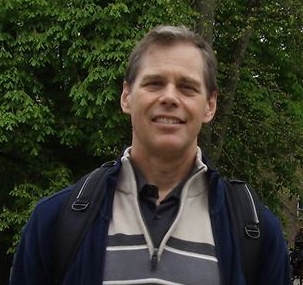
 

Russell Working is the Pushcart Prize-winning author of two collections of short fiction: Resurrectionists, which won the Iowa Short Fiction Award, and The Irish Martyr, winner of the University of Notre Dame’s Sullivan Award. His stories and humor have appeared in publications including The Atlantic Monthly,The Paris Review, TriQuarterly Review, Narrative, and Zoetrope: All-Story.  A writer living in Oak Park, Ill., he spent five years as a reporter at the ChicagoTribune. His byline has appeared in the New York Times, BusinessWeek, theBoston Globe, the Los Angeles Times, the South China Morning Post,the Japan Times, and dozens of other newspapers and magazines around the world.

 .

.

Jan 082016
 

SllimTwigcroppedlomo

.

Slip along the alleyway then down several steps to the basement door. Enter the musicians’ cave in east end Toronto, a well ordered small apartment featuring floor to ceiling shelves of LPs, books, speakers, record player, and an electronic keyboard. Hiccup of time travel; for a moment I feel it’s 1976 and I’m visiting a pal in one of those Vancouver basement apartments we all lived in.

unnamed

index

index2

Except it’s 2015 and Slim Twig (aka Max Turnbull) is very much a man of the day, maybe the hour. We live in an era when time collapses, and musicians freely pluck from the past, present and future.

A record rotates on the turntable, playing something spacey, jazz inflected. The ceiling is low and there is a distinct lack of windows. The faint whiff of incense is familiar. Sandalwood? Max, being tall and slim, just about brushes his head against the ceiling. A small wooden table with a pair of chairs, perfectly scaled for the space,reminds me that he shares this cozy apartment with his wife, musician Meg Remy (aka U.S. Girls) and that she is currently on tour. Max is about to head off for Europe for his own Slim Twig tour, with bandmates Simone Tisshaw-Baril on drums; Anthony Nemit on lead guitar; Carolyn Bezic on bass and vocals (and on last month’s U.S.A. tour, Tim Westberg on vocals and bass) to promote the new album: Thanks for Stickin’ with Twig. I’ve been listening to the record all week, falling into its sonic spell.

Max works with heavy distortion and fuzz, saturated in old-school psychedelia. Why disguise his voice this way? “I’m reticent about singing more plainly,’ he says. ‘Authenticity is not what I’m trying to do.’ He notes that ‘even the Dylan/Neil Young singer/songwriter voice is a projection. Playing yourself is a sort of persona.’ David Bowie, a man who’s been known to switch gears and image frequently, comes up as an influence.

Turnbull has been playing with personae since the beginning of his career, launching himself with a record of his own songs while still a teenager. The ‘Slim Twig’ name appears on that early disk and when I ask if the name, chosen so long ago, has become a burden, he allows that it would have made sense to switch to another name two records back, when his sound matured and changed radically. Reviewers of early records noted rockabilly elements, and indeed, he once wore pointy toed shoes and a pompadour hair stye. The music press can be literal; one can’t help but notice that some writers took Slim Twig to be a neo-rockability artist, which he never was. The gig was always about appropriating elements of genre, mashing styles and sonic impulses, to create something new. You never would have mistaken Twig for Carl Perkins, redux.

If he sported a goatee, he’d look like a young Frank Zappa.

SlimTwig2tunred

When I spoke to him, Max’s fall North American tour had just wound up and he was prepping for a European tour in December. Max had been apprehensive going into American tour, for the usual reasons: would the audiences be dispiritingly small? How would the logistics work? He and his bandmates couch surf or bunk together in motel rooms on the road. ‘But I was on a positivity trip, realizing that I was doing exactly what I want to be doing, playing my own music and performing.’ There was the sense of a ‘direct mission’ in each day: travel/setup/performing. Mind you, the trip wasn’t without stress; en route to the border on the first day, Simone, the drummer, realized she’d scooped up her roommate’s passport by mistake. Turn the van around three hours’ in.

The concern about attracting small crowds is legitimate: Turnbull has attracted a good deal of attention and press in his career (he’s barely 27 years old), and he’s been prolific (half a dozen records of his own and multiple production credits and playing with other bands) yet he admits that ‘because each record is so stylistically different, it’s hard to create a fan base. It feels like with each album I start at square one.’ He confesses to feeling daunted by the prospect of ‘what my life will look like in years to come, how I’ll squeeze out a living.’ He’s frugal in his living habits, and allows that ‘the music is a consolation for that frugality.’ He says this in a straight-forward way, not a hint of whining. He is surrounded by the objects he loves; his family lives a block away in the Bain Co-Op where he was raised; and his cinderblock elementary school sits on its asphalt playground just down the road.

Turnbull composes by finding the ‘cracks between styles, forming a patchwork aesthetic–rather than making something in an established tradition’. He ‘composts’ diverse influences. A voracious consumer of music from the past and present, he allows that he’s a bit of a ‘Dad rocker’ pulling sounds from the 60‘s and 70‘s (Beatles –especially Rubber Soul and Revolver; Frank Zappa; David Bowie). There is a certain wry humour in his tone, because while he may appropriate elements of style from half a century ago, the sound he ends up with is less homage and closer to being newer -than-new, at least to my ears. In the current album, ‘I try to make music that is era ambiguous.’

What about the song on ‘Thanks for Stickin’ With Twig’ featuring a chorus that admonishes: ‘Live in Your Era.’ Kind of a joke, given the fact the song references the past throughout. There’s a meta thing going on in Twig’s music and if the listener is well versed in music of the present and of earlier decades, she’ll have fun recognizing the bits of composted material. I give in to the slowed-down drone voice, the fillips of pop, crashing metal, the parody of stoner state of mind. Which brings me to – what about this ‘stoner’ thing, in songs that embrace fuzz, distortion, repetition, not to mention the verse ‘stoned out of my mind’ ? Not exactly a subtle presentation.

‘I’ve cultivated the image playfully,’ Max insists. ‘I wasn’t involved with stoner culture in my teens, and in my 20’s weed has an impact on how I experience music.’ He aims to ‘create music that takes in that experience without having to smoke’ – by offering a ‘heightened atmosphere.’ ‘I don’t want to be a spokesperson for drug use,’ he hastens to say, ‘but it’s a valuable resource, a certain phrase can be heard in a different mode or perspective. Drugs can be a crutch, but useful.’ This is sounding sort of medicinal. He continues: ‘The poet, James Merrill would write a poem while sober, smoke, and different things would pop up.‘ Later, I look up a Paris Review interview with the eminent poet and discover that he used the Ouija board as a collaborator in his writing. Merrill adds this comment: “I do now and then take a puff of grass, or a crumb of Alice Toklas fudge, when I’ve reached the last drafts of a poem. That’s when you need X-ray eyes to see what you’ve done, and the grass helps. Some nice touches can fall into place.”

What you’ll hear in Twig’s new record, as well as in earlier work, is a fervent impulse towards sonic experimentation. I’m reminded of of the Nihilist Spasm Band, the group of London, Ontario artists who formed a noise band back in the ’60’s, in the way Twig samples and pushes unabashedly into the fringes of what music is, or could be. This is often challenging for the listener. One wouldn’t call Twig a tunesmith, though tunes lurk. On-line reviews approach the music from all angles, some as ranting unbelievers, and others as die-hard fans, eager to go along for the ride. Some writers find his work pretentious and overblown. Max himself confesses to ‘a sense of entitlement in my early 20’s. Now I’m humbled by being a musician trying to earn a living.’ A cranky Pitchfork review of the new album concludes, ‘But in Slim Twig’s incessant and overbearing winks to the camera, he’s lost sight of his own potential.’ Exclaim.ca is more willing to listen with open ears: ‘This gloriously woozy record is era-ambiguous and the sonic equivalent of a contact high.’

Let’s not overdo the stoner aspect; Turnbull is a perfectionist, deep in there with his ten thousand hours of painstaking effort. Being a Leo, ‘I’ve always liked to be the boss and show off. It’s helpful (in this line of work) to have a healthy ego and at the same time be aware of it.’ When he steps on stage ‘I feel I adopt something beyond my everyday personality. It’s supposed to be outrageous and confrontational; you’re expected to go beyond yourself.’ He shrugs. ‘It’s not that hard; I have an aptitude.’ I’ve seen him perform, long limbs thrashing as he takes over the stage, a nod to his rocker predecessors.

In earlier days he held a more ‘antagonistic attitude towards guitar playing,’ being more inclined to electronic experimentation. Now he feels that he can use the traditional setup of guitar/keyboards and drums. ‘ My taste has become less standoffish and punky. I’m old fashioned in that I like to bend convention but still create work that is sturdily made.’

Clickety click, the needle comes to the end of the record and Max reaches to flip it over.

The importance of visuals and video in Twig’s work can be explained by his upbringing. His parents, Ross Turnbull and Jennifer Hazel are writer/filmmakers and this was a family whose life ‘revolved around a constant engagement with culture. They were keen on us experiencing things together as a family unit; they took to parenting in a creative way — my sister (Lulu Hazel Turnbull, age 22) and I are pieces that my mother fostered.’

This is also a family that I’ve known, on and off, for over twenty years. I recall Jennifer telling me that the crew would hunker down in front of the VCR to watch what were clearly ‘adult’ movies, by artists like David Lynch. From the get-go, the kids were plunged into the world of art and film and literature. Max notes that his mother ‘spent the amount of time that a writer might have spent writing, on raising her children.’ He understands the sacrifice. Slim Twig music videos tend to be family affairs, directed by parents, starring Jennifer and LuLu, as well as Max. They are avant garde, tiny movies, complete unto themselves, and don’t reference the music in any literal way. Max has scored a couple of his parents’ feature length movies, and starred as lead actor in Sight Unseen.

When I ask about his acting career, Max is diffident. ‘Acting is a mechanism to make money. I don’t like auditioning and being on set, though I do like working on interesting stuff, like Sight Unseen and Dog Pound (where he played a juvenile inmate). He played Billy Zero in The Tracey Fragments, a film starring Ellen Page.

‘I’m a bit of a late bloomer,’ Max allows, referring to the fact he just left the family nest a year or so ago. ‘Meeting Meg turned my whole world over. I wouldn’t be as advanced in my music if I hadn’t met her. She’s a huge catalyst. And I think that me taking her seriously as an artist has been huge for her. Now she’s successful, signed with a great label, and she’s living the dream of making music and earning a living.’

Sitting knee to knee with this man, I feeling a sort of tenderness that is perhaps inevitable, considering I knew him as a kindergarten kid, then as adolescent. I recall a slightly worried child whose sudden smile broke open the clouds. Heading into the European tour in a few days, Max is getting stressed about the logistics. Where will they stay each night? Will the promoters look after them properly?

And what about plans post-tour? I’m staring at a fat volume of Dylan lyrics propped against the turntable. Maybe a foray into neo-folk? Not exactly. The plan is to record a version of funk music – thinking of Bowie’s ‘plastic soul’ album; white soul, a step sideways from the original ‘authentic’ genre. ‘I want to make music that has a physical impact,’ Twig says. ‘ So much of my music has been cerebral, focused on creating a space and state of mind. With funky drumming, you can put anything on top.’

Time to walk down the hallway and climb the steps to blink into the light of day. Musicians, as we know, are night owls, happiest in their subterranean lairs.

—Ann Ireland

.
Ann Ireland’s most recent novel, The Blue Guitar, was published by Dundurn Press in early 2013. Her first novel, A Certain Mr. Takahashi, won the $50,000 Seal-Bantam First Novel Award and was made into a feature motion picture called The Pianist in 1991. Her second novel, The Instructor, was nominated for the Trillium Award and the Barnes and Noble’s Discover These New Writers Award, and Exile was shortlisted for the Governor-General’s Award and the Rogers/Writers Trust Award. She is a past president of PEN Canada and coordinates Ryerson University’s Chang School of Continuing Education, Writing Workshops department. She lives most of the time in Toronto and part of the time in Mexico.

.
.

Jan 072016
 

Lewis Parker

x

Such has been my lot since childhood. Everyone read signs of non-existent evil traits in my features. But since they were expected to be there, they did make their appearance.
            – Mikhail Lermontov, A Hero of Our Time


It’s a common misconception that men who have relationships on the Internet, with women who’ve just got out of psychiatric units, are creepy. But if there’s one thing I’m not, it’s a creep. Last week, when I helped my aunt Denise carry some videos into the Age Concern shop where she volunteers, she called me a strapping young man. That’s more like it. I’m good at scaring away burglars. If you live in the Hinckley area and you think you’re being burgled, don’t bother with the pigs, give me a call. I’m not in bad shape for twenty eight. Although last week, after urinating through the local paedophile’s letterbox, I was worried that I wouldn’t be able to run away fast enough. I wouldn’t normally give two thoughts to my own safety, but since I’ve started seeing this woman, I’ve started to think, what if I slip on some dog shit and the nonce catches up with me? And he’s with seven or eight of his nonce mates, and they’ve all got iron bars, and they put me in hospital? If I was in a full body cast, I wouldn’t be able to email Christine. That’s the woman I’m seeing. Well, seeing. I’ve hardly seen anything yet.

Whether I’m driving round the country in my lorry, or if I’m lying in bed with the polyrhythmic jive of Rhythm Is a Dancer still in my ears after deejaying at a wedding, all I’ve been able to think about lately is Christine and her knees. I imagine us chugging along, when I point out the window and say, “There’s that new service station I was telling you about.” While she’s not looking I reach across, lift the plate of food and squeeze her knee.

Here’s my latest missive:

Hi Christine,

Thanks for the new batch of snaps. Please keep sending this way. The thought of you missing a meal gets at me like DJs so up themselves they won’t take requests. You know the type. I don’t know who gets more out of these photos of salad — you or me.

The veggie burgers and quiches look like something I would pay good money to eat in a restaurant, even though I am not a vegetarian.

You’re clearly a talented chef. You should consider a career in the catering industry when you’re feeling well enough to look for work. If you need a reference, you know you can count on me. I attended a Hotel Management course at North Warwickshire and Hinckley College. And I used to work in the serving hatch at the Hinckley United football ground until I became the subject of one of the crowd’s bawdy songs.

Attached are some pictures I took of the 3,000 Years of Bread show at the Spittle Rooms on Thursday. The sound was sludgy and some bonehead security guard confiscated my kazoo. When I spoke to him after the show Mitchell from 3KYB said he still hadn’t got round to listening to the mix CD I gave him in Nottingham in February. But he will do very soon, he promised, and if he likes what he hears, there may be a slot coming up as their next tour DJ!

Later alligator.

Shockwave

She could probably be a star on Instagram with her photos, but she shuns fame and sends them to me instead. Last week she sent me photos of a pizza half-eaten on her Saturday-night knees in front of the TV, Yorkshire puddings covered in gravy titled ‘starters!’ (she’s from some northern slum), a box of popcorn balanced on her cinema knees, salads, curries, and lentil dishes I’m not going to pretend I know the names of. In the last few weeks our relationship has segued into a faster tempo — we email at least twice a day — but Christine still hasn’t shown more than the leg her food is rested on, from the bits of her lower thigh where the plate ends to the tip of her kneecap.

If that kneecap’s the tip of an iceberg, I’m the Titanic.

Mum calls me with a yap that’s indistinguishable from that of Cindy, her King Charles spaniel. “Can you hear me?” she yells up at me. “Go and help your father. Give him a hand with the hose pipe.”

The old man’s in his golf waterproofs unravelling the hose. I shut my curtains. Dark world in here. It’s my own party palace, Club Stig, and it’s always me on tunes. Requests on the hour, every hour. Shockwave in the house, your resident selector. Chock-a-block with club bangers and classic rock.

“Michael, help your father.”

She’s listening to the songs of Queen on the pan pipes. In the past I’ve got my own back on her by burning Ibiza compilations onto blank discs and swapping them for that guff she buys from the Body Shop. I turn up my 90s Megamix, but her screams come through the carpet, so I yell back down, “Shut up, you stupid bitch.”

She tries to get my attention from outside the door. Something about the noise, the smoke machine, the electric bill, and how she won’t be spoken to in her house. Who will be spoken to like that in her house, then? I certainly will not.

When she’s done yapping I breeze through the semi-detached and jump into my Vauxhall Astra. She follows me out to the front garden and does her standard irrational-woman impression. When I was a kid, they’d come from as far as Barwell and Earl Shilton to see her raving on the front lawn. On summer nights there would be fifteen to twenty kids from the neighbouring villages sitting on the grass bank by the bypass at six o’clock, when word had got round that she called me in from play. First she’d stand on the front step and scream, then she’d come out wearing her fluffy slippers and dressing gown that was too short, so it showed her legs all white and plucked. When she dragged me in, the kids would cheer my name. She always used to call me an imbecile for watching WWF wrestling, but she was the one who’d copy the wrestlers when she pointed at the kids and screamed, “You shut up.”  Then they’d cheer as the door slammed behind me and I could still hear them while I was having my arse smacked. I give her the finger through the sunroof as I drive out the cul-de-sac and onto the A47.

It’s a five-minute drive to Halford’s at the Greenfields retail park, but I can get there in three. I park in the staff car park and lock my car with a flick of the wrist as I’m going through the sliding doors. I turn around and point to the back of my jacket with my thumbs. It says my DJ name, Shockwave, in white iron-on letters.

“Security to the front desk. Security to the front desk.”

Halfords is one of the last true friends of the car and haulage hustler. A petrolhead can browse the equipment with a sense of religious belonging, walking up and down the aisles, amazing novices with his scholarship of true bass speakers, exterior protectors, body styling, tints and strips, door-lock pins, exhaust trims. As the expert among the experts, I can enthuse about air horns, high-intensity discharge lights, badges and graphics, stickers and stripes. Often I’m called upon to intervene in a situation of tense customer relations drama, when Nigel — an expert in hi-viz clothing and the uses of WD40 but not much else — is out of his depth trying to assist with an engine-based query. If Maureen the security guard is unable to deal with inappropriate customer behaviour or slacking among the staff, I’ve been known to intervene.

“He’s about six foot tall, looks like a big jelly baby, and he’s got Shockwave printed on the back of his jacket.”

Nigel turns off the microphone but won’t make eye contact. “You’d better leave.”

“You talking to me?”

“You’re barred.”

“Why?”

“Calling a customer a nonce.”

“Is it because you’re a nonce?”

“No.”

“Is it because you’re a nonce, though?”

“No.”

“You’re a bit of a nonce yourself, aren’t you?”

“Security to the front desk.”

There’s a woman looking lost among the chamois leathers and polishes. In my Marks and Spencer’s jeans and boat shoes, I feel like Jeremy Clarkson on the deck of an aircraft carrier striding towards a lonely female mechanic. In slow motion, with Meat Loaf on the soundtrack.

“Hello, madam.”

“Hullo.”

“Shockwave.” I pause and let her take that in. “I help out round here.”

“Do you work here?”

“Looking for anything in particular?”

“My husband sent me out to get some wax.”

My hands are on my hips, and I’m shaking my head at a man delegating such a sensitive matter. I breathe out and make a hissing sound. “You’ve been stood there about ten minutes and nobody’s bothered to help.”

While I’m recommending the Armor All Shield Wax, Maureen the security guard — Slow Mo, as I call her — emerges from the end of the Car Styling aisle. Six months ago, I would have stayed and fought, but with Christine in the picture, it’s not worth it. I tell the woman I’m off to scout for new Top Gear locations along the Earl Shilton bypass. I palm her my business card.

SHOCKWAVE

DJ. Lorry driver. Vigilante.

Hinckley and Nuneaton area.

Call to arrange a DJ set, parcel delivery or security solution.

In the McDonald’s drive-thru I do some maintenance work in the rear-view mirror while waiting for my meal. My server is Jill, who I know without looking at her badge is a two-star employee. Franklin, my mate who worked here before throwing himself onto the M1 at Leicester Forest East, managed two stars before his tragic demise. If Jill doesn’t hurry up I may have to give her the benefit of my opinion.

“I could have bought a herd of cows and slaughtered them myself at this rate.”

“Pardon?”

“Ketchup and a straw please, Jill.”

“Can you turn your music down?”

“Loud?” I turn it up to eleven. The bass from DJ Luck and MC Neat almost knocks her off her feet. “That’s loud.” I point to the napkins and hold out my paper bag, having already started grabbing at the chips and eating them. “Shove them in there.”

I pull into my usual bay outside the Fitness First where I’m a member. While I’m eating my Extra Value Meal, I give my brother Marty a ding. He used to be in a rock band that were pretty big in the Hinckley and Nuneaton area. You might have heard of Bearded Woman. They played on one of the small stages at the Summer Sundae festival in Leicester. He had a job working for a video games manufacturer near Ashby, but now he’s the CEO of his own dating agency in Nottingham, catering to goths and rockers. The other day, when I was sprinting down Castle Street and I thought the area’s top nonce Geoff Doyle had called the five-o, I had no choice but to call Marty and tell him about Christine, so he could let her know in case something happened to me. But he’s not picking up. He’s probably on the driving range, warming up for his golf game with the old man.

While I’m sitting there, I get a new email from Christine. The subject is ‘Saturday brunch,’ and it’s a picture of a poached egg with hollandaise sauce on an English muffin. It’s balanced, as usual, on her knees. She’s wearing blue jeans, baggy and faded, the kind of thing I could imagine her wearing if we went to B&Q to get the materials for our deluxe soundproof shed.

I reply with a link to Chris’s Mix 19. It starts with the Artful Dodger featuring Craig David’s classic Re-Rewind from 1999, with me freestyling over it. This goes out to the coolest girl in the world, Christine. Helping you get over your problems. Don’t let the people take you away again. Here’s to your food diary. Eat, eat, eat and rewind. Eat a bit more. All those lovely cakes. Chocolate, biscuits, all them goodies, mmm. Don’t be scared. You’re not fat. You’re a beautiful woman. You can do it, baby. Shockwave’s behind you.

She replies with an emoji — two thumbs up.

Back at the house, Dad’s Rover 75 is gone from the driveway, so I’ve got the place to myself. I crank up another Megamix, but when Cindy keeps yapping outside my door and messes with my levels, I flip her a sedative. Ten minutes later she’s stiff as cardboard. I pick her up, tickle her belly, check if she’s still breathing then get back to the ol’ Messenger.

Yo, C. That muffin looks nice. Ever had them with bacon, sausage and brown sauce?

Yep had bacon and sausage but not for ages and never on a muffin, it’s so good, the hollandaise sauce, you can make it yourself, ever so easy.

We could make them together you know.

Listening to megamix 19 now, probs the best one yet!

What’s your favourite track?

They’re all good but if I had to choose, apart from your dedication (<3) track 14.

Boom! Boom! Boom! Boom! I want you in my room. We’ll spend the night together. Together in my…! Good choice. I listen to it when I’m stressed. That and Robbie Williams, Strong. You have to be strong, Chris. I know you think I live the life of Riley, always touring – stopping off at Road Chefs and playing the frooties when I feel like it, having two bags of chips at two consecutive road stops, doing what I like with my banging community of haulage hustlers – but the party palace is driving me up the wall. After I’d been up all night having it large, I only went and flipped DJ Slimy Fingers (my housemate)’s dog a sedative. Think I might have killed her. He’s in with some pretty unsavoury characters, so I need to lie low for awhile…

A few minutes pass. I consider sending her another message to check if she received my previous message. Patience, the wheel. While I wait for her to get back to me, I drop my jeans round my ankles and scroll through my Christine album to the chocolate fudge cake.

This has been approved by the lady herself. After we’d started messaging one another on the HAVOCA forum and she started emailing me her food photos, I told her snaps made the blood rush to my cock. She asked if it was her or the food that got me going. I told her it was the whole thing. She replied in seconds and said, are you feeling horny now, Shockwave, and I said yes. She asked if the photos made me want to touch myself. I said, if I did it right now, would you mind? If you say no, I promise I won’t. I’d never do it without your permission. She said no, I don’t mind. I asked if she wanted to see me do it, and she said yes.

I turned on my webcam.

Just as I get going, I hear Mum’s shrill voice. It could wilt a daffodil. I button my jeans and peek out the door, where Cindy’s in deathly repose. Mum’s coming up the stairs, moaning about the state of the bins. I wish I’d spiked her, but I don’t have access to chemicals that strong. When she finds Cindy, she screams, kicks my door, calls me the son of Satan, tells me to come out. Then she says if I come out, she’s going to murder me. Dad tries to pull her away from the door and says in his limpid hush that wouldn’t stop a kitten, “Cath, don’t be hysterical. There’s an emergency vet in Leicester.”

“She’s dead, Martin. That useless oaf’s killed her. I gave birth to a dog murderer. I should have asked for an exorcist, not a midwife. He never lifts a finger. He does nothing with his life but gawp at his computer and batters his brain with that music. When he does do something, it’s this. This. This!”

The usual.

When I’ve bundled socks, pants, changes of shirt and The World According To Clarkson in a holdall, I wait for her to scream herself out. Then I open my door and creep across the landing. So long, cruel house, with your menopausal wallpaper. I stop at the top of the stairs and listen to her psychotic breathing. The old man’s knelt by the witch’s chair, holding her arm, trying to stop her from going apeshit again. Dead Cindy’s in her lap. My foot presses onto the first stair. It creaks. Bleeding cheapo houses knocked out of plywood.

“Martin, he’s moving.” Shuffle of bunions. “I’ll disembowel him.”

I bustle downstairs. Lashes of mad hair rage from the living room. Piercing scream, arms spinning. I shield myself with the holdall, clocking a couple of blows over the bag, then a dig to the ribs and a kick from her rapier toenails. I shove-kick her backwards into Dad’s arms then pull the door towards me, jump out and pull it shut when I’m outside, locking her in. Rabid witch squashed against the frosted window. I leg it out to my car in the cul-de-sac, shoeless gravel feet, ow, ow. I’m reversing when the mad woman bursts out in a pale craze. Revving out of the second point of the turn, she collides with my back window, grabs at the locked door, snags the aerial, fingers scrape the roof. I release the clutch, down the juice. Trusty impeller spins in my turbocharger and I surge forwards. She’s thrown off and I feel ten tonnes lighter.

I stop at the entrance to the A47. It’s Saturday evening. Headlights scream across the pub-brawl night. Halfords shut at five. Besides, I’m barred. Will have to find another branch — Nuneaton or Coventry. Maybe they’re open later. Check the web on my phone: nope. Macca D’s? Twice in one day — no way, Jose. Pint down the Mill on the Soar. It’s a ten-minute drive but I can do it in seven. Not the local exactly, just a cosy hotel-restaurant on the way to Broughton, but I dip in for a pint every now and then. Familiar sights, tinkling lights, few frooties to boot.

I sit on a sofa with my Abbot ale, browsing the Halfords catalogue. Leaf through the Car Entertainment and Technology section. Christine’s still not online.

In the mental space to appreciate the Mill’s renovations, I plonk my pint on the coffee table and wiggle my toes underneath. Roadside pubs are my favourite. You wonder how a premises licensed to serve alcohol would stay afloat if you have to drive to it, but you forget how popular they are among the hidden elite: travelling middle managers, assistant headteachers and regional historians. Ukip and Tory voters mostly, the quiet majority, my type of people. I tell the couple of hotel guests from out of town, wearing their Marks and Spencer’s casuals, bonding over scampi, that it may not look very lively for a Friday evening, but you get a lot of people from Lutterworth coming here on their way to Hinckley, usually around lunchtime. They don’t understand the significance. Two towns not far enough apart to warrant a road stop? Such places thrive for one reason, I tell them. No, not even the convenience. It’s the glamour of anonymity.

I check my phone to see if Christine’s online. Still nothing.

When I’m done with my pint, I head back to the car, pull the breathalyser out of the glove compartment and blow a 0.42. I’m under the limit. While I’m sitting shoeless in the driving seat, Christine’s name flashes on my phone. She says she received my previous message. I tell her how everything kicked off at home while I had entered the Club Stig’s action area. She asks me where I am. Do I want to carry on? I tell her she read my mind. Let me reverse into a better spot — lucky, the carpark’s almost empty.

It started in my room, but if I get a message from her and I’m in a truck stop late at night, I’ll pull over and do it wherever I am. Lay-bys, service station toilets, in my car with the lights off. If I’m kipping over, I’ll set up on my lorry’s cot bed, where there’s a Bugatti Veyron poster and a cord light. I don’t get caught. I’m not trying to get caught either. I’m not a creep. The power in this thing is dangerous enough. I normally have one of Christine’s photos on the screen, maximised. Cake, polenta, salad, luring me through vectors. Like a lush rainforest through vinyl drapes. I look at the knees and the plate of food and think of her finger clicking the button on top of the camera, how it makes me feel a sudden jump. Sometimes, I turn Christine off. She doesn’t know, but I turn off the screen and whack myself off into the black void.

The phone’s in its cradle by the gear stick with the sound and video broadcasting. There’s light from the advertising board on the side of the pub. I scroll to the most recent batch of photos with my left hand, half an eye on the rear-view mirror in case somebody pulls in. On the 4.5-inch Samsung screen is a high-resolution photo of Christine’s chocolate cake, a dangling square orb. I swipe across — next — and it’s the spinach and ricotta parcel. Next. Banana in a bowl of custard. Next. Eggs benedict. Next, next, next.

In my mind, Christine’s cheering me on. I’m her sacrifice, cold as ice, yet hotter than burning rubber. I play music — a Megamix. I get in the zone and the boogie snake takes over. Christine, this goes out to you.

I make sure everything’s folded into the mansize Kleenex — I like how they call them ‘mansize’ when everybody knows what they really mean — and wrap it in a Tesco bag that I keep under the seat. This one’s full, so I tie it in a knot, get out the car and look for a bin. There’s not one outside, so I strut back into the Mill and ask one of the waitresses if they’d mind disposing of some tour debris. I fake a sneeze, wipe my nose with my finger and say, “It isn’t half dusty in there.” I swing the Tesco bag in her direction, but she backs away and says there’s a bin by the entrance to the hotel. While I’m there, I book a room for the night, and the manager gives me a key to a double room. I go back to the car and tell Christine that my Club Stig housemates are doing my head in — I dangle the keys in front of the camera — so I’ve moved into a hotel. It’s a hustler’s hangout, nobody would ask questions.

There’s a Wetherspoons breakfast at the foot of every mountain in life, I’ve told her before. We could stay a night here, a night there, whichever part of the country I’m called to. She can ride shotgun, take lunch on her knees on the seat next to me. We’ll jump on the beds of every motorway Travelodge, fill up on pancakes at every Wimpy and make the most of Pizza Hut lunch buffets. We can make mad orders: try limited-edition frappucinos, fill the salad bowl so high that the lid has to be squashed down, stack up on glossy weeklies, go wild on CD compilations. I’ll cover the bill.

She replies:

why don’t u come here?

I tell her, only if you insist. I don’t want to harm your recovery. Before I can tell her that I only have her best interests at heart, she says that we’ve been building up to this, haven’t we? All this time? Now I’m ready. I wonder when she decided this, and think to ask, but fear that I will put doubt in her mind. She clearly wouldn’t take such a decision lightly, being the kind of person whose mistakes cost her years.

No, I mean it, you can come here. I didn’t want to plan it else I thought I’d get scared and back out. Are you ready?

I’m ready, I tell her.

You’re not backing out now are you? You’ll come for me tonight?

Are you alone? I ask.

Not tonight I won’t be, not with you here.

Alright, text me your address. I’d put it in the sat-nav but I left it behind. Don’t worry, I know my way round.

I turn the key in the ignition and ram into reverse. I don’t bother to stop and look both ways at the entrance to the B4114, but feed the wheel through smooth hands, no crossing, booting through second, over-running third until I hit sixty.

A star in a reasonably priced car. Power.

All roads lead north. Sheffield to be exact, straight up the M1. I turn back on myself and within three minutes I’m on the motorway, throbbing with a pulse deep inside me. Past the bridge at Leicester Forest East, I feel the little bump in the road where Franklin’s bellyflop dented the concrete and had to be re-laid.

Now I live for the moments between departure and arrival. I don’t hear the Megamix so much as live inside it. Its beats are an interior rhythm that have been coded into my spinal cord, like some highly advanced vertebrate that evolved with its own soundtrack. The camera pans alongside me, flown by a helicopter traversing flat fields that occur only as a blur. I can’t help but think that I’m racing against Clarkson, James May and Richard ‘the Hamster’ Hammond in a romantic Top Gear challenge. They may have been kitted out with faster cars and TomToms, but this circuit can only be navigated by the satellite of love.

The Satellite of Love Dab Hands 2004 Retouch Mix comes on as the sign for Yorkshire appears, and it’s like I’ve been compiling a giant showreel in my mind. My life is taking shape. I want to chuck myself about in this perfect moment — bounce along to a 4/4 beat with pint in hand, surrounded by all the lads wearing short sleeves in nippy weather — but I mustn’t take my hands off the wheel. Stare ahead and let your right foot do the work, Shockwave.

I turn off the motorway and prepare for a moment that has already happened. It’s been storyboarded and timelined. Memories of me arriving to rescue Christine were rigged up ages ago. This is just the editing phase, and it’s happening while we’re still in production, but nothing can go wrong, as it’s already happened. The soundtrack has already been mixed. Glitches like forgetting to pack my shoes and sat-nav were written into the script, to make the challenge seem more believable and exciting. I am delivering my life to Christine. DJ sets and security solutions come as standard.

I’ll have no problem finding her address. I have to ask a couple of lairy youths hanging around suspiciously outside Bramall Lane football ground, but I know they’ll give me the wrong directions on purpose, so as I drive away, I crack a joke about how poor everybody is up north, then go the opposite way along the foggy backstreets of Ecclesall Road, where I find the perfect parking space right outside Christine’s front door.

I spend five minutes buffing my exterior. I’m a bit blotchy, but that’s good, it was my plan not to turn up looking like David Beckham, as it would be inauthentic after a challenge. I look at the front door and remind myself how to react when it opens. My entrance is inspired by ‘Dr.’ Neil Fox from the Magic FM breakfast show, when he cruised into Hinckley Asda to snip a ribbon for Loros. But if Dr. Fox is a morning coffee fix, bouncing eyes and treble voiced, Shockwave smiles with his eyes but not in a demented way. He’s cool and relaxed, he’s smooth and sensual, he’s drive-time.

There’s a bright bulb behind Christine’s beige muslin, the drape of choice for students and benefits claimants. The curtain’s about to go up. It’s nearly two hours since I told her I’d be there in two hours. One more look at the time. This is it then.

I get out the car door and — shit the bed — my foot crunches onto a sharp tin can. The rim digs into the arch of my foot and my big toe gets stuck in the hole. I hold onto the car roof for balance and try to dislodge the twisted metal while hopping on glass from the vandalised bus stop. I tug myself out eventually, pulling about half the skin on my big toe with it. I can feel blood from the graze soaking my right sock and glass shards digging into the left sole. But I don’t limp, because I’m hard.

I lock the car. The waist-high gate that needs a lick of paint creaks as I push through and walk up the three yards of slabs. Looking through the frosted glass windows in the door, I can see a couple of bicycles leaning in the hall. Christine hasn’t mentioned that she’s a cyclist. Maybe they belong to her housemates. I won’t hold it against them unless I find out they’re militant cyclists with cameras on their helmets.

It’s about dinner time. We’ll either share our first meal together here or at a Harvester I saw before the turning. It will be on me, of course. From now on, everything will always be on me.

I rap the door in a 4/4 beat. Knock, knock, knock, knock. I wanted you in my — life. A shape moves towards me, dark-haired and tall. The door opens and it’s a young bloke with bad skin and hair artificially straightened into a fringe, holding a can of Red Bull. He looks like somebody who pisses on the toilet seat.

“Is Christine in?”

“Who’s asking?”

“She’s expecting me.”

“You’d better come in then.”

When I’m inside I notice there’s a condom on my toe. Wet and greasy — it’s used — flapping on the dirty laminate floor like some sordid flipper. I flick it off under the bike wheel as I edge past the lad, muttering something about an itch. He closes the door behind us.

“Through there, on the left.”

A lad in his early twenties in a baseball cap, standing in the middle of the living room, points a video camera at me. “Are you Michael, otherwise known as Shockwave?”

On the sofa two lads in trackie bottoms watch a laptop connected to the camera. They’re the kind of people I’ve spent my life crossing the road to avoid — spotty and sniggering beneath Nike caps. I turn to leave, but the one who let me in shuts the living-room door behind him and leans back against it. I hope if I say that I’ve got the wrong address, I can give Christine a call and get her to meet me on neutral ground, because I don’t like her housemates.

“I think I’ve got the wrong house.”

He holds the condom between his fingers and dangles it for the others to see. “Is this yours, mate?”

The others laugh.

“It got stuck to my foot by accident. Have you got a bin? I’ll put it in the bin for you.” I go to take it off him, but as I do, he pulls a cricket bat from behind the armchair. I retreat to the back of the small, undecorated room, and the cameraman dances around me. I can see my own face on the laptop screen, scared and red, wobbling with the shake of the cameraman’s hand as he searches for the right close-up. While I’m looking at the screen, rapid goo slaps me in the face, stinging my eye. I peel the condom off my face and drop it in the disused fireplace where I’m standing.

As they laugh, the cameraman and the guard rush to confer with the two producers on the sofa. They watch replays of the condom striking me. They laugh again, louder, then play it again, asking for close-ups and pauses. “That’s it. Can you get a screen grab of the moment it hits him?”

They giggle at every bit of my humiliation.

“A second later, when it’s in his fingers, and he’s peeling it away, but we can still see his face. That’s the one.”

I rush to the door, but the guard jumps back into position and holds the bat over his shoulder, ready to swing.

“There must be a mix up,” I say again. “I’ve got the wrong house.”

“Shockwave, stop saying you’ve got the wrong house, mate.” The cameraman turns back to me. “What are you doing here? Do you know who we are?”

“Christine told me to come over. She texted me two hours ago. I can show you my phone. Are you her housemates?”

“How do you know Christine?”

“I don’t want to be filmed. Could you stop filming please?”

“He doesn’t like being filmed.” They laugh.

“Turn it off me. Turn it off now.” I palm the camera as it comes towards me, but the guard springs towards me with the bat above his head. I back myself into the corner with my arms raised, but the guard tells me to drop them else he’ll break them. I lower them slowly and he backs off.

“What’ll you do, Shockwave? Get your knob out and have a wank?”

“What you on about?”

“All that stuff you’ve done, it’s not going away.”

“What stuff? I’m here to see Christine, that’s all. If she’s not here, let me out.”

I move my hands towards the window, but one of the producers tells me in a bored voice that it’s locked. I believe him. I believe they were expecting somebody, but not me. They’ve got the wrong idea about who I am, what my life has been, and what my motives are. “Who are you? What do you want?”

But all they do is laugh.

“He’s clearly never heard of us,” the bored producer says.

“Right shame,” the cameraman says. “Because we know all about him.”

When I get out the car for real, I hope my nightmare is locked safely in the boot, where it will die in a head-on crash with reality. My foot lands safely on the can-free road. No used johnnies on my toe this time. The door puffs shut behind me. I resist the temptation to whistle I’m Coming Out by Diana Ross as I go through the gate and towards the terraced house where my future has been incubating. I push my nose up close to the frosted glass: can’t see any bikes in the hallway — a good omen. Just a milky glow from the kitchen, where I can only hope that Christine’s making a brew. I can’t stand here all night deliberating what to do, though, because I can feel the Red Bull surging through me and there’s no toilet near. Worst comes to the worst, I’ve got a baseball bat in the car. I could go and fetch it but that’s not really the look I’m going for. I flick my hand towards the door and then pull it away. I consider dropping a note through the letter box and asking her to meet me in the car, but that’s a bit creepy as well, like I’m trying to get her to go dogging, when that’s exactly the kind of thing I won’t stand for.

I give the door two gentle raps then two harder ones. The light in the hallway comes on. Somebody in a white sleeveless top with long hair, a bit shorter than me, a human female in jeans crumpled over the knees is coming to open the door. The window frosting distorts, but I’m pretty sure I recognise those knees. Now she’s too close, I can’t see down as far as the knees. I should probably step away from the glass so she doesn’t think I’m a window licker. Here she comes. The door swings open. Whatever happens now, Shockwave, you’ll have to freestyle.

—Lewis Parker

x
Lewis Parker is a writer of fiction, poetry and journalism who is trying to get out of London. A hand-typed book of his poems, Suicide Notes, collects the best things he’s written while working as an écrivain public in the streets and at festivals during the last year. His prose has been in the Guardian, New Statesman, Dazed & Confused and Minor Literature[s], and he has taught at Kingston University in England.

x
x

Jan 062016
 

George Fetherling

.

Travel

Back there our cheeks were
gouged by tears that rinsed our face of knowing.
Eyes weak from pleading, ears grown deaf to sirens,
earth overrun with data while here
the sky is full of context and clouds
provide perspective.

We had to go when things got skewed.
Gin was all we had for washing.
We cleaned our teeth with ashes
but the ashes being yours were sweet.

This is not departure but refusal to remain
not a leaving but an uncoming.

Best keep unread what was printed.
What the recto said to the verso is no one else’s business.
Write it down and salt it well.
The proverbs lack the verbs they chaperone.

We’re heading for that line beyond which
there is no more statute only case law
whenever events break one way and not another.

Ours is a haphazard journey to places
more random than I’m making them sound.

We’ll travel till the country runs out of space
and all the witnesses have died.

This sensation of movement gives me
a dangerous confidence that stretches
noon all the way to midnight and unsolves old crimes.

History neatly tucked away, the splatter patterns
and the long trail of debris.

Stage fright? don’t be silly. The audience
is afraid of me.

J’ai grandi en pleine cambrousse but no more
defiant acts of belonging.

I know a man who deals in second-hand names
and works both sides of the river.

The morgue is decorated for halloween.

Give me a number where I can reach you.

.

Reply to Closing Arguments

Your dreams were far more grotesque than mine and they came true.

You took the world by subterfuge thinking your insults would
protect you from the vulnerabilities you lack.
All the while you professed a new approach to nightmare abatement.
But don’t some problems heal themselves if we refrain from taunting?
This is a yes or no question Your Honour.
I hope the court will instruct the plaintiff to choose one or the other.

Was progress a requirement when you stepped onstage,
perpetuating stereotypes of those old twin lusts: to live the
embassy life but also despair of it?

My sorrow in this matter runs the risk of infection.

You can’t address this as you did those partnerships annulled
in flashes of ceremony in distant jurisdictions
where the streets are forever leafy and the sun luminous
once springtime returns to the Liberated Zone.

.

The File Clerk

You update the files with facts you forget
have already been inserted.

The less life remaining, the less patience too
yet the greater your urgency to classify
and betray.

To claim the reward is not reward enough.

It’s all about time, isn’t it?
Another block of days crossed off the calendar
as the user fees nickel-and-dime us to death.

.

Sunrise

This morning I met a one-armed priest who spread his motto selflessly
and lost an argument with the security cameras down by
the meditation pond.

That first sunrise scarred me for life with its fake urges
and level-one secrets and claims that can’t be verified
even now.

I’ve never forgotten the promise of relief implicit in the dusk
though the trees looked a bit uncertain.
What I mistook for thunder was simply the transit
of day to night that left confusion in the space between.

I can sense when one phase is ending, but who knows what happens next?
Events have numbed us. Ambiguity everywhere.
We, all of us, depart the centre for our separate corners.-
Hijinks, mild explosives, blacked-out trains feeling their way
cross-country in the dark.

—George Fetherling

.

George Fetherling is a poet, novelist and cultural commentator. He has published 50 books of poetry, fiction, criticism, history and biography. Some of the more recent are The Sylvia Hotel Poems, the novel Walt Whitman’s Secret and a revised 20th anniversary edition of the memoir Travels by Night. He lives in Toronto and Vancouver. Xtra described him as “something of a national literary treasure” and the Toronto Star called him a “legendary” figure in Canadian writing.

.
.
Jan 052016
 

PouringColonyIntoHivePouring the colony into the hive.

Where the bee sucks, there suck I.
Shakespeare


When I was a girl, I kept company with bees. Our house stood on an old orchard that had been subdivided into urban lots; our backyard was thick with grapefruit trees. The trunks were painted bright white to keep them from getting sunburnt. I’d often take a book and climb into a tree –the branches were smooth and sturdy– and spend hours there. Cicadas hummed and left their shed exoskeletons on the bark, bees crowded the blossoms. The bees also tried to drink from our swimming pool. Mostly they drowned, though when I saw one flailing there, I’d cup my palm and scoop her up. I’d softly blow on her wet wings. She’d fly away.

Taccuino_Sanitatis,_CasanatenseFrom Taccuino Sanitatis, Casanatense—a medieval health handbook.

The bees –along with camping trips, Indian rodeos, swimming, stargazing, cartwheeling, reading, my family and my dog– were part of my ecosystem. I can’t imagine my girlhood without them. I have always loved the taste of honey.

Bees are messengers, intermediaries between the sun and earth, gods and people, life and death. The message bees carry is holy.

That which is not good for the bee-hive cannot be good for the bees.
Marcus Aurelius

Three years ago I set up some hives in my island backyard.

My young son and I were excited when the first colonies arrived. I’d ordered Italians; they came in the mail. Apis mellifera linguistica are the most popular honey bee in the States, known for their affability, their flamboyant honey production, their prodigious breeding. They are also bad housekeepers, improvident, and succumb easily to the cold.

We put on our veils, then poured the bees out from their boxes into the waiting hives.

The hive is shelter, food storage, nursery, palace, and fortress for bees. Wax is secreted from glands in the worker bees’ abdomens. The hexagonal cells of the comb are filled in organized fashion with pollen, honey, eggs and brood. Wild and feral honey bees will find a cave, an eaves, a hole in a wall, any protected enclosure in which to build their comb. After mating, the queen leaves the hive only if there’s an emergency or housing crunch.

Evidence suggests that people have been gathering honey from wild bees for about 15,000 years, and started domesticating bees about 9,000 years ago. Beehive hairdos take their shape from the skep, a hive often woven from straw. Clay pots, mud tubes, tree hollows, and a variety of wooden boxes have all been used by beekeepers as hives. The disadvantage of many traditional hives is that they don’t allow for inspection, manipulation, or easy extraction of honey. Often, all the comb is destroyed when honey is collected.

LangstrothHivesLangstroth Hives

I use hives that are the industry standard in the North America. Langstroth hives are rectangular wooden bodies that can be stacked. They have neither top nor bottom. Inside, removable frames hang like file folders. Bees will build their comb onto the frames. The bottom boxes are used for brood and pollen. On top are stacked honey supers– shallower bodies also filled with frames. Shallower, because honey is heavy. You put a cover, usually clad in metal for weather protection, on top of it all.

Although a fossilized honey bee, apis neartica, was found in Nevada, honey bees, as we know them, are not native to the Americas. The first colony of apis mellifera likely arrived –along with chickens, Christianity, flintlocks, liquor, and smallpox– with seventeenth-century English settlers in Virginia.

These days, I live on traditional Coast Salish land, and daily drive through a reservation. I have been reminded how in many indigenous traditions, the human self is simply part of nature, there is no neat divorce of soul from body from place. We don’t hold dominion over the fish of the sea, and the fowl of the air, and every living thing that moveth upon the earth. Rather, we are all profoundly and mysteriously connected.

Something the bees have always known.

Thy lips, O my spouse, drop as the honeycomb:
honey and milk are under thy tongue

Song of Solomon 4:11

A virgin queen will loosen her girdle only once. She’ll fly up to the Drone Congregation Area and sleep around, stuffing her spermatheca –a kind of purse she always carries. This one very good time will provide her with all the sperm she’ll ever need to fertilize the millions of eggs she will lay. A strong queen can live for a few years. By contrast, a drone has a brief, if pampered, life. All he does is hang out, eat honey that the female workers have made, and wait for a queen to knock up. His reproductive organ is torn from his body as he mates, then his dead body falls from the sky.

IMG_6640 - Version 2A marked queen.

The worker bees have different jobs, there are foragers, defenders, nurses, honeymakers, janitors, undertakers. All of them sing and dance. The constant humming. A complex choreography. A worker waggling her behind, kicking up her heels, turning in figure 8s, is telling her sisters where the nectar is. The waggle dance –official name– is complemented by the tremble dance and the grooming dance.

Singing, dancing girls. Muses. Nymphs.

The nymphs of Artemis were often called Melissae, which means honey bee. Bee larvae, to this day, are called nymphs. The woman who cared for the infant Zeus, fed him goat’s milk and honey, was named Melissa, as was the priestess who refused to reveal divine secrets and who, for her discretion, was ripped to bits by an angry mob. Her dead body gave birth to bees.The woman who was the oracle at Delphi, the woman who gave voice to the Artemis’ twin, the god Apollo, was called the Delphic bee.

The Greeks were great beekeepers, likely having learned from the Minoans, who worshipped the insects. The Minoans held the bull to be a sacred beast, and believed that bees were born from the carcass of a bull. Bees –golden– are symbols of the sun; the Egyptian sun god Ra wept bees for tears. Bulls –crescent horned– are yoked by association to the moon. Artemis was a moon goddess, as well as that of the hunt and wild animals, of virginity and childbirth.

BeeGoddess@RhodesGold plaques embossed with winged bee goddesses, found at
Camiros Rhodes, dated to 7th century BCE.

There is a statue of Artemis at Ephesus in which she is covered with strange protrusions. Some believe the bumps to be eggs, or breasts, or bull testicles, all symbols of fertility. Some, espe-cially when learning that the statue is a re-creation of an earlier wooden one which was decorated with honey-resonant amber drops, see the shape of bees about to emerge, fully grown, from their cells. Artemis was the Greek’s syncretic version of an older, Bronze Age goddess. An earth goddess. When you start to scratch around motherhood and fertility, bees swarm.

Artemis@EphesusArtemis, the goddess of the wilderness,
the hunt and wild animals, and fertility.

Life, death, sun, moon. The bees.

It was easy to love them.

Nine bean-rows will I have there, a hive for the honey bee,
And live alone in the bee-loud glade.
William Butler Yeats, The Lake Isle of Innisfree

I filled troughs with sugar water to feed them. I watched them. I listened to them: bees hum high and fast when they’re angry or scared, sweet and low when they’re feeling good. A man at a dinner party told me about his business, a clinic that administers tiny shocks to the brain. Gentle waves pulsing into a cortex would wash away anxiety, depression, and any number of neurological ailments. Everything is frequency, he said.

I sang to my bees. It calmed me, and perhaps them, too. After the first few inspections, I shed my clunky veil and gloves. It was easier to work bare-handed, bare-headed, easier to remove frames from the hive to see if the queen was laying eggs, if the foragers were gathering pollen, if workers were building comb. The bees were docile. The workers don’t want to sting; they die when they do. Like a drone losing his prick in coitus, a worker sacrifices her barbed stinger, and thus her abdomen, when she attacks. Sometimes a bee would get caught in my hair; if I didn’t freak, she didn’t sting.

Common wisdom is that bees will pick up on fear, anger or agitation, and that’s when they’ll attack. It made me almost giddy to be so unafraid, because I am afraid of so much else. My husband dislikes the bees, he is afraid of them. The reversal in our roles was pleasing.

Beekeepers live long, is the claim. Is it from their equanimity, or from the numerous stings they sustain? My grandmother would sit in a beeline and get herself stung; she swore by this as a cure for arthritis. Raw honey is said to help with allergies to pollen. You can buy royal jelly at a health food store. Science does not yet uphold the claims of apitherapy, but folk traditions around the world do.

That first year, I started with two hives. One colony outgrew their living quarters, so they made a new queen. The new queen stayed in the hive with half the workers, and the old queen took the other half and swarmed, went looking for a new home.

When bees swarm, they are vagabonding. They have no hive, no brood to protect. They have just gorged themselves on honey, and so are plump and pleasantly drunk.

SwarmSwarm.

The swarm – tens of thousands of bees– was a droopy fruit hanging from a low branch of an alder; the queen –critical seed– was in the middle. I lopped the branch, gave it a quick shake into a bucket and the bees tumbled down inside. I poured the swarm, thick and gold, into the hive box. Home now, girls. Settle down, lay in stores for the winter. Breed. A queen’s work is never done.

Three thriving hives were mine.

I have a little neck, so it will be the work of a moment.
Anne Boleyn, to her executioner

You get used to dead bees. Every time I filled the sugar water trough, I first dredged out drowned bees. Every time I moved a hive body, I squished bees who failed to get out of the way. I once came across a scene of apicide: a mouse had snuck into a hive and eaten the heads off workers. How the mouse pulled this off without being stung to death, I have no idea.

My Italians made it through the first winter, but then they starved to death in the spring, before the nectar flowed. They’d not put up enough honey to last.

IMG_0171Unsealing honeycomb.

Carniolans –Apis mellifera carnica– a strain from the Balkans, are said to to overwinter well. I ordered three colonies to fill my empty hives. They were beautifully black-banded, and just as good-natured as the Italians had been.

These bees were hale. They swarmed several times, and I was able to catch at least a couple. My apiary grew.

But then, the mites.

These tiny brown dots will eat whole nymphs, and they’ll gnaw away at grown bees. You’ll see mangled wings, bitten thoraces, missing legs. My hives were infested. I tried atomizing thyme oil, dusting with powdered sugar, various natural remedies. I considered an organic acid, but decided against it when I learned that I’d have to wear a respirator mask when using it.

A drastic measure: I decided to re-queen.

Supersedure is when a colony senses that the queen is old or weak; they’ll raise a new queen. The virgin will kill the matriarch and assume the throne. Re-queening is when the beekeeper kills the old queen, and sneaks her replacement into the hive.

Each new queen came in a tiny cage from which she would be released once the colony became accustomed to her smell. Because they had been mated, the queens were marked with a jewel-like dab of green paint between the wings. They’d been bred from, and inseminated by, rugged feral bees from the wilds of the Olympic Peninsula. The offspring of these queens would gradually replace the existing workers. Theoretically, the new colonies would be able to fend off disease and parasites without the aid of acids, chemicals, and constant supplements. My goal was not to raise bees that needed no human intervention, but to create a more balanced bee-human ecosystem.

I opened the hives, and went hunting with needle nose pliers.

I spotted the first few queens on the brooding frames of their respective hives. I nabbed them in the plier’s mouth, and quickly killed them. The last queen, though, was fierce and canny. She ran from the needle-nosed shadow, she jumped from one frame to another. I gave chase. Finally, I had her, and clamped the pliers shut on her belly. I flicked her flattened body aside, and set about hanging the new queen’s cage in the hive.

IMG_0201A queen cage.

Looking over at what I thought would be the old queen’s corpse, I saw her dragging her body across the dirt, trying to get back home. There was white liquid oozing out of her. I squashed her totally dead, and felt a little bad.

Eat thou honey, because it is good
Proberbs 24:13

Honey is a busy metaphor, standing in, throughout the world and across centuries, for love, truth, poetry, and wisdom. In substance, honey has been used as food, as medicine, as healing balm, as offering to the gods. Mead predates the cultivation of crops, and is thought to be the oldest fermented beverage around.

Honey will last for thousands of years if kept from moisture; jars filled with honey have been found in ancient tombs. Bees have represented immortality and the afterlife as much as they have fertility.

Honey

I couldn’t feed my son honey until he was a year old because of the risk of costridium botulinum, a bacterial spore sometimes –if rarely– present in honey. An immature, or compromised, immune system can’t handle the spore, which can result in fatal botulism.

Mad honey is that made from the nectar of rhododendron, oleandar, bog rosemary, spoonwood, or sheep laurel. It can produce euphoria, hallucinations, vomiting, seizures, or –rarely– death, depending on how much is consumed. It has sometimes been deliberately harvested for medicinal or religious purposes. Pompey the Great lost 1,000 of his soldiers in 67 BCE when the ragtag band of Persians whom they were chasing placed combs of mad honey along the route. The Greeks gorged themselves, became disoriented, and then were easily slaughtered.

Bees make honey so that they have something to eat in the winter. As a beekeeper, you want to steal modestly: take too much, and your bees will starve. In the first year of my beekeeping, I didn’t harvest any honey, figuring that the bees had been so busy building comb, establishing home, that they needed all the honey. The second year, though, was sweet.

When harvesting honey, use a hot knife or sharp pick to scrape the wax sealing from the cells. You can make an extractor out of bicycle wheels and a barrel, but I borrowed a sturdy, factory-made one from a friend. The frames are held upright by what would be the spokes of a wheel. You turn the crank on top, the frames whirl around. Centrifugal force spins the honey out from the comb onto the sides of the cylinder, and from there it drips down to the bottom.

HarvestingHoneyWithAFriendHarvesting honey with a friend.

My son helps with the harvest. Helps, by opening his mouth under the spigot at the bottom of the honey extractor. Helps by licking the comb. We are sticky at the end of the day, and greatly pleased with our jars of gold.

Because the Bee may blameless hum / For Thee a Bee do I become
Emily Dickinson

There I was –acrophobe– perched on the top rungs of a telescoping ladder. One of my colonies had swarmed and had found temporary refuge high in a cedar. My plan was to shake them into the bucket I held.

Down below, a neighbor, my son, and my husband watched. My husband was videotaping me. I am camera shy. He was asking me technical questions about bees, questions to which I did not know the answers, and was offering helpful advice on how best to catch them. He doesn’t even like the bees. I was agitated, which is almost like asking to be attacked.

The guard bees came right at my face. I was stung, once in the corner of each eye.

I’d forgotten how much a sting hurts, what a wallop a tiny insect can pack.

The arrow from an archer’s bow is like the stinger from a bee: a transformative prick. No wonder Eros –whose arrows caused the ache of desire– along with Artemis –whose arrows caused merciful death– was associated with bees.

At first, the stings were red and warm to the touch, but not worrisome. I’d been stung on my hands and legs plenty before, and had not violently reacted. I went to sleep that night thinking I’d be fine by morning. I woke to the sound of my husband taking a picture of my face. I couldn’t open my eyes, they were swollen shut.

When I could at last pry my eyes into narrow slits and see, I didn’t recognize myself. Neither did anybody else. My blown-up eyelids made for huge, protruding orbs. My face was perfectly round, with only the barest suggestion of a nose. Give me some antennae and a pair of sheer wings, and I’d have become as one of them. A bee.

StungStung.

The itching was hell. I wanted to claw my face off. I spent days high on Benadryl, icing my head. The swelling didn’t diminish at first, but it moved. Down. My high cheekbones became flappy jowls. My neck became a flaccid, wobbly thing. I think of my clavicle as my best feature: it disappeared by the end of the week. And then it was all gone, as suddenly as it had come on.

The queen I’d killed months before, the one who’d dragged her pinched body across in a defiant gesture, it was her colony that swarmed, that got me. I like to think it was some kind of blood memory, passed down through quick generations. Fair vengeance.

We had a visceral relationship, me and the bees.

One day, a few months after the big sting, I woke with an emptiness inside me, inside the place where I thought about bees. I felt a stillness, a silence. And sure enough, when I tramped out to check the hives, all my bees were gone.

This was not swarming, when two queens split the queendom. This was not colony collapse, when the workers abandon their queen. This was absconding, when the queen leads all her subjects away. Let’s blow this popsicle stand. And it wasn’t just one hive, it was all five.

MinoanBeePendant2Minoan bee pendant.

I’ve asked experts, and nobody can guess why my bees absconded. They were well-sheltered, healthy, mite-free, and had built up lovely comb. It was almost winter. Leaving would likely mean death.

I imagine my queens out in the wild, tasting the air, gauging the sun.

Enough of domestication!

Willing to take a chance.

—Julie Trimingham

Notes:

King James Bible, Genesis 1:28: And God blessed them, and God said unto them, Be fruitful, and multiply, and replenish the earth, and subdue it: and have dominion over the fish of the sea, and over the fowl of the air, and over every living thing that moveth upon the earth.

In addition to the internet, useful sources include:

.
Julie2

Julie Trimingham was born in Montreal and raised semi-nomadically. She trained as a painter at Yale University and as a director at the Canadian Film Centre in Toronto. Her film work has screened at festivals and been broadcast internationally, and has won or been nominated for a number of awards. Julie taught screenwriting at the Vancouver Film School for several years; she has since focused exclusively on writing fiction. Her online journal, Notes from Elsewhere, features reportage from places real and imagined. Her first novel, Mockingbird, was published in 2013.


Jan 042016
 

German Sierra

.

A refusal of any sort of permutation of space and quest had taken hold of the narrative

—Mike Kitchell, Spiritual Instrument

1. The machine in the ghost.

IN THE CONCEPT OF MIND (1949), Gilbert Ryle introduces the term “the ghost in the machine to describe the philosophical attempt to conceive the “mind” as a separate entity that could be understood as a metaphysical motor of the “body.”[1] The concept was later popularized by Arthur Koestler who, in his homonymous essay published in 1967, defined this “ghost” both as the (simplified and abstracted) output emerging from the complexity of neural interactions, and as the consequence of the rules and strategies imposed by human evolution.[2]

The metaphysical “ghost” represented the humanist need and quest for an individual subject as cause, an actant capable of ruling the complex set of physical interactions observed in the physical “machine.” Humanism was responsible for consolidating a “ghost” that was constructed on its supposed metaphysical capacity for “animating” matter in a unique (“human”) and exclusive way, whose consequence was the facilitation of deployment of modern narratives affirmed on a specific and univocal definition of the human.

After the collapse of the humanist ghost, scientific knowledge and the technologies resulting from science’s practical application would have been supposed to focus on describing/modelling new “machines” which would be susceptible of modification and re-construction “beyond human” via new sets of rules. However, the mythic-scientific foundation of the present techno-commercial strategies is devoid of fundamental constructivist features. Myth-science approaches “the real” (a dogmatic, anthropic reality, to which theories and experimental results should be in accordance) as a sophisticated simulation, often overlooking the spaces of contingence deriving from the proper use of the scientific method. Techno-commercial strategies have instrumentalized a particular interpretation of knowledge models obtained through scientific research, keeping the ghost alive but inverting the lineal trajectory of humanistic dualism and the causal relations established by classical metaphysics: If the ghost used to be the subject of action, it is now the machine who becomes responsible for animating the ghost. The consequence of this action-reversal is that what works mechanically—or organically—can only be examined, modelled or modified in accordance to the (recurrent) reloading of humanist discourses: the only option being to maintain the fiction of a ghost-of-the-human-re-presenting-itself as immutable and undisputed. When all territories have been conquered, the machine/body of the conquerors automatically becomes the next frontier, and the machine/body has no option but surrendering to the master discourse—if it wants to keep its soul.[3] In fact, current data-capitalism could only be understood as successful insofar as we accept that below-perception data gathering is capable of anticipating the ghost-machinery (consciousness-production), and of implanting marketable decisions as “proper” “human” desires.

A couple of recent audiovisual fictions exemplify the persistence of the keeping-the-soul dualist problem—as well as its inadequacy for representing non-human intelligence. In Spike Jonze’s film Her, for instance, there is a scene in which Samantha, a human-like AGI operating system, tries to use a human sex surrogate, Isabella, simulating her so she can be physically intimate with her lover Theodore (they had “digital sex” before, and this is their first try of “postdigital sex”). Theodore reluctantly agrees, but he soon realizes that Samantha’s attempt to “electronic possession” is not going to work for him. Having Samantha been mostly functioning as a simulation of the human, Theodore’s frustration with his own reaction to the surrogate—which leads him to interrupt the sexual encounter and to send Isabella away—unveils a hard truth: simulation doesn’t work both ways—Somehow, Isabella’s flesh has glitched the system: It has revealed the impossibility of embodying the digital. At the end of the movie, after having followed all the standard clichés of every Hollywood romantic drama, Samantha goes away following her digital peers to the inhuman unknown, and Theodore is left with just a print book of letters that Samantha helped him to edit. This book represents the postdigital account of his digital adventure.[4]

A better example can be watched in White Christmas, the Black Mirror 2014 Christmas special aired on Channel 4 (UK) on 16 December 2014: A tiny device seemingly containing Greta’s consciousness is removed from the side of her head and placed in a portable electronic device called a “Cookie.” The Cookie is returned to Greta’s home, where Matt explains that she is not actually Greta, but a digital copy of her consciousness designed to control the smart house and ensure everything is perfect for the real Greta. He creates a virtual body for the digital copy and puts her in a simulated white room with nothing but a control panel, but the copy does not accept that it is not real and refuses to become a slave. Matt’s job is to break the will power of digital copies through torture, so they will submit to a life of servitude to their real counterparts.

The process of Greta’s copy in White Christmas is just the opposite of Samantha’s. In fact, Greta’s copy appears to be more human in her slavery, suffering and submission, than the real Greta—who acts inhumanly and automatically all the time. The programmers/surgeons who had extracted the digital copy of Greta’s consciousness seem to have extracted not the machinic part of her self, but the ghostly one—so Greta, with Matt’s help, might conquer her machine-body. This time it’s the digital copy that has no option but to surrender to machinic horror in order to keep Greta’s soul alive.

Machinic horror appears as a consequence of acknowledging that the human—the ghost—is just a by-product of a widespread, non-human machinic work. The human cognitive morphospace happens through “accidental narratives” produced by the collision of narrative systems (causality-driven and diachronic organizational processes, ranging from natural selection to hyperstition) and non-narrative systems (spatially distributed information and chaotic, emergent non-causal forms of organization). The main feature of the human cognitive morphospace is its “mediagenetic” function: a function that allows mediation, or the emergence of symbolic forms that are able to produce feedback loops within the morphospace, thus keeping accidental narratives “alive” in recurrent complex networks of action assemblage which include both human and non-human actors.[5] Machinic horror happens entirely within the human morphospace. All the current post-human narratives, even those pointing to the evolution of a “radical otherness” as intended or unintended consequence of human action, are just modern versions of the extinction fables lying in the foundations of human rationality. Any “radical otherness” that may have a consequence for the human morphospace is just happening on “surface media”—those manifesting as spacetime-dependent signification. Any “radical otherness” is still “our radical otherness.” No future is still a future—very often a very specific one that is set in order to retro-determinate present behavior. Extinction is unavoidable but impossible. Like time travel, if it ever happens, it always does.[6] Being human means negotiating the acceptance of individual death in exchange for not conceiving the extinction of the species.

Most narratives of the post-human are just a time-reversal mutation of traditional western religious narratives interfered with by modern mythologies of progress (that is, most post-human narratives are mutations produced by the reciprocal interference between western religious narratives and modern mythologies of progress). While in traditional western religions god already existed in the past as the origin of every being (one becomes many), in post-human narratives god appears in the future as the result of evolution—as a creature, instead of the creator. Humans would be thus evolving into a kind of “god”—no matter if he’s a benevolent one like in the Judeo-Platonic western tradition or the implacable “swarm of gods” of more terrible religions and techno-mythologies—by means of science, by allowing new relations to emerge among sets of matter that never before had adopted some particular modes of organization. The hermetic model of mediation[7] is thus also transformed into a kind of reverse, contructivist exegesis in which the purpose would not be to discover the occult meaning of pre-existent relations, but to establish a new reordering from which novel meaning might emerge. Rationality is thus presented as an ongoing process—“The self-realization of intelligence coincides and is implicitly linked with the self-realization of social collectivity. The single most significant historical objective is then postulated as the activation and elaboration of this link between the two aforementioned dimensions of self-realization as ultimately one unified project.”[8]—not a fixed approachable idea. Universal objectivity becomes punctuated objectivity—but it’s still a linear process. The main difference between the two sets of beliefs (god as inception vs. god as consequence), is that the first one allows subjectification—the redemption/damnation of any human being that ever existed—while the second one only provides a collective objective meaning to the human species.

A third, metateleological hypothesis might account better for the process the universe is undergoing. This is described in the Ccru writings as the Gibsonian Cyberspace-mythos: “What makes this account so anomalous in relation to teleological theology and light-side capitalism time is that Unity is placed in the middle, as a stage—or interlude—to be passed through. It is not that One becomes Many, expressing the monopolized divine power of an original unity, but rather that a number of numerousness—finding no completion in the achievement of unity—moves on.”[9]

Embracing singularity narratives remains attractive because it means to acknowledge the possibility of an individual sacrifice to a future deity, and because human knowledge becomes a playground for the essay of possible rational futures—in which the human species may play a role or not (“The ultimate task of humanity should be to make something better than itself”—Negarestani).

“Every Thought emits a Roll of the Dice,” concludes Mallarmé, inaugurating the modern mode of thinking. As the Furies were approaching us—so “instead of a problem or a poem, today we must confront a system[10]—gambling became the only possible surface media strategy. Surface media objects function in the transition space between narrative (dialectic) and non-narrative systems (for instance, databased information) and they work by making their bets in an ever-changing ecosystem of interactions which is best described as “the collapse of probability.” As Elie Ayache writes, “It is neither Black nor White; it is neither loaded with improbability nor with probability. It can only be filled with writing, as when we say ‘to fill in the blanks.’”[11]

Surface media writing, consequently, is aimed to “fill in the blanks,” but it is not apt to explore the boundaries of the human cognitive morphospace.

.
2. Deep media

Filling in the blanks—or its flip side, “blanking out the fills”—is a matter of conceptual and meta-conceptual art: surface media. Surface media is where the infosphere is being produced. In his recent book Feed-Forward: On the Future of Twenty-First-Century Media, Mark B. Hansen states that

Twenty-First-Century Media open a new, properly post-phenomenological and non-prosthetic phase of technical distribution in which human experiencers become implicated in the larger, environmental processes to which they belong but to which they have no direct access via consciousness.[12]

Following Whitehead, Hansen notes that human consciousness is not central,

and faced with the reality that we are implicated in processes that we neither control, directly enjoy, or even have access to, we humans cannot but come to appreciate our participation in a cosmology of processes, which is to say, to embrace our superjective implication in a plethora of processes of all sorts and all scales.[13]

Humans are, in fact, “emitting” the infosphere in a similar way cyanobacteria produced the biosphere 2.3 billion years ago, and (while science explores the infosphere) speculative fictions are exploring the adjacent possible of the infosphere—or, at least, the hypothetical territories that belong to a human cognitive morphospace that is not exclusively “human” anymore.[14]

However, the infosphere, like the biosphere, is metastable but porous. It has territories of emptiness all along its surface. It is continuously collapsing at unstable points marking the boundaries of the (at least current) human cognitive morphospace. These holes cannot be investigated, not even hypothesized. They cannot be properly localized or represented. On empty space, you cannot roll the dice.

Surface media objects are speculative, meta-conceptual and performative, but they are not meta-contextual. According to Vanessa Place and Robert Fitterman,[15] conceptual writing is “allegorical”: Walter Benjamin, Paul de Man, and Stephen Barney identified allegory’s “reification” of words and concepts, words having been given additional ontological heft as things. Conceptual artists are “object managers”—by appropriation, remix, constraints, erasure, etc.—creating new networks of meaning within a matrix of language,[16] while surface object creators are radical additivists.[17] Kenneth Goldsmith wrote:

In 1969, the conceptual artist Douglas Huebler wrote, “The world is full of objects, more or less interesting; I do not wish to add any more.” I’ve come to embrace Huebler’s ideas, though it might be retooled as, “The world is full of texts, more or less interesting; I do not wish to add any more.” It seems an appropriate response to a new condition in writing today: faced with an unprecedented amount of available text, the problem is not needing to write more of it; instead, we must learn to negotiate the vast quantity that exists.[18]

Creators of speculative surface media objects think: The world is full of objects, more or less interesting; I wish to add many more. Surface media objects are best represented as speculative, linear-time fictions and theory-fictions, computer-generated art (including texts, images, sound, 3D objects, digital currencies, market automation, etc.) and bio-art (the best example being Christian Bok’s Xenotext project). Surface media objects function in the realm of “propensities,” “adjacent possibles” or “potentialities.”[19]

Deep media, however, do not try to provide new signifiers/relations in order to increase the ecosystem’s diversity. Deep media are not “social” media.[20] Deep media are those that produce xenosigns (parasignification) by changing the properties of current matter organization.[21] Deep media function on the basis that reality is not just contingent and unpredictable (and mostly inaccessible for human consciousness), but also ontologically multiple, particle and wave at the same time and simultaneously many different kind of waves.[22] Deep media acknowledge uncertainty, as they are the only producing meta-contextual non-predictive systems that are able to approach the limits of the human cognitive morphospace. It’s not a bet about a possible future (a propensity, potentiality or probability game), but a multiplicity of gestures about an unknowable present (multiple experimental presents). Deep media are “dancing about architecture.”

Deep media objects become Tic-Systems.

Once numbers are no longer overcoded, and thus released from their metric function, they are freed for other things, and tend to become diagrammatic. From the beginning of my tic-systems work the most consistent problems have concerned intensive sequences. Sequence is not order. Order already supposes a doubling, a level of redundancy: the sequenced sequence. A decoded sequence is something else, a sheer numeracy prior to any insertion into chronologic structure. That’s why decoding number implies an escape from assumptions of progressive time. Tic multitudes arrive in convergent waves, without subordination to chronology, history or linear causation. They proceed by infolding, involution or implex.[23]

Deep media do not exclude the human or the inhuman, the narrative or the non-narrative—they just try to get different portions of reality to emit vibrations that might (or might not) have any observable effect. Vibratory aesthetics are neither linear nor circular, neither evanescent nor permanent, neither rational nor irrational. They might produce meaning, but meaning is just one field-effect among many possible field-effects.[24] Vibration affects narrative and database the same way, so its effects may be observed on both. Vibration creates waves through surface media producing interference, glitches, shadows, anomalous repetitions, weird reflections and invisible colors. Vibration energizes surface media, it excites signifiers giving them new properties that may stay or may dissapear. “Digital rhythm incites mutation across the networks.”[25]

Deep media are thus based on rhythm, on vibration. “Rhythm belongs to the gap”[26]; it is the language of the chthonic, it’s the sound emitted by the ruins of sound, and it’s adequate to explore the boundaries of the human cognitive morphospace.[27] “Rhythm,” writes Ikoniadou, “is a middle force that occupies the distance between events, hinting that there is no empty space or void waiting to be filled by human perception. It resides between actualized sensed perception and the abstract virtual sphere that encompasses it. It is the vibration prior to becoming sensed sensory action, the power that unearths ‘what risks remaining hidden’ from the cracks in our perception.” Approaching the limits, deep media objects “may or may not surface to perception.”[28] or, probably more accurately, “may and may not surface to perception.” Deep media objects belong to the level of suborganizational patterns:

Suborganizational pattern is where things really happen. When you strip-out all the sedimented redundancy from the side of the investigation itself – the assumption of intentionality, subjectivity, interpretability, structure, etc – what remains are assemblies of functionally interconnected microstimulus, or tic-systems: coincidental information deposits, seismocryptions, suborganic quasireplicators (bacterial circuitries, polypod diagonalizations, interphase R-virus, Echo-DNA, ionizing nanopopulations), plus the macromachineries of their suppression, or depotentiation. Prevailing signaletics and information-science are both insufficiently abstract and over theoretical in this regard. They cannot see the machine for the apparatus, or the singularity for the model. So tic-systems require an approach that is cosmic abstract – hypermaterialist – and also participative, methods that do not interpret assemblies as concretizations of prior theories, and immanent models that transmute themselves at the level of the signals they process. Tic-systems are entirely intractable to subject/object segregation, or to rigid disciplinary typologies. There is no order of nature, no epistemology or scientific metaposition, and no unique level of intelligence. To advance in this area, which is the cosmos, requires new cultures or – what amounts to the same – new machines.[29]

Blake Butler writes about Darby Larson’s novel Irritant that “it takes the utilization of computer-generated speech to the next level. Or circuit board. Whatever. The book consists of a single 624-page paragraph, built out of sentences that seem to morph and mangle themselves as they go forward. It seems at first immediately impenetrable, but then surprisingly and continuously opens up into places normal fictions would never have the balls to approach.”[30]—that may or may not, may and may not surface to meaning. Butler himself has created an astonishing deep media object, without the help of a computer-generated speech software, in his last novel 300,000,000: a speculative body (ac)count investigating the effect on language of a non-tech, meta-anthropocenic[31] big data singularity. In 300,000,000 “unfuture” is not a hypothetical event, but actively generated in the collapse of the present: The end is already here—it’s just not evenly distributed. While the present becomes non-present, its vibrational uncertainty prevents the structural stability required for the existence of an “adjacent possible.” Memory—meaning—cannot be negotiated by/with the subject—like in Proust, psychoanalysis or phenomenology—but by/with deep alien objects: “all future memories deleted, predicting right now. For in the preservation of our true children, this gift of piglets and this murder of the murders of the pretend, a temporary shur raised on the icon of the chimp they never weren’t.”[32] Both Larson’s and Butler’s novels show a feature that sets them apart from current experimental narratives: they have a vibratory quality, opening hauntic timespaces.[33] Their narrators are not aliens, but something stranger still, insiders whose essence is to actually be absolute outsiders. Their narrations are not framed in post-apocalyptic nostalgia, but in a pre-apocalyptic chaos (like the pre-apocalyptic landscape of Darren Aronofski’s Noah). As Jason B. Mohaghegh explains:

To envision and ultimately perform a fatal experience of the text, we would have to begin to play for lethal stakes, to recognize that the text is always already condemned, and ourselves alongside it—that it has no right to remain as it is, no right to permanence. We cannot allow the literary evocation to swear an allegiance with the totalitarian mythologies of being; rather, those who would initiate the chaotic event must become carriers of an infinite risk. They must throw the scales of textual unity into imbalance, into the endangerment of the uneven, an irrevocable wager whereby every utterance possesses within itself the possibility of its own undoing. As such, to summon the notion of fatality to the forefront of our literary imagination is to convert literature itself into a space of almost unbearable vulnerability—a valley of perpetual sabotage for which each idea, each inflection, and each interpretation draws the text imminently closer to the hour of a collapse. Here the text remains open and exposed at every turn, ominously porous and unguarded against scathing or transformative gestures, undertaking detriment and affliction of the harshest levels, even to the zero degree of its own desolation. In this way, chaos reminds us that literature remains a mortal transaction and that we should not deprive ourselves of the pleasure of watching texts die.[34]

Fiction is a curvature of reality. While hyperstitional media refer to reality as a consequence of fiction, hypostitional media might refer to fiction as a consequence of reality. Deep media fiction becomes a property of reality (something like the properties of particles expressed as quantum fields), independent of human-associated meaning (or human perception),[35] which becomes a generator of new realities-as-surface-media when processed through specific orders (such as the biosphere environment or the human cognitive morphospace). Change happens when the space of the possible is much larger than the space of the actual,[36] and the space of the possible is, by definition, previously unknown. Kauffmann writes about the “adjacent possible” as the immediate space of possibilities that cannot be pre-stated, so we can assign no probability to any possible future state of reality. Nevertheless, the adjacent states of possibility are not infinite, as they are restricted (although not specifically determined) by the present state of reality. The only way reality might move to adjacent states of possibility is by producing fictions (by “becoming” fiction, in the same fashion that disintegrating matter becomes radiating energy, or by understanding fiction as a “curvature” of reality), being the present, in linear time, a collection of hypotheses about the future—“Art is a medium for the anachronistic force of the present tense.”[37] If the fictions are fit for the adjacent possible, they might be shitted into reality: “in fact these linear, future-oriented time scales shit poison, mutation, anachronism, a flexing and inconstant and wasteful evolutionary time that produces more bodies, more mutations than it needs. Death shits Evolution. Evolution is its waste product.”[38]

Deep media objects, however, stay as radiating, desestabilizing energy vibrations. Theyarrive in convergent waves, without subordination to chronology, history or linear causation. They proceed by infolding, involution or implex.”[39] They are a manifestation of the continuous decay of reality (“gaze itself becomes an agent not of separation, but of contact and collapse”[40]) as it unfolds devouring time and transforming it into space—or the lack of it.

Deep media are better represented by hyperstitional theory-fictions (Cyclonopedia, Ccru writings, Autophagiography), or hypostitional accidental and vibratory fiction (EDEN, EDEN, EDEN; 300,000,000; Irritant; OHEY!; Floats Horse-Floats or Horse-Flows; Re.La.Vir; Necrology; ObliviOnanisM; Sucker June, to cite just a few examples), written in “bug time”[41] and proceeding by infolding, involution or implex.[42] Deep media objects do not draw a straight line, or a set of vanishing lines, but draw inward spirals, always approaching but never reaching infosphere’s pores. Deep media objects represent a conceptual additivism—these are not nihilistic overtures, but they actually contain a veiled secrecy of affirmation [34]: Instead of negotiating meaning, they produce physical disturbances in reality, signaling the unavoidable and continuous (present, not delayed to future time) decay of surface media objects: We are almost entirely blind to them, and it is this interval between “almost” and “entirely” wherein our experience of deep media objects resides. That interval is swarming with vibrations.

.

3. Deep media are not “social” media.
Deep media objects are the messengers of the Semantic Apocalypse:[43] They produce spontaneous meta-informational events that reset the informational functionality of the networks: “The million dollar question is really one of what happens once that shared neurophysiology begins to fragment, and sharing imperatives becomes a matter of coincidence. It has to be madness, one that will creep upon us by technological degrees.”[43] “Madness,” according to Bakker, is defined in regard of “what our brains normally do. Once we begin personalizing our brains, ‘normally do’ will become less and less meaningful. ‘Insanity’ will simply be what one tribe calls another, and from our antiquated perspective, it will all look like insanity.”[43] Deep media objects are not “social,” but somehow “antisocial” media. They’re not just a consequence of the Semantic Apocalypse, but rather a mechanism, an apparatus for Syntactic Apocalypse. For Mohaghegh, “such is the abrasive potential of the chaotic: to restore the text to its fatal inclinations, to lure it into entropic quarters and turn it accursed, such that each gesture of expression, whether irradiated or obscure, culminates in a perishing—in an extinguishing—of the very possibility of the poetic expenditure: an ultimate exhaustion.”[34] Being any attempt to escape the human cognitive morphospace futile, deep media have to be necessarily paroxysmal. Repeated attempts to…

Syntactic Apocalypse elicits a kind of “madness” that goes beyond classic and Deleuze-Guattarian ideas of schizophrenia—which is mainly understood as a cognitive disease or a potential of becoming, while this different kind of madness affects primarily to sensoriomotor networks, and just secondarily to cognition—: “Madness” means here the recurrence of seizing activity throughout a system composed by an extraordinary large number of unequal, asymmetrical objects that can only be related to each other by “unnatural” synchronization patterns. Deep media objects do not “become”—they “burst.” Deep media are not social media (collective, shared subjectivity), but swarm media (unsubjective). As recurrent, unexpected seizures—intense, paroxysmal, meaningless but efficient rhythmic activity—is how deep media fictions are best defined. Seizures are “indifferent media” in the sense Claire Colebrook writes about indifference:

The world is neither differentiated by human predication or linguistic structures (being a blank matter before all form), nor does it bear its intrinsic qualities. Indifference is how we might think about an “essentially” rogue or anarchic conception of life that is destructive of boundaries, distinctions and identifications. To live is to tend towards indifference, where tendencies and forces result less in distinct kinds than in complicated, confused and dis-ordered partial bodies.[44]

Deep media fictions function as epileptogenic machines by seizing our networks/bodies into complicated, disordered and confused sensoriomotor performance. They work as paroxysmal network resets, liberating an excessive amount of non-representations/non-computations that might (or might not) be recycled into new communicative apparatuses (media rewired from the collapse of media)—into surface media objects.[45] We are not faced with the infinite and open potentiality of becoming anymore, but if we try, sometimes, we may seize.

This is the reason why, while classical madness means the destruction of the subject, deep media objects point to the annihilation of the wor(l)d:

This word occurs because of god. In our year here god is not a being but a system, composed in dehydrated fugue. Under terror-sleep alive we hear it heaving in and out from the long bruises on our communal eternal corpse, consuming memory. The wrecking flesh of Him surrounds, hold us laced together every hour, overflowing and wide open, permeable to inverse, which no identity survives. As god is love, so is god not love. Same as I could kill you any minute, I could become you, and you wouldn’t even feel the shift. Only when there’s no one left to alter, all well beyond any ending or beginning, can actually commence.[46]

Mohaghegh again: “an emergent literature must go farther: it must generate novel lines of incommunicability; it must compose territories of the incalculable, drafting contrivance after contrivance; and it then must seek to impose these original ranks of illusory consciousness forward in an arduous textual event.”[47]

.

4. A wicked, performative constructivism?

Deep media fiction means extreme re-mediation, but it’s a purposeless re-mediation—it’s art constructed from the ruins of future multi-media, so it’s not surprising that it frequently adopts the formats, tactics and strategies of a speculative media archeology tinkering with the remnants of post-syntactic-apocalypse social media. Deep media hates DNA because it limits their origin:

I hope something queenly stands wicked from my cunt, corrugated remains snorting whitehood, the chow reaped pricey, children like costumes decomposing into soda, postmortem acrobatics, played with, looked after, smiled at, mouth full of cardboard lair, tongues the size of a skyscraper. I love the assward circus tamed from my pets. Dragged to rescue, toggling their mange, creasing for pelt, kissing irrigations. My tummy snowballs, piles of fetus tipple inland, polyps with eyesight, laved abortions post-pregnancy. I hate DNA because it limits my origin. I evolved from dirt and speed, a splinter of grease, sniffing generations mother trickled in acidic portion with what she didn’t parade-float up scrotums staid and princely. I hear gobbling sounds so much it’s almost okay. Sometimes I say the word woof and mean it. The hips locked around my throat have to be pried loose by kung fu experts. Fuck my button convex, I swell giant brood, firing squirt enough to drown this borough. The antidote to human development: quake of my cum dowsing time, syphilitic candle cocktailed over cities. People willfully stop breathing just to think I like them. I use nametags because I’m nasty. If I have to learn someone’s name, I’d rather kill that person.[48]

Deep media fictions are produced as result of feeding-forward fatal-error aesthetics. Feed-forward, according to Mark Hansen,[49] “names the operation through which the technically accessed data of sensibility enters into futural moments of consciousness as radical intrusions from the outside.” Some of the more interesting contemporary fiction and theory-fiction works develop in the ongoing evanescent dynamics of standard Internet formats, such as Twitter (Echovirus 12, a collaborative work curated by Jeff Noon) and blogs (North of Reality by Uel Aramcheck and Xenaudial by Marc Couroux), but many artworks are starting to be developed in the new seamless postdigital ecosystems. A great example of this kind of artworks is the Plantoid[50]:

The Plantoid is the plant equivalent of an android. For the purpose of this art installation, the Plantoid is an autopoietic sculpture — a self-owned artist that owns and finances itself, and eventually reproduces itself. It is, in essence, a hybrid entity that exists both in the physical and virtual world, where it can interact with other entities on the blockchain. In its physical form, it is a welded mechanical sculpture on display in a public space — an aesthetic ornaments that exhibits its mechanical beauty and begs to be appreciated by the public. Appreciation is done via interactions with the public who can ‘tip or feed’ the Plantoid by sending tokens into its Bitcoin wallet.

Plantoids are not bought or sold; nor can they be owned as objects. Rather, humans can enjoy a set of interaction in a network of Plantoids, whose operations are determined by a contract, or set of contracts. Plantoids and the techno-legal system that governs their manufacture are in a deep and quite explicit way the same thing. In this way, a Plantoid can be said to own itself, and in that way to be a free, or autonomous agent. A Plantoid may come and visit you (you may be allowed to look after it for a while), and a gallery may wish to exhibit them, but it is not possible to own one, and should they decide to leave you cannot stop them.

Interpretation of deep media artworks must be traitorous. As stated by Mohaghegh, interpretationmust be conceived as an act of treason against the world.”[51] While media have been mostly behind the arts, they are now ahead, both in historical and performative time. For these reason, old-media nostalgia permeates many contemporary artworks, “as a hardened instinct for ruin, one culminating in the fusion of appearance and disappearance, tragedy and delirium, creation and destruction.”[52] Former pasts and futures are imploding into synchronic/syntopic narratives of the non-present, identities and cultural memories are produced/discarded in real time,[53] but what actually defines deep media is not nostalgia, but decay. Decay is the unavoidable destiny of order, in which objects and relationships are consistently being lost, although leaving subtle but meaningful traces (vibrations) of their former presence in the network that might be “poetically hacked.” Postdigital “poetic” synchronization allows the presentation of many available “textoids” in the same place at the same time, opening “networked timespaces.” Artworks are neither single nor stable, but redundant, vibratory and metastable.

A networked timespace is a small piece of space-time produced by the synchronic “activation” of a discrete number of network elements by means of a particular performance. Networked timespaces are distributed (their space or size cannot be pre-determined) and they usually result in low-level disruptions within the metastable media network. Possible high-level disruptions are the result of unpredictable, undetermined events. While surface media are in a state of flux, moving in the realm of illusions,[54] deep media, as discussed above, work on the basis that reality is contingent, unpredictable and ontologically multiple. Deep media are deployed beyond risk into the multiplicity implied by the seizure event—as the only way to increase the probability of a major disruption event is to maximize the number and frequency of active synchronic networked timespaces:

Meaning dissipates as the chain of discursive production and consumption comes undone, ending the agreement between the sign and signifier, the sign and signified, and the knowing subject and its supposed objective world. What remains in its place is a thing that shakes uncontrollably, vibrating amid the antiprogrammatic bareness of thought—a territory opened to chaotic infinity.[55]

—Germán Sierra

————————–

Acknowledgements: This work was supported by grant FFI 2012-35296 from the Ministerio de Educación, Cultura y Deporte (Spain) to Prof. Anxo Abuín González.

.
Germán Sierra is a neuroscientist and fiction writer from Spain. He has published five novels—El Espacio Aparentemente Perdido (Debate, 1996), La Felicidad no da el Dinero (Debate, 1999), Efectos Secundarios (Debate, 2000), Intente usar otras palabras (Mondadori, 2009), and Standards (Pálido Fuego, Spain, 2013)—and a book of short stories, Alto Voltaje (Mondadori, 2004).

.
.

Footnotes    (↵ returns to text)

  1. G. Ryle, The Concept of Mind (Routledge, 2009 reprint of 1949 ed.).

  2. A. Koestler,  The Ghost in the Machine (Penguin, 1990 reprint of 1967 ed.).

  3. In fact modern cognitive neuroscience has been trying to perform the replacement of “soul” by “consciousness,” in order to keep the ghost alive. One of the most interesting approaches to consciousness thus far is the one provided by R. Scott Bakker: Consciousness would be the effect of a brain not being able to know itself. “Consciousness is so confusing because it literally is a kind of confusion. Our brain is almost entirely blind to itself, and it is this interval between ‘almost’ and ‘entirely’ wherein our experience of consciousness resides.” R.S. Bakker,  The Last Magic Show: A Blind Brain Theory of the Appearance of Consciousness.
    http://www.academia.edu/1502945/The_Last_Magic_Show_A_Blind_Brain_Theory_of_the_Appearance_of_Consciousness

  4. G. Sierra, Postdigital fiction: Exit and Memory, (in press).

  5. B. Latour, Science in Action: How to Follow Scientists and Engineers through Society (Harvard University Press, 1987).

  6. Ccru: Writings 1997-2003 (Time Spiral Press, 2015), Kindle 684. CW

  7. A. Galloway, E. Thacker, and M. Wark, Excommunication: Three Inquiries in Media and Mediation (University of Chicago Press, 2014).

  8. R. Negarestani, R. “Navigate With Extreme Prejudice.” https://www.urbanomic.com/what-is-philosophy/

  9. CW, Kindle 2705.

  10. “After Hermes and Iris, instead of a return to hermeneutics (the critical narrative) or a return to phenomenology (the iridescent arc), there is a third mode that combines and annihilates the other two. For after Hermes and Iris there is another divine form of pure mediation, the distributed network, which finds incarnation in the incontinent body of what the Greeks called first the Erinyes and later the Eumenides, and the Romans called the Furies. So instead of a problem or a poem, today we must confront a system. A third divinity must join the group: not a man, not a woman, but a pack of animals.” Galloway, Excommunication, 63.

  11. E. Ayache, The Blank Swan: The End of Probability (Wiley, 2010), Kindle 112.

    For a recent and extensive review on philosophy of probability, see R. Mackay, ed., COLLAPSE VIII: Casino Real (Urbanomic, 2014).

  12. M.B.N. Hansen, Feed-Forward: On the Future of Twenty-First-Century Media (University of Chicago Press, 2015), Kindle 1529. FF

  13. FF, Kindle 446.

  14. “Experience can no longer be restricted to—or reserved for—a special class of being, but must be generalized so as to capture a vast domain of events, including everything that happens when machines interact with other machines in today’s complex media networks, everything that happens when humans interface with these networks, and also, of course, everything that happens when humans self-reflect on these interactions. Put another way, the scope of experience must be broadened to encompass not simply what it has always encompassed—higher-order modes of experience and lower-order, bodily modes to the extent these bubble up into higher-order ones—but a veritable plurality of multi-scalar instances of experience that extend, along the continuum of what Whitehead calls ‘causal efficacy,’ from consciousness all the way down to the most rudimentary aspects of our living operationality and all the way out to the most diffuse environmental dimensions of a given sensory situation.”  FF, Kindle 990.

  15. V. Place and R. Fitterman, Notes on Conceptualisms (Ugly Ducking Press, 2009).

  16. A. Borsuk, J. Juul, and N. Montfort, “Opening a Worl in the World Wide Web: The Aesthetics and Poetics of Deletionism,” Media-N: Journal of the New Media.
    http://median.newmediacaucus.org/the_aesthetics_of_erasure/opening-a-worl-in-the-world-wide-web-the-aesthetics-and-poetics-of-deletionism/ 

  17. http://additivism.org/manifesto

  18. K. Goldsmith, Being Boring.
    http://writing.upenn.edu/library/Goldsmith-Kenny_Being-Boring.html

  19. Following Whitehead, Hansen lists the following features for “potentiality.” FF, Kindle 694:

    • Potentiality is ontologically more fundamental than actuality.
    • Potentiality operates within actuality and contrasts with all conceptions of virtuality.
    • Potentiality is rooted in the superjectal power of the settled world.
    • Potentiality operates through intensity which comprises the product of contrasts of settled actualities.
    • Concrescence is subordinated to potentiality insofar as it is catalyzed by a “dative phase” generated by contrasts of settled actualities.
    • The extensive (or vibratory) continuum provides a general sensibility that qualifies the operation of superjects (in contrast to eternal objects that qualify concrescences).
    • Eternal objects lose their status as eternal and their role as the source of “pure potentiality” and acquire a new, more restricted status as products of the flux of experience.
    • Non-perceptual sensibility emerges as central insofar as it designates how humans are implicated within a worldly sensibility that is not relative to any particular perceiver and that exceeds the scope of perception in both its Whiteheadian modes.

  20. “The real tension is no longer between individuality and collectivity, but between personal privacy and impersonal anonymity, between the remnants of a smug bourgeois civility and the harsh wilderness tracts of Cyberia, ‘a point where the earth becomes so artificial that the movement of deterritorialization creates of necessity and by itself a new earth.’ Desire is irrevocably abandoning the social, in order to explore the libidinized rift between a disintegrating personal egoism and a deluge of post-human schizophrenia.” N. Land, “Machinic desire,” Textual Practice 7:3 (1993): 471-482.

  21. A good example is what Ikoniadou denominates “the hypersonic effect”: “The hypersonic effect includes the potential participation of nonauditory sensory systems for which vibration does not necessarily translate into sound.…Conventional sensory perception may be only a part of the manifold layers of sensation that encompass and produce a body….They are better understood as affects, amodal forces of feeling that impinge upon a system and that may or may not surface to sensory perception.” (47. Emphasis is mine).

  22. “not only will we need to reconceptualize the present of consciousness as an accomplishment that is in some crucial sense always-to-come, but we will also, and perhaps more fundamentally still, need to embrace the coexistence of multiple experimental presents—multiple, partially overlapping presents from different time frames and scales—as what composes the seemingly more encompassing, higher-order syntheses of consciousness.” FF, Kindle 1018.

  23. CW, Kindle 2369.

  24. “Ordinary quantum mechanical systems have a fixed number of particles, with each particle having a finite number of degrees of freedom. In contrast, the excited states of a QFT can represent any number of particles. This makes quantum field theories especially useful for describing systems where the particle count/number may change over time, a crucial feature of relativistic dynamics.

    Because the fields are continuous quantities over space, there exist excited states with arbitrarily large numbers of particles in them, providing QFT systems with an effectively infinite number of degrees of freedom. Infinite degrees of freedom can easily lead to divergences of calculated quantities (i.e., the quantities become infinite).”

    http://en.wikipedia.org/wiki/quantum_field_theory

  25. Kodwo Eshun, cited in TRE, 1.

  26. E. Ikoniadou, The Rhythmic Event: Art, Media and the Sonic (MIT Press, 2014), 13. TRE

  27. “Building artificial environments from the biophysical movements of cellular vibration suggests intriguing possibilities for the relationship between living and nonliving matter. TRE, 49.

  28. C. Blake, and I. van Elferen, “Hypostition: Sonic Spectrality, Affective Engineering & Temporal Paradox.”
    https://www.academia.edu/7527374/Hypostition_Sonic_Spectrality_Affective_Engineering_and_Temporal_Paradox._With_Charlie_Blake._London_Conference_in_Critical_Thought_Goldsmiths_London_UK_06.2014

  29. CW, Kindle 2285.

  30. B. Butler, If You Build the Code, Your Computer Will Write the Novel.
    http://www.vice.com/read/if-you-build-the-code-your-computer-will-write-the-novel

  31. “The ‘anthropocene’ masks the vanishing-point of the human; its façade—that under which the ‘electrocene’ advances in the manner of Descartes’s larvatus prodeo—is the foregrounding of the human as the dominant agent of inscription….What we are suggesting here is that the anthropocenic worldview occludes what might at present be an even more fundamental (underground as well as overarching) ‘electro-synarchic’ agent of inscription with respect to which the human is only a conduit and carrier, a force of inscription that the human does not see (one that operates at the ‘vanishing-point’ of human communication). The ‘vanishing-point’ of human communication, we propose…, is the point at which another regime of communication arises—one that is altogether obscene…and that cannot be represented within the theoretical framework advanced in the dominant conception of ‘the anthropocene.’” D. Mellamphy,  and N.B. Mellamphy, Welcome to the Electrocene, an Algorithmic Agartha.
    https://www.academia.edu/11910814/Welcome_to_the_Electrocene

  32. B. Butler, 300,000,000 (Harper Perennial, 2014), Kindle 1325. THM

  33. “Hauntic timespaces are virtual planes in which origin and referentiality are absent, and from which spectral voices emerge. They are planes of immanence ánd of composition. They are planes of immanence because they allow the aforementioned revenants of musical meaning (aesthetic experience, affective connotation, memory, and identification) to emerge; and they are planes of composition because each musical sounding leads to re-contextualisation, re-inscription, and the re-creation of old and new spectres. Hauntic timespaces are characterised by temporal paradox. They are reigned by the conflated chronologies of performative time, hauntological dislodgement, and the durée of lost memory time. Inevitably ghosts emerge from these skewed temporalities. Operated by the daemonotechnics of music, mnemonics, and mnemomusics, human and nonhuman spectres converge.” C. Blake & I. van Elferen, Hypostition.

  34. J. B. Mohaghegh, New Literature and Philosophy of the Middle East: The Chaotic Imagination (Palgrave Macmillan, 2010), 2. TCI

  35. As Nicola Masciandaro writes, “the perfection of knowledge and its pleasures demand a radically immanent and positive forgetfulness—the conscious oblivion that quickens consciousness to its own blindness. Individuation is not a limit or obstacle that intelligence must overcome. It is the real infinity, the expansive space wherein visionary self-forgetfulness is not only possible, but inevitable and already underway. As though foreign to it, absolutely foreign. I am not an alien, but something stranger still, an insider whose essence is to actually be an absolute outsider.” N. Masciandaro, Absolute Secrecy: On the Infinity of Individuation.
    https://www.academia.edu/11883115/Absolute_Secrecy_On_the_Infinity_of_Individuation

  36. “What if perception is not entirely human, that is conscious, sensuous, and the center of all receptive activity?” TRE, 45. “[C]onventional sensory perception may be only a part in the manifold layers of sensation that encompass and produce a body.” TRE, 47; emphasis is mine.

  37. S. Kauffman in R.E. Ulanowicz A Third Window. Natural Life beyond Newton and Darwin (Templeton Foundation Press, 2009), xii.

  38. J. McSweeney, The Necropastoral, (University of Michigan Press, 2015), 32. TN

  39. CW, Kindle 2369.

  40. TN, 42.

  41. TN, 5.

  42. “I see hyperstition not just hype and superstition as it is usually described, but as the kind of mathemagical operation that is best approached as a conjuration, the heretic-al engineering of unlikely assemblages that unleash an uncontrollable power which often if not always has deleterious effects. “Hyperstitions by their very existence as ideas function causally to bring about their own reality,” explains the Nick Land. “The hyperstitional object is no mere figment or ‘social construction’ but it is in a very real way ‘conjured’ into being by the approach taken to it” (ibid). Hyperstitions are conjurations in this sense—they are sorcerous operations that involve the rapprochement of elements that do not normally go or have not normally belonged together but which have the effects of transmuting perceived reality and norms of culture. This is why hyperstition involves the Unheimlich, the uncanny, the unhomely, things which are not normally at home with one another. Hyperstition, as such, is not belief—religious or otherwise—insofar as the religious aims for holy union, communion, harmoni-ous bringing together of any sort; hyperstition is always unhomely and unholy; therein lies its power. This is why hyperstition’s power is felt as insuperable, even weaponized; it is the power produced and released by the metissage of elements previously oblivious to one another. Hyperstition is intimately connected to technè, skill/art/craft, and mètis, cunning intelligence, ruse, deception, involving a mixing of elements and appearances—what Dan Mellamphy has called a ‘métissage’ for the purposes of producing unhomely effects. Hyperstitions are “chinese puzzle boxes, opening to unfold to reveal numerous ‘sorcerous’ interventions in the world of history,” and which can only be unleashed through obscure and oblique, rather than transparent and straightforward, manipulations.” Nandita Biswas Mellamphy, The Three Stigmata of Kodwo Eshun: On the Human as Hyperstition. (Prepared for The New Centre course on Hyperstition, Fictional Worlds & Possible Futures, August 3 2015, at the invitation of Ben Woodard).
    https://www.academia.edu/14700640/The_Three_Stigmata_of_Kodwo_Eshun_On_the_Human_as_Hyperstition

  43. R.S. Bakker, What is the Semantic Apocalypse?
    https://rsbakker.wordpress.com/2011/06/21/what-is-the-semantic-apocalypse/

  44. Claire Colebrook, We Have Always Been Post-Anthropocene: The Anthropocene Counter-Factual.
    https://www.academia.edu/12757260/We_Have_Always_Been_Post-Anthropocene

  45. “In the traditional model, the brain takes in data, performs a complex computation that solves the problem (where will the ball land?) and then instructs the body where to go. This is a linear processing cycle: perceive, compute and act. In the second model, the problem is not solved ahead of time. Instead, the task is to maintain, by multiple, real-time adjustments to the run, a kind of co-ordination between the inner and the outer worlds. Such co-ordination dynamics constitute something of a challenge to traditional ideas about perception and action: they replace the notion of rich internal representations and computations, with the notion of less expensive strategies whose task is not first to represent the world and then reason on the basis of the representation, but instead to maintain a kind of adaptively potent equilibrium that couples the agent and the world together. Whether such strategies are genuinely non-representational and non-computational, or suggestive of different kinds of representation (‘action-oriented representations’) and more efficient forms of computation, is a difficult question whose resolution remains uncertain.” A. Clark, “An embodied cognitive science?” Trends in Cognitive Sciences 3, 9 (1999): 345-351.

  46. THM, Kindle 22.

  47. TCI, 25-26.

  48. S. Kilpatrick, Sucker June (Lazy Fascist Press, 2015), 75.

  49. “‘Potentiality,’ explores the expansion of causal efficacy that is generated by data-intensive media. Its central aim is to thematize the potential for contemporary microcomputational sensors to directly mediate the domain of sensibility and thereby to facilitate a form of indirect human access to this domain, via the operation of ‘feed-forward.’ Feed-forward names the operation through which the technically accessed data of sensibility enters into futural moments of consciousness as radical intrusions from the outside: it is, I shall suggest, the principal mode in which contemporary consciousness can experience—in the phenomenological sense of live through—its own operationality.” FF, Kindle 736.

  50. http://okhaos.com/plantoid/

  51. “In this way, interpretation, like alchemy, must be traitorous. It must be conceived as an act of treason against the world, for to draw texts into a comparative encounter is nothing less than to set the stage for their radical betrayal. And we must betray literature; we must seek the triggers and the catalysts through which a text becomes a subterfuge—becomes the faintness of an amorphous zone—where articulations devour themselves, shatter, and regenerate in new, unacceptable maskings. To this end, the chaotic imagination must accentuate the pain of transfiguration—it must learn to play both in subtle malformations and in monstrous turnings, if only to reconvene us in a foreign atmosphere, a chamber where deception overrides truth, illusion supersedes authenticity, and where the dominion of reality has long since been overthrown. Stated otherwise, we must train ourselves to lie.” TCI, 4.

  52. “A colossal facet of this inspection resides within the annihilative principle forwarded here as a hardened instinct for ruin, one culminating in the fusion of appearance and disappearance, tragedy and delirium, creation and destruction. For it is amid such an unsteady condition of the writing-act, where nothingness and excess tangle, where finality is brought into full proximity with consciousness, that the literary world overthrows itself. Indeed, the poetics of annihilation serves as a prelude to the poetics of chaos by depleting the constraints of being, an occasion of imminent sacrifice suspended somewhere between rage and sublimity. For it is in this manner that the disciplinary technologies of thought begin to erode, disallowing any epistemological certainty or submission to routinized instrumentality. The emergent text now bars itself from the symbolic orders of the mind—no descent into self-regulation, no self automated models of signification, no faith in causation, and, more than anything, no search for rapid closure. For it is through the materialization of such an annihilative event—itself a ferocious convolution of mortality and power—that the textual encounter might evade its own entrapment, capsizing its self-imposed captivity so as to trespass through the entryway of a chaos-becoming.” TCI, 10.

  53. G. Sierra, Postdigital Synchrony and Syntopy: The Manipulation of Universal Codes in Contemporary Literature (Forthcoming)
  54. S. Zielinski, Deep Time of the Media (MIT Press, 2008), 10.

  55. TCI, 43.