Douglas Glover

Oct 312015
 

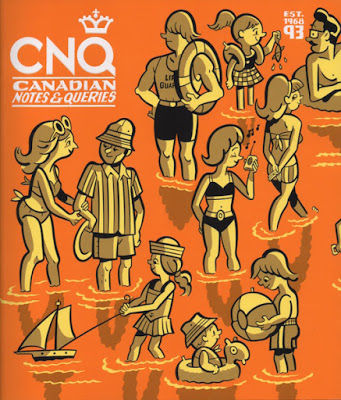
Canadian notes and queries 93 1

Last year, Kim Jernigan, the estimable, indefatigable, generous, and wise former editor of The New Quarterly, emailed me to say she was putting together a special edition of the journal CNQ: Canadian Notes & Queries, and would I write an essay for it. The focus, the demand, was for an essay about  rereading: pick a book I had read long ago and recently reread, and write an essay about the difference between the readings (and, perhaps, the difference between me then and me now). I leaped to the task, having just taken another look at Camus’s L’Étranger after years of remembering it a certain way, fixed in my mind since my first reading as a freshman at university. I discovered a new and truly remarkable book. I also discovered that, yes, I am only beginning to learn to read.

CNQ is a print magazine. Issue number 93 is just out, but you’ll have to order a copy to read it. But here are the opening paragraphs.

dg

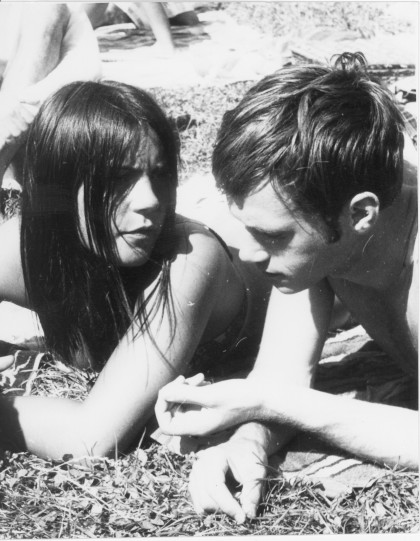
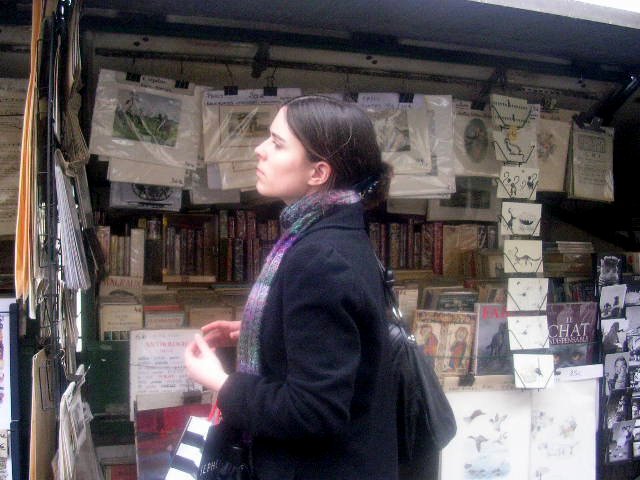
This photo of DG (as Existential hero) and the mysterious SE at the pool in Freiburg im Breisgau dates from about the time he first read Camus, 1968, and is included with the essay for context.

§

I was eighteen when I read L’Étranger for the first time. I read it in French in a freshman class at York University in Toronto, probably read it in English simultaneously. I think I even wrote an essay about it in French, and that essay might still exist somewhere in a box. Or possibly I dream this, trying to impress myself. I still do remember lines of poems I memorized that year: Mignonne, allons voir si la rose / Qui ce matin avoit desclose / Sa robe de pourpre au Soleil.

I remember the instructor, a pale, heavy-lidded young man who rarely rose from the chair behind his desk, droning on with his face in a book. He wore a shiny grey suit and a white shirt open at the neck, which I took to be Continental attire. His eyes were invariably puffy and irritated – the word dissipated comes to mind now. I often sat next to a girl named Karen Yolton who was also sleepy, wore black nail polish but nervously tore her cuticles, and whispered scandalous tales of her escapades in a city that was new and alien to me.

I was a little lost and amorphously rebellious and wanted desperately to be an outlaw. I got an F on my first English paper. And perhaps this bled into my reading of Camus, especially Meursault’s carefree sensuality with his lover Marie and his inarticulate defiance of conventional normative language. I remember my teenage outrage at being told to feel what I didn’t feel. That was the thing you noticed in the novel as a young person — the appeal to false authority, the sense of people asking things of you that you didn’t feel and you didn’t feel like giving. Hell, I wanted to sleep with girls and defy authority; Meursault and I were one in my heart, aside from, you know, the small matter of shooting the Arab to death on the beach.

Somehow I always slid over the actual murder any time I summarized the novel to myself, seeing Meursault as a victim of social and linguistic tyranny not a confessed killer. Camus himself famously, and perhaps mischievously, confused his readers by saying, “In our society any man who does not weep at his mother’s funeral runs the risk of being sentenced to death.” This is neither an accurate description of the French criminal justice system nor the novel itself. Meursault shoots the Arab once, then pauses before pumping another four bullets into his body. Meursault’s interrogation before the examining magistrate turns on this fact, for which he has no explanation. But it shreds any chance of his pleading self-defense.

I was eighteen, as I say, and enamoured with the outlaw girl I met in French class, with her ragged cuticles, cigarette rasp, and freckles, and I had no clear idea what Existentialism was except insofar as I had seen a picture of Camus, looking dour and swarthy with a cigarette in his mouth, and somehow had decided this was the very image of the Existentialist hero, a phrase I now realize is an oxymoron, and I would imagine Karen, Camus/Meursault, and myself becoming really good friends, comrades against the (adult) world.

I adopted Existentialism as an attitude rather than an idea. Though deep down I quickly divined the speciousness of its crucial ethical argument, the basic and unworkable paradox of having to create value by making decisions without recourse to values. In time, I came to realize that Existentialism hadn’t amounted to much, had quickly been abandoned even by Sartre who invented it (he became a Communist, then a Maoist). It was only a moment in a long argument in the West between the language of the gods and the language of a world without a supernatural life support apparatus, a world without gods, a world of mere existence. This argument culminated first with Descartes’ Radical Doubt and later, in the early 20th century, in Edmund Husserl’s Cartesian Meditations, after which philosophy veered sharply away from metaphysics into various branch lines: phenomenology, language philosophy, critical theory, structuralism, etc. Existentialism, an extreme 20th century application of systematic doubt, is a version of positivism with a concomitant impoverishment in the ethical and emotional sphere; the human aspect of language wilts.

But at first reading, the critical attitude, the defiant rejection of traditional values, melded seamlessly with my hormones and the biases of the hour: late 1960s counter-culture, Vietnam war protests, the Free Speech Movement, and nationalist revivals in both English Canada and in Quebec. Like many people, I read L’Étranger through the zeitgeist. I had lost my sense of humour, and in my yearning for simple positions, it never occurred to me that a novel might be beautiful, funny, tragic, and mysterious all at once.

Douglas Glover

.

Read the entire essay at CNQ 93, which has just been published but not yet linked at the web site.

The issue also includes work from Numéro Cinq contributors Caroline Adderson, Susan Olding, and Jeff Bursey, as well as Chris Arthur, Marc Bell, Kathy Friedman, Jason Guriel, the legendary bookseller David Mason, Peter Sanger, Robin Sarah (who just won a Governor-General’s Award), Carrie Snyder, JC Sutcliffe, Jess Taylor, and Anne Marie Todkill.

Oct 292015
 
Natalie Helberg

Natalie Helberg, Winner of the 5th Annual Robin Blaser Award for Poetry

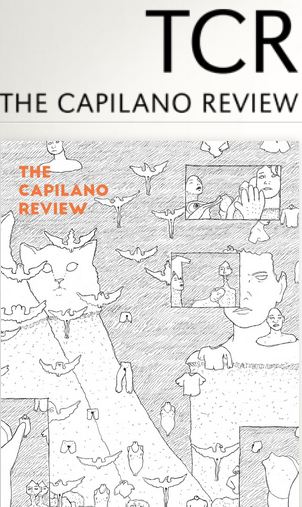
Natalie Helberg, one of Numéro Cinq‘s stellar band of contributors, has just won the 2015 Robin Blaser Poetry Award for a poem called “dearest Naoko, who said the horseshit is astronomical.” The poem will be published imminently in The Capilano Review 3.27 (Fall 2015). TCR, which administers the Robin Blaser Award, is a venerable West Coast Canadian literary magazine that specializes in experimental art and literature. Robin Blaser was a Colorado-born poet who wisely immigrated to Vancouver in 1966. Before that, he combined with Jack Spicer and Robert Duncan to spawn the so-called San Francisco Renaissance. Later he met Charles Olson and absorbed some of the Black Mountain spirit. In Vancouver, he influenced a broad spectrum of Canadian experimental poetry, a cultural stream that is still vibrant and alive today. In 1994, dg had the pleasure of interviewing Blaser (this is one of those Numéro Cinq coincidences) on his radio show. Some day he will dig out the tape and post the interview.

Natalie Helberg has been a real stalwart at NC over the past couple of years bringing a robust intellectual feminism and respect for experimental literature to the mix. Check out her many reviews, essays and interviews on her archive page here. Read her amazing essay “O Sujet d’Assujettissement (or, Story of O and Foucault)” in our September issue. And watch for her wise interview with Joanna Walsh (@badaude) in our November issue.


TCR

Oct 262015
 

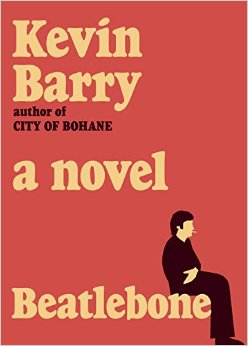
manifold kevin barry

Uimhir a Cúig was launched back in December 2013 with a collaboration between the celebrated Irish writer Kevin Barry and the Galway artist and film maker Louise Manifold – On Being There and Not Being There; or Cotard’s Delusion, A Case Study featuring text/voiceover by Barry & video by Manifold.

As Barry wrote at the time: “This is a piece I wrote to go with a video and audio installation for an artist called Louise Manifold in Galway based on Cotard’s Delusion — a rare mental state in which you wake up one morning and believe yourself to be dead. It was apparently Cotard’s that inspired Beckett’s The Calmative. Louise filmed the interior of a derelict old cinema in New Jersey — as good a locale to define a state of living death as any!”

It was interesting therefore to happen upon, in the latest issue of The Honest Ulsterman (founded in 1968 by the late James Simmons – recently featured in Uimhir A Cúig), Maeve Mulrennan speaking to Kevin and Louise about their collaboration  including details of their more recent work together.

Enjoy the article – while it contains a link to the video including voiceover, the printed text is only available here at Uimhir a Cúig .

—Gerard Beirne


Oct 172015
 

Having winnowed down the first batch of applicants and found some very nice people to work with, dg, aka the Dark Eminence at NC, still has a window open for a small number of select private writing students.

This time let’s be clear — there were a couple of misunderstandings last time: a) This costs money. Last time, someone thought I was doing it for free. b) It’s  very flattering to be asked, but, really, poetry is not my area of expertise. Fiction and nonfiction prose only.

Authors interested in having a ms consult or studying with dg on an ongoing basis, please send particulars (writing background, project description) to editor@old.numerocinqmagazine.com. Don’t send your ms with your initial communication.

dg

Oct 152015
 

little-mermaid.
This month for Numéro Cinq at the Movies we’re turning the lights out so that filmmakers Nicholas Humphries (Vancouver, BC) and Jared Carney (Fredericton, NB) can have a cross continental conversation about horror. Both filmmakers have written articles for Numero Cinq (Humphries on Dash Shaw’s short “Seraph” and Carney on Denis Villeneuve’s short “Next Floor” and the Spanish horror short “Brutal Relaxation”) and they both direct primarily horror films: Carney is just putting finishing touches on a short-film adaptation of a Stephen King short story and Humphries just premiered his second feature film, Charlotte’s Song, at the Vancouver International Film Festival. Here they get to explore what scares them, the nuances of horror, the struggles of being genre directors, and the future of fear. And they explain to us why crickets and tiny doors might be scarier than you think.

— R. W. Gray

.

Nicholas Humphries: Stephen King was quoted as saying, “We make up horrors to help us cope with the real ones.” Do you think this is true?

Jared Carney: ‪I believe this is true to an extent. I mean, people go to see films of any genre as a form of escapism. We as a society absolutely love immersing ourselves in the problems, or horrors, of other people so we can forget our own. But, that said, to be honest I like being scared. ‪I remember when I was young and watching scary movies with my cousins they always made me sit at the end of the couch near the dark hallway because I could handle it. I feel like when I’m scared I can truly see the world clearly. One thing that I’ve always loved about horror is how it bursts people’s bubbles and reminds us of how ugly and abject the world can be.

NH: What is something that scares you that might surprise your audiences?

JC: Well I think a lot of people would think I’m one of those “I’m not afraid of death” people but to be honest, the thought of dying or the death of my loved ones scares me the most. Mind you I also believe death is a beautiful thing, but the fact that we eventually move on from this life, to complete nothingness does bother me. Death is scary, plain and simple, and although audiences may no longer be scared by horror films, put yourself in the shoes of a horror movie victim and I like to believe it becomes a little more terrifying. That and grasshoppers, I’ve had some bad experiences with those things.

NH: I’m afraid of absolutely everything. But not just things like the dark. I’m talking school buses, cornfields, tiny doors. Especially tiny doors. Like, the kind that lead into crawl spaces. It doesn’t matter where it leads, they make me uncomfortable. I don’t know why. I could never fall asleep in a room with a tiny door in it.

JC: What film scared you the most?

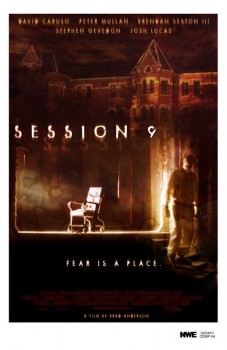
NH: The only movie I can’t watch alone is called Session 9. It was shot at Danvers State Hospital and director Brad Anderson takes full advantage of the unsettling location. The way it also leaves so much to the imagination through a terrifying series of audio tapes just gets under my skin.

session

JC: I remember, as a young child, watching Poltergeist in my grandfather’s living room with all the lights turned off. That film really disturbed me to my core, one scene from that film that always sticks out in my memory is the infamous “face ripping” bathroom scene. I was really young then and that was the first and only time I’ve scene the film. I purposely avoid re-watching it as to preserve that memory of my grandfather and I.

NH: What film has inspired you most as a director?

JC: I had always had an interest in creating my own films but looking back I’d have to say House of 1000 Corpses by Rob Zombie. After seeing that film for the my first time I had a real weird feeling in my stomach and after watching its behind-the scenes documentary “30 Days of Hell,” that’s when I decided I wanted to make other people have that same feeling.

house-of-1000-corpses

NH: For me it’s The Shining. But this can also depend on the project I’m working on. My latest feature was a period / dark fantasy and so I turned to Pan’s Labyrinth a lot for inspiration.

JC: What do you think in your own work is the scariest thing you have filmed?

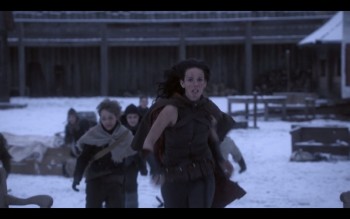
NH: I directed a Steampunk-inspired, sci-fi series in 2009 called Riese: Kingdom Falling. In the episodes I directed, the titular character encounters an abandoned village full of evil children. Some people don’t find kids scary. I think most of them are mean and unpredictable.

Screen Shot 2015-10-13 at 8.08.55 AM

JC: I feel like I do understand fear, to a certain extent at least, and I’m good at scaring other people but as far as scaring myself with my own films, I can’t say that I’ve done that. ‪But with that said, in my the newest film “The Man Who Loved Flowers” I explore themes different than what I’ve dealt with before and I consider it in-part a horror film, but for a completely different reason then expected. It deals with the dark nature of love and heartbreak.

NH: I think any effective film deals with basic human condition stuff. Relationships can take over any of our lives. They can make us better or they can drag us down. We’ve all experienced them or crave them, have been saved or destroyed by them.  While I will watch anything, the films I get really excited about are the ones that take on horror in content but make an attempt in some way to elevate the genre to art through visuals and a rich subtext. .

JC: I’m a huge fan of splatter horror but I’m also quite drawn to the darker, more transgressive horror films. I also have a great appreciation for the more “subtle” horror films, films that don’t show or tell you much, but leave it up to the imagination of the audience.

NH: Your short film “Dark and Stormy Night” is a particular flavour of horror-comedy. Did you pull inspiration other directors when making it?

Dark and Stormy Night

JC: ‪Eli Craig and his film “Tucker & Dale vs. Evil” was a major inspiration for “Dark and Stormy Night”. I found its self-awareness of the horror genre and its ability to flip expectations very refreshing. There is also the involvement of beer which carried over into “Dark and Stormy Night.” [Dark and Stormy is a type of beer from Picaroon’s, a New Brunswick brewery].

JC: In your short film “The Little Mermaid” you take a beloved childhood story and return it to it’s original sinister form. What attracted you to this story?

NH: “The Little Mermaid” was always my favourite fairy tale [The feature film Humphries just premiered at Vancouver International Film Festival, Charlotte’s Song, is also developed from that core fairy tale]. But I think the queer subtext is what attracted me most to it as something to adapt. Growing up different and forbidden, unrequited love, these are all themes I grew up dealing with. Filmmaking is therapy.

NH: Your short film “Waiting” employs split screen and elements of magic realism. Would you consider this film avant garde in its formalism? Why did you feel it had to be told this way?

Waiting

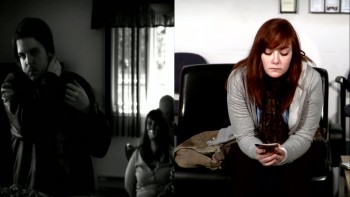
JC: Yes, I would definitely consider “Waiting” to be avant-garde. I was studying film at the University of New Brunswick at the time and as I was writing the script I was very interested in learning how editing could be used to represent the themes of films and how it could convey certain feelings or emotions, so the split screen idea was born out of that.

NH: In your short film “Oasis,” the location is like a character in the film. How did you go about finding it or did the location inspire the film?

JC: In this particular case, the location completely inspired the film. I had stumbled upon the location, a campground that’s been abandoned for over thirty years, during a photography outing one day. When I had the opportunity to make the film months later, we did! It was such a beautifully sublime location that just screamed danger and I simply couldn’t leave it be.

Oasis

NH: You’re in the process of adapting a short story by Stephen King. What made you decide to adapt it and how did you go about securing the rights?

JC: ‪Stephen King has actually had this program, called “Dollar Babies”, available for many years now in which he grants selected film students the rights to adapt his stories. I was no longer a student at the time but I decided to request the rights to his early short story “The Man Who Loved Flowers” as it appealed to me for several personal reasons at the time, and was lucky enough to be granted it! What attracted me to the story initially was how short but how much impact it had on me, and I also felt like it was something I could really make my own while at the same time staying true to the original narrative. As I began adapting it into my script I began to like it even more as its content and themes kind of coincided with some stuff that I was going through personally. At the core, “The Man Who Loved Flowers” is a love story and it takes us all to a dark place that we’ve been to before, a place we can all relate to. Most of us however, are lucky enough to survive that dark place while others are consumed by it.

The Man Who Loved Flowers

JC: Do you think there is a negative stigma that is carried with the term “horror”?

NH: I cannot count the number of times I’ve endured judgment when I tell people I love horror movies. There is absolutely a stigma. But at the same time, it’s probably the most reliably lucrative genre there is. Always has been. So film snobs can sneer all they want. What would you say is your biggest challenge is as a genre director?

JC: ‪I think getting noticed by people outside of that specific community is the biggest challenge for most genre directors. Horror in particular carries a sort of stigma with it that it’s just senseless violence and gore. But on the contrary, I believe that horror films can be just as innovative and complicated as any other film out there. Although horror-specific festivals and screenings are a lot of fun, perhaps organizers, and crowds in general, need to open up a bit and look past all the scary or disturbing stuff. If we can get beyond that, then there’s no reason why a horror film can’t win an Academy Award some day.

viff2015charlottessong

JC: I think a “horror” film is not the same thing as a “scary” film. What’s it going to take for horror films to start scaring people again?

NH: The best scary movies follow you home. And so they need to tap into primal fears but also everyday situations. Most of us don’t worry about zombies in our daily lives. We do feel nervous in open water, a dark parking garage, in the shower. As our routines change, horror filmmakers will need to keep an eye on in which situations we feel the most vulnerable.

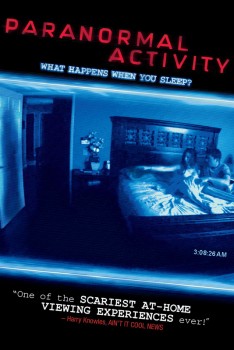
JC: What do you think is next for the horror genre? We’ve seen it evolve technologically with the birth of the found footage genre (The Blair With Project, Paranormal Activity, etc.), we’ve seen it become self-aware and pay homage to itself (Scream, A Cabin In The Woods), and we’ve seen it take a dark/trangressive turn with the likes of The Human Centipede and A Serbian Film. So what’s next?

11169199_800

NH: Themes are cyclical but the way we consume them will continue to evolve. It seems like most of the content being developed for VR right now is horror-centric (film and gaming) or pornography. The future is now and it’s terrifying.

—Jared Carney & Nicholas Humphries


Jared_PhotoJared Carney is a writer, director, producer, and production designer with Creeker Films from Fredericton, New Brunswick, and is a graduate of Film Production from the University of New Brunswick.  He is a Features Writer for Horror-Movies.ca and just recently wrapped his 9th film, a Stephen King adaptation entitled “The Man Who Loved Flowers”. The horror genre in particular has always piqued his interest and many of his influences stem from both classic and new-age horror cinema.

250634_10151485792063698_681618348_nNicholas Humphries is an award-winning director from Vancouver, Canada. His accolades include Best Short at the Screamfest and British Horror Film Festivals, Audience Choice at the NSI Film Exchange, a Tabloid Witch, an Aloha Accolade and a Golden Sheaf. His films have been nominated for multiple Leo Awards, have screened at Grauman’s Chinese and Egyptian Theaters, on CBC, Fearnet, SPACE Channel and in festivals around the world. He is also a director on the acclaimed Syfy digital series, Riese: Kingdom Falling, which was nominated for four Streamy Awards, three IAWTV Awards and a Leo Award. Riese was also an Official Honoree at the 2011 Webby Awards. His feature film credits include Death Do Us Part and Charlotte’s Song (2015). He teaches Directing at Vancouver Film School.

.
.

Oct 142015
 

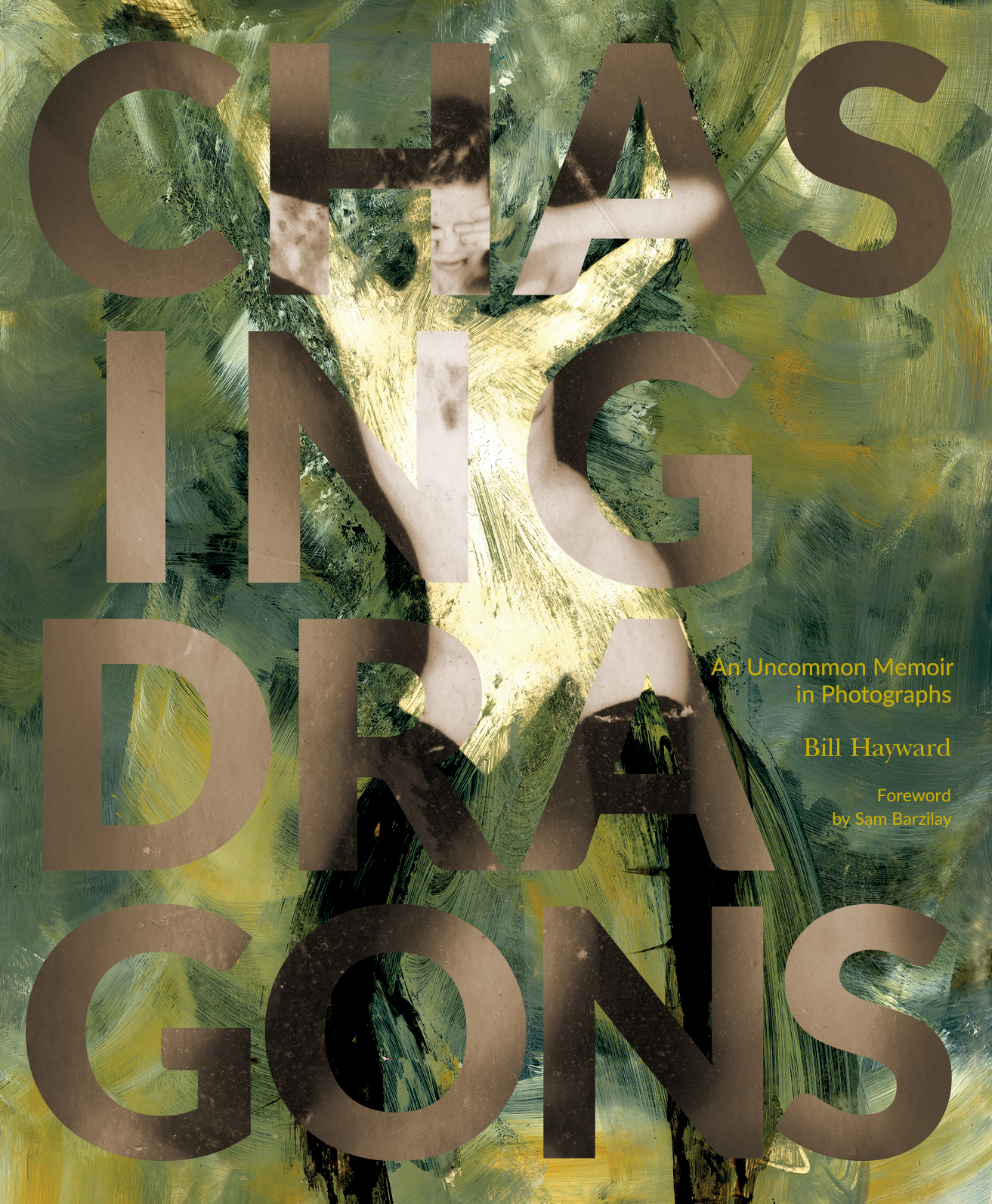
Chasing Dragons
What I liked, reading Chasing Dragons at first, was the anticipation, the call to adventure that is in the author’s own answer to the call to adventure. —Douglas Glover

Bill Hayward 1Bill Hayward

Chasing Dragons: An Uncommon Memoir in Photographs
Bill Hayward
Glitterati Incorporated
240 pages, hardcover
346 original four-color photographs
$60; ISBN 978-0-9891704-9-9

.

AT THE AGE OF SIX, Bill Hayward was already blessed with magic and metaphor. He was born into an itinerant family, lived in or visited 17 states before he was in grade school. His older sister Janet, sitting with him in the back seat of the family’s 1940 Chevy, used to encourage him on long rides with stories of magic and adventure. Janet was Bill Hayward’s muse, his Yoda, the one who taught him to think there might be wisps of dragon smoke beyond the next hill. She made the world wondrous, which is something like religion, only under a different name.

Hayward has been hunting the dragon smoke ever since, hence the title of his magnificent new book Chasing Dragons: An Uncommon Memoir in Photographs; only now he also associates it intellectually with the dragon smoke of Chinese legend, dragon smoke equated with the imagination itself, with the ability to travel between worlds, which in Hayward’s universe becomes the ability to travel between and beyond forms, to hybridize, to traffic in aesthetic accident and unconscious inspiration, to transcend the torrent of conventional commercial dreck that is our contemporary fate.

Hayward is a photographer, also a writer, a filmmaker, and painter. He is a very good photographer, one of those A-list commercial photographers who shoot for glossy magazines in New York and are on call to do author photos for major publishers, the epitome of class. But at a certain point he rebelled against the conventional (even the very best conventional), the photograph that is already recognizably good as a photograph (“…at some point I realized that dragon smoke was somehow missing from the horizon…”), and as he says himself, went into the darkroom (this was when they still had darkrooms) fierce with experiment.

I commenced “bushwhacking” in the darkroom (this is way before digital) and experimenting with print, paint, paper and scissors and following real “brush strokes” of accident—disrupting what I knew of visual technique and tradition.

The result was wave after wave of startling, mysterious images. Like many great artists, Hayward seems to work in obsessional spurts, mulling over the same gestural form or experimental technique in image after image, but altering, nudging, scaling, colorizing, destroying.

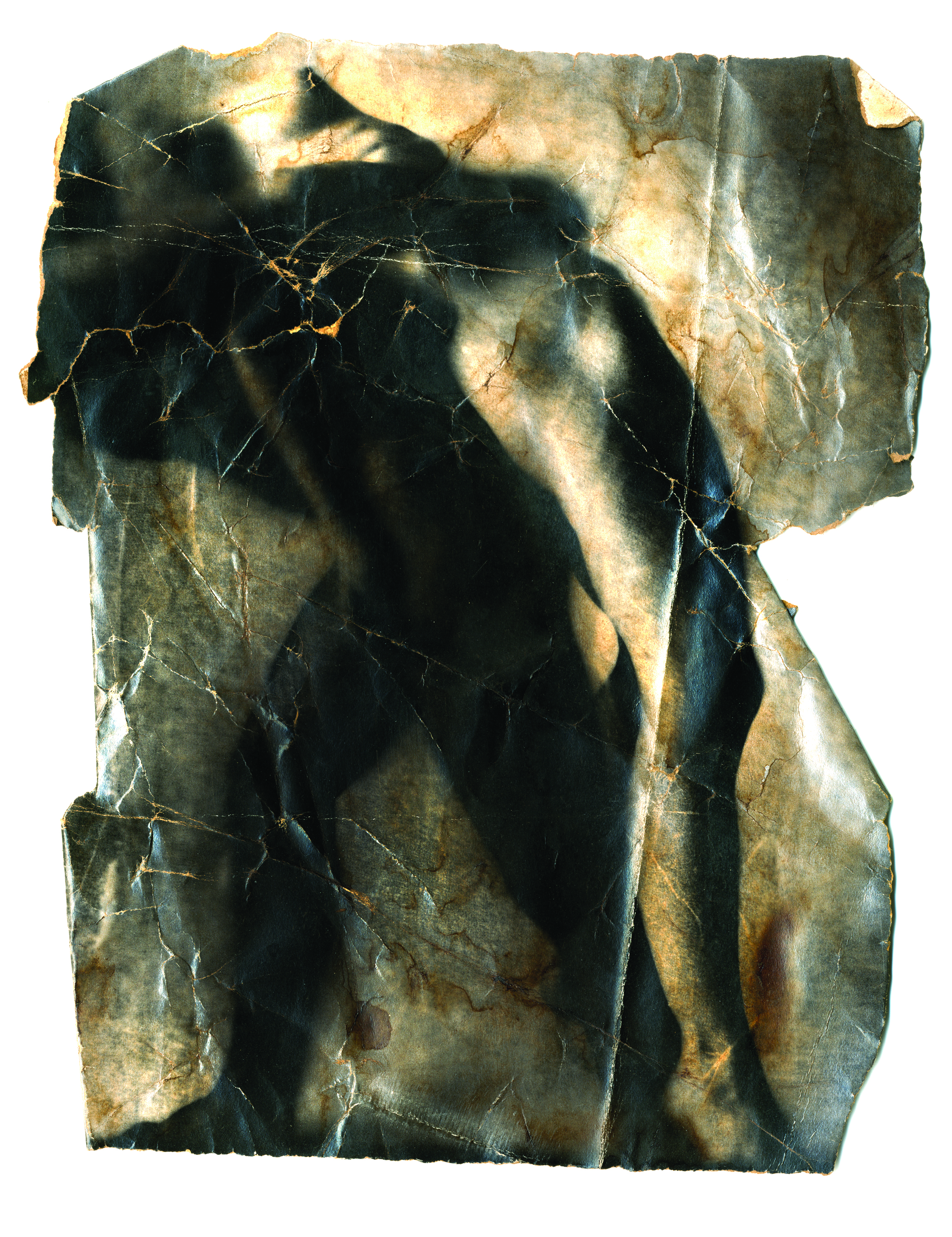
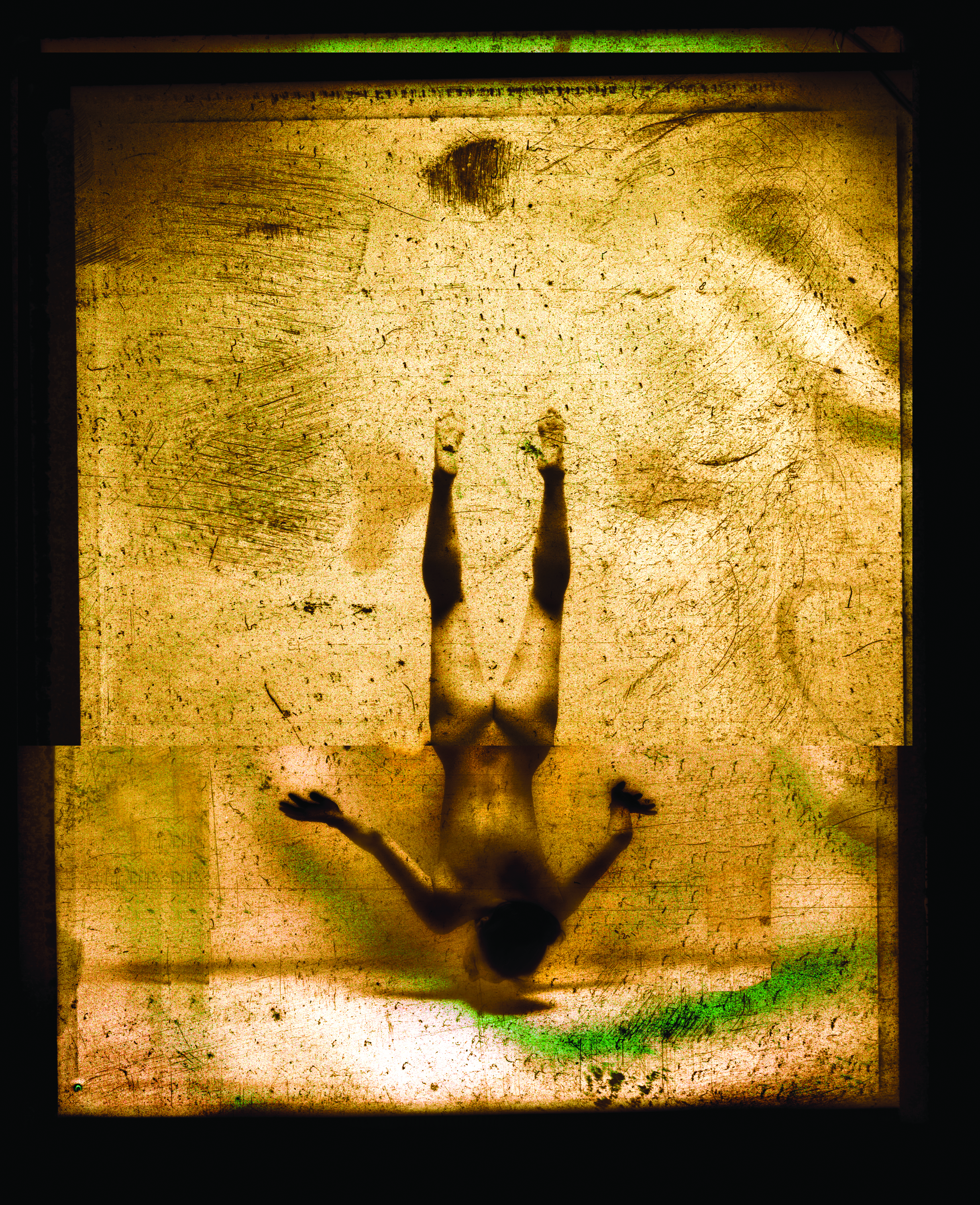
Chasing Dragons is organized into five so-called acts, the acts subdivided into subtitled sections, each with an obsessional focus (some are called projects). For example, there are 17 collaborative bedrooms (“17 Bedrooms, A Spaghetti Western”), 17 black and white images of collaborator Joanne Baldinger standing in front of or even within a black on white painting of a room, door to a room, or windows looking out of a room. There are pages of paintings of a single torso with an arm bent at right angles, placed across the belly like an reversed L, sad, clownish faces, zombie figures. Or the floating, falling nudes suspended as if in a luminous vitreous humour of the “Broken Odalisque” series. Or the amazing set of photographs called “Consider the Flesh”: grainy images, nudes prancing/posing before a backdrop, camera pulled back to reveal backdrop against the studio wall, and lamps of various sorts held or disposed behind or in front of the subject, casting a mysterious glow.

I mention only a few of the sequences; this is a thick, beautiful book.

The repetitions inscribe motion from frame to frame, almost as in one of those old flip books, motion being one of the major fracturing devices Hayward uses, both inside and outside the image, his subjects caught over and over in ecstatic gesture, stillness infused with movement (gesture is a word Hayward uses frequently), so that the image sequences are a dance, not repetitious, but mysteriously rhythmic (like tides or the motions of sex) in their insistence on a particular motif (gesture, again), situation or subject, motifs that take on the numinous quality of dream signs.

One of Hayward’s most easily grasped innovations (invention) is the result of a rebellion against the conventional studio portrait: subject in front of camera, subject become object for the photographer, become something frozen, captured, pinned to the board. Hayward’s brilliant inversion, analogous to breaking down the fourth wall in the theatre, was to engage the subject as a collaborator in the photograph. Instead of sitting the subject in front of a backdrop, he set up a continuous roll of white paper, gave the subject (of the photo) a bucket of black paint and a brush and told him or her to make a backdrop for themselves, a scene, a place to pose, a place in which to act or even act out.

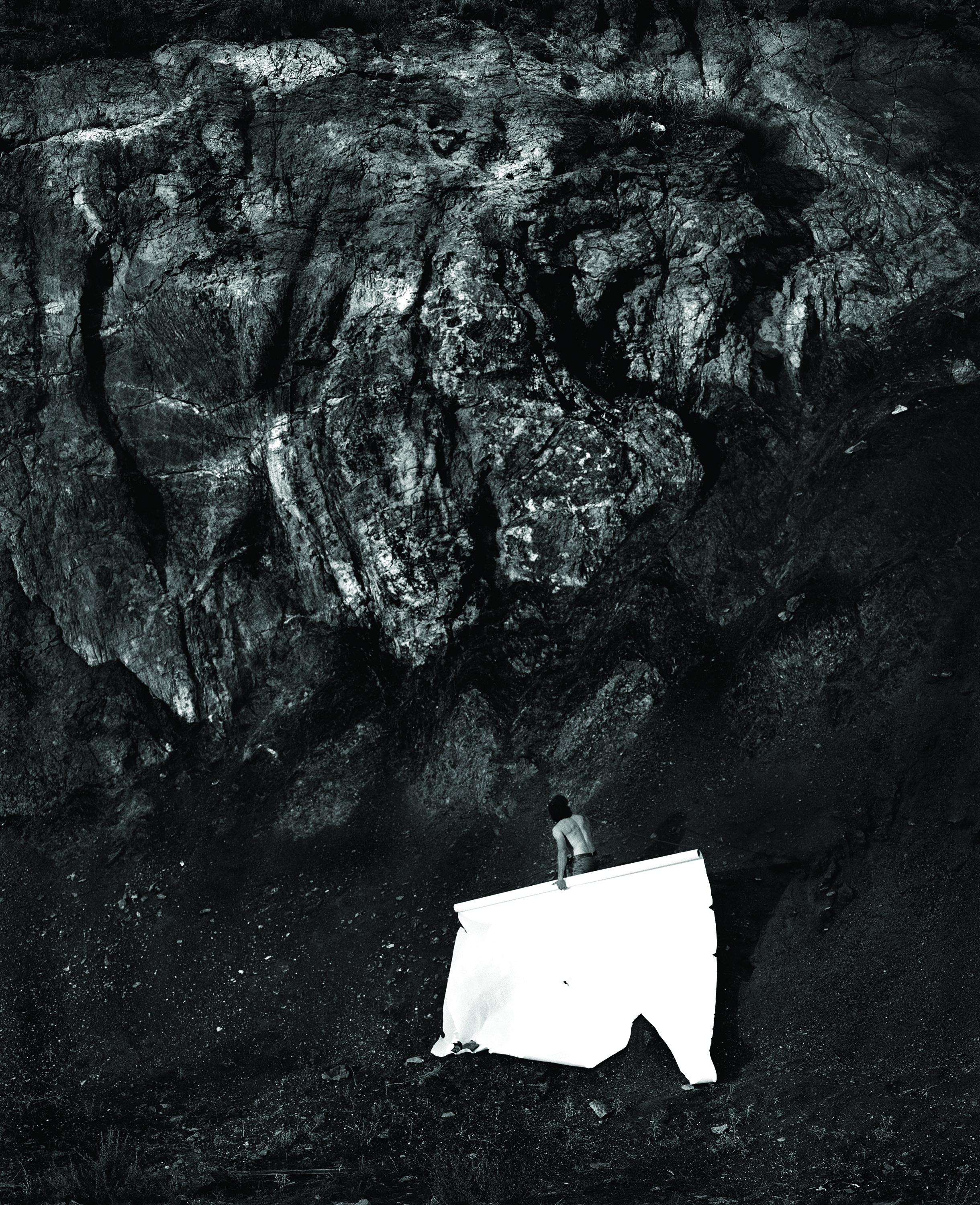
The result was/is an ongoing series of brilliant, witty, mischievous, punning, self-revelatory (in the sense of self-discovery) collaborative portraits. Many appeared in Hayward’s 2001 book Bad Behavior, and there are a few of those in Chasing Dragons, but he has extended the project into what he calls The Human Bible, traveling the country with his paper rolls and paint (near the end of the book there is a gorgeous photograph of Hayward clad in black, walking a dusty railway track somewhere in the west, with a paper roll over his shoulder).

Hayward seems to function along three basic vectors or principles, at least this seems to be the case when he talks about what he is doing. The first is the one already dealt with, the iconoclasm, the adventurous breaker of form, on a quest to find the rigid structure, the accepted mode, in what he is doing and break it. Little things, to begin with, like the incorporation of accident or imperfection, a studied black and white landscape with a road disappearing into distant hills and a purple crayon streak in the top corner. Which seems to lead to drawing and painting on photographs, to incorporating photos into paintings and then paintings that remind you of the photographs. Iconoclasm, breaking the image, the holy image, making it more holy in so doing. There is much more of this, pages of faces, strangely symmetrical as if the one side mirrors the other (not the way normal faces work), streaked, over-exposed, magnified, colorized, staring.

The second vector is a restless search for the feminine, a self-conscious desire to rebalance a universe that has tilted wildly toward the patriarchal. One source for this is Robert Graves book The White Goddess, which Hayward absorbed at just the right moment. But beyond that, and not to psychologize, it does seem as if his sister Janet, six years older and a leader of adventures, gave Hayward the perfect template for the White Goddess before he actually met her in a book. Chasing Dragons is full of female images, many nudes, many combining the ecstasies of dance gesture (there are naked men, too, but not nearly so many). Women lead Hayward, they are his psychopomps, his oneiric guides into the realm of abandonment, experiment, and revolt. Of this is he enthusiastically conscious, inserting throughout Chasing Dragons quotations and snippets from his favorites: Mary Ruefle, Clarice Lispector, Emily Dickinson, Flannery O’Connor, Virginia Woolf.

And, finally, the third principle, the unresolved struggle, something Hayward recognizes within himself, the tension between the discipline of art (call it professionalism, craftsmanship, guild knowledge) and the free spirit of play, the foregoing of knowledge, the abandonment of certainty necessary to create the kind of art Hayward wants to create. There’s a great interview (with Geoff Gehman in Psychology Tomorrow) where Hayward catches himself in the contradiction. “I’m telling people they can do anything while at the same time my head is saying: You’ve got to know what you’re doing. I just tell myself to follow the gesture rather than the idea.”

The self-irony is all: the moment that catches a whisper of Hayward’s depth.

What I liked, reading Chasing Dragons at first, was the anticipation, the call to adventure that is in the author’s own answer to the call to adventure.

Throughout this read, I call out the shout and song of artists who have had, and who continue to have,  a significant influence on the gaze of my heart and eye…My compositions are foremost a transcription of my response to their call.

Painters I have known are rarely good at talking about their own art (Hayward is an exception in a high degree) because their art is in the manipulation of media with brush or pencil or camera. They think non-verbally, through their fingers and hands more than eye and mind. And no matter what they plan or expect there are always minute accidents of material at the finger tip. One of the beauties of Chasing Dragons (hunting the dragon smoke of the imagination) is (going back to the patterning, grouping, repetitiveness of the images) that you can see Hayward, the artist, thinking without words, thinking with the images themselves, making and remaking, with slight variation, the same gesture, scene, idea. The effect is mesmerizing; rarely do you get to see so many materializations of the same artistic thought.

As I say, Chasing Dragons is organized into acts. The first act contains the beautiful conventional studio portraits. The second act, the rebellion, is the crisis of risk, experiment, adventure. The third act enters the territory of collaborative art (the human other becomes the next frontier to be transgressed). The fourth is all dance and gesture. And the fifth is devoted to images from Hayward’s film Asphalt, Muscle & Bone. The first act establishes the credentials of mastery, but the second, third, fourth and fifth acts are where you will dwell, entranced by the incantatory and playful density of artistic thought and variation, flipping back and forth between the pages, one section at a time.

Reading this book underscores the difference between an art book and a gallery show. A gallery show will always be an abstraction (contradictory, yes, because, of course, there are particular works on show), representative of the total work; whereas in a book, while you only have images of images, you get a far better idea of the totality of the artistic output and the motions of the artist’s thought processes as they develop over time.

The book’s text, the word-memoir, is terse, elliptical, carved out of the silence of the page, but also beautifully written, as you might expect; everything Hayward touches, even the accidents, or apparent accidents, have an air of being self-consciously finished; the man possesses an epic cool that is reflected in the work. And for all its terseness, the text seems to tell you everything you need to know: the family road trips and the Delphic Janet (some lovely snaps of the two of them as kids), the dragons, the first camera, and (the same day in 1956) Hayward’s first exposure to photographic/cinematic art (Janet took him to see Fellini’s La Strada), the iconic moments that led him to yesterday and whatever comes tomorrow, after the book.

One section especially, the “Mise-en-Scène,” is heavily patterned, recursive like a Bach fugue, words and phrases repeating, accumulating nuance and incantation — Janet, dragons (morph into drag’n sticks juxtaposed with an image of a weathered stick in the shape of a dragon), beads, fire ants, smoke, and the phrase reportless places, a phrase from Emily Dickinson (and after the section ends, there is a postscript that is the Emily Dickinson poem where the phrase comes from). This “Mise-en-Scène” is like a poem itself or is a poem, but also seems influenced by Gordon Lish (who does a walk-on guest appearance in Chasing Dragons with a three-line preface) and his creative concept of consecution, moving forward in a composition by picking up elements already introduced, so the pattern is forward, back and bring forward, and back and bring forward. And those fire ants become the image of the artist: “obsessive, certain, incessant; their immortal process of building in mud and blood.”

That phrase — “obsessive, certain, incessant” — is the DNA of the book or Bill Hayward himself. In spirit, it is stamped on every page. It is the essence of the artist.

But dragon smoke has other meanings, all connected with trans-words, transcendence, transgression, changing states of consciousness. Chasing the dragon is/was slang for getting high, for seeking other worlds or dream in the arms of Nepenthe, forgetfulness, escape, illusion, Death.

I do not think this reference escapes Bill Hayward. Life is the attainment of form; the dissolution of form is a kind of death; that’s a paradox, of course, because rigidity of form also seems like a kind of death. So that art must always be this dance between breaking and making, breaking and making.

The fire ants are re-animating anonymous relics of lives already lived, ceremony of the persistent creative process, mud and blood, life and death, death and life.

—Douglas Glover

14 Chasing Dragons by Bill HaywardBob Dylan


17 Chasing Dragons by Bill HaywardFragment A (from the film Asphalt, Muscle & Bone)

09 Chasing Dragons by Bill HaywardBroken Odalisque

BH2Al Pacile (from The Human Bible)

11 Chasing Dragons by Bill HaywardDragon Smoke Behind Tree

Images from Chasing Dragons: An Uncommon Memoir in Photographs by Bill Hayward, © 2015, published by Glitterati Incorporated www.GlitteratiIncorporated.com

.

.

Oct 132015
 

Lumia Selfie alkalmazással készítve

.

Zsolt Láng (born 1958, based in Tg. Mures, Romania) is one of the most original and critically acclaimed writers of the mid-generation of Hungarian prose, whose eleven volumes of short fiction, criticism and the tetralogy entitled Bestiarium Transylvaniae (Vol I, 1997; Vols. II-III, 2003; Vol. IV, 2012) have long propelled him among the most original hues of Hungarian postmodern writing. Both his short fiction and novels are suffused with literary, cultural references (sometimes faked arcania, as in the (post-)magic realist carnival of 16th-17th century histories, annals, verse lays and legends from Transylvania, Moldova and the Balkans), rich wordplay and language effects, as well as being characterized by a relentless exploration of the poetics and politics of language. His experimental fiction turns topoi of domestic and  world literature inside out and creatively explores the contextual, political and biographical undersides of the genesis of artworks, all these with an all-pervasive humour that is as subtle as it is warped.One of the volumes of Bestiarium Transylvaniae have been translated by Tim Wilkinson (award-winning translator of the novels of Imre Kertész, Miklós Mészöly and Miklós Szentkuthy among others), but not yet published in English. A review (in English) of Vol. IV of  Bestiarium Transylvaniae, centred on Ceausescu’s Romania and the events of 1989, can be read here. Still, Láng is probably best known as a short story writer. His last collection of short prose (Szerelemváros – Love City, Bratislava/Budapest: Kalligram, 2013) was reviewed by Hungarian Literature Online. Several of Láng’s short stories can be read online in World Literature Today (January 2015)World Literature Today (September 2015), The Missing Slate, B O D Y magazine, VLAKmagazine and Hungarian Literature Online.

—Erika Mihálycsa

§

IF THE MAN LEANING out of the third-floor window did not know the woman in the green dressing gown and wanted to find out her name, he could go out on the street and pick up the envelope dropped from the litter bin, but now he can spare the bowing down. Instead, he can get engrossed, for instance, in contemplating the soft naps of the green terry cloth, or can jot down the figment of song drolling from the fourth floor window, or he might just as well continue gazing motionlessly, so that the unopened letter may rest unread forever, because the sad-faced scavenger who is to pick it up the next day would shove it on his screeching handcart to take it to the paper recycling point at the farther end of town, from where it is to be shovelled onto a dump truck’s tipper and in less than two hours emptied into the chloride bath of the Réce papermill, where the whirlpools of destruction decompose it in a matter of seconds; in other words, the scavenger known as Gyuszi is illiterate, although he had been through mandatory 8-year primary education at district school nr. 10.

It must have been because of her intensifying migraine that Ildikó Halász did not notice the envelope slip over the litter bin’s edge. But for that headache, she would unquestionably have picked it up; not for reading it, but merely because she has always been a tidy person. Something that seems undercut by the fact that the envelope is unopened but, let us not forget, this is the fifth letter received within one month from the sender written in bold lettering on the bright red postmark, a craftsmen’s cooperative that has lately branched out and started a credit bank. Perhaps Ildikó is a stickler for orderliness. This is probably the reason why she has headaches so often. The windows do not close properly, there is permanent draught, and even though she spends the day cleaning up, whenever she goes to the toilet at night, her bare soles get grey with dust. Besides, it is no ordinary dust she inhales: if you turn towards the west end of the town, you can see it from afar in the shape of a threatening black cloud – the Girodan Holding Group Ltd. that produces the cheapest tyres in Europe precisely because it doesn’t invest a penny in air filters. Black rubber dust is more harmful than cement dust even. The only more harmful substance is ammonia, so one could call it a piece of luck indeed that back then they had built the artificial fertilizer plant in Lápos and not here, although a certain comrade Dulea had left no stone unturned in his efforts to secure it for the town, he being the first man in the county party committee, and incidentally also the farseeing father of two students of chemical engineering.

A further contribution to her nagging headache is the fact that Ervin Zakk has just left who, although quite fifteen years younger, nevertheless keeps calling on her and on not one occasion would stay into the small hours, until morning even, especially over the past few days, although nothing passed between them, however often Ildikó daydreams about ”taking him in” one day – and here as a rule a variation would follow on the same simile in the shape of the encounter between some straightforward article for personal use, an iron coin, a bar of soap, a sabre, or a flashlight for instance, and one of the elements, mostly earth or water.

To call Ervin a mere boy would be an exaggeration, he is 35 and works at the newspaper where a new editor-in-chief was recently appointed. The new editor-in-chief does not loathe Ervin quite as much as the former one used to, so Ervin sees the time ripe to be promoted to the position of columnist. It is for this reason he unleashed himself on Pista Tavi. Why on him of all people? Primarily because the new editor-in-chief from whom Ervin expects his promotion is known to hate Pista Tavi ”like the plague”.

When he was at school Ervin, just like his mates, used to have a theatre subscription. In those days the more well-meaning of their teachers used to collect money for theatre subscriptions, wishing to sponsor the theatre, ”the Hungarian word” (”ward”, as Ervin’s Hungarian teacher once said in an excess of zeal), which happened to be subsidized by the authorities too, in order that the more well-meaning of teachers lack not something to sponsor and would not end up sponsoring other things they had better keep off. Ildikó Halász was playing Eve in Madách’s The Tragedy of Man and one Sunday at the morning performance for pupils with Kölcsey subscription, in the eighth scene, the one about Kepler, she revealed, that is, completely bared, her right breast. The next Sunday Ervin went to see the performance again with his grandparents who had a pensioners’ Petőfi subscription, because against the unanimous view of his classmates he adamantly upheld that it must have been an accident, the slip’s shoulder strap having unintentionally slid down, but he had to revise his view upon watching the performance again. He was furious at Ildikó, at the whole theatre, at his grandparents and classmates, although this time, quite uncharacteristically for him, he paid for the factory-made ice cream, their wager with Feri Madaras, unprotesting. Now, 22 years later Ervin would have had ample occasion to take a closer look at that right breast. And he certainly did harbour some curiosity, but was uncertain as yet, because it seemed somewhat unsuited to the thing he kept badgering Ildikó with, and which sensibly touched upon that right breast, even on its twin sister on the left side in fact, since the aspiring columnist was trying to ascertain whether Pista Tavi had indeed organized that infamous orgy on May 1st in the Forget-me-not restaurant that had stood on a secluded spot in the middle of the vast orchards in the hills at the town’s edge. Not that the tiniest details of the orgy had not been long known to the whole town, including the crucial moment when the blue lace knickers of comrade Marika Bodoki, the secretary, believed by many to have been import goods from France, although in fact merely the Kászon lace manufacture’s produce, destined for export, to be sure, ended up proudly flaunted, wrapped around comrade Dulea’s unmentionables. But of course it was one thing to know this, and a horse of quite another colour to read the same thing inside out in the paper.

And indeed, the next instant Ildikó nearly spat out the whole thing or, more precisely, reached the point where, had Ervin’s hand touched her right breast, or the left one for that matter, ever so slightly, she would have told him everything about that breast and about its companion into the bargain – that is, nothing, nothing would she have withheld.

Standing on the curb side, litter bin in hand, she is waiting for the not overtly hectic, but not leisurely traffic to subside for a while, to cross to the other side to the unsavoury constellation of a dozen or so garbage dumpsters behind the block of flats opposite.

The sun is setting and Ildikó knows no more dreadful place on earth than the communal dumpsters, domed and made of aluminum, about a man’s height and looking rather like field-kitchen stew cauldrons. When it is dark she at least doesn’t see the shadows drifting by, and she doesn’t feel any pangs of conscience when emptying her litter bin right in front of her toes behind the corner. What stops her now from crossing over, however, is not her dread of the shadow: a numbness coming from a much more remote place, or time rather, penetrates her feet or, to be scrupulously specific, not her feet but the synapses commanding her muscles, but it is not numbness that she feels, it being at best a second-rate symptom of the disorder that makes the synapses melt like overcharged wires, incapable of transmitting further information. Yes, in Ildikó’s brain a certain instant of the past explodes, causing a neuronal block. The cause of the explosion is presumably Ervin who, although not having placed the bomb there himself, certainly brought the flame to the fuse. Even admitting that the explosion is not a genuine one, or if so, it is one turned inside out. Something that Ildikó associates with stumbling upon the keyword in a crossword puzzle, whose letters trigger off the chain reaction of the right answers, or much rather, with the next state that hits her on the head when, after having completed all the answers, above the paper pushed triumphantly aside all of a sudden the listless and lonely evening’s emptiness engulfs her and she can conjure up nobody on whom she could blame the mood devouring her. Now, on the other hand, she knows it is Ervin she should hold responsible, but the moment she thinks of Ervin, aiming several times in succession like a poor marksman, instead of Ervin’s face it is the face of Pista Tavi that emerges in front of her mind’s eyes, and a certain evening in a certain restaurant that people have insisted on calling Forget-me-not ever since, half jokingly of course, for who would not much rather forget. Forget-me-not is also a poor joke, for its official registered name is Număuita, since our story is set in Romania, but everybody in town, all the story’s characters, even comrade Dulea himself speak Hungarian, which is however of no significance worth mentioning whatsoever. It was a famed night, for she had hoped she would finally go through something that she need not dread thereafter, and in those days it was dread she wanted most to be rid of, at least as much as of the thick hairs growing on her legs, or of a wrinkle in the corner of her mouth, even if she instinctively intuited that the end to dread would not bring a much better state, for it would mean the loss of the one living in dread, of her surviving childhood self, but she would recoup her loss by playing the roles that Böby Derzsi was then getting, the most abysmally untalented actress that ever walked the face of the earth. Back then they did obviously not call such nights orgies, but ”meatballing”, which sounds as if it meant that they ate mincemeat balls, but of course did not mean that, the waiters, the drivers, the actors and actresses, even the comrades themselves described everything down to the smallest detail during coffee breaks, so that the secretaries could pass it on to the hairdressers, who then disseminated it with the distortions due to the buzz of beauty parlour hair dryers, like some contagious disease, mumps for instance that is particularly dangerous for grown-up men who had not contracted it in childhood, so that whenever there’s an epidemic of mumps in the kindergarten, the mothers of boys dutifully take their offspring to the sickbed to kiss the ailing child, all the while relating further savoury details of the meatballing feat. And the meatballing always started with a couple of glasses of cognac and ended with Pista Tavi ordering all knickers off the comrades, that is, those that still needed ordering, and then breaking Laji Rupi’s current violin on Jani Derzsy’s reputedly thick head, so that nobody could play on it again the beauteous folksong of his heart’s desire, ”The thrush builds its nest…” Ildikó gulped down a waterglassful of cognac that knocked her out almost immediately; she became like a sack of potatoes while, strangely, her consciousness cleared up, she was peeping out lucidly from her own inert body, albeit Pista Tavi was hardly bothered by this inertia, he shoved her into a half-lit pantry, made her squat in the corner, held her head with one hand and with the other unbuttoned his fly, as in those days zips were still relatively rare, started swearing out loud, perhaps partly because all he managed to produce was a child’s pecker, but soon became violent and poor Ildikó was thinking with all the lucid part of her consciousness she could muster how there was no-one in this world to protect her. But only the next day at noon, after having returned to the drama students’ dorm where she was still living at the time, not to mention the fact that in those days on the site of her present lodgings the peach orchards of the district called the Manor were still blooming for many years to come, and after having planted herself beneath the shower and from underneath her breast, the left one, a whiff of that horrendous smell of Pista Tavi slapped her, it was only then that she started throwing up convulsively. After that day she would be sick frequently. The last time a few days ago she woke up feeling sick, tore the window open hoping to get better, because those fits of vomiting could be dreadful, coming up directly from her womb, and she didn’t want to wake up the whole block of flats again, the wind was blowing from the direction of the sleeping town, she leaned out and felt instantly better, but as she turned round the room’s concentrated reek of Pista Tavi hit her again, making her throw up the first portion of her supper on the spot.

She should have taken revenge. There had been an occasion once, on that certain Christmas when the glorious regime’s men bled to death, that is, they appeared to be bleeding but recovered quickly enough. Now the most she can do is to satisfy the curiosity of a journalist sniffing for scandal, and she would gladly do it, were it not for the fact that as soon as she starts relating of Pista Tavi to Ervin, in place of Ervin’s face the face of Pista Tavi pops up, and it is Ervin’s face she wants to see, for she loves that face, so young and carefree, a face whose outlines would romp with the shadows of fatigue, quite unhampered even in the small hours, then start splashing about at the break of day and in a few seconds be smoothed out. She is in love with this boy, keeps thinking of him night and day, she is worried about him and keeps her fingers crossed that everybody would love him. And she tells everybody because it feels good to be talking of Ervin, how smart and well-read, how sensible and clean, what a beautiful, innocent child he is.

How finely one can play with him! She says to him things like, well slim jim, you’ve swallowed this whole, or that, now this is something to make your balls itch, with such sense of liberation as only children teasing each other can feel, and with what enthusiasm they go into planning their theatre: Ervin would write plays with a sharp political edge, the likes of which have never been seen on this stage…

Now all of a sudden she sees herself from the outside, as if she were perching on the willow on the corner or looking out from a window, as if she had exchanged places with that Peeping Tom, even if only for minutes. It would surely serve him right, to be able to feel the headache of Ildikó Halász for five minutes, to be standing on the street corner in a green terry cloth dressing gown and litter bin in hand, with nobody as much as looking at her. But the Peeping Tom is already looking elsewhere: a moment ago he was still counting the lights going up across the street, now he is staring at the bird’s carcass pressed onto the grey tarmac, how the wind flutters its ragged feathers, but there is hardly any breeze, at least nothing stirs the leaves. Later he gets engrossed in matters celestial, gazing out at the moon and the stars, so that he notices precious little of the swarming Pista Tavi-faced monsters, sensing nothing of the lonesome woman’s fears, although according to the rules of chivalry a man should on such occasions warn the freak-faces, at the very least with a thumping of the feet, that he is there and, should necessity present itself, would readily jump to the defence of the weak; what is more, he can certainly not be accused of liking Pista Tavi and would be glad to read at the tail end of the report on the Forget-me-not orgies that Pista Tavi resigned his seat in Parliament – although somewhat later he would impassively take cognizance of that deputy’s office in Strasbourg, with the same impassivity his eye would, with at most a light thrill due to the impending event, be caught the next morning by the patch of green terry cloth sticking to the tarmac like the dead bird, with a dark red stain hidden deep among its naps. In the meantime Ildikó has looked down from the window and found the way back to herself again, to the one who knows precisely how far she is from a creature Ervin might fall for. Because from up there she can see all too well even in the gathering dusk, that her hair is growing thin, that her hairdresser is not particularly skillful, that the crowns on her teeth are wearing off, she should replace them but doesn’t have the money, that she isn’t getting any roles at the theatre, she survives on hackwork and even such occasions are getting few and far between, she put together a few simple little programs that she takes to school and kindergarten festivities: last time she recited Petőfi poems at the anniversary of the 1848 revolution, next she would do In young hearts I live on at the graduation ceremony, provided they invite her and not some latter-day Böby to declaim some by-our-blood-and-soil-stalwart-we-stand Albert Wass. She has her apartment, her mother’s savings deposit with the small sum she had saved up for her funeral; her clothes are shabby, so she has no idea how she could possibly change her life, although she knows that if she doesn’t change it now she is finished for good, better and proper. She clings to Ervin, but he is becoming ever more selfish and whimsical.

And even if something more intimate were to develop between them, how long could it possibly last? In front of Ildikó’s mind’s eyes her own fifteen-year-old self emerges, a thin, dark-haired girl going in white knee socks and dark blue pleated skirt to the May 1st parade, and imagines Ervin would be there too, but Ervin is only a tiny toddler, all right, let it be the party at Zsuzsi’s place when they locked themselves up in the bathroom with Bandi Szepesi and she suffered him to deflower her, she imagines Ervin in Bandi’s place, what they would have said to each other back then, what the little boy with the big blond head, barely three, would have made of the occasion, how he would have stuck his tiny fingers into her body.

She is standing on the curb side with a headache that makes her dizzy, waiting to cross to the other side. The litter bin has grown so heavy that her right shoulder falls inches below the other. As though she were dragging the carved-up corpse of Pista Tavi in that bin. Sure she would be caught, although on the ground around the stew cauldrons there are always bones scattered about, all kinds of sickening nondescript things. Yes, on that Christmas it had occurred to her to grab the bread knife and ring Pista Tavi’s doorbell, shove aside his screaming wife – hard to imagine, as she was about one handspan taller and even then quite fifty kilos heavier than Ildikó – then make straight for the armchair in front of the TV, plant the knife in Pista Tavi’s heart, which he would have received with such resignation as if a vengeful revolutionary had leaped out directly of the TV set. For 25 years she has been living with Pista Tavi’s corpse, dragging it along wherever she goes; her husband, all her lovers and aborted children, her director, her partners on stage, the bus driver, the cantankerous cab driver, all of them have been that corpse.

What sacrifice has she not made? Surely, her whole life had been a sacrifice. On that forget-me-not night, since she had to be there anyway, she had planned to turn Pista Tavi’s head but he barely noticed her and, what is more, when she coyly addressed him with, Has comrade Tavi ever noticed that the comrade’s name is Tavi and mine, Halász, the one a lake, the other a fisher, Pista Tavi cloddishly asked, what it was he should have noticed. It was then she drank up the cognac, all of it.

Dusk is gathering slowly. The headlights of lorries rushing by awaken yet more shadows, as if they were splitting off from her body standing on the curb side, taking the shape now of an ass, now of a goat, now of a mountain goat preparing to jump, legs tensely balancing on one tiny spot of a palm’s width, then scurrying off behind the blocks but peeping out from behind the concrete walls. As the odd beam of light carves their muzzle out of the darkness, Ildikó instantly recognizes them. Yes, she should have called in at Pista Tavi’s place on that clean, snowless Christmas when for three days a warm southerly wind blew over the town, carrying the black rubber dust far away from them. She should at least have spat in his face; she should at least have given him an insistent look, should have asked him casually, well comrade, how’s things these days. Then she could still have gained admittance, for on the third day bodyguards were around him again. And today, even if she could get in with a piece of luck, she would only find a decrepit sick man with a broken look in his eyes, a man in pieces and all the more wicked for that, more wicked than ever.

Ildikó is standing on the curb side, counting the lorries rushing by. Not counting the lorries really, just uttering the numbers to herself, one after the other. What for? She doesn’t want to stop time, neither does she want it to run on. Or rather, she thinks soon it would be completely dark, then she can go to the garbage dumpsters and empty the litter bin right in front of her toes. It’s long been completely dark. Perhaps the soldiers from the nearby barracks are marching out for nighttime shooting, practicing for some secret sortie. Perhaps it is not even genuine lorries rushing by. In Ildikó’s head the pain is growing unbearable. It occurs to her she should turn around, go back up to her apartment, call Ervin to tell him straightaway that there is something more she needs to tell him about Pista Tavi that bears no delay, but which she will only tell if… Then something bursts in her head. With eyes wide open she acknowledges how the pain disappears at once. So suddenly as if it were a sign. A sign urging her not to go back, to leave Ervin alone, to forget everything, start a new life, step onstage again, play all the roles she had never played, to play as she alone can play.

—Zsolt Láng, Translated from the Hungarian by Erika Mihálycsa

.

DSCF9869

Erika Mihálycsa is a lecturer in 20th century British literature at Babes-Bolyai University Cluj, Romania, a Joyce and Beckett scholar. She has translated works by Beckett, Flann O’Brien, Patrick McCabe, william carlos williams, Anne Carson, Julian Barnes and others into Hungarian. Her translations of contemporary Hungarian prose and poetry have appeared to date, or are forthcoming in World Literature Today, The Missing Slate, Trafika Europe, B O D Y Magazine. A regular collaborator of various Hungarian reviews, she is editor, together with Rainer J. Hanshe, of HYPERION, issued by Contra Mundum Press.

Oct 122015
 

Gaddis


Nobody Grew but the Business: On the Life and Work of William Gaddis
Joseph Tabbi
Northwestern University Press
Cloth, 272 pp., $35.00
ISBN: 9780810131422

William Gaddis: Expanded Edition
Steven Moore
Bloomsbury
Paper, 241 pp., $29.95
ISBN: 9781628926446

.
I

The usual starting point for a reviewer of anything by or about William Gaddis (1922-1998) is to say, in woeful tones, that he is neglected, more heard about than read, apparently forbidding, and other remarks that would rest on the negative side of a ledger book. It is perhaps more positive to say what stands out, for this reader: people who haven’t read Gaddis don’t know what they’ve been missing. Fans of low and high humour, of pastiche, of ventriloquism, and those who favour long novels that take the time to explore some of the most insidious systems around us, as well as historical matters—faith, business, the law, authenticity, the American Civil War, and religious fundamentalism—told with a definite emphasis on style and structure, if they have not yet picked up one of his books, will be delighted when they do.

Yet Gaddis is still subject to what Jack Green, an early metacritic, raged against in the 1960s in a small publication called newspaper, where he illustrated, using extended examples, how The Recognitions (1955) had been traduced by its first reviewers, many of whom never read more than the blurb and some sample pages. Dalkey Archive published Green’s remarks under the title Fire the Bastards! (1992; introduced by Steven Moore), and on the first page he declares that “one critic made 7 boners.” Carrying on this tradition, Jonathon Sturgeon made an assertion in July that since the Los Angeles Review of Books had its Occupy Gaddis movement in 2012

there hasn’t been much aside from the stray essay or scholarly scrap — until this year. Prompted, presumably, by the double anniversaries of The Recognitions and J R, Northwestern University Press has just published Joseph Tabbi’s Nobody Grew But the Business [sic], a welcome, sophisticated, and humanizing biography of Gaddis that takes its name from an early version of J R.

There are a handful of William Gaddis specialists in the world. One of them, Stephen Burn (also a respected David Foster Wallace critic), in a quotation on the back of the expanded edition of Moore’s critical study of Gaddis’ works—suitably updated and released in February of this year, a handful of months ahead of Tabbi’s biography—states that its author “invented Gaddis Studies when he published his comprehensive guide to The Recognitions” (in 1982; now available online). Anyone writing after that, and after his original Twayne edition of William Gaddis (1989), owes much to Moore’s analysis of the three novels available to that time: The Recognitions, J R (1975), and Carpenter’s Gothic (1985). Tabbi has also done important work in this field by copyediting (along with Moore), and providing the afterword to, Gaddis’ final fiction, Agapē Agape and editing his only collection of non-fiction, The Rush for Second Place (both from 2002). Further, with Rone Shavers he co-edited a collection of papers titled Paper Empire: William Gaddis and the World System (2007). (In 2009 another set of essays by various people came out: William Gaddis, “The Last of Something”: Critical Essays.) In 2013 Moore resumed his labours by editing The Letters of William Gaddis.

Bloomsbury clearly believe in the award-winning Moore. They published his conversation-changing works The Novel: An Alternative History: Beginnings to 1600 (2010) and The Novel: An Alternative History: 1600-1800 (2013), works that upset many conservative critics with significant buy-in to out-of-date and never-quite-sensible paradigms on the origins of the novel. Now they have re-published his Twayne book with additional analysis of Gaddis’ last major novel, A Frolic of His Own (1994), and Agapē Agape. When added to the Letters and Mark Taylor’s Rewiring the Real (2013)—a theological examination, in part, of “the nexus of religion, literature, and technology” (5) as “illuminate[d]” through Gaddis’ first novel and works by Richard Powers, Mark Danielewski, and Don DeLillo—these two publications, pace Sturgeon, mark something of a resurgence of interest in Gaddis. The emphasis in this review will be on Tabbi’s biography, but Moore’s work must be kept in mind too.

Tabbi places a clear statement of purpose in his introduction: “This book will be a literary life and intellectual history, in that I recount the growth of a major writer’s art over the course of a lifetime in the context of social and cultural transformations” (Tabbi’s emphasis). Anyone reading this work soon will realize that while there is much new information about Gaddis’ life, there are major and minor gaps, such as how he fit in at The New Yorker (where he worked as a fact-checker for a little over a year); what his life was like on a more intimate level as he moved from Harvard to Costa Rica and back to New York; whether or not Duke University had a parapsychology laboratory, which Tabbi opts for believing existed without determining; more about Gaddis’ mother and how she regarded his work; and the family history of his two wives, Patricia Black (with whom Gaddis had his children, Sarah and Matthew) and Judith Thompson. There are far more second-hand reports on their feelings about an often-absent husband (whether travelling or writing in a study) than there is direct testimony. The last companion, Muriel Oxenberg Murphy, “daughter of a Russian-Jewish founder of a pickled herring fortune” with whom Gaddis lived, for sixteen years, in higher society than he had experienced before they broke up after his diagnosis “with a terminal illness,” left a book of sorts, Excerpts from the Unpublished Files of Muriel Oxenberg Murphy. She remembers her time with Gaddis, says Tabbi, “as one long alcoholic haze…” But the voices of women are mostly silent in this book, with the exception of his daughter and one or two others.

In charting the development of the first two novels in particular, Tabbi shuffles the chronology of events so that we get, as promised, “intellectual history” rather than a straightforward account. In a brief review, George Hunka, once a student of Gaddis, says “…Tabbi’s biography shies deliberately away from a warts-and-all approach to a close reading of Gaddis’s experience only as it applies to the writing… Tabbi finds more promising an examination of Gaddis’s exploration of womanhood as reflected in his readings of Sir James George Frazer’s The Golden Bough and Robert Graves’s The White Goddess, two books that profoundly influenced The Recognitions but also found their way into the rest of Gaddis’s novels as well. That said, Tabbi’s treatment of Gaddis’s family life as husband and father is properly circumspect, even touching.”

That is fine in criticism, but it means that it will be a task for a future biographer to establish the missing facts, bring in the unheard histories and voices, and provide a fuller picture of the life of Gaddis. The issues here, then, are: does Tabbi’s book do what it wants, and is that sufficient in assisting newcomers and those familiar with Gaddis to come away with greater insight into the author and his works?

.

II

Tabbi’s book has 12 chapters that attempt to cover a mass of personal and societal change, while also stopping to explore the themes that reappeared in Gaddis works. For those expecting a chronological approach the book will be, at times, ungainly as it reaches forward and backward to draw threads together.

The first two chapters focus on Gaddis’ early life. His father, William Thomas Gaddis, Sr., left his wife and son when “Billy” (not called Jr. beyond a young age) was three and had little to do with the family after that. What shaped this child, in part, were this loss of a father figure—Tabbi provides plentiful examples of characters in the books who are either abandoned or leave their loved ones—and the example of his mother, Edith Charles Way, whose “work ethic, derived in part from her Quaker grandfather’s teaching, musical, and writing career,” instilled in her son the importance of knowing subjects inside out. Tabbi is very good at showing how the influence of his maternal grandfather, Samuel, and Samuel’s brothers, Ernest and Jan, were positive models in the fields of education and music. “The growth of a family, and a business dedicated as much to measurable, material progress as to personal creative development, remained the ideal to which Gaddis held himself, and his country.” Capturing the sprawl and richness of his subject’s literary career, Gaddis’ “novels are filled with life—and not least the author’s own life and the lives, words, and recounted experiences of people he knew and family members he knew about, going back to America’s founding in apostasy, migration, speculation, noise, and sheer recklessness.” In that one cascade of causes and origin myths reside the nation’s growth, and an announcement of many themes and features found in his fiction.

Childhood events of Gaddis’ life and the atmosphere he grew up in—which, between the ages of five and thirteen, included attendance at the Congregationalist Merricourt Boarding School and Home Camp—added to the absence of a father, brought in an element of loneliness. It could be imagined that life at school away from his mother would be hard, but the picture painted here of this boy’s life, and what he did with his classmates as part of their education, is worth quoting for what it says about the future man: “The church, or the downtown movie house, meant moving through the town, not sitting at home or being transported in a parent’s car to a self-contained entertainment or caregiving facility. And imagine the sense of belonging, of at-homeness in the larger world when, on a class excursion to the city, the boy could attend The Little Minister at Radio City and see his ‘Uncle Jan play too.’” This is the America Gaddis knew, and as he grew older he would witness it largely disappear. Now, as Tabbi makes clear through the use of contemporary news stories, “a child left alone even briefly [at a train station, as Gaddis was, to make his way home from school] could be cause for state intervention.”

While the years passed Gaddis carried with him solid memories from Edith’s side of the family, but without a paternal figure to serve as a model a void opened up, and something had to fill it. (The Recognitions is filled with fathers who disappoint their sons. This carries on in the figures of Jack Gibbs and Thomas Eigen of J R and Judge Crease of A Frolic of His Own, covering a span of forty-years. In Tabbi’s book, and in the Letters, readers will see how Gaddis softly instructed his children.) “The psychic scars of his formative years,” concludes Tabbi, “certainly contributed to his adult demeanor and his motivations as an imaginative writer”; he was, Tabbi goes on to say, a “would-be aristocrat” with an air of “studied superiority.” Throughout those early years—including a mysterious childhood illness that could have killed him but which, as mysteriously, went away—Gaddis had his mother’s family’s attention, and more importantly his mother’s love, as a support, as he did, indeed, for the rest of her life.

Having set the psychological stage Tabbi moves on, from chapters three through five, to concentrate on the path that would lead to The Recognitions, an almost 1,000-page novel that is a seminal work in the advancement of post-modernism in the United States, and a book that, in Moore’s view, “weighs an entire civilization… and finds it wanting.” Both scholars re-emphasize points made in earlier Gaddis criticism—for example, that the erudition behind The Recognitions came, in part, from a small list of books mined for archaic elements—and they also underline how the apparently encyclopedic knowledge of counterfeiting, Christian imagery and the veneration of saints, and mythical patterns that would be familiar to readers of The Golden Bough and The White Goddess was not a façade. Gaddis absorbed that material—he met “Graves in Majorca in 1950”—along with the works of Arnold Toynbee and Oswald Spengler, and made it his own. When those sources and ideas were combined with his mother’s family history, his interactions with Greenwich Village society in the late 1940s and early 1950s—where he mingled with William Burroughs, and inspired characters in the fiction of Jack Kerouac and Chandler Brossard—and his travels in the Western United States, Central America, and Europe, the result was an astonishing first work, the one that Tabbi (and Moore) sets aside a good amount of space to describe and explain. The creation of this novel established a pattern evident for the rest of Gaddis’ writing life: study in the pursuit of presenting believable worlds, precision of concept, and a relentlessness when it came to following where the material would lead him.

After elaborating on the genesis of its many layers—the career of painter-forger Wyatt Gwyon whose habitats are the murky milieu of the Village and the shady back alleys of the art world; the habits, occupations, and manias present in the people in his life; and the struggle old and new faiths waged with the modern world of disbelief (science and modernism)—Tabbi offers this interpretation of the novel’s importance:

What Gaddis’s early work gave to his and subsequent generations [e.g., David Markson and, later, Mary Caponegro and David Foster Wallace], which they would not yet have found in universities or in bookstores, what could only be seen by someone of Gaddis’s background to be degraded by emerging mass media, was something entirely unforeseen and (for several decades) uniquely American. Through his apolitical insistence on craft and care in the face of mass production and private dissembling, and through his powerful influence on the “very small audience” of aspiring writers whom he actually reached…, Gaddis may have anticipated something else altogether, without intending it or even appreciating it after the fact. Neither postmodernism nor a regenerated modernism in literature, what Gaddis best realized were all the outlines and many of the practices of the oncoming discipline of creative writing in America.

This is one of the many stimulating new takes—open to argument and further investigation—offered in Nobody Grew but the Business. Chapter ten, “Portrait of the Artist as Writing Professor: Carpenter’s Gothic,” follows along from that thought through a fascinating examination of Gaddis as a creative writing teacher in “the same classrooms that shaped the generation of Wallace and [Jonathan] Franzen and Ben Marcus, whose emergence there may have rendered them skeptical, and largely uncomprehending, of the previous generation’s attempts to resist incorporation,” and on the “Program Era (circa 1984 to our current first-person present),” where making a living writing fiction and making a living by being a fiction writer are two very different things. (Gaddis belongs to the first camp, though that was perilous living at times.)

That concern over being subsidized and owned by, to use a familiar term, The Man is elaborated in chapters six through nine which deal largely with the work experiences Gaddis had after the utter critical and commercial failure of his first book. He spent much time as a corporate writer for, as chapter seven puts it, “IBM, Ford, Pfizer,” including involvement with the insertion of televisions in the school system. That twenty-year pause allowed him to absorb the language and attitudes behind business practices and accrue material on communication theory that, married to an obsession with the mechanization of the arts through the invention of the player piano, informed his second novel, J R, perhaps his most brilliant and hilarious work. It features an amoral eleven-year-old boy, J R Vansant, who, through the manipulation of penny stocks and the adults at his school, becomes a business mogul. Among other things, the novel is an indictment of a capitalist system that had replaced the social and cultural connections Gaddis knew from his childhood, where progress and creativity were aligned, with companies buying, selling, and leveraging solely out a desire for profit. As Lee Konstantinou wrote in the Los Angeles Review of Books in October 2012:

I’d suggest that what J R documents is the way that America is hollowing out the foundation necessary to even read a book like it, an America that teaches its children via closed-circuit television, an America that thinks democracy means owning a share of profit-maximizing publicly traded corporations. This is what it means to say that J R is about the conditions underlying the impossibility of its own reception. If there were a welcoming mass public for books like this, a public able to appreciate its beautiful difficulty and astonishing imagination, we wouldn’t live in the sort of world so in need of savage satirical critique in the first place.

(He also suggested, as Tabbi states in chapter nine, “The Imagination of the State,” that Mitt Romney is who J R “might have grown up to be…” [143])

With the movement of Gaddis from an outlier to a National Book Award winner for J R—or, alternately, now a writer who, in Moore’s view, is “anchored in America’s literary traditions” that include Hawthorne, Melville, and Twain—his position in the literary world should have been secured, but his second wife decamped a few years later and he was in debt from advances for a novel that had taken many years to write and, despite the award, did not sell well. Later access to grants, and a move into teaching at universities, eased certain financial worries, and introduced Gaddis to younger writers and those who wanted to be. He figured that a much shorter novel would be more accessible (and classroom-friendly), and chose a simple setting—a type of house called carpenters gothic (no apostrophe)—and a plot that revolved around an abused wife, Liz, who takes on an older lover while her husband and brother, and almost everyone else, runs scams and schemes, from simple thievery to control over mineral interests to, again in Moore’s words, “the apocalypse.” Carpenter’s Gothic is confined to that one house, a permeable structure that is unable to withstand the flood of bad news constantly arriving via radio, telephone, and in correspondence from other parts of the United States and Africa. There are deaths and the imminent promise of Armageddon in this close-packed novel. “He had scaled back knowingly… for commercial reasons not for loss of power,” (155) judges Tabbi in chapter nine, who provides valuable context in that and the next chapter, including a brief depiction of his life as a teacher and how it may have shaped this new work.

Tabbi’s biography closes strongly. Chapter eleven deals with the 1994 National Book Award-winning A Frolic of His Own—a truly biting satire on the law and the legal profession, personal identity, the absent father who has dismissed his two children, and a (usually futile) search for what is real amidst court documents, plagiarism, a play, and the ceaseless sound and (usually bloody or violent) imagery from the natural world coming from a television—a work that had its genesis in a gift from an admiring bibliophile and attorney of “the entire 81-volume American Jurisprudence…” A monumental work of its own, Frolic is as “encyclopedic” as The Recognitions and J R, and bitterer than anything else Gaddis had written. In it, explains Moore, “Gaddis marshals all his arguments to make his case against America as a failed culture…” Tabbi makes the same point, but uses the unequal relationship of Gaddis and Murphy, who circulated among “the empowered and the influential,” to good effect, particularly when he illustrates that despite a change in social status Gaddis refused to “let up on his critique of what his own country had become.”

The final chapter discusses the novella Agapē Agape. In his New Yorker days Gaddis had attempted to write a history of the player piano. Nothing had come of it beyond an early, short non-fiction piece that did get published, and a few quotations from the work placed in the mouth of Jack Gibbs, a character in J R. Nearing the end of his life, and after being introduced to the monologues of the Austrian novelist and playwright Thomas Bernhard (1931-1989), Gaddis fashioned the mass of notes into a soliloquy on the diminishment of people and their replacement by, at first, the automated loom, then tabulating machines, piano rolls, punch cards, and the modern computer. The unnamed old man is beset with health problems similar to his own. (Moore, who regards this as Gaddis’ “least impressive, least satisfying work,” argues that there’s little that “distinguishes the narrator from Gaddis himself, and it’s naïve to pretend otherwise…”) Tabbi, like Moore, draws in many of the literary inspirations and favourites of Gaddis, explaining how they feature in this final work in a monologue that is, at the same time, a dialogue with the ideas of Walter Benjamin and Plato, among others. He is especially acute on the matter of an old friend of Gaddis, Martin Dworkin, a kind of mentor-cum-inquisitor, whose presence is more, it appears, in Gaddis’ thinking about this novella (and earlier works) than in the final version. The old man’s thoughts wander, but he consistently returns to the plane of music, in Tabbi’s words “a separate place where one experiences emotions and sensations that are less easily defined.” Equal in consistency, Tabbi himself returns to a major point he has sustained over the course of this literary biography, that in this novella, as earlier, Gaddis, for the final time, spoke about “the materials, systems, and specialized languages of corporate America.”

.

III

By the end of Nobody Grew but the Business the questions posed above of Tabbi’s book can be answered. George Hunka doubts that “either Tabbi’s biography or Stephen Moore’s recently updated monograph on the novelist will gain Gaddis any new adherents…,” but he does think that the biography “provides an excellent inroad for the newcomer or supplementary reading for the enthusiast — the best we’re likely to get for a long time.” His reasoning is solid, for rarely does an academic study like Moore’s propel readers into bookstores, but I do hope that Tabbi’s approach, complete with its silences and virtues—such as the emphasis on family, music, social context and corporatism—will rouse others to buy this book, and then devise their own portrait of this remarkable author, perhaps through further exploration of his archives at Washington University in St. Louis.

The last word on William Gaddis goes to Joseph Tabbi. “Who can it be, if not the 99 percent, whose talk makes up the bulk of his written work? In channeling his critique and his world vision through us, through voices we recognize as our own and the voices of those near us, Gaddis offers an alternative to markets and corporate systems that operate without recognition. This is what makes him the novelist for our time.”

— Jeff Bursey


Jeff Bursey

Jeff Bursey is a Canadian literary critic, and author of the picaresque novel Mirrors on which dust has fallen (Verbivoracious Press), and the political satire Verbatim: A Novel (2010), both of which take place in the same fictional Canadian province. His academic criticism has appeared most recently in Henry Miller: New Perspectives (Bloomsbury, 2015), a collection of essays on Miller and his works by various writers. Bursey is a Contributing Editor at The Winnipeg Review and an Associate Editor at Lee Thompson’s Galleon. His reviews have appeared in, among others, American Book Review, Books in Canada, The Quarterly Conversation, Music & Literature, Rain Taxi, The Winnipeg Review and Review of Contemporary Fiction. He makes his home on Prince Edward Island in Canada’s Far East.

.
.

Oct 112015
 

houellebecq

Houellebecq layers ambiguity with verisimilitude to create a beguilingly credible story that engenders as many questions as answers. Here is a brave new world, not of the distant future, of clones and docile populations controlled by pharmaceuticals, but one which may lurk no further away than tomorrow’s headlines. —Frank Richardson

Untitled-1

Submission
Michel Houellebecq
Translated by Lorin Stein
Farrar, Strauss and Giroux, 2015
Hardback $25.00, 256 pages
ISBN: 978-0374271572

.

Michel Houellebecq is the bestselling, prize-winning author of novels, books of non-fiction, and numerous essays and works of poetry. His novels include Whatever, Platform, The Elementary Particles (winner of the 2002 International IMPAC Dublin Literary Award), The Possibility of an Island, and The Map and the Territory, for which he won the 2010 Prix Goncourt. Submission, his sixth novel, translated from the French by Lorin Stein, will be available in October from Farrar, Straus and Giroux. Books edited by Mr. Stein, the editor in chief for The Paris Review, have received the Pulitzer Prize, the National Book Award, and the National Book Critics Circle Award; in 2013 he was nominated for the Best Translated Book Award for his translation of Edouard Levé’s Autoportrait.

Houellebecq, now fifty-nine and living in France, has been called a provocateur, prophet, misogynist, reactionary, racist, and genius. Each of his novels arrives with its own storm of controversy, and each time we hear the stories and the labels. It was the same for Submission. On the release date, January 7th of this year, two Muslim gunmen shot and killed twelve people in the offices of the satirical magazine Charlie Hebdo; among the victims, Houellebecq’s friend, economist Bernard Mari. Ironically, that day’s issue of Charlie Hebdo featured a caricature of Houellebecq stating he would celebrate Ramadan in 2022—an allusion to the date in which his new fiction is set, a story about the ascendency of a Muslim political party. Contrary to what may have been assumed, the novel postulates a peaceful, democratically elected Muslim party which brings economic and social stability to a future France.

Submission shares many of the elements Houellebecq’s fiction is famous for, including depressed protagonists with dysfunctional lives, utopian societies, religion, and sex. François, the protagonist, examines his life during the course of a political upheaval in France, and his search for belonging, for love, and for spiritual fulfillment parallels France’s search for a new national identity. The question is, will either find what they are looking for? Can Islam provide the spiritual and philosophical needs to support a stable France, a state failed by laicism and liberal individualism? Is conversion to Islam the right choice for François? These are the surface questions the novel proposes. Houellebecq layers ambiguity with verisimilitude to create a beguilingly credible story that engenders as many questions as answers. Here is a brave new world, not of the distant future, of clones and docile populations controlled by pharmaceuticals, but one which may lurk no further away than tomorrow’s headlines.

.

Against the Grain

The novel opens with François, the protagonist and narrator, speaking to us from some point in his future. He tells us: “only literature can put you in touch with another human spirit, as a whole, with all its weaknesses and grandeurs, its limitations, its pettinesses, its obsessions, its beliefs; with whatever it finds moving, interesting, exciting, or repugnant” (6-7). Houellebecq then proceeds, in this 250-page novel to do just that, put us in touch with a human spirit.

The story takes place during a pivotal year in François’s life, beginning in April 2022, in which France, its economy falling apart, is facing a general election unlike any in its history: a Muslim political party is expected to win. François’s tone is jaded, disillusioned; he suspects the best part of his life is past. He describes himself as an atheist who is as political as a “bath towel” and “almost completely lacking in spiritual fiber.” He lives alone in a dreary apartment in the heart of Paris’s Chinatown, surviving on frozen dinners, alcohol, and cigarettes.

For fifteen years François has been teaching undergraduate courses in nineteenth century literature at the Sorbonne, and the forty-three-year-old has no ethical qualms about dating students twenty years younger than him. Despite disdaining marriage (which he reserves for those in “physical decline”) and contemporary sexual mores, the only thing François values, besides literature, is sex. His life is vacant, and the only desire he has, even if he never states it explicitly, is happiness, and the only happiness he can conceive of, sadly, is sexual gratification—well, if he’s honest, this could be improved on if the woman were also a good cook. Nevertheless, François does aspire to more in his life, as we discover whenever his meditations segue into reflections on nineteenth-century novelist Joris-Karl Huysmans.

HuysmanJoris-Karl Huysmans

Given that many of Houellebecq’s characters are lonely isolationists, it is not surprising that he made François a scholar of J. K. Huysmans. Like Huysmans’s protagonist in À rebours (Against the Grain or Against Nature), François is estranged from society, his job, his family, and his own love life. François’s life also parallels that of Huysmans’s—Huysmans, who struggled with his faith in God and who after much agonizing, took monastic vows; Huysmans, who found the grace Houellebecq feels denied, and thus denies François. François considers Huysmans his only friend, and his reflections on Huysmans’s spiritual journey and return to Catholicism comprise a subplot that lies at the heart of Submission. Indeed, this is one of the novel’s greatest strengths, showing us how a character as apathetic and anhedonic as François can still rise above pessimism and reach for something more spiritually rewarding than the material world and pleasures of the flesh.

against the grainArthur Zaidenberg illustration from Against the Grain

 Politics

The parallel plot of Submission, the ascendency of a Muslim political party to the French government is the novel’s central conceit. In the general election, the Muslim Brotherhood (a fictional political party), led by the charismatic Mohammed Ben Abbes, comes in second behind the National Front. But in France’s multiparty system, this doesn’t mean defeat, it only means they need to make the right alliances. Ben Abbes is characterized as a political genius, a benevolent Napoleon who knows how to cater to the populace in everything from choosing a running mate to grasping that “elections would no longer be about the economy, but about values” (123). Houellebecq opposes real politicians and parties with fictional counterparts seamlessly.

After the general election, the Muslim Brotherhood forms an alliance with the Socialists to prevent the National Front from winning the presidential runoff. François watches the process on television, mostly with indifference, but when the university closes and riots break out in Paris, he packs up his car and heads south.

François spends a month in the town of Rocamadour where he visits the Chapel of Our Lady every day. While contemplating the famous Black Madonna, he thinks about Huysmans’s conversion, and he seems to have moments of sincere spiritual awakening. He speaks of the famous statue with a tone of respect, if not reverence:

This was not the baby Jesus; this was already the king of the world. His serenity and the impression he gave of spiritual power—of intangible energy—were almost terrifying. . . . What this severe statue expressed was not attachment to a homeland, to a country; not some celebration of the soldier’s manly courage; not even a child’s desire for his mother. It was something mysterious, priestly, and royal…. (134, 137)

Finally, though, he discounts his experience, blaming hypoglycemia, and when he departs for Paris he feels “fully deserted by the Spirit, reduced to my damaged, perishable body” (137). This passage parallels what Huysmans wrote in En route; from the epigraph Houellebecq chose for Submission:

I am haunted by Catholicism, intoxicated by its atmosphere of incense and wax. I hover on its outskirts, moved to tears by its prayers, touched to the very marrow by its psalms and chants. . . . And yet . . . as soon as I leave [the chapel] I become unmoved and dry. (3)

Houellebecq will give Huysmans’s emotion to François; he too will feel his heart “hardened and smoked dry by dissipation”; he too will feel “good for nothing.”

.

Brave New World

Meanwhile, under Ben Abbes’s new government crime and unemployment rates plummet, families are subsidized (so long as women stay at home with the children), and secondary and higher education are one hundred percent privatized (funded by the vast wealth of the “petromonarchs”). Abbes institutes economic policies designed to favor family-centric small businesses. He has seen the future and it is in demographics. The argument is straightforward: liberal individualism, having rejected the family as the ultimate social structure, is doomed to extinction by a low birthrate. French society is being reconfigured according to a utopian philosophy based on family (and future voters). This vision of the future isn’t as exotic as one built on clones or a pharmaceutically controlled populace, no, the future Houellebecq postulates is much more believable than the one Huxley depicted in Brave New World. And that is one sign of effective satire: the unthinkable becomes credible.

brave new worldFinn Dean, Folio edition of Brave New World

When François returns to Paris, women are wearing loose-fitting smocks that no longer expose their legs, his local market no longer has a kosher section, and the university is now the Islamic University of Paris-Sorbonne. François discovers he has been fired, but with the golden parachute of a full pension. His colleague Steve, who has converted to Islam per the school’s new policy, now receives three times a full pension salary along with a subsidized, “attractive” apartment; furthermore, he is pursuing his second wife under the new polygamy statutes. Consistently inconsistent, François is excited by the prospect of multiple wives.

Ben Abbes continues building his empire, drawing into the EU Algeria, Tunisia, and Morocco (with more planned). Although Houellebecq’s exposition detailing the political evolution of Europe and France is so pitch-perfect you might think you were reading about current events, one missing element is any voice of dissent. For example, no one seems to have a problem with how women’s roles are defined. The two strongest women characters, Marie-François and Myriam, barely comment.

.

The Choice

When a second pilgrimage fails, this time to Ligugé Abbey where his hero Huysmans took monastic vows, François is approached and offered the prestigious job of editing a Pléiade edition of Huysmans’s work. Although the offer is genuine, it is also a ploy to arrange a meeting between François and the politically savvy new president of the university, Robert Rediger.

François’s encounter with Rediger will prove pivotal and begins with his meeting the forty-something Rediger’s new fifteen-year-old wife in the foyer. Rediger’s first wife—“a plump woman, perhaps forty years old”—will serve them canapés and an “excellent Meursault” (a wonderful pun on Camus’s famous antihero). From the first, Rediger is described by his smile: “a lovely smile, very open, almost childlike, and extremely disarming,” a “luminous, innocent” smile. While guzzling the expensive wine, François listens to Rediger’s offer—he wants François back at the university even though it means converting to Islam.

Rediger discounts atheism using a fairly weak intelligent design argument for a “watchmaker” God i.e. that something as large and complex as the universe couldn’t possibly have come into existence on its own. François, having consumed an entire bottle of wine in short order, doesn’t argue with the ingratiating, eloquent Rediger. The encounter is reminiscent of the debate between Mustafa Mond and the Savage in Brave New World, with Rediger as Mond, and François as an (in this case) intoxicated Savage. Rediger has Mond’s self-assurance and makes his pitch for happiness through submission. He reminds François that it was in his maison particulière that Anne Desclos wrote Story of O, a novel that sums up his anti-individualism philosophy on submission. Whether it is a woman’s submission to a man, or a man’s submission to God, for Rediger “the summit of human happiness resides in the most absolute submission” (209). Here is the crux philosophical question the novel asks, is happiness contingent on submission of will?

A month or so later François attends a reception for a newly rehired former colleague, the sixty-year-old Loiseleur. Initially rendered speechless when the awkward, disheveled Loiseleur announces he is married, François manages ask “To a woman?” to which Loiseleur replies yes, “they found me one . . . A student in her second year” (230). And so, standing there before the slack-jawed François is evidence that he too can expect a new wife—as needed—for the next twenty years if he will convert to Islam and accept Rediger’s offer. On cue, the astute Rediger approaches François who asks bluntly about the kind of wives he might expect, and Rediger flashes his brilliant smile.

.

A Dark Comedy

Houellebecq’s theory of style with respect to prose is utilitarian, and his sentences are straightforward. The tone is conversational, confessional. Houellebecq has written that he has other priorities when writing novels, namely, his characters, and in Submission he has given us a complex, if somewhat familiar protagonist.

Submission is a chimera. It is a quest story, political fiction, philosophical investigation, and dark comedy. Houellebecq is a master of the somber joke, for example: “While I was waiting to die, I still had the Journal of Nineteenth-Century Studies” (39); “It’s hard to understand other people, to know what’s hidden in their hearts, and without the assistance of alcohol it might never be done at all” (129-130); and “I knew next to nothing about the southwest, really, only that it was a region where they ate duck confit, and duck confit struck me as incompatible with civil war” (101). Beyond the one-liner, the novel is a sardonic satire in the Juvenalian tradition of Swift, Huxley, Vonnegut, Céline, and Houellebecq’s contemporary Benoît Duteurtre. Houellebecq’s satire is effective both in exposing our fear of loneliness and asking what sacrifices we are willing to make for a stable society.

In an interview for The Paris Review, Houellebecq said his novel is not a satire, but that it is about “the destruction of the philosophy handed down by the Enlightenment,” and that he chose an academic setting because of the Huysmans subplot. Nevertheless, the characters are, finally, satirized through the choices they make. For example, it isn’t only that Steve converted to Islam so he can collect a fat paycheck, subsidized housing, and young wives, but he agreed to teach Rimbaud converted to Islam as if it were fact and not speculation. It is more than ironic that the system that is the salvation of the state’s problems undermines the integrity of its educators—it is satirical.

guliverGulliver in the land of Lilliput

Historian Simon Schama said that the purpose of art is to “crash into our lazy routines,” and through François, Houellebecq has certainly created a character that will crash into our complacency. When asked why he wrote Submission, Houellebecq replied that one reason was his atheism seemed “unsustainable” after the deaths he has been faced with. He said:

The clearest point of connection with my other books is the idea that religion, of some kind, is necessary. That idea is there in many of my books. In this one, too, only now it’s an existing religion.

The subtle intelligence of Submission rests in the tension between the surface satire and the undercurrent of sincere self-examination, the quest for an authentic spiritual experience. François’s choice is symbolized in the contrasting worlds of Rediger and Huysmans—on one side: mansions and multiple wives; on the other: the monastery, self-deprivation, and the arduous task of facing doubt while seeking a greater hope—to have heaven on earth now, or wait, patiently, on God.

—Frank Richardson


Frank

Frank Richardson lives in Houston and received his MFA in Fiction from Vermont College of Fine Arts. His poetry has appeared in Black Heart Magazine, The Montucky Review, and Do Not Look At The Sun.


Oct 102015
 

author pic Shane Jones

.

Herewith is an excerpt from Shane Jones’ new novel The No Memory.  This passage comes from a section labeled ‘memoir,’ in which he uses a new style—first person and contemporary; written in longer, winding sentences, which are more introspective and philosophical than in his past work. Although Shane Jones past writing has dwelled primarily in a fantasy realm, the new book takes on a more personal reality—his own. The narrator is Shane Jones, and the character ‘Melanie’ is his wife, in real life, and ‘Julian’ in the book, is his son in real life. This short passage gives us a tantalizing first look at his new novel, and glimpses into the development of Shane Jones’ craftsmanship. —Jason DeYoung

 §

An Excerpt from Shane Jones’ The No Memory

A​t my father’s house I noticed the large wooden sculpture he had added onto for years. Nick and I jokingly referred to this as the, “burial ladders,” because there was something intrinsically morbid about them, purchased from a local gardening warehouse shortly after the death of our mother at fifty percent off. The components of the sculpture consisted of long tree branch like limbs that connected to a large round base. You could switch the branches out to change the shape of the sculpture, and also, you could buy additional limbs to attach to the other limbs. My father had hundreds. The final pieces he had proudly purchased for nearly ninety percent off, the clearance tags of which were still left on.

​Before ringing the doorbell the cat named Horse ran up the driveway and began zigzagging between and around our legs and we let Julian pet his first animal to which he had absolutely no response. Melanie took twenty pictures on her phone and I took another ten, most of which I later deleted not because they were bad pictures but because they were difficult to judge through the cracks in the screen. A few of the photos I emailed to Melanie’s phone because I thought they were good. I had decided to use the phone until it, “completely fell apart,” the exact words I had said to Melanie after she told me to get a new phone, that no one would use a cracked phone for more than a few days.

​ After meeting Julian and seeing my father tear up for the first time since my mother passing, since he told the story about being in New York as a very young man and crying in a bar in Manhattan, I asked how Nick was and he said that I needed to sit down, that something had happened, and he wanted to wait to tell me because he thought the situation would solve itself with time but it hadn’t. There was an odd moment where Melanie stood rocking Julian in her arms and I stood looking at Melanie before we sat on the couch to receive the news.

​According to my father, yesterday, my brother, Nick, who lived in Washington D.C., had finished his days work as a lawyer working for a non-profit, I forgot the name, who fought larger companies on environmental issues, most recently, I remembered Nick telling me how he was working on a case involving “sky law,” that is, certain companies were buying the air above other buildings in congested cities because the only way to grow was upward, and these companies were buying up the air, most likely, illegally. He enjoyed the job and worked long hours, if I remember correctly, but on this day, according to my father, he finished his work three hours early and had told his boss, who my father had recently spoken with, that he wasn’t feeling well and left the building. He hadn’t taken a sick day in two years.

​Between him leaving the building and calling his wife, Tago, my brother had experienced some kind of mental failing, not an upset stomach, which he had told his boss was the reason for him leaving, but something stranger and more troublesome involving his vision. Wandering the streets of D.C. he had made one phone call, to Tago, saying he was on his way to the hospital because while working his computer screen had become scrambled, that is, and this is according to Tago and through my father, half his computer screen, the words, numbers, and color coded Excel spreadsheet cells began falling down the screen. When my brother looked at his keyboard it was upside down and the left side, the same side of his screen that was crumbling, was also falling downward. Even when he stood up and looked around his office, the entire left side of his vision – cubicles, printers, coffee maker, stacked white boxes of paper, lawyers in suits, were dripping and vanishing into the floor. He also said he felt a tremendous tightening in his chest, but not on the side of his heart, and he was sweating so much that one of his co-workers asked him moments before he left if he had been doing push-ups in his cubicle, which he thought odd because he had never once done push-ups in his cubicle before. Outside, when Tago asked him if his vision was still acting this way, he said yes, that as he was talking the buildings in his view – he didn’t want to look down and see people cascading into the street – were trickling down the left side of his eye. Also, everything he was saying, to him, sounded like talking underwater, and before he hung up, after telling Tago to meet him at the hospital, he could walk because it was only three blocks away, he mentioned swimming in the lake as a child where he nearly drowned under the legs of my father, that the sound he was making while talking was identical to the sound he had made while struggling under water, years ago. My brother never showed up at the hospital, and after Tago contacted both the hospital and the police they had no record of him ever making it to the hospital or knew of his whereabouts.
​“Are the police looking for him?” asked Melanie.

​“Haven’t heard from anyone,” said my father. “Just the phone call with Tago. I’m sure everything will be fine. Could have stayed at a friend’s house. People leave, come back, leave again, and come back again. I really think it will be okay.”

​“Have you tried calling him?”

​“No answer.”

​“It doesn’t make sense. Where could he be?”

​He didn’t answer this question and my first impulse was to pull my phone from my pocket and dial my brother’s number, which I did, to no answer.

​That my father wasn’t more concerned or worried, or hadn’t contacted me immediately didn’t surprise me because the family consistently functioned in a “it will be fine, it is what it is, things have a way of working out” mindset for generations, and things like reflection, introspection, the emotional mining of oneself, was a last resort and rarely, if ever, used, because it was easier to imagine a future where everything worked out rather than sit with the difficult present situation, which I understood, because I was also guilty of thinking this way throughout my entire adult life.

​We didn’t discuss it further. I watched my father hold Julian and in the viewing saw how he, as a father, hand interacted with me, and I felt moved by both the image before me and what I imagined.

​“Before you go,” said my father. “I still need help with the window.”

​Every time I visited home, and Nick and I would share similar stories, my father had a task for us, usually involving lifting furniture, putting loaned construction equipment back in his van, or moving landscaping rocks from one area of the property to the other. Helping my father install a window wouldn’t have bothered me if it wasn’t for the fact that before arriving, while dressing Julian, Melanie had asked, “I wonder what he’ll have you do this time. You always do what he tells you to do.” I hadn’t told her that he had, in fact, asked for my help on installing the window and was the original reason to visit, not Julian. It wasn’t an unkind comment, just accurate, and became even more poignant when I was in fact bending over and preparing to lift the window, my father telling me multiple times to, “life with my legs,” demonstrating by bouncing up and down while crouched and to which I said, “Okay, I’m ready.”

​While lifting what was a ridiculously large window into the empty space of the older window, the two of us struggling for a lengthy time because it wouldn’t fit, I made eye contact through the window and at Melanie sitting on the couch, breastfeeding Julian, giving me a look that said yes, she was right, my family always did this, it was true, she was always right and very smart, and I thought how at a young age my brother and I had helped our father with dozens, if not hundreds, of tasks including building a greenhouse for mother’s plants, stacking rocks into a retaining wall for aesthetic purposes, and to the wonder and awe of our neighbors, installing a skylight with my brother and I unharnessed on the roof, all these details distant memories that I expanded with fantasy, and, while holding the window, I told myself to stop, just be present, look around and absorb.

​After the window was put into place my father had me hold the window so he could run inside and begin installing screws around the perimeter of the frame. Through the window I watched him enter the house, brush his boots on the carpet, jog around the staircase, and before walking the three steps down to where the window sat, where I stood holding the window, he twisted his ankle and fell.

​Because Melanie had Julian she couldn’t do anything but stand up, walk over, and look at my father on the floor, and I couldn’t do anything, even though I felt, for some reason, the window was sturdy enough to sit in the frame by itself unfastened, because I was holding the window, scared that if I left my place the window would fall inward and crush my father. So the three of us – Melanie, Julian, and I – stood watching my father lay crumpled on the floor, holding his ankle, grinning in pain. He said several times, “I’m fine,” before standing on one leg.

​Seeing my father fall triggered a mix of emotions, mainly that I too was growing older, that my balding head, recent move into fatherhood, signaled a certain progress. I’ve always felt, and I think this is the case for other son’s as well, that growing up with a handy-man type of father gave him a sense of invincibility, a super hero like quality. A father as know-all. A father who could fix anything physically so that translated into fixing the future, which wasn’t true at all. So to see him fall, to lose control and experience hurt, was difficult to process. I was also viewing an older version of myself hobbling on one leg while drilling screws into the wood, and looking up, and through the window, viewing Melanie holding my son, a future me who would no doubt one day fall himself in a similar fashion. I felt sick to my stomach and wanted to leave as soon as possible.

§

​On the drive home I had Melanie call Nick again but still no answer. She asked what I was going to do and I said I wasn’t sure, maybe call Tago and ask her for an update. Melanie said she was worried about me. It caught me off guard, but she stated, with specific examples, how I had recently not been present in our life, including aimlessly walking around the apartment, entering rooms only to stand there, opening the refrigerator dozens of times a day and never grabbing anything, not talking for entire days, and withdrawing completely in social situations, my facial expression comparable to a “computer on standby,” she said. I assured her I hadn’t felt better in years and internally, keeping the words far inside, watching the clouds fill the windshield with a feathery gray, thought how she and the birth of Julian had saved me from a life of fantasy, a life I could never quite grasp because nothing was solid when living inside it. I told her I was aware of my surroundings and not mixing the ideas inside my head with what I was truly seeing. She looked at me, unimpressed. I assured her I was present; that I cherished and understood every moment with her and Julian, and this was the life I wanted to be living.

§

​That night I gave Julian a bath for the first time. Melanie had done it every night since his birth, but I wanted to do it now. He was small enough to fit in the sink. I ran a trickle of water onto his stomach and in tiny circles, with just my fingertips, I applied soap to his arms. I couldn’t grasp the fact he could fit in a sink and at the polar opposite imagined my tall and hairy form in the shower, mindlessly moving through another cleaning. But this bath, so simple and innocuous, a task he would never remember, to Julian, was astonishing. He smiled and trembled and we made eye contact.

​Using my thumb, I traced a horizontal line across his chest because I was born with a skeletal defect and I wanted to see if Julian had it but I couldn’t tell. His chest felt even, normal, flat, with a hummingbird heartbeat. I wondered, not for the first time, if Julian looked more like Melanie or more like me, and in this moment, felt one hundred percent positive he looked one hundred percent like Melanie, that, in fact, there was no resemblance of me whatsoever in his face or body, which wasn’t as depressing as it first seemed, that he had inherited her genes, mine too weak to take hold while he formed inside Melanie, that he wouldn’t inherit my body or mind, because it gave me a sense of relief.

​“Son’s become more like their fathers as they grow older,” Frank, my co-worker had told me while we both ate pizza during our lunch break. “If you have a son, just wait and see, it’s something I can’t explain, but they come out looking like girls, and acting like girls, but then they start resembling you, and even, acting like you. Is your father alive?”

​“Yes,” I said.

​“Are you like him?”

​“I am. We cross our legs the same way. We forget things. Sometimes, when I’m just sitting and eating and watching television, I imagine him sitting and eating and watching television in exactly the same way, just in a different setting, ten miles away.”

​“Yeah, that, that’s what I’m talking about,” said Frank.

​“I wonder how many people are eating pizza right now,” I said. “Like, if you removed the walls and windows from all the offices, how many people would look just like us, eating pizza in an office break room.” I said this lightly, and in what I thought was a joking fashion, but Frank answered seriously and in rapid-fire, “A million.”

​The defect: on the left side of my chest, above and near my heart, my chest bone has a slight eruption, a protrusion of bone that is only noticeable from certain angles. Around other children, during the summer, I spent my days with my left forearm glued over my heart. There is no medical name for this from what I can tell, but once, as a child, I sat in a hospital room, at Samaritan Hospital, the last place my mother wanted to be, with two doctors and half a dozen medical students who said it was a, “retardation,” and I remember the crinkle paper under my legs and I remember holding back tears as they took turns touching and measuring the bone between their C shaped fingers. I kept thinking, I’m a retard now, and how if other kids learned this, saw my defect, they would call me a retard forever. One of the doctor’s said they could, “saw it off” and my mother said, “You mean just ground it down?” and the doctor replied, rather meanly, “We aren’t butchers here.”

​After the medical students exited the room, for another patient, in another room, who I could hear vomiting through the wall we shared, the doctor explained how I wasn’t completely retarded, more of a defect in my growth, a kind of partial retardation. This backtracking didn’t help. My mother, defensive, asked if it was her fault, was it a birth defect because she ate sushi once on a date with my father in New York. He said no while grinning, I could tell he was still irritated by the butcher comment, and said that although the defect was seeded in birth, the defect itself grew as I grew into a more adult version of myself, so it wasn’t noticeable at a young age, say three or four, but as a twelve year old my body had undergone enough spurts to form the protrusion and become unavoidable.

​Sitting on the hospital table, I was terrified to learn that as I was growing so too was a non-uniform skeleton. I felt alone, and later that week, during school, one of my friends asked if my heart was too big and I said what, no, why, and he pointed to the bone. It was the first time anyone other than myself standing in different angles before the bathroom mirror, or my mother, or the doctors, had pointed it out, and from then on something changed, a kind of new viewing of myself and how I moved through my life.

​Julian looked perfect in the sink, happy to discover the feeling of water dripping on his belly. I tried not to imagine any fault in his body as a result of what was inside me, and in that thought, I imagined the damages one occurs over a life, both mentally and physically. I imagined how everyone was once a baby with zero fault whatsoever inside them and how over the years life became a series of defects, bumps and zigzags and unfamiliar footing in a world both dream and nightmare. I thought about all the drab faces in an office or public transportation, and as a way of dealing with the images, I imagined everyone as babies riding the 10 bus along Western Ave, to downtown Albany, how each person would be the baby version of themselves, sitting in a narrow seat looking out the window, laughing or crying, not holding anything in, several of the babies attempting, and failing, to eat slices of pizza. I grabbed a towel and carefully lifted Julian from the sink.

§

Before trying to sleep I silenced my phone and in doing so noticed my father was calling. I walked back into the bathroom, closed the door, and answered it. I had left the faucet on, from earlier when bathing Julian, and quickly turned it off. My father told me he had put out wet cat food but Horse hadn’t appeared, that he waited nearly half an hour, calling “here kitty kitty kitty” in what I could hear, there in the bathroom, as a high-pitched motherly tone, but the cat hadn’t responded. He said he had walked inside, drank a glass of milk and ate five cookies, and before bed checked the cat food again to find it empty, but no sign of Horse. He had walked past the food, into the driveway, again calling “here kitty kitty kitty.”

​“What do you want me to do,” I whispered.

​“Why are you whispering,” he said, and in asking, whispered himself.

​“Because, Julian and Melanie are trying to sleep in the back room.”

​“Oh,” he whispered. “Anyways, there’s no Horse, he’s gone missing now too.”

​“Okay,” I whispered. I was watching myself in the mirror, making sure I held the phone at my ear and my mouth, not eye level. I rolled the skin back and forth over my heart bone. I stood facing myself, then sideways, then again facing myself, talking to my father, my son in a room directly two rooms behind the mirror. I watched myself talking on the phone, how my mouth moved, and the way my eyes randomly widened and narrowed depending on what word I said.

​“I wonder if he’s still working on those sky law cases. What a world. Listen, I think you should go down there. Talk to Tago. Get some answers.”

​“Get some answers?”

​“I have a feeling something awful is going to happen.”

​“Okay,” I whispered. “Let me think about it.”

​“Thanks. I’m sure he’s fine.”

​“But how can you say that if you think something awful is going to happen?”

​“Because, I just can.”

​“I can understand that,” I said.

​I would travel to D.C. at the wish of my father to understand what was happening. I thought how ridiculous and unbelievable it was to be alive in the world, and wondered how other people did it, how they woke up and lived each day, what was it like for them? I walked to the sunroom where I peeked in to see Julian, unblemished and clean, wrapped in a red towel, asleep and on top of Melanie who was starring out the window at the stars, her chest, Julian, rising and falling, rising and falling, in a system of life.

—Shane Jones

.

Shane Jones is a novelist, short story writer, essayist, and poet. He has published three novels, two books of poetry, and one novella.  His books include: Light Boxes, The Failure, Six Daniel Fights a Hurricane, Paper Champion and Crystal Eaters. Two of Shane Jones’ novels have been review in Numéro Cinq. Those reviews can be found here and here.

.
.

Oct 092015
 

.

“HEY MAREH? — FULL OF GREASE
Lart in yer tea
Blasst artaow munst wimmin
an blasst arfroot ah yur woun
Cheesuss.”

Bertha recites this new prayer kneeling on the linoleum tiled floor beside her brown army style cot, which is lined up with the thirty-nine others in the dormitory. Her skin itches in the stiff nightgown. She feels so small and alone in the big room. No familiar smells of wood smoke or wild peppermint tea. The room smells musty and damp, which makes it so hard to concentrate.

It’s her second year at the residential school, but she has no idea what the words she pronounces mean. She struggles to remember the sounds and intonation of each line. Tomorrow she will have to recite the entire prayer in front of the nuns and all the girls, even the older ones. She doesn’t want everyone to laugh at her as they have at the other girls her age. She glances around. Annie, the slightly older girl who sleeps in the next cot over, is watching her and giggling. Bertha squeezes her eyes shut to ignore her.

Annie could be Bertha’s older sister or first cousin: the same smooth brown complexion and deep brown eyes; the same jet black hair hacked into an inverted rag mop, just grown out a bit. But Annie is different. She smiles a lot and quietly sings to herself in Cree. She has been in St. Bernard’s Indian Residential School for a few years already and speaks English quite well. She and most of the girls in the school, along the shores of Lesser Slave Lake, speak Cree or Nehiyaw.

Annie sees the consternation on Bertha’s face: eyes squeezed shut, forming a slight scowl. She remembers how hard it was to learn the Hail Mary prayer, but she mastered it some time ago and can now recite it by heart. When she recited the prayer earlier that day, in front of a gaggle of gloating nuns, she noticed Bertha watching her in amazement. She also sang a version of God Save the King, and capped it off with the date: “Todayh ‘his ’hwenesdeh sectembur twunee forth nihn-t’in fortih wun.” Bertha, listening in wonder, had no idea what the song meant, let alone that extra string of strange sounds at the end.

Suddenly Bertha feels a warm presence. She opens her eyes. Annie is kneeling directly in front of her. Bertha grasps Annie’s outstretched hands and wraps her tiny fingers and thumb around them to complete the connection. Annie pronounces each line slowly and carefully. Bertha watches her lips intently then repeats after her:

“Hail Mareh, full of grace,
The lort is with thee.
Blesset art thou ‘mongstall wimmen.
And blesset is the fruit of thy womb,
Cheesus.”

*

Bertha is there with her older sister Margaret, her aunties, already in their early teens, and dozens of cousins. Daily she struggles, being away from her mother, her home, and the younger kids. She craves the food her mother, mosom and cucuum feed her: stewed moose ribs, fried whitefish, the marrow of moose thigh bones, thinly sliced deer meat, boiled potatoes and carrots, sweet red willow shoots, and dried or stewed berries. And this evening, just after suppertime ­– kneeling there on the hard floor, the memory of good food makes her especially sad. While the others ate solid food, she nibbled stale bread and washed it down with a glass of water. She knows that Margaret will have done the same.

Early that morning, ­just before breakfast, were caught again – talking Cree. Bertha had found herself alone, one on one, with Margaret and so she whispered to her fervently for a few stolen moments. They huddled to one side of a statue of the Virgin Mary, which sat on a large pedestal at the end of the main hallway.

Ninohte Nigawi, ninohte Nigawi” Bertha mumbled over and over, squinting to hold back tears. Margaret cooed as she ran her fingers through Bertha’s hair, then gently wiped away a single tear.  

“N’sims ­ Mahti poni mahto.      

Mahti poni mahto ­ n’sims.

Kiyam.”

Suddenly, they heard footsteps and a swoosh. Bertha shuddered, clenched her jaw and her hands trembled. Her eyes moved up to the black robe and cape, then to the small pink-and-white face­ – the forehead completely covered by a white stiff strip attached to an oval frame. Black hood. Bertha’s terrified gaze stayed on the headscarf for a moment. Was there hair under there? So many times the older girls had debated this ­–­ some saying, “Well, of course they have hair, they’re human you know,” and others saying, “They hate hair – look what they done to ours. They probably shave their heads.” Sister Pierrette bent down low, and Bertha watched with fascination the shiny metal cross dangling at mid-chest, as if by magic.

Both girls recognized Sister Pierrette’s unique smell ­– unwashed hair and the ripened but clean sweat accumulated in her robes. They jerked their heads back as they felt her sour breath on their tiny round faces, gaping at her bushy eyebrows and faint black moustache.

“Pahagat-h’own” Sister Pierrette said in lilting Cree. “Speak hinglish! Come into de classroom.  h’Astum. Qwee- ah-hoh! Come here! Vite! hurry!” She used her unique blend of Cree, French and broken English. ”Sister Marguerite! Viens icitte – Dese two sauvages were speaking dair language h’again. What do you tink we should do wit dem. De terd time dis week ­ qu’est-ce qu’on fait d’elles, donc?”

The girls looked down the hallway in horror. Another dark figure moved in their direction: Sister Marguerite. This nun never smiled, and her face looked as though it was on fire: bright red with white, scaly patches. She strained to rush over, but her arms shuffled awkwardly in the heavy robes so that she seemed to float across the floor –­ a surreal black-and-white mannequin. It was hard for Bertha not to stare; Sister Marguerite’s nose seemed to stick out even farther today.

She carried the smell that some of the nuns had at certain times of the month ­– a smell the girls had never noticed at home, though today her odor was partially masked by incense fumes from morning mass. Her gaze was gentler than that of Sister Pierrette. She hustled Bertha and Margaret into the empty classroom nearby, then sighed.

“Ah – pas encore les filles! Not h’again girls! You have ta learn les filles. Here — no Cree – Hing’lish h’onlee!”

“Well h’it his dee terd time tis week Sister Maguerite I hear ‘dis!” Sister Pierrette growls. “I tink dey should wear der mocasiiin roun der neck fer two day! Dat will teach d’em!”

“Oui oui – mais aussi – du pain sec and h’water h’only for two day, non?

So, as the nuns watched, Margaret and Bertha took off their moccasins, tied them together and hung them around their neck. All day they walked barefoot on the cold floors of the classrooms, dorm, dining room and chapel. When lunch and supper were served they went to their beds, where Sister Pierrette had left them each one glass of water and a plate of dry crusts.

Now, one last time Bertha repeats after Annie, Blesst is the fruit of thy womb, Cheesus, with a convincing ah-min. Then she climbs into her bed. But in the night she tiptoes past four cots to Margaret’s bed, gets in and cuddles close. At home she usually slept with her mother, her older sisters, an auntie or a cuucum; until this school, she had never slept alone. Slowly, she calms with her sister’s warmth and delicate fragrance. She tries hard not to fall asleep, knowing she has get back to her own bed before morning.

*

“Nigawiy, Nigawiiiiiy! NiMamaaaa! Namoya! Moyaaaa!” Bertha cried this out as soon as she had understood that the strange men at the door had come for her, as they had for Margaret two years earlier. Her mother had always been affectionate, gentle, and attentive ­ but now she turned her back on Bertha.

Wiyawiii Ndans,” her mother commanded. She waved her arm high, motioning Bertha to leave the large canvas tent. Usually her mother only did this when she was fed up with the racket and wanted the kids to go play. Bertha had wondered why some of her clothes had been packed into a cardboard box, which had sat by the door for two days.

“Waaaaaaa namoya…. Nigawiy!” Bertha’s piercing voice.

The boat ride down the river was fast – the white poplars and jack pines a blur. Then the car ride over a dusty and rough dirt road. She sat in the back seat sobbing, her head cradled in her hands – ­elbows resting on her knees. The actual physical distance was only thirty miles, but Bertha was transported into another world.

They arrived at the three-storey red-brick building. It looked enormous to Bertha, who had only seen their summer tent houses and the white-washed log cabins where they lived for the winter months. She saw the grassy meadow that led down to the reedy bay of the lake. Bertha fixed her gaze on the bay that seemed to go on forever.

Everything was a blur. It all had happened so fast, yet she herself seemed to be moving in slow motion. The group of new girls was lined up. They gazed at the floor, only glancing up as each girl moved to the front of the line to have her braids cut off.

Bertha glanced around furtively whenever she dared, trying to spot Margaret and her aunties Helen, Mable and Eva. She didn’t see them. Her eyes became fixated on that mound of charcoal black braids on the floor around the chair. One nun, her face strangely framed with stiff white canvas, held each girl by the arms and placed her onto the chair. Another nun, shorter but dressed identically, chopped off the braids just below the ears with large stainless steel scissors. It took just four or five rapid and forceful snips. Strange looking girls got up from the chair, hair cut even, flat all around ­ straight bangs that stopped inches above their eyebrows, puffy eyes – ­faces stunned with shock.

Next, the assembly line led them to a giant white enamel basin.

Each girl in turn stood in the bath tub, while two nuns scoured her body with a scrubbing brush designed to scour wooden floors. Hair was shampooed with a liquid that smelled like diesel and then dried vigorously with a white towel that smelled of bleach. The last nun forced flour-sack dresses over their heads.

*

Bertha awakes in a panic but is confused about why. First she rubs her belly to sooth the aching emptiness, then gasps as she realizes she’s still in Margaret’s bed. She tiptoes back to her bed, climbs in, covering herself with the thin sheet and scratchy wool blanket. She feels dazed, but her thoughts are clear. She knows her nigawiy and her mosom would never let her go hungry – ­ not her nor any child. In their home, the little ones ­– awasisuk ­ always ate first, savoring delicacies as the adults looked on. Without even thinking about it, she knows what she has to do. She will find a way to talk to Aunty Helen, their mother’s second youngest sister,­ to ask for guidance and help.

Mid-morning, when Bertha and Margaret muster with the other girls to do their gardening chores, they spot Helen in the doorway. Even in the peculiar school uniform, she is beautiful – with her stunning smooth dark complexion, deep-set eyes and confident gaze.

Bertha coughs to get Helen’s attention.

“Mar – gret.” Helen calls, glaring at the two girls. “Put on your moccasins ‘fore you go outside! Why ya wear dem aroun your neck hanaways?”

Margaret glances around to see if there are any nuns close by. Oh, no. There is the unmistakable tall silhouette, just behind Helen. By lifting her chin slightly and protruding her lips, Bertha points behind Helen. Helen goes silent and lifts her hand to her forehead as if to make the sign of the cross. The nun strides past them and down the hallway without saying a word. All three girls sigh.

“Nuns heard us talking Cree,” Bertha whispers intensely.

Mahsosquats.”

“Tey make us do dis.” She touches the leather strand around her neck. “An jus’ eat papwesagun –­ drink nipiy.” Her bottom lip is sticking out, trembling ­–­ her face is screwed up.

Whuh waah! Sos-quats!” Helen’s face turns red as her breathing becomes audible.

Then they catch the flash of a metal crucifix against a black robe, see the black headscarf and white frame. It is Sister Marie-Ange, who works with the older girls. More than once the girls have seen her crying in the chapel ­alone, after the evening prayers. Bertha and Margaret do a volte-face, brush past a cluster of girls then dart in opposite directions.

Helen watches the two little pairs of bare feet shuffle down the hallway. Fury flashes from her eyes in the direction of the nun.

Wah waw! They’re doing it again. Punishing kids jus’ for talkin Cree! Sosquats! Damn!”

.

That afternoon, alone in the chapel, Helen gazes at the statue of the Virgin Mary that she finds so intriguing. The nuns don’t know, but she has hidden a medicine bundle her mother gave her inside the hollow of the statue. Now she never feels sad when she kneels in front of it, and prays to it for hours on end, repeating endlessly the Hail Mary prayer.

She walks over to the statue and reaches inside. Yes, the amulet is still there. She picks it up and caresses its rough leather surface. Its smoky aroma reminds her of home.

 I’ve had enough. She thinks. It’s one thing what they done to me and my sisters, but now they’re picking on the younger ones.

She remembers the time that Sister Pierrette slapped her because she choked on her supper, eating dry porridge for the third time in one day. She recalls being caught speaking Cree to her sister Mable. They locked her in a musty dark closet in the basement. For two days she sat on a thin mattress placed on the cement floor, hearing only the shuffle of feet above her. Cold mush, dry bread and water. She was ten then.

But what infuriates her most is the recollection of waking to feel hands moving over her body, first along her thighs, then up to her chest, then to the spot that the nuns had taught the girls they themselves were never supposed to touch. She knew the huddled figure by the bed was Sister Pierrette, recognized her smell. Every time it happened Helen lay awake for the rest of the night, overcome with anguish and shame.

Helen startles at footsteps just outside the chapel. She recognizes the cadence of the steps. Bolting upright she rushes to the door, coming face to face with Sister Pierrette.

“Hay–layn. I want talk wit you. Astum, come, let’s go back into la chapelle, ma chère.

As Pierrette steps in close, Helen instinctively jerks away. Her mouth is suddenly parched. She stumbles backwards, almost falls. Pierrette slides past and stands in the aisle, turning her back to the dramatic crucifix suspended behind the altar. Helen swallows hard then steps back into the chapel. Her gaze crosses to the statue of the Virgin Mary. She catches her breath, breathes in deeply and stands up straight, confused for a moment by the calm coming over her – a soothing balm on her forehead. She hears her mosom’s drum: boom BOOM    boom BOOM   boom BOOM   boom BOOM. Or is it her own heartbeat pounding in her head? Then she sees them.

First her cucuum, ­then her mosom, and their parents too. Then her aunties and uncles who have moved on into the spirit world. They’re all there around her, filling the entire space of the chapel. She’s overwhelmed and trembling, but suddenly strong. She takes a deep breath then steps forward, putting her face close to Pierrette’s.

“Yeah, I wanna talk ta you too!” She says in her strong alto voice. Her gaze is solid now, ­ unwavering. “What you doin’ to Bertha and Margaret? They’re goin’ aroun’ barefoot and not eatin’ in the dinin’ room for two days!”

“C’est pas de tes affaires! Not your bizness Hay-layn.

Scanak! I’m their auntie; they’re my relations! Did you hit them too?”

“Arrete! Pahagatone – shut h’up now or you go to downstair. Mayhbe for h’a long time!

Helen moves yet one inch closer, toe to toe with Pierrette. “You send me down there again, and I will tell what you done to me at night! I will tell ­ everythin’!”

The white frame around Pierrette’s face is now a stark contrast with her crimson cheeks and purple lips. The putrid odor of her breath has intensified, or is it just that she’s breathing so much harder now? She has clenched her fists and Helen girds herself for a blow. Instead, Pierrette beams her hatred through her beady blue eyes. Is she trying to instill irrevocable terror in Helen’s soul? She exhales forcefully –­ spraying Helen’s face with droplets of saliva, then turns and stomps out of the chapel.

As soon as she is gone, Helen goes quickly to the front pew, where she kneels, drinking in the presence of her ancestors. She gazes at the special statue and whispers hay-hay ­ hay-hay over and over until the pounding in her head stops. As her breathing slows – as she gazes at the virgin Mary, a plan takes shape in her mind – all on its own.

*

Helen has successfully organized a few secret sessions with the older girls over the last few months, discussing how they can help each other. So she knows the nuns’ schedules and behavior patterns. And the girls trust her. Many are first, second or third cousins. Even the girls who aren’t related come to these secret meetings, in order to help each other to survive. Every single one of the girls has had a sister, a brother, or a cousin who hasn’t survived. Each month a few more die.

Early one morning Helen had managed to sneak a glance at the class register to look at the name of a cousin who was missing. What she saw confirmed the rumors:

Name:   Mary Gladue   Date of Birth:   May 9th, 1927   Attendance:   Absent

Reason:   Dead — ­TB

She had scrolled down the page frantically – the word dead was printed beside the names of others who were missing. TB was written by two others, but for most, no reason was given.

 .

Over the next two days, with Helen leading, the girls have urgent Cree conversations in different hiding places: Friday afternoon in the laundry room in the basement. Saturday morning outside behind the chapel, while pretending to play frozen tag.

Helen knows she has to be cunning as a vixen. There are cliques in the group of older girls. Some of the nuns have even groomed a few girls to be their stool pigeons and spies. The nuns’ brain-washing about the wickedness of being Indian, speaking Cree, and of using their Indian medicine in heathen ceremonies worked on these girls. They got special privileges, candy and open affection from the nuns.

The plan is hatched. They’ll strike Sunday afternoon. This is when most of the nuns leave the school grounds and only two are on duty.

 .

Sunday morning arrives. Helen, Bertha, Agnes, Margaret, Annie and the other girls walk to the church for the eleven o’clock mass. At the entrance they each dip their right hand into the holy water and make the sign of the cross. They genuflect to the crucifix behind the altar. They stand, sit, kneel, then stand, sit, kneel again ­ at all the right times.

The priest’s calls, “Dominus vobiscum.” In perfect unison and on cue they utter the response, “Et cum spiritu tuo.”

They line up for communion as usual, ­ kneeling before the priest, closing their eyes and sticking out their tongues, so he can place the sterile white host on it.

Corpus Christi.”

The girls glance at Helen, confused about whether they should swallow it, today of all days – afraid they might choke. They pucker – the dry host sticks to the roof of their mouths; they let it disintegrate there.

During the final procession, from the altar to the exit, the sweet and pungent odor of burning incense reminds them of sweetgrass and sage.

 .

Now Helen and Agnes hasten from the church to the schoolhouse. They conceal themselves on opposite sides inside the doorway ­ pressing up against the wall so they can’t be seen. Helen glances at the crucifix above the door – the near naked man on the cross with the crown of thorns. Is he on their side, or will he help the ‘Sisters’ who wear his gold ring and claim to be his brides?

When she closes her eyes, her heart thumping, an image of the Virgin Mary appears in her head, just above the center point of her eyes. Mary is so clear, a lovely serene face cloaked in an emerald green mantle, but the face Helen sees has a deep brown complexion with beautiful prominent cheekbones. Her almond shaped brown eyes project pure love.

She thinks about genuflecting, or making the sign of the cross. But this Mary – her cucuum, her mother, her aunty, her sister – doesn’t require that.

Girls are trooping past them into the school. Helen peers outside through the open door. White aspen trees line the road away from Buffalo Bay and Grouard, their delicate leaves dancing with excitement. So many times she has longed to wander into the forest to greet her little animal friends and commune with them once more. She longs to stroll to the lakeshore ­– wade in slowly to wash away her fear and torment, and then hurry home.

Helen’s heart begins to thunder again. If this doesn’t work, she, her sisters, and all her cousins will suffer. Punishment will be swift and severe. The fiery images the nuns show them everyday flash through her mind ­– tortured faces burning in the lake of fire while the devil hovers above with his spiked trident in hand ­ peering down with sadistic glee. She glances over at Agnes, positive that she must be having similar thoughts.

Agnes’ flushed face is a stone sculpture. Her breathing short and fast. Her eyes dart around the entrance. She looks astonished that they are actually going through with the plan. But when Helen catches her eye, she smiles. By night time, if all goes well, they could be home, in their own beds.

That’s it. The last girl is in ­ Mable is always the last. They hold their breath ­ then hear the familiar cadence of the Sisters’ footsteps on the school stairs. They meet eyes. Helen nods. Agnes nods in reply.

 .

What unfolds next is so accelerated it will forever be a blur in the girls’ minds. And the sequence of events will differ each time Bertha, Helen, Margaret or Agnes tells the story. Each of them will emphasize some points and leave out others. But Bertha’s version – my mother’s version – is the one I know best, and I believe it is a consolidation of the others’ stories, as well as being her own. She will repeat the story over and over, telling it to me more or less as it appears below.

 .

Helen jumps in front of Sister Marguerite, thrusting her hands against the sister’s chest with all her strength. Sister Marguerite struggles to stay on her feet, shuffles forward, back, and then tumbles down the stairs. She lies at the bottom, stunned red face framed by her displaced white headscarf. Then Agnes shoves Sister Pierrette with all her might. Pierrette falls backwards too ­– sliding head first to the bottom. Helen scurries down and pounces onto Marguerite’s stomach, while Agnes, with lightening speed, imitates Helen –­ landing hard on Pierrette’s stomach, taking her breath away.

Sister Marguerite screams, “Au secours… au secours! Girls please help us!”

 .

Bertha stands in the doorway, trembling – Annie by her side. The sun is shining; the songbirds sing in full force. A cool breeze makes the delicate leaves on the poplar trees dance more fervently than ever. The nuns are crying for help but she doesn’t go. Instead, she looks over to her big sister Margaret. As though giving a signal, Margaret removes her moccasins from around her neck and slips into them. With her lips, she motions towards Bertha’s moccasins. Bertha slips hers on, hands shaking as she struggles to fasten the leather laces.

A cluster of the girls now stand in the doorway. “FIGHT FIGHT FIGHT FIGHT. Pagamahow. Pagamahow.” They have witnessed many fights, mostly between boys or men, but also between their aunts and female cousins. Now, even the crows caw loudly.

Margaret leads Bertha down the stairs to the front of the crowd, where they see Helen straddled across Sister Marguerite’s chest. The starchy headscarf is off, and Helen is grasping the nun’s hair. Bertha sighs at the sight of it: it’s just like Cucuum’s hair – thick, shoulder-length and wavy, coal black with white strands.

Helen lifts and pounds Sister Marguerite’s head on the cement as hard as she can. A small stream of blood flows from Sister Marguerite’s nose down to the base of her neck. If Helen had been a man, Bertha thought, Sister Marguerite would be dead. She rolls onto her side, covering her head with her hands, her brass crucifix now on the grass beside her, upside down ­– her black rosary tangled in knots beside it.

Bertha watches – breathless as Agnes copies the pounding Helen is delivering. She hears the nuns moaning and muttering incomprehensible words. It seems that a blinding fury has come over Agnes too.

Bertha has to act. If you hurt someone for any reason, by hitting, teasing, or tormenting them – it will come back on you. Seven times worse her cucum had told her. And killing, the nuns had taught her, is a mortal sin. You’ll burn in hell.

“Astum. Come on. Semak – NOW.” Margaret shouts. “Kwee ah hu’! Hurry! Before the others get back.” But Bertha rushes over to Agnes, grasps her wrists to wrestle them away from Pierrette’s head. Blood from Agnes’s hands smears onto Bertha’s.

“Agnessss… EKOSI… astum! Come on ­ kwee ah hu!”

“Run! Run! Go! Go! Kiwek ­ go home! Now ­ hurry! Kwee ah hu!” Helen yells. “We’ll catch up.”

Bertha and Margaret flee ­–­ running towards the welcoming birds and poplar trees that will guide them home.

 .

Scanak! Mean bitss.” Helen rams Sister Marguerite’s head onto the ground. “Mean. Mean. Why you so mean to us?” She is yelling and pleading, both at the same time, then stops – breathless. Agnes is plucking at the back of Helen’s uniform with bloody hands.

Ekosi maga! Let’s go Helen. C’mon. Astum.”

Helen jumps up, feeling the wetness on the back of her blouse. Then she, Agnes, Mable and their nieces take off running, screaming, “Mamaskatch! We’re free!

Bertha hears their voices in the distance and yells back a response: “Tapwe! Mamskatch. MAMASKATCH!”

The last time Bertha – my mother, told me this story, it was in the wee hours. As she came to the end, she opened her eyes wide. Her face reddened and her breathing seemed to stop altogether. “You know what was a miracle, Son? They never came for us – never took us back.” Then she looked down at the floor and I felt her withdraw into her own world.

*

Bertha, Margaret and their aunts managed to make it home late in the evening the day they escaped from St. Bernard’s. Their sister Agnes wasn’t with them. She had been convinced that it was just a matter of time before the  police would round them up. As they were walking she reminded her sisters and aunts what happened to students who left and were taken back. Convinced she would die if she went back, she continued walking to the junction of the highway to Edmonton and hitchhiked as far as she could go – to land’s end – the Pacific Ocean.

For weeks Bertha slept in her mother’s bed. Her mother even had to take her into the bushes or outhouse to pee. Margaret was more independent but she didn’t go far on her own either. Whenever a policeman or stranger in a uniform or suit showed up – the girls would hide and not come out until they were called by name. Bertha’s mother registered the two sisters for regular school in Slave Lake. They attended for one year – but the daily trip by dogsled became too much. Bertha taught herself and Margaret to read, write and do arithmetic.

Word spread quickly about the escape. A rumor circulated that the nuns were scared of Bertha’s teen-aged aunts and had them expelled. And there had been so many deaths at the school that local police stopped responding to the church’s requests to arrest and return children.

With the exception of Bertha, the girls married young and raised healthy families. Margaret had eighteen children. Agnes married a fisherman on the coast, worked her whole life in a cannery, and raised one son who became a prominent surgeon.

For some reason, perhaps a series of tragic deaths of her most beloved in rapid succession – compounded with childhood separation from her mother and untold abuse at the hands of nuns and priests, Bertha fell apart in her early thirties – became a chronic alcoholic and abandoned her seven children.

—Darrel McLeod

,

Darrel J. McLeod’s life began in his great-grandfather’s trapping cabin in northern Alberta. His birth language is Cree. He has been an educator, chief negotiator of land claims, senior administrator, and first nations’ delegate to the UN. He lives by the Strait of Juan de Fuca, near Sooke, B.C., in a modern replica of his Mosom’s trapping cabin where he writes, plays music, cooks, and gardens. “Hail Mary, Full of Grace” is his first published story.

Oct 082015
 

6dca87f0f86524ed51ca5bd8323dc57d

Georgia Bellas is a literary cheerleader. A well-published poet and editor herself, she Tweets and talks about stories, poems, and essays under the guise of Mr. Bear, an anthropomorphic stuffed animal. One of her projects is a weekly radio program on Boston Free Radio, and her most recent edition, “Strange Situations,” featured two of my stories, “Chemistry (published right here at NC) and “Hood Ornament” (from Cheap Pop). It was a thrill to hear my words through another’s voice, and I appreciate Georgia’s generosity.

You can find a podcast of the broadcast here:

— Benjamin Woodard

Oct 082015
 

Victoria Best small photo


IN HIS SHORT STORY ‘The Liar’, Tobias Wolff’s narrator is a 16-year-old boy who can’t quite confine himself to the truth. Most upset by this is his mother, a woman who ‘did not consider originality a virtue’ and whose healthy existence is frequently rewritten in her son’s hands. She finds she’s been reported as coughing blood, or suffering from leukemia; there are people ‘stopping her in the street and saying how sorry they were’. The doctor and family friend she turns to tells her he’ll grow out of it. ‘What if he doesn’t grow out of it?’ his mother asks. ‘What if he just gets better at it?’ James is her last son at home, his father has died, his siblings are dispersed, and he makes her feel ‘like a failure.’ So James is sent to his brother, Michael, in San Francisco. Naturally he lies to his mother, and takes a different bus to the one she expected.

This bus goes on a long circuitous route, and when it breaks down, the passengers start to chat. James moves effortlessly into a performance. He says he works with refugees from Tibet (his parents, until their death, being missionaries out there) and, in possession of his audience’s rapt attention, he mesmerises them all with his rendition of the Tibetan language. His lies clean of criminality in the moment, James is transformed into an entertainer, an oracle. The liar has become a storyteller.

The term ‘fiction’ looks two ways at once, its products both legal and illegal. People who make things up compulsively often become writers as often as they become law-breakers. There is a difference, some may insist, between a lie and a story, for with the former there is intent to deceive. And yet, fiction writers often intend to mislead and startle their readers; they play their cards close. The real difference is in reception, with readers seeming to know instinctively that lies in the form of stories are necessary. If we need fiction, it makes more sense to ask ourselves, what’s good about lying?

.

The Talented Liar

Tobias Wolff is, by his own account, someone who just got a lot better at it. The theme of deceit and its consequences recurs across his works, and is exquisitely elaborated in his memoir of childhood, This Boy’s Life. It’s the story of a young boy who dreams up a life of wealth and adventure to write to his penpal, who refuses the blame for graffiti in the school toilets which he most certainly put there himself, who grows into an adolescent who makes it into a fancy school on the basis of an entirely faked application and letters of support. You can’t help but admire the persistence, the tenacity with which he hones his skills, the innovation with which he finds new outlets for them.

Of course the paradoxical beauty of such a memoir is that it remains transparently honest to the narrator’s dishonesty. The story of a liar’s career can only be told truthfully. The young Tobias (or Jack, as he prefers to be called, after his hero, Jack London) lives with his divorced mother, and he loves her very much, though her bad luck with men frequently gets them into trouble. His father, who we learn elsewhere was a consummate liar himself, is sorely missed by his neglected son, who is forced to make him up ‘out of dreams and memories’. His stepfather, Dwight, is violently abusive. In the midst of this mess of absent and over-active fathering, the stereotypes of the daredevil alpha male lassoe Jack’s imagination. He likes to dress up in the army greatcoat of one of his mother’s boyfriend and lie across the sofa, aiming his rifle through a gap in the blinds. He hangs out with male friends at school, breaking windows, throwing eggs at convertibles, smoking in the toilets and exchanging ‘interesting facts not available to the general public about women.’ He is a stud, a rogue, an outcast, though really, he likes The Mickey Mouse Club.

‘Because I did not know who I was, any image of myself, no matter how grotesque, had power over me’, Wolff writes. And it’s a common thing, this rehearsal of possible roles, this testing of reality against the imagined options. Jack gains a friend, Arthur, who is ‘a great storyteller’. Arthur ‘refused to accept as final the proposition’ that his ordinary parents were his real parents, attempting to convince Jack he was adopted and descended, in fact, from the followers of Bonny Prince Charles. Jack then decides he comes from Prussian aristocrats. ‘We listened without objection to stories of usurped nobility that grew in preposterous intricacy with every telling. But we did not feel as if anything we said was a lie. We both believed that the real lie was told by our present unworthy circumstances.’

But what, then, if he didn’t grow out of it but just got better at it? As he turns adolescent, so he becomes ever more unmoored, unhinged, unanchored. His carefully practised ability to evade the law reflects a world that won’t prevent him from indulging his worst flaws. The idea of faking an application to a prestigious school starts with the ridiculous ease of doctoring his sinking grades. ‘The report cards were made out, incredibly enough, in pencil, and I owned some pencils myself.’ And the stakes in the identity games just get higher. As the gap between his reality and his ambitions increases, he finds himself ‘wanting, at any price, the world’s esteem’, and feeling ever more reckless and desperate.

The problem is that he keeps getting away with it. In his essay ‘On Getting Away With It’, psychoanalyst Adam Phillips recalls Freud’s remark that the child’s first successful lie is both the moment when s/he realises that s/he is not in fact the subject of omniscient deities who read minds, a eureka of freedom; and also the point when s/he realises s/he is alone, abandoned, adrift. ‘If you get away with something,’ Phillips writes, ‘you have done well and you have done badly. You are released but you are also unprotected. You have at least provisionally freed yourself from something, but then you have to deal with your new-found freedom.’ What will Jack Wolff do with his? There is a logical progression for those who limbo under the bar of morality, Phillips says: ‘The Good Person would be replaced by the Impressive Person.’ And this is precisely Jack’s aim, and the destination his exquisite memoir confirms. The liar, who must keep his lies a secret to evade punishment, becomes the storyteller, whose command of fiction is both impressive and protected, made viable, worthwhile, enviable. He’s found a way to get really good at it.

.

The Compulsive Liar

A compulsive liar goes to see his psychoanalyst and recounts to him a typical event. That morning, he had been late for work because of a row with his wife, who was threatening to leave him. When his boss asked him what happened, the liar said he would scarcely believe it. His car was pulled over by the police and he was handcuffed and shoved into the back of a van. From there he was taken to the local precinct and placed alone in a cell, indignant, afraid, but also curious. After about an hour, a plain-clothes detective arrived and apologised for the confusion; he was free to go. Talking to his analyst, the liar is astonished at his boss’s gullibility. ‘I don’t know why I said what I did. I could easily have said I had a flat tyre. But instead I chose this outlandish story. And the poor fool believed me. He believed me. You see, as long as I can do this and get away with it, then I have no worries whatsoever. What is reality if I can do this?’

The analyst is Christopher Bollas, the patient called Jonathan, the case history is called ‘The Liar’, and the question is indeed, what is reality?Yet if the liar has to tell an analyst about his behaviour, there must be some desire to reconnect with the real world, to stop getting away with it quite so convincingly.

Bollas says that Jonathan is more truthful than he at first seems; the trick is to read the lie as a metaphor. Had Jonathan said his journey to work had been like a horrible incarceration, it would have been quite sane and negligible; a story without impact. Instead he said that it was a horrible incarceration, arousing a much more vivid response in his listener, and expressing an encoded truth. Bollas knew that Jonathan was afraid of how he might react if his wife actually left him; in many previous sessions he had expressed fear of his desire to kill her and keep custody of their children. He knew such actions would likely end in his arrest. But in the story he told, although he played with the possibility of arrest, he was then set free, innocent and absolved, by a plain-clothes detective. His fear had been soothed by the fantasy of a different kind of escape. On hearing the story, Bollas understands that the plain-clothes detective, the man to set him free, must be Bollas himself.

The metaphorical lie is a way of accessing a far more powerful and intriguing reality than bald facts suggest. Bollas recounts how: ‘Jonathan’s lying brings him to life and coheres him in a way in which his narration of actual lived events does not. He lies, he often tells me, because lying is living. It is only by lying that he remains alive.’ Jonathan does not like to tell the kind of lies that are the stuff of normal social living, the lie that hides a little secret, that protects another person. Such lies make him almost as anxious as the thought of telling the truth. No, Jonathan likes the big, complex, entirely unnecessary lie, the ongoing saga that can be sustained and exaggerated over weeks. His lies are not to protect his self and his truths, but to create his self and his existence; they are grandiose and extraordinary. He doesn’t want to be a Good Person; he wants to be an Impressive Person.

What could have caused him to behave this way? Jonathan’s background was a secure and moneyed one. His parents were ambitious intellectuals who had met with much success in their careers, and so his early childhood was divided between various members of household staff: a housekeeper, a maid and a rather sadistic nanny, with brief visits from his mother at each end of the day. His father he never knew very well, as he was busy and didn’t have much time for him. It’s not a very impressive genesis for a pathological liar, with no abuse or trauma to awaken a ready sympathy in the listener, nothing, on the face of it, that will explain or excuse. As a story, it lacks impact.

In one ‘particularly intense period’ in analysis, Jonathan asked Bollas about the nature of confidentiality in their relationship. He wanted to know what circumstances would cause him to disclose protected information. After much discussion on this topic, Jonathan admitted that he was planning the murder of someone he knew well. Bollas was not at first convinced, but as Jonathan provided ever more elaborate detail as to his methods and strategies, Bollas began to fear that he might have genuine intent. The situation quickly became intolerable, as he was not sure what to think, what to do. Eventually he took the problem to a colleague who suggested he tell his client that he would certainly inform the police if he did murder anyone. Bollas was relieved to have this solution and then baffled at his own inability to come to it. It was, he felt, because he had been in such confusion over what was truth and what was fantasy.

Having told Jonathan of his intentions, the murder plot was not spoken of again. And Bollas had a particularly provocative experience of how it felt to be on the receiving end of a lie that has been exposed as such. Like others who had caught Jonathan out, he felt betrayed. He wondered if he would ever manage to achieve a proper relationship with him. His trust was shattered. He felt anger at his own gullibility, and sadness that whatever made Jonathan behave this way was not about to stop any time soon. And Bollas realised he was caught up in the experience of a powerful, extended metaphor. He felt, in short, the turbulent and bewildering emotional responses of a child repeatedly abandoned by his parents: the loss of trust, the sense of betrayal, the anger against his own hopeful beliefs, the sadness that he could not prevent it happening again.

Jonathan had created for his analyst a situation that illuminated his feelings of extreme inadequacy and insecurity, and which could help Bollas to understand the ‘crime’ of the lie: here was a child who was never with a parent long enough to create a real relationship, who had to fall back on his own fantasies time and again until the fantasies themselves seemed more solid, more enlivening, more realistic than the truth, which was only anxiety-inducing. Telling the lie gave Jonathan a safe place to be, hearing the lie, when revealed as a lie, put the listener in the place that Jonathan could never find the words to explain to another, in the midst of the emotions that had created him.

.

The Confused Liar

For just about seven years, between the autumn of 1998 and the winter of 2005, I was a compulsive liar. I gave an account of myself to everyone outside my immediate family that was very far from the truth. I said that I was fine, when in fact I was suffering from a debilitating chronic illness.

I had fallen ill with viral pneumonia over the Christmas of 1997. At that point in my life I had a three-year-old son and an almost-completed doctoral thesis. I also had a post to take up at a Cambridge college in the autumn of 1998. When the illness dragged on for the best part of a year, and there was no explanation for why this should be, or any obvious cure on the horizon, I began to understand that the illness had become unacceptable. I was not cured, yet there was no reason why I was still ill. For this situation, I understood that I was at fault. The term ‘chronic fatigue syndrome’ did not have much currency back in 1998, and what it did have was of an outlawed and reprehensible nature. There had been cases among the students and I had heard how they were described. They were malingerers, cowards, or just plain lazy. Now this was not someone I wanted to be. I was a hard worker, a reliable friend, and a person who kept her promises; I wanted very badly to be a good mother and an admirable academic. These were truths in desperate need of preservation from an illness with the power to wreck them; I never even felt I was lying, just keeping the faith with what I knew above all else to be true.

About a year after the pneumonia, I found I could appear like my normal self in public for a while. The fact that the symptoms of chronic fatigue – racing heart, low blood pressure, nausea, dizziness, headaches, sore throats, muscle ache – were all invisible was extremely helpful. The trickiest problem was that I felt energetically like a leaky car battery. The longer I acted myself, the quicker my vitality drained away, and in no time at all I would be running on empty and afraid, knowing the symptoms would steadily increase in severity. But no matter how ill I felt, I still got away with it. Does that sound implausible to you? Well, people are ridiculously easy to fool when there’s nothing much to see, and I was good at self-discipline, a natural dissembler.

But I admit I was confused. As the years went by, and I kept on pretending and getting away with it, it became harder and harder to distinguish my own reality. I was strung out between two contrasting images of myself that held mortal sway over me: an Impressive Person, who was good and reliable and held down a demanding job while bringing up a child. Lots of ticks in boxes there. Or a Weak Person, who gave in to a nameless, invisible illness that most people didn’t believe existed. My mother often told me with loving exasperation that I was ‘doing it to myself’. My mother-in-law told my husband it was ‘all in my mind’. I felt like the worst placed person to figure out the truth. Most of the time I was too busy sustaining my façade to have any energy left over for philosophy.

Seven years. Everyone wanted so badly for me to be well; that helped prolong the lie. But what the experience felt like is so hard to explain, I can’t do it without metaphors. When I forced the symptoms out of my way, I could attain a sort of cruising speed, which was a lot like driving without brakes, propelled by momentum itself, exhilarating in its way but fraught with the imminent danger of a crash. In those cruising moments I was alive in a grandiose way, against the odds, but when I crashed and was too ill even get myself out of bed, I wondered what the hell I thought I was playing at. What exactly was I doing to myself? This was an illness where I could never clarify my role as either culprit or victim, but was constantly a mind-bending amalgam of both.

Eventually, I developed a symptom that was non-negotiable. When I struggled through brain fog to recall the details of the texts I was teaching, a moment of reckoning came. I went to see my doctor – something which in its futility I had abandoned as helpful years ago – and described my condition as truthfully as possible. It was the scene for my final lie. ‘How long do you think you’ll need to take off work to recuperate?’ he asked me. And I said, ‘Two weeks.’ It was in fact three long years before I would be well enough to return.

During that time, my perception of myself executed a radical u-turn. Whereas before I had never breathed a word about chronic fatigue, now I told everyone upfront, far too often, that this was what I had. Which meant: this was who I was. In the first year or so, when I spent most of my time in bed, it did indeed wreck the identity I had so carefully – and at such cost! – preserved. I was just an invalid, with an illness that still carried a great deal of stigma. But I was functioning at the level of what was undeniable and issuing a big, bold bring it on. Let them call me malingerer, coward, sloth. I was sick and tired of lying. Finally I could tell the truth and be bad.

..

The Playful Liar

Readers tend to be picky about the truth content of the memoirs they read, especially after the furore that greeted James Frey’s admission that A Million Tiny Pieces was somewhat embellished and embroidered. So what to do with a memoir that states its intention to be dishonest and tricky from the outset? Lauren Slater’s creative non-fiction memoir, Lying, recounts her experiences with an unusual form of epilepsy, unusual in that it may not be epilepsy at all. But to describe what she suffers as epilepsy provides a powerful extended metaphor for the deepest, most twisted realities in her life, and a way into a story that has been ‘eluding me for years.’ The book begins with an introduction written by Hayward Krieger, professor of philosophy, that is also a warning:

‘[U]sing, or suggesting, the use of metaphor as a valid vehicle to convey autobiographical truths – thus her insistence that this book is, indeed, a nonfiction memoir – is a new and unsettling idea. Perhaps more unsettling and exciting is the writer’s insistence on not revealing to us which aspects of her disease are factual, which symbolic, which real, which fantastical, and by doing so asking us to enter with her a new kind of Heideggerian truth, the truth of the liminal, the not-knowing, the truth of confusion, which if we can only learn to tolerate, yields us greater wisdom in the long run than packaged and parceled facts.’

Naturally, Hayward Krieger doesn’t exist.

But in the afterword to the memoir, where Slater acknowledges the reader’s desire for the ‘real facts’, she points out that her diagnoses through the years have been ridiculously varied, from borderline personality disorder, to epilepsy, to Munchausen’s, depression, OCD and autism. ‘All I know for sure,’ she writes, ‘is this. I have been ill for much of my life. Illness has claimed my imagination, my brain, my body and everything I do I see through its feverish scrim. All I can tell you is this. Illness, medicine itself, is the ultimate narrative; there is no truth there, as diagnoses come in and out of vogue as fast as yearly fashions.’ Not that this cuts much ice with some critics. Janet Maslin in her New York Times review said the reader could be ‘forgiven for wanting to throttle the narrator’, and the memoir could be considered as ‘either postmodern fun and games or pure exasperation between hard covers.’ Yet what about that Heideggerian truth of confusion that the fictional Krieger mentions? Is there a better way for readers to understand it than to experience it?

When she was still a child, Slater claims, she developed a form of temporal lobe epilepsy which is described in a medical paper included in the memoir as ‘both a seizure and a personality disorder. A significant number of patients, although by no means all, display a series of dysfunctional character traits that include a tendency towards exaggeration and even outright disingenuousness (mythomania)’. At first glance, the personality disorder seems to belong more to her overwhelming, attention-seeking mother. On a holiday in Barbados, Lauren’s mother embarrasses the hotel audience with her loud criticisms of the piano player, who then invites her to take his seat and do his job better. Lauren is well aware her mother can’t play the piano at all, but her mother allows her bluff to be called, seating herself at the keyboard for a while before finally saying, ‘I suppose not,’ and walking away. That night is the first night Lauren has a seizure, as if it were the first serious faultline opening up in her mother’s powerful grip on the family.

Her mother is ashamed of the illness and determined not to take it seriously. ‘“If you pay attention,” my mother said to me, leaning in close, “if you try very hard, you’ll be able to stop these seizures.”’ But as puberty comes around, everything gets worse – her seizures, her relationships, her sense of self. Finally she is sent to a specialist who operates upon her brain, leaving her with just the powerful auras she experiences before a fit, no longer the fits themselves. She’s also left with a personality disorder – the tendency to lie or exaggerate or dissemble. Unable to find her place in school and missing the attention her epilepsy brought her, Lauren takes to staging fits in hospital emergency rooms, fascinated by the effect she can produce.

And at this point, the narrative begins to dissolve, as Lauren starts to lie more openly – in front of her readers, that is. In late adolescence, writing takes on a major significance in her life, and she writes a short story about falling out of a cherry tree when she was a child, an incident her mother (not too strong on the truth herself) denies outright. When an unhappy affair with her writing tutor ends, leaving her in turmoil, she goes to her college counsellor who takes her life story – and the medical paper on her epilepsy – apart. The epilepsy she describes does not exist, he says, no such operation would be performed, there is no specialist called Dr Neu. When he asks to see her scar, Lauren accuses him of sexual misconduct and leaves, never to return.

So what are we to believe? Slater regularly calls a halt to the narrative to tot up the balance sheet so far. Maybe this is an orthodox narrative, 99% true except for the odd memory glitch. Or maybe it’s the epilepsy that causes her to lie and exaggerate. Or maybe she is just her mother’s daughter, brought up to have a fluid relationship to the truth. Or maybe the story she is telling is a metaphorical one, designed to get to grips with an experience for which she has no other words. In a letter to her editor, entitled ‘How To Market This Book’, she argues ‘I am giving you a portrait of the essence of me.’ And what if ambiguity really is the essence of Slater’s life? What if she is more honest than most of us about the half-truths we live with, the uncertainties we turn into firm convictions, the character flaws that we iron out for our personal self-inspections?

What if all our identities were composed of a mix of half-remembered events, powerful and distorting emotions, memories, fantasies and dreams? What price truth then? Storytelling and its metaphors would be the only honest expression we had left.

***

The thing about lies – or we can call them stories if you prefer – is that they are just too essential to our survival to be given up. They hold cherished parts of ourselves that have been driven out of sight; they allow us to express the truth of experiences that no facts can convey; they are often the repositories for realities that no one really wants to face. We want the lie to be a unit of genre fiction, a nice, clear readable chunk of badness, when really it is a highly complex literary construct. A thing of layers and implications and irresolvable paradox. And in the desire to master our lives, to be the people we want to be, and to explain ourselves as best we can, we all get really good at them.

—Victoria Best


Victoria Best taught at St John’s College, Cambridge for 13 years. Her books include: Critical Subjectivities; Identity and Narrative in the work of Colette and Marguerite Duras (2000), An Introduction to Twentieth Century French Literature (2002) and, with Martin Crowley, The New Pornographies; Explicit Sex in Recent French Fiction and Film (2007). A freelance writer since 2012, she has published essays in Cerise Press and Open Letters Monthly and is currently writing a book on crisis and creativity. She is also co-editor of the quarterly review magazine Shiny New Books (http://shinynewbooks.co.uk).

.
.

Oct 072015
 

September’s Uimhir a Cúig, The Poets’ House, Portmuck, featured the poetry of the late James (Jimmy) Simmons  – a senior Irish poet, literary critic and songwriter – and his wife Janice Fitzpatrick-Simmmons.  To date no video has been available of this great Irish writer and singer/songwriter until early this week when 15 minutes of video, James Simmons – The Lost Footage, turned up unexpectedly on YouTube! It is an extraordinary find and a wonderful memory. The video ends fittingly and memorably with Jimmy and Janice singing together. Have a look below and enjoy. Beneath that you’ll find a recording of Jimmy singing The Ballad of Claudy, a beautiful and tragic lyric account of the bombing of the small town of Claudy in County Derry on the 31st of July 1972 resulting in the deaths of nine people including an 8 year old girl.


—Gerard Beirne

Oct 072015
 

Greg Mulcahy

.

Crowbar

IT WAS NOT exactly a crowbar.

It was one of those short, flat implements called a wrecking bar.

This was in the parking ramp.

The guy wielding the bar looked like he could barely hang onto it, and when he half-charged, he stumbled and had a hard time catching his balance.

Singer had a chromed .25, cheap, from his youth, more an idea or sentiment than credible weapon, but Singer was glad to have it. Singer pulled it aggressively and yelled some obscenity-laced threats Singer had probably heard in a movie.

The guy dropped the bar and half-stumbled, half-ran away.

Singer thought about taking the bar—perfectly useful wrecking bar—but thought who knew what blood or DNA might be on the thing.

Parking garage.

All because Singer had a doctors appointment because Singer had a weak, ongoing pain in his back.

And what to make of an inept, incomplete, random half-attack?

Potentially harmful, yes, but more weird than threatening and perhaps, with time passed, comical.

As Singer hoped this visit would prove, for Singer had two theories. One was this pain was the result of Singer’s being issued a new, cheap, uncomfortable desk chair at work. The other was the pain was the harbinger of the lethal condition that would end Singer.

At Singer’s age, a man could not be sure.

At Singer’s age, a man had to inquire. Or, at least, consider.

At work, Singer leaned back in that cheap chair and stared out the window at the road behind the loading dock and the dumpsters and the little copse of wintry woods around the marsh across from the loading dock. He always hoped to see a deer in that copse but knew he was more likely to see a rat in or near the dumpsters.

Singer went in and registered and waited and was measured, weighed, blood-pressure-tested, and left in an exam room.

When the pain started, Singer could not say.

The doctor came in.

They recognized each other.

That in parking, the doctor said. I thought you were someone else.

Who, Singer said.

It’s a whole, the doctor said, domestic thing. Terroristic threats. It’s all over the place.

So?

So don’t ask. This back thing, what is it?

That’s what I need to know, Singer said.

The doctor wrote out a prescription and gave Singer a sample packet of pills.

Take these, the doctor said. Then take more of them.

What’s this about paralysis in the warning, Singer said. Face in pithy rictus?

I think you mean penny rictus, the doctor said. That parking thing, I have to apologize. I have a chemical imbalance.

Forget it, Singer said. He put the sample and prescription in his pocket.

These questions, the doctor said, forbidden you. Who’s supposed to ask? How about decades ago when the woman said to me, do you want to go to the car wash? And I had no idea.

No idea at all, the doctor said.

.
Generation

HE WAS THE CAUSE, she said.

He was not.

He was exhausted by causation.

What did she think, there was a chain of being?

If he was a link in it, then so was she.

Funny that hadn’t come up.

As though, as if, like that time there was the problem and that piece of sheetrock broke.

Hole in the wall literally.

Life in the drywall generation.

Unable, it seemed, to clear that gypsum from their nostrils.

He remembered. Did she?

As though he might avoid the shiver and fall of history upon him.

.

Title

HE DID NOT know why the event was titled “Defeating the Power of Thought.” He wanted to get into a different session, maybe something on using a smart stylus, but everything else was full. This one seemed not to have anything to do with thought. Not that he was interested in thought, but wasn’t a title supposed to say something about what the thing was or to represent the thing in a clear, understandable way?

This thing seemed to be about the modular life of the future. People would live in modular dwellings and work at modular employment at modular work sites.

Unclear as to why this was the future, but with the future, how could anyone even tell? The future was not something one could be sure about.

The end, maybe.

The end, yes.

But the future? No.

He looked at his partner.

Is it time, now, he said.

It is time now, she said.

—Greg Mulcahy

.

Greg Mulcahy is the author of Out of Work, Constellation, Carbine, and O’Hearn. He teaches at Century College in Minnesota.

.
.


Oct 062015
 

jm_coetzee1

What is surprising in The Good Story is Coetzee’s near preoccupation with some form of absolute truth. He seeks from Kurtz an understanding of the point of therapy, asking whether truth is the only way to “heal” a patient or would some “empowering fiction” make the patient feel good enough to carry on in the world. —Jason DeYoung

Attwell

the good story

J. M. Coetzee and the Life of Writing: Face-to-Face with Time
David Attwell
Viking, 2015
248 pages, $27.95

The Good Story: Exchanges on Truth, Fiction and Psychotherapy
J. M. Coetzee and Arabella Kurtz
Viking, 2015
198 pages, $27.95

.

In Doubling the Point (1994), novelist J. M. Coetzee boldly tells interviewer David Attwell that “all writing is autobiography: everything that you write, including criticism and fiction, writes you as you write it.” Coetzee continues by saying that when you tell the story of your life, you do so “from a reservoir of memories,” selecting those bits of narrative that get to a plausible truth. For Coetzee there’s little difference between autobiography and fiction. Both forms press forward to achieve what he calls a “higher truth” by choosing facts that support an “evolving purpose.” More recently, in his current book, The Good Story (2015), he’ll take it a step further by saying when two people tell each other in conversation their life stories, it is little more than an exchange of fictions that occurs.

It’s easy to say that autobiography and its attendant issues have played large roles in J. M. Coetzee’s career, and it’s autobiography that links the two books up for review. In J. M. Coetzee and the Life of Writing, writer David Attwell gives each of the novels a biographical reading, addressing the authorship that underlines them, “its creative process and sources, its oddities and victories.” In The Good Story, J. M. Coetzee and Arabella Kurtz, a clinical psychologist at the University of Leicester, hold a long-distance dialogue on the nature of truth in fiction and in clinical settings, and whether anything we write or speak can be true.

.

J. M. Coetzee and the Life of Writing

David Attwell is to J. M. Coetzee what Boswell was to Johnson, if a man as private and reclusive as Coetzee could have such a person in this life. Attwell is a well-known Coetzee scholar and the author of several other books on the novelist’s work, the best known perhaps is Doubling the Point, a collection of early interviews with Coetzee—before the latter won two Booker Prizes and received the Nobel Prize for Literature (2003). The interviews cover each of Coetzee’s first five books—Duskland (1974), In the Heart of the Country (1977), Waiting for the Barbarians (1980), Life and Time of Michael K (1983), and Foe (1986). Interspersed between these interviews are some of Coetzee’s early literary essays and social critiques. David Attwell has called Doubling the Point an intellectual autobiography of Coetzee. In his new book, J. M. Coetzee and the Life of Writing, Attwell sets out to write a critical biography of the novelist.

To draw a distinction between his biography and the one John Kannemeyer published in 2012, Attwell points out that Kannemeyer’s attention was trained on Coetzee’s life rather than the work. It looks more into the genealogical background of its subject—his childhood, education, dealings with publishers, and censors—and pays cursory attention to the manuscripts. For the Kannemeyer biography, Attwell has high praise, remarking that Coetzee sat for interviews and provided Kannemeyer access to papers he has long kept private. Whether it was intentional or not, these two biographies go hand-in-glove. J. M. Coetzee and the Life of Writing is primarily David Attwell’s interpretation of Coetzee’s life as read through the novelist’s notebooks and early manuscripts, which have been made available to the public in the Harry Ransom Center at the University of Texas at Austin.

The thrust of Attwell’s biography is that at the core of each of J. M. Coetzee’s novels (and the nonfiction works, too) is an autobiographical element, and he makes very good cases for events in Coetzee’s life and how they play into his novels. Where he shines in this vein is in the essay on Age of Iron, where he draws comparisons between Coeztee’s mother, Vera, and the strong heroines in the novels; and on The Master of Petersburg, a novel Coetzee wrote after the death of his son. Attwell skillfully unravels the emotional undercurrents in the latter novel, which he calls an “autobiographical historical fiction,” and insists that it be read in light of the grief it was written in:

As a follower of Bakhtin, and the author of a riskily personal novel, is Coetzee’s The Master of Petersburg a personal document, in a sense? The answer to that question would seem to be that Coetzee pushes himself as far as any author could be expected to go, by writing a novel in which the umbilical cord simply cannot be cut. There is some protection in the creation of a fictional surrogate, but not enough to contain the emotional spillage.

Attwell picDavid Attwell

There are standard biographical features in Attwell’s book. He points to large events in Coeztee’s life, general familial relationships, South African politics. But for the most part, Attwell stays out of Coetzee’s more personal life (perhaps as a courteous to a man whom he knows to be reclusive, or not to overlap with Kannemeyer). Instead, Attwell’s biography is comprised of a loose gathering of essays that critique and dramatize Coetzee’s authorial career, at times with startling insight. And where this book really carries its value is in Attwell’s descriptions of the development of Coetzee’s thought and practice.

Starting with Duskland, Coetzee’s first published book, Attwell holds that the “basis of [Coetzee’s] entry into fiction was anti-rationalism, and a revolt against what he saw as realism’s unadventurous epistemology.” Some of the obvious characteristics and structural choices present in nearly all of J. M. Coetzee’s novels are based on his “impatient with the task of creating a credible world, instead of a book that [is] open to experience.” Attwell does a good job of highlighting the techniques Coetzee applies to “circumvent dull forms of verisimilitude,” one of the more interesting being Coetzee’s exploration of modern myth. This technique presents itself in several forms, but primarily in his use of other, older novels as a kind of “jumping off” place. Foe is a re-write of Defoe’s Robinson Crusoe and Roxanna; The Master of Petersburg comes from Dostoevsky’s Demons; and Life and Time of Michael K from Heinrich Von Kleist’s “Michael Kohlhaas.” In recounting “The Burning Book,” a novel Coetzee abandoned between Duskland and In the Heart of the Country because he could find coherent focus, Attwell draws from the novelist’s notebook these lines: “There must be a myth behind [the work]….When I think of a story with the kind of shape that Ulysses or Molloy have, I sense possibilities, which are given by the shape of the wanderings, tests and perils.”

Finding the proper myth wasn’t easy, as the notebooks for Waiting for the Barbarians and Life and Times of Michael K show. It is hard to fathom the original versions of these novels. For instance, Waiting for the Barbarians was a dark love story between two lovers, who make a temporary home in former prison cell, with a theme that focused on “sexual restlessness”; Michael K‘s origins lie more in a middle-class, scholarly character instead of the hapless outlaw he becomes. It was the torture and death of Steve Biko, an anti-apartheid activist, which gave Waiting for the Barbarians its focus on paranoia in its fictional empire. For Michael K it was Coetzee’s intense reach of the imagination to put himself in the role of the oppressed as opposed to his intractable role (due to his race) as oppressor to find his Michael Kohlhaas rebel.

In a letter to Paul Auster, J. M. Coetzee writes:

“One can think of a life in art….in two or perhaps three stages. In the first you find, or pose for yourself, a great question. In the second you labor away at answering it. And then, if you live long enough, you come to the third stage, when the aforesaid great question begins to bore you, and you need to look elsewhere.”

From the beginning, J. M. Coetzee hasn’t been interested in standard novel-craft. As Attwell points out in many of the novels there is debates about reading and the writer’s authority. The novels are intentionally self-conscious. But starting perhaps with Elizabeth Costello (particularly its opening and closing stories) and the more recent novels, Coetzee has moved away from the “simple urge to represent” and into “second-order questions.” Examples of these are “What am I doing when I represent?” and “What is the difference between living in the real world and living in a world of representation?” These “secondary-order questions” have lead Coetzee into some fascinating metafictional territory, notably in Slow Man, in which Elizabeth Costello makes a surprise appearance, forcing the protagonist to question the nature of his reality; and in The Childhood of Jesus, a novel set in an invented milieu with character whose pasts have been wiped away. It’s a novel that constantly twists and torques the essence of realism.

J. M. Coetzee and The Life of Writing ends by asking where Coetzee might go next with his “secondary-order questions.” Attwell is inconclusive, but The Good Story might hold some clues. Although it isn’t a new novel, The Good Story does explore some of these “secondary-order questions,” but in a unique way to Coetzee’s body of work. It does so in his own voice and with outside help.

.

The Good Story

The Good Story is an exchange of emails between J. M. Coetzee and Arabella Kurtz, a clinical psychologist at the University of Leicester. It’s premised on the idea that something can be gained by a therapist exploring her practice in the company of an outsider who is also interested in narrative structures and the “outer limits of experience.”

The book is guided in part by Coetzee’s opening question to Kurtz. He asks, “What are the qualities of a good (a plausible, even a compelling) story? When I tell other people the story of my life—and more importantly when I tell myself the story of my life—should I try to make it into a well-formed artifact…or should I be neutral, objective, striving to tell a kind of truth that would meet the criteria of the courtroom?” From this point the two have a lively and absorbing debate on the nature of truth and fiction.

What is surprising in The Good Story is Coetzee’s near preoccupation with some form of absolute truth. He seeks from Kurtz an understanding of the point of therapy, asking whether truth is the only way to “heal” a patient or would some “empowering fiction” make the patient feel good enough to carry on in the world. He is skeptical of the stories we tell about ourselves. What is being left out of autobiography, he asks, noting that what is left out is only irrelevant to the present interpretation of our past, but not the complete portrait of who we are. “Doesn’t what we leaving out add up to everything in the universe minus our small part?”

akArabella Kurtz

With the weight of clinical experience, Kurtz offers persuasive responses to Coetzee’s formidable questions. She acknowledges that gaps and inconsistencies interest her, but the stories her patients tell are all she has to work with. “Truth in psychotherapy is in its essence dynamic because it derives from the perspective of a living being whose external and internal characteristics change, even in small ways, over time.” She states very clearly that she has to work with subjective and intersubjective truths. Belief is the platform from which she works, belief that her patients have come to her in good faith to tell her the “truth as [it] was experienced,” but with the caveat that often the patients don’t have the insight to understand the circumstances which caused them to suffer.

To which Coetzee yields a little ground, invoking Quixote: “If you concede that my beliefs transform me for the better, why are you trying to destroy my beliefs?”

The first half of The Good Story is dominated by this exploration of truth, for which there are many, and Coetzee has to know this. Still the intellectual exercise is compelling and neither side comes out as the winner, if that’s the right word. In the second half of the book the two correspondences are a touch looser, particularly Coetzee as he reveals more about himself as a child and a writer. He seems to have a dark and distrustful view of memory, wondering since his own mother seems to have implanted memories into his mind (“Don’t you remember such ‘n such?”) ought we be able to “install” better memories. This is part and parcel to his belief that we create fictions about ourselves.

In the second half we also have deeper discussions of Freud, which Kurtz demonstrates a more thorough understanding of—“There is a crucial distinction to be made between repression that acts to protect the psyche…and repression that functions to obstruct development.” The two also get into the moral aspects of the works of Dostoyevsky, Hawthorne, and Sebald, speak at length on the theories of Melanie Klein, Hannah Segal and others, before arriving at a rather long discussion on group narrative.

One of the reasons Coetzee is perhaps so keen to skepticism in regards to personal and group narrative is the colonial history for which he is a part of in South Africa. He takes a long view of the racism in South African history, stating that it was just a part of life, and those living in that time weren’t all active racists. But, as he says to Kurtz, “by the standards of today—of today’s Zeitgeist—our ancestors may seem morally defective.” This strain of the conversations slowly moves toward the concept of gangs, in which Coetzee is particularly interested because he believes there’s something to learn from their raison d être. Without an enemy, a gang is inconceivable, and sometimes the enemy is complete fantasy. He floats the idea that “we need the fictions of others about us in order to form our fictions of ourselves.”

The Good Story is a remarkable addition to Coetzee collection of books, if for no other reason than we have so much of his own voice. Coetzee, as David Attwell’s book attests to, can be elusive, and his novels are often no help because they are dialogical in narrative, often without a true voice to grasp ahold to. But this dynamic energy of thought is often what makes his novels so griping. What makes a good story in the end for Coetzee is the revelation of lies. As he writes: “It is hard, perhaps impossible, to make a novel that is recognizably a novel out of the life of someone who is from the beginning to end comfortably sustain by fiction.” But alas, it might just be an exchange—one story for a better one.

—Jason DeYoung

.

Jason DeYoung

Jason DeYoung lives in Atlanta, Georgia. His work has appeared or is forthcoming in numerous publications, including Booth, Corium, The Austin Review (web), The Los Angeles Review, New Orleans Review, Monkeybicycle, Music & Literature (web), 3:AM, and Houghton Mifflin Harcourt’s Best American Mystery Stories 2012. He is a Senior Editor at Numéro Cinq Magazine.

.
.

Oct 052015
 

pre and beach 7 11 092


Book A:  Nominative part one:  israël (from Genealogy of the First Person)

iii.       israël             To begin without a book: the eye of all reversals caved into nothing. long walked the I beneath this name, its banners. Not this name; the voice is cavernous, leads into an underworld, an invisible place. The voice speaks another one, a son of a father who never departed. I am not that one. The voice speaks another one in whom the future blossoms as stars upon heaven’s abyss. Whither the name of another self, a self before the event of g-d’s hands on a thigh of perishing? If only the wind would smite one self that the other comes to light. To light in shadow: the self out of names, rekindled to ashes. a future. Future without writing, without the book; a future less vivid.

 .

*                                                          *                                                          *

 .

the song breaks
over the genealogy
of the first person

illumined places

between two rivers
of satisfaction
& desire

.

a song of crisis

………..two futures coiled
…………………within you
………..two forces rend
………………..the unbroken wheel

………..one holds one

………..the greater shall serve the lesser [25.23]


.

*                                                          *                                                          *
.

I am bound to another.                   I am a self                  divided. The other self
walks ever ahead, walks                              apart                           from my walk, strikes

fire on ragged skin                           is a grip upon the heel and ankle


            *                                                          *                                                          *


(his grip was light on the river’s meander                      light on the distant mountain)


*                                                          *                                                          *


another self
that I am
not
I am behind
the other
turning self
that I
am not

.


*                                                          *                                                          *


someone forbade my father, saying

……………………………………….do not go under
                                                …..here     remain upon this
                                                     ….. .      land.    [26.2]

and my father was laid open to all seeing and blessings
and oaths of old washed over him, over me

and the lord appeared and the lord spoke, saying

………………………………………do not go under

….                                                into the west, emblem
     ……                                                       of down-going,

                                                ….a river cleaves
                                                ….sunder desert
                                                ….sands untold.

 …                                                I will overflow
     …                                           the stars of heaven
         …                                       within you

 ..                                                a sacred land                 

                                               ….a          garden
                                                   ….         from
                                                     .  ..     my voice a great
                                                …tree of intricate
                                                    .  ..      design

                                                 a law of signs & things to come        [26.4-6]


*                                                          *                                                          *


I
am the living
inheritance
of dissemblance: I

make an
other self

as my father
&
his father
before him.

I am the other self    that                 I           am not.

a tide of promise
drifts me
among herds
and beasts
of burden.


*                                                          *                                                          *


……*the second fourth day*

twin lights rose out of the g-d’s poetic hand

one light pursues the first
first light of first beginning
caught by the heel

a second light disseminates
itself as stars

a fractured light to overcome
the principality
of day

and so it was, the fourth day                      [1:16]


            *                                                          *                                                          *


(his grip was light on the sea          on the desert sands)


*                                                          *                                                          *


(every moment

I was                                                                                       I was

 already
……….not)


*                                                          *                                                          *


In the dream I am a lapsing cave. From the scree a boulder tumbles slowly, alights
upon a spring and I am the water and the rock.

The spring is quiet.

The boulder rests.

A voice opens from beneath the spring and the rock is split and I am not the voice. I
am not
the voice.

I am the unsounded echo on the cusp of the voice’s word.

Across a land of bone and sand like stars the echo’s course flows: the echo is the un-
open spring, the quiet spring; containment is a destiny of beginning.

A generation not yet arrived.

In the dream I am not yet myself.

In the dream is no self but the future self. The echo of a word                        formed
in the distant past (another life) not yet sounded.


*                                                          *                                                          *


a name is not a conclusion not a thing accomplished

a name is that toward which one strives. a locus
of yearning.

a future.


*                                                          *                                                          *


I begin in another name, a name
clung to wings of flame, to
a body of fire.


*                                                          *                                                          *


I am the other self    that                 I           am not.


            *                                                          *                                                          *

(his grip was light on the wind-swept cedars       light on the dome of heaven)


*                                                          *                                                          *


(In the dream I am at the edge of a broad ford. A fortress is carved into the sandstone beyond the river. The mountains are the horizon, the sky is the cradle of my self.   The river is red. I am the edge of the river, its bank. There is a man of light, a man of voluted noise. A trumpet sounds from his face which is no face—emptiness recedes beneath his hood. My leg dies.)


*                                                          *                                                          *


master of all appearance
like unto the one lord
and g-d           I cloak my-

-self in the skin of an-
-other

I am interior
(dis-)
(-) guised ever
in the other
self                  the torn
self from first
beginning

mantle of hearth
put aside, don mantle
of one who is ever shorn

just as the g-d edged
over the surge, the
heaving deep of oblivion, edged,
guised as the breath
gathers itself towards
speech & the word & the alienation
of making

I vanish          as a self
into another & another & another


*                                                          *                                                          *


(his grip was light on the riverstones        on the bulge of my thigh)


*                                                          *                                                          *


My father spoke, I heard through the tent slit; another self faced him, clothed in ruddy, bristled hair :

………Summer was on the face of your mother and the men of a strange land
            enclosed her in desire. Fear pulled itself over me–

                        “she is my sister.”

            And the Lord blessed me, then, in the formation of dissonance.
            And I was increased & I grew abundant and I was exalted
            unto the Lord and I was sent away.

            In a canyon I settled and there I dug my wells and I named them with the names
            my father had named them. I sank a well in the canyon floor and I found
            there the spring of living water.        And we did battle over the well
            and we named it a different name:               Injustice.         [26.7-20]


*                                                          *                                                          *


(his grip was light on the canyon rim       on the villages far away)


*                                                          *                                                          *


closed selves in
search of other
selves, a garden
of concealment:

………..piety.

………..righteousness.

what is
closed
in

the quietus
of self.


*                                                          *                                                          *


every moment                       I was                           I was               already                       not.


*                                                          *                                                          *


I           was     alone.


*                                                          *                                                          *


veil of night, before
me my people

ford the great waters

solitude
exposes me


strife
descends—blessing
of another life—
from everywhere
crests out
of the swift
waters
rises
from the dust


face before
my face


turbulent
in its
endless
blossoming—


poised, sway
in ancient gripe &
strain
against, against

strove beneath
the wheeling night
torn from its roots

immanent daybreak un-
-closes
force that is undone
a force that is
no force

without my
force, my
opposition

the flattened thigh
the grasp
of the divine

I wrest a fate
from its
cavern of oblivion

electrocuted, a
deadened thigh
a light
ascendant, jerked
free from
night’s hold

a voice, a handle
on my whole soul—


daybreak
broke from
his word

his word broke the night, opened
day—

……….you are night & day, you
            are earth & water, you are
            cloven self:      image of g-d.              [32:25-26]

I spoke into
the daybreak
of the other voice—

……….give the night & day
            unto me, give me stars                      [32:27]

and the other voice
at once
spread over
the canyon of self
and self

another name
a blessing

the voice rises

……….among g-d, among
            men, their faces blooming
            for an instant

            another name, name
            of struggle—  no longer Iakob—      Israël

            among g-d, among
            men, their faces
            blooming for an
            instant            your grasp encloses
                        a destiny, the force
                        of all down-going
                        the broken night within your
            ……                                                          self                  [32:29]


*                                                          *                                                          *


I am alone in the brittle morning  my people before me
beyond the river. The day shears words from my doubled
self:

………………………..this place

I hear the words
grist the
fractured earth

………………………..this crossing
                                    of gods & man:


words fallen
to the fractured
earth, scuttled
over red earth
just above the
ford

.

………………………imago dei

.

the name
springs from my breathless face

.

…………………….imago dei.                   [32:31]


*                                                          *                                                          *


In the dream that is no dream I am dead in the thigh, I limp to the water, I peer
into the early light scattered on the other shore.


*                                                          *                                                          *


image to image         seeing place against seeing place   seen and unseen

joined
(clutches the joint, handle
unbreakable—thigh
dead;
clutch the other
voice, I
grasp & grasp, ruined
on the leg, strife
guides me)

the place
is an origin

light of day
translated
from middle-
night


*                                                          *                                                          *


In the dream the g-d shapes a ladder of darkness, strikes it into the earth & into heaven. The g-d’s messengers, the angels rise & descend: they climb as light, as lesser shadows pass through & across a cloud of darkness. The g-d forbids the terror, avows protection

I am sand, numberless
as sand
& starlight.


& when wakefulness arose within me I spoke to the g-d, saying:

……….g-d in this place
            amidst my oblivion—a crisis
            of fear & wonder.

            here:    the g-d’s house.

            here:    the gate of heaven.”               [28:16-17]


I sink a tall stone upon the ladder’s lower end; I am an agent of dissemblance.

I encrypt the g-d’s house, the one path of up & down, the tether of shadow joining heaven & earth.


*                                                          *                                                          *


(his grip was light in the lightning settled on my thigh
……………………………………………………………..in the circling wonder of my eyes)


*                                                          *                                                          *


altered gate
a step
unhinged

upon me the sun rose


—D. M. Spitzer

Read earlier portions of this poem:

Ishmaël: from Genealogy of the First Person

Isaak: from Genealogy of the First Person

.
After undertaking graduate studies in liberal arts, philosophy, and classics (each at different institutions), D. M. Spitzer completed a Master of Fine Arts in writing (poetry) at Vermont College of Fine Arts.  Mr. Spitzer’s first book, A Heaven Wrought of Iron, will be published by Etruscan Press in Spring/Summer 2016. Current poetic projects include:  the afterword to a collection called mousika, which presents transfigurations of T. S. Eliot’s Four Quartets & the Latin texts of the psalms used by Igor Stravinsky in his Symphony of Psalms; an essay to accompany a new transfiguration of the poem by the early Greek philosopher Parmenides, tentatively (re-) titled Figures of Being; and continued work on the large-scale hybrid project Genealogy of the First Person. Mr. Spitzer is currently a doctoral student in comparative literature at Binghamton University (SUNY), where he  concentrates on the relationship of poetry to philosophy as it occurs in early Greek thinking and the work of Nietzsche, Heidegger, and others. He lives in Harrisburg, Pennsylvania, with his wife & their three children.

.
.

Oct 042015
 

Kevin Barry

A quick follow-up to my last post on recent comings-and-goings of Uimhir a Cúig featured writers – well the ink was barely dry on the news that Kevin Barry has a new novel, Beatlebone, forthcoming when  the folks over at the £10,000 Goldsmiths Prize included his yet to-be released novel on their six-title shortlist! My hearthiest congratulations to one of Ireland’s finest writers.

The prize was created to honour “fiction that breaks the mould or opens up new possibilities for the novel form”. Fellow Irish writer Eimear McBride, whose daring debut novel A Girl Is a Half-formed Thing won the inaugural prize in 2013, was one of this year’s judges & had this to say: “Beatlebone by Kevin Barry is a storm of a novel – unsettling and mesmerising. It’s formally interesting also, with the novelist choosing to step on and off the page.”

beatlebone

“It is 1978, and John Lennon has escaped New York City to try to find the island off the west coast of Ireland he bought nine years prior. Leaving behind domesticity, his approaching forties, his inability to create, and his memories of his parents, he sets off to find calm in the comfortable silence of isolation. But when he puts himself in the hands of a shape-shifting driver full of Irish charm and dark whimsy, what ensues can only be termed a magical mystery tour.”

It almost sounds like a description of the writer himself, “a shape-shifting driver full of Irish charm and dark whimsy”. Well I, for one, eagerly look forward to the ride.

—Gerard Beirne

Oct 042015
 

Claire Hennessy2


The text comes in from Sophie at 5.03pm – Getting ready for the Debs @ Anna’s, can’t believe you’re not coming! Miss yer face. xoxo

Amy already knows. She has Facebook open on her phone, scrolling through the photos and status updates. There’s Sophie deliberately looking ridiculous, hip jutting out and her lips in a pout, her hair still wrapped up in a towel on top of her head. There’s Ruth’s dress on a hanger, silvery and sleek, the one Amy told her she didn’t look fat in, to stop worrying about it. There are the boys posting updates about how drunk they’re going to get, except for Will who claims to be ALREADY HAMMERED!!! And there’s the link to Michael’s latest blog post, which she opens in a new window, and then sets the phone down on her bedside locker before it loads.

Downstairs, she pushes open the door of the sitting room. Her parents are watching some old fashioned murder mystery series, one of those things where everyone talks in posh English accents and there’s never any blood on the screen, even when they do show a dead body. Amy waits for a pause in the dialogue before speaking. “I’m putting the kettle on, do you guys want anything?”

“Can you make a pot of tea?” Mam asks.

“Yeah, cool.” She hovers in the doorway for a moment, watching the detective walk briskly while looking thoughtful.

“Here, sit down, sit down,” Dad says, dislodging a cushion to his right.

She declines, instead retreating to the kitchen to make the tea. She reaches for her phone while the kettle boils, and then remembers its weight and contents are safely upstairs.

When she brings in the tea, Mam turns to her. “What are you up to tonight?”

Does she remember the date? Amy shrugs. “Just stuff for college.” She’s all of three days into her course, but there are articles she could be reading, theories she could grapple with. Or she could slip on the black dress she thought she’d be wearing tonight and make an appearance at one of those seemingly endless society events to welcome freshers. She’d walk in the door and impress them all; the conversation would still and then embrace her. Maybe she’d have them laughing at her wit, or nodding at her insights. The possibilities stretch out and then dissolve. Amy hasn’t exchanged more than a sentence with anyone in college since she started, and she’s fairly sure few people are, in real life, striking enough to wow a roomful of strangers simply by wearing a little black dress.

This is what she does, she knows. Dreams up how things should be, carving out shapes for disappointment to seep into.

Upstairs, she picks up the phone. Her fingers tap at the screen and there it is, Michael’s blog. She stares at it and then opens up other apps, cycling through who’s tweeted what and what moments of the last five minutes have been deemed Instagram-worthy. The post is already making its presence felt, though. It’s been like this all summer, since some quasi-celebrity in RTÉ found the blog and gushed about it, repeating ‘inspirational’ so often it lost all meaning. Then one of the more earnestly Catholic columnists for the Irish Times criticised Michael for his flippancy – the post where he’d compiled all the jokes about losing a leg – and suddenly he was even more popular for the absence of saccharine. Now there’s some comedian sharing the link to the latest post, saying, Michael Carter’s latest on getting ready for the Debs after a year of chemo – food for thought but also hilaaaaarious! READ!

It wasn’t a year of chemo, just like it wasn’t a constant on-the-brink-of-death struggle, but Amy’s used to the version of events people believe. Brave Michael, lover of hurling, lover of life, flung into despair when the doctors told him he had bone cancer, thrust into even deeper torments when his leg had to be amputated, but now discovering that life was meant to be lived, that the day was designed to be seized, and that the internet was an ideal forum to share these revelations with the world.

Let me tell you, the latest post begins, it’s tricky getting into a tux with only one leg! I almost fell over trying it on! Most trousers are grand but I was worried the prosthetic might get caught and tear these and when you’re renting that’s the last thing you want to happen!

There’s a photo, and her breath catches. Michael has the bluest eyes she’s ever seen and even in photographs, even in their tiny versions on her cracked screen, they get to her. For a second it’s nine months ago and he’s telling her she’s beautiful.

She keeps scrolling. I don’t have a date for tonight – I’m just going with the lads and we’re going to have the best night ever! I know that might sound like I’m trying to talk myself out of feeling bad about not having a lady on my arm, but the truth is, these guys are the ones who’ve been there for me the whole time I’ve been sick. We’ve already started going our separate ways, so it feels right that we have this one last chance to hang out and have the craic! I hope those of you reading this have a bunch of friends that you know you can always count on – hang on to them. It’s people like that who make life worth living.

The hot tears aren’t a surprise. Neither is the shaking. She should have known better. Why is she still reading this? The world of her screen, unlike school, is something she can curate, but she still knows when Michael has updated his blog or shared a new set of photos or reblogged inspirational quotes on his Tumblr.

There are endless possibilities for how she could spend the night but they collapse into this screen. Photos pop up from the dinner, and she marvels at how grown-up everyone looks. There’s one of Sophie, Anna, Ruth and Cliona, every facial imperfection smoothed out, and for a moment Amy looks for herself there too. There are so many photos of the five of them, going back to when they were gawky first-years, before discovering hair dye and contact lenses. She used to imagine them at weddings of the future, taking turns with bridesmaids’ dresses.

Sophie’s the only one who still texts her. There’s another message at 10.11pm – Great night, wish you were here. xxxx

It’s not that she broke up with Michael. That’s why the rest of the school think she’s a bitch, but the girls might have stayed friends with her if she’d done all the things they did when there was a breakup, the dissecting and regretting and rebounding. It was the silence. It’s her own fault.

“Don’t stay up too late,” Mam calls from the other side of the door, somewhere close to midnight.

“Night, Mam,” she calls back. The photos are still popping up. There are the boys, making faces in their suits, losing jackets as the night progresses. There are the girls, their smiles broader and wilder after several drinks. There’s Cliona with her date. There’s Anna and Sophie mid-clink. There’s Ruth sitting on Michael’s lap.

It’s pathetic to be still awake and at home alone at this hour but she texts Sophie anyway. What’s going on with Ruth & Michael???

1.03am – Did u see pic? I KNOW!!! All over each other!!!

Amy’s still staring at the message when the phone rings.

“Amy, oh my God, I just sent that and thought – can you hear me?”

“Yeah.” There are noises in the background, voices, but Sophie’s voice is coming through.

“I wasn’t even thinking when I said that, are you okay?”

“About Ruth and Michael?”

“Yeah. Are you upset? I really don’t want you to be upset, I feel bad now …” Sophie’s about a drink and a half away from locking herself in the bathroom and crying, Amy estimates.

“It’s fine. He can be with whoever he wants.”

“You sure?”

“I broke up with him,” Amy reminds her.

“I know, but, like, it’s Michael.”

Amy says nothing. There is nothing to say to this. There is nothing she can say that doesn’t make her the villain. Her fingers tighten around the phone, and when Sophie doesn’t fill the silence, she forces herself to speak. “Listen, go enjoy yourself. Have a great night.” She hangs up before Sophie can reply.

She used to imagine going to the Debs with him. Not just that, but other nights, other events. Maybe weddings, even, one day. Maybe. She used to imagine the romance, the magic. Rose petals on a hotel bed and his blue eyes fixed on hers as he slotted inside her, all so stupidly movie-like now she wants to slap her past self. She used to imagine he’d tell her she was beautiful, and that she’d know it was right. (Not being the stupid bitch who didn’t even want to fuck her boyfriend when he’d just got the worst news of his life. Who said yes, yes please, so she’d prove she wasn’t selfish, that she did love him.) (Not swallowing back tears when it hurt, the jabbing inside her, and all he was looking at was her goose-bumped breasts.)

This is what she does, the dreaming. She knows it needs to stop. This is the real world, and she’s nothing like a heroine, and fairytales weren’t ever real to begin with.

Ruth’s just posted a photo of herself and Michael, captioned LEGEND! <3

Amy has her number, still. Watch yourself, she could say. Or, don’t go home with him. But Ruth – Ruth will know the right things to do. She’ll know she’s in the presence of a hero. She’ll drop to her knees.

—Claire Hennessy

.

Claire Hennessy is a writer, editor and creative writing facilitator from Dublin. She has published several YA novels, and is currently working on a collection of short stories for adults, supported by an Arts Council bursary. She is the co-editor and co-founder of Banshee literary journal and tweets incessantly at @clairehennessy.

.
.

Oct 032015
 
Elizabeth_May

Elizabeth May

There’s an election going on in Canada. Last night the leaders held their final debate. There have been something like 543 public debates, of which the public has mostly lost count. There are five major political parties in Canada: the Liberals, the New Democratic Party, the Conservatives, the Bloc Québécois (dedicated to dissolving the country), and the Green Party. The Green Party’s leader happens to be a woman, a very smart, eloquent, quick-witted woman named Elizabeth May.

Now here’s the annoying thing. Elizabeth May was only allowed to participate in one of these debates, the first one, which happened to be hosted by Maclean’s Magazine. May was a standout performer, stole the show.

After that, the leadership debates became nothing but a white guys’ club.

debateWhite guys in suits. This is a photo from last night’s debate. The guy in the middle, I think, is the moderator. A cringe-worthy photo if I ever saw one. Image via the Montreal Gazette.

And as debate after debate droned on, the fact that May was missing became more and more apparent, frustrating, and infuriating. WTF! May tried gamely to stay in the game by shadow-tweeting through the debates, but the media has paid less and less attention to her.

Whoever organized these events (several different organizations) let the Bloc Québécois (dedicated to dissolving the country — have I made that clear?) into the club but NOT THE WOMAN. Apparently, Elizabeth May is more of a threat than a party officially dedicated to dismantling the country.

Does this make any sense?

As a side note, I’d like to point out that Lynne Quarmby, who made multiple appearances on the pages of Numéro Cinq in years past as an artist, writer, and curator (you can look her up via the search bubble at the top right of the page), is running for the Green Party in the British Columbia riding of Burnaby North-Seymour.

I write this on impulse, I’ll probably regret it.

dg (annoyed and irritated)

Oct 032015
 

MARGRET-OF-ANTIOCHMargret of Antioch

See how slow and
sure I glide. See my organs
wings. And you, little

fish I once plunged for
–nameless invisible fish in
deepest darkest ocean.

 Changing, Richard Berengarten


Breakfast at Nick’s

For several years after returning from Vietnam to the bewildering streets of New York’s lower East Side, I spent hours every morning at Nick’s Diner on the corner of 2nd Avenue and 4th Street recording dreams. The images that I brought back nightly from sleep, embedded in dramas that pointed to meanings I could almost but not quite understand, were irresistible and relentless. The old Greek proprietor in his lightly stained white apron and half smoked cigarette, the pale blue eyes peeking out of thick, black rimmed glasses was a guardian at the gate. At Nick’s I could sink into my dream-world and feel safe. I would later think of the place as an Asclepian incubator, where I could follow the procession of images to their destination as the smell of coffee, home-fries and bacon wafted from the grill.

Now and then, I’d find the diner closed and knew the proprietor had gone to the track. Otherwise I could depend on the white haired man leaning on the counter to nod as I entered. There were seldom more than five or six customers, mostly on the stools, perhaps one or two at a table. But not my table, a small two seater at the window with a view of Café La Mama across the street. One of the regulars at the counter, a man who made random duck noises, bothered no one. In minutes, Nick set my toasted bran muffin and mug of coffee down next to my open notebook. He did it soundlessly, then returned to his post. I ate slowly, seated next to the one piece of nature in the room, a drooping potted snake plant, and began to write what I recalled. At first I felt lucky to remember one or two dreams. Slowly, my ability to retain whole sequences of dreams increased until I was spending as much as three hours every morning at the task. More time than I’d thought possible. Once dreams were recorded, I floated through them, over them like a man in glass bottom boat above a vibrant coral reef. I never felt rushed. Nick appeared to understand that I was fishing for something important in much the same way he handicapped the Daily Racing Form. I did this for three years, until the bleachers at Aqueduct fell on Nick and the diner disappeared and almost instantly, as in a dream, became a bodega.

What started at Nick’s shaped my exploration as a poet, and later my practice as a psychotherapist. In the privacy of my office I worked with clients’ dreams, fishing for images that might yield insight into patterns and impulses that drove their lives unseen. In this respect I think of myself as part of a lineage dating back to the god Asclepius in the 4th Century BC who healed through dreams. Not surprisingly, I picture Asclepius in a white apron behind a Formica counter reading the Racing Form.

Before Socrates died of self-administered hemlock, he asked his faithful friend Phaedo to remember to bring Asclepius a cock in payment for an old debt. I can easily believe that in his search for truth, Socrates recognized this alternate dialectic with the unconscious that occurred in the Asclepian dream-chambers. And the manner of payment, a cock, represented this as a wakeup call.

Nick’s diner was my dream incubator.

Perhaps I’m taking my penchant for reading things symbolically too far, but I believe there are correspondences between Nick and Asclepius. Both Greeks died violently. Asclepius from a thunderbolt hurled by Zeus as punishment for bringing shades back from the dead. Nick, under falling bleachers while calculating the odds on the Trifecta. Socrates as we know died at his own hand in his own time, refusing the opportunity Phaedo offered him to escape the death sentence imposed on him for corrupting the youth of Athens in his pursuit of knowledge. Whatever he had uncovered in this pursuit left him unafraid to cross the threshold. And it was at this point he acknowledged his debt to Asclepius and asked Phaedo to honor it.

In this respect, I believe Nick was Socratic. I’d like to think that in the eternal instant that precedes death as the bleachers fell on him, Nick managed a smile.

I continue to search the dark reaches of sleep for images that fill me with awe and fascination, and to remain in touch with the intelligence that produces them. 

DREAMSs“Dreams” by Douglas Leichter

Trolling these waters, I learned that my nightly dreams constituted a personal myth, but that Mythology functions as our collective dream. Both divulge meaning through symbols and archetypal imagery and serve as portals for information that enlarges waking consciousness. A key function of dream and myth, personally and collectively, is the integration of experience, without which the psyche would split, exist in what might be compared to a schizoid state, “beside itself.” As Carl Jung might have put it, The Spirit of the Times must be informed by The Spirit of the Depths.

Mythologist Joseph Campbell introduced me to Minnesinger Wolfram von Eschenbach’s 13th Century romance, Parzival. Parzival, a Holy Fool searching for the Holy Grail, arrives at the Grail Castle where the wounded Grail Keeper, Amfortas, awaits one who will heal him. Amfortas eases his pain by fishing, and so becomes known as the Fisher King. Moved blindly on his mission, Parzival is allowed a glimpse of Grail and the Castle. It is like a dream from which he wakes. In the morning, the spectacle disappears. Parzival has glimpsed the Grail’s power, but can’t understand the experience. Slowly he becomes aware that the Grail calls out to one who is worthy of it, and only that one will be able to heal Amfortas and the Waste Land that mirrors his condition. Until that time, the Fisher King daily floats his line in the water from the back of a boat to ease his pain.

The myth resonated inside of me from the start. Years after Nick’s diner had disappeared like the spectral Grail Castle, where I had glimpsed the Intelligence that composed and delivered my own dreams, I grasped the central meaning in the myth: in order to heal the wounded Fisher King Parzival must expose his own hidden wounds. Parzival’s journey through the Waste Land echoed my own.

In February 1966 at the age of twenty-six, I disembarked from the S.S. Esparta at Seattle-Tacoma after six months in Vietnam. The journey was from a war ravaged land to one torn by civil strife. I’d watched homeless orphans in Saigon sell mariposas to GIs, while counter-culture children in Haight-Ashbury got high and pinned flowers in their hair.Timothy Leary instructed his audiences to “turn on, tune in and drop out,” as Henry Kissinger advocated carpet bombing and the use of Agent Orange. Protestors chanted to end the war. Vilified soldiers brought the abyss back with them.

Saturn devoured his children.

IMG_2353“The Despot” by Marc Shanker

The cultural nightmare also laid waste to any claim to sanity by those in authority, balance and trust, all required for healing.

The Post-internet Waste Land is even more deceptive because the new technology that can spin any condition to appear to be its opposite. Hyper-stimulation and desensitization walk hand in hand. Pain hardens into confusion, or explodes in acts of terror. Disconnection looms at every intersection of the Information Super Highway. Environmental degradation proceeds in tandem with urban gentrification. The inherent contradiction in this behavior is no less telling than the one in Parzival’s world where knights left children orphaned in the name of love.

It seems to me that the Fisher King is still in pain, floating with his line in the water, waiting for one who can address the disconnection in the human heart.Parzival may be the first tale on record to identify the wound in Western culture as a failure of intimacy.

I’ve worked with countless dreams, my own and others, since Nick perished beneath the Aqueduct bleachers. At the rate of change in our culture, decades register as centuries. We are on a rocket ship, pressed by the G-force and fortified against it by all manner of desensitizing devices. But the basic structure of the human psyche has not changed since our ancestors inscribed their images swimming in the Paleolithic darkness of those great caves.I have no idea how to approach the problem on a massive scale, but as a therapist I try to do it one person at a time. But while the structure of the psyche remains the same, the environment that surrounds it has changed dramatically.Von Eschenbach mythos speaks to me through the mists of time. But it was brought to light eight centuries ago. What do the Fisher King and Parzival look like today and how are they embedded in the particulars of our lives? The messages received nightly in sleep may provide the best clue.

.

A Case History

chaim-soutine-by-Tekkamaki[68597]“Chaim Soutine” by Tekkamaki

Perry is Parzival, or as closely cut from that physical cloth as anyone today might imagine. At 6’2”, he has linebacker shoulders, blue eyes are set deeply under a ridge of brow that give him the look of an eagle focused on a world of prey below. The warrior aspect is softened by blond hair, and an open smile. Heads turn when he enters a room. A survey of his gifts reveals that he is a discerning collector of folk art, stalwart conservationist and outdoorsman, formidable chef and sommelier, and a canny business man. In the course of fifty years, Perry has made a living as a rock drummer, night club owner, music producer, and currently as a high-end realtor. His version of the Grail mission is contained in his ambition to be the best possible human being he can, which includes helping those he cares for in any way he can.Women are drawn to him as they might be to a knight who will save them from loneliness, disappointment, and a history of trauma.

Perry projects the fantasy lover to many of the women he meets. The question that troubles him most is his own inability to sustain intimacy. Parzival’s confusion upon leaving the Grail Castle after glimpsing the Grail, might describe what Perry feels after a glimpse, followed by the loss of intimacy. It’s the source of great pain and self-doubt. Perry doesn’t understand why the condition exists, or what to do about it.

Perry’s romantic relationships have been mostly short term, fragmented, and hit-and-run. Certain women endure his brief appearances and longer absences in their lives for months, or even years—until it becomes intolerable to one or both of them. Our sessions over five years have focused on Perry’s wounds sustained at the hands of a sadistic father, and an enabling mother. Physical and emotional violence suffuse his earliest memories. As a child, when things heated up, Perry retreated to his room where he beat out rhythms with drum sticks on a practice pad and imagined he was a rock star in silver tights.

When we first met, Perry exuded a strong bonhomie. The traumatic events of his youth appeared to have disappeared into a life rich in friendship, fine wines and gourmet meals balanced by regular workouts at the gym. Only his painful experiences in relationships stopped him from addressing the void left by a sadistic father and sacrificial mother. The most promising preludes led inevitably to feeling trapped in an intolerable domesticity that made him flee in fear. Most attempts to develop a relationship sent him fleeing out the back door in a matter of weeks.

Until he met Cassandra.

gh3 Crowning of the Poet“Crowning of the Poet” by Grace Hartigan

There was something about Cassandra that would not let him go. From the first, he held on to her even when she pushed him away. She was the one who doubted she would be enough to fill his needs. He insisted his roster of friends, parties and shared enthusiasms for folk art and music, would not threaten their closeness. For the first time he felt no desire to run. Six months into the relationship, they’d moved from casual content to talk of commitment. Cassandra balked. Perry insisted they take it slowly, carefully. He wanted to be careful with her, remembering what it felt like to be overwhelmed.

Cassandra had her own unaddressed but elusive wounds. Her early sexual abuse by her step-father, denied until this day by her mother, had not affected her ability to conduct her daily life as an office manager and mother of three cats. Impeccably dressed during business hours, she was happy to lounge around in sweats on weekends.

Perry found her Nordic good looks irresistible.

Cassandra preferred to stay home, and to avoid unfamiliar social situations. Naturally social, Perry tried to accommodate her without giving up what he felt important for his own well-being. Cassie complained when he spent time hunting, fishing, or socializing with friends. Perry invited her to work on their issues in couples’ therapy. Cassandra appeared for several sessions and then declined to continue.

Perry appeared upset at our next weekly session. He’d caught Cassie going through his emails, and cell phone records. She responded by questioning him. He tried to field her suspicion of any communication with another woman, mostly in the course of doing business. Perry could say little to defend himself from her invective. He explained one of the women was an old friend. He assured Cassie that her suspicions were unfounded, but they continued even after he had provided explanations and alibis. This frustrated Cassandra even more. She couldn’t pin it down, but was certain he’d been unfaithful.

“There is no way to reason with her,” he told me.

Perry insisted that he couldn’t continue with her under these conditions. He was unable to fix what’s broken in Cassie. His partner of almost a year was forcing him out. He is full of grief.I try to comfort him, compliment his work on this relationship, regardless of the way it ends. It’s ground gained.

“What ground?”

In drawing close to Cassandra, I tell him, he’s glimpsed what it might be like to be loving and unafraid. While it doesn’t relieve his grief in the moment, this glimpse of who he might become, moves him.

.

What We Fish For

Blakelock-Corcoran RYDERMoonlight” 1886-1895 by Ralph Albert Blakelock

Parzival finds the Grail Castle at dusk following directions given to him earlier that day by a man he encountered fishing, who later awaits him in the Great Hall.Bathed, unarmed, and wearing a white robe, Parzival follows a maiden similarly robed to the banquet. He is struck by the scale of the hall, and the abundance of the table at which he is seated. The Fisher King, on the divan beside him, engages him briefly, then cries out in pain. As in a dream, Parzival cannot hear or see his host clearly. The procession displaying the Holy Lance and Grail leaves him in awe. He has only a limited awareness of anything else. Under the spell of these numinous objects, the underlying meaning of the spectacle eludes him. He registers the signs of anguish in his host, deepening furrows, compressed lips, but he has been taught as a knight not to question his host. Parzival fails to ask the Fisher King the healing question. In a state of satiety and confusion he is abruptly taken back to his chamber. He has no idea of the disappointed expectations he’s left behind.

Only years later, after Parzival has felt the weight of his own grief would he be able to fully acknowledge the grief of another. Until that time, he remains tongue tied, buried in false assumptions, and burdened by failure.

It’s not unusual at some point to find ourselves dumbfounded at the banquet of life. A few of us glimpse the image of our unique destiny. Though it may not be fully recognizable, it propels us into the larger mystery of the consciousness—the field from which form arises. The Glimpse, however it appears to us, activates feeling and intuition, a drive to grasp what waits to be named before we can name it.

.

The Glimpse

Parzival, too, has such a glimpse shortly after he first arrives at the Grail Castle. On his way to the banquet hall he stops in front of a small room on his left. The grey bearded elder lying there lifts his head to meet the young knight’s eye.Parzival feels something familiar stir. The old man seems to float on a bed of light. Suddenly Parzival’s heart is filled with tenderness, an emotion he has not encountered before. He wants to find out more about this man, and learns only that his name is Titurel, before the attendants urge him on to the Great Hall, the scene of his epic failure.

fisher_king_detail2“The Wounded Fisher King”

In the morning no one is present in his room or the corridors. His horse awaits but there are no other horses in the stalls. The castle appears empty. He hears jeering from the walls as he rides out. They accuse him of lacking a heart as well as a tongue. The draw bridge closes behind him. Parzival begins to suspect he is the object of derision. Unseen voices mock him from the battlements, ask why he failed to ask the question.

“What question?” he calls back.

What follows is confusion. The nature of his offense eludes him, until after riding for several hours be encounters a women keening over a dead knight. She reveals herself to be his cousin, Sigune. The corpse she holds, and refuses to let go of, is her lover who died in defense of Parzival’s kingdom during his absence. This corpse is just one of many who have died for his sake, some by his own hand. She then makes clear the depth of his failure to ask Amfortas the healing question. Parzival is struck dumb. What he imagined to be a legacy of noble deeds is in fact a list of failure upon failure.

Parzival has failed because he is unconscious. His mission had been a vague thing, and his intervention the consequence of his inherent knightly virtue. He has yet to learn the whole truth about himself, and the role he must play. The fact that he may be part of the Grail lineage has at no time crossed his mind. Not even as he rode away, or registers the truth as Sigune details it to him.He rides away leaving her with her corpse, the Waste Land unchanged.

What he did take with him was the feeling evoked by his memory of the old man on a bed of light in the room off the corridor. That glimpse had been accompanied by an emotion that connected him to the object of his gaze in a way he could not have understood—that he had in that moment made contact with the original Grail King, his great uncle, Titurel.

The importance of The Glimpse must be noted; it’s a crucial milestone in Parzival’s development. The Glimpse activates the process of becoming conscious.  It will take Parzival twenty years of wandering, struggle and disappointment before he will realize his destiny.

What might he have registered upon seeing Titurel through a crack in the door?

For Parzival, this glimpse is accompanied by a compelling new field of emotions. Perhaps it’s what he saw mirrored by that senex, the wise ancestor who has known the end from the beginning. Did Parzival glimpse himself, redeemed, in the loving gaze of the original Grail Keeper, hidden in a room of the unconscious?

My client Perry, as well, might early on have glimpse the possibility of his redemption in the Cassandra’s loving gaze, or projected that potential on to her. Like Parzival, he may have experienced in that moment the promise of a compelling new emotional field offering something he had never experienced before. Both Perry and Parzival felt rather than understood the depth of this connection, though neither could have explained it.Perry, like Parzival, drawn to that part of himself he struggled to imagine, the part that makes one whole, what we fish for, color flashing under the surface, Osiris’ phallus swallowed by a fish.

.

Enter the Fisherman

Perry is a life-long fisherman. He is at his best on the bank of a trout stream casting out line. His years have taught him to read the water for patterns, flow and bottom. Perry chooses his lure carefully, and knows where and how to place it. In our sessions, we talk about his dreams in the language of fishing. It has made the symbolic references of the exploration easier to understand.

Dreams and lucid visions hit Perry’s line regularly. The catch can be playful, or smart, or if he is not attentive, it can easily snag and break the monofilament.He is however quick to tell me that fishing for dreams differs significantly from what he does at a trout stream in one respect. Fishing for dream content, he is at times repelled, and at others fascinated by what he reels in. But certain things hold true for both.

“I don’t always catch something, or keep what I catch.”

I ask Perry if he ever throws the most remarkable images back.

Perry smiles. Clearly fishing for trout holds none of the potential dangers inherent in fishing his dreams. The sense of utter vulnerability is absent. The variables are inviting rather than confusing. He loves getting lost in the senses. He insists that standing in the stream, knee deep in waders, watching light and shadow shift along the banks, hearing the current murmur, feeling a breeze touch his cheek, make the experience sufficient unto itself. Some of his finest days are those when he doesn’t get a bite.

This may be true for the Fisher King as well.

I read between the lines. The problem arises fishing in psychological space/time, in which the depths rise up. Perry gets scared when a submerged danger is about to break the surface.“Can you pull in Leviathan with a fish hook, or tie down its tongue with a rope?” says God in Job 41. When Perry hears that voice his habit is to take a break from therapy, women, and socially uncomfortable gatherings. Even a fleeting glimpse of what might be brought up from the depths, imprinted with the numinous, can be deeply disturbing to one who is unprepared.

Most spiritual traditions warn against it. In the Jewish tradition, Merkabah mystics are warned to avert their eyes, never to gaze directly at the Throne, lest they instantly become a cinder. Only a divinely ordained but clinically mad Ezekiel, or Moses on the mount cautioned where to gaze, can risk drawing close to the ineffable. God warns Job directly not to stare too deeply into the depths where numinous power exists as the Leviathan:

L'Ange_du_Foyeur Ernst“L’ Ange de Foyeur,” by Max Ernst

His snorting throws out flashes of light; his eyes are like the rays of dawn. Firebrands

stream from his mouth; sparks of fire shoot out. Smoke pours from his nostrils as from aboiling pot over afire of reeds.

.

The Fisherman’s Lament

“I feel empty,” Perry opens our session. “Nothing seems to last. Nothing of value.”

I hear Parzival cast back into the Waste Land.

In Perry’s case, the Waste Land is a workshop he participated in along with other real estate brokers who deal in multi-million dollar properties facilitated by a noted motivational speaker. After briefly assuring them all that they were a dynamic group of high achievers, she challenged them to close their eyes and picture what success looked like to each of them. More specifically, she wanted to know how they saw themselves at the height of their success, and what they would choose to do with their money. It was meant to be a goal orienting exercise, a glimpse of their destination, the longed-for reward each worked so hard to realize.

“I started to cry.” Perry flushed.

“Why?”

For him, this was a glimpse of the abyss.

“Unbecoming in a man after forty-five.”

“What do you make of it?”

“I don’t know.” He rubbed his chin, a Perry tell expressing stress. “They keep urging us to reject pain, and embrace pleasure. But for some reason, I’m always moving in the opposite direction.”

I repeat Victor Frankel’s contention that for most people the dream of material wealth fills the void left by the absence of meaning. Perry has read Frankel’s Man’s Search for Meaning, and agrees. Still, it is hard for him to let go of the material dream. On the other hand, after so much time pursuing it, material success feels meaningless to him. Surrounded by those at the workshop, all of whom are driven by the desire for wealth, he became nauseous, and frightened he’d throw up.

“Maybe that’s a good thing,” I offer.

“Easy for you to say. But where does it leave me?”

Perry’s attempt to fill his inner emptiness with intimacy had produced the same reaction. The recent breakup with Cassandra left him almost permanently nauseous. He had been determined not to follow his past pattern to run away when things became difficult. And he had held firm until the accumulated weight of her accusations had forced him out. She had constantly misread his slightest look as flirtation with a waitress or woman on the bus, continued to check his phone and computer logs. At every turn, Perry found himself litigating in his own defense, attempting to show her that she was mistaken, he was not her predatory step-father.

She would not be persuaded.

“I don’t understand how the nurture and trust I offered a partner for the first time in my life, provoked so much anger and suspicion.”

“Focus on her pain for a moment.”

800px-The_Wounded_Angel_-_Hugo_Simberg“The Wounded Angel” by Hugo Simberg

This is the only way he will be able to ask the healing question.

“I can’t!”

“Because your pain gets in the way.”

“Yes,” he nods. “If only I could get rid of this neediness, kill that part of myself…”

“No, no. You don’t want to do that.”

I suggest that killing feelings rather than understanding them is no solution. There is meaning in pain. To deny it invites substitutes like the pursuit of material wealth and power to fill the vacuum.In time he will be able to separate his pain from hers, and at that point see her more clearly

He confesses to drinking too much.

I tell him to watch his dreams.

“Maybe I’ll go fishing.”

“Good idea,” I reply. “There’s something healing about casting that line, just floating the lure.”

Perry knows I’m talking figuratively, about dreams. He nods, then winces—Parzival hearing the castle gate close behind him.

“I’ll call you,” he says.

.

Dressing the Wound 

Perry calls two weeks later for an appointment.He hasn’t had the energy before this for a session, but is determined not to run away. There is too much confusion surrounding the situation. He’s ready once again to talk about his dreams. And there is one in particular he wants to explore.

I look forward to the meeting. Perry’s dreams are fluent. His unconscious is often visionary, personal issues enriched by symbols and archetypal content. Facing me from the couch, his back ramrod straight, he recounts the dream that sent him here.

 I’m standing in front of a green curtain that slowly transforms into a face, one I find frightening. At first it is mostly a large mouth, like a tear in the fabric, except it grows lips. Then the other features press against the surface as if they are trying to fix themselves but can’t. The surface is wrinkled like an old cloth. Then it becomes transparent, and parts. I hesitate, but can’t do anything else than step through it, and find myself in a cave. There’s a waterfall at the far end. It falls into a pool, the kind where wild animals come to drink. There may even by foot prints at the edge. Then I notice a fountain at the center of the cave. Water spills from a circular dish into a catch basin. The sound of water falling surrounds me. Musical, almost harmonic. With so much water and stone, the cave isn’t damp. On the contrary. I can feel a breeze which is surprisingly dry and sweet smelling. I start to relax, even sink into a peaceful state, until I sense something watching me, a powerful presence; it seems to be everywhere. I wonder if it is malevolent, means to do me harm. I’m sacred, but fascinated, wait for whatever is watching me to speak. But it doesn’t. There is only silence. I am stuck to the spot. Can’t move. Finally I summon the courage to call out, “Declare yourself!” As soon as I do, the whole scene fades and I am facing the green curtain. The surface wrinkles, lips form then answers me: “I’m here!”

Perry recalls every detail. He had visited a place where his senses registered changes like seismographs. Hyper-reality, he calls it. It was clearer to him than any other concrete place he had been in recent memory. He wondered if what he experienced had been a form of possession, and the presence he felt there with him a demon.

“What you entered,” I suggest, “is a sacred space. Jung refers to it as a temenos.”

“What’s that?”

A temenos, I explain, is an eternal dimension within the psyche. Reflected in its geometry—the circle squared—the temenos refers to a center of personality. It is a space that contains the realized self. As an archetypal form it’s describes the classic mandala. It is commonly expressed in the design of most plazas, a circular fountain at the center of a square. King Arthur’s Round Table is the temenos at the center of Camelot. In Perry’s dream, it’s presented in its archaic form, a fountain at the center of a cave in which the air smells sweet and without dampness, though full of running water.

Perry’s eyes grow wide, Parzival in the presence of the Grail.

“I was terrified,” recalls Perry. “Like I might die.”

“You had a glimpse of wholeness behind nature’s curtain. The green mask of the Great Mother, which you’ve mistaken for a demon, has assured you from disembodied lips that she’ll be there to receive you again, when you’re ready.”

“I guess.”

“Remember what she said?”

“Sure. She said: I’m here!”

.

Gone Fishing 

grailtable1temenos“King Arthur’s knights, at Pentecost, see a vision of the Holy Grail’. From Lancelot and the Holy Grail.

Perry cancels his appointment the following week, texts that he’s not “running away,” just wants to spend an indefinite time trout fishing. It’s the start of the season, streams are stocked. His gear is packed. We both understand what this means. I hope that in addition to catching trout, he will pull something else out of the deep pool of his sleep. Maybe the Oxyrhynchus, the fish which the Egyptians believed swallowed the phallus of Osiris.

“’Ripeness is all,’” I text him back.

When I see him two weeks later, he reports the following dream.

I am fly fishing in a stream surrounded by high banks of exposed roots from the trees above. Suddenly I feels a tug at the line, pull back, set the hook, then try to reel in, but the line is heavy and appears stuck on the bottom. I give it a tug. The line becomes free, but there is a significant weight on the other end. It doesn’t fight or run, but requires enormous exertion to move. Eventually I can see a shadow in the water, and then make out this huge brook trout, many times the size of a normal one. As it comes closer I notice there are a lot of little fish attached to it, feeding on it. When I lift him out of the water, the small fish fall away and the trout comes up clean. I see that its nose is slightly bent, which happens to very old fish, and that it has a mouth full of razor sharp large teeth. But I’m not scared to touch it. Maybe because it doesn’t resist in any way. I lay it out gently on the bank. It doesn’t try to bite me. I am confident that it won’t hurt me, and my heart is suddenly full of a mixture of sadness and joy, wide open, raw, with an overpowering emotion I realize is love.

Perry shakes his head, still in the grip of that emotion. The dream unfolds of its own accord. Before he says a word, we share an understanding of this one. What he catches in the dream is no ordinary fish, but his wounded core. This ancient creature has been buried in the sunless depths of his soul all his life. It has grown old inside of him. Because of his determination to confront his pain, and our work together, because he is a fisherman who has kept his line in the water, the fish chose to emerge at this time.

fish“Swordfish,” Brunetto Latini’s  Livre de Tresor

He will always experience it, even as a memory, in the present. It waits in the shadows of the stream, where Perry is likely cast his lure. At first the creature hugs the bottom, low enough to resist being pulled up, but eventually allows it. Perry is struck by an unexpected emotion: he feels tenderly about the creature. The feeling grows stronger as he reels. He is moved by the sight of creature’s bent nose, an indication of its age.

“Very old,” he repeats.

Its eyes are large black holes that glow, like one of those blind fish that live near thermal vents at extreme depths where there is no light, it is a perfect formulation of his woundedness. Clusters of smaller fish clinging like barnacles fall away as Perry lifts it out of the water. These he recognizes as collateral conditions that fed on his pain. The creature, too, seems relieved to shed them, revealing the iridescent hues that were hidden, green and blue, visible in the daylight.

The emergent form and details of his ancient sorrow, what had been shapeless terror now given shape, gives him palpable relief, almost a lightness of being. He spreads his catch on the bank, whole and clean; its razor sharp teeth pose no danger to him. In the light of making so much material conscious, Perry sees through a clear lens.

He admires the fish where it lies, old, venerable, then drops to his knees overwhelmed. What he registers in the creature’s blind eye pierces his heart like blade.As Parzival discovered by “piercing through,” there is no greater intimacy than the gratitude that opens when the hardened accretions that feed on despair fall away like old barnacles. His heart swells like a vessel unable to contain its contents, so full it is about to spill over. Perry is convinced that he will never love anything more than he does this old fish at his feet.

.

Daedalus Delivers

r6Gypsy’s Diner

I am sitting at Nick’s tasting the last of my toasted bran muffin, getting ready to record last night’s dream in the notebook open beside the coffee mug veined with grime that will never wash out. There are a few regulars at the counter: and ambulance medic named Bob, a beefy man in a blue official jacket; Yuri, the scientific chiropractic Ukrainian masseur, and the old man who makes duck noises. Outside, homeless men fresh from the shelter on 3rd Street make their way slowly down Second Avenue, find empty doorways, talk to themselves in front of the Emigrant’s Bank on the other side of the street.

I remember last night’s dream clearly, a fragment, but as if it were a lived experience—as real as my memories of Vietnam, or my Brooklyn childhood around the corner from Ebbets Field.

 I am looking at a man walking quickly from Gem’s Spa towards Houston Street along 2nd Avenue. He is casually dressed in jeans, and s black sweatshirt on the front of which embossed in white block letters the legend: “Daedalus Delivers.” I note his purposeful walk and repeat the words on his sweatshirt, then conclude that he is a messenger on a mission. I repeat the phrase, “Daedalus Delivers.” Then answer: “And he does.”

It will take me months, maybe years, to understand that the messenger is the message of this dream. As such, the dream possesses an origin and an intention, a way of delivering the message. Everything speaks of an intelligence at work that is independent of our own, what Jung refers to as the Objective Psyche, and the Romans understood to as the Genius. Here, the intelligence alludes to itself as Daedalus, the mythic craftsman who constructed the labyrinth on Crete to contain the Minotaur.

It is a dream that comments on itself and the very archetype of The Dream. In the meta-sense it points to the idea that in its construction a dream is a labyrinth which conceals something at it center that may be monstrous or grotesque, a concealed mystery waiting to be revealed. The indication is that it contains a core-meaning that must not be seen directly, in day light. The creature/meaning in question, sensed, even suspected, lies buried beneath the heart of the city.

Daedalus, the inventor of wings that can simulate those of birds, carry one as in a dream high above the ground over great distances. On the other hand, like the unchecked dream, it offers a perilous power for those like his son, Icarus, who are temperamentally unsuited to flight.

This early dream image flourished in my storehouse of images, and proved so rich it survived three decades undiminished. Attached to it the smell of old urn coffee, and another artificer, Nick, guardian of my morning ritual in the temenos that is his diner. The Racing Form from which he seldom looks up challenges him daily with the riddle of fate vs free-will, what can be calculated and what escapes the scope of probability.

His presence was a secure incubator, a place where the images could emerge from my night-sea journey like companions on the boat I steered into the morning, collaborators in the unfolding of my own hazy destiny. Nick made me feel we shared this purpose. His old watery eyes when I left followed me out the door, and into the room where I practice today with other peoples’ dreams as well as my own.

I have learned patience in this pursuit.

For one thing, my boat is more stable, and the lines steady. I fish for what informs me in science, as well as in the humanities and the arts. My navigation skills have been honed by survival years on the lower East Side, in embattled zones of South East Asia and Central America. But there has been no better place to cultivate the clues to judging depth, or the potentials of a weed line than in a marriage, or parenting a child. And by my every reckoning, as well as those of my clients, I remain convinced we possess a submerged intelligence that generates messages that form and transform the patterns governing our lives.

Which is why the Fisher King addresses his pain by fishing.

squaring-the-circle“Emblema XXI” by Michael Maier, 1618

He demonstrates what it means to float on the unconscious. Just to knowingly touch its vastness brings comfort.This is true for all who troll the field from which form emerges. Sooner or later, those waters will yield what we must see. Many are sustained by that promise. A few, like Perry, fish only to feel the late afternoon breeze, and light on the water.

There’s no faith or institution necessary, nor any need to convince another of the experience of the inner intelligence, what the Roman’s called the Genius, is available to you. It is numinous, and one can use the language of myth to describe it. My dream at Nick’s diner named that intelligence Daedalus, after the Greek artificer. Socrates said he failed to listen to his Daemon to his detriment. European romance refers to it as the Grail, or the Philosopher’s Stone that can confer immortality.Carl Jung referred to it clinically as the Objective Psyche, or the Self. Like the Hindu Brahman/Atman it is embedded in our psyches, and in the universe at cellular and cosmological level. What we may experience in our waking mode is that intelligence can evolve slowly starting with the early wound, separation from the womb/mother, to the possible apprehension of the ground of consciousness itself, a glimpse of which opens the heart as it did for Parzival and Perry.

Thomas_Cole_-_The_Voyage_of_Life_Childhood,_1842_(National_Gallery_of_Art)“The Voyage of Life,” by Thomas Cole

The ancient fish representing Perry’s unconscious suffering spread out on the bank in his dream, is a message from the same Objective Psyche as my Daedalus in his black sweatshirt walking briskly down Second Avenue. Both convey a touch of the numinous. The Grail which sustains the banquet Parzival observes is also a representation of the intelligence that spills dream images into our sleep, as is the stranger in the boat who directs him to the castle. A glimpse of this reminds us that we are everyone in the dream. Each of us is Parzival, challenged to heal the Fisher King; each of us a Fisher King waiting for our Parzival, as well as the fish who has swallowed Osiris’ phallus swimming in the sea of consciousness. Every morning, I write down what I’ve brought back from the dark waters over coffee, absent the toasted bran muffin, and Nick—whom I failed to engage directly, and ask the healing question.

 —Paul Pines

.

by Jay Hunter

Photo by Jay Hunter

Paul Pines grew up in Brooklyn around the corner from Ebbet’s Field and passed the early 60s on the Lower East Side of New York. He shipped out as a Merchant Seaman, spending August 65 to February 66 in Vietnam, after which he drove a cab until opening his Bowery jazz club, which became the setting for his novel, The Tin Angel (Morrow, 1983). Redemption (Editions du Rocher, 1997), a second novel, is set against the genocide of Guatemalan Mayans. His memoir, My Brother’s Madness, (Curbstone Press, 2007) explores the unfolding of intertwined lives and the nature of delusion. Pines has published twelve books of poetry: Onion, Hotel Madden Poems, Pines Songs, BreathAdrift on Blinding LightTaxidancing, Last Call at the Tin PalaceReflections in a Smoking MirrorDivine Madness, New Orleans Variations & Paris Ouroboros,  Fishing On The Pole Star, and Message From The Memoirist. His thirteenth collection, Charlotte Songs, will soon be out from Marsh Hawk Press. The Adirondack Center for Writing awarded him for the best book of poetry in 2011, 2013 and 2014. Poems set by composer Daniel Asia have been performed internationally and appear on the Summit label. He has published essays in Notre Dame Review, Golden Handcuffs Review, Big Bridge and Numéro Cinq, among others. Pines lives with his wife, Carol, in Glens Falls, NY, where he practices as a psychotherapist and hosts the Lake George Jazz Weekend.

.
.

Oct 022015
 

.

via http://www.osacr.cz/

via http://www.osacr.cz/

I TRIPPED ON NEGATIVE SPACE.

I was trying to draw the space between objects; at least half of drawing is letting emptiness define the object. The other half might be looking closely, letting go of your preconceptions of what something is so that you can see what’s actually there. I was trying to see.

This was decades ago, during a disastrous and self-destructive adolescence that had, nevertheless and astonishingly, transported me from a public high school tucked in the far northwest corner of the contiguous United States to Yale University. I had been groomed to be a Math major with a French minor but, being three thousand miles from my childhood home and drunk off my perceived freedom, I decided to major in art.

All students were obliged to take some science, to round us out. I took a class designed for non-scientists, one nicknamed Physics for Poets. Lawrence Krauss was my teacher. He was funny and friendly and kind; he didn’t mind talking to bored teens. He was barely out of his own teenage years, though had impressive credentials and a PhD. He looked then much as he looks now: lean, animated, glasses-wearing, short dark hair, a mouth that is crammed with jokes and big ideas.

I was shy; teachers scared me. But Krauss was approachable. He was teaching mind-bending stuff. I’d go to him with questions, and we’d end up talking about nothing.

Because nothing, the physics of it, is his specialty.

I recently contacted him because I wanted to thank the two teachers in college who had helped shape me. One was the drawing teacher who taught me to look at things clearly; I found that he’d died. The other was Krauss. He and I struck up an email conversation, and he agreed to a Skype interview. When we spoke, he’d just returned from Bolivia, where he’d been playing a villain in a Werner Herzog film.

If you search the library shelves for A Guide for the Perplexed, you will find three books: one by Maimonides, the Sephardic astronomer, scholar and philosopher; one by Werner Herzog, the German filmmaker; and one by Krauss.

The universe is filled with unexpected connections. I am a perplexed filmmaker who turns to astrology in moments of desperation. Lawrence Krauss, Phd, cosmologist, is also now an actor.

KRAUSS: I just have to see if this is… Hello? Hello? Hello? Yes? There’s no Mary Lou here. I’m sorry, you have the wrong number. Okay. Okay, okay, okay.

It was from California, and I thought it might be someone that I was… Okay, anyway.

Krauss has been in front of cameras before, talking about particles, dark energy, and God. Now he’s spinning into fiction. And expecting an important call.

ME: Hollywood?

Yes.

KRAUSS: What always has intrigued me, and I think it’s from the time I was a kid, is this connection between science and culture. I am a product of popular culture. When I was a kid, I had a TV in my room, and I would not begin my homework, even from the time I was 10, until The Johnny Carson Show was over, at 1:00 in the morning.

Late night TV, back before cable, would end in static. About 1% of old-fashioned static was caused by radiation emanating from the Big Bang. Cosmic Microwave Background Radiation. Those of us watching TV late at night back before cable, young Krauss, could see traces of our origin.

KRAUSS: It’s hard to be divorced from popular culture, which is what academia is. The books, and then the music, and now the films are another way to engage.

Krauss and I could talk about movies all day, and we spend much of our time doing so, but eventually we get to my agenda. I want to know more about nothing, really. What is it? If I can understand the basic scientific concept, perhaps I can craft a lens through which I can look at other forms of nothing.

I am interested in how what we do not see makes us who we are, how negative space defines us.

Rubin VaseRubin Vase, the classic illustration of space/negative space

§

One of my son’s favorite books is also mine. It is based on a Yiddish song. Joseph had a little overcoat, it got old and worn. So Joseph makes a vest from his overcoat, when that becomes patched and threadbare, he makes a scarf from the vest, then a tie from the scarf, then a button from the tie. Then the button pops off and he loses the button. What is Joseph to do? He makes a story about about the life of his overcoat. The book ends with the moral, you can always make something from nothing.

It’s a great story for writers, facing the blank page.

KRAUSS: The simplest kind of nothing is—which is in fact, I would claim, the nothing of the Bible—is emptiness, is an empty void, space containing nothing, infinite dark. No particles, no radiation, just empty space. But then there’s the kind of nothing which is more deep, which is no space itself and no time itself.

Krauss’s basic thesis, the one that he’s popularly known for, is that the universe could have arisen from nothing. No particles, no radiation, no space, no time. Nothing. Then poof: a universe. A universe as in: everything we can see and measure, a universe filled with energy and stuff. A universe of galaxies and nebulae, gravity and electromagnetism, space and time. A universe of somethings surrounded by nothing, the same kind of nothing there was before the beginning.

We call it nothing because we can’t see it, we don’t understand it, but it is unstable, dynamic. Fertile.

§

ME: Every animal life starts with a Big Bang (one hopes a loving, consensual one). I’m curious about your beginnings.

KRAUSS: Neither of my parents finished high school. My father’s family is from Hungary, my mother’s came from Europe during the war. Jews during the war. Or before the war, actually. I think my parents, being the way they were, and not having been to school, they decided my brother would be a lawyer and I would become a doctor. That was the plan. As a result, my brother did, unfortunately, become a lawyer. A professor of law, actually, which is worse, ’cause they make lawyers. I became interested in science, ’cause my mother made the mistake of telling me that doctors were scientists.

Around high school, I realized that doctors weren’t scientists. In particular, I took a biology course that was just so boring. Memorizing parts of frogs. So I dropped the course, a traumatic experience for me, and more traumatic for my mother, who was still convinced I was gonna become a doctor. When I went to college, I had a motorcycle and I had to get her to fill out some forms for my insurance and send them up to me, and I discovered that she’d written that I was in premedical school, which my university didn’t even have. When I got my first job at Harvard, which was a very fancy position in the Society of Fellows there, my mother phoned up my then-wife, we had just gotten married, and said, “You gotta talk him out of this. What does he want, chalk on his hands? He’d still have time to become a doctor.” Eventually she got over it and is quite happy now.

§

Before my interview with him, I skim books by Krauss, watch his videos. I Google “fields” and “particles” and “quarks” and “quantum.”

What I find is this: everything in the universe is composed of particles. Like numbers, the particles also exist in the negative: anti-matter. Every quark has its anti-quark, every life has its death. The same weight and shape, but in opposite.

Particles interact with fields –gravitational, electromagnetic, nuclear– which are the expression of forces. These forces give the particles mass, and allow the matter to be seen. Fields make particles into matter.

It can be hard to tell where a particle ends and a field begins.

The particles that make up your body come from exploding stars. Krauss has said that the particles that constitute your left hand likely come from a different star than the ones that make up your right. His joke is, Forget Jesus. Stars died so that you might live.

Supernova via The TelegraphDying Star via The Telegraph

§

Krauss talks about God a lot. Rather, he talks about how God wasn’t necessary for the universe to come into being.

ME: How do you define God? Is it as creator? As author?

KRAUSS: As a purposeful creator. As some intelligence guiding the universe. As if you need some design and purpose, and that the universe was created as a conscious act.

ME: Why is it important to you to argue against the existence of God?

KRAUSS: Hold on, my cat is at the door. Hold on. Okay. Okay, cat, you wanna come in? The door is closed, and therefore you wanna come in? Yeah, okay. Okay. Okay. Come here. Come here. There you go. We have a very vocal cat, so—

ME: I can hear her. Or him.

KRAUSS: Him. And he–well, he doesn’t really come in here, but I think the existence of a closed door, which it normally isn’t, and it’s…

ME: The allure of the forbidden.

KRAUSS: Okay. I don’t argue against the existence of God. What I argue against is people’s insistence that their God should impact our understanding of nature and the way we behave. What I argue against is this notion that religion has anything to do with our understanding of the universe, which it doesn’t.

For many people, religion is an obstacle to accepting the wonders of the universe. People should accept the wonders of reality and be inspired by them, spiritually and in every other way. Arguing the universe is made for us is the opposite of humble. I guess part of what my effort is, is to tear down the walls of our self-delusion. Science forces us to acknowledge when we’re wrong. That’s the great thing about science.

What is really remarkable, what we’ve learned in the last 50 years, is that you can create a universe from nothing without violating laws of physics, even the ones we know, much less the ones we don’t know. And that is amazing.

So all I can say is that you don’t need a God. It’s not that it doesn’t exist, but you don’t necessarily need one.

I think a huge problem is that people define themselves as being more than just human beings and they like to be part of in-groups. Religion grows out of tribalism. It doesn’t unify people. It’s designed as us versus them.

Arguing against the necessity of God, arguing for science, it’s political now.

Most of the time people arguing for God are trying to restrict the rights, freedom or livelihood of other people.

§

We used to think that our world existed in a galaxy that was surrounded by an infinity of nothing.

As we refined our optics, stretched our mathematics, poked around in outer space, we found that we are, in fact, not alone. Our galaxy is one of about 400 billion, all spinning, surrounded by empty space.

Nothing is simply what we don’t see, what we can’t see, what we haven’t measured.

Physicists used to wonder what shape our universe took: was it endless (open), did it loop back on itself (closed), or was it flat (very big, but finite).

The only shape that would allow for the Cosmic Microwave Background Radiation to look as it looks is the flat universe.

The flat universe isn’t as bad as it sounds. It is simple and elegant. The total energy in such a place is zero, the positive and negative balance each other out. Light travels in a straight line. It’s not as weird as the other, twisty-turny universes would be.

A flat universe would mathematically require a certain amount of matter. We have measured the mass of everything we can measure in the universe and come up short.

Where is the missing matter?

Where is the matter we didn’t know was missing until we started looking for it?

Turns out, it was nothing.

Nothing is filled with matter and energy that don’t react to the electromagnetic field, it doesn’t emit radiation. It doesn’t shine. So we call it dark.

KRAUSS: We wouldn’t be here, our galaxy wouldn’t be here, if dark matter hadn’t been there. This is the reason that our galaxy was able to form.

Dark matter birthed us.

Dark matter and dark energy are passing through us, undetected, all the time.

Dark matter, dark energy, surround us. We have calculated the amount of darkness, of nothing, and find that it constitutes exactly the amount needed to complement actual matter in a flat universe.

§

There is a great ragged gap in our society. I once thought it was nothing, but now, looking hard, I see that the emptiness is filled with the shape and weight of souls that should be there.

Field notes: Recently, I was upset when I learned about Misty Upham, a woman who lived a couple hour’s drive from my home, outside Seattle. One night, Misty went missing. Despite pleas for help, the police refused to look for her. Despite her movie star status, she was a Native woman living in a community with a history of deep rooted racism. She was found dead, days later, by a tribal search party. It is unclear whether or not she would have died had she been found right away.

Misty Upham was famous, which is why her story made the news. Her story became a lens for others: Indigenous women go missing like this all the time. Native women suffer, disappear, are killed and otherwise violated, at disproportionately high rates.

More raw data: The other day the State Patrol pulled me over for incorrectly passing a slow-moving excavator on the shoulder. I was not shot, I was not taken into police custody, I was not harassed, I was not given ridiculous fines, I was not scared, I wasn’t even nervous.  I got off with a warning.

And.

Ours is a time in which black men are killed by police for infractions as minor as mine.
The New York Times recently ran a story about the million and a half black men who are, effectively, missing. Prematurely dead or incarcerated, they are missing from the lives that they should be leading.

missingFrom NY Times

§

Gravity, like love, is a force that brings bodies together. Science now suspects that dark energy is the force pushing stars apart, it is the force making our universe flatter.

KRAUSS: Dark energy is much more, much more complex and much more perplexing than dark matter. Understanding the nature of dark energy will inevitably change our picture of virtually everything, because it’s totally inexplicable.

§

The country in which I live, the United States, was founded on the idea of people all being equal, founded on principles of essential human dignity and gravitas, on freedom. It is equally founded on, and made possible by, the erasure and bondage of people.

KRAUSS: My friend Noam Chomsky once said to me, “I don’t care what people think, it’s what they do that matters.” But what people think has an impact on what they do. When you believe crazy things, it causes you to do bad things, or do nonsensical things.

Many of us in this country want to believe that we have left our ugly history locked safely in the past, and have come into the present with our freedom and equality intact.

Missing Indigenous women. Shackled black men. Violent ends. How can we say weare done with genocide and slavery? These unconscionable acts echo through time. They occupy the space around us.

Our society’s deliberate unseeing of the damage done, our willful repression of history, is our dark energy. This is a force pushing people apart, a force that is flattening us.

What we don’t see shapes us.

§

Scientific control: Humans have always killed, colonized, enslaved one another.

Yes. True. But.

This country is a laboratory for how to live with one another, how to reckon with history, how to reckon with difference. We are running an experiment with freedom and equality. If we are to have any measure of success, we can’t do this blindly.

We are starting to see the fields that inform us, that create and support us, the forces of subconscious bias. We are starting to see the violence, the injustice, that we didn’t think was there before.

What has shifted?

In part, is our technology. Our ways of seeing and recording. Dash-cams, body cams, smart phone cameras, everybody can take pictures now. Social media lets loose all this information, all the proof. We can measure, record, and analyze that which has been kept in the dark.

We are refining our optics, our measurements, our ways of communicating.

The Observer Effect: the act of seeing changes what you see.

Ergo: there is hope for us yet.

§

KRAUSS: The universe is a wonderful experiment. We can run data analysis on it. I was using the universe as a particle physics laboratory initially, because the universe allows us to access scales of time and space and energy that we would never be able to recreate in the laboratory.

The universe is a laboratory. It is confined. We can run experiments, and learn about this place in which we live.

My head is a laboratory for my self.

My great-grandfather was an erratic, energetic enthusiast who lit his arm on fire and wound up crippled, who sold insurance, ran a restaurant, made floats for parades, failed as an inventor, established one of the first wilderness areas in the city where I grew up, and regularly appeared in the small town paper because he was the kind of shiny, needy person that attracted attention. Hot dark matter? Charmed particle?

Here is a family secret, something that was long kept from sight: in middle-age, my great-grandfather pilfered a pearl-handled revolver from his daughter, my grandmother, a sharp-shooter.

Bang.

The bullet was a particle shooting through his brain, through his field, warping it. That bullet caused a disturbance in the field of his family. I can point to myself, to my relations, and see ripple effects of his suicide, acts of self-erasure in his descendants: depression, eating disorders, bad relationships.

My great-grandfather was, according to family lore, brilliant and loving and funny, if mercurial. He spawned high-achieving children. He had everything to live for. What dark energy, then, propelled that bullet?

People didn’t know from crazy back then. His name was Art, which kind of slays me.

§

ME: My brain is limited by its neurons, by its chemistry. Aren’t our perceptions, and therefore our theories, always limited by the physical structure of our brains?

KRAUSS: Of course they are. And we have to work with the limitations of our senses and our brains. What science has allowed us to do is extend our senses.

We may be limited, but we know our limitations. That’s one of the great things about science: The limitations are built into the results of science. The fact that there’s uncertainty is an inherent property of science. I’s the only area of human activity where you can actually quantify what you don’t know.

The stories we create are not like religion. The stories we tell are not creations, because we can do experiments.

We have been forced, kicking and screaming, to the physics of the 21st century not because we invented it, but because nature forced us to it. Quantum mechanics led us in directions we never would’ve imagined. Dark energy is another example. No one would’ve proposed that empty space had energy if it didn’t turn out it did.

Art blew his brains out. What dreams, what lies, what loves, what despair splattered out with that gray matter? What exactly did he blow when he blew his mind?

KRAUSS: I tell people that I do physics ’cause it’s easy. It’s just a hell of a lot easier to understand the cosmos than it is to understand consciousness. Physics has hit the low-hanging fruit. The universe is relatively simple, and we are nowhere near understanding the nature of consciousness.

§

I caught my boy the other day with a knife, trying to jimmy open the pistol box we bought after he gleefully downed a bottle of overly sweet children’s acetaminophen, and in which we now lock all medicine. I understand the instinct to open anything that seems shut, to want something sweet, or something that might cure me. I imagine the soul as a box wedged between heart and lungs. I’m trying to pry mine open. It’s messy work, I have an old crowbar. My hands are calloused. I’ve managed a few dents in the lid. Dreams fly out.

Dreams are data from the subconscious. Dark energy, indirectly measured. My therapist analyses the images. For instance, a malignant, alien wind-up toy is a neurotic (malignant) complex that comes from somebody outside myself (alien) to which I give energy or credence (I wind it up). Almost every week, the night before I see my therapist, I will lay a dream as a chicken does an egg. There have been hundreds of dreams and fragments. Alone, they don’t solve anything, but over time, a picture of my subconscious begins to emerge.

By connecting the dreams to my memories of my life to date and to my experience of life right now, by looking at myself as part of a larger family system, by poking around in unpleasant histories, I start to understand some of the darkness that has plagued me. I am freed from wholly blind reaction. It is exhilarating, this embrace of uncertainty, this state of inquiry and perplexity.

The part of the self that seems unknowable, like a black box, like nothing, is –truly– alive, unstable, dynamic. Fertile. That is the self from which dreams and poetry spring.

§

One thing I love about science, about physics, is that it is an attempt at perspicacity. It wants to know the world inside and out, it wants to keep learning the world, forever.

Science, like poetry, traffics in wonder.

We are at a moment in time when we can see, measure, and record information about our universe. In the past, we didn’t have the technology to see far beyond our own edges. In the future, the universe will be so spread out, bodies will be so far apart from one another, there’s no way we’ll be able to see and measure anything other than our own galaxy.

We are at the only moment in time where we can have the picture that we have, tell the story, of ourselves at this moment in time.

Science forces us to acknowledge when we’re wrong, tear down the walls of self-delusion. That’s the great thing about science.

The more evidence we gather, the more we see, the more we change our our story.

What science allows us to do is extend our senses.

What happens when we try to see what we have not seen before? When we try to understand where we come from?

How might a person change, how might a society change, once it starts seeing and contending with its shadow, its missing self?

Understanding the nature of dark energy will inevitably change our picture of virtually everything.

NASA

§

As I was writing this essay, I had a dream that I was a teenager looking into the night. The sky was a mess of stars. When I stopped looking so hard, when I looked at a slant, the stars arranged themselves into constellations. Pictures that told stories.

ME: I’d like to check a metaphor.

KRAUSS: Uh-huh?

ME: My understanding is that quarks inside atoms are popping in and out of existence so quickly we can’t see them.

KRAUSS: Yeah.

ME: On a very large scale, is that conceivably what’s true of multiverses as well, is that universes just pop in and pop out and…?

KRAUSS: As far as we know, it’s possible. If gravity is a quantum theory, then universes can spontaneously pop into existence for a very short period of time. Might even be virtual, which means they pop into existence and pop out of existence on a scale so short they could never be measured by any, quote, “external observer.” But other universes can pop into existence and stay in existence, and depending upon the conditions. And as far as I can see, the only ones that could do it for a long time are those that have zero total energy. And it turns out our universe does.

If you wanna replace “God” with “multiverse,” that’s fine. The difference is, multiverse is well-motivated; God isn’t.

It is conceivable that universes pop in and out of existence. Krauss has said that a baby universe might, from the outside, looks like a black hole, but on the inside, be infinite.

The soul might be a black box on the outside, and endless within.

I am trying to figure out how I move through space. I am trying to see the space between people, how that seeming emptiness can shape us. How gravity attracts one to another, how what we don’t see can drive us apart.

We pop in and out of existence, as people, as societies. To an external observer, our lives and civilizations are so fleet as to be virtual.

We spin.

We shine.

KRAUSS: What I like about being human is that there are so many facets to being human.We should enjoy and celebrate all of those facets. What saddens me is that many people live their lives without having any concept of the amazing wonders that science has revealed to us.

ME: Well, it can feel religious in a way, or spiritual.

KRAUSS: It certainly can feel spiritual. Oh, there’s no doubt about it. Oh, yes.

§

A writing teacher once gave me great advice: the end is contained in the beginning.

KRAUSS: It all comes back to our origins. Ultimately what is interesting is: Where do we come from, how did we get here, and where are we going?

Before the beginning, there was nothing.

Something came from nothing; the beginning began.

And this is how we think the universe might end: infinite flatness. Dark energy is driving galaxies apart, stars are accelerating away from each other. Our flat universe is getting flatter all the time. All the protons and neutrons, all the fundamental particles, that make up you, me, energy, space and time, all the laws of nature that govern us, will disintegrate.

Again, we will become ashes, dust. Nothing.

But nothing is fertile.

Something can spring from nothing.

Whirlpool galaxy, Messier Object 51 (M51)

—Julie Trimingham

____________________________________________________________________________________________________________________________________________

.

NOTES

First: a huge thank you to Professor Krauss. Our lengthy Skype conversation was transcribed; I then took the liberty of editing his responses for length. I also re-contextualized some of those responses, and by no means did I use everything. I am grateful for his playful & creative cooperation.

Lawrence-Krauss

via www.worldreligionnews.com

Lawrence M. Krauss, PhD, is a physicist and cosmologist. He has taught widely: Yale, Harvard, Case Western Reserve, Australian National University. He is currently the Foundation Professor of the School of Earth and Space Exploration at Arizona State University, where he is also director of the Origin Project.

Look for him as the villain in Werner Herzog’s upcoming film, Salt and Fire, to be released sometime in the next year. And then look again: he has a cameo role in London Fields, and may soon be playing other notable malefactors. Hollywood is calling.

The documentary he made with Richard Dawkins, The Unbelievers, is packed with celebrities and good science.

Krauss is prolific. All the scientific facts in this essay are derived from his books and lectures. Google his name and you will find a profusion of writings and videos. Those that bear most direct influence on this essay are:

A Universe from Nothing, the YouTube video of a Krauss lecture sponsored by the Richard Dawkins Foundation for Reason and Science.

Other books by Krauss include:

-Atom: A Single Oxygen Atom’s Journey from the Big Bang to Life on Earth…and Beyond

-Beyond Star Trek: From Alien Invasions to the End of Time

-Fear of Physics

-Hiding in the Mirror: The Quest for Alternate Realities, from Plato to String Theory

-Quantum Man: Richard Feynman’s Life in Science

-Quintessence: The Mystery of the Missing Mass

-The Fifth Essence

-The Physics of Star Trek

Join his 165K Twitter followers @LKrauss1. All Krauss, all the time, at https://www.youtube.com/user/LawrenceKrauss.

The tricky thing about blind spots is that it’s hard to know where they are. Tracy Rector (www.clearwaterfilm.org), Nahaan (https://www.facebook.com/TlingitTattoo), and Alicia Roper provided essential readings of, and edits for, this essay. Many thanks to all.

Joseph had a Little Overcoat is Simms Taback’s book based on a Yiddish song.

The writing teacher mentioned in the essay is the magnificent Aritha van Herk.

.

Version 4

Julie Trimingham is a writer and filmmaker. Her first novel, Mockingbird, was released in 2013. A collection of fictional essays, Way Elsewhere, is forthcoming. She tells stories at The Moth and publishes non-fiction in Numéro Cinq magazine. She is currently drafting her second novel, and is a producer on a film about the Salish Sea. Film and performance clips at www.julietrimingham.com. Julie lives with her husband and young son on a small island.

Oct 012015
 

Noy

.

Earlier this summer, I met with author Noy Holland to discuss her wonderful novel, Bird. I was a big fan of her collection, Swim for the Little One First, so I jumped at the chance to read her first novel ahead of its publication date. We spoke at a coffee shop in Northampton, MA. Bird comes out in November 2015, but you can read an excerpt right here at Numéro Cinq.

— Benjamin Woodard

§

Benjamin Woodard (BW): This is your first novel. How long did it take to complete? I ask because I’ve read that some of your stories have taken years and years to finish.

Noy Holland (NH): The longer stories took years to write, yes. I started Bird as a short story, and it took me a long time to know I was writing a novel. I’m embarrassed to tell you how long ago I started it. Not to say I was working on it continuously, as I wrote my third collection and part of my second collection while this was around. But I probably started Bird about twelve years ago.

Bird

BW: It’s funny, because when I read the book, I felt like there were some narrative shades and parallels from some of your earlier stories, like “Merengue” from Swim for the Little One First. 

NH: This stuff lives with me for such a long time. I just finished copy editing Bird today, and I deliberately revised a sentence that was really close to a sentence in Swim to be a replica of that sentence. Because it was so close to it anyway. We tend to talk about a body of work, but we don’t think of it as anything bodily, as a repetition of the physical sensation of sentences. A repeated syntax; a tendency toward a repetition, across books, of a sound. I’ve stopped worrying about telling the same story. I’m not afraid of having some of the same images or people or colors. There’s something mysterious and beautiful about the persistence of these things.

BW: You see that all the time with filmmakers, who riff on one idea for multiple films.

NH: Right. They have favorite words, favorite cadences. Places, colors, women (laughs). So I stopped resisting repetition a while ago.

BW: Did you approach Bird differently from the stories you were writing at the same time?

NH: As I said, I tricked myself into writing it. Since I thought I was writing a story, I began as I typically do, with a sentence or part of a sentence, with a disruption, or a feeling. And when I realized I either had to throw it away or write a novel, I really had to rethink my process. I began again on a sentence level. At first the book was replete with modifiers, and since for years I had taken adjectives and adverbs away from myself, I had to talk to myself about this. Talk myself down some. I had to go pretty far out with that permission, toward something I gradually found too lavish, and then I scaled back. In places, I’ve likely scaled too far back, been suddenly strict, disgusted with the excess. My recent work is somewhat drastically compressed, and because the novel took such a long time to write, I felt often at odds with myself, and wanted to inflict the somewhat merciless swiftness of what I’m doing now on a book that needed, I think, a more ample linguistic terrain. Also, structure. My god, structure. This was the toughest knot. What a relief to discover the book would pass in a day, and to know I should begin at the beginning of that day. In my stories, I usually land on my first sentence pretty early. But Bird took me forever to decide where to start. I started it in a place that I became disgusted with. I wrote seventy or eighty pages, and maybe a few of those survived to this final version. I found I wanted the first pages to read as lived time, not recollection, wanted the past to feel as immediate as the present, and more pressing. So I started in the long ago, in what I thought of as a permeable state where the past and present could exist at once.

BW: It’s interesting that you’re speaking about language, because in the book, at one point, Bird thinks, “whilst, nobody gets to say whilst anymore,” and it made me think, “Maybe the author is coming through here a bit.” Your sentences are so precise.

NH: That happens, probably more than I recognize. But that kind of commentary does happen.

BW: It seems like in Bird every word is very deliberate and the narrative is incredibly lean, yet densely packed into 170 pages. It lends itself to rereading.

NH: It felt dense to me, reading it again today (laughs).

BW: Do you see a big difference in telling a novel-length story?

NH: Part of my impulse in writing a novel was to get over an apprehension about structure. I think you can write a short story without thinking much about structure, except for when you get into a longer short story, when you have to think of structure in an almost mathematical way. Just to have a sense of how the pattern emerges, or what kind of pattern you need to answer to. When the pattern gets long, the story gets long.

So I think writing a novel is quite different from writing a short story. The attention needs to be the same. Nobody gets off the hook, really. I don’t believe that if you have a lot of pages you can get away with not having to look at every word. The reader still has to read it from beginning to end, from sentence to sentence. Who wants to read filler?

I find the structure of things to be the most vexing part of writing. The most difficult part. For me structure is always retroactive, not an experience of deciding but of recognizing a patternedness to the impulses I’ve blindly recorded. I like the blindness, the search in the dark, the weird disorientation that comes of not knowing what’s ahead. I try, no matter the length of the fiction I’m writing, not to know too much. Or much at all. I hate the belatedness I feel when I know what is next. But how next is different. Structure is pattern, it’s how, it’s a notion of rules, a constriction that, as Yeats said, “drives the plow to original matter.”

I make it sound as though I knew what I was doing but really I fumbled around. The demands were so different. In Bird I felt I had to make concessions for clarity, for momentum. I really had to argue with myself.

There are two narratives in the novel and each is, temporally, pretty much smoothed out. There are ellipses in each, but they still more or less move forward in time. Is this the way we experience things, the way we remember things? No. But the confusion that came of entwining events and images that belonged to different eras was too much. I felt I was trading emotional resonance for what began to feel like an intellectual endeavor, a linguistic contortion that allowed me to bring the past and present side by side in the same sentence. I love when this happens—when a sentence evokes our lived sensation of time and experience blends and confuses. I tried to invite this confusion locally, while seeking clarity and differentiation globally, between the past and present.

BW: And, in a way, the character of Suzie bridges that. She’s an interesting character, because she’s just a voice, and yet it feels like she’s sometimes acting as Bird’s conscience and alter ego. She’s a link from present to past. How did you come about using the character as this kind of device?

NH: I’m glad you saw Suzie as an alter ego, since she emerged from Bird thinking fitfully about herself. So, yes, Suzie’s another version of that singular character. When I disentangled these aspects of Bird’s sense of herself, her longing for herself, I ended up with Suzie, and gave her a name and a device to speak through. [note: throughout the novel, Bird and Suzie only speak through telephone conversations]. I needed her as a counterpoint, as antagonism. I found Suzie could make declarations and ask questions and report weird findings in natural science that I find fascinating. Suzie made room for this fascination in me, and she expressed the common wish for an unbound life. She’s selfish and she’s promiscuous. She can indulge her fascinations. She can go where she wants. By the end of the book, she’s decided against having children permanently. She’s that free spirit, you know? The free range human.

BW: Another counterpoint is Bird’s mother, who exists through all of these missives sent into the ether by Bird. These letters feel like a confessional for Bird, a way for her to speak about the things she normally can’t speak about to anyone else. Again, here’s a character that doesn’t really exist as a tangible being, but by the end of the novel, she feels real to the reader.

NH: Yes, absolutely.

BW: Bird, as a character, has quite a bit of anxiety in the present day narrative. Is this a result of her past, or is it a reflection of the many things we can feel anxious about in our present day?

NH: I don’t know any mothers who aren’t anxious, who aren’t deeply anxious about their choices, about the difficulty of being a mother. I don’t know anyone who, committed to the task of being a mother, doesn’t find it the hardest thing she’s ever done. So, no, I don’t think Bird’s anxiety is a function of the things that have happened to her. I think it’s simply an extension of mothering, of putting lives out into the world and not knowing what their destinies are. The great mysteries of your children’s destinies have not yet unfolded, and there’s not very much you can do to keep them safe. Mothers are hyper-vigilant, super-charged worriers, but vigilance is insufficient, even laughable at times. You hold your hands out while your kid flies off the swing. Like that.

Bird had a turbulent past, and this informs her friendship with Suzie. The two answer the life that the other did not choose. They mirror one another, and they rebuke one another.

BW: Is Doll Doll, who a younger Bird meets while traveling west, representing another potential life path?  

NH: I don’t think I want to draw causal links between Bird and Mickey falling away from one another to their experience with Doll Doll. I think they were going to lose each other, no matter what. But I think Doll Doll is there because the angst and the anxiety of a middle class, white woman living in a real house, in relative security, cannot be compared to the angst and the anxiety of a girl who is going to become a mother, who has become orphaned, who has tied her life to a man who can’t read or write. The precariousness of these lives makes Mickey and Bird’s troubles seem ridiculous. Doll Doll is there, in part, to undercut Bird’s dramatic sense of how difficult things are. She’s self-indulgent. Bird’s difficulties in the present day, by comparison, are normal difficulties.

BW: In an interview with Black Warrior Review, you once talked about finding not only the voice of a piece, but also the listener. I’m curious if you always seek out the listener in your writing?

NH: I don’t remember what I said then (laughs). A listener is different from an audience, of course. To think about an audience while writing a book is disabling, falsifying. But a listener is intimate and also kind of strange. You picked up the confessional mode in Bird’s correspondence with her mother. The mother is the listener in this book. To imagine Bird imagining that her dead mother is listening—well, this was a deep murky impulse but I’d say it enabled the book. Sometimes the listener is the beloved to whom we can no longer speak, because she’s dead or she’s unknown to you or lost to you somehow. It’s a way of keeping loved ones in being—I think Eudora Welty gets credit for saying that. We all go through these anxieties and losses, no matter how blessed our lives are. There is grief in it, and maybe the sense of listening is to speak to the object of your grief.

I’d like to be a happier writer (laughs). I’d like to be a sad-funny writer, or to write with greater levity for the joys of being.

BW: But I do find there’s always some little detail in your writing that’s so strange, you can’t help but smile, even if there’s not much going well for the people involved. A lot of your work revolved around the idea of perseverance. Is that something you think about in your writing? 

NH: Of course, it’s true. I come from a very long line of stubborn people. I married a stubborn man and I have stubborn children. You have to bully your way through things, in a way, and you have to be both patient and kind of disgusted by yourself. You endure and sometimes you prevail. You show up, and you stay at your desk, waiting. There’s so much discouragement in being a writer. We know this. There’s very little recognition, very little money. And it can be wrenching to write yourself into the mess of what you know and feel. It can make a mess of you, you know?

And then to have people say, “Why does it have to be so difficult, or so dark?” Well, it’s wounding. It’s dismissive. But readers are also grateful, they feel seen by your seeing, and this keeps you going, no question.

You persevere. Unless you’re going to live a narrow life, in which you avoid trouble, you avoid danger, you’re going to have to be resilient. In order to have a full expression of your being, you have to be brave. And if you’re brave, you’re going to screw up. You’re going to find yourself in trouble. And you’re going to have to be resilient to live through it. Love is dangerous. The most cautious life is still fraught with danger, and you don’t know what to be afraid of. So you must live by plunging forward.

— Noy Holland & Benjamin Woodard

.

Noy Holland is the author of three story collections, Swim for the Little One FirstWhat Begins with Bird, and The Spectacle of the Body. Recipient of fellowships from the NEA, the MacDowell Colony and the Massachusetts Cultural Council, she teaches writing in the graduate program at the University of Massachusetts, Amherst.

Woodard

Benjamin Woodard lives in Connecticut. His recent fiction has appeared in RevolverMaudlin House, and Cheap Pop. In addition to Numéro Cinq, his nonfiction has been featured in, or is forthcoming from, The Kenyon Review OnlineAlternating Current5×5, and other fine publications. He also helps run Atlas and Alice Literary Magazine. You can find him at benjaminjwoodard.com and on Twitter.

.
.

Oct 012015
 

Noy

Bird

To accompany our interview with author Noy Holland, we’re pleased to feature a brief excerpt from her novel, Bird, which comes out in November 2015. This section takes place very early in the narrative, and contains the first conversation between Bird, Holland’s protagonist, and Suzie, Bird’s best friend who exists throughout the novel as a voice on the telephone. 

— Benjamin Woodard

.

T

HE DAY BEGINS. NOTHING WILL STOP IT.

The phone rings in the dark. Word finds its way along—no matter how far out you live, no matter what you say.

For years now, Bird has said it, for all the years since she has seen Mickey, all the things she has thought to say. “I wish you’d stop,” Bird says.

But this is Suzie. Newsy Suzie. Her voice high and bright, “It’s me.”

“Me too,” Bird says. “I was sleeping. You have no fucking clue.”

What Suzie has is the next word on Mickey. She has a new name to give Bird. She has had the names down the years, a trade sometimes. Beatrice. Once a dancer, Brigitte, a girl who painted. Rosemarie. Country girls, exotics. Clara, Angelina, Racine.

“That’s enough,” Bird tells her.

“Oh it isn’t. I keep you posted. Early girl news. He moved.”

Moved, moved again. He thought to marry. He’d marry another, think of that, just as Bird had.

“He’ll never marry,” Suzie says, “he’s like me. She would have to swear to die in three months’ time of an incommunicable disease. I don’t care who—Racquel, Ruby Lou, Victorine. He’s like me.”

Suzie lives among the samplings. The saplings, and the fathery men. Men and boys and girls. Ship to shore; hand to mouth; bed to bed. Not for her: the leaky tit, the pilly slipper. The dread of the phone that rings in the dark: It’s your turn next to suffer.

“You hear nothing,” Suzie claims, “you can’t stand to, not a whiff of the world, a radio show. You cringe at the least of the news.”

Which is true. And the rest of what Suzie says? This much is true, too—that the feeling is forever gone from Bird, god willing: of disappearing, of ever again being alone. Lonely doll. “Remember,” Suzie insists, “the sentence you get to finish? The dream you’re not wrangled from?”

The next first kiss to fall into.

“The old looseness, come on, you must miss it. You miss it. Your brain makes a drug to subdue you is all. Look, I see it. Suzie sees it. Those babies are everywhere at you, needing anything they find. Your every living tissue, sugar, is pressed into service—gone.”

Bird makes her slow laps as she listens—kitchen, wood- stove, dripping milk, her shirtfront sopped, stewed in sour juices. She holds the phone out away from her ear: Suzie’s on a tear. It’s a club, Suzie claims, and she’s not in it, thanks. No, no thank you, honest, she’s not signing up to stew. Talky, stewy mother-club, virtuous, how little sleep and still she— look at her!—still she’s cheerful. Seems to be, look at her, cheerful. Or maybe she’s just smug, Suzie says. Clubby, you know, needed, every last speck of the day. Mama near. Little wife. A little respite comes, a little breath: nobody needs her! But she can’t quite believe it, or let herself step outside.

“When’s the last you stepped outside?” Suzie asks.

Or: “When’d you last look at your backside? That’s the flapping you feel when you walk, sugar. You need to walk, sugar. You need to move.”

*

He moved to France. Moved to pecan country.

Wise boy, getting out, flee the season. Winter coming on.

Oh I could help, Bird thinks, at least she thought it then. Pecan country. Pecans, best little nut. She could toss her smelly boots out, toss her stinking hat. Lie among the trees, among the shadows. She would like that. Watch the tough nuts fall.

She thinks of a boy in Kansas hung up on a swing, cripple boy, a boy they saw once, a little rope swing, a log on a rope, among the shadows. Among the signs. She and Mickey drove a Drive Away out, setting out from Brooklyn, dark, when the stars lined up how they sometimes do and anything you look at, everything’s a sign. SLEEP SLEEP SLEEP, the sign says. It says, Move while you still can.

The dog was dead, the ragtop towed. The up-neigh-bors tub had fallen through. A rat sprung a trap and came at them, hissing, its haunches caught, dragging the thing down the hall. Glory days. Dirty dark-bar days. A mouse ran up Bird’s sleeve and nipped her.

Her mother came to her in dreams. She was dead but in dreams, she lived.

I smell fire, she said, your toilet froze. I made you my nice kitten soup.

Her mother set a bowl down before Bird. The kittens simmered there, plump, unfurred—her mother always plucked them first, their bodies small as peas.

Her mother sang: the tune of the plastic shopping bag the wind had hung from a tree. Old winter wind. Old mother dead. Mickey slept and slept. Bird carried his child, tiny yet; they called it Caroline, little Caroline, which had been her mother’s name.

— Noy Holland

Copyright © 2015 by Noy Holland from Bird. Reprinted by permission of Counterpoint.

.

Noy Holland is the author of three story collections, Swim for the Little One FirstWhat Begins with Bird, and The Spectacle of the Body. Recipient of fellowships from the NEA, the MacDowell Colony and the Massachusetts Cultural Council, she teaches writing in the graduate program at the University of Massachusetts, Amherst.

.
.

Sep 252015
 
DMP

via Dark Mountain Project

Feeling dyspeptic and spiritually ulcerated this morning at the downturn in Donald Trump’s polling. Very much in tune with the despairing tone of the Dark Mountain Project (post-ecological disaster thought) Manifesto. The DMP is an estimable community (except for when they dress up in fantasy old-timey clothes). The manifesto is sometimes quite lorn and beautiful, one loves being reminded of Robinson Jeffers’s poems, also Joseph Conrad’s general take on the decline of Western civ.

But then, you know, there is a lot of what I call decline-porn these days.

E.g. This teaser para taken from the manifesto sounds terrifying and truthful up to the point when it begins to sound like a Hollywood movie treatment.

But still…

dg

It is, it seems, our civilization’s turn to experience the inrush of the savage and the unseen; our turn to be brought up short by contact with untamed reality. There is a fall coming. We live in an age in which familiar restraints are being kicked away, and foundations snatched from under us. After a quarter century of complacency, in which we were invited to believe in bubbles that would never burst, prices that would never fall, the end of history, the crude repackaging of the triumphalism of Conrad’s Victorian twilight — Hubris has been introduced to Nemesis. Now a familiar human story is being played out. It is the story of an empire corroding from within. It is the story of a people who believed, for a long time, that their actions did not have consequences. It is the story of how that people will cope with the crumbling of their own myth. It is our story.

Read the rest of the Dark Mountain Project Manifesto here.

Sep 162015
 

.

In Roman Coppola and Wes Anderson’s flirtatious threesome of short films Candy, a young woman named Candy (played by Blue is the Warmest Colour’s Lea Seydoux) finds herself the love interest of two best friends, Julius and Gene. The two filmmakers filmed the trio of films for fashion house Prada’s perfume, Candy.

prada-candy-wes-anderson

The homage to Francois Truffaut’s Jules et Jim is obvious, Seydoux even resembling a young Jeanne Moreau. Here the tone and style is more playful, absurd even, inescapable overtones of a Wes Anderson film (for a more length exploration of Anderson’s style see this Numéro Cinq introduction to his short film “Hotel Chevalier”). Where Moreau’s Catherine at times in Jules et Jim seems more antagonist than protagonist – her tempest storms and desires things the two men seem to weather together – in this short film Candy has Catherine’s dynamism, but seems more insistently a traditional protagonist.

Prada

In the first film (above) she treats the men to a film and is keeper of the popcorn, reserving a healthy mouthful for herself.

In the second, she refuses their competition, takes the cake, and has them all dance.

And in the third, perhaps most key, we see that she is the only character who struggles here, as she explains the two men’s limitations to the women in the salon.

Prada-Candy-10

Certainly it’s not much of a struggle, and why be conflicted when you can just choose both, she eventually shows us. The last frame strongly emphasizes this. She is again centre frame. She has taken the all-of-the-above option.

prada_candy_leau_1

The films are brief, there is no significant story development except the three flirting, and what conflict there is is fluffy as candy floss. The films are meant to tease more than please, though by the end it seems impossible not to want Candy too.

— R. W. Gray

.
.

Sep 152015
 

cover4

 .

(1) Introduction

Frame

He kissed her, lay down beside her on the bed, his face to her face, and tenderly and slowly and gently took her, moving to and fro between the two passages offered to him, finally spilling himself into her mouth which he then kissed again.

“Before I go I’d like to have you whipped,” he said, “and this time I ask your permission. Are you willing?”

She was willing.

“I love you,” he repeated.

“Now ring for Pierre.”

She rang. Pierre chained her hands above her head by the bed chain. When she was thus bound, her lover stepped up on the bed, kissed her, penetrated her again, told her that he loved her, then stepped back onto the floor and nodded to Pierre. He watched her writhe and struggle in vain; he listened to her moans develop into screams. When the tears had finished flowing, he dismissed Pierre. From somewhere deep within she found the strength to tell him again that she loved him. Then he kissed her drenched face, her gasping mouth, released her bonds, put her to bed, and left. (Story of O, Pauline Réage 46)[1]

STORY OF O IS OBSCENE. It reminds me I am a prude with respect to certain standards, because the text often saddens and horrifies me. But there is no denying that I love it, that I have fallen in love with it. It is structurally intricate, and it enacts a philosophical concept I am, for whatever reason—since the genealogy of my interests is as opaque as anybody’s—deeply invested in. Assujettissement is a French term which designates both the process of becoming a subject, a self, and the process of becoming subjected. The two processes are bound in the word, synonymous and simultaneous. The two processes, in the work of the philosopher Michel Foucault, are one. In what follows, I would like to track this concept’s presence in the pages of a text which horrifies me and which excites me and which I love. This is an ambivalent essay: It gulps down so much poison in the process of its merrymaking. The poison is a necessary condition of its merrymaking. One loves to hate, but even critique, which is devoted to the object it criticizes, which lavishes it with the most intense of its attentions, which parasitizes it and assumes it as a basis for synthesis, is love.

~

O is the text’s protagonist. The proper name is visually suggestive. It is a nullity, a zero: nothingness. It is an evacuated figure: ‘empty,’ but also ‘open’ to the outside, a positive feature. It is true that when one considers O, the character, and Story of O, or O, the constitutive text/world that saturates her, allegorically, O’s obscenity eases. In the text, O’s lover presents her for prostitution within the limits of a clandestine, male-run society. O agrees to her prostitution and to the subsequent consequences of her enslavement. Soon torture, which was never supposed to yield pleasure (“[I]f you do tie her up, or whip her a little, and if she begins to like it—then that’s no good either” [Réage 10]), becomes the source of O’s deep subjective satisfaction: “However astonishing it might seem, that she might be ennobled, that she might gain dignity from being prostituted, continued to amaze her. It illuminated her from within…” (Réage 45). It seems as if O’s willed passivity might then be read as having a liberating effect, and that the text could be parsed as an allegory for a liberating form of self-death, or self-overcoming: The self negates itself in order to free itself (perhaps from itself, or perhaps from a power which functions through the self).[2]

It might seem strange to consider self-negation a positive, or necessary, gesture in the first place, but there are a few intellectual frameworks which motivate the idea that it is: Nietzsche, for example, promoted self-death as an anecdote for nihilism; he urged his fellow—though he was loath to call them fellow—nineteenth-century, German subjects to become other than they were, to relinquish their sickliness and become gods. That is to say, he urged them to pull up their pants and make their own values, given that values were nowhere to be found (God was dead, after all). Self-death becomes an even more complicated imperative in light of Foucault’s work.

Foucault, of course, obliterated the difference between the subject and its surrounding social world. The social forces which seem to exist outside the subject actually, in his schema, created its subjectivity in the first place and make use of that subjectivity as a means to their own normalizing ends. No one forces us to behave. We help power along: we regulate ourselves. You are forced to write enough essays as a youth and you might actually come to take pleasure in the process. You begin to write in the absence of an injunction from without. For your own joy. Your joy has been disciplined into you: power enters you and perpetuates itself through you by giving you a skill. In the Foucaultian schema there are different ways that power ‘gets into you’ (though there is no ‘you’ before power generates you, before it sculpts you as an entity with particular capacities and desires).

Disciplinary practices inject themselves into your psyche. For example, in school, you are forced to sit in a certain way, to work in a certain way. You are punished when you deviate from the norms of correctness and appropriateness; you learn how to behave ‘properly,’ which is just to say ‘normally’; you learn how to think ‘well,’ which is just to say ‘normally’; other possibilities are foreclosed.

Social forces are woven into the very texture of selfhood by means of language, or discourse, as well. Language bestows the categories, narratives and logics we use to interpret ourselves and our experience. We are all strangers to language. It precedes us and we ‘pick it up.’ It conditions how we think, what we think, what we can imagine, and in doing so circumscribes what we can be. It was not always possible to be ‘traumatized,’ for example; ‘trauma,’ the category, only came into being at a particular point in history. Sometimes language can pigeonhole us: we need to appeal to a category to be recognized, socially—we need to claim we are ‘depressed,’ say, to get the time off work, to have access to the means of assistance—but the category itself does not quite capture our experience in its particularity and, basically, insofar as we are only what others can recognize or articulate us as, obliterates our particularity (the category is reductive, in other words). My mother was in a rough place, once, and needed help; they wouldn’t let her into the hospital without a diagnosis, without a label of some kind (it’s an administrative thing); they slapped one on (‘bipolar’), and, ever since, my father, who she was in the process of separating from, at the time, has been convinced that she’s ‘crazy’ (at some point, invoking her label, he had convinced all the neighbours to write her off too).

Increasingly, images make up the matter, the texture, of consciousness as well. Think of the anorexic, who experiences her desire for thinness (a social symbol for willfulness and self-control) as the most essential, authentic aspect of who she is. The connections between thinness and willfulness and thinness and self-control have been forged in various cultural documents which are supposedly outside her (glossy advertisements, for example), but she would not be who she is without them; they have laid the ground for the very desires and pleasures which define her, or which she appeals to in order to define herself (these documents are in that sense inside her; they are her).

When the anorexic strives for thinness, understood as a cultural ideal, conformity to which, within certain limits, yields various social rewards, she is acting in ways which further the aims of normalizing social forces; she is subjecting herself to these forces through the very exercise of her agency; social forces have, like a band of bad guys, hijacked her will, have coopted her very pleasures and desires for their own purposes. They can do so because they created these pleasures, these desires, in the first place. Significantly, the anorexic’s agency is nevertheless still her agency. It is precisely because the subject, in Foucault’s story, is thoroughly saturated with subjugating social forces—it is precisely because her agency is just power’s agency—that self-death seems appealing: The anorexic, for example, must literally become another person in order to wriggle out of the particular grip normalizing power has on her: she must stomp out, relinquish, betray her Self, her own desires.

Yet, for Foucault, it is never the case that we fully escape power; power is at all times subjectivity’s necessary condition (if we were not worked over by social forces, we would simply not be selves—we would simply not be). Still, power can function in ways which are more rather than less conducive to flourishing (it might not be so bad, for example, to learn how to write an essay, but it will always suck to starve yourself to the point of death). Social forces, assuming the form of a particular self, manifest as the contents of a particular psyche, mediated and modified by that psyche, can have unanticipated effects. Stated differently, the self, formed by social forces, by power, can, as it exists through time, either sustain these forces or subvert them, can consolidate them or send them swerving off course. Imagine your life as a timeline. You are not the same person over time. You change, and, in the Foucaultian schema (Judith Butler’s version), this means power renovates you, creates you anew. Each time it’s time for a new renovation, each time you die, or teeter on the brink of becoming other than the self you are (or, as Butler would put this, each time you “turn” back on the power that formed you), there is an opportunity: You may come out on the other side of “death” (the self you were is gone, but, biologically, you persist) and it may be the case that you are still power’s bitch, at least as much as you were before. Or it may be the case that you find yourself behaving and experiencing your life in ways which do not seem to simply flow from the self you were or from the particular way you were circumscribed—limited, or delimited, as a subject, a self—by forces beyond you. You’ve swerved. You are still power’s bitch, but to a lesser degree. You’ve hijacked the forces that formed you; they are your calculating and controlling parents and you’ve dashed their dreams, mutilated their vision for you. But, really, it’s not just about you being a rebel (though it doesn’t hurt to be one). Power, mutating as if it had a duplicitous agency of its own, is the same phenomenon—differently described—you’ve reductively recognized as the effect of your will. You didn’t mutilate your parents’ vision; they mutilated their own vision for you. Or: you mutilated it, but they did too.

I mentioned above that Story of O could be read as an allegory for a liberating kind of self-negation (for a subversive kind of assujettissement, or “turn”): O wills her own passivity (or, we might say, dies: she willfully relinquishes her Self); she agrees, at all points in the text, to be a slave, to let her lover’s agency wash over her, and her subjugated state, along with all its accoutrements (pain and more pain), comes to give her great pleasure and satisfaction. On this reading, O “turns” back on the forces that created who she was; she transforms, becoming power’s bitch to a lesser degree. Although I like this idea—Lisa Robertson proposes something like it when, in Nilling, she suggests that O has an anarchic trajectory—in this essay I want to pursue the opposite line of thinking: O still “turns” back on the forces that created her: she “dies” multiple times, or serially becomes a new self, but her transformations do not amount to emancipatory appropriations of power. She comes out on the other side of self-metamorphosis and she’s just as much power’s bitch as she always was. Actually, she’s even more whipped, both literally and figuratively.

As an allegory for a subjugating process whereby selves become selves—as an allegory for a non-subversive kind of ‘assujettissement’—Story of O is meticulously attuned. This is what impresses me about the text, or is the real fulcrum of my fascination with it. I wanted to do a detailed reading that would highlight the ways in which the novel works as such an allegory. My reading hinges on the idea that the presence of pleasure is compatible with the presence of power: Pain might yield pleasure and satisfaction in Story of O, but if power, as a Foucaultian would understand it, produces our very pleasures and desires, then it seems that the fact that we take pleasure in something in no way implies that, with respect to that thing we take pleasure in, we are more, rather than less, free. It is possible to be both perfectly gratified and power’s bitch simultaneously (recall the anorexic, who, after all, is quite pleased with herself; she strives to protect her disease). Pleasure itself, in Story of O, and just in general, is problematic. Agency, in this text, at all points, just is self-subjection. O transforms, again and again, but she transforms stagnantly. That is, O never loses power’s directions; she burns them into her arm and then follows them carefully.

Cover3


(2) Discourse, Discipline, Subjects, Bodies

 The ‘Always Already’ of Power

We begin at the beginning, which has always already begun. The temporal structure of O’s inauguration into slavery is similar to the temporal structure of Butler’s ‘turn.’ The ‘turn’ is just a figure Butler appeals to in order to shed light on the process of self-formation, which is irreducibly enigmatic: The self only becomes itself when it “turns” back and takes up the power which is said to form it; power only becomes power when the self relates to it. There is, of course, something fishy about how the process is formulated linguistically: A self is said to ‘turn’ back on power, and this turning back is supposed to make power what it is. But the self is not supposed to exist “prior” to the workings of power: power, in the Foucaultian schema, is supposed to produce the self. The way “the turn” is formulated in language, then, implies that a self turns back on power before that self even exists, or that power pre-exists itself, since power is supposed to form the self, but it is the self which supposedly makes power possible in the first place by “turning back.” The ‘turn’ is haunted by a postmodern version of the chicken or egg question; it has a mysterious, ‘chicken or egg’ temporal-structure (it’s not clear what comes first; it seems as if both the chicken and the egg come first and come later). The subject seems to precede itself and power does too. In Story of O, power similarly precedes any instance at which power is imposed.

Story of O, in fact, has two beginnings. The text as a whole begins as follows: “One day her lover takes O for a walk…” (3). Having read the text in its entirety, one cannot, upon arriving at this sentence a second time, fail to recall O’s final abasement, for in the last chapter her pubic hair is removed and she is led about naked on a leash. The leash, fastened to an iron ring that Sir Stephen, her second owner, has had permanently attached through a hole made in her left labium, is in fact a dog’s leash (196). An inscribed disk has been attached to this ring and, together, these ‘irons’ “dangle a third of the way down her thigh” (166). “[W]ith every step, [they swing] back and forth between her legs like the clapper of a bell” (ibid). Yet, even before O is physically fitted with a leash and irons akin to dog tags, she is being taken for a walk…

Reading the first version of the introduction, one is struck with O’s vacated quality, with her passivity. She says very little, and what she does say only appears in the text indirectly, as reported. The rest of the text is saturated with René, her lover and first owner’s, utterances, most of which take the form of commands: “Get in,” he says. O enters a suspicious vehicle that has been waiting for them on the fringe of the park. “Unhook your stockings” (4). “Undo your garter belt” (ibid.). O similarly obeys. It becomes clear that she has already learned to anticipate René’s desires: Initially thinking that he is about to kiss her, she slips off her gloves (3). After she has been inaugurated into slavery—this is done at the prison/chateau ‘Roissy,’ which is O’s destination now that she is in the car—and she is allowed to return home, we learn that O knows, from pre-Roissy life, “that her lover likes to find her in the living room by the fire when he comes home in the evening” (61-2); she thus curls up there accordingly.[3] Presumably, this is pre-slavery behaviour as well, and we know that it is common for those who are oppressed to be familiar, not only with the language and manners, but with the preferences of those who oppress them. Perspicacity, in the context of oppression, is less a virtue than it is a survival method (compare Lorde 114). We learn that, even before being trained to make herself constantly and in every way sexually available to Roissy men—her “primary task,” her “only significant duty” is, she is told, “to avail [herself] to be used” (15)—O would never wear anything but a nightgown to bed, or if pajamas, then never the bottoms; this is because René “always slept to her left and, whenever he awoke, even in the middle of the night, he would always reach a hand toward her legs” (32). In the vehicle on the way to Roissy, O is in other ways anticipatory: she is silent and motionless (4), qualities the rules and disciplinary practices instituted at Roissy are meant to instil. Though in the vehicle O is aware that René has not actually forbidden her to do anything, she “doesn’t dare cross her legs or sit with them pressed together” (ibid). It is no coincidence that these are actions expressly forbidden to her once she officially becomes a slave. O, the unfolding narrative, is just a concretization, a physicalization, of what has already taken place in O, the character, psychically in advance.

In the vehicle in the first version of the beginning, O “rests her gloved hands on the seat, pushing down; bracing herself” (4). She is bracing herself for something outside the limits of her own will and agency, something to come, and yet something which, in coming, will make manifest an otherness that is already intimate, that is already her. The car stops in front of the Roissy mansion and, once it does, O, having been denuded in ways appropriate to the occasion—for one thing, her underwear, which would otherwise inhibit access to her, has been taken—is directed to get out and walk, in the absence of an usher,[4] to the door where she will receive further instruction. In this version, significantly, she is trusted to obey; she is already—has already been constituted as—the sort of subject who will obey, who will guide herself, willingly, along the trajectory power has placed her on; she is, that is, already the sort of subject who will experience and understand her self-direction along such a trajectory as a free act. The imagery in the first version of the beginning is, in this respect, noteworthy: René cuts away O’s brassiere, such that, under her blouse, “her breasts are free and naked, like her belly and thighs are naked and free, like the rest of her, from waist to knee” (5; my emphases). Contrast this with the second version of the beginning, in which O is blindfolded and bound before being led up the few steps to Roissy. The co-existence of these two beginnings is consistent with the ambivalent, or paradoxical, structure of subjection/autonomy on the Foucaultian model. Although the temporal constraints of written text make it such that the two versions do not exist for the reader simultaneously, I want to suggest that, insofar as both versions nevertheless exist as ‘the beginning,’ they are essentially equivalent, or participate in a ‘this AND this’ logic: O’s autonomy (she walks to the door by herself) is just O’s subjection (she is gagged and led) differently described. This can be the case when a sinister but remarkably economical form of otherness creates a self which can do the work of regulating itself, of subjugating itself. But otherness is various: subjugating power is one form it assumes, but the self can also transform—itself and power—salvifically when open to, or when injected with, otherness.[5] What sort of otherness inhabits O at Roissy, then? What revenant rears its head there, having always already reared it, in the car and well before it was time for her walk?

Bodies and Souls

Disciplinary power, that reticulate form of power coursing between nodes that are subjects, institutions, and constellations of practice and discourse, takes as its point of application, and manifestation, the body. Reinstituting the temporally dubious figure of the turn, and following Foucaultian parlance, we can say that the body “first” worked over by power is what “then” gives rise to the self-subjugating, and so body-subjugating, soul. Butler suggests that ‘the soul,’ in Foucault, is something discursively akin to the psyche spoken of in psychoanalytic discourse (85): it is an internal, subjective space, delimited partially as a result of what objects are made viable for its investments, or are conversely prohibited. Linguistic categories and the social norms they steep in condition the field of viable investments and prohibitions; normative heterosexuality, for example, and the categories that shelter it make same-sex love objects taboo, and this gesture makes possible certain forms of subjectivity. Underlying Butler’s speculations is a Freudian conception of melancholy in which the loss of an object fallen from grace is denied: rather than cease to love the object, rather than reject and eject it, the ego draws the object into its own ambit where it is preserved and where the hatred that would otherwise be directed toward it is turned against the self. This melancholy, which, in Butler, becomes another figure for the turn of assujettissement, is more figural than experiential: it figures the dynamic foreclosure on which the subject is founded, and, as such, is indicative of a prior discursive curtailment of the field of possible subjective investments. Story of O, while verbose on the subject of disciplinary power’s productive grip on the body, is seemingly reticent on the subject of how discourse is implicated in the production of subjectivity. We rarely, for example, hear how others speak of O, and though the moments they do speak of her are telling—in the social world, the condition she finds ennobling is reduced time and time again to that of a mere whore—I want to suggest that the bulk of the discursive labour in producing O, in her subjection, has to do with a normative heterosexuality that is never spoken of but follows O, in the course of her reflections, where it exists as the trace of an order that is never problematized. Roissy is the allegorical space, the space that is, in a pseudo-sense, prior to the subject, where this tacit discursivity enters the flesh through its training.


Roissy Panopticon

Bentham’s Panopticon is a model prison and emblematic, for Foucault, of disciplinary power as a functioning mechanism. It is an explanatory model, an allegory for a battery of techniques that, through the distribution of bodies in space, through the control of their time and movements, as well as their visibility, produce docile, self-regulating subjects. The fact of the Panopticon’s existence, or inexistence, is thus superfluous; the Panopticon only figures what has already happened more or less invisibly in the social “outside.” Roissy, which O enters and leaves within the confines of the text’s first chapter, is, likewise, I suggest, superfluous. It is significant that it is situated, as far as the unfolding of the narrative is concerned, and like the Panopticon, “prior” to the subject: O was ‘O’, was subjugated, prior to Roissy and would have been O independent of having gone there, where her enslavement was rendered ‘official.’ Stated differently: before Roissy is Roissy still.

Feminine forms of embodiment, like all forms of embodiment, are produced, only the disciplinary practices that produce them are not identical to those spotlighted in Foucault’s discussion of the Panopticon. Sandra Bartky, redressing Foucault’s gender blindness, outlines a handful of practices geared toward producing specifically feminine bodies. The practices she names produce bodies as ornamented surfaces for display, produce bodies of a particular size and configuration, and produce bodies whose gestures and motions are constrained. Roissy avails itself of both these disciplinary practices and those emblematic of the “original” Panopticon, particularly those relating to spatial partitioning and light. Roissy, then, is a torqued panopticon.

.

1. The Body for Display

Immediately upon being admitted to Roissy, O is ‘done up’ by two female slaves; their express purpose is to teach her how, without their assistance in the future, she is to do up herself. They set her hair “just as hairdressers would have” (6), apply her makeup, redden her sex and nipples, and apply a scent to various bodily crevices. The clothing O receives later on is attached to a set of complicated instructions: skirts are to be folded in particular ways and pulled to different heights at different times (a skirt might be tucked up in the back, for example, when she is strolling outside). O is fitted with a collar and wrist bracelets, as well. These are ornamental and instrumental: they are attachable to chains.

.

2. Body Re-sized and Re-configured

O’s first body modification comes after one of the Roissy initiates, having plunged himself into her anus, insists that she is too tight. O is subsequently made, “for eight days in succession,” to wear, during a specific interval in the evening, a dildo “held in place by three little chains attached to a leather belt circling her haunches, held, that is, in such a manner that her internal muscles are unable to dislodge it” (43). Once the dildo is no longer required, Réne, her primary owner at this point—other men use O, but, as he explains, they do so only by proxy, as extensions of him—professes that he is happy that she is “doubly open” (44). After O is passed on to Sir Stephen, her waist is also permanently modified via a successively tightened corset. Once she is through with the corset, her waist is so slim that she seems “ready to break in two” (165). Part-way through the tightening process, it is almost possible “to circle [her] waist with…ten fingers” (149), and yet the width of her waist is nevertheless deemed unacceptable (152).

.

3. The Body Constrained in its Movements and in Space

At Roissy, as I have already mentioned, O is commanded to keep her thighs parted. She must also, for essentially the same reason (she must remain open/available), refrain from sealing her lips. O soon discovers that conforming to these injunctions outside of Roissy is rather difficult and requires “a constant effort of attention…[which] forever reminds her…of what her condition really is” (57-8). In Roissy, the use of her own hands, unless enlisted for male purposes, is denied to her. Men whip her not so much to “make [her] suffer pain, scream or shed tears,” but in order “to confine [her] to [her] bed for several hours every day” (17). When in bed, O is attached to the wall by a chain linked to her neck collar; the length of the chain makes it such that O can “only move to the right or left of the bed, or stand up on either side of the headboard” (23). Iris Marion Young has suggested that women in Western industrialized societies are taught to conduct their activities within an existential enclosure: The space available to them has a greater radius than the space they would typically inhabit; it is as if there is a bubble around them, beyond which they are not permitted to move (see 13). In Roissy we find this lived bubble in the earliest stages of its inculcation.

In the world beyond the text, there may very well be an ambivalence that attends the bubble’s functioning: Young points out that a woman facing perpetual threats of objectification, violation and rape may avail herself of such an enclosure in order to keep others at bay (read: on the outside), that, in other words, the constricting enclosure is precisely where she can remain free (18). There is another impetus to confect the bubble as well: Whereas men are free to walk loose-limbed with long strides, free to leave these limbs agape on park benches when they recline, women luxuriating insouciantly in the same forms of ‘openness’ are purportedly ‘asking for it’ (ibid.). In O, ‘open’ body comportment in women (e.g., open legs, even while sitting, open lips) is likewise a form of so-called ‘asking for it,’ though a mandatory one founded on mandatory feminine complicity. The ‘bubble’ in the text is equally coopted back into the services of subjection: Roissy makes it semi-permeable, such that masculine forces can move in and out, while feminine forces, always already confined within it, can do neither.

.

4. Discipline and Punish: Space, Light/Visibility, Self-Regulation

In Roissy, both the way space and bodies in space are distributed and the way space is ornamented significantly further disciplinary ends. The chateau is a nested, Russian doll of locked wings and hallways. Entry-ways are guarded. The walls in the Roissy hallways are done in red tile. In prisons, and in accordance with certain findings in psychology, blues and greens are deployed on interior surfaces in order to keep prisoners subdued and calm. Red, conversely, agitates, evolutionary theorists speculate because of the connection the colour bears to shed blood.[6] Roissy’s colour scheme, as a disciplinary tactic, then, follows an unconventional prison’s-logic: A psychologically-grating constant, compared, at least, to blues and greens, it is explicitly oppressive. O happens to have the same red tiles in the rooms in her home, a detail which supports the idea that she was steeping in Roissy before she had ever encountered it; seeing the tiles again when she returns home gives her “a shock and makes her heart beat faster” (56).

Roissy also exploits visibility as one of its principle disciplinary techniques, and this despite the fact that the women of Roissy are not scrupulously observed by men at all times. At night, for example, with the exception of a valet who is employed to come in and whip them for a few minutes, they are left chained up alone in their rooms. Even when left to solitariness, however, there is the suggestion that they are, potentially, at any time, being spied on: On page 7, an only quasi-omniscient narrator alerts the reader to the possible presence of peepholes. Peepholes are to Roissy what the central observation tower is to the Panopticon. The observation tower is inhabited either by an all-seeing someone or by no one, though it is impossible, from the prisoner’s location, to determine whether it is one or the other; the prisoner thus finds him/herself pinned to proper comportment: s/he behaves because it is always possible someone is watching. Compared to the Panopticon’s prisoner, the Roissy slave finds herself in an exacerbated predicament: She, like that prisoner, is isolated from other prisoners—she is forbidden to so much as speak to the other women—and she, like that prisoner, is a potential visual constant, positioned so as to never see what is potentially seeing her, and thus located so as to imbibe that potential gaze in such a way that, taken up into her, it forms, “for the first time,” her self-regulating soul or conscience (she behaves too). But there are a number of other ways she is seen without being seen as well: She may be spied on in isolation, is blindfolded when tortured, and, beyond this, is prohibited at all times from looking the men in the complex directly in the eyes. In Roissy, a slave’s gaze is not only directed negatively via prohibition: its range of motion and its corresponding capacity to ‘see back’ is further limited, stream-lined, as it were, toward male members. Literally: The Roissy masters wear ridiculous tights that leave their genitals exposed, O is told, “for the sake of insolence, so that your eyes will look there and nowhere else, so that you will come finally to understand that there resides your master, your lord, to whom all of you is destined, above all your lips” (16).

As Bartky notes in her analysis, the feminine subject produced by power often engages in rituals that produce feminine bodies—she does her makeup, diets, etc.—voluntarily. This is just another way of saying that she has become a self-regulating subject, that her consciousness itself has taken on the structure of the Panopticon: “In contemporary patriarchal culture, a panoptical male connoisseur resides within the consciousness of most women: They stand perpetually before his gaze and under his judgment. Woman lives her body as if seen by another, by an anonymous patriarchal Other” (72). Reading O, one gets the perpetual sense that, conversely, O is regulating herself in the presence of an actual, rather than internalized other, and that, though O does make some effort to refrain from ‘gazing back’ and from crossing her legs—though she is a hopeless recidivist in these regards—for the most part, it is an external agency that is imposing disciplinary rituals on O’s body. Her subjection, in this limited sense, is never converted into an ‘always already subjected,’ and thus vexed, form of agency.

There is a certain sense, then, in which O, the narrative, considered from beginning to end, remains in the allegorical, conditioning space “prior” to the subject, a sense in which Roissy reaches through the text in its entirety, just as the Panopticon, though it is only a figure, is said to permeate society in its entirety. It is no surprise, then, that the Roissy-red tiles show up throughout the text, not only in O’s home, but also in a villa in southern France, where Sir Stephen, once she has passed into his ownership, brings O to vacation, and where the visual economy characteristic of the Panopticon is reinstituted as well[7]: The villa is piece to a larger ploy on the part of both René and Sir Stephen to secure fresh blood for Roissy. They have O bring Jacqueline—a model/actress O knows through work (O is a photographer), whom she also finds irresistibly attractive—so that Jacqueline may be observed and, ultimately, ensnared. Jacqueline’s presence at the villa is also supposed to serve as a means of satisfying Sir Stephen’s desire to see O caress a woman. In line with this, the bedroom O occupies at the villa, and in which she engages sexually with Jacqueline, is separated from Sir Stephen’s “by a partition which looks full but which, behind a trompe l’oeil latticework and trellis, is transparent: by raising a shade on his side, Sir Stephen [is] able to see and overhear everything that [goes] on in the room as if he were standing right next to the bed. Jacqueline, caressed and kissed by O, [is] in full view…” (178). O, in the room, is also fully visible to Sir Stephen, seen by him without seeing (though she hears, senses), and, already invested in her subjection, feels “fortunate indeed to be constantly exposed…constantly imprisoned by his gaze” (194).

~

To be sure, a mix of disciplinary power and sovereign power is at work in Roissy. Or perhaps sovereign power is just enlisted in the service of articulating the allegory of assujettissement via disciplinary power. Sovereign power is a reified power wielded by a subject or some set of subjects over life: it is power to end life. Disciplinary power, in contrast, is faceless, un-wieldable and shelters life, actively producing its signs: if it makes bodies docile, it does so through investiture: it improves them, makes them useful, and in doing so makes them more obedient. We have already come across the suggestion that, in a Roissy-tempered world, the phallus is sovereign; O, subject to this sovereign (through whatever master or owner), dispossessed of her self, is not only, as she insists, “[given] to love,” but also, perhaps, “brought…very close to death” (40). The punishment O is made to suffer (mainly in the form of whip lashings) seems, in some respects, moreover, of the kind a sovereign would mete out: a king quarters the would-be regicide or leaves threatening bodies alive, perhaps lashing them, at any rate marking them publicly so that others know he has the power to bring death, though he refrains from it now. We would expect disciplinary forms of punishment to capacitate rather than scar the body, and although it is true that O and the other slaves are subjected to a ‘corrective’ micro-economy of punishment[8] it is not obvious that they become more efficient, or more skilled, as a result: O tells us that at Roissy she learned “not to be in a hurry” (68). The non-sexual duties women at Roissy perform—“sweeping, putting the books back in place, arranging flowers, or waiting on table” (15)—are, moreover, minimal and undemanding, and this is because their primary, utterly exhausting, and, in the end, ‘only significant duty’ is to make themselves sexually available. Whereas in a Panoptic society a body’s compliance is positively correlated with the level of its induced usefulness, in a Roissy-governed society a body’s compliance increases with use: a docile body, there, is less useful than it is usable. Whatever skill a Roissy slave is imbued with by dint of having to learn new rituals of dress, by dint of having to perfume the body and apply makeup to it, by dint of having to habituate to unfamiliar and uncomfortable modes of bodily comportment are subsidiary to rendering the body visually consumable and physically penetrable. And again, these women, tortured, are possibly brought close to death, and not only the death of the self, “the delirious absence from herself” O insists she is brought close to, in her ecstasy (40). There is a sense, then, in which the power at play in Roissy is negative, annihilating, and yet, it is also conceivable as disciplinary power proper, that is, as productive. It is productive power insofar as it institutes an obedient, self-subjecting, desiring self.[9] This will become apparent as we track O in her subjective development.
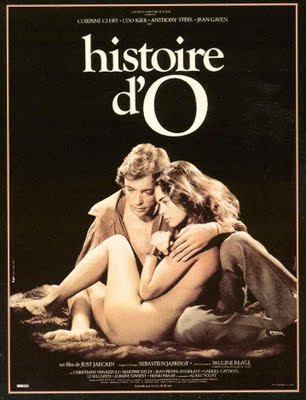
Histoire-d-O

 .

(3) Love and Order

If the subject is made possible by subjection, if subjection is, as it were, the subject’s sinew, does it follow that the subject desires its subjection? If the subject is invested in itself, in perpetuating, in iterating itself—these sinews—as a consistency, is this the same as desiring subjection? It is possible that the subject does not conceive of each iteration, of power’s renewal, as self-subjugation, but then, it might come to. It is possible that some other sociality might be scooped up in the subject’s rolling forward, confecting in the subject some other desire, one to sit alongside and antagonize those always already formed. How else might “the subjection of desire require and institute the desire for subjection” (PL 19), and how else might we think the site, the pseudo-fissure in which this requirement might be discontinued? Butler names another desire—the desire for social existence—as a desire exploited (also created?) by power in its institution of the desire for subjection, particularly the kind of subjection accomplished under the banner of an identity category. Perhaps the peculiar relation of attachment one might have to an acquired skill—peculiar because there is a sense in which we are not attached to our skills but are them—is similarly implemented to be exploited (see Bartky 77). Susan Bordo suggests that culturally-concocted anxieties (such as those having to do with weight or body-image) play a similar role: the subject engages, not in what it sees as frantic attempts to regulate itself or maintain its subjection, but in what amounts to the same: frantic attempts to reduce its anxiety. In the logic governing Réage’s text, it is ‘love’ that functions to keep the subject bound, to bind the subject’s desires to the very notion of being subjugated.


Love Logic

O, whipped senseless, then left alone at Roissy, thinks of those engravings in history books in which long-since dead prisoners, having been whipped already, are shown chained to walls. The narrative voice bleeds with her thoughts: “[O] did not want to die, but if torture were the price she was to pay for her lover’s love, then she only hoped he was happy because of what she endured” (27). “Since she loves him,” she has “no choice but to love whatever emanates from him” (33). Since she loves him, she wants whatever he wants, only because he wants it (112). Since he loves her, she consents to torture: “since he loves her, she trembles, acquiescent” (33). These disturbing formulations deserve to be unpacked; they imply that O’s will, O’s consent, though properly her will, her consent, has already been colonized. Her consent is impelled by love, but what is love, and in what respect is it in turn chosen, or not chosen?

René tells O upon her return from Roissy that she must not begin to think of herself as free, “[e]xcept in one sense: she is free to stop loving him and to leave him immediately. But if she does love him, then she is no longer free” (56). This formulation is repeated with an important transmutation at another point in the text: Some time after O is passed on from René to Sir Stephen, the latter tells her: “if you’re mine you have no right to refuse my commands. But you also know you are always free to refuse to be mine” (171). At this point in the text, O does not refuse his commands, for she has come to love him. But between the moment René utters ‘you are free to stop loving me’ and the moment Sir Stephen claims ‘you can refuse to be mine,’ we learn that, within the text’s logic, ‘being owned’ is just what it means for a feminine subject to love: one may not love initially, but once one is owned, one will love. If love is what binds one to one’s ‘being owned,’ then ‘being owned’ is what, in a vicious circle that is not quite tautological, binds one: Not only ‘I am owned, therefore I’m owned,’ but also ‘I am owned therefore I want to be owned.’ ‘I love; I’m owned.’ ‘I’m owned; I love.’ For the masculine subject of Réage’s text, to own, rather than be owned, is what induces love. The narrator reports that René “had so often told [O] that what he loved about her was the object he had made of her, the absolute disposition of her he enjoyed, the freedom that was his to do with her what he wished” (84). In line with this, Sir Stephen, who does not initially love O, comes to love her after he’s abused her body for a time; the more he ‘personalizes’ her body, the more his love grows: he actually only begins to vocalize his love, which O has already detected in non-verbal cues, after he has had her branded with his initials and fitted with custom irons (see 167). The more he loves her, moreover, the harsher his treatment becomes: “insofar as his love and desire for her were increasing, so his demands on her were becoming more extensive, more exacting, more minute” (139). O does not initially love Sir Stephen either, and so when he tells her that she is going to obey him without loving him and without him loving her (89), this gives rise to “a storm of revolt” (89). O fights him, screaming, when he takes her. Resistance to Sir Stephen is possible at this point in a way that, because of the workings of love, it is not possible with René, precisely because she does not love Sir Stephen. And yet, the more he possesses her, the more she finds surrendering to his orders “completely fulfilling” (139) and the more she comes to love him—she is murmuring as much by page 190. By the time René stops loving her—an event that, significantly, caps the gradual cessation of his use of her body (see 147), and a possibility that, before Sir Stephen colonized her body, had caused O great anguish—O no longer cares. O, used all the more brutally by Sir Stephen, has been affectively transferred to him as well:

What was René compared to Sir Stephen? So many ropes of straw, anchors made of cork, so many paper chains: such were the veritable ties by which he had bound her to him…But what reassurance, what delight, this iron ring which pierces the flesh and weighs eternally…the master’s hand which lays you down ruthlessly on a bed of rock, the love of a master who is capable of taking unto himself that which he loves without pity. (185)

In the text, then, it seems masculine love is voluntary in the sense that the masculine subject can choose what it owns, or choose what it wants to own; feminine love, no more the effect of the feminine subject’s will than of her whimsy, is taken. Before Roissy, O was in love with René, and this is because “René threw himself at her like a pirate” (95). More than this, O “revelled in her captivity, feeling…far down into her heart’s and body’s secret recesses, bonds subtler, more invisible than the finest hair, stronger than the cables with which the Lilliputians made Gulliver prisoner” (ibid.), bind her to this pirate. O’s subsequent trajectory with Sir Stephen, then, is only a more torturous recapitulation of O’s trajectory with René, who owns her already but, upon prostituting her for the first time, is “delighted to discover that the pleasure he reaped from [hurting, humiliating, and debasing her] was even greater than he had dared hope, and had increased his attachment to her, as it did hers to him” (33; my emphasis).


Melancholy Miasma

‘Love’ in O is thus a vicious circle looping through what I’ve called masculine domination, on the one hand, and what I’ve called feminine submission, on the other. It ropes these poles together, since a vicious circle self-perpetuates its tightening. Recasting Butler’s account of melancholy gender formation, I would now like to contradict myself slightly, to suggest that love, in O, plays out against a mute backdrop of compulsory heterosexuality, but heterosexuality conceived strangely, so that it is bears no salient, or at least straightforward, connection to either sex or gender categories.


1. Sex, Gender, Proprietors and Property

Less than the idea that male bodies consort with female bodies, and vice versa, invariably, and less than the idea that masculine subjects consort with feminine subjects, and vice versa, invariably, ‘heterosexuality’ in O implies that dominant subjects relate to submissive subjects, and vice versa. It implies that, invariably, owners, who, with respect to the owned, are only (as in exclusively) owners, relate to the owned, who, with respect to their owners, are owned only. I have been calling ownership ‘masculine love’ and the state of being owned ‘feminine love,’ but the text gives us reason to contest these terms. This is because it confuses stereotypical sex-to-gender designations, and does so partly through a second confusion: it beclouds the very terms ‘feminine’ and ‘masculine,’ sometimes with the help of sex-categories.

O seems ambiguously feminine. She is bisexual—her desire for women is described as “strong,” “real,” and “profound” (100)—and though she engages in stereotypically masculine behaviour with her female lovers, her actions are “carefully calculated” and stem “from a certain childishness [rather than] her conviction” (ibid.). When she courts her female friends, she doffs her beret, helps them out of cabs (99), and, in general, displays “tough-guy manners” (95). Beyond this, she relates to women, when she relates to them sexually, as a hunter—her desire for women, we are told, doesn’t “go a great deal further that the thirst for conquest” (95). She admits that she loves “the perfect freedom” she experiences when she pursues women (ibid.), and that what she enjoys about Jacqueline—that is, once the latter has become her lover—is “the use of a girl’s body, a body with no strings attached” (193). Despite all this, she frequently repeats that what she sees in the women she loves is a reflection of her own submissive self (194). Scrutiny can juice this text: Is it a feminine self that sees a submissive reflection, and is it also a feminine self that engages in carefully calculated dominating behaviours, while at the same time feeling subjectively at odds with them? What is the relationship between the subject, its identifications and its overt behaviour, if identification and overt behaviour are equally performance, and the subject is precisely what is performed? What are the relations these terms bear to the subject’s sexed-body? O dis-identifies with the stereotypically masculine behaviour she executes; she is thus not quite dragged into the field of stereotypical designations that open around her behaviour. She is not quite rendered masculine. But if we take performance theories of self seriously, then her masculine behaviour is not quite controvertible, and O is not quite rendered feminine either.

For deconstructive purposes, say that, before she is prostituted, the O we are given access to through O’s recollections does cling to a certain femininity—or at least, to the obverse side of an uneasy masculinity—when she possesses women. If this is so, then it is not exclusively through owning, it seems, that one becomes masculine; nor is it through being owned that, in the text, one becomes feminine. When O concedes that she loves Jacqueline, that she is “no more and no less” in love with her than she has been with many other women, she is adamant that the term ‘love’ is “the correct one…also a strong one” (102). Love is no doubt the correct term, only it must be qualified: it reflects a “thirst for conquest” (quoted above), and so it is love in the form of domination, ownership; it is the same form René’s love for O, and then later Sir Stephen’s, assumes. Thus, in a way, O, as feminine, owns in the text—she sexually possesses women—both before and when she is owned: both before and during the time she is sexually possessed and ‘actually’ owned by René and Sir Stephen. There is a sense in which she is also owned in her capacity as masculine, since she is a slave but simultaneously carries on with Jacqueline in a ‘masculine’ style. Anne-Marie, the head of Samois, the all-female version of Roissy, also owns women: she literally owns at least one girl, Claire. Anne-Marie is harsher than the men at Roissy, and we are given no reason to think that she is not Sir Stephen’s equal. She is an older woman with grizzled hair; in the culture outside the text-world this might signify that she is somehow ‘less feminine,’ and it is true that the gender-sex confusion performed by the text relies largely on meanings primed ‘outside’ the text (though this is a false exterior). In bed, her short hair pushed up by a pillow, Anne-Marie takes on “the look of some mighty nobleman in exile, some dauntless libertine” (162). Insofar as her appearance, her age, her harshness, her power, and her alignment with Sir Stephen superimpose masculinity, they buttress ‘masculine ownership’ in the insufficiently nuanced sense that I use it above; they seed it with purchase. But Anne-Marie is no more bluntly masculine than O; in some respects, she is also stereotypically feminine: She is “tender and gentle with O” in bed (163), and she is also beautiful (159). In Anne-Marie, then, we find both a form of feminine ownership and, unlike in O, a femininity that is at all times cleaved from states of being owned.

Although it seems that female characters can adopt what we can, for explanatory purposes only, call a masculine subject position (e.g., they can ‘own’ in the broad and strict senses of the verb), it is unclear whether they can adopt this subject position with respect to men. It is true that Sir Stephen relates to Anne-Marie as his equal, though he never relates to her as her subordinate. There is perhaps a sense in which male-sexed bodies function as trumps to the ‘gender’ configurations in the text: The freedom O loves when she is pursuing and engaging with women is not the freedom she possesses in her relationships with men: With women, “[s]he control[s] the game, and she alone,” whereas with men, she “never” controls the game, unless she does so “on the sly” (100). But although O controls the game with women, she also, again, sees in them a reflection of her submissive self: “The power she acknowledged her girlfriends had over her was at the same time the guarantee of her own power over men. And what she asked of women (and didn’t return, or so little), she was happy, and found entirely natural that men should be desperate to demand of her” (101). Irrespective of the fact that she dominates women, men seem to weasel their way past O in the power hierarchy, such that it is unsurprising that she is unable to “conceive of giving herself to a girl, the way a girl gave herself to her” (194), but puzzling that other girls are able to give themselves this way to O. O, unlike her girlfriends, can only conceive of giving herself this way “to a man” (ibid.). And yet, she does give herself to Anne-Marie while staying at Samois, albeit perhaps not in the same way that she would give herself to René or Sir Stephen: Anne-Marie does not own her. But then, could we say she is, like any other man affiliated with Roissy, a proxy for O’s owner(s) (see, e.g., 32)? Does O become fused to submission as soon as she enters into a relation with a male-sexed body (even if only through one of its mediators)? Is she also a gendered body when she is so fused? Or is O fused to submission simply when she enters into a relation with a body that owns? How to account, then, for who owns whom in what situation, given that O, too, has the capacity to own? After she is prostituted, O claims “that the girls she caresse[s] belong…by right to the man to whom she belongs…and that she [is] there only by proxy” (ibid.). The corollary might seem to be that a male-sexed body is at the top of the totem pole again, that women own only by proxy, but then Anne-Marie does not own Claire by proxy; rather, the men who violate Claire when she is sent to Roissy will violate her by proxy, in place of, without supplanting, Anne-Marie

.

2. Culturally Doomed

Sex-to-gender-to-owner/property assignations in O prove unfruitful. In Réage’s book, female bodies can own female bodies and ambiguously feminine bodies can possess ambiguously feminine bodies, but whereas in the non-text world a woman-woman relationship that is also parsed as a ‘feminine subject’-‘feminine subject’ relationship might function to confound the dominant, heterosexual regime (i.e., by proposing a homosexual alternative; Butler PL 165), in the text-world a relationship consisting of a feminine subject owning a feminine subject, since it remains premised on a stringent heterogeneity (that between ‘owner’ and ‘slave’), does not, to that extent, gesture towards an alternative erotic paradigm.

In Butler’s account of melancholy gender formation, which she intentionally hyperbolizes, one becomes feminine to the extent that one blocks women as potential love objects and masculine to the extent that one blocks male love objects. The field of possible erotic attachments becomes constricted in accordance with (heterosexual) cultural proscription—such that one desires precisely what one is not—and the ego forms in and through the process of mourning the loss of these possible attachments. Mourning, in this instance, is neither before nor after the ego: it participates in the very ‘turn’ of assujettissement, constituting the ego it at the same time presupposes. Because the prohibition of possible attachments occurs “prior” to the subject’s inception, the subject’s mourning is not properly experiential.[10] Hence a heterosexual-identified woman may not lament the fact that she does not love a woman, may not be able to imagine herself ever loving a woman, and may experience the paucity of her imagination in this regard as ‘natural,’ rather than as a cultural effect. Culture as an effecting agent disappears at the site of the subject’s emergence: ‘I could never love a woman; that is just the way I am’ (see 181 and 138).

This bizarre, affectless melancholy, ‘gender melancholy,’ exists against a backdrop of compulsory heterosexuality: it is symptomatic of the latter, is enforced by, and also enforces it (140). A specific conception of heterosexuality likewise supports and is supported by ‘love’ as it is configured in Réage’s text, or, more specifically, by the subject-positions that underlie ‘love’: O is unable to relate to, to love, or even imagine loving, ‘a dominant subject’ from anything other than a submissive subject position. She is likewise unable to love, or even imagine loving, ‘a submissive subject’[11] from anything other than a dominant subject position: she wants to pin Jacqueline “to the wall like a butterfly impaled” (104). To love in the text one must either own or be owned, dominate or submit. Attachments that assume a form other than ‘submissive-subject’-to-‘dominant-subject’ are foreclosed by the logic governing the text-world and O is culturally doomed in advance: she is a melancholic subject who does not feel ripped off in light of the fact that love, whether with men or with women, has only the one configuration.
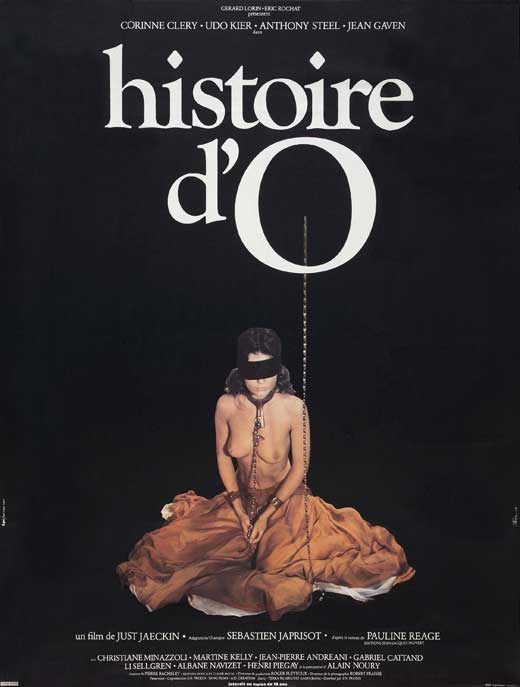
cover5

.

(4) Clinamen

O’s Consent

So love is rigid and love compels. The ‘monstrous logic’ Robertson refers to in her discussion of Story of O is precisely the continuous solicitation, on the part of her masters, of O’s consent, but ‘consent,’ in this context, is necessitated by a impelled love, and so we must rethink ‘consent’ outside a paradigm in which the will, the self, and otherness are kept tidy and separate. The boundaries between what is internal and external are fraught. Roissy, as a metaphoric space concretized in the text, is caught up in this chaos; it functions within the subject while simultaneously looming on the horizon as a force that could, but need not necessarily, subdue it: There is an O before O is actually taken to Roissy and Jacqueline might be taken to Roissy, or not.

Can O refuse to be Sir Stephen’s? Not if she is Sir Stephen’s; not if she loves him. Is O free to end her slavery? Once she has entered into the contract she has already been entered into, anyone who finds her uncooperative will bring her back to Roissy (17), a stipulation which seems redundant: There is in fact no need for a return to Roissy, since Roissy is embedded in the subject as love (the very state of being owned) and love’s corollary: compliance. The text, then, leaves very little room for uncooperativeness. O tells René that Jacqueline would never agree to go to Roissy, to which he simply replies, “No? Well then,…they’ll end up taking her there by force” (148). Sir Stephen has already told O that, once Jacqueline is in Roissy, “if she wants to leave, she’ll leave” (124); what troubles this formulation, though, is the notion that Roissy (read: being owned) makes it such that the subject would not want to leave, the notion that “once inside, there would be enough valets and chains and whips to teach Jacqueline obedience” (177). In the text, being caught means it is already too late for resistance. Consistent with this, shortly after coming to own her, Sir Stephen tells O that, in all likelihood, she had not understood what she had agreed to when she consented to be his slave, but that “by the time he taught her it would be too late for her to escape” (90). By the time he teaches her it is indeed too late, for, of all abominations, she has fallen in love.[12]

The formulation ‘if you don’t agree, we’ll force you’ only ceases to be redundant at those junctures in the text in which it is the body that resists. O is asked at various points in time to agree, though the disagreeable details of what she is agreeing to are kept from her: because her body will not be able to endure what is to be done to it, consent becomes superfluous. At Roissy, René informs her: “It’s because it is so easy for you to consent that I want something you can’t possibly agree to, even if you agree in advance…You won’t be able to keep yourself from saying no when the time comes…When it does, it won’t matter what you say, you’ll be made to submit” (33). Sir Stephen similarly asks her to consent to wearing his irons, though he keeps her in the dark about how these are to be applied (120), and concedes beforehand that there is no real question of whether she will or will not wear them: “these were still orders, which there wasn’t the slightest question of O disobeying” (120). Of course, O does agree, for she is already bound in a way that compels agreement; refusal does not even cross her mind (see 74). Still, a rift evolves between what she wants for herself and her body’s responses: her body’s memory of the whip—physical fear of the whip that René had not used but Sir Stephen promises, though without specifying how often—makes it impossible for her to consent to the latter’s ownership immediately (78).

.

Subjective Developments: The Subject Develops

Although at no point in time does O embrace the feeling of the whip, her attitude toward the whip gradually changes. Sir Stephen is the pivot on which O as already-subjugated-subject turns, the textual threshold that streamlines this attitudinal change, along with other major subjective developments. O’s enslavement to Sir Stephen makes Roissy continuous with her everyday life: After Roissy, but before Sir Stephen, O’s life seemed to carry on as usual in the sense that there were no other men who took advantage of her, only René, and in the sense that she was not subjected to regular corporeal torture. With Sir Stephen’s appearance, however, Roissy, understood as a nocturnal dream-world—or as “reality in a closed circle,” “a private domain”— threatens to “contaminate all the habits and circumstances of her daily life, both upon and within her” (77; my emphasis). At Roissy, though O “agreed” to do as René wished, it was nevertheless simultaneously true that she was chained to her bed, chained to various stations, kept naked, whipped unwillingly and subjected to torture. O, at Roissy, was “the lucky captive upon whom everything was inflicted, of whom nothing was asked” (81). In the ‘outside world,’ and even more so with René’s solicitation of her consent to be Sir Stephen’s, O, conversely, experiences herself as fully complicit in her subjection: “Here it was of her own free will that she remained half-naked” (ibid.). Power, at this point in the allegory, is not just power applied to the body; it is power concentrated as consciousness, power that has produced the self-regulating consciousness it is manifest as. As O’s enslavement to Sir Stephen becomes further entrenched, this subjected consciousness becomes increasingly concentrated. The narrative’s unfolding only corroborates O’s premonition upon being asked to belong to him: “What had formerly only been reality in a closed circle…was no longer to be content with outward signs—naked loins, laced-up bodices, the iron ring—but to require the thoroughgoing accomplishment of an act” (77).

Before she has agreed to belong to Sir Stephen, O recoils at the prospect of being whipped, even enjoins the men to spare her from being whipped: “Oh, have pity,” she says, and, “not again, no more of that” (79). Within pages of belonging to Sir Stephen, however, she finds it “necessary, and agreeable, to be beaten” (109). By the time she has gone to Samois to have his irons applied to her, she admits that she likes “the idea of torture,” that, even though she would give anything to escape torture while being tortured, after the fact of torture she is “happy to a have undergone it, and happier still the more cruel and prolonged it has been” (155).

O’s consolidation as a subjected subject is equally manifest in O’s changing relation to Jacqueline. Upon initially being requested (ordered) to coerce Jacqueline into coming to Roissy, O is mortified. She tells Sir Stephen that it can’t be done. Without quite identifying with Jacqueline, O is nevertheless loyal to her, so much so that she is upset when René regards her as he regards any of the Roissy women: O “views as insulting to Jacqueline an attitude she finds perfectly correct and natural when it comes to [herself]” (129). She feels herself “a traitor, a spy, the envoy of a criminal organization” (134), moreover, while attempting to persuade Jacqueline’s mother to allow her to move out, into her, O’s, apartment, from which it’s one step to Roissy. Upon returning from Samois, pierced with irons and cauterized with Sir Stephen’s initials, the noble O has a change of heart. We might say, recapitulating the fictive temporality that the allegory requires,[13] that by the time she returns she has fully internalized the terms of the master’s world: She “enjoys…thinking about how she is going to betray Jacqueline,” having been “insulted by the scornful manner in which Jacqueline had eyed [a condition of which she is proud, that of] a branded and flogged slave” (178). Whatever anxiety, whatever anguish, whatever shame her condition is initially said to give rise to (see 117) has either dissipated entirely or is simply no longer referred to in the nether parts of the text. O’s “secret pride,” the “harrowing pleasure” she initially experiences as a slave (ibid.) is, conversely, carried over; it is perhaps intensified: she becomes “an ecstatic slave” under Sir Stephen (185).

.

Doublings and Uncanniness

1) The Beginning as End

In a way, Sir Stephen’s injection in the text figures a transition point between a body acted upon by power and a body that, having become the prison of the soul, is also a soul that imprisons the body. There are, as I’ve also argued, other respects in which O is always already a subjected subject, or is a subjected consciousness all along, and yet it still makes sense to say that she is a subject whose subjection becomes increasingly intensified as the narrative progresses. The text, in this, and in many other respects, is one of incessant (uncanny) doublings; these doublings nourish the idea that the subject exists iteratively, the idea that it takes up its subjection repeatedly, whether by diverging from it or, as in O’s case, by consolidating it, though in a new, or different way, again.

Roissy, the Panopticon, likewise returns in physical, psychological and phantasmagoric forms to be ‘taken into’ O in new ways, as if it had not been taken into her before: It resurges with Sir Stephen. It resurges with Samois. It resurges in the final scene in which, after midnight, Stephen drives O to ‘the Commander’s’ party, where she is to be put on display: “At Roissy [O] felt herself to be lost as one is at night, lost in a dream one has dreamed before and which begins all over again” (77); en route to the Commander’s party, she passes through yet another nocturnal dreamscape: “there was nothing real in this countryside which night made imaginary” (198). It is not enough, moreover, that she arrives at the party in an owl mask; O must instead metamorphose fully, becoming, in seeming actuality, a mute creature from another world (200-1). The atmosphere at the party is equally oneiric; at the party it is by candlelight that she is ogled at and probed.

The dream space breaks with dawn without breaking, just as Roissy, in the inaugural section of the text, is broken with (O leaves) though it nonetheless sweeps through the rest of text: The men lay O out on a table and possess her “one after the other” (201). Similarly, the narrative does not end. Its ending is instead iterated, perpetually, each time transformed. It is explicitly signalled for the first time midway through the text, with the arrival of Sir Stephen: “Well, here was the end, right here, just where you would have least expected it, and in the most unexpected of all imaginable forms (assuming, of course, as [O] now said to herself, that this was indeed the end and that there wasn’t some other end hidden behind it, or perhaps still a third ending hidden behind the second one)” (76-7), which, as the reader comes to see, there is and are: Beyond the two alternative endings Réage has included, there is an ending each time Roissy resurges, each time O is consolidated: “What distinguished this end [Sir Stephen’s appearance as a potential master] was the way it made recollection topple into the present; and the way, also, that what had formerly only been reality in a closed circle, in a private domain, was all of a sudden about to contaminate all the habits and circumstances of [O’s] daily life” (77). ‘The end,’ it turns out, is, in O, just another figure for ‘the turn.’

 .

2) Who is Jacqueline?

As O is—indeed, as ‘the end’ is—successively iterated throughout Réage’s text, it seems O is only further consolidated in her subjection: each iteration only institutes a subjugated state even more grotesque and abominable than the last: there is always another ‘low’ hidden behind the ‘low’ the reader, at the time, might well conceive as ‘the all time.’ One hardly even registers that one has given up hope for O—if there had ever been hope for O, and if one had ever even thought to hope for it—so excessive is the doubling over of endings performed by the text, and so habituating this excess is. As a result, the narrative engine in the latter part of the text is transferred onto Jacqueline: what will become of her? I found myself, in my readerly subject- position, wanting her to be spared, spared the humiliations imposed by Roissy, and spared the pain and abasement afforded by a condition like O’s (some, conversely, might have been titillated to see her ensnared). And yet there are problems with, or at least ambiguities that surround, the formulation of Jacqueline as one who might be spared, as one who has not already been ensnared, as a figure, in other words, of freedom, or of an agency that has not already been compromised.

In some respects, Jacqueline, as a figure of freedom, as the swerve away from a trajectory determined by power, or as the clinamen, understood as a deviation from the rule, intersects the figure of Kristeva’s foreigner. ‘Jacqueline’ is, in fact, only a professional name, “a name for forgetting her real name [Choura] and, along with her real name” (132), her dwelling space, a “sordid and heartbreaking gyneceum” (132), in which she is confined, when she is home, with a “tribe,” or “horde” of women: her family (131). Jacqueline abhors these women (she “would [give] half her life” to forget their ‘hissing’ language [132]); hence she abandons them at the first opportunity: O invites her to move in. Kristeva’s foreigner is similarly one who has abandoned her origins and one who, additionally, though there may be a sense in which Jacqueline does this as well, reinstitutes this abandonment over and over: The foreigner remains perpetually transient (TF 4). “Free of ties with [her] own people,” the foreigner feels “completely free” (12), and also—not unlike O whipped to the point of delirious ecstasy at Roissy—dispossessed of herself: “Settled within [herself], the foreigner has no self.” (8). “Available, freed of everything, the foreigner has nothing, [s]he is nothing” (ibid.). It is not entirely the case that Jacqueline has nothing, for she is “passionately attached to whatever belongs to her—to her rose-colored pearl ring, for example—but absolutely indifferent to what [isn’t] hers” (O 136); the notion of ‘complete’ freedom embedded in this initial construction of the foreigner, moreover, needs, as we by now know, to be nuanced, though in a way that is not radically inconsistent with Kristeva’s analysis: Whatever swerving Jacqueline accomplishes, or fails to accomplish, is nonetheless made possible by power, and, as a result, is never completely divested of its historicity (see Butler PL 195). In a sense, Kristeva rhymes with this thought when she insists that the foreigner is fundamentally melancholic, a “lover of a vanished space, [who] cannot, in fact, get over [her] having abandoned a period of time” (9).

Melancholy is reconfigured in the foreigner; it does not align in a perfect way with melancholy of the kind Butler discusses, which is premised not only on ontological and erotic foreclosure, but on a tacitly negative form of affect. In Kristeva’s text, melancholy is connected to the subject’s formative and (in some ways) insurmountable history, and is also characterized in terms of a happiness that is itself happiness newly conceived, newly articulated: The foreigner cultivates an ethos of indifference and detachment, such that, while unable to fully relinquish the past, she nevertheless “retain[s]…of the past only the game” (TF 38). The affective state that emerges out of this ethos, and that reveals the self as ‘unessential,’ ‘a simple passer by,’ is “[a] strange way of being happy, or of feeling imponderable, ethereal, so light in weight that it would take so little to make us fly away” (TF 38). The foreigner is thus one who lets go, and one who is let go of. O experiences herself as relinquished, but the subjective forms she assumes (the self she was, as well as the self she does, in fact, and to the contrary, become) remain tethered to, informed, determined and limited by, a cultural formation premised on dominance and submission all the while. We have seen that this formation also, within the novel’s logic, thoroughly colonizes ‘love,’ so much so that love can only assume, from a ‘masculine’ position, the form ‘I love you because I own you: what I love is the owned object I’ve made you’ and, from a ‘feminine’ position, the form ‘I love you, therefore I’m yours,’ the equivalent of which, as O’s possession by Sir Stephen attests to, is ‘I’m yours, therefore I love you.’ It is precisely love which Jacqueline, as aloof and insensitive as Kristeva’s foreigner (see TF 7), is shielded from.

Jacqueline is fundamentally narcissistic: she has no need for the kind of reassurance O is, in the initial stages of the text, perpetually seeking out in René: reassurance of his desire for her—O is happy he is so hell-bent on exacting proof for himself of “the degree to which he possesses her” (56), and perhaps this is because his actions afford precisely such reassurance. Jacqueline, conversely, relies on no one: all she needs is a mirror (103). As Butler notes: “Narcissism continues to control love, even when that narcissism appears to give way to object-love: it is still myself that I find there at the site of the object” (PL 187). Consistent with this, Jacqueline takes pleasure in being desired if it is someone useful that desires her, or if it flatters her vanity (129): She receives O’s attentions because she derives narcissistic and physical pleasure from them and does not bother to reciprocate. When she begins to engage sexually with René, she remains similarly self-immersed: “She had never behaved like someone in love with him,” and O cannot help thinking that, even if, as is likely, Jacqueline is as abandoned with René as she is with her, “[her] surrender does not involve her emotions” (184). If love, in the text, is what traps, then it seems the possibilities that fall outside of entrapment can only be animated for one who refuses love (or at least the rigid configuration ‘love’ as it appears throughout Réage’s text). It does seem as if Jacqueline’s aloofness inoculates her, to a certain extent, from what we might call the Roissy-effect: For O, torture eventually just becomes a matter of course: necessary and even agreeable, a source of pride. Once Jacqueline, however, learns of O’s markings and lash-marks, and learns of their source, she is horrified (176). As she sees it, if she does consent to going to Roissy, it will only be to have a look, to observe the freak show (see 177).

There is another moment in the text that counterbalances O’s ‘normalized’ response to her condition as well (O is a freak, but in a Roissy-governed world, perhaps freaks are the norm?): The woman who removes her pubic hair for the Commander’s party also reacts to her scars with horror: she is “scandalized” and “terrified” (197). Is Roissy ubiquitous and normal, then, or is it localized and perverse? The text leaves the answer ambiguous: Even Jacqueline’s adolescent sister becomes enchanted with the idea of enslavement, and, at the Commander’s party, a ‘normal’ young couple approaches O, the owl, O the naked, lacerated, perforated spectacle: The “very young girl” is in a “white dress” that has “two tea roses at the waist”; she is “wearing gilded sandals” (201). She is dressed, in other words, to exude middle class innocence, and yet she listens quietly to ‘the boy,’ who tells her he will have her body desecrated in the same way O’s has been. The girl does not appear upset (ibid.). An inebriated American also approaches O at the party, fondles her, and reacts to her irons with “horror and loathing” (200). It is of course slightly odd to ask ‘What are these ‘normals’ doing at a Roissy affiliate’s party?,’ since Roissy itself is populated by ‘normal people,’ and the population is replete, one deduces, with Roissy members. In this, and other ways, the text insists, if not on the strict identity of, then on continuity between, the ‘normal’ and the ‘perverse.’ Is there, as a result, any room for Jacqueline to manoeuvre, or does the possibility of a swerve hinge on something beyond or outside of these poles, as well as the spectrum between?

Jacqueline is one who reacts to Roissy with horror and disgust. Unlike, O, she does not feel bound to René (and so cannot be bound, through him, to Roissy); she falls in love with a man who is directing a film she is in, and makes plans with him without informing René of these (she has abandoned her origins, and now she is shedding another constitutive influence). As far as she is concerned, it is none of O’s business whether or not she is in love with this man, and she tells her as much when she inquires. O purportedly inquires because Jacqueline’s being in love concerns René, but Jacqueline refuses this claim, volleying with: “What also concerns René and Sir Stephen and, if I’ve understood it correctly, a lot of other people too…is that you are badly seated” (187). O is sitting on her dress, whereas she has been commanded to sit bare-assed forevermore. How are we to read Jacqueline’s retort? Is the ‘what also’ component of the phrase to be taken seriously?: ‘Yes my being in love concerns René, but you are being disobedient, too, so shut up.’ But then, it seems that Jacqueline’s being in love would not concern René in the same way that O’s transgression would, for Jacqueline keeps him at arm’s length, whereas, as long as O loves a Roissy affiliate, as she now loves Sir Stephen, she must act in accordance with its members’ wishes. Jacqueline concerns René insofar as she can break his heart, but it does not seem as if she is owned. Should we read her retort as a refusal, then?: ‘René has no claim to me; the only thing that concerns René is what he has proper dominion over, namely, you and the other slaves.’ And yet, Jacqueline has, by this point in the text, also fallen in love. No longer narcissistically aloof, at least, to her new object of affection, does she risk being carried back (carried forward) to Roissy? In this ‘normal’ world in which she has fallen in love with a film director, a normal boy, is she just another unmarred girl at the Commander’s party?

We can pose the question in a different way if we consider that, in the text, Jacqueline functions as O’s uncanny double. Uncanniness, as Kristeva articulates it, is “a destructuration of self that may either remain as a psychotic symptom [think: repetition/stagnation] or fit in as an opening toward the new, as an attempt to tally with the incongruous [think: swerve]” (MNUB 188). The encounter with the uncanny is an encounter with an Other that is nevertheless familiar and shakes the self in the policing of its own boundaries: it is in fact an otherness in the self that has been ejected through the work of the self’s self-sculpting identifications, such that an encounter with it invites a broadening of these identifications, an expansion of the self’s purview (see MNUB 188-9). The uncanny may refer the subject “to an improper past” (MNUB 183). Before falling in love with René, O was Jacqueline: “indifferent and fickle,” she had merely “amused herself tempting the boys who were in love with her” (94). Her fully narcissistic desire to be desired not only shielded her but actively inflicted pain: it was a weapon (ibid). Subsequently, O’s indifferent and fickle behaviour is referred to, by a guilt-stricken O, as part of her ‘wantonness,’ and as such, as part of the constellation of justifications for her (present) punishment: an improper past, it has been ejected from the subject’s identificatory ambit. It is Jacqueline, then, since she is the representative of this past, who has been ejected from this ambit, and it is no surprise when O, by this time fully sympathetic with René (read: Roissy’s world and its order) and with the vision of sexual relations in which he ought not be love-stricken and desperate, but be dominant, comes to hate Jacqueline for the pain she might cause him.

In Freudian melancholy, the rejected object, again, is not actually ejected; it is rather subjected to a fissioning: it is brought into the ego where the hating energies once directed toward it (by the ego) are broken off from it and redirected toward the self. In Butler’s account, in which melancholy is assujettissement, the trace of the Other as feelings of worthlessness (or self-hatred, or even, calling to mind O, guilt) must be read as a “dissimulated sociality” (181): the various foreclosures performed in and through the cultural delineation of the realm of the possible are actually what occasions “the internal violence [and voice] of conscience” (183). O is guilt-ridden—guilty for prior fickle indifference, guilty for continuing wantonness, guilty for something, at one point we find out, she cannot quite put her finger on: “It…seemed to her that her nakedness was an atonement for something…but for what?” (103). Is her guilt, then, with its ambiguous content, precisely the trace of something foreclosed, something uncanny that, in (re-)erupting, might open O toward the new? And, if it is, then why should this something be ‘fickle indifference,’ as embodied by O’s uncanny double, Jacqueline?

For now, I would like to bracket the fact that ‘fickle indifference’ is not a possibility radically foreclosed in the world of the text[14] and simply ask: Does ‘fickle indifference’ nevertheless swerve? On the one hand, it seems to shield Jacqueline from Roissy. In other ways, it does not, however, and perhaps this is because it does not shield her from the desire to be desired: there are social norms that govern what constitutes a proper object of desire, and we might wonder if, within the domain that is the text, these are always already Roissy-inflected. Jacqueline already knows how to behave like a ‘desirable’ (submissive) subject: “No one would ever need to teach this woman anything: neither to be silent, nor to arch her head halfway back” (103-4). So acquainted is she with ‘the rules of the game’ that she warns O about the danger of wearing garters without a garter belt (“you’re going to ruin your legs” [63]) long before Anne-Marie informs her of the same (e.g., in the form of an indirect prohibition) (143). It is perhaps no coincidence, then, that one of the gowns Jacqueline dons at work, and which O photographs her in, is a gala gown “such as brides wore in the middle ages” (64) and such as only Roissy slaves continue to wear (65). Jacqueline’s fixation on O’s ring even causes O to think it is possible that “Jacqueline had been at Roissy,” and then, significantly, to wonder “why didn’t she too have a ring?” (75). Of course, O did not have a ring (read: iron sign of enslavement) prior to Roissy either: it was only bestowed once she had arrived there, and yet this did not stop René from…taking her for a walk…

Jacqueline is O’s uncanny double, an unfamiliar return of the familiar, to be sure, but if she were to interrupt O’s insularity, this “destructuration of self”—a return to fickle indifference—would perhaps best be thought of in terms of repetition/stagnation, or in terms of, as Kristeva puts this, a psychotic symptom (quoted above): an otherness that is more, rather than less, more of the same. If Jacqueline is not, then, finally, a good candidate for the figure of the foreigner, for the clinamen, then what else could serve as such a candidate? What else could swerve? O fills me with despair precisely because the logic inscribed by the text seems impervious to interruption, to change. The configuration of love itself in the text is inflexible, assuming, as it does, the one form. Our consideration of Jacqueline has revealed that resistance, within the logic of the text, likewise assumes a single form: ‘I love only myself: I do not love at all.’ What makes the text depressing, then, is that it not only forecloses the possibility of alternative configurations of love—positive attachments and forms of influence/interruption/inflection that are not founded on the existence of objects with owners, or on the discursive insistence on ‘intruders’ and the ‘intruded upon’— but also points to stagnation as the only model for a sorry and ultimately self-deceived resistance: narcissism: ‘I am never interrupted, for I do not love at all.’ One’s very existence implies that one has been, in some way, interrupted; one’s narcissism may keep one soldered to what one has always already been made into.

 .

The Swerve

If there is an opening in O, then it is an untapped opening at the point of the text’s closure. The narrative voice marooned in white space on a final, un-paginated page reports:

In a final chapter, which has been suppressed, O did return to Roissy, where Sir Stephen abandoned her.

There exists a second end to O’s story. In that version, O, seeing that Sir Stephen was on the verge of leaving her, preferred to die. Sir Stephen gave his consent.

Recall that the text’s beginning is forked as well: either O is blindfolded and marshalled up to the chateau, or she walks to the door herself. These beginnings are equivalent, for an already subjected self’s autonomy is its subjection all the same. Is a similar equivalence to be found in the proposed “endings”? When O is abandoned, does this mean she is no longer owned, and, if so, in what sense does this signify that she is dead? ‘Death’ is dangerous, a vacuous word: The self dies without dying to become another; the self is said to die at the height of pleasure just as much as at the pinnacle of its debasement; O believed she had lost herself, but instead a subjugated self was only being further consolidated. What reason do we have for reading death at this point in the text as signifying new news? No reason at all. No reason: thus it is appropriate that Kathy Acker taps into the text here and veers.

In Pussy, King of the Pirates, Acker provides her own version of O’s narrative. Acker’s O ends up in China, a name for any city, following W, her lover, who prostitutes her. W inadvertently sells weapons to a band of revolutionaries who undermine patriarchy/capitalism, his enterprise; they also beat him up severely, nearly killing him. (This is power making possible what from power strays.) W has abandoned O. Réage’s premise: ‘If Sir Stephen’s not around, then I want to be no more.’ Acker’s premise: “O speaks: If W’s not around, I don’t want to be a whore” (17). Once the revolutionaries storm the English embassy, O’s ‘health’ returns: she learns that W was part owner of the whorehouse, and thus tells us: “I no longer cared what W felt about me: all I wanted was for him to be absent from me” (21). The patriarchal order crumbles and O “[stands] on the edge of a new world” (23).

In another version (same book), O is in Alexandria and catalyzes the revolution herself: “a revolution of whores” (30) to begin “[t]he only thing in the world that’s worth beginning: the end of the world” (27). Acker’s perseveration, throughout the text, on the prospect of a new world order is significant, given, as we have seen, that it is a rigid discursive/ontological order that fortifies a subjugating form of power in Réage’s text. Acker busts open the order consolidated in that text, displacing the phallus—in Acker’s text ‘Pussy’ is king, pirate, O, treasure—displacing, in fact, many things: reason, identity, certainty, consistency. She populates her text with characters and actions that befit the ambiguity of any brink: patriarchal women, decapitated/castrated fathers, bloodthirsty freedom fighters, graveyard dwellers, men who seem to have overcome themselves, readying themselves for the new order, but who are nevertheless insidious, girl pirates who are just as, perhaps even more insidious, vicious, complicit with power… Acker resolves nothing. Instead, she locks the reader into a bemusement that is also a bewonderment: does everything change, or does nothing? Yet the canny whore-pirates of Acker’s text are one step ahead of the melancholic subject confined to Réage’s pages, since they realize that an ontological order constrains what is possible, and therefore must be interrogated: “The weight of culture: questioned and lost” (31).

Part of this interrogation is discursive: “the whores learned that if language or words whose meanings seem definite are dissolved into a substance of multiple gestures and cries…then all the weight that the current social, political, and religious hegemonic forms of expression carry will be questioned. Become questionable. Finally lost.” (ibid.) Elsewhere, the text gestures toward the transformative potentiality of disjunction: “words apocalyptic and apostrophic, punctuations only as disjunctions, disjunctions cut into different parts of the body or of the world” (36). Disjunction: not just the ‘or’ of alternatives as in Réage’s text, for Acker’s text makes use of narrative disjunction, the occasional Steinean period,[15] and, again, a crafty skewing of logic. The pirate/whores’ insight, then, is not only that they must think, or attempt to think, the very order they’ve issued from, but that thinking might involve linguistic rearrangement.

The whores become pirates precisely to perform this interrogation, to pursue the origin of whoredom (the order it’s emerged from) and to change its course (27). In a way, then, Acker’s text offers another formulation of Foucault’s ‘thought thinking itself’:

Thought does exist, both beyond and before systems and edifices of discourse. It is something that is often hidden but always drives everyday behaviours. There is always a little thought occurring even in the most stupid institutions; there is always thought even in silent habits. Criticism consists in uncovering that thought and trying to change it: showing that things are not as obvious as people believe, making it so that what is taken for granted is no longer taken for granted. To do criticism is to make harder those acts that are now too easy. (SIIITT 172)

Criticism does not settle things once and for all, but problematizes a subject’s previously un-problematical proceedings. The subject engaging with criticism is a troubled, dissatisfied, confused, but nonetheless active subject—a fizzing subject, even zealous, and vertiginous, falling, falling ever short of knowledge. In Réage’s text, the otherness that interrupts the self is concretely cultural; in Acker’s text, the otherness the girls quest for, where ‘quest’ is ‘criticism,’ is an otherness beyond the cultural, or at least an otherness under-determined by the cultural. This otherness is ‘thought.’ Thought is figured once in Acker’s book as a red rat named Ratski, who, elsewhere in the text, interrupts as menstrual blood. It is perhaps the pursuit of this other otherness—‘thought’—it is perhaps thought’s opening to thought—that holds out the possibility of a swerve away from Roissy and what it enables. This pursuit, significantly, occurs beyond the border of O’s original story. Story of O, it seems, has inspired the very myths which seek to double back and destroy it, and which, in doubling back, invest it, preserve it. For their very life, they depend on it. Some of us have never aspired to do anything more than pervert and corrupt, to be anything more than bastards and degenerates.

Ratski is fat because everything in the world sits inside her belly because she never sits inside any belly because, if she did, she’d tear right through it. Her fur is red…

No one ever finds Ratski: she lives inside the interstices of the world. Located between red flowers. The name of each interstice is “intellect.”

Ratski’s always on the rag.

…and so the reign of girl piracy began… (Acker 208)

 —Natalie Helberg
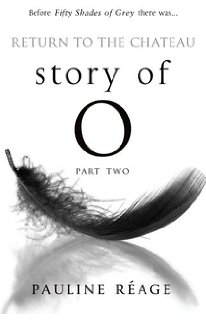
cover2

.

References

Acker, Kathy. 1997. Bodies of Work: Essays by Kathy Acker. London: Serpent’s Tail. Print.

_____. 1996. Pussy, King of the Pirates. New York: Grove. Print.

_____. 1993. My Mother: Demonology. New York: Pantheon. Print.

Andrews, Betsy. 2004. “The Real Story of ‘O.’” Biting the Error. Ed. Gail Scott, Mary Burger,

Robert Glück, Camille Roy. Toronto: Coach House. 216-19. Print.

Bartky, Sandra. 1990. Femininity and Domination: Studies in the Phenomenology of Oppression. New York: Routledge. Print.

Bök, Christian. 2002.‘Pataphysics: The Poetics of an Imaginary Science. Evanston: Northwestern UP. Print.

Bordo, Susan. 2003. Unbearable Weight: Feminism, Western Culture, and the Body. Berkeley: U of California P. Print.

Butler, Judith. 2005. Giving an Account of Oneself. New York: Fordham UP. Print.

_____. 1997. The Psychic Life of Power: Theories in Subjection. California: Stanford UP. Print.

Crozier, W. R. 1996. “The Psychology of Colour Preferences.” Review of Progress in Coloration and Related Topics. 21.1: 63-72. Primo. Web. 12 Aug. 2013.

Deleuze, Gilles. 1988. “A New Cartographer.” Foucault. Trans. Seán Hand. Minneapolis; London: U of Minnesota P. 23-44. Print.

_____. 1988. “Foldings, or the Inside of Thought (Subjectivation).” Foucault. Trans. Seán Hand. Minneapolis; London: U of Minnesota P. 94-123. Print.

Foucault, Michel. 2006. Psychiatric Power. Trans. Graham Burchell. Ed. Jacques Lagrange. New York: Picador. Print.

_____. 2003. “So Is It Important To Think.” The Essential Foucault. Ed. Paul Rabinow and Nicolas Rose. New York: New Press. 170-73. Print.

_____. 2003. “The Thought of The Outside.” The Essential Foucault. Ed. Paul Rabinow and

Nicolas Rose. New York: New Press. 423-41. Print.

_____. 1995. Discipline and Punish: The Birth of the Prison. New York: Vintage. Print.

Giordana, Simona. 2005. Understanding Eating Disorders: Conceptual and Ethical Issues in the Treatment of Anorexia and Bulimia Nervosa. Oxford; New York: Oxford UP. Print.

Heyes, Cressida J. 2007. Self Transformations: Foucault, Ethics, and Normalized Bodies. Oxford; New York: Oxford UP. Print.

Kristeva, Julia. 1991. “Might Not Universality Be…Our Own Foreignness?” Strangers to Ourselves. Trans. Leon S. Roudiez. New York: Columbia UP. 169-92. Print.

_____. 1991. “Toccata and Fugue for the Foreigner.” Strangers to Ourselves. Trans. Leon S. Roudiez. New York: Columbia UP. 1-40. Print.

Levinas, Emmanuel. 2006. “The I and Totality.” Entre Nous: Thinking-of-the-other. Trans. Michael B. Smith and Barbara Harshav. London; New York: Continuum. 11-33. Print.

_____. 1969. Totality and Infinity: An Essay on Exteriority. Trans. Alphonso Lingis. Pittsburgh: Duquesne UP. Print.

Lorde, Audre. 2007. “Age, Race, Class, and Sex.” Sister Outsider: Essays and Speeches by Audre Lorde. Berkeley: Crossing. 114-23. Print.

McWhorter, Ladelle. 1999. Bodies and Pleasures: Foucault and the Politics of Sexual Normalization. Bloomington: Indiana UP. Print.

Réage, Pauline. 1993. Story of O. Trans. John Paul Hand. New York: Book-Of-The-Month Club. Print.

Robertson, Lisa. 2012. Nilling: Prose Essays on Noise, Pornography, The Codex, Melancholy, Lucretius, Folds, Cities and Related Aporias. Toronto: Bookthug. Print.

Young, Iris Marion. 1980. “Throwing Like a Girl: A Phenomenology of Feminine Body Comportment and Spatiality.” Human Studies 3.2: 137-56. PRIMO. Web. 22 Jan. 2013.

.

helberg pic

Natalie Helberg completed an MFA in Creative Writing with the University of Guelph in 2013. She is currently studying philosophy at the University of Toronto. Some of her experimental work has appeared on InfluencySalon.ca and in Canadian Literature. She is (still) working on a hybrid novel.

.
.

Footnotes    (↵ returns to text)

  1. Pauline Réage is of course a pseudonym.
  2. Lisa Robertson reads Story of O as a similar type of allegory: the self’s agency, in her reading, is accomplished by means of the very passivity it wills for itself. Her essay on Story of O was, in fact, a catalyst for my own thinking on the subject (see Nilling).
  3. I’ve tinkered with tense here, as I have in other phrases drawn from Réage’s book.
  4. “Here is where I leave you,” René says (Réage 5).
  5. In Giving an Account of Oneself, for example, Judith Butler suggests that subjective interruptions of this kind are the crux of ethics, that “our willingness to become undone in relation to others constitutes our chance of becoming human” (136).
  6. See Crozier.
  7. Mirrors are scattered throughout the text as well and signal Roissy’s seepage into O’s everyday existence, where they consistently function to maintain her in her status as ‘object for an Other’: “She saw her reflection: she was naked except for the leather clogs…not much darker than the clogs she had worn at Roissy…and the ring…[S]he was alone, her sole spectator. And yet she had never felt so totally subject to a foreign will, never so a slave” (Réage 60).
  8. Disciplinary power renders and subsequently functions on the premise that a whole series of behaviours—“latenesses, absences, interruptions of tasks…inattention, negligence, lack of zeal…impoliteness, disobedience… idle chatter, insolence…‘incorrect’ attitudes, irregular gestures, lack of cleanliness,” and so on (Foucault DP 178)—are punishable. At Roissy, the women are punished “at night for any infraction of the rules during the day. That is, for thoughtlessness, for being slow to oblige, for having raised [their] eyes on whoever speaks to [them] or takes [them]” (Réage 16), and for speaking to other women (Réage 16 and 36-7),
  9. Notwithstanding the aforementioned idea that, within the allegorical space which is O and which belongs to the pseudo-time of a ‘before subjectivity,’ there is another dimension to the text in which it seems that forces act, continuously and throughout the narrative, on O from without. The text’s various allegorical layers co-exist with, rather than contradict, one another.
  10. In fact, in Butler’s text, the degree to which melancholy is experiential is ambiguous, since she also makes something of the thought that the ego retracts negative, object-directed affect, turning it back on itself.
  11. It is troubling to pre-formulate, or pre-posit ‘dominant’ and ‘submissive’ subjects this way, if, in fact, they only come to be dominant and submissive relationally.
  12. The phrasing here is revealing: “Nothing obliged her to remain a slave, nothing except her love and slavery itself” (Réage 123; my emphasis).
  13. The language of internalization implies that something to be internalized pre-exists the subject, and that the subject pre-exists the act of internalization.
  14. It is a possibility O, in fact, lived: She lived, we can say, ‘fickle indifference’ once, if only to reject it—or if only, through her love for René, to have it stolen (see Réage 94).
  15. Andrews quotes Gertrude Stein on periods: “They could begin to act as they thought best and one might interrupt one’s writing with them that is not really interrupting one’s writing with them but one could come to stop arbitrarily in one’s writing and so they could be used…” (218).
Sep 142015
 

mia-couto

“If there is an overarching drive that threads the collection together, it’s Couto’s commitment to recognize history’s numerous flaws, and to use this history to embrace a diverse future, full of “hybridities” of both self and cultural environs.” — Benjamin Woodard

coutosamplecover

Pensativities
Mia Couto, translated from the Portuguese by David Brookshaw
Biblioasis
305 pages ($22.95)
ISBN 978-1-771960076


Mozambican writer and environmental biologist Mia Couto has published over 25 books of poetry and prose in his career. This work has been translated into 20 languages, and the man himself has walked away with both the Camões Prize—a sort of lifetime achievement award for writers working in Portuguese—and the 2014 Neustadt International Prize for Literature.

All of this is to say that Couto is one of Mozambique’s most beloved and respected writers. And yet, despite these achievements (which also include a finalist spot for the 2015 Man Booker International Prize), the author remains a relative unknown in the United States, where I’m writing this review. In fact, I’d wager a rather large sum that most Americans would be hard pressed to locate Couto’s homeland on a map of Africa. This dig is not meant to sound elitist, or cold, but rather to explain the priorities—for better or worse—of my country, a place that prides itself on the idea of worldly dominance while simultaneously knowing very little about the lands outside its borders.

Such literary and geographical ignorance is, of course, a shame for a number of reasons. First, Mia Couto is a fine writer who deserves a wide North American audience (he’s already a proven bestseller in Africa, Europe, and South America). Second, Couto’s latest collection of essays and provocations, Pensativities, would certainly speak to the unversed American, for the concept of world identity often takes center stage in the author’s text. As Couto points out in “Languages We Don’t Know We Know”:

“Never before has our world had at its disposal so many means of communication, yet our solitude has never been so extreme. Never before have we had so many highways, and yet never before have we visited each other so little.”

Expertly translated from the Portuguese by David Brookshaw, these writings span roughly a decade of Couto’s nonfiction work, and are plucked from three previously published books: Pensatempos: Textos de opiniãoE se Obama fosse africano? e outras interinvenções, and Pensagerio frequente. If there is an overarching drive that threads the collection together, it’s Couto’s commitment to recognize history’s numerous flaws, and to use this history to embrace a diverse future, full of “hybridities” of both self and cultural environs. For instance, in his opening essay, “The Frontier of Culture,” Couto confronts cultural illiteracy head-on, linking the issue to the lack of preparation Mozambican students receive in school. Raised primarily in cities like Maputo, these young citizens “behave as if they were emigrating to a strange and hostile universe” once landing in rural areas for University fieldwork. Couto goes on to tie this cultural remoteness to the creation of multiple citizenships within modern Mozambique, where city dwellers look down on those who live in the countryside. In addition, he sees this divide as a result of many citizens refusing to accept history as truth, arguing that Mozambique, along with much of Africa, has crafted an inaccurate, distorted history for itself, placing blame on others where it should instead look inward. “This twisted reading of the past is not merely a theoretical diversion,” he writes. “It ends up giving sustenance to an attitude of eternal victimhood; it suggests false enemies and unprincipled alliances.”

In this essay, as well as in many others, Couto reasons that Mozambicans would be better off embracing their nation’s historical faults, and that for true prosperity, all citizens would also strive to recognize their identities as not simplistic, but multifaceted. In several spots, he writes these thoughts as if providing advice to fellow writers. By way of example, “What Africa Does The African Writer Write About?” urges the writer to “deny his own self,” to become “a creature of the frontier.” Later in the collection, the author worries, “The words of today are increasingly those that are shorn of any poetic dimension, that do not convey to us any utopian vision of a different world.” Couto explains that Africans, like their writing, cannot be pigeonholed into one general, pure entity. “There’s no such thing as purity when one is talking about the human species,” he says. He sees the need for modernity as essential for the nation’s survival, but one hinged on Africans’ acceptance of living in a culturally bountiful world.

Couto’s talk of identity and hybridity saturates most of Pensativities, to the point where some may find his claims redundant. This viewpoint fails to recognize the fact that Mozambique is, as a Republic, quite young, having gained its independence from Portugal in 1975 and then toiling through civil war until 1992. Thus, it has existed as a stable independent environment for only about 20 years. When considered in this perspective, Couto’s ubiquitous musings on individuality translate as not only fair, but expected, as he is a constant witness to a country—flush with nouveau riche and mass poverty—trying to figure out its place in both Africa and the world.

Of course, not all of Couto’s essays ring true. When he tackles rap music, in “Baring One’s Voice,” he sounds largely dated in his observations, complaining that the genre has devolved into “facile rhymes” that merely objectify women and glorify violence. This stereotypical trouncing paints rap in a single color, which ultimately rails against the author’s desire to see the world as an endless prism. Similarly, the essay “The Fly or the Spider?,” which concerns Mozambican adoption of the internet, reads as if written by a technophobe. “I worry about the easy availability of magic wands, fantastical solutions that we arrive at as if they were downloaded,” Couto laments, yet how are his fellow countrymen and women to become a greater part of the global community without such technology? Though the author spins these ideas back into his stance on creating a strong citizenship within Mozambique, his trepidation seems misguided.

For every essay that doesn’t quite stick its landing, however, Pensativities offers over a dozen that succeed. “Half a Future” eloquently honors Henrik Ibsen while simultaneously arguing for women’s rights. “Waters of My Beginning” transcends continents to share the feeling of growing up in a place littered with small town dreams, and “The City on the Veranda of Time” and  “The Sweet Taste of Sura” take the form of travelogue-esque reports to dissect physical changes in Maputo and the Bay of Inhambane, as well as the impact these changes have had on Mozambicans. It is here, in these late entries, that Couto refines his overall point to its essence. When looking at Maputo, he says the city exists “on its wide veranda that looks over and into itself.” It’s a mantra that all readers can absorb, for isn’t that how we all should be motivated to live: at harmony with both ourselves and our world?

— Benjamin Woodard


Woodard

Benjamin Woodard lives in Connecticut. His recent fiction has appeared in, or is forthcoming from, Revolver, Maudlin House, and Cheap Pop. In addition to Numéro Cinq, his nonfiction has been featured in The Kenyon Review OnlineAlternating Current5×5, and other fine publications. He also helps run Atlas and Alice Literary Magazine. You can find him at benjaminjwoodard.com and on Twitter.

.
.