Aug 032014
 

Debbie1

The purpose of travel must be to abandon expectations.
—Deborah Willis

Volcan Santiguito croppedVolcan Santiguito


Chichi fire

Ash

The roads are grey; the buildings are grey; the pigeons that congregate in the central square are grey. This city is surrounded by volcanoes, including the still-active Santiguito, and I imagine that the people of Quetzaltenango once swept up volcanic ash and used it to construct their city.

Of course, that’s not true. What’s true is that most houses and buildings were built of concrete blocks—more accurately, rebuilt with concrete blocks after a 1902 earthquake and the volcanic eruption of Santa María. This city seems meant to be solid, not beautiful.

Each evening, after studying Spanish in a café, I walk home with my friend Mary along Calle 5A, where there is a McDonald’s, a gas station, and tiendas that sell chips and corn nuts and tamarind liquor that swirls in the bottle like clouds of diesel from the cars.

“Watch out,” says Mary as we stroll along the sidewalk. “There’s always vomit or poop on this street.”

Xela street sceneXela Street Scene

.

Flesh

The high elevation means cold, dry air and no beaches—this is not the Central America of my imagination.

I might as well have stayed in Calgary, I think petulantly as I unpack. I’ve brought skirts and t-shirts, so the first place I go is an outlet store called MegaPaca. It too reminds me of growing up in Calgary, when my friends and I took the C-Train to Value Village and bought plaid pants and cardigans and old costume jewelry. At the door to MegaPaca, a security guard with a rifle checks my purse, then I look through racks and racks of used clothing as Christmas carols play over the sound system. To the tune of “Jingle Bell Rock,” I hear:

won’t you please touch my
won’t you please lick my
won’t you please suck my cock

I must be the only English speaker in the store; everyone else continues to shop, oblivious to the lyrics.

I buy two sweaters, one grey and one black, and they set me back the equivalent of two Canadian dollars. I wear them, one on top of the other, every single day.

Xela marketXela market

.

Water

According to legend, Guatamala’s second-biggest city got its name when the K’iche prince, Tecún Uman, was killed by conquistador Pedro de Alvarado. The battle turned the nearby river red, and when it was over, the Quetzal—a small, red-breasted bird—flew out of the prince’s bloodied chest.

Now, four hundred years after the Quetzal rose like a phoenix from ash, four hundred years after the city was brought under Spanish rule, everyone still refers to the city as Xela, the shortened version of its pre-conquest Mayan name, Xelajú.

I’m here to study Spanish, and for five hours a day, five days a week, I sit with my teacher, Aracely. She is five years younger than me and five months pregnant, with a pleasant double chin and a slash of blue eyeliner over each lid. She is a feminist; she is stylish; she has been working since she was ten years old. She carries Kleenex tucked into her sleeves because the cold morning air makes her nose run. “Mi nariz,” she says, shaking her head. “Oh, mi nariz.”

I love her the way I loved Madame Potvin in grade two, when our class had a ginea-pig and I got to keep him at the end of the year. Aracely writes grammatical notes for me on thin sheets of grey paper. We sit at a wooden table, on hard wooden chairs, next to a row of old desktop computers. We tell ourselves that the computers humming beside us are generating heat, even though that’s not really true. What’s true is that as Aracely quizzes me on verbs, we can see our own breath.

Making tortillasMaking tortillas

Home isn’t any warmer. I’m living in a homestay with Doña Maria Teresa, a woman who moves heavily through the house, sings to herself, talks to her dog, and makes the best food I’ll taste in Guatemala. Lime and tomato soup, whole-grain pancakes, fruit salads of papaya and pineapple. Maria Teresa’s long black hair is veined with ash-coloured streaks, but her face doesn’t seem old so much as soft and malleable like the dough used to make tortillas. She wears the traditional traje of indigenous women in Guatemala: yards of cotton wrapped around her waist and a blouse hand-embroidered with bright flowers.

She runs a store that sells mostly liquor to men who stop by at lunch or on their way home from work. The store is attached to her house, but Maria Teresa keeps herself separated from the men by a metal grill, passing them bottles or bowls of soup through the bars. She keeps track of her expenses and sales in a small notebook, and washes dishes and clothes by hand in a pila—a cement sink with a built-in washboard.

.

Exhaust

One weekend, to escape the diesel-fumes of Xela, my friends and I decide get out of town. We travel on a “chicken bus,” Guatemala’s cheapest form of transportation, a former school bus familiar to me from my childhood in Calgary. I sat at the front with Leanne Snowden, and the grade sixers at the back threw staples and dirt and bits of chalk at our heads. I don’t have to worry about bullies now, but my guidebook advises me to be careful of theft—lock the zippers of your bag, keep nothing in your pockets.

Chicken busChicken bus

Mostly I’m distracted and thrilled by the pimped-out glory of the chicken bus. Instead of the typical mustard-yellow exterior, the bus has been painted glittery blue and green and gold. Prayers are stenciled on the inside and outside: Jesu Cristo vive. Que dios nos acomparnos.

Passengers crowd three-to-a-seat or stand in the aisles, tilting into each other as the bus takes the turns too fast. There are women with babies tied to their backs, children with blackened teeth, men playing games on their cellphones, tourists who are exhilarated and exhausted. We are a moving congregation, addressed by traveling salesmen instead of a preacher. “Are you tired?” asks one of these men. “Is your energy low?”

The sermons sell us vitamins, small packets of shampoo, creams to cure rashes and acne and dry skin.

.

Smoke

We arrive in Chichicastenango—or Chichi, as it’s known—the site of one of the biggest markets in Central America. Everything is here: blankets, sandals, fruit, vegetables, notebooks, chickens, tortillas. I buy a shoulder bag, a drum for my nephew, earrings, and—for an almost unimaginably kind man who lives in Calgary—a piece of cloth embroidered with the image of that rare bird, the Quetzal.

Chichi street sceneChichi street scene

After the market we visit the cathedral, a white building that houses many gods. A woman named Tomasa offers to give us a tour. When she smiles, which is often, she shows a beautiful plate of false teeth: there’s a gold, five-pointed star at the centre of each tooth. She tells us that Jesus is worshiped at the front of the cathedral, and at the back there are twelve Mayan altars. Here candles are burned—white for prosperity, pink for love, yellow to bless the dead—and they make a soft crackling sound.

Mayan priest -001Mayan priest

Outside, on the church steps, Mayan shamans burn pine resin or swing metal cans that release white, aromatic smoke. In jeans and sneakers, they are nothing like the shamans of my imagination. Tomasa says they are hired by families to pray for luck, or happy marriages, or better job opportunities. Across town there is a smaller, darker church that represents death, says Tomasa, but this one is used to celebrate life.

Chichi church stepsChichi church steps

.

Fire

Back in Xela, to celebrate life, we drink overly sweet mojitos then decide to go dancing. We head to a place called Pool and Beer, which provides exactly what the name advertises, then to another place that must have a name but I can’t remember it.

People are smoking and it reminds me of when you could still smoke in bars in Canada, when I was eighteen and went to Cowboys and drank 25-cent draft. Except now, instead of two-stepping with men who are too old for me, I salsa dance with a Guatemalan who is too young for me. He looks like a Latino Justin Bieber: slim, with a popped collar and a tongue-piercing that glows in the dark. It flashes like an ignited flame every time he smiles.

Xela eveningXela, evening

The next evening is one of my last in Xela, and I walk through the streets wistfully wishing I could stay. This city consistently failed to live up to my romantic imaginings, and yet, during my days here, I have felt calm and engaged in my life. The purpose of travel must be to abandon expectations. I lived here like a child. Made new friends, relied upon Maria Teresa’s kindness as though she were a mother, found my way around without GPS, learned the language one word at a time.

I find myself in the central square during the procession of Guadalupe. A plastic, lace-draped, neon-lit effigy of the saint is carried through the streets. After she passes, strips of firecrackers are set off. I’ve read that during Guatemala’s civil war, rebels sometimes set off firecrackers to mask the sound of their gunfire. I’m sure that I could stay in Guatemala for years and never get used to the sound. I cover my ears as a string of firecrackers explodes. When it’s over, the casings smolder and it looks like the street itself is burning, or like the pavement is volcanic.

Mayan candlesMayan candles

—Deborah Willis

Deborah Willis was raised in Calgary, where she currently makes her home. Her first book, Vanishing and Other Stories, was named one of the Globe and Mail’s best books of the year and was nominated for the Governor General’s Award for fiction. She has been the writer-in-residence at the Joy Kogawa House in Vancouver and at the University of Calgary. Her fiction has appeared in PRISM InternationalGrainThe Walrus, and Zoetrope.
 

Aug 092013
 

 Yennifer

Here’s a What It’s Like Living Here essay from a village in Indonesia (a land of islands) by a very new writer, Yeniffer Pang-Chung, whom I met when I was in Halifax last November. She was leaving just after Christmas for an exchange trip to Indonesia and I took the opportunity to ask her to write something for NC. Yeniffer was born in Panama but grew up just outside Toronto. Depok seems like a place of perpetual summer. I love the idea of a community swimming hole at a bend in the river. I am mystified by some of the food they sell in the market. I am entranced by the five daily prayer calls coming from the mosque next door and the TV on for for prayers from Jakarta. (I had a friend once who went to Mass every Sunday in front of the TV so he could make his morning tennis match. Who says TV cannot be a conduit for God’s grace? Does God worry about such things?)

dg

DSC01245

WAKE UP

It is the call of Azan at dawn, it is the first prayer call for the village. The far-reaching call is even louder with the mosque located within steps from my bedroom window.  This call is the signal to begin yet another day in Depok Desa, a village with a population of 5000 in West Java Island, Indonesia. It is one of five prayer calls that will sound throughout the day. There are slight sounds of movement in my host family’s home, the first stirring from a night’s sleep, and soon enough, the television is turned on and tuned in to the televised prayer from Jakarta.

My own wakeup call is the burst of sunshine through my window and the loud cries of the children hurrying to school. Occasionally, there will be a curious tap on my street-facing bedroom window, or better yet, the children will boldly stick their heads through my open window and sounds of their mischievous giggles will rouse me from a night’s sleep. I wake up, wash up and eat my breakfast of rice and fried vegetables. Time permitting, I make my way to the front porch of my sunny yellow house with my instant coffee to take in the sights and sounds of the village.

Depok

My eyes travel down the recently paved main road and take in the colourfully painted homes and mosques. Clothing dries on the wrought iron fences, clothes lines, and store-bought drying racks in the front of the homes. It is loud and challenges one’s notion of a village as a place for quiet. There is noise everywhere. I can hear the steady pounding of nails into wood just a few feet away from where I sit, the sound of workers upholstering the furniture that my host family sells in the market. There are motorcycles, mopeds, and trucks rumbling up and down the road. Traffic lights do not exist in the village. Horns sound periodically as the drivers alert other drivers and pedestrians of their imminent passing. It can be shock initially, the screech of a horn in a place where it does not quite seem to belong.

DEPOK VILLAGE

My sense of time is altered in the village. Everything moves at a slower pace. An easy five-minute walk can seem endless with the sun beating down relentlessly. However, I do walk; I walk constantly, either with a purpose or just to be outside.  The village is green. It is green with lush vegetation in the form of palm trees, exotic fruit trees, wild tropical plants, and expanses of grass-like sprouts in the rice fields.

DSC01297

It is surrounded by mountains and rice paddies. Sometimes I feel as if there is almost too much to look at. I venture to the warung (convenience store) daily to satisfy a sweet tooth or to refresh myself with a cold drink. The warungs add even more colour to the landscape with their variety of bright-printed single serve packages of cookies, chips, laundry detergent, and flip flops hanging down in columns in the front of the stores.

DSC01331

Walking along the main road, I see tarps laid out along the side of the road bearing unhulled rice, shelled peanuts, and corn kernels roasting under the blazing sun. The season is dry, hot and humid with temperatures averaging the mid-30s daily. The produce will stay out until the first rainfall hits, and then it is quickly collected and saved for the next day’s promise of sunshine.

Grains drying

A steep climb awaits me if I take one of the many side roads branching off the single main street. A rocky path leads up the mountain to smaller and less visible sub-villages, clusters of homes and explosions of natural beauty. Towering trees bring temporary relief from the sunshine. The mountain homes differ from those along the main village road. The contrast juxtaposes traditional Indonesian craft with the ever growing shift to modernity. The village Anyaman homes are raised on wooden stilts and constructed out of intricate bamboo weaves. Nestled between these homes are brightly painted stucco houses that rest solidly on ground.

Depok

DSC02372

VILLAGE LIFE

I return to the main road where all my new family and friends reside. Alone here one is never quite alone. Coming down back to the main village, the noise engulfs me, beginning with the familiar honks of vehicles passing by. The cries and laughter of children can be heard everywhere. Walking down the road of Depok is an invitation to be spoken to. Children and adults call out “mau kemana” and “dari mana” — common greetings that inquire about where you plan on going and where you have come from. House visits are common. My friends and I congregate and plan the day’s adventure. Food is usually involved; there is food everywhere in Depok. One of the first phrases one learns living in the village is ‘makan dulu’ which translates into “eat first.” The homes I visit offer a plethora of snacks from coconut biscuits to deep fried bananas (salty or sweet), fish chips, coated peanuts, and an abundance of exotic fruits.

DSC02182

RIVER

A trip down to the river is particularly appealing during the sweltering hot days. There is no carved out road to the river but dirt paths molded and reshaped by frequent rains. The descent is slow and rocky. This section of river is located across from two elementary schools, so children frequent the place, scampering down the hills with ease. They are quick to shed their clothes and dive off of the rock studded banks. The rocks allow you to sit securely and let the rapids fall fast and hard against your body. The river is a haven. The view is magnificent with towering green vegetation, rice fields, and clear skies all around. I feel as if I am sequestered in a tiny piece of paradise. But the short hike up to the main road feels longer in damp, heavy clothes.

River

PAMEUNGPEUK

I am ravenous after time in the water. A craving for Mie Baso brings me to the Pameungpeuk market. It is a 20 minute angkot ride. Angkots are pickup trucks modified with wooden benches and a metal framed tarp; they are the most accessible transportation to the market for non-drivers. Pameungpeuk is the place to go for fresh meat, fruit and vegetables, clothing, and school books. The market is a dimly lit maze of stalls with loosely defined sections dedicated to selling food, housewares, and clothing. Families of goats, lone chickens, and dogs scurry about the market amongst the busy shoppers. It is easy to get lost in the maze. Outside of the market are free standing stores, food carts, and restaurants. Mie Baso and Mie Ayam are the most popular food choices for visitors to the market. Both are broth-based noodle dishes served with either chicken meatballs or stir-fried chicken. They are comfort food, eaten with sambal, fresh chili sauce, and preferably washed down with a cold drink.

DSCN7968

DSCN7969

DSC01386

SETTLE DOWN

At the end of the day, the best place to relax is home on the porch where I can settle in for the warm night and watch the comings and goings of the rest of the village. The noise that marks the day time disperses.  Greetings trail off into the night as the village becomes pitch black; there are no streetlights to help one navigate. However, the quiet never quite closes in. People fill the mosques after sunset during Magrib, the most essential prayer time of the day, and their prayer chants buzz through the village. The engines of passing motor vehicles merge with the sounds of insects in the night, the cries of stray cats in heat, and the hoarse croak of the Tokeh, a red spotted lizard that punctuates the night. Then night breaks again when the call of Azan filters through my sleepy haze. Roosters crow, people wake up, and before you realize it, a new day has begun.

DSC01657

 —Yeniffer Pang-Chung

—————————————

Yeniffer Pang-Chung is a Psychology and Health and Society Graduate from York University. She was born in Panama City, migrated to Toronto, Ontario and now resides in Mississauga. Her passion for volunteering took her to the far reaches of Indonesia on an unforgettable experience of living and breathing in a new culture, while participating in various community development initiatives abroad – something she hopes to continue in.


May 032013
 

3NUMEROCINQ-authorpic(Quist)

Donald  Quist just moved to Bangkok, oh, a few months ago after graduating with an MFA from Vermont College of Fine Arts, making a new home and giving NC a chance to add a fascinating new city/country our growing list of What It’s Like Living Here essays. These essays have been part of the NC package from the beginning, adding a wonderfully human and personal aspect to what the magazine offers (which is, well, human and personal anyway). Take time to look through the whole list and then think about where you live, how beautiful it can be just stepping out your door.

dg

  IMG_5051

Start at Wat Arun (Temple of the Dawn)

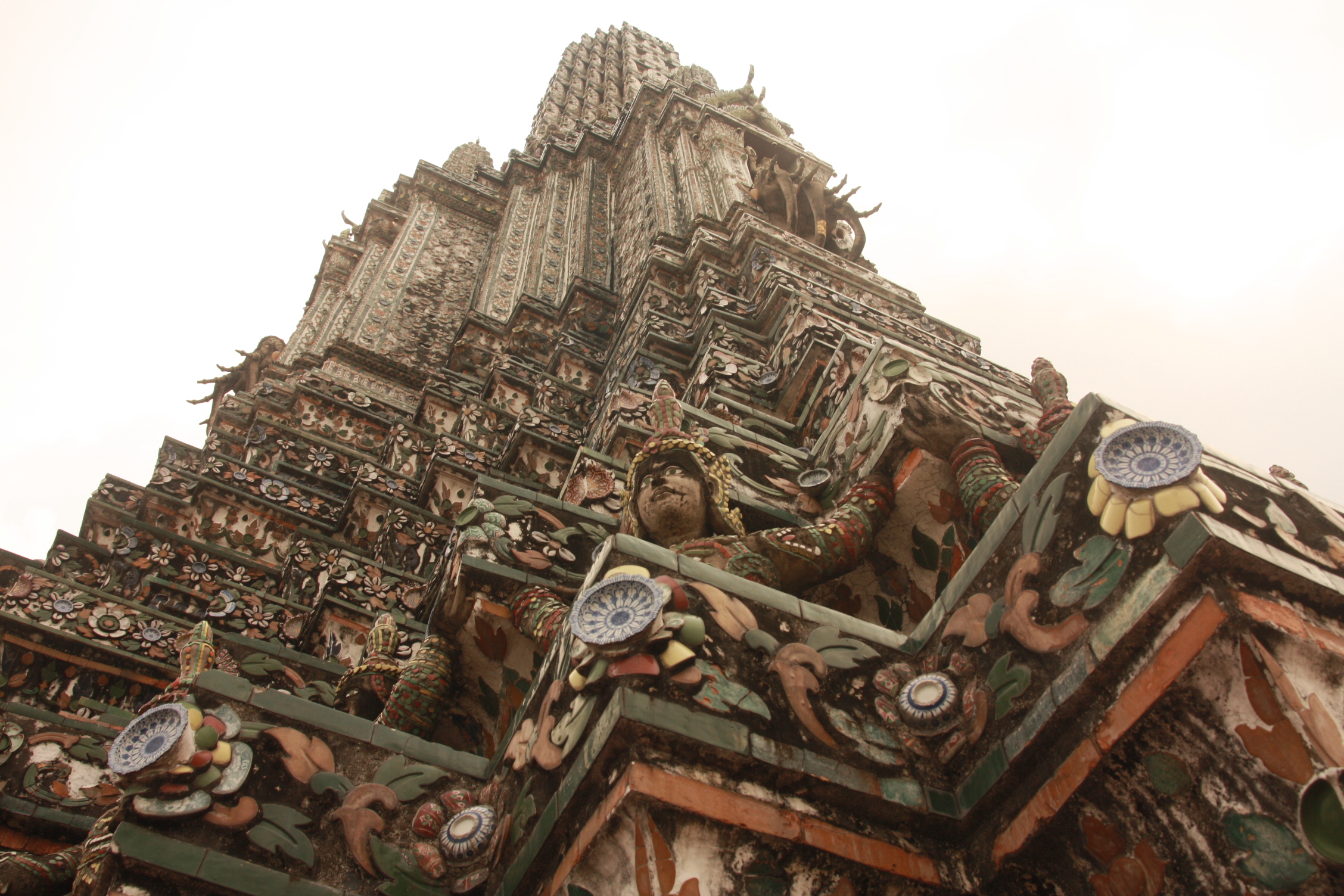
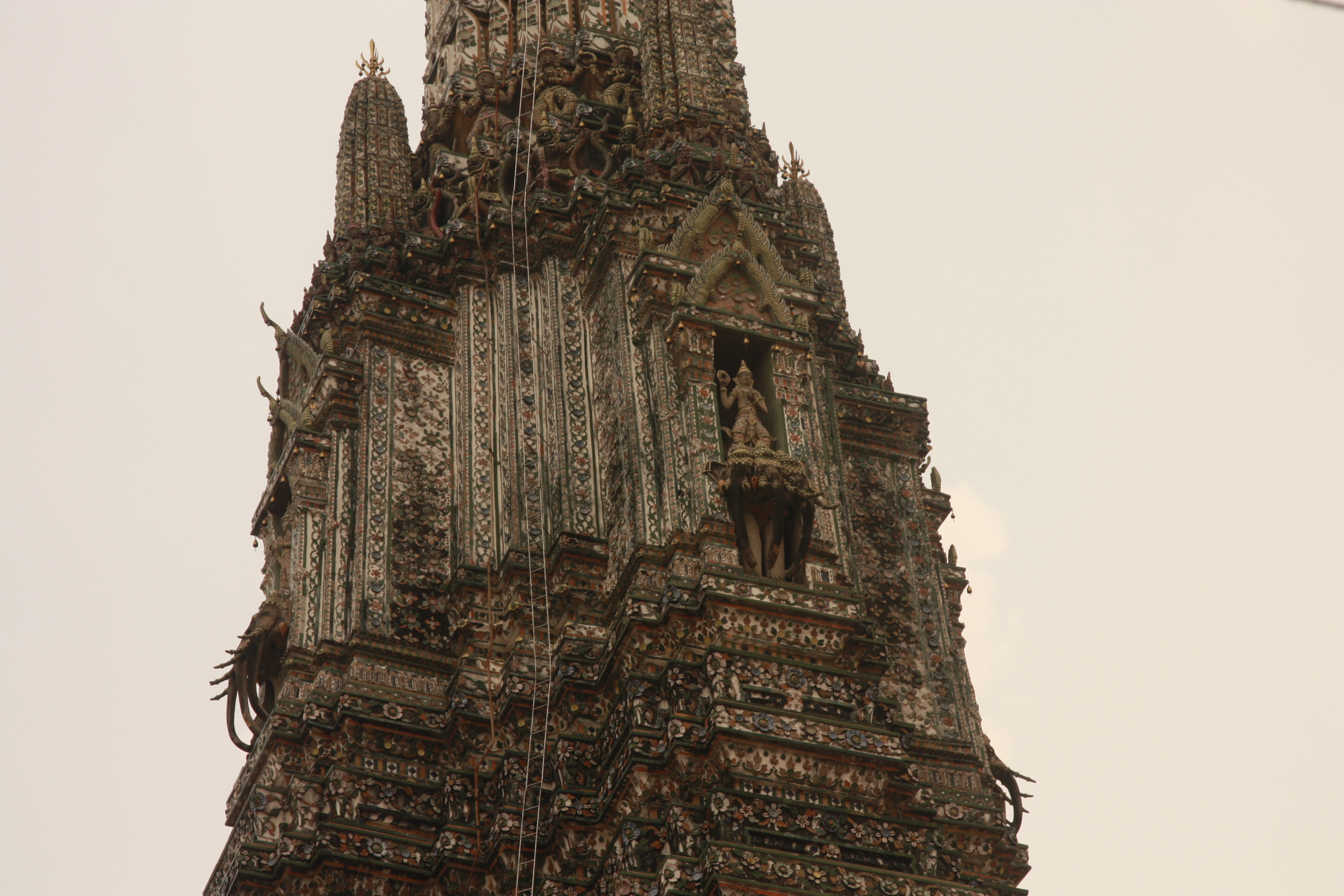
Climb the large stone steps to the center tower. Careful. The stairs from the second landing are steep. The rock is smooth and it’s easy to slip with sweating hands. There is a single metal rail, rusted red, wrapped in rope. It offers some grip. Pull yourself onto the next level. There are more steps but the incline is too dangerous for visitors. Large strips of pink tarp hug the base of the tower like a castle moat. It prevents you from trying to go any higher.
IMG_5059


Look up. The temple prang is a cone tapering to the sky, a tower covered in thousands of seashells and pieces of colored porcelain. There is a row of clay warriors, their shinning eyes and armor made from tiny tiles. The spire seems to rest on their backs and arms. Circle around the base, clockwise, stopping four times to trace the designs on ceramic flowers with your thumb. They feel like warm dinner plates. Imagine the hands that built these flowers turning into dust. 

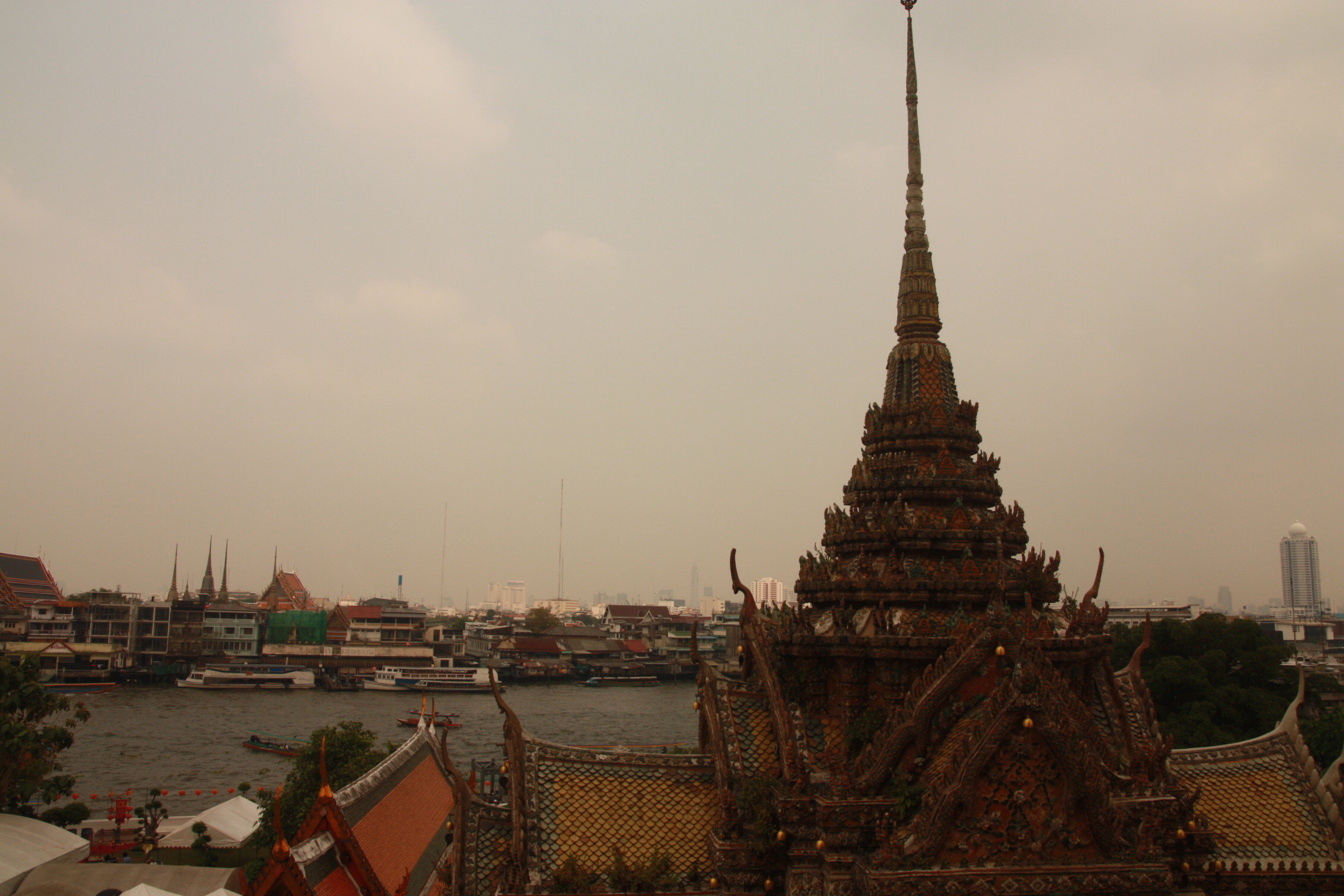
Look over the monastery from 150 feet. Watch the monks stroll the temple grounds. Their orange robes are bright against the grey footpaths and green shrubs. Listen. Somewhere monks are chanting. Their voices pour from horn loudspeakers posted throughout the complex. It’s clearer at this height. Listen. It’s a steady tone and rhythm, a stream of soft vowels. It’s gapless. Their words are a river. You’re swimming without water. Had you noticed it before? 

IMG_5049

 Take the Ferry

The east side of Wat Arun runs along the Chao Phraya. There is a dock where you can catch a long-tail boat into the city. The boat rocks against the gentle current. The breeze off the water smells like salt and iron and dirt. Breathe it in. The river is dense and strong. It is a pillar. On the approaching shore, in the shadow of high-rises, are mossy forts and remnants of river trading posts. There is the Grand Palace spackled with flakes of gold, glittering. 

Imagine the Palace last night, covered in lights to commemorate Loi Krathong. All over the city there is singing and music, and fireworks bursting like cannon fire. Sky lanterns rise into the night like blooms of flying jellyfish. Thousands walk down to the river. Imagine you follow them, caught in the wave of a new kind of intimacy. Imagine. You feel their sweat on your naked arms. Together, under the Rama VIII Bridge, you light candles and make wishes and sail them down stream on flowery crowns of banana leaves and coconut husks. You notice a group of boys a few meters south, wading through the muddy water. They are fishing krathongs from the river, blowing-out the candles and selling them to others waiting on the shore. Pray to the river goddess that your real hopes will float. 

IMG_1442

 Head East

Follow the floodwater lines running along the bottom of buildings. Sidestep garbage bags and puddles from dripping A/C window units above the street. The air is heavy, like a dank basement. It carries an angry rot. Get lost in the buzzing of motorbikes and auto-rickshaws. 

Take a right, now, onto an unnamed soi. It is too narrow for a car. The small road is lined with morning street-food vendors tucked under rows of evergreen patio umbrellas. They sell porridge and pastries, soup and dim sum. 

Nod to people as you pass. Smile. They smile back. 

 bkkwires

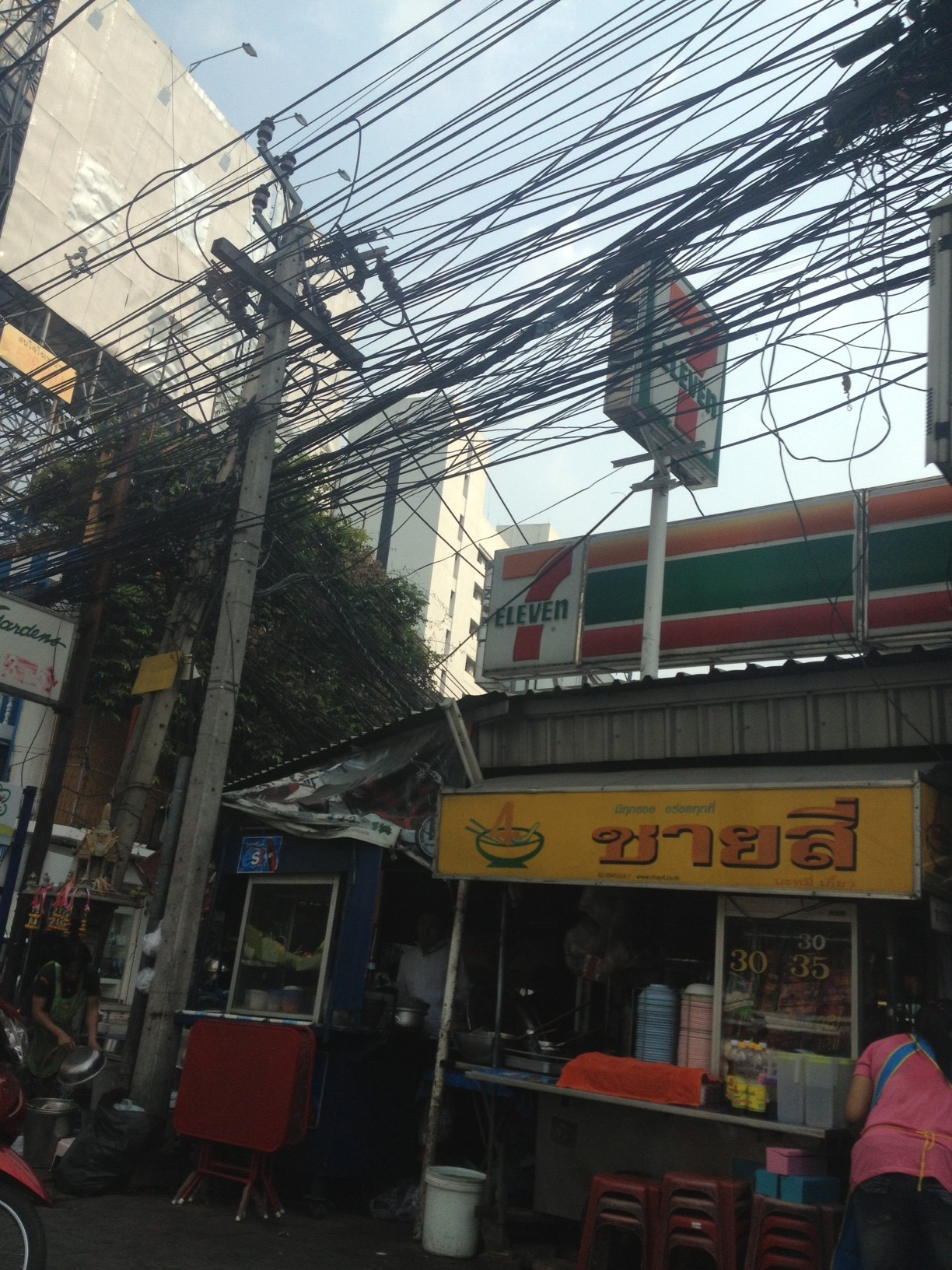
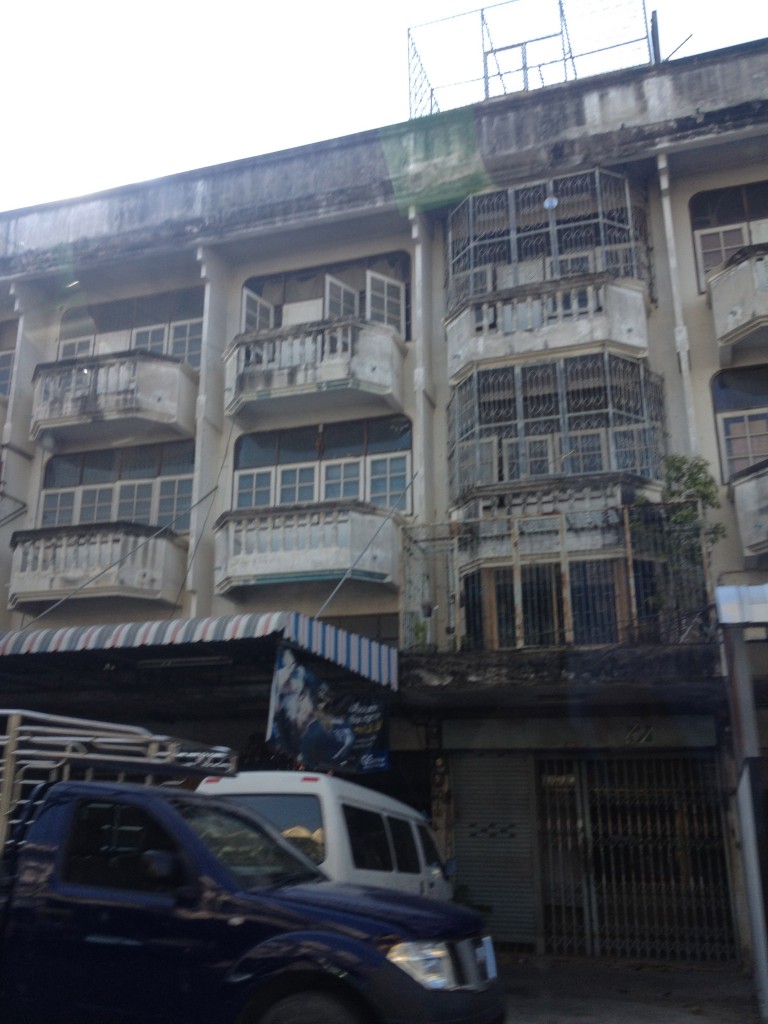
Make a left on the next street. Follow the webs of telephone wire past a dozen convenience stores. The buildings share a similar architecture. Squat balconies with fat columns, decorative moldings and cornices like a Roman basilica. Patches of black mold stain the paint and facades. 

IMG_1432

Cross a short bridge arching over a canal. Hua Lamphong Railway Station is on the horizon.

Take the Subway at Hua Lamphong

Walk around the front entrance to find an escalator leading down to a long tunnel, trapping the humidity from the city above. The walls are sweating. The high ceiling echoes a hundred sandals slapping the floor. The tunnel ends at a ticket counter. Purchase a fare to Thanon Sukhumvit and then take two more sets of escalators, down, down, to the Metropolitan Rapid Transit platform. 

IMG_1484

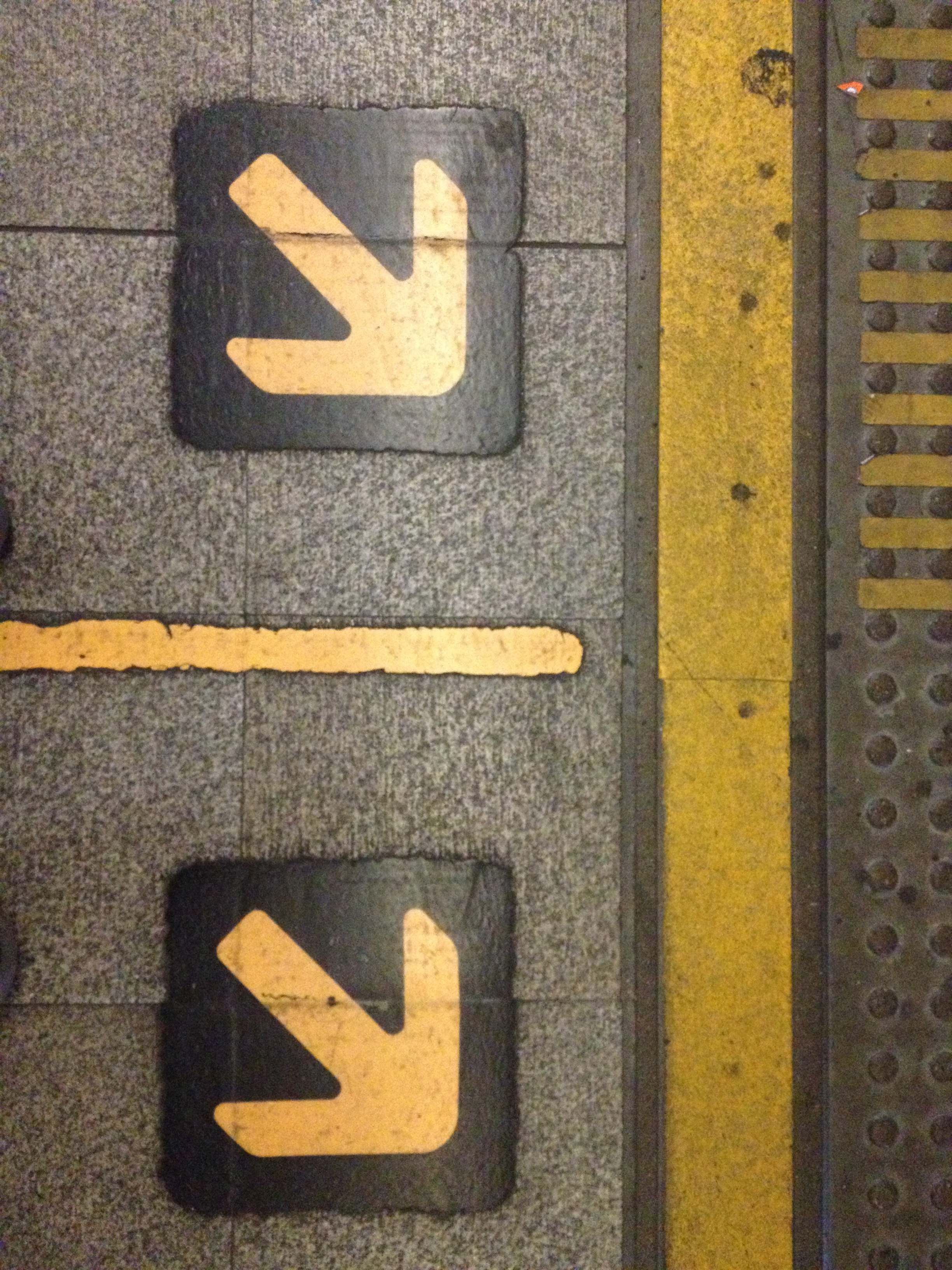
The train is arriving. It rolls to a stop, lining-up with the yellow directional arrows painted on the lip of the platform. There is a loud hiss as the doors spring open. A blast of cold air slaps your forehead as you push your way on. It fills quickly. Pinned by a mass of people against the back wall of the passenger car, you can barely lift your arms. 

IMG_1392

Exit at Sukhumvit (Terminal 21 Mall)

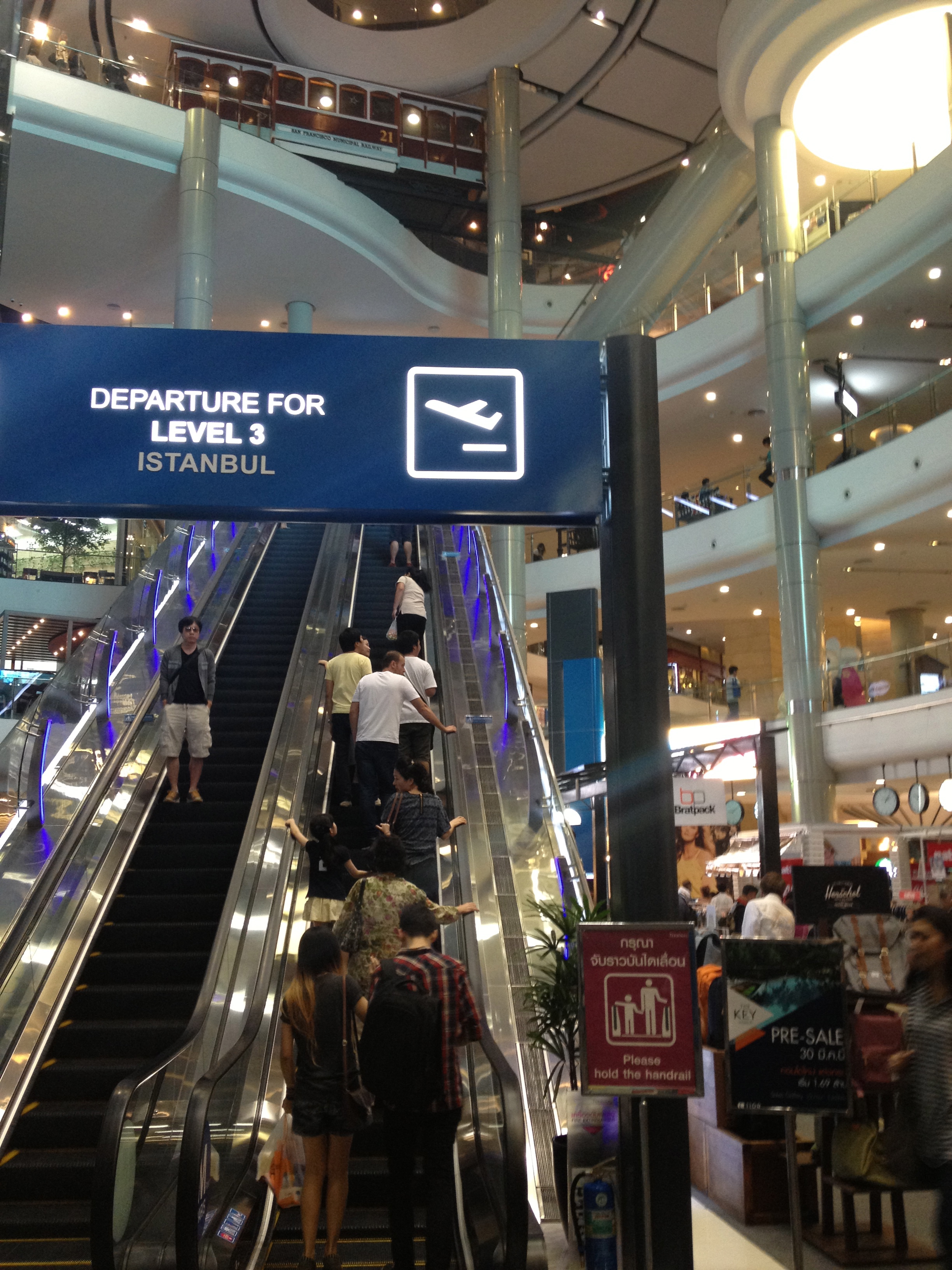
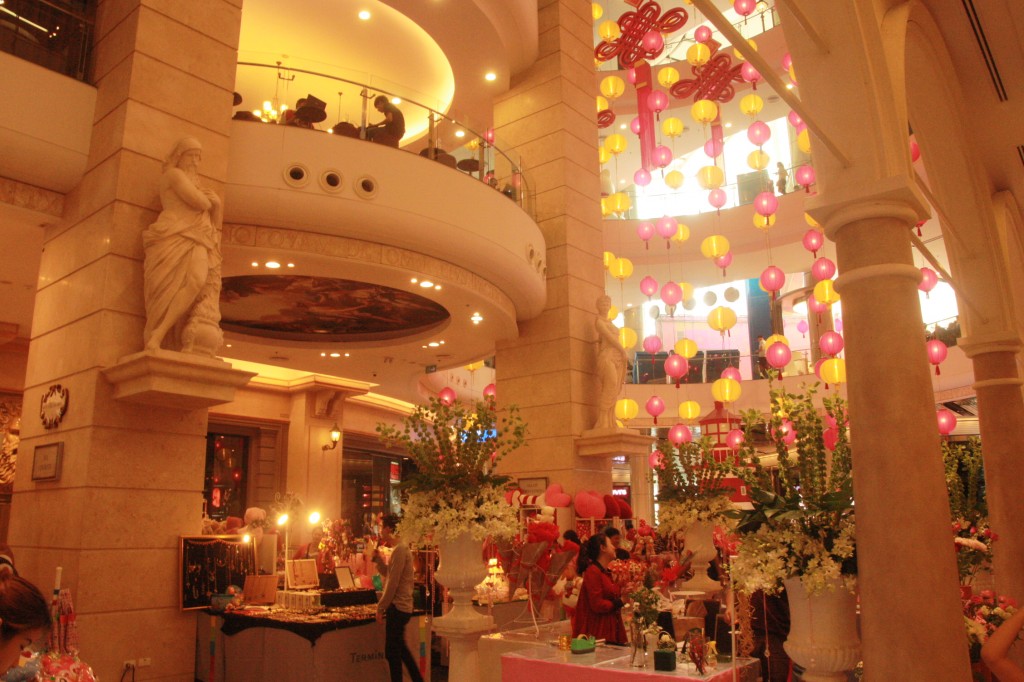
The stairs lead up from the subway to the ground-level entrance of a shopping complex designed like an airport terminal. The women at the info desk are dressed like flight attendants. The escalators are decorated like departure gates. Each floor is themed with a global city: Paris, Tokyo, London, Istanbul, San Francisco and Hollywood. You are in Rome. There are pillars, arches, faux frescoes and marble angels looking down on shoppers. 

IMG_4962

English is everywhere, and whether it is a spa promotion or a sale on high-heels, for a moment you are literate again. You understand more than bits and pieces of passing conversations. Two young men walk by wearing tank tops and folded bandana headbands. One of the boys has camouflage cargo pants, while the other has neon pink short-shorts. They are having an argument over which street market is bigger, JJ or Chatuchak. Don’t point out that JJ Market and Chatuchak Market are the same. Do not interject that many places in the city have more than one name in English, and the J sound and the Ch often get confused. Keep it to yourself. Knowing makes you feel like less of a tourist.  

Head West 

At the bottom of the stairs exiting Terminal 21 there is a man with one arm and no legs lying on his belly. He shakes the change in his paper cup. The back of his t-shirt reads, “I LOVE THE KING.” Give him 20 baht, and then turn right. 

The hotels and office buildings block the sun. The tracks of the BTS Skytrain cast a shadow over the six lanes of traffic. It gives the impression of a stormy overcast. The Skytrain rumbles like thunder as it passes above. 

Ignore the thumping club music from the already open go-go bars.  Ignore the peddlers calling out to you. You may not know where you’re headed, or what you’re looking for, but you know it is something larger than a trinket or souvenir. It is something deeper than a watch, bong or bootleg DVD. 

Thanon Sukhumvit turns into Thanon Phloen Chit. There is construction everywhere. Crews of laborers in hardhats and flip-flops are raising new luxury condominiums from the rubble of old luxury condominiums. Above the chorus of jackhammers and drills are the staccato blasts of car horns. The traffic crawls forward as motorists honk in frustration. The exhaust fumes mix with the smell of street vendors grilling pork. Layers of black dust hug the street. It’s harder to breathe. You taste smoke in the air. Somewhere people are chanting. It’s coming from a gated square, ahead on the right.

IMG_4931

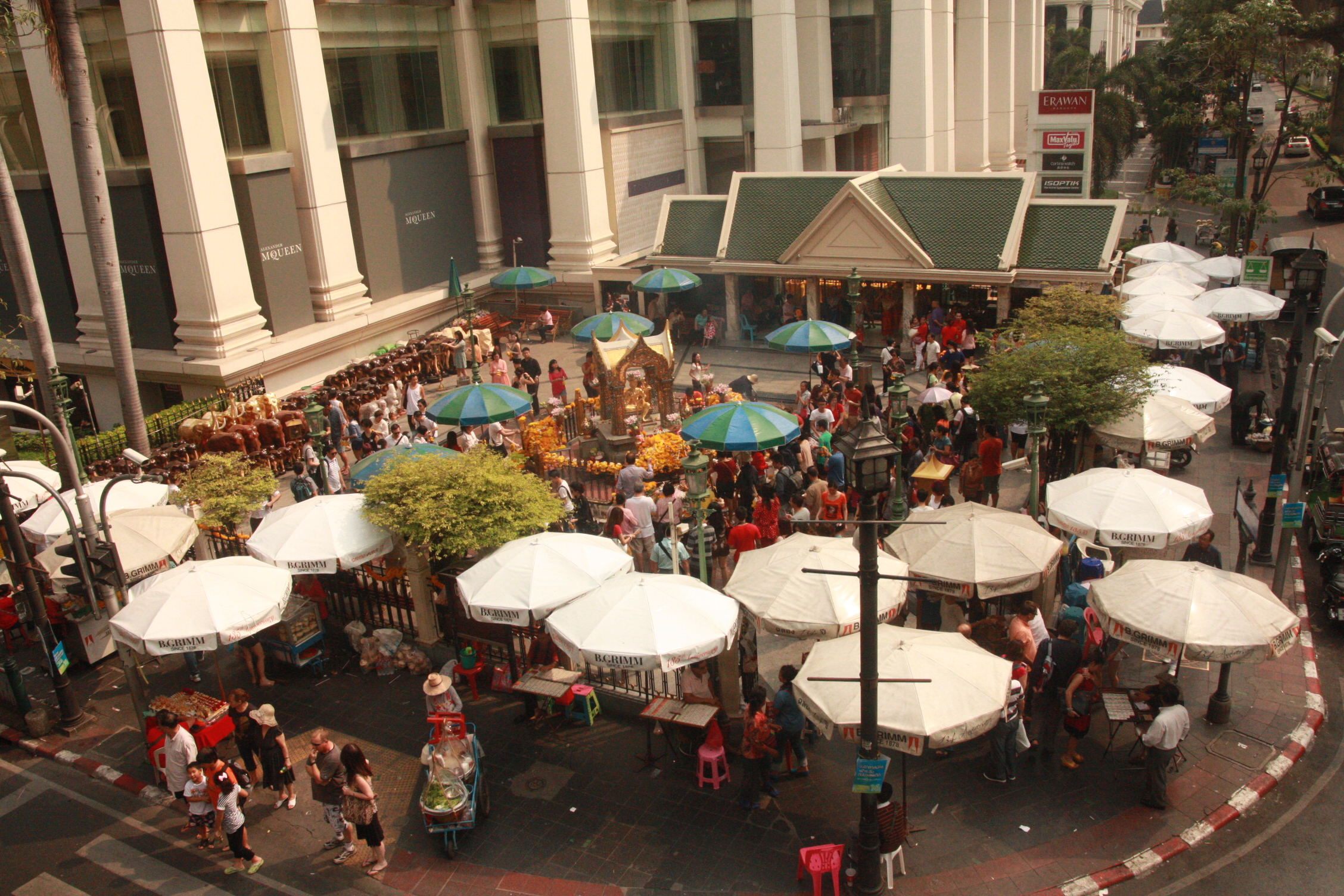
Erawan Shrine

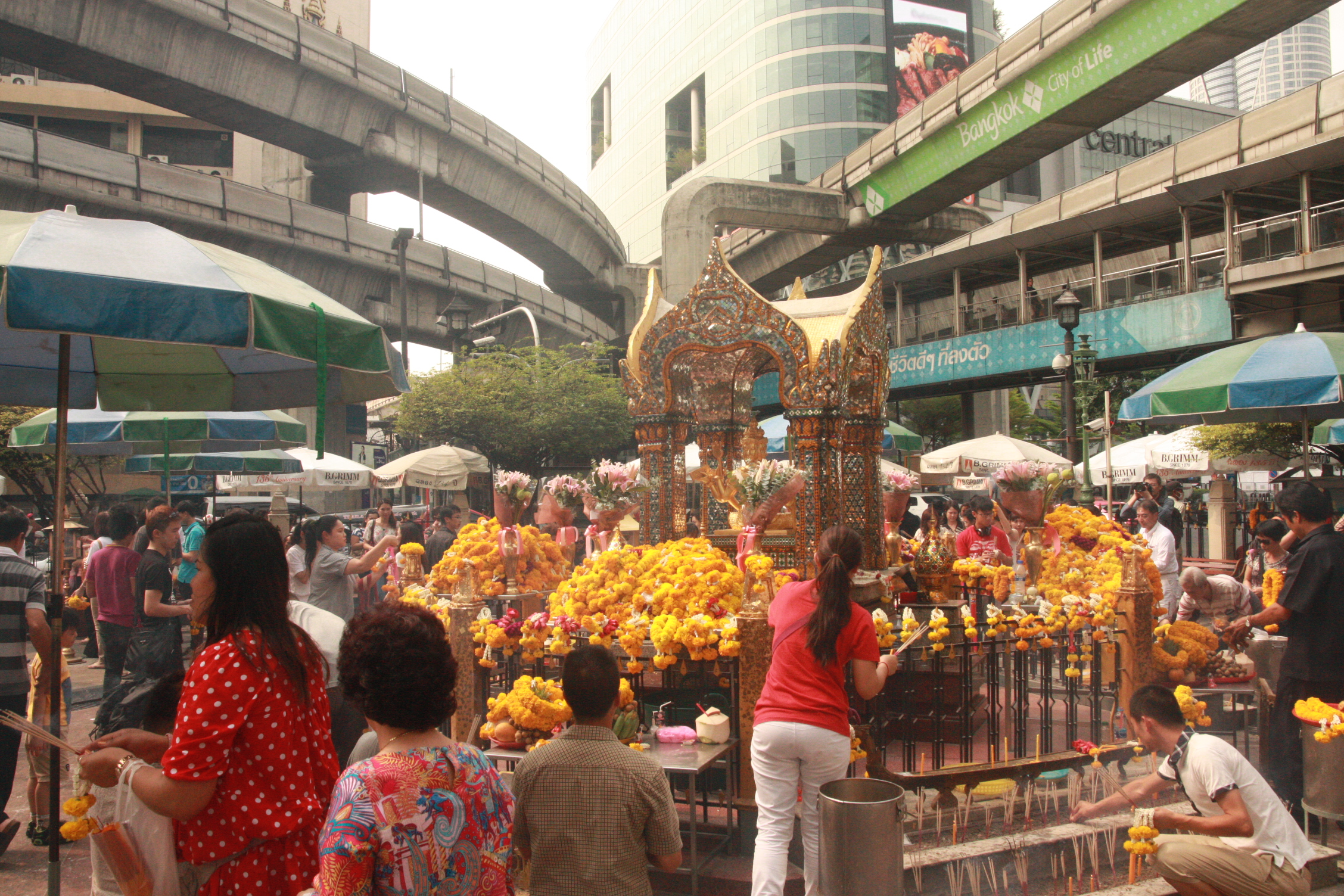
Watch the believers light incense. They circle the shrine clockwise laying wreaths of yellow flowers, bowing to the four faces of the Hindu god, Brahma. Some are on their knees, their eyes squeezed tight in prayer. A few feet away, shielded from the sun by an open gazebo, a female dance troupe sways to a chorus of Thai folk songs. They wear towering headpieces and traditional dresses with shimmering layers that wrap around them and drape over their shoulders. Their faith makes them impervious to the heat. 

Scan the crowded square for another statue. Look for a depiction similar to the one at Wat Arun, protruding from the temple prang—Indra, the lord of heaven, riding Erawan, an elephant with three heads. 

IMG_5033

But there is no giant white elephant of the clouds, or his master. There is no Erawan at Erawan Shrine. Only Brahma. 

You may never know why. There may always be some facet of this city that eludes your understanding, even its name. Is it Bangkok or Thonburi Si Mahasamut or Rattanakosin or Krungthepmahanakhon Amonrattanakosin Mahintharayutthaya Mahadilokphop Noppharatratchathaniburirom Udomratchaniwetmahasathan Amonphimanawatansathit Sakkathattiyawitsanukamprasit or just Krung Thep Maha Nakhon for short? Was the city named for its flowers or for its treasures gracing the ocean? The City of angels, great city of immortals, magnificent city of the nine gems, seat of the king, city of royal palaces, home of gods incarnate erected by Visvakarman at Indra’s behest.

Move closer. Look. Listen. Follow the current circling the Shrine. Press your palms together and bow to something beyond your comprehension. Bow, in respect for what you don’t know. 

IMG_4921

—Donald Quist
 _ _ _ _ _ _ _ _ _
Donald Quist earned his MFA in Writing from Vermont College of Fine Arts. His creative work has appeared in several print and online journals, including Hunger Mountain and The Adroit Journal. He lives in Bangkok, Thailand.  
.
.
.
.
.
Aug 092012
 

Herewith a lovely, sombre essay on living in New York City, almost a threnody in its preoccupation with the dead, the wintry weather, the rain, the weight of living, yet rich in observation, lived detail — the description of the Hudson is a word-painting. This is New York like no other.

I met Tiara Winter-Schorr when she took an undergraduate writing class with me at the University at Albany a dozen years ago. She was the class star, stylish, courteous, curious and smart.  She had the spark every teacher is looking for. We’ve been friends ever since, hardly ever seeing each other, sometimes silent for months and months, but always ready to catch up, find out how the story is going. Shortly after we met, Tiara dropped out of school to help care for her dying father. Just last year, she graduated from Columbia University with a degree in creative writing.

dg

.
Hudson, Part 1

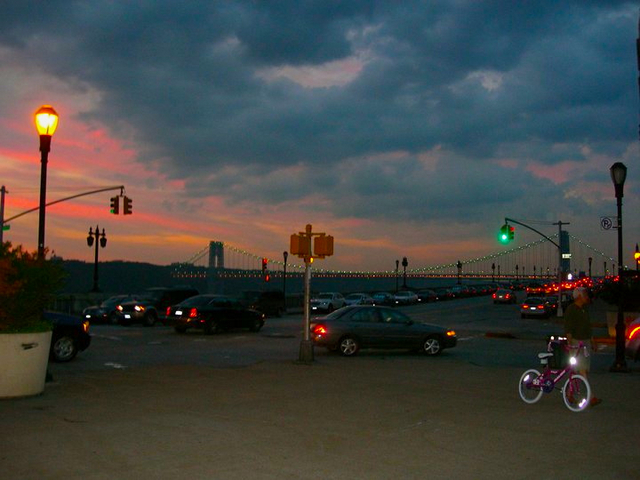
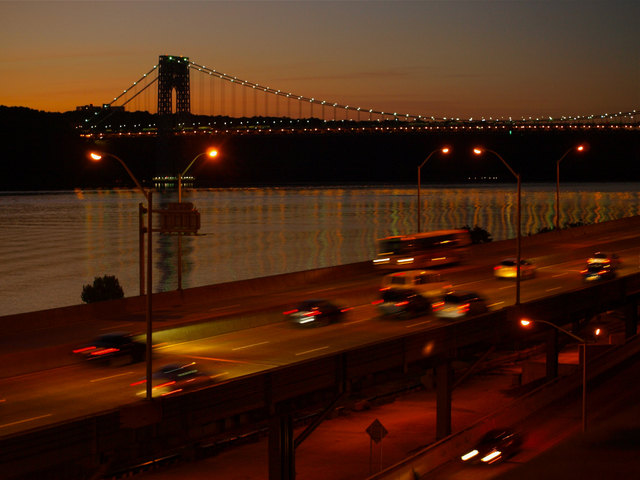
I live nine stories above the water, above a river. I arrived to stay seven years ago just after my father’s death, during the kind of deluge that occurs in Manhattan only at the water’s edge. The streets around here are always desolate, yet densely populated with trees and cars. But as sheets of solid rain splattered onto my windshield that night, I sat waiting for a parking spot and looking into the brightly lit windows of apartment after apartment. I imagined that the circle of buildings around me held a teeming mass of people. I watched the sky change from shades of deep red to grey and then to shades of off-black. The river has no self. It is never blue or green. That night and every night, the water canvasses the moods of the sky for deep or pastel shades, the George Washington Bridge for green light, the artificial street lamps for putrid yellow, and then lays out a palette in globs of motion and color. Several hours later, I parked three inches too close to the only fire hydrant in a two block area and received my first parking ticket.

The river has almost convinced me that my apartment exists at the edge of a flat world. My living room is dominated by a large expanse of glass, a window too large to be called a window. But the view is cut short, endless until it abruptly stops beyond the George Washington Bridge and a cluster of low-income housing projects. Here is where the world seems to stop. Boats fall off the edge and disappear into another world that is not-city. Boats come into the city this way too, of course, and I know they are most likely heading to a waste-processing plant about a half mile from my building.

Stretches of the West Side highway race above and alongside the river, which is the most stunning place to drive in northern Manhattan. The Hudson catches the glare from the sky and coats itself in whatever shimmers it can trap from the sun. But you will be constantly reminded of the gross show of engines against the flow of the water. Drive fast enough and you are convinced that the narrow strip of water is motionless, as if boats drag slowly along an inferior liquid ground.

This narrow strip of the Hudson has harbored me, defending against the twin illusions of the city that you are both landlocked and free. The traffic at rush hour teaches me differently. There is no room between bumpers; there is music from other cars, pure cacophony pouring into your car windows even in cold weather; there are children and teenagers who stare with unimpressed faces into mine. Here next to the river, I find that I am not landlocked, yet not free.

My first winter living above the Hudson was one that offered no refuge, not even the double panes of glass that barred me from the elements. The wind was the river’s first omen that cold was coming into the city. The lights in the sky turned to different shades of grey each day and the river pushed forth choppy whitecaps. Living here will send you searching for refuge and you will find it when you realize there is none in a city like Manhattan – save for what the river offers you in smells of salt or the illusion that the humidity coating your skin is a kind of armor.

.

The Dead

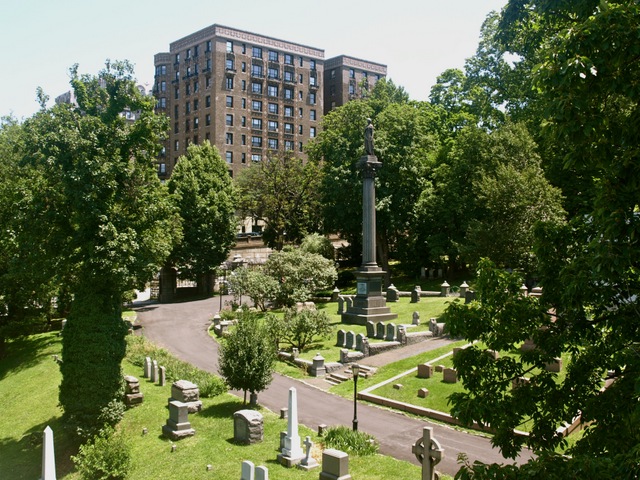
My neighbor directly to the south is Trinity Church Cemetery and Mausoleum, a shelter for the dead that expands over 24 acres up rolling hills. The decrepit entrances are not trustworthy except for the most modern, which is a glass door leading to cramped office where you can inquire about obtaining a small plot in this place, Manhattan’s only active cemetery. I did this once, spoke to stout woman with grayish skin about a place to put my father’s urn that now sits in my living room. I am gently informed that only mausoleum spaces are still available at the cost $9,000. The high stacks of marble niches look too much like the low-income housing projects which blacks out the view from my living room window.

But the grass is greener and softer here than in most parks, and the concrete pathways are cleaner too. Never mind that the dead only share this space with bats, coyotes, and desperate or crazily brave homeless people. The coyotes arrived sometime last summer, most likely making a long trek down train tracks from more forsaken neighborhoods in the northern Bronx where packs of feral dogs and coyotes still roam free. One small female was found shot dead, not far from the grave of Jacob Astor IV, who died in 1912 when the Titanic sunk. Looking around at the building-size statues of angels and Virgin Marys, you may have the odd feeling that a gated community for the dead has been invaded by wildlife, both human and animal. The ground plots have been taken up entirely, and the bones of the former people are a reminder of old New York opulence and the artists who eked out a living nearby. There are a series of Astors, including the Titanic victim; there is Greta Garbo’s lesbian lover, and the son of Charles Dickens. Ralph Ellison also came to rest here, most famous for his novel The Invisible Man. Most of us in upper Manhattan – Harlem and Washington Heights – are still the invisible to likes of the wealthier classes living further south on the island. But here at Trinity, they are all invisible, save for the luxurious statues and monuments erected in their honor. The further uphill you trudge through the winding acres of lush green life, the older the graves become. At the peak of the hill, you will find the oldest carved grave in New York, that of Richard Churcher who lived a mere five years before coming here for a final place of protection. I often wonder how he died, perhaps because my own brother lived only ten years himself. But I cannot imagine leaving my father in one of these claustrophobic mausoleum spaces surrounded by ghosts of opulence and live coyotes. At night I watch the bats fly between the trees like night birds who look down at our dead.

New Yorkers die at a faster rate than most people in the United States: our hearts are ensnared by disease, or our organs by cancer, or we kill ourselves with drugs. Influenza is still a leading killer and probably was the cause of death of many people at rest in Trinity. Although there are nearly 20,000 grave sites buried under the island, they are invisible and long forgotten. You easily forget that the cracks in the concrete are held up and held together not only by earth but by the dead who still vibrate beneath the rhythm of relentless footsteps and tires.

September 11, 2001 was the day of New York City’s largest mass death. Almost 3,000 people vanished, turned from flesh to ash that spread out into the air, the Hudson River, the East River leading to the ocean, and the concrete sidewalks. Manhattan had never experienced such a mass of invisibility and the dead of 9/11 found their final shelter in the same place they lived their lives – the streets, the air, the water. You cannot feel the death at the new Freedom tower, not in the way that it is palpable at Trinity Cemetery. The dead of 9/11 are part of our atmosphere as New Yorkers. During the impossibly slow construction of the Freedom towers, 2000 graves belonging to African slaves were found. The city gave a gentle nod to centuries of invisibility by finding and preserving 419 bodies. But unlike Ralph Ellison and the inhabitants of Trinity, they will never have names.

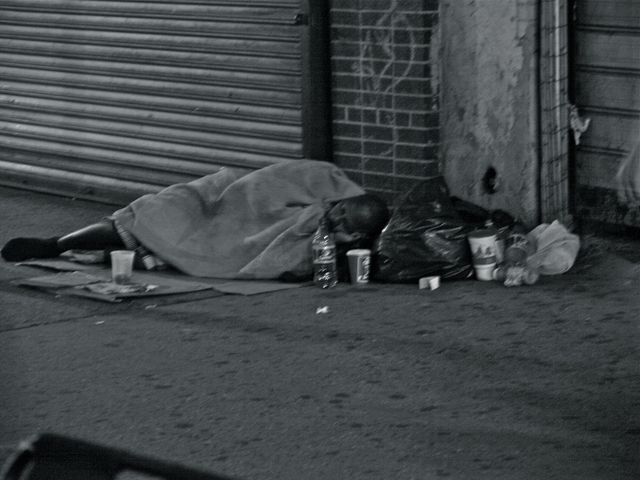
On sleepless nights I wander Manhattan, often passing Trinity and ending up on deserted streets further down the island, streets marked by sleeping homeless. There are shelters but you more likely to die in one than on the street. I do not know where the homeless go if they die in Manhattan. The ones who wander up to Trinity to sleep will not be allowed to stay when they are dead. The doors to the Church of the Intercession are locked six days a week, as most churches are. You are landlocked. You are not free.

.

The Border

Walk one block east from Riverside Drive and you will find yourself on the border between Washington Heights and Harlem. The boundaries between the two neighborhoods are questionable divisions held in place more by ethnic and racial differences than the lines of a city map. These maps are untrustworthy anyway, victim to the whims of realtors and an ever-growing push towards gentrification. Let’s assume that Trinity Cemetery at 155th street acts as an unofficial divider between a neighborhood that is predominately African-American and a neighborhood dominated by Dominicans and other immigrant Hispanic groups. Most maps insist that Harlem ends somewhere around 153rd st and gives way to Washington Heights, which has been dubbed “Little Dominica” in tones of affection by residents and in tones of trepidation by non-residents. No matter which direction I turn, south toward Harlem or north toward Little Dominica, I find that I am foreigner here with bits of Puerto Rican and Native American and Filipino and German blood filling my veins.  Maybe living life in liminal zones is my way of finding shelter.

.

The Heights

Little Dominica is known for its history – the fiercest fighting of the Revolutionary War, which has given way to some of the fiercest gang fights in upper Manhattan; the assassination of Malcolm X, the site of which is now a BBQ Rib & Bar dive; The Cloisters at Fort Tryon Park which is medieval structure hauled here from Europe and rebuilt and now boasts Christian art from the same time period; and of course the endless expanse of the Columbia University medical center, begun in the 1960s and still extending its reach through the area.

The Heights is called so because we are 265 feet above sea level, the highest in Manhattan. My ears fill and pop as a constant reminder that as I walk the streets, I am growing closer to or farther away from the sea. The abrupt hills are actually miniature mountains. Street steps have been constructed to try to ease the pedestrian exertion, but climbing 130 steps to reach a given street does nothing to offer rest. What it does is strength your legs and maybe your heart, if you are lucky. The alternative is that you avoid walking into the upper reaches of the Heights.

The summer street culture is what holds the residents in a tight grip. Old men sit at tables in front of apartment buildings playing dominoes, but are quick to shield their faces from photographs. So are the boys who collect on street corners selling whatever wares are tucked into their bulging pockets. The hottest days squeeze the oxygen from the air by the smells of illegal street barbecues and marijuana and sweat. We are overrun by children who roam freely as if it is a small town and not an area burning with crime and gang life. Music is ever-present, usually salsa or some rhythm that reminds me of my foreignness in this land. The streets are always crowded, always festive, always dirty, and dotted with reminders of plenty amidst poverty. Roughly 97% of Little Dominica lives below the poverty line. Many are undocumented and receive no help from the government. They avoid photographs for this reason – there is no refuge for them either, no place where “La Migra” is not allowed to hunt and deport. But the stores are not folding to gentrification, and if one closes then another opens and bursts forth with toys for $1 and women’s dresses for $3. You can live here below the poverty line and make your way through crowds of families in bargain stores and emerge with an armful of whatever you were lacking when you entered. There is plenty here even among the poorest.

.

Harlem

My Harlem is a 30-block stretch that I use to get from home to a specific destination and back again. This Harlem is not the historic central area that boasts the Apollo Theatre, not the area where African incense chokes the car fumes, and not the gentrified part that swarms with Caucasian shoppers at newly-opened designer boutiques. My mile and a half of Harlem is almost a forgotten area, mostly residential and peppered with mom & pop businesses. Yet look closely and you can see the decay from the pressure of gentrification pressing forward. I see it daily as each store closes, a “mom” dragging sales tables of vintage soul records and African masks on to the street for 80% clearance sales. I see it again days later when the same store is boarded up and a street kid on the corner informs me that the rent around here for businesses has been hiked to $10,000 a month. He also offers me a dime bag of marijuana. His business may be the only one to survive around here. The African-American families who settled here years ago during the height of the Harlem Renaissance are being dispossessed and moved. Where will they go? There is no asylum or place of protection from the stress of developers who see only land, never bothering to acknowledge the people living on that land or those buried beneath it.


Columbus Circle

The Upper West Side of Manhattan commences here in a speeding circle of cars that centers around a monument of Christopher Columbus, erected some centuries ago to honor his discovery of the New World. The location is appropriately troubling to me, a place where the Columbus legacy has been mercilessly fulfilled. For a moment, emerging from the subway, you can absorp the immediate beauty of the statues, the fountains, the shopping, the park, bustling streets of New York City that each of us has seen in the movies. But the reality of the space, the buildings that inhabit the circle are a futuristic reflection of what Columbus intended for the New World. The monument and fountains and racing vehicles are eclipsed on the west side of the circle by the world headquarters of the Time Warner Corporation, the NYC studio headquarters of CNN, and Lincoln Center’s Jazz Center. Looming to the north is the Trump International Hotel and Tower (boasting a solid gold escalator inside that terrifies me for its height and its glaring shine) and the headquarters of Gulf and Western Oil. The rank display of corporatism is easy for me to gawk at, such a shockingly conspicuous show of empire even for a native New Yorker. Glamour may be NYC’s most ruthlessly apparent illusion and it is here that you feel it the most. You are landlocked among blinding skyscrapers and the sudden luxuriousness of Central Park that seems to reach endlessly in every direction. Beyond the lush display of opulence around the circle, there is a jarring reminder of nature among concrete repression. You may even abruptly feel free, giddy at the sight of paradox rushing around you in one sweeping move. The glamour and illusions are what holds so many us on this island, one that is barely large enough to contain so many bodies. I suspect that the tourists who arrive daily in packs do not see much beyond the allure of shopping and the sweet green grass across the way.

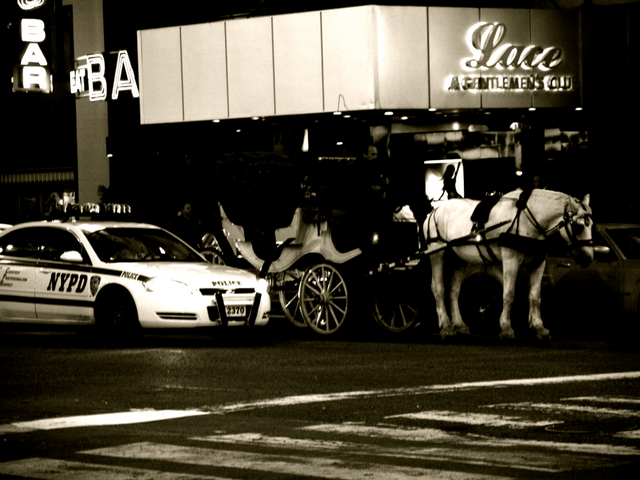
The circle is also one of the major transportation hubs for the city. The circle and the park crash awkwardly only at this moment, are bound in a tight juxtaposition of old tradition and modern movement. Your first impression might be one of strict boundaries: the circle, the park beyond, each bus stop and underground subway station a discrete unit with organized movements. But look at the streets just outside the park and you will find about 68 carriages drawn by horses, not the kind of fierce beast you might see in Victorian Era photos of the city, but rather the kind animal whose ribs rise in an arc from under sallow coats. The kind of horses that NYC allows to work the streets are lame, limping from the weight of their load and uncomforted by the blinders meant to shield them from the terrors of the engines rushing by them. The rank display of cruelty could almost be lost against the gentility of the park and the profusion of wealth. I was not there the day a horse collapsed and died under a heat shroud of 91 degrees, in turn causing a pile-up of cars and busses. But the tourists who rode in that carriage may know more about the savagery beneath the affluence and the persistent repression that is part of living here.


Times Square

Otherwise known as the crossroads, this roughly seven-block area is paced by 39 million tourists a year. Every light in Times Square went out once, during the northeast blackout of 2003. The darkness must have been majestic. I pace here a lot, either to ward off restless legs and insomnia during winter nights or to find relief from the humidity in the pre-dawn hours of summer mornings. The late nights hours leading to dawn are the dimmest and emptiest here, mostly because the corporate offices like Ernst & Young and Morgan Stanly have closed up. Firms like this hold more space in Times Square than the more appealing corporations like MTV and Toys R US but this is harder to see when all the lights shine equally bright. Keep pacing the tiny area until you notice the most infinitesimal changes, until you become accustomed to the gaze of late night workers leaving through the backdoors of nightclubs and the same faces waiting blocks away to catch the last bus uptown. If you do not cultivate a personal way of seeing Times Square, you risk the vision of a tourist and then there is nothing, no relief for the restlessness and nothing left to notice.

Two a.m. is kind of cut-off point, when the streets become less of a wasteland of overdressed theatre-goers and bright-eyed tourists. The streets become emptier and lights seem dimmer, but empty here does not mean deserted. This is my Times Square, a place where you become aware of every detail around you, the different shades of blinding lights, the rats that chameleon with shadows underfoot, the stretches of concrete that double as cardboard homeless shelters, and the changing faces of child-like prostitutes that lean against subway stops and eat from plastic containers. From about 2am to 5am, the Disney-led gentrification weakens enough for the lights to shine on the reality below it.

Times Square sits near to the center of the city and you cannot smell the river from here, you can only see lights and faces but you can walk until there is nothing left in your limbs except exhaustion that feels like freedom.


Hudson, part 2

The river, after holding me for these seven years, seem to be pushing me along like one of the ice chunks that break up after the end of a winter that brings only ice storms. Last winter was like this, cold but no snow, no blankets of white, just icicles along the windows and the stillness of the river as it froze inches deep. I only went outside a handful of times, I think, kept in by the icy wind that makes my heart feel weak.

 But I have found my sanctuary here for so long because of the river and the bridge. Nothing that moves as fast as the water and the traffic above it can make you believe you are trapped on this island. You may be free but you are as pushed in one direction or the other as a floating chunk of ice coming down the river. I have considered moving but cannot think of where to go. The expanse of sky pushes against the edges of the New Jersey and New York skylines and beyond into a world that is not flat.

— Photos & Text by Tiara Winter-Schorr

.
.

Jun 152012
 

Herewith a delightful What It’s Like Living Here piece from Lisa Roney in Orlando. This is our second contribution from Florida in recent weeks, a sign that all the writers are moving there (well, maybe not). Lisa Roney teaches writing at the University of Central Florida. She is the author of a memoir, Sweet Invisible Body: Reflections on a Life with Diabetes (Henry Holt, 1999), as well as poems, essays and stories. She had the eminent good sense to marry a Canadian.

dg

.

Pelicans against Sunset

PPelicP.

Birds

I live in the sky. Though it is crisscrossed with wires and impeded by billboards that sell big-breasted waitresses at the Wing House, it still dips its bruises in gold, not brass, then blushes at its own riches before waving good night. As I drive from yet another late neurology appointment along one of many six-lane roads that traverse the city, I search above it all, let the fading light guide me home.

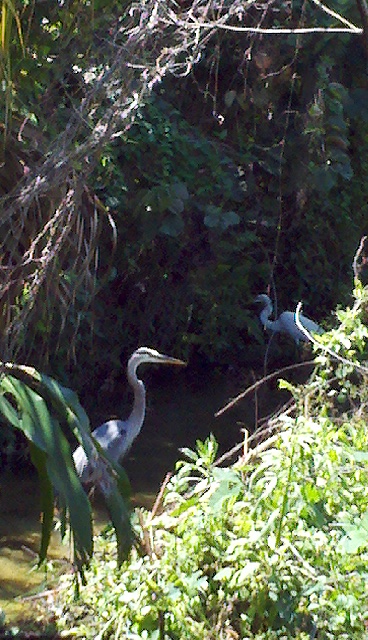
Beyond the billboards, the barbequed chicken wings give way to the wings of hawks, eagles, herons, egrets. This evening eight ibis circle stunningly white against the blue, blue sky over the roadway, catching the last light of the day. Last week two bald eagles swooped ten feet above my head as I strolled my neighborhood. Cardinals and titmice flutter around the feeder in front of the kitchen window at morning and dusk, while the barred owls show themselves after midnight in their hilarious song. My husband and I lie in bed sometimes and mimic their “whoo, whoo, hah, whoo-who-oo-ahhh.” It helps my insomnia when my heart is lightened this way at bedtime.

The anhingas even bring sky to the ground, as they sit lakeside with their wings outspread to dry, as if flying on earth. The birds are my favorite thing about Florida..

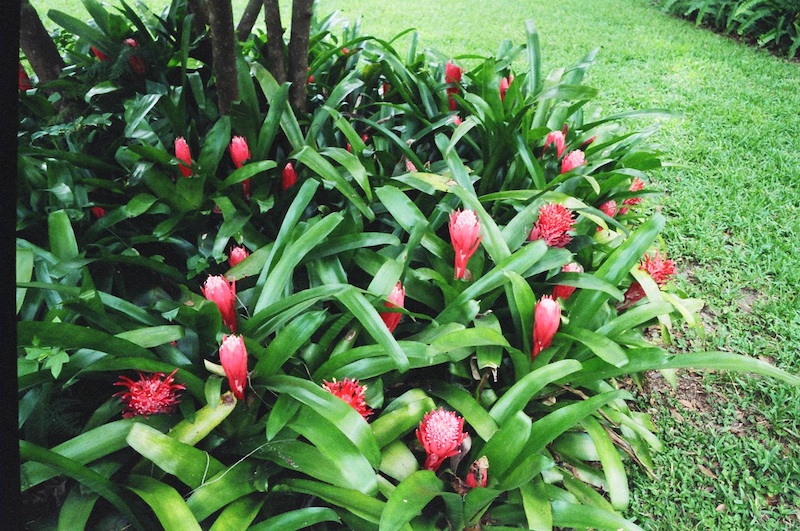
Bromeliads with Red Blossoms

.

Winter Park

The first summer it rained and rained. In between the thunderstorms, I waited for my new job to begin and went on rambling, hours-long, solitary walks in the chic neighborhood near my homely concrete-block rental. One morning as I typed at my computer, I glanced to the right out the front window and faced a four-foot-long snake wending its way through the bromeliads under the orange tree.

At the time I didn’t know the name of bromeliads. I said to myself, “It’s only a black snake. Cool.” But it might have been an omen of the unpredictable. I find later on that it is indeed adaptive here to enjoy the same creatures that you fear since you can’t get away from them.

Hospital Heart Monitor

.

Medicine

Orlando is home to two of the ten largest hospitals in the country, and one of the three Mayo Clinic sites sits on the coast an hour north in Jacksonville. This does not assure anyone’s good health—probably CEOs chose our locale for the aging (and dying) population of retirees that Florida is famous for. I myself came here young and immediately hit the wall of numerous health problems, as though crossing the border into the land of retirement infected me with oldness.

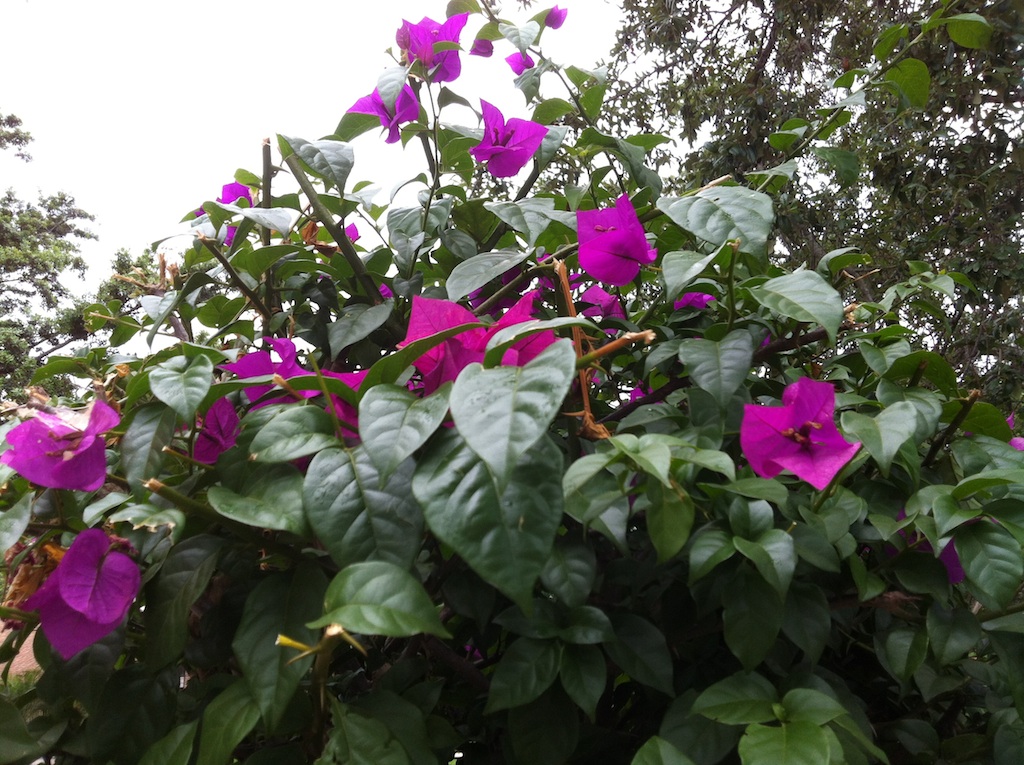
I came here with thirty years of Type 1 diabetes under my belt already, but my list of ailments has blossomed like a bougainvillea, taken flight like an enormous eagle: carpal tunnel syndrome, adhesive capsulitis, irritable bowel syndrome, rosacea, arthritis of the right foot, lumbago (only one letter different from the purple-blooming plumbago that I had never seen before coming here). The human body is part of nature, though certainly denatured by all the machines now engaged in being sick. In the past two years, I have endured a benign perimescenphalic sub-arachnoid brain hemorrhage and, supposedly in a completely unrelated set of incidents, inflammation of my brain pathways that may indicate M.S. After six months of testing, they don’t really know.

Even though I don’t really want to talk about them, I cannot separate these things from what it is like to live here. The uncertainty seeps out of my skin like the constant sweat of summer.

Everywhere you go in Florida, there is a stark contrast between young and old—the stooped and graying alongside the tanned and buff, the slowest drivers in the world alongside the Daytona 500, the shops for orthopedic shoes alongside the surfin’ bikini boutiques.

For most of us, living in Orlando is like living somewhere in between.

Green Anole

.

Heat

Our summer is our winter. Not that summer’s cold, as in the northern-southern hemisphere switch, but in that we, too, have a season where we stay indoors, protected from brutal weather by our air conditioning. According to the National Weather Service, more people die from heat than from any other weather-related phenomenon, including floods, lightning, tornadoes, and hurricanes. More than three times as many die of heat than cold.

One of the big differences between people who visit here and people who live here is that we are aware of the nastiness of the heat. Everyone stays outside a lot in December, January, and February. But we hide in June, July, and August, and we sweat profusely nine months out of the year.

Earlier this afternoon, as I walked into the doctor’s office, a woman made a face and said, “I fear the spring is over.” We bask in spring, but dread the oppression of summer and fall, the threat of hurricane season.

Everyone in Florida carries a bottle of water. I first came to realize the Floridian devotion to hydration when I noticed that my students would sometimes get up during classes to go out and use the restroom. That is as accepted here as students blowing their noses in class in the north.

In fact, most of the people who die of heat exposure do so in milder climates where so many of the elderly still believe they can live without air conditioning. Down here, we know we can’t. If this makes me wonder why it is that people insist on living in such inhospitable places, I put it out of my mind. If I wonder, as I idle in traffic on my way home from the doctor’s office, why humans have designed their world to be such an ugly and hostile place, I remind myself that the black lady standing at the bus stop on Route 434 with her umbrella up against the sun probably doesn’t have the luxury to worry about it and neither do I, really, not these days.

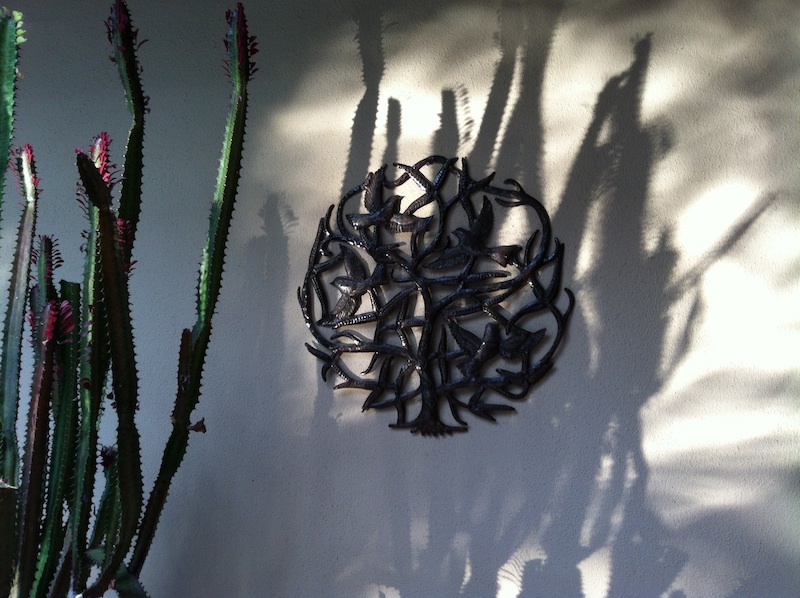
Sunlight on Wall with Euphorbia

.

Winter Springs

Six years after coming here, I got married and moved to the suburbs, not necessarily in that order. Both of these facts surprise me, and I feel guilty for liking everything about the suburbs but the political tenor and the car-time. Besides, everyone in Orlando drives a lot, no matter where they live. When Men’s Health magazine reported that Orlando is one of the angriest cities in the country because of the traffic, I just nodded.

My new husband cackled. A Canadian, he declares America barbaric. “In Canada,” he often reminds me when we’re together in traffic, “we understand the concept of merging for mutual benefit. Here everyone races to the front and tries to jam their way in.” I assure him that the entire country is not like this, but I feel the shame of American greed.

My own backyard reeks of stereotyped paradise, yet I love it almost as though it were my very own forever home. I was broke for a long time. Now the fountain bubbles, the cats roll on a bricked lanai, tall palms and pines line the fence, and two Adirondack chairs sit by the pool. I swim almost daily, though I did not want a pool and I am a terrible swimmer.

“Why else would anyone live in Florida?” my husband asked when I protested. I am not sorry I acquiesced.

I like being married after 49 single years and hope I still have plenty of years to enjoy it. I find it freeing to be tied. Once I thought I came here for the job at the big school over the previous small one, the moderate-sized city over the small town. Once I thought I would seek perfection until I found it and that excitement would always be mine. What a delight that I was so wrong.

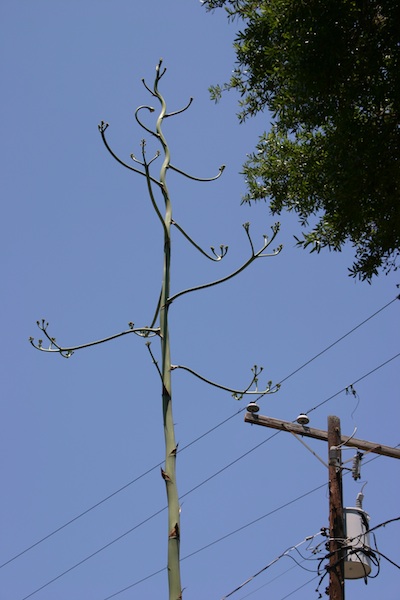
Agave Stalk and Telephone Pole

.

Plants

Because flowers bloom year round here, and because there are few cemeteries, it can be easy to forget that the life cycle ends in death. When I get home, I pull my car into the garage and stand in the driveway, breathing in the aroma of the confederate jasmine I planted along the fence last year. I check on the new herb garden that is spreading exponentially, the way things do here. Finally, I am growing things.

It took nearly three years for me to plant the gardenia that a friend brought to our wedding, and it now has buds nearing bloom. All the other gardenias on the street parade massive, fragrant flowers, but I am thrilled simply that ours is still alive, gardenia and marriage both surviving overwork and hospital stays. The staghorn fern that another friend brought as a wedding gift hangs from a tree in the front yard. On cold nights, the neighbors down the street wrap their huge staghorn in blankets, whereas ours is still small enough to drag in the front door. I wonder if the enormous one down the street testifies to a long marriage and whether ours will get that big.

I have also put into the ground three offsets from an agave that grew in my Winter Park yard. These are an exception to the ever-blooming of most tropical plants. They bloom only once—on a stalk that appears overnight as tall as a telephone pole—and then wither into a heavy stump.

Finally, after the agave amazed me with its theatrics, I started to learn the names of more common plants: saw palmetto, sago palm, bougainvillea, bromeliad, bald cypress, mangrove, ligustrum. We have plumbago, shrimp plants, lorapetalum, and camellias growing in our yard. Knowing the names is almost as important to me as growing them, but I am glad to have reduced the amount of evil St. Augustine grass by half. St. Augustine grass is another one of those peculiar Florida phenomena—a non-native plant ubiquitous for lawns, it tolerates the heat but soaks up ridiculous amounts of water.

The hummingbirds will come to our new fire bushes and spicy jatropha. My newlywed husband will be here tomorrow in spite of my surprise brain hemorrhage and the lesions that could render me crippled or dopey. I will still be able to walk around and deadhead the flowers for some time. That is enough, along with the jasmine, for today.

Why I Live in the Sky

.

Whorelando

The corporate tagline for Orlando is “the city beautiful,” but we have coined the moniker Whorelando, or, in a more Spanish spelling, Jorlandó.

Though it still asserts itself over and over, the beauty of Whorelando is for sale and disappearing fast. I have never seen more strip malls anywhere. When I originally looked for a house to rent, I clicked excitedly on an online ad for an “historic” home, only to find that it was built in 1950. Whorelando is full of concrete block and bulldozers.

I moved here nine years ago and have lived here longer than nearly anywhere in my adult life, yet it still feels alien. Like the narrator of William Gass’s short story, “In the Heart of the Heart of the Country,” I am not of the people, not of the place. Like that narrator, I’ve had my disappointments.

On one of my first drives to work here I watched a man, a bag of McDonald’s on his handlebars, a case of Coke strapped behind his seat, cycling alongside the traffic, his long, grey hippie’s beard and locks flowing in the warm breeze, his pale face grizzled with dirt. Weird is everywhere I look. Sometimes it is the weird that is ultranormal—the made-up housewives with pink sweat suits and boob jobs, the nurse that says my survival is a gift from God, the sleepy kids lining up for the school bus.

I am in the heart of the heart of the heart of the peninsula, land-locked in a state full of beaches. We should get out to the coast more often.

Bougainvillia

.

Disney

Friends and family fly in and stay with us while they visit the “attractions.” Everyone thinks that if you live in Orlando, you live close to Disney, so they are always surprised that we live an hour’s drive away.

I have not been to Disney World since 1972, although I have had Pluto in class, and my husband, Cinderella.

Gator in Pond

.

Sanford

A few weeks ago, Trayvon Martin was shot and killed on a street in the town just across Lake Jesup from where we live. Orlando boasts tourists from all over the world, but just over the lake, whichever lake, there is a dense scrub of raw lawlessness and backwoods sensibility. Trayvon Martin’s death by vigilante is the tragic other side of Peter Matthiessen’s Killing Mr. Watson, in which an Everglades community bands together to murder a greedy bully. Something constantly threatens to be out of control here—the crime, the law, the lawless order, the construction development, the real estate boom and the real estate crash, the bougainvillea vines, the wind, the rain, the heat, the humidity, the drought, the Cuban tree frogs, the alligators.

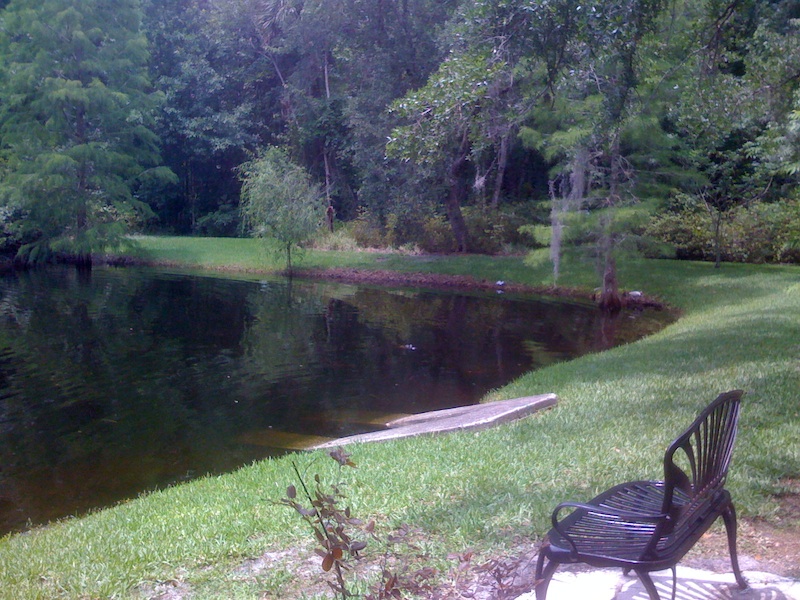
Lake Jesup is full of alligators, and sometimes during mating season they come down through the creeks and end up in the retention pond across the street from our house. An eight-foot one took up residence the week before we got married in the backyard. “That just makes it a Florida wedding,” my vet’s receptionist told me.

My friends warned me before I took this job—about the fundamentalist Christians who objected to any mention of Halloween, about the hurricanes, about the gators and the palmetto bugs, even about rampant entrepreneurialism, capitalism gone jungle-feral. Some of them have cut me off because I came here. Some others have kept in touch for the vacations. I understand both impulses.

Hawk

.

Rain Storms

After I come in from breathing jasmine air, I find an email informing me that my teaching schedule for next year is in disarray. I spend a moment furious, but it’s the usual way of things in a state with a legislature intent on destroying educational institutions that have only ever had a toehold anyway. The governor just approved creation of a brand new state technical university, with the budget coming out of those of existing schools. Rumor has it that the legislator who sponsored this new school stands to make a killing on nearby real estate. All that valueless swampland once sold to unwitting northerners is now valuable after all.

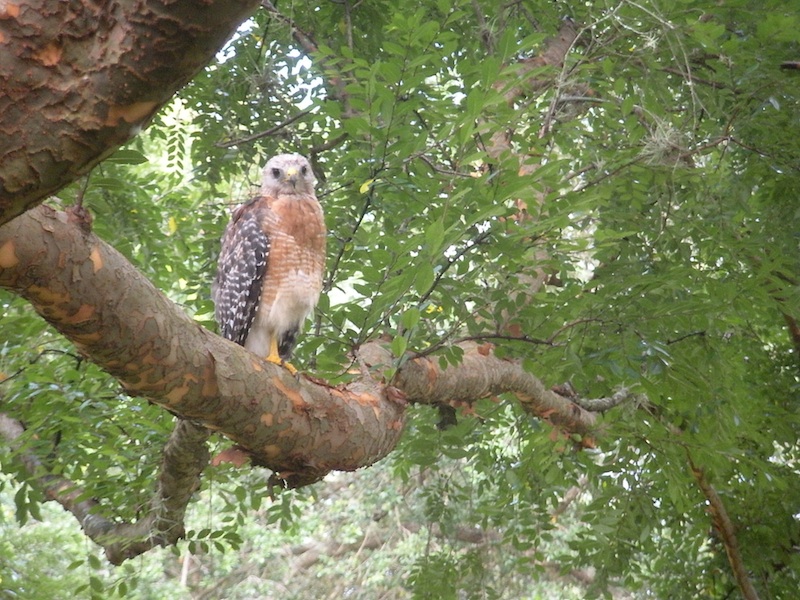
The next morning, clouds finally move in after more than a month with no rain. We’ve reveled in the sunshine, but the splatting drops on my morning walk break the tension. By afternoon, it will be pouring off and on, and the smell of ozone will waft in through the open sliding glass door as I sit at the computer. I will stay home cozy with my husband in the evening because going out during rain here means getting soaked. We will watch for the neighborhood red-shouldered hawk, who often comes down to the low branches in the rain.

A friend down in Tampa says that she hopes the rain will come their way, though she hopes she doesn’t regret wishing for it once the rainy season socks itself in for the duration.

“Sunshine State” is another misnomer around here. It rains constantly most of the summer.

My first year, I ruined six pairs of shoes by getting caught in unexpected storms. Now I just take my shoes off and smile when I walk barefoot into class or a meeting. Bare-assed, barefoot—I’ve learned to live with both conditions in my professional life.

The second year I was here, three hurricanes marched through Orlando. “They never come this far inland,” a Florida native friend had said. I lay in the hallway of my rental and listened all night as the huge live oaks thundered to the ground in pieces. I thought, this is what the apocalypse will feel like.

Raccoon in Humane Trap

.

Winter Springs Redux

A neighbor told me that her family had installed a new security system for fear of home invasion. Later, after Trayvon, she mentioned that her mother warned her son not to wear a hoodie. I don’t know how to feel about that. Orlando has one of the highest murder rates in the country, but violent crime is concentrated far from where we live, and I find suburban fear rather silly, a little racist. As a white teenager, our neighbor’s son is in little danger. But I am glad that the grandmother sees the absurdity of Trayvon’s death enough to feel the fear herself.

For me, the more salient neighborhood concern is the possibility that I might run over an animal. Though the plants seem to bloom forever, the area is strewn with road-kill. Squirrels feed in the right-of-way, jerking their tails and dashing, often right into the street, when I pass. When one is killed in the street in front of our house, I am glad that the bald eagle that flies in to rip it apart first pulls it into the yard across the street, where it will be safer from cars.

The residential hawk, grabbing an anole, swoops down and pulls out the neighbors’ window screen. My husband tells them so they won’t think it’s a robbery attempt. Anoles dash across the sidewalks, but their squashed bodies are nearly as common as their flickering live ones.

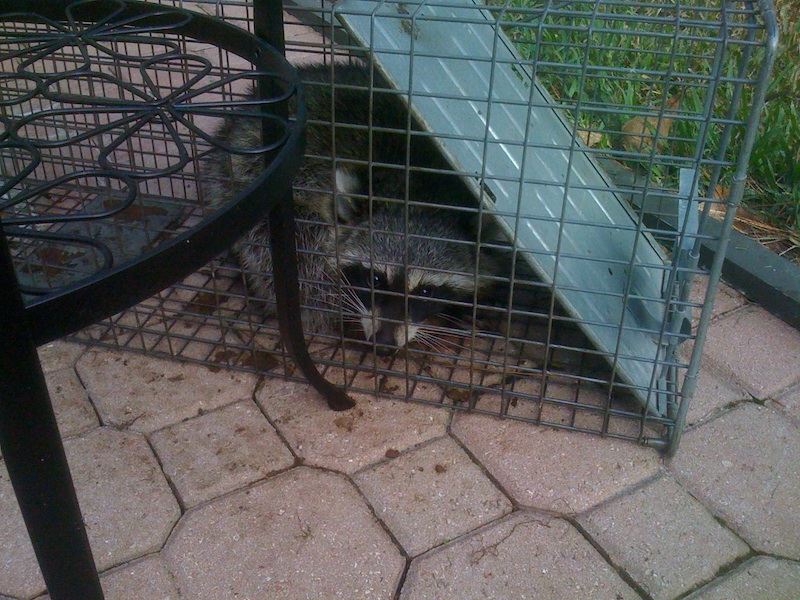
The raccoons take to tearing the screen out of the lanai, pooping in the pool, letting the cats out. We catch a raccoon swinging from the squirrel-proof birdfeeder, back and forth, unhooking it and dumping the contents. We humanely trap and relocate two and an opossum in three days, but more come back. We install a raccoon baffle on the bird-feeder. We install super-strong screens. Then we glue them in.

The armadillos dig up the front grass looking for worms and grubs. When I drive home after dark, four or five cross the street in front of my car. I know they are ready to leap straight up into my bumper.

Maybe living in more urban areas allows other people to forget that they are supplanting so many other forms of life. Here in the suburbs, we can never forget. An uneasy cohabitation prevails. I love the critters, and perform the sign of the cross as I drive by their corpses, but we also battle them.

Over dinner after the clarifying rain, I admit to my husband that maybe Orlando is indeed the quintessential American place—teeming, insane, unstoppable. For better and for worse, I tell him and wink. Probably the future doesn’t look too good, but I have seen amazing turn-arounds happen in my own departure from spinsterhood and my survival of my brain ailments. I have some hope that, after all the people are gone, Florida, if it dies by flame and not by drowning, will rise from the ashes. It seems at least the most likely place for resurrection.

—Lisa Roney

Magnolia Blossom

May 272012


You try to tell people what it’s like living here, but you’re not sure you know. You’ve lived here nearly your whole life, and you’re numb to this place. You have to push yourself to see it. — Jennifer McGuiggan


 Town & Country: Part 1

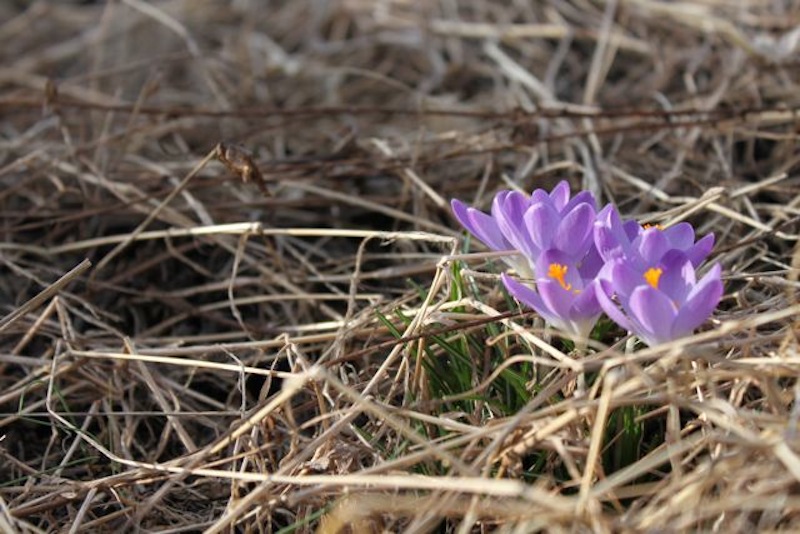
You tell people that this small town, situated thirty-five miles southeast of Pittsburgh, is the last bastion of suburbia before the routes go rural. You live in a thirty-year-old subdivision of single family homes and townhouses. One way in, same way out. No one drives by your house unless he’s headed to or from one of your neighbors’ houses. The well-tended lawns reach right up to the curb, no sidewalks needed in this quiet maze of streets. Yet even in all of this deliberate, manicured space you notice bits of the wild popping up close to the ground: purple crocus and green onion peeking out from the undergrowth in spring; yellow dandelions gone downy white polka-dotting the yards by mid-summer; crackly piles of jeweled leaves lining the curbs in autumn; and bleached twigs littering the mulched beds in winter.

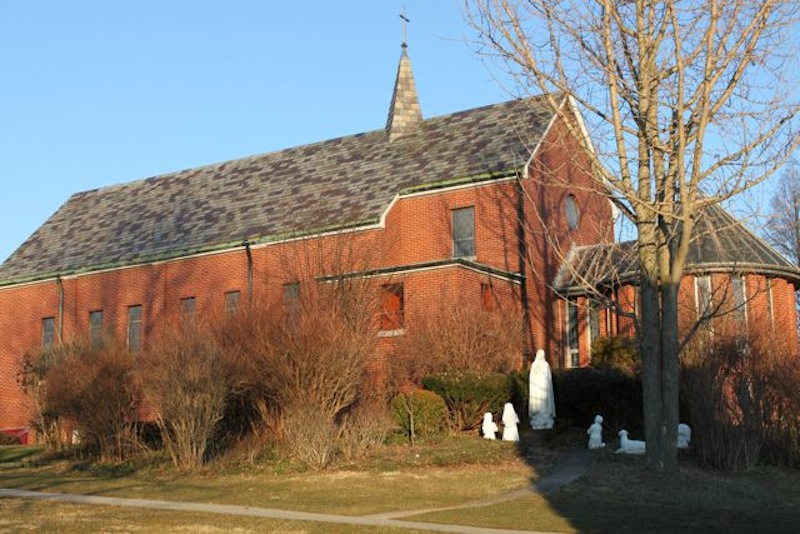
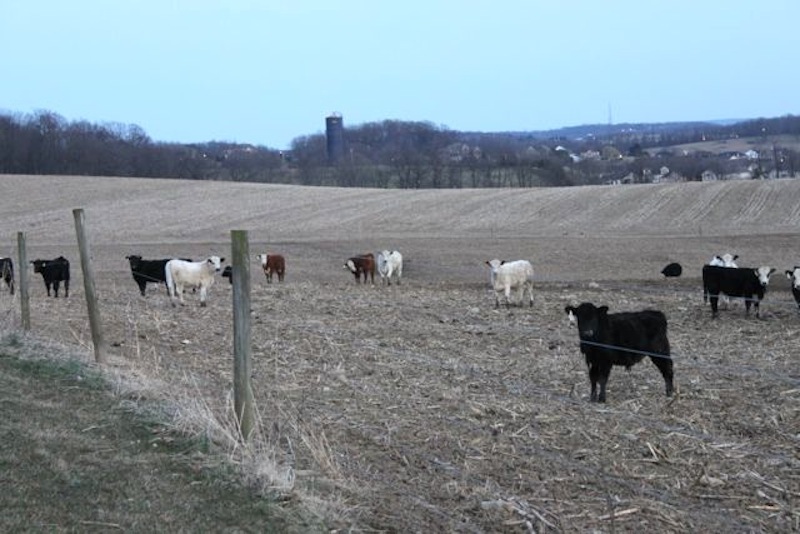
Two minutes from your front door stand a dozen cows, and sometimes one lone goat, in the field next to St. Emma Monastery, where a handful of Benedictine nuns live out their days. People use the parking lot between the monastery and the cow field as a sort of informal, unmanned swap meet. They leave all kinds of junk there, sometimes with a sign that says “Free,” but more often with the simple assumption of freedom. Recently there was a small cardboard box of old Christmas cookie tins and a large, upholstered chair with carved wooden legs and arms, castoff seating for one. Every day for nearly two weeks you spotted the chair’s orange, mustard, and cream flowers as you drove past. Now you look for new treasures to pop up—and for the cop who sometimes sits in the parking lot waiting for anyone to break the 45-mph speed limit.


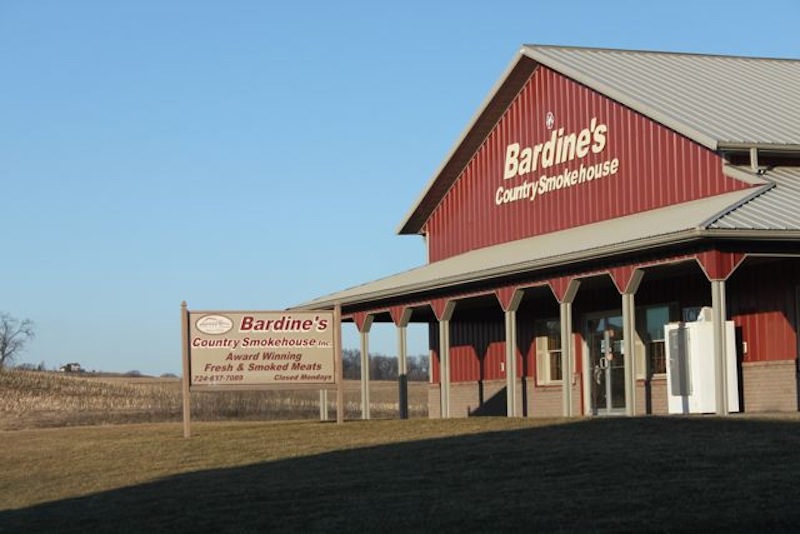
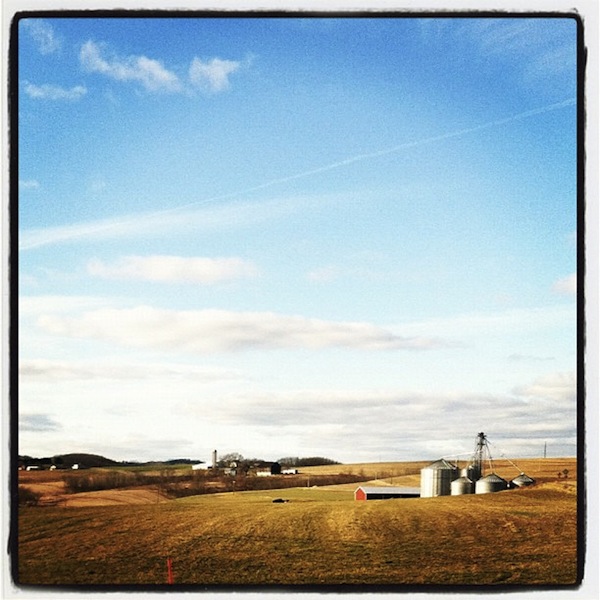
If you drive five minutes more down the road, you’ll be bobbing along in farm country: rolling hills, corn fields, metal silos, the occasional sheep. On Sundays you drive along the sweetly winding backroads to Bardine’s Country Smokehouse, where you can buy fresh chicken breasts, all manner of beef and pork, and more varieties of sausage than you knew there were names for. The folks at Bardine’s wear shirts that read “Nice to meat you” across the back, and they’re always happy to answer your questions and cut your meat to order. Blue ribbons, award plaques, and glossy photos of prize-winning pigs line the walls. There are cows and a barn out back of the store. When you ask if the chickens are their own too, the woman behind the counter says they come from Michigan. You wonder why there aren’t more locally available birds.


Along the way to Bardine’s you pass more fields of cows and try not to think about their sisters, whom you’re about to see splayed out, red and naked, in the display cases. It’s hard to be a vegetarian in this part of southwestern Pennsylvania, but you give it a try every few months. Going out to eat is your undoing, since most non-meat options here are limited to pasta with soggy vegetables. You have to drive thirty minutes for the nearest Indian restaurant, and thirty more past that to find Thai food, both good options for meat-free meals. But your real downfall is bacon, which you sometimes pick up at Bardine’s with a twinge of guilt, placing it on the counter alongside one of those Michigan chicken breasts. Most weeks you can’t bring yourself to buy the beef.

If you time the Sunday trip just right you can catch part of “A Prairie Home Companion” on NPR. Garrison Keillor’s molasses voice makes the country way of life sound so lovely, so vivid, so very nice. You listen because it fits the landscape, and because for those fifteen minutes each way, Garrison and his guests charm you into thinking that you’re cozy at home in these green, green hills, even though you know in your heart you’re not really a country girl.


Town & Country: Part 2

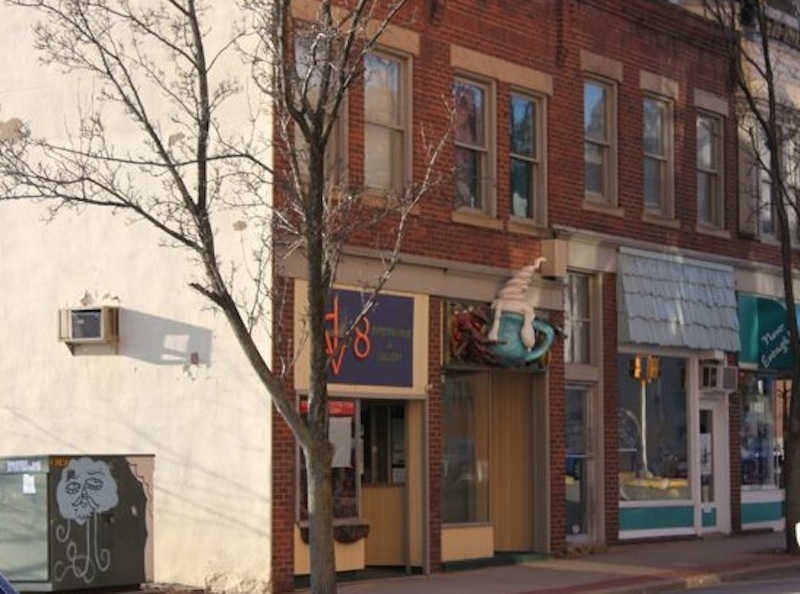
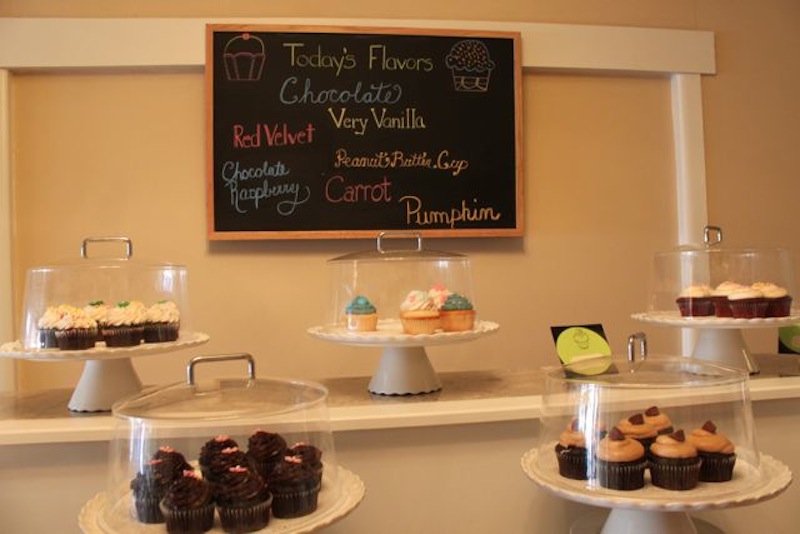
If you come out your front door, drive past the cows and the nuns, and keep going for ten minutes in the opposite direction of Bardine’s, you’ll run into the sad asphalt of highways, big box stores, and strip malls saturated with fast food. But if you want to avoid all that (and you do, unless you need groceries), you can be smack-dab downtown in five minutes. Here in the county seat, “smack-dab downtown” amounts to just a few streets’ worth of small-town city. The big draws, for you, are the library and the post office, which face each other across Pennsylvania Avenue. You occasionally treat yourself to a red velvet with cream cheese icing at the cupcake shop that recently opened around the corner, evidence that all good trends come to those who wait, even in small town America. More often, you stop by the coffee shop just down the street. They make a decent latte, and the vibe is funky, with angry, edgy art that you don’t really like, but that you appreciate just for existing in this little town. You hear that they’re planning to stay open until 9:00 on Friday and Saturday nights. This is good news, since the one or two other cafés that manage to stay in business here close by 6:00 p.m. during the week and 2:00 p.m. on Saturdays. There aren’t many places to go in this town after business hours unless you fancy one of the many bars: sports, dive, biker, or—the newest addition—the county’s first hookah bar, which opened last year in the strip behind the mall, sandwiched somewhere between Buffalo Wild Wings and Hallmark. But let’s face it, you’re not much of a bar girl.


This should be a college town, but it’s not quite that. Within a ten-mile radius sit four colleges and universities, albeit small ones. You’re well past college age, but you wonder where all the students are, where they go and what they do. Where are the late night caffeine-and-study haunts? The street musicians? Where’s the diversity? More to the point, where are all the young people? And by young people you don’t mean the 2.5 kids for every family on your street. There’s a sizable under-18 demographic in this town, rivaled only by the over-65 population. In 2007 U.S. News & World Report named Greensburg one of the best places to retire. From hookah bars to bingo nights, what’s a girl like you to do?

To be fair, there does seem to be a mini-Renaissance subtly taking shape here: cupcakes, evening coffee shop hours, flavored tobacco, even a few locally-owned, independent restaurants to combat the fluorescent chains along the highway. One of them features a menu of local and sometimes organic offerings, including meat from Bardine’s. (You think again about that Michigan chicken. Does five-hundred miles count as local in the world of food?) You’re really trying to be a small-town girl.


The In-between

As a teenager you had a boyfriend who loved living here, touting its ideal location halfway between the mountains and the city, forty-five minutes either way, he said. He was technically correct, but fifteen years later you’re still not buying it. It’s not the math or the mileage that’s wrong, just everything else. The problem is that neither the mountains nor the city on either side of this small town satisfy you. The Laurel Highlands to the east aren’t much when it comes to mountains, just Appalachia’s afterthought foothills. Pretty enough, sure, but nothing that catches your breath.

To the west, Pittsburgh keeps trying to shrug off its old blue collar, Steel Town image with new biotech firms and glossy marketing initiatives. But beneath the progress and the gloss, it’s the same old gritty city, the same squashed-voweled accents of the local “Yinzer” dialect, the longstanding adoration of Primanti Brothers sandwiches with their french fries and coleslaw piled high atop the meat and cheese, as though the sandwich itself were in a hurry for you to eat it. You’re just far enough outside of the city to be disconnected from the art scene that you hear is buzzing. People who live closer in think you live out in the sticks, and maybe you do (think of all those cows). You once went to an evening event in the city and someone asked if you were driving “all the way” back home that same night. One hour by car is a world away.

The city offers plenty to do. There’s the Pittsburgh Symphony, the Pittsburgh Opera, and the Pittsburgh Public Theater, but looming above all of these are the Pittsburgh Steelers. Football reigns supreme here in the capital city of “Steeler Nation,” a geographically amorphous land populated with just as many women as men. You don’t really care about football, which is considered unnatural and blasphemous in these parts. This somewhat frivolous outcast status serves as the symbol for all the ways you don’t feel at home here. You daydream about cities like Portland, Oregon, cities with good public transportation, public recycling bins, and bicycle culture. Places where you—wearing a dress over your jeans and with small swatch of pink hair—aren’t the most outrageous hipster on the scene. You wonder if this makes you a snob in some way. (You fear that it does.)


Land and Sky

Pittsburgh’s three rivers notwithstanding, this is a landlocked pocket of earth. Lake Erie grazes the top of the state three hours to your north, but that’s not local, even if it is closer than those Michigan chickens. And this is the crux of your discontent: You are an ocean girl. You daydream about it the way you used to daydream about your old love who lived across the continent and then across the Atlantic. All of this land maroons you from your true self.

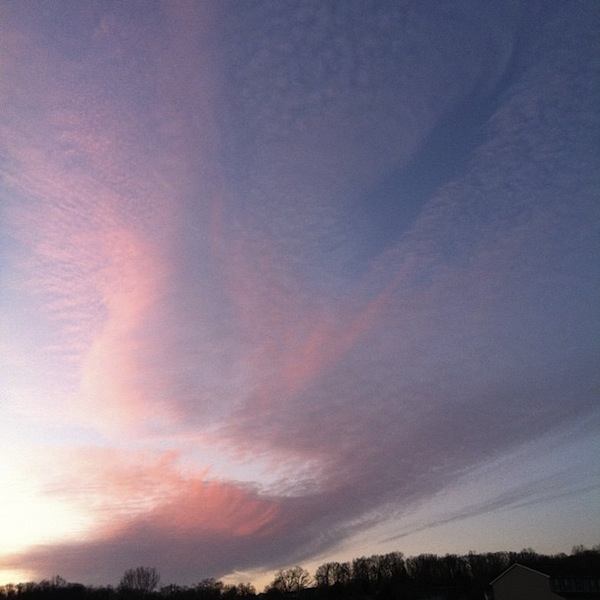
But all of this land is why you love the sky so much: It’s the closest thing you have to the sea and the only thing that seems to change much around here. On good days you watch the currents of the sky, the tide of blue and white and grey ebbing and flowing. But even the sky stays the same for too many days on end here, with more cloudy days than the Pacific Northwest, which, incidentally, is where you’d like to live—between the evergreen mountains and wild seashore. On winter days, when slate grey skies fit over these pale winter lawns like a too-tight skullcap, you feel claustrophobic inside and out, cabin fever that has nothing to do with walls.

Still, the sky is your saving grace. Late in the afternoon, when tentative patches of blue sometimes peek through the cloud lid, you go out for a walk. Every day around this time a fat hound dog cries with an alarming and mournful insistence. On one of your walks you see the dog and its owner. The hound snuffles in circles for all it’s worth, hot on the trail of something along the cold asphalt, braying every few seconds in a plea or an announcement or some triumph, you can’t be sure which.

These feeble splotches of color in the anemic sky remind you that above the colorless canvas that you can see is a wide space of blue that you cannot. Of course, above that lurks the cold dark of space, but that’s neither here nor there. The point is this: The sky is out there. This is how you feel in general: Things are out there, somewhere. Beyond the grey sky; beyond this solidly middle class, suburban development; beyond this small town creviced between the city and the foothills; beyond the farmland and rolling hills; thirty-five miles from urban culture, three-hundred miles from the nearest shoreline, and two-thousand-six-hundred-seventy-four from that beach you love the most on the Oregon coast.

When you force yourself to look at this place where you’ve lived for 35 of your 36 years, you can’t help but wonder what “home” really means. Is it where you hang your hat? Where you lay your head? Or is it, to mix the metaphors, where you hang your head? Even as you think about moving across the country, you push yourself to see this place you call home. You notice the pleasing contrast of brown branches against the whiteout sky, the melancholy music of the hound dog, the sinewy energy of angry art on coffee shop walls. As winter ends, warmer weather creeps back in, the sky blooms into a soft blue, and each spring you notice more purple crocus pushing their way up through the dry sticks of last year’s growth.


   — Jennifer McGuiggan

—————-

Jennifer (Jenna) McGuiggan lives in the rolling hills of Pennsylvania and longs for the sea. To soothe her wanderlust she is working on a collection of essays set at seashores around the world. She holds an MFA in Writing from Vermont College of Fine Arts. In 2009 she curated and published Lanterns: A Gathering of Stories, a collaborative collection of prose, poetry, and photography celebrating women in creative community. Visit her in The Word Cellar, where she writes about everything from navigating the writing life to venturing into the world of roller derby.

This is the 38th “What It’s Like Living Here” on NC. See the complete collection here.

   ——————————————–……

May 182012
 

Vanessa Blakeslee

The Terrace

You live off the six-lane U.S. State Road 17-92 which cuts through Orlando and one of the city’s major arteries. Even though your building is close to the road, you are not bothered by the traffic; you can barely detect the whoosh of passing cars. This may be because these buildings—the oldest condominium complex in Orange County, erected in  the 1950s—are two stories of concrete block, hurricane-proof. You know because you’ve ridden out at least a Category Two here, and plenty of tropical storms.

The buildings retain retro detailing in the porch latticework and New England-inspired names—Gladstone, Kingston, Exeter—which hardly fit the shrubs flowering fire-orange petals, geckos flitting up your porch screens, the lemon tree outside your bedroom which bears fruit in the winter. The complex is notoriously well-kept by the landscapers who descend on Wednesdays, clipping hedges and parading down the sidewalks wielding leaf-blowers like jet-packs, calling to each other in Spanish and Creole, or another Caribbean patois, you’re not sure which. Most of your neighbors have lived here for years. Many are elderly, and a good number are snowbirds—Canadians and Northern retirees who arrive in October and leave around April, with the heat’s descent. But a good number of young couples and singles have moved in recently. You have lived here a decade, and with each passing year, find it more difficult to imagine ever leaving.

 The Birds

Herons

Sometimes when you are climbing in or out of your jeep, the water birds catch your eye. Herons, pelicans, ibis, and others hunt in the stream behind your building, some so tall they would likely reach your shoulder. You try and sneak up on them, but can get no closer than a dozen feet before they scamper away awkwardly on legs like bent chopsticks, or take flight. Even though the birds are a fixture, they fascinate you. Perhaps it’s the elegant, precise way they hunt in the rushing water as their long beaks hover, then strike, in the weeds. Or perhaps it’s the sheer size of some of them, the uncanny way they can sense one’s approach even as they stare in the opposite direction. They are simultaneously graceful yet goofy, like jabberwockies. Sometimes you find giant white splatters on the jeep’s hood and windshield, dotted with seeds, which ignite a string of under-the-breath curses from your lips because of course you have somewhere to go and cannot stop to get the car washed. But you find it difficult to stay mad at them.

The Room of Your Own 

Your office is in the back room which doubles for storage and laundry. While the washer spins and groans in the closet behind you, you peck away on your laptop. So far you have written only nonfiction here, but you are between novels anyway. The vestiges of your most recent project, research for your first novel, are still fixed on your desk—Blood and Capital, America’s Other War, Revolutionary Social Change in Colombia—ominous-sounding titles you would never have predicted yourself reading a few years ago, but that your creative pursuits led you to discover. Literary journals have found their way here, including the final issue of The Southern Review published under the editorship of your friend and mentor, Jeanne Leiby, who died swiftly, shockingly, in a car accident last April. The issues don’t belong on your desk, but you don’t know where else to put them; sometimes you find yourself picking up those with forwards by Jeannie and reading them, some comfort to feel that she is there, yet, within those pages. So every time you replace the issues in their spot, knowing one day soon you will have to clear the desk, make room for new projects, but not wanting to yet. For now, they stay.

Lake Lily Park

You meet someone, a music teacher, at the bar next door. He tells you he’s playing the violin the following night in the park across the street. You decide to check it out.

It’s a balmy February evening, enough for a light jacket or sweater, but as you enter the park’s south side, you pass dog walkers in flip flops and t-shirts, a lone jogger in shorts. Above the lamp-lit brick walk, the Spanish moss dangles from the oaks like lace. This side of the park is vacant, but gradually you round the horseshoe path past the playground alive with children, and the din of music and chatter grows louder. In the daytime you can gaze down among the lily pads in the shallows and spot turtles and fish, but tonight Lake Lily looms dark except for the illuminated fountain in the middle, and the full moon rising in the misty clouds above. A young man steps to the lake’s shore, snaps a photo with his Smartphone. You think of doing the same but don’t. You have never been a fan of stepping out of a magical moment to try and capture it.

Rounding the bend to the far end of the lake is the “food truck round-up,” a modern-day caravan minus gypsies and fortune tellers. Uneven lines form at the truck windows; couples, families, and teenagers stream to the crowded picnic tables with fish tacos and cupcakes. In the center, under a white tent, a new age band strums ambient music—guitar, tambourine, violin, no vocals to disrupt the conversation or mood.

You run into a neighbor and his foreign exchange student, Vika, from the Ukraine, a high school sophomore in glasses who smiles a lot over her burger and fries. She displays a firm grasp of conversational English, and even though you are sitting right beside the band she laughs at the jokes between you and your neighbor, strains to hear your questions but answers them without hesitation. She says it’s thirty below zero back home, that Eastern Europe is experiencing the coldest temperatures on record. She likes American high school because it’s easier. In Ukraine, she studied sixteen subjects a week.

As you rise and say goodbye, you glance at the music teacher—he’s on violin, nods in return, but a restlessness stirs within you. Perhaps it is the ambient music, which alternates between uplifting and melancholy, as now, matching the cozy din of the residents milling about the brightly lit trucks, young and old, married and divorced. You leave and walk around the lake, but there is no escaping this feeling of having one foot in an old chapter that is closing, and another in the new, opening up; you have been in this love-limbo before, this splitting of self. You are almost, once again, single.

The Dance Studio

You bustle into the studio at nine-thirty, water bottle in hand and dance bag bulging with your tambourine and gypsy skirt. Lively Indian music stops and starts from the class in medias res, and when they file out at ten, skin glistening and faces flushed, they talk of costumes for the upcoming show—wrong sizes ordered, jewelry to be borrowed, sewing to be done. They are the professional Belly dance class; many of them have been dancing for years, grew up taking ballet and jazz. Some dance at various themed restaurants in Orlando, for Disney and Universal Studios. You had one semester of ballet, but somehow you are here. At twenty-seven, you discovered your gift for dance, and now, like writing, can’t imagine giving it up.

Tonight, your troupe practices tambourine first—a rollicking number with spins and changing line formations. You split: one half of the group performs for the other half, who sits along the mirror and scribbles critique on scraps of paper. Then one by one, you fire off feedback (“The push backs are getting lost, make them bigger” and “Keep energy in the arms! No chicken wings”). When your turn comes to the galloping music, your coin earrings flick against your neck. Your timing is good. All you need is to slip fully into the dream on stage, and you will be great. The same rules for fiction apply to dance: forget the self, and the art shines through.          

Then you run through the Persian routine. The green velvet and gold-trimmed costumes have arrived, Renaissance style with bell sleeves, complete with gold tiaras and veils. You look like queens, or at least ladies-in-waiting. This dance is sweet, graceful, totally unlike the other. Just after eleven, you finish. Before exiting, you remove your checkbook to pay for the costume. Your stomach squeezes as you write the amount. What is the cost of fantasy? Are you living the life of a Winter Park housewife as someone close to you recently claimed, the bourgeoisie woman in her prime, claiming she’s an artist? Should you stop all of this, and focus on paying the rent?

You should, argues the logos mind. But how can you? The stronger half of your brain, the half that is toned and strong from crafting critical essays, thirty stories, and a novel these past five years, is as sculpted and agile as your limbs as they carry you to your dented, shit-splattered jeep in the night. That brain and body, blood pulsing with adrenaline and spirit as you sweep through the barren streets, wails no, you cannot stop. To stop is death.

You pull into the complex, park in front of the lemon tree. Climbing from the jeep, you are grateful for the spotlight illuminating the lot vacant of persons, or birds—where do they go at night, the spindly-legged hunters of the stream? Through the trees, laughter and loud voices escape from the bar next door. The scent of night-blooming jasmine trails after you, up the sidewalk; the Canadian couple, down for vacation, sit outside the unit beside yours, smoking, cradling glasses of red wine. You are back at the condo, alone.

—Vanessa Blakeslee

—————————————

Vanessa Blakeslee’s fiction has been published in The Southern Review, The Good Men Project, Ascent, and The Drum, among many others, and her short story “Shadow Boxes” won the inaugural Bosque Fiction Prize. She has been awarded grants and fellowships from Yaddo, the Virginia Center for the Creative Arts, the Ragdale Foundation, and recently was one of twelve writers selected by Margaret Atwood for her 2012 Key West Literary Seminar workshop, “The Time Machine Doorway.” Vanessa’s nonfiction and reviews have been featured or are forthcoming at Numéro CinqThe Paris Review Daily, The New Republic, KR Online, and The Millions, to name a few. In addition to writing, she’s a professional dancer with the Orlando Bellydance Performance Company in the troupe Gypsy Sa’har. Find her online at www.vanessablakeslee.com and at the Burrow Press Review blog, where’s she’s the resident “Shimmying Writer.”

May 012012
 

Mateo 5

.

I live halfway between the Road of the Kings and the Avenue of the Fleas in San Mateo, California.  Situated on a peninsula seventeen miles south of San Francisco, San Mateo isn’t a young town at all—it was settled by the Spanish long before many other places in America.  In 1776 Captain Juan Bautista de Anza came from Spain searching for the inlet to the San Francisco Bay; for nearly 200 years it had remained hidden to European explorers sailing up and down the Pacific coast in summer fog.  Anza and his scouting party camped here along a river, naming it San Mateo (after Saint Matthew, the Jewish tax collector-turned-apostle who later spread the word of God in far-flung nations). Anza befriended the native Ohlone Indians living here.

“I found in our camp nearly all the men of the village, very friendly, content, and joyful, putting themselves out to serve us in every way, a circumstance which I have noted in all the natives seen [in California] up to now.” —Captain Juan Bautista de Anza’s Journal, March 29, 1776.

San Mateo1California State Registered Historical Landmark No. 47, DeAnza Camp. Photo Credit: Wendy Voorsanger

My neighborhood, just two blocks from that original Anza camp, would no longer be recognizable to those early Spanish settlers or Ohlone Indians.  What was once a hilly serpentine grassland dappled with stately oak and bay laurel trees, is now organized into wide streets named after Spanish locales (Castillian, Sevilla, Avila, Aragon) and prestigious eastern colleges (Harvard, Cornell, Fordham).  The grizzly bear, elk, and pronghorn antelope no longer roam, the wide-open space covered with rows of Spanish and Mexican revival houses.  The oaks and their meaty acorns, once prized by the Ohlone, now feed only the black squirrels skittering between the yards.  The San Mateo Creek where Anza made camp is no longer wide and flowing with salmon and trout, but slowed and stunted by a large dam three miles upstream.  The dam holds back the water from the Crystal Springs Reservoir filled with Yosemite snowmelt delivered via a sophisticated system of pipes originating 176 miles to the east.

Crystal SpringsCrystal Springs Reservoir at low level. Photo Credit: Wendy Voorsanger

The front yards in my neighborhood aren’t fussy or fancy but welcoming. Small green lawns are edged symmetrically and blown neat.  Plenty of perfectly placed native grasses sit alongside drought-tolerant plants such as yucca palm, flowering sage, rosemary, and fruit trees (lemon, orange, fig) designed to look as casual and natural as California itself.

casa1Spanish and Mexican influences in San Mateo. Photo Credit: Wendy Voorsanger

I find the people here in San Mateo friendly and open, much like Anza found the Ohlone back in 1776.  Perhaps it’s because of the mild climate, warm sunshine and blue sky.  Or maybe it’s the boundless ocean nearby, 12 miles west over the ridge.  Or the delicious evening fog that rolls in at night; nobody has air conditioning—we just open our windows.  Whatever the reason, the town exudes a convivial energy.  Neighbors smile and wave and take in my trashcan without asking.  They put my paper on our porch and ask about my day.  I often find myself on the sidewalk long after the sun goes down chatting with neighbors while the kids kick balls in the middle of the street.  San Mateo has a trusting sort of warmth that doesn’t require years to earn.

I like to think the Ohlone spirits inhabit us, teach us how to live, appreciate our land and each other.  I imagine their bones scattered deep beneath my home. I imagine them wandering the hills in the midnight fog wraithlike, their pacific whisperings coming through my window as a sea breeze as I sleep.  But then I also imagine the ghosts of the Spanish buried alongside the Ohlone and figure they have something to say, too.  And I wonder how much of our culture is simply a lingering imprint of those who came before.

“Indian Maidens” at the San Mateo post office. Relief sculpture carved in wood by Zygmund Sazevitch, 1935 Treasury Relief Art Project. Photo credit: Wendy Voorsanger

To outsiders, San Mateo might seem like an irritatingly superficial, “laid back” place.  I’ll admit, I enjoy my superficial pleasantries, not always taking the time to dig beyond surface connections with people.  And I do often hang out in nature; our Bay Ridge and Peninsula open space district encompasses over 60,000 acres in 26 wilderness preserves.  But most people in San Mateo don’t really fit into that familiar “laid back” Californian caricature.  Being relaxed is just an image we carefully cultivated, consciously or subconsciously.  In fact, on the contrary, San Mateo is a diverse mix of locals and transplants from around the country (and the world), mixed together into an insanely intense stew of over-achievers and perfectionists.

.

 A Reconstitution

I grew up in Sacramento and came to the Bay Area twenty-five years ago looking for opportunity among the numerous Silicon Valley start-ups.  I clung to the culture of achievement here because of my deep-seated need to repair the fabric fraying around me growing up amidst the crazy 1970’s California counter-culture of dissolving structures (family and society), mind-altering substances, and latch-key responsibilities.  My plan was to do better than my parents, harness all that freedom and possibility, not squander it.  Perhaps others came here to escape the confining strictures and suffocating class-based impediments in the places they left. In San Mateo we all seem to be trying to build and rebuild our lives into something more meaningful through intense work, innovation, over-achievement.

Here in San Mateo, it doesn’t matter where you come from.  What matters here are your ideas.  Your intelligence.  Your work ethic. What do you bring to the table?  What is your value add?  Did you start a company?  Launch an IPO? Get your PHD?  Fund a mind-blowing technology? Volunteer with an indigenous tribe in a remote location?  Invent a life-saving drug?  Run a marathon?  Start a non-profit?  Living in San Mateo offers an extraordinary geographical opportunity for innovation—it’s equidistant between San Francisco and the Silicon Valley.  We’re ideally situated to work in any one of the high-tech companies nearby (Google, Facebook, eBay, Twitter, Yelp, Pixar, Yahoo, Genentech, Apple, etc.) or in other industries that serve the technology industry like venture capital and merger and acquisition law.

.

Our Statistics

According to the Bay Area Council Economic Institute, the area has:

    • The highest economic productivity in the nation—almost twice the U.S. average
    • The most highly educated workforce in the nation, with the highest percentage of residents with graduate and professional degrees
    • The nation’s largest concentration of national laboratories, corporate and independent research laboratories, and leading research universities
    • The largest number of top-ten ranked graduate programs in business, law, medicine and engineering in the nation
    • The highest density of venture capital firms in the world
    • The most technology Fortune 500 companies
    • The highest internet penetration of any U.S. region
    • The highest level of patent generation in the nation, with more patents generated per employee than any other major metropolitan area.

.

 Living In a Culture on Steroids

To me, living in San Mateo feels like living in an achievement culture on steroids.  There’s a drive for perfection, or a drive to get as close to it as possible.  It’s the common denominator among us—this drive for perfection—whether or not we admit it to ourselves.  Or to each other.

Our local schools offer parent education lectures entitled: “Inspiring Innovating Thinkers,” “Sports Parenting: Inspiring a Win-Win Attitude,” “Resilience and Optimism in Your Child,” and “The Art of Imperfect Parenting.”  Moms and Dads attend these lectures equally.  We read books like Making Marriage Meaningful and The Secrets to a Dynamic and Fulfilling Marriage to ensure that we don’t fall short like our parents.  We’re trying to become our better selves.  We’re striving for perfection, while juggling parenting, marriages, and careers.  When we blunder, we call it “a learning opportunity.”

San Mateo is a town catering to people who live healthy; there are six gyms and four yoga studios within a four-block radius from my house offering yoga, the Bar Method, Pilates, Zumba, Interval Cycling and Skinny Jeans classes.  There’s also Junior Gym to get the little ones started early.  Here in San Mateo, we hike, run, swim, road bike, mountain bike, kite board, paddleboard, and surf.  We complete marathons and 48-hour team relays for charity.  We drink SuperFood, do seasonal cleanses, cut out carbs, and eat organic goji berries, flax seed, and dried seaweed.  Most people I know don’t spend hours on the golf course each weekend talking business over scotch (too old-school exclusive and slow).  Instead, after hours networking is done while biking up Crystal Springs Road in tight pelotons on custom bikes wearing coordinated bibs and jerseys; cyclists then track and compare achievements (route, distance, speed, elevation, power, time) using a Strava iPhone APP and celebrating their King of the Mountain (KOM) wins with Racer 5 microbrews.

ConradCraig Chinn and Conrad Voorsanger chat in the neighborhood before a ride. Photo Credit: Wendy Voorsanger

Our children are swept up into the achievement culture around them. They play soccer, lacrosse, basketball, and volleyball.  They fence, rock climb, dance, swim and dive.  They play the trumpet, harp, guitar, and drums. They sing and attend chess club, art class, and robotics clubs.  They learn Mandarin, Spanish, and French. They take extra classes outside of school in math and writing at places like Kumon, Sylvan, The Reading Clinic, Academic Springboard and The Tutoring Center.  They enter in math competitions, spelling bees, geography bees, and science fairs.  They’ve mastered all things computer science and gadget-related, and have moved on to App programming and hacking.  We keep them on task with family-coordinated online calendars updated from our Smartphones.

We’re obsessively concerned about the environment, driving hybrid cars and using canvas bags at the grocery store.  We walk, ride bikes, and use the carpool lane or public transit (CalTrain or Bart).  We conserve water, use compact fluorescent light bulbs; incandescents will be illegal in California by 2013.  We recycle and compost nearly everything with a sophisticated stream recycling system.  Everyone has three garbage cans: green for compost, blue for all recyclables, black for trash.  The black can is seldom full.

.

A Haunting Echo

It feels as if we’re all striving to create a New World utopia in San Mateo, much like the Spanish missionaries did two hundred years ago.  Perhaps that’s the long-dead Spanish influencing us from beyond; their zealous drive a haunting echo from the past.

Father Junipero Serra followed Anza, with the hopes of building a perfect utopian society.  He and his padres worked fervently (using Ohlone slave labor) to create a network of 21 missions exactly one-day walk apart along El Camino Real (the Road of the Kings).  Serra was an exacting and determined perfectionist, much like the people in San Mateo today. But, most people here aren’t looking for Serra’s pietistic existence. We’re on a fast-paced, never-ending quest for a particular type of utopia that takes our constitutional “pursuit of happiness” literally.  We’re pursuing that right with intense fervor, all the while portraying the cool substance of a calm demeanor.

smile.

Defining Diversity

San Mateo is a multi-cultural and socio-economically diverse town that’s walkable and welcoming.  People talk to each other the street.  Many languages are heard: Spanish, Russian, Mandarin, Japanese, Hindi.  Flower boxes with impatiens dangle from light posts.  Public benches with matching iron trashcans are evenly spaced along the sidewalks. Littering is a misdemeanor in San Mateo, punishable by a $1000 fine.

There’s an impressive collection of restaurants: Mexican cantinas, Korean noodle houses, Irish pubs, Italian eateries, and Brazilian Steakhouses.  There are countless Sushi and Chinese restaurants, Indian buffets, all-American diners, healthy cafes, coffee stores, and juice bars.  Draegers Grocery has organic fruits and vegetables, free-range meat, and sustainable fish.  There’s also a Japanese Grocery (Suruki Supermarket) and several Mexican Markets (Market Fiesta Latina, El Azteca Market, and El Faro’s Mexican).

There are more Mexican restaurants in San Mateo than any other; Spanish tapas or native Ohlone fare (acorn bread, deer, mussels, fish) aren’t found anywhere.  Perhaps this reflects the Mexican victory of independence from Spain in 1822, when Mexican Generals set about secularizing the California missions and distributing large land grants throughout California.

So what of the Mexican influence in San Mateo?  It extends beyond margaritas and enchiladas to the rich Mexican heritage of industrious land labor (cattle ranching, tanning, logging). In addition, historian Robert Glass Cleland said of the Mexican Californians (Californios) in 1833: “They are free from the pressure of economic competition, ignorant of the wretchedness and poverty indigenous to other lands, amply supplied with the means of satisfying their simple wants, devoted to the grand and primary business of the enjoyment of life, they enjoyed a pastoral, almost Arcadian existence.”

MuralUntitled glass tesserae mosaic on exterior Bank of America building in San Mateo; Louis Macouillard, designer and Alfonso Pardiñas mosaicist (Five mosaic panels 25 ft. high, approx. 90’ across).

The Mexican culture also introduced liberalized divorce, custody, and property laws for women in California long before the rest of America recognized gender equality.  In fact, in 1844 one of the largest ranchos on the Peninsula (4400 acres) was run by a Mexican woman named Juana Briones.  Juana fled her drunken husband in San Francisco with her eight children to buy her own ranch on the Peninsula, where she began raising cattle and farming. Historical accounts say she prospered, acquiring five other ranches over her lifetime and living a fulfilled existence with her large family around her.

As a native Californian, I can’t help but see Juana as some sort of standard-bearer I should emulate.  After all, she seemed to find opportunity and achieve happiness, all while juggling the pressures of a demanding career and raising children.  Living in San Mateo, I feel as if Juana’s endowment fills me like a deep, resonant well of possibility.  Perhaps her lasting legacy is stored inside me, simply because I live here.

.

At the Center

America took control of California upon winning the Mexican-American war in 1847 and broke up (“redistributing”) the large Mexican ranches.  This slice of history is seen in Central Park, 16-acres bordering the north part of San Mateo.  The oaks and bay trees have stood here since the Ohlone, but the pine, cedar, redwood, and fig trees were planted for the estate of Charles. B. Polhemus, director of the San Francisco-San Jose Railroad.  Polhemus grabbed the land from the Mexicans, and built a grand estate where Central Park now sits, with a 13-room Victorian mansion and lush landscaping.  He later sold the estate to a sea captain named William Kohl, who then passed the property on to the city of San Mateo in 1922.  The mansion was torn down long ago, replaced by a large circular grassy area in the center of the park.  It’s a vibrant public space where the whole town congregates: parents bring small children to romp in the playground and ride the miniature train for a dollar, older kids around on bicycles and skateboards, seniors practice Tai Chi under the shade of a pine tree. A drummer sits on a bench thumping out a mesmerizing, visceral beat.  There are also a baseball field, tennis courts, a community center, rose garden, and formal Japanese tea garden with a granite pagoda, koi pond and bamboo grove.

Mateo4“Library Lane” mural depicting American expansion in San Mateo, by muralist, Norine Nicolson, 1989.

The black squirrels live here in Central Park too, fed by older folks who come for daily walks with nuts stuffed in their pockets. There are no more quail or great horned owls as in the days of the Ohlone.  They’ve diminished in numbers and headed up to the ridge with the falcons and condors, but there are still plenty of finches, doves, warblers, and jays to liven up the park with song.  Lining the park are several senior apartments, upscale and subsidized side by side.

Two blocks east of the park—across the train tracks—men eager for work gather on street corners hoping for day labor.  No one asks for documentation.  Sometimes the men congregate in the parking lot of the Worker’s Resource Center where a County Mobile Health Van offers free health assistance.

.

The Strong Current of History

Sometimes living amidst all this sunshine and happiness can be difficult, the pressure and pace crushing, the competition daunting.  Opportunity isn’t ubiquitous, and luck is often elusive.  Amongst the intense rush, the quiet contemplation and reflection that our forebears enjoyed is often fleeting.  When I catch a slow moment, not originating from evaluation and measurement or leading toward any admirable achievement and success, I think of those who came before and how deeply they influence what it’s like living here.  Walking along San Mateo Creek, I think of the Ohlone catching fish.  Sitting on the patio listening to my son playing a malaguena on his guitar, I think of the Spaniards.  Watching a hummingbird from my window suck on lemon blossoms, I think of the Mexicans who brought those trees here. I delight in these simple moments, circling around like an eddy in a river, slowing me into a reflection of swirls and ripples and the glassy texture of the water itself.  Then the strong history of my town grabs hold and pulls me along once again, throwing me like a pebble into the single fast moving cultural current that is San Mateo.

— Wendy Voorsanger

.

Wendy Voorsanger is a graduate of Vermont College of Fine Arts. She is a shadow contributor to NC, writing on the arts and creating art (see her gorgeous Burning Man novel skin) without actually appearing on the masthead. She lives in San Mateo with her husband and children and is at work on a historical novel about California.

See also our growing list of What It’s Like Living Here essays, a staple of the NC economy.

.
.

Mar 062012


erin stagg

Erin Stagg seems to have an aversion for the level places. She grew up in the mountains in Taos, New Mexico, and now lives between the mountains and the ocean in Dunedin, New Zealand, where she works as a ski instructor and writes. Erin just graduated from Vermont College of Fine Arts in January. She was my student that last semester, which was a great pleasure for me, and wrote a stunning craft lecture on character thought in fiction which has already appeared on these pages.

dg

———

The cold is a permanent resident here. Even in mid-summer when the temperature creeps above 70 and the beach is suddenly overcome with girls in bikinis you know that tomorrow the southerly wind will be back, bringing with it the sting of the Southern Ocean. Sea lions sleep on the sand. Ice forms on the inside of your windows. You have to wear a 4/3 wetsuit to go surfing in the summer. The locals have adapted. They wear shorts, flip-flops and down coats. They fly helicopters out to passing icebergs to take wedding photos. They say that the cold keeps the crowds away.

When you paddle out back you see penguins. You sit upright on your surfboard looking out to sea and watch the waves billow towards you. But you do not try to catch them. Instead you drift. You watch the color of the kelp shift beneath you. You listen to the yelping of the gulls. On shore a knot of people stand at the edge of the esplanade waiting for the waves to smash up against the concrete retaining wall and spray them.

IMG_0835

The waves swell beneath you. You grew up in a desert on the other side of the world and so the sheer volume of water is daunting. It is enough just to be out, feeling the ocean and listening to it crash onto land. The first time you caught a wave it closed in over you and drove you down into the tangle of kelp. You don’t like salt water forcing its way into your sinuses.

To the south sprawls the open ocean. You wonder if there are sharks out there, swimming beneath you. Your feet are starting to feel cold.

PB040033

Dunedin, the Gaelic word for Edinburgh. Aotearoa, the Maori name for the country, Land of the Long White Cloud. In February the students come back from summers spent on the temperate north Island. While they were gone the city had felt abandoned and forgotten. But now the streets pulse with youth. There it still plenty of light left in the evenings this time of year. You discover them reuniting downtown over a curry at the Meridian.

Suntanned and certain of their futures elsewhere they complain about the weather. Afterwards they go to a movie or a flat warming party somewhere up near Roselyn while you walk down George Street towards the black stone buildings of the University. Dub music swelters from the Cook. You can see the lights of a cricket game being endured in the new stadium by the water. But you keep going. You pass through the University. You stop at the Leith River to watch a pair of paradise ducks swim upstream. Then you continue onwards until you reach the botanic gardens where you sit on a bench in the antipodes garden.

IMG_0838

From here you can see Mt. Cargil with its cell phone tower crown and, further west, the crease of the Taieri Gorge. A tui whistles from the manuka tree behind you as you watch the sunlight leach slowly out of the sky.

P7300012

Three hours west, on the other side of the sun bleached sheep stations of central Otago, are the mountains, jagged, treeless and lacerated by glaciers. You go there for the weekend with your bike and your boyfriend’s bike wedged in the back of your station wagon. You stop for a mince and cheese pie in Ranfurly. You meet your boyfriend’s uncle for a pint of Speight’s Beer at the Clyde pub.

IMG_0125

By the time you make it to Queenstown it is dark and the Southern Cross is high in the sky refracting off Lake Wakitipu. Your boyfriend decides to go for a swim anyhow, shedding his cloths on the stones at the lake’s edge. You tarry reluctantly. You know the water is glacial. You take off your shoes and slip your toes in. The cold is instant, rushing up your legs. You go no further.

In the morning you will ride your bike along the Arrow River to a ghost town. You will wonder about the gold miners who lived up there in the mountains cut off from everything but the cold.

You notice when the wind changes directions, when it softens and begins to wrap around from the south. You can feel when the weather’s about to change. You can see the southern storms coming, boiling across the water.

Last night it snowed on the hills. The tourists are cold. They come here from everywhere – France, Hong Kong, Perth. They say, “It’s so cold here. We thought it was summer.” You say, “This is summer.” They buy rain jackets and wool socks. They want to know where the steepest street is. They want to see penguins. They think you are from this place. Only the Kiwis can hear the open vowels in your voice, but they are used to immigrants. You are not the first to have been brought here by a kiwi man. This is a country of citizens with multiple passports.

PB130052

After work you walk down to the beach. The tide is out and so you walk along the sand. You can see clear blue skies forming over the water, pressing the storm clouds away.

—Erin Stagg

Jan 232012


Here’s a brand new “What it’s like living here” essay from Liam Volke in Victoria, British Columbia. (He’s Gabrielle Volke’s brother—staunch readers will remember her lovely interview with dg, published in October, 2010, at NC.) Liam is freshly graduated from the University of Victoria’s Theatre program with a BFA in Acting. He lives and acts and writes poetry in Victoria. His poetry has been published in the CBC Poetry Anthology, 2007. He blogs at The Tower of Babble.

dg

.

What It’s Like Living Here

from Liam Volke in Victoria, British Columbia


University of Victoria


In Victoria, among the aged flower children and retired English folk, a river of young blood surges through its heart and pools around a green ring.

In your first year as a student, life was wrapped within and around the Ring Road of the university campus. You saw maple leaves for the first time. You tasted independence: in Rez, with other under-aged drinkers. You lost your first love. Here is where you thought you’d reinvent yourself.

The classes for your Acting major are all in the Fine Arts section of the campus, a modest trio of white, brown and grey brick buildings facing a paved circular courtyard with a single evergreen in the centre. This section seems quarantined from the rest, placed outside the Ring (inside is the stronghold of Sciences and Humanities). “Theatre? We have a theatre?!” they say. We’re a big deal abroad, you tell yourself.

Most of the trees here keep their leaves, so at first you suspected you were in paradise. The rain was a welcome change from the snow that browns and greys with the dust and gravel of hometown Calgary. You told yourself you would always love the rain. You told yourself a lot of things.

Continue reading »

Nov 072011
 

Danila Botha is a South African-born short story writer who lives in Toronto. She’s the author of Got No Secrets, a collection of stories in the Bukowski-Burroughs-Easton-Ellis tradition of black romanticism/alienation but with young, feisty female protagonists. “Jesus Was a Punk Rocker” was part of that collection and earlier appeared on these pages, as did two new stories “The Other Other” and “Valentine’s Day.”

dg
.

What It’s Like Living Here

From Danila Botha in Toronto


Forest Hill

I am back in Toronto, back at my parent’s house (at 28, after moving out at 18, it feels surreal, to put it mildly). My parents live on a beautiful, tree-lined street in Forest Hill surrounded by large, striking houses: cold, cube-shaped modern structures or light and dark brown brick homes with cottage-style thatched roofs and salt water swimming pools. Their palatial home is full of silk curtains, French antiques, grey and white swirling marble floors, expensive fabrics in shades of cream and gold and dusty pinks. My bedroom has needle point carpets adorned with roses. I stare down at my chipping nails, my wrinkled Black Flag tank top, the new tattoo on my arm. I twirl a strand of greasy hair around my index finger. I am reminded of a Chantal Kreviazuk lyric: “…it’s crowded and I feel lost in here, I’m trying to find a familiar fear/I look everywhere but I just can’t see/there’s not anything that reminds me of me.”

My favourite piece is my bookshelf. It’s beige wood, with light green leaves painted on it, an antique I’ve had since I was five, stuffed with my favourite books: Heather O’Neill’s Lullabies For Little Criminals, Etgar Keret’s The Bus Driver Who Wanted to be God, the Zoe Whittall edited collection of stories called Geeks, Misfits and Other Outlaws, Lynn Crosbie’s Liar, Aryn Kyle’s Boys and Girl’s Like You and Me, and Jami Attenberg’s Instant Love. My collection of first editions is on the top shelf—Catcher in the Rye, Frankenstein, and Naked Lunch. I think they’re the first things I’d save in a house fire. On my mint green and silver leaf antique chair, there’s a pile of my old stuffed animals, including a white owl, a lime green Care Bear, and a two-dollar toy machine creature that resembles a cucumber with eyes.

I go for a walk with my little brother to the plaza near the house. The air is heavy and humid. The plaza feels both comfortably familiar—it has a Second Cup, a Winners and a Shoppers Drug Mart—and horrifyingly foreign, like the nightmares I have when I’m jet lagged. My brother points out the sunset. I know the violets, periwinkles and magentas are the result of pollution, but still–

.

Continue reading »

Nov 042011
 

The  intrepid painter/writer/naturalist Laura Von Rosk (see her paintings here on NC) has flown to Antarctica (it’s spring there) as part of a scientific team headed by Albany, NY, cell biologist Dr. Samuel Bowser (friend them on Facebook at Bravo! 043 or visit his blog). The team’s mission is to dive (under the ice) and conduct studies on the the single-celled organisms known as Foraminifera from a field camp at Explorers Cove, situated at the base of the Taylor Valley, in the Dry Valleys, west of McMurdo Station in Antarctica. It’s a great pleasure to be able to publish Laura’s early report (dated October 9) and some of her photos. There will be more.

Laura Von Rosk (normally) lives with her dog Molly on a lagoon just outside Schroon Lake, New York. She curates the Courthouse Gallery at the Lake George Arts Project, a gallery dedicated to the experimental and the avant garde. She’s an old friend and a wonderful landscape painter.

dg

What it’s like living in Antarctica

From Laura Von Rosk


We arrived at McMurdo on Tuesday late afternoon. We have been very busy since, with training, reviewing plans for the season, etc., and just getting adjusted to the new environment. Each night I think I’ll get to email – but end up exhausted. Usually in bed by 11 PM, and up around 6 AM.

We weren’t sure we would get here on Tuesday because the night before we left Christchurch it was “Condition 1” [1] at McMurdo.

Today, Sunday, Oct 9th, is Condition 3 – beautiful sunny day, 0 degrees F, -18F wind-chill.

Continue reading »

Footnotes    (↵ returns to text)

  1. I pasted the 3 main definitions for weather here:

    Condition 3 (nice weather): Winds up to 48 knots, wind chill down to -75 degrees F, and visibility over 1/4th mile. Unrestricted travel and activity are allowed.
    Condition 2 (not so nice): Winds 48 to 55 knots, wind chill -75 to -100 degrees F, or visibility 100 feet to 1/4th  mile. Restricted pedestrian traffic only between buildings is allowed. Vehicular travel is allowed in radio equipped, enclosed vehicles only, and check out is required.
    Condition 1 (crazy…) Winds over 55 knots, wind chill lower than -100 degrees F, or visibility less than 100 feet. Severe weather is in progress. All personnel must remain in buildings or the nearest shelter.

    For a sample of Condition 1 visit this link:
    http://xmb.stuffucanuse.com/xmb/viewthread.php?tid=6811

Oct 282011
 

At the Confluence

.

Hurricane Irene did surprising and catastrophic things to Vermont, surprising because, well, Vermont is inland, far from the storm-whipped coasts, far from, say, New Orleans. You don’t get a storm surge in Vermont. But when a storm like Irene hits, all the topographic beauties of the place turn to its detriment. The rain washes straight down the mountainsides into the narrow, deep valleys. Creeks and rivers that were nothing but shallow meanders through deep cobble beds, mostly dry at that time of year, fill up with alarming suddenness. The rivers rage down the valleys, demolishing roads, buildings, towns. Hilary Mullins is an old friend from her days as a student at Vermont College of Fine Arts when she used to hang out in Francois Camoin’s room on the third floor of Noble Hall just down the corridor from dg who also tended to hang out in Francois’ room a lot (it was a hospitable place, a cross between a Paris salon and a homeless shelter). Hilary lives in Bethel, Vermont, where she reads, writes, teaches, sermonizes and runs a window-cleaning business. She was, yes, at home when Hurricane Irene hit, and this is her story—a What It’s Like Living Here essay with a twist. (The photos are a group effort; credits to Janet Hayward Burnham, Dan Thorington, Bill Gibson.)

dg

.

Hurricane Irene—What It Was Like

From Hilary Mullins in Bethel, Vermont

.

Everyone in Bethel knew the hurricane was coming–we knew all about it. We knew the forecasters were saying it could be significant, and we knew why: August had been rainy, and we already had plenty of water in the ground. So we knew we didn’t need any more, particularly not in the quantity that a hurricane might bring. We also knew there was supposed to be high wind. So we stacked our yard chairs, tossed more rounds of wood on the tarps covering our woodpiles, and brought our animals in.

But at first when Irene arrived–not as a hurricane but as a tropical storm–she didn’t seem so significant after all. The rain started Saturday night, and yes, it came steady, but around here, we’ve all seen rain like that before. And we know rain. There’d be some wash-outs, we knew that: roads where the gravel would be eaten and maybe some pavement too. And maybe some people’s houses would be threatened. Because that does happen more often now: a thunder storm hits, leaving a flash flood in one area.

But even though we knew all this, even though we knew the land here is all ridges and river valley, brooks and streams pouring down from everywhere to merge, uniting in the White River that runs through our village, we didn’t know. We didn’t know the power of what was running at the level of our feet–or what could happen if all those little waters—not just some here or there–began to rise. Which on the 28th of August they did.
.

.

Continue reading »

Sep 162011
 

.

.

Five years ago today Sion Dayson moved to Paris, the last move, so far, in a peripatetic existence. This essay is Sion’s contribution to Numéro Cinq‘s What It’s Like Living Here series, a vivid, intelligent meditation not so much on place but on the deeper implications of belonging, of identity and strangeness.

Sion Dayson is an American writer living in Paris, France. Her work has appeared in The Wall Street Journal, Smokelong Quarterly, Six Sentences (Volume 3) and the anthologies Sounds of this House and Strangers in Paris: New Writing Inspired by the City of Light. In 2007 she won a Barbara Deming Award for Fiction. She holds an MFA from Vermont College of Fine Arts and is currently putting the finishing touches on her first novel. It recently placed as a Semifinalist in the William Faulkner – William Wisdom Creative Writing Competition (novel-in-progress category). You can read more of her experiences in Paris at her blog, paris (im)perfect, and find out about all of her work at siondayson.com.

dg

.

An Alien Feeling

By Sion Dayson

.

When I was a baby, I had a nanny named Josephine who came from the Dominican Republic. My family lived in New York then – the mythic New York of the ‘70s that I would love to have known.

Josephine spoke to me in Spanish, long before I could understand or form words. There’s no doubt, however, that this early exposure stayed with me. When I started studying Spanish formally in junior high school, the language came easily, my accent hardly noticeable. Vocabulary stuck like scotch tape.
.


.

Cara K., my best friend, took French classes and I teased her endlessly for it.

“What good will French ever do you?” I ridiculed.

In fact, I charged anyone who chose not to learn Spanish as elitist. By that point we lived in North Carolina where the Latino population was exploding. Spanish was not only useful, but to me, completely beautiful.

.
Continue reading »

Aug 122011
 

.

.

What It’s Like Living Here,

by Allison Kaufman in Connecticut

.
Living by the Numbers 

Seven days.  You check your watch constantly.  You live and die by the ping of the calendar on your phone.  Realize that there is slight irony in the fact that you are writing of this place with only seven days left before there are seven states between you and this desk.  Seven being the magic number, not in the lucky sort of way.  Seven being the number of days that you work twenty-four hours.  Seven being the number of blocks there are in the daily schedule.
It’s only been three years.  You’ve done everything you can.  You repeat this mantra.

You’ve been a parent now for three years.  Not biologically, but in dorms.  You sleep in an apartment that is likely larger than any you will ever own.  There are 10-foot ceilings, a handrail that snakes around the living room, and a kitchen whose appliances and cabinetry are older than you are.  You install pendant lighting.  You paint (Nantucket Grey).

.

.

Your charges in your first year were 16 junior and senior girls.  Your toughest disciplinary issue was dealing with a girl who left a douchebag (literally) with a bow on it in front of a neighbor’s room.  You fought laughter while scolding the seventeen-year-olds.  You noted that there were only 4 years separating you from them.  You wished you had thought of the douchebag gift your senior year of college; a roommate of yours, the one you and your friends called Sandy Vagina, could have used a wakeup call.
Continue reading »

May 112011
 

photograph by Jessica Pezalla

When he was young (in the last century), dg had a thing for that 1936 (definitely before dg was born) Clark Gable movie San Francisco (with Spencer Tracy and Jeanette MacDonald). DG actually used to want to be Clark Gable when he grew up. Unfortunately, things turned out otherwise. But he did go around for a number of years humming that song to himself even though he lived in Ontario and did not see San Francisco until, um, 1969. But enough about dg. Here’s a lovely “What it’s like living here” piece from Danielle Frandina who actually lives in San Francisco and perhaps never even saw that ancient movie (forever twined in dg’s mind with SF)—a pleasant and striking contrast to the economic doom-sayers and the plate geologists who all see the state sliding into the Pacific figuratively or actually pretty soon. After reading Danielle’s words, I think we should all join Jeanette MacDonald for a rousing chorus or two of “San Francisco!”

dg

.

What it’s like living here

From Danielle Frandina in San Francisco

.

I grew up in Colorado, and if you’re from the West, but not the West Coast, you’re born with an innate suspicion and resentment of Californians.  Back in high school, my boyfriend wanted us to move there after graduation, but I refused, choosing the deserts of New Mexico instead.  During the mudslides and fires that plagued the Golden State in the mid-Nineties, I remember thinking some very insensitive thoughts about Californians, something along the lines of, “They’re getting what they deserve.”  In my mind, California was Los Angeles, and Los Angeles represented all that was despicable and embarrassingly indulgent about Americans.  But eight years ago, I loaded up a borrowed car with little more than my clothes, books and music and headed to the Bay Area for the sweet shelter of my two best friends, the debris of my former life smoldering in the rear view mirror.

.

The Apartment

photograph by Joe Frandina

I live in a lemon-yellow building on Dearborn Street in the heart of San Francisco’s Mission District.  It was built in 1910.  This date matters.  It means it was constructed after the 1906 earthquake, so I can’t gauge how the structure will hold up when another one of that magnitude hits. The Bay windows of my studio apartment face street-side onto three palm trees that guard a locally famous community garden, the oldest in the city.  During a storm, the palms sway and shake so violently that it’s easy to imagine I’m witnessing a tropical storm.  This sight always sends me back to the beach town of Mui Ne in Vietnam, where, as a lone backpacker, I was once bedridden for three days.  In my fevered state, all I had the energy to do was watch the palm trees dance through the glassless windows of my bungalow as monsoon season really took root.  Strangely, this is a soothing memory.  I recall feeling no fear, no resistance, just letting the illness course through my body, being completely at ease with my surroundings and circumstances.  I rarely feel that way.  At ease.

My apartment is around the corner from what is now called the Gourmet Ghetto.  Slow Foods Movement and Farm to Table restaurants line 18th Street.  To explain to San Franciscans where I live, I just tell them my street is catty corner to Tartine, arguably the best artisan bakery in the city.  On any given day, at any given time, there is a line around the block to get in and order a Morning Bun or Croque Monsieur.  And it’s worth the wait.

Continue reading »

May 072011
 

Herewith Diane Lefer’s startling look at Los Angeles, the city where she lives. But this isn’t the Los Angeles of glitz and glamour, of Hollywood and Beverly Hills. Diane’s Los Angeles has more in common with the LA of the movie Chinatown, a city of murky secrets and vast, ancient corruption. Finding her inspiration (she tells me to thank him) in Keith Maillard’s essay “Richland” recently published on NC, she takes an apocalyptic look at what is known as the Santa Susana Field Laboratory, now a toxic nuclear Superfund site. Diane’s view of LA is trenchant, bracing, and passionate. It will surprise you and sadden you, much the way we were surprised and saddened reading Keith’s memoir.

Diane is a dear old friend, also a constant reader of NC. You should also check out Diane’s story “The Tangerine Quandary” published here last year. In the intro to that story, I mentioned Diane’s work with a California prison inmate, Duc Ta. For readers interested in following the Duc Ta story, here is a link to Diane’s essay “Facing Life,” from Connotation Press.

—dg

What It’s Like Living Here

from Diane Lefer on Los Angeles, California

.

.

As a New York City transplant to LA some years back, I dreaded having to drive. I found an apartment a block from a major intersection where I can walk to most of what I need and have pretty good—at least for LA—access to public transportation. But once I got used to being behind the wheel, having a car liberated me. The New York subway system is such a gift to humanity, it ought to be recognized as such by UNESCO, but without a car, New Yorkers are confined to urban life. In Los Angeles, a short drive takes me to canyons, mountains, desert where I can cross paths with coyotes or turn back on sighting mountain lion tracks. (I also once cut a hike short when I encountered a Charles Manson lookalike not far from where The Family once lived.)

Some of my favorite trails are up through the sandstone and shale rock formations and cliffs in the northwest corner of LA at the Ventura County line. I long thought if I could ever bring myself to leave the center of town, this is where I’d want to be, in one of the residential communities tucked among the cliffs or at the base of all this fabulous sedimentary rock that was deposited 65-85 million years ago. I did wonder if I’d be able to find congenial company in an area where it seemed the main employers were the adult entertainment industry and various defense contractors. I haven’t met any porn stars, but whenever I headed up Woolsey Canyon Road to Sage Ranch Park, it was impossible to miss the Boeing checkpoint and guardhouse.

. Continue reading »

May 062011


Here’s a gorgeous “What it’s like living here” piece from a former student and old friend, Laura Catherine Brown, who lives, yes, in Manhattan. I can’t even date our first meeting. I was teaching novel-writing at the New York State Writers Institute Summer Workshop; Laura had lovely growing-up in upstate New York novel-in-progress about a young woman from a place called Ransomeville, about the death of a parent, unexpected pregnancy, and the struggle to find some moment of control in a world of poverty, limited chances and no support systems (since the Great Recession more and more of America has fallen to this estate; this is a must-read book against despair).  That novel became her debut book, a fine first novel called Quickening, which Random House published 2000. Her shorter pieces have appeared in two anthologies, Before: The Big Book on Parenting, from Overlook Press and The Bigger the Better the Tighter the Sweater with Seal Press. She has been a resident at The Virginia Center for the Creative Arts, Djerassi Program, Millay Colony, Vermont Studio Center, Ucross Foundation, Ragdale Foundation and The Hambidge Center.

dg


What It’s Like Living Here

by Laura Catherine Brown in Manhattan


Any time of day except, perhaps, early Sunday morning, I cross the threshold of my building and step out onto an obstacle course generated by people. In the swarming thick of it, there is no clear line where they end and I begin. We’re parts of an incomprehensible whole. The clamor and din, the grit and anxiety, the need for haste, all swirl inside me. Any time of day. Breathe it in, breathe it out. It’s enough to make me dizzy.

Approximately eight million people dwell in New York City, a million or so in Manhattan. Two hundred fifteen thousand of them pass through Union Square, my neighborhood, on a typical busy day. Considering the volume, considering how each person rules their individual space, a remarkable accord prevails, and somehow everyone negotiates, barely touching anyone else. Amazing how we manage that.

Read the rest of this entry

Apr 302011
 

Herewith a “What it’s like living here” essay & photos from Liz Blood who has taken an adventurous turn and fled her native Oklahoma City for the exotic wonders and mysteries of South Korea where she is now teaching (Liz and students pictured above). What is unique about this piece is that it’s about discovery and newness, not about a place Liz knows well or loves from habit, but a place in which she cannot even make out the words on the store signs. Everything is new, she feels awkward, nothing is easy. Going out to buy instant noodles at a convenience store is an expedition into the unknown. Liz’s words are fresh and revealing in their honesty and detail.

dg

What It’s Like Living Here,

from Liz Blood in Gunsan, Jeollabuk-do, South Korea


Noodles

There are marks everywhere that you don’t understand—on cars, buildings, flyers in your mailbox. Squares, circles, upside down Y’s—sometimes it looks more like a game of Tetris to you than a language.  This makes almost everything a real chore, but none so much as getting a meal. What will you order? How will you order? Are you even sure that’s a restaurant? When you first arrive in South Korea you don’t go out to dinner alone. Instead, you walk down the cold, granite steps of your apartment building, through the air-compressed sliding glass door (which you’re sure came from the set of Star Trek), and head out onto the street for the nearest convenience store.

As you leave your building—which is called Dreamplus, a fact you find funny since you’ve had so few dreams since coming to this country—you consider the sliding glass door and the ease with which it moves. Whooosh. It took you six or seven trips out that door to realize the sensor was above it and that, when the door wouldn’t open, a simple wave of the hand would suffice. All that jumping around and on and off the steps was unnecessary. Perhaps, one of these days, you will move with such ease, act right on cue. Like the door or even the children in your English classes, you will know the proper response.  I’ll have a beer, the pork dumplings, and kim chi soup, please.

But, until then, you simply round your corner in Jigok-dong—the name of your neighborhood, which you say proudly because it is one of the only things you can say properly—and walk into the 7-11 to find a pack of instant noodles. You choose any one of the packages without drawings of shrimp or fish and place the noodles on the counter, not even bothering to listen to the cashier tell you the amount—the register’s screen points outward, the numbers glow neon green. You breathe easy and relish the convenience.

Read the rest of this entry

Apr 022011
 

Kate Reuther is a former student of mine, a lovely writer. Between packets we used to exchange childcare horror stories, taking comfort in being wry and witty about stress and everyday domestic catastrophe. All our children seemed to have survived, so it can’t have been that bad. Now I just remember the camaraderie of those emails. This is an atypical “What it’s like living here” piece. It’s what Kate calls (apparently this is a new word, perhaps not an entirely new form) a charticle. Apparently, she tells me, there are also listicles, although I haven’t seen one yet. Kate is one of those rare creatures who enjoys teaching middle school.  She is a graduate of Yale and the Vermont College MFA in Fiction program.  Her fiction has appeared or is forthcoming in The Madison Review, Brain Child, Salamander, and The Ledge.  A life-long New Yorker, she lives in Washington Heights with her husband and two boys.

dg

.

REASONS TO GO REASONS TO STAY
To live here is to constantly question my own sanity and I have lived here my entire life. It’s not possible to leave anymore.  I am permanently warped.  I am ruined for anywhere else.
The subway — the pee-soaked man sharing my bench, the garbage heat, the windy grit in my eyes, the milky plaster leaks, the rat tunnels, the crush of sticky skin,  the “Fuck you looking at?” The subway — ancient engine of democracy and speed, dog-eared paperbacks, roving Mariachis, warm stranger’s shoulder, rocking me home after three gin and tonics.
I worry about the children, what this soot and hurry and perpetual tightness are doing to their brains.  When they want to run, they run in a circle through the kitchen, past the table, past the television, and back into the kitchen.  “Light feet!” I yell.  They do not know what it’s like to run under an emerald canopy, or through a field, wheat without end, opening and opening and opening…. There are no children running through fields in the countryside.  There are children playing Halo in finished basements.  There are children drinking Malibu rum in the backseats of Dodge Durangos.   There are children smoking Marlboro Lights in Chick-fil-A parking lots.  There are children texting each other: MEET U @ MANIC PANIC.  My boys are better off.
Green — When I unexpectedly find myself before a windowpane of trees or an undulating mountain range or even just a square of lawn, the clamp inside my chest eases open.  Right now the only green I see are desiccated Christmas trees planted in dirty snow banks. I get my green in concentrated doses, Central Park doses, friend’s sister’s East Hampton’s house for the weekend doses.  And I appreciate green more this way, sighing like a character from a musical when the wind plays with with the winking leaves in the afternoon sun.  If I lived with trees all the time, they would look like work, like a mess to dig out of gutters, all wet and black and rotten.
The possibility, no probability, of a washer and dryer inside my own home. My parents failed to get out. When my mom got pregnant, they bought a house at the end of a dirt road inside a primordial pine forest in Warren, N.J.  Every morning, my mother would waddle along my father’s crunchy tire tracks, sighing tearily in the shards of sunlight.  No neighbors.  She would have liked to make her excursion into a loop-walk rather than an out-and-back but the intersecting pavement was miles away and the woods were featureless, like black crosshatches.  No elves.  My mother walked until she reached the splintery remains of an orange plastic cone, abandoned in the run-off ditch, then she turned around, walked back to the house, and got back into bed.
The endless schlep – sweating inside of a matted, down coat, lugging a stroller up a metal staircase, bags banging my shins, bags bruising my hips, bags inside of bags in case I buy something and I need another bag.  Sometimes I turn the bags upside down in the front hall of our apartment and litter the carpet with my burden: one mitten, a travel size bottle of Purell, a Ziploc bag of baby-wipes, a half-knitted scarf, an uncapped Cherry Chapstick, an aluminum water bottle (the earth!), a Ziploc bag of Pirate Booty, a Lawrence Block mystery, two chewed pieces of gum, a Lego alligator, a Ziploc bag of apple slices (brown), a plastic water bottle (the earth!), a wooden J train.  If I lived elsewhere, I would leave it all in my car. Where is “elsewhere” anyway?  Not Westchester or Long Island or Connecticut – I’d be bored out of my mind.  Not DC – bunch of wonks.  Not LA – traffic.  Yes, there is a middle, a big ocean-less middle, I’d get lost driving from the placeless place to placeless place to my women’s book club at Panera Bread.  I need my feet on a grid, landmarks in the sky.  And fuck Boston.
Scott – He is always so bruised, hunched, angry, disappointed, TIRED.  If he can’t make it here, there is something wrong with this place. Scott – He likes his supergeek job, his Muay Thai muscles, his Banh Mi bread, his collaborators from the land of jazz and gin.  Scott is digging into the city wearing purple Air Force Ones.
People are jealous because I pay only $317 a month to park my car in a garage. “New York City. Just like I pictured it. Skyscrapers and everything.”
Adventure!! A new color to the sky, new minerals in the tap water, new slang for soda pop and sandwiches, new tax codes, new friendly debates about the best route home. I’d still be the same anxious, angry person, only disoriented, lonely, and hungry.
It will happen again. It happens everywhere.
My sons running naked on a beach. When I find a local like me, I want to run my tongue up under his jaw line, taste the brack of blacktop and cloudy hot dog water.  “Do you remember ‘The G-Spot Deli’ on 86th and Amsterdam?”  “Yeah, what were they thinking?”
My mother said, “Never hang your purse from the hook on the back of the toilet stall door; robbers will reach over and snatch it while you have your pants down.” My mother said, “If you feel scared, go where there are people.”
There’s no nobility in pointless suffering.  Arrogance is a lousy reward. When I look at the sun through my closed eyelids, I see a ridge of red skyline.  I think it’s the West Side, as viewed from the reservoir, my fingers gripping the old chain link, my thighs pink and goose-bumped in the February cold.
Bruce Ratner Mariano Rivera
A porch, preferably a wraparound porch, with a pink jasmine bush, a string hammock and a weathered red stool we use as a table for iced tea.  Glass pitcher.  Plenty of ice. How much space do human animals really need?  Isn’t this better?  Isn’t this enough?
I could spend my whole life debating this and never leave. I could never leave.

.

—Kate Reuther

.
.

Mar 242011
 

Mary Donovan

Here’s another delightful addition to the Numéro Cinq What It’s Like Living Here series, this time from VCFA graduate Mary Donovan in Wheaton, Maryland, which, yes, goes by many names, and is thus ambiguous, until you get to the charming details.

dg

.

What it is and is not

Wheaton is many things, but it is not Silver Spring.  Much less Kensington.  Nor (god forbid) Washington, DC.  If you live in Wheaton, though, you must reckon with these.

The US Postal Service makes you say “Silver Spring” as your City.  The US Census hyphenates “Wheaton-Glenmont,” though Glenmont is a crossroads of strip malls and the end of a subway line.  Just across Veirs Mill Road is Kensington, where the high school blasts its Friday-night-football and half-time tubas clear through your cottage. You’re not far from the border of Washington, DC, where you likely commute to work. Although when you travel you say “from DC,” every evening you’re relieved to flee its workaholic bosses and center-of-the-known-and-unknown-universe stance. Wheaton is also not Rockville, whose shared border remains mysterious and may involve the creek; you once mailed a card to friends you knew from woods walks and guessed their address as Rockville, but it was Silver Spring, which meant Wheaton.

Although Wheaton has no formal borders, everyone knows where you mean when you live there.  Ah, near Wheaton Plaza, the first “shopping mall” in the 1960s.  Near vast Wheaton Regional Park — you can hike miles of trails or ice-skate year-round or ride a horse or play (or watch) baseball as the sun sets.  All those tiny places to eat – Salvadoran, Peruvian, Vietnamese — and you can walk to HMart? You’ve got Wheaton Regional Library, with robust programming for children and speakers of languages other than English, who are now the majority. You signed a petition called “Don’t Move the Wheaton Library!” when council members decided to “revitalize” by razing an historic area and building a brand-new library and chain stores. (They ran out of money when the Recession hit – you win – for now.)

No one knows quite where you mean when you (must) say “Silver Spring” with its 16 zip codes. Your next-door neighbor Bernice, a stalwart, 80-something daughter of “original” residents, mails you a Christmas card with “WHEATON, MD 20902” pressed by a forceful hand. (They deliver it.)

Wheaton, MD, has a strong feeling of the late 1940s-early-‘50s, when most houses – including yours and Bernice’s — were built: small, brick homes rising and falling through rabbit-warren neighborhoods for middle-class folk with, at most, one car per.  Now these streets are choked with parked vehicles and you can only drive one way at a time.  You may not have a dining room, or an upstairs, but you will have hardwood floors, thick plaster walls and solid brick construction. Store signs still feature the fonts – Art-Deco-meets-Space-Age — of the ‘50s and ‘60s.  People your age – and you are not THAT old – reminisce about childhood trips to Hot Shoppes at Wheaton Plaza, home of the Mighty Mo and its Special Sauce, delivered to your car by a waitress on roller skates.

Claims to fame

Wheaton has the highest elevation in the Washington, DC area, and sprouted its first radio towers. WTOP has been broadcasting since 1939; you rely heavily on its traffic reports each morning.  Wheaton also transmitted the very first television in 1923. A resident named Charles Jenkins built that first transmitter and got the first TV broadcast license – and invented the television set.  People in the 1920s and ‘30s watched his “radiovision” and assumed everyone in the U.S. would remember his name.

The Wheaton Metro (subway) Station has the deepest escalator in the Western Hemisphere; only Hong Kong has a longer escalator.  Kensington, with its antique shops and Victorian wrap-arounds, can only dream of having such an escalator.

Chuck Levin’s Music Center in the heart of Wheaton is a legendary destination for musicians in the Mid-Atlantic region. When your band needed its sound and light equipment in the mid-80s, you drove all the way from Virginia to Chuck Levin’s. When your Dad (in Florida) threw himself an 80th birthday party a couple years ago, Chuck Levin’s kazoos, shakers and harmonicas filled your suitcase.

HMart is not unique to Wheaton. Both Gaithersburg and Catonsville (near Baltimore) have them in Maryland. But people know where you live by “that awesome Korean grocery.” You can buy 21 different (frozen) types of dried fish cake, or a set of shot glasses whose box reads “Perfect for Today’s Modern Life” or the absolute-best deals on fresh and strange produce.

Roads named “Mill”

Wherever you live in Wheaton you live on or near a road named “(Someone’s) Mill” – remnants of grain mills in operation from pre-Civil-War throughout Rock Creek, the Northwest Branch of the Anacostia River, and Sligo Creek.

Just say “I’m near” Veirs Mill, Kemp Mill, Plyers Mill, Newport Mill. People nod their heads, sure.

Flora and fauna

Your house and porch appreciate the shade of mature oaks (red, white and black). Yards feature azaleas, hydrangeas, lilacs, rhododendrons, crape myrtles, boxwoods, magnolias. These somehow survive icy winters and bloom in turn, just when you most need them.  Your own vegetable yield can be iffy, but you can go to any of a dozen farmers markets on weekends.  Plus HMart!

In your yard you spot raccoons, possums, squirrels, rabbits, and more rabbits. Deer venture away from the creek to eat only the heads off your tulips. Birds make the rounds of neighborhood feeders; gangs of starlings bully away sparrows, cardinals and mourning doves. Even starlings fear the iron beak of a red-headed woodpecker with black-and-white houndstooth markings, who travels solo.  (You’ll hear him and his family pounding bark – like rapid-fire gunshot – while you climb the trails of Wheaton Regional.) You see goldfinches, but to date, not one oriole without cleats and a uniform.

In the Brookside Gardens of Wheaton Regional Park, you can visit the Butterfly Garden May-to-September and the “Garden of Lights” Thanksgiving-to-mid-January.  Last year they began an “edible landscaping” project, foregoing flowers for vegetables and crops. Eggplants drew flea beetles but the okras were insanely happy and the sweet potatoes grew out onto the sidewalks.

Along the Park’s trails, it behooves you to look down and jump over piles of horse droppings (they have the right of way). You find it curious that you see chipmunks only in this Park, never in anyone’s yard, and you marvel how they achieve jet propulsion across your path, leaving only the after-image of black stripe on brown.

Maybe twice a month you see a fox there, and notice its vibrant red fur with ring of black on its chest — not the same brownish fox you see other times. You aren’t sure if these are differences in gender or ethnicity or family resemblance, or all three. The fox usually trots parallel to you for a while from fifteen yards away, so you can exchange glances.  Once you saw a coyote, whom you didn’t register as “coyote” but “strange dog – odd-colored fox? – hey!” as you remembered reading of their increasing numbers along the East Coast.  You miss your dog every day, your longtime eager companion for woodsy adventures; she would dive shoulder-first to roll around any ground cover trotted upon by fox or coyote. (Thus both of you once suffered from sarcoptic mange.) She is buried in Rockville, your ex’s choice and his to make; she was his mother’s dog first.

Speaking of dogs

Since you miss your dog every day but adopting one would be unfair with your DC commute (11-12-hour days R/T) you may arrange your activities around chances to encounter them.  Your own corner lot has much more lawn than house and seems a message board for Wheaton dogs. (You may not be fully aware of this paw traffic until it snows.)

Loiter outside. Sophie and Billy, Springer Spaniels, live just across the chain-link fence. There has never been a creature – not a lover, nor niece or nephew, nor your own Cocker – ever happier to see you than goofy Sophie. Billy is geriatric with a fraction of her energy, but his tail whirrs just as fast. Catty-corner lives Bentley, a white dreadlocked Komondor, and further down Allison the elderly Basset and Christopher the Terrier mix.  Out on the trails you’ll likely be rebuffed by Nellie (unless you’re wearing strawberry lip gloss) but met with enthusiasm by the King Charles pack (Kallie, Ottie and Netta) and their Golden Lab companion, Cozy, with a sinus tumor. You hope their humans don’t expect you to know their names.

Now and then you hear cats wailing at night below one of your windows. Neighbors have guessed they’re feral. One gray cat has tried to get through your front door twice (you are allergic). S/he is breathtakingly beautiful and wears a collar.

Water features

Along with the creeks and branches that promoted so many Mills, streams run under or along roads and provide a soothing sound when you pass by.

In the summertime, sudden violent storms can move in from the west. They are strong enough to down trees and knock out power and even issue “microbursts” of rain (2-3 inches in 30 minutes). These can overwhelm your back stairwell drain and soak your basement. After the sun comes out, your neighborhood fills with vans of ServPro folk hauling industrial de-humidifiers and fans inside, while other folk haul carpeting and laminate out to the curb.

If you sold your Rockville condo and bought your Wheaton house in August of 2008, you would’ve treaded water through the crash of the housing/financial markets in September/October.  With enough homes in foreclosure or bought vastly undervalued, your own cottage is now “underwater.”


The Corner of Collins and Ivydale

In Wheaton, just for showing up you benefit from the spectacular hearts of your neighbors. You know the names of the humans across your road, next door and behind, at least. Only a few remain of “the originals” – first occupants like Bernice’s parents. (You will hear the term enough that it insinuates your dream, reminiscent of TV’s “Lost” – murky group called “Originals” — but it was only a dream.)

Don’t worry about going out of town for a few days. Without your asking, your neighbors will look out for pamphlets stuck in your storm door or newspapers delivered contrary to your stop request. They will take in a box from Amazon on backorder. You will do the same during their upcoming trips to Italy and Ocean City.

You catch up with news of life on any day warm enough for yard work, and you talk again about getting a list-serve going for yourselves. You should really have a block party or something.  And you stop raking to visit with Allison or Christopher or Buddy or Moose from blocks away, but you forget again to ask the humans their names.

And they won’t know your name.  But it won’t matter. You all know where you live.

—Mary Donovan

Mar 062011


Kim Aubrey has already contributed a “What it’s like living here” from Toronto just as she was about to move to Saskatoon. This new piece actually seems better than the first, denser, more pressured, more engaged, even as it struggles with engagement, with the new, alien place. It’s fascinating to read the two together. But, of course, I also like this piece for the use it makes of my short story “Dog Attempts to Drown Man in Saskatoon,” which is, yes, based on a true story. I did run out onto the ice to help rescue a blind man and his companion dog. But in real life we actually managed to save the dog (in the story, it dies); I brought the dog to my girlfriend’s apartment to dry it off and warm it up; it knocked over the Christmas tree and ate two of the presents and then attacked the policeman when he came to take it into custody. No doubt this will distract you from Kim’s essay. Ignore me. I had a very interesting time living in Saskatoon—but this is Kim’s story.

dg

What It’s Like Living Here

By Kim Aubrey

You ask what it’s like living here and whether I have read your story, “Dog Attempts to Drown Man in Saskatoon.” I read it last week, swearing out loud, “Shit, that’s a good story.” I’ve taken to talking to myself because I don’t know anyone here, except for my husband, Joseph, who’s at work all day. My experience of the place is limited, tentative, and your story has already begun to color how I view it. I’ve been planning to visit the Mendel Art Gallery, and now when I go, your narrator’s account of Mendel keeping his art collection in his slaughterhouse may conjure the sight and smell of blood.

“There seem to be so few people”*

You feel strange here. If the place you live shapes you, molds you in ways you don’t realize, subtly and slowly, Saskatoon has yet to work its magic. You’ve only been here for seven weeks in total, interrupted by a return to Toronto for the holidays and to New Hampshire to stay with your mother while she had a hysterectomy. You make yourself go out some afternoons, no matter how cold it is. Other days you stay at your desk, working on projects, answering e-mails. Or you ring your daughters in Toronto, consoling yourself that they are only a phone call away.

On those days that you make it outside, you walk the two blocks across three snow-packed streets to the South Saskatchewan river, where you can either follow the sidewalk and view the open and closed waters from above, or climb down the slippery hill to the Meewasin walking trail which stretches along both sides of the river. You could cross over to the west side on one of the bridges, but you are waiting for milder weather before venturing across on foot. Here on the east side, the surface of the river is frozen and seems like an extension of the trail, but beyond and under the ice, the river flows swiftly north to Lake Winnipeg.

“Beneath me the unfrozen parts of the river smoke and boil”

Corner Grocer

Outside, it’s minus thirty, but you kick off the covers three or four times a night, pull them back on. Your body’s thermostat is wonky. Heat blazes through you, a trial by fire, something being forged. Your period is late again. Maybe it won’t come. That doesn’t mean what it meant twenty or thirty years ago. It means the opposite now, your power to make a baby dwindling, some other power replacing it. The force of this heat kindles you even in the frozen depth of a Saskatchewan winter.

You hurry inside from a walk. Your knees and the tops of your thighs sting as the warmth floods back into them. You neglected to wear snow pants or long johns, or to wrap your scarf around your face, because you relish the bite of cold, the uncompromising crispness, hoping it will eat a clear path through your befuddled mind. You wonder how you’ll manage to make this prairie snowscape feel like home. When you first moved to Canada, your daughters helped to ground you, to root you in Toronto where you’d landed. What can root you now? You’re hoping the cold can tell you, or the tension between cold and warmth, desire and paralysis.

You gaze at the painting on your bedroom wall—an enormous hyper-real hibiscus. The yellow stalk of its sex casts a cool blue shadow against the lush red petals. When you were a kid in Bermuda, you used to strip the petals from the stalk to find the sticky heart of the flower, its hidden juiciness. You and your brothers would fix the small white cone to the tips of your noses to see how long it would take before the flower’s heart fell off.

Continue reading »

Mar 042011
 

What it’s like living here

by John Proctor

Every Monday and Thursday during the school year, I get up at 4:30 and commute via subway from Park Slope, Brooklyn to Grand Central Terminal, the Metro North commuter train from Grand Central to White Plains, and the Bee-Line bus from White Plains to Purchase, New York, where I teach at Manhattanville College. Having a wife and child while  trying to maintain my pre-offspring reading and writing schedule can be difficult, and the train gives me a chunk of mostly unaccosted reading and writing time. Also, I’ve found that I’m rarely so aware – of my thoughts, of my surroundings – as I am at 5:00 in the morning in a moving vehicle that I don’t have to steer.

For the first time since I moved to New York City in 2000, I live in a neighborhood – Park Slope – that rarely makes me feel physically unsafe. It’s a popular site for movie shoots that want an “old Brooklyn” feel, but the only hint of crime that I’ve experienced are break-ins of my car if I leave it unlocked.

Park Slope, in the springtime

No matter the time of year, whether the waning days of summer at the start of the school year or the dark heart of winter when the second semester is just getting underway, I exit our three-story brick apartment building into a near-total darkness, broken up every 50 feet or so with the dim yellow arcs of streetlamps. Our block is mostly old three-story linoleum-sided buildings, with a sprinkling of ultra-modern condos that sit half-empty, waiting for the housing market to recover. We hope the market stays bad forever, so we’ll always have streetside parking. Some blocks near ours have actual gaslight lamps. These lamps seem to be in keeping with the “historic district” designation that Park Slope shares with Beacon Hill in Boston and New Orleans’ French Quarter.

Continue reading »

Feb 182011
 

Here’s a lovely, southern “What it’s like living here” piece from poet and Vermont College of Fine Arts graduate Cheryl Wilder (who graduated, got married and moved, all in the same year). Cheryl and dg both have an affection for tobacco, though they speak two different languages—what she calls “tobacco barns,” in the North Carolinian manner, dg calls “kilns” (dg grew up on a tobacco farm in Canada; Cheryl used to work for a wonderful North Carolina architect and visionary who published an amazing book of photos of, yes, tobacco barns).

dg

What It’s Like Living Here

by Cheryl Wilder in Raleigh, North Carolina


Then

A New Home

You relocated last summer and for the first time in seventeen years you feel at home.

Let’s clarify.

Your son was born thirteen years ago and you never felt more at home than when you went to see him after his birth. He was born at 4:56 a.m. and you’d been awake for twenty hours. After a nap you walked down the hospital hall with three bands cuffing your wrist, a nightgown brushing your calves, and a thin blue sweater around your shoulders. A nurse wheeled your son away from the other newborns and matched one of your bands with his. In the dimly lit nursery you caressed his arm and cheek, watched his chest rise and fall, felt as if you knew him well. The quiet hush of machines lulled you as the rest of the world dripped away. The nurse asked if he was your second child.

Now

No, your first.

“You’re a natural then,” she said.

The best compliment you’d ever received.

Read the rest of this post

Feb 162011
 

Ocean Beach Pier


And if California slides into the ocean, like the mystics and statistics say it will…

-Warren Zevon


No Bad Days

A popular bumper sticker here reads “No Bad Days.” These words, scribbled in white, tiki-style letters with an accompanying copse of swaying palm trees, seem to capture a pervasive San Diego ethos. Bathed in incessant sunshine and aquamarine skies, it’s easy to believe in such a concept: that there could, conceivably, be no bad days.

But No Bad Days demands a fulltime attitude adjustment to keep up with its endless-summer cheeriness. No Bad Days implies lithe bodies, salt-spray hair and a fountain-of-youth refusal to grow old. It demands that you smile at strangers, sport flip-flops year round,  and stuff board shorts and towels in the trunk, just in case. It constructs a dream landscape built on breakfast burritos, noontime margaritas and PCH kisses against a backdrop of spinnakers and sunsets. No Bad Days proffers paradise as if it was a tangible thing, a widely available commodity cast in bright ceramic tiles forever walling-off real life. A place where complexity reduces itself to surf reports and the nearest tamale stand.

But nothing is that simple, not even here. The false front of No Bad Days crumbles upon even the most elementary examination. Still, it’s an easy first-glance impression of life in San Diego.

Sunshine

The glorious contradiction of San Diego is the weather. Carbon-copy perfect days roll off with such an unerring consistency, such a dress-parade precision of seventy-two and sunny, that you soon begin to take them for granted. You stop noticing Christmas Eve rounds of golf, shorts in January, the last time you made your children wear jackets to school. You begin to believe that a daytime high of 61 degrees constitutes a cold front or that three hours of light drizzle equals a storm. You become so spoiled by the spectacle of beautiful weather that it stops being spectacular. I don’t know how this happens, but it does.

San Diego sunrise from my bedroom.

I grew up in central Massachusetts—a geeky, weather-obsessed kid fascinated by clouds. In summer I studied cumulonimbus giants towering above a northwestern horizon of sugar maples. I learned to read the clouds and the silver-backs of maple leaves, able (I told myself) to predict the likelihood of electrical storms as well as any meteorologist. I listened for the subtle sounds of winter storms, how icy stratus clouds acted like an echo chamber in the night sky, creating a certain pitched whirl from Beechcraft turboprops droning overhead, a haunting sound that seemed to forecast coming snow. Risking the wrath of the winter-weary reader, I hesitantly say that, at times, I wish for something other than relentless paradise. I long for dramatic weather here, for lightning, sleet, or a good old-fashioned Alberta Clipper to numb my finger tips.

The closest I get to that old feeling is when scorching Santa Ana winds howl down from the mountains. Sometimes, when the windows rattle at night, it feels a bit more like home.

There is an underside to our empyrean climate, a manic assuredness that sets in among the inhabitants, as if we San Diegans have forgotten how to endure nature, like we’ve crossed into some middle-zone paralysis of comfort and leisure. We think our weather, like our television set, operates on remote control and that we can simply pay extra for premium days. Perhaps we’ve lost some primal skill-set that folks in places like Worcester retain.

It’s also possible that the contradiction is only within me, some curmudgeonly itch that can’t be scratched by seventy-two and sunny. Perhaps my longing for occluded fronts and Nor’easters holds me back from partaking in No Bad Days—there’s always someone who wants to rain on the parade. But even after living here, off and on, for ten years, most days I feel like a polar bear swimming laps in a frosty pool at the San Diego Zoo, wondering when I’ll return to my real home, some place with gray skies, snow and rain, where a beautiful day still feels like a gift, like an unexpected moment of grace. It’s hard to notice grace when it constantly surrounds you.

I realize that this logic smacks of survivor’s guilt, the paroled New Englander unable to forget incessant winters, or hazy, hot and humid days, or the rich canvases of turbulent clouds. That young boy believed he was standing guard against rough weather like a sentry. In San Diego, the sentry sleeps.

But then I look out the window and see golden sunshine, off-shore breezes rippling through palm fronds, and I recognize the absurdity of my longing.


Point LomaPoint Loma

Sand

We live on Point Loma, a four-mile hilly peninsula that juts into the Pacific like a vestigial tail from the body of the contiguous United States. Four-hundred foot sandstone cliffs tumble toward the sea on one side and the bay on the other. Hiking trails along the aptly named Sunset Cliffs fill with gawkers waiting to spy the green flash or sea lions frolicking in the surf. On the bay side, warships glide past the Cabrillo Lighthouse at the end of the point, heading out for extended deployments, or coming back from the same.

The small community of Ocean Beach where we rent a house is an eclectic blend of families, retirees, surfers, homeless and medicinal marijuana devotees, all coexisting in a weird, welcoming balance. OB stands in stark contrast to the cookie-cutter San Diego suburbs where we used to live; it still feels like “Old California,” whatever the hell that means. I suppose it means that you can be a full-time surf bum here, a student, a homeless vet with a cardboard sign along the road, or a bio-tech engineer with a No Bad Days sticker on your S-class Mercedes. OB, like many beach towns, fights a losing battle with gentrification, as multi-million dollar homes crowd out surf-shacks.

Ocean Beach SunsetOcean Beach Sunset

Greasy spoons abound in OB’s small commercial district: Hodad’s sells thick, meaty burgers for less than ten bucks in an open air café; South Beach is legendary for its fish tacos. Newbreak Coffee is my weekend hideout, a beachfront shop where they don’t yet enforce the ‘no shoes, no shirts, no service’ policy in spite of a sign in the window. Try rolling into Starbucks with sandy feet.

Shorelines

It seems impossible not to obsess on real estate living in San Diego. You scrap for every over-priced square foot. Neighbors’ walls are so close that with a good stretch from your bedroom window, it’s possible to flush their toilets. You learn to live with less here, and to pay a lot more for it. What you give up in back yards and privacy you recoup in sunshine.

We rent a small house less than a mile from the beach. Neither of my kids enjoys the year-round chilly surf yet. My daughter Maggie prefers to gather lemons and oranges from trees in our backyard in order to sell fifty-cent cupfuls of freshly-squeezed on the sidewalk. Maureen, my wife, makes killer guacamole from our two avocado trees. Five year-old Tom cares for none of it; he wants only endless games of tackle football with me in the front yard. He will have no memory of diving into snow banks for Nerf touchdowns, but I have no memories of citrus trees, so perhaps it’s a wash.  Snow is exotic to my children; they shiver in a stiff breeze. They’ve only lived in California and Andalucía. Sunshine and waves seem their birthright. Maureen grew up in Michigan but can’t imagine living in the cold anymore. Apparently only I worry about the limitations of paradise.

Estuaries

The San Diego River forms the northern limit of OB and Pt. Loma. Homeless people shelter beneath the many bridges which cross the river into Mission Bay and Mission Beach. I imagine San Diego a good place to live if you’re homeless, but this logic falls into a No Bad Days way of thinking. It’s simplistic and naïve. The complexity of their problems eludes me, but I admit to being more likely to part with a buck or two on a rare rainy day. Ocean Beach has always been considered ‘homeless-friendly.’  This is a good thing. Not every community out here is.

The San Diego River, though reduced to a mere shadow of its former self, still cuts through the heart of the eighth largest city in America. It offers an urban sanctuary to thousands of birds and a colony of wild cats. Scores of the birds feed in a tidal estuary: osprey, pelicans, egrets, terns and the majestic Great Blue Heron nibble in sandy bottoms of tide-pushed sloughs. The river, so woefully damaged by a century’s worth of human diversion and manipulation, steadfastly refuses to die, and in a final, defiant act, it feeds and protects the marginalized: cats, fowl, and humans without homes.

Undertow

Before moving here, I’d heard that California was a car culture. I used to think this meant that Californians were more ‘into’ their cars than other places—bikinied blondes soaping up low riders, GTO’s and little deuce coups. What it means, in practical terms, is that we spend more time in our cars than we should. San Diego lacks effective rail systems, and the county sprawls. Our communities are scattered like distant organs and connected by a vascular system of freeways—massive ten lane arteries that wreak havoc on the greater body and soul when they clog. I’ve learned to stash books in my car, in case all progress stops. Three hour traffic jams are rare, but have happened here.

If our freeways are the vascular system, then San Diego’s skeleton is the military. Within a ten-mile radius of my house, there are seven separate commands. Navy-trained dolphins practice detecting explosives on the bottom of ships. SEALs train on the golden beaches of Coronado Island. Fighter jets rumble in the sky, launched from the airfields of Miramar and North Island. Nuclear powered aircraft carriers, massive cities unto themselves, moor quietly along the harbor when not deployed. Guided missile cruisers, destroyers, frigates, submarines and shallow draft amphibious assault ships sail in and out of the bay. Distant booms from howitzers at Camp Pendleton, some forty miles north of the city, sometimes rumble the earth.

Maureen has been on active duty for almost fourteen years, though so far she’s managed to avoid deploying to a combat zone. We are hoping to keep that streak going.

Marine Corps Recruit DepotMarine Corps Recruit Depot

The closest base to me is the Marine Corps Recruit Depot. There, young recruits endure thirteen weeks of dehumanizing boot-camp designed to press the men for the horror of war. (Female recruits train only in South Carolina.) At the end of their training, I see these newly minted PFC’s, red and gold chevrons blazing on their olive sleeves, proudly linked arm-in-arm with mothers and girlfriends. Their ramrod straight postures and starched uniforms betray no weaknesses as they enjoy a lull between the hell of training and the much greater hell of combat.

Sometimes, I see these Marines again, at the military hospital where my wife works as a physician. Many of these young men come home battered, dismembered, limbs gone, bodies scarred and burned. One of the great crimes of these recent wars was the decision to shield the public from the casualties. An unspeakable horror hits me each time I see these “Wounded Warriors,” often waiting in line with my daughter at the base McDonald’s, trying to explain to her why some young kid has high-tech prosthetic devices in place of legs, his hair still shaved high and tight.

Desperados Under the Eaves

I do wonder what life would be like without bad days? That bumper sticker ineloquently fumbles toward a utopia, but it also masks a sunshine-induced, willful ignorance. No Bad Days epitomizes a beach culture of paradise and boat drinks, but hides a switching-off of the heart, a refusal to empathize with people who might, in fact, be having bad days. It turns a dream into a blind-eyed arrogance and makes paradise seem possible, but only for the elect.

San Diego is a beautiful place. My wife and I want to raise our children here, but I don’t want them to be fooled into mistaking the dream for reality. What will ultimately make San Diego home for me? I don’t know for sure, but it will certainly include good days and bad ones.

It rained last night and has been showering this morning. San Diego is beautiful when it rains, as rare as those days are. The beaches clear out. You can find yourself almost entirely alone on Sunset Cliffs or down along the San Diego River. The city seems to slow a little when the sun takes a break, and I prefer it that way.

—Richard Farrell

/
Rich Farrell and family

Richard Farrell is the Creative Non-Fiction Editor at upstreet and a Senior Editor at Numéro Cinq (in fact, he is one of the original group of students who helped found the site). A graduate of the U.S. Naval Academy, he has worked as a high school teacher, a defense contractor, and as a Navy pilot. He is a graduate from the MFA in Writing Program at Vermont College of Fine Arts. His work, including fiction, memoir, essays, interviews and book reviews, has appeared in Hunger Mountain, New Plains Review, upstreet, Descant, and Numéro Cinq. He teaches at Words Alive and the River Pretty Writers Retreat in the Ozarks. He lives in San Diego.

/

Feb 022011
 

photo by Eliza Grace Johnson

Here’s a gorgeous “What it’s like living here” essay from NC contributor Anna Maria Johnson and her husband, the photographer Steven David Johnson. Anna Maria Johnson is a writer, Vermont College of Fine Arts MFA student, and a lovely artist in her own right. She was a co-winner of  the NC Rondeau Writing Contest last year, and who can ever forget her amazing Novel-in-a-Box Contest entry? This essay is Anna Maria’s first post on Numéro Cinq as an official Contributor—we hope for many more like it. And it’s also the first time we’ve had a husband and wife team work together. It’s a wonderful addition to the growing Numéro Cinq “What it’s like living here” series.

dg

What It’s Like Living Here–Cootes Store, Virginia

Text by Anna Maria Johnson, photos by Steven David Johnson

(Author’s Note: The locals pronounce this place “Cootes’s Store,” though the green road sign omits the possessive.)


At home on the Shenandoah River, North Fork

Home.  What’s it mean?   By age twenty-one, I’d lived in twenty-one places and thought home was a place I’d never find.

John Denver’s song “Country Roads” refers to western Virginia’s Blue Ridge Mountains and Shenandoah River.  This northwest corner of Virginia is where I now live, along the river’s North Fork, which runs parallel to Route 259, my road.  When I travel alone, I sing the old folksong, “O Shenandoah,” and ache to be home.

Home, for me, is family: a husband and two daughters.  But increasingly, “home” is becoming a specific 2.3-acre plot of land with dilapidated sheds, gardens, woods, meadow, and a white farmhouse with a front porch.

Our farmhouse. Its wood plank bedroom ceilings, steep stairs, foot-thick walls, and hand-made plank doors with old-fashioned latches hint at the log cabin our house used to be—and still is, beneath its vinyl-sided exterior and dry-walled interior.  The bathroom, an aging plumber told us, was installed only in the late 1960s or 70s; he remembers doing it.  The back kitchen was probably added then.

My husband, Steven, wanders down to the river nearly every day to photograph his friends—mink, herons, deer, cattle, water snakes, starlings, swallows, kingfisher, and once, three otters.

Continue reading »

Jan 272011
 

Sarah Seltzer is a New Yorker, a Vermont College of Fine Arts student (and a dg Workshop Survivor) and a freelance journalist who regularly contributes to numerous online news sites including Huffington Post and Daily Beast. She’s also a member of the growing NC community—see her entry, “A Short Craft Lecture,”  in the first ever NC Erasure Contest.

dg

What it’s like living here

By Sarah Seltzer in New York City


Broadway


You sit in a brick-oven pizza place on that brief spit of Broadway where the subway roars up onto a rickety rail, then back beneath the earth. It’s November, and damp. For three years, you have been living a happy, cramped existence in an apartment around the corner. You and your husband have heard the 1 train roll by at intervals each day like receding and advancing ocean waves.

But, with help from friends, you have spent the day moving books from this apartment in Morningside Heights to an airier one below it in Harlem, and you’re dirty and exhausted, ready for the ordeal to end. You yawn over your food, spinning dreams about your new home and speaking of nothing., Halfway through the meal, you notice, four tables ahead, forgotten family friends who have known you since you were two months old and their daughter a month further into the world. Their presence makes you think of the things that have faded from your life.

This happens often in the city.  Now you smile and stop at their table, and launch into a game whose parameters you know: grad school plans and publications, marriages and quips about law firms. Inevitably, you will report on the encounter to your friends in the bodega where they’ve been huddled, waiting. You will muse about friendship and why it is lost, when it can be salvaged. You’ll recall the vivid aliveness of a relationship that has become a ghost: lying on a carpet listening to the Beatles or before that, playing pirates in that gnarled tree in Central Park, or after that, smoking a joint in a playground near Stuyvesant town.


Small town


Your world feels cramped, the past everywhere, woven into a thick web. You are living in the titular town in a 19th-century British novel. He went to high school with her; his summer job was at her dad’s company; her best friend from Hebrew school was his roommate.

You realize at these moments that you have settled less than two miles from where you grew up, that you haven’t even made it across the bridge to another borough, that you are tightly bound to this span of Upper Manhattan by more than geography–by culture, by comfort, by family, by inertia. You see time change the face of avenues with which you are as intimate as a country girl is with ridges and rivers. You bore people by telling them what used to be here; crack vials in the playgrounds, delis and pizza places as nondescript as they were delicious, blight and character.

Continue reading »

Jan 242011
 

Lynne Quarmby is a gene biologist who  runs a research lab at Simon Fraser University and lives in West Vancouver; she’s also a painter (see five water colours earlier posted on NC), a musician and a big-time outdoorswoman. DG briefly attended Simon Fraser in the summer of 1969 as a graduate student in philosophy. That summer he won the British Columbia 5,000m track championship, climbed the Lions (the twin snowy peaks you can see in the distance from downtown Vancouver), and went to San Francisco and hung out on Haight and Ashberry (where nothing much happened). Lynne’s “What it’s like living here” essay reminds him of the past (although it was summer and it didn’t rain much, and he lived on campus on top of Burnaby Mountain and didn’t have to commute). Vancouver really is one of the most gorgeous cities in the world, with English Bay out in front and the beaches and the ships and the great bridges and the snowy mountains just behind.

dg

Rain

The one thing everyone seems to know about Vancouver is that it rains. It’s true. It is raining now, as I look from my 4th floor apartment in West Vancouver across English Bay to Kitsilano. The glow of streetlights at 11 am this January 7 morning emphasizes the daytime darkness and feeds the sense that the soft rain will continue unrelenting for weeks to come, socked-in, drizzling, misty, foggy, dark and wet. When days are this dark melancholy seeps in – you’ve been forgetting to dose with vitamin D to compensate for the lack of sunlight (and thinking too much about the lack of research funding). But Vancouver is a coy place. It relents, the clouds thin and lift and you thrill to the spectrum of grays – oyster, pearly, mousy, leaden, silver. It’s 3 pm and the continuously changing light makes it difficult to stay focused on the lecture that needs to be written.  I relent and head out for a walk, knowing that I will be up late working.


Balcony in the sun

The Sun

2 PM Saturday, January 8. I sit outside, soaking up sunshine. The surprise arrival of this sunny day demands attention. The sun shines directly onto my building, and because the heat is absorbed by and radiates from the concrete building, my balcony is warm. I’ve eaten lunch outside in my shirtsleeves, absorbing the warmth, absorbed by the view of sky & sea. I watch the freighters at anchor as they swing with the flow of the tide. One steams into port for its turn at the docks. The seagulls cry. A lone kayaker paddles up the coast. I am watching through a curtain of rain. At this moment I am the pot of gold at the end of someone’s rainbow. I look across the bay to the city – whose rainbow?  I close my eyes and focus on the warmth of the winter sun. I breathe deeply and slowly, savoring the air – cleaner than we deserve, refreshed daily by the mountains and the sea breezes. It is all too much, and soon it will be gone again. How long can I sit here absorbing paradise? About 30 minutes. If you were here perhaps we’d sit for a while longer.

The Lions from Sky Train


The Forests and the Mountains and the Sea

It’s Sunday afternoon and I’ve driven the 15 minutes up the mountain directly behind my apartment. The open area around the parking lot is a zoo. Families with sleds, tubes, dogs, and kids running wild  – everyone is manic with the sunshine. We all act as though the sun never shines in the winter, that this is remarkable, spectacular, something to write home about. And it is, even though it isn’t really all that unusual. It is my first ski of the winter and I feel awkward as I set out cross-country into the forest. Within 500 meters I find a deep quiet and feel the peace.  I try to ski high enough for a view across the ocean as we roll away from the sun, but I am too slow.


Cypress Mountain

The Commute

West Vancouver is a small town; a city distinct from Vancouver. Here I walk the seawall to wherever I need to go – yesterday 0.5 Km west to the village of Dundarave where I picked up a roll of quarters for the laundry. Frequently I see seals, but on this walk I saw a sea otter. Later I took my backpack and walked east 1 Km to the village of Ambleside to buy groceries from Mitra’s, a Persian market. There was a heron fishing in the intertidal. There are usually bright scooters, occasionally bald eagles, and always seagulls. Last week I watched a seagull swallow a starfish. Perhaps next weekend I will walk a little further to the sailing club to ask about kayak rentals. During the week I leave this idyllic community and commute to Simon Fraser University where I am a professor of Cell Biology.

Although it takes twice as long as driving, I commute by public transit. I take a bus over the Lion’s Gate Bridge, through Stanley Park into the city (by which we mean downtown Vancouver) where I disembark to a chorus of “thank you” “thanks” “have a good day” – riders here acknowledge the driver as they exit the bus. Buses that pass you by because they are out of service or full announce “Sorry” on their destination screens.   From downtown I take the sky train out of the city. Twenty-five years after Expo ’86, riding the sky train still feels futuristic.  It is a clear day and Mt Baker, a large (inactive?) volcano about 100 Km southeast in Washington State, hangs in the sky like a rock & ice metaphor for our big brother to the south – always there even when we don’t see it. Out the north window, although small & distant the snow capped coastal range captures my attention. The people-watching is fabulous, but the listening isn’t. It helps to have a great set of headphones – every commute is a movie and I get to choose the sound track.

Bookclub Dessert

Lemon meringue pie
Bus with standing room only
Serve “transit rider parfait”

Lion’s Gate Bridge and Stanley Park from the seawall in front of my apartment


The University on Top of Burnaby Mountain

Tuesday January 11. This morning I delivered a 2-hour lecture to ~70 Molecular Biology & Biochemistry majors on how cilia – those tiny rod-like structures that protrude from the surface of almost every cell in your body – function as cellular antennae. In particular, I was reviewing for the students some recently published data that (almost) reveals how urine flow through the collecting ducts of the kidney causes cilia to bend and send signals to keep the cells small. When this flow-induced signalling pathway is defective, as it is in patients with Polycystic Kidney Disease, the control of cell size and division is disrupted and ducts bellow into cysts. We work through the evidence to decide whether there is causality behind an intriguing correlation.

After lecture I stop by my lab. We are feeling a little lowly these days because last week we learned that my application for the renewal of the federal grant that funds our research was not successful. The application scored in the “excellent” category but research dollars are short.  The reviewers raved about the proposal, but they want more preliminary data to demonstrate that our ideas are on the right track. I’ve had to give notice to three people. Today I have only 30 minutes to spend in the lab because I am on the examining committee for a thesis defense this afternoon. When I get to the lab I find everyone waiting expectantly. There is excitement because Laura has obtained a new result.

Laura loading gel

Laura is a self-confident third year graduate student who isn’t yet sure whether a life in science is worth the sacrifices. She prepares a slide for me and we go to the microscope. She doesn’t tell me which sample is the control but the result is so clear that it is obvious. All through the thesis defense I jot notes. This new data is a big boost for the renewal application and I am trying to decide how it affects where to put our efforts over the next six weeks. It is important to only do experiments that can give us informative results before the application is due; it is also important to do the key experiments. Which key experiments are most likely to work and to work quickly?
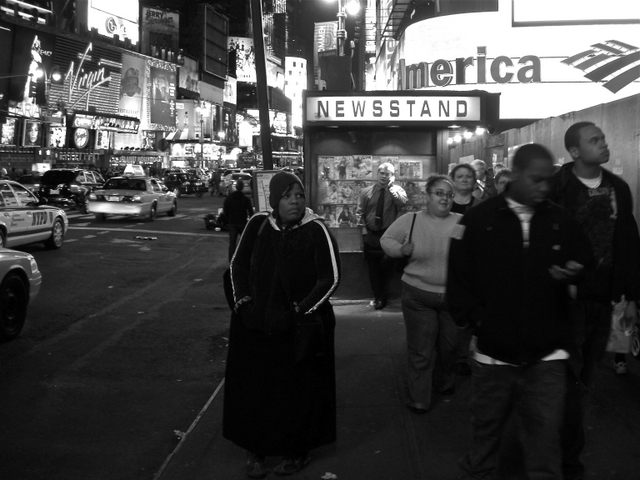
Wednesday, January 12. SFU gets a snow day while the rest of the city goes to work. More commonly we go to work like everyone else and then get stranded on the mountain when the roads close. I make sure I have snow boots with me so I can walk the 45 min down the trail into the rainy lowlands and catch a bus home.
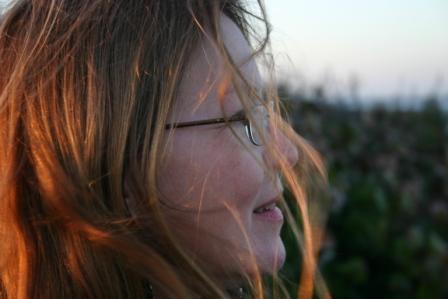
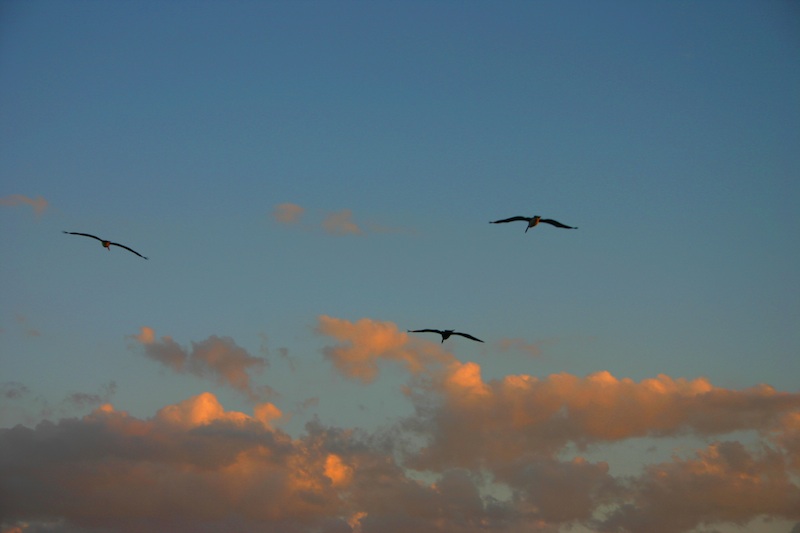

The Future

Friday, January 14 the rain is back in spades. In the evening I decide to go for a swim – in the summer that would mean the ocean, but tonight I pull up the hood on my raincoat and head across the road to the Aquatic Centre.  It feels good to be in the bright light, listening to families splashing in the play area next to where I swim lengths. As I leave the Aquatic Centre, Brenda is arriving. A fellow resident of Surfside Towers, Brenda is in her 50’s, or maybe 40’s – it’s difficult to tell. She is about 5’2” and has puffy features with small squinty eyes. Brenda speaks in a mumbling nasal voice, but her manner is caring and gentle. I learn that she swims every Friday night. She tells me about the sauna and the steam room – I’d missed those. After running home through the rain, I arrive at our building at the same time as Steve who is returning from an event at the Legion. He is a tall man in his 70’s with a dignified carriage and a gracious manner. Tonight he is in uniform with medals on his chest. At first Steve doesn’t recognize me (we’d met at the Christmas party). Then he sees that I’ve been swimming. He tells me that Brenda swims every Friday night. On our way up in the elevator he pushes “G.” It is nice, he explains, for people coming home in the evening to have the elevator waiting.
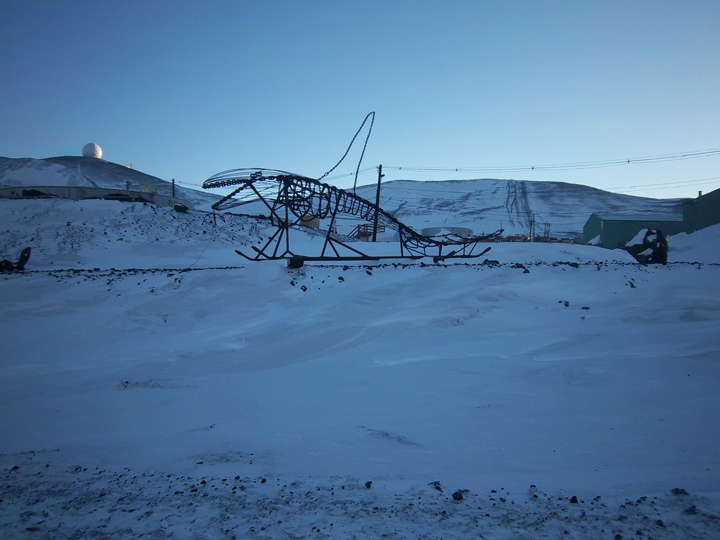
Shades of gray from my balcony

Tomorrow I will take the ferry to visit friends on Bowen Island. I’ll break my mostly vegetarian routine to share a meal of wild venison.  We’ll talk of recent shows we’ve seen in the city – whenever Bela Fleck or Chick Corea comes to town we’ll all be there. We may try out the new Sauna they’ve built of driftwood.

—Lynne Quarmby

Jan 172011


Here’s Gwen Mullins writing about life in Chattanooga (where once I spent a dramatic couple of hours wandering along Missionary Ridge and imagining the amazing battle that took place there–I’d just driven up from Americus and the Andersonville prison camp: part of my Civil War pilgrimage). Gwen is a former student of mine, just graduated at the winter residency at Vermont College of Fine Arts. She’s a fiction writer, but with this graceful essay and her recent contribution to NC on story plot, you can see she as dab hand at nonfiction as well, a woman of letters.

dg

Your whole life

You have lived your whole life here. Your life entire spent within thirty (fewer, really) miles of country along the kissing corners of Georgia, Tennessee, Alabama. The Tri-State, they call it here. Or Tri-County, for the hospital.

You have traveled a little, but only a little. Some places stand out as bright, clear spots outlined in black in your place memories: San Francisco, Miami, Venice, New York City, New Orleans, Anchorage. Places that seemed exotic but are not. You long to visit other places: Nantucket, Kyrgyzstan, Milan, Edmonton, Indianapolis, Cupertino. You tell yourself you can read about them and in reading, you will be there.


Scenic City

This place, the Tennessee Valley, is overwhelmingly green. Neither bright nor dark, but only green. Green for long stretches of spring, summer, and into autumn. Until recently, even the winters were green. And the rivers run brownly green through the green hills you call mountains.
See Rock City! You’ve seen the signs. This advertising genius of Garnet Carter and Clark Byers resulted in 900 painted barn roofs by the 1950s. You‘ve seen Rock City. Better sights come from the bridges, from Raccoon Mountain (the mountain with TVA generators jammed deep in its belly), from all the forest parks. They call Chattanooga the Scenic City because it is. You avoid Ruby Falls, the Incline Railway, Rock City, the Delta Queen riverboat, Point Park – anything that charges admission. You love Chickamauga Battlefield, Cloudland Canyon, Missionary Ridge, your own backyard and front lawn.You can buy See Rock City!-barn-shaped birdhouses painted in red and black in the souvenir shops across from the Choo-Choo. Yes, there really is a Choo-Choo, only now it’s a Holiday Inn. You remember how in Italy they all seemed to know the Glenn Miller song, how they would begin, “Track Twenty Ni-ine” in their lovely accented English. You wonder at the power of song, of words that transport, that tie the world together.

The old freight depot houses your husband’s office. It is LEED certified, green in the new sense. Yesterday he turned in his notice, so you suppose it’s not his office anymore. You are proud that your city has the first LEED-certified movie theatre, The Majestic. This is part of the downtown revitalization, the focus on the new green. You agree when some people call it gentrification, but you love the new restaurants.
You avoid eye contact with the Jamaican man with the dreadlocks and tangled gray beard who sometimes sleeps in the engine building where the electric buses now spend the night. He sells perfumes and bent metal figurines, and if you ask, other things.

You tell visitors that the Walnut Street Bridge is the longest pedestrian-only bridge in the United States. You are pretty sure this is true. On this bridge families stroll, cyclists bike, athletes run, photographers frame shots, but no vagrants dwell. From here you can see the other bridges, the Tennessee River, the aquarium, the art museum. You love the way the wind whips your hair on this bridge, how it’s always a little cooler here than the rest of the town.

You know, as does everyone, the best fried chicken is on MLK across from the university at a joint called “Champy’s.” You love that the city schools and churches hold fish fries under canopies in parking lots every Saturday in summer to raise money for choir trips and cheerleaders’ uniforms. Down the street a ways from Champy’s is a bleak building with a red-lettered sign that says, “Memo’s” and underneath that, “Chopped Wieners, Pit Bar-B-Q.” This sign has always amused you, but this is not a part of town where you stop.


Heritage

You flinch and are quick to defend when others who do not wish to lay claim to this land call it backward, or racist, or ignorant, or poor. And then a waitress asks you who your infant daughter’s father is even while she sits between you and your husband. She asks because your daughter’s skin is more mocha than cream.

And then you stop at the gas station in Marion County next to Big Daddy’s Fireworks Warehouse, and you note the Confederate flags for sale, the barefoot two-year-old wearing a heavy diaper and chugging steadily from a clear bottle of greenish soda while his young mother buys four dollars in lottery tickets and three dollars of gas.

You walk among the azaleas on the Cumberland Trail on Signal Mountain (which is not really a mountain, but a big hill and a town who whose inhabitants named it Mountain) and remember how your small, bent grandmother, the one you called “Nanny,” put her thumbprint in the middle of each biscuit so it would rise. You try not to remember the words she used to describe her new neighbors when they moved in across the street. You think instead of how she would hold your hand and point at the hang gliders drifting on the currents and you cried out for the joy of flight. You did not know the story of Icarus then, and your grandmother never did.

You smirk that school children (except perhaps those from Sand Mountain just across the Alabama state line) are no longer required to go to the moving diorama called the “Confederama” as a “history” field trip. They have re-named the attraction but are fooling no one. You hear they are shutting down due to tax issues and you are glad.

And sometimes you walk through the cemetery next to the university. Half of the cemetery is Jewish, the other half Confederate. Both are peaceful, both are green.


This is just what you do

You surround yourself with funny, smart people who eat sushi (because that’s a sign of progressiveness here) and start to think that this world used to be divided by color but now it is all just green, and beautiful, and it is a world where you are happy to bring up your children.

You smile, greet, and nod at strangers, and they smile back. You make gravy with the pan drippings from pork sausage blended with flour, salt, and milk. And just a little black pepper. You press your thumb in the center of biscuits so they will rise properly. You pull to the side of the road for funeral processions and wait until they pass. This is just what you do here.

Your spouse who grew up in Newark tells you other places are not so green or so welcoming. You stop thinking how much you want to leave this place, so you buy a bigger house and its associated mortgage. You plan to travel, you even take some of the trips you have planned. You think about going to one of the eleven Protestant churches within two miles of your home. You admire the view from your veranda.

And the cost of living is low. You know this because your New York and Miami relatives (your husband’s relatives, actually, since your family all lives here) have told you how much their tiny condominiums cost and marvel at your square footage. You are pleased and embarrassed, as if you chose to live here for the expense savings.


Your whole life, so far

You remember the progressiveness is a veneer, and you accept that the men (except for your husband, whom you always remember is not from around here) wait for you to exit the elevator first because you have a uterus. You are, after all, the boss of many of these men, and that is, for here, progressive enough.

You encourage your daughter to consider universities in Chicago or Ithaca. You try not to analyze the feeling that settles on you when she applies to schools in Nashville. Are you disappointed? Are you relieved? You remind yourself that your life is not hers, that her life will not be yours. She will leave this place, or maybe you will.

You reprimand your son for talking like a redneck, or, when the mood strikes him, like a gangster. You do not examine what you mean by terms like “redneck” and “gangster.”

You try not to flinch when your short stories are compared to Flannery O’Connor’s not because they are good, but rather because they are occasionally southern and you are female. You do not point out the irreverence inherent in them. Flannery was, above all, a godly woman.

You finally admit your deep weakness for sad, old country ballads, and you think of writing one before realizing you already are. You see the hills you call mountains everywhere you go, hemming you in, holding you up. You cannot escape the sound of the train’s whistle. You are bathed in green.

— Gwen Mullins

Jan 152011
 

I’ve known Michelle Berry for years, in a way. I’ve only actually met her once in person. But I put an hilarious Michelle Berry story in Best Canadian Stories in the days when I still edited that annual anthology, and I have been a fan of her work since. She’s energetic, comic and prolific, with a list of books as long as your arm. A new novel This Book Will Not Save Your Life and a new story collection I Still Don’t Even Know You were both just published last year. Michelle lives in Peterborough, Ontario, where I spent a couple of years in the Triassic (eons ago). I worked on the local newspaper, the Examiner, first as a general reporter, then as sports editor (this is, of course, why I am indisputably qualified to edit Numéro Cinq). I had my first short story published in the venerable Canadian literary magazine The Tamarack Review while I was working in Peterborough. A murder I covered as a reporter (and many of the settings) made it into my first novel Precious (the character Blythe Aschroft is very, very loosely based on moi). So it’s a special pleasure in all ways to offer Michelle’s “What it’s like living here” piece. I remember this place fondly. I can’t count the number of times I’d be working late in the newsroom, and a group of us would head out to watch the lift lock (okay, maybe the town wasn’t that exciting in those days) in the moonlight with a couple of beers and a burger.

dg

.

What’s it like living here….

Good question.

Where is here?

In Canada? Specifically in Peterborough, in Ontario? In my squished, laughably-compact home office? Or in my head? I live in all of these places. The inside of my head is often stormier than Peterborough — although not so much in the summer. And, although my mind should be as vast, if not vaster, than Canada, it often feels as full of things-needing-completion as my cork-board, calendar-strewn office. My mother says that keeping up with my schedule (two really active kids, writing-in-process) is like trying to catch a train. From my perspective, it sometimes feels more like getting hit by a train.

Outside my second-floor office window there is a tree. A gorgeous, immense, old tree. I’m not sure what kind it is—oak? yes, an oak—and it doesn’t really matter because it’s a magical thing. Over 200 years old, this tree takes four adults to wrap our arms around its trunk. Because it has insignificant leaves, this tree isn’t as beautiful in summer as it is in the winter when it’s bare and stark against a cold sky. It sometimes looks like the tree from Poltergeist, the tree that sucked the little boy into the gory insides, the one that bashed through his window in the storm. It’s an incredibly inspiring and dramatic tree. A perfect view across from which to write.

Peterborough is a town about 2 hours North East of Toronto. Population 78,000 or so (probably more since we got a Costco. A chicken or egg thing—Costco brings people or people bring Costco? I don’t know. I’m not a member. They won’t even let me in the front door.). So, let’s say population 80,000. A sleepy town? Perhaps. But you should see our new Mall, Lansdowne Place. It’s a sight. Now we only have to drive forty minutes down highway 115 to Oshawa for The Bay. We’ve got every other store you’d want right here.

Peterborough is not only about the shopping. It’s about the lift locks. And the summer. Peterborough County is cottage country. All the rich Toronto folk drive through on the way to cottages that are so big they need cleaning staff. Boats going through the locks are even bigger than the cottages.

I’m not jealous or anything. Honestly.

Who needs to clean two houses?

I live near the downtown. Near enough so I can walk when I go out for dinner. Which I rarely do. I’m not sure why. Laziness, I guess. And lack of money. And the wine is cheaper in my kitchen. I live in an area called The Old West End which is made up of mostly young families in big, beautiful, old houses. I have two porches in the front of my house — one off my second floor office, one off the living room. I sit on these porches in three seasons as much as I can. I watch the kids play on the street, or the people walking their dogs. I read. Or just stare. At the tree, mostly. Sometimes I feel as if I’m in a 1950’s sitcom – Leave it To Beaver – the neighbours all calling back and forth across the street, coming over clutching snacks and wine, or coffee, joining me on my porch. It’s idyllic. Small townish. And makes me nervous. I keep waiting for the other shoe to drop. How is it possible that my eleven year old can play flashlight tag in the hot summer evenings until way past dark, running back and forth between people’s back yards (with their permission even!), or my 14 year old can hop the back fence to her friend’s house still wearing her pj’s late on a Saturday morning. Isn’t this 2011? It feels a lot like my late 1970’s childhood in Victoria, B.C.. My mother sits on my front porch and comments through the laughter of a street full of hockey players or basketball players, that it feels like her childhood too.

We live a forty minute drive from the lot where we park our car, get into our Boston Whaler, and boat five minutes to our small cottage on an island on Upper Stoney Lake. If we’ve gone up for the weekend and it starts to rain, we head home. No need to be slaves to the weather. We watch the sun set from our bedroom window, hear the deer snorting in the bushes, listen (of course – this is Canada) to the loons’ cry, the sound of speed boats drifts on the wind on the lower side of the lake.

In the winter we build an ice rink in our back yard. Kids come over to skate, impromptu hockey games start up and end and start up again. Twinkle lights dot the fence, a spot-light for night skating, a few Christmas lights on the clothesline. My seventy-year young parents skated on Christmas morning this year, my mom used a hockey stick as support to propel her along. I can watch the rink from my kitchen, stirring a sauce, boiling noodles, sipping wine. I can see the dog jumping onto the ice, sliding, the kids shouting at him to get off, laughing when he skids into the boards.

This city is full of paths. Old railway tracks turned into walking trails. Jackson Park and the Rotary Trail, paths that take you great distances through forests and beside rivers and lakes and canals, up past the Trent University. I’ve seen huge snapping turtles on the paths. There are bear warnings every so often. Mostly there are a motley series of dogs – big ones, little ones, ones wearing coats or boots. Once I saw a dog in sunglasses. And another time I saw someone walking a ferret on a leash. You can X-country ski on these paths. You can bike all the way to Lakefield where you can fill up on ice cream at Hamblin’s and then turn around and bike back.

Peterborough’s downtown core is typical of southern Ontario towns – two one-way streets, George and Water. Rows of stores, some out of business, boarded up, others thriving. We have a clock tower, a movie theatre, an amazing jewelry store and a few really great coffee places. Among other things, of course. Like restaurants: Japanese, Cajun, Belgian, Korean, Mexican.

A Santa Claus parade winds its way down George Street every year and you can show up right when it starts and still get a good spot to see everything. There are floats and dogs and clowns and the occasional truck which, for no reason at all, is part of the parade. A local motorcycle shop has a wild float that blasts music and lets off huge bursts of smoke and noise. One year a group of men danced down the street wearing purple and we still don’t know who or what they represented.

The thing about this city is the people. We aren’t stuck in traffic all the time, our houses are fairly inexpensive, there are spaces in the local sports leagues and the piano teacher has free days in her schedule. So we’re generally a happy folk. People have parties and get-togethers and go for walks and travel together. One family rents the local arena for a holiday skate every year and the whole neighbourhood shows up. Stress is here, of course, but it is comparably less than, say, Toronto where I lived for seventeen years. I haven’t had a conversation about directions, about how to easily avoid traffic and get from one place to the other, since I’ve moved to Peterborough. That’s not saying it isn’t a bitch to get around in the summer. The cottagers move their traffic jams here along with their swimsuits. But my husband likes to tell his Toronto-family that his commute to work takes only four minutes every day, no matter what.

I know what is going to happen, though. This happened to my parents. My kids will move. No sane high school graduate would want to stay in Peterborough. My children will move to Toronto or Ottawa or Montreal. They will go off to school, maybe start families, elsewhere. I’ll probably follow them. My parents followed me. It took them twenty years and I had to move away from Toronto before they would do it, but eventually they came. What’s interesting about this place, however, is that these kids seem to come back after they’ve started their own families. We have many friends who grew up in Peterborough, who moved away, but then came back to raise their children the way they were raised. To spend winter weekends at Devil’s Elbow ski hill, racing, or summers at the cottage. To spend Fall and Spring biking the paths.

Every time I sit on my front porch it’s inevitable that cars will drive by the big tree and then stop, back up. People will get out of their cars to stare at it. They walk up to it. Touch it. Wrap their arms around it. They take pictures. My neighbour jokes about putting a little money-bin on a post by the tree with a sign that says, “Save the Tree.” He wants to see how much money he can collect. But it makes us all proud to watch the cars slow down, to watch these people stare in awe at this tree. Because it’s so old. Because it’s steady and strong. Because it weathers all weather. And no matter how busy my mind is, this tree always reminds me to stop for a minute to admire it.

I’ve been told that this tree will last another hundred years.

Which is good. Because when it falls, it’ll hit our house.

—Michelle Berry

.
.