Jan 012015
 

PicsArt_1413674718519Roger Weingarten

.

To the Day [Prague 7/13/08; Burlington 3/13]

the panhandler on her knees, forearms
and forehead pressing the tourist
littered street, cups her hands.

To the day I closed
in on the clean
shaven red-cheeked man who lifts

the vagrant to her feet and cups
her face in manicured fingers, chanting
to her in a tongue I’ll never

get the real
gist of, his
smile—like the cuckolded

Joseph cradling his infant
stepson—aglow. Months
ago, to the day, when the deep-set

hazel eyes of this
Lazarus open to what
seems to be someone else’s

heart executing
a tango with itself on two
monitors, I ask the hovering

jowls filling the green
mask, when can I have
sex. Wrong

question, my little Isaac,
it smirked. Your heart’s
undamaged and you can screw

the world into the next
century only
when I say so. To the day

when I ask the Joseph smile if he
speaks English, and he nods. Then ask
this woman if it’s easier

to die if you
are already dead. Who, he asks,
going pale, the hell are you,

then lifts the tattered
beggar into his arms
and walks away.


Self-Portrait in the Convex Bumper of a Ford Woody

Hunched woman
in a babushka waddling

up the subway
stairs shlepping her

life in the two
bags under her eyes,

spits, but he’s
a jew to the un

dead voice in her head. Good
shabbos, old

mother, I offer, and touch
a fingertip to my black

skullcap, and take a shot
at a smile. Please, Little

Mike, she coaxes, carry these
bags to the street, and if you’re

nice, I’ll give you a nickel. My childhood
name slashed

across her face and the pale
blue numbers of hers

tattooed to her wrist pull
the breath out of my lungs and me

back to a self
portrait in the convex

bumper of a Ford
woody easing

its way out of the gates
of a neighborhood restricted

to Jews. Tow
headed boys toss in the back

seat, while a woman
wearing a hat and net veil

over her eyes mouths
kike through the passenger

window. My eight-year old
jaw dropped while what remained
of my childhood straddled
my bike.


Dear Reader, Dear Father, the Last

time we spoke you were peeved
I told you my brother backed

his Harley over your plot, dis
mounting to water the fake

bouquet. Please forgive that
artifact. This

time, I wake next to my half
gentile wife mysterious in pink

ear plugs and eye mask
to behold—sticking out

of my most blocked
aperture—your chemo-blotched

skull wondering
why you didn’t have the moil

throw me away and keep
the foreskin. Father, aren’t you

supposed to be rolling
over in your gated high

rise ultra reform air conditioned
catafalque somewhere along the eastern

seaboard? Roger, after
your mother’s ill will flew in to recite

your masterpiece—“Old Fart Leaves
Millions to the Hezbollah”—the congregation

voted to disinter. I hadn’t heard, Pops, but after
Uncle Manny of Lost Causes blurted to the millennial

Passover table that Stalin
pronounced Mayakovsky’s death a suicide,

he whispered into his napkin tucked
into his collar that you were jealous

when you said you never
fathomed a word I wrote. Zun, your brother still

owes me a finfer and eight cents,
your sister hasn’t spoken

to me since I cut her
out of my life, and the gravy

over it all is your ex-
stepmother’s shtupping

a one-legged republican semi-
retired cosmetic surgeon, so I

have no one and nothing to haunt
from this grave but you and this blood

feud of a poem. My period’s
weeks late, Mystery Wife

mutters to my dream
counterpart. What are you, sweet

husband, going
to do about it?


See Below

See beneath the Poughkeepsie
Picasso pasadoble

premonition projected
on the domed
planetarium night. See behind eyelids

cupping red-eyed
grief churning weeds into drifting

toward a great
northern loon and her bobbing
chick about to plunge

through a daydreamed
hand that lifts me into a whispered

you need to wake now and leave
through the emergency. Plumb white
capped haze that

surrounds the capsized—you
put your left foot in, you put

your right foot out—canoe, under
which Little Brother’s
knuckles—clutching metal

thwarts cursing our father who aren’t
in heaven—slap the dome, upside

down and bobbing
on a wake, a wake
replete with schnapps and honey

cake crumbs scattered
across linen, absent

the hokey pokey first and tipsy
second born. Low-rise
low brow post

modern plumber/anti
Rilkean prankster, don’t I,

like Pablo’s Minotaur
with Javelin and a Woman
Hostage, just

love my life? Never
wake. Never. Hallelujah.


For the Smoker

You know who you are and how
sorry I was to read in The Times that

even tertiary smoke, in wall
paper, carpet or oozing

out of pores under
your thinning mop had

proven toxic. After a toad
in the hole and grits slathered in hot sauce

pick-me-up, you tell me your two
packs a day is strapped

to a brown study wrapped
in an exploding star. Because

your ex wrote in lipstick, Dear
Ashtray Breath, no one ever offered

to bronze my pussy on your vanity
mirror you tried to erase with a gold

fingertip, I tried to console. I’m not
complaining, compadre—I can twig to hanging

out in twenty below stomping
my feet with a clot of future

lung cancer patients trailing
oxygen tanks, whistling That

Reincarnated Buzzard Blown
off a Shit Wagon by the Smell

of Your Breath Blues.
I’ll never forget

leaning my chair back into a hot
radiator in the urology ward next to my

post-op crony—who just had a conga line
of venereal polyps removed from his

busy day—watching ephysema
help the old guy across the aisle breathe,

like a chainsaw cutting stone, his last
as the steaming metal branded

the back of his liver
spotted hand. My granddad punched

cows in Wyoming his seventeenth
year on this planet, the first

Jewboy cowboy according
to his sister, who told me over a box of old

snapshots he’d have lived
forever if he didn’t vote for Nixon or roll

his own from makings he grew behind
a stone tool shed. She dug

pre-Socratic Greek poets, pink
meringues, devoted her

life to cancer research, and slipped
away in her sleep at a hundred

and seven while we were snowshoeing
a mountain trail we had, at our

age, according to Who
Gives A Flying Fuck, no business on. Your one

habit, you say with a smirk, crushing
a butt underfoot, in your most

monastic voice, before we bend
over a frozen mound of bear scat.


Light Year of Mr. and Mrs. Hammered Horseshit

Bubonic insomnia surrounds the darkest
part of their shadow falling

out of both sides of a pillow
top model of the solar
system in which planetary

phases and feline
satellites move at relative
velocities around Herr
und Frau Gehämmert Pferdeäpfel’s
mechanical bed. Like stressed

desserts, they pull the Hidden
Star heirloom quilt fondant-taut
over a nebula of flannel
sheets soft as Depression
Cake then step
into a constellation of cat
puke in the hall. Frau looks

down at meteoroids shooting
across her night
blue toenails. Herr looks up
through charged
particles in the magnetic
field between them, and says—just
as asteroid Belle Starr
the Cat brushes his ankle—I’m pretty
sure you think I’m just a sleepless
sentimental slob in close
orbit around the celestial

aureoles of your soul, but I can’t
breathe without your moon
square Venus. Quasi
stellar in her threadbare
bathrobe that radiates
a redshift, she slows,
stops, and moves in the opposite
direction. It’s OK, she says, reciting
primes and reaching
for the planemo of his
left hand, pulling it
back into perigee with her belly
climbing their ultra-galactic
bed chamber orrery, from which,
with the Littlest
Dipper of his right foot,
he clicks the door.

—Roger Weingarten

.

Roger Weingarten, author of ten collections of poetry, and co-editor of eight poetry and prose anthologies, has lectured, taught and read at writers’ conferences, poetry festivals, and universities nationally and internationally. He founded and taught in the MFA in Writing and the Postgraduate Writers’ Conference at Vermont College. His awards include a Pushcart Prize, a Louisville Review Poetry Prize, a National Endowment for the Arts Award, and an Ingram Merrill Foundation Award in Literature. Stranger at Home: American Poetry with an Accent: co-edited with Andrey Gritsman, Interpoezia Press, was published in 2008, Premature Elegy by Firelight by Longleaf Press in 2007, and Open Book: Essays from the Postgraduate Writers’ Conference, co-edited with Kate Fetherston by Cambridge Scholars’ Press in 2007. The poems published here are from his new collection, The Four Gentlemen and Their Footman, due out with Longleaf Press in 2015.

Jun 112014
 

Jody Bolz

Shadow Play recounts in untitled and narrative poems a journey across Asia taken in the mid-1970’s through the contemplative eyes of its narrator decades later. At its core is the dissolution of a young marriage and the imagined discourse the narrator has with her former husband about the mystery of love, whether it ends or not. Her perplexity over the question leads the narrator to conclude that “Love’s a puzzle. A test. / A miracle, I guess.” Inconclusive perhaps, but hard won, as she argues with herself through the conjured voice of her former husband. As far-flung as Shadow Play is in setting,  it’s also domestic and close to the heart. These are poems with the intelligence and vigilance that Paul Valéry says might serve to represent and restore what “cries, tears, caresses, kisses, sighs, etc., try obscurely to express…”  Herewith is an excerpt of Jody Bolz’s novella in verse, Shadow Play.

—Jason DeYoung

bolz

.

Shadow Play

On the train across Java
we slept in a knot:
my head in your lap,
your head on my back,

two hundred miles
through the tropical dark
in shuddering third-class.
At every major stop,

a skirmish of shouted light—
vendors hawking tea and rice
to sleep-drugged passengers—
receded in a rush,

the jasmine-scented silence
sweet and abrupt.
When the station’s speakers
keened their exit song,

the train lurched on.
Whirr of palm and banyan,
gibbous moon, skewed night sky—
green stars above the village mosque

jumped and scuttled by
in deranged constellations.
We stretched, switched positions:
your hair red as rose stalks

against my faded dress,
my braids strict shadows
on your moonlit back,
our fractured dreams resettling….

Outside Bandung at dawn,
I shook my buzzing limbs,
cracked our dusty window open
to mountain air.

A boy wrapped in a shawl
shot past in the brightening field.
One child, then another—
a horde of barefoot children

in tattered pastel sweaters
raced beside the tracks,
calling out for coins,
for candies,

falling far behind us
by the time we reached
their shanties: tin roofs
at the rail-bed’s edge—

doorways set in sloping walls,
a threshing floor,
an open sewer.
As our train slowed

a pregnant girl,
waist-long hair undone,
stepped out of a hovel
fastening her sarong.

We passed her without speaking,
tugging at the taut string
of our marriage
as it rose over rice-fields,

climbing into monsoon clouds,
swaying there—spiraling—
not some thing,
not a child’s kite:

our common life, flown
above another Asian city
in the year we made a home
out of our bodies.

§

I’m shaping a mosaic
out of broken bits…
not exactly a gift.
Not exact—

a waking dream of India,
brazen as a blue-skinned god
rank with rotting marigolds
or silent on a riverbank:

the Hooghli in Calcutta—
sludge-gray, chest-deep water
blossoming with saris.
Young matrons bathe together,

an old man squats and strains near
a woman filling copper jugs.
A bloated ox, stiff legs up,
slips by under sail,

a vulture on its belly
coiled in slick entrails.
We linger on a bridge,
transfixed by the blind beak

gently teasing white from pink.
The rotting vessel
slowly shrinks,
then floats out of view.

What corpse am I
scavenging for you?

§

You’re offering me a metaphor?

But—we were there.

You’re looking for something more.
What is it?

I’m not sure.

We have other lives now.

This isn’t a betrayal.

How can you tell?

§

Twenty years ago, you woke me
in a hut near Brujenkhola
reeking smoky thatch and goat dung.
Beyond the unglazed window,

full night on the valley floor,
featureless, obscure—
but you pointed to the sky.
Your shoulder pressed mine.

A triangle of coral light
hovered in the blue-black dark:
the mountain
we’d walked days to see,

fish-tailed Machha Puchhare,
flaring like a sun
an hour before dawn.
We lay on our bedrolls,

awake, and watched the light grow.
Later, after clay-red tea,
we gathered up our packs,
paid our host and said goodbye.

The inn-keeper’s deaf daughter
waved, chasing her sister,
as we started for the river.
Ten minutes to a narrow bridge

across the Seti Khola,
wooden slats half rotted—
cables frayed, too far apart
to grab with our arms out.

We had to walk a line of boards
nailed loosely down the center,
bisecting our vision
of pale-green glacial water

in its bed of chalky boulders
more than twenty feet below us.
You tapped your toe
against each plank

and made your way across,
agile as a gymnast,
hands see-sawing for balance.
After heart-stopping seconds,

you yelled above the rapids’ roar
Wait there and dropped your pack.
Faster, you retraced your steps
to bring me back,

coaxing from three yards ahead,
Take a step—
now take another.
Don’t look at the river
.

Head throbbing,
I stepped staring
at the battered boots
that moved in jerks

above the milky current:
one foot, then the other,
stepped—and stepped again—
until I stepped on land.

We shouted and kissed there,
laughing as we sprawled on shore
guzzling water,
brown and iodine-bitter.

Soon we were singing,
climbing the stony track
through thick rhododendron,
juniper, yew.

By noon, dry and dizzy,
we trudged into a clearing
where an angel was waiting
in a whorl of dusty sunlight.

Poised on the ridgeline,
a shirtless boy, eight or nine—
beautiful despite one blind-blue eye—
held out a bowl of oranges

Suntalla, sahib?
and they glowed like gold.
We bought as many as he’d sell,
tore away the bitter skins

with stinging fingertips.
Back to back
in the shade of a banyan,
we sat eating oranges

as if nothing could harm us,
no crossing part us.

§

You’re policing failures.

We spent fourteen years together—

And the next fourteen apart.

Which proves the first a failure?

You forget that you loved
someone else for most of that time.

I loved you.

And—

I was eighteen when we met.

I was a child too.

Now you’re close to fifty.
Why don’t you forgive me?

—Jody Bolz

.

Jody Bolz was born in Washington, DC, and attended Cornell University, where she studied with A.R. Ammons. After receiving her MFA, she worked as a journalist for two major conservation organizations (The Wilderness Society and The Nature Conservancy) and taught creative writing for more than 20 years at George Washington University. Her poems have appeared widely in such magazines as The American Scholar, Indiana Review, North American Review, Ploughshares, Poetry East, Poetry Northwest, Prairie Schooner, and Southern Poetry Review—and in many literary anthologies. Among her honors is a Rona Jaffe Foundation writer’s award. She edits the journal Poet Lore, founded in 1889, and is the author of A Lesson in Narrative Time (Gihon Books, 2004).

May 122014
 

Patrick OReilly-001

Patrick O’Reilly is a bona fide discovery. I met him in an undergraduate senior projects creative writing class at St. Thomas University in Fredericton. He was wearing a tweed suit. With his mustache and parted hair, he looked a bit like pictures of E. M. Forster — Edwardian, an aesthete. He is from Newfoundland. He’s got poetry in his genes. His poems have an Irish registry, something in the rhythm, phrasing and diction. That gives him a glorious air, an authority, which, coupled with what he has learned from the Imagists and the early Moderns, renders him unique amongst the young poets I have come across. He already fits within the tradition. He has read and absorbed tradition. But then you’ve never read anything quite like this. Biblical, epic, dramatic, hammers and tongs, surgical phrasing. You just wish he’d go on.

dg

#
What Wolves Eat

Twice-banished, blood-spotted Cain
limps across the barrens,
the mute, unyielding ground of Half-brother Country,
far-far-east of Eden.

Eight wolves sprawl and watch
with indifference:
choosy beggars,
they will not eat scavengers,
tramps, trash-eaters.
Cain does not know what wolves eat;
he keeps walking, keeps not breathing.

He walks ’til sundown. Every limb pleads
“It wasn’t me. The first murderer was God.”
Adam in furs. Adam forcing the plough. Amateur.

Shivering among twigs,
his back to the cold cold ground
his chest to the cold night air,
he falls asleep inventing names for himself:
Cain the First Born Man,
Homebody,
Stanza-Maker,
king and government and nation.

Then, always, the vivid dream:
a fist reaching into the wheat,
clenching a paleolithic stone,
red tendon, white knuckle, black stone
raised high against the sun,
smacking him into wakefulness.

x

The Offer

I’m sitting on a rock,
throwing rocks at the harbour,
chewing on the word husband.

Love is a corset word,
snug on the girl
that can hold her breath.

But husband.

That’s a word about a house,
and I’ll be good
god-damned if I’m hitched
to three rooms, seven youngsters.

x

Lost

His collar’s been dry this ages.

I heard nine different places

his ship spun round
like a crumpled needle.

But he won’t talk about it.
What monsters, murders
he beheld
in that crumbling ocean-close                                                         

I’d only be making up.

 x

i mBolc

Rubbers sob at every step.
He’s come to the high place of the meadow
this first thawed day of spring.

The Ground quivers – swelled belly,
starved for whatever’s near:
booted feet, the heads
of shovels, picks, beads of sweat.

The constant striking aches – strike, strike,
gaffing the ground,
gouging down to the meadow’s toothless maw.

He feeds the meadow his horse;

junk by salt-stained junk she falls
into the ground like coppers.

x

Croft

Last New Year’s Eve (or day, it’s hard to tell
’cause every other soul was gone aloft),
while the dregs of rum were settling in the keel,
himself stayed up with the backhoe driver, Croft.

The bottle drained, Croft stumbled to his feet:
“Before I go, now, do one thing for me.
You sang a song once, this time years ago,
sing that song – I’ll dig your grave for free.”
Half-dreaming in the hallway I could hear
how, instantly, that voice shivered with shame,
but then the old man’s voice came, keening clear,
smashed to Hell, but singing just the same.

On the day they put the body down,
Croft shivered with the handful dressed in black,
and cried to see that casket in the ground,
then turned to go and never would turn back.
At any rate, that grave was dug for free.

No one knows this story, now, but me.

x

Clothes He Never Wore

His pallmen hitched their gloves around the rail
and down he crossed the bar.

We waited, sole in gravel,
until the drizzle dried into our coats
until the paper flowers burst
until we knew he’d never
pull himself from the dirt.

Just the same, we backed to the truck.
Just the same we left.

/////////////

That night we ransacked the closet, mined
a trashbag’s worth of oily sweaters, the shoes
from last Christmas, laces curled beneath the tongue,
three piece suit, sans mourner. But no

secret will, no pirate’s map, no
letter from a bastard brother.
Nothing but the clothes he never wore.

x

The Dance

In a disaster of movement, accordions gasping,
their feet flash off the floor, sounding claps like sparks
flying into the awestruck eyes, mouths of the guests.
Awestruck eyes – the bride’s, the groom’s
fixed to each other: her brown hair shaken
against the fine lace patterned shoulders, a smudge
of blackberry wine on her upper lip, moving too fast
for a kiss. It must have happened then:
some time in the dance, suddenly.
The next morning he rose
and she rose,
announced the arrival,
the spark flung between them,
gestating.

x

Oldest Man in Town

One afternoon he might have
one memory after another
wrecking themselves
against his idleness.

His eyes are vices
squeezing every flinch
of every dog for scrutiny.
Things have changed here.

Sundays from his window,
watching the procession,
the long procession
heading to mass,

he can see
what others must miss:
the bodies shifting in time,
their clothes rising and falling

in and out of fashion, their bodies
rising and falling from old age
to fresh youth over
and over and
over.

>

A for Argyle

On the day the Argyle was first due in spring
the baymen waited for hours at the landing,
sitting with their chins in their hands like girls
waiting for the boys to come dancing.

When they heard the steamstack’s trumpet
they followed it to the water’s edge:
the loud mechanical trumpet blast that beat just once
before she rose above the horizon, a plated beast,
the bowels belching soot, the rivets straining
like a harness around oxen shoulders.

They lifted their eyes in terrible faith,
but I was watching the little girl
cowering behind her mother’s sepia dress,
her eyes grown big enough
to reflect the whole of the monster.

x

Shelter

His was a body in want of a bar –
a corner of West Country shebeen,
his face lit by a mug of punch,
scratching doggerel on a scrap of rolling paper.

Instead he’d sit on the daybed,
browned and bow-shouldered
like rum out of the bottle.

Instead he’d sit on the daybed,
loudly quiet,
his breath barely white on the window,
and his bones not content with the room.

Sure he was never big.
Still they say he starved himself
right down to the ribs, as animals do,
and excused himself to the quiet
shelter of his stable.

—Patrick O’Reilly

#

Patrick O’Reilly was raised in Renews, Newfoundland and Labrador, the son of a mechanic and a shop’s clerk. He is studying English with a Concentration in Creative Writing at St. Thomas University, Fredericton, New Brunswick, and expects to begin work on his MA this coming fall. Twice he has won the Robert Clayton Casto Prize for Poetry, the judges describing his poetry as “appealingly direct and unadorned.”


Apr 092014
 

Julie Larios

Herewith impish, gracile, nimble poems by Contributing Editor (one of our own) Julie Larios whose continuing Undersung series has become a mainstay of the magazine and a model of poetic discourse. Julie’s poems are playful, yes — the body “poor sot” and men! who only need “A belief in the afterlife, or in the theory / that size doesn’t matter” — and her language is fast, packed with snappy rhythms, sly puns and rhymes that twist and curl meaning from word to word. Just read this:

of how the living, soft-bodied, feed at the bottom
of these lists, how we list too often, as in you lean, you lose, 
or at the very least or most, moist and semi-soft,
we end up ripened and spread too thin

But prosody aside, she has also a lovely set of themes, always coming back to a view of life, mischievous yet grand, the comedy of the body that won’t stop, that has its knowledge, that faulty and doomed as it is nonetheless is holy, the house of the spirit. And Julie, I think, never loses sight of the current of spirit that runs beneath appearances. Oh, to have written that line.

I love, God says, whatever steers the boat of that bird’s body.

dg

What Body Knows 

Body
knows how
to go
slow now,
to fool Doom,
to bow down –
to grow
old.

Body
knows not
how to grow
cool, nor cold,
knows not
how
to stop,
poor sot.

.

What Every Man Needs

A pot to piss in.
A Porsche.
A few pit stops.
And to mark the right spots, several X’s.
Great sex or— on slow nights— a few seeds
to spit off the porch into the dark.
Down any mine shaft, a bright torch.
A daft aunt or two for comic relief.
A belief in the afterlife, or in the theory
that size doesn’t matter.
A mother, ha, like a hole in the head.
A starry sky in the Wild West, a loyal horse.
And to carry him down off his cross, a Blessed Virgin.
On New Year’s Eve, champagne’s satin fizz.
In July, a slow drizzle after the long drought.
In October, sun out after rain.
A magic grain of rice from a folk tale.
A tall tale about the one that got away.
A day on a raft on the Mighty Mississippi,
home-fried catfish and Huck’s Jim  for a buddy.
Beauty minus her Beast.
And the best BBQ baby back ribs
this side of Hell or Heaven.
A 7-11 on one corner, a Jiffy Lube on the next.
An exit plan for every war gone wrong.
And after a long day’s work, just a little peace
and quiet, for Christ’s sake,  can’t a man get
a little peace and quiet?

.

Proposal for a Whole New Scale
………………with a nod to David Letterman

Being the new measurement of how things scratch,
that is, what scratches what, which surfaces face
which other surfaces down, as in showdown,
screw-up, or turnover, what marks the softer body
with its harder body by turning over and over,
what breaks last when heated or frozen, relative
to the heart and/or the balls, what clangs the bell
or strikes up the band, what wins hands down
the Grand Prize on the scale opposite the prize
known as Booby, and being also the new measurement
of how the living, soft-bodied, feed at the bottom
of these lists, how we list too often, as in you lean, you lose,
or at the very least or most, moist and semi-soft,
we end up ripened and spread too thin, half-empty
rather than half-full, while sneaking up behind us
and hindering our progress or congress or aiding
our regress are the Straightened, the Leanless,
the Unsnackable and NonSpreading, aka the Moribund,
so tough and tactless, the pins of their blue ribbons
scratch more than our surfaces, then pop
the inflatable lifeboat and we’re surfacing for the first
the second, the last time, trying to breathe which is
an unchangeable characteristic of the living no matter
what scale we draw or weigh in on, including this one,
even when we give the grid a twist, a tweak, or toss in
an extra handful of beans, and even when
we’ve been snookered and when we begin again,
with a new batch of statistics, optimistic as we leave
an inch or two of air at the top, give the whole thing
a new moniker, make it a game called Will It Float?

..

I’m Telling That Story Again

The one where I pull into the driveway
and see a cop car and a hearse and my feet
don’t touch the ground until I’m inside the house
and find out the kids are fine, it’s my father
who’s in a body bag outside only this time
I tell the story without the hearse and without
the cop car and without the body bag,

so this is the story where it’s summer
and my feet touch the ground and I stay
in my body all the way out to the beach
where my kids are playing at the low tide line,
there, where the rocks meet the saltwater,
they’re playing with my father, and I
can only say thank god it’s not the story I told

where my feet didn’t touch the ground
because I was actually the one in the bag,
because once when I told that story I had to
change the part about my feet, due to confusion
about whether I was still in my body or not
at that stage, and I had to change the part
about the beach and my kids and my father
and summer and all of our several bodies,
and I had to admit that I wasn’t much of a storyteller
because my memory was so bad,  though I do remember
every detail about the low-tide line and the saltwater

and would anyone mind if I started over and told
another story, a better story, about somebody else’s body,
since I’m pretty sure it will be about a body—
no matter how confused I am, all my stories now
seem to end up being about bodies and seasons
and the point at which feet do or do not touch the ground.

.

Upon Coming to Plate XI in A Nomenclature
of Colors for Naturalists and Compendium
of Useful Knowledge for Ornithologists

………………—for Daphne Kalmar

God draws a bird then names its parts:
mandible, crown, the lesser, middle and greater coverts.
He names the rump. He names the contoured flight feathers
in the tail, calls them rectrices: Helmsmen.

Which do you love most, the philosopher asks,
those feathers or the metaphor?

I love, God says, whatever steers the boat of that bird’s body.

—Julie Larios

Julie Larios

Julie Larios has had poems chosen twice for inclusion in the Best American Poetry series. She is the winner of an Academy of American Poets Prize and a Pushcart Prize, and has published four collections of poetry for children.


Jun 132013
 

John B. Lee

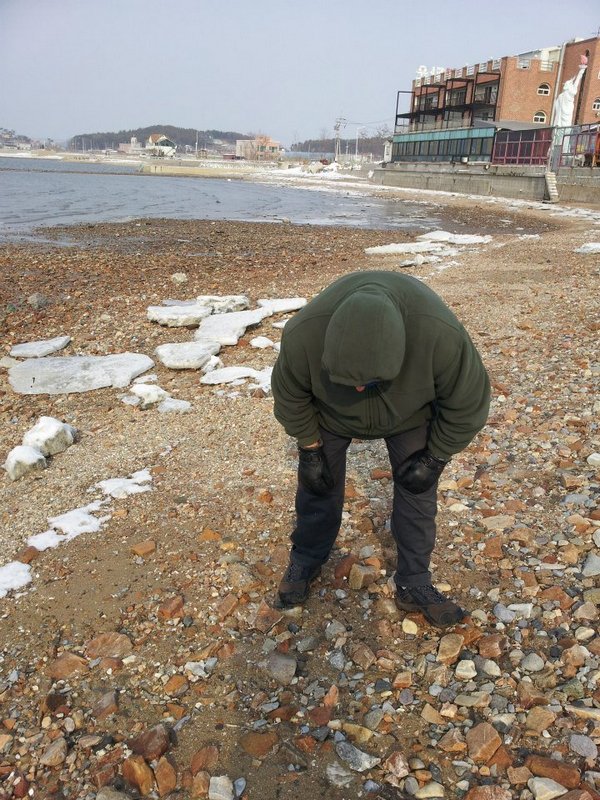
In John B. Lee’s study, there are piles of stones, cobbles to pebbles. He’s a collector, no doubt mystifying endless airport security agents monitoring his luggage. One wonders about this, except that stones are mnemonic devices (this one means a day on the beach in Korea with my son and his son). And words are like stones, bearing the same trace mineral flecks, striations, layers, conglomerates and evidence of former life. You put them together and a mysterious meaning radiates (call it a poem). John is a frequent contributor to these pages. He’s the poet laureate of Norfolk County where I was born. He lives in Port Dover on Lake Erie, home of what was once the world’s largest freshwater fishing fleet (oddly shaped boats made of steel, called turtlebacks). He hosted the the April Extravaganza on the Lake, when NC Contributing Editor Sydney Lea and myself journeyed thither and read and grown men were heard to use the word “beauty” as if it were a real thing like a Porsche or an Audemars Piguet wristwatch. After which we drove down the lake to Highgate for a second reading, gossiping about the loves and suicides of famous southwestern Ontario writers, stopping to look a graves or the farm where John grew up. Reading John’s poems like a similar marvelous adventure.

dg

——-

Suseuk — Viewing Stones

my son, my grandson and I
were walking
the gravelly shores
of the Yellow Sea
on Daebun Island
looking west through amber sky
west to the entirely imaginary far-away
coast of mainland China
the sun
shining like a dulled brass gong
hung in soundless heaven
over the low-tide mudflats of Korea
and we were
looking to gather up
the most interesting stones
and only recently empty shells
the small cochlear conches
that hold the ocean winds of the world
as poems might hold
a meaningful breath
at the moment of deep-breath knowing

and I have gathered
my own little tea bowl
of chalk and silvery anthracite
carrying home the light of hope
brought here from these broken mountains
and that scaling off of iron oxide
from the water-loud coves
with their coming in and going away
of moon-drawn amplitudes
that swallow the road and drown the ankles
where the beach turns to vanish under
the afternoon drop-shadows
of the great engines of the sea
and as I hold council here
with silent beauty of granite
and pink rock
cobbled with dead creatures
who cling, barnacled
to the underbelly of a time-crushed
stratum and substratum
of cold vermillion

I think back
to the finding
when our three shades crossed
like the slow dampness of dragged black cloth

and there is this consolation to loss
the way memory
brightens
the shades and hues of meaning
like wave wash on dry rock
and tomorrow’s freeze
that set the coast
in hard-white unwalkable shards of dropped ice

what we’d seen
beneath the heavy burden of winter
unpacking its load
on the threshold of a second morning
made everything
unavailable to the hands

but there
the heart reached through


Timmy’s Down the Well

as I am conscious
of the perils
of living in a world
that is bellum
and full with the falsity
of the fierce and terrible yawp of war
I send out
the kinder dog
of my most beautiful thought
and I am
wagging memory at important windows
I am barking
at the scriptoriums
of mad leaders
where oak drawers slide shut
on the keepsakes of life
I am howling
at the Lupercalia of a romantic moon
where light
and the mirror of light
are drawing in the muddy skirts
of my hometown waters
while the deeper ambitions of love
arrive and leave in waves
like the bridal bed
evenings and mornings
of warmed dreamers
who wake and sleep
in the swan tuck of angels

my son
who works and thrives
in the government regions of Seoul
tells me
his school is at the epicenter
of the animosity of big guns
training their dark zeroes
at the soul of the city
and I know—
any sunrise
has its own Gallipoli
all moonsets in yellow air
might break the shining glass
with a seismic whump of a great shattering noise
where we are all bad hammers
we are all
the pelt and pummel
of red stone and sharp sticks
on soft flesh

Mr. President
you with the burning tongue
take your crimson axe away
from my broken brain
I am here
singing from the common tree
among the magpies
among the crows
I come
palm line open to the blue ceiling
give the greater graves
the balm of a short shadow
I cast my longer darkness
onto the green recline
of an out-of-reach light
where we both breathe
we all breathe

and into this lasting language
of even the most ancient poets
I say, let Caesar weep
on the senate stair
let him weep at the river
I refuse
the map lines of his desire
I bark
at the buoyant well holes
of my body
and am dangerous with a different
and far more powerfully resonant echolalia
of the resounding voice of a father’s love

—John B. Lee

———————————

john lee portrait

John B. Lee is the author of over sixty published books.  In February he won the Winston Collins / Descant Prize for Best Canadian Poem for the second time. Inducted as Poet Laureate of the city of Brantford in perpetuity, he was also recently appointed Poet Laureate of Norfolk County where he now lives in Port Dover, a fishing town located on the south coast of Lake Erie.

Jun 012013
 

img001

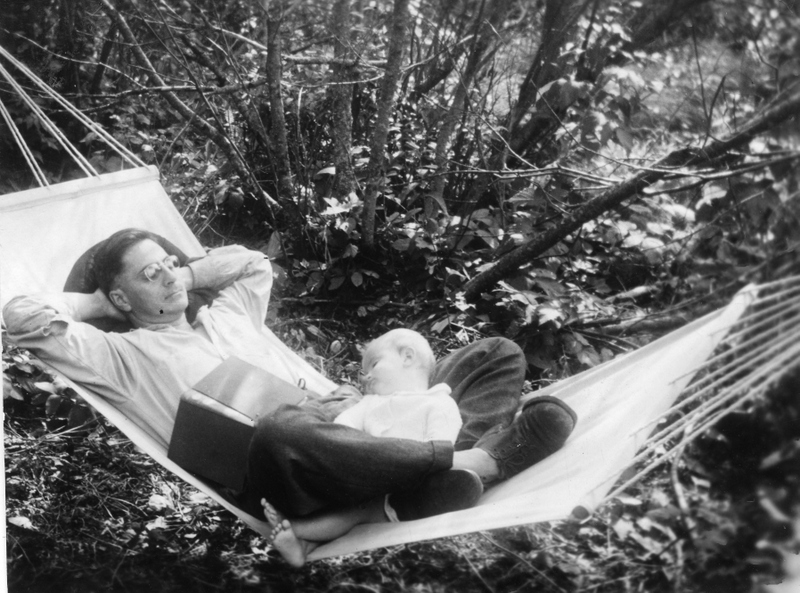
“Love bears the name of our fathers, of their leaving themselves behind,” writes Byrna Barclay in her self-reflection upon this suite of poems upon, yes, her lost father. It’s nearly impossible to go mentally from the sweet photo above — father and daughter in a hammock, a book, the daughter sleeping safely in the cradle of his legs — to the idea that Byrna Barclay never actually knew her father, that he was dead before she was three. Byrna Barclay’s poems are poignant reconstructions of absence, they are like the light from a cosmic event millions of years old, the light filters through the universe but the star is gone.

Byrna Barclay lives in Saskatchewan. She is prolific writer of novels and short stories. She is not exactly an old friend. We shared a car ride from Saskatoon to Regina one summer day in the last century and managed not to keep in touch until Numéro Cinq brought us back into contact. A wonderful thing about the magazine is that it picks up lost threads.

See more work in the NC Fathers Collection here.

dg

It seems to me that every writer has a Robertson Davies’ snowball, a traumatic event in early life after which nothing is ever the same again.  So many spend their writing life avoiding the telling, but that single moment not only informs their work but is the pressure beneath the lines.  It always erupts in imagistic and recurring threads, like dream.  Mine was the death of my father on the day before my third birthday.  That loss punctuates everything I write. 

Sometimes,  in the search for father one must go through the mother to find him.  The absent father.  So shape-changing he disappears at the point of contact.  Yet love bears the name of our fathers, of their leaving themselves behind.

—Byrna Barclay


From the Land of the Dead

I once knew a poet who took three naps a day
then wrote poems about his dreams.  Mine
are wild these nights, with flying
red tea-table chairs from my childhood,
empty closets, bookshelves bereft
of my father’s unfinished stories.

When I wake up I feel as if I’ve been held
by someone who didn’t appear in the dream.
How did that old song go?  Darn that dream.
I can still hear the sugar-sprinkled-on-cream-
of-wheat voice, but can’t recall the singer’s name.
I remember stories but forget the authors,
how between Great Wars a plum burst
in a poet’s mouth.

Tonight my mother takes my children
to the merry-go-round-man
I once wanted her to marry
so I could have all the rides she couldn’t afford.
Too much money spent on story-books treasured
in the linen closet.  I read my self to sleep.  At school

I made up the story.  The King of the Dead Sea
looked like my father & rode a seahorse out of clouds,
twirling a seaweed rope that turned into a ladder
to save trapped in the turret of the castle school
a pigtailed child who looked too much like me.

From the land of the dead my mother
lugs home my teacher father’s scarred desk,
his steamer trunk full of Dime novels,
his portable Royal typewriter, its red ribbon
shredded, even his ink blotter.  A feather pen.
She puts them in all the wrong places.

She brings me his manuscripts:
a radio play, a textbook on how to teach
Drama.  A story about Riel.  Rebellion.  His last
memory about his home in India: Ivory hunters
& elephants long walks, their struggle to die
in ancestral graveyards.

With indelible ink he signed his name.  Letters
squirm like unfolding larva, leap
to a height undreamed of by a moth,
final landing soft.  In my palm:
proof that my father lived, his ivory voice
no longer lost
among elephant bones.


Always, Father

More than I wanted the big kids
to boost me up to the window
so I could kiss Dougie
just back from the sanitorium
I wanted his sloe-eyed father
just back from the War
to marry my widowed mother
so she would stop her nightly fall
down a bottomless well.  Stop
screeching about boys spreading germs.
She made a doctor take pictures of sacs
in my chest the same way
Dougie’s shoe-salesman father
let me see how the bones of my feet fit
inside brand-new Mary Janes
through a magic box that made snow.

More than I wanted to marry Allan
when I grew up, I needed his shoemaker
father who hid red licorice in his leather apron
to marry my mother when his mother died.
In the pockets of his father’s pants
hanging on the line we found matches
and struck them on the stucco house.
His mother screamed and slapped Allan,
and mine warned me about the danger
of playing with fire.  She never knew
how Allan and I practiced for our parents,
he wearing his father’s airforce jacket and cap,
me trailing my mother’s lace curtain veil
in a ceremony fired by loss.

Years later, more than I wanted to marry
a man with the same initials as my father’s
I needed to get away from my mother.


Red is the Colour of Mourning

My father has finally come
not for me, twenty-one years older
than he was when he died,
but for my winter-weary mother.

He waits on the other side
of a window.  Large
so my mother can look out
at a changed world: Sun-grilled
dunes ripple away from scrub
towards a calmed river
as far-reaching as the sky.

Only three when he left,
I never knew him,
yet I’m awed by suddenly remembered
perfection of features clearer
than the line where a lowering sky meets earth.

Humped nose broken three times
on the rugby field.
Eyes as large and mild as a sacred cow’s
in the country of his birth.  He wears a red turban,
an out-of-place scarlet coatee
as if he’s just come from a ghat.

In India red is the colour of mourning.
Here, it’s the deep shade
of my mother’s passion,
of her anger at his leaving her,
of her forgetting his name.

I hear my father’s voice
modulated and muted
as if coming from the bottom of a river.
More than a call to my mother, or a comfort to me,
it’s the knowing: I heard this voice
before I was old enough to remember
riverside
a swaying hammock, his singing
me to sleep and every little wave had its night cap on…

I expect my father to come for my mother
in a winter caboose pulled by Clydesdales,
but he beckons from a refurbished roadster,
the one my mother crashed into a ditch
to avoid hitting the Rainbow
bridge where he carved their initials.
He won’t let her drive now.

Leaving me behind glass,
they’re away, river-bound,
with a salute from him,
a promise to return for me.

img002 

.
Love Stories You Just Can’t Tell

Your widowed mother picked up a stranger
on a train. He wore a suit just like your dead father’s.

She said she’d sub-letted her barn of a house
& you had to stay in a hotel until the renters left.

He said his name was the same as the hotel’s,
only backwards: George King.

When you fell asleep he was taking off
your father’s identical trousers.

.

Among My Father’s Curios

In this chanber of glass
this cabinet of teak carved
with thistles and flights of birds
I find the jaded head of the judge,
my father’s grandfather.

Against the scent of jasmine
against the blowing up of sand
his nose turns down. Brief & jagged
line of lip & curve of jaw
juts above his court tabs
stiff with starch. They say in India
he ordered hung sixteen sepoys
each mutinous day.

One severed lock of his powdered wig
lies safe in a silver snuff box
with monogram: W.L.H.

Here is a photo of my faher,
a sultry turbaned boy
astride a country pony. They say
he spoke only Hindustani. Forbidden
his grandfather’s English tongue
lest he speak improper Cheechee
learned from the servant holding the reins.

On the first shelf
a blue chiffon violet
folds its leaves
into a square of silk.
…………………………………………My first Elizabeth was my first love.
On the second shelf
in a curry dish
a single hook & button of jade
a wooden brooch: cherries
dropping redly
…………………………………………My second Elizabeth was the mother
…………………………………………of my children.
On the third shelf
a shop girl’s bright brass camel,
ivory tusks of her trade. They say
to her he left all his worldly goods,
disinheriting his children. My father.

…………………………………………\My third, Eliza, the delight of my dotage.
Beneath crossed sabers
…………….whips & spurs
I staring stand & dare not
touch the jade(d) head
sitting in judgement
on the skin of a leopard.

.
Did He Dance?

Dorothy told me they buried my father under the ice. She was four whole years older. She took me to her church after supper. The girl with the brilliant hair twirled, flimsy skirt flared. She’s going straight to hell, Dorothy said. The girl’s red mouth opened: she howled. She fell down and her hair hid her face. See? Dorothy said. She gripped my hand. The screen went dark, the lights came on, and Dorothy led me down the rows of bowed heads to the back of the hall. A woman in a blue dress made me kneel on the seat of a chair. The scabs on my knees hurt. Her father died, Dorothy said. They put him in a box lined with satin and buried him under the ice. Was he baptized or christened? the woman said. Did he drink? Did he smoke? Did he dance? Pray for your father’s soul! On the way home, crossing the skating rink, I twirled circles on the ice. I fell down. I brushed away the snow. The ice was clear and blue. I pressed my face into think snow, tried to see my father buried there, his last pale unshaven face, his last dance.

.
How I Want to Remember Them

1. I must forget how I moved
….in…. slow…. motion
through air white as a blank page.
So white. My father’s freckled face,
his raven-wing hair fanned on a pillow.

In my mother’s black photo album
he holds me aloft, as if awed
by his own small reflection.
This is how I know
………………………he knew me.

2. I must forget my mother’s death mask,
the sharp beak of a squab,
her hair cropped albino crow-feathers,
a crone’s toothless mouth agape.

This is how I remember her:
Saturday morning opera from New York.
Jan Peerce’s voice filled with light.
My mother’s let-down braids
the colour of sun’s early song, red
chenille robe whirling, me on her hip,
she dances me
………………….Till doors change places with windows.

3. Only a dream can give memory
to a child too young to remember them
together. I find them mirrored
in the silver tea service tray he gave her.
Every day he brought her breakfast in bed
until he fell ill, and she served him
while in the mountain ash outside
a robin sang of morning.

Picture them in pillowed bliss,
honeyed lips, a bit of döppa, dunking
thin strips of toast in soft-boiled egg
or in coffee made in the Swedish way
just for her. Braided life-
bread, sticky with icing and jam.
He won’t let her lick her fingers,
dipping the tips in a silver bowl,
then dabbing them with starched white serviettes
saved for these mornings reflected
in a silver dream she polished for me.

img003

.
My Father’s Gloves

Found in my mother’s steamer trunk
the suede gloves she saved
have taken the shape of paws
yellow backhair curried
padded underside cracked
& each long finger
the curl of a claw.

I hold palm against palm
smell the dampness
of an old cave
close(d)
into winter sleep.

My hands grow a second skin
yellow fur.

.
My Surrogate Father

I called him Uncle, my mother’s cousin, Karl Mauritz The Moose Millar. When he was thirteen and the eldest of ten, his switchman father died, and his mother left one porkchop on the window sill so the neighbours would think they hae meat for dinner. That night The Moose left home and didn’t return until he found a job as a stockboy for the Buffalo Nut & Bolt Co. He worked his way up to Vice-president, one of the last of the self-made men.

The Moose looked after everyone in the family. Leg braces for sister Maimie. Food for sister Violet when her steel-maker-man boozed away his pay cheque. When he found his first wife in bed with his brother he paid for her care in an asylum. He lost his son Missionary Bob to malarial anger, the chill of grieving too long for an absent mother.

Every week The Moose wrote to me, the Canadian half-orphan, stories about our great-grandmother who swept the streets of Ystad to pay their way to America, how my grandmother looked like the gleaner in The Song of the Lark. His own painting of her granary house failed when he forgot her woodflowers transplanted from the grave of her father to her husband’s beneath our Canadian cold-blue spruce. When I turned thirteen he wrote: Never dance with a kilted man. It all started when our Swedish ancestor, with grog jug in on hand and the hair of his woman in the other, dragged her up the Celtic shores.

The Moose gave me away when I eloped with the son of a Scot, his glasses splashed with old tears.

.

Love Bears the Name

I am the child lifted
onto my father’s heaving chest.
His raven hair sweeps back
into wings.
……………………….What’s going to happen
””””””””””””””””””’to my holy-hecker? His last words
beating through halls turning.
A dark-hooded woman leads me to another room
where stained glass refuses morning.

A box lined with satin
will hold his sleep.
I believe I took away
his last long breath.

He has gone to the War.
He floats under ice.
He has gone to Winnipeg.
I will find him if I reach
for the red sky.

I dream of the men who took my father away
on a bed with straps, away in a wailing car.
Into my hands my mother thrusts
a small red box. A snake
writhes around her fingers. In side the box
her wedding ring sinks into leaves soft as dust.
On a sleigh-shaped bed
my mother slides over ice.
She screams herself awake
from an endless fall.
Morning is the hardest.
Basement cold. Night ashes
in the furnace. No coal.
She struggles to her school,
falls on ice. And stars
stare down: red.

She tells me my father’s dream:
when his father died
he found him boarding a plane.
He couldn’t stop his father
from flying away.

Love bears the name of our fathers,
of their leaving
…………………..themselves
………………………………….behind.

—Byrna Barclay

———————————-

Byrna Barclay

Byrna Barclay has published a series of novels known as The Livelong Quartet, three collections of short stories, the most recent being Girl at the Window, and a hybrid, searching for the nude in the landscape. Her many awards include The Saskatchewan Culture and Youth First Novel Award, SBA Best Fiction Award, and City of Regina Award,  YMCA Woman of the Year, CMHA National Distinguished Service Award, SWG Volunteer Award, Sask. Culture Award, and the Saskatchewan Order of Merit.  In 2010 she published her 9th book, The Forest Horses, which was nominated for Best Fiction for the Saskatchewan Book Awards.  Her poetic drama, The Room With Five Walls: The Trials of Victor Hoffman, an exploration of the Shell Lake Massacre, won the City of Regina Award.  She has been president of SWG twice, President of Sask. Book Awards, and Fiction Editor of GRAIN magazine.  A strong advocate for Mental Health as well as the arts, she served as President of CMHA, Saskatchewan, was the founding Chair of the Minister’s Advisory Council on Mental Health, and for twenty years was the Editor-in-chief of TRANSITION magazine.  Vice-chair of the Saskatchewan Arts Board from 1982-1989, she is currrently the Chair. Mother of actor Julianna Barclay, she lives in Regina.

Mar 072013
 
JH Pic

Jennica Harper

.

Inspired by the insanely provocative television series, Mad Men, Jennica Harper’s poem cycle here traces the meandering thoughts of pubescent Sally Draper, the oft times neglected offspring of paterfamilias and part-time Lothario, Don Draper. Harper’s monologues capture Sally’s experiences at the edges of the masculine, cut-throat world of Manhattan’s advertising, and the shifting social upheavals of the 1960s.

Though Sally’s not a leader for the sex, drugs and rock and roll revolution, she is a reactive element: a baby boomer kid with some indelible philosophy. In “Sally Draper at the Premier of Jaws,” her approval-seeking banter annoys her date and she realizes that she’s missing the entire point of being in a dark theatre with a boy. “This is me flirting,” she states, “I know I’m doomed.” In “Sally Draper: Upwardly Mobile,” she deems the consolation prize for not following her career path as being relegated to “wife.” For her, this means, “You may start pretty, but you get old fast. You become a secondary character in your own life. A wife.”

Harper foregrounds Sally’s sense of being a “secondary character,” by emphasizing her self-conscious voice and her obsessive need to see herself from afar. Whether she’s painting her lips in Hellbent and Taboo, taking peyote and contemplating the lyrical origins of “Puff the Magic Dragon,” or romanticizing her first abortion as “A calculated fainting” where she should be “woken with smelling salts by ladies in waiting – [her] problems gone,” her inner-monologue captures her disassociated steely understanding of the human condition. Despite the dishonesty and emotional fallout from her parents’ generation, she’s ready for change and wields it like “a sword in a virgin cocktail.”

These poems are not Harper’s first foray into adolescent voices and perspectives. She has also written a poetry collection from the point-of-view of thirteen-year-old girls, What it Feels Like for a Girl, and works on the YTV sitcom, Mr. Young. Incidentally, some years ago, Jennica and I completed our MFAs at UBC together. I remember her being quick even then at cross-hatching pop culture and the ten angst as she does here and in her other poetry collection, The Octopus and Other Poems.

For Harper, youth culture is a poignant watermark of what’s deemed frivolous in the previous generation. Perhaps this is why she is drawn to Sally Draper: because she is such a mercurial figure, as she struggles with realpolitik and her parents’ emotional tailspins into extramarital affairs and vodka martinis. These poems attest to Sally’s sense of unmooring. As Sally herself suggests, “There should be a system,” or at least balefire to illuminate her turn toward adulthood at the cusp of the most explosive youth culture movement in American history.

—Tammy Armstrong

—–

alicia1

§

The Sally Draper Poems by Jennica Harper


Sally Draper at the Premiere of Jaws

I recognize that beach. Something about it – even in the dark.

Hey, Martha’s Vineyard!
Shhhh!
Jeez.

I whisper to him. We used to go there in summer.
He rolls his eyes.

We’re under the surface now, with the girl.
She has pretty legs, like a dancer.
They hired that girl just for her legs.

He looks at me. Pleading.
Sorry.
She treads water. I suck in my stomach.

The cold water’s just making me colder.
They sure did crank the A/C – to the point
I barely remember that it’s June.
They made it cold in here
so we’d cuddle up to our boys.

This is me flirting. I know I’m doomed.
He doesn’t look at me. I guess to not
encourage more talking.

The sound kicks in, and I jump a little.
Da-da. Da-da. Da-da. I recognize it as a tuba
from the years Bobby practiced in the basement.
Stuck with that fat thing after being out sick
the day instruments were picked. I take it in. Know
the notes. E-F. EF, EF, EF.

I don’t turn to him. Don’t tell him about the tuba.
Now that I’m quiet, he takes my hand. Rubs
it between his to warm me up.

I know it’s supposed to be scary
but they won’t let this girl be hurt. They can’t.

§

Sally Draper Hides

Ten feet below me
decisions are made.

I hide under the bed, though
she says I’m too old.

You learn a lot, ear to the floor.
Which boards squeak; that the front door

(opening after midnight – witching
hour, I once heard Francine say)

releases a tiny gust of air that floats
up the stairs, ever so stealthy and sweet,

blowing dust bunnies by.
I watch them hop and bob…

they’re dancing like lovers! Or,
it’s possible, running for cover.

§

Sally Draper’s First Kiss

I knew kissing a boy would be different when it wasn’t your brother, I just couldn’t imagine how. I’d turned my hand into a mouth, like Senor Wences (but didn’t let him talk). Brought my hand close, really slowly, shut my eyes most of the way, keeping them open just a slit so I could see, too. Tasted the salt on my fingers; tried to imagine what the hole of my hand was tasting. I’d stuck my tongue in, but there was nothing there, just air.

When finally I made James stay still so I could kiss him, I knew what had been missing: resistance. I slipped my tongue through his teeth, happy he put up a fight. The kiss made me want to pee and made me want to kiss him again. Then James wanted to keep going, and I got distracted by the TV.

Now, whenever I see a ventriloquist – or puppets, Pinocchio, any wooden boy, boy on a string, boy with a hand inside him – I have to excuse myself.

§

Sally Draper Struggles to Buy a Christmas Gift

He’s got no hobbies –
doesn’t fish or golf
like other men.
He’s not cultured.
Wouldn’t care about
opera tickets,
or the new Neil
Diamond. A magazine
subscription’s out,
of course. The ads.
He might wear a tie,
but I can’t bear to buy
him something so dull.
So I choose The Spy
Who Came In From the Cold.
Maybe he’ll see
the symbolism –
a man wanting
out. Hope. The girl.
And if not,
maybe he’ll at least
wonder
why this book, what does it mean,
and he’ll realize I’m
interesting.

§

Sally Draper Buys Red Lipstick

The woman at Marshall’s
lines my lips first, with Brick,
as in House,
as in Shit-A.
I make an O.

Next comes the stick: Dare You.
I want to say, You win!
I’ll buy you, but you’ll just
languish in a drawer
with Hellbent and Taboo.

All my life I have
shied from these lips – his
lips. Bowed and smacking
of blow-up doll…
Ode to an O.

But today I’ll wear red.
The red of a cherry
on a sword in a virgin
cocktail I’ll have to sip
through a straw.

§

Sally Draper: Upwardly Mobile

I’ve seen what happens when you don’t push for it. Follow your dreams. You may start pretty, but you get old fast. You become a secondary character in your own life. A wife.

It’s the kind of war you can’t let them know you’re waging. And you can’t ever fall asleep – or onto a mattress – while on watch.

What they don’t tell you is, you still have to pay your dues. And your dues may mean bringing coffee to men, again and again. A wife on the clock.

At home, my mother had it made and brought to her by the help. Something I think about when I pour.

§

Sally Draper Contemplates the Interstellar Mission

Apparently the planets are aligned,
so they can shoot (launch? dispatch?)
the two pods into deep space – they’ll
hop from orbit to orbit, hitching lifts,
their trajectories curving out, dots
connecting to form a conch-like shell.
I guess Voyager is, kind of, a conch.
We’ve spoken into it, hoping sound travels.
Everything about the mission is designed
with beauty in mind: the hope of it all. The sounds
on the record (whales, that kiss from a mother
to her baby, and my favourite, thunder).
The fact there are two, a pair, twins,
a couple mated for life like swans.

So how come when I think of those things
hurtling out, carrying Earth’s seeds, all I can
think is that we are fucking the universe
like a man fucks a woman, and I want to fuck
the world like that too?

§

Sally Draper Takes Carla Out for Lunch

It’s taken me a year to find
her. There’s no maid directory.
There should be a system; something.

I’d no idea we could live with women
and they could be taken from us and we
could not even know their full names.

She cooked me hot dogs. She taught me
fractions. Once, she spanked me. I
deserved it, and she took no pleasure in it.

I wanted to take her to a nice restaurant, but
on the phone she said no. The lunch counter
at Woolworth’s it is.
When she arrives

she looks the same to me. Except my size,
instead of the powerful figure she’d been.
I stand to hug her, but she sits before I can.

She orders a clubhouse. I barely eat
my salad. I tell her about college. Classes,
living with the girls.

She tells me things have been fine,
she went to work for another family,
with twins. Smart boys. Nice boys.

I tell her she should have pulled the toothpick out
of her sandwich first. She smiles. Pulls
it out. It comes out clean, and I feel sick.

When I can’t stop the tears from coming,
she holds out her napkin. Then changes
her mind, daubs at my eyes.

I thought. I thought.
She says, I know, sweet pea.
You know, you’re nothing like her.

She doesn’t know what she’s talking about.
When I get back home I dye my hair
a dull yet shocking shade of black.

§

Sally Draper On Doctors

As soon as she came out,
I bought Surgeon Barbie. Her scrubs
are short, it’s true. Still, score
one for us. I put her box
on my desk for when I study.

I will worship no idols beyond thee!

………………….*

Then it’s Miss America Barbie.
For a laugh, I buy her too. Put
them side by side. But one day
I come home drunk and open her
so I can comb her hair.

I will worship no god but irony.

………………….*

He asks me which I’d rather be:
the career girl or the beauty. Of course,
I say the surgeon. He knows it’s true.
What I don’t say? My doctor, dentist, gynecologist,
therapist… men. Always will be.

I worship you in hopes you’ll worship me.

§

Sally Draper Hears the News

I get the call. Feel my face
go cold. The lion can’t die.

No tears, yet – not till
I’m on the subway, really
trying not to cry. I let a man
give me his seat, and ride
in comfort all the way uptown.

At the wake, I speak, read
Yeats, though I know
he’d have preferred O’Hara.
Tougher. But tough,
the day isn’t for him.
It’s for us, the living.

And I wait for it. The fire.
I expect it to ignite in me,
his fire, it’s my
right, I’m the eldest,
the heir. But the cold
persists. A cold there’s no
coming in from.

Twice a week, I try
his death on for size.
A coat of imaginary grief
I’ll wear like armour.

I should send a card
for his birthday this year.

§

Sally Draper’s First Abortion

Junior year is hard on the girls. Two got married
and quit school. One became a drunk and flunked.
Then there’s me, failing for no good reason
and for the first time, two men in one month.

They ask me who’s picking me up —
I lie. Say my brother, though I haven’t called either
in weeks. I’ll take a cab home, have a nap.
Then study. Clean the kitchen. Be useful.

Except: I didn’t know you were awake
when they did it. I guess I imagined being under.
A calculated fainting, then woken with smelling salts
by ladies in waiting – my problems gone. But no.

Bet she never wondered what kind of mother
she’d be… I call her. There’s no answer. I will not cry.
They say a name, the name I gave them, the other
me, and I stand. Put on my father’s face.

So this is what it’s like to be brave.

§

Sally Draper Will Never Do Mescaline Again

It’s natural. It’s from a cactus. Native Americans
in Mehico have been using it
for thousands of years.

Yeah, but there weren’t cars you could get hit by.
Or fifth-story windows to jump out of.

Do you trust yourself, Sally?

Not really.

[…]

Just, put it in a drink or something.
I don’t want to taste it.

Even you have limits
for what you’ll put in your mouth,
huh?

Funny.

Now we wait. Soon the backs of our
eyelids will be like stained glass.

Puff, the magic dragon, lived by the sea

My dad used to sing me that song.
But he’d turn Little Jackie Paper
into Little Sally Draper

That’s sweet.

Ehn.

That song’s about grass. You want some?

It is not.
And yes.

It’s a well documented fact. Ask anyone.

[Without warning, it hits me. I want to ask him.
I want to call, wake him up, beg him
not for the truth
but for what I want to hear.
He was always good
at what I want to hear. But
I don’t know his number
off by heart, I’d have to
call information.]

I’m feeling pretty good. How about you, Sall…?
Sallster? I’m sall…ivating. For you.

Shut up.

Are you crying?

I’m Jackie, and I’m Puff.
I left and am left behind.

[…]

I am going to be like this
for the rest of my life.

Would that be so bad?

[…]

 —Jennica Harper

.

Jennica Harper’s books of poetry are What It Feels Like for a Girl (Anvil Press) and The Octopus and Other Poems (Signature Editions). In 2012, What It Feels Like for a Girl was published as an e-book for Kindle and Kobo, and was adapted into one-third of the critically acclaimed theatrical experience Initiation Trilogy at the Vancouver International Writers Festival (Marita Dachsel/Electric Company). The Sally Draper Poems are part of a new manuscript, Wood. Jennica is also a screenwriter and is currently working on YTV’s teen comedy Mr. Young.

§

Our guest introducer Tammy Armstrong‘s poetry has appeared in literary magazines and anthologies in Canada, US, Europe, UK, and Algeria. She has been nominated for a Pushcart Prize, the Governor General’s Award, and short-listed twice for the CBC Literary Prize. She is currently a PhD candidate at the University of New Brunswick, working in Critical Animal Studies and North Atlantic Poetry.

Capture

Tammy Armstrong

.
.

Feb 122013
 

San Francisco Intl Festival

I love this photo of Yahia Lababidi. How can you resist a man with words written all over him and a book in his hand? Egyptian-born Lababidi is a poet, aphorist, essayist and mystic. He is steeped in the traditions of Western philosophy but comes from a world where the desert reminds you constantly that you are surrounded by a vast inimical emptiness; the ancient Christian hermits used to sit in the Egyptian desert because from there you could place a toll-free call to Paradise. But it is also a world in which mysticism finds an easy partner in eroticism, the metaphors of love. This is equally true of some Western traditions but especially those with Arabic influences, for example, the fantastic love poetry of the Troubadours. It’s not much of a stretch to see that influence standing behind Don Quixote’s passionate ideal love for the non-existent Dulcinea del Toboso, the adoration that drives him through 800 pages of Cervante’s great novel. These are poems toward a future collection, poems that are often aphoristic in their turns, poems that turn often on a relationship to a self, an other, an alter ego (Pessoa is cited) or a wound. Although it may seem contradictory to say so, the mystic is a person in conversation; everything in him burns toward that conversation.

NC earlier published a selection of Yahia Lababidi’s aphorisms entitled “Flirting With Disaster.” But you will find a helpful introduction to the man in this essay “The Artist as Mystic” written by Arie Amaya-Akkermans.

dg

.

Dark Room

Awoke, with an unseen
reel of dream film
I’d found wandering

And, now wondering
where does one develop
such unreal pictures?

.

Alter Ego

“ I wasn’t meant for reality, but life came and found me.” – Fernando Pessoa

The first thing you noticed was how pale
the skin – the second, was how naked
a mess of long limbs, knees and elbows
you’d not have known what to make of it

The albino squirmed in the cruel sunlight
a thing of porcelain, as brittle and bright
grass scarcely covered the strange flesh
and birdsong masked its muffled cries

All day the dream-being remained that way
an odalisque of indeterminate sex
clearly in exquisite pain, yet alluring
and commanding an odd authority

Only when night fell did it make sense
-the androgynous specimen was male-
the way it crouched, danced and leapt
luminous in the moonlight, fearless.


Pen pal

He went to bed, cradling a pen
his back turned to the woman
when he awoke, she was gone
and, in her place, a giant pen.

,

Exchanges

Don’t grieve. Anything you lose comes round in another form.  – Rumi

What unexpected turns our losses take
in winding their way back into our arms:

an absent lover returns as many others,
a nation forsaken in the shape of a new life;

poems might take the place of mothers
and friends gone come back as a wife.

If Love were not always a step ahead
how would it ensure we kept up the chase?

,

Master and servant

Rarely, having neglected his art
the man catches a glimpse of the artist

that cold, appraising gaze
the glint of an eye-tooth

better to turn away from the mirror
and best not to have a blade in hand.

.

St Sebastian

Sometimes, he found it difficult
to dislodge the arrows
preferring to keep them there
reverberating in silence
along with his invisible wounds.


You again

You again, of the singing wound
here again, lost and found and lost
trafficking in metaphysics and eternity
as the nearest hopes

where to, pilgrim
outdistancing chasms
rationing emotions
seeking sustenance

for the self too subtle and proud
for words
nocturnal flower, nurtured solitude
watered night

there you go, restraining the impulse
to say it all at once
even surrounded by silence
still filled with noise

now, having stirred some thrumming
hour when the moon throws
her full-bodied light
over all, like a silver screen night
of silent films, the whirring
of the reel.

—Yahia Lababidi

———————-

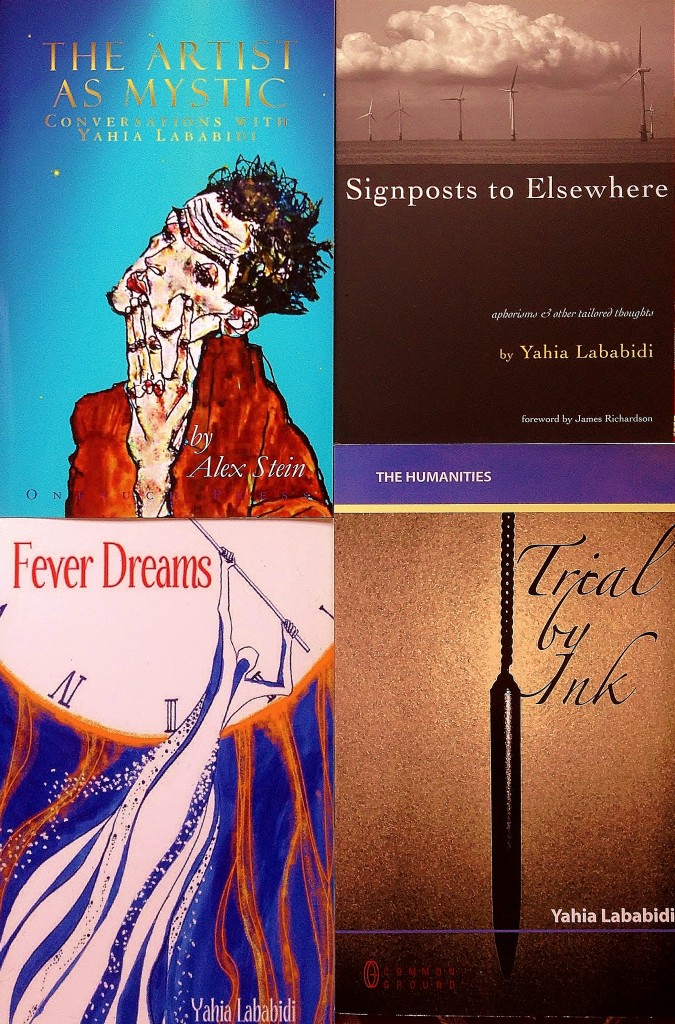
Egyptian-born, Yahia Lababidi is the author of three collections:  Signposts to Elsewhere (aphorisms — 2008 Book of the Year at The Independent in the UK), Trial by Ink: From Nietzsche to Bellydancing (essays) and Fever Dreams (poetry). Lababidi’s work has been widely published in US and international journals as well as being translated into several languages, including: Hebrew, Slovak, Spanish, German, and Italian. A juror for the 2012 Neustadt Prize for International Literature, his latest book project is a series of ecstatic, literary dialogues with Alex Stein, titled:  The Artist as Mystic: Conversations with Yahia Lababidi. Here is a link to a conversation from The Artist as Mystic, where the author discusses how he began writing aphorisms (among other things)

Yahia Lababidi

Jan 122013
 

Robert Currie

Robert Currie is a Saskatchewan poet with six collections out and a novel, Living With the Hawk, his first, about to be published this spring. He lives in Moose Jaw, which is substantial city, but his concerns are mostly rural (Saskatchewan is mostly prairie farmland and bush in the north). And if you have read your Farley Mowat (e.g. The Dog Who Wouldn’t Be) you would know that growing up Saskatchewan in a certain era was all about the outdoors, the weather, the seasons, fishing, bird migration, shooting — this was near the Age of Innocence before hunting and fishing became signs of ecological imperialism. It was also a time when your parents would let you bounce around in the back of a pickup truck (without fear of arrest for child endangerment) and teachers used the strap — all of which are things I remember. “Under the Blanket” is a charming, sweet depiction of youthful sexual exploration (while bouncing around in the bed of a pickup truck) and “The Days Run Away Like Wild Horses Over The Hills” is a gorgeous poetic welding of winter and wild horses (beautiful galloping lines). “He Visits His Ex-Wife” is a looney, ever so touchingly comic poem about the poet visiting his demented ex in a home (you don’t know it’s a home till the end) where she tells him an unsettling and inscrutable tale about an elderly couple eaten by bears. These are poems from another world in both time and geography and it’s a great pleasure to introduce them here.

dg

—-

UNDER THE BLANKET

Our fathers were singing in the front seat,
driving back to town for a block of ice,
our mothers in the shack at the lake,
frying chicken on the wood stove,
patting the sweat from their faces,
cotton aprons raised from the waist.
The two of us rode in the back seat,
an Indian blanket over our heads,
you a year older than I, both of us
giggling, waiting for the next bump
to bounce us together.  You leaned
toward me, breath stroking my right ear,
and whispered, “Now’s your chance.
Do you want to see?”  I did
and I didn’t.  Unable to speak,
I nodded my head and waited
in the snug world of the blanket,
my mind anxious, wheeling with wonder.
I saw your lips twist into kind of a smile
before we lowered our heads and looked down:
your brown thighs tanned from days at the beach,
your hands tugged at your shorts, your panties,
sliding them down, a mound untouched by sunlight,
and in the smooth white flesh directly below
an improbable groove that stopped my breath
and altered forever the gait of my heart.
We must have reached the ice-house then.
When I came up from under the blanket
the first thing I saw was my father
handing me a chip of ice in a cracked cup.
I remember the slippery feel of it,
cold and hard on my tongue,
and how quickly it melted away.

.

THE DAYS RUN AWAY LIKE WILD HORSES OVER THE HILLS
(from a title by Charles Bukowski)

The weeks gallop from summer into September,
gallop away from the lake, a sheen of ice by the shore.

Hoofbeats hammer the gulch where deer hide from the hunter,
echo across a dry slough; a last goose cries in the empty sky.

The weeks snort at a sliver of moon, shiver in the night
of the coyote, its chill call stretching across the land.

Snow obscures the moon, now frost-bitten, withered,
and piles into gullies and hollows deep in the hills.

The nights grow long; the weeks grow shaggy and lean.
They lunge and plough through drifts that plug the valley.

Where the wind whips the hillside almost bare,
they paw at the snow, their jaws tearing the grass.

Winter lodges among them, the frozen carcass of winter,
and spring, next spring, will it ever come?

Bunched together in the lee of a thicket,
the wild horses neigh and neigh and neigh.

.

HE VISITS HIS EX-WIFE

When I entered the room, she smiled and said,
“Their cabin was nearly as dark as that,”
and she pointed to the wall by her bed,
an echo of sunshine from the open window.
“Uncle Henry liked to fly-fish in the mornings
and Aunt Lil always baked bread in the kitchen.
I suppose it was the smell that brought them around.
The bears, I mean.  I love the smell of bread myself.
When it’s golden brown and fresh from the oven
you can’t wait to tear off a piece of the crust.
People said they were both eaten by bears,
but I never believed a word of it.
Uncle Henry was big as a bear himself
and Aunt Lil never cared to go fishing.”
She nodded at the TV set, which was off.
“You can see how dark the room is.
Looks kind of spooky, doesn’t it?”  She laughed.
“Maybe the bears got in after all.
You know, you can just make them out, there
in the breakfast nook, across from each other,
Uncle Henry and Aunt Lil sharing a meal.
As much in love as the day they were married.”
She reached out then and took my hand.
“I think I’ll write the papers, tell them the truth.”
She gave my fingers a squeeze.   “Thanks for coming.
It was really nice to meet you”  And later,
driving away from the home, I thought,
somehow she’s still as pleasant as ever,
and I was glad again that I’d come.

.

CAUGHT

Chick showed me once exactly
how to set a snare on a rabbit trail.
I took five feet of copper wire
from my father’s basement workbench,
folded it into my loose-leaf binder,
took it to school.  No branches here
to pin to the ground, I wrapped the wire
around the steel leg of my desk,
looped it into a noose, twisted a slip-knot,
set the noose upright in the aisle.

Mrs. Dornan checking arithmetic books,
moved ever closer down the row,
paused at Kenny’s desk in front of me,
side-stepped slowly backward, the noose
slipping over her shoe, tightening,
the twist of wire tearing her stocking.

When, hands shaking, I finally got her free,
she pointed to the cloak-room door,
drew from the centre drawer of her desk
the strap, thick black leather.  “For you,”
she said and followed me out of sight.
Oh man, that strap, I must’ve been crazy.
At last I lifted my hand.  Strove to hold it still.

“You like to play games so much, try this.”
She raised the strap, slammed it hard
four times against the far wall.  Frowned.
“You behave yourself,” she said, “or else
the class will learn what happened here.”

.

BEYOND THE OPEN WINDOW

It’s true, just the other afternoon,
when I’m at rest in my easy chair,
a glass of whiskey handy as my elbow,
a good novel propped upon my knee,
my right arm disengages from my shoulder, the hand
flips me the finger and goes with it, sailing out the window,
its flight erratic as a wing stripped from an erring angel.
Unable to attain heights remotely close to heaven,
the arm wavers near the ground, rising for a few seconds,
then brought down by gravity, dipping so low it terrifies
a cocker spaniel peeing on a pole, sends the dog
howling home before it strikes a garbage bin,
bounces to the curb, ricochets away, off-kilter,
tumbling end over end down the street

where people work, men with blistered hands
wheeling cement across a concrete pad
to other men with shovels, trowels and floats.
Beyond them a guy who drives a backhoe
rubs away the sweat that runs toward his eyes.
Shuffling along the sidewalk a street person
wonders if anyone is hiring labourers today
and asks to see the foreman.  He doesn’t notice
the arm clip a girder where a wall will go,
doesn’t see it skid across a gravel pile, pausing
to shake off dust that covers scratches at the elbow.
The arm shudders and hoists itself upright, the hand
raising a thumb as if it might want
to hitchhike home to me.

—Robert Currie
————————–

Robert Currie is a poet and fiction writer who lives in Moose Jaw, Saskatchewan. He is the author of six books of poetry, including YARROW (Oberon, 1980) and WITNESS (Hagios, 2009). He served two terms as Saskatchewan Poet Laureate (2007 – 2010). In 2012 he delivered the Anne Szumigalski Memorial Lecture at the conference of the League of Canadian Poets. His tenth book, a novel, LIVING WITH THE HAWK, will be published by Thistledown Press in the spring of 2013. In 2009 he received the Saskatchewan Lieutenant Governor’s Award for Lifetime Achievement in the Arts.

Jan 102013
 

Mishler Photo

Herewith, poems from Peter Mishler, introduced to me by Emily Pulfer-Terino. Very cunning, deft and graceful poems. In “Demolition” a chance detour (on his way to work) leads the poet by an Econo Lodge which becomes a screen for his imagination and the stage for a dark, alienated story (words like “gurney” and “wrist” implicate the scene with dread). A week later, the detour signs disappear and the poet metaphorically wakes, sort of, from the dream of his imagination. It’s an ancient, haunting plot. Some tiny change in the humdrum routine of the world thrusts the dreamer into another world of darkness and disorder. Then he returns, not himself any longer, but changed. (Think: Hawthorne’s “Young Goodman Brown” for example.) He finds the humdrum now inflected with dream (“I walk the darkened, sea-foam hallways”). The poem ends with a lovely whispering repetition (morning, morning), the owl-like assonance (who, whom), and a shade of doubt.

I walk the darkened, sea-foam hallways
to my desk—and when the people
that I pass say, Morning, I say,
Morning, too, so that I can’t
be certain who is waking whom.

dg

§


DEMOLITION

For a week a detour takes me
past the windows of an Econo Lodge.
I invent what’s on the other side
each morning, beginning
with what I know is there:
an absent clerk, an empty lobby
some dark green carpet
joined in places with duct tape.
I add a chair for myself to sit
and make the smaller arrangements:
a door to a bedroom closed
just enough to hide a figure inside;
open enough to reveal a bed
that looks like a gurney,
a wrist laying face up
on the sterile and steamed
white sheets. What am I
intending to have happen here?
Hard to tell if it’s my wrist
or someone else’s that’s meant
to emerge from that room.
I’m getting a feel for the lobby, though:
within days I learn to fix
a sugar drink from sweetener
packets and sink-water.
I place a styrofoam cupful
in front of the bedroom door
and watch for movement.
But by the end of the week,
the detour signs are pulled
and my car is directed
back to the highway,
granting me another view:
the demolished building
the city was shielding me from.
A crane now sifts through fragments
and debris, sorting them into one pile
or another. As it holds
each piece of metal to the air
to let it flicker for a moment,
for me it is lifting the door,
the bed, the sheets, the wrist,
and the cup that should now be filling
with an early sunlight on the floor
of the motel. I watch in the mirror
as each object hangs, then drops.
My car approaches my building, and work.
I walk the darkened, sea-foam hallways
to my desk—and when the people
that I pass say, Morning, I say,
Morning, too, so that I can’t
be certain who is waking whom.


PERIPHERY

You are evading me.
You are just beyond me.
You are the length
of the hood of a car
away from me—
and thinner
than I remember,
dressed as if undressed
after work.
I reach until
I can meet your hand.
But you are in front of me
like the moon
on one week,
then behind me
like the moon on another.
You are trying
to move toward
the doors of a church
we both know,
and I won’t let you.
I step in front of you
and you step to the side
saying, Stay
on the periphery
and we’ll be in touch
this summer.
But what’s here
that won’t let me
speak to you—
that prevents me
from letting you
go inside,
that makes you
want to go inside?
I tell myself, Yes,
I know I must
stay here and lie
whenever I try
to retell the story.
Once, two friends stood
on opposite banks
of a stream.
Then, they were men
and a river,
and then, two ghosts—
the story becoming
more distant
or strange
the more I fear
the person listening.

.

HARUSPEX

The office lights chose
to remain half-lit
for the rest of the fall.
I went whistling
the song of two crows
down a hall unknowingly.
Through my phone
an exam room
slipped into my ear
and unfolded
its expanses brightly.
How does one
get to sleep
in a city of snowfields?
My father sent me
an absentee ballot,
and asked did I think
my future was secure?
I day-dreamt throughout,
and my eyes flew doubly
over a man, on a raft,
down-river—
his body, thin;
his liver, a white star
pressed against his skin.
It asked me to extract it
for its portents.
Back in the office,
my xeroxes spilled
through a seam of light.
They handed me
a memory of warmth
from distant fires.

CLOSED LOOP

You try again
to shut your eyes—
rejoin your head
and heart—
afraid of being
called back to the house
and broken from
your little spell.
But no one is home
to call you home.
Nobody stops you
from pausing
in the last days
of August
like you do.
You’ve stepped outside
some nights
and wanted
to get back in.
There were lists
to be made,
glasses of water
to shift from table
to nightstand.
Stay and let yourself
be known
from the vantage
of sky and window—
your body centered
in a sprawl of lawns
that narrows
away from you
into a vanishing point
of smaller
and smaller houses,
where younger
and younger children
sit behind glass
looking out
onto increasingly
darkened streets,
imagining
unreal figures
at play beneath them—
beginning here
where you stand.
From window
to window,
childhood’s rules
are passed above you
endlessly:
all a boy must do
is close his eyes
and you can disappear.

—Peter Mishler

———————

Peter Mishler’s poems have appeared in The Antioch Review, New Ohio Review, and Crazyhorse. He teaches Creative Writing and English at Liverpool High School in Central New York.

Jan 042013
 

 Ralph Angel

A delicate trace of narrative runs through these three Ralph Angel poems, trace as in a whisper barely emerging from the silence of the white page. The narrative is romantic, the tone affectionate, erotic, connubial, ever so slightly comic (such an endearing mess the poet makes spilling his coffee, falling asleep in a bed of popcorn, cleaning up for his love who’s on her way). The poems are stripped down, reduced to essence, the words that remain are perfect embodiments of mood, character, relation. And they insist by rhythm and repetition. Note in the first poem “Willing” how

A kiss, a lick, “Miss me?”
“Of course, yes,”

goes to (by the logic of parallels) “a nudge, a squeeze…” and then modulates back closer to the original

some bread?”  A kiss, a lick,

“Miss me?”  “Yes, yes.”  “I put your book
with the magazines.”

And how the word “perfect” in the third line

a perfect cloud shadow,

and the word “brilliant” in the middle of the poem

dear.  “Hungry?” “Brilliant, yes,

fold together at the end (capped with a sly innuendo).

“Perfect, brilliant.  Might I have another?”
“Another what?”

These poems come  from Ralph Angel’s new book Your Moon, forthcoming with New Issues Poetry & Prose. And you might read these poems in conjunction with Ralph’s essay “The Exile and Return of Poetry” which also appears in this issue.

dg


§

Willing

And further in…the train clacking and lulling…

rolling green hills coming toward us…

a perfect cloud shadow,
the lonely oaks.

And cows, one, and another, closer to heaven…
what’s up with that?

A kiss, a lick, “Miss me?”
“Of course, yes,”

you’re killing me here, my
dear.  “Hungry?” “Brilliant, yes,

absolutely.”  “And voila,” a nudge, a squeeze…
my stockinged foot curled

around your ankle, your shoulder
propped up on mine,

“we have grapes and brie, will you tear us
some bread?”  A kiss, a lick,

“Miss me?”  “Yes, yes.”  “I put your book
with the magazines.”

“Perfect, brilliant.  Might I have another?”
“Another what?”

.,

Vacuum Cleaner

I erased the message.  You were
already on your way.  I barely heard you
pull the scent out of my ear
and put it in my
mouth again, where
I will kiss you.

Then I knocked over my café con leche.
What a mess.  Papers, piles
of books, I had a book
in my hand.

I like it better now,
the table.  The light cuts right
through.  I think you’ll
like it too.

Last night I woke myself up
in a sea of popcorn.  The movie
had long since
ended.  It was disgusting.
So we’ve got clean
sheets.

If only I had a little more
time.  I take that back.  I really
mean it.  I wish
we hadn’t yelled goodbye
last time.  I mean we
really screamed it.

No wonder there was a beautiful
fish in the market.  The sky
dimmed the living room.  And peonies
opened.  No wonder
the cat’s lounging on the edge of the tub
while I’m making myself
presentable.  She
makes it look
easy.


Blue Hydrangea

Five trucks are enough.
The neighbors
are home.  We’re married

and handsome
and covered.  Nobody
dies

for the first time.
I’m still
fighting you.

You wait on me. I wait on
you. Your memory’s
my body’s

devotion.

—Ralph Angel

———————————-

Ralph Angel is the author of five books of poetry: Your Moon (2013 Green Rose Poetry Prize, New Issues Press, forthcoming); Exceptions and Melancholies: Poems 1986-2006 (2007 PEN USA Poetry Award); Twice Removed; Neither World (James Laughlin Award of The Academy of American Poets); and Anxious Latitudes; as well as a translation of the Federico García Lorca collection, Poema del cante jondo / Poem of the Deep Song.

His poems have appeared in scores of magazines and anthologies, both here and abroad, and recent literary awards include a gift from the Elgin Cox Trust, a Pushcart Prize, a Gertrude Stein Award, the Willis Barnstone Poetry Translation Prize, a Fulbright Foundation fellowship and the Bess Hokin Award of the Modern Poetry Association.

Mr. Angel is Edith R. White Distinguished Professor of English and Creative Writing at the University of Redlands, and a member of the MFA Program in Writing faculty at Vermont College of Fine Arts. Originally from Seattle, he lives in Los Angeles.

Oct 082012
 

Micheline Maylor writes poems with dash and élan, attack poems, full of desire, heart, dangerous men and revenge. A woman ties her husband to the kitchen chair and whips him with the letters of former lovers (and he watches the “black serpent of her hair flickering its tongue down her back”). “I Was a Pack of Dogs Last Night” is a gorgeous orchestration of dream, desire, dogs hunting, and the epic squeeze of time as the grains of sand drop through the funnel of the hour-glass. These lines make you ache with envy.

And for a second, just a second, sand tucked itself into itself
to pass through the gullet of the time keeper
and for that second, that one squeeze of time
the totality of hunt crushed my ribs with its bite
and I stopped in recognition the way a woman might stop
at a grocery store or a light
to see a lover at a distance…

Micheline Maylor is by way of becoming an old friend, though we’ve never met (a deficiency soon to be rectified since she’ll be introducing me Wednesday night at Wordfest in Calgary). She comes from Windsor, Ontario, but lives in Calgary where she writes poetry, teaches writing at Mount Royal University and edits FreeFall Magazine. Her first collection Full Depth: The Raymond Knister Poems was published in 2007. (Raymond Knister was an early 20th century Ontario poet, story writer and novelist, something of a cult figure in Canadian literary circles for his early promise and the tragic way he died. His daughter used to live in Waterford, dg’s hometown.) She has a new collection due out in 2013. It’s a huge pleasure to have her back on the pages of Numéro Cinq.

dg

————

Even the Done

Marisol tied her husband, Juan, to a kitchen chair and with the letters of her ex-lovers she inflicted deep paper cuts in his skin. On the third day he begged her unfairness. He pleaded to her. Marisol sliced with a quote from Carlo’s pen,

“You were eternally beautiful in the garden last night,
when you kissed me, only then, the stars took flight.”

Juan asked for Marisol to look at her clothes, look across her garden that he had sown for her. He gestured to his work, his provisions, all for her. Marisol nipped a letter into the corner of his eye until he bled a tear. “You tell me no sweet things, Juan. I will never forgive you.”  Juan protested then remembered his necessary words, the demands, the could yous, the would yous, the will yous, and the nos. He surrendered, said nothing more. She continued to slice him each morning then brought him warm supper in the evening so he wouldn’t lose his strength. Marisol did not relent. On the twentieth day, Juan watched through the window as his crop wrinkled in the late August heat. He watched the spell her hips cast as she left him wounded, the black serpent of her hair flickering its tongue down her back. Still, he said nothing except with his eyes.

Eventually, even the edges of love notes brought from lovers become dull. Juan’s skin toughened. The letters no longer bled him weak. In his defiance, Marisol remembered the blush in Juan’s cheek, watched his forearms taut on the chair, and remembered his bedroom sigh in her ear. The lovers’ notes were not as warm as she recalled. Juan’s pain was no longer red. She asked Juan if he’d had enough and he answered, ‘the wind blows only softness into my heart for you, Marisol.’ She untied the rope and when he rose, he held her and called her “precious” and “ darling” and “love”. He looked out the window at his ruined crop and unkept walk. With his chin nestled in her scented hair, “My angel,” he said, “even this can be undone.” He remembered sweet words then. He’d learned that much.

§


I was a pack of dogs last night

I was a pack of dogs last night,
in my dreams, moving as one.
A solitary mind, the pack, chuffing at the hunt
and it might be fair to say the hunt was meat
but I knew the hunt was something else,
something ethereal, something more substantial,
less brutish, less blood,
something impossible to grasp with teeth or paw.

We, or should I say I? Whatever the semantics, we moved as grains
of sand through the belly of the hourglass and just as fast
towards a mound of shiver-light and intuition. We already felt satisfaction
in our throats, that fat satisfaction as it sometimes sits
under stars, summer feisty in the air.

And somehow, though no audible sound yipped aloud,
somehow I was one and all,
all speed, all fur, all dogs, all one,
and led them like organs follow bone and muscle to places they wouldn’t go alone.
Somehow I knew this journey was mine to lead,
to bounty, to consequence, both mine and ours.
And for a second, just a second, sand tucked itself into itself
to pass through the gullet of the time keeper
and for that second, that one squeeze of time
the totality of hunt crushed my ribs with its bite
and I stopped in recognition the way a woman might stop
at a grocery store or a light
to see a lover at a distance with a new lover or child,
long enough to accept a different choice in a different moment
might never have led to this present
a present with a new future in it. And I thought of you.
That night. That rightness in our fingers ranging. And your hands tell the whole story for just that moment, that finite spark of time, that small balance
where glass narrows.

I stopped long enough to look at that choice, that grain of time,
before it fell out of sight. I must have stopped longer than I thought,
for the pack cued nose to haunch in stalactite shapes
and those black muzzled swimmers nudged me on. And we, the pack, ran on.
We and I, the pack ran as one into a forest of light, paw after paw striding the dirt.
Nothing to fear. The anxiety of moment lifted into the flow, under our feet,
into the slip of time, out of your hands. And I, and we pant, and they, and I pant,
each leaf under paw, over grain, a tint of yellow, of green, of red, of day,
a day in a life, a leaf underfoot, a colour, a memory, a molecule, a pack, and the pack ranges on, in this surrender to time, in this finite hourglass, though that narrow tip between all things done and undone.

§


Mercury

When Rob said, look at this,
he snapped the bottom off a glass thermometer.
Mercury bled into his hand
while adults downstairs conversed.

He snapped the bottom off a glass thermometer.
Ebb and flow in laughter
while adults downstairs conversed,
he whispered, quicksilver.

Ebb and flow in laughter,
down his heart-line, up his life-line,
he whispered, quicksilver
until his hot fingers tipped the ball

down his heart-line, up his life line
into my palm and I felt it slide
until his hot fingers tipped the ball
down my life-line, up my heart-line

into my palm and I felt it slide.
It’s poisonous, you know.
Down my life-line, up my heart-line.
Get it in your mouth and it can kill you

It’s poisonous, you know.
Then he darted his tongue
Get it in your mouth and it can kill you.
He tasted his own skin where the mercury had been,

then he darted his tongue
his eyes never moving from mine.
I tasted my skin where the mercury had been.
I let the ball roll into a pop-bottle cap

his eyes never moving from mine
did the same with my own tongue.
I let the ball roll into a pop-bottle cap
with my quaking hand.

I did the same with my own tongue.
And certain death never came
at my own hand.
Me and him, eye to eye

certain death never came
in the bedroom of
me and him, eye to eye,
my first dangerous man.

— Micheline Maylor

————————

Micheline Maylor’s  newest collection titled Whirr and Click is due with Frontenac House in spring of 2013. Her recent publication Starfish, a chapbook with Rubicon Press, sold out in 2011. She became a recent graduate of the May Studio at the Banff Centre in 2010. She was named honourable mention in the UK’s 2007 Petra Kenny poetry awards. She has upcoming fiction and poetry in The Shyness Anthology, and Stampede Noir Anthology. Her latest works can be found in the Planet Earth Poetry Anthology, University of Las Vegas Review, and The Freshwater Pearls Anthology. She attained a BA with honours at the University of Calgary in English, a Masters degree with distinction in creative writing at Lancaster in Northern England, and a Ph.D. at the University of Newcastle Upon Tyne in English Language and Literature with a specialisation in Creative Writing and 20th Century Canadian Literature. She has been the recipient of the Overseas Research Scholarship, the International Research Scholarship and Alberta Foundation for the Art grants. She has poetry published in over 70 journals in 5 countries. A certified poetry fanatic, she teaches creative writing, poetry, fiction, non-fiction, and composition at Mount Royal University. She serves as the President and co-founder of Freefall Literary Society, and is the editor of FreeFall literary magazine: www.freefallmagazine.ca. Her first book is titled Full Depth: The Raymond Knister Poems (2007) and is available through Wolsak & Wynn www.wolsakandwynn.ca.

Sep 122012
 

Poetry here from Irish author Gerard Beirne who attacks the notional divide between science and art head on and makes rhymes out of sines and cosines and the nature of colloidal suspensions. In ancient times Pythagoras theorized upon the nature of music and mathematics without making a distinction between the two. It is only in our day (and mostly in the popular imagination) that science, mathematics and art have drifted into a strange opposition. Perhaps it is only an ill-educated assumption that science is not beautiful. In any case, Gerard Beirne, in his new book Games of Chance: A Gambler’s Manual (Oberon Press) from which these poems are taken, makes poetry out of science and science out of poetry. And sometimes he uses science as a luminous metaphor for the spirit. Of circles and squares, he writes:

The relation of X’s to Y’s
the hows and whys
of the pleasure derived
from being true to themselves
or from pushing
…………………..at their boundaries

dg


Properties of Solutions: The Colloidal State

Take atoms, molecules
assume their use theoretically
if not practically
believe in them (or not)
if you will.

Accept (for now) that this
is elementary theory
to avoid a state of confusion.

Focus on colloidal dispersion
the scattering of light (for instance)
by particles of dust
in the path of a sunbeam
through a partly opened door
(call this the Tyndell effect).

Take these small sparkling specks
(these giant steps)
and follow these points of reflected light
observe the constant random motion
(name it Brownian movement).

Publish if you must
a mathematical analysis
of nonuniform random collisions
caused by the unequal number of molecules
colliding on either side.

(Answer if you dare
to the name of Einstein

or Perrin if you prefer
a Nobel Prize.)

Verify experimentally
remove the last doubts surrounding
atoms and molecules, offer
the proof of your own existence

(act surprised)

the notion of its constant
random motion
the human condition.

Believe in it (or not)
if you will

(but accept for now
that this is still

elementary
………………..theory.)


The Pressure of Gases – kinetic molecular theory

Torricelli immersed
at the bottom of a sea
of elemental air
considers the existence of a vacuum

(a space repugnant to nature
and philosophers
who advocate resistance)

but Torricelli bearing up
under the oppressing weight of hot air
fills a tube of glass
a dish with mercury
inverts the tube within
observes the empty space which forms

a place where nothing
(natural) he believes
can be contained

(unawares of molecules
of mercury vapour
ascending upwards)

a vacuous state of being
devoid of God or life

(at least on paper)

light-headed (and swimming
beneath the surface)
Torricelli endeavours
(and succeeds) to measure
the pressure of the atmosphere

like some exotic fish
he gauges the rise and fall
within the tube
floats easily amongst it all

the internal and external forces
rarefaction and density

(Torricelli breathing
at the bottom of the sea)

where all and nothing happens
an emptiness filled
with relentless intensity

Torricelli (like others
before him) sees mankind
struggling to its knees
in the lower regions
of the atmosphere

(quicksilver rising in a tube of glass)

a place cohabited with animals
meek and wild

while on the peaks of mountains high
closer to the heavens and the sky
(where prayers come to pass)
the air is pure and light
and finally measurable

the next step (unimaginable)
surely flight?


Form

After this
………….I lead you into form

triangle, rhombus, square, helix
circle, rectangle, ellipse

and from there
………………….to their equations

their defining features.

The relation of X’s to Y’s
the hows and whys
of the pleasure derived
from being true to themselves
or from pushing
…………………..at their boundaries

a circle stretched into an ellipse
a rhombus pressed into a square

but erstwhile
……………….there is the line

(like light concise
taking the least journey
…………………………….between points
adhering to Fermat’s Principle of Least Time
“nature always acts by the shortest course”).

Archimedes, Appolonius of Perga,
Euclid, Pappus of Alexandria

awaiting fourteen centuries more
to extend the shape of their knowledge

Gerard D. Desargues,
Blaise Pascal, Rene Descartes

mathematicians defining concepts
…………………………………..in words
simple sounds
intricate with meaning

tangent, locus, vertex,
asymptote, focus, directrix,
………………………………eccentricity

the complexity
of geometrical theory.

Beyond this
………………..images and symbols

points aligned in space
specified by their coordinates
outlining inordinate quantities
of thought

and out of all of this a purpose
beyond the rapture of near perfection
an application?

The parabolic surfaces
of reflector lights, say
showing the way
or antenna in radio astronomy
solar furnaces
ballistic calculations

shots fired in the dark

satellites orbiting the earth
above the critical speed
needed to remain aloft
and hark
…………….transmitters locating ships.

But which from which

the bullet or the ellipse
the form or its intent?

Or by necessity
………………….both together
creating their own trajectory

forces never spent.


— Gerard Beirne

———————

Gerard Beirne is an Irish writer who moved to Norway House, a Cree community in Northern Manitoba, in 1999 where he lived for three years. While living there, he interviewed Elders in the community and edited for publication an anthology of those interviews. He received an MFA in Creative Writing from Eastern Washington University and is a past recipient of The Sunday Tribune/Hennessy New Irish Writer of the Year award. He was appointed Writer-in-Residence at the University of New Brunswick 2008-2009 and is a Fiction Editor with The Fiddlehead.

His novel The Eskimo in the Net (Marion Boyars Publishers, London, 2003) was shortlisted for the Kerry Group Irish Fiction Award 2004 for the best book of Irish fiction and was selected as Book of the Year 2004 by The Daily Express. His most recent novel Turtle was published by Oberon Press, 2009.

His short story “Sightings of Bono” was adapted into a short film featuring Bono (U2) by Parallel Productions, Ireland in 2001 and released on DVD in 2004.

His poetry collection Games of Chance: A Gambler’s Manual has just been published by Oberon Press- Fall 2011. His collection of poetry Digging My Own Grave was published by Dedalus Press, Dublin. An earlier version won second place in the Patrick Kavanagh Poetry Award.

Mar 202012
 

A gifted poet, playwright, screen writer and legendary performer of his own material, Gary Moore recently retired from his day job as dean at Vermont College of Fine Arts and now sips ambrosia on the beach on the Blessed Isle of Puerto Rico and looks at the ocean which has become his muse and companion. He is sorely missed, irreplaceable, but, we firmly believe, has gone to a better place.

Gary’s play Burning in China, directed by Academy Award nominee Caleb Deschanel, was one of the hits of last year’s New York International Fringe Festival, where its two-week run was sold out after it was featured in both The New Yorker and The New York TimesBurning in China made its way to New York through a series of over twenty other presentations from San Diego to Istanbul.  His bi-lingual rap opera The Great Emancipator Meets the Monkey King, produced in Shanghai in 1988, introduced rap music to the People’s Republic of China.  His fully-scored verse drama Beaver Falls was produced by the much-honored regional company Lost Nation Theater and won the Artist Fellowship of the Vermont Arts Council.  His script for the documentary film Valley Forge, narrated by Henry Fonda, was honored when that film won awards at three foreign film festivals along with the Golden Eagle, the highest artistic award of the U.S. State Department.

You can see his earlier contributions to Numéro Cinq here and here.

dg


THE LONELY OCEAN

I saw a stream once lonely as a stick-thin child
And rivers can be downright grown-up lonely
The way you’ve seen them in the wilds of northern valleys
Where the craggy green haunts their silent turns
And a lake, my god, a lake longing like a mirror
With mountains between it and any others of its kind
Consigned to distance the way the blind are
Whose lives compel them to faith and hope
But the ocean, the ocean – there is nothing so lonely
You can’t see the ocean without a broken heart
Or you might but only if it’s not your ocean
The one that like you has no like and no mate
That invites but forewarns you
As if it were your soul vast flat and gray
Willing but not able to hide all you’ve done
Spreading itself the way that first woman did
Set forth in me and you’ll touch all there is
Before it swallows the sun at the end of the day
In that distance no one can see beyond


YOUR OCEAN

It’s true that the ocean comes in just for you
The way you need it to now that you’re alone
The white rollers spelling your name in code
That only you read and know as it disappears
Because there’s no need for names when you plunge in her waters
Through the foam whose infinite nimble fingers
Edge the blue that they used to make goddesses of
The ones who live within you still
Changing robes before mirrors in the wind’s white rooms
Knowing the surf crashes and whispers to get what it wants
Because they’ve always done the same
Although now that your name’s gone there’s no language here
None that we find on our maps of going
Or even on that map of return you learn in her belly
From which only heroes ever emerge
Always glistening in the hands of the spirits inside you
Who smile at each other as they give you to the world


COMING HOME TO THE WAVES

When I was somebody the waves came sliding
Rising from forces pushing forward to shore
Never giving a damn
Or maybe they were laughing spilling shining foam
What the hell did I know?
Or crying so deep their bellies might break
As if they’d just washed Christ at the crucifixion
It was all so beyond me when I was someone
And it’s no different now
Still that rhythm you can count on
Though it’s never the same
Like something a guy who’s lost in the world
Finds to come home to
Not the wife you adore with her hair in her eyes
And her housecoat open
But the waves, not one of whom anyone’s ever seen in town
Coming in again and again
And spreading themselves on the shore

—Gary Moore

————————————————-

Oct 212011
 

Consider the photo of the author skiing in Taos (where she works as a ski instructor when she’s not writing and teaching writing) and then consider the first lines of the first poem—

When we pause at the near edge
of memory or invention and elect
not to venture further, we fail…

—and keep these in mind as you read through this gorgeous selection of poems by an author/skier who, in her maturity, has allowed herself to go over some visionary edge and both lament and glorify the universal desire for being and presence (read “desire” as absence—oh, my goodness, that beautiful lost turquoise metaphor in the first poem and the image later on of the author looking in at the village windows). Leslie Ullman manages to make the cosmic intimate and personal and vice versa.  It’s breathtaking to see a poet writing at this level of daring, elegance, and mastery.

—dg

CONSIDER DESIRE   

When we pause at the near edge
of memory or invention and elect
not to venture further, we fail
to consider that invisible journeys, too,
leave dried mud and grass on our shoes;
that one can dream of waltzing with
a stranger, following every
subtle lead, and wake up happy

or be consoled by a fragrant loaf
mentioned briefly in a poem.
The vast bowl of the desert once held
an ocean we can borrow any time
we cup our minds around it like hands
around spinning clay. Once, I halted
on a winter street when I noticed the turquoise

stone had slipped from the center of my ring.
I reversed my steps and searched for hours,
peering downward for a  bit of sky,
seeing every crevice in the dark pavement
for the first time, every sodden leaf
and twig. I fingered the empty bezel, sky
filling my mind. Luminous. Parachute of blue.

 .

.

ALMOST LISTENING

Not revelation shot from the hip
by Fresh-schooled Mind  practicing its aim
on the future, or  fact Administrative
Mind wields like a mallet, never waiting
to see what wing-fragile contours
it might settle around, never accepting or
offering it like a handful of water that holds
its shape even as some leaks between the fingers

the truth, as incipience,
is rarely allowed to slip into the ear of

someone in the street talking rapidly into
an invisible phone as though talking to himself
or to settle beside him in the airport lounge
as he taps money and one-liners into
his keyboard; is rarely glimpsed sideways by
the young mother rushing in shoes that pinch,
after hours of setting plates before others, through a haze
of fumes towards the aluminum glare of the bus

she may miss; is rarely allowed presence
like a word thought before it is spoken

or a note that is less sound than an exhalation
riding the air from another latitude
long after it has signaled, from a burnished
gong, the end of a ritual meditation

or like the thick fur of an animal almost camouflaged
amid dark trees on a moonless night,
a large animal believed to be dangerous
when removed from his world, or when his world
is altered by our presence in it.
.

.

DON’T SLEEP YET

This is what you’ve longed for,
drops tapping the shingles
and the silent flowering of each word
printed on the page before you.
Water pours off the eaves and drips
on the dead leaves outside, and you
are held, held the way wood and glass
were meant to hold you. Keep
the rain. You need the privacy
tomorrow will shred to bits. Blue
rain. Streaked wind. The lamp
pulling the room around it. The book
pulling your life around it. The rain
is trying to tell you a story
of going outside and
coming back in.


THE STORY I NEED

—after a line by Ricardo Molinari

Ah, if only the village were so small
and I could look into others’ windows by
looking into my own cupped hands

to see what steams on their
plates, or read the spines of books
on their shelves, all those lives

to open one at a time, I might hold
the history of civilization a little closer
to my own small history—bread
passed down from the centuries, leather boots
on flagstone, couples’ first words

in the morning—not for the privacies
but as proof of the way buildings hold the countless
small movements of words and bodies
through space, and for the feeling

that I, too, am drying the cups and putting them away
or sitting at the tavern, a chessboard
open between me and the oldest inhabitant

or joining a family at their picnic on the green,
unable to distinguish myself from
the murmuring parents and noisy siblings
gathered around the cheese and pears
they have chosen, in a world

of possibilities, to set on the bright cloth.

.

—Leslie Ullman

——————————————

Photo Credit: Peter Lamont

Leslie Ullman is a prize-winning poet, friend, colleague (at Vermont College of Fine Arts) and ski instructor (in Taos). Also a graceful, intelligent presence whenever she is around. She is Professor Emerita at University Texas-El Paso, where she taught for 25 years and started the Bilingual MFA Program. She has published three poetry collections: Natural Histories, winner of the Yale Series of Younger Poets Award in 1979; Dreams by No One’s Daughter, University of Pittsburgh Press, 1987; and Slow Work Through Sand, co-winner of the Iowa Poetry Prize, University of Iowa Press, 1998. Individual poems have appeared in numerous magazine, including Poetry Magazine, The New Yorker, Arts & Letters, and Poet Lore. Her essays have been published in Poetry Magazine, Kenyon Review, Denver Quarterly, The AWP Writer’s Chronicle, and Numéro Cinq. (Author skiing photo by Peter Lamont.)

.

Aug 192011
 

There is a mystery, nature’s shadow, that haunts our relationship with our pets. So often they are the reservoirs of the love, pity and dreams of connection for which we are not allowed an outlet in our ordinary lives. The fierce intensity of this relationship is easy fodder for satire, but the utter strangeness of the attachment subverts easy criticism. There is something exceedingly human about our love for small, furry non-humans. Human beings use language, make art and keep pets. Go figure.

Karen Mulhallen is an old and dear friend. DG and his sons have stayed at the cottage in Irondale and the house on Markham Street. We knew Lucy (pictured with Karen in the accompanying photograph; NB dg’s dog is named Lucy, too) and Starlight and Dawn and Dusk, the whole menagerie and their successors. So these poems have a special, personal importance. Karen has published 16 books (and numerous articles), including anthologies, a travel-fiction memoir, poetry and criticism. She has edited more than 100 issues of Descant magazine. She is a Blake scholar and a professor of English at Ryerson University in Toronto. DG edited and wrote an introduction for her book of selected poems Acquainted With Absence. Her most recent collection, The Pillow Books, will be published by Black Moss Press this fall (see cover at the bottom of this post; see also three poems from this book published on NC in February).

The current poems published below are from an even newer book, Domestic Love, of which Karen writes: “It is about our relationship to domestic animals, cats dogs etc. The history of visual art is so rich in human interactions with their pets. And there are some wonderful prose and poetry books which also explore this. I thought, having written so many things which include pets it was time to devote an entire book to our relationship with these creatures with whom we are so privileged to share our lives.”

dg

.

Poems from Domestic Love

By Karen Muhallen

.

Irondale,
May on the Haliburton Road Number 23
No Exit

Carpet:
A fallen bird’s egg, broken blue
white stars of snow drops
masses of trilliums dog-toothed yellow
violets pendulous bells, the deep yellow fuzz of dandelions
moss, spikes and fur, acid green softness
violets deep
forget-me-knots
myrtle light
sky blue cumulus puffs
a few threads of cirrus
beaver pond a blue eye trees at far shore
waterlily pads in the morning gold
dried pods of rushes ellipse of pond
milk weed
verticals and horizontals of fallen trees
wind, hardwood
scrub with elder flower pods
white birch
lake caught from elevation

Road:
No Exit Road
hump, rise and fall and then fall no more.
Over the quiet a bird calls,
a plane leaves a stream a double wake,
alone on the lake one power boat
time and it passage
from light to dark.
The fox crosses as the sun rises from right to left
taking gold on his tale

Woman:
Six in the morning and no one on the lake,
gold spreads
shore approaches shore
bird calls and calls again,
chorus begins.
The birch tree is white, luminous white against the even
morning light which spreads
down the hill to the eastern shore.
Every sapling, every green branch
distinct.

Gold becomes greener, hill becomes
clearer, bird song
sweeter.

I lift my eyes to the hills whence
cometh my peace, comforts do increase,
gold moves off from shore becomes
dark mirror moves toward
the south. North becomes day
gold takes the lake, silver
birches spread their limbs, tall
white. Birdsong becomes even, continuous
No exit from Road 23.

The fox crosses down as the sun rises right to left
taking the gold on his tail
road and trees are dark, the black top smooth
then the city spires arise
on the road a small mound of dead fox.
One option, no exit,
out out brief candle.

Once there was a carpet,
..there was a road,
..there was a woman;
..and nobody loved as much as she,
..but me I loved him more…

 .

Spitz of the Cimelia

It was a misty early morning when the boy first saw the shadow
move from the stand of willows behind the burnt red of the
dogwoods near the pond’s edge across the grass toward his
bedroom window.

Not yet nine o’clock and not a school day and he blinked the sleep
from his eyes and looked again
but there was nothing there.

The mist never lifted that morning, the sky was an even light grey,
and the trees, black willows
arms stood dark but blurry in the density of the watery air.

All night the sound of the rain had entered his dreams,
and this morning there was still a drip drip drip from the trees
and the roofs of the farm buildings lying low on the land,

not far from the quaking bog.
The birds began their commotion despite the grey of the morning,
and one of the farm cats, a male, the large orange tabby

began to yowl near the back door.
All early winter they would leave their wet mittens
and soaked boots on the small side porch.

Gradually a boot or a mitten would disappear from the heap, and
throughout that early winter morning departures for school would
become moments of crisis, one child or another

hopping on mismatched footgear down the lane to the school bus.
He was only seven, going on eight, his brother was five and in
kindergarten, one older sister, only a year older,

and at home a little sister, a toddler.

One late spring day, when the day lilies were just in bloom, we
were out in the woods playing and stopped to eat our lunches,
peanut butter sandwiches. Out of the brush streaked a comet of
white fluff

and the sandwich was gone. He was ready.
After that we went to the woods to see him, and we always
took him his own lunch of peanut butter sandwiches.

And we were not afraid, though he was a wild dog.
A wolverine, perchance.
A good dog, as Beowulf might say.

As the bog flowers began to appear, pitchers opening to swallow
the first insects of summer, he led us deeper and deeper into the
woods and one day showed us his cache,

his cimelia
of all the lost boots and mittens.
He was aerialist, master of the woods and grasses,
leaping in the air to catch a field mouse,

all summer he was our companion in the woods and the vly
but  each day with us he moved closer and closer to the house
and then he began to sleep out on the porch until winter came.

As cold deepened he moved inside
usually slept next to my bed, the lower bunk.
He would not be in the same room as my father,

nor any other person over six feet tall
even though my father fed him most of the time.
Table scraps, never dog food.

He refused dog food.

We were four, but he hung out with me most of the time
because I did the most  things a feral dog would be interested in-—
woodsy things.

His name was Duffy, but I don’t remember how he got it.
He was a whitish spitz, sort of a cross between a Finnish spitz
and the yappy cotton candy dogs you see.

Canis pomeranus,  according to Linnaeus, not nearly so big
as a Siberian husky, or one of those Asian Chow-Chows
but his tail curled up and he had a thick coat and small ears.

Spitze are wolves of course, but he never barked like a wolf.
And if he were in touch with his ancestors he wouldn’t say.
He did not like cats, but he was otherwise purely virtuous.

The quaking bogs were our playgrounds.
The one nearest to Oneonata is completely closed over by moss,
with no trees until you get right to the edge.

In the middle it’s like being on the sea on a huge underinflated
air mattress. Its border is all cattails, large sausage spikes rising up
nine feet, rushes with their rounded stems and small yellow

flowers. Thick mats of sedges in circular mounds moving out from
the shore of the bog, their sharp edges cut us as we played, and the
bulrushes protruded from the watery bits of the bog.

The part I didn’t tell is the one instance a dog ever talked to me.
I was ten, just about to turn eleven, and out by a stream
on our farm, the sky was a very deep blue above the cumulus

clouds but their bottom edges were slate grey and threatening,
suddenly I thought he was there with me, saying goodbye.
Though neither his presence nor his talking was finite

or organical, as Blake would say.
And I never saw nor heard of him again.

.

Elegy for Starlight

Like a flight of geese you came through a February blizzard
A small black white and bronze mass of carapace
with bright blue eyes

I warmed you by the fire as they departed.
Home, home at last.

If I were to write the chronicle of your life
staving off the maw of Father Time

devouring always his young hostages to fortune
it would be to begin now, one year after your passing

while grief is fresh, but tears
have ceased, or so I would believe.

This morning the far western shore
replicates, duplicates itself

in the glass of water.
You are my Pangaea;
I your Gondwanaland.

And now to put an end
to all my journeying

open the window
let the warm love in.

This morning at last
the lake is glass on the far side
ripples nearby, light mist rising.

This Sunday morning
just before departure

the lake at last gave back
that quiet I had sought

the mist had gone;
it was now sheer glass

so smooth a passing motorboat
made scarce a mark  or sound

to the west someone was gently
tapping, hanging perhaps a

picture of the mind or of the
thumbnail fawn toad

that hopped across my path
as I ascended to depart.

.

A Delight of Pigs
Overcomes Household Stigma

Singularity being the Mark of Cain in human society,
the only solution is the acquisition of a household of warm fur

Markham Street Household of large-haired warm females
language not confined but defined by barking growling hissing
chattering whistling and cooing.

Steady diets of fish and organic vegetables for Miss Lucy.
Steady diets of organic greens, melons and good books
for all other inhabitants.

Collage being the ultimate post-modern art form, democratic
and encouraging of viewer participation invites you to enter
Markham Street interactive space and play with the pigs
Dawn and Dusk

who being toupees on eight feet are easily distinguished
by colouring, Dawn of course having an orange face
and her sister a puff of smoke as light falls.

To bury one’s face in a guinea pig’s back is to smell
a meadow of wild flowers on a warm summer day

The story of how Dawn and Dusk came to live in a corner
of the dining room will have to wait for another episode of
How the House Turns

but it should be stated that Dawn and Dusk, aka the Little Girls,
prefer the corner of the dining room to the great outdoors,
to their antique carved wood Rajasthan dovecote in the garden,

to the kitchen and the living room, and might
even prefer the dining room to the grasslands of Peru
where their ancestors roamed free and mucky
for most of their organic filled green grass lives.

For Dawn and Dusk, the fly in the proverbial ointment
is the giant: ‘Pssst, Sis here comes the Giant’.
The giant like the pigs is warm blooded with immense

circular green and yellow hands off which tumble lettuces, alfalfa sprouts, melons, green peppers, apples, sliced green grapes,
coriander, swiss chard, and in spring and in summer

the sweetest of fresh grasses, lemon balm and parsley.
Before Dawn and Dusk came to live in their two-storey palace condominium, it was the home of Starlight.

Starlight had blue eyes, huge testicles, and a little penis
which only appeared when his belly was gently pressed.
Starlight took tea regularly with the giant,

and the giant white fuzzy called Miss Lucy.
In the evening, he lay on the white sofa with the giants
and he smiled, and sometimes contently pooed and peed

on whomever he lay upon. The white sofa
was Starlight’s favourite corner of the universe
because it also came with a big book

which the giant of the large hands held up conveniently
for him to chew. His favourite book was The History of Reading,
though he also had a nibble on Through The Looking Glass Wood.

Alas, Starlight passed over, much to the sorrow
and the continuing depression of the giants,
but the chewed corner of his favourite book remains.

—Karen Mulhallen

Aug 022011
 

.

The DOW is down 266 points today; America waits for the consumer to spend money so we can get out of the current crisis; the consumer won’t spend money because the debt ceiling deal promises more uncertainty about pensions, medical insurance, and jobs; it’s a merry-go-round spiraling down; and the ancient gods appear as cartoon musclemen in 3D instead of guardians and saviours. In these David Helwig poems, Lady Godiva has joined the Tea Party to protest paying taxes and money distracts us from infinities. There is, perhaps, nothing to do but write comic poems about the current situation, Post-Empire poems, in the current NC jargon of the day. These poems are taken from a 47-page long poem or group of poems called “Seawrack.” David Helwig, as most of you know, is an old friend; he looks like an amiable Old Testament prophet in his author photo. He is an amazingly prolific author of poems, stories, novels and memoir. His book of mystery stories called, appropriately, Mystery Stories, came out last fall. Oberon Press is publishing a novella called Killing McGee this fall (the main character is obsessed with—among many things—the 1868 assassination of  Darcy McGee). And Biblioasis will publish in 2012 a collection of David’s translations of Chekhov stories, one of which appeared on Numéro Cinq last year.

dg

.

From “Seawrack”

Poems by David Helwig

.
.

All men are mortal: this
the philosopher’s first premise.

And second, Socrates is a man.

Outside our bedroom, night rain
comes down, chill, polyrhythmic.

……………………*

In each ear tickety percussion distracts
us from infinities. Once discovered
a pretty frisson bedecks the edge of use. The muse
tickles herself with feather dusters, lust
whiffling its stroke to court her smallnesses.
Catch trifles sidewise to consequence;
a premise means only its brisk shape.

Is it bearable to the hurt ones,
our sheen of sensation? A blue garden
tinctures the periphery. Skywise
space hollows itself for events. Old pal,
you looked so very brisk that night
when sweet baby came home with a dog
trained to sniff out the truth of flowers.

Seven is chosen the absolute number
for measuring beauty. Listen closely, my clever ones,
your by-names will not be forgotten. Though taste
of cake grow bitter as myrrh and musk,
your sandals shine  deliberate and gold.
And nothing is forsworn, beauty
becomes itself by being nothing else.

.

……

The slap of a screen door closing
in nineteen forty-something,

hot August, flies in their hundreds.

Drifts of goldenrod, seasonal, prophetic,
grow tall here in the changing light.

…………………..*

Who was a child
in time’s elisions,
summer, the prime
element sand.

That was. That.
Doorslap. Voices
from unceilinged bed-
room to bedroom.

The thrill, to hook
a cold bright living fish.
Always the secrets.
That. Flies beyond count.

Time’s elisions:
unseen, unheard
some great wheel
turns the sky.

.

.

Scrubbing garlic at sunset,
in a bucket of mud-red water,

fat bulbs shedding earth.

Take to the road, night traveller,
maybe never to come back.

…………………..*

Once we knew a song, and how it told the story,
Little Mouse and Felicity setting out
all barefoot through the mud-mush,

around them holy universe a-twirling,
buddy on the old railroad beating time;
they dandled Eve’s sweet apples,

mud-red to the knee as they sang hymns
about the attainable tough-ass farms
with mortgage documents long as bibles.

I’ll feed you spicy buds with sticky fingers
the Little Mouse lined it out
that fox-tailed whistle tune in quavers.

Felicity stood waving on the tracks,
baked seven moon-pies for buddy on the railroad,
and mud was ever with them.

Once we knew a song, and how it told the story,
Little Mouse and Felicity setting out
and coming home with their new hymns

that run downhill like water.

.

.

That season here again,
bees scour late-flowering thyme,

sun in retreat, still hot, still bright.

On the porch an open book
exposits biological enigmas

…………………*

Ha. Ha. Ha. Sudden glory,
writes the son of the angry vicar;
a salutary warning against democracy.
Nota bene: the pope farts like all men,
matter in motion. The king instructed
in mathematics can measure
his royal enormity. Ha. Ha. Ha.

Ha. Ha. Ha. The clown howls
for his dildo-diddle-darling,
waves a mute stuffed penis
at the delighted crowd.
The honeybee queen mates
with her drone at the top of the sky,
rips off his parts. Ha. Ha. Ha.

Ha. Ha. Ha. Long-leggedy
dancers fall to the ground,
subjected. Fat boys in drag
achieve transfiguration,
matter in motion. King Flea
sucks blood in the bush
of the loveliest. Ha. Ha. Ha.

.

.

Shorebirds unmoving
like rock, sand, shell; invisible
here now or long gone.

………………….*

………………..just

In accord with one accurate word,
or a permission from the high mind
that watches intently the idea
of ourselves joining it here

in proportion, in right proportion
recorded in books bound in calf
shelved in dark lengths
of present time; clock clicks onward.

Beyond the window, the pale daffodil
sky darkens to green, violet, and offers
its blackness for stars as it must
at such a becoming moment.

Within, what has achieved persistence
the abiding-with, what was, is,
what will be the event of quiet mind
in accordance, in order, in this room.

.

.

The crickets silent,
frozen to death or hidden
in somewhere somehow.

………………*

The cold mood, canine:
a punctuated screech
from monkey mind
distracts it; meanwhile

the flirt and wimble
of the so fleshly
Miss Concinnity dis-
roots all deepness.

Hocus-pocus, the dog-
latin creed broods
over the winsome drumming
of the theologian’s heels.

Bob the urgent surgeon
redesigns the ductwork.
The joker, brindled,
pink, lies standing up.

.

.

Wet snow, a north wind,
the poet’s occupation—
reading all weathers.

…………..*

Lady Godiva, doubly bareback blonde
waves her scrawled sign,
END UNFAIR TAXATION,
and the citizens keep house

bar Tom the poet, who word-
struck, avid for inklings,
peeps her from toe to temple, bush
silvery, crinkled, lichenous.

Asked for opera, give them the works,
everyness of tricks and trades,
of which, of whom on all the notes,
dancing dogs and the climactic squillo.

A  sad tale’s best for winter.
Lock the doors with the universal key.
NO ADMITTANCE. The forbidden
matches the perfectly desired.

Lay out the tale of Hansel and G.
or Caesar mounting the throne of Egypt
as Jack the neighbour spills the beans
on a mutant township of titans.

Hopping on one foot, gump, gump, gump,
prevents an easy slenderness, while grace
goes toothless and badly bald. Sharp,
the surgeon’s foresight tunes the interlock.

.

.

Recall that bedroom,
the stove pipes from the kitchen
cold in the mornings.

…………….*

The cuckoo-clocks hoot all night
in that tallest of landscapes.
The accidental virgin carries
a clutch of red morning flowers
out of the Schwarzwald.

Beyond the far-sighted, mountains
where birds and animals master
six available languages;
those who arrive achieve
the unlikeliest of wisdoms.

Wotan and the Seven Dwarfs
audition for Hollywood
up on the crags as Windy and Sol
run bounding arpeggios
on lengths of natural horn.

Those who can, do; those
who can’t, sing opera—
the second law of the brothers Grimm.
Each goddess must proclaim herself
free to die of her own disease.

Beyond the white mountains
the cuckoo-clocks gossip hourly
about the private life of demons,
and a translated avian soprano
hangs caged in each hot kitchen.

.

.

Socrates is mortal: QED.
The concepts dance like numbers.

Philosophers tell lies about desire

and the wisdom of hairless boys:
to prove the obvious.

……………………*

In each eye the texture of pelt distracts
us from infinities. The spooks gabble
their old malarkey, wholesaling thrills. The muse
pleases herself with foxtails, fingertips; a humming
electrifies the dapper suit of epidermis.
Exit: he goes out. Wash dark things white.
A conclusion reveals only its own perfection.

Is it still bearable to the lost ones,
our aching gladness? A blue garden
awaits us, spans our path, felicities
of petal, air, twilight. Old dog,
you chewed the bones of so many good things,
after sweet baby showed us her tattooing
all in the language of spice and ecstasis.

Seven is the absolute number
for measuring it all. Listen, my pretty ones,
while I recite the four lovely imperfections. Though truth
grow bitter as the crimsoned and demented,
your toenails will preserve the gloss of silver.
Whatever is forsworn, foregone, beauty
becomes itself still, clamant, ubiquitous.

—David Helwig

Aug 022011


.

Here are new poems from Melinda Thomsen, a freshly minted MFA from Vermont College of Fine Arts, but already dazzling and prolific. Melinda Thomsen’s poetry and book reviews have been published or are forthcoming in journals such as Poetry East, Big City Lit, New York Quarterly, Home Planet News, Elysian Fields Quarterly, Alimentum, Heliotrope, and The Same.  Anthologies include Blues for Bill: A Tribute to William Matthews and Spring from Gatehouse Press, Great Britain. Finishing Line Press published her chapbook Naming Rights in June 2008. These poems are from her next collection, Field Rations, to be published in October 2011.

dg

.

From Field Rations

Poems by Melinda Thomsen

.


.

.
Suppertime, December 28, 1944

.

Every night his mind ticked on
at 1:00 AM while she was fixing supper.
Was it like last time? Biscuits, fried chicken

and bean salad they saved from noon.
She’s sculling water through some peas.
He felt cool air running around his hands

and his stomach pressed against the sink.
Movements of her fingers echoed in his.
His tongue moved around on its own

but what was it saying? His hand drifted
up her leg and across her back, over
and over like the touch of butterflies

that seemed to land on her shoulders.
He was kissing her when the pulsing caress
of her lips answered his, was she there?

Was she stopping to close her eyes?

.
Read the rest of this entry

Jul 222011
 

.

The poets special to us, poets that we can turn to again and again, both for provocative thought and solace, gift us with bodies of work—progressions through which we can experience their personal journeys. When Jack Myers died in November 2009, he left us The Memory of Water (New Issues Poetry & Prose, Western Michigan University) the closing chapter of his journey.  Jack’s long illness kept him from compiling the manuscript in accordance with a new title and concept. In consultation with his widow, Thea Temple, who knows his inclinations and wishes better than anyone, I tried to refine and organize this final book in a way that would please him.

Please him, yes, and honor him. Without fanfare, overlooked between West and East Coast publishing, he produced some of the most valuable poetry of his generation. He showed me just how insignificant the career and ego issues of poetry really are. He showed me that to write seriously is to live seriously, and with an abiding, ever-deepening attention to the past and an increasing sense of responsibility for the future.

It is my hope that this book will offer Jack’s many fans an enactment of the tensions and energies flowing through his last years. I hope, too, that it will welcome many new readers into an appreciation of the whole of his poetry, which is a remarkably consistent and brilliant body of work.

—Mark Cox
.

From The Memory of Water

Poems by Jack Myers

.

.

Doggies’ Day Out

— Because we are also what we have lost.
…………………from the movie Amores Perros

The door to the world opens
and my dog and I take a walk.
He’s tiny so he has to trot
to keep up, much like me.
With his wolf’s heart he listens,
sniffs, and pisses on each mailbox,
even after his ambition, like mine,
is long out of ammunition.

There’s nothing dangerous here,
I laugh at him. A little old lady groomer
pinned a pretty pink bow on his head
where it floats like a clichéd thought.
He doesn’t understand humiliation
because he and his image of himself
are so solidly in coincidence he sees things
in black and white, literally. He asks
am I welcome here or not?

To him the old man sweeping the sunset
behind the hills comes directly from
the default archetypal forest of his heart
where discretion and attack play leap frog
over bogs of sleep. We are brothers
with the wilderness gone out of us.
The world once beyond the end
of my thumb and his black nose
is now inside us. Everything we’ve lived
is now part of us, and this new forgetting
and confusion is the beginning of giving
it all back, becoming everything, the whole
unspooling ribbon and blur is itself a thing
of beauty. I pin a pink bow on it. It goes
through me in one long continuous shock
of recognition though it’s only a walk around the block.

 .

Dark Matter

I’ve lived my life as if I were my wife
packing for a trip— I’ll need this and that
and I can’t possibly do without that!

But now I’m about
what can be done without.
I just need a thin valise.

There’s no place on earth
where I can’t unpack in a flash
down to a final spark of consciousness.

No place where I can’t enter
the joyless rapture
of almost remembering

I’ll need this and I’ll need that,
hoping to weigh less than silence,
lighter than light.
.

Cirrus

I’d like to leave
an imprint
on the world
lighter than
I’d formerly meant.
Just a scent,
not the thud
of the thing
steaming on a plate.

Instead of “I told you so!”
let my epitaph be
the glance, the edge,
the mist. The delicately
attenuated swirl
of an innuendo
instead of the thunderhead.

The rain that fell
when I was ambitious
seemed conspiringly rushed
in my way. But the same rain
today tastes of here and now
because of where it’s been.

I’d like to be gentle
with small, great things.
They are larger
than what we think
we came here for.
I’d like to be an eye of light
that opens the air
and burns beyond ambition,
like the sun that can’t see us
and is beyond our human reach,
yet is in us trillions of times over.

—Jack Myers

———————————————

Mark Cox teaches in the Creative Writing Department at the University of North Carolina, Wilmington and in the Vermont College MFA Program. His books are Smoulder (David R. Godine), and Natural Causes and Thirty-seven Years from the Stone, both published in the Pitt Poetry Series.

May 032011
 

Cesare Pavese once said, “No one ever lacks a good reason for suicide,” a grim line that always makes dg chuckle. Pavese was a hugely important Italian writer of the first half of the 20th century. These poems date from the 1930s, early in his career, when he was briefly imprisoned for anti-fascist activities. After the Second World War, he became a communist (remember Italy had a powerful and for the most part legal Communist Party) and wrote prolifically until his death by suicide in 1950, the year he won the Strega Prize for a book of novellas called La Bella Estate. Richard Jackson is a beloved colleague and friend and, once upon a time, dg’s Virgil in the wilds of Slovenia (during one of those famous Vermont College of Fine Arts summer residencies). See also his revelatory essay on translation, published earlier on Numéro Cinq, and his lovely translation Leopardi’s “The Infinite.”

dg

Poems by Cesare Pavese

Translated by Richard Jackson


LOST WOMEN

We have the right to treat them that way.
It’s certainly better than having some compassionate
heart for them and then just enjoying them in bed.
“It’s the strongest need we have in our entire life,”
or rather “and we are all fated this way,
but if ever the girl makes a got of it with her skills
I’d choke her in a rage or learn some other revenge.”

Compassion was always just a matter of lost time,
life is bigger than any of us and won’t be changed by this,–
better to clench your teeth and be silent.

One evening
I traveled on a train where there was this woman
dressed plainly, made up, serious in her face.
Outside the lights paled and the green became gray,
erasing the world. We were isolated
in that car — third class– woman and young man.
I didn’t know what to say to her at that age
and I always wept when I thought of women. That’s the way
I made my trip, looking around nervously, and she also
looked at me sometimes, smoking.  I didn’t speak,
didn’t think anything, but still in my blood I can
feel her stern look, the laughter of an instant
of someone who has worked hard and took life
as it came, in silence.

A friend, someone
who says what he thinks, would like to save
a woman and wipe her tears, and give her some joy.
“No, it is the strongest need in our entire life
and if it is our fate that we have only this power
and a hardened soul, it doesn’t do any good.”

You have the power to save thousands of women
but those I have seen smoking and looking about
with pride written in their faces, –they will always live
to suffer in silence and pay for us all.


THE BOY THAT WAS IN ME

I want to know why the grave of evening settled in the meadow.
Perhaps it was because I collapsed, exhausted from sunstroke,
Pretending to be some wounded Indian. In those days the boy
Tried to escape loneliness by seeking models for ancestors,
And drew his imagined painted arrows and shook his lance.
The evening sky itself was colored with war paint.
Every day the air was so fresh, and the aroma indeed was
So plush, so deep, from sprays of flowers that were also
Reddish gray, and then suddenly the clouds and sky
Caught fire among the early stars. The boy turned
To the village feeling he should preserve it by celebrating it.
But the sunset dulled his senses. It seemed best to squint
So he could enjoy and embrace what he saw. As if immersed in water.

All at once a gruff voice assaulted me as if out of that sun—
It was the master of the manor, my nemesis from the house,
A voice that stopped me short in that pool where I was submerged–
Because it knew me from the village and berated me, irritated
That I could ruin everything that I could have been by not working.
I leapt from the grass, and I remained silent holding my hands tight
To stop them from shaking and I turned away into the darkness.

Oh what a good chance to shoot an arrow into the chest of that man.
If the boy didn’t have the courage, I at least deceived myself
To take on the air of a tough commando against that man.
But even today I deceive myself in order to act immovable and firm
And not to go into that darkness in silence, so I can draw my arrows
Whistling through the air, screaming words like some a paralyzed hero.
Perhaps it was the disheartening look when I saw a man
Who could have beaten me up badly. Or pitiful shame
Like that of a person who laughs embarrassed in the face of danger.
But I had a fearful terror. I had to flee, and so I fled.
And that night, returning home, I cried so hard into my pillow
That it left my lips bloody, knowing the blood of defeat.

The man is dead now. The field has become like a trench, harrowed,
But I can see that old field clearly just as it was back then,
And curiously, in this journey where I speak to myself, I am unmovable,
Like that other man, and I spend the evening still baking from that sun.

—Poems by Cesare Pavese, Translated by Richard Jackson

Feb 092011
 

Karen Mulhallen

Here are three achingly poignant yet transgressive poems frommy old friend Karen Mulhallen, yes, dear friend, extraordinary woman-of-letters, poet, Blake scholar, and publisher and editor of the amazing Toronto-based literary magazine Descant (this summer’s issue marks the magazine’s 40th anniversary). Karen has published close to a dozen books of poems, the latest, her selected poems entitled Acquainted With Absence, published in 2009, was edited and introduced by dg (see poems from that book published earlier on NC). These new poems are from Karen’s forthcoming collection, The Pillow Books (forthcoming 2011 with Black Moss Press).

dg

February/Raise High The Red Lantern

He is coming. Raise it high
My red lantern burns in the bright light of day
disappearing in the glare of the sun.

in the evening the lantern of the Other Wife
bursts through the darkness.
Her light more brilliant than any other lantern.

I am the Daylight Wife.
Take my light.

Continue reading »