May 122017
 

Sombrero Galaxy composite image from Hubble and Spitzer space telescopes

x

I shall find the dark grow luminous, the void fruitful, when I understand that I have nothing; that the ringers in the tower have appointed for the hymen of the soul a passing bell.

—Yeats, Per Amica Silentia Lunae


The Soul. Seek out reality, leave things that seem.
The Heart. What, be a singer born and lack a theme?
The Soul. Isaiah’s coal, what more can man desire?
The Heart. Struck dumb in the simplicity of fire!
The Soul. Look on that fire, salvation walks within.
The Heart. What theme had Homer but original sin?

—Yeats, “Vacillation,” VII


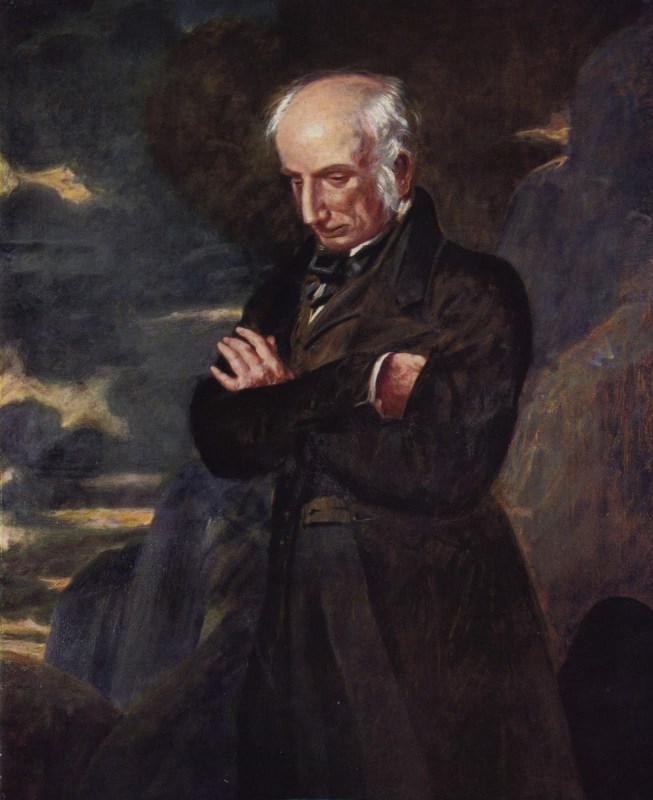
“Her favorite reading as a child was Huxley and Tyndall,” Virginia Woolf tells us of Clarissa Dalloway. As Yeats was fond of saying, “We Irish think otherwise.” He was quoting George Berkeley, reinforcing his favorite philosopher’s resistance to Lockean empiricism with his own defense of visionary powers. In the section of The Trembling of the Veil covering the period 1887-91, Yeats says he was “unlike others of my generation in one thing only.”

I am very religious, and deprived by Huxley and Tyndall, whom I detested, of the simple-minded religion of my childhood, I had made a new religion, almost an infallible Church of poetic tradition, of a fardel of stories, and of personages, and of emotions… passed on from generation to generation by poets and painters with some help from philosophers and theologians.[1]

Though Yeats was never “religious” in the normative sense, he did seek a world, as he says later in this passage, that reflected the “deepest instinct of man,” and would be “steeped in the supernatural.” That was his own instinct. It was his conscious intention, as well, to offset the scientific naturalism of John Tyndall and T. H. Huxley, “Darwin’s bulldog,” and to buttress his rebellion against his skeptical father’s Comptean positivism. In making up his own religion, Yeats relied essentially on art (“poetic tradition,” “poets and painters”), but he included in his “fardel” strands from interrelated traditions Western and Eastern. Seeing them all as a single perennial philosophy, “one history and that the soul’s,” he gathered together elements from Celtic mythology and Irish folklore, British Romanticism (especially Shelley and Blake, whose Los tells us that he “must create a system or be enslaved by another man’s”); Platonism and Neoplatonism; Rosicrucianism and Theosophy, Cabbalism, Hinduism, and Buddhism, along with other varieties of spiritualist and esoteric thought, including Gnosticism. Though Yeats was not a scholar of Gnosticism, neither a Carl Jung nor an Eric Voegelin, let alone a Hans Jonas, there are persistent themes and emphases in his thought and poetry that Gnostics, ancient and modern, would find both familiar and congenial. Others, not so much.

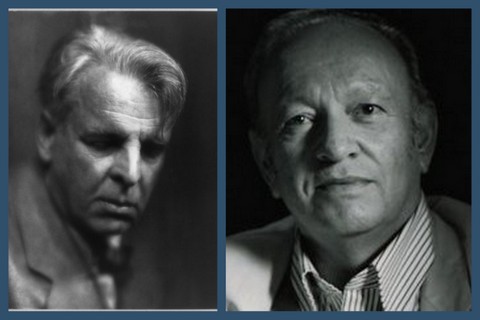
William Butler Yeats by George Charles Beresford 1911Yeats by George Charles Beresford, 1911

After this preamble, I will, in discussing the spiritual dimension in Yeats’s work, focus more often than not on Gnostic elements. But this is an essay on Yeats rather than Gnosticism. Having mentioned Gnostics “ancient and modern,” I should make it clear that, for the most part, I bring in historical Gnosticism and the tenets of certain Gnostic sects only where they illuminate particular poems; for example, “A Dialogue of Self and Soul” and “Crazy Jane and Jack the Journeyman.” Otherwise, I will have little to say of the religious movement drawing on, but competing with, Judaism and Christianity in the Eastern Mediterranean in the first and second centuries, CE.[2] Instead, I will emphasize gnosis as differentiated from historical Gnosticism, precisely the distinction made at the 1966 international conference, the Colloquium of Messina, convened to examine the origins of Gnosticism. In the colloquium’s final “Proposal,” the emphasis was on the attainment of gnosis, defined as “knowledge of the divine mysteries reserved for an elite.”

Such knowledge was individual: one’s “intuition” of revealed truth. For most Gnostics, this intuitive esoteric “knowledge” had nothing to do with either Western philosophic reasoning or with the theological knowledge of God to be found in orthodox Judaism or normative Christianity. For spiritual adepts, such intuition derived from knowledge of the divine One. For poets like Yeats, it was identified with that “intuitive Reason” which, for the Romantics—notably, Wordsworth, Coleridge, and their American disciple, Ralph Waldo Emerson—was virtually indistinguishable from the creative Imagination, which, for Yeats, was most powerfully exemplified in the prophetic poetry of Blake and Shelley.

At the same time, there is no denying the centrality of spiritual quest, of esoteric knowledge, of mysticism and “magic,” in Yeats’s life and work. In July 1892, preparing to be initiated into the Second Order of the Golden Dawn, he wrote to one of his heroes, the old Irish nationalist John O’Leary, in response to a “somewhat testy postcard” the kindly old Fenian had sent him. The “probable explanation,” Yeats surmised, was that O’Leary had been listening to the poet’s skeptical father, holding forth on his son’s “magical pursuits out of the immense depths of his ignorance as to everything that I am doing and thinking.” Yeats realizes that the word “magic,” however familiar to his own ears, “has a very outlandish sound to other ears.” But “as to Magic”:

It is surely absurd to hold me ‘weak’…because I chose to persist in a study which I decided deliberately four or five years ago to make, next to my poetry, the most important pursuit of my life….If I had not made magic my constant study I could not have written a single word of my Blake book, nor would The Countess Kathleen have ever come to exist. The mystical life is the centre of all that I do and all that I think and all that I write….I have always considered myself a voice of what I believe to be a greater renaissance—the revolt of the soul against the intellect—now beginning in the world.[3]

Just as he had emphasized art and a “Church of poetic tradition” in the creation of his own “new religion,” even here, in his most strenuous defense of his mystical and magical pursuits, Yeats inserts the caveat that they were paramount, “next to my poetry.” But this is hardly to dismiss the passionate intensity of Yeats’s esoteric and mystical pursuits. What seemed to W. H. Auden, even in his great elegy, “In Memory of W. B. Yeats,” to be “silly” or, worse, to Ezra Pound, to be “very very very bughouse” (it takes one to know one), or by T. S. Eliot to be dreadfully misguided, was taken, not with complete credulity, but very very very seriously, by Yeats himself. His esoteric pursuits, in many heterodox guises, remained an energizing stimulus, if not an obsession, throughout his life. In his elegy for Yeats, written just days after the poet’s death in January 1939, Auden says, “You were silly like us; your gift survived it all.” But it was more than that. What Auden and Eliot and Pound dismissed actually enhanced Yeats’s artistic gift.[4]

§

I just mentioned the Golden Dawn, which makes it time to briefly fill in Yeats’s esoteric resume, some of which will be familiar to many readers. He was, along with his friend George Russell (AE), a founding member, in 1885, of the Dublin Hermetic Society. It quickly evolved, in April 1886, into the Dublin Theosophical Society. Though, as he tells us in an unpublished memoir, he “was much among the Theosophists, having drifted there from the Dublin Hermetic Society,” Yeats declined to join, believing that “Hermetic” better described his own wider interests as a devotee of what he called the study of “magic.” He did join the Theosophical Society of London, in which, eager to push mystical boundaries, he became a member of the “Esoteric Section.” In 1891, he resigned; he was not, as rumor sometimes had it, “expelled,” let alone “excommunicated.”

Yeats was, of course, for more than thirty years a member of the Hermetic Order of the Golden Dawn, which he joined in London in March 1890; he stayed with the Golden Dawn until it splintered, then joined one of its offshoot Orders, the Stella Matutina. During its heyday in the 1890s, the G.D and its Inner Order of the Rose of Ruby and the Cross of Gold (R.R. & A.C.) was “the crowning glory of the occult revival in the nineteenth century,” having succeeded in synthesizing a vast body of disparate material and welding it into an effective “system.”[5] Yeats took as his Golden Dawn motto and pseudonym Demon Est Deus Inversus (D.E.D.I.). That sobriquet’s recognition of the interdependence of opposites is a nod to both William Blake and Helena Petrovna Blavatsky, the 11th chapter of whose seminal text, The Secret Doctrine (1888), bears this title.

's Rose Cross National Library of IrelandYeats’s Rose Cross, Order of the Golden Dawn, photo © National Library of Ireland

The most extraordinary of the many exotic figures that gathered in societies and cults, making Victorian London ground zero in the revolt against reductive materialism, Madame Blavatsky (HPB to her acolytes) was, of course, the co-founder and presiding genius of the Theosophical Society. In a letter to a New England newspaper, Yeats referred to her with wary fascination as “the Pythoness of the Movement.”[6] Unless we accept her own tracing of Theosophy to ancient Tibetan roots, the movement was born in 1875, in part in Blavatsky’s New York City apartment, where she kept a stuffed baboon, sporting under its arm a copy of Darwin’s Origin of Species to represent the creeping tide of scientific materialism she was determined to push back—though it should be mentioned that The Secret Doctrine was an audacious attempt to synthesize science, religion, and philosophy.

While he never shared the requisite belief in the Tibetan Masters who supposedly dictated her theosophical revelations, Yeats, without being anti-Darwinian, did share her determination to resist and turn back that materialist tide. And he was personally fascinated by the Pythoness herself, whom he first met in the considerable flesh (she then weighed well over 200 lbs.) in 1887 when he visited her at a little house in Norwood, a suburb of London. She was just 56 at the time but looked older (she would live only four more years). Young Yeats was kept waiting while she attended to some earlier visitors. Finally admitted, he “found an old woman in a plain loose dark dress: a sort of old Irish peasant, with an air of humor and audacious power.” Their first conversation was a whimsical exchange on the vagaries of her cuckoo clock, which Yeats thought had “hooted” at him. On subsequent visits he found her “almost always full of gaiety…kindly and tolerant,” and accessible—except on those occasions, once a week, when she “answered questions upon her system, and as I look back after thirty tears I often ask myself, ‘Was her speech automatic? Was she a trance medium, or in some similar state, one night in every week?’”[7]

Her alternating states were adumbrated in the phases, active and passive, HPB called, in Isis Unveiled (1877), “the days and nights of Brahma.” Yeats had read that book and Blavatsky’s alternating phases tally with, and may have influenced, his lifelong emphasis on polarity, the antinomies: the tension between quotidian reality and the spiritual or Romantic allure of the Otherworld, in forms ranging from the Celtic Faeryland to that city of art and spirit, Byzantium; and, early and late, between things that merely “seem” (Platonic “appearance,” Hindu maya) and the spiritual reality perceived by Western visionaries and Hindu hermits contemplating on Asian mountains. After reading Isis Unveiled, Yeats had delved into a book given him by AE. This was Esoteric Buddhism (1883) by Madame Blavatsky’s fellow Theosophist and sometime disciple, A. P. Sinnett, whose earlier book, The Occult World (1881), had already had an impact on Yeats. “Spirituality, in the occult sense,” Sinnett declared, “has nothing to do with feeling devout: it has to do with the capacity of the mind for assimilating knowledge at the fountainhead of knowledge itself.” And he asserted another antithesis crucial to Yeats: that to become an “adept,” a rare status “beyond the reach of the general public,” one must “obey the inward impulse of [one’s] soul, irrespective of the prudential considerations of worldly science or sagacity” (101). That Eastern impulse is evident in Yeats’s three “hermit” poems in Responsibilities (1914).

A quarter century earlier, three poems in Crossways, his first collection of lyrics— “The Indian upon God,” “The Indian to his Love,” and the lengthy (91-line) “Anashuya and Vijaya”[8]—were written under a more direct and visceral influence. For the lure of the East had another source, also related to Madame Blavatsky. Yeats had been deeply impressed with the roving ambassador of Theosophy she had sent to Dublin in April 1886, to instruct the members of the Dublin Hermetic Society in the nuances of Theosophy. The envoy was the charismatic young Bengali Swami, Mohini Chatterjee, described by Madame Blavatsky, with perhaps more gaiety than tolerance, as “a nutmeg Hindoo with buck eyes,” for whom several of his English disciples “burned with a scandalous, ferocious passion,” that “craving of old gourmands for unnatural food.”[9] Despite his inability to resist the sexual temptations presented to him (he was eventually dispatched back to India), Chatterjee preached the need to realize one’s individual soul by contemplation, penetrating the illusory nature of the material world, and abjuring worldly ambition. His book, published several months later, described reincarnational stages, and ascending states of consciousness. The fourth and final state, which “may be called transcendental consciousness,” is ineffable, though “glimpses” of it “may be obtained in the abnormal condition of extasis.”[10]

Madame Blavatsky photo taken between 1886 and 1888Madame Blavatsky, photo taken between 1886 and 1888

Yeats later said that he learned more from Chattterjee than “from any book.” Hyperbole; but there is no doubt that he was permanently affected by the concept of ancient and secret wisdom being passed on orally from generation to generation, fragmentary glimpses of an ineffable truth. There are distinctions between East and West, but, as in Gnosticism and Neoplatonism, the Theosophy of Madame Blavatsky and Mohini Chatterjee presents an unknown Absolute, from which souls emanate as fragments, or “sparks,” separated from the divine substance, and longing to return to the One from which they came. The principal Eastern variation is that, to achieve that ultimate goal, they have to “make a long pilgrimage through many incarnations, live through many lives, both in this world and the next.”[11]

Many years later, in 1929, Yeats wrote an eponymous poem, “Mohini Chatterjee.” Its final words, “Men dance on deathless feet,” were added (though attributed to various “great sages”), by Yeats himself “in commentary” on Chatterjee’s own “words” on reincarnation. There is no reference to a personal God, and we are to “pray for nothing,” but just repeat every night in bed, that one has been a king, a slave, a fool, a rascal, knave. “Nor is there anything/ …That I have not been./ And yet upon my breast/ A myriad heads have lain.” Such words were spoken by Mohini Chatterjee to “set at rest/ A boy’s turbulent days.” When that boy, almost forty years later, published “Mohini Chatterjee” in The Winding Stair and Other Poems (1933), he placed it immediately preceding what is certainly his most “turbulent” poem of spiritual purgation and reincarnation:  “Byzantium,” in which impure spirits, “complexities of mire and blood,” are presented “dying into a dance,/ An agony of trance,/ An agony of flame that cannot singe a sleeve.” Yet, like most of the other poems we will examine, “Byzantium” participates, though in this case with unique fury and surging energy, in the dominant Yeatsian agon between Time and Eternity, flesh and spirit.

§

As we’ve seen, Yeats wondered if, on heightened occasions, HPB’s speech might not be “automatic,” and herself a “trance medium.” But, since he never gave full credence to the “astral” dictations of Blavatsky’s Tibetan Masters, it is ironic that his own major esoteric text had a related genesis. His book A Vision, first published in 1925 and revised in 1937, is based on the “automatic writing” for which Mrs. Yeats discovered a gift when, in the early days of their marriage in 1917, she sensed that her husband’s thoughts were drifting back to the love of his life and his Muse, the unattainable Maud Gonne, and to her lush daughter, Iseult, to whom Yeats had also proposed before marrying his wife. Whatever their origin, psychological or occult, the wisdom conveyed to George by her “Communicators,” and then passed on to her husband, preoccupied the poet for years. Alternately insightful and idiosyncratic, beautiful and a bit bananas, A Vision may not be required reading for lovers of the poetry, even for serious students. As one Yeatsian wittily put it, speaking for many, “a little seems too much, his business none of ours.”[12]

But Yeats’s purpose was serious, and, as always, a balancing attempt to exercise individual creative freedom within a rich tradition. In dedicating the first edition of A Vision to “Vestigia” (Moina Mathers, sister of MacGregor Mathers, head of the Order of the Golden Dawn), Yeats noted that while some in the Order were “looking for spiritual happiness or for some form of unknown power,” clearly Hermetic or historically Gnostic goals, he had a more practical and poetry-centered object, though that, too, reflects the intuitive Gnosticism of poets and other creative artists seeking their own personal visions. Even back then, in the 1890s, he claims, he anticipated what would finally emerge as A Vision, with its circuits of sun and moon and its double-gyre, its tension between Fate and Freedom: “I wished for a system of thought that would leave my imagination free to create as it chose and yet make all that it created, or could create, part of one history and that the soul’s” (A Vision [1925], xi). A few years earlier, T. S. Eliot, though he had no more patience than did W.H. Auden with Yeats’s esoteric pursuits, had memorably described creative freedom operating within a larger and necessary historical discipline as the interaction between “Tradition and the Individual Talent.”

If it is not mandatory that those drawn to the poetry read A Vision, it was absolutely necessary that Yeats write it. It illuminates the later poetry, and even provides the skeletal structure for some of his greatest poems, the single best known of which, “The Second Coming,” was originally accompanied by a long note, reproducing the double-gyre, that central symbol of A Vision. Yeats tells us, in the “Introduction” to the second edition of A Vision, that, back in 1917, he struggled for several days to decipher the “almost illegible script,” which he nevertheless found “so exciting, sometimes so profound,” that he not only persuaded his wife to persevere, but offered to give up poetry to devote what remained of his own life to “explaining and piecing together those scattered sentences” which he believed contained mysterious wisdom. The response from one of the unknown writers was welcome news for him and for us: “‘No,’ was the answer, ‘we have come to give you metaphors for poetry’.” [13]

Yeats's GyreYeats’s Gyre

Yeats was a man at once credulous and skeptical. His lifelong quest for esoteric knowledge was countered by the circumspection of an intelligent, self-divided man and a notably dialectical poet. But he had no doubt that there was a spiritual realm. He strove to acquire knowledge of that world through any and all means at hand: studying the “perennial philosophy,” but not excluding the occasional resort to hashish and mescal to induce occult visions, and belief in astrology and séances, of which he attended many. A séance is at the center of one of his most dramatic plays, Words upon the Window-pane (1932), which helps explain the emphasis on “a medium’s mouth” in his cryptic poem “Fragments,” written at the same time, and which I will later discuss at some length.

Though it is difficult to track and disentangle intertwined strands of thought and influence, let alone make conclusive pronouncements, two significant Yeats scholars, Allan Grossman (in his 1969 study of The Wind Among the Reeds, titled Poetic Knowledge in Early Yeats) and that titan, Harold Bloom, in his sweeping 1970 study, grandly titled Yeats, both concluded that their man was essentially a Gnostic. The same assertion governs an impressive though unpublished 1992 Ph.D thesis, written by Steven J. Kelley and titled Yeats, Bloom, and the Dialectics of Theory, Criticism and Poetry. My own conclusion is close, but less certain.

§

There is no question that Yeats was a lifelong Seeker and that the “knowledge” he was seeking, whether poetic or Hermetic, was compatible, often in close alignment, with the quest for gnosis: that internal, intuitive knowledge of spiritual truth believed by Gnostics, ancient and modern, to provide the one path to deliverance from the constraints of material existence, and thus to be essential to salvation.  On the other hand, he wanted, as he told “Vestigia,” to participate in a spiritual tradition that “would leave my imagination free to create as it chose.”  The power and passionate intensity of much of his best poetry derives from Yeats’s commitment to the paradox that the “sacred,” unquestionably valid, was to be found through the “profane,” and in the here and now.

A profound point was made three-quarters of a century ago by a perceptive student of Yeats’s life and work, Peter Allt, later the editor of the indispensable “Variorum Edition” of the poems. Allt argued persuasively that Yeats’s “mature religious Anschauung” consists of “religious belief without any religious faith, notional assent to the reality of the supernatural” combined with “an emotional dissent from its actuality.”[14] In Gnostic terms (which are not Allt’s), Yeats, as a student of secret wisdom, responded, not to the orthodox Christian emphasis on pistis (God’s gift of faith), but to gnosis: the esoteric knowledge derived from individual intuition of divine revelation, often, as in that most formidable of Gnostics, Valentinus, in the guise of myth garmented as philosophy.[15] What Allt refers to as “emotional dissent” illuminates Yeats’s resistance to Christianity, and his occasional need to “mock Plotinus’ thought/ And cry in Plato’s teeth,” as he does in the final section of “The Tower” in the very act of preparing his “peace” and making his “soul.” But emotional dissent and the making of one’s own soul in an act of self-redemption are hardly alien to the concept of individual gnosis.

Paramount to understanding Yeats as man and poet is recognizing the tension between the two worlds, between what he called the primary and the antithetical, the never fully resolved debate between the Soul and the Self (or Heart). As we will see, that tension plays out from his earliest poems to the masterpieces of his maturity. The theme begins with his first published major work, The Wanderings of Oisin (1889), a lengthy quest-poem centering on the debate between paganism and Christianity, between the Celtic warrior Oisin and St. Patrick. The theme continues with his pivotal Rosicrucian poem, “To the Rose upon the Rood of Time” (1893), and culminates in the great debate-poems of his maturity: “A Dialogue of Self and Soul” (1927) and the condensed, career-synopsizing debate between “The Soul” and “The Heart” in section VII of the poetic sequence revealingly titled “Vacillation,” which appeared forty years after “To the Rose upon the Rood of Time.”

The final section of “Vacillation” ends with the poet blessing, yet—gently and gaily, if somewhat patronizingly—rejecting the Saint, here represented by the Catholic theologian Baron von Hügel, who had, in his book The Mystical Element of Religion, stressed “the costingness of regeneration.” In the last and best of his Four Quartets, T. S. Eliot aligns himself with von Hügel by endorsing, in the conclusion of “Little Gidding” (lines 293-94), “A condition of complete simplicity/ (Costing not less than everything).” In section 2, in the Dantesque ghost-encounter (seventy of the finest lines he ever wrote and, by his own admission, the ones that had “cost him the most effort”), Eliot respectfully but definitively differentiated himself from the recently deceased Yeats. In that nocturnal encounter with a largely Yeatsian “compound familiar ghost,” Eliot echoes in order to alter Yeats’s poem “Vacillation,” and the refusal of “The Heart” to be “struck dumb in the simplicity of fire!”[16] In the context of the theme of this essay, the contrast between Eliot and Yeats is illuminating; and Eliot is right to perceive as his mighty opposite in spiritual terms, W. B. Yeats, whom he pronounced in his 1940 memorial address, the greatest poet of the century, “certainly in English and, and, as far as I can tell, in any language,” but who was also, from Eliot’s Christian perspective, an occultist and a pagan.

The charges were hardly far-fetched. The final section of “Vacillation” begins with the poet wondering if he really must “part” with von Hügel, since both “Accept the miracles of the saints and honor sanctity.” And yet he must, for although his heart “might find relief/ Did I become a Christian man and choose for my belief/ What seems most welcome in the tomb,” he must

xxxxxxxxxxxxxxxxxxxxxplay a predestined part.

Homer is my example and his unchristened heart.

The lion and the honeycomb, what has Scripture said?

So get you gone, von Hugel, though with blessings on your head.

In sending the poem to Olivia Shakespear, his first lover and later most intimate lifetime correspondent, Yeats, having just re-read all his lyric poetry, cited that line, and observed: “The swordsman throughout repudiates the saint, but not without vacillation. Is that perhaps the sole theme—Usheen and Patrick—“so get you gone Von Hugel though with blessings on your head’?” (Letters, 790)

§

In referring throughout to Yeats as a Seeker, I am alluding to a very early, little-known “dramatic poem in two scenes” with that title. Though Yeats later struck The Seeker from his canon, its theme—the perennial quest for secret knowledge, usually celebrated but always with an acute awareness of the attendant dangers of estrangement from “mere” human life—initiates what might be fairly described as the basic and archetypal pattern of his life and work.[17] The “Seeker” of the title is an aged knight who sacrifices the normal comforts of life and shirks social responsibilities in order to follow a mysterious, beckoning voice. In his dying moments, he discovers that the alluring voice he has been pursuing all his life is that of a bearded hag, whose name is “Infamy.” That final turn looks back to Celtic mythology and to Book I, Canto ii of Spenser’s Faery Queen, where the evil witch Duessa, outwardly “faire,” is actually “fowle.”  It also anticipates Rebecca du Maurier’s short story, “Don’t Look Now” (later turned by director Nicholas Roeg into a haunting film starring Donald Sutherland and Julie Christie). Of course, Celtic mythology also has instances of reversal. In the most famous modern version (Yeats’s 1902 play Cathleen ni Houlihan, written for and starring the poet’s beloved Maud Gonne), the old hag is climactically transformed into a beautiful woman: “a young girl with the walk of a queen,” who is Ireland herself, rejuvenated by blood-sacrifice.

Maud Gonne in Cathleen Ni Houlihan Project Gutenberg eTextMaud Gonne in Cathleen Ni Houlihan

As in that seminal precursor poem for Yeats, Shelley’s Alastor, this theme, with its tension between the material and spiritual worlds, is at once Gnostic and High Romantic. As such, the Seeker-theme illuminates, along with several of Yeats’s most beautiful early quest-lyrics, two quintessential, explicitly Rosicrucian, poems: “To the Rose upon the Rood of Time” and, a poem I will get to in due course, “The Secret Rose.”

“To the Rose upon the Rood of Time,” the italicized poem opening the 1893 volume The Rose, establishes, far more powerfully than The Seeker, this poet’ s lifelong pattern of dialectical vacillation, of being “pulled” between the temporal and spiritual worlds. In his 1907 essay “Poetry and Tradition,” Yeats would fuse Romanticism (Blake’s dialectical “Contraries” without which there can be “no progression”) with Rosicrucianism: “The nobleness of the Arts,” Yeats writes, “is in the mingling of contraries, the extremity of sorrow, the extremity of joy, perfection of personality, the perfection of its surrender; and the red rose opens at the meeting of the two beams of the cross, and at the trysting place of mortal and immortal, time and eternity.”[18]

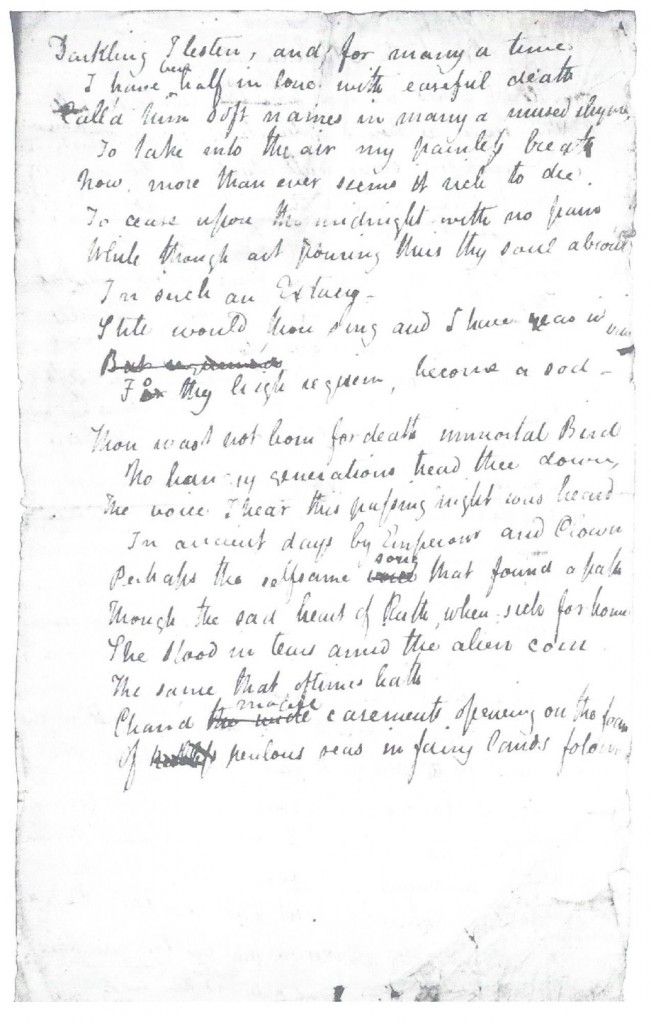
In “To the Rose upon the Rood of Time,” the symbolist poet seeks to “find” the immortal within the mortal; yet there is an inevitable tension between “all poor foolish things that live a day” and “Eternal Beauty wandering on her way.” That mingling, or contrast, concludes the first of the poem’s two 12-line movements. The second part begins by invoking the Rose to “Come near, come near, come near…,” only to have the poet suddenly recoil from total absorption in the eternal symbol. He may be recalling Keats, who, at the turning point of the “Ode to a Nightingale,” suddenly realizes that if he were to emulate the nightingale’s “pouring forth thy soul abroad/ In such an ecstasy,” by dying, he would, far from entering into unity with the “immortal Bird,” be divorced from it, and everything else, forever: “Still wouldst thou sing, and I have ears in vain—/ To thy high requiem become a sod.”

Yeats’s recoil in “To the Rose upon the Rood of Time” is no less abrupt, and thematically identical:  “Come near, come near, come near—Ah, leave me still/ A little space for the rose- breath to fill!” This sudden recoil, marked by a rare exclamation-point, is a frightened defense against the very Beauty he remains in quest of—like his precursor, the Shelley of the “Hymn to Intellectual Beauty.” But Yeats hesitates, afraid that he will be totally absorbed, engulfed, in the spiritual realm symbolized by the Rose. Along with Keats at the turning-point of the “Ode to a Nightingale,” another parallel may be illuminating.

The Latin Epigraph to The RoseSero te amavi, Pulchritudo tam antiqua et tam nova! Sero te amavi—is from The Confessions (“Too late I have loved you, Beauty so old and so new! Too late I have loved you”), a passage (X, 27) in which St. Augustine, addressing God, longs to be kindled with a desire that God approach him. Yeats would later, in 1901, quote these same Latin lines to illustrate that the religious life and the life of the artist share a common goal.[19] But the plea for “a little space” in “To the Rose upon the Rood of Time” may remind us of a more famous remark by Augustine, also addressed to God, but having to do with profane rather than sacred love. A sinful man, still smitten with his mistress, he would, Augustine tells us, pray: “‘O Lord, give me chastity and continency, but not yet!’ For I was afraid, lest you should hear me soon, and soon deliver me from the disease of concupiscence, which I desired to have satisfied rather than extinguished” (Confessions XIII, 7:7).

Title page of Summum Bonum by Rosicrucian apologist Robert Fludd 1629Title page of Summum Bonum by Rosicrucian apologist Robert Fludd, 1629

In pleading with his Rose-Muse to “come near,” yet “leave me still/ A little space for the rose-breath to fill,” Yeats also fears a too precipitous deliverance from the temporal world. Augustine is “afraid, lest you [God] should hear me too soon.” Yeats is afraid “Lest I no more hear common things that crave.” Becoming deaf to the transient world with its “heavy mortal hopes that toil and pass,” he worries that he will “seek alone to hear the strange things said/ By God to…those long dead,” and thus “learn to chaunt a tongue men do not know.” The hidden wisdom and eternal beauty symbolized by the Rose is much to be desired. But this quester is also a poet; and “a poet,” as Wordsworth rightly said in the Preface to Lyrical Ballads, is above all, “a man speaking to other men.” The “rose-breath” is the crucial “space” between the two worlds. Here, as elsewhere, self-divided Yeats is pulled in two antithetical directions. Hence the debates, implicit and often explicit, that shape so many of his poems.

§

A memorable paragraph in his most beautiful prose work begins, “We make out of the quarrel with others, rhetoric, but out of the quarrel with ourselves, poetry.”[20] Almost forty years after he wrote “To the Rose upon the Rood of Time,” Yeats presented, in section VII of his poetic sequence “Vacillation,” a debate between “The Soul” and “The Heart.” Once again, and more dramatically, the more Yeatsian of the interlocutors resists the option of chanting in “a tongue men do not know.” The Soul offers “Isaiah’s coal,” adding, in an imperious rhetorical question, “what more can man desire?” But the Heart, “a singer born,” refuses to be “struck dumb in the simplicity of fire,” his tongue purified but cauterized by the spiritual fire of that live coal the rather Promethean angel took from God’s altar and brought to the prophet’s lips in Isaiah 6:6-7. Having just refused to “seek out” spiritual “reality,” the “Heart” goes on, after indignantly rejecting Isaiah’s coal and “the simplicity of fire,” to adamantly spurn Soul’s final promise and threat: “Look on that fire, salvation walks within.” The Heart anachronistically but dramatically responds, “What theme had Homer but original sin?” Though it firmly stands its antithetical ground, the Heart does not deny the lot-darkening concept of original sin, and accepts the notional distinction (Platonic, Neoplatonic, Christian) between spiritual “reality” and material “things that [merely] seem.” But since it is these resinous things of the world that fuel an artist’s fire and provide a “theme,” the Heart emotionally dissents. The tension between contraries, and the titular “vacillation,” persist, as does the desire to merge the antinomies at some “trysting place,” Yeats’s language characteristically “mingling” the spiritual and the erotic.

Before turning to “The Secret Rose,” which appeared in Yeats’s next volume, two other poems from The Rose merit comment: “Who Goes with Fergus?” and, immediately following, “The Man who Dreamed of Faeryland.” Both are beautiful, and both embody the tension between the two worlds. The first suggests that the peace promised by an alluring Otherworld is more tumultuous than it appears; the second, like The Seeker and “The Stolen Child,” emphasizes the human cost of seduction by Otherworldly dreams. I intend to return to “The Man who Dreamed of Faeryland” later in this essay, juxtaposing it with “What Then?,” a poem written almost a half-century later, and which, I believe, amounts to a point-by-point refutation of the earlier poem—except, crucially, for the refrain.

“The Man who Dreamed of Faeryland” is a catalog of might-have-beens. The “tenderness” of love; the “prudent years” that might have freed him from “money cares and fears”; the maintenance of “a fine angry mood” leading to “vengeance” upon mockers; and, finally, “unhaunted sleep” in the grave: all have been lost, spoiled by the repeated “singing” of “an unnecessary cruel voice” that “shook the man out of his new ease,” paralyzing him so that he dies without ever having lived.[21] The voice—a variation on the siren call of the faeries in “The Stolen Child” (“Come away, O human child!”) and on the “voice” that beckons and deceives the victim of The Seeker—emanates, of course, from the Otherworld, in this case from a Celtic “woven world-forgotten isle,” where

There dwelt a gay, exulting, gentle race

Under the golden or the silver skies;

That if a dancer stayed his hungry foot

It seemed the sun and moon were in the fruit;

And at that singing he was no more wise.

The poem ends, “The man has found no comfort in the grave.” But that closing line is immediately preceded by a rather cryptic couplet: “Why should those lovers that no lovers miss/ Dream, until God burn Nature with a kiss?” Presumably, in Faeryland, where the boughs are “changeless” and the waves “dreamless,” all dreams are fulfilled, as are the desires of those perfect lovers, who are together, and therefore do not “miss” one another.[22] Thus, there is no need for further dreaming, “until” (always a pivotal word in poems, and notably in Yeats’s poems) “God burn Nature with a kiss.” Yeats’s early poetry has its apocalypses, among the most dramatic the windblown Blakean conflagration in “The Secret Rose.” But the apocalypse in the Faeryland poem is unexpected, unless one has come across Yeats’s story “The Untiring Ones,” where the faeries dance for many centuries “until God shall burn up the world with a kiss.”[23]

We also have a supposedly perfect world, with the “deep wood’s woven shade” and lovers who “dance upon the level shore,” in “Who Goes with Fergus?” Originally a song in the earliest version (1892) of Yeats’s play The Countess Kathleen, it was a favorite among the early Yeats poems memorized by James Joyce—the song he sang in lieu of the requested prayer at his mother’s deathbed and whose words haunt his alter ego, Stephen Dedalus, throughout Bloomsday. Fergus, the king of Ulster who put aside his crown to live in peace and “pierce the deep wood’s woven shade,” invites a young man and maid to join him in his forest paradise, where, he promises, they will “brood on hopes and fear no more”;

And no more turn aside and brood

Upon love’s bitter mystery;

For Fergus rules the brazen cars,

And rules the shadows of the wood,

And the white breast of the dim sea

And all disheveled wandering stars.

That enchanting final line has sexual precursors; it fuses the “golden tresses” Eve “wore/ Disheveled” and in “wanton ringlets” (Paradise Lost 4:305-6) with Pope’s echo in The Rape of the Lock, which ends with Belinda’s shorn tresses consecrated “midst the Stars”: “Not Berenices’s Locks first rose so bright,/ The Heavens bespangling with disheveled Light.” Those sexual undercurrents are present in all three of the concluding lines. Despite the emotional respite promised by Fergus, the poem’s climactic imagery—“shadows of the wood,” the “white breast of the dim sea,” the “disheveled wandering stars”—embracing earth, sea, and the heavens—extends to this supposedly peaceful paradise all the erotic tumult of “love’s bitter mystery.”

§ 

The quest-theme first established crudely in The Seeker, beautifully in “The Stolen Child,” “The Man who Dreamed of Faeryland,” and “Who Goes with Fergus?,” and, perhaps most seminally in “The Rose upon the Rood of Time,” also provides the thematic structure for the two Byzantium poems, featuring, first, a sailing after knowledge and, second, a process of purgation, both of which turn out to be simultaneously spiritual and erotic. Looking ahead several decades, therefore, I’m compelled to note that something similar happens in both Byzantium poems, whose subject is the opposition of flesh and spirit, life and death, natural flux and spiritual form, but whose shared theme is that these antitheses are polarities—Blakean Contraries ultimately and inextricably interdependent. The Byzantium poems seem proof of the artistic truth of Yeats’s Golden Dawn name, Demon Est Deus Inversus, and of Blake’s proverb, “Eternity is in love with the productions of time.” That proverb is from The Marriage of Heaven and Hell, Blake’s affirmation of the polar nature of being, privileging, in the dialectic of necessary Contraries, “Energy” and the active “Prolific” over the “Devouring,” the passive and religious.

In “Sailing to Byzantium,” a sixty-year-old and temporarily impotent poet, painfully aware that the world of youth and sexual vitality is “no country for old men,” sets sail for and has finally “come/ To the holy city of Byzantium.” Everything, yet nothing, has changed. The opening stanza’s “young/ In one another’s arms, birds in the trees,/—Those dying generations at their song—” are reversed yet mirrored in the final stanza. “Once out of nature,” the aging speaker, his heart “sick with desire/ And fastened to a dying animal,” imagines that heart consumed away and himself (with what Denis Donoghue once wittily characterized as “the desperate certainty of a recent convert”) transformed into a bird of “hammered gold and gold enameling,” set “upon a golden bough to sing/ To lords and ladies of Byzantium/ Of what is past, or passing, or to come.”

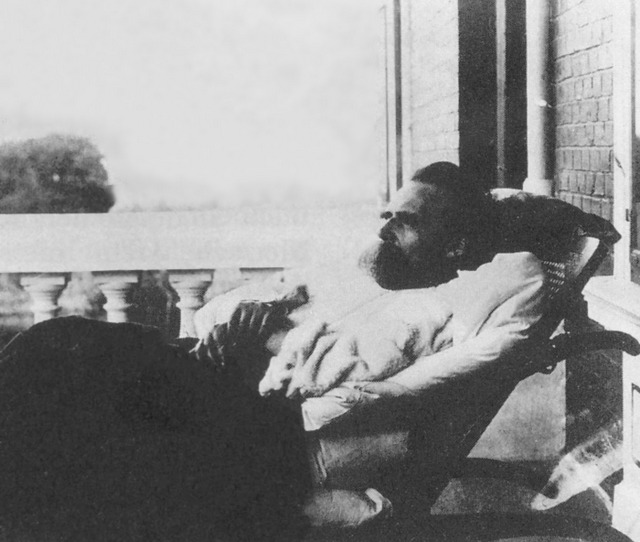
Yeats later in lifeYeats later in life

In a 1937 BBC broadcast, Yeats glossed the golden bird and Virgilian golden bough as symbolic “of the intellectual joy of eternity, as contrasted to the instinctual joy of human life.” But these golden artifacts are still, however changed, recognizable “birds in the trees,” so that, whatever the ostensible thrust of the poem, the undertow of the imagery recreates—as in the “white breast” and “disheveled” stars of the supposedly tumult-free final stanza of “Who Goes with Fergus?”—the very world that has been rejected. Further, the now-avian poet is singing to “lords and ladies” of Byzantium, the sexual principle surviving even in that “holy city”;  and his theme, “What is past, or passing, or to come,” repeats—in a Keatsian “finer tone,” to be sure—the three-stage cycle of generation presented in the opening stanza: “Whatever is begotten, born, and dies.” “Caught in that sensual music,” those “dying generations….neglect/ Monuments of unageing intellect.” But that golden bird set on the golden bough, however symbolic of unageing intellect, seems still partially caught in that sensual music, singing of the cycle of time to lords and ladies. Nature is the source of art, which, in turn, expresses nature; and the audience will always necessarily be men and women.

I’ve already referred to “Byzantium”—borrowing the adjective from “Mohini Chatterjee,” the poem that immediately precedes it—as Yeats’s most “turbulent” engagement in the tension, marked by conflict and continuity, between flesh and spirit, natural and supernatural, Time and Eternity. Though he admired the first Byzantium poem, Yeats’s friend Sturge Moore expressed a serious reservation: “Your Sailing to Byzantium, magnificent as the first three stanzas are, lets me down in the fourth, as such a goldsmith’s bird is as much nature as a man’s body, especially if it only sings like Homer and Shakespeare of what is past or passing or to come to Lords and Ladies.” It’s difficult to believe that this was news to Yeats; but, agreeing with Moore to the extent that his friend had shown him that “the idea needed exposition,” he set out to address the issue in a second poem.[24]

The result was “Byzantium,” a poem that complicates rather than resolves Sturge Moore’s intelligent if limited quibble. Holy and purgatorial though the city may be, we are told, as the “unpurged images of day recede,” that the Emperor’s soldiery are “drunken” and “abed,” perhaps exhausted from visiting temple prostitutes, since we hear, as night’s resonance recedes, “night-walker’s song/ After great cathedral gong.” Amid considerable occult spookiness, including a walking mummy, more image than shade or man, two images of the Eternal emerge, the works of architect and goldsmith; both transcending and scorning the human cycle, sublunary and changeable:

A starlit or a moonlit dome disdains

All that man is,

All mere complexities,

The fury and the mire of human veins.

The second emblem of eternity reprises the first poem’s icon of “hammered gold and gold enameling,” the form the speaker of “Sailing to Byzantium” imagined himself taking once he was “out of nature.” This avian artifact,

Miracle, bird, or golden handiwork,

More miracle than bird or handiwork,

Can, like the cocks of Hades crow,

Or, by the moon embittered, scorn aloud

In glory of changeless metal

Common bird or petal

And all complexities of mire and blood.

However golden and immutable it may be, that the miraculous bird can be moon-embittered and scornful suggests that it may be “almost as much nature” as the golden bird Moore found insufficiently transcendent in the first Byzantium poem. Even in the overtly primary or soul-directed Byzantium poems, the antithetical or life-directed impulse is too passionate to be programmatically subdued. We remember (as with the Byzantium poems’ precursors, Keats’s Nightingale and Grecian Urn odes) the rich vitality of the sexual world being “rejected” in the first poem, and the ambiguity of the famous phrase, “the artifice of eternity.” And the final tumultuous stanza of “Byzantium,” especially its astonishing last line, evokes a power almost, but not quite, beyond critical analysis:

The multitude of souls (“Spirit after spirit!”) riding into the holy city, each “Astraddle on the dolphin’s mire and blood,” cannot be controlled, even though that surging power is said to be broken by the Byzantine artificers and artifacts. The poem ends with a single extraordinary burst, asserting one thing thematically, but, in its sheer momentum and syntax, suggesting quite another:

xxxxxxxThe smithies break the flood,

The golden smithies of the Emperor!

Marbles of the dancing floor

Break bitter furies of complexity,

Those images that yet

Fresh images beget,

That dolphin-torn, that gong-tormented sea.

The marbled floor is not only the site for the preceding stanza’s ritual of purgation, where the spirits are envisioned “dying into a dance”; the floor itself seems to be “dancing,” the city almost lifted off its dykes under the inundation of the prolific sea of generation. The Emperor’s smithies and marbles, we are twice told, “break” (defend against, order, tame) these “furies,” “images,” and the sea itself. All three are the direct objects of that one verb; but, as Helen Vendler has brilliantly observed, “Practically speaking, the governing force of the verb ‘break’ is spent long before the end of the sentence is reached.”[25] The artistic defenses erected to order and transform the flood end up emphasizing instead the turbulent plenitude of nature, and those spawning “images that yet/ Fresh images beget.”

We are left—in one of the most remarkable single lines in all of English literature—with “That dolphin-torn, that gong-tormented sea.” Along with the images that yet fresh images “beget,” that final line recalls but overpowers the teeming fish and flesh—all that is “begotten, born, and dies,” the “salmon-falls, the mackerel-crowded seas”—of “Sailing to Byzantium.” The dolphin is at once the mythological savior and transporter of souls to paradise and kin to us, who share its complexities of “mire and blood.” Inversely, the “gong,” though emblematic of Time, also, since it recalls the semantron of the opening stanza, the “great cathedral gong,” has to be seen and heard as tormenting the surface of life, yet pulling the sea of generation up, to the spiritual source of life’s transcendence. Once again, though more powerfully than usual, we are caught up in the dialectical conflict between Time and Eternity, sexuality and spirituality, Self and Soul.

§

We will shortly be returning, at long last, to the second of the Rosicrucian poems earlier mentioned. “The Secret Rose” (1896), the last of his explicit Rose poems, appeared in Yeats’s next collection, the autumnal The Wind Among the Reeds (1899). This fin-de-siècle and symboliste volume (his friend Arthur Symons’s influential The Symbolist Movement in Poetry appeared the same year), evokes a fallen world, soon to be visited by a longed-for apocalyptic wind. This volume includes what may be Yeats’s most beautiful early poem, the exquisite “Song of Wandering Aengus,” which projects ultimate union between the temporal and eternal as a “trysting place,” sexual and, in its mingling—as in that dreamt-of “Faeryland,” where “the sun and moon were in fruit”— of lunar apples of silver and solar apples of gold: a marriage of alchemy and Deuteronomy. The long-sought immortal, transformed from fish to a woman of the Sidhe, and Aengus, a notably human god, will meet in Eternity, an earthly Paradise where he will

xxxxxxkiss her lips and take her hands;

And walk among long dappled grass,

And pluck till time and times are done

The silver apples of the moon,

The golden apples of the sun.

Less entrancing poems in The Wind Among the Reeds feature a world-weary speaker who, to quote the longest-titled poem in a volume of many long titles, “mourns for the Change that has come upon him and his Beloved, and longs for the End of the World.” That consummation devoutly to be wished is far more dramatic in “The Secret Rose.” The poem begins and ends, “Far-off, most secret, and inviolate Rose”: a rondure suggesting that all is now enfolded (the verb “enfold” appears twice in the poem) within the petals of the symbolic flower. The speaker, and Seeker is among those questers who “have sought thee in the Holy Sepulchre,/ Or in the wine-vat,” a questing alternately Christian or Dionysian. Wandering Aengus sought his elusive beauty (the “apple-blossom in her hair” allying her with Maud Gonne, associated from the day Yeats met her with apple blossoms) “through hollow lands, and hilly lands.” The Seeker in “The Secret Rose” also, over many years, “sought through lands and islands numberless…/ Until he found”—unsurprisingly since this poem, too, was written for Maud Gonne—“a woman of so shining loveliness” that one desired consummation suggests another. No sooner is the beautifully-tressed woman of shining loveliness “found” (a state  projected in “The Song of Wandering Aengus,” where “I will find out where she has gone…”) than we are told:

xxxxxxxxxxxxxxxxxxxxI, too, await

The hour of thy great wind of love and hate.

When shall the stars be blown about the sky,

Like the sparks blown out of a smithy, and die?

Surely thine hour has come, thy great wind blows,

Far-off, most secret, and inviolate Rose?

This apocalypse, with its approaching “hour” and final questions, looks before and after. That “surely” anticipates (“Surely some revelation is at hand,/ Surely the Second Coming is at hand…”) Yeats’s most powerful, terrifying, and yet longed-for apocalypse, in the most-quoted poem of the past hundred years. The “vast image” of the sphinx-beast that rises up from “sands of the desert,” coming “out of Spiritus Mundi,” in “The Second Coming” had its occult (as opposed to literary) origin in an 1890 symbolic-card experiment conducted with Yeats by MacGregor Mathers, head of the Order of the Golden Dawn. Yeats suddenly saw “a gigantic Negro raising up his head and shoulders among great stones,” changed in its published version to “a desert and a Black Titan.”[26] And “The Second Coming,” like “The Secret Rose,” also terminates in a mysterious question mingling breathless anticipation with ambiguity, an uncertain certitude. “But now I know,” Yeats began the final movement of “The Second Coming,” but the poem ends with a question, the mark of the terrified but excited reverie that defines the Sublime. Intriguingly, whatever gnosis (‘now I know…”) the visionary poet claimed in the final version of “The Second Coming” was reserved, in the drafts, to the apocalyptic “rough beast” itself: “And now at last knowing its hour come round/ It has set out for Bethlehem to be born.”[27]

But I said that the apocalyptic “hour” of “The Secret Rose” looks before as well as after; and just as “The Second Coming” had a genesis both occult and literary, so too with the apocalypse of “The Secret Rose.” In both cases, the primary literary source is Blake. The slouching rough beast of the later poem fuses (among other creatures) Blake’s sublime Tyger with his striking illustration (in The Marriage of Heaven and Hell and elsewhere) of bestial Nebuchadnezzar slouching on all fours. In the earlier poem, the precursor passage is Blake’s description of “The stars consumed like a lamp blown out” (The Four Zoas, IX: 826), which reappears as Yeats’s “stars…blown about the sky/ Like the sparks blown out of a smithy.” Even Yeats’s substitution of a smithy for a lamp pays tribute to Blake’s great creative figure, the blacksmith-god, Los (in Eternity, Urthona).
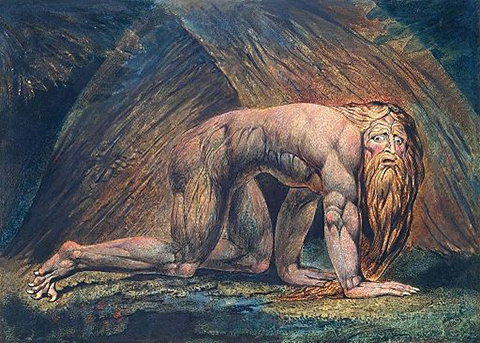
William Blake Nebuchadnezzar (Tate copy)William Blake’s Nebuchadnezzar

The Blakean echo is hardly accidental. Of the three Rosicrucian short stories Yeats wrote in the 1890s (“Rosa Alchemica,” “The Tables of the Law,” and “The Adoration of the Magi”), “The Secret Rose” is, as the titles alone suggest, most closely related to the first. The world-traveling hero of “Rosa Alchemica,” the magician Michael Robartes, is a student of comparative literature, especially drawn, as was Yeats himself, to the prophetic poems of William Blake.  Blake’s epic The Four Zoas (originally titled Vala, and abandoned in manuscript in 1807) was rediscovered and published in 1893 by none other than Yeats (and his co-editor, Edwin Ellis). In the finale of The Four Zoas, from which Yeats lifted the lines about the “stars” being “blown” about the skies like “sparks,” redeemed Man, having finally purged all the evil in himself, can look at infinity unharmed.  Los “rose in all his regenerative power”; the hour of transformation arrives:

The sun has left his blackness & found a fresher morning,

And the mild moon rejoices in the clear & cloudless night,

And Man walks forth from midst of the fires, the evil is all consumed:

His eyes behold the angelic spheres arising night & day;

The stars consumed like a lamp blown out, & in their stead, behold:

The expanding eyes of Man behold the depths of wondrous worlds.

Here we have the potentially divine Man envisioned by so many Gnostics, Hermeticists, Cabbalists, and Rosicrucians: Valentinus’s “new man…more noble in his glorified state” than he was before “the conflagration”: a Man fully human, liberated from all imprisoning limitations, whether of materialism, the merely bodily (Lockean/empiricist) senses, or political tyranny. In the final lines of The Four Zoas, Urthona, the eternal form of Los (and, of the four, the Zoa least in need of redemption) “rises from the ruinous walls/In all his ancient strength.” According to one of Yeats’s (and Joyce’s) favorite phrases of Blake (from an 1800 letter to William Hayley), “The ruins of Time build mansions in Eternity.”  In Blake’s anything-but-static Eternity, Urthona, though still ready for combat, is now armed to wage “intellectual war,” the “war of swords” having “departed.” In his single most famous and concise appeal for an imaginative art prophetically inspired and intended to achieve individual and societal redemption, Blake says his “sword” will not “sleep” in his hand. But the weaponry (“Bow of burning gold,” “Arrows of desire,” Spear, and “Chariot of fire”) is to be employed in ceaseless “Mental Fight.” He has, Gnostics would say, achieved gnosis.[28]

§

Gnosis takes many forms. I have already noted what the visionary poet of “The Second Coming” claims to “know,” and mentioned the very different assertion in the drafts, where the rough beast, “knowing its hour come round,” possesses whatever gnosis there is to go round. In “Leda and the Swan” (1925), the sonnet that begins the three-part cycle that ends with “The Second Coming,” we have another annunciation of a new historical era, beginning with a birth, and a hint of gnosis. Did Leda, raped by the swan-god Zeus, “put on his knowledge with his power/ Before the indifferent beak could let her drop?” Here is another poem, like “The Secret Rose” and “The Second Coming,” ending in a question, the mystery-marker of the Sublime. There is, of course, no question about the brutality of the sudden rape, and the indifference of the God following the “shudder in the loins,” which, impregnating Leda, completes Zeus’s mission.

For in fathering Helen of Troy, he also “engenders there” the Trojan War (depicted in imagery at once military and sexual: “The broken wall, the burning roof and tower”) and its sequelae (“And Agamemnon dead”), initiating an historical cycle destined to last until, two thousand years later, another lady, the Virgin Mary, would be visited by the Holy Spirit: another divine bird, his “great wings beating about the room” in Yeats’s “The Mother of God” (1931), a dramatic monologue spoken by the terrified village girl singled out to bear “The Heavens in my womb.” The question raised at the end of “Leda and the Swan” is not merely rhetorical. Did Leda, “her thighs” rather tenderly “caressed/ By the dark webs,” so intrigue the swan-god that he inadvertently held her just long enough (“Before the indifferent beak could let her drop”) for her to participate momentarily in “his knowledge,” the divine gnosis of Zeus himself?

Leda and the Swan by Jerzy Hulewicz 1928Leda and the Swan by Jerzy Hulewicz, 1928

Gnosis also figures in the cryptic poem, “Fragments,” which features, like its  far better-known cousin, “The Second Coming,” a strange birth, and a revelation derived from counter-Enlightenment intuition, gnosis. Written between 1931 and 1933, this epigrammatic poem is in two short parts. Here is the first:

Locke sank into a swoon;

The Garden died;

God took the spinning-jenny

Out of his side.

In this parody of Genesis, the role of sleeping Adam, from whose side God took Eve, is usurped by a swooning John Locke, whose empiricist epistemology and distinction between primary and secondary qualities seemed to Yeats, as to George Berkeley and Blake before him, to have fractured the organic unity of the living world, and thus destroyed not only nature but its archetype, the Edenic “Garden.” That the resultant birth, that of the “spinning-jenny,” bears a woman’s name accentuates the irony, and the horror. It was not altogether to the benefit of humanity and a sign of progress, Yeats once mordantly observed, for the home spinning wheel and the distaff to have been replaced by the robotic looms and masculinized factories of the Industrial Revolution. Blake’s god of the fallen world, Urizen, presides over an Enlightenment world-machine perceived as “the Loom of Locke” washed by the “Water-wheels of Newton,” all “cruel Works” with “cogs tyrannic” moving each other “by compulsion” (Jerusalem 15:15-19)

Yeats is never closer to Blake than in this first part of “Fragments,” where he emulates not only his mentor’s attack on Locke (and Newton), but also his genius for epigram and crystallization, Blake being “perhaps the finest gnomic artist in English literature.” In Yeats’s gnomic vision in “Fragments” (I), which has been called “certainly the shortest and perhaps not the least comprehensive history of modern civilization,” the Enlightenment is revealed as a nightmare for the creative imagination; and the monster that rides upon this spirit-sealing sleep of reason is the mechanistic conception of matter, indeed the whole mechanistic rather than organic way of thinking (a crucial contrast Yeats knew from Coleridge, who had borrowed it from A. W. Schlegel), here symbolized by the invention that epitomizes the Industrial Revolution.[29] Yeats replaces the divinely anesthetized flesh of Adam with Locke’s imaginatively inert body (sunk into that fall into division Blake called “Single Vision & Newton’s sleep”), and substitutes for Eve, the beautiful embodiment of Adam’s dream, a mechanical contraption, a patriarchal cog in the dark Satanic mills of which it is proleptic.

Spinnng room in cotton mill 1916Spinning room in a New England cotton mill, 1916, photo courtesy National Archives

But how does Yeats know all this, and know it to be the “truth”? It wasn’t only from absorbing Blake. Or only from reading Alfred North Whitehead’s Science and the Modern World (1925), a chapter of which, “The Romantic Reaction,” Yeats synopsized with a related variation of the Genesis 2 creation-metaphor, jotting in the margin: “The dry rib (Pope) becomes Eve (Nature) with Wordsworth.”[30] Yeats answers his own question in “Fragments” II:

Where got I that truth?

Out of a medium’s mouth,

Out of nothing it came,

Out of the forest loam,

Out of dark night where lay

The crowns of Nineveh.

Is this mere occult mumbo-jumbo, intended to twist the tail of positivists and empiricists? Well, yes and no. But before coming to conclusions, let’s pause to appreciate the wit of the lines, alive with reversals and allusions. Yeats’s ironic reversal of the birth “out of” the side of Locke takes the form of a counter-“truth,” born “out of” (repeated four times in succession) a variety of sources. The anaphora is Whitmanian— “Out of the cradle endlessly rocking,/ Out of the mocking bird’s throat, the musical shuttle,/ Out of the Ninth-month midnight.” And Whitman’s birth-images may have suggested Yeats’s equally fertile sources: the female “medium’s mouth,” the “forest loam,” and “dark night,” all in organic and fecund contrast to the mechanical, sterile “birth” of the spinning-jenny.

Yeats deliberately begins with what rationalists would dismiss as among the least reputable sources of “truth”: “Out of a medium’s mouth…” Even Madame Blavatsky, whose own experiments had been discredited, told Yeats, who reported it to John O’Leary in a May 1889 letter, that she “hates spiritualism vehemently—says mediumship and insanity are the same thing” (Letters, 125). In “Fragments” (II) Yeats is having some fun, but it is worth mentioning that the poem was written shortly after the first production of one of Yeats’s most dramatic plays, The Words Upon the Window-pane, which centers on a séance, climaxing with our shocked recognition that the female medium is authentic. The one scholarly skeptic who had attended, a specialist in the life and work of Jonathan Swift, is refuted once the post-séance stage is bare except for the female medium, who is suddenly revealed, not to be faking it as he had been sure all along, but to be channeling the tormented ghost of Swift, and thus speaking the sort of spiritual truth Yeats, half-skeptic himself, sought all his life. “All about us,” he concludes his Introduction to the play, “there seems to start up a precise inexplicable teeming life, and the earth becomes once more, not in rhetorical metaphor, but in reality, sacred.”[31]

The second source is philosophically and theologically scandalous. Subverting the venerable axiom, ex nihilo nihil fit, employed by metaphysicians from Parmenides on and by theologians arguing for the necessary existence of God, Yeats boldly declares that the “truth” revealed to him came “Out of nothing,” only to instantly add details that deepen the mystery and sharpen his thrust against the Enlightenment. Coming “Out of the forest loam,/ Out of dark night…” Yeats’s “truth” is generated from fecund earth, once more become “sacred,” and teeming with inexplicable “life,” replacing or restoring the “Garden” earlier said to have “died.” It also comes, out of a mysterious, or occult, “dark night.”

If the spinning-jenny epitomizes the Industrial Revolution, Alexander Pope’s intended epitaph for Isaac Newton epitomizes the Scientific Revolution and the Enlightenment: “Nature and Nature’s laws lay hid in night,/ God said, Let Newton be! And all was light.” Pope’s couplet, like Yeats’s opening quatrain, plays off Scripture, with Newton now assuming God’s role as Creator by verbal fiat: “And God said, ‘Let there be light,’ and there was light” (Genesis 1:3). Pope avoids blasphemy; after all, it was God who said “Let Newton be!” Until the advent of the principal scientific genius of the European Enlightenment, the universe existed, but “Nature and Nature’s laws lay hid in night.” Adopting that darkness, and reversing the “laws” that prior to Newton “lay hid in night,” Yeats tells us that his Counter-Enlightenment truth came “Out of dark night where lay,” not Nature’s scientific laws, but “The crowns of Nineveh.”

Nineveh image by archaeologist Henry Layard CC 4.0Archaeologist Henry Layard’s image of Nineveh

Why Nineveh in particular? For one thing, Yeats loved Arthur O’Shaughnessy’s “Ode” celebrating poets as music-makers and prophets. The famous final stanza (and these are the lines Yeats always cited) begins: “We, in the ages lying/ In the buried past of the earth,/ Built Nineveh with our sighing,/ And Babel itself with our mirth.” When, in “Fragments,” the golden crowns of Nineveh flame up “Out of dark night,” what is evoked is more O’Shaughnessy’s city of the poetic imagination than Ashurbanipal’s capital, majestic as that may have been. For Yeats was looking, not merely back to old Nineveh, but cyclically ahead, to the resuscitation of the ancient—a past buried, dark, chthonic, and, here, female. For, as Yeats seems to have known, the Assyrians named their capital city Nin-evah—after “Holy Mother Eve,” the Mother-womb, or Goddess of the Tree of Life in their mythology. Displaced by a machine in the withered Garden of the first part of “Fragments,” Eve, in a return of the repressed, is restored, re-surfacing in the final word of part II, in the disguised but detectable form of the city named for her. Recalling the role of Sophia, often opposed to the male Logos in esoteric tradition, including Gnosticism, I’m reminded as well that gnosis is a Greek female noun.

At his most winning, Yeats reminds us of Hamlet’s rejoinder to his skeptical and scholastic friend: “there are more things in heaven and earth, Horatio, than are dreamt of in your philosophy.” But we are right to be wary when Yeats crosses the threshold into the occult. Though concurring in, in fact shaping, Yeats’s cavalier dismissal of Locke and Newton as Enlightenment icons, Blake would be appalled by his disciple’s delving into the occult darkness. Though Yeats tended to mystify and occultize him, Blake in fact condemned the heathen “God of this World & the Goddess Nature/ Mystery, Babylon the Great” (Jerusalem 93: 22-25). But what Blake rejects here are the very things his prodigal son celebrates as the matrix of vision: the forest loam and the mysterious dark night where lay the crowns of ancient Nineveh, repository of Assyro-Babylonian mythology.

Of course, Yeats’s recourse to the occult is one measure of the intensity of his need to expedite what he called in that earlier-cited 1892 letter to John O’Leary “the revolt of the soul against the intellect” (Letters, 211). That is, somewhat reductively, a description of the Romantic Revolution, the noble attempt to beat back, through restored wonder at a re-enchanted nature and the transformative power of the creative imagination, the passivity of mind and mechanistic materialism that had reigned (Yeats insists in introducing his 1936 anthology of modern poetry) since “the end of the seventeenth century” down to the present. With, he emphasizes— as had Alfred North Whitehead, though his Romantic hero was Wordsworth rather than Blake or Shelley—“the exception of the period beginning at the end of the eighteenth century” and ending “with the death of Byron”: that is to say, the “brief period” of the Romantic revolt, a span “wherein imprisoned man beat upon the door.”[32]

That compelling metaphor was repeated the next year in “An Acre of Grass,” Yeats’s late poem (a companion of “What Then?”), in which he prays to be granted the creative “frenzy” and “old man’s eagle mind” he had read of in Nietzsche’s Daybreak. He also specifically invokes “That William Blake/ Who beat upon the wall/ Till truth obeyed his call”—a “truth” related to, but not identical to, the “truth” Yeats claimed in “Fragments” (II) came to him “Out of” Counter-Enlightenment sources both Romantic and, most dubiously, out of a mysterious “dark night” whose counter-Enlightenment frisson will be offset for many readers by resistance to the dangerous irrationality of the occult.

§

Night was not normally privileged over day in Yeats’s thinking. Blake and Nietzsche, his great mentors, were both celebrators of daybreak, of Blake’s “glad day.” In 1902, enthralled by his “excited” reading of “that strong enchanter, Nietzsche,” Yeats drew in the margin of an anthology of selections from the German philosopher a diagram crucial to understanding much if not all of Yeats’s subsequent thought and work. He grouped under the heading NIGHT: “Socrates, Christ,” and “one god”— “denial of self, the soul turned toward spirit seeking knowledge.” And, under the heading DAY: “Homer” and “many gods”—“affirmation of self, the soul turned from spirit to be its mask & instrument when it seeks life.”[33] Reminiscent of Madame Blavatsky’s alternating “days and nights of Brahma,” that  diagrammatical skeleton, anticipated by the pull between eternity and the temporal in such early poems as “To the Rose upon the Rood of Time,” is later fleshed out by Yeats’s own chosen exemplar in “Vacillation”—“Homer is my example and his unchristened heart”—and Self’s choice of Sato’s sword wound in “embroidery” of “Heart’s purple”: “all these I set/ For emblems of the day against the tower/ Emblematical of the night.” Ultimately, they are the emblems of a life-seeking Poet who, without “denial of self,” attempts to transcend the antithesis set up a quarter-century earlier in that Nietzsche anthology, usurping Soul’s role by also being oriented “toward spirit seeking knowledge,” or gnosis.

“A Dialogue of Self and Soul” is in many ways Yeats’s central poem since its ramifications reach before and after, and it features perhaps the greatest of Yeats’s fused symbols: the “ancient blade” (the gift of a Japanese admirer, Junzo Sato) scabbarded and bound in complementary “female” embroidery. That sword and winding silk are not only “emblems of the day against the tower/ Emblematical of the night.” Fusing the sacred and the profane, war and love, the phallic and the vaginal, the sheathed and silk-wound sword becomes Yeats’s symbol of gyring life, set against the vertical ascent urged by the Neoplatonic Soul. What Gnostics put asunder, body and spirit, Yeats unites. And yet, as we will see, Self’s final act of self-redemption, magnificent but heretical, is as Gnostic as it is Nietzschean.

In the opening movement of the poem, the half in which there is still a semblance of actual dialogue, hectoring Soul repeatedly demands that Self “fix” every thought “upon” the One, “upon” the steep ascent,  “upon” the occult Pole Star, “upon” the spiritual quarter where all thought is done. But the recalcitrant Self remains diverted by the Many, by earthly multiplicity, by the sword wound in embroidery replicating the windings of mortal nature. In unpublished notes, Yeats describes “Dialogue” as “a variation on Macrobius” (the “learned astrologer” of “Chosen,” the central poem of A Woman Young and Old). Yeats had been directed by a friend (F. P. Sturm) to Macrobius’s Neoplatonic Commentary on Cicero’s Somnium Scipionis. In Cicero’s text, despite the admonition of Scipio’s ghostly ancestor, “Why not fix your attention upon the heavens and contemn what is mortal?,” young Scipio admits he “kept turning my eyes back to earth.” According to Macrobius, Scipio “looked about him everywhere with wonder. Hereupon his grandfather’s admonitions recalled him to the upper realms.” Though the agon between the Yeatsian Self and Soul is identical to that between young Scipio and his grandfather’s spirit, the Soul in Yeats’s poem proves a much less successful spiritual guide than that ghost.[34]

Turning a largely deaf ear to Soul’s advocacy of the upward path, Self (revealingly called “Me” in the drafts of the poem) has preferred to focus downward, on life, brooding on the consecrated blade upon his knees with its tattered but still protective wrapping of “Heart’s purple.” Its “flowering, silken, old embroidery, torn/ From some court-lady’s dress and round/ The wooden scabbard bound and wound” makes the double icon “emblematical” not only of “love and war,” but of the ever-circling gyre: the eternal, and archetypally female, spiral. When Soul’s paradoxically physical tongue is turned to stone with the realization that, according to his own austere doctrine, “only the dead can be forgiven,” Self takes over the poem. He goes on to win his way, despite difficulty, to a self-redemptive affirmation of life.

Winding stair in Thoor Ballylee tower c Jacket2 CC 3.0Walt Hunter viaWinding stair in Thoor Ballylee tower, photo by Walt Hunter via Jacket2 CC 3.0

Self begins his peroration defiantly: “A living man is blind and drinks his drop./ What matter if the ditches are impure?” This “variation” on Neoplatonism, privileging life’s filthy downflow, or “defluction,” over the Plotinian pure fountain of emanation, is followed by an even more defiant rhetorical question: “What matter if I live it all once more?” “Was that life?” asks Nietzsche’s Zarathustra. “Well then! Once more!”[35]  But Self’s grandiose and premature gesture is instantly undercut by the litany of grief that Nietzschean Recurrence, the exact repetition of the events of one’s life, would entail—from the “toil of growing up,” through the “ignominy of boyhood” and the “distress” of “changing into a man,” to the “pain” of the “unfinished man” having to confront “his own clumsiness,” then the “finished man,” old and “among his enemies.” Despite the Self’s bravado, it is in danger of being shaped, deformed, by what Hegel and, later, feminist critics have emphasized as the judgmental Gaze of Others. Soul’s tongue may have turned to stone, but malignant, almost Archon-like ocular forces have palpable designs upon the assaulted Self:

How in the name of Heaven can he escape

That defiling and disfigured shape

The mirror of malicious eyes

Casts upon his eyes until at last

He thinks that shape must be his shape?

This would be, as Yeats says in “Ancestral Houses” (1921), to lose the ability to “choose whatever shape [one] wills,” and (echoing Browning’s arrogant Duke, who “choose[s] never to stoop”) to “never stoop to a mechanical / Or servile shape, at others’ beck and call”: Yeats’s rejection of “slave morality” in favor of Nietzschean “master morality.” The centrality of “A Dialogue of Self and Soul” is enhanced by its repercussions in Yeats’s own work and its absorption of so many influences outside the Yeatsian canon. Aside from the Body/Soul debate-tradition, from Cicero to Milton and Marvell, and the combat between Nietzsche on the one hand and Neoplatonism on the other, this Yeatsian psychomachia incorporates, among other poems in the Romantic tradition, another Browning poem, “Childe Roland to the Dark Tower Came,” which supplies those “malicious eyes” that cast upon Self a distorting lie so powerful that he temporarily falls victim to it, and Blake’s feminist Visions of the Daughters of Albion.[36]  Self’s eventual victory, like Oothoon’s, is over severe moralism, the reduction of the body to a defiled object. In Yeats’s case, Self’s victory is a triumph over his own Neoplatonism. Though Gnosticism, too, seeks liberation from the body, the heterodox Gnostic emphasis on self-redemption makes it compatible with Blake, Nietzsche, and Yeats. “Dialogue” represents Nietzschean Selbstüberwindung, creative “self-overcoming,” for, as Yeats said, “we make out of the quarrel with others, rhetoric, but of the quarrel with ourselves, poetry.”

 §

Since “Dialogue” is a quarrel with himself, the spiritual tradition is not simply dismissed, here any more than in the Crazy Jane or Woman Young and Old sequences. For Yeats, the world of experience, however dark the declivities into which the generated soul may drop, is never utterly divorced from the world of light and grace. The water imagery branching through Self’s peroration subsumes pure fountain and impure ditches. There is a continuum. The Plotinian fountain cascades down from the divine One through mind or intellect (nous) to the lower depths. As long, says Plotinus, as nous maintains its gaze on and contemplation of God (the First Cause or “Father”), it retains the likeness of its Creator (Enneads 5.2.4). But, writes Macrobius (Commentary 1.14.4), the soul, “by diverting its attention more and more, though itself incorporeal, degenerates into the fabric of bodies.”

Viewed from Soul’s perspective, Self is a falling off from the higher Soul. When the attention, supposed to be fixed on things above, is diverted below—down to the blade on his knees wound in tattered silk and, further downward, to life’s “impure” ditches—the Self has indeed degenerated into the “fabric,” the tattered embroidery, of bodies. And yet, as usual in later Yeats, that degradation is also a triumph, couched in terms modulating from stoic contentment through fierce embrace to a casting out of remorse, leading to self-forgiveness and redemption:

I am content to live it all again

And yet again, if it be life to pitch

Into the frog-spawn of a blind man’s ditch,

A blind man battering blind men;

Or into that most fecund ditch of all,

The folly that man does

Or must suffer, if he woos

A proud woman not kindred of his soul.

X

I am content to follow to its source

Every event in action or in thought;

Measure the lot, forgive myself the lot!

When such as I cast out remorse

So great a sweetness flows into the breast

We must laugh and we must sing,

We are blest by everything,

Everything we look upon is blest.

Following everything to the “source” within, Self spurns Soul’s tongue-numbing Neoplatonic doctrine that “only the dead can be forgiven.” Instead, having pitched with vitalistic relish into life’s filthy frog-spawn, Self audaciously (or blasphemously) claims the power to forgive himself. In a similar act of self-determination, Self “cast[s] out” remorse, reversing the defiling image earlier “cast upon” him by the “mirror of malicious eyes.” The sweetness that “flows into” the self-forgiving breast redeems the frog-spawn of the blind man’s ditch and even that “most fecund ditch of all,” the painful but productive folly that is the bittersweet fruit of unrequited love.

That sweet flow also displaces the infusion (infundere: “to pour in”) of Christian grace through divine forgiveness. It is a claim to autonomy at once redemptive and heretical, and a masterly fusion of Yeats’s two principal precursors. “Nietzsche completes Blake, and has the same roots,” Yeats claimed. If, as he also rightly said, Blake’s central doctrine is a Christ-like “forgiveness of sins,” the sweetness that flows into the suffering but self-forgiving “breast,” the breast in which Blake also said “all deities reside,” allies the Romantic poet with Nietzsche. He had been preceded by the German Inner Light theologians, but it took Nietzsche, the son of a Protestant minister, to most radically transvalue the Augustinian doctrine that man can only be redeemed by divine power and grace, a foretaste of predestination made even more uncompromising in the strict Protestant doctrine of the salvation of the Elect as an unmerited gift of God. One must find one’s own “grace,” countered Nietzsche in Daybreak, a book read by Yeats. He who has “definitively conquered himself, henceforth regards it as his own privilege to punish himself, to pardon himself”—in Yeats’s phrase, “forgive myself the lot.”  We must cast out remorse and cease to despise ourselves: “Then you will no longer have any need of your god, and the whole drama of Fall and Redemption will be played out to the end in you yourselves!”[37]

But, as I earlier suggested, this is as Gnostic as it is Nietzschean. The most formidable of the historical Gnostics, Valentinus, claimed that the person who received gnosis could purge himself of the ignorance associated with matter. He describes the process in the “Gospel of Truth,” a Valentinian text unearthed at Naj Hammadi in 1945. In stark contrast with the orthodox Christian doctrine of salvation through the grace of God, Valentinus declared that “It is within Unity that each one will attain himself; within gnosis he will purify himself from multiplicity into Unity, consuming matter within himself like a fire, and darkness by light, death by life.” In the best-known Valentinian formulation, “what liberates us is the gnosis of who we were, what we became; where we were, whereunto we have been thrown; whither we hasten, from what we are redeemed; what birth is, and what rebirth.” Here (Excerpts from Theodotus) and elsewhere in Gnostic literature, salvation is defined, as it is in Romanticism (from which Gnosticism often seems less a deviation than a precursor), as an escape into the self, where, through introspective private vision, we find true knowledge, gnosis. The spiritual quest is solitary. When Sturge Moore, who was designing the book cover for the volume containing “Byzantium,” asked if Yeats saw  “all humanity riding on the back of a huge dolphin,” Yeats responded, “One dolphin, one man” (Yeats-Moore Correspondence, 165). There is no real need for any Other; the individual who has attained gnosis is the whole and sole agent of redemption.[38]

In the now-famous Gospel of Thomas, the most audaciously heterodox of the Naj Hammadi texts, the Gnostic Jesus of Thomas tells us, “Whoever drinks from my mouth will become as I am.” The central teaching, again, is internal salvation, redemption from within: “If you bring forth what is within you, what you bring forth will save you. If you do not bring forth what is within you, what you do not bring forth will destroy you.” If Emerson hadn’t been speaking more than a century before the Gospel of Thomas had been rediscovered, he might have been accused of plagiarizing from that long-suppressed text in his Divinity School Address, the bombshell he exploded at Harvard in 1838. Emerson celebrated Jesus not as divine, nor even as Lord, but as the religious thinker who first realized that “God incarnates himself in man.”  He informed the shocked ministers and thrilled graduating students in the audience: “That is always best which gives me to myself. That which shows God in me, fortifies me. That which shows God out of me, makes me a wart and a wen.” As heterodox as Thomas’s, Emerson’s Jesus is imagined saying, in “a jubilee of sublime emotion, ‘I am divine. Through me, God acts; through me, speaks. Would you see God, see me; or see thee, when thou also thinkest as I now think.’” [39]

It is primarily under the twin auspices of Blake and Nietzsche, as manipulated by Yeats, that the Self finds the bliss traditionally reserved for those who follow the ascending path. But that heretical self-redemption is also Gnostic. Whatever its various “sources,” Yeats’s alteration of the orthodox spiritual tradition completes Blake, who considered cyclicism the ultimate nightmare, with that Nietzsche whose exuberant Zarathustra jumps “with both feet” into the “golden-emerald delight” of self-redemption and Eternal Recurrence, exultantly embraced as the ultimate affirmation of life in the “Yes and Amen Song” that concludes part III :

In laughter all that is evil comes together, but is pronounced holy and absolved by its own bliss; and if this is my alpha and omega, that all that is heavy and grave should become light, all that is body, dancer, all that is spirit, bird—and verily that is my alpha and omega: oh, how should I not lust after eternity and the nuptial ring of rings, the ring of recurrence?[40]

We might say that Zarathustra here also “jumps” into a cluster of images and motifs we would call Yeatsian, remembering, along with Self’s laughing, singing self-absolution, “Among School Children,” where “body is not bruised to pleasure soul,” and we no longer “know/ The dancer from the dance”; the natural and golden birds of the Byzantium poems; and the final transfiguration of Yeats’s central hero, both in The Death of Cuchulain and “Cuchulain Comforted,” into a singing bird.

In “A Dialogue of Self and Soul,” the Yeatsian-Nietzschean Self, commandeering the spiritual vocabulary Soul would monopolize, affirms Eternal Recurrence, the labyrinth of human life with all its tangled antinomies of joy and suffering. In subverting the debate-tradition, Yeats leaves Soul with a petrified tongue, and gives Self a final chant that is among the most rhapsodic in that whole tradition of secularized supernaturalism Yeats inherited from the Romantic poets and from Nietzsche. In a related if somewhat lower register, it is also the vision of Crazy Jane and the Woman Young and Old.

Of course, Self and Soul are aspects of the one man, and, as Yeats jotted in his 1930 Diary, “Man can only love Unity of Being.” The internal “opponent” we debate with “must be shown for a part of our greater expression” (Essays and Introductions, 362). This resembles the Valentinian Unity “each one will attain himself,” overcoming “multiplicity.” Yeats’s friend, AE (George Russell) to whom he sent a copy of The Winding Stair, said that of the many superb poems in that remarkable volume he liked “best” of all “A Dialogue of Self and Soul.” Acknowledging his friend’s gift, he wrote, “I am on the side of Soul, but know that its companion has its own eternal claim, and perhaps when you side with the Self it is only a motion to that fusion of opposites which is the end of wisdom.”[41]

Having astutely synopsized the central Yeatsian dialectic, Russell was tentatively noting its reflection in the poem’s impulse, beneath the manifest debate of opposites, toward fusion. We seem to achieve fusion in the secular beatitude of Self’s final chant. But Yeats was not AE, the “saint,” as Mrs. Yeats described him, to her husband’s “poet,”[42] and the poet in Yeats, the Self, gives us—in the whole of “A Dialogue of Self and Soul” and particularly in this magnificent final affirmation—an overcoming of Christian and Neoplatonic dualism and defilement of the body by way of a heterodox, “heretical” self-blessing at once Blakean, Nietzschean, and Gnostic.

§

Despite Self’s triumph in this central poem, Yeats remained torn between what he called in “Vacillation” (echoing Kant) “the antinomies” of soul and body, by antithetical longings for the Otherworld and, on the most autobiographical level, for Maud Gonne: that extravagantly beautiful but never fully attainable femme fatale, the Muse that haunts the life and work of the twentieth century’s greatest love poet. His occult speculations were always entangled in his emotional life. “His aim,” Graham Hough concludes, “was to redeem passion, not to transcend it, and a beatitude that has passed beyond the bounds of earthly love could not be his ideal goal” (The Mystery Religion of W. B. Yeats, 119). Unsurprisingly, then, in the alembic of Yeats’s paradoxical imagination, the search for hidden spiritual knowledge is often merged with carnal knowledge. Even then, however, the beloved proves to be ultimately unattainable, even if physical consummation has been briefly attained, as it was, in December 1908, with the elusive Maud. Yeats was both impressed and deeply moved (responding to both human tragedy and Latinate rhetorical majesty) by a resonant phrase he encountered—“The tragedy of sexual intercourse is the perpetual virginity of the soul”—in reading John Dryden’s translation of Lucretius, one of whose arguments in De rerum natura is that sexual union can never provide complete satisfaction.

Maud GonneMaud Gonne

In a 1931 conversation with John Sparrow, then Fellow of All Souls’ College, Oxford, Yeats cited and expanded on Lucretius’ famous lines from the end of the long passage (1030-1237) on sexual love concluding Book IV of De rerum natura. In glossing Dryden’s translation of the Roman poet, Yeats seems to echo the Gnostics’ doubly radical dualism, a dualism between man and nature, but also between nature and the transmundane God who is utterly Other, Alien, and unknowable—except through gnosis. Yeats’s citation and commentary also seem worth quoting because he appears to me to be looking back to four of his own poems, three of them written in 1926-27, the fourth in 1931. Two of them, “A Dialogue of Self and Soul” and “Among School Children,” are indisputably major. The other two, lesser lyrics but closely related to those major texts, are “Summer and Spring,” from Yeats’s Man Young and Old sequence, and, the most splendid of the Crazy Jane lyrics, the poignant yet triumphant “Crazy Jane and Jack the Journeyman,” written in 1931, the same year as his conversation with John Sparrow. But here, finally, is what Yeats told Sparrow:

The finest description of sexual intercourse ever written was in John Dryden’s translation of Lucretius, and it was justified; it was introduced to illustrate the difficulty of two becoming a unity: “The tragedy of sexual intercourse is the perpetual virginity of the soul.” Sexual intercourse is an attempt to solve the eternal antinomy, doomed to failure because it takes place only on one side of the gulf. The gulf is that which separates the one and the many, or if you like, God and man.[43]

In “Summer and Spring” (poem VIII of the autobiographical sequence in which the poet is masked as an anonymous “Man Young and Old”), two lovers grown old reminisce “under an old thorn tree.” When they talked of growing up, they “Knew that we’d halved a soul/ And fell the one in t’other’s arms/ That we might make it whole.” We recall, as we are meant to, “Among School Children,” written in the same year. In transitioning from the first to the second stanza of this great poem, we shift abruptly from Yeats’s external persona as senator and school inspector, “a sixty-year-old smiling public man,” to the private, inner man, the poet himself reporting an incident Maud Gonne once related from her childhood:

I dream of a Ledaean body bent

Above a sinking fire, a tale that she

Told of a harsh reproof, or trivial event

That changed some childish day to tragedy—

Told, and it seemed that our two natures blent

Into a sphere from youthful sympathy,

Or else, to alter Plato’s parable,

Into the yolk and white of the one shell.

In “Summer and Spring” there is gnosis; the lovers “Knew that we’d halved a soul.” The tragedy in this stanza of “Among School Children” lies in the qualifying “seemed” and in the need “to alter Plato’s parable”—a “Lucretian” alteration, since the blending here is empathetic and partial (yolk and white remain separated even within the unity of the “one shell”) rather than the full sexual union of Aristophanes’ haunting fable in Plato’s Symposium. It is precisely this “whole” union that the old man claims in “His Memories” (poem VI of A Man Young and Old)[44] and in “Summer and Spring,” which concludes with a sexual variation on the Unity of Being symbolized by the dancer and “great-rooted blossomer” of “Among School Children”: “O what a bursting out there was,/ And what a blossoming,/ When we had all the summer-time/ And she had all the spring!”

But even here, despite that “fecund” blossoming, it is all memory and heartache. Two decades later, that night in December 1908, no matter how fleeting, remains paramount among the “memories” of Yeats’s “Man Old.” In “real life,” however, after their night of lovemaking in that Paris hotel, Maud had quickly put the relationship back on its old basis, a “spiritual marriage,” informing Yeats in a morning-after note that she was praying that he would be able to overcome his “physical desire” for her. In a journal entry the following month (21 January 1909), Yeats referred despairingly but realistically to the “return” of Maud’s “old dread of physical love,” which has “probably spoiled her life….I was never more deeply in love, but my desires must go elsewhere if I would escape their poison.”

Gonne1Maud Gonne

William Butler Yeats and Wife GeorgieYeats and his wife Georgie, late 1920s

Hence, those “others,” including Yeats’s wife, destined to become “friends,” or sexual partners, if never a fully satisfactory replacement for “that one” (as he refers to her, namelessly and climactically in his poem “Friends”).  Since Maud was, ultimately, “not kindred of his soul,” Yeats sought complete union, if only in memory, in poetry, and masked as “A Man Young and Old” or, empathetically switching genders, in the vision of Crazy Jane. Partly based on an old, crazed Irish woman, Jane is not merely promiscuous. Yeats’s occult experiences had led him to a belief in feminized, often sexualized, spirituality, early embodied in the beautiful, highly-sexed actress Florence Farr, one of the most gifted women visionaries of the Golden Dawn (and, briefly, his lover). Such female adepts, whose powers he admired and envied; women of “second sight” (his own sister, “Lily,” his uncle George Pollexfen’s servant, Mary Battle); his experiences at séances, where the mediums were almost invariably women: all convinced him of a female and erotic dimension in spirituality. The artistic result was the two powerful poetic sequences, A Woman Young and Old and the Crazy Jane poems. The third poem in the Jane sequence, “Crazy Jane on the Day of Judgment,” begins:

“Love is all

Unsatisfied

That cannot take the whole

Body and soul”:

And that is what Jane said.

It ends with Jane still holding forth, now emphasizing her version of gnosis, but one that would certainly resonate with most Gnostics. While mystical experience was possible during life, virtually all Gnostics believed that the true ascent, in which (in Jane’s phrase) “all could be known,” took place after death, with the return of the spirit to its divine origins, the spark of life redeemed and reunited with the One from which it had been severed and alienated by its immersion in the material, temporal world. For most of the Crazy Jane sequence, unconventional Jane, making the most of her time on earth, will take a decidedly unorthodox Itinerarium mentis ad Deum. But here we find her, yearning for Time to disappear and gnosis to be achieved:

“What can be shown?

What true love be?

All could be known or shown

If Time were but gone.”

Jane’s male interlocutor—responding, “That’s certainly the case”—might be Yeats himself, who thought Lucretius remained “justified” in insisting on the “failure,” in this life, to bridge “the gulf,” the insuperable “difficulty of two becoming a unity.”

The poem that immediately follows Jane’s thoughts on the Day of Judgment, “Crazy Jane and Jack the Journeyman,” responds more personally, magnificently, and certainly more audaciously, to Dryden’s Lucretius-  and Epicurus-based assertion that “The tragedy of sexual intercourse is the perpetual virginity of the soul.” Writing in 1875, the Victorian essayist J. M. Symonds qualified what Dryden before him and Yeats after him designated a “tragedy,” though Symonds goes on to emphasize, even more than Yeats, the Lucretian, Epicurean—and, I would add, Gnostic—bleakness and frustration of lovers whose immaterial souls are entrammeled in the flesh: “There is something almost tragic,” writes a sympathetic but austere Symonds, “in these sighs and pantings and pleasure-throes, and the incomplete fruition of souls pent up within their frames of flesh.”[45] Symonds seems to reflect, along with the frustration described by Lucretius (and Platonism and Neoplatonism in general), the dualism of the Gnostics, concerned above all with freeing the spirit dwelling within (to quote two passages from Genesis well known to Gnostics) that “coat of flesh” imprisoning “the spark of life” (3:21, 3:78).

In the beginning (in what Shelley would later call “the white radiance of eternity”), we were “in the light,” uncreated, fully human, and also divine. What makes us free, in the present and future, the Gnostics insisted, is the gnosis of who we were back then, when we were “in the light.” Crazy Jane, returning to the One, “Shall leap into the light lost/ In my mother’s womb.” That Blakean infant joy marks the exuberant climax of her vision. But she had begun by asserting her own gnosis, shaped by earthly experience:

I know, although when looks meet

I tremble to the bone,

The more I leave the door unlatched

The sooner love is gone,

For love is but a skein unwound

Between the dark and dawn. …

Her knowledge of the transience of sexual love has not driven Jane to abstinence, despite the hectoring of the Bishop (her antagonist in this sequence) that she should “Live in a heavenly mansion,/ Not in some foul sty.” In that poem, “Crazy Jane Talks with the Bishop” (sixth in the sequence), Jane tells the Bishop, a “religious” Soul-spokesman nevertheless fixated on “those breasts,” where her God—neither Jehovah nor Jesus, but Eros—has “pitched” (temporarily set up as one would a tent) his mansion. It is not up among the stars as a “heavenly mansion” (Yeats has the Bishop borrow that lofty sty-disdaining phrase from Platonism and Christianity, from Pietro Bembo and the Gospel of John, 14:2). Love’s mansion is “pitched” (with, I suspect, a pun on darkened), not up but down, inter urinam et faeces, “in/The place of excrement.” And her final, definitely punning but serious news for the Bishop, is that “Nothing can be sole, or whole/ That has not been rent”: a sexual/spiritual variation on the archetypal cycle of original unity, division, and reunification and completion.

Despite the graphic nature of her language here, Jane is no more a simple materialist than is Augustine, or Swift, or Blake, whose excremental yet visionary vocabulary Yeats has her echo. What Jane insists on is the beauty of both the physical and the ideal world, with “Love” the tertium quid mediating between them. Love is the “great spirit” or “daemon” celebrated by that Sophia-figure, Diotima, presented in the Symposium by Socrates, whose simplistic dualism between good and evil, “fair” and “foul,” she corrects by presenting Love as “a mean between them,” a yoker of apparent opposites, a creator of unity out of division. (Symposium 202-3).

Statue of Diotima at University of Western Australia

Whatever its other parallels and sources, Jane’s vision is also Gnostic, at least reflective of some aspects of Gnosticism, which is, in general, hostile to “law,” especially to Old Testament law and the sort of puritanical strictures the Bishop wants to impose on Jane. Historical Gnosticism ran the ethical gamut from extreme asceticism to, at its most unconventional, robust promiscuity. The charges, by early Christian opponents, of Gnostic orgies were exaggerated (or at least unsupported by evidence). However, two Gnostic sects (the Carpocrations and the Cainites) held that, in order to be freed from the power of the Archons, the world-creating angels who would “enslave” them, men and women had to “experience everything.” No one, said Carpocrates, “can escape from the power” of the Archons, “but that he must pass from body to body until he has experience of every kind of action which can be practiced in this world, and when nothing is any longer wanting to him, then his liberated soul should soar upwards to that God who is above the angels, the makers of the world.” By “fulfilling and accomplishing what is requisite,” the liberated soul will be saved, “no longer imprisoned in the body.”[46] This is certainly in accord with Jane’s notably embodied theory of illumination through a sexual liberation that is ultimately spiritual and salvivic:

A lonely ghost the ghost is

That to God shall come;

I—love’s skein upon the ground,

My body in the tomb—

Shall leap into the light lost

In my mother’s womb.

x

But were I left to lie alone

In an empty bed,

The skein so bound us ghost to ghost

When he turned his head

Passing on the road that night,

Mine must walk when dead.

Most readers of Yeats, even Yeatsian scholars familiar with the finale of the Enneads of his beloved Plotinus, misread the central and crucial stanza, a misreading based on an understandably negative response, when the word is taken out of context, to the adjective “lonely.” It is in fact an ultimate affirmation. Jane will come to God as a “lonely ghost,” the climax of her “flight of the alone to the Alone.” These, the final words of the Enneads, are also memorably recalled by Yeats’s friend Lionel Johnson at the climax of “The Dark Angel,” a poem Yeats rightly admired: “Lonely unto the lone I go,/ Divine to the Divinity.”

Jane’s transcendence is earned not (to echo the final stanza of “Among School Children”) through a body-bruising, soul-pleasuring abstinence, but (since nothing can be sole or whole that has not been rent) by utterly unwinding, through experience, what Blake called (in The Gates of Paradise) “the sexual Garments.” Though “love is but a skein unwound/ Between the dark and dawn,” if left unwound, it would bind her to the earth, condemning her ghost, like that of her true lover, Jack, to “walk when dead.” That skein fully unwound, we are to go to our graves (to use a Miltonic phrase, but hardly his meaning), “all passion spent.” Yeats told an interviewer at this time, “If you don’t express yourself, you walk after you’re dead. The great thing is to go empty to your grave.”

To be liberated from those world-making angels who would enslave us, we must, Carpocrates and some other Gnostics insisted, “experience” every action possible on earth; then, with nothing left to be experienced, the liberated soul will “soar upwards to that God who is above the angels,” those makers of the fallen world. Yeats confided to Olivia Shakespear, “I shall be a sinful man to the end and think upon my deathbed of all the nights I wasted in my youth.”[47] He was fond of quoting a passage from Blake’s Vision of the Last Judgment: two sentences which, with their emphasis on both the “realities of intellect” and the need for the passions to “emanate” in a way alien to Plotinus, would appeal to some Gnostics: “Men are admitted into Heaven not because they have curbed and governed their passions, but because they have cultivated their understandings. The treasures of heaven are not negations of passion, but realities of intellect, from which the passions emanate uncurbed in their eternal glory.”[48] The Gnostic Carpocrates would endorse that vision of the Last Judgment. Whatever he might have thought of Crazy Jane’s promiscuous theology, Blake himself saw no puritanical line demarcating the human heart and loins from the human head and spirit.

 §

Finally, the Seeker-theme, the quest for gnosis, informs a number of late, great poems. I’m thinking of “Lapis Lazuli,” and of three death-poems:  “Cuchulain Comforted,” “Man and the Echo,” and the seemingly colloquial debate-poem, “What Then?” If I had to select just one last testament of Yeats, aside from Self’s chant at the end of “A Dialogue of Self and Soul,” the choice would narrow to the final movements of “Lapis Lazuli,” “Cuchulain Comforted,” and “Man and the Echo.” In their own ways, each of these poems constitutes wisdom writing, a quest for gnosis, or the acknowledgment that it may not be attainable in this life. That is true as well of the apparently more casual, but no less momentous, “What Then?”

Written in July 1936, “Lapis Lazuli” was published with war imminent. Yeats is annoyed by those who cannot abide the gaiety of artists creating amid impending catastrophe, unaware of the deep truth—known to Hindu mystics, to Nietzsche, and to Arthur O’Shaughnessy, whose creative artists “built Nineveh” and Babel out of their own “sighs” and “mirth”—that “All things fall and are built again/And those that build them again are gay.” To counter the consternation of those who are “sick of the palette and fiddle-bow,/ Of poets that are always gay,” women dismissed as “hysterical,” Yeats presents Shakespearean figures who—like Ophelia, Cordelia, and (by implication) Cleopatra—“do not break up their lines to weep.” Above all, “Hamlet and Lear are gay;/ Gaiety transfiguring all that dread.” Fusing western heroism with Eastern serenity and Nietzsche’s Zarathustrian joy (“He who climbs the highest mountains laughs at all tragic plays and tragic seriousness”), the poem turns in its final movement to the mountain-shaped lapis lazuli sculpture given to Yeats as a gift, and which, in turn, giving the poet his title, serves as the Yeatsian equivalent of Keats’s Grecian urn.

Two Chinamen, behind them a third,

Are carved in lapis lazuli;

Over them a long-legged bird,

A symbol of longevity;

The third, doubtless a serving man,

Carries a musical instrument.

Aside from the obvious resemblance to the Grecian urn, the repeated “or” in the lines that follow seals the connection, with description yielding to a stunning exercise of the creative imagination, worthy of its precursor, the fourth stanza of Keats’s ode. Since the place of origin of the figures in the sacrificial procession is not depicted on the urn, Keats speculates: “What little town by river or seas-shore,/ Or mountain-built….” Yeats ups the ante to four repetitions:

Every discoloration of the stone;

Every accidental crack or dent,

Seems a water-course or an avalanche,

Or lofty slope where it still snows

Though doubtless plum or cherry-branch

Sweetens the little half-way house

Those Chinamen climb towards, and I

Delight to imagine them seated there;

There, on the mountain and the sky,

On all the tragic scene they stare.

One asks for mournful melodies;

Accomplished fingers begin to play.

Their eyes mid many wrinkles, their eyes,

Their ancient glittering eyes are gay.

Yeats turns every discoloration and “Every accidental crack or dent”[49] into a feature of the mountain landscape. But the even greater creative leap in this exquisite final movement is the setting of those sculpted figures, frozen in lapis as Keats’s were on the marble urn, into motion, with the poet delighting to “imagine” them having attained the prospect of the gazebo half-way up the mountain. That the perspective is not quite sub specie aeternitatis; that the “little half-way house” is situated at the midpoint rather than on the summit, makes this a human rather than divine vision. To that extent, the Chinese sages’ mountain-vision may not achieve the gnosis attained by the naked hermits caverned on another Asian mountain, in Yeats’s 1933 sonnet, “Meru.” Those hermits, aware of the “manifold illusion” of one passing civilization after another, “know/ That day brings round the night, that before dawn/ [Man’s] glory and his monuments are gone.” Yet the affirmation of the Chinese sages of “Lapis Lazuli” is also registered in full awareness of “all the tragic scene.” The eyes of these Yeatsian visionaries, wreathed in the wrinkles of mutability, glitter with a tragic joy lit by the poet’s own creative “delight,” and by something resembling the Gnostic “spark.”

's lapis lazuli carving c. National Library of Ireland

Yeats’s lapis lazuli carving, (photo above courtesy National Library of Ireland)

's lapis lazuli carving

The end of mutability is death. The ancient Chinese sages’ gaiety in the face of tragedy may remind us of Yeats’s central mythological figure, Cuchulain, the hero of several Yeats poems and a cycle of five plays, ending with The Death of Cuchulain. The poet’s final encounter with his Celtic Achilles takes place in a ghostly poem completed on January 13, 1939, two weeks before his death.[50] The magnificent and eerie “Cuchulain Comforted,” composed, appropriately, in Dante’s terza rima, finds the nameless hero, wounded in battle and slain by a blind man, in the Underworld among “Shrouds that muttered head to head,” and “Came and were gone.”  He “leant upon a tree/ As though to meditate on wounds and blood.” He is among his polar opposites— “convicted cowards all,” according to one “that seemed to have authority /Among those birdlike things,” and who informs the still armed hero: “Now must we sing and sing the best we can.”

The poem ends with the hero’s apotheosis imminent. Having joined these spirits in a kind of communal sewing-bee, making shrouds, he is soon to undergo their transformation, described in haunting final lines reminiscent of Zarathustra’s vision of evil absolved by its own bliss so that all that is “body” becomes “dancer, all that is spirit, bird”:  “They sang but had nor human tunes nor words,/ Though all was done in common as before.//They had changed their throats and had the throats of birds.” That uncanny final line, the pinnacle of the Yeatsian Sublime, is also a final fusion. Marrying the posthumous continuation, as in “Sailing to Byzantium,” of a bird-like poet’s need to sing with the transformation and liberation of the soul, it should thrill Romantics and Gnostics alike. According to Valentinus, “what liberates is the knowledge [gnosis] of who we were, what we became; where we were, whereunto we have been thrown; whereto we speed, wherefrom we are redeemed; what birth is, and what rebirth.”

Cuchulain's death illus by Stephen Reid 1904Cuchulain’s death, illustration by Stephen Reid, 1904

This, the best-known Valentinian formula of salvation, is cited by Harold Bloom as a “good motto” for “Cuchulain Comforted,” which Bloom considers “Yeats’s finest achievement in the Sublime.”[51] The triumph of this mysterious and yet revelatory death-poem is that it discloses, along with an unexpected aspect of the solitary hero, Yeats himself: the man under the many masks, “one that,” in yet another bird-image, “ruffled in a manly pose/ For all his timid heart” (“Coole Park, 1929”). It recalls the similar if more personal triumph-in-defeat of “Man and the Echo” (1938), a poem that comes, like the ghost of King Hamlet, “in a questionable shape,” and, appropriately, borrows the questioning and tetrameters of Coleridge’s confessional “The Pains of Sleep.” A “Man” halted in a rock-cleft on the mountainside shouts “a question to the stone.”

All that I have said and done,

Now that I am old and ill,

Turns into a question till

I lie awake night after night

And never get the answers right.

Did that play of mine send out

Certain men the English shot?

Did words of mine put too great strain

On that woman’s reeling brain?

Could my spoken words have checked

That whereby a house lay wrecked?

It is unclear what Yeats might have said to save Lady Gregory’s Coole Park, or have not said to preserve the sanity of Margot Ruddock, the infatuated and crazed girl memorialized in “Sweet Dancer” (1937). That “play of mine” is, of course, Cathleen ni Houlihan, the ostensible celebration of blood-sacrifice written for and starring Maud Gonne as Ireland herself. It did send out men that were shot in the Easter Rising; in fact, the first to die was an actor cast in a revival of the play. The “terrible beauty” born that Easter had many causes, but Yeats, fingering the “links in the chain of responsibility,” wondered “if any link” was forged “in my workshop.” Here, his responsibility for its impact is the first “question” that causes him to feel guilt and to “lie awake night after night.”[52]

Here is Coleridge, as sleepless and anguished as Yeats: “All confused I could not know/ Whether I suffered or I did: / For all seemed guilt, remorse or woe.” Yeats concludes his questioning in the same perplexity: “And all seems evil until I/ Sleepless would lie down and die.” Echo: “Lie down and die.” But that, Man responds, would be “to shirk / The spiritual intellect’s great work.” There can be no thought of ending life until he can “stand in judgment on his soul.” Once “all’s arranged in one clear view,” and “all work done,” he will be ready to “sink at last into the night.” But, given Echo’s sardonic repetition, “Into the night,” that prospect only raises more, and more metaphysical, questions (“Shall we in that great night rejoice?/ What do we know but that we face/ One another in this place?”), until all cerebral self-centered thoughts stop together, interrupted:

But hush, for I have lost the theme,

Its joy or night seem but a dream;

Up there some hawk or owl has struck

Dropping out of sky or rock,

A stricken rabbit is crying out

And its cry distracts my thought.

“Take physic, pomp,” cries a chastened Lear out on the storm-beaten heath, finally exposing himself to feel pity for life’s naked victims. The greatness of “Man and the Echo” has to do with a similar intervention from the existential physical reality outside Yeats’s own self-absorbed thoughts about death and the fate of his soul. Gnostics would not approve of this external interference that “distracts the thought” of the thinker. But Yeats is not only philosophizing, he is writing a poem, and the poem’s triumph lies in the old man’s setting aside, as in “Cuchulain Comforted,” of the “heroic mask”— of Swiftian arrogance or Nietzschean master morality, of the perspective of the predatory hawk, of Cuchulain, that “great hawk out of the sun”—in order to fully and humbly accept common mortality: the radical finitude he shares with human rags and bones, with cowards, with the pitiable death-cry of a rabbit, struck down by hawk or owl.

At the end of “Man and the Echo,” amid uncertainty (“joy or night,” “hawk or owl” dropping out of “sky or rock”), the one certitude is death. “Mortality touches the heart,” epitomized by what Virgil (Aeneid 1:462) calls the “tears that are in things” (Sunt lacrimae rerum et mentem mortalia tangunt). Yet here the tears are unshed from “an eye” that has “kept watch oe’r man’s mortality.” Like Wordsworth at the end of the great “Ode: Intimations of Immortality,” Yeats is touched by the human heart’s “tenderness, its joys, and fears.” Responding to the death throes of a humble, transient creature of nature, he is left, as Wordsworth was, with “Thoughts that do often lie too deep for tears.” Both of these great poets end, not crying, but thinking. Having registered “all the tragic scene,” they achieve, amid uncertainty, at least a limited gnosis, though Yeats’s question, “What do we know?” continues to resonate.

§

Two years before his death, Yeats received a request for a “representative” poem for The Erasmian, the magazine of his old Dublin high school. He selected “What Then?” (1937), which lays out for the Erasmus Smith students a planned life of disciplined labor, aimed at achieving what Yeats’s “chosen comrades” at school believed to be his destiny: the conviction, in which he concurred, that he would “grow a famous man.” Writing intimately though in the third person, “he” tells the young students and us that he “crammed” his twenties “with toil,” and that, in time, “Everything he wrote was read.” He attained “sufficient money for his need,” true friends, and that predestined yet industriously sought-after fame. Eventually, “All his happier dreams came true”: house, wife, daughter, son; “Poets and wits about him drew.”

But this self-satisfied rehearsal of accomplishment has been challenged by the refrain ending each stanza: “‘What then?’ sang Plato’s ghost, ‘What then?’” As in “Man and the Echo,” despite best-laid plans, an ultimate uncertainty attends the certainty of death. In the fourth and final stanza, as the litany of achievement mounts in passionate intensity, the opposing challenge from the world beyond earthly accomplishment also reaches a crescendo:

“The work is done,” grown old he thought,

“According to my boyish plan;

Let the fools rage, I swerved in naught,

Something to perfection brought”;

But louder sang that ghost, “What Then?”

In “The Choice,” written a decade earlier, Yeats had declared that “the intellect of man is forced to choose/ Perfection of the life, or of the work.”  The “something” brought to “perfection” in “What Then?” is clearly the second choice. Must “he” therefore, as in “The Choice,” “refuse/ A heavenly mansion, raging in the dark”? Momentous in import despite its casual tone, “What Then?” revisits the “Dialogue of Self and Soul,” with the spiritual spokesman, despite being restricted to two words, at last mounting a potent challenge. The refrain Yeats places in the breathless mouth of that formidable ghost— “What then?”—fuses the Idealism of that “Plato,” who (in “Among School Children”) “thought nature but a spume that plays/ Upon a ghostly paradigm of things,” and the Hindu tatah kim (you may have gained glory and accomplished all your desires: what further?), with the question raised in the synoptic gospels: what does it profit a man to gain the whole world if he lose his immortal soul?

That relentless question, “what then?,” also tallies with the Gnostic insistence that the liberating spirit within, the “divine spark” of which most remain ignorant all their lives but which alone constitutes true humanity, was the sole agent of salvation. That inner spark of divinity, once ignited, redeems the “inner” spiritual man, freeing him from the Archon-imposed limitations of an alien body in an alien world, from enslaving attachment to earthly things. However, powerful though the Otherworldly challenge is in “What Then”,” here as always—beginning with the crucial “The Rose upon the Rood of Time”—dialectical Yeats is not quite succumbing to the spiritual, a realm at once alluring and demanding. “His” litany of achievements, in the poem Yeats himself chose to represent his life-work to the students of his former high school, are triumphs of the imagination even more than they are flauntings of material success; and, given the massiveness of Yeats’s poetic achievement, “his” is far from empty boasting. “Plato’s ghost” gets the last word, but “What Then?” consists of more than its refrain. Taken as a whole, the poem presents Yeats once again vacillating “between extremities” or “antinomies” (“Vacillation,” I), and, in the process, making poetry out of the quarrel with himself. It was Nietzsche—Yeats’s chosen counter-weight to Plato and Christianity, that “Platonism for the people”—who said, “It is precisely such ‘contradictions’ that seduce one to existence.”[53]

Nietzsche’s prophet famously advises us, at the outset of Thus Spoke Zarathustra, to “remain faithful to the earth, and do not believe those who speak to you of otherworldly hopes.” In “What Then?,” Yeats seems in part to be following Zarathustra’s imperative; but he had not yet been introduced to Nietzsche when, almost a half-century earlier, he wrote “The Man who Dreamed of Faeryland,” a poem to which “What Then?” responds almost point for point. As we have seen, in that earlier poem every earthly pleasure and achievement had been spoiled by a repeated, cruel “singing” whose theme was a golden and silver Faeryland, an Otherworld of immutable, but unattainable beauty. Everything lost in the early poem, including the “fine angry mood” required to rebut mockers, is re-gained in this late poem, where the speaker, his work done, cries out, “Let the fools rage, I swerved in  naught,/ Something to perfection brought.” The mature, accomplished man has “succeeded” beyond his dreams, and thus exposed the folly of the man who wasted his life away by fruitlessly dreaming of Faeryland. And yet, that “singing” from the Otherworld persists: “‘What then,’ sang Plato’s ghost, ‘What then?’”—a “singing” that grows “louder” the more the speaker rehearses his accomplishments. The tension between the two worlds persists.

x

************************

x

Harold Bloom, who has over the years come to half-accept the Gnostic vision he once rejected, most harshly in his 1970 book Yeats, ended the essay he wrote a half-dozen years later—“Yeats, Gnosticism, and the Sacred Void”—by contrasting Yeats to his own formational  precursor, Shelley, and to Schopenhauer. Though Bloom doesn’t get into the lineage, Schopenhauer was an “educator” of Nietzsche, “that strong enchanter” whose “curious astringent joy” allied him in Yeats’s mind with Blake, and so helped transform the Irish poet from a lyricist of the Celtic Twilight into the most powerful poet of the Twentieth Century. But here is Bloom:

Shelley and Schopenhauer were questers, in their very different ways, who could journey through the Void without yielding to the temptation of worshiping the Void as itself being sacred. Yeats, like Nietzsche, implicitly decided that he too would rather have the Void as purpose, than be void of purpose.[54]

Though Bloom does not mention it, Yeats seems to me to have been thinking of the Gnostic vision when he ended one of his final letters by declaring, “The last kiss is given to the void.”  Some context is instructive. No more a believer in linear progress than Nietzsche (for whom the “theory of progress” was a “modern” concept, “and therefore vulgar”), Yeats, under Indian influence, came to consider cultures and civilizations a succession of provisional illusions: that “manifold illusion” or maya, seen through by those who, in “Meru,” realize that “man’s life is thought,” its ultimate destructive/creative goal to “come/ Into the desolation of reality.” As earlier noted, such seers as the ascetic hermits caverned on Mount Meru or Everest, “know/ That day brings round the night, that before dawn/ [Man’s] glory and his monuments are gone.”

Bhutanese thanka of Mount Meru and the Buddhist universie 19th centuryBhutanese thanka of Mount Meru and the Buddhist universe, 19th century

Those who have, after “Ravening, raging, and uprooting,” finally “come/ Into the desolation of reality,” have come far, but—despite the gay farewell to civilizations, “Egypt and Greece good-bye, and good-bye, Rome!”—they may not have attained the state of “bliss” attained by Bhagwan Shri Hamsa, who describes climbing Meru in The Holy Mountain, read and introduced by Yeats shortly before writing “Meru.” In that Introduction, Hamsa is quoted describing his attainment of ineffable “bliss’—all merged in the Absolute Brahma!”[55] Yeats’s sonnet registers the strenuous mental steps to the Absolute, but does not culminate in the merging joy expressed by Hamsa. Nevertheless, Yeats’s hermits, by coming to “know” the truth underlying illusions, have achieved a considerable degree of gnosis.

In the letter I began with, Yeats insists that there is “no improvement, only a series of sudden fires,” each fainter than the one before it. “We free ourselves from delusion that we may be nothing. The last kiss is given to the void.”[56] Commenting on this letter, the great Irish critic Declan Kiberd perceptively observed that, for Yeats, “the only hope of humanity was to break out of this diminishing series of cycles by recasting life on an altogether higher plane of consciousness.”[57] Kiberd does not dwell on the “void,” or connect this “higher plane of consciousness” with gnosis, but those familiar with Gnosticism well might. I believe Yeats himself did.

The memorable paragraph in Per Amica Silentia Lunae that begins, “We make out of the quarrel with others, rhetoric, but out of the quarrel with ourselves, poetry,” ends: “I shall find the dark grow luminous, the void fruitful, when I understand that I have nothing; that the ringers in the tower have appointed for the hymen of the soul a passing bell.” Practical men are committed to the world and to social conventions symbolized by the marriage bell. By contrast, the Poet must concentrate on what is scarcely attainable. The soul achieves its “hymen” or marriage when it forsakes the gratifications of this material world, a forsaking symbolized by the “passing bell,” or death knell. Again, we “free ourselves from delusion that we may be nothing. The last kiss is given to the void.” A lifelong Seeker, Yeats seems at times as much a Gnostic Quester as he is a Romantic Poet.

In his last letter, written to Elizabeth Pelham on January 4, 1939, three weeks before his death, Yeats concluded:

I am happy, and I think full of an energy, an energy I had despaired of. It seems to me that I have found what I wanted. When I try to put all into a phrase I say, “Man can embody truth but he cannot know it.” I must embody it in the completion of my life. The abstract is not life and everywhere draws out its contradictions. You can refute Hegel but not the Saint or the Song of Sixpence. (Letters, 922)

One has no wish to resist let alone refute this gay farewell. But Harold Bloom, in his 2004 book Where Shall Wisdom Be Found? resisted that Yeatsian emphasis on embodiment by choosing, in keeping with his title, to focus on wisdom rather than that “truth” Yeats said could not be “known” but could be embodied. “Of wisdom,” writes Bloom—and he thought his reversal of Yeats important enough to place in splendid isolation on the back cover of his book—“I personally would affirm the reverse. We cannot embody it, yet we can be taught how to learn wisdom, whether or not it can be identified with the Truth that might make us free.” His final, somewhat skeptical allusion is to the Gospel of John (8:32), but Bloom’s emphasis on being taught how to learn wisdom would appeal to all Seekers, certainly Gnostic Seekers.

—Patrick J. Keane

x
Patrick J Keane smaller

x
Numéro Cinq Contributing Editor Patrick J. Keane is Professor Emeritus of Le Moyne College. Though he has written on a wide range of topics, his areas of special interest have been 19th and 20th-century poetry in the Romantic tradition; Irish literature and history; the interactions of literature with philosophic, religious, and political thinking; the impact of Nietzsche on certain 20th century writers; and, most recently, Transatlantic studies, exploring the influence of German Idealist philosophy and British Romanticism on American writers. His books include William Butler Yeats: Contemporary Studies in Literature (1973), A Wild Civility: Interactions in the Poetry and Thought of Robert Graves (1980), Yeats’s Interactions with Tradition (1987), Terrible Beauty: Yeats, Joyce, Ireland and the Myth of the Devouring Female (1988), Coleridge’s Submerged Politics (1994), Emerson, Romanticism, and Intuitive Reason: The Transatlantic “Light of All Our Day” (2003), and Emily Dickinson’s Approving God: Divine Design and the Problem of Suffering (2008).

x
x

Footnotes    (↵ returns to text)

  1. Yeats, Autobiographies (London, 1956), 114-15. For Clarissa Dalloway’s reading, see Virginia Woolf, Mrs. Dalloway (Ontario, 2013), 106-7.
  2. Even that Gnosticism is syncretist and complex, steeped not only in Hebrew and early Christian writing, but with roots in India, Iran, and of course in Greece (Orphism and Pythagoreanism, Platonism and Neoplatonism). That kind of cross-fertilization simultaneously enriches the tradition, from the mysterious Simon Magus to the formidable Valentinus, and complicates analysis. In addition, the various sects were secret. Because of its value as the way to break out of our imprisonment by the flesh and the material world, and thus the path to salvation, the knowledge was kept hidden, reserved for the spiritual elite capable of achieving and exercising gnosis.
  3. The Letters of W. B. Yeats, ed. Allan Wade (London, 1954), 210-11.
  4. A very different response to Yeats’s apparent possession of mysterious wisdom is registered by Virginia Woolf. When she met Yeats in November 1930, at Lady Ottoline Morrell’s, Woolf knew little of his thought and not all that much of his poetry, but she was overwhelmed by his personality and by an immediate sense of a body of thought underlying his observations on life and art: “I perceived that he had worked out a complete psychology that I could only catch on to momentarily, in my alarming ignorance.” When he spoke of modern poetry, he described deficiencies inevitable because we are at the end of an era. “Here was another system of thought, of which I could only catch fragments.” She concludes on a note seldom found in Bloomsbury self-assurance: “how crude and jaunty my own theories were besides his: indeed I got a tremendous sense of the intricacy of his art; also of its meaning, its seriousness, its importance, which wholly engrosses this large active minded immensely vitalised man.”  The Diary of Virginia Woolf.  5 vols. Volume 3 (London, 1980), 329.
  5. Ellic Howe, The Magicians of the Golden Dawn (New York, 1972), ix. The ceremony of admission to the R.R.& A.C., based on the legend of Christian Rosenkreuz, required an initiate to commit him- or herself to the “Great Work,” which was, with divine help, to “purify and exalt my Spiritual nature,” and thus,”gradually raise and unite  myself to my Higher and Divine Genius.” In 1901, Yeats wrote an important pamphlet titled “Is the Order of R.R. & A.C. to Remain a Magical Order?” His main point—that frivolous “freedom” is inferior to “bonds gladly accepted”—illuminates his own philosophy in A Vision, and the tension in his poetry between freedom and traditional forms.
  6. Yeats, Letters to the New Island: A New Edition, ed. George Bornstein and Hugh Witemeyer (London, 1990), 84. The volume collects pieces Yeats sent between 1888-92 to The Boston Pilot and the Providence Sunday Journal.
  7. Yeats, The Trembling of the Veil (1922), in Autobiographies, 173-74, 179. An almost Yeatsian mixture of fascination and skepticism was evident in the report issued on Blavatsky by Richard Hodgson, a skilled investigator employed by the Society of Psychical Research. Though the SPR report assessed her claimed activities in India to be fraudulent, it concluded that she was “neither the mouthpiece of hidden seers, nor…a mere vulgar adventuress. We think she has achieved a title to a permanent remembrance as one of the most accomplished, ingenious, and interesting imposters of history” (cited in Peter Washington, Madame Blavatsky’s Baboon: Theosophy and the Emergence of the Western Guru [London, 1993], 83). Yeats, writing in 1889, and still registering Blavatsky’s magnetism and skills as an eclectic magpie, found that conclusion simplistic, noting, with his usual mixture of skepticism and credulity, that “the fraud theory” at least at its most pronounced, was “unable to cover all the facts.” Memoirs, ed. Denis Donoghue (New York 1973), 281.
  8. The latter, though, poetically, a false start, anticipates Yeats’s debate-poems as well as two powerful late poems: the sonnet, “Meru” (1933), centered on Hindu hermits caverned on Mount Meru, and “Lapis Lazuli,” that marvelous poem based on a Chinese sculpture ending in a blessing and mountain vision. In the Crossways poem, the young priestess Anashuya compels Vijaya to swear an oath by the gods “who dwell on sacred Himalay,/ On the far Golden Peak; enormous shapes,/ Who still were old when the great sea was young;/ On their vast faces mystery and dreams” (lines 66-70). Like Meru, Golden Peak is a Himalayan sacred mountain.
  9. Quoted in Peter Washington, Madame Blavatsky’s Baboon, 88-89.
  10. Chatterjee, Man: Fragments of a Forgotten History (London, 1887).
  11. The quoted phrase is from the succinct synopsis of Graham Hough, The Mystery Religion of W. B. Yeats (Sussex, 1984), 39. Consisting of three Northcliff Lectures given in London in 1983, fleshed out by a fourth chapter on A Vision, Hough’s short book offers an illuminating introduction to the subject. But while he provides a humane counter-weight to the learned but crabbed studies that were threatening to bury Yeats in esoteric commentary, Hough, though a fine reader, discuses very few of the poems, and none at length.
  12. William York Tindall, W. B. Yeats (New York, 1966), 27. With a few notable exceptions, preeminently the late, great George Mills Harper, the best guides to A Vision are not the occultist commentators, but two brilliant literary critics: Helen Vendler (Yeats’s Vision and the Later Plays, 1963) and Harold Bloom (Yeats, 1970).
  13. “Introduction” to A Vision, 2nd ed. (London, 1937), 8. It’s hard not to imagine that Yeats was relieved when advice arrived, conveniently, that he should relax, and recall that he was, above all else, a poet.
  14. Peter Allt, “W. B. Yeats,” Theology 42 (1941), 81-99.
  15. Valentinus’s “revelation” came when the Greco-Christian Logos appeared to him as a child. Unsurprisingly, his greatest disciples Ptolemaeus and his pupil, Heracleon, both interpreted the Gospel of John as a Valentinian text.
  16. Both the drafts and the final version of the passage, riddled with echoes of “Vacillation,” “Man and the Echo,” and  of Yeats’s Dantesque death-poem, “Cuchulain Comforted,” make it clear that the ghost is primarily that of  Yeats, an identification confirmed by Eliot in letters to John Hayward, Maurice Johnson, and Kristian Smidt. For details, see Helen Gardner, The Composition of Four Quartets  (New York, 1978), 64-67, and Terence Diggory, Yeats and American Poetry (Princeton, 1983), 115-17, 239. That Jonathan Swift is also part of the compound ghost only reaffirms the dominant presence of Yeats, since Eliot’s reference to “lacerating  laughter at what ceases to amuse” echoes Yeats’s poem, “Swift’s Epitaph,” and nods toward the presence of Swift’s own ghost in Yeats’s play The Words upon  the Window-pane.”
  17. A lengthy text for Yeats (91 lines, like “Anashuya and Vijaya”), The Seeker appeared in 1885, in the Dublin University Review, and was re-printed in the poet’s first book, The Wanderings of Oisin and Other Poems (1889).
  18. Yeats, “Poetry and Tradition,” in Collected Works of W. B. Yeats, IV: Early Essays, ed. Richard J. Finneran and George Bornstein (London, 2007), 186.
  19. Essays and Introductions (London, 1961), 207.
  20. The paragraph, the conclusion of which I will return to in  my own conclusion, occurs in the Amina Hominis (“The Soul of Man”) section of Per Amica Silentia Lunae,  its Virgilian title (“through the friendly silence of the moon”) taken from Book II of the Aeneid.
  21. In a jauntily bleak poem written twenty years later, “Miniver Cheevy,” the American poet Edward Arlington Robinson gave us another frustrated Romantic dreamer (as chivalry-intoxicated as Don Quixote) who, wasting his life, “sighed for what was not,/ And dreamed, and rested from his labors.”
  22. Much in “The Man who Dreamed of Faeryland” is reminiscent of the “Ode on a Grecian Urn,” reminding  me that, many years later, the old woman of “Her Vision in the Wood” (poem VIII of A Woman Young and Old) asks a Keatsian question of other immortals: “Why should they think that are for ever young?”
  23. Yeats, Mythologies (London and New York, 1959), 78.
  24. W. B. Yeats and T. Sturge Moore: Their Correspondence, 1901-1937, ed. Ursula Bridge (London, 1953), 164.
  25. Vendler, Yeats’s Vision and the Later Plays (Cambridge, Mass, 1963), 118. The floor is ambiguously “marbled.”  Yeats originally envisioned a marble pavement, but another draft, referring to the emperor’s “bronze & marble,” suggests statuary, as in in the statues of “Among School Children,” that “keep a marble or a bronze repose.”
  26. Memoirs, ed. Denis Donoghue (London, 1972), 71; Autobiographies, 180.
  27. The photocopied drafts of the poem (in the Yeats Archives at SUNY, Stony Brook) have been transcribed by Jon Stallworthy, Donald Torchiana, and myself; here, I cite my Yeats’s Interactions with Tradition, 100, italics added.
  28. In the Preface to his epic poem Milton, Blake, having  requested his prophetic weapons (“Bring me my Bow of burning gold,/Bring me my Arrows of desire,/ Bring me my Spear,/O clouds, unfold!,/ Bring me my Chariot of fire”), pledges, in the final quatrain, that “I will not cease from Mental Fight,/ Nor shall my Sword sleep in my hand,/ Till we have built Jerusalem/ In  England’s green and pleasant Land.” The passage earlier quoted from the apocalyptic Ninth “Night” of The Four Zoas includes lines IX:798, 822-27, and 849-51. Valentinus is quoted from the “Fourth Key”: “At the end,…the world shall be judged by fire,” and “After the conflagration, there shall be formed a new heaven and a new earth, and the new man will be more noble in his glorified state than he was before.” The Hermetic Museum, trans. from the 1678 Latin text, ed. A. E. Waite, 2 vols. (London, 1893), I, 331.
  29. For Blake’s “gnomic” genius, see Northrop Frye, Fearful Symmetry: A Study of William Blake (Boston, 1962 [1947]), 5. For the remark on Yeats’s synopsis of modern civilization in “Fragments” (I), see Douglas Bush, Science and English Poetry: A Historical Sketch, 1590-1950 (New York, 1950), 158.
  30. Edward O.Shea, A Descriptive Catalog of W. B. Yeats’s Library (New York, 1985), item 2258.
  31. Reprinted in Explorations (New York, 1962), 369.
  32. Yeats, “Introduction” to The Oxford Book of Modern Verse (London, 1936), xxvi-vii. For Whitehead, in his similar account (in Science and the Modern World) of the Romantic reaction to the limitations of the Enlightenment, the principal figure was Wordsworth, as influenced by Coleridge on Imagination and Organicism.
  33. The diagram was drawn on p. 122 of Nietzsche as Critic, Philosopher, and Prophet: Choice Selections from His Works, compiled by Thomas Common (1901). Given to Yeats as a gift in 1902 by attorney and patron of the arts John Quinn, it is now in the Special Collections of the library at Northwestern University. First mentioned by Richard Ellmann (The Identity of Yeats), these annotations were transcribed for me many years ago by another late, great scholar, Erich Heller.
  34. For these unpublished notes, connecting Cicero’s Dream of Scipio and Macrobius’s Commentary with Balzac’s Swedenborgian novel Séraphita and Paul Gaughin’s Intimate Journals, see my Yeats’s Interactions with Tradition (London and Columbia, 1987), 142-47.
  35. Thus Spoke Zarathustra  III.2:1, in The Portable  Nietzsche, ed. Walter Kaufmann  (New York, 1954), 269.
  36. In the opening stanza of Browning’s quest-poem, Childe Roland first thought was that he was being “lied” to by that sadistic cripple, “with malicious eye/ Askance to watch the working of his lie/ On mine.” (The earlier allusion, to Browning’s Duke, refers of course to “My Last Duchess.”) Even closer to Self’s temporarily mistaken belief that that “defiling” shape “cast upon” him by mirroring eyes “must be his shape” is the initially deluded, masochistic cry of Blake’s Oothoon (2: 36-39) for her “defiled bosom” to be rent away so that she “may reflect/ The image” of the very man (the moralistic sadist, Theotormon, who, having raped her, now brands her “harlot”) whose “loved” but unloving “eyes” have cast upon her precisely this “defiled” shape—one of Blake’s, and now Yeats’s, grimmest ironies. But both recover.
  37. Nietzsche, Daybreak, trans. R. J. Hollingdale (Cambridge, 1982), 186-87, 48 (§437, §79).
  38. Theodotus was a leading Valentinian of the Eastern school. The 2nd-century Excerpts were quoted and thus preserved by Clement of Alexandria.  In his 1970 study, Yeats, Harold Bloom viewed Gnosticism as the pessimistic opposite of Romantic affirmation, especially in Blake and Shelley. Within a half-dozen years (hardly the span of “light years” he jocoseriously refers to), he no longer saw Gnosticism as a “deviation from Romanticism.” Indeed, it “could be argued that a form of Gnosticism is endemic in Romantic tradition without, however, dominating that tradition, or even that Gnosticism is the implicit, inevitable religion that frequently informs aspects of post-Enlightenment poetry.” “Yeats, Gnosticism, and the Sacred Void,” in Poetry and Repression: Revisionism from Blake to Stevens (New Haven, 1966), 212.
  39. Emerson: Essays and Lectures, ed. Joel Porte (New York, 1983), 81; italics added. The Divinity School Address evoked a ferocious controversy that shook New England. Condemned as a “pagan,” an “infidel,” and a “cloven-hoofed” pantheist who had defiled the sacred citadel of Unitarianism, Emerson was ostracized from his alma mater for thirty years. For the “bringing-forth” passages, see Elaine Pagels, Beyond Belief: The Gospel of Thomas (New York, 2003), 49, 32. As Harold Bloom is right to say, “there is little in the Gospel of Thomas that would not have been accepted by Emerson, Thoreau and Whitman.” Where Shall Wisdom Be Found? (New York, 2004), 260.
  40. Thus Spoke Zarathustra III.16:6, in The Portable Nietzsche, 342.Yeats read the work in the 1896 Alexander Tille translation and, excerpted, in the Thomas Common anthology given him by Quinn.
  41. Letters to W. B. Yeats, ed. Richard Finneran, et al, 2 vols. (London, 1977), 2:560.
  42. Yeats quotes George in a letter to Dorothy Wellesley, written shortly after Russell’s death in July, 1935:  “My wife said the other night, ‘AE’ was the nearest thing to a saint you and I will ever meet. You are a better poet but no saint. I suppose one has to choose.” (Letters, 838).
  43. Quoted in A. Norman Jeffares, The Poetry of W. B. Yeats (London, 1961), 267.
  44. Aside from “To a Young Girl” (1915), addressed to Iseult Gonne, “His Memories” is the only poem where Yeats claims that his passion for Maud was sexually reciprocated. Readers, used to the Maud /Helen association, would know who “The first of all the tribe” was who lay in the speaker’s arms, “And did such pleasure take—/ She who had brought great Hector down/ And put all Troy to wreck—/ That she cried into this ear,/ ‘Strike me if I shriek’.”
  45. “Lucretius,” Fortnightly Review 17 (1875); in The Cambridge Companion to Lucretius (Cambridge, 2007), 12.
  46. The Carpocratian doctrine is synopsized in Against Heresies (§2952), by Irenaeus, the Bishop of Lyon. Though his motive was to condemn Gnosticism, which at the time (174-89 CE) was spreading in Gaul, this work of Irenaeus has been invaluable to modern scholars studying the beliefs of various Gnostic sects.
  47. Letters, 790. W. B. Yeats: Interviews and Recollections, ed. E. H. Mikhail, 2 vols. (London, 1977), 2:203.
  48. Yeats: Essays and Introductions, 137-38. Blake continued by excoriating those who, “having no passions of their own, because no intellect, have spent their lives in curbing and governing other peoples’.” Yeats’s Bishop comes immediately to mind, especially since Blake is thinking of “the modern church,” which “crucifies” the “true” imaginative Christ “upside down.”
  49. Damage to which I very nearly contributed in 1995, when I almost dropped the piece of lapis I’d been invited to examine during a visit to the home of Michael and Gráinne Yeats.
  50. A week later, dictating to his wife days before his actual death, Yeats wrote “The Black Tower,” in which he resumes the heroic mask shed in “Cuchulain Comforted” and “Man and the Echo.” Here, “the men of the old black tower,” though down to their last provisions and faced with a relentless, sordid enemy, remain “all…oath-bound men;/ Those banners come not in.” Their final exclamation—“Stand we on guard oath-bound!”—echoes an assertion Yeats liked to quote from his favorite Anglo-Irish hero. Defending the merits of the Ancients against the Moderns, Jonathan Swift pronounced himself a man “appointed to guard a position.” “The Black Tower” has its own merits, but we are right to regret its place of honor as Yeats’s very last poem.
  51. Bloom, Poetry and Repression, 230, 228.
  52. Along with pride at its popular success, Yeats felt guilt in having produced a patriotic but propagandistic play that was, at heart, a love-offering to his own terrible beauty, Maud Gonne, and a betrayal of his own better judgment. We cannot simply dismiss some of later Yeats’s ranting and his theatrical waving of Sato’s sword, and cry for “war,” in responding to an Indian visitor’s request for “a message for India.” But Yeats, like Joyce, was opposed to the rabid nationalism embodied in the crude and violent “Citizen” in the “Cyclops” episode of Ulysses. That one-eyed Fenian, a reincarnation of Homer’s Polyphemus, may also be a male equivalent of Ireland’s own one-eyed Morrigu, the overtly dark side of Cathleen ni Houlihan. I have a suspicion amounting to a conviction that Yeats thought “that play of mine” not really his (in fact, most of the dialogue, though not the lyric passages, was written by Lady Gregory), and that, when he wasn’t basking in its popularity, sometimes wished it had been omitted rather than committed.
  53. Nietzsche, On the Genealogy of Morals. III.3. J. M. Kennedy, the first translator of Nietzsche’s Die Morgenröte (Dawn or Daybreak), also translated, in the same year (1913), the Satakas (or Wise Sayings) of the Hindu hermit-poet, Bhartrahari, one of whose texts (Vairagasataka §71) I paraphrased in glossing tatah kim.
  54. Bloom, “Yeats, Gnosticism, and the Sacred Void,” in Poetry and Repression, 234.
  55. Yeats, “Manduka Upanishad,” in Essays and Introductions, 479-81.
  56. W. B. Yeats and T. Sturge Moore: Their Correspondence, 154.
  57. “W. B. Yeats—Building Amid Ruins,” in Kiberd’s Irish Classics (Cambridge, Mass., 2001), 454.
Apr 122015
 

Last Judgement by Jan van Eyck


“Consider a little, if you please, unmerciful Doctor, what a theater of Providence this is: by far the greatest part of the human race burning in flames forever and ever. Oh what a spectacle on the stage, worthy of an audience of God and angels! And then to delight the ear, while this unhappy crowd fills heaven and earth with wailing and howling, you have a truly divine harmony.” 
Thomas Burnet, De Statu Mortuorum Et Resurgentium Tractatus, (On the State of the Dead and the Resurrection) posthumously pub. 1720

1 

George Coyne, S. J., former Director of the Vatican Observatory and currently McDevitt Chair at Le Moyne College in Syracuse, recently repeated to me in conversation a question posed to him by the late Carl Sagan, of Cornell and Cosmos fame. Sagan’s more-than-rhetorical question, as fellow astronomer and seeker, was a compelling one: “Why should you be given the gift of faith, and not me?” Coyne acknowledged that he had no full answer, though he surmised that his reception of the gift of faith had much to do with his own actions, specifically his having read Augustine and Aquinas.

So have I, but, alas, that reading gradually but permanently shook rather than bolstered my faith. Listening to Fr. Coyne’s report of his response to Sagan, I recalled being disturbed, as a student at Fordham University, by the insistence of Augustine that since humanity is stained with a primal sin, we are utterly dependent on God’s grace, a position that seemed to severely limit human freedom. As Peter Brown notes in his magisterial biography, Augustine of Hippo (1967, updated in 2000), the idea of an ancient transgression as an explanation for present misery was current in both pagan and Christian thought. And Augustine was, of course, steeped in Paul, especially the Epistle to the Romans, and haunted by Paul’s Adamic argument that “sin came into the world through one man and death through sin, and so death spread to all men because all men sinned” (Rom 5:12-13). This is a succinct statement of what would become known as Original Sin, a doctrine we associate in particular with Augustine, who, I couldn’t help feeling, spun it, whatever its pagan and Pauline antecedents, primarily out of his own entrails. Convinced that only divine grace could curb a libidinal drive he often felt personally powerless to control, Augustine, on the basis of his own sexual psychology, extrapolated a universal doctrine of primal sin, inherited guilt, and absolute dependence on the grace of God.

Augustine -Jaume_Huguet_Consecration_of_Saint_AugustineConsecration of Saint Augustine by Jaume Huguet

The result was a biographical-theological mélange that minimized, without utterly excluding, the role of individual free will. Even when he gestures toward free will, the pessimistic Augustine emphasizes the wrong choice, that of the lower rather than the higher. In a notably Neoplatonic passage in Book 12 of The City of God, he observes that “when the will abandons what is above itself and turns to what is lower, it becomes evil, not because that to which it turns is evil, but because the turning itself is wicked.” That wicked turning, which began in Eden, reduces the whole of fallen humanity to what Augustine calls a sinful “lump” [massa]. The allusion is to Paul’s Potter-God molding a “lump” of clay (Rom 9:20-21), but Augustine goes beyond Paul, for whom the lump has no right to question its Maker, who chooses willy-nilly to produce “vessels” reflecting his “mercy,” or “vessels of wrath made for destruction” (Rom 9:22-23). Mere clay is not low enough for Augustine, for whom postlapsarian humanity is a collective “lump” of sinful and damnable filth—massa peccata, massa perditionis, massa damnata (Enchiridion, 98-107). In his treatise “On Grace and Free Will” (426-27), Augustine writes that while “God foreknows what we are going to will in the future, it does not thereby follow that we are not willing something freely” (255). But his emphasis is always less on human than divine will, with salvation a free and foreordained gift of God, given gratis and independent of a person’s individual merit. Reading the newly discovered letters Peter Brown printed in the 2000 update of his biography, I was less than fully persuaded by his claim that they substantiate Augustine’s place as the “inventor of the modern notion of the will.”

On Grace and Free WillSt. Augustine by Antonello da Messina
“Those who love [God] are called according to his purpose,” and “those whom he predestined he also called; and those whom he called he also justified; and those whom he justified he also glorified” (Rom 8:28-30). This passage from Romans clearly contributed to Augustine’s own version of predestination, which intensified in the later phases of his increasingly furious combat with Pelagius and his followers. When I first read Augustine’s anti-Pelagian tracts, I connected them with another obsessive and sustained assault I was studying at the same time in a Fordham history course: Edmund Burke’s protracted attempt (1788-95, the longest trial in British history) to convict the impeached Warren Hastings, Governor-General of India. In the end, though he was financially ruined, Hastings was not convicted: an acquittal, fumed Burke, who had stressed the “moral” dimension of Hastings’s alleged “corruption,” which redounded to “the perpetual infamy” of the House of Lords.

Augustine’s equally fervid confrontation was with the infamy of Pelagianism, embodied in Julian (380-455), the bishop of Eclanum, and the semi-Pelagian monk John Cassian, both of whom, in responding to Augustine, gave as good as they got. Like the British monk Pelagius and Julian, Cassian, an ardent disciple of Origin, emphasized human capability and responsibility in actively co-operating with God: a mixture of optimism and insistence on human agency that provoked the now elderly and crusty bishop of Hippo into angry responses, including his most extreme assertions of precisely what the Pelagians had accused him of: predestination. Or so I saw it; and though my Jesuit professors at Fordham suggested otherwise, I begged (mostly quietly) to differ. When, two years after I graduated, I read Gerald Bonner’s Saint Augustine of Hippo: Life and Controversies (1963, rev. 1986), I felt vindicated. Bonner admires Augustine and the best part of his book is his informed and balanced account of the Pelagian controversy (also discussed at length in Part IV of Peter Brown’s biography), which makes his conclusion, a mixture of admission and dismissal, all the more compelling: “Augustinian predestination is not the doctrine of the Church but only the opinion of a distinguished Catholic theologian” (592).

Bonner

Obsessed with the monstrous transgression of Adam and Eve, transmitted as Original Sin, and by his theology of grace, did late Augustine plunge into the heretical pitfall of strict predestination? Certainly his pessimistic view of fallen human nature, darkened by the contemptu mundi perspective he had inherited from the Neoplatonists and the Stoics and by his own idiosyncratic emphasis on the role of sexual reproduction in transmitting Original Sin, led Augustine to claim that our natural proclivity is toward evil and that all our impulses to good are dependent on God’s grace. What makes his position darker still is Augustine’s post-Pauline insistence that the decision on God’s part as to who receives this grace is, as the word itself suggests, gratis—gratuitous, arbitrary.

According to Augustine (and Aquinas after him), while God wills the salvation of all, certain souls are granted special grace that in effect foreordains their redemption. But “why one is called and the other not” has to do with the “inscrutability” of God. “Why God draws this one and not that other,” Augustine admonishes, “seek not to know or to judge.” And later in the treatise I am citing, in a chapter titled “The Difficulty of the Distinctions Made in the Choice of One and the Rejection of Another,” he concludes that we have no right to question God and that “he who is condemned has no ground for finding fault” (De dono perseverantiae, chapter 16). Augustine is alluding to those “called according to” God’s “purpose” in Rom 8:29-30, and to a passage he specifically cites: Paul’s rhetorical question, “who are you, a man, to answer back to God? Will what is molded say to its molder, ‘Why have you made me thus?’” (Rom 9:20).

Boethius.consolation.philosophyAn early printed version of Boethius’ The Consolation of Philosophy 

In short, Augustine restates rather than responds to the crucial question posed by Carl Sagan to Fr. Coyne: “Why have you been given the gift of faith, and not me?” Though, as with countless others over the past millennium and a half, I found help on this issue in the lucid prose and dialogue form of The Consolation of Philosophy by Boethius, as a sophomore in college, I was hardly equipped to unravel the paradoxical relationship between God’s foreknowledge and human free will. So “Seek not to know”: simply accept the idea that, by means of his mysterious “grace,” an all-foreseeing God—who made his decision before the oceans rolled, indeed before “time” itself— “predestined those he called” to eternal life, leaving others in their sin, but “justly” condemned as a result, paradoxically, of their own “choice.” Wherever one finally comes down on this simultaneously fascinating and repellent issue, Augustine more than flirted with the unspeakably horrible doctrine of predestination as it later culminated in Luther, an Augustinian monk after all, and, especially, Calvin, who claimed he could have written an entire book “out of Augustine alone” to justify his theology, a theology based on the adamant insistence that while “some,” the so-called Elect, are “predestined unto everlasting life,” all “others” are “preordained to everlasting death.” That is to say, hell—about which Augustine himself has much to say.

In The City of God, Augustine distinguished between the Last Judgment and a Particular Judgment (which he illustrates with the story, in Matt. 16:19-31, of poor Lazarus and Dives, the rich man who had turned the beggar from his door and now, dead and suffering in the flames of Hades, begs Lazarus for a drop of water.) There may be hope following the “first death” and the Particular Judgment, but after the “second death” and the Last Judgment, reward or punishment is irrevocable and eternal. Citing scripture, Augustine resisted those who argued, or at least hoped, that hell’s punishment, however fierce, would not be eternal. It would be both, he insisted—basing his position, as always, on the Original Sin in Eden:

Hell, also called a lake of fire and brimstone, will be material fire, and will torment the bodies of the damned, whether men or devils—the solid bodies of the one, and the aerial bodies of the others; [for] the evil spirits, even without bodies, will be so connected to the fires as to receive pain….One fire certainly shall be the lot of both…eternal punishment seems hard and unjust to human perceptions, because in the weakness of our mortal condition there is wanting that purest and highest wisdom by which it can be perceived how great a wickedness was committed by that first transgression. (The City of God, Books 10, 21)

Augustine, writing in 426, is more severe than Yahweh himself, who told the perpetrators of that “first transgression,” Adam and Eve, that they would “die” if they ate of the forbidden fruit, not that they were risking eternal torment in hell. To be as literal as the literalists, an eternity of pain cannot be the fate even of their son, the first murderer, since anyone who killed Cain would suffer punishment “seven times greater” than his own. In fact, from Genesis on, there is no clear reference in the Hebrew scriptures to a place of eternal punishment. Christian preachers often allude to, or actually cite, Old Testament passages. But while they habitually turn “Sheol” and the dark valley of “Gehenna” into figurative equivalents of “hell,” no Jewish translation of the Hebrew scriptures into English does so. The most “hellish” text—handled gingerly by Jewish scholars, but seized on with relish by Christian exegetes eager to prove the eternal punishment of the wicked—is the rhetorically magnificent but horrific climax of the Book of Isaiah. There the Lord says that he will make a “new heavens and new earth” for the faithful, who shall “go forth and look on the dead bodies of the men that have rebelled against me; for their worm shall not die, their fire shall not be quenched, and they shall be an abhorrence to all flesh” (66:23-24).

That final verse, the one Hebrew text on which a doctrine of eternal torment can be based, “is so gruesome,” John Sawyer notes in The Oxford Companion to the Bible (1993), “that in Jewish custom the preceding verses about ‘the new heavens and the new earth’ are repeated after it, to end the reading on a more hopeful and at the same time more characteristically Isaianic note” (327). Countless Christian theologians and preachers went in the decidedly un-hopeful other direction, harping on, and taking sadistic relish in, Isaiah’s imagery as proof of eternal punishment. As we’ll later see, in the unforgettable Hell-sermon at the center of A Portrait of the Artist as a Young Man, Joyce’s Fr. Arnall not only cites Isaiah’s worm and stench, but takes for granted that they are sensuous aspects of eternal anguish, climaxing in that “quenchless fire.” Yet it could be argued that even in his most “gruesome” image, Isaiah refers to rotting and noxious carcasses, “an abhorrence to all flesh,” not to the rebels’ continuing personality—nephesh, the soul or living being—which alone could be subject to eternal torment.

Augustine’s central ideas often had horrible consequences. In an early public debate “Against Fortunatus” (August, 392), he had declared, “There are two kinds of evil—sin and the penalty for sin” (Earlier Writings, ed. Burleigh [1950], 15). Since we are all allegedly stained from birth with Original Sin, what penalty is to be suffered by infants who die before being baptized? The Church, understandably, has long anguished over this issue—beginning as early as the 4th century, with the treatise on the early death of infants (De infantibus praemature abreptis libellum) by Gregory of Nyssa, an early believer in universal reconciliation. To my dismay, I soon discovered that the dilemma persisted long after Gregory’s attempt to humanely resolve it. A millennium later, the great Council of Trent (1545-65), famed for its lucid definitions, concluded, in its fifth session, that, “Infants, unless regenerated unto God through the grace of baptism, whether their parents be Christian or infidels, are born to eternal misery and perdition [perditionis aeternum].”

Council_of_Trent_by_Pasquale_CatiCouncil of Trent by Pasquale Cati

There have been many intellectual efforts, notably including the desperate if humane hypothesis of the now defunct Limbo (on which the theological doors closed in late 2005), to get the babies out of hell. But even the eminent thinkers subsequently gathered in the Vatican to form, in 2007, an International Theological Commission, though reading the “signs of the times,” could offer only a wistful “Hope”—to cite the final subtitle of the concluding section (“Spes Orans: Reasons for Hope”) of their lengthy and learned final document. Their inconclusive Conclusion was that, “there are strong theological and liturgical reasons to hope that infants who die without baptism may be saved and brought into eternal happiness, even if there is not an explicit teaching on this question found in Revelation.”

Such are the fruits of the toxic doctrine of Original Sin, as promulgated, above all, by Augustine, whose preeminence as a theological juggernaut eclipsed all rivals until the advent of Aquinas. For the formidable but bleak Bishop of Hippo, no one was exempt from punishment “unless delivered” by an inscrutable God’s “mercy” and by “grace,” which was “undeserved.” And those delivered will be a minority. Jesus himself distinguished between the narrow-gated road that will lead the “few” to salvation and the broad-gated road that will lead the “many” to destruction (Matt 7:13-14). An echoing Augustine, consigning the bulk of humanity to perdition, writes, “Many more are left under punishment than are delivered from it in order”—he adds, setting up damnation as a grim example even for those who made the cut through no merit of their own—“that it may be shown what was due to all” (City of God, Book 22). In short, because of Original Sin, we are all guilty, and deserving of hell. And when that stain has not been cleansed by the sanctifying grace of baptism, it follows, and Augustine unhesitatingly followed that appalling logic—even if the prospect of babies in hell is more hideous than the doctrine of predestination itself— that unbaptized infants must be damned: a singularly atrocious example of what “was due to all.”

The most gifted and persistent opponent of Augustine on infant perdition, indeed on Original Sin root and branch, was Julian of Eclanum, the most prominent second-generation follower of Pelagius. His writings have been preserved, primarily and ironically, by Augustine himself, who quoted freely from Julian’s attack on the doctrine of Original Sin in his own refutation, contra Julianum Pelagianum. In countering Augustine’s dark view of human nature and sexuality, Julian went to the other extreme, his optimism verging on perfectionism. He also set against Augustine’s emphasis on eternal punishment his own version of ultimate reconciliation: a theory of universal salvation (apocastasis) first fully worked out by Origen (c. 185-254), the most brilliant and radical student of Clement of Alexandria. Origen’s belief that through Christ’s sacrifice even Satan might be redeemed (restored by the refining fires to his original angelic state as Lucifer) led the Christian bishops gathered at the Synod of Constantinople in 543 to condemn anyone who said or thought that “there is a time limit to the torments of demons and ungodly persons,…or that they will ever be pardoned or made whole again.” The target was Origen, posthumously excommunicated at this Synod, and, for good measure, at subsequent synods in 553, 680, 787, and 869.

Keane5Nave of Church of the Gesù by Giovanni Battista Gaulli

Julian was himself excommunicated by Pope Celestine in 430, the year of Augustine’s death, for earlier refusing to sign on to Pope Zosimus’s excommunication of Pelagius. But despite the contemporary and historical triumph of his rival, Julian’s rejection of Augustine’s doctrine of Original Sin and his revulsion from the idea of unbaptized infants roasting in hellfire has always seemed to me a welcome alternative to the somber broodings of the Bishop of Hippo. In Book 6 of his contra Julianum Pelagianum, responding to the final Book of Julian’s treatise, Augustine had reasserted his position that, because of collective guilt stemming from the sin of Adam, the inherited “contagion” of Original Sin, “infants who die without the grace of regeneration [the sole source of which is the sanctification of baptism] are excluded from the kingdom of God.” I continue to share Julian’s humane indignation at Augustine’s presuming to speak for God in condemning infants. By an intriguing accident, the theological and ad hominem attack I quote here survives only because it happened to be among the unfinished work on Augustine’s desk at the time of his death:

Tiny babies, you say, are not weighed down by their own sin, but are burdened with the sin of another. Tell me then, who is this person who inflicts punishment on innocent creatures? …you answer God. God, you say, God! He who commanded His love to us, who has not spared His own Son for us…He it is, you say, who judges in this way; he is the persecutor of newborn children; he it is who sends tiny babies to eternal flames….It would be right and proper to treat you as beneath argument: you have come so far from religious feeling, from civilized feeling, so far, indeed, from mere common sense, in that you think your Lord God is capable of committing a crime against justice such as is hardly conceivable even among the barbarians. (Opus imperfectum contra Julianum, I. 48ff)

As revealed by the final report of the theologians convened in Rome in 2007, the Catholic Church has still not found a definitive way to extricate itself from this grotesque spectacle. The Commission labored, and brought forth a mouse—a “hope” that the babies might be saved, but a hope lacking any “explicit” scriptural basis. What, one wonders, about Jesus, who, indignant at his disciples’ attempt to rebuke those who were “bringing children to him, that he might touch them,” insisted (in all three synoptic Gospels), “Let the children come to me, do not hinder them; for to such belongs the kingdom of heaven” (Mark 10:14; cf. Matt 19:14, Luke 18:16). Or, moving beyond scripture, one wishes these male theologians had been moved by the account of the third-century martyr, Perpetua, who envisioned, in her own prison-cell, her younger brother (who had died as an unbaptized child) liberated from a place of heat and thirst, and now, thanks to her prayers, drinking at a pool and “playing joyously as young children do.” Or, finally, why not take into account Julian’s rebuke of Augustine for lacking “religious” or “civilized” feeling, mere “common sense” and “justice”?

But the deliberations of these 21st-century theologians were dominated and (to my mind) warped by Original Sin, much of its obsessive doctrinal burden to be tracked back to fifth-century Hippo. For all his indisputable greatness, this is part of Augustine’s ambiguous legacy. Historically and officially, the Catholic Church may have denied, downplayed, or backed away from, the more extreme of Augustine’s doctrinal obsessions; but because of his sheer intellectual power and the magnitude of his authority, he has cast a shadow over the past 1,600 years of Western Christianity, for me, a remarkably dark shadow. Augustine’s particular pessimistic vision was shaped by his own sexually-obsessed psychology, the theological controversies in which he engaged, and, of course, by his response to the history he witnessed in an age of barbarian invasions, culminating in the Fall of Rome in 410, and the siege of Hippo itself in the final years of Augustine’s life. But one wishes that readers, especially theologians, who have adopted or succumbed to the Augustinian darkness would also have remembered the following sentence: “Here also is a lamentable darkness in which the capacities within me are hidden from myself, so that when my mind questions itself about its own powers, it cannot be assured that its answers are to be believed” (Confessions, Book 10:32).

An admirable questioning of his own certitudes, but hardly enough to make up for the subsequent damage caused by Augustinian “answers” that were “believed” by far too many for far too long. While the Confessions and parts of The City of God remain indelible in my memory, the reading of Augustine certainly failed to bestow upon me—as it did upon George Coyne, to revert to his response to Carl Sagan—the “gift of faith.”

.

2

Whatever his inclination toward predestination and his insistence on the eternity of punishment (even of the little ones Jesus wanted near him), Augustine seems rather dispassionate about the actual witnessing of that punishment. He does remark that those who enter into the joy of the Lord “shall know what is going on outside in the outer darkness” and that the saints, “whose knowledge is great,” shall be “acquainted…with the sufferings of the lost” (The City of God, Books 20, 22). But he doesn’t seem to have taken sadistic pleasure in the torments of the damned. That ultimate form of Schadenfreude, and another pivotal challenge to my faith, was awaiting me in the pages of the other theologian cited by George Coyne as a pillar of his faith: Thomas Aquinas.

Keane2An image from the Winchester Psaltery (c. 1225)

I learned a great deal from working through the Summa Theologiae, my reading of which began in 1958, the very year George Coyne himself graduated from Fordham. Indeed, for a time I re-oriented my thinking, replacing Augustine’s Christianizing of Plato (or, rather, the Neoplatonists) with Thomas’s Christianizing of Aristotle. Then, one fateful day, I came upon a passage in the Third Part of the Summa, Supplement, Question 94, First Article, titled “Whether the Blessed in Heaven Will See the Sufferings of the Damned.” Here, the good Doctor tells us that “Beati in regno coelesti videbunt poenas damnatorum, ut beatitudo illis magis complaceat [The blessed in the kingdom of heaven will be allowed to see the sufferings of the damned in order that their bliss may be more delightful to them].

More than a half-century later, I can still recall my shock in encountering words I found morally repellent. In the years to come, I would, like all of us, encounter innumerable examples, ranging from the pettiest to the most malicious, of people taking pleasure in the temporal misfortune, even the suffering, of others. And literature provided still more illustrations. I was struck, in reading The Iliad, by those panoramic scenes of the Homeric gods looking down from Olympus, taking pleasure in the entertainment provided by the spectacular carnage of the Trojan War. I was aware, too, of a famous passage in a favorite text, De rerum natura, where Lucretius captures the emotion of Schadenfreude in an extended image: Suave, mari magno turbanti aequora ventus, e terra magnum alterius spectare laborem [It is pleasant to watch from the land the great struggle of someone else in a sea rendered great by turbulent winds]. At the same time I was reading Augustine and Aquinas, I was also deep into the Romantic poets. And so I was familiar with Lord Byron’s moving portrait of the Gothic gladiator, torn from his native land, his children, and his wife, and now about to die in the Coliseum, “Butchered to make a Roman Holiday!” (Though there was a scene outside the Coliseum in the 1953 Audrey Hepburn-Gregory Peck film, Roman Holiday, it seems unlikely that whoever titled this delightful and poignant movie had the full Byronic context of the phrase in mind.)

In light of the very different, but Coliseum-related, passage I will soon be quoting from Tertullian, it is worth noting that this butchery to please the bloodthirsty Roman spectators is not the only Schadenfreude-moment in this famous passage from Canto IV of Childe Harold’s Pilgrimage. The spectacle of the dying German gladiator, a sacrifice that pleased the sadistic Roman crowd safe in their seats, aroused the compassion, and stirred the anger, of the anti-imperialist poet: “Shall he expire, / And unavenged? Arise, ye Goths, and glut your ire!” And the passage ends on a final note of commendable Byronic Schadenfreude: a glimpse of “Rome and her Ruin past Redemption’s skill”—a sort of proleptic vision of vengeance Byron empathetically shares with his coerced and slain gladiator.

Lord_Byron_Childe_Harold's_Pilgimage

But in 1958, for all my delvings into theology, philosophy, and literature as a member of the advanced “A” Class at Fordham, I was still an inexperienced naif from the Bronx and a practicing Catholic. To encounter this passage about the bliss of the blessed being enhanced by delighting in the torments of the damned, coming from, of all people, Catholicism’s central philosopher-theologian, stunned me—especially since elsewhere in the Summa (Second Part, Question 74), Aquinas identifies delectatio morosa [morose delectation] as a sin. In fact, I was still disturbed enough a year later to finally seek out a particularly eminent Jesuit on campus, who referred me to literature on what has been called “the Abominable Fancy.”

farrarFrederick Farrar

The term, coined by the 19th-century cleric and writer, Frederick Farrar, refers to what I learned was a long-standing Christian idea that witnessing the sufferings of the doomed intensified the bliss of the saved. Farrar himself was a believer in universal reconciliation, a position he defended at length in Eternal Hope (1879) and Mercy and Judgment (1881). In his 1963 book The Decline of Hell, D. P. Walker remarks that the idea of eternal punishment in hell (a tradition “almost unchallenged” until the 17th century) was often accompanied by the idea that “part of the happiness of the blessed consists in contemplating the torments of the damned.” He offered a persuasive double-explanation: “The sight gives them joy because it is a manifestation of God’s justice and hatred of sin, but chiefly because it provides a contrast which heightens their awareness of their own bliss.” Nevertheless, echoing Farrar, he describes it as a particularly “abominable aspect of the traditional doctrine of hell” (29).

Advocates of what Farrar and Walker condemn as an abomination cite scriptural roots, some tenuous in terms of eternal vengeance. In Psalms, for example, “the righteous shall rejoice when he sees the vengeance” (58:10) and, in 68:2-3, when the “wicked perish before God,” the righteous shall “be joyful; let them exult before God; let them be jubilant with joy.” In a favorite phrase of devotees of the abominable fancy, the righteous shall “go forth” to enjoy the suffering of the damned, an allusion to the famous finale (Isaiah 66:24), in which the faithful “go forth and look” on the rotting corpses of the rebellious; as earlier noted, the reference may be restricted to mutable bodies rather than eternal souls. But in the more explicit and far more vengeful New Testament Book of Revelation, we are informed not only that, thanks to an avenging God, the saints and prophets” shall “rejoice” over the fallen city of Rome (18:20), but that the vengeance announced by the Third Angel will be eternal and witnessed by the whole of the heavenly host, including Jesus: a gazing-down scene popular in ancient and medieval iconography. Whoever “worships the beast,” thunders the Apocalyptist, “shall drink the wine of God’s wrath,” and “shall be tormented with fire and brimstone in the presence of the holy angels and in the presence of the Lamb. And the smoke of their torment goes up forever and ever” (14:9-11).

This is presumably the passage to which Thomas Burnet was alluding in ironically describing the “divine harmony” produced by the burning of most of humankind in “the presence of an audience of God and angels.” But another text Burnet may have had in mind in satirizing the delight of that “audience” enjoying the agonies of the damned as an infernal “spectacle on the stage,” is the very book to which my Jesuit mentor directed me without further comment: Tertullian’s De Spectaculis, “On the Spectacles,” perhaps the most sustained and sensational illustration of the Abominable Fancy. I repaired to the old Duane Library and found the text, newly translated by Rudolph Arbesmann, and included in Tertullian: Disciplinary, Moral, and Ascetical Works (Fordham UP, 1959). Pagan public spectacles, such as those in the Coliseum, are despicable. Thus far, Tertullian and the Byron who elegized the dying gladiator are in agreement. But their versions of Schadenfreude could hardly be more antithetical.

ByronPortrait of Lord Byron by Thomas Phillips

Rebelling against but haunted by Calvinist indoctrination and harangued by a pious mother and scripture-spouting nurses, Byron was simultaneously shadowed by the fear that he was predestined to damnation and appalled, on humane grounds, by the very concept of eternal punishment. In serious works, like his great closet drama Cain, he identified with the title character and even with rebel Lucifer; and in his jocoserious moments, especially in his two ottava rima comical masterpieces, Don Juan and The Vision of Judgment, Byron mocked aspects of a religion whose catechism he knew more intimately than most believers, praising Jesus but targeting Christian cant and cruelty. In Don Juan, he dealt with the pitiless but pious burning of heretics in a single wittily-rhymed couplet: “Christians have burned each other, quite persuaded/ That all the Apostles would have done as they did” (I.83). And in stanza 14 of The Vision of Judgment, he displays a universalist tolerance and compassion alien to Tertullian’s relish in the agony of the damned: “I know,” says Byron at his ironic best, “this is unpopular; I know/ ‘Tis blasphemous; I know one may be damn’d/ For hoping no one else may e’er be so….”

TertullianTertullian

Here, at last, is Tertullian on Spectacles. The greatest, and by far the most entertaining, spectacle of all, he gloats in Chapter 30, will be the Final Judgment, when the mighty of the world shall be consumed in flame. (In the extraordinary passage that follows I do not adhere to any single translation):

You are fond of spectacles? Expect the greatest of all spectacles, the last and eternal judgment of the universe. How shall I admire, how laugh, how rejoice, how exult, when I behold so many proud monarchs and fancied gods, groaning in the lowest abyss of darkness; so many magistrates, who persecuted the name of the Lord, liquefying in fiercer fires than they ever kindled against the Christians; so many sage philosophers blushing in red-hot flames with their deluded pupils; so many celebrated poets trembling not before the judgment-seat of Rhadamanthus or Minos, but of Christ—a surprise! So many tragedians, more tuneful in the expression of their own sufferings, should be worth hearing! Dancers and comedians skipping in the fire will be worth praise! The famous charioteer will toast on his fiery wheel; the athletes will cartwheel not in the gymnasium but in flames….

The scenes in which he exults, taking “greater delight…than in a circus,” are in the future. “Yet even now,” Tertullian concludes, “we in a measure have them by faith in the picturings of imagination”—just such a topsy-turvy “picturing” as he has here vividly presented. In this reversal, the pagan gods are supplanted by Christ (as in Milton’s “Nativity Ode”), pagan thought and art by the new religion, present suffering by future bliss. Oppressed by prideful pagan masters who tortured and martyred them in public spectacles, Christians will have the last vengeful laugh, looking down, as it were, from the good seats in the Heavenly Coliseum, at the “greatest of all spectacles,” the fiery Hell of the Last Judgment.

Though Tertullian’s fervid and vindictive rhetoric, a masterpiece of Schadenfreude, was reduced by Arbesmann (in a footnote) to “a colorful description of the millennium,” it had been, I soon discovered, singled out by Edward Gibbon for special censure. In his great history of the Roman Empire, Gibbon notes that early Christian hatred of “idolatrous” pagan spectacles and games embraced all pagan art and scholarship—an eternal condemnation, at the very least of those who persisted in their obstinacy after the redemptive sacrifice of Christ on the cross. “These rigid sentiments,” writes Gibbon, “which had been unknown to the ancient world, appear to have infused a spirit of bitterness into a system of love and harmony…[T]he Christians who, in this world, found themselves oppressed by the power of the Pagans, were sometimes seduced by resentment and spiritual pride to delight in the prospect of their future triumph.” After citing at length the “stern Tertullian” of chapter 30 of De Spectaculis, Gibbon adds: “But the humanity of the reader will permit me to draw a veil over the rest of this infernal description, which the zealous African [Tertullian is believed to have been born or at least raised in Carthage, in Roman North Africa] pursues in a long variety of affected and unfeeling witticisms.” (Decline and Fall of the Roman Empire, Chapter 15)

As intended by the Jesuit who had directed me to it, the passage of Tertullian placed Aquinas’s comment in historical and religious context, that of imperial Rome in the 3rd century AD (De Spectaculis was probably written in the second decade of that century, after Tertullian had allied himself with the prophetic Montanist sect). But that context did not make the statement of Aquinas, a millennium later, any less repellent; and Gibbon’s humane rejection of the “resentment and spiritual pride” into which Tertullian had clearly been “seduced” tallied with my own aversion from the echoing passage in Aquinas. Tertullian’s relishing of this one “spectacle” may also be echoed in another passage likely to have influenced Aquinas. The pre-Thomistic scholastic theologian Peter Lombard, in his Sentences (Libri quatuor sententiarum), written in the mid-twelfth century, speaks of the “elect” sallying forth to witness “the torments of the impious, seeing which they will not be grieved,” but rather “will be satiated with joy at the sight of the unutterable calamity of the impious” (Sentences, IV. 50).

But the more I looked into the abyss, the more I realized the extent to which the retributive hell envisioned in the Sentences and in the Summa had been preceded not only by Tertullian, but, minus an emphasis on the gloating bliss of the saved, by Paul and, with wrath rather than sadistic resentment, by Jesus himself. On eternal punishment, Paul goes into less detail than does Jesus and the author of the Book of Revelation. In the remarkably intense opening chapter of his second letter to the Thessalonians, however, Paul foreshadows the apocalyptic fury of Revelation, “when the Lord Jesus is revealed from heaven with his mighty angels in flaming fire inflicting vengeance” on those “who do not know God” or who “do not obey” Christ’s gospel: “They shall suffer the punishment of eternal destruction and exclusion from the presence of the Lord” (2 Thess 1:8-9).

Early in Romans, his longest and most influential letter and the one in which he has most to say about divine wrath, Paul observes that while “God’s kindness is meant to lead you to repentance,” those with hard and impenitent hearts are “storing up wrath for yourself on the day of wrath,” when “there will be “tribulation and distress for every human being who does evil” (2:6-10). As we have seen, the Potter-God analogy (Rom 9:21-23) imprinted itself indelibly on the rather fevered imagination of Augustine, who turned Paul’s “lump of clay” into a sinful, filthy, and doomed “lump”: massa peccata, massa perditionis, massa damnata. Even though he makes it clear that the clay vessels are preordained for either glory or destruction, Paul strikes a better balance than the Bishop of Hippo:

Has the potter no right over the clay, to make out of the same lump one vessel for beauty and anther for menial use? What if God, desiring to show his wrath and to make known his power, has endured with much patience the vessels of wrath made for destruction, in order to make known the riches of his glory for the vessels of his mercy, which he has prepared beforehand for glory…?” (9:20-23)

Paul advises us, still later in Romans (12:17), “Do not repay evil for evil.” But there is a catch; we are to forego personal vengeance in order to “leave room for God’s wrath.” In this way, by refusing to “take revenge” against your enemy, “you will heap burning coals on his head” (12:18-21). Moderate commentators have sought to make the final and most graphic image more palatable, suggesting that it refers to a form of ceremonial repentance or a shaming of one’s enemies. Perhaps. But when, in Paul’s likely source (Psalms 25:21-22), David cries out, “May burning coals fall upon them,” he is not talking about merely shaming his enemies. He is invoking what Paul (in the very epistle in which he has most to say about the subject) has just referred to as “God’s wrath.”

Divine wrath was certainly emphasized by Jesus, who—despite his embodiment of the Love thought to be the very antithesis of the God of Wrath—spoke more, and far more graphically, about Hell than about Heaven. In an unforgettable passage (John 10:7-10), Jesus presents himself as the “door” to salvation, as the “good shepherd” who “lays down his life for the sheep,” as he who “came that they may have life, and have it abundantly.” In the light of such moving and redemptive imagery, one wants to repress the darker side of Jesus’ ministry. My heart and head are with nuanced theologians, yet it seems to me that Jesus is speaking (or being made to speak by the Gospel-authors) literally rather than (as many would prefer) figuratively in those passages in which he opens the mouth of hell.

For the “door” swings both ways. In the passage I earlier suggested was echoed by Augustine in observing that “many more” are punished than are “delivered,” Jesus said: “Enter by the narrow gate; for the gate is wide and the way is easy that leads to destruction, and those who enter by it are many. For the gate is narrow and the way is hard, that leads to life, and those who find it are few” (Matt 7:13-14). The road most traveled by (and Jesus does suggest that most of humanity is on the road to perdition) leads to a hell that is a place of both “darkness” and flame, a “fiery furnace” where (in a phrase attributed repeatedly to Jesus, mostly in Matthew, to describe the torments of the damned) there will be “weeping and gnashing of teeth” (Matt 8:12, 22:17, 25:30; cf. Luke13:27-28). And when Jesus says, “Depart from me, you cursed, into the eternal fire prepared for the devil and his angels” (Matt 25:41), the departure implies more than separation from God and is obviously permanent. The damned are “cast into eternal fire” (Matt 8:18) its flames “unquenchable” (Matt 3:12, Luke 3:17, Mark 9:43). Thus, the “many” depart to a place of agony both intense and “everlasting”—the Greek word for which, aionios, occurs 71 times in the New Testament.

.

3

That the adjective “everlasting” is applied in the New Testament to Heaven as well as Hell points to the Love/Wrath symmetry that ostensibly reconciles the great paradox: that eternal punishment is not inconsistent with the character of God, who is at once loving and benevolent, but also righteous and a God of justice, who metes out punishment as well as reward. The radiance of Jesus shines through the Gospels, despite such passages. But whether or not the hellfire passages accurately depict what Jesus actually said, they are there, and cannot simply be selectively dismissed by those who want a gentler Jesus—a Savior, but not a Sentencer. A major 19th- century theologian tried to do just that. The moderate and much-admired Anglican F. D. Maurice was dismissed from his position as Professor of Theology and Modern History at Kings College, London, when his Theological Essays of 1853 revealed his growing conviction that the notion of eternal punishment was erroneous, and based on a misunderstanding of biblical passages. Others went farther.

Frederick_Denison_Maurice._Portrait_c1865F.D. Maurice

In accord with their optimistic doctrine of apokatastasis, the idea of eternal punishment was rejected by prominent theologians, from Origen through Gregory of Nyssa, Julian, Scotus Erigena, and George MacDonald, whose 1879 rejection of the idea of eternal punishment cost him his post, as it had Maurice—in MacDonald’s case, his Church of Scotland pulpit. Such universalists, right up to the present, believe that divine Love will conquer all. In the words of Rowan Williams, the controversial former Archbishop of Canterbury, “if salvation is for any, it is for all” (The Truce of God [2005], 30). Yet the idea of universal redemption also reminds me rather too much of the Dodo Bird’s response to Alice’s query about how—since the runners in the race they are watching start when and where they want—a winner can be determined: “Everybody has won,” says the Dodo, unconsciously launching a thousand theses on moral equivalence, “and all must have prizes” (Alice in Wonderland, Chapter 3).

Alice_John_Tenniel_Alice and Dodo by John Tenniel

Others, seldom with the resentment-fueled malice of Tertullian, want a judgmental Jesus, since it seems only just that the wicked be punished, if not in this life, then in the next. For those more repelled than awed by the idea of “sinners in the hands of an angry God,” the punishment is justified on the basis of the free will minimized by Augustine. Human beings are free to accept or reject Christ’s offer of salvation. C. S. Lewis is emphatic about this choice. But while he bases his argument on freedom to choose, and wishes hell away, its horrors are presented with all of Lewis’s considerable imaginative power. He also grimly notes, in The Problem of Pain (1940), that our final choice is irrevocable and that “the gates of hell are locked from the inside” (127). Free will is also stressed by prominent Christian philosopher Alvin Plantinga, in God and Other Minds (1990), and elsewhere. Free choice was starkly presented in 2005 by Robert Jeffress, in Hell? Yes!—a cleverly glib title synopsizing his Schadenfreude-dripping certitude that “every occupant of hell will be there by his own choice” (85).

hell-yes-book

The smug, stony coldness of that verdict is intensified by the fact that the hell of the secularist-baiting Jeffress (as well as of Lewis and Plantinga) is “everlasting.” Even if punishment of sin is thought justifiable, surely eternal damnation, Augustine notwithstanding, is disproportionate given the brevity of human life; and grotesque in the case of those for whom history and geography ruled out knowing let alone choosing Christ. I am chilled by the thought that the gates of hell are “locked from the inside” and that every inmate “will be there by his own choice.” Nevertheless, as a professor opposed to grade inflation, I am with Alice rather than the Dodo. I also confess to being oddly stirred by the frisson of a remark the poet and Catholic convert Lionel Johnson, “his tongue loosened” by drink, once made in casual conversation with his friend Yeats: “I wish those who deny eternity of punishment could realize their own unspeakable vulgarity.” My response is precisely that of Yeats, who adds, “I remember laughing when he said it, but for years I turned it over in my mind, and it always made me uneasy” (private note, published in T. R. Henn, The Lonely Tower: Studies in the Poetry of W. B. Yeats [1950], 291). But even in Johnson’s remark we find hauteur and hyperbole rather than the flippant coldness of the author of Hell? Yes!, let alone the sadism and resentment Gibbon condemned in Tertullian’s catalogue of pagans groaning in darkness and liquefying in fire—to say nothing of his other “unfeeling witticisms” at the expense, for example, of the tragic poets now burning in hell, who have grown “more tuneful in the expression of their own sufferings.”

There is no dearth of preachers who take an unseemly pleasure in terrifying, or gratifying, their audiences with fire and brimstone. Celebrated theologians, perhaps most prominent among them Jonathan Edwards, have delivered sermons depicting the terrors of the pit of hell to motivate their flocks to repent and be saved. Edwards was, along with the more flamboyant George Whitefield, the key figure in the Great Awakening of the 1730s and 1740s in America. Speaking softly, he terrified those attending his classic 1741 Enfield sermon, “Sinners in the Hands of an Angry God”:

The pit is prepared, the fire is made ready, the furnace is now hot, ready to receive the wicked! The flames do now rage and glow. The God that holds you over the pit of hell, much in the same way one hold a spider or some loathsome insect, abhors you and is dreadfully provoked. (Works, VII, 499)

And, however intellectually enlightened he may have been, Edwards was an enthusiastic advocate of the abominable fancy. The “view of the misery of the damned,” he proclaims in an April 1739 sermon, “will double the ardor of the love and gratitude of the saints in heaven,” for whom the “sight of hell torments will exalt [their] happiness… forever (“The Eternity of Hell Torments”). A close disciple of Jonathan Edwards, Samuel Hopkins (1721-1803), though a humanitarian activist motivated by disinterested benevolence (indeed, an opponent of the slave trade who envisioned establishing colonies in Africa for liberated slaves), was rather less humane in contemplating the divine design involving hell, and the psychological as well as retributive purpose it served. He was even more explicit than his mentor Edwards about the suffering—specifically, the eternal suffering—of others being required to maximize the happiness of the blessed:

The display of the divine character will be most entertaining to all who love God, [and] will give them the highest and most ineffable pleasure. Should the fire of this eternal punishment cease, it would in a great measure obscure the light of heaven, and put an end to a great part of the happiness and glory of the blessed. (Works, 458)

Of course, to “all who love God,” there was also a “world of love” awaiting. Jonathan Edwards concluded his 1738 sermon, “Heaven is a World of Love,” by conditionally assuring his listeners, “if ever you arrive at heaven, faith and love must be the wings which must carry you there.” He would seem to be echoing the 1708 prayer of his fellow Congregationalist, Isaac Watts, whose hymns were known throughout Protestant Christendom:

Give me the wings of faith to rise
Within the veil, and see
The saints above, how great their joys,
How bright their glories be.

But Watts was also capable, enthusiastically if less characteristically, of attributing the “joys” of those “saints above” to the Abominable Fancy. The following quatrain comes from a hymn that presumably once fired up, or terrified, congregations, but which is seldom sung these days:

What bliss will fill the ransomed souls,
When they in glory dwell,
To see the sinner as he rolls
In quenchless flames of hell.

And what if the sinners rolling in quenchless flames happen to be the nearest and dearest of the ransomed? When asked if the saved will not be saddened by seeing loved ones tortured in hell, Martin Luther responded, “Not in the least.” And Johann Gerhard, the leading Lutheran theologian of the 17th century, observed that “the Blessed will see their friends and relations among the damned as often as they like but without the least of compassion.” Addressing a series of rhetorical questions—“Can the believing husband in heaven be happy with his unbelieving wife in hell? Can the believing father in heaven be happy with his unbelieving children in hell? Can the loving wife in heaven he happy with her unbelieving husband in hell?”—Jonathan Edwards responded quietly but exuberantly, “I tell you, Yea! Such will be his sense of justice that it will increase rather than diminish his bliss” (Discourses on Various Important Subjects, 1738). In his 1924 collection of essays, The Liberty of Man, Woman, and Child, the “Great Agnostic,” Robert Ingersoll, observed of this repudiation of the familial bond, “There is no wild beast in the jungles of Africa whose reputation would not be tarnished by the expression of such a doctrine.”

packer1J.I. Packer photo by Ron Storer

Such heartless theological sentiments persist. As we were recently assured by Canadian minister and theologian J. I. Packer, “love and pity for hell’s occupants will not enter our hearts” (“Hell’s Final Enigma,” in Christianity Today Magazine, April 22, 2002).Two years later, actor Mel Gibson, later notorious for a drunken anti-Semitic rant and various sexual infidelities, surprised an interviewer for the Australian Herald Sun by stating that his wife, Robyn, though “a much better person than I am,” indeed a “saint,” was an Episcopalian, and therefore headed to hell, since he was doctrinally certain that there was no salvation outside the Roman Catholic Church. Gibson, an ultra-conservative Catholic, either didn’t know or didn’t care that the ecumenical post-Vatican II Church had revised the old dogma, extra ecclesiam nulla salus. In any case, as a Catholic, he was going to heaven, from which perch he would ultimately and eternally be looking down on his wife in hell: a woman almost certainly “a much better person” than he—and, in her pre-infernal existence in the temporal world, remarkably well-off, having received 400 million dollars, the largest settlement in Hollywood history, when she divorced Gibson in 2011, less than a decade after he had consigned her to the pit of hell.

That dogma, and the familial heartlessness that turns, in Edwards and others, from wife, husband, and children in the name of theology, was still operative in the late 19th century, when, writing in Spanish, Cuban Archbishop Anthony Mary Claret composed a series of 35 meditations on the Ignatian Spiritual Exercises (translated into English in 1955 as The Golden Key to Heaven). Some meditations are admirable, but in addressing the “Pains of Hell,” Claret noted that “for all eternity,” a condemned “wretch” will be abandoned by friends, without a “kind word.” Rather, “they will be satisfied to see him in the flames as a victim of God’s justice. They will abhor him. A mother will look from paradise upon her own condemned son without being moved, as though she had never known him.”

In my junior year at Fordham, precisely a decade after Archbishop Claret was canonized by Pope Pius XII, we had a retreat that employed Ignatian “composition of place” to evoke the physical and spiritual agonies of eternal punishment: a presentation as graphic and horrifying as the hellfire sermon that sends a terrified Stephen Dedalus scurrying off to confession in A Portrait of the Artist as a Young Man. The sustained double-sermon in Portrait (it takes up most of Part III of the novel) was delivered by Fr. Arnall, Joyce’s fictional name for the priest, Fr. James Cullen, who led the actual retreat Joyce attended as a Belvedere College student. In fact as in fiction, the retreat was based on traditional Jesuit sermons. The main text Joyce used was Giovanni Pietro Pinamonte, S. J., Hell Opened to Christians, to Caution Them from Entering into It, first printed in Bologna in 1688, and frequently reprinted in English translations (though fluent in Italian, Joyce used a late 19th-century translation printed in Dublin).
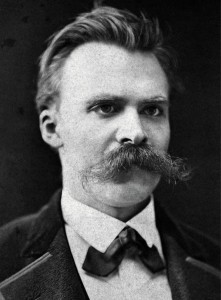
Keane1Four Woodcuts from Pinamonte’s Hell Opened to Christians, to Caution Them from Entering into It
As I can attest from my own experience, the order, imagery, phrasing, biblical citations, and graphic images to which we were exposed at Fordham in 1960 were virtually identical to the pattern laid down in Giovanni Pinamonte’s uncompromising ur-text, a rhetorical set-piece at once salutary and terrifying. Another model for Fr. Arnall may have been the appropriately-named Fr. Furniss, a sadistic 19th-century Anglo-Irish priest who specialized in terrorizing children with the threat of hellfire. We can catch the flavor of the preaching of both Pinamonte and Furniss in the hell-passages of the sermon in Portrait. Though Fr. Arnall covers in sequence the four “last things, death, judgment, hell, and heaven,” the section of the retreat that struck terror in the soul of Stephen Dedalus, as in mine in 1960, followed the opening of the maw of hell—fusing Pinamonte’s title, Hell Opened to Christians, with the “opening” of the “mouth” of Sheol in Isaiah:

Hell has enlarged its soul and opened its mouth without any limits—words taken, my dear little brothers in Christ Jesus, from the book of Isaias, fifth chapter, fourteenth verse….

—Now let us try for a moment to realize, as far as we can, the nature of that abode of the damned to which the justice of an offended God has called into existence for the eternal punishment of sinners. Hell is a strait and dark and foulsmelling prison, an abode of demons and lost souls, filled with fire and smoke ….By reason of the great numbers of the damned, the prisoners are heaped together in their awful prison, the walls of which are said to be four thousand miles thick…They are not even able to remove from the eye a worm that gnaws it [echoing, like the coming “stench,” that old favorite, Isaiah 66:24]….They lie in exterior darkness…for the fire of hell, while retaining the intensity of its heat, burns eternally in darkness…

—The horror of this strait and dark prison is increased by the awful stench. All the filth of the world, all the offal and scums of the world, we are told, shall run there as to a vast reeking sewer when the terrible conflagration of the last day has purged the world…Imagine some foul and putrid corpse that has lain rotting and decomposing in the grave, a jellylike mass of liquid corruption. Imagine such a corpse a prey to flames, devoured by the fire of burning brimstone and giving off dense choking fumes of nauseous loathsome decomposition. And then imagine this sickening stench, multiplied a millionfold and a millionfold again from the millions upon millions of fetid carcasses massed together in the reeking darkness, a huge and rotting human fungus. Imagine all this and you will have some idea of the horror of the stench of hell.

But more and worse was to come: namely, the pain, intensity, and eternity of the fire “created by God to punish the unrepentant sinner”—a litany of tortures that out-Dantes Dante. Earthly fire consumes itself,

but the fire of hell has this property that it preserves that which it burns and though it rages with incredible intensity it rages for ever….The blood seethes and boils in the veins, the brains are boiling in the skull, the heart in the breast glowing and bursting, the bowels a redhot mass of burning pulp, the tender eyes flaming like molten balls…And the strength and quality…of this fire is as nothing when compared to its intensity, an intensity which it has as being the instrument chosen by divine design for the punishment of soul and body alike. It is a fire which proceeds directly from the ire of God, working not of its own activity but as an instrument of divine vengeance….Every sense of the flesh is tortured… and through the several torments of the senses the immortal soul is tortured eternally in its very essence amid the leagues upon leagues of glowing fires kindled in the abyss by the offended majesty of the Omnipotent God and fanned into everlasting and ever increasing fury by the breath of the anger of the Godhead.

Fr. Arnall concludes by praying “fervently to God that not a single soul of those who are in this chapel today…may ever hear ringing in his ears the awful sentence of rejection: Depart from me, ye cursed, into everlasting fire which was prepared for the devil and his angels!” (Portrait, 119-24).

.

4 

The emphasis of our retreat-master at Fordham was, as with Fr. Arnall, on repentance and salvation. But even their final prayerful citation of Jesus (Matt 25:41) intensified rather than alleviated the terror of being cast into “the everlasting fire.” There was nothing merely figurative about our preacher’s detailed descriptions of the myriad torments of hell, and, though I knew nothing in 1960 of Pinamonte or Furniss, it was sometimes hard to separate the tone and sensuous immediacy of our priest’s Jesuit rhetoric from the vindictive glee of Tertullian relishing the agonies of the damned.

NietzscheFriedrich Nietzsche

Shortly after I graduated from Fordham, in 1961, I read Nietzsche seriously for the first time. I had earlier responded to the excitement of his literary style and to what W. B. Yeats described with remarkable tonal accuracy as this “strong enchanter’s curious astringent joy.” But in reading On the Genealogy of Morals, arguably the most substantial of his works, I discovered that Nietzsche had responded to the very passages in Aquinas and Tertullian that had so troubled me a few years earlier at Fordham. Quoting both passages in Latin, Nietzsche attributed their sadism—as expressed particularly by that “enraptured visionary,” triumphalist Tertullian—to what he repeatedly condemns (always in French) as the ressentiment characteristic of “slave morality”— here, future “blessedness” as Will to Power in disguise (Genealogy of Morals 1:15). Gibbon’s image of oppressed Christians “seduced…by resentment and spiritual pride to delight in the prospect of their future triumph,” may have helped generate Nietzsche’s crucial concept, first announced in Beyond Good and Evil §260 and fully developed in the Genealogy, of ressentiment as the driving impulse of “slave morality”: the desire of the weak, the “good”, for vengeance against the strong, depicted not merely as “bad,” but “evil.”

The dubiousness of the doctrine of eternal punishment of those condemned as “evil,” let alone the appalling notion that, far from eliciting empathy, their suffering is a source of glee for the saved, becomes even more repugnant when that pleasure is extended from his creatures to the Creator himself. Some Christians claim that the bliss of the saints, enhanced by looking down on the suffering of the damned, is shared by God—as we just saw in quoting Joyce’s version of the standard Jesuit retreat-sermon as well as the sermons of Jonathan Edwards and his disciple Samuel Hopkins. Whatever the values of its spiritual revival, its influence in effecting social reforms, and its often splendid rhetoric, the Great Awakening seems to me more of a Great Nightmare. The God of Jonathan Edwards, whether the “angry God” who abhors the sinners he holds in his hands, or the “just” God who presides over a system in which the happiness of a father who has made it to heaven is increased rather than diminished by the sight of his “unbelieving children in hell,” is obviously a God to fear, but hardly one we would wish to love or to be coerced into worshiping.

Mills_Examination

I have in mind the conclusion of John Stuart Mill’s Examination of Sir William Hamilton’s Philosophy (1865), a book more revealing of Mill’s own philosophy. Putting aside the “glad tidings” of Jesus, Mill aligns himself with Hamilton in denying any “immediate intuition of God.” But some claim that the “infinite goodness ascribed to God” is not “the goodness we know and love in our fellow-creatures distinguished only as infinite in degree,” but is, rather, “different in kind and of another quality altogether.” In concluding, Mill, risking hellfire, defiantly rejects this God of transcendent, ineffable morality in the name of the highest form of morality among human beings, fellow-creatures with whom we interact ethically, compassionately, and, at our best, with love. “If,” Mill writes, “I am informed that the world”

is ruled by a being whose attributes are infinite, but what they are we cannot learn, except that the highest human morality does not sanction them—convince me of this and I will bear my fate as I may. But when I am told that I must believe this, and at the same time call this being by the names which express and affirm the highest human morality, I say, in plain terms, that I will not. Whatever power such a being may have over me, he shall not compel me to worship him. I will call no being good who is not what I mean when I apply that epithet to my fellow-creatures; and if such a being can sentence me to hell for not so calling him, then to hell I will go. (Works, ed. John M. Robson (1963-1991), 10:103.

Of course, human beings are not always “good.” We can, though it would fly in the face of centuries of Christian tradition, dismiss the notion (hardly restricted to Puritan or Jesuit hellfire sermonizing) of an angry and vindictive deity as an anthropomorphic projection, a reflection of human rather than divine cruelty, sadism, and ressentiment. And it is true that, in what Nietzsche called “these more humane ages,” most Christians, other than rigid traditionalists and literalist fundamentalists, think and speak less of a God of Wrath than of Love, and of hell (as even Billy Graham thinks) as separation from God rather than a literal “place.” Against the Great Awakening of Edwards and Whitefield may be set a more significant awakening: the dawning of the American Enlightenment, best personified by those two once-bitter political rivals and later great friends among the Founding Fathers, Thomas Jefferson and John Adams. “I can never join Calvin is addressing his God,” wrote the deist Jefferson to Adams:

He was indeed an Atheist, which I can never be….If ever a man worshipped a false God, he did. The being described in his 5 points is not the God whom you and I acknowledge, the creator and benevolent governor of the world; but a daemon of malignant spirit. It would be more pardonable to believe in no God at all, than to blaspheme him by the atrocious attributes of Calvin. (17 April 1823)

My friend Paul Johnston recently quoted an observation, made five years earlier, by this letter’s recipient. Writing on 14 September 1818 to Jefferson, Adams attacked reliance on miracles and prophecies, the idea of a vain and vengeful deity, and the awful belief that most of humankind is eternally doomed to Hell. He also offered a personal, rational and humane definition of what he believed it meant to be a Christian:

We can never be so certain of any prophecy, or of any miracle…as we are from the revelation of nature, that is, nature’s God….Can prophecies or miracles convince you or me that infinite benevolence, wisdom, and power created, and preserves for a time, innumerable millions, to make them miserable for ever, for his own glory? Wretch!…Is he vain, tickled with adulation, exulting and triumphing in his power and the sweetness of his vengeance? Pardon me, my Maker, for these awful questions. My answer to them is always ready. I believe in no such thing. My adoration of the author of the universe is too profound and too sincere. The love of God and his creation—delight, joy, triumph, exultation in my own existence—though but an atom, a molecule organique, in the universe—these are my religion. Howl, snarl, bite, ye Calvinistic, ye Athanasian divines, if you will. Ye will say I am no Christian. I say ye are no Christians.

After so much hellfire and rejoicing at its torments, we can find respite in the refreshingly unorthodox voice of Enlightenment Reason, blasphemous though it may be to traditionalists. The deist sobriquets for God, civic and civil, have, in contrast to the sound and fury of sectarian conflict and theological hairsplitting, a euphemistic charm. Momentarily setting aside the angry God and loving but wrathful Jesus of historical Christianity, we can join Jefferson in acknowledging the “benevolent governor of the world,” just as we share Adams’s exultation in his own existence, and appreciate his love of the benign “author of the universe.”

Baruch_Spinoza_-_Franz_WulfhagenBaruch Spinoza by Franz Wulfhagen

Jefferson’s insistence on intellectual and democratic freedom from a tyrannous religion, like the skepticism of Adams regarding the reality of “miracles” and his reinterpretation of the nature of “prophecy,” are aligned for me with the earlier and even more profound enlightenment provided by an Amsterdam Jew writing in the 17th-century Dutch Republic: the great Baruch (Benedict) Spinoza. Despite being expelled from his synagogue and condemned as an atheist, Spinoza proved to have immense appeal, exerting an influence that crossed sectarian divisions. Fervently and famously embraced as a “god-intoxicated man” by the German Catholic Romantic poet Novalis (Friedrich Hardenberg) and—by the English Romantic poets Coleridge and Wordsworth—as a pantheist for whom Nature was indistinguishable from God, Spinoza was also profoundly admired by the atheist Nietzsche, an opponent of all other Idealist philosophers, who rightly venerated Spinoza for his simple and sublime nobility of spirit. As did Einstein, who, because of the “God-talk” in which he expressed his sense of awe and wonder in contemplating the beauty, majesty, and ultimate mystery of the universe, was mistakenly thought, by American admirers in his adopted country, to be a believer in a personal God, one who intervened in human affairs and was accessible by prayer. No, explained Einstein, his “religion” was limited to reverence of the order (since “God did not throw dice”) of the cosmos itself, and his only deity was “Spinoza’s God.”

The first serious philosophy paper I wrote at Fordham was on Spinoza’s Ethics, and I still remember that my Jesuit professor, in grading the essay A+, added a remark more gracious than accurate: that I was “farther along than he on the via illuminativa.” But the work of Spinoza I later wished I’d focused on at Fordham was the Tractatus Theologico-Politicus (1670), an immensely influential treatise pioneering the argument that the Bible, written by prophets of superior ethics but vivid imaginations, was not to be read “literally.” Authentic religion had nothing to do with “miracles and prophecies,” church authorities, or divisive sectarian dogma. Instead, “true religion” was based on the moral imperatives to seek the truth, to love one’s neighbor, and to be tolerant. The book’s political chapters, as far in advance of their time as those on theology, were a sustained plea for democratic toleration, especially in defense of “the freedom to philosophize” without interference from religious or political authorities.

For such thoughts, Spinoza was driven from his synagogue in the harshest terms. The cherum (or ritual of expulsion and ostracism) reads in part: because of his “abominable heresies” and “monstrous deeds,” we “excommunicate, expel, curse, and damn Baruch Spinoza, with the consent of God and with all the curses…written in the Book of the Law.” The vicious backlash against the Treatise also came from Christians. Within weeks of its publication, it was denounced by a prominent German theologian as “a godless document” that should be banned in every country. One of Spinoza’s Dutch countrymen described it as an “atheistic book full of abominations…which every reasonable person should find abhorrent.” Another, not to be outdone, called the deeply moral and eminently reasonable Tractatus “a book forged in hell,” written not by the ethical thinker toiling as a lens-grinder in Amsterdam, but by the devil himself.

In short, before and after welcome bursts of Enlightenment, Dutch or American, there remains a long, problematic, and continuing history of religious intolerance and induced terror. Despite being surrounded by and taught by smart and compassionate Jesuits, and despite (perhaps because of) the fact that I was in the advanced theology course, and attended that terrifying retreat, I have always found it difficult, after those impressionable years at Fordham, to glibly dismiss the concept of the vengeful deity fearfully accepted, or sadistically embraced, by so many believers for so long. And, like it or not, and however softened or “symbolic” much non-fundamentalist Christianity has become in these “more humane ages,” the doctrine of eternal punishment—and the concept of a God willing to initiate, approve, and even occasionally take relish in such monstrous cruelty—has defined traditional Christian theology for most of its history.

The widespread phenomenon often described as the “decline” or even “disappearance” of hell—a trickle in the 17th century, a stream in the American Enlightenment (including the Divinity School Address of Emerson), and cresting in England and continental Europe in the later 19th century, first among Protestants, somewhat later among Catholics—is, taken as a generalization, a historical fact. But while hell’s heat has been lowered, its flames a mere flicker in comparison to their former raging in incendiary hellfire texts and sermons, the old time religion is still alive and well, among some televangelists, and in much of Bible-belt contemporary America.

As for Catholicism: A tonal and gestural sea-change has recently occurred. The election of Pope Francis, an Argentina-based Jesuit, signaled a dramatic double-shift: from Eurocentrism and from dogmatic harshness to compassion and tolerance. That shift seems decisive, but is it permanent, and how far can tone take us in tempering let alone altering doctrine? It was, after all, just seven years earlier that Francis’s conservative predecessor, Benedict XVI, strenuously reaffirmed traditional Church teaching on hell. Benedict’s own predecessor, John Paul II, had referred to damnation vaguely as an “eternal emptiness.” Reacting to the “decline of hell,” especially in Western Europe, Benedict complained that the place of everlasting torment was no longer much talked about. He went on to describe Satan as a “real, personal and not merely symbolic presence” and proclaimed that hell, far from being a mere state of mind, or a condition of separation from God, is an actual place, one that “exists and is eternal.” We were spared fire-and-brimstone details, but listening to this March 2007 proclamation on the radio, I was transported back almost a half-century to that Fordham retreat.

Having lost my faith while remaining fascinated by the figure of Jesus, attractive despite his apparent consignment of most of humankind to eternal punishment, I sometimes want to cry out with the boy’s father in Mark 9:24: “Help thou my unbelief.” But the theological Problem of Suffering goes beyond the posthumous torments of hell to pain right here on earth, with the undeserved suffering of the innocent presenting the single greatest challenge to my own ability to “believe” in a God simultaneously omnipotent, omniscient, and all-loving. As David Hume has “Philo,” the more skeptical of his two spokesmen, note in Part 10 of his posthumously-published Dialogues Concerning Natural Religion (1779), “Epicurus’ old questions are yet unanswered”—questions we may apply to the presence of evil and suffering in a world “groaning” for “deliverance” (Rom 8:19-22), or to the groaning of hopeless souls in hell. Simplifying Epicurus, Hume has Philo ask, “Is God willing to prevent evil, but not able? Then he is not omnipotent. Is he able, but not willing? Then he is malevolent. Is he both able and willing? Whence then cometh evil? (75).

Nothing I read in Augustine or Aquinas about God’s “justice,” or about the constrained freedom that makes eternal punishment the “choice” of sinners, enabled me to answer those questions. And my subsequent immersion in the pornography of the Abominable Fancy only deepened my alienation from the faith I was raised in, and problematized the beliefs I had brought with me as a Freshman entering Fordham. Beginning college was hardly the time to abandon reason; and, in fact, as my classmate and lifelong friend Bill Baumert has often noted in retrospect, we received a first-rate and rigorous education at Fordham—far superior to what generally passes as education these days at colleges and universities where the canon has been “exposed,” the curriculum softened, and demands on students drastically eased, as their prose deteriorates, tuition costs soar, and the party goes on.

But I’ve also had other thoughts in retrospect. Being shocked into intellectual as well as emotional resistance by my reading of that fateful passage in Aquinas, I may have betrayed my own growing commitment to the Romantic poets by embracing a too-narrow intellectualism when it came to theology. Not that I was willing, then or now, to honor Imagination by a descent into irrationalism, any more than the great Romantics did. Neither, for that matter, despite some of the words by which we best remember them, did Luther (for all his distrust and frequent condemnation of “that whore, reason”), nor even Tertullian, the passionate evoker of that circus-scene in which Christians would posthumously join him, exulting in the spectacle of pagans writhing in hellfire. Tertullian is even more famous for having said he “believed because it was absurd,” but it isn’t quite that simple.

In arguing, in de Carne Christi 5:4, that the resurrection of Christ’s body, crucified and buried, was certain because impossible [credibile est, quia ineptum es, et sepultus resurrexit, certum est, quia impossibile]—Tertullian may not have been relying on blind faith (the fideism of the oft-misquoted tag, credo quia absurdum est), but following, as James Moffatt suggested a century ago, “in the footsteps of that cool philosopher Aristotle” (Journal of Theological Studies 17 [1915-16], 170-71). Since, in lines he quotes from the tragedian Agathon, “what is contrary to probability sometimes occurs,” it can be argued, says Aristotle, that “the improbable will be probable” (Rhetoric 2.24.9); even that some stories are so improbable that it can become reasonable to believe them. For Tertullian, the most improbable story is that of the incarnate, crucified, buried, and risen Jesus—which is, paradoxically, what makes it credible. This is the very point made by Shakespeare’s Hippolyta in an exchange in the final act of A Midsummer Night’s Dream, a riposte to her soon-to-be husband, Theseus, that would have delighted Agathon and Tertullian—and, perhaps, Aristotle.

In the opening of that final act, Theseus, a self-assured rationalist, dismisses (“more strange than true”) the lovers’ tales of their adventures in the moonlit wood. They are “fantasies, that apprehend/ More than cool reason ever comprehends,” and thus to be grouped indiscriminately with the merely imaginary constructions common to “The lunatic, the lover, and the poet.” But we in the audience know to be “true” what Hippolyta shrewdly intuits: that however individually fantastic the tales may be, they are part of an over-all consistency that makes each of them credible. To Theseus’ cool skepticism and reductive characterization of “imagination,” she responds:

But the story of the night told over,
And all their minds transfigured so together,
More witnesseth than fancy’s images
And grows to something of great constancy,
But howsoever strange and admirable. (5.1.23-27)

A similar case has often been made, certainly in one of my Fordham theology courses, to demonstrate the “historicity” of the gospels. Tertullian would concur, since those gospels tell the story, “howsoever strange and admirable,” of Christ, a man who is God and a God who is a man, who died in the flesh and rose from the sepulcher: a story “certain” because “impossible.” And yet Aristotle, it is worth recalling, was quoting a playwright, and Hippolyta, though wiser than her betrothed, is, like him, merely a character in a play, even if it is a play by Shakespeare. Tertullian’s central figure, on the other hand, is non-fictional, not only a dying and resurrected God, but a Savior and Sentencer, a loving Good Shepherd and harsh Judge, with the divine power to deliver on his threat: “Depart from me, you cursed, into the eternal fire prepared for the devil and his angels.”

That was the “awful sentence of rejection” our retreat-master at Fordham, and Joyce’s at Belvedere, prayed we would never hear “ringing in our ears,” but which has never completely stopped ringing in mine—even years after I had rationally concluded that the real absurdity was the doctrine of eternal punishment itself, to say nothing of the abominable fancy that witnessing the endless agony of “many” of our fellow human beings could enhance the pleasure of the “few.” For Paul, Tertullian, Augustine, Peter Lombard, Aquinas, Luther, Calvin, Jonathan Edwards, Samuel Hopkins, Archbishop Claret, and, last and least, Mel Gibson, this privileged audience may have been the “blessed,” the “saved,” even the Elect. But if its members were consigning most of humankind to hell, some even taking pleasure in that horrible prospect, it seemed to me—to alter Milton, who also had a few things to day about hell—an “unfit audience though few.” And just to cap my blasphemy: to the extent that the God of infinite Wrath (preached, along with the God of infinite Mercy, by Jesus and Paul) seems eager and willing to act in ways which, however ineffable and transcendent, seem petty, vindictive, and everlastingly punitive—alien, as Mill puts it, to “the highest human morality”—he, too, seems less a Father than a Tyrant.

So, while I am fond, and in part envious, of George Coyne, my final question is not the one posed to him by Carl Sagan (“Why should you be given the gift of faith, and not me?”), but, rather, is this a “gift” I want? And yet, George Coyne is more than a foil in these ruminations. Obviously, we took very different religious paths as a result of our exposure to Augustine and Aquinas at Fordham. But we’ve become friends, and we agree on many things, among others, that Intelligent Design, while an engaging surmise, is not a scientific theory to be taught in biology or physics classes. We agree, too, that kindness and consideration matter crucially, among friends and in the way a professor interacts with students. And we concur on the greatness of the poetry of Gerard Manley Hopkins, S. J., a handsome edition of whose poems and letters I gave George in first welcoming him to Le Moyne.

In the month I am writing, November 2014, we participated together in an event, held in Le Moyne’s Panasci Chapel, to commemorate the 125th anniversary of Hopkins’s death in 1889. I introduced the keynote speaker, Hopkins expert Joseph J. Feeney, S.J., author of The Playfulness of Gerard Manley Hopkins (2008), and the scholar who had, a decade earlier while working in the Jesuit Archives in London, unearthed an unpublished poem written by Hopkins in 1875-76, displaying that “playfulness” and the delight Hopkins took in the companionship of his fellow-Jesuits at St. Bueno’s College in Wales. The poem George read that evening, his favorite, was “God’s Grandeur,” a magnificent, breathtaking celebration of God and God’s Nature. I read the exuberant “Hurrahing in Harvest.” If I were ever to regain my faith, it would have more to do with engaging Hopkins—poems both ecstatically celebrating and darkly “wrestling with (my God!) my God”—than with revisiting the gospels and Paul, let alone Augustine and Aquinas, who led me away from Christianity in the first place.

.

Coda

A widely read friend and believer to whom I sent this essay responded that he wasn’t sure what the “story” was primarily “about”–was it autobiographical or theological? about my own “personal loss of faith” or a disquisition on “salvational schadenfreude“? He also asserted that the God in whom I had lost faith was a sadistic deity that “virtually all [my] believing associates would also repudiate.” He further wondered if, in my unbelief, I had become an “atheist,” bereft of all “sense (feeling) of something infusing the material, Hopkins’s glory in dappled things.” He concluded by suggesting that he was “not the right audience” for this essay because he had had spiritual “experiences” that allowed him “to hope that there is something beyond dead, contingent materialism.”

The paradigm for such dramatic spiritual experiences is Saul-Paul’s conversion-moment on the Road to Damascus, which, remarkably enough, Paul himself never mentions (we hear of it in Acts, a particularly corrupt text). Though they’re often life-transforming, I have never had such an experience myself, perhaps because I have not been “given” the “gift of faith,” and thus have no way of judging their ontological, as opposed to their subjective, significance. In thanking my friend for reading the essay and raising probing questions, I assured him that, while I hadn’t had the sort of epiphany he mentioned…

I have had “experiences”—in love, in nature, with animals—that rule out at least “reductive materialism.” Such experiences have long been enhanced by my reading of the Romantic poets and of Hopkins, so I most certainly do have “a sense (feeling) of something infusing the material”—not just Hopkins’s Christ-haunted glory in dappled things, but (in the passage you seem to allude to) Wordsworth’s Spinozistic and (in 1798, when he wrote these lines) non-Christian sublime:

………………………And I have felt
A presence that disturbs me with the joy
Of elevated thoughts; a sense sublime
Of something far more deeply interfused,
Whose dwelling is the light of setting suns,
And the round ocean and the living air,
And the blue sky, and in the mind of man :
A motion and a spirit, that impels
All thinking things, all objects of all thought….

Nor, given the mystery of the universe, am I arrogant enough to label myself an atheist; I’m agnostic, though unconvinced of the existence of a personal God who cares about us.

What is this essay “about”? I’m not sure myself. “Confessional” in both the common and Augustinian senses, it was a convulsive outpouring, written in less than two weeks; and the initial “audience” was… myself: an attempt to lay out the history of, and thus clarify, my individual fall from grace. Eternal punishment, hell, and the accompanying schadenfreude (the sadistic pleasure far too many have taken in relishing the sufferings of the damned), are at the heart of it. But it’s precisely this combination that produced my “loss of faith.” Thus, the “story” is not one of Either/Or, but of Both/And.

The God in whom I lost faith is not simply the God of Augustine or Aquinas, but the God presented to us by the Founders of Christianity: Jesus and Paul. I cite some of the most wonderful utterances of Jesus, as child-loving Good Shepherd and the “door” to salvation. But Jesus also talks more about damnation and hellfire than any person in either testament of the Bible (as I note, the Hebrew scriptures are virtually silent on that subject), and Paul provided the template for the predestined damnation of most humans: the theory of predestination taken up by Augustine (and, to a lesser degree, by Aquinas) and which culminated in the theology of Calvin.

As Calvin himself said, his entire theology is based on Augustine, and much of Augustine (on original sin and on God’s foreordaining of a “few” souls to glory and “many” to damnation) was drawn from Paul, particularly from his longest, weightiest, and most influential epistle, to the Romans. Paul, in turn, was echoing passages of Jesus: the “narrow” gate leading the “few” to heaven, the “wide” gate leading the “many” to hell. And the terrible sentence at the climax of the hell-sermon, in Joyce and at Fordham in 1960–“Depart from me, ye cursed, into the everlasting fire prepared for the devil and his angels”–are, of course, the words of Jesus, as reported in Matthew.

As I say in the essay, “the radiance of Jesus shines through the gospels,” often despite those gospels, written decades after his death. But they’re all we have as accounts purporting to have witnessed Jesus in the flesh, and recording what he said. Though written earlier, the letters of Paul are those of a man who never saw Christ—unless we give credence to the conversion-moment on the road to Damascus. Since Jesus is hardly mentioned outside the New Testament (there’s are references to the Jesus cult in Josephus and in Tacitus, though, in the case of the latter, the reference was added much later, by a Christian editor), we have to rely on the New Testament texts: the gospels, the various letters, especially the epistles of Paul, Acts, and the exciting but crazy Book of Revelation: that world-masterpiece of schadenfreude.

Reading these texts led me to the inevitable conclusion that the God in whom I lost faith is not some bizarre and sadistic deity dreamed up in the pessimistic imagination of Augustine or in the darker pages of the Summa. It’s the Wrathful aspect of the God of Love preached by Jesus and Paul: the God who, they both insist, sentences most of us to everlasting fire. Along with most of my “believing associates,” you want to selectively “look on the bright side.” I mention in the essay the historical phenomenon known as the “decline of Hell.” However, while only a tiny percentage believe that they are headed to the pit, a majority of Evangelicals and Catholics still believe in the traditional hell and in a God of Wrath. In fact, the God in whom I lost faith, that “God that virtually all of [my] believing associates would also repudiate,” is one aspect of the God of Jesus and Paul, which, if we follow the logic, you must “repudiate.”

Coming from my own particular background, including the intense reading in my Fordham theology classes, I find it hard to delete the dark bits. I wish it could be otherwise, but, in contemplating the prospect of eternal punishment as well as this temporal world of massive, mostly undeserved suffering, I find scant evidence of a benign God. Given my particular early experiences, I feel cut off from the option of being what used to be called a “cafeteria Catholic.” Instead, I find myself in the absurd but honest position of being fundamentalist in my agnosticism.

— Patrick J. Keane


PAT kEANE

Patrick J. Keane is Professor Emeritus of Le Moyne College and a Contributing Editor at Numéro Cinq. Though he has written on a wide range of topics, his areas of special interest have been 19th and 20th-century poetry in the Romantic tradition; Irish literature and history; the interactions of literature with philosophic, religious, and political thinking; the impact of Nietzsche on certain 20th century writers; and, most recently, Transatlantic studies, exploring the influence of German Idealist philosophy and British Romanticism on American writers. His books include William Butler Yeats: Contemporary Studies in Literature (1973), A Wild Civility: Interactions in the Poetry and Thought of Robert Graves(1980), Yeats’s Interactions with Tradition (1987), Terrible Beauty: Yeats, Joyce, Ireland and the Myth of the Devouring Female (1988), Coleridge’s Submerged Politics (1994), Emerson, Romanticism, and Intuitive Reason: The Transatlantic “Light of All Our Day” (2003), and Emily Dickinson’s Approving God: Divine Design and the Problem of Suffering (2007).

a

Dec 062014
 

emily_dickinson_daguerreotype_-large-


1

Given the magnitude of her achievement, it is hard to believe that Emily Dickinson’s poetry was not presented in an accurate text until 1955, almost seventy years after her death. And since those poems (almost 1,800 in number) continue to surprise and dazzle us with their linguistic ingenuity and psychological penetration, it is even harder to believe that Emily Dickinson was born 184 years ago!—on December 10, 1830. Famously, she spent much of her later, secluded life in her garden or writing in her room in the family house in Amherst. Yet, on Keatsian “wings of poesy,” she traveled the universe, from the microscopic to the cosmic. Her penchant for privacy far exceeded that of Thoreau, who had augmented Nature, the seminal work of his mentor Emerson, with Walden, the record of a temporary retreat to the woods, to live and write in solitude. Emily Dickinson’s only rivals for creative eminence in later nineteenth-century America were notably expansive: world-famous, globe-trotting Mark Twain, sea-voyaging Herman Melville, and that “kosmos,” Walt Whitman, who spread himself amply, in line-length and in the panorama of his Democratic vistas. In contrast, reclusive Emily Dickinson’s genius was in scrimshaw-like concision, economy, distillation. Yet her reach matched theirs in capaciousness. She took “For Occupation—This—/ The spreading wide my narrow Hands/ To gather Paradise—” (657).

But what did Emily Dickinson think of when she imagined “Heaven” or “Paradise”? More often than not, she clung to Emersonian and Thoreauvian “nature.” Her poems and letters on death and paradise, in which the human and the floral are often conflated by this gardener-poet, provide examples of what Thomas Carlyle, in Sartor Resartus, termed “natural supernaturalism,” a phrase made part of Romantic criticism’s permanent vocabulary with the publication of M. H. Abrams’s landmark study of the secularization of the sacred—Natural Supernaturalism: Tradition and Revolution in Romantic Literature (1971). In an August 1856 letter to her friend Elizabeth Holland, Dickinson’s natural supernaturalism and her pervasive human/floral analogy are explicit, with a fortunate exception: “I’m so glad you are not a blossom, for those in my garden fade, and then ‘a reaper whose name is Death’ has come to get a few to help him make a bouquet for himself.” This follows a passage that assumes the analogy, claiming that this earth would be Paradise enough were it not for frost and that Grim Reaper. This paragraph begins (Dickinson’s letters often combine prose with poetry) in modified ballad meter: “If roses had not faded, and frosts had never come and one had not fallen here and there whom I could not awaken, there were no need of other Heaven than the one below, and if God had been here this summer, and seen the things that I have seen—I guess he would think His Paradise superfluous” (Letters, 329).

The relatively open-minded Christianity of Elizabeth Holland and her husband may have freed Dickinson to confide such thoughts. A few years later, she would put this fusion of Nature and Heaven, of the physical and spiritual senses, into poetry. What we see, hear, and know is Nature: a harmonious Heaven whose simplicity is superior to our supposed wisdom:

“Nature” is what we see—
The Hill—the Afternoon—
Squirrel—Eclipse—the Bumble bee—
Nay—Nature is Heaven—
Nature is what we hear—
The Bobolink—the Sea—
Thunder—the Cricket—
Nay—Nature is Harmony—
Nature is what we know—
Yet have no art to say—
So impotent Our Wisdom is
To her Simplicity. (668)

Dickinson’s Romantic vision of an Earthly Paradise, its minute particulars as cherished as its sublime manifestations and all the more beautiful because it is under the shadow of death, is reminiscent of Wordsworth, before he froze over, and of Dickinson’s beloved Keats, who never froze over. Keats told a religiously conservative friend, Benjamin Bailey, that his own “favorite Speculation” was that “we shall enjoy ourselves here after by having what we called happiness on Earth repeated in a finer tone, and so repeated” (Letters of John Keats, 1:184-86). In one of the most beautiful passages ever written by Emily Brontë, Catherine Earnshaw’s daughter (the second “Cathy” in Wuthering Heights) describes her “most perfect idea of heaven’s happiness.” She would be “rocking” at the heart of the natural world, “in a rustling green tree, with a west wind blowing, and bright, white clouds flitting rapidly above; and not only larks, but throstles, and blackbirds, and linnets, and cuckoos pouring out music on every side,…grass undulating in waves to the breeze; and woods and sounding water, and the whole world awake and wild with joy….I wanted all to sparkle and dance, in a golden jubilee” (Wuthering Heights, Norton Critical Edition, 198-99).

William_WordsworthWilliam Wordsworth

Such passages explain Dickinson’s reverence of “gigantic Emily Brontë” (Letters, 721), one of whose poems (“Last Lines,” also known as “No Coward Soul Was Mine”), a favorite of Emily Dickinson, was appropriately read at her funeral service. Wonderful as it is, Brontë’s description of a naturalized “heaven” or “paradise”—a world in motion, in which the speaker actively and joyfully engages in her surroundings—is both Keatsian and Wordsworthian. The final gathering (waves, breeze, woods, water, the whole world awake and joyous), especially Cathy’s wanting “all to sparkle and dance, in a golden jubilee,” unmistakably recalls Wordsworth’s (and Dorothy’s) “host of golden daffodils,/ Beside the lake, beneath the trees,/ Fluttering and dancing in the breeze.” Those flowers, which outdo “the sparkling waves in glee,” comprise “a jocund company” in whose presence a “poet could not but be gay,” a joy recalled whenever “They flash upon that inward eye/ Which is the bliss of solitude;/ And then my heart with pleasure fills,/ And dances with the daffodils.” (“I Wandered Lonely as a Cloud”)

Wordsworth_Excursion

Wordsworth’s head-“tossing” flowers are personified in a delicately pagan manner, their “sprightly dance” allying them with sprights or sprites: elfin supernatural beings. That disciple of Wordsworth and mentor to Emily Dickinson, Ralph Waldo Emerson, was also attuned to the sort of earthly paradise that appealed to both Emilys. He began his famous or infamous 1838 Address to the Harvard Divinity School by fusing the “gladsome pagans” in what was his as well as Keats’s favorite Book of Wordsworth’s epic poem, The Excursion (those pagans who “looked” and “were humbly thankful for the good/ Which the warm sun solicited, and earth/ Bestowed” [4:932-38]), with the “pagan” of “The World is Too Much With Us.” Quoting Wordsworth’s sonnet, Emerson shocked his pious audience from the outset by declaring that he, too, would rather be “A pagan suckled in a creed outworn” than a Christian impoverished by being cut off from a vital, fecund nature sacrificed to both an austere religion and a crass materialism of “getting and spending.” Accordingly, he began the Divinity School Address with his own deeply responsive evocation of nature’s vital, sparkling, floral beauty. In “this refulgent summer,” it has been “a luxury to draw the breath of life. The grass grows, the buds burst, the meadow is spotted with fire and gold” (Essays and Lectures, 75). Those meadows were alive with flowers aglow with the light of Wordsworth’s “golden daffodils,” and sharing the pagan vitality of their “sprightly dance.” Emerson, like early Wordsworth, would have concurred with Emily Dickinson’s speculation in the letter to Elizabeth Holland: Had God “seen the things that I have seen” this summer, he would—Dickinson boldly or blasphemously surmised—“think His Paradise superfluous.”

It seems a shame that Emily Dickinson, who knew and admired Emerson’s essays, stayed in her room when, in 1872, the great man, after a lecture at Amherst College, visited her brother and sister-in-law, living just next-door. With his acute eye, Emerson would surely have recognized genius, just as he did when he first laid eyes on Whitman’s then-unpublished poetry. There are many passages in which Emerson, a peculiarly grounded Transcendentalist, evokes an earthly paradise. In his essay on Swedenborg in Representative Men, Emerson claimed that the only thing “certain” about a possible heaven was that it must “tally with what was best in nature.” It “must not be inferior in tone…agreeing with flowers, with tides, and the rising and setting of autumnal stars.” “Melodious poets” will be inspired “when once the penetrating key-note of nature and spirit is sounded,—the earth-beat, sea-beat, heart-beat, which makes the tune to which the sun rolls, and the globule of blood, and the sap of trees.” (Essays and Lectures, 686-87)

iemersr001p1Ralph Waldo Emerson

Like Keats’s “a finer tone”—descriptive both of the unheard music in the “Ode on a Grecian Urn” and of the repetition of earthly happiness “here after”—Emerson’s “not…inferior in tone,” and stress on key-note, melodiousness, and tune, echoes a text familiar to both Keats and Emerson: Wordsworth’s Excursion, and the Solitary’s reference in Book 2 to “Music in a finer tone” (2:710). Even later Wordsworth, tamed-down and religiously orthodox, never ceased to be a lover “of all that we behold/ From this green earth” (“Tintern Abbey,” lines 104-5), a poet who found his “Paradise, and groves/ Elysian”—provided the human intellect was “wedded to this goodly universe/ In love and holy passion”—to be a “simple produce of the common day” (“Prospectus” to The Recluse,” lines 43-55). Even in revising from a more conservative perspective his account of his early enthusiasm for the French Revolution, Wordsworth never recanted the desire initially expressed, to exercise his skill, “Not in Utopia” or some other ideal place, “Heaven knows where!/ But in the very world, which is the world/ Of all of us,—the place where, in the end,/ We find our happiness, or not at all!” (The Prelude [1850 version]), 11:140-44).

“Oh Matchless Earth,” Emily Dickinson exclaimed in a one-sentence letter, “We underrate the chance to dwell in Thee” (Letters, 478). She was borrowing from the “Prologue” to Wordsworth’s Peter Bell. Having sailed into the heavens in his little boat in the shape of a crescent moon, and having described the constellations and planets, the speaker asks rhetorically, “What are they to that tiny grain,/ That little Earth of ours?” And so he descends: “Then back to Earth, the dear green Earth…See! There she is, the matchless Earth!” (Peter Bell, lines 49-56). Dickinson herself might be “glad” that others believed they were, in the opening exclamation of her early poem, “Going to Heaven!” But, for herself,

I’m glad I don’t believe it
For it would stop my breath—
And I’d like to look a little more
At such a curious Earth! (79)

There is yet another parallel to Emily Dickinson’s thought that “Nature is Heaven,” or that Heaven would be superfluous, if only our earthly Paradise were free of frost and death. In a passage familiar to Wordsworth, Keats, Emerson, and Dickinson, Milton’s archangel Raphael offers a speculative analogy. Explaining to Adam the mysteries of celestial warfare by likening spiritual to corporeal forms, he adds: “Though what if Earth/ Be but the shadow of Heaven, and things therein/ Each to the other like, more than on earth is thought?” (Paradise Lost 5:573-76). Emily Dickinson echoed and altered this passage in an 1852 letter to “Dear Susie” (her soon-to-be sister-in-law, Susan Gilbert). Reversing Raphael’s “therein,” Dickinson locates love “Herein,” and concludes by taking literally the angel’s rhetorical but intriguing question: “But that was Heaven—this is but Earth, Earth so like to heaven that I would hesitate should the true one call away.” (Letters, 195; italics in original). Milton himself may have been open to the idea of Heaven as a projection of earthly happiness complete with a terrestrial landscape. In his fusion of the Classical and Christian in “Lycidas,” the pastoral elegist leaves us free to imagine the risen man as either “saint” in Heaven or as the “genius of the shore,” drowned, but now, through the power “of him that walked the waves,” mounted to a place “Where other groves and other streams along,/ With nectar pure his oozy locks he laves” (lines 172-75).

In a jocoserious, life-affirming poem looking back to Romantic and Emersonian “nature worship” and ahead to the earth-centered female persona of Wallace Steven’s “Sunday Morning,” Dickinson rejects religious ritual, a formal “church,” and an other-worldly Heaven in favor of an earthly paradise, a God immanent rather than transcendent, and salvation as a daily process rather than a static end-state:

Some keep the Sabbath going to Church—
I keep it, staying at Home—
With a Bobolink for a Chorister—
And an Orchard for a Dome—

Some keep the Sabbath in Surplice—
I just wear my Wings—
And instead of rolling the Bell, for Church,
Our little Sexton—sings.

God preaches, a noted Clergyman—
And the sermon is never long,
So instead of getting to Heaven, at last—
I’m going, all along. (324)

In an 1863 letter to Thomas Wentworth Higginson, in which she describes herself as “not reared to prayer,” Dickinson pronounces “the ‘Supernatural’…only the Natural, disclosed” (Letters, 423-24). In a poem written that year or the year before (Johnson dates it 1862, Franklin 1863), dawn and noon seem symbols of what she calls “Heaven.” The skepticism implicit in the setting of “Heaven” in quotation marks is confirmed in the final two stanzas:

The Rapture of a finished Day—
Returning to the West—
All these—remind us of the place
That Men call “Paradise”—

Itself be fairer—we suppose—
But how Ourself, shall be
Adorned, for a Superior Grace—
Not yet, our eyes can see— (575)

In two letters of 1873, Dickinson subverts Paul’s text (“For this corruptible must put on incorruption, and this mortal must put on immortality”) about the dead being raised and changed as a consequence of Christ’s Resurrection (1 Cor. 15:52-53). In the first letter (April 1873), she pronounces the novelist George Eliot (whom she knew to be a woman, Marian Evans) a “mortal” who “has already put on immortality,” adding that “the mysteries of human nature surpass the ‘mysteries of redemption,’ for the infinite we only suppose, while we see the finite” (Letters, 506). Later that year, in a letter to Elizabeth Holland, Emily notes that her sister Lavinia, just back from a visit to the Hollands, had said her hosts “dwell in paradise.” Emily declares: “I have never believed the latter to be a supernatural site”; instead, “Eden, always eligible,” is present in the intimacy of “Meadows” and the noonday “Sun.” If, as Blake said, “Everything that lives is holy,” it is a this-worldly truth of which believers like her sister and father are cheated: “While the Clergyman tells Father and Vinnie that ‘this Corruptible shall put on Incorruption’—it has already done so and they go defrauded” (Letters, 508). In a notably legalistic affirmation of earth, included in an 1877 letter to a lawyer, her increasingly skeptical brother Austin, she goes even further:

The Fact that Earth is Heaven—
Whether Heaven is Heaven or not
If not an Affidavit
Of that specific Spot
Not only must confirm us
That it is not for us
But that it would affront us
To dwell in such a place— (1408)

Wallace Stevens, who, in “Sunday Morning,” imagines his female persona asking if she shall not “find in comforts of the sun,” in any “balm or beauty of the earth/ Things to be cherished like the thought of heaven?” insists elsewhere that “poetry/ Exceeding music must take the place/ Of empty heaven and its hymns” (“The Man with the Blue Guitar,” section 5); that we must live in “a physical world,” the very air “swarming” with the “metaphysical changes that occur,/ Merely in living as and where we live” (“Esthetique du Mal,” section 15). Stevens seems to be recalling Wordsworth’s “Prospectus” and Emerson’s seminal book Nature, along with that ardent disciple of Emerson, Friedrich Nietzsche. He might as well have been thinking of Emily Dickinson, and her audacious, even blasphemous preference for the tangible things of this earth, to be cherished above thoughts of an otherworldly Heaven, an abstract place offensive to our nature. Nietzsche’s Zarathustra’s beseeches us in his Prologue to “remain faithful to the earth, and do not believe those who speak…of otherworldly hopes!” She never accepted the Nietzschean premise, the Death of God, but, when she was only fifteen, Emily confided in her friend Abiah Root that the main reason she was “continually putting off becoming a Christian,” despite the “aching void in my heart,” was her inability to conceive of an existence beyond this earth as anything but horrible: “Does not Eternity appear dreadful to you?….it seems so dark to me that I almost wish there was no Eternity.” Two years later she tells a friend that, while she regrets that she did not seize a past opportunity to “give up and become a Christian,” she won’t: “it is hard for me to give up the world” (Letters, 27-28, 67). She is not referring to that material “world” of getting and spending that is “too much with us,” but to this “matchless Earth” indistinguishable from, and perhaps preferable to, Heaven.

2

signature

The problem, of course, is that this Earth, however “matchless,” is not free of frost and death, so often almost indistinguishable in Dickinson. The invasive force in her Earthly Paradise was less the worm than the frost. The link between the fading and freezing-by-frost of her flowers on the one hand, and the death of those she cannot waken on the other, becomes a dominant motif. Her cherishing of a Heaven-like Earth is sometimes connected with the pain inflicted from above. In one poem, while noting the “firmest proof” of “Heaven above,” she significantly adds that, “Except for its marauding Hand/ It had been heaven below” (1205; my italics). In another letter to Elizabeth Holland and her husband, Heaven’s “marauding Hand” seems both a grim Reaper and a cruel Leveler. Writing during a period (autumn, 1858) when an epidemic of typhoid fever had struck Amherst, she cries out, not in concluding but in opening the letter: “Good-night! I can’t stay any longer in a world of death. Austin [her brother] is ill of fever. I buried my garden last week—our man, Dick, lost a little girl through scarlet fever….Ah! Democratic Death! Grasping the proudest zinnia from my purple garden,—then deep to his bosom calling the serf’s child” (Letters, 341).

virginia-woolfVirginia Woolf

This letter has become controversial. The admittedly jarring reference to the “serf’s child,” both “politically” and historically incorrect, has been described as insensitive, shocking, an indication of casual snobbishness at best and class-conscious callousness at worst, compounded by (in the phrase of Albert Habegger) her “equating ‘the serf’s child’ with her frost-killed flowers” (My Wars Are Laid Away in Books: The Life of Emily Dickinson [2001], 363). We may be reminded of Virginia Woolf’s Clarissa Dalloway, who imagines people saying of her, “she cared much more for her roses than for” such human but distant “victims of cruelty and injustice” as those who perished in the Armenian genocide (Mrs. Dalloway [Norton Critical Edition], 88). But the best response to the attack on Dickinson’s “callousness” in this letter seems to me that of Judith Farr. After acknowledging the “insensitivity it projects,” she reminds us that “Austin’s [serious] illness and the coming of winter are also equated” in the letter. She then makes her central point, one I would emphasize as well:

To begin with, it is simply the case that Emily Dickinson loved flowers quite as much and as if they were human; her implicit comparison was…not intended to diminish the “little girl,” as she is rather tenderly called….With the cadences of Ecclesiastes and the Elizabethans always vivid in her ear, it was only natural that Dickinson should express the communion and equality of all living forms in death. Indeed, her letter’s zinnia and child commingling in Death’s grasp calls up such lines as Cymbeline’s “Golden Lads, and Girles all must,/ As Chimney-sweepers come to dust.”….Not snobbery, but the power of the aesthetic impulse to which she was subject is chiefly manifested in Dickinson’s much-discussed letter. (The Gardens of Emily Dickinson [2004], 56)

I would add only that Dickinson’s equation, not limited to the influence of Ecclesiastes and Shakespeare, also had Romantic auspices. Between Death’s “grasp” on a proud flower in her royally purple garden and the death of the little child of a servant there is no more gap than we find in “Threnody,” Emerson’s elegy for his little boy, Waldo. Also a victim of scarlet fever, dead at the age of five, that “hyacinthine boy” and “budding man” was never to blossom, though his father prepares for him, in the conclusion of the elegy, an appropriate Heaven: not “adamant… stark and cold,” but a rather Wordsworthian or Keatsian “nest of bending reeds,/ Flowering grass and scented weeds” (“Threnody,” lines 15, 26, 272-75). In a less-discussed but similar letter to Elizabeth Holland, whose child had suffered a crippling injury, Dickinson notes that “to assault so minute a creature seems to me malign, unworthy of Nature—but the frost is no respecter of persons.” In other letters, starting in the 1850s, Dickinson assumes this floral/frost/human analogue, making explicit what is implicit in poems like “Apparently with no surprise,” where “the Frost beheads” the “happy Flower” (1624): namely, her pervasive connection of flowers and frost with human life and death. At times at least, she includes a vision of transcendence for believers, the hope of spiritual resurrection.

Even when “the frost has been severe,” killing off flowers and plants that try in vain “to shield them from the chilly north-east wind,” there can be an imperishable garden. I am quoting from a touching letter of October 1851, anticipating the arrival of Austin. She had “tried to delay the frosts,” detaining the “fading flowers” until he came. But the flowers, like the poor “bewildered” flies trying to warm themselves in the kitchen, “do not understand that there are no summer mornings remaining to them and to me.” But no matter the effect on her flowers and plants of the severe frost brought by the “chilly north-east wind,” she can offer her brother “another” garden impervious to frost. The theme kindles her prose into poetry, minus the line-breaks (in fact, Johnson prints it as a poem, #2). She offers a bright, ever-green garden, “where not a frost has been, in its unfading flowers I hear the bright bee hum; prithee, my Brother, into my garden come!” (Letters, 149). As Judith Farr remarks, such a garden—which “could never exist, except in metaphor”—is “the garden of herself: her imagination, her love, each of which, she says, will outlast time.” As much as any poem in her canon, this early letter-poem, probably written when Dickinson was twenty-one, “discloses the rapt identification she made between herself, her creativity, and her flowers….‘Here is a brighter garden’ instinctively focuses on the garden of her mind, with its loving thoughts that transcend the ‘frost’ of death.” (The Gardens of Emily Dickinson, 56)

A third of a century later, we have a remarkably similar letter in which, at least for her beloved brother, there is an autumnal harbinger of a spiritual as well as a natural spring to come. In this late letter of autumn 1884, the same year she wrote “Apparently with no surprise,” she tells a family friend, Maria Whitney:

…………...Changelessness is Nature’s change. The plants went into camp last night, their tender
armor insufficient for the crafty nights.
……………That is one of the parting acts of the year, and has an emerald pathos—and Austin
hangs bouquets of corn in the piazza’s ceiling, also an omen, for Austin believes.
……………The golden bowl breaks soundlessly, but it will not be whole again till another year.
………………………………………………………………………………………………………………………(Letters, 848)

Anthropomorphizing (as in the 1851 letter, where the flowers try to “shield them[selves]” from the autumn wind), she presents the “tender armor” of her flowers as inadequate to protect them against the autumnal frost. So, alert to their needs, she brings them indoors, into the “camp” of her conservatory. She ends by quoting the admonition from Ecclesiastes, that we are to remember God before the body disintegrates, before “the silver cord be loosed or the golden bowl be broken” (12:6). But Emily differentiates herself from her brother Austin, a closet skeptic who, for the purposes of this letter, “believes”—has faith, that is, not only in the seasonal rebirth of corn from seeds, but in the spiritual resurrection of the body. His sister, adhering to a seasonal form of natural supernaturalism, confines her hope to a natural spring; her “golden bowl” will “not be whole again till another year.”

Two of Emily Dickinson’s most beautiful, and most Keatsian, poems, mark her major seasonal transition, from summer to autumn. In “As imperceptibly as Grief,” summer has “lapsed away,” a beloved season that can’t quite be accused of “Perfidy” since she was always a “Guest, that would be gone.” The poem ends with summer, like Keats’s nightingale, having “made her light escape/ Into the Beautiful,” a Platonic realm beyond us, leaving behind only the memory, which is to be cherished here on earth (1540). In “Further in Summer than the Birds,” which has been described, by Charles R. Anderson, as “her finest poem on the theme of the year going down to death and the relation of this to a belief in immortality” (Emily Dickinson’s Poetry: Stairway to Surprise [1966],169), Dickinson employs liturgical language to commemorate, as in Keats’s “To Autumn,” the insects’ dirge for the dying year. “Pathetic from the Grass,” that “minor Nation celebrates/ Its unobtrusive Mass,” their barely noticeable requiem nevertheless “Enlarging Loneliness.” The music of the crickets, coming later in the summer than the song of birds, is a “spectral Canticle.” Their hymn typifies—in the transition from summer to autumn, with “August burning low”—the winter sleep to come, a “Repose” perhaps implying eternal rest on another level.

In the final stanza, Christian and Hebraic vocabulary yields to pagan. At this moment of seasonal transition, there is, “as yet,” no “Furrow on the Glow” of sunlit, burning August, “Yet a Druidic difference/ Enhances Nature now” (1068). That final religious image, whether we take the Druidic reference as stressing primarily the sacrificial or the animistic element in Celtic nature-worship, powerfully reinforces Dickinson’s own reverence for Nature, its beauty enriched and intensified less, perhaps, by what Anderson calls a “belief in immortality” than—again, as in the ode “To Autumn”—by time’s evanescence and the pathos of mutability, the deeply moving contrast between seasonal return and human transience. That transience extends to all animal life. This poem, written in late 1865 or early 1866, was enclosed in a laconic January 1866 note to her epistolary semi-mentor, Thomas Wentworth Higginson, with whom she had not corresponded for eighteen months. Referring to her beloved dog and constant companion, Emily Dickinson restricted herself to a single statement, and a wry question, less pleading than ironic, perhaps bitter: “Carlo died….Would you instruct me now?” (Letters, 449).

Samuel-BowlesSamuel Bowles
Though of course haunted by the thought of immortality, Dickinson was also dubious. In an 1858 letter to Samuel Bowles, she adopts an ironic, pretension-mocking tone. Distinguishing between nature and “us,” she at once anticipates and deflates modern “species chauvinism,” wondering, tongue-in-cheek, how it is that we mere humans, described by her pastor as a “worm,” should also be the very species singled out for a majestic and special end: a resurrection allegedly obviating any need for mourning, including mourning the death of what would seem to be paradise enough for us: summer with its cherished fields, its bumblebees and birds:

Summer stopped since you were here. Nobody noticed her—that is, no men and women. Doubtless, the fields are rent by petite anguish, and “mourners go about” [Ecclesiastes 12:5] the Woods. But this is not for us. Business enough indeed, our stately Resurrection! A special Courtesy, I judge, from what the Clergy say! To the “natural man,” Bumblebees would seem an improvement, and a spicing of Birds, but far be it from me, to impugn such majestic tastes! Our pastor says we are a “Worm.” How is that reconciled? “Vain, sinful Worm” is possibly of another species. (Letters, 338-39)

By this time, the 1730s’ thunderings of Jonathan Edwards against the moral ills of New England’s sinners in the hands of an angry God had lost some of their resonance, even in Calvinist Amherst. But in his debasement of man as a “worm,” Dickinson’s pastor may (the trope is hardly restricted to Edwards) have been echoing the great Puritan’s description of man as “a vile insect,” a “little, wretched, despicable creature; a worm, a mere nothing, and less than nothing” (The Justice of God in the Damnation of Sinners [1634]). Edwards himself—whose “Martial Hand” of “Conscience” Dickinson presents threatening “wincing” sinners with hellfire, the “Phosphorus of God” (1598)—was echoing Bildad, the second of Job’s false comforters. From the outset, he had advised the innocent sufferer to abase himself. In his final discourse (Job 25:2-6), Bildad wonders if it is even possible for man to “be righteous before God.” To this fear-instilling God of “dominion,” even the moon and stars are unclean; “how much less man, that is a worm? and the son of man, which is a worm!” How indeed, as Emily sardonically inquires, is that abject status reconcilable with our potential for “stately resurrection”?

Man’s biblical genesis and Fall seemed to put that glorious end in doubt. Prior to ejecting guilty Adam and Eve from Eden, the “Lord God” tells them, “dust thou art, and unto dust shalt thou return” (Gen 3:19). For Hamlet, man is “the paragon of animals.., how like a god,” and yet, to him, “what is this quintessence of dust?” (2.2.305-7); Wordsworth, in the opening book of The Prelude, tries to “reconcile” the contradiction: “Dust as we are, the immortal Spirit grows/ Like harmony in music” (1:340-41). Dickinson can engage this tension in the grand tradition, observing that “Death is a Dialogue between/ The Spirit and the Dust,” with Spirit triumphant, “Just laying off for evidence/ An Overcoat of Clay” (976). But she takes a different tack in a couplet-poem she opens by ironically addressing God as “Heavenly Father”:

“Heavenly Father”—take to thee
The supreme iniquity
Fashioned by thy candid Hand
In a moment contraband—
Though to trust us—seem to us
More respectful—“We are Dust”—
We apologize to thee
For thine own Duplicity—(1461)

So much for Bildad-like groveling! Like the image of the worm, that of dust reflects the Calvinist estimate of human worthlessness. But here the “worm” turns, with the “sinful” creature finding fault with the Creator. Despite his seeming straightforwardness, God committed a dubious act (an inconsistency emphasized by the alliterated candid and contraband). In fashioning us as he did, he set up, between dust and immortal spirit, not so much a creative tension as a radical contradiction. He thus stands accused of double-dealing, and any “apology” we make to so duplicitous a God will be less an acknowledgement of our own guilt, or a seeking of pardon, than a self-justifying defense—an apologia in the form of j’accuse directed against a divine adversary. That vindictive God himself supplied the right word. “For I the Lord thy God am a jealous God, visiting the iniquity of the fathers upon the children” (Exodus 20:5). Dickinson, who, like Mark Twain, cherishes the role of lawyer for the plaintiff when it comes to amassing evidence against God’s supposedly benign providence, has the children of Dust visit the charge of injustice upon an anything-but-paternal Heavenly Father, accusing him—blasphemously, though appropriately, given his supreme power—of “the supreme iniquity.”

Emily Dickinson 2

If this reading is accurate, our apology to God for his “own Duplicity” allies the poem with the most blasphemous of Omar Khayyám’s quatrains addressed to God, at least as adapted by Edward Fitzgerald in a translation the Victorian world accepted with a shock of recognition:

Oh Thou, who Man of baser Earth didst make,
And ev’n with Paradise devise the Snake:
……….For all the sin wherewith the face of Man
Is blackened—Man’s forgiveness give—and take!

The work of such writers as Carlyle, Tennyson and Arnold, and, later, Hardy and Housman, all responding in their different ways to Darwinian and other scientific and rationalist challenges to religious belief (including Biblical Higher Criticism) places an imprimatur on the judgment that Fitzgerald’s version of the Rubáiyát “reads like the latest and freshest expression of the perplexity and of the doubt of the generation to which we ourselves belong.” That acute observation was made, however, not by a British Victorian but by an American—the scholar and man of letters Charles Eliot Norton, writing in 1869, a decade before Dickinson wrote “‘Heavenly Father’—take to thee.” Not only the “doubt,” but the “perplexity” as well, is reflected in Dickinson’s poem, for the syntax of her opening lines suggests petition even more than protest. James McIntosh (Nimble Believing: Dickinson and the Unknown [2004]), identifying “humankind” as “the supreme iniquity,” takes these lines to mean: “Father, take humans, who are the supreme iniquity, to thee” (47). Perhaps; but what, then, of the poem’s final lines? My own reading is closer to that of Magdalena Zapedowska, in her 2006 American Transcendentalist Quarterly essay, “Wrestling with Silence.” She argues that, in this poem, Dickinson focuses, not on the Fall as original sin,
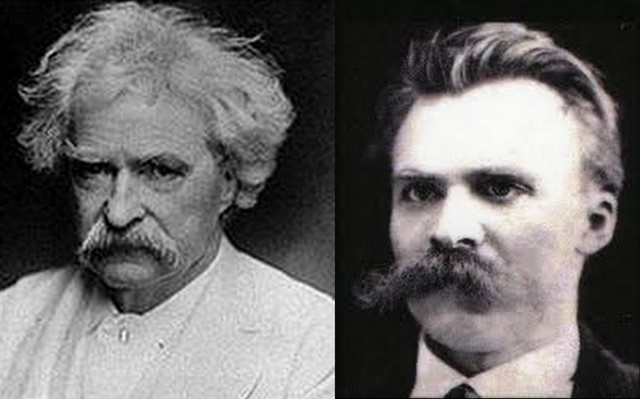
but on the subsequent expulsion from Paradise, which she blasphemously construes as the original wrong done to humankind by a God who first offered people happiness, then distrustfully put them to the test, and finally doomed them to suffering. Undermining the dogma of God’s benevolence, Dickinson contemplates the terrifying possibility that the metaphysical order is different from Calvinist teaching and that the human individual is left wholly to him/herself, unable to rely on the hostile Deity against the chaos of the universe. (“Wrestling with Silence,” 385)

At such moments, Emily Dickinson sounds like her considerably more public contemporary, Mark Twain, who made no secret of his religious skepticism, but who nevertheless refrained from publishing his most vitriolic attacks on the Judeo-Christian God, a divinity he described, even before his dark final decade, as both duplicitous and cruel. As the examples of Emily Dickinson and Mark Twain illustrate, for all our immortal longings, we are haunted, and angered, by the death implicit in our originating dust—in the case of both Dickinson and Twain, what Byron called “fiery dust.” And if the “Heavenly Father” who presides over this beautiful but doomed world really is an indifferent and “Approving God” (1624), Emily Dickinson seems to care less for him and for a posthumous, perhaps empty Heaven, than for this Earthly Paradise—the perishable beauty that must die, everything she wishes could “transcend the ‘frost’ of death,” but which she strongly suspects will not.

“Man is in love and loves what vanishes,/ What more is there to say?” That haunting question was posed by W. B. Yeats in one of his greatest poems, “Nineteen Hundred and Nineteen.” He was not suggesting anything so trite as that we love things and then they disappear. He was reminding us that we love beautiful transient things because they are mutable, doomed to vanish. That is precisely why we cherish them so, recognizing, as Wordsworth poignantly acknowledged even in the great Ode in which he claimed intimations of immortality, that “nothing can bring back the hour/ Of splendor in the grass, of glory in the flower.” These splendors and glories are part of a “supernaturalism” that is “natural.” That great enemy of otherworldly hopes and cherisher of the earth, Nietzsche, referred in a December 1885 letter to irretrievable beauty. In a floral image that would have appealed to Emily Dickinson, who would die shortly after this letter was written, he spoke of Rosengeruch des Unwiederbringlichen: the faint rose-breath of what can never be brought back.

Of course, with Wordsworth, Keats, and Emerson as her precursors, we do not really need Emerson’s disciple Nietzsche and Nietzsche’s disciple Yeats to explain why Emily Dickinson’s Earthly Paradise is not only beautiful but death-haunted. I quote Yeats and Nietzsche (and Emily would, I think, approve) for the poignant beauty of their language in commemorating the pathos of mutability, what Wordsworth—deeply moved by the humblest “flower” that blossoms and blows in the breeze—called, in the final line of the Intimations Ode, “Thoughts that do often lie too deep for tears.”

— Patrick J. Keane

Author’s Note: Though most Dickinson scholars prefer the three-volume edition of R. W. Franklin (Harvard U.P., 1998), Emily Dickinson’s poems are here cited by number from the one-volume Complete Poems of Emily Dickinson, ed. Thomas H. Johnson (Little, Brown, 1957, and often reprinted). Her letters are cited from the three-volume but continuously-paginated The Letters of Emily Dickinson, ed. Thomas H. Johnson and Theodora Ward (Harvard University Press, 1958). Wordsworth, Keats, and Emerson, are cited from: Wordsworth: The Poems, ed. John O. Hayden, 2 vols. (Yale UP, 1981); The Letters of John Keats, ed. Hyder E. Rollins, 2 vols. (Harvard UP, 1958); Emerson: Essays and Lectures, ed. Joel Porte (Library of America, 1983).

.

PAT kEANE

Patrick J. Keane is Professor Emeritus of Le Moyne College and a Contributing Editor at Numéro Cinq. Though he has written on a wide range of topics, his areas of special interest have been 19th and 20th-century poetry in the Romantic tradition; Irish literature and history; the interactions of literature with philosophic, religious, and political thinking; the impact of Nietzsche on certain 20th century writers; and, most recently, Transatlantic studies, exploring the influence of German Idealist philosophy and British Romanticism on American writers. His books include William Butler Yeats: Contemporary Studies in Literature (1973), A Wild Civility: Interactions in the Poetry and Thought of Robert Graves(1980), Yeats’s Interactions with Tradition (1987), Terrible Beauty: Yeats, Joyce, Ireland and the Myth of the Devouring Female (1988), Coleridge’s Submerged Politics (1994), Emerson, Romanticism, and Intuitive Reason: The Transatlantic “Light of All Our Day” (2003), and Emily Dickinson’s Approving God: Divine Design and the Problem of Suffering (2007).

s

Jun 072014
 

cen

 Transatlantic Transcendentalism is a richly-informed and luminously intelligent exploration of this complex but crucial subject. Thorough yet concise, dense yet lucid, it reflects an impressive knowledge of the primary and secondary texts, yet relentlessly focuses on what the author designates “the Romantic triad.” This distinguishable yet integrated trinity of Nature, Spirit, and Humanity preoccupied Romantics on both sides of the ocean.     —Patrick J. Keane

Capture

Transatlantic Transcendentalism: Coleridge, Emerson, and Nature
Samantha C. Harvey
Edinburgh, 2013,
218 pages, $120
ISBN: 978-0748681365


By 1798, Samuel Taylor Coleridge and William Wordsworth, though by then largely disenchanted by the course of the French Revolution, were still considered dangerous radicals by the Pitt government, which had set spies on them. In that year, hopping a looming draft into the militia, the two poets and Dorothy Wordsworth sailed to Germany. The Wordsworths hunkered down in Goslar during the coldest winter of the century, where William began work on what would eventually become his great autobiographical epic, posthumously published a half-century later as The Prelude. In contrast, the gregarious and convivial Coleridge travelled to university towns, omnivorously ingesting German philosophy and German beer. Once back in England, armed with his own version of the thought of Immanuel Kant and of other German Idealists, Coleridge was uniquely positioned to shape the philosophy behind British Romanticism, and to become the principal transatlantic conduit of these ideas to America.

To let the cat out of the bag right off, the book under review is a remarkable study. Transatlantic Transcendentalism is a richly-informed and luminously intelligent exploration of this complex but crucial subject. Thorough yet concise, dense yet lucid, it reflects an impressive knowledge of the primary and secondary texts, yet relentlessly focuses on what the author designates “the Romantic triad.” This distinguishable yet integrated trinity of Nature, Spirit, and Humanity preoccupied Romantics on both sides of the ocean. It also provides Samantha Harvey with her main theme and organizing principle in tracing the transformative impact of the philosophic, theological, and critical thought of Coleridge on his American disciples—principally Ralph Waldo Emerson, but also James Marsh, who introduced Coleridge to New England, then (a development of special interest to many connected with Numéro Cinq) restructured the University of Vermont on Coleridgean principles.

Harvey’s study of the Coleridge-Emerson connection is the most recent volume in the “Edinburgh Studies in Transatlantic Literatures” series (a study of Emily Dickinson and British Victorian poets is forthcoming). The sixteen books in the series range widely in subject, but all are globally oriented, exploring ideas and texts unconfined by temporal or national boundaries. One crucial example of an overarching Romantic and Transatlantic subject is the one that matters here: Coleridge’s committed and pivotal mediation of the categories of nature, spirit, and humanity. Harvey’s book is in fact organized on the basis of this Romantic triad. Following a general introduction, and flanked by two historical chapters tracing Coleridge’s impact on Transcendentalism in Boston (Chapter 2) and Vermont (Chapter 8), Harvey devotes one chapter (beginning with “Nature”) to each category of the triad, with a pause midway. That chapter, “The Landing Place,” alludes to Coleridge’s description of a spiral staircase, with its various “landing-places” analogous to the perspective-gaining pause before continued cognitive mounting. Here, Harvey surveys Coleridge’s “method” and practice of “distinguishing without dividing,” before moving on to chapters on “Humanity” (5) and “Spirit” (6). The penultimate chapter focuses on Emerson’s seminal book Nature (1836), a text structured on Coleridge’s distinctions, “method,” and the categories of the Romantic triad. Despite this culmination, the final chapter, on Coleridge’s influence on curricular and philosophic developments in Vermont, is anything but anticlimactic.

A primary emphasis in the Edinburgh series is the dialectic between “affinity and contrast,” and this study is no exception. “Coleridge’s influence on Emerson reveals a complex blend of the categories of contrast and affinity, particularly the way in which key ideas endured and yet were substantially modified as they crossed the Atlantic” (12). Harvey traces not only Emerson’s immense indebtedness to Coleridge, but the ways in which the American Transcendentalist’s appropriation and assimilation of his benefactor stimulated his own creativity: the sine qua non for an apostle of self-reliance and originality. In Harvey’s wonderfully well-chosen lead epigraph, Emerson advises us to “take thankfully and heartily all” our succession of teachers “can give.” Eventually the “dismay” that attends an “excess of influence” will be withdrawn, and the benefactor “will be no longer an alarming meteor, but one more bright star shining serenely in your heaven, and blending its light with all your day” (1).

That last phrase is a transparent allusion to Emerson’s favorite line in his favorite poem, Wordsworth’s “Ode: Intimations of Immortality…,” a poem that haunted the American Transcendentalists as much as it did Coleridge. But often, most obviously in Nature, Emerson went out of his way to cover his tracks. Nevertheless, as Harvey notes, some contemporaries “recognized his massive and largely unacknowledged debt to transatlantic sources” (3). Recent studies have tracked these debts—to Carlyle, to Wordsworth, and, above all, to Coleridge, both as original thinker and (even more than Carlyle and Victor Cousin) as Emerson’s principal filtering conduit to German philosophic thought. Harvey is perfectly aware of Emerson’s re-filtering, his “selective assimilation” of his principal benefactor. “Coleridge’s eclectic amalgamation of Christian, Platonic, and German idealist concepts fundamentally shaped Emerson and the development of Transatlantic Transcendentalism.” But “key ideas” of Coleridge were “appropriated” by Emerson and other liberal American thinkers, who separated those ideas from Coleridge’s Anglican conservatism, while “discarding many metaphysical subtleties and secularizing his theological language” (96). Though Emerson’s splendid essay-lecture, “Quotation and Originality,” is almost the last word on the fascinating and paradoxical subject of thankful inheritance and creative innovation, I’m delighted to be in accord with Samantha Harvey when she writes, “I agree with Patrick Keane that Emerson could very well be the best example of Thomas McFarland’s ‘originality paradox’ in which a profound indebtedness can enable, and even enhance, the originality of a writer” (3).

This raises the issue of Harvey’s own originality. The Edinburgh promotional literature describes Transatlantic Transcendentalism as “the first book devoted to Coleridge’s influence on Emerson and the development of American Transcendentalism.” And Harvey herself twice repeats the verb “devoted” in claiming that “to date no book has devoted itself to elaborating Coleridge’s vital role for Emerson and Transatlantic Transcendentalism, a lacuna which this book endeavors to remedy”; and, again, that, however well-known to Romantic scholars the “connection between Coleridge and Emerson,… surprisingly there is no single monograph devoted entirely to the subject” (19). With those caveats registered, I agree wholeheartedly with Harvey’s and Edinburgh’s claim. And not only is this the first book-length monograph devoted solely to the connection, it’s one that I suspect (despite Harvey’s modest anticipation of fuller studies to come) will prove hard to improve upon.

When it comes to transatlantic studies in general, and even to the Romantic triad in particular, Samantha Harvey is, as a good Emersonian, “thankfully” generous to her co-workers in the field. She praises such transatlantic “pioneers” as Robert Weisbuch, Leon Chai, and Richard Brantley; notes the work of James Engells and others on Emerson’s adoption of Coleridge’s creative misreading of Kant; acknowledges that her formulation of the Romantic triad itself is “beholden to scholarship by M. H. Abrams, Thomas McFarland, Seamus Perry, and John Beer”; and remarks on the “deep influence” on her book, especially her chapter on “Spirit,” of Abrams’s landmark Natural Supernaturalism (1971) with its “elaboration of the underlying spiritual paradigms” adapted, altered, and, generally and most dramatically, secularized by the Romantics (16).

I was happy to be included in such distinguished company when it came, specifically, to the galvanizing impact of Coleridge on Emerson: “Patrick Keane has done the most work on the pair in Emerson, Romanticism, and Intuitive Reason [2005]. I agree fundamentally with Keane’s approach, which he describes as ‘an exploration of elective affinities, family resemblances, and analogies binding together [many creative individuals] in a visionary company.” But, she adds, by including Milton, Wordsworth, and others, I “obscured Coleridge’s crucial impact on Emerson in a profuse tangle of interrelations” (19). Guilty as charged. Of course, I was writing a different book than hers; but the result is indeed a “profuse” comparative study. More to the immediate point: for those seeking an informed, illuminating, carefully laid-out analysis focused on the Coleridge-Emerson relation, the one indispensable book to read, for now and the foreseeable future, is not mine but Samantha Harvey’s.

 §

How does Harvey go about her project? With good reason, she attends closely to the familiar Coleridgean distinctions inherited by Emerson (between Reason and “mere” Understanding; between active, creative natura naturans and passive, static natura naturata, between Genius and “mere” Talent, as well as between the “primary” and “secondary” Imagination). But she rightly devotes even more attention to Coleridge’s “method.” This orchestrated mode of inquiry permanently shaped Emerson’s own cognitive processes, and was to have a pervasive influence among the Vermont Transcendentalists led by James Marsh, and thus (158-59) on the subsequent pragmatism of John Dewey. Emerson enthusiastically concurred in Coleridge’s high valuation of his “Essays on the Principles of Method” in The Friend. There he presents, as the indispensable introduction and “basis of my future philosophical and theological writings,” a “method” of thinking (at once intellectual, spiritual, and literary) that was coherent, progressive, and ever-ascending: a dynamic mode of inquiry immensely appealing to Emerson for those very reasons. Method commenced “with the most familiar truths…gradually winning its way to positions the most comprehensive and sublime.” Nothing will “more aptly prepare the mind for the reception of specific knowledge” than “the full exposition of a principle which is the condition of all intellectual progress, and which may be said to even constitute the science of education, alike in the narrowest and in the most extensive sense of the word” (67-68, citing The Friend 1:445-46).

Samantha Harvey has her own “method” when it comes to elucidating difficult texts. Coleridge and Emerson can be obscure, even self-contradictory—whether exhilaratingly or maddeningly. Though also true of Emerson, for whom consistency was famously the hobgoblin of mediocre minds, Coleridge’s dense and sinuously dialectical thought, always moving (sometimes staggering) toward a projected synthesis, can be confusing in the course of enacting that process. Opposites are reconciled only to generate yet more opposites, to be reconciled in turn at a higher level. Yeats spoke of “images that yet/ Fresh images beget,” and Coleridge, more exuberantly than apologetically, said his thoughts “bustle along like a Surinam toad, sprouting out of back, side, and belly,” elsewhere describing the prose in which these thoughts were conveyed as spawning parentheses resembling Surinam toadlings. Coleridge’s organic Dynamic Philosophy is both reflected in, and often made more difficult by, the sheer length and complexity of many of his progressive and digressive sentences. In the Dedication to Don Juan, Byron, no man for toads, depicted the author of Biographia Literaria as “a hawk encumbered by his hood,” expounding in darkness “metaphysics to the nation—/ I wish he would explain his Explanation.”

Leaving Byron’s delightful irreverence aside, there is no question that in reading Coleridge, there are syntactical nettles that need to be grasped and worked through before “Explanation,” let alone evaluation, can begin. Enter Samantha Harvey, whose characteristic pattern, or “method,” is to cite a passage of Coleridge (or of Emerson) at some length, then paraphrase and unpack it. Emulating Coleridge and Emerson, Harvey has an enviable gift for apt quotation; and, like Abrams in Natural Supernaturalism, she eschews glib and “knowing” citation. She always quotes sufficiently, reproducing enough of a passage not only to preserve its context but to generously invite the reader to work and learn along with her. Her explanations can come at a cost. “Nothing is got for nothing,” as Emerson famously reminds us; and Harvey’s repeated rhythm of quotation followed by explication leads to some redundancy. Yet it is a cost more than offset by the resulting clarification. Her careful and informed explications and synopses are invariably models of astute comprehension conveyed with lucidity.

Having just mentioned explication, I have to add that it seems a shame that a close reader as astute as Harvey, in the commitment to her major focus, has denied herself, and us, much attention to poetry, though she knows (84-89) that the “Poet-Prophet” is the most elevated figure in the Romantic pantheon. Emerson’s best poetry was in prose; but there are no better embodiments of the reconciliation of nature, spirit, and humanity than the major poetry of Coleridge and Wordsworth. Wordsworth is the master-poet of the ultimate unity of nature, spirit, and humanity, but that unity was distilled in a single exclamation— “O! the one Life within us and abroad”—by Coleridge, Harvey’s chief celebrant of the Romantic triad, who added that line in 1817 to “The Eolian Harp,” a poem originally written in 1795.

In the one exception to this neglect of the poetry, Harvey connects Coleridge’s “Dejection: An Ode” with Emerson’s comparison of our changing “moods” to “many-colored lenses which paint the world their own hue,” so that “we animate what we can,” and see “only what we animate,” since “all depends on the mood of the man.” Though she doesn’t cite the lines about “that inanimate cold world” unilluminated by the inner light issuing “from the soul itself,” Harvey does note Coleridge’s insistence, later in this same stanza of the Ode, that “we receive but what we give,/ And in our life alone does Nature live.” (89). Wordsworth also insisted on the epistemological and emotional reciprocity of giving and receiving and (continuing the adaptation of Kant he inherited from Coleridge) asserted the ultimate subordination of external nature to the sovereign mind and imagination: “The kingdom of man over nature,” as Emerson puts it in the finale of the book paradoxically, even misleadingly, named Nature.

Harvey’s citation of the Dejection Ode occurs in the course of her discussion of Emerson’s adherence to Coleridge’s fruitful misreading of Kant’s distinction between Reason and Understanding. Like Coleridge, Emerson privileges intuitive Reason, making it synonymous with the Romantic creative Imagination (an equation puzzling to inexperienced readers of Coleridge, Wordsworth, and Emerson). Thus interpreted, Coleridgean Imagination “placed the poet-prophet at the center of the Romantic triad, gazing out at the natural world, reading it for spiritual meaning, embodying those perceptions in literary form,” and transmitting those perceptions to the rest of us. For Emerson, this imagination acts as a “lens through which nature is viewed, depending on “the special abilities of the poet-prophet.” (89)

I am not suggesting that Samantha Harvey should join me in the ranks of the diffuse by putting at risk her thematic focus. But that very focus, by her own account, is best exemplified in the work of the “Poet-Bard.” However we judge his poetry, Emerson considered himself “a poet in the sense of a perceiver & dear lover of the harmonies that are in the soul & in matter, & especially of [their] correspondences” (65-66, quoting from an Emerson letter). Harvey’s comment—“Literature would prove the best medium for reconciling the Romantic triad poetically, rather than systematically”—is reinforced in the following chapter, “Humanity,” in which the “Reconciliator” is specified as “Art”: “If philosophic and metaphysical resolutions of the Romantic triad were hard to resolve systematically,” then it was up to “the poet’s imaginative powers” to evoke the “spirit of unity” (76, 82, italics added)

Though something of a lacuna, the inattention to poetry is finally a quibble considered in the full context of what Harvey so brilliantly does attend to: the crucial role of Coleridge’s distinctions and dynamic “method” in “galvanizing Emerson’s thought at a critical moment in his intellectual maturation” (141). Indeed, the extraordinary impact of Coleridge’s thinking on the whole of New England can hardly be overstated. Along with the curricular and philosophic developments in Vermont, that thought simultaneously shaped Concord and Boston Transcendentalism. Since Samantha Harvey deals rigorously and clearly with concepts that are difficult but central to an understanding of the development of American philosophy and literature, her book deserves a wide audience. Specialists will appreciate it. But, precisely because she is so good at elucidating passages that initially may seem opaque, paradoxical, occasionally even incoherent, Transatlantic Transcendentalism should appeal to newcomers seeking entrance to what Coleridge brought to America. What he introduced and clarified for his disciples on the other side of the Atlantic were the often mysterious but always intriguing interactions among the three permanent but dynamically fluid elements in the Romantic triad. The result was not only New England Transcendentalism, but an American Renaissance.

 —Patrick J. Keane


Patrick J Keane 2

Patrick J. Keane is Professor Emeritus of Le Moyne College. Though he has written on a wide range of topics, his areas of special interest have been 19th and 20th-century poetry in the Romantic tradition; Irish literature and history; the interactions of literature with philosophic, religious, and political thinking; the impact of Nietzsche on certain 20th century writers; and, most recently, Transatlantic studies, exploring the influence of German Idealist philosophy and British Romanticism on American writers. His books include William Butler Yeats: Contemporary Studies in Literature (1973), A Wild Civility: Interactions in the Poetry and Thought of Robert Graves (1980), Yeats’s Interactions with Tradition (1987), Terrible Beauty: Yeats, Joyce, Ireland and the Myth of the Devouring Female (1988), Coleridge’s Submerged Politics (1994), Emerson, Romanticism, and Intuitive Reason: The Transatlantic “Light of All Our Day” (2003), and Emily Dickinson’s Approving God: Divine Design and the Problem of Suffering (2007).

Apr 132014
 

Heaney paintingCatherine Edmunds’ 2013 sketch of Seamus Heaney painted by Patrick J. Keane

Today would have been Seamus Heaney’s 75th birthday and to celebrate that celebrated absence we offer an essay by Patrick J. Keane who does what the best critics do: he goes straight to the heart of the man through the poems and thence to the poems again. In 1972, Heaney famously and controversially moved from the bloody ground of Northern Ireland to Wicklow in the Republic, abandoning outright political action and commitment for a more contemplative and poetic life. He did not make this decision easily, and out of his personal struggle came the poems in North, what Keane calls his “most powerful and controversial collection.” Keane takes us through Heaney’s discovery of the famous “bog people” and the mythic method of poetic argument, his identification with the dispossessed peoples and the people of the earth, into the complex battle between Hercules and Antaeus (whose strength was always renewed by contact with mother earth) and finally to crucial culminating poem “Exposure,” a poem that begins

It is December in Wicklow:
Alders dripping, birches
Inheriting the last light,
The ash tree cold to look at.

dg


1

Had he lived, Seamus Heaney would have been 75 on April 13, 2014. For poetry lovers and, even more, for those who came to know him as a warm and generous human being, it’s hard to believe that that magnanimous presence is gone. Hard to believe, too, that it is almost 40 years since the publication of his most powerful and most controversial collection. When North appeared, in 1975, it was greeted enthusiastically by major critics as varied as Helen Vendler, Conor Cruise O’Brien, John Jordan, and Christopher Ricks. But strong reservations, politically-related and having to do with Heaney’s use or alleged misuse of archeology and myth, were expressed by Ulster writers Edna Longley and Ciaran Carson, among others. The hostility of some poets and critics in Northern Ireland was influenced, or at least complicated, by the fact that Heaney had left his native province in 1972, just as the sectarian conflict was intensifying.

In the wake of Bloody Sunday, in January 1972, when British paratroopers fired into a crowd of Catholic civil rights marchers in Derry, killing twelve and wounding thirteen, a consensus had understandably solidified among the Catholic minority in the North. In one of their sustained interviews, conducted over a half-dozen years, Heaney told Dennis O’Driscoll that one of the reasons he moved from Belfast to Wicklow in the Republic was precisely to “get away from the consensus culture that had built up among us.” That culture would be reflected a few years later in the response from the North to North. “I’d left the party,” as Heaney put it to O’Driscoll, “and that complicates things for everybody, for the one who goes as well as the ones who stay. You get my side of that in the last poem of the book, ‘Exposure’.” [1]

The present essay takes its thematic and structural cue from Heaney’s specific response to a question. Asked about the “new direction” his poetry had taken after the “archeological and mythological” emphases in North, Heaney observed that such a “new direction is already being followed in North, in poems like ‘Hercules and Antaeus’ and ‘Exposure’” (SS, 162). The former, which closes Part I of North, revisits and revises “Antaeus,” the poem that had opened Part I; and the reconsiderations, or second thoughts, implicit in that revision prepare us for “Exposure,” which brings to a close the volume as a whole, including the more discursive and directly political poems of Part II. In Heaney’s canon, from the beginning through his death in August 2013, there is no more crucial text, personally and politically, than “Exposure,” not only the final poem in North, but the one poem he chose to stress—quoting it almost in full (OG, 419-20)—in “Crediting Poetry,” his 1995 Nobel Prize Acceptance speech.[2]

Heaney was very conscious of “the artistic doubleness,” the “double aspect,” of North.  He continued, in the Stepping Stones interview, to say that “the Hercules poem” is, “for all its mythy content” (characteristic of Part I), expressed in “plain speech”—the language of Part II. (SS, 160, 162). Yet “Hercules and Antaeus,” a literally pivotal poem, remains “mythy.” Like “Antaeus,” the poem it echoes in order to alter, it derives, obviously, from Greek mythology. In general, however, Heaney famously drew in North on a mythology and archeology rooted in Northern Europe. In order to address the horrors unfolding in his native province in the late 1960s and early 1970s, Heaney in effect played a variation on what T. S. Eliot had called, in his cogent 1923 Dial review of Ulysses, “the mythical method.” Joyce had paralleled Homer’s Odyssey with the events of his own pedestrian epic of Leopold Bloom, and so taken, said Eliot, “a step toward making the modern world possible for art,” a step toward “order and form.”

In using “myth,” Eliot went on, “in manipulating a continuous parallel between contemporaneity and antiquity,” Joyce was “pursuing a method which others must pursue after him,” not as “imitators,” but as “a way of controlling, of ordering, of giving a shape and a significance to the immense panorama of futility and anarchy which is contemporary history.”  Eliot was keenly aware (as was Joyce himself) of his debt to Ulysses in The Waste Land. He was also aware that Yeats had reanimated Cuchulain, made his Maud Gonne a modern Helen of Troy, set his apocalyptic rough beast slouching toward an anything-but Christian rebirth in Bethlehem, and had, in his great poetic sequence “Nineteen Hundred and Nineteen,” juxtaposed the Persian destruction of the “ingenious lovely things” of Athenian civilization with the eruption of modern barbarism. Eliot was right to note: “It is a method already adumbrated by Mr. Yeats, and of the need for which I believe Mr. Yeats to have been the first contemporary to be conscious….Instead of a narrative method, we may now use the mythical method.”[3]

In North, Heaney uses the mythical method to engage the anarchic panorama presented by the sectarian, political, and deep-rooted cultural conflict in Northern Ireland that erupted in the late sixties and continued well beyond the publication of North in 1975. Though a lapsed Catholic, Heaney continued to identify with those in his tradition, “my wronged people.” But he realized, as he says in the second half of North, in the poem “Whatever You Say Say Nothing,” that the “liberal papist note sounds hollow,” and that “the ‘voice of sanity’ is getting hoarse” (OG, 123). Clichéd rhetoric at the journalistic level of daily reportage, or echoing (or bemoaning) the simplifications imposed by rival sectarian ideologies, was inadequate to the atrocities occurring on the ground. In a dramatic move, Heaney set the contemporary Troubles in the deep historical context provided by P. V. Glob’s text and “unforgettable photographs” in The Bog People, a book that deeply moved Heaney as a man and creatively galvanized him as a poet.

BogPeople

Attracted by its title, he’d bought The Bog People as a Christmas present for himself in 1969, the year the book was published. A “line was crossed,” he told O’Driscoll (SS, 157), with “The Tollund Man,” published in Wintering Out (1972), the collection immediately preceding North. When he wrote that poem’s first line, “Some day I will go to Aarhus” (OG, 62), he felt that he was in “a new field of force.” He compared Glob’s book to a gate. “The minute I opened it and saw the photographs, and read the text, I knew there was going to be yield from it.” Even, he insisted, if there had been no Northern Troubles, he would still have been drawn to the stunning pictures and descriptions of the Iron Age bodies exhumed from the peat. There was a hiatus, but he knew that he was not finished with The Bog People. “I didn’t really ‘go back’ to the book,” he said in 2006 or so, “because it never left me. And still hasn’t” (SS, 157-58).

Glob2

Heaney later wished that, in public readings, he had played down his application of the bog material to the political situation in the North. It “would have been better…for me and for everybody else if I had left [the poems] without that sort of commentary.” Above all, it “would have been better for the poems,” which had their own “biological right to life.” That was the “point and remains the point and I never had the slightest doubt about them in that regard” (SS, 159). Nevertheless, Heaney obviously saw current atrocities mirrored in the preserved bodies of those murdered Iron Age victims (the Bog Queen, Tollund Man, Grauballe Man): all part of the blood-saturated, “skull-capped ground” of the “old man-killing parishes” of the Scandinavian and Irish North; while the adulteress of “Punishment,” unearthed from a bog in Germany, was even more controversially identified by Heaney with his tribe-betraying sisters, heads shaved and “cauled in tar” for fraternizing with British soldiers in contemporary Belfast. (OG, 62, 113)

Tollund Man

As deployed in North, Heaney’s archeological-mythical method was unquestionably powerful and attention-getting. But the primary challenge remained: to concentrate on getting things right, not in deeds, but in words and images—befitting emblems of adversity that would record what happened, bear witness without exploiting the tragedy of the Troubles, and remain true to oneself. This demanding task, confronted in the bog poems and in the more immediately political poems of the “Singing School” sequence in North, culminates in “Exposure.” But the trajectory begins (once we are past the two exquisite dedicatory lyrics) with the first of the two poems centering on the mythic and symbolic combat between Antaeus and Hercules.

.

2

Some familiarity with these titular figures from Greek mythology is required to grasp what Heaney retrospectively came to regret in the case of the bog poems: the application to the political situation in Northern Ireland at the time. The Hercules-Antaeus conflict is also relevant to his own position at the time, which was anything but static. During the Troubles, quoting Czelaw Milosz’s Native Realm, Heaney said of himself, in his poem “Away From It All”:

I was stretched between contemplation
of a motionless point
and the command to participate
actively in history.[4]

It was a variation on an old theme. As Henry Hart has observed, “at the root” of the work of this “poet of contrary progressions” is a “multifaceted argument with himself, with others, with sectarian Northern Ireland, with his Anglo-Irish [poetic] heritage, and with his Roman Catholic, nationalist upbringing on a farm in County Derry.”[5]  In that dialectical context, the perennial combat embodied in the mythic wrestling match between Hercules and Antaeus becomes emblematic of the dynamic between the first and “second thoughts” of Seamus Heaney himself, “stretched between” contemplation and the pressure to participate actively, a man of “two minds” both poetically and politically. In “Terminus” (from The Haw Lantern, 1987), Heaney, graphically illustrating his double-mindedness, says he “grew up in between,” describing himself in Part 1 of the poem as suspended between past and present, between the native earth of the Derry farm of his childhood, and the machinery of the modern world:

When I hoked there, I would find
An acorn and a rusted bolt.

If I lifted my eyes, a factory chimney
And a dormant mountain.

If I listened, an engine shunting
And a trotting horse.

Is it any wonder when I thought
I would have second thoughts? (OG, 272)

Both in her 1998 book, Seamus Heaney, and in her not-yet-published 2014 obituary, Helen Vendler emphasizes these “second thoughts,” even going so far, in the book, as to have a “Second Thoughts” section as a sort of postscript or coda to each chapter. The theme of reconsideration is embodied in Heaney’s two treatments of the Hercules-Antaeus story, and their placement. Readers of Opened Ground, the poet’s own selection of verse from 1966-1996, will be misled by the Contents page, which indicates that “Antaeus” (the only poem in Opened Ground parenthetically dated) appeared in his first collection, Death of a Naturalist. It didn’t. Though it was written in the year that inaugural volume was published (1966), it first appeared in print in 1975 in North, immediately following “Mossbawn,” incorporating the two introductory ut pictura poeisis (Vermeer and Brueghel, respectively) poems dedicated to his Aunt Mary.

That warm domestic and pastoral preamble (OG, 93-94), twinned poems of love (“like a tinsmith’s scoop/ sunk past its gleam/ in the meal-bin”) and benign communal activity (potato seed-cutters in a Brueghel-like “frieze/ with all of us there, our anonymities”) is in striking contrast to the violent subject-matter of most of North: violence introduced by the poem that opens Part I of North, “Antaeus.” Heaney’s second poem on the struggle between the two Greek heroes, “Hercules and Antaeus,” closes Part 1. In Opened Ground, Heaney evidently wanted to put some distance between “Antaeus” and the poems he selected in 1998 to represent his work in North—understandably, since there had indeed been second thoughts. “Hercules and Antaeus,” in which the poet grudgingly recognizes the inevitable triumph of the Hercules figures of the world, not only revisits but in part reverses the 1966 poem in which he clearly identified with “Antaeus.” Before proceeding, we should pause for a backward glance at both Greek heroes.

Hercules and Antaeus

The son of Zeus and Alcmene, a mortal woman, Heracles (Hercules is the Latin form of the name) was intended by his father to lord it over all others. Though he became the greatest and most popular hero in Greek mythology, renowned for both brawn and brains, he had obstacles to overcome from the outset. The jealous wife of Zeus, Hera, unsuccessful in preventing Heracles’ birth, tried (Pindar tells us) to destroy him as an infant, sending two snakes to strangle him in his cradle. Little Heracles strangled the snakes instead. Hera later contrived to have the destiny Zeus intended for his son conferred instead on the king of Argos, Eurystheus, to whom Heracles would eventually become subject, forced (as punishment for the murder of his wife and children during a Hera-inflicted fit of madness) to perform the famous Twelve Labors.[6] In Book 11 of the Odyssey, the ghost of Heracles tells Homer’s hero of his suffering: “Son of Zeus that I was, my torments never ended,/ forced to slave for a man not half the man I was:/ he saddled me with the worst heartbreaking labors.” Those labors included, among others, killing the Nemean Lion, cleansing the Augean stables, and (the task he specifically mentions to Odysseus), retrieving the three-headed hound Cerberus from Hades; “no harder task for me, he thought,/ but I dragged the great beast up from the underworld to earth.”[7]

Prior to hauling Cerberus up from Hell, Heracles had been tasked by Eurystheus to find and bring to him the golden apples originally given (by Ge, mother of Antaeus) to Hera to celebrate her marriage to Zeus. The apples were secreted in the distant Garden of the daughters of Atlas, the Hesperides, where they grew from a Tree guarded not only by these three singing nymphs, but by the hundred-eyed serpent Ladon, coiled protectively about the trunk. In the most prominent variation on the legend, Heracles, wandering about seeking advice on the location of the Garden, encounters Prometheus, chained to the rock in the Caucasus, waiting by night for the eagle that returned daily to feed on his liver. When Heracles shoots and kills the eagle with his bow, a grateful Prometheus advises his savior to enlist his brother Atlas, who knows the location of the Garden. Atlas was also being punished by Zeus, condemned to support the sky on his back forever in order to keep heaven and earth apart. When he finally finds cloud-mantled Atlas, Heracles asks for his help in getting the apples. The Titan agrees, providing that Heracles, in exchange, will shoulder his burden. Heracles agrees. But when Atlas returns with the apples, clever Heracles tricks him into resuming his burden and departs with his prize.

In his long and meandering journey to the remote Garden of the Hesperides, Heracles, in addition to helping Prometheus, engaged and conquered two dangerous enemies in Northern Africa: the king of Egypt, Busiris, and the less tyrannical but even more formidable king of Libya. This was the invincible wrestler, the giant Antaeus, son of the Earth-goddess Ge and the sea-god Poseidon. Antaeus was always victorious in his matches because, when he was thrown to the ground, the Earth, his mother, renewed his strength. In their famous match, Heracles, unaware at first of that special relationship, started by wrestling Antaeus in the normal way. But, smart as he was powerful, he quickly realized what was going on. Lifting the giant up, Heracles held Antaeus aloft in the air, weakened him, and slowly crushed him to death with his bare hands. In his two poems on the subject, double-minded Seamus Heaney identifies in the first with with the earthy Antaeus, then, reluctantly, acknowledges the power and intelligence of Hercules.

.

3

The 1966 “Antaeus” begins with a probable echo (one among several, to which I’ll return) of Heaney’s predecessor and fellow Irishman and Nobel laureate, W. B. Yeats. Heaney would seem to have in mind as well lines from Robert Frost—his “favorite poet,” he later confided to a surprised Helen Vendler. In the two concluding quatrains of “To Earthward” (1923), Frost yearns for an Antaeus-like relationship with the earth, a joyous contact so intense as to include pain and tears, “the aftermark/ Of almost too much love.”

When stiff and sore and scarred
I take away my hand
From leaning on it hard
In grass and sand,

The hurt is not enough:
I long for weight and strength
To feel the earth as rough
To all my length. [8]

And here are the opening lines of Heaney’s gravitational poem, also written in quatrains:

           When I lie on the ground
I rise flushed as a rose in the morning,
In fights I arrange a fall on the ring
………..To rub myself with sand

           That is operative
As an elixir.

Antaeus’ earth-connection is chthonic and natal. “I cannot be weaned/ Off the earth’s long contour, her river-veins,/ Down here in my cave,” he says. “Girdered with root and rock/ I am cradled in the dark that wombed me,/ And nurtured in every artery.” The final two quatrains introduce Heracles—supposedly just one of many challengers (“Let each new hero come…”), but identified by the references to the golden apples, to Atlas, and to the fatal wrestling match:

           Let each new hero come
Seeking the golden apples and Atlas.
He must wrestle with me before he pass
………..Into that realm of fame

           Among the sky-born and royal:
He may well throw me and renew my birth
But let him not plan, lifting me off the earth,
………..My elevation, my fall.  (OG, 15)

It is hard to gauge the tone (pride, bravado, fear, petition?) in the punning and paradoxical final lines, in which Antaeus envisages and yet resists Heracles’ victorious strategy in the received myth. Let my opponent “not plan,” says Antaeus, even in elevating me off the earth, “my fall.”

Renewal in descent is a Yeatsian theme as well. In his late, summing-up poem, “The Circus Animals’ Desertion,” the “foul” heart in which the ladderless Yeats at last “must lie down” is the fecund source of the artist’s creativity, enabling him to be, as Heaney’s Antaeus puts it, “nurtured in every artery.” But the closer Yeatsian parallel to Heaney’s “Antaeus” occurs in a related summing-up poem, “The Municipal Gallery Revisited” (also written in 1938). Yeats had identified (in the Preface to A Vision) with another Greek hero, terrestrial Oedipus, who “descended into an earth riven by love,” rather than with celestial Christ, who ascended into the abstract heaven. (Yeats is recalling his “translation” of the Messenger’s speech in Oedipus at Colonus; Heaney has described as one of “the things I’ve done with most relish,” his own version of the Messenger’s account of Oedipus disappearing, “assumed into earth rather than into heaven” [SS, 472]). In the Municipal Gallery poem, Yeats, asserting the gravitational pull of his art and cultural nationality alike, alludes directly to the Antaeus myth, applying it to himself and his principal Abbey-Theatre co-workers. Along with that earthy aristocrat and collector of Irish folklore, Lady Augusta Gregory, and “that rooted man” John Millington Synge, Yeats thought

All that we did, all that we said or sang
Must come from contact with the soil, from that
Contact everything Antaeus-like grew strong.[9]

Early Heaney would agree. Like Antaeus, son of Mother Earth, the poet of Death of a Naturalist (1966) and Door into the Dark (1969) seemed an instinctual and earth-centered child of the natal soil. In an essay published in 1980, five years after North, he, too, like Yeats, described Synge as one who, Antaeus-like grew strong, having discovered in his experience on the Aran Islands a tangible “power-point.” Like Heaney himself in his archeological digging into the remote pre-Christian past in North, Synge, “grafted to a tree that had roots touching the rock bottom, …had put on the armour of authentic pre-Christian vision which was a salvation from the fallen world of Unionism and Nationalism, Catholicism and Protestantism, Anglo and Irish, Celtic and Saxon—all those bedevilling abstractions and circumstances.”[10]

.

4

But, however bedeviling and abstract, those antithetical forces could not be ignored or wholly transcended, and Heaney’s proclivity toward “second thoughts” would not allow him to rest with a too-easy “salvation” in the form of empathetic alliance with one side of the agon. As his cherished Robert Frost acknowledged, “I have been pulled two ways and torn in two all my life.”[11]At the time he wrote that, in a 1915 letter, Frost was just five years older than the author of North. Though Heaney was similarly torn, Antaeus—his alter ego in the 1966 poem—was, for all his myth-defying insistence or petition, still a defeated figure. When he takes up the theme again, in the wake of the renewed violence in Northern Ireland beginning with Bloody Sunday in January 1972, Heaney concedes in advance the defeat of Antaeus at the hands, and head, of Heracles, a figure of superior strength and “intelligence.”

In the earlier poem, Antaeus had boasted that the challenger must wrestle with him before he could “pass/ Into that realm of fame//Among sky-born and royal.” That successful passage is acknowledged (repeating the very phrase) at the outset of the new poem—which is written in the third person and whose opening lines go on to allude to Heracles’ feats: from the precocious choking of the snakes sent to strangle him in his cradle, through his ingenious cleansing of the accumulated cattle-dung in the Augean stables, and his successful quest for the golden apples, culminating in his apotheosis, laden with earned prizes:

Sky-born and royal,
Snake-choker, dung heaver,
His mind big with golden apples,
his future hung with trophies,

Hercules has the measure
of resistance and black powers
feeding off the territory.

The forces of resistance whose “measure” has been taken—doubly “grasped”—by intelligent Hercules, a violent light-bringer, are primordial, instinctual “black powers/ feeding” off the nurturing soil, the native “territory.” Antaeus himself is introduced as “the mould-hugger.” In the earlier poem he had claimed, “I cannot be weaned off” the earth and its “cradling dark.” Now he is described as “weaned at last” from his Mother-Earth. In the past,

a fall was a renewal
but now he is raised up—
the challenger’s intelligence

is a spur of light,
a blue prong graiping him
out of his element
into a dream of loss

and origins—the cradling dark,
the river-veins, the secret gullies
of his strength
the hatching grounds

of cave and souterrain,
he has bequeathed it all
to elegists. Balor will die,
and Byrthnoth and Sitting Bull.

“Light”—masculine and intellectual—defeats the cradling “dark” that had, in the earlier poem, “wombed” and “nurtured” Antaeus. Now the intelligent but phallic and brutal “spur” and “prong” of Hercules has succeeded in “graiping” (an obscure but forceful Scots verb for lifting, perhaps derived from William Dunbar) Antaeus “out of his element” into a dream of “loss” and nostalgia for his chthonic “origins” in the mothering soil: the hidden river-veins, gullies, caves and underground networks that once nourished his strength, and over which Heaney lingers.

Heaney’s lingering identification with Antaeus and the poetic, cultural, and nationalist dimension of this poem are confirmed by a 1979 interview, in which he recalled a conversation with a “fine” British poet, but one with a “kind of Presbyterian light” about him, “essentially different from the kind of poet I am.” The “image” that came into Heaney’s mind after the conversation “was of me being a dark soil and him being a kind of bright-pronged fork that was digging it up and going through it.” In “Hercules and Antaeus,” he continued, “Hercules represents the possibility of the play of intelligence,” resembling the “satisfaction you get from Borges,” so “different from the pleasures of Neruda, who’s more of an Antaeus figure.” Such thinking, he says, “led into the poetry of the second half of North, which was an attempt at some kind of declarative voice.” In that voice, the victory of the trophy-laden conqueror, his “light” too Protestant and “Anglo” for Heaney to ever endorse, is registered, but with reluctance.[12]

Forcefully severed from contact with the dark soil that is the source of his strength, Antaeus must lose, bequeathing his legacy to “elegists” lamenting the death of other indigenous fighters defeated and dispossessed by invaders. Heaney singles out mythic and historical losers, united by fate and alliteration: the one-eyed Irish god-king Balor, killed by the Tuatha de Danaan, the legendary invaders of Ireland; the Anglo-Saxon earl Byrthnoth, slain by Vikings in the massacre of his forces at the Battle of Maldon (991); and the chief of the Lakota Sioux, Sitting Bull, victor at Little Big Horn in 1876, but shot and killed by Indian police when, a decade and a half later, his followers tried to rescue him from reservation captivity. Transatlantic, but emblematic of all the native peoples overwhelmed in the inexorable advance of whites colonizing the American continent, Sitting Bull belongs in this trinity of the dispossessed and defeated—principal among whom are Heaney’s own “wronged people,” driven out or subjugated by the English invaders and planters, and still subject to violence and discrimination.

The final two stanzas present the victor in an iconic pose (archaic, but repeated from Churchill to “Rocky”), along with the transformation of the defeated into the topography and mythology of resurrection so often resorted to by the vanquished: arrogant “Hercules lifts his arms/ In a remorseless V,” his “triumph unassailed/ By the powers he has shaken,”

And lifts and banks Antaeus
High as a profiled ridge,
A sleeping giant,
Pap for the dispossessed.  (OG, 121-22)

The defeated Antaeus is lifted, crushed to death, and banked, his profiled corpse becoming part of the ridged landscape. In both Native American (Ojibway) and Celtic mythology and popular legend, a Sleeping Giant will one day awaken to lead his defeated and disinherited people to triumph. This desperate cultural-political wish-fulfillment, applied to his own tribe in Northern Ireland, is spurned by Heaney, brutally and caustically, as “Pap for the dispossessed”: the sentimental mythology of false hope that simultaneously sustains and deludes an uprooted and oppressed people. Later, in Station Island, the ghost of James Joyce himself will advise Heaney to stop “raking at dead fires” and “rehearsing the old whinges at your age./ That subject people stuff is a cod’s game,/ infantile” (OG, 245).  Though Heaney is not dismissing the reality either of oppression or of the need to rectify injustice, he is harshly critical of what Neil Corcoran succinctly describes as a subject people’s “hopeful but puerile” mythology. Yeats, too, in Celtic fin-de-siècle poems like “The Secret Rose” and “The Valley of the Black Pig, and, more obliquely in “The Second Coming,” had reminded us that oppressed people always dream apocalyptic dreams of deliverance, of what the distinguished Quaker philosopher Rufus M. Jones has memorably called “the fierce comfort of a relief expedition from the skies.”[13]

In that climactic line, “Pap for the dispossessed,” Heaney, conceding victory to Hercules, refuses to dwell on either the nostalgic “dream of loss/ and origins,” or the apocalyptic pipedream of the projected awakening of a “sleeping giant.” In Greek myth, Heracles will himself eventually be defeated, poisoned by the toxic shirt of the centaur Nessus. Though that dark future offers no comfort in this poem, it is also true that the combat between what is antithetically represented by Heaney’s Hercules and Antaeus (a spur of light/earthy darkness, “male” reason/ “female” instinct, victory/defeat) is itself a transitional phase, a “stepping stone” in a larger and more complex dialectic, both poetic and political. The forces symbolized in “Hercules and Antaeus” will wrestle again, and on a far more nuanced level, in the culminating poem in North, “Exposure.” By “bidding farewell to the chthonic elegiac myth of Antaeus, by finding something to praise in the ‘spur of light’ in ‘the challenger’s intelligence,’ Heaney,” writes Helen Vendler, “opened himself to the more authentic—if more dubious and shifting—figures animating “Exposure”—figures of exile, of flight, of sequestration and, above all, of second thoughts, ‘weighing and weighing,’ as he says, ‘my responsible tristia’.”[14]

.

5

Seamus Heaney began his Nobel Prize Acceptance speech, just as he had begun “Terminus” eight years earlier, by presenting himself as having grown up “in between”; “in suspension,” he says in the speech, “between the archaic and the modern.” His life as a “pre-reflective” child safely insulated from the outside world in a crowded traditional thatched farmstead was “an intimate, physical, creaturely existence in which the sounds of the horse in the stable beyond one bedroom wall mingled” with other sounds—“rain in the trees,…a steam train rumbling along a railway line one field back from the house.” This was during World War II, and so, conveyed by the wind-stirred wire leading from atop a chestnut tree to the family radio, the sounds included the voice of a BBC newsreader announcing in “resonant English tones…the names of bombers and of cities bombed, of war fronts and army divisions,” and intoning as well “those other solemn and oddly bracing words, ‘the enemy’ and ‘the allies’.” (OG, 416)

That child in the bedroom listening simultaneously to sounds of the pastoral and modern worlds was “already being schooled for the complexities of his adult predicament”: a future involving the conflict between the Provisional IRA, British troops, and loyalist paramilitaries during the renewed Troubles, centered in Northern Ireland but radiating out to bombings in Dublin and London. A no-longer “pre-reflective” child, Heaney was now an adult who would, as he told his audience in Stockholm, have to “adjudicate” among “promptings” that were

variously ethical, aesthetical, moral, political, metrical, skeptical, cultural, topical, typical, post-colonial and, taken all together, quite impossible. So it was that I found myself in the mid-nineteen-seventies in another small house, this time in County Wicklow south of Dublin, with a young family of my own and a slightly less imposing radio set, listening to the rain in the trees and to the news of bombings closer to home…feeling challenged yet steadfast in my non-combatant status when I heard, for example, that one particularly sweet-natured school friend had been interned because he was suspected of having been involved in a political killing. (OG, 418)

In August 1972, the year that had begun with the second Bloody Sunday, when British paratroopers killed and wounded the Catholic civil rights marchers in Derry, Heaney resigned his teaching post at Queens University in Belfast, moving with his wife and two young sons to Wicklow in the Republic. It was, he has acknowledged, the “most intense phase” of his life, “and not just of the writing life.” Referring to his family as well as himself, he told O’Driscoll, “we were at a turning point,…exposed and ready in a new way.” He had “no more alibis. That much was clear the first morning I took the children” to their new school “and the headmaster wrote ‘file’ [poet] in the column of the rollbook where he had to enter ‘Occupation of Parent.’ No more of your ‘lecturer’ or ‘teacher’” (SS, 156).  They settled in “Glanmore,” a cottage (formerly the gatekeeper’s on the Synge estate) rented to them by their friend, the Synge scholar Anne Saddlemeyer. As noted earlier, the decision, much commented on in the media, was criticized by some Northern Catholics, including fellow writers, who felt that the poet best equipped to be an engaged spokesman for “their side” had abandoned them. In these circumstances, says Heaney in the Nobel Prize speech, what “I was longing for was…a way of crediting poetry without anxiety or apology.” It was then, he says (OG, 419), that “I wrote a poem called ‘Exposure’.”

Aside from “Punishment,” in which he accuses himself of complicity and passivity in the tribal vengeance exacted against his “sisters” brutally punished for fraternizing with British soldiers, “Exposure,” the sixth and final poem in the sequence “Singing School” in North, is the most controversial poem in Heaney’s most controversial and powerful collection. Epitomizing the rival claims of the private and public voice, of art and action, of poetry and political engagement, “Exposure” traces several “exposings.” The first is to the natural elements in a rural environment. The poem, written, like “Hercules and Antaeus,” in unrhymed quatrains, begins:

It is December in Wicklow:
Alders dripping, birches
Inheriting the last light,
The ash tree cold to look at.

In this damp, darkening, low-wicked end of the year, there were other cold looks. The second “exposing” was to the unaccustomed criticism already mentioned, both private and in terms of the media publicity occasioned by the decision to move to the Republic. The poet is critical himself—at least, as in the case of Horatio on the battlements in Hamlet, “a part of him.” In an image that will recur in the poem’s final line, he refers to the opportunity to possibly make a difference at home as “A comet that was lost,” and should at least

                             be visible at sunset,
Those million tons of light
Like a glimmer of haws and rose-hips,

And I sometimes see a falling star.
If I could come on meteorite!
Instead I walk through damp leaves,
Husks, the spent flukes of autumn,

Imagining a hero
On some muddy compound,
His gift like a slingstone
Whirled for the desperate.

Instead of a wrestling Antaeus, we have a stone-slinging potential Cuchulain or David defending his people against physically superior (Goliath-like) strength. Heaney’s “gift,” though weapon-like, would be (as in his canon-opening poem, “Digging”) that “pen” mightier than sword or gun (or slingshot). But the “desperate” here are the same “dispossessed” battening on “pap” in “Hercules and Antaeus.” In any case, it is all a fantasy. The million-tonned luminous comet is already “lost,” its glimmering roseate track not even “visible at sunset”; the lesser “falling star” is glimpsed only “sometimes”; and the recluse self-exiled in the Wicklow woods is, in this declension, reduced to hoping for the diminished excitement of coming upon “meteorite.”

Walking through “damp leaves,” the husks of an “autumn” as “spent” as the meteorite, and merely “imagining” himself a potentially salvific “hero,” Heaney sounds remarkably like the middle-aged Yeats of The Wild Swans at Coole, shuffling among the littering autumnal leaves and burning “damp faggots” while, in contrast, a man of action—Irish Airman Robert Gregory, driven by a lethal and “lonely impulse” to hurl himself into combat—“may consume/ The entire combustible world” in the “flare” of a single courageous if reckless decision. Like Heaney, who presents himself in this poem “weighing and weighing” options, Yeats’s Airman claims to have “balanced all, brought all to mind.”  But the fighter-pilot impulsively leaps into his “tumult in the clouds,” while Heaney and Yeats “sit,” or walk through “damp leaves.” And yet one senses, at the deepest level, that for both poets, however they may momentarily envy and even glorify it, the role of the combustible “hero” is, in the final weighing, just more infantile pap.[15]

In the next two stanzas, the media exposure attending Heaney’s controversial move to the seclusion and safety of the Republic is made more intimate by the many-faceted “counseling” of friends  (whether well-intentioned or the equivalent of Job’s comforters) and the more blunt hatred of ideological enemies, whose “anvil brains” generate more heat than sparks of light:

How did I end up like this?
I often think of my friends’
Beautiful prismatic counselling
And the anvil brains of some who hate me

As I sit weighing and weighing
My responsible tristia.
For what? For the ear? For the people?
For what is said behind backs?

The Latin word signals a double-echo: an allusion to another internal émigré, Osip Mandelstam in the Stalinist Soviet Union, whose poems in exile, titled Tristia, in turn echoed the Tristia of Ovid, exiled by Augustus from Rome. But “for what,” Heaney asks himself, does he sit weighing and weighing incompatible responsibilities? He momentarily casts doubt even on the claims of poetry, in terms both of its adequacy in the face of the atrocities in the North and in purely aesthetic terms: the artistic labor required to create sounds to please a discerning “ear.” Feeling, as he said in the Nobel Prize speech, “challenged yet steadfast,” he implicitly resists as well civic responsibility in the form of politically engaged labor on behalf of “the people,” and spurns, though acutely sensitive to it, the sniping of those who talk behind one’s back.

But there remains self-criticism and the final and most important “exposure”: the revelation of his own deeply-conflicted feelings and thoughts. He hears, in the symbolic utterance of the rain through the alders (the familiar rain-in-the-trees image with which the poem had opened), self-accusation and a nagging fear—since each raindrop recalls the “diamond absolutes” beyond endless weighing of alternatives—that he may be a less-than-noble escapist whose quietist quest has caused him to dodge the violence and miss a momentous chance:

Rain comes down through the alders,
Its low conducive voices
Mutter about let-downs and erosions
And yet each drop recalls

The diamond absolutes.
I am neither internee nor informer;
An inner émigré, grown long-haired
And thoughtful; a wood-kerne

Escaped from the massacre,
Taking protective colouring
From bole and bark, feeling
Every wind that blows;

Who, blowing up these sparks
For their meagre heat, have missed
The once-in-a-lifetime portent,
The comet’s pulsing rose.  (OG, 135-36)

.

6

“Exposure,” in which Heaney puts extraordinary pressure on himself, is an intimate self-examination and meditation on what Robert Frost famously called “the road not taken.” But against the vacillation and conflicted thoughts that led him both to self-protectively escape “the massacre” and to miss the not-taken and once-only opportunity to stay in the North and perhaps even make a difference politically, we have to weigh, as Heaney may well have, not only the nuanced subtext of sedentary Yeats’s ostensibly unflattering contrast of himself to heroic Robert Gregory, but the older poet’s insistence, in “The Second Coming,” that it is the “best” who lack conviction, while “the worst/ Are full of passionate intensity” (YP, 235). In addition, though they give off but “meagre heat” compared to the comet’s “million tons of light,” the “sparks” to which Heaney refers in the final stanza are poetic sparks.

According to Heaney in a 1997 interview with fellow poet Henri Cole, what he was asking, with “anxiety,” in “Exposure” was: “what am I doing striking a few little sparks when what the occasion demands is a comet?”[16] But those little sparks were still inspired sparks, blown by the “wind” Heaney  feels as a “wood-kerne” hidden and camouflaged—like the Irish soldiers Spenser had described in A View of the Present State of Ireland (1596)—by protective bole and bark, the autumnal woods surrounding Glanmore Cottage. To my ear, “these sparks” evoke Shelley’s final petition to that “breath of autumn’s being” in the “Ode to the West Wind”:

Drive my dead thoughts over the universe
Like withered leaves to quicken a new birth!
And, by the incantation of this verse,

Scatter, as from an unextinguished hearth,
Ashes and sparks, my words among mankind!

In the end, Heaney, neither informer nor internee, confirms (though not without misgivings) his decision to become an internal émigré and noncombatant. In moving to Glanmore Cottage, a secluded retreat and place of writing he came to love and eventually to purchase, Heaney committed himself full-time to poetry, recognizing—as had Wordsworth, in an earlier time of political “catastrophe” and with the support of his sister Dorothy—his “true self” as “Poet,” file. In the third of the “Glanmore Sonnets” (in Field Work, 1979), Heaney starts to compare himself and his wife to “William and Dorothy,” only to be interrupted by Marie (OG, 158)—who may, however, have played a role not unlike that of Dorothy. Asked by Helen Vendler about separations and other difficulties, Marie insisted that “all I want is for Seamus to be able to write his poems.” That was what mattered as well to Dorothy, that “belovéd woman” and “companion” who had, in a time of political and emotional turmoil, Wordsworth insisted,

Maintained for me a saving intercourse
With my true self…preserved me still
A Poet, made me seek beneath that name,
And that alone, my office upon earth.[17]

But “poetry,” as Auden famously insisted in his elegy for Yeats, “makes nothing happen.” Even (OG, 102, 103) lying “down/ in the word-horde” and “jumping in graves” (as Heaney, a self-mocking “Hamlet the Dane” does in the “skull-capped ground” of North) cannot effect political change any more than the imaginative “flames” of Yeats’s “Byzantium” (YP, 298) can “singe a sleeve” in the material world.  As Heaney says, echoing Auden and Yeats: though poetry is “unlimited” in its capacity for “pure concentration,” “no lyric has ever stopped a tank.” [18] Nor, in “Exposure,” can “meagre sparks” outweigh the comet’s million tons of light.

As man and poet, Heaney had to acknowledge the passionate intensity and terrible beauty of that climactic comet’s “pulsing rose.” But there is an implicit caveat in that very image, a reservation taking the form of repetition and rondure. For this final image in the final poem of North—the “comet’s pulsing rose”—not only echoes the absent afterglow of the comet’s tail,  imagined resembling the fruit of the rose, the ripe seed-receptacles that remain after the petals have been removed (“Like a glimmer of haws and rose-hips”); it also curves back to “Antaeus,” the opening (post-Dedication) poem in the volume, and to what proved to be the earth-renewed wrestler’s over-confident and punning assertion: “When I die on the ground,/ I rise flushed as a rose.” The internal “rose”-echo is obvious, and I take the oblique allusion to “Antaeus” also to be deliberate, an echo adding to the undermining of the pulsing comet’s combustible political force.

For in the trajectory of North, atavistic Antaeus had been forced to yield. Not, finally, to the strength and spurred light of hubristic Hercules, but to the responsibility-weighing tristia and “second thoughts” of Seamus Heaney, acting in his true office upon earth: that of Poet. A poet may make, as Heaney often has, public statements; but a poet’s resistance to pressure to become overtly “committed” is usually accompanied, as in the case of Wordsworth and Coleridge (disenchanted by the course of the French Revolution), by a belief that the authentic agent of change is not political activism but the creative imagination, with its implicit assertion of the essential autonomy of poetry. This is a claim certain, in a time of troubles, to frustrate readers who want their poets to “engage” rather than fiddle. And yet we find, at the end of “Exposure,” a poet, or file, scattering, not the spent ashes of partisan politics and sectarian hatred, but those vestigial yet undying “sparks”—his inspired words—among us all. Seamus Heaney’s four decades of creativity following North, defending and reaffirming the central value of poetry, have amply vindicated the pivotal decision publicly wrestled over in “Exposure.”

— Patrick J. Keane


Patrick J Keane 2

Patrick J. Keane is Professor Emeritus of Le Moyne College and Contributing Editor at Numéro Cinq. Though he has written on a wide range of topics, his areas of special interest have been 19th and 20th-century poetry in the Romantic tradition; Irish literature and history; the interactions of literature with philosophic, religious, and political thinking; the impact of Nietzsche on certain 20th century writers; and, most recently, Transatlantic studies, exploring the influence of German Idealist philosophy and British Romanticism on American writers. His books include William Butler Yeats: Contemporary Studies in Literature (1973), A Wild Civility: Interactions in the Poetry and Thought of Robert Graves (1980), Yeats’s Interactions with Tradition (1987), Terrible Beauty: Yeats, Joyce, Ireland and the Myth of the Devouring Female (1988), Coleridge’s Submerged Politics (1994), Emerson, Romanticism, and Intuitive Reason: The Transatlantic “Light of All Our Day” (2003), and Emily Dickinson’s Approving God: Divine Design and the Problem of Suffering (2007).


Footnotes    (↵ returns to text)

  1. O’Driscoll, Stepping Stones: Interviews with Seamus Heaney (NY: Farrar, Straus and Giroux, 2008), 159-60. (Henceforth cited parenthetically as SS).
  2. “Crediting Poetry,” in Seamus Heaney, Opened Ground: Selected Poems 1966-1996 (NY: Farrar, Straus and Giroux, 1998), 415-30. Opened Ground is cited parenthetically throughout as OG.
  3. Eliot, “Ulysses, Order, and Myth.” The Dial 75 (November 1923); cited from Selected Prose of T. S. Eliot, ed. Frank Kermode (NY: Farrar, Straus and Giroux, 1975), 175-78 (177).
  4. Station Island (NY: Farrar, Straus and Giroux, 1984), 17.
  5. Hart, Seamus Heaney: Poet of Contrary Progressions (Syracuse: Syracuse UP, 1992), 2.
  6. Among his many heroic exploits, Heracles led the Theban army to victory in battle, and was rewarded by the king, Creon—the tyrant who has rebellious Antigone buried alive (Heaney would later publish a version of Sophocles’ great tragedy Antigone under the title The Burial at Thebes). In gratitude, Creon gave Heracles in marriage his daughter Megara, with whom he had three children. When he regained his senses after killing his family, Heracles was commanded by the priestess of Apollo to obey Eurystheus, who assigned him the Twelve Labors (athloi: contests undertaken for a prize).
  7. Homer: The Odyssey, trans. Robert Fagles (NY: Viking, 1996), 269-70. Book 11: 621-24.
  8. The Poetry of Robert Frost (NY: Holt Rinehart and Winston, 1969), 227.
  9. W. B. Yeats: The Poems [henceforth, YP], ed. Daniel Albright (London: Everyman’s Library, 1992), 367-68, and  395, for “The Circus Animal’ Desertion”);   A Vision (London: Macmillan, 1962 [1937]), 27-28.
  10. Heaney, “A Tale of Two Islands: Reflections on the Irish Literary Revival,” in Irish Studies 1, ed. P. J. Drudy (Cambridge: Cambridge UP, 1980), 1-20 (9).
  11. The Letters of Robert Frost, vol. 1 (of a projected 3), 1886-1920, ed. Robert Sheehy, Mark Richardson, and Robert Faggen (Cambridge: Harvard UP, 2013).
  12. John Haffendon, “Meeting Seamus Heaney,” reprinted in Viewpoints: Poets in Conversation. (London, 1981), 57-75. My colleague David Lloyd rightly insists that Hercules is “too Angloish for Heaney to get too near.”
  13. Corcoran, Seamus Heaney (London and Boston: Faber & Faber, 1986), 100. Jones, The Eternal Gospel (NY: Macmillan, 1938), 5. For the Yeats poems, see YP, 87, 83, 235.
  14. Vendler, Seamus Heaney (Cambridge, Mass.: Harvard UP, 1998), 89-90.
  15. Ostensibly pure hero worship, both “An Irish Airman Foresees His Death” and “In Memory of Major Robert Gregory” (YP, 181-85) hint at subversive caveats.
  16. Cole, “Seamus Heaney: The Art of Poetry No. 75.” The Paris Review 144 (Fall, 1997).
  17. For Marie’s comment, see Vendler, “Seamus Justin Heaney 13 April 1939-30 August 2013” (2014), p. 2. Wordsworth, The Prelude (1850), XI. 340-47. In North, in the sequence “Singing School” (its title taken from Yeats’s “Sailing to Byzantium”), Wordsworth figures as well as Yeats.
  18. Heaney, The Government of the Tongue: Selected Prose 1978-1987 (NY: Farrar, Straus and Giroux, 1989), 107-8. “In one sense, the efficacy of poetry is nil—no lyric has ever stopped a tank. In another sense, it is unlimited.” Though not politically “instrumental,” it functions “as pure concentration.
Jan 142014
 

Patrick J Keane 2

Pat Keane pens here a brilliant essay on Keats, Negative Capability, personality and identity. We humans are a contradictory lot. We yearn for predictability, familiarity, self, home and identity, but, equally, we yearn for vacations, distance, difference and escape from self (falling in love is one of the ways we escape the self). When Keats wrote that famous letter about his friend Dilke wherein he invented Negative Capability, he seemed, yes, to advance the idea that a poet (artist) must leave self, certainty and identity in order to create. But in other works he speaks of “soul-making” as though, rather than losing the self, the poet is creating a self. Pat Keane, vastly erudite (the man is a magician, pulling quotes from his sleeves), does the critic’s job—to make distinctions and find unity—coursing through the letters, digressing on Coleridge and giving a close reading of “Ode to a Nightingale” (among others). This is no dry argument. Keats died young; he wrote in the shadow of his self’s annihilation and yet was “capable of being in uncertainties, Mysteries, doubts, without any irritable reaching after fact & reason” in the pursuit of beauty.

dg


In early November, 2013, Robert Boyers, the founder-editor of Salmagundi (now approaching its 50th anniversary), moderated a conference at Skidmore College on the subject of “Identity.” For two days, a panel of twelve discussed the subject before an audience. Those of us on the panel were given ahead of time an “Anthology of Readings,” full of provocative materials to which, however, we adhered only peripherally since the audience had no access to them. As a sort of preamble to this anthology, Robert provided brief excerpts from Leon Wieseltier’s Against Identity (1996), among which we found this:  “Only one in possession of an identity would understand why one would wish to be rid of it.”

Wieseltier was echoing a phrase from the final section of T. S. Eliot’s “Tradition and the Individual Talent.” According to Eliot, the progress of an artist “is a continual self-sacrifice, a continual extinction of personality.” This process of “depersonalization” is further defined toward the end of the essay, where Eliot undermines the “metaphysical theory of the substantial unity of the soul” since “the poet has, not a ‘personality’ to express, but a particular medium, which is only a medium and not a personality.” Just prior to his conclusion in the short coda—that “the emotion of art is impersonal,” and that “the poet cannot reach this impersonality without surrendering himself wholly to the work to be done”—Eliot had ended the essay proper with the observation Wieseltier plays off: “Poetry is not a turning loose of emotion, but an escape from emotion; it is not the expression of personality, but an escape from personality. But, of course, only those who have personality and emotions know what it means to want to escape from these things.”

In the midst of these critical assertions, Eliot had cited Dante, Aeschylus, and a passage from Tournier. But he also referred to the “Ode of Keats,” which “contains a number of feelings which have nothing particular to do with the nightingale, but which the nightingale…served to bring together.” It’s Keats I want to focus on here, ending with that “Ode” to which Eliot refers, and concentrating on what the nightingale “served to bring together” in terms of the poet’s wanting to escape from his “identity,” and finally being tolled back “from thee to my sole self.”

Keatspic

From the life mask by B. R. Haydon, 1816, Keats Memorial House, Hampstead; Photograph by Christopher Oxford

Unlike Eliot, but like Wieseltier, Keats spoke, not of personality, but of “Identity,” sometimes registering the loss of personal identity in the process of what William Hazlitt advocated as the “Natural Disinterestedness of the Human Mind,” the subtitle of his Essay on the Principles of Human Action (1805). Adopting and adapting Hazlitt, Keats engaged in empathetic  identification with others, whether persons or things; sometimes celebrating the absence of Identity in a poet; at other times, and finally, embracing it as an ultimate existential achievement.

In an October 27, 1818 letter to his friend Richard Woodhouse, contemplating both the massiveness and the limitations of the power of Wordsworth, Keats distinguishes between the “wordsworthian or egotistical sublime” and his own ideal of “the poetical Character,” that sort “of which, if I am anything, I am a Member.” As conceived by Keats, thinking, as always, of Shakespeare, recalling Hazlitt, and anticipating Eliot, the poetical Character

is not itself—it has no self—it is everything and nothing—It has no character—it enjoys light and shade…It has as much delight in conceiving an Iago as an Imogen. What shocks the virtuous philoso[p]her, delights the c[h]ameleon Poet. It does no harm from its relish of the dark side of things any more than from its taste for the bright one; because they both end in speculation. A Poet is the most unpoetical of anything in existence; because he has no Identity—he is continually in[forming]—and filling some other Body—The Sun, the Moon, the Sea [;] and Men and Women who are creatures of impulse are poetical and have about them an unchangeable attribute—the poet has none; no identity—he is certainly the most unpoetical of all God’s Creatures. (Letters 1:386-87)

Going further, Keats jocoseriously tells Woodhouse that, while it is “a wretched thing to confess,” it is (and here he anticipates the poststructural demystification of the “mistaken” view of the subject as cohesive and self-identical) a “very fact that not one word I ever utter can be taken for granted as an opinion growing out of my identical nature—how can it, when I have no nature?” (Letters 1:387).

This characterless adaptability, this loss of identity, the feeling of being either absorbed in, or “overwhelmed” or “annihilated” by, what is around him, recurs frequently in Keats’s letters and poems. Readers of those remarkable letters are familiar with his self-identifications: flexing his muscles so that he “looked burly,” emulating Spenser’s image of the “sea-shouldering whale”; or becoming the billiard ball rolling across the table; or “if a Sparrow come before my Window, I take part in its existence and pick about the Gravel” (Letters 1:186). There is a particularly touching instance of annihilative empathy: as his younger brother was dying of the same disease that would eventually consume him, Keats felt his own “real self” dissolving in his intense awareness of what Tom was enduring. This capacity is connected with Keats’s “Pleasure Thermometer” passage in Book I of Endymion, and, of course, with his even more famous, influential, and somewhat elusive concept of Negative Capability.

Though it must be measured by the limitations it is encompassed by, the key passage of Book I of Endymion, written in the spring and early summer of 1817, constitutes an answer to the young poet’s question, “Wherein lies happiness?” That answer, couched in poetry occasionally mawkish and marred by the rhyming demands of the couplet-form, nevertheless advances an important theme. Sending along a revision of his initial attempt, Keats, in a letter of 30 January 1818, told his publisher, John Taylor: “I assure you that when I wrote it, it was a regular stepping stone of the Imagination towards a Truth. My having written that Argument will perhaps be the greatest Service to me of anything I ever did—It set before me at once the gradations of Happiness even like a kind of Pleasure Thermometer” (Letters 1:218-19). Answering his own question in the poem, Keats tells us that happiness lies

[space] in that which becks
Our ready minds to fellowship divine,
A fellowship with essence, till we shine
Full alchemized, and free of space.
[space] (Endymion I. 777-79; italics added)

Happiness is measured by its intensity and by our selfless absorption in four ascending gradations of pleasure. The first two involve our sensuous response to natural beauty (exemplified by the tactile feel of a “rose-leaf” on fingers or lips), and to music, from the “sympathetic touch” with which the wind harp “unbinds/ Aeolian magic,” to battle’s “bronze clarions,” to the “lullaby” that occurs wherever “infant Orpheus slept” (777-94). “Feel we these things?” Keats asks rhetorically; if so,

That moment have we stepped
Into a sort of oneness, and our state   [an unrhymed line]
Is like a floating spirit’s. But there are
Richer entanglements, enthrallments far
More self-destroying, leading, by degrees,
To the chief intensity: the crown of these
Is made of love and friendship….(795-804; italics added)

He would later tell Fanny Brawne, “You absorb me in spite of myself” (Letters 2:133). In “love,” this self-annihilating absorption in beauty is so intense that, having “stepped/ Into a sort of oneness,” we melt into that “orbéd drop/ Of light” at the pinnacle of experience.

Melting into its radiance, we blend,
Mingle, and so become a part of it—
Nor with aught else can our souls interknit
So wingedly. When we combine wherewith,
Life’s self is nourished by its proper pith,
And we are nourished like a pelican brood.
(804-5, 810-15; italics added)

In legend and Christian symbolism, the pelican wounds herself to nourish her brood with her own blood. The lover sacrifices selfhood in order to attain unity, or (if one is persuaded by an Idealist or Neoplatonic reading), in order to re-attain a lost Unity. Similarly, lovers of beauty—“full alchemized” and in “fellowship with essence”—become so absorbed in the “thing of beauty” they contemplate that they melt into the object of their love. The crucial point in the passage as a whole is Keats’s emphasis on entanglements and enthrallments that are “self-destroying.”  The “sense of beauty” overcoming and obliterating every other consideration is also the crucial aesthetic point of Keats’s speculations regarding Negative Capability.

 Keatspic

In a December 1817 letter to his brothers George and Tom, Keats reports “not a dispute but a disquisition” with their mutual friend Charles Dilke:

several things dovetailed in my mind, & at once it struck me, what quality went to form a Man of Achievement especially in Literature & which Shakespeare possessed so enormously—I mean Negative Capability, that is when a man is capable of being in uncertainties, Mysteries, doubts, without any irritable reaching after fact & reason—Coleridge, for instance, would let go by a fine isolated verisimilitude caught from the Penetralium of mystery, from being incapable of remaining content with half knowledge. This pursued through Volumes would perhaps take us no further than this, that with a great poet the sense of Beauty overcomes every other consideration, or rather obliterates all consideration. (Letters 1:193-94)

Keats was wrong to cite as a counter-example Coleridge—whose system-building was forever being thwarted by his inability to “let go by” the many “isolated verisimilitudes” that became, at worst, digressions and, at best, intuitive insights that imported German Idealism to England and, in the process—as demonstrated in my own Emerson, Romanticism, and Intuitive Reason (2007) and Samantha Harvey’s Transatlantic Transcendentalism (2013)—transformed both British Romanticism and American Transcendentalism. Furthermore, Coleridge’s “Dynamic Philosophy” may, in the present context, help explain the apparent contradiction between Keats’s emphasis on the chameleon poet possessing “no Identity” and, in the “vale of Soul-making” analogy, the imperative to acquire an Identity. Keats’s “disquisition” with Dilke may call to mind, for us, if not for Keats, a seminal passage in Biographia Literaria, beginning with the assertion that “The office of philosophic disquisition consists in just distinction (Coleridge’s italics). But, Coleridge continues, the philosopher must remain

constantly aware, that distinction is not division. In order to obtain adequate notions of any truth, we must intellectually separate its distinguishable parts; and this is the technical process of philosophy. But having so done, we must then restore them in our conception to the unity, in which they actually co-exist; and this is the result of philosophy. (Biographia Literaria 2:11)

In Coleridge’s thought, based on Polarity and the harmonizing power of Intuitive Reason, ultimate unity emerges from, and depends on, the dialectical tension between opposites. Once we have set out, he says, “these two different kinds of force,” it remains for us “to elevate the Thesis,” by “contemplating intuitively this one power” combining “two…counteracting forces,” with their dynamic “interpenetration” achieved “in the process of our own self-consciousness” (Biographia Literaria 1:299). “Thus,” he remarks in a letter, “the two great Laws…of Nature would be Identity or the Law of the Ground: and Identity in the difference, or Polarity=the Manifestation of unity by opposites.” The final, if hypothetical, synthesis would be “the re-union with Nature as the apex of Individualization—the birth of the Soul, the Ego or conscious Self, into the Spirit” (Collected Letters 4:807).

98n/10/huty/12014/28

Though that final phrase may remind us of the “vale of Soul-making,” Coleridge’s conception, no less hypothetical and dialectical than Keats’s, was, unlike Keats’s, theological. In the Biographia, a dozen pages prior to the “interpenetration” attained “in the process of our own self-consciousness,” Coleridge made Identity ultimately equivalent to the divine I AM of scripture: “We begin with the I KNOW MYSELF, in order to end with the absolute I AM. We proceed from the SELF, in order to lose and find all self in GOD” (1:282-83). That lost-and-found process would entail metaphysical self-annihilation, Negative Capability in extremis. Though I occasionally feel the spiritual pull in his poetry and letters, I cannot bring myself to read Keats, even in Endymion let alone the Odes, from a religious or Neoplatonic perspective. What has interested me enough to engage in this “Coleridgean” digression is Coleridge’s dual, apparently contradictory, use of the term “Identity,” and the potential of his Dynamic Philosophy, with its polar fusion of opposites, to help us examine and perhaps reconcile Keats’s two apparently contradictory perspectives on Identity.

To return to the letter on Negative Capability: whatever his misjudgment of Coleridge’s “method” and cognitive processes, these thoughts on Negative Capability codify Keats’s own imperative in engaging a world of “uncertainties” impervious to systemic and total explanation. Since we can rarely get beyond half-knowledge, what is called for, especially in a poet, is a mental and imaginative openness and receptivity. Adumbrating the Shakespearean “quiet power” he finally and fully attained in the ode “To Autumn,” Keats wrote his friend John Hamilton Reynolds on 18 February 1818: “Now it is more noble to sit like Jove tha[n] to fly like Mercury—let us not therefore go hurrying about and collecting honey-bee-like, buzzing here and there impatiently from a knowledge of what is to be arrived at; but let us open our leaves like a flower and be passive and receptive—budding patiently under the eye of Apollo, and taking hints from every noble insect that favors us with a visit” (Letters 1:232-33).

Such hints should be accepted gratefully, not least because they are creatively productive (As Blake put it, using “Keatsian” imagery: “The thankful receiver bears a plentiful harvest.”) To irritably reject them because they cannot be fitted into a larger scheme—“knowledge of what is to be arrived at,” a system of one’s own making—amounts to an egoistic assertion and projection of one’s own identity. Of Dilke, “disquisition” with whom launched these thoughts, Keats later said he “was a Man who cannot feel he has a personal identity unless he has made up his mind about every thing. The only means of strengthening one’s intellect is to make up one’s mind about nothing—to let the mind be a thoroughfare for all thoughts…Dilke will never come at a truth as long as he lives; because he is always trying at it.” (Letters 2:213).

Keatspic

PencilSketch by Charles Brown 1819Pencil Sketch by Charles Brown, 1819

Reading Hazlitt’s Essay on the Principles of Human Action, Keats learned to see “identity” as a limitation of a prior anonymous subjectivity and receptivity. Cancellation of the ego enhances concern for others, a disinterestedness leading to empathy. But Keats could think of almost no one, other than Socrates and Jesus, who had attained such disinterestedness. The Self and Identity were not so easily jettisoned. Along with Hazlitt’s Essay, it seems likely that Keats also read John Locke’s chapter on “Identity and Diversity” in An Essay Concerning Human Understanding, a volume we know he owned (Keats Circle 1:255). In Book II, Chapter 27, Locke argues that “personal identity” requires “psychological continuity,” an unchanging and unique sameness produced by consciousness and memory. “For it is by the consciousness” an intelligent being “has of its present thoughts and actions, that it is self to itself now, and so will be the same self, as far as the same consciousness can extend to actions past and to come” (sect. 10, p. 451; Locke’s italics). What “preserves” a person “as the same individual,” he concludes the chapter, “is the same existence continued” (sect. 28, p.470; Locke’s italics). In his essay “On Personal Character,” published in March 1821, within weeks of Keats’s death, a now deterministic Hazlitt insisted that “No one ever changes his character from the time he is two years old; nay I might say, from the time he is two hours old….The character, the internal, original bias, remains always the same, true to itself to the very last” (Hazlitt, Complete Works, 16:23-34). By the spring of 1819—reflecting what Hyder Rollins, the editor of Keats’s letters, surmises was his reading of Chapter 27 of Locke (Letters 2:102n)—Keats would posit an identity unique to each person’s “individual existence.” But unlike Locke and, especially, Hazlitt, Keats did not see the self as unchanging and unaltered by experience. Instead he believed, in Aileen Ward’s formulation, in a “gradually developing sense of self which emerges as the individual matures, in reaction to the crises of his emotional experience and from imaginative interaction or identification with the identities of others” (John Keats: The Making of a Poet, 419n14).

The movement from one provisional ideal, that of the poet who “has no Identity,” to its polar opposite, the painful creation of an Identity forged in the experiential crucible of the world, is a Polarity that may be illuminated, as earlier suggested, by Coleridge’s emphasis on opposites requiring a creative act to transform and reconcile them: a reconciliation always potential since “distinction is not division.” Those unfamiliar with Coleridge’s emphasis on bipolar unity may think of the process in terms of Hegelian or Blakean dialectic. One or the other seems to be in the background of Stuart Sperry’s apt synopsis: if in his “expansion of the Negative Capability formulation,” Keats “envisioned poetry as an escape from or transcendence of the limits of identity, it was all the more necessary to see it as the discovery or creation of identity at a level that was more profound” (Keats the Poet, 151). The development—reminiscent of Blake’s dialectical movement from Innocence through Experience to a Higher or “organiz’d Innocence”—culminates in the analogy Keats worked out in the spring of 1819, tracing the development of the formless “intelligence” we possess at birth into a coherent “Identity.”

In the most celebrated pages of the journal-letter to his brother and sister-in-law in America, Keats rejected as “narrow and straitened” the Christian notion of “the world…as ‘a vale of tears’ from which we are to be redeemed by a certain arbitrary interposition of God and taken to Heaven.” Instead, Keats, a religious skeptic, hypothesized the existence of a soul, not because he believed the soul to have ontological status, but in order to advance his own scheme of salvation. He proposes an immanent process of “spirit-creation,” in which our experience of earthly life itself, however painful, is its own reward. “Call the world if you Please, ‘the vale of Soul-making’[.] Then you will find out the use of the world….Do you not see how necessary a World of Pains and troubles is to school an Intelligence and make it a soul? A Place where the heart must feel and suffer in a thousand diverse ways!” These intelligences do not become souls “till they acquire identities, till each one is personally itself,” possessing a “bliss peculiar to each one’s individual existence.” What, he asks, summing up his speculations, was a man’s formless soul before it came into the world and was altered and fortified: “An Intelligence—without Identity—and how is this Identity to be made? Through the Medium of the Heart? And how is the heart to become this Medium but in a world of Circumstances?” (Letters 2:102-4).

Here, Keats’s earlier sense of, even occasional longing for, self-annihilation—Wieseltier’s “wish to be rid of” an Identity, Eliot’s “extinction” of, or “escape” from, personality—is retracted, replaced by an existential, Wordsworthian, even proto-Nietzschean insistence on the crucial need to face harsh, often unregenerate reality, and a positive emphasis on the acquisition of personal Identity, shaped by experiencing a world of difficulty and suffering. The process is creative rather than destructive, a rejection of both Christian and Platonic Otherworldy soul-making, a vision of tragic humanism that is finally an affirmation.

Wordsworth4

It is also Romantic in its fusion of Mind and Heart. This is precisely what Wordsworth had done in the final two stanzas of the “Ode: Intimations of Immortality from Recollections of Early Childhood.” To the penultimate stanza’s emphasis on “thought” and the “years that bring the philosophic mind”—a “necessary” development endorsed by Keats, citing the Ode (Letters 1:186)—Wordsworth added that, even though “the radiance which was once so bright/ Be now for ever taken from my sight,” he still felt the power of nature “in my heart of hearts”:

Thanks to the human heart by which we live,
Thanks to its tenderness, its joys, and fears,
To me the meanest flower that blows can give
Thoughts that do often lie too deep for tears.  (200-203)

The Ode ends with “tears,” but they are unshed since the “thoughts” evoked by that simple flower are “too deep” for tears. In an earlier letter, to John Hamilton Reynolds on 3 May 1818, Keats says that Wordsworth identifies “the human heart” as “the main region of his song” (Letters 1:279). Keats is misremembering the lines from the “Prospectus” to The Recluse, where Wordsworth identifies “the Mind of Man” as “My haunt, and the main region of my song” (40-41), because he is reading them through the prism of the final lines of the Ode, in which Wordsworth offers praise and thanks “to the human heart by which we live.”

Keats’s own fusions of Mind and Heart are rather more sensuous. He could not have known of the letter of Coleridge I earlier cited in connection with Keats’s own “vale of Soul-making” letter, where, in describing the fusion of two forms of “Identity,” Coleridge personified Polarity as “Male and female of the World of Time, in whose wooings and retirings and nuptial conciliations all other marriages…are celebrated inclusively” (Collected Letters 4:807). But Keats did know, intimately, Wordsworth’s “Prospectus” to The Recluse, which he echoes in the “Ode to Psyche,” where the fusion takes erotic even “nuptial” form in the finale. Keats, who will “build a fane/ In some untrodden region of my mind,” is remembering as well Wordsworth’s “temple in the hearts/ Of mighty Poets” (“Prospectus,” 40-41, 85-86). Echoing in order to alter the Greek myth, Keats, as the goddess’s priest and self-inspired prophet, brings Psyche and Eros together in that heart- and mind-forged temple he has made for her. In one of the most touching of all the many Romantic reconciliations of mind and heart, the poet as devotee of the forlorn goddess replaces the myth’s fatal “lamp,” whose dripping wax awakened the god and drove him away, with “A bright torch, and a casement ope at night,/ To let the warm Love in.”

In the most strikingly “Keatsian” image in the “vale of Soul-making” passage, the Heart is described as “the Mind’s Bible, it is the Mind’s experience, it is the teat from which the Mind or intelligence sucks its identity” (Letters 2:103; italics added). To adapt John Donne, one might almost say of Keats that his body thought. One conclusion is palpable. From his own struggle with a world of painful circumstances, Keats would emerge at last, heart and mind altered and fortified, and in possession of what he had earlier criticized or resisted and what, in any case, had so long eluded him: a strong sense of his own personal Identity. The thinking and feeling Heart having become a “Medium” in the experiential crucible of a “world of Pains and troubles,” the chameleon poet of “no Identity” emerges from the soul-making process with an identifiable Self.

Keatspic

This same trajectory can be traced, mutatis mutandis, in what Eliot called “the Ode of Keats,” especially when it is placed in the context of Keats’s development up to that point—the same spring of 1819 when he wrote the journal-letter we have been examining. The “Ode to a Nightingale” is generally, or at least most often, read as a poem of Romantic escape from the self or identity (a “wish to be rid of it,” in Wieseltier’s phrase), however induced.  In the most controversial, and reductive, surmise in his fact-filled new biography, Nicholas Roe reads the Ode as Keats’s “Kubla Khan,” laudanum being the “dull opiate” mentioned three lines into the opening stanza:

My heart aches, and a drowsy numbness pains
[space] My sense, as though of hemlock I had drunk,
Or emptied some dull opiate to the drains
[space] One minute past, and Lethe-wards had sunk.

The heartache and paradoxically painful numbness are a response to the “happy lot” the speaker attributes to the singer hidden in the foliage, a response intensely empathetic rather than pettily envious:

‘Tis not through envy of thy happy lot,
[space] But being too happy in thine happiness—
[space] [space] That thou, light-wingéd Dryad of the trees,
[space] [space] [space] In some melodious plot
[space] Of beechen green, and shadows numberless,
[space] [space] Singest of summer in full-throated ease.

“The Ode to a Nightingale” is, Roe asserts, “one of the greatest re-creations of a drug-induced dream-vision in English literature” (John Keats, 324). I take the Keatsian caveats seriously; the speaker says he feels “as though” he had drunk hemlock or “emptied” a dulling “opiate to the drains,” and goes on to reject not only poison and drugs but a milder and more enticing intoxicant: that “beaker full of the warm South,/ Full of the true, the blushful Hippocrene,/ With beaded bubbles winking at the brim.” There is ample reason to want to escape human “weariness, the fever, and the fret,” Keats’s restless fricatives recalling Wordsworth’s solace in nature from “the fretful stir/ Unprofitable, and the fever of the world” (“Tintern Abbey,” 52-53), itself recalling death-contemplating Hamlet’s cry, “How weary, stale, flat, and unprofitable/ Seem to me all the uses of this world!” (1.2.133-34). In any case, like the opiate, the wine is rejected as a vehicle to join the nightingale: “Away! Away! For I will fly to thee,/ Not charioted by Bacchus and his pards,/ But on the viewless wings of Poesy.” The dream-vision—escapist, imaginative, or both—is poetically induced and articulated. And, as has been said by Paul Valéry, great poet as well as great critic, “It is the very one who writes down his dream who is obliged to be extremely wide awake” (“Concerning Adonis,” in The Art of Poetry 11-12).

Echoing Hamlet’s desire, in this same opening soliloquy, “that  this too, too solid flesh would melt,/ Thaw, and resolve itself into a dew,” Keats wants to “fade far away, dissolve and quite forget” the world of mutability. Though the “dull brain perplexes and retards,” he will join the nightingale on those “viewless wings of Poesy”: the very word summoning up Keats’s earlier, Spenserian poetry of voluptuous refuge from selfhood and the world of circumstances. “Oh, for ten years,” he had cried out in “Sleep and Poetry” (1816), “that I may overwhelm/ Myself in poesy.” Even there he had anticipated three stages, a journey through the sleepy realm of “Flora and old Pan,” and an erotic paradise of natural repose, until “these joys” are bade “farewell.” For the poet, inspired by a vision of his presiding deity, charioted Apollo, knows that “I must pass them for a nobler life,/ Where I may find the agonies, the strife/ Of human hearts” (90-91, 101-2, 122-25; italics added).

In lines that anticipate the disenchantment of the final stanza of the “Ode to a Nightingale,” Keats is torn between the real and the ideal, struggling to retain, despite the gravitational pull of reality, the memory of this vision of Apollo in his chariot, a vision he skeptically doubts, yet vows to keep alive:

The visions all are fled—the car is fled
Into the light of heaven, and in their stead
A sense of real things comes doubly strong,
And, like a muddy stream, would bear along
My soul to nothingness. But I will strive
Against all doubtings and will keep alive
The thought of that same chariot… (155-61; italics added)

The threat in the Nightingale Ode will come from “the fancy” and (closely related if not identical) the beautiful yet deceptive siren-song of that “light-wingéd Dryad of the trees,/ In some melodious plot.” In “Sleep and Poetry,” the self is threatened with annihilation by a doubled (because post-visionary) sense of the trammels of phenomenal reality: a “muddy stream” reminding us again of Hamlet, this time of drowned Ophelia, whose “garments, heavy with their drink,/ Pulled [her] from her melodious lay/ To muddy death.” These antithetical pulls persist. For Keats, who will cry out later in this poem, “If I do hide myself, it sure shall be/ In the very fane, the light of Poesy” (275-76), is not yet ready for the full burden of the Apollonian vision: the need to engage with full consciousness that “nobler life” where he may find “the agonies, the strife/ Of human hearts.”

Two years later, in January 1818, in the pivotal sonnet “On Sitting Down to Read King Lear Once Again,” he will turn from Spenser to Shakespeare, from that “Siren” and “Queen of far-away,” Spenserian “golden-tongued Romance,” to engage, “once again”—in the process of re-reading Shakespeare’s deepest tragedy—“the fierce dispute/ Betwixt damnation and impassioned clay.” Once again “Must I burn through, once more humbly assay/ The bitter-sweet of this Shakespearean fruit.” By vicariously experiencing the agony of Lear, “bound upon a wheel of fire,” Keats comes to that deeper understanding of human life he adumbrated in “Sleep and Poetry.” He also anticipates emerging from the fire, reborn as a poet of self-knowledge and tragic affirmation: “Let me not wander in a barren dream,/ But, when I am consuméd in the fire,/ Give me new phoenix wings to fly at my desire.” The Lear sonnet’s advance from barren dream to tragic reality and self-knowledge extends to form and meter. Though the octave was Petrarchan, its sestet is Shakespearean, and that final line hyper-metrically enacts the poet’s liberation, its Alexandrine breaking the cage of the pentameter.

All of these stages are re-enacted in the “Ode to a Nightingale.” The opulent beauty of the Ode seems Spenserian, never more so than when, on the “viewless wings of Poesy,/ Though the dull brain perplexes and retards,” the poet suddenly (“Already with thee!”) joins the nightingale in her bower-world of “verdurous glooms and winding mossy ways,” from which mid-region, since “here there is no light,” he guesses at heaven: “Tender is the night,/ And haply [perhaps] the Queen-Moon is on her throne,/ Clustered around by all her starry fays.” In the exquisite fifth stanza, the poet guesses at earth. In “embalméd darkness,” he “cannot see what flowers are at my feet,/ Nor what soft incense hangs upon the boughs,” and so must “guess each sweet/ Wherewith the seasonable month endows” the floral and arboreal world around him. But if the absence of sight liberates the imagination, even the flowers guessed at introduce more than organic fertility and growth. Echoing Oberon’s description of Titania’s bower in Act 2, scene 1 of A Midsummer Night’s Dream (where “the nodding violet grows,” over-canopied “With sweet muske roses and with Eglantine”), Keats’s bower-litany (“the grass, the thicket, and the fruit-tree wild,/ White hawthorn and the pastoral eglantine”) ends with

Fast-fading violets covered up in leaves;
[space][space] And mid-May’s eldest child,
The coming musk-rose, full of dewy wine,
[space] The murmurous haunt of flies on summer eves.

Shakespeare’s violet “grows”; Keats’s “fast-fading” violets, the “coming” musk-rose, the projected flies of summer all evoke process, cyclical change, death. The violets’ rapid “fading” recalls, too, the poet’s desire to join the nightingale, wholly integrated into its floral and leafy world and blissfully unconscious of transience and death. Back in stanza 2, the speaker wanted a wine charged with all the joys of earth, “Tasting of Flora and the country green,/ Dance, and Provencal song, and sunburnt mirth,” in order, paradoxically, that he “might drink, and leave the world unseen,/ And with thee fade away into the forest dim.” He longed to “Fade far way, dissolve and quite forget/ What thou among the leaves hast never known”: the world of human fading—where, with Tom behind the abstraction, “youth grows pale, and spectre-thin, and dies;/ Where but to think is to be full of sorrow.” But with the turn into the sixth stanza, he must think, even though the stanza, until the abrupt turn in the final two lines, involves the ultimate dissolution and fading: the dream of escape from a death-haunted world through death itself.

The stanza begins, “Darkling, I listen,” for, along with the murmur of the rose-bosomed flies, Keats hears (as Thomas Hardy later would in “The Darkling Thrush”) the “nocturnal note” of Milton’s nightingale, that “wakeful Bird,” who “Sings darkling and in shadiest Covert hid” (Paradise Lost 3:38-40, marked by Keats in his copy of Milton).

Darkling, I listen; and, for many a time
[space] I have been half in love with easeful Death,
Called him soft names in many a muséd rhyme,
[space] [space] To take into the air my quiet breath;
Now more than ever seems it rich to die,
[space] [space] To cease upon the midnight with no pain,
[space] [space] [space] While thou art pouring forth thy soul abroad
[space] [space] [space] [space] In such an ecstasy….

Keatsfacsimile1

With the nightingale pouring forth her own soul, still singing, precisely at midnight, of summer “in full-throated ease,” that half-loved “easeful Death” seems a consummation devoutly to be wished, a fulfillment of the old prayer that, intoxicated “by the breath/ Of flowering bays,…I may die a death/ Of luxury and my young spirit” come “to the great Apollo/ Like a fresh sacrifice” (“Sleep and Poetry,” 57-61). But in the Ode, Keats is only “half in love” with that prospect, and though he has called on Death in “many” a rhyme to “take into the air my quiet breath,” and it now appears “more than ever” a luxury, he has a second caveat: “Now more than ever seems it rich to die.” For Keats’s long-entertained death wish, his voluptuous morbidity, is here countered by his even stronger, quenchless vitality (“full” is repeated twice more in the second stanza). Having half-embraced a “midnight” death, Keats recoils, realizing the actual consequence: “Still wouldst thou sing, and I have ears in vain—/ To thy high requiem become a sod.” Actual death, not the “easeful Death” of his erotic-aesthetic fantasy, far from being “rich,” would impoverish the listener, reduced to insensate oblivion. The nightingale’s song, an outpouring from her own selfhood inviting the poet to join her in a similarly self-transcending ecstasy, has now become a “high requiem” to which he is deaf. The bird would continue to sing; he would hear nothing. The trance has ended.

The two lines anticipate a truth registered in Keats’s heartbreaking letter, written on 30 September 1820 from Yarmouth, off the Isle of Wight. Aboard the ship on which he was making his final journey, Keats, aware that he was beyond recovery, was haunted by the image of Fanny. “The thought of leaving Miss Brawne is beyond every thing horrible—the sense of darkness coming over me—I eternally see her figure eternally vanishing.” He tells his friend Brown, “I wish for death every day and night to deliver me from these pains, and then I wish death away, for death would destroy even those pains which are better than nothing. Land and Sea, weakness and decline[,] are great separators, but death is the great divorcer for ever” (Letters 2:345).

 Keatspic

With the realization, at this late turning-point of the Ode, that death, far from being the portal to union with the nightingale, would be the great divorcer forever, an unbridgeable breach opens between mortal poet and immortal bird. Precisely what had made its “happy lot” so desirable, singing “of summer in full-throated ease” because it had no consciousness of seasonal change and death, now becomes a painful contrast not just emotional but existential: “Thou wast not born for death, immortal Bird!/ No hungry generations tread thee down,” as they tread down those all-too-aware that they are “born for death.” The voice the poet hears on this particular evening was heard “in ancient days” by high and low, by “emperor and clown.” Revealingly, the nightingale’s song introduces in this, the penultimate stanza, the “forlorn” note with which the final stanza will open. The poet attributes both immortality and identity to that song, though he registers (“Perhaps”) a characteristically skeptical note at the outset of the sinuously beautiful lines that follow. The song the poet, a transient mortal, hears “this passing night,” is

Perhaps the self-same song that found a path
[space] Through the sad heart of Ruth, when, sick for home,
[space] [space] She stood in tears amid the alien corn;
[space] [space] [space] The same that oft-times hath
[space] Charmed magic casements, opening on the foam
[space] [space] Of perilous seas, in faery lands forlorn.

However permanent (“Still wouldst thou sing…”) and identical through the ages, his immortalized Bird’s “self-same song” has different listeners, and the final tonality is forlorn.

Forlorn! The very word is like a bell
[space] To toll me back from thee to my sole self!
Adieu! The fancy cannot cheat so well
[space] As she is famed to do, deceiving elf.
Adieu! Adieu! Thy plaintive anthem fades
[space] Past the near meadows, over the still stream,
[space] [space] Up the hill-side; and now ‘tis buried deep
[space] [space] [space] In the next valley-glades….

Keatsfacsimile2

Like the “fast-fading violets, covered up in leaves,” the music of the nightingale, which had seduced the poet into longing to “fade far away, dissolve,” and forget the world of transience and death, now itself becomes a “plaintive anthem” that “fades/ Past the near meadows,” over the stream, up the hill-side; “and now ‘tis buried deep/ In the next valley-glades.” As in the crucial sixth stanza, the final two lines of the concluding stanza mark a turn, this time in the form of a double-question: “Was it a vision, or a waking dream?/ Fled is that music:—Do I wake or sleep?” The only thing certain is that, like the visionary chariot of Apollo in “Sleep and Poetry,” the music has “Fled.” If  the fading and burial of the bird’s song recall Wordsworth’s “something that is gone,” in stanza 4 of the Intimations Ode, Keats’s final double-question more certainly evokes the double-question with which Wordsworth ended that stanza (for two years his final stanza): “Whither is fled the visionary gleam?/ Where is it now, the glory and the dream?”

Like Wordsworth at that point of his unfinished Ode, Keats is at a loss. “Nothing is got for nothing,” Emerson reminds us, and the ending of the “Ode to a Nightingale” is as poignant as it is perplexed.  The speaker—embodying Negative Capability, “being in uncertainties, Mysteries, doubts”—is left wondering, as are we. Was his response to the song of the nightingale “a vision real” (as he initially wrote, and, significantly, cancelled)?  Or, however glorious, was it a mere waking dream? Was he then truly awake and now in a state of sleep and torpor inferior to imaginative Reality? Or was he merely entranced then, and now once again awake to the reality of human life, however changed he has been by the intervening imaginative experience?

As in the ode it precedes, that on the Grecian Urn, the “Ode to a Nightingale” is based on antithetical pulls: between attraction to ideal beauty, authentic or escapist, and a skeptical, gravitational attraction to the truth, or the illusion, of earthly reality. In the later Ode, the Urn, speaking belatedly (and, for many readers, problematically, even notoriously) reconciles the antitheses, achieving in oracular utterance—“‘Beauty is truth, truth beauty,’—that is all/ Ye know on earth, and all ye need to know’”—what Keats struggled with, in terms of “sensation” and “knowledge,” feeling and thinking, “beauty” and “truth,” as well as in terms of his differing perspectives on Identity. Indeed, the Delphic Urn asserts what Coleridge was laboring all his life to find through philosophy: that elusive bipolar unity. Of course, the Urn speaks (including, as I read and hear the lines, both the Beauty/Truth equation and the sweepingly un-Keatsian generalization) sub specie aeternitatis, a perspective which is, paradoxically, limited. The equation, true within the urn-world, seems, at best, unconvincing in our own “world of Pains and troubles.” But debate persists; it all depends on how we interpret the variously punctuated final thirteen words. “Who says What to Whom at the End of Ode on a Grecian Urn?” as Jack Stillinger famously put it in his astute analysis of the “various possibilities, along with the objections usually raised against each” (111-12).

Our inexhaustible critical interest in Keats’s Odes lies in their opening up the possibility of contradictory, and almost equally plausible, interpretations. In the case of the “Ode to a Nightingale,” though the conflict may not be definitively resolved, the gravitational pull seems paramount. For the thrust of the final stanza is that Romantic reverie must bow before reality: “The fancy,” Keats tells himself and us, “cannot cheat so well/ As she is famed to do, deceiving elf.” While “the fancy” and the poem-long subject and object of that fancy, the nightingale, are not identical, they do seem to melt into a sort of oneness in the final stanza. Is the nightingale—just a stanza earlier, an “immortal Bird” whose changeless song had the power to magically open lofty if fragile “casements”—now reduced, like “the fancy,” to a “deceiving elf”?

The contrast to that deceptive “elf,” emphasized by the very rhyme, is the “sole self” to which the word “forlorn” had tolled back the poet “from thee,” the nightingale. Those who read this return to self negatively often cite a passage from Book II of Endymion, Keats’s first attempt at epic. In the temple of Diana (anticipating the purgatorial shrine of Moneta in the great Induction to The Fall of Hyperion), the young hero is suddenly lost, at the “maw of a wide outlet, fathomless and dim.” In that state of “wild uncertainty,”

[space] thoughts of self came on, how crude and sore
The journey homeward to habitual self!
A mad-pursuing of the fog-born elf,
Whose flitting lantern, through rude nettle-briar,
Cheats us into a swamp, into a fire,
Into the bosom of a hated thing.
[space] (Endymion II. 272-80; italics added)

Earlier in Book II, the fountain-nymph told Endymion he would have to “wander far” and through “pain” before being received “Into the gentle bosom of thy love” (123-27). Now, an elf-like ignis fatuus “cheats us” into “the bosom of a hated thing.” And yet Endymion is driven to plunge through this quest-landscape of Ordeal, even at the cost of the alienating pain of “consciousness”; and in the final book, in synopsizing his entire quest, he bids “farewell” to “visions,” vowing, “No, never more/ Shall airy voices cheat me” (II.283-90; IV.652-54). Together, the passages presage the return-journey to “self” in the “Ode to a Nightingale.” The hidden, “fog-born elf” that “cheats us” seems a negative but largely accurate anticipation of Romantic fancy, that “deceiving elf” said to “cheat.” “Forlorn! The very word is like a bell/ To toll me back from thee to my sole self!” One senses something funereal in the tolling of that bell. “But surely”—as Morris Dickstein has observed in celebrating Keats’s at last taking up “residence, as he has repeatedly promised, in the difficult domain of the ‘sole self’”—the primary meaning “is of an awakening to life; ‘forlorn’ serves as the bell that brings us back from the dream-world of the nightingale and from the faery lands” (Keats and His Poetry, 219). Paradoxically, and because of the poet’s altered response, it is the song of the allegedly “immortal” nightingale that “fades” and is finally “buried deep.” Though the conflicted poet mourns the fading of that enchanting song, in the “bitter-sweet” balance he has attained, schooled by “a World of Pains and troubles,” Keats seems, in this final stanza of the Nightingale Ode,  to endorse (as he does in the “vale of Soul-making” letter) Identity, the “sole self.”

Keatspic

“Only one in possession of an identity,” said Eliot-echoing Wieseltier, “would understand why one would wish to be rid of it.” In his earlier poetry and letters, indeed, earlier in this Ode itself, Keats, seduced by the song of the nightingale and longing to be caught up with it in a self-dissolving transport, wished to be “rid of” his own “identity.” And he remains torn between enchantment and disenchantment, allured by ravishing if dangerous music, which, like Odysseus, he audited in delight, but to which, in the end, he did not succumb. Does that make the ultimate return to the “sole self” a defeat? Paul de Man has asserted that “the condition of the ‘sole self’ is one of intolerable barrenness, the opposite of all that imagination, poetry and love can achieve. The experience of being ‘tolled back to one’s sole self’ is always profoundly negative” (John Keats, Selected Poetry, xxiii). I concur in Morris Dickstein’s adamant rejection; “that,” he says, “is simply not true” (Keats and His Poetry, 221). Despite his attempts to “dissolve,” to “fade,” to avert his eyes from human suffering; despite all the vestigial tensions in this Ode, Keats, in the final stanzas, moves beyond Spenserian Romance, which turns out to be empty and “forlorn,” returning to a grounded Shakespearean (now Keatsian) reality, and to the self-same world and “sole self” which served as the existential basis for his imaginative flight in the first place.

Keats has emerged, here as in the “vale of Soul-making,” from his own struggle with a world of painful circumstances in possession of a strong sense of his own personal identity. This does not mean that he has lost the capacity, the Negative Capability, to relinquish that now altered and fortified identity, “surrendering himself wholly,” in Eliot’s phrase, “to the work to be done.” In the poem he was born to write, “To Autumn,” the last of the great odes, Keats disappears into the sights and sounds of the season. In this poem, the “full-ripened grain” of Keats’s art, there is no ego, no “I.” The one fleeting moment of subjectivity—the ubi sunt double-question, “Where are the songs of spring? Aye, where are they?”—is quickly subsumed in the reassurance to Autumn herself: “Think not of them, thou hast thy music too.” And the funeral dirge for the dying day and season, though orchestrated by Keats (an elegiac diminuendo decreasing in volume, increasing in pitch and clarity), is made to seem her music, not his, even as she hymns her own harvest, her delayed but inevitable disappearance. The sun sets, making the “soft-dying” day “bloom” (life-in-death) and touching “the stubble plains with rosy hue.”

Then in a wailful choir the small gnats mourn
[space] Among the river sallows, borne aloft
[space] [space] Or sinking as the light wind lives or dies;
And full-grown lambs loud bleat from hilly bourn;
[space] Hedge-crickets sing; and now with treble soft
[space] The red-breast whistles from a garden-croft;
[space] [space] And gathering swallows twitter in the skies.

Keatsfacisimile3

SPACE

Keatsfacsimile4

In a sonnet Shakespearean both in form and Negative Capability, Keats reminds us of this ode’s unspoken but ever-present parallel: “Four seasons fill the measure of the year;/ There are four seasons in the mind of man.” Following man’s “autumn, when” he is content “to look/ On mists in idleness—to let fair things/ Pass by unheeded as a threshold brook,” the sonnet ends with a human/seasonal memento mori: “He has his winter, too, of pale misfeature,/ Or else he would forego his mortal nature.” In the ode, autumn’s “full-grown lambs” look back to spring, while the post-harvest sounds (rising from bleat, to sing, to whistle, to twitter) and the gathering swallows herald the approach of winter. But winter is merely hinted at; even the migration of the swallows is left implicit, as, gathering, they “twitter in the skies.” The poet’s own thoughts of mortality remain liminal; they never intrude. Autumn has her own music to the end.

Each season, each stage of life, has a distinct “identity and beauty which man can appreciate by disengaging his own ego” (David Perkins, The Quest for Permanence, 294). We rightly think of this ego-less, autumnal poem as essentially “objective,” and the Nightingale Ode as highly “subjective,” rounding as it does from the opening “My heart aches,” through the flight of imagination, to the rondural tolling back to the poet’s “sole self.” The last word of John Keats’s final ode may be “skies,” but “To Autumn,” moving through its own diurnal and annual cycle, is, even as its music recedes from earth, an earth-centered poem—as, in the end, is the “Ode to a Nightingale.” As Helen Vendler has noted in the “Conclusion” to her book-length study of the Odes, “Keats is unsparingly faithful to his own sense of the artifice necessary to creation; but he remains as well the greatest celebrant, in English, of the natural base without which no art and no identity would be possible” (The Odes of John Keats, 294).

In “To Autumn,” art and identity, art and the natural base, coalesce. Here, at last, beauty and truth seem as distinct yet indistinguishable as the leaf, blossom, and bole that comprise Yeats’s “chestnut-tree, great-rooted blossomer.” Nor (to cite Yeats’s final image of unity of being in “Among School Children”) “can we know the dancer from the dance,” the performer from the work of art, the Eliotic “poet” from his “particular medium.” Keats was never more identifiaby Keats than in “To Autumn,” where he is an absent presence, a poet of “no Identity.” For here, his “sense of Beauty over[coming] every other consideration,” he is “continually… filling some other body,”  having “stepped/ Into a sort of oneness” with Nature, as in Coleridge’s unrealized nuptial vision of “Identity” as alienated man’s “re-union with Nature.” Though terrestrial Keats could only half-identify with the eternal song of that light-wingéd Dryad of the trees, the immortal Nightingale, he may fully identify with the gathering swallows that twitter in the skies. Yet even here there is a poignant distinction. Keats knows that, unlike them, he will not be part of a migratory let alone eternal recurrence. Even when “no Identity” weds Identity, death is the great divorcer forever. In echoing Keats’s final cadences and imagery, Wallace Stevens, in the final lines of “Sunday Morning,” made Keats’s elegiac music less subtle but more explicit: “the quail/ Whistle about us their spontaneous cries;/ Sweet berries ripen” in the wild,

And, in the isolation of the sky,
At evening, casual flocks of pigeons make
Ambiguous undulations as they sink,
Downward to darkness, on extended wings.

[SPACE]

Coda

Montecito CA

This essay on “Keats and Identity” began with Leon Wieseltier’s observation that “Only one in possession of an identity would understand why one would wish to be rid of it.” His latest   “Washington Diarist” column (The New Republic, 9 December 2013), titled “Binocular,” is a moving meditation on things more important than politics, enough so for me to incorporate it as a coda. The essay is set in Montecito, an “impossibly lovely” town between the Santa Ynez Mountains and the sea. “Perched on a large rock facing the ocean,” and “saturated in the noontime light,” Wieseltier escapes all sense of “care.” Momentarily “rid of” his identity, he experiences an “exciting sensation of insubstantiality” a Keatsian dissolution of the self. A thin woman arrives and spreads a towel. He notes her “beautiful gray hair,” her “pleasant Californian smile,” and watches as “she lifted her face toward the light. I could see her sighing with gladness to be in the sun.” Sharing with her what Wallace Stevens, in “Sunday Morning,” has his female persona “find in comforts of the sun,” he enjoys “a moment of solidarity with her.”

But then she reaches into her bag and removes two well-thumbed and “desperate” books: The Art of Healing Cancer and A Cancer Battle Plan Sourcebook. Wieseltier “can hardly describe the shock to my mind. The entire scene was transfigured by my discovery of the woman’s circumstances… The light shone no longer upon beauty but upon tragedy. She was gaunt, she was a fugitive, and she was dying; and I felt pity. The magnificence of creation was suddenly dwarfed by this thin, doomed creature.” I read these words earlier this morning with a shock of recognition, since, in thinking and writing about the “Ode to a Nightingale,” and the magnificent final stanzas of “To Autumn” and “Sunday Morning,” I had been haunted by memories of my first girlfriend, now, like Wieseltier’s woman on the beach, battling cancer.

When that woman on the beach at Montecito got up, stepped toward the ocean, and “stood there staring at the glittering world,” Wieseltier was reminded of the Irish custom of “taking the last look.” He had first heard of the custom, he tells us, in a Mellon lecture, later incorporated into a book, a “subtle and affecting study of the poetry of dying.” The lectures and the book, Last Looks, Last Books (2011) are by Helen Vendler, whom Wieseltier goes on to quote. “How,” Vendler asked, “can…a poem do justice to both the looming presence of death and the unabated vitality of spirit?” What is required, she says, is a “binocular style”: a variation on Coleridge’s “bi-polar unity,” though, unlike Coleridge and like Keats, Wallace Stevens and the four other modern American poets Vendler discusses had to confront death without religious consolation. During his initial idyll in the sun, Wieseltier had escaped from all troubles: “beyond caring,” but “with none of the cruelty the phrase implies.” Though he realized that it was “a temporary escape,” he really “wished,” during that momentary respite, “to be emptied” of the world’s pains and troubles. Wieseltier’s short-lived illusion of “escaping” the cares of the world, as well as Helen Vendler’s exemplification of the need, in a poetry of dying, to register “both the looming presence of death and the unabated vitality of spirit,” illuminate not only “The Ode to a Nightingale” and “To Autumn,” but many of Keats’s other poems, as well as his life and letters.

They also illuminate the state of mind of my ex-girlfriend, with whom I’m still in touch and to whom I just wrote a letter. Yesterday she completed phase one of her chemo treatments, and on the day I’m writing, she is having her first stem-cell infusion. According to a mutual friend, the process is painful, with more pain to come. He knows. Both have multiple myeloma, a horrible, incurable form of cancer. My friend has survived for an astonishing nine years, a tribute to excellent medical care and to the retention of some of the extraordinary physical strength he displayed when we were getting in fights back in the Bronx. In contrast, my girlfriend was always delicate. Yet, while under no illusions, she’s facing her situation with courage, “unabated vitality of spirit,” and the same humor I remember from all those years ago, when we were in love in the Bronx. Her vision is binocular, her face lifted to the sunlight, even as she is acutely aware of the looming presence of death. With her example in mind, as well as that of Keats as a writer and as a man, I’m trying, in Vendler’s phrase, to “do justice to both.”

Wieseltier ends his meditation on mutability by noting that, as a caring person in his everyday life, “I was binocular.” At the beach, during that care-obliterating moment of noontime sun and glittering ocean, “I became monocular.” But “care” and the “identity” he wished to be “rid of” suddenly re-emerged in his Keatsian epiphany: “the entire scene was instantly transfigured by my discovery of the woman’s circumstances.” For one’s “Identity” is “made” through the medium of the heart, “and how is the Heart to become this Medium but in a world of Circumstances?” Wieseltier concludes, as Keats had, fusing restored identity with an empathetic identification with others. “When I left the beach I was binocular again. An old and frail friend was waiting for me to pick him up for lunch, and he needed help getting in and out of the car.”

[SPACE]

Keatspic

John Keats (1795-1821): A Biographical Endnote

john-keats

The richness and meteoric improvement of his poetry, the intellectual brilliance and human warmth of his letters, and the tragic brevity of his life have combined to make John Keats the best loved of all poets writing in English. In one astonishing year, 1819, Keats wrote two great medieval romances (“The Eve of St. Agnes” and “La Belle Dame sans Merci”) and two powerful epic fragments (Hyperion and The Fall of Hyperion) fusing Greek myth with an inquiry into human suffering. But for most readers, the height of Keats’s achievement is the remarkable 1819 sequence of odes, culminating in the flawless ode “To Autumn,” composed in September. It was preceded by the odes written that spring: “Ode to Psyche,” “Ode to a Nightingale,” “Ode on a Grecian Urn,” and “Ode on Melancholy”: beautifully constructed poems employing language of almost unparalleled richness to explore the tensions between imaginative creativity and human mutability, between vision and reality.

It is hard to separate the poetry from the young man who wrote it. Conceiving of life heroically, not as a vale of tears but as a “vale of Soul-making,” in which an identity is forged through suffering, Keats responded courageously to his own ordeals. Both his parents died when he was a boy, his mother of the same tuberculosis that would later claim both Keats’s younger brother, Tom, whom he lovingly nursed to the end, and, three years later, Keats himself. During the months he spent in Italy wasting away from consumption, Keats alternated between hope for posthumous fame and understandable bitterness at the mortal illness that had thwarted his poetic ambitions and separated him from the young woman he loved, Fanny Brawne. (Jane Campion’s 2009 film Bright Star is based on Keats’s love letters to Fanny.)

“I think I shall be among the English poets after my death,” he said in 1818; but during the hopelessness of what he called his “posthumous life” in Italy, Keats directed that the only words to appear on his tombstone should be, “Here lies one whose name was writ in water.” He died, after much agony, on February 23, 1821. He was twenty-five, and had been unable to write for almost a year. The extraordinary swiftness and sureness of Keats’s development as a thinker and poet, a record of rapid growth unparalleled in literary history, intensify the sense of tragic waste all readers feel at the cutting short of so remarkable a genius. But what, in the few short years given him, he did accomplish, combined with the lovable personality revealed in his letters, ensure that John Keats will always have a prominent and especially cherished place “among the English poets.”

 [SPACE]

Works Cited

Coleridge, Samuel Taylor. Biographia Literaria, ed. James Engell and W. Jackson Bate. 2 vols. Princeton UP, 1983.

_____________________. Collected Letters of Samuel Taylor Coleridge, ed. E. L. Griggs. 6 vols. Oxford: Clarendon P, 1956-71.

de Man, Paul. Introduction to John Keats: Selected Poetry. New American Library, 1966.

Dickstein, Morris. Keats and His Poetry. U of Chicago Press, 1971.

Eliot, T. S. “Tradition and the Individual Talent” (pp. 3-11), in Eliot, Selected Essays. New Edition. Harcourt, Brace & World, 1964. pp. 3-11.

Harvey, Samantha. Transatlantic Transcendentalism: Coleridge, Emerson, and Nature. Edinburgh UP, 2013.

Hazlitt, William, Essay on the Principles of Human Action: The Natural Disinterestedness of the Human Mind (1805); “On Personal Character” (1821); both in The Complete Works of William Hazlitt, ed.  P. P Howe. 21 vols. Dent, 1930-34.

Keane, Patrick J. Emerson, Romanticism, and Intuitive Reason. U of Missouri P, 2007.

Keats, John. The Letters of John Keats, 2 vols., ed. Hyder E. Rollins. Harvard UP, 1958.

________. The Poems of John Keats, ed. Miriam Allott. Longman-Norton, 1970.

________. The Keats Circle, ed. Hyder E. Rollins. 2nd edn. 2 vols. Harvard UP, 1965.

Locke, John. “Identity and Diversity,” in vol. 1 (pp. 439-70), of An Essay Concerning Human Understanding, 2 vols. Collated and annotated by Alexander Campbell Fraser. Dover, 1959.

Perkins, David. The Quest for Permanence. Harvard UP, 1959.

Roe, Nicholas. John Keats: A New Life. Yale UP, 2013.

Shakespeare, William. A Midsummer Night’s Dream, Hamlet, and King Lear; in The Riverside Shakespeare. Houghton Mifflin, 1974.

Sperry, Stuart. Keats the Poet. Princeton UP, 1973.

Stevens, Wallace. Wallace Stevens: Selected Poems, ed. John N. Serio. Knopf, 2009.

Stillinger, Jack. “Appendix” (pp. 111-12) to Twentieth Century Views of Keats’s Odes, ed. Stillinger. Prentice-Hall, 1968.

Valéry, Paul. “Concerning Adonis,” in The Art of Poetry. Pantheon, 1958.

Vendler, Helen. The Odes of John Keats. The Belknap Press of Harvard University Press, 1983.

____________. Last Looks, Last Books: Stevens, Plath, Lowell, Bishop, Merrill. Princeton, 2011.

Ward, Aileen. John Keats: The Making of a Poet. Viking Press, 1963.

Weiselter, Leon. Against Identity. W. Drenttel, 1996.

____________. “Binocular.” The New Republic. 9 December 2013.

 Wordsworth, William. Wordsworth: The Poems. 2 vols., ed. John O. Hayden. Yale UP, 1981.

 Yeats, W. B. W. B. Yeats: The Poems, ed. Daniel Albright.  Everyman’s Library, 1992.

— Patrick J. Keane


Patrick J. Keane is Professor Emeritus of Le Moyne College. Though he has written on a wide range of topics, his areas of special interest have been 19th and 20th-century poetry in the Romantic tradition; Irish literature and history; the interactions of literature with philosophic, religious, and political thinking; the impact of Nietzsche on certain 20th century writers; and, most recently, Transatlantic studies, exploring the influence of German Idealist philosophy and British Romanticism on American writers. His books include William Butler Yeats: Contemporary Studies in Literature (1973), A Wild Civility: Interactions in the Poetry and Thought of Robert Graves (1980), Yeats’s Interactions with Tradition(1987), Terrible Beauty: Yeats, Joyce, Ireland and the Myth of the Devouring Female (1988), Coleridge’s Submerged Politics (1994), Emerson, Romanticism, and Intuitive Reason: The Transatlantic “Light of All Our Day” (2003), andEmily Dickinson’s Approving God: Divine Design and the Problem of Suffering(2007).

Contact: patrickjkeane@old.numerocinqmagazine.com

Nov 042013
 

daffodil

The other day Pat  Keane dashed off 10,000 words on Wordsworth’s daffodils and sent them to me wondering if I might want them for Numéro Cinq. He starts off with a detour through the mine field of contemporary American literary criticism, the still fresh battles fought between the proponents of intrinsic criticism and extrinsic criticism, the New Critics who value “close reading” and the contextual critics who bring in tradition, influence, history, biography and sometimes psychoanalysis to help explain a poem. Helen Vendler’s analysis of the Wordsworth poem stands as an example of the former and after giving it fair due, Pat launches into what he whimsically calls “a few contextual elements” — those, um, 10,000 words more or less, starting with Dorothy Wordsworth’s journal entry (see facsimile page below) on the day she and her brother saw the daffodils and ending with Immanuel Kant’s immortal line about the starry heavens and the moral law. This is a gorgeous essay on criticism, on the provenance of a poem, and on Wordsworth (and his sister) — also a wonderful re-visioning of a poem that sometimes is difficult to see because it has, yes, become oh so familiar.
dg
As my doubly plural title indicates, I’ll be wandering beyond the received text of one of the most familiar poems in the literary canon, “I Wandered Lonely as a Cloud”—Wordsworth’s best-known poem, though demoted by some to “that damned thing about daffodils.” Since its initial publication, in 1807, the poem has been parodied and admired, despised and exalted. Today, though it can still produce an occasional groan, it is generally ranked among Wordsworth’s small triumphs, one of his self-described “simple songs for thinking hearts.” That simplicity is complicated by the fact that, while we rightly consider it one of Wordsworth’s “signature” poems, it bears the signature of more than one Wordsworth; indeed, of more than two. Yet it remains quintessentially “Wordsworthian,” both intrinsically and thematically. For “I Wandered Lonely as a Cloud” gives us, writ small, the theme—“the spontaneous overflow of powerful feelings…recollected in tranquility”—of such indisputably major poems as “Tintern Abbey,” the opening Book of Wordsworth’s autobiographical epic, The Prelude, and the great “Ode: Intimations of Immortality from Recollections of Early Childhood.”[1]
SPACE
The mixed reception of the Daffodils poem is not an anomaly. Wordsworth’s road to recognition was a rocky one, and even after he had “arrived,” he was still subjected to withering criticism. No one who has read it can ever forget the opening of Francis Jeffrey’s Edinburgh Review reception of Wordsworth’s long-awaited epic poem, The Excursion. When it finally appeared, in 1814, Jeffrey famously dead-panned, “This will never do.” It’s hard for us to know whether to laugh or to cry; Wordsworth did neither. Seven years earlier, his friend and admirer, Margaret, Lady Beaumont, underestimating the “invincible confidence” of the poet, thought he would be distressed by the disparaging reception of Poems, in Two Volumes (1807). Responding, Wordsworth pronounced himself unperturbed by temporary attitudes. Quoting another friend well known to Lady Beaumont, he insisted that a “great and original” poet “must create the taste by which he is to be relished; he must teach the art by which he is to be seen.”[2] That was certainly the case with Wordsworth, who endured savage, often belittling criticism before he eventually triumphed, becoming the dominant poet of the 19th century, and, after a brief decline in the earlier twentieth century, reemerged in our own time as a monumental figure—widely, if not universally, considered the major poet to have written in English between Milton and Yeats.
SPACE

samuel

SPACE

The friend Wordsworth quoted to Lady Beaumont was, of course, Samuel Taylor Coleridge, who inspired, and was inspired by, Wordsworth and who, as a critic, did more than any other single figure to advance the case for Wordsworth as a major poet. But he was also aware of “defects” in his friend’s poetry, and readers who continue to resist that “damned thing about daffodils” will be heartened to know that he, too, thought that whatever flashed “upon that inward eye,” it ought to have been something rather more momentous than a bunch of “daffodils,” which he italicized to emphasize the trivial nature of what was being “retrospected.” As we shall see, given what he considered the bathetic emphasis on mere daffodils, he judged what have become the most famous lines in the poem—“They flash upon that inward eye/ Which is the bliss of solitude”—to be an example of “mental…bombast.”[3] As we’ll also see, though Coleridge presumably didn’t know it, those two lines were actually not written by Wordsworth, at least not by William Wordsworth. But this takes us outside the autonomous, internal world of the poem, and I want to begin with an intrinsic reading.

SPACE

The Daffodils and Helen Vendler

helenvendler

Helen Vendler

1

As it happens, the critic and teacher generally recognized as the most acute living exponent and practitioner of intrinsic criticism, Helen Vendler, writes at length about “I Wandered Lonely as a Cloud” in the third edition of her superb text for college students, Poems, Poets, Poetry.[4] After a brief two-page analysis of Robert Herrick’s “Divination by a Daffodil,” she devotes the remaining pages of her 11th chapter, “Writing about Poems,” to Wordsworth’s daffodils poem. As an intrinsic critic, Helen Vendler preaches and practices close reading, or explication. For her, a poem is essentially an autonomous artifact, a work of art to be experienced in and of itself. And it is to be experienced, she says (323, 329-31) in two somewhat different but equally indispensable ways: temporally (unfolding itself in time, with a beginning, middle, and end) and spatially (viewed from a distance as a space full of elements set in relation to each other). Vendler is, of course, aware of authorial and historical contexts:  who the author is, when he or she wrote, and under what circumstances. But in examining and writing about a poem, she is primarily engaged by the interrelated elements within the particular text itself—its words, families of words, sentences, sounds (alliteration and assonance), rhyme and rhythm, etc.

As one can see from what she has to say about many of the poems in her book, not least “I Wandered Lonely as a Cloud,” this focus on close reading is immensely illuminating. Praising “a good paper,” the sort she wants students to write, Vendler says such a paper “leaves your readers, when they come back to the poem, feeling ‘Oh, yes! And yes! Of course!’ It makes readers see aspects of the poem they may not have noticed themselves, in their more cursory reading of the poem, but now see clearly because you have showed them those things” (336). This is precisely Vendler’s own great gift. “Yes, of course; why didn’t I see that for myself?” so many of us have said over the years, responding to one or another of her brilliant close readings: explications which clarify almost everything. I said “almost everything” by design—as Browning’s Duke says in “My Last Duchess”—because, in her emphasis on the internal dynamics of the individual poem, Vendler omits most external factors. She’s perfectly aware of the contexts beyond the poem.  As she says herself of this particular poem, “I Wandered Lonely as a Cloud”: it can “be set in larger frames,” for example, “among other Wordsworth poems,” or “among other Romantic poems,” or “among poems about memory; and so on” (336). As I’ve already suggested, I will be exploring, among others, precisely those “larger frames”; but, even then, there is much to be said in favor of close reading.

There was a time, prior to the advent of the modern pioneers of close reading, the so-called “New Critics” of the 1940s and ‘50s, when it was perfectly acceptable for college professors, supposedly discussing with their students such a poem as (to choose an example once cited by the critic Richard Fogle in demonstrating old critical shortcomings) Wordsworth’s “Tintern Abbey,” to say little or nothing about how the poem actually “worked.” Instead, they would lecture about the “occasion” of the poem (the tour made by Wordsworth and his sister Dorothy); about the intense personal and literary relationship between the Wordsworths and Coleridge; and about the political context in which the poem was written (the era of the French Revolution, of which Wordsworth and Coleridge were initially ardent enthusiasts). And then, as class-time was running out, the professor would conclude by saying something like: “as for the poem itself—ah, beautiful, is it not!” This was not good enough: indeed, it was just such cursory, or negligent, treatment of poems that gave rise to the New Critics.

It’s not that such contexts don’t matter. Indeed, they mattered to Wordsworth himself, who sometimes incorporated them into the poem, or at least its title. For example, he makes sure, toward the end of “Tintern Abbey,” that readers realize that his sister has been present all along, as a silent auditor (making the poem a kind of surprise dramatic monologue). In addition, his own long title —“Lines Composed a Few Miles above Tintern Abbey on Revisiting the Banks of the Wye During a Tour”—gives us the precise circumstances of the poem’s composition. And his inclusion of the date, “July 13, 1798,” one day short of Bastille Day, the anniversary of the outbreak nine years earlier, of the French Revolution, is intriguing since the poem itself says nothing about politics, an absence which is itself not without interest.  Unfortunately, too many historically-sophisticated critics, especially the so-called New Historicists, have so emphasized this “absence” or “political evasion” on the part of Wordsworth—what is “repressed” or “not said” in the poem—that they de-emphasize what is there, actually present in the poem. Reading through the prism of politics offers its own illuminations, but this re-swinging of the critical pendulum has ironically brought us back to the situation earlier addressed by the intrinsic critics who preceded Helen Vendler: the need to read a poem as a poem, and not as something else, either a political tract or a “message.” In The Prelude and elsewhere, Wordsworth can hardly be said to avoid politics. But a poet has the right to choose his own subject matter and theme; in “Tintern Abbey,” his focus is on his psychological-imaginative engagement with the landscape.[5]

Wordsworth2

2

Vendler begins her discussion of “I Wandered Lonely as a Cloud,” by printing the poem in its final version, accompanied by an imaginary student’s running commentary, noting the poem’s four-beat meter and ababcc rhyme scheme, and raising questions.

I wandered lonely as a cloud
That floats on high o’er vales and hills
When all at once I saw a crowd,
A host, of golden daffodils;
Beside the lake, beneath the trees,
Fluttering and dancing in the breeze.

Continuous as the stars that shine
And twinkle on the milky way,
They stretched in never-ending line
Along the margin of a bay:
Ten thousand saw I at a glance,
Tossing their heads in sprightly dance.

The waves beside them danced; but they
Outdid the sparkling waves in glee;
A poet could not but be gay,
In such a jocund company;
I gazed—and gazed—but little thought
What wealth the show to me had brought:

For oft, when on my couch I lie
In vacant or in pensive mood,
They flash upon that inward eye
Which is the bliss of solitude;
And then my heart with pleasure fills,
And dances with the daffodils.   (WP 1:619-20)

Vendler’s hypothetical student, annotating the opening stanza, wonders why the “lonely” speaker is “like a cloud”; notices the natural scene of hills and valleys; and that “crowd,” generally used of people, here refers to flowers, as does “host,” usually describing “armies” (he or she omits “angels”); then remarks that the line “Beside the lake, beneath the trees,” offers a “closer focus than vales and hills.” The final line of the stanza prompts the student to ask how rooted flowers can be said to “dance”? With the second stanza’s “much further focus—up to the stars,” the student wonders about the “difference between shine and twinkle”; marks the expansion of never-ending and ten-thousand; notes that “saw becomes glance”; and that the dancing daffodils become people, tossing their heads. The waves of the third stanza are “like people too, dancing,” and the “flowers have feelings: glee.” The jocund company indicates that the speaker is “not alone anymore.” The crucial transition from saw to glance to gazed and gazed is noted, as is the glance back to golden in stanza 1 implicit in this stanza’s reference to wealth and show (itself a shift from company). Of the opening of the fourth and final stanza, For oft, the student notes, “past anecdote over, now present tense,” and follows that accurate observation with a flurry of marginal questions: “Difference between vacant and pensive? Flash; not dance or flutter or toss: why? Solitude: different from first lonely? Earlier, eye (outward and inward); now heart?” Finally, the student, observing “same rhyme-sound as in stanza 1,” has noticed at least the rhyme on daffodils in both the opening and closing stanzas.

Vendler then turns to the poem’s words, suggesting that students consult a dictionary to “check out etymologies and different connotations,” since poets have a “very specific sense of the aura around each word.” Her own search reveals words with roots in Old English (crowd, shine, twinkle, bliss), Middle English (glance, glee, gaze, flash), Latin (host, jocund, vacant, pensive, solitude), French (gay), and Greek, since daffodil itself derives from the Greek asphodelos. Wordsworth, she suggests, is “balancing” words, the Latinate (Latin-French) with the Germanic (Anglo-Saxon). She also notes the “families” of words that “help to organize the poem,” focusing on four inter-related clusters: “Glee, gay, and jocund  (a family of being happy, in terms of both meaning and—in the case of the first two—alliteration); Glance, glee, gay, gaze (words connected by alliteration, joining looking and happiness); Saw, glance, gaze (a family of looking); and Float, flutter, shine, twinkle, toss, flash, fill (a family of verbs of motion).”

Discussing sentences and rhythm, Vendler notes that the first two stanzas are periodic; the sentence is the stanza. But, despite our expectation that the pattern will continue, the third and fourth stanzas “together make up the third sentence,” with the “hinge” that joins them “the couplet, ‘I gazed—and gazed—but little thought/ What wealth the show to me had brought.’ This couplet leads into the exemplification of the ‘wealth’ in stanza 4.” And since the “third sentence is twice as long as the other two,” it “bears twice the weight.” The poem’s ababcc rhyme-scheme suggests, says Vendler, an initial statement (the quatrain) followed by an additional observation (the couplet). Of rhythm, she notes that the basic iambic beat of the first five lines is purposefully disrupted in the sixth line, where, “to emphasize the unexpected motion of the flowers,” Wordsworth shifts to a strong syllable followed by a weak: “Fluttering.” She concludes her thoughts on this subject by observing that a “careful reader will see that for his concluding rhyme (‘fills/ daffodils’) Wordsworth has reused one of the rhyme-sounds from his first stanza (‘hills/ daffodils’), giving us a strong sense of the end coming back to the beginning.” (In fact, if we count slant-rhyme, Wordsworth may be said to have reused two rhymes, the final stanza’s “mood” and “solitude” obliquely chiming with the first stanza’s “cloud” and “crowd.”)

Most importantly, Vendler invites us to look at the poem temporally, then spatially. We examine the poem temporally to see what changes we can observe as it moves from A (the opening, with the speaker lonely, as “unconnected to the world as a cloud when floating high above the earth”) to Z (where, though “still alone,” he is “no longer lonely,” since “now he feels the bliss of solitude”). How does Wordsworth move us, persuasively, from A to Z, the point at which, alone in his room, “suddenly, unasked, the daffodils flash into his mind so vividly that he sees them with his ‘inward eye’,” filling “that empty container, his heart,” with a pleasure that recaptures “his previous pleasure on that apparently forgotten day”? How does he convince us that the daffodils have “indeed lasted intensely in his mind, without any conscious effort on his part?” The explanation lies in “all the verbs of motion, all the verbs of seeing, all the verbs of delight”—in short, those “families” of words earlier discussed. Now it is the job of the reader-critic to see, along with much else, precisely how those verbs are deployed in the poem.

Looking at the poem spatially, Vendler draws our attention to three descriptive “glances” at the same phenomenon.” The first glance (“I saw”) shows us the daffodils as many (“a crowd, a host”), in a landscape (lake, trees), and in motion (“fluttering and dancing”). The second glance (“at a glance”) shows us the daffodils as many (like “stars that shine/ And twinkle on the milky way,” “ten thousand”), in a landscape (“along the margin of a bay”) and in motion (“Tossing their heads in sprightly dance). The third glance (“I gazed—and gazed”) shows us the daffodils as many (“a jocund company”), in a landscape (“waves beside them”), and in motion (“they/ Outdid the sparkling waves in glee”). If we considered these three descriptions temporally, we would distinguish between “seeing, glancing, and gazing.” But in considering them spatially, as three reiterated versions of “the same thing” (such “repetition” is actually “intensification”), what marks the daffodils is that (a) they are not alone, but many; that (b) they  feel “at home” in their natural setting; and that (c) “they are not gloomily rigid but in joyous motion responsive to the waves and the breeze.” As Vendler suggests without dwelling on the point, Wordsworth’s prepositions play a crucial role in positioning the daffodils and integrating them into their natural world. They are “Beside the lake, beneath the trees,/ Fluttering and dancing in the breeze,” “stretched in never-ending line/ Along the margin of a bay,” beside “the waves.”

We also notice that the poem, still being examined spatially, is divided into two parts: “outdoors (stanzas 1-3 and indoors (stanza 4).” The outdoor part, in the past tense, tells of the particular day when the poet saw the daffodils; the indoor part, “phrased in the habitual present tense (representing something that happens often), removes the daffodils from a physical scene (in nature) to a virtual scene (in the mind). Wordsworth makes explicit, at the end, the connection between what the eye has seen, glanced at, and finally gazed at (imprinting the scene firmly) and what the heart feels.” Bringing the daffodils indoors, Wordsworth wants us to “recognize that the poem has been brought to closure.” (330-31)

The interaction between speaker and flowers is made credible by the alternation between them. The speaker governs the first sentence, with the daffodils the objects of his observation; but this governing function changes, producing “an antiphonal structure of alternation…in which the poet and the daffodils engage in a ‘syntactic dialogue,’ as first one predominates, then the other. We ‘believe in’ the speaker’s interaction with the daffodils because the poem shows it happening.” In case we missed it, Vendler points out that Wordsworth has put the word dance, in one or another of its variants, in each stanza: dancing; dance; danced, dances. And we notice that “the word dance alliterates with daffodils, making them ‘belong’ together phonetically” (331). At this point, it’s up to the student to write an essay about how the poem “works,” and Vendler devotes the remainder of this chapter (332-40) to suggesting a variety of potentially fruitful approaches to the poem and to ways to organize a coherent and persuasive essay.

 SPACE

The Daffodils in Context

daffodils

3

Thanks to astute observation of the sort she wants students to emulate, Vendler has provided all the preliminary spadework as well as the framework for an intrinsic analysis. I will be doing my own share of close reading; but before returning to “I Wandered Lonely as a Cloud,” I want to bring in a few contextual elements, extrinsic to the poem, at least until its final form. To begin with, we can locate the actual incident that inspired the poem. As by now everybody knows, or else should know, the genetic episode was recorded by Dorothy Wordsworth in her Journal for Thursday, 15 April 1802. She tells us that she and William came across many flowers on this memorable walk, including the Lesser Celandine, that

starry yellow flower which Mrs C[larkson] calls pile wort. When we were in the woods beyond Gowbarrow park we saw a few daffodils close to the waterside. We fancied that the lake had floated the seeds ashore and that the little colony had so sprung up. But as we went along there were more and yet more, and at last, under the boughs of the trees, we saw that there was a long belt of them [six words crossed out] along the shore, about the breadth of a country turnpike road. I never saw daffodils so beautiful. They grew among the mossy stones, about and about them; some rested their heads upon these stones as on a pillow for weariness, and the rest tossed and reeled and danced, and seemed as if they verily laughed with the wind that blew upon them over the lake. They looked so gay—ever-glancing, ever-changing. This wind blew directly over the lake to them. There was, here and there, a little knot, and a few stragglers a few yards higher up—but they were so few as not to disturb the simplicity and unity and life of that one busy highway.[6]

The poem that resulted—originally titled “Daffodils”—was composed later, sometime between March 1804 and April 1807 (WP 1:1005). Some readers have preferred the journal-entry to the poem. A scholar no less distinguished than Ernest de Selincourt, referring to the “unforgettable walk” of 15 April 1802, describes the Wordsworths’ encounter with the daffodils, “which William records in verse,” as “more lovely in Dorothy’s unstudied prose.” Even those who may not agree can see his point. But that prose was not quite “unstudied.” Dorothy’s manuscript (reproduced by de Selincourt on the overleaf that follows his remark), shows that she deleted six words after “a long belt of them” (“the end we did not see”), and jotted in as an afterthought, “This wind blew directly over the lake to them.” It is also worth noting, as Pamela Woof does in her edition of the Grasmere Journals, that Dorothy wrote a letter to Mary this same day, in fact, immediately on returning home from the walk along Ullswater. In this account, the wind is “furious” and “sometimes almost took our breath away”; but, as Woof notes, “it is not a creative force: no daffodils are mentioned, no partnership with the wind in dance.”[7]

In 1815, Wordsworth gave the poem its present title, dropping “Daffodils” for, I would surmise, two reasons: first, to place initial emphasis on the isolated speaker (“I wandered lonely…”), second, to defer the surprised delight of his, and our, first encounter with the flowers to the poem itself. He also inserted a new stanza (see WP 1:1006n), beginning “Continuous as the stars that shine…” A cluster of interrelated questions arise. Why did he feel the need to add these lines? How does this new second stanza affect our interpretation of the poem? What else is there in the poem that isn’t in Dorothy’s journal-entry? Alternately, what does Dorothy give us in prose, “unstudied” or otherwise, that her brother doesn’t?  And what do the differences between journal-entry and poem suggest in terms of experiential response and aesthetic shaping, even, perhaps, in terms of female and male responses to the natural world? Whatever changes he made in shaping his own poem, does knowing that Wordsworth adhered so closely to Dorothy’s journal-entry alter our attitude regarding Wordsworth’s creativity? In what follows, I return to the Daffodils poem in connection with three Wordsworths (William, Dorothy, and Mary); then in connection with Coleridge and Emerson, on the subject of “eyes” and the sublimation of the commonplace. I’ll conclude by placing “I Wandered Lonely as a Cloud” in a larger Wordsworthian and even Coleridgean-Kantian context.

ww

4

Even though two years passed between Dorothy’s April 1802 journal-entry and Wordsworth’s initial draft of the poem, that remarkably perceptive and imaginative entry was obviously in the poet’s mind when he sat down to write, or, as was often his practice, began to chant lines while walking. Of course, we cannot know the precise extent to which he was indebted to his sister’s observations. Considerably, it would seem, though we cannot rule out the possibility that he may have had some influence on her wording in the journal-entry, given the crucial omissions in the contemporaneous letter to Mary, and, especially, given the closeness and reciprocity of the relationship between Dorothy and her brother.

Dorothy  Wordsworth journal

Reciprocity is, in fact, one key to the poem. “So much depends…,” William Carlos Williams opens “The Red Wheelbarrow,” a little poem as alternately loved and resisted by students as Wordsworth’s daffodils. Williams’s opening foreshadowed a mutual dependence: just as the poet depends on what he sees, the things of the world, as necessary raw material, so those “found” objects depend on the poet to perceive, frame, and so order them aesthetically—through unexpected line-breaks, division into three- and one-word couplets and juxtaposed colors and textures (“a red wheel/ barrow// glazed with rain/ water// beside the white/ chickens”)—that they are transformed into a work of art. In a similar reciprocity in “I Wandered Lonely as a Cloud,” the Wordsworthian speaker’s mood is affected by the daffodils, which, in turn, depend on the poet (and, in this case, Dorothy, in her journal-entry, though not in her letter to Mary) to record their gaiety as they “dance” in the breeze. At the same time, as that personification or pathetic fallacy indicates, Dorothy and William are also projecting, attributing human characteristics and emotions (primarily, joy) to the flowers. The speaker in the poem begins by “naturalizing” himself, comparing his loneliness to that of a floating cloud; then reverses the process by personifying the flowers; and, finally, internalizes their supposed joy when every subsequent recollection of them so “fills” with pleasure his momentarily empty heart that it “dances with the daffodils”—all, aside from the related “Fluttering” and “Tossing,” to an iambic-tetrameter beat.

When he started to write the poem, two years after Dorothy recorded her journal-entry, Wordsworth clearly depended on that entry, both to refresh his memory and for emotional coloring. In the poem, he deploys her observations selectively, emphasizing certain aspects, omitting others, most notably her reference to those daffodils that seemed to rest their heads on the stones they grew among. Dorothy, in fact, begins by noticing these presumably wind-beaten flowers resting their heads on the elegiac “mossy stones… as on a pillow for weariness.” Whether or not this reveals a specifically female sensibility, it is a sympathetic, even poignant observation unregistered in her brother’s poem. He focused instead, and exclusively, on the flowers animated by the breeze off the lake. According to Dorothy, they “tossed and reeled and danced,” a joyous movement replicated in the poem: “ten thousand saw I at a glance, / Tossing their heads in sprightly dance.” A later, more orthodox Wordsworth would dismiss Keats’s “Hymn to Pan” (which his young admirer had been pressed to read to him) as “a very pretty piece of paganism,” even though Keats’s main source was a favorite mythological passage in the fourth Book of Wordsworth’s own Excursion. Here, however, he adds to his sister’s head-“tossing” personification of the daffodils a light but detectably pagan note, their “sprightly dance” allying them with sprights or sprites: elfin supernatural beings. I’ll return to this point.[8]

Interestingly, the description closest to his sister’s did not appear in the poem until 1815, in the couplet concluding the stanza Wordsworth added that year. This addition may be his equivalent of the phrase she had deleted, “the end we did not see,” referring to the “long belt of them,” which, together with her reference to the Lesser Celandine, “that starry yellow flower,” may have led to Wordsworth’s belated insertion of this stanza, in which the multitude of daffodils that “stretched in never-ending line” are said to be “Continuous as the stars that shine/ And twinkle on the milky way.” This shifts the focus above the cloud that “floats on high,” and far above Dorothy’s “long belt”—now extended to stars, perhaps reminding Wordsworth of another “Belt,” Orion’s. Not part of our Milky Way, Orion, so familiar to stargazers, is the easiest constellation to find, and so the best way to orient ourselves to viewing the edgewise Milky Way’s “never-ending line,” or “busy highway,” of stars. In short, even Wordsworth’s most distant, sublime, celestial comparison, added more than a dozen years after she made her journal-entry, may still be partially indebted to Dorothy’s original description of the daffodils.

However we judge the relationship between his sister’s journal-entry and the poem, we know that Wordsworth, like Coleridge, valued Dorothy’s acutely sensitive perception of the details of the natural world. In the concluding lines of “The Sparrow’s Nest,” a short lyric grouped with “Daffodils” in the “Moods of My Own Mind” section of the 1807 Poems in Two Volumes, Wordsworth says of Dorothy (lightly disguised as “My sister Emmeline”):

She gave me eyes, she gave me ears;
And humble cares, and delicate fears;
A heart, the fountain of sweet tears;
And love, and thought, and joy.  (WP, 1:529-30)

Though every item in this litany of gifts to her poet-brother is crucial, his priority is, significantly, ocular: “She gave me eyes….” It seems all the more remarkable, therefore, that the lines Wordsworth himself described as the poem’s “two best”—“They flash upon that inward eye/ Which is the bliss of solitude”—were contributed not by the poet’s sister, but (he told Isabella Fenwick) by his wife, Mary. Dorothy may have given him “eyes,” but, in what borders on a co-operative family affair in the creation of this particular poem, it was another female member of the household who gave him his final and sublime image, “that inward eye.” “I Wandered Lonely as a Cloud” is nothing if not an “ocular” poem, one in which the speaker “saw,” and “saw,” and “glance[d],” and, more intensively, “gazed—and gazed”: a pattern culminating in that “inward eye” upon which those gazed-on and imprinted daffodils later “flash.” Wordsworth himself described the poem in 1815 as “rather an elementary feeling and simple impression [approaching to the nature of an ocular spectrum] upon the imaginative faculty, than an exertion of it….” (WP, 1:1006n)

But it must be added that it would be erroneous to over-emphasize the “ocular spectrum” at the expense of “the imaginative faculty.” Even in the note I have just cited, Wordsworth does not deny the exercise of the faculty of imagination, only of the sort of strenuous effort suggested by his italicization of the verb “exertion.” The point is confirmed by the fact that the note was written in the process of Wordsworth elevating the poem, previously located in “Moods of My Own Mind,” to a “higher” status among what he called, in the 1815 re-grouping, “Poems of the Imagination.” What we see with the physical or external eye still matters immensely, for without the initiating and necessary grounding in visual apprehension there would be no Romantic transcendence, defined by David Vallins as “at once a feeling of elevation or sublimity, and a process of contemplating, explaining, or evoking the unity of phenomena.”[9] In “I Wandered Lonely as a Cloud,” the “continuous,” integrated belt of daffodils is further unified and internalized through the power of the poet’s “inward eye.”

RalphWaldo_Emerson

Ralph Waldo Emerson

5

The phrase I’ve just quoted from David Vallins occurs in his analysis of the reinterpretation of Romantic ideas by Ralph Waldo Emerson. The legacy of the “inward eye” includes the responses of Coleridge and of his (and Wordsworth’s) American disciple, Emerson, both of whom had things to say about the Wordsworthian “eye” engaging the commonplace, the humble things of the world.  Coleridge was the first and, in many ways, the most astute appreciator of the poetry of Wordsworth, a poet he ranked with (and second only to) Shakespeare and Milton. But he devoted a whole chapter (22) of Biographia Literaria to the “characteristic defects” (BL 1:119) of his friend’s work. As indicated earlier, in that chapter, he cited the lines in which the daffodils “flash upon that inward eye/ Which is the bliss of solitude” as an example of a thought or image “too great for the subject,” and thus approximating “what might be called mental bombast, as distinguished from verbal” (BL 1:136). Just as Wordsworth was not minimizing the role of imagination in his 1815 “ocular” note on “I Wandered Lonely as a Cloud,” so Coleridge was not criticizing these lines in themselves; only their misuse, since their very sublimity leads us to expect a more significant “joy of retrospection”—such as the passing before “our conscience” of “a whole well-spent life”—rather than what he considered on this occasion the relative triviality and bathos of a recollection of mere “daffodils” (137).

Coleridge, whose compelling Mariner mesmerizes us as well as the Wedding Guest with his “glittering eye,” was not a man to undervalue the eye. In a crucial and influential passage from Aids to Reflection (1825), Coleridge identified, as a “higher gift” than the life breathed into man and animal alike, man’s “Reflection, or Reason,” associating it with the moment in Genesis when “man became a living soul” (Gen 2:7), and providing an echoing Emerson with what he would later call (in the “Idealism” chapter of Nature), the “eye of Reason.”[10] God has given us a house gloriously furnished, writes Coleridge, “Nothing is wanted but the eye, which is the light of this house, the light which is the eye of this soul. This seeing light, this enlightening eye, is Reflection.”[11]

Coleridge here aligns his biblical quotation—“And man becomes a living soul”—with the moment in “Tintern Abbey” (46-49) when, laid asleep in body, we “become a living soul.” Thus empowered, we are—in Wordsworth’s visual image—able to “see into the life of things” with “an eye made quiet by the power/ Of harmony and the deep power of joy.” Thus, Coleridge might have agreed with Wordsworth, who seems not to have been merely patronizing his wife when he described the “inward eye” lines to Isabella Fenwick as the “two best lines in” the poem. For many subsequent readers, they have certainly seemed to be the poem’s most quintessentially “Wordsworthian” lines, even if they are more Mary’s than William’s.

Of course, just as it is possible that Wordsworth had some influence on Dorothy’s journal-entry on the daffodils, Mary may, like Coleridge, have been remembering that “ocular” passage in “Tintern Abbey.” Three decades later, and across the Atlantic, Emerson, another admirer of Wordsworth, remembered both ocular images, connecting them with the premature death of his closest brother, Charles—a victim of the same disease, tuberculosis, that had earlier claimed both his nineteen-year-old his wife and his younger brother, Edward, and that had, moreover, threatened his own eyesight. Devastated by this third family tragedy within five years, Emerson wondered of Charles, “Who can ever supply his place to me? None,” he answers, for Charles was to him what Dorothy was to Wordsworth: “The eye is closed that was to see Nature for me, & give me leave to see.”[12] Emerson’s partial compensation came in the form of a metaphorical transmutation of his dead brother’s “eye” attuned to the natural world. In the most celebrated moment in his book Nature, written in the year Charles died, Emerson famously or notoriously describes a moment in which, “my head bathed by the blithe air, and uplifted into infinite space;—all mean egotism vanishes. I become a transparent eye-ball; I am nothing; I see all” (E&L,10; italics added). At once lonely and exhilarated, he experiences an uplifting, a rapturous and self-transcending unity with the divine in which “the currents of the Universal Being circulate through me; I am part or particle of God”: a version of Wordsworth’s less explicitly religious “sense sublime” of “A motion and a spirit, that impels/ All thinking things, all objects of all thought,/ And rolls through all things” (“Tintern Abbey,” 95, 100-102). Seven years later, in his great essay “The Poet,” Emerson looks back on that epiphanic moment, remarking how rare and difficult it is to attain “the all-piercing…and ocular air of heaven” (E&L, 451-52). Along with his brother’s “eye,” all-seeing but now closed in death, the American Transcendentalist seems to be recalling both the culminating ocular image in the Daffodils poem, that “inward eye/ Which is the bliss of solitude,” and that “Serene and blessed mood,” in which the affections gently lead us on until, our breath and even the motion of our human blood almost suspended, “we are,” to repeat the lines from “Tintern Abbey,”

SPACESPACESPlaid asleep
In body, and become a living soul;
While with an eye made quiet by the power
Of harmony, and the deep power of joy,
We see into the life of things. (30, 41-49; italics added)

space

Dorothy Wordsworth's silhouette

Dorothy Wordsworth’s silhouette

6

As with so many Wordsworthian roads, this emphasis on seeing leads back to Dorothy, who “gave” Wordsworth “eyes to see,” just as Charles’s “eye” was “to see Nature” for Emerson, and give him “leave to see.” Of course, Dorothy makes an appearance, albeit belated and unnamed, in “Tintern Abbey.” Though we do not find out until the final movement of the poem, “thou my dearest Friend…, My dear, dear Sister!” (119-120, 124), has been silently present all along, on the banks of the Wye, just as she was present when brother and sister saw the daffodils dancing in the wind beside Ullswater. But while Dorothy was there, and while her journal-entry inspired the Daffodils poem, her journal and her presence go unmentioned in “I Wandered Lonely as a Cloud.” It is not hard to guess why Dorothy was left out.

In what is perhaps the most repeated of all definitions of poetry, Wordsworth called it “the spontaneous overflow of powerful feelings…recollected in tranquility.” In the case of this poem, the supposedly spontaneous overflow took place over many years—from 1804, when he first drafted the poem, through its first printing in 1807, and its revised version in 1815, in which Wordsworth, though leaving the final stanza intact, improved the first stanza, replacing “dancing” with “golden,” and “along” with “beside” in lines 4-6. Some devotees of simplicity may prefer the original phrase in line 16, “laughing company,” to the permanent change made in 1815: “jocund company.” Though echoing the “large recompense” in “Lycidas,” the more-than-Miltonic Latinate and polysyllabic “abundant recompense” in “Tintern Abbey” seems ponderous. Here, the Latinate adjective seems less so; in addition, “laughing company” may have belatedly seemed to Wordsworth too close to Dorothy’s delightfully over-the-top surmise that the daffodils “seemed as if they verily laughed with the wind that blew upon them over the lake.” Most importantly, of course, in 1815, Wordsworth inserted an entirely new stanza. As earlier suggested, that stanza’s galaxy of “stars” may echo Dorothy’s “starry yellow flower” and  seemingly-endless “long belt” of daffodils;  and the new stanza concluded by directly echoing Dorothy’s description of the daffodils as they “tossed and reeled and danced.” Nevertheless, it would hardly do to mention that journal-entry, even in an appended prose note, since that would reveal that what was being “recollected” was less the poet’s “spontaneous” feelings than Dorothy’s, jotted down more than a dozen years earlier. An awkward affair best avoided.

Nor could there be room for Dorothy as a character in the poem. Though Keats would later famously and accurately refer to “the Wordsworthian or egotistical sublime,” the omission of Dorothy here has nothing to do with the “mean egotism” Emerson shed when he became a transparent eye-ball. Dorothy’s omission is thematic. “I Wandered Lonely as a Cloud” depends upon the speaker’s initial isolation, wandering “lonely as a cloud,” as preparation for the  moment when, “all at once I saw a crowd,/ A host, of golden daffodils,” and, caught up in their “glee,” becomes part of their “jocund company,” all leading to his very different final “solitude,” when emotion is recollected in a tranquility at once thoughtful and blissful, and his “heart with pleasure fills,/ And dances with the daffodils.” Indeed, the memory of the daffodils seems a talisman against loneliness. As long as he retains this, and other similarly vivid remembrances of Nature, Wordsworth will never be truly alone, or bereft of material for poetry. That initial loneliness and final solitude, associated with the “inward eye” upon which the remembered golden daffodils “flash,” is even more essential in this poem than it is in “Tintern Abbey,” where the repeated “I” finally yields to a petition to his beloved sister that she “not forget” that “after many wanderings, many years/ Of absence, these steep woods and lofty cliffs,/ And this green pastoral landscape, were to me/ More dear, both for themselves and for thy sake! (158-62; italics added). The poem rightly ends by focusing on Dorothy and past, present, and future, for though she has been silent, he has read his “former pleasures in the shooting lights/ Of thy wild eyes,” and caught “from thy wild eyes these gleams/ Of past existence” (121-22, 151-52; italics added).

An ocular presence in “Tintern Abbey,” as a poignant reminder of what were once his own unmediated “wild ecstasies,” Dorothy is an absent presence in the public encounter with daffodils, the poem inspired by her strikingly visual journal-entry. But we know from “The Sparrow’s Nest” that, along with her “eyes,” Dorothy also gave her brother “a heart” and “love, and thought, and joy.” All of these, thought included, are reflected in the final lines of the Daffodils poem. When he intensely “gazed—and gazed” at the daffodils, impressing them on his memory, the poet “little thought/ What wealth the show to me had brought,” but that “wealth” is revealed in stanza 4. There the poet, indoors and in either vacant reverie or in “pensive mood,” transforms an engraved but, at the moment, involuntary memory of the daffodils into a mature joy: a renovating spot of time now restored in the mind and incorporating, along with the initial joy, the “thought” absent in his original emotional and visceral response.

There are Then/Now parallels in the “Ode” and, earlier, in “Tintern Abbey,” which opens: “Five years have passed; five summers, with the length/ Of five long winters….” In the hovering on “length,” the seasonal references, and the triple repetition of that long-voweled “five,” we feel the “heavy and the weary weight” (39) of the world. Back then, when he first “came among these hills,” it was, says Wordsworth, “in the hour/ Of thoughtless youth.” “I cannot paint/ What then I was,” says the poet, who then proceeds to do just that, magnificently:

SPACESPAESPACThe sounding cataract
Haunted me like a passion; the tall rock,
The mountain, and the deep and gloomy wood,
Their colors and their forms, were then to me
An appetite; a feeling and a love,
That had no need of a remoter charm,
By thought supplied, nor any interest
Unborrowed from the eye. That time is past…. (77-85; Italics added)

A similar shift from feeling to thought, from past to present, comes, in “I Wandered Lonely as a Cloud,” with the pivot—syntactical and thematic as well as temporal—from the third into the fourth and final stanza. For now, when the poet is indoors, alone and reclining in “vacant or in pensive mood,” wandering in his mind, the recalled flowers “flash” upon his “inward eye,” his last and most piercing “glance.” That brilliant, intermittent “flash” gathers to a greatness the poem’s light-imagery (shine, twinkle, sparkling). It also becomes a flash-flood, for the sudden recollection of the flowers so “fills” the poet’s heart with pleasure that it “dances with the daffodils.” The “spontaneous overflow of powerful feelings” has been “recollected in tranquility,” by thought supplied, but retaining, in the mind’s eye, the original excitement of what he “saw” with the outward eye. The three “glances” in the poem, and its version of that empowered “eye” that enables us to “see into the life of things,” seem fused in a Marianne Moore poem that also shifts back and forth from perceiver to the object perceived, concluding that works of art “must be ‘lit with piercing glances into the life of things’.”[13]

SPACE

7

Despite Wordsworth’s final fusion of thought and emotion, head and heart, in the Daffodils poem, some readers will concur with Coleridge that too much is being made of too little here; that, following the sublimity of the “inward eye,” the final lines “sink” into bathos. Influenced by such responses, more by the negative British reviews he read than by Coleridge’s momentary fault-finding, Emerson was among those who at first scorned Wordsworth’s penchant for making the trivial sublime. In a June 1826 letter to his Aunt Mary (whose insight into Wordsworth was at the time deeper than his own), Emerson asked, “Is it not much more conformable to that golden middle line…to let what Heaven made small and casual remain the objects of a notice small and casual, and husband our admiration for images of grandeur in matter or in mind?”[14] He had been reading British reviewers who (however inaccurately) caricatured Wordsworth as blubbering over the flower at the end of the Ode. But gradually, as he read more of Coleridge and (with the help of this mentor’s genuine insights) saw more deeply into Wordsworth, he came to admire what he originally dismissed. In Nature and elsewhere, in locating the miraculous in the commonplace, Emerson was emulating Wordsworth, the great poet of the “lowly” and neglected, of the humble, common, and seemingly trivial. Wordsworth’s “imagination” was chiefly engaged, as William Hazlitt pointed out in The Spirit of the Age, “in raising trifles to significance.” It was “his peculiar genius,” Walter Pater added a half-century later, “to open out the soul of apparently little or familiar things.”[15] Wordsworth is able to do so, as Coleridge understood just as well, and even more intimately, than Hazlitt and Pater, because he makes us “see into the life of things,” and to see what had been passed over by earlier poets, who thought such things literally beneath their notice.

space

Emily Bronte

Emily Brontë

space

No doubt Dorothy helped her brother see. We will never know just how much “wealth” Wordsworth owed to her meticulous, affectionate, and imaginative apprehension of the “little things” of the natural world, especially flowers. It is a detailed, discerning, and passionate attention that anticipates Emily Dickinson. And the Wordsworths’ Daffodils also anticipated another Emily, Dickinson’s “gigantic Emily Brontë.”[16] In one of the most beautiful passages the latter ever wrote, Catherine Earnshaw’s daughter (the second “Cathy” in Wuthering Heights) describes her “most perfect idea of heaven’s happiness.” She would be “rocking” at the heart of the natural world, “with a west wind blowing, and bright, white clouds flitting rapidly above,…grass undulating in waves to the breeze; and woods and sounding water; and the whole world awake and wild with joy….I wanted all to sparkle and dance, in a golden jubilee.”[17] Cathy’s idea of heaven is an earthly paradise, its primary “literary” source obvious. The entire passage (clouds, waves, breeze, woods, water, the whole world awake and joyous), and, especially, Cathy’s wanting “all to sparkle and dance in a golden jubilee,” reflects Wordsworth’s “golden” host of “Fluttering and dancing” flowers that out-danced and out-sparkled “the sparkling waves in glee,” their “never-ending” line “Continuous as the stars that shine/ And twinkle on the milky way.” Cathy’s description suggests that Emily Brontë was also familiar with William’s source: Dorothy’s loving and dynamic description of those “beautiful” daffodils that “tossed and reeled and danced, and seemed as if they verily laughed in the wind that blew upon them over the lake. They looked so gay—ever-glancing, ever-changing.”

Wordsworthian Emerson was also attuned to the sort of earthly paradise that appealed to both Emilys. He began his 1838 Divinity School Address by fusing the “gladsome pagans” in what was his as well as John Keats’s favorite Book of The Excursion, those pagans who “looked” and “were humbly thankful for the good/ Which the warm sun solicited, and earth/ Bestowed” (4:932-38), with the “pagan” of “The World is Too Much with Us.” Quoting Wordsworth’s sonnet, Emerson shocked his devout audience from the outset by declaring that he, too, would rather be “A pagan suckled in a creed outworn” than a Christian impoverished by being cut off from vital, fecund nature. And he began his Address with a deeply responsive evocation of nature’s vital, sparkling, floral beauty. In “this refulgent summer,” it has been “a luxury to draw the breath of life. The grass grows, the buds burst, the meadow is spotted with fire and gold” (E&L, 75). Those meadows were alive with flowers aglow with the light of Wordsworth’s “golden daffodils,” and sharing the pagan vitality of their “sprightly dance.”

 SPACE

8

Having found the transplanted and transparent “eye” he was seeking in the aftermath of his brother’s death in Mary and William’s “inward eye” in the Daffodils poem, Emerson, reading  his favorite Wordsworth poem, the “Ode: Intimations of Immortality from Recollections of Early Childhood,” again found an emphasis on sight, on the mature eye, and, climactically, on a simple flower. More importantly, he was not alone in finding in this great poem lasting consolation for grief. Like so many, Emerson valued the Ode not only for its intimations of immortality, but for its appreciation of the natural world, both when it seemed, as in childhood, “appareled in celestial light,” and later, when Wordsworth loved it “even more,” though the initial radiance had been irretrievably lost. Innumerable readers in the nineteenth century and after have cherished the poem for the literally thoughtful consolation it offered to those who understand the pains as well as the joys of the human heart. In his “Memorial Verses,” written in the very month that Wordsworth died (April 1850), Matthew Arnold speculated that Time might bring us the wisdom of another Goethe, the force of another Byron; “But where will Europe’s latter hour/ Again find Wordsworth’s healing power?”[18]

That healing power takes linguistic form in the Ode. We can only reintegrate the sundered self, Hegel insists in the Logic, through knowledge, since, in his famous homeopathic metaphor, “the hand that inflicts the wound must be the hand that heals it.” As Helen Vendler demonstrated a third of a century ago in her challenge to Lionel Trilling’s celebrated essay, Wordsworth, in an intricate series of repetitions and alterations, had triumphed over what Trilling considered “the discrepant answers of the second part of the Ode.” The poem’s language reveals an autonomous pattern of self-healing—in Vendler’s phrase, a “homeopathic cure”—largely dependent on thought.[19] For example, in the Ode’s initial pastoral in stanza 3, while the lambs bounded to the shepherd-boy’s tabor and the birds sang a “joyous song,” to the poet “alone there came a thought of grief.” He claims, rather too quickly, to recover and, again “strong,” vows that “no more shall grief of mine the season wrong.” But when the pastoral is replicated in stanza 10, the true recovery fuses joy with cognition: “We in thought will join your throng.” And though the once-bright radiance “Be now forever taken from my sight,” we will “grieve not, rather find/ Strength in what remains behind,” both in the “primal sympathy/ Which having been must ever be,” and in “the soothing thoughts that spring/ Out of human suffering.”

In a now-familiar pattern, the Ode brings together the trinity of eyes, heart, and thought. For “though the radiance which was once so bright”—the celestial light attending the dawn of life, when we came from God, “trailing clouds of glory”—has “now” and forever been “taken from my sight,” the “clouds that gather round the setting sun” are said, in a reciprocal balance, to “take a sober coloring from an eye/ That hath kept watch o’er man’s mortality.” This is not the eye of that “Child,” over whom “thy Immortality/ Broods like the Day,” and who was addressed in stanza 8 as “thou Eye among the blind,” but of a mature adult acquainted with suffering and death. We have an elegiac “gathering” of the clouds around the “setting sun,” and a “sober” coloring imparted to them by a mature “eye.” But the Ode does not end in despair or defeat. Emerson concluded one of his most justly-famous notebook-entries, jotted down in the immediate aftermath of the death of his little boy, “I am Defeated all the time, yet to Victory am I born” (JMN 8:228). Concluding his Pindaric ode, a form used by the Greek poet to celebrate athletic triumphs, Wordsworth employs a similar race-image, pagan and Pauline (Corinthians 9:24), of loss and compensation, defeat and hard-earned victory:

Another race hath been, and other palms are won.
Thanks to the human heart by which we live,
Thanks to its tenderness, its joys, and fears,
To me the meanest flower that blows can give
Thoughts that do often lie too deep for tears.  (Ode, 199-203)

We had heard earlier in the Ode of “The Pansy at my feet” (54) and Wordsworth’s most sublime masterpiece concludes with the “meanest [or, as he first wrote, “humblest”] flower that blows.” And with this, we are back—though with a more sober coloring and accompanied by a decidedly different metrical music—to flowers that, recollected in tranquility, “flash upon that inward eye,” filling, to cite the Ode, “the human heart” and evoking deep “thoughts.” Thus, the conclusion of the Ode brings us, by a route Coleridge called “rondure,” and Joyce “a commodious vicus of recirculation,” back to Dove Cottage and environs. Back to Mary, who supplied that “inward eye,” and to Dorothy, who “gave” Wordsworth “eyes to see,” and who shared with him notebook observations that, while they had nothing to do with the metrical and Then/Now orchestration of the Daffodils poem, provided him with closely-observed and already imaginatively-organized raw material. When we recall Dorothy’s loving and detailed journal-description of the daffodils, and the principal gifts that, by his own account, she “gave” her brother—“eyes,” “humble cares,” “delicate fears,” a “heart,” which was the “fountain of sweet tears,” and “love, and thought, and joy”—it begins to seem appropriate (though by Wordsworth’s order the Ode was to stand last in every collection of his verse) that in John Hayden’s splendid two-volume edition, ordered by date of composition, “The Sparrow’s Nest,” begun in the same month as the great Ode, and, like it, first published in 1807, appears immediately after the Ode’s concluding lines. Dorothy seems an absent presence here as well, though it is crucial to note that, while the final word of the Ode is “tears,” no “fountain of sweet tears” actually flows. Whatever may be invented by careless readers, whether malicious or maudlin, the lines are clear: thanks to the tenderness, joys, and fears of “the human heart by which we live,” the humblest flower that blossoms and blows in the wind can evoke “Thoughts that do often lie too deep for tears.”

If Dorothy did not literally give her brother “eyes to see,” she certainly enhanced his own “eye” for detail and (in this instance) even design, supplying him with a vivid example of his own central theme: the joy intrinsic in vital, personified, nature. Dorothy gives Wordsworth, and us, a “long belt” of beautiful, joyous daffodils that “tossed and reeled and danced” in the lakeside breeze, recollection of which later fills with pleasure the thinking heart of the poet, so that it “dances” with those dancing flowers. Dorothy did not write the poem, but without her notebook-entry, recording precisely what she “saw” on that “Thursday, 15 April 1802”—“I never saw daffodils so beautiful”; and how they appeared to her (“they looked so gay—ever glancing, ever-changing”)—it is doubtful that “I Wandered Lonely as a Cloud,” now considered one of Wordsworth’s signature poems, would ever have been written. Along with the “eyes” he said she “gave” him, Dorothy’s “heart” and her ultimate trinity of gifts—“love, and thought, and joy”—inform her notebook-observation of the daffodils that “tossed and reeled and danced,” seeming to enjoy “the wind that blew upon them over the lake.” Wordsworth was inspired by these details, and, perhaps most of all, by Dorothy’s final noticing of a “few stragglers a few yards higher up,” but “so few as not to disturb the simplicity and unity and life of that one busy highway.”

Here, keen-eyed “ocular” observation kindles into a genuine Vision of what Coleridge called, in a line added to “The Eolian Harp” almost a quarter-century after he originally wrote the poem, “The one Life within us and abroad.” And that “one Life” necessarily extends from earthly flowers into the very universe itself, which seems to me to explain the need Wordsworth evidently felt to add, in 1815, that stanza in which the “ten thousand” daffodils he “saw…at a glance,/ Tossing their heads in sprightly dance,” are said to have “stretched in never-ending line/ Along the margin of a bay,” as “Continuous as the stars that shine/ And twinkle on the milky way.” It has been noted recently, by Pamela Woof, that “the permanence of stars, as compared with flowers, emphasizes the permanence of memory for the poet.”[20] And that’s true, too. But the addition of this stanza emphasizes even more, I would suggest, the extension into the interstellar universe of the continuity, harmony, and unity with which Dorothy concluded her journal-entry. Echoing her previous awe at encountering “more and yet more” daffodils, until, “at last, under the boughs of the trees, we saw that there was a long belt of them along the shore, about the breadth of a country turnpike road,” she ends by stressing (to repeat the key phrase) “the simplicity and unity and life of that one busy highway.”

Orion

Orion’s belt

As with the transmutation of yellow flowers into an angelic “host of golden daffodils,” in the alembic of Wordsworth’s creative imagination Dorothy’s imagery of terrestrial unity (flowers, trees, shore, and country road) is transmuted (through the oxymoronic fusion Thomas Carlyle and, later, M. H. Abrams, called “natural supernaturalism”)[21] into celestial unity: the shining and twinkling of myriad stars on the Milky Way. If, as the final line of this stanza strongly suggests, Wordsworth had returned for inspiration to Dorothy’s journal-entry, he may have linguistically associated her “long belt” of daffodils (as suggested earlier) with Orion’s Belt, and, consciously or unconsciously, echoed her reference, immediately preceding the encounter with the daffodils themselves, to one of his own favorite flowers, the Lesser Celandine, as a “starry yellow flower.” These details may or may not have prompted his belated but sublime likening of her “more and yet more” daffodils in a unified “highway” to our Milky Way’s glowing roadway, that arching band of “continuous” stars splashed across the night sky. Whatever its genesis, the added stanza completes the poem’s (and Dorothy’s) theme of continuity and unity by fusing flowers and stars, microcosm and macrocosm.

SPACE

A Kantian-Coleridgean-Romantic Coda

kant

Immanuel Kant

These thoughts recall the famous opening of the “Conclusion” of The Critique of Practical Reason (1788) by the preeminent philosopher of the age, to whose thought— a pivotal influence on Romanticism—Wordsworth, like Emerson, was introduced by Coleridge:

Two things fill the mind with ever new and increasing admiration and awe, the oftener and the more steadily we reflect upon them: the starry heavens above and the moral law within. Neither of them do I have to search for and conjecture as though they were shrouded in obscurity or in a transcendent region beyond my own horizon; I see them before me and connect them immediately with the consciousness of my own existence.[22] (italics added)

What Immanuel Kant says of the starry heavens above and the moral law within— “I see them before me and connect them immediately with the consciousness of my own existence”—Dorothy and William Wordsworth said of the now-famous daffodils: “We saw a few daffodils….we saw that there was a long belt of them….I never saw daffodils so beautiful….they looked so gay…” (Dorothy).  “All at once I saw…Ten thousand saw I at a glance….I gazed—and gazed…They flash upon that inward eye…And then my heart with pleasure fills/ And dances with the daffodils” (William). Seeing the flowers before them, and connecting them with the consciousness of their own existence, the Wordsworths here, as so often, affirm a loving unity with nature, with the Coleridgean “one Life within us and abroad.” As Kant continued, glossing his “two things,” his sense “of the place I occupy in the external world of sense” is enlarged by an intuition of relationship with the whole: “I am not in a merely contingent but in a universal and necessary connection… reaching into the infinite” (CPR, 154). In “I Wandered Lonely as a Cloud,” the extended, universal, even eternal harmony, the sense of interrelationship from which the “lonely” poet was at first alienated, is expressed in the immediate delight he takes in the daffodils, in the presence of whose companionable “glee,” a “poet could not but be gay.” But it is, to fuse half-lines from Yeats’s “Lapis Lazuli” and “Tintern Abbey,” a gaiety transfiguring all this unintelligible world—a world that at first seemed as aimless as the poet’s wandering, or as fluctuating as the flowers, whose natural “fluttering” was, however, instantly transformed into a no-less-joyous but ordered “dancing.” That dancing, floral and later human and emotional, is also mental, a matter of consciousness. And since that dancing company is “Continuous as the stars that shine,” it all seems part of a cosmic dance, the daffodils and the “heart” that “dances with” them participating in a post-Pythagorean harmony of the spheres.

The transforming power that fuses the infinitesimal with the infinite is that of the orchestrating mind, no longer passively afloat and wandering, but once more active and order-making. That change takes place under the auspices of Kantian Reason. According to Kant’s Theory of the Sublime, through the power of Reason, “a faculty of the mind surpassing every standard of Sense,” one is able to form “an idea of the Infinite.” Often retaining (a cause of confusion) the term “Reason,” the Romantics (Coleridge, Wordsworth, Emerson) identified it with Imagination, with what Coleridge called in the “Dejection” Ode, “My shaping spirit of Imagination” (86). The “wealth” the ocular show “had brought” to Wordsworth in “I Wandered Lonely as a Cloud” —as “Tintern Abbey,” the Ode, The Prelude, and the “Prospectus” to The Recluse demonstrate at length—is directly related to what Kant called the inner law, both moral and epistemological since, in keeping with Kant’s Copernican Revolution, the external world is shaped by what is within us: the co-creating mind, which fits Things to Thought.

In the poem in which he lays out his entire project, the “Prospectus” to The Recluse,  Wordsworth designates “the Mind of man/ My haunt, and the main region of my song,” adding that “the discerning intellect of Man,/ When wedded to this goodly universe/ In love and holy passion, shall find these/ A simple produce of the common day.” As simple and common, we might say, as daffodils. And even the shifting agency in the Daffodils poem, alternating back and forth from poet to flowers, is later philosophized in Wordsworth’s overt adaptation of Kant’s epistemology. At the crux of the “Prospectus,” Wordsworth proclaims “How exquisitely the individual Mind/…to the external World/ Is fitted,” and how, even more rarely and significantly,

The external World is fitted to the Mind;
And the creation (by no lower name
Can it be called) which they by blended might
Accomplish:—this is our high argument. (“Prospectus,” 61-71; WP 2:38-39)

At the conclusion of The Prelude, to which he always referred as “the Poem to Coleridge,” Wordsworth tells his friend and “joint-laborer” that

SPACESPACESACESPACESPACwhat we have loved,
Others will love, and we will teach them how;
Instruct them how the mind of Man becomes
A thousand times more beautiful than the earth
On which he dwells, above this Frame of things,…
In beauty exalted, as it is itself
Of quality and fabric more divine.[23] (14: 446-54)

I may seem to have gone far afield in contextualizing—by setting, in what Helen Vendler called “larger frames”—so “simple” a lyric as “I Wandered Lonely as a Cloud.” There is always the danger of losing the individual poem in a widening gyre of associations, however valid each may seem to be. But had he read the poem in this enlarged context—Wordsworthian, Romantic, and Kantian—Coleridge would surely have been less likely to accuse his friend of “mental… bombast” in making lowly daffodils exemplify “what we have loved.” For these flowers are loved things which, however “common,” are so cherished that, years later, in renovating memory, they “flash” upon the poet’s “inward eye.” And, in keeping with the “out-in-out” dialectic M. H. Abrams has rightly attributed to the structure of the “greater Romantic lyric,” the inward inevitably moves outward. By means of the very poem in which they are immortalized, the daffodils expand their power to delight beyond the immediate pleasure they gave to Dorothy on that long-ago April morning in 1802 and beyond that retrospective “bliss” experienced in “solitude” by her brother, whose suddenly overwhelmed heart dances with them. For, as readers, we, too, join their throng, first as delighted, then as thoughtfully delighted, participants in the daffodils’ “jocund company.”[24]

That is as it should be, for, perceptive as his admirer Keats was in identifying him with the “egotistical sublime,” Wordsworth is a poet who chooses to “sing,” as he says in the “Prospectus” to The Recluse, “Of blessed consolations in distress;/ Of moral strength, and intellectual Power;/ Of joy in widest commonalty spread” (16-18; WP 2:37-38). Along with the “moral strength” and “intellectual Power,” which he associated with Kant, Coleridge considered that last line so quintessentially Wordsworthian that he summoned it up years later in a pivotal afterthought. Just as Wordsworth had added, in 1815, a crucial six lines to the Daffodils poem, first printed in 1807, so Coleridge added, in 1817, several thematically-crucial lines to “The Eolian Harp,” a poem first written in 1795, the year he met William and Dorothy:

 O! the one Life within us and abroad,
Which meets all motion and becomes its soul,
A light in sound, a sound-like power in light,
Rhythm in all thought, and joyance everywhere— (26-29)[25]

Aside from the penultimate line (“sound” being necessary to a poem focused on a wind-harp, its music a response to the ever-changing breeze), the passage might have been written of the Wordsworths’ Daffodils. The “glee” of that “jocund company” in “motion” registers “Rhythm in all thought,” and truly spreads “joyance everywhere,” a bliss culminating in William Wordsworth’s preeminent addition to the joyance Dorothy had recorded in her journal that day: his internalization of the past scene in excited reverie. His fusion, in the present, of joy and “thought” as a result of the renovating “flash upon that inward eye” dramatizes precisely what Coleridge had in mind, and heart, when he cried out, “O! the one Life within us and abroad.”

–Patrick J. Keane

—————————

Patrick J Keane 2Patrick J. Keane is Professor Emeritus of Le Moyne College. Though he has written on a wide range of topics, his areas of special interest have been 19th and 20th-century poetry in the Romantic tradition; Irish literature and history; the interactions of literature with philosophic, religious, and political thinking; the impact of Nietzsche on certain 20th century writers; and, most recently, Transatlantic studies, exploring the influence of German Idealist philosophy and British Romanticism on American writers. His books include William Butler Yeats: Contemporary Studies in Literature (1973), A Wild Civility: Interactions in the Poetry and Thought of Robert Graves (1980), Yeats’s Interactions with Tradition(1987), Terrible Beauty: Yeats, Joyce, Ireland and the Myth of the Devouring Female (1988), Coleridge’s Submerged Politics (1994), Emerson, Romanticism, and Intuitive Reason: The Transatlantic “Light of All Our Day” (2003), andEmily Dickinson’s Approving God: Divine Design and the Problem of Suffering(2007).
Contact: patrickjkeane@old.numerocinqmagazine.com

Footnotes    (↵ returns to text)

  1. In context, Wordsworth’s famous definition is complex rather than paradoxical. His point is that  the spontaneity at the moment of composition is preceded by thought and influenced by poetic skill, and that—in a process central to my argument—the contemplative tranquility itself leads to a resurgence of emotion resembling the original emotion, but now actually “exist[ing] in the mind.” Here is Wordsworth’s complete sentence, quoted from the 1802 edition of the “Preface to Lyrical Ballads”: “I have said that [all good] poetry is the spontaneous overflow of powerful feelings: it takes its origin from emotion recollected in tranquility: the emotion is contemplated till by a species of reaction the tranquillity gradually disappears, and an emotion, kindred to that which was before the subject of contemplation, is gradually produced, and does itself actually exist in the mind.”
  2. The Letters of William and Dorothy Wordsworth. 2nd ed. ed. Ernest de Selincourt. Vol 2: The Middle Years, Part I, 1806-1811,  rev.  Mary Moorman (Oxford UP, 1969), 145-46 (21 May 1807). He adds that Lady Beaumont should “never forget” this point, which “I believe was observed to you by Coleridge.” In the “Essay Supplementary to the Preface” to the 1815 Poems, Wordsworth repeated the point, adding, “This remark has long since been made to me by [my] philosophical Friend. Wordsworth: The Poems, ed. John O. Hayden, 2 vols. (Yale UP, 1981), 2:944. (WP; though, for the major poems, I simply cite line-numbers).
  3. Coleridge, Biographia Literaria, ed. James Engell and Walter Jackson Bate [Vol. 7 of the Collected Coleridge, 1969-2001]), 2 vols. (Princeton UP, 1983), 1:136.  (BL)
  4. Helen Vendler, Poems, Poets, Poetry: An Introduction and Anthology (Bedford/St. Martin’s, third printing, 2010), Chapter 11, “Writing about Poems, 323-40.
  5. Predictably defending poetry and intrinsic criticism, Helen Vendler polarized a 1990 conference on “Revolutionary Romanticism” by fiercely rejecting what she characterized as Marjorie Levinson’s “vulgar” assault on “Tintern Abbey.” Pointing out that Wordsworth did not conceal (or “repress” or “exclude”) his “political investments and political disillusion” in his poetry as a whole, she called it “absurd that he should be obliged to mention them in every poem, or even in ‘Tintern Abbey’ alone.” Along with Levinson’s New Historicist demands, John Barrell’s criticism of the poem on gender grounds was also characterized as an assault in Vendler’s “‘Tintern Abbey’: Two Assaults,” in Wordsworth in Context, ed. Pauline Fletcher and John Murphy (Associated University Presses, 1992), 173-90. The debate is synopsized in my own Coleridge’s Submerged Politics (U of Missouri, 1994), 182-83, and, a decade later, in Eric K. W. Yu’s “Wordsworth Studies and the Ethics of Criticism: The ‘Tintern Abbey” Debate Revisited,” in Concentric: Literary and Cultural Studies 30 (July 2004): 129-54.
  6. Dorothy Wordsworth: The Grasmere Journals, ed. Pamela Woof (Oxford UP, 1991], 85. (DWGJ.)
  7. See Ernest De Selincourt, Dorothy Wordsworth: A Biography (Oxford UP, 1933), 137; DWGJ, 216n; and L, The Early Years, 1787-1805, ed. de Selincourt, rev. Chester L. Shaver (Oxford UP, 1967), 350.
  8. When, in 1817, Keats read the “Hymn” to the now-firmly Christian older poet, Wordsworth famously sniffed, “a very pretty piece of paganism.” This seems both condescending and  ironic, since his young admirer was echoing the rhapsodic aspects of the evocation of Greek mythology in a passage of The Excursion (4:858-64) his friend Benjamin Hayden (marking the lines in his copy) said “Poor Keats used always to prefer…to all others.”
  9. Vallins, Coleridge and the Psychology of Romanticism: Feeling and Thought (St. Martin’s, 2000), 5.
  10. Nature, in Emerson: Essays and Lectures, ed. Joel Porte (Library of America, 1983), 33. (E&L)
  11. Coleridge, Aids to Reflection, ed. John Beer [Vol. 9, Collected Coleridge] (Princeton UP, 1993), 15-16.
  12. Emerson, The Journals and Miscellaneous Notebooks of Ralph Waldo Emerson, ed. William H. Gilman, Ralph H. Orth, et al. 16 vols. (Harvard/ Belknap Press, 1960-82), 5: 152. (JMN)
  13. Marianne Moore, the penultimate line of “When I Buy Pictures.” In her note to the poem, Moore tells us that she borrowed the quoted phrase from A. R. Gordon’s 1919 study The Poets of the Old Testament (which may partially explain her insistence, in the poem’s final line, that an art-work “must acknowledge the spiritual source that made it”). But Gordon, whose final prepositional phrase, “glances into the life of things,” clearly echoes “Tintern Abbey,” may also have recalled the “glance,” and  more piercing “gazed—and gazed,” in the Daffodils poem.
  14. The Letters of Ralph Waldo Emerson, ed. Ralph L. Rusk (vols. 1-6 [1939]) and Eleanor M. Tilton (vols. 7-10, [1964]). 10 vols. (Columbia UP, 1939-1995), 7:148-49.
  15. The Complete Works of William Hazlitt, ed. P. P. Howe, 21 vols. (Dent, 1930-34), 11:88. Walter Pater, “Wordsworth” (1873), reprinted in 1889 in Pater’s Appreciations (Macmillan reprint, 1906), 48.
  16. Letters of Emily Dickinson, ed. Thomas  Johnson and Theodora Ward, 3 vols. (Harvard UP, 1958), 721.
  17. Emily Brontë, Wuthering Heights (Norton Critical Edition, 1972), 198-99.
  18. “Memorial Verses,” in The Poems of Matthew Arnold, ed. Kenneth Allott (Longmans, 1965).
  19. The Logic of Hegel, trans. W. Wallace (Oxford and Fairlawn, N.J.,1892), 56. Helen Vendler, “Lionel Trilling and the Immortality Ode,” in The Music of What Happens: Poems, Poets, Critics (Harvard UP, 1994), 93-114. “The Immortality Ode” first appeared in Trilling’s The Liberal Imagination (Viking, 1942), 129-53.
  20. Woof’s comment was made in a 2009 BBC program on “The Wordsworths and the Cult of Nature.”
  21. . The oxymoronic phrase, its terms at once  paradoxical and complementary, occurs as the title of chapter 8 of Book III of Carlyle’s  Sartor Resartus (first published in Boston, in 1836, with the help of Emerson). It later provided the title for M. H. Abrams’s Natural Supernaturalism: Tradition and Revolution in Romantic Literature (Norton, 1971), a landmark study of the secularization of spiritual motifs in German and British Romanticism.
  22. Immanuel Kant, Critique of Practical Reason. Introduction, Dennis Sweet (Barnes & Noble, 2004), 154.  But I have not adhered slavishly to this slightly dated translation, by Thomas Kingsmill Abbott.
  23. 1850 version, cited from The Prelude, 1799, 1805, 1850, ed. Jonathan Wordsworth, M. H. Abrams, and Stephen Gill (Norton Critical Edition, 1979), 483.
  24. I’m thinking specifically of the shift from the outward to the inward eye and then out again to the eyes of the poem’s readers; but Abrams’s essay on “Structure and Style in the Greater Romantic Lyric” is partially relevant to “I Wandered Lonely as a Cloud” in a larger sense. The Greater Romantic lyrics he has in mind usually begin, writes Abrams, with “a description of the landscape,” which “evokes a…process of memory…closely interwoven with the outer scene,” issuing in a “meditation,” in the course of which “the lyric speaker achieves an insight, faces up to a tragic loss, comes to a moral decision, or resolves an emotional problem. Often the poem rounds upon itself to end where it began, at the outer scene, but with an altered mood and deepened understanding which is the result of the intervening meditation” (77). Our less ambitious poem engages fewer issues. Nevertheless, though it moves from an outdoor to an indoor scene, it certainly “rounds upon itself” since, in the final stanza, the “outer scene” returns and is internalized. There is a deepened understanding as a result of a revived memory, taking the form, of a “wealth” previously not “thought” of.  In short, much, though by no means all, of what Abrams says here, including his later subhead-emphases on “The Coalescence of Subject and Object” (94) and  “The Romantic Meditation” (104), applies, mutatis mutandis, to “I Wandered Lonely as a Cloud.” Abrams’s essay, first published in 1965, is here cited from its reprinting in Abrams’s collection, The Correspondent Breeze: Essays in English Romanticism, Foreword by Jack Stillinger (Norton, 1984), 75-108.
  25. “The Eolian Harp,” in The Complete Poetical Works of Samuel Taylor Coleridge, ed. Ernest Hartley Coleridge, 2 vols. (Oxford UP, 1912), 1:100-102 (for the first version of the poem, see 2:1021-23). Coleridge added seven lines, of which I cite the first four.
Sep 102013
 

Patrick J Keane 2

Patrick J. Keane’s “Wordsworthian Sources” bears a title that slightly masks its poignant and human subject matter, that is, Emerson’s struggle to come to grips with the death of his beloved brother Charles from tuberculosis. It’s a beautiful essay, densely argued, replete with quotation, and full of link-lines to other essays Pat has published in Numéro Cinq, which taken together begin to look like a book on the Emerson-Wordsworth-Nietzsche-Twain constellation. What Pat does here is focus on the nexus of emotion (mourning), reading and tradition that helped form Emerson’s reactions to his brother’s death, the mental processes by which he dealt with his emotional surplus, as it were. Emerson finds, yes, hope in Wordsworth’s poems, but is not blinded by hope, is rather fascinated by the will to believe (that is, he foreshadows the modern move from ontology to phenomenology). He tries to honour his brother by setting his papers in order for publication, only to find them surprisingly inadequate. He even reaches for solace into a chilly transcendentalism, for which he is sometimes castigated. As always Pat Keane, immerses his readers in a world of the mind, a world of books (are they different?), the heady and inspiring world of great writers talking together.

dg


 —

We tough modernists are frequently put off  by Emersonian “optimism,” whether depicted as Emerson’s refusal to face hard facts, his lack of a “tragic vision,” or, more personally, as a relentless serenity and untroubled cheerfulness that can, at times, seem less admirable than repellent: an Idealist or Stoical detached tranquility bordering on coldness. There is, of course, some truth in this latter characterization, and Emerson will never be everyone’s cup of tea, especially in an age that prides itself on confronting dark realities and peering into the abyss. I come neither to praise Emerson’s equanimity nor to condemn his inveterate optimism and his more-than-occasional emotional chilliness. Instead, I’d rather try to understand where he’s coming from by exploring just a few sources of Emersonian “hope,” his ability, or determination, to find “light” in even the most profound darkness.

Aware of the traditions in which, and precursors in whom, he was spiritually, intellectually, and emotionally steeped, one might expect a Transcendentalist Emerson besieged by painful circumstances to turn primarily to his religion; or to the perennial philosophy of Plato and Plotinus; to the Stoicism of Seneca and Marcus Aurelius; to the Milton who offers, directly or through angelic personae, recompense for even the most grievous loss. Above all, perhaps, one might expect the more “realist” side of Emerson to fall back on his cherished Montaigne, that world-renowned counselor and practitioner of tranquility of mind and a constructive calmness in affliction—especially since Montaigne was no more a stranger to what Emerson called the “House of Pain” than was Emerson himself, who suffered, in a single terrible yet productive decade (1831-42), a harrowing sequence of familial tragedies. He does find comfort in these traditions and writers, but I want on this occasion, and in this context, to emphasize the crucial importance to Emerson of his reading of Wordsworth, in particular as a source of consolation in the immediate aftermath of the death of his dearest brother, Charles, in 1836.

Emerson6The caricature of Emerson as an unfeeling man whose optimistic theory so blinded him to a vision of evil as to render him incapable of experiencing pain and suffering may be corrected by examining, through a Wordworthian lens, Emerson’s response to, and frequent transcendence of, harsh and apparently unregenerate reality: what Keats, in one of his remarkable letters, called “this world of circumstance,” a Vale of Tears we struggle to convert into a secular “vale of Soul-Making.” Like so many others in the nineteenth century, Keats was immersed in, and responding to, the same Wordsworth poems that shaped Emerson: “Tintern Abbey,” the “Prospectus” to The Recluse, the meditations of the Wanderer in The Excursion, and, above all, that Emersonian favorite, the great “Ode: Intimations of Immortality from Recollections of Early Childhood”—the ninth stanza of which was Emerson’s principle source of consolation in distress.

Had we world enough and time, I would also discuss some of the many short Wordsworth consolatory lyrics Emerson loved, as well as the two substantial Wordsworth poems, “Laodamia” and “Dion,” that he consistently ranked second only to the Ode. These two poems, both based on classical sources, epitomize Emerson’s attraction to Wordsworthian austerity and to elegy: a genre that traditionally balances suffering with some form of compensation. Emerson believed, as Wordsworth put it in the remarkably balanced final line of “Elegiac Stanzas,” that it is “Not without hope we suffer and we mourn.” That kind of hope, allied with the Ode’s “truths that wake/ To perish never,” provided Emerson (who repeatedly alludes to these very passages) with light in the darkness as he struggled, personally and philosophically, to reconcile his philosophy with a harsh reality most painfully embodied in the early deaths of those he most loved.


1

Emerson1

In 1836, five years after the death of his young wife Ellen and two years after the death of his younger brother Edward, Emerson’s closest brother, Charles, succumbed to tuberculosis. The two had just been reading Sophocles’ Antigone and Electra, with Emerson—as Charles, the superior Greek scholar, told his fiancée, Elizabeth Hoar—“quite enamoured of the severe beauty of the Greek tragic muse.” To be thus enamored is to go some distance, at least aesthetically, toward what Emerson would call, a decade and a half later in his essay “Fate,” submission to the essence of Greek Tragedy: the will of Zeus in the form of “Beautiful Necessity”—or what Emerson’s disciple Nietzsche would later celebrate as amor fati. A month after their reading of Antigone, Charles, as though to put the beauty of tragedy to the test, was dead. Emerson wondered, as he turned from the grave with an enigmatic laugh, what there was left “worth living for.” Two weeks later, though declaring that “night rests on all sides upon the facts of our being,” he added we “must own, our upper nature lies always in Day.” (L 2:19, 20, 25)

Lying “in Day” and associated with the “light of all our day” in Wordsworth’s Ode, that “upper nature” reflected a higher law. Underlying all pain and tragic suffering, Emerson detected a “spiritual law” allied with Antigone’s pronouncement of an immutable higher law. In “Experience,” the great essay so closely related to perhaps the most devastating of all his familial tragedies, the death in 1842 of his little boy, Waldo, Emerson repairs to the locus classicus of that law: “Since neither now nor yesterday began/These thoughts, which have been ever, nor yet can/ A man be found who their first entrance knew” (E&L 473). Emerson is translating, rather awkwardly, from one of the most famous speeches in Greek tragedy. Responding to Creon’s charge that, in burying her brother, Polyneices, she had violated royal “laws,” Antigone archly observes that she did not think that Creon’s edicts, those of a mere mortal even if a king,

……….could over-run the gods’ unwritten and unfailing laws;
Not now, nor yesterday’s, they always live,
And no one knows their origin in time. (Antigone, lines 455-57).

This is the earliest, often-cited statement of the eternal, unwritten justice (themis): the inner, supreme, spiritual “law,” its origins unknown in time and for that very reason imperishable. The truths of this unwritten and immutable divine law are opposed to human, written legislation (nomoi), civil proclamations here today and gone tomorrow.  These are the ever-living “truths that wake,/ To perish never,” to which Emerson repeatedly refers, quoting, as he almost obsessively does, from the numinous ninth stanza of Wordsworth’s Intimations Ode. As Emerson had said earlier in this paragraph of “Experience,” underneath the vicissitudes of chance and life’s “inharmonious and trivial particulars,” there is a “musical perfection, the Ideal journeying with us, the heaven without rent or seam,” in the form of a “spiritual law,” revealed to us by the very “mode of our illumination” (E&L 472).

That “illumination” is allied with the assertion that “our upper nature lies always in Day,” a phrase that deliberately echoes the repetition of “day” in Wordsworth’s Ode: not the fading (in the poem’s opening stanza) of celestial radiance “into the light of common day,” but that Plotinian “fountain light of all our day”—the line of the Ode to which Emerson most frequently alludes. The “Child” of the middle stanzas of the Ode had been addressed as “Thou, over whom thy Immortality/ Broods like the Day.” Wordsworth was at once sublime, certain, and vague about the source of that fontal light; he gives thanks for “those first affections,/ Those shadowy recollections,/ Which, be they what they may,/ Are yet the fountain light of all our day,/ Are yet a master light of all our seeing.” It is in this luminous yet shadowy region, a region of mastery rather than servitude, that, Emerson insists, “our upper nature lies”: Experience’s version of Wordsworthian blissful Innocence, when “Heaven lies about us in our infancy.”

Wordsworth2

Wordsworth

The central issue, as confirmed by the title of Wordsworth’s Ode, has to do with “intimations of immortality” drawn from recollections of our earliest childhood when, in Platonic and Neoplatonic theory, we were closest to Eternity. By 1836, Emerson was having increasing difficulty believing in either a personal divinity in the sense of a god external to the self, or in a conventional, religiously orthodox sense of immortality. He had only that Wordsworthian and Plotinian presence brooding over him “like the Day.” What Wordsworth and Emerson, like Plotinus, describe as intuitive gleams do not pretend to be “rational” demonstrations, nor are they conventionally supernatural. What then, Emerson asks in his essay “Immortality,” is the source of the mind’s intimations of eternity or infinity? “Whence came it? Who put it in the mind? It was not I, it was not you; it is elemental….” It is also, for a reader of the Romantics, elementally Wordsworthian, mysterious and yet certain; a “gleam” and “a master-light”—which Emerson habitually, and significantly, altered to “the master light.” This “wonderful” idea, he says, “belongs to thought and virtue, and whenever we have either, we see the beams of this light” (W 8:333).

This “light of all our day,” along with inextinguishable “hope,” provide the crucial terms, for in assuming what is both mysterious and unproveable, Emerson is falling back on Wordsworth as his apostle of “hope” and his authority on the intuitive, rather than the cognitively demonstrable. As he said in all versions of “Immortality,” beginning with the 1861 lecture on which the essay was based, he would “abstain from writing or printing on the immortality of the soul,” aware that he would disappoint his readers’ “hungry eyes” or fail to satisfy the “desire” of his “listeners.” And, he adds,

I shall be as much wronged by their hasty conclusions, as they feel themselves wronged by my omissions. I mean that I am a better believer, and all serious souls are better believers in the immortality, than we can give grounds for. The real evidence is too subtle, or is higher than we can write down in propositions, and therefore Wordsworth’s “Ode” is the best modern essay on the subject. (W 8:345-46)

“We cannot,” Emerson continues in the very next sentence, “prove our faith by syllogisms.” This is yet another variation on the familiar point that the “shadowy recollections” and “visionary gleams” of numinous intuition cannot be categorized or proven—“be they what they may,” as Wordsworth says in the Ode, acknowledging his own ignorance of ultimate mystery. Nevertheless, those intuitive and compensatory gleams of light remain indisputable—proven, as it were, on the pulses. Wordsworth, like Emerson after him, anticipates the related but more recent “Testimony” (1999) of W. S. Merwin:

I am not certain as to how
The pain of learning what is lost
Is transformed into light at last.

Yet, as usual in Emerson, who refuses to dogmatize obscurity into a facile clarity, what matters is not doctrine but the mysterious, yet irresistible affirmative instinct. As he says, again in his crucial essay “Experience,” it “is not what we believe concerning the immortality of the soul and the like, but the universal impulse to believe, that is the material circumstance and is the principal fact in the history of the globe” (E&L 486; italics added). It is a matter, as Tennyson would put it in In Memoriam, of “Believing where we cannot prove”; or, as it was famously phrased by William James (who found that he could not obey his own imperative): “the will to believe.” Emerson was capable of correcting even what he took to be Wordsworth’s position when it came to the indispensable Intimations Ode. Mistakenly expanding Wordsworth’s comment about his employment of Platonic or Neoplatonic myth (making the “best use” he could of it “as a poet”) into authorial judgment on the revelations of the poem as a whole, Emerson, trusting the tale and not the teller, rose to the Ode’s defense: “Wordsworth wrote his ode on reminiscence, & when questioned afterwards, said, it was only poetry. He did not know it was the only truth” (TN, 2:262).

emerson2

Though, even in the days immediately following Charles’s death, Emerson would echo the Ode in asserting that “our upper nature lies always in Day,” his own battered faith during this “gloomy epoch” offered little religious consolation in bereavement. We see the gloom in “Dirge,” a heartbroken 1838 elegy for his two brothers, his “strong, star-bright companions,” in which he envisioned, not a Christian heaven, but a classical or pagan sunset plain “full of ghosts” now “they are gone.” A more hopeful variation occurs in lines originally included in his long poem, “May-Day,” but subsequently extracted to form the conclusion of Emerson’s still-later poem, “The Harp.” “At eventide,/ …listening” for “the syllable that Nature spoke” (but which, aside from the “wind-harp,” has been “adequately utter[ed]” by none, not even “Wordsworth, Pan’s recording voice”), the old poet suddenly finds himself in the visionary presence of the lost companions of his youth:

O joy, for what recoveries rare!
Renewed, I breathe Elysian air,
See youth’s glad mates in earliest bloom…..

The “Aeolian” harp and “Elysian” air are classical, but Emerson is once again (if rather feebly) echoing the Intimations Ode. The recovery-stanza (his favorite) opens with the same exclamation—“O joy! That in our embers/ Is something that doth live,/That Nature yet remembers/ What was so fugitive!”—and ends with a vision of immortal “children” sporting on the shore of eternity. In the lines that immediately follow in his own poem, Emerson concludes by expressing the hope of an eternal Spring beyond the intruding grave: “Break not my dream, intrusive tomb!/ Or teach thou, Spring! The grand recoil/ Of life resurgent from the soil/ Wherein was dropped the mortal spoil.”

After three weeks of mourning the death of Charles, Emerson concluded that “We are no longer permitted to think that the presence or absence of friends is material to our highest states of mind,” for personal relationships pale in the light of the “absolute life” of our relationship to the divine. This austerely Neoplatonic perspective will emerge in the seminal if paradoxically-titled Nature, in that highest state when Emerson, “uplifted into infinite space,” becomes “a transparent eye-ball” and the “name of the nearest friend sounds then foreign and accidental: to be brothers, to be acquaintances…is then a trifle and a disturbance” (E&L 10). This epiphany is Emerson’s partial compensation for the loss of Charles. “Who can ever supply his place to me? None….The eye is closed that was to see Nature for me, & give me leave to see” (JMN 5:152). Now Charles’s metaphorical transmutation into an all-seeing but impersonal eye-ball leaves Emerson at once exhilarated and isolated, friendship reduced to the foreign and accidental, even brotherhood a trifle. Similarly, “Experience,” written in the aftermath of little Waldo’s death, will proclaim the “inequality between every subject and every object,” and, consequently, the superficial nature of grief and love: “The great and crescive self, rooted in absolute nature, supplants all relative existence, and ruins the mortal kingdom of friendship and love.” There is a “gulf between every me and thee, as between the original and the picture.” The soul “is not twice-born, but the only begotten,” and admits “no co-life,” since “We believe in ourselves as we do not believe in others” (E&L 487-88).

Emerson’s notorious announcement, earlier in “Experience,” that the loss of his precious boy “falls off from me, and leaves no scar. It was caducous” (E&L 473; italics added), is related to those idealist, sense-transcending “High instincts” at the center of the pivotal ninth stanza of the Intimations Ode. The offensive word, so deliberately and coldly technical, is of course “caducous,” which more often describes a floral or organic rather than a human “falling off” of connected but separable parts (leaves, or a placenta). Emerson’s point can be clarified, if not made much more palatable, by being compared to “those obstinate questionings” (again, in the ninth stanza of the Ode) “Of sense and outward things,/ Fallings from us, vanishings….” But if Wordsworth is abstract and austere in the ninth stanza, the crux of the Ode, Emerson seems, in “Experience,” positively cold, far removed from the spiritual and humane hope, expressed at the time of Ellen’s death, that he might retrieve that lost “beautiful Vision” by entering with her into what (echoing Milton’s “Lycidas”) he calls “the great Vision of the Whole” (JMN 3:230-31). In his new thinking, reflecting both a genuine Idealist vision of transcendence (as in the epiphany of the transparent eye-ball) and a need to numb himself to the pain of repeated loss, the human beings we love, the living and the dead, are said to have nothing to do with the “absolute life” of one’s relationship with God; for in “that communion our dearest friends are strangers. There is no personeity in it” (L 2:21; JMN 5:150-61, 170).

We may be reminded of what Keats termed “the Wordsworthian or egotistical sublime.” For this is Transcendentalist Emerson at his most aloof and least humane, a momentary scandal to even his fiercest worshiper, Harold Bloom. But Emerson was, fortunately, not utterly caught up in his own theory of a friend-estranging and personality-excluding communion with God. Thus, collaborating with Charles’s fiancée, Elizabeth Hoar, he first sought for his brother a literary immortality by trying to put the dead man’s scholarly writings—that “drawer of papers” that formed Elizabeth’s heritage—into shape for publication. He was no more successful than Montaigne had been in his similarly doomed attempt to adequately represent his friend La Boétie by posthumously publishing his papers. In fact, Emerson was shocked to discover from Charles’s journals just how “melancholy, penitential, and self-accusing” his destructively-ambitious and self-doubting brother had been. He found “little in a finished state and far too much of his dark, hopeless, self-pitying streak,” the “creepings of an eclipsing temperament over his abiding light of character” (JMN 5:152). Emerson’s own affinities, in precise contrast, were with a finally uneclipsed and abiding light, hope, and self-affirmation. Writing on March 19 after having read Charles’s “noble but sad” letters to Elizabeth, letters containing “so little hope” that they “harrowed me,” Emerson declared no book “so good to read as that which sets the reader into a working mood, makes him feel his strength….Such are Plutarch, & Montaigne, & Wordsworth” (JMN 5:288-89). We can trace his recovery from the blow of Charles’s death in a crucial journal entry—one centered less on Plutarch or Montaigne’s “On Friendship,” than on Wordsworth, this time quite explicitly.


2

Emerson5study

Emerson’s study

Writing in mid-May 1836, after ten days of “helpless mourning,” Emerson begins, tentatively, to recover. “I find myself slowly….I remember states of mind that perhaps I had long lost before this grief, the native mountains whose tops reappear after we have traversed many a mile of weary region from our home. Them shall I ever revisit?” These “states of mind” are reflected in the conversation of friends who have “ministered to my highest needs,” even that “intrepid doubter,” Achille Murat, Napoleon’s nephew, with whom Emerson had “talked incessantly” nine years earlier, during his return from his recuperative trip to Florida (JMN 3:77). The “elevating” discussions of such men, and these men themselves, “are to me,” says Emerson, “what the Wanderer” [in Wordsworth’s Excursion] is to the poet. And Wordsworth’s total value is of this kind….Theirs is the true light of all our day. They are the argument for the spiritual world for their spirit is it” (JMN 5:160-61).

Emerson was particularly impressed by the Wanderer, the composite character in whom Wordsworth concentrated, not all, but most of his own thoughts and feelings, and who reminded Emerson of his idealist friend Bronson Alcott. In Book 4 (“Despondency Corrected”) of The Excursion, Wordsworth has the Wanderer draw comfort from men such as himself: men whose hearts and minds, shaped in nature’s presence and able to convert pain and misery into a higher delight, attain a humanity-glorifying form of tragic joy. Such men are “their own upholders, to themselves/ Encouragement, and energy and will.” But there are others, “still higher,” who are “framed for contemplation” rather than “words,” words being mere “under-agents in their souls.” Theirs “is the language of heaven, the power,/ The thought, the image, and the silent joy.” And “theirs,” as Emerson says of such ministering men and once again echoing the Ode, “is the true light of all our day.” Familiar with The Excursion as early as 1821, when he inscribed in his journal a synopsis of its nine books (JMN 1:271-72), Emerson would have endorsed the following accurate synopsis, by   critic Charles J. Smith in a 1954 PMLA essay on Wordsworth’s “dualistic imagery”:

Throughout this long poem, filled with the aspirations, struggles, and heartaches of humanity, Wordsworth tells us that even in the very midst of Mutability, loss and grief, there are, to the practiced eye, signs and symbols of eternal rest and peace. The Wanderer has the wisdom to perceive and the feelings to appreciate these symbols and has faith in what lies behind them.

Parts of the opening Book of The Excursion have always been admired, especially the account of the Wanderer’s boyhood (a Wordsworthian seed-time in Nature’s presence, much cherished by Emerson) and his tale of Margaret and the Ruined Cottage. But it was Book 4, “Despondency Corrected,” that many readers (including Lamb, Keats and, Ruskin; Emerson, his Aunt Mary, and his poet-friend, Jones Very) considered not only the best thing in The Excursion, but among the supreme achievements of Wordsworth’s career. Indeed, it was his previous experience in reading Book 4, and absorbing the philosophy and consolation offered by the Wanderer to the despondent Solitary, that made Emerson confident, when he picked up the latest volume of Wordsworth’s poetry seeking consolation in the painful aftermath of Charles’s death, that he would “find thoughts in harmony with the great frame of Nature, the placid aspect of the Universe” (JMN 5:99).

Anticipating Emersonian “optimism” and his precise dialectic of “conversion” in the essay “Compensation,” the Wanderer, a Romantic Stoic, describes in Boethian/Miltonic terms the operations of benign Providence, ever converting accidents “to good” (4:16-17). In his great speech at the opening of the final Book of The Excursion, the Wanderer tells his listeners, echoing his own earlier metaphor of the “fire of light” that “feeds” on and transforms even the most “palpable oppressions of despair” (4:1058-77), that

The food of hope is meditated action; robbed of this
Her sole support, she languishes and dies.
We perish also; for we live by hope
And by desire; we see by the glad light
And breathe the sweet air of futurity
And so we live, or else we have no life. (9:21-26; italics added)

Though far too heterodox a believer in the God within to be in accord with every aspect of the Wanderer’s religiosity, Emerson, through allusion and influence, in effect records his agreement with the Wordsworthian “Author,” in the coda to Book 4: that the words uttered by the Wanderer “shall not pass away/ Dispersed, like music that the wind takes up/ By snatches, and lets fall, to be forgotten.” They “sank into me,” Emerson could say as well, the Wanderer’s words forming the “bounteous gift”

Of one accustomed to desires that feed
On fruitage gathered from the tree of life;
To hopes on knowledge and experience built;
Of one in whom persuasion and belief
Had ripened into faith, and faith become
A passionate intuition; whence the Soul,
Though bound to earth by ties of pity and love,
From all injurious servitude was free. (4:1291-98; italics added)

Emerson’s reference in his 1836 note to the “reappearance of his native mountains” suggests his recollection of the final Book of The Excursion, which concludes with a mountain vision, an elevated and affirmative perspective adumbrated by a passage, earlier in this ninth Book, which appealed immensely to Emerson. I mean the Wanderer’s metaphor of advancing age not as a decline, but an ascent—a “final EMINENCE” from which we look down upon the “VALE of years” (9:49-52). Thus “placed by age” upon a solitary height above “the Plain below,” we may find conferred upon us power to commune with the invisible world, “And hear the mighty stream of tendency/ Uttering, for elevation of our thought,/ A clear sonorous voice…” (9:81-92). In his twenties, Emerson endorsed this attitude, that of a “poet represented as listening in pious silence ‘To hear the mighty stream of Tendency’” (JMN 3:80), and in later life he frequently alluded to the passage—once in the immediate aftermath of Waldo’s death—in advocating an elevated, enlarged, more affirmative perspective. Praising “serenity” in his essay on Montaigne,” Emerson again echoes Wordsworth’s Wanderer: “Through the years and the centuries, through evil agents, through toys and atoms, a great and beneficent tendency irresistibly streams” (E&L, 709).

This perspective—optimistic, providential, luminous, and elevated—is reified in the grand sunset viewed by the Wanderer and the “thoughtful few” (9:658), including the Pastor and the Solitary, in the scene toward the conclusion of Book 9. A sunset is seen from a grassy hillside among “scattered groves,/ And mountains bare” (9:505-6). The rays of light, “suddenly diverging from the orb/ Retired behind the mountain-tops,” shot up into the blue firmament in fiery radiance, the clouds “giving back” the bright hues they had “imbibed,” and continued “to receive” (9:592-606). In the shared spectacle of this mountain sunset, the natural Paradise envisaged in one of Emerson’s favorite Wordsworth poems (the “Prospectus” to The Recluse) seems actualized, so that “a willing mind” might almost think,

at this affecting hour,
That paradise, the lost abode of man,
Was raised again, and to a happy few,
In its original beauty, here restored. (9:712-19)

If he is recalling the conclusion of Book 9, Emerson would surely detect Wordsworth’s self-echoing there of the Intimations Ode. The “little band” descends and makes its way in the boat across the lake in falling darkness, no trace remaining of “those celestial splendours ” now “too faint almost for sight” (9: 760, 763; italics added). The Solitary’s parting words, he having “on each bestowed/ A farewell salutation; and the like/ Receiving,” seem casual: “’Another sun,’/ Said he, ‘shall shine upon us, ere we part;/ Another sun, and peradventure more…’” (9:779-80). The Solitary has been gradually converted from a recluse isolated and despairing to one engaged in amity and social responsibility. Even at its most morbid and misanthropic, the Solitary’s conversation had, the Wanderer noted, “caught at every turn/ The colours of the sun” (4:1125-26). Reciprocal salutation and anticipation of “another” and yet another shared “sun,” coming from that “wounded spirit,/Dejected,” indicates the degree of “renovation,” “healing,” and participation in “delightful hopes” (9:771-73, 793) that has been achieved by the end of The Excursion. Appropriately, Wordsworth gives the Solitary words—especially that repeated, hopeful “another…”—that echo the Ode’s hard-earned victory: “Another race hath been, and other palms are won.” Six years after the death of his brother Charles, pitting the latent power of the divinity within him against, and yet in concert with, the impersonal Fate that had just taken from him his precious boy, Waldo, Emerson ends one of his most justly-famous journal entries: “I am Defeated all the time, yet to Victory am I born” (JMN 8:228)

Though that audacity is, of course, a far cry from the acquiescence in the divine Will espoused by Wordsworth’s pious Wanderer, what binds these Romantic strugglers together is their awareness, however affirmative their vision, that life involves loss, misery, pain, and ultimately death. There would be no need to seek so ardently for despair-transforming “hope” if there were not ample cause to despair in the first place. Even “optimism” arises from an agon. “He has seen but half the Universe who never has been shown the house of Pain,” Emerson confided to his aunt while recuperating from tuberculosis in 1827. “Pleasure and peace are but indifferent teachers of what it is life to know.” In his opening words in “Despondency Corrected,” the Wanderer tells the Solitary that he is to find in hope the “one adequate support/ For the calamities of mortal life” (4:10-24). In his essay “Fate,” a more Stoical or proto-Nietzschean Emerson concludes that “Every calamity is a spur and valuable hint,” hints or intimations that “tell as tendency” (E&L 960; italics added). Affirmation and freedom are always under challenge from oppressive forces, ranging from the faculties of “sense” that would dominate imagination and darken the light of all our day, to the distinct yet related loss of “hope” in the state Wordsworth calls Despondency and Coleridge, Dejection. What we require, says the Wanderer, is a faith which, once it becomes a “passionate intuition,” liberates us “From all injurious servitude” (4:1296-98). Among the worse forms of human servitude is despair, the “Despondency” the Wanderer seeks to “correct.” He may not, even by Book 9, have succeeded completely. But the Solitary has come a long way; and that, too, is a victory.

As his 1836 journal-entry confirms, Emerson found solace, even Wordsworth’s “total value,” in the Intimations Ode, in the “blessed consolations in distress” promised in the “Prospectus” to The Recluse, and in the comfort offered by the Wanderer in The Excursion. When a grief-stricken Emerson, devastated by the death of Charles, hoped against hope to “revisit” his own “native mountains that reappear” after we have traversed many a weary mile from our “home,” he thought of the Wanderer and his various doctrines—pantheistic, Stoic, Christian—of all-encompassing hope, at length in Book 4 and, concisely, at the beginning of Book 9. But his mountain-imagery also evokes the mountain sunset toward the end of this final Book of The Excursion. Consoled and “elevated” by the   intellectual and emotional companionship of Wordsworthian men able to convert “sorrow” into “delight,” the “palpable oppressions of despair” into the “active Principle” of hope announced by that stoical visionary, the Wanderer, the grieving Emerson saw his own native mountain-tops begin to reappear, to feel again that influx of hope, power, and “glad light” which is, in the familiar line he paraphrases from the Intimations Ode, “the true light of all our day”: a spirituality incarnate in, and indistinguishable from, such self-upholding men, “their spirit” being, as Emerson insists, “the spiritual world” itself (JMN 5:160-61).

As I said at the outset, were there time enough, I would have discussed the two Wordsworth poems Emerson ranked second only to the Ode. Both “Laodamia” and “Dion” are austere, tragic poems that reflect their classical origins, and yet hold out a vestige of consolation, either despite or because of their rather severe Neoplatonism. Emerson coupled “Laodamia” with the Intimations Ode as Wordsworth’s “best” poem on at least two occasions: in an 1868 notebook entry (JMN 16:129) and, six years later, in his Preface to Parnassus, his personal anthology of his favorite poems. If “Laodamia” and “Dion” are less than popular, even, in the case of the latter, barely known to most modern readers, that may be more a comment on the audience than on the artistry of two poems which are at once marmoreal and moving.

Certainly Emerson found them so, placing them just below the great Ode itself, which he considered the age’s supreme exploration not only of that “fountain light of all our day” and “master light of all our seeing,” but of the mysteries of human suffering and mortality. In lines Emerson had by heart, Wordsworth speaks of “truths that wake/ To perish never,” intimations so powerful that nothing, not even “all that is at enmity with joy/ Can utterly abolish or destroy” them. But, as that “utterly” suggests, this is no Pollyanna version of “optimism” The pain registered is real, and that original fontal light is poignantly and irretrievably lost. And yet he insists, as Emerson would after him, that it is “not without hope we suffer and we mourn,” and that implicit in even the most tragic loss there is a stoic and mysteriously spiritual compensation, a denial of grief uttered even as the heart aches:

What though the radiance which was once so bright
SPACEBe now for ever taken from my sight,
SPACESPACEThough nothing can bring back the hour
SPACEOf splendour in the grass, of glory in the flower;
SPACESPACEWe will grieve not, rather find
SPACESPACEStrength in what remains behind;
SPACESPACEIn the primal sympathy
SPACESPACEWhich having been must ever be;
SPACESPACEIn the soothing thoughts that spring
SPACESPACEOut of human suffering….

—Patrick J. Keane

——————————-

E&L  Emerson: Essays and Lecture. Ed. Joel Porte. New York: Library of America, 1983.

JMN  The Journals and Miscellaneous Notebooks of Ralph Waldo Emerson. Ed. William H. Gilman, Ralph H. Orth. Et al. 16 vols. Cambridge: Harvard University Press, 1960-82.

L  The Letters of Ralph Waldo Emerson. 10 vols. Ed. Ralph L. Rusk (vols. 1-6), and Eleanor M. Tilton (vols. 7-10). New York: Columbia University Press, 1939, 1995.

TN  Topical Notebooks of Ralph Waldo Emerson. Ed. Ralph H. Orth, et al. 3 vols. Columbia: University of Missouri Press, 1990-94.

W  The Complete Works of Ralph Waldo Emerson. Centenary Edition. Ed. Edward Waldo Emerson. 22 vols. Boston and New York: Houghton Mifflin, 1903-04.

For the poemsEmerson: Collected Poems and Translations. Ed. Harold Bloom and Paul Kane. New York: Library of America, 1994; and Wordsworth: The Poems. Ed. John O. Hayden. 2 vols. New Haven: Yale University Press, 1981.

Patrick J. Keane is Professor Emeritus of Le Moyne College. Though he has written on a wide range of topics, his areas of special interest have been 19th and 20th-century poetry in the Romantic tradition; Irish literature and history; the interactions of literature with philosophic, religious, and political thinking; the impact of Nietzsche on certain 20th century writers; and, most recently, Transatlantic studies, exploring the influence of German Idealist philosophy and British Romanticism on American writers. His books include William Butler Yeats: Contemporary Studies in Literature (1973), A Wild Civility: Interactions in the Poetry and Thought of Robert Graves (1980), Yeats’s Interactions with Tradition (1987), Terrible Beauty: Yeats, Joyce, Ireland and the Myth of the Devouring Female (1988), Coleridge’s Submerged Politics (1994), Emerson, Romanticism, and Intuitive Reason: The Transatlantic “Light of All Our Day” (2003), and Emily Dickinson’s Approving God: Divine Design and the Problem of Suffering (2007).
Contact: patrickjkeane@old.numerocinqmagazine.com

May 082013
 

Patrick J Keane smaller

Patrick J. Keane’s essay on Twain and Nietzsche is a dark and beautiful threnody on the lonely preoccupations of two great thinkers cut off from men and God by their own ruthless logic, their speculative courage and their self-honesty. A dense, thoughtful, lovely piece of writing.

dg

Covers1-001

1

In a May 1899 review of two translations of Nietzsche titled “Giving the Devil His Due,” G. B. Shaw introduced a concept he expanded on the following year in “Diabolonian Ethics,” published as part of his Preface to Three Plays for Puritans. In that essay, Dick Dudgeon, the hero of one of those plays, The Devil’s Disciple, is enlisted in a Diabolonian tradition whose lineage stretches from Prometheus through the Blake of The Marriage of Heaven and Hell to “our newest idol,” the Nietzschean Superman. In his original review, Shaw included Mark Twain in the tradition, though what he gave with one hand he abruptly took away with the other: “Mark Twain emitted some Diabolonian sparks, only to succumb to the overwhelming American atmosphere of chivalry, duty, and gentility.” The patronizing charge, which preceded Twain’s various Satanic fictions, was repeated precisely two decades later by an admirer of Twain, H. L. Mencken, a satirist as aware as Mark Twain was of how a heterodoxy-hating American public, its “pruderies outraged,” could bitterly turn on a dissenter, “even the gaudiest hero, and roll him in the mud.”[1]

Though this brief examination of late Mark Twain will conclude by emphasizing the liberating power that attends an unflinching confrontation of terrible, even appalling truths, the initial focus is on the decision by the gaudiest and best-loved American literary icon to withhold from publication his most vehement attacks, not only on institutional Christianity and collective hypocrisy, but on the Christian God himself. The charge of Shaw and Mencken that Twain had succumbed to pressure was expanded upon and personalized in The Ordeal of Mark Twain (1920) by Van Wyck Brooks, who claimed that a beloved and believing Livy tamed her husband, fueling the notion that Twain’s creativity fell victim to a destructive female dominance. While that may be a myth, Twain’s wife hated his deterministic treatise What is Man? and his daughters, Jean and Clara, disapproved of his essay “Reflections on Religion,” as well as the “Diabolonian” fictions Letters from the Earth and “The Chronicle of Young Satan” (part of the Mysterious Stranger papers). That familial disapproval may have become dramatized in Twain’s notoriously divided self as psychomachia: an internal and infernal dialogue between Blakean angel and devil. Most of these texts remained unpublished during Twain’s life. What is Man? was not released while Livy was alive, and “Letters from the Earth,” Satan’s devastating account of human folly and divine cruelty, written in 1909, the year before Twain’s death, went unpublished until the year of Clara’s death, 1962, when, at the outset of a turbulent decade, it put a suddenly revolutionary and “relevant” Twain on the New York Times best-seller list.

This context of public and familial disapproval illuminates Mark Twain’s most significant self-alliance with, and most guilt-ridden distinction from, the iconoclastic German philosopher who, using his “hammer” not as a brutal sledge but as a philosophic tuning-fork, exposed the hollowness of some of our Christian culture’s most cherished “idols.” Dictating to his secretary Isabel Lyon, who saw her employer and Nietzsche as kindred spirits, Twain observed on 4 September 1907:

Nietzsche published his book and was at once pronounced crazy by the world—by a world which included tens of thousands of bright, sane men who believed exactly as Nietzsche believed, but concealed the fact, and scoffed at Nietzsche. What a coward every man is! And how surely he will find it out if he will just let other people alone and sit down and examine himself. The human race is a race of cowards; and I am not only marching in that procession but carrying a banner.[2]

Though Nietzsche was an enthusiastic reader of the novels of Mark Twain, whose exuberant humor and “fooleries” he embraced as an antidote to Germanic stodginess, Lyon had to push Twain, in August 1906, into listening to and reading passages of Thus Spoke Zarathustra. Despite his resistance and gruff dismissals (“Oh damn Nietzsche!” he shouted on August 8), Twain gradually expressed appreciation of Nietzsche’s irreverence. On August 27, he “slapped his leg hard” and shouted “Hurrah for Nietzsche!” when Lyon reported the philosopher’s description of “acts of God” as “divine kicks”—a  humorous deflation of the punitive Judeo-Christian God that tallies with similar attacks by Mark Twain.[3] The “Letters” Twain’s Satan sends back to Heaven reporting on his visit to Earth—alternately hilarious, racy, and, as the series goes on, increasingly embittered—convey Twain’s satiric j’accuse directed at an unjust and uncaring God:  a charge characteristically complemented by sympathy for God’s theologically misguided but suffering creatures.

Mark_Twain_pondering_at_desk

Whenever tempted to become impatient with the misanthropic pessimism of later Mark Twain, flaunted even before the series of familial tragedies that struck him like a thunderbolt in the final decade and a half of his life, we should remember as well his immense empathy for the innocent who suffer. Many have been able to reconcile the doctrine that we are presided over by a loving deity with the facts on the ground: a long history of natural disaster, human evil, and “divine kicks.” Those able to accommodate themselves to the contradiction include readers of the Bible who choose to ignore unpleasant passages of scripture rather than abandon belief in a benevolent God. There are others, “those to whom the miseries of the world/ Are misery, and will not let them rest.” I’m quoting the Induction to The Fall of Hyperion (I.148-49) by John Keats, a great and deeply empathetic poet who saw, even in his tragically brief life, too much misery in the world, too much gratuitous suffering, especially by the innocent, to justify belief in a providential Design and a benign God. Charles Darwin felt the same way; so did Mark Twain.

His 1907 note strikes several major themes in Twain’s thinking, not least his characteristic sense of guilt, this time for lacking Nietzsche’s courage. Of course, Mark Twain also courageously defied rather than “succumbed” to conformist pressures. Within two years of Shaw’s 1899 review, outraged by the spectacle of his country shouldering the white man’s burden by wading through the blood of 200,000 Filipinos slain in the process of “liberating” them, Twain was emitting more than “sparks,” in fact aiming, in “To the Person Sitting in Darkness,” a satiric flamethrower at an unholy marriage of religion and politics: that noxious American mixture of jingoistic bombast and pious hypocrisy that plagues us still. Given the ferocity of Twain’s anti-imperialist protests against U. S. foreign policy (as well as British, German, and Belgian imperialism), Shaw, like those who greatly exaggerated rumors of Mark Twain’s death, would seem to be premature in depicting his “Diabolonian sparks” as extinguished by that smothering “American atmosphere.”

But there is a distinction between politics and religion when it came to what Twain was willing to reveal and to conceal. Politically, he often spoke out, risking his cherished and long-cultivated reputation with an adoring public by exposing American complacency and hypocrisy. He did so with a potent mixture of satiric wit and relentless honesty: a powerful challenge reminiscent of Jonathan Swift, whose scathing political satire in Gulliver’s Travels he admired and echoed. Excoriating American imperialism cloaked in crawthumping religious piety, Twain stood up courageously and publicly to the powers that be in “To the Person Sitting in Darkness” (1901). Unfortunately, he did acquiesce in a single editorial rejection of his brief but devastating satire, “The War Prayer” (1905)—posthumously published during World War I, appropriately re-situated among the poems of soldiers who, having experienced the gas-attacks, rats, and carnage of trench-warfare, bitterly rejected the old Horatian lie that it is sweet and fitting to die, or to kill, for one’s country.

2

When the targets were God and religious hypocrisy, Twain’s attacks are less Swiftian than Nietzschean. And yet Twain begins his self-contrast with the German philosopher by claiming “I have not read Nietzsche…nor any other philosopher,” choosing to go instead “to the fountainhead,” that is to say, to “the human race.” In a convenient reciprocity, he insists that “Every man is in his person the whole human race,” and that “in myself I find in big or little proportion every quality and every defect that is findable in the mass of the race.” This sounds remarkably like Twain’s fellow American and Nietzsche’s mentor, Ralph Waldo Emerson, on the paradox of originality and the immersion of even the most self-reliant individual in a pool of shared ideas, a literary form of the Transcendentalist “Over-Soul.”  At the same time, it allows Twain to maintain his independence. In fact, in asserting from the outset that he had not “read Nietzsche,” Twain was anticipating a notably defensive Freud, who dubiously insisted that he avoided Nietzsche.[4]

Unlike Freud, Twain was not a covert student of Nietzsche; yet his note displays genuine insight into the philosopher he claimed not to have read: the recognition that Nietzsche had dared to say aloud what many in his age were thinking but refused to acknowledge, most notably the terrifying as well as liberating ramifications of the Death of God. This refusal amounted to an individual and collective act of “bad faith” and “repression” (a concept Nietzsche preceded Freud in delineating). In an act of sanctimonious hypocrisy that disgusted him, people (Nietzsche accused) continued to pay pious lip-service to a creed in which they, consciously or unconsciously, no longer believed. It was a “lie.” “By lie,” he said in The Antichrist, “I mean: wishing not to see something that one does see; wishing not to see something as one sees it.”[5] This modern Great Refusal amounted to a craven repression of the realization, one shared by late Twain, that institutional Christianity was a “slave morality” threatening individual independence, binding “free spirits” and their instincts (a “natural or ‘healthy” morality celebrated by Nietzsche and embodied by Huck Finn)[6] to an authoritarian moral code dominated by a simplistic and guilt-inducing distinction between conventional Good and Evil. That explains why all those “sane” conformists and cowards, who “believed exactly as Nietzsche believed,” concealed the fact, scoffed at Nietzsche, and called him “crazy”—a craven procession in which Twain sheepishly admitted he was not only marching but carrying a banner.

Twain may end with a characteristic final twist of “humor,” yet the passage as a whole is nothing if not serious. In 1907, when he wrote these words, Twain knew all too well what it meant to “sit down and examine himself” and then to courageously stand up to the powers not only of the state but of the church (Livy and his clergyman friend Joe Twichell were particularly  distressed by Twain’s emphasis on the role of Christian missionaries in enabling and cheering on  American and European imperialism). He did so by wielding his chosen weapons of humor and satire, laughing his targets off the stage, but always expressing authentic indignation. He then published the truth as he saw it—or tried to publish, or, yielding to the external or internal resistance he faced in his efforts to tell the truth, elected not to publish at all. Those in his vast audience who had always wanted “their” Mark Twain, rigged out exclusively in cap and bells, were surprised or disappointed when, during his most creative decade, he ventured into still funny but serious territory in Huckleberry Finn (1885), A Connecticut Yankee in King Arthur’s Court (1889), and Pudd’nhead Wilson (1894). But he knew, or was made to know by family and friends, that the public would be unwilling to follow him when, in quest of the truth as he saw it, he emulated his most beloved character by “light[ing] out for the territory.” Determined to break free of those who would “sivilize me,” Huck, at the end of Huckleberry Finn, sets forth to seek freedom beyond the restraints of Christian civilization. But Twain was headed into the heart of darkness itself, in the form of those troubling late “dream”-centered texts he chose not to publish, and was sometimes unable even to finish.

Despite Twain’s final self-deprecating phrase, his note reveals that he is, in spirit, with Nietzsche. To employ a Joycean portmanteau adjective singularly apt when it comes to Mark Twain, he may be “jocoserious” in depicting himself carrying that “banner.” But, hyperbole aside, the self-indictment is genuine. Twain’s skepticism about institutional religion was hardly a secret to readers of some of his irreverent tracts. For the most part, however, he did not stand up publicly regarding his considered verdict on the ultimate Power. When it came to his most vehement assaults on free will, immortality, and the God of Christianity, Mark Twain behaved with something resembling the cowardice he attributed to himself in the comparison with Nietzsche. Though he worked on them for a dozen years (1897-1908), he never put into final form the subversive, literally Diabolonian Mysterious Stranger manuscripts, in which Young Satan and No. 44, both of whom genially but potently ridicule Christian hypocrisy, also pronounce the human race cowards and sheep, especially those who attack in public what they themselves believe in “their secret hearts.”  And he deferred to posthumous publication his Satanic fiction Letters from the Earth as well as his assault on God’s “all-comprehensive malice” in “Reflections on Religion,” written in 1906, the same year he had 250 copies of What is Man? printed “anonymously” and for private circulation among friends.

In fact, in his Prefatory note to the privately-printed What is Man? Twain says of these papers (which he had been brooding over for a quarter-century) that “Every thought in them has been thought (and accepted as unassailable truth) by millions upon millions of men—and concealed, kept private. Why did they not speak out? Because they dreaded (and could not bear) the disapproval of the people around them. Why have I not published? The same reason has restrained me, I think. I can find no other.” Ten years earlier (Notebook, 10 November 1895), finding it strange that the world was “not full of books” scoffing at the “useless universe” and “violent, contemptible human race,” Twain wondered “Why don’t I write such a book? Because I have a family”—a “family” he wished not to outrage, or to injure, and, presumably, to continue to feed by not alienating the vast audience that bought his books. Whatever the role of Livy, and his determination to ease her final years, in this remark, and in the Preface to What is Man?, Twain anticipates the self-censorship he would acknowledge a year later in numbering himself among those who agreed with Nietzsche on religion but concealed the fact. Though he had confided to his wife (and to his close clergymen friend, Joe Twichell), that he did not believe in the divine inspiration of the Bible, described in “Reflections on Religion” as “the most damnatory biography that exists,” Twain did not want to hurt Livy. But she had died in 1904, and he still chose not to publish his most blasphemous attacks.

Nietzsche

In his 1919 Smart Set essay, Mencken concluded that Twain’s dread of disapproval was partly internal since “his own speculations always half-appalled him. He was not only afraid to utter what he believed; he was even a bit timorous about believing what he believed.” This seems to me rather less true of Twain than of Nietzsche, whose relentlessly inquiring spirit led him to the discovery of dark truths he himself believed were “terrible”: truths—as he plaintively remarked in an 1885 letter to his friend Franz Overbeck—he wished in vain “somebody might make…appear incredible to me.”[7] But most of Mencken’s pointed but affectionate judgment seems on target:

Mark knew his countrymen. He knew their intense suspicion of ideas, their blind hatred of heterodoxy, their bitter way of dealing with dissenters. He knew how, their pruderies outraged, they would turn upon even the gaudiest hero and roll him in the mud. And knowing, he was afraid. He [and here Mencken quotes Twain himself from his prefatory note to What is Man?] “dreaded the disapproval of the people around him.” And part of that dread, I suspect, was peculiarly internal. In brief, Mark himself was also an American, and he shared the national horror of the unorthodox.[8]

Though Mencken finds some pusillanimity in Twain’s role in deferring to posthumous publication some of his most shocking documents, I prefer his critical but more empathetic stance to Shaw’s arch dismissal of Twain’s insufficient emission of Diabolonian sparks. If Mencken goes too far in that final phrase about Twain’s alleged timorousness in actually “believing what he believed,” the rest of his charge seems confirmed by Twain’s own admission in the Preface to What is Man? and in his private placing of himself, carrying a banner no less, in that procession of cowards that scoffed at Nietzsche, even though they believed, or disbelieved, more or less as he did.

3

Of course, Nietzsche is not merely an iconoclastic Nay-sayer. For all his bleak determinism, atheism, and existential loneliness, he insisted that his was an essentially affirming spirit. His terrible truths were countered by an exuberant embrace of amor fati, gaya scienza, and what Yeats described, with tonal accuracy, as that “strong enchanter’s…curious astringent joy,” and which he transformed into the “tragic joy” of such late poems as “The Gyres” and “Lapis Lazuli.”[9] For Nietzsche’s Zarathustra, the enemy of the “spirit of gravity” is “laughter.” Twain’s Satan, in the “Chronicle of Young Satan,” recommends the same antidote to contemplating folly with “petrified gravity.” Faced with such examples of “colossal humbug” as papal infallibility, “only Laughter can blow it to rags and atoms at a blast. Against the assault of Laughter nothing can stand.”[10]

But there was of course a more-than-satiric function of elevated spirits and balancing humor. When an interviewer asked him on Thanksgiving Day, 1905, “What is it that strikes a spark of humor from a man?” Twain responded: “It is the effort to throw off, to fight back the burden of grief that is laid on each one of us. In youth we don’t feel it, but as we grow to manhood we find the burden on our shoulders. Humor? It is nature’s effort to harmonize conditions. The further the pendulum swings out over woe the further it is bound to swing back over mirth.”[11] In a passage intended for “The Death of Jean,” but omitted from that moving Christmas Eve 2009 essay, Twain (sounding remarkably like Emerson when his nineteen-year-old wife Ellen died) acknowledged that “My temperament has never allowed my spirits to remain depressed long at a time.”[12]

marktwain

A similar final affirmation can be found in Mark Twain’s conflicting attitudes toward “truth”: at times, as in What is Man?, it is subjected to the most extreme skepticism, elsewhere,  even (or especially) in the much-discussed and disputed finale of The Mysterious Stranger, the hard truth can be seen as liberating us from facile optimism and religious delusion. A number of critics have found light in the cosmic and seemingly nihilistic darkness of the final chapter of The Mysterious Stranger. A particularly perceptive discussion of the ambiguous but potentially positive ramifications of that chapter occurs in Ryan Simmons’s 2010 online essay, “Who Cares Who Wrote The Mysterious Stranger?[13] Simmons poses a philosophic thought experiment. We can imagine that God exists, in which case the world is “meaningful,” though, given human limitations, we are unable to perceive how it is “all part of God’s perfectly coherent and beneficent plan.” Conversely, we may imagine that “those who are honest” conclude that the “God we have assumed, and even worshipped, cannot exist”—the position, though Simmons never mentions him, of Nietzsche. The final chapter of The Mysterious Stranger would seem to urge us to conclude that God either does not exist or is so sadistic that it would be better if he didn’t: a God who “cursed” his human “children with biting miseries and maladies of mind and body”; who “mouths” justice and mercy and yet “invented hell.”[14] If such a God did not exist, has the world, Simmons asks rhetorically, “truly become meaningless in his absence?” Or is it that, in delegating responsibility to God, we have “failed to take responsibility for events ourselves.” It may well be the case that “the meanings of the world are opened up, more available to us, if we remove the putative ‘author’ of the world, God, from the equation.” Rather like Descartes’ “evil demon” (though Simmons fails to note the really striking similarity between the final chapter of The Mysterious Stranger and Descartes’ provisional skepticism in Meditations on the First Philosophy), Twain’s mysterious stranger, by “demonstrating that people’s foundational convictions are in error,” forces us “to acknowledge what, at some level, we must already suspect: that the world is a less just, less orderly, less happy place than we typically pretend,” and that we ourselves are cosmologically “inconsequential.”

But, Simmons argues, The Mysterious Stranger “troubles knowledge not finally in order to advocate a radical skepticism,” but to discover whether such “impoverished abstractions” as the “moral sense” can “be filled with meanings.” Nietzsche, who pronounced the world intrinsically meaningless given the Death of God, also believed that we humans can “create meaning.” The song he sang on the train returning him to Basel after his complete mental breakdown in Turin in January 1889 is interpreted in this spirit by the character Walter Berger in Malraux’s The Walnut Trees of the Altenburg: as a “sublime” revelation as “strong” as life itself, proof that “the greatest mystery is not that we have been flung at random between the profusion of matter and of the stars, but that within this prison we can draw from ourselves images powerful enough to deny our nothingness.”[15]

Consider the final nihilistic vision presented by the mysterious and semi-Satanic No. 44 to August Fendler at the climax of Twain’s final, fragmentary novel: “Nothing exists: all is a dream. God—man—the world,—the sun, the moon, the wilderness of stars: a dream, all a dream, they have no existence. Nothing exists save empty space and you,” with August himself, “flung,” as it were, “at random,” reduced to a Cartesian cogito, a “Thought,” a vagrant, useless thought “wandering forlorn among the empty eternities.” Tonally, this is even more reminiscent of the Nietzschean madman’s famous description of the emptiness of a vertiginous universe bereft of the God we have murdered—“Are we not straying as through an infinite nothing? Do we not feel the breath of empty space? Has it not become colder? Is not night and more night coming on all the while?”—than it is of the literary source actually echoed in the two final chapters of The Mysterious Stranger: Prospero’s beautiful but nihilistic assertion that “we are such stuff/ As dreams are made on,” and that the “great globe itself…shall dissolve/ And like this insubstantial pageant faded,/ Leave not a rack behind.”[16] And yet the Death of God, though devastating to the radically spiritual thinker who felt compelled to announce it, also marks the true advent and liberation of Man; and Prospero, an agent of liberation, is himself “set free”—first by Ariel and, finally, in response to his “Epilogue,” by the prayers and applause of the audience in the theater.

Many, perhaps most, readers understandably see in the finale of The Mysterious Stranger a reflection of Twain’s profound and anguished loneliness in the final years of his life (Tom Quirk has made this point most poignantly), even as a retreat into solipsism. In their essay on “Twain and Nietzsche” in The Jester and the Sages, Gabriel Noah Brahm, Jr., and Forrest G. Robinson note that “Satan [they mean No. 44] is careful to highlight the liberating significance of his message”; and two of the contributors to the 2009 Centenary Reflections on The Mysterious Stranger, David Lionel Smith and John Bird, stress the unflinching affirmation of that existential loneliness and the “imaginative freedom” that ensues. I myself would emphasize the impact of The Tempest, not only Prospero’s speech, but the dominant motif of the play: being “set free.”[17]

I therefore share Simmons’s tentatively positive conclusion. Rather than a retreat into embittered solipsism, this disputed text—in which No. 44 presents August with terrible truths which nevertheless, he claims, have “set you free”— is best seen “as an inquiry into the nature of what is regarded as truth.” The implication is that were truth-seekers to “respond proportionately” to the truths that are available, “a better world would become possible from their acts.” A significant but seldom remarked aspect of The Mysterious Stranger is the “simple possibility that an anti-humanistic message will, ironically, lead to moral and humanistic behavior—that, in distinguishing ourselves from gods, people will remember to act like moral humans.” Recognizing the truth, are we humans capable of altering our lives for the better—“or are we condemned by our very knowledge to accept the inevitability of our own self-annihilation?” In instructing his readers to “Dream other dreams, and better,” the mysterious stranger, does not necessarily “detonate” the world—as Bernard De Voto had claimed Twain had done in order to remove his own personal sense of “guilt and responsibility.” Instead, Simmons concludes, Twain “opens it up radically to new and demanding possibilities, possibilities that deprive us equally of our delusions and of an excuse.”

But the opening of those possibilities demands that “we recognize the truth,” the truth that can set us free. An acknowledgement of proportion, of the place we humans truly occupy in the vastness of space, microscopic as well as cosmic, is at the cognitive, imaginative, moral, and therapeutic heart of Mark Twain’s final fantastic voyages—“The Great Dark,” “Three Thousand Years Among the Microbes,” and, above all, the assertion by No. 44 that “It is all a Dream, a grotesque and foolish dream,” and August a “Vagrant Thought…wandering forlorn” through empty, interstellar space. This is the bleak but somehow bracing vision whose truth August acknowledges in the final sentence of The Mysterious Stranger: “He vanished, and left me appalled for I knew, and realized, that all he had said was true” (405). I will conclude by returning to this question of truth: the courage it takes to face it, however difficult it may be, and the liberation, however limited that may be, that attends an unflinching confrontation of available truths, especially when they are “terrible truths.”

4

In a March 19, 1904 letter to his friend William Dean Howells, Mark Twain acknowledged that no matter how closely he—or an authorized biographer and others in the Family Circle—might monitor the official and flattering story-line, truth would out: “An autobiography is the truest of all books; for while it inevitably consists mainly of extinctions of the truth, shirkings of the truth, partial revealments of the truth, with hardly an instance of plain straight truth, the remorseless truth is there, between the lines, where the author-cat is raking dust upon it which hides from the disinterested spectator neither it nor its smell…—the result being that the reader knows the author in spite of his wily diligences.” Along with Twain’s affectionate observation of the sanitizing and camouflaging efforts of cats, one detects a grudging admiration for the relentlessness of truth. In an earlier, unpublished letter to his brother Orion, written in 1880, precisely between The Adventures of Tom Sawyer and The Adventures of Huckleberry Finn (which Huck kicks off by specifically accusing the author of Tom Sawyer of mixing with the truth some “stretchers”), Twain prophesied: “I perceive that when one deceives as often as I have done, there comes a time when he is not believed when he does tell the truth.”

Increasingly in his final, “dark” years, Twain felt there was a “truth” he had to tell—a hard and lonely truth. Isabel Lyon, reading the “What is Man?” manuscript in 1905, and adopting Twain’s “Gospel” as her own Nietzschean “gospel,” thought that, for at least “some,” it could “put granite foundations under them and show them how to stand alone.” On the morning of August 31, 1905, after she had played the orchestrelle for him, Twain invited her to his upstairs study, where

he read aloud to me a part of his Gospel—his unpublishable Gospel. But Oh, it is wonderful…full of wonderful thoughts—beautiful Thoughts, Terrible Truths—oh such a summing up of human motives—& if it belittles…does it belittle?—every human effort [,] it also has the power to lift you above that effort & make you fierce in your wish to better your own conduct—such poor stuff as your conduct is—[18]

Few of us will find in What is Man? as many wonderful or beautiful thoughts as Isabel Lyon did. True, beneath the rigid determinism that demands to be accepted, lock, stock, and barrel, and the relentless critique of altruism, there is the Old Man’s moral admonition to “train your ideals upward…toward a summit where you will find your chiefest pleasure in conduct which, while contenting you, will be sure to confer benefits upon your neighbors and the community.”[19] It was to this “conduct” that Lyon was probably referring when she said that What is Man? had the potential “power” to “lift you above” yourself in a “fierce” wish to “better your own conduct.” But what she most emphasized were those shared pitiless truths Lyon felt made Nietzsche and Twain kindred spirits—“Terrible Truths,” which could, for some, “put granite foundations under themand show them how to stand alone.”

That seems, consciously or not, an endorsement of Nietzsche’s celebrated insistence, in Twilight of the Idols, that “what does not destroy me makes me stronger”: the prophet who (a point to which the Nietzschean Lyon may be alluding in making Twain’s her own “Gospel”) brought his own “glad tidings,” antithetical to the Christian “gospel.” Few have looked deeper into the nihilistic abyss than Nietzsche, and yet he called himself, in Ecce Homo, a “man of calamity” who remained an affirmer: “I contradict as has never been contradicted before and am nevertheless the opposite of a No-saying spirit. I am a bringer of glad tidings like no one before me.”  This is Nietzsche’s conscious “opposite” to the supposed glad tidings of Christianity—itself, according to Nietzsche, “the opposite of that which he had lived,” he being Jesus, the “evangel” who “died on the cross,” only to have the noble example of his life subverted by his disciples into the “ill tidings” of that “dysangel,” Christianity.As it happens, Twain explicitly agreed with Nietzsche that the last Christian died on the cross. “There has been only one Christian. They caught him and crucified him.” This 1898 entry in Twain’s Notebook seems tantalizingly close to Nietzsche’s more celebrated assertion, published three years earlier: “The very word ‘Christianity’ is a misunderstanding: in truth, there was only one Christian, and he died on the cross.”[20]

In emphasizing the capacity of “truth” to “set us free,” I am not just putting a positive spin on the final chapter of The Mysterious Stranger, in effect joining Albert Paine, who rearranged the text to end on that positive note. I have no desire to ally myself with the man who altered the manuscript of The Mysterious Stranger in 1916 and remained committed for a decade more (as he told his contact at Harper’s in a franchise-protecting letter of 1926), and well beyond that, to guarding and preserving the hagiographic “traditional” image of Mark Twain. My intention, instead, is to stress the paradox of freedom within constraint, and to connect what No. 44’s young interlocutor agreed was appalling but “true,” with the words Jesus spoke to those who came to believe in him, rather than in what Nietzsche and Mark Twain would agree was the falsification that followed: “And you will know the truth, and the truth will set you free” (John 8:32). In turn, that setting free became for Shakespeare the verbal formula of the ultimate “project” of The Tempest—as I think Mark Twain realized in the course of writing the Tempest-influenced finale of The Mysterious Stranger.

mark_twain_cigar

For in his final decade, at the end of his life and tether, this most iconic of public figures, speaking “as Samuel Clemens rather than as Mark Twain,” made, as Hamlin Hill has noted, a rare “attempt at complete honesty.”[21] A desperately lonely truth-seeker often feeling defeated in a world of mendacity, he would have been pleased by Isabel Lyon’s image of him providing, in the form of “Terrible Truths,” “granite foundations” upon which a selective few might “stand alone.” Despite their shared determinism and denial of free will (though not “free choice”), neither Mark Twain nor Nietzsche approaches the sublime pinnacle of lonely thought, the ghostly solitude, of Spinoza, that “precursor” revered by Nietzsche. And yet, Nietzsche (and, at the end, Mark Twain) was even lonelier. Spinoza’s “way of thinking,” Nietzsche told Franz Overbeck in that important 1885 letter, “made solitude bearable,” since he “somehow still had a God for company,” while “what I experience as ‘solitude’ really did not yet exist. My life now consists in the wish that it might be otherwise with all things than I comprehend, and that somebody might make my ‘truths’ appear incredible to me” (in The Portable Nietzsche, 441). No one did. And, in Twain’s case, when it came to his Old Man’s philosophy of mechanistic determinism, he was not even open to counter-argument.

One would like to think that that was not true of self-divided Mark Twain himself. And yet in the very last of his works to be written for publication, the first in a projected series of essays from notable figures asked to identify “The Turning-Point of My Life,” Twain rejected the titular premise and reaffirmed his deterministic philosophy. In his case, he insisted, there was no one pivotal moment that led him to his literary career; every event was a “link” in an inexorable “chain,” not only in his own life, but traceable back to the dawn of history. There was no singular event, nor any willed plan; everything was determined by the combination of external “circumstances” and one’s innate “temperament,” over which one has no control. Writing just a few months before his death, Twain leavened the grim determinism of What is Man? with an entertaining narrative and genuine humor. All would have been changed had there been a different couple in Eden, he concluded his essay. His “disappointment” in Adam and Eve, was “not in them, poor helpless young creatures—afflicted with temperaments made out of butter; which butter was commanded to get into contact with fire and be melted.” But what he “cannot help wishing is, that Adam and Eve had been postponed, and Martin Luther and Joan of Arc put in their place,” that “splendid pair equipped with temperaments not made of butter, but of asbestos. By neither sugary persuasions nor by hellfire could Satan have beguiled them to eat the apple.” Twain concludes: “There would have been results! Indeed, yes. The apple would be intact today; there would be no human race; there would be no you; there would be no me. And the old, creation-dawn scheme of ultimately launching me into the literary guild would have been defeated.[22] “Results,” indeed! In this, Mark Twain’s final display of balancing “humor,” the pendulum, swung out over “woe,” swings back over “mirth.”

A disciple of Nietzsche, W. B. Yeats, basing himself on Kant’s Third Antinomy (thesis: necessity, antithesis: freedom), pronounced himself “predestinate and free,” and Nietzsche’s own mentor, Emerson, deliberately juxtaposed “Fate” and “Power,” the first and second essays in The Conduct of Life.  In reading Yeats and Emerson, and certainly in reading Nietzsche and Mark Twain, we should address rather than evade the profound questions they raised. Rather than sinking into what Yeats called, in his great poetic sequence Nineteen Hundred and Nineteen, “the half deceit of some intoxicant from shallow wits,” we should confront the dark, deterministic regions of the mind they illuminated. We might then, with what Isabel Lyon would call their “Terrible Truths” and “granite foundations” under us, work toward something resembling, if nothing so grand as a new birth of freedom, a series of individual liberations with the potential to set others free as well. Of course, there is no need to repair to Lincoln or Lyon. Twain’s own Mysterious Stranger tells Man, in the immediate form of young August Fendler, that “I your poor servant have revealed you to yourself and set you free”—precisely the role played by Ariel, the liberated servant who goes on to set his master free, triggering Prospero’s renunciation of “vengeance” in favor of “virtue” at the turning point (V.i.14-32) of The Tempest. No. 44 may be speaking, but he is, after all—both in his most dismaying utterances and here, in offering the chapter’s sole glimpse of a possible freedom beyond the solipsistic and nihilistic nothingness—a theatrical mask amplifying the voice of his creator, the self-divided, skeptical, but still truth-seeking Sam Clemens/ Mark Twain. The same is true of divided Nietzsche, who—despite his radical insistence that all “truths” were perspectival, a matter of “optics,” and that there were “no facts, only interpretations”—also burned his candle at the altar of “truth,” and deplored “lies,” a word that appears frequently in his work, especially in The Antichrist.

§

Nietzsche_Olde_07

For all their affinities, and despite the badgering of Isabel Lyon, Twain read little of Nietzsche, while Nietzsche, who loved his American humor, and cant-puncturing “laughter,” devoured every work of Twain on which he could lay his hands, though always cherishing, as his favorite, the novel his mother had read to him, to spare his eyes, in 1879, when he enthusiastically recommended Tom Sawyer to his friend Overbeck (the letter appears in The Portable Nietzsche, 73). In his essentially vegetative life after his complete breakdown a decade later, Nietzsche, now mentally a child, was once again in her care. “On his good days she took him on walks and let him play the piano. Sometimes she read to him, ‘in a soothing monotone,’ from The Adventures of Tom Sawyer.[23] It seems a final instance of rondure. Mark Twain came in and went out with Halley’s comet lighting up the sky, though, at the end, “he had,” as Paine said, “slipped out of life’s realities, except during an occasional moment” of lucidity.[24] In the case of Nietzsche, there was a decade-long mental eclipse with no illumination at all, let alone any final burst of celestial light. All the more reason, therefore, for us to be strangely moved to learn that his early favorite among Mark Twain novels was there again at the end—still being read to him by his mother, but this time to a person sitting in darkness.

— Patrick J. Keane

—————————-

Patrick J. Keane is Professor Emeritus of Le Moyne College. Though he has written on a wide range of topics, his areas of special interest have been 19th and 20th-century poetry in the Romantic tradition; Irish literature and history; the interactions of literature with philosophic, religious, and political thinking; the impact of Nietzsche on certain 20th century writers; and, most recently, Transatlantic studies, exploring the influence of German Idealist philosophy and British Romanticism on American writers. His books include William Butler Yeats: Contemporary Studies in Literature (1973), A Wild Civility: Interactions in the Poetry and Thought of Robert Graves (1980), Yeats’s Interactions with Tradition (1987), Terrible Beauty: Yeats, Joyce, Ireland and the Myth of the Devouring Female (1988), Coleridge’s Submerged Politics (1994), Emerson, Romanticism, and Intuitive Reason: The Transatlantic “Light of All Our Day” (2003), and Emily Dickinson’s Approving God: Divine Design and the Problem of Suffering (2007).


Footnotes    (↵ returns to text)

  1. Shaw, “Giving the Devil His Due,” Saturday Review, LXXXI (May 13, 1899), iii. “Diabolian Ethics,” in Bernard Shaw, Complete Plays with Prefaces, 6 vols. (Dodd, Mead, 1963), 3:xliv-li. Mencken, “Mark Twain,” Smart Set, October 1919, reprinted in H. L. Mencken on American Literature, ed. S. T. Joshi (Ohio University Press, 2002).
  2. Autobiographical Note, in The Mark Twain Papers, Bancroft Library, University of California-Berkeley.
  3. Isabel Lyon Diary, in The Mark Twain Papers, Bancroft Library.
  4. Freud feared cooptation by a psychoanalytically precocious precursor who might leave him with no worlds to conquer. He admitted his anxiety of influence in 1931: “I rejected the study of Nietzsche although—no, because—it was plain that I would find insights in him very similar to psychoanalytic ones.” Quoted by Peter Gay, Freud: A Life for Our Time (Norton, 1988), 46. But Freud’s claimed ignorance is belied by many of his own remarks about Nietzsche, who had, he told his biographer Ernest Jones, “a more penetrating knowledge of himself than any man who ever lived or was likely to live”(Ernest Jones, The Life and Work of Sigmund Freud (Basic Books, 1961), 2:344. Freud’s denial of serious reading of Nietzsche is belied as well by, for example, the traceable impact of Nietzsche’s Genealogy of Morals on his own Civilization and its Discontents.
  5. The Antichrist §55, in The Portable Nietzsche, trans. and ed. Walter Kaufmann (Viking, 1954), 640.
  6. “Every naturalism in morality—that is, every healthy morality—is dominated by an instinct of life…Anti-natural morality—that is, almost every morality which has so far been taught, revered, and preached—turns, conversely, against the instincts of life: it is a condemnation of these instincts….All that is good is instinct—and hence easy, necessary, free.” (Twilight of the Idols, in The Portable Nietzsche, 489-90, 493-94). Huck, who embodies natural or instinctual morality in his own novel, explicitly endorses instinct in Tom Sawyer Abroad: “for all the brag you hear about knowledge being such a wonderful thing, instink is worth forty of it for real unerringness.” In The Adventures of Tom Sawyer, Tom Sawyer Abroad, Tom Sawyer, Detective, ed. John C. Gerber, Paul Baender, and Terry Firkins (University of California Press, 1980), 337.
  7. The Portable Nietzsche, 441. Though this letter (2 July 1885) is not among those in Christopher Middleton’s Selected Letters of Friedrich Nietzsche (University of Chicago Press, 1969), the crucial phrase appears in a footnote (244n57). His translation is almost identical to Kaufmann’s: “My life now consists in wishing that everything may be different from the way in which I understand it, and that someone may make my ‘truths’ incredible to me.”
  8. “Mark Twain,” 31.
  9. The Letters of W. B. Yeats, ed. Allan Wade (Macmillan, 1955), 379. Both poems mentioned are clearly “Nietzschean.”
  10. The Mysterious Stranger Manuscripts, ed. William M. Gibson (University of California Press, 1969), 164-66.
  11. Mark Twain: The Complete Interviews (University of Alabama Press, 2006), ed. Gary Sharnhorst, 522-23.
  12. Cited by Paine, Mark Twain: A Biography, 4: 1552. The passage began, “Shall I ever be cheerful again? Yes, and soon. For I know my temperament. And I know that the temperament is master of the man….A man’s temperament is born in him, and no circumstances can ever change it.” Though Emerson realized that he would “never again be able to connect” the beauty of nature with “the heart & life of an enchanting friend,” his “one first love,” he acknowledged his own “temperament,” one that has made many judge him to be unfeeling. Five days after Ellen’s death, he wrote in his journal: “This miserable apathy, I know, may wear off, I almost fear when it will….I shall go again among my friends with a tranquil countenance. Again I shall be amused, I shall stoop again to little hopes & little fears & forget the graveyard…” Emerson, Journals and Miscellaneous Notebooks, 3:226-27.
  13. Swimming against the tide, Simmons prefers, as does James M. Cox, the 1916 version cobbled together by Albert Bigelow Paine. Paine was faced with three unfinished and partially overlapping manuscripts. However brazen his editing of the material and the emasculation of Twain’s polemic against God as conventionally conceived, he and his collaborator at Harpers, Frederick Duneka, did succeed (as Mark Twain hadn’t) in producing, not only a commercially viable book, but a coherent and readable text, one which, says Simmons, “despite its problematic history, is in my view the most interesting and significant variant for critics to address.” Though he refers almost exclusively to the 1916 text, he is still focusing on the chapter that concludes both the Paine-Duneka version and the manuscripts as presented in William M. Gibson’s scholarly edition, published in 1969 as The Mysterious Stranger Manuscripts.
  14. The Mysterious Stranger Manuscripts, ed. William M. Gibson (University of California Press, 1969), 405.
  15. Malraux, Les Noyers de l’Altenburg (Gallimard, 1948), 99. The song was Nietzsche’s poem “Venice.” In the novel, Walter assists Franz Overbeck in bringing Nietzsche back to Basel.
  16. The Tempest IV.1.146-58, and Epilogue.. Twain, The Mysterious Stranger, 404, 405. Nietzsche, The Gay Science §125.
  17. The references in this paragraph are to three volumes published by the University of Missouri Press: Tom Quirk, Mark Twain and Human Nature (2007), 274; Brahm and Robinson, in The Jester and the Sages: Mark Twain in Conversation with Nietzsche, Freud, and Marx (2011), 22. Smith, “Samuel Clemons, Duality and Time Travel,” and Bird, “Dreams and Metaphors in No. 44, The Mysterious Stranger,” both in Centenary Reflections on Mark Twain’s No. 44, The Mysterious Stranger (2009), 187, 197, 198, 213-15.
  18. Quoted in Laura Trombley, Mark Twain’s Other Woman: The Hidden Story of His Final, Years (Knopf, 2010), 63-64.
  19. Mark Twain: What is Man? and Other Irreverent Essays, ed. S. T. Joshi (Prometheus Books, 2009), 55.
  20. Nietzsche, Ecce Homo, in The Basic Writings of Nietzsche, trans. and ed. Walter Kaufmann (Modern Library, 1968), 783. The Antichrist §39, in The Portable Nietzsche, 612. The statement is often reduced to the even more succinct “The last Christian died on the cross.” The Antichrist was published in 1895, a half-dozen years after Nietzsche’s breakdown.
  21. Hill, Mark Twain: God’s Fool (Harper, 1973), xxiii.
  22. Harper’s Bazaar (February 1910), 118-19; reprinted in 1917, in What is Man? and Other Essays.
  23. Griffin, “ ‘American Laughter’: Nietzsche Reads Tom Sawyer,” The New England Quarterly (March, 2010), 129-41 (141). The internal quotation—the affecting detail about the mother’s “soothing monotone”—is taken, Griffin tells us, from David F. Krell and Donald Bates, The Good European (University of Chicago Press, 1996), 51.
  24. Paine to Mr. and Mrs. William H. Allen, April 25, 1910, quoted in Hill, Mark Twain: God’s Fool, 265.
Jan 072013
 

OLYMPUS DIGITAL CAMERA

In an eloquent, erudite and brilliant essay, Patrick J. Keane takes us straight into the heart of Nietzsche’s concept of perspectivism, his somewhat or so-called relativist riposte to Enlightenment rationalism and the God-backed objectivism of Descartes, which sounds daunting except that Pat is so damn entertaining and will insist on packing his essays with spectacular quotations, asides, and digressions so that you just want to stop and dwell. I stopped and thought when I got to the Nietzsche quotes on truth as a woman (and Pat’s excursus on feminism) and then the Nietzsche quotes on interpretation and text (yes, yes, while all fiction writers may have crawled out from under Gogol’s overcoat, all modern philosophy, literary criticism and politics seem to have crawled out from under Nietzsche). I also especially liked the asides on Emerson’s influence on Nietzsche (we have an image of Nietzsche’s copy of Emerson’s essays, scribbled over with notes) and Pat’s amazing appendix on The Tempest and (yes) his melancholy reference to Nietzsche’s sad last years (and we have sketches, photos and even film/video of Nietzsche a year before he died). I could go on but will stop. Read the essay.

dg

§

This essay on Nietzsche’s legacy has nothing to do with that passé topic, “Nietzsche and the Nazis,” nor, other than peripherally, with his central concepts of the Űbermensch or Eternal Recurrence, nor the contrast between the Apollonian and the Dionysian. Even the Will to Power, his thoughts on Slave Morality and Master Morality, and Nietzsche’s assault on Christianity are  here subsumed within a wider challenge: to the transcendence of God and to all scientific, philosophic, and moral claims to universality. In exploring his undermining of the Absolute, especially of the traditional philosophic and religious belief that truth is One and unchanging, I will focus on Nietzsche’s radical perspectivism, its relation to earlier “modern philosophy,” and, especially, its role in contemporary thought and “theory.” Though the poststructuralist floodtide may have receded somewhat, the diffused impact remains, and Nietzsche continues to be, in the phrase of Simon Blackburn, “the most influential of the great philosophers and the ‘patron saint of postmodernism’,” his thought—according to Jurgen Habermas, in The Philosophical Discourse of Modernity—“the entry into post-modernity.” But my main point is that the patron and precursor adopted and adapted by postmodern theorists is not the only “Nietzsche.” After discussing René Descartes and the ambiguous legacy he bequeathed to subsequent thinkers, I’ll turn to Nietzsche’s even more ambiguous legacy. Navigating a course between the extremes of Cartesian objectivism and the utter relativism all-too-often associated with Nietzsche, I’ll explore his primary, if not exclusive, emphasis on the inevitability of “interpretation,” his alternating insistence on intrinsic as well as subjective (even creative) reading. In my conclusion, I stress Nietzsche’s dual legacy as at once our most influential perspectival thinker and as a passionate seeker, paradoxically enough, of the very truths he more than anyone else put in question.


1

To begin with a paradox: Descartes, the father of modern philosophy, is both an “objectivist” and a “subjectivist,” a radical skeptic who also emerges as an ultra-rationalist. In this case, the dualism can be easily clarified. The skepticism is essentially methodological, a provisional first stage. Descartes overcame his famous “systematic doubt” by “finally” arriving at an indisputable first principal: namely, that in order to doubt, he obviously had to think, and to think he necessarily had to exist: je pense, donc je suis, or cogito, ergo sum—I think, therefore I am. This takes him, and us, only so far. At this stage of the Cartesian argument, the only thing I can know with certainty is my own mind and its contents. Everything else—other minds, the physical universe, including my own body (separate, Descartes insists, from the mind)—can only be inferred from this single absolutely known entity. The result is a radical dualism between body and soul, between my mind (res cogitans) and all external entities (res extensa), between “I” and both the physical world of nature and the social world of other human beings. By emphasizing this chasm between his private consciousness and everything else, Descartes introduced subjectivism into modern philosophy: the famous Ich and Nicht-Ich of Fichte, turned into English by Carlyle and Emerson as the distinction between “Me and the NOT ME.”

Paradoxically, the cogito also introduces what Descartes claims is an absolutely true and certain proposition. For the single indisputably true belief (“I think, therefore I am”) meets Descartes’ requirements for any first principle: it is self-evident and irrefutable; to deny it is to affirm it since to doubt I must think and to think I must exist. The cogito is “true and certain” insofar as it is “clear and distinct” to the mind. Finally, since it is based on “I,” it is not inferred from any more ultimate truth. So what am I conscious of? All I can know, given the absolute distinction between mind and matter, are ideas. Ideas, at least “clear and distinct” ideas, have what Descartes calls “objective reality” to the extent that they refer to external objects. But how can I know whether they do or not, locked as I seem to be in my own private consciousness?

Echoing Anselm’s ontological proof of the existence of God, Descartes undertakes at this point a philosophic version of what Kierkegaard would later call a leap of faith. Having established the certitude of the cogito, Descartes “proves” to his own satisfaction that the preeminent “clear and distinct” idea—that of God—must have a cause as real as the idea. The perfect idea, in short, must have a perfect referent:an actual, existing, infinite, benevolent deity. Such a perfect Being would not maliciously plant in his creatures clear and distinct ideas intended to deceive us. Descartes is here engaged in a spectacular, and rather obvious, piece of circular reasoning. Even if the idea of God is “clear and distinct,” our clear and distinct ideas themselves derive from, and depend on, divine sanction. God must exist in order to guarantee the “proof” ofhis own existence. This is the famous “Cartesian Circle”: a logical absurdity exposed by Kant and others, including Nietzsche, most cogently in The Will to Power §436.

Having established God as the guarantor, Descartes—free of his methodological skepticism and residual doubt—proceeds to erect on this divine foundation the whole material world, a fixed and knowable universe. Descartes was a Christian, a Jesuit-trained Catholic. Nevertheless, his philosophy led historically to mechanistic determinism and to a purely rational Deism, in which God as Prime Mover is out of a job once creation gets rolling. The Cartesian universe emerges as a law-governed clockwork (even non-human animals, lacking rational souls, are mere automata) with God as the original stem-winder, and the human mind or soul (in Gilbert Ryle’s famous phrase) the “ghost in the machine”: the sole flicker of freedom in a determined cosmos. This “Mechanico-corpuscular Philosophy” was condemned as sheer “invention” by that Romantic philosopher of dynamic organicism, Samuel Taylor Coleridge. The “invention” was, he acknowledges in Aids to Reflection (1825), anticipating Nietzsche, an immensely valuable “fiction of science.” The problem was that Descartes propounded it “as truth of fact,” and so sacrificed the vital created world to a “lifeless Machine whirled about by the dust of its own Grinding”—an argument amplified precisely a century later by Alfred North Whitehead, in Science and the Modern World (1925), an organicist text celebrating Coleridge and Wordsworth, who transformed Coleridgean philosophy into great poetry, re-enchanting the world of nature.

For Descartes, our understanding of that pre-Romantic mechanistic universe is purely rational, reason being the one human faculty able in principle to gain access to a world which is itself orderly and “rational.” In this scheme, the passions and bodily instincts are a hindrance rather than a help, a blood-dimmed tide clouding our clear and distinct ideas. Further, despite Descartes’ project-initiating subjectivism, our understanding of the universe is not only rational; it is objective and universal. Anticipating Kant and his Categories of the Human Understanding, Descartes argues that human faculties of reason and sensation are, at least potentially, the same for all, regardless of gender, race, historical contingencies, culture, class, and so on. Starting from the psychological privacy of his own mind, Descartes has reached out to embrace—with supposedly absolute understanding and full certitude—an external and re-divinized world as clear, distinct, and orderly as (it comes as no surprise) the nature-schematizing, mathematical mind from which it is inferred. The universe becomes, in effect, a macrocosmic projection of the cogito, Descartes’ own mind writ large. We may wonder just how far we have moved from subjectivism after all.


2

When, following Descartes’ lead, Hegel later declared the whole of reality accessible to human understanding, that “the initially hidden and precluded essence of the universe” cannot “resist the courage of knowledge,” he was accused of “Gothic heaven-storming.” The accuser was Nietzsche (Musarionausgabe, XVI, 82), whose Zarathustra mocks the vaunted “will to truth” of philosophical distorters who manhandle the utterly unformulatable world of flux and fluent becoming, attempting to comprehend and even dominate it through crude simplification. This “will to the thinkability of all being” by those who doubt “with well-founded suspicion” that it is thinkable, is not at all a “will to truth,” Zarathustra insists, but an exercise of the “will to power.” Such philosophers want the world to “yield and bend” to them, to “become smooth and serve the spirit as its mirror and reflection.” (Zarathustra II 12; The Will to Power §517, 520).

This may seem a variation on the Cartesian projection of the cogito; but in Beyond Good and Evil and in The Will to Power (see, in addition to §436, §484, 533, 577-78), Nietzsche was penetrating in his critique of Descartes. That “father of rationalism” is described as “superficial” since “reason is merely an instrument” (Beyond Good and Evil §191). In launching his assault on the Cartesian ideal of reason as a “pure” and “objective” faculty, Nietzsche characteristically struck through the mask, selecting as his primary target the very foundation –which, for Descartes, is God himself, the guarantor. Indeed, Descartes had initially separated mind and body, spirit and matter, in an attempt to reconcile his mechanistic science with his religious faith. The Judeo-Christian God was famously if prematurely given his last rites by Nietzsche. But his madman’s announcement in The Gay Science that “God is dead” was for Nietzsche himself as elegiac and terrifying as it was liberating—no Enlightenment witticism but a personally painful conclusion he compared to “tearing out the fibers of my own heart.” That madman who ran through the marketplace seeking God announces: “We have killed him—you and I.” As God’s murderers, we are left bewildered, reduced to a series of vertiginous and unanswerable questions:

What did we do when we unchained this earth from its sun? Whither is it moving now? Whither are we moving now? Away from all suns? Are we not plunging continually? Backward, sideward, forward, in all directions? Is there any up or down left? Are we not straying as through an infinite nothing? Do we not feel the breath of empty space? Has it not become colder? Is not night and more night coming on all the while? Must not lanterns be lit in the morning? Do we not hear anything yet of the noise of the gravediggers burying God?…God is dead. God remains dead. And we have killed him. (The Gay Science §125)

With God “dead,” we are left with Descartes’ initial subjectivism and skepticism without his saving and sanctioning deity. The result has been the post-Nietzschean world of modernism and postmodernism: a contingent world torn from its divine mooring—“unsponsored, free,” as Wallace Stevens would put it in his notably Nietzschean poem, “Sunday Morning.” With the earth unchained from its sun, untethered from God and from Absolute Truth, we are condemned to be free, existentially and—by a crucial and influential extension—linguistically.

In his groundbreaking 1976 book, Of Grammatology, Jacques Derrida acknowledged deconstruction’s debt to Nietzsche, who “contributed a great deal to the liberation of the signifier from its dependence or derivation with respect to the logos and the related concept of truth” (31-32). Derrida’s argument, with its radical metaphysical and linguistic skepticism, rests on the insistence that there is no logos, no ultimate referent or “transcendental signified” outside the linguistic system, and therefore nothing to anchor or “fix” the “undecidable,” infinite “freeplay” of language. The absence of a “transcendental signified” extends “the domain and the play of signification indefinitely.” Derrida’s terms derive from Saussure’s Course in General Linguistics; but once we set them in the context of his absorption of the work of Descartes and Nietzsche, we see that at bottom they constitute God-talk—“in the beginning,” says the apostle John, “was the Word [Logos].” Following Nietzsche, but apparently with none of his metaphysical anguish, Derrida cancels Descartes’ “ultimate referent,” the “transcendental” Being “signified” by our “ideas” and language about “God.” All such subjective signifiers refer to—nothing: “an infinite nothing,” as Nietzsche’s madman says, in which we are plunging and straying without direction. There is no “transcendental signified.” God is dead, remains dead, and we are his murderers.

For Michel Foucault, Nietzsche’s Death of God also meant the disappearance of man, his murderer. Others stressed a re-centering on the human. The famous slogan, “Man is the measure of all things,” goes back to the Greek philosopher Protagoras, an ancient axiom revitalized by Renaissance humanism and enshrined in Romanticism, which transfers most of the attributes formerly designating the “divine” to the creative human imagination. But as we are told by Emerson—the American Romantic considered by Nietzsche the major thinker of the age—“nothing is got for nothing.” The apotheosis (or the disappearance) of the human inherent in the concept of the Űbermensch required—though Emerson never accepted the price—the death of God: the dark starting point of much of modern literature and philosophy. W. B. Yeats, who also resisted Nietzsche’s atheism while being deeply “excited” by him, caught in a single line the centrifugal imagery of the Nietzschean madman’s announcement: “Things fall apart; the centre cannot hold.” Unsurprisingly “The Second Coming,” the most frequently-cited modern poem, is also one of Yeats’s most profoundly Nietzschean texts. The radical crisis initiated by the pronouncement of the Death of God has been addressed in a variety of ways by such modern and postmodern continental thinkers as Heidegger, Sartre, Foucault, Deleuze, and Derrida. Whatever their differences, they have one thing in common. Like the Irish poet, all have been influenced by the German philosopher Yeats called in 1902 “that strong enchanter” (Letters, 379).


3

Once the transcendent God who represented and sanctioned absolute and eternal Truth was pronounced dead, the ensuing vacuum was filled—by the mature Nietzsche who first fully emerges in the famous Preface to Beyond Good and Evil (1885)—by two wholly human-centered tasks, interpretation and evaluation, inescapable activities pursued by means of Nietzsche’s pervasive if problematic perspectivism. How does Nietzsche’s influence play out in terms of perspectivism and the need for interpretation? The latter is a particularly vexed issue since Nietzsche, a pioneer in brooding over these questions, has himself been notoriously subject to differing interpretations. Quite aside from the fact that he went through distinct phases (he was even, in his middle period, briefly a positivist), Nietzsche’s volatile and changing thought resists definitive characterization. Back in 1975, in an article in Salmagundi titled “On Truth and Lie in Nietzsche,” I struggled with the ambivalence and contradictions in this endlessly dialectical thinker. In that essay (which I stand by, though, like Nietzsche himself, it goes round in circles), I referred to John Wilcox’s then recently-published Truth and Value in Nietzsche, which made a case for Nietzsche as a cognitivist. A decade later, he was declared a radical relativist by, among others, Alasdair MacIntyre, in After Virtue, and Alan Megill, in Prophets of Extremity, though Megill praised Wilcox’s honesty in presenting passages from Nietzsche’s texts at odds with his conclusion. Megill’s own conclusion was that Nietzsche, whose dialectic exposed every contradiction in even his own argument, is a relativist for whom there is no such thing as a correct interpretation. This is not because any statement is as true as any other, but because there is no such thing “as a thing.” Everything is a “mask” for something else, ad infinitum: precisely what Derrida means by “dissemination” and the endless and undecidable play of signification.

There is, of course, much in Nietzsche to support the conclusion that he was, at bottom, a noncognitivist philosopher for whom values and truths are to be understood in solely in terms of the person who holds them; cannot be supported by bare “facts” or sound reasoning; and are created or constructed rather than discovered. This is in accord with the postmodernist position that “truth” and “value” are not universal, ontological concepts, but subjective, relative, variable. Nietzsche’s reputation as a great liberator—once based on his incendiary language, the audacity with which he punctured hypocrisy, supplied tonic correctives to plebian pieties, and sanctioned the return to heroic, aristocratic values—now derives primarily from his radical perspectivism and the characteristic brio of his formulations. Many of the most striking are to be found among fragments dating from 1885-87, posthumously published in The Will to Power. It is dangerous, as the example of Heidegger’s study of Nietzsche demonstrates, to rely on passages, many though not all of which the author himself chose not to publish. Nevertheless, let us have a representative half-dozen of these on the table, buttressed by a few other of Nietzsche’s most famous, or infamous, “perspectival” passages from texts he did publish.

Refuting the positivist position that “there are only facts,” Nietzsche replies: “no, facts are precisely what there is not, only interpretations [Interpretationen]”; things exist only for human “optics,” and “all the laws of perspective must by their nature be errors.” We “cannot establish any fact ‘in itself’.” Perhaps, he adds, mocking Kant, “it is folly to want to do such a thing” (The Will to Power §481). “The criterion of truth lies in the intensification of power” (§534). For truth “is not something there, that might be found or discovered—but something that must be created” (§552). Nietzsche speaks of the “imposition” of “meaning” from one or another “viewpoint,” claiming that “the essence of a thing is only an opinion about the ‘thing’” (§556). That “things possess a constitution in themselves quite apart from interpretation and subjectivity” is, he says, an “idle hypothesis” that “presupposes that interpretation and subjectivity are not essential.” Could it not be, he asks rhetorically, that “the apparent objective character of things” is “only a false concept of a genus and an antithesis within the subjective?” (§560)  Perspective is decisive. “As if,” he exclaims, shocked at the very thought, “a world would still remain over after one deducted the perspective!” (§567) “There are no facts, everything is in flux, incomprehensible, elusive; what is relatively most enduring is—our opinions” (§604).

Though these have become the familiar axioms of the poststructuralist world, even now, they retain much of their original shock value. That last formulation, wittily maneuvered into a paradox enhanced by the dash, is Nietzsche at his most ironic and audacious. Even the so-called laws of nature, he says in his 1873 essay “On Truth and Lie,” are “regulative fictions,” scientific vestigia of mythological dreaming, schematic impositions upon the chaos of the actual. Far from determining an interpretation, “facts” are shaped by our interpretive constructs. This may seem to resemble Kant; but, for Nietzsche, man’s “truths” are merely “his irrefutable errors,” for all of life is based on “semblance, art, deception, points of view, and the necessity of perspectives and error” (The Gay Science §265). Our appeals to “objectivity” are actually expressions of “subjective will”—inventions of our acts of interpretation, outside of which there is “nothing.” And yet, will includes the “will to truth,” which Nietzsche, an “immoralist” who is also one of modernity’s major moral philosophers, never quite abandons. We cannot simplify the multiplicity of Nietzsche, at once a mocker of, and a participant in, the quest for truth, enlisting in different contexts under one or the other of these seemingly incompatible banners.


4

We can agree that Nietzsche attacked the Cartesian concept of objectivity, the idealized notion of a “pure” reason, freed from the allegedly contaminating influences of the body, instinct, will, emotion. From Plato on, the Western philosophical tradition has exalted reason over emotion as the knowledge-acquiring faculty. This privileging of Logos over subversive Eros has been exposed by feminists as not only phallocentric but phallogocentric thinking: resulting in the cock-sure establishment of a masculine hierarchy in which “male” intellect and ratiocination are sharply distinguished from and elevated above emotion and intuition, reductively characterized as “female” and stigmatized as inferior. French feminism succeeded in recuperating the power of intuition and the role of the body; but the ultimate reversal, or transvaluation, of phallocentrism has recently been proposed, sweepingly if rather pseudo-mystically and reductively, by American feminist Naomi Wolf in a 2012 book whose one-word title says it all: Vagina. Nietzsche opened Beyond Good and Evil with his own cunning speculation: “Suppose that truth is a woman—what then?” In the Epilogue to Nietzsche Contra Wagner, he adds that philosophic “artists” (and “we have art lest we perish of the truth” [The Will to Power §822]) consider it “a matter of decency not to wish to see everything naked…Perhaps truth is a woman who has reasons for not letting us see her reasons?” Sexist stereotype aside, Nietzsche is making a playfully subtle point: that truth, though never fully attainable, is best pursued, not by direct frontal assault, but, obliquely, perspectivally. This subtlety recalls the misread alternate title to Twilight of the Idols. How to Philosophize with a Hammer does not urge us to wield a brutal sledge hammer; we are to test for hollowness the “idols of the age,” as well as “eternal idols,” delicately tapping “with a hammer as with a tuning fork.”

While some of his prose approximates écriture féminine, Nietzsche is obviously no feminist. However, like Hume and the Romantic poets before him, and William James and others after him, feminists included, Nietzsche resisted, the valorization of Logos and of a supposedly disembodied “pure” reason disconnected from culture, history, gender, the passions—all those filters that get between us and the Kantian ding an sich, that “thing in itself” which Nietzsche dismissed in Twilight of the Idols as a “horrendum pudendum of the metaphysicians.” In the same text, he declares that “an attack on the roots of passion means an attack on the roots of life.” This insistence on the role of the passions crosses gender lines. Emphasizing sublimation rather than extirpation of the passions, condemned (again in Twilight of the Idols) as “castratism,” Nietzsche asserted, in one of the Blakean epigrams in Beyond Good and Evil, that “The degree and kind of a man’s sexuality reach up into the ultimate pinnacle of his spirit” (§175). Consequently, he celebrated, in the projected figure of the Űbermensch, the ideal of power and passion disciplined rather than denied. Emotion, will, instinct, and disciplined passion, far from clouding and contaminating “clear and distinct” ideas, were necessary ingredients in a total—integrated, holistic—human response to the world.

Here, in this case as part of his condemnation of Christianity’s assault on nature and life. Nietzsche once again proves his credentials as a central figure in the Romantic reaction to Enlightenment hyper-rationalism. Accordingly, his favorite targets, with the exception of Spinoza (whom he valued as, in some ways a “great precursor”), were the major idealist philosophers—Plato, Descartes, Kant—along with orthodox Christianity, loftily dismissed in the opening section of the Preface to Beyond Good and Evil as “Platonism for the ‘people’.” However, his earliest, most personal critique was mounted against Plato’s mentor, Socrates, with whom Nietzsche had a complex love-hate relationship. Though a questioner and a dialectician, Socrates was, Nietzsche charged, a dogmatist who presented his views and values, not merely as appropriate to himself, but, in the words of Alexander Nehamas (Nietzsche: Life as Literature [1985], 4), “as views and values that should be accepted by everyone on account of their rational, objective, and unconditional authority.”

Given his reputation as the poster-child for deconstruction and a thoroughly relativistic perspectivism, it is important to point out that Nietzsche opposes, not a quest for truth, but, rather, precisely that dogmatism (whether philosophic, religious, scientific, or ideological) that conceals, from others and from itself, the fact that its particular interpretation is decidedly not the only possible or plausible one, and therefore should not be binding on others, let alone on everyone. So much for the Kantian Categorical Imperative, or any other form of universality.  And yet, for all his skepticism, Nietzsche recasts rather than rejects philosophy, and he does not dismiss either science or the will to truth; indeed, he insists that the latter persists, even for those who question its value and ultimate legitimacy (The Gay Science §344, On the Genealogy of Morals III 25). Though, for Nietzsche, truth and values can no longer be considered absolute and timeless, it does not follow that no moral center can hold, nor that truth is not to be pursued or values asserted and assessed. I will return to this central thematic point.

In the meantime, as the preceding paragraph exemplifies, there is no avoiding the problem of vocabulary: the inconvenient fact that any attempt to elucidate Nietzsche’s argument requires the use of terms he himself has displaced, even parodied. It is well  to remember (to quote Harvard philosopher Josiah Royce’s “Nietzsche,” a perceptive article posthumously published in 1917) that, “Like both Emerson and Walt Whitman, Nietzsche feels perfectly free to follow the dialectic of his own mental development, to contradict himself, or as Walt Whitman said, ‘to contain multitudes’.” Cognizant of Whitman’s well-known debt to Emerson, Royce was not aware of the extraordinary extent to which Nietzsche himself was indebted to Emerson, and not only for his dismissal, in “Self-Reliance,” of “mediocre minds,” capped by his grand assertion that “a foolish consistency is the hobgoblin of little minds.” That, as Royce rightly implied, was the source of Whitman’s even more audacious question-and-answer monologue in Song of Myself §51: Out-Emersoning Emerson, cosmic Walt asks: “Do I contradict myself?/ Very well then I contradict myself./ (I am large, I contain multitudes).”

Nietzsche’s dialectical mind, anything but little or mediocre, was certainly “inconsistent” in the sense that it was capacious, volatile, and multitudinous enough to entertain apparently “contradictory” positions. That dialectic is nowhere more dramatic and deep-rooted than in his seemingly antithetical perspectives on “truth.” Nietzsche repeatedly expresses, despite his own more-than-occasional tone of vatic certitude, a deep antipathy toward those who claim any monopoly on truth. Indeed, his skepticism prevents him from presenting any of his own views, including perspectivism itself, in a dogmatic manner. If everything is a matter of “optics” and “will,” then perspectivism, too, is just one more way of seeing things, an “interpretation.” Nietzsche admits as much even in describing his own central doctrine, the Will to Power: “Supposing that it also is only interpretation—and you will be eager enough to make this objection?—well, so much the better” (Beyond Good and Evil §22).

Nietzsche is as chameleon-like as the Emerson he adored. The endless twists and turns, the playful subtleties and self-cancellations of his texts, may seem to anticipate the thoroughgoing relativism we associate with deconstruction. Nevertheless, Nietzschean perspectivism does not imply that any interpretation is as good as any other; the fact that many points of view are possible does not make them equally legitimate. Though he insists that even one’s most passionately-held convictions must remain provisional, Nietzsche also assumes that, in some sense, his own theories are valid, and he repeatedly posits a hierarchy of values. The activities of interpretation and evaluation may be limited to the humanly possible or conceivable, but, as Richard Schacht memorably put it in “Nietzsche’s Kind of Philosophy” (1996), “this does not doom all ways of making sense to perpetual parity, none of which may lay any stronger claim to the notions of ‘truth’ and ‘knowledge’ than any others, like the Hegelian ‘night in which all cows are black’.” Going further, Nehemas insists that Nietzsche’s perspectival emphases do not “imply that we can never reach correct results or that we can never be ‘objective.’”


5

Indeed, when it comes to the interpretation of texts rather than of “things,” Nietzsche can occasionally turn almost sternly objectivist, claiming that we can produce an account freed from subjective limitations and biases. Attacking theologians as bad philologists, Nietzsche describes philology (his own original “field,” his expertise in which won him a university chair at the unheard-of age of twenty-five) as “the art of reading well—of being able to read off a fact without falsifying it by interpretation” (The Antichrist §52). In his original note (The Will to Power §479), he had described this ability to “read off a text as a text without interposing an interpretation” as “the last-developed form of ‘inner experience’—perhaps one that is hardly possible.” It is “hardly possible” for his more skeptical heirs to follow the leader here. Nietzsche is, after all, the master perspectivist and linguistic skeptic to whom homage is paid by all anti-foundationalist modern thinkers: by Derrida and the deconstructionists; by Stanley Fish and other reader-response critics; by Foucault, Nietzsche’s heir as a genealogist of power; and by such neo-pragmatic philosophers as Richard Rorty. Is Nietzsche, of all people (they might ask), really claiming that texts—at least some texts—are in effect “transparent,” requiring only good reading without the intrusion of “interpretation”? If “there are no facts, only interpretations,” what can Nietzsche possibly mean in such “objectivist” passages? What he means, I think, is that, if we are “good” readers, we submit ourselves to the text, letting what is there come through without precipitously imposing on it a falsifying interpretation, distorting it to suit our particular purposes—whether to satisfy an arbitrary whim or to make it serve our vested interests. The text, one might say, has something resembling “rights” of its own, which ought not to be violated by readers abusing their interpretive freedom. On this point, Nietzsche would concur with John Milton’s famous distinction in Sonnet XII: “License they mean when they cry Liberty.”

Though postmodern philosophers and literary critics often blur that Miltonic distinction, confusing many with any, there is a difference between multiplicity and what Yeats called “mere anarchy.” In Of Grammatology, the founder of deconstruction himself calls authorial intention an “indispensable guardrail… protecting” readings from the wilder excesses associated with his term “freeplay” (158). Of course, Derrida adds that the problematics of figurative language itself, with its catachreses and aporias, subtly undermine an author’s intention. But then who among us believes, after absorbing Nietzsche, that complex texts inevitably say precisely what their authors intended? Our sophistication in these matters reflects part of the ambiguous legacy of Nietzsche, aware in his twenties of the pervasively figural nature of language. In a now-celebrated 1873 fragment, “On Truth and Lie in an Extra-Moral Sense” (Musarianausgabe, X, 189-215), the most significant portion of which has been made conveniently accessible by Kaufmann (Portable Nietzsche, 42-47), Nietzsche argues that “the first laws of truth” were furnished by the invention of an arbitrarily “fixed” designation of things, a “linguistic legislation.” “What, then, is truth?” asks the young Nietzsche (repeating that question of Pilate he thought “the only saying that has value” in the New Testament ([The Antichrist §46]). “Truth,” he answers, in an often-quoted sentence, is “a mobile army of metaphors, metonyms, and anthropomorphisms—in short a sum of human relations, which have been enhanced, transposed, and embellished poetically and rhetorically, and which after long use seem firm, canonical, and obligatory to a people: truths are illusions about which one has forgotten that this is what they are….”

While such illusions and “necessary fictions” are, as the noncognitist Nietzsche often insists, valuable, “life-promoting,” even necessary for our survival (Beyond Good and Evil §4), they leave little room for faith in the stability of language. Yet, in praising “the art of reading well,” Nietzsche does not advocate, as he so often does, creative ingenuity, but close attention to what is there, present in the text. But what—to employ the rhetorical question he raised about “things” in The Will to Power—is “there” once “interpretation” has been deducted? Even if language were more stable than it seems to be, our engagement with a text would still, necessarily, constitute an act of interpretation. What choice is there? Since Nietzsche resists any dogmatic claim to univocal truth, there will always be alternative readings, but interpretations, like perspectives themselves, are not egalitarian. Some will be better informed, more comprehensive, more insightful, more “elevated,” than others. Comprehension, never complete or absolute, can be enhanced. An “interpretation” may even turn out to be—accurate!


6

Let us return to the notion of “reading off” a text without imposing on it a falsifying interpretation. In such cases, Nietzsche is dealing, not with “natural” objects in the universe, but with human artifacts—whether a literary text or a theory about nature—that have been produced by human will and skill, and are thus accessible to human construal. This contrast between the physical world of nature and humanly-conceived and constructed artifacts recalls another poem by Wallace Stevens, his gnomic “Anecdote of the Jar”:

I placed a jar in Tennessee,
And round it was, upon a hill.
It made the slovenly wilderness
Surround that hill.

The wilderness rose up to it,
And sprawled around, no longer wild.
The jar was round upon the ground
And tall and of a port in air.

It took dominion everywhere.
The jar was gray and bare.
It did not give of bird or bush,
Like nothing else in Tennessee.

Like William Paley’s famous watch lying on the ground as a supposed demonstration of “intellectual design,” or the geometrically precise monolith in Stanley Kubrick’s 2001, Stevens’s jar stands out—ordered and unlike anything else in the surrounding “natural” world. Nietzsche might say that an art critic could offer an expert, even “accurate,” account of that round, gray, bare aesthetic artifact, but not of the alien, “slovenly wilderness” sprawling around it. Reading this poem, as in contemplating its precursor, Keats’s “Ode on a Grecian Urn,” we are implicitly being asked to consider which of the two, Art or Nature, is to be judged “superior”—here, the human-made jar, or the wilderness in which it is delicately “placed” (momentarily reducing the whole of vast “Tennessee” to a table or shelf). Certainly, the artifact exerts power. The “slovenly wilderness,” which “rose up to it,” and “sprawled around, no longer wild,” seems tamed, almost civilized, by the imperial jar, which, being “tall and of a port in air,” unsurprisingly “made” the wilderness “surround” it, and “took dominion everywhere.” Yet, “gray and bare,” the jar is static, sterile, lifeless. Bereft of the animal procreant urge and vegetative vitality “of bird or bush,” it emerges, though still unique (“Like nothing else in Tennessee”), as singular in a negative as well as a positive sense. And yet, and yet, this diminutive, slightly comical artifact (“round upon the ground”) remains the imposing and orienting center, the still point, around which that otherwise inchoate nature is arranged. Stevens’s cryptic anecdote itself remains—deliberately—ambiguous, but the traditional issue raised—the interaction and tension between Art and Nature, Apollo and Dionysius, Imagination and Reality, Platonic form and chaotic but fecund flux—is both determinate and accessible to interpretation, however much interpretations will differ.

Here, and elsewhere, Stevens himself seems ambivalent on this crucial question. Nor, in the end, though it has to be taken into provisional account, should an author’s own interpretation be determinative. We who are “good” readers in the philological Nietzschean sense can submit ourselves to such a text as this poem by Stevens—or Keats’s originating Ode, also thematically re-enacted in Yeats’s Byzantium poems—without obsequiously prostrating ourselves before an author’s “authoritarian” power. D. H. Lawrence’s imperative remains valid: trust the tale and not the teller, since, to adapt Pascal in a way that would be approved by deconstructionists, a poem will sometimes have reasons the poet knows not of. Should we not, therefore, strive for the best intrinsic, text-centered reading we can achieve? As Nietzsche knew, indeed insisted, we all have our own worldviews, beliefs, feelings, and perspectives—everything that makes us living, breathing, human beings, and that necessarily affects how we read the texts we read. But, he argues in his philological mode, we should, at least temporarily, set aside narrowly subjective interests in order to submit ourselves to the poem, allowing it to do its aesthetic work before we do it the Procrustean injustice of imposing ourselves on it. We should “interpret” without, for example, reducing a text to a mere springboard for our private speculations, or to a helpless specimen to be submitted to a litmus test of ethical or ideological correctness, or converting it to a Lockean tabula rasa (or an ever-changing etch-a-sketch pad) on which we do our own writing.

This will seem alien to the spirit of the Nietzsche with whom we are most familiar: the perspectival subjectivist who so often imposes, both on what he writes and on his readers, his own unique personality. Indeed, he claims that “every great philosophy so far,” no matter how “objective” its truth-seeking pretensions, is really only “the personal confession of its author and a kind of involuntary and unconscious memoir” (Beyond Good and Evil §6). In short, consciously or unconsciously, philosophers impose rather than discover, “reading into” nature what they want to find. (As Oscar Wilde once wittily remarked of the great poet of nature, “Wordsworth found under stones the sermons he had already placed there.”) If Nietzsche’s own philosophy is also a “personal confession and involuntary memoir,” what does that say about his occasional claims to “objective reading”?

Again, we are back to the problems of “truth” and “error,” “fact” and “interpretation,” and the pervasiveness of perspective. Whether we are reading or merely “reading into,” interpretation is inevitable. Yet the fate of Nietzsche’s own writings exemplifies the damage and distortion that can occur when a text is bent to the will of a reader, especially a strong reader with his or her own agenda. The “Nietzsche” many sophisticated postmodernists know is, to some degree, the construct of Martin Heidegger, laid out in a massive two-volume study (Nietzsche, 1961) based not on what Nietzsche himself chose to publish, nor even on the Nachlass on which Heidegger almost exclusively relies, but, finally, on Heidegger’s own “interpretation”: at once insightful, influential, and often profoundly arbitrary. The reductio ad absurdum comes with Nietzsche’s brilliant heir in analyzing “power”: Foucault, who claims both to understand Nietzsche’s thought and to honor it by knowingly distorting it: “The only valid tribute to thought such as Nietzsche’s”—he writes in “Nietzsche, Genealogy, History”—“is precisely to use it, to deform it, to make it groan and protest. And if commentators then say that I am being faithful or unfaithful to Nietzsche, that is of absolutely no interest” (in Power/Knowledge, 53-54). Of course, it is of interest to those who, while aware of the role of creative reception in a reader’s development of his own project, are disturbed by tortured readings handed down as legitimate “interpretations” of Nietzsche’s texts—texts having some determinate meaning even for Foucault, who, exercising his own will to power, admits to willfully “deforming” them.


7

Our response to things, or people, or “texts,” is neither totally objective nor totally subjective, but a mixture—in which the thing, person, or text may (or may not) have its own intrinsic value. Two Shakespearean passages come to mind. In the famous exchange as to whether or not “Denmark is a prison,” Hamlet says the answer depends on individual perception: “for there is nothing either good or bad, but thinking making it so” (II.ii): a claim echoed by Nietzsche in declaring, in a school essay he wrote at Pforta, that “nothing can be judged except from the viewpoint of the spirit involved in it.”  In his most “modern,” cynically “relativistic” play, Troilus and Cressida, Shakespeare presents, in the War Council scene (also II.ii), an exchange between Troilus and his older brother Hector—the Trojan champion and the one admirable character in this nearly nihilistic drama. Discussing Helen, the cause of the war and, in this play, little more than a pretty airhead, Hector declares her “not worth what she doth cost/ The keeping.” Troilus poses a rhetorical question: “What is aught, but as ’tis valued?” That draws from Hector a response relevant to the relationship between “objectivism” and “perspectivism,” a response at odds with that of Hamlet, but no less applicable to the relationship between a literary text and its readers. Rejecting Troilus’s position (here and elsewhere in the play) that value is exclusively conferred by external estimation unrelated to intrinsic merit, Hector replies:

But value dwells not in particular will;
It holds his estimate and dignity
As well wherein ‘tis precious of itself
As in the prizer. ‘Tis mad idolatry
To make the service greater than the god.

The prize and the prizer together comprise “value,” but to disregard the preciousness inherent in the thing itself, or to make the subjective “service” greater than the admired object, would be like making religious worship greater than the deity worshipped. The result—self-admiration or self-esteem rather than admiration of something “precious of itself”—is a subjectivist perversion. It is also a reversal relevant to a variety of postmodernist critics who have shifted authority, and even minimal control, away from authors and texts to—themselves, though even their autonomy is strictly limited given that readers, as most of these critics concede or claim elsewhere, are inevitably conditioned by those contexts Descartes tried to transcend but in which we are all embedded: gender, culture, history….

Hector speaks of the “mad idolatry” involved in making the service “greater than the god,” and it was Nietzsche’s “madman” who announced “the death of God.” In 1977, emulating the master, post-Nietzschean theorists Roland Barthes (“The Death of the Author,” in Image-Music-Text) and Foucault (“What is an Author?” in Language, Counter-Memory, Practice), consciously echoing the Death of God, announced the “Death of the Author.” Freeing text and subtext of “authoritarian” control would be liberating, we were assured by these and other non-mourners at the authorial bier. An intrinsic reader, committed to the autonomy of the work of art itself, would agree. But the French theorists, stressing the subjectivist strand of Nietzschean thought, insisted that what we must come to see as truly autonomous was not the poems, plays, novels or essays we read, but, rather, ourselves, or the deconstructive play of language itself. With the artist removed as art’s enabling and shaping force, power was shifted to individual readers sophisticatedly engaging protean “texts.” The danger of anarchic individualism—anticipated by Descartes and resolved by the Kantian Categories, the shared mental apparatus by means of which all minds perceive external phenomena—was also anticipated by Nietzsche, who, as we shall see in a moment, expanded his optical perspective by calling for “more eyes, different eyes” (On the Genealogy of Morals III 12), just as Stanley Fish, in order to prevent the total anarchy potentially inherent in his reader-response theory, grouped readers in informed “interpretive communities”—linguistically-sophisticated schools of Fish.

There has been an even more inclusive and expansive move away from the individual reader as well as from the autonomous individual text. In the case of the New Historicists (often Marxists or critics adopting Marxian methodology), in whose work the center is often abandoned and the margins valorized, the governing authority has been shifted to history itself—though it is worth noting that this emphasis on history as the enabling factor was tempered by pioneering New Historicist Stephen Greenblatt, in the concluding essay of his 1990 collection Learning to Curse. In “Resonance and Wonder,” he himself wonders if attention to the former, the “resonance” of the temporal network in which a text is enmeshed, hasn’t detracted from attention to the linguistic “wonder” of the work of art itself, its own “internal resonances.” As suggested by the title of Greenblatt’s book, a phrase borrowed from Caliban, there is no better example than The Tempest, interpretations of which have been distorted by over-emphasizing either the romanticized relation of Prospero to Shakespeare himself or the imperial-colonial theme epitomized by the subjection of the “native,” Caliban. As the play’s finest editor, Frank Kermode, concluded in the nuanced final sentence of his chapter on The Tempest (Shakespeare’s Language, 2000): “Of course, it cannot be said that neither of these relationships exists, only that they are secondary to the beautiful object itself” (300). See Appendix for a discussion of modern re-envisionings of The Tempest, and a “Nietzschean” response to them by Harold Bloom.

What is primary or secondary depends on interpretation; a work of art “is like a bow,” said Stendhal, “and the violin that produces the sounds is the reader’s soul.” But what of authorial intention? With the author having joined God among the deceased, some egregious examples of interpretive license have been advanced under a Nietzschean banner. Once we realize that readers, not writers, “make meaning,” and that a text “really means whatever any reader seriously believes it to mean,” the “war of all against all” will be replaced by “tolerance” and the “easy equality of friends.” (Robert Crosman, “Do Readers Make Meaning?” in The Reader in the Text, 162). For all his own emphasis on subjectivist and “creative” reading, Nietzsche would be hard put to muster sufficient contempt for this I’m-OK, you’re OK version of what he called in Beyond Good and Evil §44 “the universal green pasture happiness of the herd.” Pending the dawn of this easy egalitarianism, little “tolerance” is extended to those who try to interpret texts, not as utterly dependent on language or history, or on the inventiveness of readers, but as signifying to some extent what a writer meant to communicate. Derrida did not cavalierly discount authorial intention (a guardrail protecting a reading from going completely over the cliff); but for many poststructuralists, the author, at the mercy of his or her own metaphors, has been completely displaced as an originating consciousness by the deconstructive play of language, with its own uncontrollable, autonomous logic. This can result in readings that are illogical, even silly. Everyone has favorite examples of critical excess—the titles of some MLA presentations often seemed self-parodies—committed by those who too uncritically embrace Nietzsche, Saussure, Derrida, and Foucault. As for uninformed readers who puzzle inordinately over what some poor writer might have “meant”: they were often portrayed as adherents of an intentionalist fallacy exposed almost three-quarters of a century ago by the then-New Critics, or as naive victims of an outdated objectivist delusion—and boring drudges to boot.


8

But, as we have seen, the “patron saint of postmodernism” himself is on both sides of this question—and, paradoxically, in service to some form of “truth.” The philologist in Nietzsche made him an astute close reader, committed to explicating the meaning of a text; in doing so, he was seeking, in some sense, the “truth” of that text. As a moral genealogist, he emphasized the personality of the authors he read, often disclosing, with uncanny psychological insight, the hidden forces motivating them. But, once again, he was seeking the truth, however camouflaged it may have been. Nietzsche would hardly have signed on to the postmodern idea of the Death of the Author, being himself the author of books he described as “written in my own blood”: a rather visceral validation of truth. Yet, this search for truth seems incompatible with Nietzsche’s skepticism about, and play with, language, along with that perspectivism and indeterminism that have been so immensely influential, for good and ill, in shaping postmodern debates over literary theory and the problem of interpretation. The Nietzsche invoked by poststructuralist literary critics and philosophers is the noncognitist thinker who took Socrates and Plato, Descartes, Kant, and Hegel, to task for their objectifying and universalizing of the troubled concept of “truth.” Yet, as my italicization of the word truth in this paragraph is meant to emphasize, dialectical Nietzsche was simultaneously committed to that concept, and to its pursuit.

The very first item in Kaufmann’s Portable Nietzsche, a letter from the twenty-year old student to his sister, celebrates the difficult loneliness of the explorer striking out on new paths in search of truth. Though Kaufmann doesn’t notice, young Nietzsche was in fact following a path paved by his mentor, Emerson, who posed, in his essay “Intellect,” a “choice,” given “to every mind,” between either “truth” or “repose.” Between the two, “as a pendulum, man oscillates.” He in whom the “love of repose dominates,” will accept the creed or philosophy nearest at hand; as a consequence, he gets rest and ease; “but he shuts the door to truth.” In contrast,

he in whom the love of truth predominates will keep himself aloof from all moorings, and afloat. He will abstain from dogmatism, and recognize all the opposite negations, between which, as walls, his being is swung. He submits to the inconvenience of suspense and imperfect opinion, but he is a candidate for truth, as the other is not, and respects the highest law of his being.

We do not have to imagine the momentous impact of such a contrast on the formative mind of the young Nietzsche; that impact is seismically registered in the letter to his sister, which opens with a rhetorical question, and, despite his choice of a lonely quest, echoes Emerson:

Is it decisive after all that we arrive at that view of God, world, and reconciliation which makes us feel most comfortable? Rather, is not the result of his inquiries something wholly indifferent to the true inquirer? Do we after all seek rest, peace, and pleasure in our inquiries? No, only truth—even if it be the most abhorrent and ugly….Faith does not offer the least support for a proof of objective truth. Here the ways of men part: if you wish to strive for peace of soul and pleasure, then believe; if you wish to be a devotee of truth, then inquire.

With this ardent proclamation of a philosophic knight errant, we are in the rarefied company of the most radically authentic, most severe and dedicated spirits: philalethes, friends of truth. For all his noncognitivist perspectivism and denial of “objective truth,” there is no dearth of passages, early and late, in which Nietzsche burns his candle at the altar of truth and expresses unmitigated contempt for the “lie,” a word which, in various forms, appears dozens of times in his work, especially in the late text, The Antichrist (see §8, 13, 26, 38, 42-44, 55, 62).

Theory, though it has become diffuse and often narrowly coterie, is still very much with us. So it is still the case that to so much as mention the “pursuit of truth” in post-Nietzschean, anti-foundationalist quarters is often to be dismissed as chimerical, or condemned as an insufficiently “problematized” hubristic objectivist or a hegemonic reactionary—or, worst of all, to be pitied as clinging to a tattered vestige from the past. Letting the word drop without a bemused smile may risk ridicule by progressive ideologues for whom “truth” is not merely disputed rather than a donnée, but just another lobby, a mask for bourgeois oppression. Like the neo-pragmatist Richard Rorty and other anti-essentialists, I do not believe that one can attain pure objectivity, absolute truth, or any transcendental signified: quixotic ideals that evade the real issue. But neither do I believe that the impossibility of attaining the ideal releases the individual, especially the scholar, from what the distinguished classical historian Peter Green called in 1990, in the Preface to his monumental Alexander to Actium: The Historical Evolution of the Hellenistic Age, “the harsh obligation of striving for it to the best of his or her ability. To do otherwise is as though (to draw a theological parallel) the concept of inherent human sinfulness and fallibility were taken as a self-evident reason neither to pursue virtue, nor to avoid error; or, worse, as indicating that the terms ‘virtue’ and ‘error’ had no significant meaning” ( xvi). It might seem obvious that Nietzsche, as atheist, would resist the “theological parallel,” and, as perspectivist, would respond that the pursuit of “virtue” and avoidance of “error” had (precisely) “no significant meaning,” since he himself had unmasked and transvalued those traditional terms.  And yet, as we have already seen and will again, it is not at all that simple.

Green was alluding to the poststructuralist ethos then dominating some American universities, a climate in which scholarly research was (and sometimes still is) seldom or never a “disinterested” project; in which “facts” (a dubious concept to begin with) were sometimes concocted or altered to serve a political purpose; in which ethnicity, gender, and other collectively subjective factors were routinely “privileged” over scholarly “objectivity.” This skeptical perspectivism—much of it derived from some, though not all, of Nietzsche’s texts—has in many ways been beneficial. It has exposed the role of “power,” including the power of conscious and unconscious bias; punctured much essentialist afflatus; and provided a tonic corrective to disembodied Cartesian rationalism. Intellectual forces unleashed by Nietzsche have also given the lie to Kantian things in themselves, or “knowledge in itself,” including the futile attempt, in Leopold von Ranke’s phrase, to describe history “as it really was.” Still, as we have seen, this is not the whole of Nietzsche. In the very passage of On the Genealogy of Morals (a passage to which I have already alluded) in which he advised his fellow philosophers to “guard against” such “snares,” he insisted on not one, but two “optical” points:

There is only a perspective seeing, only a perspective “knowing”; and the more affects we allow to speak about one thing, the more eyes, different eyes, we can use to observe one thing, the more complete will our “concept” of this thing, our “objectivity,” be. (III.12)

The scare-quotes are still required; but in our aspiration toward elusive truth and knowledge, surely it is more fruitful to deploy a wide range of perspectives rather than restrict ourselves to a single viewpoint likely to reflect our most egocentric interests. This multi-perspectival approach (“more eyes, different eyes”) to greater plausibility by means of a convergence of viewpoints resembles what the physicist Niels Bohr called “complementarity.” To dismiss this cumulative, ever-more-complete attempt to approximate “objectivity” is to license and even validate any “subjective” position, no matter how narrowly limited. Even demonstrable error—at worst, dangerous nonsense (dinosaurs walking the earth with humans, preposterous conspiracy theories, Obama as non-citizen)—becomes someone’s unassailable “truth” when one’s perception is not only influenced or inflected but totally determined by a single perspective: one’s political ideology or religious belief, gender, class, culture, or ethnicity. For example, dead white males who long conflated “the way things are” with their own myopic but hegemonic perspective have spawned, as merely apparent opposites, more conscious though equally biased successors among extremists implementing a self-segregating doctrine according to which culture and scholarship are determined by gender, race, or ideology.


9

Speaking personally: shaped in part by Nietzsche, I am a perspectivist. I’ve also been influenced by a multiculturalism which, taking into account suppressed ethnic perspectives as well as the human experience we have in common, is sensitive to the racist sins of the past—and the present. At the same time, I have not enlisted among those who often seem eager to trash (in the name of broadening) the entire Western tradition via some current “ism”—whether it’s bourgeois-baiting Marxism, or certain strands of radical feminism, or a dogmatic intolerance and exclusionary tribalism that may masquerade as multiculturalism. Such militant and atomizing extremism threatens but cannot undo the positive aspects of any of these perspective-altering ways of envisioning the world. The collapse of the brutal and dehumanizing Soviet version of Communism did not invalidate crucial elements of the Marxian diagnosis of capitalism any more than genuine multiculturalism is discredited by Islamic extremism or by what Henry Louis Gates, Jr. called a generation ago the “ethnic fundamentalism” of certain Afrocentrists who attempted to resurrect and reverse the racist pseudoscience of the past to prove black superiority. Above all, perhaps, the richest insights of feminism, transcending the necessary but transitional stage of monolithic sisterhood, have permanently changed the way we all see ourselves and our world, including much of the literature we thought we knew best.

Still speaking personally, as a literary critic influenced by Nietzsche, I recognize not only the inevitability of “interpretation” but the force of his radical linguistic skepticism, and do in part believe it. Whether accepting or resisting, I have, like every thoughtful reader, been affected by the impact of the perspectivism and skepticism Nietzsche expressed so strikingly more than a century ago. His very omnipresence indicates that few current theories, critical and political, are as novel as their more a-historical practitioners sometimes pretend; one quickly wearied, for example, of the repeated but false claim that what preceded them was a monolithic and dogmatic commitment to univocal, “correct” reading. The influence of Nietzsche has sometimes been baleful, and often deplored. Nevertheless, his most penetrating insights have introduced an exhilarating breath of fresh air. They have sharpened any number of analytical tools and made us all rethink certain facile and complacent assumptions—about power, race, and gender; about concepts and values less permanently fixed than historically and culturally contingent; about language, silence, and the problematic relation of rhetoric to reality; about the impossibility of Cartesian “objectivity” given the tendency to universalize personal or cultural biases. As a teacher of literature, I came to cast a colder eye on the belief, or pretense, that only feminist and minority-culture courses have “political” content. Though I still ardently believe in a canon of great works, a canon evolving rather than static, I have, after reading Nietzsche and those he influenced, become more skeptical of the criteria behind canon-formation—including, at times at least, even the intrinsic aesthetic value I once thought not only the principal but the exclusive determinant of admission into the pantheon of literary works that have “pleased many and pleased long.”

Yet Nietzsche’s legacy remains ambiguous. Which of the two is the more quintessential Nietzsche: the precursor of postmodernism who brought to bear the full force of his skepticism and perspectival optics? Or, however contradictorily, the dedicated seeker of “truths” that he knew could never be fully attained? The whole point of my essay is that the question cannot be definitively answered. Like Shakespeare’s Claudius, Nietzsche is a man “to double-business bound,” a noncognitist and a cognitivist, at once a destroyer and a creator, a transvaluer of values and a great liberator who was, in his own life and thought, not altogether liberated from tradition, and from the quest for “truth.”  Nietzsche, who critiqued pity, is hardly one to seek it. Yet, impressed as we are by the insight, acumen and seductive “style” of Nietzsche as a genealogist of error, we cannot help but be moved by the nobility of the haunted and haunting truth-seeker.

After the “festive” opening of “The Free Spirit” section of Beyond Good and Evil, celebrating the “willing-unwilling” love of “error” as indistinguishable from the “love of life,” Nietzsche addressed a “serious word” to the “most serious”: “Beware, you philosophers and friends of knowledge, and guard against martyrdom! Against suffering ‘for the sake of truth’!” There “might be more laudable truthfulness in every little question mark you place after your favorite words and beloved doctrines.” Thus, to “sacrifice for the sake of truth” would be to “degenerate into ‘martyrs,’ crying out from their stages” in “an epilogue farce,” proving that philosophy’s “actual long tragedy has come to an end” (§24, 25). It is an irony worthy of Nietzsche that in contemplating the personal tragedy of his life, one is tempted, whatever the medical evidence, to envision him as a destroyer who, precisely, sacrificed himself on the altar of truth. In “Nietzsche’s Philosophy in the Light of Recent History” (1947), Thomas Mann, himself a supreme ironist, described, as both a “heartbreaking spectacle” and a tragic “destiny,” Nietzsche’s suffering of a “martyr’s death on the cross of thought,” with his “immoralism” best understood as the “self-destruction of morality out of concern for truth.”

Agreeing, I would add that Nietzsche remained one of those who—as he movingly put it in The Gay Science—“still take our fire…from the flame lit by a faith that is thousands of years old, that Christian faith which was also the faith of Plato, that God is the truth, that truth is divine” (§344). Even as a “godless anti-metaphysician,” fearful that the only “divine” thing left was “error,” and that “God himself” would “prove to be our most enduring lie” (§344), Nietzsche, in some profound sense, remained committed, not to the “lies” and life-promoting “fictions” that might have preserved his sanity, but to the inconvenient truths he uncovered in the course of his longing for that lost divine Truth he had himself unmasked. In this same passage of The Gay Science, he notes that the “will to truth” means—and there “is no alternative”—that “I want not to deceive, not even myself; and with that we stand on moral ground.”

But not on dogmatic ground. Discussing “the intellectual conscience,” Nietzsche insisted that “Not to question, not to tremble with the craving and the joy of questioning: that is what I feel to be contemptible” (The Gay Science §2). Ambivalent to the core, Nietzsche objects to that “beautiful sentiment,” the “faith in truth,” retained by the last “idealists of knowledge,” those “in whom alone the intellectual conscience dwells and is incarnate today,” and who “constitute the honor of our age” (On the Genealogy of Morals III 24). But in a still later work, though he again objects to “beautiful sentiments,” Nietzsche insists that

At every step one has to wrestle for truth; one has had to surrender for it almost everything to which the heart, to which our love, our trust in life, cling otherwise. What does it mean, after all, to have integrity in matters of the spirit? That one is severe against one’s heart, that one despises ‘beautiful sentiments,’ that one makes of every Yes and No a matter of conscience. Faith makes blessed: consequently it lies. (The Antichrist §50)

As he had put it in that early “Emersonian” letter: “if you wish to strive for peace of soul and pleasure, then believe; if you wish to be a devotee of truth” (no matter how “abhorrent and ugly” that truth), “then inquire.” Ironically, Nietzsche’s relentlessly inquiring spirit, an honesty exacerbating his illness, may have contributed to his final destruction, since it led to the discovery of dark truths he himself believed were “terrible” and of whose “impossibility” (as he plaintively remarked in a letter of July 2, 1885, to his  friend Franz Overbeck) he wished in vain “someone would convince me.”

Charcoal sketch of the bedridden Nietzsche, made in 1899, one year before his death after a decade of mental illness. The photograph taken at the time by the artist, Hans Olde, reveals only a vacuous lassitude, the subject’s eyes half-closed and in shadow, a mind adrift. But in his drawing, which otherwise adheres very closely to his photo, Olde opens the patient’s eyes, creating a mesmerizing stare directed mostly inward. The duality of the penetrating gaze — at once half-mad and yet intensely meditative, even “prophetic” — seems evocative of what I have been calling Nietzsche’s ambiguous legacy.

Hans Olde film of Nietzsche


Appendix

Liberty and License: Re-Reading and Re-Writing The Tempest

As noted in the body of my essay, The Tempest has become something of a critical and cultural battleground, a site for combat between aesthetic and historicist readers. Exercising the hermeneutics of suspicion, many New Historicists depict intrinsic readers who insist on giving priority to what is actually there in a text—say, the text of this Shakespeare play—as both knowing and sinister: “hegemonic” reactionaries conspiring to keep the text’s “real,” if unintended, political meaning from being uttered. That “real” meaning, usually conveyed inadvertently by a politics-effacing author, typically has to do with the dominant (Western) culture’s sexist, classist, and racist suppression of its victims. Along with Defoe’s Robinson Crusoe, The Tempest has been a prime text: criticized, revised, and politically re-envisioned by creative writers, typically from former colonial states. Since such revisionary and creative reading seems notably Nietzschean or Emersonian, I want to register, with reservations, an assault mounted by an eminent contemporary critic powerfully influenced by, precisely, Emerson and Nietzsche.

In the case of The Tempest —its island set in the Mediterranean but reflecting Shakespeare’s reading of Montaigne’s “On Cannibals” and of contemporary accounts of shipwreck and salvation in the Bermudas—Latin-American writers have been particularly active, beginning with Nicaraguan Rubén Dario’s 1898 essay “The Triumph of Caliban,” followed two years later by Ariel, by Uruguayan statesman José Enrique Rodó. French colonial civil servant Octave Mannoni’s influential Psychologie de la colonization (1950) was translated more pointedly into English as Prospero and Caliban. Perhaps most notably, Aimé Césaire of Martinique in 1969 rewrote The Tempest in his own play, Une Tempête, in which Caliban, declaring that “now it’s over,” rebels against the hated “image” imposed on him by Prospero, and finally threatens that “one day,” he will raise his “bare fist” against his Shakespearean master. In Césaire’s revision, master and slave end up staying on the island when the others have left. After many years together, Prospero comes to think of himself and Caliban as indistinguishable: “You-me. Me you.” This might seem to flesh out, even fulfill, those lines at the end of Shakespeare’s play (V.i.275-76) when Prospero reluctantly concedes, “this thing of darkness I/ Acknowledge mine.” But by the time Césaire’s Prospero finally claims identification, Caliban has disappeared, and the last word the audience hears—echoing and altering Caliban’s delusory and ignominious cry of “Freedom!” at the end of Act II of Shakespeare’s play—is the genuinely triumphant offstage cry, “LIBERTY!”

The factors informing such rewritings—ethnicity, economics, social class, colonial history—are among the historical and perspectival elements that condition our responses to the world, and to texts. In the debate with Cartesian and other a-historical conceptions of reason and response as pure, absolute, essentialist, universal, these contingent and conditioning factors will be weighed on Nietzsche’s side of the ledger. Indeed, they will be over-weighed by readers of Nietzsche interested only in the perspectival, noncognitivist aspect of his ambiguous legacy, and in his often brilliant exposure of an author’s hidden and subconscious motivations. My own ambivalence is reflected in Coleridge’s Submerged Politics (1994), a book influenced by, and in part written in reaction to, the New Historicist emphasis on a “repressed” or “invisibilized” content under the surface or “manifest content” of a text: what the author, bound by his or her own limiting perspectives, did not, or could not, say. As the terminology indicates, these theorists have absorbed Freud on The Interpretation of Dreams. The no less overt influence is the Marxian doctrine that works of art are determined by the dominant ideology, and resistance to it. Thus we must read between and probe beneath the lines of a literary work to tease out its meaning. It is, as they say, “no accident” that contemporary Marxian critics repeatedly refer to a text’s “not saids,” its “absences,” and “significant silences.” Nor is it surprising that some readers—politically engaged readers of The Tempest, for example—will want to creatively fill in such absences and silences in ways that remold the text nearer to their own heart’s desires.

In the Age of Theory, a poststructuralist era largely shaped by Nietzsche, most of us will agree that literary texts are not verbal icons hermetically sealed off from the world. They reflect and are influenced by the social and historical contexts in which they are complexly anchored, and they require readers, similarly influenced, to “actualize” them in what Hans George Gadamer calls a hermeneutic or dialogic “fusion of horizons” (Truth and Method, 320). The danger is that in properly asking questions from our present socio-economic horizon, we will also impose answers on the past; or that, in “recontextualizing” works of art, we may temporally limit them to their own historical moment, inflicting aesthetic injury in the process. Often, New Historicist readings, whatever their many illuminations, are closed monoreadings that risk losing the palpable poem in the attempt to recover sociopolitical realities the original author supposedly tried to evade. Marxian theorists—for example, Pierre Macherey in A Theory of Literary Production—insist that these silences and absences are inevitable, ideologically predetermined. Deconstructionists invariably find text-unravelling aporias; what many New Historicists must look for, and invariably find, in “privatized” poems is the effaced “public” dimension, the vestigial politics still lurking in the unspoken but no longer quite inaudible subtext. The claim that often follows, whether explicit or implicit, is that, having ferreted out these buried meanings, we have succeeding in “decoding” the poem, revealing its “absent” and therefore primary level of meaning—the interpretation having the highest priority. Again, Frank Kermode’s admonition is pertinent. Even when, as in The Tempest, the political dimension is actually there, in Shakespeare’s text—however blind earlier readers seem to have been to the layer of meaning often emphasized in our own age—these relations, though they exist in the play, should be “secondary to the beautiful object itself.”

In concurring with Kermode that our actual “highest priority” should be aesthetic, I am not suggesting a simplistic return to the art-for-art’s-sake school of rarified, Paterian “Appreciation.” Certainly, in the specific case of The Tempest, I would not go as far as one of my own cherished mentors, Harold Bloom. Inveighing against the contemporary critical trends he dismisses (deliberately echoing Nietzsche’s famous condemnation of ressentiment) as “the School of Resentment,” Bloom declares: “Of all Shakespeare’s plays, the two visionary comedies—A Midsummer Night’s Dream and The Tempest—these days share the sad distinction of being the worst interpreted and performed. Erotomania possesses the critics and directors of the Dream, while ideology drives the despoilers of The Tempest.” These characteristically emphatic, judgmental sentences open the chapter on The Tempest in Bloom’s 1998 study, Shakespeare: The Invention of the Human. He goes on to make it clear that he is open to such creative re-visitings of the play as Robert Browning’s remarkable dramatic monologue, “Caliban upon Setebos,” and W. H. Auden’s prose address, from The Sea and the Mirror, titled “Caliban to the Audience,” which, though “more Auden than Shakespeare,” catches, as Bloom acknowledges, much of Caliban’s “dilemma” and his “pathos.” What stirs Bloom’s Nietzschean wrath are the political reconfigurings I’ve already mentioned, specifically the transformation of Caliban, “a poignant but cowardly (and murderous) half-human creature,” into “an African-Caribbean heroic Freedom Fighter,” a move Bloom dismisses as “not even a weak misreading.”

This condemnation is less political (Bloom is on the permanent Left) than an allusion to his own long-held literary theory, which celebrates strong, but decidedly not weak, “misreading.” From The Anxiety of Influence on, Bloom has famously apotheosized the “strong reader,” one who brings to bear his own personality, and reads the work of others above all to stimulate his own creativity. Bloom has repeatedly acknowledged that his theory and practice derive primarily from two exemplars: Emerson and his disciple Nietzsche. Emerson insists, in “The American Scholar,” that there is “creative reading as well as creative writing,” and announces, in “Uses of Great Men” (in Representative Men), that “Other men are lenses through which we read our own minds.” At the very outset of Ecce Homo (in the chapter “Why I Write Such Good Books”), Nietzsche claims that, “Ultimately, nobody can get more out of things, including books, than he already knows.” He then goes on, “inconsistently” if prophetically, to complain that anyone who claimed to understand his work “had made up something out of me after his own image.”

This Emersonian-Nietzschean line of revisionary reading Bloom labels “antithetical,” this time borrowing his term from Yeats, who called Nietzsche his “strong enchanter,” and declared in his 1930 diary, “We do not seek truth in argument or in books, but clarification of what we already believe” (Explorations, 310). Bloom champions “strong” misprision (misreading), repeatedly asserting, from The Anxiety of Influence on, that “really strong poets can read only themselves,” indeed, that for such readers “to be judicious is to be weak.” His dismissal is therefore all the more damning when Bloom insists that the post-colonial reinterpretation of Caliban “is not even a weak misreading; that anyone who arrives at that view is simply not interested in reading the play at all. Marxists, multiculturalists, feminists, nouveau historicists—the usual suspects—know their causes but not Shakespeare’s plays” (Shakespeare, 622).

Nietzsche’s copy of an 1858 translation of Emerson’s Essays. His four Emerson volumes are the most heavily-annotated of all the books in Nietzsche’s personal library; in fact, his marginalia became so copious that eventually he recorded some forty passages separately in a black notebook. Though he often transcribed verbatim, at times he shifted to the first-person, almost becoming Emerson, his “Brother-Soul.” Since both Emerson and Nietzsche were adamant champions of utter self-reliance, this creative interaction with his American percursor not only illustrates the general paradox of originality, but incarnates a truth Emerson announced in Representative Men: providing they are kindred spirits, “Other men are lenses through which we read our own thoughts.”

Without rejecting it, I would qualify the indictment. Those “suspects” are reading the play, but reading it badly, allowing their political “causes,” which really are implicit in Shakespeare’s text, to become primary rather than remaining, in Kermode’s term, “secondary.” The stock of Prospero, that valorized magus and Shakespeare-surrogate of much of the earlier criticism, has fallen in the twentieth century. Though Prospero retains majority support, his (often justified) harshness, always there in the text, has become more evident, both to readers and, depending on the director, to theatergoers. Having become far more sensitive to the irascible, bullying aspects of Prospero, many have consequently become more sympathetic to the plight of the always fascinating Caliban. Bloom himself describes Caliban as “poignant” and applauds Auden for stressing his dilemma and pathos. What Bloom resists is the determinism, ideological and theoretical, of the political readers and re-writers of The Tempest. For them, Caliban, suppressed by Shakespeare as well as by Prospero, must be the play’s hero.

It is, in general, an intriguing poststructuralist phenomenon that so many who theoretically pronounce texts indeterminate—bereft of authorial meaning, with text and interpretation alike determined by the inevitable linguistic gap between signifier and signified, by temporal limitations, by political ideology, class or gender bias—also, in practice, repeatedly claim to have decoded, “unmasked” or “exposed,” what is “really” going on: what a play such as The Tempest “conceals” as well as what it “reveals,” even to “correct” what has been “distorted.” As Richard Levin asked in 1990—cocking a mischievous eye in his PMLA article “The Politics and Poetics of Bardicide”—who is more guilty of what the indeterminists dismiss as “hubristic objectivism.” Is it those who believe that literary works are written by actual authors whose meanings (intention having become achievement) are there in the text, to be interpreted? Or is it those for whom the “hermeneutic vacuum” left by the Death of the Author must be filled by “a universal law” that “dictates what one must look for, and must find, in every [text]?”

I would add, in the case of The Tempest, that while an Aimé Césaire has every right to recreate Shakespeare in forging his own work of art, for the most part we are dealing with revisionists who, having not found the political subtext of The Tempest adequately expressed, are compelled to “foreground” or “privilege” it in ways which, however creative and even illuminating, distort the original play. Not only as a philological “good reader” but  as a moralist, Nietzsche would approve of Bloom’s enrollment of such revisionists in “The School of Resentment.” For the crucial Nietzschean concept of ressentiment—stemming from the contrast introduced in Beyond Good and Evil §260 between “master morality and slave morality,” and fully developed a year later in On the Genealogy of Morals—has to do precisely with frustration, psychological and political, arising from a sense of inferiority inseparable from subjugation. Finally, in terms of the revisionist act of creative reading performed by Césaire in Une Tempête, I have already suggested (section 5, above) that the philologist in Nietzsche, who praised the ability to “read off a text as a text” without “falsifying” it by “interposing an interpretation” would concur with Milton’s distinction, in contemplating the truth that shall make us free, between License and Liberty. “LIBERTY!” cries Césaire’s Caliban, but it means, as an act of interpretation, “License” in regard to The Tempest of Shakespeare—of whose authorial death rumors have been greatly exaggerated.

—Patrick J. Keane

———————————————————-

Contributing Editor Patrick J. Keane is Professor Emeritus of Le Moyne College. Though he has written on a wide range of topics, his areas of special interest have been 19th and 20th-century poetry in the Romantic tradition; Irish literature and history; the interactions of literature with philosophic, religious, and political thinking; the impact of Nietzsche on certain 20th century writers; and, most recently, Transatlantic studies, exploring the influence of German Idealist philosophy and British Romanticism on American writers. His books include William Butler Yeats: Contemporary Studies in Literature (1973), A Wild Civility: Interactions in the Poetry and Thought of Robert Graves (1980), Yeats’s Interactions with Tradition (1987), Terrible Beauty: Yeats, Joyce, Ireland and the Myth of the Devouring Female (1988), Coleridge’s Submerged Politics (1994), Emerson, Romanticism, and Intuitive Reason: The Transatlantic “Light of All Our Day” (2003), and Emily Dickinson’s Approving God: Divine Design and the Problem of Suffering (2007).

Oct 192012
 

The Wanderer Above the Sea of Fog

Casper David Friedrich, The Wanderer Above the Sea of Fog, 1818, Courtesy of Wikipedia

Contributing Editor Pat Keane goes from strength to strength; sometimes I feel that inviting him to write for NC I unleashed one of those Platonic demons — a torrent of thought, word, reference, and wit has erupted. This time he has outdone himself — “Mountain Visions and Imaginative Usurpations” is my favourite of his essays so far. He begins with Columbus sighting America but only uses that as an occasion, as a peg upon which to weave a gorgeous meditation on mountains, mountains in literature, sublimity, and poetry. Pat has more than a way with words and the gift of intelligence; he has vast reading and an astonishing memory — he seems to live in a house of words (in his mind), reaching this quotation and that off the shelf at will. Focused primarily on Wordsworth’s The Prelude, the essay leaps also from Petrarch (climbing a mountain) to Augustine, to Keats, to Yeats (“Lapis Lazuli” — see image below), to Emerson, to Kant and Nietzsche, and every reference is cited with intimate familiarity as if the author’s mind and the culture of ideas have somehow melded (think Vulcan mind-meld). Such feats are a deep pleasure in the reading. Hell, I am editing and publishing this AND I keep taking notes on the side for myself.

dg


1

This essay was completed on the first day of October, 2012. Five hundred and twenty years ago almost to the day, a man saw something, a kind of vision. “About 10 o’clock at night, while standing on the sterncastle, I thought I saw a light to the west. It looked like a little wax candle bobbing up and down….The moon, in its third quarter, rose in the east shortly before midnight…. Then, two hours after midnight, the Pinta fired a cannon, my prearranged signal for the sighting of land. I now believe that the light I saw earlier was a sign from God and that it was truly the first positive indication of land.” The flash of light Christopher Columbus saw from the sterncastle of the Santa Maria on the night of October 11, 1492, transformed human history, mostly if not always for good. Even for those of us open to the ideal vision of America as a City on a Hill, or as earth’s last best hope, there are moments when mindless chants of “USA! USA!,” accompanied by an increasingly jingoistic insistence on American “exceptionalism,” make us appreciate, if not quite endorse, Mark Twain’s sardonic entry for the traditional date in Pudd’nhead Wilson’s Calendar: “THE DISCOVERY. It was wonderful to find America, but it would have been even more wonderful to miss it.”

Columbus’s Diario or log reveals a man of single-minded intensity, though hardly one with the elevated perspective marking the genuine visionary. I’m interested on this occasion in what I’m calling mountain vision; and, symbolically speaking, Columbus’s shipboard tower or sterncastle simply wasn’t high enough. He took the Bahamas for China and Cuba for Japan, and can hardly be said (anymore than the Norsemen 500 years earlier) to have “discovered” a world populated for millennia by native peoples, for whom Columbus’s voyage proved to be anything but a “sign from God”—emerging, instead, as a negative form of what William Wordsworth, describing the relation between the physical sight of mountains and the transforming power of imagination, termed “usurpation.”

And yet, in the full sense of the word, it was obviously “wonderful” to find America. The European Renaissance, an exciting Age of Exploration and Discovery, had a kind of rebirth in the Romantic period, which in many ways replicated that earlier explosion of science, exploration, and wonder-struck literature. The title of Richard Holmes’s splendid 2008 book seems inevitable: The Age of Wonder: How the Romantic Generation Discovered the Beauty and Terror of Science. The discoveries discussed by Holmes—by men like Joseph Banks, William Herschel, and Humphry Davy—were, of course, anticipated by the discoveries of such Renaissance and post-Renaissance men as Robert Hooke, Andreas Vesalius, and Isaac Newton. As if to confirm the link between the two Ages, Wordsworth added some lines to the epic poem that would be posthumously published as The Prelude. Recalling the statue of Newton at Cambridge, “with his prism and his silent face,” the poet paid tribute to the range of Newton’s extraordinary and solitary genius: “The marble index of a mind for ever/ Voyaging through strange seas of Thought, alone” (III.62-63).

Wordsworth added those magnificent lines in 1838. In October, 1816, a younger Romantic poet, John Keats, evoked an adventurous quest for knowledge resembling that attributed by Wordsworth to Newton, and also connecting Romantic-era science with the age of European Discovery. Writing more than three centuries after Columbus, the young Keats unforgettably recaptured that initial sense of wondrous exploration and revelation. In the octave of his sonnet “On First Looking into Chapman’s Homer,” Keats depicts himself as an explorer of “goodly states” and islands dedicated to the god of poetry. But for a young reader ignorant of Greek a vast continent or ocean lay unexplored:

Much have I travelled in the realms of gold,
………..And many goodly states and kingdoms seen;
………..Round many western islands have I been
Which bards in fealty to Apollo hold.
Oft of one wide expanse had I been told
………..That deep-browed Homer ruled as his demesne;
………..Yet never did I breathe its pure serene
Till I heard Chapman speak out loud and bold.

Seeking analogues to express the sense of unexpected discovery he experienced on first reading Homer in the vigorous Elizabethan translation of George Chapman, Keats, in the sestet, deploys ocular images, astronomical and exploratory, of sudden revelation, stunned vision. He begins by evoking the discovery in 1781 of the planet Uranus by William Herschel, about which Keats had read in a book given him as a school prize: “Then felt I like some watcher of the skies/ When a new planet swims into his ken…”

But his second and clinching simile reflects his reading about geographical discovery in the Americas. Keats may, like Columbus, have been mistaken in details—it was not Cortez but Balboa who looked out upon the unexpected Pacific from the mountain at the Isthmus of Panama. But no one has better captured the awestruck moment of mountain vision, of revelation from the heights. Keats envisions the heroic conquistadore,

…………………….when with eagle eyes
…………..He stared at the Pacific—and all his men
Looked at each other with a wild surmise—
…………..Silent, upon a peak in Darien.

Poetic technique and form alone cannot account for that breakthrough into the Sublime—the assonance, alliteration, and double caesura that produce that final catch-in-the-breath moment, with its attendant sense of monumental tranquility. Nevertheless, it seems appropriate that Keats should cast his revelation in the form of a Petrarchan sonnet (rhymed abbaabba cdcdcd). The Italian Renaissance humanist, poet, and scholar Francesco Petrarca not only established an enduring form for the sonnet; he may be said to have initiated the modern sense of mountain vision. Keats depicts the discoverer and his men atop Mount Darien, that peak on the Isthmus of Panama. On April 26, 1336, Petrarch and his brother climbed a 6,000 foot peak, Mount Ventoux. His “only motive” for making “the ascent of the highest mountain in the region,” he writes a friend, “was the wish to see what so great an elevation had to offer.” In his letter he describes the ascent in realistic detail. Unlike his brother, Petrarch tried easier, more circuitous paths up the mountain before realizing that, ultimately, he had to face the difficult ordeal of a tough vertical climb. Suspended between Medieval allegory, Renaissance symbolism, and the sheer exertion and exhilaration of the climb and the final prospect from the heights, Petrarch gives us a version of the old dialogue between body and soul, flesh and spirit, the outer and the inner worlds. In short, the climb, as literary as it is actual, is a spiritual as well as a physical ascent; and in describing it the great humanist pays no less tribute to the classical writers of pagan antiquity than he does to Christian saints.

Appropriately, however, since the friend to whom he wrote this letter was an Augustinian monk, Petrarch emphasizes Saint Augustine, a small-sized codex copy of whose Confessions, given him by his friend, he took with him on his ascent. Once atop the mountain, Petrarch took out the book and, he swears, opened the text (as Augustine himself famously had, turning at random to Romans XIII.13:13-14, at the moment of his conversion) to a revelatory passage. The words Petrarch opened to occur at Confessions, X. viii. 15: “And men go about to wonder at the heights of the mountains, and the mighty waves of the sea, and the wide sweep of rivers, and the circuit of the ocean, and the revolution of the stars, but themselves they consider not.” Brooding on Augustine, Petrarch “thought in silence” of we who “neglect what is noblest in ourselves, scatter our energies in all directions, and waste ourselves in a vain show, because we look about us for what is to be found only within.” Clinching the analogy between his initially meandering route up the mountain and his final direct ascent, Petrarch ends his paysage moralisé by requesting his friend’s prayer that “these vague and wandering thoughts of mine may sometime become firmly fixed, and, after having been vainly tossed about from one interest to another, may direct themselves at last toward the single, true, certain, and everlasting good.” (Letter to Dionysio da Borga San Sepolcro)

.

2

For more than four centuries, for reasons elaborated in Marjorie Hope Nicolson’s Mountain Gloom and Mountain Glory (1959), the human view from and of mountains, thought to be deformed expressions of God’s wrath, was largely eclipsed in Western literature. Perhaps recalling Moses on Sinai, John Milton has several supernatural “mountain” scenes in Paradise Lost. In Book V, his archangel Raphael, describing at Adam’s request the revolt in heaven, depicts “the Father infinite,” together with his Son, announcing his decision to appoint that Son Lord and vice-regent, “as from a flaming mount, whose top/ Brightness had made invisible.” This luminous eminence is echoed later in Book V, when Raphael envisions a third of the angelic host approaching Lucifer-Satan on his “royal seat/ High on a hill, far blazing, as a mount/ Rais’d on a mount,” with the chief of the rebelling angels “Affecting all equality with God,/ In imitation of that mount whereon/ Messiah was declar’d in sight of heaven” (V.596-99, 756-58, 764-65). Still later, in the final Book, Milton’s angel Michael, a “seer blest,” reveals the far future to fallen Adam from a height, assuring him as they descend that, thanks to the redemptive sacrifice of Christ, the Eden lost by Adam and Eve despite Raphael’s warning will be replaced by a “paradise within thee, happier far” (XIV..587).

Benjamin Robert Hayden’s 1842 portrait of Wordsworth (then 72), posed against Helvellyn Peak, a Lake District mountain (the third highest in England) often climbed by the poet). The painting was inspired by a Wordsworth sonnet commemorating one such climb.

This seems a version of the Petrarchan quest for “what is to be found only within.” But it took Milton’s great heir, William Wordsworth, to return poetry to human heights and to secularly redeem the false sense of “divinity within,” an autonomous instinct that proved lethal to Adam and Eve (Paradise Lost IX. 1010), but which defines the creative Imagination for poets in the Romantic tradition. Naturalizing supernaturalism, and fusing the power of Milton, and of Edmund Burke and Immanuel Kant on the Beautiful and the Sublime, with his own climbing experiences in the mountainous Lake District of England, in Wales, and in the French Alps, Wordsworth gives us, at two climactic moments of his autobiographical epic, The Prelude, unforgettable examples of mountain vision.

Those symbolic moments (in Books VI and XIV) are foreshadowed in the opening Book. Dramatizing the fair seed-time in which he “grew up/Fostered alike by beauty and by fear,” Wordsworth describes, among his boyish sports, stealing birds’ eggs from mountain nests. Though the object was “mean,” the outcome “was not ignoble.” In a terrifying but thrilling moment of enhanced sensory apprehension, the solitary climber, hung perilously on the cliff, is caught up in that sublime “motion” that, for Wordsworth, animates the vital universe. The descriptions are virtually identical in the 1805 (lines 341-50) and 1850 (lines 330-39) versions of The Prelude. Here I cite the 1850 text:

……………….Oh! When I have hung
Above the Raven’s nest, by knots of grass
And half-inch fissures in the slippery rock
But ill-sustained; and almost (so it seemed)
Suspended by the blast that blew amain,
Shouldering the naked crag; Oh, at that time,
When on the perilous ridge, I hung alone,
With what strange utterance did the loud dry wind
Blow through my ears! The sky seemed not a sky
Of earth, and with what motion moved the clouds!

Registering the ministry of fear more than of beauty, the Jesuit poet Gerard Manley Hopkins would echo these lines in one of the “terrible sonnets” of 1885. “Pitched past pitch of grief” in the dark night of his soul, he interiorized Wordsworth’s moment “hung” on the cliff: “O the mind, mind has mountains; cliffs of fall/ Frightful, sheer, no-man fathomed. Hold them cheap/ May who ne’er hung there.” As Hopkins knew, mountain terror rears its head elsewhere in Wordsworth’s accounts of his youthful activities in this first Book of The Prelude. In the famous boat-stealing episode, the boy (whose stealth and guilt echo that of pear-thieving Augustine in the Confessions), is not only surrounded by “mountain-echoes.” As he rows farther from the shore, his changing perspective reveals “a huge peak, black and huge,” which, hitherto hidden below the horizon, now “towered up between me and the stars,” and “strode” after him, “with purpose of its own/ And measured motion.” The memory of this terrifying spectacle—self-created by the rower yet soul-fostering” and sublime in its effect—plunged him into a world of “unknown modes of being,” with no familiar or pleasant shapes, but “huge and mighty Forms” that “moved slowly through the mind/ By day, and were a trouble to my dreams” (1850: I. 356-400).

Sublimity supersedes fear in the crossing of the Simplon Pass in Book VI. Traveling in revolutionary France in the summer of 1790, Wordsworth and a fellow climber, Robert Jones, journeyed to the Alps, the majesty of the mountains further inspiring their revolutionary hopes. The great passage is foreshadowed by a brief but telling description of how they “first/ Beheld the summit of Mont Blanc, and grieved/ To have a soulless image on the eye” (the actual sight of Mont Blanc), which “had usurped upon a living thought/ That never more could be” (VI [1805]453-57). The living thought temporarily  “usurped” is Wordsworth’s imagination of the great mountain, its summit more dramatically “Unveiled” in the 1850 version, but its merely Alpine sublimity still inferior to the imaginative power of what Wordsworth’s perceptive admirer Keats would later refer to as “the Wordsworthian or egotistical sublime.”

That usurpation will be repeated, and crucially reversed, seventy lines later. Climbing along the “steep and lofty” Simplon Pass, ascending with eagerness, Wordsworth and his friend lose both their way and their comrades. At length, they encounter a peasant who tells them that they must “descend” to the spot where they first became perplexed, and that “their future course, all plain to sight,/Was downwards.” Reluctant to believe what they so “grieved” to hear, for, as Wordsworth emphasized in 1850, “still we had hopes that pointed to the clouds,” they question the peasant repeatedly, yet every word, augmented by their own feelings, ended in the fact (italicized in 1850) “that we had crossed the Alps” (524).

And here I pause to report another kind of “discovery.” On the very day I thought I had written the final version of this section of my essay, a newly-published book arrived in the mail: English Past and Present, edited by Wolfgang Viereck, consisting of papers selected from an IAUPE conference held in Malta. One essay caught my eye: “Constructions of Identity in Romanticism: The Case of William Wordsworth,” written by a distinguished German Romantic scholar and friend, Christoph Bode. To my initial dismay and eventual delight (an appropriately Wordsworthian trajectory), I discovered that he, too, was examining, with characteristic brilliance, the mountain episodes in The Prelude. Though relieved that we took the same general position, I was humbled by the ingenuity of his nuanced discussion.

For example—to return to and refocus on that crossing of the Alps—Bode persuasively argues that “it is almost as if, contrary to what the preceding lines say, Wordsworth is immensely relieved to know that from now on it is downhill.” While there is surely some disappointment (including Wordsworth’s feeling of having been betrayed by bodily senses and instincts that should have informed him when he was at the high point), compensation, though it came in retrospect, takes the form of a glorious rhetorical outpouring which is, as Bode says, “one of the most impressive apotheoses of the imagination in Wordsworth’s entire oeuvre.” The experience in the Alps was then, 1790. Now, a decade and a half later, its hidden significance is revealed in a visionary experience that apparently came to Wordsworth primarily if not exclusively in the act of writing about that Alpine crossing. Though I prefer the 1850 version, the layering of time requires citation of the 1805 text:

………………..Imagination! Lifting up itself
Before the eye and progress of my Song
Like an unfathered vapour; here that Power,
In all the might of its endowments, came
Athwart me; I was lost as in a cloud,
Halted without an effort to break through.
And now, recovering, to my Soul I say
I recognize thy glory; in such strength
Of usurpation, in such visitings
Of awful promise, when the light of sense
Goes out in flashes, that have shown to us
The invisible world, doth Greatness make abode,
There harbors, whether we be young or old.
Our destiny, our nature, and our home
Is with infinitude, and only there;
With hope it is, hope that can never die,
Effort, and expectation, and desire,
And something evermore about to be. (525-42)

What Wordsworth, that preeminent prophet of human hope, realizes in retrospect is that a man’s reach should exceed his grasp. For Romantics enlisted in the visionary company, the glory of the human spirit consists, not in attaining the attainable but in striving for the infinite, even if our mortal capabilities are necessarily finite. Reversing the previous “usurpation,” in which the physical sight of Mont Blanc imposed upon an imaginative vision, Wordsworth, “recovering,” can say to his more conscious soul: “I recognize thy glory.” It is the glory of that “awful Power” which, through “sad incompetence of human speech” (1850 version), we call “Imagination.” This is the creative Romantic Imagination, whose “strength/ Of usurpation” succeeds and supersedes the mere “light of sense,” extinguished “in flashes” that reveal to us “the invisible world.”

The lines immediately following confirm the political analogy. Once ardently committed to the French Revolution (“Bliss was it in that dawn to be alive,/ But to be young was very heaven!”), Wordsworth in effect revokes that delusory dream of a material, external Eden in favor of a paradise within:

The mind beneath such banners militant
Thinks not of spoils or trophies, nor of aught
That may attest its prowess, blest in thoughts
That are their own perfection and reward,
Strong in itself, and in the access of joy
Which hides it like the overflowing Nile. (543-48)

Later readers have often been distressed by Wordsworth’s increasingly orthodox religiosity (traceable in the 1850 version of these lines, where the “mind” becomes “the soul,” and that overflowing “access of joy” a more pious “beatitude”). Some will also deem his personal conversion of politics into a cognitive, imaginative revolution less courageous than a retreat to quietism. Here, it seems powerfully validated by those intuitive “flashes” (recalling the Intimations of Immortality Ode’s “master light of all our seeing”) revealing both the invisible world and a “greatness” that transcends any merely external triumph. The language remains martial, but, as Yeats would later ask in an unpublished lecture titled “Friends of My Youth”: “Why should we honor those that die upon the field of battle? a man may show as reckless a courage in entering into the abyss of himself.” Writing in 1805, at the apogee of the empire of Napoleon, that usurper of the Revolution, who had by then twice exploited the strategic significance of the Simplon Pass (the shortest route between Paris and Milan) by building suspended bridges across the ravine), centripetal Wordsworth is no less dismissive of external battle, its spoils and trophies, and equally insistent on inward strength. Like Paul, Milton, Blake, and Yeats himself, Wordsworth elevates spiritual or imaginative struggle over “corporeal warfare.”

Having recorded the inner reward of mountain vision, the poet returns to the initiating experience. Overcoming the “dull and heavy slackening” that ensued on hearing the peasant’s news, Wordsworth and his friend hastened down a narrow chasm, their pace slowing as they descended. What Wordsworth sees and hears (rocks muttering, crags speaking “as if a voice were in them”) in the Gorge of Gondo is at once natural and epiphanic. The clash of polar opposites is apocalyptically reconciled, natural flux ending in permanent form, tumult in a final peace:

The immeasurable height
Of woods decaying, never to be decayed,
The stationary blasts of waterfalls,
And everywhere along the hollow rent
Winds thwarting winds, bewildered and forlorn,
The torrents shooting from the clear blue sky,
The rocks that muttered close upon our ears,
Black drizzling crags that spake by the way-side
As if a voice were in them, the sick sight
And giddy prospect of the raving stream,
The unfettered clouds, the region of the Heavens,
Tumult and peace, the darkness and the light—
Were all like workings of one mind, the features
Of the same face, blossoms upon one tree,
Characters of the great Apocalypse,
The types and symbols of Eternity,
Of first and last, and midst, and without end. (VI. 556-72)

The Alpha and Omega of Revelation is fused—though, in Wordsworth’s case, with no reference to God—with Adam’s prayer (Paradise Lost V. 153-65) that the things of this world should extol their Creator, “him first, him last, him midst, and without end.” Though the revelation, at last, of the natural sublimity of the mountain landscape is revealed when Wordsworth is descending, we may be reminded of Petrarch, meditating on his ascent of the mountain and seeking his friend’s prayer that his “wandering thoughts” may become “more coherent” and, having been “cast in all directions,…may direct themselves at last to the one, true, certain, and never-ending good.” Both poets are internalizing the external mountain scenery, but while Petrarch’s terms are specifically Christian and moral, Wordsworth’s language, though echoing the Bible and Milton, remains nonsectarian, mysterious, Sublime. There is a striking resemblance (coincidental or a reflection of Coleridge’s Kantian influence on his friend) to Kant’s theory of the sublime, a feeling experienced when, however overwhelmed or even terrified as a merely sensual being, one realizes that, through the power of Reason, “a faculty of the mind surpassing every standard of Sense,” one is able to form an idea of the Infinite. As Bode notes of Wordsworth’s Alpine descent, now that the mountains, with all their “infinite grandeur,” are “identified as the external representation of something internal, they are no longer terrifying, but [in a serious pun] downright uplifting. The landscape does not praise God, it praises Mind,” in its most exalted, or intuitive, form: that of the creative Imagination.


3

Appropriately, inevitably, the final Book of The Prelude gives us, along with Wordsworth’s climactic mountain vision, his re-assertion of the even more sublime power of the creative imagination, that glorious faculty (to quote the final lines of both versions of The Prelude) almost infinitely “more beautiful than the earth” on which “man dwells, above this Frame of things,” in “beauty exalted, as it is itself/ Of substance and of fabric more divine.” Since in this case, and in both versions, the inner meaning of what was seen and heard on the mountain was recognized during the climb rather than retrospectively, and since in this case the 1850 version is rhetorically superior, I will quote the later text.

Accompanied again by his friend Jones and a third companion, the poet ascended at night the highest peak in Wales, “to see the sun/ Rise from the top of Snowdon.” Climbing with “eager pace, and no less eager thoughts,” Wordsworth was in the lead, when suddenly “at my feet the ground brightened,/And with a step or two seemed brighter still.” No time was “given to ask, or learn, the cause;/ For instantly a light upon the turf/ Fell like a flash.” Unlike the inner “flash” of Imagination revealing “the invisible world” in Book VI, this flash of light comes from above. It is not, however, the rising sun, the spectacle that motivated this nocturnal excursion, but the lunar recipient of the sun’s reflected light:

………………..lo! As I looked up,
The Moon hung naked in a firmament
Of azure without cloud, and at my feet
Rested a silent sea of hoary mist. (XIV. 5-6, 35-42)

The vapors project over headlands and promontories, “Into the main Atlantic, that appeared/ To dwindle, and give up his majesty,/Usurped upon as far as sight could reach” (46-50). But the mist does not encroach upon the heavens, dominated by “the full-orbed Moon,/Who, from her solemn elevation, gazed/ Upon the billowy ocean, as it lay/All meek and silent,” except for the noise audible through a rift in the clouds. Through that rift (in lines recalling the Gorge of Gondo, though reversing perspective) “Mounted the roar of waters, torrents, streams/ Innumerable, roaring with one voice!” (50-60). Once reflected upon with “calm thought,” what he describes as “That Vision, given to Spirits of the night,/And three chance human wanderers,” appeared to the climber “the type/ Of a majestic intellect.” As Wordsworth’s language reveals, that emblematic Mind is a secular variation on Milton’s Holy Spirit “brooding” dove-like over the “vast abyss,” making Chaos fruitful (Paradise Lost I. 20-22):

There I beheld the emblem of a Mind
That feeds upon infinity, that broods
Over the dark abyss, intent to hear
Its voices issuing forth to silent light
In one continuous stream; a mind sustained
By recognitions of transcendent power,
In sense conducting to ideal form,
In soul of more than mortal privilege. (70-77)

While the mountain scene is natural, and we mount to vision through the senses, those truly gifted recognize the transcendent power of the mind, its capacity to creatively mold and convert sensory apprehensions of the outward show of innumerable and ever-changing phenomena into ideal and emblematic forms, permanent and unified. The initial project, “to see the sun/ Rise from the top of Snowdon,” is now utterly beside the point. Even the moon, “hung in a firmament/ Of azure without cloud,” beautiful as it is, is secondary not only to its source of light, the sun, but to another power that bathes the world in luminous meaning. This transforming, or “usurping,” power is, as always, that of the human mind in its highest form, “intuitive Reason” (120), by which Wordsworth—like Milton, Coleridge, and Ralph Waldo Emerson—means what Coleridge called the “shaping spirit of Imagination.” For Coleridge and those he influenced, the Romantic Imagination—a faculty at once emotional, cognitive, and spiritual—echoes and alters the epistemological re-orientation announced in the “Transcendental Idealism” section of Kant’s Critique of Pure Reason: that “Copernican revolution” in which the shaping mind gives form to the external objects it perceives, subordinating things to thought, just as the sensual is ultimately dominated by the cognitive in Kant’s theory of the Sublime.

Reflecting his own Coleridgean reading of Kant, Emerson ended his seminal text, ironically titled Nature, by asserting “the kingdom of man over nature.” An equally Coleridgean Wordsworth, speaking directly to his friend, writes that, together, they will “instruct” others (in the concluding lines of this epic poem dedicated to Coleridge) “how the mind of Man becomes/ A thousand times more beautiful than the earth/ On which he dwells,” being “In beauty exalted, as it is itself/ Of quality and fabric more divine” (1850: XIV, 450-56). In the Snowdon passage, struggling to depict the reciprocal relationship between the mind and external Nature, Wordsworth falls back on epistemologically slippery or at least paradoxical formulations (“mutual domination,” “interchangeable supremacy”), and an emphasis on the senses and emotion  before, inevitably, celebrating the power of the all-illuminating mind:

One function, above all, of such a mind
Had Nature shadowed there, by putting forth,
‘Mid circumstances awful and sublime,
That mutual domination which she loves
To exert upon the face of outward things,
So moulded, joined, abstracted; so endowed
With interchangeable supremacy,
That men least sensitive see, hear, perceive,
And cannot choose but feel. The power which all
Acknowledge when thus moved, which Nature thus
To bodily sense exhibits, is the express
Resemblance of that glorious faculty
That higher minds bear with them as their own. (78-90)

The passage is complex, but what emerges is the supremacy of what Nature merely “shadowed there”—namely, that “glorious faculty,” the creative Imagination, in the exercise of which the highest human minds, at once reflecting and exceeding the orchestrating but limited power of Kant’s pure Reason, resemble Miltonic “angels stopped upon the wing by sound/ Of harmony from heaven’s remotest spheres” (98-99).

.

4

The Prelude has long been recognized as, next to Paradise Lost itself, the greatest poem of its length in English. Excerpts, including the crossing of the Simplon Pass, appeared during Wordsworth’s lifetime, but the poem as a whole became public only after the poet’s death, in 1850. The long poem known to his contemporaries was not his autobiographical epic, but The Excursion (1814), the poem intended to be second in the triadic structure announced in the prefatory poem:  “a kind of Prospectus of the design and scope of the whole” of his project, including the culminating epic, to be called The Recluse. This so-called “Prospectus” to The Recluse was of immense importance to Emerson, who reprinted its 107 lines in his anthology, Parnassus, under his own title, “Outline.” Emerson was also impressed by the poem it accompanied, The Excursion, a lesser epic which nevertheless contains several notable mountain visions. In his 1840 essay “Thoughts on Modern Literature,” Emerson remarked that “The Excursion awakened in every lover of nature the right feeling. We saw stars shine, we felt the awe of mountains….” He is recalling those moments in Book I (paralleling the formative personal experiences recounted in the opening Book of The Prelude) where the boy who would become the Wanderer interacted with the natural world. We encounter him, as Emerson remembered, as he “all alone/ Beheld the stars come out above his head” (128-29), and “felt the awe of mountains.” That boy knew his Bible; “But in the mountains did he feel his faith” (223), a feeling of sublimity in which “the least of things/ Seemed infinite; and there his spirit shaped/ Her prospects; nor did he believe,–he saw.”

…………..Such was the Boy—but for the growing Youth
What soul was his, when, from the naked top
Of some bold headland, he beheld the sun
Rise up, and bathe the world in light! He looked—
Ocean and earth, the solid frame of earth
And ocean’s liquid mass, in gladness lay
Beneath him:–far and wide the clouds were touched
And in their silent faces could he read
Unutterable love…his spirit drank
The spectacle: sensation soul, and form,
All melted into him…in them did he live,
And by them did he live; they were his life. (197-210)

At such times, the Wanderer was “Rapt into still communion that transcends/ The imperfect offices of prayer and praise,/ His mind was a thanksgiving to the power/ That made him; it was blessedness and love!” (215-18). It is hardly surprising that the American Transcendentalist, who most famously presents himself rapt in a still communion in which he becomes “a transparent eyeball” (recapturing as well the moment in “Tintern Abbey,” when “we see into the life of things”) should respond so intensely to such a transcendent moment, and even think that “obviously for that passage” the whole of The Excursion “was written.” Emerson had, as any one would, reservations about the didactic stretches of The Excursion (“This will never do,” Francis Jeffrey’s famous Edinburgh Review dismissal of the long-awaited epic, has resonated with more than a few readers). But there were other passages than the one for which the poem was “obviously” written that also haunted Emerson. At certain privileged and precarious moments (he recorded in his journal) the soul “in raptures unites herself to God and Wordsworth truly said, “’Tis the most difficult of tasks to keep/ Heights which the soul is competent to gain’” (Journals and Miscellaneous Notebooks 4:87). Emerson often cited these lines (Excursion IV.139-40), most memorably in his late essay “Inspiration,” where he laments the unpredictability and evanescence of such moments on the “Heights”: “with us” there is “a flash of light, then a long darkness, then a flash again…This insecurity of possession, this quick ebb of power…tantalizes us.”

Emerson was also fascinated by a related moment of “sublimity” in Book II of The Excursion, a vision experienced, as Emerson records in his journal, by “Wordsworth’s Recluse on the mountain” (JMN 8:51). The blinding mountain mist momentarily parts and the Recluse (or Solitary) glimpses “Glory beyond all glory ever seen.” He has a vision of a heavenly city, a natural phenomenon revelatory of the supernatural, an intimation of immortality (II. 827-81). Emerson, along with John Ruskin (Modern Painters, 364), thought this the most sublime of Wordsworth’s mountain visions. But Emerson was also affected by the mountain perspective with which The Excursion ends: a vision of a magnificent sunset seen from a “grassy mountain’s open side,” an “elevated spot” surrounded “by rocks impassable and mountains huge” (IX. 570-612).

All of these Wordsworthian mountain visions were consciously echoed by Emerson, striving to attain an elevated, enlarged, more affirmative perspective, especially at times when he was desperately seeking consolation in distress. Emerson suffered many familial tragedies, among them the premature death in 1836 of his closest brother, Charles. For all his alleged, even notorious “serenity,” Emerson had, five years earlier, intensely mourned the death of his nineteen-year-old wife, Ellen. In the privacy of his journal he confronted “that which passes away & never returns,” almost fearing that “this miserable apathy” will wear off, and that he will resume among his friends “a tranquil countenance.” He may even, stooping again to “little hopes & little fears,”

forget the graveyard. But will thy eye that was closed on Tuesday ever beam again in the fullness of love on me? Shall I ever be able to connect the face of outward nature, the mists of the morn, the star of eve, the flowers, & all poetry, with the heart & life of an enchanting friend. No. There is one birth & one baptism & and one first love and the affections cannot keep their youth any more than men. (JMN 3:226-27)

Retreating to the solitude of the White Mountains, and then sailing to Europe to meet Wordsworth, Coleridge, and Carlyle, Emerson had eventually recovered from that loss. But as he turned from Charles’s grave, he asked with an enigmatic laugh, what there was “worth living for.” Two weeks later, though he could say, “night rests on all sides upon the facts of our being,” he could also add: we “must own, our upper nature lies always in Day” (Letters 2:19-25). But in the immediate aftermath of the devastating loss of his brother, Emerson fell into a despondency relieved, he tells us, by intense reading of Wordsworth: “Tintern Abbey,” the Intimations Ode (his favorite poem), and, again, the speeches of the Wanderer in The Excursion. “Those who have ministered to my highest needs,” he wrote in his journal for May 9, 1836, “are to me what the Wanderer in The Excursion is to the Poet. And Wordsworth’s total value is of this kind.” Echoing the Ode, as he had in insisting that “our upper nature lies always in Day,” he describes men such as Wordsworth, who offer comfort in distress, as possessing “the true light of all our day.” Their “spirit” constitutes “the argument for the spiritual world” (JMN 5:160-61). Writing in mid-May, after ten days of “helpless mourning,” Emerson began, tentatively, to recover. “I find myself slowly….I remember states of mind that perhaps I had long lost before this grief, the native mountains whose tops reappear after we have traversed many a mile of weary region from our home. Them shall I ever revisit?” (JMN 3:77).

Here, in struggling to achieve that “most difficult of tasks,” to “keep” the Wordsworthian “Heights” or mountain tops he knew the soul was capable of gaining, Emerson was recalling, as a despairing William James later would, the mountain visions and hopeful “states of mind” dramatized by Wordsworth in The Prelude, as well as the consolation offered by his stoical yet enraptured visionary, the Wanderer, especially in the fourth and final Books of The Excursion. Comforted and “elevated” by the Wanderer’s urging of the grief-stricken to convert “sorrow” into “delight,” the “palpable oppressions of despair” into the “active Principle” of hope (Excursion IV. 1058-77; IX. 20-26), a grieving Emerson saw the “tops” of his own “native mountains” begin to reappear, to feel an influx of hope, power, and that “glad light” that is, as he says, “the true light of all our day.” In the journal-entry mourning the loss of Ellen, Emerson had feared that he was forever cut off from nature and from life itself, since there is only “one first love and the affections cannot keep their youth.” That imagery is related to his persistent evocation of the “light of all our day.” To quote the lines he repeatedly, almost obsessively, cites or paraphrases from Wordsworth’s great Ode, Emerson is struggling to recover

……………………………….those first affections,
…………………….Those shadowy recollections
…………..Which, be they what they may,
Are yet the fountain light of all our day,
Are yet a master light of all our seeing….(Ode, lines 148-52)

Since the recollection of those “first affections” and the intimations of immortality inherent in that light “Uphold us, cherish, and have power to make/ Our noisy years,” including “all that is at enmity with joy,” seem mere “moments in the being/ Of the eternal Silence: truths that wake/ To perish never,” it is not surprising that, in quoting the lines, Emerson invariably elevated “a master light of all our seeing” to “the master light of all our seeing.” There is one other reason, immediately relevant to the theme of this essay, for my emphasis on the “Ode: Intimations of Immortality from Recollections of Early Childhood.” Since we began with the “light” seen by Columbus on October 11, 1492, and have been emphasizing, beginning with Keats’s discovery-sonnet and Petrarch’s ascent of Mount Ventoux, the imaginative internalization of exploration, it seems worth adding that, for Emerson, Wordsworth’s great Ode was, above all, a momentous act of discovery. The poem was, he insisted, a “new” voyage “through the void,” representing the “high-water mark” the human mind “has reached in this age….No courage has surpassed that” of the Ode’s author, “this finer Columbus” (JMN 14:98). Emerson revisited that journal entry, reinforcing his variation on the imperial theme, a variation resembling Wordsworth’s sublimation of “banners militant” and “trophies” of war in the lines on the crossing of the Simplon Pass. Emerson concludes chapter 17 of English Traits by asserting that Wordsworth’s Ode added “new realms…to the empire of the muse.”


5

An admirer of the Ode, but a less likely reader of The Excursion, was W. B. Yeats, who set himself—as “a duty to posterity,” according to Ezra Pound, staying with him at Stone Cottage at the time—a Herculean task. He told his father in January 1915 that he had “just started to read through the whole seven volumes of Wordsworth in Dowden’s edition. I have finished The Excursion and begun The Prelude.” But the sententious Wanderer was too facilely optimistic for Yeats’s more astringently joyful taste. Locating himself among “the last Romantics,” Yeats never forgot his boyhood image of Byron’s Manfred, poised in solitude above the clouds on the narrow ledge of the mountain glacier: an image visually echoed in Caspar David Friedrich’s mountain-masterpiece, The Wanderer Above the Sea of Fog, painted the year after Byron wrote Manfred. In turn, Yeats associated the Byronic hero with Nietzsche—accurately, since the youthful Nietzsche was no less enraptured than was Yeats by the solitary and autonomous Manfred, destined to become one of the principal prototypes of the Űbermensch. Unsurprisingly, Yeats’s ultimate mountain vision, epitomizing “tragic joy,” emerges under auspices less Wordsworthian than Nietzschean. I conclude with Yeats’s superb late poem, “Lapis Lazuli,” written in 1936—precisely a century after Emerson’s journal entries and six centuries after Petrarch ascended Mount Ventoux. Appropriately enough, the poem was published on the eve of World War II.

Writing, like Wordsworth, at a moment of historical crisis, Yeats is annoyed by those who cannot abide the gaiety of artists creating amid impending catastrophe. To counter their consternation, dismissed as “hysterical,” Yeats presents a panorama of civilizations falling and being rebuilt. In his famous “Ode,” Arthur O’Shaughnessy, noting that, while one age may be dying, another is coming to birth, claimed that poets “Built Ninevah with our sighing,/ And Babel itself with our mirth.” An echoing Yeats asserts that “All things fall and are built again,/ And those that build them again are gay”: visionary artists creating out of an ineradicable joy—Homeric, Shakespearean, Nietzschean—in the  face of tragedy. Specifically countering the “hysterical women” of the opening lines, Yeats presents Shakespearean heroines—Ophelia and Cordelia, with the glorious queen of the final act of Antony and Cleopatra in the wings—who “do not break up their lines to weep.” Above all, “Hamlet and Lear are gay;/ Gaiety transfiguring all that dread.” Fusing western heroism with Eastern serenity and a more specifically Nietzschean joy, the poem turns in its final movement to the mountain-shaped lapis lazuli sculpture given to Yeats as a gift, and which, in turn, giving the poet his title, serves as the Yeatsian equivalent of Keats’s Grecian urn. He begins by describing the figures on the stone:

Two Chinamen, behind them a third,
Are carved in lapis lazuli;
Over them a long-legged bird,
A symbol of longevity;
The third, doubtless a serving man,
Carries a musical instrument.

In the “Ode on a Grecian Urn,” Keats’s empathetic imagination peaks in evoking scenes not pictured on the urn. Speculating about the origin of those in the sacrificial procession in the fourth stanza, he asks: “What little town by river or sea-shore,/ Or mountain built with peaceful citadel,” has been “emptied” of its people, now caught forever, frozen in stone and never to return. In a similar leap of imagination (even to the repeated ors), Yeats goes on to transform into natural aspects of an invented mountain scenery what were mere imperfections in the stone (accidents I almost added to some years ago, nearly dropping the piece of lapis while visiting the home of Michael and Grania Yeats):

Every discoloration of the stone;
Every accidental crack or dent,
Seems a water-course or an avalanche,
Or lofty slope where it still snows
Though doubtless plum or cherry-branch
Sweetens the little half-way house
Those Chinamen climb towards….

Adopting, as Keats had, what Wordsworth calls the “usurping” power of that “glorious faculty,” the Imagination, Yeats not only transforms defects in the stone into features of mountain scenery; in describing what is depicted on the sculpture, he creatively imagines the immobile climbers (as frozen in stone as Keats’s urn-figures) having actually attained the gazebo they are depicted climbing “towards”:

………………………………and I
Delight to imagine them seated there;
There, on the mountain and the sky
On all the tragic scene they stare….

Once “there,” they attain, thanks to the imaginative intervention of Yeats, a prospect from which, like Keats’s explorers on Darien, they “stare” out, surveying “all.” One of the two Chinese sages requests music from their companion, who, though “doubtless a serving-man,” is the poem’s musician and resident artist. “Accomplished fingers begin to play,” producing silent music from a carved instrument played by a carved man. Addressing the musical instrument carried by the piper carved on the surface of the Grecian urn, Keats insists that “Heard melodies are sweet, but those unheard/ Are sweeter; therefore, ye soft pipes, play on.” This “soft” music (just, as it were, beneath the threshold of hearing) is addressed, “Not to the sensual ear,” but, more cherished, “to the spirit.” In both poems, we have an auditory as well as a visual leap of the creative imagination, and an appeal beyond the merely sensual.

The music in “Lapis Lazuli” contributes to the softening of what might have been an austere scene. A few years earlier, in his sonnet “Meru,” Yeats had imagined other mountain visionaries: “Hermits upon Mount Meru or Everest,/ Caverned in night under the drifted snow,” or exposed to dreadful winter storms that “Beat down upon their naked bodies.” While the poet of “Lapis Lazuli” asserts that all things fall and are built again, the Hindu hermits on their sacred mountain, having entered into “the desolation of reality,” know only that “day brings round the night, that before dawn,” man’s “glory and his monuments are gone.” In “Lapis Lazuli,” where the falling “snow,” far from battering naked bodies, seems indistinguishable from cherry blossoms, the tragic vision ends in tragic affirmation.

The melodies may be “mournful,” but, again balancing East with West, the final movement also registers what Yeats perceptively identified as Nietzsche’s “curious astringent joy.” There is even a conscious echo of the gravity-defying gaya scienza of Nietzsche’s prophet, Zarathustra, who insists (I.7, “On Reading and Writing”) that “he who climbs the highest mountains laughs at all tragic plays and tragic seriousness.” Though Yeats didn’t know it, Zarathustra was echoing Wordsworth’s disciple Emerson, in turn a formative influence on the life and work of Nietzsche, who considered him the finest, and most tonic, thinker of the age. Since Emerson himself had referred to the “gay science,” it seems only appropriate that the original epigraph to Nietzsche’s The Gay Science was taken from Emerson.  In a splendid passage of Twilight of the Idols (IX.13), contrasting Emerson with his friend Carlyle, Nietzsche pronounces the former “Much more enlightened, more roving, more manifold, subtler than Carlyle; above all, happier.” Illuminating rather than caricaturing Emersonian “optimism,” Nietzsche associates his mentor with his own Zarathustrian dismissal of the spirit of gravity: “Emerson has that gracious and clever cheerfulness which discourages all seriousness.” Here, at last, are the crucial concluding lines of “Lapis Lazuli,” but they require, as context, re-quotation of the whole of the exquisite final movement:

Every discoloration of the stone;
Every accidental crack or dent,
Seems a water-course or an avalanche,
Or lofty slope where it still snows
Though doubtless plum or cherry-branch
Sweetens the little half-way house
Those Chinamen climb towards, and I
Delight to imagine them seated there;
There, on the mountain and the sky,
On all the tragic scene they stare.
One asks for mournful melodies;
Accomplished fingers begin to play.
Their eyes mid many wrinkles, their eyes,
Their ancient glittering eyes are gay.

The fact that the perspective is not quite sub specie aeternitatis, that the “little half-way house” is situated at the midpoint rather than on the summit, makes this a human rather than divine vision. But that in itself also makes it the very epitome of a modern mountain vision, an affirmation, registered in full awareness of “all the tragic scene,” in which the eyes, and the Ayes, have it. The eyes of Yeats’s Rembrandt-like Chinamen, wreathed in the wrinkles of mutability yet still glittering with tragic joy, recall another Wordsworthian “flash”—the “flash” that breaks from “the sable orbs” of the “yet-vivid eyes” of the decrepit but enduring old leech-gatherer in “Resolution and Independence,” one of Yeats’s favorite Wordsworth poems. Those “ancient glittering eyes” evoke as well the famous “glittering eye” of the Ancient Mariner of Samuel Taylor Coleridge. Appropriately enough, Coleridge was the friend to whom Wordsworth dedicated The Prelude, that epic exceeding even the passages of The Excursion that haunted Emerson as the definitive celebration of the sublime glory of mountain vision.

~

In conclusion: the thematically crucial point is that, for all the high Romantics, early and late, what makes these mountain visions, actual or carved in lapis, truly sublime is that their sensuous, external glory is enhanced—indeed, usurped—by an even greater glory, one “to be found,” as Petrarch said, “only within”: namely, the transforming power of the human imagination. Emphasized in the finales of Emerson’s Nature, Wordsworth’s Prelude, and (as we’ll see in a moment) Keats’s “Ode to Psyche,” that priority is definitively established in the poem in which (as Emerson recognized in re-titling it “Outline”) Wordsworth laid out his entire canonical project. In the “Prospectus” to The Recluse, Wordsworth announces (lines 28-41) that he intends to surpass his master Milton by locating the arena of action in neither the supernatural nor the natural worlds, but within the human mind. Wordsworth is still thinking in terms of mountain gorges and mountain peaks; but, sinking “deep” and ascending “aloft” psychologically rather than physically, he will “pass” by heaven and hell and all other external terrors “unalarmed,” for nothing

………..can breed such fear and awe
As fall upon us when we look
Into our Minds, into the Mind of Man,
My haunt, and the main region of my song.

Fittingly for an admirer of Wordsworth, when John Keats, echoing these lines from the “Prospectus” in the final stanza of the “Ode to Psyche,” declares that he will be Psyche’s solitary “priest, and build a fane/ In some untrodden region of my mind,” he surrounds the sanctuary in that interiorized mental landscape with the “branched thoughts” of “dark-clustered trees” that “Fledge the wild-ridged mountains steep by steep.”

In context, this oracular landscape is necessarily Greek, which may remind us that in the first of his two break-through poems (the second is this Ode), the young discoverer of the greatest of Greek epic poets imagined, as the climactic analogue of his experience on first looking into Chapman’s Homer, the eagle-eyed discoverer of the Pacific staring out, “Silent, upon a peak in Darien.” Keats’s poetic temple dedicated to the one neglected goddess in Greek mythology is the autonomous creation of a young poet, as he insists earlier in the Ode, “by my own eyes inspired.” Necessarily, that temple is to be found only within, in “the Mind of Man”: Wordsworth’s “haunt,” and the “main region” of his poetry. When Keats locates his shrine to Psyche in a secluded “region of my mind,” the echo reconfirms that it is a mental edifice, a dome built in air. And yet, in the poet’s imagination—a creative imagination as delighted and fecund as Yeats’s in “Lapis Lazuli”—that shrine is surrounded by “wild-ridged mountains steep by steep.” In short, no matter how interiorized the “region,” it retains, perhaps inevitably given Keats’s reverence of Wordsworth, the vestiges of yet another of his precursor’s imaginatively-transfigured mountain visions.*

————

*A sad postscript. Keats thought The Excursion, including the “Prospectus” that introduced it, one of the few things “to be wondered at in this age,” and we know, from his friend Benjamin Hayden, that the passage he preferred “to all others” was the beautiful evocation of the world of Greek mythology in Book IV, reanimating the sun-god Apollo with his “blazing chariot” and ravishing lute, and the “beaming” moon-goddess, Diana, moving “across the lawn and through the darksome groves” (850-64). Yet when Keats, urged by Hayden, read aloud to Wordsworth his early “Hymn to Pan,” the older poet famously if somewhat ambiguously responded: “a very pretty piece of paganism,” apparently condemning with faint praise. Would Keats’s hero have thought the same of the far superior “Ode to Psyche”? Though one fervently hopes not, he may have, given his hardening Christian orthodoxy by then, and what Keats perceptively and, with equal ambiguity, designated “the Wordsworthian or egotistical sublime.” The “Mind of Man” that was the “main region” of his song was, after all, first and foremost the “mind”—of William Wordsworth.

—Patrick J. Keane

—————————————————–

Patrick J. Keane is Professor Emeritus of Le Moyne College. Though he has written on a wide range of topics, his areas of special interest have been 19th and 20th-century poetry in the Romantic tradition; Irish literature and history; the interactions of literature with philosophic, religious, and political thinking; the impact of Nietzsche on certain 20th century writers; and, most recently, Transatlantic studies, exploring the influence of German Idealist philosophy and British Romanticism on American writers. His books include William Butler Yeats: Contemporary Studies in Literature (1973), A Wild Civility: Interactions in the Poetry and Thought of Robert Graves (1980), Yeats’s Interactions with Tradition (1987), Terrible Beauty: Yeats, Joyce, Ireland and the Myth of the Devouring Female (1988), Coleridge’s Submerged Politics (1994), Emerson, Romanticism, and Intuitive Reason: The Transatlantic “Light of All Our Day” (2003), and Emily Dickinson’s Approving God: Divine Design and the Problem of Suffering (2007).

Sep 262012
 

Two great Irish poems, a debt to Wordsworth, and Patrick J. Keane‘s synthetic/syncretic mind teach us here how to draw value from humble things in time of trouble (our time, among others) and offer a plea for significance enacted in Derek Mahon’s line “Let not our naïve labours have been in vain.” This plea rings through the ages but also presently, here and now, with the economy in tatters, the 99% grinding lower and lower, the massive direction of things against us. Why write, why persevere, what point? Pat Keane, as usual, with his vast reading, snatches references and parallels out of the ether, but he never fails to draw a passionately political moral out of the poetic argument.

The Yeats photo above is by Pirie Macdonald and the Mahon photo is by John Minihan.

dg

§

Instead of dirt and poison we have rather chosen
to fill our hives with honey and wax;
thus furnishing mankind with the two noblest of things:
sweetness and light.

—Jonathan Swift, The Battle of the Books

—–

To her fair works did nature link
The human soul that through me ran,
And much it grieved my heart to think
What man has made of man.

—William Wordsworth, “Lines Written in Early Spring”

§

The human cry for deliverance from pain and suffering, from violence and violation, whether personal or political or both, comes in many forms, some quite unexpected. Here are two poems written half a century apart. Both are by Irish poets, both have to do with the Irish Civil War (1922-23), and both radiate out from a focus on minute particulars to embrace universal meaning.

The first is by W. B. Yeats, Ireland’s greatest poet and widely considered the major poet of the twentieth century. It is the sixth lyric in Meditations in Time of Civil War, a poetic sequence Yeats wrote in the midst of that tragic conflict, a war fought between supporters of the new Irish Free State, which emerged from the Anglo-Irish Treaty following the War of Independence, and Republicans who rejected the terms of that Treaty, ratified in January 1922. The anti-Treaty forces objected particularly to the required oath to the British king and to the partition between predominantly Protestant Northern Ireland and the rest of the island. To clarify the title: a “stare” is the west-of-Ireland name for a starling; the “window” is in Yeats’s tower, an ancient Norman tower he purchased in 1917 and restored for his wife. The poet, now 57, and his young wife and two children were living there during much of the Irish Civil War.

The Stare’s Nest by My Window

The bees build in the crevices
Of loosening masonry, and there
The mother birds bring grubs and flies.
My wall is loosening; honey-bees
Come build in the empty house of the stare.

We are closed in, and the key is turned
On our uncertainty; somewhere
A man is killed, or a house burned,
Yet no clear fact to be discerned;
Come build in the empty house of the stare.

A barricade of stone or of wood;
Some fourteen days of civil war;
Last night they trundled down the road
That dead young soldier in his blood;
Come build in the empty house of the stare.

We had fed the heart on fantasies,
The heart’s grown brutal from the fare;
More substance in our enmities
Than in our love; O, honey-bees,
Come build in the empty house of the stare.

The second poem, “A Disused Shed in Co. Wexford,” is by the Northern Irish poet Derek Mahon. It was written soon after Bloody Sunday, the day in 1972 when British paratroopers fired into a crowd of Catholic protesters, initiating the violent stage of the Troubles in Northern Ireland. Mahon wants his readers to associate that event with the Partition of Ireland back in 1922 and the subsequent Civil War. The poem is dedicated to J. G. Farrell, whose 1972 novel, The Troubles, has a scene including an old shed on the grounds of one of the many buildings burned down during the Irish Civil War. Mahon’s “disused shed” is on the grounds of “a burnt-out hotel,” burned down—like Farrell’s and like the “house burned” in Yeats’s poem—during “civil war days.” In the midst of destructive violence and embittered hearts, Yeats’s own heart reaches out to birds that nurture rather than kill, and bees that build rather than destroy. In an even wider historical context of exploitation, loss, and destruction, Mahon’s empathetic heart goes out, remarkably, to neglected mushrooms in a long-abandoned shed, “waiting for us” for precisely “a half-century, without visitors, in the dark.”

Mahon’s deeply humane, obliquely political poem is considered by many readers the single greatest lyric to have come out of Ireland since the death of Yeats—especially high praise considering the quality of the poetry produced over the past three decades by Ireland’s preeminent contemporary poet, Seamus Heaney, widely regarded as a worthy heir to Yeats. Appropriately, in accepting the Nobel Prize for Literature in 1995, Heaney celebrated Yeats, his predecessor as Nobel Laureate, singling out for special praise “A Stare’s Nest by My Window,” a poem often quoted (as he notes in his acceptance speech) by men and women during the later Troubles in Northern Ireland. Along with having particular resonance for those who lived through one or the other of the two phases of the Irish Troubles, these poems by Yeats and Mahon are of universal significance. Both have roots going back to Wordsworth, writing during the era of the French Revolution, and they seem relevant to our current troubles: to a world in economic, political, and ecological crisis, and to our own polarized nation, marked by increasingly bitter partisanship and a widening gap between the rich and the rest, the comfortable and a majority struggling to survive.

A Disused Shed in Co. Wexford

Let them not forget us, the weak souls among the asphodels.
…………………………………..Seferis, Mythistorema

Even now there are places where a thought might grow—
Peruvian mines, worked out and abandoned
To a slow clock of condensation,
An echo trapped for ever, and a flutter
Of wildflowers in the lift-shaft,
Indian compounds where the wind dances
And a door bangs with diminished confidence,
Lime crevices behind rippling rainbarrels,
Dog corners for bone burials;
And, in a disused shed in Co. Wexford,

Deep in the grounds of a burnt-out hotel,
Among the bathtubs and washbasins
A thousand mushrooms crowd to a keyhole.
This is the one star in their firmament
Or frames a star within a star.
What should they do there but desire?
So many days beyond the rhododendrons
With the world waltzing in its bowl of cloud,
They have learnt patience and silence
Listening to the rooks querulous in the high wood.

They have been waiting for us in a foeter of
Vegetable sweat since civil war days,
Since the gravel-crunching, interminable departure
Of the expropriated mycologist.
He never came back, and light since then
Is a keyhole rusting gently after rain.
Spiders have spun, flies dusted to mildew,
And once a day, perhaps, they have heard something—
A trickle of masonry, a shout from the blue
Or a lorry changing gear at the end of the lane.

There have been deaths, the pale flesh flaking
Into the earth that nourished it;
And nightmares, born of these and the grim
Dominion of stale air and rank moisture.
Those nearest the door grow strong—
“Elbow room! Elbow room!”
The rest, dim in a twilight of crumbling
Utensils and broken flower-pots, groaning
For their deliverance, have been so long
Expectant that there is left only the posture.

A half-century, without visitors, in the dark—
Poor preparation for the cracking lock
And creak of hinges. Magi, moonmen,
Powdery prisoners of the old regime,
Web-throated, stalked like triffids, racked by drought
And insomnia, only the ghost of a scream
At the flash-bulb firing squad we wake them with
Shows there is life yet in their feverish forms.
Grown beyond nature now, soft food for worms,
They lift frail heads in gravity and good faith.

They are begging us, you see, in their wordless way,
To do something, to speak on their behalf
Or at least not to close the door again.
Lost people of Treblinka and Pompeii!
“Save us, save us,” they seem to say,
“Let the god not abandon us
Who have come so far in darkness and in pain.
We too had our lives to live.
You with your light meter and relaxed itinerary,
Let not our naïve labours have been in vain!”

These poems speak for themselves; but, having briefly introduced both, I’d like to now venture commentaries on each, beginning with “The Stare’s Nest by My Window.”

*

Aside from the opening poem, “Ancestral Houses” (written in 1921), the seven lyrics that make up Meditations in Time of Civil War were written, Yeats tells us in his own note to the sequence, “at Thoor Ballylee in 1922, during the civil war.” As published in 1923, the sequence reflects upon, and dramatically records, the internecine violence swirling around the poet’s own tower in the west of Ireland, nowhere more poignantly than in the sixth poem, “The Stare’s Nest by My Window.” Like Wordsworth before him, also writing in a time of war and personal crisis, Yeats, experiencing a sense of what he called “the common tragedy of life,” focuses on small, common things of nature—here, bees and mother birds that “bring grubs and flies” to their chicks. Living in a restored twelfth-century Norman fortress, the poet was fully aware that men in this region had “lived through many tumultuous centuries.” Now, having watched stacked coffins carted past his door and heard night explosions, Yeats, as he tells us in his Nobel Prize memoir, “felt an overmastering desire not to grow unhappy or embittered, not to lose all sense of the beauty of nature” (“The Bounty of Sweden” [1925], in Autobiographies, 579-80).

Surrounded by human destructiveness (young soldiers slaughtered, great houses burned), Yeats attends to the constructive continuities of the natural world: the bees that “build” in the “crevices” of his tower’s loosening masonry, and the life-affirming feminine principle in the form of “mother birds” who bring sustenance to their nested young. In the refrain, the poet, by nature a creative spirit, even if his own “wall is loosening” (here he merges the ancient tower with his own aging body) invokes related creative spirits: the “honey-bees,” comb-makers and confectioners of a substance associated with sweetness and light. The bees are to “Come build in the empty house of the stare.” It’s not quite clear if the stares or starlings, rather quarrelsome and rapacious birds, have abandoned their nest, to be replaced by other birds, or if the “mother-birds” are themselves starlings. What is clear is that (to cite John Keats’s depiction of nature’s continuity) “the poetry of earth is ceasing never,” and that Yeats associates the bird feeding her young with the honey-bee, an archetypal image of harmony and regeneration.

As a young reader of Walden, Yeats famously longed, emulating Thoreau, to “build” a small cabin on the Lake Isle of Innisfree, with “a hive for the honey-bee,/And live alone in the bee-loud glade.” That was Then; Now he is writing “in time of civil war.” Unlike instinctual creatures who build and nurture, “we,” even non-participants in the violence, are caught up in, and cut off by it. In the isolation of his lonely tower, the poet and his family are—rather like Mahon’s mushrooms—“closed in, and the key is turned/On our uncertainty.” In the fog of war, with communications down, facts are the first casualty, an “uncertainty” compounded by the nature of this worst form of conflict. As is made clear by the full sequence of which this lyric is part, Yeats (though he accepted the Treaty) was ambivalent about a tragic civil war that had pitted brother against brother, creating “a whirlpool of hate” for which he felt “both sides were responsible” (1923 letter to Lady Gregory). One can argue either side of the political division that led to the conflict; Yeats himself refused (as he said in the letter to Lady Gregory) to “take any position in life where I have to speak but half my mind.” There are, however, a few lethal certainties: While “no clear fact” is to be discerned, “somewhere/ A man is killed, or a house burned.”

One day Yeats saw “the smoke made by the burning of a great neighboring house,” and, along with stacked coffins, actually witnessed the incident presented in the third stanza, also described in a letter to the critic F. J. C. Grierson. His graphic specificity and use of the demonstrative pronoun create the stark immediacy epitomizing and particularizing the horror of war: “Last night they trundled down the road/ That dead young soldier in his blood.” That close focus on the dead, in sharp contrast to the equally close focus on the details of the life-affirming birds and bees, is followed by a third invocation for those bees to build. In “Lines Written in Early Spring,” Wordsworth had asked, rhetorically, “Have I not reason to lament/ What man has made of man?”  Yeats renews that Wordsworthian contrast between the creative harmony of nature and the destructive tendencies of man: man caught up in the political world that is too much with us, and so cut off from and out of tune with the vital, fecund universe.

In the great final stanza, Yeats out-Wordsworths Wordsworth, making himself complicit in the very violence he deplores. “We” are not merely the closed-in, passive endurers of heart-hardening brutality, but its inadvertent engenderers. The maternal birds bring their young substantial fare in the form of life-sustaining grubs and flies. But “We had fed the heart on fantasies,/The heart’s grown brutal from the fare.” Prominent among those “fantasies” were the potent myths, masculine and feminine, of Cuchulain and Cathleen ni Houlihan. In resurrecting both mythic figures, abstractions blooded, Yeats had fed Irish nationalism, a passion alternately ennobling and fanatical—all that delirium of the brave.

Having written a cycle of five plays based on Cuchulain, the Achilles of ancient Irish epic, Yeats seems, in his late poem “The Statues,” at once proud and disturbed that Padraic Pearse and some of the other leaders of the Easter Rising had made a cult of the ancient Irish hero Yeats had revived, in the process unleashing an uncanny power: “When Pearse summoned Cuchulain to his side,/What stalked through the Post Office?” To this day, Oliver Shepherd’s bronze statue of Cuchulain may be seen in the General Post Office, the building on Dublin’s O’Connell Street in which Pearse, James Connolly, and a youthful Michael Collins, among others, made their stand in the Easter Rising. In “The Man and the Echo,” another late poem, one written not long before his own death, Yeats posed another political question, perhaps the most famous in Irish literature: “Did that play of mine send out/ Certain men the English shot?” He was referring to Cathleen ni Houlihan (1902), written for and starring his beloved, that beautiful patriotic firebrand, Maud Gonne; and the answer to the question is Yes. Young men inspired by that patriotic, even propagandistic, glorifying of blood sacrifice for Mother Ireland would later lose their lives in the Easter Rising (1916), or in the Anglo-Irish War (1919-21).

“Too long a sacrifice/Can make a stone of the heart,” Yeats reminded us in ambivalently commemorating (in his group-elegy, “Easter 1916”) the leaders of the Rising executed by the British. But then, their hearts still deeply moved, yet often brutalized, by mythic fantasies, Irish patriots would turn against each other in the Civil War, displaying “More substance in our enmities/ Than in our love.” In the form of sectarian conflict between Catholic and Protestant, vestiges of love-eclipsing hatred survive in the not yet fully resolved Troubles in Northern Ireland. James Joyce had addressed the issue in Ulysses, set in 1904 but published in 1922, during the Irish Civil War. In “Cyclops,” the political episode of his novel, Joyce’s unlikely hero, Leopold Bloom, responds to the one-eyed Irish chauvinism he encounters in Barney Kiernan’s pub:

–But it’s no use, says he. Force, hatred, history, all that. That’s not life for men and women, insult and hatred. And everybody knows that it’s the very opposite of that that is life.
–What? says Alf.
–Love, says Bloom. I mean the opposite of hatred.  (Ulysses, 273)

Having helped create a mythology that had turned into bloody reality, a lethal hatred “the very opposite of that that is life,” Yeats also envisions, nowhere more movingly than in “The Stare’s Nest by My Window,” the opposite possibility. As he put it in a letter written in the midst of the Civil War, “The one enlivening truth that starts out of it all is that we may learn charity after mutual contempt.” Enlivening: Life might yet issue from death, sweetness flowing into the breast once political bitterness had been cast out. In this sequence’s opening poem Yeats referred to “violent, bitter men,” and to “the sweetness that all longed for night and day.” This sixth poem in the sequence invokes creatures emblematic of that sweetness. Appropriately, the prayer for regeneration intensifies, and is most poignant, in the final supplicant refrain, with its direct and tender apostrophe: “O, honey-bees,/Come build in the empty house of the stare.”

This longing is a prayer for love among the ruins, plenitude amidst desolation; a cry from the heart for sweetness and light to replace embittered darkness. Filling emptiness, the honey-bees represent creative, natural, benevolent cyclicity in contrast to the destructive, unnatural brutality of civil war. What better image for a poem seeking reconciliation of civil enmity? “So work the honey-bees,” says Shakespeare’s Archbishop of Canterbury, “Creatures that by a rule in nature teach/ The act of order to a peopled kingdom” (Henry V, I.ii.187-89). It is no accident that Seamus Heaney, in choosing jacket art for Crediting Poetry, the published version of his 1995 Nobel Prize Acceptance speech, selected The Bees (from the Ashmole Bestiary, circa 1210), an illustration intended to refer back to this poem by Yeats, a poem especially “credited” in the speech. Thinking of Yeats’s and Shakespeare’s honey-bees, perhaps of Mandeville’s Fable of the Bees, and surely of Swift’s praise of honey and wax emblematic of “sweetness and light,” Heaney notes the special significance of the honey-bee—“an image deeply lodged in poetic tradition and always suggestive of the ideal of an industrious, harmonious, nurturing commonwealth” (Crediting Poetry, 44-45).

*

We encounter another image from the world of nature, though one far less conventional, in Derek Mahon’s poem, which replaces Yeats’s honey-bees with a commonwealth of mushrooms. The poetic means by which Yeats moves us go, of course, beyond the resonant image of the honey-bee. His poem is intricately and regularly rhymed, its strict abaab stanza form subtly nuanced by enjambment and oblique rhymes in the a lines of each stanza, anchored and stabilized by the single b rhyme on “stare” throughout the poem. Mahon’s “A Disused Shed in Co. Wexford,” though far more loosely rhymed and even more colloquially enjambed, is also highly formal—and, as we will see, or hear, remarkably allusive. It consists of six 10-line stanzas, with lines varying between approximations of iambic tetrameter and pentameter. Yeats found his theme in a precise place (an “empty” yet life-filled crevice near the bedroom window in his tower); Mahon begins by enumerating various “places” where a “thought might,” almost organically, “grow.” Those he mentions, before homing in on the precisely-placed disused shed, adumbrate his themes of exploitation, loss, abandonment, and the slow passage of time.

“Even now,” there are, in his opening example, Peruvian silver mines, once teeming with natives forced to labor in the darkness by exploitative Spanish conquistadores, mines now “worked out and abandoned/To a slow clock of condensation,/An echo trapped for ever…” The ticking off of the hard cs (worked, clock, condensation, echo) is balanced by fluid ls, fricative fs, and short is: a haunting delicacy—“a flutter/ Of wildflowers in the lift-shaft”–reminiscent of Keats’s goddess of Autumn, her “hair soft lifted by the winnowing wind.” From these “Indian compounds” the Indians themselves have long since vanished; now only the “wind dances,” and a door bangs “with diminished confidence.” The challenge, for Mahon as for late summer’s oven-bird in Robert Frost’s poem of that title, “is what to make of a diminished thing,” especially given the even more unpromising sites in this opening stanza: lime crevices hidden behind rain-barrels, or remote corners where dogs have buried bones or feces (Mahon originally referred to “dog corners for shit burials”).

The first stanza, which concludes by casually introducing the titular “disused shed in Co. Wexford,” pivots syntactically into the second stanza, which locates that shed “Deep in the grounds of a burnt-out hotel…” Mahon seems again to be echoing Keats, this time his Hyperion, which opens with fallen, gray-haired Saturn, found “Deep in the shady sadness of a vale/ Far sunken from the healthy breath of morn,/ Far from the fiery noon and eve’s one star…(1-4). The echo is sustained in Mahon’s description of the shed’s inhabitants, a “thousand mushrooms” crowded to a keyhole, the “one star in their firmament,” the “star” of that keyhole framing within it an actual evening star. Again, the question is what to make of a diminished thing. “What should they do there but desire?” Having survived “so many days” beyond even the evergreen rhododendrons, while the great world waltzes gaily and unconcerned in its amphitheater of cloud, the mushrooms “have learned patience and silence/ Listening to the rooks querulous in the high wood.” With the concealed effortlessness of an art great enough to induce the Coleridgean suspension of disbelief that constitutes poetic faith, Mahon has brought us, amazingly enough, into the otherwise inexpressible, unconscious world of abandoned mushrooms, vegetative forms made as hauntingly real as the housed ghosts in Walter de la Mare’s “The Listeners.”

In fact, listening patiently and silently, they have been “waiting for us”—waiting for those who break into their shed in the penultimate stanza and those of “us” who read Mahon’s poem when it first appeared in 1972—for “a half century,” ever since “civil war days.” Back then, in 1922, the botanist who tended to them (the “expropriated mycologist”) was removed from those chores among the fungi, called to duty in the Irish Civil War. The mushrooms, always listening, mark his “gravel-crunching departure,” a departure that proved to be “interminable.” Presumably killed in action, he “never came back, and light since then/ Is a keyhole rusting gently after rain.” Equally gently, and elegiacally, the years are telescoped. Through decades, while “spiders have spun, flies dusted to mildew,” the abandoned mushrooms survive in their constricted shed, isolated and forgotten. Still, clinging tenaciously to their pitiably minimal existence, they listen in the darkness, and

Once a day, perhaps, they have heard something—
A trickle of masonry, a shout from the blue
Or a lorry changing gear at the end of the lane.

Not all these attentive auditors have survived the half century they have been patiently waiting for us. “There have been deaths, the pale flesh flaking/ Into the earth that nourished it”; and “nightmares,” engendered by that decay and the nourishing and receiving earth. In this “grim/ Dominion of stale air and rank moisture,” the mushrooms nearest the door “grow strong,” struggling for their own mini-dominion: “Elbow room! Elbow room!” (This welcome note of jocularity is unlikely to derive from a recollection of King John, Shakespeare’s poisoned and dying wretch of a monarch, who cries out in the final scene of the play, “Now my soul hath elbow-room” [King John, V.vii.28]. Instead, Mahon is probably echoing the exuberant exclamation (popularized in a poem by Arthur Cuiterman) attributed to America’s expansive Kentucky frontiersman: “’Elbow room!’ cried Daniel Boone.”) Even in the claustrophobic shed-world there are winners and losers, the aggressive and the near-defeated. Those in the mushroom colony nearest the door grow strong;

The rest, dim in a twilight of crumbling
Utensils and broken flower-pots, groaning
For their deliverance, have been so long
Expectant that there is left only the posture.

In this evocation of the pathos of mutability, diminished but still stubborn hope, and sheer survival among the crumbling and broken detritus, Mahon combines a question and answer from Paul’s Epistle to the Romans. “Who shall deliver me from the body of this death?” the Apostle asks, adding “For we know that the whole creation groaneth and travaileth in pain until now” (7:24, 8:22). The mushrooms have been “so long/ Expectant” that they retain only the tendency to believe in their deliverance, only a “posture” or anticipatory attitude. Yet they remain poignantly open to that equilibrium of faith and tragic realization expressed in the final line of Wordsworth’s “Elegiac Stanzas”: “Not without hope we suffer and we mourn.”

Yet, however expectant the mushrooms may be,  deliverance, when it comes, comes unexpectedly, as a shock—a sudden, violent, cacophonous violation of the silent loneliness of these long-neglected shut-ins:

A half-century, without visitors, in the dark—
Poor preparation for the cracking lock
And creak of hinges.

In a remarkable fusion, the wise old “magi”-like mushrooms are compared to “moonmen” and sci-fi “triffids.” Sufferers racked “by drought and insomnia,” they are also depicted as “Powdery prisoners of the old regime,” victims resembling the few frail, long-forgotten prisoners released from the Bastille at the symbolic onset of the French Revolution. Reinforcing the allusion to that era, their survival is confirmed by a detail—“only the ghost of a scream/ At the flash-bulb firing squad we wake them with…”—that momentarily aligns the tourists armed with cameras with the French firing-squad of regimented automatons executing the Spanish rebels in Goya’s masterpiece, The Third of May, 1808, in Madrid: The Shooting on Principe Pio Mountain. The victims in Goya’s painting are dead, dying, or waiting their turn; the focal point a white-shirted peasant kneeling on the bloodstained earth, his face and posture a remarkable mixture of human horror, pride, and fatalistic resignation in the face of death. Though the mushrooms, awakened by the camera flash, are being photographed rather than actually “shot,” it is not hard to imagine a memory of Goya’s great painting entering into Mahon’s description of the “posture” of his long suffering but dignified mushrooms, and the frightening effect on them of this “flash-bulb firing squad.”

And it is necessary that we again experience the mushrooms’ plight as victims since they have just been described, semi-realistically, as “Web-throated, stalked like triffids”—resembling, that is, the fictional plants in John Windham’s post-apocalyptic novel, The Day of the Triffids (1951). Windham’s bestial plants are, like Mahon’s mushrooms, capable of rudimentary human behavior; indeed, able to uproot themselves and walk, even to communicate with each other. But they are malign, voracious creatures. Any vestigial negative connotation attached to the mushrooms is dissolved in this re-emphasis on their victimage, and in the profoundly moving picture that follows the quasi-military firing of the flash-bulbs. The sudden light wakens them, revealing them at their noblest, most human, and most poignant. Their “ghost of a scream”

Shows there is life yet in their feverish forms.
Grown beyond nature now, soft food for worms,
They lift frail heads in gravity and good faith.

That magnificent last line is at once richly alliterative, paradoxically witty (frail heads lifted in gravity), heartbreakingly vulnerable, and a tribute to inextinguishable hope. What more is there to say? Yet Mahon risks everything in the final stanza, taking the chance that his poem might over-reach by incorporating the marginal life of these forgotten mushrooms, neglected “since civil war days,” within a larger moral and historical background of catastrophe: the human tragedy of Treblinka, the natural disaster of Pompeii. Silent auditors till now, they are given speech in the final lines—“wordless” speech in the obvious sense that the words are supplied (as in the earlier and amusing cry for “Elbow room!”) by the author. Risking all, specifically the danger that his poem’s pathos might sink into bathos, Mahon pulls it off, a rhetorical triumph whose glory is humbled by its Wordsworthian attention to the lowly and dispossessed, and by an empathy and in-feeling reminiscent, again, of Keats, whose Grecian urn, a foster-child of “silence and slow time,” suddenly bursts into utterance at the end of the ode. Mahon’s final stanza opens with his mushrooms on the verge of utterance:

They are begging us, you see, in their wordless way,
To do something, to speak on their behalf
Or at least not to close the door again.

They are begging us, all of us who read and permit ourselves to be possessed by this uncanny poem, to “do” something, anything; or, if we fail to act, to say something, to “speak on their behalf.” At the very least, they plead with us not to repeat their abandonment, “not to close the door again.” For a moment the mushrooms metamorphose into the victims of the modern Holocaust or of ancient Vesuvius, appealing directly to us–we mobile tourists and casual recorders of suffering—to bring them salvation, if only in the form of tragic remembrance. Mahon’s epigraph is from the Greek poet George Seferis, a Nobel Laureate who died the year before this poem was written: “Let them not forget us, the weak souls among the asphodels.” Embodying the return of the repressed, those souls, in Mahon’s conscience-stricken expansion, include all those who, throughout human history, have struggled and suffered—isolated, abandoned, forgotten, deprived, dispossessed, destroyed, even incinerated—in a world groaning for deliverance:

Lost people of Treblinka and Pompeii!
“Save us, save us,” they seem to say,
“Let the god not abandon us
Who have come so far in darkness and in pain.
We too had our lives to live.
You with your light meter and relaxed itinerary,
Let not our naïve labours have been in vain!”

This cry out of darkness and pain evokes our noblest human instincts, empathy and compassion. That it does so is a tribute to the poem’s final “tone of supplication.” I borrow the phrase from Seamus Heaney’s Nobel Prize Acceptance speech. Concluding that speech, Heaney, having repeatedly connected the Troubles in Northern Ireland with Yeats’s “Stare’s Nest” poem, turns to lyric poetry’s “musically satisfying order of sound,” which he also illustrates by reference to this particular  poem. He finds the satisfaction he seeks in the repetition of Yeats’s refrain, “with its tone of supplication, its pivots of strength in the words ‘build’ and ‘house’ and its acknowledgement of dissolution in the word ‘empty’,” as well as in “the triangle of forces held in equilibrium by the triple rhyme of ‘fantasies’ and ‘enmities’ and ‘honey-bees’…” What Heaney says in the peroration of his Address, celebrating the “means” by which “Yeats’s work does what the necessary poetry always does,” applies as well to the second of our necessary poems, one no less musically satisfying, and no less deeply humane. For Mahon’s poem, too, pivots between strength and supplication, with his cherished mushrooms’ endurance capped by their petition, “Let not our naïve labours have been in vain.” This, as Heaney concludes Crediting Poetry, is to

touch the base of our sympathetic nature while taking in at the same time the unsympathetic reality of the world to which that nature is constantly exposed. The form of the poem…is crucial to poetry’s power to do the thing which always is and always will be to poetry’s credit: the power to persuade that vulnerable part of our consciousness of its rightness in spite of the evidence of wrongness all around it, the power to remind us that we are hunters and gatherers of values, that our very solitudes and distresses are creditable, in so far as they too are an earnest of our veritable human being. (53-54)

Wordsworth, an abiding influence in the work of Heaney, informs both these poems focusing on seemingly insignificant processes of nature: plangent labors, and values, persisting even amid profound distress. William Hazlitt rightly said of Wordsworth, “No one has shown the same imagination in raising trifles to importance”; it was his “peculiar genius,” Walter Pater added a half century later, “to open out the soul of apparently little or familiar things,” especially the small, neglected, humblest details of the natural world. In doing so, he was able to move the empathetic human heart in ways that help account for the emotional impact on us of mother birds and honey-bees, even of neglected but persevering mushrooms. “Tears” are inherent in “things,” Virgil tells us, since “mortality touches the heart” (Aeneid 1:462). With Mahon in mind, though his words apply as well to the most moving of Yeats’s Civil War poems, Denis Donoghue noted “the consolation of hearing that there is a deeper, truer life going on beneath the bombings and murders and torture.” The parent text may be Wordsworth’s Intimations Ode, a poem of loss and recompense even greater than these two great poems, and offering, in its final lines, the humanizing consolation attending our empathetic response, emotional and cognitive, to that deeper, truer life surviving beneath, and above, what man has made of man:

Thanks to the human heart by which we live,
Thanks to its tenderness, its joys and fears,
To me the meanest flower that blows can give
Thoughts that do often lie too deep for tears.

*

By way of coda, I conclude with a poem of my own, not (needless to say) to suggest that it belongs in the company of Heaney and Mahon, let alone of Wordsworth and Yeats, but merely to record my debt to that tradition elegizing the seemingly least significant lives.

In Memoriam: Mug Rinsing

In charge of the files, a Senior Citizen
Whose life seemed just a daily coffee grind,
She finally let the filing fall behind.
A neighbor phoned to say, She won’t be in….

For a week now, the Company’s been bereft
Of the services of Miss–what was her name?
Pre-dated time-sheets blazon forth her fame
Somewhat ironically. One token’s left:

That skoal to the quotidian, her coffee mug,
Ringed with sludge and sour Half ‘n Half,
Squats in her Out Box, ugly epitaph
On an existence rounded with a shrug….

The desk will soon be cleared; those palisades
Of mounting folders scaled; her little hutch
Rifled of its sugar-packs and such
Accumulated junk as sad old maids

Hive against a cold retirement.
Another woman (proximately aged,
According to Personnel) has been engaged.
The pageant blurs, but files do not relent.

Her mug remains: a dull memorial urn;
But caustic soap and rinsing will remove
Vestigial stains, these final trophies of
Another unremarkable sojourn.

In Arthur Miller’s The Death of a Salesman, the understanding wife of the anti-hero pronounces the appropriately named Willie Lowman “a man to whom attention must be paid.” Wordsworth, with the Bible and Milton as precedent, is, of course, the preeminent poet of the lowly, even the “lowliest”—the revolutionary pioneer of a poetry attending to, and commemorating, things beneath the notice of poets before him. It is a poetry of petition: a call to speak for those who cannot speak for themselves, the neglected who suffer even posthumous violation. It is also a poetry of epitaphs—inscriptions for those whose evanescent lives seem writ in water; or, as here, memorialized only by a coffee stain.

Of course, the real memorial is the poem itself. To avoid sentimentality, I employed an impersonal narrative voice, beneath which readers should detect a very different authorial voice. The elderly office worker of my poem may have left behind—at least from the perspective of an indifferent world (replicated in the narrator’s tone)—only that trivial token of her humble existence: a coffee mug whose vestigial stains will soon be washed away, part of this insubstantial pageant faded. Yet she, too, had her life to live, and I found myself, as her fellow-worker and eventual elegist, unwilling to simply let her disappear, her naïve labors in vain. If the poem’s title and stanza-form derive from Tennyson, Wordsworth and Mahon supply its human heart.

.

Afterword on Derek Mahon and W. B. Yeats

I just came across an engaging interview on “The Art of Poetry,” published in the Paris Review in 1981. In it, Derek Mahon made several remarks germane to the preceding essay. “Heaney is a Wordsworth man,” he said. “I’m a Coleridge man.” As a self-confessed traditionalist, Mahon was thinking specifically of Coleridge’s emphasis on “organic form” and the power of what he called in the Dejection Ode his “shaping spirit of imagination.” Asked about the tension between the “formal” and the “wild” aspects of poetry, what Nietzsche, borrowing from the Greeks, called “the Apollonian and the Dionysian,” Mahon described this as the combination that has the greatest potency, the hissing chemicals inside the well-wrought urn; an urnful of explosives. That’s what’s so great about Yeats, after all. The Dionysian contained within the Apollonian form, and bursting at the seams—shaking at the bars, but the bars have to be there to be shaken….That’s true of the ‘Shed’.”

The final reference is, of course, to “A Disused Shed in Co. Wexford,” a whole history of dispossession and violence contained within six carefully-crafted ten-line stanzas. That craftsmanship may, paradoxically, have contributed to an afterthought expressed in this interview. Though he realized that “A Disused Shed,” his most honored and best-loved poem, “meant a lot to a lot of people,” he said that it “now” seemed to him “a rather manufactured piece of work.” Perhaps, as with Yeats and “The Lake Isle of Innisfree,” or Van Morrison with “Brown-Eyed Girl,” he was momentarily wearied of being identified above all as the author of this one poem.

In any case, Mahon is precisely right about what was “so great about Yeats.” Consider, for example, all those great poems in which power is poured into and contained by Yeats’s favorite “traditional” stanza, ottava rima. In fact, it was the Apollonian-Dionysian antithesis in The Birth of Tragedy— the conception of chaos ordered, of Dionysian energy harnessed by Apollo—that first attracted Yeats to Nietzsche, that “strong enchanter” in whom he found what he described, with remarkable tonal accuracy, as “curious astringent joy.” In the late essay intended as a “General Introduction for My Work,” Yeats noted that “because I need a passionate syntax for passionate subject matter I compel myself to accept those traditional metres that have developed with the language. Ezra Pound [and D. H.] Lawrence wrote admirable free verse. I could not. I would lose myself, become joyless” (Essays and Introductions, 522).

This gladly- accepted bondage or disciplined joy—what Yeats, borrowing the term from Mahon’s mentor Coleridge, called “shaping joy”—is what Nietzsche meant by “dancing in chains” (The Wanderer and His Shadow) and being, “in most loving constraint, free” (The Gay Science). Writing to a close friend, Yeats explained this aesthetics of leashed power: “We have all something within ourselves to batter down and get our power from this fighting….The passion of the verse comes from…the holding down of violence or madness—‘down Hysterica passio.’ All depends on the completeness of the holding down, on the stirring of the beast underneath” (Letters to Dorothy Wellesley, 86). The beast must stir, must shake the cage; but, as Mahon notes, the “bars have to be there to be shaken.”

Mahon remarks, early in this interview, that one of his secondary school teachers, John Boyle, taught the poetry of Yeats as the work of “an historian of the time” in which he was living. In “A Disused Shed,” and many other poems, Derek Mahon is an historian of his time, though, in both cases, the response to historical events, however violent, is still cast in traditional form, metrical and stanzaic. In his own response to Irish history, the resurgence of the Irish Troubles to whose initial phase Yeats was responding, Derek Mahon, again like Yeats, refused to take sides if that meant repressing his openness to differing political and cultural perspectives.

Born into a Northern Protestant tradition he found not only limiting, but guilt-inducing, Mahon sought escape through travel and, in his poetry, through an empathetic  identification with the victims of history. Confronting the “horror” of the sectarian violence in the North, Mahon told the Paris Review interviewer in 1981, “you couldn’t take sides. You couldn’t take sides. In a kind of way, I still can‘t. It’s possible [ he continued, alluding to the “Disused Shed” poem] for me to write about the dead of Treblinka and Pompeii—included in that are the dead of Dungiven and Magherafelt. But I’ve never been able to write directly about it.”

Why these two towns? In Maghera, 14 people were killed, 10 by the Provisional IRA, in the course of the Northern “Troubles.” And Mahon presumably singled out Dungiven because it was there, on 13 July 1969, that members of the Royal Ulster Constabulary brutally batonned an elderly Catholic farmer. The man, Francis McClosky, who was completely innocent, died from his injuries: a death that many see as the event that initiated the violent phase of the “Troubles” in the North.

To end on a happier note regarding the poetry of Derek Mahon: Following a fallow period of several years, there has been a late flowering. Four excellent collections have appeared in as many years: Harbour Lights (2006); Somewhere the Wave (2007), Life on Earth (2008), and An Autumn Wind (2010), published as the poet was turning 70. It would seem that, like W. B. Yeats, who also experienced a burst of creative energy as he entered his seventies, Derek Mahon has retained his shaping spirit of imagination.

—Patrick J. Keane

————————————–

Patrick J. Keane is Professor Emeritus of Le Moyne College and a Contributing Editor at Numéro Cinq. Though he has written on a wide range of topics, his areas of special interest have been 19th and 20th-century poetry in the Romantic tradition; Irish literature and history; the interactions of literature with philosophic, religious, and political thinking; the impact of Nietzsche on certain 20th century writers; and, most recently, Transatlantic studies, exploring the influence of German Idealist philosophy and British Romanticism on American writers. His books include William Butler Yeats: Contemporary Studies in Literature (1973), A Wild Civility: Interactions in the Poetry and Thought of Robert Graves (1980), Yeats’s Interactions with Tradition (1987), Terrible Beauty: Yeats, Joyce, Ireland and the Myth of the Devouring Female (1988), Coleridge’s Submerged Politics (1994), Emerson, Romanticism, and Intuitive Reason: The Transatlantic “Light of All Our Day” (2003), and Emily Dickinson’s Approving God: Divine Design and the Problem of Suffering (2007).

Aug 012012
 

Pat Keane is an extraordinary raconteur, never better than when describing the twists and reversals of his life which, in the end, always have the air of myth. He is a man (wide-eyed Catholic schoolboy become eminent scholar) but he doth bestride the world like a hero when the stories start spilling out. I am calling this one a “fictional memoir,” a term inspired by Kenneth Rexroth’s Autobiographical Novel, which is patently his life story thinly (as in diaphanous) disguised as a fiction. A propos of this, in last weekend’s New York Times Book Review, in an essay titled “How to Write,” Colson Whitehead quotes Saul Bellow’s observation that “Fiction is the higher autobiography.” Whitehead’s paraphrase—“In other words, fiction is payback for those who have wronged you.”

“Leaving the Zoo” is an uproariously funny tale about a young man (Catholic schoolboy — see detail of 8th Grade class photo above, the author just behind the the priest, smiling) taking a summer job at the Bronx Zoo (think: early 1950s). The job is awful, except for the animals. The co-workers are malingerers and bullies. Ah, but the worm turns. And the wide-eyed, innocent, Catholic schoolboy turns out to have a streak of, well, near Satanic malevolence that is, yes, inspiring to behold.

To add to your delight the photographer Jake Rajs has generously given NC permission to use his famous photograph of the Rainey Memorial Gate, Bronx Zoo.

dg

1

 The massive bronze Memorial Gate at the Pelham Parkway entrance….To us as kids growing up in the Bronx, in a grey world of concrete and tenements, it had always been a portal to paradise, to a lush oasis of trees and creatures great and small gathered from every continent. The bronze Gate itself seemed a living thing, with its sculpted animals and foliage coated in that lovely patina of green.

Now I walked through the Memorial Gate, then under an arched pennant reading: “THE BRONX ZOO: EXPERIENCE IT!” I passed those sleek clowns, the seals, playing to their audience, and, on the opposite side of the promenade, the unplayful: the caged lion, panther, leopard, and the two Bengal tigers. It was all familiar. But not my sudden turn into the Administration Building. For this time I wasn’t coming to the zoo as a visitor but as a fifteen-year-old hoping for a summer job. Ike was President, the Korean “police action” winding down, my initiation into adult life about to begin. Despite a few quizzical glances at the two books I’d just borrowed from the Pelham Bay Library (Milton’s Poems and Bradley’s Shakespearean Tragedy), I’d gotten the job, as my aunt had assured me I would.

The maples forming a natural colonnade were golden-budded the day the manager of the animal track, Bartells, had first interviewed me and told me to fill out and submit working papers. Those trees were in full leaf the evening he sidled up to me as the crew was returning from the track to the barn. Though he approached me from behind, I had heard his hacking smoker’s cough from a distance, and interpreted the sign of his invisible coming: the sound of that belt-slung ring of keys conferring on its bearer supreme authority, the power to lock and to loose. The jingling stopped.

“I want you to know,” he began, his narrowed eyes alerting me to the solemnity of the occasion, “that I’ve never moved anyone this young this fast from donkey-boy to camel-boy.” Naïve as I was, I was aware that my accelerated promotion had less to do with any merits of mine than with what my benefactor thought might be gained by currying favor with my aunt, mysteriously ensconced in the Zoo’s imposing Administration Building. As I’d quickly discovered, Bartells, like most tyrants, bootlicked those above him and bullied those beneath. His workers were treated like animals and the poor animals themselves like machines. The two exceptions were Castelli and, for a while—me!

Bartells stopped, awaiting my response. Unprepared, but not wanting to fall short, I tried to convey an appropriate blend of modesty and pride at this, my sudden elevation in the hierarchy of teen-aged toilers at the animal track.

Impressive as it was, the position of camel-boy did not occupy the pinnacle. That eminence was reserved for the llama-handler, Castelli, a nineteen-year-old troglodyte endowed with a defined torso that seemed carved from quebracho rather than composed of mere human flesh. He was the only one able to control the llama, a sinewy, snorting creature as muscular and mean-spirited as himself. The trick was to “break ’em,” which, according to Castelli, meant showing any animal, a person for that matter, who was in charge. “It’s the eyes,” he’d say; “they can see it in your eyes.” In any case, even after the llama had been “broken,” only the bravest children dared to mount the damned thing. And even they needed a nudge from mommies less leery of the sullen llama than intrigued by its handler’s knowing look and sculpted physique.

Except for weekends, when inconvenient fathers were present, Castelli’s performances were predictable. Flashing a set of strong white teeth of which any predator would be proud, he would tear in half the proffered ride-ticket, depositing the receipt-portion in the pocket of a strategically unbuttoned shirt, then hoist little Johnny or Jane into the saddle, allowing the riper mothers or older sisters an opportunity to follow the shift of tension from biceps to chiseled triceps. A glimpse of rippling abdominals enticed the more daring to drop their eyes to the blatant bulge at the brass-buttoned crux of his Levis.

Hardly spontaneous, but impressive. For me, however, the show was dismaying. Disregarding Sarah Vaughan’s musical plea not to put them “on a pedestal,” I tended to idealize women in the abstract, and so was always disappointed that so many actual, earth-treading women succumbed to these displays of machismo. My own sexual experience had not yet progressed beyond the “soul-kiss” and, in the darkness of the local movie, the tentative, leaden-armed ritual rewarded by a half-permitted caress of a ripening breast. Not having gone “all the way” myself, I wondered how many of Castelli’s overtures led to crescendo and climax.

Those conquests would have taken place off-track. We were on the animal track; and here, despite Bartell’s gold-banded and billed military-style headgear, we all knew who occupied the supreme position in the hierarchy. Bossier even than Bartells, Castelli constantly bullied the rest of us—even the youngest, a kid whose vision was so bad he couldn’t read the ride-tickets. Ever-considerate, Castelli had a suggestion: “Hey. Want we should print them in braille just for you, four eyes?”

His own eyesight was as keen as a circling hawk’s. For Castelli, the world, vulnerable and belly-up, was to be inspected and dominated. Under the guise of unsentimental efficiency, he handled the animals roughly and the rest of us as resources to be exploited. We were not only his  gofers but his personal exchequer, our lunch money subject to random confiscation under the euphemism of borrowing. Daily, we were reminded of what Castelli referred to as “the pecking order around here,” one to which it “fuckin’ behooved us” to adjust.

Since it never dawned on us to gang up on him, we put up with his petty tyranny. Still, to be the youngest ever to attain the rank of camel-boy gave me a modest cachet. Having somehow gotten it into his head that my aunt had “pull,” Bartells had put me on the second rung to begin with, leapfrogging the usual starting position. Not for that “fine woman’s” nephew the ignominy of the jackass-cart—a wagon typically packed with the smaller or more timid children and pulled, slowly, by Toby, a venerable old creature inured to his unglamorous duty.

Orwell’s pigs were right. “Some animals” really were “more equal than others.” Bypassing Toby, I had been assigned a brace of sweet-natured Sicilian donkeys, Prince and Daisy, miniatures rigged out in blue and pink saddles and belled reins, cute as stuffed toys. Among all the track’s animals, even more than the llama and camels, they were the stars, the recipients of most of the daylong oohs and ahs, tributes to a velvet-eared cuddliness that made them seem escapees from a Disney family epic. And they were a delight to look at and stroke. Of course, for Castelli and Bartells, they were simply commodities, just two more hoof-mounted hay-burners to be fueled and profitably worked. But even the saturnine Bartells had to admit that they “drew customers.” Prince and Daisy were adored by the children—and loved by me.

I would certainly miss them on ascending the ladder to assume my new duties as camel-boy. It was a literal ascent since my promotion would take me from ground-level to the elevated platforms from which kids were carefully lifted into howdahs slung on both sides of the gently swaying humps of camels waiting between the loading docks to receive their cargo. But the separation from Prince and Daisy would have been even more painful had I not been shaken out of my adolescent ease by an incident just days before my promotion.

I’d come to the zoo early, shortly after 5 a.m. I’d been promised a rare gift by Jack, an experienced animal keeper who had befriended me when he noticed me lingering whenever I passed the building housing the Big Cats—now long since liberated to roam the veldts of the open-ranged modern zoo. Back then, our two Bengal tigers had, after several matings, finally gotten the job done. The tigress, Aleta, had lost her first-born cub—common, I was told by Jack, among tigresses in the wild as well as in captivity. But she’d then lost two more after a second mating. Even back then, before they were threatened with total extinction in the wild, tigers were as precious as they were beautiful. So there had been a relieved and enthusiastic response throughout the zoo when, earlier that spring, Aleta had finally produced a viable litter, two healthy cubs, born without incident. She brooded protectively over them, gazing indifferently through the slanted ellipses of amber eyes at those allowed a glimpse of the new arrivals.

When Aleta later suffered complications requiring surgery, her eight-week-old cubs, no longer blind but still small and dependent, had to be temporarily separated from their mother. While she recovered, the unweaned cubs were transferred to their own canvas-floored cage, with Jack playing the role of surrogate, feeding them Aleta’s milk from a nippled bottle. There’d been no thought of putting them together with their father, who spat and growled whenever his pacing brought him close to the adjoining cage housing his estranged family. With Aleta mending, a gauntleted Jack nursed, coaxed, and comforted the abandoned cubs. Eventually, they relaxed when he was with them, and even became affectionate.

I took to spending the few minutes I could spare from my supposed “lunch hour” watching the cubs cavort with Jack. One day he motioned me over.

“Be here tomorrow by dawn,” he whispered. “I’ll let you in with them for a minute.”

After a night of sleepless anticipation, I rose, dressed, and caught an almost empty bus, arriving at the zoo in that eerie half-hour of darkness when the birds begin to tentatively herald a dawn not yet visible. Having passed me the gauntlets, Jack led me into the cage. At first, the cubs hissed and spat, then, after eyeing me warily, seemed reassured by the familiar figure benignly looking on. For a while we were all motionless. Then it happened, and so suddenly that even Jack was caught off guard. First one cub, then the other, sprang from the canvas floor like playful kittens, catapulting straight up and gripping my shoulders with taloned paws. When they licked my face, the hairs on my neck stood up. The feel of their rough tongues and the slight pain produced by the grip of their mini-claws only added to the thrill.

I wanted time to stop. But the light was already coming up and there was the animal track to attend to. In a state of euphoria I made my way to the barn. The trees were ricocheting birdsong now and some of the other animals were beginning to stir. I arrived as Bartells, having unlocked the gate and opened up the barn, was in the midst of his own morning ritual: a guttural coughing and throat-clearing that went on until he finally hawked up a ball of greenish phlegm. Undeterred, still bathed in the afterglow of my encounter with the tiger cubs, I picked up a brush and strolled to the paddock enclosing my Sicilian charmers.

What? My jaw dropped as I stared at Prince. Having just dismounted Daisy, he was sporting a vivid, stiffened penis. A city boy still ignorant of the facts of the barnyard, I was stunned. The jarring image of this little Disneyesque creature with a boner stretching almost to the ground would for some time trouble my dreams. But I was even more taken aback by the shocking complicity of Daisy, who, unperturbed, peered up at me with those luminous, great-lashed eyes as demurely as ever. I expected this kind of behavior from the Castellis of the world and those he attracted. But Prince? And Daisy!

Even the cubs’ breeding, the abstract “mating” that produced them, now lurched palpably into my imagination. And there, his member gradually retracting but still formidable, “stood” Prince, nuzzling his consort. Something all too real had been rudely thrust into the untroubled waters of my idyllic notion of their bond. Even when the first ripples from the impact had receded, the placid surface remained shattered. Here was a visceral, if unintended, example of what that entrance-pennant had promised as the Zoo “Experience.”

My own hurtling from Innocence to Experience demanded an immediate renegotiation of the terms of my relationship with Prince and Daisy, whom I could no longer regard as my little pets and pupils. The ancestral voices were almost audible: Like the animal-masked paleolithic hunters before me, surrounded by beasts, I had to recognize and acknowledge that the animals were my teachers. But that reorientation, like the lessening of the original shock, would take time. And so it was with real ambivalence—not the mix of self-effacement and pride I feigned—that I accepted my premature but welcome promotion to Camel Boy.

At first, all went well. To my surprise, even slight embarrassment, I took pleasure in my new status. I was less surprised by my relief in rising above the now problematic muck and dung of the animal track. I enjoyed being up high on the loading platform, breathing the buoyant blue air, strapping in the eager children, gazing into the curiously affecting eye of the camel, its unexpectedly soft, feminine lashes reminding me of the bashful Daisy I had thought I knew.

More practically, my weekly salary soared, no small thing since I was facing several years of trying to save up in order to pay my own way through college, still possible back in what the Lone Ranger’s radio announcer used to evoke at the start of every program as “those days of yesteryear.” My raise took me from $17.50 a week to $25. Even after taxes, I could look forward to the rest of July and a whole August that would net enough to pay for my two final years in high school and for the Mickey Mantle baseball glove I craved. Between hoisting kids into swaying howdahs, I tried to figure out how I could at least start to accumulate the thousand dollars I’d need to day-hop at Fordham.

It was in the course of calculating just how much I’d need over the next few years that my troubles began, troubles that would culminate in my leaving the Zoo.

.

2

It was the track’s—or, at least, Bartells’—policy that, in turn, each of us, except for the privileged Castelli, would “volunteer” to give up half his lunch period to direct traffic to the ticket-booth and then back across the paved path to the mazed entrance that led to the actual track. Not long after attaining the prestigious rank of camel-boy, I ventured a suggestion regarding this unnecessarily confused setup. But by then, Bartells, having realized that my aunt was just another employee, regarded me as he did everyone else under him, except for Castelli.

In fact, I was even more contemptible than the others in Bartell’s eyes since, given even a spare minute, I always “had my head stuck in some goddamn book.” Coming from such a “smart-ass,” my tentative suggestion that the booth and the track entrance should, perhaps, be re-located so that they would be together, was rejected, literally spat upon with a hawked-up glob of mucus befitting such unsolicited theorizing. Booth and track had been separate from time immemorial; that was “good enough for” Bartells. Apparently it was beyond the pale even to question so traditional an arrangement, however half-assed it might have been.

“Where do we buy the tickets?” It was the question endlessly, and understandably, posed by perplexed or irritated parents as their children—usually seduced by the winsome Prince or that siren, Daisy—tugged excitedly at dresses and sleeves. And we would direct them through the labyrinth. I played my part in this lunchtime ritual for several weeks, until it occurred to me—an inspiration whose dishonesty seemed somehow mitigated by its daring—that my incipient college fund could really get jump-started if I were merely to pretend to rip up the ride-tickets given me by customers, transferring them whole rather than halved into the dark recesses of my jeans pockets. I might then have a rather different response to the familiar query, “Where…?” Once I’d implemented my scheme, initial guilt and nervousness yielded to a certain pride in my aplomb.

“Where do we buy the tickets?”

“Why,” I’d respond—making sure Bartells wasn’t looking, and then producing the required number of tickets from my pocket—-“right here!”

And so it went for almost a month, during which my salary—and thus my future college fund—catapulted cub-like from $25 to over $75 a week. The busy track pulled in so much money that I conned myself into feeling no guilt about my extra “earnings.” Like everyone else my age, I’d read Animal Farm and had come to see Prince, Daisy, and especially the uncompromised Toby, as a composite Boxer the Horse to Bartells’ and Castelli’s tyrannical Napoleon the Pig. Now, I selectively applied Orwell’s fable to the lowliest human toilers at the track.

After all, I rationalized, were not we underpaid and overworked proletarians being deprived of half our lunch-period by the System, in this case a combination of engineering stupidity and capitalist exploitation of the laboring class? Surely these considerations justified some recompense? If not, I could always find support in the closer-to-home side of the Cold War debate, free enterprise. My additional income represented just compensation for my initiative in undertaking a risky venture.

What followed were the glory days—entrepreneurial enterprise rewarded, and kept exciting by the little rushes stimulated by flirting daily with danger: the ever-present prospect of getting caught by Bartells, whose beer-swollen figure and weathered face I monitored, hawk-like, from my vantage-point between ticket-window and track, while making sure that I myself was partially obscured by the milling crowds. My timing during these tensely busy half-hours became flawless, my impersonation of ticket-dispenser convincing even to me.

It was a different and lesser exhilaration than my privileged moment with the tiger cubs, but I felt—as camel-boy and con-man—at the top of my game. Only later would I realize that from this, the zenith of my zoological trajectory, there was no direction to go but down.

Though, increasingly, I took risks proportionate to my growing confidence, I never traded tickets for cash when Bartells was out of my line of sight. I had not, however, calculated on Castelli, assuming that his llama-management and muscle-flaunting displays were all-consuming. But it turned out that, along with a torso, the llama-boy came equipped with a brain, however reptilian.

One day I detected an altered look in his eye, a certain alerted cunning that complicated without at all replacing the usual self-satisfied arrogance. One of our crew had become ill, and I had volunteered to sacrifice the whole of my lunch hour to shoulder the ordinarily tedious burden of traffic direction. But my generous gesture had come a tad too quickly, a telegraph-signal to a street-smart hustler like Castelli. Never one to “pitch in” himself, he became suspicious. Two days later the game was up. The beginning of the end came, deceptively enough, in the most pleasant guise.

 The Scene: A lovely young woman with little brother in tow drops the half-dollar change I have just given her with her ticket. As she bends over and I admire the cascading of her long hair and the shifting of her breasts, I instinctively cast a wary eye in Castelli’s direction. The crowd has parted at just the wrong moment and, sure enough, I catch Castelli’s snake eyes fixed on the scene—on the young beauty’s cleavage, to be sure, but then, knowingly, riveted on the retrieval of the tell-tale coin. In the dimmest of recesses, light had dawned.

 The denouement came at dusk. Having unsaddled the animals, watered them, and forked down their evening hay and oats from the suffocatingly hot loft, we washed up. After checking that all doors and paddocks were secured, either locked or bolted, Bartells gruffly herded us out and shackled up the barn and gate for the night. We scattered. I headed, at top speed, for the bus at the Southern Boulevard exit. I’d gotten maybe two hundred yards when I heard the inevitable.

“Not so fast.”

There was no need to turn; I knew who it was. Though I could feel my heart sinking, I seemed compelled to adopt a cavalier tone.

“Ah, Castelli. And what can I do for you?”

He spun me around. “What can you do for me?”

“My very question.”

“What you can do for me, you little piss-ant, is give me half.”

“Of what?”

“Half of you know fuckin’-A-well what!”

With tempers rising, I saw no point in continuing this Q&A. I contemplated a range of options, from an indignant profession of innocence to acknowledgement of my “operation” and a jovially collegial acceptance of the proposal on the table. But in the end my response was the pure product of instinct, planted in the genes and nurtured by life growing up in the South Bronx.

“Up yours, Castell—“

As I was forming the final vowel, I found myself shoved off the path into the underbrush fledging a slope bristling with wildflowers. Once we were pastorally relocated, it took just two hammer-fisted punches to the gut to reveal to me the inadequacy of my intuitive response. A second attempt yielded the correct answer to the suggestion that we share and share alike.

And so it went for the next two weeks, with Castelli taking half of my “supplemental” income, while I took all the risk. I’d adjusted to this altered and asymmetrical state of affairs when, dragging myself to the bus after a particularly trying day, I was tapped on the shoulder from behind.

This time Castelli was accompanied by an acolyte, a “buddy” who worked with a long-handled broom sweeping up cigarette-butts and crumpled cups, melted ice-cream from dropped cones and half-devoured hot-dogs, along with other detritus littering areas around the zoo’s concession stands. Gesturing toward this worthy, Castelli mustered up his now-favorite word:

“Half. He gets half, too.”

Though the arithmetic seemed to have escaped both my interlocutor and his equally quick-witted friend, I had no difficulty computing that two halves came to a whole, leaving nothing for me. But, as if determined to prove that, in practical matters, I retained the impeccable credentials of a slow learner, I again went with impulse, suggesting that the two pals might consider devoting some serious thought, if they had any to spare, to the prospect of taking a nice flying fuck for themselves.

This time, the hint that yet another incorrect response had been given took the form of Castelli’s engineer-booted foot crashing into my knee. As my leg buckled under me and I howled in pain, Castelli assisted me on the way down with a short but effective left-cross that chipped a front tooth in my open mouth. One lip was already ballooning by the time they swaggered off, with Castelli leading the way and laughing. I’d had enough.

.

3

I had had enough. I did not cut Castelli’s friend in; in fact, after a “sick day” during which I applied ice-packs to my knee and lip, and serious thought to my dilemma, I decided to bring my scam to a screechy-ass halt altogether. Using my bad knee as an excuse, I got Bartells to take me off traffic duty. Let the bastards divide 100% of nothing. While I was actually relieved to bring my criminal career to a close, Castelli was another matter. His glowering and muscle flexing whenever he was in my general vicinity confirmed that the issue had not been resolved to his satisfaction.

During my now leisurely lunch-periods, when I wasn’t reading or checking in on the tiger cubs, I began to examine, for the first time, the details of various animals, from elephants and rhinos down to every noble insect that favored me with a visit. One day, Castelli intruded even on my entomological pursuits. Deftly dodging the vicious swat aimed at it, a bee with a tuft of the sun on its back managed to avoid eclipse by the powers of darkness. Less lucky, the dragon-fly whose delicate prehistoric double-wing structure Castelli caught me admiring ended up under a familiar and precisely-targeted boot. It wasn’t a matter of if, but when, he’d get to me.

In the meantime, aside from his lunchtime forays into insect-squashing and knocking the odd book out of my hands, Castelli was biding his time, just letting me sweat a bit. About a week and a half after I’d been punched in the mouth and treated to a cartilege-crunching kick in the knee, the gathering shit-storm exploded—but in a way neither of us could have anticipated.

Just before we headed out to the track that morning, Bartells asked Castelli (he never ordered the llama-master) to perform a chore. He was, said Bartells, the only one among us “strong enough” for the job—which was to go up into the “Inferno,” the windowless, steaming attic above the hay loft, and lug down some old but at least less ravaged gear and tackle intended, the next day, to replace the worn-out harness used to hitch poor Toby to the wagon. The appeal to Castelli’s musculature outweighed his natural insolence, and up he went.

As he did, the rest of the crew left for the track, Bartells imperiously spearheading the menagerie: boys, llama, camels, the Sicilian donkeys (led by Prince and Daisy), and—last, of course—Toby, unaware that an unfamiliar if less than spanking new harness was in his otherwise unalterable future. Bringing up the rear, almost conscious of his lowly status in the Great Order of Things, he was playing his part in a procession ordained before the oceans rolled.

My part seemed preordained as well. Unaware of any conscious decision, moving as if in a dream, I hung back when the others left. Once they were gone, I climbed the ladder to the loft, then the steps to the attic, pulled the trapdoor silently down and shot the bolt. I clambered back down, closing the overhead self-locking trapdoor to the loft. Then I left.

I miscalculated the delay. Forty minutes passed before Bartells, having set up the booth and gotten back to the track, realized that no one was attending to the llama, who was manifesting annoyance, as usual, by snorting and expelling a foul substance from his flared nostrils. “Where the hell’s Castelli?” Bartells asked, spitting up one of his own trademark oysters.

We all looked around, as if the missing person’s absence were a merely observational and therefore correctible oversight. But no Castelli materialized. It was only when Bartells, an unprecedented expression of concern in his piglike eyes, asked if anyone had seen him come down from the attic that I spoke up.

“Was he up there? Gosh, I locked it.”

 Awed Scene immediately following my bland but breathtaking announcement: All present stare at each other with a wild surmise, a moment of silence devoted, in rapid sequence, to calculating the expansion of mercury at temperatures in excess of 130 degrees Fahrenheit; estimating the upper limits of heat endurable by vertebrates; and, finally and fatalistically, meditating upon the mystery of human mortality: the latter a grave speculation on the Last Things that might have stretched out to infinity itself had it not been terminated by Bartells’ voicing of a religious invocation:

“Jesus H. Christ on a crutch!”

Leaving a skeleton crew with the animals, Bartells, huffing and puffing, led the rest of us back to the barn. Once we got within earshot, a heavy but sporadic thumping confirmed the almost worst.

“God all-fucking-mighty,” exclaimed a piously grateful but still frightened Bartells. He singled out the loft-trapdoor key from his ring and handed it to one of us. “At least he’s still alive. Get up there and let him the hell OUT!”

A sneakered, liberating archangel flew up the ladder, unlocked the trap, climbed into the loft and slid open the heavy bolt on the attic trapdoor. The sequence of actions, though reversed, seemed vaguely familiar. Down on the floor we could almost hear the whoosh of intolerable heat escaping. Castelli finally appeared. A Lazarus come forth, he made his way, shakily despite help, down the ladder, gasping and gulping air, the famous torso oozing a viscous ichor bearing only a remote family resemblance to normal human perspiration. When he reached the dirt-floor he dropped to his knees. Someone gave him a paper cup of water, then another.

When he finally looked up, his eyes were glazed— until they found mine, and focused. In that instant of mutual recognition, he knew—and knew I knew he knew—exactly what had happened. And there was something altogether different there, a glint of fear. Castelli was right; it was “in the eyes.” Street instinct had kicked in and was transmitting a message, less of clear and present than of future danger. And I could read it. “This guy is crazy,” Castelli was saying inaudibly, “I can kick the shit out of him day in and day out, but he seems ready to take this all the way, and I’m not. If I mess with him again, some how, some way, I could end up dead.”

He was right again. Though Castelli was obviously surprised, I was the one who experienced the real shock of recognition. I realized I’d crossed an invisible threshold.

Things had changed. Not enough to completely break the llama-breaker, but enough to invert the Pecking Order, since now it was Castelli who feared retaliation. For the remainder of my stint at the animal track, he never again laid a hand on me, never even looked at me directly. Castelli, someone remarked, seemed less full of himself, less pushy with us, and less cocky with the women whose children he now saddled without display. Indeed, a man transformed.

Transfiguration Scene: Projected Apotheosis of Castelli: In later years, musing on life’s obscure twists and turns, I’ve sometimes wondered if I might have contributed, however inadvertently, to making Castelli a finer human being: more considerate of others and genuinely respectful of women; a devoted husband and solid family man; above all, a selfless contributor to his community, ever willing to extend the proverbial Helping Hand.

I conjured up a new, improved Castelli: a once self-centered troglodyte transmogrified into a paragon performing myriad humanitarian functions. Returning from near-death, he would, like the dying and resurrected hero-gods of myth, bring back boons to the culture fortunate enough to have borne him. Though doubtless best-known as the savior of the world (the gifted climatologist who had rescued a grateful planet from what he feelingly described as “the oppressive horrors of Global Warming”), Castelli was more, much more.…

I imagined him, as Director of a non-profit “Reverence for Life” foundation, personally designing an improbably successful (and critically acclaimed) line of “Puppy-‘n-Kitten” greeting-cards, whose considerable international proceeds would be evenly divided between protecting endangered (and even extinct) species of wildlife and providing critical seed-money to fund research into mutually-beneficial communication and cooperation, both intra-human and between humans and other life-forms, including, among insects, the orders Odonata and Hymenoptera, dragonflies and bees…

A volunteer Big Brother, crossing-guard, and all-purpose Catcher in the Rye; a philanthropic godsend to the handicapped in general (the lame, halt, maimed, decapitated, and otherwise physically-challenged), Castelli would prove a dedicated reader to the blind, who, to avoid even the appearance of patronizing the unsighted, would devote long hours to mastering braille….Nor would his good works terminate with the grave, the discourtesy of death being for Castelli but a speed-bump on the road to continued service.

Anticipating the day when he would move on to his richly-deserved reward, transcending this merely physical plane, he would have registered himself as a multiple-organ donor: a benefactor more than happy to pass on the odd heart or kidney, and unflinchingly ready to part with his eyeballs, spleen, and king member, if he thought the harvested items might be of transplanted service to Others, especially those less fortunate than he himself had been in a long and many-splendored life distinguished chiefly (as one of his many eulogists would titularly note) by “Self-Sacrificing Apostleship to the Oppressed and Wretched of the Earth, Compassionate and Altruistic Service Offered up in a Spirit of Ever-Humble Magnanimity.”

In short, an all-’round “good egg.”

.

4

The actual Castelli’s transformation, though somewhat less dramatic, did have a positive impact. Thanks, in a way, to him, I was no longer a thief. Nor was I, in the wake of the loft “incident,” any longer in danger of being either blackmailed or beaten. But these, alas, were not the only changes.

Though Poe’s Fordham cottage was nearby, the claustrophobic works of Edgar Allan were a closed book to Bartells. Thus, though himself a key-jingling advocate of always “locking up,” he was too unimaginative to conceive that I’d deliberately, and almost lethally, locked Castelli in the Inferno. But he couldn’t completely shake the idea either. Uncertain what to do, and unwilling to lose any worker this late in the season, he penalized me for “carelessness” in the only way he knew how: demotion, accompanied by an impressive stream of curses culminating in an emphatic expulsion of phlegm-thickened spittle following what sounded suspiciously like the dread word, “Cart.”

I had suddenly become the victim in a Miltonic-Shakespearean tragedy. In this particular condemnation to the nether regions, I was hurled headlong from the ethereal sky—down from the heady heights of the camels’ loading platform, past Prince and Daisy (with whom, ironically, I felt a renewed bond, now of shared maturity), thudding to earth and bottomless perdition as CART-BOY, lowliest of the low, and—in a final twist of what I had to admit was a perverse form of justice—earning even less than my original starting salary.

At least I had the company misery loves. I had always liked Toby, and now more than ever since I felt empathetically bonded with him in his humble lot: yoked in a fellowship of the shit-upon, even if, unlike him, I deserved to be where I was. Not that I didn’t resist that admission. Suspended between feeding on resentment and accepting responsibility, I vacillated between recognizing and rejecting the deep truth that—as one of my high-school teachers had once pontificated on sending me to the Principal—”my own acts had led to these unhappy consequences.” For the most part, I acknowledged as much. In my weaker moments, though, I shuffled, attributing my “fate” to the celestial alignment of malignant stars. Admirable evasion.

Still, what a falling off was here! From camel-boy and top-earner to this, the very nadir of the animal-track social Establishment!  Every experience allegedly has its use, but how to alchemically convert this muck into gold? I struggled to decode the “significance” of my descent, to discover in the Ordeal of the Cart a ritual initiation leading to some unspecified but redemptive epiphany.

In the meantime: stoic endurance. Plodding slowly behind endless cartloads of faceless urchins, I served out my sentence, trudging through mud and jackass dung, brooding on the ever-turning Wheel of Fortune which had taken the form, in its present sagging arc, of what the hapless loser on radio’s Life of Riley regularly described as “a revoltin’ development.” A prolonged and increasingly hot summer dragged itself—at about the same arthritic pace that Toby hauled the cart—toward the resumption of school and a for-once-welcome autumn.

But not before the final farce.

There are fiends in every Underworld, and I should have anticipated mine. But, at first, he seemed normal—perhaps a bit older than most cart-passengers, perhaps just big for his age, though there was something unpleasant about his oversized, crewcut head and thick neck. Having loaded him in with the other kids, I patted Toby and took up my usual position behind the cart. Then, slowly, the demon turned.

Thus far, there had been a slight revulsion, but nothing to prepare me for the porcine features revealed when he shifted around in the cart, facing me, tongue protruding, thumbs stuck in his ears, fingers wagging in the familiar gesture of contempt. He started softly, but, disturbing the other kids, increased his volume as we headed down the track, away from the waving parents. His mantra, though not the standard na-na-na-na-na-na, was simple enough.

“Fuck you, ya bastid,” he intoned, again and again. “Fuck you, ya bastid,” his stubby fingers flapping like displaced wings.

It was hot and humid; I was sweating and my muscles ached. Though my labors were absurd enough, I was no Sisyphus, supposedly “happy” just to keep struggling. In short, I’d had it—with Bartells, with the neutralized but still repellent Castelli, with the damned animal track, with the whole of at least this aspect of the Zoo “Experience.” Now, in this odious and incessant imp, my fall from grace and my final humiliation seemed concentrated as in a bouillon cube. He continued his taunting as the cart, finally, rounded the far end of the track. The thick, high bushes beckoned.

“Fuck you, ya bast—.” That’s all he got out, this time, before—having been abruptly hoisted, to his no small surprise, by his shirt-collar and the seat of his pants—he found himself somersaulting through the August air en route to the underbrush. My memory of the moment, filtered no doubt through the passage of years and subsequent college courses, is that its liberating joy was briefly clouded by Hamletesque philosophic broodings:

Freeze-frame: remorse considered, and cast out.  Even before the airborne object had attained the meridian of his trajectory, my own moment of release was sicklied o’er by the pale cast of conscience. My simple deed assumed a questionable shape: had I succumbed to the doctrine that might makes right, becoming, in the process, a bully, another Castelli?

That shadow of a doubt passed, eclipsed by the utilitarian theory according to which an action is right to the extent that it tends to promote happiness, that positive conclusion biased by the fact that there was no way to poll the ejectee, who, having reached the mid-point of his arc, was now starting his descent, demonstrating at once the force of gravity and the radical incompleteness of Flying without its sister art, Landing.

Quickly surveying the immediate scene, I fell back on that most venerable of legal maxims, qui tacet consentire: “Silence gives Consent.” No protest had emanated from the cart. I’d sensed from the outset that I had Toby’s vote: a proxy now seconded by the children, who, smiling, silently endorsed my variation on the Aristotelian final cause: action taken with the express purpose of forcibly removing an obstacle to the general felicity.

Predictably, however, neither their imprimatur nor scrupulous ethical distinctions would carry the day. In our turn into the home stretch, the momentary consolation of philosophy was shattered by monstrous reality, taking the Cerberus-like form of three very different figures having in common only their shared target.

In front of me, amid the smiling, waving mommies, a lone and singularly distraught parent was shrieking something about an “Oliver.” Even making allowances for her now grotesquely distorted features, she did not fit into the aesthetic category of svelte young mothers favored by the Castelli of old. In fairness, she had reason to be disturbed. For she had spotted her darling, freshly disentangled from the bushes and brambles and—scratched, bawling, and hysterical—pursuing the slow-moving cart from which he had recently been catapulted. Bulky as she was, she had slipped under the track-rail and was bearing down on me at full ramming speed.

Cannon to the right of me, cannon to the left, cannon behind me, volleyed and thundered. From the right charged Bartells, his enflamed visage contorted in fury. He too, like mother on the left and Oliver behind, was shouting and gesticulating wildly. Then suddenly, blissfully, all noises stopped together as though the volume-dials on all the radios in the Bronx had been turned down simultaneously.

Silence and serenity….even as Bartells was bellowing, mama screaming, Oliver yawping, and all three, flushed and furious, converging on me like animated spokes to the hub of a wheel. Just as the manager of the track, now in my face and on the verge of hectic eruption, was about to pronounce the ultimate sentence, I got it out, beating him to the punch. Under siege by man, woman, and child, and summoning up, in the very eye of the storm, the last vestige of dignity, I said, calmly:

“Bartells, I quit.”

 §

I was given no time for a proper farewell to Toby, let alone to Prince and Daisy. But leaving the zoo, on the way to the world that lay before me beyond the bronze Gate, I stopped off for a last visit with the cubs, back with a recovered Aleta and clearly enjoying their star-turns before an enthralled public. Now just part of the crowd gathered outside their cage, I watched them play, furballs of black-striped brilliant gold pouncing and tumbling under their mother’s even more watchful gaze.

Like her eyes, the late afternoon clouds were amber. In some of the colonnade maples, the leaves had just begun their own turn from green to gold. Part of me wanted to stay, to regress, to romp again with the cubs. But it was too late in the day and too late in the season of that long-ago summer. As I passed under them, the sculpted animals and plants crowning the great bronze Gate opening onto Pelham Parkway seemed more dulled than enhanced by the verdigris that coated them. It was time to move on. Tomorrow to fresh woods and pastures new. New, perhaps, but unlikely, I suspected even then, to be all that different.

—Patrick J. Keane
——————————

Patrick J. Keane is Professor Emeritus of Le Moyne College and a Contributing Editor at Numéro Cinq. Though he has written on a wide range of topics, his areas of special interest have been 19th and 20th-century poetry in the Romantic tradition; Irish literature and history; the interactions of literature with philosophic, religious, and political thinking; the impact of Nietzsche on certain 20th century writers; and, most recently, Transatlantic studies, exploring the influence of German Idealist philosophy and British Romanticism on American writers. His books include William Butler Yeats: Contemporary Studies in Literature (1973), A Wild Civility: Interactions in the Poetry and Thought of Robert Graves (1980), Yeats’s Interactions with Tradition (1987), Terrible Beauty: Yeats, Joyce, Ireland and the Myth of the Devouring Female (1988), Coleridge’s Submerged Politics (1994), Emerson, Romanticism, and Intuitive Reason: The Transatlantic “Light of All Our Day” (2003), and Emily Dickinson’s Approving God: Divine Design and the Problem of Suffering (2007).

Feb 082012
 

Patrick J. Keane pens here a gorgeous, dense, trenchant memoir that manages to combine literature, childhood, horrid illness, aging, God, death, and friendship. All memoirs are tragic in that they serve only what is gone. But the trick with a memoir is to do what Pat does here and fill it with feisty, vivid, ebullient life, with caring for friends, with loyalty, so much so that we forget the underlying premise, that all this is passing. I’ve already read and reread this essay. It makes me think better of myself, reminds me of my friends, brings up memories of youth.

dg


1

February 1, 2012: the scene, Skidmore College’s Surrey Inn in Saratoga Springs. This event, arranged by Salmagundi’s Marc Woodworth, was one that actually deserved to be labeled unique. A celebration of William Kennedy’s new novel, Chango’s Beads and Two-Tone Shoes, the evening combined readings from the book with reenactments of the novel’s lavish use of piano music and song. Marc had asked me to read a passage as part of the festivities, and I had come over happily from Syracuse to participate.

There was much to celebrate. This book had been a long time gestating and it was not an easy birth, coming almost nine years after Roscoe, one of the best novels in the great Albany Cycle that had begun with Legs. A few years back, after delivering the first of a series of daylong readings from Moby Dick as part of a Melville celebration in Albany, Bill had taken my friend Pernille and me to the flat on Dove Street where, in 1931, Jack “Legs” Diamond had been gunned down, shot through the head. Now, though they lived in a large house outside Albany, Bill and his wife Dana maintained the flat for evenings in town, and as a memento of the most glamorous of all Prohibition gangsters.

The new novel, when it finally appeared, was even more pulsing with life than Legs, a vitality all the more remarkable considering that Bill, having recently overcome serious medical problems, is now in his eighties. Then, too, Skidmore and Saratoga owed much to Bill Kennedy, whose generosity with a portion of his MacArthur Award had made possible the New York State Writers Institute, its month-long summer program based at Skidmore. Appropriately, the atmosphere in the Surrey was festive, with most of those present dressed as if we were in the Floridita bar in Havana, where Hemingway famously held court. In one scene of the opening section of the novel, set in revolutionary Cuba, the protagonist, Daniel Quinn, converses with Papa and witnesses him punch out an annoying tourist: a Floridita scene reenacted as part of the Surrey celebration.

The passage Marc assigned me was one I might well have chosen myself: part of the day-long meandering of George Quinn, Dan’s father, now a victim of dementia, but whose selective memory constitutes a mini-history of Kennedy’s beloved Albany. It is the day following the shooting of Bobby Kennedy, and Albany is trembling on the verge of a full-scale race riot. Oblivious to most of what is happening around him, George wanders through the streets, a disoriented Odysseus or Poldy Bloom. Principal among those he encounters is an old flame, Vivian, who, getting him off the dangerous streets, invites him back to her flat with nostalgia and romance on her mind. She tells him about the time, long ago, when he took her dancing, and the trolley ride back from Electric Park to Albany. They have another drink, and they dance again, this time waltzing in place. Only waveringly certain of her name, he says, “Let me call you sweetheart.” “You can do that,” she responds. He sings to her; he touches her breast, kisses her mouth. “There’s something about a kiss,” he concludes, “that you can’t get anyplace else.”

After the readings and the music, I spoke for awhile with old friends, Bob Boyers, the founder of Salmagundi, and his beautiful wife Peggy, whom I first knew as a Skidmore student and who is now a distinguished poet. I made a date for breakfast with Bill and Dana, once a dancer and still a stunner. And then I turned on my cell phone and stopped smiling as I listened to a voice mail that changed my plans for the evening.

There would be further festivities back at Marc’s house: a variation on a familiar theme, the exodus of writers performing at Skidmore back to the home of Don and Judy McCormack to talk, drink, and laugh for hours. This night I was staying with other friends, Dick and Ann Haggerty. They had come to the Kennedy celebration, but left after the main event, assuming that I would be going on to Marc’s with the other “performers.”  But after playing and replaying the voice mail, I decided to skip the extension of the evening. Though it was a couple of miles to Dick and Ann’s house on the outskirts of Saratoga, and the wind had made the night cold, I felt the need to be alone, and to walk.

.

2

The message on my cell phone was from Jim Cerasoli, one of my two closest boyhood friends. We had gone through much together growing up in the Bronx, including getting into what a 45th Precinct policeman once referred to, alliteratively enough, as “a shitload more than our share” of trouble. We were part of a large crowd, twenty or so boys and girls. All the guys in the crowd, except Jimmy and I, had married the girls we grew up with. He and I had married outside the crowd, and we were the only ones to get divorced. A lesson there. We are all now in our early seventies, and for many years now, we have gotten together in the Bronx or Long Island at least once a year. More recently, though that may soon end, it has been twice a year: a change prompted by a terrible accident that had befallen one of us, my other closest friend, Warren Cheesman, and Jimmy’s being stricken with a particularly cruel form of terminal cancer, multiple myeloma.

As the long-retired Borough Engineer of the Bronx, Jimmy has excellent medical coverage and he’s needed it. Since the first diagnosis some five years back, he has survived a long and often excruciating ordeal of marrow transplants and blood transfusions. His physical strength has always been remarkable. I was with him the first time he ever picked up a barbell. He was about 15 and he amazed a group of older guys by military pressing his own bodyweight. He was as quick as he was strong. None of us had ever seen him lose a fight; in fact, it seemed unimaginable. But, to judge from the message he had left on my phone, he felt he was finally losing this one.

The message was somewhat rambling. Jimmy had been compelled to attend a Democratic political event he’d organized and the voice mail was unusually frank since it was late and he’d obviously had plenty to drink at the affair. No wonder. His doctor had just informed him that he now needed a prescription that would cost $8,000 a week. No matter what insurance he had, that seemed off the charts. On a few occasions in the past, Jimmy had expressed guilt about being a burden on the health care system. Why should he get treatment that most could simply not afford? I’d always urged him not to feel that way as long as the quality of his life was as good as it seemed to be. At times, when he said he’d accomplished what he’d wanted to, and no longer had any “project” worth living for, I’d chastised him with the example of Warren, who had struggled through a long, painful, and necessarily incomplete rehabilitation, yet continued to make the most of his life despite ever-diminishing physical capabilities. Jimmy agreed. But now, the voice mail suggested, given the slow but inexorable progress of multiple myeloma, and faced with this almost prohibitively expensive drug, he had reached a crossroads.

Aside from its final expression of love, and the characteristic admixture of humor and self-deprecation, the message was, obviously, deeply disturbing. I had felt certain for some time that Jimmy had no intention of letting the cancer play out to its end. If he felt the final stage coming on, he would simply choose to stop taking any medications, old or new, accelerating the inevitable rather than submit to slow deterioration, the horrible endgame of multiple myeloma. Had he reached that point? It was far too late to call him, but as I walked the dark Saratoga streets, I reminisced about our long journey together, including a walk on a similarly windy night almost sixty years earlier.

It was a melodramatically stormy evening, and we were walking through a wooded area in a then rural section of the Bronx. We were engaged, with all the seriousness of fourteen-year olds, in a cosmological-theological conversation: a discussion that has gone on ever since, often centering on the infinitude of the universe, the mystery of origins and endings, and on a crucial double-question: “Does God exist and, if so, does he care?” When I expressed religious doubts, Jimmy pointed toward a tree shaking in the wind. “Tell that tree you don’t believe in God,” he challenged. I found I couldn’t.

We have come a long way since then. We’ve both had bouts with cancer, mine as nothing compared to his; and we have both become unbelievers, evolving if not progressing from the Catholicism of our boyhood. Unable to square the traditional concept of an all-knowing, all-powerful, and all-loving God with the challenges presented by evolutionary biology and by the sheer amount of suffering in the world, much of it undeserved, I have become an agnostic. Jim, a science-minded engineer conversant with the workings of quantum mechanics, has also pursued an amateur but scholarly interest in the Bible. The result is that he is, and has been for some time, an atheist: a conviction unaffected by the fact that he knows he is dying of an incurable disease. Though perhaps no one can be utterly fearless in the face of death, Jimmy is freer of that fear than anyone I’ve ever known. As a philosophic materialist, he has taken to heart the argument of Lucretius in On the Nature of Things: after death “we shall not feel because we shall not be.”

When I talked to him the next morning, he was, marginally, less despondent, and, as always, funny. But, as William James famously says in Varieties of Religious Experience, no matter how we ignore death, try to forget about it, or even laugh in its face, “still the evil background is really there to be thought of, and the skull will grin in at the banquet.” I felt that image vividly at the end of the exuberant event honoring Bill Kennedy, and even more on that chilly walk back to Dick and Ann’s.

.

3

The next morning, before breakfast with Bill and Dana, and after talking to Jimmy on the phone, I found myself flooded by memories of our crowd growing up in the Bronx. Those thoughts, in turn, triggered recollection of a more recent Bronx adventure—this one part of the aftermath of another event honoring Bill Kennedy.

This was the First Annual Eugene O’Neill Lifetime Achievement Award, a glorious affair held at the Manhattan Club. New York City’s Irish community was out in full force. After a gregarious open bar, I found myself sitting for the speeches between the actor Gabriel Byrne and the playwright John Patrick Shanley, unmistakably born and bred in the Bronx. I had just seen the film version of his play Doubt –starring Meryl Streep, who had also played a lead in the film of Bill Kennedy’s prize-winning novel, Ironweed.  I mentioned to Shanley that my mother loved his Moonstruck, and would have enjoyed the scene in Doubt set in Parkchester, where she had lived for years. When I congratulated Byrne on his performance in Miller’s Crossing, he insisted that “the dialogue the Coen Brothers had written” for that film was “so good that a trained seal could have delivered the lines.” I doubted it, but appreciated the self-effacing wit.

Understandably, Bill was deeply touched by the O’Neill Award. After his warm and funny acceptance speech, and a few more rounds of communal drinks, he whispered to me: “Pat, I haven’t had a bite to eat all day. Dana, Brendan, and I are going around the corner to Gallagher’s for a steak. Don’t say anything, just slip out quietly and join us.” After a few necessary farewells, I went to the checkroom and discreetly retrieved my raincoat, a garment bag and a satchel. I had come down to New York on Amtrak, not only for the Kennedy honors, but to spend a week in the Bronx with family and to attend one of our now biannual crowd reunions. I lugged my goods to Gallagher’s, and settled in for drinks and laughs with Bill, his wife, and their son. We were soon joined by others.

The next two hours were so convivial that I forgot that I had to make the last Express Bus to the Bronx. I offered apologies for what became a sudden departure and headed across town at full tilt. I thought I’d be able to make it, but hadn’t calculated on the extra minutes I’d need, burdened as I was with two bags. I got to Madison Avenue just in time to watch the last bus to Throgs Neck disappearing in the rainy mist. No cab would take me to the Bronx. That left me with a single option: the last bus to the Bronx, headed, as I recall, to Morris Park Avenue. I clambered aboard and asked the driver to drop me off anywhere in the Bronx where he thought I’d be likeliest to get a cab to Throgs Neck.

He may have taken my “anywhere” literally. Whether through mistake or malice, he deposited me in a section that resembled nothing so much as the desolate postwar setting for The Third Man. There I was, at 1am in the morning, hauling two bags, rigged out in a suit and London Fog raincoat, and carrying about $1,000 in cash in my wallet. No cabs, no cars, no lights, no stores open. Having grown up in the Bronx, I shrewdly recognized this as a less than ideal situation. To add to the absurdity, it began to drizzle more heavily, and the wind picked up, whipping my raincoat like a defeated flag.

I set off walking, another of the nocturnal trudges that seem to have become a motif in these reminiscences. I walked for several blocks, the drizzle turning to rain, the mist thickening. It was beginning to approximate a scene on the fells, with the Hound of the Baskervilles looming in the wings. Finally, I glimpsed lights haloing what appeared to be a door. As I approached, a voluptuous young woman beckoned me in. What I at first took to be a brothel turned out to be a tavern. In retrospect, I detect a resemblance to the scene I was assigned to read at the Surrey Inn celebration.  Just as Vivian had saved George Quinn from the dangerous streets of Albany by inviting him into her flat, this buxom beauty had saved me from the potentially dangerous streets of a rundown section of the Bronx, shrouded in windblown rain and mist, and altogether unfamiliar to me.

I went in. The place was warm, colorfully lit and packed, the customers primarily Puerto Rican, and exuding good spirits. The crowd was young: attractive women, amply breasted and with even bigger hair, accompanied by dates, most of them with tattooed, impressively muscled arms. I shuffled to the bar, dragging my luggage, wet and seriously overdressed for the occasion. I might as well have been an alien, a man from Mars blown in by the night wind. I smiled at the lovely bartender, tattooed but decidedly female, wiped the rain off my face and ordered a beer.

As I was sipping it, a distinguished looking fellow who turned out, unsurprisingly, to be the owner came up to me and engaged me in conversation. We retreated to a corner, and kept talking. He got the next round. We continued talking. By the time we’d shared several more beers, we knew a good deal about each other. I asked him at one point how he managed to maintain such good order in a crowded bar in an obviously tough neighborhood. I don’t know if he’d read Elmore Leonard’s novel or seen the film version of Get Shorty, but he said, as Travolta does in the movie, “Look in my eyes.” When I did, the warm blue turned to ice; an impressive transition.

But it was only with the arrival of closing time that I got the full measure of the man.  As his patrons filed out, they invariably offered their farewells with a mixture of affection and respect. I thought for a moment that my new friend must be connected. But, growing up in the East Bronx and working at Breezy Point Beach Club to put myself through Fordham, I’d seen plenty of gangsters. None of the Bronx loansharks or bookies I knew had anything resembling this guy’s class. And only one of my members at the beach—a charismatic guy who used the cabana owned by Joe Profacci, and who turned out to be that don’s main button man—had the commanding presence of this fellow. But my beach club member, charming in a Legs Diamond sort of way, was a professional killer. The man I’d just spent two hours with was a tough-love entrepreneur who respected his customers: a man who knew how to run a bar offering a convivial atmosphere, a clean well-lighted place and a safe oasis in a rough neighborhood. He was treated accordingly.

When the time came to leave, my new friend got me a cab and had my bags carried out by an employee who refused the tip I offered. I got to my aunt’s house in the early hours, having thoroughly enjoyed two events in the one evening, the second of which might have ended very differently. I could imagine the headline: “Retired professor and active buffoon found mugged and murdered in the mean streets of the Bronx.” If Hemingway, tossing back a daiquiri at the Floradita, had come across the headline, he might have remembered the frozen carcass of his leopard on the summit of Mount Kilimanjaro and added, “no one knows what the lunatic was seeking in that neighborhood.” The next day, when I saw Jimmy, I told him the story. He laughed—as did Bill Kennedy when I repeated it to him a few weeks later at the urging of my friend Judy McCormack.


4

Oddly and quite innocently, Bill Kennedy figures in both these juxtapositions. The recent Surrey Inn celebration will always be darkened for me by the voice mail from Jimmy; the Eugene O’Neill presentation by the potentially dangerous, but finally delightful and Kennedy-esque, aftermath in the Bronx. But then, when one gives it more than a moment’s thought, all the adventures and joys of life seem circumscribed by darkness and threat, with death the ultimate reality surrounding—haunting and enhancing—the transience of life. That explains, not only the mingling of vitality and nostalgia at the heart of William Kennedy’s life-affirming novels, but of much else in literature and life.

Art is long, life short, but in life as in art, we are moved by chiaroscuro, the play of light and darkness. Aside from scholars, who now reads the Ecclesiastical History of the English People by Venerable Bede? But there is a reason men and women have remembered for more than a thousand years Bede’s vivid comparison of human life to the “swift flight of a sparrow,” coming out of rain and snow, to fly through the king’s festive and fire-lit banquet chamber, only to quickly disappear out “the other door.” While the bird is within, he is “safe from the wintry storm; but after a short space” of warmth and light, “he immediately vanishes out of sight, into the dark winter from which he had emerged. So this life of man appears for a short space, but of what went before, or of what is to follow, we are utterly ignorant.”

As I, along with my friends, come ever nearer to that other door, I become more and more acutely conscious that, for all my reading and experience, I am as utterly ignorant as I was when Jimmy made me stare at that tree shaking in the wind more than half a century ago. One of the few things I am sure of is the strength of the bonds established all those years ago in the Bronx. As I was typing these thoughts (I am not making this up), an e-mail arrived from Warren Cheesman. Knowing that Jimmy rarely reads e-mails, he was responding to my sharing with him and with two other of our lifelong friends, John and Elsbet Wallace, this latest news about Jimmy. Like Elsbet, Warren was crying when he responded, but, along with offering to contribute substantially to alleviating the cost of any medication, he pointed out that Jimmy was part of the “experiment” offered by this new medication. Beyond that, he wanted me to tell Jimmy that “the longer he can endure, the greater his contribution to the world, and to us, his friends.” However dark it may seem, however cold the night wind and all that it portends, there’s something about gathering around a communal fire, and, especially, about true love and friendship, that you can’t get anyplace else.

—Patrick J. Keane

——————————————————————-

Patrick J. Keane is Professor Emeritus of Le Moyne College and a Contributing Editor at Numéro Cinq. Though he has written on a wide range of topics, his areas of special interest have been 19th and 20th-century poetry in the Romantic tradition; Irish literature and history; the interactions of literature with philosophic, religious, and political thinking; the impact of Nietzsche on certain 20th century writers; and, most recently, Transatlantic studies, exploring the influence of German Idealist philosophy and British Romanticism on American writers. His books include William Butler Yeats: Contemporary Studies in Literature (1973), A Wild Civility: Interactions in the Poetry and Thought of Robert Graves (1980), Yeats’s Interactions with Tradition (1987), Terrible Beauty: Yeats, Joyce, Ireland and the Myth of the Devouring Female (1988), Coleridge’s Submerged Politics (1994), Emerson, Romanticism, and Intuitive Reason: The Transatlantic “Light of All Our Day” (2003), and Emily Dickinson’s Approving God: Divine Design and the Problem of Suffering (2007).

Oct 142011
 

These are End Times—can there be any doubt?—and in this brilliant, dense essay Patrick J. Keane explains how and why Yeats’s prophetic/apocalyptic poem “The Second Coming” has become the byword (and epitaph?) for our world, the modern era, the contemporary predicament. Keane has already published three books on Yeats; he brings an easy erudition and scholarship to the table but also demonstrates a sharp eye for current discourse—wherever an echo of the poem appears, he’s sure to notice and mark it down. We have here also copies of Yeats’s manuscript revisions and Keane’s vivid recreation of the history, influences and states of mind that produced the poem. Yeats was thinking of the slaughter of the Russian Royal Family by the Bolsheviks, but his words reverberate like an ancient premonition.

Patrick J. Keane is Professor Emeritus of Le Moyne College. Though he has written on a wide range of topics, his areas of special interest have been 19th and 20th-century poetry in the Romantic tradition; Irish literature and history; the interactions of literature with philosophic, religious, and political thinking; the impact of Nietzsche on certain 20th century writers; and, most recently, Transatlantic studies, exploring the influence of German Idealist philosophy and British Romanticism on American writers. His books include William Butler Yeats: Contemporary Studies in Literature (1973), A Wild Civility: Interactions in the Poetry and Thought of Robert Graves (1980), Yeats’s Interactions with Tradition (1987), Terrible Beauty: Yeats, Joyce, Ireland and the Myth of the Devouring Female (1988), Coleridge’s Submerged Politics (1994), Emerson, Romanticism, and Intuitive Reason: The Transatlantic “Light of All Our Day” (2003), and Emily Dickinson’s Approving God: Divine Design and the Problem of Suffering (2007). He is currently trying to puzzle out the pervasive presence of Wordsworth in almost everything he writes, and recording personal and literary reminiscences, one part of which is “Convergences: Memories Related to The Waste Land Manuscript.”

dg

o

Eternal Recurrence: The Permanent Relevance

of William Butler Yeats’s “The Second Coming”

By Patrick J. Keane

o

Portrait of Yeats:  photo taken by Pirie MacDonald, New York City, 1932

o

The Second Coming

Turning and turning in the widening gyre
The falcon cannot hear the falconer;
Things fall apart; the centre cannot hold;
Mere anarchy is loosed upon the world,
The blood-dimmed tide is loosed, and everywhere
The ceremony of innocence is drowned;
The best lack all conviction, while the worst
Are full of passionate intensity.

Surely some revelation is at hand;
Surely the Second Coming is at hand.
The Second Coming! Hardly are those words out
When a vast image out of Spiritus Mundi
Troubles my sight: somewhere in sands of the desert
A shape with lion body and the head of a man,
A gaze blank and pitiless as the sun,
Is moving its slow thighs, while all about it
Reel shadows of the indignant desert birds.
The darkness drops again; but now I know
That twenty centuries of stony sleep
Were vexed to nightmare by a rocking cradle,
And what rough beast, its hour come round at last,
Slouches towards Bethlehem to be born?

.

1

On the eve of the tenth anniversary of 9/11, as I was completing the first draft of this attempt to account for the “permanent relevance” of “The Second Coming,” a friend brought to my attention that morning’s New York Times column by liberal economist Paul Krugman. Addressing what he saw as the failure of the Federal Reserve and of most politicians to grasp the “urgency” of the labor-market crisis, Krugman lamented, as “a tragedy and an outrage,” predictable Republican opposition to President Obama’s flawed but promising new jobs plan, or indeed to any plan likely to make a dent in unemployment. “These days,” charged Krugman, “the best—or at any rate the alleged wise men and women who are supposed to be looking after the nation’s welfare—lack all conviction, while the worst, as represented by much of the G.O.P., are filled with a passionate intensity. So the unemployed are being abandoned.” Would Yeats, a man of the Right, disown this liberal appropriation of his words? Perhaps not; in 1936, as we shall see, he, too, quoted from this passage to make a point liberals would applaud.

But Yeats’s lines, open to appropriation on a more bipartisan basis than anything going on in contemporary American politics, are also repaired to by those on the Right. Following the uninspiring September 23 Republican presidential debate, and registering both the on-stage meltdown of front-runner Rick Perry and the continued right-wing lack of enthusiasm for Mitt Romney, conservative commentator Bill Kristol was driven to fire off a Weekly Standard “special editorial,” titled simply “Yikes!” Kristol—who, along with many conservatives, wants New Jersey’s “tough-love” governor, Chris Christie, to get into the race—ends by quoting an e-mail from a fellow-Republican equally dismayed by the quality of the debate and the caliber of his party’s declared candidates. Concurring with the e-mailer’s allusion—“The best lack all conviction, while the worst/ Are full of passionate intensity”—Kristol couldn’t “help wondering if, in the same poem, Yeats didn’t suggest the remedy: ‘And what rough beast, its hour come round at last,/Slouches towards Bethlehem to be born?’ Sounds like Chris Christie.”

Something even larger than Governor Christie seemed headed our way to former Labor Secretary Robert Reich, who recently blogged that the U. S. economy was “Slouching toward a Double-Dip.” Even that is part of a wider concern, again reflected in the apparent need to quote “The Second Coming.” The whole of the poem’s opening movement was posted in August on the website Sapere Aude!, singled out as the best description we have, not of the U. S. economy or the lackluster field of Republican presidential hopefuls, but of “the dismal state the world is in right now.” There was also an illustration of “the widening gyre,” all supplied by one Ahmet C. Toker (whose suggestive surname reminded me that the irrepressible Kevin Smith, by his own admission fueled by cannabis, has been busy writing a 12-issue Batman comic-book series under the general rubric, The Widening Gyre). That Europe, and perhaps the U.S., may be slouching towards something more ominous than a double-dip recession—may, indeed, be spiraling out of control in a widening gyre—was made graphic in the banner headline and blood-red cover of the August 22 issue of Time, which projected nothing less than “THE DECLINE AND FALL OF EUROPE (AND MAYBE THE WEST).”


.

In addition to those already mentioned in the text, there are many titular allusions to “The Second Coming.” Canadian poet Linda Stitt considered calling her 2003 collection Lacking All Conviction, but chose instead another phrase for her title: Passionate Intensity, from the line of “The Second Coming” that immediately follows. Describing a very different kind of disintegration than that presented by Judge Bork in Slouching Toward Gomorrah, another law professor, Elyn R. Saks, called her 2007 account of a lifelong struggle with schizophrenia The Center Cannot Hold.

Detective novels, crime fiction, and pop culture in general have drawn liberally on the language of “The Second Coming.” The second of Ronnie Airth’s Inspector John Madden novels is The Blood-Dimmed Tide (2007). H. R. Knight has Harry Houdini and Arthur Conan Doyle tracking down a demonic monster in Victorian London in his 2005 horror novel, What Rough Beast. Robert B. Parker called the tenth volume in his popular Spenser series The Widening Gyre. I referred in the text to Kevin Smith’s Batman series appearing under that general title.

Continue reading »

Jul 232011
 

.

In the tradition of J. R. Ackerley”s My Dog Tulip and Christopher Smart’s “My Cat Jeoffry,” Patrick Keane’s “Rintrah” is a gorgeously jubilant, poignant, mysterious paean to the lifelong companionship of a pet. Patrick Keane is a great friend, a brilliant raconteur, an eminent scholar, and, yes, a lover of cats. This is his second contribution to the pages of Numéro Cinq; see his essay on the “lost” Waste Land manuscript here. But first, read “Rintrah.”

—dg
.

Rintrah

By Patrick J. Keane

.

In researching a book I recently wrote on Emily Dickinson, I came across a letter, written in the autumn of 1858, which has become controversial. Overwhelmed by the world of mutability in which she found herself, she seemed to equate the death-by-frost of flowers in her garden with the death of a servant’s “little girl through scarlet fever.” I was reminded of Virginia Woolf’s Clarissa Dalloway, who imagines people saying of her, “she cared much more for her roses” than for human “victims of cruelty and injustice.” But the comparison was unfair. Emily wasn’t being insensitive or callous. In addressing “Democratic Death,” she was really expressing the communion and equality of all living things that come to dust.

The life and death memorialized here span a near quarter-century that began with the end of my marriage and includes the pain-filled final years and death of my mother. Along with the ending of another long relationship, these losses affected me deeply and, though they are not front-and-center in what follows, they are an implicit part of my recounting of the adventures of Rintrah. Since Rintrah was “just a cat,” the love, admiration, and sense of loss expressed may seem excessive. But love is not restricted to our human relationships. Emily Dickinson herself, who anguished over the loss of so many close to her, was devastated by the death in January 1866 of Carlo, her beloved dog and constant companion. Anyone who has had a similar experience with a cherished animal will understand both her love and her mourning for what can never return.

.

1

I didn’t know then, and never found out afterward, where he came from. And, though I wish I could take the credit, I didn’t give him his wonderful name. One of my students did. We had just begun William Blake’s The Marriage of Heaven and Hell when the kitten walked into the classroom. I almost said “strode” because, from the first instant, he displayed complete self-assurance. For all his confidence, he was small, not much beyond weaning. But his front paws seemed large (I later discovered he had six claws on each); and he already possessed a kind of majesty and grace. He even seemed aware that he was beautifully colored: a white mask and underbelly, tawny coat and ears, with that same soft amber surrounding a white star-shape between his gold-green eyes.

He took the measure of the room, then proceeded to stroll among the desks. At the end of his tour, he returned to the front, looked me over, leapt effortlessly to the chair, then to the desk. A student filled a paper saucer with water and placed it near him. The kitten nosed it, then took a few diffident sips. I petted him and he permitted me, despite the affront to his dignity, to pick him up and display him, tummy exposed, to an appreciative audience. The work we had been reading prior to this mysterious visitation opens with a poem that begins, “Rintrah roars and shakes his fires in the burdened air.” The kitten’s boldness and color inspired one of the students to propose Rintrah for a name.

Continue reading »

Feb 222011
 

keane-photo

Patrick J Keane smaller

In 1924 the original ms. of T. S. Eliot’s The Waste Land, with Ezra Pound’s handwritten editorial comments, mysteriously disappeared and did not resurface until 1968. Most of the facts of what happened to the ms. are now known. But here, for the first time, Patrick J. Keane pulls the story together with personal information gleaned from Eliot’s widow that sheds a poignant light on the story of the ms. and Ezra Pound’s last years. Part-literary detective story, part-memoir, part-homage to a glittering past, “Convergences” is a brilliant and highly entertaining excursus on the vagaries of fate and literary genius. Pat Keane is a prolific scholar and a gifted raconteur. Don’t miss his sidelight on Northrop Frye, the story of the beautiful Rosamund and the mischievous trick Pat plays on a nuisance colleague named ______.

dg

/

1

Because of an odd convergence of circumstances, I have, on several brief occasions, been privy to “inside” information regarding modern literature’s most notorious “missing manuscript.” I refer to the sheaf of papers—T. S. Eliot’s original drafts, edited by Ezra Pound—revealing the genesis of The Waste Land, the single most famous poem of the twentieth century. Perhaps, before memory fades altogether, I should record, not for posterity but for a few friends, the various contexts of my personal relationship, however indirect and peripheral, to that celebrated “missing manuscript.”

The “manuscript” consists of a packet of handwritten and typed pages, drafted by Eliot and sculpted by his friend, who found the shape the poem had been struggling for, and then pronounced it “the justification of our modern experiment.” Pound had from the outset recognized in the pages he had been given an embryonic work of genius—though, even at the 434 lines to which he reduced it, he still thought it, in terms of its density of allusion and demands on the reader, “the longest poem in the English langwidge.”

The poem, pruned by Pound but still uniquely Eliot’s, was published in that annus mirabilis of modernism, 1922, the year which also saw the appearance of Joyce’s Ulysses and Rilke’s Duino Elegies. A week after it was first printed—in mid-October, in both the Criterion and the Dial—the original manuscript and related papers were sent by Eliot as a gift to John Quinn, the wealthy New York attorney, collector, and patron of, among other modernist writers, Eliot, Pound, Joyce, and W. B. Yeats. He thought the manuscript “worth preserving in its present form solely,” Eliot wrote Quinn, for the evidence it offered of “the difference” Pound’s criticism had made to the poem. John Quinn died in 1924, and the manuscript, unmentioned in his will, was long presumed to be lost. Like countless others over the years, Eliot himself always wondered what had become of it. Its location, its very existence, was still a mystery when the poet died, in January 1965.

In fact, however, a few people were aware that the manuscript had survived. As the world learned in 1968, the pivotal year in the personal memories recounted here, Quinn had bequeathed it to his sister, Julia Anderson. When she died, in 1934, it had passed to Mrs. Anderson’s daughter, Mary. Though the papers, in storage, were misplaced for some years, Mary and her husband, Thomas Conroy, found them after a prolonged search in the early 1950s. In April 1958, they sold the manuscript, for $18,000, to the Berg Collection of the New York Public Library. For a decade the acquisition remained private, a secret rigorously kept from the public until October 25, 1968, when the news was released simultaneously with, and to draw attention to, the publication of B. L. Reid’s authorized biography of John Quinn.

A brief advance notice of the revelation had been given to Eliot’s second wife, Valerie. It must have been assumed that she would be delighted by the unexpected news. Instead, the poet’s widow was infuriated to learn that the whereabouts of the “missing” manuscript were known while Eliot was still alive, and, in particular, that the Berg had maintained a Cistercian silence for a decade. Obviously, at some point during the first half of that decade, the author of The Waste Land could and should have been informed, if only to dispel the mystery. As Pound observed in his Preface to the facsimile/transcript edition, edited by Valerie Eliot in 1969, the “occultation” of The Waste Land manuscript, which he aptly described as “pure Henry James,” had been “exasperating to its author.”

Out of belated courtesy, or perhaps to stave off a potential public relations fiasco, John Henderson, Chief of the Research Libraries of the New York Public Library, sent Valerie Eliot a microfilm of the Waste Land papers in the summer of 1968. Apparently, he also arranged to have the manuscript itself (boxed in protective material that would preserve it even if the plane went down in the Atlantic) flown to her in London as a kind of peace offering.

2

I learned all this years later, from Valerie Eliot herself. But to return to the summer of 1968: That August, I was in Sligo, Ireland, a student at the Yeats International Summer School. Along with my enthusiasm for Yeats, I bore greetings from one great scholar of Romanticism to another: from one of my current teachers, David Erdman, author of Blake: Prophet Against Empire, to the keynote lecturer at that year’s Yeats gathering, Northrop Frye, at the time the most celebrated literary critic in the world, and the author of an equally formidable study of Blake, Fearful Symmetry. After Frye delivered his magisterial lecture on the imagery of Yeats, entitled “The Top of the Tower,” I was one of those who flocked to the podium. But I stayed at the periphery, too shy to approach the great man. Later that evening, when Frye, followed by a small entourage, entered the dining room of the Imperial Hotel, he noticed me at a table and walked over.

“You wanted to ask me a question this afternoon,” he said. A fundamentally shy man himself, he had been sensitive enough to spot me on the fringe of the crowd after his lecture, and gracious enough to follow up. I stammered out my greeting from Professor Erdman. “How is David?” Frye asked. I assured him he was well, and was amused when Northrop Frye made a comment symmetrical to that of David Erdman. Each declared the other’s Blake study indispensable and each said he would not have been capable of writing the other’s book. Later that evening, Frye’s shyness was confirmed when I noticed him tenderly holding his wife’s hand under the table during a dramatic performance, in a pub, of Brian Merriman’s bawdy 18th-century poem, The Midnight Court. And five years later, he would confirm his graciousness by allowing me to print “The Top of the Tower,” free of any permissions charge, in a collection of criticism on Yeats I edited for a volume in McGraw-Hill’s Contemporary Studies in Literature series.

One other dignitary had noticed me hanging on the periphery following Frye’s lecture. This was Thomas Rice Henn, the Sligo-born author of The Lonely Tower, and at that time the Director of the Yeats Summer School. He asked me about my response to the lecture—“wonderful,” I said—and inquired as to what if anything I had written on Yeats. The next morning I gave him a copy of a paper I was working on for another favorite NYU professor, M. L. Rosenthal. It was on “Her Vision in the Wood,” a rather brutal mythological poem in Yeats’s late sequence, A Woman Young and Old.

That afternoon, he returned the essay to me; said he liked it; and asked if by any chance I was going to Dublin now that the Yeats events had concluded. My original plan had been to return to New York after Sligo, but I’d met Rosamund, a pre-Raphaelite beauty with flaming red hair, who had invited me to Dublin and then to Edinburgh for the International Festival. I had already decided that New York University could wait a week. When I told Dr. Henn that I was going to Dublin, he handed me an envelope. It contained, along with a few hints on protocol, a letter of introduction to Mrs. Yeats.

The following morning, Rosamund and I were on a train headed from Sligo to Dublin. I was reading about a bicycle race in the sports section when Rosamund said, “O my God, Pat. Look at the front page.” The headline was indeed a shocker: the former Georgie Hyde-Lees, the widow of William Butler Yeats, had died! After a moment of frustration that I would now never get to ask the five questions I had prepared, my humanity re-emerged, and I silently wished his widow a happier Afterlife than any her husband had concocted from the spiritual communications they had shared.

We became friendly with others on the train, also going to the Festival. So Rosamund and I gave up our initial thought of attending, or intruding on, the funeral, and went directly to Scotland so as not to miss the Tom Courtenay Hamlet and the fireworks display over Edinburgh Castle. Only many years later would I learn, at first hand, that the death and funeral of Mrs. Yeats also figured in the story of The Waste Land manuscript.

3

After the fireworks of Edinburgh and Rosamund, I returned to New York and resumed my graduate school regimen. The yearlong seminar with David Erdman, who had taken over a course that was to have been taught by the ailing E. P. Thompson, was held at the One Fifth Avenue offices of Conor Cruise O’Brien, then the Schweitzer Professor of Humanities at NYU. It was a high-powered affair, with distinguished visitors ranging from O’Brien, to Carl Woodring, to Thompson, who made a two-week visit, italicized in my memory by his moving recitation of lines from Wordsworth’s Prelude. I had become close to Erdman, who, on one occasion that September, took me to the J. P. Morgan Library, where he had arranged with the curator for me to be left alone in a room with the manuscript of Keats’s Endymion, complete with a sealed lock of the poet’s chestnut hair. On a small scale, it was a thoughtful surprise not unrelated to the one that had been presented, as we shall see, by Valerie Eliot to Ezra Pound a month earlier.

On October 24, the seminar participants were invited to spend the next day at David and Virgie Erdman’s house. His permanent position was at SUNY, Stony Brook, and the house was situated at Setauket Point, on a cliff overlooking Long Island Sound. That evening, when I phoned to confirm the directions, David mentioned, in passing, the “exciting news about The Waste Land manuscript.” It was all news to me. Erdman, who was also the Director of Publications at the New York Public Library, had jumped the gun. It would not be until the next morning that a startled literary world would be officially informed in a New York Times headline and lead story that the manuscript of Eliot’s poem, a “lost” manuscript almost as famous as the poem itself, was in fact safely ensconced in the Berg Collection. After we hung up, I spent several minutes in excited reverie. What a secret! Even if it was a secret that, as Horatio reminds Hamlet, “must be shortly known.”

I was mulling over that line, when the phone rang. It was another student in the seminar. ________was a brilliant but arrogant fellow who considered us rivals and who I found rudely condescending toward a re-entry woman in the group, who was not as “up” on theory as he thought she should be. Ostensibly phoning to get directions to the Erdmans’ house, he was mostly curious as to why I had missed a recent seminar meeting. I’d simply been ill, but the imp of the perverse took over. I recalled Hamlet’s response to his friend’s warning that his secret (that he had sent Rosencrantz and Guildenstern to the death intended for him) must be shortly known: “The interim’s mine,” says Hamlet.

And so, with feigned reticence, I remarked to my curious classmate that Erdman had excused me in order to complete a certain task. Careerist alarm bells ringing, he wanted to know what “task.” I really “wasn’t at liberty” to say, I said. This—of course and as intended—piqued his interest. Finally, I let him drag it out of me. “David,” I told him, had asked me to “write an introduction, and supply notes” to the manuscript of The Waste Land, which, I grandly announced, had been in the Berg Collection lo these many years. But I “had to hang up”; I was troubled that I had “already divulged too much,” though I guessed “it was okay” since it was all going to come out the next morning on the front page of the New York Times. As, of course, it did, seeming to confirm my fabrication. Eventually I had pity on him, but I let _________, almost visibly writhing in envy, believe this nonsense for about a week. Best of all, I shared the joke with the woman he had repeatedly made uncomfortable during class discussions.

4

By the time of this little hoax, and of the rather more momentous announcement of the survival of the manuscript of The Waste Land, that packet of papers was back from its trans-Atlantic flight to Valerie Eliot. But it had been in her hands in August, when, as earlier mentioned, Mrs.Yeats had died. Learning that Ezra Pound and his long-time companion, Olga Rudge, would be making the difficult trip from Italy to Dublin to attend the funeral of his old friend’s widow, Valerie Eliot had the happy thought of inviting them to London, to her hotel, where she would have a surprise for the man who had served as the midwife to Eliot’s masterpiece. What happened next I learned some thirty years later—from Mrs. Eliot herself, who told the story to several of us (including, as I recall, Ron Schuchard and Jon Stallworthy) over drinks one evening following lectures at the Yeats Summer School.

After serving tea (Valerie Eliot told us) she had gently led Pound, now 83 and feeble, to a table she’d prepared near a window. On the table lay THE MANUSCRIPT. Mrs. Eliot rejoined Olga Rudge, and the women retreated to a neutral corner, leaving Pound alone with pages he had not laid eyes on since 1922. Looking at them, the old man must have been overwhelmed by memories of that time, and of what had followed….

Back then, 46 years ago, his life had not yet been devastated by the consequences of his monetarily-obsessed, anti-Semitic wartime rants supporting Mussolini and Fascism: radio broadcasts that, monitored by American Military Intelligence, had landed him in a postwar detention camp in Pisa. There he had been, at first, caged—exposed to the elements, but also to the Muse that inspired what became the Pisan Cantos, some of its earliest drafts scribbled on toilet paper by the memory-haunted sixty-year-old prisoner. Transferred to his native country, he had remained locked up, not in a military prison as a traitor, but in Washington D.C.’s St. Elizabeth’s Psychiatric Hospital, as a madman. In 1948, twenty years prior to the scene in Valerie Eliot’s hotel room, amid fierce political controversy, but strenuously supported by T. S. Eliot, the “lunatic in St. Elizabeth’s” had been awarded the first Bollingen Prize for the Pisan Cantos. His response—“No comment from the bughouse”—would come to seem, in retrospect, prophetic of the public silence that descended on his final decade. Pound would spend a dozen years in St. Elizabeth’s, less despondent than active, and less a help than a hindrance to the family and friends seeking his release. But that release had finally come, the result of a protracted campaign waged by his daughter and by such literary friends as Eliot, Allen Tate, Hemingway, Robert Frost, and Archibald MacLeish, both a poet and former Assistant Director of War Information in the Roosevelt administration.

On his return to Italy in 1958, Pound exhibited his old arrogant recklessness in word and gesture (including a Fascist salute at Naples, caught in a widely-distributed photograph). But there were also deep misgivings. In a telegrammed response to a despairing letter, reassuring his friend that the best of his work would survive, Eliot placed him among “the immortals.” Still, Pound came to doubt the value of everything he had ever done or said. Though that was a depressed man’s excessive judgment, it was one recorded both privately and publicly. His 1966 remark to Daniel Cory, philosopher George Santayana’s former assistant, that he had “botched” The Cantos (“jumbling this and that…into a bag” was “not the way” to make “a work of art”), was transformed into a permanent verdict, registered in the final complete Canto: “the beauty is not the madness/ ‘Tho my errors and wrecks lie about me./ And I am not a demigod,/ I cannot make it cohere.” And yet that Canto (CXVI), confessing “wrong without losing rightness,” and acknowledging that “I cannot make it flow thro’,” ends with one of Pound’s characteristically beautiful invocations of luminous energy: “A little light, like a rushlight/ To lead back to splendour.”

As the Pisan Cantos confirm, Pound never forgot Yeats’s Beardsleyan axiom, “Beauty is difficult.” But beyond aesthetics, Pound’s suffering and repentance were hardly undeserved. In M. L. Rosenthal’s summary: “it was as if” in Ezra Pound “all the beautiful vitality and all the rottenness of our heritage were both at once made manifest.” By 1961, Pound had stopped speaking to outsiders. In 1967, breaking his public silence, Pound repudiated some of the “rottenness,” telling poet Allen Ginsberg that his life and work had ended up a “mess,” and singling out, as his “worst mistake,” the “stupid suburban anti-Semitic prejudice.” It had been far worse than that,but he said no more. Indeed, in general, he became almost mute: a prolific poet who had paradoxically lost faith in words, especially spoken words. Two years before the Paris Review interview with Ginsberg, he had remarked, “I did not enter into silence, silence captured me.” When he sat down at that table in Valerie Eliot’s hotel room in August 1968, Ezra Pound was famous in literary circles: a pivotal, indispensable figure in the birth of modernism and the author of an enormous, ongoing epic, The Cantos. But in the larger world, beyond literature, he was an object of puzzled curiosity, attributable less to his political notoriety or mental instability than to his later sphinx-like, rarely penetrable public silence….

Now, too, gazing at the modern world’s most celebrated “lost manuscript,” miraculously restored, he remained silent. The pages before him were filled with his old editorial slashings (the whole 54-line opening section, parts of “The Fire Sermon”), marginal notes, and suggested revisions—except when it came to the fifth and unimprovable final section, which he had marked, “OK from here on I think.” Though its cadences, texture, tics, tonal shifts, and deployment of “different voices” make The Waste Land indisputably the achievement of T. S. Eliot, the author, in grateful tribute to Pound’s skill in liberating the poem from its surrounding husk, had (in 1925) dedicated it to him: il miglior fabbro, “to the finer craftsman.” And there on the table were the very pages that craftsman had read, cut, and annotated all those decades ago. In the intervening years, his friend Yeats had died and, a quarter-century later, his friend Eliot. He had come to London for Eliot’s memorial service that cold January in 1965, and had made a nostalgic side-trip, traveling to Dublin to visit Yeats’s widow (he had been best man at their 1917 wedding). Now, having just come from her graveside, he was confronted even more palpably with his own past, in the form of the graphic proof of his critical role in delivering to the modern world one of its transformative works of art.

The light had grown dimmer in the room. Pound’s face was half turned toward the window. What little the women could see of it seemed expressionless. Finally, after much hesitation, they walked over to him. One laid an affectionate hand on his shoulder, the other asked, “Are you alright, Ezra?” When the old man looked up, they saw them—the tears, streaming from those eyes that had seen so much.

Epilogue

Four years after Valerie Eliot had reunited him with The Waste Land manuscript (which he looked at again, with Valerie Eliot, in the Berg Collection, in June 1969), Ezra Pound would join his old friends and fellow-poets in death. Though intricately and profoundly related personally and poetically, with Pound as the connection, these three major figures of twentieth-century literature were, of course, very different men: differences reflected in their graves and epitaphs.

In “Little Gidding,” the last and best of Four Quartets, and his crowning achievement, Eliot encounters, in a magnificent passage emulating Dante’s terza rima, the Swiftian ghost of W. B. Yeats. The actual Yeats—whose last great poem, completed on his deathbed, is also a Dantesque terza rima evocation of a formidable ghost, that of the epic Irish hero Cuchulain—died in France on the eve of the Second World War. What are believed to be his reinterred bones are buried, under bare Ben Bulben’s head, in the Protestant churchyard in Drumcliff, County Sligo, where an ancestor had once been rector. The imperious epitaph on the poet’s gravestone, “carved at his command,” is famously enigmatic but unmistakably in the heroic mode, at once stoically yet passionately pagan: “Cast a Cold Eye/ On Life, on Death./ Horseman, pass by!”

The ashes of Thomas Stearns Eliot—who shook many of his fellow-modernists by famously and devoutly pronouncing himself “classicist in literature, royalist in politics, and Anglo-Catholic in religion”—rest in the Parish Church of St. Michael, East Coker, in Somerset, England, the place of origin from which, centuries earlier, his ancestors had emigrated to America. His memorial tablet, petitioning prayer for the repose of his soul, is circumscribed by hopeful words from “East Coker,” the second of Four Quartets: “In my beginning is my end…in my end is my beginning.”

In the San Michelle Cemetery on the island of San Giorgio Maggiori, across the water from St. Mark’s Square in Venice, lie the remains of the most deracinated, flamboyant, and certainly the most voluble of the three great poets. Ezra Pound’s end was not at all in his beginning. In his early years of London fame, and again in Paris in the Twenties, the magnanimous Pound was always expansive, both in helping fellow artists and in disseminating his ideas and opinions, whether insightful, idiosyncratic, or “rotten.” In Gertrude Stein’s witty 1933 characterization, Pound was “a village explainer, excellent if you were a village, but if you were not, not.” In his later, chastened years, the pontificator and wartime anti-Semitic propagandist became a reclusive man, penitent and, to repeat the point, almost monastically silent. Appropriately, given his latter distrust of words, his plain headstone is laconically inscribed simply EZRA POUND.

Among those remembered here, there have of course been other deaths. David Erdman and Northrop Frye are gone, as are Mack Rosenthal and Edward Thompson and Conor Cruise O’Brien and T. R. Henn. I have no specific reason to fear that the life of someone who in my memory is forever young has been disrupted by the discourtesy of death, but I have often wondered what became of the flame-haired Rosamund.

As for Valerie Eliot: having rejuvenated T. S. Eliot in life, and later serving as editor of the published version of The Waste Land manuscript and of other posthumous Eliot texts, Mrs. Eliot, now 85, remains as sweet-natured as ever, though her memory has begun to fail. She attended the first two receptions of the Eliot International Summer School, founded in 2009, and modeled on the Yeats Summer School. And she continues to donate, as she has since 1993, ₤15,000 for the annual T. S. Eliot Prize. She can afford to. Eliot’s widow is a wealthy woman thanks to her share of the royalties from Cats, the longest-running musical in theater history. The inspiration for the Trevor Nunn-Andrew Lloyd Webber musical was T. S. Eliot’s Old Possum’s Book of Practical Cats. But, beyond being her husband’s beneficiary, Valerie Eliot deserves her share of the considerable profits.

It was she who provided what Nunn called the “fulcrum moment.” With the  collaborators at a creative impasse, Valerie Eliot handed them a crumpled sheet of paper on which her late husband had typed eight lines about “Grizzabella, the Glamour Cat,” a fragment that had never made it into Eliot’s published text. These lines—another lost-and-found Eliot manuscript—became, as it were, the catalyst Nunn and Webber were seeking. For what, above all, made Cats the worldwide phenomenon it eventually became was Webber’s composition, on the final night of rehearsals, of the beautiful melody—the “theme” for Grizzabella—that integrates the work. Fused with Nunn’s lyrics, which echo, along with the Grizzabella lines, images from Eliot’s early poems, “Preludes” and “Rhapsody on a Windy Night,” it became a nocturne so haunting that it has since been recorded hundreds of times. The title of that evocation of the past—germane to my own reminiscences and, more poignantly, to Ezra Pound at that table in 1968, as well as to Valerie Eliot’s present condition—is, of course, Memory.

—Patrick J. Keane

/

Patrick J. Keane is Professor Emeritus of Le Moyne College. Though he has written on a wide range of topics, his areas of special interest have been 19th and 20th-century poetry in the Romantic tradition; Irish literature and history; the interactions of literature with philosophic, religious, and political thinking; the impact of Nietzsche on certain 20th century writers; and, most recently, Transatlantic studies, exploring the influence of German Idealist philosophy and British Romanticism on American writers. His books include William Butler Yeats: Contemporary Studies in Literature (1973), A Wild Civility: Interactions in the Poetry and Thought of Robert Graves (1980), Yeats’s Interactions with Tradition (1987), Terrible Beauty: Yeats, Joyce, Ireland and the Myth of the Devouring Female (1988), Coleridge’s Submerged Politics (1994), Emerson, Romanticism, and Intuitive Reason: The Transatlantic “Light of All Our Day” (2003), and Emily Dickinson’s Approving God: Divine Design and the Problem of Suffering (2007).

/
/
/