Apr 082017
 

.

Eleni Sikelianos is the author of several books of poetry (one of them a book-long single ode titled The California Poem) and two hybrid essay/memoirs (The Book of Jon and You Animal Machine); she has translated work by Greek, Russian, Chinese, and French poets.  She received her MFA from the Naropa Institute in 1991 and currently teaches at the University of Denver, where she is the director of the creative writing program.

Ms. Sikelianos generously agreed to answer some interview questions from our reviewer, Julie Larios; the poet’s responses can be read in conjunction with our review of her new book, a collection of poems titled Make Yourself Happy.


Julie Larios (JL): Can you tell our readers a bit about Naropa University and your MFA studies within the Jack Kerouac School of Disembodied Poetics? That one word—“disembodied”—is especially interesting. What does it mean to you in terms of your own work?

Eleni Sikelianos (ES): I went to Naropa in the late 80s and early 90s, and was lucky enough to study with or be around an incredibly range of writers and artists: Allen Ginsberg, William Burroughs, Kathy Acker, Amiri Baraka, David Hockney and Marianne Faithful are among the most well-known. But I had classes with Anne Waldman, Diane di Prima, Alice Notley, Bernadette Mayer, Susan Howe, and these all marked me in various ways. Perhaps one of the most important things I learned at Naropa — besides being exposed to groundbreaking, culture-changing work — was to think of the poet as a figure of engagement. Engagement can mean many things: working in at-risk communities, or studying Sanskrit, but it means doing your work in a serious way.

I think “disembodied” came in as a bit of a joke (I wasn’t around at the founding of the school in the 70s), since the writing school was named for a dead man, and there were lots of dead writers who were genii loci, inspirational figures. Language itself is disembodied, you could say, despite its relation to the body that sounds it or writes it or reads it. One of the things I strive for as a poet is to embody (thought, feeling, experience) in language — and that is one of the great experiments of poetry — the ongoing journey back and forth between embodiment and disembodiment that the medium of language necessitates.

JL: You’ve been called an “experimental” poet. What do you think of that designation and/or the whole idea of designations and categories when it comes to poets?

ES: I was on the radio last month, and the radio host introduced me as an “experimental poet” about fifty times. My graduate students who heard it wondered why he couldn’t just say “poet.” I’m not that interested in categories in this regard, although I do feel fiercely loyal to communities and very connected to lineages. “Experimental” is kind of a stand-in word for a number of things, one of which might be writing that creates meanings as it makes itself, rather than heading toward predetermined meaning. Just a quick look in the Merriam-Webster will tell you a lot:

Experiment

1 a : test, trial

make another experiment of his suspicion — William Shakespeare

b : a tentative procedure or policy

c : an operation or procedure carried out under controlled conditions in order

to discover an unknown effect or law, to test or establish a hypothesis, or to

illustrate a known law

2
obsolete : experience

So, a kind of writing that allows the tentative nature of the world into its proceedings, that admits that meaning and reality aren’t fixed and sets out to test them, to discover and to try (the root meaning of “experiment”). And that has a historical connection to experience (which might itself be becoming somewhat obsolete). If we define it thus, then, yes, it’s a good designation. And if it’s a way for people to understand an approach to writing and reading in a meaningful way, then I’m for it.

JL: Your work indicates an interest in science as well as language. Some people approach poetic investigation and scientific investigation as if they were diametrically opposed perspectives on—and responses to—the world we live in. Why do you think that is?

ES: Well, science is itself a language, a way of communicating things about our world. The word “experiment” serves us perfectly here. I think of both poetry and sciences as ways to test out and discover things about the world, about meaning and structures. I’m not sure most people do think of science and poetry as diametrically opposed, but if they do, it might be because of a cliché about poetry’s sole or primary function as affective. That is not to say that carrying emotion isn’t an important behavior of poetry, it’s just not the only one.

JL: Any recommendations for our readers of poets whose work you're inspired by or of writing in general that interests you and/or informs your own work?

ES: For Make Yourself Happy, I went back to some of the poets who have been important to me for a long time. I was thinking about the joy and bounce in Frank O’Hara’s Lunch Poems, about the devotion of Lorine Niedecker’s sequences, and the combination of astringency and delicate care in Reznikoff’s Testimony. Ed Dorn’s fresh encounter with genre (the Western) and experiment in Gunslinger was in my mind, too. Although these didn’t go into the writing of Make Yourself Happy, recent books I’ve been excited about are Simone White’s Of Being Dispersed, Fanny Howe’s The Needle’s Eye, Dolores Dorontes’ Style (translated by Jen Hofer), and my student Carolina Ebeid’s You Ask Me to Talk About the Interior. I just started Valerie Mejer Caso’s This Blue Novel, and am loving it.

—Eleni Sikelianos & Julie Larios

N5

Eleni Sikelianos is a poet, translator, memorist and professor of creative writing at the University of Denver. Her books include Make Yourself Happy, The Loving Detail of the Living and the Dead, Body Clock and many others.

Julie Larios is a Contributing Editor at Numéro Cinq. She is the recipient of an Academy of American Poets prize and a Pushcart Prize, and her work has been chosen twice for The Best American Poetry series.

N5

Apr 032017
 

Nance van Winckel


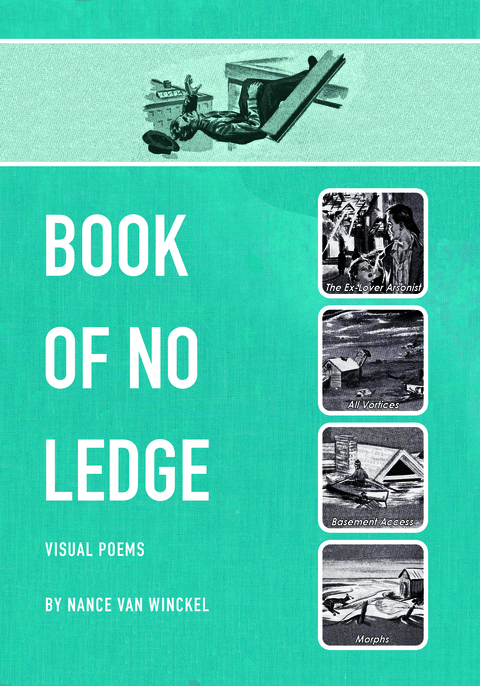
In Book of No Ledge, one of her new collections, poet and writer Nance Van Winckel brings together poetry and visual collage in a series of brilliantly reimagined encyclopedia entries and maps that are a pleasure to read. Witty, both lyrical and satirical, beautiful to look at, and wonderfully inventive, the collection lives up to poet Mary Ruefle’s description of it as “a book of wonder.”

rsz_bookofnoledge

Recently Nance Van Winckel spoke with U.S. poetry editor Susan Aizenberg about Book of No Ledge in a series of emails. Numéro Cinq is thrilled to present here two of the collages from the collection, together with a summary of their conversation, and a third, more recent piece of what the poet calls “wall writing.”

Susan Aizenberg (SA): I love your charming Introductory note, in Book of No Ledge, in which you describe a child first infatuated with a handsome door-to-door encyclopedia salesman, and then in love with the books themselves. Though there was no handsome door-to-door salesman in my experience, I remember feeling as a child a similar fascination with encyclopedias and illustrated guides of various kinds. I’m wondering if you would talk a little about your childhood experiences as a reader as they relate to this book.

Nance Van Winckel (NVW): Well, I was a reader as a kid and I was very interested in the sciences. Because my family moved frequently, I was often the new kid in school, and I read in the lag time it took to make new friends. Books were a “constant” in my life. I liked the diagrams of how things worked— especially bodies and body parts. Early on in life I wanted to be either A.) a spy or B.) a laboratory scientist. And perhaps becoming a writer/poet was a sort of melding of those two professions.

SA: I love the idea of writer/poet as a melding of spy and scientist. I’m particularly drawn to your vivid description, in the intro, of the point of view and voice of the encyclopedia, wonderfully personified as “Mr. Explainer,” and how they change over time as Mr. Explainer realizes the “you” has become a much older woman with “nice sharp scissors and even X-acto blades” – another image I love – who questions his authority. This idea of voice or voices seems important throughout the book, which is rich with wordplay, satirical humor, puns, and seemingly effortless shifts in diction. I’m wondering if you would speak a bit about voice in your work, and how the idea of being in dialogue with Mr. Explainer shaped (if it did) the series of photo-collages.

NVW: Yes, exactly! Talking back to Mr. Explainer from a future quite different from the one he (Commandant of the Past) posited so definitively, so upbeat and full of happy endings—that was very much the tone, which for me is a kind of fuel. I have to get the stance before almost anything else. The attitude. If only as an adult I could again be the imp-kid, the sassy girl, I was when I was ten. That girl got smacked sometimes or sent to her room. I squashed her down. But hey, apparently she ain’t dead yet!

SA: Clearly, and thankfully, she is not! Can we talk a bit about the conception and creation of the book, which seems to me equally a work of literature and visual art? It is, first off, a lovely physical object; the pages are silky (like encyclopedia pages?) and the collages quite beautiful. There is so much to look at and read and consider on every page – I love the richness of it. I don’t think I can overstate what a genuine pleasure it is to read. Would you talk a bit about your process?

NVW: I worked on these pages over the course of about five years. The encyclopedia I altered is actually 13 volumes, and at about a sixth grade level. As I paged through it, it brought back those memories from girlhood and reading, and I fell back in love with all the graphic elements. So I mainly used pages that had a lot of visual material on them. My method was to work on these very “visual” pages, which were all in black and white, and part of what I was doing was teaching myself—as I most always am these days—new techniques in colorizing, cut-and-paste, and many other things available from my old friend, Photoshop. (I’ve been noodling around with that program since back when I was a magazine editor [of Willow Springs] and designing the magazine with a program called PageMaker, which evolved into Photoshop.) As I worked on the visual layout of a page, I would often write new text to replace the old text. Sometimes I just carried printouts of the pages around with me in their waiting-for-text states, i.e. big blocks of space where text would go. I liked this method because I could work on other projects simultaneously—linked stories, other “regular” poems, etc.—and these encyclopedia pages would wait patiently for me and, as I mentioned above, I sort of knew the persona to slip into when I returned to them.

SA: You’ve generously shared with us two of the pieces from the collection. Would you speak a little about them?

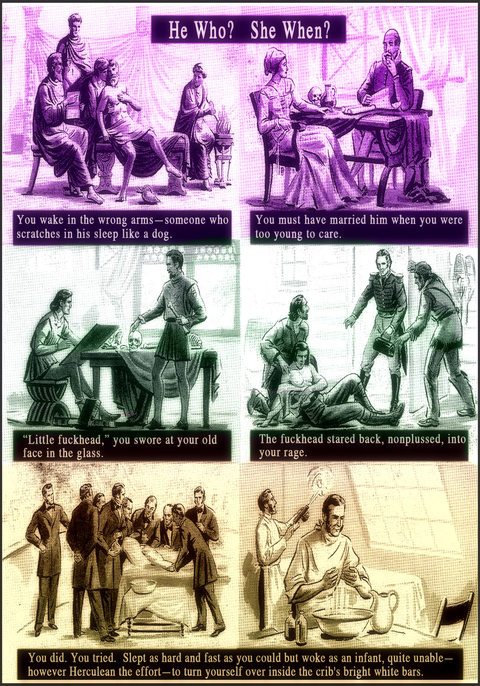
NVW: One of the aspects I’m drawn to in this work is how the visual material can interact with the text—fill in gaps in the “story,” provoke a nonlinear kind of logic, or suggest a larger worldview/context than the text alone permits. This page, now titled “He Who? She When?”, was originally called “Advancements in Medicine.” I don’t feel in any way obliged to stick with the original subject matter of a page. For me, it’s all about the interplay of words with images that have “tangential” connections, thread-like, or tonal. The sense the pieces make, I hope, is more intuitive than conscious and rationale.

He Who, She When?

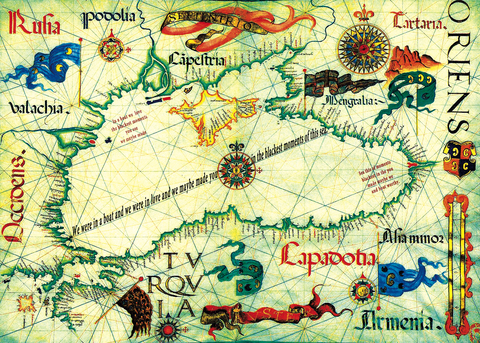
I haven’t said anything about the maps, and I’d like to. Most of these were not part of the encyclopedia I altered. Rather, they were from an online website (from New York Public Library’s “digital collection”) of public domain “rare” maps. I used these in the book a little like section dividers, and I am forever grateful to Pleiades Press for allowing them to be double-page spreads and displayed so well. (I’m grateful to Pleiades for so much! The support of the editors and designers there has been extremely helpful to me.) Here, my little bit of text—”We were in a boat and we were in love and we maybe made you in the blackest moments of this sea”—is spread out upon a map of The Black Sea, a place I’ve actually been. The text is stamped around into the sea with all sorts of variations on the arrangement of these words. This felt like a kind of homage to ancestry, not just mine but “ours.”

Map

SA: Thanks so much, Nance! Can we end with you sharing with our readers what you’re working on now?

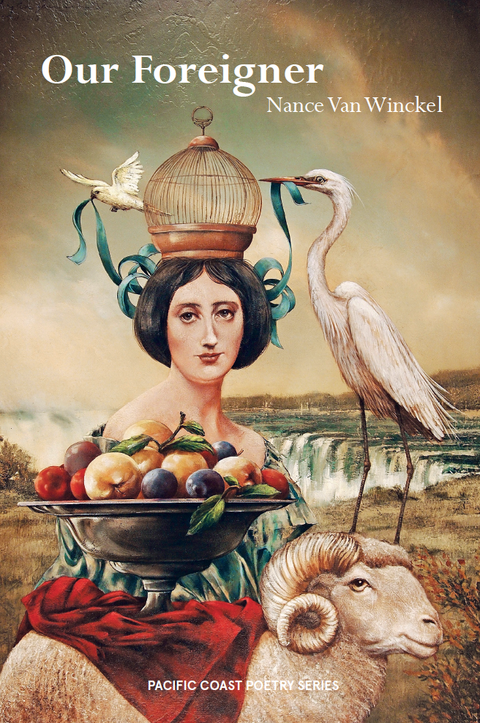
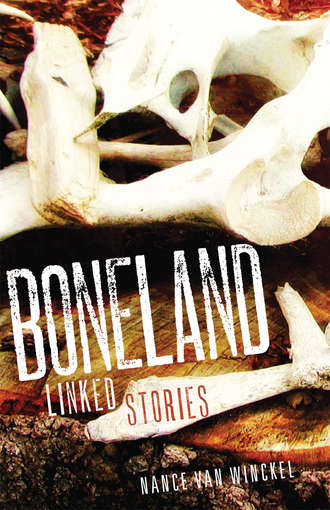
NVW: Yes, my eighth book, Our Foreigner, received the Pacific Coast Poetry Award and is just out from Beyond Baroque Books. I’m working on a book that’s primarily a memoir; it has many sorts of hybrid forms going on in it, including some visual black and white collages.

Our Foreigner book cover

And I continue to do a little wall-writing. This is a recent piece.
I have a website for examples of this work.

Wall Writing example


Nance Van Winckel is the author of eight books of poetry, most recently Our Foreignerwinner of the Pacific Coast Poetry Series Prize (Beyond Baroque Press, 2017), Book of No Ledge (Pleiades Press Visual Poetry Series, 2016), and Pacific Walkers (U. of Washington Press, 2014). She’s also published five books of fiction, including Ever Yrs, a novel in the form of a scrapbook (Twisted Road Publications, 2014) and Boneland: Linked Stories (U. of Oklahoma Press, 2013). She is on the faculties of Eastern Washington University’s Inland Northwest Center for Writers and Vermont College of Fine Arts’ MFA in Writing Program. The recipient of two NEA poetry fellowships, the Paterson Fiction Prize, Poetry Society of America’s Gordon Barber Poetry Award, a Christopher Isherwood Fiction Fellowship, and three Pushcart Prizes, Nance lives with her husband Rik Nelson in Spokane, Washington.

aizenberg-thumbnail

Susan Aizenberg is the author of three poetry collections: Quiet City (BkMk Press 2015); Muse (Crab Orchard Poetry Series 2002); and Peru in Take Three: 2/AGNI New Poets Series (Graywolf Press 1997) and co-editor with Erin Belieu of The Extraordinary Tide: New Poetry by American Women (Columbia University Press 2001). Her poems have appeared or are forthcoming in many journals, among them The North American Review, Ted Kooser’s American Life in Poetry, Prairie Schooner, Blackbird, Connotation Press, Spillway, The Journal, Midwest Quarterly Review, Hunger Mountain, Alaska Quarterly Review, and the Philadelphia Inquirer and have been reprinted and are forthcoming in several anthologies, including Ley Lines (Wilfrid Laurier UP) and Wild and Whirling Words: A Poetic Conversation (Etruscan). Her awards include a Crab Orchard Poetry Series Award, the Nebraska Book Award for Poetry and Virginia Commonwealth University’s Levis Prize for Muse, a Distinguished Artist Fellowship from the Nebraska Arts Council, the Mari Sandoz Award from the Nebraska Library Association, and a Glenna Luschei Prairie Schooner award.


Mar 082017
 

Carlos Fonseca cropped 500px

x

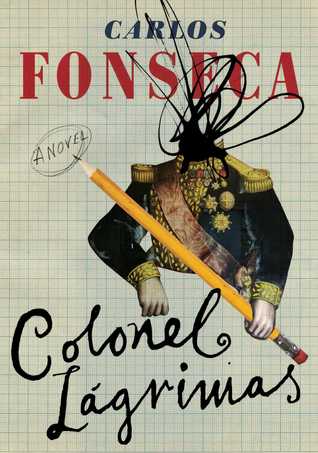
Carlos Fonseca’s Colonel Lágrimas is a novel that deals with the attempt of mathematician Alexander Grothendieck to isolate himself in the Pyrenees and devise a formula that encapsulates the whole of the 20th century. To do so he invents different personalities, all with different lives and interests — Chana Abramov, a woman obsessed with painting the same Mexican volcano a thousand times, Vladimir Vostokov, an anarchist in battle with technological modernity, and Maximiliano Cienfuegos, a simple man who will nonetheless become the symbol for the Colonel’s as well as Europe’s restless political conscience. Grothendieck’s own life story traverses the 20th century, from the Russia of the October Revolution to the Mexico of the anarchic 1920s, from the Spanish Civil War to Vietnam, back to France and from there to the Caribbean islands.

While reading it I thought of the theories of social scientist Gregory Bateson, who saw society as a set of systems with adaptive changes, dependent on feedback loops and the way multiple variables change and interact. This is a deceptively simple novel — turning its pages, one enters a kind of Zen state, as anecdote follows anecdote, and every word is located precisely in the place that seems right for it. But these are not just jewels moved by pincers on a metal plate. Through its form, Colonel Lágrimas dares to ask about the meaning of activity and the meaning of thinking, and embodies those questions in the structure of the text itself.

Each fragment is exquisitely written, and although not linear, the carefully phrased thoughts seem to be in an order that makes sense. If one were to be swapped out, however, it would not fundamentally dislodge the architecture of the work. Every individual “idea” contributes to the anecdotal edifice, but the book does not really depend on any one of them, in the way a formula depends on the variables that comprise it. Just as in Bateson’s theories, the pieces interlock in interactive ways that suggest a meaning beyond the individual parts. Any “formula” devised by Grothendieck would have to be dextrous enough to take these billions of feedback loops, sequences and interactive mechanisms into account, no minor undertaking, perhaps even impossible.

Colonel Lágrimas embarks on these abstract challenges in a way that is both beautiful and analytical — it doesn’t surprise me that Fonseca used to want to be a mathematician. Born in Costa Rica in 1987, he grew up in Puerto Rico. Now he lives in London and teaches at the University of Cambridge. The book was originally published by Anagrama, and was translated for Restless Books by Megan McDowell, who has also worked on Juan Emar, Alejandra Zambra, Carlos Busqued and a number of other authors.

Book Cover Lagrimas

Jessica Sequeira (JS) : How did you decide to write this book? In what ways does it link to your life experiences and to your studies? (It doesn’t have to, of course, but I wonder if there’s a connection.)

Carlos Fonseca (CF): I think most books are the product of a constellation of obsessions. I started writing Colonel Lágrimas as soon as I saw that many of my obsessions coincided within the same structure: my obsession with Chuck Close’s hyper-realist portrait paintings, my obsession with Alexander Grothendieck’s life as some sort of allegory of the twentieth century, my obsession with archives and archival-novels. When I started writing it, I was finishing my doctoral studies and I somehow imagined the novel as a form of escape from academic studies. Then again, you can never escape your obsessions. So the novel ended up addressing some of the ideas that intrigued me at the time: the idea of a history as a giant museum, the inability to pass from thought to action, the Borgesian notion of history being reduced to a giant encyclopedia or archive. And then, there is also the story of how – as an adolescent – I wanted to be a mathematician. Perhaps, now that I think about it, the novel was a way of rethinking my past.

JS: The colonel seems to face a similar set of questions a historian would. While reading, I noted some of his possible confusions, which I’ll copy here:

Is history a science? Is the attempt to create a blueprint misguided if we’re talking about human endeavor? Or can one look for a pattern there as well? If so, how should one go about trying to find it? Is it best to remove oneself from the world to ensure peace of mind and the tranquility necessary for tracing larger arcs? Or should one try to be as actively engaged in daily life as possible? Do the aims of history writing undergo development, in the same way that ideas of modernism marked a literary shift, partly in response to scientific discoveries? And is there some shining pattern or arch-truth behind these changes? Or is history just an infinite parade of possible anecdotes to arrange, catalogue, exhibit, assemble and frame in a Duchampian exercise, like a box of old film reels? Can the historian in his observational role play some part in affairs, creating change through his attempt to understand? Or is this withdrawal into the imagination folly? My question for you is how you see history, and how is it different or similar to the colonel’s?

CF: I am fascinated by history and I like the image of the historian as someone lost in a giant archive, shuffling around documents as if they were pieces in a jigsaw puzzle. And you are absolutely right: I am interested, not so much by the figure of the historian as he who finds the “truth” about history, but rather as he who recontextualizes and reframes the fragments of history. As you note, this is a Duchampian gesture: what matters is the frame, the context. A playful take on history. In this sense, more than a scientist or even a historian, the colonel is a collage artist: like Walter Benjamin before him, his idea is to construct a book in which every single forgotten fact is quoted, framed and analyzed. An encyclopedia of forgotten histories that would permit us to see the other side of History. On the other hand, the book is also critical of the image of that peaceful museum so often imagined as the peaceful resolution at the end of history. The question remains: how to think of political action within this giant museum? How to break open the museum’s doors and start running against the wind of history?

JS: You’ve mentioned Duchamp’s techniques. What is your relationship to art and how do you see contemporary literature as engaging with some of the techniques of the art world? (Do you see it doing this?)

CF: I have become, lately, very interested in artand in particular conceptual art – as a territory lying at the limit of literature. I like Duchamp’s gesture of moving art away from the immediacy of the sensory towards the realm of the conceptual. Or at least, forcing us to reimagine what the relationship between the sensory and the conceptual, between feeling and thought, might be, beyond a mere contradiction. Ideas, too, have a body, I would claim. I see contemporary art as a playful realm of liberty for the imagination and as such I see it as the limit towards which literature should aim. I think that to write alongside Duchamp – as writers like Enrique Vila-Matas, Mario Bellatín or Margo Glantz do – is to imagine literature as a realm where thought meets emotion. As Don DeLillo likes to say: “Writing is a concentrated form of thinking.” I like to think that Duchamp’s gesture is precisely this: to turn thinking into art and art into thinking.

JS: Do you think of yourself as influenced by Puerto Rican or Costa Rican writing in any way? Or do you think nationalistic categories aren’t important?

CF: Influences are a tricky subject. I think you end up being influenced by much more than you imagine or intend. In this sense I can only hope to be influenced by both the Puerto Rican and the Costa Rican literary traditions, traditions which I have read passionately and which abound in wonderful writers. I like to think that just like each writer has two parents, each writer inherits, indirectly, two different traditions. In my case, being born in Costa Rica and raised in Puerto Rico, I like to think that perhaps a novel like Colonel Lágrimas is the strange offspring of the Puerto Rican baroque writing, on the one hand, and Costa Rican minimalism and experimentation, on the other. While writing the novel I kept thinking that the playful narrator had much to do with the voyeurist narrator in Luis Rafael Sánchez’s 1976 novel La guaracha del Macho Camacho, a novel that fascinates me due to its rhythm and narrative techniques. Meanwhile, I also kept thinking about Carmen Naranjo’s 1982 novel Diario de una multitud, an experimental novel that always reminds me of a set of Russian dolls. I don’t think national categories should be abolished but rather rethought or disrupted in innovative ways. But, I guess at the end of the day, I agree with Italo Calvino’s quote: “The ideal place for me is the one in which it is most natural to live as a foreigner.” The writer always has to be a bit out of place, he has to become a bit of foreigner even to himself. Writing is, in a way, another form of exile.

JS: In such a globalized world and with your experiences and influences in particular, do you still think “Latin American literature” makes sense as a phrase?

CF: I think “Latin American literature” only makes sense as an anthropological phantasy: as the label others give us, that is to say, as a particular lens through which the world sees us. I only figured this out when I arrived to study in the United States. Until then, it had always been a pain for me to explain my double-nationality to others: the way I was both Costa Rican and Puerto Rican. This was solved as soon as I arrived to the United States. Suddenly, I figured others had decided for me: I was Latin American. Like any other identity, this was, after all, nothing else but a mask. But masks and phantasies are also real. I think, beyond asking whether it exists or not, it is important for Latin American writers to play with this phantasy: to play with the anthropological phantasy that is Latin America in the eyes of the world. We always need to rethink the phantasy in order to critique it, I would claim. I also think that these broader categories end up helping writers from peripheral countries. If you stay at the national level, you keep reproducing the hierarchies dictated by the market: unknowingly, you keep speaking about Argentine, Mexican and Colombian writers, just because their market visibility is greater. Latin America as a category gives space to writers from countries that wouldn’t have visibility otherwise: countries like Ecuador, Paraguay, or Bolivia, just to mention a few.

JS: The Restless Books page refers to a “new Latin American boom”. Do you think that this term is legitimate? Or do you think phrases like this should also be abolished?

CF: Besides it being legitimate or not, I understand what they seem to be referring to: let’s say that in the post-Bolaño literary landscape, Latin American writers have gained a heightened visibility. Latin America – whatever that might be – is seen as a territory of literary innovation, as an exciting place where new voices can be found. The Bolaño phenomenon – for good or evil – transformed the way international publishers see our work and allowed for the region to be reimagined, no longer as the land of magical realism, but rather as the land of avant-garde innovation. I think this is a great step forward, independently of whether it comes with an actual boom or not. Of course, it does hint at the fact that the boom is still present in our imaginations as the golden age of Latin American literature: a spectre that never gets tired of haunting us.

JS: What writers or artists are important for you? Who do you like to read, from the past and present? How have you been influenced by the work of your teacher, Ricardo Piglia, and how does your work break from his?

CF: The other day I was rearranging my library, so I had time to think about this: which author to place alongside which author, who to give the best spots and so on. I guess, at least right now, the names in the main shelves are the following: Faulkner, Machado de Assis, Borges, Sebald, DeLillo, Lispector, Perec, Sarraute and Piglia. Then, next to them: Bernhard and Calvino. From each I have a particular memory, and perhaps my favorite is Faulkner, but with regards to this novel, I think the most important author was Machado de Assis whose Memórias Póstumas de Brás Cubas (published in the UK as Epitaph of a Small Winner) is a fascinating inheritor to Sterne’s Tristram Shandy: a playful experiment in narration. I love the idea of thinking of Machado as a black nineteenth century Brazilian predecessor of Borges, another author that is always central, not only to me, but to most writers in general. Regarding Ricardo Piglia, there is no doubt I am highly indebted to him, not only for his generosity and his amazing lectures, but for his capacity to redefine the way we read nowadays. Very few people, if any, have reimagined the figure of the reader in such a radical manner.

JS: In what direction is your current work headed?

CF: As of late I have become obsessed with obsession. I have become fascinated with protagonists whose engagement with their fixed ideas leads them to that shaky territory between art and science, between madness and reason, between art and nonsense. I am more and more interested by so-called outsider artists: artists working in the realm of that which Jean Dubuffet called “Art Brut”. Artists who don’t see themselves as artists. I see in them a metaphor of art itself, as well as a new way of linking thought and art.

JS: It’s fashionable to glamorize action in the world, and criticize thinking. While your book criticizes somebody who thinks too much, it also gets at many of the subtleties and pleasures of thought. How do you conceive of the relationship between thought and action? Do you think there is still a role for the observer in a world so oriented toward the glamorization of the “event”?

CF: This was one of my greatest obsessions while writing the novel. I wanted to explore the relationship between thought and action. Most people, when they read the novel, say that in it nothing happens. I accept these comments gladly precisely because I was interested in producing such a space of tedium, boredom and thought. A space which, like a museum, has secluded itself from the world in order “to think” the world, but where nothing necessarily happens, at least in the sense of the action to which we are accustomed. The protagonist of the novel, the colonel, belongs in fact to that strange sect of explorers of the negative which Enrique Vila-Matas has so well described in his book Bartebly and Co. Like Bartebly and like Alexander Grothendieck, upon whose life story the novel is based, the colonel decides one day to renounce the life of action in order to dedicate himself solely to the life of thought. I am fascinated by such characters: characters which one day decide to devote themselves to a conceptual project that might at first sight seem absurd, characters like the protagonist of Thomas Bernhard’s Correction. I am interested in sketching out how thought is also a type of action, perhaps the most beautiful and contemporary of them all. The only action that truly changes the world.

—Carlos Fonseca & Jessica Sequeira

x
Carlos Fonseca Suárez was born in Costa Rica in 1987 and grew up in Puerto Rico. His debut novel, Coronel Lágrimas, was published in Spanish by Anagrama and in its English translation, as Colonel Lágrimas, by Restless Books. His work has appeared in publications including The Guardian, BOMB, Minor Literatures, and The White Review. He was recently selected as one of the twenty new young voices in Latin Literature by the FIL Guadalajara. He currently teaches at the University of Cambridge and lives in London.

x
Jessica straightened

Jessica Sequeira is a writer and translator born in California, at home in Buenos Aires. @jess_sequeira
x

xx
x

Mar 102014
 

IMG_0486

Bianca Stone is an amazing poet/comic creator/illustrator/hybrid/amalgam artist who, yes, changes the weather a bit because she goes where she pleases, much like Anne Carson, with whom she collaborated on the book Antigonick (New Direction, 2012), Carson’s translation of Antigone. Stone has a new book just out, Someone Else’s Wedding Vows (Tin House/Octopus Books, 2014), and she has great genes, being the granddaughter of the of the poet Ruth Stone. We have today an interview between NC’s own amalgamated poet/artist Nance Van Winckel and Bianca Stone, delightful and knowing. Note especially Stone’s analogy between drawing and the poem on the page.

And when I draw—poof! There’s suddenly a physical thing there, that can talk, that can move. And I take advantage of that. The body itself, the air around the body, the expression on the face—these things can work just like a poem. Speaking, but not saying everything.

dg


NANCE VAN WINCKEL: In some of your comics the text can seem suggestive of a state of mind, a thinking-feeling condition. I’m thinking of, for example, “It’s like there’s a house in my skull with a woman waiting for someone to resurrect and take her outside.) The artwork itself, however, often gives this more “lyric” text a kind of narrative context: a physical space, characters, and situation. Can you comment on your own sense of how narrative and lyric impulses combine for you—in process and/or technique?

American+Sentances+American+Sentances+

BIANCA STONE: I’ve always had a great love of narrative. But I prefer also to allow surrealism in to complicate the narrative. I think that’s just how our minds work. In my poetry comics it’s the perfect space to explore the two. You have the push and pull of the visual image (which is so much more immediate than words), and perhaps work against the literal. And against abstraction.

That line you mentioned, for example—how could I possibly draw that without wrecking the imagination of it? I don’t want to draw it. I want to imagine it; more importantly, I want the reader to imagine it. So I draw something that lies beside it, so to speak, like another line of the poem. So that it moves forward, avoiding the didactic, the static.

NVW: Regarding the Practicing Vigilance Series in Notnostrums.

“No coins left in heaven/ you say every day/ to the coin-operated wind.”

In this series I especially like how you get at one’s impulse to “speak,” to give voice to inner turmoil, “someone’s lipstick burning in your skull.” The bats in this series fly like bits of language into the urban brew-ha-ha. Many of your poem comics seem to be haunted by what I’d call “incomplete linguistic transactions.”

Bianca StoneVigilant

BS: I love that you imagined that the bat was bit of language. Because isn’t language, in a way, an image? Especially a poem—which uses the page like a canvas, and appreciates white space, the shape and sound of words, the drop at the end of a line. It’s beautiful for the eye (or perhaps hideous to the eye).

And when I draw—poof! There’s suddenly a physical thing there, that can talk, that can move. And I take advantage of that. The body itself, the air around the body, the expression on the face—these things can work just like a poem. Speaking, but not saying everything.

And often I’ll use poems for a drawing that perhaps need a little more. That aren’t done enough to be on their own. I’ll be using a poem, and take a line out because suddenly, while it’s all alone on the page, I realize it’s not strong enough. Thus, it often creates the non sequitur method that you find in more experimental comics and poetry. But also that method resists the narrative and allows more for music.

Some day soon I’ll be making a comic that’s much more narrative…that’s more a prose poem.

IMG_1397

NVW: You say that in your poetry comics you “want to use the image as another element of form in poetry.” Could you talk a bit more about this text & image “gestalt?”

BS: Again, one is constantly resisting “illustration, ” in its traditional definition. You don’t want to draw what’s being said, because that’s redundant.

It’s damned abstract to talk about, frankly. An image as a line in poetry—it doesn’t make entire sense! But I believe it.

BlackTightsBlack Tights

NVW: Regarding Antigonick, your collaboration with Anne Carson, is it true you didn’t even see her written text until after you’d done the illustrations? But of course you no doubt knew the play. Did you come away from this project with any new understandings about the collaboration process?

BS: Not entirely true! What I did see (read, spend hours with) was Anne’s text. I had it beside me while I did the art. I worked from it, as I do with all my poetry comics.

However, Anne and Robert Currie didn’t show me the hand-written text until I was finished. And then Currie magically came up with a method to put the images and text together.

Collaboration is hard. Very hard. You make endless false starts, and you spend a lot of time alone, weeping internally, worrying about everything. But then you come together and put things together like a couple of curious, eager architects. You step back and you have this one giant product. And you’re so proud. Your ego isn’t too wrapped up in it, because you all did it together.

It’s something that you do with people you trust artistically, and emotionally. And it makes you a better, more humble person.

NVW: I loved the poem “Elegy with Judy Garland (and Refrigerator).” I so admire how the language synchs with the music and the graphics. The intermix of drawing and film, of music and voice-over make for one of the better poetry videos I’ve seen. Does the poem come first, and then the animation take shape around that? And is poetry video a main direction for your work these days?

BS: I’ve always loved making videos. Ever since I was a teenager and had a massive VHS camcorder. The past few years I’ve been doing it again, and it’s really something I’ll keep doing.

It takes a long time. But the main things to remember are:

1. Use a good, finished poem.

2. Make a high-quality recording of it. (Read it well. Read it slowly.)

3. As I preach in my poetry comics, avoid “telling” the poem. Let the poem speak for itself. Use ghosts of subjects in your poem, but not verbatim.

Then comes all the hard work of figuring out the visuals. I’ve developed a kind of stop-animation process with my drawings, which is time consuming and bizarre. The process itself is a kind of performance piece (drawing free-style with a camera blocking half my view; trying not to move the paper or my camera.)

Thinking of the video-making process as part of it will slow you down, and help you make a better video.

A lot of poem videos are kind of awkward…it’s important to pick the right tone (music, sounds, title font, footage).

FridgeFridge

NVW: I know you’re the granddaughter of Ruth Stone, a poet who’s near and dear to my heart, and I know too that you’re running the foundation to make her Vermont house a writer’s retreat and artist space. Could you talk a bit about how her life and/or her poetry have influenced your own? In your video, “Because You Love You Come Apart,” I could swear the first voice is Ruth’s.

BS: YES, the first voice is grandma’s voice, with me pantomiming it. She was an amazing reader.

Well, how to begin with this….grandma’s poetry is the most important poetry to me in the world. Her voice, her words, her love, is why I’m a poet.

I’ve written a lot about it. But to kind of sum-up, I spent my childhood with her (living with her in Binghamton while she was teaching there, traveling to readings, spending summers with her in Goshen, VT). We wrote together all the time, read her poems out loud; created together. I was raised by a single mother, so we spent a lot of our life dependent on my grandmother. My whole maternal family really revolved around her.

InfinityInfinity

Since her house in Vermont has always been a haven for her writing, and for students, poets, artists (and of course my mother and aunts), I’ve always dreamed of making it into a writer’s retreat. Sadly, the house needs about 500,000 worth of renovation (it’s also a historical landmark, so that price includes the parameters of restoring such a house). People tell me to tear it down, and I just want to scream! I wouldn’t dream of it! I’ve been toiling away with whoever will help, raising as much money as we can, trying to save it. All her writing and books and my family’s history is in there, getting eaten by mice and consumed by the elements. This summer I’ll be up there full-time. I’m going to get married there!

Honestly, anyone who can, please donate here at the Ruth Stone Foundation site and read more about what we’re doing.

weddingWedding

NVW: I know you have a new book, Someone Else’s Wedding Vows, just out with Tin House/Octopus Books. Does it include visual art? Or did visual art—your own or others—inspire the poems in the book?

BS: I did the cover. (Which, I at first said I wouldn’t do, because art sometimes trumps words.) But besides that, it’s all about my poems. However, you’ll notice in the book that several poems are also poetry-comics and/or poem-videos out in the world.

I’ve been looking forward to my first book for a long, long time. I was patient in the end, waiting until I had it right. Now I’m thrilled with the whole trajectory of my poetry. I just wish grandma were here to see it.

—Nance Van Winckel & Bianca Stone
.


Bianca Stone grew up in Vermont, and graduated with an MFA from NYU’s Creative Writing Program. She is the author of Someone Else’s Wedding Vows (Tin House/Octopus Books, 2014), several poetry and poetry comic chapbooks, and is also the illustrator of Antigonick, (a collaboration with Anne Carson). Her poems have appeared in magazines such as American Poetry ReviewTin House, and Crazyhorse. She lives in Brooklyn.
SPACE
§
Nance Van Winckel is the author of six collections of poems, including After A Spell, winner of the 1999 Washington State Governor’s Award for Poetry, and the recently released Pacific Walkers (U. of Washington Press, 2013). She is the recipient of two NEA Poetry Fellowships and awards from the Poetry Society of America, Poetry, and Prairie Schooner. Recent poems appear in The Pushcart Prize Anthology, The Southern Review, Poetry Northwest, Crazyhorse, Field, andGettysburg Review. She is also the author of three collections of short fiction and a recent recipient of a Christopher Isherwood Fiction Fellowship. Her stories have been published in AGNI, The Massachusetts Review, The Sun, and Kenyon ReviewBoneland, her fourth collection of fiction, is forthcoming in October from U. of Oklahoma Press. Nance’s photo-collage work has appeared in Handsome Journal, The Cincinnati Review, Em, Dark Sky, Diode, Ilk, and Western Humanities Review. New visual work and an essay on poetry and photography are forthcoming in Poetry Northwest and excerpts from a collage novel are forthcoming in The Kenyon Review OnlineClick this link to see a collection of Nance Van Winckel’s mash-ups of poetry and photography, which she calls photoems. She is Professor Emerita in Eastern Washington University’s graduate creative writing program, as well as a faculty member of Vermont College of Fine Arts low-residency MFA program. She lives near Spokane, Washington with her husband, the artist Rik Nelson. Her personal web page is here.
Mar 072014
 

Desktop44

I kept hearing his name, usually associated with the question, “Have you read…?” Have you read Reality Hunger? Have you read the new Salinger biography? Have you read How Literature Saved My Life? I believe the word is buzz.

By almost any standard, David Shields has been enjoying quite a ride. Since 2010, when Vintage Books published Reality Hunger: A Manifesto, Shields has written or edited 5 books. Most recently, he co-authored Salinger with Shane Salerno.  Shields also appeared in the PBS documentary produced and directed by Salerno.

On occasion, Shields has been pilloried by the controversy surrounding Reality Hunger, a book comprised mainly of appropriated and loosely attributed quotes by various writers and artists. He is unabashedly proud of the book, calling it one of his most personal and passionate. After exchanging a series of emails and speaking with him on the phone, what becomes readily apparent is that Shields cares intensely about reading and writing. His books are an extension of his deep abiding search for meaning, an exploration he calls a ‘radical epistemology.’

Shields’ writing pushes boundaries, often enflaming critics and detractors. At the same time, his style continues an ongoing conversation with literature that is certainly not new. Our interview ranges from Stanley Kubrick to Walter Benjamin, from Virginia Woolf to J.M. Coetzee, from V.S. Naipaul to David Foster Wallace. Shields is a prolific writer, a thoughtful and deep reader, and an artist not afraid to transcend boundaries.

–Richard Farrell


RF: Anne Carson writes, “I’ll do anything to avoid boredom.”  There’s a similarity of intent between Carson’s work and your work.  And what’s interesting is that you both do a lot of the heavy lifting for you readers, so that what is produced is anything but boring. The work appears effortless, but I suspect the exact opposite is true.

DS: That’s high praise, on a number of levels. People say, “Oh what did you do, come up with this clever idea and then look for passages that would fill up the book?” I don’t see how that kind of book would be any good. It would just been a one-trick pony. A lot of my friends, quite justifiably, think of Reality Hunger as my most personal and my most passionate book.

The book began when I started teaching a graduate course in fiction-writing at the University of Washington. I had this huge blue binder of full of quotations of stuff I really liked: passages from Heraclitus to D’Agata that were articulating and embodying what began to feel like a new aesthetic: not fiction, not as journalism, not scholarship, but essay as “radical epistemology.” Work that uses the frame of “nonfiction” to explore the most serious questions about existence: What’s real? What’s knowledge? What’s memory? What’s truth? What’s a self? How much can a self know about another self?

So I was gathering all these quotes. The packet was full of repetitions of the same quotes, misspellings, doodles. I started organizing passages into little rubrics or chapters. And year by year this course packet deepened, and then I realized I had the rough draft of a book, at which point I really went to work on it.

It’s a strange book. People think it was some kind of IED, some sort of attention-getting mechanism, but I thought twenty people would read it. I thought it would get published by a university press. It was intended for fellow writers and readers and students: for those of us bored by conventional fiction and conventional nonfiction, here’s a way forward. But because of the book’s purposeful withholding of standard citation, the book developed a kind of bad-boy aura.

reality-hunger

RF: You take the novel to task pretty hard in places, but I don’t think you’re attacking the novel so much as you’re attacking genre. Is your argument more about genre than it is about fiction versus nonfiction?

DS:  Right. One of the book’s epigraphs is from Walter Benjamin: “All serious works of literature either dissolve a genre or invent one.” I think it’s so ridiculous that so many people who are supposedly serious writers get praised for being Dickensian writers or Tolstoyan writers. Dickens and Tolstoy were great writers, but the reason they’re great is that they pushed the form forward, “altered the face of an art form” in Pauline Kael’s phrase. This is even truer for Flaubert or Virginia Woolf or Beethoven or Monet or Picasso.

I listened to a guide in the National Gallery who was asked what makes Mark Rothko a great painter. And the guide ended up saying, “Rothko’s great because he changed the weather for everyone who came after him.” Everyone afterward had to deal with Rothko. That’s the standard I’m trying to hold up for myself and fellow artists. It’s not that I have some minor quarrel with writer X, Y, or Z. The novel is supposed to be something new. That’s what “novel” originally meant. And yet it’s become unbelievably formulaic. I really care about the future of literature, and I’m trying to push it in an exciting direction and away from a dead direction.

RF: I wrote a portion of my critical thesis in graduate school on Leonard Michaels’s “In the Fifties.”  I read it and treated it as fiction. After all, it was included in a story collection. But then a classmate of mine treated the same piece as a nonfiction list essay.  This really annoyed me for awhile, until I recognized how little these distinctions mattered. It’s simply an elegant piece of writing.

DS: The only thing that matters is how Michaels arranged the material into a meditation on how the private narcissism of the fifties became the public violence of the sixties. I think that’s all that really matters. Plath. Catullus. Berryman. Whitman. We grant poetic license to the speaker. I’m seeking the same freedom for the essay as we’ve always had for the poem.

01-14literature_full_600

RF: Patricia Hampl talked about starting out as a nonfiction writer.  She said they didn’t know where to put her books when she first started out. I know you quote her in How Literature Saved My Life. I had the chance to spend some time with her in Vermont a couple of years ago and heard her say that it shouldn’t be called creative nonfiction, but non-poetry, because the writing is closer to poetry.

DS: I think I quote her in Reality Hunger rather than in the later book. She talks beautifully about how related the poem and the essay are. Both are meditative, contemplative, consciousness-drenched forms.

I’ve learned a lot from Trish. So many people, when they write an essay, think if they just the story of what happened, that in itself is compelling, but it’s not. Hampl is very good on this, as are Gornick, Lopate, D’Agata.

The essay is a meaning-making machine. That’s what’s so exciting about it.  It says, Okay, I served in Fallujah or my sister is an alcoholic, whatever the situation is—some aspect of dramatic existence. But then what the essayist has to do is to wrench that into meaning, often by wiring the material through the self, by making the self complicit with the experience. It’s not reportorial journalism; it’s not academic scholarship, although it might partake of both. You’re trying to arrive at nothing less than wisdom, which I think is what makes the form so, so exciting.

If you write a bad essay, people think, I really don’t like you. But if people really like your essay, and you’ve said tough-minded things about yourself and others, and people still connect to you, that’s a very serious embrace between writer and reader. That’s a serious, existential act. You actually have made the world significantly less lonely. David Foster Wallace is really great on this: We’re existentially alone on the planet. I can’t know what you’re thinking and feeling. You can’t know what I’m thinking and feeling. And writing is a bridge constructed across the abyss between the loneliness.

Wallace goes awry when he goes on to say, “Don’t worry, all the little contrivances of fiction are hoops we can jump through and still cross the abyss of human loneliness.” It’s completely obvious that far and away Wallace’s best work is found in his essays.

Did Trish Hampl critique anything of yours?

RF: She read a fiction story of mine and tore it up pretty good, but that opportunity, to have such an experienced writer cut through all the “workshop bullshit” and tell you the truth—that was invaluable.

DS: It’s interesting that you mention “workshop bullshit,” because it’s absolutely the prevailing mode of contemporary literary discourse. Just read “major” reviewers: they’re basically still reviewing work according to the workshop model, which for me has nothing to do with what it feels like to be alive now. There are works of fiction that definitely surprise me and that I love with all my heart and soul. Say, Ben Lerner’s Leaving the Atocha Station.

RF: I once heard Robert Vivian talk about “vestibular space,” which is the space you pass through before you enter the sacred places you write from. Do you ever contemplate your vestibular spaces?

DS: I do unbelievable amounts of research before I sit down to write, even something quite short. I gather all this material, and I just gather all the notes: stuff from the web, books that I read, journalistic reportage. I develop this huge, very rough, very loose, inchoate mess of stuff. I find that a terribly useful process. That’s my vestibule, for sure.

Then I just marinate in it, to mix metaphors. I just spend a huge amount of time with that material. I develop material around a very broad topic: death or love or art or celebrity. Then I try to find the very occasional passages that have for me some potential, some life. I often color code the passages, endlessly rewriting them. Then I try to put the passages into a trajectory both within a chapter and within the book. In a way it’s not time- or cost-effective, but I need that endless luxuriating in the material. Other people can apparently just sit down and write a five-thousand word essay and, in a way, I’m just amazed they can do that. It’s not the way my mind works. I seem to need all those data points, just to hold in my hands. A box of rocks, say; I find the 127 rocks that really glint and throw off light. Then I shape the rocks, sharpen them, and then I put them, very crucially, into the right order. For better or worse, that’s how my mind thinks.

RF: There’s a documentary about Stanley Kubrick called Boxes; it documents the trove of material the great director gathered around him when shooting a scene. For one particular scene in Eyes Wide Shut, Kubrick had thousands of photographs taken of doorways and gates in England. He spent months documenting and examining these photos for a single shot in a single scene. I think there might be some resonance between Kubrick’s method and your own.

DS: I’d like to watch that documentary, but it also sounds like a bit of a cautionary tale. One can definitely get trapped in one’s own processes. I certainly like some Kubrick quite a lot. Dr. Strangelove is great, as is Lolita.  But there are some films in his last couple of decades in which he got so attuned to his own mental processes that the work suffers. I’d have to go back and watch all of Kubrick.  For all I know, those films hold up beautifully.  He’s obviously a major artist.  But I can see how, in this process, which I do, and which Kubrick does in his own way, there’s a real danger that that all you’re doing is staring at your own reflection.

That risk interests me, but I work incredibly hard to avoid those traps.  I try to make sure the work is about something more than my own reflection.  If you write a poem, there is a danger that you’re performing only a series of technical verbal maneuvers; when you write a novel, there is a danger that you’re only carnival-barking, merely entertaining. And if you write personal essay or even literary collage or collage essay, you run the risk that you “writing only about yourself.” You want to go so deeply into yourself that you come out the other end into a “universal” space, or as Montaigne said, “Every man contains within himself the entire human condition.” That may sound grandiose, but in the great essays, we recognize that nothing less has happened.

RF: A lot of the experimental work pushes boundaries.  That seems to be what you are drawn to, both as a reader and as a writer.  Is that true?

DS: I’m definitely not interested in experiment for experiment’s sake. V.S. Naipaul says, “If you want to write seriously, you have to be willing to break the forms.” Coetzee deconstructs his own work: it’s not great because it never deformed the medium in order to say what only he could say. If you’re not doing that, why bother? Writing ought to be a deadly serious act of investigation and exploration. It shouldn’t be you with your little sewing kit trying to make a perfect little hand puppet. “Is this workshop-worthy? I’ve put all my soldiers into a perfect order, but I’ve produced this perfect little dead thing.” That can’t be a living model.

—David Shields & Richard Farrell


farrell

Richard Farrell is the Creative Non-Fiction Editor at upstreet and a Senior Editor at Numéro Cinq (in fact, he is one of the original group of students who helped found the site). A graduate of the U.S. Naval Academy, he has worked as a high school teacher, a defense contractor, and as a Navy pilot. He is a graduate from the MFA in Writing Program at Vermont College of Fine Arts. His work, including fiction, memoir, essays, interviews and book reviews, has appeared in Hunger Mountain, New Plains Review, upstreet, Descant, and Numéro Cinq. He teaches at Words Alive and the River Pretty Writers Retreat in the Ozarks. He lives in San Diego.

David Shields is the New York Times bestselling author of fifteen books, including The Thing About Life Is That One Day You’ll Be DeadSalinger (co-written by Shane Salerno); Reality Hunger, named one of the best books of 2010 by more than thirty publications; Black Planet, a finalist for the National Book Critics Circle Award; Remote, winner of the PEN/Revson Award; and Dead Languages, winner of the PEN Syndicated Fiction Award. He lives with his wife and daughter in Seattle, where he is the Milliman Distinguished Writer-in-Residence at the University of Washington. His work has been translated into twenty languages.


Feb 032014
 

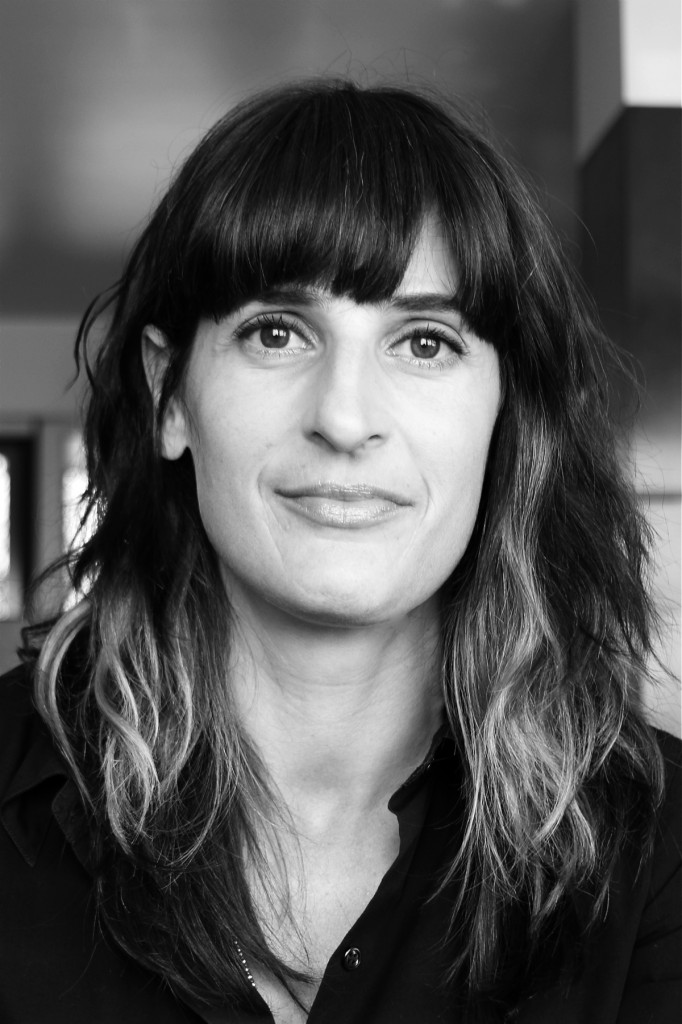
Marcom 2

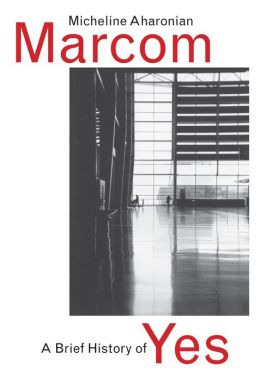
A few months ago, Micheline Aharonian Marcom emailed thanking me for a review I wrote of her new novel, A Brief History of Yes, which you can read an excerpt from on Numéro Cinq. It was thrilling to get an email from an author whose work I admire so much. While writing the review, I’d become fixated with each of her novels because of their remarkable mixture of passion and formal inventiveness. They often recall for me passages of William Faulkner and Clarice Lispector. Gorgeous and original novels, they seek obsessively the ineffable within language. Here’s an exemplary passage from her most recent novel:

And yes is the hillside grove; the invisible songbird inside of it. Yes the three-legged dogs in the white clay city. The blue pushing the sky out like a girl pushes from behind her mother’s skirts with her hand to see what she has hidden from only moments ago. His feet, bony, ugly and black, and her toenails painted with lacquer a red or brown. Water. The water in the glass. The clear glass, the clear water. Water and the glass the same color which is clear and the word clear which doesn’t say the yes of the color or the isness of all the life in the color or nothing in the glass holding water oxygen like refracted on the glass which is the image on glass of the window, the blue peeking sky, fingerprints, greasy and earthy, so that the glass doesn’t fly off into ethereal metaphors and the girl herself, Maria, in the glass: thin stretched-down face, dark eyes, the right darker than the left, the right hand lifted in prayer, in benediction, and the mouth smiling now, open, saying, singing herself.

—A Brief History of Yes (Dalkey Archive Press, 2013)

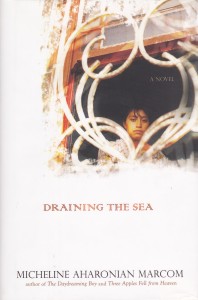
After her initial email, I took the opportunity to ask her some questions about her novels, her working habits, and artistic vision. As Marcom says below she takes her obsessions with “stories that go untold” as the subject of her work and turns them into inquires. She has explored the Armenian genocide in her first three novels (Three Apples Fell from Heaven, The Daydreaming Boy, and Draining the Sea) and female sexuality in her most recent work (The Mirror in the Well and A Brief History of Yes). In each of these books, she proves herself again and again to be a writer with an unremitting gaze, depicting acts both tender and monstrous that push her characters to places—whether internally or externally—that is beyond or without language. Our interview took place over email in late 2013.

Herewith is an interview with Micheline Aharonian Marcom.

—Jason DeYoung

§

Jason DeYoung (JD): You’ve written a trilogy on genocide and now you are writing (or have written) a trilogy of ‘domestic dramas,’ as you’ve described them. What is it about trilogies that attract you?  How do they serve you as an artist?  And are there trilogies that have influenced you?

Micheline Aharonian Marcom  (MAM): I don’t think, in either case, I knew or planned to write a trilogy—it was more that when I was finishing my first novel I realized that everything I wanted to think about would not “fit” into one book, and also the second one began to emerge in my mind. I realized, or decided at that point, that naturally there would follow three books, following three generations of Armenians, and in some manner, following my own family’s timeline and geographical movements (although neither the second or third book in that trilogy is biographical). Whereas the second trilogy I wrote, what I think of as a “domestic” one spiraling around women narrators in relations with men, and the questions of love including its big themes—adultery; unrequited love; the forces, drives and mania of eros—I didn’t realize until I had probably written the third one, The Nothing on Which the Fire Depends, that these were in fact three and in some kind of relationship to one another, and hence a kind of trilogy. Beyond those six novels, I have written three others which are not trilogies…so perhaps it had more to do with the subject matter into which those books inquired more than anything else. And three is an old and stable number: a triangle…the trinity. It is the “culmination of manifestation” as the Dictionary of Symbols says: nothing can be added to it.

JD: You said in your interview with Context that “books… ‘make’ writers into the writers that they are.”  Could you talk about or describe what you mean by this?

MAM: I often tell my students that the books they are writing, especially, perhaps, the first one, “makes” the writer. When I was writing Three Apples Fell From Heaven that book was so beyond my ken, my skills, what I thought I was capable of, and so it pushed me—the material mattered so much to me, not only because it was the story of my own family’s survival of the Armenian genocide, but I also felt a responsibility to the unknown dead whose stories had not either been widely told. So there was high bar in the writing of that book, a steep learning curve.  And language already didn’t feel like it could hold the stories, the losses, but it had to try to do so. I had to try my best and the book, as it emerged, responded in some way: perhaps this is the great mystery of making books: that the writer does her best, studies craft, reads and reads and reads, “everything,” as William Faulkner exhorted us to do—and she writes and fails and writes more—to fall into the rhythm of the stories and the “voices” and find, ultimately, and make, a book’s final form. Writing for me is akin to how I experience consciousness: it contains its highs and lows—the spiritual and the very mundane—one must, after all, sit in one’s chair and write and revise for years on end, it’s a quiet, unadventurous vocation, and yet the gods do come in…inspiration is also part of the process.

brief-history-yes

JD: I just finished up a large project on Joseph McElroy, and during my research I came across his essay on 9/11 and in it he asks himself “what knowledge have I that’s of any use.” This statement really shook me because (as I took it) here is one of the great fiction writers of the Twentieth Century asking what his role is in the face of this tragedy. But his question got me thinking again about the role of the writer, and the many definitions I’ve read; two that come quickest to mind are E. L. Doctorow’s assertion, “The ultimate responsibility of the writer is to witness”; and William T. Vollmann’s “We should portray important human problems.” Each writer seems to have a personalize definition of the “job.”  What’s yours?

MAM: I respect William T. Vollmann’s work tremendously and am, I think, in great accord with what you’ve quoted from him how a writer “should portray important human problems.” Writing for me is inquiring.  And what I inquire into has varied and continues to vary as my interests broaden, my concerns are raised, my heart and mind are involved…my obsessions reveal themselves.  I am always interested in stories that go untold, are censored, denied, erased: the interstitial stories, the ones, also, that many turn their heads from, where shame is a form of censorship.  I suppose you can see these “obsessions” already in my earliest novels: the genocides of Armenians and the Ixil-May in Guatemala, but they are also evident in Mirror with its story of unhindered uncensored female sexuality, and in my latest novel, The New American, about an undocumented Guatemalan-American college student who is deported to Guatemala and returns to California riding on cargo trains with other Central American migrants. I guess you’d say I only write about things that feel urgent to me, that I believe matter. But this also includes small things—like the hummingbird I wrote about that came and sat on my back porch, or the orb spider who spins his web anew each night in September in the garden. Natural beauty matters also.

JD: From what I can gather from looking at some other interviews with you, you are a deeply read person. I’m always curious about author’s reading habits and how they read. Do you have a method to your reading, to the texts you study? Are you looking for anything in particular?

MAM: I’d like to be a deeply read person, I love books, and there are so many I haven’t yet read or read only one time. When I began writing and studying more seriously in my late twenties I read everything—the old, the new, the recently released, etc. Now I find I am only more or less interested in reading books that are masterful, that are “at pitch”…something which years of reading means I can now sense more quickly.  With the books we call classics we trust that there is this “aesthetic achievement”: they’ve lasted and been lauded for a reason.  With newer books one must trust one’s own instincts and follow one’s own predilections, because time cannot yet help us. But I am always so happy to discover new writers and new books! And basically toward this end I ask writers and critics and deep readers I know for recommendations. I try to read widely, across time and space. I’ve never understood reading only one’s peers in one’s own country. But I also think of someone like Montaigne who read fewer books, great ones, over and over again—that seems to have tremendous merit as well: reading deeply. Many books won’t stand up to a second reading, after the plot is discovered, all the energy falls out of the book—it’s why a second read (and third and fourth) tells you so much, reveals so much about a text.

mirror

JD: One of the striking characteristics of your writing—and something I admire—is your exploration of the body, as in A Brief History of Yes, the lover’s concave chest; in The Mirror in the Well, the woman’s cunt; and, of course, Draining the Sea has a lot to say about the body and bodies. Some of it is beautiful and some ugly (but there’s a freedom and warmth toward that ugliness, too, of giving it witness). What role might the visceral, the body, the flesh play in your work?  This question is in part inspired by two sentences in A Brief History of Yes: “Have you not seen your Christ on the cross? And why does the Protestant deny the image where the knowledge can be felt.”

MAM: In his wonderful essay “A Propos of Lady Chatterley’s Lover,” and in response to fierce criticism of that novel, DH Lawrence wrote: “The body’s life is the life of sensations and emotions. The body feels real hunger, real thirst, real joy in the sun or snow, real pleasure in the smell of roses or the look of a lilac busy; real anger, real sorrow, real love, real tenderness, real warmth, real passion, real hate, real grief.  All the emotions belong to the body, and are only recognized by the mind.” In response to your question, I would say that I have long been and remain interested in the real, and intuitively and sometimes consciously, as Lawrence says it here, I know that the real is experienced in the body. It’s how we know anything. He goes on to say: “The Christian religion lost, in Protestantism finally, the togetherness with the universe, the togetherness of the body, the sex, the emotions, the passions, with the earth and sun and stars.” Perhaps that’s part of my “writing the body,” my interest in writing the whole, the “togetherness.” I have long thought that there ought to be a word in English that encompasses to think-feel, this seems to me how we come to know things, and then just recently I realized that the Latin word “sentire,” which in English we define as “to realize” and is the root of words like “sentiment,” actually does mean that! Think-feel.

JD: You’ve spoken about your novels being inquires, and that you write by instinct, but at some point formal concerns must become a priority. Can you talk a little about that point? Does the work expand or contract at this point? How do you think about the patterns in your work?

MAM: I always am thinking about form, and patterns. It is not an afterthought, but concurrent with the making of a book. I follow what I think of as “heat” as a writer. Write scenes as and where I feel energy, I guess you could say. Over time, the mind makes patterns and the form begins to become apparent. But I make a lot of conscious and deliberate decisions about form, I’m the artist and I know it’s my job to hold the reins of the book, fine-tune it, order it, etc.  To that end the editing process can be a very long and detailed one. First drafts I’m kind of free-wheeling, but later I batten down the hatches and read and edit and revise until a book is finished. Until every comma is where I want it. Every word. To the degree I am capable of.

JD: You’ve written “social” novels and “domestic” novels, can you give any insight about the process of writing the two, the differences? Do you value one over another? Or are they the two sides of one coin, meaning one cannot exist without the other?

MAM:I write what I feel like writing, what I feel called to write, what is urgent.  The only real difference between the “historical” and “social” novels I’ve written is that the former usually require a significant amount of research and travel, whereas the latter have needed less. Although as I say that, I then remember how I traveled to Portugal to write A Brief History. I also did a lot of research about Lisbon and fado music and listened to fado regularly as well as studied icon painting and its history and went to museums to look at them, and then at some point found myself studying bird migration and hermit thrushes. So in some ways all of my books go hand in hand with some things I’m researching and learning about. I suppose it’s not only that writing is inquiring for me, it’s also that I’m curious and like to know better than I do and books are one way for me to deepen my various interests of the moment and plus everything I’m interested in tends to make its way into my books!

marcom-draining-the-sea

JD: You are (or have been) a teacher. What is the one teachable component to writing? What would most students say you teach them?

MAM: I’ve been teaching for twenty-five years, one subject or another—I was a teacher before I became a writer actually. For the past eleven years I’ve been teaching in an MFA program, working with creative writers. I teach writing from my own experience as a writer.  The biggest influence on my teaching style was my former teacher, Ginu Kamani, who taught me to “apprentice” with books. The one teachable component to writing? Read! Love books and read read read—the books are the teachers. I think my students might say that I encourage them to be their own best editors, to train themselves to be their books’ best readers, and to trust themselves: the work is theirs, and only they can do it and only they can determine if it’s done to their satisfaction.

JD: Any new work forthcoming?

MAM: My sixth book, The New American, will be published by Simon & Schuster.

—Micheline Aharonian Marcom and Jason DeYoung

Micheline Aharonian Marcom is the author of five published novels. The first three—Three Apples that Fell from Heaven (2001), The Daydreaming Boy (2004), and Draining the Sea (2008)—take as their subject genocide, and operate loosely as a trilogy. Her new novel, A Brief History of Yes, is the companion novel (and the second in a new trilogy) to The Mirror in the Well.  She is the recipient of a Fulbright Fellowship, the Whiting Writers’ Award, the PEN/USA Award for Fiction, and a Lannan Foundation Literary Fellowship.  She lives in Berkeley, California

MarchelineMarcom


Jason DeYoung lives in Atlanta, Georgia.  His fiction and other writing has appeared recently or is forthcoming in REAL: Regarding Art and Letters, Music & Literature, New Orleans Review, The Los Angeles ReviewNuméro Cinq, and The Best American Mystery Stories 2012.

IMG_0683

Jan 082014
 

Phil Hall

Phil Hall is a language-player whose restless mind and tender sensibility makes poems that l like to read over and over. The first time we met up was at the Cow Cafe in downtown Toronto. Someone had put salt in the sugar bowl and I ended up spitting tea down the front of his shirt. He smiled and dabbed at his clothes, the picture of grace when blindsided by an unexpected event. He approaches language and image the same way, welcoming the unanticipated and ushering it inside the poem. Phil Hall has been short-listed for the Griffin Poetry Prize twice and has won the Governor General’s Award and the Trillium Book Award.

— Ann Ireland


Ann Ireland interviews Phil Hall

Ann Ireland: How did you come to poetry?

Phil HallGet that goddamn / dog out of here / before I get the shot / gun down (said my father – sounding a lot like Milton) Blue & green / should never be seen / except in the washing machine (said my mother – sounding a lot like Beatrix Potter)

I came to poetry through all of the usual pathetic early tunnels: Wilf Carter and Hal Lone Pine, Kipling and Service, The Song of the Lazy Farmer, greeting cards… I came to poetry backwards, secretly, on an outside track: I would be an actor, because theatre is the art form by which one gets the most immediate response and attention. I was hungry to be told I was OK, and clapping is a big (if fleeting) OK. (Thankfully, writing poetry means that not a soul is in the audience. The inside track and the stadiums are for prose. Hear the novel whizzing by…) I came to poetry – I guess you could say – missionarily – is that a word? The clean & holy parents of school friends sometimes took me along to Baptist Sunday School & Church in Bobcaygeon. Here I heard and sang hymns devoid of melody but rich with long dark tones, the foot pedals pumping on the organ. That chastising drone got into me, I guess – along with the bag-pipes at Orange Lodge parades… Between Milton & Potter: half mighty condemnation / half little animal jingles –  I sing.

AI: What does living in nature bring you?

PH: I grew up on farms, but was allergic to everything: hay, ragweed, goldenrod, dust, horses, dogs, cats, blue & green molds…When it grew cold, and those spores weren’t in the air, I got asthma, bronchitis, skin rashes…A dead deer was hanging in the woodshed, dripping – I wouldn’t eat meat. What the hell is wrong with him! Fortunately, books have in them none of the things I am allergic to – except as referents. Books saved me. And peanut butter. I am allergic to rural life, I guess…or ultimately, I am allergic to Ontario. But I have grown out of the asthma, have never smoked so my lungs are clear, can avoid horses & pets & dust & weeds, mostly. And living back in the country, in nature, now, I feel at home – with my aversions. I am writing with Blake’s rural pen, or trying to. I have a little garden, even. The poems eat the leaves off my bean plants.

AI: You burrow at words from the inside-out: I will write a poem again today / it will make no sense // my claver will clawhammer the bars of the word barbaric // sense can be a gag order / silence can be made to sound civilized & free. This feels like a statement of poetic intent. Care to comment?

PH: If we don’t work with words from the inside-out, we are using them as they have been sold to us, cheaply. A poem will then be no more than a Cabbage Patch Frankenstein composed of imitative sound-bits. Poem as soma – in the Huxley sense of a pacifier from the State. Coke. Against this – we may try to honour the historical and sonorously complex revolt against propriety that is each word in truth. Also, to write this way makes me laugh, and is clarifying. I have come late to the pondering of words, late to letter-rumination. Neither Milton or Potter care-took language in this way, contemplating words as objects, designs, sounds, shapes. (In other ways, they did.) Susan Howe, bp Nichol and Robert Duncan are my Virgils in this. But let me tell what I know about these lines you quote…Claver – in Scots means gossip or jibber-jabber. Clawhammer – is a style of banjo strumming, as you know. And you have seen already that the word barbaric has two bars in it. My kind of talk in a poem will strum the two bars in a word like barbaric, acknowledging it visually as well as referentially. Making sense turns out to be very limiting. There is more to be said than — Then she said…And don’t ever think that silence is proper (it is wild). Or that by saying nothing you can remain free. If you don’t write the poem as a full invite to all of the potential barbarism its words embody, your voice is being muzzled, tamed, and eventually killed by…what…education? Morality? As Clark Blaise (another of my heroes) says of the short story: literary justice is at war with morality. This applies to poems too. How would Gertrude Stein or James Joyce write of having been sexually abused as a kid? There are rigorous savannahs of possibility still.

AI: What goes on between spoken words and words on the page?

PH: One of the most common mistakes people make when giving poetry readings, is that they proceed as if the poem – as written – were sacred. It isn’t. When shared aloud, the poem is a non-page creature. Listeners deserve to be entertained. Not preached to, or taught. And certainly not regaled by sly or hip examples of the poet’s sensitivity. For me, this involves composing a reading by pasting together various sections & stanzas of poems from throughout a whole book. I often will tear a book apart, then cut & paste. Making a new thing to read…This turns a box of fossils into sea life again. And listeners are grateful for the iconoclasm.

AI: Sound is dug into the soil of your poetry, so I’m assuming that music is important to you. What do you listen to? Do you listen while writing?

PH: I listen to jazz. Oscar Pettiford, Charlie Mingus, Roland Kirk, David Murray, Jerry Gonzalez & the Fort Apache Band…Horns & bass full-tilt. Sometimes I can write while inside that harsh wall of sound, for it blocks out the constant nitter-natter, and is oddly calming. I listen to early Zydeco and The New Lost City Ramblers. I listen to a lot of fiddle tunes: Jarvis Benoit, Wade Fuge… I have been trying to get the fiddle tunes inside me – to replace the organs & hymns. I’ll keep the bag-pipes.

AI: Do you read poetry in translation? Care to comment on translation in poetry?

PH: I am ashamed to say I use only one language, but what poverty of word there would be without translation! When I read in translation, I know I am looking down through water at cities I can’t walk around in, but I am voracious for wavering glimpses of those foreign cities. Many of my masters are non-English poets: Vallejo & Jimenez, Elytis & Ritsos, Mandelstam & Tsvetayeva, Char & Césaire, Brossard & Pato…Many of what we consider great English poems are in imitation of models from other languages.  And what presumption to assume that one language – ours – can always be where the best writing is…Shelley said that to translate a poem was to boil a tulip. I prefer boiled tulip to no tulip at all. At worst, I get that shimmering recognition of something deep in the water; at best, there are translators and trans-translators who give us luminous furtherances of poems…new poems built in border-crossing forms…

AIAh research / now there’s the ear’s coffin – This is my favourite line because, like so much of your work, it makes perfect sense although I couldn’t tell you quite what, or I’d get tangled if I tried. It’s also funny. There’s that research and that ear – and the ear is within the research as if tucked into a coffin!

PH: You’ve got it – visually, the word research enacts all of what I’m saying. A pet peeve of mine: the popularity of researching a subject and then writing poems based on that information, the popularity of young poets getting Phds. Too much research, too much information, kills the ear’s ability to hear music. For example, look at the Augustan poets, Dryden & some of his lesser contemporaries. They were solid, pragmatic versifiers, and translators, mostly on classical themes. Designed purely for instruction…reasoned into truth. Lectures & fables cut into heroic couplets. Dryden was like (later) Darwin with a metronome. Dull stale stuff. I prefer, though it sounds flaky in these reactionary times, the ephemeral scatter of Mallarmé. Or I like what Philip Levine says – about actually avoiding learning to do many things – while waiting for the voice to enter him. Not inspiration – but certainly there is more than enough to know about these complex interlocking mysteries of personhood & language – without having to mummify your ear in some archives…There are exceptions, but generally – a book of poetry about something gives me the heeby-jeebies.

AI: I’ll stop there. What the heck is Plevna?

PH: Plevna is a town near here, in the Ottawa Valley. I’ve used as titles for a number of poems in this new book the odd names of nearby towns: Tweed, Poonamalie, Ubdegrove, etc. These poems aren’t about those towns, I just like the sounds of the place-names. And who knows, maybe I have represented my place and mind – by invoking the map of sounds I live within…Who wouldn’t want to call a poem – Oompah!

— Ann Ireland & Phil Hall

IMG_1138

Three poems from The Small Nouns Crying Faith (BookThug, 2013)

SPACE

Tweed

..The chewed-corn gaff of the mullein
its tall standard rising behind the wood-pile
..(between the wood-pile & the woods)

seems yellower as the morning darkens
..& the maples gather darkness into themselves
& clouds combine as overcast moil

..& the highest poplars tell of what’s to come
throwing their paper bangles up / letting loose
.[their crepe-ribbon noise (braided loops

being pulled down after the party
..that was sleep)[**]such blinkered comfort to write like this
the supposedly-tender anthropomorphic wit

[.of witness that is really a hiding-out
under stupid traditions[**]while the ramps narrow
[.in the tock yards

it is going to do a whole lot more than rain

 /

Greenbush

.[I am away[**]up side-roads[**]into another attempt

at local song[**]have begun to see how to possibly fix[**]again
.[an obscure entry or warped fragment[**]its pulse taken at word

crossings-out[**]circles with arrows[**]crossed-out arrows

[.I am lost[**]my only anchor / dither[**]dither as dubious power

I have sold my children to the zero & the one[**]& complete sets
[.of My Book House to the fox[**]to Fox[**]to Captain Fox

I drink only Adam’s Ale[**]have no one to read to but yellow-jackets

[.when I sit still[**]when I try to be clear & silent[**]I go & & & &

my ear at some hive[**]listening to flight thicken

/

The Access Route

[.There were coy-wolves howling in our woods last night

what is rarer & rarer is an un-surveilled common
[.when it was coming dawn out[**]enough grey-blue[**]the lake grey-blue

I looked out to see the thermometer
[.there were riot police around the cabin
leaning hard against the logs[**]staring straight ahead[**]locked eyes

[.on point with the new chinking
I tapped the window[**]but they didn’t acknowledge
[.they aren’t supposed to I guess[**]the weather continues
& I am the same age I’ve always been[**]am trying

[.not to talk about the weather or my age
for instance I didn’t know hallowed or hollowed
[.was a choice[**]I got told by example something different
victims convinced of their own goodness

[.& up to despicable distractions[**]these were my people
so I chose hollowed by scar[**]when I could have had hallowed
[.which is my initial h plus allowed

now I’ve changed my thinking on this[**]I allow that a hole is for echo not ache
[.bless me 26 times[**]that I may be finally not the point

but the pointer[**]sheep & citizens beware

/

Two sections from the poem sequence X, published in a deluxe special edition of 100 copies by Thee Hellbox Press of Kingston, 2013

[.My posture[**]crumbling[**]says its word

quick-ache-to-sternum-slump
[.but the little sweet Tommy Sweets

grown off of one last tree[**]beside the furthest stile

[.up Devitt’s Settlement[**]scrub cedar[**]mullein[**]purple thistle
are down[**]all down[**]derry-down

[.warty-yellow in the unscythed timothy

my posture says I never went there[**]when I could[**]& can’t now
[.but I did[**]always did[**]& am

/

§

/

[.Few poems worth knowing

worth suspect[**]knowing suspect[**]/[**]few suspect
[.seeing double[**]hearing less out of one ear

to have had to be 60 to say in a poem the abuser’s name

].is this success or failure[**]both[**]neither
my tongue’s baloney-smell[**]articulating adios


 — Phil Hall

————————–

IMG_1139Phil Hall is the 2011 winner of the Governor General’s Literary Award for Poetry in English, for Killdeer, published by BookThug. His is also the 2012 winner of Ontario’s Trillium Book Award for Killdeer. This book of essay-poems also won an Alcuin Design Award, & was nominated for the Griffin Poetry Prize. Previously,Trouble Sleeping (2001) was nominated for the Governor General’s Award; and An Oak Hunch (2005) was nominated for the Griffin Poetry Prize. Among his many titles are also: Old Enemy Juice (1988), Hearthedral—A Folk-Hermetic (1996), White Porcupine (2007), & The Little Seamstress (2010). In the early 80s, Phil was a member of the Vancouver Industrial Writers’ Union, the Vancouver Men Against Rape Collective, & the Starvation Army Band. In the early 90s he was Literary Editor at This Magazine. He is a graduate of the University of Windsor, & has taught writing & literature at York University, Ryerson University, Seneca College, George Brown College, & elsewhere; currently, he offers a manuscript mentoring service for the Toronto New School of Writing. In 2007, Phil & his wife, Ann, walked the Camino de Santiago de Compostela in Spain. He has been poet-in-residence at Sage Hill Writing Experience (Saskatchewan), The Pierre Berton House (Dawson City, Yukon), & elsewhere. In 2012, he was writer-in-residence at Queens University in Kingston. He plays clawhammer banjo, is a member of the Writers’ Union of Canada, & lives near Perth, Ontario.

Nov 012013
 

Tim Deverell

Tim Deverell grew up on the flat geographical abstraction of the Canadian Prairies, spent many years studying and evolving in the urban abstraction of New York and now lives in Toronto, a city that, if anything, is an abstraction or an abstraction, a sign of its own absence (but very busy nonetheless). Deverell’s influences are a set of party invitations to painterly Modernism and Abstract Expressionism with a nod back even farther to Heironymus Bosch and James Ensor who composed proto-abstract paintings of multitudes of human scenes, figures or faces. Hence Deverell’s use of collage, cut up bits of magazine image and sketch applied as paint or instead of paint — that’s one compositional theme. In the interview he talks of influences, of a structure and destruction of structure, the two always in some ironic tension with one another, and about obsession which has its effect in the detailed recursiveness of the work.

Deverell has a new show opening in Toronto November 2 (details below). If you happen to be lucky enough to be around, go take a look.

dg

Tim Deverell: Paintings 2000 to 2013 is an exhibition of Deverell’s paintings, his first solo show since 1999, at the yumart gallery in Toronto, November 2-23, 2013. Location: yumart is located on the 2nd floor of 101 Spadina Avenue, south of Adelaide on the east side of Spadina. Gallery Hours: Wednesday to Saturday, noon to 6:00 p.m. Phone: 647-447-9274. Gallerist: Yvonne Whelan.

 •

01 Berkeley #4 gouache copy

Berkeley #4, gouache, 16″ X 12″, Tim Deverell, 2012

Y.M. Whelan: Donald Brackett wrote about your work in Toronto Life Magazine as being a ‘portrait of urban life as it plunges into the next millennium’ with images that ‘build into a storm of little symbols, graphic designs and geometric forms and give way to a feeling that you’re looking at 21st century hieroglyphics’. Do you actually reference or draw upon the urban landscape as source material, and if so, would you say your work is abstraction?

Tim Deverell: The paintings are abstract. The city is abstract. I wander and get lost in the city as I search and find my way in the painting. The cityscape is continually reinvented, as is the painting.

02 Clusters and Squares

Clusters and Squares, acrylic on canvas, 12″ X 24″, Tim Deverell, 2012

YMW: After a recent visit to your studio, I noticed that you have two distinct yet complementary bodies of work: paintings composed of tiny figures, heads, texts etc., and paintings that are composed of pure colour and light. Do you see these as two separate styles? How are they related to each other?

TD: They both depend on multiplicity and a cross-fertilization. The one is in the other, opposite equals striving to be one body.

03 Fieldnotes collage

Field Notes, collage and acrylic on wood, 12″ X 12″, Tim Deverell, 2013

YMW:  Can you tell me some of your major influences throughout your art practice?  Have they changed over the years as your work has developed?

TD:  Two very different artists have been key influences from the start of my art-making: James Ensor and Piet Mondrian. Influences are to be absorbed then shaken off, but I feel a strong affinity with the work of Mark Tobey, H. Bosch, Arshile Gorky and Wols — a German artist of the Tachisme movement. Also, Sally Drummond, an American painter who also uses a built up saturation of tiny marks. From the Canadian prairie I continue to look at the work of Agnes Martin and Art McKay. Having made paintings for over fifty years, I prefer being influenced by what lies outside the art world, such as the urban environment that I soak up through long walks where I observe the human element and bustle.

04 Niagara collage

Niagara, collage and gouache on paper, 24″ X 18″, Tim Deverell, 2013

YMW: Your work is highly detailed. Can you describe your technique or process of making art and what kind of time-line is involved? Do you work on several paintings at once?

TD: Thinking about technique can get in the way. There is a certain randomness in how I choose imagery and colour; it’s not predetermined. I often start with a grid and broad washes of colour which will slowly become obliterated as I continue working. They act as a structure or discipline to destroy. The tools and materials are simple – palette knife, brush, pen, pigments, collage elements from diverse sources and canvas. I have an innate need to saturate the surface in a search for a space my mind roam in. The infinite variety of the visual is seductive. I work on one large painting for an average of two months companioned by small pieces – collages and gouaches. Drawing is a constant, though I don’t make studies or drawings for paintings.

06 Red dots

Red Dots, oil and collage on canvas, 42″ X 40″, Tim Deverell, 2013

05 Red dots detail

Red Dots (detail), oil and collage on canvas, Detail of 42″ X 40″ painting, Tim Deverell, 2013

YMW: This one might be too personal: what informed your decision to leave New York City after so long? Do you regret your decision?

TD: There was no rational decision to leave Manhattan, just a usual upheaval of human relationships, confusion of personal and artistic direction and an unrealistic idea of what life would be like in Canada. Regrets? Deep, for over ten years. I did return to New York for a year, but something had changed, either in me or the place. Toronto is in the Now. It’s hard to describe the grip a big city can have on one. I feel New York as a place that formed me as a painter. The art world at that time was a place of incredible flux. You protect yourself in a big place by creating a smaller world, as I did with three close artist friends who were from Saskatchewan.

08 Snapshot

Snapshots, oil, acrylic, and collage on canvas, 48″  X 36″, Tim Deverell, 2013

07 Snapshot detail

Snapshots (detail), oil, acrylic, and collage on canvas, detail of 48″ X 36″ painting, Tim Deverell, 2013

YMW: Where do you see your work going from here?

TD: I let the work tell me where to go. I am increasingly involved with balancing collage elements and paint. I have countless images to pluck from shoeboxes full of fragments of my own drawings and printed material such as magazines, encylopedia and dictionaries.  The challenge is in bringing the collage elements into the painting and having them work as paint.

All I know is that I will continue to make paintings in my usual obsessive way.

10 Swim Alone

Swim Alone, acrylic and collage on canvas, 48″  X  48″, Tim Deverell, 2013

09 Swim alone detail

Swim Alone (detail), oil, acrylic, and collage on canvas, detail of 48″ X 48″ painting, Tim Deverell, 2013

— Tim Deverell & Y. M. Whelan

——————————————

Tim Deverell was born in Regina, Saskatchewan, in 1939. His father worked as a journalist, his mother as a nurse. He first studied art with Ernest Lindner at Saskatoon Technical Collegiate. He went on to work at the Regina College School of Art with painters Ken Lochhead, Art McKay and Roy Kiyooka. At age eighteen, he travelled to New York City where he lived for the next seventeen years. Deverell studied at the Art Students League with Theodoros Stamos, George Grosz and Charles Alston during a period when painting was a dominant force in the New York art world.  At age 21, Deverell had his first solo show at the Kornblee Gallery on Madison Avenue and a follow-up show the next year. During the late 1960s and early ’70s, he was a member of  the 55 Mercer Street Gallery in Soho and exhibited there many times in solo and group shows. During the New York years, he made extended trips to Europe, and India.

Returning to Canada in 1976, Deverell settled first in Vancouver, then in Toronto, where he has lived since, with frequent forays to Mexico and Berkeley, California.  Since his return to Canada, he has exhibited at the Bau-Xi Gallery in Vancouver, the Mendel Gallery in Saskatoon, the National Gallery of Canada, and had solo shows in six different Toronto galleries.

Tim Deverell: Paintings 2000 to 2013 is an exhibition of Deverell’s paintings, his first solo show since 1999, at the yumart gallery in Toronto, November 2- 23, 2013.


Oct 022013
 

Nance Van Winckel

NC Contributing Editor Nance Van Winckel has popped out two, yes, two! books simultaneously this year; Pacific Walkers, a collection of poems, and this one, Boneland, a collection of linked short stories. As we all know, one book is amazing enough; two books, in different disciplines, is tantamount to having the literary equivalent of Multiple Personality Disorder. Only this is a disorder we all wish we could catch. I have taught with Nance for years at Vermont College of Fine Arts. She never ceases to surprise me with her unconventional wisdom, her oblique and revelatory take on art, and her questing spirit.  We have here for your delectation a lively and intelligent interview with Nance by the inimitable Ross McMeekin.

dg

boneland-330

Ross McMeekin: Tell us about the Spokane area literary scene; there are so many great writers who call it home.

Nance Van Winckel: Yes, Spokane has some wonderful writers and I feel lucky to call many of them friends: Sam Ligon, Jess Walter, Laurie Lamon, Christopher Howell, Greg Spatz, Tod Marshall. There’s a very active spoken word poetry scene here too and many younger poets—with loads of great energy—involved with that. We have a literary festival, Get Lit, every spring that brings many writers of national prominence to town. And of course we have three outstanding universities in town, and all of those have good writers on staff and bring IN good writers. I’m still very connected to my former colleagues at E. Wash. U, and the MFA Program there where I taught for 15 years. I’m teaching a one-day workshop for them in November. And we have a great independent bookstore, Auntie’s, that has fabulous readings every week.

RM: Do you have some recommendations for books or literary journals that have impressed you recently?

NVW: With some of my Vermont College students I’m currently reading a very compelling book of stories: Guide to Being Born by Ramona Ausabel. I also just read a superb second book of poems by a former student of mine: Jennifer Boyden’s The Declarable Future. I’m also reading Proust for the first time. I’m half way through the six volumes and loving this work, savoring it. Wish I could read it in French. I talked with a French Canadian flight attendant who said he had read it all by reading one page aloud every day for several years. He had also loved it. Gorgeous prose. Luminous. Strange. Imagistically sparkling. And full of a sad interiority, a soul I find myself missing when I’m away from it for a few days.

As for literary journals, I’m trying these days to get to know more of the online journals and formulate a sense of what may be the BEST of those. Since I’m working now on combining text and photography (digital photo-collage), those journals—rather than print journals—seem to be better possibilities for me in terms of “publishing” these full-color hybrid art pieces. Of these journals I especially like ILK, EM, Cascadia Review, Diode, Sleeping Fish, and Drunken Boat. I’m also amazed at how many bad ones there are out there: badly edited with grammar troubles and/or typos everywhere, or badly managed. I had one journal (Glassworks) accept three pieces, and then email later that they’d changed their minds and weren’t going to use the work after all. What?! I wish there’d be more REVIEWS of online journals, or of ALL journals really. But clearly it’s also part of a writer’s job to do this sort of legwork and scope out the best homes for her work.

RM: The characters in your new collection, Boneland, are excavating everything from memories to ancient dinosaur bones in order to understand the past. This desire to piece together what’s happened seems to me an innate and universal human drive, even for those of us who choose to ignore it. But there’s a certain strangeness and sadness to this drive, as well, that I think the collection exposes. I wonder if you’d speak a bit to our drive to dig up the past.

NVW: Yes, very well put, Ross! Excavation is a big part of Boneland. So is reconstruction. As we see with the do-it-yourself dinosaur fossil reconstruction going on in the old dairy barn, and probably a few mastodon bones getting glued into the dinosaur, what was the ACTUAL past, the reality of the past, later becomes a mish-mash. A collage. Made up of facts and guesses. History may never be completely accurate since memory itself isn’t. But you’re right—we try anyway. As we mature, as these characters do, we try to understand better what haunts us, what lingers in unsettled ways, from our earlier lives. And we never can put together a full and perfect rendering of the BEFORE. There’re always going to be gaps and holes, things we can’t know, things that will continue, maybe forever, to remain hidden. But what remains hidden may give the resurrection an air of sadness and/or strangeness, as you say, but I hope it may also suffuse it with something beautifully human or humane—this living with uncertainties, accepting these, and going on from there.

RM: There’s a lovely passage in which your protagonist, Lynette, is piecing together the development of her relationship with another character that I think speaks to the nature of how imagination and memory and the physical bleed into one another.

“These last few mornings, I’d awaked imagining conversations that Steve and I might have. I varied the lines. There was, each day, a little more sexual innuendo in the exchanges I invented between us. I could almost feel on the inside of my left thigh the place I’d imagined his hand last night and this morning his mouth.”

I’d love to hear your thoughts on the nature of memory, and also how imagination and memory interact.

NVW: What I think about with this passage is how a friendship or a romance may often begin IN the imagination. One first has to SEE in the mind’s eye what a connection with another person might look like, might BE like—emotionally and physically. This facilitates—doesn’t it?—the making of the bond. So, really, I guess I’m talking about how the construction of the future itself is similar to the construction of the past in that one first has to “glimpse” the possibility. Then begins the building.

RM: I was fortunate to have the opportunity at a conference to hear you read a section from one of the stories in the collection, “A Kingdom Comes.” The piece involves a family’s discovery that their son is uniquely gifted in mathematics, and perhaps on the spectrum for Asperger’s Syndrome. What inspired the story?

NVW: Yes, I do think of Buster as having Asperger’s. I have two good friends who have autistic sons. One son is quite gifted, though. As a visual artist. As a writer I’m intrigued by sometimes seemingly contradictory elements that make up a personality. Though this particular character has trouble connecting with other humans in some ways, I found myself moved by how he tries to. This was an act of pure imagination, of course. I love that he finds a way to be a husband and father. I am not sure if this will be true for either of my friends’ sons. But in writing the story, I constructed a kind of future that I hoped for them.

RM: There’s some beautiful image patterning in the book, specifically the attention given to eyes and eyesight, both metaphorically and physically. How did it first emerge, and at what point did you recognize the pattern?

NVW: The “re-seeing” was something I recognized was going on in “The Funeral of the Virgin,” an early story in the book. A woman with some greater temporal distance on her husband’s death begins to wonder if the death might have been a suicide. The implication is that she may not have been able to contemplate such a version of events at the actual time of his death. Keeping that narrator, I subjected her in a series of small short-shorts to LASIK surgery. Those were interesting pieces to write in that I had the actual physical messed-up eyesight to work with. I could give a physical body to something that had seemed more cerebral or theoretical in other stories, that “re-seeing” of the past. And of course the surgery itself had to get a little bollixed up for this to work. I liked too the narrator having this “down-time” from ongoing dramatic events to ruminate. It seemed to me I could let the language get perhaps a bit more lyrical in these sections since they were small and interrupted the ongoing dramas in the longer stories. I liked coming back to her lying there, holed-up in a foreign country, blindly feeling around, sorting through what had been. This may have been partly inspired by the fact that back in the mid-1990’s a lot of people I knew were driving up to Canada to get this surgery done because it was, for some reason, hundreds of dollars cheaper there! There were ads in the paper for it every week.

RM: I also wondered at what point during the composition of Boneland you realized the interconnectedness of the stories. Did you intend it from the beginning? Was the process similar to your previous linked story collections?

NVW: Every book of my stories (and they’re ALL linked) has been linked in a different manner. This linking is, for me, something I just thoroughly enjoy experimenting with. The number of ways one might link stories seems infinite to me! I love series too. My last three books of poems I consider poem “series” as well. The stories in Boneland started to “form” their linkage in a way I hadn’t expected or intended. When I realized these characters were all cousins, that they hailed from three brothers, three sons who’d grown up on the Montana ranch together and worked themselves on the dinosaur fossil reconstruction—when I realized this particular commonality, the linkage began to come into focus. I have liked the family saga sort of novel sometimes, the large arc of time and history that can be covered, and so for me, the challenge and the experiment were to see if I could do something remotely like that with a group of stories. I’m not sure I finally did match the breadth and sweep of some of those novels, but I did enjoy being alive in a history that felt very very large and went WAY back. Way back.

RM: You’ve had both poetry (Pacific Walkers) and story collections come out in the last year. What’s next?

NVW: I have a new book of prose poems in progress. I’m tinkering with its shape right now, moving parts around, and still writing a few new prose poems that may yet be included.

I’m also working, as I mentioned, on these hybrid text-based photo-collage pieces right now. There are three distinct book projects, each of which I see as a possible ebook. (I suspect they’d be too pricey an undertaking for print publication. But maybe. Maybe black and white versions?) One is a novella in the form of a photo album/scrapbook/flash-fiction memoir. Another is a book of poems that consists of altered pages from the Official Guide to the 1964 New York World’s Fair. This is not erasure art, but rather text I have changed and integrated into text that was already there, and I usually add other graphic material as well. This World’s Fair was something I went to as a girl with my family and it was the first time I recall having my wee little mind blown. Blown by the huge wild international world and THE FUTURE suddenly all around me. In my project I talk back, some fifty years later, to these versions of the future I was given. And the third project is also an alteration project; it’s tentatively called THE BOOK OF NO LEDGE. Altered pages of an old encyclopedia. I’ve been sassing back, as my mother would say, to the All-knowing Voice of Certainty of this encyclopedia. Since there’re about nine volumes, all purchased for five bucks last year at a yard sale, I think this project may well last me the rest of my days. And to tell you the truth, if I die altering THE BOOK OF NO LEDGE, I think I’ll die happy.

 — Ross McMeekin & Nance Van Winckel
—————————————————–
[SPACE]
RossMcMeekinphotoRoss McMeekin’s fiction appears or is forthcoming in publications such asShenandoah, Passages North, Doctor T.J. Eckleburg Review, Green Mountains Review, and Tin House (blog). He received a MFA from Vermont College of Fine Arts, edits the literary journal Spartan, and blogs at rossmcmeekin.com. He lives in Seattle with his wife and daughter.
[SPACE]
Nance Van Winckel is the author of six collections of poems, including After A Spell, winner of the 1999 Washington State Governor’s Award for Poetry, and the recently released Pacific Walkers (U. of Washington Press, 2013). She is the recipient of two NEA Poetry Fellowships and awards from the Poetry Society of America, Poetry, and Prairie Schooner. Recent poems appear in The Pushcart Prize Anthology, The Southern Review, Poetry Northwest, Crazyhorse, Field,and Gettysburg Review. She is also the author of four collections of linked short stories and a recent recipient of a Christopher Isherwood Fiction Fellowship. Boneland, her newest book of fiction, is just out with U. of Oklahoma Press. Her stories have been published in AGNI, The Massachusetts Review, The Sun, andKenyon Review. Nance’s photo-collage work has appeared in Handsome Journal, The Cincinnati Review, Em, Dark Sky, Diode, Ilk, and Western Humanities Review. New visual work and an essay on poetry and photography appear in Poetry Northwest and excerpts from a collage novel are forthcoming in Hotel Amerika and The Kenyon Review OnlineClick this link to see a collection of Nance Van Winckel’s mash-ups of poetry and photography, which she calls photoems. She is Professor Emerita in Eastern Washington University’s graduate creative writing program, as well as a faculty member of Vermont College of Fine Arts low-residency MFA program. She lives near Spokane, Washington with her husband, the artist Rik Nelson. Her personal web page is here.
Contact: nancevanwinckel@old.numerocinqmagazine.com
Sep 182013
 

1. I live in a virtual world outside my real country and in a place where I get my mail addressed to another place entirely. For lack of a literary community, I invented one: the online magazine Numéro Cinq. It started out as a student blog for a class I taught, then it became a literary blog, then it became a magazine. It keeps shedding its skin. It’s a community. I have re-found old friends, formed new friendships, become a patron for new writers, resuscitated the forgotten, changed people’s lives for the better and made myself a very busy person.

Read the rest via Five Things Literary: The Virtual Literary World, with Douglas Glover | Open Book: Ontario.

Feb 272013
 

I write what I want. I try to write what I’d like to read. I think about not wasting a reader’s time, my own included. As to the what and the how, I’m certainly not the first to use those terms. I guess others would call it content and style, and so forth. Of course, they can never be untangled from each other. They are each other. My point, and it’s an obvious one, I think, to many writers and readers, is that the story is nothing if you are not invested in every line of its telling. I’m talking about that charged feeling, the startling stuff, the poetry, the humor, the hurt, and getting your effects through language as well as through the situation. Your desired effect might be something percussive, or languorous, or plain-spoken, or richly complex, but they all require artifice, manipulation, in order for their power to compel us and to be sustained, undeniable. And here’s the crucial thing: By not thinking of your sentences as mere delivery trucks for the information of your story, by putting pressure on them, you often end up with a much more profound “what” than you could have dreamed up beforehand. As I said, this is really obvious. But it took me a long time and the help of teachers to figure it out.

via Paris Review – Pressing Flesh with Sam Lipsyte, Giancarlo DiTrapano.

Dec 052012


George Singleton lives in South Carolina and teaches at South Carolina Governor’s School For The Arts & Humanities. He is the author of two novels—Work Shirts for Madmen and Novel—one book of writing advice, and five books of short stories, including The Half-Mammals of Dixie, Drowning in Gruel, and Stray Decorum. In 2009 Singleton was a Guggenheim Fellow, and in 2011 he was awarded the Hillsdale Award for Fiction by The Fellowship of Southern Writers.

It was a real treat to talk to George Singleton, a writer I’ve admired since early 2004, when the friend I was with at Davis-Kidd Booksellers in Nashville, Tennessee, put a copy of The Half-Mammals of Dixie in my hand and told me how great it was. I sat there in the store and read “It Itches, Y’all,” a story about a kid whose life is ruined after staring in an educational video on the prevention of head lice.  His life-ruining line: “It itches, y’all.”

While talking to Singleton, he reminded me of what another Southern writer, Harry Crews, once said, “Stories [is] everything and everything [is] stories… It a way of saying who [you are] in the world.” George doesn’t have answers to questions—he has stories, stories to illustrate the question and dramatize it. From everything to his stray dogs to his Whitmanian list of items on his desk, George Singleton is the real deal—modest, funny, individualistic—a writer hell bent on preventing you from becoming a rhinoceros.


Jason DeYoung (JD): Let’s talk about how Stray Decorum came about.

George Singleton (GS): I have to go all the way back to about 2005 or 2006.  I had this copyeditor who was great, but he had to go off for a while.  He subcontracted my manuscript out to an eighty-five-year old woman who used to work at The New Yorker.  So, she sends back my manuscript—this was for a novel called Work Shirts for Madmen—and she had really changed a lot, especially the voice. One of the big things she changed was when one of the characters said something like, “I only want to go home and take a nap.”  She’d change it to, “I want only to go home and take a nap.”  She kept changing that “only” word—I didn’t realize how often I used it, and evidently incorrectly. And she wrote about the third time I’d used it: “Do you people in the South not know this rule of grammar?”  So then next time she marked it, I wrote “I want only to kill you,” off in the margins.

Well, as I was correcting her corrections, I’d been writing stet. stet. stet. forever.  [Stet being an editorial term for “let it stand.”]  And I mean forever. A bunch of them.  Like if I’d written, “I ain’t got no money.” She’d corrected it to “I have no money.” (Sighs) I’d write: “stet.”

And so I decided to write a bunch of stories about this character named Stet.  And I wrote like fifty of them, and about thirty-five came out in magazines, and I got a collection together, and I sent them to my agent—about 450 pages of short stories.  She said,  “No one is going to publish this.  (And, by the way, George, I don’t even want to try to sell another collection of yours until you write a novel I like.)”  So, I said, “You’ve never liked anything I’ve written, so I break up with you.”

Now I’ve got a new agent—her name is Kit Ward. And she said, “No one is going to print 450 pages of short stories. But you’ve got all these dog stories.” And I said, “I’ve already written a God-damn dog-story book, you know, called Why Dogs Chase Cars.”  And she said, “You can write another one, you idiot.”

So, she’s the one who got Stray Decorum together. And then next year No Cover Available will be coming out, which will be the rest of the stories.

JD: Let’s talk about opening paragraphs. In your story “I Think I Have What Sharon’s Got,”—one of my favorites—you start with what amounts to a page-length paragraph, in which you smash together about eight or ten topics. How do you think about opening paragraphs?

GS: Sometimes, when I’m starting off a story, and I don’t really know what I’m going to write, I’ll just start writing real fast, like a 500-word sentence or something, just to see what comes out of my walnut-size brain. A lot things will show up.  And then I go back, in that 500-word sentence, and say, “Okay, where’s the main conflict?”

What I want to do, most of the time—and it’s kind of cheating—is just get some of that journalistic who, what, where, how, why into the first paragraph, so that the reader will say “I see the direction of this story, and I’m comfortable with that.”  Normally, I do a reader-friendly first paragraph.  Except “I Think I Have What Sharon’s Got” doesn’t follow that model. (Laughs)

JD: I’ve been reading David Byrne’s How Music Works.  In it he talk about how music is often written sonically for the particular space—a club, a cathedral, a car stereo.  Do you have a particular reader in mind when you write, a particular place you have in mind for that reader to be in—including perhaps a particular “head space”?

GS: The reader I have in mind is probably me. And I’m just writing, thinking this may not get pass the vacuum.

I’m not sure there are a whole lot of people out there—and I hope there aren’t—who are like me. So, my reader, in my mind, is a liberal, probably a democrat, probably scratching his or her head, going what the hell is going on in America—this doesn’t make any sense.

You know, I went to see a production of this play, The Crucible. And I thought, this is what’s going on right now in America: People caught up in a fervor. Reminds me of Ionesco’s play, Rhinoceros, where everyone is turning into rhinoceroses.  Why can’t we step back and say, “This doesn’t really make any sense.” The reader I’m looking for is that person: the one who is stepping back saying, “This world isn’t making a whole lot of sense.”

JD: And how do you think about structure and building a story?  What’s your “habit of art”?

GS: Consciously I don’t sit down and think, “okay, word 4,000, I need a climax.” Normally, what I’m doing is in my opening paragraph is trying to get the reader accustomed to the water’s temperature and then I usually start off with some dialogue between two characters, and that causes some kind of action, some kind of conflict going on. And then I just kind of see where it goes.  Rarely do I know where it’s going to go, except I usually have a vague sense of the ending.  For instance, if I start a story off in a used car lot, it’s either going to end in a used car lot, or with the characters talking about a used car lot, or driving pass a used car lot.

JD: So, how much revision do you do?

GS: I sort of rewrite the whole time, rereading what I wrote the day before, and then rewriting as I reread.  And then I’ll send it off to a magazine. And the editor will say, “I love the beginning but the ending sucks.” And I’ll send it to another magazine, and they’ll say, “Hated the beginning, but I loved the ending.” And then I’ll go, “You sons of bitches.” And then I might tinker with it some more.

JD: You’ve published five books of short stories and two novels, are you still being influenced by writers you read? And, if so, who are the most recent?

GS: Yeah, of course. When I read a short story and go “God-damn, I wish I’d thought of that,” that’s my highest compliment.  I read like crazy. Just finished a collection by Dan Chaon, and went, “These are great stories.” I’m reading an advance readers’ copy of Jamie Quatro’s new book, I Want To Show You More, and I keep saying, “God almighty, that’s a great story” after I finish one. I read a book of essays by John Jeremiah Sullivan called Pulphead, which has a great voice.  But also my buddies like Ron Rash and Tom Franklin.  I read a lot of people who aren’t similar to me. They’re kind of darker, more gothic, and usually not very comedic.  Lewis Nordan is just great.

JD: While we’re on books, what book or books are you an evangelist for?

GS: The Complete Flannery O’Connor I reread over and over.  And, oddly enough, John Cheever, who from a technical point of view is just brilliant.  A lot of times, I’ll ask while writing, How am I going to go from point A to point C?”  And how I do it is a section break, and how Cheever does it is just seamless. But there’s a bunch more—William Gay, Cormac McCarthy, Raymond Carver—and they all, in a way, feed me well.

JD: Some of your best stories, in my opinion, are about fathers and sons, and in these stories the father is usually off-kilter somehow.  I’m thinking here of “The First to Look Away” and “Perfect Attendance” in Stray Decorum but also some stories in previous collections.  What is it with fathers and sons?

GS: When I was about forty years old, I wrote my very first dad-and-lad story, and The Atlantic took it. And I went, Jesus Christ, why hadn’t I written any of these stories before?  They’re so easy. I can dip into the well of my childhood since my father was kind of eccentric.  My father died when I was twenty-four, and he had gone through a shitload. He’d had cancer in 1960 when he was thirty-five, he’d fallen forty-five feet into the hold of a Merchant Marine ship when he was thirty-eight, breaking his hip and back and a number of other bones.  He was a morphine addict. He was an alcoholic.  He had all these artificial hip operations.  And he was kind of nuts—in a good way, though. He made sure I met people in different stations in life. We were a lower-middle class family. So, I don’t have to use much imagination to remember these feelings of a kid—a little bit embarrassed by his father, a little bit curious about what his father is doing—which makes the dad-and-lad stories easy to write and fun.

JD: In “Perfect Attendance” the father gives his son several pieces of advice, one of which is “always have a dog with you…get a stray… don’t go buying some kind of fancy pedigree.”  Is this good advice?

GS: That’s probably just autobiographical. (Laughs) In my experience, stray dogs—and I’ve had a zillion—have been loyal, smart, and not finicky. They’ll eat anything. They’ll eat the worst dog food—George Jones Dog Food or whatever.  Also, it makes me feel better about myself for taking in a stray instead of buying some thousand dollar spaniel. Strays have just been good.  Like us, they seem to be animals who are doing the best with what they’ve got.

JD: You talk about rifle writers and shotgun writers in Pep Talks—which are you? Is one better?

SG: Not sure either’s better.  I’m a shotgun writer because I’m just writing story after story. If I were a baseball player, I’d be a solid .250 hitter.  A rifle writer will bat .500, but it takes a long time. I’m not going to spend six months writing a story, which I think is crazy.

JD: In Pep Talks you tell your reader to keep certain items on their desk—an Allen wrench to remind yourself to tighten up sentences; a picture of a chimpanzee to remind yourself to proofread; a whetstone to remind yourself to keep your wits sharp.  What’s on your desk?

GS: (Laughs) I’ve got my father’s first artificial hip.  I’ve got something called a Cherokee marble that I found in the Reedy River.  My father’s old pocket watch.  I’ve got something… (Laughs) Oh, man, I shouldn’t tell you this. Okay, this comes from a printing press, and it’s from where you put the letters up, and this thing is called a butt plug, and an Allen wrench goes into it to hold the frame onto a printing press. I have a mouthpiece to a tuba I found on Kure Beach. My old stopwatch. A knife. But you know what I’m missing? My grappling hook. I think my dog sitter stole it. Let’s see… A baseball signed by Charlie O’Brien, saying “catch you later,” which kind a cracks me up.  Old feathers.  A Playboy Mansion swizzle stick. An old cat’s paw. A bunch of dog chews for when the dogs come back here.  I have an arrowhead.  My zippo lighter, pens, a dictionary, my father’s other (second) artificial hip—he had a lot of artificial hip operations. I’ve got the top off of something called Begonia Salad that I got in Kentucky—I think they meant baloney salad.  Up above me I have a Howard Finster plywood cutout of Santa Claus, and on it, it says “Santa in the kids’ world. He only teaches kids to be good. He is just another toy.” I don’t know what that means. (Laughs) Is that enough?

JD: Yeah, thanks. I heard that for The Half-Mammals of Dixie you hung around flea markets. Were there places you hung around for this collection?  There are a lot of original bar scenes in this book.

GS: No, not really.  I don’t go to bars anymore, like in town.  If I’m out of town, I’ll go to a bar.  So, I try to get out of town four or five times a week. (Laughs)

No, these stories just kind of came to me.  It’s funny you should mention that about the flea markets, because I’m kind of out of ideas, and have been thinking I should go hang out in bars. But basically I get ideas in Wal-mart, K-Mart, Bi-Lo, which is the closest grocery store. I’ll just walk through there, pick up on the odd things people are saying, and I’ll go, “Oh, I’ve got to go home and write.”

JD: You’ve written and talked about how literary fiction doesn’t sell well.  Why do you think the figures for literary fiction stink?

GS: I don’t know, but I came across this guy the other day who has this novel out, and it’s a detective novel (and I’m not going to say his name or anything).  It’s the worst written thing in the world, and this guy was telling me how to write. He said, “What you want to do is take out all of your adverbs”—which I don’t use that often—“and you only want to say ‘said’ when writing dialogue.”  And then I looked in his book, and everything was “he sputtered,” “he opined,” nothing was like “he said.” So, what the guy was telling me he didn’t do himself. And this book of his is selling well.

My only theory on this… my only analogy is that people in the United States eat a lot more baloney than they do filet mignon, but that doesn’t mean baloney is good for you.  For some reason, people read and eat a lot of baloney.  And I know that sounds highfalutin, and I feel bad about it, but sometimes I just go “Good God, what are these people buying?!” And it’s bad.  And it’s going to get worse because all the independent bookstores are dying off, the newspapers are dying off along with their book review pages. There’s just going to be people going into a big chain outfit and buying whatever they see on that big stand, saying “I’m a big rhinoceros and I’m going to do what all the other rhinoceroses are doing, etc.”

JD: I’m going to ask forgiveness for this next question in advance. You have a lot of scamers in your fiction—at times it seems everyone is on the make.  Is fiction writing a kind of scam?

GS: (Laughs) Man, that’s a good question. (Pause) I guess in a way it is.  You’re trying to put something out there in the world; you’re trying to say, “Hey, this is something you need to read.” Just in the same way, like in an info-commercial, you’re saying, this is a pill you need to take, or this is a chair you need to sit in. In a weird way, it is.  It’s like holding a Tupperware party.  And I’m saying, buy this book, because this is going to be more laughs than you’re going to have otherwise.  Man, I’ve never thought out it like that. Geez, thanks a lot. I’m going to commit suicide—I’ve been a prick all my life. (Laughs)

JD: I didn’t mean to make you re-think your life. But it reminds me of what Annie Proulx says, “I try to make the stories I write interesting and entertaining. I don’t write to inspire social change.”

GS: What I think is that there’s a weird continuum.  If you had a big spectrum, you’d have entertainment on one end and knowledge on the other end, and somewhere in the middle you have what I’m trying to do.  I’m trying to make you laugh and teach something about humans.  I’m trying to get in that middle area.

—George Singleton and Jason DeYoung


Jul 092012
 

Herewith a rare and exceptional treat for Numéro Cinq readers, two writers — Billie Livingston and Susie Moloney — in conversation; an interview ostensibly, but at a certain point the convention breaks down and they just talk. Both are prize winners, both are too young to be at the peak of their careers but both on the hyper-ascendant. They are from opposite sides of the literary tracks, so to speak, one literary, the other a superb horror novelist, but they respect and like each other. Ebullient, witty, brash and challenging — they take us on a breakneck tour of the relationship between genre and literary faction, on the strange business of writing, and the love of art.

I first met Billie Livingston last year when I was on the jury for the Danuta Gleed Literary Prize. Billie won. And this is what the jury said about her story collection Greedy Little Eyes: “In this collection the writer’s eyes are wide open, taking in the world and then reflecting it in all its strangeness and beauty. She pushes edges, teeters on brinks, creating the exhilaration that comes only with taking risks. Her characters are real people in a real world who achieve break-out velocity and recreate themselves by signal acts of courage and self-definition. Frequently, her plots hinge on a demand for justice in a world clouded with calculation and evasion, resulting in a collection as strong in content as it is in style.” Billie is also a novelist and poet — her third novel One Good Hustle is coming out later this month.
Susie Moloney is the hugely popular author of four best-selling horror novels including The Thirteen: A Novel just out in March, described in the Toronto Globe and Mail as “a gonzo, mirror-universe, occult version of The Stepford Wives, with a dash of Stephen King thrown in.” The reviewer goes on to say the book is “a compellingly uncanny narrative, binding the tropes of small town paranoia and cliquishness with the chokehold of family obligations and religious fervour, and the very real claustrophobia of poverty and desperation” which sounds so uncomfortably close to my own life that I am afraid to pick up a copy (though I will).

It’s a huge pleasure to give these two authors a place to talk on NC.

dg
 

BILLIE: As writers you and I are slotted into different categories in the publishing world. You’re considered a “genre” writer (horror) and I’m a “literary” writer (whatever that means).  We don’t appear in the same festival events, we’re not asked to sit on the same panels—It’s as if we’re different animals at the zoo and we might rip one another’s fur off if we come in close contact.  Meanwhile readers, for the most part, don’t use those terms and don’t give a damn what they mean.  The idea is that literary works are complex and multi-layered (dull and plotless) whereas genre work is about romance and scary capers (shiny and trivial). John Updike said the term “literary fiction” was created to torment people like him who just set out to write books. What do you think? Does this kind of grouping effect you? Please you?  Limit you?

SUSIE: You know, I answered this about three times, and deleted all three responses, because what it comes to is this: I love labels when I’m buying a book, and I hate them when I’m writing one.

There’s something juvenile about ghettoizing storytelling. It’s separation, stereotyping: blondes are dumb, jocks are bigots. As Stephen King said when he was accepting his National Book Award—that’s right, a horror writer won the NBA in 2003—he said, “When readers are deeply entranced by a story, they forget the storyteller completely. The tale is all they care about.” That’s some ninja chastising there. You can hardly tell he was schooling those folks. But he was. In fact, I think his whole speech is somewhat of a canon for how we’d like to be seen, us genre writers.

I think the greater issue with genre v literary, is, who gets to decide if something is literary or not? It should be the reader, and I would bet you’re right, the reader doesn’t give a shit. The Wendigo is one of those horror concepts that comes up in literary fiction. Is that because it’s mythological? So, if I write about the Wendigo, is it still literature if I call it a dead cannibal? What if my Wendigo is succubus?

Ray Bradbury, Edgar Allen Poe, Stephen King—they all wrote horror fiction designed at source to make you pull the covers up over your head. They’re also damn good writers. The kinds of writers you “take in school,” as my grandmother used to say. She had great respect for anything you, “take in school.”

I’m curious to hear the other side of this. Do you guys, you smarty pantses, ever peer over the fence at us genre writers and moan while we walk our comically large cheques to the bank? Or is it just us cupping our hands around our eyes and staring through the candy story window at your black-tie galas where you pick up shiny statues (that we immediately believe will make an awesome murder weapon in our next tome)?

BILLIE:  Do we moan?  That’s about all we do.  And rend our garments.  The only people who moan more than the literary fiction crowd are the poets.  We look at your big barrels of genre money and shriek, “Nobody understands me!  Maybe they’ll recognize my artistic genius when I’m dead.”  Then we wonder how hard it would be to fake our own demise.

SUSIE: Ha ha. You poets! Always with the funnies. In any case, I’m with King on this one. The reader doesn’t care. Not when the book is in her hands.

As for literary novels being dull and plotless, you’re being too hard on your own people, and I thank you for that.

The real thing is here, how come you get all the accolades when you’re mining your own backstory, and I get fewer even though I have to go through all the extra work of making it all up? From scratch. What about that? Is it easier to mine your own stories, or is it easier to just go to the therapist and make the rest up?

BILLIE: So, let me get this straight, the way you figure it, I just cut and paste from my diary and call it fiction, whereas you, clever girl, pull from the thin air of your magical mind?

SUSIE: Yes. That’s exactly what I think.

BILLIE: Ha! You’re just yanking my chain.  Any writer who claims that there is no autobiographical component to his or her work is either a liar or an emotional chicken. I think it’s true of fiction and non-fiction writers.  I think it’s true of biographers!  I was struck with that when researching Cease to Blush.  If you read two or three biographies about the same historical figure, each will be very different. People can’t help but see through the lens of their own lives and, because of it, even biographies begin to suggest more about the biographer than their subjects.

SUSIE: Okay, I’ll cop to some autobiographical elements to my work, probably most obviously in The Dwelling. But I leave it to the reader to discover which of the stories is the most autobiographical. Did I have sex with a ghost? Am I dead and living in the walls of a house? Did my computer try to make me kill myself? Or was it all autobiographical? Hmmm.

That first person voice you use gets me every time. It’s so intimate. You can’t read “I” statements and not get personally involved with the character.

Do you think of them as inspired by real life, ripped from your own personal headlines, so to say, not a memoir, but memoir-ish? The memoir has been huge for a few years. If you had a drinking problem or had killed a man in Reno just to watch him die, you would kill with a memoir.

BILLIE: The most autobiographical book I’ve written was, as one would expect, my first. My family was rather disconcerted to recognize bits that mirrored our lives juxtaposed with scenes that bore no resemblance to anything in memory. But it’s a novel not a memoir, and as they say, sticking to “truth” can limit the larger truth that fiction reveals.  Which is why it’s so dreamy and lovely to go into that trance-like state when writing… it’s as though the ghost of Christmas past is being the docent of my own weird story gallery.  The thing too is, you come to a point when you realize that what doesn’t kill you makes you stranger.  So why not mine the strangeness and make art out of it, baby.  If I could paint worth a damn, you better believe I wouldn’t be doing landscapes.

I’m fascinated with the way you use the close third person.  Particularly impressive in The Dwelling, as there were different stories within the story, so the voice changed as their particular worlds unfolded.  Each character’s mind is woven through the voice and yet it still allows for a kind of omniscient overview.  I have a hard time writing in the third person. It’s as though I can only feel characters when I can hear them in my head and when I do they always say, “I.”

SUSIE: There also seems to have been a real uptick in novels with a first person narrative. Have you noticed a correlation between memoir, first person narrative and the rise of social media? Do we just want to listen to stories that are about “I”?

BILLIE: Haven’t noticed an uptick in first person narratives— I see more third-person!  (Perhaps we each notice “the other.”) There has definitely been an obsession with memoirs though.  Seems a lot of people have a craving to catch a glimpse of “this all happened.”  And publishers, in a cynical ploy to extract cash from the rubberneckers, have bought lot of vaguely autobiographical novels and repackaged them as memoirs.

SUSIE: That’s probably some of the beauty of writing genre fiction. The truths that the author believes and would like to promote or at least mention in passing are buried under piles of corpses, or bricked up in the walls and allowed to scream. We get to use really broad metaphors, because when there’s a monster, for crying out loud, it’s probably representing something. I mean, it’s a monster. That’s often, however, when the horror fiction genre writer (full title) is underestimated. At first blush, that monster might well be the crushing helplessness of man versus the industrial complex … but it might also be something more human and heartbreaking and universal. Maybe I’m overreaching. This last couple of years I’ve noticed another uptick: the number of dead children in Susie Moloney stories. Maybe you’ve all noticed. I know that it’s because my youngest is mostly grown up now and it’s a loss. I was a single mom for most of his life, and we were pretty tight. It’s been like an amputation (look for the broader “amputation” metaphor in future stories). Anyway, that’s a universal, heartbreaking truth that all mothers understand, and it’s been subtly marked in most of my work. Or so I like to think.

BILLIE: Your recurring themes are hanging out! Ha! I see dead children…. and children in peril, motherhood and the fear of maternal failure, suburbia, isolation and the horror of “you made your bed, now lie in it.”  I think all of those things come to the fore in your most recent novel, The Thirteen.  On its surface it probably has the breeziest feel of your books — I mean it’s fun and playful in its satire of suburbia — but, it’s been compared to The Stepford Wives which has become an iconic shorthand for women who are so desperate to fit in that they become more like obedient pets.  The women in The Thirteen have a more hungry and defiant desperation to be successful wives and mothers.  When you wrote it, did you set out with that theme in mind or did you just tell the story and let the themes fall where they may?

SUSIE: Well, I’ve been a reluctant suburbanite. I was raised in the suburbs mostly, and so when I went back to Manitoba to lick my wounds, I think I subconsciously retreated to a childhood I wanted to remember (never happened) to raise my youngest son. It’s just easier in the ‘burbs. The schools, parks and community centres are all there, everyone is more or less the same. There’s no challenge, really, to living there. Or so that was the great dream when I bought my house.

There is challenge there, turns out. I didn’t really fit in. I had a potty mouth. I kept my wine in a go-cup. I homeschooled for the first two years. I didn’t have a job—not one you could see me coming home from. The thing that saved me from utter insanity, were the women. It might have been some true divine intervention there, but I happened to have great neighbours, each of them just a little different in their way. The woman across the street from me was bat-shit crazy, I swear to god. Up a little from her was a lady who had a monkey. A gay couple lived one house over. My closest neighbour became my best friend. But the story of The Thirteen started out as a short piece about the crazy woman across the street. I started to wonder what would happen if a witch went crazy and was no longer of use to her dark god. It started off a lot of fun, but turned very serious in the end, kind of a “chickens coming home to roost” thing.

At the heart of that story—whether it shows or not—is the feeling of being an inadequate parent. Wanting your child’s life to be smooth and successful, and how little power we have to make that so. Every bad decision–that seemed like a good, well-thought out decision at the time—not working out, and it being All Your Fault. Such power we tiny little mothers have! To ruin whole lives! Oh my. The book started out as a wish-piece, to wave a magic wand, or compact with the Devil, to make our lives flawless whatever the cost.

Also I fucking love the suburbs. So much grass.

BILLIE: One thing I’ve noticed too is that religious faith comes up in your work, but it’s not as the boogieman, the way it often does in a lot of contemporary fiction.  There’s a general sense among those who consider themselves intellectuals that belief in any sort of deity is the hallmark of a moron. Religion definitely comes up in my own work, in part because, like it or not, it is something of a cornerstone of who we are and how we live.  I also tend to write about people who are broke and who are outsiders and the church is often the only community to step up to the plate with the down and out. As a kid on welfare, that was certainly my experience. It was the church-crowd who consistently offered help and who were happy to be a second family–A superstitious, loony family sometimes, but still, their doors were open and they gave a damn. Did you grow up with much in the way of religion?  I get the sense from your writing that you have a soft spot for it.

SUSIE: Oh I love religion. I was raised orthodox heathen and my first exposure to religion was through a Catholic friend. I went to church with her a few times. It all seemed so glamorous and fulfilling. Like you, I appreciated the fact that it was a community and you could be part of it. And there was wine. And the BODY of Christ. You know that old saw, “Home is the place where they have to take you in (sic)?”

BILLIE: Robert Frost!  He’s always good for an aphorism that sums it up nicely. Home is the place where, when you have to go there, they have to take you in.  Sounds like church to me.  Or at least what the church should be.

SUSIE: It seemed like that sort of thing to me. I wanted to have a place where they had to take me in, just because I was part of it.

When I was a teen mom, I was born again. I lived in Winnipeg Regional Housing at the time, and the born again-s seemed to sweep the whole block, like germ warfare. In retrospect, it was a pseudo-religion, a kind of pop-god era in my life where Jesus was your bud, your boyfriend, the guy who would carry you over the sand so no one knew you skipped work and went to the beach (only one set of footprints, eh?) The soundtrack was Amy Grant and Michael Smith and Petra. It was fun. Mike Warnicke and his “book of do’s,” not “book of don’ts.” I went to a bunch of churches, all my friends were hyping their churches. I was kind of a buffet gal. It was all great until I went so some church in some community centre basement on Edison Avenue and met the minister there. I was carrying my beautiful toddler, the centre of my life. My friend introduced me to the pastor and he looked at my kid and said, “Where is this baby’s father?” Turned out he wasn’t looking for an address. That was kind of the end of religion for me.

BILLIE: Wasn’t it Ghandi who said, “I like your Christ, I do not like your Christians.”? The born-again judgment was what ultimately drove me out of that church too. And the theology: very literal, not terribly nuanced. Of course, it’s the parade of those very things that I love when I read Flannery O’Conner’s writing.  She always seems able to get to the heart of the simultaneous impulse toward redemption and revenge.

I still do take a pleasure in church hopping though. Churches, synagogues, temples…I like going to different places of worship, and listening for the poetry that illuminates or challenges in a way that hadn’t occurred to me before.

SUSIE: I know what you mean. God and spirit and the wonders of the possibilities, all of that has hung around.

Telling that story makes me feel naked and 18 again. So, while I hate to belabour this point, but frankly, I love this point: I find that your voice is so real and so intimate that as a reader, I can’t help but feel naked and vulnerable while I’m in that world. Your voice melts into the page and ceases to be a separate voice. It’s my voice. Is that what all writing is supposed to do? All of it doesn’t, but yours does. And I have an example of this, two really, one funny.

I loved, just loved One Good Hustle, which is newly released and I think, my new favourite Billie Livingston novel. It’s about Sammie and her mother Marlene and a tough patch (your PG-13 elevator pitch). There’s a moment when Sammie pulls the drugstore hustle, very cool, very doable. That was the problem, it was so doable. I was reading that section and for the next few hours I just had this feeling that we were going to get caught. You know, me and Sammie. Because we ripped off that drugstore. But of course, “we” didn’t, Sammie did, but that coal of guilt in my belly was real. That’s my funny example, and a true story. Ha.

On a more upsetting note, the night Sammie goes to pick up her mother from that place, with the people—I’m being deliberately cryptic so not to deprive your readers of this, a very glorious/gruesome scene—she’s with a friend, and mortified. The friend claims to be less mortified. That scene was so raw, so human that while reading it, the instinct is to look away. While that never actually happened like that in my life, the discordant feelings of defense, protection, rage and humiliation are so perfectly executed that later when I was thinking about it, for a moment I thought it a part of a story from my own life. With complete acceptance—oh I remember this one time when I had to pick up my dad at …

Except, it didn’t happen to me. But it stabbed into me so thoroughly, the wound so clean, that I was independently humiliated for hours later. (Thanks). I think that is that first person voice, exactly. It’s so intimate and naked, that it must be my own. The power of first person—or maybe that shiv, as wielded by you—is so sharp, so fine, so accurate, that it just becomes the “I” statement that I, the reader, have been too terrified to speak out loud.

BILLIE: I have a compulsion to argue with compliments but I’ll stick a sock in it and say, thank you from the bottom of my heart.  I’m a bit relieved that the scenes you mentioned were made up – ie not ripped from my own personal headlines.  I probably shouldn’t say that. Is there any point to saying what is true? Discerning what “true” means is a bit of a rough hustle in itself.  Is a story “made up” if it comes from the closet where something similar is buried under the dust bunnies? John Irving has come up with story after story that involves Maine, wrestling, teachers, bears and a hirsute woman.  These are such a part of his mental furniture that regardless of how differently he treats them, we know by now that they are a significant part of his personal truth.

I can’t help thinking that labels like genre and literary (and their various sub-categories) mainly give comfort to critics and academics— who love to invent rules. Neither of us went to creative writing school and we are in the minority in that regard. Early on, I used to wonder if there might be some special information that I wasn’t privy to. Were you concerned about formal instruction when you set out to write your first novel? Did you give much thought to “voice” and “structure” or did you just wing it?

SUSIE: My first novel was a complete wing. I had just finished reading a novel that I particularly liked. I believe it was Margaret Lawrence’s A Bird in the House. Do you remember that book? A beautiful family dynamic study. When I was finished, I wanted to continue the feeling of being in the story—and so I wrote my own. No kidding.

The voice, style, structure, all of it was instinctive. I was writing like a reader. For better or worse, that’s still my process. What I read has changed somewhat, it’s probably broader than it was when I was a teenager, and my life experience of course is off the fucking charts—for better or worse—and so it’s getting harder to “wing it.” It certainly takes longer.

What about you? Is it instinct? Your work flows so effortlessly, as I mentioned earlier, it’s like listening to the voice in my head, I always know what you mean. It seems like you must sit down and put the end of the quill in your mouth, give a quick eye roll to acknowledge the muse and then … write a book. Is that it? Has it ever taken you literally years to sort something out to the point where it makes it into a story?

BILLIE:  I do a lot of meandering and babbling before I find anything close to a story. It’s almost like I weave a giant tarp and then I stare at it and wonder if it was really meant to be a dress. Or a skirt. In which case I have to go back and cut away everything that doesn’t look like a skirt.

I hadn’t met any writers before I started my first book. I kept writing in circles for close to four years until I came up with this idea of different POVs – one of them being the voice of authority, which would involve government documents. I did worry a bit. “Are you allowed to do this?  Is this just weird and silly?” I decided to apply to the Banff Centre for the Arts, in part to get over my fear of big institutions and authority and, in part, because I felt a craving to talk to someone who had written a book. When I was accepted into their five-week program I was so sure it was a clerical error that I started bawling at the airport, afraid they’d send me home when I arrived.

SUSIE: And in that vein, we’re both from that unschooled school of writing. So are we outsiders, practicing outsider art? http://en.wikipedia.org/wiki/Outsider_art

I personally love the label art brut to describe my work, and certainly, my circumstances.

BILLIE:  Art brut. So raw and yet sophisticated! Sure, I’ll go for that. Even if it is French for “finger painting sociopath.” I definitely felt like an outsider at Banff. Most of the other program participants had graduated from a creative writing program and they spoke in a kind of academic patois that I didn’t understand. They often talked about what you should and shouldn’t do in fiction and poetry. I probably used the phrase “Oh yeah? Tough,” a little too often in response.  Halfway through the program I had the great fortune of sitting down with Rachel Wyatt, the program director, and telling her about my idea for a novel, the (to me) crazy structure.  And she said in her sweet English goose of an accent: “Write it. There are no rules!”  She jumped up and plucked novels with unorthodox structures off her shelf to show me. I loved the hell out of Rachel.

SUSIE: I have never been to Banff as an artist. Back in the day I used to apply to things, but I would rarely be accepted, and I suspect it was because I don’t fit the “literary” form, although my partner—a playwright–says that it’s because you have to apply again and again, which appears to be a sort of dues paying thing.

BILLIE:  He’s right. You do have to apply a lot. I think part of it too is learning the type of phrasing and presentation these places like to see.  They are institutional bodies and yet they do act with a kind of human ego. If you squint, they’re almost like petulant lovers asking, “Why do you want to be with me?  What’s so great about me?”  So, if you want to court the Banff Centre or The MacDowell Colony, you tell them how much they mean to you and what you could learn from them.  It also helps to send work that is as polished as you can get it.  Otherwise, it’s as if you’ve come a-courtin’ with a stain on your shirt and spinach in your teeth.

SUSIE: I don’t have the energy to do that, frankly. Rejection sucks, ha ha. I’ve had my own Rachels over the years. People who read my stuff and commented and gave me guidance based on the quality of my writing rather than the subject matter. I also believe that your Rachel is right: there are no rules. You can be sure that if there were, I would be following them. My process is so bizarre and painful that I would love a few rules. Every year I think about applying to some creative writing course and starting from scratch, seeing if there is some kind of magic information that I’m missing. That’s the tragedy of being an outsider, I’m always thinking I’m out of the loop, even if I suspect that by now, I’m in it.   My agent wants me to have another book by end of summer. Some writers are writing TWO books a year. Two!

Seems most agents want their clients to do that, because that’s how books get on the bestsellers list. When you’re reading the list and you go, who the hell is that, chances are it’s somebody who had 27 books to their name. Are you feeling this kind of pressure to produce?

Billie: The “genre” and “literary” difference again.  In the “literary” universe, they don’t want us putting out more than one book every two years. With the lit stuff, publishers rely heavily on press and the potential for awards to drive sales rather than the kind of buyer’s momentum that comes with genre fiction. With literary fiction, there’s a terror that if you saturate the media with someone’s name and picture one year, no one will review another of her books the following year.

I assume writers who churn out semi-annual quickies must have a template in mind and they just rearrange the events and change the names. Which is fine if its easy and fun and all you want is to help people pass time in a crowded airplane. But if doing that leaves you feeling empty and unchallenged and untapped, then I say fuck it, go home to your soul. Otherwise you’ll start to feel like a five-dollar whore. Not that there’s anything wrong with whores — why some of my best friends….

SUSIE: I will include myself in that, if by “whore” you mean someone who will write for cash. For me to write that fast, I think I would give up a lot of what defines my prose, my (ahem) deep characterizations and what I feel are pretty rational motivations, regardless of whatever supernatural backdrop I’m using. I tried to write really fast, pump something out, but I found that I lost my way doing that. It gets to where I have no idea who these people are anymore, and I have no idea what story I wanted to tell.  Turns out, I just can’t pump them out. I’d love to be Stephanie Meyer, or even just the Susie Moloney people think I am, ha ha. I need my downtime, the time it takes to recharge that internal battery that allows us to fall into that beautiful trance state where all the good shit happens. I need to live in their world. Hell, I need to research their world! My current character is an insurance adjuster, and let me tell you, everything I know about insurance burned in the fire.

BILLIE: No kidding. I think one of the biggest surprises to me was that even when I was working with material that was second nature, as I was with Going Down Swinging, I still felt the need to research.  I went to AA meetings (though I’d been dragged to dozens as a kid), went to Jehovah’s Witness Kingdom Hall meetings, (I’d been to many of those as a kid too) and met with social workers to get a sense of things from their prospective (I couldn’t count how many social workers I had growing up).  That kind of personal involvement feels like something I need to do in order to feel any kind of authenticity when I write.  I’ve been working on a story about a woman who turns to spiritualists in her grief and I’ve gone to half a dozen spiritualist services in order to listen to mediums and watch them in action.  Are you that way?  Do you have a need to immerse yourself in the world of your characters?  Your portrayal of Glenn the real estate agent was so believable that I assumed you must have flogged houses at some point in your work history – specific details, and dialog that rang true and helped flesh out the way she dealt with that world and her colleagues.

SUSIE: Spiritualists! I’m terribly impressed. I love a good medium. I went to see the Antiques Psychic in Calgary a few years ago to find my mother. She died when I was very young then I wrote about it and tried to sell it to The Walrus. They never got back to me. I bet they get back to you (and that right there is the difference between literary writers and genre writers).

By the time I was writing The Dwelling, I had bought my first house, sold it and then was buying another. When I was looking for what would be my second house, I really knew what I wanted and so I spent about 3,475,987 hours with my realtor, walking through other people’s houses. It was sad after awhile, all these people selling their houses. I tend to get very attached to places, and leaving them is always sad. After awhile I just saw all these people leaving their homes and offering them to me. I think that came out in The Dwelling.

BILLIE: It did.  One gets the sense that the Dwelling feels lonesome, dejected, and misunderstood, that it wants people to embrace it.  Of course, in this situation, the only way to be one-with-the-house is death. Just one character was capable of loving that house in the way it needed to be loved.

SUSIE: Few people ever mention the underlying sadness in Dwelling, but I think it’s there because of that. As for my realtor, she was terrific about showing me the game. I hung out with her at her agency, I went on open houses with her. I pretended to be her assistant on a couple of calls.

Right now I’m writing about demons, “literal” and personal. It’s a metaphor. (I hope.) And it takes place is a very large city, hmm, like New York. I’ve tried to get a sense of the undercity here, there’s a lot of steel and concrete, a lot of isolation and abandonment of whole areas, and there can be hopelessness, at least to the person passing through. I’m calling that research. And I’m claiming my Metrocard on my taxes next year.

BILLIE:  Demons— That could be really fascinating in a big city. One of the things I’ve learned, being married to a former seminarian, is the origin of some of these old words like Satan.  In Hebrew Ha-Satan translates as “The Accuser,” which, for a fiction writer, is much more interesting than a red guy with horns and a pitchfork.  More frightening is the idea of an insidious voice that says, “You’re a loser. You’re incapable of anything worthwhile so why don’t you just lie down and never get up again.”  Those thoughts, if left unchecked can be really monstrous –especially in the strange isolation of a megacity like New York.

It occurs to me that the house in the Dwelling uses the sadness of its inhabitants in order to coax them more deeply into itself.  The lonely accuser!  In The Thirteen, your most recent book, there is a more overtly Satanic figure – the Accuser is the dark beastly man who encourages the belief in these women that on their own, they aren’t good enough.

That’s what I love about theology and mythology— hours of amusement! They help me tap into the basics of who we are though. We’ve told these stories for thousands of years, trying to make sense of our fears and madness and we keep dreaming up new ways to tell them.

SUSIE: Exactly! It’s all demons. They might be less obviously demonic in the literary world, more shaded in grey. Your characters from Going Down Swinging, Cease to Blush, One Good Hustle, Marlene, Sammie, Eilleen, and Vivian are all running from, and running into demons. Alcohol, isolation, despair, abuse, neglect, all universal demons.

OMG. Billie. I’m you.

(Cue music by John Williams)

— Susie Moloney & Billie Livingston

———————–

Susie Moloney is the author of the award-winning humour column, Funny Girl. She is also the author of four novels, including the 2011 Globe and Mail Best Book, and winner of 2012 The Michael Van Rooy Memorial Award for Fiction, The Thirteen. She lives in Winnipeg and New York City.

Billie Livingston published her critically acclaimed first novel, Going Down Swinging, in 2000. Her book of poetry, The Chick at the Back of the Church, was a finalist for the Pat Lowther Award. Her novel, Cease to Blush was a Globe and Mail Best Book as was her story collection, Greedy Little Eyes, which went on to win the Danuta Gleed Literary Award and the CBC’s Bookie Prize. One Good Hustle will be published July 24, 2012

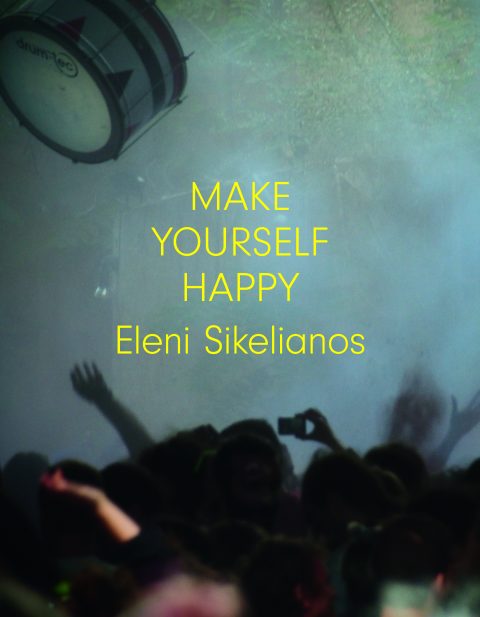


May 302012
 

Steve Dolph is the translator of Juan José Saer‘s novels The Sixty-Five Years of Washington and Scars, both published by Open Letter Books. He is currently at work on a translation of Saer’s posthumously published novel, La Grande. Dolph is a scholar in the highest sense of the word. His passion and dedication to his work are contagious. Saer (1937-2005) was a celebrated Argentine novelist and writer. He moved to Paris in 1968 and became a lecturer at the University of Rennes. He wrote numerous novels and short story collections as well as critical studies on literature. Dolph’s grasp of Saer’s work is expansive, and his passion for the preservation of world literature through translation is, in  a word, noble.  Our conversations opened a window for me into the gruelling, precise and often unacknowledged work of translators, men and women who toil away like monks locked in an abbey, preserving and passing along the gift that is the world’s collection of stories. It was a rare privilege to have spent time talking with Steve Dolph, and it is a distinct pleasure to introduce him to Numéro Cínq.

See also the NC reviews of Scars and The Sixty-Five Years of Washington; also an excerpt from The Sixty-Five Years of Washington and an excerpt from Scars.

—Richard Farrell

§

Richard Farrell:  How did you come to work on literary translations? Was this something you sought out or did it just happen through the course of your studies?

Steven Dolph: During my master’s program in creative writing at Temple, I took a translation class with Lawrence Venuti, the translator and scholar. That class was incredibly energizing and inspiring. It was a half a dozen students from various disciplines, no one focused exclusively on translation, if I remember correctly. We read a good amount of canonical translation theory, then workshopped translations-in-progress, not only from a formalistic perspective typical of creative writing workshops, but also based out of the theory we were reading. We read the translations, in fact, as theory, an approach that was at first shocking. Like most writing students, I think, I had always understood theory and literature to be distinct practices, and overlapping them seemed pretty scandalous. Frankly, I was less than prepared to read and write in that way, and I did pretty poorly in the class. But it was my first real exposure to comparative literature, and it stuck in a big way. After that class, I couldn’t really do anything else. It was at that time that I started working on the poetry of Néstor Perlongher, a project I stuck with for quite a while.

RF: It seems like most of the translators I know are poets, though I don’t know why that is. Are you a poet?

SD:  I’m not a poet. I studied fiction at Temple.

RF: Are you still writing fiction?

SD: I stopped writing. I never felt the enthusiasm for writing that I felt for translation. I’m back in grad school now, at the University of Pennsylvania. I’m getting a Ph.D. in Hispanic studies.  It’s a five year program. I hope to write about translation of Latin American literature. I’ve always thought of translation as a critical practice, and I’m trying to develop that sensibility.

RF:  Your work with translating Saer’s novels must be intensely time consuming. Could you walk us through a typical ‘day in the life’ of working on the translation of a novel?

SD: On a good day I’ll spend six to eight hours at the computer. It’s hard to measure production by the day or the week, because I’ve always squeezed it in, early in the morning before work or class, or on the weekend. In any case, the farther along, the slower it goes. Sometimes I’ll spend an entire morning on a single paragraph, or less. That has to do not only with the nature of Saer’s prose, which is difficult, but also the nature of the work in general. I’m always thinking in terms of capturing equivalences between Spanish and English, and if I’m translating a passage on, say, the description of a river, I may spend an entire morning reading sections of Huck Finn just to remind myself what writing the river sounds like in English.

RF: Do you work directly with the original works? I know that some translators use native speakers to do an initial translation, a literal translation, before going in and turning the ‘rough’ translation into something with more nuanced (poetic) language.

SD: I do translate directly from the original. That said, I rely on the help of informants— friends who either know Saer’s work better than I do, or who have a deep fluency in Spanish, which I don’t have, or who have a particular familiarity with some aspect of the English vocabulary: doctors, lawyers, mothers, scientists, horsemen, and so on. I’d be lost without these people.

RF: I wonder if you might expand a bit on who your ‘informants’ are.

SD:  Sure. One is Sergio Chejfec, who is a contemporary Argentine novelist and a professor of writing at NYU.  He’s a big fan of Saer, and he reached out to me and offered to help .  It helps to have other people who know the work, who really know the work as it was first written.

With Saer especially, there is a certain style, a certain sensibility that his prose follows. There’s a lot of parataxis in his writing, and a certain openness of meaning in his lines, or double meaning, inversions, and so on. Some of these things can be lost on me when I first read through it. A lot of the humor is there.  The Sixty-Five Years of Washington, for example, plays with a lot paraphrase and hearsay. So I would check on sentences that I couldn’t quite get a handle on. It helped to have people who were more familiar with his language to guide me.

 RF:  How did you come to work with Saer’s novels. I imagine you must be under contract before you begin. Perhaps not?

SD: The Saer translations, a three-book contract, were offered to me by Open Letter after I submitted a sample. This was back in 2008. I should mention, while we’re talking about the press, the amazing editorial work of E. J. Van Lanen, the editor at Open Letter. He’s been so fantastic to work with, and some of the real gems have come from his suggestions. In fact, many of the passages that have been quoted in reviews have been directly inspired by if not literally copied verbatim from his suggestions.

 RF:  How much contextual/historical research do you have to do with a writer’s work in order to render the best translation?

SD: For me, lots. Lots and lots. Before translating the first Saer book, The Sixty-Five Years of Washington, I read quite a bit of Argentine history, especially the history of the Peronist regime, the coup, and the military dictatorship that followed: from 1940 to 1990, basically. I also read some of the literature that was being made at that time. That period, though, was one of the most productive, in terms of the novel, in the history of Latin America, and arguably anywhere, so I barely scratched the surface. I’m trying to focus some more attention on that these days. I also read a bit of what Saer was reading as he wrote the first book, in particular the French nouveau roman, Robbe-Grillet and so on. Finally, for tone and affect, I read some history of rhetoric, and narration theory. The Sixty-Five Years is concerned, primarily, with the nature of storytelling, and Saer slides between close, colloquial speech and detached, critical prose. I tried to recreate that balance. I also read The Chicago Manual of Style like a novel, and had the idea of a parody of that style always close in mind. All that said, I don’t know if my research made the translation better in any way. After I started working, I read everything of Saer’s that had already been translated, mostly by Margaret Jull Costa and Helen Lane, to get a sense of what Saer already sounded like in English. I read a few interviews on line.

I came to see The Sixty-Five Years of Washington as a novel about storytelling, about Argentina’s Dirty War and about the memory of trauma.  The more I read the book, the more I came to appreciate it. Saer was so intent on rendering the Santa Fe region of Argentina, the region around the Paraná River.  So a lot of the early research involved gathering a sense of the history, of the language, and referring to the previous translations.  I tried to look at how those translations handled his idiosyncratic use of the language.

 RF: I know that you founded a literary journal on translation. Could you talk about that journal and how it works?

SD: As I was finishing the master’s program in writing, I got the naïve idea that I wanted to start a journal of literature in translation, focusing primarily on the voice of the translator. We would publish brief translation excerpts alongside the originals and translator introductions. Brandon Holmquest, who’s an editor at Asymptote now, said he would edit the thing with me, and it ran in print and online for three years and five issues. We wanted, basically, to publish a journal in which literature and criticism held equal footing, and where translators could speak more than just anecdotally about their craft.

RF: How does translation affect your appreciation of language and literature?

SD: The effect has really been profound. I tend to see all writing in terms of translation, either linguistic or cultural, and have less trust in concepts like national literatures or genealogies among writers. Even the idea of a unified language in itself seems deeply suspect and ideologically motivated to me. I’ve also become much more conscious of translation’s connection to linguistic colonialism, and the political role that translation plays between national groups and between individuals. I see novels, and narration in general, as less closed or finished, and rather more open than I used to, more a confluence of many, many voices than the product of a single voice. Along with that, the idea of authorship, and the distinction between fist-order and second-order artistic products seems more and more like a fiction to me. At the most basic level, though, I’m compelled to see translation—and, by extension, all reading, of text or of the world—as essentially hermeneutic rather than empirical. Which is to say: meaning is not inherent to writing or to language as such; meaning is a product of interpretation, which is never disinterested or absolute, but always, always informed and circumscribed by the cultural position that the reader occupies.

RF: Could you expand a bit on this idea of ‘first order’ and ‘second order’ production with respect to translating literary works?

SD:  The idea of a clear transfer from a first order to a second order production is really recent, and has more to do with the 19th-century development of copyright than with what actually happens between texts, and involved the codification of the limits of artistic work and influence.  It’s certainly useful from a legal standpoint, but from a reader’s perspective, I don’t see it as very useful. A book is a confluence of many different voices and ideas. For the translator, it’s a whole other set of voices and ideas. The process just feels more open to me. Our ideas about originality and authority, these codes, are informed by an ideology of the role of arts and the artist that translation has always worked to destabilize.

RF: You mentioned linguistic colonialism. Is this about dominant languages and how this affects the work of translators?

SD: Are you asking, is the translation of a literary text a neutral agent?  A good portion of translators might not want to think about that question too much.

Translations are always informed by the ideologies that are implicit in the language community, from the way language is used, to its ideological undercurrents. Translators can be aware of or ignore these relationships. A translator has to find ways to address this issue, especially when these dominant languages move in to displace minority languages.

 RF:  I’m imaging that to translate a novel-length work, you must enter into a very deep relationship with the book. I’m also imagining that this could have negative effects, too. You must reach a point of exhaustion after a while. Do you ever just get sick of the pace of it?

SD: Never sick of it, no. Nor exhausted, really. A negative effect, though, is that with such an intense focus on producing a good structure, rhythm, and sound for individual sentences, it’s often easy to lose sight of the forest for all the trees. Then again, this focus has made my reading of other books that much more enjoyable. I pay much more attention than in the past to the ways that rhythm and syntax in prose are employed to create effect. I’m also now constantly on the lookout for interesting or startling language use in the world around me. I think the positive effects offset the negative ones, definitely.

RF: There must be work that is still in need of translation or in need of fresh translations. Who do you want to see brought back to life?

SD: That list is infinite. Something I’d really like to work on, and which has been neglected here for the most part, would be the black novels—hard core pulp detective writing—from Argentina since the 60s. Borges had his hands all the way in that mess. And Ricardo Piglia, more recently, has been working out of that tradition. What’s between those two writers needs a second look.

RF:  What projects are you working on now?

SD: Right now I’m working through the last of three books for Open Letter Books, Saer’s posthumous novel La Grande, which should be out next year.

RF: I know this is beyond the scope of strict translation, but in Scars, the character of the judge is translating into Spanish Oscar Wilde’s The Picture of Dorian Gray. This must have been a fun moment for you while translating!

SD: Not to sound sentimental, but that was the most heartwarming part to translate. That section was a metaphor for the way practices are invisible, how the product stands at the front and the producer is behind a screen.  Despite his cynicism, despite his nihilistic view of society, his relationship to the work shows a deep care and attention, though he understood the futility of the work—the novel had been translated  so many times.

Then you read The Picture of Dorian Gray, and you see the way the book discusses appearances and the aesthetic practice and how the book calls this into question. And the content of what the Judge was translating, it made him seem so alive.  We only get a little bit at a time, but the moments when he is working, that is the person he is when he’s most alive.

Steve Dolph is currently a doctoral student in Hispanic Studies at the University of Pennsylvania.  He previously translated Juan José Saer’s novel, The Sixty-Five Years of Washington, part of a three-book contract with Open Letter Books. He founded the journal Calque, which focuses on literature in translation. He lives in Philadelphia, PA.

Jul 292011
 

.

Steven Church is the author of The Guinness Book of Me, Theoretical Killings, and most recently The Day After The Day After: My Atomic Angst. His essays have been published widely and his piece, “Auscultation” was selected for the forthcoming 2011 Best American Essays.

His latest work of memoir/criticism/personal essay (we’ll get to the issue of genre in the interview), The Day After The Day After, delves deeply into Kansas culture, Cold War paranoia, and Church’s own psyche, primarily using the mostly-forgotten Eighties scare-flick The Day After, which was filmed in our shared hometown, Lawrence, Kansas.

We went to the same high school in Kansas – I was a sophomore when Church was a senior – but didn’t know each other. I later met Church through his writing when Patrick Madden introduced me to his work. I’d written my own piece that mentioned my own memories of The Day After, and Madden must have wondered what kind of hold this film had on an entire generation of Kansans.

The movie’s effects on the youth of Lawrence at the time were intense and twofold. First, anyone who remembers seeing the film will remember the sheer dread of watching the fictional town of Lawrence blown to smithereens and permanently irradiated in the movie. But second, the reality of the movie’s filming left a permanent impression on an entire generation of Lawrencians, as the entire town was involved. Children were dressed up as radiation victims, the downtown was temporarily “demolished,” and a college town that considers itself a shining light of progressive values in the nation’s most conservative state was asked by the film crew to act as downhome and traditional as possible to fit the fiction of the movie’s narrative.

The Day After The Day After is a meditation on this confluence of fiction and nonfiction, giving fictional characters from the film an almost mythical significance in his own understanding of the world. I began my interview with Church with this thin line between fiction and nonfiction in mind.

– John Proctor

.

The Day After the Memoir: An Interview with Steven Church

By John Proctor

.

JP – One paragraph from The Day After The Day After in particular gave me a deeper understanding of my relationship to Kansas and my relationship to my own work as a nonfiction writer:

“The Kansas I know is like a long novel I finished years ago, a novel of which I remember every word. It was a great story, filled with wonderful characters and compelling plotlines, but it was epic and psychologically cumbersome and, in many ways, mostly fiction.” (180)

SC – Glad you liked that. It took me a while to reach that understanding of home. I think those lines came pretty late in the writing/revision process. It probably took writing the book to realize what I wanted to say about Kansas. Some people in Lawrence didn’t appreciate my “negative” view of home, even questioning whether I’d made up stuff about the Days of Rage,  firebombings, etc. Thing is, I don’t see it as negative, just honest. Lawrence has an underbelly and if it’s going to be a character in my book, I have to make it a well-rounded character, have to expose that belly.

.


.

JP – To me, at least if we’re speaking of the book on a macro level, Danny Dahlberg  seems a logical starting point, as his ghost permeates all four parts of the book, most notably in the “Dahlberg Variations” that serve as interludes from the main narrative and allow you to do some things outside the limitations of your own point of view and story. Perhaps I’ll allow you to describe who Danny Dahlberg is, and how you used him in the text.

SC – Interestingly enough those were some of the first sections I wrote for the book, long ago, mostly just playing around. He is, obviously, a significant character in the film, if only because of the metaphorical significance of his being blinded by the blast [Which can be seen at the 1:10 mark of the nuclear attack scene below – JP]. And he becomes for me both a kind of blind oracle, a Tiresias figure, and an alternate self. I used him initially as a kind of experiment, a fictional device designed to allow me to explore the extreme edges of one’s reactions to the film. And I guess that’s a big part of my process, at least in my first three books, that use of fiction to essay or explore certain ideas. Probably some of that comes from my training in fiction writing.

.

http://www.youtube.com/watch?v=G2H1E02iMHg
Continue reading »

Jun 152011
 

.

Here’s a fascinating interview with the great Canadian ex-pat (she lives in Paris) short story writer Mavis Gallant. Gallant’s stories used to appear regularly in the New Yorker; she was one of those blessed few (like her fellow Canadian Alice Munro) to be “on retainer.”  This splendid addition to NC’s growing collection of interviews comes courtesy of Jason DeYoung—it was originally published in Writer’s Carousel, May/June, 2004. It’s a pleasure to be able to make it widely available. (Find Gallant’s books here.)

dg

.

Knowing What Happens: an Interview with Mavis Gallant

Interview by Jason DeYoung

.

Jason DeYoung (JD):  How did Paris Stories and Varieties of Exile come about?  What was the thought behind getting those books together since both books contain mostly stories you’ve published in previous collections?

Mavis Gallant (MG): I didn’t have anything to do with it.  They were edited.  One was edited by Michael Ondaatje [Paris Stories] and the other by Russell Banks [Varieties of Exile].  They are published by the New York Review of Books.  They publish books, you know, as well as putting out the journal. And, they asked if I would be interested, that Michael Ondaatje would write the introduction and choose the stories. I said yes.  I had nothing to do with it or complain about.

The second book was to be called “Montreal Stories,” but that doesn’t work in the United States because people won’t read anything that has Canada in the title.  With any suggestion that it’s Canadian they’re allergic to it.  So in the US they chose the title [Varieties of Exile]; in the Canadian edition—because there’s a Canadian publisher, too—they used the title I wanted.  I wanted “Paris Stories” and “Montreal Stories” because they seemed to go well.

I was the one who suggested Russell Banks because with something about Canada in the United States you have to be very careful.  I knew that he had Canadian connections.  He has three Canadian grandparents.  I wanted an American whose work I admired, which is the case with Russell Banks, and who knew something about Canadian writers and Canadians.

JD:  As an American, I had no idea that there was such an “allergy” to Canadian writers.

MG:  Well, the Canadians have the reputation in America of being very dull.  If people know my name at all, they know I’m a writer—and that’s forgivable. (Laughs)  But when I used to say I’m Canadian, people would look trapped.  And there’s that feeling that they’re very dull and that Canada is a very dull place.   Actually it was true years ago, but it’s not true now, so they haven’t kept up.

JD: In your short story, “Varieties of Exile,” Linette says that “anything I could not decipher I turned into fiction, which was my way of untangling knots.”  How autobiographical is this line?

Continue reading »

Apr 072011


Herewith the inaugural instance of a new Numéro Cinq series, the NC Interviews. Our first interviewee is my old friend Mark Anthony Jarman and our first interviewer is contributor Mary Stein. Mark and I knew each other at the Iowa Writers’ Workshop at the beginning of the 1980s. A long friendship with legs—last September, late one night (maybe early morning), Mark and I sat in his backyard with my publisher Susanne Alexander, drinking beer under the stars in Fredericton, New Brunswick, like old times. He edits fiction for a venerable Canadian magazine called The Fiddlehead which, in the 1970s, published some of my first short stories (and another story is coming out in the summer, 2011, issue). Mark has written a book of poetry, Killing the Swan, a hockey novel, Salvage King Ya!, four story collections, Dancing Nightly in the Tavern, New Orleans is Sinking, 19 Knives, and My White Planet, and nonfiction book about Ireland called Ireland’s Eye. He teaches at the University of New Brunswick and lives in a very large house fronting the Saint John River. His story “The December Astronauts (or Moonbase Horse Code)” appears in Numéro Cinq’s Best of Vol. 1.

dg

Mixes and Collisions: A Numéro Cinq Interview with Mark Anthony Jarman

By Mary Stein


MCS: Why don’t you start by telling me a little about your relationship to writing poetry versus writing prose. It seems it’s been decades since you’ve published a collection of poetry. Have you continued to write poetry since Killing the Swan, or does your prose writing satisfy your poetic impulses?

MAJ: After I published Killing the Swan, I had the feeling it had gone into a vacuum, and decided to put the same images and ideas into prose if I could manage.  There are things in poetry you can do that you can’t in an essay or story, but I feel it’s a very good influence on the latter in terms of editing, compression, attention to language, imagery, odd juxtapositions, implication, developing an eye and ear, etc.  I also feel there is too much weak poetry around and I don’t want to add to it; perhaps the government could pay us to not write poetry rather than fund more.  Great poetry is great, I was influenced by Eliot, Richard Hugo, Denis Johnson, Philip Levine, Sharon Olds, and had good teachers, PK Page, Phyllis Webb, but a lot of poetry strikes me as pointless.  Maybe I’ve been to too many bad readings.

MCS: In Burning Down the House, Charles Baxter writes, “Fiction writers get resentful, watching poets calling it quits at 9:30 a.m.” Do you ever lapse into moments of “poet envy” or does the fiction writer’s tireless pursuit of the right-hand margin suit you?


MAJ: I do torment the poets I know, teasing them that they can whip off a poem before breakfast whereas a story rarely happens quickly.

Continue reading »

Mar 292011
 

Having the opportunity to read such an extensive interview with Amy Hempel is akin to a unicorn sighting. My fascination with Hempel’s writing is borderline obsessive, so I stopped in the middle of a packet/packing-to-move bender in order to post this link to Paul Winner’s interview with Amy Hempel on Numéro Cinq … Enjoy!

– Mary Stein

Amy Hempel, The Art of Fiction No. 176

Interviewed by Paul Winner

Amy Hempel does not enjoy interviews. She quotes her friend Patty Marx: “I’m not good at small talk; I’m not good at big talk; and medium talk just doesn’t come up.” Talking about the self is both unseemly and unnerving, she feels, and dissecting her own deliberate process of composition through, in her words, “pointy-headed questions,” tends to provoke her exasperation. This makes for an elusive interview. However, over a humid June weekend at her home last year, Hempel behaved as a polite and gracious host who pointed out the sights and chatted about movies, politics, and theories of pet care, but nonetheless wanted very much to be doing all of it away from the tape recorder. Talking about writing, in particular, meant noticing how Hempel loves to quote, at length, those friends and writers dearest to her—and how much she prefers their words to her own.

(Read the rest of Paul Winner’s Interview with Amy Hempel)

Oct 202010
 

7926_152882018292_501253292_2675567_3819092_n

Gabrielle Volke is a first year student at Mount Royal University in Calgary. Her writing teacher, Micheline Maylor, poet and editor of FreeFall, set up this little interview by email for an essay Gabrielle is writing. I post it here in the usual Numéro Cinq spirit of shameless self-promotion and the vague hope that some other writing student might profit from my animadversions.

dg

Gabrielle Volke: More often than not I will be performing some mundane task, or hear one random phrase, when an idea hits me. They usually just pop into my head out of the blue. Where does your inspiration come from? Do your ideas appear out of thin air, or do they arrive through careful planning and deliberation?

Continue reading »