Jul 072012
 

upstreet with Douglas Glover

Here are some snippets from an interview with Numéro Cinq commander-in-chief, landlord, CEO, COO, CFO and venture capitalist Douglas Glover just out in the brand new issue (issue #8) of upstreet, the magazine with the distinctive midnight black cover edited and published by the redoubtable and irrepressible Vivian Dorsel. No doubt you will want to read the rest of the interview — go to the magazine website and order a copy. Or write to editor@upstreet-mag.org. Also in this issue is work by David Jauss, Rachel Hadas, Jodi Paloni, Diane Lefer, Jay Kaufmann, Steve Rucker and a host of other terrific writers.

dg

———–

Vivian Dorsel:  What kind of writing discipline do you maintain?

Douglas Glover:  I have no writing discipline at all; maybe an anti-discipline. I have an aversion to keeping regular hours. I like to write in bed. I’m an insomniac. I am also persistent and obsessive, but neither of these traits has anything to do with discipline. The word “discipline” implies forcing oneself to do something against one’s will.

Dorsel:  Does writing come easily for you?

Glover:  I like what Tom Hanks, the alcoholic baseball manager in A League of Their Own, says to Geena Davis when she tries to quit the team. “It’s supposed to be hard. If it wasn’t hard everyone would do it. The hard is what makes it great.”

§

Dorsel:  Are there any writing craft books that you would recommend?

Glover:  Not really. Most craft books look as if they were cleverly written to keep students from learning how to write and compete with the authors of craft books. Craft books are like that reflective chaff jet fighters deploy in their wake to confuse radar trackers and heat-seeking missiles.

§

Dorsel:  What do you emphasize in your teaching of writing?

Glover: Reading. The first thing I give students is a reading rubric and an analytical check-list to begin to reform their reading skills. As I say in Attack of the Copula Spiders, we live in a post-literate age. On a certain level that book is about the act of reading. I am pushing a critical aesthetic that is a bit like New Criticism and a bit like Russian Formalism; but, to my mind, as a writer, it just seems reasonable and immeasurably expands comprehension. You read a story and pay some attention to how it’s put together and, beyond the illusion of fictional narrative, you suddenly engage with the text on a whole other, rather exciting, level of grammar, rhythm and meaning. You begin to see connections that hitherto you vaguely passed over supplying your own dreamy connotations (as you’re taught to do in high school). We’re at a moment in our culture when differences in the ability to read and comprehend a text are critical.

I can’t remember the moment when I actually invented the phrase “copula spiders,” I only foggily recall circling over and over again all the “to be” verbs and then noticing that I could make a diagram on the page and that the diagram resembled a spider (with far more legs than it should have). The real issue, the shocking point, is that when you teach writing you are basically teaching the same student over and over again. It doesn’t matter whether the student is writing nonfiction or fiction or that the student thinks the burning piece of paper in his hand is the next War and Peace because he has put his heart into it and it comes out of his own original personal thoughts and is different (he believes) from anything ever written before (or in the future). The shocking thing is the uniformity of mediocrity. The shocking thing is that intelligent adults can’t think of another verb to use (actually most students jog along with a verb repertoire of about five: to be, to look, to sit, to stand, to see—absolutely the most popular verb choices).

The crucial connector here is to realize that part of the reason proto-writers don’t notice they are doing this is because they don’t know how to read. Eighty percent of what I do every semester is teach students how to read like writers, that is, with attention to structure and the felicities of well-written prose. So the two aspects of my book are necessarily joined: you can’t teach people to write simply by telling them what they are doing wrong; you have to show them where it is done right, that is, you have to show them how to read.

Once you learn to read you can teach yourself how to write. Literature is an encyclopedia of technique.

§

Dorsel: Over and above influence, are there any principles or rules of thumb you’ve learned from other writers that guide your work?

Glover: Walker Percy once did an amazing self-interview for Esquire Magazine. He called it “Questions They Never Asked Me.” In the midst of some witty back-and-forth with himself imitating a bad interviewer, he makes this startling statement: “A novelist these days has to be an ex-suicide. A good novel—and, I imagine, a good poem—is possible only after one has given up and let go.” Percy was a Catholic so he was playing with fire when he wrote that. He wasn’t joking.  He was speaking of the self exposed under the sign of death and the consequent shedding of vanity, the true enemy of art.

Walter Benjamin in his essay on Leskov, “The Storyteller,” wrote: “Death is the sanction of everything that the storyteller can tell. He has borrowed his authority from death.” Neither of these writers mean quite the same thing, though they are using similar words. Benjamin is talking about a figure and ground structure, the story figured against a background of death, the authority, the motive, the significance of the story deriving in part from that background. Percy is talking about a quasi-mystical subjectivity, the authorial self giving up vanity, ambition, competitiveness, influence in the face of death (which proves none of these is important), his authority deriving from the freedom of someone who realizes nothing matters and he can do what he wants. “As for me,” he writes, “I might try a little something here in the wet sand, a word, a form…”

— Vivian Dorsel & Douglas Glover

Jun 122012
 

Here is a taste of the latest of my epigrams at Global Brief just published.

dg

A third, dark possibility for the future state emerges with the invention of computers and digital storage. We see evidence in advanced states of legislative paralysis, the frenzied churning of virtual money to create wealth for fewer and fewer people, a steady accumulation of computer surveillance coupled with a decrease in privacy and social mobility, and an increase in state-sponsored corruption (as tax, subsidy and campaign finance laws become increasingly complex and phantasmal), coupled with a dwindling tax base.

The middle class – the traditional core of the modern state – is under assault, not from economic austerity or investment bubbles, but as a legitimate mode of existence, a way of being, because it (like that other Enlightenment concept, the self) may not be useful to the coming state (think: pilotless drones). The result is cynicism and despair, recession suicides in Europe, desperate acts of internal terrorism, and plummeting birthrates in mature world economies – a trend toward, not stateless people, but people-less states – a ghostly, penumbral future that we might all wish to avoid.

— Douglas Glover @ Global Brief

May 282012
 

Book News, Reviews, Orders

“…a master of narrative structure” (Wall Street Journal)

“…every literate person in the country should be reading Glover’s essays.” (Globe and Mail)

———–

Order Attack of the Copula Spiders

———–


April 25, 2013

Brendan Riley review in Review of Contemporary Fiction:

This is not literary craft reduced to statistical formulae and write-by-the-numbers word-bytes. Glover’s admirable ability and patient willingness to cast a careful—not cold—eye on what makes sentences hum and flow is fueled by a vital, infectious fascination with words, enabling him to reveal the inspired, alchemical, verbal concatenation at work in the most alluring and memorable fiction writing.

Read the whole review here.

§

March 30, 2013

3 Canadian Writers with Buzz @ The Reader


attack

§

March 9, 2013

A Canadian author’s book on writing went viral on social media recently, leading to thousands of would-be fiction writers searching their manuscripts for “Copula Spiders.”

Douglas Glover’s book Attack of the Copula Spiders (Biblioasis) coins the term to refer to the multi-appendaged mess created by circling and linking all of the variations of the verb “to be” in a paragraph. (Copula is a term for the link between subject and predicate of a verb.) Excessive use of sentence constructions like “he was happy” or “the building was unassuming” lead to “flaccid and uninteresting prose,” he writes.

Joe Ponepinto, book review editor of the Los Angeles Review, brought Glover’s ideas to the literary world in a much-circulated blog post subtitled “Why I’ll never write (or read) the same way again.”

via Cameron Dueck’s arts column – Winnipeg Free Press.

§

March 2, 2013

from Joe Ponepinto @ The Saturday Morning Post

I reviewed a book a while back that has stayed with me for many months and has affected the way I write and read, and it’s opened my eyes to a weakness in much creative writing, even in published books. Douglas Glover’s Attack of the Copula Spiders (Biblioasis, 2012) criticizes many aspects of fiction, but saves its most withering scorn for the rampant and indiscriminate use of copulas.

The Secret of Maimonides-Submission for 2-26

I hear you asking, “What’s a copula? I admit I had to look it up. Webster’s definition says: “the connecting link between subject and predicate of a proposition.” In most cases, this refers to a form of the word “be.” But what does that mean to us everyday writers? It means banal, didactic, often passive sentences, almost completely lacking in action or depth.

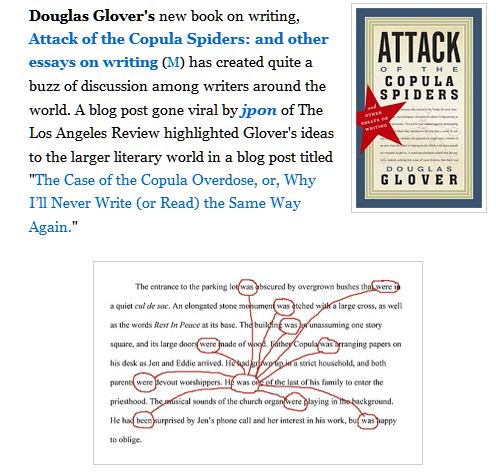
As Glover says: “A copula spider occurs when a student uses the verb ‘to be’ so many times on a page that I can circle all the instances, connect them with lines, and draw a spider diagram. Now there is nothing grammatically wrong with the verb ‘to be,’ but if you use it over and over again your prose is likely to be flaccid and uninteresting.”

via The Case of the Copula Overdose, or, Why I’ll Never Write (or Read) the Same Way Again by Joe Ponepinto @ The Saturday Morning Post

§

December 9

From Chapman/Chapman’s Favorite Longreads of 2012.

“‘A Scrupulous Fidelity: on Thomas Bernhard’s The Loser’ by Douglas Glover, The Brooklyn Rail

Close reading doesn’t get much better than this. Glover expertly unpacks the logorrheic hilarity of Bernhard’s text without ruining any of the fun.”

 §

November 24

Attack of the Copula Spiders named one of the top non-fiction books of 2012 by The Globe and Mail.

“[By] by the time I reached the penultimate chapter, a brilliant examination of, among other things, the catastrophic meeting of the 15th-century book cultures of Europe and the oral cultures of the new world, I had decided that every literate person in the country should be reading Glover’s essays.” — Charles Wilkins

via Non-fiction books from this year that are worth a read (or two) – The Globe and Mail.

§

November 9

Governor-General Podcast Interview with Sky Hornig in Calgary during Wordfest in mid-October.

The Governor-General Podcast Interview – Douglas Glover

via Douglas Glover – CJSW – Calgary’s Independent Radio 90.9 FM.

§

September 29

A few months ago I read a book by Douglas Glover titled Attack of the Copula Spiders. At the time, I didn’t even know what a copula was. Once I understood, I spent days fixing copula-laden writing, and sweated over every sentence I wrote to make sure I was using more active verbs. In time, though, those fixations fade into the subconscious, which is where they belong. The key to good writing, I believe, is not to ignore rules and not to obsess over them. It’s to incorporate the ones you believe are true into your writing psyche so that you are aware of them without thinking about them. — Joe Ponepinto, Book Review Editor at LA Review. Writer, editor, teacher. Occasional curmudgeon. Dad to henry, the coffee-drinkin’ dog

§

September 29

 §

September 5

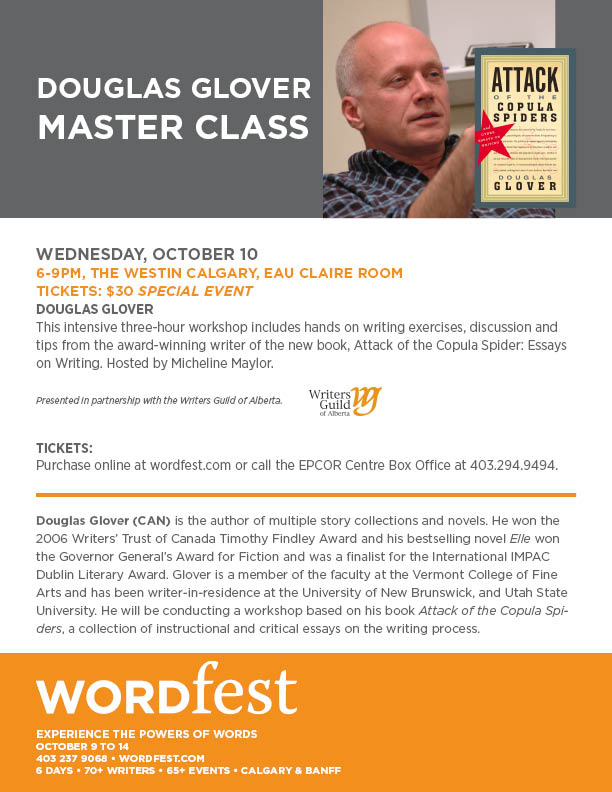
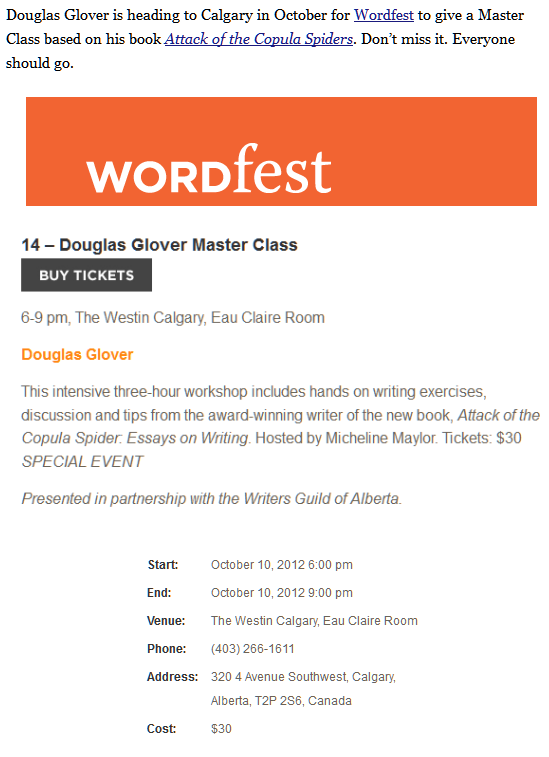
If I had to guess what events will sell out first, my money would be on the Douglas Glover Master Class. He’s a spectacular Canadian writer who has kindly agreed to do a three hour class on the mechanics of good creative writing for WordFest patrons. The best part about it? It’s only 30 bucks per person. What are you waiting for? Follow this link and buy tickets now!

via Post-Launch Blog: A Response | WordFest Blog.


§

July 17

Shelagh Shapiro interviews dg on his new book Attack of the Copula Spiders at Write the Book, Shelagh’s long-running radio show, which, by the way, is fast becoming an institution in its own right, a vast trove of writerly advice and experience. Listen to the interview on Shelagh’s site or download the podcast — it’s also available at iTunes.

Douglas Glover – Interview

Award-winning Canadian author Douglas Glover, on his latest book: a collection of essays on writing, Attack of the Copula Spiders, published by Biblioasis.

§

July 15

Douglas Glover and How to Write a Novel

by Jane Eaton Hamilton

I’m reading “Attack of the Copula Spiders” by Douglas Glover. i remember him trying to drill the matters in his first piece, “How to Write a Novel,” through my thick brain back in Saratoga Springs in the early 90s. It was the best advice I had ever gotten on making a novel. Really, it still is, and I’m glad to see it again in other than my own scrambled notes. 

§

July 6

Vivian Dorsel interviews Douglas Glover in upstreet 8.

upstreet with Douglas Glover

Dorsel:  What do you emphasize in your teaching of writing?

Glover: Reading. The first thing I give students is a reading rubric and an analytical check-list to begin to reform their reading skills. As I say in Attack of the Copula Spiders, we live in a post-literate age. On a certain level that book is about the act of reading. I am pushing a critical aesthetic that is a bit like New Criticism and a bit like Russian Formalism; but, to my mind, as a writer, it just seems reasonable and immeasurably expands comprehension. You read a story and pay some attention to how it’s put together and, beyond the illusion of fictional narrative, you suddenly engage with the text on a whole other, rather exciting, level of grammar, rhythm and meaning. You begin to see connections that hitherto you vaguely passed over supplying your own dreamy connotations (as you’re taught to do in high school). We’re at a moment in our culture when differences in the ability to read and comprehend a text are critical.

I can’t remember the moment when I actually invented the phrase “copula spiders,” I only foggily recall circling over and over again all the “to be” verbs and then noticing that I could make a diagram on the page and that the diagram resembled a spider (with far more legs than it should have). The real issue, the shocking point, is that when you teach writing you are basically teaching the same student over and over again. It doesn’t matter whether the student is writing nonfiction or fiction or that the student thinks the burning piece of paper in his hand is the next War and Peace because he has put his heart into it and it comes out of his own original personal thoughts and is different (he believes) from anything ever written before (or in the future). The shocking thing is the uniformity of mediocrity. The shocking thing is that intelligent adults can’t think of another verb to use (actually most students jog along with a verb repertoire of about five: to be, to look, to sit, to stand, to see—absolutely the most popular verb choices).

The crucial connector here is to realize that part of the reason proto-writers don’t notice they are doing this is because they don’t know how to read. Eighty percent of what I do every semester is teach students how to read like writers, that is, with attention to structure and the felicities of well-written prose. So the two aspects of my book are necessarily joined: you can’t teach people to write simply by telling them what they are doing wrong; you have to show them where it is done right, that is, you have to show them how to read.

Once you learn to read you can teach yourself how to write. Literature is an encyclopedia of technique.

§

June 5

“The best essays in this collection come further in as Glover, like a physicist dissecting atoms, breaks down the prose of several great writers of the past few decades. A successful fiction writer in his own right, he wants not only to identify the techniques of stylists such as Alice Munro, Mark Anthony Jarman, and Thomas Bernhard, but to understand the grand logic behind the structures, the God-like plans that such geniuses hatch to produce their greatest works. Although this is not specifically a “how-to” book, Glover’s analyses in Copula Spiders prove far more insightful than traditional criticism, and by extension far more helpful to writers who are serious about approaching perfection in their craft.” — Joe Ponepinto @ The Los Angeles Review

§

June 5

It’s a great book. Look for my review in the next issue of Broken Pencil. — Nico Mara-McKay @ nicomaramckay.com

§

June 3

The first bad review; always a landmark. DG taken to the barn and whipped with limp squibs by Daniel Evans Pritchard at The Critical Flame, a young man apparently lacking a sense of humor and a delusional optimist who seems to think all those e-books coming out are worth reading. Without a trace of irony, he quotes, um, a Gallup poll to tell us the state of literary culture in America. At least he spelled my name right (although he didn’t manage to copy Mark Anthony Jarman’s name with the same accuracy — Mark suddenly becoming French in the translation — Marc Anthony Jarman). Tiresome as it is, I herewith issue my usual challenge to a duel.

§

May 21

Such was the pace of my conversion, that by the time I reached the penultimate chapter, a brilliant examination of, among other things, the catastrophic meeting of the 15th-century book cultures of Europe and the oral cultures of the new world, I had decided that every literate person in the country should be reading Glover’s essays and was fixing to present them to my eldest daughter, who is about to begin literary studies at UBC.

Glover is at times rather detached in his assessment of the value of storytelling. And yet there is a subtext to his work, a sense that if a story is to have life beyond the intrinsics of its existence, it must, sooner or later, ease up to the imponderables at the heart of what it is to be human. As Joni Mitchell said of songwriting, if at some point a song’s lyrics don’t extend themselves into a larger orbit, “it’s all just complaining.” Charles Wilkins, The Globe and Mail

§

May 13

His sortie on the verb “to be” in “Attack of the Copula Spiders” is particularly brilliant. Mark Sampson at Free Range Reading

§

April 28

Attack of the Copula Spiders is a practical guide for anyone interested in writing. Glover’s first chapter, “How To Write A Novel,” alone is worth the price of the book. Telegraph Journal SalonBooks

§

Caroline Adderson, author of A History of Forgetting: “Just ordered it. The essay on “Meneseteung” alone is worth the price.”

§

April 13

“These essays are not just for writing students, however. Whatever heightens student awareness of craft also sharpens the awareness of the general reader who has no desire to try his or her hand at writing but would like better to understand literature. Glover has an essay on Alice Munro that is of value to any short story writer but also should be required reading for anyone interested in Canadian fiction.” Philip Marchand in the National Post

 §

April 10

“You should have a look at Douglas Glover on what may be the Mexican classic, Pedro Paramo, which was once described to me as “Mexico’s Joyce.” (The essay appears in Glover’s recent Attack of the Copula Spiders, which looks to be a great book of literary essays.)” — Scott Esposito at Conversational Reading

 §

April 9

“Thoughtful and erudite books such as Attack of the Copula Spiders are always useful as roadmaps for developing better readers and writers. Now if we could only get the world to read them carefully.” George Fetherling review in Quill and Quire

§

“I’m a few chapters into reading it a second time. All of it is wise and clear and exciting. The book is chock-full of good stuff, but the first and third chapters are especially brilliant. And the first paragraph of your essay on the Rooke novel is itself worth the price of the book. ” — Jack Hodgins, Governor General’s Award winning author of The Resurrection of Joseph Bourne and The Invention of the World

§

March 25

Douglas Glover interview re Attack of the Copula Spiders on The Danforth Review.

§

Douglas Glover’s Craftwork talk on the novel at the Center for Fiction — based on “How To Write A Novel,” one of the essays in Attack of the Copula Spiders

§

March 14

Craftwork: Douglas Glover — Wednesday, March 14, 2012, 7:00 pm, at

The Center for Fiction
17 E. 47th Street
(between Fifth and Madison)
New York, NY 10017
(212) 755-6710
info@centerforfiction.org

§

March 15

Douglas Glover Read at Celebration of The Literarian

The Center for Fiction
17 E. 47th Street
(between Fifth and Madison)
New York, NY 10017
(212) 755-6710
info@centerforfiction.org

Thurs

day March 15, 2012
07:00 pm

Come join us for drinks and micro-readings in celebration of our online magazine, The Literarian, featuring contribs Alan Cheuse, Anne Landsman, Barbara O’Dair, Carmela Ciuraru, Christine Schutt, Diane DeSanders, Douglas Glover, Elissa Schappell, Jane Ciabattari, Kim Chinquee, Leigh Newman, Leopoldine Core, Terese Svoboda, Tracy O’Neill, and Victoria Redel.

§

February 9

The Thomas Bernhard essay in Attack of the Copula Spiders quoted in The New Yorker online Book Bench.

§

Among the essays included in the book:

  • How to Write a Novel (dg’s famous Novel Lecture)
  • How to Write a Short Story: Notes on Structure and an Exercise (see examples of student stories written from the exercise here and here)
  • The Drama of Grammar
  • The Mind of Alice Munro
  • Novels and Dreams
  • A Scrupulous Fidelity: On Thomas Bernhard’s The Loser

§

February 5

UK Guardian reviewer and columnist and editor of the magazine 3 a.m. Andrew Gallix quotes from Attack of the Copula Spiders.

(This is in his Phantom Book category, related to language theory and a modernist aesthetic. dg is up there with Walter Benjamin, George Steiner and Herman Melville.)

§

February 1

Essay excerpted from Attack of the Copula Spiders in The Brooklyn Rail

Linked on A Piece of Monologue, ReadySteadyBook, and wood s lot.

“…excellent essay” — @ Who Killed Lemmy Caution?

“…excellent essay” — @ Three Minutes’ Chewing

“…a great essay by Douglas Glover about Thomas Bernhard’s novel The Loser (it is serialized from Attack of the Copula Spiders and Other Essays on Writing, published by Biblioasis. The essay makes a fine rundown of the various rhetorical devices that makes Bernhard Bernhard. So if you ever wonder how he manages to attain those typically Bernhardian effects, look here.” Scott Esposito @ Conversational Reading

§.

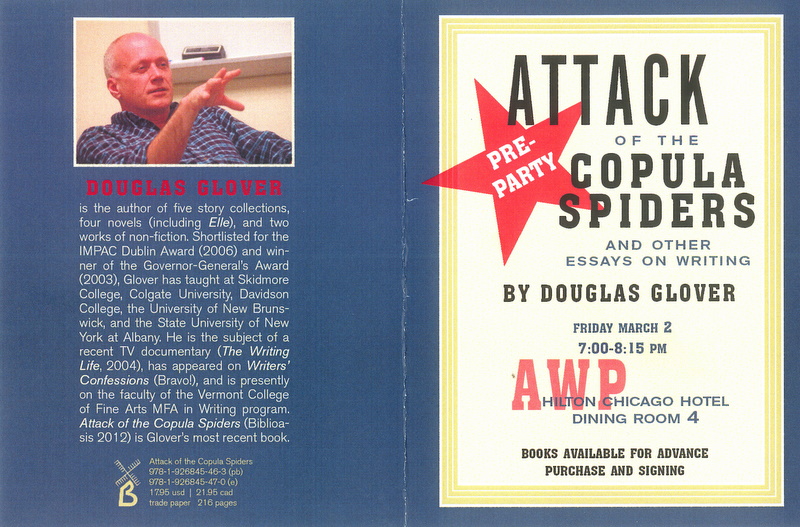
Attack of the Copula Spiders Book Signing at Vermont College of Fine Arts booth, AWP ChicagoThursday, March 1, 2-3:30pm. Books available. Bring cash or checks.

§

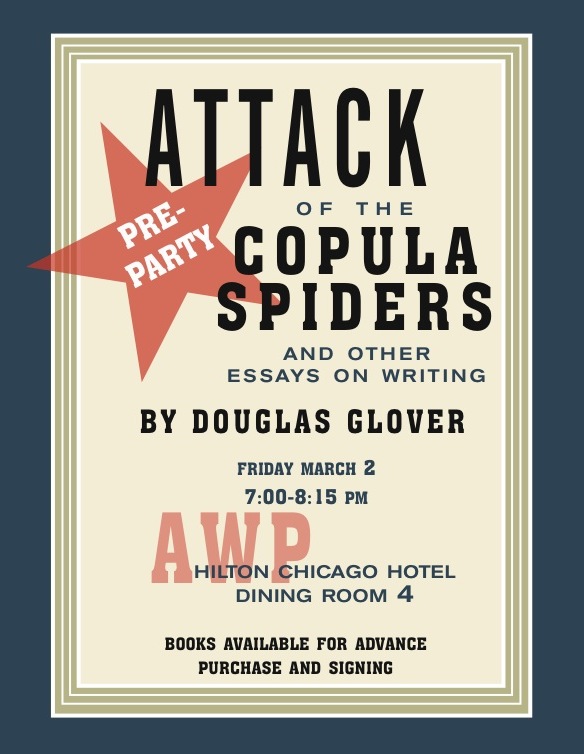
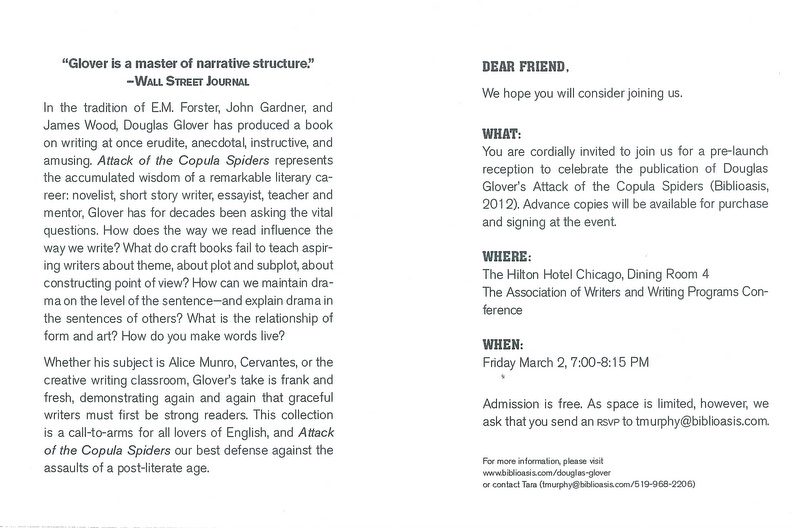
Attack of the Copula Spiders Party at AWP Chicago Friday, March 2, 7-8:15pm, Hilton Chicago Hotel Dining Room 4. Invitation below.
.

§

Invitation Flyer

§


Visit the NC Bookstore.

Buy books here and a percentage comes back to NC for the upkeep of the magazine.

Apr 052012
 

The best novels are like dreams. They come out of the silence of the page like a dream. They structure themselves like dreams, that is, there are clear ways in which the structure of dreams parallels the structure of novels. Like dreams, novels use image patterning as a device for suggesting meaning: image repetition, association, juxtaposition, and splintering (Viktor Shklovsky’s term for the branching pattern created by a repeating image and its associated or split-off elements which also repeat). Like dreams, novels are available to interpretation; the best novels have a central luminous mystery at their core which tempts generations upon generations of critics and readers to find new structures and meanings beyond the surface of the words. And like dreams, novels are built around (and this is explicable in only the vaguest of terms) the recurrence or insistence of desire which, in order to generate plot, must be resisted; the locus or arena of desire and resistance appears again and again with obsessive regularity in novels, an obsessive regularity which, in real life, would seem eccentric if not pathological. In novels, character is perversion, and the novel returns again and again to the animating desire which it must resist to the bitter end or even beyond the end of the words on the page.

—from “Novels and Dreams,” an essay by Douglas Glover in Attack of the Copula Spiders

The Greeks called their novels tales of suffering for love. If they weren’t about suffering for love, they wouldn’t be tales. A story consists of someone wanting something and having trouble getting it. There are no stories about people who start out happy and contented, remain happy and contented throughout, and end up happy and contented. Imagine the phrase “tales of not-suffering for love” or “tales of having fun for love” or “tales of finding pleasure for love.” The difference between pornography and literature is that in pornography everyone has orgasms all the time. There is no gap between desire and consummation. In literature there is always an element of frustration, displacement, delay and incompleteness (even if someone does eventually manage to have an orgasm). Don Quixote is the quintessential novel because it’s about a man in love with a woman who doesn’t exist. At the outset, Cervantes invents the limiting case.

—from The Enamoured Knight

Repetition, as I have said, is also a pattern. But it is a pattern of a different order, perhaps the pattern of patterns. To me, it is the heart of the mystery of art, of novel-writing. Without it, the novel becomes a strung-out plot summary. I have tried to think out why repetition is appealing, why it is aesthetically pleasing as a pure thing. I think there are two reasons, or sorts of reasons. The first is essentially conservative–repetition is allied to memory, to coherence and verisimilitude. The second is biological or procreative or sexual. Repetition creates rhythm which on a biological level is pleasurable in itself, the beating of our hearts, the combers rolling up on a beach, the motion of love. This is the sort of thing Lyotard is talking about when he writes about “intensities” or patterns of intensities in his book Économie Libidinal, or what the Spaniard Madariaga meant when he talked about the “waves of energy” in Tirso de Molina’s El Burlador de Seville.

—from “The Novel as a Poem” in Notes Home from a Prodigal Son

———-

Here is the performance version of “How to Write a Novel,” the first essay in my new book Attack of the Copula Spiders. I place it here for instructional purposes, also so that I can include it in our growing trove of craft and structure advice The Numéro Cinq Literary Craft Book, which you all should consult from time to time. I gave this talk as part of the Craftwork series at The Center for Fiction in New York, March 14, 2o12.

It’s important to note that “How to Write a Novel” is a fairly stripped down version of the years of thought I have given to writing novels (and stories and essays and, yes, even poems). If you want to get the whole picture to this point, you should read also “The Novel as a Poem” in Notes Home from a Prodigal Son. That book also contains essays on novels by Leonard Cohen, Christa Wolf, Hubert Aquin, and Margaret Atwood, plus an essay on point of view and my pride and joy “Gertrude, or the Postmodern Novel.”

Then you would need to read my book on Cervantes The Enamoured Knight. The first section of the book, “Recovering the Text: Technical and Analytical,” provides a re-reading of Don Quixote and preps you for the sections to follow.  The second section, “Don Quixote and Novel Form,” gives a history of the development of novel form, sorts out the rather confusing array of definitions offered by theorists, and then discusses a set of primary structures: plot, subplot, character grouping and gradation, and novel memory devices (which I have not really touched on elsewhere). The third section, “Night Thoughts of an Insomniac Reader, or Thematic Meditations,” demonstrates how the form itself predisposes the novel to a thematic “basket” of ubiquitous themes which appear in writers as diverse as Joseph Conrad, Cervantes, Jane Austen, and Alice Munro (to name four that come into the discussion).

Finally, in Attack of the Copula Spiders you’ll find not only “How to Write a Novel” (the complete text with sundry examples) but also analyses of novels by Juan Rulfo, Thomas Bernhard, Leon Rooke, and Cees Nooteboom as well as an essay on endings and a meditation on novels and history.

Unfortunately, foresight has been lacking. I haven’t managed to collect all of this material in one place (and that’s mostly because I have been sorting out these ideas for years, decades, often previewing them as lectures at Vermont College of Fine Arts where I teach in the low-residency MFA in Writing program). But here now you have a basic sense of where to find it all.

dg

Mar 272012
 

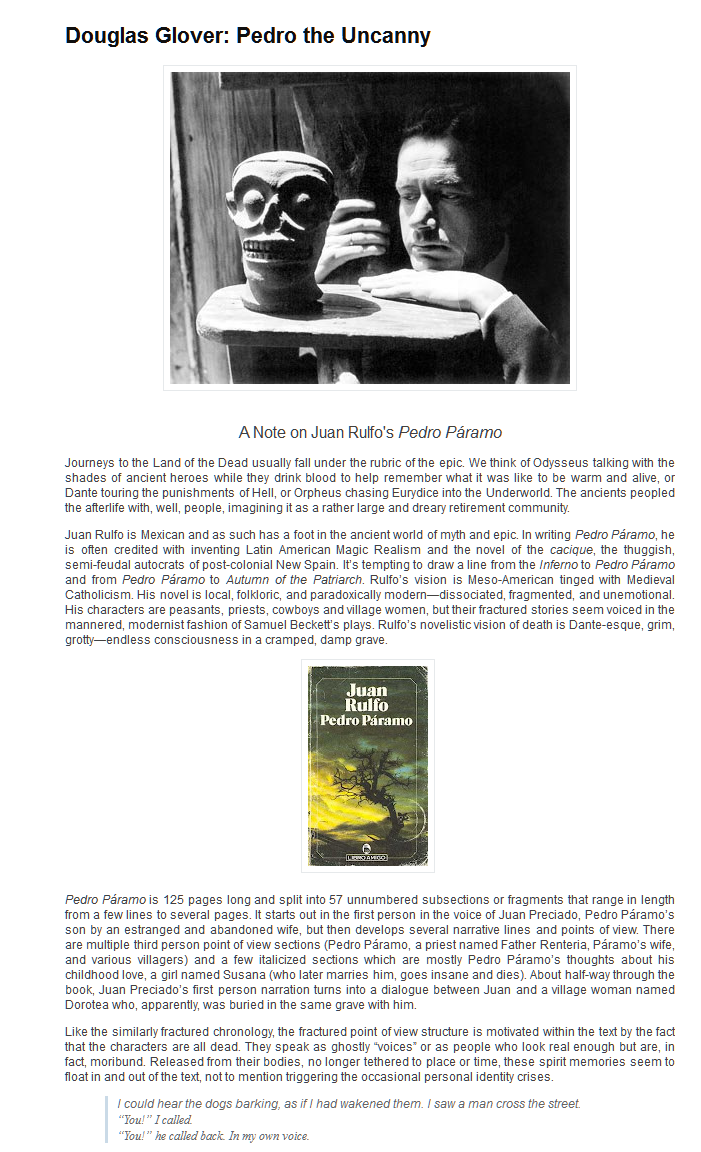
For you delectation and inspiration, here are the opening paragraphs of my essay “Pedro the Uncanny: A Note on Juan Rulfo’s Pedro Parámo” excerpted from my new book Attack of the Copula Spiders on the Biblioasis International Translation Series. Pedro Parámo is an amazing novel, written about dead people from the point of view of a dead man. Rulfo based the structure on the idea of a cemetery in which the various grave occupants spend their time whispering to one another, an eerie and startling conception. Critics often all this book the first instance of Latin American Magic Realism. It’s a Mexican classic. Click on the link above to go to the Biblioasis site and read the rest of the essay.

dg


Feb 122012
 

Here is a taste of the latest of my epigrams at Global Brief just published.

dg

Cooperation is local, competition is pandemic. It has always been this way. We live in a churning cauldron of competitive vectors, of drags and accelerants. We compete for money, jobs, love, space and power. We compete, and we are competed for (for our votes, for our consumer dollars, for our admiration – desire desires desire). What goes for thinking these days is mostly competition; what goes for information is mostly shill and exhortation. The media world is a vast infomercial – competing for the mind of the reader, the e-reader or the (TV) e-watcher.

Conversation is a competition to have one’s voice heard; to have one’s ideas prevail. Languages compete and extend their reach or disappear. The world is a chessboard of international gamesmanship. In space, we are all competing for the higher ground. And, willy-nilly, the whirling, pulsing interactions of competition seem only to grow faster and denser as the world goes digital, and as connectivity multiplies arenas of contention. The individual human being wins and loses a thousand times a day – mostly without even knowing it, as the virtual and invisible electronic tickers mark the rise and fall of prices, currency and interest rates. Being alive, we compete.

via The Future is Red in Tooth and Claw : Global Brief.

Feb 012012
 

Here’s a teaser from a new essay of mine, just published at The Brooklyn Rail. This essay is from Attack of the Copula Spiders and Other Essays on Writing published by Biblioasis. Out in March. Other essays include the latest version of my novel lecture, “How to Write a Novel,” also “How to Write a Short Story: Notes on Structure and an Exercise,” “The Drama of Grammar,” and “The Mind of Alice Munro,” and others.

dg

The Man and his Books

Thomas Bernhard is dead. He had a terrible life, at least the early part. He was born in Holland where his Austrian mother had fled to escape the shame of her unwanted pregnancy. He never knew his father who died far away and in obscurity (and obscure circumstances). His mother mistreated him because of the shame he represented. Back in Austria he wanted to be an opera singer and studied music but caught a cold working at a menial job to make ends meet; the cold turned into tuberculosis. He was hospitalized repeatedly, his treatment was bungled, he was given up for dead, and survived just to prove how stupid his doctors were. Since opera-singing was out, he became a writer. He became a famous writer of deadpan, mordant, hilarious, difficult (modernist) novels and plays that often portray depressed characters with lung diseases.

Another common theme is Bernhard’s disgust with his native Austria which he continually berated for its Nazi past, its stupidity, sentimentality, and philistinism. In his will he stipulated that none of his works could ever be published in Austria. Paradoxically he rarely left Austria and lived quietly in a country retreat outside of Vienna (many of his characters live in country retreats outside of Vienna).

Despite the fact that he seemed to put himself in every one of his novels, little is known about his intimate life. He wrote a five-volume memoir, Gathering Evidence, which is quite beautiful but, as all memoirs are, unrevealing. His first biographer somehow managed to discover that he liked to masturbate while watching himself in the mirror. This is both comic and significant; over and over Bernhard presents his narrators as characters watching themselves think about themselves. In fact, his narrators seem more interested in watching themselves think about themselves than in telling the story which often seems, upon analysis, more of an occasion for baroque invention than an end in itself. Reading Bernhard one is often reminded of the American experimentalist John Hawkes who once famously said:

My novels are not highly plotted, but certainly they’re elaborately structured. I began to write fiction on the assumption that the true enemies of the novel were plot, character, setting, and theme…structure—verbal and psychological coherence—is still my largest concern as a writer. Related or corresponding event, recurring image and recurring action, these constitute the essential substance or meaningful density of my writing. (Wisconsin Studies in Contemporary Literature, 1965)

Click here & Read the rest of the essay at The Brooklyn Rail.

Jan 192012
 

Here are the opening paragraphs of a new story just published at The Literarian, the magazine at the Center for Fiction in New York. The story invented itself late last fall when I happened to stop at a Barnes and Noble in Colonie and discovered huge walls of books categorized as PARANORMAL ROMANCE (see photo above taken by NC Contributor Cheryl Cowdy). This was a completely new literary genre to me—you can tell I don’t get out much. But it seemed very popular. I thought, I can write one of those. So I did.

Read the rest of the story at The Literarian, link below.

Also, if you’re in New York on March 14, come to my craft talk at the Center for Fiction (see the link at the bottom of the story).

dg


Everything Starts at a Bookstore

I was supposed to meet Zoe for lunch at a chic Parisian restaurant she had discovered on the Internet, a crucial rendezvous during which I intended to propose marriage, but I was running late. A fierce, cold rain lashed down suddenly as I bounded up the Metro steps, rain as I had never experienced before. It drove me back into the underground, where dozens of African Parisians discussed the weather in languages other than French. I glanced at my watch and leaped up the stairs again, blinded by the torrents of rain.

Wind whipped the leafless plane trees along the avenue. I spotted a flower shop and ducked in, thinking to buy a bouquet for my love. But I must have slipped through the wrong door, for I found myself in a neat, closet-like secondhand bookstore with dark oak shelves marching back toward an ancient desk fortified with parapets of leather-bound tomes. I hovered, dripping in the doorway, loathe to enter and perhaps spatter some valuable books with water but also reluctant to dive back into the deluge. I wiped rainwater off my watch face, frantic with vexation and indecision. I naturally blamed all my troubles on the Parisians, their precious City of Light, and Zoe’s love of travel, which I did not share.

via The Literarian at The Center for Fiction.

Jan 022012
 

To begin the New Year at Numéro Cinq, here’s a terrific addition to our growing collection of literary craft essays from Erin Stagg. In “The Mind’s Eye—Character Thought in Fiction,” Erin gives a terse, clear explanation of some of the basic techniques of character thought using a gorgeous Lorrie Moore short story as her example quarry.

Erin Stagg is a freshly-minted graduate of the Vermont College of Fine Arts MFA in Writing Program. She grew up in Taos, New Mexico, studied Spanish at Wellesley College in Massachusetts and now lives in New Zealand where she teaches skiing in the winter and works in retail in the summer. She was awarded the 2002 Wellesley College Johanna Mankiewicz Davis Prize for Prose Fiction. Her short fiction has also appeared in The Battered Suitcase.

dg


The Mind’s Eye – Character Thought in Fiction

By Erin Stagg


Character thought is text in the story that tells the reader what is going on inside the character’s mind. When I started looking for it in other writers’ work I suddenly realized that good writers are constantly weaving their characters’ consciousness into their stories. They write it into their stories using the techniques of narrative inscription, direct indication, free indirect discourse and imaginative reconstruction, all of which we will look at in depth. We will also look at how character thought functions in fiction as backfill, motive and thematic interpretation.

I was astounded at the sheer volume and density of character thought as well as a bit embarrassed that I had never really noticed it before. It’s everywhere. Flannery O’Connor begins “A Good Man is Hard to Find” inside her main character’s mind, telling the reader what that character wants: “The grandmother didn’t want to go to Florida. She wanted to visit some of her connections in east Tennessee and she was seizing at every chance to change Bailey’s mind.” (O’Connor, 9) Jane Austen’s Emma is constantly thinking her way through what happens in the novel Emma and reflecting upon it:

Her own conduct, as well as her own heart, was before her in the same few minutes. She saw it all with a clearness which had never blessed her before. How improperly had she been acting by Harriet! How inconsiderate, how indelicate, how irrational, how unfeeling had been her conduct! What blindness, what madness, had led her on! It struck her with dreadful force, and she was ready to give it every bad name in the world.

James Joyce uses it in “The Dead.” Here is a section from the final scene. The character thought is in bold.

The air of the room chilled his shoulders. He stretched himself cautiously along under the sheets and lay down beside his wife. One by one, they were all becoming shades. Better pass boldly into that other world, in full glory of some passion, than fade and wither dismally with age. He thought of how she who lay beside him had locked in her heart for so many years that image of her lover’s eyes when he had told her that he did not wish to live. (Joyce, 160)

 Good writers insert character thought into every story and novel – characters think their way through stories. And it’s important here to realize, because I know some of you are thinking that character thought is telling and we should not tell, that character thought is not telling at all. In his essay “Notes on Novel Structure” Doug Glover writes, “Thought is action.” (75) Thinking is something characters do. Not only that, but it drives a story forward by giving every action and reaction a motive. Writers use it to give their characters a past, an imagination and the ability to interpret what is happening to them. In other words good writers use character thought to flesh out the bare bones of the plot and fill their characters with the semblance of life.

Continue reading »

Dec 062011
 

CBC Canada Writes producer Sarah Gilbert asked dg to name a “writer to watch” when she commissioned his short story “Snow Days” for the Winter Tales series. He picked NC Contributing Editor R. W. Gray (who writes NC at the Movies for the magazine). DG discovered Rob Gray when he was reading books for the annual Danuta Gleed Literary Award. See Rob’s story “Crisp” published earlier on these pages and his lovely screenplay for the movie Alice & Huck.

And then read his essay on the Canada Writes website (link below.)

dg


Growing a Tail

by R. W. Gray


I come from a family of mythological creatures and tall-tale tellers: people who live in the most reckless and absurd way possible, and the people who love them and show that love by seeing those foibles and face plants as fodder. My grandfather was mythic. He danced with loons, he was so small they stuck him between the double hulls of the naval ships to weld, and he was a furious smoker which led to him setting fire to himself as we sped down the highway on our way to Barkerville to pan for gold once. Mythic.
When he died he only grew bigger in the tales, but he left the rest of us with no new material. Whether due to genetics or poor example, we, too, now each have our mythic moments. We take turns. And we take turns telling the tall tales. We pass them back and forth like some giant ball of rubber bands, adding another, then another, until they can build a small town and rest stop near what started simply as the Christmas the neighbour shot himself in the basement.
Dec 022011
 

DG’s dog Lucy, aka the NC Blue Dog


DG will read his new story “Snow Days” on The Sunday Edition, CBC Radio One, this Sunday (December 4). That’s a three-hour morning show; the story airs in the third hour (dg thinks). It’s also broadcast on Sirius–check the CBC website for details on that.

This story was commissioned by CBC producer Sarah Gilbert for a series called Winter Tales (um, winter had to be mentioned), all the stories written by former winners of the Governor-General’s Award for Fiction.

After the broadcast, the text of the story and a podcast will be up on the CBC Canada Writes Winter Tales website.

The idea also was to pair each GG winner with an up-and-coming writer of his or her choice—dg picked NC Contributing Editor R. W. Gray as a Writer to Watch. So please read his contribution, too, when you go to the site.

dg

Nov 022011
 

Here’s a very smart, ever so pyrotechnical essay on my novel The Life and Times of Captain N by Cheryl Cowdy who teaches Canadian literature and children’s literature at York University in Toronto. The essay is an inspiration on several levels, not the least of which is Cheryl’s critical intuition that she could take the book A Thousand Plateaus: Capitalism and Schizophrenia by Gilles Deleuze and Félix Guattari as a parallel text and let the two books illuminate one another. The result is an essay replete with brilliant reflections and intuitive leaps that says something about novels, art, the self, history and, um, the French penchant for complicated metaphors.

There is a story that goes with this essay. In 1999 the editors of Henry Street, a scholarly magazine published at Dalhousie University, got in touch with me. They had an exciting essay about Captain N, and they wanted me to enter into a dialogue by email with the author, which dialogue they would publish in conjunction with the essay.  This dialogue was a feature they had just invented called “Lines of Flight.” The first attempt hadn’t worked so well; the author got testy with the graduate student and the experience had not been sunny. The editors wanted to be sure I wasn’t going to be mean. I told them I am not a mean person (um, despite my students calling me the Shredder). They sent me the essay (which delighted me) and put me in touch with Cheryl. And then we spent a couple of lovely months shooting emails (once in a while, slightly lubricated) back and forth on novels, rhizomes, French theory, and life (camping trips and thunder storms impinged). We were strangers, but well disposed, and we were supposed to talk. I think we forgot, at times, that the result was going to be published. It was a sweet thing: two strangers, a bit on the spot, tentatively feeling each other out and then discovering moments of intellectual play. And, well, a dozen years later, we’re still friends.

Here is Cheryl’s self-bio note, too charming to rewrite:

I really hate writing biographies; can we just say I teach Canadian and children’s literature at York [University in Toronto]? My current obsessions have to do with play and ritual, but I’m still fascinated by the suburbs (I used a quote from “The Indonesian Client” in my dissertation on the burbs in Canned lit, did I tell you that?). Then can we tell the story of our correspondence over my Deleuzian reading of Capt N? It’s a good story, that one.

This essay and the accompanying “Lines of Flight” interchange were originally published in Henry Street, 8:1, 1999.

dg
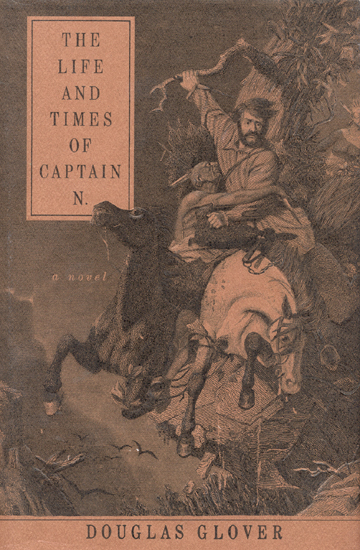
Original Alfred A. Knopf edition.

.

Becoming is an antimemory. Deleuze and Guattari, A Thousand Plateaus 294

I am against the future. Hendrick “Dutch Henry” Nellis, The Scourge of Schoharie, 1779[1]

.

How does one write a book about Indians?  This is one of Oskar Nellis’s dilemmas in The Life and Times of Captain N.  Douglas Glover’s dilemma: How does one write a book about history?  My dilemma: How does one write an academic essay about The Life and Times of Captain N. and A Thousand Plateaus, two texts that seek liberation from linear structures of thought?  And does the problem of writing about Indians and History become part of my dilemma also?

But when one writes, the only question is which other machine the literary machine can be plugged into, must be plugged into in order to work (Deleuze and Guattari 4).

And,

Literature is an assemblage (4).

Can I plug the Glover machine into the Deleuzo-Guattarian machine?  What kind of assemblage will this make?  Will it work?  (“Don’t ask questions you can’t answer”—My advice to undergraduates on writing research essays.  Here I am—breaking the rules.  Sometimes there are only questions . . . leading to more questions . . .)

Oskar thinks he could write a whole book, and there would be nothing in it but questions (Glover 24).

In many ways, A Thousand Plateaus seems antithetical to books about History and Indians.  “Becoming is an antimemory.”  Does this mean Deleuze and Guattari are against the past?  Hendrick Nellis, or Captain N., professes to be “against the future.”  Is this a contradiction, or are they both simply for the present?

“Unlike history,” say Deleuze and Guattari, “becoming cannot be conceptualized in terms of past and future.  Becoming-revolutionary remains indifferent to questions of a future and a past of the revolution” (292).

The present then.  But how shall I plug them all in together?  As Deleuze and Guattari advise,

Writing has nothing to do with signifying.  It has to do with surveying, mapping, even realms that are yet to come (4-5).

And,

[W]rite at n – 1 dimensions.  A system of this kind could be called a rhizome (6).

A rhizome ceaselessly establishes connections between semiotic chains, organizations of power, and circumstances relative to the arts, sciences, and social struggles (7).

There are no points or positions in a rhizome, such as those found in a structure, tree, or root.  There are only lines (8).[2]

Write rhizomatically.  But, I protest, there must be an argument!  There must be a thesis!

The majoritarian argument, then: According to Oskar Nellis, one of the storytellers and protagonists of Douglas Glover’s novel, The Life and Times of Captain N., “Everything is a sign of everything else.”  It is a state of being that causes him to feel “lost in a circular whirl of interchangeability based on masks” (52).  This state of being, or of interchangeability, might more aptly be called a Deleuzo-Guattarian “state of becoming.”  Like Deleuze and Guattari’s conceptualization of identity in terms of “becomings,” Glover’s historical novel articulates a notion of cultural and national identity that privileges indiscernibility, symbolized by the Iroquoian whirlwind masks that figure so prominently in the novel.  This has a direct bearing on the question of History and Indians, for it is by reading Oskar’s book about Indians within the text of The Life and Times of Captain N. that he and his readers become-Indians (which is a fine way of saying we become-everybody/everything).
The minoritarian argument . . . But wait, Deleuze and Guattari object . . . “Flat multiplicities of n dimensions are asignifying and asubjective.  They are designated by indefinite articles, or rather by partitives (some couchgrass, some of a rhizome . . .)” (9).

Fine then . . . some minoritarian arguments: Plug The Life and Times of Captain N. and A Thousand Plateaus into each other.  Make an assemblage.  “Collective assemblages of enunciation function directly within machinic assemblages” (7).  Make a machine, a BwO (a Body without Organs, a Book without Origins).  Create: Lines of Flight.  Planes of Consistency.  Connections:  “and . . . and . . . and ”(25).[3] “[A] line of becoming has neither beginning nor end, departure nor arrival, origin nor destination” (293).  A Becoming-Glover of Deleuze and Guattari and a Becoming-Deleuze-and-Guattari of Glover.  “Each of these becomings brings about the deterritorialization of one term and the reterritorialization of the other” (10).  Is it true?

As Brian Massumi states in his foreword to A Thousand Plateaus, “The question is not: is it true?  But: does it work?  What new thoughts does it make it possible to think?  What new emotions does it make it possible to feel?  What new sensations and perceptions does it open in the body?” (Massumi xv).  Will it work then?

I’m not sure, but the connections are there.  Like Deleuze and Guattari, Glover writes and theorizes the middle, the inbetween space elided by dualism machines.  Binary machines that separate being and nonbeing, self and other, “God and reason,” as well as America (“the rhizomatic West,” for Deleuze and Guattari, “with its Indians without ancestry, its ever-receding limit, its shifting and displaced frontiers” [19]) and “the old country” (Oskar “wondering which old country”—suggesting it doesn’t really matter [112]).  Many of the characters in The Life and Times of Captain N. feel they are, like Nellis himself, “between peoples” (19).  For Deleuze and Guattari, “the only way to get outside the dualisms is to be-between, to pass between, the intermezzo . . .” (277).

“Are you ready to write?” asks Oskar (32). .

.

Becomings.  Becoming-masks.

A becoming is always in the middle; one can only get it by the middle. A becoming is neither one nor two, nor the relation between the two; it is the in-between, the border or line of flight or descent running perpendicular to both. Deleuze and Guattari 293.

The Truth is a Mask & its Signe is Division. It is Nought but what lies between Things. It whirls. Yet I believe that to know It is a kind of Madness & a joyful Relief. Glover 99

.

In A Thousand Plateaus, the concept of becoming is described as “a zone of proximity and indiscernibility, a no-man’s-land” (293), as it were, that is itself the in-between of being and non-being.  When they speak of becoming-girl, becoming-woman, or becoming-animal, Deleuze and Guattari are not advocating an imitation or identification with the other.  Becoming is a notion that they are constantly reinventing, making it difficult to define.  However, several of the ways Deleuze and Guattari describe becoming are suited to a comparison with the articulation of identity in The Life and Times of Captain N.  Becoming is, as the epigraph to this section explains, an “in-between” zone, which is particularly resonant with Hendrick Nellis’ avowal in the novel that he is “between peoples” (Glover 19).  Deleuze and Guattari explain that becoming is to extract particles between which one establishes the relations of movement and rest, speed and slowness that are closest to what one is becoming, and through which one becomes.  This is the sense in which becoming is a process of desire.  (272)

Becoming is a “process of desire” through which one becomes-other, abandoning one’s major identity with “state[s] of domination” to be “deterritorialized,” to communicate with the other (291).  As Elizabeth Grosz explains, becomings “always involve a substantial remaking of the subject, a major risk to the subject’s integration and social functioning” (174).

In The Life and Times of Captain N., being “between peoples” means being a split subject, risking one’s subjective integrity, as well as one’s social, national, or cultural identity.  There are times when Hendrick Nellis’ philosophy reads like a section from A Thousand Plateaus.  When he reflects on the attitudes of those people who cross cultures with ease, Nellis echoes Deleuze and Guattari’s emphasis on becoming as a no-man’s-land, and as “a process of desire”:

In the no-man’s-land between peoples, languages, and customs, there is no custom, only naked desire and misunderstanding.  It is a childlike state, full of violent experiment—when I think of this I am reminded of the mask of the Whirlwind.  Once they have gone there, few ever return.  (80-81)

For the characters in The Life and Times of Captain N., Iroquoian masks are a sign of the often chaotic and confusing process of becoming-other.  It is, as Nellis observes, a violent state, potentially leading to “misunderstanding,” a risk to the stability of one’s identity.  Yet being-between is also the only state or process that allows one to enter into a relationship of mutuality with the other, to become-everybody/everything, to be redeemed.
By “becoming-masks” the characters of Life and Times lose all sense of stable national, cultural or gendered identities.  The Whirlwind mask, also called the mask of the Split-face god conveys this most effectively.  Ethnologist William N. Fenton translates the name of the mask as “He Whose Body is Riven in Twain.”  He explains that “his body is half human and half supernatural; hence his face is divided between deep red and pure black, symbolizing the east and the west, and he is free to wander at large even among the people” (Fenton 16).  As a being that is between life and death, the Split-face god is particularly suited to signifying becoming as a process of being-between.  (In photos he looks quite gleeful about this, as if he knows something we don’t).  In the zone of “in-betweenness,” the characters of the novel enter the whirlwind of indiscernibility where identity is turned upside down.

Many of the First Nations characters in the novel embody this state of being-between.  The “Black Minqua sorcerer,” Crow, paints his face like the Whirlwind; Hendrick Nellis takes the painting to mean, “he is half-spirit and half-human, half-dead and half-alive,” and hence “a medium for the magical forces of the forest, a messenger from the Land of the Dead” (43).  Oskar’s friend, Tom Wopat, who is “half-Savage” according to Oskar (14), is a maker of masks.[4] He is also a “down-fended Boy,” which Oskar tells us is “an ancient custom” of keeping a child thought to be “werrie powerful in Magic” (123).  It is a sign of his ability to live “between Worlds” (123).  Tom is also able to live in the space between dreams and the real.  As a “pawaganak” who appears in the dreams of Mary Hunsacker, Tom is “a manido or person who spoke to the Indians in their sleep” (90).  For Oskar, Tom is often the spokesperson for becoming-other as an experience that allows one to be renewed or redeemed.  Tom tells him that “we will be made new only when we learn to speak the language we cannot understand” (120).  This leads Oskar to wonder if this means “that difference itself is sacred?  That my savior is the other, whoever he is?”  (120).  As one of the characters who are “between peoples” (19), Tom understands that embracing difference enables one to gain new perspectives, to think new thoughts, feel new emotions, and open new sensations in the body.

Mary Hunsacker is one white character who learns to live “between peoples” after she is captured by the Mississauga Indians and adopted by them.  Mary’s process of becoming-Indian is inscribed with violence; when Scattering Light, one of the Mississauga, clubs her over the head with his death maul, Mary suffers a headache that is quite literally a splitting headache. She explains that the bruising that results from her injury turns her face into “a mask, which nevertheless seemed strangely familiar to me”(26).  Such physical pain is often a sign of the cultural in-betweenness that characters like Mary, Hendrick and Oskar experience.  Mary senses that her “mask of pain” hides a person she does not know inside (37), signifying the fluidity of her identity, as well as the potential for discomfort that this risk to one’s subjectivity involves.

As she becomes more comfortable with the Mississauga language and culture, Mary learns the skills of wabeno magic under the tutelage of Wabanooqua.  This occurs after a doctor for the King’s Regiment places a silver plate in her head, an operation that almost kills her and therefore increases her sense that she lives between the two worlds of life and death.  She describes her new subjectivity as a “strange state between being born and giving birth” (73).  Mary’s position enables her to be more accepting of ambivalence and in-betweenness.  As she explains,

You could never tell what a thing really was.  The world was full of shapeshifters and talking rocks and words that had souls.  I myself was both what I was and something more on account of that silver plate in my head, my dream, and my song.  (117)

Mary experiences her subjectivity as “something more” than her identity as a white woman colonist.[5]  As she later recalls, “The world had turned itself upside down for me.  I was an Indian, though pale, and a white woman, though I spoke and walked like an Indian” (125).  Mary feels that her ability to live between two worlds makes her “a machine for translation” (141).  As such, she functions as a “machine for becoming” for others.[6]  For Mary, becoming-Indian is a kind of becoming-minoritarian.  As Deleuze and Guattari explain, this is necessary since “only a minority is capable of serving as the active medium of becoming” (291).[7]
In many ways, Hendrick Nellis is the most outspoken advocate of becoming-Indian as a means of redemption.  He is also one of the most ambiguous characters in the novel.  As Glover remarks, “Nellis isn’t a liberal.  He’s no improver.  He has already rejected history and the future.  He’s a tragic hero, an Old Testament patriarch.  And his words are a kind of prophecy” (Yanofsky 14).  A self-appointed redeemer of whites captured by Indians, Nellis seems to be a paradoxical proponent of becoming-Indian.  He is a Tory and a loyalist, a captain in the King’s Regiment, yet it would seem he eventually comes to feel no real sense of allegiance to either side in the American Revolution.  For Nellis, war is a “species of conversation” more than a political conflict (17).  “The main effort for any man on the frontier” he suggests, “is the effort to understand the messages” (17).  Nellis interprets the messages as questions:  “Why am I here?  Who is the other?  What is he saying?”  (17).

According to Nellis, the American Revolution turns the world and people upside down: “I do not know if we are sane or insane, the world is so topsy-turvy.  The war is like a whirlwind, and the structures of our lives (army, Indian, colonist) have been upended” (79).[8]  Like Mary, Nellis suffers from headaches that cause him to feel “split in two,” and his physical symptoms are similar to the effect of the Whirlwind mask (81).  “The right side is on fire,” he explains, “and the left is in shadow” (81).  Like his face, Nellis’s subjectivity is split:  “What I believe is that I am split (we are all split) between what we dream (Indian) and what we fear is true (white)” (106).  In his “Address to Pilgrims,” Nellis preaches a doctrine that is founded on loving difference, and in which becoming-Indian is, like the Deleuzo-Guattarian notion of becoming, about entering into a relationship of proximity to the other:

Once I said that becoming an Indian was like unto entering a swarming madness, but it might redeem you.  I mean going out of yourself, abandoning the structure of mind which is peculiarly white, entering that area where, because it is neither one nor the other, you are nothing.  (173)

For Nellis, becoming-Indian is about relinquishing one’s identity with the majority and its domination over other minoritarian identities.  This is also important for Deleuze and Guattari: “Woman: we all have to become that, whether we are male or female.  Non-white: we all have to become that, whether we are white, yellow, or black” (470).  Moreover, it is not a question of identifying as either white or Indian, but of being comfortable with being somewhere in-between.  Nellis describes the process of becoming-other as one that ends with becoming-nothing.  His own madness and his belief that his brain enters a “process of disintegration” influence this idea when he settles in Canada (173).[9]  He is not fearful of this process; as he says, “I am against the future.  But I firmly believe that out of the collapse of everything something new arises” (182).

Similarly, for Deleuze and Guattari, the goal of all becomings is becoming-imperceptible.  “The imperceptible is the immanent end of becoming, its cosmic formula” (279).  Becomings move in “molecular segment[s]” that begin with becoming-woman and that are all “rushing toward” becoming-imperceptible (279).[10]  What becoming-imperceptible means is “to be like everybody else” (279), just as for Nellis it means, “entering that area where, because it is neither one nor the other, you are nothing” (173).  As Deleuze and Guattari explain:

Such is the link between imperceptibility, indiscernibility and impersonality—the three virtues.  To reduce oneself to an abstract line, a trait, in order to find one’s zone of indiscernibility with other traits, and in this way enter the haecceity and impersonality of the creator.  One is then like grass: one has made the world, everybody/everything, into a becoming, because one has made a necessarily communicating world, because one has suppressed in oneself everything that prevents us from slipping between things and growing in the midst of things.  (280)

There is, then, a redemptive quality in becoming-indiscernible.  While it does not necessarily erase difference, it does enable “a communicating world” open to slippages between different things, where, as Nellis suggests, we can attempt to understand the messages of the other.  As Oskar explains, Nellis regards becoming-Indian as redemption, as a process that opens one up to greater potentials for life and love of difference.  Nellis teaches his son that “for a White Man to become an Indian is like entering a swarming Madness.  Becoming an Indian is difficult as knowing the Truth or becoming a Child agin [sic].  But it might redeem you” (100).  Lunacy, Oskar explains, effects “a breach in . . . understanding which allows a new perspective” (180).  Neither this nor that, but in-between.

For Deleuze and Guattari, becomings are also redemptive, because they “rend” us from a “major identity” (291).  This is why the subject must always pass through becoming-woman first:

In this sense women, children, but also animals, plants, and molecules, are minoritarian.  It is perhaps the special situation of women in relation to the man-standard that accounts for the fact that becomings, being minoritarian, always pass through a becoming-woman. . . . In a way, the subject in a becoming is always “man,” but only when he enters a becoming-minoritarian that rends him from his major identity.  (291)

For Nellis’s son Oskar, the Iroquois are the other, the molecular minoritarian segment he must pass through in order to “rend” himself from “his major identity.”  In words that sound uncannily like Deleuze and Guattari’s, Oskar explains his relationship to the Iroquois:

Difference is their primary characteristic.  It envelops them in a luminous sheath.  They seem marvelous, more real than real.  They become everything that is not familiar, expected, and routine.  They become the mystic other, the female, the child, and the self, which I glimpse only fleetingly.  (66)

Yet Oskar’s attempts at becoming-Indian are often suspect.  When he shaves his head and wears a scalp lock or “practices walking like an Indian,” Oskar claims that “the world looks different” (101).  However, Nellis regards his son’s becoming-Indian as an imitation grounded on “naïveté and false bravado” (119).  Oskar seems incapable of distinguishing between becoming-Indian and “going-Indian” (a difference that is grounded in sincerity).  This may have something to do with Oskar’s attitude towards the Indian and the fact that he has not yet learned to embrace difference, to follow his father’s “11th Commandment,” which is “Love difference” (173).[11]  As he writes in one of his letters to General Washington: “This War has turned my Brain upside down.  That wch I loved I hate & that wch I oncet hated I love.  Such Inconstancy is a Sin” (137).  Mary, however, believes that

Under his clothes, Oskar was half-Indian.  Except when he was writing things down (he collected facts like butterflies, pinning them to the pages, dead) . . . He had an affinity for the edges of civilization—people at the edge are always closer to the other, more tolerant of difference; this tolerance brands them as sinful; it is a brand and a badge. (165-6)

Strangely, it is only after he has entered into the process of writing the book about Indians (and failed) that Oskar is able to relinquish the desire to master his subjects and truly come to “love difference.”  This is when he learns that becoming-other is not, as Deleuze and Guattari warn, about imitation and identification.  As Mary points out, he must recognize that he is “half-Indian” underneath his clothes, in his heart rather than by imitation.  He must not “go-Indian” but become-Indian, with sincerity and a desire to create a communicating world.  One must be aware, as Oskar says, “In Life, we should not pretend lest We lose ourselves & become that wch we pretend to be.  When you wear a Mask, you become the Mask” (185).  This does not mean one should not do it, however.  Oskar follows his warning with the admission that he is “haunted” by his father’s words: “But it might redeem you” (185).

“No longer white or Indian, what might we become?”  (Glover 180).  “Nomads” is one possibility that Glover, Deleuze and Guattari might all agree on because, as Deleuze and Guattari suggest, “The life of the nomad is the intermezzo” (380).  For Glover, being “a nomad, an expatriate, and a wandering Canadian” is part of his process of becoming-writer (Yanofsky 15).  Nomads are always becoming. .

.

The Book.  The Book About Indians..

[C]ontrary to a deeply rooted belief, the book is not an image of the world.  It forms a rhizome with the world, there is an aparallel evolution of the book and the world; the book assures the deterritorialization of the world, but the world effects a reterritorialization of the book, which in turn deterritorializes itself in the world (if it is capable, if it can). Deleuze and Guattari 11

. By recording facts, the book separates the world of facts from the flow of memory, from individual consciousness, from poetry.

This is Oskar’s dilemma throughout the novel.  He writes to knit up the tear in his life, but the thing keeps unravelling again behind him.  At the moment of writing, though, he feels better.  So the book remains a mystery, even to us.  It is an impossible object.  It both condemns and redeems us. Glover, Interview with Yanofsky 14

.

For Deleuze and Guattari, books are not reflections or representations that simply mirror life or the world.  By suggesting that the book “forms a rhizome with the world,” Deleuze and Guattari rescue it from arborescent structures that limit how we understand the relationship between the two.  The book engages with the world and the world engages with the book; this engagement has the potential to “deterritorialize” but also to “reterritorialize” each, meaning they can have a liberatory, but also a mutually confining, relationship.

Glover understands the book in a similar way.  For him, the book has a relationship to the world, the “world of facts,” that is similar to the Deleuzo-Guattarian idea of the book.  He explains the dilemma of Oskar, whose Book about Indians often frames or directs the other narratives of The Life and Times of Captain N., as one that is involved in negotiating this relationship between the world and the book.  Oskar’s writing is an attempt to “knit up the tear” between the two—to “deterritorialize” them—but his attempts are often thwarted by the tendency to “reterritorialize.”  As Glover puts it, “the thing keeps unravelling again behind him.”  Oskar’s desire to connect the world and the book may be impossible, but as Glover suggests, the attempt makes him “feel better.”  When he suggests that the book “both condemns and redeems us,” Glover seems to be embracing the ambivalence of its potential to deterritorialize and reterritorialize ad infinitum.

Oskar’s compulsion to write is often a response to the “call to battle” of his teacher, the humpbacked dwarf, Witcacy (31).  “Are you ready?  he shouts. Are you ready to write?  Are you ready to tell the truth?”  (32).  But as much as Oskar may seek to tell the truth, his Book about Indians is constantly unravelling and undoing itself.  As he later confesses, “the book about Indians is not (a) a book or (b) about Indians.  It is about Indians tangentially.  And it is incomplete and unorganized, sheaves of notes sewn with a thread, scattered about” (65).  As Oskar comes to recognize, the reason his book about Indians is not a book about Indians has to do with his understanding of history, which changes when he compares the history of literate cultures to the dreams, myths and legends of native oral cultures.  “Scholars of savage lore err in concluding that the native myths and legends are a primitive form of history” he observes.  “They are nothing like history, which is an hypothesis about past events, cast in terms of cause and effect, based on evidence and stretching further and further back in time” (82-3).  It is the very act of writing a book about Indians that destroys them because writing is antithetical to the oral nature of their culture.  As Oskar observes, “the savages are fading now because they are being written—by writing this book, I erase any number of those creatures which I hold most dear, my subjects.  The real challenge, the hardest thing of all, is to write a book about Indians” (83).

The difference, as Oskar comes to realize, has to do with the relationship the two cultures have to the present.  “Savages dream in order to remember; we write in order to forget” (83).  While the Western notion of history follows what Deleuze and Guattari would call a linear or “punctual system,” the function of dreams in an oral culture is closer to the Deleuzo-Guattarian notion of “becoming” in relation to time and the past.  Deleuze and Guattari state that “Creations are like mutant abstract lines that have detached themselves from the task of representing a world, precisely because they assemble a new type of reality that history can only recontain or relocate in punctual systems” (296).  As Oskar discovers, “By writing history down, we try to extend the explanation of the present deep into the past.  But the savage, in his dreams, seeks to extend the present laterally, as it were, across the axis of time” (Glover 83).  The dream has a more creative relationship to time; by “detaching itself from the task of representing a world,” the dream (and the Indian) can assemble “a new type of reality” in a manner history cannot.

As Oskar comes to have greater respect for the native oral culture, his book becomes “an antibook”:

The book about Indians can’t be a book at all.  (As a book, I agree, it’s a mess, no substitute for all the histories, geographies, anthropologies, and novels that will one day illuminate the subject of Indians.)  It is a song, a hymn, a keen, a cry of mourning and condolence.  It is a recitation of names, a string of masks, a prayer.  It is a break, a rupture in the whole cloth of normal discourse.  It is an antibook meant to destroy all books.  It is pure ritual, mumbo jumbo, words of power, a spell—not to be read as a book at all, but to be incanted over and over until it infects the soul, until the words pierce the skull and suck out the brain, until the brain is turned upside down.  (121)

Oskar’s book becomes an antibook once he ceases to understand history in the traditional sense of literate culture and embraces the native way of being in the present.[12] “Part of the difficulty of writing a book (first impossible project) about Indians (second impossible project) is that the Indians themselves do not recognize our distinction between knowing and being.  What they know or say or remember about themselves they are” (109).  As Oskar says, “The book about Indians is against the being of Indians” because “the Indians believe that by telling the stories they are.  They exist in the telling of stories, the singing of songs, the dancing of dances” (109).

Oskar’s book about Indians becomes an anti-book at the moment when he too ceases to distinguish between being and knowing, which becomes possible only when “the brain is turned upside down,” allowing for the potentialities of a new perspective.  His book becomes an act—“a song, a hymn, a keen, a cry of mourning and condolence”—when Oskar relinquishes his need to write a history and to control the subjects of that history.  Most importantly, as it becomes an anti-book, it becomes, like A Thousand Plateaus, a book that enacts a becoming.  “If you read the book the correct way,” Oskar advises, “you will become an Indian (that is what I intend; that is the purpose of all books that are not books)” (121).  As Deleuze and Guattari explain, creative pursuits such as “Singing or composing, painting, writing have no other aim:  [but] to unleash these becomings” (272). .

.

Some Conclusions: History and Nomadology.  War and Love..

What counts is that love itself is a war machine endowed with strange and somewhat terrifying powers. Deleuze and Guattari 278.

The War has taught me a Grammar of Love.  We—Rebels & Tories & Whites & Indians—are having a violent Debate whose Subject is the Human Heart, its constituent Elements & Humors, its hidden Paths.  This is a Mystery.  The Effect of the Argument, the Structure of its Thought, is a curious Splitting or Splintering. Glover 162

.

History and Nomadology, War and Love: such binaries seem out of place in an essay that wants to be undoing dualism machines.  However, as Deleuze and Guattari tell us, “We invoke one dualism only in order to challenge another.  We employ a dualism of models only in order to arrive at a process that challenges all models” (20).  It is when these dualisms collide that the whirlwind is created; the brain is turned upside down.

[O]nly nomads have absolute movement, in other words, speed; vortical or swirling movement is an essential feature of their war machine (Deleuze and Guattari 381).

Deleuze and Guattari themselves are guilty of opposing History to Nomadology when they write, “History is always written from the sedentary point of view and in the name of a unitary State apparatus, at least a possible one, even when the topic is nomads.  What is lacking is a Nomadology, the opposite of a history” (23).

I think what Glover attempts to do in The Life and Times of Captain N. is to write a novel that is between History and Nomadology, one for which he, as a half-Canadian, half-American “nomad” is particularly well-suited to write.  As he explains,

I’m a nomad, an expatriate, a wandering Canadian (which is worse than just being a Canadian, I am doubly displaced, a Canadian squared), and I can no longer tell whether that’s because I am a writer or why I am a writer.  Some mornings I wake up and it’s a problem.  Some mornings I wake up and it’s a dance. (Yanofsky 15)

Glover’s novel is in-between history and fiction;[13] he creates a space in which dualisms collide, creates a whirlwind, a rhizome that turns North America upside down.

Of course it [America] is not immune from domination by trees or the search for roots.  This is evident even in the literature, in the quest for a national identity and even for a European ancestry or genealogy (Deleuze and Guattari 19).

Glover thwarts this “domination by trees” by subverting the “quest for a national identity.”  Neither Rebel nor Tory, White nor Indian, American nor British, what might we become?  Canadian nomads?  I am aware that the idea of a “Canadian nomad” seems to contradict my argument about the subversion of national identities.  However, Glover suggests that Canada is a place that embodies in-betweenness very well.  “Canada is a cracked mirror, a splintered psyche,” he explains, “the idea of being against the future and, consequently, somehow outside history is a powerful theme in the discourse of Canadianism” (Yanofsky 15).

I chose the two quotes on love and war for my epigraphs to this section, in which I am attempting to draw some conclusions, because they each connect a “grammar of love” to the terrifying possibilities of a war machine.  “All’s fair in love and war?”  Not quite.  But the “terrifying powers” of war to effect a splitting, a splintering of identity seems to be a creed common to both The Life and Times of Captain N. and A Thousand Plateaus.  And somehow, this “violent debate” that is war becomes, in the whirlwind, in the becoming, a “Grammar of Love.”  Dualisms become each other.  Love itself is a war machine.  Perhaps this is because, as Hendrick tells Mary, “violence has its own strange and perverse beauty—at least it makes you pay attention.  You get to know a man when you’re a-killing him, or he’s a-killing you” (168).

Returning to one of Massumi’s earlier questions—“Does it work?”—I feel some of the anxiety Oskar expressed when he acknowledged the messy state of his book.  My attempt to write rhizomatically has not been entirely successful—this paper is somewhere between a rhizome and a tree.  But perhaps this is the best strategy—a happy accident—for a paper that seeks an in-between space connecting two texts, a paper that is not, in fact, about Indians or History, but about becomings, nomads, wandering expatriates, whirlwind masks, chaos and books that are not books at all.

—Cheryl Cowdy

Notes

1 Douglas Glover, The Life and Times of Captain N., Epigraph ([ix]). [[2]] Deleuze and Guattari oppose rhizomatic to arborescent systems.  While the tree is a linear model that is suggestive of genealogies and origins, rhizomes (such as bulbs and tubers) are founded on principles of multiplicity and alliance.  See the chapter “Introduction: Rhizome,” 3-25.[[2]] 

Works Cited

Deleuze, Gilles and Félix Guattari.  A Thousand Plateaus: Capitalism and Schizophrenia.  Translation and Foreword by Brian Massumi.  Minneapolis: U of Minnesota P, 1987. Fenton, W. N.  Masked Medicine Societies of the Iroquois.  Ohsweken, Ontario: Iroqfrafts Reprints, 1984. Glover, Douglas.  The Life and Times of Captain N.  Toronto: McClelland and Stewart, 1993. Grosz, Elizabeth.  Volatile Bodies: Toward a Corporeal Feminism.  Bloomington and Indianapolis: Indiana UP, 1994. Yanofsky, Joel.  “A Feeling for History.”  Interview with Douglas Glover.  Books In Canada 23:1 (February 1994): 13-15.

.
.
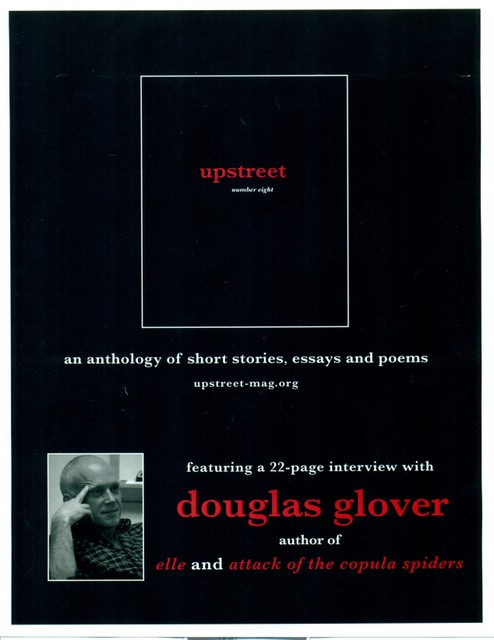
Footnotes    (↵ returns to text)

  1. Douglas Glover, The Life and Times of Captain N., Epigraph ([ix]).
  2. Deleuze and Guattari oppose rhizomatic to arborescent systems.  While the tree is a linear model that is suggestive of genealogies and origins, rhizomes (such as bulbs and tubers) are founded on principles of multiplicity and alliance.  See the chapter “Introduction: Rhizome,” 3-25.
  3. “Principles of connection and heterogeneity: any point of a rhizome can be connected to anything other, and must be.  This is very different from the tree or root, which plots a point, fixes an order” (Deleuze and Guattari 7).
  4. Oskar observes that one of Tom’s masks “looks suspiciously like a Continental soldier,” indicating that the masks themselves are capable of becoming-other, of being influenced by cultural exchanges (51).
  5. In his interview with Joel Yanofsky, Glover suggests that Mary demonstrates how “underclass whites and especially white women along the frontier in North America were close enough to their oral past that they often found the Native culture not so very alien.  This is borne out,” Glover adds, “in statistical studies of captivity and acculturation” (14).
  6. Deleuze and Guattari suggest that girls and children are particularly suited to becomings because they “draw their strength from the becoming-molecular they cause to pass between sexes and ages, the becoming-child of the adult as well as of the child, the becoming-woman of the man as well as of the woman” (277).  They seem to represent a more provisional status than other segments of becoming.
  7. Deleuze and Guattari explain that becomings “imply two simultaneous movements, one by which a term (the subject) is withdrawn from the majority, and another by which a term (the medium or agent) rises up from the minority” (291).  There is, therefore, no “becoming-man” because “all becoming is a becoming-minoritarian” (291).
  8. Deleuze and Guattari suggest that “Learning to undo things, and to undo oneself, is proper to the war machine: the ‘not doing’ of the warrior, the undoing of the subject” (400).
  9. Nellis’s disintegration as a subject is also conveyed by a dream he has of making love to the decomposing corpse of his former wife (61).  Canada seems to be a fitting place for Nellis’s process of disintegration to occur since he regards it as an “imitation country” (153), a place that is in-between the dichotomy of British colonialism and American republicanism created by the Revolution.
  10. Deleuze and Guattari identify “an apparent progression” of segments of becoming:  “becoming-woman, becoming-child; becoming-animal, -vegetable, or –mineral; becomings molecular of all kinds, becomings-particles”(272).  Yet they also say, “all becomings are already molecular” which means, “In a way, we must start at the end” (272).
  11. Glover refers to Nellis’s “Address to Pilgrims” and the injunction to “Love difference” as “the Law, the 11thCommandment” that Nellis is able to give because he inhabits a “rhetorical position of loss” (Yanofsky 15).
  12. Oskar demonstrates his rejection of Western philosophical traditions, as well as the emerging principles of the American revolution later, when he states, “I do not believe in God (old Europe, the King, loyalty, and authority) or reason (Locke’s blank slate, history, atoms, laws, freedom, and democracy)” (158).
  13. In his Author’s Note, Glover jokes that the “descendants and relatives on both sides of the border” of the people whose lives his novel is based on will “find much to complain of” ([xi]).
Oct 192011
 

Here is another dg epigram at the international affairs magazine Global Brief. Global Brief is an amazing and ambitious magazine, the inspiration of the editor Irvin Studin, who finds his writers all over the world (the online part of the magazine features blogs in several languages). The current issue features an interview with Steven Pinker, an essay on three tragedies of humanitarian intervention, a piece on international criminal justice and a prophetic text on the complex future of Israel—to name a few.

dg

Magnanimity heals the rift; ruthlessness seeks to erase the opponent. Both are tools of what we nowadays call conflict resolution. Yet history abounds with cautionary tales. In 1836, Santa Anna was ruthless at the Alamo and Goliad, raising the red flag signifying No Quarter, only to inspire the rag-tag Texians at San Jacinto. After the Second Punic War, Scipio Africanus was surprisingly magnanimous toward the defeated Carthaginians, which only led to the Third Punic War (after which the Romans ruthlessly sowed the ruins of Carthage with salt, and resolved that conflict for good).

Ruthlessness means without pity – without those second thoughts about the feelings of others that plague the well-brought-up human. Mexican drug lords popping victims into oil drums filled with acid are ruthless. Pol Pot was ruthless, as were Hitler and Vlad the Impaler. Andrew Jackson sending the Cherokees on the Trail of Tears was ruthless. Harry Truman bombing Hiroshima and Nagasaki was ruthless. But Gandhi was ruthless, too, in his own way, and maybe even Martin Luther King Jr. (a case could be made).

Read the rest at On Magnanimity and Ruthlessness : Global Brief.

Sep 302011
 

Wendy1Author Wendy Voorsanger performing literary art on the playa. Photo credit: C. Voorsanger.

Wendy2.

/

Burning Man is all about radical self-expression.  50,000 free-spirited “burners,” as they’re called, descend upon the Black Rock Desert in Nevada to create a city: an interaction, art, the performance and ultimately the whole Burning Man experience. Many burners labor all year creating stunning art installations and engineering marvels that sit surreally against the stark and eerie landscape of the playa.  Imagine Chitty Chitty Bang Bang inventions on steroids, combined with copious quantities of jet fuel.  See El Pulpo Mecanico. All commercialism is banned; creations are strangely random and come from a place deep within the mysterious subconscious. Check out this list of art on the playa.
.

img_07201Playa from a Plane. Photo Credit: C. Voorsanger

Surprisingly, there’s lack of literary presence on the playa.  Perhaps the community is too enthralled with the extraordinary visual peculiarities to meditate on the cerebral.  Perhaps the loud house music pumping from art cars and daytime raves might be incompatible for reading.  Every year a unique Burning Man theme guides camps toward a common launching point for communal offerings.  The 2011 theme “Rites of Passage” lent itself to some interesting variations on rites both familiar and fringe, such as beer pong, the Homecoming Dance, getting a tattoo.  The theme seemed a perfect platform to riff off literature in some way, “the first draft,” “first reading,” “first rejection,” “first publication,”—rites for all writers. I searched the playa but couldn’t find much in the way of literature, books, words.  I’d heard about a creative impromptu slam poetry happening in Buddha Camp at the Lotus Dome—Poetry Slam, a wee bit of poetry and spanking.  The description scared me off: This is not some ordinary poetry reading, nor is it your poetry contest with score paddles. But you will be paddled with poetry in this full contact open mic. Curious yet? So are we! Bring a poem, or be a spectator, but  stay away if you have a soft tush.

I did stumble upon a few open mic sessions in the Center Camp tent with poetry readings and spoken word performances.  One woman set up a 1950’s typewriter and composed poems on the spot with a one word prompts.  But really, words were missing from the playa.

.
img_07287Random Trojan Horse (Exploded and burned on Friday night.)

As an enthusiastic newbie burner, I wanted to embrace the Burning Man tenants, but lacked the engineering skills and pyrotechnics license.  So, I turned to my own art: literature.  I’d created my own radial self expression, writing a chapter of my first novel-in-progress Capturing the Eddy on a Japanese Zentai suit.  I’d chosen a Burning Man-appropriate chapter, entitled—A Coated Spirit.  The idea wasn’t to publicize my writing, (the novel is far from ready for prime time) but to get burners to pause and read. Meditate on the word.  Relish in a beautiful phrase.  Ponder the random sensation a sequence of sentences might stir.  I wanted to get burners to read a “novel-off-the-page,” if you will.  So the second night I pulled on my Zentai suit at sunset and walked out the playa in hopes of inspiring people to read me and enjoy a bit of literature as performance art..

img_07186Writing novel-in-progress on Zentai Suit

Turns out, I fit right in as a random object on  the playa.  I danced  and twirled wearing my  words, as the sun sank low and dust billowed  in the dusk.  When darkness oozed around, I  joined in a larger dance party and burners caught random words on my back while moving languidly to the thumping beat. “What  are you wearing?” one guy asked.  “My novel.  Wanna read me?” Responses were enthusiastic..

img_07713Wearing my words.  Photo credit: C. Voorsanger.

.img_07751Literature on the Playa.  Photo credit: C. Voorsanger.

.
Later, I caught a ride from an art car taxi through the playa and more people read random strings of words on my shoulders, ankles, and wrists.  I’d offered my creation to the Burning Man community and felt fully accepted and appreciated in my participation.
.

img_07263Pirate Art Car.

img_07493Dragon Art Car

The question I’m left with is why not more literature as performance art at Burning Man?  I ask my fellow writers: What ideas do you have for adding more a more literary influence to Black Rock City 2012? I’m thinking of something more worthwhile than a poetry slam with paddles.  What about a word labyrinth placed in the desert or signs in a selected solstice sequence that tell a story, or novel chapters embedded in the playa dust discovered randomly?  I’d love to hear ideas from you. What say you fellow writers?

.Wendy2
—Wendy Voorsanger

/
/
/

Sep 062011
 

Herewith a link to dg’s distillation of 30,000 years (give or take) of Western philosophy. The idea for this essay came from reading Witold Gombrowicz’s wonderful little book A Guide to Philosophy in Six Hours and Fifteen Minutes. DG thought six hours seemed a little long and tedious and that he could condense all the important points into about fifty minutes. This essay is a version of the lecture dg gave at Vermont College of Fine Arts last January (in the event, he was not able to get ALL of philosophy into the time slot), including his own incredibly helpful diagrams and sidebar comments which clear up the complicated points.

dg

Plato was right when he said that we can only know what we know already, that knowledge works by identity. What we cannot know, cannot access, we also cannot experience, and yet this unknowable is all around us, lies inscrutable and threatening behind everything we do know, crouches even within our hearts in a place Freud called the Unconscious. Mostly we cannot escape the feeling that it is watching us, waiting to trip us up, or sometimes bless us. At the end of the Tractatus Logico-Philosophicus, Wittgenstein threw up his hands and wrote that we must remain silent about the things whereof we cannot speak, by which he meant a long list of absolutes including God, the Good, Beauty, etc. But that sort of realism has never stopped humans whose imagination is prolific in inventing dream meetings with the Other. The history of our philosophies has been a history of such dreams.

via Mappa Mundi: The Structure of Western Thought – The Brooklyn Rail.

Aug 202011
 

1976-montreal-star-deskThis is the copyediting desk (the rim) at the Montreal Star in 1976, probably just before 8 a.m., the paper has been put to bed and we’re just hanging around. I am across the desk on the left. Peter Leney with the long hair is next to me, The gray-haired gent is Walter Christopherson, the copy boss. Barry Johnson would normally be seated on my right, but most of the sub-editors appear to have momentarily disappeared.

I just discovered this obituary from the Vancouver Province. I worked as a copyeditor (we called them sub-editors) at the Montreal Star in 1975 and 1976. We worked the graveyard shift, midnight to 8 a.m., putting the paper to bed around 6 or so, then often adjourning to a bar across the street for a morning drink. Barry Johnson, a handsome, florid-faced old-hand, usually sat to my right on the rim, no doubt placed there to keep the new boy out of trouble. He had been trained as an air force pilot, but he knew his grammar and punctuation inside out and could amalgamate a dozen wire-service reports into a gorgeous 10-para story with nothing but a steel ruler, a ballpoint pen and a gluepot (these were the old days, let me tell you). He had stories to tell: how he got his nickname Precious, his career as a foreign correspondent, his sideline in the movies (spaghetti Westerns in Italy, a part in a TV mini-series on Casanova in France), his rather hasty escape from Greece in obscure and unseemly circumstances. Barry was a legend, a man bigger than life, but his star was falling, age was creeping on him. Sitting next to him as the newspaper technology changed around us (we were dinosaurs of several varieties), I was always in a spin, in awe and yet aware of the ache of loss, time moving on. I soaked up his stories, while at the same time incubating an idea for my first (published) novel Precious.

Years later, the Star shut down and Barry went through a bad patch. He ended up in Toronto, unemployed, scrambling. My book was out. I didn’t know if Barry knew how much he had influenced me. An old friend from my newspaper days (we worked at the Peterborough Examiner and the Montreal Star together), Mal Aird, arranged for us to meet at the Spadina Tavern. It was a stirring thing, handing Barry a copy of the book. It meant a lot to me; clearly it meant a lot to him. Now both he and Mal are dead. Time eats her children.

dg
.

barry-johnson

Former Province reporter and copy editor Barry Johnson died peacefully in hospital after a long illness Saturday night, with his wife and sister at his side.

He was 74.

Johnson, who was known as “Precious” to his many friends, had a long career in Canadian newspapers, with stops at the Montreal Gazette, Montreal Star, Globe and Mail and Calgary Herald.

The former jet pilot jumped into journalism in the 1950s after a stint with the Royal Canadian Air Force. His writing career also took him to London, Greece and Rome.

“He’s been everywhere,” his sister Patricia Holland recalled Sunday.

Regarded by many as a lovable scoundrel, Johnson inspired Douglas Glover’s 1984 murder mystery Precious, the tale of “a boozy, burned-out reporter with an embarrassing nickname and a penchant for getting into trouble,” according to Glover’s website.

via Barry Johnson: A precious one gone.

But see also Barry Johnson obituary with more life details here.

precious2

From Precious:

I stayed where I was a few minutes longer to see the hands lock down the last plates, hear the warning bells, and watch the freshly folded newspapers flooding off the line. Twenty years had fled. I hadn’t listened to Uncle Dorsey. When I got out of the air force, I had my wings and a ticket to a gold mine. In the early sixties airlines were offering a million bucks, fifty grand a year, to ex-servicemen who wanted to fly passenger jets. But the thought of turning into a glorified bus driver at the age of twenty-five chilled me. And somehow I thought the money would always be there.

On a whim I took a job covering the police beat for a small city daily not unlike the Star-Leader. Inside of a month I was hooked on the steady rhythmic surge of the deadline, dropping Dexedrine tablets and working eighty-hour weeks, drifting through my free Sundays in the company of chain-smoking, liverish veterans, their hoarse endless talk echoing in my ears and dreams. I got married; I got divorced. The years accumulated like spent butts in an ashtray. When I finally pulled my nose out of the rat race long enough to grasp the situation, when I finally realized Dorsey had been right all along, it was too late to change and too late to kick.

Twenty years.

But, as the French say, even the most beautiful woman cannot give more than she has.

Aug 182011
 

.

.

One of the great pleasures of my childhood was reading Classics Comics versions of great books. The proper name is Classics Illustrated. I once had a collection, gone to dust. But I just found this site, Tom’s Place, which has some of the issues online, a treasure trove. Going through the complete list, I am not surprised to think how my reading of certain books is completely coloured by these comic illustrations: The Last of the Mohicans, With Fire and Sword (my favourite), Oliver Twist, A Tale of Two Cities, The Time Machine.

dg

Jul 252011
 

Here’s Jean Glover, dg’s mother, reciting Sir Walter Scott’s poem “Breathes there the man with soul so dead…,” actually an excerpt from “The Lay of the Last Minstrel.” This is unrehearsed and you can hear the refrigerator whirring in the background as well as assorted whining dogs who, apparently, cannot abide the poem (everybody’s a critic). We were sitting in her kitchen, on the family farm in Ontario. She rides a stationary bike most days over the winter and memorizes poems while she’s riding. Scott is a favourite because her great-grandfather (or is it great-great…?) was raised by Scott who, seeing the boy playing in the street one day, discovered his widowed mother and offered to pay for the boy’s education. The family story is that Scott was writing his novel Rob Roy at the time. The boy and his brother were in and out of the Scott house as they grew and later Scott paid for them to go on the Grand Tour (somewhere there is a diary of this). The boy eventually succeeded to some family money and owned slaves and a plantation on the island of Cariacou. As soon as the British government offered to buy the slaves and free them, he sold up and moved to Canada. His daughter Anne married Daniel Abiel McCall. And their daughter Sarah married John Brock. And their daughter Kathleen was Jean’s mother. I give you the stripped down version of the story—we are a family that carries some history in its genes. And thus Scott comes easily to her mind. There is some Scott silver somewhere in the house, passed down through the family. In the video, Jean is just shy of her 90th birthday.

dg

.


.

Here’s the poem:

Breathes there the man with soul so dead
Who never to himself hath said,
This is my own, my native land!
Whose heart hath ne’er within him burned,
As home his footsteps he hath turned
From wandering on a foreign strand!
If such there breathe, go, mark him well;
For him no minstrel raptures swell;
High though his titles, proud his name,
Boundless his wealth as wish can claim
Despite those titles, power, and pelf,
The wretch, concentred all in self,
Living, shall forfeit fair renown,
And, doubly dying, shall go down
To the vile dust from whence he sprung,
Unwept, unhonored , and unsung.

—Sir Walter Scott

Jul 172011
 

Here’s another new story by dg, just out in the Summer Fiction Issue of The Fiddlehead, the venerable Canadian literary magazine now edited by Mark Anthony Jarman. It’s an amazing issue that includes, besides dg’s “The Lost Language of Ng,” new stories by Clark Blaise, Elisabeth Harvor, Leon Rooke, Bill Gaston and Katherine Govier (Jarman, Rooke, Gaston and Blaise have all been published at NC—see the fiction contents page at right).

This year’s Summer Fiction Issue makes me feel guilty; it may be our best ever, our most vigourous, yet the issue came together so easily, all these fine stories seemed to gather, like a party of friends or family that happens without effort on the part of any organizer. So I have an uneasy feeling that I’m forgetting something or someone or that the egg salad will poison the kingdom; surely creation should be more difficult than this. —Mark Anthony Jarman

dg

The Lost Language of Ng

By Douglas Glover

According to the Maya, their grandfathers, the Ng, refused to assimilate with later civilizations but rather retreated, after a period of decadence and decline, into the southern jungles whence they had emerged. They are rumoured to be living there still, a hermetic and retired existence, keeping the Secret Names in their hearts, playing their sacred ball game, and copulating with their women to inflate the world skin bladder and supply the cosmos with ambient energy, the source of all life.

The last known speaker of the language of the ancient race of Ng passed quietly in his bed at the Cedars of Lebanon Hospital in Los Angeles where he had been flown the week before for emergency surgery. The cause of death was listed as “massive organ failure.” He was ninety-two years old, according to estimates, though he himself claimed to be 148. He went by the name of Trqba, though he insisted this wasn’t his real name; it was “my name for the outlanders.” His real name, Trqba told researchers, was a secret, a secret so mysterious and terrible that were he to utter the name the world would end the instant his breath stopped on the last vowel of the last syllable.

The Ng are believed to have been a proto-Mayan people who emerged, somewhat mysteriously, from the jungles south of the Yucatan 1,000 years before the birth of Christ and established regional hegemony over the inhabitants of the dry central plains, impoverished tribes who lived by eating insects and grubbing for roots, given to war and venery but incompetent at both, according to Trqba (see C. V. Panofsky: “An Account of the Ng Creation Epic” Proceedings of the Royal Society, 1932). A carved stele excavated at the ancient Ng capital, long concealed beneath temple ruins, depicts the dramatic emergence of the Ng people, their great tattooed war god ______ stepping naked from behind a tree, brandishing a cucumber (or boomerang; listed as “unidentifiable” elsewhere) in his hand, his erect penis dripping blood (according to Trqba; however, according to Giambattista et al., 1953, possibly water, sweat, urine, semen, or “unidentified fluid”) on a row of diminutive, dolorous, and emaciated natives who are about to have their limbs severed (see Rich Farrell: “Ng Stele Recounts Imperial Conquest” National Geographic, 1951). The name of the Ng war god is lost because to utter even one of the 18 divine dipthongs would have meant the sudden and cataclysmic end of life on earth. But Trqba (see Trilby Hawthorn: “New Light on the Ng, a Jungle Romance” People, 2009) said that the Ng referred to him in conversation using conventional epithets such as Snake or My Girl’s Delight.

Soon after migrating out of the jungle, the Ng invented canals, roads, terraced agriculture, pyramids (prototypes of the stepped Mayan E type, aligned with the solstice and equinox), cannibalism, and the mass sacrifice of captured enemy maidens (also, poss. the wheel, the automobile, and an early computer-like device; see Von Daniken, 1964; Von Daniken believed the Ng were extra-terrestrials from the planet Cephhebox). They built immense cities with central plazas surrounded by the usual towering stone temples and played a peculiar version of the Meso-American ball game at the end of which the winners would be bludgeoned with gorgeously carved obsidian death mauls–the losers would become kings and nobles. Since no one wanted to win (especially in the Age of Decadence when the Ng empire went into precipitate decline–between the years 7 Narthex and 27 Px on the Ng calendar), in practice the Ng ball game went on forever. Players would grow feeble, die and be replaced by younger men who, in turn, would be replaced, and so on. (See Proctor: “The Final 16, Ritual Roots of American College Basketball” Harper’s, 2001.)

According to Trqba, the ancient Ng came to believe that the sacred ball game generated a spiritual current or life force (analogous to the Chinese concept of Li; see R.V. Hemlock: “The Ng Generator, Prehistoric Experiments in Conductivity” Popular Mechanics, 1955) which kept the world dome inflated (like a skin bladder or inflatable beach ball, a curiously foundational concept in the Ng metaphysics) and animated all living things. If the Ng heroes–oiled, naked, emaciated, arthritic, toothless, and decrepit–ever ceased their listless ebb and flow upon the court, the world would end catastrophically. (For the ancient Ng, it seems, time was equivalent to constant motion with no linear progression, something like treading water or jogging on the spot; see Larios: Changeless Change, The Ng Enigma of Time, Oxford University Press, 1999.) Though he claimed to be the last of the Ng, Trqba paradoxically seemed to believe that somewhere, deep in the jungle, on a rocky, weed-strewn court hidden by the over-arching green canopy, men and boys, lost tribal remnants or even spectral reanimates, still played the ancient game, the score forever tied at 0-0.

Jul 012011
 

Just published: Another of dg’s worldly epigrams at the international affairs magazine Global Brief. Here are the opening paragraphs. Click on the link or buy the magazine to read the rest.

The great 18th century French diplomat Talleyrand once said that speech was given to man to disguise his thoughts – a counterintuitive claim that explodes many sentimental myths about both communication and diplomacy. People never say what they mean: communication is not exchange, but aggression – and secrecy is at the heart of diplomacy. That is why we have reached the end of the age of diplomacy.

With unseemly haste, the new digital era has ushered in the end of individual privacy, just as it has ushered in the end of official secrets. Any whistle-blowing idealist or malcontent can download a thousand state secrets in seconds, just as credit card companies, phone companies, Internet sites and security cameras daily harvest data about our lives – some, if not all, of that information sold or shared for commercial purposes. Every day, diplomats blush to have their unedited, private remarks and reports published to the world.

Diplomats are the mouthpieces of governments, which also like to keep secrets – doubly secretive as such, for diplomats renounce the expression of personal views, just as they tend to keep their country’s true intentions tight in their hearts. Thus, diplomats always bear the mark of Cain – the sign of untruthfulness; an unsavouriness, as it were, for their professional hypocrisy.

via On Language, Logic and Lies : Global Brief.

Jun 152011
 

.

Here’s the opening of a new Douglas Glover short story, just published in Descant’s amazing 40th anniversary issue entitled Possible Worlds. It’s a fabulous issue, contains work by Steven Heighton (well known to NC readers), Nancy Huston, Josef Skvorecky, Alberto Manguel and Susan Swan among many other notables. Like all dg’s stories this one is autobiographical, nearly a memoir, exposes sidelights of his family life hitherto unrevealed to the reading public. Buy the magazine and read the tawdry remainder.

dg

.

Uncle Boris up in a Tree

By Douglas Glover

.

The photo was taken just before all hell broke loose. Uncle Boris, always the clown, perches on a tree branch above the family group, making a mockery of the occasion. Jannik, the wastrel, smiles inscrutably. Bjorn, the straight arrow, looks like a man with all the troubles of the world on his shoulders, but he works in a bank in town and can afford a gold watch and fob. His eyes are closed. Gurn, the insane one, his mouth twisted from a horse kick, seems merely confused, innocent, and anxious. And Lisel, the compulsive smoker and Bible reader, has momentarily suppressed her persistent and fatal cough. The three young ones huddle with Ma and Pa: Trig, later executed for murder, only six in the photo and dressed like a girl; Grete who became a great lover; and little Nikolai, the math genius, eight months old. Bjorn’s wife Olga, plain as a pine plank but seething with desire, leans against the tree trunk next to Jannik. Aunt Doreen, flighty, excitable, and dim, stares at the camera warily. Daphne, the family slut, has her hands in her skirt pockets and her head tilted to one side.

Continue reading »

Jun 122011
 

In my twenties (in the Precambrian era, sometime in the last century), Hemingway was one of my idols. In 1968 I spent the summer in Freiburg in the Black Forest training with the great German running coach Waldemar Gerschler. I ran three times a day beginning with a morning amble along the Driesam which flowed in front of the sports guest house where I lived. Between workouts I’d go to the American Library in town and read, mostly Hemingway. One day I stayed in my room and wrote a story called “Hail” about a storm that had destroyed the entire crop of tobacco on our southern Ontario farm. I was 19. Five years later I found that story and typed it up and sent it to the venerable Canadian literary magazine The Tamarack Review and got it published (this writing thing was easy, I thought). The next story I published was also a Hemingway pastiche, consciously begun with “Three Day Blow” in mind. In my story “The Mad River” I crafted the grammar of my action sequences on Hemingway’s participial phrases in “Downhill Snow.” Now I can barely read his stories; they seem mannered, sentimental and precious. But it was a great friendship while it lasted.

This article in The Independent is a fair rehearsal of the two-Hemingway theory and the multiply-determined (over-determined) suicide. But it leaves out one piece of the puzzle. Hemingway was being treated from time to time at the Mayo Clinic, and the story is that he was being given new drugs for depression, the sort that, as an unintentional side-effect (these were the early days of such medications) sometimes caused people to get even more depressed and kill themselves. I think I have seen this written about, but I heard it first hand from a girlfriend whose father had been a doctor at the Mayo Clinic at the time. She even remembered looking out her window and seeing Hemingway who took walks by their house for exercise. Of course, the drugs would not have caused his suicide, which was, as I say, already over-determined. But it’s an interesting sidelight.

dg

Fifty years ago, in the early hours of Sunday 2 July, 1961, Ernest Hemingway, America’s most celebrated writer and a titan of 20th-century letters, awoke in his house in the Sawtooth Mountains of Idaho, rose from his bed, taking care not to wake his wife Mary, unlocked the door of the storage room where he kept his firearms, and selected a double-barrelled shotgun with which he liked to shoot pigeons. He took it to the front of the house and, in the foyer, put the twin barrels against his forehead, reached down, pushed his thumb against the trigger and blew his brains out.

via Being Ernest: John Walsh unravels the mystery behind Hemingway’s suicide – Profiles, People – The Independent.

May 052011
 

DG judged the FreeFall poetry contest this year. The winners were just announced in the current issue (which also contains the interview Gabrielle Volke did with dg plus a short Gabrielle wrote). Some of the poetry entries were very good indeed.

First place went to Catherine Owen for “Reincarnation Redux.” Second place went to Mark Sampson for “On Choosing a Mattress.” Third place went to Leslie Timmins for “Caravaggio to his Critics.” And honourable mentions went to Leslie Timmins again for “What is Served” and Catherine Owen (again) for “Solace/No Solace.” DG read the poems blind and did not know the names of the winners til the announcement was made. (You can listen to the first and second place poems read by their authors here.)

Here are dg’s comments as they appeared in the magazine. FreeFall is edited by Micheline Maylor—you may remember her poem “Bird at the University” published earlier on these pages.

Good writing, poetry or prose, dares to make large statements, to teach us about life, to parse existence and tell what is valuable and what is not. The top three poems I read for the contest all made this leap into the oracular. They were also all clearly aware of being inside a tradition of art; they spoke knowingly to and of other works.

First place goes to “Reincarnation Redux” which I adored because of its subversive (it uses the word) anti-sentimentality over the death of a loved one who, the poet imagines, has been reincarnated as a fly. The poem takes a sly, knowing jab at Jack Gilbert famous poems mourning his dead wife which are lauded in America but are also a bit self-pitying and, yes, sentimental. (In the one mentioned here, the poet imagines his wife coming back as the neighbour’s Dalmatian.) This poem sweeps away bushels of easy literary emotions and stock stances. It renders a lot of other poems impossible and thus is incredibly refreshing (also very funny).

My vision, I console myself, if it’s not as faithful or warm as Gilbert’s
has, nonetheless, a numerical advantage; even in wintertime one finds that flies
are quite populous, cleaning their delicate subversive limbs on windowsills.

Continue reading »

May 032011
 

DG is one of the judges (along with Claire Rothman and J. Jill Robinson) for the $10,000 Danuta Gleed Literary Award. He read dozens of story collections over the last few months (fresh crates of books seemed to arrive every week). He mulled them over and conducted lengthy negotiations with his co-judges (gracious and intelligent writers, both of them). Then he managed to keep his mouth shut about the shortlist until its official announcement today. The winner will be trumpeted abroad May 28.

The shortlist is:

  • Darcie Friesen Hossack, Mennonites Don`t Dance (Thistledown Press)
  • R.W. Gray, Crisp (NeWest Press)
  • Billie Livingston, Greedy Little Eyes (Vintage Canada)
  • Alexander MacLeod, Light Lifting (Biblioasis)
  • Teri Vlassopoulos, Bats or Swallows (Invisible Publishing)

Here is a lovely CBC photo display with the judges’ comments on each author.

dg

Apr 082011
 

When The New Quarterly publishes someone, the editors ask for a little squib on what he or she is currently reading, this to appear on the magazine’s web site. I just did my little piece to go with my story “A Flame, a Burst of Light.” It goes like this:

I am rereading John Berryman’s Love & Fame. My copy was inscribed and given to me by a friend who was dying of cancer. She and I shared a love for these American late moderns, that moody, mad generation of poets who drank too much and mostly committed suicide. The night before she died I sat beside her bed and read, at her request (she never requested appropriate things), Randall Jarrell’s great poem “The Death of the Ball Turret Gunner.” Six miles from earth, loosed from its dream of life…

Berryman’s Love & Fame is a ferociously intelligent masterpiece in the same line as John Bunyan’s The Pilgrim’s Progress. It begins with Berryman’s intellectual struggles and sexual athleticism as a young man in college and follows through to his years of poetic accomplishment—money, adulation, marriages, alcoholism and institutionalization. Reflexions on suicide, & on my father, possess me./ I drink too much. My wife threatens separation… Along the way he begins to study the Bible fiercely and carefully, then teach it. The last section of the book is a longish poem or series of poems, gorgeous and mysterious prayers, called “Eleven Addresses to the Lord.” It was these poems, especially, my friend meant me to read and reread, which I do from time to time, as now.

Rest or transfiguration! come & come
whenever Thou wilt. My daughter & my son
fend will without me, when my work is done
in Your opinion.

—Douglas Glover

Apr 052011


A Flame, a Burst of Light

By Douglas Glover


Of the reasons for our lengthy and fatal sojourn in the swamps of Sandusky, there are several theories. 1) The Americans wished to exact vengeance for atrocities committed by Capt. Crawford’s Indios on the Raisin River. 2) The Americans wished to prevent the men from rejoining their regiments before the close of the summer campaigns. 3) To supply the want of souls in the afterlife.

We were seven hundred dreamers starving and shivering to death in this gateway to the City of Dis.

Of the reasons for our deaths, there are no theories. Ague, fever (quartan, intermittent and acute) and the bloody flux carried us away. Old wounds, opened from damp and lack of common nutriment; pneumonia, dropsy, pthithis, galloping consumption, gangrene and suicide account for the rest. An alarming number of walking corpses attended the fallen like Swiss automatons in a magic show, then tottered off to expire face down in the bulrushes.

In the swamps of Sandusky, there were more corpses than souls. We had a surfeit of bodies. They were difficult to bury in the washing ooze.

Kingsland and Thompson, wraiths and daredevils, murderous on the day with Springfields we borrowed from the Americans at Detroit, mounted amateur theatricals though much bothered at delivering their lines on a stage of sucking mud. Sgt. Collins, of Limerick and the 41st, took the female roles, warbling a sweet falsetto. I mind he scalped Kentuckians with his razor at the Battle of the Raisin, along with Tsenkwatawa’s unspeakable Shawnee.


At Long Point in October, when we land, whaleboats and cutters rowed ashore by negro slaves with superior airs, a barefoot girl in a wedding dress skips down the cliff path after regimental medical wagons and surgeons on horseback. Over night, mist froze on the sails and sheets and shattered down on us like broken glass. We skate on the slick decks as the ships slide by the dunes and ponds along the point, mysterious and blood red from rotting sedge and fallen leaves.

The cliffs are dun-coloured clay banks undermined by the fall storms with great half-dead pines like ships’ masts toppling down and thin cows and hobbled multi-coloured horses grazing on narrow zig-zag paths, low roofs and chimney smoke from a cluster of mean log and slab board houses above. We watch the girl, brown as a monkey, with ankles flashing beneath her dress, eyes wide at the sight of us. Preceding her, the medical wagons are like mastless ships with their iron kettles, great stirring spoons, and boxes of spirits and medicaments clanking listlessly. Clouds of geese and ducks, their wings flashing, lift and swirl over the point and settle again behind us.

I think of rhumb lines and wind roses and portolan charts. I imagine a map that indicates the vast populations of the dead, the departed souls like smoke spiraling up from the cemeteries, cities of corpses, suburbs of despair. The bodies of the newly dead make mournful humps of the sailcloth shroud spread over the deck. The boats roll and creak dolefully in the cold rain.

Read the rest of the story in The New Quarterly, Number 118. See also, in the same issue, “On Writing ‘A Flame, a Burst of Light'” by dg and a short story “Shine” by NC book reviewer and aphorist Peter Chiykowski.

Apr 052011


Crown of Thorns

by Douglas Glover


When Tobin was eight, he fell in love with his babysitter Aganetha, the awkward one with the large, damp eyes, floppy, uncontrollable bosoms and a soot-coloured hair-wing she kept pulled down over her face to hide her acne. One night, waking up to pee, Tobin spied Aganetha and his father embracing in the rose arbour at the back gate. Aganetha’s sweatshirt was rucked up at her throat, her bra askew, one breast dislodged and bright as a second moon. The scene was enveloped in silence, lit by a real moon hanging over the garden like a Japanese lantern or a breast. Dormant, dither, delft, dreadful, death and dalliance—d-words from his book droned through Tobin’s head. Seeing the breast flattened against his father’s hand, Aganetha’s pale flesh bulging like putty between the rough, muscular fingers, Tobin thought, She must be cold. Then his mother was standing just behind him, in his bedroom by the back window, her fingernails chill talons digging into his shoulder. He thought, he made a connection, never to be obliterated from memory, My mother’s hand on my shoulder is just like my father’s hand on Aganetha’s breast. He wet his pajamas right down to the floor.

Aganetha disappeared from Tobin’s life. He thought of her as a kite, but the string had snapped and she was floating away from him. His parents never mentioned her. He thought, She is the only person I ever loved. She is my beginning and my end. His mother, if anything, seemed warmer, more attentive, toward his father, but in an anxious, frenzied, hysterical manner which he later described to his therapist as a theatre of martyrdom. See, she seemed to say, I am the perfect one for you because I will bear anything, tolerate every betrayal and vice. To Tobin, his father seemed ineffably distant, cruel, cold, powerful and perverse. Both his parents were so involved in their private drama that they had no emotion to spare for Tobin. He thought, he told the therapist, he was having a happy childhood.

Read the rest of the story here: Crown of Thorns – The Brooklyn Rail.

Mar 262011
 

Character grouping and gradation is one of the more arcane and least understood (never mind being taught) aspects of novel composition. For me, the primary source on this is E. K. Brown‘s essay “Phrase, Character, Incident” in his book Rhythm in the Novel. Brown was a Canadian academic and critic with a bent toward formalism, but he died rather young, before he could make as large an impact as he might have. His book is out of print, and it shouldn’t be. See my book The Enamoured Knight (pp. 128-131) for a succinct outline of the structure. “By character grouping I mean the composition of characters based on shared traits; these traits are varied, diminished or intensified from one character to another, that is, they are graded. Another way of saying this is to remember how Madariaga thought  of Sancho as the same as  Quixote only transposed into a different key.”

Vanessa Blakeslee is a former student of mine, a graduate of Vermont College of Fine Arts. She does a fine job here of analyzing character grouping and gradation in the structure of three contemporary novels. Vanessa’s fiction and poetry have appeared recently in The Southern Review, Green Mountains Review, New York Quarterly, The Bellingham Review, Southern Poetry Review, among others. She has received grants and fellowships from Yaddo, Ragdale, the Virginia Center for the Creative Arts, the Writers’ Colony at Dairy Hollow, and the United Arts of Central Florida. She directs Maitland Poets & Writers, a community organization which focuses on expanding the literary arts throughout Central Florida.

dg


Shades and Mirrors: Character Gradation as a Demand of Resonance in the Novel

By Vanessa Blakeslee


In my early twenties, I embarked on my first attempt at writing a novel. Loosely based on events passed down in family history, the work sprawled across several generations of Italian-American women as they struggled to overcome the trials of love and death. Key word to note: “sprawled.” As an inexperienced writer of long fiction, I sensed that what my characters suffered from most (outside of the sick husbands and dying babies on the page) were composition flaws. Workshop feedback repeatedly struck the same chord: often my female characters seemed like the same person. I gave each of the daughters distinguishing characteristics, one a love for music, the other for business and career, yet somehow these differences failed to establish sufficient motivation for subplot, unity and resonance to develop. To make matters worse, the large cast of secondary characters was comprised of relatives who seemed to pop in and out of the story at random. After much teeth-gritting, I stowed the several hundred page draft away. I simply lacked the craft technique to approach fixing the mess.

Not until I was a student in the MFA in Writing at Vermont College did my interest in the novel’s architecture resurface. One of my teachers, Douglas Glover, pointed me to an essay by Yeats, “The Emotion of Multitude.” He also suggested a somewhat hard-to-find but indispensable gem of a book, E.K. Brown’s Rhythm in the Novel, and a concept Brown refers to as “character gradation.”[1] According to Brown, graded characters share traits, attitudes or experiences with other characters to varying degrees, thereby composing structural parallels in a narrative. Such structural parallels lead to the creation of the echo effect in a novel; without the parallels and repetition in place, the narrative turns to sprawl. I found a used copy of the book online and ordered a contemporary novel Glover recommended for the study of subplots, Anne Tyler’s The Accidental Tourist. I added to my list Glover’s own study of Don Quixote, The Enamoured Knight. The following semester my advisor Xu Xi suggested novels by V. S. Naipaul and Muriel Spark might make worthwhile subplot-studies as well. Books piled high, I began with Brown. Almost immediately my long forgotten novel draft came to mind as I hunted after the question: how does the relationship between structural parallels and the desired echo effect of resonance in a novel work exactly?

Resonance derived from an echo effect has been well-explored territory for other writers. W. B. Yeats called the effect of subplotting “the emotion of multitude” in his essay on King Lear:

The Shakespearian drama gets the emotion of multitude out of the subplot which copies the main plot, much as a shadow upon the wall copies one’s body in the firelight…Lear’s shadow is in Gloucester, who also has ungrateful children, and the mind goes on imagining shadows, shadow beyond shadow, till it has pictured the world. In Hamlet, one hardly notices, so subtly is the web woven, that the murder of Hamlet’s father and the sorrow of Hamlet are shadowed in the lives of Fortinbras and Ophelia and Laertes, whose father, too, have been killed.[2]

“Mirroring” may be a better term for how a subplot relates to the main plot, for in a mirror people and objects reflect but can appear slightly sharper. Notice that in order to achieve “the emotion of multitude” Shakespeare uses other family members or two different family groups along plot/subplot lines who then may interact and observe one another and achieve the mirroring effect. And it is this mirroring within the plot-subplot relationship that creates the echo effect because subplot allows for multiple sets of characters who share situations and traits to interact with the main plot, adding sub-stories while keeping the long narrative from sprawling.

To better pinpoint how my sprawling multi-generational novel went wrong, I took a close look at the three novels mentioned above: The Accidental Tourist by Anne Tyler, A House for Mr. Biswas by V. S. Naipaul, and The Prime of Miss Jean Brodie by Muriel Spark. The former two titles use family dynamics in the character gradation and subplotting to achieve resonance while the latter uses a group of schoolgirls, but the gradation works the same way.

In these novels, the characters involved in the subplots that are closely related to the main set of characters (often as other family members) contain an element of gradation. Subplot characters often mirror larger characters acting on the main plot, but can be less ardently subjected to their desires. The author may give the subplot characters the same or a similar core trait as their counterparts but “shade” its intensity, which helps push the subplot characters toward an outcome which differs from that of the main plot. As the characters of the main plot and subplot(s) interact with one another, this gradation becomes a key factor in the development of thematic complexity and resonance.

I prefer to think of the concept as “shading” and borrow from the world of visual art, perhaps because I tend to picture the novel as a grand scene akin to Renoir’s Bal du Moulin de la Galette, Montmartre with characters inhabiting the foreground, the center and the background. If we take a close look at these novels and trace the textual paths and tie-ins, we can better understand why the writers make the compositional choices that they do for their characters.

To accurately trace how a writer accomplishes character gradation or shading in a narrative and because the subplot characters are so closely related to the main plot characters, it’s important to find exactly where the subplot cuts into the main plot and out again, the points where the plot weaving occurs. Only then will the writer’s techniques of “character doubling and splitting” stand out clearly. In The Enamoured Knight, Douglas Glover explains how Cervantes uses character doubling and splitting in Don Quixote:

Note how clear it is that such structures (subplots, groups of characters, and develop through a simple doubling or splitting process. Characters in novels replicate by cell division. They split off a semblance of themselves with various characteristics shaded differently, either exaggerated or diminished. Thus the curate and the barber are a pair, though one is clearly more educated and more officially significant. The two of them spawn a younger, more energetic version of themselves in the person of Sampson Carrasco. Don Quixote spawns Sancho, an illiterate, tubbier, plain-speaking version of himself… [3]

Character gradation and “shading” ranges from a more complex system of parallel structures in lengthier works, such as in Don Quixote, above, or A House for Mr. Biswas which I will examine later. For a more basic plot-subplot-lesser plot structure using shaded family members, Anne Tyler’s novel The Accidental Tourist makes an excellent example.

The main plot of Tyler’s novel is Macon Leary’s relationship with the dog trainer, Muriel. On the heels of a separation with his wife, Sarah, every step Macon takes is in the direction of reclusive self-preservation, seeking and keeping his creature comforts. Macon’s sister, Rose, has similar neuroses about tidiness but also a desire for romance and so embarks on a relationship with Julian. So the Rose-Julian subplot mirrors the main love plot between Macon and Muriel. Both Macon and Rose share similar traits and attitudes—obsession with household order and wariness of strangers—but Rose’s homebody tendencies are even more pronounced than Macon’s. At the end of the novel, Rose is still somewhat stuck, having returned to her marriage but repeating the same caretaking routine, while Macon has broken free. Julian, the complete opposite of Macon and a cheerful, ready adapter must take on Leary family behaviors to compensate for Rose’s failure to leave the Leary brothers, Porter and Charles. A lesser plot also develops between Macon and the brothers, who are so stuck in their “Leary” family ways that they are incapable of change. As Macon and Rose find themselves in similar romantic situations, their differences place them more at odds with one another as each character’s plotline moves forward; so, too, does Macon run into more conflict with his stagnant Leary brothers as he heads in the opposite direction, and his attitude shifts from security toward spontaneity.

Tyler plants the seeds of variation in the first scenes depicting Macon and his family by comparing and contrasting characters with one another. Often one brief stroke containing a distinguishing feature is enough to shade a character and set him apart from the others in a particular way. A writer may shade an entire set of characters with an overarching common trait in a line or two. One of the first lines introducing Rose links all four Leary siblings together. “Rose had a kitchen that was so completely alphabetized, you’d find the allspice next to the ant poison. She was a fine one to talk about the Leary men.”[4] The scene gives a brief introduction to what Macon’s family is like on the whole, just enough for the reader to understand that they all share a defining trait: obsession with planning and dutiful order.

Tyler develops Macon’s character with her frequent use of doubling. Macon and his boss, Julian get described and contrasted together. The contrast in their traits creates opposition and places the characters on different plot trajectories and also functions as a continual reminder of Macon’s distinguishing characteristics and worldview: “Julian was younger than Macon and brasher, breezier, not a serious man.”[5] So the reader recognizes the two as opposites; Macon looks down on whimsy and boldness. The development of Macon’s character using doubling and contrast sets Julian on a criss-cross pattern with Macon’s main plot. As Macon moves away from his passive, worried nature to explore the world, Julian forgoes his breezy life of singlehood for home cooked meals and board games with the Leary family. This pattern is a direct effect of character shading and doubling.

With the Macon’s sister Rose, the most noticeable difference that plays an integral part in her plot with Julian is her devotion to soap operas. “While she watched, she talked aloud to the characters….’Just you wait. Ha!’—not at all her usual style of speech. A commercial broke in, but Rose stayed transfixed where she was.”[6] The phrase “her usual style of speech” refers to the Leary’s penchant for proper grammar demonstrated throughout the narrative; here Rose abandons this group attitude. Her yearning for romance sets her apart from her brothers and motivates her decision to marry Julian. Another difference which plays a factor in Rose’s subplot is that she gets lost outside of the Leary neighborhood. All the Leary siblings share this tendency—of the four, Macon is the most able to locate his surroundings, Rose the least. This intensity of shading leads Rose to a different outcome from that of Macon; getting lost in her new neighborhood is one of the reasons Rose moves back in with her brothers after her marriage. So shading plays a major role in pushing the subplot forward.

As the plots progress, we can trace the steps of the characters to the shading of their core traits and attitudes and observe how the structural parallels result in resonance.

The Rose/Julian subplot unfolds alongside the Macon/Muriel main plot, but the characters go about achieving their desires in different ways based on their shaded traits. Muriel pursues Macon but he gives in only when pressed, whereas Rose freely reciprocates Julian’s interest. This contrast develops as the subplot cuts in to mirror the main plot. When Muriel asks Macon to a movie or dinner, he backs away. This is completely opposite Rose’s speech and action in the Thanksgiving dinner scene:

‘You want to drive him off! You three wasted your chances and now you want me to waste mine, but I won’t do it. I can see what’s what. Just listen to any song on the radio; look at any soap opera. Love is what it’s all about. On soap operas everything revolves around love. A new person comes to town and right away the question is, who’s he going to love? Who’s going to love him back? Who’ll lose her mind with jealousy? Who’s going to ruin her life? And you want to make me miss it!’[7]

So Macon runs away from love while Rose runs toward it. Meaning arises out of juxtaposition and repetition with variation as this plot/subplot pattern reappears in the knitting scene. While Macon’s doubts and overprotective habits cause him to reject Julian’s different manners, Rose’s romantic streak trumps her be-wary-of-strangers upbringing to fall in love with Julian (and it’s worth noting that Julian and Muriel share similarities: stylish clothing, boldness and a positive outlook on life that drives opposition and conflict as they interact with the Learys). Rose’s disapproval of Muriel creates a parallel to Macon’s contempt for Julian, although her reasons differ: Muriel speaks sloppy English, she’s disorganized and erratic. Yet the core trait from which the disapproval stems is the same—don’t trust others. This theme emerges from the parallel structure and shading.

In the end, Macon chooses a life with Muriel because the Leary traits Tyler gives to Macon do not contain the same severity of shading as the rest of his siblings; he has changed and become more like Julian. And Rose, while she does not change, is able to return to her marriage and achieve companionship as a result of the one striking feature which separates her from the brothers—her desire for romance as a result of her devoted soap opera-watching. Her transformation is not as successful as Macon’s, but her situation has changed by her opening up to find love outside Leary walls.

Why are the family parallels so significant here, namely those involving Rose and Macon? For one, isolated neuroses would likely not supply any particular insight to Macon’s character. Without the mirror of his family, the deeper picture of Macon is blurry: what’s the context in which his personality and desires are rooted? Because Macon’s desire is the offspring of his traits and quirks, his shading causes the main plot to take the one-step-forward-two-steps-back shape that it does. Now his personality foibles could be illustrated through further sub-stories and subplots about his work, his relationship with Julian, or a neighbor, perhaps—but then the theme changes entirely. The novel would cease to be about the insular nature of family. So the structural parallels directly inform the greater purpose of the work. The larger meaning of Tyler’s novel is about the individual’s wandering away from home and into the world to find out who he really is; hence, Macon and Rose are “the accidental tourists.” That tension of the self torn between family and the outside demands the structural parallel of the character shading among family members. Otherwise, titling the work “The Accidental Tourist” wouldn’t fit the purpose—or the purpose of the title would have to mean something else.

And because longer narratives must deal with scope in a way that short stories do not, structural cohesion is vital to achieve scope (and avoid sprawl). The structural parallels mirrored in the Macon/Muriel plot and Rose/Julian subplot can be traced back to the spawning and shading of characters and the groups to which the varying traits belong: the “stuffy” Leary group: Macon, Rose, Porter and Charles, spawned from the grandparents at odds with the “fun” group spawned from their mother, Alicia: Muriel, Julian, and to lesser degree, Sarah. So the character gradation and shading cause repetition with variation between the outcomes of the main plot and subplot; the mirroring of the plotlines creates the structural cohesion necessary to build scope and unique thematic complexity. The Accidental Tourist is much more than Macon falling in love with his dog trainer; the effect of Tyler’s mirroring is that the main story along with the sub-stories woven together resonates with mysteriousness and meaning. By venturing beyond home, Macon Leary finds his true self.

V.S. Naipaul’s A House for Mr. Biswas is also about family, and the 564 page novel is rife with parallel structures on a much grander scale than Tyler’s. The protagonist, Mr. Biswas, wants a house of his own and a life away from his in-laws, the Tulsis, and this Tulsi opposition reaches across the extended family with the techniques of character shading and sub-grouping. The Tulsi brothers-in-law are all different versions of Mr. Biswas. This distinct shading allows for each brother-in-law to share similar circumstance with Mr. Biswas (brothers-in-law living under Tulsi rule) but each has a different trajectory and outcome. Because the traits shared by Mr. Biswas and his spawned doubles vary in intensity, the shading and character grouping spurs conflict and pushes the narrative action forward. Mr. Biswas spawns another double in his son, Anand and a subplot is born from their common desire for reading and learning. In Part Two of the novel, the main plot and subplot come together with the Biswas/Tuttle/Govind family rivalry. In the tradition of the upstairs/downstairs novel, Anand and his cousin Vidiadhar have a competitive little plot that mirrors the conflict going on between their fathers. The greater breadth in narrative scope increases the demand for structural cohesion; this provides more opportunity for subtle difference in character shading. Naipaul’s novel achieves reverberating wholeness as a result.

I counted over a dozen spawned character doubles that could be isolated to make this argument, but for purpose of this essay, have chosen to cite and analyze the primary one, the shaded versions of Mr. Biswas.

One variation of Mr. Biswas occurs with Govind, Chinta’s “eager, loyal” husband. The mirror between Govind’s subplot and the main plot of Mr. Biswas develops to a greater extent from the stark differences between the two men; they share little beyond the common in-law situation. “Mr. Biswas thought of Govind as a fellow sufferer, but one who had surrendered to the Tulsis and been degraded. He had forgotten his own reputation as a buffoon and troublemaker, however, and found Govind wary of his approaches.”[8] Good-looking but non-intellectual Govind does manual plantation work, gets nervous and allows Seth to control him, then behaves obnoxiously when Seth exits. He is a variation of Mr. Biswas shaded with intimidation and cowardice, a darker, Jekyll-and-Hyde portrayal. Because of their opposite attitudes in facing the same situation, the lesser Govind plot takes on a contrasting trajectory and cuts into the main plot at the Shorthills house where he becomes “increasingly surly.”

The episode at Shorthills house is also the point in the narrative in which W.C. Tuttle and his family appear. Tuttle is yet another shaded version of Biswas who picks up some pious traits from the now deceased brother-in-law Hari and also the scheming Govind; he prays regularly and reads but Biswas labels Tuttle’s books “trash.” Yet Tuttle resembles Mr. Biswas more than any of the other brothers-in-law, such as when both men order bookshelves to be made at the same time, because both men actively pursue their desires. Tuttle’s desire to acquire a house of his own is identical to that of Biswas but not as urgent. Tuttle does not possess the same degree of obsession about his desire as his main plot counterpart; he is “Biswas Lite” if you will. So the main plot and the Tuttle subplot do not share the same outcome, although Tuttle comes closer than any of the other brothers-in-law to escape from the Tulsis.

The more alternate outcomes achieved as a result of the various Biswas doubles and subplots, the more echoes are created and the greater the resonance of the novel. Naipaul weaves all three plots together, adding more mirrors to the main plot of Mr. Biswas. In places, Naipaul describes all three men together and contrasts arise from this triple juxtaposition. The effect is a “piling on” of differences, opposition, a spike in dramatic tension:

…he (Biswas) continued to plunder, enjoying the feeling that in the midst of chaos he was calmly going about his own devilish plans. Then the news of the ravages of W.C. Tuttle and Govind was whispered through the house. W. C. Tuttle had been selling whole cedar trees. Govind had been selling lorry loads of oranges and papaws and avocado pears and limes and grapefruit and cocoa and tonka beans. Mr. Biswas felt exceedingly foolish next morning when he dropped half a dozen oranges into his bag.[9]

The difference in shading among Biswas and his two counterparts, Tuttle and Govind is revealed with the technique of side-by-side description of each man’s action in the same situation. The juxtaposition illustrates that Biswas does not share the same acute ability to deceive (though he thought he did). Govind and Tuttle are more aggressive than Biswas in their actions and conflict arises from the different shades in character. Tuttle and Govind race ahead while Biswas remains stuck, still sticking his oranges into his bag to peddle in town.

But the technique of describing characters together to heighten the different shades works in the same way to heighten focus on their sameness as in this paragraph juxtaposing only Tuttle and Biswas. Govind has been left out which in itself increases the “sameness” in the shading of the other two.

And when it was learned that some of the widows’ sons had killed a sheep, roasted it in the woods and eaten it, W. C. Tuttle expressed his outrage at this un-Hindu act, refused to eat any more from the common kitchen and made his wife

cook separately. One of his sons reported that W. C. Tuttle’s Brahmin mouth had burst into sores the day the sheep was eaten. Mr. Biswas, though unable to produce W. C. Tuttle’s spectacular symptoms, made Shama cook separately as well.[10]

This comparison helps to place the “sameness” of Tuttle and Mr. Biswas in a special light. In this paragraph, the main plot of Mr. Biswas and subplot of Tuttle come together in the description of the two men. The repetition of their situation, their desires and anti-Tulsi attitudes (with the slight variation in the mouth sore incident) continues to build unity and resonance through parallel structure.

How are these precise structural parallels important in A House for Mr. Biswas, and to what extent are they important to novels in general? Again the matter of meaning and scope requires a closer look. Like Tyler’s novel, Naipaul’s concerns family. Through the duplication of parallels the problems involve not just a single family, but numerous families. But the scope of “the family problem” and the nature of the situation itself, independence from domineering relations and individual freedom, are different than Tyler’s. And here the thematic meaning does not only apply to severalfamilies but to an entire society of Trinidad as a result of the more extensive network of shades and mirrors. Perhaps because the novel revolves so definitely about a specific place, an island set apart from the rest of the world, this determines the need for a wider scope in order for the particular meaning to emerge—that the Biswas/Tulsi struggle is not isolated to their dynamic, but is representative of vast numbers of other Trinidadian families. So the complex web of character gradation and different plot outcomes are crucial to form this wider scope and achieve this exact theme. Without the shortcomings of his doubled counterparts and their contrary outcomes, Mr. Biswas’s independence from in-law rule would not have the meaning it does—that of a rare triumph.

Thus, scope curtails sprawl. The longer the narrative, the more critical the demands; the shades and mirrors must achieve a structural cohesion that will capture great scope and theme in lieu of sprawl.

The subplots of the three men weave in and out throughout the narrative. Biswas, Tuttle and Govind all move their families to the city. Tuttle and Govind argue over the parking spaces of their cars, and this quarrel is echoed through their wives. The differences in the shaded qualities shared by the three brothers-in-law make room for opposition. Similar gradation and shading groups like characters together against the opposite pole. Here the alignment of Govind and Tuttle is against Biswas:

There was money in the island. It showed in the suits of Govind, who drove the Americans in his taxi; in the possessions of W. C. Tuttle, who hired out his lorry to them; in the new cars, the new buildings. And from this money, despite Marcus Aurelius….Mr. Biswas found himself barred.[11]

But these poles keep changing and shifting. The subplots of Govind and Tuttle take on twisting patterns in their relation to the main plot. The twists, the variations, correspond to the lessening or heightening of certain common traits, almost as if the novelist is playing with the volume using a dial. The focus depends on the juxtaposition and whether or not the characters get compared or contrasted together. Contrast sets the poles further apart and comparison brings them together to unite against an opposite pole. Because these alignments are not fixed and they “change sides” as the power struggle moves along in the novel, the character shading and gradation plays a considerable role in the plot. The reversal of fortune necessary for drama is born through the shifting poles.

Tuttle’s subplot only cuts into the Govind/Biswas subplot that ensues about school briefly; otherwise, his family all but disappears from the narrative. But Tuttle’s subplot roars back toward the novel’s conclusion with the announcement that he has bought a house. Here Tuttle’s shading and subplot push the main plot toward reversal of fortune because Tuttle’s action rekindles his counterpart, Biswas, to search for a house of his own. Tuttle’s escape from the Tulsis is through a far more underhanded action than any Biswas would attempt: Tuttle throws poor people out of a house by persuading local government that the house is unsafe. Since Biswas does not share Tuttle’s tendency toward piracy, Biswas goes about his desire through different means and is somewhat taken in by the seller. Yet the Biswas family wins. The Tuttle’s “nervous little chuckles” during the visit reveals their unhappiness about their own home. Tuttle, a more contemptuous, scheming version of Biswas, ends up achieving the same goal but with a less satisfying result.

So the Tuttle subplot has multiple purposes. It informs the action of the main plot by helping to set up the major reversal of fortune in the novel. It creates repetition with variation by means of its different outcome. And together, this less ethical trajectory of Tuttle next to the better circumstances of Biswas in the end helps generate the greater meaning of the work—freedom from tyranny.

Govind’s subplot takes a different trajectory and does not mirror the main plot about the house. Instead, Govind’s subplot weaves together with the subplot of the Biswas son, Anand, who is a more educated, stronger spawn of his father and shares a love for reading and learning. The competition between the fathers is mirrored in the school competition between their sons. Unlike the path of Tuttle’s subplot, here a multigenerational parallel structure develops to build unity and resonance through repetition and reversal of fortune.

The Anand subplot reveals a version of Mr. Biswas that is very different from the split-off duplications-with-variation in his other spawns, the brothers-in-law. Anand and Mr. Biswas share nearly identical characteristics but have one large key difference: Anand is not obsessed with obtaining a house. So his subplot is an offshoot of the core traits he and his father share, the desire to better oneself through education. As Mr. Biswas pursues his self-education by writing tabloid journalism, Anand pursues writing and learning by taking the higher road of academia in his subplot. The two mirror one another but the variation in Anand’s fulfillment of his desire will lead to a drastically different outcome. At the conclusion of the book he has left Trinidad to study in England.

Not all character doubles contain enough shading in their composition to enable subplots to emerge. Lesser doubles appear that are just brief repetitions of their greater counterparts, only with distinct twists. So the mirroring continues throughout the entire spectrum of characters. Anand spawns lesser versions of himself in the worried Chinese schoolboy (a more fraught version) and the first place Negro boy who possesses a superior knowledge of the female body (a more advanced, worldly Anand). Biswas has lesser counterparts in the co-workers he drinks with at the cafe: “three men, none over forty, who considered their careers closed and rested their ambitions on the achievements of their children.”[12] These lesser doubles are important in creating that particular effect Yeats’ called, “the emotion of multitude.” Without the shading and the doubling of characters, the mirroring of subplots and inset stories and subsequent varied outcomes, a novel like A House for Mr. Biswas would not achieve the sweeping greatness that it does by seeming to be about an entire island struggling with similar problems. With parallel structure character links to character, so the inner workings of a novel forge a network of support beams on which the unity and resonance depend.

So compared to Tyler’s novel, Naipaul’s has greater scope. Does greater scope equal greater meaning? Not necessarily. The Accidental Tourist takes on a certain scope in order to achieve particular meaning; next to A House for Mr. Biswas the scope is more limited but the story is still rich with resonance. Each novel mandates its own demands of form and content, and each arrives at a very different kind of whole. Because of the natural dynamics of families to interact within close proximity to one another a novelist can play more with the dial in the wide range of scope available. The more character shades and mirrors, the greater the scope; less and the scope takes on a more narrow, concentrated focus. Either way, in a family novel the plot trajectories that emerge from the gradation are more likely to take an organic progression with more subtle differences in shading. The technique slips by largely unnoticed by the reader.

But not all novels revolve around family groups. One novel that uses character shading in a non-family dynamic is The Prime of Miss Jean Brodie by Muriel Spark. Like with Naipaul’s protagonist Mr. Biswas, the subplot characters are shaded versions of Miss Brodie with more or less exaggerated traits. Gradation, shading, doubling and mirroring devices can work with different types of tightly-knit groups who interact within close proximity to one another for an extended period of time. Spark’s use of shading and mirroring with students at an all-girls’ school in a cascade-style illustrates the range of variation in the subplot structure, but the results of this approach to the character shading technique are distinctly different from the novels of Tyler and Naipaul. While the cascade-style gradation bears correlation to scope, this composition develops less organically in order to bring the family-that-is-not-a-family into conflict. The steepness of the cascade, the narrow scope (the novel has only six chapters), gives the technique a self-consciousness not found in the other two novels.

The main plot of the book is Miss Jean Brodie’s struggle to persevere with her unorthodox teaching style against an administration that would like to get rid of her. Miss Brodie carries out her plot by cultivating her six favorite students into her confidantes—“the Brodie set”—Sandy, Rose, Jenny, Eunice, Mary, and Monica. Each of the girls turns into her own unique double of Miss Brodie in a more or less pronounced way. The special attributes, in some cases bestowed upon and then groomed by Miss Brodie herself, create subplots and lesser sub-stories that mirror Miss Brodie’s desire but with variation. Miss Brodie has a love plot with the art teacher, Mr. Lloyd, and Sandy’s subplot mirrors her teacher’s. The Sandy subplot eventually joins together with the main plot of the school’s headmistress against Miss Brodie. There are lesser subplots—Jenny, Rose, the Joyce Emily episode—but Sandy’s is the most developed. Spark uses doubling to compare and contrast the six girls to one another, Miss Brodie and her peers at the school, and repeats each Brodie girl’s trademark characteristics whenever she appears. The Panama hats and the portraits painted by the art teacher of the six devoted pupils reinforce the replication of Miss Brodie and her cascade of mini-Brodies.

The members of the Brodie set take on various shades of interest in love and sex, and this shading determines each girl’s interaction in the Miss Brodie love plot. Sandy is the Brodie girl who has the most interest in love and sex. Her friend Jenny shares this desire at first: “Jenny and Sandy wondered if Mr. Lloyd and Miss Brodie had gone further that day in the art room, and had been swept away by passion.”[13] Sandy and Jenny write a fictitious tale of Miss Brodie and her lovers. But eventually Jenny’s interest in sex wanes while Sandy’s increases. The outcome of Jenny’s love subplot occurs years later with a moment of reawakening. Sandy’s shading changes; she picks up the interest in romance shrugged off by Jenny. Sandy and Rose start to visit the Lloyd’s together, and Sandy becomes more like Rose as a result: “Rose modeled for Teddy Lloyd and Sandy occasionally joined her…”[14]

The cutting in of lesser plots and outcomes that mirror Miss Brodie’s main plot are like sign posts to the reader that character shading is being used in some way to construct opposition. Shading and doubling transcend mere description by setting up conflict on the sentence-level out of which grow the larger, more pivotal plot events. The dramatic force is heightened, and the significance of this in a longer work such as a novel is that all the characters, not just Miss Brodie, drive the conflict. When we find the place where a lesser plot cuts in, we can trace the steps backward to the distinctive brushstroke Spark gives each girl. Miss Brodie’s encouragement of Rose to have an affair with Lloyd fails because Rose does not have an interest in sex—in fact, of all the Brodie girls, she cares about sex the least.

She was the least of all the Brodie set to be excited by Miss Brodie’s love affairs, or by anyone else’s sex. And it was always to be the same. Later, when she was famous for sex, her magnificently appealing qualities lay in the fact that she had no curiosity about sex at all, she never reflected upon it.[15]

So Rose is the most opposed to Miss Brodie’s love plot desire. Instead Sandy takes up as Lloyd’s mistress because she occupies the opposite end of the “Brodie girl” cascade and has the most fervent interest in sex. The conflict grows out of all three different shadings of a common quality—sexual appetite—and Miss Brodie’s desire is denied fulfillment by Sandy’s action. The love plots collide.

But why does Spark use the more drastic cascade arrangement of character shading and grouping, and why does the cascade call more attention to itself in the text than the ways novelists use gradation in the two family novels?

The answer lies in purpose and scope. Spark intends her novel to center on the relationship of an eccentric and passionate schoolteacher and her “loyal pupils,” but the challenge of this set-up is how to construct the trajectories of plot and subplot so that they keep “mirroring” one another. In a novel about family, this is much easier because family members by nature must keep up interaction. This is why the gradation in a family novel tends to develop more subtly. But in order for the plot/subplot mirroring to both build scope with multiple entangled threads as well as launch each of the girls toward a very different outcome from Miss Brodie and one another, the shaded traits must be distinct and unmistakable.

Scope plays an important role to the cascade. The situation of Miss Brodie and her students is contained within the realms of school and does not spill over to any of the girls’ families (at the most, it dips into the Lloyds). By keeping a narrow scope, the plot and dramatic tension is focused on the nature of school and creating one’s own identity eventually apart from that institution. With a narrower scope, there is much less room for subtle variations and “lesser doubles” than in a novel like A House for Mr. Biswas. The scope is so narrow, in fact, that it makes the opposite demand of the gradation technique. The narrow scope tends to demand a sharper, instantly recognizable portrayal of each girl. In conjunction with the content, the school situation as opposed to family, the resulting gradation is even more pronounced and forms a “cascade.” As with the shades and mirrors in the other two novels, the effect of the “cascade gradation” is the scaffolding of structural cohesion out of which the deeper meaning emerges.

Because of the narrow scope and the demands for such instantly recognizable character composition, Spark’s novel stands apart from those of Tyler and Naipaul in that the text is very aware of the character shading and gradation going on. This exaggerated type of character shading pops out with the portraits and the Panama hats, i.e., every time Lloyd paints a Brodie girl, the portrait resembles Miss Brodie. The observant Sandy quips: “We’d look like one big Miss Brodie, I suppose,” after Teddy Lloyd proposes a group portrait.”[16] Spark repeats the resemblance of the portraits to Miss Brodie in every scene that the paintings appear, “a different Jean Brodie under the forms of Rose, Sandy, Jenny, Mary, Monica and Eunice.”[17] So the paintings repeat the doubling technique, along with the plot and subplot actions of the Brodie members.

Each girl’s trademark attribute appears nearly every time Spark mentions the character, and she plants these constant reminders everywhere. She brings the Brodie set together and sets them at odds simultaneously, by describing them one after the other and juxtaposing the contrasts among the characters. The nearly exact duplication of her technique in diction, syntax, and grammar makes it a great deal more obvious, as in the different way each girl wears her Panama hat. “The five girls…wore their hats each with a definite difference,” Spark writes, with “subtle variants.”[18]

Finally Sandy’s subplot leads to her abandonment of romance for religion, and she undergoes a “transfiguration” to become a nun. While Sandy undergoes a drastic change, Miss Brodie is rooted in the past, “her prime,” and wastes away a few years after her dismissal from the school. The two opposite reversals of fortune between the plot/subplot outcomes add complexity and resonance to the novel’s theme. This effect is heightened with the multiple outcomes of the other Brodie girls, adding possibilities to compound the mirror effect.

This complexity is significant in all novels, even ones with a narrower scope, because novels demand it for meaning and resonance. In a short story, great meaning can arise out of a more simple structure leading up to the “epiphany” or “reversal” at the end; there’s not as much room for extended repetition with variation, nor is there the same degree of demand for it in order for the story gain meaning. But in order to reach its resounding wholeness, a novel, because it is so much longer, must have repetition with variation. And what is the significance of the complexity here? The Prime of Miss Jean Brodie is at heart about girls growing up to be individuals, about independence and finding one’s prime—and also not imposing one’s identity onto another. Miss Brodie finds her prime and then overextends herself; thus, the title encapsulates the novel’s meaning which has grown out of the multiple “mirrors.”

The Prime of Miss Jean Brodie is the shortest of the three novels analyzed here, and sprawl is not so much of an issue as resonance—making the story gain scope and depth, the echoing. Is the cascade inevitable to enable the work to gain its meaning, because a shorter narrative by nature has confining demands? The self-awareness of the cascade technique reveals that Spark is well-attuned to her purpose because without the cascade, her novel would risk losing the “ripple effect” to gain breadth and thematic resonance. Otherwise, Miss Brodie’s plot might just as well be rendered in a long short story. But in novel form, Miss Brodie’s story resounds as poignantly as that of Mr. Biswas. The novelist must be aware of the correlation between the character gradation and the scope of the novel because the degree to which she manipulates the technique directly links to the meaning. She must ask herself how pronounced the shading and doubling should be in the work, and how that will inevitably affect the scope and resonance. She must keep in mind that novelists must deal with scope in a way short story writers do not, and that structural parallels determine scope and defer sprawl.

Shading is hardly fixed; the traits can be more or less intensified like the colors mixed on a palette. The novelist’s shading and blending of a common set of traits in a character group is done consciously through the techniques of doubling, juxtaposition, and repetition. Only through these means can structural parallels emerge organically from the vast subject matter the novelist has at hand. From this hall of mirrors the “emotion of multitudes” is born and the narrative churns with thematic complexity and Je ne sais quoi.

Whether the novelist is working with a family novel or different closely-bound group, the various iterations of the character shading technique are vital for the novel to come together as a whole. The gradation may develop more organically, such as with the multigenerational approach, or take on the shape of a more self-conscious cascade. Great meaning is achieved either way.

But novelists must recognize the purpose in their work.

Understanding how character shading and mirroring together develop a novel’s demand for unity and meaning does diminish—if not eliminates—some of the “I don’t know what” a writer faces in the task of a putting together a long narrative, like the cast I juggled with my floundering multi-generational novel draft. Understanding how the novels of others work, opening them up and tracing all the connections between the systems of Character, Plot, and Scope will help us approach our own. Then after pouring over the innards of a handful of novels, remember to keep it simple: Structural Parallels (shading, mirroring, Brown’s “repetition with variation”) + Scope = Thematic Complexity, Meaning and Resonance.

—Vanessa Blakeslee

Notes

1. E. K. Brown,  Rhythm in the Novel (Toronto: University of Toronto Press, 1978).

2. “The Emotion of Multitude” (1903). W. B. Yeats. Essays and Introductions. NY: Macmillan Co., 1966. 215-216.

3. Douglas Glover,  The Enamoured Knight (Illinois: Dalky Archive Press, 2004),  135.

4. Anne Tyler,  The Accidental Tourist,  (New York, Random House, 2002),  12.

5. Ibid. ,  41.

6. Ibid. ,  159.

7. Ibid. , 64.

8. V. S. Naipaul,  A House for Mr. Biswas,  (New York: Random House, 2001), 101.

9. Ibid. ,  391-92.

10. Ibid. , 404.

11. Ibid. , 421.

12. Ibid. , 467.

13. Muriel Spark,  The Prime of Miss Jean Brodie,  (New York: HarperCollins, 1999),

56.

14. Ibid. , 126.

15. Ibid. , 58.

16. Ibid. ,  109.

17. Ibid. ,  118.

18. Ibid. ,  1.

Bibliography

Brown, E.K. Rhythm in the Novel. Toronto: University of Toronto Press, 1978.

Glover, Douglas. The Enamoured Knight. Illinois: Dalkey Archive Press, 2004.

Naipaul, V.S.  A House for Mr. Biswas. New York: Random House, 2001.

Spark, Muriel. The Prime of Miss Jean Brodie. New York: HarperCollins, 1999.

“The Emotion of Multitude” (1903). W. B. Yeats. Essays and Introductions. NY: Macmillan Co., 1966. 215-216.

Tyler, Anne. The Accidental Tourist. New York, Random House, 2002.