Jul 292019
 

.

3AM:MAGAZINE in the UK just published a brilliant and comprehensive new essay about my work by Bruce Stone. Stone does an especially good job of looking at my stories in the context of some of my nonfiction, including the epigrams I used to write for Global Brief and an essay on experimental writing that will appear shortly in my new book The Erotics of Restraint (Biblioasis, 2019).  Here’s a taste of the essay:

Douglas Glover’s fiction deserves rapturous praise, even if the work itself equivocates, disavows its own artistry, bites the hand that reads it, then lapses into silence. His narratives are tortured and tender, incorrigibly funny, laced with pungent details (like smelling salts, they arouse consciousness) and moist with vital fluids. The textual architecture, his special genius, he frets carefully and flays, baring armatures of nested patterns, rigged to ensure his forms are felt. And however wild things get, his prose remains sleek and spare, crystalline even, or maybe just curt—when it’s not frothing, or expatiating, or lexically slumming, or off somewhere clowning around. But touting Glover’s gifts can feel a little like cheerleading for Beckett. He is schooled in the scariest branches of philosophy, rigorously and unrepentantly postmodern, about which bent he doesn’t mince words or pull punches. His fictions seem to pose the grim question, “How bad could it be?”, then proceed, with a nod and a grin, to show us. The nearest art-historical analogue for Glover’s aesthetic might be Bosch’s The Garden of Earthly Delights: surreal and freakish cavorting with apocalyptic overtones (one cadaver-hued nude plucks long-stemmed flowers from another’s rectum), all limned with an eerie clarity of form and line.

Click here to go to the site and read the rest.

Aug 052017
 

George Saunders

.

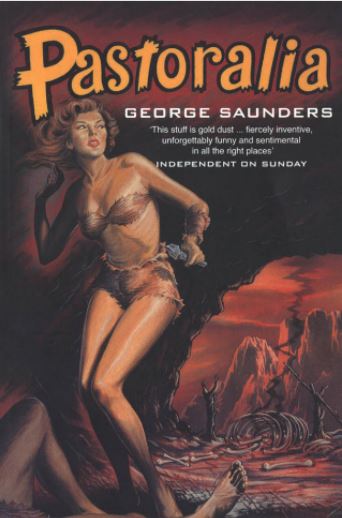
Reading, around the same time, Pastoralia (2000) by George Saunders, “Money” by Douglas Glover (The Brooklyn Rail, 2015), and “The Evil Gesture,” by Russell Working (Numéro Cinq, 2017), I have the sense that each of the stories could have been written by either of the other authors. What is it about these stories, characters, and prose styles that makes them appear to have come from the same hand?

I have to answer, verisimilitude—a word that appears in Saunders’ title story, when the guy playing caveman in the theme park gets a memo from his boss:

In terms of austerity, it says. No goat today. In terms of verisimilitude, mount this fake goat and tend as if real. Mount well above fire to avoid burning. In event of melting, squelch fire. In event of burning, leave area, burning plastic may release harmful fumes.

In terms of verisimilitude, indeed. Saunders in the earlier story “CivilWarLand in Bad Decline” features a narrator whose job (at another theme park) is “verisimilitude inspector.” Which I suppose is what I want to be in this essay.

While Saunders’ premise is typically absurdist—a middle-American couple has a precarious job at a theme park playing cave people, a kind of kitsch Flintstones—the lens of the characters is our given anchor in that sketchy reality, and so it comes across with a convincing punch.

In Glover’s “Money,” a miserable con-man named Drebel is painted faithfully, without fanfare, just as he is (“His favorite words were liquidate and fester”). Even as Drebel imagines himself (at the end) as “a demonic messenger, an immense black figure towering above a smoking, lifeless plain,” we have seen him from the inside out, knowing him, for all his self-serving crimes, as fellow human.

Russell Working’s protagonist, a boy named Jordan, invites us to inhabit his existence for a spell, fixated on his quest to go trick-or-treating, thwarted by the funeral of his uncle Aaron, beheaded in Afghanistan.

Russell Working

In each of these stories our immersion in the characters is so complete that we become them, and in that merger the larger themes of exploitation, evil and violence are absorbed in our experience: not so much cogitated but integrated.

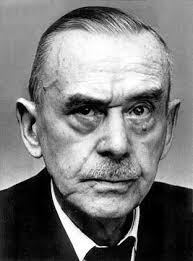
Other masters of ironic realism come to mind. Thomas Mann launched a career with his unstinting recreation of bourgeois life in Buddenbrooks; wherein all the weaknesses and limitations of the society and its citizens are exposed to full view. Invited to see the unforgiving truth of our commonplace nature, we can smile with scorn, yet earn the gift of distance from such foibles. We emerge with a larger capacity to see the failings not only of others around us, but then also ourselves, because the muscle of discernment has been well toned.

Thomas Mann

In the case of Mann’s last work, The Confessions of Felix Krull, Confidence Man, the verisimilitude of character works to earn the roguish con-man our sympathy because we have been so hospitably welcomed into his, yes, confidence. In this merger, again, comes sympathy, empathy, forgiveness of sins—because he and we are one.

The verisimilitude is achieved with a recreation of the culture, whether in the manner of Saunders’ (or Glover’s, or Working’s) fabrications of superficial Americanisms, or Mann’s faithful rendering of the furnishings and fixations of the German bourgeoisie. Along with the convincing setting, whether elaborate or sparse, the diction of the characters and narration is organically suited to convey the same conditions and values, exposed to the witnessing eye.

Realpolitik and the Moral Imperative

In his own essays and interviews, Saunders notes that an early influence was Isaac Babel, and he also cites Tolstoy, particularly Resurrection. Babel’s Red Cavalry (1920, rpt. 2003) offers the war correspondent’s firsthand depiction of the Polish front under the assault of the murderous Cossacks—the leading wave of the Bolshevik Revolution trying to export itself by force upon its western neighbor. This unnecessary campaign, presented with complete reportorial objectivity, is at once horrifying and galvanizing. In response I feel with vicarious rage and repulsion the contrary of this bloody senseless human history—rather, the necessity to shout the moral imperative, to love one’s fellow human. But first we must taste the fresh blood of murder.

Between battles, Babel rides with the Cossack horsemen across fields of rye littered with corpses, sparkling in the sun. They find lodging in ruined villages, each with its churches desecrated, its women raped, its foodstocks looted, its prisoners shot point-blank or slashed with sabers, its livestock slaughtered summarily for the single pleasure remaining for the syphilitic soldiers: eating.

These men so degraded by war inveigh to their superiors about injustices concerning ownership of horses; they stumble in bloodsoaked rags, insisting on slogans of the people’s party; they sleep when they can on piles of louse-ridden hay; they gnaw at green meat, awaiting the next village to plunder. And they long, like Babel himself, for home and the peaceful life.

Babel’s war, like every war, is hell on earth. The enormity of its suffering stands in contrast to the comfort of our privileged existence, apart from such madness and strife, coercion and fear. Yet our private fate, in war and peace, is compromised just as it is in the collective evil of war. In Babel’s pithy phrase, “To save his own goods and chattels a man will gladly set fire to another man’s hide.” (Glover’s Drebel stands as exhibit A of this uncomfortable truth.) And regardless of one’s own circumstances and moral choices, the arrival of hell looms in the chaotic demise of one’s own body, subject to the nonpetitionable torture of decay, that universal finality of death.

Literary realism, to be complete, it seems, must, like Saunders in his latest work, the novel Lincoln in the Bardo, bravely make a centerpiece of death. The frequent theme and device of Saunders’ short stories, complete with likeable zombies and unfortunate Asian women strung on wires as lawn ornaments, is precisely that dark heart of reality, giving us the gut punch that will wake us past the corporate-speak and juvenile pablum that passes for speech in our day. Death is a wakeup call for all.

Luckily we get to try it out first, while we have the luxury of living, if we try on the world as it is according to Babel, or Tolstoy, or the characters of Saunders’ world. That world, so truly painted and finely drawn, in spare lines, yet in details and phrasing so breathing and alive, is none other than ours.

In the face of human depravity and suffering, if one fully identifies with its victims and perpetrators, one is moved to the moral imperative of human love, instead. Saunders quotes Tolstoy to that effect:

“If once we admit—be it only for an hour or in some exceptional case—that anything can be more important than a feeling of love for our fellows, then there is no crime which we may not commit with easy minds…. Men think there are circumstances when one may deal with human beings without love. But there are no such circumstances.”[1]

Yet, Saunders qualifies the temptation to assign too much moral or thematic impulse to the creation of the story.

The assumption trickles down that artists have this viewpoint we want to ram down your throat.… I’m not really trying to say anything. Most people assume you have an intention and then you execute. There are some writers like that. But for me, I’m trying to not have an intention. I just have a little fragment and start working with it to see where it goes. When I’m done, sometimes I go, Wow, I said that? I didn’t know I thought that.[2]

In the end, the purpose is more “literary” (Babel), objective in the sense of Buddhist “witnessing,” and  “simple… almost invisible.” [3] The morality is not expressed but felt, in the successful literary rendering of reality, no matter how disturbing: “Love, at least in the fictional sense, is… clearer sight.”[4]

Praxis and Witness

In Babel’s notes published with the Red Cavalry stories, I’m struck by certain phrases that seem like a manifesto for minimalist realism:

Simply a story… Very simple, a factual account, no superfluous descriptions.
No continuity… Pay no attention to continuity in the story.

Short chapters saturated with content.

[and from the concluding remarks by his daughter, Nathalie]: “Babel’s ultimate aim in the stories … was literary effect.”

What can we make of this confluence of realism and literary effect? If the aim is verisimilitude, then it seems almost as if writers achieving that aim would sound the same as each other: as indeed the school of Raymond Carver spawned a generation of barebones writing, lean of telling and laconic of both narrative and dialogue… or Hemingway before him, another primary influence Saunders cites in a New York Times Magazine interview.[5]

Yet intrinsic to the “literary effect” of the realist is each writer’s given praxis. For Saunders, that means stylistic devices such as the use of extra question marks; jargon such as “due to,” “plus,” and “per”; speech authentically bastardized from media and corporate tropes; the use of capital letters for the iconic branding of everyday aspects of mundane American life. And there is that particularly American flavor to the thoughts, actions and speech of the characters. Parroting trends in the superficial culture, steeped in bureaucratese, fearful of stepping out of conditioned roles.

Compared to Babel’s graphic tapestry of setting, elemental in its rye fields full of corpses, its ruined churches and commandeered farmhouses, Saunders’ settings are stage sets for the play of the characters in dialogue or monologue; outlines constructed only for context, as the real world that is created resides in the characters themselves. The character is the world, and herein lies Saunders’ spiritual depth of compassion for any and all personalities enacting the divine and wacky human (or animal: dog, fox…) experiment.

In the absence of elaborate framing of setting, or any kind of authorial interpretation offered, there is allowed on the part of the reader a complete identification with the character/subjects. The monologues in the form of letters, reports, columns, or diaries all immerse the reader in the world of the character, richly rendered to allow us to experience fully the living of that life.

Saunders has said, in a recent CBC interview,[6] that it is detail which, because it makes the character come alive, earns them sympathy from the reader. Thus Saunders distinguishes between realistic description, and “nondescript” writing.

In terms of irony, it is the humor which flavors the reader’s final evaluation, knowing that no malice is intended, but only truth—which is understood dispassionately, or compassionately, as we are invited with Saunders to simply witness all that is—in the Buddhist way that Saunders is known to subscribe to.

Absurdist Therapy

A key dimension of Saunders’ realism is the absurdism embedded within it: a natural discovery given the inherent absurdities of American culture (“America has always been nuts.”[7]). And it is the absurdist dimension that gives free reign to the writer’s unique imagination, that sets him apart from contemporaries who might strive only for a more limited realistic approach.

The writer gets no points just because what’s inside the box bears some linear resemblance to “real life”—he can put whatever he wants in there. What’s important is that something undeniable and nontrivial happens to the reader between entry and exit.… Our most profound experiences may require this artistic uncoupling from the actual. The black box is meant to change us. If the change will be greater via the use of invented, absurd material, so be it.[8]

The absurdist imagination allows not only the distinctive style of the writer to emerge; it encourages us to question everything. In this more profound state of decoupling from a reality that is at once both transparent and weird, we are jarred from our own comfort zones of self-satisfaction and denial.

“If you have a negative tendency and you deny it, then you’ve doubled it. If you have a negative tendency and you look at it… then the possibility exists that you can convert it.”[9] The truth will set us free: or at least, it gives us the possibility of freedom, if we so choose.

Does George Saunders translate this stance from its spiritual, aesthetic and moral grounding into any kind of real-world political action imperative? Or is it left for each of us to find our best way forward, better attuned to the lives of others?

The latter course is pointed to by

the idea of abiding, of the way that you can help people flourish just by withholding judgment, if you open yourself up to their possibilities, as Saunders put it, just as you would open yourself up to a story’s possibilities.[10]

—Nowick Gray

.
.
Cited and Selected Works

Douglas Glover, “Money” (The Brooklyn Rail, 2015)

Russell Working, “The Evil Gesture” (Numéro Cinq, 2017)

Isaac Babel, Red Cavalry (1920, rpt. 2003)

Thomas Mann, Buddenbrooks (1901); Confessions of Felix Krull, Confidence Man (1954)

George Saunders:

CivilWarLand in Bad Decline (1996) (short stories and a novella)

Pastoralia (2000) (short stories and a novella)

The Brief and Frightening Reign of Phil (2005) (novella)

In Persuasion Nation (2006) (short stories)

The Braindead Megaphone (2007) (essays)

Tenth of December (2013) (short stories) 

Fox 8 (2013) (novella)

Lincoln in the Bardo (2017) (novel)

George Saunders Interviews

“George Saunders Has Written the Best Book You’ll Read This Year”, Joel Lovell, The New York Times Magazine, January 3, 2013.

2014 George Saunders interview with Jon Niccum, Kansas City Star.

“Adjust Your Vision: Tolstoy’s Last And Darkest Novel,” George Saunders, NPR, January 6, 2013.

Radio Interview with George Saunders on “Read First, Ask Later” (Episode 27).

“George Saunders: On Story,” by Sarah Klein & Tom Mason, Redglass Pictures, The Atlantic, December 8, 2015.

CBC interview, Q, 13 April 2017.

.

Numéro Cinq production editor Nowick Gray is a writer and editor based in Victoria, BC. His writings span an eclectic range of themes, structures and styles in fiction and creative nonfiction. Educated at Dartmouth College and the University of Victoria, Nowick taught in Inuit villages in Northern Quebec, and later carved out a homestead in the British Columbia mountains, before finding the “simple life” in writing, travel, and playing African drums. His mystery of the Arctic, Hunter’s Daughter, was published in 2015 by Five Rivers. Visit his website at nowickgray.com or Facebook page at http://facebook.com/nowickg

.

.

Footnotes    (↵ returns to text)

  1. Tolstoy quoted in Saunders, “Adjust Your Vision: Tolstoy’s Last And Darkest Novel,” NPR, January 6, 2013.
  2. Saunders in interview with Jon Niccum, Kansas City Star, January 11, 2014.
  3. Saunders in interview with Jon Niccum, Kansas City Star.
  4. CBC Radio, Q, 13 April 2017.
  5. “George Saunders Has Written the Best Book You’ll Read This Year,” Joel Lovell, The New York Times Magazine, January 3, 2013.
  6. CBC Radio interview.
  7. CBC Radio interview.
  8. New York Times Magazine interview.
  9. New York Times Magazine interview.
  10. Joel Lovell, New York Times Magazine interview.
Aug 062016
 

Margaret Nowaczyk

.
Just a little intro: A few months ago Caroline Adderson wrote to me about a student of hers who had just produced a stunning short story based on my exercise model in “How to Write a Short Story: Notes on Structure and an Exercise” in my book Attack of the Copula Spiders. Caroline was right about the story, and I am delighted to publish it here.

But it’s not the first successful story written off that exercise. I am gradually collecting some great examples. So look at “Shame” by Benjamin Woodard and “Gunslinger” and “Angel of Death” by Casper Martin to get an idea of the range of styles and subject matter that can evolve from a simple prompt.

dg


Bentley watched Adèle pass without a glance at the hydrocephalic skeleton of a five-year old child hung on a yard-tall metal pole, alien-headed, lights glaring on its glass case. She entered the next room down the corridor that curved to his right. Der Narrenturm, The Tower of Fools – not very PC back in the 17th century, were they, Bentley thought. The Museum of Anatomy and Pathology in the old psychiatric ward of the Vienna General Hospital was housed in a round, four-story tower separated from the main building by an expanse of lawn. The physical specimens of contagion and birth defects in two-hundred-year-old glass jars filled with murky fluid only compounded the barbarity of the place. Bentley had to admit that as far as medical horrors go it was a fitting setting – thick, whitewashed brick walls separated tiny cages of rooms on the outer wall, a circular corridor surrounded an inner courtyard where he imagined the less affected inmates had been allowed to take air. He had expected the place to reek of formaldehyde, like the pathology departments in all the hospitals where he had worked, but the building was odorless, sterile.

He didn’t want to come, not at all, but from the moment she learned about it Adèle became obsessed. Once here, she went from room to room, her eyes drawn from one specimen-containing jar to another – she never did anything half-way. Studying, work, sex. Having a baby. In the Contagion Room Bentley was reminded of the story Adèle told about the plasticine models of a syphilitic she saw as a child a French venereology clinic. The new nanny her mother had hired made Adèle promise not to tell anybody as she pulled her into the dark hallway and up the steep, wooden staircase. When the woman disappeared into the examining room, Adèle – curious, and a precocious reader – went from display case to display case, and made out the words letter by awful letter. Gumma, congenital syphilis, primary chancre. She was six years old. She had not been able to sleep for months afterwards, the speckled fetus and the caved-in nose floated in front of her every time she closed her eyes. Fifteen years later, during a medical school lecture on sexually transmitted diseases she darted out from the lecture hall, her chair clanging to the floor. Bentley found her in the quadrangle, sucking on a cigarette. “I’ve seen those before,” she choked out before the story tumbled all out.

But today she marched past them. Two rooms later she stood, transfixed, and stared at a preserved baby with its intestines floating outside its abdomen, its little fingers interlaced as if in prayer, put in that position by some well-meaning – or was it morbid? – mortician, and slumped forward, its nose flattened against the glass of the jar. The look on Adèle’s face must have been the look the child Adèle had – mouth slack, eyes darting about the specimen, taking in all the gruesome details. An anencephalic newborn in a jar behind her stared at Bentley from beneath half-closed eyelids.

He knew that he wouldn’t be able to sleep that night.

.

A few days after she ran out of the lecture hall Adèle dragged Bentley into Fairweather’s at Yonge and Eglinton. A rack in a back corner held a clutch of cocktail dresses, their cheap-looking fabrics glimmered in the bright ceiling lights.

“Ooh, can you imagine anything worse?” Adèle sung out.

Bentley eyed the dresses.

“I gotta try them on!” Lemon yellow, violent pink, green, and neon mauve tumbled off the rack into her arms and she disappeared into the fitting room.

“Stupid cheap zipper,” floated over the partition. “How’s this?” She flung the curtain aside and twirled out in the green dress. It cinched her around the waist, the straps drug into her shoulders; even though she was slim and toned she looked like a boiled ham in a netting. On a bed of stewed Boston lettuce. And yet, she was still beautiful.

Bentley pumped his index finger in his open mouth and made gagging sounds. He reached for the zipper. She weaseled out of his arms and ducked back behind the curtain. Soon she popped out in the neon blue.

“This color does nothing for you.”

“The color? What about the cut? Those flounces! Whoever came up with this deserves to die a long-drawn out death in the seventeenth circle of hell. Drowned in tears of women who had to wear this horror.”

“There were only nine circles of …” he begun, and Adèle rolled her eyes.

“I know that,” she said.

The next dress, the mauve, made her pale, freckled skin look like she had secondary syphilis. He bit his lip as he remembered Adèle’s shaking voice.

When she disappeared into the fitting room for the fourth time he was ready to walk out and never come back.

“Did you have to try all of them?” he asked long after they left the store. Something in his voice made her stop and look at him.

“I thought it was funny,” she said.

“You have no sense of proportion.” He stomped off, leaving her standing alone at the entrance to the subway.

The following morning, he waited for her at the same spot – she was late. He had studied way past his bedtime to make up the time, and was feeling grouchy and unkind. But he couldn’t go a morning without seeing her. He waved when he saw her in the crowd.

“Ready for the gynie exam?” Adèle asked when she reached him.

Bentley looked up at the trees just coming out in leaves – greenish mist hung around the branches. No apologies from Adèle, ever. A sparrow trilled and went silent over their heads.

“I’m totally not,” Adèle said. “This fertility crap. I have to put up with it every month, I don’t want to study it, too.”

“I thought procreation was every woman’s passion,” Bentley said carelessly. Adèle’s cheeks went brick red.

“I’ll have you know that I am not constantly thinking about babies and nursing and lactating and gestating and bringing life into this world and whatever other cliché crap you chauvinist misogynes think women are about.”

“Sex?” Bentley asked just as Adèle inhaled to continue. He wiggled his black eyebrows like a beetle. Adèle snorted and punched him in the shoulder.

“Hah! I am like a guy in that respect, eh? Men think about sex…”

“…every eight seconds,” Bentley finished with her.

Adèle laughed and leaned into him, her head on his shoulder. His penis stirred and thickened – obviously he was one of those men.

“You must have gotten too much testosterone exposure during your fetal life,” he said. He kept his arm around her shoulder the rest of the way to the hospital.

The first time he saw Adèle she was dancing on a chair at their med school orientation party. She wore autographed boxer shorts from an upper class man, the prize token for the scavenger hunt; a wide grin – all teeth – split her face, thick brown hair parted in a bob on the right. As she shook it off her face her eyes met Bentley’s and she winked at him, her face an invitation. Bentley felt his face grow hot.

They were sleeping together a month later. Bentley, virginal, realized right away that Adèle was much more experienced than he would allow himself to imagine. Her lipstick on his penis – kissing it, biting it, sucking it she smeared the crimson on the pearly pink of his shaft and foreskin. He pushed aside thoughts of the unnamed men, their greedy hands, their probing tongues and dicks that knew Adèle better than he did.

He realized then that he would never let go of her.

.

What are we doing here, Bentley wondered as he followed Adèle into another low-ceilinged room. And another. She had to see every last atrocity, every last crime nature committed against itself in forming these monsters. Teratogenesis – the study of monsters – he remembered from their genetics lectures. She shouldn’t even be here – after all those miscarriages what could be going through her mind, for god’s sake. What was she thinking as she stared at the specimens – better no baby than one of those? All that blood she had lost with the last miscarriage, she almost needed a hysterectomy. It took her months to recover but still she wouldn’t allow a transfusion. She was still hoping she’d get pregnant after five years of tests and fertility treatments.

He loved her so much.

That night, after he rolled off her, Bentley lay supine on the king-size hotel bed, arms splayed. The neon sign from the cafe across the street flickered blue shadows across the curtains.

“I want to try IVF.” Adèle rubbed her face in his hairy chest, a greying patch extending from nipple to nipple. “This… this isn’t working.”

“This?”

“I’m not getting any younger.” She had turned thirty-six this past January.

“I’m not good enough?”

Adèle lifted her head and stared at him, unblinking.

“That’s what you’re saying, isn’t it?” Bentley always lowered his voice as his temper rose.

I had all those miscarriages.” Her voice sounded wet. “We still don’t know why I can’t carry a baby to term.”

She rose from the bed and stood by the window, her body dark against the sheer curtain. Outlined in blue, the curve of her hips and butt, broad as if made for bearing children, made him want her all over again. He grabbed her waist and pushed her face down onto the bed.

“I’ll show you,” he hissed through his teeth as he lowered his face beside hers. Adèle turned her head and Bentley saw her perfect profile. A tear streaked down across her cheekbone. He kissed it, tasted salt. His body sagged.

“I’m sorry,” he whispered.

Adèle squirmed beneath him, turned over, and wrapped her arms around him, scissored her legs across his buttocks.

“Don’t ever leave me,” she said.

.

The next morning Bentley woke up with an erection. Something tugged at his consciousness. A nagging, unpleasant something. Adèle, in a backless, shimmering silver-grey gown, the even beads of her spine bisecting her back with such grace it took his breath away. She turned and his penis flatlined. Bentley shook his head to dislodge the image – a line of blood down Adèle’s belly, from the ribcage to the pubic bone, in a perfect parallel to her spine, the dress gaping open, muscle and fascia slashed, a glistening globe of the uterus exposed. The bottom half of a baby hung out from the incision, buttocks and legs hanging. Pulsating coils of umbilical cord dangled down to Adèle’s knees, blood stains splashed down to the hem of the gown.

The bisected Adèle lifted a champagne flute at him. “Cheers.”

Bentley shot upright on the bed. Adèle slept peacefully next to him, wrapped in the white linen sheets crushed from last night’s sex.

As he padded barefoot to the bathroom the cold marble floor bit at his soles. The wall tiles were weeping long droplets of moisture when he stepped out of the shower, but he still felt the cold sweat on his back.

.

A week later, back in Toronto, Bentley had performed two kidney transplants and five bladder resections. Adèle finished a paper reporting her new research on gene therapy, and reviewed – and rejected – three others. They taught entitled surgical and medicine residents, they gave lectures to medical students who played with their smartphones. They attended patients in clinics and on the wards. They worked late and hardly spoke over their take-out dinners.

It was as if they both held their breath.

At home the crib grinned its slats at Bentley every time he passed the nursery they set up during the second to last pregnancy, when Adèle went beyond the twenty-week mark and they thought the pregnancy would keep. Once, when he came home from a late night in the OR, he stood outside the nursery door, his forehead against the cherry wood of the door jamb, and tried to imagine the snuffles, the mumblings of a just woken baby, but all he heard was Adele’s soft breaths in the darkness of their bedroom.

Two weeks later Bentley came downstairs as Adèle stood at the kitchen counter waiting for the water to boil, teabag label hanging over the rim of her mug. He had seen the tampon wrapper and the blood tinged applicator in the bathroom wastebasket. He reached for her, and she burrowed her face in his neck, her arms around and up his back like a vise, hands together, pushed against his spine.

Neither spoke until the kettle whistled.

“Not even a romantic interlude in Vienna,” Adèle said then. Not quite how Bentley remembered it – the pickled fetuses still haunted his dreams. He reached over and poured the boiling water into the mug, dunked the teabag in and out.

“You’ve always taken such good care of me,” Adèle said.

“I don’t want a baby,” he lifted her face up by the chin. “I just want you. I went along with all this, but I don’t want you bloated with hormones, needles stuck in your belly, rushing off at 6 am to have an ultrasound up your hoohah.”

Adèle chuckled, but a tear slid down her cheek. Bentley bent down and kissed it dry.

“We’ll be all right,” he said. “Just the two of us.”

.

That was before the nightmares started. Before Adèle stopped going to work and just lay on the living room sofa, the pillow beneath her cheek sodden. Before Bentley was able to count the ribs beneath her disappearing muscles. And before he found her lying in a lukewarm bath, her white arms and legs floating just beneath the surface, nipples poking through the surface of the pink water, twisted wet hair snaked around her neck like a coil of umbilical cord.

But at that moment, surrounded by the aroma of the mint tea, in the orange light of the setting sun puddled on the slate tile floor, Bentley truly believed that they would be all right.

—Margaret Nowaczyk

.

Małgorzata (Margaret) Nowaczyk, a pediatrician and a clinical geneticist, is a professor at McMaster University and DeGroote School of Medicine in Hamilton, Ontario. Her writing has appeared in Geist, The Examined Life Journal, and Canadian Medical Association Journal. Her short story “Cassandra” will appear in Prairie Fire. She is a co-editor of an anthology of short stories from the Canadian-Polish diaspora to be published by Guernica Editions in 2017. She lives in Hamilton with her husband and two sons.

.
.

May 232016
 

Capture

Okay, this is one of those, you know, things that come out of the blue. Tom Greene, VCFA’s president, called me from his car this morning to tell me they had launched a new Vermont College of Fine Arts Artists Development Fund based on a $1 million donation from the Martin Foundation. Part of the fund, a fund within the fund for writers, authors, and publishers, is named after me.

Douglas Glover Fund

The announcement just went up on Friday. You can find the relevant VCFA web page here. And you can download Artists Development Fund brochure here.

Naturally, I am nonplussed, amazed, bemused, and touched. I am grateful to the Martin Foundation for singling me out like this. It’s a terrific honour. I hope the fund inspires and supports many, many great writers in the future.

There is, of course, backstory here. But so far the donor wishes to remain anonymous, and I won’t blab.

dg


Aug 052015
 
Gordon Lish photo by Bill Hayward

Gordon Lish photo by bill hayward

Tim Groenland has written a compendious and measured account of Gordon Lish’s editing practice (fascinating images of pages edited — Nabokov, for example) and influence, minus the Raymond Carver hysteria. The essay builds on some of the work we’ve published at NC, including Jason Lucarelli’s ground-breaking texts “The Consecution of Gordon Lish: An Essay on Form and Influence” and “Using Everything: Pattern Making in Gertrude Stein’s ‘Melanctha,’ Robert Walser’s ‘Nothing at All,’ and Sam Lipsyte’s ‘The Wrong Arm’” plus my own audio interview “Causing Damage — Captain Fiction Redivivus: DG Interview With Gordon Lish.” All are quoted in Groenland’s piece, putting NC at the front of the wave of new interest in Lishian studies.

dg

Here’s a teaser from the Groenland essay:

These studies make it clear that Lish was, in certain ways, “the minimalist in the machine” in Carver’s work (Churchwell n.p.) and it is clear that he applied similar techniques to the work of other young writers of the period: Lish was instrumental in the early careers of Barry Hannah and Mary Robison, for example, making him an essential figure in the development of what was variously known as “minimalism”, “Dirty Realism”, and “the new realism” (or, to use Mark McGurl’s recent formulation, “lower-middle-class modernism”) in the early 1980s (32). Michael Hemmingson has shown that Lish edited Barry Hannah’s fiction extensively throughout the late 1970s and early 1980s: he reports, for example, that the manuscript drafts for Hannah’s novel Ray (1980) are “a confusing, sloppy mess” and that Lish’s editing work here involved carefully rearranging sections into narrative coherence, much as Max Perkins did for Thomas Wolfe’s major novels (Hemmingson 490–491; Berg 119–130, 223–228). Lish performed line editing on photocopies of Hannah’s stories taken from the journals in which they had been printed, just as he did with Carver’s work: in several cases, the journal in question was Esquire, meaning that the editor often saw Hannah’s work through several iterations and could refine his vision of the stories in different stages. Hannah’s attitude to these changes was markedly different from Carver’s, and in a 2004 interview with the Paris Review he was unambiguous in his praise:

Gordon Lish was a genius editor. A deep friend and mentor. He taught me how to write short stories. He would cross out everything so there’d be like three lines left, and he would be right . . . This is your good stuff. This is the right rhythm. So I learned to write better short stories under him. (Hannah, “Art of Fiction 184”)

Read the entire essay @ Irish Journal of American Studies.

Aug 052015
 

Janice Galloway via The ScotsmanJanice Galloway via The Scotsman

.

I.In the eponymous story from her most recent collection, Jellyfish, Janice Galloway shows her genius for the ‘ouch’ principle: the wince-inducing collision of something exposed and over-sensitive with something brutal and sadistic.

We feel it coming; harbingers and hints surround Monica and her four-year-old son, on an outing to the beach as a last hurrah, the day before school starts. Alert to the impending separation, Monica sees danger and careless indifference all around her: in the mother who chats to a friend, unaware that her toddler in his buggy hangs over the kerb, too close to the wheels of a passing lorry; in the angry father swearing viciously at his little boy. She worries too much, she wants to protect. Somewhere between the wild beauty of the coast and the unsavoury piles of rubbish dumped by locals, they come across a parliament of stranded jellyfish. Transparent and ‘gummy’, out of their natural environment, one of them is little more than viscous pulp, object of blunt force trauma by human hand. How is the mother to explain this act of random violence on something so exquisitely vulnerable? ‘Maybe they hurt it – her voice faltered – they hurt it just because it can’t stop them.’ Ach, the jellyfish, so hopelessly undefended, not even a skin to mask its insides; the stupid jellyfish, out of its element and asking for trouble. The sight is painful because Monica – and through her eyes, the reader – knows how it feels, recognizes how easily one might end up in its place, how a cherished child might end up in its place. Characters in Galloway’s books are often alive to their inner jellyfish, and aware of – even enduring – the myriad situations in which the hammer may fall.

The recent Guardian review of Jellyfish suggested that these stories held new departures for Galloway in their focus on the parent-child relationship and the natural world. But both make fine provocations for the sort of catastrophic thinking typical to her work; thinking that has flowed and been repressed so many times it creates a carboniferous pragmatism. In the story that intrigued me perhaps the most, Eric Blair (otherwise known as George Orwell), is living with his young son on the Scottish West Coast island of Jura after the death of his wife, Eileen. It’s a hardscrabble existence in a place with no amenities and only the most basic of resources, and Blair is in denial over the diagnosis of his own soon-to-be-fatal tuberculosis. ‘You don’t fight an illness by fighting it; it gives not a hoot about your stoicism,’ the doctor tells him. But Blair is nothing if not stubborn: ‘Rest was not an appropriate response to encroaching lack of breath, lack of power. They had no idea what they were asking.’

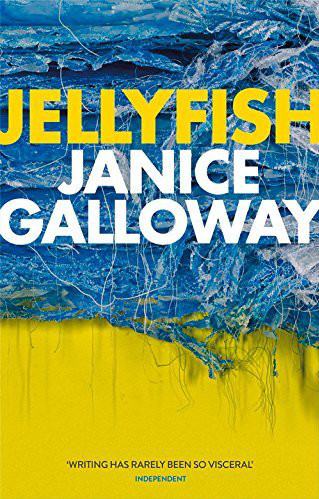
Jellyfish - Janice Galloway

Inside his mind, two concerns breed fear; his belief that another war is coming, and his determination to ‘toughen up’ his young son. Excessive fear promotes a formidable fight response, but Blair cannot allow himself anything as weak as emotions; they must harden into ideologies. The story follows his trip to the general stores where he asks whether his parcel – a firearm – has arrived (it hasn’t), and then he begins the twenty mile return trip on his motorbike. The sound of a gunshot from the hills unsettles him so much he comes off the bike, but he’s okay ‘after a fashion’. Menace and machismo shadow box across the pages. He continues hoping for another five years in which to finish his novel and form his son: ‘He’d ruddy well achieve it by means of will alone.’ He was to die less than two years later. But his novel, 1984, the crystallisation of sadism and denial of feeling into a society in which only the broken would survive, lived a dark and splendid life after him.

It’s a fascinating portrait of an artist, from an artist who grew up in what seemed to be a sort of Scottish working-class family microcosm of 1984. Love in the form of brutality, the grim reckoning that the worst would be likely to happen and the best would be to face up to it, deprivation of all kinds, were basic elements of Galloway’s upbringing that transmuted into her writing. But her literary imagination tempers its casual cruelty with tenderness and a cautious optimism. Critics use the word ‘visceral’ a lot, but note the glittering seam of black humour. The New York Times Book Review memorably claimed her work ‘Resembles Tristram Shandy rewritten by Sylvia Plath’, which we might reasonably take to mean that she is an original. Her first novel, The Trick Is To Keep Breathing (1989) won the MIND/Allen Lane award, and was followed by two more novels, two short story collections and, before Jellyfish, two extraordinary memoirs that took the reader deep into the phenomenology of childhood whilst advising caution towards a simple overlap of reality and narrative. There were prizes all around. Not bad for a woman who claimed that an artistic vocation was unimaginable for her as she ‘thought writers were wealthy people who just wrote things out of the goodness of their heart and gave them as gifts.’


II.

Janice Galloway was born in 1955 in Saltcoats, Scotland, to a mother who ‘thought I was the menopause’. In the mythic version Galloway tells in her memoir, This Is Not About Me, which might be the true one for all she knows, her mother was unaware of the pregnancy until her waters broke, perhaps in denial of the freedom-busting, life-ending truth. The young Janice is never in doubt about her status as nuisance. ‘If I’d kent, she’d say, her eyes narrowing. If I’d just bloody known.’ Galloway’s father makes scant appearance in the pages, dying when Janice is only six, though when he’s there, he makes his mark felt. By throwing supper out the back door in a fit of temper, locking Janice inside and making her play chequers with him while her mother is locked out, knocking pitifully on the windows. And finally, setting fire (he was drunk and smoking) to the cigarette stand they owned but had not insured. Just over fifty pages in, she and her mother move into a tiny attic flat above the doctors’ surgery where her mother finds work as a cleaner.

This relative idyll does not last, for Janice’s older sister, Cora, joins them. Cora is seventeen years older and has left behind a husband and son of her own, and once her loud-voiced, gleefully selfish, hard-hitting, pan-sticked presence erupts into the pages, she stalks them like the fifty-foot woman of a B-movie. Galloway calls her Cora, though her real name was Nora, some sort of psychological distance being necessary even in a memoir. Cora takes up all the oxygen in their family and is dangerously jealous if her space, status and rule are in anyway infringed upon. ‘Delight to spite took seconds: there was no middle ground,’ Janice recalls. ‘She’ll be found dead up a close with her stockings around her neck one of these days, my mother said. Too bloody cheeky by half.’

Though it’s Janice whose life seems daily endangered. Cora is ‘handy’, which seems to mean useful for violence. She slaps, punches and headbutts her little sister, locks her in a cupboard, sets fire to her hair. Their mother is too tired and too defeated to intervene, and she loves Cora and cannot escape her thrall. The potency of the daemonic, the Greek concept of an unstoppable force of energy that could be turned either to good or evil, is Cora’s superpower. ‘Even wedged into a chair, Cora charged the air with electricity. Something around her crackled fit to kill flies and drop them at her feet in crispy little packets. I couldn’t take my eyes off her.’ She’s mean, but she’s fearless and vividly sexual. Janice is allowed to watch, enthralled, as Cora paints her face on, pours herself into a too-tight bodice and seamed nylons. A trip to the fair with her is high-octane stuff, all thrills and reckless spending. As Janice staggers dizzily off the walzer, Cora ‘walked in a straight line with her hands on her hips to prove it. Nothing beats me, she said. I could stay on that thing all night and not turn a hair.’ But one minute Jekyll, the next Hyde. When their mother has the chance to work full-time, her concern about Janice being all right alone in the two-bed council flat (they moved back in once her father died) becomes Cora’s decision she won’t get in at all. ‘You give her a key and she’ll let people in. Either that or somebody will take it off her. She can wait in the fresh air. It’s good for her.’

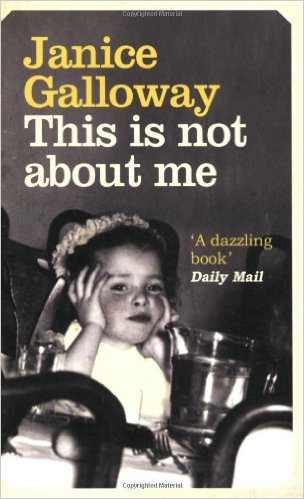
this is not about me

In fact, Janice likes the peace in the garden, and there’s the coal-shed if it rains or snows. Although Galloway would later say in interview with Stuart Kelly that ‘The expectation of brutality used to be a commonplace part of most [Scottish] upbringings’, there is a particularly intense quality of disenfranchisement about young Janice, a too-stark awareness of her lack of value, except as emotional punch-bag. The drama in her small household, ruled by Medusa and the Furies, turns her inward, gives her the obsessive good-girl mentality of someone who knows she does not simply deserve the oxygen she breathes. The memoir displays the close-grained hypervigilant powers of observation that come from the traumatised, or as Gareth McLean in The Guardian puts it, ‘her eye for detail comes from having watched life occur while maintaining not so much a dignified silence as a petrified one.’ We’ve been told from the start that this is not about her, and the key to understanding Janice’s story is to recognise the myriad truths in this statement. Her mother’s suicide attempt, her sister’s disappearance, from which she returns bruised and close-lipped, the screaming rows, all the crucible of disturbing events in which Janice is forged, stem from a history that predates her.

‘Watching their faces as they hurled half-understood insults at each other, the feeling of being in the way while most of it raged over my head was letting something else dawn as well. This wasn’t about me…. This was about Cora and mum; mum and Cora doing something they’d done since Cora left Glasgow behind and turned up at the attic… Longer even than that. Weans, my mother said. As though there had been more than one baby Cora had left behind. If I’m man-daft, where did I learn it? I’ve dealt with my troubles. My troubles. It was always the same in our house. Nothing you knew was solid.’

If the young Janice is obliterated by the emotional warfare carrying on around her (in a way that psychologists would suggest is the basis for most severe neuroses), she finds some comfort in knowing she is not its cause. Her place in the world is formed before she ever entered it, by a cross-hatching of fierce emotional currents, the legacy of ancient events, bitter disappointments and sacrifices, in the lives of those who supposedly care for her. Galloway is clear that there is love, that her own childish spirit, even if oppressed, still finds ways to slip free, but the climate and the conditions in which love and freedom find form are not in her control. This is the reality of all childhoods, but most children feel guilty and responsible anyway. The extreme weather of Galloway’s young life may stunt her growth, but it liberates her perspective.

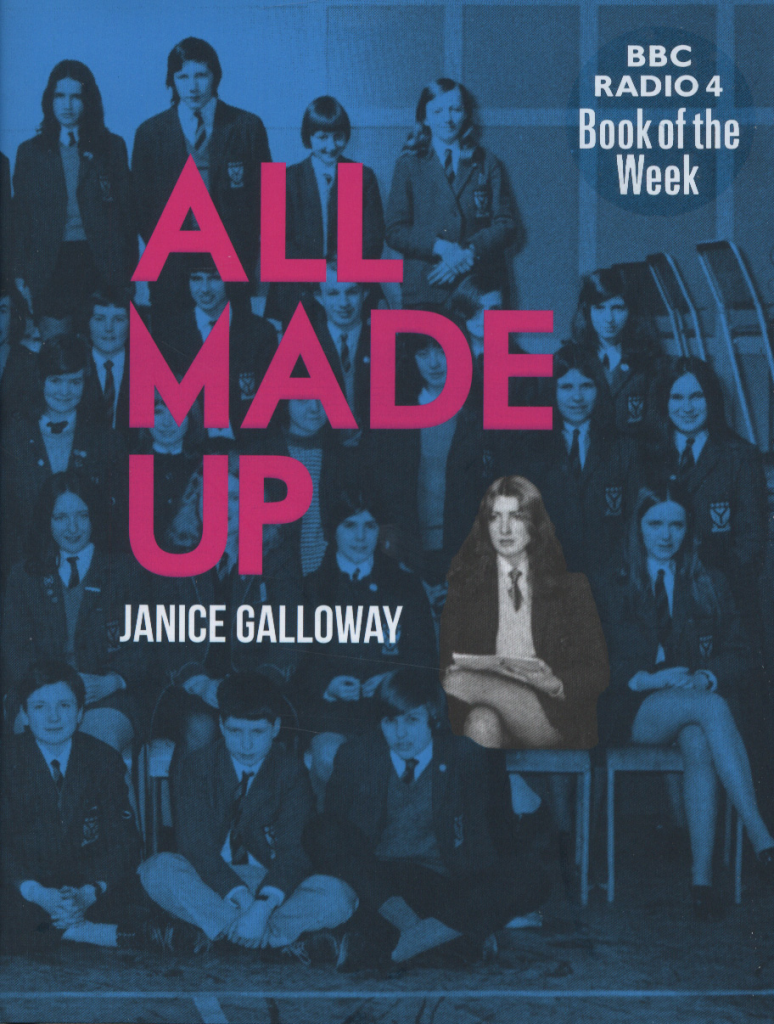
If This Is Not About Me was about the origins of that ‘ouch’ principle, the collision of Janice’s innocence and vulnerability with her sister’s ruthless violence and her mother’s tough love, the next volume of memoir, All Made Up, is about putting Janice together again from the scraps of self left over after the carnage. As a child, she was good at schoolwork and liked singing. As she becomes an adolescent, music will take an ever greater role in her life. Latin will become an unexpected love. And there will be boys, of course, and inevitably. It’s not that conditions change much – within a couple of pages of the start of the book, Cora has broken her nose. And at the end, when Janice is dressed up in borrowed finery for an evening out with her fiancé, Cora takes one look before launching a plate of stew at her. So no change there, then; but Janice grows into her hardiness, her ability to flourish on very little soil and sunshine, and despite her family’s injunction to cultivate shame and self-doubt. ‘I think it’s part of the Scottish temperament: always waiting for something to cut you down to size,’ she later said in an interview.

all-made-up

The memoir races through the key points once Janice has left home for Glasgow university and a degree in music. Her mother died when she was 26, Cora died of a smoking-related illness in 2000 (and the sisters had barely met since Janice left home). This means that when Galloway sat down to write her memoirs, the main characters of her cast were not breathing over her shoulder. She was aware of writing exactly the sort of truthful account of their living conditions they would have hated, but Galloway had come to understand that old, uncomfortable need to pretend was motivated by working-class shame. When she gave her mother a telephone, she would only speak on it in a Yorkshire accent: ‘Even her voice wasn’t good enough to expose,’ she said. But in all the interviews she gave about her memoirs, Galloway is insistent that the mother and sister who appear within their pages are not direct transpositions: ‘I am a writer. You’re not writing people, you’re writing versions of people that fit into a story version of something universal as well as something ideosyncratic.’ But I have to wonder whether this barrier is not there to protect the dead, but to keep Galloway safe from their ghosts. In an article she wrote in the run-up to the Scottish referendum, she admitted that her sister had tracked her down once she realised she was ‘writing stuff’. ‘She phoned me. How she got my number I haven’t an idea. I recognized the voice immediately, however: if I thought I was It I had another think coming, she said. Do you hear? Pack it in. I felt 11 again and almost wept.

.

III.

Janice Galloway’s first novel, The Trick Is To Keep Breathing, is an unruly narrative of a distressed and disobedient mind. The ironically named Joy Stone is a teacher in her 20s whose chaotic love life has tipped her over the edge of breakdown. The married man she has been living with – enough of a scandal in itself – drowned on a holiday abroad they took together and Joy’s grief is all the more unwieldy for being that of a mistress, socially unrecognized and unpermissable. She lives in Michael’s house (subject to further legal battles) on a sterile estate with poor transport links, while her own jerry-built house is slowly rotting away. Joy has no one to turn to. Her best friend, Marianne, has emigrated to America, her family consists of a sister, Myra, who ‘could just stand and scare me to death.’ Health care professionals are worse than useless. Joy imagines saying to her weary and indifferent GP: ‘Ok, let’s talk straight. You ask me to talk then you look at your watch… Can’t you send me to someone who’s paid to have me waste their time? You don’t know what to do with me but you keep telling me to come back.’ And all the time she is sinking deeper into bulimia and depression. She is the prototype jellyfish; a quivering wreck of exposed nerve endings.

Or you could read her as a 20th century version of Job, a woman crumbling under an onslaught of calamities specific to being an abandoned Scottish woman in the late 1980s in poor mental health. This is not a story that begs our sympathy, though, despite the rigors of Joy’s plight. Her exquisite vulnerability, which we readers are invited to witness as intimately as possible, from a ringside seat within Joy’s psyche, is played out on the page as an innovative typographical display that’s entirely distracting. There’s a cordon around Joy’s pain that comes from her own lack of lack of sympathy towards herself and the velvety-black humour that springs irascibly from her narration, as well as the experimental features of the text, attention-grabbing features of a verbal energy that ricochets around the pages, out of control, the underside of a too-tightly held persona masking inner collapse.

‘o yes
when I was good I was very very good but
but
there was more going on below the surface.
There always is.’

In the fragmentary text, words jump out from unexpected places and bleed into the margins, sentences trail unfinished, white space marks missing time and emotional dislocation, italics indicate the presence of memories that remain unintegrated. There’s no order to the story, and no neat boundaries either in the form of orthodox chapter divisions or quotations marks around speech. There’s just an uneven torrent of words acting out, or else a parodic inclusion of conventions: play scripts, for instance, marking cliched conversations, lists, excerpts from magazines spouting cultural commonplaces, and marching imposingly across the narrative, the dreaded mantras of mental health:

The More Something Hurts, the More it can Teach Me…
I write:
…..Persistence is the Only Thing That Works.

I forgot to write:
…..Beware of the Maxim.
…..Neat Phrases hide Hard Work.
…..Everything Worth Having is Hard as Nails.’

A beautifully unarticulated paradox rises up from all this verbal play, in which the insufficiency of such mantras is almost insulting in comparison to the depth of Joy’s disorientation and pain. But such inadequate linguistic supports are all that exist as a bridge back to normal life. Galloway is nothing if not respectful to the reality of her protagonist’s state, and little is resolved by the end of the narrative. But there are the earliest hints of healing; tiny shards of optimism that stud the conclusion with welcome precursors of light.

Talking of cautious optimism, her second novel proved that her characters were at least ready to risk travelling abroad again. In Foreign Parts (1994), Rona and Cassie are friends of long-standing, and mildly mismatched travelling companions who have come to spend their precious fortnight off work in France. Short of cash and feeling unworthy of culture, they know ‘that proper holidays are for proper people with proper money and that real travellers, in denim bermudas of uneven leg length, travel to real faraway places in search of real poor people enduring real life in the raw. We are neither real nor proper: just fraudulent moochers in other people’s territory, getting by on the cheap.’ Cassie, source of the narrative voice though it floats, according to Cassie’s mood, between first, third and even second person, is sensitive, observant, moody and questing for something real and meaningful. Rona is stolid, calm, accepting and happy to tick the vacational boxes. Their differences come to a crunch mostly over the guidebook they have brought with them, entitled ‘Potted France’, whose injunctions to notice historical features enrage Cassie with their vapidity.

foreign parts

Threaded in between the stages of their journey are descriptions of photographs from holidays Cassie has taken with boyfriends in the past and the memories they evoke. Not that these holidays have been any better than the one Cassie is currently on. Holidays fall into a similar category to horoscopes, magazine articles and self-help books for Janice Galloway’s main characters: they are places where the commonplace fantasy of achieving something splendid cracks under the weight of recalcitrant reality. Rona, Cassie tells us, at times when they are sleeping in the car, or in some terrible 50 franc-a-night dive, ‘loves games of not admitting hellishness is hellish.’ But Cassie, like Joy Stone, is in no mood to pretend. And more than that, there is an unspoken but deep-rooted belief in both books that anything revelatory, real, valuable or significant, can only come from an unflinching scrutiny of the situation. When Cassie does transcend the ordeal of pointlessness that is tourism – in Chartres cathedral, playing house in a gîte they hire, standing on the beach at Veulettes before taking the ferry home – these moments have a full-bodied poetry about them that can only come from patient attendance on the authentic.

As such, this is a novel wilfully rejecting a number of conventions; it is not the buddy road trip or travel novel that we might be expecting. Cassie’s sharp edges puncture any such glib journeying. More confusing to its readers (if Goodreads reviews are any indication) is Cassie’s conclusion as the end of the trip nears, that she is no longer interested in a heterosexual relationship, but considering the possibility of moving in with Rona. Cassie and Rona may squabble and bicker, but there is a mutual understanding and recognition between them that is missing, as far as Cassie is concerned, from a relationship with a man: ‘They don’t have the same priorities, to be able to organise their priorities in a compatible way with ours,’ she explains. Cultural fantasy rears its head again, to be cut down to size: ‘The knight on a white charger is never going to come, Rona. You know why? Because he’s down the pub with the other white knights, that’s why.’ If there are generalisations going on here, then they belong to a Scottish culture that lags behind the times (‘There are real gender problems in my country,’ Galloway said once in interview). But what Cassie wants is something free from all sexual and domestic norms. The life she envisages with Rona has no recognisable, culturally-approved shape, resists all labels and orthodoxies.

Right at the start of the book, the first sign Cassie and Rona see when they get off the ferry says: BRICOLAGE. This is a common sign in France, indicating a D.I.Y. store, but its original meaning is one of Heath Robinson-type construction, using bits and pieces of other things to create something new. For this reason it was borrowed by the nouveaux romanciers in the 50s and 60s to describe a kind of literary experimentalism that took apart the nuts and bolts of narratives and put the pieces back together in innovative ways. It stands as a fine sign to hang across Foreign Parts, too, in which the patchwork of travel guides, lists, overheard conversations, street signs, flashbacks and letters correspond at a technical level to the unorthodox ways of experiencing travel and building relationships that are its themes. The disparate and the heterogeneous are more playful, less threatening than in Trick, the anxiety and anger about a dissatisfying present are soothed in this novel into something forward-looking and hopeful.

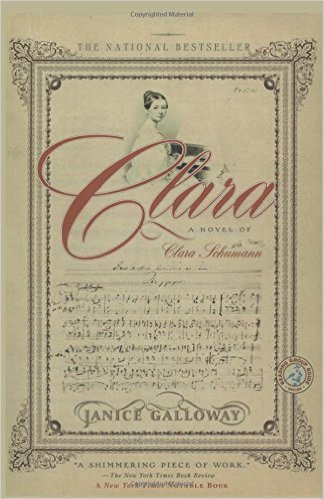
Galloway’s third novel, Clara (2002), was in some respects a departure, a long, lyrical account of the life of Clara Schumann, child prodigy, world-famous concert pianist and composer. Clara passes from the tyrannical hands of an overbearing father, a piano teacher whose love for her resides in her responsiveness to his teaching and who basks in her reflected glory, to those of her husband, Robert Schumann, mad, melancholy, ambitious in his own right and unequal to tolerating a more famous and successful wife. It’s essentially a study of the discipline, the strategems and the sacrifices a woman like Clara must make in order to stay in touch with her musical creativity. Concerns about gender, freedom and madness abound, tethered to historical and biographical realities.

There is still experimentation, but what’s intriguing is that it is so seamlessly incorporated into the narrative it’s oddly harmonious, rather than disruptive. There are phrases from musical scores, poems, lists (of course) and the use of different font sizes. The latter are easy to decode, for they range from the huge beetling-black words of fortissimo, to the smaller fonts of diminuendo. Lists are staccato, poetry is cantabile, all is effortlessly woven into a smoothly flowing, wordy andante narrative. The voice nimbly skips between the heads of Clara, her father and her husband, able to pick up on a wide variety of moods, constantly singing.

clara

In her interview with Stuart Kelly, Galloway denies that her use of experimentation in the early novels was ‘politically motivated’, saying instead that she ‘just didn’t know how to write a story’. Whispering in her ear, perhaps, was the shade of her sister, telling her that if she thought she was It she should just pack it in. The experimentation, in all probability instinctual, reveals a sophisticated understanding of the landscape of the mind when functioning in a state of extreme fear, duress, or misery. Those fragmented, discontinuous texts showed how words could perch unabsorbed upon the mind’s surface, how other voices within might be heckling from the sidelines, how memories repeatedly broke through any stable crust in the present with unwelcome or alien messages. But over the years there is a distinct progression in Galloway’s novels, one that has the appearance, not of anything as facile as healing, but of steady incorporation, acceptance of the ‘hellishness’ for what it is, a breaking down of old parts in order to put them together again, economically, in something new. After Clara came her memoirs, her darkest and her funniest works, the most revealing and the most accessible. Galloway had always been a formidably innovative storyteller; now the novelty was that the story could tell itself straight.

.

IV.

In the final tale in Jellyfish, ‘distance’, Martha is all alone on a trip to Jura, site of George Orwell’s last days. Many years ago now, when she was an insecure young mother, her small son cut his head open on a glass table and the accident unleashed some reckoning with the arbitrary and inevitable nature of catastrophe that has never been resolved. Her solution back then was to divorce her husband and allow him custody, afraid that her own fears would prove contaminatory to her child. Since then, Martha has cut herself off, taking only supply teaching work so she should never be lulled into the responsibility of relationships. Though the invisibility begins to tell. Attempting to teach Orwell to a class of resistant children, she tells them about the time he saved his four-year-old son from drowning in a sailing incident. ‘Sometimes, she said, there’s more to people than meets the eye. Repressed and paranoid and dying is not a whole picture of anyone.’

And maybe Martha is dying; in her forties now, with an burgeoning disease that is gynacological, possibly serious, possibly not, she decides to take this solo trip to Jura. The freedom feels easeful, at night watching the waves she understands: ‘There was no hidden code, no message, no meaning. What happened out there was random, wholly without blame or favour. In the end, nothing hinged on human decisions, nothing demanded retribution or just deserts: what happened was just what happened.’ Then, driving back to her lodgings in the darkness, listening on the car radio to Mozart’s Queen of the Night, she runs over a deer. Martha staggers over to the beast, longing to comfort it, afraid her touch will terrify it further. ‘Dislocated bars of Mozart were gusting like feathers in the night air,’ as she tends to the animal and her own relentless blundering in the world. ‘I’m here, she said, her words bouncing off the surrounding rocks and rising, furious, into the solid dark. I’m here. I’m here.’

And here Galloway’s voice remains, holding fast to its lament of risk and vulnerability, innocence and brutality that cannot be resolved. Instead, the elements are left suspended in uneasy harmony together, awaiting conclusion, a perfect augmented chord.

—Victoria Best

.

Victoria Best

Victoria Best taught at St John’s College, Cambridge for 13 years. Her books include: Critical Subjectivities; Identity and Narrative in the work of Colette and Marguerite Duras (2000), An Introduction to Twentieth Century French Literature (2002) and, with Martin Crowley, The New Pornographies; Explicit Sex in Recent French Fiction and Film (2007). A freelance writer since 2012, she has published essays in Cerise Press and Open Letters Monthly and is currently writing a book on crisis and creativity. She is also co-editor of the quarterly review magazine Shiny New Books (http://shinynewbooks.co.uk).

Jun 042015
 

NicoleChuNicole Chu

.

Ray Bradbury reminds us that the plot of a story is contingent upon characters chasing after their desires. “Plot is no more than footprints left in the snow after your characters have run by on their way to incredible destinations,” he says in Zen in the Art of Writing: Essays on Creativity. “It is human desire let run, running, and reaching a goal. It cannot be mechanical. It can only be dynamic” (152). What makes the difference, then, between a mechanical plot and a dynamic one? Bradbury suggests that characters will write your story for you if you simply get out of the way and let them go. But I know my characters’ footprints reveal more than just a direct trail to their desires – by charting the plot steps of any story, I can discover what makes a plot dynamic.

I begin by looking up the definition of plot in J.A. Cuddon’s Dictionary of Literary Terms and Literary Theory:

The plan, design, scheme or pattern of events in a play, poem or work of fiction; and, further, the organization of incident and character in such a way as to induce curiosity and suspense in the spectator or reader. In the space/continuum of plot the continual question operates in three senses: Why did that happen? Why is this happening? What is going to happen next – and why? (To which may be added: And – is anything going to happen?)

Cuddon defines plot as a pattern of events organized to arouse curiosity and suspense for the reader. He implies that the organization of incident and character must continually incite the reader’s interest; we are not just wondering what’s going to happen next, but we’re left wondering why these particular events are important to the characters and the story. He mentions E.M. Forester’s example of plot versus story to highlight the emphasis on causality: “‘The king died and the queen died,’ is a story. ‘The king died and then the queen died of grief,’ is a plot’” (Cuddon 676). Plot is not just the ordering of events but the ordering should be accompanied by the cause or motive of why an event occurs.

Cuddon’s definition also includes Aristotle’s ideas on plot. In Poetics, Aristotle sees plot as ‘the first principle’ and ‘soul of tragedy’ (Cuddon 676). Aristotle calls plot ‘an imitation of the action,’ as well as the arrangements of the incidents (I learned from Stuart Spencer’s The Playwright’s Guidebook that ‘imitation of action’ is not a physical action but rather “an internal, psychological need.” In other words, we can discuss plot in terms of a character’s need or desire and the related incidents that occur). Aristotle requires the plot to be ‘whole’ (to have a beginning, middle, and end), and he also distinguishes between simple and complex plots: the complex has a crisis action that involves recognition and/or reversal, and the simple has neither (Cuddon 676). Aristotle’s ideal plot, therefore, ends with a moment of revelation to the protagonist that coincides with the protagonist’s sudden change of fortune.

aristotleAristotle

Douglas Glover further explains how dramatic narrative can be developed after the initial desire and resistance have been established. In Attack of the Copula Spiders and Other Essays on Writing, he states: “A character first acts on one impulse and then the other, goes forward, retreats, reels back, makes compromises with necessity, concedes a position out of politeness, ponders his own reactions, realizes that he prefers disorderly love to antiseptic order and changes his behavior” (Glover 26). Put simply, the short story form consists of a character going after something, being blocked from getting it, and changing his behavior to get it another way, and this sequence is repeated over and over. Glover emphasizes that this pattern of conflict must occur such that the opposing forces (A and B) “get together again and again and again” (three being the critical number or minimum). He notes that in the repetition of these poles conflicting, writers are “forced to vary the conflicts in a dramatic and interesting way and you are forced to go deeper into the moral and spiritual complications of the conflict and the relationships” (Glover 27). Glover argues form opens up more possibilities in that writers must create new material related to the same conflict.

In the following discussion on plot, I focus on the repetition or pattern of conflict. In three example short stories, I trace the pattern of character desire and resistance within a story. I am interested in how increasing pressures force characters to “go deeper into the moral and spiritual complications of the conflict.” After I identify the pattern of conflict, I see how each story’s sequence of plot events build to a climax and forces characters to “go deeper” and eventually change significantly.

Charles D’Ambrosio’s “The Point” is about 13-year-old Kurt Pittman who, at his mother’s request, agrees to escort his mother’s friend, Mrs. Gurney, back to her home. Kurt is used to chaperoning drunk locals home, but he quickly realizes that Mrs. Gurney will be difficult. Before they can get across the playfield, she falls on her ass twice and begins to sift through the sand. Kurt finally gets her onto the boardwalk and, despite her protests, dumps her on a wagon to pull her. When he takes a break to breathe, she disappears further down the boardwalk, takes off her nylons, and runs towards the sea. When Kurt repeatedly tries to redirect them to get her home, Mrs. Gurney vomits over herself, babbles on about her age and beauty, threatens to commit suicide, and finally comes onto him by undressing herself, throwing both her blouse and bra into the wind. Kurt at first refuses to look, but he ends up looking at her aging body and expressionless eyes. She presses against him, and he must decide whether to take advantage of the situation or take her home. He decides to bring Mrs. Gurney to her house and tucks her into bed. When Kurt returns home, he can’t sleep and decides to read an old letter written by his father, a Vietnam veteran who has committed suicide. In the letter, the father describes being a medic during the Vietnam War, trying to save the wounded, including a 19-year-old soldier who eventually dies from an explosion. Kurt walks out to the playground, sits in a swing and recalls finding his own father’s body with a bullet wound in the head.
the point

“The Point” is approximately 7,700 words and is told in first-person from Kurt’s point of view. D’Ambrosio breaks up the story into five sections, using line breaks. The major conflict steps between Kurt and Mrs. Gurney (opposing forces A and B) take place in the second, third, and fourth sections. By major conflict, I mean the structure of desire and resistance: Kurt’s desire to bring Mrs. Gurney home and Mrs. Gurney’s resistance to this desire. The first four sections are chronological, moving forward from the party to Mrs. Gurney’s house in about an hour. D’Ambrosio ends the last section with a scene outside of the main plot, a scene that shows Kurt reading his father’s letter and remembering his father’s suicide (thus it is backfill, not plot).

The conflict really begins at the opening of section two when Kurt attempts to walk Mrs. Gurney across the playing field, and Mrs. Gurney plops herself down in the sand, “nesting there as if she were going to lay an egg” (7). She takes off her sandals and tosses them behind her, which prompts Kurt to fetch them. This is Mrs. Gurney’s first action to derail Kurt from his goal. He responds by reiterating his goal (the plot desire): “The problem now is how to get you home.” As if Kurt’s goal isn’t already clear, he thinks to himself, “I’ve found that if you stray too far from the simple goal of getting home and going to sleep you let yourself in for a lot of unnecessary hell.” They start walking again and take “baby steps” across the playing field before Mrs. Gurney falls back “on her ass into the sand” again – another hitch that prevents Kurt from reaching his goal (10).

Once on the boardwalk, Kurt decides to bring Mrs. Gurney home another way: drag the drunkard in a wooden wagon. Despite Mrs. Gurney’s protesting, he somehow gets her into the wagon and starts pulling. When Kurt pauses for a break, he finds “Mrs. Gurney was gone” (11). She slips down the boardwalk, farther from her home, and tries to engage him in drunk talk about Mr. Crutchfield, another local who died earlier that summer. This is Mrs. Gurney’s second major resistance against Kurt’s attempt to bring her home; she no longer sits in the sand but makes it more difficult for Kurt by fleeing the scene.

In section three, Kurt repeats his desire to get Mrs. Gurney home four different times in the span of four pages. The first time is after she pulls her nylons off and he runs and fetches them. He says, “We’re not too far now, Mrs. Gurney. We’ll have you home in no time” (14). She then vomits between her legs, he consoles her with a cigarette, and he again repeats, “We just have to get you home” (15). When she asks him to guess her age, he reminds her, “You’re going home, Mrs. Gurney. Hang tough” (16). When she continues with her drunk talk of how bad life can get, he says, “We need to get you home, Mrs. Gurney … that’s my only concern” (17). In Mrs. Gurney’s four separate attempts to derail Kurt from his goal, he responds with four clear affirmations of his desire.

In section four, Mrs. Gurney poses the most resistance by trying to seduce Kurt. At the beginning of the section, Mrs. Gurney lies down in the sand and takes off her blouse and bra. Kurt looks away and tells her they should go. When she tries to get him to sit, he thinks: “I’d let us stray from the goal and now it was nowhere in sight. I had to steer this thing back on course, or we’d end up talking about God” (19). He says to Mrs. Gurney, “This isn’t good. We’re going home,” once again repeating his goal (for the sixth time, not counting the times he thinks it). He also mentions he can see the house, observes it’s only “one hundred yards away,” and that they’re “so close now” (19-20). Mrs. Gurney, however, tries to engage him in conversation again by offering her house to him after she dies, threatening she’ll kill herself, and babbling about how she met her husband – all her ways of resisting going home.

When none of Mrs. Gurney’s attempts seem to faze Kurt, she tries to seduce him. Mrs. Gurney steps closer and leans in – he resists by saying, “Mrs. Gurney, let’s go home now” (his seventh time). He looks into her “glassy and dark and expressionless” eyes, and he then feels her hand brush the “front of his trunks” (23). He wonders whether he should go “fuck around” and “get away with it.” In the climactic moment, he chooses to resist Mrs. Gurney and hands her his t-shirt to cover up. They move away from the shore and cross the boardwalk to Mrs. Gurney’s home. The plot ends when Kurt leads Mrs. Gurney by the elbow into her house.

Kurt comments at the beginning of his journey that “everything … had a shadow and this deepened the world, made it seem thicker, with layers, and more layers and then a darkness into which I couldn’t see” (9). I had a similar experience of seeing layers and more layers of this story after I separated the plot from the rest of the story. The repetition of the same desire and resistance makes up the main conflict: Kurt wants to take Mrs. Gurney home, but she does not want to go home. Kurt repeating his simple desire versus Mrs. Gurney’s increasing resistance drives the story forward – there’s nothing unclear about what he wants (since he says it seven times). The protagonist doesn’t hint at or suggest his desire –Kurt uses the phrase “I want…” to make the reader aware of his concrete desire.

Glover states that the repetition of the same desire and resistance forces writers “to vary the conflicts in a dramatic and interesting way … [writers] are forced to go deeper into the moral and spiritual complications of the conflict and the relationships.” Kurt’s desire to take Mrs. Gurney home may seem humdrum or routine at first – he doesn’t have any stake in his relationship with Mrs. Gurney since he’s just doing his job. The tension rises with Mrs. Gurney’s increasing resistance: she first falls over, then wanders away, then takes off her nylons, and starts to babble nonsense. But her dialogue in the third section begins to take on an ominous tone: a threat to kill herself is more loaded than her previous statement of how bad life can get. Notice how the tension increases in the following dialogue right before the climax:

“I’m thirsty,” Mrs. Gurney said. “I’m so homesick.”

“We’re close now,” I said.

“That’s not what I mean,” she said. “You don’t know what I mean.”

“Maybe not,” I said. “Please put your shirt on, Mrs. Gurney.”

“I’ll kill myself, “Mrs. Gurney said. “I’ll go home and kill myself.”

“That won’t get you anywhere … You’d be dead … then you’d be forgotten.”

“My boys wouldn’t forget” (21).

This dialogue serves two functions: 1) The back-and-forth between opposing forces A and B creates the suspense that plot should incite (according to Cuddon’s definition), and 2) The content of the dialogue foreshadows Kurt’s flashback at the end of the story since Kurt did not have any forewarning of his father’s suicide, and he could never forget the bloody and emotional mess.

These previous plot steps build to the climactic moment in which D’Ambrosio must escalate Mrs. Gurney’s resistance dramatically: the drunk woman takes off her bra and tries to seduce Kurt. Her actions force Kurt to “go deeper” into himself and reveal what Glover calls the “moral and spiritual complications of the conflict and relationship”– on the surface, Kurt must decide whether to stick to his goal of getting Mrs. Gurney home or give in to her seduction. On a deeper level, the adolescent questions his beliefs by asking himself, “What is out there that indicates the right way?” (23). In a later flashback, Kurt mentions he misses “having [his father] around to tell [him] what’s right and what’s wrong, or talk about boom-boom, which is sex … and not worry about things” (31). Kurt finally expresses his emotional need for his father after the plot ends, but the main plot between Kurt and Mrs. Gurney allows us to see how his internal conflict plays out in their actions.

The main conflict between Kurt and Mrs. Gurney only takes up three of five sections. D’Ambrosio could have ended the story after section four when Kurt gets Mrs. Gurney home, but the author ends with the backstory of Kurt’s father – specifically, the ending focuses on the father’s mission as a medic during the Vietnam War and his suicide. The father’s story ties in with Kurt’s story because they both have a “mission” to carry out: the father helped the wounded in Vietnam, and Kurt helps the drunk (and wounded) in his hometown. Kurt considers himself a “hard-core veteran” ever since his father assigned him the job when he was 10 years old (5). Both Kurt and his father mention the “job” and what happens when you “lose sight” of the job or “stray too much from the goal” (28). D’Ambrosio includes the backstory of Kurt’s father to resonate with the main plot structure: Kurt’s “mission” to escort Mrs. Gurney home.

By extracting the plot from the rest of the story, I notice what is left on the page: the subplot of Mr. Crutchfield’s death, the root image of the black hole that splinters into white image patterns, Kurt’s internal monologue expressing thematic motifs, and the backstory of Kurt’s father’s suicide. I mention these non-plot devices to point out that if I hadn’t previously traced the plot beforehand, I would have naïvely assumed that the father’s story or Kurt’s flashback to his father’s suicide were all part of the main plot instead of devices that enhance the plot. In many stories, ancillary devices can echo the structure of the main plot, which, in this story, deepen the meaning of the protagonist’s desire to get his job done. “The Point” portrays character desire and resistance mostly through dialogue and action, but the next story shows how another writer captures the main plot in internal monologue.

In “Under the Surface” by Slovene writer Mojca Kumerdej, the narrator is a woman who desires to be alone with her lover and have him all to herself. When she sees an attractive woman flirting with him, she gets pregnant in hopes to keep him forever. She gives birth to a daughter, but the new daughter seems to steal her lover’s attention. The little girl interrupts their Sunday mornings in bed, and on the narrator’s birthday, they celebrate as a whole family – not romantically and privately. One day on vacation, the narrator goes to up to the house while her lover and daughter remain by the shore. She watches her lover napping in the sun while the daughter gets dragged out into the ocean. She lets her daughter drown, drinks brandy, and falls asleep on the bed. Her friend wakes her up and tells her the news. The narrator reflects that she may have let her daughter die, but the narrator now has her lover all to herself.

The story is 3,000 words and is written as an interior monologue mixed in with dramatic monologue. A retrospective narrator reveals to the reader her secret that she withholds from her lover, but Kumerdej uses the second person “you” to direct the monologue at the narrator’s lover. This story covers the span of more than eight years (pre-baby years, five years with child, and three years after the child’s death). Kumerdej also uses a conventional circular structure to the story: the beginning of the story is also the end of the story that takes place three years after the narrator’s daughter drowned. The rest of the story is told chronologically and focuses on the narrator’s relationship with her lover and daughter.

The plot, the pattern of desire and resistance, is created from the narrator’s desire to be alone with her lover and the apparent threats that the narrator sees as a danger to her relationship. I say “apparent” threats because we only see the story from the narrator’s perspective (from an outsider’s perspective, she needs professional help to separate her delusions from reality). The pattern of conflict plays out in the following steps: 1) the narrator has a baby to gain her lover’s attention, but the little girl cries and steals the spotlight, 2) the narrator wants to sleep in with her lover on Sunday mornings, but the little girl physically gets in the bed, 3) the narrator wants to be alone with her lover on her birthday, but the lover wants the whole family together, and 4) the narrator wants to be alone with her lover in the future so she lets her daughter drown.

The set-up of the conflict starts when the narrator sees another woman flirting with her lover by “calculatedly moving around [him] … and “licking her lower lip” (7). The narrator never thought to have a baby – what two people in a relationship who love each other usually do – until now. The real action starts in paragraph two when the narrator announces she “had to take action” and get pregnant (7).

But when the baby comes, the narrator notices that the child doesn’t solidify their love but instead comes between them. The narrator observes that the lover first kisses and plays with their child, leaving the narrator to “wait [her] turn” (8). Even at night when the narrator is woken up by the daughter’s “piercing screams,” the lover rarely gets up to spend time with the narrator. The narrator becomes so angry that she slaps the child, which in turn angers the lover. She considers her baby competition, which drives the couple further apart thus propelling the plot forward.

In the next plot step, the narrator describes again how the daughter intrudes on her alone time with her lover. On Sundays, which were usually reserved for sleeping in, the little girl would run into the room and jump on the bed to hug her father. The narrator thinks: “Our time was becoming more and more the little one’s time, she was the one giving rhythm to our mornings and nights. You didn’t want us, as I suggested once, to lock ourselves in” (10). When the narrator tries to regain alone time with her lover, the lover responds, “That isn’t good … she needs us.” This prompts the narrator to ask, “But what about us?” The narrator feels reproached by him and looks “towards the door in fear … wishing not to hear the tiny footsteps coming towards our bedroom” (10).

In a third plot step, on the occasion of the narrator’s birthday, the narrator suggests to her lover that she wants to celebrate her birthday differently, just “the two of us together” (11). She suggests that they drop the girl off with his parents, but the lover opposes the suggestion “both times.” The narrator assumes he prefers to be with the “whole family,” and he acts as if his parents would be insulted if they didn’t invite them. Each time the narrator tries to be alone with her lover, she feels her lover straying further away.

The last five pages of the nine page story focuses on how the narrator finally gets her lover all to herself: by letting her daughter drown in the ocean and allowing the lover to take the blame. She watches her daughter chase after an inflatable dolphin and get dragged out to sea. The narrator knows she could alert her lover by screaming, but at that moment she “saw a chance for things to be the way they used to be. Me and you, the two of us alone …” (13). The plot ends when the daughter’s body is “sucked into the depths” (13). In this moment, the narrator achieves her goal at the expense of a dead daughter and a guilty conscience that she suppresses by taking showers.

Kumerdej-foto Joze SuhadolnikMojca Kumerdej

When I met Mojca Kumerdej in Slovenia this past summer, she mentioned that her readers – regardless of what country they’re from – want to argue about the mother’s actions in “Under the Surface.” Kumerdej said many readers attack the narrator because they think the narrator’s actions are highly unbelievable – “no mother would ever do that!” they claim. I would argue that the narrator’s obsessive desire partially explains her psychotic actions (or rather lack of action to save her daughter). A closer look at the plot, however, shows a carefully crafted sequence of events that makes the narrator’s actions seem justified in her own mind.

Unlike “The Point,” Kumerdej’s chosen point-of-view brings us into the mind of the narrator, in which we are only presented with her perspective. Plot is not entirely made up of scene as it is in “The Point” where D’Ambrosio uses dialogue and actions to express desire and resistance. Instead the narrator in “Under the Surface,” in a stream-of-consciousness-like confession, proves how far she will go to be alone with her lover. At first glance, the story appears to be a long rambling about the narrator’s undying devotion to her lover (she says she loves him five different times in the span of the story). But the story still includes a clear desire and resistance pattern; the narrator articulates immediate obstacles that become clear plot steps creating tension in the story. The baby arrives, cries and steals attention, grows up and physically and emotionally gets in the way of the narrator’s relationship with her lover. In these plot steps, Kumderdej builds to a crisis action that forces the narrator to commit the unthinkable. The only “logical” action in the narrator’s mind is to permanently get rid of her daughter – as soon as the narrator has the opportunity, she lets her child drown in order to have her lover all to herself.

The narrator’s internal monologue at critical points in the story adds even more tension to the main plot. Kumerdej creates a pattern in which every other paragraph leading to the climax ends with the narrator’s intense desire for her lover and the sacrifices she made:

When for the first time you put your hand on my stomach I knew I had you, and that’s when I decided to have you forever, wholly and completely, without intermediary, disturbing elements that could jeopardize our love (second paragraph).

But no woman in the world is capable of loving you as much as I do, no woman in this world would be capable of doing what I did … (fourth paragraph).

And precisely that is what I did for you, and once in my life took away what meant the most to me … (sixth paragraph).

These lines are not directly part of the main plot structure, but the narrator’s repeated thoughts emphasize her fixated desire. The narrator justifies killing her daughter as a form of her devotion and love. To clarify, the opposing forces aren’t the narrator and her daughter but rather the narrator’s desire to be with her lover (A) versus the narrator’s apparent threats in her mind preventing her from having her lover all to herself (B), which repeat in four distinct steps.

In the climactic scene of “The Point,” the plot steps lead up to a moment that forces Kurt to take action: he ultimately chooses to rebuff Mrs. Gurney’s romantic offering and takes her home. In “Under the Surface,” the plot steps lead to a climax in which the narrator chooses not to take action and leaves her daughter to drown: “I didn’t do anything – and by doing so did everything” (7). Similarly in both of these climactic scenes, each character wrestles internally, even if briefly; both D’Ambrosio and Kumerdej include the characters’ internal thoughts that allow us to see how the pressure forces them to change (or not). Kumerdej writes: “At that moment, I saw a chance for things the way they used to be. Me and you, the two of us alone … I was watching the scene, and it seems to me I didn’t feel anything. No pain, no kind of fear, I was only watching what I thought as things happened” (13). Interestingly the narrator doesn’t “feel anything” in this moment but expresses her emotional transformation after the plot ends.

After the narrator has her lover to herself, Kumerdej includes five short paragraphs that reveal the narrator’s change of emotions. The narrator still desires her lover, but she’s also haunted by the image of her drowning daughter dragging her “into the depths.” The narrator feels isolated because her lover will never know the truth, and she wakes up in “terrifying pain” from guilt-ridden nightmares (14-15). Both D’Ambrosio and Kumerdej could have ended their stories when the plot ended, but they chose to include backstory and internal monologue that illustrate how their characters transform after the crisis action occurs. In one last story, we see again how the sequence of plot events builds to a climax that significantly changes the characters, especially in regards to their emotional and mental state.

Gabriel García Márquez’s “The Incredible and Sad Tale of Innocent Eréndira and Her Heartless Grandmother” is a novella about fourteen-year-old Eréndira who survives her grandmother’s cruelty and, with the help of a young man, becomes free. The story begins in the grandmother’s ornate mansion where Eréndira exhaustedly completes her endless chores. When she falls asleep, the wind knocks over a candlestick she left burning and destroys the property and the grandmother’s possessions. The grandmother decides to prostitute the girl so she can pay off an impossible million-peso debt she has incurred by causing the fire. During her servitude, after countless encounters with men and paying customers, Eréndira meets a young man Ulises who falls in love with her. Among other adventures, a group of missionaries kidnaps Eréndira to protect her, but the grandmother pays an Indian boy to marry Eréndira and free her from the mission. Having fallen in love, Ulises disappears from the story for a while but inevitably returns to run away with Eréndira, but they don’t get far; the grandmother captures Eréndira and chains her to a bed to prevent a future escape. Eréndira entertains the thought of killing her grandmother with boiling hot water but has no confidence in her ability to kill her oppressor. Ulisses returns, and she begs him to murder her grandmother. After two failed attempts with rat poison and a bomb, Ulises slaughters the grandmother with a knife, and the old woman finally dies. Instead of turning to Ulises, Eréndira runs in the direction of the wind and is never heard from again.

The novella is approximately 16,200 words and is divided into seven sections with line breaks. Márquez uses a third-person omniscient narrator with the exception of a two-page transition to a first-person narrator who tells his personal account of seeing Eréndira and her grandmother with his own eyes. Unlike “The Point” and “Under the Surface,” we get to see, from a limited distance, the perspective of multiple characters. Márquez tells the story chronologically (Eréndira is 14 at the beginning and 20 by the end), and his use of the techniques of magic realism creates a fable-like quality. The story also carries the “wind of misfortune” motif that governs Eréndira’s actions– first it blows at Eréndira and causes the fire, then the wind brings along the missionaries and also incites her to run away, and, in the end, she runs into the wind and beyond it.

The main plot takes up only a small portion of the entire text and concentrates on Ulises’s and the grandmother’s conflict over Eréndira. Ulises falls in love with Eréndira, but the grandmother prevents him from being with her. The following plot steps occur between Ulises (A) and the grandmother (B): 1) Ulises wants to sleep with Eréndira, but the grandmother denies him entry into the tent so he sneaks in and sleeps with the girl anyway, 2) Ulises falls in love and convinces Eréndira to run away, but the grandmother captures Eréndira and dog-chains her to a bed, and 3) Eréndira magically summons Ulises, and he attempts to rescue her by killing off the grandmother (third time’s the charm). With the grandmother dead, however, Ulises doesn’t end up with Eréndira since she runs into the wind and disappears forever.
Marquez portraitGabriel García Márquez

Márquez delays the main plot, the pattern of desire and resistance, until the third section of the story. The grandmother’s unrelenting abuse of Eréndira seems like a one-sided conflict until Ulises, the son of a Dutch farmer and Indian woman, poses a threat to the grandmother’s scheming. In the first plot step, Ulises lines up with the other soldiers to sleep with Eréndira, but the grandmother prevents him from seeing her: “No, son … you couldn’t go in for all the gold in the world. You bring bad luck” (298). He later sneaks into the tent and manages to sleep with Eréndira while the grandmother talks in her sleep. Eréndira loves Ulises “so much and so truthfully” – their connection solidifies the continuation of the main conflict. The two lovers are separated after this point since the missionaries kidnap Eréndira in order to protect her.

In the second plot step, Ulises’s mother notices he’s “lovesick,” and he sets off to trek across the desert and reunite with Eréndira. When Ulises finds Eréndira sleeping with her eyes open, he tries to convince her to run away by tempting her with his father’s homegrown diamonds, a pickup truck, and a pistol. He tells her, “We can take a trip around the world.” Eréndira says, “I can’t leave without [my] grandmother’s permission,” but that night her instinct for freedom leads her to flee with him (316). Their romance is short-lived; the grandmother initiates a car chase to get her granddaughter back. The grandmother then dog-chains Eréndira to the bed slat so the girl can no longer escape (325).

Ulises doesn’t reappear until six pages later when Eréndira calls out Ulises’s name “with all the strength of her inner voice.” This time, Ulises crosses the desert and instinctively (or magically) knows where to find her. While the grandmother sleeps, Ulises kisses Eréndira in the dark and they both hold “a hidden happiness that was more than ever like love” (329). After sobbing in her pillow, Eréndira asks him to kill her grandmother, and he says for her he’d “be capable of anything.” This reunion sets Ulises up to encounter the grandmother for a final time.

In the last major plot step, Ulises and the grandmother meet face to face, and he attempts to kill her on three separate occasions. First, Ulises lies to the grandmother and says he’s come to apologize on her birthday. The grandmother concedes and devours his cake that’s secretly baked with a pound of rat poison. Instead of dying, the old whale sings until midnight and “went to bed happy” (332). Next, Ulises tries to blow up the grandmother with a homemade bomb, and the woman was left with her wig singed and her nightshirt in tatters “but more alive than ever” (334). In Ulises’s last attempt, he grabs a knife and stabs the grandmother’s chest, her side, and a third time for good measure, but she doesn’t go quickly and yells, “Son of a bitch … I discovered too late that you have the face of a traitor angel.” Covered in the grandmother’s green blood from head to toe, Ulises manages to cut open her belly, avoids her lifeless arms, and gives “the vast fallen body a final thrust” (336). The plot ends when the grandmother finally dies, but Ulises doesn’t end up with his love since Eréndira runs into the wind never to be heard from again.

As I mentioned earlier, Glover states that plot is a repeating desire-resistance pattern between two poles A and B. Readers may at first confuse the grandmother’s abuse and sexual exploitation of her granddaughter as the main plot. It’s not. Márquez begins “Innocent Eréndira” with a lengthy dramatic set-up that isn’t part of the main plot structure: a meek, soft-boned girl cannot escape her grandmother’s horrible exploitation. In the narrative set-up, Márquez keeps our interest by pushing the limits of the grandmother’s brutality: she negotiates Eréndira’s virginity for 220 pesos, she orchestrates a bazaar – complete with musicians, a photographer, and a circus tent – to attract hundreds of solicitors, and not until Eréndira shrieks like a frightened animal and thinks she’s dying does the grandmother give her a break. Eréndira doesn’t fight back and consequently doesn’t pose a formidable resistance to her grandmother. Márquez can only sustain readers’ interest for so long (before they ask, “will anything else happen?”) and introduces Ulises in the third section as the real resistance to the grandmother.

Once Márquez establishes the two opposing forces in conflict, he increases the pressure and varies the conflict in an interesting way (he also interrupts the plot steps to reinforce the grandmother’s malevolent behavior and the granddaughter’s helplessness to escape). Notice that in the first two plot steps, Ulises tiptoes and sneaks behind the grandmother’s back in order to physically interact with Eréndira. In these scenes, Ulises doesn’t face any real confrontation with the grandmother other than their first brief encounter, but the old woman and her command over Eréndira still pose a threat. Márquez intensifies the pressure when Ulises comes into direct physical contact with the grandmother; the boy quickly fabricates a story in order to save himself and carry out the grandmother’s murder. This confrontation forces Ulises to take greater risks: he poisons her, fails, blows her up and fails again. Ulises’s actions follow Glover’s definition of plot when the character “first acts on one impulse and then the other, goes forward, retreats … realizes that he prefers disorderly love to antiseptic order and changes his behavior.” Only when Ulises notices Eréndira’s “fixed expression of absolute disdain, as if he [doesn’t] exist,” does he finally carry out the murder. In this climactic moment, Ulises has the choice to either kill the grandmother in order to win Eréndira’s love or he can retreat – he, of course, chooses “disorderly love” over “antiseptic order” and kills for love.

Just like “The Point” and “Under the Surface,” the plot ends with the crisis action, and the author includes the transformation of characters in the aftermath of the climax. In a final scene, Márquez describes Eréndira watching with “criminal impassivity” the final fight between Ulises and the grandmother. In fact, the girl embodies “criminal impassivity” throughout the entire story. Not until after the grandmother dies does Eréndira suddenly “acquire the maturity of a [20-year-old]” and escapes into the wind where “no voice in this world could stop her.” Eréndira’s bold action is the exact opposite of the once cowering, servile girl who couldn’t live on her own freewill. Ulises, on the other hand, suffers greatly after he kills the grandmother. The crisis action leaves him “lying face down … weeping from solitude and fear” since he has just lost the love of his life and is “drained from having killed a woman without anybody’s help” (337). Márquez deliberately arranges the plot steps to finally reveal the emotional and dramatic reversal and recognition that the characters experience.

Márquez’s novella reads like a fairytale because of his use of magic realism (not to mention the similar overtones to the Cinderella story-line: note the use of threes – three plot steps, three murder attempts, very much like a fairytale). In particular, Márquez utilizes magic realism to bring characters back together “again and again and again” in order to continue the main plot. For instance, when Ulises falls in love, every glass object he touches turns blue; Ulises then runs to find Eréndira and tempts her with his father’s magical oranges that contain “genuine diamonds.” Ulises also reunites with Eréndira for a third time when she summons him by calling out his name; in his plantation house, he hears her voice “so clearly” that he knows exactly where to find her. In a last example, Márquez uses magical realism to prolong, rather humorously, the conflict between Ulises and the grandmother. Instead of the grandmother dying after Ulises’s first (or second) murder attempt thereby ending the plot, the old woman lives on to croon her songs and babble in her sleep. Ulises even knifes her open and gets splattered with her green blood, but she’s not yet dead. Although Márquez seems to randomly pepper magical realism throughout the story, he strategically uses the technique to reunite characters and advance the plot. These moments defy our expectations and incite the very suspense and curiosities that plot should stimulate. Márquez’s story exemplifies how imaginative qualities, engaging characters, the combination of horror and humor, and a narrative set-up can coexist with the main plot structure so long as it sustains the reader’s interest.

The example stories I analyze may follow the same form or pattern, but the writers construct the plot in three distinct ways. In “The Point,” the plot is straightforward – Kurt and Mrs. Gurney battle it out until Kurt overcomes her resistance. The unreliable narrator in “Under the Surface” muddles the plot steps in her internal monologue, but she still articulates her desire and competition. In “Innocent Eréndira,” the plot is delayed for nearly a third of the story and yet still manages to mold into the same structure in the end. Plot, however, is not the same mechanical formula applied to every story – plot is a dynamic form that we identify as a pattern of desire and resistance between two opposing forces, but infinitely varied by each writer.

These stories were also originally written in different languages (English, Slovene, and Spanish, respectively), which suggests that in any culture (and time period), plot translates to the same pattern. Why do stories follow this particular pattern of desire and resistance? If plot is to “induce curiosity and suspense” in the reader, writers must invent new ways for characters to pursue their desires, charge through increasing resistance, and come out of a crisis action significantly transformed. No matter what the native language or nationality is of a reader, he or she will inherently invest in characters who chase after their desires, fail, get up and try again. We root for characters who, in our minds, allow us to imagine what it is like to step into their skin and travel to “incredible destinations.”

— Nicole Chu

Works Cited

Ambrosio, Charles. “The Point.” The Point and Other Stories. Boston: Little, Brown, 1995. Print.

Bradbury, Ray. Zen in the Art of Writing: Essays on Creativity. Santa Barbara: Joshua Odell Editions, 1994.

Cuddon, J. A., and Claire Preston. A Dictionary of Literary Terms and Literary Theory. 4th ed. Oxford, UK: Blackwell, 1998. Print.

García Márquez, Gabriel. “The Incredible and Sad Tale of Innocent Eréndira and Her Heartless Grandmother.” Collected Stories. New York: Harper & Row, 1984. Print.

Glover, Douglas H.. Attack of the Copula Spiders and Other Essays on Writing. Emeryville, Ont.: Biblioasis, 2012. Print.

Kumerdej, Mojca, and Laura Turk. “Under the Surface.” Short Stories Collection:

Fragma. Berkeley, Calif: North Atlantic Books, 2008. 7-15. Print.

.

Nicole Chu is about to receive her MFA in Fiction from Vermont College of Fine Arts. She is originally from California and currently lives in New York City, where she teaches English Language Arts at a public school in the Upper West Side.

.

Apr 192015
 

Images from the farm on Ontario, just these past few days. Lucy at the beginning, Jean at the end (93). In between, well, I got a bit obsessed with the clash of the industrial and the natural, which is modern agriculture. So I have three images of a Norway spruce windbreak, clouds spiraling up beyond them and a jet contrail. Then a series of images of tractor ruts in a rye field. I fell in love with the annual manure pile, never has a manure pile seemed so, well, epic. And finally we’re mounding the fields in preparation for planting. This is done with a machine, of course, that creates lovely symmetrical rectangular slices in the soil. The images are all variations. I like that, the repetition of the image with some slight variation.

The last time on the farm (Christmas) I had to dig out the risers to the septic tank to release the guard grid that had been improperly installed so that I could get at the plastic filter and clean it. This time a new experience: The tenant house has been without water since early March, frozen pipes we thought. I got the pipes to the garden hydrant turned on last week and then with the help and guidance of a neighbour ran a hose from the garden hydrant to the tenant house and attached it to the outside tap on the house wall, turned on the outside tap and ran water from the garden hydrant into the tenant house. I didn’t invent this, did not believe it would work, but it did. Low pressure but it works. Next we have to dig up the pipe to the house, which is clearly not frozen but blocked irretrievably.

I also spent a lot of time lying in the mud and ice on my stomach jamming a log up the irrigation pond overflow culvert, which has been partly blocked for a couple of years. This is a pilgrimage I make every trip to the farm. I have my own special log and I walk back to the pond, looking for arrowheads along a knoll where Early Woodland natives used to camp, and lie down with my face almost in the pond and run the log into the culvert. It is a zen thing to do and never works (also has a certain sub-erotic overtone, which I don’t really want to get into). Then Lucy goes for a swim, whimpering for me to throw a stick. This year there was still ice along the margins of the pond, but she still went in. We share this tendency to self-destructive obsession.

dg

.

.
.

Mar 272015
 

Windsor Review2

A new little story of mine, a jeu d’esprit, a micro-story (a three-pager), called “A Noir Romance” has just come out in the fall issue 2014 (yes, a bit late) of the Windsor Review, a special Alice Munro issue. This is a print magazine, so you’ll have to go buy a copy to read the whole story. This issue of WR is blessed with work from several other Numéro Cinq bad girls and boys, including Marty Gervais, Karen Mulhallen, John B. Lee, and Amber Homeniuk.

Here’s a bit from the story, the opening lines.

“The short one, you say?”

“Yes. I believe that’s him. He had a mask. It was dark in my bedroom.”

“He had a mask.”

“Yes, sir.”

“But it was definitely the short one, you say?”

“He had a mask, but he was short just like the one in the middle.”

“The short one.”

“He had that look, you know. Short. I was wearing my nightie and putting cold cream on.”

“In the dark.”

“Yes. I’m really rather sure it’s the short one. He looks like a man who would steal up on women in their bedrooms.”

“Because?”

“Well, he has that look. Short. Shortness. Like the one in my bedroom.”

“Ma’am, the short one is an officer from the precinct. He picked you up and drove you here.”

“No. I would have recognized him.”

“He’s a police officer.”

“No, sir. It’s the man in my bedroom.”

“Because he’s short.”

—from “A Noir Romance” by Douglas Glover @ the Windsor Review

Mar 102015
 

First day it was warm enough to take the old dog on a longish hike, so we went to the Palmerston Range,  Adirondack outliers cut through by the southern branch of the Hudson River. Actually, we went out a couple of days before, too, but it was positively Antarctic on the exposed shoulder near the top and the trail was drifted over, and it was not so much fun. Saw a female pileated woodpecker and a barred owl (last week I saw a snowy owl while I was snowshoeing in the ravine behind NC HQ — you can see I am working hard on something or other, right?). We also scared up a flock of turkeys, exploding out of the treetops as we came down from the ridge. This about cured my SAD for this year.

dg

LucyDog of the North

OLYMPUS DIGITAL CAMERA

OLYMPUS DIGITAL CAMERA

OLYMPUS DIGITAL CAMERALooking down to the Hudson River where we started

OLYMPUS DIGITAL CAMERAClimbing

OLYMPUS DIGITAL CAMERACrossing the ridge

OLYMPUS DIGITAL CAMERAA little birch grove

OLYMPUS DIGITAL CAMERA

OLYMPUS DIGITAL CAMERA

OLYMPUS DIGITAL CAMERA

OLYMPUS DIGITAL CAMERA Barred owl (okay, I am not a photographer; it was far away)

Feb 132015
 

Savage Love PB cover2 small

Here’s a belated, adulatory little review of my book Savage Love, which came out in the fall of 2013. But in keeping with the buzz about my complete anonymity (“the most eminent unknown Canadian writer alive” — Maclean’s Magazine) the reviewer, a Canadian, only recently heard about me through “an American friend.” What I have come to realize is that a lot of reviewers seek to explain their own inattention (not reading Glover) by a) generalizing the inattention (no one reads Glover) and b) blaming me (Glover is unknown). Reviewers who take this tack mean well. They want to create a narrative that might make more people read me. But at the same time it’s a bit of a tired conceit, and I wish they’d just pay attention to the book.

The reviewer also creates confusion by, I think (though maybe he meant it), mixing up two Spanish words, cojones (balls) and cajones (drawers, as in desk drawers). No doubt, by the time a few of you have read this, the magazine editors will have rushed to fix the error (as I say, if it is an error). But for the moment the reviewer says I have “serious drawers.” It’s so priceless I screenshot it.

Capture

I shouldn’t make fun. God knows, at NC we have cheerfully committed some atrocious blunders (if I had a dollar for every time we spelled an author’s name wrong….). It’s a nice review, and I am grateful for a good reader. And one day I will be remembered as “that writer with the two large desk drawers between his legs.”

dg

Savage Love is, in my view (and without hyperbole) a master-class in the short fiction form….Glover’s got serious cajones [sic]. I can’t think of another collection this audacious, this willing to alienate its readership by taking us to the edge of our comfort levels….If Freud’s right and life’s all about eros and thanatos, sex and a lust for death, then Glover’s collection can also be called a master-class in the human condition.

Read the rest at Writings / Reviews: Andrew MacDonald | Maple Tree Literary Supplement – Issue 18.

Aug 082014
 

Capture

Not to be too confusing, but this is a review of Butterfly Stories, written eons ago in the time before time (1993 to be precise) for Boston Globe Books. It came up in conversation just now, and I looked to see if I still had a copy. It was on a disc of old files in my safety deposit box. Go figure. I liked what I wrote. So here you go.

dg

Butterfly Stories
A Novel
By William T. Vollmann
Grove/Atlantic Press
200 pp.; $22

/

William T. Vollmann is a certified literary phenomenon. In his early thirties, he already has seven books to his credit, including two installments of a multi-volume fictional history of the North American continent. His journalism appears in high profile glossies like Esquire magazine. The Review of Contemporary Fiction recently hailed him as a writer destined to “eventually achieve historical importance.” He even runs his own publishing house, specializing in limited art editions of his work selling for thousands of dollars.

Vollmann’s latest novel Butterfly Stories — not part of the projected continental magnum opus — harks back to the author’s earlier and continuing obsession with prostitution. In The Rainbow Stories (1989), for example, Vollmann wrote about hookers and hangers-on in San Francisco’s slums. The Review of Contemporary Fiction spread features photographs of the author with assorted prostitutes — in one the author has his hand up the skirt of a black prostitute identified as an AIDS victim. His self-published The Convict Bird sports a bookmark made with a lock of a prostitute’s hair.

This time Vollmann, or Vollmann’s fictional alter-ego — identified as “the journalist” — ranges through Thailand and Cambodia with a photographer accomplice, flitting like a butterfly from one prostitute to another, tubes of K-Y jelly in one hand and packages of (mostly unused) condoms in the other.

The journalist catches an amazing array of sexually transmitted diseases. He worries about Pol Pot and the terrible things some of his whore-lovers and their families have suffered. He falls in love with a Cambodian hooker named Vanna who vanishes. Then he returns to the United States so haunted by Vanna’s disappearance that he divorces his wife and devotes himself to tracking down the missing prostitute. He also discovers that he has won the STD lottery and is carrying the HIV virus.

Butterfly Stories is a startling amalgam of self-destructive behavior, seedy detail (so much as to raise the issue of puerility, though perhaps this is a reaction the author intends), arcane philosophizing, and over-ripe prose that works by virtue of its very strangeness. Butterfly Stories reads like a cross between Henry Miller, Hunter Thompson, William Burroughs and something written by a kid with a green mohawk, EAT MOMMY tattoos, and nails in his ears. Or it reads like one of those postmodern art installations — chaotic, temporary, challenging in its bad taste, and riddled with scattershot culture-bashing.

“The journalist never tried the photographer’s condoms,” writes Vollmann, “because he didn’t even use his own as much as (to be honest) he should have; but the photographer, who tried both, decided that the journalist had really made the right decision from a standpoint of friction and hence sensation; so that is the real moral of this story, and those who don’t want anything but morals need read no further.” [p.26]

This is interesting, this is new, this is weird. No doubt about it. This is the death of modernity with a vengeance. And what we are left with, Vollmann seems to say, is not Nietszche’s Superman or existentialism’s romantic loner but a kind of Judeo-Christian moral sludge. This moral sludge, with its self-absorbed pop spirituality, neo-racism, platitudinous liberalism, and open acceptance of violence as a form of human interaction, is the dominant philosophical system in America today.

The argument of Butterfly Stories is rigorously logical. Pol Pot persecutes prostitutes (Vanna wears the scars of her persecution on her back). America persecutes prostitutes. Therefore, America and Pol Pot are identically tyrannical, fascist, and genocidal. This simple syllogism turns all our cultural assumptions upside-down, and wanting to catch AIDS from a Thai prostitute named Oy or Toy becomes an acceptable ethical choice. The homely little HIV virus becomes the Holy Grail of an inverted universe of values. (It is important to note that these prostitutes are not real characters. Nor is this book titillating or even informative about prostitution. Prostitutes are simply Vollmann’s shorthand metaphor for the mudsill, bottom-level victims of society.)

In this new universe, words like “love” begin a strange migration. Thai chambermaids say, “I wuff you.” Having sex with a sick partner without a condom is love. A prostitute allowing a john to kiss her on the mouth is love. Trying to get an erection, despite debilitating illness and lack of interest, so you won’t hurt a prostitute’s feelings is love. Buying a prostitute drink after drink so you won’t have to sleep with her and be unfaithful to another is love. And, conversely (since, in the world of moral sludge, consistency is a fascist value), being unfaithful, sleeping with another prostitute, though regretting it, is love.

Butterfly Stories ends up being a parody of the traditional romance novel in which the knight errant-journalist falls chastely in love (love is just wanting to hold a prostitute without having sex) with an unreachable, ideal woman who becomes the goal of his adventures. Vanna disappears only to become Western man’s traditional absent love object (the fantasy wife as opposed to the real wife at home doing the laundry). The fact that she may just be hiding out from a tiresome john is heavily ironic, even comic.

The joke, finally, is on the journalist-hero who wanders through Butterfly Stories sick and sick at heart, toiling in the coils of romantic calf-love, and spreading disease in the name of sexual adventure. He doesn’t even have a name. He is Graham Greene’s ugly American and he is Everyman. He is the new hero, the epitome of moral sludge, a walking, talking, self-incriminating critique of the Western world.

Vollmann goes farther than any American writer in expressing his national self-disgust. He consigns his readers to a region of despair where even the hope of hope is lost, where even the consolation of some fragmentary beauty is denied. Butterfly Stories is one long, intricate and disturbing epitaph on a dying civilization.

—Douglas Glover

/
/
/

Aug 012014
 

Here are a few paragraphs from the opening of my essay on Witold Gombrowicz’s novel Cosmos. The essay was just published this morning at 3:AM Magazine.  A great magazine, a pleasure to appear there.

Note my amazing coinage “onanomaniacal.”  I was asked to explain what the word meant. I wrote:

Onanomaniacal is my coinage. It combines Onan (Genesis, Chapter 38) and “maniacal”. God smites Onan for “spilling his seed” on the ground. This is most often construed as masturbation (although some biblical critics are more precise and suggest it might just be coitus interruptus). In any case, Onan is the great masturbator of the Bible and hence Onanomaniacal means something like the adjective form of frenzied masturbator. So it’s a joke, of sorts. And there is quite a lot of talk of masturbation in Cosmos.

I used to drive by a warehouse in Guelph, Ontario, which bore the sign “Onan Generators” — this always seemed hilarious to me.

dg

Capture

In Cosmos — the title makes it obvious — Gombrowicz is satirizing the phenomenology of world creation, the mental process by which we construct a frame of meaning for ourselves. Not the world (whatever that is), my world. Both inside and outside the novel (that is, in so-called real life), the modus operandi of consciousness is comically super-rational and simultaneously self-defeating (Husserl demonstrated that reason was never going to get where it said it was going). You (a subject, a consciousness) begin to notice hints of repetition and pattern; you look for other instances of the pattern in the chaotic flux of sensation; and eventually you decide the pattern is real. This is the procedure of reason and science. But, of course, in Cosmos what seems real to the narrator is in fact utterly contingent and often ridiculous or even murderous.

Form cannot enclose reality, but form always threatens to become reality. That is the antinomy of the novel: you can’t fit the world into a book, and yet form (read: custom, tradition, ideology, inter-personal expectation, etc.) is always threatening to derail the life of the individual, that is, there is always someone or some thing trying to fit you into his book. Cosmos is, in part, a horror story in which the monstrous evil is a form (in this case, a literary device) that haunts the narrator and eventually takes over his life. Instead of Godzilla or the mad slasher moving ineluctably toward its victim, the villain of Cosmos is an image pattern.

There are two other forces working on the human mind besides reason. One is the dark and unknowable current of desire; the narrator, whose name is Witold, can’t sleep with the girl he’s attracted to so he suddenly and incomprehensibly kills her cat (it’s a sick joke, right? He orgasmically strangles her pussy). The other force is the desire or gaze of the other. As soon as you enter a relationship (however trivial), you begin to bend yourself to fulfill, oppose or circumvent the desire (expectation, form) of the other. Even if you resist, the purity of selfhood has been corrupted. So you construct another self in secret, the masturbatory self, the self who doesn’t have to relate or unmask himself before the eyes of the other (but who is corrupt, seedy, infantile, trivial and evasive in any case).

Out of this triangle of forces, Gombrowicz creates a truly awe-ful, hilarious novel. The narrator discovers patterns and deduces meaning; his own sexual violence betrays reason; he discovers that the secret life of the adult male patriarch is one of chronic secret masturbation (the creation of private, obsessive cosmos).

Read the rest at Consciousness & Masturbation: A Note on Witold Gombrowicz’s Onanomaniacal Novel Cosmos » 3:AM Magazine.

Capture2dg

May 082014
 

Here’s a little onstage interview I did at Wordfest in Calgary last fall when I was out promoting Savage Love. As you can clearly see, I got myself into trouble talking about copulas and copulate. Sometimes, I think I shouldn’t be let out of my cage and allowed to roam at will. It’s not safe. But the interviewer’s reaction when I start to talk about sex is priceless. One of the disappointments is that you can’t hear the audience laughing. The audience had a good deal of fun with this.

dg

Apr 182014
 

DG is on his way home, though at this stage of life home is a moving target, indeterminate and scattered, more like a field of destinations than a particular place. Let’s just say he gets mail at a lot of different addresses.

But his sojourn as Writer-in-Residence at the University of New Brunswick is over and on April 16, as new snow blanketed Fredericton and the St. John River continued to rise across the street from Mark Jarman’s house, he left town (and was subsequently nearly swept away outside of Lancaster, NH, where the Connecticut River had flooded over Bridge Street in two places).

Last events included a reading at Odd Odd Sunday’s on Friday at Molly’s (postponed from the week before due to a blizzard) on April 11 and another reading at the Qwerty Reading Series at the Grad House Pub (which used to be Alden Nowlan’s house where dg, in a different incarnation, went for dinner a couple of times in the early 1970s) on April 14.

Most fun in the last weeks? Shoveling water with Mark in the flooded backyard where the cars were parked. Yes, shoveling water. Don’t ask. Just think: a couple of guys, estimable writers, trying to avoid work, shoveling water and drinking beer in the sun. Clarissa’s response? Irrepressible disbelief and glee at the strangeness of men. Rob’s response? This will go away if I ignore it.

What does dg feel like leaving? Time to move on but lots of regrets. What does Lucy feel? No, I don’t want to go. This is the best place ever. I have friends. I have put down roots. You can’t make me leave.

For anyone wishing to review the whole unseemly chronicle of events since last September, you can click through the Writer-in-Residence Blog.

dg

Jack Lucy and FifiJack, Lucy and Fifi

DSCF7573Mark on top of the snow mountain in the backyard, April 3

DSCF7547

mMark Anthony Jarman

DSCF7557

DG at gradhouseDG’s last reading as Writer-in-Residence at the Grad House (formerly Alden Nowlan’s house), April 14 (Photo by Stephanie Doucette)

DSCF7651-002Lucy and  Clarissa go for a last run together

Back yad Apr 16Backyard from second floor window, April 16

DSCF7654Lucy refusing to get in the car, tucked in her favourite spot on the loveseat, where she spent many happy hours watching television, reading and offering editorial advice to Mark and Clarissa

Apr 112014
 

john lee portrait

In poetry, the local is the universal. As William Blake wrote:  “To see a World in a Grain of Sand / And a Heaven in a Wild Flower, / Hold Infinity in the palm of your hand / And Eternity in an hour.” John B. Lee is an old friend, published many times in Numéro Cinq, who lives in Port Dover, Ontario, just down the road from the farm where I grew up. We both have a special affection for Norfolk County, to me, always both local and an epic ground, filtered with blood of ancestors (see my anthology of Norfolk County history “A Geography of the Soul“). And in these poems, he remembers a relative of his, Ida Wright, born in Waterford, the farming town, where I went to high school. Ida went to China as a missionary — the rest I will let John tell. But notice, yes, how these poems rise by degrees to compass all life (and beyond), from a southwestern Ontario schoolroom to eternity.

we all share our nature with the dead
one name carved deep in the cave
of every empty desk is yours
and one name there is mine

We have also translations of the poems into Spanish (we’ve done this before as well), courtesy of John B. Lee’s Cuban friend and colleague Manuel de Jesus Velázquez Léon.

dg

The poems in this document are taken from a manuscript in progress called Into a Land of Strangers. The central figure in the poems is my great-aunt Ida Wight née Emerick, born in Waterford, Ontario, and raised by her father and mother in Bothwell, Ontario. After a brief stint as an elementary school teacher in Highgate, she joined the Mission to China and she became a missionary in China in the late 1800’s where she married a fellow missionary. Widowed during the Boxer Rebellion, she and her baby daughter fled on foot along with other westerners, surviving by eating boiled cotton and shoe leather. She spent two years in Canada before returning to China where she became superintendent of missionary schools. During the Second World War, she fled  to Hong Kong where she was eventually placed in an internment camp by the Japanese. Liberated by the Americans in late 1944, she traveled to Durban, South Africa, where she remained until her death on January 1, 1952. Her grandchildren were also interned in a camp for the duration of the war. The book Into a Land of Strangers tells the story of three generations of the Emerick family beginning with the German-American late-come Loyalist Francis Emerick who served on the Canadian side in the Lincoln militia during the War of 1812 after which he farmed a farm in what is now Middlesex County in southern Ontario. 

—John B. Lee

.

A Person on Business from Porlock

There is an imam
mosqued in the empire of the west
who preaches
that the greatest sin
in the land of the golden mountain
is the American lawn
even the burning earth
of south Texas, even there
on the torpid border of old Spain
that stolen-water-green thing thrives
with a great thickening
of wide-bladed
low-growth St. Augustine grass
even there
in the blue boil
of the unusable summer pools
of suburbia
in that necessary evaporate cool
all along the arroyos
the dry brown rivers
of parched clay
thirsty mud cracking open
like oil on old canvas
in the brilliant mirror of an unreflecting sky
the monolithic malady of modern paradise
insists itself
between the dream houses
of every middleclass mind

if one thinks of Cathay
and the Khan’s palace
in the city of Chandu
where mare’s milk spills
like moonlight on marble
and light falls in chords through cracks
like strands of silk that brace the bamboo palace
where leopards slip the saddle
in let-loose leaps
and the jessed hawks fly
over the claw shade of a shadow-measured wall

as I think now
of my own neighbour
mowing his yard for
the fourth time today

or as it was
with the woman next door
who plucked cut blades
one by one
from the sweet fragrance
of her wet-sock work with a similar care
one might use to pull stray thread
from a new garment

and I also recall
the mad lady nursing lost leaves
at midnight
in the candle-glow under star-dark heaven
when the world is otherwise laudanum black

and behind the forehead
like stones in a deep stream
something sleeps
turning green

.

Una persona de Porlock en negocios

Hay un imam
en una mezquita del imperio del oeste
que predica
que el pecado más grande
en la tierra de la montaña áurea
es el césped estadounidense
incluso la tierra ardiente
del sur de Texas, incluso allí
en la frontera letárgica de la vieja España
esa cosa verde del agua robada prospera
con un gran espesamiento
yerba de San Agustín
de anchas hojas
incluso allí
en el corral azul
de inservibles piscinas de verano
de los suburbios
en ese fresco necesario que se evapora
a lo largo de los arroyos
los secos ríos pardos
de árido barro
fango sediento que se resquebraja
como el óleo en el lienzo viejo
en el espejo brillante de un cielo sin reflejos
el mal monolítico del paraíso moderno
insiste
entre las casas de sueños
de cada mente de clase media

si uno piensa en Catay
y el palacio del Kan
en la ciudad de Chandu
donde la leche de yegua chorrea
como luz de luna sobre el mármol
y la luz cae en acordes a través de las grietas
como hebras de seda que apuntalan el palacio de bambú
donde los leopardos se deslizan de la montura
en saltos sueltos
y los halcones encorreados vuelan
sobre la penumbra desgarrada de una pared medida por su sombra

mientras pienso ahora
en mi propio vecino
cortando el césped de su patio por
cuarta vez hoy

o como fue
con la mujer de la casa de al lado
que recogió las briznas cortadas
una a una
desde la fragancia dulce
de su trabajo de medias mojadas con cuidado similar
al que pondríamos para sacar hilos extraviados
de una nueva prenda de vestir

y también recuerdo
la señora loca cuidando hojas perdidas
a medianoche
al fulgor de una vela bajo un cielo oscuro de estrellas
cuando el mundo está por otra parte negro como el láudano

y detrás de la frente
como piedras en una corriente profunda
algo duerme
tornándose verde

.

The Superintendent

looking at the comfortable room
in the luxurious home
she had built for herself
in the orient
my cousin said
of our late aunt
posing like widowed gentry
lolling amongst her precious things
“I thought missionaries
were supposed to be poor …”
her silk pillows
embroideries
gilt upholsteries, silver
tea service, fine cloth
painted vase, and
exotic 
high-buttoned
tight-bodice
dress, the tats
and flounces—doyen
of the wealthy classes
mistress of a private school
privy to
the Sino-Victoriana
of a distant land that changed the mind
like the slow conversion of green
in slanting shade
where everything greys
in the lonesome lamentation of a solitary light
growing older
in a homeland no longer home
in the piano parlour silence
with that deep-toned quiet
of untouched ivory, each key
yellow as a smoker’s tooth

who does not fear
or loathe to hear
the superintendent of schools
with her disapproving
and ultra-grammatical
crepitation, clearing her throat
with a phlegmy “ahem”
from the back of the room
her spine as stiff as a pointer
she strides
her heels cracking the floor
as she seizes the chalk of the day
and with white streak
screeching

is it a sin or is it a dream of sin
to see through the third eye
how the children tremble
shading their work
for a smudge of errors
the grand failures
we feel
in the pedagogical squint
of the once-a-term stranger
in a classroom smelling of spilled ink
and the bass notes of old plasticine
fragrant in bent fingers
and multi-coloured snakes of clay
rolled flat on the modeling board
one name carved deep
in the cave of every desk

for we are the bullied, the shy
the wild, the plump
the brilliant, the lost
the bratty, the eager-to-please
the quiet, the pimpled
the unclean, the poor
the criminal, the crippled, the maimed
the doomed-to-die young
the bad seed, the sniffling, sniveling
easy-to-hate tattle tale
the pampered
the beaten, the bewildered
the too-stupid-for words
learning one lesson in a tall cone-shaped hat
under tousled hair

and one in the tasseled
mortarboard

we all share our nature with the dead
one name carved deep in the cave
of every empty desk is yours
and one name there is mine

.

La superintendente

mirando el aposento confortable
en la casa lujosa
que ella construyó para sí
en el oriente
mi primo dijo
de nuestra tía difunta
posando como viuda aristocrática
reclinada entre sus objetos preciosos

“creía que los misioneros
se suponía que fueran pobres…”

sus almohadas de seda
bordados
dorada tapicerías acolchadas, servicio de
té de plata, finas ropas
jarrones pintados, y
exótico
vestido abotonado hasta arriba
con corpiño
ajustado, los encajes
y cenefas—decana
de clases acaudaladas
maestra de una escuela privada
consejera en
la Sino-Victoriana
de una tierra distante que cambió la mente
como una lenta conversión del verde
en matices sesgados
en los que todo se torna gris
en la triste lamentación de la luz solitaria

envejeciendo
en una patria que ya no es hogar
en el silencio del salón del piano
con ese silencioso tono profundo
de marfil intacto, cada tecla
amarilla como los dientes de un fumador

que no teme
o detesta escuchar
la superintendente de escuelas
con su traqueteo reprobador
y ultra-gramatical,
aclarándose la garganta
con flema “ejem”
desde el fondo del cuarto
su espalda tan tiesa como un puntero
camina a grandes pasos
sus talones golpeteando el suelo
mientras toma la tiza del día
y con un trazo blanco
chirreando

es este un pecado o el sueño de un pecado
ver a través del tercer ojo
como los niños tiemblan
sombreando sus trabajos
por un borrón de errores
los grandes fallos
que sentimos 
en la bizquera pedagógica
del extraño de una vez un trimestre
en un aula que huele a tinta derramada
y las notas bajas de la plastilina vieja
fragante en los dedos doblados
y las serpientes de barro multicolores
enrolladas y aplastadas en la tabla de modelar
un nombre gravado profundamente
en la caverna de cada pupitre

porque somos los intimidados, los tímidos
los salvajes, los regordetes
los brillantes, los extraviados
los niños malos, difíciles de complacer
los callados, los espinillosos
los sucios, los pobres
los criminales, los lisiados, los mutilados
los condenados a morir jóvenes
la mala semilla, los que se sorben los mocos, los llorones
fáciles de odiar parloteadores
los consentidos
los golpeados, los atolondrados
los demasiado estúpidos para las palabras

aprendiendo una lección en un sombrero de alta copa
bajo el pelo desgreñado

y uno en el birrete
adornado con borlitas

todos compartimos nuestra naturaleza con los muertos
un nombre gravado hondo en la caverna
de los pupitres vacíos es tuyo
y un nombre allí es mío

.

The Impossible Black Tulip

“The men of old see not the moon
of today; yet the moon of today
is the moon that shone on them.”
……………………—Chinese proverb

I wonder, Ida
when you joined the mission bound for China
did you know the name
Matteo Ricci, the Jesuit priest
from Italy
the man the Chinese still call
“the scholar from the west”
a sixteenth century Catholic polymath
wearing the robes of a Buddhist monk
impressing the mandarins
of the Ming
mastering the culture and
language of the middle kingdom
and then, mapping the world beyond the world
tracing coastlines on the impossible black tulip
of cartography wherever Magellan sailed
and Columbus lost his way
where the Portuguese, the Spanish, the French
the English, the Dutch
went warring for land
and the madness of gold
and the minds
of the savage
and the bodies of slaves
the rivalries of red-haired kings
and red-robed churches
barbarians and buccaneers uncouth humans
in the era of inquisition
after Copernicus spun the globe
and Galileo gave heaven away for fear of burning alive
and there the new lands were named
even the home of your birth Jiānádá
first named and thereby known
by the learned classes
who opened their eyes to the west
and the faith of the west
inscribed with the allegory of the Holy Land
and he, the first westerner
to enter into
the Forbidden City
died a failure to evangelize
though he built a cathedral
in the capital
and still, long after
the gunboats have fallen silent
and the opium wars
have burned away
and the Boxers razed
your home and murdered your kind, and the Japanese
imprisoned you and your children
for the sins of empire—his name
lives on
in reverence—
like Li Po’s drowning moon
held loose
and glowing in the drunkard’s palm
of a midnight pond
the one we might see
if we dare to dream
of a darkness yet to come

.

El tulipán negro imposible

“Los hombres de la antigüedad no ven la luna
de hoy; sin embargo la luna de hoy
es la luna que brilló sobre ellos.”
…………………………………….—Proverbio chino

Me pregunto, Ida
cuando te uniste a la misión destinada a China
si sabías el nombre
Matteo Ricci, el sacerdote jesuita
de Italia
el hombre que los chinos aún llaman
“el sabio del oeste”
un erudito católico del siglo dieciséis
que usaba la túnica de un monje budista
impresionando a los mandarines
de los Ming
que dominaba la cultura y
la lengua del reino medio
y luego, trazaba mapas del mundo más allá del mundo
dibujando la línea de las costas sobre el tulipán negro imposible
de la cartografía dondequiera que navegara Magallanes
y Colón perdiera su ruta
donde los portugueses, los españoles y los franceses
los ingleses, los holandeses
se fueron peleando por tierra
y la locura del oro
por las mentes
de los salvajes
y los cuerpos de los esclavos
las rivalidades de los reyes pelirrojos
y de las iglesias de mantos rojos
bárbaros y bucaneros humanos groseros
en la era de la inquisición
luego de que Copérnico hiciera girar el globo
y Galileo entregara al cielo por temor a que lo quemaran vivo
y entonces se nombraron las nuevas tierras
incluso el hogar de tu nacimiento Jiānádá
primero nombrado y por tanto conocido
por las clases ilustradas
que abrieron sus ojos al oeste
y la fe del oeste
inscrito con la alegoría de la Tierra Santa

y él, el primer occidental
que entrara en
la Ciudad Prohibida
murió en el fracaso de evangelizar
aunque construyó una catedral
en la capital
y aun, mucho más tarde de que
las cañoneras se han callado
y las guerras del opio
han consumido en llamas
y los Bóxer arrasaran
tu hogar y asesinaron a tu gente, y los japoneses
te hicieron prisionera con tus hijos
por los pecados del imperio—su nombre
perdura
en reverencia—
como la luna inundada de Li Po
suelta
y luciendo en la palma del borracho
de una laguna a medianoche
la que veríamos
si nos atrevemos a soñar
en una oscuridad aún por venir

.

Considering Ancient Chinese Erotica

in the spring palace
behind high walls
of the Forbidden City
the perfumed concubine
lolled with her bound-as-a-child body
lamed by beauty
the crimson water lily of the royal house
playing bring on the clouds and the rain
with the wealthy lords
of the Ming
in the court of songs
otherwise dishabille women
their misshapen bones
broken in slippers
crippled by pain her feet made small as a deer
for the visual delight of men
well-born girls
wearing bow shoes embroidered in silk
walking with the lotus gait
the short-step sway of pampered ladies
even in time the eldest daughter of the poor
wanting to marry highborn
achieved the crescent moon
of the cramped arch
with its erotic allure
an intimate and chaste concealment
lasting a thousand years
until the corseted Christians
came at the time of the heavenly foot
their own vital organs cramped
in whalebone
their tight breasts swaddled
in winding-cloth white wear
sending home souvenirs
amazing the congregation
amusing the minister
tantalizing all future museums
where horrified visitors troupe past
in clicking stilettos and blushing tattoos

.

Considerando la antigua erótica china

en el palacio de invierno
detrás de las altas murallas
de la Ciudad Prohibida
la concubina perfumada
se arrellanaba con el cuerpo envuelto como el de un bebé
lisiada por la belleza
el agua de lilas carmesí de la casa real
jugando a llevar al emperador al éxtasis del placer
con los señores acaudalados
de los Ming
en la corte de las canciones
por otra parte mujeres en traje de casa
sus huesos mal formados
rotos en las sandalias
lisiadas por el dolor en sus pies hechos pequeños como los de un venado
para el deleite visual de los hombres
muchachas bien nacidas
usando zapatos de arco bordados en seda
caminando con el modo del loto
el bamboleo de paso corto de las señoras consentidas
incluso con el tiempo las hijas mayores de los pobres
que querían casarse con los de alta cuna
alcanzaban la luna nueva
del arco agarrotado
con su encanto erótico
un casto disimulo íntimo
que dura mil años
hasta las cristianas encorsetadas
llegaron en la época de los pies celestiales
sus órganos vitales agarrotados
entre barbas de ballena
sus apretados pechos envueltos
en blanca ropa enrollada
enviando a casa suvenires
que sorprendían la congregación
divertían al pastor
tentando a todos los museos futuros
donde los visitantes horrorizados pasaban en grupo
en chasqueantes estiletes y tatuajes ruborizados

.

Into a Land of Strangers

the muddy root
of the lotus, also
desires the sky

………………..*

tropical lotus
blooms in the night
white flesh a white moon dreams

………………..*

black water, blue sky
two minds
consider one light

………………..*

undulating cutwater
darkens beneath
the white of a single cloud

………………..*

the lotus open
in the moon-wane of morning
how young a fading white

………………..*

how might the lotus thirst
in the ever-evaporate black
of a deep pool

………………..*

into a land of strangers
she comes
a stranger to herself

………………..*

in the seed pearl
of her beloved moon
the sand grain of her soul

………………..*

celestial stranger
your secret revealed
to a secret concealed

………………..*

an unpainted lotus
imagines the mind
wet brush dampens dry water

………………..*

here in the seam of true silk
the chrysalis clings
to the force of an unborn wing

.

A tierra extranjera

en la raíz lodosa
del loto, también
desea el cielo

………………..*

loto tropical
florece en la noche
blanca carne que una luna blanca sueña

………………..*

agua negra, cielo azul
dos mentes
consideran una luz

………………..*

ondulante rompeolas
se oscurece bajo
el blancor de una nube solitaria

………………..*

se abren los lotos
en el cuarto menguante de la mañana
qué lozano el blanco mortecino

………………..*

como puede el loto languidecer de sed
en el negro en evaporación
de una laguna profunda

………………..*

a tierra extranjera
ella llega
una extranjera para ella misma

………………..*

en la perla seminal
de su amada luna
el grano de arena de su alma

………………..*

extranjera celestial
tu secreto revelado
a un secreto guardado

………………..*

un loto no pintado
imagina la mente
el pincel mojado humedece el agua seca

………………..*

aquí en la sutura de la verdadera seda
cuelga la crisálida
ante la fuerza de un ala por nacer

—John B. Lee & Manuel de Jesus Velázquez Léon

.

John and I (1)Manuel Leon, translator, and John B. Lee

John B. Lee is the author of over sixty published books and  the recipient of over seventy awards for his writing. Inducted as Poet Laureate of the city of Brantford in perpetuity, he now lives in Port Dover, a fishing town located on the north coast of Lake Erie. He and Manuel have collaborated on translations on several occasions, the most substantial project being Sweet Cuba: The Building of a Poetic Tradition: 1608-1958 (Hidden Brook Press, 2010), a bilingual anthology of Cuban poetry in original Spanish with English translations.

Manuel de Jesus Velázquez Léon is a professor at University of Hoguin. A co-founder of the Canada Cuba Literary Alliance, he is editor-in-chief of the bilingual literary journal, The Ambassador. He and John B. Lee collaborated on the 360-page bilingual anthology Sweet Cuba: The Building of a Poetic Tradition: 1608-1958, (Hidden Brook Press, 2010). Sweet Cuba has been called “the most significant book of translated Cuban poetry ever published.”  He lives in Holguin, Cuba, with his wife and their young son and is the publisher of Sand Crab books which recently printed a bilingual editon of Saskatchewan Poet Laureate Glen Sorestad’s book, A Thief of Impeccable Taste.

.
 

Apr 072014
 

Here’s a screenshot from the current Indigo Books page for my book of short stories A Guide to Animal Behaviour. See the highlighted tags under the menu bar. The book is being marketed as “zoology” thus demonstrating a COMPLETE LACK OF IRONY in the data input department (I restrain myself from accusing Indigo as a whole, though if the shoe fits…).

Why do I find this hilarious? Perhaps it’s the total naivete. At Indigo, you CAN judge a book by its cover.

dg

.
Capture

Mar 152014
 

Savage Love Cover

I know you are all breathless keeping up with my meandering ways. Some clarification follows.

I’m reading at the University of New Brunswick’s Saint John campus Wednesday night, a return visit, not sure, in fact, if I’ve been there since I taught philosophy at in the early 1970s. I am wondering if the place has changed, though I remember this building (Ganong Hall), named for a New Brunswick chocolate-making family. I may have said this before, but when I taught Schopenhauer to undergrads at UNBSJ, I had the longest hair on campus. Those were great times. I sometimes held classes in my apartment, which I shared with a guy named Wolfy (who had no teeth) and which contained no furniture (we all sat around the living room parquet drinking wine and burning holes in the floor with candles listening to Carole King’s Tapestry — I dunno, I was about twelve at the time). Once a student of mine, returning from a class, was discovered by police asleep in his car parked on a railroad crossing in the early hours of the following morning. (Should I be saying this before my reading?) As I recall, the police were very understanding and followed him home.

The next evening, Thursday, I’ll be giving my generative workshop (lesson, prompts, exercises — everyone will come out writing like Leo Tolstoy or James Joyce).

And the evening after that I read at the Attic Owl Reading Series in Moncton.

Then I will go home to Fredericton and rest for five minutes.

dg

unbsj

unbsj2

Mar 112014
 

Savage Love Cover

New event, just arranged: Attic Owl Reading Series event in Moncton, New Brunswick, on Friday, March 21. Moncton has a major airport so we are arranging charter flights from large cities across the continent for fans, also special buses and trains from the eastern seaboard down to Key West. This is a late-breaking appearance for dg, so possibly only the most devout readers and party animals will manage to get there in time. (Let me just say that some of you are in danger of having your fan club cards revoked for non-appearance — really, we don’t care if it’s winter and you have infants and a job.)

Actually, the Attic Owl Reading Series is an ancient and well-loved event. There will be music as well, though dg won’t be singing “songs from the Sixties” as some reports have suggested. He might hum a little if pressed.

There is a Facebook event page here.

Details: Douglas Glover at Attic Owl

Time: 7pm.

Place: Café Aberdeen, 140 Bostford Street, Centre culturel Aberdeen, Moncton, New Brunswick.

Feb 262014
 

Savage Love Cover

I’m running a 3-hour generative workshop in Saint John, New Brunswick, at the university (where, once, long ago, when I was a pup, I taught philosophy). No doubt, thousands will apply for this rare chance. One small note of interest: I am being lodged at the Hilton and this is during the Canadian women’s curling championship, which is town that week. I anticipate an uproarious and sleepless stay. Looking forward to it.

I’ll be reading from Savage Love the night before.

dg

This three-hour workshop will feature three craft lessons on writing short fiction, with the expectation that each participant will produce three short pieces of text during the workshop to share with other participants.

Cost: free for students and $20 for non-students. To register, contact Margaret Anne Smith at msmith@unb.ca.

Date: March 20, 7-10pm.

Building: Ward Chipman Building

Room Number: Faculty Staff Lounge

Contact:Margaret Anne Smith 1506 648 5707; msmith@unb.ca

via Writing Workshop with Douglas Glover-SJ | UNB.

Feb 102014
 

sculpture

Louise Bak interviews DG this week (February 11) on Sex City, the CIUT-FM radio show that airs Tuesday nights at 11pm (after decent people are in bed) in Toronto. Why he consented to this we have no idea since there is nil sex in his story collection Savage Love, aside from one or two brief, evanescent, glancing, fastidious moments of uncontrollable passion (well, maybe three or four; okay, well, again, no more than 18 — we lost count). If you miss the show, you can listen to it after the fact on the web at the Sex City blog or on their Facebook page. Young people may find it highly instructive. Very young people should be kept away. Lock up small pets and aged parents.

Savage Love Cover

Jan 202014
 

harold-bloomvia Artmark

Here’s an interview I taped with Harold Bloom in 1994 after the publication of his book The Western Canon: The Books and Schools of the Ages. As with some earlier interviews I have posted here, this comes from a box of tapes in my basement, dating from a time when I produced a weekly radio interview show. I talked to Bloom shortly after the birth of my son Jonah (I mention thinking about The Western Canon while sleepily trying to find his mouth with a bottle) and I was tired and nervous, hence my annoying lisp in the opening sentences.

This is a fascinating and touching interview, which starts with a evocation of the “belatedness” of the Modern, the sense that we have come too late, that the great ones have preceded us. Bloom calls himself a “last stand aesthete,” “a solitary and passionate reader,” and castigates “the ideology of the camp of resentment, which is against imaginative art,” tracing it back not to Marx or Freud but to Plato’s argument against Homer. This was at the peak of the great ideological and canonical debates that swept English departments in the 80s and 90s, a debate that has somewhat died away (as have many English departments) in the aftermath (or afterthought). But Bloom’s easily-worn erudition and his love of books soon lead us to a less tendentious and more personal plane of discussion. We move on to the writer’s relationship to the canon, the idea of competition and contest in art, Nietzsche’s strong writer, and the role of misreading of the ancestor work in the creation of art. Bloom asks, “How, after all, does one become a good writer?” Then he answers the question. And he ends with a beautiful riff on what a reader/critic should ask of a text: not what did the writer hope to accomplish for himself or herself, but what he or she hoped to accomplish as a writer.

dg

Interview with Harold Bloom Part I


Interview with Harold Bloom Part II

Jan 032014
 

Savage Love Cover

Savage Love, by Douglas Glover: “If there were any doubts that Douglas Glover is one of Canada’s best prose writers, then Savage Love will surely extinguish them. The fact that this collection braids so many modalities, so many tonalities, together into a cohesive whole speaks to the author’s immense talent. These stories are skillful yet breathless, and deserve any and all accolades that may come their way.” Review forthcoming in Canadian Notes & Queries.

via Free Range Reading.

Dec 242013
 

Savage Love Cover

4. SAVAGE LOVE

Douglas Glover (Goose Lane)

This was supposed to be the year of the short story, but these brilliant tales – often brutal, always beautiful – were criminally ignored by prize juries. The last story, Pointless, Incessant Barking In The Night, is one of the best I’ve read in years. What’s the matter, jurors, too much to handle?

via Susan G. Cole’s Top 10 Books | NOW Magazine.

Dec 162013
 

Savage Love Cover

Savage Love by Douglas Glover (Goose Lane)

The best book of 2013 you probably never heard of. How such a terrific collection of short fiction, perhaps the liveliest and most exciting yet from this master of the form, slipped under the big prize radar is a mystery.
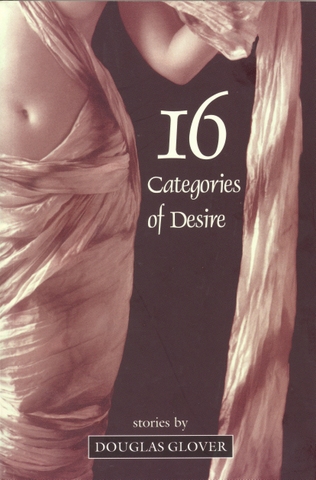
via Books for the holidays: 15 of the most intriguing of 2013 | Toronto Star.

Dec 142013
 

This is a scholarly essay about two short stories of mine that I only just now noticed is available online. (Many academic journals, lately, seem to be adopting a new openness to readership that can’t help but be a good thing.) It appears in a journal called Studies in Canadian Literature (one of the editors, John Ball, has an office just down the hall from my Writer-in-Residence office at the University of New Brunswick). The stories are “My Romance” (about the baby dying and the husband having an affair with his wife’s OB/GYN and then trying to kill the monkey) and “Iglaf and Swan” (about a pair of artsy writers who manage, via self-obsession, to drive their daughter to tattoos and suicide). The stories are in my books 16 Categories of Desire and the U.S. collection Bad News of the Heart. The author, Adam Beardsworth, is an astute and intuitive reader of my work, none better. He is especially good at parsing the philosophical ideas that underpin my very strange plots.

dg

THEORIZING THE AMBIGUOUS RELATIONSHIP between desire and experience, Jean-Paul Sartre realized desire’s precarious, if not paradoxical dependence upon the tension between presence and absence: desire’s very insatiability testifies to its origins beyond objective conciliation. It is upon this philosophical premise that Douglas Glover hinges his short stories “My Romance” and “Iglaf and Swan.” In both stories, Glover explores the epistemological problems that arise when those objects that we desire most are traumatically displaced only to reveal the lack that lies at the core of being. Reluctant to revel in post-modern incertitude, Glover’s stories demonstrate a compelling movement from a confrontation with desire and nothingness, to a realization that the only redeeming desire, however ephemeral, is that which one finds in an “other,” or in the recognition of a mutually intrinsic desire for the infinite in one’s object of love. Demonstrating a concern with the proximity between the compulsion to satisfy sensual appetite and the inclination towards linguistic expression, Glover allows his exploration of longing to extend beyond the parameters of his narrative and into the realm of allegory. From the self-reflexive title “My Romance,” with its coy allusion to both narrator and author, to Iglaf and Swan’s tragic conflation of the desire for the other with the will for literary acumen, Glover’s stories foreground an ostensible preoccupation with the link between desire, art, and death. Recognizing language as central to all experience, Glover, in “My Romance” and “Iglaf and Swan,” allegorically invokes writing as a medium compelled by insatiable desire, a manifestation of our human impulse to objectively inscribe our fascination with the pure loss, death, trauma, and love at the limits of human experience.

Read the rest at Romancing the “Mysterious Bonds of Syntax”: Allegory and the Ethics of Desire in Douglas Glover’s “My Romance” and “Iglaf and Swan” | Adam Beardsworth | Studies in Canadian Literature / Études en littérature canadienne.

Dec 132013
 

NC Logo

End-of-the-year praise for NC from Daniel Davis Wood, who teaches in Switzerland and is the editor of a recent collection of essays by Edward P. Jones. Wood also praises Music & Literature, which is edited by my former student Taylor Davis-Van Atta (also an NC contributor now and then).

dg

Douglas Glover’s Número Cinq, online since 2010, was a wonderful new discovery for me this year…. Most impressive about Número Cinq is the material being collected in its Book of Literary Craft, especially Jason Lucarelli’s two long pieces on the aesthetic legacy of Gordon Lish (one, two) which led to an equally impressive discussion on that subject between Lucarelli, David Winters, and Greg Gerke, available at The Literarian.

via End-of-Year Pleasures and One Disappointment | Infinite Patience.

Dec 112013
 

Savage Love Cover

But I have to give it up to Douglas Glover for Savage Love, if only because it’s such a showcasing of why short fiction exists and what writers can do with the form. The stories are punchy, experimental, daring, dark, and funny in ways a novel or a poem cannot be. Oh, and they’re also really damn good. You’ll laugh, be appalled, cringe, and cringe, and cringe. — Chad Pelly

via ShortLitCrit’s Favourite Short Story Collections of 2013 | FOUND PRESS.