Douglas Glover

Sep 102012
 

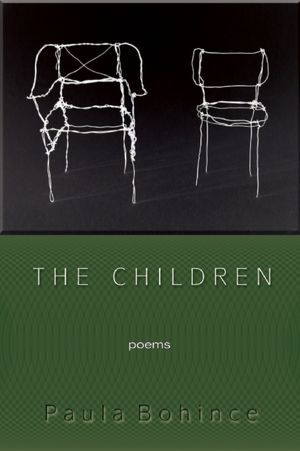
Each poem in The Children is alternately spare and dense, delicate and obsessive as filigree or tatted lace. “The heart / breaks its crochet,” she writes in “Snowy River Visions,” alluding to the intricate psychological fabric—handiwork or “white threads / like bandages”—painstakingly made and painfully undone in the course of each poem. — Emily Pulfer-Terino

The Children
by Paula Bohince
Sarabande Books
Paperback. 72 pages. $14.95

In a culture infatuated with irony, Paula Bohince’s poetry distinguishes itself for its subtlety and its acute attention to a world at once beautiful and ravaged. Four years after the release of her stunning debut collection, Incident at the Edge of Bayonette Woods, published by Sarabande Books, The Children, (also by Sarabande), explores nostalgia and the ache of the lucid present in a rural landscape reminiscent of the Pennsylvania countryside where Bohince grew up. Where attention to multiplicity and contradiction could manifest in wry evasion, off-the-cuff colloquialism, and hyper-intellectualism, the imagination in these poems works delicately and relentlessly to make sense of the rift between ideas about the world and the world itself. Bohince tells it slant (to borrow Emily Dickinson’s phrase) only when there is no other way to tell it.

The book is lean and shapely, a collection of forty-two poems divided almost evenly into three sections. Demarcated by Roman numerals, these divisions emphasize thematic links among poems and lend the volume an implied chronology. While these poems are lyrics in free verse, a formal sensibility underlies the collection. For their lapidary precision and for the subjective, accessible “I” delivering each poem, this work feels born of the confessional tradition. Still, poems in The Children are fresh and surprising in their conception, paying homage to Bohince’s predecessors while establishing their own set of rhetorical moves and imaginative leaps. Bohince nods to literary, artistic, and historical figures: Mark Rothko, Virginia Woolf, Amy Clampitt, Herman Melville, Emily Dickinson, and even Christ; invoking a sense of shared personal struggle. The Children articulates myriad forms of witness, addressing themes of childhood, fraught family circumstances, marriage, solitude, and decaying rural communities.

Bohince’s allegiance to beauty functions both as a characteristic and as a subject of the work. Each poem in The Children is alternately spare and dense, delicate and obsessive as filigree or tatted lace. “The heart / breaks its crochet,” she writes in “Snowy River Visions,” alluding to the intricate psychological fabric—handiwork or “white threads / like bandages”—painstakingly made and painfully undone in the course of each poem. Later, in “Froth of the Tides and Further Out,” she claims, “beauty rescues,” then wonders “Is that true?” This work asks what the function of the aesthetic can be in a world marked by loss. The first poem in the collection, “Pussy Willow”, begins:

Faint as flame-in-wind,
I was born, cupped inside a fist
and carried everywhere

even to the formidable river
so that I may see the stones
of the riverbed.

Introducing the essential act of attention at the core of this work, it concludes with a meditation, “Virus in my heart. Branches / salted with buds, soft- / eyed on the sill,” invoking, too, the repose and tenderness to follow. Later in the book, in dazzling strokes, bees are discussed in terms of “the shantung / of them: breathless forms / shuttling through sunlight.” A robin’s egg is “bejeweled on all sides / by goldenrod.” Yellow leaves “become portraits/of fecundity: watercolor / of wanton // against discriminate.” Effulgent phrases offer a complex, excruciating beauty, acting as abrasion and salve at once.

In the title poem, rural, post-rave melancholy is elevated to lyric emblem where “ecstasy lowered to ache” hums at the core of each stanza. Pithy, Anglo-Saxon diction drives a series of propositions and ruminations towards a conclusion equally satisfying and irresolute.

If the wind had been less gutsy
in its unbindings, we’d know them better,
the children

or the afterimage of them,
the teenage couple rapt inside the field
after the rave has died

and dispersed into corn, into cars, into
the trashed curfew.
We’d know them, the two who lay here,

ecstasy lowered to ache
and dull grin, glow sticks faded against
colorless weeds.

If the wind had been less federal,
sweeping anew the corn dust, and the clouds
that kept them starry for hours,

now passive against the noon sky:
if only they’d lasted.
If we’d been given more distinct evidence

beyond the condom listing against milk-
weed, the fox prints, the warmth
of glow sticks in our hands—

neutral again, broken of their magic.
Those dirty pacifiers we suck. Their whistles
we put to mouth and sound.

Plain idiom interacts with decisive formal gestures, lending the subject a surprising elegance and a sonorous elegiac quality. Tercets composed almost entirely of enjambed lines contribute a sense of momentum and also of containment, establishing the writer’s concern for the poem as crafted object while mimicking the energy with which the speaker bares witness to the scene. While none of the lines is end-rhymed and the internal rhymes are subtle as those inherent in colloquial speech, the language is rife with assonance and alliteration. Even in the first sentence, “couple,” “rapt,” “corn,” “cars,” “trashed,” and “curfew” establish a sonically arresting pattern of hard consonants and internal slant-rhymes that continues into the next sentence with “ecstasy lowered to ache.” The poem is built essentially of three propositions: “If the wind had been less gutsy”, “If the wind had been less federal”, “If we’d been given more distinct evidence”. Only the first resolves in a complete sentence; the following are fragments, expressive of incompletion and futility. The “we” who would know them better is literally suggestive of the community from which they are alienated. At the same time, the speaker and the reader are the “we” who know the “afterimage” of the children only through a set of lyric gestures. The poem is itself the afterimage, ghostly and particulate. Here distinctions among the man-made and the natural, the young and the dead, the beatific and the pathetic, collapse in quiet spectacle, acutely observed. The teenagers’ final whistling, which reads as half-habit, half-outcry, lends the poem the luster of ars poetica as writer herself scans the ruin, turning it into song.  This work is as much about the ordinary world as it is about our efforts to withstand it.

Bohince unabashedly exalts the quotidian, exposing and even, at times, announcing her ambition.  In “The Peacock,” for example, “Dreams feather the pillow and make bearable / the day…” in which dailiness—children’s’ aimless play, a working father’s depression—are juxtaposed with the bird’s “gorgeous body.” The poem turns its attention to the peacock until peachicks flock around the bird and, in a bold flourish, Bohince writes:

The day is finding its Breughel moment—
wine and sapphire and verdigris. His black hair
with sunlight on it.

A miracle. Something to recall
as beautiful, in the future. As the sewer was
in summer. Little childhood river.

Through the poem’s shift of attention from the pedestrian to high art to the sewer, dailiness is transformed, (or the poet announces her desire to transform it), wrought and iridescent. The world in this poem is as much imagined as it is observed, affirming one of the book’s central concerns: the relationship between perception and invention. As is the case with Elizabeth Bishop’s sublime, overwhelmingly lyrical passages are expressive of both affliction and delight.

An acute ambivalence characterizes the collection. In several poems, a subject is both itself and another, tilting and transforming. Beavers damming a stream are conflated with the rope-swinging teenaged boys the speaker used to marvel at. A mother’s frenzied consciousness is likened to birds, a “tonic of quail,” the mind “a cloud of quail…huge / as buckshot / when it balloons down, / scribbling earth/with its landings.” A hornet’s hive is a “collapsing universe” in which the speaker recognizes her own loneliness and collapse. An owl is “embodied psychosis,” “homeless, forever.” A rabbit in a winter field is discussed in the same terms as the speaker’s mother is.

A profound poem of leave taking, “Hare In Snow” responds to Mark Rothko’s vibrant, juxtaposing planes of color and his pulsing nuances. Built of two solid strophes whose rhetorical unfolding is almost identical, the poem reads as a kind of diptych imbued with the symmetry of reflection and of palindrome.

She sits in stately dress; she is all White. Slur of landscape.
In the birches’ breach, she waits: recompense for January’s deadly
beauty; rapid heart beating the downy body. Flaw
in the opal of field. Not-yet blood festival. To be as still
is to protest. Don’t go, I think, half-dozing at the window, when
she goes. Her shaming wakefulness. The poise of long feet
come to use. The adults look babyish all their lives.
It’s Nature’s trick, to feign innocence. Any intelligent thing
rejects the unhappy present. The thought of her alone would be
pretty, were she not true. And cruel as the feminine mind. Gone,
the mist she releases I interpret as Mother’s Hairspray.

She wears her fur, my mother. Pink-cheeked, she is
the landscape. Its cold eternal sunrise. Young and handsome
as my birth month. How rapidly we rushed toward each other
then. How we are the flaw in the other. Her blood slows
down. To be as quiet is to protest. Don’t go, I think, waving
goodbye from my car window. I go, and her waving
shames me. Though she bends, in mirror, in her sweeping,
she will always be younger than I am. It’s a mother’s trick,
to be loved as a lifelong daughter. The thought of her alone
will not do. She is pretty, and true. And cruelty flies into wind-
borne snow. Into the mist my mouth drinks now as milk.

Each dense stanza is built of a series of statements, sentences and sentence fragments, which addresses its subject with alternately literal and imaginative attention. The rabbit in the first strophe arrests the speaker where she sits, drowsy by a window, thinking, “don’t go” as the creature disappears into woods. But the speaker considers the animal’s presence before it runs away, making incisive claims about the natural world that read as philosophical and socio-political as well: “The adults look babyish all their lives. / It’s Nature’s trick, to feign / innocence. Any intelligent thing / rejects the unhappy present.” The poem hinges on this inventing mind, on the speaker’s consciousness that analyzes “any intelligent thing” and that “interpret(s)” the mist of snow as her “Mother’s hairspray,” again juxtaposing the natural and the artificial, the current and the recollected.

The introduction of the speaker’s mother at the hare’s escape prompts further consideration of “Nature’s trick.” Now the mother occupies the space, imagined and actual, that the hare had. She “wears her fur.” She is “young and handsome/as my birth month. How rapidly we rushed toward each other / then,” considers the speaker in a tone redolent with loss, “how we are the flaw in the other.” Again she thinks, “don’t go”, this time as she herself drives away, shamed by the image of her mother waving in the rearview mirror. “It’s the mother’s trick, / to be loved as the lifelong daughter,” she asserts, yoking safety and shame, love and anger, nurturance and dependence, in a set of relationships that throb like Rothko’s planes of color. Mother and daughter are both indistinguishable and achingly separate. The “cruelty” that “flies into wind- / borne snow,” then, is both the speaker’s and the mother’s; it is the pain inherent in parting and reunion.  The form—two stanzas rhetorically similar but imaginatively divergent—amplifies the marked and expressive ambivalence informing the poem and so much of this book.

Paula Bohince’s poems delight and hurt. In spite of, or perhaps because of, the complex and palpable struggle informing this collection, The Children is an intricate and distinct pleasure. Shapely and plainspoken, austere and effulgent, this work rewards repeated reading with subtly inventive language and an earnestness that feels unaccustomed and even bold in contemporary poetry.  The intellect and the heart are inextricable in this writing that promises to be enduring and influential.

—Emily Pulfer-Terino

————————————————

Emily Pulfer-Terino grew up in Western Massachusetts, where she lives and teaches English at Miss Hall’s School, a boarding school for girls. She holds a BA from Sarah Lawrence College and an MFA in Creative Writing from Syracuse University. More of her work is published or forthcoming in Hunger Mountain, Numéro Cinq, The Southeast Review, Poetry Northwest, Stone Canoe, The Louisville Review, The Alembic, Oberon, and other journals and anthologies.

Sep 072012
 

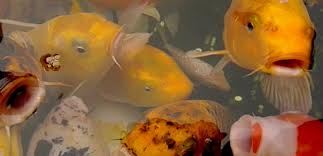
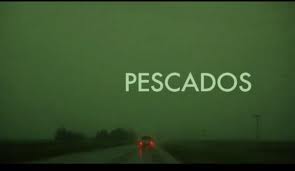
Argentinian director Lucrecia Martel’s “Pescados” (“Fish”) absurdly wonders what fish’s dreams are made of through a pool of carp who dream of driving in a car in the rain, but – and this seems the essential point – without dogs.

The frame of the film is crowded with bobbing carp of various sizes and colours that strain to reach for food at the top of an aquarium or a zen koi pond. Through their various tones of voice we detect differences in character between the fish as they blather in their invented language. Even without the sound, the anthropomorphized carp have personalities detectable in the way they treat other fish, nudging them out of the way, and swimming on top of them.

The strange and haunting sounds are a hallmark of Lucrecia Martel’s film style. The fish are granted the gift of semi-individuality through the sounds that they are associated with, depending on whether that sound is shriller or deeper. They speak in individual voices but with overlapping sounds. This is not the story of one fish, but a community. Schools of fish usually perform in perfect synchronicity but Martel’s carp react fitfully. As in her previous films (both feature-length and shorts), she is highlighting the individual’s comportment within a greater group.

The sounds, synchronized perfectly to the gaping fish mouths, are by Argentinean multidisciplinary artist Juana Molina. The noises are not from an easily recognizable instrument, but those who know Martel’s body of work will hear similarities to the device prominently featured in her second feature film, The Holy Girl. There is a sound like the theremin, an electronic instrument that is played without a touch. Molina is electro-folk musician who is also an actress and she cites Bjork as one of her influences. The connections between the two artists’ styles are unmistakable.

Martel is the well-known director of serious character studies like The Headless Woman and The Swamp, so her focus here on chatty sing-song fish might seem peculiar. Animal adventures are usually the stuff of Disney’s children’s films, rarely of prize-winning independent filmmakers and they feature elaborately drawn characters, not real live fish. In Finding Nemo (2003), the clown fish Nemo and his various friends tell us their story in their own words;Martel’s fish do so as well.  Nemo’s tale is more canonical, a simple father and son tale, while Martel’s story resists making the same kind of sense. The anthropormorphic turn seems to flirt with a more complex ontological project. Her last short, Muda, also featured on Numero Cinq at the Movies, featured humans acting like insects. Both these films suggest Martel is exploring the boundaries of the human experience, possibly intending to denaturalize desire and identity through these animalistic turns.

Simplicity has been a crucial characteristic of Martel’s films since the beginning of her successful filmmaking career. In this short, in the dominant fish pond scenes, her camera zooms in and out on the fish in one continuous dance. The frame is always densely filled and this allows for shots of a single humanized fish or a more complete view of the pond, with multiple fish. The carp mesmerize with their ceaseless irregular movements. Splashing water, wavelets, and silver coins at the bottom of the pond catch the light, saturating the captured image again and again.

Martel bookends these vibrant pond scenes with POV shots of a passenger or driver in a car driving on a highway in the rain. In the first, the title shot, we see a greenish rainy dusk with a lot of sky. Martel builds dramatic tension in this section of the short, despite the absence of other characters, through the eerie colour and the car we see in the distance. This first sky scene is intermittently interrupted by what we assume to be the windshield wipers; they are at the same time nuisance and godsend, since they temporarily block our view but ultimately allow us to see through the windshield.

The water from the fishpond is contrasted with the rain on the windshield (reassuring for the fish, one would suppose). Water is a prominent feature in all of Martel’s feature films, but usually it is the characters that use the medium in some way. In this case, it is unconceivable that she would film fish without the liquid. In The Swamp, it was an oppressive element present in the air (heavy humidity) and in the family’s pool (where ultimately, the dramatic twist happens). In The Holy Girl, it was an element that allowed various morally ambiguous characters to wash away their possible sins.

From the dark threat of the highway in the rain, she moves us suddenly to the cacophony of the fish in the pond. Martel’s contrast of the effervescence of the fishpond and the dark starkness of the highway scene is unexpected, a difficult clash of images to process. At 1:39, she offers us another two-second flash of the road, as a convoy of transport trucks pass to the left of the screen in rapid succession. Now that we know the fish, know of their dream, we are left to wonder if this is the car the fish dream about and what will happen to this car full of fish driving down the highway? The short ends with a return to the highway footage, the bottom darkness of the koi pond transitioning into the view through the windshield as the fish fade and swim away to the exterior shot and the round shiny coins become the street lamps flashing by. Still, our questions remain unanswered. We’ll never know where the carp wanted to go on their road trip, what is so terrible about dogs, or why they would ever want to leave the gloriously manic pond.

This short film is rife with planes of observation, one of Martel’s favourite tropes. We view the film, the car driver looks out the windshield, the camera watches the fish, and all the fish look out of the bowl. Martel requires of her viewers that they gaze, stare, and look again and again.  She perhaps does this best in her last feature film, The Headless Woman. In one continuous scene, we must watch the facial expressions of the main character as she goes through multiple emotions realizing, then discarding, the possibility that she may have hit a person with her car on the road. Watching a Martel film, we must discover and question the smallest of details or facial expressions.

In an perfect twist, given Martel’s preferred tropes, the filmmaker can be (barely) distinguished in a reflection in the koi pond, especially in the tight shots when there are few carp movements. We guess that she is there, a square black likeness, holding the camera, controlling what we see. But she and the film’s meaning remain elusive, a reflection, yet promissory.

This short was presented at the Jameson Notodofilmfest, an annual online festival born in 2001 from an idea by Javier Fesser, an Oscar-nominated filmmaker (2007). This festival allows young innovative filmmakers to present their work through the magical world of the interweb. The prestigious jury members contribute to widening the selection of shorts; Lucrecia Martel was a judge for the 8th edition of the festival.

— Sophie M. Lavoie

————————————————————

Sophie M. Lavoie conducts research in the areas of women’s writing and social change in Central America and the Caribbean. Her studies focus on women in contemporary Nicaragua during the first Sandinista era (1970-1990), but she is also interested in other revolutionary movements in the area, such as Cuba and El Salvador and in women’s writing in Latin America. Her current research project focuses on the link between women’s writing, empowerment, and revolutionary action during the Sandinista era in Nicaragua. She has published articles in Canadian Women’s Studies/les cahiers de la femme, Pandora, Centroamericana, Cahiers d’Etudes Romanes and Descant. She is Associate Professor at the University of New Brunswick in Fredericton, NB where she teaches Spanish and Latin American Cinema.

Sep 062012


Sydney Lea has three books coming out, including his new essay collection A Hundred Himalayas (University of Michigan Press) this month. At an age when old dogs curl up before the fire and dream ancient dreams, Sydney is all spark and vigor which I find endlessly appealing and optimistic. Sydney is also the Poet Laureate of Vermont, and I guess poet laureates hobnob in ways that mere mortals don’t. He and Fleda Brown, recently Poet Laureate of Delaware, have been writing essays back and forth. As Sydney writes, “My friend Fleda Brown, lately poet laureate of Delaware but now escaped to northern Michigan, and I are writing a book together. She writes an essay on a topic (food, sex, clothes, houses, illness, and wild animals); then I write one on the same topic. Then I write one and she follows suit. Etc. It’s fun, though I don’t know who in Hell will publish it.”

Earlier on these pages I published the essay “Unskunked” which is part of this poet laureate interchange. In “Unskunked” we were treated to the image of the author running naked through the dark and dripping forest. In “Becoming a Poet: A Way to Know,” Sydney Lea waxes less overtly spectacular and delivers a lovely, wise account of his education as a young poet. He is a paradoxical intellect; part athlete, hunter and woodsman; part scholar; mostly a poet. This is the story of how these impulses somehow coalesced around his admiration for what we might call the New England old timer (in 2012, there aren’t many of these left). At the center of this is an idea of manliness (not macho posturing but old fashioned manly virtue — a good thing).

Sydney Lea is a great friend and former colleague from my early days at Vermont College of Fine Arts. It’s a source of deep satisfaction that he has found Numéro Cinq a congenial home for his work.

dg

———–

When I was young, who thought I’d choose poetry as my prime mode of knowing the world?

Not I.  It’s true that as a high school punk, despite my enthusiasm for football and my wilder one for hockey, despite my commonplace tough-guy posturing, practiced by so many of us guys at that stage of life, I did secretly like to think of myself as a bit arty too. I was a musician. I could sing. I even thought I drew pretty well. I was a big cheese in the dramatic club, as a senior playing Oedipus in the eponymous play (a lisping king, who addressed “generationth of the living in the land of Thebeth”).

But I don’t remember writing poems, save maybe the sorts that any person may have written, and that he hopes have long since utterly biodegraded: rants about being ditched by a girlfriend, just for the tritest example.

I was also a pretty good student. Indeed, had it not been for what would now be diagnosed as a mathematical learning disability, my GPA would have been of the very highest. My truest proficiency was foreign languages, a gift nourished by the best instructor I ever had at any level, Ted Wright, who taught French. I began to speak the tongue pretty quickly, and I recall how strange it was that the words and the grammar often almost seemed to be granted me by some power outside myself.

It’s a feeling I would later come to recall – if not as often, naturally, as I could wish – when I composed a poem successful in my own eyes.

It’s at once simple and weird: words and phrases, whatever the language, simply enchant me, seduce me, especially if I hear them. Things spoken in my presence, if they have a particular, inexplicable resonance, will lodge themselves in my mind for decades. For example, I lately remembered a friend’s describing the death of his farmer uncle, who fell dead in his tracks while shutting the tailgate of his truck on a calf bound for the abattoir. I heard that description, unremarkable in most respects, about forty years ago. I wrote the poem last week.

Like my exemplar Robert Frost, I want my poems to have something of the ring of actual talk in them. But that’s to get ahead of myself. The college I chose had no writing courses as we know them in our era of too-rampant MFAism. But somehow, on my own, I started to feel an itch to write, which I did, my only audience, really, being my roommates, who tended to think I was good enough, if they thought about my work at all. My genre was short fiction, and I wrote a lot of it in those four years; it seemed to keep me balanced somehow, while everything else – including the alcoholism that would plague too many later years – was doing just the opposite.

Ultimately, of course, graduation loomed, and I had to figure out what I might do. Yale had accepted me as a grad student in French, but much as I loved the language and the literature, something in me recoiled from living as a kind of literary expatriate. I never imagined applying to a place like Iowa, though quantitatively, my portfolio would have permitted me to. (Who knows about the quality?) I had barely even heard of any of the far fewer MFA programs that existed in those days. I never dreamed, either, of Being a Writer.  Professional writing, I assumed, was something other people did; there must be some secret to it, and no one had shared it with me.

I did not want to go to Vietnam, as one those roommates did, becoming one of the earliest casualties of that wrong-headed adventure. And so, because schoolteachers were exempt from the draft at that time, I elected to go back to my own private high school, having no credentials to teach in a public one.

I taught French and English, and came to understand how Ted Wright managed to be so inspired and inspiring a teacher. He simply committed himself to that end every minute of the day right through the evening’s class preparation. No one messed with Ted: he was a big, muscular guy, the football coach, a former semi-pro pitcher. At a mere 21, I didn’t have that sort of gravitas, and I devoted a lot of time to quashing the same sort of ill discipline I’d imposed on all my other teachers, now my forgiving colleagues, just a few years before.

Top quality high school teachers are, to my mind, the heroes of American education. They deserve to be paid a lot more, and college teachers (especially those at the sorts of “prestige” institutions where I myself have taught) a good deal less. To say it tersely, even after one year in a pretty cushy job at that level, I knew I didn’t have the endurance and commitment Ted did. In deed, I concluded there wasn’t enough money in anyone’s bank to keep me at his sort of work. Too hard, too demanding, too much time just being present.

So I did go to grad school after all, not in French, but not in English either. I did comparative literature, wanting to use my languages while I focused on fiction and poetry as fields of study. I was too naïve to know that comparative literature was just then leading such study in the “theoretical” direction that has made it unappealing to me and apparently –  judging from the radical shrinkage in literature majors at the majority of colleges – to most students.

Not that my dabbling in theory didn’t have its heady moments. I particularly recall a fabulous seminar on European Romanticism, presided over by the second best of my many teachers, Geoffrey Hartman. And yet Geoffrey became, quite unintentionally, a bit of a villain in my history. I had settled on a perfectly conventional dissertation topic, Frost and the Romantics, but he persuaded me to expand one of my seminar papers, an examination of several supernaturalist authors of the nineteenth century, most of them deservedly forgotten. Unlike my other choice, he averred, this would be “a real contribution.”

Contribution? What about nightmare? To indicate how sheep-like I’d been in acceding to my professor’s suggestion, most of my texts were written in German, the one major western European language I didn’t really command, which meant that I was forevermore rifling through the stacks for translations from the original into French, Italian or Spanish, few being available in my native tongue.

Good Lord…

In due course I took a job at Dartmouth College, without, however, having finished that accursed dissertation. Indeed, it would take me more than four years to do so.

There were no writing courses at Dartmouth in those days, any more than there had been at Yale when I was there. But a fair amount of clamor arose from students for that lack to be remedied. The result, in my second year, was English 70, an omnium-gatherum offering in which students could write fiction, poetry, drama, personal essays, what have you?

The heavies of the department, many of them good people and true, to be sure, were exclusively male – women adjuncts were referred to as “lady lecturers”! – and white and old, and at least marginally Christian. (These descriptives fit me better as I write this than they fit the people in question then; but such, in my late twenties, was my regard for them, one and all.) They assigned English 70 to me, of all people.

This was meant, though, as an act of kindness. Since in the eyes of those senior colleagues, such a course was not a “real” one at all, not the kind that demanded any genuine thought or preparation, I would have more time to complete my burdensome dissertation.

And yet a strange thing happened  (or perhaps not so strange). In teaching that course, ineptly, I’m sure, given my utter lack of credentials, I found that old itch returning. It had been suppressed for more than half a decade, but now I began to write again myself.

I began, though, to write poetry. Why? Well, pardon a detour to something very relevant: on my father’s side, my family has had a relation to a remote part of Maine that now goes back generations. In these times, my brother and sisters collectively own our cabin there. My time in the neighborhood had exposed me to certain notable characters, ones who would be 120 or so if they lived still. These were men and women whose early lives had preceded the advent of power tools, so that the male lumberjacks had cut millions of board feet by hand. And to call the females “housewives” would be downright laughable: they lacked all domestic conveniences we take for granted. Stunningly hardworking people, they quite literally kept the home fires burning, cooked in wood-fired ovens, slaughtered chickens, skinned game, cleaned fish and did whatever else was called for to sustain a homestead.

Because these people had no electricity, they of course had no radio either, let alone movie theaters or the great drug television. No, they had to make their own amusement, and as a result, man and woman alike were fabulous raconteurs. Their magical turns of phrase ring in my head every day: some get into my conversation, a lot into my poems, as it were, in disguise.

It seemed inevitable that, when I moved for my job to another part of northern New England, I sought out their Vermont and New Hampshire counterparts, who were equally eloquent, grammar and syntax be damned. And even at my young age, I somehow recognized mine was the last generation who would have known these precious souls.

I wanted to get their voices onto the page.

And yet I knew I’d prove no genius. I wasn’t Mark Twain. I wasn’t Willa Cather. I couldn’t resort to dialect without on the one hand sounding condescending, which was the opposite of how I felt, or simply sounding “off,” or both. I came to the conclusion, rightly or wrongly, that if I used poetry to tell their stories – or rather to tell stories suggested by their stories –  I might capture the rhythms and cadences of that old-time, entrancing speech without having to imitate it.

My earliest poems, consequently, were in the main quite specifically narrative ones. And although I have drifted away from overt story-telling in my verse, I have never quit believing in certain narrative values: even if plot remains implicit, I want my reader at least to know who’s talking to whom, and where and why. Character, setting and dialogue: why should we poets have ceded these endowments so readily to the fiction writers?

To this day (and I am old enough now to be indifferent about what the Smart People think), I want whoever encounters a poem of mine to know some literal truths when he or she first sees it. I want to make him or her aware of who the actors are, perhaps especially the one named I. If I can make allies of my readers, I’ll be pleased – and genuinely grateful to them. To these ends, I feel I owe them a welcome. A good poem will be complex, no doubt, but that’s a different thing from complicated. Those who are willing to consider it shouldn’t be taxed to figure out the plain facts of its matter.

Back to the academy. One of the department elders – a man whom I greatly liked from those days up to his fairly recent death – was chairman at a critical juncture. He approached me one day and said, “People are starting to regard you pretty favorably around here, but you know the saying, publish or perish. I’m glad it didn’t apply when I was your age, but without some scholarship in print nowadays, you have very little chance of tenure.”

Okay, then… I liked where I lived. I particularly liked the landscape and that access to the old story-tellers, and since in those days one did not have to publish a book, but rather a few articles, to pass the publish-or-perish test, I thought, well, I’ll just take a chapter or two from my dissertation (a screed still incomprehensible, even to its author) and try to stick it somewhere.

Mind you, I had gotten lucky with my poetry pretty quickly. I’d put poems in The New Yorker, the Atlantic, The New Republic and a slew of high-end lit magazines. But however different things are now at Dartmouth, in those days publishing poetry was not “real” publishing; that my first collection was under contract cut no ice, then.

I took the dissertation over to my library carrel, opened it up, and felt as I sometimes have upon looking over a shear precipice. My head spun, my stomach knotted, and I uttered aloud, despite the fact that I was in my thirties: “This is not what I want to do when I grow up.”

I closed that dusted-over tome, vowing that I would go on writing poetry and let the chips fall where they might. I did not of course get tenure, but was fortunate enough as almost immediately to be hired by Middlebury College, where the tradition of writer-professors had been fairly long established.

I now ponder that cri de coeur of mine, and I wonder why scholarship should not have appealed to me as something to do as a grown-up; why it couldn’t draw me more than it did or does. Understand, after all: nothing I say here is intended as an attack on scholarship. The contrary. I have benefitted enormously from other people’s labor in scholarly endeavor. It’s only that it isn’t for me.

Or not to the exclusion of other things. Oh, I have done a few genuinely scholarly articles since, copious annotation and all, and have even enjoyed doing them. But something always seems missing when I finish. It’s the missing something that’s provided by so-called creative writing, especially the writing of lyric, though I must struggle here and elsewhere to name that element.

For me, poetry is another mode of knowing the world, one that is different from the either/or, syllogistic one whereby people (myself included) generally conduct their business. Nothing wrong with that: if Shelley claimed poets as the unacknowledged legislators of the world, from what I’ve seen of them (myself included), it’s likely a good thing that their legislation does go largely unnoticed.

In any case, the lyrical approach is largely divorced from either/or, is in fact an approach well described, the way Carl Jung did in another context, as either/and/or –which is to say that it enables the writer (and ideally the reader) to see and feel from multiple angles simultaneously. To choose a hyper-obvious example, with the fairly recent birth of each of my grandchildren I have felt an indescribable surge of joy contemporaneously with numbing despond to imagine the world they may inhabit: over-heated, desperate for drinkable water, fratricidal, on and on.

It is this either/and/or quality, I believe, that John Keats famously called Negative Capability: the capacity to be  “in uncertainties, Mysteries, doubts, without any irritable reaching after fact & reason.” Any number of perceptions, emotions, thoughts, and so on can exist in a poem at the same time, including ones like the above, which are evidently contradictory of one another. In these respects, poetry’s path to knowledge, more nearly than any other, seems the path my mind inclines to follow.

And of course there is again the matter of language. All those voices, old and new, anglophone and otherwise, that reverberate in my skull and, more importantly, in my heart. To abandon myself to what I called their rhythms and cadences, to let the words and phrases, as it were, bear me along like a tide to such enlightenment as I’ll ever have – that feels, and not just slightly, like a self-abandonment (allow me) to something divine.

— Sydney Lea

——————–

SYDNEY LEA is Poet Laureate of Vermont. His selection of literary essays, A Hundred Himalayas, will be out from U. of Michigan Press in September. In January, Skyhorse Publications will issue A North Country Life: Tales of Woodsmen, Waters and Wildlife, and in  April 2013,  his eleventh poetry collection, I Was Thinking of Beauty, is due from Four Way Books. His most recent collection of poems is Six Sundays Toward a Seventh: Selected Spiritual Poems, from publishers Wipf and Stock. His 2011 collection is Young of the Year (Four Way Books).

He founded New England Review in 1977 and edited it till 1989. Of his nine previous poetry collections, Pursuit of a Wound (University of Illinois Press, 2000) was one of three finalists for the Pulitzer Prize for poetry. The preceding volume, To the Bone: New and Selected Poems, was co-winner of the 1998 Poets’ Prize. In 1989, Lea also published the novel A Place in Mind with Scribner, and the book is still available in paper from Story Line Press. His 1994 collection of naturalist essays, Hunting the Whole Way Home, was re-issued in paper by the Lyons Press in 2003. Lea has received fellowships from the Rockefeller, Fulbright and Guggenheim Foundations, and has taught at Dartmouth, Yale, Wesleyan, Vermont and Middlebury Colleges, as well as at Franklin College in Switzerland and the National Hungarian University in Budapest. His stories, poems, essays and criticism have appeared in The New Yorker, The Atlantic, The New Republic, The New York Times, Sports Illustrated and many other periodicals, as well as in more than forty anthologies. He lives in Newbury, Vermont, where he is active in statewide literacy and conservation efforts.


Sep 052012
 

If I had to guess what events will sell out first, my money would be on the Douglas Glover Master Class. He’s a spectacular Canadian writer who has kindly agreed to do a three hour class on the mechanics of good creative writing for WordFest patrons. The best part about it? It’s only 30 bucks per person. What are you waiting for? Follow this link and buy tickets now!

via Post-Launch Blog: A Response | WordFest Blog.

Sep 052012
 

I was going through the NC archives and discovered a very early blog reference to a now defunct file sharing site I used to keep for my students. I was referring everyone to a copy of Ted Kooser’s brilliant essay “Small Rooms in Time” which I had marked up in my usual colourful and ebullient manner.

I am uploading the pdf of that essay with my commentary as an example for readers, also as a homage to a wonderful writer. The markup is a bit informal and I am not sure how it will reproduce on a variety of pdf readers. Have fun.

dg

Kooser – Small Rooms of Time w comments

Sep 052012
 

“I simply wrote stories whenever I got bushwhacked by inspiration and kept my fingers crossed in hopes that in the end they would somehow cohere…” — Steven Heighton

——-

“The writing life, like life in general, has a sacramental and a secretarial side,” Steven Heighton writes.  “As years pass and debts and duties accrue, the secretarial, clerical mode spreads like a lymphoma and starts to squeeze life from the sacramental, creative side.” Heighton’s own writing stands in defiance of this clerical mode. Prolific and diverse, he has published more than a dozen books, inlcuding collections of poetry, short stories and essays as well as four novels. He is a writer hell-bent on summoning the sacramental in his ever-expanding body of work, yet one dedicated and disciplined enough to sustain a steady output of consistently superior writing.

Heighton works and lives in Kingston, Ontario. His most recent book is a collection of short stories, The Dead Are More Visible (read my review at Numéro Cinq). In 2011, Heighton released Workbook: memos & dispatches on writing, a lively, eclectic gathering of aphorisms and memos about writing and art. I first encountered his work in the essay “The Admen Move on Lhasa”  (from a collection of essays with the same title). This essay remains one of the finest I’ve read on writing and the process of making art.

We exchanged a series of emails over the course of several weeks in preparation for this interview.  I confess to some initial nervousness. How often do we get to talk with the people whose work we truly admire?  But Heighton was both generous with his time and personable in our exchanges. He asked me about San Diego, about my family and my writing.  He confessed to a ‘minor’ bike accident which he described using the term cheese-grater in reference to the skin on right side of his body.  He talked about camping with his daughter, about finding a way to earn a living as a writer, about the blazing summer heat and the long, uncertain process of books being optioned to films. (Two of his novels have been optioned recently, Afterlands and Every Lost Country).

This sort of informal formality bleeds over into his writing as well. His stories are accessible but carefully crafted. They are filled with recognizable, often working class characters but written with a meticulous detail for language—a poet’s ear for melody combined with a prose writer’s eye for drama, a sort of genre-bending, cross-pollination of  W.S. Merwin and Raymond Carver, Ann Carson and Alice Munro.

Talking to Heighton, I feel myself in the presence of an affable high priest, a hardworking visionary whose polite chit chat is really just clearing the way for what he does best, which turns out to be two distinct things: both writing and talking about writing. The former is obvious; but the latter—the ability to articulate the process, to demystify the act of creativity, is a much rarer thing. Not every succesful and talented writer is able or willing to do this. At times, and especially in Workbook, it feels as if Heighton is lowering a rope ladder down from the Elysian fields and inviting others up. He offers no schmaltzy shortcuts, no write-your-novel-in-a-weekend workshops here. “Interest is never enough. If it doesn’t haunt you, you’ll never write it well. What haunts and obsesses you into writing may, with luck and labour, interest your readers. What merely interests you is sure to bore them.”  Haunted is a good word to describe his stories, poems and essays. To read Heighton is to intuit the effort that goes into the creation of something important and lasting. It is to “gape and loiter” in the sacramental, and all the while wonder what it means.

—Richard Farrell

 ————-

Richard Farrell: Your latest collection of short stories, The Dead Are More Visible, contains eleven stories. Can you talk a bit about how long it took you to gather that collection?

Steven Heigthon: I wrote the eleven stories over a period of six years—2006 to the end of 2011—but during that time I also worked on other things: a novel, a book of poems, and a book of aphorisms & fragmentary essays.  I wrote a few other stories as well—stories that my editor, Amanda Lewis, suggested we cull from The Dead Are More Visible on the grounds that they didn’t fit the book tonally.  In the end I agreed with her.  I’m hoping those orphaned stories will fit into some future collection.

RF: Does making a collection of stories influence the way you write the individual stories? In other words, do you have a thematic sense of where the collection is going before you start, or do you cobble together the book after the stories are written?

SH: In the ’90s I published a book called Flight Paths of the Emperor—a collection of linked stories that use Japan as a point of thematic reference and departure.  At a certain point in that book’s making, I did start writing stories with a view to filling in thematic gaps, filling out a larger project.  Not so with The Dead Are More Visible.  I simply wrote stories whenever I got bushwhacked by inspiration and kept my fingers crossed in hopes that in the end they would somehow cohere, not in an overtly “linked” fashion but through loose tonal kinships imposed by my voice, my angle of vision, the particular mannerisms and mechanisms of my writing.

RF: In “A Right Like Yours,” a female boxer falls in love with her sparring partner.  I daresay it’s a love story with a happy ending.  I might make an argument that a few other stories in the book have happy endings, or at least resolutions that favor the protagonists. Are happy endings harder to write?

SH: Like any romantic, I have to keep an eye on myself.  I want to avoid lapsing into sentiment, avoid poeticizing or aestheticizing the world.  So I’ve trained myself to avoid positive endings, or at least prettified endings.  With “A Right Like Yours” I took a different approach.  I decided to tune out my captious, critical faculty and allow myself to end on a slightly sentimental note.  I’m glad I did.  It felt like a reprieve, a remission, for me as much as for the main character.  There’s a simple sweetness to her voice and I decided not to mute or undercut it at the end.

RF: By contrast, “Journeyman” and “Heart & Arrow” strike me both as particularly sad stories. I’m wondering if the process is different for you.

SH: The female boxer in “A Right Like Yours” is very young.  Like anyone, she has experienced a certain amount of loss, but not nearly to the extent that a middle-aged person has.  The protagonists of “Journeyman” and “Heart & Arrow” are, respectively, in late and early middle-age—and the tone and point of view of those stories are, in contrast to “A Right Like Yours,” retrospective, elegiac.  They’re stories about loss and how we decide what to do with it.  But does the writing process differ—is writing a comedy (“comedy” in the classical sense: a story that ends with a wedding instead of a funeral) fundamentally different from writing tragedy?  It’s a good question.  I guess I’d have to say the process doesn’t differ, if only because the technical demands of writing a story are always the same: keeping it tight, choosing the right words so that each word resounds forward and backward through the text, nailing each physical detail, somehow defibrillating those characters who won’t come to life.

But on second thought: in a “comedy” you can get away with caricatured secondary characters, which makes the process of creation a touch less demanding, and maybe you can also have a bit more fun in writing certain scenes, certain passages of dialogue.  But it’s still going to be hard to get the thing right and fictionally true.

RF: Do you ever abandon stories?  If so, do those stories haunt you or do you let them go?

SH: I do abandon stories.  Do they haunt me after the fact?  Rarely.  They failed because their material didn’t haunt and obsess me enough during the process of composition.  They failed because they lacked the power to haunt in the first place.  So I move on to new work and forget them.

But the essence of one jettisoned story stayed with me for years.  Around 1992 I started something I called “Nearing the Sea, Superior” and over several drafts it bloated up to thirty pages, and I kept adding more, trying to make it work—like an engineer trying to fix a flying machine that’s too heavy to fly by adding more and more heavy parts.  In the end I threw up my hands.  Then, a few years ago, I thought I’d take another run at the basic narrative concept—or what I remembered of it.  So I searched for a print-out of the original version.  Couldn’t find it, and I believe that was a lucky break, because if I’d read that original I might have mined it for a few good details, or lazily used the whole story as a platform for the new version and its protagonist.  Instead, I had to take a fresh run at the whole thing.  It’s just ten pages long now and, published in The Dead Are More Visible, I think it finally works.

RF: You write novels, stories, poems, essays, and reviews.  Do you write all these forms during the same period or do you compartmentalize your writing brains?

SH: During the same period, yes, but usually not on the same day.  If the things I’m working on are alive, molten, inclined to flow toward their natural culmination, I can walk away and write something different for a week—say, a review for which I have a deadline—then return to the abandoned thing and, within an hour or two, be back inside the vortex.  Partly it’s a matter of sheer curiosity.  I never know how my poems or stories will end—I want to write toward my endings with the same interest and excitement I hope readers will feel, reading toward them—so my curiosity about where things will end up helps draw me back into whatever I’m writing.

RF: I recently completed your novel Afterlands, which was terrific. In many ways, it felt like a 400 page poem, yet it was fully articulated as a dramatic story too. Are you a poet who writes novels or a novelist who writes poems? 

SH: I think of myself as a writer who channels his narrative impulses into fiction and lyrical impulses into poetry—I don’t write typical “poet’s novels” and I don’t write narrative poetry—but there’s definitely some spillover on the level of language.  The thing is, poets like me who also write fiction are saddled with a sensitivity to verbal acoustics.  They can’t help lugging their poet’s tool belt into the atelier where they build their stories.  So, unlike pure fiction writers, who work stylistically at the level of the sentence, the poet/fiction writer works at the level of the word, even the syllableWorse, they habitually, helplessly use poetry’s staple technique, re-enactive writing (i.e., the orchestration of verbal rhythm, sound, level of diction, punctuation etc. so that the writing embodies and becomes the action or sensation being described).  Bummer.  There are ten thousand syllables in the average story and a few hundred thousand in the average novel.

Come to think of it, one of the reasons I’m more and more drawn to narratives that involve physical action and overt dramatic momentum—as with Afterlands—is because I’m hoping those traits will balance the prosodic density of the writing.  I don’t want to create 400-page blocks of static, preeningly poetic prose.  I’m not writing “re-enactively” to show off—I’m just trying to make my narratives more vivid and vital.  So, yes, the poetry is there, but in service to the narrative and the characters.

RF: Is there a style (genre) of writing that feels most natural to you? 

SH: Depends on the day.  Honestly.  Some days I’m a poet, pure and simple.  Other days I want to tell a story.

RF: A friend of mine recently told me that she often tries to quietly do ‘beautiful things as an act of defiance.”  You quote a Buddhist teacher, Thich Nhat Hahn, who says, “Don’t just do something, sit there.” You’ve indicated that you see the making of art as a defiant or subversive act. Could you expound a bit on this?

SH: Making something slowly and conscientiously, the way you have to build a poem, story or novel, is subversive in the context of a hyperkinetic culture that promotes haste and speciousness—speed and loudness over slowness and quiet, surface over substance.  On the other hand, as that second quote suggests, Nhat Hahn extols the importance of sometimes doing no work at all—or at least no material, external work.  He too wants people to defy our culture’s manic forward momentum, but by simply sitting, breathing and smiling—“being”—rather than getting too caught up in doing and achieving.

RF: In Workbook you write, “If it doesn’t haunt you, you’ll never write it well.”  Do you remember the moment when you first felt haunted? 

SH: The truth is I can’t remember a time when I didn’t feel haunted—haunted in the sense of inspired to try to make meaningful things: first drawings and paintings, then poems and stories, and for a while, in my last year of high school and throughout my twenties, songs.

An interesting point about the songwriting.  I’ve probably written about a hundred songs and they’re all bad or mediocre except for one, which is pretty good.  One good song in three decades.  At this rate I’ll have a solid album in about three hundred years.

RF: You bang the drum loudly for the purity of art, for art as a haven apart from the corrupting influences of capitalism and advertising, schlock. But how do you encourage a young writer starting out, who has to pay the bills and feed the kids? How do you advise her or him to stay true to this calling?

SH: Cultivate low material aspirations; you’re going to need them.  Remember you can live on a lot less money than consumer culture would have you believe.  Abolish all bourgeois vanities about the source and branding of your clothes and other stuff; you can dress yourself decently at a thrift store.  Try to find jobs that leave you time to write, real time, three to five hours a day (waiting on tables at night is perfect: decent and quick money, good exercise, and your days stay free).  Don’t marry anyone who cares a lot about material comforts and possessions, or who has high ambitions for you.  Never marry anyone who doesn’t see your calling as worth a lifetime of effort—and deep down, you know how he or she feels.

[Sheepish addendum: If you have a strong enough constitution, you can produce a stream of books by writing, say, from five to eight every morning before going out to earn a conventional nine-to-five living.  I doubt I could do it—manage a tandem twelve-fourteen hour workday on five or six hours’ sleep a night, and with no idling time—but there are people who can.  Famously, Laurence Durrell wrote The Alexandria Quartet on the small-hours shift (and I mean small hours—he got up and started writing at three a.m.) before going off to teach schoolchildren.  He also managed to make time in that crushing schedule for committed boozing.  Stephen Henighan (people are always mixing up our names) is a tenured academic and works on his fiction and non-fiction books in the very early morning, every morning, before going off to teach at the University of Guelph.  So that approach is an option for the athletic, the heroic, or persons of Paleolithic toughness.]

RF: I’ve been travelling a bit this summer, and I pay attention to what people are reading.  And people are still reading, but sadly, it seems like many people are reading the same few books.  (This summer, in particular, it seems the majority of people I’ve seen buried in a book were reading Fifty Shades of Gray.)  In Workbook you call lazy readers narcissists.  Do you suppose there’s any redeeming value in such group think?  From reading anything as opposed to just watching television?

SH: It’s a great question.  I guess I’ll say that reading is always different, less passive than TV, more interactive, collaborative, even if you’re reading trafe.  And who can blame people for reading trafe?  We’re all stressed and scared, one way or another.  I fully understand why most readers would prefer an unchallenging, escapist book to The Golden Bowl.  (Actually, I think I might find the Shades of Gray series an enormous challenge—which is my way of admitting I haven’t read a word and shouldn’t be commenting on it.)

To get back to that quotation from Workbook.  It was part of a three-part “memo” in a section called “On Reading.”  I argued in the first part that “Lazy readers are unwilling or unable to empathize with characters different from themselves.  Seeking some kind of personal corroboration, they want to read about versions of themselves.”  I added that lazy readers are unable to love a work of fiction—or even respect it—if they don’t love the protagonist.  Hence my charge of narcissism.  I could as easily have accused lazy readers of a failure of empathy, a narrowness of sympathy.

In your question I think you’re addressing a different kind of laziness: the simple need for escape and diversion, which we all share to some extent.  Frankly, escapist readers don’t bother me compared to those readers who think of themselves as literary but nevertheless read in the narcissistic way I describe in Workbook.  They want to have it both ways.  They want to associate themselves with books that look and smellliterary—just as they want to have jazz records, modern paintings, and a decent wine cellar in their home—but they don’t want to read things that actually confront, wobble, even upend their tidy haute-bourgeois vision.

RF: I would use the word prolific to describe you as a writer and the oeuvre of your work.  Could you talk about diligence and persistence in terms of your success as a writer?

SH: The prospect of the poorhouse—of failing to support myself and my daughter, then ending up in a rooming house eating Puss ‘n Boots—is a potent creative motivator.  I simply lack the luxury of suffering from writer’s block.

RF: In “Heart & Arrow” (which is an absolutely heartbreaking story, lovely, true, haunted), you play with memory as a structural device in the story. The themes of faulty memory appear in Afterlands as well. How important are your memories, both of the real and of the literary variety?

SH: Flannery O’Connor once said (roughly: I’m going on memory here, speaking of memory) that anyone who has reached the age of twelve has enough material to fuel a lifetime of writing.  I doubt I was nearly as attentive a child as O’Connor, so probably I didn’t hit that threshold until twenty or so, but I think the point is essentially right.  I know that if I concentrate now and revisit some part of my life I haven’t thought of for a while, I’ll quickly locate riches—not because my life has been exceptionally rich in experience or adventure, but because significant stuff is happening to all of us, all the time.

A key thing about the memories we draw on is that time and compound mental revisions have corrupted them—and that’s a good thing for a fiction writer.  I travelled through Tibet in 1986 but didn’t start writing about it till twenty years later (in my novel Every Lost Country).  Friends asked if I planned to go back, revisit the country, do some on-site research, and I told them no, I couldn’t bear to see how the Chinese occupation had changed Tibet.  My rationale was only true to a point.  Mainly, I didn’t want my contaminated memories of the place and people to be jarred, readjusted by reality.  I was embarking on a novel, not a non-fiction project, and for better or worse the Tibet of my book had to be my version and vision of the place.

RF: You are going to be marooned for the rest of your life on a desert island. You can only take 1 book.  What will you take?

SH: You’re not going to let me take a big fat anthology, right?  Or the collected works of Shakespeare?  Or Proust’s magnum opus, which is really a number of books, a roman fleuve?  Fair enough.  You want to make it hard for me.  I get just one book.  So let me spend the next year or two pinning down an answer, because that’s how long it’s going to take me to narrow my longlist of seventy or eighty favourites.

RF: What are you working on now?

SH: For the past year I’ve been working on new poems and stories.  Last month I finally got started on a novel, as I have to, since realistically the novel is the only form that can put bread on the table.  I think I’ve just finished the first chapter.  Now I’ll turn my back on it and work on other things for a few days.  When I return to that opening it will either hook me, haul me in and surprise me, in a good way, or leave me cold.  If I detect no vital signs, I won’t go on tinkering endlessly the way I used to—a process I now compare to doing chest compressions on an Inca mummy. Nowadays, I just tag the toe and start over.

Thanks for your careful reading and your questions.

— Steven Heighton & Richard Farrell

 ——————

Steven Heighton is the author of the novel Afterlands, which has appeared in six countries; was a New York Times Book Review Editors’ Choice and a best book of the year selection in ten publications in Canada, the US, and the UK; and has been optioned for film.  His first novel, The Shadow Boxer, was a Canadian bestseller and a Publishers’ Weekly book of the year for 2002.  Heighton’s fiction and poetry are translated into ten languages; have appeared in London Review of Books, Poetry, Tin House, Brick, London Magazine, TLR, Agni, Numéro Cinq, and Revue Europe; have been internationally anthologised (Best English Stories, Best American Poetry, The Minerva Book of Short Stories, Best Canadian Stories, Modern Canadian Poets); and have been nominated for the Governor General’s Award, the Trillium Award, and Britain’s W.H. Smith Award.  He has received the Gerald Lampert Prize, the P.K. Page Award, and four gold National Magazine Awards for fiction.  He writes occasional  reviews for the New York Times Book Review and in 2013 will be the Mordecai Richler Writer-in-Residence at McGill University.

*Author photo credits: Mary Huggard & Michale Lea


Sep 042012
 

Two of my favorite American writers talk. What could be better?

dg

———

Electronic Book Review: Can you speak a bit about the syntax used in the novel? Specifically, what aims were you trying to achieve by engaging in the use of very long and circular sentences? What were you hoping to create or evoke through syntax alone?

LT: First, I wanted to play with sentence structure, for my pleasure, and to see what I could do with it. At the same time, I wanted to establish her voice and find the way her mind might work, as unique to her, her ambivalence, her humor, her limits. The circularity and repetition of her thinking seemed to me the way thought, when you’re not thinking, happens. Also, if you’re an analysand, you hear your voice and watch your mind wander, stop and start, you censor it, see inhibitions, you take strange turns, words get scrambled, lead to events and incidents you couldn’t predict, and you contradict yourself often. Unlike “stream of consciousness,” which American Genius is not, the mind returns to themes and incidents again and again in different contexts, but there are fixed points, “blocks.” It’s not all about the free play of language – that’s about writing as writing – but when attached to the unconscious, written thought will represent memories and events you can’t avoid and keep going back to. Everything you know and don’t know.

via Lydia Davis Interviews Lynne Tillman | Electronic Book Review.

Sep 032012
 

With a Heighton story, only the essential is conjured. There’s an efficiency in his writing, along with a sign posted at the door: No shaggy dogs allowed. But to call a writer efficient these days might imply some mechanical coldness—the latest anointed hipster, brimming with pocketfuls of detached irony and urbane wit. Heighton’s efficiency, however, is anything but sparing. His prose is lush, melodic and carefully cadenced. —Richard Farrell

The Dead Are More Visible (Stories)
By Steven Heighton
Alfred A. Knopf, Canada
ISBN 978-0-307-39741-6

“The virtue of good prose,” writes Steven Heighton in Workbook: memos & dispatches on writing, his meditative collection of aphorisms and memos on art and writing published in 2011, “lies mainly in this dishabituation: it triggers conceptual stammers in the mind, momentarily rerouting hard-set neural circuits, even laying the ground for new ones.” These conceptual stammers, echoes of what the Russian Formalist critic Viktor Shklovsky called defamiliarizaton, lie at the center of Heighton’s latest collection of stories, The Dead Are More Visible.

From wrathful lesbians to lonely widows, from aging track stars to angsty teen-agers, Heighton pulls off a literary hat trick: he tells spellbinding stories in aching, melodic voices that demand to be read again and again. A female boxer falls in love with her sparring partner; a heroic fireman rushes back into a burning building to rescue a bag of snakes; a recovering drug addict wanders the Sonoran Desert pursued by a mythical, oxycontin peddling hallucination; these are just some of the stammering citizens of Heighton’s fictional universe.

Heighton is a prolific novelist, essayist and poet. With a dozen books already published, it should come as no surprise that his short stories resist easy labels. In his fiction, Heighton interrogates the liminal borderlands of prose and poetry, walking the fine line between lyrical richness and good old-fashioned yarns. Yet never do the intricate textures of his language get in the way of clear-minded, narrative straight-forwardness, a linearity born not of simplistic formulas but out of a long and careful examination of form and structure.

The Dead Are More Visible contains sad stories with happy endings, simple stories with complex themes, and ineffable mysteries of being told from the perspective and language of common folk.

One of the more heartbreaking stories in this collection is “Heart & Arrow,” a twenty-four page, third person story that hinges on the fallibility of memory. On the occasion of his sister’s fortieth birthday party, Merrick thinks back to when he was ten and he would drink alone in his parents’ long-neglected basement bar. He remembers the loneliness of that bar with its “kidney-shaped counter of faux marble with a brown buttoned vinyl fronting, set at the head of a low, half-finished rec room.” His parents drink upstairs and his sister, Laurel, is almost always out with her friends. Desperately isolated, Merrick tries to act grown up by mimicking them. He wants to recreate an imaginary social life with booze and stale mixers. Instead, he creates his own personal hell.

And now he reminds her of that ironic reversal, to encourage her, he thinks, to cheer her up. Or is it to punish her instead? And what is it that’s pushing him to guide her back down that long-demolished stairway into their childhood rec room, the basement bar where he first tried to drown his childhood self and play the hardened, hard-drinking grown-up, while she already seemed set to inherit the only earth that mattered then: a feral frontier of contraband mickeys and smokes, death’s head roach clips, classes skipped with a shrug, creatively varied expletives, first lays in junior high. Stoners, they were called, nobody sure if that honorific referred to the state they were always said to be in or to the flooded limestone quarry where they hung out and smoked up and chugged beer and threw themselves naked off the cliffs.

Condensed into a series of tangible objects imperfectly recalled, this paragraph works like a narrative map. Every image counts. The rec room and dope, the cliffs and quarry, the drinking, sex, and partying—none of these are throwaways. Neither is the reliability of memory itself. Like Chekhov’s gun, each image carries weight. All repeat again and again throughout the pages that follow, forming rich and complex visual and acoustic layers which grow and harmonize as the story progresses. Heighton is thrumming along, patterning images and splintering them off only to bring them back. And the reader is lost in a wonderful miasma of sight and sound, fully captivated and awake.

With a Heighton story, only the essential is conjured. There’s an efficiency in his writing, along with a sign posted at the door: No shaggy dogs allowed. But to call a writer efficient these days might imply some mechanical coldness—the latest anointed hipster, brimming with pocketfuls of detached irony and urbane wit. Heighton’s efficiency, however, is anything but sparing. His prose is lush, melodic and carefully cadenced. Note the alliteration in the above passage, the internal rhymes and the precise pacing of Merrick’s memory of his sister’s social life: “a feral frontier of contraband mickeys and smokes, death’s head roach clips, classes skipped with a shrug, creatively varied expletives, first lays in junior high.” Yet the musical quality of the words balances with abundant, honest and empathetic characters. The stories in The Dead Are More Visible operate with the efficiency of nature, like the recycling of energy and matter in ecosystems, a churning, vital antidote to the sleek, mechanistic packaging of our entertainment culture.

She came from a side of town where most women thickened dramatically in their thirties and before long outweighed their men. The men thinned to sinew, their faces got a wrinkled, redly scoured look as if the skin had been worked with sandpaper, their eyes grew raw and haunted. Ellen had been spared the puffy moon face of her older sisters, only to see her features grow meaty and masculine while her body consolidated, almost doubling itself, like a hard-working farm wife of another era.

In “The Dead Are More Visible,” the lonely Ellen works the night shift, flooding a local park in order to form an ice skating rink. Nearby, a deranged man stares at a twenty-five foot obelisk and channels the dead—once buried there but moved to make way for the park. One night, a menacing group of three men approach. “They had the Grim Reaper look—slumpy, faceless, in layers of dark, baggy hooded sweatshirts.” The men begin to harass, first the deranged man, then Ellen. One of them, Shane, is strikingly handsome, something that Ellen notices in spite of the danger. He casts insults and threats, but she stands her ground. They want to rob her, possibly rape her, and she knows it, but she continues to provoke them. When Shane lunges at her with ice picks, Ellen defends herself with the only weapon available, the hose head in her hand, “a half foot of steel tapered to a flanged hole an inch and a half in diameter.” Ellen impales Shane with the hose head, and rips out his eye. The rest of the story becomes a farcical search for the de-socketed eyeball on the ice rink.

But what happens after such a violent set up is quite remarkable, and I’ll not spoil the ending, except to say that a simple compassion returns to offset the gore. Along the way, Heighton reveals the hardscrabble reality of life in a modern big city, invites the reader to experience a lonely woman’s heroic stance, and, just for good measure, he treats us to the strange, quasi-mystical figure of the deranged man and the obelisk.

It is this deranged man, a seemingly irrelevant character (he has no agency, really, on the page) who serves as the story’s deeper consciousness. “The dead are more visible than we are,” the deranged man tells Ellen, referring not just to the literal dead—the displaced graves once buried below the park—but also to our own existences run down by mortality, progress and the inevitable sweep of time. His voice provides the story its chilling resonance. The reader perceives that this story is about more than just violence and a lonely woman flooding an ice rink. In Workbook, Heighton describes this layering effect as vertical resonance.

Vertical resonance means a downward echoing, the potential for soundings into a textual subconscious, the swimmer’s thrilling sense, when crossing a mountain lake, of unmeasured depths in the dark below the thermocline.

Like the swimmer crossing the lake, we feel only the forward narrative movement, the stroke-and-kick, what-happens-next stimulus of plot. But what differentiates literature from schlock is precisely this deeper, textual subconsciousness. We read along and enjoy the surface story, but something else is happening. The reader slowly becomes aware of a chilling depth, an awareness of the gap between the habituated, day-to-day routines and the deeper, more meaningful qualities of life. The well written story bewitches us this way, deriving power from its ability to wake us up, to shake us out of an automated existence. Or, as Shklovsky once wrote, it makes the stones feel stony again. When it works, and it works quite often within Heighton’s stories, we submit to what John Gardner described as the vivid continuous dream, that phantasmagorical wonder that is reading a well made book. Plot becomes story. Metaphor becomes meaning. We become, in Heighton’s own words, more intensely alive.

Perhaps Heighton’s greatest gift as a writer is a relentless commitment to variety. His readers need never fear boredom. In the collection’s eleven stories, Heighton employs first, second and third person points of view. He has female and male narrators, old and young, innocent and experienced. From sprawling, almost-novella length tales to compact, twelve page stories, Heighton shifts often. Don’t look for thematic unity here. Don’t look for simple structures or stereotypes. Instead, expect to be pulled and pushed in ways that will baffle and befuddle but never fail to satisfy.

The last story in the book, “Swallow,” swells to almost 50 pages, yet it reads—thanks to tight pacing and careful construction—like a story half that length. A Greek-Canadian woman, Roddy, breaks up with her boyfriend, loses her waitressing job and refuses to move home again. To earn money, she signs up for a weeklong human drug trial. The drug she will be taking is an unnamed sedative.

The clinic is a hangar-like structure, cinderblocks and green corrugated siding, on the edge of an industrial park in the wind-scavenged steppes of outer Scarborough. At the park’s entrance the bus drops you along with two women in matching peach parkas over grey sweats. A sunny sub-arctic afternoon. No sidewalks. Snowless lawns hard as Astroturf. Up the middle of the road the matched pals tow dark, wheeled suitcases as big as wolfhounds. You have only a daypack, yet they edge ahead, their trainers flashing, heads down, shoulders high and tight—the slapstick, puffin shuffle of Canadians in winter. You don’t mind the wind’s bee-sting assault on your skin. You haven’t felt so awake in weeks. Neither do you mind the industrial park, finding something here that mirrors your inert inner world, so that for now—for a change—you don’t feel out of place.

Suburban Ontario transforms into a kind of wasteland, yet somehow stays homey too. The puffin shuffle, peach parkas, the wheeled suitcases like wolfhounds, these details accrete. What should be cold and arresting becomes an object of curiosity. The reader, while filled with trepidation, is also called forward.

Bleak and dismal, with drug trials and female subjects locked inside a forbidding building, it’s reasonable to expect Solzhenitsyn, or at least some sort of Orwellian dystopia. But in “Swallow” the mood remains more tantalizing than terrifying. Through a series of drug-induced scenes, we grow closer to Roddy. (The use of a second person narrator is rarely done this well.) We come to feel a community forming between the other women and the providers in this strange place. A sort of humanity arises despite the setting and the fact that these women are being poked and prodded and filled with poisons.

Once again, the conceptual stammers begin to fire. Heighton plays against the expected. Rather than sedating, the experimental sedatives become portals into Roddy’s world. The grim setting and the unusual concept create opportunities for a rich, meaningful experience. It is, in many ways, a sort of cockeyed celebration, a party of misfits who seem somehow enlarged by their very entanglement. This is not what the reader might expect.

But then each of the eleven stories in this collection surprises and delights. Heighton blends structural complexities with a linguistic opulence into a dazzling array of styles. The Dead Are More Visible is a master performance of art and storytelling from a significant writer who has honed his skills to a sharp edge. “[A] yen for transcendence,” Heighton advises himself in Workbook, calling upon the younger writer he once was (and, perhaps, by extension, other writers and readers) “to surmount one’s inborn pettiness and laziness, to be worthy of life’s wonder and better able to frame it in the right words, rightly arranged.” Thankfully, he follows his own advice. The dead are indeed more visible here. The right words are rightly arranged. With neural circuits rewired, habitual concepts stammered, deep lakes crossed and soundings taken, the reader surmounts pettiness and gazes anew at life’s wonder.

—Richard Farrell

——————————————————————

Richard Farrell is  the Creative Non-Fiction Editor at upstreet and a Senior Editor at Numéro Cinq (in fact, he is one of the original group who helped found the site). A graduate of the U.S. Naval Academy, he has worked as a high school teacher, a defense contractor, and as a Navy pilot. He is a graduate from the MFA in Writing Program at Vermont College of Fine Arts. He is currently at work on a collection of short stories. His work, including fiction, memoir, craft essays, and book reviews, has been published at Hunger Mountain, Numéro Cinq, and A Year in Ink anthology. His essay “Accidental Pugilism” (which first appeared on Numéro Cinq in a slightly different form) was nominated for a Pushcart Prize.  He lives in San Diego with his wife and children.

Sep 022012
 

Benjamin Percy has some smart things to say about reading over at The Rumpus:

Sometimes, when I’m talking books, people will say, “You’re so well read.” I wish this were true. I was on my way to becoming well read, gobbling up books like Halloween candy, when I realized it was hurting me more than helping. I am now the slowest reader you will ever meet.

—Jason DeYoung

Aug 302012
 

Herewith a gorgeous, poignant story about love, loss and translation, about the strange world in which we find ourselves today, a world of exiles, guest workers, refugees, immigrants, and fractured cultures — we all leave home, it seems, but what of identity and love? Christy Ann Conlin is an old friend, dating from when I first read her wonderful first novel, Heave, when I sat on the Governor-General’s Award jury in 2002. I hadn’t met Christy Ann yet, but I was friends with her writing. Later, I put one of her stories in Best Canadian Stories when I edited that estimable annual anthology. Her fiction has lilt, it has swing, and it has heart. Nothing else like it.

dg

 —–

Wiedervereinigung, the German teacher said. Viola knew the Chinese student named Henry would translate just as he had since starting the class two weeks ago, always trying to help, but she already knew the word. It was impossible to be in Germany and not know. The teacher, a plump middle-aged woman, told them the fourth anniversary was approaching and she went around the circle and made them repeat, stretching their lips, raising their eyebrows, as though they were warming up for an opera.

Wie-der-ver-ei-ni-gung.

 “This means reunification,” Henry said looking at Viola from across the table. In perfect English. With an accent just like hers. His eyes found hers and she blushed. His smile soft and careful.

“I know what it means,” she replied in halting German, her eyes closing.  The Berlin Wall had come down four years ago.

Die Berliner Mauer, Viola said slowly. Apparently Henry interpreted this as confusion. “The wall,” he said in his remarkable English, as though he’d grown up down the road from her. “The Berlin Wall.” He stretched his arms out, as though showing her how big it was in case she thought it was a fence for goats like the one on the small salt water farm on Campobello Island, near her parent’s house, the farm where Nolen now was, without her, of course. The teacher clucked and reminded them to speak German. Henry smiled at Viola again as Fiona from Australia giggled as though they were still teenagers.

It was a small class in a small language school in the centre of Frankfurt, Im Zentrum, as the Germans said. Viola had been in the German class for three months. She took the train in every weekday from the small town she lived in with Ralf who she’d met on a trip she’d taken to Vietnam after finishing her history degree. When she spoke German at home Ralf would stroke her hair and say: “You are like a kitchen appliance, macerating every syllable. It’s very cute, Schatzie. You sound like a Turk.”

The director had brought in the new Chinese students that Monday morning. The director was an old German hippie, always winking and telling Viola to eat muesli. During introductions Fiona said Henry had smiled instantly when Viola said she was twenty-three and from Campobello Island.  Viola hadn’t noticed–she often shut her eyes when she spoke German, and thought of home. Henry was from Beijing. He had been in Frankfurt for one month. He was thirty-one years old.

Every Monday they began with a new expression or word they had learned on the weekend. This class, Viola offered Heimweh. Fiona had told her on coffee break that Henry had nodded when she said she missed Canada.

“Homesick,” he said, nodding as though he could see the sea urchins and shells she saw behind her eyelids. Viola squinted thinking his name couldn’t actually be Henry. It wasn’t Chinese.  He told her later it was a name he had taken for Westerners.  His real name was Sun He Peng.

On coffee break Henry was talking with the other two Chinese men as she walked by.  Henry smiled and looked down at his feet and then back at her. He was tall. He’d laughed later when she said she thought Chinese men were all short. He told her he used to think Caucasians wore sunglasses so their eyes wouldn’t change colour in the sun. “I didn’t know the colour of your eyes at first,” he said. “Your eyes were always closed when you were speaking. They are green like the ocean.”

Henry had worked at the Canadian Embassy in Beijing. He’d worked at the Chinese Embassy in Ottawa for one year, part of his training. He’d perfected his English there.

“A translator?” Viola asked.

He smiled back. “A diplomat. At first I thought you didn’t understand the language. You are just shy. Forgive me.”

Viola laughed and closed her eyes and her cheeks were suddenly hot.

§

After class Fiona had proclaimed them a mini UN.  Fiona was an accountant from Sydney and she was living here with her fiancé, Helmut, a banker she’d met at a conference. He had a telescope. They were going to Australia soon to get married.

There was a young couple from Turkey, Gastarbeiter, guest workers doing industrial work there weren’t enough Germans for. They never stayed after class. Sixteen-year old Farzad from Tehran who mourned the fall of the Shah and with his large aqua eyes followed the every move of Kwan-Sun, seventeen and from Korea, a nanny for a wealthy German family. Padma was from Bombay, her husband an English investment banker. It was the second time they’d been married to each other and she anticipated another divorce and possibly a third marriage. They were made for each other, she said, but only incrementally. Padma laughed what Fiona called a deep curried laugh. It was Padma who said the Chinese were refugees. “The riots, you know, the massacre,” she whispered.

And there was Lucien from Burkina Faso, married to a German historian. He and his wife Helga spoke French together, he had told the class. They’d married in Ouagadougou, and now she had a position at the university in Frankfurt. Helga’s last name was von Feldenburg. In the olden days von was a sign of nobility, Lucien stated.

Yes, their teacher had nodded, but German nobility ended with the abolition of the monarchy in 1919.

Ja ja,” Lucien had said, leaning back in his chair, his eyes sparkling and his skin like espresso against the creamy white wall. “But abolition does not mean the old ideas disappear. Ce n’est jamais si facile que ça, mes amis.” He looked at the teacher and then at Viola and winked.  “Ja,” she said, eyes closing and in her mind sitting with Noel on the back porch of his family farm house that had come down five generations to him. They ate chèvre with sun dried tomatoes on homemade brown bread. Don’t go to Saigon, Nolen said, looking out over the beach, crying so quietly. Stay here and marry me. We’ll run your parents’ inn and my family farm, do the summer market for the tourists, go sailing on Saturday afternoons.

§

Henry would always come to the park after class with the others who would scatter to benches in the late October sun. He sat by the fountain with Viola. She told him she was living with Ralf, that they’d met in Saigon where she’d gone after graduating from university with what Ralf called a useless degree. She’d left Campobello because it as an island, there was nothing there.  But her voice had caught then and Henry had nodded his beautiful head, knowing there were some things there. Ralf was a software engineer. He’d been married once before and had a daughter the same age as Viola. She lived in New York and would call sometimes, usually hanging up if Viola answered.  I don’t recognize you, the daughter said once. You are just one more. Don’t think you are the only one even now. Ralf would say his daughter was jealous. She was insecure. She refused to grow up. Ralf was doing research on using the internet for telephone calls. It was the way of the future, he said. He travelled frequently so Viola was studying German, something to keep her busy. She had no work papers, no official status.

Henry smiled.  “I have a great affinity for Canadians. They’ve been very kind to me.”

Viola told him the Canadian Embassy in Saigon had closed up shop in the night and fled just before Saigon fell to the North Vietnamese in 1975. The Vietnamese who’d worked for the Canadians found an abandoned building in the morning.  “That wasn’t very kind,” she said, looking at the sky.

Henry nodded and sipped his coffee. “Viola, no one puts their best foot forward when the army is advancing. Things did not go as Ho Chi Minh planned. He was hopeful after the Battle of Dien Bien Phu in the first Indochina War. But the negotiations at the Geneva Conference in 1954 were not what Ho wanted. Zhou Enlai was the Chinese diplomat involved in these negotiations, assisting the Viet Minh. Zhou Enlai was brilliant. ”

Viola nodded.  “Is he why you became a diplomat?”

Henry laughed and his coffee spilled on the ground.  “Oh, Viola, I was selected and told I would be a diplomat, and like Zhou Enlai, my job would be to think of my people. You know, over a million Chinese died in the Korean Conflict.”

“I can’t imagine so many people,” Viola said, watching the coffee trickle through the dirt.

He closed his eyes. “Zhou’s main concern was keeping the Americans away. A permanent partition of the Vietnamese Peninsula suited China.” Henry paused and then, opened his eyes and looked at the pigeons. “The freedom of my people suited me.”

Viola slapped the coffee puddle with the toe of her shoe and Henry looked at her. “We have a saying: The general sees with only one eye, the diplomat with both. War may be the domain of soldiers but resolutions are always the purview of diplomats.” Henry smiled. “Uncle Ho discovered that even hope must be negotiated.  But Vietnam was his home and he would not abandon it after he had returned after so many years in exile.”

Viola slapped the trickle of coffee again.  “There is an American photojournalist buried on Campobello Island.  He died on a helicopter that was shot down near Danang. He was twenty-nine. He had a baby boy who never knew him and puts flowers on his grave every Sunday afternoon even when it’s snowing.  He’ll never know his dad but he tries.  He’ll never leave that land.” She squeezed her eyes so she wouldn’t cry.

Henry took her hand.  “In China we prayed to our ancestors. The old ways are slow to pass. My father was sad when I went to Beijing. He said to complete the circle of life one must bury one’s father.  I laughed at him, Viola, but I laughed less as I grew older. It is our history with the people we love that binds us together. Being close to the graves of the dead has life in it even if you cannot see this.” He took out a tissue and dabbed her eyes and cheeks, and kept holding her hand.

She moved closer to him and he put his arm around her. “Nolen puts silk flowers there in the winter, not real ones because they’d freeze.”  She could feel his body shaking as he laughed, and then she laughed too and felt a lightness then, as she had the first time Nolen had given her daisies when they were fifteen.

After lunch they would walk to the subway, the U-Bahn. It was always Fiona, Viola and Farzad who would walk together but these days Farzad and Kwan-Sun had been walking away in the other direction holding hands.  Henry began to wait and walk with Fiona and Viola. He and Fiona would board the train on the left and Viola would take the one on the right to the Hauptbahnhoff , the main train station, taking the S-Bahn, a commuter train to Darmstadt, back to the empty apartment to wait for Ralf. On Fridays, some of the students would lunch at a cheap Yugoslavian restaurant near the school and Henry started to come along with them.

Ralf would be home on the weekends and they’d eat and then ride his motorcycle through the countryside. He knew she was homesick and hoped it would cure her. He would take her to ancient castles in the hills and as they’d climb the turrets he’d tousle her hair and tell her she was beautiful.

Ralf never approved of her housekeeping.  He’d unpack his suitcase and then vacuum. It wasn’t a criticism; it was how he relaxed. You had to stay on top of the dust, he’d comment.  And then he’d tie her to the bed and take a feather duster to her, from her toes, up her legs, over her breasts, her face, feathers soft on her eyelashes. And he’d be packing again on a Sunday evening, gone, before she awoke alone.

§

The day she went back to Henry’s apartment they’d been swarmed by an army of pigeons in the park.  The pigeons of Frankfurt were nasty creatures and knew no discretion. They didn’t wait quietly for crumbs but hopped and leapt about in a frenzy, even the maimed birds, creatures with one eye, one leg, bald birds.

She wondered about how they got their injuries but Henry had laughed.  “What is significant is that they survive them.”  He joked they were ancestors of war birds–while the bombed-flattened zentrum of Frankfurt might be nothing more than a replica, the pigeons carried the DNA of the survivors. They would survive an apocalypse now. There were pigeons in China, he told her. But having pets was now considered bourgeois. “They are not in the parks like this,” he said.

Henry always wanted more stories of Campobello Island, and she told him it was near Maine, near Passamaquoddy Bay—it was easier to talk about the geography. Her hands fluttered in front of her face, in front of her breasts, up over her head, as she drew him a map in the air. She told him of Nolen and the goats, and the summer market where they worked together, how Nolen had wanted to marry her.  “He thinks if his father had been a farmer and not a combat photographer, he wouldn’t have died, if he had done what his parents wanted. I went away to university but I came home every holiday, every summer. The autumn after I graduated I went to Saigon. I went because I saw his father’s photos. They spoke to me. Nolen said I’d never come back. And I didn’t. The island felt as though it was growing smaller everyday.” Viola asked Henry why he was in Frankfurt. He was so easy to talk to and yet shared so little. He’d been at Tiananmen Square, he told her in a matter-of-fact voice, as he watched the pigeons. He’d been in prison and then under house arrest. The Canadians had negotiated on his behalf, for his safety. His voice became very soft and she had to bend her head close to hear. His father had died during that time.

Could he ever go back, Viola asked, holding her hands up.  His eyes followed her fingers as though they were wings in the sky and he reached for them, clasping her cold hands in his as he told her, no, he did not foresee that. And he put his hands on his lap, still holding hers.  I can see nothing yet in the tea leaves, he’d smiled at her. He wanted to know again about Campobello and she told him of the beaches, Theodore Roosevelt’s summer place that was now part of a park. Viola’s family home was now an inn. Her father was ill, Alzheimer’s.  He would have to be institutionalized. It was easier to be away, she said.  Henry had nodded.  It is nice you have a choice, Viola.  She’d closed her eyes then but there was no judgment in his voice and he had held her hand tighter.

The refugee camp was not what she’d seen in the news, tents and jeeps and aid workers dolling out bowls of rice. Henry laughed.  Housing was perhaps a better word than camp, saying her island view of the world was charming. She’d smiled. They had not discussed that she would come with him. It was a Friday but Ralf was away until Saturday evening. After lunch, they walked to the subway. Fiona got off at her stop, winking at Viola as the doors closed.  And they’d carried on until his stop. The door opened and he’d held out his hand.

It was a tall generic building. Henry and the two other Chinese classmates shared the small, tidy apartment.  Two bedrooms with one of them sleeping in the living room. The roommates had not been in class, away for the weekend, Henry said. Viola did not ask where.

Henry led her by the hand to a little bedroom with a mattress on the floor and a tiny table beside the bed, on it a photo of a smiling young Chinese woman holding a baby, and beside it, a black and white picture of a young boy and his father and mother, standing by a cow. Henry turned to Viola and took her face between his hands and kissed her, sucking her breath inside of him, her fingers all over his flesh, mapping her way to him. They made love on the thin mattress, his long hard body pressed down and in on hers, spreading over her as the shadow from a tree would.  Henry was silent and when she cried out he covered her lips with his mouth.

He had asked her, after, as they lay there drinking tea, if she would stay and marry Ralf. Or if she would go home to her young man with the flowers. Frankfurt was not a city for her, he said. There were no beaches. “As the Germans say, Zu Hause ist es am Besten,” he said with a smile. The late afternoon sun tunneled in through the small window.  No place like home, he said.

Henry told Viola they’d said his wife and daughter would be safe but only on the condition that he go into exile without them. It was the Canadian Embassy who’d arranged things with Germany. Henry hoped he could one day go to Canada. They were working on that but it would be years, and his life would be only in exile now, he knew this. There would be no visits to his father’s grave.

Henry brought her some noodles for supper and in the early morning he brought her persimmons and tea. Grey sky filled the window and she imagined she was on the shores of Campobello, the traffic outside the surf on the sandy beach. She held up her hand and spread her fingers out. “Did you know the starfish is a symbol for safe travel,” she said.  She thought of Nolen and his goats, and his armful of wildflowers for his father on Sundays in July, her father now drooling in a chair.

“Viola,” Henry whispered, taking her hand in his, “Home is something we must sometimes negotiate.  But it is always worth the negotiations, no matter how hard. You must not send yourself into exile when you can return and make your way.  We Chinese have a saying: Your heart will lead you to a path and if you do not follow it, you will, as the years pass, find that you are still at its beginning.” It was then he glanced at the photo on the small table.  He shut his eyes and was quiet for a moment before he took Viola’s hand, kissing the palm, his lips soft and warm on her cold pale skin.

— Christy Ann Conlin

———

Christy Ann Conlin is the author of the novels Heave and Dead Time. She is finishing her next novel, Listening for the Island. She hosts the CBC radio program, Fear Itself, a show that explores the whys, wherefores and what-have-yous of fear www.cbc.ca/fearitself/ You can learn more about the quiet country life of Christy Ann at christyannconlin.com.

Aug 292012
 

Robert Day is the best teacher I ever encountered, also one of the most amiable of men and author of The Last  Cattle  Drive, a novel I fondly reread every now and then for its rich comedy, its distinctively clipped and forthright voice, its deft and delicate puncturing of the myth of the west, and its humane decency. Bob and I met at the Iowa Writers Workshop in 1981 when I was a student and he was a visiting instructor. The first day of class he walked into the room and wrote across the whole front wall of blackboard REMEMBER TO TELL THEM THE NOVEL IS A POEM. I have written about this in my essay “The Novel as a Poem” in my book Notes Home from a Prodigal Son. I include the opening paragraphs below (and I wrote about him from memory and no doubt reimagined or even fictionalized details for which sin I hope he will forgive me).

The best writing teacher I ever had was a Kansas cowboy named Robert Day who showed up at the Iowa Writers Workshop as a last minute, one-semester replacement for a sick colleague in January, 1981. The first day of classes he strode into the room wearing Fry boots, jeans and a checked shirt. Without saying a word, he picked up a piece of chalk and wrote across the full length of the blackboard in huge looping letters: “Remember to tell them the novel is a poem.”

At the time, Day had only published one novel, a book called The Last Cattle Drive. He was a tenured English professor at Washington College in Maryland. He had been one of the founders of the Associated Writing Programs. As a young man, he had worked at G. P. Putnam in New York and could recall for us the excitement over the publication of Vladimir Nabokov’s Lolita. Summers he went back to western Kansas where friends ran a borderline ranch. He kept a horse there, a horse which at various times had eaten loaves of bread through the kitchen window, or Day’s hat. All summer long he would hang out with his friends, their cattle and his horse.

That semester we read Queneau, Musil, Rulfo, Achebe, Nabokov, Tutuola, Abe and Marquez. Day did not tell us what he meant–“Remember to tell them the novel is a poem.” Maybe he forgot. Half-way through the semester he read the second draft of my novel Precious, three hundred typed pages of plot, dialogue and scene that stubbornly refused to come alive. I still have the notes I made during our conference, fifty-four words. It took less than fifteen minutes. But like a skilled surgeon he had opened the novel up for me and shown me its heart still beating, its bones, nerves and veins.

The bit about AWP needs expansion (and even now I am not sure I have this right). But according to Bob’s friend and colleague Walton Beacham, in 1971 the infant AWP, then being run by its co-founder R. V. Cassill (George Garrett was the other co-founder), was about to go under. Cassill was bowing out and Brown University was withdrawing its support. Bob and Walton arranged a new home and financing for the organization, and Bob made the trip to Providence to retrieve the AWP archives from Cassill. Cassill handed him a shoebox containing some notecards, the full extent of the AWP archives at the time. Bob remained director and/or sometimes president until 1982.

Bob Day and I have not been much in touch since those days in Iowa, a hiatus probably due to the diffidence that exists between a student and an important mentor. But it’s a huge pleasure now to reunite on these pages — one of the best things about publishing Numéro Cinq is the number of friendships it has revived. When he wrote to me a few weeks ago, he reminded me about the last time we were together. “The last time I saw you we were looking a new jeeps as I was to buy one for the ranch where I worked; they had gone up scale and you said:  Bob, they’re toys.  Right you were.”

Now I am deeply pleased to be able to publish a new Robert Day short story, also to applaud his new book of stories coming out in September: Where I Am Now.

The hunting photo above is by Denise Low.

dg

—–

I had not been a good enough high school student to go “East” for college.  My father had hoped for a scholarship to Yale or Harvard: an Ivy League education was to a young man from Kansas as a wealthy marriage was to a young woman. As for my mother, she had discovered that any college in Kansas had to take you if you had graduated from a state high school.

“I think he should stay in our domain,” she’d say, using in context one of the ubiquitous words she was forever trying to teach me out of her dictionary.

“He should go East,” my father would say without–I would learn later–any sense of history or irony: “Go East,” you could hear him say summer evenings in our front yard as he drank a beer in his webbed aluminum lawn chair.

“I think he should stay in our environs,” my mother said through the open kitchen window as she cleaned up. That spring I was accepted at Emporia State Teachers College.

“William Allen White’s town,” my father said.

“Teachers and government workers are never without a job,” my mother said.

The summer before I left for Emporia, I life guarded at the local pool and helped at home: I mowed the lawn, painted the basement walls, cleaned out the attic, ran errands, and hung the laundry on the backyard clothes line. Some days I fixed flats, pumped gas and changed oil at my father’s repair garage and filling station.  I didn’t know what I was going to do with my life, but I didn’t sit around looking into a gold fish tank.

At the swimming pool that summer, I saved a boy out of the deep end bottom but never said anything about it until my father saw it as a news item in the local paper.  I was the kind of kid who did not explain himself.  It seemed natural. The summer after my first year at Emporia I went back to work at the pool.

“Your uncle Conroy writes that he has a fellowship for you,” my mother said. I was home on lunch break from life guarding.  “It pays wages and you get college credit.  You need good grades in science.”

My mother has said this without much enthusiasm.   She was reading the letter a second and third time.

Uncle Conroy was my mother’s older brother, a pediatric researcher of international fame.   In the cultural gulf between our 1950’s linoleum-floor kitchen in Merriam, Kansas and Doctor Conroy Watkins directing a medical research lab in Berkeley, California, circa the mid-sixties, there was a pleasing pride–as if in our small house we had a first edition signed by Clarence Day.

“Let me see,” my father said.  He had closed the garage for lunch and was also home.

“At the University of California at Berkeley,” said my mother handing him the letter.

I have an hour before I have to be back at work.  After closing I am to take Muff LaRue to Winsteads for a Frosty. My plan is to drive back to the pool for a swim.

“That’s what it says,” said my father.  “A fellowship in Conroy’s research lab that could lead to medical school.  He should get there as soon as possible for training.”  My father left the kitchen with the letter in one hand, his meatloaf sandwich in the other, and headed for the front yard to sit in his aluminum lawn chair.

“I don’t know that General Science counts,” said my mother through the kitchen window.

“Two semesters of A’s,” my father said, talking straight ahead.

They were referring to my freshman grades.  I seem to be present only in the third person.

“I’m going to be a doctor,” I said to Muff LaRue as I unlocked the gates to the pool.

Muff dove in fully clothed and swam to the deep end.  When she got there she pulled herself out and said if I’d turn off the lights she’d skinny dip.  I flipped switches.

“I’ve never dated a doctor,” she said.  “What kind of doctor?”

She walked to the end of the low board, took off her summer shorts and tossed them on the deck.  Then she pulled her t-shirt over her head and threw it in the pool.

“A surgeon.  I am going to Cal-Berkeley to be a pediatric surgeon.”

I was treading water beneath her.

“I’m going to Sarah Lawrence to study Classics,” she said as she dove in.

The next day it was agreed I should accept my uncle’s invitation even though Berkeley might have “agitators” –as my father called them, not unlike Dustin Hoffman’s landlord in The Graduate.  On the other hand, my mother feared impertinence among the rich students.   She told me to find the word in the dictionary she had given me when I left for college, along with instructions to learn three words a day: aplomb, domain, environs.

§

It took me a week to quit my job as a lifeguard, say good-bye to Muff, and pack. My uncle met me at the airport.

“So you want to be a doctor?” he said.

“I don’t know,” I said.

We were driving over the Bay Bridge toward the East Bay.  You have to be a young man from a small town in Kansas to understand how astonishing it is to see the San Francisco Bay for the first time.  There is nonchalance about its grandeur.

When I said I didn’t know if I wanted to be a doctor to one of the most famous and accomplished physicians in America, a man who had no doubt made special arrangements to get me a fellowship, it sounds, even at this distance, something Californian-sixties:  Mellow.   Really, man.  Yeah. Wow. Far out.  That’s not what I meant.   Perhaps I thought–as we crossed the Bay Bridge to the East Bay– that if I couldn’t be a doctor like Uncle Conroy, I didn’t want to be a doctor.  I’d like to think that now.

“I don’t mean. . .” I said as we drove up Grove Avenue past the lab where I would be working.

“I understand,” he said. “Don’t worry about your future.  It is always there.”

“Thank you,” I said.

From Grove we drove into the Berkeley Hills behind the Claremont Hotel to my aunt and uncle’s house overlooking the Bay.

My uncle’s laboratory was the Hansen Pediatric Research Center. My first week at work, I had met Hazen:  Hazen Edmond Floren Reynald who was pleased to introduce himself by all or part of his name, just as it pleased him to pick one of his names (including his last) and use it for a week. Or this:

“My name is Hazen Edmond Floren Reynald, and you may pick the name you like and call me that from now on.  I will remember.  But sometimes I won’t.”

I picked ‘Hazen.’  My uncle and his step-father had picked ‘Edmond.’ His mother used Floren. Aunt Lillian picked ‘Howard,’ and no one had told her that was not one of her choices.

“You may change names as I do,” Hazen said.  “This week I am to myself ‘Floren’.  But you may call me ‘Edmond’.  That’s what my step father calls me.”

Hazen grew up on Russian Hill where he still lived with his mother and stepfather, Doctor Milton Reed. He was a large-nosed, black-haired, stout-chested, short guy four or five years older than I was.  He had dropped out of college after his freshman year to travel in Europe: a trust provided him with funds to “poke around the world and among the girls.”

“Hang up medicine unless it can create a Juliet,” he said when I asked him if he was going to be a doctor. “Hang up medicine unless it can create a Juliet,” he’d say as we worked medical experiments for the researchers who used my uncle’s lab.

“Do you have a girl friend back in Kansas?”  Hazen asked me one day.

“Muff LaRue,” I said.

“’Rue’ means ‘street’ in French,” Hazen said.  “My mother is French.  So was my real father.  I understand we are all coming to dinner at your aunt and uncle’s house.  Very formal.  Mother usually brings her favorite hors-d’oeuvres: pâté de canard.”

I must have looked puzzled because Hazen went on, as if to reassure me.

“Just remember, it is impolite to take the last hors-d’oeuvre, which, if you think about it, means you can’t take the second to last piece because you’re being impolite to the poor bastard who is stuck with not being able to take the last piece. And if you think about it from here to eternity, you can’t take anything off the plate.  You just starve.”

My mother’s fear of impertinence had come true.

“Doesn’t he look good, Conroy?” said my Aunt Lillian.  I was wearing a tuxedo borrowed from my uncle. I had seen myself in a mirror before coming out of my room and thought the same thing:  not bad for a rube from Kansas.

“Very good,” said my uncle who, I understood, did not put much stock in the formalities of social life but had come to a routine acceptance of it.

The reason for the dinner party was Hazen’s step father’s Nobel prize for experiments (done a number of years before) in which he had taken the amino acid  “package” off proteins, then put it back on.  At least that is how I understood it at the time.

Aunt Lillian was wearing what my mother would have called “a cocktail dress.”  Not the kind of dress you saw Harriet Nelson wearing on television in those days (and not the kind my mother owned), but the kind that Olivia de Havilland wore in the movies.  It was pale green with tiny gold flecks that seemed to have been woven into the fabric.  I had never seen anything like it. Later in the evening I would notice that her dress matched in a subtle way the dinner plates, goblets, and even a small glass dinner bell that were put out by Bella, my aunt’s maid.

“Now use your forks from the outside in,” said Aunt Lillian, taking me to the table.  “‘Outside’ being the fork all the way to the left.  And do not use the spoon or the fork above the plate until the plate has been changed, and then use the outer one first; in this case that will be the spoon for the sorbet, then the ice- cream cake fork for the ice cream cake that they make at the lovely bakery on Shaddock where they make so many fine things.  When you are finished with your courses, put your knife and fork at four o’clock on your plate.  That way Bella will know you are finished.  And hold your wine glass by the stem, although Howard’s mother takes hers by the bowl and puts her—I must say—rather large nose—into it.  And sniffs quite loudly.”

By this time my uncle had escaped to stand in the driveway to wait for his friend.

“Hazen,” I said.  “His name is Hazen.”

I had never been to a formal dinner party, much less in the presence of a Nobel Prize winner.  And I had never worn a tuxedo.   My brother rented one for the high school prom.  My sister’s boyfriend picked her up in one for the same dance.   I wore a dark suit, went without a date, and stood by the record player and watched Muff LaRue dance to Dean Martin’s Memories are Made of This.

Living with my aunt and uncle when I first got there had its pleasures.  Even after I moved to an apartment on Derby near the University in the fall, I was always welcome.   If they were away (to a medical conference or to a retreat in Mexico in which they owned an interest), I had the run of their house with its splendid view of San Francisco Bay.  I was well fed, and when necessary, could use one of their cars. For this, my uncle asked only that I drive Aunt Lillian to the store and on errands in her large green Cadillac, complete with fins and air conditioner scoops.

“Let him drive,” my uncle would say. “That way he can learn his way around Berkeley.”

When he had me aside he said:

“Lillian is many fine things, but while she can set an excellent table for a dinner party she cannot cook a breakfast egg nor drive a car.”

§

“Your uncle thinks I am a poor driver because I am alert,” my aunt said one day as we left for errands and to drop me off at the lab.

“That is why he wants you to drive.  He has told me more than once I am dangerous, but ask him how many tickets I have gotten?  None.   Or how many accidents I have had that were my fault?  None.  It is just a prejudice he has about women drivers because we are cautious.”

Aunt Lillian had stopped for a green light on Durant because–as she explained amid the honking of horns behind her–men sometimes run red lights.

“You must be defensive in your driving.  Defensive and alert.   Not alarmed.  But alert to what is coming at you from all sides:  front, back, right, left.  I am perched high and straight in my seat and I am always alert and defensive.”

She achieved her “perch” by sitting on a folded pillow so that her head was well above the steering wheel, and not all that far below the car’s headliner.  From there she could see as well as any present day SUV soccer mom.

“You must be careful of rocks rolling off the mountains,” Aunt Lillian said one day when she came to a full stop in the middle of West View Drive, not far from the end of their lane. I looked up the hill at a large rock protruding from underneath a few scrub trees.  It had probably been deposited by an ice age.

“Would you like for me to drive?” I said.

“Not at all.  You think that rock has been there a long time and will not roll down.  That is what Conroy says.  But because it has been there a long time means it is more likely to roll down.  Hills flatten into plains because rocks roll off them and grind themselves to dust.  That is what happened in Kansas.  It can happen in California.  We have earthquakes. There was a famous one years and years ago that started a fire.  They still talk about it.  You must be watchful wherever you are in a car.  On the small roads.  On the highways.  In traffic.  In the hills with rocks on them.  Just because we are very close to the house doesn’t mean an accident can’t happen.  Most car accidents happen close to home.”

“Did she stop at the top of the hill by the rock?” asked my uncle when I told him I had not been able to drive her that day.

“Yes.”

I drove Aunt Lillian very little, and I never understood why some days she was pleased to have me do so, but on most days she was insistent that she drive.  Nor could I determine why she stopped at some green lights (and ran red ones), but not at others.

“Has Lillian pulled off the road when a truck is coming?” asked my uncle on another occasion.

“No,” I said.

“She thinks some trucks are too big for the roads so she’ll drive off the shoulder to let them go by.  Once I had Triple A pull her out of a ditch, and all she would say was that it was better to be in the ditch than  ‘squished like a beetle.’”

A few days later Aunt Lillian veered the Cadillac onto a lawn because a large cement truck was heading our way, very much on its own side of the road.

“Better up on a lawn than squished like a beetle,” she said as we came to a thud of a stop in a well-tended yard. “A wreck involves the police and smashed fenders and a broken windshield and medical bills.  Just because your uncle is a doctor doesn’t mean we get hospital care free. “

Aunt Lillian looped back onto Stuart just ahead of a woman dashing across the lawn shaking a vacuum cleaner attachment like a fist.  At the next green light we made a full stop.  At the next red light we drove through.

§

“When Bella serves a new course,” my aunt continued, “it is polite to change the direction of your conversation.  You will be sitting between Doctor Reed on your left and Madame de Ferney on your right, and if you have been talking to Doctor Reed for the first course, you then talk to Madame de Ferney during the second course, then back to Doctor Reed for the next course.  Madame de Ferney may not converse this way.  She has a habit of talking to whomever she wants.”

Aunt Lillian paused for a moment and looked at the table, first at one chair, then another, slightly nodding at each, as if more than counting.

“At home we just ate,” I said.  I thought I should say something by way of thanking Aunt Lillian for telling me how to behave.

“It is all a bit fussy,” she said.  “Conroy doesn’t much like it.  He says dinner parties are “fork fetish feasts”.  I suppose he’s right, but we women have to keep up standards.  Do you see a young lady in Kansas?”

“Muff LaRue,” I said, thinking I didn’t know the meaning of “fetish”.

“When did you last see her?” said my aunt, now circling the table to make some adjustments in napkins and silverware.

“At the swimming pool where I work.”

“How nice.”

“Yes,” I said.

Aunt Lillian stepped back to look the table over at some distance. “Everything is in its place,” she said, more to herself than to me.

Then: “One more thing.  Madame de Ferney always brings the hors-d’oeuvres.  A duck pâté on toast points.  I will put them on a large plate and we will have them in the living room with some white wine before dinner.”

“I know it is not polite to take the last one,” I said.

“Yes,” said my aunt, and seemed pleased.  Then, looking past the table and around the dinning room and into the living room where Bella was putting out napkins and wine glasses on the coffee table, she said:  “Madame de Ferney has kept her curious name even though she has been married all these years to Doctor Reed, who as you know, is Howard’s father, just as Madame de Ferney is Howard’s mother, even though she doesn’t have the same last name as Doctor Reed.  Or maybe Doctor Reed is Howard’s step-father and Madame de Ferney is his mother.  I think that’s what Conroy once told me.  She came to America when he was very young and brought Howard with her.”

“Hazen,” I said.

“And for some reason I think Howard doesn’t have the same last name as either of them because Madame de Ferney named him for an uncle for whom a French village is named.  Or maybe she is named for the village.  Howard is an only child so I suppose it is easier to do that when you are an only child.  And Madame de Ferney always calls Doctor Reed, “Doctor Reed,” not by Milton as the rest of us do. So we all call her Madame de Ferney and have for so long by now I don’t remember her first name, but I think it’s Mimi.  You should ask Howard.  Very curious.”

§

“Here they are,” said my uncle from the doorway.

“There is something else,” Aunt Lillian continued, but in a lower voice. “Madame de Ferney keeps both her hands on the table, sometimes even her elbows.  She is French. They have peculiar manners. And her English after all these years is still odd.  A bit of French mixed in with English.  Very odd.”

“My mother said I should cut my food with my elbows down, not up.  And that I should bring my food to my mouth and not my mouth to my food,” I said, again trying to reassure my aunt.  But this time she seemed not to hear me and said: “I am thinking maybe I should seat you. . . but no I can’t. . . that would disturb the arrangement.”  I could hear my uncle at the door saying come in, now, come in and they all did.

§

“Is it the case,” Madame de Ferney said as Bella was clearing the table of the second course, “that in Kansas. . .how shall I put it? . . .comment dirais-je?  Je ne sais pas…”

She said something else in French to her husband.  I saw Hazen frown.  I saw Doctor Reed frown.   Doctor Reed said something in French.  Then Madame de Ferney said to me:

“Is it ‘provincial’ in Kansas?  Provincial?”

She pronounced her second  “provincial” with a certain prairie flatness, as if to make sure I understood.  Not that it mattered: It was not a word I had learned from my mother’s dictionary:  Rube. ff.

While it was true that Madame de Ferney had used her forks according to Aunt Lillian’s rules, she had not–as my aunt had predicted—abided by the formalities of conversation; also, her elbows had been on the table repeatedly, and–my mother would have been shocked—Madame de Ferney had removed her bread from the bread-and-butter-plate and put it on the tablecloth where it left crumbs.  And she not only stuck her nose into the wine glass, she swirled it around before holding it to the light and said: It is the first duty of a wine to be red.

“Don’t you agree?” said Madame de Ferney to my Aunt.

“Yes, indeed.”

“And also from what you call the environs.  Is that the right word Floren?”

“Yes,” I said.  Everybody looked at me for a moment and then Madame de Ferney asked me what kind of wine we drank in our environs.

“My mother has a glass of Mogen David as she fixes dinner,” I said.  “My father drinks Coors.  My mother is Polish.  My father Irish.”  In the small silence that followed everyone took a sip of wine.

“I ask about Kansas being provincial,” Madame de Ferney said, “because I am told they were provincial ici in San Francisco before the gros earth cake.  The gros earth cake and the fire did them a great good because the rebel lost their shanties.”

“Rabble, mother,” said Hazen.

Madame de Ferney paused only to mouth the word rabble silently with what seemed to me impatience toward the English language.

“Mother’s ‘gros’ is French for ‘large’,” Hazen said to me.  “The Great Earth Quake.”

“Thank you,” I said.  And to show I was going to learn French I repeated ‘gros’ out loud.

“You’ll need to work on your ‘r’,” Hazen said.  I had no idea what he meant.

At this point Bella came to serve another course, while Madame de Ferney continued:

“The families whose furniture came “around the Horn” began to assende and that gave the city its culture.  Some people who first arrived in San Francisco brought their furniture with them over the prairie ground in wagons.  It must have been very hard on chairs.  Not to mention desks and tables.  All of Doctor Reed’s family furniture came “around the Horn.”  Our chairs are very solid.  Tres solide.”

Madame de Ferney had been speaking to the table at large, but then she turned to me:

“They have no earth cakes in Kansas to make matters better.  C’est tres mal in that regards, don’t we all think so?    Maybe a dust storm or a prairie bison fire could do the same thing. Does your family have the particle?”

“’Quakes’, mother,” said Hazen. This time Madame de Ferney did not mouth the word.

“They have tornadoes,” said my aunt.  “Tell Madame de Reed about the tornadoes. How Dorothy went to see Mr. Oz on the Yellow Brick Road. That  might be just as good as earth quakes.”

I was about to ask “a particle of what?” thinking Madame de Ferney might have wondered if we owned a bit of farm ground when Doctor Reed coughed loudly a number of times to my left and we all looked his way.  My uncle patted him on the back and asked if he was all right?

“I was telling our nephew the other day,” Aunt Lillian said when Doctor Reed’s coughing spell stopped, “about that big rock at the top of the road, and how it might fall down if we had another earth quake like the one Madame de Ferney has mentioned.”  My aunt stopped and seemed befuddled for a moment.

“You were about to say something about the rock, Lillian,” said Doctor Reed.

“Yes!  Well, if it rolled down the hill it would squish that nice bakery on Shaddock where we got the dessert for tonight.”

“Ah oui!” said Madame de Ferney.  “It is a lovely bakery and Doctor Reed always get something from it whenever we are coming to the University.  There is rien like it even in San Francisco.”

“’Rien’ means ‘nothing,’” said Hazen.  I nodded.  “‘Rien,’” I said, this time doing no better with my “r” judging by Hazen’s look.

“’Nada’,” in Spanish, said Doctor Reed.

“’Nada’,” I said, thinking at least there wasn’t an‘r’.  Again a moment of silence while everyone took another sip of wine and Bella bustled.

“And they probably don’t have a bakery in Kansas like the one on Shaddock that we all like so much,” said Aunt Lillian. “Just like they don’t have hills down from which rocks might fall because they already have fallen down and that’s why it’s flat.   And maybe that is why Madame de Ferney has asked about it being provincial.  No quakes.  No hills.  No rocks.  No bakery.”

“Ah oui,” said Madame de Ferney, at which point Aunt Lillian rang the bell for Bella who was standing beside her.

“Maybe I should not have asked about Kansas being provincial,” said Madame de Ferney. “It is of no matter, but sometimes those of us who live la vie de chateau cannot imagine remote places in the United States as being other than provincial.  That is true in France as well.  We have peasants in many places south of Paris.  Some of them harvesting their own ‘poulet.’”

“’Chicken’, mother,” said Hazen.

“I know it is “chicken” in English,” said Madame de Ferney.  “But I prefer the French.  Who can like a word like “chicken” instead of “poulet”?  Or “duck” instead of “canard”?

“It is what we had this evening,” said Aunt Lillian.  “A recipe right from France.  Chicken Cordon Bleu.  Not that we raise chickens or ducks here in Berkeley.  I expect there is some kind of rule against it.  I know there is one about hanging your clothes out to dry, isn’t there Conroy?”

“There is indeed.  It is called a ‘covenant’,” my Uncle said to Doctor Reed who smiled.  “As if good taste were a religion. No rabbits in cages.  No chickens.  Or ducks.  No horses or goats.  It was quite a list they gave us when we moved here.  No clothes line, as Lillian says.”

“In Kansas we have a clothes line,” I said.  “I do the hanging out when I am home.” Uncle Conroy looked at me and smiled. I was about to say the Simms down the road had both chickens and ducks,  as well as pig they fed out but Madame de Ferney said:

“It is our own limitation, I suspect, and I would be pleased to learn otherwise.  How did your parents’ furniture come to Kansas?”

“Here is dessert!” Aunt Lillian said, and once again rang the bell, even though Bella had returned to the table.

The arrival of dessert and the clatter of plates and forks and the general talk about the bakery on Shaddock changed the course of the conversation and as we ate Madam de Ferney turned to Hazen and asked:

“Do you remember when you were an adultlesson and we took you to Paris?”

“‘Adolescent’, mother,” said Hazen.  “It is the same in French.”

“Yes, I suppose it is,” said Madame de Ferney.  “It is just that we were showing you where I was reared—is that the word?  You raise cows but rear children.  Do I have that right?”

“Yes,” said Doctor Reed to Madame de Ferney, and then to the table:   “Edmond was born in Paris as was Mimi, but after her husband died they moved to America and he was reared here.”

“Conroy and I have not reared any children,” said Aunt Lillian. “This is our nephew,” nodding toward me.   Aunt Lillian seemed either to have forgotten my name or was continuing my family’s tradition.

“Ah oui,” said Madame de Ferney to Aunt Lillian.

“Ah oui,” said Aunt Lillian.  “But do tell us about your rearing in Paris.”

“We lived in the Sixth, but below Saint Germain.  The Sixth goes all the way to Boulevard Montparnasse, but my father would not admit that.  For him it only went as far as Saint Germain.  So I was reared in that domain.  Is that the right word?” Madame de Ferney asked me.

“Ah oui,” I said. I saw Hazen smile. “Or you could say ‘environs’,” I said. Madame de Ferney seemed pleased at this information and this time said environs out loud with a peculiar guttural sound on the “r.”

“My father was tres formal and would not even ‘tu’ my mother.  Of course he did not ‘tu’ me or my sister.” Madame de Ferney paused for quite awhile and looked away from the table. The only sound was Bella putting out coffee cups in the living room.

For my part, I imagined Madame de Ferney was thinking of her days growing up in Paris; I imagined this because in between the rocks tumbling down and squishing the Shaddock bakery, the tornadoes that might be as good as earth cakes, covenants against chickens and clothes lines, I had been thinking in bits and pieces about home.  About my father’s webbed aluminum lawn chair and how he took my uncle’s letter and his meatloaf sandwich outside and read the letter while my mother cleaned the kitchen counter where on summer evenings we “just ate”, my mother having her glass of Mogen David wine while she cooked with no idea about the wine’s duty, my father with his beer in a bottle after dinner as he read the paper or, on Fridays, watched boxing on television.

And it wasn’t when Aunt Lillian asked me about a girl friend that I thought of Muff LaRue.  It was when Madame Ferney was talking about chicken and poulet and duck and canard.  How, after both Muff and I got dressed, not having gone “all the way”, we sat in two chairs under my life guard stand and talked into the night about our futures: me to California to become a doctor, she going East to Sarah Lawrence to major in Classics–and I thought then that studying classics at a fancy East Coast college for girls and skinny-dipping in a Kansas municipal pool with the life guard whose father had a car garage didn’t go together.  But I did not say so.  And how later I drove Muff home and we promised we’d meet again over Christmas break—at the swimming pool, cold and snow or not.

§

“Thank you,” my uncle said to Bella as she began clearing the table of dessert plates, all forks now at four o’clock.

My aunt fingered the spoon on the top of her plate.  She picked up her wine glass by the stem and studied the color.  She started to ring for Bella even though Bella had just left.

“Maintenant that you are ici in Berkeley,” said Madame de Ferney, “do you think it provincial in Kansas?”

My uncle was about to speak and so were Hazen and Doctor Reed when I said to Madame de Ferney and, with considerable aplomb, to the rest of the table:

“Sometimes it is, and sometimes it isn’t.”

“Ah oui!” said Aunt Lillian.

§

“Did you miss Kansas?” Muff said to me.  We are sitting in my father’s lawn chairs that I have taken to the pool and put beneath my old lifeguard stand.  It is snowing.  The pool has been drained, but not to the bottom.  There is a skim of ice on what water remains.  “I did not,” said Muff before I could answer.

“I did,” I said.

“Are you going back?” she said.  “To Berkeley to be a doctor?”

“Hang up medicine,” I said. “Unless it can create a Juliet. The guy I worked with at the lab used to say that over and over again.” She seemed not to hear me and said:

“I learned that Socrates took up dancing in old age.  So I’ve started dancing.  Modern dancing.”  She got out of her chair and did a small pirouette in the snow in front of me.

“I’ve never dated a dancer,” I said.

And then there was a long silence between us.  I took a sideways glace at her.  She was looking at the space just in front of us where she had done her pirouette.  The snow was falling faster now and it was filling her footprints. I never knew her well enough to guess what she might be thinking.  But I was thinking I would not see much of her ever again, and I would be right about that.

“You haven’t said if you are going back.”

“In Berkeley,” I said, “you don’t just eat, and you can’t hang your laundry on the line.”   Again she seemed not to hear me and said nothing but got up from her chair and did a second pirouette, this time putting her toes into the same place where they had been before, and in so doing her feet made their marks in the same place where the snow had almost filled in her previous pirouette. And in coming back to her chair she stepped into the same footprints she had made before, and smiled at being able to do so.

§

When I drove her home Muff asked me if it was true I had once saved a boy from the deep end.

“Yes,” I said.

And it was at the door of her house that she told me where Hazen had gotten his saying, and that was not about medicine, but about philosophy and that when Hazen said it over and over it became his mantra–a word I did not know until I came home that night and I looked it up in my mother’s dictionary.

—Robert Day

——————————

Robert Day’s novel The Last Cattle Drive was a Book-of-the-Month Club selection.  His short fiction has won a number of prizes and citations, including two Seaton Prizes, a Pen Faulkner/NEA prize, and Best American Short Story and Pushcart citations. His fiction has been published by Tri-Quarterly, Black Warrior Review, Kansas Quarterly, North Dakota Quarterly, and New Letters among other belles-lettres magazines. He is the author of two novellas, In My Stead, and The Four wheel Drive Quartet, as well as Speaking French in Kansas, a collection of short stories.

His nonfiction has been published in the Washington Post Magazine, Smithsonian Magazine, Forbes FYI,  Modern Maturity, World Literature Today, and American Scholar. As a member of the Prairie Writers Circle his essays have been reprinted in numerous newspapers and journals nationwide, and on such inter-net sites as Counterpunch. Recent book publications include We Should Have Come By Water (poems) and The Committee to Save the World (literary non-fiction).

Among his awards and fellowships are a National Endowment to the Arts Creative Writing Fellowship, Yaddo and McDowell Fellowships, a Maryland Arts Council Award, and the Edgar Wolfe Award for distinguished fiction.  His teaching positions include The Iowa Writers Workshop; The University of Kansas; and the Graduate Faculty at Montaigne College, The University of Bordeaux.

He is past President of the Associated Writing Programs; the founder and former director of the Rose O’Neill Literary House; and founder and publisher of the Literary House Press at Washington College, Chestertown, Maryland where he is an Adjunct Professor of English Literature.

Where I Am Now, a collection of his short fiction, will be published in September, 2012 by BkMk Press.

Aug 282012
 

 Two Rigoberto González poems to die for. Nothing else to be said really. I got part way through the first poem and thought, This is the motherlode. Look at this stanza.

where there never was a father
there never was a child. if not
a birth, then not a love. if not
conception, then not a thought.
if not a wish or possibility, if not
a miracle, then not.

The poem is a meditation on the poet’s knowledge that he will never have children even though there is in him the capacity to love a child, the paternal element, as it were. And this is the climactic moment of the poem. Rigoberto runs as series of sentences that are simple parallel constructions, relentlessly repeating “if…if…if…if”/”not…not…not…not…” within which pattern he juxtaposes a set of paired nouns: father/child, birth/love, conception/thought (beautiful pun), wish/possibility and miracle/not where the final “not” breaks the rhythm of the parallels and by the magic of language becomes also a noun, a homonym of nought, nothing, zero. This is gorgeous writing. The effortless play of the poet’s mind keeps the poem from descending into sentimentality. He holds his sorrow in a container of words and prolongs the emotion to a terribly bittersweet breaking point.

Rigoberto González is a friend and colleague at Vermont College of Fine Arts. It’s a deep pleasure to publish his poems on NC.

—dg

 ————-


Bodies of Little Dead Children
…..after a painting by Forrest Bess

inside of me, i who will never be
a father to any he is my son or she
is my daughter or that’s my baby
mirror glaring its crooked teeth back
at me.

…………yet i must know something
about parenting. at night my torso
splits apart, a cradle for my heart
to pound and tantrum to delirium.

dare I wish the little thing had
never been? dare I ignore it,
let its cry shrink to a squeak that i
can place over my tongue?
this squirming pillbug, dare i
ingest it?

………..oh cashew in the sack,
interrupted dream my barren sister
had—the pitter-pat of baby feet
vanishing like sweat on the tile
turned steam. oh vacant nest.

will she resent the way I squander
my fertility? bless the tumbleweed
that chases after rain all summer
yet only flowers in a fire.

……….what am i but an apple tree
indifferent to the fruit that blisters
and spoils, that clings to a dress
like accessories that do not flatter.

oh lover-thief, if you steal my seeds
it doesn’t matter. you’re taking
nothing personal away—i will not
call the removal of my dead
a loss.

………i will not name them, either.

where there never was a father
there never was a child. if not
a birth, then not a love. if not
conception, then not a thought.
if not a wish or possibility, if not
a miracle, then not.

………let my calvary be this:
to fade without a trace like all
that chromosome and protein
laid to waste across the sheets.
let my flesh go just as white
and just as cold without a soul.

let the ghosting haunt me.


Picture Me Awake: The Immortal Ramón Novarro

………  Razor me
a mustache;
……….shape my shrieks
………………..into kisses me.

…………………

Young men collect
grains of sand that might turn

into pearls in their trunks.
I dream of such discoveries.

The beach bursts with light.
My housecoat splits

apart like an oyster.
I spill like sludge on the porch.

…………………

……….On my knees
a glow prayers me.
……….I soften anything
…………………hard and mean.

…………………

Papi, I too used to wear
such confident skin.

My nipple lifted like a finger
and silenced the room.

!Atención!: a duet of blasts
in black on my skull and on

my crotch. You too sing
that naughty tune. I nuzzle

with my old horse nostrils.
My eye is not so dark anymore

but it can still expand
to take you in completely.

…………………

………………..Say you see
the youth of me
………………..beneath
the truth of me.

…………………

Ladies, who do you want me to be?
A Spanish caballero, a sheik?

Fantasies are no disgrace.
Press your hand to my chest,

it Hollywoods a heartbeat. Caress
my mask, it slow-mos to a face.

I know this speed. I too lust for men.
In my greed I can inhale like a whale

and swallow one whole. My final role–
fish that bites two baits–is no pretend.

One winks. His brother leans in.
Come closer, love. My whiskers twitch

when one tongues the other’s lips. This
plunge into a barbed-wire bed I can’t resist.

…………………

…………………Picture me
awake.                  …… Picture me
angelic and alive.               Beautiful me,
intact,           winged—
undeathed—                      . me.

…………………

I am not a tragedy.
I am not the reel of film

that snaps and leaves
blank the movie screen.

I am not the afterimage
bursting to a blood-blot

then just as quickly draining
back into the puncture.

If I exit from the picture
I sky like a god. My teeth

a dazzling marquee.
Say my name. I glitter

in my gown of stars.
Don’t walk away,

José Ramón, or I’ll be
the comet that careens

around your neck.
You will be the welt

blistering with tears
and muffled scream.

Bésame, lindo–
I will breathe in you

an immortality.
Ay, José Ramón,

quédate bonito, maricón,
or you will die without me.

 —Rigoberto González

——————————————-

Rigoberto González is the author of ten books of poetry and prose, and the editor of Camino del Sol: Fifteen Years of Latina and Latino Writing. He is the recipient of Guggenheim and NEA fellowships, winner of the American Book Award, The Poetry Center Book Award, and The Shelley Memorial Award of The Poetry Society of America, and a grant from the New York Foundation for the Arts. He is contributing editor for Poets & Writers Magazine, on the executive board of directors of the National Book Critics Circle, and is associate professor of English at Rutgers-Newark, the State University of New Jersey and a member of the MFA in Writing faculty at Vermont College of Fine Arts.


Aug 272012
 

Contributing Editor Pat Keane has penned here a fascinating account of the various endings of John Steinbeck’s The Grapes of Wrath (one ending) and John Ford’s movie of the novel (two endings) and the political implications of  all three. Using the novel & movie as a filter, he draws a portrait of an era, delivers a lesson on American history and forges trenchant parallels with our current recession/election cycle. This is an important essay not just for its incisive analysis of the way art, politics and personal calculation converge to construct a momentous work but also for its portrayal of the men involved (including  producer Darryl F. Zanuck who actually shot the film’s final ending himself) and its insight into late capitalism and the American psyche. The essay is packed with nuggets of little known information and written with Pat’s usual brio, intellectual energy and passion for research.

I have linked to the text of Nunnally Johnson’s original screenplay in case you want to look at that. The author photo above was taken by me at Mrs. London’s Bakery and Cafe on Broadway in Saratoga Springs earlier this summer.

dg


/

Though John Steinbeck published twenty-seven books (sixteen of them novels), the last in 1962, the year he was awarded the Nobel Prize for Literature, his three major works, collectively dubbed “The Dustbowl Trilogy,” were crowded into just three years. Written in the middle thirties of his own life and of the century’s, they are In Dubious Battle (1936), the novella Of Mice and Men (1937), and The Grapes of Wrath (1939). Though, since his death in 1968, Steinbeck’s critical reputation has declined, the last two works retain their popularity. That both endure is attributable in no small part to their frequent assignment in high school classes and to their film versions, well-made movies that have buttressed the books’ appeal to general or “middlebrow” readers.  Nevertheless, despite the mixture of fatalism and sentimentality that mar both, Of Mice and Men and The Grapes of Wrath deserve their endurance, certainly on humane grounds and, whatever our critical reservations, on reasonably substantial aesthetic grounds as well. This is especially true of Steinbeck’s major achievement, The Grapes of Wrath, now approaching the 75th anniversary of its publication. It is certainly a novel worth contemplating in 2012, in the midst of a new major drought and deep recession, if not Depression, and with a troubled and polarized nation on the verge of a crucial presidential election.

As my title suggests, I want on this occasion to focus, from both an aesthetic and sociopolitical perspective, on what might be called three “endings” of The Grapes of Wrath. I also intend to conclude by emphasizing the Romantic-Transcendentalist elements of the climactic scene of the novel: the ending as written by Steinbeck. The other two “endings” are those of the film, which opened in 1940, within a year of the novel’s publication. Not only does the movie alter Steinbeck’s conclusion; the film itself had alternate endings. The original final scene, shot by the director, John Ford, was replaced by a new ending, insisted upon and shot by the film’s producer, Darryl F. Zanuck. In its initial theatrical release, as in television showings and in the DVD, the film ends as Zanuck intended it to. Since I want to follow Steinbeck, coming to my own ending by focusing on the novel’s final scene, I’ll begin with the film version.

 1

Lavishly praised when it appeared in 1940, often criticized in the 1960s, Ford’s adaptation of The Grapes of Wrath now seems—though, as in the case of the novel itself, not without reservations—to have been admitted into the canon of classic American films. It gained a wide new audience with the release of the DVD in 2004, midway through the presidency of George W. Bush. As a prep-school student, a youthful Bush had made two pronouncements germane to the film and prophetic of certain aspects of his administration, especially what many would see as his attempt to undo, in the name of Franklin Roosevelt, much of the Roosevelt legacy: “The Grapes of Wrath is a Commie movie,” young George opined when he saw the film in the early ‘60s, gratuitously adding that “the unemployed are lazy.” Such retrograde attitudes, expressed at the very time when others were condemning the film’s dilution of the novel’s radicalism, serve to remind us of the political obstacles the film faced back in 1939-40. I’ll be emphasizing the artistry of the film; but to fully appreciate that artistry requires a brief sketch of the political context in which the novel was published and, a year later, the film made.

The Grapes of Wrath, though a runaway best-seller in 1939, was, we have to remind ourselves, an immensely controversial book—banned and sometimes burned in California, Oklahoma, and even denied space in the libraries of Buffalo, N.Y. Steinbeck, it was claimed, had perpetrated an un-American lie against capitalism. His novel was a grossly exaggerated fiction camouflaging Communist propaganda (in addition, it contained coarse language). So controversial was the novel that, in an attempt to shield the film version from political opposition, it was cloaked with a dummy shooting title, Highway 66. Given the political atmosphere in the country, and in Hollywood, at that time, one may wonder how the film came to be made at all. After all, in 1940 the Dies Committee (forerunner of the House Un-American Activities Committee of the 1950s), already had its nose to the ground, sniffing out Hollywood Popular-Fronters and Communists. The picture seems an even more remarkably brave and liberal undertaking when we consider that the studio, Twentieth-Century-Fox, was owned by the mighty Chase Bank, and that the producer, Zanuck, was not only a Hollywood mogul but an anti-union Republican. Fortunately, the wife of the bank president happened to love Steinbeck’s novel, and didn’t want it distorted. As for Zanuck: the detective he hired to investigate the migrant workers’ camps in California’s Central Valley reported that conditions were even worse than Steinbeck had depicted. The same conclusion had been independently reached by Eleanor Roosevelt, who reported the workers’ misery in her influential newspaper column. Of course, back then she too was often dismissed as a “pinko.”

Though hardly aligned with the politics of either of the Roosevelts, Zanuck pushed ahead with the project. He deserves credit for that—and for his astute choice of talent. The stellar cast included Henry Fonda, selected to play Tom Joad—the role of his career, and one for which he probably should have won the Oscar awarded to Jimmy Stewart for The Philadelphia Story. In what was also the finest performance of his career, John Carradine was no less perfectly cast: as the Preacher, Jim Casy. Jane Darwell played Ma, a performance that earned her an Academy Award for Best Supporting Actress. Zanuck made three other superb decisions: choosing Nunnally Johnson as screenwriter, the great Gregg Toland as cameraman, and, of course, John Ford as director.

Ford’s work on the film earned him an Academy Award. Indeed, it’s hard to imagine a director better suited to translate The Grapes of Wrath to the screen. Though he later voted for Richard Nixon and strongly supported the Vietnam War, Ford was, in 1940, not only a great director but a liberal: a Hollywood union leader and a New Dealer. He was also the son of Irish immigrants (both from Co. Galway).  As several of his films reveal, John Ford was an artist haunted by dispossession from the land and the Great Hunger, the Irish Famine. He was therefore acutely sensitive to Steinbeck’s saga of the drought-stricken Okies, driven from the Dust Bowl, and migrating to a supposed promised land, California, only to be greeted with prejudice, hardship, economic exploitation, and the ever-present threat of starvation.

Discussing the artistic impact of Ford’s ancestry, and comparing the situation in The Grapes of Wrath with the Great Famine, Irish novelist and critic Thomas Flanagan has rightly insisted that the Leave-taking scenes in many of Ford’s films tap into the director’s emotional response to the Irish Famine and Diaspora. Two of the most poignant and indelible scenes in The Grapes of Wrath, both in the novel and the film (both of them risking and yet transcending mere sentimentality) are indeed Leave-taking scenes. The first is that of Ma leaving the Joads’ sharecropper’s shack in Oklahoma and tenderly fingering, before she burns them, the mementoes of a lifetime: photographs, clippings, and souvenirs. In the second and most important Leave-taking, we see Tom saying farewell to Ma at night and walking off over the horizon. Visually and thematically, this scene is the film’s most crucial. Fonda and Jane Darwell were as fully aware as Ford that this was their central moment in the film, yet the director refused to let them rehearse. The scene was shot in one take, and the result demonstrates the rightness of Ford’s decision. Along with the power of the acting, the scene is visually memorable for its chiaroscuro effects, the play of light and darkness. (The achievement is essentially Toland’s, but Ford, collaborating with his brilliant cinematographer, had Fonda conceal a small lamp in the palm of his hand to capture the dramatic under-lighting).

Given the attention he paid it, it’s no surprise that this is the scene with which Ford intended his film to end. In doing so, of course, he and his screenwriter were consciously altering not only Steinbeck’s sequence but his political emphasis.

To begin with, Johnson’s screenplay shifts the setting. In the novel, Tom, having killed the union-buster who murdered his friend Casy, is hiding in a cave; it’s there that the final scene with Ma occurs. In the film, it takes place at the edge of the outdoor dance floor at the government-run camp. This is significant, highlighting the point of Johnson’s decision to change Steinbeck’s sequence by placing the government camp scenes toward the end. Ford, a New Dealer himself, concurred. Indeed, he enhanced Steinbeck’s depiction of this camp, the one spot of light in the Joad’s journey, by having the camp director played by an actor who not only resembled Franklin Roosevelt, but imitated his mannerisms. The point being made by Johnson and Ford could hardly be clearer: just as the New Deal saved capitalism by taking the wind out of the sails of socialism, so the film’s government-run camp directed by the FDR-lookalike offers us enlightened capitalism as a counterweight to the potentially revolutionary force embodied in the transformed preacher, Jim Casy, and in his eventual disciple, Tom Joad.

To some extent, then, both screenplay and film dilute Steinbeck’s political radicalism. At the same time, it’s this scene that brings together the Transcendentalist motifs Steinbeck had put in the mouth of Jim Casy: the novel’s version of Jesus Christ (JC). Casy is a messianic prophet quarried out of three visionaries admired by Steinbeck: William Blake, Ralph Waldo Emerson, and Walt Whitman. A fallen preacher and dispossessed wanderer, Casy comes to believe that “all men got one big soul ever-body’s a part of” (33), discovering in the wilderness that “he didn’ have no soul that was his’n,…foun’ he just got a little piece of a great big soul” (570). This is Steinbeck’s colloquial literalization (and inevitable simplification) of the Emersonian vision of “self-reliance” merged with the Transcendental “Over-Soul.” In his essay of that title, which Steinbeck had read, Emerson describes that “Unity…within which every man’s particular being is contained and made one with all other; that common heart.” Though we “live in succession, in division, in parts and particles,” it remains true that “within man is the soul of the whole…to which every part and particle is equally related; the eternal ONE” (Essays and Lectures, 385-86). As Tom tells Ma, “maybe like Casy says, a fella ain’t got a soul of his own, but on’y a piece of a big one—an’ then…” “Then what, Tom?” asks Ma. And here—with the film following the novel precisely—we have Tom’s famous visionary speech. In assuming the mantle of fallen Casy, Tom, in both novel and film, perpetuates and politicizes the fusion, Romantic and Transcendentalist, of the one and the many in the Emersonian Over-Soul.

Then it don’ matter. Then I’ll be all aroun’ in the dark. I’ll be ever’where—wherever you look. Wherever they’s a fight so hungry people can eat, I‘ll be there. Wherever they’s a cop beatin’ up a guy, I’ll be there. If Casy knowed, why, I’ll be in the way guys yell when they’re mad an’—I’ll be in the way kids laugh when they’re hungry an’ they know supper’s ready. An’ when our folks eat the stuff they raise an’ live in the houses they build—why I’ll be there. See? God, I’m talkin’ like Casy. (572)

In the novel, as Ma leaves the cave, “out of the dim sky the rain began to fall, big drops and few, splashing on the dry leaves heavily” (573). Like the earlier hint of an impending rainstorm (567), this second rain-image framing Tom’s Leave-taking prefigures the flood, the consciously Biblical deluge with which Steinbeck—recalling the terrible floods that hit Visalia, California, in early 1938—will end his novel. The book’s climax comes in a desolate and rain-soaked barn to which the remnant of the Joad family has been driven by the rising waters.

 2

I’ll return to, and conclude with, that scene, the finale of the novel. There remains the scene with which the film ends. It could hardly be, in 1940 America, the scene written by Steinbeck; indeed, as earlier mentioned, it is not even the farewell between Tom and Ma, the final scene shot by Ford. His film completed, the director was off on his yacht when he received a shore-to-ship cable from the producer. Zanuck wanted to add a coda, almost certainly because he thought Ford’s final image, that of a fugitive Tom striding off to become a union activist, too politically provocative. Either because he was in his cups or because he trusted Zanuck not to spoil his film, Ford went along, even suggesting that the producer shoot the final scene himself.

He did, utilizing several pages from earlier chapters (20 and 28) in the novel. As it happens, in his original screenplay, Nunnally Johnson had fused these two pages (383 and 577 of the novel), though he subsequently relegated the whole reconfigured passage to an appendix attached to the screenplay. Zanuck retrieved it for the film-ending he wanted, the one we’re all familiar with: Ma and Pa Joad in the truck, with Ma announcing that women see differently than men, that “it’s all one flow” for women, who see life as a “stream.” Like a stream, people too keep “goin’ on.” “We ain’t gonna die out.” “We’re the people that live. They ain’t gonna wipe us out. Why, we’re the people—we go on.”

Commercially, and in terms of audience-appeal, Zanuck’s decision was astute. Echoing the opening line of the U. S. Constitution, endorsing American endurance, and satisfying the upbeat demands of a “Hollywood ending,” how could Ma’s peroration fail with audiences? It didn’t, though there have been critical repercussions. The accusations began as early as 1942, when James Agee’s was the sole dissenting voice in a chorus of praise, and peaked in the 1960s. Writing at that time, the most formidable film critic of her era, Pauline Kael, said she now found the film “embarrassingly sentimental.” While Agee had lamented the movie’s failure, despite the talent expended on it, to portray “real people,” Kael, who seldom if ever pulled her punches, went so far as to pronounce the movie “phony.” (Kael, I Lost It at the Movies, 289; Agee, Agee on Film, 1:23, 31). In the politically-activist atmosphere of the ‘sixties, many (decidedly not including young George Bush) deemed the film not only inauthentic but uncourageously quietist. Taken together, the omission of Steinbeck’s final scene and the upbeat ending added by Zanuck—extolling the basic goodness, resilience, and survival of working people—were seen as a betrayal of Steinbeck’s political passion and, artistically, as a censoring and distortion of the more overtly bleak, though quietly transformative, climax of his novel.

There is no question that Zanuck’s coda de-radicalized the novel’s politics, even softened the political implications of Ford’s ending. But for many of its viewers, the film transcends both this final scene, as well as the responsibility-evading opening scroll in which we are informed that “no one was to blame” for the tragedies of the 1930s. Despite that disclaimer and the final uplift, what we actually have on the screen is not only a paean to the common man and woman, but a savage indictment of capitalist greed. However de-politicized it has seemed to some, the film evokes in most of its viewers a profound empathy along with resentment of the social injustices and abject misery which a cruel Nature, and a no less cruel economic system, inflicted on many thousands of dispossessed Americans. In terms of Steinbeck’s vision, the film, despite its alterations of the novel, remained faithful in its fashion.

For the most part, in the film version of The Grapes of Wrath, art triumphed over both ideology and sometime even over conscious intention. Ford’s artistic honesty and his passion for social justice were perfectly complemented by the splendid camerawork of Toland, whose stark images combine an expressionist artistry of terrible beauty with the documentary grittiness of newsreels. Add to that the sometimes overly broad but nevertheless powerful performances of the main players and, especially, the performance and the face of Henry Fonda (born to play the role of Tom Joad), and you have a situation in which the film as a whole, not Ma’s final speech, has the “last word.” The film rearranges the trajectory of the novel’s plot and, because of Zanuck’s intervention, Ford’s final image of Tom striding off purposefully to defend the rights of workers was chronologically superseded by Ma’s essentially a-political affirmation of the people. Yet as a whole, the film, whatever its overly optimistic and sentimental aspects, remains hard-edged, and angry.

Its iconography has in effect developed its own radical rejection of quietism through several  powerful images. I’m not thinking only of the most violent scenes—that in which Casy is brutally murdered and Tom responds by crushing the skull of the murderer, or the scene in which an anonymous woman is accidentally but indifferently shot by a sheriff. I have in mind, instead, certain indelible images: the elongated shadows of helpless Muley and his family as the huge tractor, the Machine which is the instrument of the invisible Bank, destroys all he owns; or the scene in which the starving children in one migrant camp form a circle as Ma tries to find enough scraps to go around. These and other memorable moments reflect the work of such famous photographers as Dorothea Lange and Margaret Bourke-White, who unsentimentally documented the resilience, dignity, and humanity of dispossessed and exploited tenant farmers during the terrible years of the Depression. And, almost certainly, such scenes were intended by John Ford to remind at least some viewers of the Irish Famine that haunted his own soul.

It was this quality of hard, astringent truth that impressed Steinbeck, who always professed himself immensely pleased with the film. He consistently praised it, both after his first viewing and when it was re-released in the late 1950s. Steinbeck, who trusted Ford and came to trust Johnson, was suspicious enough of Zanuck to put his author’s fee in escrow, thus retaining his option to sue the producer if he felt the final cut of the film watered down Johnson’s screenplay. He did not sue. In fact, after viewing the film in mid-December 1939, he wrote his agent, Elizabeth Otis:

Zanuck has more than kept his word. He has a hard, straight picture in which the actors are submerged so completely that it looks and feels like a documentary film and certainly it has a hard, truthful ring. No punches were pulled—in fact with descriptive matter removed, it is a harsher thing than the book, by far. (A Life in Letters, 195)

Inevitably some punches were pulled, and some of the descriptive matter that was omitted contained radical politics. But Steinbeck’s comment is at once generous and perceptive. He knew that there was much that could not be translated to film, and that his final scene, which he fought to retain in the novel, could never make it into a Hollywood film. He was happy with the screenplay, and apparently felt that Zanuck’s coda had not violated Ford’s and Johnson’s more “political” ending. Steinbeck may well have been ambivalent about his own ending, fearing that his attempt to fuse the intimately personal and the communal had itself involved a withdrawal from Leftist collectivist commitment in favor of an emphasis on an individual act of human intimacy. Steinbeck’s final tableau, though it can be seen as an easy way out of the novel’s political complexities, is not as “escapist” as Zanuck’s ending. But even Zanuck’s coda is caught up in the larger trajectory of the film as a whole, a film that artfully telescopes the personal and the political. I think that’s precisely the fusion that occurs in the novel, most dramatically in the controversial final scene, to which I now turn.

3

Having begun with drought, the novel ends in flood, with the Joads at the end of their tether in a rain-soaked barn. There they encounter, crouching in the darkness, a starving man and his son, a boy to whom the father had given their last scrap of food. The dying man needs soup or milk to survive. The eldest Joad daughter, Rose of Sharon, abandoned by her husband, has lost her baby, a stillborn child fleetingly glimpsed as a little “blue mummy.” Now the remnant of the Joad family gazes at the starving man and his son. Following a meaningful exchange of glances between Ma and Rose of Sharon, in which “the two women looked deep into each other,” the girl says “Yes” (Steinbeck’s perhaps conscious echo of Molly Bloom’s final word in Joyce’s Ulysses). Having effected what Nancy Chodorow calls “the reproduction of mothering,” Ma smiles, “I knowed you would. I knowed.” Once the men and children have been ushered out of the barn, Rose hoists her tired body up and, drawing a blanket about her, moves slowly to the corner. She stands

looking down at the wasted face, into the wide, frightened eyes. Then slowly she lay down beside him. He shook his head slowly from side to side. Rose of Sharon loosened one side of the blanket and bared her breast. “You got to,” she said. She squirmed closer and pulled his head close. “There!” she said. “There.” Her hand moved behind his head and supported it. Her fingers moved gently in his hair. She looked up and across the barn, and her lips came together and smiled mysteriously. (619)

Many readers have been deeply moved by this ending, others have been confused, even repulsed. Though the novel had been enthusiastically received by Viking Press, there were deep reservations about the ending. Even Steinbeck’s editor, Pat Covici, who thought the final “symbolic note” of “love and sympathy” profoundly moving, wanted the scene changed, at the very least altered so that the gaunt old man would not be a total stranger, but someone the family had earlier encountered. Steinbeck was adamant; the whole point was that the starving man “must be a stranger.” He would not, he could not—Steinbeck insisted—“change that ending….The giving of the breast has no more sentiment than the giving of a piece of bread. I’m sorry if that doesn’t get over. It will maybe. I’ve been on this design and balance for a long time and I think I know how I want it. And if I’m wrong, I’m alone in my wrongness.”

When Covici persisted, claiming that the ending was not only too graphic and “all too abrupt,” but enigmatic, Steinbeck again insisted on its retention. Anticipating what would later become familiar to students of literary theory as Affective or Reader-Response Criticism., Steinbeck said that he had “tried to make the reader participate in the actuality, what he [the reader] takes from it will be scaled entirely on his own depth or hollowness.” There are, he added, “five layers in this book, a reader will find as many as he can and he won’t find more than he has in himself.” (A Life in Letters, 177-79; italics added)

Steinbeck wanted his readers “to participate in the actuality.” The final scene induces more than participation. The selfless act of the hitherto self-centered Rose of Sharon, a kind of agape at once disturbing and Transcendentally communal, can have the effect of silently accusing the novel’s readers—especially squeamish or repelled readers—of selfishness and complacency in the face of abject misery. But there have been other responses to the final scene, many of them summarized by Jules Chametzky in 1965. These have been wide-ranging and ambivalent. Different critics—Archetypal, Historical, Religious, Feminist—have noted in the scene both Romanticism and a cultural cross-referencing embracing the Renaissance and the Bible. It’s hard to miss the final fusion of a Leonardo-like Mona Lisa smile and the Pieta of Michelangelo, with the whole tableau set in the context of a flood and barn evoking the Deluge of the Old Testament and the Stable of the New. And these visual and religious allusions, in turn, support Steinbeck’s assertion of an indestructible and mysterious vitalism associated with communion, the familial bond, and—bringing to culmination this theme in the novel as a whole—the sheer endurance of Steinbeck’s women, especially of that nameless Magna Mater, Ma. This female and maternal motif must have reminded John Ford of Sean O’Casey’s Dublin plays (he had made a film three years earlier of The Plough and the Stars) as well as of O’Casey’s Autobiographies. The real heroes of those plays and fictionalized memoirs are invariably women.

Among the dissenters regarding this final scene are readers either turned off by an act they see as too grotesque and “unnatural” to be aesthetically effective, or disturbed by a sudden ending which, reducing the novel to an undemanding “easy entertainment,” lets readers off at the end “with a symbolic gesture that is an escape from reality.” Appropriately enough, the critic I’ve just quoted, Linda Ray Pratt, pronounces Steinbeck’s novel inferior in this regard to Let Us Now Praise Famous Men, by James Agee, who, as earlier noted, found the film version of Grapes of Wrath inadequate in its depiction of “real” people.

Though conscious of rhetorical flaws, I respond positively to Steinbeck’s final tableau, and have always wished that it could have been retained in the film. That response is both personal and affected by my literary interests, though they, too, are highly personal. As a student of the British Romantics and of their principal American disciple, Emerson (and his progeny, Thoreau and Whitman), I am as attracted as Steinbeck was to the Emersonian conception of the Over-Soul, of a Self transcending the individual ego—referred to by Emerson’s mentor Coleridge (in The Friend) as the reciprocity between “Each” and “All,” that “one life within us and abroad” celebrated in Coleridge’s “The Eolian Harp.” That reciprocity plays out in Steinbeck’s dialectic between “I and “We” (opposites fused by Wordsworth at the end of the Intimations of Immortality Ode): a dialectic central to the thought both of Emerson (whose favorite poem happens to have been Wordsworth’s great Ode), and of Emerson’s own disciple, Walt Whitman, whose democratic vistas—reflected in the speeches and actions of Jim Casy and Tom Joad—anticipate Steinbeck’s own spiritual and political vision. That vision, as Frederick I. Carpenter noted at the time, combined mysticism and pragmatism, the Emersonian Over-Soul and “Whitman’s religion of the love of all man and his mass democracy.” It is what Emerson, remembering Coleridge and Wordsworth, saw as the unification of “each and all,” in that “one life” and “common heart” in which “every particular being is contained and made one with all other.” Whatever its caricature as mere rugged individualism, Emersonian self-reliance is a universal, not a merely personal, concept. As Lawrence Buell has observed in his magisterial study of Emerson, “The more inward you go, the less individuated you get. Beneath and within the ‘private’ is a ‘public’ power on which anyone can potentially draw” (Emerson, 65).

That enlarged vision—more High Romantic than Marxist—is expansive and, finally, both humane and spiritual. Most obviously expressed by Casy and represented, eventually, by Tom, it is most graphically embodied in the novel’s final scene. Steinbeck’s allusions to the biblical Deluge, with the possibility of a covenant to come, and his relocation of the Stable at Bethlehem to a rain-drenched barn in California imply a continuing eucharistic ritual and an emotional education. The pain and suffering that lead to that final communal act in a marooned barn emerge as a version of what Seamus Heaney has called (in the “Postscript” to his selected poems, Opened Ground) “buffetings” that “Catch the heart off guard and blow it open” (411). It is just such an opening and widening of concerns that culminates in Rose of Sharon’s act.

That act of sharing shatters the boundary which even Ma can nostalgically recall as a good thing—“they was a boundary to us then” (536). But boundaries limit and separate us, marking off what each of us possesses—whether it’s the Joads’ forty acres back in Oklahoma or the thousand-times-larger holdings of the great California landowners—those “greedy bastards” Steinbeck indicts. This material ownership—large or small—is for Steinbeck the great enemy of humanity. As we are told by the narrative voice in Chapter 14, sharing is “the beginning” of the shift “from ‘I’ to ‘we’.” But this is a hard truth for Haves to grasp, even when their own survival may ultimately be at stake. “For the quality of owning freezes you forever into ‘I,’ and cuts you off forever from the ‘we’” (206). Ma, who earlier associated “we” with the family and its “boundary” (536), can say halfway through the final chapter: “Use to be the fambly was fust. It ain’t so now. It’s anybody,” especially the “worse off we get” (606). Ma’s words have never seemed more alien than at the present political moment, when the public-private partnership distinctive of the American political genius at its best has been put asunder by a supposedly libertarian “Tea-Party” ideology.  As we careen into the final stages of our sordid 2012 presidential election, the Republican Party of Romney and Ryan seems committed instead to the near-solipsism of Ayn Rand, the high priestess of selfishness in the guise of Emersonian self-reliance, champion of unregulated capitalism in a supposed Armageddon between individual freedom and socialist collectivism. (Needless to say, Ryan, a self-professed acolyte of Rand, briskly unties himself from the apron-strings of his Muse when it comes to Rand’s defense of women’s reproductive rights and her adamant atheism.)

But to return to that Steinbeckian antithesis to the vision of Ayn Rand: the tableau in the barn. The Joads couldn’t be (in Ma’s words) “worse off” than at that moment when, prompted by Ma, Rose of Sharon offers her breast to a starving stranger, to an “anybody” in need. The movement is outward toward larger and more inclusive structures, from the Ego to Others, from I to We, Each to All, from Ayn Randian selfishness to the Emersonian Over-Soul. Americanizing all revolutions, the narrative voice in Chapter 14 of The Grapes of Wrath telescopes “Paine, Marx, Jefferson, Lenin” (206). But readers comfortable with the Marx of the 1844 papers, perhaps even with much of the Communist Manifesto, will stop short of the later Marx, and certainly of Lenin. Fortunately, Steinbeck is really closer to Paine and Jefferson, and to the British Romantics’ transatlantic heirs in America: in particular, Emerson and Whitman.

Steinbeck can be awkward, didactic, maudlin. He obviously suffers in comparison with such contemporaries as Hemingway, Fitzgerald, and Faulkner. Still less is he of the visionary company of his Romantic precursors—Blake, Emerson, and Whitman. Yet that paladin of Romanticism and of the American Sublime, Harold Bloom, though critical of Steinbeck’s flaws as both inventor and stylist, and acutely aware of his inferiority to Emerson and Whitman, concedes that Steinbeck had “many of the legitimate impulses of the Sublime,” and insists that, whatever our final aesthetic evaluation of the novel, “there are no canonical standards worthy of human respect that could exclude The Grapes of Wrath from a serious reader’s esteem. Compassionate narrative that addresses itself so directly to the great social questions of its era is simply too substantial a human achievement to be dismissed.” Such a verdict carries particular weight coming from an eminent critic hardly known for subordinating aesthetic evaluation to extrinsic, especially sociopolitical, criteria. Bloom has no comment on the novel’s climactic scene, so I will return to it in order to make a “Bloomian” point. If, on one level, Rose’s final gesture can be read as a weak “romantic” escape from a hard socioeconomic reality; on another level, it is, as always in Romanticism at its best, an escape into a deeper and wider reality—humane and inclusive rather than “merely” political—without necessarily being a-political.

Finally, the novel, while it hardly ends cheerily, does end on the lyrical note my old mentor M. L. Rosenthal used to call “depressive transcendence,” an equilibrium of affirmation and grief perfectly captured in the final line of Wordsworth’s “Elegiac Stanzas”: “Not without hope we suffer and we mourn.” That is true of Steinbeck’s novel. And true of the film as well, even with Zanuck’s addition. For Ma’s affirmative speech is visually and quietly balanced by the very last shot: a procession of trucks moving slowly forward under a somber, brooding sky. Thus the ending of the film, however different in content from the ending of Steinbeck’s novel, achieves a similar equilibrium—endurance and hope sustained in the midst of despair. It seems an appropriate image of consolation in distress as we move somberly toward November 2012.

 — Patrick J. Keane

———

WORKS CITED

Agee, James. Agee on Film.  2 vols. New York: Grosset and Dunlop, 1969.

Bloom, Harold. Novels and Novelists: A Collection of Critical Essays.  New York: Checkmark Books, 2005.

Buell, Lawrence. Emerson. Cambridge: The Belknap Press of Harvard University Press, 2003.

Carpenter, Frederick I. “The Philosophical Joads.” College English 2 (1941): 124-25.

Chametzky, Jules. “The Ambivalent Endings of The Grapes of Wrath.” Modern Fiction Studies 11 (1965): 34-44.

Chodorow, Nancy. The Reproduction of Mothering: Psychoanalysis and the Sociology of Gender. Berkeley: University of       California Press, 1978.

Emerson, Ralph Waldo. “The Over-Soul,” in Essays and Lectures, ed Joel Porte. New York: The Library of America,  1983: 385-400.

Gossage, Leslie. “The Artful Propaganda of Ford’s The Grapes of Wrath,” in New Essays on The Grapes of Wrath, ed. David Wyatt. Cambridge: Cambridge University Press, 1990: 101-25.

Kael, Pauline. I Lost It at the Movies. Boston: Little Brown and Co., 1965.

Parini, Jay. John Steinbeck: A Biography. New York: Henry Holt and Co., 1995.

Pratt, Linda Ray. “Imagining Existence: Form and History in Steinbeck and Agee.” Southern Review (1975): 85-97.

Steinbeck, Elaine A. and Robert Wallsten, eds. Steinbeck: A Life in Letters. New York: Viking, 1975.

Steinbeck, John. The Grapes of Wrath. New York: Viking, 1939.

.

Patrick J. Keane is Professor Emeritus of Le Moyne College and a Contributing Editor at Numéro Cinq. Though he has written on a wide range of topics, his areas of special interest have been 19th and 20th-century poetry in the Romantic tradition; Irish literature and history; the interactions of literature with philosophic, religious, and political thinking; the impact of Nietzsche on certain 20th century writers; and, most recently, Transatlantic studies, exploring the influence of German Idealist philosophy and British Romanticism on American writers. His books include William Butler Yeats: Contemporary Studies in Literature (1973), A Wild Civility: Interactions in the Poetry and Thought of Robert Graves (1980), Yeats’s Interactions with Tradition (1987), Terrible Beauty: Yeats, Joyce, Ireland and the Myth of the Devouring Female (1988), Coleridge’s Submerged Politics (1994), Emerson, Romanticism, and Intuitive Reason: The Transatlantic “Light of All Our Day” (2003), and Emily Dickinson’s Approving God: Divine Design and the Problem of Suffering (2007).


Aug 222012


Jacob Paul is a former actor, a VCFA graduate, and a ferocious mountain climber. His first novel Sarah/Sara was one of Poets & Writers top five first fictions in 2010. Excerpts from his second novel, A Song of Ilan, won the Utah Writers’ Contest in 2008 and the Richard Scowcroft Prize in 2007. Herewith we offer a jubilant and thoughtful appreciation of David Grossman’s See Under: Love wherein Jacob mulls over, among other things, the strangeness of just sitting down and writing about a book you love. After reading this brief essay you’ll wish that more people would  take the time and do the same. (Photo of David Grossman via Wikipedia.)

dg

There are several different impulses that make me want to write about a book. Rarely, though – unless the catalyst is a review copy in the mail – is my impulse to just write about how rad a book is – in fact, doing so – unless the catalyst is a review copy in the mail – seems faintly ridiculous. Nonetheless, after reading David Grossman’s See Under: Love, my compulsion to translate adulation into typed language overwhelmed me. My good friend Scott had told me that Grossman had written the book for me, and I’m fairly sure he’s right, even though I was maybe fifteen when the book was published, which by the way, is the wrong age to read See Under: Love. I read it right after I finished writing (I think it’s finished anyway: time and publishers will tell) a novel about the inaccessibility of the Holocaust, and the consequent impossibility of writing about it. Grossman’s book accomplishes everything I wish I could do in mine (including making the argument that postmodernism actually is the Holocaust, not a response to it). It’s tempting to say all the things the book is: a series of experiments, a constant repetition of the same story told in different forms, an anti-postmodernism, an exercise in horror that advocates for love and ends with a prayer that is an encyclopedic entry under ‘payer,’ the most beautiful book I’ve recently (or in memory) read…Or to say how it makes me feel: like the argument for creating beauty is not in conflict with a Platonic striving to be closer to the truth, this after a decades of calling bullshit at sentimentalizing or redemptive accounts of the Holocaust, of which See Under: Love is neither.

But I ought to begin more mundanely, with a synopsis: The novel is really big, 458 oversize (for paperback) pages with words seemingly occupying every corner (I know, this is what all pages do, but it just seems like there are more words on these pages than usual). The book is broken into four experiments. To the extent that they contain a linear chronology, it’s of Shlomo, the Momik of the first section’s title, a child of Holocaust survivors who grows up in a Tel Aviv neighborhood of survivors. In the first section, Momik is a nine-year-old kid whose parents won’t discuss the Holocaust, though it looms everywhere. The section’s action begins with the return of Momik’s great-uncle, who Momik calls Grandfather Anshil, a man so broken by the camps that he is very nearly catatonic, certainly incapable of caring for himself. Anshil is the author of a once-popular children’s book series about The Children of the Heart, a band of heroes who celebrate diversity (in the band’s ethnic composition) and battle injustice. Momik comes to believe that Anshil has told a last, lost story to the commandant of the camp in which he was interred, a Herr Neigel. In Grandfather Anshil, for whose care he is responsible, Momik sees an opportunity to learn the nature of the Holocaust, which he thinks is a beast (and calls, The Beast) that haunts his parents and neighborhood. To do so, he researches the Holocaust at his local library, interrogates his neighbors, and ultimately assembles a museum of horrors in his apartment building’s basement to which, in the section’s finale, he brings Anshil and the several other utterly broken survivors from his neighborhood. When they realize what Momik has assembled, they begin keening and wailing. Momik recognizes his mistake, and recognizes “with all his nine-and-a-half-year-old alter kopf intelligence that it was too late now”(86).

This move, to attempt to compose, to attempt to learn the last story of a victim is repeated in milieu ways in each section, but by the time these stories are told, it is always already too late to reverse the mistake of thinking they might be told. In our desire, as readers, to hear these stories, we become as guilty as Momik, who grows up into the writer Shlomo – whose attempts to write about the Holocaust constitute the subsequent three experiment – who tries wrestle a last story first out of Bruno Schultz, an actual writer whose death in-ghetto-by-Nazi is tragic and absurd even by Holocaust standards, and then from Anshil himself; we become as guilty because we fall in love with the language and sentiment and action in each of the experiments, and somehow, that’s as morally problematic, as tainting, as Anshil’s realization that Herr Neigel is his last great audience, and that he needs that audience, wants it, even though it has killed his wife and child, kills thousands of Jews every day. In a way, we’re guilty of wanting life and beauty, and the novel makes us feel that guilt by allowing us to experience both beauty and lust for life, for continuance despite the Holocaust – something even the most heartless of the Nazi characters Staukeh, Neigel’s second-in-command, refuses to do, consistently trying to kill himself after the war, even though he has no remorse for his actions.

See Under: Love is one of those books that one constantly wants to quote to ones lovers and friends, either because it is beautiful, or because it seems to answer some other question that arises in conversation. But every section I try to quote ends up causing me to start reading, in the interest of context, further and further back until I find myself starting with the first two sentences:

It was like this: A few months after Grandma Henny was buried in her grave, Momik got a new grandfather. This grandfather arrived in the Hebrew month of Shebat in the year 5317 of the Creation, which is 1959 by the other calendar, not through the special radio program Greetings from New Immigrants which Momik had to listen to every day at lunch between 1:20 and 1:30, keeping his ear open in case they called out one of the names on the list Papa wrote down for him on a piece of paper; no, Grandfather arrived in a blue Mogen David ambulance that pulled up in front of Bella Marcus’s café-grocery store in the middle of a rainstorm, and this big fat man, dark but like us, not a shvartzer, stepped out and asked Bella if she knew anyone around her called Neuman, and Bella got sacred and wiped her hands on her apron and said, Yes, yes, did something happen, God forbid?

And in that second sentence is everything anyone ever need know about the world of Holocaust survivors, right down to the vague racism imbedded in the use of the term ‘shvartzer.’ And since it’s inappropriate to read several hundred pages to a friend (or lover) so that she (or he) might hear, properly, one special section, I hope all of you will allow me not to have to, because you’ll run out, right now, and buy and read this book pronto, so that you will have already read the preceding words, and we can sit and marvel at them together, guiltily.

— Jacob Paul

———————————–

Poets & Writers counted Jacob Paul’s debut novel, Sarah/Sara, as one of the 2010’s top five first fictions. His writing has also appeared in Hunger Mountain, Numéro Cinq, Massachusetts Review, Western Humanities Review and Green Mountains Review.

Aug 212012
 

Harry Marten writes here a lovely essay on rivers, river books (Huck and  Ratty and Mole) and cancer, the beauty and whimsicality of the one and the grim treatment protocols, anxiety and dread of the other. Born in the Bronx, Marten has spent most of this life living next to the Mohawk River a few miles from where it drops over the falls at Cohoes and joins the Hudson (so he is practically a neighbor of mine). We have also gorgeous paintings by Marten’s wife Ginit Marten of the river that is so precious to them both. Marten is the Edward E. Hale, Jr., Professor of Modern British and American Literature at Union College in Schenectady, also a Conrad Aiken expert which endears me since Aiken has been a teacher and inspiration to me since I cracked open The Divine Pilgrim at the feet of the two-story reproduction of Michelangelo’s David in the library reading room at the Loyola campus of Concordia University in Montreal in 1975.

dg
Mohawk River, Niskayuna

§

Living on the river was nice and easy./People on the river just take their time. / The wind in the summer was warm and breezy. / Wind in the winter, it cut like ice. (Folk Song)

There is nothing – absolutely nothing – half so much worth doing as simply messing about by a river. (A.A. Milne, play version of The Wind in the Willows)

Some childhood things just stick in the mind. Water Rat from The Wind in the Willows, for instance, forever confident, offering words to live by: “’And you really live by the river? What a jolly life! . . . .’`By it and with it and on it and in it . . . . It’s brother and sister to me, and aunts, and company, and food and drink. . . .  It’s my world, and I don’t want any other. What it hasn’t got is not worth having, and what it doesn’t know is not worth knowing. Lord! the times we’ve had together! Whether in winter or summer, spring or autumn, it’s always got its fun and its excitements.’”

But despite Ratty’s words of wisdom, read to me by my sweet father before I had many words of my own, my life remained essentially riverless for more than five decades.  There were plenty of ponds, lakes, oceans, even a reservoir or two, but no river contact to speak of.

For a boy in the 1950s Bronx, the river – East or Hudson – seen through the back window of the family Plymouth driving south to visit aunts and uncles in midtown, seemed to confirm Ratty’s enthusiasm. The shining water was lovely and beckoning. But up close, it was a free flowing garbage dump and a danger zone, home to muggers and addicts. Well known myth had it that even putting your foot in the river was to risk rot or worse; and to walk the shoreline after sunset meant becoming the crime written up in the morning Daily Mirror headlines.

There were always satisfying encounters with imagined rivers, growing in number as I ambled into adulthood  — Marlow’s voyage  into African darkness, Huck’s raft on the Mississippi, Lewis and Clark on the Columbia and Yellowstone, Thoreau’s Concord and Merrimack.  But when it came to actually looking at, touching, smelling the thing itself, I found that I had little desire to muck about by or in, or with or on any river.  Even when I lived near the confluence of the Mississippi and the Missouri for six years, I hardly ever looked up from my work of teaching and paper grading to notice their majesty. When the tropically hot St. Louis summers oppressed our young family, my wife and I followed Huck’s example and lit out for the territories – but not on a river. We were looking for a lake or a beach. We never tried float tripping on the Missouri, the proscribed summer get-away activity for locals; it just wasn’t part of our sense of how the world worked. Instead, we drove hours south to the tacky Lake of the Ozarks, and days north as far as the Upper Peninsula of Michigan, to find a plop-down beach and cool water. For all the impact America’s great rivers made on me, I might as well have been living in the Mohave Desert.  Which is why I was surprised to find myself well into my fifties living alongside a river and liking it.

More than half a dozen years ago, having decided that we’d better do it soon if we were ever going to move from our clattery but comfortable city neighborhood in upstate NY where we’d been just about long enough to pay off our mortgage, my wife and I began to spend our weekends with a workaholic realtor. She showed us suburban ranches in lawnville, country estates where I could pretend to be a small-scale Rockefeller, woodsy cabins ripe for improvement, and upscale colonials crammed with enough electronic gizmos to light up the darkest nights. But nothing clicked until the house on the river  swung into view.   For all practical purposes the deal was struck before I’d even finished locking the car.

My wife and the realtor had gone inside while I stayed back on the driveway for a minute to enjoy the late spring sunshine before following along behind. It was as close as I’d ever come to a Sunday Times Magazine kind of place, skylights and windows filling each room with light and air. The vaulted ceilings were a plus; and the huge two-sided brick fireplace with coppery arched doorways was a knockout. But it was the view that did it, the house set high above the Mohawk River, with a wetland at the base of the river bluff. Along the back of the house, every window, every door, looked out toward the water. I loved the idea of “my river.” That afternoon it was brown and placid, moving slowly south and east toward its grand finale with the Hudson a few miles down the line.

Filled with desire, we bargained badly, pushed ourselves to the limit of our money, said yes, we’ll do it. We hired Mr. Sandman to awaken the gloss of the hardwood floors. We had the place inspected, the shale-driven radon gas remediated with a pricey vacuum system. We tried to persuade our grown sons that we weren’t abandoning their history or their boxes of comic books, vinyl records, Star Wars figures, Transformers, old Tin Tin stories, secret diaries, stuff they could neither use nor throw away. We moved out and moved in, leaving our three story urban Victorian in order to discover a new domestic world in the semi-tamed water wilds.

The blur of the first months became the blur of the first years. Boxes filled the basement and garage, waiting to be unloaded while we lived without really settling in. We went about our business of work and play, noticing the river and the wetland in passing when a big boat went by, or when a heron landed to feed and preen down below our windows. We kept binoculars hanging in the kitchen so we could spy selectively on river life. But for the most part the river neither demanded nor commanded our steady attention. Until the late winter of our fourth year, that is, when normal became abnormal and routine stopped dead in its dull and predictable tracks.

 There was nothing unique about the moment, which had to have happened many times that day and every day on the east coast and the west, in the breadbasket middle of the country, in faraway places I’d never visited or thought to visit. It wasn’t even a first in the family; but it was a first for me and it changed things. Though my wife had had three cancers in ten years, this was my turn, and it came as a surprise.

The clue, I suppose, was the doctor’s office calling to give me the last appointment of the day — “so you and Doctor can talk,” the receptionist said.

“Why do they always call them ‘Doctor?’” I groused to my wife – “like they’re the only one of their kind.” Of course I was nervous and showing it, but I’d really had no negative vibes. My PSA numbers weren’t very high, though they’d been slowly and steadily moving up and lately had jumped. The obligatory biopsy had been humiliating, but painless, and Dr. R., an experienced surgeon even if he looked younger than my children, had told me that this was just a precaution. He didn’t expect cancer, and if he didn’t, I didn’t.

The last appointment of the day takes you out of the examination room and into the comfy chair room, the office with leatherette chairs, lamps instead of neon, a grand oak desk. Everyone, it seemed, had left for the day except me, my wife, and Dr. R, who was quiet, serious, kind, as he explained that much to his surprise the biopsy had been positive, and not only that, my “Gleason Score” – the way of measuring the irregularity, and therefore the aggressiveness, of prostate cancer cells – was near the top of the scale. I had “It,” and a particularly dangerous version of it to boot. With the February evening turning cold and dark outside the office window, Dr. R offered a sobering pep talk. For someone my age, he recommended a radical prostatectomy, surgical removal of the offending organ, as the procedure with the best survival statistics; but he urged me to take my time in deciding what action to take.

There were plenty of choices, from radiation to cryotherapy, leaving me with bizarre echoes of Robert Frost’s world-ending visions of fire and ice spinning round in my literature professor mind. The one option that Dr. R. refused to sanction was the one I wished for:  do nothing now, simply watch and wait. Maybe all of this would take care of itself, turn out to be no big deal after all. I knew better, of course, and handing me a “Prostate Cancer and You” pamphlet, and a list of books I could find at my local Barnes and Noble – everything from Surviving Prostate Cancer by the grand Pooh Bah of Urological Surgeons, to the Prostate Cancer entry in the Dummies series – Dr. R urged me think it through so that I felt comfortable in my decision. The books would clarify, he said.

“Take your time,” it turns out, means take up to four weeks if your Gleason rating is 9 on a 10 scale, hardly a blink when contemplating actions that might leave you incontinent, impotent, or, in a worst case scenario, dead as Marley’s ghost. Not to mention that second opinions typically come from doctors who are booked out months in advance, not weeks. The decision-making tied me in knots – everything that followed was simply a predictable, and therefore manageable, misery.

Too tired and too wired to go home for dinner after the diagnosis, my wife and I ate at our favorite family Italian restaurant. I won’t say that it had become a kind of ritual meal for the condemned, but pasta is powerful comfort food, and we had gone there after my wife had gotten her first cancer report. Then we had been profoundly shocked and disbelieving. Now, ten years and three other cancers down the line, our reaction after the first hour was “OK. Now what do we have to do?” That answer, at least, was clear: like the old Fred and Ginger song said, you’ve got to pick yourself up, dust yourself off, and start all over again. The problem was that only we could decide where to start and how to start this time through.

Oddly enough, one of the things I most remembered from our first encounter with the disease was a trip to the MOMA in New York to see Willem de Kooning’s late paintings. The old man, his disruptive, alcohol-fueled creative rage replaced by a growing calm that came, sadly and ironically, with the onset of dementia, had in the 1980s produced paintings that were fluid ribbons of bright color, objects of great beauty that seemed to offer openness, simplicity, and movement as an intuitive response to gathering darkness. On a weekday afternoon, the museum almost deserted, we’d walked through the show contemplating the sense of sadness, but also the wonder and freedom at the end of life.

A gift from an unexpected source, I thought, next morning, standing in front of the show’s poster that hangs alongside a cactus many feet taller than I am on a second floor landing of our house. Below a large arched window looking out to the river, de Kooning’s ripples of color and light seem to speak to the always moving dark but sparkling water down below.  And that’s where my eyes and thoughts turned those first weeks of decision-making – gliding past de Kooning to the river in winter.

When I wasn’t making arrangements for time away from work, seeing to medical consultations, or discovering in my stack of “how to” cancer books that the subject turns from treatment options to survival statistics when the text shifts to cancers at the top of the Gleason scale, I found my attention drawn to the waters below the house.  While my world seemed to be uprooting, as if slowly tilting down an embankment, the river stayed firmly horizontal, always changing yet visibly stable. In February’s sharp light, unobstructed by leaves or cat tails, the river seemed a study in contrasts.   Blocks of ice capped by mounds of snow formed great uneven ridges across the channel between our street and “Riverview Road” across the way.  But the surface of the water seemed uniformly dark in the early morning, then mirror-flat and shimmering in the cold afternoon sunshine. Contemplating the water, I tried hard to keep my own surface appearance steady in public view, masking the surges of fear and stress that pushed me into turmoil.

My days were filled with a new language, words I’d lived happily without for six decades—abstract, scary words that were hard to grasp because I was bent on forgetting them as soon as they reared up into my consciousness:  bladder neck contracture, external-beam radiation, laparoscopic pelvic lymphadenectomy, neurovascular bundles,  surgical margins. Some of it was military:  there were “zones,” “invasions, “blockades.” Some of it sounded like a collision of Freud and up to the minute sociology – all about “urges” and “dysfunction.” At its best it was a distraction, a chance to practice my standard coping mechanism of irony. At its worst, it was an open sesame into a world of pain and diminishment. Unable to concentrate on pop medical books with catchy chapter titles like “Diagnosis and Staging” and “What Are My Options,” half-hiding, reading as if I was holding my hand up to my eyes, fingers spread wide, so I could see and not see at the same time, I found myself looking more and more toward the steadying river that in its indifference to its surroundings, its regular unflustered downstate movement past my house, never failed to calm and clear my mind.

The Mohawk travels roughly 150 miles from its start as a tiny stream 35 miles or so north of Rome, NY, flowing generally south and east across New York’s  Mohawk Valley through small towns and cities that mix Indian and European names – Oriskinay (“the place of nettles”), Canajoharie (“the pot that cleans itself”),  Alplaus (“eel place”), Schenectady (“across the pine plains”), Niskayuna (“flat land where the corn grows”) – down to Cohoes Falls where it spills some 70 feet down into the Hudson Valley. My own slice of the river, looking full left and right as far as the eye can see from the dining room window without precipitating neck spasms, is about three-fourths of a mile.  The mystery of the unknown, both upstream and down from my window on the watery world, absorbs me. Often my puzzling extends no farther than wondering where that log that’s floating past me broke loose, or when will the ice be breaking up again with its loud and sudden rifle cracks. But faced with my sudden awareness of time’s limits, a  standard subject, of course, for the novels and poems I’ve been teaching for decades but which I seem not to have absorbed viscerally until just yesterday, I find myself wondering too about the history of the place where I’m standing – fifty years ago,  one hundred, two hundred.

On their ways west, how many may have casually looked up to exactly where I’m standing? Did they continue far beyond the bend in the river, or did they stop nearby, set down roots, raise families? Remembering my grandfather who once was a Canadian fur trapper, I think about the European traders who worked the river, and the Indians who were displaced. Remembering the old bridges I’ve driven across lately, I wonder if there were wooden bridges before iron and steel.  What happens to old things along the river, no longer useful, no longer wanted? Do they simply rot and crumble, finally drifting away, never to be seen or thought of again? Will any of the riverside construction I see each day be here when my grandchildren are old enough to notice it? What about the roads now jammed with workers headed into and out of the city? Or the Country Club a river’s width away, that fires glorious tracers into the night sky to celebrate weddings, graduations, and our national independence? The apple orchards down the road, a delicious autumn destination? I’ve no capacity to think in geologic time, of the slow dance of glacier melts and deposits tens of thousands of years ago. Of course I understand that things are always starting and ending; but I know, too, that for all practical purposes the river continues, which is, during these days of uncertainty, a comfort.

Two weeks after my sit down with Dr. R.  I have an appointment for a second opinion. The Head of Oncological Radiology at the hospital is a slender, confident, middle-aged guy, whose office lies deep within the bowels of the building.  To get there, my wife and I are instructed to follow the color coded stripes painted on the floor. Like Hansel and Gretel we keep to our trail of breadcrumbs, which takes us eventually to Elevator C and then to who knows what witch’s house in the windowless basement.

Though he must have a version of this conversation many times a week, Dr.S. is polite, attentive, unhurried. He reads through the chunky file of my medical history, sits forward in his swivel chair, leans into the conversation. He pulls out a yellow pad and begins to draw what he figures is going on inside my body. He talks about clinical “staging,” writes out a dizzying assemblage of numbers and letters that are used to indicate how virulent and how far along a tumor might be, offers a preliminary number and letter for my version of the beast – the bad news being my Gleason score; the good news being the likelihood of this being an early discovery of the tumor.

He explains what radiologists do:  3-D conformal radiation; intensity-modulated radiation therapy; proton beam radiation. Like the good student I have always been, I take notes like crazy, filling up pages of my notebook with fragments of techno-talk. As far as I can tell, all the radiological options do the same thing, burn and destroy tissue, trying to keep to a minimum the damaging of healthy cells while killing the killers.  Then the risks and side-effects part of the conversation:  inflammations, burnings, itchings, crampings, blockages, bleedings, strictures, pain that won’t quit, various diminishments and/or collapses of body functions. This fills up 20 miserable minutes, escalating to anecdotes about worst case scenarios, like the one about a man who has been compelled to use a Foley Catheter for more than a year because he has lost the ability to urinate, before Dr. S. tells me that he simply wouldn’t recommend any kind of radiation for a patient like me – strong enough to tolerate surgery, young enough to expect long life after a procedure, early diagnosis, likely for various reasons to have urinary “issues” after any sort of  beam treatment.   It’s hard to argue with a man who turns away business.

After extravagantly praising Dr. R’s surgical skills and reputation, he talks about my surgical options. The more he explains, the more anxious I become. Though I need to understand what’s coming my way – it is, after all, why we are spending our “second opinion” afternoon together – what  I suppose I’d like to hear from him, though I’d not admit to it,  is “do it this way, and do it now.”  I’d resent and distrust his certainty, but I’d be able to get on with my planning.  Instead, covering the same ground that Dr. R. and the books have mapped, he explains my two options. There’s the old way, traditional open surgery with the surgeon’s hands doing the cutting and in the body, and the surgeon’s senses of touch and sight immediately engaged; and the new way – robotic surgery performed by working a robot from behind a computer screen. Both procedures take you to the same place – removal of the cancerous organ and the cancerous tissue that may surround it.  But the robotic is initially less invasive, less traumatic.  The hospital stay is likely to be shorter, initial recovery quicker.

It seems a no brainer; less pain never loses its appeal. Until he begins to talk about survival statistics, which are generally good for the old ways and “too soon to call” for the new. He says we just don’t have enough data to know if robotic surgery is as effective a treatment as open surgery. Maybe in ten years everyone will be dancing with robots, but now, in this part of the country, it’s only a few, and they’re finding their way as they go. “Want to be part of their learning curve?” he asks,  pointing out that Robotic surgery might well add three to five hours to the time of an already long operation, and every hour under anesthesia comes with the risk of brain cell damage. “How many cells can you afford to lose?” he asks?

The issue of being on the “cutting edge” has never taken on so precise and troubling a meaning. Dr. R practices the old tried and true method and has done many hundreds of these surgeries, a statistic that both pleases me and makes me cringe. Does it matter that I’ve known and liked him for years, and if I switch to the latest technology I’ll just be encountering another surgeon for the requisite 6-8 hours of the procedure – being asleep for much of that time anyway? Should it matter? Am I comfortable with a doctor behind a monitor, a position that he probably hasn’t assumed all that often before seeing my inner organs in, I hope, vivid Technicolor?  Working all my adult life with metaphors not numbers, I’ve always been likely to come down on the side of Disraeli’s “there are three kinds of lies:  lies, damned lies, and statistics.”  But the stats I have before me speak to the possibility of my living or dying, and the debunking quote suddenly seems too cute and coy. Pondering my Gleason score again as I gather up the diagrams and my scribbled notes to leave,  trying to untie the tight knots in my stomach, I find myself hearing the explosive frustration of that other Gleason, Jackie, delivering Ralph Kramden’s  Honeymooners line: “one of these days . . . . one of these day, POW, right in the kisser.”  But is it my POW or my kisser?

If I could just leave the sickness books and notes behind, I think, even for a day or two – take a walk along the river, looking downstream toward the nearest river lock, letting the water and winter sky clear my view of things while all the accumulated information simply moves through me, like river tributaries, I’d know what to do . But the February freeze holds into March, and the ice and snow along the riverbank makes walking impossible. All I can do is look out from the safety of my cliffside perch to the uniform gray of the scene below, hoping to be able to differentiate distinct shapes.

With a smile, my brother-in-law tells me about a busy CEO who picked his treatment and his doctor by finding the place and practitioner nearest to his weekly staff meetings. A friend, snipping the grape vine, recommends a doctor that another has told me to avoid at all cost.  A colleague tells me that in Europe they rarely cut, just wait. Gotta die of something, he says. I make and break an appointment for yet another medical opinion. Time’s running along, and  caution or confidence, I’m really not sure which, keeps bringing me back to the place I began – the doctor I know best and the operating technique that has been around longest.

Much to my surprise, by the time I look up from my intense preoccupation with next steps and survival strategies, the seasons have shifted.  Ice jams have broken, and the surging river is carrying its usual early spring load of winter detritus – wrecked trees, beer cans, even an occasional abandoned cooking grill and kitchen appliance – down toward the falls at Cohoes.  My own stumbling rush to determine and set up my procedure –carrying its full load of fear and other psychic waste suddenly released into turbulent flow of my thoughts – has bumped to a halt against the reality of the surgeon’s schedule and operation room availability. Now knowing more than I care to about my body and the state of prostate cancer treatments, I spend the next month ducking thoughts of pain, disease and death, until finally I’m summoned to unload my medical history and get clearance at a series of pre-op appointments. My internist confirms that except for this disease I’m basically fit to go.  A cardiologist says, yes, my heart is beating. I’m scanned and screened, listing again and again the meds I take, other illnesses and surgeries I’ve had, including childhood miseries like mumps and chicken pox. They ask if there’s a history of cancer in the family, but what can it matter now that I’m not a statistic of possibility but an actual happening?

The admissions clerk who takes my insurance information tells me that she once had a parakeet named Harry. This bird, she says, was remarkable – talkative, with a large medical vocabulary, given to eating table scraps right off the plate, sleeping right on her shoulder during the early evening TV news broadcasts. It flew out the window one summer morning and she hasn’t seen it since. It’s probably dead, she figures, giving me a hard stare as if I were the bird reborn. Sad news, I say, wishing I could fly out the window with my namesake. Good luck, she says, chirpy.

Next morning at the hospital I’m banded like Harry the parakeet, ready to be tracked. Outfitted with a flapping hospital gown and a green hair net, an IV tube that will travel with me for days, I climb up on the gurney that will be my bed for the day. I’m attached to a host of machines that monitor blood pressure, blood chemistry, heart beat. A nurse asks me how I respond best to indicating pain – visually, with a series of smiley and frowny faces that will mark my threshold? Numerically on a 1-5 basis with 1 equal to no pain and 5 as cataclysmic? With actual words like extreme, moderate, mild? I opt for words, as they seem to me to offer the best chance for maintaining dignity. I have one final go at the toilet, a first and last conversation with the anesthesiologist, a jokey exchange with Dr. R about how well rested we both feel, then surgical oblivion.

I wake to nurses flowing around me, like quick water round a floating tree trunk. One leans in to welcome me back, to ask how I’m feeling, to tell me that Dr. R. has already come by and that all went well, though I remember nothing of that and can’t really focus on what it means. He has explained it all to my wife, she says, who’ll be coming in from the waiting room any minute now. Slowly I understand that I’m in the recovery room, fuzzy headed, tightly and heavily wrapped around my belly with some kind of surgical bandages, and, oddly, down near my ankles, fitted with pulsating leggings that rhythmically squeeze blood through my legs and thighs to prevent clotting. I seem engulfed by a spider web of tubes – some, like the catheter and drain, will be my unwanted constant  companions for many days; others are just for the post-surgical moment,  part of testing and measuring my return to the world.

I seem to have questions, but the words I form disappear before they can get from somewhere inside my head to out my mouth. I feel muddy and sluggish, and when my wife comes in, she simply sits, her hand on mine.  Later, when I can listen, she tells me the news – no apparent metastasis, margins and lymph nodes clean. The downside is that given the aggressiveness of the cancer, not all of the nerve bundles on either side of the prostate, the nerves that enable erectile function, could be spared. What I know is that I am still in the world, a doped but recognizable version of myself. The rest, for now, is abstract – issues for some future recovery time.

The nurse who greets me in the place where I’ll be parked for the better part of a week is efficient and cheerful. She demonstrates the morphine drip that I can use for pain control. Just squeeze here, she says. It won’t do more than two jolts every twenty minutes, but that should be plenty.  If you need assistance, she says, just press this button –it’s what I’m here for. I’ve got the room to myself, though a plaster Jesus hangs above me on each wall, watching.  It’s part of the ambience of this Catholic Hospital, the trade off, I suppose, for having private rooms available. His repeated presence on the cross, wracked with pain for all our sins, speaks to my physical discomfort, unsettling the room. The body is what preoccupies me, not my spiritual well being, and if I could move, I’d take him down. Maybe if I ring a nurse she could take the little Jesuses away.  Within minutes, drifting in and out of sleep, I hardly notice them.

The nurses, arriving and departing, mark the minutes and hours of my new days. Every half hour they come to write out the statistics that represent me. When chills and fever flash through me, they shift the cocktail in my IV drip. When my catheter bag is full, they drain it, measuring my urine before they carry it to the toilet. They change my sweat soaked sheets and gown, barely disturbing me. Some are chatty and playful, some quiet, a few somber, cheerless and put upon. With all of them those first few days I try hard not to be a bother; my goal is not to be noticed at all.  Perhaps I’m guided by an instinct of appreciation and cooperation. Or maybe it’s just a way of fooling myself into feeling that I’m not really helpless. The puzzle that no illness guide books prepare you for is just how to give over with grace to being suddenly needy after a lifelong habit of independent action and coping.

As if to throw that question at me, a man I can’t see, but who is clearly in his own world of pain across the hall, screams his discomfort constantly in a voice that can’t be calmed or ignored.  “Nurse, Nuuuuurse, NURSE”—he  shouts it over and over – “Help me.” It comes in waves slapping against the walls of my room, and every room within reach. It kills sleep.

I try to picture my vocal neighbor, frightened and shocked by a kind of pain that’s completely new to him. I want to walk out into the hall, grab the first nurse I see, guide her into his room. “See,” I’ll say, “this man needs you. Do what you can for him. Do what you should for him.”  But for now the best I can manage is to be still, somewhere between lying down in a heap and slumped up in bed. “What’s going on over there,” I ask when a young nurse stops by to run a magical thermometer around my forehead and the side of my face. Not to worry, she says, they’ll get him sorted out. But the wailing goes on, endlessly. Later, when my wife comes in, she shuts the door behind her to dampen the noise. Next time it’s earplugs all around, I say, half smiling. Maybe it’s the morphine haze speaking out of my mouth, or my own pain answering his. Or maybe it’s the real me coming out at last under duress.  I’d like to choke him, I think, Duck Tape his mouth – just enough to bring peace to the surgical recovery wing.

Ever accommodating, Dr. R. manages a room change for me. But to my surprise, by mid- afternoon of my second day, I hear loud and clear from just across my new stretch of hallway, “NURSE. NURSE, Can’t anybody help me?” – as steady as Ticktock in Oz, as shrill as a dentist’s drill. My neighbor’s twin in pain? The man himself, moved down the hall too, so he can keep me awake? This time, laughing in helpless disbelief, I float away on it, the white noise of another man’s discomfort lapping round my head.

“Nothing by mouth,” the sign at the foot of my bed says in scribbled block letters, like a hasty judgment at last on the quality of my communication skills.  It’s one more instruction, of course, about care and feeding, but despite that, I’m given the daily menu which lists grandiose sounding entrees for some, chicken broth, apple juice and jello for others. I’m headed for the clear liquid diet in a few days, and surprisingly in a rush to get there, since I can’t even begin to be considered for release until my digestion is up and running. Before 7 AM of my second morning, a polite and enthusiastic man stops at the bed to collect the menu. Apologetic but optimistic, he assures me that any day now he’ll be there to take my order.  By the time “any day” comes round, “clear liquids only” has replaced my end-of-bed instructions, and Carlos, the food man whom I’ve gotten to know pretty well from his three times a day stop-bys to drop off or pick up menus, seems genuinely pleased to have me moving into his sphere. At lunch, he offers a grand flourish as he whisks the cover off my main course, a bowl of broth, then unveils a hunk of orange jello, my dessert. He wishes me “Bon Appétit,” and he means it, as proud of his presentation as if he were delivering at a four star restaurant.  A sweet man, I think, images dancing in my head of the “poor Chinese baby,” who, lacking a spoon, struggled to discover the flavor of his wiggly jello, and Bill Cosby cooing to his enraptured TV audience about how there’s always room for J-E-L-L-O.

The theory seems to be that when you can eat, you can move – your digestive system, your foggy brain, finally your feet, all ready for essential action. This is beyond sitting up, or transfer from bed to a reclining chair, which happened early-on with a nurse’s persistence and my wife’s help. It’s about walking, the sooner the better –my ticket out. And now that I have full access to a gruel that would make Oliver Twist cringe, but which I’m pleased to call my own, I’m encouraged to try.  Light headed and leaning hard on my wife while a nurse stands at the foot of my bed poised for emergency action should I stumble and fall, I begin with a small shuffle, imagining Fats Waller’s voice declaring “Come on and walk that thing! Oh I never heard of such walkin’! Mercy!”

My first effort gets me out the room door and to the nurse’s station down the hall, clutching at the seams of my absurd gown in a futile effort to maintain some dignity, my IV drip wheeling along beside me, my urine bag flapping against my leg.  In seconds that feel like minutes I’m back in my reclining chair, worn out and sweating, leaking fluid from under my bandages where a drain has pulled loose, and from the edges of my Foley catheter and a partially detached bag of saline solution. I feel wet and swampy, an unwieldy boat stuck in a mucky stream. But it’s a start. Throughout the afternoon and the morning to follow, I float myself out into the stream of hospital traffic, marking my path with repeated trips. Right turn at the door, slow motion to the desks at the end of the hall where the nurses are chatting and collecting meds to give out  to the residents of  the surgical recovery wing,  circling to the other side of the hallway and back to my dock, leaning hard against my wife’s steadying and steering arm.

Trying to be chipper, visibly earnest, well behaved and full of unquenchable optimism, I feel instead like a visible voyeur, aimlessly peeping into rooms as I drift by on my way up the hall to health.  In each I see versions of myself,  exhausted and probably worried men and women too weary to read the magazines, newspapers, books their friends have brought, too tired or drugged to manage more than staring out a window, or channel-flicking through the day’s infomercials or soap operas. But I’m ahead of the game, worthy of ridiculous pride and praise, up and about and not climbing back into bed until I’ve shown the staff and myself that I have enough get up and go to be up and gone.

Fats Domino forever has his walkin’(“yes, indeed”); Nancy Sinatra has her boots made for walking “all over you”; and I have my non-skid hospital slipper socks. By the third day, I’m able to get from C wing all the way into B wing and back. I ache everywhere with it, and sometimes need to stop to breathe; but getting out is a powerful motivator, and by the end of the day I’m told that “if everything still looks good” I should be back by the river tomorrow.  I’m more dependent on my wife and nurses for encouragement, energy, support for all simple tasks, than I can bring myself to face. But the idea of home has taken on huge proportions and every hour I stay in the hospital makes me more fretful and peevish. Home, I think, is the place where I can look out at the sun and water surrounded by my things – feet up on the blue couch,   Paul Simon or Rostropovich on the stereo, Dickens or Tin Tin in my lap – anything’s possible in the right space and place.

Here are the hospital exit questions. Get them wrong and you’re going nowhere: Are you running a fever? Can you keep food down? Any unmanageable pain? Ten on a ten scale? All frowny faces?  Any bleeding?  Any discharge or red streaking around the incision?  Can you pass gas? No need for bowel movements, just plain old American gas indicating digestion in process. This one is make or break, and while modesty suggests restraint, necessity demands rudeness.  If you can fart you can fly. And late in the evening before my possible departure date, my body rewards me with everything I need for a ticket of leave.

Trying to dress for the world out there, I discover that in four days my pants have ceased to fit.  Swollen from the insult of the surgery, and gauze-packed from belly button to groin, I can barely pull up my chinos.  With a loose shirt over me, I just leave the zipper and button alone.  Bending to tie my shoes is out of the question, but my wife laughingly tells me to relax into helplessness while she wrestles on my gold toe crew socks and slips my sneakers over them. I try for nonchalance but physical dependency is a hard swallow. “It’ll be better,” my wife says, “just flow like a river.”

The metaphor is soft, but the drive home is hard, full of bumps and bounces that I’ve never noticed before. “Oh for cripes sake, the car’s not that old,” I complain to my wife, “what ever happened to the shocks?” Though my wife’s driving with exquisite care, each jerk and jolt says hold on tight, steady yourself, you’re not who you thought you were.

Finally, as if returning after a long trip, we turn up toward the house, familiar yet suddenly surprising.  I push myself out of the car, slowly. And up the stairs to the second floor, slowly. Into the queen sized bed with its extra firm mattress, so high off the floor that it hurts to climb in. Weary, worried, but home to heal at last,  dragging along my stiches and aches, my urine tube, catheter bag, hydrocodone tablets,   unsettling memories of the hospital, and Dr. R’s emergency number, I slip off to sleep as my wife shuts the blinds. So this, I think, is my new beginning.

The initial changes are not subtle. Though some only last weeks, some hang on for months or more. Some, it seems will be forever. I learn to sleep on my back to accommodate the large urine drainage bag I’ve come to think of as my new-age piss pot. It sits squat in a large green plastic bucket on the floor to my right. Sometimes the tube that feeds it gets tangled or pulls loose, making a mess that my wife has to clean up since I’m still unable to bend to below waist height. During the day, where I go, my bucket goes, as if I’m constantly looking around for a floor to wash; have bucket will travel. I remember once hearing Odetta sing “there’s a hole in the bucket, dear Liza, dear Liza” and I suppose I should be grateful that this one is whole. But these days I feel Sisyphean, bound to the thing with no end in sight. If I want, there’s another way, a small bag that ties to my upper thigh – my dress bag. But as I’m rarely out and about these days, and the bag is unstable – leaking onto my pants leg rather than into the wash bucket, and needing to be changed often, it’s usually put aside for a “special occasion.”

“Oh, there’ll be some dripping for awhile, don’t let it bother you; it usually passes, ” the hospital resident who gave me my discharge papers had told me, as if I’ve become a faucet that needs tightening. But when the catheter comes out after three full weeks in place to allow the bladder to heal, I present a flood not a slow leak.  And like the overflow of the Mohawk in springtime, there’s no controlling it.

“Do your Kegels,” Dr. R tells me when I call in a near panic at the addition to my pile up of pain and indignity.  He means the pelvic squeezing exercises common to pregnant women and the rapidly aging of any gender. I might as well try to stop a runaway express train by holding out a raised arm or by simply willing it to slow down.  “Be patient,” he tells me. And in the meanwhile, get yourself some pads.”

They come in all sizes, these dams of human effluence. I shopped for them when my mother’s dementia stole her independence and I know the drill, from Super Plus Absorbency to Light Day Ultra Thins, but I’ve never thought of them for myself.  It means new larger underwear to accommodate the bulk; a new intimate relationship with the vagaries of  what I’ve begun to think of as the time bomb that is my body; and a new fretfulness at the prospect of potty re-training.  Depending on my Depends and trying to stay as empty as possible so as not to overwhelm their wick away capacities, I sit through hours at home that became days, then weeks, usually with a book in my hand, but mostly staring out at the river world beyond our house in a kind of trance- like waiting.

Friends phone and stop by, bringing news of ordinary doings from “out there.”    But as nothing stops comfortable conversation like the feeling of the body emptying while visitors sit by unaware of the secret interior drama, and nothing disrupts congeniality like sudden and frequent trips to the nearest toilet to change urine soaked pads, it’s always a relief to regain the quiet of the empty house and the river beyond it.

“A half a day’s journey from the Colonie, on the Mohawk River, there lies the most beautiful land that the eye of man ever beheld,”  Arendt Van Curler wrote in a 1643  real  estate developer’s sort of letter to Killian Van Rensselaer in Holland. There used to be a marker of the spot he meant at one end of Schenectady’s downtown river bridge to Scotia.  Two centuries later, the river was still flowing sweetly in the local imagination, celebrated in the sentimental ballad of “Bonny Eloise, / The belle of the Mohawk vale.” “Oh sweet is the vale,” the song goes, “where the Mohawk gently glides / On, its clear winding way to the sea, / And dearer than all storied streams on the earth beside / Is the bright rolling river to me. ”

But the human history of the river is darker than that, cloudy and roiling enough to make me feel a bit like Tennyson’s Lady of Shalott as I sit by my window on the world contemplating health, an observer “sick of shadows” but fearing a reality that can “come upon” me as “a curse” of recognition of things as they are. The Mohawk that eases me into a mood of recovery with the promise of energy and change in its flux and flow, and stability in its often unbroken surfaces, can fool me with the mirror of its glassy impenetrability that hides entangling weeds, twisting currents, eddies downriver of where I sit.

The word itself discomforts. “Mohowaug,”  the name Mohican Indians gave their enemies, “eaters of living creatures.”  The Dutch made it “Mahakuaas”; our New England forefathers and mothers called them “Mohawks” conjuring up birds of prey, killers of the sky. And killing defined life along the river for hundreds of years.

Along its banks, Father Jogues was murdered and martyred, fingers burned and crushed, flesh cut from back and arms, head lopped off and displayed in plain view, his body thrown into the Mohawk.  Here, as decade passed into decade, war passed into war – involving all river dwellers – French and English, Dutch and Palatine Settlers, Tories and Patriots;  Huron,  Seneca,  Oneida,  Mohegan and Mohawk.  Slaughter in battles bloodied the Mohawk Valley – at Wolf Hollow, Oriskany,  Mount’s Clearing, Fairfield, Stone Arabia,  Beukendaal, Klock’s Field, Herkimer.  It’s one of the first things you learn about the place. At what used to be the North Gate of the stockade in downtown Schenectady, a sign marks the massacre of 1690, when, in the hard February cold of 1690, two French lieutenants with the sweet civilized sounding names of Le Moyne de Saine-Helene and Daillebout de Montet, and the Mohawk Chief Kryn, led a force of nearly 200 into a sleeping town, burning the city to the ground, scalping families, old and young.

Sir William Johnson, Joseph Brant, John and Walter Butler and their destroying Rangers, mythic heroes and bogey men to frighten children, left their shaping marks on memory and imagination along the killing grounds of the river’s fields and flood plains.  Destruction followed the water, yet renewal did as well – the making of forts, farms, outposts and villages, cities, leading finally to houses like the one I’m sitting in.

The river shaped the places built alongside it even as it offered the promise and vision of next places.  Bateaux and Durham boats, eventually Erie Canal barges and packet-boats, carried goods and people east to the heart of commerce, and through the Appalachian Plateau to the unknown continent beyond.

This river mattered , as all rivers matter, because it moved people, things,  stories, along its currents.  But the cost was high. By the early 1900s the river east of Utica was officially declared dead, victim of its many users and abusers – tanneries, factories, sawmills and gristmills, oil and chemical barges spilling into the water at canal transfer stations. The stink was potent until the last quarter of the last century, when New York’s Pure Waters Act sought to undo the disaster, enabling a natural recovery, bringing back the water I watch, as if newly made to wash my eyes each day as I settle in for viewing.

One morning our heron is back.  He comes with the early summer fishing boat that parks from 5 to 7 a.m. each day near the wetlands below our house.  Bird and man are both patient, waiting for underwater movement before flashing into motion.  A few weeks after, snapping turtles, some nearly two feet in diameter, begin their long climb up the river bluffs, stumbling around in the scrub grass of our sandy back yard to find a place to lay their eggs, before falling back over the cliff edge to flip and tumble back to the water.  Dozens of them, their hard work done, climb out on fallen tree trunks in the tidal pond to sun themselves.  At night, red foxes tear up the nests, devour the eggs, but some hatchlings survive to reach the river and enter its protective flow.  Red, green, and yellow canoes and kayaks begin to dot the waters. Silver crew-shells flash by in early morning and late afternoon.   Grand lumbering cabin cruisers push slowly west and east, white caps ruffling in their wakes.  Gulls circle, and now and again a red-tailed hawk or an eagle floats on a big wind, gliding high above the watery world.

That the river is finally unknowable and unconquerable is its saving grace, and my own.  Moving outside me, it returns me to myself, reminding me of the mystery of my own flowing veins, arteries, the twists and turns of my life, always moving, even in what seem to be moments stalled in pain and diminishment.  Months after diagnosis and surgery my wife and I walk together down to the river shore. By now the grass is head high, the ground spongy under foot. Kneeling, I put my hand in the cold flow, pull out a few stones ground smooth by the pressure of the water that embraces and then parts for my hand. I listen to the hush and surge of the water, hear the river’s voice from past to present. Hold steady, it says, for the wild ride to come.
Morning Shadows by the River

—Text by Harry Marten & Paintings by Ginit Marten

————-

Harry Marten has written a memoir (But That Didn’t Happen to You, XOXOX Press) and books on Conrad Aiken and Denise Levertov. His work has been published in The New York Times Book Review, The Washington Post Book World, The Gettysburg Review, The Cortland Review, The Ohio Review, Agenda, Prairie Schooner, New England Review (and NER/BLQ when it was called that), The Centennial Review, Inertia Magazine, other magazines and journals. He taught at Union College, Schenectady, NY, for decades, retiring at the end of August, 2012. “Healing Waters” is part of a book-in-progress concerned with life along three rivers: the Mohawk (NY), the Ouse (UK), and the Corrib (Ireland).

Aug 202012


Herewith a delightfully subversive essay on, well, writing essays and the perils of taking life too seriously by the peripatetic English writer Garry Craig Powell who currently lives and teaches in Arkansas. Today marks the publication of Powell’s new novel-in-stories Stoning the Devil which harks back to the time the author lived in the United Arab Emirates. Of this book Naomi Shihab Nye has written: “Garry Craig Powell has an astonishing ability to create characters with swift and haunting power. His intricately linked stories travel to the dark side of human behaviour without losing essential tenderness or desire for meaning and connection. They are unpredictable and wild. Is this book upsetting? Will it make some people mad? Possibly. But you will not be able to put it down.” (See also the author’s blog, also called Stoning the Devil, also about his experiences in the Middle East — the current post is entitled “Sex in the Middle East.”)

“How to Write an Essay” speaks of an even earlier time in the author’s life, before he launched himself on his world travels, when he was a student at Cambridge University studying history. At Cambridge students learned by writing essays for tutors, essay after essay; it was essay-writing boot camp. But sometimes, as Powell discovered, the great lessons happen beyond the classroom, in bed, for example.

dg

———

During my second year at Cambridge, where I was reading History, I had a good deal of trouble with my essays. The problem lay not so much with style—indeed, I was considered something of a stylist, and was even held up as an example to other students—as with content. I either had so many ideas that I got tangled in them and lost my way, or I had none at all. “Not seeing the wood for the trees” was a frequent comment from my supervisor.

At Cambridge it is not lectures (optional) or seminars (nearly non-existent) which are the basic units of instruction, but supervisions, weekly meetings of one or two undergraduates with a don or research student to discuss an essay set the previous week. Because it ensures individual attention, it’s a superb system if you have a sensitive, congenial supervisor. But most supervisors at Cambridge in the seventies, however brilliant in their research, were hopeless teachers, and mine was no exception. A doctoral student of twenty-five going on forty, a bluestocking—she actually wore them!—with a face that always looked pinched with cold, and elocution so clipped her words cut your ears, each week she gave Jepson and me our essay title and a reading list comprising some twenty books and ten journal articles. I would actually attempt to read most of them, ending up with scores of pages of notes, a miasma of muddled information, which usually engendered a stolid, suet-stuffed essay: thick on facts, thin on ideas. Lower-second standard. (Equivalent to a C, perhaps.) I didn’t much mind: I was content to wander among medieval buildings every day, and spend my afternoons on the river. However, our bony, knife-nosed supervisor was not satisfied with me. “You could do better,” she told me irritably, “if you applied yourself. Must you really waste so much time rowing?” And Roland Jepson, who resembled a thirteenth-century saint with his long, curly golden hair and beard, was as uninspired as I, and fared no better. So each week we sat red-faced in the chilly front parlour of our liege lady, who harangued us with the annoyance of a Henry II berating mediocre counsellors, or ridiculed our efforts with the contempt of a Matilda for her cuckold husband, Stephen. (She admired the strong Henry, despised the weak Stephen. Must have become a Thatcher supporter in the eighties.) And we took it like bondmen, heads bowed, silent. Back to the library, eight hours a day. Waste of time.

Towards the end of the Lent term, however, after nothing but lower seconds (at least I was consistent), a disaster befell my work schedule. My girlfriend came to visit from my home town, and stayed five days. Now Audrey was not the brightest girl I’d known, though she had several times read a book (the same one, The Lord of the Rings, over and over), but on the other hand she was sweet and coy and looked like a wood-nymph from a canvas by Burne-Jones or Dante Gabriel Rossetti. Sylph-like figure, long, dark, coiling tresses: just the sort of creature I liked. Furthermore, although I went home every weekend, in the mid-seventies you still had to keep up the fiction with girls’ parents that their offspring were as innocent as babes in arms, so we rarely had the luxury of a rendezvous in a bed. (How delightfully exact is the French: it means “surrender yourself”.) And finally, I was twenty, Audrey eighteen. Given such premises, you don’t have to be a professor of logic to reach the ineluctable conclusion: we spent the entire five days in bed. To hell with libraries, lectures, books (The Exchequer in the Reign of Henry II); to hell with sightseeing; to Hades with essays. We did get up on occasion, I seem to remember, to eat an infamous meal in Hall—cold mashed potato, cabbage, microscopic meat-balls, the usual—and once we went to a Rowing Club cocktail party, where Audrey, a well-behaved bank clerk, was shocked to discover that the upper-class’s idea of fun was to dress in very expensive clothes and hurl pints of beer at each other. But on the whole the conclusions of the professors of logic are incontestable. The only history I was concerned with was the one we were making between the sheets.

Nevertheless, the time was drawing near, I knew, when I would have to pay for my sins. Audrey was leaving on Tuesday evening; my supervision was Friday afternoon. That meant my essay had to be in by Thursday lunchtime. So I had exactly a day and a half to do a week’s work. A day to scour a score of maliciously learned tomes, to devour a dozen articles of deliberately turgid, tedious prose. Half a day to write the essay itself. An impossible task. Couldn’t be done.

I didn’t even try. The day after Audrey’s departure I rose late, as sated as Byron’s Don Juan after his idyll with Haidee on her island, and strolled contentedly to the hideous university library (not for nothing was it designed by the chap responsible for Battersea Power Station), where I set myself the modest task of reading a single book and a single article. What were they about? What was the title of that epic essay? I fancy that it was on the Vikings, but surely it couldn’t have been, as I was taking Medieval English History during the Michaelmas and Lent terms. Probably, after my glorious five days of lust, I was simply feeling like a proud Viking for once, rather than the downtrodden serfs I usually identified with. Anyway, Thursday morning I wrote the essay, in three hours flat, instead of my usual eight or ten. Six pages in lieu of the standard twelve or fifteen. What did it matter? My marks couldn’t sink much lower. I could get a third; I doubted if even Queen Matilda was mean enough to give me a fail.

Friday, then. Jepson and I cycled together from Selwyn, my beloved Victorian Gothic college, across the city to the icy chambers in which our grim judge awaited us. As usual there was no smile, no small talk, no offer of a cup of something. After all, we were historians. We’d learned from Stephen’s mistakes with his barons in the twelfth century: don’t prevaricate, be decisive. We’d learned from Henry’s experiences with his Exchequer. Efficiency, that was the thing. Straight to business.

“Mr. Powell,” began my stern mistress, and I flinched in anticipation of her imminent scorn, “I am at a loss. I am utterly mystified. What on earth have you been doing since we last met? Your essay bears no comparison with your previous efforts. It’s clear and concise. You come straight to the point. It is the most brilliantly written piece I have read all year, and I’m giving it a first. All I can say is this: whatever you’ve been doing this week, keep it up.”

As you may imagine, I did my level best to follow the lady’s advice.

— Garry Craig Powell

————–

Garry Craig Powell‘s novel-in-stories, Stoning the Devil has just been published by Skylight Press. Powell is an Englishman who lived for long periods in Portugal and the United Arab Emirates, and shorter ones in Spain and Poland. He is an Associate Professor in the Department of Writing at the University of Central Arkansas in the USA. For more information, visit his website where you can also find his blog about life in the Persian Gulf.

Aug 182012
 

The poet John B. Lee has collected a splendid new anthology of poems, original documents and fiction commemorating the Canadian part of the War of 1812 (200th anniversary this year, at least the start of conflict). The book, entitled An Unfinished War, War of 1812 Prose & Poetry (Black Moss Press), is imminent, pre-orders available, and contains two short stories by dg, “A Flame, a Burst of Light” which was first published in The New Quarterly last year and “Swain Corliss, Hero of Malcolm’s Mills (now Oakland, Ontario), November 6, 1814” which first appeared in Gordon Lish’s magazine The Quarterly in the late 1980s (dg still has the ms with Lish’s hand-written editorial notes). This story was subsequently selected by Margaret Atwood for inclusion in the New Oxford Book of Canadian Stories. It also appears in dg’s collection A Guide to Animal Behaviour.

Though written far apart in time, the stories reflect dg’s ongoing obsession with the history of the bloody ground where he grew up, Norfolk County, Ontario, on the north shore of Lake Erie. The Battle of Malcolm’s Mills took place six miles up the road from the family farm; the McCall mentioned in the story is a relative. The return of the prisoners of war took place on Long Point Bay where dg’s Loyalist ancestors settled a few years before. Both events took place in 1814.

In his long effort to parse the historical and geographical grammar of the place where he grew up, dg has collected an anthology of quotations Long Point, a Geography of the Soul: An Anthology of Quotations about Long Point and Norfolk County.

dg

———–

from “A Flame, a Burst of Light”

Of the reasons for our lengthy and fatal sojourn in the swamps of Sandusky, there are several theories. 1) The Americans wished to exact vengeance for atrocities committed by Capt. Crawford’s Indios on the Raisin River. 2) The Americans wished to prevent the men from rejoining their regiments before the close of the summer campaigns. 3) To supply the want of souls in the afterlife.

We were seven hundred dreamers starving and shivering to death in this gateway to the City of Dis.

Of the reasons for our deaths, there are no theories. Ague, fever (quartan, intermittent and acute) and the bloody flux carried us away. Old wounds, opened from damp and lack of common nutriment; pneumonia, dropsy, pthithis, galloping consumption, gangrene and suicide account for the rest. An alarming number of walking corpses attended the fallen like Swiss automatons in a magic show, then tottered off to expire face down in the bulrushes.

In the swamps of Sandusky, there were more corpses than souls. We had a surfeit of bodies. They were difficult to bury in the washing ooze.

Kingsland and Thompson, wraiths and daredevils, murderous on the day with Springfields we borrowed from the Americans at Detroit, mounted amateur theatricals though much bothered at delivering their lines on a stage of sucking mud. Sgt. Collins, of Limerick and the 41st, took the female roles, warbling a sweet falsetto. I mind he scalped Kentuckians with his razor at the Battle of the Raisin, along with Tsenkwatawa’s unspeakable Shawnee….


from “Swain Corliss, Hero of Malcolm’s Mills (now Oakland, Ontario, November 6, 1814”

In the morning, the men rubbed their eyes and saw Kentuckycavalry and Indians mounted on stolen farm horses cresting the hill on the opposite side of the valley. The Kentuckians looked weary and calm, their hollow eyes slitted with analysis. We were another problem to be solved; they had been solving problems all the way from Fort Detroit, mostly by killing, maiming and burning, which were the usual methods.

The Indians were Cherokee and Kickapoo, with some Muncies thrown in. They had eagle-feather rosettes and long hair down the sides of their heads and paint on their faces, which looked feminine in that light. Some wore scalps hanging at their belts.

They came over the hill in a column, silent as the steam rising from their mounts, and stopped to chew plug tobacco or smoke clay pipes while they analyzed us. More Kentuckians coming on extended the line on either side of the track into the woods, dismounted, and started cook fires or fell asleep under their horses’ bellies, with reins tied at their wrists.

General McArthur rode in with his staff, all dressed in blue, with brass buttons and dirty white facings. He spurred his mare to the front, where she shied and pranced and nearly fell on the steep downward incline. He gave a sign, and the Indians dismounted and walked down the road to push our pickets in. The Indians had an air of attending their eighty-seventh-or-so battle. They trudged down the road bolt upright, with their muskets cradled, as though bored with the whole thing, as though they possessed some precise delineation of the zone of danger that bespoke a vast familiarity with death and dying….

—Douglas Glover

—————

Order An Unfinished War: In the US here; in Canada here.

Aug 162012
 

In Jamie Travis‘s “The Saddest Boy in the World,” a nine-year-old boy, smothered by a beautiful but oppressive and overwhelmingly disappointing life, decides to hang himself on his ninth birthday at the suggestion of several inanimate animals who talk to him as a side effect of the medication he is on.

Maybe it’s not for everyone. Fine.

Travis nicely acknowledges this in his note accompanying the film: “If you find this funny, good. If you’re offended, it’s okay—our paths were never meant to cross.” But, to borrow Maggie Smith‘s line (possibly borrowed from Abraham Lincoln) from the film The Prime of Miss Jean Brodie, “For those that like that sort of thing, that is the sort of thing they like.”

Travis’s first feature film For A Good Time Call . . . is coming out this year and he’s decided to release all his previous short films: “I have long been reticent about putting my films online but I recently got over it. Maybe it’s because my 30s have lightened me up or because I have finally accepted the internet is here to stay. Or maybe it’s that my first feature film is coming out and now seems like a good time to get exposure for an underexposed art form—the short film.”

See all his short films on his vimeo site. For more nuanced introductions to his aesthetic and his short works so far, look to the Numero Cinq at the Movies introductions to “The Armoire” and “On Greed.”

And look for his first feature For A Good Time Call . . . in theatres soon.

— R. W. Gray

Aug 162012
 

TM: How and when did you begin to recognize what kind of writer you are/aren’t?

JS: Books were what made me want to be a writer, certain wonderful books, wonderful then, anyway. I did what everyone does, I kept trying. Gradually it began to become a little clearer. I wanted to write books of a certain kind, books that weren’t cheap. There is a lot of failure involved.

TM: Do you mean discarded drafts (failure in your own estimation)? Rejected manuscripts (failure as judged by publishers)?

JS: Failure in various ways, failure to get started, failure to go on, failure when you realize what you’ve written is no good, failure to come to that realization. All that is part of it.

via The Millions : All You Have Is What You Remember: The Millions Interviews James Salter.

Aug 162012
 

The legend of the Amazons, women-separatists, female warriors, has been a constant source of reflection and symbolization since the ancient historian Herodotus mentioned them, as if they were real and living somewhere in the area of present-day Ukraine, in The Histories. Here we have three excerpts from a brand new novel, Les Amazones, published this month by Les éditions de L’instant même. Les Amazones is a vivid and very up to date recreation/adaptation of the myth, written by a young French-Canadian author, Josée Marcotte. This is her first book publication in print — two earlier works came out online at éditions publie.net. This morning she tweeted a quotation from Henri Michaux, somewhat cheekily rewritten to refer to her book:

“Les Amazones” est un torrent d’anges mineurs, car tjrs le sacré cherche abominablement à voir le jour. [“The Amazons” is a torrent of lesser angels; the sacred is always trying, abominably so, to see the light of day. dg’s loose translation.]

But you get the point — the myth, like Freud’s repressed, is always trying to elevate itself to conscious thought,  often with beautiful, violent and decidedly upsetting consequences.

dg

———

Josée Marcotte appartient à la génération qui a fait siennes les possibilités de l’édition électronique. C’est ainsi qu’elle a mis en ligne La Petite Apocalypse illustrée (éditions publie.net, collection “Décentrements”), sorte de dictionnaire iconoclaste, illustré d’éléments iconographiques populaires (bande dessinée, cartes de Monopoly, etc.) et tournant autour de la figure centrale du point d’interrogation. Ainsi y définit-on l’âme : “Principe qui désigne le moi sans maison, souffle entre les planches et draperies ayant le choix des corps.”

Les diverses facettes de son œuvre rendent compte d’une pensée qui se place en creuset d’influences diverses : Volodine (sans qui elle ne se serait pas lancée dans la réécriture mythologique sur le thème des Amazones dont Numéro Cinq présente ici trois extraits ), Claude Gauvreau (pour son langage exploréen), Pierre Yergeau (pour l’éclatement dans la représentation). Josée Marcotte affectionne la marge (Marge est d’ailleurs le titre et le personnage central du récit fondant son mémoire de maître à l’Université Laval), les regards obliques portés sur les archétypes : Les Amazones renvoient à la fois à la mythologie classique (avec des insertions judaïques au substrat gréco-latin) et à un monde voisin du nôtre par les références en creux qu’il suggère. En somme, le monde des guerrières antiques renouvelé par l’histoire récente de la femme.

—Gilles Pellerin

———

Tirésia

Le monde est en guerre. Il est scindé en deux. Je ne sais trop depuis combien de siècles perdure l’affrontement entre le clan des hommes et celui des femmes. Je ne me souviens presque plus du commencement de la fin.
C’est pour repousser la fin que je fais l’inventaire de notre mémoire.

Je répète à Morphale que la terre serait à l’origine du conflit. Les femmes ont trouvé le moyen de créer des êtres, déjà femmes, déjà adultes, à partir de boue, d’épices, d’écorces, de végétaux, de fruits, et à l’aide d’incantations. Ces mixtures donnent à chaque fois, sauf erreur fâcheuse, une guerrière prête à manier les armes et à combattre, pour la préservation de notre clan, contre les hommes. Les ennemis doivent capturer l’une des nôtres pour perpétuer leur race, ils ont encore besoin du corps féminin pour procréer, n’ayant pas saisi les subtilités du sol. Les femmes luttent pour régner seules sur cette terre.

Je ne sais plus quoi penser. Je pressens, et je ne suis pas seule dans ce je, que la guerre opposant les deux clans va s’éteindre avec nous, bientôt. Le sol, du jour au lendemain, est devenu stérile, nous ne pouvons plus utiliser la vase afin de créer d’autres femmes. Notre survie, un pur calvaire de vase, notre calvase.

Attendre la fin, c’est un peu la vivre. Mon esprit n’est plus que vapeur, miettes et poudre à canon.

Qu’avons-nous fait pour en arriver là ?

Line

Quelque chose rendait irréelle la réalité que nous traversions ensemble. Quand Line revenait de son poste de garde, peu après minuit, elle passait à côté du fleuve sans le regarder. D’un pas lourd, elle longeait la cabane sur pilotis de Barika, Nanny et Satellie. Son regard vide cheminait sur la route, notre terrain vague sableux, pendant qu’elle dépassait les campements des divers régiments, puis passait le pas de sa porte grinçante. Suspendait de mains lasses ses deux fusils et son arbalète au crochet de l’entrée. Enlevait d’abord ses bas sales qu’elle déposait dans l’un des deux récipients. Se lavait les pieds dans le second. S’asseyait sur sa chaise de bois rond, qui soupirait sous son poids en même temps qu’elle. Ainsi placée, à côté de sa paillasse, les pieds dans l’eau encore tiédasse, elle faisait face au mur brun, celui qu’elle partageait avec Emrala et Yovnie. Emrala était de la garde de nuit. Seule Yovnie dormait à poings fermés, comme à son habitude, sur le dos, les mains croisées sur sa forte poitrine.

Line se retrouvait devant ce mur tous les soirs, dans cette position, depuis une éternité semblait-il. Elle le fixait longuement, chaque soir, ce même point, les yeux rivés au même endroit. Même qu’on aurait pu penser que les planches seraient creusées à cette place précise, mais non… Après un bon moment, les membres engourdis, elle se levait, tâchait de toucher le mur. Il reculait. Elle avançait ses doigts usés vers lui. Il reculait. Elle faisait quelques pas en avant. Il reculait. D’autres pas. Il reculait. Elle tendait ses mains vers l’avant. Il reculait. Elle se figeait. Inatteignable. Et c’était comme cela toutes les nuits.

Résignée, elle retournait s’asseoir sur sa chaise. Line fixait leur mur. Jusqu’au signal connu de ses paupières lourdes comme pierres, lui rappelant qu’il était temps d’aller sombrer dans le sommeil. Poussée à son extrême limite, elle se couchait alors sur son grabat. Puis fermait ses yeux épuisés devant la nuit.

Apo

Il y a de cela fort longtemps, quand les idoles furent sacrifiées, les statues tombèrent avec fracas. Dans un cirque médiatique grandiose, tous les pays s’arrachèrent à gros prix les images télévisuelles et journalistiques de la chute postcapitaliste. Les génocides abominables, les rébellions et les guerres sans nom eurent raison de l’Empire du béton et de ses géants, ses affres intestines l’attaquèrent de l’intérieur, telle la pyrite

Plus tard vinrent les mères fondatrices. Et notre création collective se fit dans le sang et la magie. Rien de nouveau sous le soleil. L’existence est fondamentalement sale.

Parmi ces innombrables images, le clan se souvient d’Apo, tremblotante sur un petit monticule. Au-dessus des nids de marmottes, elle tenait tant bien que mal sur son talus de terre. Une caméra pointée sur elle, comme une carabine chargée prête à déverser son plomb, Apo était seule à l’écran. Elle tombait de bas, la dernière vedette d’une émission de téléréalité appelée sobrement Concentration.

Un jour, en matinée, elle perdit sa jambe droite dans un soupir. Elle trébucha sur la parcelle de terre qui lui était assignée. Crac. Un vent invisible balaya une partie d’elle au loin. Sur une jambe, elle poursuivit son attente. La femme imaginait qu’il devait être merveilleux de sortir de l’espace où elle était contrainte, de pouvoir communiquer avec autrui, faire entendre sa voix. Le lundi suivant, on dit qu’elle regarda l’appareil, émit un gémissement, une sorte de plainte, et que son autre jambe se désintégra sous son poids. Les yeux hagards, elle fixait l’horizon qui la narguait. Lui, omniscient, partout à la fois, alors qu’elle se contentait de son morceau de terre glissant. Entre elle et lui, la caméra, la machine obligée. Des papillons de nuit virevoltaient autour de son tronc. Elle essayait d’en attraper au vol, mais peine perdue. Elle regardait ses bras, membres inutiles qui l’empêchaient de s’éloigner du sol, du talus maudit.

Après plusieurs années, elle sortit de sa torpeur et sa gorge relâcha un mot, son propre nom, Apo… Son bras droit s’égraina comme un sablier, lentement, tout en douceur, sous ses yeux impuissants. Les ténèbres avançaient vers elle à pas de loup, mais l’horizon était toujours aussi loin. On dit qu’elle fixait le paysage, derrière la machine, ce lieu où le sol épouse les limites du ciel. Cette vue suffisait à la maintenir debout. Elle attendait un miracle.

Plus la disparition frappait Apo, plus les cotes d’écoute augmentaient.

On n’avait jamais rien vu de pareil, un phénomène télévisuel sans précédent.

Ce qui restait de cette femme, un casse-tête aux fragments infinis, impossibles à rapiécer, que le vent et les satellites avaient dispersés aux sept coins des Amériques. Des bêtes du monde entier se délectaient des images qu’elles recevaient, bavant de contentement, se félicitant de ne pas être à la place de cet amas de chairs pétrifié.
Apo espérait être la prisonnière d’un corps autre que le sien, dont elle ne ressentait pas la présence, mais qui serait à même de contenir les restes de son propre corps pour en faire quelque chose de plein, de beau, de grand, de lointain. Comme le vent qui souffle en tempête et fouette les visages.

Elle sentit la secousse comme le vrombissement d’un torrent, ou d’un fleuve. Tout allait s’engloutir, enfin. Apo glissa sur elle-même et s’émietta avec fracas.

Le multiple dans l’un.

Le tout dans le rien.

L’écran devint blanc, et sans issue.

Plus tard vinrent les mères fondatrices, et leur engeance vengeresse.

—Extrait de Les Amazones de Josée Marcotte, L’instant même 2012

—————————————–

Josée Marcotte est née en 1980 à Saint-Raymond, dans le comté de Portneuf. Elle a complété un mémoire de maîtrise en études littéraires sur l’œuvre de Chevillard à l’Université Laval (2010) avant de publier Marge, chez Publie.net. Son deuxième ouvrage, La petite Apocalypse illustrée, est paru chez le même éditeur en janvier 2012. Son troisième livre, Les Amazones, un roman qui revisite le mythe, paraîtra aux éditions de L’instant même en août 2012.

Voici quelques liens concernant surtout ses publications numériques  :
http://www.babelio.com/auteur/Josee-Marcotte/96217
http://actualitte.com/blog/uneautrerentreelitteraire/2011/09/a-la-decouverte-des-auteurs-publie-net-josee-marcotte/

Aug 152012
 

Herewith a strange and unsettling hybrid demonstration, part-concrete poetry and part-quotation, really two works amalgamated: three audio pieces (Ray Hsu stepping on a poem, a digitally re-produced reading of a definition of  the Ponzi scheme, and a recording of ambient room sound (Ray’s room) and a triptych of text images (drawings using letters)). These audio and visual images are efforts to reframe the relationship of the arts; they create an aesthetic/intellectual surprise, an audio-visual aphorism, if you will. For example, “We Are Ponzi” is a computer-generated reading of a financial description. The reading reframes the text as art (in some way that bespeaks also an angle of critical and ironic reflection thereon); the computer-generated sound distorts the flat reading; the title interacts with the reading mysteriously through the use of the first-person plural pronoun — the text becomes political, a culture commentary (and relates on some way to, say, Kenny Goldsmith’s reading of Brooklyn Bridge traffic reports at the White House).

dg


.

The sound of me stepping on a poem one Monday afternoon

.

.

We are Ponzi

.

.

1.01 mins. of room tone from my window on New Year’s Eve

.

—Audio & Images by Ray Hsu

————————————————

Ray Hsu is co-founder of the Art Song Lab, an interdisciplinary platform that partners 24 writers and composers to create fusions in the genre of art song alongside performers. These new works are workshopped and premiered at the Vancouver International Song Institute’s SONGFIRE Festival in partnership with the Canadian Music Centre. While completing his Ph.D. at the University of Wisconsin-Madison, he taught for two years in a US prison, where he founded the Prison Writing Workshop. Ray is the author of two award-winning books and writing in over fifty publications internationally. His work has been set to music and adapted for film; and he has been artist in residence at the Gibraltar Point International Artist Residency Program.

See Ray’s earlier contribution to Numéro Cinq here.

.

.

Aug 142012
 

The Collected Fictions of Gordon Lish (as Read by Gordon Lish)

by Edwin Turner

Listening to Gordon Lish read selections from Iambik Audio’s compendium of his Collected Fictions for the fourth time today, it occurred to me that I should just go ahead and review the damn thing. Quit stalling. Get to it. I hope that pointing out that I’ve listened to Lish narrate ten of his odd, funny, gut-wrenching tales four times now (and will surely listen again) is enough to motivate thee, gentle reader, to follow my example—but that’s lazy, wishful thinking, right? There needs to be a proper review. Here goes—

via The Collected Fictions of Gordon Lish (as Read by Gordon Lish) | biblioklept.

Aug 132012


This is a hoot, a little light music on a summer’s day. Jonah is going to university in the fall; it is the hour of remembering; my mind keeps harking back to the wonderful times we’ve had over the past eighteen years. I was listening to his music the other night and rediscovered this gem, what we always used to call, simply, “The French Song.” He wrote it as a class assignment for 9th Grade French. His teacher was speechless. Jonah composed the music. He recorded the percussion tracks and background synth on an Electribe, then played the lead synth on a MicroKORG (Electribes and MicroKORGs are synthesizers made by Korg), and loaded both onto his computer. Jacob, the family linguist, co-wrote the lyrics and provided the French grammar and vocabulary expertise. The violet ox was a class meme. Jonah sang the words, but Jacob assisted with the deeper, spoken parts. The whole thing has a European lilt and a lovely irony and it lifts my heart. It came out of nowhere.

dg

Aug 132012


Jacqueline Kharouf writes speculative fiction (mermaid lovers, robotic daughters, demonic violins) which in many ways is a lot like other fiction (as in, it’s all a lie anyway) except that in speculative fiction the author has to pay special attention to those aspects of craft having to do with convincing the reader to enter and live inside a fictional world quite unlike the one we inhabit normally. It’s one thing to tell a reader that “Arthur staggered out of the bar and leaped into his red convertible Mustang and drove across town to see his lover, Gertrude” and something else to write that “Arthur staggered out of the bar and leaped into his anti-gravitron photon streamliner and instantaneously reappeared across town in Gertrude’s apartment.”

Jacqueline was my student last semester at Vermont College of Fine Arts. She took on the problem of convincing the reader for her critical thesis. She read Yevgeny Zamyatin’s novel We, Robert Louis Stevenson’s Dr. Jekyll and Mr. Hyde, and Angela Carter’s short story “The Company of Wolves” and plundered them for techniques she could use. The result is a useful compendium of devices for establishing the world of a story or a novel of any sort, not just speculative works. You will note, for example, the technique of the pre-story touched on in an earlier essay on Numéro Cinq in, Gwen Mullin’s “Plot Structure in Stories.”

Jacqueline earlier contributed a fine interview with Nick Arvin to the pages of NC. She also drew the illustrations for this essay.

dg


§


Every story takes place in its own fictive reality, which is an exaggeration of the reality of the real world.  All writers write to create a literary reality that appears to be plausible, true or real within its own parameters.  Verisimilitude is the word we use for the literary quality of appearing to be real.  Writers strive for verisimilitude, that is, they try to make the fictive worlds of their stories seem plausible enough that the reader can suspend his or her doubts and trust the story.  This trust is a bit like the trust we have in the world we live in, the so-called “real world,” which we experience in the details we observe, in the rules and societal expectations we follow, in the documentation we read, and in the experts who share their knowledge with us.

Writers use several techniques to create verisimilitude.  These techniques mimic the ways we experience the real world.

The first technique I want to talk about is the use of false documents.  A false document is a fictional document presented in a text as if it were real in the context of the fictional world.  False documents, like documents in the real world, seem to authenticate the fictive world.  In the real world, we learn about current events and information by reading authoritative sources.  In a fictional text, false documents function much the way authoritative sources function in the real world, as more or less objective evidence of facts about that world.  Also false documents seem to be free of narrative bias; they are outside the point of view of the narrating voice.

A second technique is the use of detailed concrete descriptions to make the fictive world of any story seem realistic and familiar.  The more detailed the description of a world (up to the point of tedium) the more substantial and real that world seems.  Realistic writers use such techniques to establish a relationship between their works and the real world; speculative writers use the same technique, or mimic it, to give the sense of a reality that may in fact not be so real.

A third technique is the framing of the fictive world of a story through the perspective of an authoritative narrator.  An authoritative narrator is a reliable witness to the events of the story.  In the real world, we seek the advice of authorities who provide their perspectives and knowledge. In an imaginary fictive world, an authoritative narrator acts as a filter for the reader’s perspective and influences the reader’s acceptance of the verisimilitude of that world.

A fourth technique is to use a literary reference as a parallel for a retold story, or conversely, to retell the literary reference in a new way. The reader accepts the fictive world of the new story because he or she is already familiar with the fictive world of the original story.  Familiarity is, of course, one of the things we expect from the real world.

A fifth technique is the pre-story.  A pre-story is a small story which precedes the main story or plot.  Writers use pre-stories to introduce the reader to the world of the story and to illustrate the source of the conflict or incongruity which spurs the story forward.  In the way that we use examples of similar incidents or events to preface a larger story we want to tell, pre-stories in literature help to underscore the larger conflict of the main plot. Or they function as ways of delivering thematic material that underpins the consistency of the fictive world.

Finally, a sixth technique is the repetition of key words, images, and phrases.  Writers use repetition to create a consistent fictive world.  Just as repeated events, images, and colloquialisms make the real world familiar, repetition creates consistency which the reader recognizes and identifies as familiar aspects of the fictive world.

.


.

Buried Under Glass: The Science Fictional World of Yevgeny Zamyatin’s  We

Yevgeny Zamyatin’s We is a two-hundred page novel organized into 40 numbered records written by D-503, a man who lives in this fictive world.  In these records, D-503 describes his life in the One State, the events of the story as they happen, as well as his thoughts, dreams, and feelings.  The One State is a society composed of people who live according to the idea that happiness is a matter of following a regular and systematic schedule, conforming to rules which are applied equally to everyone, and ignoring individuality for the safety and stability of living as part of a group.  While citizens of a nation like the United States believe that freedom is the ability to live as we choose, citizens of the One State believe that freedom is the ability to live according to rules which all members of society follow.

D-503 begins his first record (and the novel) by copying an article from the State Gazette.  The article briefly explains the purpose of the Integral, the One State’s newest machine, and calls all so-called ciphers (or citizens of the One State) to compose written accounts of life in the One State.  The One State will include these written accounts in the cargo of the Integral, a spaceship which will spread the clockwork-precise methodology of the One State to millions of alien societies across the cosmos.  One day, D-503, the Builder of the Integral, meets I-330, a woman who seduces him and garners his devotion.  She tells him she is planning to disrupt the control of the One State by stealing the Integral during its inaugural flight.  D-503 agrees to this plan, but the mission fails.

In the wake of several threats to the supreme power of the One State, the One State issues a new mandate that all ciphers must participate in an operation to have their imaginations removed.  D-503 attempts to avoid this operation, but the authorities of the One State catch him and take him for the operation.  With his imagination erased, and his soul removed, D-503 feels restored to his former state of bliss.  At the conclusion of his records, D-503 watches while the Benefactor, the leader of the One State, tortures I-330 and sentences her to death.

False Documents and Double False Documents

Zamyatin uses false documents, which are documents “created” in the One State, to verify the events of the story and to provide information about the fictive world.  The entire novel is a false document because it is a collection of false records written by D-503 (he titles his records “We”).

For example, before I-330 and D-503 attempt to steal the Integral, I-330 plans to disrupt the power of the One State on the Day of the One Vote.  On this day, ciphers are supposed to vote unanimously to renew the leadership of the Benefactor, but I-330 and several other ciphers vote against the supreme leader.  In Record 25, D-503 describes the vote and the aftermath:

In the hundredth part of a second, the hairspring of a clock, I saw: thousands of hands wave up—“No”—and fall again.  I saw I-330’s pale face, marked with a cross and her raised hand.  My vision darkened.

Another hairspring; a pause; a pulse.  Then—as though signaled by some sort of crazy conductor—the whole tribune gave out a crackle, screams.  A whirlwind of soaring unifs on the run, the figures of the Guardians rushing about in panic, someone’s heels in the air in front of my very eyes, and, next to the heels, someone’s wide-open mouth, bellowing an inaudible scream.  For some reason, this cut into me more sharply than anything else; thousands of soundlessly howling mouths, as though on a monstrous movie screen.

The next day, the One State prints an article in the State Gazette denying the effectiveness of I-330’s planned protest.  D-503 copies this article in Record 26:

Yesterday, the long and impatiently awaited Day of the One Vote took place.  For the 48th time the Benefactor, who has proven His unshakable wisdom many times over, was unanimously chosen. The celebration was clouded by a slight disturbance wrought by the enemies of happiness, which, naturally, deprives them of the right to become bricks in the foundations of the One State, renewed yesterday.

This newspaper article is what we might call a double false document because it is a false document quoted within a false document (D-503’s record). Throughout the novel, D-503 copies double false documents, such as newspaper articles printed by the State Gazette, letters from other characters, or snippets of State poetry.  These double false documents provide evidence of the growing split between D-503’s own experience of the world and the official version of the world.  In a sense this is the story arc of the novel.  D-503 begins writing his records and gradually finds his written version is different from the official version.  But at the end of the novel he has again lost his ability to separate his personal experience from the official version.

D-503’s records enhance the verisimilitude of the novel; such diaries, newspaper articles, etc. are “firsthand” accounts.  In this case, through the use of double false documents, Zamyatin even mimics the real-world split between personal and official versions.

Details

Zamyatin uses specific or concrete details to enhance the verisimilitude of the One State by creating the sense of a total consistent environment.

Ciphers depend on machines.  In one of the 1,500 auditoriums where ciphers regularly attend lectures, a machine called a “phonolector” gives the presentation.  When D-503 was younger and went to school, he was taught by a mathematics machine teacher that the students called Pliapa (because of the sound the machine made when it was turned on).  To make music, ciphers in the One State use a musicometer (using it, a cipher can make three sonatas an hour).  Later, at the Celebration of Justice, the ciphers sacrifice one of their own in tribute to the supreme rule of the Benefactor.  To sacrifice the cipher, the Benefactor uses “the Machine,” an execution device:

An immeasurable second.  The hand, applying the current, descends.  The unbearably sharp blade of a beam flashes, then a barely audible crack—like a tremor—in the pipes of the Machine.  A prostrate body—suffused in a faint luminescent smoke—melting, melting, dissolving with horrifying quickness before our eyes.

By inserting details about each of these machines—the pliapa sound, the cracks and flashes, the pipes, the color of the smoke—Zamyatin gives a sense of the concrete experience of the fictive world of the One State.

Zamyatin also includes details about the ciphers; the same details are repeated throughout the story to make the lives of these ciphers consistent.  Consistency is, of course, a characteristic of the so-called real world we live in, but in this novel consistency has an edge; the One State requires a super-consistency from its inhabitants.  Ciphers wear the same clothes, gold badges and time pieces: “Hundreds and thousands of ciphers, in pale bluish unifs, with gold badges on their chests, indicating the state-given digits of each male and female.”  All ciphers shave their heads: “Circular rows of noble, spherical, smoothly sheared heads.”  Every cipher wakes at the same exact time:

The small, bright, crystal bell in the bed’s headboard rings: 07:00.  It’s time to get up.  On the right, on the left, through the glass walls, it’s as if I am seeing myself, my room, my nightshirt, my motions, repeating themselves a thousand time.  This cheers me up: one sees oneself as part of an enormous, powerful unit.  And such precise beauty: not one extraneous gesture, twist, or turn.

Everyday, they sing the Hymn of the One State after breakfast: “Breakfast was over.  The Hymn of the One State had been sung harmoniously.” (31).  In groups of four, everyone marches to work: “In fours, we went to the elevators, harmoniously.  The rustling of the motors was almost audible—and rapidly down, down, down—with a slight sinking of the heart…”  The sensory details of the rustling elevator motors and the “sinking of the heart,” as well as the everyday familiarity of their harmonious movements, are concrete experiential details which make the One State seem like a real place.

.

.

Uncanny Duplicity and Scientific Perversion: The Metaphysical Worldview in The Strange Case of Dr. Jekyll and Mr. Hyde by Robert Louis Stevenson

Stevenson separates his short novel into three sections.  For the first (and largest) portion of the novel, Stevenson divides the narrative into eight chapters and describes the main plot from the third-person perspective of Mr. Utterson, a lawyer.  In the second portion of the novel, “Dr. Lanyon’s Narrative,” Stevenson provides the first-person perspective of Dr. Lanyon, a friend of Utterson and Dr. Jekyll.  In the third portion of the novel, “Henry Jekyll’s Full Statement of the Case,” Stevenson writes a narrative from the first-person perspective of Dr. Jekyll, who provides his side of the story.  The novel takes place in nineteenth century London.  Stevenson’s London is like the real London of that century (the descriptions of the city seem to resemble what London may have looked like in that time in history), but it is different because the London of the novel is plagued by the heinous criminal activity of a man who slips in and out of society.  The mystery of this man’s identity, his origins, and his connection to Dr. Jekyll affects the world of the novel and drives the action of the plot.

The novel text begins with Utterson’s narrative. Utterson is worried about Dr. Jekyll’s will.  Utterson has learned that Jekyll has recently changed his will to name Mr. Hyde as his heir despite Mr. Hyde’s poor reputation.  After Mr. Hyde commits several crimes and Jekyll avoids meeting his friends, Utterson confronts Jekyll.  Utterson and Poole, Jekyll’s butler, break into Dr. Jekyll’s study, but they only find Mr. Hyde’s body and a sealed letter from Dr. Jekyll addressed to Utterson.

Then, in “Dr. Lanyon’s Narrative,” Lanyon gives an account of Jekyll’s strange behavior on the night he received a letter from Jekyll and witnessed Mr. Hyde transform into Dr. Jekyll.

Finally, the novel concludes with “Henry Jekyll’s Full Statement of the Case,” which is the sealed letter Utterson found with Hyde’s body.  In his statement, Jekyll provides personal testimony of his scientific experiment on his own dual-sided nature.  Jekyll explains that by drinking a concoction of several distilled chemicals and salts he could transform into Mr. Hyde, the embodiment of Jekyll’s worst qualities.  The more often Jekyll drank his chemical potion, the less easily he could resume his Jekyll-form.  In his final sentences, Jekyll explains that because he cannot correct his mistake and resume his normal form, he will kill himself.

Authoritative Narrator

An authoritative narrator is a narrator who provides a reliable perspective on the story.  In the case of Stevenson’s novel, Mr. Utterson, a lawyer, is an intelligent, common-sensical, and reliable witness attempting to understand and relay what is happening.

Utterson first learns about Hyde from Mr. Enfield, who describes the night he saw Hyde trample a child in the street.  Utterson questions his friend’s information:

Mr. Utterson again walked some way in silence, and obviously under a weight of consideration. “You are sure he used a key?” he inquired at last.

“My dear sir….” began Enfield, surprised out of himself.

“Yes, I know,” said Utterson; “I know it must seem strange.  The fact is, if I do not ask you the name of the other party, it is because I know it already.  You see, Richard, your tale has gone home.  If you have been inexact in any point, you had better correct it.

Enfield’s information about Hyde alarms Utterson and he returns home to study Dr. Jekyll’s will:

The will was holograph; for Mr. Utterson, though he took charge of it now that it was made, had refused to lend the least assistance in the making of it; it provided not only that, in case of the decease of Henry Jekyll, M.D., D.C.L., L.L.D., F.R.S., &c., all his possessions were to pass into the hands of his “friend and benefactor Edward Hyde”; but that in case of Dr. Jekyll’s “disappearance or unexplained absence for any period exceeding three calendar months,” the said Edward Hyde should step into the said Henry Jekyll’s shoes without further delay, and free from any burthen or obligation, beyond the payment of a few small sums to the members of the doctor’s household.  This document had long been the lawyer’s eyesore.  It offended him both as a lawyer and as a lover of the sane and customary sides of life, to whom the fanciful was the immodest.  And hitherto it was his ignorance of Mr. Hyde that had swelled his indignation; now, by a sudden turn, it was his knowledge.  It was already bad enough when the name was but a name of which he could learn no more.  It was worse when it began to be clothed upon with detestable attributes; and out of the shifting, insubstantial mists that had so long baffled his eye, there leaped up the sudden, definite presentment of a fiend.

From this moment on, Utterson, our authoritative narrator, collects more information in order to build his “case” on the true nature and intentions of Mr. Hyde.  For example, after the murder of Sir Danvers Carew (one of Mr. Utterson’s clients), the police contact Utterson because they found a letter addressed to Utterson in Carew’s purse.  Utterson identifies the body and a police officer tells him that a maid witnessed Mr. Hyde beat the old man to death with a walking stick: “Mr. Utterson had already quailed at the name of Hyde; but when the stick was laid before him, he could doubt no longer: broken and battered as it was, he recognized it for one that he had himself presented many years before to Henry Jekyll.”

As Utterson becomes more engrossed in understanding the strangeness of the connection between Jekyll and Hyde, his belief in the witnesses and information of the fictive world persuades the reader to accept that strangeness, too.

False Documents

Stevenson uses the same false document technique as Zamyatin, and in Stevenson’s novel, just as in We, false documents seem to authenticate the world of the story.  In Utterson’s narrative, Stevenson quotes correspondence and documents supplied by other characters.  At the end of Utterson’s narrative, Stevenson also includes personal testimony and sealed letters from both Dr. Lanyon and Dr. Jekyll; these comprise the second and third parts of the novel which corroborate Utterson’s investigation.

For example, toward the conclusion of Utterson’s narrative, he quotes a note Jekyll had written to obtain more of his chemical supplies.  Jekyll’s butler Poole shows Utterson the note because it is evidence of Jekyll’s increasingly strange behavior.  This note is a double false document:

Dr. Jekyll presents his compliments to Messrs. Maw.  He assures them that their last sample is impure and quite useless for his present purpose.  In the year 18—, Dr. J. purchased a somewhat large quantity from Messrs. M.  He now begs them to search with the most sedulous care, and should any of the same quality be left, to forward it to him at once.  Expense is no consideration.  The importance of this to Dr. J. can hardly be exaggerated.

Utterson doesn’t learn the full circumstances of Jekyll’s seclusion, however, until Stevenson supplies further explanations from the false documents of Dr. Lanyon and Dr. Jekyll.

In the second part of the novel, Dr. Lanyon witnesses Hyde transform into Dr. Jekyll and pens his reaction: “What he told me in the next hour I cannot bring my mind to set on paper.  I saw what I saw, I heard what I heard, and my soul sickened at it; and yet, now when that sight has faded from my eyes, I ask myself if I believe it, and I cannot answer.”  Lanyon does not explain how this transformation happened, but his claim that he “saw what he saw” and “heard what he heard” establishes an experiential authenticity for the strange event.

The reader doesn’t fully understand what has happened to Jekyll until Jekyll explains in his false document which is the third part of the novel. In this part, Jekyll describes why he did his experiments, briefly summarizes his theory behind his invention, and shares the sense of freedom his experiment gave him, as well as its drawbacks.  Jekyll’s letter has a special air of authenticity because it appears to answer questions asked and left unanswered in the previous accounts.  The letter has a dramatic impact that enhances its contribution to the verisimilitude of the novel.

I was born in the year 18— to a large fortune endowed besides with excellent parts, inclined by nature to industry, found of the respect of the wise and good among my fellow men, and thus, as might have been supposed, with every guarantee of an honorable and distinguished future.  And indeed, the worst of my faults was a certain impatient gaiety of disposition, such as has made the happiness of many, but such as I found it hard to reconcile with my imperious desire to carry my head high, and wear a more than commonly grave countenance before the public.  Hence it came about that I concealed my pleasures; and that when I reached years of reflection, and began to look round me and take stock of my progress and position in the world, I stood already committed to a profound duplicity in life.

Jekyll’s apparently sound emotional judgement, his ability to see his faults, make his account seem real and possible in this fictive world.

Lanyon’s visceral reaction to Jekyll’s metamorphosis authenticates the strangeness of the event.  Jekyll’s honesty regarding his own mistakes rings true and this, along with Stevenson’s other false documentation, encourages the reader to accept his explanation of events.

Details

Stevenson also uses the concrete sensory details technique to make Jekyll’s transformation seem plausible. For example, in his letter to Utterson, Dr. Lanyon provides physical details of Jekyll’s transformation:

He put the glass to his lips, and drank at one gulp.  A cry followed; he reeled, staggered, clutched at the table and held on, staring with injected eyes, gasping with open mouth; and as I looked, there came, I thought a change—he seemed to swell—his face became suddenly black, and the features seemed to melt and alter—and the next moment I had sprung to my feet and leaped back against the wall, my arm raised to shield me from that prodigy, my mind submerged in terror.

Lanyon’s detailed experience of what happened persuades the reader to accept the plausibility of a fictive world where such a transformation is possible.

Stevenson also provides details of the chemical potion which Jekyll concocts.  Stevenson is not specific on Jekyll’s exact recipe, but the potion’s power seems believable because Stevenson provides the same details from two authoritative medical sources.  Lanyon, who explicitly declares he’s not interested in metaphysical experiments, first describes these details in his letter—again in concrete experiential terms:

The powders were neatly enough made up, but not with the nicety of the dispensing chemist; so that it was plain they were of Jekyll’s private manufacture; and when I opened one of the wrappers, I found what seemed to me a simple crystalline salt of a white color.  The phial, to which I next turned by attention, might have been about half-full of a blood-red liquor, which was highly pungent to the sense of smell, and seemed to me to contain phosphorus and some volatile ether.

Jekyll describes his ingredients in his letter:

I had long since prepared my tincture; I purchased at once, from a firm of wholesale chemists, a large quantity of a particular salt, which I knew, from my experiments, to be the last ingredient required; and, late, one accursed night, I compounded the elements, watched them boil and smoke together in the glass, and when the ebullition had subsided, with a strong glow of courage, drank off the potion.

Lanyon’s staunch opposition to metaphysics supports the credibility of his observations just as Jekyll’s level-headed description, including the purchase of elements, also creates a sense of plausibility. The details—little half-hints that boiling a few well-mixed ingredients will coalesce into a substance which can melt away one self and replace it with another—lends credibility to Jekyll’s metaphysical experiment.

.


.

Red, Green, Gray, Howl: The Magical World of Angela Carter’s Short Story “The Company of Wolves”

Angela Carter’s short story “The Company of Wolves” is a contemporary reworking of the folk tale “Little Red Riding Hood.” Carter structures the story in two parts.  In the first part, she introduces the world of her story with a series of pre-stories and lore about wolves and werewolves. In the second part, she tells the story of a young woman who goes to visit her grandmother and encounters a werewolf along the way.

After the section of lore and pre-stories, the main story of “The Company of Wolves” begins with a teenage girl in a red shawl walking through the woods to visit her grandmother.  She carries a knife and stays to the path so that she won’t get lost or fall into the clutches of the wolves.  Along the way, she flirts with a hunter, who runs ahead to her grandmother’s house where he transforms into a wolf and eats the grandmother.  The girl arrives, knocks, and hearing the werewolf mimicking her grandma’s voice, thinks it is safe to enter.  The werewolf jumps up and slams the door behind her.  The girl undresses and throws her clothes in the fire because the werewolf tells her she won’t need them anymore.  But she defeats the werewolf by throwing his clothes in the fire, too.  According to the lore of the story, without his human clothes, the werewolf is magically condemned to stay in his wolf-shape. The story ends with the girl and the wolf together in a very strange sort of marriage.

Literary Reference as Parallel

Carter uses a literary reference as the basis for the plot of “The Company of Wolves.”   The familiarity of the original plot helps to create the fictive world of Carter’s story, which is similar but deviates from the original folktale (which is not about sex or werewolves and in which the wolf eats the girl).  In place of the big, bad, cunning wolf who gorges on human flesh, Carter invents a green-clad hunter who, though charming at first, transforms into a wolf and devours the grandmother.  Just like Little Red Riding Hood, the girl of Carter’s story is determined to visit her grandmother, but when she discovers the wolf-man in her grandmother’s place, the girl of Carter’s story is not so naive or unobservant.  Rather than falling prey to the wolf’s cunning, Carter’s heroine defeats the werewolf by condemning him to be a wolf for the rest of his life.

By referring to the plot, characters, and even dialogue of the original fable, Carter draws parallels between the two texts.  As we read, we contrast Carter’s story with the original.  We anticipate what will happen next based on our reading of the original story.  Carter subtly subverts these expectations by adding surprising new elements and twists of plot.

Pre-Stories

Before beginning the main plot of the story, Carter tells three pre-stories, anecdotes that precede the main plot in the text.  These stories tell about the interactions between humans and werewolves.  Here is an example.

There was a hunter once, near here, that trapped a wolf in a pit.  This wolf had massacred the sheep and goats; eaten up a mad old man who used to live by himself in a hut halfway up the mountain and sing to Jesus all day; pounced on a girl looking after the sheep, but she made such a commotion that men came with rifles and scared him away and tried to track him to the forest but he was cunning and easily gave them the slip.  So this hunter dug a pit and put a duck in it, for bait, all alive-oh; and he covered the pit with straw smeared with wolf dung.  Quack, quack! Went the duck and a wolf came slinking out of the forest, a big one, a heavy one, he weighed as much as a grown man and the straw gave way beneath him—into the pit he tumbled.  The hunter jumped down after him, slit his throat, cut off all his paws for a trophy.

And then no wolf at all lay in front of the hunter but the bloody trunk of a man, headless, footless, dying, dead.

This story introduces the theme of the magical transformation of man to wolf and wolf to man plus the idea that humans are constantly fighting werewolf incursions.  By creating the sense of a place where such transformations and conflicts are natural, Carter sets the stage for the story that follows.  In the second pre-story, a witch turns people into wolves out of spite.  She punishes the man who rejected her by making him the loneliest and most rejected creature in this fictive world.  In the third pre-story, a woman marries a man who is taken by wolves and later transforms into a wolf after he learns that she married another man.  The woman’s first husband turns into a wolf and attacks, but as he dies, he transforms back into the man he was before.

Carter intersperses other werewolf lore between the pre-stories. Later in the text, in the second half of the story, she refers back to this information.  For instance, after the third pre-story, Carter supplies material about the birth, appearance and heart of the werewolf: “Or, that he was born feet first and had a wolf for his father and his torso is a man’s but his legs and genitals are a wolf’s.  And he has a wolf’s heart.”  Later, Carter reiterates this information in her description of the werewolf before he eats the grandmother: “He strips off his shirt.  His skin is the color and texture of vellum.  A crisp stripe of hair runs down his belly, his nipples are ripe and dark as poison fruit […]  He strips off his trousers and she can see how hairy his legs are.  His genitals, huge.  Ah! huge.”  Carter provides this lore to describe and validate the world of the story.  And by repeating this information later, Carter builds consistency which helps to create the verisimilitude of that world.

Repetition

Carter uses repetition of images, words, and phrases to build a consistent fictive world.  First, she creates a pattern of images of blood, the color red, and menses.  For example, Carter initiates the pattern in a bit of backfill and description; the girl “had been indulged by her mother and the grandmother who’d knitted her the red shawl that, today, has the ominous if brilliant look of blood on snow,” and that, “her cheeks are an emblematic scarlet and white and she has just started her woman’s bleeding.”  Carter repeats these images. For instance, when Red finds the werewolf at her grandmother’s house: “she shivered, in spite of the scarlet shawl she pulled more closely round herself as if it could protect her although it was as red as the blood she must spill.”  The blood the girl “must spill” is both an indication of her menses (which she “must spill” each month henceforth) and a hint at the act she will perform to condemn the werewolf to his wolf-shape (she gives him her immaculate flesh).  Finally, at the climax of the story, the werewolf bids her to take “off her scarlet shawl, the color of poppies, the color of sacrifices, the color of her menses.”

Carter also repeats references to the lore of wolves and werewolves.  Carter supplies this information first, as I have mentioned, in her pre-stories.  For instance, in the lore section, Carter describes the eyes of wolves: “…the pupils of their eyes fatten on darkness and catch the light from your lantern to flash it back to you—red for danger.” After the grandmother invites the hunter into her house, he is described as having “…eyes as red as a wound…” Later, his eyes are like “cinders” and then “saucers full of Greek fire, diabolic phosphorescence.” The moment the girl approaches the wolf-man, Carter describes him as “the man with red eyes.” (The red pattern here connects with the red pattern in the of blood, shawl and menses.)

Carter mentions the ribs of the wolves in winter: “There is so little flesh on them that you could count the starveling ribs through their pelts, if they gave you time before they pounced.”  Later Granny notices the werewolf’s ribs, too: “…he’s so thin you could count the ribs under his skin if only he gave you the time.”

Carter describes the wolves’ howling three times in her opening paragraphs: “One beast and only one howls in the woods by night”; “…hark! his long, wavering howl…an aria of fear made audible”; “The wolfsong is the sound of the rending you will suffering, in itself a murdering.”  The howling of the wolves serenades the witch in the second pre-story: “…they would sit and howl around her cottage for her, serenading her with their misery.”  In the third pre-story, the woman hears the wolves howling after her first husband disappears: “Until she jumps up in bed and shrieks to hear a howling, coming on the wind from the forest.”  According to the lore of Carter’s fictive world, the howling of the wolves is a mark of their melancholy:

That long-drawn, wavering howl has, for all its fearful resonance, some inherent sadness in it, as if the beasts would love to be less beastly if only they knew how and never cease to mourn their own condition.  There is a vast melancholy in the canticles of the wolves, melancholy infinite as the forest, endless as these long nights of winter and yet that ghastly sadness, that mourning for their own, irremediable appetites, can never move the heart for not one phrase in it hints at the possibility of redemption; grace could not come to the wolf from its own despair, only through some external mediator, so that, sometimes, the beast will look as if he half welcomes the knife that dispatches him.

At the start of her journey through the woods, the girl hears a howl: “When she heard the freezing howl of a distant wolf, her practiced hand sprang to the handle of her knife…”  When the girl enters her grandmother’s house only to find the hunter, she hears the wolves howling outside: “Now a great howling rose up all around them, near, very near as close as the kitchen garden, the howling of a multitude of wolves; she knew the worst wolves are hairy on the inside […] Who has come to sing us carols, she said.”  The girl looks out the window:

It was a white night of moon and snow; the blizzard whirled round the gaunt, grey beasts who squatted on their haunches among the rows of winter cabbage, pointing their sharp snouts to the moon and howling as it their hearts would break.  Ten wolves; twenty wolves—so many wolves she could not count them, howling in concert as if demented or deranged […] She closed the window on the wolves’ threnody.

And at the end of the story, the wolves serenade the “savage marriage ceremony” of the girl and the werewolf: “Every wolf in the world now howled a prothalamion outside the window as she freely gave him the kiss she owed him.”

Carter also repeats specific phrases to create an associative pattern.  Like image and lore patterning, phrasal patterning makes the fictive world coherent and consistent because such repetition builds associations for the reader.  For example, she repeats the phrase “carnivore incarnate” three times in the story.  She describes the wolf in the second line of the story: “The wolf is carnivore incarnate and he’s as cunning as he is ferocious, once he’s had a taste of flesh then nothing else will do.”  Carter uses the phrase again after the wolf-man eats the grandmother: “The wolf is carnivore incarnate.”  Lastly, Carter uses “carnivore incarnate” when the girl defeats the werewolf: “Carnivore incarnate, only immaculate flesh appeases him.”  Carter also repeats the title phrase “company of wolves” when the girl notices the wolves howling outside her grandmother’s house.  The wolf-man explains: “Those are the voices of my brothers, darling; I love the company of wolves.”

Repetition of these phrases makes the world of the story meaningful because such phrases influence how the reader interprets and understands the world of the story.  The wolf is such a danger to this world that it is essentially a “devouring deity” only pleased by immaculate flesh. By repeating images with the color red, lore about the features of wolves and werewolves, including red eyes, slavering jaws, ribs, and howling, and specific phrases, such as “carnivore incarnate” and the title, Carter builds a consistent and familiar fictive world.  Repetition creates consistency which reinforces the verisimilitude of the world of the story.

— Text & illustrations by Jacqueline Kharouf

Works Cited

Carter, Angela. “The Company of Wolves.” Burning Your Boats, The Collected Short Stories.  New York: Penguin, 1995. 212-220.

Stevenson, Robert Louis. The Strange Case of Dr. Jekyll and Mr. Hyde. New York: Pocket  Books, 2005.

Zamyatin, Yevgeny. We. New York: Modern Library, 2006.

———————————-

Jacqueline Kharouf is currently studying for her MFA in creative writing, fiction, at the Vermont College of Fine Arts.  A native of Rapid City, SD, Jacqueline lives, writes, and maintains daytime employment in Denver, CO.  In 2009, she earned an honorable mention for the Denver Woman’s Press Club Unknown Writer’s Contest, and in 2010 she earned third place for that contest.  Her first published story, “The Undiscoverable Higgs Boson,” was published in issue 4 of Otis Nebula, an online literary journal.  Last year, Jacqueline won third place in H.O.W. Journal’s 2011 Fiction contest (judged by Mary Gaitskill) for her story “Seeing Makes Them Happy.”  This story is currently available online and will be published in H.O.W. Journal’s Issue 9 sometime in the fall/winter of 2012.  Jacqueline blogs at: jacquelinekharouf.wordpress.com; tweets holiday appropriate well-wishes and crazy awesome sentences here: @writejacqueline; and will perform a small jig if you like her Facebook professional page at: Jacqueline Kharouf, writer. She earlier contributed an interview with Nick Arvin to these pages.


Aug 092012
 

Herewith a lovely, sombre essay on living in New York City, almost a threnody in its preoccupation with the dead, the wintry weather, the rain, the weight of living, yet rich in observation, lived detail — the description of the Hudson is a word-painting. This is New York like no other.

I met Tiara Winter-Schorr when she took an undergraduate writing class with me at the University at Albany a dozen years ago. She was the class star, stylish, courteous, curious and smart.  She had the spark every teacher is looking for. We’ve been friends ever since, hardly ever seeing each other, sometimes silent for months and months, but always ready to catch up, find out how the story is going. Shortly after we met, Tiara dropped out of school to help care for her dying father. Just last year, she graduated from Columbia University with a degree in creative writing.

dg

.
Hudson, Part 1

I live nine stories above the water, above a river. I arrived to stay seven years ago just after my father’s death, during the kind of deluge that occurs in Manhattan only at the water’s edge. The streets around here are always desolate, yet densely populated with trees and cars. But as sheets of solid rain splattered onto my windshield that night, I sat waiting for a parking spot and looking into the brightly lit windows of apartment after apartment. I imagined that the circle of buildings around me held a teeming mass of people. I watched the sky change from shades of deep red to grey and then to shades of off-black. The river has no self. It is never blue or green. That night and every night, the water canvasses the moods of the sky for deep or pastel shades, the George Washington Bridge for green light, the artificial street lamps for putrid yellow, and then lays out a palette in globs of motion and color. Several hours later, I parked three inches too close to the only fire hydrant in a two block area and received my first parking ticket.

The river has almost convinced me that my apartment exists at the edge of a flat world. My living room is dominated by a large expanse of glass, a window too large to be called a window. But the view is cut short, endless until it abruptly stops beyond the George Washington Bridge and a cluster of low-income housing projects. Here is where the world seems to stop. Boats fall off the edge and disappear into another world that is not-city. Boats come into the city this way too, of course, and I know they are most likely heading to a waste-processing plant about a half mile from my building.

Stretches of the West Side highway race above and alongside the river, which is the most stunning place to drive in northern Manhattan. The Hudson catches the glare from the sky and coats itself in whatever shimmers it can trap from the sun. But you will be constantly reminded of the gross show of engines against the flow of the water. Drive fast enough and you are convinced that the narrow strip of water is motionless, as if boats drag slowly along an inferior liquid ground.

This narrow strip of the Hudson has harbored me, defending against the twin illusions of the city that you are both landlocked and free. The traffic at rush hour teaches me differently. There is no room between bumpers; there is music from other cars, pure cacophony pouring into your car windows even in cold weather; there are children and teenagers who stare with unimpressed faces into mine. Here next to the river, I find that I am not landlocked, yet not free.

My first winter living above the Hudson was one that offered no refuge, not even the double panes of glass that barred me from the elements. The wind was the river’s first omen that cold was coming into the city. The lights in the sky turned to different shades of grey each day and the river pushed forth choppy whitecaps. Living here will send you searching for refuge and you will find it when you realize there is none in a city like Manhattan – save for what the river offers you in smells of salt or the illusion that the humidity coating your skin is a kind of armor.

.

The Dead

My neighbor directly to the south is Trinity Church Cemetery and Mausoleum, a shelter for the dead that expands over 24 acres up rolling hills. The decrepit entrances are not trustworthy except for the most modern, which is a glass door leading to cramped office where you can inquire about obtaining a small plot in this place, Manhattan’s only active cemetery. I did this once, spoke to stout woman with grayish skin about a place to put my father’s urn that now sits in my living room. I am gently informed that only mausoleum spaces are still available at the cost $9,000. The high stacks of marble niches look too much like the low-income housing projects which blacks out the view from my living room window.

But the grass is greener and softer here than in most parks, and the concrete pathways are cleaner too. Never mind that the dead only share this space with bats, coyotes, and desperate or crazily brave homeless people. The coyotes arrived sometime last summer, most likely making a long trek down train tracks from more forsaken neighborhoods in the northern Bronx where packs of feral dogs and coyotes still roam free. One small female was found shot dead, not far from the grave of Jacob Astor IV, who died in 1912 when the Titanic sunk. Looking around at the building-size statues of angels and Virgin Marys, you may have the odd feeling that a gated community for the dead has been invaded by wildlife, both human and animal. The ground plots have been taken up entirely, and the bones of the former people are a reminder of old New York opulence and the artists who eked out a living nearby. There are a series of Astors, including the Titanic victim; there is Greta Garbo’s lesbian lover, and the son of Charles Dickens. Ralph Ellison also came to rest here, most famous for his novel The Invisible Man. Most of us in upper Manhattan – Harlem and Washington Heights – are still the invisible to likes of the wealthier classes living further south on the island. But here at Trinity, they are all invisible, save for the luxurious statues and monuments erected in their honor. The further uphill you trudge through the winding acres of lush green life, the older the graves become. At the peak of the hill, you will find the oldest carved grave in New York, that of Richard Churcher who lived a mere five years before coming here for a final place of protection. I often wonder how he died, perhaps because my own brother lived only ten years himself. But I cannot imagine leaving my father in one of these claustrophobic mausoleum spaces surrounded by ghosts of opulence and live coyotes. At night I watch the bats fly between the trees like night birds who look down at our dead.

New Yorkers die at a faster rate than most people in the United States: our hearts are ensnared by disease, or our organs by cancer, or we kill ourselves with drugs. Influenza is still a leading killer and probably was the cause of death of many people at rest in Trinity. Although there are nearly 20,000 grave sites buried under the island, they are invisible and long forgotten. You easily forget that the cracks in the concrete are held up and held together not only by earth but by the dead who still vibrate beneath the rhythm of relentless footsteps and tires.

September 11, 2001 was the day of New York City’s largest mass death. Almost 3,000 people vanished, turned from flesh to ash that spread out into the air, the Hudson River, the East River leading to the ocean, and the concrete sidewalks. Manhattan had never experienced such a mass of invisibility and the dead of 9/11 found their final shelter in the same place they lived their lives – the streets, the air, the water. You cannot feel the death at the new Freedom tower, not in the way that it is palpable at Trinity Cemetery. The dead of 9/11 are part of our atmosphere as New Yorkers. During the impossibly slow construction of the Freedom towers, 2000 graves belonging to African slaves were found. The city gave a gentle nod to centuries of invisibility by finding and preserving 419 bodies. But unlike Ralph Ellison and the inhabitants of Trinity, they will never have names.

On sleepless nights I wander Manhattan, often passing Trinity and ending up on deserted streets further down the island, streets marked by sleeping homeless. There are shelters but you more likely to die in one than on the street. I do not know where the homeless go if they die in Manhattan. The ones who wander up to Trinity to sleep will not be allowed to stay when they are dead. The doors to the Church of the Intercession are locked six days a week, as most churches are. You are landlocked. You are not free.

.

The Border

Walk one block east from Riverside Drive and you will find yourself on the border between Washington Heights and Harlem. The boundaries between the two neighborhoods are questionable divisions held in place more by ethnic and racial differences than the lines of a city map. These maps are untrustworthy anyway, victim to the whims of realtors and an ever-growing push towards gentrification. Let’s assume that Trinity Cemetery at 155th street acts as an unofficial divider between a neighborhood that is predominately African-American and a neighborhood dominated by Dominicans and other immigrant Hispanic groups. Most maps insist that Harlem ends somewhere around 153rd st and gives way to Washington Heights, which has been dubbed “Little Dominica” in tones of affection by residents and in tones of trepidation by non-residents. No matter which direction I turn, south toward Harlem or north toward Little Dominica, I find that I am foreigner here with bits of Puerto Rican and Native American and Filipino and German blood filling my veins.  Maybe living life in liminal zones is my way of finding shelter.

.

The Heights

Little Dominica is known for its history – the fiercest fighting of the Revolutionary War, which has given way to some of the fiercest gang fights in upper Manhattan; the assassination of Malcolm X, the site of which is now a BBQ Rib & Bar dive; The Cloisters at Fort Tryon Park which is medieval structure hauled here from Europe and rebuilt and now boasts Christian art from the same time period; and of course the endless expanse of the Columbia University medical center, begun in the 1960s and still extending its reach through the area.

The Heights is called so because we are 265 feet above sea level, the highest in Manhattan. My ears fill and pop as a constant reminder that as I walk the streets, I am growing closer to or farther away from the sea. The abrupt hills are actually miniature mountains. Street steps have been constructed to try to ease the pedestrian exertion, but climbing 130 steps to reach a given street does nothing to offer rest. What it does is strength your legs and maybe your heart, if you are lucky. The alternative is that you avoid walking into the upper reaches of the Heights.

The summer street culture is what holds the residents in a tight grip. Old men sit at tables in front of apartment buildings playing dominoes, but are quick to shield their faces from photographs. So are the boys who collect on street corners selling whatever wares are tucked into their bulging pockets. The hottest days squeeze the oxygen from the air by the smells of illegal street barbecues and marijuana and sweat. We are overrun by children who roam freely as if it is a small town and not an area burning with crime and gang life. Music is ever-present, usually salsa or some rhythm that reminds me of my foreignness in this land. The streets are always crowded, always festive, always dirty, and dotted with reminders of plenty amidst poverty. Roughly 97% of Little Dominica lives below the poverty line. Many are undocumented and receive no help from the government. They avoid photographs for this reason – there is no refuge for them either, no place where “La Migra” is not allowed to hunt and deport. But the stores are not folding to gentrification, and if one closes then another opens and bursts forth with toys for $1 and women’s dresses for $3. You can live here below the poverty line and make your way through crowds of families in bargain stores and emerge with an armful of whatever you were lacking when you entered. There is plenty here even among the poorest.

.

Harlem

My Harlem is a 30-block stretch that I use to get from home to a specific destination and back again. This Harlem is not the historic central area that boasts the Apollo Theatre, not the area where African incense chokes the car fumes, and not the gentrified part that swarms with Caucasian shoppers at newly-opened designer boutiques. My mile and a half of Harlem is almost a forgotten area, mostly residential and peppered with mom & pop businesses. Yet look closely and you can see the decay from the pressure of gentrification pressing forward. I see it daily as each store closes, a “mom” dragging sales tables of vintage soul records and African masks on to the street for 80% clearance sales. I see it again days later when the same store is boarded up and a street kid on the corner informs me that the rent around here for businesses has been hiked to $10,000 a month. He also offers me a dime bag of marijuana. His business may be the only one to survive around here. The African-American families who settled here years ago during the height of the Harlem Renaissance are being dispossessed and moved. Where will they go? There is no asylum or place of protection from the stress of developers who see only land, never bothering to acknowledge the people living on that land or those buried beneath it.


Columbus Circle

The Upper West Side of Manhattan commences here in a speeding circle of cars that centers around a monument of Christopher Columbus, erected some centuries ago to honor his discovery of the New World. The location is appropriately troubling to me, a place where the Columbus legacy has been mercilessly fulfilled. For a moment, emerging from the subway, you can absorp the immediate beauty of the statues, the fountains, the shopping, the park, bustling streets of New York City that each of us has seen in the movies. But the reality of the space, the buildings that inhabit the circle are a futuristic reflection of what Columbus intended for the New World. The monument and fountains and racing vehicles are eclipsed on the west side of the circle by the world headquarters of the Time Warner Corporation, the NYC studio headquarters of CNN, and Lincoln Center’s Jazz Center. Looming to the north is the Trump International Hotel and Tower (boasting a solid gold escalator inside that terrifies me for its height and its glaring shine) and the headquarters of Gulf and Western Oil. The rank display of corporatism is easy for me to gawk at, such a shockingly conspicuous show of empire even for a native New Yorker. Glamour may be NYC’s most ruthlessly apparent illusion and it is here that you feel it the most. You are landlocked among blinding skyscrapers and the sudden luxuriousness of Central Park that seems to reach endlessly in every direction. Beyond the lush display of opulence around the circle, there is a jarring reminder of nature among concrete repression. You may even abruptly feel free, giddy at the sight of paradox rushing around you in one sweeping move. The glamour and illusions are what holds so many us on this island, one that is barely large enough to contain so many bodies. I suspect that the tourists who arrive daily in packs do not see much beyond the allure of shopping and the sweet green grass across the way.

The circle is also one of the major transportation hubs for the city. The circle and the park crash awkwardly only at this moment, are bound in a tight juxtaposition of old tradition and modern movement. Your first impression might be one of strict boundaries: the circle, the park beyond, each bus stop and underground subway station a discrete unit with organized movements. But look at the streets just outside the park and you will find about 68 carriages drawn by horses, not the kind of fierce beast you might see in Victorian Era photos of the city, but rather the kind animal whose ribs rise in an arc from under sallow coats. The kind of horses that NYC allows to work the streets are lame, limping from the weight of their load and uncomforted by the blinders meant to shield them from the terrors of the engines rushing by them. The rank display of cruelty could almost be lost against the gentility of the park and the profusion of wealth. I was not there the day a horse collapsed and died under a heat shroud of 91 degrees, in turn causing a pile-up of cars and busses. But the tourists who rode in that carriage may know more about the savagery beneath the affluence and the persistent repression that is part of living here.


Times Square

Otherwise known as the crossroads, this roughly seven-block area is paced by 39 million tourists a year. Every light in Times Square went out once, during the northeast blackout of 2003. The darkness must have been majestic. I pace here a lot, either to ward off restless legs and insomnia during winter nights or to find relief from the humidity in the pre-dawn hours of summer mornings. The late nights hours leading to dawn are the dimmest and emptiest here, mostly because the corporate offices like Ernst & Young and Morgan Stanly have closed up. Firms like this hold more space in Times Square than the more appealing corporations like MTV and Toys R US but this is harder to see when all the lights shine equally bright. Keep pacing the tiny area until you notice the most infinitesimal changes, until you become accustomed to the gaze of late night workers leaving through the backdoors of nightclubs and the same faces waiting blocks away to catch the last bus uptown. If you do not cultivate a personal way of seeing Times Square, you risk the vision of a tourist and then there is nothing, no relief for the restlessness and nothing left to notice.

Two a.m. is kind of cut-off point, when the streets become less of a wasteland of overdressed theatre-goers and bright-eyed tourists. The streets become emptier and lights seem dimmer, but empty here does not mean deserted. This is my Times Square, a place where you become aware of every detail around you, the different shades of blinding lights, the rats that chameleon with shadows underfoot, the stretches of concrete that double as cardboard homeless shelters, and the changing faces of child-like prostitutes that lean against subway stops and eat from plastic containers. From about 2am to 5am, the Disney-led gentrification weakens enough for the lights to shine on the reality below it.

Times Square sits near to the center of the city and you cannot smell the river from here, you can only see lights and faces but you can walk until there is nothing left in your limbs except exhaustion that feels like freedom.


Hudson, part 2

The river, after holding me for these seven years, seem to be pushing me along like one of the ice chunks that break up after the end of a winter that brings only ice storms. Last winter was like this, cold but no snow, no blankets of white, just icicles along the windows and the stillness of the river as it froze inches deep. I only went outside a handful of times, I think, kept in by the icy wind that makes my heart feel weak.

 But I have found my sanctuary here for so long because of the river and the bridge. Nothing that moves as fast as the water and the traffic above it can make you believe you are trapped on this island. You may be free but you are as pushed in one direction or the other as a floating chunk of ice coming down the river. I have considered moving but cannot think of where to go. The expanse of sky pushes against the edges of the New Jersey and New York skylines and beyond into a world that is not flat.

— Photos & Text by Tiara Winter-Schorr

.
.

Aug 082012
 

This is an essay about fathers and flyfishing (and the fierce competitiveness of fishermen), about the gray aura of death, about nature and love, about coming back to the beginning of things, and about (even if tangentially) becoming a writer. David Carpenter is an old, though (unhappily) seldom seen, friend from Saskatoon, Saskatchewan (where dg was a once newspaper copyeditor at the Star-Phoenix, yea, these many years ago). In an essay on humor published in my collection Notes Home from a Prodigal Son, I use one of David’s books as a example:

Between the twin horrors of love and the loss of love, it often seems there is little opportunity for satisfaction and happiness. So that comedy’s two faces, Janus-like, are a kind of voodoo, at once recognizing and evading the truth we fear.

David Carpenter has written a novel called Jewels about a homosexual librarian from Saskatoon. In a wonderful sequence of scenes, a jealous husband barges into Julian’s apartment accusing Julian of having an affair with his wife; Julian rushes out, leaving his gay friends and the jealous husband to sort out their sexual misunderstandings; he takes a lonely walk by the river, and then retreats to the darkened library only to walk in on the wife and her paramour in the act of love. This is a deliciously stage-managed comedy of errors that deals out pain and laughs in about equal proportion, and the laughs are a spell against our feeling too directly the utter wretchedness of Julian’s life.

Aside from the “utter wretchedness” part, this is about as good an introduction to David Carpenter’s writing as I can imagine — he’s a gentle, witty, generous and very human author.

dg

———-

One June morning in 1968, while wrestling with a stump, my father had a heart attack. He was sixty-two. My mother packed him into the car and drove him to the hospital. That night she phoned and told me to meet her at the cardiac ward the next morning. I saw her standing just outside his room. She had spotted me coming down the corridor, and when we made eye contact, she shook her head. No, she seemed to say, he might not make it.

Dr. Flanagan had a different take on father’s condition.

“Your father is very lucky we got to him when we did.” A moment later he added, “But yes, your father is a very sick man.” I tried to put this very bad, good news together: a not quite massive heart attack. The next week would be crucial in determining his chances for recovery. My father wanted to talk but he could scarcely whisper. I knelt down to hear him.

“It’s amazing,” he said, “in here, how they fix you up.”

We visited with my father and consulted with his team, and I wrote to my brother not to worry; there was nothing he could do but wait for further developments.

After a few days of guarded hopes and worried looks my mother said, “You may as well go fishing with your friends. Not much is going to happen this weekend.”

The doctors claimed that my father was stable, and he did seem to be rallying in small ways. But he’d been thinking about his mortality in the way that first-time heart attack patients do, and he was clearly depressed. He looked gray.

§

There is a cabin belonging to the Anderson family that sits on the shores of Lake Edith, which in turn lies almost in the shadow of Pyramid Mountain in the heart of Jasper National Park. At one end of the lake, a small feeder stream winds through the gloom of a forest of ferns, thick bush and Douglas firs. It bubbles up from beneath the massive roots of an old fir and murmurs its way over the gravel and into Lake Edith. The lake is shaped like a pair of sunglasses, front-on, and it would have been two small lakes but for the presence of a shallow channel connecting the two bodies of water. The water is absolutely clear. From the shallows to the depths, this lake covers the spectrum from pale green to near-purple. The rainbows that spawn in the tiny stream, and in the spring-fed beds of gravel out on the lake, are pampered by a sumptuous array of nymphs, bugs and minnows. The rainbows of Lake Edith, when I was a young fly fishing fool, grew bigger and fatter than any other trout in the Park. Right at sundown the big ones would cruise the shallows for emerging insects a few yards from shore. The water is so clear and placid in the evening that you could see them coming a block away.

§

My father was a practical man and a family man. He never crossed the line on such things as drunkenness, womanizing, gambling or anything of an obsessive nature. He taught me and my brother about fishing, but he could never have predicted how easily I would become addicted to flyfishing. I read Outdoor Life and Field & Stream and stocking stats and fishing guides with the devotion of a literary scholar. Writers like Roderick Haig-Brown or Isaac Walton had conversations with me in my dreams.

On the subject of politics, my father always said, Don’t get carried away. On the subject of idealistic quests, my father said, Don’t get carried away. On the subject of various girls, he said, Don’t get carried away. On the subject of flyfishing, he said, Don’t get carried away. On the subject of saving my money, he said, Now you’re talkin, son.

I learned how to cast flies with my friend Hyndman one winter when I was fifteen. Every Wednesday night we would take the bus to a school in Edmonton’s east end. We would practise casting under the tutelage of an old Scotsman, whipping flies beneath basketball hoops at target patterns on the gym floor. Our guru never tired of telling us, Laddie, y’kenna catch a fesh if yer line’s no in the water. By the end of the winter we could cast a straight line forty feet or more and tie a few basic flies. I remember a streamer we called the Kilburn Killer, which imitated a minnow about two inches long.

My father paid for it all. My first fly rod, my subscription to Outdoor Life, my membership in the Edmonton flyfishing club. Have fun, but don’t get carried away. At fifteen years, I was the monster he created. Thank God my friend Hyndman was just as obsessive as I.

§

The Andersons’ cabin at Lake Edith was a social, psychological, spiritual, piscatorial, culinary smorgasbord of conviviality. When I arrived on the evening of opening day (always June 15th in the Park), Lynn Anderson (lean, tall, a hiker, and incurably sociable) threw open the door. Credence Clearwater Revival was celebrating their love for Suzy Q and everybody was dancing. We were in our twenties. Lynn and I were schoolteachers. She had yet to become a fulltime artist, her boyfriend Lloyd had yet to become a lawyer, and I had yet to become a writer. Anything was possible. That’s what Credence Clearwater was telling us as we danced. That’s what the wine was telling us, what the month of June was telling us: Life, opportunity and Suzy Q were ours for the asking. We were, I’m sure, getting carried away.

The plan was to party till four or five in the morning and then hit the lake. There would be a prize for the biggest rainbow. Perhaps only a few of us took the contest seriously, but I was one of them. My arch rival in this endeavor was Scot Smith, another victim of flyfishing addiction.

Maybe a dozen of us left the party before dawn and went down to the water to cast from shore or troll from the Andersons’ canoe or fish from some other boat. The water was calm and so was the fishing, and then the sun rose, the insects got going, and friend Scot had a hit, and Lloyd got a hit, and one of Lynn’s brothers got a hit and I got a hit, and all over the lake, eager voices, mostly male, were calling out I got one or I lost the (expletive) fish or I just saw a monster or you’ve just crossed my (expletive) line again or I got another one.

By late morning, Lynn was barbecuing a rainbow that was, if I remember correctly, just shy of five pounds. It was one of Scot’s fish, so the bar for the biggest fish had been set.

One by one, weary anglers all over the lake retired to their sleeping bags and their cabin bunks, and when at last I brought in a five-pounder and claimed the prize, Scot was the only angler from our party left out on the water. Before long, perhaps late in the afternoon, he came in with a fat silver rainbow so clearly bigger than mine that I knew my labours had only just begun. I grabbed my waders and set out for the other side of the lake, the shaded end where the little feeder stream flowed in, wearing for itself a shallow channel that dropped steadily off into the deep water where the lake followed the spectrum from pale green to blue to purple.

This was where the last of the ragged ones patrolled the shoreline. The spring spawn was over now, so these ones were legal to catch. Their numbers had dwindled to about a dozen from more than a hundred. When I arrived, these last ones were nosing through the shallows like the last revellers to leave a party. They made half-hearted runs at their rivals and continued to circle past the redds as though caught up and exhausted by the perplexing mysteries of love that Credence Clearwater still sings about.

There were no fish remaining in the feeder stream. The rainbows in the shallows were rolling past in about three feet of water in front of me. They seemed to prefer the gravel here to that in the little stream, where they would have been vulnerable to predators. They all looked pretty big to me, but one dark male seemed longer than any other fish in that exhausted band of spawn-fraught rainbows.

I waded in and stripped some line from my reel.

§

It is fun to imagine my father watching this moment of intense concentration from the beach, or reading this little adventure of mine in a magazine. He would approve. He would say, That’s real living, son. He wasn’t exactly mad about my books. My writing about self-deluded drunks, gay librarians, libidinous women, doomed victims, godless womanisers and reclusive intellectuals probably left him wondering where he had gone wrong. These things were absolutely uncarpentarian. But writing about the sporting life was okay with Paul Carpenter. It was something he could show his friends without embarrassment. He was like most fathers of his generation. He wanted his son to have a good job, a good marriage, and if he had to do this writing stuff, let it be a hobby. Let’s not get carried away.

A few of my friends from that summer were married, and most of them were paired-off and likely entering their own bouts of intense spawning with their partners, so the month of June, up at Lake Edith, had for them even more than me, a sweet and urgent tumescence with which the rainbow trout, decked in their deepest greens, reds, pinks and blues, seemed in tune. Or no, perhaps it was the other way around: my friends, besotted in deepest desire, were in tune with all those pink-sided cupids sweeping their tales in slow, exhausting circles over the gravel beds and ever so often thrusting their bodies into the silted bottom of Lake Edith.

Why did I do this? Was winning a prize for the biggest fish so important that I would disturb this last bout of spawning? Was this done for bragging rights? Or, in the absence of any spawning in my own life, was I simply sublimating into something over which I had some control? Socially at that time, and sexually, romantically, I was a fish out of water.

Enough of this. The fish are still gliding by and I need to tend to them.

I waded as close as I dared to the action before me and sent out a cast that went beyond the school of circling trout.

All day long I had been thinking about my gray-faced father in his bed at the cardiac ward, and how surprised he would be at the sight of a huge trout. I would catch it for him. Well, no, I would catch a big one for me and then present it to him. He’d get a kick out of it and maybe stop looking quite so gray. I wanted my father to be proud of me.

And I was getting carried away. When you want your father to be proud of you, you are probably wading through uncertain waters and unlikely to inspire pride in anyone–until you get over this need to impress him.

I let my line sink to the sandy bottom and began a slow retrieve. The fly I had chosen was my big Kilburn Killer, a streamer fly I’ve never seen in a store. It ploughed through the sand and gravel like a somnolent minnow with a death wish, an inebriate who showed up at the wrong party and risked becoming part of the menu.

When the great dark rainbow came back my way, I pulled the stickleback up from the gravel and drew it towards me in short irregular jerks. The big rainbow went right for it. He mouthed it, I raised the rod, and he was on. He bucked around in slow motion sending the other fish outwards from the spawning trenches in a wide explosion of silt. He moved off to my right, changed directions, flopped around, kicked up a mighty spray with his tail and took off for deep waters.

“Verrrry nice,” someone said.

I couldn’t recognize the voice and I couldn’t turn around. Perhaps he was a cabin owner or a conservation officer. I heard the click of a camera, an expensive sound, an authoritative slide of the shutter.

The old rainbow fought stubbornly, but never once did he jump out of the water or do a high-speed run to take my ratchet into the upper registers.

“If I had a cottage on this lake,” the voice said, “I would not go swimming out there. Not with guys like that in the neighbourhood.”

“He’s a big one,” I said to the voice.

It did not sound like a fisherman’s voice. It was lisping and pedantic, and mildly sarcastic, even when opportunities for sarcasm were unavailable.

“Rots a ruck, buddy.”

This is the point in the story where the angler gazes down on the dark bluegreen back, the wide band of deepest rose on the side, flecked with dark spots from head to tail, and he sees his fly protruding from the corner of the kiped jaw, and he is overwhelmed by the beauty of the old trout. He bends down, detaches his fly. He holds the trout by the tail and moves its body back and forth, opening and closing the gill-covers, reviving his old adversary, and sending him back to spawn again.

That didn’t happen. I brained the old rainbow with a piece of wood and held him up for inspection.

“Do you think you could kind of clean it up for me?”

I looked into the face of a man with a notebook. The mystery voice with the Daffy Duck lisp belonged to a newspaper reporter. Another man, a quiet fellow with a camera, stood beside him.

These two had come all the way from Edmonton to cover opening day for the sports page of The Edmonton Journal. The cameraman shot me and my trout from several more angles while the man with the notebook asked me questions. And then with a rush of purest joy and more than a trace of vanity, I knew how I would give my father a boost.

§

My mother was sitting in a chair by my father’s bed, reading a section of the newspaper and occasionally looking over in my father’s direction. He had gone through the front section and the business reports and the editorials and made it at last to the sports page. He pulled a straight pin from the top pocket of his hospital gown and began to cut out an article. Did other people’s fathers do this? I don’t know. He handed the article to my mother with the usual comment.

“Something for the boys.”

My mother perused the picture and the article, which she had already read, and handed it back to my father.

“Remind you of someone?” she said.

Perhaps my father’s eyesight had been affected by the heart attack, or perhaps he hadn’t been wearing his glasses. Or perhaps he’d become preoccupied with his own mortality. But perhaps as well at this moment my father would have heard a note of mischief in my mother’s voice. He looked once more at the trout in the photo and this time he read the photo caption.

“As I live and breathe.”

 §

As I live and breathe. Coming from a man who was so recently on the critical list, these words seemed well chosen indeed. My father’s recovery dates from the day he saw a picture of his son in The Edmonton Journal. It’s one thing, I guess, to catch a big fish; it’s quite another thing to have it celebrated for all to see. The Carpenter family witnessed a tiny miracle that summer.

I had decided on the shores of Lake Edith that my father needed a homecoming gift. I took my frozen rainbow to a taxidermist. The process took longer than expected, so I presented my trophy to my father on his birthday, more than a month after he’d returned from the hospital. It was attached to an oval mount made of stained maple, a twenty-seven inch stuffed male with all the original spawning colors shamelessly enhanced by the taxidermist. My parents decided to hang it in the den.

A time came when my parents sold their home in Alberta and retired to the gentler climate of British Columbia’s coast. They had to downsize drastically, so they gave me back my rainbow trophy. They did this rather easily, as though the value I had attached to it was in excess of their own sentiments. This makes sense to me now, because if my father had caught the rainbow and presented it to me while I was convalescing, I might do the same.

I hid the stuffed rainbow in the basement of my house in Saskatoon. I suppose I did not want anyone to think that I made trophies from the fish I caught. It seemed, by that time, disrespectful to the fish.

Honor, my girlfriend and a visual artist, agreed. She had been photographing the mounted rainbow in the following way:

Shot #1, the head of my fish just up to the gills; Shot # 2, the tail of my fish; both shots in black and white. She framed the head shot on the left side of my study window and the tail shot on the right side. Missing in the middle, of course, was the body of the fish. An entire window separated the head from the tail.

One winter night in early 1985, Honor said, “Why not return your fish to that feeder stream?”

At first this suggestion seemed like a bleeding heart gesture. But the more I thought about it, her idea gained an aura of atonement, and it took hold. The following August we drove west to the Rockies and found a motel in the Jasper townsite. The next morning we drove out to Lake Edith, and for the first time, Honor saw the Anderson cabin, the view of Pyramid Mountain, the two sections of the lake and the small feeder stream.

There were very few people around the lake and there was no evidence of fish. The Park had stopped stocking many years earlier, and a very small population of trout remained, perhaps the progeny of those few that had managed to spawn uninterrupted in or near the feeder stream.

Honor and I had work to do. The light was fading rapidly as it does this far north in late August. We had brought a hammer and a sturdy five inch nail. We rolled a large log over to a tree we had selected, a black spruce that perched above the feeder stream. I climbed onto the log so that my boots were a good three feet off the ground. I detached the trout from its maple mount and drove the spike through the middle of the trout and into the spruce tree. We rolled the log away, and as Honor photographed my rainbow, I had a last look at him. It was drifting above its creek, pointed upstream towards the pure source of his water.

I was thinking about my father, the man who taught me to fish, but who never made time for himself to learn flyfishing. He had taken me and my friend Hyndman fishing on many occasions when he might more happily have lazed around the back yard, resting from his labours. Now he was an old man living with his wife far from the prairie of his youth, and unaware of this hairbrained scheme cooked up by my girlfriend and me. My father, who didn’t die after all. I was thinking that this moment by the creek, with the sound of Honor’s camera reminding me of another camera from many years ago, was an appropriate ending to our story.

§

But a story doesn’t end until someone writes it down. Honor and I got married in 1990. I had lost that fish-out-of-water feeling of being the odd man out. Oh yes, and she loves to flyfish.

It was time for my annual drive out to British Columbia to see my parents in their apartment. To get there, we had to go through Jasper, so once again we got a motel and went for a drive near Lake Edith. A man was fishing close to the feeder stream, and he noticed Honor and I looking for our old friend the rainbow up in his spruce tree.

We found the tree that had been his resting place, and the spike that had impaled him up there, but the rainbow was gone. We approached the angler, who was not a tourist but a local man.

“Bet I know what you was lookin for.”

“What?” said Honor.

“You was lookin for that Jesus big fish.”

We played dumb. “What fish would that be?” I said.

“Up there, over there, used to be a old rainbow trout, nailed to the tree. Huge thing.” He spread out his hands in that hyperbolic way of anglers. “No guff, it was three foot long. Musta weighed twenny pounds.”

Six pounds would be closer to the mark, several ounces lighter than Scot Smith’s biggest rainbow from the summer of ‘68. From having recently spawned, mine was a lean fish.

The man reeled in a gob of worms and a bobber and checked his bait for signs of predatory behavior. Then he stood and launched his wormy delight far out into the lake.

“Yessir, they’re in here.”

Playing dumb to the end, I asked him, “How did this monster fish get up in a tree?”

“They say it was some kind of a … like a totem, eh? Indian guy?”

I asked him where the fish was now.

“No one knows,” the man said, lounging next to his cooler. “Figure somebody took it.” He looked up at me. “For luck, eh?”

I still have Honor’s black and white photographs, the ones of the tail and the head separated by the window in my study. It’s the big space in between that draws one’s attention and invites one to imagine just how big that trout was. So it’s no longer a trophy, a vanity, a thing to make my father proud of me. It’s just a reminder now of that summer when my father looked over the edge but didn’t get carried away.

— David Carpenter

————————

David Carpenter was conceived in Saskatoon and born in Edmonton, where he grew up on Saskatchewan stories. He moved to Saskatoon in 1975 and began writing the following year. He spent 4 years working on a novel entitled The Loving of Michael Goggins, a modern version of A Midsummer Night’s Dream. His main characters were a Titania-like young woman, a pudgy Bottom-like man, and an homme fatal disc jockey. It was a story of ill-fated love, despair, romantic disenchantment and all those youthful, fun emotions. He finished the novel in 1980 and it was rejected in 18 days, a Canadian indoor record. That same year he finished his first short story and sent it to Saturday Night. They phoned him one evening when he was in his kitchen standing beneath a high beam. He had often tried to jump high enough to touch this beam, but he could never quite reach it. The editor told him that Saturday Night would like to “buy” his story. He had never heard that sentence uttered before. The editor asked him if $2,000 would be all right, and he told the man yes, that would be all right. Carpenter gave this reply in a tone suggesting that this sort of thing happened with boring regularity. When the phonecall ended, he leapt up into the air and slapped he beam above him and returned, very slowly, to earth. His novel Niceman Cometh was his 10th book, a story about a Titania-like single mom, a pudgy Bottom-like dreamer, and a flesh-foolish disc jockey in the Saskatoon of the 1990s. He launched a new book of fiction in the fall of 2009, a collection of novellas entitled Welcome to Canada.

       Carpenter is currently at work on Volume One of The Literary History of Saskatchewan. He also just finished working on a nonfiction book, A Hunter’s Confession, about the rise and fall of hunting as a pastime in North America.

       Carpenter’s writing credo is as follows (and it may not apply to poets): Most writers must learn to make a pact with dullness. Not boredom, or lack of imagination or passion, but dullness of routine. Keep your daily appointment with the computer screen and keep your ass on the chair until you’ve reached your daily quota. However rich your inner life may be, seek also the dullard within.

Aug 072012
 

Martyrs of the Revolution


Tahrir Square has undergone many changes since last summer when I was there (See Tahrir Square, August 2011). Now, where tanks once sat presiding, flags fly. Where military police crouched behind plexiglass shields, squatters in tents decorated with political slogans now crowd together on dusty traffic circles. Overhead, a stuffed effigy of Hosni Mubarak dangles from a streetlight.


Flags Near the Egyptian Museum


An Effigy of the Old Guard


Political Slogans Where Soldiers Once Stood


Refreshment


And along Mohamed Mahmoud Street, which connects Tahrir Square to the Interior Ministry and flanks the American University of Cairo campus, graffiti murals have sprung up. The place where many deadly confrontations between protestors and police unfolded in recent months, Mohamed Mahmoud Street has emerged as a memorial that documents different moments in the on-going political events in Egypt.


Murals to Tahrir Square


Flags and Murals


The former regime: Mubarak, Tantawi, Moussa and Shafiq


The Egyptian artists responsible for these paintings flocked to the walls when some of the worst clashes were unfolding in the fall of 2011; their ranks swelled after the Port Said massacre of February 1, 2012. They arrived with no preconceived message but with the idea that art was a weapon at the service of change. They began to collect images and paint them while witnessing the events and listening to stories recounted by the many onlookers who came to offer their support and protection against the police. This is the case, for example, with a verse from the Qu’ran which appeared. Referring to doomsday, the inscription (when people are held accountable, they will say they’ve been following their leaders) was painted after a citizen was heard citing the verse to one of the Muslim Brotherhood representatives. (From the American University of Cairo Lecture and Panel Discussion, Visualizing the Revolution: Epic Murals of Tahrir Square). Other images include likenesses of martyrs of the Revolution including Al Ahly Ultras (who were—it is claimed—punished by the police because they had offered support to Tahrir Square revolutionaries in the early days of the Arab Spring) as well as beautiful Pharaonic-like scenes.


Girl and Martyr


Ancient Influence


The overriding theme of these paintings, in the words of artists who painted them, is collaboration. Not just among the different graffitists, but with the people themselves. Says Ammar Abu Bakr, ‘it would be selfish of me to speak of my work because this work is collaborative; it’s Coptic/Islamic/Pharaonic because Egypt is a melting pot.’ Hanaa El Degham adds that her intent was to communicate with the street but that ‘beauty is important. Ancient Egyptians made their walls beautiful.’ Alaa Awad adds that murals are the ‘only true paper or channel of media for the Revolution.’ (Listen to the lecture Visualizing the Revolution: Epic Murals of Tahrir Square and refer to the American University of Cairo website for background information about these three artists.)


Mother of a Martyr


In the months since the murals first appeared, they have continued to change, in some cases painted over by authorities. Although the American University of Cairo has attempted to save the murals from destruction, the artists feel such protection is useless if the freedom of human beings is constantly curtailed. Graffiti murals, they say, must continue to be a response to new events and must change necessarily. It is not surprising then to learn that the artists themselves have recently defaced their own work, painting the words “forget what has happened, focus on the elections,” together with portraits of the mothers of martyrs over previous layers of revolutionary history.


—Natalia Sarkissian

———————————

Natalia Sarkissian has an MFA in Writing from Vermont College of Fine Arts and has been an editor at Numéro Cinq since 2010. Natalia divides her time between Italy, Egypt, the United States, and South Africa.


Aug 032012
 

Maybe it’s the waning days of August, the threat of September and back-to-school ads already playing on the television, the clash of the air conditioning in the Starbucks with the swelter collapse of patrons strewn over the burning café tables outside, or The Mamas & The Papas festival playing over the speakers, but this August day is made for the melancholy and thrilling sweet / bitter play of Wong Kar Wai’s Chungking Express.

It’s a perfect / imperfect film, something Wong Kar Wai created to escape the drawn out madness of editing his swordmaster epic Ashes of Time. Intriguing, how one artistic expression might be the antidote to another. Made over three months from beginning to end, an impossibly small amount of time in the world of feature filmmaking, it drips with the adrenaline and relief of this condensed creative period, yet, contradictorily almost drowns in its twin stories of already unrequited cop lover boys who accidentally fall for new women (who will, of course, leave them too).

Chungking Express defies standard film narrative, telling two stories, one after the other, about Hong Kong cops in love and neither tale seems satisfied with its cop protagonist, lurching in perspective to also explore the two women they eventually pursue and their California dreams of survival (the incredible Brigitte Lin) and departure (impish Faye Wong).

The first tale is a cop thriller, the second a screwball comedy, but the stories ignore these easy categories: the thriller is focused on a quirky romantic male lead (Takeshi Kaneshiro) and the screwball comedy’s male lead (Tony Leung) is saturated in a sea of unrequited desires, perfectly expressed in the almost relentless repetition of The Mamas & The Papas “California Dreaming.” All these departures from form and genre expectations might make some viewers long for standard structure, but longing is really the point.

Specificity is what grounds this film, these two stories, and prevents the film from being buried in the genres and pop songs that crash and clash together here. The first cop believes if he runs and sweats enough he will cry less. A toy plane stands in for the unobtainable aspect of cop number two’s stewardess girlfriend who is departing, arriving, and never really there. The details defy the generic throughout.

This small clip illustrates how “California Dreaming” works in the second half of the film and, too, shows how the unrequited structure of a love triangle can come down to something as specific and mundane as a Chef Salad.

For more on Wong Kar Wai, see this essay on longing in his works and this introduction to a commercial short film he made.

— RWGray