Jan 012017
 

mark-reamey

x

Slide film provides an amazing experience. Slides come to life in front of any kind of brightness, creating little lightboxes – readymade, modern stereographs. Their tiny size commands curiosity and an inherent intimacy. They can be handheld, and they glow with brilliance and sharpness. Slides convince you. It’s enough to make you believe they are miniature versions of what happened.

I believe every photograph is a memory, an exact moment of time and space. By combining photographs, I am conflating accounts, adding them together and forming new stories. Domestic interiors are overrun with something unexpected, something other. The incredibly banal shifts into the transcendent, and so on. I’m interested in how the present influences the past, and I’m investigating why we selectively remember or forget. I’m fascinated that our history is constantly changing, that something so seemingly concrete can slip away. I welcome the surreal, psychedelic and uncanny.

I investigate how to construct images and depict pictorial space. I engage the public through the use of multiple slide projectors, kinetic machines, double-sided projection screens, custom-made viewing boxes and lenses. I create a sense of depth that flutters like paintings, in and out, between conceivable and awfully flat. I’m interested in this kind of visual ambling and how it differs from the source material of photographs. Unlike paintings, photographs are captured at once, coming to be immediately – the relic of an instant.   — Mark Reamy

x

§

x

Notes on images: Images 1.–14. Digital photographs of two 35mm slides on a light table, 20″ x 30″. Image 15. Digital photograph of six 35mm slides on light table, 20″ x 30″. Image 16. TOP: Wooden structure housing 3D-printed component, which holds a magnifying glass, two slides, light, diffusing screen and battery. Just hit the switch on the side, the light comes on, and you can see the image inside the cube box. BOTTOM: The view inside. 12″ x 12″ x 8″.

x

mark-reamy-portfolio-page-001-croppedImage 1. Canada (2014)

x
x

mark-reamy-portfolio-page-002-croppedImage 2. State Route (2014)

x
x

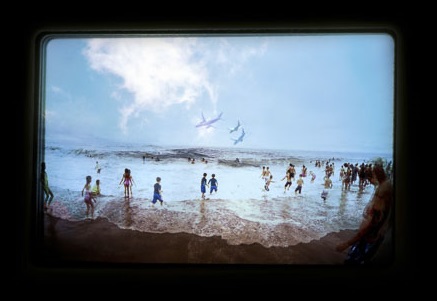
mark-reamy-portfolio-page-003-croppedImage 3. Wave (2015)

x

mark-reamy-portfolio-page-004-croppedImage 4. Michigan (2016)

x
 x
mark-reamy-portfolio-page-005-croppedImage 5. Neighbors (2016)

x
x
mark-reamy-portfolio-page-006-croppedImage 6. Parking Lot (2016)

x
x
mark-reamy-portfolio-page-007-croppedImage 7. Window (2015)

x
x
mark-reamy-portfolio-page-008-croppedImage 8. Corner Lot (2016)

x
x
mark-reamy-portfolio-page-009-croppedImage 9. Development (2015)
x
x

mark-reamy-portfolio-page-010-croppedImage 10. Thoroughfare (2015)

x
x
mark-reamy-portfolio-page-011-croppedImage 11. Canal (2016)

x
x
mark-reamy-portfolio-page-012-croppedImage 12. Strip Mall (2014)

x
x
mark-reamy-portfolio-page-013-croppedImage 13. Resort (2015)

x
x
mark-reamy-portfolio-page-014-croppedImage 14. Mountainside (2015)

x
x
mark-reamy-portfolio-page-015-croppedImage 15. Beach Day (2016)

x
x
mark-reamy-portfolio-page-016Image 16. Light Cubes (2016)

x

x
Hailing from the Midwest, Mark Reamy received his MFA from Cranbrook Academy of Art in 2010. Since graduating, he balances freelance commercial work with his studio practice. Whether it’s rebranding local companies, illustrating a children’s book for Jay-Z and Beyonce Knowles, or exhibiting an eight-foot disco ball, Reamy engages his audience within a collaborative, curious, and contemplative spirit.

After an artist residency tour of the United States throughout 2015, Reamy received the Staff Artist Fellowship at the Vermont Studio Center, where he will reside throughout 2016. He will also be an artist-in-residence at the Youngeun Museum of Contemporary Art in South Korea in 2017.

x
x

Mar 182014
 

goinghomeNC

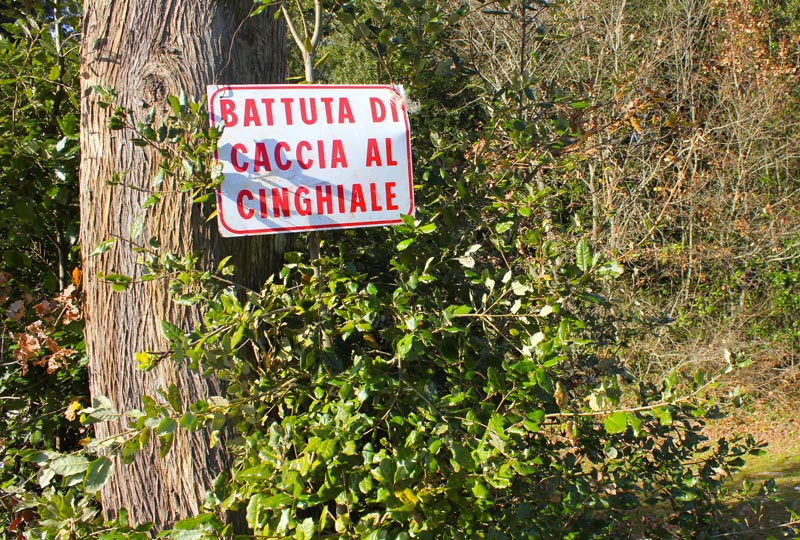
In the heart of Tuscany the age-old rite of the hunt for wild boar rages long and lethal. Every Saturday and Sunday from November through January hunters converge in the hilly country spreading beyond the shadow of Siena’s Duomo. Men gather—no women in their number—with dogs and rifles, knives and bullets, walkie talkies and cell phones. Outfitted with modern equipment, today’s hunters are but a few in the long line that stretches back through the Renaissance and the Middle Ages to the days of Caesar and Odysseus. Ancient Roman reliefs depict boar hunts, while one tale recounts how the ancient Greeks baptized an island in honor of the beast; this was Kapros, now called Capri.

HoundsNC

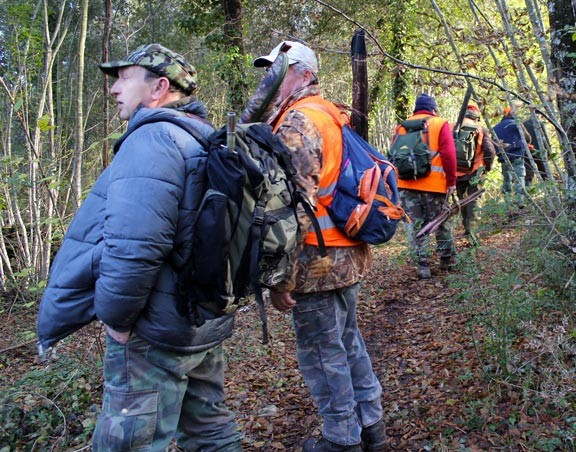
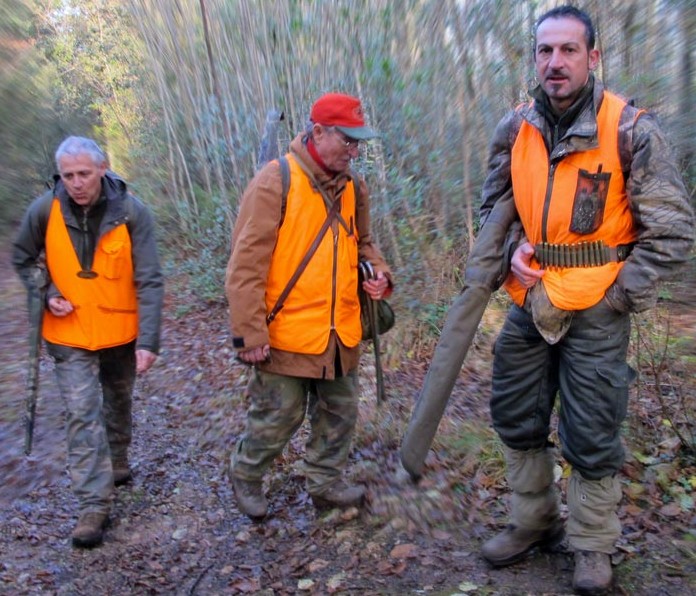
This morning, to one side of Monte Maggio, or May Mountain, men section off fields and cassocks, swells and dips. They pull numbers from a bag, assigning post to pursuant. Then the fifty or more shooters, tiratori in their camouflage, wind through the woods. For kilometers they tramp, then for hours they wait in their appointed spots along one side of the drifts and dales, rifles skyward. When a boar draws near they shoot ahead, never sideways, where fellow tiratori hide. No friendly crossfire tolerated. Meanwhile, twelve canai, doghandlers with their packs of sniffing hounds and growling terriers, park their jeeps on the far side of the woods and set off across the expanse toward the line bristling with tiratori. Scouring and routing, the men and their dogs startle and flush the boar, propelling them forward.

Boar Hunt Underway

Boar Hunt Underway

On the periphery of this elaborate orchestration today: my father-and law and I. I’m armed with my camera and am tolerated only because my father-in-law is a hunter of long standing. “We don’t want to end up on the front page of the animal rights group paper,” his comrades say in jest, but just barely, when they learn that he’s brought me here to take photos of the hunt. Siena with its Palio where horses are often injured in the famous race around the square in town already attracts a fair share of unwanted attention by animal rights advocates.

EntranceCelsaNC

CelsaNC

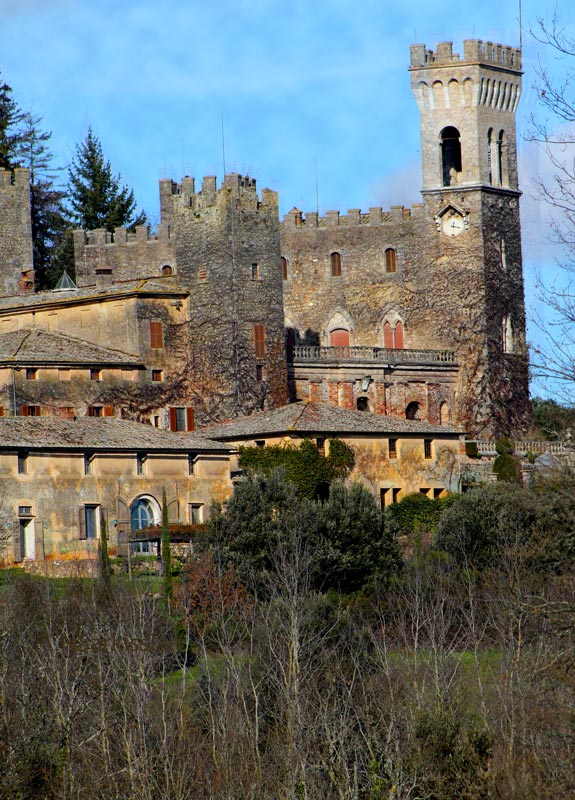
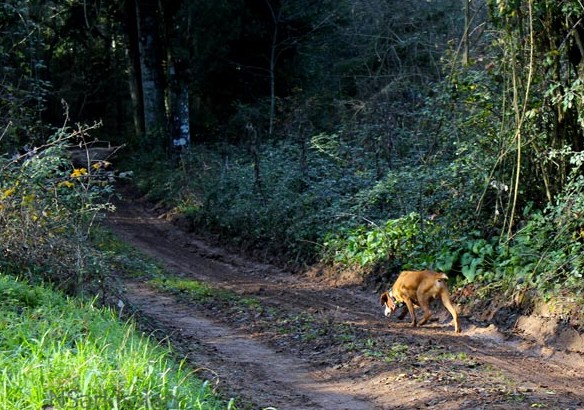
Today the canai’s dogs rootle through the woods above Celsa castle. The owner is an Aldobrandini prince who lives in Rome. Weathered marine pine line the avenue to the entrance. Someone has opened a couple of windows facing the sun. In the summer the castle is open to the public but now I wonder if the prince has come to his country estate for Christmas vacation. Or perhaps a maid is simply airing mildew out of the stony rooms on a bright and sunny winter’s day.

HoundRoadNC

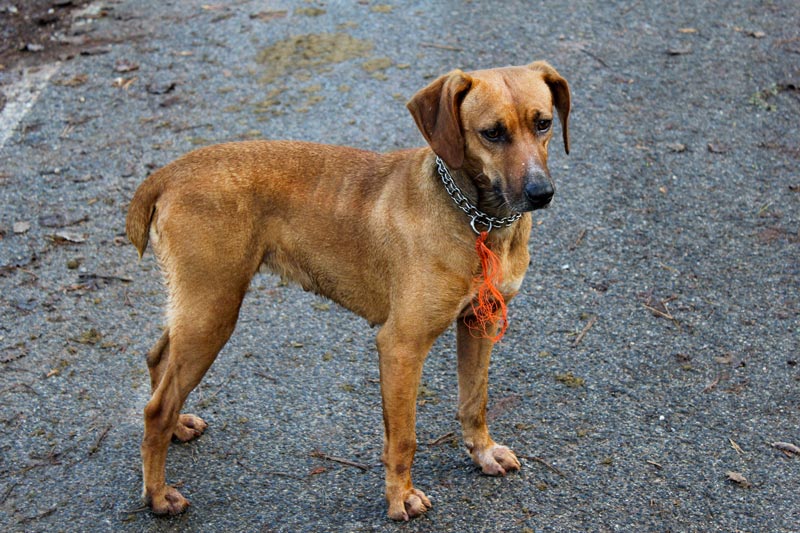
Hounds howl and bark and then several shots ring out. One who has lost the scent emerges onto the road near the abandoned carabinieri station that once controlled the area. When Monte Maggio was a tougher place, three-quarters of a century or more ago, bandits lurked here and the carabinieri chased them. After that, during the war, partisans hid in the caves. The Black Shirts and Germans hunted them.

The dog runs in circles, nose to the pavement. A woman in a Jeep spots it. She tries to lure it into her vehicle with a length of jerky.

“Scandalous,” she says. “Poor dog could get hit out here on the road.”

My father-in-law suspects she’s part of an animal rights group. He thinks she’s trying to sabotage the hunt by rounding up the dogs.

“But I bet she eats meat,” he says. “Probably pappardelle with wild boar. Take a picture of her license plate.” Then he pulls out his phone and calls il duca—the duke—one of the canai. The man’s not really a duke; it’s a nickname he’s earned one way or another. I suspect it has something to do with his less than genteel ways.

“A lady’s trying to lure one of the hounds into her car,” my father-in-law says. “Over here, on the road by the carabinieri station. We’ve got her license plate number. But maybe you should send someone over.”

I can hear il duca cursing into my father-in-law’s ear. No run of the mill obscenities though; he insults saints and the Virgin. Then he wants to speak to the lady. My father-in-law passes the phone over. It turns out that il duca and the lady know each other.

“Okay, I won’t. But get it off the road,” she says into the phone. In the meantime, the hound has already run off, back into the woods, having found the scent.

HoundonTrailNC

TuscanfarmhouseNC

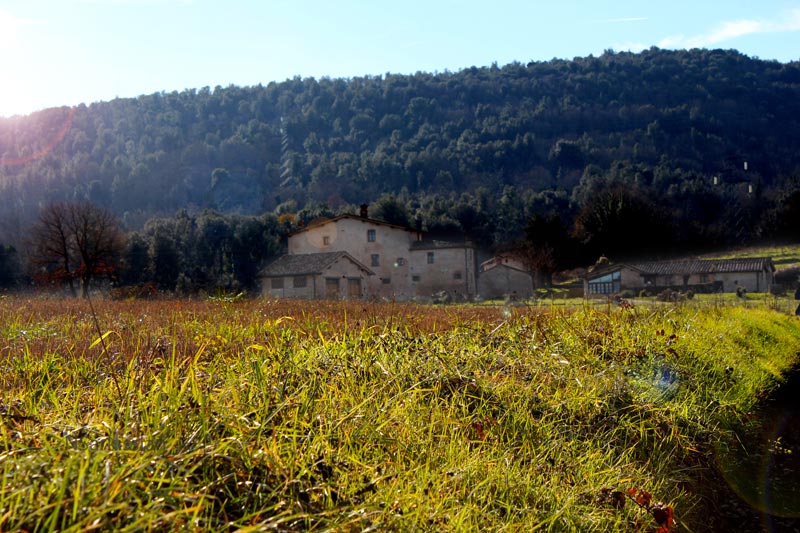
My father-in-law started hunting here when he was eighteen. Sixty-seven years he’s been hunting. At first, he hunted for hare and pheasant. He kept his own bird dogs—Jack and Tom, English names for Italian hounds—in a pen behind an old stone farmhouse. Then in the sixties when boar populations grew and overran the woods, he gave up Jack and Tom and turned to boar hunting. He loves the woods out here on Monte Maggio. He knows every centimeter. He comes when it rains, when it snows, when it’s warm and sunny like today. He’ll still keep coming as long as he’s able. He’s not sure how much longer that will be. He won’t think yet about when the hike, the interminable wait, the bad weather and the mountain itself will conspire to keep him home.

GrassSheepPDL

He goes to the woods for the peace, he says, and for the camaderie after. But best is when he’s the one to bag the prey. You can tell when the boar approaches. The dogs’ howling grows loud, the brush and bramble tremble. You take up your gun and aim, but only when you see the boar’s dark eyes. If you shoot into the waving thicket you risk killing a dog. You face that beast—black and fierce and angry, ringed by thirty or more frenzied dogs.

I imagine the jolt. I think the hunter’s heart must whip like pine boughs in a windstorm.

“No,” says my father-in-law, “it’s not like that. At least not for me anymore. You feel a strange sensation, but it’s more wrapped up with blood and life, the ebb and flow.”

“I see,” I say even if I don’t quite.

We find a break in the woods. “Here,” my father-in-law says. The hunters will pass by on their way back to their cars, parked on the rim of the road behind us. “We’ll wait here. Then you can shoot them as they hike through.” He grins. He likes how we’ve turned the tables on the hunters. I grin back.

We wait. Then we wait some more. While we wait we pull ivy off old oak and pine. Bark flies, red bugs scuttle, the air fills with sap, the sun shines through branches in filmy snatches. “Is this what it’s like,” I ask him, “when you’re a tiratore? Do you tend to the trees then too?”

cinghialtrio1NC

“No,” he says. “Not when you’re stalking boar. You can’t make noise. You can’t smoke. You can’t eat. You can’t even pee. You wait ever so quietly for that one brief moment when you squeeze off a shot.”

DraggingboarNC

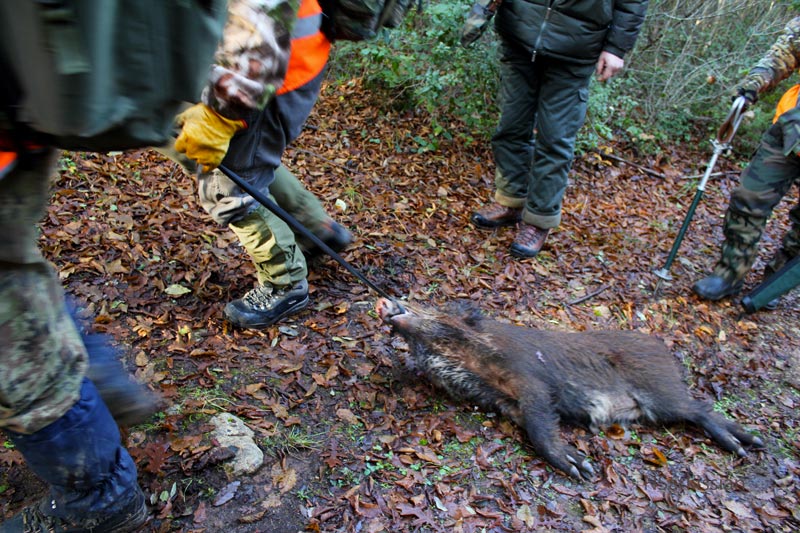
After an hour or more, we hear voices. Men surge forward. One short, chubby hunter, a middle-aged man nicknamed Smilzo, or Skinny, drags a small boar up the path. My father-in-law thinks Smilzo’s boar may weigh 30 kilos—if that. Since Smilzo shot it, he will get the ears, tail, heart, liver, kidneys, lungs and tusks in addition to his share of the meat which will be divided equally among all hunters present. “In Tuscany,” he says “no part of the boar goes to waste. Make sure you write that.”

We follow the hunters to their shack in the woods. They roast sausage and steaks they brought from home, drink Chianti and exchange tall tales. My father-in-law recounts how we rescued several dogs from an army of animal rights do-gooders. Listening, il  duca insults several more saints. Smilzo describes how his boar almost tore his leg off. Feroce, or Ferocious, a small man whose real name no one remembers, scoffs. Burlacche, or Wiseass, jokes about Smilzo’s small boar and how it couldn’t have torn off a toenail.

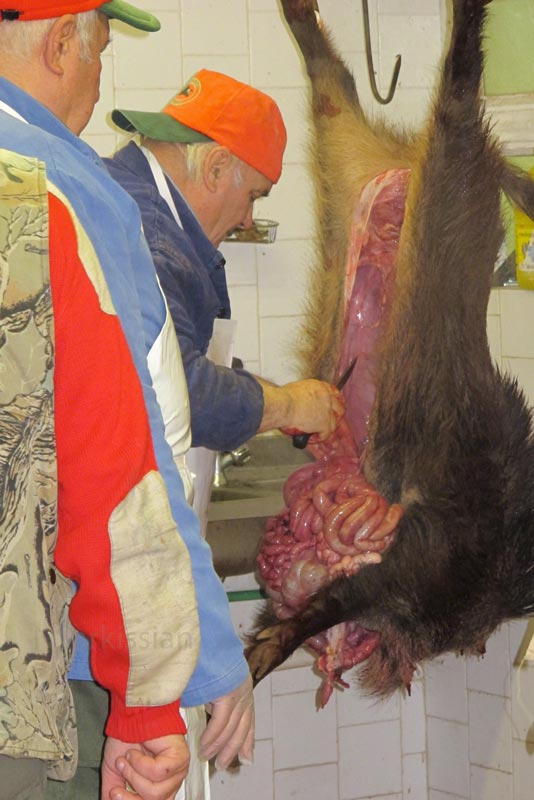
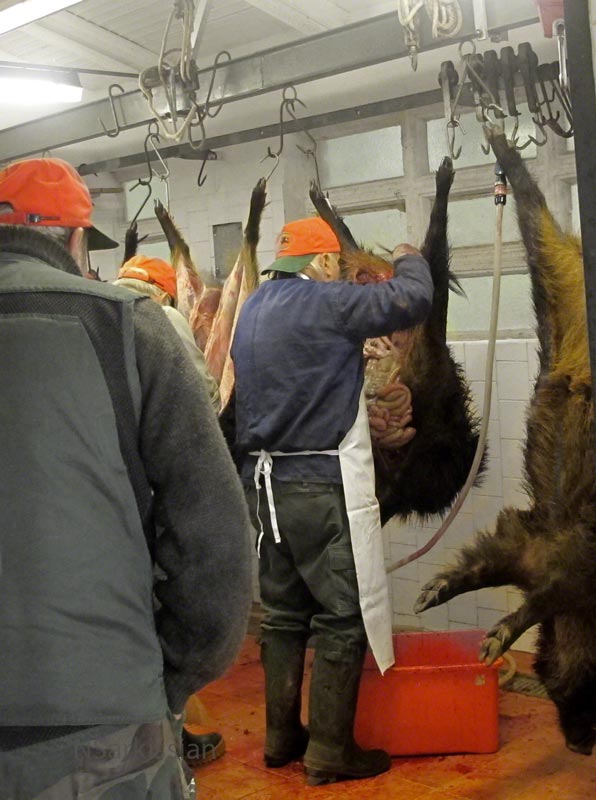
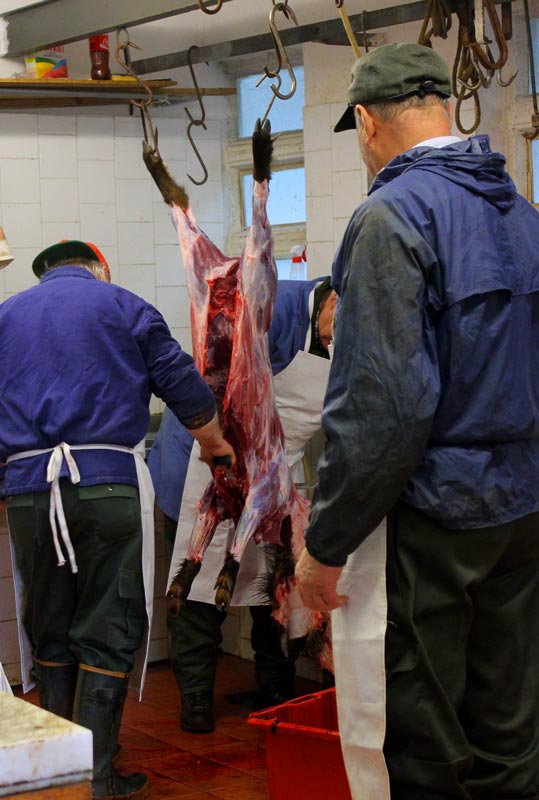
butcherngNC

butchersNC

CingSkinnersNC

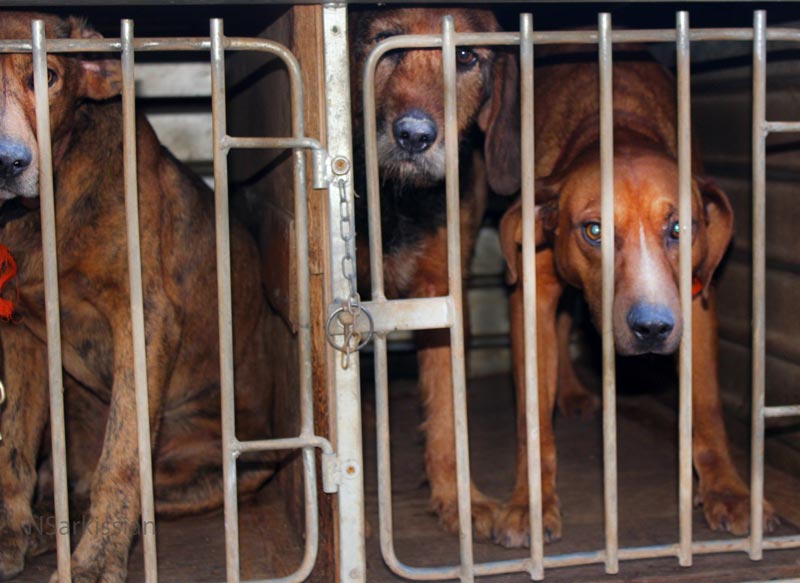
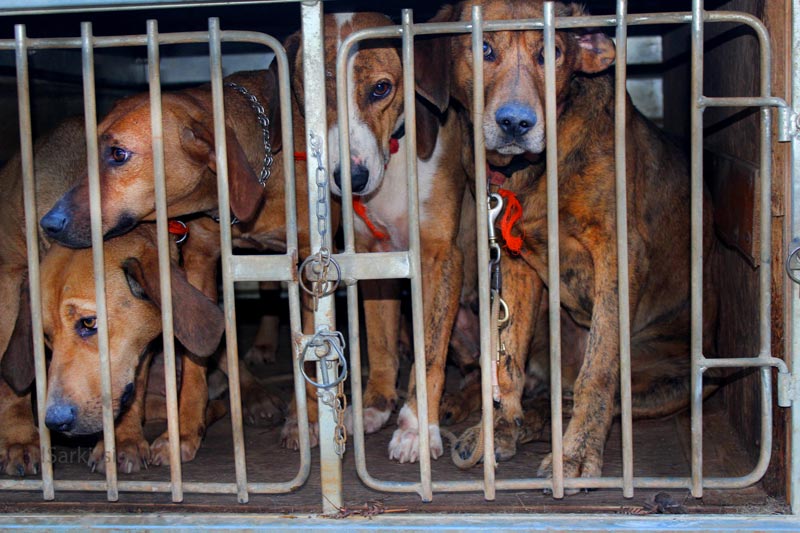
Butchers gut and section the carcasses. Hunters light cigars, cigarettes and pipes. Hounds wait in small trailers, their noses poking out through bars. Two canai discuss returning to the woods with their dogs to look for a boar that someone swears is wounded.

My father-in-law’s cell phone rings. It’s my mother-in-law. She’s been keeping lunch for us even though it’s almost 4 p.m.

Hounds1NC

“You get what you need?” my father-in-law asks. I nod. We say goodbye to il duca, Smilzo, Feroce, Burlacche. On the way home he tells me the menu. Polenta with stewed wild boar that he shot last season.

“Okay,” I say. I realize I’m hungry after hours of tramping through the woods. Eating the kill is part of the ritual. And my mother-in-law is an ace at stewing boar. It’s fiery and rich; red pepper in the sauce is one of her secret ingredients, a tribute of sorts to the animal itself.

CountrysidePiniNC

When my father-in-law and I first met, he wasn’t sure how he felt about having a foreigner in the family. I wasn’t sure how I felt about someone who thought killing was a sport. Over the years we’ve gotten to know each other. Now he’s warm and proud to show me where he loves to spend his weekends from November through January. And I’m glad to have had the chance to witness this chapter in his life, one that won’t go on forever.

 —Natalia Sarkissian

Natalia Sarkissian

Natalia Sarkissian has an MFA in Writing from Vermont College of Fine Arts and has been an editor and contributor at Numéro Cinq since 2010. Natalia divides her time between Italy and the United States.


Sep 142013
 

Abdallah Ben Salem d'Aix

Numéro Cinq is pleased to introduce the Algerian-born photographer (now living in France) Abdallah Ben Salem d’Aix. I became friends with Abdallah several weeks ago on Facebook[1], and was drawn immediately to his pictures of flowers, which reminded me of freeze-frames from a deeper, more vibrant, twenty-first century version of Stan Brakhage’s The Garden of Earthly Delights.
When I asked Abdallah to describe his process for the series of twelve breathtaking images that we are proud to feature this month, he wrote:

First, while walking to the site, the lake or on the mountain, I collect dead leaves, petals, plastics…everything tiny, which, in a brief moment, has a self sufficing and sweet “presence” while playing with the Light and the “perfume” of that day. Second, the “Theater”: the support (mirrors, sheets of papers, material) is my little scene or stage, under the shadow of a tree. Third, the Play: I just shake, animate; left hand, the support and the hints; right hand, the camera. Light is decisive; sometimes, I have to wait, while reading or in reverie until the twilight. Fourth, the Images: they have to be cute, strange, “farcesques,” easily lisible, pleasant.

—Eric Foley

1 Neighbours as myself

Neighbours as Myself

2 Out Without Môm

Out Without Mom

3 salad day!...

Salad day!

Summer schemes When friendly summer calls again, Calls again… Thomas Hardy

Summer schemes when friendly summer calls again, Calls again… Thomas Hardy

The Road

The Road

“the soul without a name was in a terrible plight in the other world” (of course)

“the soul without a name was in a terrible plight in the other world” (of course)

“turn the other cheek”

“turn the other cheek”

When I Was Don Quichote

When I Was Don Quichote

Out of Hell

Out of Hell

Swift’s Stella & Vanessa were both named Esther

Swift’s Stella & Vanessa were both named Esther

Noblesse de l’Échec

Noblesse de l’Echec

Jacques Rigaut is not dead

Jacques Rigaut is not dead

—Photos by Abdallah Ben Salem d’Aix

—————————————

A Brief Autobiography of Abdallah Ben Salem d’Aix

1949—I’m three years old. Death of Dad. “A hero.” During the WWII, he saved his French officer severely wounded. Medals, medals. 1962—End of the Algerian War. Family divided. Mother, a maid, preferred to follow her gentle employer, Mme Martin, and Mab, Mess and me, too. We, the children, have been Witness of the cruelties of the Adults of the Two Sides. Out of Hell! 1965-1969—Comedian, activist (Vietnam). During a year (Aix), training with J. Grotowski and his assistant Serge Ouaknine, (now in Montreal, and on FB). At night, drinking with the Ionesco’s (Madame Ionesco buvait du thé, elle). 1969-2001—Psychiatry—I work as a nurse, at first with psychotics, then the last ten years in the department for Alcoholics. 2001-2013—Travels. Algeria? No, thanks, no return, I prefer not. Shame. Mother was berber!…I prefer Greece, Crete, my future and last homeland, I hope. And the photos? I am an autodidact. No skill (to kill) (pardon), but rather a ritual with everything I find on my way, everyday. No studio, but always outside. Depressed when thunderstorms. Yes, the Wars. My heroes now? Robert Smithson, Annie Dillard, Goya, Chekhov…

A bientôt.

A.

Editor’s Note: You can follow Abdallah Ben Salem on his Tumblr blog here or friend him on Facebook here.

————————————————-

Eric Foley holds an Honours BA in English and Literary Studies from the University of Toronto and an MFA from Guelph University. He has been a finalist for the Random House Creative Writing Award, the Hart House Literary Contest, and the winner of Geist Magazine and the White Wall Review’s postcard story contests. His writing can be found online at Numéro Cinq and Influencysalon.ca. He lives in Toronto and divides his time between his writing and teaching at Humber College

Footnotes    (↵ returns to text)

  1. Editor’s Note: Abdallah Ben Salem is one of those NC readers who have really made the effort to join the community. He friended us on Facebook and then shared many NC posts on his own wall. He “liked” and commented regularly. When a person makes that kind of gesture, NC often reaches back. In this case, the results are spectacular.
Jun 032013
 

Umbrellas 

“You should choose the finest day of the month and have yourself rowed far away across the lagoon….”

Henry James, Italian Hours, 1909

.

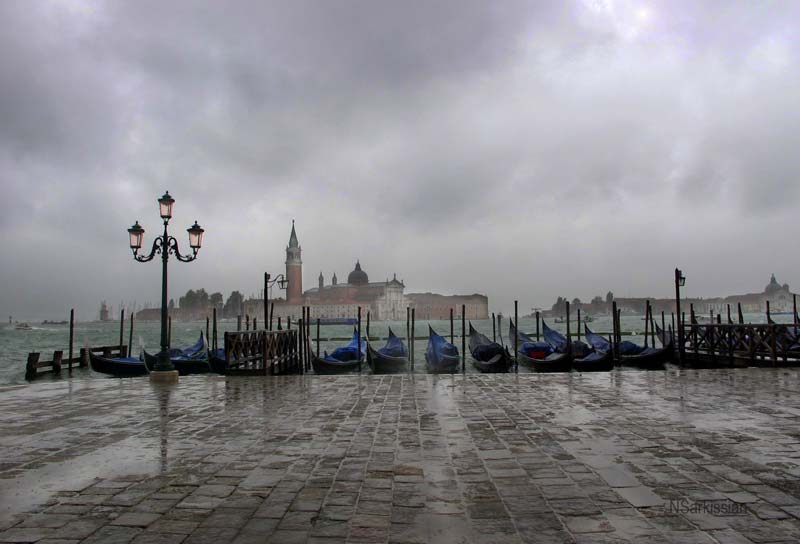
SanGiorgioClouds

It’s five a.m. in Milan and my alarm rings. Outside I hear rain beating on my windows. I mute the clock and sling a leg out of bed. I’m going to Venice on the 6:30 train even though the entire Italian peninsula sloshes like an overflowing bathtub.

I stumble for the shower—some hot water to wake me up. And then for the espresso maker. Soon I’m ready and out the door. Dark clouds spit raindrops like shrill warnings. The wind upends my umbrella.

On the train, map open, I review my Venetian attack. So many have been to Venice, photographed Venice, written about Venice—from Michel de Montaigne to Byron and Dickens and Browning and Ruskin and Henry James and Mark Twain and Hemingway (and many in between and afterward) and I’m following in their footsteps.
Cad'oro

.

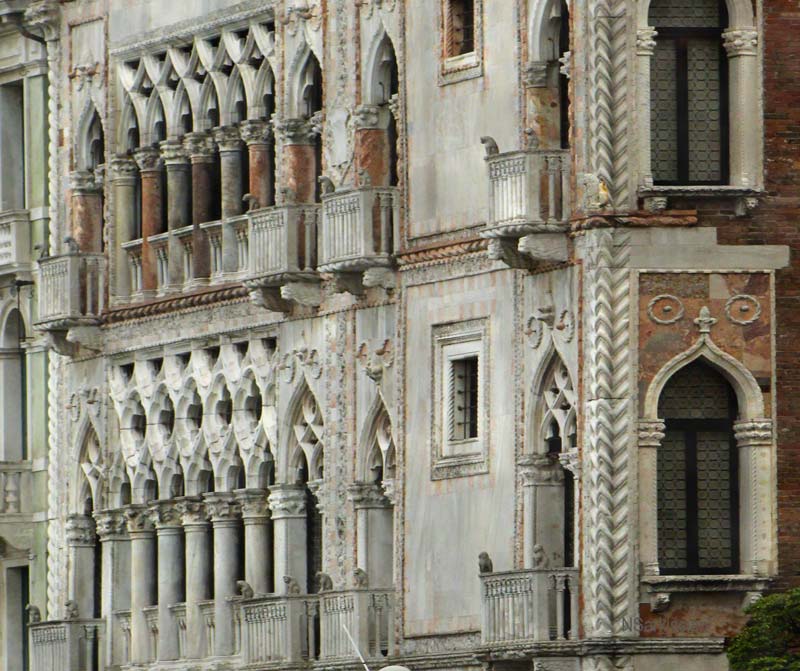
Cà d’Oro — “A noble pile of very quaint Gothic, once superb in general effect.”

John Ruskin, Stones of Venice.

.

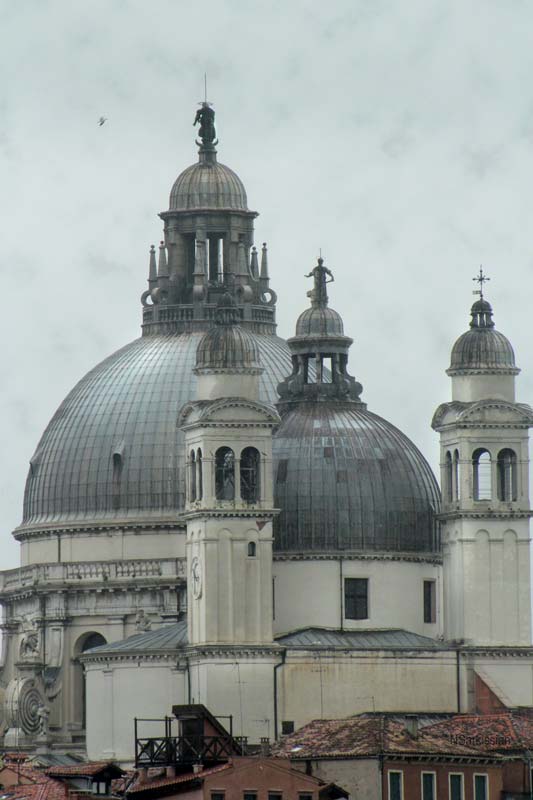
SantaMariadellaSalute
.

Santa Maria della Salute — “…the grace of the whole building being chiefly dependent on the inequality of size in its cupolas, and pretty grouping of the two campaniles behind them….”

—John Ruskin, Stones of Venice.

.

Today I’m on the trail of Henry James and John Ruskin. Both men loved Venice and visited it often. Ruskin documented his passion for the city in several tomes, most notably the Stones of Venice, a three-volume best-seller when it was published mid-century (1851-1853). In the later part of the 19th century, James wrote a series of essays for journals about his stays in Venice (as well as other Italian cities) which were compiled into the 1909 Italian Hours.

I plan to take pictures of the palaces and churches and squares both men loved as well as those they abhorred, and accompany the photos with their words. I locate the Cà d’Oro, a palazzo Ruskin liked, and circle it on the map for easy reference later. I find Santa Maria Formosa, a church whose architectural flights disgusted him, and circle that too. And I star the location of the Ducal Palace, a building both men loved. I plan to chug along the Grand Canal in a vaporetto, not an elegant vessel, but serviceable and cheap when compared to the eternally classic gondola. From a perch in the prow I’ll take photos. I’ll have more than ten hours; I arrive in Venice at 9:30 am and my return won’t be until 7:50 pm. With so much time at my disposal I’ll be sure to get my shots right. And while I’m shooting, I’ll spend a marvelous day like others I’ve spent in the city. I’ll revel in the light, the merging of sea and sky, the shining domes, the golden lions glinting from columns, from lintels, from façades.

Although. From the sound of the reverb on the roof of the train—fortissimo like Ligeti’s The Devil’s Staircase—the rain doesn’t seem to be abating. And we’re in Padua with just one more stop to Venice. But I won’t worry yet. A lot can happen in a few kilometers. And no doubt the rain won’t hold too long in Venice. After all, this is the city that James said was mutable “like a nervous woman whom you know only when you know all aspects of her beauty. She has high spirits or low, she is pale or red, grey or pink, cold or warm, fresh or wan….” [Italian Hours.]  So if flighty, changeable Venice starts out wet, she’ll soon turn dry. Right?

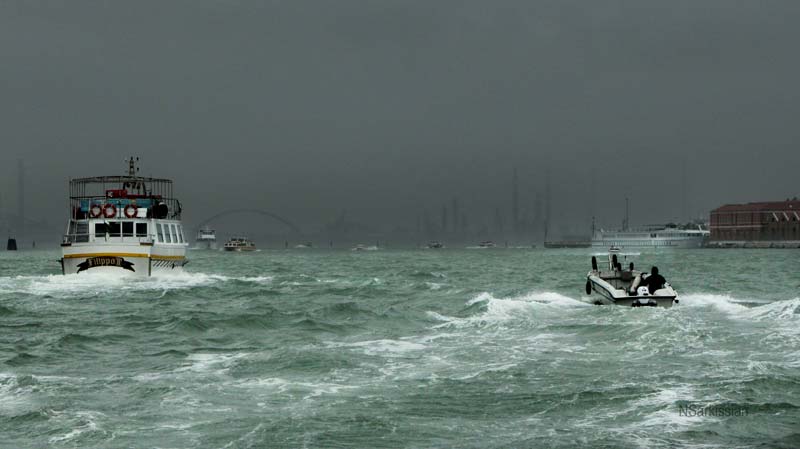
Just as I’m quitting the train station the storm worsens. I fling myself onto a vaporetto for cover without paying attention to which one. And so, instead of threading through the Grand Canal that snakes through the city’s protective embankments like I planned, the boat I’m on veers wide, toward the wind-tossed sea. Waves soon blast over the bow. Water drums in at a slant. My hair is soaking but at least my camera’s (relatively) dry; I thought to wrap it in a plastic shopping bag before leaving the train.
VeniceLagoon

Like an ungainly walrus, the boat plows onward through the swell, past the fish market, some cranes, a garbage vessel. It carves a leftward swathe in the green sea near smokestacks, circles the city’s outskirts and finally, approaches those genteel structures that have entranced visitors for centuries. I spot the onion-shaped outlines of St. Mark’s five domes, off in the soggy distance. No inimitable views in my viewfinder quite yet, but as soon as I’m in the vicinity I’ll nab some. That is, rain permitting. Right now it’s lashing those of us foolhardy enough to stand in the prow. I see that droplets now splotch my lens; I need to clean it, pronto, but have nothing dry at hand.
Approachfromsea

.

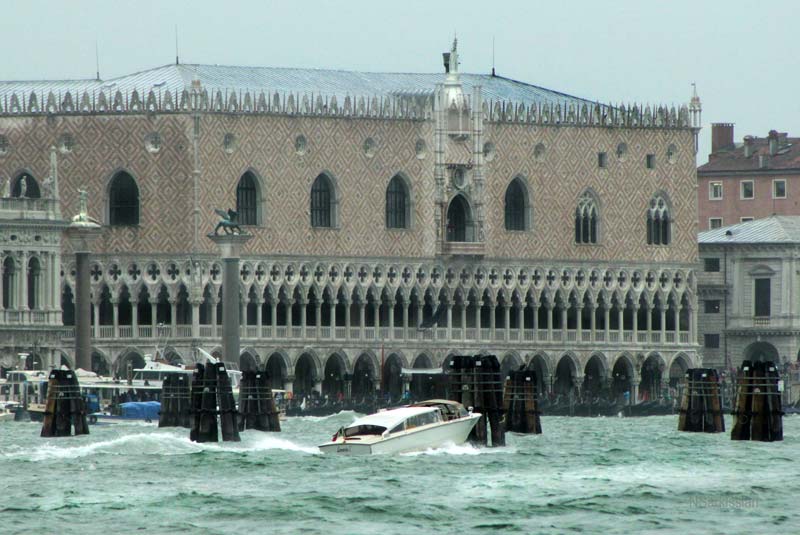
The Ducal Palace — “the central building of the world….”

— John Ruskin, Stones of Venice

.

The boat rounds the Isola della Giudecca. St. Mark’s Basin churns with waves and whizzing motor boats. There I spot the mouth of the Grand Canal, gaping like a toothy eel. There’s Santa Maria della Salute with her stately steps, a large white pearl gleaming in the mist. And San Giorgio Maggiore with its Palladian façade and soaring campanile, a gushing brick and marble proclamation. And on the opposite shore, the Ducal Palace, Ruskin’s model of all perfection in architecture, “the central building of the world.” [Ruskin, Stones of Venice] But I’m not immortalizing anything with my camera yet. I’ve got the water-splotched lens twisted off and, in spite of the downpour, am switching it for one that’s clean.
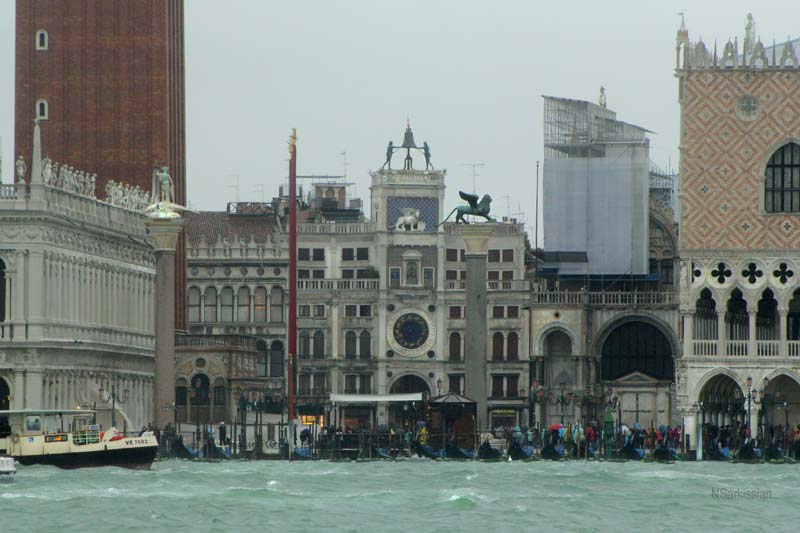
PiazzaStMarcoDalMare

.

View of the Piazzetta — “We pass into the Piazzetta to look down the great 
throat, as it were, of Venice …”

—Henry James, The Grand Canal

.

When the boat stops at San Zaccaria, not far from St. Mark’s, I hop off and flick my umbrella open. I navigate slick alleys to the Campo Bandiera e Moro where I find the Palazzo Badoer, “a magnificent example of 14th century Gothic, circa 1310-1320, anterior to the Ducal Palace showing beautiful ranges of the fifth-order window….” [Ruskin, Stones of Venice].

Palazzobadoer

.

A magnificent example of 14th-century Gothic…. 

—John Ruskin, Stones of Venice.

.
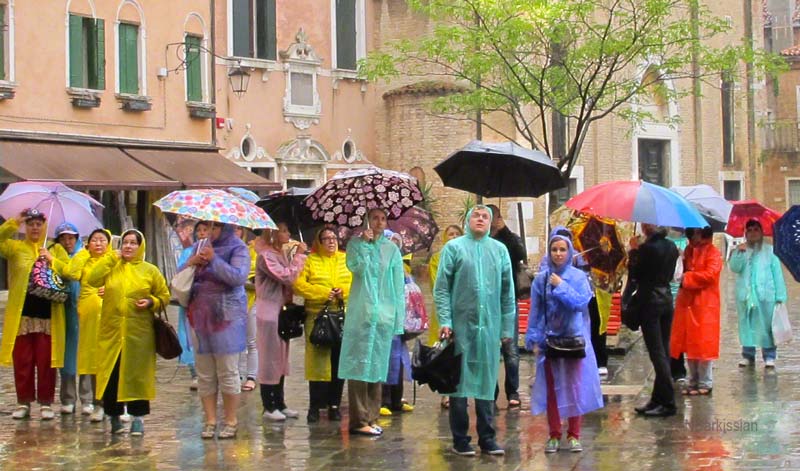
touristsCampoBandieraMoro

But a tour group stands between me and my picture. Like me, they were caught ill-prepared for the weather and have bought bright raincoats from a street vendor. Unfortunately their plastic wrappings seem to keep them dry because they continue to stand listening to their guide with rapt attention. While I wait I find myself agreeing with James who wrote: “The
 sentimental tourist’s sole quarrel with his Venice is that he has 
too many competitors there. He likes to be alone; to be original; 
to have (to himself, at least) the air of making discoveries. The
 Venice of to-day is a vast museum where the little wicket that 
admits you is perpetually turning and creaking, and you march 
through the institution with a herd of fellow-gazers.”  (Italian Hours).
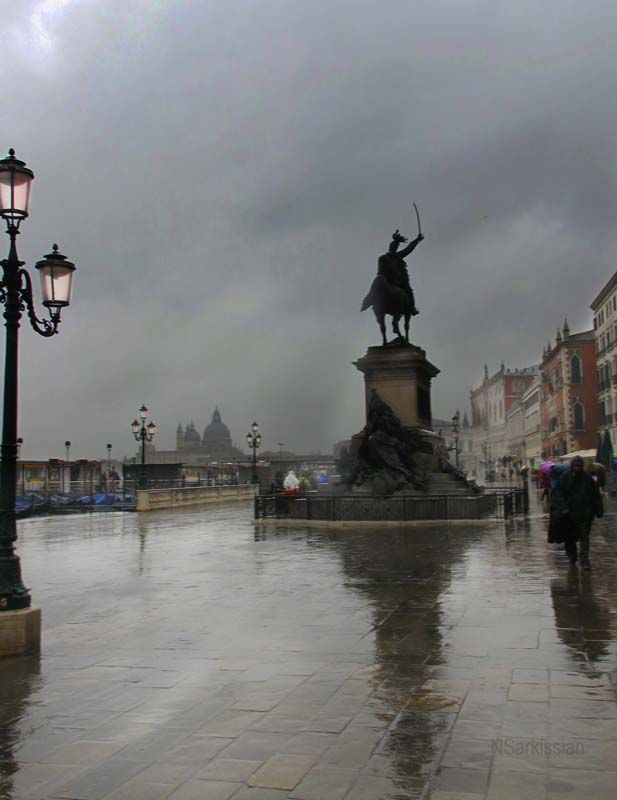
Equestrian

.

Riva degli Schiavoni — [From his rooms here] “the waterside life, the wondrous lagoon spread before me…”

—Henry James, Italian Hours.

.

Then I head down the glistening Riva degli Schiavoni toward the center of the universe—the Ducal Palace and St. Mark’s. As I go, my shoes squelch—not rainproof after all—and my coat flaps like wet wash on the line. My camera’s dry inside my shirt but then, in a rush of air, my umbrella flips its underbelly and entrails up. Flapping, I grab at the nylon and wrench it down but not before I douse myself.
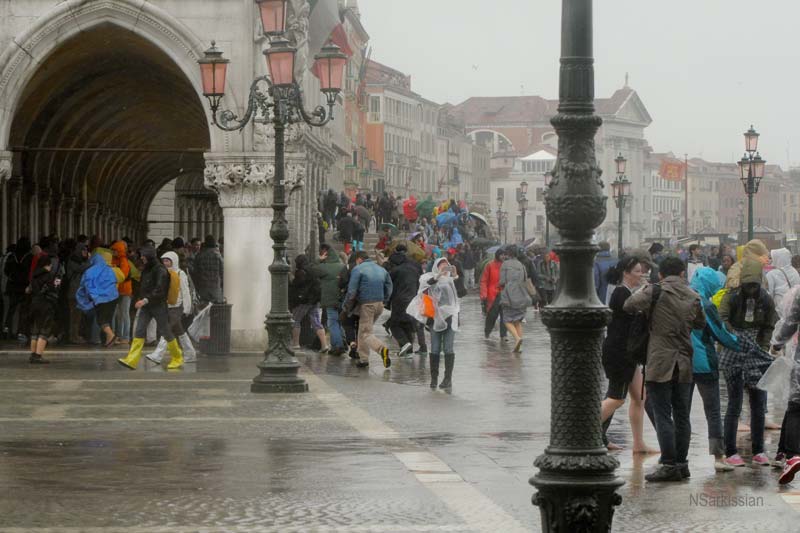
Mayhem

Dripping, I decide to abandon my plan—at least temporarily—of tracing Ruskin’s and James’s footsteps through the city. Under the loggia ringing the Palazzo Ducale, I merge with a horde of fellow Venice-gazers standing in line for the Manet exhibition: a way to stay dry and warm. No photographs are allowed of the interiors of the sumptuous rooms of the Ducal Palace themselves, but the courtyard is fair game.

ArchPalazzoDucale

.

Courtyard view — “Within the square formed by the building is seen its interior court (with one of its wells)….”

—John Ruskin, Stones of Venice.

.
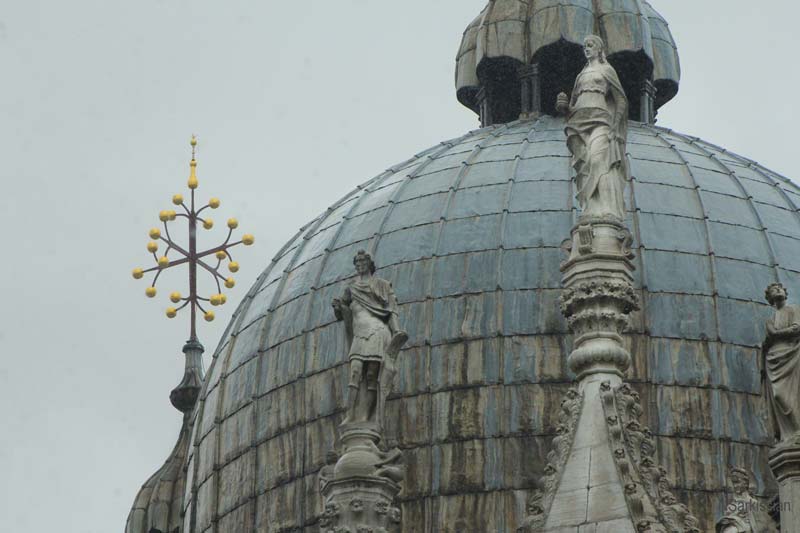
DomePnnclesStMarks

.

A dome and pinnacles of St. Mark’s from the Ducal Palace courtyard — “All European architecture, bad and good, old and new, is derived from Greece through Rome, and coloured and perfected from the East. The history of architecture is nothing but the tracing of the various modes and directions of this derivation.”

—John Ruskin, Stones of Venice.

.

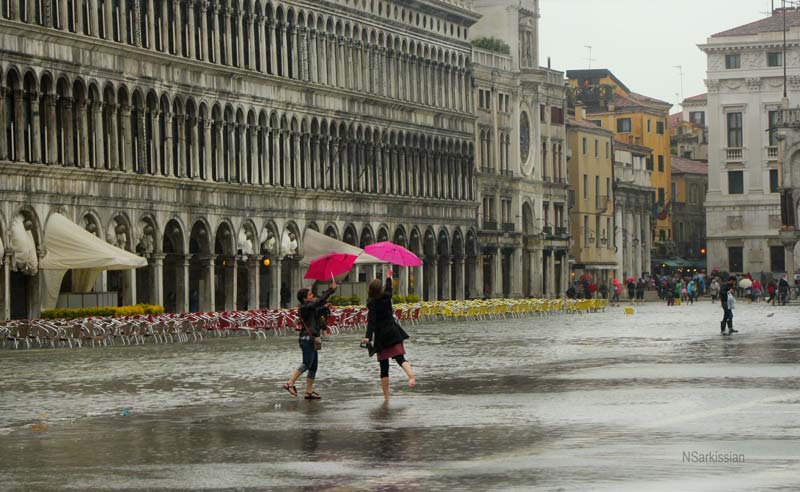
After an elbow-to-elbow tour of the small show and a bit of yellowed mozzarella and wilted lettuce in the teeming cafeteria, three hours later I emerge into St. Mark’s Square. The rain has stopped. With the reprieve from the wet grimness of the morning, a charge of excitement pulses through the crowd outside, a jumped up beat, verging on hysteria. And I see that many of the hooting visitors are stripping themselves of their shoes. Because now the square is filling with the sea.
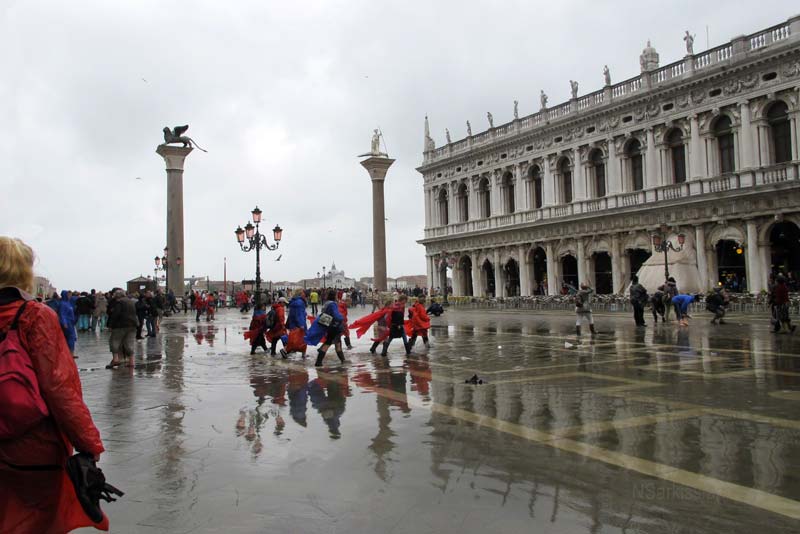
RedcoatsLibrary

.

St. Mark’s lion and St. Theodore atop columns in the Piazzetta — “Whether St. Mark was first bishop of Aquileia or not, St. Theodore was the first patron of the city; nor can he yet be considered as having entirely abdicated his early right as his statue, standing on a crocodile, still companions the winged lion on the opposing pillar of the piazzetta.”

—John Ruskin, Stones of Venice.

.
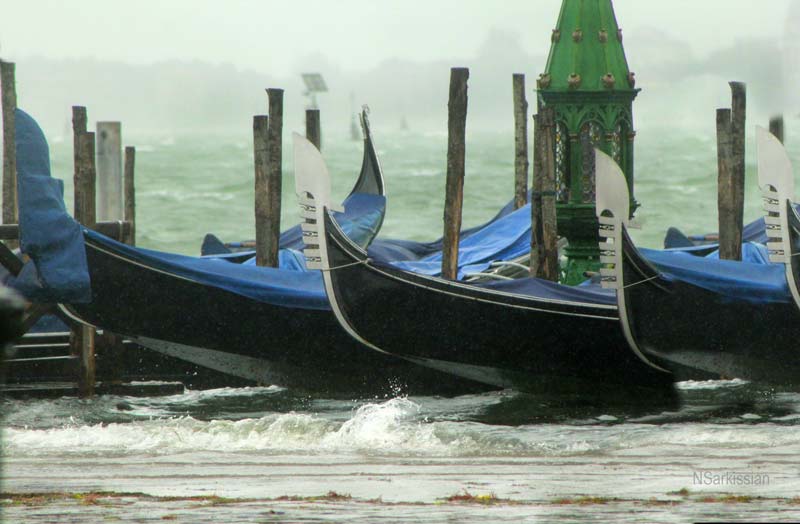
burrasca

Wind whips water over the embankment fronting the lagoon. Water bubbles up from holes in paving stones. I dodge the deepening rivulets, looking for higher ground while people around me dance and splash in the greening stuff that smells like rotting mackerel.

It starts to rain again. On the raised platform of the Library, under the loggia there, I find refuge from the flood. Protected by the arcade that’s higher than the level of the water, I skirt around one side of the square marveling at the show of people prancing through the water. And when I’ve had my fill, an hour later, I decide to catch that vaporetto I’d missed in the morning. I’ll go back to my original plan and take photos of palazzi along the Grand Canal. But there’s no way off the Library’s plinth. It has turned into an island. Rising water maroons me.
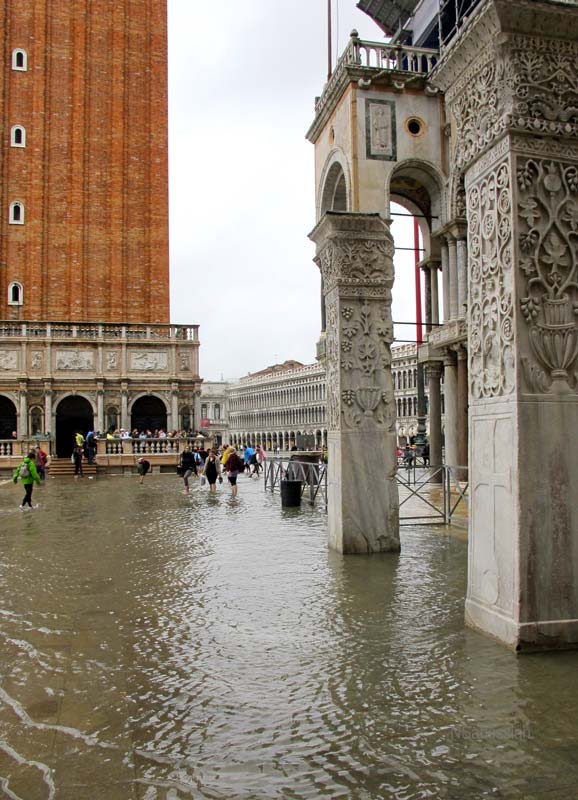
Campanile

.

View with the Pillars of the Piazzetta — “The two magnificent blocks of marble … [that] form one of the principal ornaments of the Piazzetta, are Greek sculpture of the sixth century.”

—John Ruskin, Stones of Venice.

.

FromAfar

A shopkeeper in a fancy jewelry store says the water will still keep rising. “Forecasts vary,” she says, “but we could get another 10 or 20 centimeters.” I can’t tell if she’s serious. She tells me to take my shoes off, roll up my pants and brave it. “This is nothing. In November the water rose to my waist,” she says, scoffing. “Bidet level,” she adds, batting her waist with her palm.

But I don’t want to wade through stinky deluge even if it is only ankle-deep. The water’s cold too. I’m cold. I want my boots. Why didn’t I wear my boots?
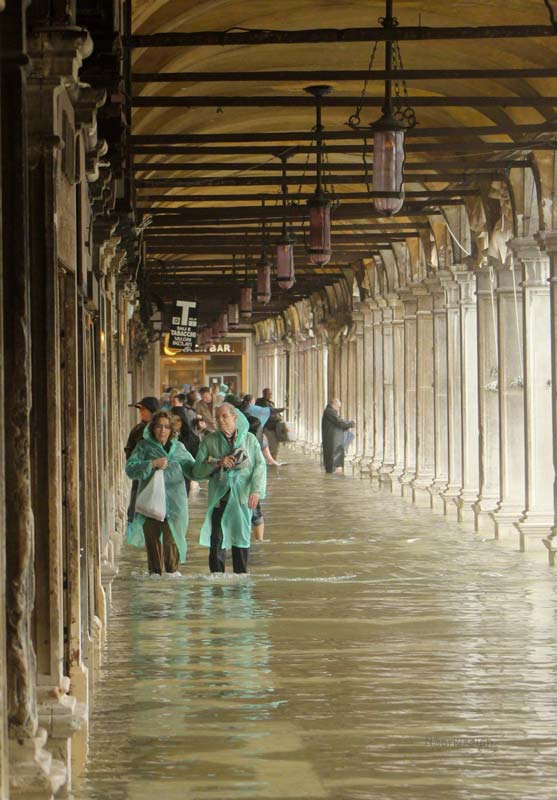
Greencoats

“Where can I buy some cheap rain boots?” I ask.

“I told you,” she says, rolling her eyes. “We’re cut off. Cheap boots are at the Rialto. And the way to the Rialto is flooded.”
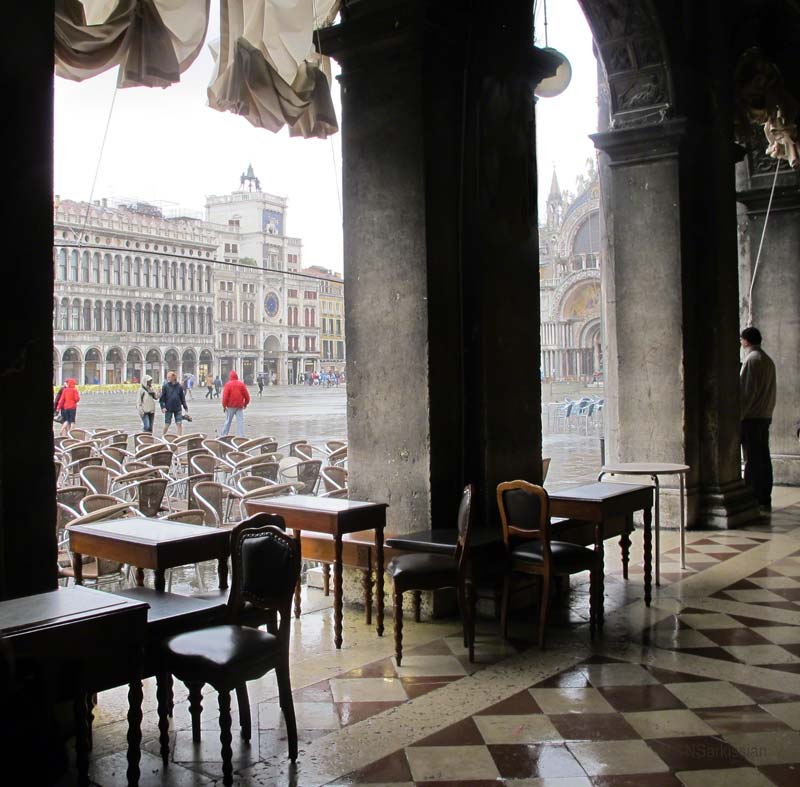
FlorianviewPiazza

.

Florian’s café — “I sat in front of Florian’s café, eating ices, listening to music…. The traveler will remember how the immense cluster of tables and chairs stretches like a promontory …. The whole place … under the stars and with all the lamps, all the voices and light footsteps on marble … is like an open-air saloon.”

— Henry James, Italian Hours.

.
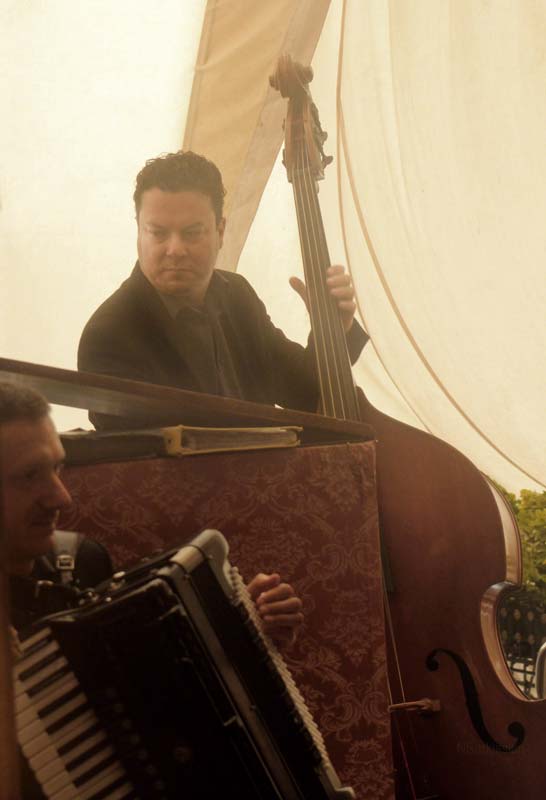
Musicians

I wander away, wondering what I should do. At Florian’s—where James and Hemingway and who knows who else once sat—I pause to listen to a quartet under a white canopy play the Titanic theme song. The bandleader has a sense of humor. I linger, reading the menu but nix a warming cup of cappuccino (over $10) as too expensive. Traipsing on, I watch people wade through water that is now over their ankles. The shopkeeper was right. The water’s still coming in. I’ll never get off my island unless I take my shoes off.

Chairs

But then I overhear a couple in new blue boots telling another couple with plastic bags tied around their feet that a boot sellers is a stone’s throw away. “Round the square,” they say, “cut through that glass shop at the end of the arcade. Go out the back door,” they say. “The alley beyond was still dry moments ago.” They stick their feet out so that their boots can be admired. “Only 12 Euros each.”

Having listened to their directions, I dash off—ahead of the bag-clad duo.
 Gondola

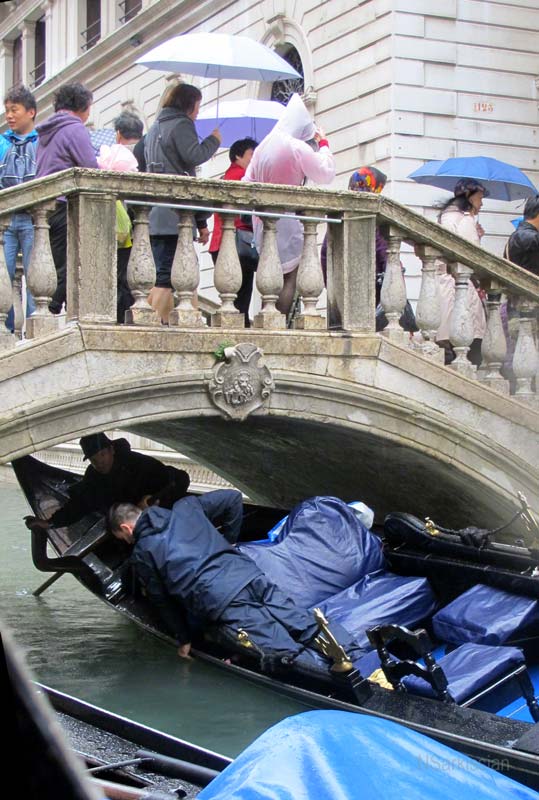
I find the glass shop. The owner frowns as I cut through to the back door and out into the alley behind. The alley’s puddling, but still traversable. It flanks a canal. In the canal water is rising. And in the canal there’s a gondola jam—gondoliers clog a passage under a bridge racing to bring tourists and boats back in. But they must lean and tilt their craft: 40 degrees, 50 degrees, 60 degrees. They risk spilling occupants and belongings. Tourists on board scream with glee, as if they are at a museum-cum-amusement park, which, as James noted over 100 years ago, they are. And I suddenly realize that for most of the day most of the gondolas have stayed lashed at their moorings; only the audacious have been out and about.

Leaving the stream of paddling boatmen, rounding the corner, I find the store with blue boots in the window. The price has gone up to 16 Euros. I stand in line, and, when it’s my turn I pay the extra without complaint. I’m just glad they have my size.

Newly booted, I splash to the embarcadero where I wait for my vaporetto. When the boat comes, I check my watch. It’s almost 7 pm. The hours have slipped by too fast. I’ll have time for just a one-way ride down the Grand Canal and a few shots of some of the palaces and churches I set out early this morning to admire.
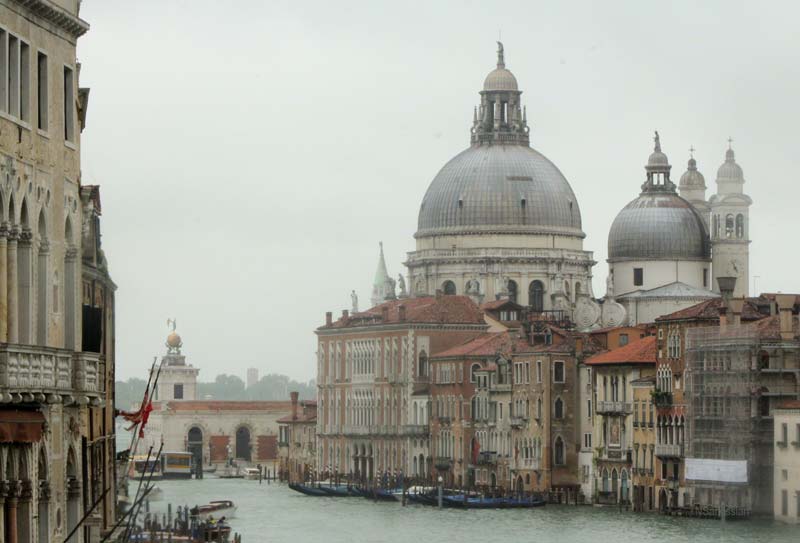
The Grand Canal

.

The Grand Canal – “The noble waterway that begins in its glory at the Salute and ends in its abasement at the railway station.”

—Henry James, Italian Hours.

.

I sink into a wet seat—it’s sprinkling. I think how this day’s touring of the city has been different from others I’ve spent. Drenched in Venice by Venice.  Inundated. With James and Ruskin for company.

The boat groans forward. Foam flies over the bow. We leave Santa Maria della Salute behind and wind our way down the Grand Canal. Beautiful old palaces rise up, their lacy windows turning luminous with evening lights. Venice always inundates I think as we surge past. One way or another.
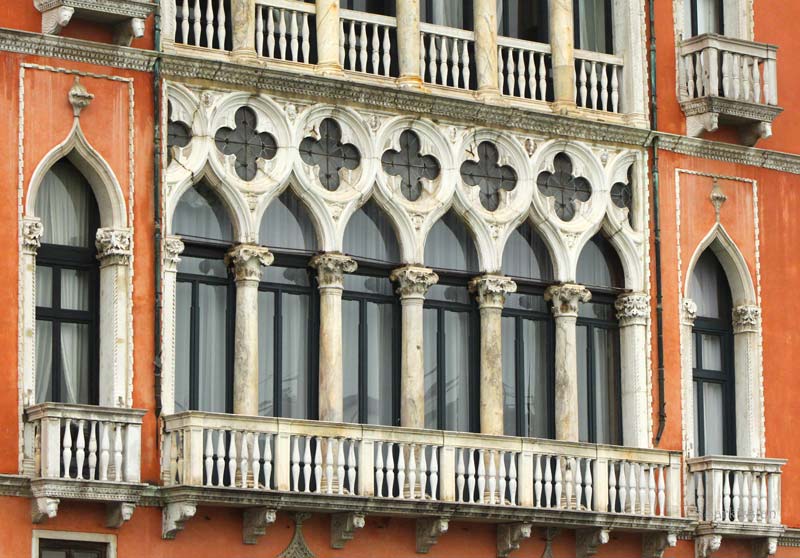
PalazzoPisaniMoretta

.

Palazzo Pisani Moretta — “[the] capitals of the first-floor windows are … singularly spirited and graceful, very daringly undercut, and worth careful examination….”

—John Ruskin, Stones of Venice.

.
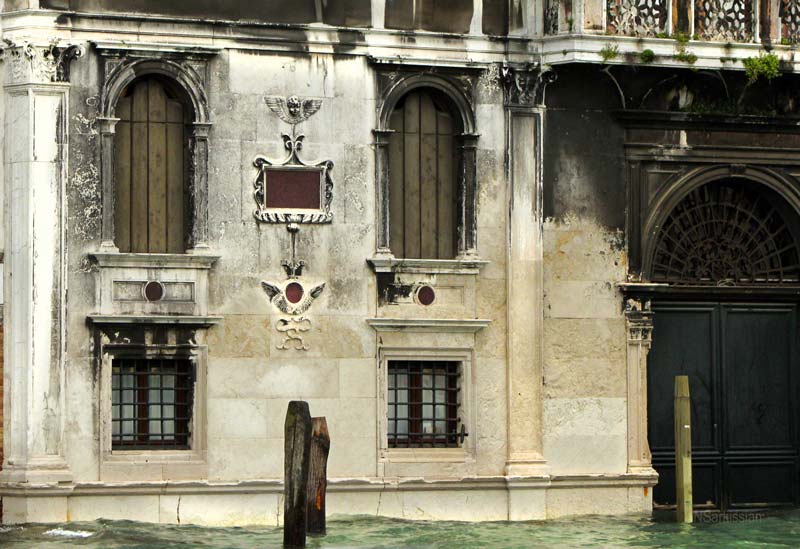
Contarinidellefigure

.

Palazzo Contarini delle Figure — “I must warn [the traveler] to observe most carefully the peculiar feebleness and want of soul in the conception of their ornament which mark them as belonging to a period of decline….”

—John Ruskin, Stones of Venice.

.

I spy a Renaissance building with fanciful decoration coming up–the Palazzo Contarini delle Figure.  I hoist my camera and click.

.

I would endeavour to trace the lines of this image before it be for ever lost, and to record as far as I may, the warning which seems to me to be uttered by every one of the fast-gaining waves, that beat, like passing bells, against the stones of Venice.

— John Ruskin, Stones of Venice

There is nothing new to be said 
about Venice certainly [.…]  I write these lines with the full consciousness of having 
no information whatever to offer. I do not pretend to enlighten 
the reader; I pretend only to give a fillip to his memory [of Venice]; and I
 hold any writer sufficiently justified who is himself in love 
with his theme.”  

Henry James, Italian Hours.

 .

—Natalia Sarkissian

———————————————————

Natalia Sarkissian has an MFA in Writing from Vermont College of Fine Arts and has been an editor and contributor at Numéro Cinq since 2010. Natalia divides her time between Italy and the United States.
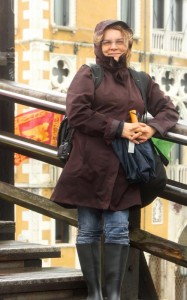
Accademia bridge


May 112013
 

David Helwig

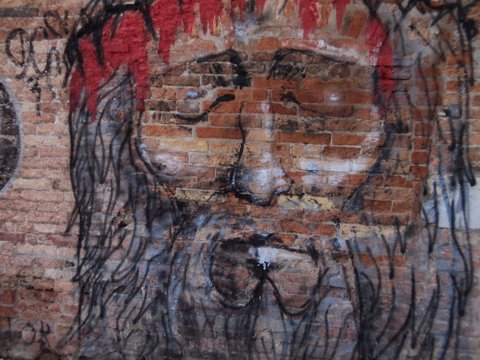
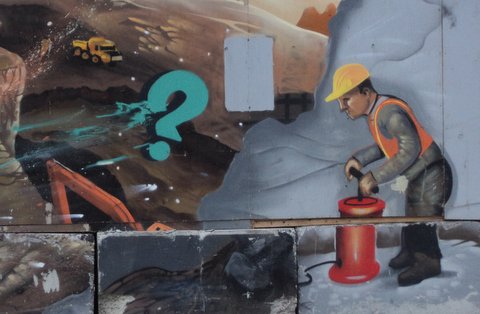
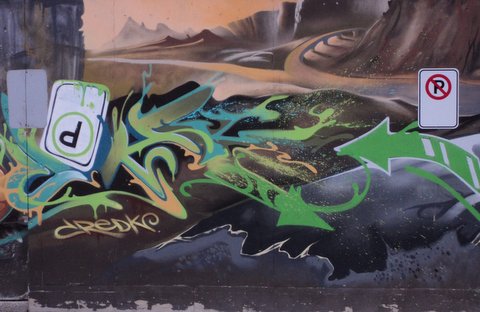
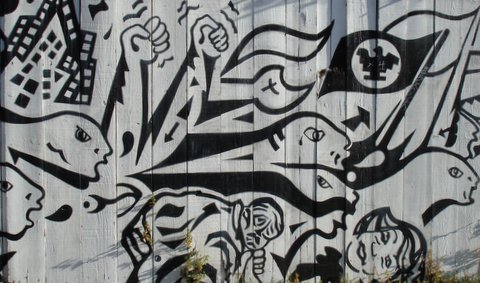
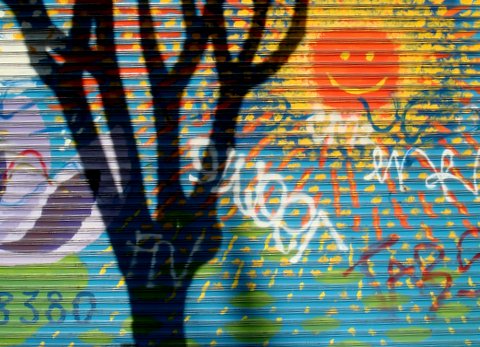
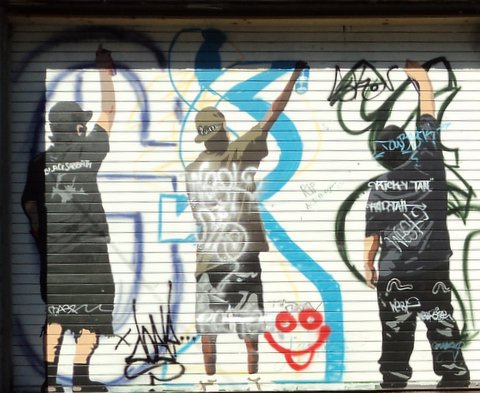
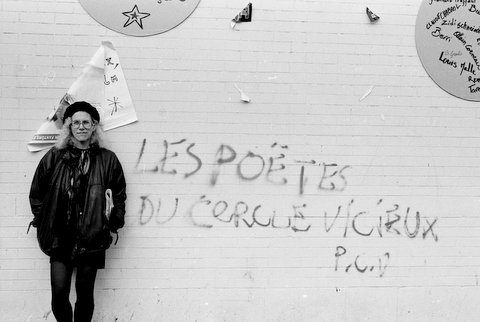
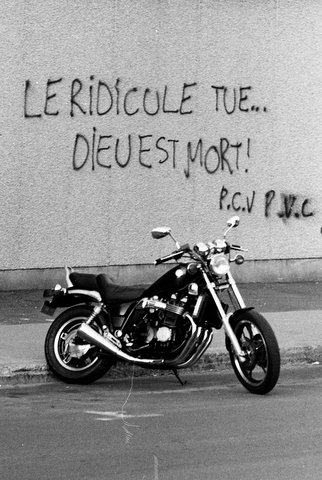
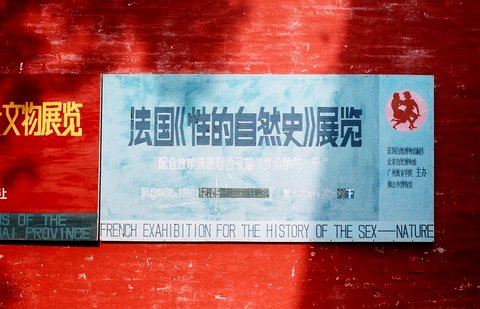
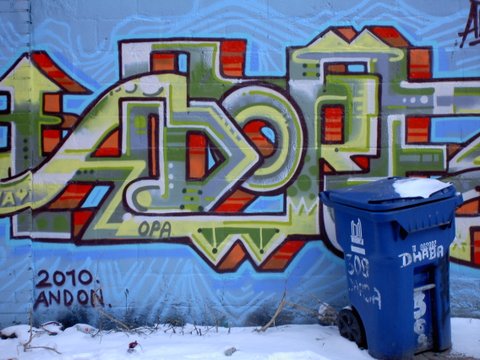
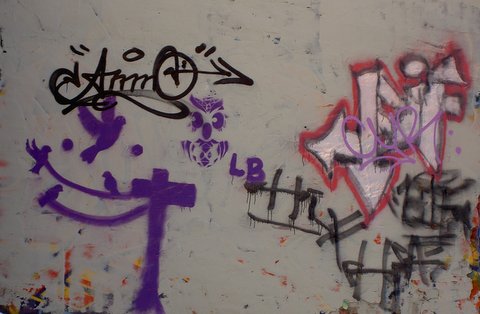
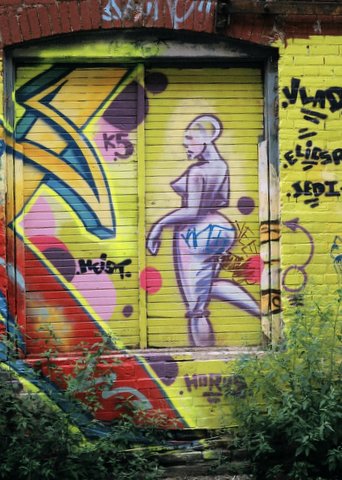
David Helwig, author of over 35 books, who has contributed translations, poems, and fiction to NC over the years, an insistent and constant recidivist in other words, herewith changes genre and turns photographer, offering a collection of graffiti art he has discovered, mostly in Canada but as far away as China and Venice. Graffiti art is folk art, hybrid art, amateur art, uneasy art — rebellious, dramatic, inappropriate (often), underground, illegal (sometimes), piratical, dangerous (how do they do those highway overpasses?), a sign of life.

dg

Venice12 040Venice 2012

Trip OttTor 020Gatineau 2011

Trip OttTor 019Gatineau 2010

  Toronto Wall art 09-04-2010 11-34-38 AMSan Francisco 2010

Toronto Wall art 09-04-2010 11-06-18 AMSan Francisco 2010

TO 067Toronto 2011

SnaFran 014-2San Francisco 2010

87210015Toronto 2009

87190006Toronto 2011

55120086Montreal 1993

55120062Montreal 1993

53040102Montreal 1994

53040021Montreal 1993

15490008China 1987

2010-12-45Toronto 2010

2010-12-34Toronto 2010

 —David Helwig

—————————————–

David Helwig is the author of more than 35 books of poetry, fiction, and non-fiction including, most recently, About Love, 3 Stories by Chekhov (Biblioasis) and The Year One (Gaspereau Press), Duet and his autobiography The Name of Things (Porcupine’s Quill). The founder of the Best Canadian Short Story Series, he has edited more than 25 books for Oberon Press. His avocation, however, is not writing but vocal music. After abandoning this for some years, he returned to it in his forties and has sung with a number of choirs in Kingston, Montreal and Charlottetown. He has appeared as bass soloist in Handel’s Messiah, Bach’s St Matthew Passion, and Mozart’s Requiem. He currently lives in an old house in the village of Eldon in Prince Edward Island.
Apr 142013
 

Richard Jackson

Poems and images intertwine in Richard Jackson’s “Soundings,” a series of nature photographs juxtaposed with the superb poems they inspired, the photographs themselves iconic, metaphorical and mysterious. The human and the natural intersect at the level of form when the poet spies a dilapidated chair in the forest, a cluster of roots resembling tank traps. A bee becomes a soul and a gap between facing cliffs looks like, well, a gap and the gap is violent, a pile of shell casings. Images and poems project a moral grid onto the cluttered world, they compose a judgement and a puzzle.

This is what Jonah had to learn, that it is
all loneliness, all forgiveness, all gathering
from the puzzling depths he carried within him.

Richard Jackson is a peripatetic poet and translator, an admired colleague at Vermont College of Fine Arts where we both teach, a good man to travel with and a profoundly engaged human being. He has published poems, translations and essays on NC before and it’s a pleasure to have him back.

dg

Soundings photo by Richard Jackson

.

SOUNDINGS

What we know deeply we know for such
short time before it appears again, distant and foreign.
Where do our words go once they are spoken?
The whale sheaths itself and leaves behind a footprint
of oil.  The sea gathers the setting light of the sky.
At some point, the sea becomes the sky.
This is what Jonah had to learn, that it is
all loneliness, all forgiveness, all gathering
from the puzzling depths he carried within him.
Above, a gull dives into a cloud. An invisible
plane leaves a vapor trail the wind bends. There is
a kind of truth we only see when we close our eyes.


Butterflies photo by Richard Jackson

.

BUTTERFLIES

All the energy collected by Radio Telescopes since
they started is only equal to the energy of a butterfly
landing on a flower. Which is to say how little we know
about what is in our own solar system, or ourselves.
In fact, Pluto’s orbit is so irregular we don’t know where
it will appear next. Which is how, I suppose, you have
landed here in this sentence and, like gravity, have begun
to shift the focus. Maybe that’s why I think of Newton,
who, poisoned by Mercury from his alchemy experiments,
couldn’t remember where he put his proofs for elliptical
orbits. There’s no reality without its proof, Halley had argued
years before the comet was named for him. The energy
it takes to remember is the energy it takes to love,
the saying goes, taking so little, as those butterflies know,
to flutter and fly off because there is no formula, and
because love is stronger than the proofs we remember for it.

.

Chair by Richard Jackson

.

THE CHAIR IN THE FOREST

The story begins with the muffled hum of bees you can’t see
as they circle a nest in the cushions. It begins with their sound
that folds the air into bolts of cloth. It begins with the whine
of the truck half a mile away on the nearest road. It begins
when we live in the absent sounds of someone else’s dreams.
They have gone where they had to go. The sunlight strikes
where it wants to go. There was never any money to stuff into
the cushions. The felled trees have their own stories but are
of no interest here. The path to the next clearing has not been
told yet. Pascal was right, there is no center or circumference.
The bees are souls. The bees wander off. The story begins there.

……

.
Tank Traps Richard Jackson

.

TANK TRAPS
Ljubljana, Slovenia, 1992

Someone is watching from the window across the square.
There are Nightbirds complaining as they maneuver
And dive between the lights. We could drink the darkness.
Those aren’t child’s jacks or crosses as they seemed from afar.
Below us, a Roman city smirks about what we’ll never know.
South of here the souls of the dead disguise themselves as
Clouds to escape the militia. Each day is another trap.
Our words are blemishes on the truth. Every heart is crossed out.
The darkness provokes a few whispers.  Everywhere we look
Something crosses our path. We can’t see the lovers yet,
About to cross from the right. We can’t see the child
Crossing out what he’s just written. There are no halos
On the streetlights. These designs imprison us. The sky
leans down. If we aren’t careful we’ll cross out the world.

”””””””’
Rock Bird  Richard Jackson

.

ROCK BIRDS, BISTI WILDERNESS, NM  

No wonder the first people here believed we came from stone.
What these birds were waiting for was the day we would return.
The lizards wrap themselves in light. The wind whispers into
the ear of the sky. The shadows have a purpose we’ll never
decipher. Nevertheless, these birds invite us to speak to them.
At night these rocks will be iced with light. The question
they would answer is why they left the air. They are no longer
surprised by what we have tried to carve into history.
Sometimes our words hold an idea for a few moments before
the sand claims it. The mind shivers at this thought. Reality
seems like a provocation. Nevertheless, these birds, they are
silent to say whatever has been wearing us down, carving us
into shapes we could never imagine, never refuse to believe.

 .

Fog Richard Jackson

.

FOG

Crows and Elephants watch over their dead and mourn.
How strange to come back now to that sentence, weeks
later. It’s almost time to leave. Every sound is louder
in the fog. My watch strains to go backwards. Shadows whisper
where no shadows could be. An echo of the moon strays
out of the last ruins of darkness. Yes, the two men in the boat
about to become fog are real. So, too, the dreams that are
lost among the fallen trees that scratch the shoreline.
Last night, the stars on the water were trap doors. The crows
with their charred wings are complaining to a hawk.  It’s time
to pack up  the sunsets the dawns and move on. There’s our dog
sniffing below this window who knows everything else we can’t see.


.Not Said Richard Jackson

.

NOT SAID

Gravity happens to the lens. Words squint but
it doesn’t help. I want the mailman to deliver
another story. Instead there are only the homeless
men washing the windshield for a quarter. Why
does love seem stuffed in the trunk? This is not
a calculus problem.  The bridge from here
to there hasn’t been delivered. Empty bullet
casings litter the scene. No one is ever a witness.
The heart sags. My footprints forget me.
I don’t think anything will ever be the same.
This is the edge of the cliff and you can’t move,
can’t jump. Everything is vertical. With binoculars
you can see where you’ll be in an hour. Raindrops
collect on the lens. A fine mist. It hides us.
It drifts into clocks. Gravity presses your hands.
Some hurts never get said. Some get smuggled.

—Richard Jackson

—————————-

Richard Jackson is the author of ten books of poems, most recently Resonance (Ashland Poetry Press, 2010) which won the 2012 Eric Hoffer Award), Half Lives: Petrarchan Poems (Autumn House, 2004) Unauthorized Autobiography: New and Selected Poems (Ashland Poetry Press, 2003), Heartwall (UMass, 2000 Juniper Prize), Svetovi Narazen (Slovenia, 2001), a limited edition small press book, Falling Stars: A Collection of Monologues (Flagpond Press, 2002), Richard Jackson: Greatest Hits (2004), and several chapbooks of translations. He has edited two anthologies of Slovene poetry: The Fire Under the Moon and Double Vision: Four Slovenian Poets (Aleph, ’93) and edits an eastern European Chap book series, Poetry Miscellany and mala revija. He is also the author of a book of criticism, Dismantling Time in Contemporary American Poetry (Agee Prize), and Acts of Mind: Interviews With Contemporary American Poets (Choice Award). His several dozen essays and reviews have appeared in Georgia Review, Verse, Contemporary Literature, Boundary 2, Kenyon Review, Prairie Schooner, Numéro Cinq and numerous other journals, as well as anthologies such as The Planet on the Table: Writers Reading (2003) and John Ashbery (ed. Harold Bloom, 2004). In addition, he has written introductions to books of poems by four different Slovene Poets for various presses, and a special Slovene issue of Hunger Mountain (2003). He edited a special 50-page section of Poetry International (2004) on William Matthews with an introductory essay. In 2000 he was awarded the Order of Freedom Medal for literary and humanitarian work in the Balkans by the President of Slovenia. He has received Guggenheim, NEA, NEH, Witter-Bynner and Fulbright Fellowships, and five Pushcart Prizes.His new poetry collection, Out of Place, will be published by Ashland Poetry Press in 2014.

Feb 082013
 

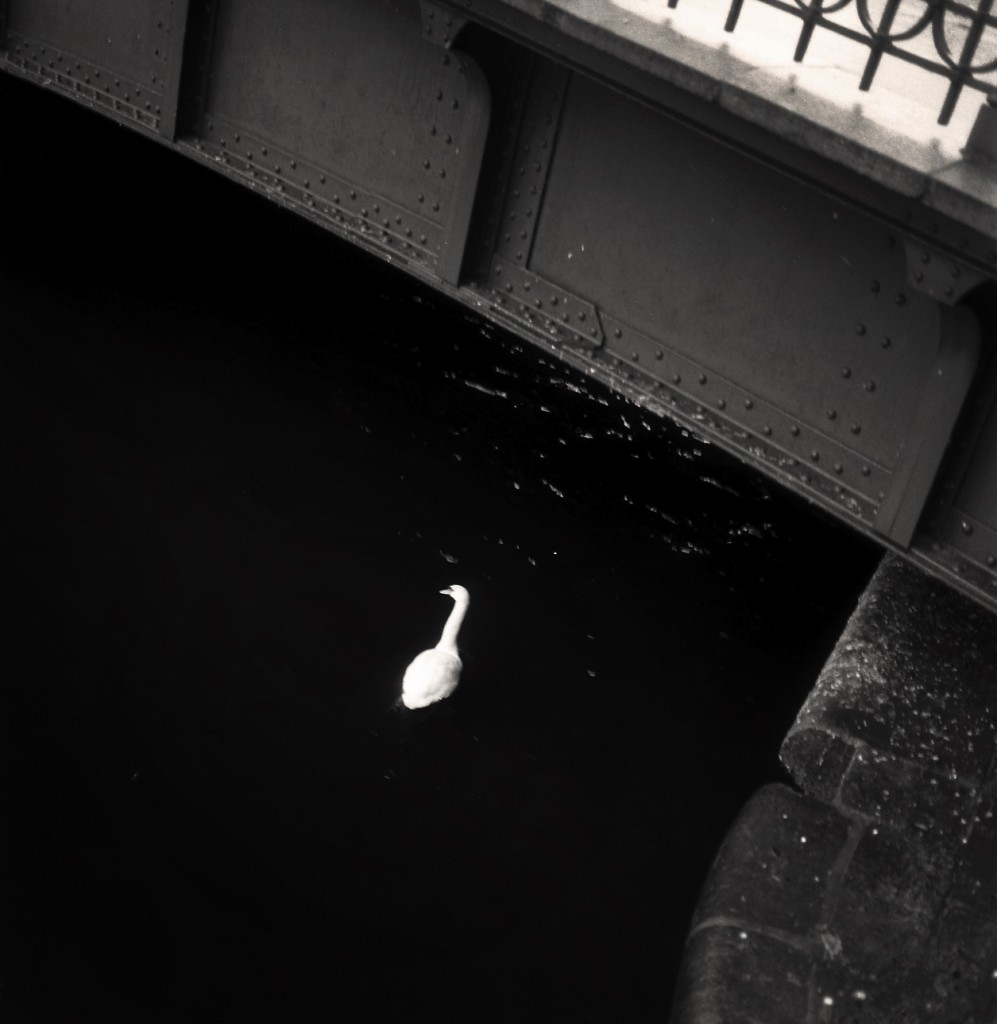
SwanJohn Haney, Weidendammer Bridge, Berlin, November 2004

Amanda Jernigan and her husband John Haney collaborate here on a gorgeous photograph and poem combination, the photograph providing the inspiration or focal point for the poem which is an irregular sonnet, a gorgeous thing, that builds its power through a series of contrasts, contradictions, and denials: delivered/abandoned, surreptitious/scandalously bright, dying swans sing sweetest/swans aren’t known to sing, never spoken/never taken back, (white — note: a word not used in the poem)/black. Read this way, you can see how achingly poignant each of the contrasts or denials is, sad, beautiful reversals. Even the poet reverses herself and seems to begin to disappear in that amazing double negative “we could hardly feign not having seen it,”  or near double negative. In the middle, the poem offers a dense run of literary references, other poems and books, swans, sirens, all concentrated in the moment when the vision of the glowing swan (see the photo; the swan has an aura) disappears under the dark bridge. Note also the rhymes leading to the end: Brewer/truer and sirens/silent and the gorgeous back/black that bookends the last line.

Amanda Jernigan earlier contributed five poems to Numéro Cinq that went into her collection Groundwork which NPR picked as one of the top five poetry books of  2011.

dg

§

Reflection

The swan slipped under the bridge — a palmed card,
a dropped coin, a swaddled child, delivered
or abandoned — a surreptitious movement,
but scandalously bright, and we could hardly
feign not having seen it. I thought about
Macpherson’s swan, white habited; and Baudelaire’s,
an exile from its lac natal; the snow-
white somnatational swans of Outram’s
‘Ms Cassie by Tarnished Water’: dying
swans sing sweetest, Brecht maintained. But Brewer
tells us swans aren’t known to sing. The sirens,
too, were silent, according to Kafka. Truer
words were never spoken, never taken
back. In your negative the swan is black.

—Amanda Jernigan

——————–

Pearl Street South 2

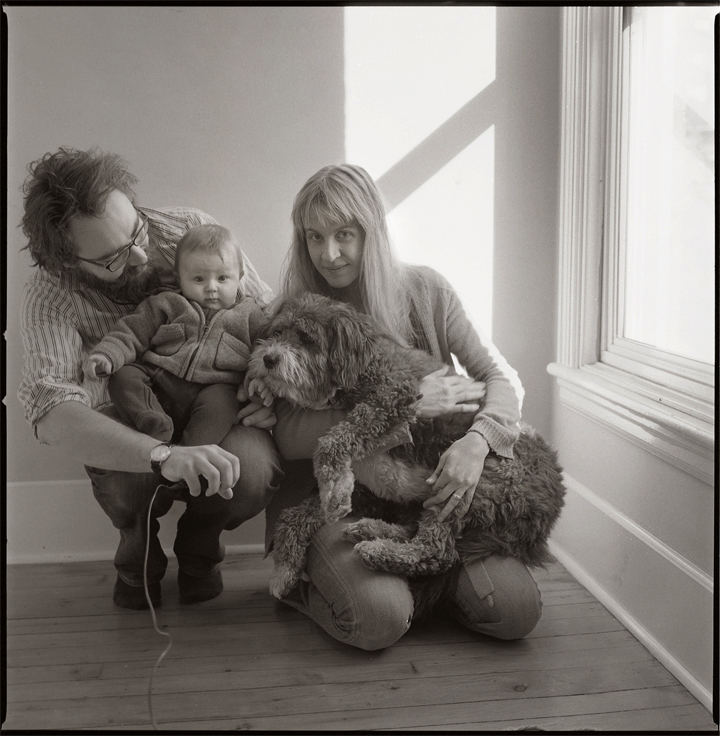
Amanda Jernigan is a poet, playwright, essayist, and editor. Her first book, Groundwork: poems, was published by Biblioasis in 2011; her second book, All the Daylight Hours, is forthcoming from Cormorant, this spring. She is the editor of The Essential Richard Outram (Porcupine’s Quill, 2011), and is currently at work on a critical edition of Outram’s collected poems.

John Haney is a photographer, sculptor, and wood engraver. His work has been exhibited in public and private galleries in Canada and abroad. He is represented by the Christina Parker Gallery in St. John’s, Newfoundland, and in Europe by Emerson Gallery Berlin. He is currently at work on a series of black-and-white contact prints entitled Common Prayer (http://johnhaney.ca/common_prayer/), for exhibition at the Rooms Provincial Art Gallery in Newfoundland, in the spring.

Amanda and John are sometime, amateur letterpress printers. Since 2000, they have collaborated annually on a hand-printed pamphlet or broadside, featuring one of Amanda’s poems and one of John’s photographs, issued in a small edition under their imprint Daubers Press. ‘Reflection’/Weidendammer Bridge … is in that tradition — the first of their collaborations to make its debut in digital form!

Amanda and John live in Hamilton, Ontario, with their young son Anson, and their loyal dog Ruby, of previous Numéro-Cinq fame: (http://numerocinqmagazine.com/2011/01/21/five-poems-from-the-sequence-first-principals-by-amanda-jernigan/).


Dec 022012
 

Herewith stunning and mysteriously timeless photos of the Vermont College of Fine Arts green, College Hall, and Alumni Hall, caught with a smartphone camera by John Solaperto who renders the familiar strange and other-worldly, out of time. He doesn’t just snap a photograph; he completely alters our perception not only by the common techniques of framing and point of view but also by his canny and original use of black-and-white and a photo app that makes new things look old. As John aptly points out, the photos look like they date from the 1920s, but they were taken last winter. I don’t know — this stuff knocks me out; I love how art twists the neurons in my brain, and these photos do that. And, frankly, I just warm to a real, down to earth photographer who doesn’t make a fetish out of gear and renders the world beautiful with whatever comes to hand.

John is an old friend from many a VCFA residency. Some of you know him as an amiable, intense, helpful presence at lectures and public occasions. It’s a pleasure to discover his art.

dg

—–

There’s an adage among photographers that “your best camera is the one you have with you.” My experience with the camera on my smart phone over the past two or three years has really driven that home for me. I’ve limited myself to only two camera apps, but there are dozens available.

I’m particularly taken with one called Hipstamatic, which lets me choose a lens and film combination that produces a black and white image with enough pixels that I can make a decent inkjet print at approximately 6”x6”.

The configuration with which I’m shooting produces an image in a square format. The camera is set up so I can’t see the entire scene in my viewfinder. Such a configuration adds an element of chance that I like. It’s an image capture process reminiscent of the plastic cameras popular in the 1980s and 90s that used 2”x2” black and white film. One must make a lot of images to get something usable in terms of content, tone, and sharpness. This particular series of images has a rather specific target audience, namely those associated and familiar with the Vermont College of Fine Arts community. I’d like to think, however, that they also have the potential to engage a wider audience of viewers in visual narratives more specific to the context of their personal life experiences.

The two images of skaters at ground level were shot late in the day on a rather cold Sunday afternoon in late winter. They were chosen from nearly 200 exposures, made as I walked around the rink on the college green. Besides the action of the figures, the photo has a certain quality of light that I find engaging. College Hall, functioning as a backdrop, adds to the nostalgic, period quality of these images. They look as though they could have just as easily been captured in 1912.

The aerial images of skaters were shot a few days later from a second floor window of College Hall. I was aware of the figures but thought of them as secondary to the composition of the other elements of the scene, i.e. the flag, sky, tree, and light post. As it turned out, the interaction of the figures with each other provides an even stronger visual interest  than the interaction of the figure with the other compositional elements. As a photographer, I feel that the image of the child with outstretched arms was an especially wonderful gift.

The aerial shot devoid of figures is included here as related to, but not really part of, the “skater series.” It was shot from the highest window I could reach in College Hall. While speaking with a colleague, I noticed the long, thin cloud or patch of fog moving rather quickly from south to north, just below the horizon. My colleague very graciously allowed me to open her office window to shoot. Of the 30 or so exposures I made to get this image, most had some part of College Hall’s architecture intruding into the composition. The one included here does not.

The night image of College Hall is an experiment in pushing the limits of available light. I think that the overall quality of light in the image, the footprints in the snow, and the diagonal motion created between the Christmas lights on the portion of the lamp post along the left edge of the image and the face in the clock tower, as well as the light in the doorway below the tower and the lamp post that lines up with the window in the center of the image, all work together to form a strong composition. The overall effect is eerie but pleasing.

All of these images represent the study of alternating patterns of light and dark tonalities. They’ve been edited with software, but not in a manner that is inconsistent with traditional dark room practice, i.e. I have made just basic tonal adjustments in all photos, and in some cases, I’ve done a lot of dodging & burning.

—John Solaperto

————————————————–

John Solaperto is a digital photographer and vocalist from Worcester, MA. He currently lives and works in Worcester, MA with his daughter and two grandsons. He is the Learning Resource Manager for the Applied Arts Program at Quinsigamond Community College and teaches Digital Photography in an adjunct capacity, evenings and online. He also spends approximately 12 weeks a year in Montpelier, VT serving as a media coordinator for Vermont College of Fine Arts’ two MFA in Writing programs and its Visual Arts program. He has an undergraduate degree from Clark University’s Studio Art Program (1993) and an MFA from VCFA’s MFA-V program (1995).


Jul 192012
 

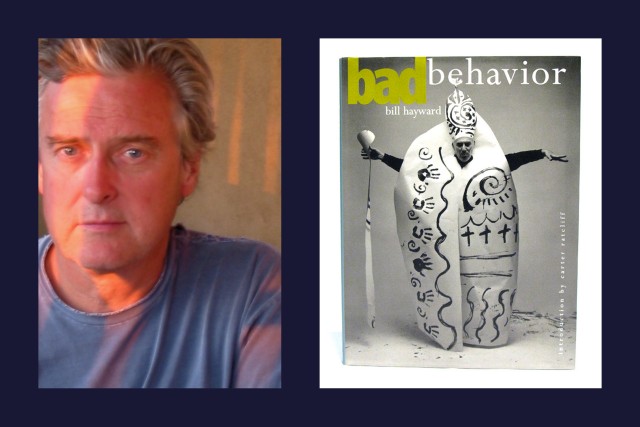
Psychology Tomorrow Magazine has just published a lush spread on the brilliant New York photographer/filmmaker Bill Hayward, including a profile by Geoff Gehman, a gallery of photos, and a short Hayward film on the artist Jim Peters. I’ve known Bill since 1993 when he took to jacket photo for my novel The Life and Times of Captain N. — yes, the younger me with hair, black shirt, floating against a black backdrop, earnest and mysterious. He’s a photographic innovator, having invented the collaborative portrait which he has made his hallmark. See the cover of his book bad behavior (Rizzoli, 2000) above for an example. He photographs artists, authors, dancers, actors and ordinary people, but the modus operandi is always some interaction between the subject, huge sheets or rolls of white paper, a brush and black paint. The subject draws or writes or paints on the paper, creates paper sculptures, dances naked with the text or the cartoon or the painting, wraps herself in her words, so to speak. The results are a riot of astonishing wit, imagination and humor. Something emerges about the subject that has never been revealed, some intimation of the hidden self, gorgeous and poignant. You can see more examples of Bill’s work at his web site. He blogs at http://www.billhayward.com/blog/ and at thehumanbible.

For three decades Bill Hayward has been photographing people expressing themselves with black paint, paintbrush, sheets of white paper and permission to do anything and everything. He has documented a naked poet’s antlers, a magazine editor’s manifesto about her sexual abuse, a fashion designer’s Pope-in-a-sauna costume. It’s all part of his mission to encourage the magical elements that society tends to discourage: imagination, mystery and profound play.

Hayward’s fellow players have included actor Willem Dafoe, Native American activist-author Russell Means and detective Anne Marie Moloney, who helped bury 23 New York Police Department colleagues killed by the collapse of the World Trade Center’s twin towers. His sites have ranged from his Manhattan studio, site of the “Bad Behavior” project, where creative types explored their alter egos; the Port Authority Bus Terminal, the multi-media site of “The Intimacies Project,” which explored the motion of emotion, and Bunker Hill, one of many historic sites for “The American Memory Project,” which explored how Americans adapt to, and adopt, their heritage. The whole series of nearly 500 portraits is called “The Human Bible.”

Geoff Gehman @ Psychology Tomorrow Magazine

May 232012
 

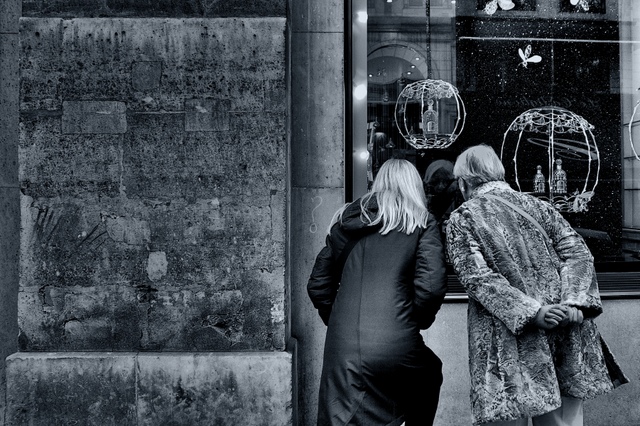
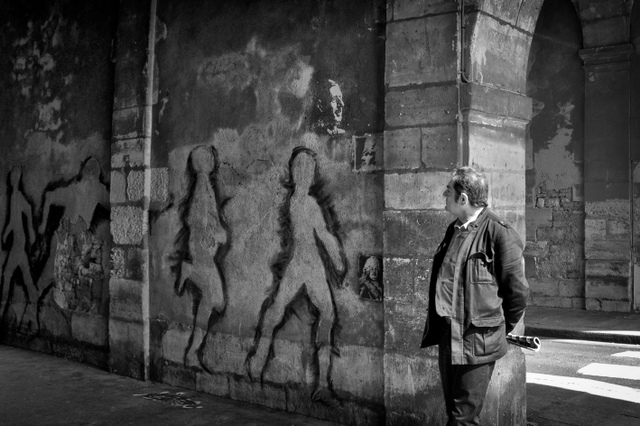
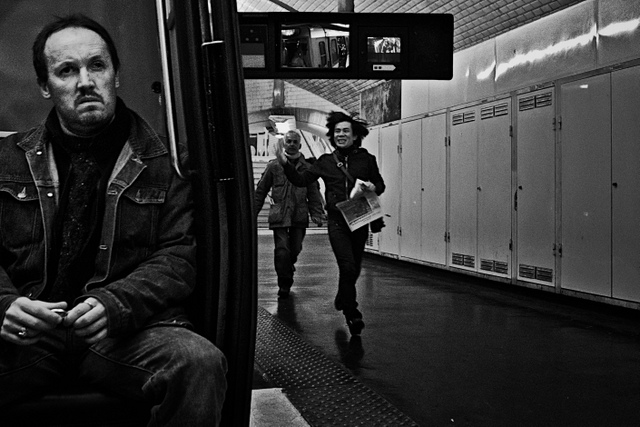
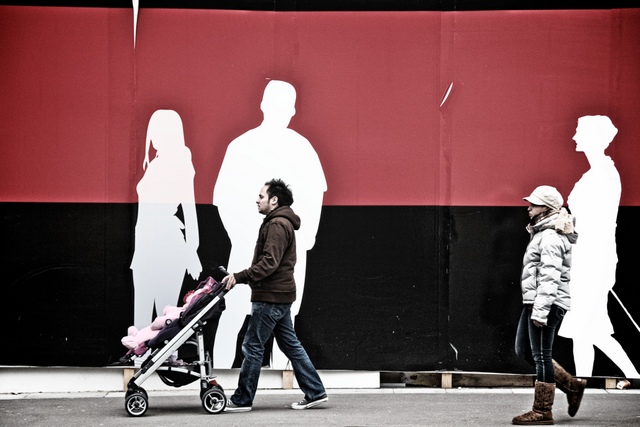
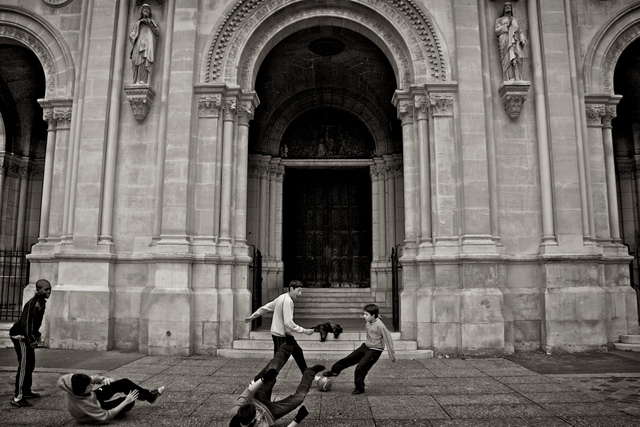
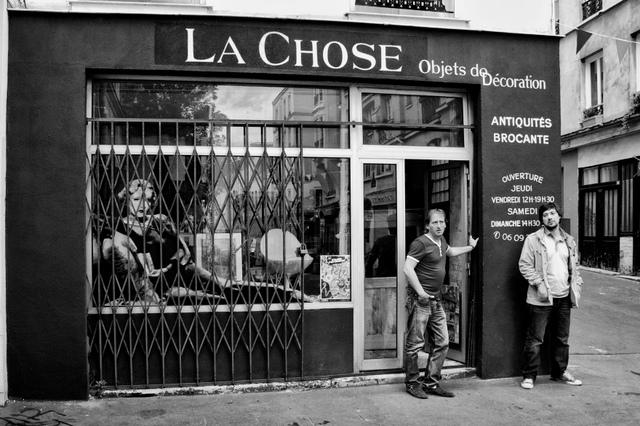
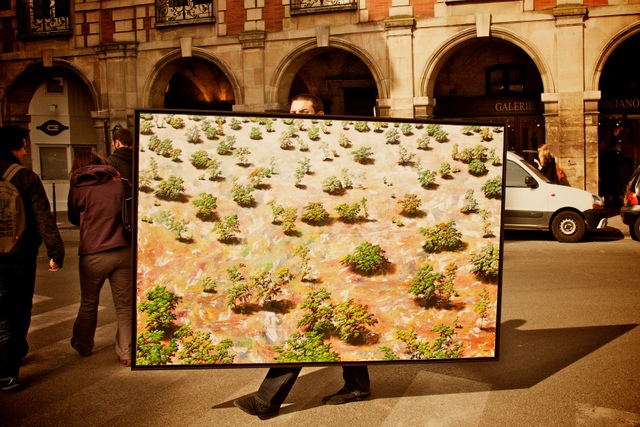
Here are some luscious photographs of Paris, not your tourist Paris, but the Paris streets, and not just the Paris streets but a selection of photos that are in many ways a homage to the history of Parisian street photography, that is, photographs with a particularity, an edge, derived from history and impersonation. These are from the Montreal poet/novelist Mark Lavorato (see his poem in the last issue) who started taking pictures as a moment of research for a new novel. He impersonated a 1920s Parisian street photographer who would be a character in his book, and, Lo! he became a photographer himself.

dg


I was researching my third novel, Burning-In (forthcoming), in which one of my characters is a photographer in the 1920s. What I soon learned in my research is that the art of street photography came before the advent of photojournalism. This was astounding to me; that the art aspect of photography came well before its utility.

I picked up a camera and took to the streets to learn about how my protagonist would feel as a street photographer, and I found that, surprisingly, it was me, and not my protagonist, who was doing all the feeling. So I dove into street photography with all the fascination and intensity of someone discovering a new and rich medium.

— Mark Lavorato


— Mark Lavorato

—————————————-

Mark Lavorato is the author of three novels, VeracityBelieving Cedric, and the forthcoming Burning-In. His first collection of poetry, Wayworn Wooden Floors, had just been published. One of the poems from that book was published in a previous issue of Numéro Cinq. Mark lives in Montreal and is currently seeking galleries to exhibit his work.


Sep 062011
 

.

At the Duomo with the Giraffes

.

Siena’s Palio: A Medieval Horserace Turns Viral

Text and Photographs by Natalia Sarkissian

.

Twice a year, on July 2nd and August 16th, after a three-hour parade in Renaissance costume has unfolded, jockeys representing ten of Siena’s seventeen factions challenge each other in the Piazza del Campo. They race for a handmade banner—a palio—and for the honor its possession confers. This is the Palio, Siena’s famous horserace, dating from the Middle Ages.

.

Rai Television films the event

.

Piazza del Campo, August 2011

.

At each bi-annual showing, a hundred thousand bystanders from around the globe jam bleachers, balconies, rooftops, windows and the center of the shell-shaped piazza, cheering one faction or another.
.

Behind the 400 Euro Seats on the Piazza del Campo

.

.

Watching from the Piazza

.

Jockeys line their skittish horses between two ropes stretched across the track. When the rincorsa–the last horse–enters, the rope drops the racers tear away.

.

http://www.youtube.com/watch?v=DvGMFLEaMsA

.

The jockeys careen around the Piazza perimeter three times at break-neck speed. Frequently horses crash into mattress-covered barriers at the right-hand curves of San Martino or the Casato.

.

Continue reading »

Aug 252011
 

Dan Wilcox is an Albany, New York, poet, photographer and social activist. That’s him in the photo above (with the sign) at a pro-union rally in February. This the second set of author photos Dan Wilcox has published on Numéro Cinq (see the first flight here). The Arts Center of the Capital District will have an exhibit “From the World’s Largest Collection of Photos of Unknown Poets” by Dan Wilcox from September 10 thru October 15. The exhibit, all black & white prints from film, will include photos of Albany poets Tom Nattell, Mary Panza, & others, as well as Allen Ginsberg, William Kennedy, Anne Waldman & Lawrence Ferlinghetti. The Arts Center is at 265 River St. in Troy, NY, should any of you happen to be in the vicinity.

Dan has just released a new chapbook called Poeming the Prompt using poems he wrote last November in response to the Poem-a-Day challenge on Writer’s Digest Poetic Asides Blog. This little book, including his “Top Tips for Anxiety-Free Writing from Prompts,” is published by Dan’s own imprint, A.P.D. (albany’s poetic device, another pleasant day, another poeming day, etc.). He is the host of the Third Thursday Poetry Night at the Social Justice Center in Albany and a member of the poetry performance group “3 Guys from Albany.” He has been a featured reader at all the important poetry venues in the Capital District & throughout the Hudson Valley and is an active member of Veterans for Peace. His poems have been published in Out of the Catskills, Post Traumatic Press 2007, Chronogram, Poetica and in numerous small press journals and anthologies, on the internet, as broadsides & in self-published chapbooks.t, A.P.D. (albany’s poetic device, another pleasant day, etc.). .
dg

.

Jean Valentine, Jayne Cortez, Gary Soto, Amiri Baraka, Ed Sanders & More

Photos by Dan Wilcox

.

Jean Valentine, with Edward Schwarzchild & Tomas Urayoan Noel, New York State Writers Institute, Albany, NY  — November, 2010

.

Jayne Cortez with Denardo Coleman, Sanctuary for Independent Media, Troy, NY  — October, 2010

Continue reading »

Jun 022011
 

Something self-indulgent about dg publishing these lovely Nicole Dixon photos because they reference a brooding, romantic, Heathcliff streak in him, the part of him that likes the idea of climbing Signal Hill in St. John’s, staring into the fog, and knowing there is nothing between the rock he’s standing on and Europe to the east except the vast, surging, very cold Atlantic. (Just behind you is Deadman’s Pond and just in front of you is Cuckold’s Cove—they have a way with names in Newfoundland.) There is also something satisfyingly uterine about St. John’s Harbour—ships go in and out through a narrow passage called, um, The Narrows (which you can see at the bottom of Signal Hill) while the harbour itself is, well, it all looks like an anatomy diagram dg remembers from when he was 12. DG has many writer friends in St. John’s who sometimes call him up late at night from the bars. It is also the home of the Burning Rock writing collective, an amazingly vibrant literary community with the best name ever. (Sometimes it seems St. John’s must have more writers per capita than any other place in the world.) On a personal note (as if talking about anatomy diagrams wasn’t personal enough), dg’s mother was stationed in St. John’s as a radio operator with the Royal Canadian Air Force during World War II. He has photographs of her marching through the streets as part of the VE-Day celebrations (also pictures of the massive victory party after). She used to like to go out to Cape Spear, just south of St. John’s and the eastern-most tip of North American, and look out into the Atlantic, too.

Nicole Dixon is an estimable fiction writer, with a first story collection coming out next year (see bio below). She  took these photos on a recent trip to St. John’s to attend the Atlantic Provinces Library Association conference, where she co-presented a paper on Sea Stacks (seastacks.ca), a web-resource she built to promote and disseminate information about Atlantic Canadian authors and books for children and teens. Much appreciated.

dg

.


IMG_0297

Continue reading »

May 012011
 

NC has a whole hybrid art theme, understated but insistent—Nance Van Winckel’s photoems, graffiti art, Domenic Stansberry’s graphic novel, and Nance’s off-the-page workshop video. We also like our art seasoned with a dash of wit and arrogance. So on this slow, droll Sunday, NC offers for your delectation a spritely, deadly comic photo essay by photographer Melissa Fisher who recently spent an afternoon in Whitehall, NY, (where the United States Navy was founded, mysteriously far from any ocean front, and a place noted for its Big Foot sightings—there is a Big Foot Liquor Store). Melissa has, in fact, a lot of affection for Whitehall where once she says, her car broke down and the local mechanic was sweet and persistently helpful as was the guy at the Sunoco station where she got a slice of pizza. She also, being from Vermont, has an affection for the backwoods, forgotten places, vestiges of older times, and the quirky things you find when you get off the main street. Whitehall proved to be a goldmine of comic signage, poignant in its juxtaposition with a kind of upstate economic decline. Her work has been published in Vermont Life and Hunger Mountain, and she has had an exhibition at After Image Studio in Montpelier.

dg


Continue reading »

Apr 272011
 

Tucked away in the pages of Numéro Cinq are skillfully told stories that pull us inside. The best of these hold us tight and whisper things that haunt our thoughts, urging us to care more deeply. Robert Semeniuk tells such stories with his photographs. He has been a photojournalist and human & environmental rights activist for 3 decades. I met Robert and his wife, musician Ruta Yawney on Bowen Island a few months ago and today I am honored to introduce you to Robert’s work. Each of the images shown here is excerpted from a story. These particular stories about the Inuit of arctic Canada, preventable blindness in Ethiopia, war affected children, and AIDS in Botswana are elaborated in image and word on Robert’s webpage.

— lynne quarmby

Five Photographs

By Robert Semeniuk


Tea time on the cariboo hunt

Gaza boys playing ‘Arab & Jews’

Continue reading »

Mar 102011
 

Allen Ginsberg, QE2, Albany, NY, 11/29/90


Dan Wilcox is an Albany, NY, poet and photographer who claims to have the world’s largest collection of photos of unknown poets. But many of the poets he has photographed over the years are, in fact, very well known. Allen Ginsberg, Anne Waldman, Lawrence Ferlinghetti and Quincy Troupe are among the illustrious authors who have found their way to Albany. Also pictured here are dg’s friends, the novelist William Kennedy who, as director of the New York  State Writers Institute, hosts many of the visiting writers, a young Pierre Joris whose translations have been published on NC, and Susan Novotny, owner of the Bookhouse.

dg

I started taking photos many years ago of poets & writers reading their work & my photos have been used for the cover of poetry chapbooks, for publicity & author’s photos, in poetry magazines & online.  Before digital cameras, I was often the lone photographer in the audience.  I estimate to have approximately 10,000 photos, many of famous poets & writers, but mostly the unknown community poets who read at open mics in the Capital District area.  You can many of my photos at www.flickr.com/photos/dwlcx. —Dan Wilcox

Author Photos

By Dan Wilcox


Allen Ginsberg adjusting his camera, QE2, Albany, NY 112/29/90


Allen Ginsberg & William Kennedy, Half Moon Cafe, Albany, NY 11/30/90

Continue reading »

Feb 052011


Whirlpool I (Above and Below)

A whirlpool dyad: one we see from above, the other we view from the side.

In the same way, I present to you two views of the artist’s mind: one as seen “from above” in an artist’s statement, and second, from the side—a visual mind-map of influences on this photo-series (Steven created this map using node software).

Whirlpools

“Like our own bodies, whirlpools take the molecules of the material world and organize them into temporary dynamic systems. For me, these abstract images of whirlpools on the Shenandoah River, North Fork serve as metaphors for the energy, beauty and brevity of life.”—Steven David Johnson

Continue reading »