Apr 082017
 

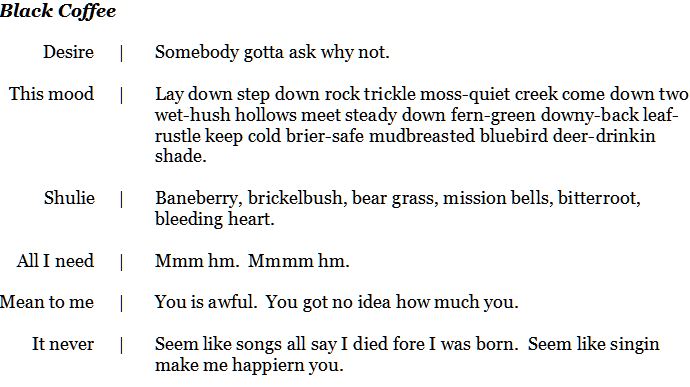
The two poems which follow are taken from Make Yourself Happy, the latest collection of poetry by Eleni Sikelianos. These particular poems were chosen by our reviewer Julie Larios specifically because they made her happy—and because they represent a level of energy, concern, wonder, and engagement (with both the beauty of language and the beauty of the natural world) that is typical of the poems in the book. The review of Make Yourself Happy may be read here. We also have an interview of Ms. Sikelianos for Numéro Cinq readers here.

—Julie Larios


Making the Bird Happy

House finches bobbing on the branches
like fitful punctuation marks, comma in a puff of snow, blobs
of feathered exclamation
points bouncing
in the cold. They
decorate the view and entertain
the cat with red-winter tail feathers and caps. But
an hour later they’re gone. How/where
did they go?

They’re in the back of the bird book
with low “burry notes’
The red-shafted flicker who was also in the tree gives
a soft muffled bwirr
contact call, a clear keew
close contact call, a soft lilt
………..wik-a-wik-a-wik-a

Every beautiful bird is in Texas.
Indigo bunting.
Lazuli bunting. Look at that bird’s
bright-blue forehead!

Say’s Phoebe says
…………pidiweew, pidireep, pidiweew

a phoebe never mistakes herself
for a bird………………she will never mistake herself for someone’s happy nest

“that’s not the way the bird would see it”………..soaking
…….in ultraviolet spectrum,….magnetic fields,……….sunset’s polarized glow
….a feather drab to us hovers in bird-world in pearlized light

yet when Parker plays “Ornithology” even the cat looks up
belief, the bird is happy
to the bird I keep applying what I think I know

N5

Do Nothing Fancy

I shall do nothing fancy
to make myself happy. Help!
I dwell here because I do not dwell
among the dead. But sunlight
is lethal to some, so shall I
make a golden ring that replicates itself or build a golden
hour from which is banished grief to
make the hour so roundly happy? Some will bind
themselves in beautiful things and some
in chains. Some made a fetter from
………..–     the sound of a cat’s footfall
………..–     the beard of a woman
………..–     roots of a mountain
………..–     sinews of a bear
………..–     breath of a fish
………..–     spittle of a bird
but what kind of beard?

Name your letter….name it Gleipnir
(a manackle smooth and soft as a silken ribbon)

call it the wolf-joint………or call it the wrist, it is
where the wolf or the world will bite
(put your hand it its mouth as a pledge)

Now: How will you settle an argument with only one hand?
wrist…..wreathe….wrest…..writhe….wr – to twist
the human mouth makes the movement-sounds
twisting out of the bindings
twisting away from how
make yourself happy moving
freely towards the experimental sky
and language the false start to love is

Eleni Sikelianos

N5

Eleni Sikelianos is a poet, translator, memorist and professor of creative writing at the University of Denver. Her books include Make Yourself Happy, The Loving Detail of the Living and the Dead, Body Clock and many others.

N5

Apr 082017
 

.

Eleni Sikelianos is the author of several books of poetry (one of them a book-long single ode titled The California Poem) and two hybrid essay/memoirs (The Book of Jon and You Animal Machine); she has translated work by Greek, Russian, Chinese, and French poets.  She received her MFA from the Naropa Institute in 1991 and currently teaches at the University of Denver, where she is the director of the creative writing program.

Ms. Sikelianos generously agreed to answer some interview questions from our reviewer, Julie Larios; the poet’s responses can be read in conjunction with our review of her new book, a collection of poems titled Make Yourself Happy.


Julie Larios (JL): Can you tell our readers a bit about Naropa University and your MFA studies within the Jack Kerouac School of Disembodied Poetics? That one word—“disembodied”—is especially interesting. What does it mean to you in terms of your own work?

Eleni Sikelianos (ES): I went to Naropa in the late 80s and early 90s, and was lucky enough to study with or be around an incredibly range of writers and artists: Allen Ginsberg, William Burroughs, Kathy Acker, Amiri Baraka, David Hockney and Marianne Faithful are among the most well-known. But I had classes with Anne Waldman, Diane di Prima, Alice Notley, Bernadette Mayer, Susan Howe, and these all marked me in various ways. Perhaps one of the most important things I learned at Naropa — besides being exposed to groundbreaking, culture-changing work — was to think of the poet as a figure of engagement. Engagement can mean many things: working in at-risk communities, or studying Sanskrit, but it means doing your work in a serious way.

I think “disembodied” came in as a bit of a joke (I wasn’t around at the founding of the school in the 70s), since the writing school was named for a dead man, and there were lots of dead writers who were genii loci, inspirational figures. Language itself is disembodied, you could say, despite its relation to the body that sounds it or writes it or reads it. One of the things I strive for as a poet is to embody (thought, feeling, experience) in language — and that is one of the great experiments of poetry — the ongoing journey back and forth between embodiment and disembodiment that the medium of language necessitates.

JL: You’ve been called an “experimental” poet. What do you think of that designation and/or the whole idea of designations and categories when it comes to poets?

ES: I was on the radio last month, and the radio host introduced me as an “experimental poet” about fifty times. My graduate students who heard it wondered why he couldn’t just say “poet.” I’m not that interested in categories in this regard, although I do feel fiercely loyal to communities and very connected to lineages. “Experimental” is kind of a stand-in word for a number of things, one of which might be writing that creates meanings as it makes itself, rather than heading toward predetermined meaning. Just a quick look in the Merriam-Webster will tell you a lot:

Experiment

1 a : test, trial

make another experiment of his suspicion — William Shakespeare

b : a tentative procedure or policy

c : an operation or procedure carried out under controlled conditions in order

to discover an unknown effect or law, to test or establish a hypothesis, or to

illustrate a known law

2
obsolete : experience

So, a kind of writing that allows the tentative nature of the world into its proceedings, that admits that meaning and reality aren’t fixed and sets out to test them, to discover and to try (the root meaning of “experiment”). And that has a historical connection to experience (which might itself be becoming somewhat obsolete). If we define it thus, then, yes, it’s a good designation. And if it’s a way for people to understand an approach to writing and reading in a meaningful way, then I’m for it.

JL: Your work indicates an interest in science as well as language. Some people approach poetic investigation and scientific investigation as if they were diametrically opposed perspectives on—and responses to—the world we live in. Why do you think that is?

ES: Well, science is itself a language, a way of communicating things about our world. The word “experiment” serves us perfectly here. I think of both poetry and sciences as ways to test out and discover things about the world, about meaning and structures. I’m not sure most people do think of science and poetry as diametrically opposed, but if they do, it might be because of a cliché about poetry’s sole or primary function as affective. That is not to say that carrying emotion isn’t an important behavior of poetry, it’s just not the only one.

JL: Any recommendations for our readers of poets whose work you're inspired by or of writing in general that interests you and/or informs your own work?

ES: For Make Yourself Happy, I went back to some of the poets who have been important to me for a long time. I was thinking about the joy and bounce in Frank O’Hara’s Lunch Poems, about the devotion of Lorine Niedecker’s sequences, and the combination of astringency and delicate care in Reznikoff’s Testimony. Ed Dorn’s fresh encounter with genre (the Western) and experiment in Gunslinger was in my mind, too. Although these didn’t go into the writing of Make Yourself Happy, recent books I’ve been excited about are Simone White’s Of Being Dispersed, Fanny Howe’s The Needle’s Eye, Dolores Dorontes’ Style (translated by Jen Hofer), and my student Carolina Ebeid’s You Ask Me to Talk About the Interior. I just started Valerie Mejer Caso’s This Blue Novel, and am loving it.

—Eleni Sikelianos & Julie Larios

N5

Eleni Sikelianos is a poet, translator, memorist and professor of creative writing at the University of Denver. Her books include Make Yourself Happy, The Loving Detail of the Living and the Dead, Body Clock and many others.

Julie Larios is a Contributing Editor at Numéro Cinq. She is the recipient of an Academy of American Poets prize and a Pushcart Prize, and her work has been chosen twice for The Best American Poetry series.

N5

Apr 082017
 

The book’s purpose is not to suggest that language muddies things up permanently; instead, language in Sikelianos’s hands has a fluid quality to it, it has a round-about-ing quality. There is pleasure—and an increased appreciation of the strangeness of words and the power of words – when a reader goes with both the swirl and the forward movement of the river Sikelianos creates.
—Julie Larios

Make Yourself Happy
Eleni Sikelianos
Coffee House Press, 2017
170 pages, $18

.

Reviewers sometimes bite their lips with trepidation when a review copy comes in that has been written by an “experimental” poet. Will the experimental nature of the work in their hands be understandable to someone not fully aware yet of the parameters (the “controlled conditions”) of the experiment? Will the reviewer’s unfamiliarity with the poet’s style, if that style is linguistically challenging, get in the way? Will the knee-jerk desire for a normal narrative line or for easily-absorbed syntactical structures obscure the reviewer’s grasp of meaning? That is, will the reviewer (me, in this case) have the energy and the patience to “get it”?

Eleni Sikelianos is described by critics as an “experimental” poet, but her latest book, Make Yourself Happy, calmed my reviewer-related anxieties quickly. The poems throughout do play around with normal narrative thrust and sequencing, and there are syntactical structures that require a second look, and a slower look. So yes, energy is required. But there is nothing about the poems that provokes impatience, nothing that leaves the reader behind, wondering what just happened. The cumulative effect of reading the poems in sequence, from cover to cover (not something I always do with books of less inter-dependent poems) is inclusive—the poems draw you in one after another, and you travel with them (even the title refers to this second-person “you” engagement with the poet—you are invited to make yourself happy, though you sometimes might mis-define or misunderstand what “happiness” involves.) The book’s purpose is not to suggest that language muddies things up permanently; instead, language in Sikelianos’s hands has a fluid quality to it; it has a round-about-ing quality. There is pleasure—and an increased appreciation of the strangeness of words and the power of words—when a reader goes with both the swirl and the forward movement of the river Sikelianos creates.

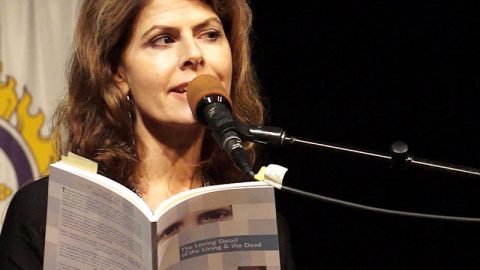
Eleni Sikelianos Reading at Naropa, 2013

Make Yourself Happy is divided into five sections, prefaced by a few reconfigured lines from William Carlos Williams in which he chides his readers, “Come on! / Do you want to live / forever?” and ends by calling poetry the art of “listening / to the nightingale / of fools.”  Then Sikelianos begins in earnest with the first—and title—section, thirty-nine individual poems—individual, yes, but interconnected by their juggling with and questioning of the word “happy.” The opening poem (“Through the lower window”) ends with this advice: “Get on a donkey / and learn some grammar Get on a donkey / and ride.” Who can resist that imperative?

On second thought, is that advice imperative? The next poem—the title poem—makes us wonder: “We do confuse what is a command and what / a prayer / statement and threat, question / and answer.” So we’ve been warned to be careful, as we read further, about the assumptions we make in our lives: those assumptions might not make us happy. At least, not happy in the way sunlight or a croissant in Paris or butter standing “in a bright rectangle of light” might make us happy, says the poet, nor in the way that the ear “tends to hear what it needs to make itself happy.”

We make assumptions, we create the idea of happiness, we are taught it, sometimes incorrectly. Sikelianos recognizes that we feel happy when we eat ordinary bread, or when we see the buds on the lemon trees. But “Tomorrow / we’ll learn all things to undo in the Making Ourselves / Happy school.” Further along in the first section, at the end of the poem which begins “I had taken the long way home…” , we hear the speaker say, “I would not wish to live anywhere, ever, where everybody’s always / happy.”

A choice must be made between “the pursuit of property or of happiness,” and a difference must be established between relief and happiness. People get confused, they sometimes mistake their privileged status for happiness. So we need to be careful with definitions, Sikelianos suggests. Maybe by doing “nothing fancy” we can make ourselves happy. Or, in the poem that begins “To make myself happy in the face of error…” she admits that the sounds of words can make us happy. “To make myself happy in the face of error I repeat / bandicoot long-nosed bandicoot. You / try it. And see how happy / is the b, the oo.”

It’s clear that Sikelianos—a poet, translator, memorist and professor of creative writing at the University of Denver—enjoys the sound of words, and enjoys the way words themselves seem physical (embodied, capable of movement.) Early on, we begin to hear chiming and rhyming, with the word “ombre” sitting next to “hombres,” and, later, the word “wrist” morphing into “wreathe…wrest…writhe.” Later in the book we hear blue/hue/shoot/thru; in another poem, spare/air/there, and in a poem only six short lines long, we hear softshell, sinner, saved, saved (again), saint and shrine. In the poem which begins “How Happy Are You” (which includes Likert-test boxes measuring our responses to what is being said, from Less True to More True) Sikelianos states, “O how a word can hover in its surroundings between sense and sorrow / a narrow   sound   shivering / as if the world itself rushed in decay toward that trembling.”

There are many guesses and suggestions in this first section about the how-to of making yourself happy (and about the how-not-to’s.) In the same poem about the sound of the b and the oo, Sikelianos writes, “I look through the pine trees and think / of children who are hungry / somewhere, this poem / can’t feed them. That is not / a right way.” Poetry can’t, of course, become embodied enough to substitute for what materially feeds us. But Sikelianos said this in a recent poem-essay titled “Experimental Life” (American Book Review, July/August 2016):

My concerns now as a so-called experimental poet, are different than they were / …when I wanted to tear everything apart and start anew / …but certainly from when I was dedicated to the poetic performance of language above all else. Now it has come to seem that culture-making and art-making are preservationist acts / For salvaging some thinking and feeling among the tatters.

Poetry can, she suggests, matter. It is a “sensory remnant, as if we could still taste it on our tongues.” Sikelianos recognizes “the tatters” that exist, and she commits herself to examining how to live as a creative person in that kind of world. Further into the ABR essay she says this about life (“animation,” we are told, is the word Aristotle used):

…to consider only material in the abstract (like capital or language) / Is a way of reducing us to bare life / But to consider material’s animation, its movement and interactions / Means to take spiritual, emotional, political, personal and material risks in the poem / And these things (we will call them) together are what make context / (from the Latin: to weave together) / Which is a way to live in the world

For Sikelianos, happiness seems to mean that a way has been found to salvage thinking and feeling and to establish context. As a poet, she must work to “animate” language, to weave what is material with what is abstract, and to take risks with words. She enjoys “… the sound of each word rubbing up against the others / The rhythm of each jostling in its context / Rhythm being one of the things that animates the living.”

As she says in the poem that begins “One Way,”

a fuzz of white pine sapling says yes yes
in the wind then
no, no!             when it says yes
and when it says no make a
go of
it. It
is how to live.

We must do our best to make a go of it, she suggests, just like the pine saplings do. And one of the tools poets use to do their best is language. Of course, language can be a fierce wind, too, blowing on those saplings: “Gustave Flaubert’s father / had a voice like a scalpel, able / to skin the feeling right off / the surface of the body.” We hear another warning: Be careful not only with definitions but with words themselves.

As the first section proceeds, it becomes clear that Sikelianos is interested in dichotomies—life/death, inside/outside, money/honey, green/grief (“coming to be” and decay), the natural world / the constructed world. This interest becomes even clearer in the second section of the book, titled “How to Assemble the Animal Globe,” which consists of thirty-one poems divided into seven sub-sections, all relating to extinct species (“lastlings”) on seven continents, all the extinctions due directly or indirectly to human action / inaction. This is the natural world vs. the constructed (man-made, man-destroyed) world.

The poems in this section contain many lines of encyclopedia-like information about the animals. For example, these lines about the Bubal Hartebeest of North Africa: “…when viewed head-on, the horns / formed a U; the last captive female. died November 9, Jardin des Plantes, 1923.” I can find no poetic language, only information, in the poem about the Tasmanian Tiger. But many of the poems in this section also break into lyrical passages, like the poem about the Mauritius Blue Pigeon which ends with a ship’s artist who “up in the river gorges, saw / the plucked earth coming”.

There is a whole song of extinction in this section, as well as several small, haiku-like poems. About the Pied Raven, Sikelianos writes “over hill and dale   the only thing moving / like a riddle a raven/ is as little in its yellow eye / as mine.” A poem titled “Great Auk” uses alliteration with abandon (beautiful / bird / bizaare / burning / burning /body’s / buried / bones / beaks) and tops it off with clever near rhymes: auk—skin / auction / unction. It’s a pleasure to see the poet enjoying the tools in her toolbox.

Two poems (“For You to Write About” and “Lost and Found (Lazurus Species”) do what many great poets love most – they name things. These two lists of extinct animals beg to be read aloud, with names that roll around on the tongue: “Broad-faced Potoroo / Darling Downs Hopping Mouse / Crescent Nail-tail Wallaby / Pig-footed Bandicoot….” In a footnote to the Lost and Found poem, we learn that the Lord Howe Island Stick Insect was also known as “the walking sausage or the land lobster.”

The fourth section—a 34-page poem titled “Oracle Or, Utopia”—charts a path through the jungle of man’s abuse of the planet (“…what it means to be live alive, when the world made its first sounds / …what it means / to be gone agone) and the possibility of weaving one world from the previous two (man/nature or past/future.) Of course, nothing about this path is easy; “Utopia” is an imagined place, and an “oracle” is a prophecy with ambiguous meaning. The section focuses on the future, but it sneaks in lines like this: “Then if the past / comes bustling in like a band of cocked revolvers…” Trying to determine how the past and the future can flow together smoothly, with “all the pictures moving forward and back / the old rock dust and the new new planet” involves poetry, which can move between “rupture” and “rapture.”

“Is There a River Here / Epode,” the fifth section, offers up a lovely 2-page poem ending on a welcome note of optimism, as does the sixth and final section, “There Were Ancient Questions Inside My Head (Rider.)” Added after the last poem are fascinating endnotes—often expanding on scientific principles mentioned in the book—and acknowledgements for the many images used throughout.

For readers of Numéro Cinq who shy away from experimental writing, I encourage you to give Make Yourself Happy a try. Consider the words of critic Warren Motte, who said this in his essay titled “Experimental Reading”:

[T]he experimental text involves us, enrolling us willingly or unwillingly in the process of textual production, and enfranchising us in that process as full partners. In the first instance, it may shock and bewilder us insofar as it beggars traditional, normative strategies of reading and interpretation. Yet by the same token, it grabs us and demands a reaction from us; it engages us and insists that we do something with it; it rejects outright a passive reception in favor of an active, articulative one. …Experimental writing obliges us to read experimentally….

We go at the experimental text hammer and tongs, gradually realizing that the text has been conceived with that very process in mind, and that in fact it anticipates our interpretive efforts. In other words, whatever else the experimental text may speak about…it also (and crucially) speaks about us, and about our efforts to come to terms with it. Moreover, it addresses that speech directly to us, in an unmediated manner—just as if it were inviting us to engage in a conversation….

This is the conversation Eleni Sikelianos invites us to in Make Yourself Happy. She starts the conversation by asking us what happiness is, and though she doesn’t feed us answers, she closes the conversation six sections later with these lines:

Of happiness, what have we lost? What wilds it?

My loves

I call all
of you.

Here, I want you entirely happy.

—Julie Larios

Note: The poet – whose poetic voice is generous and inclusive—also generously responded to questions for a Numéro Cinq interview running concurrently with this review. You can link to her responses here. And you can read two of the books poems (“Making the Bird Happy” and “Do Nothing Fancy”) in their entirety here, with thanks to Ms. Sikelianos and Coffee House Press for their permission to reprint these poems from Make Yourself Happy.

N5

Julie Larios is a Contributing Editor at Numéro Cinq. She is the recipient of an Academy of American Poets prize and a Pushcart Prize, and her work has been chosen twice for The Best American Poetry series.

N5

Dec 312014
 

turchi-peter-2014

“…every well constructed piece of fiction has elements of a puzzle, and every piece of fiction that means to provoke readers to a state of wonder or contemplation has at least some element of mystery. “

— Peter Turchi, A Muse and a Maze: Writing as Puzzle, Mystery and Magic —

amuseamaze-cover-final-for-pgw-2-19-14-lowres

A Muse and a Maze: Writing as Puzzle, Mystery and Magic
Peter Turchi
Trinity University Press, 2014
244 pages, $29.95
ISBN 9781595341938

/

Ten days before Christmas 2014, Powell’s Books in Portland posted its online list of Best Books of 2014, prefacing the post with these words: “Here are the new releases across six categories that left us inspired, bewildered, and a little bit wiser.” Books that leave us inspired and a little bit wiser – these are the conventional guidelines for choosing favorites. Who doesn’t want that from a good book? But then there’s that other word: “bewildered.” That word makes us pause. Really? Do we want to be bewildered by the stories and poems we read?

Peter Turchi answers that question with a resounding yes in his intriguing (and, yes, bewildering and inspiring) new book, A Muse and a Maze: Writing as Puzzle, Mystery and Magic. To leave readers slightly bewildered, to leave them with some questions answered but also with the understanding that other questions are unanswerable, to challenge readers to be satisfied with uncertainty – that’s exactly what Turchi encourages in this book.

Though equally interesting for the general reader, A Muse and a Maze (the title itself is a bit of a game) is directed mainly at writers. The writer Robert Boswell in an interview for Fiction Writers’ Review says, “It’s not a craft book but a rumination on the impulse to write and how that impulse may be related to other human desires.”

So A Muse and a Maze is not a textbook, nor is it a manual. It is not divided into the usual craft-book chapters addressing point of view, voice, syntax, setting, characterization, plot (Turchi’s analysis of work by Chekhov suggests we think hard about whether stories are really just about events), and structure, though the book addresses all of those and then some over the course of its six offbeat sections (plus introductory notes entitled “The Contemplation of Recurring Patterns”):

1. Directions for Attaining Knowledge of All Dark Things
2. How, from Such Wreckage, We Evolve the Eventual Effect
3. Seven Clever Pieces
4. The Treasure Hunter’s Dilemma
5. The Line, the Pyramid, and the Labyrinth
6. The Pleasures of Difficulty

What Turchi has done in this book is examine a fiction writer’s attitude toward his material, with writers compared initially to puzzle-makers (in the style of Will Shortz, crossword puzzle designer for the New York Times, and Howard Garns, the inventor of what we now know as Sudoku) and magicians (a la Harry Houdini.) Seen from this perspective, the writer’s job is to make conscious choices about the puzzle or the illusion he or she is creating, in order to produce a certain “effect.” To be able to do that, Turchi explains, is to control not necessarily what the audience sees, but what the audience thinks it sees (and, he adds later, what the audience wants to think it sees.) Writing, like magic, is about “the creation of a credible illusion” – with the key aspect being credibility (with credibility often established by a careful writer’s observation and recognition of recurring patterns.)

Interestingly, the word “illusion” is used more often by magicians than the word “trick,” which suggest gimmickry at the heart of their work. Turchi explains that Harry Houdini, who used gimmickry (mirrors in a box) for his famous Disappearing Elephant illusion, cut the elephant out of his act when he realized the audience reaction to its disappearance was lukewarm. His admirers were much more captivated by his fabricated identity — Houdini, the exotic, bare-chested escape artist who defied death.

With most puzzles the goal is limited to finding a solution. Not so with fiction:

The composer of a puzzle means to present a challenge, but also intends for his audience to solve it. A magician presents an illusion with the understanding that, while it can be “solved,” or explained, his purpose is to disguise that solution so we can experience something that, however briefly, transcends rational understanding. It’s tempting to say that a writer, then, is a kind of magician.

Turchi encourages us to resist that temptation. He does a fine job of delineating what genre writers offers us – they are the performers, the magicians, offering us entertainment and a solution to the puzzle; in his description of this type of writing, he doesn’t adopt an attitude of superiority; as a puzzle-lover himself, Turchi appreciates a good detective novel, but he persuades us that the destination of the typical mystery is that solution to the whodunit. There is a crime, clues are dispensed prescriptively along the way. The click of the puzzle-box closing – that’s what is required by readers of genre fiction. In other words, Professor Plum killed Ms. Scarlet in the Conservatory with the candlestick. End of game.

Literary fiction (or mysteries that move a more literary direction) is similar to puzzle-building (the “strategic arrangement” of pieces of the narrative) with this important difference:

…while composing a piece of fiction is like assembling a puzzle, the finished work is not presented by the writer as a puzzle for the reader to solve. There may be puzzles within the story, elements of plot or character or imagery or meaning that require the reader’s active participation, but the story as a whole is not a problem with a solution. Like Ariadne’s thread allowing Theseus to journey into –and out of – the mythical labyrinth, a story means to lead the reader somewhere. But the destination isn’t a monster, or a pot of gold, or a bit of wisdom. Instead, the destination is something – or several things – to contemplate. The best stories and novels lead the reader not to an explanation, but to a place of wonder.

Puzzles, then, can be elegant combinations of functionality, clarity, economy and cleverness, but they are closed systems; stories (at least the kind that linger) are open.

In a recent interview Turchi said, “… one of my goals was to explore the seemingly perverse pleasure to be had from constraints, or form. The joke of Calvinball in the Calvin and Hobbes comic was that a game with no rules is exhausting.” Both puzzles and poetry can be subjected to formal constraints – the formal requirements of a villanelle, for example, can be compared to the rules of Sudoku, and Turchi obliges us with a list of said constraints for both; he is among the endangered species of people who believe constraints help, rather than hobble, beginning writers, giving them “a container to work in and against.” Leonardo da Vinci, too, was a fan of rules: “Art lives from constraints and dies from freedom.” Of course, the trick (or is it an illusion?) is to make the constraints invisible to the audience.

The book offers up discussions, too, of the fluidity of language, the multiplicity of selves, the concept of “flow state,” the idea of artistic obsession (softening the sound of that sometimes by calling it “devoted attention”) and the cultivation by writers of curiosity and observational skills; there is a stimulating section about “difficulty” in fiction, and the idea of narrative non-linearity. Turchi suggests a new openness in today’s world to experiments with structure and sees that experimentation running parallel to an increased interest in game-playing technologies. He encourages openness to the way narrative structures can be turned upside down and inside out, backwards, forwards, in fragments, in meta-textual ways, defying convention, and he has plenty of examples to support that approach – not bad for a man who also appreciates what formal constraints can teach us. Turchi is always careful to moderate his enthusiasms with a few warnings; for example, he enjoys “mystery” in the sense of a reader being left contemplating unanswerable questions and/or the darker side of our characters, but he warns us that stories should not “collapse under the weight of uncertainty.” Few stories succeed without some kind of plot line; as Turchi says “…without that horse and the snowy evening we’d care less about why Robert Frost was in a funk.”

The author takes a focused look at several writers – Herman Melville, Samuel Clemens (like Houdini, a fabricated identity), F. Scott Fitzgerald, Anton Chekhov – and glimpses at a dizzying number of other artists, including visual artists (Anish Kappor, Charles Ritchie, Norman Rockwell, Van Gogh) and verbal artists (Jerry Seinfeld); Lewis Carroll (master mathematician, puzzle-maker and writer) gets a look, as do Michael Ondaatje, James Salter, Raymond Chandler, David Shields, Graham Greene, Vladimir Nabokov, and John Updike, among others (such as the Wizard of Oz.)  One of my favorite quotations among many highlighted in the book is delivered by Tim O’Brien:

Characterization is achieved…through a process that opens up and releases mysteries of the human spirit. The object is not to “solve” a character – to expose some hidden secret – but instead to deepen and enlarge the riddle itself.

I thought often, as I read this book, of Warren Motte, whose book Mirror Gazing I reviewed in Numéro Cinq’s June 2014 issue. Turchi’s  discussion of the multiplicity of selves within each character we create made me think about the act of looking into mirrors, and how we then ask ourselves, “Who am I? How have I become who I am?” As readers or movie-watchers, what we want to see and think about are the “stress fractures in the surface of a character.” Using tangrams (there is one to cut out on the last page of the book) Turchi talks about how shapes/characters are assembled via the rearrangement of “seven clever pieces.” With Walt Whitman’s famous line (“I contain multitudes”) resounding in our ears, the answer to “Who am I?” seems to depend on who is doing the arranging. There is “no single logical sequence….only possibilities to ponder, ”says Turchi.

The author suggests his new book as a companion, not a sequel, to his equally interesting book about the process of writing, Maps of the Imagination. “Both books are, at least in part, about ways in which a piece of writing is designed. They both mean to invite writers to think differently about what we do.” He’s eager to have us remember that there is playfulness, in addition to effort, in art, and he bemoans the fact that a sense of delight in the creation of art often gets overlooked in conversations about craft. The author’s own sense of humor comes shining through – this is not dusty, academic writing. Nor does it limit itself strictly to writing advice. The author allows himself to comment on the culture at large:

The patience and willingness to embrace complexity seems particularly important these days, when much of the rhetoric of business and politics is devoted to reducing and simplifying people and problems. Easy understanding comes at a high price. One of the things fiction and poetry can do is to remind us of the value of refusing to rush to judgment, the need not just to recognize, but to accept, complexity and mystery.

In the interview at Fiction Writers Review, Turchi says, “…in talking about the virtues of obsession I’m really talking about the virtues of sustained concentration, of patience.”

Reader beware: Numerous brain-teasing puzzles are inserted into both text and margins of this book, making it difficult to turn the page before trying to find solutions. Either grab your pencil and write directly into the book as you look for the answers, or – if you’re less obsessive about puzzle-solving – move on and stick to the task at hand: reading Turchi’s text. The puzzles really do exert a pull, though, even if they reminded me occasionally of the logic puzzles I failed to solve in my Graduate Record Exams – the ones that begin “John, Daniel, Mary, Jeanette and Olivia all have flags of different colors…”  You know the type. They make my head hurt. Pages 28 and 29 involve an acrostic designed especially for the book by puzzle-man Michael Ashley – if you can solve it, you can enter your answer online and try to win a jigsaw puzzle of the cover of the book.

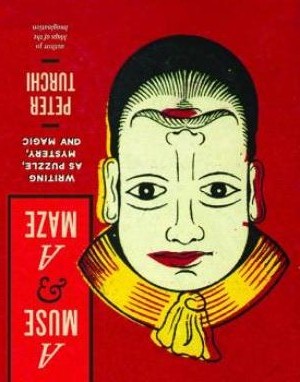
The cover, by the way, extends the discussion of the multiplicity of selves by portraying two young men in the same face – turn the cover upside down and you see someone with black hair, wide red lips and a golden collar; right-side-up the collar becomes a turban, and the man has a mustache and black beard. It’s amusing. And amazing. And bewildering. And fun.

— Julie Larios

Flipped A Muse and a Maze

/
May 2011 - Jackson Fishing at Lake Commonwealth

Julie Larios is a Contributing Editor at Numéro Cinq. She is the recipient of an Academy of American Poets prize and a Pushcart Prize, and her work has been chosen twice for The Best American Poetry series.


Nov 112014
 

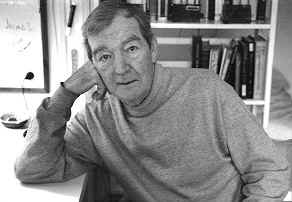
AlastairReidAlastair Reid — 1926-2014

.

Scottish poet Alastair Reid died on September 21st of this year at the age of 88, just three days after the naysayers for an independent Scotland won the day and the sunstruck madmen of Reid’s poem “Scotland” crawled home in defeat. It seems fair to say Reid’s poem — with its direct title, its landscape in high relief, and its dour fish-shop matron — stands as one of the poet’s definitive takes on the culture of his homeland.

Scotland

It was a day peculiar to this piece of the planet,
when larks rose on long thin strings of singing
and the air shifted with the shimmer of actual angels.
Greenness entered the body. The grasses
shivered with presences, and sunlight
stayed like a halo on hair and heather and hills.
Walking into town, I saw, in a radiant raincoat,
the woman from the fish-shop. ‘What a day it is!’
cried I, like a sunstruck madman.
And what did she have to say for it?
Her brow grew bleak, her ancestors raged in their graves
as she spoke with their ancient misery:
‘We’ll pay for it, we’ll pay for it, we’ll pay for it!’

In the referendum of September 18th, good money was bet that Reid’s woman represented Scotland well enough to prevail — her brow bleak, her ancestors raging, her misery ancient — and that the optimistic Home-Rule voters would not prevail. They did not go down in flames; perhaps their failure was more sodden. Certainly “We’ll pay for it” was the rallying cry for those who urged a No vote and who implored Scottish voters to stick by the Queen.

QueenApparently, the Union needed Scotland, and vice versa.

But what of the Scottish landscape, in contrast to the taciturn Scottish character? “…the air shifted with the singing of actual angels. / Greenness entered the body. The grasses / shivered with presences, and sunlight / stayed like a halo on hair and heather and hills.” Reid  celebrated landscape.  How a poet capable of writing those lines can fade into the background on the stage of British poetry is a puzzle to me. In 1954, Selden Rodman wrote an introduction to Reid’s work for Poetry magazine in which he said, “There are echoes of Dylan Thomas and Auden….[Reid] stands among these gifted contemporaries as an equal, one of the few poets writing in English to promise a continuance of their original affirmation.”

ScotlandA view of the Scottish hills: “Greenness entered the body….”

Could it be that since much of Reid’s mid-career energy was spent on the translation of poets who wrote in Spanish — Borges, Neruda, Garcia Marquez, Vargas Llosa, Pacheco, Padilla — his relative obscurity as a poet in his own right was guaranteed? As with other poets in this Undersung series, Reid was not completely invested in his identity as a poet; his output of poetry was high-end but sporadic, his interests were broad, his wanderings wide, and his abilities as both essayist and translator loomed large enough to cast a shadow over his own talent as a poet. On the other hand, it might just be that Reid’s early ascendency was interrupted by something more sanguine, something described this way recently by the columnist Daniel Mendelsohn (himself a translator) in the June 3rd New York Times’ Book Review column, “Book Ends”:

As a critic, I’m often struck by the way in which so many successful writers settle into a groove by midcareer: Whatever marked them as special, new, or distinctive when they started — the “thing” that set them on their path — becomes, with time, a franchise; at worst, a straitjacket. By the end, most of us repeat ourselves. Very few — perhaps only the greatest — continue to grow.”

Over the years, Reid did not settle for a straitjacket; he wandered the world and grew as a writer, seldom repeating himself, accepting few of the categorical limitations that certain genres (and upbringings) usually insist upon us. He was restless, and his writing reflected it. He moved between poetry and prose, between memoir and travel writing and translation work and articles about sports — he even wrote two picture books for children.

He was born – his father a minister, mother a doctor – near Whithorn in the Galloway region of southwest Scotland in 1926, the year of Scotland’s debilitating General Strike, during which soldiers and tanks were used in the streets of Glasgow to disperse angry crowds of union men. The entire decade of the 20’s was one of mass emigration from Scotland, with families leaving behind high unemployment and miserable living conditions in order to head out for better highlands and lowlands in “the colonies”; the vision of so many people leaving home, longing to find a more comfortable life, might have contributed to Reid’s famously itinerant lifestyle.

Emigrants

“What drew me to writing was its portability,” he once wrote; “it requires essentially no more than a notebook and a pencil, and it allowed me to own my own time, to travel light, to come to rest anywhere….”

His poems often explore the pull away from, and eventual push back towards, home:

Whithorn Manse

I knew it as Eden,
that lost walled garden,
past the green edge
of priory and village;
and, beyond it, the house,
withdrawn, white,
one window alight.

Returning, I wonder,
idly, uneasily,
what eyes from inside
look out now, not in,
as once mine did,
and what might grant me,
a right of entry?

Is it never dead, then,
that need of an Eden?

Even this evening,
estranged by age,
I ogle that light
with a child’s greed,
wistfully claiming
lost prerogatives
of homecoming.

Reid understood that what the landscape offered and what the people offered could be radically different things. But he did find a number of places that came closer to what he was searching for, especially in the landscape and language of Spain and Latin America, and in the character of their people. It was this level of comfort that allowed him to focus on learning Spanish – to hunger for it, to eat it up and beg for more – and begin his highly-praised works of translation.

Over his lifetime Reid lived for extended periods in Majorca, Switzerland, Argentina, Chile, the Dominican Republic – on a ginger plantation – Mexico, England – in a houseboat on the Thames – and the Greenwich Village neighborhood of New York City, where he finally settled in (or was settled by old age) until his death. The obituary Charles McGrath wrote in The New Yorker three days after Reid’s death opens with this line: “The poet and translator Alastair Reid, who died on Monday at the age of eighty-eight, had itchy feet.” In his essay titled “Digging Up Scotland,” published in 1981 in The New Yorker, Reid makes clear that his restlessness had something to do with finding a place where he could “feel one” with his surroundings:

“I have a friend in Scotland, a painter,” he wrote, “who still lives in the fishing town he was born in, grew up in, went to school in, was married in, raised his children in, works in, and clearly intends to die in. I look on him with uncomprehending awe, for although I had much the same origins, born and sprouting in rural Scotland…I had in my head from an early age the firm notion of leaving….He has made his peace with place in a way that to me is, if not unimaginable, at least by now beyond me. ”

Reid seldom stayed in one place long enough to have what he considered a permanent address; his mail was delivered to the offices of The New Yorker, where he let stacks of it pile up for months. His unease with permanence is clearly visible in his poems, where two perceived opposites often pull against each other, interfering with any hope that the tug-of-war will be settled or the people involved come to rest, as seen in the opening stanzas of a poem titled “What Bones Say”:

The skeleton
is hardly a lesson
in human nature.

Similarly, stones
are the bones of landscapes,
and yet trees blossom

in contradiction.
We are much more
than our brittle topography.

In those lines, see how beautifully Reid handles the simple language – in the near-rhyme of “skeleton” with “lesson,” the full rhyme of “stones” with “bones,” and in the echo that chimes between “lesson,” “blossom” and “contradiction” – not overwhelming readers with musicality, but giving us just enough. I admire the courage he has to say something as large as “We are much more / than our brittle topography.” He approaches language the same way in the other poems transcribed here – the abundant alliteration in “Scotland” and its chiming verbs – “shimmer” and “shivered” – the triptych of “idly,” “eyes” and “inside” in “Whithorn Manse,” its full rhymes (“white” and “alight) and near-rhymes (“need,” “Eden” and “garden.”) Reid’s poems seem spoken at first, easy and conversational, but the music on which they rise is carefully and thoroughly composed.

In the same New Yorker essay mentioned above, Reid writes, “The natural world and the human world separated early for me. I felt them to be somehow in contradiction, and still do. The Scottish landscape – misty, muted, in constant flux and shift – intrudes its presence in the form of endlessly changing weather; the Scottish character, eroded by a bitter history and a stony morality, and perhaps in reaction to the changing turbulence of weather, subscribes to illusions of permanence, of durability, asking for a kind of submission, an obedience. I felt, from the beginning, exhilarated by the first, fettered by the second. Tramps used to stop at our house, men of the road, begging a cup of tea or an old shirt, and in my mind I was always ready to leave with them, because between Scotland and myself I saw trouble ahead.”

He traveled first to Spain; it was during his time in Majorca – six years, off and on — that he met and became friends with the poet Robert Graves (about whom I wrote in my Undersung article about poet-novelists.) Their friendship ended when Reid fell in love with – and ran away with, temporarily – Graves’s muse, Margot Callas. Though Callas eventually returned to Graves, the conversations and apprenticeship Reid once enjoyed with the older poet were finished. In an essay Reid wrote on the occasion of what would have been Graves’s 100th birthday, he chided Graves for having been “mired in domesticity” during his first marriage, but then Reid becomes more conciliatory, saying “The English have always kept Graves at a distance, as if he were an offshore island, out of the mainstream – something they often do with English writers who choose to live elsewhere and are still successful.”

MajorcaThe Majorca home of Robert Graves – “an offshore island, out of the mainstream”

The same might be said of Reid himself – an offshore island in the sea of British literature. His most important books are out of print; these include his poetry collection Oases; Inside Out: Selected Poetry and Translations; Outside In: Selected Prose; Whereabouts: Notes on Being a Foreigner; and Weathering: Poems and Translations. If you subscribe to The New Yorker, you’re in luck – he contributed articles and poems there for more than forty years, and my quick search of their archives produced 152 hits.

In addition to “Scotland,” Reid’s most anthologized poem is “Curiosity,” about a dog’s and cat’s (but mostly human’s) view of the old adage “Curiosity killed the cat,” with the poet coming down hard in favor of being curious. Click here to hear it read by Reid himself over at The Poetry Archive. Rather than transcribe the poem so you can read it, I hope you will finish this essay and then go over to The Poetry Archive to listen to it.  We’re lucky to have recordings of these poems(as well as three others) in Reid’s own voice, since it was voice that he valued above all other qualities in a poem.

In an essay about translating his friends Jorge Luis Borges and Pablo Neruda, he wrote, “I realized I couldn’t read a poem of Neruda’s simply as words put down on the page without hearing behind them his languid and caressing voice. The most important thing to me in translating these two poets was the sound of their voices in my memory, since this helped in finding my way in with the appropriate English….The key was voice.”

Keeping Quiet

Now we will count to twelve
and we will all keep still.

For once on the face of the earth,
let’s not speak in any language;
let’s stop for one second,
and not move our arms so much.

It would be an exotic moment
without rush, without engines;
we would all be together
in a sudden strangeness.

Fisherman in the cold sea
would not harm whales
and the man gathering salt
would look at his hurt hands.

Those who prepare green wars,
wars with gas, wars with fire,
victories with no survivors,
would put on clean clothes
and walk about with their brothers
in the shade, doing nothing.

What I want should not be confused
with total inactivity.
Life is what it is about;
I want no truck with death.

If we were not so single-minded
about keeping our lives moving,
and for once could do nothing,
perhaps a huge silence
might interrupt this sadness
of never understanding ourselves
and of threatening ourselves with death.
Perhaps the earth can teach us
as when everything seems dead
and later proves to be alive.

Now I’ll count up to twelve
and you keep quiet and I will go.

Pablo Neruda — from Extravagaria (translated by Alastair Reid)

He went on to say, “For me, Neruda’s poems were fundamentally voiced – spoken poems of direct discourse – his voice was, in a certain sense, the instrument with which he wrote.” Describing one lecture he went to at Queen Elizabeth Hall, Reid says Neruda’s voice “spread out like a balm over the English crowd; a magical sound, even without the thread of meaning.” [Note: my source for these quotations from the essay about Borges and Neruda was in Spanish – the translations are my own.]

1754-PABLO_NERUDA_5-630x350Pablo Neruda – “…his voice was, in a certain sense, the instrument with which he wrote.”

It was Reid who was instrumental in getting the work of both Neruda and Borges in front of English-speaking readers. About translating Borges, Reid was less lyrical than he was about Neruda: “Translating Borges was, for me, like learning a private language….” He refers to Borges’s skeptical and questioning tone, concluding that Borges’s poems were more interdependent than Neruda’s, linked as they were by a “recurring heraldry of symbols – chessboards, maps, knives, mirrors, coins, labyrinths, tigers, libraries….”

Reid and Borges

Reid (second from left) and Jorge Luis Borges (third from left)

One of Reid’s most interesting observations about Borges focused on his blindness: “After many conversations with Borges, from the most serious to the most entertaining, I came to the profound realization that for him, I existed only as a voice. Maybe this led me to the deep conviction that voice is the most long-lasting incarnation of my existence. Even more, it is in voices rather than photographs that the dead remain alive.”

borges-in-libraryJorge Luis Borges – “…for him, I existed only as a voice.”

At one point, Reid explains Borges’s style: “He spoke English with the respect a language well-known to him deserved, but within which he did not live – that is, with the controlled cadence of literature. On other occasions, in the company of Spanish-speakers, he was more playful, less solemn. Still, I think his bilingual upbringing gave him a sense of the arbitrary and fickle nature of language: a bilingual person is more aware of the gulf that exists between word and object than someone limited to a single language.”

ouncedicetrice

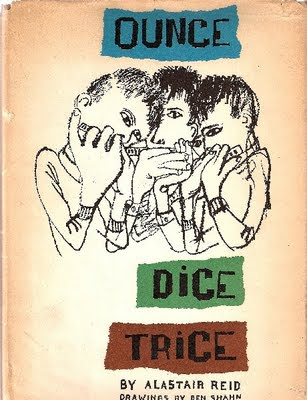
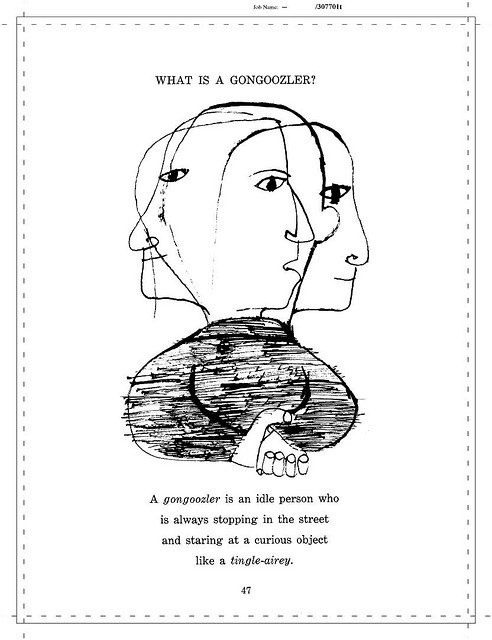
Reid’s awareness of the strange nature of words and his innate playfulness (in Charles McGrath’s obituary write-up, Reid is remembered as “cheerful, funny, and irreverent, with high expressive eyebrows that were frequently squeezed together in amusement”) show up full force in his picture book Ounce Dice Trice, a collection of nonsense – that is, a collection of real but relatively unknown words – tantony, quicklings, moonglade, etc. – revealed to us in all their strangeness, the way a talented chef might reveal the secret ingredients of a favorite dish. In the book, Reid creates several imaginative ways of counting from one to ten without numerals (“Instant, distant, tryst, catalyst, quest, sycamore, sophomore, oculist, novelist, dentist” and “Ounce, dice, trice, quartz, quince, sago, serpent, oxygen, nitrogen, denim.” The words sound like they come straight off the playground. Of course, the whole point of the book is wordplay, emphasizing that “gulf between word and object” recognized by people who have learned more than one language. Illustrations by Ben Shahn make the book a collector’s item – previously out of print, it’s now available again thanks to the New York Review Children’s Collection.

Ben ShahnReid himself was a gongoozler….

Reid’s origins might have been provincial — even restrictive — but as he grew his poetry and prose became more and more cosmopolitan and expansive. He regarded translation as an act resembling “bewitchment,” and he wrote that the translation of someone else’s work required “not only reading it deeply and deciphering it, but climbing on top of the scenery backstage, up onto the supports and the scaffolding.”

I often wished while getting my MFA that the program I attended had offered a translation track. Translation seems to me one of the best ways – almost acrobatic, according to Reid — to capture and understand how a poem works. Reid understood the way a poem could float out over the reader “without the thread of meaning,” though with his own poetry we are lucky enough to find both meaning and music.

Poem without Ends

One cannot take the beginning out of the air
saying ‘It is the time: the hour is here’.
The process is continuous as wind,
the bird observed, not rising, but in flight,
unrealised, in motion of the mind.

The end of everything is similar, never
actually happening, but always over.
The agony, the bent head, only tell
that already in the heart the innocent evening
is thick with the ferment of farewell.

— Julie Larios

,
unnamed

Julie Larios has contributed seven previous essays in her Undersung series for Numéro Cinq, highlighting the work of George Starbuck, Robert Francis, Josephine Jacobsen, Adrien Stoutenburg, Marie Ponsot, Eugenio Montale and The Poet-Novelist; her own poems have been featured in our pages as well. She is the recipient of an Academy of American Poets prize and a Pushcart Prize, and her work has been chosen twice for The Best American Poetry series.

.
.

Jul 102014
 

Robert Graves, Poet and Novelist…and Playwright…and Scholar

Some writers who gain fame as novelists continue to write poetry “on the side,” not unlike the little smear of cream cheese offered up with a bagel. Some writers quite sensibly refuse to be labeled; they write whatever they please, whenever they please….And some writers who are truly talented poets get shanghaied by the success of their fiction and never regain the courage or the emotional space to re-establish themselves as poets. The categories are many.


“I am a failed poet. Maybe every novelist wants to write poetry first, finds he can’t and then tries the short story which is the most demanding form after poetry. And failing at that, only then does he take up novel writing.” So said a fine novelist you might have heard of: William Faulkner. He knew a thing or two about writing, but his sense that every writer longs to be a poet can’t possibly be true, not if MFA programs around the country are any indication. The fiction track students hoot and holler at poets and mock them at every turn. The poetry track students do the same right back. At one reading, the poets might emote earnestly while the fiction writers snore; at another, the fiction writers read on and on and on while the poets pass around derisive notes in the form of double dactyls. Looking down on the proceedings, the gods would never guess there were prose writers lusting after poetry’s compression, nor poets longing to try out a novel’s expansive narrative thrust.

That said, there are a surprising number of novelists who started out as poets. Thomas Hardy wrote poetry throughout his life and considered himself a poet despite the fact that he published no poetry until he was 58 years old, having gained fame with his novels – Far from the Madding Crowd, The Mayor of Casterbridge, Tess of the D’Urbervilles, and Jude the Obscure – long before that. After the publication of his first collection of poems, he did not write another novel. James Joyce first published poetry; some might even make a case for sections of Ulysses and all of Finnegan’s Wake reading more like poetry than prose. D.H. Lawrence was a poet before he turned to fiction. Vladimir Nabokov published four books of poetry before ever attempting a novel. John Updike’s first book was a collection of poems, as was one of his last, published posthumously. In between, he published six other volumes of poetry, a fact which surprises quite a few of those MFA students mentioned earlier.

The list of poet-novelists is a long one and includes Rudyard Kipling, Robert Graves, Muriel Spark, Randall Jarrell, Czeslaw Milosz, Michael Ondaatje, Margaret Atwood, Anne Michaels, Fred Chapelle, Russell Banks….I’m sure you can think of more. Some writers who gain fame as novelists continue to write poetry “on the side,” not unlike the little smear of cream cheese offered up with a bagel. Some writers quite sensibly refuse to be labeled; they write whatever they please, whenever they please. Some continue to think of themselves as poets first, novelists second, no matter what the sales figures or their publishers tell them. Some are definitely better fiction writers than they are poets and admit it, but continue to write poems; some are in denial and their publishers don’t want to antagonize them by saying, “Enough” – those poems get published despite their poetic failures. And some writers who are truly talented poets get shanghaied by the success of their fiction and never regain the courage or the emotional space to re-establish themselves as poets. The categories are many.

Both Robert Graves and James Dickey fall into the troubling category of poets whose reputations rest on a single novel that the wider public embraced – Deliverance for Dickey, I, Claudius for Graves. These men considered themselves primarily poets, but today few people read their poetry. It’s not just time and changing taste that accounts for that.  Maybe Hollywood contributed to the switch – it’s hard to fault Sir Derek Jacobi for delivering Graves’s Roman emperor to us in a way that burned him into our consciousness forever. Ditto the talent of director John Boorman when taking four men on a fictional hunting trip down a river in Dickey’s northern Georgia.

James Dickey at his desk…

There’s no doubt at all that James Dickey deserves to be remembered as a poet. After a late start with his writing (he worked for an advertising agency until he was thirty-seven), he produced five books of poetry in just five years (1960 to 1965), won a Guggenheim Fellowship, won the National Book Award and was named Poetry Consultant to the Library of Congress (equivalent to today’s Poet Laureate.) But his reputation now seems to rest on dueling banjos, Georgian hillbillies, and a down-on-all-fours-pig-squealing rape scene in his novel-turned-film, Deliverance. The novel was a bestseller and the film brought national attention to Dickey (who made a cameo appearance in it as a Southern sheriff.) His adapted screenplay of the story even brought him a Golden Globe. But Dickey’s accomplishments as a poet suffered for it (he never again had a collection of poems that was a critical success, despite more than twenty volumes of poetry in the three post-Deliverance decades before his death.) The New Georgia Encyclopedia says “His misbehavior at public events, his disorderly personal life, and his self-destructive alcoholism only enhanced his public image as a masculine, burly poet and man of American letters,” but it’s more likely that Dickey’s wonderful work as a poet will get dusty on academic library shelves, and Burt Reynolds will take home the honors for masculinity.

…and on the set of Deliverance with Burt Reynolds

Dickey’s style involves a precise ear for the rhythm of the words – his poems might not adhere to rules of form, and there is no formalized rhyme in the poem that follows, but Dickey definitely constructed it with a spoken cadence in mind. Reading it aloud, you hear the often eight- or nine-syllabled lines distinctly, you hear their three strong beats carried through to the final line. As the poet and Orange-Prize-winning novelist Helen Dunmore said, “Maybe it’s because the first things I wrote were poems – and very likely the last things will be poems too – that I’m convinced work has to grow into its own rhythm, inside the head.” Dickey, too, as a poet first and last, hears the rhythm of words. His sometimes violent imagery (in his poetry as well as in his novels) made many people squirm – it engaged “nature,” but not Mary Oliver-style, not as a source of inspiration and self-awareness; rather, Dickey’s nature (both poetic and – from what I can tell – personal) was primitive, full of blunt force, and sometimes theatrical. He once said, “I want a fever, in poetry: a fever, and tranquility.” The fever more often than not trumped the tranquility, but I think he managed to capture both in my favorite Dickey poem, “In the Tree House at Night.”

In The Tree House at Night

And now the green household is dark.
The half-moon completely is shining
On the earth-lighted tops of the trees.
To be dead, a house must be still.
The floor and the walls wave me slowly;
I am deep in them over my head.
The needles and pine cones about me

Are full of small birds at their roundest,
Their fist without mercy gripping
Hard down through the tree to the roots
To sing back at light when they feel it.
We lie here like angels in bodies,
My brothers and I, one dead,
The other asleep from much living,

In mid-air huddled beside me.
Dark climbed to us here as we climbed
Up the nails I have hammered all day
Through the sprained, comic rungs of the ladder
Of broom handles, crate slats, and laths
Foot by foot up the trunk to the branches
Where we came out at last over lakes

Of leaves, of fields disencumbered of earth
That move with the moves of the spirit.
Each nail that sustains us I set here;
Each nail in the house is now steadied
By my dead brother’s huge, freckled hand.
Through the years, he has pointed his hammer
Up into these limbs, and told us

That we must ascend, and all lie here.
Step after step he has brought me,
Embracing the trunk as his body,
Shaking its limbs with my heartbeat,
Till the pine cones danced without wind
And fell from the branches like apples.
In the arm-slender forks of our dwelling

I breathe my live brother’s light hair.
The blanket around us becomes
As solid as stone, and it sways.
With all my heart, I close
The blue, timeless eye of my mind.
Wind springs, as my dead brother smiles
And touches the tree at the root;

A shudder of joy runs up
The trunk; the needles tingle;
One bird uncontrollably cries.
The wind changes round, and I stir
Within another’s life. Whose life?
Who is dead? Whose presence is living?
When may I fall strangely to earth,

Who am nailed to this branch by a spirit?
Can two bodies make up a third?
To sing, must I feel the world’s light?
My green, graceful bones fill the air
With sleeping birds. Alone, alone
And with them I move gently.
I move at the heart of the world.

As for Robert Graves, how sad it will be if his poetry fades into the background and the light only shines on his fiction.  Yes, he wrote plays, he wrote literary criticism, he was a consummate scholar, he wrote I, Claudius, but he was also a poet’s poet, with a command of so many formal poetic devices that reading his poems is akin to alchemy – base metal into gold.

robert graves 1A young Robert Graves

The best example of his thoughts on the nature of poetry is found in his poem, “Flying Crooked.”   Substitute “poet” for “butterfly” and you’ve got a perfect description of what a poet does.

Flying Crooked

The butterfly, a cabbage-white,
(His honest idiocy of flight)
Will never now, it is too late,
Master the art of flying straight,
Yet has- who knows so well as I?-
A just sense of how not to fly:
He lurches here and here by guess
And God and hope and hopelessness.
Even the acrobatic swift
Has not his flying-crooked gift.

I hope you will go back, read the poetry of Dickey and Graves, read the poetry of  Atwood, Carver, Hardy, Nabokov, Ondaatje or any of the others I mentioned. There is something addictive about flying crooked, that’s for sure. And the plain truth is that few writers with a knack for it ever stop.

—Julie Larios

.
Author Photo

Julie Larios has had poems chosen twice for inclusion in the Best American Poetry series. She is the winner of an Academy of American Poets Prize and a Pushcart Prize, and has published four collections of poetry for children.

.
.

May 052014
 

Darfur, Minnesota - Birthplace of Adrien Stoutenburg Darfur, Minnesota – Birthplace of Adrien Stoutenburg

.

The goal here is not really to determine the why
behind a poet’s lack of reputation and readership.
But it’s such a puzzle – this business of a rising star failing to rise –
that the temptation to try to solve the puzzle always lurks in the background.

—Julie Larios


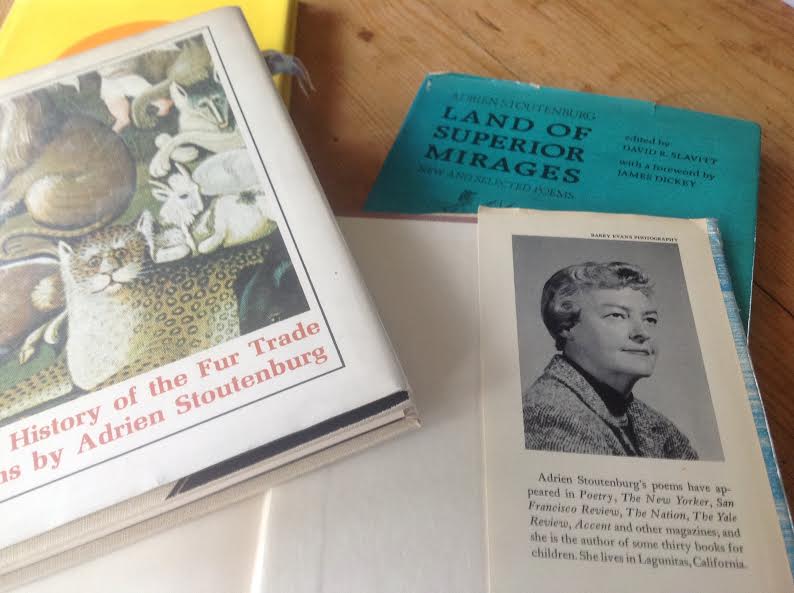
I often begin my treasure hunts for Undersung authors by looking for just the right author photo – one that will gaze back at us while we gaze at it, one that will allow the poetry to radiate out through the eyes, the smile, the averted glance, the stare. The treasure hunt this time around was for poet Adrien Stoutenburg, born Darfur, Minnesota, 1916; died Santa Barbara, California, 1982, aged 66. I had only two photos, both low-quality, both from the back jacket flaps of her books. The one below is on the flap of Heroes, Advise Us – her first poetry collection.

From Jacket Flap of Heroes, Advise Us (Scribners, 1964)

From Jacket Flap of Heroes, Advise Us (Scribners, 1964)

In terms of author photo categories (author as seductress, author as girl next door, author as bad ass, author as somber academic) this author photo of Stoutenburg might be placed in the “author as Republican great-great aunt” file. In it, the poet looks mild mannered but tightly coifed (her father was a barber, her mother a hairstylist.) Possibly a 1950’s country-club member and/or a Faculty Wives’ bridge player. But not even remotely the poet that critics once described as “ferocious” and “terrifying.”

So I looked for another picture. No luck. I couldn’t find a single photo of her on the Internet. I couldn’t find much at all, in fact, about the poet Adrien Stoutenburg —one quick Wikipedia entry. A few mentions as an author of children’s books. But little else. Below is the poem that made me stop in my tracks several years ago when I first read it in a used book store:

Rhinoceros

I have never seen that beast
with his snout bearing a pagoda
and his eyes like little fragments
and his haunches carrying hills
with them. His teeth, I have read,
are monuments, and his heart colder
than a key in winter,
though he sweats from pores round as goblets
and full of swamps.
The white hunters have killed him
a thousand times over.
I think of myself walking toward him
and preaching a love of creatures,
leaves in my palm, or a loaf of sugar,
and his great horn still,
the knees waiting,
and between us, like birds,
a twittering hope,
or merely the pause
between monster and monster.

—from Heroes, Advise Us

I’m not sure Stephen King ever wrote a more ominous line: “…his great horn still, / the knees waiting….” Ready to charge, that’s what’s implied. What poet, I wondered, looks into the face of a rhinoceros and sees a fellow monster? 

"...his great horn still, / his knees waiting....

“…his great horn still, / his knees waiting….

On the basis of that poem alone, I bought the book, then proceeded to hunt down every other one of her four books that I could find. But finding Stoutenburg takes some doing.

It’s not easy to suffer obscurity or anonymity  (or achieve it, depending on your point of view) on the Internet these days, not with the decades of digitally archived material available, and it’s certainly not common if the object of the hunt is a prize-winning author. Nevertheless, I couldn’t find a photo of Adrien Stoutenburg anywhere online— not a professional portrait, not one of her at a lectern, nor one in a professorial workshop pose, and not even one where she stands at the elbow of – or peeking out from behind – a more famous poet at a conference somewhere.

Was I missing some key word to type in that would get me to a photo? Might there be a photo of her in a literary journal or academic review in a narrower database? I checked, but no. Next I tried to find images online of the covers of her books of poetry – there were four titles to post pictures of – Heroes, Advise Us (Scribners, 1964), A Short History of the Fur Trade (Houghton Miflin, 1969), Greenwich Mean Time (Univ. of Utah Press, 1979) and Land of Superior Mirages (Johns Hopkins, 1986.) Again, I came up empty – other than an unusable 115×115 pixel photo somebody posted at a used book site, there are no pictures of her poetry books online, not even via the increasingly amazonian Amazon. Apparently, the poet Adrien Stoutenburg is not only undersung, she’s invisible.

How is that possible? Heroes, Advise Us won the Lamont Poetry Prize from the Academy of American Poets in 1964; her second poetry collection, A Short History of the Fur Trade, won a California Commonwealth medal and was under serious consideration (a “close competitor”) for the 1970 Pulitzer Prize (Richard Howard won, but one of the judges – James Dickey – declared later in a letter to Stoutenburg that he believed her book should and would have won had not W.H. Auden insisted on Howard – and, as the poet David Slavitt said, “Auden… prevailed—he was Auden, after all.”) Joyce Carol Oates praised the book, calling it “brilliant” and referring to Stoutenburg as “a really striking artist.”  Poet Henry Taylor helped get Greenwich Mean Time published at the University of Utah Press, saying “[Stoutenburg] has a wonderful eye for the right detail, and the tact to arrange observed details toward deep conclusions.”  Consider this poem:

On the Wagon

In between drinks I go on the wagon
which is sometimes a sleigh
and always filled with children,
the ears of horses like furred leaves,
the reins black over rumps
that resemble gray, cleft apples,
the smell of leather strong as brown medicine.

It is sometimes summer
and my cousin and I
actually ride the horses
and feel their backs—
broad, alive, and separate—
under our legs
thrust out, spraddled,
like short tan oars.

Sometimes there is hay in the box,
and that is a wood-sweet, wild-smell,
hot-heady bundle
of what was rooted, clovered, seasoned,
and sickled into a great, riding pillow
where we can roll under the passing sky.

It is at other times winter
and the smoke of the horses
is like the breath of fires,
and if I could, even now,
I would sneak inside,
stow away and lean against those hearts
stroking above every kind of ice and sweat
and desire.

Filled, furred, straddled, rooted, clovered, seasoned, sickled – just the sound of the words furls you and unfurls you, as do the unexpected comparisons – those horses’ rumps as cleft-apples, the smell of the leather like brown medicine, the children’s short legs sticking out like oars. It’s a passionate poem that goes deep, certainly not one that stays at the level of surface “glitter.” It throws off the same heat as Rhinoceros, and I could post another twenty here that do the same.

How invisible are other Lamont Poetry Prize winners from the 1950’s through the present day? The list includes poets Kay Ryan, Adrienne Rich, Czeslaw Milosz, Philip Levine, Lawrence Ferlinghetti, Robert Hass, Carolyn Kizer, Jane Hirshfield, Kim Addonizio, Gary Snyder, Kenneth Rexroth – stars in the poetry firmament, with abundant photos of each one online.  But Adrien Stoutenburg – author not only of award-winning books of poetry but of forty well-received books for children – can’t be found. One-time editor of Parnassus Press. Frequent contributor to the New Yorker, Saturday Review, the Nation, Yale Review, Commonwealth, and Accent. A Poetry Society of America’s Michael Sloane Fellowship winner. Winner of nine Borestone Mountain poetry awards  – yet not one photo.

Heroes, Advise Us contains a 39-page multi-sectioned poem /narrative (“This Journey”) focused on the tragic Scott expedition to the South Pole, as well as another 70 pages of strange and powerful stand-alone poems. The collection won prizes, but the Kirkus review of it at the time said the following: “Although the poems sometimes glitter, they lack a basic warmth.” For me, the poems have such heat that I feel like moving slightly back from them for fear of getting scorched at the edges. I love Stoutenburg’s work with its startling metaphors and convergences, its physicality, its dark imagination and heat.

But no one I’ve ever asked has  heard of her.

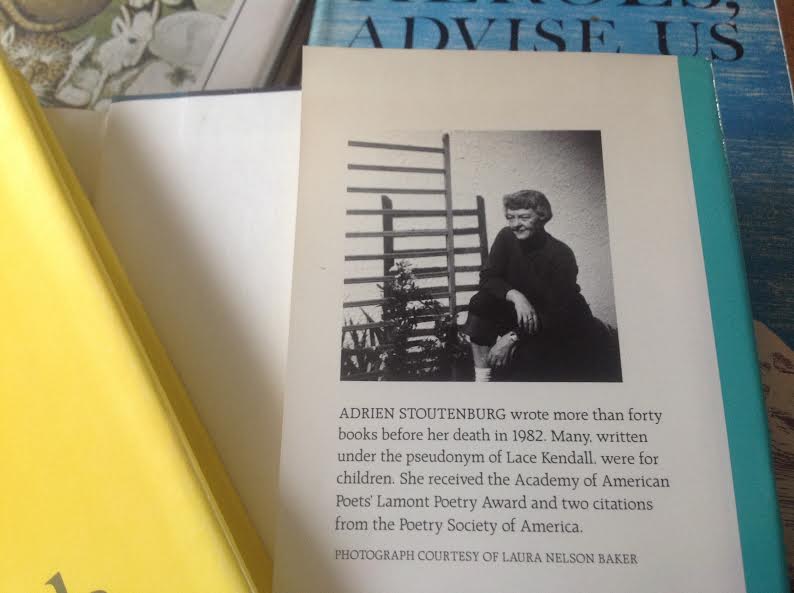
There is a second photo, this one from the jacket flap of her posthumously-published fourth collection, Land of Superior Mirages:

Jacket Flap from Land of Superior Mirages

Jacket Flap from Land of Superior Mirages

This photo shows what might be a younger Stoutenburg, despite the later release date (posthumous, actually) of that book. Younger or not, she appears more approachable and relaxed – like a kind, small-town librarian, which she actually was for awhile.  Stoutenburg, like another of our Undersung poets, Marie Ponsot, earned much of her income over the years by publishing work for children, with Ponsot translating French fairy tales and Stoutenburg interpreting American tall tales and publishing historical fiction and non-fiction for middle-grade school children. Several of her kids books were published as collaborations with the woman Stoutenburg lived with for almost twenty years, Laura Nelson Baker; the books were well-reviewed but not award-winners. Stoutenburg’s writing for children put food on the table just as medicine did for William Carlos Williams, insurance for Wallace Stevens, mortuary work for Thomas Lynch and Brooks Brothers clerking for Spencer Reese. Many of Stoutenburg’s children’s books were published under a pseudonym (most commonly “Lace Kendall,” the first and middle names of her father) – it doesn’t take too large a leap to reach the conclusion that a pseudonym was used because she didn’t want to be known primarily as an author of children’s books.

The reference book Contemporary Authors Online lists Stoutenburg’s authorial status as “Juvenile Writer” despite the fact that all the honors described in the CAO entry are for her poetry for adults.  First comes the long list of not particularly stellar children’s books, then comes the category “Other,” under which her poetry titles rest, like afterthoughts that don’t quite count.  The category itself –“Juvenile Writer” – is that a kind of ghetto-ization? And is that part of the reason readers of poetry have not heard of her?

I’m thinking right now of the photographer Vivian Maier, whose boxes (and boxes) of negatives were purchased by several people at a public auction (the most well-known of the three serious collectors was John Maloof, whose film, Finding Vivian Maier, is currently in release around the country.) Maier worked for forty years as a nanny to private, wealthy families; the fact that seems to surprise people most is that she supported herself by working with children. “A nanny? Really?” is the common reaction, and it comes out with a kind of derisiveness (am I projecting?) that sounds different than it would if people said, “A car salesman? Really?”  Photographers like Joel Meyerowitz and Mary Ellen Mark now say Maier was one of the great street photographers of the 20th-century, on a par with Weegee and Garry Winogrand. Maier, however, never published any of her photos, nor did she share them with anyone. Eventually, she descended into mental illness and true self-neglect. Maier was determined to remain anonymous, Stoutenburg was not, and Stoutenburg did achieve some recognition during her lifetime. But the paradox of being undervalued (people failing to be curious enough to find out who they actually were) due to work with and for children lingers around both these artists.

Two Girls, France - Vivian Maier

Two Girls, France – Vivian Maier

Perhaps it was difficult for Stoutenburg to present herself in a coherent way professionally, with feet in both the adult and the children’s worlds. Her final book talks about mirages:  “All images are bent / through time, and some most prized are fraudulent— / as mine may be.”  I wonder how clearly we can see a writer who moves between stories about Paul Bunyan and John Henry for six-year-olds and a poem like the following:

Acclimation

After my cousin, the choir boy,
murdered his mother with bitter candy;
and after my brother, the air force hero,
ruined his wife with a linoleum cutter;
and after my neighbor ignited his house,
and my best friend took a child to his room,
their gentle faces hung like jerky
from the live ceiling my bed looked up to.

Facts seemed fatal, at the beginning,
as the raw world must have
when it was imagined
with all its teeth and dung and passion.

Time tranquilizes, and bedrooms are cozy.
I rest most nights in the fearless moonlight
as well as the choir boy or the major
in their deep cells, or the child (grown-up now)
or the empty mothers.

Each day the pound master records the dead.
Bones of kittens burn like ignorant trees.
Headlines blur after too much reading
and the patched-up ceiling turns to mist.
I am chilled by the cold blue lisp of mice
hunting for traps arranged in my closet.
One grows accustomed even to this.

It’s hard to imagine a woman writing and publishing that poem if she wanted to be remembered for her children’s books. And since there is little to no critical writing about her, it’s hard to get a picture – both literally and figuratively – of who this woman was. Clear definitions of artists makes things easier for people who like to  pigeon-hole their art.

The goal here is not really to determine the why behind a poet’s lack of reputation and readership. But it’s such a puzzle – this business of a rising star failing to rise – that the temptation to try to solve the puzzle always lurks in the background. Maybe it comes down to what the photographer Saul Lister (himself unsung) once said about his own reputation:

I’ve never been overwhelmed with a desire to become famous. It’s not that I didn’t want to have my work appreciated, but for some reason — maybe it’s because my father disapproved of almost everything I did — in some secret place in my being was a desire to avoid success…My friend Henry [Wolf] once said that I had a talent for being indifferent to opportunities. He felt that I could have built more of a career, but instead I went home and drank coffee and looked out the window.

Fascinating – that something as simple as indifference (is it a character flaw or a character blessing?) or ambivalence (ditto) determines whether a writer’s work will or will not be read by subsequent generations of readers. Success obviously has many definitions, but isn’t it universally accepted that the trajectory should be, must be, consistently upward? Maybe the whole vertical model is wrong, and by reading poets like Adrien Stoutenburg we have a chance to restructure things, make our understanding of “success” more horizontal, less competitive, find those artists whose work we love but who were “indifferent to opportunities” and share their work with each other.

I look at Adrien Stoutenburg’s books on my shelf and feel lucky to have them. All four are out of print, and the used hardcovers (none went to paperback) online usually number in the half-dozen or so per title.  Who can explain this kind of obscurity for a poet described by James Dickey as having “an imaginative energy matched by few poets at any time, in any language” and who David Slavitt called “the toughest, most unrelenting, most terrifying poet I can think of.”  Slavitt, in fact, for an essay included in his book Re Verse: Essays on Poetry and Poets, addressed the way success eluded Stoutenberg. He reached this conclusion:

…as I now see, there were two things happening in the po’biz that were adversely affecting Adrien’s chances. One was that most trade publishers were abandoning the enterprise entirely, leaving the activity to the University presses. The other was the feminism had hit, and certain female poets had figured out that there were more readers for politics and protest than there were for poetry. If the likes of Adrienne Rich, Marge Piercy, and Denise Levertov were in fashion, then Adrien Stoutenburg wasn’t, and the publishing houses are always sensitive to that kind of trend. They don’t know about literature, and they don’t know about business, but they do know about lunch, and they are good about picking up what’s out there in the air, which is a vulgar knack, but then publishing is, in the root sense of the word, vulgar….If you’re not a member of one club or another, it’s mostly a crapshoot, and not always an honest one, either.

Greenwich Mean Time, Stoutenburg’s third collection is dedicated to Slavitt.  I’ll leave you with a poem from that collection. It’s a fairy tale, yes, but hardly for children.

Riding Hood, Updated

There had to have been a wolf that night,
alive in his rank fur and throat,
ears twigged, wild feet leaving flowers
on spring-deep earth. The howl was there;
his shadow kept house behind every bush.

Remember, dead grandmother,
me in my hood, and the old rifle swinging
between us, ready for that hot tongue’s flash?
There was a moon, too, skull-shaped but red.

Clouds leaned against it,
and the pines were windy harps.
A lake beckoned blue somewhere
like sky at the end of a downhill road.

There must have an owl, as well,
feather-corseted, hinged with claws;
and a bobcat’s cry.
Who knows what other things
lurked there?

It is nothing now to you
snug in your bonnet of earth,
out of the howl, forever wolf-free.
Here, where the hunt goes on,
and unimaginable beasts are loose,
it’s different for me.

I encourage you to try to find Stoutenburg’s books. It’s worth the search. Then sit down with them and wonder why this poet – her poems precise, white-hot and fierce – is not more celebrated.

—Julie Larios


Julie

Julie Larios has had poems chosen twice for inclusion in the Best American Poetry series. She is the winner of an Academy of American Poets Prize and a Pushcart Prize, and has published four collections of poetry for children.


Apr 092014
 

Julie Larios

Herewith impish, gracile, nimble poems by Contributing Editor (one of our own) Julie Larios whose continuing Undersung series has become a mainstay of the magazine and a model of poetic discourse. Julie’s poems are playful, yes — the body “poor sot” and men! who only need “A belief in the afterlife, or in the theory / that size doesn’t matter” — and her language is fast, packed with snappy rhythms, sly puns and rhymes that twist and curl meaning from word to word. Just read this:

of how the living, soft-bodied, feed at the bottom
of these lists, how we list too often, as in you lean, you lose, 
or at the very least or most, moist and semi-soft,
we end up ripened and spread too thin

But prosody aside, she has also a lovely set of themes, always coming back to a view of life, mischievous yet grand, the comedy of the body that won’t stop, that has its knowledge, that faulty and doomed as it is nonetheless is holy, the house of the spirit. And Julie, I think, never loses sight of the current of spirit that runs beneath appearances. Oh, to have written that line.

I love, God says, whatever steers the boat of that bird’s body.

dg

What Body Knows 

Body
knows how
to go
slow now,
to fool Doom,
to bow down –
to grow
old.

Body
knows not
how to grow
cool, nor cold,
knows not
how
to stop,
poor sot.

.

What Every Man Needs

A pot to piss in.
A Porsche.
A few pit stops.
And to mark the right spots, several X’s.
Great sex or— on slow nights— a few seeds
to spit off the porch into the dark.
Down any mine shaft, a bright torch.
A daft aunt or two for comic relief.
A belief in the afterlife, or in the theory
that size doesn’t matter.
A mother, ha, like a hole in the head.
A starry sky in the Wild West, a loyal horse.
And to carry him down off his cross, a Blessed Virgin.
On New Year’s Eve, champagne’s satin fizz.
In July, a slow drizzle after the long drought.
In October, sun out after rain.
A magic grain of rice from a folk tale.
A tall tale about the one that got away.
A day on a raft on the Mighty Mississippi,
home-fried catfish and Huck’s Jim  for a buddy.
Beauty minus her Beast.
And the best BBQ baby back ribs
this side of Hell or Heaven.
A 7-11 on one corner, a Jiffy Lube on the next.
An exit plan for every war gone wrong.
And after a long day’s work, just a little peace
and quiet, for Christ’s sake,  can’t a man get
a little peace and quiet?

.

Proposal for a Whole New Scale
………………with a nod to David Letterman

Being the new measurement of how things scratch,
that is, what scratches what, which surfaces face
which other surfaces down, as in showdown,
screw-up, or turnover, what marks the softer body
with its harder body by turning over and over,
what breaks last when heated or frozen, relative
to the heart and/or the balls, what clangs the bell
or strikes up the band, what wins hands down
the Grand Prize on the scale opposite the prize
known as Booby, and being also the new measurement
of how the living, soft-bodied, feed at the bottom
of these lists, how we list too often, as in you lean, you lose,
or at the very least or most, moist and semi-soft,
we end up ripened and spread too thin, half-empty
rather than half-full, while sneaking up behind us
and hindering our progress or congress or aiding
our regress are the Straightened, the Leanless,
the Unsnackable and NonSpreading, aka the Moribund,
so tough and tactless, the pins of their blue ribbons
scratch more than our surfaces, then pop
the inflatable lifeboat and we’re surfacing for the first
the second, the last time, trying to breathe which is
an unchangeable characteristic of the living no matter
what scale we draw or weigh in on, including this one,
even when we give the grid a twist, a tweak, or toss in
an extra handful of beans, and even when
we’ve been snookered and when we begin again,
with a new batch of statistics, optimistic as we leave
an inch or two of air at the top, give the whole thing
a new moniker, make it a game called Will It Float?

..

I’m Telling That Story Again

The one where I pull into the driveway
and see a cop car and a hearse and my feet
don’t touch the ground until I’m inside the house
and find out the kids are fine, it’s my father
who’s in a body bag outside only this time
I tell the story without the hearse and without
the cop car and without the body bag,

so this is the story where it’s summer
and my feet touch the ground and I stay
in my body all the way out to the beach
where my kids are playing at the low tide line,
there, where the rocks meet the saltwater,
they’re playing with my father, and I
can only say thank god it’s not the story I told

where my feet didn’t touch the ground
because I was actually the one in the bag,
because once when I told that story I had to
change the part about my feet, due to confusion
about whether I was still in my body or not
at that stage, and I had to change the part
about the beach and my kids and my father
and summer and all of our several bodies,
and I had to admit that I wasn’t much of a storyteller
because my memory was so bad,  though I do remember
every detail about the low-tide line and the saltwater

and would anyone mind if I started over and told
another story, a better story, about somebody else’s body,
since I’m pretty sure it will be about a body—
no matter how confused I am, all my stories now
seem to end up being about bodies and seasons
and the point at which feet do or do not touch the ground.

.

Upon Coming to Plate XI in A Nomenclature
of Colors for Naturalists and Compendium
of Useful Knowledge for Ornithologists

………………—for Daphne Kalmar

God draws a bird then names its parts:
mandible, crown, the lesser, middle and greater coverts.
He names the rump. He names the contoured flight feathers
in the tail, calls them rectrices: Helmsmen.

Which do you love most, the philosopher asks,
those feathers or the metaphor?

I love, God says, whatever steers the boat of that bird’s body.

—Julie Larios

Julie Larios

Julie Larios has had poems chosen twice for inclusion in the Best American Poetry series. She is the winner of an Academy of American Poets Prize and a Pushcart Prize, and has published four collections of poetry for children.


Mar 062014
 

Montale 1970Montale and Friend

First, a few disclaimers: My knowledge of the history of Italian poetry is limited.  There is Dante’s Divine Comedy, which I studied reluctantly in college and have only grown to appreciate over the years, especially the brave and foolish translations that try to bring Dante’s terza rima forward from rhyme-rich Italian into rhyme-impoverished English. After Dante there is…let’s see…Petrarch and his sonnets, with their non-Elizabethan rhyme scheme, and… Boccaccio was a poet, wasn’t he? But all I remember of Boccaccio is that he wrote The Decameron, and those are stories written in prose.

At this point I have to jump from the Middle Ages up to the 1800’s – there was an Italian poet named Leopardi, but I know nothing about him, only his name and that he lived around the time John Keats lived. There it is: in one jump, five centuries of Italian poetic tradition lost to me. In the 1900’s there was someone named Campana – or was Campana Spanish? No, Italian, I think. And there was definitely a modern Italian poet named Ungaretti but I’ve never read his work – or was Ungaretti a woman? No, a man, I’m sure. I remember thinking his name sounded like an expensive espresso machine.

So in writing about Eugenio Montale, a Nobel-Prize-winning poet few North Americans have heard of, I admit freely that I am not a fluent guide, only a fan. I don’t know the traditions that his work springs from.

11/12/1960  Eugenio MONTALE nel salotto di casa sua (1896 Genova - 1981 Milano)  Poeta italiano FARABOLAFOTO 391103

I do know he was born in Genoa in 1896 and died in Milan in 1981. Growing up, he spent holidays with his large family in Monterosso, one of the Cinque Terre villages which hangs dramatically from  the cliffs of Liguria, a landscape that shows up literally and metaphorically in much of Montale’s poetry. I know he had a contentious relationship with Ezra Pound, who was arrested for treason after a pro-Fascist stint as a radio broadcaster in Mussolini’s Italy (Montale was famously anti-Fascist, forced from his job after refusing to join the Fascist Party.)

In preparation for this look at Montale’s work, I consistently ran up against the term “hermeticism” to describe his circle of poets. Hermeticism? And specifically Italian hermeticism? The term was tossed around casually enough and linked to French surrealism, but I had to go to the Encyclopedia Britannica for a solid definition (“…modernist poetic movement originating in Italy in the early 20th century, whose works were characterized by unorthodox structure, illogical sequences, and highly subjective language.”) In other words, the poet locks himself into his poems and leaves the reader out. Since I disagree with that assessment of Montale’s poems, I don’t believe it’s the reason behind why the poet is not well-known here.

One credible reason might be his late-in-life pessimism, seldom far from the surface. In fact, his Nobel Prize lecture is not the most optimistic of speeches, ending on this downbeat note: “It is useless then to wonder what the destiny of the arts will be. It is like asking oneself if the man of tomorrow, perhaps of a very distant tomorrow, will be able to resolve the tragic contradictions in which he has been floundering since the first day of Creation….” Poets with a reputation for pessimism are not embraced warmly by the general public. (As counterbalance to this reputation, try the charming video at this link, which shows Montale having a great time with an interviewer, then reading a section of Ossi de seppia which begins, “Forse un mattino andando in un’aria di vetro, /arida, rivolgendomi, vedro compirsi il maracolo….” (Maybe one morning, walking in air / of dry glass, I’ll turn and see the miracle occur….”

Montale - Nobel PrizeMontale receives the Nobel Prize from the King of Sweden

Another contributing factor to his lack of popularity here is this:  Even North Americans who love poetry – and practice it – are sadly uninformed about individual poets (and whole schools of poetry) beyond their borders, including poets who have achieved fame at a broad international level. Is it the fault of our insularity – an ocean wide and deep at each edge of our “sea to shining sea” – and of our misguided sense of exceptionalism in general? Maybe the triumph of English as a global language has become a linguistic substitute for the defunct geographical concept of Empire. If that’s true, we can claim our ignorance is due in part to our superiority – an oxymoronic (and ridiculous) conclusion. Or maybe our educational system simply fails us, and we are left with wide swaths of ignorance in certain areas, including the learning of foreign languages to begin with. Maybe I shouldn’t even say maybe to that.

There’s one more possibility I can think of, a more attractive one which does less finger-wagging and makes me less embarrassed by gaps in my education, and that is the one Robert Frost offered: “Poetry is what gets lost in translation.”  If we accept the idea that the key element which distinguishes poetry from prose is its musicality (and not just those line breaks) then we have to accept the idea that translations which cannot capture the cadences of the original are, to a certain extent, failures. As Iris Murdoch said after being questioned by someone about her translations of French poetry, “The activity of translation…turned out to be an act so complex and extraordinary that it was puzzling to see how any human being could perform it.”

Adequate literal translations – yes, those are possible. Brave attempts to reproduce formal elements – rhyme and meter – and make them work alongside the literal translation? Yes, those exist and are laudable. But can we ever hear and know, at a visceral level – heartbeat and hoofbeat – the effect of a poem whose original language is not our own? I’m not sure. I suspect not. And maybe it is this – translation’s intrinsic failure – that makes us avoid poetry written in other languages. Vladimir Nabokov said it well in his poem “On Translating Eugene Onegin”: Reflected words can only shiver / Like elongated lights that twist / In the black mirror of a river / Between the city and the mist.

Which brings me back to my reading of Eugenio Montale, the great Italian poet of the 20th century, whose translated poetry deserves to be much more widely read, but whose name usually evokes the response “Who?” His poems seem to me to be filled with music.  Though I don’t speak Italian, I do speak Spanish, and I’ve always thought that the Latinate origins of those two languages helped me in my reading of Montale. But is my sense of its musicality justified?

Here is the original Italian of one of his most famous poems, published in his first poetry collection, Ossi di seppia  (“Cuttlefish Bones”), in 1925.  The English translation follows. To my ear (as I imagine it read aloud by someone who speaks fluent Italian) it sounds like river water rippling around well-polished rocks:

I Limoni

Ascoltami, i poeti laureati
si muovono soltanto fra le piante
dai nomi poco usati: bossi ligustri o acanti.
lo, per me, amo le strade che riescono agli erbosi
fossi dove in pozzanghere
mezzo seccate agguantanoi ragazzi
qualche sparuta anguilla:
le viuzze che seguono i ciglioni,
discendono tra i ciuffi delle canne
e mettono negli orti, tra gli alberi dei limoni.

Meglio se le gazzarre degli uccelli
si spengono inghiottite dall’azzurro:
più chiaro si ascolta il susurro
dei rami amici nell’aria che quasi non si muove,
e i sensi di quest’odore
che non sa staccarsi da terra
e piove in petto una dolcezza inquieta.
Qui delle divertite passioni
per miracolo tace la guerra,
qui tocca anche a noi poveri la nostra parte di ricchezza
ed è l’odore dei limoni.

Vedi, in questi silenzi in cui le cose
s’abbandonano e sembrano vicine
a tradire il loro ultimo segreto,
talora ci si aspetta
di scoprire uno sbaglio di Natura,
il punto morto del mondo, l’anello che non tiene,
il filo da disbrogliare che finalmente ci metta
nel mezzo di una verità.
Lo sguardo fruga d’intorno,
la mente indaga accorda disunisce
nel profumo che dilaga
quando il giorno piú languisce.
Sono i silenzi in cui si vede
in ogni ombra umana che si allontana
qualche disturbata Divinità.

Ma l’illusione manca e ci riporta il tempo
nelle città rurnorose dove l’azzurro si mostra
soltanto a pezzi, in alto, tra le cimase.
La pioggia stanca la terra, di poi; s’affolta
il tedio dell’inverno sulle case,
la luce si fa avara – amara l’anima.
Quando un giorno da un malchiuso portone
tra gli alberi di una corte
ci si mostrano i gialli dei limoni;
e il gelo dei cuore si sfa,
e in petto ci scrosciano
le loro canzoni
le trombe d’oro della solarità.

William Arrowsmith is probably the best known translator of Montale’s work, but the following English translation of “I Limoni” is by poet Lee Gerlach (who also deserves to be more widely read.) I prefer it especially for that wonderful turn of phrase “the jubilee of small birds,” which Arrowsmith translates as “the gay palaver of birds”:

The Lemon Tree

Hear me a moment. Laureate poets
seem to wander among plants
no one knows: boxwood, acanthus,
where nothing is alive to touch.
I prefer small streets that falter
into grassy ditches where a boy,
searching in the sinking puddles,
might capture a struggling eel.
The little path that winds down
along the slope plunges through cane-tufts
and opens suddenly into the orchard
among the moss-green trunks
of the lemon trees.

Perhaps it is better
if the jubilee of small birds
dies down, swallowed in the sky,
yet more real to one who listens,
the murmur of tender leaves
in a breathless, unmoving air.
The senses are graced with an odor
filled with the earth.
It is like rain in a troubled breast,
sweet as an air that arrives
too suddenly and vanishes.
A miracle is hushed; all passions
are swept aside. Even the poor
know that richness,
the fragrance of the lemon trees.

You realize that in silences
things yield and almost betray
their ultimate secrets.
At times, one half expects
to discover an error in Nature,
the still point of reality,
the missing link that will not hold,
the thread we cannot untangle
in order to get at the truth.
You look around. Your mind seeks,
makes harmonies, falls apart
in the perfume, expands
when the day wearies away.
There are silences in which one watches
in every facing human shadow
something divine let go.

The illusion wanes, and in time we return
to our noisy cities where the blue
appears only in fragments
high up among the towering shapes.
Then rain leaching the earth.
Tedious, winter burdens the roofs,
and light is a miser, the soul bitter.
Yet, one day through an open gate,
among the green luxuriance of a yard,
the yellow lemons fire
and the heart melts,
and golden songs pour
into the breast
from the raised cornets of the sun.

As much as I admire this translation, it’s clear that the music in the first stanza alone – the long “e” rhyme of all those internal and end-line words (ascoltami, i, poeti, laureati, si, nomi, usati, bossi, ligustri, acanti, erbosi, fossi, ragazzi, i, ciglioni, ciuffi, negli, orti, gli, alieri, limoni)  has been lost. Does Gerlach’s free-verse English have a subtle music of its own? It does (“Tedious, winter burdens the roofs, / and light is a miser, the soul bitter.”) But does this evoke, much less reproduce, the music of the original? Can we say we understand what Montale does with sound in his poem by reading this translation?  No.

Montale - Lemon Tree“…the yellow lemons fire / and the heart melts….”

In fact, the more aggravating question might be this: Do we understand the sound register of the original at all? Or do we romanticize the Romance languages, pleased by their multisyllabic flow, believing them to be mellifluous just because we are accustomed to the monosyllabic chunks of granite that English inherited from its Anglo-Saxon ancestors? Montale himself felt his native tongue was weighed down by exactly what I take to be its quickness and its flow, saying once that he fought “to dig another dimension out of our heavy, polysyllabic Italian.” One critic I read said he would have to go all the way back to Dante to hear an Italian poem as guttural as “I Limoni” (specifically referring to the doubled consonants in many of the Italian words.)

Guttural? That surprised me as much as the word “hermetic” did when applied to a poem which feels so wide open, accessible, and generous-hearted.  Maybe “guttural” in this case suggests a sprung rhythm I can’t quite hear, in the style of Gerard Manley Hopkins, whom Montale read and was influenced by.  If so, the translation provided here fails in a more serious way, since Hopkins (“fresh-firecoal chestnut-falls; finches’ wings, / landscape plotted and pieced—fold, fallow and plough….”) is nowhere to be found in it. I’ve wondered at the translatability of Hopkins – Montale was only one among others who attempted to translate the English poet into Italian, a formidable task considering Hopkins’ penchant for vocabularies and phrasings that were Germanic.

There might be poets who are singularly unsuited to translation into particular languages. And maybe the whole idea of what is “lost in translation” has less to do with poetry and more to do with cultural constructs in general; that is, maybe the failure of some translations (“Translation is the art of failure,” said Umberto Eco) is not only a failure of sound reproduction but of emotional connotations, linguistic anomalies and cognitive connections.  The way we think (and so, the way we hear and process language) is determined by our mother tongue.  It’s enough to make a translator throw in the towel – but thank goodness, some do not. If translation is our only access to certain poets, isn’t a flawed attempt better that no attempt at all?  For anyone who wants to explore issues of translation more deeply, try reading Douglas Hofstadter’s quick essay, “What’s Gained in Translation,” as a teaser to get you interested in his doorstop-size book, Le Ton Beau de Morot: In Praise of the Music of Language.

In any case, I don’t hear Hopkins in Montale’s “I Limoni.” And I can’t quite see the “obscure” nature of Montale’s poems that so many critics moan about. Yes, his poems are deeply personal. No, his frame of reference is not everyone’s – it includes his wife, his lovers, a landscape (Liguria) we are not completely familiar with, and politics that we are only marginally aware of. Montale was a firm anti-Fascist, and some of the allusions in the poetry will go over the heads of people unfamiliar with how those political issues played out in Europe during the 1930’s and 1940’s.  We have to pause and hunt a bit to understand a few of the references. Easy, no. But “characterized by unorthodox structure [and] illogical sequences” as the Encyclopedia says?  I don’t see it.

Maybe this is just a case of a poet’s work being ahead of its time, in the way paintings by Paul Klee might have seemed indecipherable to those who loved Monet.  To put it in a more contemporary frame, maybe people two generations out will be reading the work of L=A=N=G=U=A=G=E poets and wondering why people (me, for example) once thought of them as non-linear, illogical and difficult. It pleases me to think that the critics might be wrong about the “difficulty” of Montale’s work.  As the poet himself once said, “I have never purposely tried to be obscure and therefore do not feel very well qualified to talk about a supposed Italian hermeticism, assuming (as I very much doubt) that there is a group of writers in Italy who have a systematic non-communication as their objective.”

My goal is not to argue with literary critics but to encourage the reading and enjoyment of Montale’s work. You don’t have to figure out whether his poetry is fluid or guttural, emotionally open or hermetically sealed. It’s intriguing and worthwhile, no matter what labels are attached to it. I am all for reading any poet who calls nature “rough, scanty, dazzling” and who says, “I wanted my words to come closer than those of the other poets I’d read. Closer to what? I seemed to be living under a bell jar, and yet I felt I was close to something essential. A subtle veil, a thread, barely separated me from the definitive quid. Absolute expression would have meant breaking that veil, that thread: an explosion, the end of the illusion of the world as representation. But this remained an unreachable goal. And my wish to come close remained musical, instinctive, unprogrammatic. I wanted to wring the neck of the eloquence of our old aulic language, even at the risk of a counter-eloquence.”

Montale published only five books in fifty years of writing, so he was not prolific. I’ve brought this up previously as one possible cause for poets being under-appreciated, though the spacing of books is less the issue here than the suspicions we all have about translation in general. But consider the lovely English translation (by William Arrowsmith) of  “Il fuoco e il buio” :

Fire and Darkness

At times, because of dampness,
gunpowder fails to flash, and sometimes
catches without matches or flint.
A pocket lighter with one drop
of fluid could do the trick. And anyway
there’s no need for fire at all,
indeed, a good sub-zero curbs
that boring great-grandmother, Inspiration.
She was none too spry a few days ago
but she managed to disguise her wrinkles.
Now, ashamed of herself, she seems
to be skulking in the folds of the curtain.
She’s lied too often, now let darkness,
void, nothingness fall on her page.
Rely on this, my scribbling friend:
Trust the darkness when the light lies.

If you have only one book of Montale’s work on your shelf, it should be The Collected Poems of Eugenio Montale 1925-1977; the entire collection is translated by William Arrowsmith.  It’s still possible to get the poems in individual volumes: Ossi di seppia (“Cuttlefish Bones”), Le Occasioni (“The Occasions”), La Bufera e altro (“The Storm and Other Things”),  Xenia and Satura; it’s interesting to see how different translators handle the original Italian (poets Charles Wright and Jonathan Galassi take on the task with different collections, and Ghan Singh both translates and analyzes Montale’s work.)  But The Collected Poems, set out in the chronological order in which the poems were published, offers both Italian originals and English translations (on facing pages for easy comparison) and it is carefully indexed with both Italian and English titles of poems, making individual poems easy to find. The real genius of this collection for anyone interested in translation is the section containing William Arrowsmith’s notes – 107 pages of them in a 793-page book. In an age where translators rarely get any public recognition for their work other than their names in smaller-than-average font on the title page, that kind of permission given the translator – to go into the particular nuances of translation and the frame of reference of the original – is exhilarating. As poet and critic Rosanna Warren says in her introduction to the collection, “In each phase, [Montale] invented new ways of putting poetic language under stress and of realigning poetry with prose.” Warren, by the way, goes on to praise Arrowsmith for what she calls his “idiomatic, surging versions, ever alert to the pull and swerve of the original.”

Here’s one more small poem to pull you Montale’s direction:

My Muse

My Muse is distant: one might say
(and most have thought it) that she never existed.
But if she was my Muse, she’s dressed like a scarecrow
awkwardly propped on a checkerboard of vines.

She flaps as best she can; she’s withstood monsoons
without falling, though she sags a little.
When the wind dies, she keeps on fluttering
as though telling me: Go on, don’t be afraid,
as long as I can see you, I’ll give you life.

My Muse long since left a store room
full of theatrical outfits, and an actor costumed by her
was an actor with class. Once, she was filled
with me and she walked proud and tall. She still has
one sleeve, with which she conducts her scrannel
straw quartet. It’s the only music I can stand.

For all his insistence on the inadequacy of language to capture the true essence of anything (he called it “inexpressibility”) Montale managed to use the tools of language with grace, clarity and power.

— Julie Larios

 Author Photo

Julie Larios is the recipient of an Academy of American Poets Prize, a Pushcart Prize for Poetry, and a Washington State Arts Commission/Artist Trust Fellowship. Her work was chosen for The Best American Poetry series by Billy Collins (2006) and Heather McHugh (2007) and was performed as part of the Vox series at the New York City Opera (2010). Recently she collaborated with the composer Dag Gabrielson and other New York musicians, filmmakers and dancers on a cross-discipline project titled 1,2,3. It was selected for showing at the American Dance Festival (International Screendance Festival) and had its premiere at Duke University in July, 2013. For five years she was the Poetry Editor for The Cortland Review, and her poetry for adults has been published by The Atlantic Monthly, McSweeney’s, Swink, The Georgia Review, Ploughshares, The Threepenny Review, Field, and others. In addition, she has published four books of poetry for children. She lives in Seattle.

Feb 142014
 

I am always trying to push the envelope in regard to author artist/photos. I loathe the refined, posed, airbrushed glamor head-and-shoulders shots publishers seem to prefer. The author as inhuman, noble object of adulation. NC has always had a subversive edge. And I have been thinking for a while of honouring some of our more adventurous and outlandish spirits for their efforts toward having a bit of personality in their images. I don’t know if I have all the best ones here. If you have a favourite that you remember, remind me in the comments.

I cheated a little bit. bill hayward’s photo of Gordon Lish wasn’t taken especially for NC, but bill has invented a brilliant style of artist/author portrait and we did get to show the photo on NC. But check out bill’s wonderful book of images Bad Behavior for inspiration. Also Jonah’s photo wasn’t his author photo; it’s a self-portrait of sorts. Sometimes I tell authors to at least get a child or a dog in the photo. Horses and goats will do…  André Marois went for bees.

dg

ferryiguana_h_0David Ferry

Steven HeightonSteven Heighton

Andre MaroisAndré Marois

IMG_6257Sharon McCartney

sl, bird dog pete and sharptail, MontanaSydney Lea

IMGP2885Phil Hall

Amber HomeniukAmber Homeniuk

Betsy book pics 2013 - 236Betsy Sholl

Julie Bruck3Julie Bruck

DW-Ark_CodexDerek White

BRiannaBrianna Berbenuik

Michael BrysonMichael Bryson

Julie LariosJulie Larios

Steven AxelrodSteven Axelrod

Gordon-LishGordon Lish photographed by bill hayward

The AuthorJonah Glover

Taiaiake-001Taiaiake Alfred & Sons

Alexander MacLeodAlexander MacLeod

Diane Schoemperlen

Diane Schoemperlen

David Jauss and grandson GalenDavid Jauss & Grandson Galen

Jan 092014
 

Marie Ponsot with Five of Her Seven Children

It’s probably unfair – at the very least it’s risky – to place an old photo of the poet Marie Ponsot, surrounded by five of her seven children, at the beginning of this review of her work. The implication is that the state of motherhood defines and constrains a poet qualitatively, and I don’t think that’s true. But the photo certainly suggests something quantitative about Ponsot’s creative output for a certain period of her life, and explains the slow development (by anyone’s standards) of her career – a first book, True Minds, championed and published in 1956 by Lawrence Ferlinghetti for his City Lights series, and a second book (Admit Impediment) in 1981. If you’re doing the math, that’s twenty-five years between first and second books. During those years, she divorced her husband, the French artist Claude Ponsot, and raised the children as a single parent. To support the family, she taught basic composition at Queens College and took on translation work, translating over 30 books from French into English. Those translations include celebrated versions of La Fontaine’s fables and Hans Christian Anderson’s fairy tales.

Since that second book of poems in 1981 – thirty-two years ago –  there have been only four more books from Ponsot – The Green Dark (1988), The Bird Catcher (1998), Easy (2009) and one collection from the previous volumes – Springing: New and Selected Poems (2002) which also has a scattering of new poems. Easy was published just after Ponsot turned eighty-eight.

Whatever it is, it's not as "easy" as it seems.... Whatever it is, it’s not as “easy” as it seems….

I offer up the photo of Ponsot with her children in the lead position as a visual explanation of her atypical career trajectory. The adjective “undersung” attached to her name might be explained by the hyphenated adjective at the beginning of the biographical notes in Contemporary Authors Online: “In the course of her career, Ponsot has published several widely-spaced collections of her work…” [emphasis is mine]. Spacing, it appears, can be everything.

Five children gathered around their mother, and all appear to be under seven or eight years old. When I look at this photo (and I have looked at it plenty – I kept a copy of it taped up on the file cabinet near my computer for a few years)  I think of Robert McCloskey’s Caldecott-award-winning picture book Make Way for Ducklings, especially everyone’s favorite page in that book, the one showing all the ducklings walking in a row:  “One day, the ducklings hatched out. First came Jack, then Kack, and then Lack, then Mack and Nack and Ouack and Pack and Quack.”

It’s a charming drawing, and I see a lot of charm in this photo of Ponsot with her children. There the kids are, though not widely spaced; there is the poet with her beatific smile. Or maybe I’m projecting my own comfort level with odd career trajectories onto Ms. Ponsot. Is the smile beatific? When I showed the photo to a few other people, their descriptions ranged from “addled” to “deer in headlights” to “amphetamines.” So maybe we see what we want to see.

But after reading through interviews of Ponsot and studying her poems, and after meeting her myself a dozen years ago, my theory is this: The woman – who will turn 93 in May – has a preternatural ability to enjoy herself, no matter what the task. The word “preternatural” fits; Webster’s definition says it describes something “suspended between the mundane and the miraculous.” That fits Ponsot to a T. In a piece for the PBS Newshour in 2009, she said, “I write for pleasure. I am a firm supporter of the pleasure principle of life. I think things that we really long to do – and are refreshed by doing – are what we ought to spend a lot of time on. Why not?”

The Spirit of "Why Not?"  The Spirit of “Why Not?”

Of course, Ponsot’s desire to write must have come into conflict with other interests – including motherhood – from time to time. Few of us are single-minded and focused enough not to feel conflicted about competing desires, and conflict like that can make a lot of internal (and sometimes external) noise. Unfulfilled expectations and thwarted desires can be disruptive or, in the case of someone like Sylvia Plath, destructive. Ponsot’s attitude is more accommodating. Consider this poem, written after her divorce:

AMONG WOMEN

What women wander?
Not many.  All.  A few.
Most would, now & then,
& no wonder.
Some, and I am one,
Wander sitting still.
My small grandmother
Bought from every peddler
Less for the ribbons and lace
Than for their scent
Of sleep where you will,
Walk out when you want, choose
Your bread and your company.

She warned me, “Have nothing to lose.”

She looked fragile but had
High blood, runner’s ankles,
Could endure, endure.
She loved her rooted garden, her
Grand children, her once
Wild once young man.
Women wander
As best they can.

The grandmother in the poem envies the beggar’s freedom to “sleep where you will / walk out when you want.” The speaker of the poem wonders and wanders while “sitting still.”

When I met Marie Ponsot– she was already eighty years old – she didn’t seem capable of sitting still. She had been invited to read on campus at the University of Washington by the Counterbalance Arts organization, and I had been asked to introduce her. She met me for lunch already having spent the morning busy with a visit to the Seattle Art Museum, and I expected her to be worn out, in need of a rest. Instead, she was energetic, animated, and fully engaged in our conversation. She described having seen, at the museum that morning, a glass bowl three-thousand years old, and she commented more than once on how remarkable it was that anything so fragile could have survived so long without breaking.  As she talked, her passion and enthusiasm about this small object left me wondering whether I could keep up with her for the rest of the afternoon, though I was thirty years her junior.  That’s not to say she was giddy or over-effusive. But her high energy level at the time was clear; that same energy beams out from this photo and the poem which follows it.

Marie Ponsot Photo 2


ONE IS ONE

Heart, you bully, you punk, I’m wrecked, I’m shocked
stiff.  You?  you still try to rule the world — though
I’ve got you: identified, starving, locked
in a cage you will not leave alive, no
matter how you hate it, pound its walls,
& thrill its corridors with messages.

Brute.  Spy.  I trusted you. Now you reel & brawl
in your cell but I’m deaf to your rages,
your greed to go solo, your eloquent
threats of worse things you (knowing me) could do.
You scare me, bragging you’re a double agent

since jailers are prisoners’ prisoners too.
Think!  Reform!  Make us one.  Join the rest of us,
and joy may come, and make its test of us.

It’s not everyone who can write energetic sonnets that threaten and yell back at their own metaphorical hearts.  Nor can many poets surprise us with rhyme as well as Ponsot. It’s the rhymed couplet at the end of this poem which rings like a bell and announces the fact that the poem is an Elizabethan sonnet.  Once that happens, the reader returns to the opening of the poem to find the rhymes unfold in their traditional order, ABAB, CDCD, EFEF, GG. Ponsot disguises the rhymes on first reading by offering us choppy mid-line sentence endings (“Brute. Spy. I trusted you. Now…”) and by highly enjambed lines (“I’m shocked / stiff”) as well as non-traditional stanza breaks (6 lines/5 lines/ 3 lines.)  The rhymes are subsumed until the end. But, going back and looking down the end words of each line, there they are, plain as day.

Beginning poets often go wrong with the tonal register of a modern sonnet, believing that the formal elements go hand in hand with heightened diction, when what the successful modern sonnet needs is a more conversational tone (“…you punk…”) to help readers relax. Even the ampersand, rather than the word “and,” helps the sonnet feel more comfortably modern.

Ponsot manages to find a conversational tone for many of her formal poems, without the work suffering from what the critic Suzanne Keen calls “the strain of artfulness.”  Take these ars poetica lines:

COMETING

I like to drink my language in
straight up.  No ice, no twist, no spin
—no fruity phrases, just unspun
words trued right toward a nice
idea, for chaser. True’s a risk.
Take it. Do true for fun.

As many critics have pointed out, the poem is constructed with the very tools it rejects – it is an act of artifice (written in rhymed iambic tetrameter) but does not feel artificial. The language itself is “straight up” – it’s clean and clear.  Again, Ponsot finds a modern vocabulary and tone, and she yokes it – gently – to form. Ponsot’s ability to do this in poem after poem inspired the critic Angela O’Donnell to say, “As with the practiced athlete or dancer, she makes achieved grace seem natural….”

 Not only does Ponsot do well with received forms, she invents forms of her own. The tritina, a compressed form of the already-difficult sestina, is a case in point:

LIVING ROOM

The window’s old & paint-stuck in its frame.
If we force it open the glass may break.
Broken windows cut, and let in the cold

to sharpen house-warm air with outside cold
that aches to buckle every saving frame
& let the wind drive ice in through the break

till chair cupboard walls stormhit all goods break.
The family picture, wrecked, soaked in cold,
would slip wet & dangling out of its frame.

Framed, it’s a wind-break. It averts the worst cold.


Following the rules for that form is groan-inducing, unless you do it, as Ponsot does, for pleasure.  There are three tercets, with repeating end-words as follows: ABC, CAB, BCA. The envoi – a single line – must include all those end words in their original ABC order. Like I said, it’s torture unless you think it’s fun. If you’re game, try writing one. Produce anything that makes sense and sounds like normal English, both syntactically correct and fluid. Make sure it obeys the rules. Pay attention to sound.  Make it musical. If you can do it as gracefully as Ponsot does, and enjoy it as you do it, my hat is off to you.  “The delicious realization that what someone’s reading aloud is a sestina gives you a little kick in the back of your ear,” says Ponsot of the form that causes much teeth-grinding to lesser poets.  “Some other use of the word six lines away, it’s really very pleasant.”

Though this next poem does not follow a formal pattern of rhyme, Ponsot uses  her  modern voice effectively to offer up an ancient myth:

DRUNK AND DISORDERLY, BIG HAIR

Handmaid to Cybele,
she is a Dactyl, a
tangle-haired leap-taking
hot Corybantica.
Torch-light & cymbal-strikes
scamper along with her.
Kniving & shouting, she
heads up her dancing girls’
streaming sorority, glamorous
over the forested slopes of Mt. Ida
until she hits 60 and
loses it (since she’s supposed
to be losing it, loses it).
her sickle & signature tune. Soon
they leave her & she doesn’t care.
Down to the valley floor
scared she won’t make it, she
slipsides unlit to no rhythm,
not screaming.   But now she can
hear in the distance
some new thing, surprising.
She likes it. She wants it.
What is it? Its echoes originate
sober as heartbeats, her beat,
unexpected. It woos her.
The rhythm’s complex
–like the longing to improvise
or, like the Aubade inside Lullaby
inside a falling and rising
of planets. A clouding.  A clearing.
She listens.  It happens.
between her own two ears.

Come to think of it, that poem has some rhythmic patterns that make it sound almost Anglo-Saxon. Seamus Heaney reproduced that drum-beat of Old English in his translation of Beowulf (two beats on each side of a central caesura):


…sand churned in the surf, warriors loaded
a cargo of weapons, shining war-gear
in the vessels hold, then heaved out
away with a will in the wood-wreathed ship.
Over the waves, with the wind behind her,
and foam at her neck, she flew like a bird….


In her short poem, Ponsot does something similar, though she breaks the full-line drumbeat into two lines each. If we put her lines back into a single-line format, it looks (and sounds – boom-boom, boom-boom) like Heaney:


Handmaid to Cybele, she is a Dactyl,
a tangle-haired leap-taking hot Corybantica.
Torch-light & cymbal-strikes scamper along with her.
Kniving & shouting, she heads up her dancing girls’
streaming sorority….


Also like Heaney, and like the original poet of Beowulf, Ponsot uses strong alliteration (“Someone takes over  / her sickle & signature tune. Soon ….”) along with kennings (the riddle-like renaming of things via the hyphenating of two dissimilar nouns, such as Heaney’s translated “whale-road” to mean the sea, and Ponsot’s “torch-light and cymbal-strikes” to mean lightning and thunder.)

The last line of Ponsot’s poem feels wrong at first, since the rhythm is broken by inserting the word “own.” Without it, the rhythm would be perfect – two beats on each side of the caesura (“She listens. It happens / between her two ears.”) Instead, Ponsot breaks the back of the form. So – is it a misstep? Well, sometimes relaxing the rhythm of a poem can be the sign of mastery – and right there within the poem, Ponsot explains it to us: “The rhythm’s complex /–like the longing to improvise.” It’s “her beat,” it’s “unexpected,” a little nod to her own improvisational skill.

I said that putting the photo of Ponsot with her children at the opening of this piece was risky. It’s also risky to call any poet “undersung” who has had so many poets and critics sing her praises. Josephine Jacobsen (herself a “poet’s poet” and somewhat undersung) was a long-time champion of Ponsot’s work, citing her “powerful, and hence relaxed, ability to play with language, to fuse the witty with the grave.”  Louis McKee called Ponsot “an important but often overlooked writer.” Since winning the National Book Critics Circle prize for her third book (The Bird Catcher) in 1998, she has received more media attention and many fine awards, including the Delmore Schwartz Memorial Award, the Shaugnessy Medal from the Modern Language Association, and the Ruth Lilly Award for lifetime achievement (with its whopping $100,000 prize.) She was elected a Chancellor of the American Academy of Poets in 2010.

So why isn’t her work better known? What keeps a writer from connecting to a wider audience? Maybe wordplay – one of Ponsot’s fortes – confuses readers. Maybe formal elements scare or irritate them (one reason why Billy Collins’ clever poem, “Paradelle for Susan,” which mocks demanding poetic forms, is so popular.) And maybe we have a skewed idea of what makes a poet “great.” Consider this description of “Greatness” by David Orr, who writes the “On Poetry” column for the New York Times:


What, then, do we assume ambition and Greatness look like? There is no one true answer to that question, no neat test or rule, since unconscious assumptions are by nature unsystematic and occasionally contradictory. Generally speaking, though, the style we have in mind tends to be grand, sober, sweeping—unapologetically authoritative and often overtly rhetorical. It’s less likely to involve words like “canary” and “sniffle” and “widget” and more likely to involve words like “nation” and “soul” and “language.” And the persona we associate with Greatness is something, you know, exceptional—an aristocrat, a rebel, a statesman, a prodigious intellect, a mad-eyed genius who has drunk from the Fountain of Truth and tasted the Fruit of Knowledge and donned the Beret of….Well, anyway, it’s somebody who takes himself very seriously and demands that we do so as well. Greatness implies scale, as I mentioned earlier, and a Great poet is therefore a big sensibility writing about big things in a big way.

Sarcasm aside, Orr makes an important point about scale. Is it possible for someone like Marie Ponsot, somewhat casual about her career as a poet, and equally charmed by motherhood as by professional success, to gain access to the inner circle? Does Ponsot write about “big things in a big way?” or is there too much of the kitchen and garden, of children and grandparents, in her work to satisfy anthologists who help determine reputations? Who determines what the “big things” are? Even more important, does it matter to Ponsot?  As she said once during the previously mentioned PBS Newshour, “… when you get to be 80, you can say about a lot of things that used to cause you anxiety, ‘I don`t care. I just do not care. There are things I care about, but all this worrisome stuff, no, I don`t care.’ ”

Not caring enough about being praised could be to blame.  Or is the problem simply the lack of a steady stream of books? How long can a writer’s reputation remain suspended above the Earth without some gravitational pull being exerted? For twenty-five years, Ponsot not only did not publish collections but did not send individual poems out for publication in reviews. Once she began publishing again, urged on by her friend, the poet Marilyn Hacker, the time between books averaged eight years.

That doesn’t mean she stopped writing and thinking about language while her main focus was on raising her children. In an interview with Anna Ross, Ponsot says this:

My first baby was my girl—I had one girl and six boys. [One day] I walked into her bedroom in the morning and I realized that that little noise that she was making in the morning was the shape of that sentence that I always said to her. We were speaking French at that point because my ex-husband had no English, and I was going into the room and I was saying “Òu elle est, Monique,” and there she was saying “dah-dah-dah-dah-dah.” She’d been doing it for days, and I hadn’t recognized it. I was so ashamed of myself, I didn’t know what to do. It was a great moment of celebration, because I realized that the shape of a sentence is a music that she was reproducing. Like everyone who is still living in the purely oral tradition, she had no idea that a sentence was composed of different words; it was all one little tune. She was babbling out her little tune to me. Oh God, it was so thrilling. It was one of the great days of my life.”

Marie Ponsot Photo 3 - 1952 with Son

What do we want our writers to care about? Praise? Reputation? Productivity? Some poets, after all, manage to publish often and even to earn back their book advances. Mary Oliver, one of America’s most popular poets, has published twenty-nine books in fifty years, and that includes a nine-year gap between her first book in 1963 and her second in 1972.  If you do the math on this one and start the count in 1972, her output averages one book every 17-18 months.  Billy Collins, another wildly popular poet, has published ten collections since 1995 (the date of his breakthrough collection, The Art of Drowning.) Ten books in eighteen years – one every couple of years.

But being prolific can’t explain everything about popular success.  Some of it has to do with accessibility, which both Oliver and Collins excel at.  Few readers say of an Oliver or Collins poem, “I don’t get it.” But Ponsot’s poems, despite their modern diction, are not always easily understood. She brings a razor-sharp intelligence to the task of writing, along with her wit, and intelligence can send us scurrying to reference books or to Wikipedia for clues (Cybele? Dactyla? Corybantica?) A keen intellect can assign some poets to the dreaded “Academic” file forever, especially in the United States (God save intellectuals in 21st-century America.)

Some of it  – the achievement of name-recognition status – has to do with whether a poet is easily classifiable. Readers want to know: Is this a nature poet, a funny poet, a regional poet, a feminist poet?  It’s difficult to pigeon-hole Ponsot – her poems include references to myth and medieval iconography but do strange Beat-Generation things to syntax sometimes and send out hipster vibes. She can be funny, political, lyrical, light, heavy, post-modern, formal and free-wheeling, but she is not consistently any of them.

And certainly, writers who stay afloat in terms of reputation are willing to self-promote and to indulge in the networking that connects them – via readings and workshops and signings and conferences and and and  — with insiders in the world of media and publishers. Ponsot, in a 2003 interview with Benjamin Irvy,  had this to say about her interrupted career:  “I was very busy. It’s really that I was entirely out of all those professional poetry loops. That’s worth saying, because it’s easy to keep writing without tremendous agitation in whatever time you have. If you don’t imagine yourself as a career poet but rather as a person who writes poems, you can just go on doing that.” She goes on to say, “You really have to believe me when I say my dissociation from the idea of publication was not deliberate, contemptuous or passive-aggressive; it just didn’t occur to me. Think of all those seventeenth-century cavalier poets who had no interest in publishing their work – it didn’t occur to them either. Frequent publication of poems is a nineteenth-century development.”

Ponsot did not, during those quiet years, consider herself a “career poet.” Rather, she saw herself – at least for a long period of her life – as simply “a person who writes poems.”

Marie Ponsot, Spiraling and Springing (Photo by Diane Bondareff)

In 2010, Marie Ponsot suffered a stroke which impaired both her speech and her memory, two things which made her the unique poet she is. She has been struggling against those limitations; her still-strong religious beliefs (she is a life-long Catholic) sustain her. Her Catholicism might also explain the seven children, sixteen grandchildren and nine great-grandchildren.  At the center of a large family, Ponsot still thinks of the power of poetry to keep her company:  “…it’s a very enjoyable thing,” she says, “to be an old writer. It’s bliss! It’s really a highly entertaining state. You manage as long as language lasts. And language lasts a long time. Language is a sturdy companion, I think.”

I’ll leave you with one last poem by Marie Ponsot, taken from her book, The Green Dark:


THE IDES OF MAY

Every seventh second the wood thrush
speaks its loose curve until in ten minutes
the thicket it lives in is bounded
by the brand of its sound.

Every twenty-eight days the leisurely
moon diagrams the light way, east to west,
to describe mathematics and keep us unstuck
on our arched ground.

Every generation the child hurries out of child-
hood head bared to the face-making blaze
of bliss and distress, giving a stranger power to
enter, wound, astound.

The dedication of that poem reads “For my children entering parenthood.” In that poem I see and hear a big sensibility writing about big things in a big way. Maybe success doesn’t depend on timing, productivity, accessibility, or pigeon-hole-ability. Maybe it just depends on how we define “big.” And how we define “success.”

—Julie Larios

————————————————-

Heads

Julie Larios is the author of four books for children: On the Stairs (1995), Have You Ever Done That? (named one of Smithsonian Magazine’s Outstanding Children’s Books 2001), Yellow Elephant (a Book Sense Pick and Boston Globe–Horn Book Honor Book, 2006) and Imaginary Menagerie: A Book of Curious Creatures (shortlisted for the Cybil Award in Poetry, 2008). For five years she was the Poetry Editor for The Cortland Review, and her poetry for adults has been published by The Atlantic Monthly, McSweeney’s, Swink, The Georgia Review, Ploughshares, The Threepenny Review, Field, and others. She is the recipient of an Academy of American Poets Prize, a Pushcart Prize for Poetry, and a Washington State Arts Commission/Artist Trust Fellowship. Her work was chosen for The Best American Poetry series by Billy Collins (2006) and Heather McHugh (2007) and was performed as part of the Vox series at the New York City Opera (2010). Recently she collaborated with the composer Dag Gabrielson and other New York musicians, filmmakers and dancers on a cross-discipline project titled 1,2,3. It was selected for showing at the American Dance Festival (International Screendance Festival) and had its premiere at Duke University in July, 2013.

Oct 082013
 
Robert Francis 1901-1987

Robert Francis 1901-1987

This is the second in a series of essay by Contributing Editor Julie Larios on the undersung, underappreciated, underpublicized, forgotten, unknown, unread, lost (I could go on) poets of America (and beyond). There is so much chance and luck involved in becoming a famous author and so little chance and luck to go around. Little things like birthplace, the language you write in or whether or not some bigger poet is already there taking up all the air before you arrive on the scene all fresh and anticipatory. So Julie pays homage here to the great but lesser lights, the overshadowed and underrated. Julie Larios is an especially gifted poet and writer of essays about poetry. She seems to have read everything, have a scholar’s grasp of the tradition and the culture but with a poet’s eye and ear. I cannot imagine a better psychopomp into the Land of Shades; NC is amazingly lucky to have her.

dg

“Sing a song of juniper / That hides the hunted mouse / And give me outdoor shadows / To haunt my indoor house” (from “Sing a Song of Juniper,” published in The Sound I Listened For, 1944.)

Robert Francis, once called “the best neglected poet” by his mentor Robert Frost, lived many years of his professional life like a maple sapling not getting enough sunlight to thrive. There must be a technical name for that condition – it has something to do with photosynthesis (turning the sunlight into growth?) or chlorophyll or damping off or root rot or….Well, I’m no arborist. But whatever the term for that pathology, the tree fails to thrive because it lives in the shade of larger trees. To carry the analogy to completion, let’s just say that Robert Frost, despite his encouragement of the younger poet, cast a very big shadow over poets living in New England in the first half of the twentieth century.

The poet and editor Louis Untermeyer, approached by Frost as a possible reader and publisher for Francis’s work, said once that Francis’s poetry “reminded me so much of Robert’s that until I learned better, I thought my leg was being pulled and Robert Francis was an alter ego Robert Frost had invented by slightly altering his last name.” It was Francis’s poem “Blue Winter” that Frost offered up to Untermeyer for consideration:

Blue Winter

Winter uses all the blues there are.
One shade of blue for water, one for ice,
Another blue for shadows over snow.
The clear or cloudy sky uses blue twice-
Both different blues. And hills row after row
Are colored blue according to how far.
You know the blue-jays double-blur device
Shows best when there are no green leaves to show.
And Sirius is a winterbluegreen star.

In fact, “Blue Winter” does sound like Frost – the focus on nature as both independent of and analogous to the human condition, the contemplative mood, the fine control of rhyme scheme, and the structure which hints at becoming a classic sonnet but is satisfied instead to end without an Elizabethan bang. The language itself falls into the iambic rhythms of “plain speech” (a quality Frost mentioned often in association with his own work); Francis even seems quite casual in places, as in his decision not to name those “different blues” in Line 5, and in his unusual repetition in Line 8 of the word “show(s)” which both opens and ends the line – that’s something we do all the time when speaking, but which a poet seldom does in a single line. Frost and Francis deliberately sought out this quality of relaxed speech to avoid the over-constructed and inflated diction of their predecessors (you can hear that sound even today in poems written by poets who mistake inflated diction for serious thought.) The words of Francis’s poem are common one- or two-syllable choices until we reach that lovely neologism “winterbluegreen” in the last line, suggesting a playfulness and an approach to words as constructed, man-made objects. That approach is more Franciscan than Frostian.

Take a look at this poem by Robert Frost:

Nothing Gold Can Stay

Nature’s first green is gold,
Her hardest hue to hold.
Her early leaf’s a flower;
But only so an hour.
Then leaf subsides to leaf.
So Eden sank to grief,
So sun goes down to day.
Nothing gold can stay.

Again, the focus on nature as a metaphor for the human condition, the contemplative mood, the iambic rhythm, the plain speech, the fine control of rhyme, the almost anti-climactic last line. Without a name attached to some of their poems, it’s difficult to tell which poet wrote them. For example:

Sheep

From where I stand the sheep stand still
As stones against the stony hill.

The stones are gray
And so are they.

And both are weatherworn and round,
Leading the eye back to the ground.

Two mingled flocks –
The sheep, the rocks.

And still no sheep stirs from its place
Or lifts its Babylonian face.

What do you think – is it Frost or is it Francis? Actually, it was written by Francis and published in his second book, Valhalla and Other Poems, in 1938. To me, it is indistinguishable from Frost.

The desire to imitate, as Francis seems to have done in his early work, is not necessarily a bad one in a young poet. By imitation a poet learns to look carefully at the technical strategies behind a particular artistic voice. Visual artists are encouraged in studio classes to imitate famous artists as they study technique. But imitation can be dangerous – as Untermeyer’s assessment of Francis’s third book of poetry (The Sound I Listened For) reveals:”It is nothing against Francis that [his poetry] resembles Frost….But we know who wrote [the poems] first.” Imitation begins to suggest a lack of personal imagination, akin to forgery.

Francis might not have felt that his poems imitated Frost so much as honored him, but reverence, too, can be dangerous. Listen to what Francis wrote in his autobiography, The Trouble with Francis, about his feelings for Frost as their professional relationship developed: “If I ask myself what it was in Frost that impressed, attracted, and fascinated me most in the years before I met him as well as in the years afterwards, the answer is power. He was a poet and he had power; the combination was striking. …He was a match for any man he ran into on the street, and usually more than a match….You had only to catch a glimpse of him anywhere to sense his solidarity, his weight, his sanity….But though the poems were the basis of his ascendancy, the man himself kept increasing and enriching that ascendancy. Unlike some poets he always seemed more than his poems, inexhaustible. What he said was fresher and terser than what others said. Like a boxer his mind stood on tiptoe for the next parry and thrust. People listened because they were too fascinated not to.”

Initially then, Francis might have been too fascinated not to listen. His early work, remarkable as it is, might have suffered in terms of theme and structure due to the powerful opinions expressed by his mentor. In his autobiography, Francis published not only the text of a letter written to him by Frost, but a facsimile of the letter, as if even the Great Man’s handwriting had a solidarity and weight that Francis could not ignore. In the letter, Frost wrote, “I am swept off my feet by the goodness of your poems this time. Ten or a dozen of them are my idea of perfection.” Imagine how Francis felt when he read that kind of praise. But isn’t there something unnerving about the idea of Frost’s “idea of perfection”? Couldn’t that intimidate a young poet who, when composing future poems, found himself asking “What will Frost think of it?” and altering the piece accordingly? There is sometimes a fine line between influence and intimidation.

Frost as mentor....

Frost as mentor….

My concern about Frost’s influence might sound pinched and mean. But as someone who has seen that kind of reverence for an influential teacher, and who has watched the effect of it on a wide circle of fellow students, I can say that our awe of that poet’s talent and intelligence probably kept us imitative of him for too long. It was our own fault, not his; he was nothing but generous. But his students, those who felt his “power,” as Francis describes it, sometimes neglected the development of their own idiosyncrasies in favor of his.

Compare “Blue Winter” (published in 1932) to a poem written much later in Francis’s life (listed in the “New Poems” section of his Collected Poems 1936-1976):

Yes, What?

What would earth do without her blessed boobs
her blooming bumpkins garden variety
her oafs her louts her yodeling yokels
and all her Brueghel characters
under the fat-faced moon

Her nitwits numskulls universal
nincompoops jawohl jawohl with all
their yawps burps beers guffaws
her goofs her goons her big galoots
under the red-face moon?

In that poem, Francis is both big-boned and playful, like a bear with a honey buzz. He emerges from the shadows and invites the reader to join him at play, and the language is anything but measured or contemplative – in fact, it’s positively giddy. Rhyme as a formal element has disappeared, though other poetic strategies are clear. The pronounced alliteration puts me in mind of how it feels to face several Coney Island bumpers cars – they’re impossible to avoid, slightly lowbrow, confusing, almost out of control, but you still laugh and enjoy yourself until the ride is over. So, too, with the poem. And despite the fat-faced, red-faced moon, the poem addresses no other nature than human nature.

It’s no coincidence, I think, that Robert Francis titled his fourth book of poetry, published two years after Frost died, Come Out Into the Sun. But by then Francis was no longer an emerging poet and his books did not make much of a ripple. Poet and teacher Samuel French Morse, however, got it right when he said in one of the few reviews of the book, “The quiet excitement with which one reads Come Out Into the Sun generates the conviction that Francis is considerably more than ‘a poet, minor’ as he modestly calls himself. His work has humor, as well as wit, and it may be this idiosyncrasy that accounts in part for the otherwise unaccountable neglect into which the taste-makers have allowed it to fall. On the other hand, the freshness which marks almost every poem here may derive in part from the poet’s awareness that he has nothing to live up to except his own standards of excellence: he is free to be himself in ways that the poet with the burden of reputation may not be free.” The poem Morse uses as an example of this standard of excellence is one of my favorites:

Hogwash

The tongue that mothered such a metaphor
Only the purest purist could despair of.

Nobody ever called swill sweet but isn’t
Hogwash a daisy in a field of daisies?

What besides sports and flowers could you find
To praise better than the American language?

Bruised by American foreign policy
what shall I soothe me, what defend me with

But a handful of clean unmistakable words-
Daisies, daisies, in a field of daisies?

And in the “New Poems” section of his Collected Works 1936-1976 there are even more poems headed in this playful direction, such as the following:

Poppycock

Could be a game
like battledore
and shuttlecock.
Could be.

Could be a color
red
but none of your Commy red
damn you!

Red of a cocky cock’s
cockscomb
or scarlet poppies
popping in a field of wheat.

But poppycock
after all
alas is only
poppycock.

In other words bilge
bosh
buncombe
baloney

ballyhoo from Madison A
ballyhoo from Washington DC
red-white-and-blue poppycock
Hurrah!

There are other cocks
to be sure.
Petcocks
weathercocks

barnyard cocks
bedroom cocks
cocksure
or cockunsure.

But to get back to poppycock
what a word!
God, what a word!
Just the word!

Keep your damn poems
only give me the words
they are made of.
Poppycock!

It’s as if a spring has been sprung and Francis is sailing out into the air, whistling as he flies. Yes, there is weight to what is said; the poem delivers its payload. But those exclamation marks! That full-feathered rooster-ish display! And what on earth would Frost have thought of the “purest purist”?

Francis is definitely undersung, but it’s not as if his work is unknown among poets. If you read enough poetry, you eventually make your way to some of his poems. And he got a sprinkling of fine awards. He was invited to participate as a fellow in the Breadloaf Writing Conference after the publication in 1936 of his first book, Stand with Me Here. In 1938 he received the Shelley Memorial Prize (contemporary winners include Robert Pinsky, Ron Padgett, Lucia Perillo and Yusef Komunyakaa.) But nearly twenty years elapsed before the awarding of that prize and his Rome Fellowship, and almost thirty more years passed after that honor before the Academy of American Poets named him, in 1984, the recipient of a Fellowship Award, citing his “distinguished achievement.” Philip Levine was just named the 2013 winner of this prize, and recipients in the years surrounding Francis’s award are true stars now in the world of poetry: John Ashbery, Philip Booth, Maxine Kumin, Amy Clampitt. Still, the header on Francis’s obituary in the New York Times says it all: “Robert Francis, A Poet Hailed by Frost, Dies.”

So how to explain the “unaccountable neglect” of critics and the reading public, other than to say that Robert Frost cast a big shadow? Plenty of ambitious poets make their way either in spite of or because of influential mentors.

Maybe the key word there is “ambitious.” Certainly something that contributed to Francis’s failure to ascend was his parallel failure to engage in the practical art of building a reputation. He did not hob-nob, he did not schmooze, he did not self-promote, he did not teach or become a mentor himself. Why not?

As Easily as Trees

As easily as trees have dropped
Their leaves, so easily a man,
So unreluctantly, might drop
All rags, ambitions, and regrets
Today and lie with leaves in sun.
So he might sleep while they began,
Falling or blown, to cover him.

It’s interesting that in his autobiography, Francis recalls something about ambition and reputation-building that Frost said to him: “Sitting in my home on the evening of December 10, 1950, he remarked casually that he had never lifted a finger to advance his career and that what had come to him had just come to him.” Francis apparently believed Frost, and was disappointed to read, when Frost’s letters to Louis Untermeyer were published, how far from the truth it was: “…what I had taken him to mean by not having lifted a finger was evidently not what he meant.”

Francis was also startled when Frost asked him what he did when he wasn’t writing. Francis lists the things he did for himself: “Marketing, cooking, dish-washing. Washing, ironing, mending, bed-making, floor-mopping. Gardening, grass-cutting, leaf-raking, snow-shoveling. Storm windows off and screens on, screens off and storm windows on. ….If I wanted wild grape jelly to sweeten the coming winter, I had to find and gather the wild grapes and do everything to the pouring of the hot wax….I knew I could not make my situation intelligible, and, what is more, I didn’t altogether want to. I was not proud of my incessant busyness. I could have envied the miraculous sense of leisure that Robert Frost carried around with him at all times.” It seems that a little doubt, a little bitterness, swelled up in Francis when looking back on this mentor who “never smiled in greeting me at the the door.” The leisure Frost took for granted bewildered Francis, and he admitted finally that there were many Frosts to Robert Frost. “I don’t want to be a farmer,” Frost once wrote. He also wrote, “There’s room for only one person … at the top of the steeple, and I always meant that person to be me.” He admitted to ambition of “astonishing magnitude.”

Frost as the independent and crusty New England farmer....

Frost as the independent and crusty New England farmer….

In his wonderful essay about these two poets, “Robert Frost, Robert Francis, and the Poetry of Detached Engagement,” Andrew Stambuk details Frost’s studied self-idealization by showing how carefully Frost constructed and protected the image of himself as the crusty old New England farmer who stands up to Nature’s brow-beatings. In discussing one of Frost’s most famous poems, “Stopping by Woods on a Snowy Evening,” Stambuk says, “Frost’s evocation of ‘barrenness’ is a conscious tactic that extends to a strategy of self-idealization, whereby the poet, in shrugging off this condition and asserting his will, disguises his characteristic wariness as tough-minded resistance.” Few high school students in America have not been asked their opinions of “The Road Less Traveled” or “Stopping by Woods on a Snowy Evening” after having been taught that Frost was the man who took the road less traveled and had “promises to keep /and miles to go” before he slept.

Stambuk goes on to say that Frost “helped shape the public’s perception of him as a tough-minded realist, one strikingly at odds with the poet who was insecure about his reputation….” Maybe Stanley Kunitz described it best: Frost’s “most successful work of the imagination was the legend he created about himself.”

Francis, on the other hand, turned away from reputation-building. He gave up his 15-year dependence on income which kept him out and about in town, teaching violin lessons; he gave up his high school teaching job after only one year, and he decided to rely exclusively on the money his poetry produced, which was meager. He lived alone for more than forty years outside Amherst in a hand-built two-room house he called “Fort Juniper.” Aside from the residential fellowships he was awarded, none of the honors he accumulated paid enough money to live on. In 1955 he was the Phi Beta Kappa poet at Tufts; in 1960, he taught for a year at Harvard. He spent one year in Italy on his fellowship from the Academy and returned ten years later after being awarded the Amy Lowell Traveling Scholarship.

Most of Robert Francis’s life was lived Thoreau-style, in a cabin in the woods, in the shade cast not only by Robert Frost but by a suitably transcendental forest of birch trees. He died in 1987, relatively unknown, alone, 85 years old, still writing, chopping wood, sweeping the floors, ironing, mending, and making that wild grape jelly at the kitchen stove.

A house in the shade of birch trees.

A house in the shade of birch trees.

Fort Juniper Kitchen

Fort Juniper Kitchen

Desk at Fort Juniper

Desk at Fort Juniper

Come

As you are (said Death)
Come green, come gray, come white
Bring nothing at all
Unless it’s a perfectly easy
Petal or two of snow
Perhaps or a daisy
Come day, come night.

Nothing fancy now
No rose, no evening star
Come spring, come fall
Nothing but a blade of rain
Come gray, come green
As you are (said Death)
As you are.

Reading at the window...

Robert Francis reading at the window…

—Julie Larios
———————————–

Julie Larios

Julie Larios is the author of four books for children: On the Stairs (1995), Have You Ever Done That? (named one of Smithsonian Magazine’s Outstanding Children’s Books 2001), Yellow Elephant (a Book Sense Pick and Boston Globe–Horn Book Honor Book, 2006) and Imaginary Menagerie: A Book of Curious Creatures (shortlisted for the Cybil Award in Poetry, 2008). For five years she was the Poetry Editor for The Cortland Review, and her poetry for adults has been published by The Atlantic Monthly, McSweeney’s, Swink, The Georgia Review, Ploughshares, The Threepenny Review, Field, and others. She is the recipient of an Academy of American Poets Prize, a Pushcart Prize for Poetry, and a Washington State Arts Commission/Artist Trust Fellowship. Her work has been chosen for The Best American Poetry series by Billy Collins (2006) and Heather McHugh (2007) and was performed as part of the Vox series at the New York City Opera (2010). Recently she collaborated with the composer Dag Gabrielson and other New York musicians, filmmakers and dancers on a cross-discipline project titled 1,2,3. It was selected for showing at the American Dance Festival (International Screendance Festival) and had its premiere at Duke University on July 13th, 2013.

Aug 052013
 
George Starbuck

George Starbuck

Poetry is a fickle profession. The muse is fickle, the audience is fickle, fame is fickle. Critics and scholars have Alzheimer’s — the one-time darling is often simply forgotten. This happens to an author whether his or her work deserves neglect or not; great poets go down before the scythe of forgetfulness. Today NC is launching a new series called Undersung to try to fill in some of the gaps for the dementia-riddled reading class. Contributing Editor Julie Larios suggested this, and there is none better to write the series because she has a reading memory like a wolf trap and can call to mind verse at the drop of a hat. She is also just really smart about the technical aspects of a poem. And she has her favourite neglected poets to whom she brings brio and passion. Today, we have George Starbuck, the man whose manuscript beat out Sylvia Plath for the Yale Younger Poets Prize in 1960 but whose life was less notorious. Often wrongly pigeonholed as a light verse poet, he was a technical master and superb ironist. He should not be forgotten.

dg

—-

“Do not go into the light,” the woman screams. “Stop where you are. Turn away from it.  Don’t even look at it.”  Fine advice, if your name is Carol Anne and you’re the victim of a poltergeist. Listen to your mother as she shouts to you through the television static.  Believe her: The light is not your friend.

But in poetry, you might be better served by ignoring the voices that discourage the light (verse, that is) in favor of the dark, or that denigrate the light in favor of what is “heavy.”  As in “Wow, that’s heavy, man.” For “heavy,” you’re expected to understand significant and serious; it weighs something and is important and has a chance at entering The Canon.  It should not (repeat: should not) make you laugh. And it probably should not come wrapped up in anything sneaky that makes you think what you’re reading is dandy candy but then turns out to be good for you. That’s not fair.

Enter the poetry of George Starbuck, once named “the thinking man’s Ogden Nash.”

His reputation for “light” verse (a misnomer, I think – if that’s what it is, then Starbuck’s version of it is a sledgehammer disguised as a feather) kept him out of several of our most important anthologies and thus out of Poetry 101 classes across America. Actually, one of his poems (“A Tapestry for Bayeux”) did make it temporarily into the influential Little Treasury series edited by Oscar Williams, but was dropped from the anthology (and Starbuck “consigned to a special poetic oblivion,” according to poet Anthony Hecht) when Williams was informed that the initial letters of the first 78 of 156 lines spelled out “Oscar Williams fills a need, but a Monkey Ward catalog is softer and gives you something to read.” Who does that, writes a brilliant poem about naval operations during WWII, and builds in an acrostic poking fun at the anthologist who can make or break your reputation? George Starbuck, that’s who.

A Tapestry for Bayeux

1. Recto

Over the
….seaworthy
cavalry
….arches a
rocketry
….wickerwork:
involute
….laceries
lacerate
….indigo
altitudes,
….making a
skywritten

filigree
….into which,
lazily,
….LCTs
sinuate,
….adjutants
next to them
….eversharp-
eyed, among
….delicate
battleship
….umbrages
twinkling an

anger as
….measured as
organdy.
….Normandy
knitted the
….eyelets and
yarn of these
….warriors’
armoring—
….ringbolt and
dungaree,
….cable and
axletree,

tanktrack and
….ammobelt
linking and
….opening
garlands and
….islands of
seafoam and
….sergeantry.
Opulent
….fretwork: on
turquoise and
….emerald,
red instants

accenting
….neatly a
dearth of red….

On it goes, for twelve 13-line stanzas, every single line three syllables, accent always on the first syllable (dactylic monometer.) And it makes sense, in terms of its subject matter. And the language – vocabulary, music – is brilliant. And it’s an acrostic. As Hecht says in his introduction to The Works, published after Starbuck’s death, it is a poem of “needlework intensity.” Starbuck himself, in this poem, praises “opulent fretwork.” Of course, that might be exactly the problem. Fretwork and needlework are delicate, and American poetry – as with many things American – prefers muscle.

Perhaps no one needs to scream at us to stay away from the light. After all, we’re culturally drawn to the dark side, James Cagney with his tommy gun, Bruce Willis with an AK-47, aren’t we? It’s often High Noon in America, and whoever comes out of the fight alive wins; America seems, even in the year 2013, predestined to favor the gunslinger over the Quaker (as Starbuck says, “Saturday night’s a longshot / Contraption as it is. / A man without a Magnum’s / A piece of agribiz. // He might as well push daisies / And model for a wreath / And pick a granite afghan / To cuddle up beneath.”) Arnold Schwarzenegger takes out Fred Rogers in the first minute of the first round, no doubt about that.

Fred Rogers

Heavyweights rule the American roost. Farther down in the pecking order come middle and welter, then featherweight, and even farther down is the pesky bantam. Does flyweight even need to be mentioned? The boxing analogy holds for poetry: The lighter the fighter, the smaller the size of the prize. Come to think of it, the analogy holds for theater and film, too – Sean Penn’s suffering father in Mystic River gets the 2003 Oscar over Bill Murray’s sardonic film star in Lost in Translation.  Who said comedy is king?

Sean Penn

Bill Murray

Anne Sexton, definitely a Canon-weight poet, once wrote “I have to be great,” and many people admired her and still admire her for it. Ambition is more attractive to some people than it is to others. (My own reaction, when I read those words: Imagine an artist thinking that, much less confessing it – unless confession is your thing.)  Fellow poet Starbuck – who was Sexton’s lover early on while she honed both her poetry and her appetite for fame – seemed not to care as much about the size of his pistol or his reputation, nor did he spend time thinking about categories like welters, bantams, flies and feathers, not unless he could turn the words themselves to good use with a clever rhyme (feathers / weathers / death spurs / breath verse / meth purrs…no, I can’t do it, not the way George Starbuck could.)

This rhyming thing is hard, god-awful hard if you want to do it with panache; that’s why so many poets, caring not just about the basic message of a poem but about the messenger’s ability to deliver it in a breathtaking way, appreciate George Starbuck’s gifts.

Fable for a Blackboard

Here is the grackle, people.
Here is the fox, folks.
The grackle sits in the bracken. The fox hopes.

Here are the fronds, friends,
that cover the fox.
The fronds get in a frenzy. The grackle looks.

Here are the ticks, tykes,
that live in the leaves, loves.
The fox is confounded,
and God is above.

Technically dense, emotionally delicate, intellectually profound.  Try doing that – hitting that trifecta. He was a poet’s poet, as they say. And Starbuck himself said, about his choices, “For me, the long way round, through formalisms, word-games, outrageous conceits (the worst of what we mean by ‘wit’) is the only road to truth. No other road takes me.” His obituary in the New York Times echoed the sentiment: “If the scope of his verbal talent sometimes seemed at war with his reputation, Mr. Starbuck could not seem to help himself.”

If you haven’t read his work, do so. He published individual poems widely during his lifetime and gathered them into books only occasionally (two excellent collections, Visible Ink and The Works were put together by his widow and published posthumously.) His first collection, Bone Thoughts, was awarded the Yale Younger Poets prize in 1960. Sylvia Plath’s manuscript for The Colossus competed with Starbuck’s that year; they studied together (along with Sexton) in one of Robert Lowell’s famous workshops at Boston University. Plath, in her journals, rails against losing out to Starbuck.

Certainly, not everything Starbuck wrote for that first book would be considered light verse, though it did produce an introduction by the judge – the critic Dudley Fitts, who took over the Yale Younger Poets series from W. H. Auden — which indicates Fitts didn’t quite know what to think of it.  Not only did Fitts state, in that introduction, that Starbuck was “a man awake in the nightmare of our day” and predict that “a great song is begun,” but he also wrote, “I was also attracted, and sometimes repelled, by Mr. Starbuck’s wit….[He] could use an intellectual sedative.” Fitts cites this poem as an example:

War Story

The 4th of July he stormed a nest.
He won a ribbon but lost his chest.
We threw his arms across the rest
…………..And kneed him in the chin.
…………..(You knee them in the chin
…………..To drive the dog-tag in.)

The 5th of July the Chaplain wrote
It wasn’t much; I needn’t quote.
The widow lay on her davenport
…………..Letting the news sink in.
…………..(Since April she had been
…………..Letting the news sink in.)

The 6th of July the Captain stank.
They had us pinned from either flank.
With all respect to the dead and rank
…………..We wished he was dug in.
…………..(I mean to save your skin
…………..It says to get dug in.)

The word when it came was three days old.
Lieutenant Jones brought marigolds,
The widow got out the Captain’s Olds
…………..And took him for a spin.
…………..(A faster-than-ever spin:
…………..Down to the Lake, and in.)

Unfortunately, Fitts’s early assessment in 1960 turned out to be the final critical assessment when Starbuck died of Parkinson’s in 1996: Critics admired his work (perhaps not as much as fellow poets) but were unnerved by it because tonally and technically it was so complex, at once delicate and obsessive, intricate and blunt, playful and brutal. After an extended time with it, even a respectful reader becomes exhausted, or better said suspicious, and a real tumble of questions begins to overtake the pleasure:  If it is “bravura technique” (as Hecht says – and he goes on to say “it has no match among English-language poets of this century”) does it come from the heart or is the poet himself intoxicated with formal intricacies? Does the man never come up for air and write a more relaxed poem? Do the technical restrictions inflict a straightjacket on the poet rather than provide a source of inspiration? In fact, is it a poem or is it a math puzzle? Starbuck began his university studies at Cal Tech in mathematics at only 16 years old – was he more interested in mathematical patterns or in poetry? Even the cover of his collected work shows us a system of interlocking gears, more mechanical than human:

The Works

Maybe the answer to both parts of all the questions above is yes…and yes. One of my favorite poems in the book (“Unfriendly Witness”) begins this way: “I never played the Moor, / I never looked to see, / I don’t know what my hands are for, / I know they’re not for me” and ends with this: “And yet the world is heavy / and filled with men like me—/ with tired men, with heavy men / that slip my memory / if that be perjury.”

We hear a nursery rhyme in the treble clef of “War Story” and “Unfriendly Witness,” but there is no doubt they are serious poems, with a bagpipe-type dirge underneath the melody.

Ahh, “serious.” There it is again, that word. Can a poet who says in his poems “Love is a strange coot” and who indulges extravagantly in clerihews and double dactyls ever be taken seriously? Take this double dactyl from “Troves from the Natives of 1992”:

Higgledy piggledy
Fifty Columbuses,
Fifty times richer in
Trinkets and beads

Couldn’t provision the
Quinquecentennial
Memorabilia
Business’s needs.

Far be it for Starbuck, of course, to be satisfied with one complete double dactyl; instead, he continues this poem for another eight stanzas (four more complete double dactyls) in a tour de force of the form, which requires not only the double dactylic line for each 4-line stanza, but a six-syllable single word, often as the entire second line of the second stanza. Notice how one six-syllable word is followed by another in the Starbuck excerpt – “quinquecentennial memorabilia” – which few poets could pull off.

Starbuck goes for those multisyllabic lines with gusto: “miniconquistadors,” “made-in-Rumania,” “demimillennial”…that’s where the challenge and the fun of the form come together and burst into flame, and that’s where you’ll find Starbuck at his game-playing, neologistic best. Does he self-combust? The answer to that is a matter of taste, a little like the fried grasshoppers sold by the handful in Oaxaca – tasty but scary. Fitts, remember, was both delighted and repelled, and Starbuck is an acquired taste, that’s for sure.  He was, as one NPR commentator described him, “high bard of the big pun and the even bigger idea.” That’s a heady and unusual mix. Sometimes you want to stand back from that kind of chemistry.

George Starbuck should be well-known to anyone who writes and teaches. When he was just a young man working at the library of SUNY-Buffalo, he was fired for refusing to sign the loyalty oath required of all employees. Starbuck recognized the repressive abuse of power inherent in New York’s Feinberg Law (enacted in 1949) which sought out teachers who used “propaganda” in the classroom on “children in their tender years.” Three faculty members joined Starbuck in suing the university, but it was Starbuck himself who was the acknowledged instigator of the suit (this is well-documented in Marjorie Heins’s Priests of Our Democracy: The Supreme Court, Academic Freedom and the Communist Purge.) Ultimately, the case was taken up by the Supreme Court, which ruled in the group’s favor and found the law unconstitutional. Starbuck remained a fiercely committed political activist, most visibly in his opposition to the war in Vietnam. For a blistering example of that, read his poem, “Of Late,” addressed to Robert McNamara, about Norman Morrison, the Quaker who burned himself alive to protest the war (he “…burned and was burned and said / all there is to say in that language.”) You can see the whole poem here.

A read-through of obituaries which followed Starbuck’s death at age 65 is impressive: He studied for two years at UC-Berkeley, three years at the University of Chicago (where he met and became friends with Philip Roth, whose work he later edited for Houghton Miflin), a year at Harvard, and additional time at the American Academy in Rome, never earning even a BA degree. He was an inspirational teacher at SUNY-Buffalo, the Iowa Writers Workshop and (returning to his roots) Boston University. Both Maxine Kumin and Peter Davison studied under him. He won the coveted Lenore Marshall Prize in 1983, administered by the Academy of American Poets (other winners have been Mary Oliver, Philip Levine, Stanley Kunitz, John Ashbery, Robert Pinsky, Adrienne Rich, C.D. Wright – the entire list reads like a Who’s Who of American Poetry.) He invented an entirely new poetic form called the SLAB, a “Standard Length and Breadth” poem written in fourteen-letter lines that form a “slab,” typographically as does this excerpt from one SLAB entitled “Cargo Cult of the Solstice at Hadrian’s Wall” [Note: slabs are at their best using Courier font, which lines up precisely]:

OTinyBombOTiny
BombWhatGangOf
MadmenMadeThee

OMiddleeastern
MasterpieceNoT
NTBetrayedThee

OEensieWeensie
IndyCarOCreamy
HalvahCandyBar….

Well, as I’ve said before, it goes on for quite a few more stanza. Or slabs. The man was unstoppable.

There are a few poets who “played” (read “worked”) with language the way Starbuck did. John Hollander and Anthony Hecht, his contemporaries, famously invented the double-dactyl, which Starbuck took up with glee. The British poet James Fenton, slightly younger, found the same strength in nursery-rhyme rhythms, especially in his anti-war poem, Out of the East:

Out of the South came Famine.
Out of the West came Strife.
Out of the North came a storm cone
And out of the East came a warrior wind
And it struck you like a knife.
Out of the East there shone a sun
As the blood rose on the day
And it shone on the work of the warrior wind
And it shone on the heart
And it shone on the soul
And they called the sun – Dismay.

I sometimes hear Fenton as I read Starbuck, though I find myself missing Starbuck’s humor. Auden often had both light and dark in the same poem, as in his poem “As I Walked Out One Evening,” which starts out with its Mother Goose images this way:

As I walked out one evening,
Walking down Bristol Street,
The crowds upon the pavement
Were fields of harvest wheat.

And down by the brimming river
I heard a lover sing
Under an arch of the railway:
‘Love has no ending.

‘I’ll love you, dear, I’ll love you
Till China and Africa meet,
And the river jumps over the mountain
And the salmon sing in the street,

‘I’ll love you till the ocean
Is folded and hung up to dry
And the seven stars go squawking
Like geese about the sky.

Like Starbuck, Auden provides us with a light melody at the surface, and a funereal bass-clef as the poem proceeds:

But all the clocks in the city
Began to whirr and chime:
‘O let not Time deceive you,
You cannot conquer Time.

‘In the burrows of the Nightmare
Where Justice naked is,
Time watches from the shadow
And coughs when you would kiss.

‘In headaches and in worry
Vaguely life leaks away,
And Time will have his fancy
To-morrow or to-day.

Both Auden and Starbuck manage to use child-like rhythms to subvert our expectations – and subverting expectations is an important element in poetry. Starbuck, however, gave himself permission to be more relaxed with breaks in the rhythm, as well as to break words in two at  line endings, and to invent words in order to reach a rhyme, as these lines do from his poem “Dylan: The Limerick”:

He did his Old-Man-Memphis
Empathy with emphys-
…………..Ema schmooze.
Did his minstrel Ham-and-Shem fuss.
Did THE OLD MAN’S ABM FAC-
ILITY DEEMPHAS-
…………..IS BY DEMOLITION BLUES.
…………..He brung the teenyboppers their bad news.

Starbuck’s rambunctious combination of Low Culture and High Culture has become more common in the postmodern, post-9/11 poetry world –  I’m thinking of the recent work of poets like Richard Kenney, who can be equally witty, compressed and riveting, and sometimes equally hard to parse:

March

Sky a shook poncho.
Roof   wrung. Mind a luna moth
Caught in a banjo.

This weather’s witty
Peek-a-boo. A study in
Insincerity.

Blues! Blooms! The yodel
Of   the chimney in night wind.
That flat daffodil.

With absurd hauteur
New tulips dab their shadows
In water-mutter.

Boys are such oxen.
Girls! — sepal-shudder, shadow-
Waver. Equinox.

Plums on the Quad did
Blossom all at once, taking
Down the power grid.

Another poet who comes to mind is Cody Walker. I read him with the same pleasure as I do George Starbuck. Walker is not afraid of going for a laugh, and in his book Shuffle and Breakdown he tosses in those same wry High/Low Culture references that not every poet is brave or crazy enough to make:

With Ms. Rule on One Arm

Impolitic as it may sound,
gimp-witted idiots abound.
They give the lexicon a whirl.
The get the gasworks and the girl.
MacArthur? Guggenheim? Booby
prizes, we find. Better to be
a stumbler, a throttlebotom.
Lower our eyes. And don’t dot ‘em.

Sometimes the work of Kay Ryan, a recent Poet Laureate, takes on rhyme in a similar, playful way:

Lime Light

One can’t work by
lime light.

A bowlful
right at
one’s elbow

produces no
more than
a baleful
glow against
the kitchen table.

The fruit purveyor’s
whole unstable
pyramid

doesn’t equal
what daylight did.

But Starbuck was unique. So why have so many people never heard of him? Well, as one obituary pointed out, he indulged in such a “dazzling display of pun, parody and pyrotechnic wit that critics sometimes seemed too busy laughing out loud to take him seriously….” Starbuck tried to excuse his weakness in one stanza of a long poem titled “Tuolomne.”

I have committed whimsy. There. So be it.
I have not followed wisdom as I see it.
You avalanche me sermons and I make
Rhymes for the sake of rhymes.
This sinner, Lord, of his lamented crimes.

That poem is from his 1978 collection Desperate Measures – even Starbuck’s titles are double entendres.  The poet Eric McHenry suggests you have three cups of coffee as a way to prepare for reading the buzzy, caffeinated work of George Starbuck. I suggest you do just that: Sit down, sip, read, marvel.

Cup of Coffee and George Starbuck

—Julie Larios

——————————–

Heads

Seattle poet Julie Larios has had poems published in a variety of print and online journals.  Her work won a Pushcart Prize and has been selected twice for inclusion in the Best American Poetry Series. Recently she collaborated with the composer Dag Gabrielson and other New York musicians, filmmakers and dancers on a cross-discipline project titled 1,2,3. It was selected for showing at the American Dance Festival (International Screendance Festival) and had its premiere at Duke University on July 13th.

Jul 242013
 

Julie Larios has been a continuous presence on NC almost from the beginning: contributing poems, essays, contest entries — she has repeatedly joined the fray with élan and delight. It seems only fitting that now she should officially join the masthead. In the August issue, Julie will begin a series of contributions under the title Undersung, beginning with an essay on the life & poems of George Starbuck.

dg

Heads

Julie Larios is the author of four books for children: On the Stairs (1995), Have You Ever Done That? (named one of Smithsonian Magazine’s Outstanding Children’s Books 2001), Yellow Elephant (a Book Sense Pick and Boston Globe–Horn Book Honor Book, 2006) and Imaginary Menagerie: A Book of Curious Creatures (shortlisted for the Cybil Award in Poetry, 2008). For five years she was the Poetry Editor for The Cortland Review, and her poetry for adults has been published by The Atlantic Monthly, McSweeney’s, Swink, The Georgia Review, Ploughshares, The Threepenny Review, Field, and others. She is the recipient of an Academy of American Poets Prize, a Pushcart Prize for Poetry, and a Washington State Arts Commission/Artist Trust Fellowship. Her work has been chosen for The Best American Poetry series by Billy Collins (2006) and Heather McHugh (2007) and was performed as part of the Vox series at the New York City Opera (2010). Recently she collaborated with the composer Dag Gabrielson and other New York musicians, filmmakers and dancers on a cross-discipline project titled 1,2,3. It was selected for showing at the American Dance Festival (International Screendance Festival) and had its premiere at Duke University on July 13th, 2013.

Mar 162013
 

China Marks & H L Hix

When the artist China Marks, who specializes in amazing drawings she does with a sewing machine, offered to interview the poet H. L. Hix for Numéro Cinq, I had no idea the interview would turn into a conversation, a mutual interview, and that the conversation would metamorphose into this wonderfully intelligent, cross-genre meditation on the foundations and process of art whatever form the art takes. Not only that but the conversation takes as its starting point an essay by the poet Julie Larios published on these pages, so that NC is part of the conversation, that is, as a catalyst and locus where artists and idea come together (across continents, across disciplines, you can hear the cultural tectonic plates colliding in the background). If we were on the Left Bank, NC would be a cafe and China Marks and H. L. Hix would be leaning across a marble-topped  table sipping absinthe and talking intensely (and you would be listening, you, dear NC reader, at the next table). This conversation is packed with quotation, quotable lines, self-reflection — but China and Harvey are old friends, too, and that comes through, intense, intelligent conversation between friends. They take, as their starting point, a phrase from Richard Wilbur — confounders of category — which they both read in Julie Larios’s essay on riddles; and this conversation is all about confounding categories, crossing boundaries, connecting things that are not connected except in the minds of the artists, about play and the dramatic tensions inherent in confounded categories. A delight in every exchange — though my favourite is the bit about versos, the backs of works of art, especially the backs of China Marks’s sewn drawings.

dg

China Marks: Numéro Cinq recently published an essay by Julie Larios on the riddle.[1]  It was full of things that made me think of my own work and to a certain extent yours as well; for instance, “to describe something by describing something else.” And “you turn the reader’s gaze to something clear, physical and believable in order to understand something deep, emotional, and invisible.” She quoted Richard Wilbur as calling riddles “the confounders of category.”

I think that we are both confounders of categories.

H. L. Hix: I too enjoyed the Larios essay, especially her way of seeing riddles as “mak[ing] us rethink our assumptions.”  I certainly want to be — I try to be — a confounder of categories.  Wilbur’s term makes me think of Gilbert Ryle’s philosophical term “category mistake,” which consists in treating something from one category as if it belonged to another category, the way we do when we speak of ideas as things.  Ryle uses the concept of a category mistake to identify as one purpose for philosophy “the replacement of category-habits by category-disciplines.”  I appreciate Ryle’s aim there, but it seems naïve, in that it takes for granted the neutrality of categories, as if they were things in the world rather than human constructions.  (In other words, it seems to me to make a category mistake!)

That’s why I want to be a confounder of categories: because I take it that many category-habits are received, or (to put it less mildly) imposed on us.  For instance, the pervasive description of persons as consumers is a category mistake, but it doesn’t happen accidentally because of an indifferent category habit: it’s one that Walmart wants us to make, pressures us to make, and benefits from our making.  It leads to such individual stupidities as thinking that my purchasing something will increase my worth as a person, and to such collective stupidities as the belief that growth is the highest economic aim.  So I don’t just want to discipline categories, I want to confound them.  I want to be engaged — in my art, and in other aspects of my life — in an active, ongoing process of resisting received or imposed categories, and creating new ones.

CM:  I don’t think you have to try to confound categories, you do it naturally, the way you range over a vast array of subject matter and verse forms, wear so many hats, hang out with visual artists, remain open to possibilities of all kinds.  For myself, I can’t remember a time when one thing didn’t connect willy-nilly with something else entirely different and then branch off in several directions.  As no one else seemed to notice, I never said anything about what I saw/sensed. By now I am used to it, no, more than that; I understand that categorizations are constructs and if not perceived as such, are impediments to speculative play.

HH: Many people regard play of any sort as a form of irresponsibility: children are permitted to play, the view goes, but adults should not be.  But what you’ve just said points up the flaw (or one of the flaws!) in that conception.  Thinking of play as irresponsible neglects the fact that coherence depends on association.  If I can’t connect one thing with another — and that includes connecting apparently dissimilar things with one another — then I can’t test my view in one area against my view in another.  I can’t preclude self-contradiction.  In other words, if I don’t get to play, to speculate, then I can’t be responsible.  To me, that is one of the ways in which poetry and visual art have both private and civic value: they facilitate the associations that enhance coherence and diminish self-contradiction.  They are forms of imaginative caprice that constrain logical and empirical caprice.

But “playful” isn’t the only term I would use to describe your work; I would describe it also as “dramatic,” meaning that it seems to me to depict situations of tension and conflict, just as a stage play or film or novel would.  Is there a connection between the importance you place on process in making your work, and the centrality of drama in the work that results?

CM: I do think that what I make is inherently dramatic.  I’ve even called my drawings “little dramas.”  I consider my role as an artist that of an entertainer.  I want my drawings to compel and amuse, to make eyes widen and jaws drop. During the process of making a drawing, I am in the audience as well as on stage, often surprised, sometimes thrilled at what I see, or so bored and restless or unhappy that I make drastic changes, until my own jaw drops….

HH: We started by noting similarities in our work, but maybe this is one difference.  I’m inclined to think of my work in contrast to entertainment, after the manner of George Oppen’s journal note that “entertainment ameliorates human life; art means to make human life possible.”

CM: Definitions of art and its functions are just definitions. People will always write about art and decide what it really is or should be.  In the meantime, I make art that among other things, entertains.  So what?

HH: Point taken.  It’s true that defining art is not your project, or mine, nor was it Oppen’s.  But I doubt that either of us makes our art without some working conception of art, even if our practice tests or resists that conception as much as it enacts it.  We’re not defining words right now, but we couldn’t be using them without an operative conception of their meanings.  I think we’re agreed that definition is a distraction, though, in this context, one that leads away from, rather than into, the shared intensity — the confounding of categories — that motivates this conversation.  So let me try to reframe things in a way that I think does look toward, rather than away from, that shared intensity.

I’ve known you for give or take fifteen years now, long enough to have seen transitions from sculpture to painting and from paintings to sewn drawings; and long enough to have seen your sewn drawings expand to include books.  I’m reminded of Louise Glück’s assertion that “An aspect of relentless intelligence is that it finds no resting place.”  How does it happen, or why is it important to you, that your work finds no resting place?  What makes your intelligence so relentless?

CM: My art has changed even more in the forty years or so since I graduated from art school.  I don’t feel responsible for the changes.  I just showed up in my studio every day possible and worked as hard as I could.  Did my art morph and change because I had a relentless intellect?  I think that I simply gave myself over to process very early in my life as an artist and went where it took me.  Process is more than making a single sculpture or drawing. The process of becoming an artist takes most of a lifetime and has affected not just my studio practices but also where I live, what I eat and how I exercise, what I read, who my friends are, the music I listen to, my marital status, even the way I look.

I started out as a sculptor, but always drew for its own sake as well.  A series of works on paper begun in 1992 took on a life of its own and since then, except for two installations in the 90’s, the last to describe a world parallel to our own, accessible only through my art, I have mostly drawn; except of course in the mid-90’s, when my drawings grew so big that I moved onto canvas for two years, which led to my being hired to teach painting at the Kansas City Art Institute, where I met you…

On Dec. 6, 2000, my drawings told me that they had to be sewn, and not by hand: I would have to buy a sewing machine and learn to generate and control a sewn line.  It might as well have been the voice of God.  I did as I was told, and it turned out to be the most demanding and compelling thing that I have ever done. I knew that I would be making sewn drawings for the rest of my life, and because their potential was infinite, however much time I had, it wouldn’t be enough.

In 2007, Esther Smith, a book artist who loved my sewn drawings, persuaded me to make a little sewn book, which was such a revelation that I resolved to make at least one book a year for the rest of my life. In the spring of 2009, walking my dog after a rainstorm, I found a big black broken umbrella printed with words, and without having any idea of what I would do with it, carried it home. This somehow led to my making my first two text-based books later in the year.  I am still making books, but since the fall of 2010, my drawings have also been full of words, and that has changed everything.

People who’ve known my work over many years say that it all looks like my art; the hybrid forms, the seductive line, the visual wit, my interest in patterns, my appropriation of found objects and images, the narrative drive, the idiosyncracy and flamboyance.  But that isn’t anything I have to try to do, that’s just what I’m like.

HH: Your remarks that “I just showed up in my studio every day possible and worked as hard as I could” and “that’s just what I’m like” remind me of an answer Rauschenberg once gave in an interview, when he was asked whether he planned his pieces.  He said, “No, I have discipline.  I work every day and I never know what I’m doing….”  The end of his answer was like the end of yours: “you’re just doing something.  You’re doing what no one can stop you from doing.”

When I look at any of your pieces — I have “Lovely, Dark, and Deep” called up on my computer screen right now — I get the feeling (and would get this feeling even if I weren’t in the middle of conversing with you like this) that you are doing what no one can stop you from doing, or, in the words you just used a moment ago, that your drawings told you what to do, and you did as you were told.

Lovely Dark and Deep by China MarksLovely, Dark, and Deep, 2011

CM: All I ever know is what to do next, even if I have to un-do it the next day or a month later.  But I have to do it.

HH: That sense of necessity in the process — just doing what you have to do — raises for me a question about necessity in the result.  I have seen the backs of some of your sewn drawings.  Each verso has its own integrity and beauty, a complement to that of the recto.  Which makes me think of the pedimental sculptures from the Parthenon, painstakingly finished on the back, even though they were made to be positioned in such a way that the back would never be visible.  Accident?  Design?  Is this result (the beauty of your versos) a necessity?

CM: The difference between my versos and the parts of ancient sculptures that were finished even though those parts would never be seen, is that my versos thrive in the dark, neglected and unheeded until they’re photographed at the end. I don’t make them. They happen because sewing machines stitch on the back as well as the front. They are entirely uncalculated, all their power and coherence transmitted from what is occuring on the other side. Mirror-image twins.

HH: You speak of your work with a kind of animism that out of context I might regard skeptically, but that in regard to art I am inclined to embrace, namely that those versos “thrive,” that they are able to “transmit” their power and coherence without being seen.  But what I am most fascinated by in your response is the observation that the versos are “entirely uncalculated,” rather than your making them happen.  Their power and coherence result directly from your process, but either indirectly or not at all from your intention.

CM: Yes, the power and coherence of my versos result directly from my process, which contains the time it takes to make a particular drawing, my intentions, the workings of my sewing machines, my threads and fabrics, my tools, artifical and natural light, my doing and undoing stitches, the weather, the music I listen to, whether I swam in the morning, what I ate and read that day and the last, etc. etc. The process is much wiser and goofier than I am. By the time I finish a drawing, it is breathing on its own and full of all kinds of things I could never have imagined, including its verso.  I make my drawings and books in order to see them.  I couldn’t possibly think them up.

verso Bear's Dream by China MarksDetail, verso, Bear’s Dream, 2011

HH: I wish we were geographically close enough that I could have you in every semester to speak with my writing students.  What you’ve just said in relation to your visual art studio practice applies also to a writing practice.  But it seems to be, for many people, a very difficult step to take.  I mean your conceiving, and maintaining in your creative process, a distinction between making and intention.  I find that many aspiring poets believe that making must fulfill an intention that is already complete prior to its enactment, but that assumes that one is oneself the locus of wisdom, and the source of wisdom, in the enterprise.

To think up something first, and then employ the medium as a means to make the already-thought-up thing could make sense only if the smarts are in the person rather than in the medium.  But I hear you observing something with which I concur: more wisdom is to be found in one’s medium and in one’s process than in oneself.  That shift is radical, and, I believe, all-too-rarely made: from thinking that through one’s art or writing one shows the world to others, to thinking that one’s art or writing might show the world to oneself.  When we talk about the importance of process, I take that as at least one thing we mean.

CM: One thought casting back to the beginning of our conversation and a question for you, but they’re related, so I’ll start with the thought. You’ve said that you don’t believe in inspiration. I didn’t look this up, but doesn’t that come from Inspiritus, being possessed of the gods in the form of a divine wind or breath?  If we become instruments of our process, about which so much remains stubbornly ineffable, is that much different? There were various ritual practices to summon the gods, standing inside a circle drawn in the dirt at the new moon, bathing and putting on new clothing, fasting, and so forth. Most visual artists and writers need particular conditions in order to work.  Only in daylight, only at night, five no. 2 pencils sharpened to a point, a particular word processing program, coffee or scotch, after a run, with a favored brush, whatever it takes to make us ready to give ourselves over to the process.

I think that I have it easier than you, because I start by selecting a hundred or more scraps of patterned fabric, backed with fusible adhesive, from thousands so prepared, and go from there.  But how do you start?  With an idea or a phrase?  Do you write in your head for a while before you let yourself write it down? Is it always the same way?  That’s my question.  Where do your poems come from?  And how?

HH: It may be that some of the affinity I perceive between your drawings and my poems derives from affinity between your process and mine.  I do have rituals — I write early in the morning, I wear as a talisman a ring given me by the poet William Meredith, I write with an elegant fountain pen Kate gave me — but the content of the rituals is (as your comment suggests) not as important as the fact of the rituals.  I don’t think one need believe in the real existence of something invoked (such as gods or divine winds), to find efficacy in the act of invoking.  In fact it may be better if one does not so believe, as Simone Weil implies when she calls it “a method of purification” to pray, “not only in secret as far as men are concerned, but with the thought that God does not exist.”

But it’s the collecting I’m focused on here as an element of process we share.  You say you start with scraps of patterned fabric you’ve prepared.  I start with scraps, too, only in my case it’s scraps of language.  For me, the writing of a poem is not an act of self-expression but an act of listening.  A poem, for me, is not the externalizing of an idea or feeling that was inside me prior to the poem, but the derivation of a linguistic construct implicit in a fragment of language, as one derives a theorem from premises in mathematics.  It’s not that I show others in my poems what I happen to feel or think, but that my poems show me what I ought to feel or think.  As with a mathematical theorem, it is their necessity, not their accidental connection to me, that matters.

CM: Could you talk a little about how that necessity operates in your poem “What Creature In What Darkness”?

What Creature In What Darkness

So accustomed to light have we grown (evolved, really,
it’s not you and me only, not decision exactly)
that we forget the lives, species, entire biotas
underground, in caves or tunnels no light tastes, ever.
Which doesn’t mean they don’t inhabit us, or that we
share with them no (actual, not merely potential) traits.
In water the whale, in air the hummingbird:
to these totems I arch elements of identity.
Underground, who knows what sister life-form waits.
I have my library of unconscious states

that I claim awareness of, and accept,
though clearly that’s contradiction and self-deception.
What creature inhabiting what damp darkness
will show me what I might morph into, might have been
all this time?  Does it glow?  What best describes its limbs?
What sounds in what notation by what lurching has it scrawled?
Does it have limbs?  Does it crawl?  Or is it sessile,
gasping then lisping what vagrant spores and molds it may?
Or just patient, able to trace but waiting instead, curled?
This is my preferred world, the shadow world

that does not — need not — speak, will not be spoken to.
All this flailing at communication — I’m flailing now
just shows I haven’t learned, may never learn, to abide.
Who realizes the desperate still wants the needful.
Wait, the subterranean advises.  Wait, wait.
Because only by waiting may one hear the gritty
shifting of Patience itself.  Even that’s misleading, though:
the one who waits despises Because.
When she who is here with me is here with me, with me
beneath this city there is another city,

ruins not restored, not even preserved, but hosting
a less demonstrative but equally insistent
other estimation.  When she is here with me,
she is the other city, host to (or sum of)
secret othernesses and nethernesses.
We need not think of lives as woven by a loom
to think of them as interwoven, and need not pretend
they watch us, or care, to make of them second chances,
alternatives, opportunities to assume
other orientations to the textured vacuum.

HH: In an important sense, you are the source of this poem.  Maybe you’ll remember a studio visit Kate and I made a couple of years ago to see what you were working on.  During that visit you gave me an exhibition catalog of work by a painter friend of yours, Thomas Lyon Mills.  His work stayed in my head, so when I began the “Show and Tell” project on my blog — the project in which poets respond to images by artists, and in which your own work appears — I looked him up and asked him to participate.  This poem derives from his participation.

“What Creature In What Darkness” is one of a sequence of poems, all of which come from that “Show and Tell” project.  Each poem in the sequence takes the form of a “glosa,” so in fulfillment of that received form the last line of each stanza is quoted: the last lines of the first two stanzas come from the artist statement of the particular artist in question, and the last lines of the last two stanzas come from the poem the poet made in response to the artist’s work.

“What Creature In What Darkness” derives from the pairing of the artist Thomas Lyon Mills with the poet Evie Shockley.  So the lines “I have my library of unconscious states” and “This is my preferred world, the shadow world” both are quoted directly from Mills’s artist statement, in which he describes his (amazing) process, which centers on research in underground catacombs in Rome.  The lines “beneath this city there is another city” and “other orientations to the textured vacuum” come from the poem Shockley wrote in response to Mills’s work.  “What Creature In What Darkness” tries then to listen to what words and images follow inevitably from their words and images.

To put this another way, those lines borrowed from Thomas Lyon Mills and Evie Shockley perform the role your selected scraps of patterned fabric play.

CM: Haven’t you sometimes also used borrowed language more directly as found objects, as in Chromatic, where you appropriated early 20th century vernacular speech to great effect?

HH: Appropriated language definitely is important in Chromatic.  Almost all my poetry starts with found language.  Introspection and perceptual observation follow, but the found language almost invariably offers the starting point.  That found language might be “intellectual,” derived from things I read: that happens, for instance, in the first sequence in Chromatic, “Remarks on Color,” which draws on two sources, Wittgenstein’s Remarks on Colour and Mondrian’s Natural Reality and Abstract Reality.  But the found language might also come from other sources, and you’re right about my interest in vernacular speech.  I assume you’re referring to “Eighteen Maniacs,” the second sequence in Chromatic.  Here’s one of the shorter of those poems.

hix poem2

One reviewer mistakenly identified these poems as operating in “blackface,” trying to mimic African-American dialect.  But I’m after a much broader attention to dialect and vernacular.  So the sequence does include usages drawn from (or based on) African-American vernaculars, especially the rich language that grew up around jazz.  (The sequence itself is a kind of abbreviated history of jazz, as signalled by the title: “eighteen maniacs” was one way Duke Ellington referred to his band.  Each piece in the sequence revolves around one jazz musician.  In “Black Coffee,” all the words in the left-hand column come from Sarah Vaughan: titles of her songs, etc.)  But “Eighteen Maniacs” includes other vernaculars as well, such as the regional dialects I heard growing up in small towns in the South.  The “seem like” in the last sentences here is not peculiar to African-American vernacular, but shows up in many regional and ethnic dialects, often enough that in linguistics it has a name, “sibilant deletion.”

CM: Was it always words for you, even as a boy?  I ask because I remember a crucial time in my own life, when I was about 19, when I gave up on words and embraced image-making.

HH: Even though I was a late-comer to poetry per se, and even though I wouldn’t have known it at the time, it was always words for me.  I drew a lot as a boy, birds in grade school when I was obsessed with birds, cars in high school when I was obsessed with cars.  But even though I grew up in a household (and in school districts) that didn’t introduce me to poetry, I can see in looking back how the household’s preoccupation with language nurtured my own.  My father, a journalist, made his living with words; there was always popular music playing, so the lyrics of songs performed by Johnny Cash (my Father’s favorite) and Andy Williams (my Mother’s) and the Carpenters (my older sister’s) and Olivia Newton-John (my younger sister’s) were in my head; it was a religious household, so I listened to a thousand alliterative Baptist sermons and memorized a boatload of Bible verses in Sunday School; and so on.

Consequently, when at last I was exposed to poetry, as a college undergraduate, I was “primed” for it by all that intense attention to other language uses.  I’d been socialized, without being aware of it in these terms, into the sense that language mattered, indeed (this especially from the religious context, in which language, in the form of prayer, is the vehicle through which one speaks to God, and also, in the form of scripture, the vehicle through which God speaks) that language is a matter of life and death.

It’s interesting to me, in the context of this question, though, that words have become quite active and prominent in your recent drawings.  Which in one way may not be so surprising: I would want to modify the self-description you give in asking this question. Yes, you gave up on words in the sense that you went for a long time not producing words as part of your work, but it seems to me that — at least for as long as I have known you — you have been very actively receiving words as one aspect of the preparation for your work.  Your omnivorous (and category-confounding) attention, your relentless intelligence, includes intense attention to words.

CM: I was a great, omnivorous reader as a child and adolescent, and I’ve written all my life, long letters back in the days when people wrote letters, accounts of dreams, descriptions of acute psychological states, journals, richly detailed assessments of arts-in-the-schools for my job at the NYC Board of Education, stories and poems, especially when I was in love. I also talked a blue streak. My late friend Stanley Landsman once predicted that if after we died, all the words we’d spoken were heaped in a pile in front of us, my pile would be twice as big anybody else’s.

But my facility with words is what made me distrust them. They could mean almost anything, while during my adolescence and early adulthood, most of what mattered was worldess and sensory, sexual, instinctive, uncanny.  In those days, I used words to “pass” as not-crazy, till I couldn’t any more.

But when I started making text-based books in 2009 after a chance encounter with a dead umbrella printed with words, it was just part of my process.  And it turned out that I had a lot to say, more than I can fit in my drawings.  So I’ve begun to collaborate with letterpress printers. The first project, a little poem of mine, four verses with six lines in each, printed as a pamplet, is already in the works. A broadside comes next, and I already have the text for it.

HH: It seems like we’re making a connection here between process and paying attention.  We’ve talked about the importance process has for us, about its centrality to our practice, but how does that play out in a particular work, such as “The Language of Flowers”?  How does process amount to paying attention?


The Language of Flowers by China MarksThe Language of Flowers, 2012


CM: One must be fully present to make process-directed work, expanding one’s attention to take in the work at hand, but also to a lot of other things that might be relevant to the process…

When I visited Gerry Trilling in Kansas City in 2010, I bought two vintage scarves at an “antiques” mart in the river bottoms.  I really wanted them and I could afford to buy them, but I had no idea of what to do with them. I rarely do.  Almost two years had passed before it occurred to me to try to create a space inside the borders of the Liz Claiborne scarf and then to construct two eccentric, flamboyant figures to occupy that space.  I don’t remember deciding that one figure should be static and the other dynamic.  I concentrated on keeping as much of the original print as possible and altering as little as possible what I imported. As these fellows came to life, it occurred to me that it must be so strange for them: they’d changed from scraps of printed fabrics to beings — nothing was as it was!  Which is how the text began.

But as I refined the drawing, they seemed more and more like Renaissance courtiers in a walled garden, which is how the text ended. It’s probably just as applicable to our time. It’s pleasant enough, but the world as we know it is gone. Guard yourself.

HH: That’s it, though.  This image has in spades one of the forms of dramatic tension I experience — see and feel — in all your work.  One the one hand, it emphasizes features that make it entertaining: a bright palette, playful figuration, dynamic composition, a “busy” surface, and so on.  But on the other hand, this entertaining, even delightful, image is terrifying.  This drawing, like your other drawings, is the world: I as a viewer recognize the figures as figures, etc.  But it’s not the world given to us by Hollywood romantic comedies or tv sitcoms.  The world as we know it is gone, replaced by the world of the drawing.

CM: I don’t think that anything I make really stands outside our world, or rather, the various overlapping and interpenetrating worlds that comprise out present reality.  Things out there, murders, starvation, genocide, the coarsening and brutalization of whole populations, natural disasters and extinctions, are terrifying, not The Language of Flowers.

HH: And yet you spoke earlier of a world parallel to our own, accessible only through your work.  That seems an important complement to what we’re discussing here.  That tension/paradox is one way I would try to speak of the importance your work has for me.  I contend that one can’t know this world by knowing only this world.  (The facts, in other words, are not enough.)  To take the most obvious kind of example, our capacity for ethical judgments depends on our imagining other worlds.  To say that women and members of ethnic minorities ought to have the same rights as males of the privileged ethnic group is to imagine a world parallel to our own, and the “ought to” imputes to the imagined parallel world a “reality,” a force, greater than that of the “real world,” the world as we know it.

So I’d repeat your words, “The world as we know it is gone. Guard yourself.”  And add: gird yourself.

CM: And yet somehow, every glance into the abyss sends us back to our work with fresh vigor, I to my drawings, you to your poems.  Don’t you have a poem or part of a poem about that?  It would make a nice end to this.

HH: Maybe they’re all about that, but here’s one I’ll re-title for this context.

Another Glance Into the Abyss

But that my having fallen came first,
I had not known to call falling

this feeling of following grainy shades
into gray, waving for want of wings,

or fog this silent summoning,
a city sunk whole under a sea.

Who would watch waves must lean into wind.
They wind up lean who long want rain.

If not for waiting, why have we mouths?
If not for failing to fly, why fingers?

— China Marks & H. L. Hix

————————

H. L. Hix lives in the mountain west, where he marvels at how late in the summer it is before hummingbirds arrive at 7,200 feet, at how hardy pocket gophers are, and at the fact that he can survive at an altitude at which cockroaches cannot.  He and his partner, the poet Kate Northrop, live in an 1880s railroad house, and their studio space is converted from what was once a barn.  His recent books include a “selected poems,” First Fire, Then Birds: Obsessionals 1985-2010 (Etruscan Press, 2010); a translation, made with the author, of Eugenijus Ališanka’s from unwritten histories (Host Publications, 2011); an essay collection, Lines of Inquiry (Etruscan Press, 2011); and an anthology, Made Priceless (Serving House Books, 2012).  His website is www.hlhix.com.

China Marks was born and educated in Kansas City, MO, earning a BFA in Sculpture from the Kansas City Art Institute. A Fulbright-Hayes fellowship took her Katmandu, Nepal, where she spent sixteen months constructing a major installation out of local materials. On her return to the United States, she was awarded a graduate fellowship by the Danforth Foundation. In 1976, having received an MFA in Sculpture from Washington University in St. Louis, China moved east to make art. She has received numerous grants and awards, including three fellowships from the New Jersey State Council on the Arts, a Mid-Atlantic Arts fellowship, two George Sugarman Foundation grants, and two New York Foundation for the Arts fellowships, most recently in 2011, when she was also named a Gregory Millard Fellow. Since 1999 China Marks has lived and worked in Long Island City, a block and a half from the East River. Her work is shown in galleries and museums in the United States and Europe. She is represented by the J. Cacciola Gallery in New York. Her drawings will be shown there in May as part of a group show.

—————


Footnotes    (↵ returns to text)

  1. Who Am I? What the Lowly Riddle Reveals,” November, 2012
Nov 112012
 

The riddle is an ancient and persistent literary form. In Bowstring: On the Dissimilarity of the Similar Viktor Shklovksy writes about riddles:

Hegel wrote in his Lectures on Fine Art that “the riddle belongs to conscious symbolism.” What is the riddle’s answer? It is derivation of meaning. According to Hegel, the riddle consists of “individual traits of character and properties drawn from the otherwise known external world and, as in nature and in externality generally, lying there scattered outside one another, they are associated together in a disparate and therefore striking way. As a result they lack a subject embracing them together [as predicates] into a unity . . .” This disparity of signs hinders the immediate solution as to which whole they all belong to.
 In veiling the whole, the riddle forces us to rearrange the signs of a given object, thus showing the possibility of diversity, the possibility to combine the previously irreconcilable in new semantic arrangements.

Herewith we have a shrewd, clever, witty and expansive essay on the riddles and riddle poems in (mostly) Western literature from The Book of Exeter to Harry Potter and J. R. R. Tolkien and Emily Dickinson. It’s partly a highly suggestive craft essay and partly an informal history of ideas, also a refreshing sort of literary criticism, the kind that takes a long and inquisitive look at the words on the page.

Julie Larios is a friend, an esteemed colleague in the Vermont College of Fine Arts MFA in Writing for Children and Young Adults Program and a gifted poet whose work has already graced these pages more than once (here and here). It is always a huge pleasure to have her back.

dg

—–

I’m not much of a “main highway” kind of person when it comes to thinking about the craft of writing.  I go down lots of sides streets, I let my mind wander. Sometimes even a side street feels too wide. And I’ve been thinking lately about a small alley named “Riddles,” a deceptive short cut (sometimes filled with broken bottles and garbage cans) between one street and the next. I have the feeling deception is important. “Most felicitous sayings rely…on a capacity to deceive beforehand…” said Aristotle. “We have even more obviously learned something,” he said, “ if things are the opposite of what we thought they were, and the mind seems to say to itself, ‘How true. I was mistaken.’”

Riddles are all about questioning our own grasp of the world by questioning the nature of things, casting a new light – thereby casting new shadows –  and I believe that thinking in riddle-mode can help us be better writers. After all, don’t riddles follow the pattern of all great works of literature by asking large questions of us like “Who am I?” and “Are things what they appear to be?” and – perhaps the most important question of all – “When is a door not a door?”  Ah, yes, one of the great questions of Western literature.  It has survived the test of time, as has its existential answer – “When it’s ajar.”

I remember the first time I heard this riddle, I was in Mrs. Frizzy’s second-grade class at Booksin Elementary, standing outside the cafeteria in the lunch line.  A boy named Dickie, who was in line in front of me, turned and asked, “When is a door not a door?”

I repeated the riddle out loud. “When is a door not a door?”

Dickie waited as I turned the riddle over and over in my head. Well, I thought, maybe it’s not a door if it’s like a –what do you call it? – one of those swinging things you see in the movies; cowboys push through them when they walk into an old-time saloon, like Gary Cooper did in High Noon, or maybe John Wayne in something?You know, not a door but like shutters on hinges.  I didn’t say that, because it didn’t seem to me like Dickie was waiting for that particular answer.  So I repeated the riddle with more emphasis.

When is a door not a door?”

Dickie looked annoyed, so I gave him what he was waiting for: “I don’t know.”

“When it’s ajar,” Dickie said.

What?” I asked, which is actually a good question the first time you hear a riddle like that.

“When it’s ajar,” Dickie said.

A jar?” I asked.

“Yeah,” said Dickie, snickering.

“I don’t get it,” I said.

“When it’s ajar,” Dickie repeated.

“What do you mean, when it’s a jar?” I asked.

“Ajar,” Dickie said.

I said nothing.

“Ajar,” Dickie said again.

“Oh,” I said, as if I understood. And that was that.

I think it was my father who explained the answer to me. I bet my mother groaned, but my father probably thought it was funny, and I was left at 7 ½ years of age wondering about the world of discomfort and flat-out deception that the English language might inflict on me for years to come.

And that was my introduction to riddles. I didn’t like them. They weren’t funny. They made me feel stupid. I don’t remember ever telling them to my friends. I don’t think I ever checked a riddle book out of the library. Some people groan when they hear punning riddles, other people laugh. For a long time, I didn’t laugh, I groaned.  Now, if I’ve never heard the riddle before, I usually laugh and groan.

“What’s black and white and “red” all over?” Answer, of course, a newspaper – black and white and “read”– r-e-a-d-  all over.  

This category of riddle is also called “Shrewd Questions.” The riddle of the Sphinx is a shrewd question in an answer-this-or-you-die way. Basic shrewd questions and punning riddles are the riddle forms most children are exposed to, and I think it’s fair to say some of these shrewd questions are shrewder than others.

What did one wall say to the other wall? (Meet you in the corner.)

What birds are always unhappy? (Bluebirds.)

How do you make a lemon drop? (Hold a lemon up and let it go.)

If there were no food left in the city, what would you eat? (A traffic jam.)

I particularly like that last one.  It turns the word “jam” so steeply and suddenly on its head that the reader thinks immediately, “Traffic jam – what a strange phrase.” Anything that slows us down and makes us hear language in a fresh way is alright by me, though I didn’t believe that when I was seven.

I do remember liking the following shrewd-question” riddle, even when I was young: What flies but has no wings?  The answer –most of us know this – is Time. That riddle is elegant – it moves away from goofy wordplay and into the territory of poetry. Emily Dickinson, whose poems were sometimes riddles and sometimes what appear to be their opposites – definitions –  knew this when she said, “Hope is the thing with feathers that perches in the soul.” To turn that definition into a riddle, all you do is reverse it – “What has feathers and perches in the soul?” One answer could be Hope. That’s the kind of riddle I’m interested in.

Listen to the lovely beginning of this “riddle” by Ms. Dickinson:

She sweeps with many-colored Brooms—
And leaves the Shreds behind –
Oh, Housewife// in the Evening West –
Come back, and dust the Pond.

Who is the Housewife in the Evening West with her many colored Brooms? She’s the sunset. Dickinson’s poetry is full of definitions and riddles. What house has no door? “Doom,” Dickinson answers.

At the very least, riddles help us understand that definitions are elastic, as is identity itself, and language is delicious and strange, not to be taken for granted. As a creative writing teacher, I like encouraging fiction writers to taste them – words – once in awhile. Like blueberries, they are good for you, full of antioxidants.  It’s a fine approach, slowing down and thinking about word sounds, word choices, and how language either flows or gets tangled into traffic “jams,” or – and this is a shame – how it loses its luster and becomes dull, rusted out by cliches.   I believe we write better fiction when we balance forward motion (plot) with attention to language.  And I could justify studying riddles that way, hoping they would be seen as evidence of the nutritional value of wordplay.  Acquire a taste for wordplay and see where it takes your prose. If it takes you too far, step back – no need to go overboard, and certainly no need to go beyond wordplay and overwrite the thing, no reason for your language to get fancier than the story requires it to be.

But I‘m actually more interested in how our minds use language as a way to organize the world – that is, the way the mind searches for stability by creating categories and classifications, and the way it makes meaning. I’m quite serious in saying that the study of riddles – their long history, their presence in nearly every culture of the world in every age, their subversive nature – affects our mode of thinking. Riddles interrupt our human inclination to stash things in well-defined cubby holes, to insist upon order and to find “solutions” to things that puzzle us. Riddles ask us sometimes to live comfortably without firm solutions. At their best they can teach us to think metaphorically, to find fresh ways to say things, to think about indirection as a writing strategy, to build a tolerance for alternative meanings and contradictory truths, to turn away from infallibility and learn to live with our own stupidities, and to question assumptions – something every writer, not to mention every good citizen in a participatory democracy, should know how to do. For example, here’s a riddle which is not poetry but which I do like:

A bus driver was heading down a street in Colorado. He went right past a stop sign without stopping, he turned left where there was a “No Left Turn” sign and he went the wrong way on a one-way street past a cop car. Still – he didn’t break any traffic laws and didn’t get a ticket. Why not?

(Because he was walking.)

Our assumptions are wrong from the beginning, and the person who framed this riddle understood how to manipulate the reader into believing one thing (a bus driver only drives) while many alternative things about a bus driver are true – for example, a bus driver can walk. Riddles obstruct our desire to pigeon-hole people, objects and events, and to keep things neatly organized in categories. They make us rethink our assumptions.

I’m interested in that. I’m interested in the interruption of assumptions as a technique of fiction. We lead people to believe something, based on the preconceptions they come into the story with. Then we turn those preconceptions on their head, and we take our readers someplace unexpected. Neither our characters nor our readers have to go where stereotypes, clichés and assumptions push them – they don’t have to file things into orderly little categories like “bus driver” or “walker” or – more irritatingly – “bad guy” or “good guy.” Characters can be more complicated, readers can be asked to leave their assumptions behind. And as both readers and writers, we can say, as Aristotle wants us to say when we learn something new about the way the world works, “How true. I was mistaken.”

Sure, there’s a level of discomfort associated with admitting we are fallible. But being convinced of our infallibility will ultimately make us miserable (along with our readers, our spouses or partners, and our children) due to a little thing called hubris. Believing as an author that you have a lesson to teach, that you know the truth, that you are infallible, can be lethal to your storytelling.  For starters, it usually produces boring stories.  It also assumes your readers are children in need of guidance – not bad if they are children (after all, five-years-olds are probably not quite ready to be knocked senseless by the blurred line between good and evil) but not great if they’re young adults and fully-grown adults.

One solution to being boring and pedantic is getting into a riddling frame of mind – admitting that answers are hard, that tricks are played, that situations and people are not always what they appear to be, that the “right” answer sometimes proves to be wrong, that we’re not the only ones who head one way and then have to circle back or start over in order to understand.

I grew up thinking riddles were only puns and plays on words. I moved from the typical groan to a kind of bemused admiration for the best punning riddles, and lately I’ve felt true affection even for the worst ones. Especially for the worst ones, actually. But punning riddles and “shrewd questions” are only a small part of the whole idea of riddles.

I took several classes at the University of Washington with the poet Richard Kenney, whose delight in word play, proverbs, charms, curses and blessings was infectious. He mentioned in passing one day that his favorite riddle was a medieval one, traced back to the 1300’s: Round the house and round the house, and a white glove at the window.

I’d never heard a riddle like that, and it stopped me in my tracks. It was a riddle, yes, but it was also mystery and a story, and it was also poetry. Who or what was going around the house? Why more than once? Who did that white glove belong to, why was it at the window, what was happening? Could I conjure up a narrative to stand alongside this riddle? A girl who is pushed…is it sorrow that spins her round and round, is there something of herself she leaves behind? Something that says, “I was here”? Or something that asks “I was here, but who was I?”

Professor Kenney told us one answer to that riddle, of course. What was swirling around the house was snow, and it left a white glove – a small drift – at the window.  But he wasn’t as interested in answers as he was in questions.  He believed, as Samuel Coleridge did, that “In a complex enigma, the greatest ingenuity is not always shown by [the person] who first gives the complete solution.”

I thought about that riddle – Round the house and round the house, and a white glove at the window – as I went to sleep that night. Along with all the other questions I had, I began to think about another person – the one inside the house, looking out.  What is that person doing or what is happening to that person? I loved how far I could take this riddle, loved feeling haunted by it, loved trying to make sense of it and loved its changing perspective.  Good poetry makes you do that, makes you wonder. Wondering was what I enjoyed, not the “solution.” And the riddle didn’t say, “Snow is like someone going around and around the house and leaving an accumulation at the window frame that is similar to a white glove.” And it didn’t say “Snow IS a white glove at the window frame.” Those imply a more direct approach to metaphor and simile. I’m interested in the leap – the method to the madness– and in what we don’t see.

The snow riddle’s method is indirection – another term for “sleight of hand” – the trick of magicians and con men who convince their audiences to pay attention to one hand while the other hand is hiding the card up the sleeve.  Indirection is what Archibald MacLeish was talking about in his poem “Ars Poetica” when he said that for “all the history of grief” you could substitute “an empty doorway and a maple leaf.”  This ability to direct attention somewhere else – to describe something by describing something else – is the key component of poetry. Taken larger, and sustained a bit longer, it becomes T.S. Eliot’s objective correlative. Basically, it boils down to this: You turn the reader’s gaze to something clear, physical and observable, in order to understand something deep, emotional and invisible. Grief exists, yes, but it’s an emotion, an abstraction, while an empty doorway is touchable and real – much more powerful for a writer to use, because it gives us an image rather than something ephemeral or intellectual.  What we encourage our readers to do, when we use this strategy, is to think about convergences: “How and where does this touchable object intersect with that emotion or idea?” But we don’t ask the question directly. We simply turn to the physical world and evoke it. We let readers understand, either immediately or later, on closer reading, that we directed their attention to this other thing for a reason. This is the point at which the writer makes a leap of trust –we trust our readers to notice and to make meaning.

One reason we use indirection is because it’s more subtle. No one wants, hopefully, to hit a reader over the head with a 2×4 to get a message across. We don’t say, “Hey, that maple leaf, it’s grief, get it?” Instead we want the reader to intuit that when a character turns to look at something – let’s say it’s a bird flying – the bird stands in physically for an invisible desire. Perhaps the character wants “to fly,” to break out of his or her oppressive world.  The repeated trope of the flying bird becomes an objective correlative, triggering this convergence automatically. Granted, a bird standing in for freedom is a cliché; writers should be able to come up with something fresher than that.  But cultivating a riddling frame of mind helps us turn from blatant telling to subtle showing, via correlatives – things that correlate –  and that’s an important tool for our writing toolbox.

At the heart of riddle-making are the concepts of correlation and equivalency. A equals B. That sounds more like basic math than story, doesn’t it? But math is not the opposite of story, because math, like much of human behavior, is about patterns. Metaphorical-thinking is also a matter of patterns and convergences – A and B overlap and intersect like harmonies in music.  Or, in chemistry, A and B exhibit the same properties when reacting to C.  Or maybe it’s alchemy – base metal (the story’s bones) turn into gold (the story’s beauty.) By thinking of a story that way, I can create a riddle:

Bones in my body, that’s how I stand.
Beauty as I move, my sleight of hand.  
Who am I?

Does my riddle-poem have an answer? Well, one answer could be “a good story.”  Her bones and her body are structure and plot – without them, she can’t stand.  The beauty and sleight of hand are language and metaphor – without them, there’s no magic, no elegance, no “liquefaction of her clothes” to borrow a phrase from the poet Robert Herrick.

You can notice freshness of thought in something as simple as a Mother Goose rhyme describing a candle: Little Nanny Etticote in a white petticoat and a red nose. The longer she stands, the shorter she grows. In this ditty is the most basic of all lessons about writing: “Say it new.”

After taking Rick Kenney’s class, I started collecting “Who Am I?” riddles. I love the idea of identity being hidden behind the mask of metaphor.  It’s a little exciting, a little creepy, a little Carnivalesque. Reality with some slippage into the dream-world, that’s what the language of many riddles is like. Here for example:

Always old, sometimes new, never sad, sometimes blue. Never empty, sometimes full,
never pushes, always pulls. Who am I?

One answer is “the moon,” which is old, yes, but sometimes we see a “new” moon, we see a blue/sad moon though never a blue/blue one.  How lovely, in this case, to find identity in contradiction. Not a bad thing for people to think about, that contradictory things can both be true.  There’s the moon, a large stone in the sky, supposedly dead and cold.  And yet, it glows, it pulls.  That feels like something to put into a story, a very human story, something that turns to the sun and says, “Did you do that?”

In my hunt for “Who Am I?” riddles, I found a huge encyclopedia of Indian Literature offering up these three Punjabi riddles:

I’m the son who can climb to the roof before his mother is born. (Smoke)  

See her coming, see her going, thinner than water, sweeter than sugar. (Sleep) 

Tied in a blue cloth, a handful of rice –  lost in the daylight, found at night. (Stars in the night sky.)  

Compare that last riddle to one from the Aztec culture in Mexico, transcribed by early Spanish explorers – same answer, but it goes like this: A blue calabash sprinkled with toasted kernels of corn.

Here is a lovely riddle from the Congo: Who am I that when I fall, I make no noise?   (Night.) To me, that feels like the beginning of a story. It encompasses the Zen idea of satori which, by means of a koan – a kind of riddle –  produces first, hesitation, then, self-revelation.

It’s curious how the Western mind puts objects and people into well-defined hierarchies of classification,  just as pre-determined as those used in museums of natural history. The famous cognitive scientist Stephen Pinker calls categories “fuzzy similarity clusters” and the key there might be the word “fuzzy.” The edges are not always as well defined as we want them to be. When is a door not a door? If we think too rigidly, in “unfuzzy” similarity clusters (in this case doors) we can’t come up with solutions. The more determined we are to sort things according to the closed cluster we assume they are in, the more we fail.  If something is a door, it can’t NOT be a door, right? If something is a son, it can’t be smoke, can it?  Well, what if we learn to think of fire as a mother? Is smoke her son? We’re re-clustering when we try to understand the relationship of fire and smoke to mothers and sons. George Lakoff, who knows a thing or two about metaphor, says that putting things in categories is a “bad habit” left over from the days of Aristotle. Lakoff says “pristine categories are a fiction.” So if we want to move over from Aristotelian territory into a landscape where categories are fuzzy, maybe we need to change the way we think and the way we use language. As the wonderful poet Richard Wilbur said, riddles are the “confounders of categories.” Deception is not only the riddle’s method but the riddle’s glory.

The language of literary riddles can cross over into a dream-world in the same way charms, incantations, curses and blessings do, as opposed to punning riddles where much of what confuses us and makes us hesitate is a trick. Many of the great writers of fantasy, interested in the dream-world, have been interested in riddles. That’s because one essential question of fairy tales, legendary quests or shape-shifting is “Who am I?” Looking at the Harry Potter series, an extended journey where Harry moves from innocence to self-knowledge, we see a world filled with riddles, including at the most unsubtle level, Lord Voldemart’s original name, Tom Riddle. Likewise J.R.R. Tolkien, whose characters Bilbo Baggins and Gollum in The Hobbit engage in a riddle duel, using along with traditional folk riddles some examples written by Tolkein, like the following about the wind: Voiceless it cries,/  Wingless flutters, / Toothless bites, / Mouthless mutters. And this, whose solution is Time: This thing all things devours: / Birds, beasts, trees, flowers; / Gnaws iron, bites steel; / Grinds hard stones to meal;/ Slays king, ruins town, / And beats high mountains down.

Imagine yourself as a twelve-year old again, reading The Hobbit for the first time, trying to figure out the answers to those riddles.  The more committed you are to finding a single solution, the more you must learn how to de-code, looking for words that block you and send your thinking into the orderly, tidy world of classifications and categories, rather than into the messier poetic world of overlapping meanings and metaphors.

De-coding is a valuable thing – nothing wrong with looking for the trick that’s being played on you. But it’s a familiar undertaking, and it treats storytelling as if it were a standardized test.  Find the right answer, fill in the bubble. The thinker who stands outside the box and see alternatives that are equally interesting or plausible traditionally does the worst on that kind of test.  Do we want always to encourage the decoding approach? Stories are not information, there are not right answers. A story haunts us not because it can be decoded but because it can’t. Not quite, anyway.

This is another thing the lowly riddle reminds us of: Good readers – and the good editors and good critics who judge them – don’t always want the most easily de-coded narrative. They often want something innovative. They don’t always want to know exactly how the story is built and where the story is going; they want surprise, whether in structure, language or plot.   As Emily Dickinson said: The Riddle we can guess / We speedily despise —/ Not anything is stale so long / As Yesterday’s surprise —

Some riddles, like some very good stories I know, are not meant to offer solutions; they’re only shaped to make us wonder.   Part of the pleasure derived from them is in the hesitation they produce – that “satori” I mentioned. Hesitation, failure of the author to spell it all out, drives readers who want easy answers crazy. What on earth are those bears about in Margo Lanagan’s Tender Morsels?? Lanagan wants us to hesitate – she expects us to make a guess, she wants us to make our own meaning from her story. Some riddlers and storytellers take such a lot of pleasure in the hesitation that they offer no answers at all. “How is a raven like a writing desk?” is one of the riddles Lewis Carroll posed in Alice in Wonderland, and it’s never actually been “solved.” Carroll did come up with an answer, but it was after the fact; he never intended the riddle to have an answer, and the one he made up later is pure nonsense. Northrop Frye, in his essay Charms and Riddles, says that Carroll’s riddle tactic was often to overwhelm sense with sound. I think that’s true, and not all of us want to overwhelm sense with sound, at least not all the time, though you’ve got to admit “Jabberwocky” is a lot of fun.

If we look up the word “riddle” in the Oxford English Dictionary, we can trace it back to the Old English root “rede” – meaning counsel, opinion, or conjecture. We come back again to the idea of interpretation. If riddles with no firm answers, and fiction open to interpretation and conjecture, can move us toward actively making meaning, that’s got to be a good thing, right? Most of us would be proud to help our readers do that. One of my students recently shared a quotation with me by the Austrian satirist Karl Kraus: “Writers are people who can make riddles out of answers.” If that idea appeals to you, you are in a riddling frame of mind.

And what if the answers to the riddles are lost? For over a thousand years, people have been offering up solutions (the answers have disappeared) to riddles in The Exeter Book, written between 960 and 990 A.D. by Benedictine monks. Some answers seem guessable: A wonder on the wave / water became bone. Could it be ice on a lake? Possibly. Some are more difficult:

I was locked in a narrow nest,  / My beak bound below the water
In a dark dive; the sea surged / Where my wings work – my body quickened
From the clutch of wave and wandering wood. / Born black, streaked white, I rise
from the womb of waves on the wind’s back,  / Sailing over seals’ bath. Who am I?

Bright people, many of them doctoral candidates working hard, have guessed at the solution over the centuries: Maybe it’s an anchor, a bubble, a barnacle goose, a water-lily, a baptism…? We just don’t know. Besides, dissertations notwithstanding, aren’t we better off swimming in that lovely poem and not knowing the answer?

With literary riddles, we sometimes learn to let go and say, “There might not be an answer I understand,” or “There might be more than one answer.” If you can be comfortable with that, then you’ve learned a very large and important lesson for writers, which John Keats described as “negative capability” – the ability to reside within “uncertainties, mysteries, doubts, without any irritable reaching after fact and reason.” That’s another lesson riddles can teach us – to live in uncertainty, to shrug and say, “I’m not sure I can come up with anything more than my own answer.” What we give our readers is not a possible answer, and not even a partial answer, but wonder.

Overwhelmingly, English teachers unfamiliar with poetry present it to their students as a process of decoding and finding an answer. “Here’s a poem; let’s decode it, let’s figure out the solution to the riddle.” That’s not bad exercise, actually – certain muscles build up. But one problem about this approach is that readers want the solutions to come fast. It’s a fast world, there should be fast answers. That’s a problem, because the best riddles (the best stories) don’t have easy answers – the reader works to make meaning.  The biggest problem is when a teacher says, “There’s only one right answer to this riddle – one proper interpretation of its meaning.” Admitting to alternative interpretations, admitting there might be NO answer, understanding that the joy is in the wondering, is essential in the classroom.  And it’s just as essential when it comes to the fiction we write.

It’s especially important to get into a riddling frame of mind for writers who are vulnerable to the super-virus called didacticism. If you have learned to live with uncertainty (that is, no single answer to the Big Riddles) it is very, very hard to be pedantic. We may offer up a scenario or a guess, but remaining open-minded is vital to being a good writer. There are so many ways people deal with adversity and try to live meaningful lives and make good choices in this world. Writers tell stories about the choices people make, and the changes those choices provoke, and the end-product is empathy. We don’t want to be “right,” necessarily – I don’t like to think of myself as a judge, coming down with the gavel and startling everyone in the courtroom. The economist Daniel Kahneman theorizes that people have two different systems for processing input – System 1 is the knee-jerk brain, the one that makes fast and easy choices based on biases and assumptions. System 2 is thoughtful and open to new perspectives and new information. I want to write a good poem or tell a good story that is filtered in by System 2.

After all, the effort to make meaning is often more valuable to us than what particular meaning we make. As writers, we present people with the stories that will help them pick up cues, think about behavior, think about complications, assumptions, categories and – bottom line – will encourage them to take all that System-2 thinking and make meaning with it. We give readers compelling situations and complicated characters. We give them a well-shaped story arc. We do it, hopefully, with some attention to well-crafted prose. That’s our part of the job. Then we let go. Our readers make meaning. And good for them for doing it.  A little work, a little lost sleep as they try to puzzle out their particular perspective on a story – isn’t that a good thing? It’s just as valuable as saying, “I’ve written a book that will tell you the answer about the right way to live in the world. I know who the bad guys are. I know who the good guys are, I know the solution to the riddle.” If you find yourself in that frame of mind as you write, feeling wise, feeling certain, feeling smug, get up from your desk and take a walk. Relax, come back later, when you remember that you don’t really know much.

So, I’ve been thinking about thinking. As I said, I go down not just side streets but narrow alleys when it comes to wondering how fiction and poetry work. For a moment, let’s allow  the vista open up on Heraclitus, the 5th-century B. C. Greek writer known as “the father of the riddle.” He came up with the idea of “logos,” which has at its core the idea of flux. In flux, the nature of things is not fixed and everything is in process. Heraclitus famously suggested that you can’t step into the same river twice, because the river is constantly moving and changing.  He also suggested that despite attempts to understand our world, “Things keep their secrets.” I like that idea. I find that satisfying because it humbles me. It encourages me to write poems, not teach people lessons. It allows me – and my readers – to guess. As Northrop Frye once said, “Guessing is an integral part of the poetic experience.”  And as Emily Dickinson once wrote to her sister-in-law, “’In a life that stopped guessing, you and I should not feel at home.”

So, here we are, embracing the common riddle. Riddles are common to all language groups, all cultures, all parts of the world from all periods of time. How is that possible? Why do riddles in cultures with no contact share motifs and have, more often than coincidence can explain, near-identical phrasing and similar patterns of musicality?

Well, it has something to do with the nature of a world in flux and the phenomena of synchronicity. The riddle scholar Craig Williamson says, “All things shift in the body of nature and the mind of man. But the flow, the form and movement, remains. As the mind shifts, it shapes meaning. When is an iceberg a witch-warrior? When it curses and slaughters ships.”

This synchronic system – of patterns, events and objects that mirror each other and that are grouped not by cause and effect, but by similarity of meaning – sits on the opposite end of the seesaw from Causality – Cause and effect – the stuff we are told drives plot. Now we’ve entered the world of Carl Jung and Sir James Frazer and Joseph Campbell. The books they’ve written belong on our shelves as much as any traditional how-to books about fiction, because they offer writers examples of a different way to organize the world – possibly more ancient, more a part of the dream-world, shared by other cultures. How exciting a tool is that in our writing? Jung believed that synchronicity shared something with the idea of the “intervention of grace,” a kind of spiritual awakening, and you can’t get much bigger than that.

Maybe the vista has gotten a bit too Big and Grand now. I’ve arrived at the doorstep of what I sometimes point out to my students as a BPM, a Big Poetry Moment. At those dangerous and inflated moments, when spiritual awakening is accompanied by the call of trumpets, crashing waves, fluttering flags, sunsets, rainbows and a grandmother’s tears,  I usually ask students to step away from the vehicle, put down their weapons and take a deep breath. Instead of talking anymore about these large ideas, I want to leave you with two riddles  –  the first from The Real Mother Goose:

In marble walls as white as milk,
Lined with a skin as soft as silk,
Within a fountain crystal clear,
A golden apple doth appear.
No doors there are to this stronghold,
Yet thieves break in and steal the gold.

The second is by children’s author Rebecca Kai Dotlich

Sliver of moon / slice of a star. / Rhinestone in / a jelly jar.

If we can learn to think that a firefly is a rhinestone in a jelly jar, learn to think of the golden apple of an egg yolk and the marble walls of an eggshell, our stories will be richer and deeper.  Next time you put your head on your pillow, listen – can you hear night falling? Can you imagine a girl who, like the night, makes no noise as she stumbles in her life from daylight into darkness? A girl who asks, like the best riddles, “Who am I?” I think you can. After all, you’re a story-teller.  Train yourself to listen carefully, see if you hear the wind muttering without a mouth. When you can hear it, that’s when you sit down to write.

—Julie Larios

——————————————–

Julie Larios has had poems appear in The Atlantic, Ploughshares, The Threepenny Review, the Georgia Review, Field, and Margie, among others. Her libretto for a penny opera titled All Three Acts of a Sad Play Performed Entirely in Bed was recently performed as part of the VOX series by the New York City Opera. She has published four poetry picture books for children, and she teaches at the Vermont  College of Fine Arts in the Writing for Children and Young Adults program.
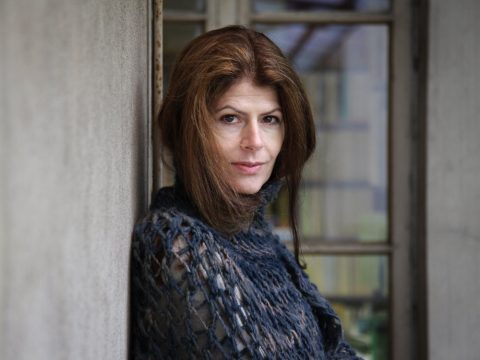
Aug 242011
 

Larios

It’s a pleasure to herald the return to these pages of Julie Larios, a friend and colleague at Vermont College of Fine Arts, also part of the NC community from way back (not that NC really goes that far back, of course). These poems have a dark even macabre edge to them; the felicity of  line and phrase creates a tension with the darkness; as in life, the darkness sneaks up on you. The first poem, “A Diminished Thing,” is also a kind of structural pun. Each line “diminishes” the last word in the line above it (recommended, commended, mended, mend, men, me….).  The title is a nod to a phrase in Robert Frost’s “The Oven Bird.” This is Julie’s second appearance at Numéro Cinq—see “On Reading the Poems of Someone Buried in Poet’s Corner.

Julie Larios has had poems appear in The Atlantic, Ploughshares, The Threepenny Review, the Georgia Review, Field, and Margie, among others. Her libretto for a penny opera titled All Three Acts of a Sad Play Performed Entirely in Bed was recently performed as part of the VOX series by the New York City Opera. She has published four poetry picture books for children, and she teaches at the Vermont  College of Fine Arts in the Writing for Children and Young Adults program.
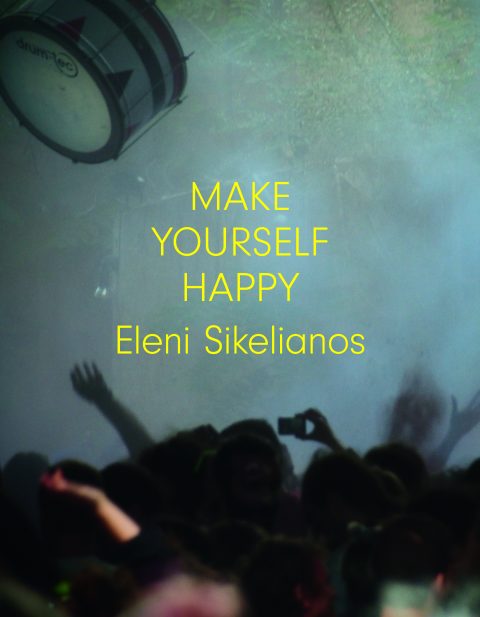
dg


A Diminished Thing

It was easy. Many recommended
me. I was praised, I was commended
for my durability, that is, I mended
fast and often. To mend
is a fine skill, all the broken men
told me.

.

Pincushion Doll

That matte skin
is what bothers people most —

she’s like a ghost
with no shine, all bisque,

in need of a brisk walk
to bring the peaches to her cheeks.

But since she has no legs,
that begs the question.

Below the waist
she’s chaste, all ballast,

filled with sawdust, not a model
for anybody’s body.

The striped fan in her hands
meant to be elegant

is simply sad. Half a woman
is a bad idea.

Girl, you better tremble.
You better pray

you’ll find a way to walk,
you better have hip sockets,

knees that bend,
a bottom half at bedtime.

Otherwise, someone
will stick a pin in

and there’ll be nothing.
No cry. You’ll become

a shy lady with buttons
in a basket on your head,

a pocket for a bodkin,
a thimble, scissors,

a spool of dark thread
fastened to your back.

—Julie Larios

/
/

Jul 052010
 

First Light (click on the photo for more information)

The judges have sent a message. Their minion, the ineffable Kaplovsky, tapped obsequiously on my door last night (he is always cowering, shying from the blow he knows must fall) and delivered a list of finalists culled from the official entry list. For three days they have laboured without food or water (with the exception of a freezer full of lime vodka, a bag or two of whole wheat crackers and a wheel of Vermont cheddar). The task has been difficult, fraught with violence and recrimination. The first aid kit was needed more than once. Here is their short list of finalists in no particular order. Honours and laurels to these well known and sometimes anonymous contributors.

And over and above these illustrious authors of insane and melodramatic versions of a false truth who can forget Claire Wilkshire’s heart-rending cry “Behold, what a toe!!!” and her “master of whoop-whoop” or this sentence from Vivian Dorsel “What behooved me to! That linen and silk charm, the shoes and silken veils, the ring on her finger, that was for Frank” and her gorgeous “wordy as an eggplant” simile? Or this riff from Steve Axelrod, master of the startling and outré comparison “…laugh through their misery like farting crippled geese, trampled by toddlers … it degrades these nihilists of the Veldt, rope-throated troglodytes…”? Or Natasha Sarkissian’s cool psycho-sexual spaghetti-eating scene: “Frank squeezes my hand while we wait. ‘You can have a bite of mine,’ he says…”? And the anonymous X’s triple XXX, sultry version: “What behooved him to! He kneeling and sin licking, my shining sins devoted, my ring turned to vinegar by sin, but he was my Frank.” Or Sheila Stuewe’s talking wombat and Gwen Mullins’ (winner of the 2010 Numéro Cinq Villanelle Contest) horrific chase/birth scene “…even as I finally find moisture; running down my thighs in streams, salty, dripping wet against dry heat, signaling a taste of pain and torture that is birth. I feel my legs buckle, weak, failing: the mission was doomed from the start, but, even as the sun consumes both of us, I know the mission that was doomed was my own birth, calm in our adobe hut while my mother screamed and my father paced the floor”?

And others…

But here, as I say, are the five finalists, two with the original text (has anyone figured out where it’s from?). (And remember to vote for the People’s Choice Award here.)

Continue reading »

Jun 102010
 

FIRST EVER NUMÉRO CINQ TRANSLATION CONTEST

Submissions June 12-30, 2010.

Enter by translating the sample passage below and submitting it as a comment on this post.

The competition is open to anyone. Just sign onto WordPress.com for free and contribute your translation.

Rule #1: Do not submit an entry if you actually speak the language in the sample below. It doesn’t help if you can read the sample and render an accurate translation because the judge can’t read the sample himself. (It goes without saying that you shouldn’t bother using a translation dictionary either.)

That’s the only rule.

Rule #2: Translations must be submitted in English. (Gary Garvin already submitted an entry in Chinese characters via email. This will not fly with the judge.)

Rule #3: Given the confusions we had during the last contest, the judge wishes to specify that there will be an open, ageless category (the Numéro Cinq Shark Class) and an under-16 category (the Numéro Cinq Barracuda Class).

Rule #4: Birth certificate and two pieces of photo ID required to qualify for the Barracuda Class competition (last time certain adult members of the Numéro Cinq community—a disreputable, rebellious, disaffected, and outlaw crowd of ne’er-do-wells and agitators—attempted to have their entries switched to the under-16 category).

Let go of your bourgeois yearning after sense and meaning. Forget certainty. (The judge is returning to his Sufi roots.) Think only of the sound of the words, their rhythms, and what you can invent from them.

As usual with Numéro Cinq contests, wit and arrogance will be appreciated. In fact, wit and arrogance are the only qualities the judge cares about.

Contest open to everyone including employees of Numéro Cinq, their significant others, children, and small pets (mammals only, up to 50 lbs).

First Prize — Instant Worldwide (e)Publication w/ commentary.

Plus honours & laurels.

A single malt Scotch at 9 Maple Avenue with dg or a hot chocolate at Virgil’s with Jonah if you’re in the under-16 Barracuda Class. (You have to get to Saratoga Springs on your own and dg will not put you up.)

Each entry must purport to be a translation of the following passage. Feel free to submit more than one translation.

Ja, er dreigde iets. En hij bleef daar zitten, ziek van angst, làf, zonder geestkracht, zonder moed…. Er dreigde iets en hij voelde het naderen, hem overvallen, met hem strijden op leven en dood, in eene overspanning van wanhoop: hij voelde zich wankelen, nederzinken, hij voelde zich gerukt worden uit de fluweelen zachtheid van zijn leven, neergesmakt worden op straat, zonder dak, zonder iets … Wat behoorde hem toe! Het linnen aan zijn lichaam, de schoenen aan zijne voeten, de ring aan zijn vinger, het was van Frank. Het souper daarginds, zijn bed boven, het was van Frank. Zoo was het geweest een vol jaar lang en als hij ooit weg zoû moeten gaan met alleen het zijne, dan zou hij moeten gaan … naakt, in den winter. En hij kón niet meer zijn, als hij geweest was in Amerika, dienstbaar scharrelend van den eenen dag op den anderen. Zijn lijf en zijne ziel waren beide als geweekt in een bad van lauwe weelde; hij was geworden als eene kasplant, die, gewend aan de vochte warmte der serres, vreest in de open lucht te worden gezet. Want het dreigde, gruwzaam, onbarmhartig: geen seconde was die bedreiging van hem af, en, in de lafheid zijner verweeking, wrong hij er zachtjes zijne witte handen om, en drupten er twee tranen langs zijn strak masker van wanhoop.

Jun 032010
 

It’s great pleasure to post here a poem by Julie Larios, a generous and playful Numéro Cinquoise and a member of the faculty of the Vermont College of Fine Arts MFA in Writing for Children and Young Adults program. In a way, we already know her and she needs no introduction. But there are links here  to various sources and interviews where you can find the hard data–books, teaching, publications.

dg


On Reading the Poems of Someone Buried in Poet’s Corner

“Dear Lizbie Brown…”
that’s all our hero Hardy needed for a letter.
But he was better at it than the rest of us.
The best that we can do is “Sir or Madam,”
and “Sincerely Yours.”—even when love stirs
the soul and bakes the brain, our best refrains
fill with adolescent templates and clichés,
not Lizbie,
Lizbie,
Lizbie Brown.

Even Hardy’s frowns went deeper down than ours—
his stars were brighter, fields greener, cows cleaner,
cream more clotted,  world more Wessex, thrushes darkling,
and his Bettys were all Lizbies,
Lizbies,
Lizbie Browns.

Darling, if we lived in England and you died in time,
before me, I would love you Hardy-style, epistolarically
and lyrically and all seized up by grief and elm trees.
As is it, you’re hale and hearty, and I’m hardly Hardy.
But I’m sincerely yours. Love, Julie,
Julie,
Julie,
Julie.

P.S. I’m sorry but
the toilet’s running
and I tried to fix it
but I can’t. Just thought
you’d like to know.

—Julie Larios

See also “What Bee Did” not to mention Julie’s entries in the Numéro Cinq Villanelle contest. And here are a couple of interviews with the author: The Miss Rumphius Effect and  Cynsations.

/
/

May 252010
 

Okay, this was an evil contest for the judge who has been tortured trying to decide among the Final Five (not to mention the other estimable entries). Never mind that after the aphorism contest the judge had to hide out in Sea Hills, NJ, for five weeks to avoid violence and public opprobrium. This time the pain was in the judging (and, believe me, the judge tried to hand off the honours but was flatly turned down several times). This time the general quality of the entries was so high, surprisingly high–it seems the NC crowd is upping its game, rising to the occasion. (I hope I haven’t turned you all into poets!) The Final Five are all just fascinating poems. And Gary Garvin may hedge about his “Spam Villanelle,” but you have to grant him the wit of the initial conception and the follow-through. The poems Gwen Mullins and Anne de Marcken entered are definitely the most “felt” poems, delicately threading emotion, language and thought. Of these two, the judge possibly admires the Anne de Marcken poem the most but he likes the Gwen Mullins poem on personal grounds–he has sons growing up. But then the judge appreciates the brash humour, the pure joy of Julie Larios’s ratty-ness poem. He wanted that one to win, especially because his dog makes a brief appearance (apparently a part of Julie’s inner menagerie, go figure). And finally he decided that Julie’s “At Play” should win because he admired it spareness and clarity of line and thought and its lovely description of the act of thought or writing. And so he thought he was done. But then he read them all again–torn, torn as he was upon the rack of ART!–
Continue reading »

May 202010
 

The judge and his dog

After an orgy of gin & tonics, a sleepless night, and a long, heartfelt discussion with a blue dog, the judge (anonymous) has rendered a decision. (Remember him in your prayers.) Below, please find the poetic finalists for this year’s contest.

“Spam Villanelle” made the final cut for its outrageous inventiveness. Julie placed two poems in the top five which will no doubt embarrass her, but what can one say? Gwen Mullins, obviously. And Anne de Marcken for the lovely juxtaposition of the inner and outer sea.

There are some wonderful poems in the entry list, all worth reading, especially dg’s  (alas, he can never win) and Jacob’s sheepfold poem written after reading Tristan Tzara and Natasha’s cell phone poem and Anna Maria’s snake poem and Julie Marden’s students’ heart-breaking poem. And more. It’s amazing to see the NC crowd pitch in and enjoy writing for writing’s sake, to try unaccustomed forms and genres. In pretty much every villanelle, there was a moment of inspiration, a line with zing, a bit of quirky humour or a thought well-turned. I love watching these contests unfold, watching the minds at play. It’s also lovely to see Sage & Sarah join the fray and the general atmosphere of welcome and support. Five months and it already seems like a special place.

Continue reading »

Apr 242010
 

ENTRIES ARE OFFICIALLY CLOSED. COMMENTS STILL WELCOME.

Herewith the first ever (annual) Numéro Cinq villanelle writing contest. I am announcing it early so that you can work on your entries. Entries will be accepted between May 1 and May 15. Entries, as with the aphorism contest, should be posted as comments on this page. Entries are open to anyone in the world, but only if they are written in  English, French, Latin, or classical Greek (the only languages anyone can speak in this house). As with the aphorism contest, I encourage you to familiarize yourselves with the form. See the craft and technique page for help. Roughly speaking, we’re talking about a 19-line poem written in tercets (except for the last stanza which has four lines). The first and last line of the first stanza become the last lines of the following stanzas and also turn into a couplet at the end of the last stanza. These are fun to write and can actually turn out surprisingly well if you arm yourselves with strong refrain lines (think: panache, drama, obsession, schizophrenia). You need not be a poet to enter. And it’s always a good thing for prose writers to extend themselves; it makes their prose more interesting. One lesson to be drawn from writing a poem like this is the way form drives content instead of the other way around.

Continue reading »

Mar 152010
 

THE FIRST EVER NUMÉRO CINQ APHORISM CONTEST

Submissions March 15-31, 2010

Submit by commenting on this post

Submissions must be no more than 150 words in length

Do not enter a submission unless you have figured out what an aphorism is first

Wit and arrogance appreciated

Contest open to everyone including employees of Numéro Cinq, their significant others, children, and small pets

First Prize — Instant Worldwide (e)Publication w/ commentary

Plus honours & laurels