Douglas Glover

Jan 252013
 

Some years before writing Impressions of Africa, [Raymond] Roussel discovered a poetic technique he called prospecting, which became his trademark compositional method, as well as the foundation for Impressions of Africa. As he explained in his posthumously published How I Wrote Certain of My Books (1935), he would find two almost identical words with separate meanings, and put them inside two almost identical phrases. Then he would establish a connection between the two different phrases, however disparate and roundabout they might be, and write the narrative that linked them together as realistically as possible. For example, the marksman Balbet is a synthesis of two phrases: “1ST Mollet (calf) à gras (fat); 2ND. mollet (soft-boiled egg) à gras (Gras rifle); hence Balbet’s shooting exercise.” And the zither playing worm: “1ST Guitare (title of a Victor Hugo poem) à vers (verse); 2ND. guitare (guitar, which I replaced with zither) à ver (worm).” Foucault described Roussel’s procedure as “a certain way of making language go through the most complicated course and simultaneously take the most direct path in such a way that the following paradox leaps out as evident: the most direct line is also the most perfect circle, which, in coming to a close, suddenly becomes straight, linear, and economical as light.”

Roussel’s prospecting forms images, plots, and characters with a numerologist’s calculated serendipity. At once demystifying and absurdly complicated, his methods inspired Foucault to question the nature and limitations of language and the Oulipians to create their own complicated linguistic procedures.

via Self-made Enigma: Raymond Roussel | Idiom.

Jan 242013
 

Taylor Davis-Van Atta who founded and edits the new magazine Music & Literature and who also contributes here occasionally just alerted me to this amazing piece of music. I think I introduced Taylor to Viktor Shklovsky, as I try to do with all my students. Theoretically Shklovsky is the inspiration behind much of what we try to do here at NC, art as device, art as content filtered through a mesh or organization or system of techniques. This sonata is lovely and tortured. It brings to mind that wonderful phrase in Joyce’s “The Dead” — “thought-tormented music.”

dg

Jan 232013
 

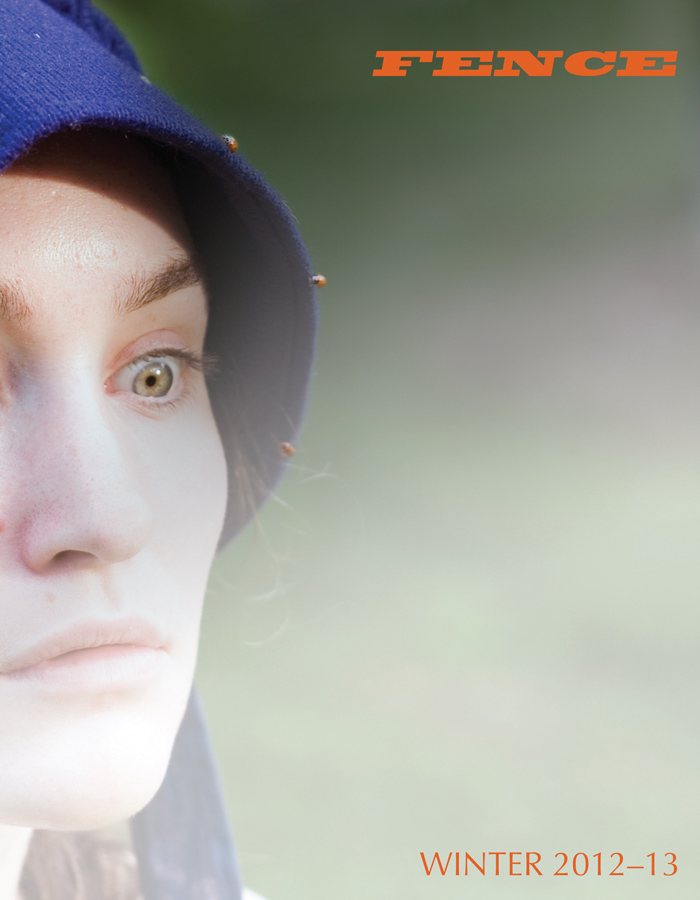
FENCE27

Four of my micro stories — “The Poet Fishbein,” “Wolven,” “Splash” and “Dear Richard” — are just out in the new issue of Fence. I can’t give you a taste because that would be pretty much the whole story. They are so short they are not flash fiction but subatomic fiction. They are to the short story what caviar is to ostrich eggs.

dg

Jan 232013
 

Another of Full Stop‘s Pathos interviews about the writing life, this time with Lars Iyer author of the new novel Exodus. This is wonderful.

dg

‘A creator who isn’t grabbed round the throat by a set of impossibilities is no creator’: Deleuze and Guattari write that. I’m not sure if I could say that I was grabbed round the throat by a set of impossibilities as a part-time lecturer and before, but I was no creator, not then at least. I found the stress of living as one of the ‘precariat’ too great for any sustained task of writing.

via Pathos: Lars Iyer | Full Stop.

Jan 222013
 

French singer, songwriter and poet Serge Gainsbourg and the British actress Jane Birkin were together from about 1968 to 1980. This song was released, I think, in 1969 and became instantly famous and scandalous. One of their children is the great French actress Charlotte Gainsbourg. In 1969 I was starting a graduate degree at the University of Edinburgh. I used to wear a National Fire Service pea coat surplus from the Second World War. Despite the fact that it’s falling to pieces, my son Jonah now wears that coat around the University of Waterloo. The Sixties run through the family like a great river.

dg

Jan 212013
 

Two pieces expressing somewhat the same line of thought from Garry Wills in the New York Review of Books and George Packer in the New Yorker. In these conversations, voices talking at each other in a darkened room, one hears either the emergence of a new historical transformation, a new lib-intellectual consensus, or a faddish argument. Sometimes you just can’t tell with the people who make their livings writing opinions.

dg

Tradition dies hard, hardest among those who cannot admit to the toll it has taken on them. That is why the worst aspects of the South are resurfacing under Obama’s presidency. It is the dignity. That a black should have not merely rights but prominence, authority, and even awe—that is what many Southerners cannot stomach. They would let him ride on the bus, or get into Ivy League schools. But he must be kept from the altar; he cannot perform the secular equivalent of taking the Lord in his hands. It is the dignity.

via Dumb America by Garry Wills | NYRblog | The New York Review of Books.

Now the South is becoming isolated again. Every demographic and political trend that helped to reëlect Barack Obama runs counter to the region’s self-definition: the emergence of a younger, more diverse, more secular electorate, with a libertarian bias on social issues and immigration; the decline of the exurban life style, following the housing bust; the class politics, anathema to pro-business Southerners, that rose with the recession; the end of America’s protracted wars, with cuts in military spending bound to come. The Solid South speaks less and less for America and more and more for itself alone.

via George Packer: The Political Isolation of the American South : The New Yorker.

Jan 212013
 

I could make a joke about all the blustery weather coming out of Congress, but sometimes one should just take the news straight and applaud a little. It’s better than nothing.

dg

Wind alone now accounts for 6% of US electricity generation!

Even the government figures showed that about half of all new energy generation in the US came from renewables in 2012, mostly wind turbines.

The US also put in about 1.5 gigawatts of new solar power last year.

via 13 gigawatts of New Wind power in US in 2012, Renewables Half of all New Energy | Informed Comment.

Jan 212013
 

Douglas Glover & Sydney Lea

Numéro Cinq‘s own Douglas Glover and Sydney Lea (also Poet Laureate of Vermont)  are on the marquee for a reading EXTRAVAGANZA in Port Dover, Ontario, April 12. (Imagine Port Dover as the Riviera of southern Ontario, sort of.) The reading has been organized by our mutual friend, the poet John B. Lee (who has contributed poems and translations to NC). You should all fly up for the event. Talisker will be flowing in the gutters. It will be epic!


Jan 212013
 

There is a certain pathos in the practice of the literary arts. You spend hours alone, locked away from loved ones and friends and colleagues (oh, how I have sometimes yearned for a colleague). When you come out, you’re often in a bad mood, having just spent hours measuring yourself against an impossible ideal. And nowadays being a writer means struggling to find time to write in the cracks of the day, between job and family (or worse, errands! getting the clutch fixed, picking your kids up from school, buying toothpaste) — only the very young or the extremely lucky get to write stress free. This is an interview with 3AM Magazine editor, reviewer, author Andrew Gallix who despite the gallant teaser below has not escaped the wars unscathed. The interview is part of series at Full Stop on the consequences of following the writing trade.

dg

Sartre claimed that he began writing to make up for his ugliness and impress women. We all want to be loved, and writing is always a love letter of sorts. As Richard Brautigan put it, “Just because people love your mind, doesn’t mean they have to have your body” — but one lives in hope, of course.

via Pathos: Andrew Gallix | Full Stop.

Jan 202013
 

NC wishes we were not all genetically related to these people. Really, what is wrong with the human race? Even worse! One of them is Canadian!

And despite recently going on welfare, it seems that cash-strapped Octomom is once again taking to the stage and pole.

According to sources who told TMZ, the single mother, 38, has signed a deal with a Florida strip club to appear topless on stage.

via More humiliation for Octomom as bankrupt Nadya Suleman ‘signs on to strip topless AGAIN at Miami club’ | Mail Online.

§

Justin Bieber’s been caught with his pants down.

The newly single 18-year-old posted a revealing photo of him mooning on his Instagram on Saturday, then quickly deleted it.

No different from the antics of most boys his age, of course, but before the Biebs could think twice about his revealing snap… the image had been liked 86,000 times.

via Justin Bieber posts picture of his bare bum then deletes it… but not before it’s liked 86,000 times | Mail Online.

Jan 192013
 

It’s always nice when people say complimentary things about you. This is Marc Christensen on The Malahat Review site recalling a 1981 issue that contains a story of mine called “There Might Be Angels” — subsequently reprinted in my second collection Dog Attempts to Drown Man in Saskatoon (Talonbooks) which, amazingly enough, is still in print. I wrote the story in Saskatoon and in Santa Fe in the winter and spring of 1980 before attending the Iowa Writers Workshop that fall. I was thinking of that George C. Scott movie (not the band) There Might be Giants in which a psychiatrist, played by Joanne Woodward, decides to enter her patient’s mania rather than try to cure him, finding the insanity more truthful than the so-called real world. The movie script was based in part on Don Quixote, which somewhat explains my long obsession with that novel. But the film also seemed to reflect the concerns of the great cracked Scottish psychoanalyst R. D. Laing, who treated his schizophrenic patients by honouring the truth of their delusions. So the ending of the story is an inversion of the normalcy/insanity discourse that governs the preceding nine-tenths of the text. There is also a nice little folktale I invented about three angels traveling incognito on a train together. And, of course, everyone in the story is an angel. When Christensen writes “abroad” he is, in part, referring to the fact that the story is set in Mexico.

dg

…but it seems best to highlight the story written by Ontario-born Douglas Glover, who takes his CanLit background abroad both literally and figuratively to study and challenge the traditions of classical literature. His contribution begins as a railway encounter between an aging, comfortable abbot and a tramp, a set piece that exceeds the expectations inherited from both canon and context several times over – providing a brief but convincing case for the value of homegrown talent in a context of longer ages and wider places.

–Marc Christensen

via The Malahat Review.

Jan 192013
 

Via Richard Skinner’s website, here’s a fun little compendium of writing advice from the German writer W.G. Sebald.  Compare this list with the Gordon Lish Notes,  (via The Art of Tetman Callis) another wonderful ‘crash-course’ in fiction writing for the cyber age.

Particular pearls of Sebaldian wisdom that stood out:

There is a species of narrator, the chronicler; he’s dispassionate, he’s seen it all.

The dispassionate chronicler is never shocked or sentimental, yet he retains a sensibility that might well qualify as wise and compassionate.  This is the modern condition. Unless you’ve been living on an iceberg for the last 50 years, very little will surprise.  And yet storytelling still demands a narrator.  I’ve been reading Antoine de Saint-Exupery’s  memoir, Wind, Sand and Stars, which is a lovely but highly narrated book.  First published in 1939, Saint-Exupery could get away with a more heavy-handed narrative style.  But the contemporary reader is less willing to trust the author these days. So the all-knowing, omniscient narrator might well be a thing of the past, like Saint-Exupery’s open cockpit bi-planes.  But the post-modern trend toward killing the author (and by extension, the narrative voice) often makes for a jumpy, cinematic effect. Sebald’s dispassionate chronicler might be something to ponder as a narrative device.

I also found this thought enlightening:

Particular disciplines have specialized terminology that is its own language. I could translate a page of Ian McEwan in half an hour—but golf equipment! another matter. Two Sainsbury’s managers talking to each other are a different species altogether.

The lively language of specialized labor often makes for wonderful reading.  I recently finished reading “Effleurage: The Stroke of Fire” by Barry Lopez (in  About This Life: Journeys on the Threshold of Memory), in which Lopez intricately describes the process by which a group of Oregonian potters work a communal kiln.  Now, all things being equal, if someone had told me that I was about to read a thirty page essay on pottery, I would have gladly offered to take out the trash and scrub the hardwood floors instead.  Yet Lopez creates one of the most mesmerizing essays I’ve ever read, in part because he takes the reader inside the highly specialized process of these potters.

– Richard Farrell

Jan 172013
 

Here’s a taste of the hot new thing in the world international letters, a lyric essay (as the author calls it) by László Krasznahorkai commissioned for the New York Times (an institution not immune to the BUZZ) and translated from the Hungarian by George Szirtes. (Szirtes is a prolific Twitter-author; he cracked me up a couple of days ago when he tweeted, “Egrets? I’ve had a few, but then again too few to mention.”) Krasznahorkai is a voluptuary of melancholy. Three of his novels have been published in English by New Directions. You can read a terrific interview with him here at the UK Guardian.

dg

I’ve been living in complete silence for months, I might say for years, with just the usual dull sounds you hear at the outskirts of town, the occasional echo of steps in the corridor and, further off, in the stairwell, someone dragging a sack, a carpet, a package, or a corpse, God knows what, along the ground; or the sound of the elevator as it slows, stops, opens, then closes and starts to rise or descend. Every so often a dog barks briefly, someone laughs or shouts. But everything dies away, soon lost in the constant low-level murmur of the street outside. That is what complete silence is like round here.

via Someone’s Knocking at My Door – NYTimes.com.

Jan 162013
 

Sydney Lea Book Cover

Skyhorse Publishing in New York has just released a third book of North Country reminiscences, outdoor essays and stories by Numéro Cinq Contributing Editor Sydney Lea. As we here know, Sydney writes some of the most perceptive, intimate, deeply felt, and sometimes hilarious essays about the northeast woods you will ever read.

These days Sydney is nothing if not prolific. The University of Michigan Press recently issued A Hundred Himalayas, a sampling from his critical work over four decades, and his eleventh poetry collection, I Was Thinking of Beauty, will be out later this year from Four Way Books.


Jan 152013
 

Here is the George W. S. Trow essay Steve Almond quotes in the piece Jason DeYoung cross-posted yesterday. Actually it’s not the entire essay, but some boiled down core of it. The entire essay was published in the New Yorker in 1980 and shortly after as a book. In itself, this boiled down bit is an amazing discovery. But then delve into George W. S. Trow himself. Here is a New York Magazine profile well worth reading.

dg


WONDER

Wonder was the grace of the country. Any action could be justified by that: the wonder it was rooted in. Period followed period, and finally the wonder was that things could be built so big. Bridges, skyscrapers, fortunes, all having a life first in the marketplace, still drew on the force of wonder. But then a moment’s quiet. What was it now that was built so big? Only the marketplace itself. Could there be wonder in that? The size of the con?

via Reflections: Within the Context of No-context : The New Yorker.

Jan 142013
 

It’s a great pleasure to announce that Canadian novelist Ann Ireland has joined the Numéro Cinq masthead as a Contributing Editor. She has a new novel, The Blue Guitar, just coming out; we published an excerpt from the work in progress last March. She lives in Toronto near my brother which is a great help in case I have to hound her for copy. She is an old friend and a welcome addition to our burgeoning community of artists and writers.

dg

Ann Ireland‘s most recent novel, The Blue Guitar, will be published by Dundurn Press in early 2013. Her first novel, A Certain Mr. Takahashi, won the $50,000 Seal-Bantam First Novel Award and was made into a feature motion picture  called The Pianist in 1991. Her second novel, The Instructor, was nominated for the Trillium Award and the Barnes and Noble’s Discover These New Writers Award, and Exile was shortlisted for the Governor-General’s Award and the Rogers/Writers Trust Award. She is a past president of PEN Canada and coordinates Ryerson University’s Chang School of Continuing Education, Writing Workshops department. She lives most of the time in Toronto and part of the time in Mexico.


Jan 132013
 

Nicholas Humphries and Meagan Hotz’s “Little Mermaid” takes Hans Christian Andersen’s already dark fairy tale and reimagines the “romance” as a swamp circus freak show about worn out and faded love. Since Andersen published the tale in 1836 there have been versions in almost every possible artistic form, his first incarnation written for ballet even. Something about this little inter-species romance compels storytellers to return to it again and again.

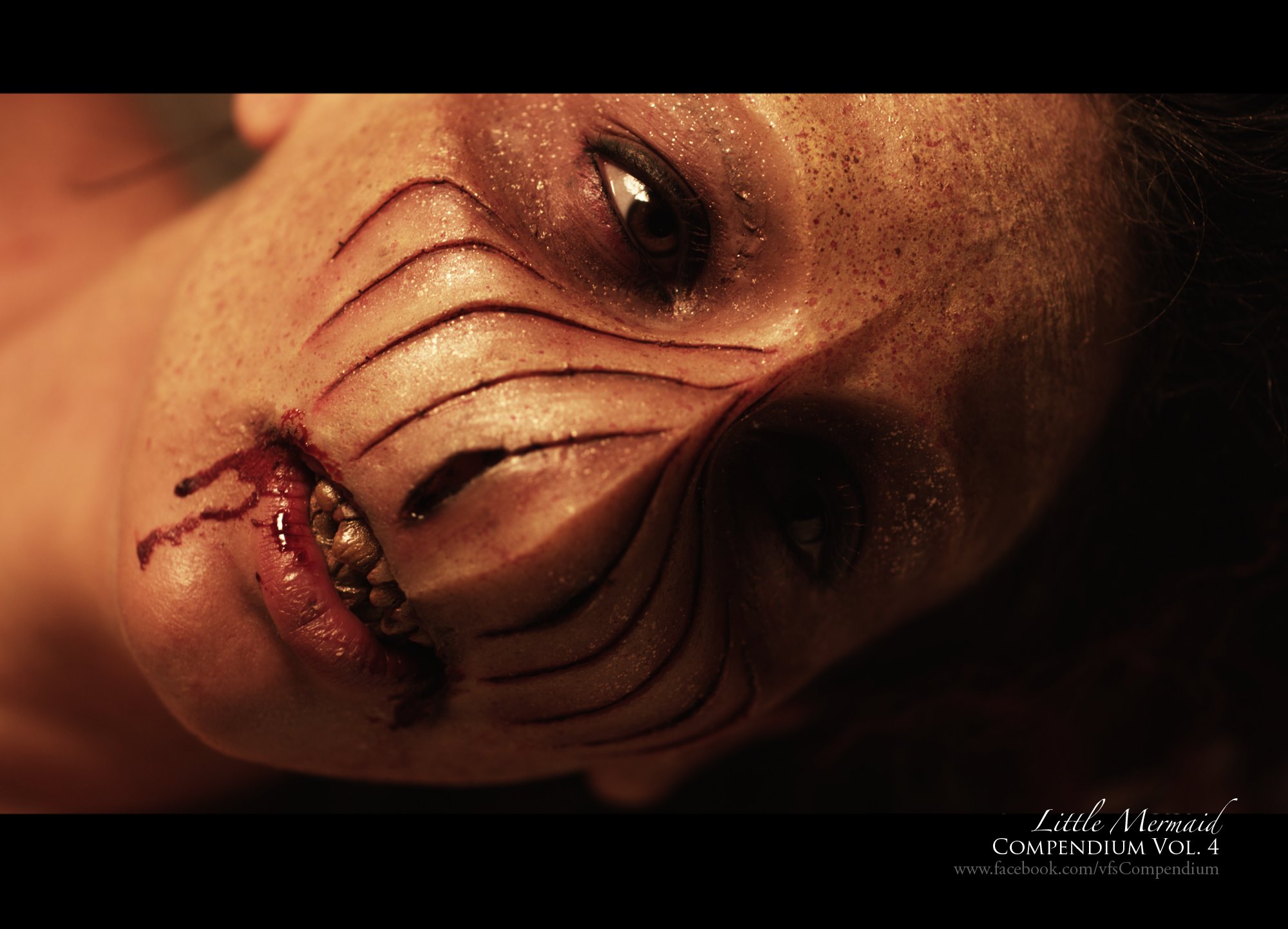
In their retelling, Humphries and Hotz take a turn to horror. Some of the film’s shock value is intertextual: the title probably has most people referencing the Disney animated film from 1989 more than the original Andersen tale.

ariel-the-little-mermaid-14629313-1280-1024

Humphies and Hotz can play off of the Disneyfied, technicolour-happy-ending expectations of the audience and so then shock and cause them to shudder more when the tale takes surprisingly dark turns.

0

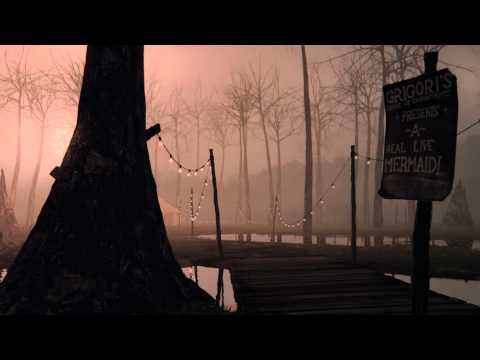
In the opening shots of the film, lights swing from trees, half fruit, half pendulums keeping time’s waltz in among the mists. There is a peculiar sepia tint to the colour scheme, a surprising nostalgic and warm hue to the stagnancy and decay of the swamp setting. Throughout this opening, too, there is the flutter of birds flying off, in a way underscoring how caught and imprisoned the mermaid is when we meet her inside the worn tent. The lighting, the boardwalks across the swamp, the signage, and the tent itself seem strangely permanent for something as itinerant as a circus and this metaphorically sets the stage for the inertia, the claustrophobia of the lost love between the circus master and his imprisoned mermaid.

Though Humphries and Hotz’s dark take on the fairy tale might seem a departure, these choices are in many ways a return to the darkness of Andersen’s original tale in which the sea witch’s pact with the little mermaid carries with it terrible costs. As the sea witch explains,

“I will prepare a draught for you, with which you must swim to land tomorrow before sunrise, and sit down on the shore and drink it. Your tail will then disappear, and shrink up into what mankind calls legs, and you will feel great pain, as if a sword were passing through you. But all who see you will say that you are the prettiest little human being they ever saw. You will still have the same floating gracefulness of movement, and no dancer will ever tread so lightly; but at every step you take it will feel as if you were treading upon sharp knives, and that the blood must flow. If you will bear all this, I will help you.”

“Yes, I will,” said the little princess in a trembling voice, as she thought of the prince and the immortal soul.

Though I suppose we can forgive Disney for leaving out these terrible wounds and the awful price the mermaid is willing to pay, Andersen’s original, like Humphries and Hotz’s version, sees the pain and suffering as the point of the story.

For Andersen, this pain and suffering, the sacrifice was on a certain level a declaration of love and a tribute to the beloved. Brooke Allen in The New York Times argues that “In ‘’The Little Mermaid,’’ Hans Christian Andersen suggests that immortality can serve as a substitute, however unsatisfactory, for human love. The story is clearly an allegory for his own life, for the unloved Andersen.” What Allen is pointing to is what is present in the original tale and is missing in this most recent version: the love triangle aspect of the original fairy tale. In the Hans Christian Andersen version, despite all the little mermaid’s sacrifices, the prince marries a princess from a neighboring kingdom, an action which will doom the little mermaid to wake at dawn the next day and turn into sea foam.

This love triangle resembles another: the tale is considered by many to be a love letter, originally written from Andersen to Edvard Collin who would not return his affections and in the end married a woman. The themes around sacrifice then in that context become about unrequited love and the tale about trying to make sense and meaning out of the sometimes self-destructive sacrifices we make for it.

In the Disney version of the tale, too, there is sacrifice. But Ariel’s lack of pain and regret and its happily-ever-after ending morph the theme into one where sacrifice gets the man. Ariel still gives up her life under the sea but she gets the man in the end, so it was, Disney would have us believe, worth it.

the-little-mermaid4

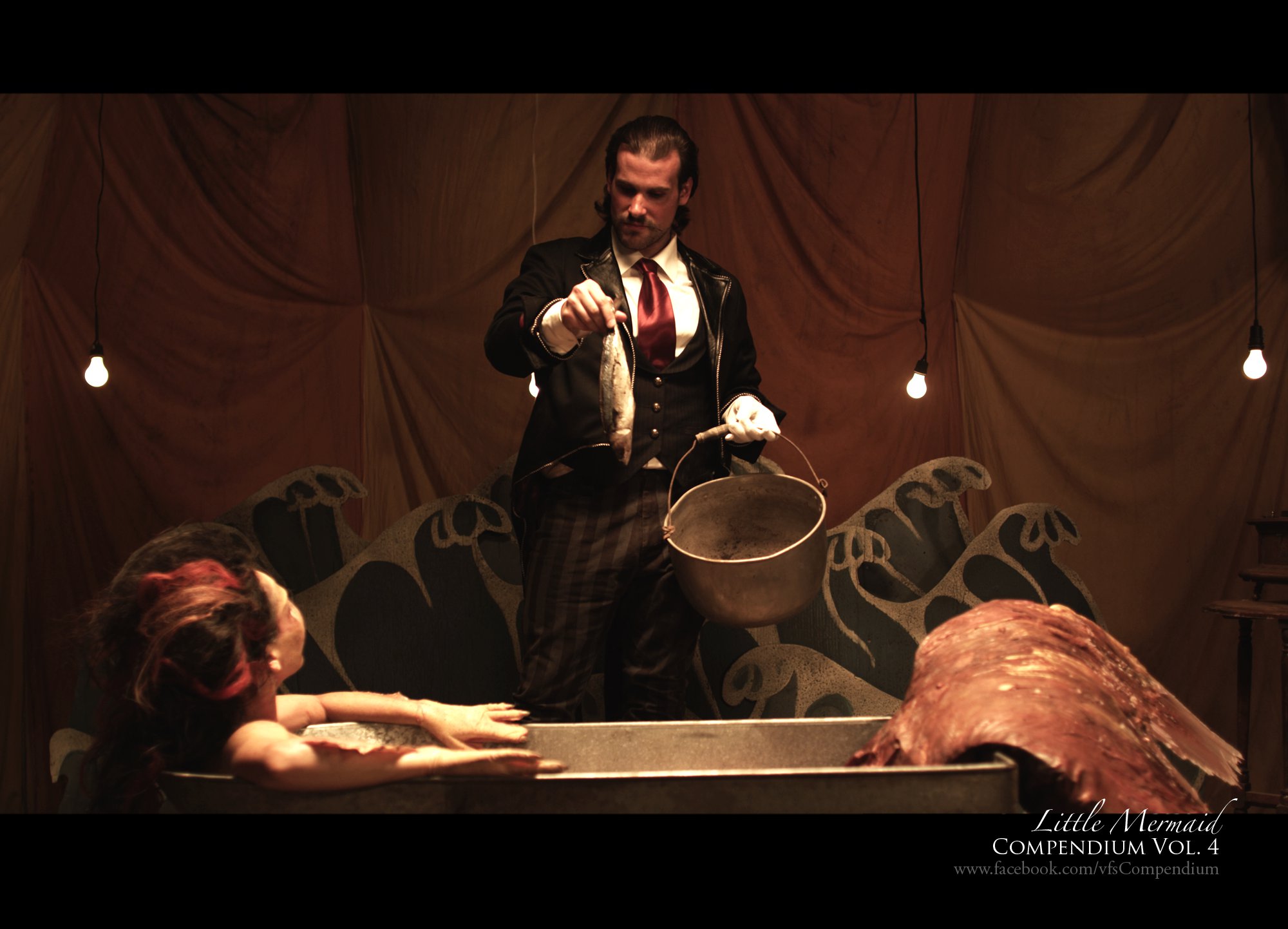
Humphries and Hotz pick up the theme of sacrifice but in their tale it seems to be about how the lovers’ sacrifices have killed their love. Their mermaid never sacrificed her tail or her voice but she has been taken from the sea to live in a metal tub and be displayed by her lover and objectified by the curious who are willing to pay.

Compendium-screamfest-la

We can only imagine the series of bad choices (maybe his, maybe hers) that led them to this tent in the swamp. We know they are both weary. We know it’s not an equal relationship. We glimpse only shards of love’s remnants. The mermaid here begs for mercy, but the circus master can’t or won’t give it to her because he would lose this tragic-as-it-is circus. This little mermaid has to take her fairy tale’s ending into her own hands. In a nice rewrite, it is her voice’s siren call that brings him to her and makes him see her as human just before she, with a vengeful kiss, takes his tongue and voice.

the-little-mermaid1

This is the definition of a Pyrrhic victory: a mermaid in a tub in the swamp isn’t going to get far. Her choice is similar to Andersen’s mermaid’s, though, whose sisters appear to her and tell her that if she sheds the prince’s blood on her legs she will get her mermaid’s tail back. Kill the prince to get her old life back or uphold his happy marriage to the princess ensuring she, the mermaid, will turn to sea foam in the morning as prophesied. Though it is technically not the same choice in the Humphries and Hotz version, the mermaid does opt against her own further sacrifice and chooses to shed the circus master’s blood. She puts an end to the pathetic death of their romance and ultimately privileges mercy over sacrifice.

Humphries and Hotz’s “Little Mermaid” was produced as part of the Vancouver Film School’s Compendium series out of their Entertainment Business Management Program. It’s garnered numerous nominations and several prestigious awards including Best Short at Screamfest LA. Humphries dark sensibility gave Numero Cinq at the Movies its Valentine’s Day installment last year with “The One That Got Away.”

–R.W.Gray

Jan 132013
 

Here’s an interview I did with William H. Gass shortly after the publication of his immense & controversial novel The Tunnel in 1995. As with some earlier interviews I have posted here, this comes from a box of tapes in my basement, dating from a time when I did a weekly radio interview show. I had a lot of fun with this interview, partly because some heavy-hitting critics just tore the novel apart (I loved especially the ones who said it wasn’t a novel at all), and partly because Gass is a philosopher (a field of interest we share) and the book is dense with thought, history and wit. We cover the ground. We firmly place the novel in a tradition (when the critics mostly scratched their heads and said it didn’t fit anywhere), we talk about Nietzschean ressentiment, the spirit of the age (think: the Tea Party), about aphorisms and the form of the limerick (and the political implications thereof), and we talk about the vast comedy of the novel which critics also largely failed to notice.

I think these sound files should be listenable (is that a word?). They are reproduced from old tapes stored in a box for years and transferred to digital media with my usual haphazard, seat-of-the-pants approach to technology. Some people have complained (in regard to earlier interviews) that the sound stopped and then continued a lot. My sense is that this is just your computer loading the file from the Internet and is not a problem with the file itself. I also checked and this sound player works fine with Ipads.

Douglas Glover

.

.

See also my interviews with John Hawkes and Gordon Lish.


Jan 122013
 

Robert Currie

Robert Currie is a Saskatchewan poet with six collections out and a novel, Living With the Hawk, his first, about to be published this spring. He lives in Moose Jaw, which is substantial city, but his concerns are mostly rural (Saskatchewan is mostly prairie farmland and bush in the north). And if you have read your Farley Mowat (e.g. The Dog Who Wouldn’t Be) you would know that growing up Saskatchewan in a certain era was all about the outdoors, the weather, the seasons, fishing, bird migration, shooting — this was near the Age of Innocence before hunting and fishing became signs of ecological imperialism. It was also a time when your parents would let you bounce around in the back of a pickup truck (without fear of arrest for child endangerment) and teachers used the strap — all of which are things I remember. “Under the Blanket” is a charming, sweet depiction of youthful sexual exploration (while bouncing around in the bed of a pickup truck) and “The Days Run Away Like Wild Horses Over The Hills” is a gorgeous poetic welding of winter and wild horses (beautiful galloping lines). “He Visits His Ex-Wife” is a looney, ever so touchingly comic poem about the poet visiting his demented ex in a home (you don’t know it’s a home till the end) where she tells him an unsettling and inscrutable tale about an elderly couple eaten by bears. These are poems from another world in both time and geography and it’s a great pleasure to introduce them here.

dg

—-

UNDER THE BLANKET

Our fathers were singing in the front seat,
driving back to town for a block of ice,
our mothers in the shack at the lake,
frying chicken on the wood stove,
patting the sweat from their faces,
cotton aprons raised from the waist.
The two of us rode in the back seat,
an Indian blanket over our heads,
you a year older than I, both of us
giggling, waiting for the next bump
to bounce us together.  You leaned
toward me, breath stroking my right ear,
and whispered, “Now’s your chance.
Do you want to see?”  I did
and I didn’t.  Unable to speak,
I nodded my head and waited
in the snug world of the blanket,
my mind anxious, wheeling with wonder.
I saw your lips twist into kind of a smile
before we lowered our heads and looked down:
your brown thighs tanned from days at the beach,
your hands tugged at your shorts, your panties,
sliding them down, a mound untouched by sunlight,
and in the smooth white flesh directly below
an improbable groove that stopped my breath
and altered forever the gait of my heart.
We must have reached the ice-house then.
When I came up from under the blanket
the first thing I saw was my father
handing me a chip of ice in a cracked cup.
I remember the slippery feel of it,
cold and hard on my tongue,
and how quickly it melted away.

.

THE DAYS RUN AWAY LIKE WILD HORSES OVER THE HILLS
(from a title by Charles Bukowski)

The weeks gallop from summer into September,
gallop away from the lake, a sheen of ice by the shore.

Hoofbeats hammer the gulch where deer hide from the hunter,
echo across a dry slough; a last goose cries in the empty sky.

The weeks snort at a sliver of moon, shiver in the night
of the coyote, its chill call stretching across the land.

Snow obscures the moon, now frost-bitten, withered,
and piles into gullies and hollows deep in the hills.

The nights grow long; the weeks grow shaggy and lean.
They lunge and plough through drifts that plug the valley.

Where the wind whips the hillside almost bare,
they paw at the snow, their jaws tearing the grass.

Winter lodges among them, the frozen carcass of winter,
and spring, next spring, will it ever come?

Bunched together in the lee of a thicket,
the wild horses neigh and neigh and neigh.

.

HE VISITS HIS EX-WIFE

When I entered the room, she smiled and said,
“Their cabin was nearly as dark as that,”
and she pointed to the wall by her bed,
an echo of sunshine from the open window.
“Uncle Henry liked to fly-fish in the mornings
and Aunt Lil always baked bread in the kitchen.
I suppose it was the smell that brought them around.
The bears, I mean.  I love the smell of bread myself.
When it’s golden brown and fresh from the oven
you can’t wait to tear off a piece of the crust.
People said they were both eaten by bears,
but I never believed a word of it.
Uncle Henry was big as a bear himself
and Aunt Lil never cared to go fishing.”
She nodded at the TV set, which was off.
“You can see how dark the room is.
Looks kind of spooky, doesn’t it?”  She laughed.
“Maybe the bears got in after all.
You know, you can just make them out, there
in the breakfast nook, across from each other,
Uncle Henry and Aunt Lil sharing a meal.
As much in love as the day they were married.”
She reached out then and took my hand.
“I think I’ll write the papers, tell them the truth.”
She gave my fingers a squeeze.   “Thanks for coming.
It was really nice to meet you”  And later,
driving away from the home, I thought,
somehow she’s still as pleasant as ever,
and I was glad again that I’d come.

.

CAUGHT

Chick showed me once exactly
how to set a snare on a rabbit trail.
I took five feet of copper wire
from my father’s basement workbench,
folded it into my loose-leaf binder,
took it to school.  No branches here
to pin to the ground, I wrapped the wire
around the steel leg of my desk,
looped it into a noose, twisted a slip-knot,
set the noose upright in the aisle.

Mrs. Dornan checking arithmetic books,
moved ever closer down the row,
paused at Kenny’s desk in front of me,
side-stepped slowly backward, the noose
slipping over her shoe, tightening,
the twist of wire tearing her stocking.

When, hands shaking, I finally got her free,
she pointed to the cloak-room door,
drew from the centre drawer of her desk
the strap, thick black leather.  “For you,”
she said and followed me out of sight.
Oh man, that strap, I must’ve been crazy.
At last I lifted my hand.  Strove to hold it still.

“You like to play games so much, try this.”
She raised the strap, slammed it hard
four times against the far wall.  Frowned.
“You behave yourself,” she said, “or else
the class will learn what happened here.”

.

BEYOND THE OPEN WINDOW

It’s true, just the other afternoon,
when I’m at rest in my easy chair,
a glass of whiskey handy as my elbow,
a good novel propped upon my knee,
my right arm disengages from my shoulder, the hand
flips me the finger and goes with it, sailing out the window,
its flight erratic as a wing stripped from an erring angel.
Unable to attain heights remotely close to heaven,
the arm wavers near the ground, rising for a few seconds,
then brought down by gravity, dipping so low it terrifies
a cocker spaniel peeing on a pole, sends the dog
howling home before it strikes a garbage bin,
bounces to the curb, ricochets away, off-kilter,
tumbling end over end down the street

where people work, men with blistered hands
wheeling cement across a concrete pad
to other men with shovels, trowels and floats.
Beyond them a guy who drives a backhoe
rubs away the sweat that runs toward his eyes.
Shuffling along the sidewalk a street person
wonders if anyone is hiring labourers today
and asks to see the foreman.  He doesn’t notice
the arm clip a girder where a wall will go,
doesn’t see it skid across a gravel pile, pausing
to shake off dust that covers scratches at the elbow.
The arm shudders and hoists itself upright, the hand
raising a thumb as if it might want
to hitchhike home to me.

—Robert Currie
————————–

Robert Currie is a poet and fiction writer who lives in Moose Jaw, Saskatchewan. He is the author of six books of poetry, including YARROW (Oberon, 1980) and WITNESS (Hagios, 2009). He served two terms as Saskatchewan Poet Laureate (2007 – 2010). In 2012 he delivered the Anne Szumigalski Memorial Lecture at the conference of the League of Canadian Poets. His tenth book, a novel, LIVING WITH THE HAWK, will be published by Thistledown Press in the spring of 2013. In 2009 he received the Saskatchewan Lieutenant Governor’s Award for Lifetime Achievement in the Arts.

Jan 112013
 

Gina Occhiogrosso

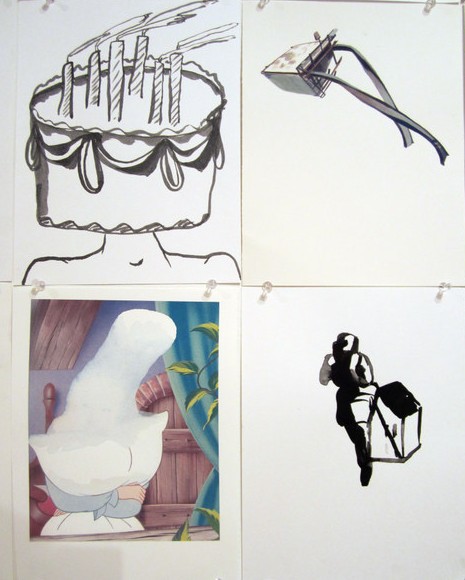
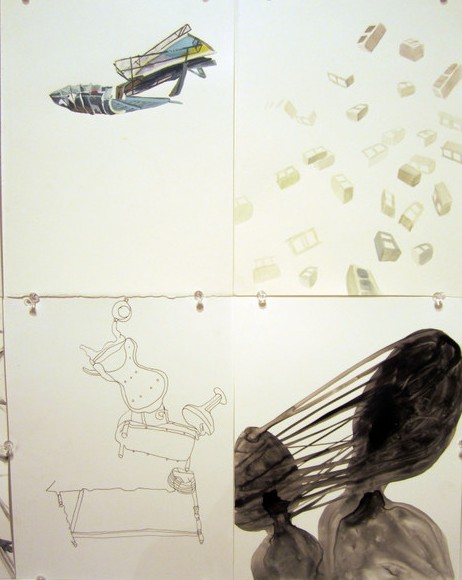
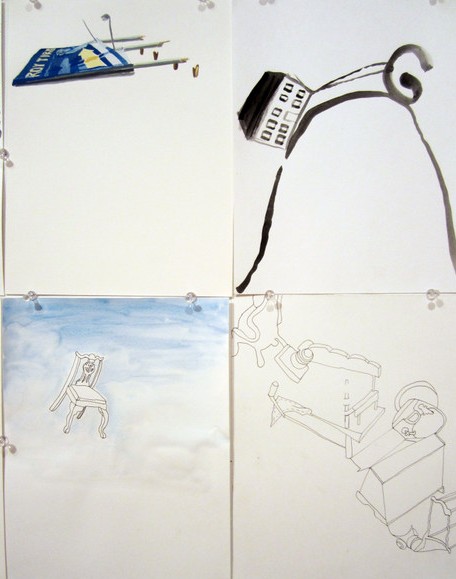
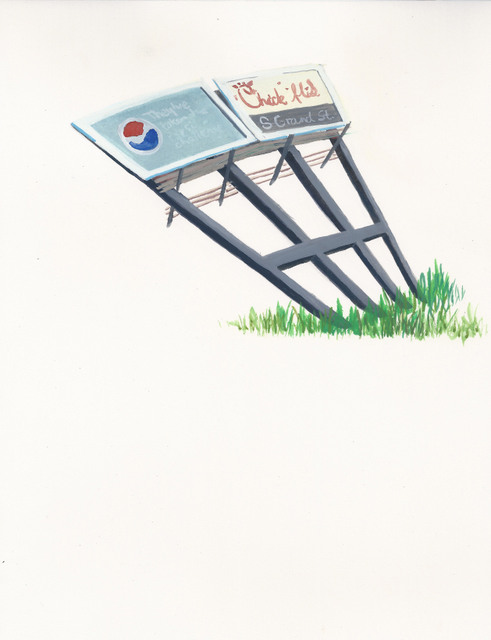
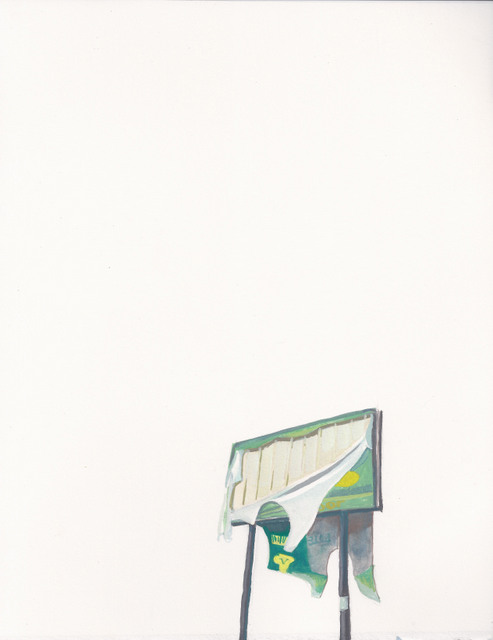
Every writer/artist knows that you throw away more than you finish, that the material thrown away is often very good but only a step along the way to a larger vision, or it doesn’t quite fit in the organic structure of the finished product. Gina Occhiogrosso has turned her steps along the way into a larger proliferating work called, with charming irony, the Someday Project. The steps along the way thus become art and the immense collection of drawings, sketches, cartoons and paintings has become a protean mega-project that, on exhibit, covers walls and rooms with a kind of madcap informality. Lovely the way the pictures in the photo below climb up the wall and slop over onto the ceiling. No frames, no hanging self-important masterworks, just paper tacked to the wall, filling the wall, creating a meta-image, a mirror of, yes, the artist’s mind.

dg

The above image is from a complete installation of a project titled Someday. The whole project began in 2007, and is now at around 500 drawings. Each drawing is 8.5 x 11 inches. The drawings began on cheap copy paper paper, but as people visited my studio, they convinced me to treat the drawings with a little more importance and use better paper such as watercolor paper, bristol, or Yupo (polyurethane). Someday is only part of what I do as an artist, but this project helps me work things out when I simply need to move the larger work forward, or when I need to work something out, personally. Themes include, but are not limited to, feminism, the economy, the fragile landscape, and relationships. Some works are cartoony, some are pure experiments in abstraction. This particular slide shows a specific exhibition at The Arts Center of the Capital Region, where I sat in the gallery and worked a few hours each week for the run of the show.
—Gina Occhiogrosso

  Gina Occhiogrosso art

Gina Occhiogrosso art

Gina Occhiogrosso art

sm251

Gina Occhiogrosso art

sm249

Gina Occhiogrosso art

sm495

—Gina Occhiogrosso

—————————————-

Gina Occhiogrosso’s national exhibition experience includes group shows at Brenda Taylor Gallery and Lana Santorelli Gallery in NYC, MIA Miami International Airport Gallery, Lehman College Art Gallery, Bronx, NY. She was recently featured in a three-person show titled Flux at The Arts Center of the Capital Region in Troy, NY. She has had several one-person shows at such places as Nicole Fiacco Gallery, Hudson, NY, Saratoga Arts Council Art Gallery, Saratoga Springs, NY, Amrose Sable Gallery, Albany, NY, Lake George Project for the Arts, and Yates Gallery at Siena College. Her work may be viewed in the Pierogi Flat Files, in Brooklyn, NY, and through registries such as The Drawing Center and Nurture Art. In 2010 she was included in the project, The Other End of the Line, a project developed by artist Francis Cape and created for The High Line in Chelsea, NY. Her video was included in a mobile home trailer (stationed at the beginning of the High Line at Gansevoort Plaza), which contained an exhibition of work by numerous artists and was curated by Ian Berry, curator for The Tang Teaching Museum, Skidmore College.

Jan 102013
 

Mishler Photo

Herewith, poems from Peter Mishler, introduced to me by Emily Pulfer-Terino. Very cunning, deft and graceful poems. In “Demolition” a chance detour (on his way to work) leads the poet by an Econo Lodge which becomes a screen for his imagination and the stage for a dark, alienated story (words like “gurney” and “wrist” implicate the scene with dread). A week later, the detour signs disappear and the poet metaphorically wakes, sort of, from the dream of his imagination. It’s an ancient, haunting plot. Some tiny change in the humdrum routine of the world thrusts the dreamer into another world of darkness and disorder. Then he returns, not himself any longer, but changed. (Think: Hawthorne’s “Young Goodman Brown” for example.) He finds the humdrum now inflected with dream (“I walk the darkened, sea-foam hallways”). The poem ends with a lovely whispering repetition (morning, morning), the owl-like assonance (who, whom), and a shade of doubt.

I walk the darkened, sea-foam hallways
to my desk—and when the people
that I pass say, Morning, I say,
Morning, too, so that I can’t
be certain who is waking whom.

dg

§


DEMOLITION

For a week a detour takes me
past the windows of an Econo Lodge.
I invent what’s on the other side
each morning, beginning
with what I know is there:
an absent clerk, an empty lobby
some dark green carpet
joined in places with duct tape.
I add a chair for myself to sit
and make the smaller arrangements:
a door to a bedroom closed
just enough to hide a figure inside;
open enough to reveal a bed
that looks like a gurney,
a wrist laying face up
on the sterile and steamed
white sheets. What am I
intending to have happen here?
Hard to tell if it’s my wrist
or someone else’s that’s meant
to emerge from that room.
I’m getting a feel for the lobby, though:
within days I learn to fix
a sugar drink from sweetener
packets and sink-water.
I place a styrofoam cupful
in front of the bedroom door
and watch for movement.
But by the end of the week,
the detour signs are pulled
and my car is directed
back to the highway,
granting me another view:
the demolished building
the city was shielding me from.
A crane now sifts through fragments
and debris, sorting them into one pile
or another. As it holds
each piece of metal to the air
to let it flicker for a moment,
for me it is lifting the door,
the bed, the sheets, the wrist,
and the cup that should now be filling
with an early sunlight on the floor
of the motel. I watch in the mirror
as each object hangs, then drops.
My car approaches my building, and work.
I walk the darkened, sea-foam hallways
to my desk—and when the people
that I pass say, Morning, I say,
Morning, too, so that I can’t
be certain who is waking whom.


PERIPHERY

You are evading me.
You are just beyond me.
You are the length
of the hood of a car
away from me—
and thinner
than I remember,
dressed as if undressed
after work.
I reach until
I can meet your hand.
But you are in front of me
like the moon
on one week,
then behind me
like the moon on another.
You are trying
to move toward
the doors of a church
we both know,
and I won’t let you.
I step in front of you
and you step to the side
saying, Stay
on the periphery
and we’ll be in touch
this summer.
But what’s here
that won’t let me
speak to you—
that prevents me
from letting you
go inside,
that makes you
want to go inside?
I tell myself, Yes,
I know I must
stay here and lie
whenever I try
to retell the story.
Once, two friends stood
on opposite banks
of a stream.
Then, they were men
and a river,
and then, two ghosts—
the story becoming
more distant
or strange
the more I fear
the person listening.

.

HARUSPEX

The office lights chose
to remain half-lit
for the rest of the fall.
I went whistling
the song of two crows
down a hall unknowingly.
Through my phone
an exam room
slipped into my ear
and unfolded
its expanses brightly.
How does one
get to sleep
in a city of snowfields?
My father sent me
an absentee ballot,
and asked did I think
my future was secure?
I day-dreamt throughout,
and my eyes flew doubly
over a man, on a raft,
down-river—
his body, thin;
his liver, a white star
pressed against his skin.
It asked me to extract it
for its portents.
Back in the office,
my xeroxes spilled
through a seam of light.
They handed me
a memory of warmth
from distant fires.

CLOSED LOOP

You try again
to shut your eyes—
rejoin your head
and heart—
afraid of being
called back to the house
and broken from
your little spell.
But no one is home
to call you home.
Nobody stops you
from pausing
in the last days
of August
like you do.
You’ve stepped outside
some nights
and wanted
to get back in.
There were lists
to be made,
glasses of water
to shift from table
to nightstand.
Stay and let yourself
be known
from the vantage
of sky and window—
your body centered
in a sprawl of lawns
that narrows
away from you
into a vanishing point
of smaller
and smaller houses,
where younger
and younger children
sit behind glass
looking out
onto increasingly
darkened streets,
imagining
unreal figures
at play beneath them—
beginning here
where you stand.
From window
to window,
childhood’s rules
are passed above you
endlessly:
all a boy must do
is close his eyes
and you can disappear.

—Peter Mishler

———————

Peter Mishler’s poems have appeared in The Antioch Review, New Ohio Review, and Crazyhorse. He teaches Creative Writing and English at Liverpool High School in Central New York.

Jan 102013
 

It always makes me nervous when Nietzsche starts talking about things like writing with blood because, well, it doesn’t sound like a healthy writing practice. But what he says about readers and writing for readers makes me think.

dg

—–

From Nietzsche’s Thus Spake Zarathustra (tr. R.J. Hollingdale):

Of all that is written I love only that which is written with blood. Write with blood: and you will discover that blood is spirit.

It is not easy to understand the blood of another: I hate the reading idler.
He who knows the reader does nothing further for the reader. Another century of readers–and spirit itself with stink.
That everyone is allowed to learn to read will in the long run ruin not only writing but thinking, too.

Once spirit was God, then it became man, and now it is even becoming mob.
He who writes in blood and aphorisms does not want to be read, he wants to be learned by heart.

Jan 092013
 

The United States has about six violent deaths per 100,000 residents. None of the 16 other countries included in the review came anywhere close to that ratio. Finland, with slightly more than two violent deaths per 100,000 residents, was closest to the U.S. ranking.

For many years, Americans have been dying at younger ages that people in almost all other wealthy countries. In addition to the impact of gun violence, Americans consume the most calories among peer countries and get involved in more accidents that involve alcohol. The U.S. also suffers higher rates of drug-related deaths, infant mortality and AIDS.

via Gun violence, obesity cut U.S. life expectancy – thestar.com.

Jan 092013
 

It’s a great pleasure to announce that Sydney Lea is joining the magazine as a Contributing Editor. Syd was shortlisted for the Pulitzer Prize in poetry in 2000. He founded New England Review in 1977 and was the editor until 1989. He has published 10 books of poems, a novel, essay collections and short stories. He is currently Poet Laureate of Vermont.

dg

Sydney Lea is Poet Laureate of Vermont. He founded New England Review in 1977 and edited it till 1989. His poetry collection Pursuit of a Wound (University of Illinois Press, 2000) was one of three finalists for the Pulitzer Prize for poetry. Another collection, To the Bone: New and Selected Poems, was co-winner of the 1998 Poets’ Prize. In 1989, Lea also published the novel A Place in Mind with Scribner, and the book is still available in paper from Story Line Press. His 1994 collection of naturalist essays, Hunting the Whole Way Home, was re-issued in paper by the Lyons Press in 2003. Lea has received fellowships from the Rockefeller, Fulbright and Guggenheim Foundations, and has taught at Dartmouth, Yale, Wesleyan, Vermont College of Fine Arts and Middlebury College, as well as at Franklin College in Switzerland and the National Hungarian University in Budapest. His stories, poems, essays and criticism have appeared in The New Yorker, The Atlantic, The New Republic, The New York Times, Sports Illustrated and many other periodicals, as well as in more than forty anthologies. His selection of literary essays, A Hundred Himalayas, was published by the University of Michigan Press in September, and Skyhorse Publications just released A North Country Life: Tales of Woodsmen, Waters and Wildlife. His eleventh poetry collection, I Was Thinking of Beauty, is due out in April from Four Way Books.

Jan 092013
 

Data analyzed on Wednesday by the government Bureau of Meteorology indicated that national heat records had again been set. The average temperature across the country on Tuesday was the highest since statistics began being kept in 1911, at 40° Celsius (104° Fahrenheit), exceeding a mark set only the day before. Meteorologists have had to add two new color bands to their forecast maps, extending their range up to 129° Fahrenheit.

via Record Heat Fuels Widespread Fires in Australia – NYTimes.com.