Jun 112017
 

In The Nightingale Won’t Let You Sleep, Heighton mashes up the best parts of the geo-political thriller, the historical narrative, an in-depth character study, lashing all these elements together with lyric prose and breathtaking design. — Richard Farrell

The Nightingale Won’t Let You Sleep
Steven Heighton
PenguinUSA, 2017
352 pages, $18.00

.
We are a species hellbent on escaping circumstance, deterministic nomads, forever obedient to the belief that ‘better’ exists ‘elsewhere.’ Utopian societies hold a special appeal in literature. From Eden to Plato’s Republic to Swift’s Lilliput, the allure of alternate reality has long captured the imagination of writers and readers alike. And while post-modern versions tend toward the dystopian—one thinks of Orwell, Huxley, and later Cormac McCarthy and Margaret Atwood—the temptation to enter other worlds remains just as strong.

Steven Heighton’s latest novel, The Nightingale Won’t Let You Sleep, takes place in the war-ravaged ruins of a Mediterranean ghost town, effectively blending utopian elements into a dystopian village. On the politically divided island of Cyprus, lies Varosha. Once a thriving Riviera resort, this now-shuttered city on the U.N. Green Line was abandoned in the aftermath of the 1974 fighting between Greece and Turkey. Some 20,000 citizens of Varosha fled the bombs, leaving behind parked cars, tables at sidewalk cafés, and shops still filled with clothing.

Block by block Varosha too seems more unreal, if increasingly visible. The moon has risen behind him, over the sea, and though not yet clear of the beachfront towers, it lends an indirect glow. Where vines and creepers have not engulfed the signage he can read the names of businesses, in Greek, English, both—a bakery, a steam laundry, a small nightclub, a café whose heavy tables still line the street although the chairs have vanished—and he can tell the makes of the occasional cars melting into the pavement.

Inside Varosha, however, a hidden community survives. Heighton’s ragtag band of misfits, idealists, exiles, and castoffs have built a secret but sustainable commerce-free zone, where orchards of almond, cherry, and pistachio trees thrive in the Mediterranean sunshine. Snare traps catch rabbits, fig trees drop fruit, and what the village cannot produce, they trade for with the friendly Turkish officer in charge of an adjacent military outpost.

Into this secret world stumbles the battle-weary, Greek-Canadian solider, Elias Trifannis. Dispatched to Cyprus for R&R, Elias is haunted by battlefield nightmares. While drinking in a bar, he meets Eylül Sahin, a beautiful Turkish journalist. The two talk, flirt, and fend off hostile attention from a group of Turkish soldiers. Later, after an amorous coupling on the beach (a sex scene replete with turtle hatchlings scurrying seaward in starlight) those same soldiers reappear, drunker, angrier, and armed. Shots are fired. Eylül falls in the crossfire. Thinking she’s dead, Elias—injured and dazed himself—escapes through a hole in the fence, and slips into the hidden world of Varosha.

Outside the fence, an investigation begins. With a Turkish journalist shot, a Greek-Canadian solider missing, and a tenuous peace between rival nations in the balance, the political ramifications of the incident reverberate far and wide. Before lapsing into a coma, the gravely wounded Eylül overhears her attackers hastily concoct a cover story: “The Greek attacked her, we tried to help, the Greek attacked me, you tried to shoot him, you hit her. Simple enough?”

The next morning, these events are reported to the commanding officer of the adjacent, Turkish military garrison. Colonel Erkan Kaya immediately doubts his soldiers’ tale, but also knows “this was a story that would have to disappear.” Suspecting that Elias may have escaped into Varosha, Kaya wants no part of an on-going investigation that could topple his cushy command. “Things right themselves—they always do,” is more than just Kaya’s motto, it is the man’s pervasive ethos. He declares Elias dead, tosses his phone into the water, and reports that the man’s body washed out to sea.

Kaya is a remarkable construct of Heighton’s imagination. The colonel is so likable, so enigmatically decent, that you root for him despite his bumbling attempts to keep secrets. A military officer cut from the mold of Jeff Lebowski rather than Rambo, Kaya’s idyllic life mirrors that of the Varoshans. He lounges at the officers’ club, beds exotic women, and quaffs on mouthwatering lunches of figs, olives, lamb, and raki. His primary struggle is not war, but a stalwart defense of the status quo.

In a sense, two idealistic worlds exist, one inside Varosha, and one at Kaya’s officers’ club. But reality constantly encroaches, and in Heighton’s world, that reality has a name: Captain Polat.

If good stories work through compelling opposition, then Kaya and Polat are wonderfully paired opponents. From the moment he first appears, in a wonderfully taut, almost comedic tennis match, Polat seems determined to defy his boss. Where Kaya is a gentleman of leisure, Polat exemplifies the ambitious, career-minded soldier. Suspecting Elias has slipped away, the young adjutant wants to enter Varosha and unearth its secrets. “Allow me to lead a—sir, I would be honoured to lead a platoon in there—immediately.”

Meanwhile, inside Varosha, Elias recovers from his wounds and two perilous escape attempts that set back his recovery. Part prisoner, part refugee, Elias struggles with his fate. Should he remain in this village, free from the demands of commerce, war, and corruption? Or should he escape, fulfil his duty, and tell the truth about what happened?

In some ways he will be almost sorry to leave. This pocket in the ruins of a dead city seems more like a singularity outside of time, so that past events out there beyond the mouth of the wormhole are coming to feel, by light of day, like hallucinations. Another few months and they might seem to belong in the bio or obituary of a stranger—though by then he will be back out there and dealing with the fallout of the real events.

Heighton’s spellbinding world is under constant threat. The inhabitants are aging. Even the most recalcitrant villagers recognize the half-life of their exile. And the longer Elias remains, the more entangled he becomes in the lives of these villagers. What happens if the obsessed Polat returns? What happens when Kaya is eventually transferred? Though Varosha has existed for more than 40 years, it is a world on the edge.

Months pass. A love affair develops between Elias and Kaiti, the mother of twins, who is poised to abandon the village. Kaya transfers Polat to combat duty in Syria, where he becomes a combat hero. Elias attempts to escape again, and nearly drowns. Kaya’s children visit Cyprus, and his teenage son develops a fixation on weapons and exploring Varosha. Kaiti gets pregnant. And then Polat returns, even more singularly obsessed with searching the village and unlocking its secrets.

§

War and its horrors tremble at the margins of this story, in Elias’s memories of a grisly raid in Afghanistan, in the escalation of fighting between the Turks and the Syrians, and in the tension of soldiers willing to kill simply because the guy in the bar wears the wrong uniform. Heighton mostly keeps combat off-stage, but it haunts, a constant bell that chimes. Contemporary violence accretes atop ancient scars, the way wars always must.

Again and again, Heighton doubles his themes, uncovers linkages between his imagery, loops back on history and story. War and peace. Love and loss. Home and exile. Freedom and servitude. On both a macro and micro level, parallel patterns abound, creating wonderful paradoxes, rich layers of detail, and story puzzles to delight.

Heighton delivers another stunner in this his 15th book, and fourth novel. Winner of the 2016 Governor-General Prize for Poetry (The Waking Comes Late) Heighton has never shied away from formidable themes or complex plots. In The Nightingale Won’t Let You Sleep, Heighton mashes up the best parts of the geo-political thriller, the historical narrative, an in-depth character study, lashing all these elements together with lyric prose and breathtaking design. I found myself thinking of Robert Stone’s Damascus Gate, Shirley Hazard’s The Great Fire, and John Fowles’ The Magus.

In fact, Heighton has always reminded me a bit of John Fowles. Both writers are serious craftsmen and rigorous thinkers, with a profound respect for history, nature, and culture. Both populate their stories with strange but fully rendered characters. And both men dazzle their readers with depictions of mesmerizing worlds, elegant storylines, and serious themes. And like Fowles, Heighton is a writer who interrogates notions of reality, examining the borderlands between commerce and community, between mere existence and a deeper, sacred sense of being.

In his compact but brilliant book of writing advice, Work Book: Memos & Dispatches on Writing, Heighton describes the act of reading this way:

Vertical resonance means a downward echoing, the potential for soundings into a textual subconscious, the swimmer’s thrilling sense, when crossing a mountain lake, of unmeasured depths in the dark below the thermocline.

The Nightingale Won’t Let You Sleep is an invigorating swim into such unmeasured depths.

—Richard Farrell

N5

[updated bio requested]

Oct 312014
 

Richard Farrell

.

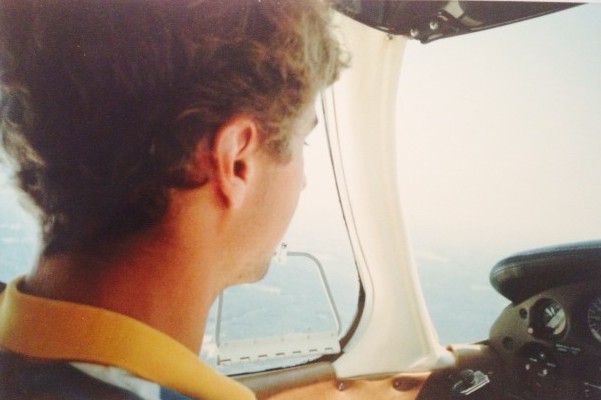
There was no indication that day would be the one, no sign that I was ready, no ceremony or ritual to mark the passage, no warning, no karmic winds blowing, nothing to differentiate the routine of that particular flying lesson from any other. We were forty-five minutes into the hour-long flight, shooting touch-and-goes into a small airfield, when Mark—my taciturn three-pack-a-day instructor pilot, who heretofore had betrayed no confidence in my ability to handle an airplane alone—ordered our next landing to be a full-stop. Under Mark’s watchful eye, I lowered flaps, flared the nose, and squeaked the tires more or less on centerline. We taxied off the runway and onto a parking apron. Mark opened his door and a rush of cool air filled the cockpit. He grinned, slid from his seat, and with one foot on the wing strut, leaned his head back inside and asked if I was ready to try one on my own.

I thought he was joking. I’m quite sure I didn’t answer. I worried that I’d misheard his question. But I must have nodded, or blinked my assent, because a heartbeat later, Mark had closed his rickety door, stepped from the wing’s shadow, and walked away. And for the very first time in my life, I was utterly alone inside an operational airplane, sputtering at the end of a taxiway in Marlboro, Massachusetts. It was 1986 and I was a sixteen year-old boy who did not yet drive a car. I was still a virgin, and would soon likely die as one. I had not, in fact, even kissed a girl yet, but I’d just been handed the controls of a sixteen-hundred pound Cessna, and told to take ‘er up. I’d been put in charge of its ailerons, engine valves and avionics. I’d been given permission to haul it aloft and bring it back to the ground, with the tacit understanding that I wouldn’t kill myself or anyone else along the way.

The Cessna-150 cockpit was thirty-five inches wide and less than five feet front to back. Crammed into a space smaller than an average dining-room table were two sets of flight controls, engine throttle, fuel mixture valve, and an array of instruments, fuses, navigation equipment, radios, lights and compasses. Not an inch of space was wasted. Only moments earlier, I’d sat knee to knee with my flight instructor, whose nicotine and stale-coffee breath provided a comforting if somewhat nauseating reminder that I had competent company. With the sudden absence of a man whose thousands of flying hours were meant to counteract my insipid twenty, that cramped space felt downright lonely.

The cockpit air smelled of low-lead gasoline and panic. I held the plane’s brake pedals with rigid feet. My biggest fear was that the plane would careen off into frost-browned fescue grass that bordered the taxiways. Dotting the surrounding hillsides, sugar maples and Dutch elms had already dropped their leaves and stood bare and gray against the late autumn sky. I pressed harder against the brakes.

~

Earth-bound for some fifty-thousand years, modern man is a recent habitué of the skies. The rapid advancement of flight, from Kitty Hawk to Cape Canaveral, occurred in a flash, though perhaps the real curiosity hides behind how quickly we adapt to such miracles. Hardly anyone notices airplanes zooming overhead, whereas a hundred years ago, such sights would have been a dazzling spectacle. To me, it was still a spectacle. I was a gazer. Countless hours of my youth were spent staring at vapor contrails scratching the sky, or identifying airplane silhouettes, or listening to the bassy whir of a turboprop descending into Logan Airport on a winter’s night. With a lover’s desire, I had dreamed of that moment when I would join the marvelous procession of machines and pilots.

The physics of flight is relatively simple: as an airplane gains speed, pulled or pushed along by an engine, a decrease of pressure builds along the upper surface of curved wings, the famous Bernoulli’s Principle. In a sense, flight is achieved by suction, by a force of low pressure over the wings siphoning the airframe aloft. Given enough wing-surface area and enough speed, a football stadium could fly. The pilot’s job, simplified to its barest bones, is to maintain the right mix of airspeed and attitude. Transitions are the most critical: earth to sky, sky to earth. The greatest danger in flight occurs closest to the ground, during takeoffs and landings.

It is hardly surprising that aviation invented a mythology that evolved alongside its technology. Even the earliest depictions of aviators showed swashbuckling men with scarves, leather jackets and adoring females draped on their shoulders. I admired these mythical heroes growing up, and internalized depictions of pilots in a profound albeit overly romantic way.

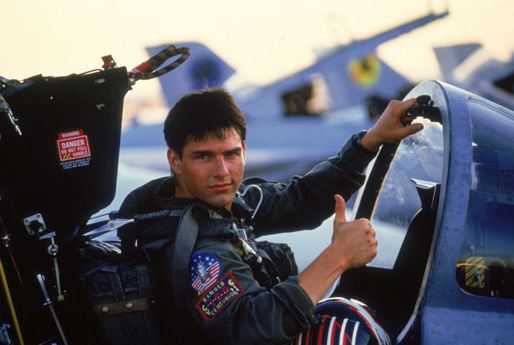
In the summer of 1986, when my flying education began in earnest, Top Gun shattered box office records across America. But Tom Cruise’s portrayal of the man I dreamed I might one day become was far from confirmatory. Rather than inspiring me, the movie violated the sanctity of my most private dreams. Flying for me was soul-work. I had wholesale invested my identity and my future in the notion of pilot-hood. Then, overnight, pop culture co-opted my deeply revered ambitions. Thanks to Tom Cruise, everyone wanted to be a pilot, and I felt violated.

Capture

I didn’t realize at the time why I resented that movie so much. But looking back, I see that the movie commercialized and distorted many of the spiritual aspects of my dream. Top Gun also amplified the pilot stereotype. Flying looked glamorous, easy. Jets zoomed against brilliant blue skies without effort or strain. While Maverick and Ice Man dueled across silver screens in their sleek F-14 Tomcats, I spent the summer of ‘86 coming face to face with my own ineptitude as a pilot-in-training.

Though I’d been a diligent student, no amount of book learning could make up for what, in aviation lore, is called a seat-of-the-pants feel for the sky. When I started taking flying lessons, I had imagined I’d be a natural from the get go, a student so adept at the skill of flying that I would zoom through the curriculum and immediately be recognized as the heir apparent to Lindbergh, Yeager and Armstrong. Instead, I struggled with even the most rudimentary of skills. I couldn’t keep the plane straight-and-level. My airspeed control was for shit. I landed long, struggled when pulling the plane out of a stall. My steep turns were never steep enough and my lazy-8’s resembled an asymmetrical snowman in the sky. The only thing I felt in the seat of my pants was clenched terror.

My original goal, to solo on my 16th birthday, the earliest legal age, had come and gone six months before. While teenage boys donned flight jackets and Ray Bans and serenaded teenage girls with “You Lost that Lovin’ Feelin,’” and while Tom Cruise buzzed the tower fifty feet off the deck, I came to the clear understanding that I wasn’t much of a pilot.

A previous flight instructor, a grumpy aviator with a fu-manchu mustache, once told my mother that I flew like a doctor. The only thing I gleaned from this strange violation of teacher-student trust was a veiled reference to sloppy handwriting.

Rich Pilot1

Of course I wasn’t supposed to be a good pilot with fewer than twenty hours of flight time. The stumbles, setbacks and mistakes were supposed to teach me. But in the pilot myth, as well as in the movie, difficulties were glossed over. The legend left no room for failure, no room for growth or learning or progress. So every miscue, every clumsy maneuver and failure felt keenly personal. Surely the great pilots didn’t start this way, I told myself, not realizing that they most likely had.

Mark stood on a nearby grassy hillock, smacking a package of Marlboros against his wrist. I waited. I prayed. Climb back into this Cessna and tell me it’s all a big joke. Ha ha, kid, I’ve got the controls. Go back to algebra class. But he didn’t move. In fact, Mark lit up a cigarette, his sandy hair flapping a bit in the breeze. A breeze? Where did a breeze come from? I checked the windsock again, which stretched out into the shape of a Day-Glo ice cream cone, indicating the wind had increased and swung around a bit from the southwest, adding a complicated crosswind to my still-not-so-imminent takeoff. Any attempt to leave the earth just became that much more difficult.

I tried to wrap my head around what was happening while searching for the before takeoff checklist. I pulled the laminated sheets from a door pocket, only to fumble the checklist between the seat cushions. My hands were shaking.

“Jesus,” I said out loud, more curse than prayer. How long had I been sitting there? I needed to act, to do something. The longer I waited, the worse my fear became.

As I fished the checklist from a between the seats, a thought slammed through my brain: I’m going to die. The only question was how, not when. From incompetence? From shame? From failure? With every second passing, the certainty of my untimely end came nearer. I worried I might drop from sheer terror right there, idling on the taxiway. The other possibility seemed to involve a blazing ball of fire at the runway’s end.

Needing to resuscitate my brain, I tried to recall the plane’s takeoff procedures. The checklist was useless now since on top of everything else I’d lost the ability to read. It appeared to tell me that I needed to adjust the trim, set the fuel mixture, and somehow force my hands to push the throttle forward, dumping 80-octane fuel into the plane’s normally-aspirated, direct-drive, air-cooled, horizontally-opposed, four-cylinder engine, thereby accelerating the McCauley fixed-pitch propeller to 2,500 RPMs. If I could manage to free my hands to perform these tasks, if I could follow all the steps, in more or less the correct sequence, and release the breaks and speed down the runway without veering off into the grass, if I could summon the strength from my flaccid arms to pull back on the control column, all while tapping rudders to keep the plane coordinated, and if I could remember to check the airspeed, the wind and the engine oil pressure, then, in theory, the plane would fly. I would fly. I would solo.

The first solo is a consecrated ritual—a baptism and wedding rolled into ten minutes of sheer terror a thousand feet over an airfield. Some thirty years have passed and I still remember the disintegrating sensation somewhere southwest of my heart. The fear hollowed me out, an erasure that scoured the insides of my body, leaving only a shell. My skin became acutely sensitive. My mouth went chalk dry.

I remember the way light fell on indifferent hillsides. I remember spinning propeller blades, whirring gyros, a tremble in the wings, perhaps caused by my shaking hands reverberating back through the flight controls. Face to face with reality, the magnitude of fear surprised me. The heroic architecture, so long associated in my mind with brave pilots laughing at danger, came crumbling around me.

A gray cloud deck scattered above the airfield. The runway, scuffed with rubber skid-marks and brake dust, tumbled off into the somber horizon. Behind the controls of that Cessna, alone and uncertain, I searched desperately for a way out.

Once more, I glanced at Mark, hoping for a reprieve. He took a long drag on his cigarette.

I hated him. I hated his parents for bringing him into this world and hated mine for doing the same. I hated Isaac Newton and Daniel Bernoulli and the Wright brothers and Clyde-fucking-Cessna too. The universe had ripped open a hole into eternal darkness, manifest in an empty seat where my instructor belonged. Like in a falling nightmare, the emptiness of that seat, the haunted, horse-without-a-rider sense of a pilot-less plane—unoccupied rudders, uncontrolled control column, unlatched seat belt—these things most surely represented my imminent demise. Except that airplane had dual controls, and my feet rested on the rudders, and my sweaty hands clutched the control column. I was the one strapped into that saddle, a bucking bronco of wires and avionics assembled in Wichita, Kansas, waiting for me to spur it into the air.

The runway was clear, almost mocking me with its emptiness. Fly or don’t fly, the asphalt seemed to say. Live or die. It makes no difference.

For a moment, I thought I might throw up, not an uncharacteristic response from my body when faced with stressful situations (like asking a girl out for a date). The propeller twirled and the fuselage rattled. Only two choices remained: grow a pair and get going or pull the parking brake, open the door and run screaming for the woods. Gasping for breath at the end of the runway, this couldn’t have been how Yeager got started.

Where once strength and bravery seemed embodied in the very word, pilot, the word and the act suddenly lacked meaning, because I could not remember how to do the very thing the word implied, which was to fly the airplane.

Time elongated. Each propeller revolution re-radiated doubt and fear. It felt like an hour passed while I decided. But Mark’s cigarette had barely burned down. I reflected on the absurdity of the scene, my instructor pilot watching me do nothing, the engine whining, position lights blinking, the whole airport on hold, waiting for me. At the same time, there came an awareness that I was not cut out for this sort of thing. Better to survive a coward than die a fool. But what choice did I really have? The way out certainly was no less complicated than the way through.

The metamorphosis that was about to occur was entirely lost on my teenage brain. I didn’t realize what a privilege I was being granted. On that November day, there was no way to foresee the future, or to comprehend how life decouples, like ill-fated box cars, throwing certainty and meaning off a track that then seemed iron-clad. I had no way of knowing that seven years later, my wings would be clipped for good, and that I’d be diagnosed with epilepsy and told I could never pilot an airplane again. I didn’t realize that deep fear often accompanies life’s most extraordinary moments. I had no way to realize that the minutes that terrify and most rattle us are the ones that will stand out. Like a bas-relief of memory, those moments become enshrined by their height and importance: the first girl I would eventually kiss, the first time I would fall in love, the birth of my children, and the so-many unimaginable losses and joys that would mark the path. How could I have even glimpsed a hint of that on the tarmac?

Finally, something inside flickered. The hollow sensation of fear gave way. My body and brain stirred back to life. Was that sensation what bullfighters call the moment of truth? If so, the feeling was not a triumphal one, more like resignation combined with a pinch of anger. Fear yielded to reluctance which surrendered to inevitability. Hardly a heroic procession.

I lowered a notch of flaps and picked up the mike. I called out the plane’s tail number and announced an intention to fly.

“Marlboro traffic, November-seven-one-four, Charlie Pop, ready for departure.”

The intent was for my voice to sound defiant and serious, but the words came out as a barely-whispered squeak, a child’s final desperate plea for help. Then, after a glance heavenward, and one last check of the wind, I advanced the throttle and released the brakes. The engine whirred louder. With a press of right rudder, the plane twirled around and lined up with the runway centerline. My breathing evened out. On the windscreen, the compass lagged before it confirmed my heading. This next part may not have happened, but my memory registers a shaft of sunlight piecing through cloudy autumn skies.

I pushed the throttle to the firewall and the engine revved. Torque drove the nose wheel into the ground and the plane lurched forward. The nose yawed left, which I counteracted with more rudder as the semi-monocoque fuselage reverberated atop rough asphalt with echoes and thumps.

The plane accelerated and the abyss receded. Where did the fear go? What replaced it? I don’t understand how I climbed inside the moment. I don’t quite comprehend how a timid, frightened teenager managed to fly.

I pulled back on the wheel and the wings began to generate lift. The plane entered its transition to flight, where gravity succumbs, a transition not only of the physical machine but also of the body. I may have even felt that sensation in the seat of my pants.

After that, I continued to climb out, the needle steady at 70 knots. My gut wobbled as I pushed the nose over and gained speed, a thousand feet of altitude, the propeller high against the gray horizon, trees and hills falling away. The world shrank. The runway appeared small and distant, the clouds large and close. The temperature cooled. Downwind, I aligned the port wingtip perfectly with the runway margins, and I recognized calmly, in an almost holy way, with a certainty and confidence that was entirely new, that I was actually flying, alone, no longer terrified, ass-unclenched, hands dry and not choking the wheel, and how in those few minutes of flight, all the fear and confusion receded into the background, and all that remained was flight, the pure dream man had yearned to achieve for millennia.

The transcendental feelings ended quickly. There was work to be done. A moment later, abeam the numbers, I lowered the flaps like a real pilot, and throttled back, slowing, descending. I checked the windsock and announced my intentions again—this time with a voice a sixteen year-old boy borrowed from the gods—that I was coming in to land. l turned to base and then to final, scanning airspeed and altitude, nudging the plane’s nose to line up with dashed white stripes painted down the runway, anticipating wind vectors, adjusting for turbulence, steadying the wings. Just over the numbers, I pulled back gently on the controls and cut the throttle. The nose lifted. The plane floated a second or two, caught in the magical buoyancy of ground-effect, that final transition, just before the main landing gear returned to earth, two shudders beneath me, two chirps of rubber kissing earth. Then I caught the plane’s yaw, holding the nose straight and true, and in that final moment, before the nose wheel touched down, in that final instant when the transition from air to ground remained ever so slightly in jeopardy, I realized that I’d done it, that I’ve soloed, and that nothing would ever be the same again.

172-landing

—Richard Farrell

.
Rich Gun-001

 Richard Farrell is the Creative Nonfiction Editor at upstreet and a Senior Editor at Numéro Cinq (in fact, he is one of the original group of students who helped found the site). A graduate of the U.S. Naval Academy, he has worked as a high school teacher, a defense contractor, and as a Navy pilot. He is a graduate from the MFA in Writing Program at Vermont College of Fine Arts. His work, including fiction, memoir, essays, interviews and book reviews, has appeared in Hunger Mountain, New Plains Review, upstreet, Descant, and Numéro Cinq. He teaches at Words Alive and the River Pretty Writers Retreat in the Ozarks. He lives in San Diego.

.
.

Apr 042014
 

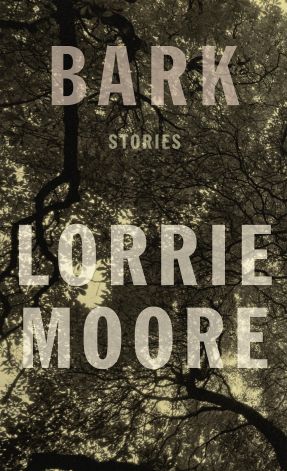
lorrie-moore3

What lengths will we go to in order to avoid being alone? Why are we so hell-bent on love? These are age-old questions, ones that philosophers, poets and priests have been unable to answer. Moore’s rendering of scenes, her dramatization of the beginnings and endings of love, is nothing short of a profound examination of the quintessence of the human condition. Why do we love? Why do we tell stories or create art? We are trying to close the gap, between self and other, between idea and reality, between life and death. –Richard Farrell

bark

Bark
Lorrie Moore
Alfred A. Knopf
Hardcover, 192 pages, $24.95
ISBN: 978-0-307-59413-6


The landscape of love, booby-trapped with the broken-hearted and littered with deteriorating destinies, is familiar territory for Lorrie Moore. Moore’s latest collection of stories, Bark, explores the underbelly of Eros with wit, wisdom and unflinching honesty. Each of the eight stories in Bark, her first story collection since the wildly successful Birds of America, contends with romantic relationships, most in some state of decline, a few in outright freefall. But lest this all sound too heavy, it’s important to remember that we’re talking about Lorrie Moore here, a writer who delights in the uncanny juxtapositions of humor and pathos to tug a story along. Her verbal pyrotechnics and structural harmonies can always make you smile, even amidst the bleakest affair of the heart.

“I can’t live without love in my life,” says Ira—the protagonist in the opening story, “Debarking.” Ira, recently divorced, has reached an existential conclusion: even bad love is better than no love at all. A middle-aged Jewish man thrust back into the dating scene, Ira skips Passover Seder in order to meet a woman at a Lenten dinner with his Christian friends. To mask his nervousness, Ira cracks resurrection jokes. “Then he began milling around again, apologizing for the Crucifixion. ‘We really didn’t intend it,’ he murmured, ‘not really, not the killing part? We just kind of got carried away’” Ira seems hell-bent on his own comic demise until he meets Zora, another divorcee, who laughs at his oddball jokes, sparking off their bizarre coupling.

Over the course of this 46-page story (the first of two very long stories in Bark), Ira and Zora contend with families, dating rituals and sex, and in most cases, without much success. After the aforementioned dinner, Ira sends Zora a short note and his phone number on a postcard with a picture of “newlyweds dragging empty Spam cans from the bumper of their car.” Moore makes the vivid image of this postcard resonate with irony and meaning. The postcard is funny, but also loaded. Are the newlyweds destined for unhappiness? Is all love like a string of empty Spam cans? And why a postcard? For Ira, the hapless and hopeless romantic, a postcard represents the “geometric halfway point between stalker and Rip Van Winkle.” Desperate but cautious, Ira tries to make all the right moves. But Moore wants us to remember that there is nothing rational about human desire, and she constantly pricks at every attempt to make it so.

A few days later, Zora replies in kind, also sending Ira a postcard, but her message copies the very words he wrote. “Wasn’t that precisely, word for word, what he had written to her? There was no too, no emphasized you, just the exact same words thrown back at him like some lunatic postal Ping-Pong. Either she was crazy or stupid or he was being too hard on her.”

Zora’s strange mimicry hints at what might be a profound emptiness behind the ritual. Maybe all the moves a lover makes are for naught. Maybe the palace is only a façade. Moore’s exploration of zany relationships (few are zanier than Ira and Zora’s) reveals much confusion about the nature of love. What’s happening here? Why is everyone acting, playing a part in a carefully orchestrated dance without music or steps? To mix the metaphor a bit, if love is a mirror, a reflection of the lover cast back upon himself, then the expected response is one of the familiar, some ting of recognition. But Moore’s mirrors belong in funhouses. The reflections they send back distort, and the images are grotesque parodies of any romantic ideal. Rather than recognition, Ira finds perversions, warped emotions, and confusion. Nowhere is this more evident than in the wonderful scene when Ira finally calls Zora to ask her out on a date.

He phoned Zora four days later, so as not to seem discouragingly eager. He summoned up his most confident acting. ‘Hi, Zora?’ This is Ira,’ and then waited—narcissistically perhaps, but what else was there to say?—for her response.
‘Ira?’
‘Yes. Ira Milkins.’
‘I’m sorry,’ she said. “I don’t know who you are.’

In this story about acting, about seeming, about playing games with the heart, misapprehension shatters hope. This reversal, Zora’s failure to recognize Ira, underscores not only the narcissism of falling in love (don’t we all expect to be loved back?) but also the more desperate need to be noticed, to be seen and heard by another human being. We can’t be loved without first being visible, but if all we present is a mask, then when are we ever truly seen?

Moore takes the idea of invisibility to a much higher level in “Paper Losses,” a shorter story (at 12 pages) than “Debarking,” and one that deals with the end of love, rather than its beginning. Kit and Rafe are a married couple in the process of splitting up. They’ve stopped having sex, stopped talking, and even stopped caring about these things. Rafe descends nightly into the family basement to assemble model rockets, and the lonely house fills up with fumes of paint and glue.

She seldom saw him anymore when he got up in the morning and left for his office. And when he came home from work, he would disappear down the basement stairs. Nightly, in the anxious conjugal dusk that was now their only life together, after the kids went to bed, the house would fill up with fumes. When she called down to him about this he never answered. He seemed to have turned into some sort of space alien. Of course later she would understand that all this meant he was involved with another woman, but at the time, protecting her own vanity and sanity, she was working with two hypotheses only: brain tumor or space alien.

The epitome of dissolution is not fighting. When couples argue, they are still holding on to something. But when silence prevails, when a person stops answering, when muted apathy fills the home, there isn’t much to be done. The lover turns into a space alien, a creature so utterly foreign as to be unrecognizable.

Rafe serves Kit with divorce papers while he’s still living in their home. “‘Honey,’ she said trembling, ‘something very interesting came in the mail today.’” But before Kit and Rafe can call it quits, they must decide what to do about a previously-planned family vacation. Kit decides she wants to go. “What bimbo did he want to give her ticket to? (Only later would she find out.)” This is vintage Lorrie Moore. Circumstance beats down her characters, but never defeats them.

The vacation, naturally, is a disaster. Kit loses her luggage and must wear gift shop clothes. Rafe continues to ignore her, even in the bright sunshine of the Caribbean. With characteristic humor, Moore takes a few shots at the notion of the idyllic family vacation: “They all slept in the same room, in separate beds, and saw other families squalling and squabbling, so that, by comparison theirs—a family about to break apart for ever—didn’t look so bad.” This subversion—the divorced family appearing more normal than the happy family—reiterates the theme: love is a confusing mess.

At one point, Kit thinks, “This at last was what all those high school drama classes had been for: acting.” Appearances can be contradictory at best, outright lies at worst. And everything about their vacation (no less their marriage) involves keeping up appearances, about pretending, even at the bitter end. Miserable families pretend to be happy and disintegrating families pretend to be intact.

When they left La Caribe, its crab claws of land extending into the blue bay, she was glad. Staying there she had begun to hate the world. In the airports and on the planes home, she did not even try to act natural; natural was a felony. She spoke to her children calmly, from a script, with dialogue and stage directions of utter neutrality. Back home in Beersboro she unpacked the condoms and candles, her little love sack, completely unused, and threw it all in the trash. What had she been thinking? Later, when she learned to tell this story, as a story, she would construct a final lovemaking scene of sentimental vengeance that would contain the inviolable center of their love, the sweet animal safety of night after night, the still-beating tender heart of marriage. But for now she would become like her unruinable daughters, and even her son, who as he aged stoically and carried on regardless would come scarcely to recall—was it past even imagining—that she and Rafe had been together at all.

If natural was a felony, it’s no wonder that Kit began to hate the world. She will invent a story to contain the mystery, the inviolable center of love. Perhaps this is the best we can do, but Moore shows us that it’s nowhere near good enough. Love, ever elusive, can only be glimpsed in our messy, fumbling pursuits of it, or in the way we ruin it.

What remains, then, is a high-stakes quest for companionship. Kit, Ira, maybe the rest of us too, are all trying to stave off the cold loneliness of the world. What lengths will we go to in order to avoid being alone? Why do we continue to seek out love? These are age-old questions, ones that philosophers, poets and priests have been unable to answer. Moore’s rendering of scenes, her dramatization of the beginnings and endings of love, is nothing short of a profound examination of the quintessence of the human condition. Why do we love? Why do we tell stories or create art? We are trying to close the gap, between self and other, between idea and reality, between life and death. In Bark, the closer the characters get to the unbridgeable chasm, the more desperately they chase, and the more certain their own isolation becomes. Love proves almost impossible, so everyone wears a mask, which defeats the very purpose, in almost solipsistic logic. The manifestation of the act—the eventual coupling between Ira and Zora, the decoupling of Kit and Rafe—verges on the farcical. Luggage is lost, empty Spam cans are tied to bumpers. Lovers remain forever strangers.

Still, it would be an over-simplification to say that all of the stories are strictly love stories. Moore is too sharp a writer to be so easily categorized. In “Foes” and “Subject to Search,” Moore dabbles overtly in contemporary politics. In “Juniper Tree,” she summons her inner Dickens and tells a delightful ghost story. “Wings,” the other novella-length story in the book, is about a washed-up musician who befriends an elderly philosopher. It is probably my favorite in the book. Of course, the friendship goes wrong when the geezer philosopher tries to stick his tongue down the woman’s throat. We just can’t seem to get this stuff right.

Bark contains heartbreaking, hilarious, and honest stories. It is a wise meditation on the human struggle for affection, for identity, and for meaning. Less transcendent than Whitman’s barbaric yawp, more restrained than Ginsburg’s howl, Moore’s bark sounds a weary note. Like a dog tied to a tree, we bark, hoping only to be heard, to be released from the ties that bind. Or perhaps bark refers to the tree itself, to the hard outer core which protects the inner pulp, the life force flowing through each of us, so fragile, so hidden beneath an impenetrable shell. “The end of love was one big zombie movie,” Moore writes. Perhaps. But in every zombie movie, a human or two always survives, someone to wander through the chaos and squalor, seeking, holding out, carrying on. Whatever holds us back, whatever constrains us, also reminds us that there is something more out there, something worthwhile beyond the chain, inside the bark. Despite the misery, despite the empty-Spam-can destiny that surely awaits the seeker, the pursuit continues unabated. We bark, or we die. Moore puts it more eloquently, if not a bit more bleakly:

Living did not mean joy piled upon another. It was merely the hope for less pain, hope played like a playing card upon another hope, a wish for kindnesses and mercies to emerge like kings and queens in an unexpected change of the game. One could hold the cards for oneself or not: they would land the same regardless. Tenderness did not enter except in a damaged way and by luck.

—Richard Farrell

Rich Gun-001

Richard Farrell is the Creative Non-Fiction Editor at upstreet and a Senior Editor at Numéro Cinq (in fact, he is one of the original group of students who helped found the site). A graduate of the U.S. Naval Academy, he has worked as a high school teacher, a defense contractor, and as a Navy pilot. He is a graduate from the MFA in Writing Program at Vermont College of Fine Arts. His work, including fiction, memoir, essays, interviews and book reviews, has appeared in Hunger Mountain, New Plains Review, upstreet, Descant, and Numéro Cinq. He teaches at Words Alive and the River Pretty Writers Retreat in the Ozarks. He lives in San Diego.


Mar 072014
 

Desktop44

I kept hearing his name, usually associated with the question, “Have you read…?” Have you read Reality Hunger? Have you read the new Salinger biography? Have you read How Literature Saved My Life? I believe the word is buzz.

By almost any standard, David Shields has been enjoying quite a ride. Since 2010, when Vintage Books published Reality Hunger: A Manifesto, Shields has written or edited 5 books. Most recently, he co-authored Salinger with Shane Salerno.  Shields also appeared in the PBS documentary produced and directed by Salerno.

On occasion, Shields has been pilloried by the controversy surrounding Reality Hunger, a book comprised mainly of appropriated and loosely attributed quotes by various writers and artists. He is unabashedly proud of the book, calling it one of his most personal and passionate. After exchanging a series of emails and speaking with him on the phone, what becomes readily apparent is that Shields cares intensely about reading and writing. His books are an extension of his deep abiding search for meaning, an exploration he calls a ‘radical epistemology.’

Shields’ writing pushes boundaries, often enflaming critics and detractors. At the same time, his style continues an ongoing conversation with literature that is certainly not new. Our interview ranges from Stanley Kubrick to Walter Benjamin, from Virginia Woolf to J.M. Coetzee, from V.S. Naipaul to David Foster Wallace. Shields is a prolific writer, a thoughtful and deep reader, and an artist not afraid to transcend boundaries.

–Richard Farrell


RF: Anne Carson writes, “I’ll do anything to avoid boredom.”  There’s a similarity of intent between Carson’s work and your work.  And what’s interesting is that you both do a lot of the heavy lifting for you readers, so that what is produced is anything but boring. The work appears effortless, but I suspect the exact opposite is true.

DS: That’s high praise, on a number of levels. People say, “Oh what did you do, come up with this clever idea and then look for passages that would fill up the book?” I don’t see how that kind of book would be any good. It would just been a one-trick pony. A lot of my friends, quite justifiably, think of Reality Hunger as my most personal and my most passionate book.

The book began when I started teaching a graduate course in fiction-writing at the University of Washington. I had this huge blue binder of full of quotations of stuff I really liked: passages from Heraclitus to D’Agata that were articulating and embodying what began to feel like a new aesthetic: not fiction, not as journalism, not scholarship, but essay as “radical epistemology.” Work that uses the frame of “nonfiction” to explore the most serious questions about existence: What’s real? What’s knowledge? What’s memory? What’s truth? What’s a self? How much can a self know about another self?

So I was gathering all these quotes. The packet was full of repetitions of the same quotes, misspellings, doodles. I started organizing passages into little rubrics or chapters. And year by year this course packet deepened, and then I realized I had the rough draft of a book, at which point I really went to work on it.

It’s a strange book. People think it was some kind of IED, some sort of attention-getting mechanism, but I thought twenty people would read it. I thought it would get published by a university press. It was intended for fellow writers and readers and students: for those of us bored by conventional fiction and conventional nonfiction, here’s a way forward. But because of the book’s purposeful withholding of standard citation, the book developed a kind of bad-boy aura.

reality-hunger

RF: You take the novel to task pretty hard in places, but I don’t think you’re attacking the novel so much as you’re attacking genre. Is your argument more about genre than it is about fiction versus nonfiction?

DS:  Right. One of the book’s epigraphs is from Walter Benjamin: “All serious works of literature either dissolve a genre or invent one.” I think it’s so ridiculous that so many people who are supposedly serious writers get praised for being Dickensian writers or Tolstoyan writers. Dickens and Tolstoy were great writers, but the reason they’re great is that they pushed the form forward, “altered the face of an art form” in Pauline Kael’s phrase. This is even truer for Flaubert or Virginia Woolf or Beethoven or Monet or Picasso.

I listened to a guide in the National Gallery who was asked what makes Mark Rothko a great painter. And the guide ended up saying, “Rothko’s great because he changed the weather for everyone who came after him.” Everyone afterward had to deal with Rothko. That’s the standard I’m trying to hold up for myself and fellow artists. It’s not that I have some minor quarrel with writer X, Y, or Z. The novel is supposed to be something new. That’s what “novel” originally meant. And yet it’s become unbelievably formulaic. I really care about the future of literature, and I’m trying to push it in an exciting direction and away from a dead direction.

RF: I wrote a portion of my critical thesis in graduate school on Leonard Michaels’s “In the Fifties.”  I read it and treated it as fiction. After all, it was included in a story collection. But then a classmate of mine treated the same piece as a nonfiction list essay.  This really annoyed me for awhile, until I recognized how little these distinctions mattered. It’s simply an elegant piece of writing.

DS: The only thing that matters is how Michaels arranged the material into a meditation on how the private narcissism of the fifties became the public violence of the sixties. I think that’s all that really matters. Plath. Catullus. Berryman. Whitman. We grant poetic license to the speaker. I’m seeking the same freedom for the essay as we’ve always had for the poem.

01-14literature_full_600

RF: Patricia Hampl talked about starting out as a nonfiction writer.  She said they didn’t know where to put her books when she first started out. I know you quote her in How Literature Saved My Life. I had the chance to spend some time with her in Vermont a couple of years ago and heard her say that it shouldn’t be called creative nonfiction, but non-poetry, because the writing is closer to poetry.

DS: I think I quote her in Reality Hunger rather than in the later book. She talks beautifully about how related the poem and the essay are. Both are meditative, contemplative, consciousness-drenched forms.

I’ve learned a lot from Trish. So many people, when they write an essay, think if they just the story of what happened, that in itself is compelling, but it’s not. Hampl is very good on this, as are Gornick, Lopate, D’Agata.

The essay is a meaning-making machine. That’s what’s so exciting about it.  It says, Okay, I served in Fallujah or my sister is an alcoholic, whatever the situation is—some aspect of dramatic existence. But then what the essayist has to do is to wrench that into meaning, often by wiring the material through the self, by making the self complicit with the experience. It’s not reportorial journalism; it’s not academic scholarship, although it might partake of both. You’re trying to arrive at nothing less than wisdom, which I think is what makes the form so, so exciting.

If you write a bad essay, people think, I really don’t like you. But if people really like your essay, and you’ve said tough-minded things about yourself and others, and people still connect to you, that’s a very serious embrace between writer and reader. That’s a serious, existential act. You actually have made the world significantly less lonely. David Foster Wallace is really great on this: We’re existentially alone on the planet. I can’t know what you’re thinking and feeling. You can’t know what I’m thinking and feeling. And writing is a bridge constructed across the abyss between the loneliness.

Wallace goes awry when he goes on to say, “Don’t worry, all the little contrivances of fiction are hoops we can jump through and still cross the abyss of human loneliness.” It’s completely obvious that far and away Wallace’s best work is found in his essays.

Did Trish Hampl critique anything of yours?

RF: She read a fiction story of mine and tore it up pretty good, but that opportunity, to have such an experienced writer cut through all the “workshop bullshit” and tell you the truth—that was invaluable.

DS: It’s interesting that you mention “workshop bullshit,” because it’s absolutely the prevailing mode of contemporary literary discourse. Just read “major” reviewers: they’re basically still reviewing work according to the workshop model, which for me has nothing to do with what it feels like to be alive now. There are works of fiction that definitely surprise me and that I love with all my heart and soul. Say, Ben Lerner’s Leaving the Atocha Station.

RF: I once heard Robert Vivian talk about “vestibular space,” which is the space you pass through before you enter the sacred places you write from. Do you ever contemplate your vestibular spaces?

DS: I do unbelievable amounts of research before I sit down to write, even something quite short. I gather all this material, and I just gather all the notes: stuff from the web, books that I read, journalistic reportage. I develop this huge, very rough, very loose, inchoate mess of stuff. I find that a terribly useful process. That’s my vestibule, for sure.

Then I just marinate in it, to mix metaphors. I just spend a huge amount of time with that material. I develop material around a very broad topic: death or love or art or celebrity. Then I try to find the very occasional passages that have for me some potential, some life. I often color code the passages, endlessly rewriting them. Then I try to put the passages into a trajectory both within a chapter and within the book. In a way it’s not time- or cost-effective, but I need that endless luxuriating in the material. Other people can apparently just sit down and write a five-thousand word essay and, in a way, I’m just amazed they can do that. It’s not the way my mind works. I seem to need all those data points, just to hold in my hands. A box of rocks, say; I find the 127 rocks that really glint and throw off light. Then I shape the rocks, sharpen them, and then I put them, very crucially, into the right order. For better or worse, that’s how my mind thinks.

RF: There’s a documentary about Stanley Kubrick called Boxes; it documents the trove of material the great director gathered around him when shooting a scene. For one particular scene in Eyes Wide Shut, Kubrick had thousands of photographs taken of doorways and gates in England. He spent months documenting and examining these photos for a single shot in a single scene. I think there might be some resonance between Kubrick’s method and your own.

DS: I’d like to watch that documentary, but it also sounds like a bit of a cautionary tale. One can definitely get trapped in one’s own processes. I certainly like some Kubrick quite a lot. Dr. Strangelove is great, as is Lolita.  But there are some films in his last couple of decades in which he got so attuned to his own mental processes that the work suffers. I’d have to go back and watch all of Kubrick.  For all I know, those films hold up beautifully.  He’s obviously a major artist.  But I can see how, in this process, which I do, and which Kubrick does in his own way, there’s a real danger that that all you’re doing is staring at your own reflection.

That risk interests me, but I work incredibly hard to avoid those traps.  I try to make sure the work is about something more than my own reflection.  If you write a poem, there is a danger that you’re performing only a series of technical verbal maneuvers; when you write a novel, there is a danger that you’re only carnival-barking, merely entertaining. And if you write personal essay or even literary collage or collage essay, you run the risk that you “writing only about yourself.” You want to go so deeply into yourself that you come out the other end into a “universal” space, or as Montaigne said, “Every man contains within himself the entire human condition.” That may sound grandiose, but in the great essays, we recognize that nothing less has happened.

RF: A lot of the experimental work pushes boundaries.  That seems to be what you are drawn to, both as a reader and as a writer.  Is that true?

DS: I’m definitely not interested in experiment for experiment’s sake. V.S. Naipaul says, “If you want to write seriously, you have to be willing to break the forms.” Coetzee deconstructs his own work: it’s not great because it never deformed the medium in order to say what only he could say. If you’re not doing that, why bother? Writing ought to be a deadly serious act of investigation and exploration. It shouldn’t be you with your little sewing kit trying to make a perfect little hand puppet. “Is this workshop-worthy? I’ve put all my soldiers into a perfect order, but I’ve produced this perfect little dead thing.” That can’t be a living model.

—David Shields & Richard Farrell


farrell

Richard Farrell is the Creative Non-Fiction Editor at upstreet and a Senior Editor at Numéro Cinq (in fact, he is one of the original group of students who helped found the site). A graduate of the U.S. Naval Academy, he has worked as a high school teacher, a defense contractor, and as a Navy pilot. He is a graduate from the MFA in Writing Program at Vermont College of Fine Arts. His work, including fiction, memoir, essays, interviews and book reviews, has appeared in Hunger Mountain, New Plains Review, upstreet, Descant, and Numéro Cinq. He teaches at Words Alive and the River Pretty Writers Retreat in the Ozarks. He lives in San Diego.

David Shields is the New York Times bestselling author of fifteen books, including The Thing About Life Is That One Day You’ll Be DeadSalinger (co-written by Shane Salerno); Reality Hunger, named one of the best books of 2010 by more than thirty publications; Black Planet, a finalist for the National Book Critics Circle Award; Remote, winner of the PEN/Revson Award; and Dead Languages, winner of the PEN Syndicated Fiction Award. He lives with his wife and daughter in Seattle, where he is the Milliman Distinguished Writer-in-Residence at the University of Washington. His work has been translated into twenty languages.


Oct 152013
 

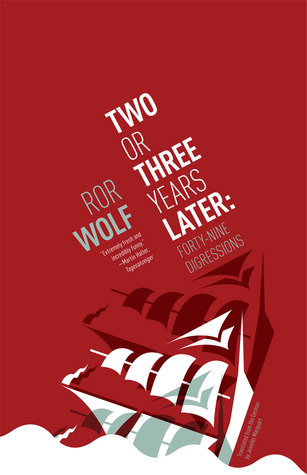
rorwolf

two or three

Two or Three Years Later: Forty-Nine Digressions
Ror Wolf
Translated Jennifer Marquart
Open Letter Books
142 pages, paperback, $14.95

From its opening page, Ror Wolf’s Two or Three Years Later defies expectations. This collection of forty-nine ‘digressions’ (Wolf’s term), translated from German by Jennifer Marquart and published by Open Letter Books, takes the reader on a disorienting journey through a series of fast-hitting, unresolved, and zany stories. Located at the intersection of anti-novel and metafictional farce, Wolf blends his own spare style with absurd setups, half plots and tragic loneliness. We never get inside. We never arrive. Hell, sometimes we never even depart. Instead, we bounce about on a pointed quill of uncertainty and wild merriment.

Of the forty-eight miniature stories in this collection, only three are longer than two-and-a-half pages. Many take up less than a page of text. The last story, “The Forty-Ninth Digression: Twelve Chapters from an Exposed Life,” is forty-nine pages long.  (Wolf does seem to enjoy these little riddles.)

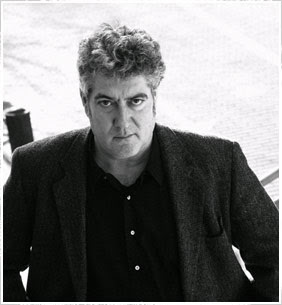
Born in eastern Germany in 1932, Ror Wolf is an award-winning novelist, poet, artist and collagist. Two or Three Years Later is the first of Wolf’s books readily available in English. He emigrated west in 1953, working in a variety of fields before studying with the German philosophers Theodor Adorno and Max Horkheimer, members of the famous Frankfurt School, the source of modern critical theory.

Wolf plucks his stories from the edge of the familiar, so that we recognize some part of the architecture, some cornice or balustrade that hints at a larger design, but the building never materializes. Instead, we are left with only fragments, an incomplete blueprint that distorts assumptions and dismisses significance.

Take the story “Neither in Schleiz, nor Anywhere Else in the World,” in which Wolf announces his ambiguous intention in the title itself, not really a title but the negation of a title. Then the opening lines: “A man who prefers anonymity, a certain X—his name is irrelevant—arrives one day, one morning, one afternoon…It’s all the same in a city whose name we won’t disclose. He does nothing, which is what we wanted to report, since what he does is so insignificant that that’s the only significant thing to say about it.”

Notice how the story races ahead of the reader, all the while undercutting expectations. In a few sentences, Wolf silences character, plot, setting and theme with the cold-blooded efficiency of an assassin. What’s left, the reader reasonably wonders? But don’t expect Wolf to deliver an easy answer. He goes on to further nullify, through a series of parallel non-descriptions, any remaining hope of familiarity: “If he contemplates something, it is without feeling; if he touches something, it is without reason.” He’s erasing the story, rather than inventing it. He tells us nothing, and shows us even less. This story, like most in the collection, becomes almost impossible to summarize because it never arranges itself into any order.

Again and again, through a series of seemingly disconnected anecdotes and halting starts, Wolf declines to assemble. This is more than just post-modernist style. The collection doesn’t drift toward absurdism, it wallows in an almost nihilistic refusal to conform. And yet there’s a sturdy elegance about each of these pieces, a cold, biting quality that binds and spreads, so that what remains is a refreshingly pure, playful examination of stories without meaning (and, by implication, stories that do appear to have meaning).

“In a French Kitchen. In a Swiss Lake. In a Berlin Closet.” is a half-page story that delivers the accounts of three tragic accidents. A man intentionally blows himself up with dynamite. A golfer drowns after throwing his golf bag into a lake. Three seventy-year-old men playing cards burn themselves to death. Wolf relates these incidents without any context, emotion or explanation. “All three burned. This was in Berlin, near Nollendorfplatz.” Thus the story ends.

In “On the Edge of the Atlantic,” Wolf’s turns comically ornery. “A man yelled out in fear. Shortly thereafter, he died. That’s basically what happened, in any case, generally and essentially.” Nothing else happens. No explanation is offered. No narrative details fill in the missing pieces.  In fact, what Wolf supplies in place of the expected is a direct admonishment: “Of course, the reader deserved nothing better than the waves crashing over the man’s body, and the rain rolling in simultaneously, streaming down from above. Maybe he didn’t even deserve that.”

The idea of the reader not deserving the image, the prose that Wolf refused to render, certainly strikes a sinister, hilarious tone.

This roguish antagonism is embroidered in the text—between expectations and outcomes, between narrator and reader. It reveals that the patterns here are non-patterns, or anti-patterns at least. Uncertainty and doubt prevail. The stories rest on conditionality hinged together with the subjunctive mood.

Wolf does offer something of a clue to his aesthetic in the two-and-a-half page story, “At Nightfall.”

Last Monday I began to describe a man, who turned the corner of 82nd Street with a tremendous yawn. I didn’t want to describe his yawn, in any case it’s indescribable, and I didn’t want to describe how he turned the corner, but rather I wanted to describe how this man—or differently, differently. I’ll start over.

Wolf goes on to make nine aborted efforts to describe the simple act of a man turning a corner. “No, that’s weak, and not very good either. Maybe I should begin like this…” Is Wolf showing us the impossibility of language to adequately describe reality? Is he unmasking the fickle power of words to conjure anything? Or is he just having fun? If a story can’t get the simple act of turning a corner right, how can it hope to tackle the larger issues of morality, life, death, meaning? Wolf seems to be reminding us that, sometimes, it’s better not to try.

Artists are always trying to kick down the doors of tradition and form. The artist is always radicalizing his art; testing boundaries, pressing forward. Ror Wolf — with his philosophic roots in the Frankfurt School, famous for its intense critique of reason, the Enlightenment and modernity — appears to be of this ilk. His writing challenges the very notion of meaning and interconnectedness. In the end, the only thread that holds these stories together is no thread.

“I’ve traveled throughout this entire loud, reverberating world,” Wolf writes in “The Power of Song in Nevada, my favorite story in the collection.  “I’ve traveled out of a profound disposition for the echoing sea. I’ve heard ship bands and chamber orchestras, I’ve experienced the howling of the wind and the wild shouts of sailors—but all of that is nothing compared to the men’s choir I heard in Nevada.”

I don’t know what this means, especially when Wolf tells us how awful this choir was. But somewhere in the peregrinations and uncertainty, somewhere in these digressions, these strange and wondrous non-stories, the writer searches for the true note, for the profound disposition. It’s anyone’s guess if he’ll ever find it.

—Richard  Farrell


farrell

Richard Farrell is the Creative Non-Fiction Editor at upstreet and a Senior Editor at Numéro Cinq (in fact, he is one of the original group who helped found the site). A graduate of the U.S. Naval Academy, he has worked as a high school teacher, a defense contractor, and as a Navy pilot. He holds an MFA in Writing from Vermont College of Fine Arts. He is currently at work on a collection of short stories. His work, including fiction, memoir, essays, interviews and book reviews, has appeared in Hunger Mountain, A Year in Ink, upstreet, New Plains Review, Descant (Canada) and Numéro Cinq. He lives in San Diego.


Aug 042013
 

Richard Farrell

Rather than words comes the thought of high windows:
The sun-comprehending glass,
And beyond it, the deep air, that shows
Nothing, and is nowhere, and is endless
—Philip Larkin, from “High Windows”

It seems to me that reverence, as something intrinsic to an individual’s sense of meaning, as a principle of human communities, has been on the decline, if not under downright assault, in the culture at large. I’m not arguing that there’s a scarcity of people leading reverential lives. From monks to poets, from special-education teachers to astronauts, we live amongst many still capable of being awestruck. Nor is the raw material which inspires reverence eroding, like polar ice caps and old-growth forests, under pressure for mankind’s increased footprint. Just a mile from my front door, a traffic jam occurs each night as hundreds of people crowd along the cliffs to watch the sun drop into the Pacific.

When I was young, I would wake early and head off to serve as an altar boy for the weekday, sunrise mass. The same rag-tag band of true believers filed into the pews at 6:30 every morning. Something about being tired, a whiff of candles, incantations, and carefully articulated rituals always mesmerized me. I’ve yet to encounter a more consistently sacred sight in my life than dawn breaking through the stained-glass windows at Christ the King Church. At twelve, I gave serious consideration to the seminary, and heretically repeated the priest’s gestures in my living room, with Ritz crackers for the body and grape soda for the blood. But I had no calling from God. In time, the rituals themselves lost meaning.

Looking back, it’s hardly surprising that I chose to go to college at the Naval Academy, an institution awash in rituals and codes. Anyone who’s ever witnessed a sunset dress parade along the Severn River—four-thousand midshipmen marching in lock step, bayonets and belt buckles polished, blue and gold spinnakers billowing on the river—and not felt something akin to awe, surely has lost the ability to be stirred by great pageantry. By the time I was 18, I’d traded in the vestments of the altar for the vestments of war but marveled no less at the lore and history of it all, the flag lowered at sunset, the distant bugle call of taps.

During my sophomore year at Annapolis, a plebe committed suicide by stepping out of his fifth-floor window. The young man had wanted to quit the Academy, but was encouraged to stay by well-meaning parents and company officers. I watched as paramedics attempted to resuscitate the broken and bloodied midshipman, his once-pristine, navy-blue uniform suddenly a torn and grisly mess. Later, as fireman sprayed his blood from the brick walkway, I felt a desperate emptiness about the institution I’d committed to. The shame of quitting was certainly not worth that young man’s life.

“Reverence is an ancient virtue,” Paul Woodruff writes in Reverence: Renewing a Forgotten Virtue. Woodruff, a humanities professor, approaches the subject of reverence with a philosophical lens. Handed down from early cultures, across a variety of religious and secular systems, reverence has less to do with mystery and mysticism and more to do with shaping individuals and societies who can recognize the limitations of what humans can (or should) control. Reverence, according to Woodruff, begins in a capacity for awe and wonder for the world around us. This capacity for awe leads to a deepening respect for fellow human travelers. “This in turns fosters the ability to be ashamed when we show moral flows exceeding the normal human allotment.”  Shame arises, in part, when humans fail to remember that each person, whether prince or pauper, is dwarfed by the sheer grandness of existence.

Reverence, Woodruff also argues, is on the decline in contemporary culture.

My children have recently begun their summer vacation and the moments in my day which might let in a little reverence have been few and far between. It’s hard to experience awe amidst battles over television remotes, pop-radio stations and who gets to play on the iPad. At times, it seems that the experience of reverence demands things in short supply these days: silence, stillness, time to think. And in most of my daily life, the once sacred rituals have either lapsed into quaint memory or feel contrived. Perhaps I’ve convinced myself that I’ve outgrown them, like acolyte robes and military uniforms. Perhaps the only solution is to get away from it all for a while.

So at the end of June, I leave California for Massachusetts with my kids—Maggie, almost 12, and Tom, who’ll be 8 in a few weeks. These are transitional times as a parent. Maybe all time and ages are transitional, but these years in particular feel downright seismic. Less and less snuggling, more and more driving, from horse lessons to baseball practice to sleepovers on the other side of town. Because I’ve taken Maggie and Tom to see their grandparents in Massachusetts most summers since they were born, these trips retain something of a ritual in our family. The grandchildren, welcomed as mini-deities, are worshiped with burnt offerings of Cheetos, ice cream bars and endless hours of over-indulgence.

Children make for wonderful case studies of reverence. Anyone who’s ever spent ten minutes waiting for a child to stop staring in wide-eyed wonder at a green caterpillar on a leaf knows that a child’s capacity for awe is without peer. And anyone who’s ever chastened that same child for being distracted certainly knows how deeply a child feels shame. Respect, awe, shame—a child’s life is awash in reverential moments. What child does not, as Annie Dillard says, live in all they seek? If only they could articulate their experience. Because what a child lacks, it seems, is the eloquence to communicate that experience. This comes with maturity, with reading the great books, studying the big ideas, sharing in the human conversation.

This point is driven home most clearly by one of my son’s friends in Massachusetts. John, 6, suffers from significant autism. What might well be a deep, if scattered, concentration and intelligence (John knows all the world’s countries and their capitals, knows all the elements of the periodic table and hears and repeats verbatim anything you say) crashes around him when he encounters other people. While John twirls around on the beach, gathering shells with a naturalist’s curiosity, he also seizes up, clenching his hands into tight fists and his face into a grimace, when given basic commands by an adult. He remains isolated in a room of children, able to make only the slightest contact. The simple, if cruel, reality is that John doesn’t fit into the world as typically constructed. It’s like he hears the music playing in the background but can’t find the rhythm.

And yet it’s hard not to wonder and marvel at his freedom, the absolute and unadulterated pleasure he finds in a vibrating restaurant pager or the garden hose at my mother’s house. For John, it’s as if all the moments in his world were reverent ones, but they remain utterly trapped inside, un-spoken, only thinly connected with those around him, and thus those moments verge on being lost to meaning.

“We live in all we seek,” Annie Dillard writes. “The hidden shows up in too-plain sight. It lives captive on the face of the obvious – the people, events, and things of the day – to which we as sophisticated children have long since become oblivious. What a hideout: Holiness lies spread and borne over the surface of time and stuff like color.”

Dillard reminds us that the sacred surrounds everything, waiting only to be noticed. And intellectually, this makes perfect sense, though it’s another thing entirely to live this way, to actively overcome the obliviousness of daily pursuits, all those small tasks that take up so much time and energy. Reverence, for the most part, always feels set apart, reserved for mountaintops, cathedrals and forest trails. The trick of recognizing the numinous in the mundane, seeing the sacred patterns—the color, as Dillard calls it—in the landscape we walk everyday, seems elusive, frustrating at times, the stuff of dreams.

What Dillard seems to be arguing, and Woodruff no less, is that reverence involves a choice. “We have not lost our capacity for reverence,” Woodruff writes. “The capacity for virtue belongs to all of us as human beings. What we are losing is a language of behavior—a self-conscious sort of ceremony—that best expresses reverence in daily life.” But how to learn that language?  Harder still, how to remain fluent in it? In my youth, the rituals of the church or the military helped shape those choices for me, or perhaps they co-opted them, no matter. The priest used the mass to dramatize the crucifixion. What stood behind the dress parade were not just shiny shoes and individuals submitting to the larger unit, but also history, the great battles of the past, the fallen, the horror of war, camaraderie, sacrifice, virtues, regardless of how tenuously political these things may have been. Those rituals always pointed the way for me, like an illuminated highway sign on a dark and lonely road. The destination, the actual feelings of profound mystery and awe, must remain just out of reach, ineffable and abstract. But the road signs reassure, keep us moving on what appears to be a path, however dimly lit and confusing. The stylized and polished constructs become containers for the missing virtue (courage, honor, integrity, deity), for those things that can be felt but not grasped. And in this, the rituals themselves become imbued with meaning and importance.

But most of the rituals are gone now, at least for a large portion of people I know, myself included. Routine has taken over, and routine and ritual are very different creatures. Routine shares none of the symbolism, none of the communal aspects of ritual. Taken to an extreme, routines can become neurotic prisons of obsessive rigidity, closed off from the world at large. Whereas rituals, even the most esoteric and sealed, exist within part of the larger human society.

In the town center of Holden, Massachusetts, just a short walk from my mother’s front door, there is pre-Civil War cemetery. Holden is the quintessential New England town, with flags fluttering, white church spires and sun-dappled maple trees. The granite, moss-mottled headstones, tilting in all directions like teeth in need of braces, want to tell a story, if only I could listen. Many of the markers contain poems chiseled into the face, and many of the graves are for young children. In the cemetery, I think about Robert Bly’s introduction to William Stafford’s poems, in which Bly talks about the golden thread. “I asked Stafford one day, ‘Do you believe that every golden thread will lead us to Jerusalem’s wall, or do you love particular threads?’ He replied, ‘No, every thread.’ He said, ‘Any little impulse is accepted, and enhanced.”

The golden thread is, of course, a form of reverence. The transformation of the objective experience into a poem, into the holiness of Jerusalem’s wall, is precisely what my son’s friend, John, lacks. For children like John, and for many others too, the golden thread is only a piece of string.

Dillard and Bly arrive at similar conclusions. Any little impulse can lead to the sublime. Every detail can become a golden thread, garden hoses, church spires, and headstones. The sacred is all around us. Why travel across the country to look for it? We hear this message again and again, but how to trust it? How to experience it as a real part of the day-to-day?

Instead, we seem perpetually distracted. We cash in on our humanity, and turn our backs to the sacred moments with such a blithe indifference that at times it feels as if life were one giant video game. I indict myself in all of this. As often as not, I am oblivious to awe, wandering around in an over-saturated haze of consumerist fervor, kinetic schedules and endless detachment. How to plug-in to reverence?

It seems easy to do here, in this old cemetery, where the light and the silence are vibrating with possibilities, with a type of sacred energy, with history and stories and the march of time. But reverence depends less on circumstance and more on how we transform what’s offered.

I arrive, at last, not at a conclusion, but perhaps at a bit of understanding. For the more I consider it, the more reverence begins to seem like a type of triangulation. There is, on the first level, the phenomenon itself. The sunset. The caterpillar. The ritual of the mass. The dress parade. The suicide. These things exist independently, whether observed or not, whether intended or attended. If a tree falls in a forest, as Bruce Cockburn and a thousand Zen monks sing, does anyone hear? The event is indifferent to our attention. Barry Lopez can describe the thousand-mile migrations of polar bears with such detailed elegance that I can imagine the journey happening before my eyes, but the bear remains utterly ambivalent about who’s watching.

Enter the observer. The poet, the prophet, the biologist sailing on a brig sloop between the Galapagos, the astronaut hurtling through the heavens. Humankind bears witness as much as anything else we do. As Dillard points out, we uncover what lives captive on the face of the obvious. The witness shuttles forth into the unknown and comes home with a tale to tell, whether that tale is On the Origin of Species, Arctic Dreams, the Upanishads or worn letters carved into the face of granite headstone.

It’s not that Neil Armstrong’s experience of stepping onto the lunar surface was any less personally reverent for him, with or without the world watching on television. But, as Armstrong’s own words remind us, in order for that one small step to live beyond itself, for the unity of experience to become that giant leap for mankind, it needed to be shared. Thus the third side of the triangle, the reception, the acknowledged and expressed substance of what it all might mean.

I am certain that John experiences reverence in his life; I’m certain that in every tactile roll in the grass, in every confusing (to us) choice he makes, John ingests the sensory world with a ravenous hunger and perfect pitch. But the circuit is shorted somehow, and no signal passes from his interior experience to others. This seems the great tragedy of autism. Also the great tragedy of tyranny, suicide, repression, violence and the apathy of tuning out. When we lose the ability to form the connection, the world suffers.

The poem needs the poet, but the poet needs the reader. In this triangular symmetry, the three sides form the whole.

Reverence lives somewhere inside this sacred geometry, somewhere between my ability to be stirred by something greater than myself, my ability to articulate that experience, and my willingness to hear that message when its shared with me. For in the end, aren’t we working out the mystery on our own? Aren’t we all lonely fishermen, perpetually taking in the world through a small hole each of us carves in the ice? And when we get a nibble, or when we get too cold to continue, or when we just get too damn lonely to go it alone any longer, don’t we all yearn to share that experience with others?

And where better to find the sacred than in the sky above and the earth below. “Reverence at home is so familiar to us,” Woodruff writes, “that we are hardly aware that this is what it is, and we may have to visit homes of a different culture before we recognize the places where family pictures hang, or where a grandmother’s unused teacups gather dust, are shrines.”

Somewhere between California and Massachusetts are those shrines. Somewhere between Annie Dillard, William Stafford and an autistic boy trying to make sense of a confusing world, lies reverence. In the epigraph to Dillard’s For the Time Being, she quotes Evan S. Connell, who asks, “Should I mark more than shining hours?” The ambition, if not the answer, as best as I can figure it, is, yes. Mark all the hours as sacred. Many more of them are actually shining than I’ll ever recognize.

“Reverence is all around us,” Woodruff writes, “so there are plenty of starting points.”

And so Maggie, Tom and I come home to California, to the long and restless routines of summer. They hug their mother and rub their dog’s belly and quickly re-acclimate to home. It so happens that we return on the 4th of July. Fireworks fresco the cloudy sky, booming explosions echoing around us like cannon fire. The dog cowers. The kids ooh and ah. These days, perhaps, will not always feel as sacred as I might wish. Many of the hours that follow will glide past without meaning or context. I’ll wake up, play with my kids, read a little. I’ll clean the house and get dinner ready for my wife. There will be quiet hours, busy days, whole weeks that will blend from one into the next, with little to mark them as shining, except, of course, by their very accumulation, by their unfolding. The only meaning they acquire is that which I attach to them. I’ll only find reverence by seeking it out, by listening to it, by sharing it. This conclusion may lack the certainty of the altar or the parade field, but it is girded with a realization, both terrifying and awesome, that time is fleeting, and that soon, all this will have passed.


Sunset Cliffs1

—Richard Farrell

Richard Farrell is the Creative Non-Fiction Editor at upstreet and a Senior Editor at Numéro Cinq (in fact, he is one of the original group who helped found the site). A graduate of the U.S. Naval Academy, he has worked as a high school teacher, a defense contractor, and as a Navy pilot. He holds an MFA in Writing from Vermont College of Fine Arts. He is currently at work on a collection of short stories. His work, including fiction, memoir, essays, interviews and book reviews, has appeared in Hunger Mountain, A Year in Ink, upstreet, New Plains Review, Descant (Canada) and Numéro Cinq. He lives in San Diego.

Apr 082013
 

Much is misnomer in our present way of grasping the world.

—Anne Carson


Red Doc>[1]
Anne Carson
Alfred A. Knopf
164 pages, $24.95

“A conversation is a journey, and what gives it value is fear,” writes Anne Carson in “The Anthropology of Water.” Extrapolating only slightly, it seems appropriate to view the larger body of Carson’s work as one long conversation across literature, a discourse that picks up where the Greeks left off and continues across the millennia. (We’ll return to the alluring aspect of fear later.) Her latest book, Red Doc> (Knopf), continues a conversation Carson has been having throughout her long and storied tenure as a poet, translator, essayist and novelist or, most often, as an alloy of all four.

Carson lays claim to the title of trans-genre laureate, a writer who blurs lines so adeptly that librarians and booksellers must spend grueling hours contemplating shelf space for her books. Red Doc> is neither a novel nor a poem nor a Greek tragedy, but rather some recombinant heterotopia, a space where ideal forms of genre exist only as fragments and echoes of the whole. It unfurls like a tapestry, colored with neoclassical heroes, albino musk ox, ice bats, homicidal cucumbers, choral interludes, oracles, madmen and quacks. Carson has returned to a subject clearly near and dear to her, the refiguring of Greek mythology, specifically the story of the red-winged monster Geyron and his lover-cum-nemesis Herakles. This is familiar territory for the Canadian writer who teaches at the University of Michigan; her earlier (and more accessible) Autobiography of Red was a coming-of-age story for Geyron and Herakles, star-crossed swains who played out their sad destinies against a contemporized setting.

In Red Doc>, Geyron, now called G, lives alone in a hut near a freeway overpass, tending to his sickly mother and prized herd of musk oxen. In the original Greek myth, Herakles must journey to Erytheia and slaughter Geyron’s herd in order to complete his tenth labor. Carson’s adaptation brings the battle-weary Herakles, now called Sad, home safely from the front lines. “I had a tan when I came home no wounds no cuts.” But Sad suffers from symptoms clearly meant to resemble PTSD. Early on, the former lovers are joined by Ida, a mysterious woman who meets Sad in a therapist’s office:

You a Tuesday appointment like me / I guess / always writing in that book / not writing drawing / drawing what / my sunny

 self / got a name / Ida / I’m Sad / why / no it’s my name Sad But Great capital S capital B capital G people call

 me Sad / that some type of indigenous name / army / army make you have a certain name / make you have a

 certain everything / how / orders / but your name is your fate can’t take orders on that / no / no

Carson pits simple, everyday language against atypical formatting. She elides common punctuation (commas and question marks are anathema) and eschews dialogue tags in favor of back-slashes and stanza breaks. She subverts formal expectation, squeezing most of the book’s text into newspaper like columns or using elements borrowed from concrete poetry. Yet the story remains compelling at the same time. The reader is flummoxed, intrigued, pulled along and, above all, curious about what’s coming next.

Minimalist details, playful wit and unorthodox typography control not only the pacing of the story, but also the perspective and characterization of its players. Carson reveals things about these characters—relevant history, details, backstory, yearnings—but she refrains from spelling out meaning or purpose. As Carson told the Paris Review:

I think a poem, when it works, is an action of the mind captured on a page and the reader, when he engages it, has to enter into that action. And so his mind repeats that action and travels again through the action, but it is a movement of yourself through a thought, through an activity of thinking, so by the time you get to the end, you’re different than you were at the beginning and you feel that difference.

Carson asks us to think deeply as we read; to travel, to feel, to change. She generates offbeat and peculiar storylines. The language and form charm us like potions, drawing us further into this strange world. Trying to make explicit sense of the ‘events’ only gets in the way of appreciation. Far better to be enchanted than to understand.

In Sam Anderson’s recent (and rare) New York Times profile, Carson quotes Simone Weil by saying that “contradiction is the test of reality.” So it’s hardly surprising to find an abundant trove of contradictory devices in Carson’s work. Her lucid, lyrical prose mesmerizes at times, but her mannerisms can feel evasive and recondite. Though a plot (of sorts) exists in Red Doc>, a traditional design does not bind things together. The story moves in seemingly random jumps, forward and backward across time and space, at times blithely ignoring cause and effect. Instead, it’s Carson’s intricate, carefully nuanced use of layered images and repeated words that give rise to story structure.  A reader expecting a linear narrative will be sorely disappointed, but a careful reader, one willing to pay attention and reread, will be rewarded.

For reasons not made entirely clear, Sad and G embark on a desultory journey to the north, leaving Ida behind to watch G’s herd. “Crows as big as barns rave overhead. Still driving north. Night is a slit all day is white.”  They get lost. Though, how one can actually get lost without a destination poses an amusing question. Eventually they disappear into a glacier, whereupon G falls into a hole in the ice and Sad abandons him.

Twice in the story, G must take decisive and heroic actions.  In both instances, he uncovers his wings—which usually remain hidden beneath his clothes—and flies. Carson reserves some of her finest imagery for the two instances where G takes flight.

He is rising. Air grabs his knees. Out of black nothing into perfect expectancy—flying has always given him this sensation of hope—like glimpsing a lake through trees or that first steep velvet moment the opera curtains part—he is keening down the ice fault. Soul fresh. Wings wide awake. Front body alive in a rush of freezing air.

Carson soars too, above the tedious complaints of her critics who say she’s not poetic enough to be a poet and nor focused enough to be a novelist. Heretical, inventive, daring and dazzling, Carson challenges the settled principles that try to define literature, and in so doing, pushes her vision forward into uncharted worlds. And she does all this while maintaining a sharp sense of humor. As G rises out of the glacier and flies off, he muses sadly, “Am I turning into one of those old guys in a ponytail and wings?”

Guided by ice bats, G touches down at a psych clinic/auto repair shop run by the inquisitive doctor/mechanic named CMO. Carson’s playful use of acronyms as abbreviated identities forms one of many leitmotifs, along with recurrent themes of abandonment, jealousy, and grief.  Sad comes to clinic too, as though the clinic was always the destination. Sad reconnects with 4NO, an old war buddy who is a patient. 4NO is the scene stealing prophet, a loveable but deranged oracle who can see five seconds into the future. G asks him what it’s like: “all white all the time / what do you mean / I mean the whole immediate Visible crushed onto the frontal cortex is nothing but white without any remainder.”

These are beguiling, bumptious characters. They are wild and sad and wonderfully complex. Ida robs a laundromat, nearly gets caught, flees the police and drives to the clinic, whereupon she has sex with Sad in the laundry room beneath G’s bed. G learns the details of Sad’s “pesky traumatic memories,” which involved shooting an unarmed woman 75 times in the head. They are also literate folks. G reads Proust, Emily Bronte and the Russian Absurdist Daniil Kharms. Sad reads self-help books and Christina Rossetti.  4NO is staging a one-man adaptation of Aeschylus’ Prometheus Bound, renaming it Prometheus Rebound.

On the night of the play, a near riot ensues when Sad attacks Ida in a mistaken combat flashback. A patient dies in the melee. Ida, Sad, G and 4NO then drive away from the clinic, Sad bound in a straight jacket. Unknowingly, they are driving straight into the lava flow of an erupting volcano.

In the defamiliarized landscape of Red Doc>, the reader must stay alert for uncanny reversals, choral interludes from the Wife of Brain, the sudden appearances by Hermes in a sliver tuxedo, and Carson’s delightfully bizarre aphorisms. “If the army is issuing your Luck in the form of Charms it’s already gone,” CMO says, explaining why soldiers never ate the Lucky Charms provided in their field rations. Of course, Sad did eat the cereal, and then brutal violence ensued.

What Carson accomplishes in her writing is an upheaval of expectation. She pulls at meaning, at definitions, at connotations and denotations of words, at the very fabric of language, unraveling that wonderful tapestry she sets out to create. As Lt. M’hek, the officer on Sad’s Warrior Transition Team, tells G:  “at the bottom of the ocean is a layer of water that has never moved this I heard on BBC last night fresh idea to me.” Above, at the ocean’s surface, it’s easy to imagine Carson pressing down on the waves, hoping to eventually force that still water to move.

And make no mistake, reading anything by Carson is a journey, fraught with peril, difficulty and, yes, a hint of fear. “What is the fear inside language?” she asks in “The Anthropology of Water.”  By excavating ancient myths, by reconfiguring monsters and villains and gods into contemporary characters, Carson reminds us that literature may not possess answers. Mere words may not comfort us from our fears, but they can help us ask the big questions. The British writer and critic Gabriel Josipovici picks up a similar idea in his What Ever Happened to Modernism? “And novels, (William) Golding tells us, are projections of our imagination on reality; but they are not meaningless projections. They have a purpose: to protect us from the reality of our deaths.”

Like Prometheus, it’s easy to feel chained to the stone of routine and habituation, reading the same book (or variation of it) over and over again, our livers gnawed continuously by the eagle of market forces and bestseller lists. When do our deepest questions get addressed? The real joy of reading Anne Carson is that she perpetually engages with these questions. Though there may not be definitive answers, at least there is room to contemplate, to reflect, to query the void as we barrel ahead toward the lava flow of our own extinction. What will save us? Prophets? Poets? The wisdom of the ages?  Or maybe we are beyond saving, and can only learn to dance a little as we approach the end.

Decreation is an undoing of the creature in us. That creature enclosed in self and defined by self. But to undo self one must move through self, to the very inside of its definition. We have nowhere else to start. This is the parchment on which God writes his lessons. (from Decreation)

Carson’s not writing poems or novels, she’s dancing a tango on the page. Uncertainty and language are her partners. The Ineffable twists and turns with the Great Span of Words.

In the end, the heroes survive. G’s mother dies and the chorus sings. A funeral ushers the sad story towards its conclusion. “Rain continuous since the funeral a wrecking rattling bewildering Lethe-knuckling mob of rain. A rain with no instructions.”  Perhaps this is the great wisdom:  there are no instructions, only a bewildering cleansing, a rain of words to obscure the tears. Carson leaves us alone to ponder the mystery. She offers no answers, only provides the glorious space for that pondering.

Caution is best. Luck essential. Hope a question. Down the street she notices a man in his undershirt standing looking up at the rain. Well not every day can be a masterpiece. This one sails out and out and out.

—Richard Farrell

Richard Farrell

Richard Farrell is  the Creative Non-Fiction Editor at upstreet and a Senior Editor at Numéro Cinq (in fact, he is one of the original group of Vermont College of Fine Arts students who helped found the site). A graduate of the U.S. Naval Academy, he has worked as a high school teacher, a defense contractor, and as a Navy pilot. He is a graduate from the MFA in Writing Program at Vermont College of Fine Arts. He is currently at work on a collection of short stories. His work, including short stories, memoir, craft essays, interviews, and book reviews, has been published or is forthcoming at Hunger Mountain, upstreet, A Year in Ink Anthology, Descant, New Plains Review and Numéro Cinq. He lives in San Diego.

Footnotes    (↵ returns to text)

  1. “…(that angle-bracket is, yes, a part of the title: “Red Doc >” was the default name Carson’s word-processing program gave to the file, and she stuck with it).” “The Inscrutable Brilliance of Anne Carson” Sam Anderson, NY Times, March 14, 2013
Mar 052013
 

Rich baseball

.

It is August 11, 1978. A humid morning succumbs to another blistering New England afternoon. Potbellied cumuli gather low on the horizon in an otherwise pristine cobalt sky. Colleen is twelve, three years my senior, an insurmountable chasm of days standing between us. I am already madly in love with her. She lives next door on Walter Street in Worcester, Massachusetts. For fifteen years, our bedroom windows will stare unblinkingly at one another across ten yards of space. Blue eyes (of course), a demure grin, tan legs, and a habit of staring straight through me when she speaks. From time to time, a tiny cluster of heat blisters forms on her lower lip like a welcoming galaxy.

“Can Ritchie walk to the store with me?” Colleen asks my mother. We are standing in my small kitchen. My sister is playing on the floor. Golden light leans through the screen windows. My memory paints this moment like a Vermeer.

There must be a split second of panic for my mother as she decides. The store is a mile away and I’ve never walked this far without an adult before. Colleen’s request challenges the very frontiers of a boy’s permissible geography. Is this okay? Even I don’t know the answer. But I am praying, pleading in silence, for my mother to say yes.

Why Colleen requests me to accompany her confuses me beyond logic, though I’m wise enough not to interrogate such confusion. After a long pause, my mother slips a dollar into my hand and tells me to be careful. A tether snaps.

While we are gone, Colleen’s father will suffer a massive heart attack and die in their living room. The margins of childhood will be forever defined by this hour-long walk to the store and back. And though I will be only a peripheral actor, a bit player in this tragedy, Mr. Gearin’s death will haunt me, too. This hour, even today, stands in sharp relief to almost every other.

Anne Carson writes, “We live by tunneling for we are people buried alive.” Why do we continue to tunnel? Why don’t  we simply breathe in the dirt and forget? Are we digging for meaning? For connection? Salvation?

In childhood, the exceptions stood out. The most vivid days were the occasional ones, when routines snapped and I was estranged from the habits of life. Maybe I’m tunneling for these.

How an overnight storm piled snow beneath my bedroom window like huge pillows. The floor heater creaked as I woke and, with frigid feet, crawled to the window. There, below me, was a landscape transformed. I climbed back into bed and listened to the whip of snow against window, my mother turning a radio in the kitchen. I held my breath until I heard: school or no school.

Or the summer day when I was five and the Fowlers’ house was struck by lightning. It was my mother’s birthday and we were next door. Colleen was there, Kelly, Cathy, Shawn, and Mrs. Gearin. Our fathers were at work. An awful boom rattled the walls. We raced to the front door and gazed into the street. The facade of the gray, two-story house literally had ripped away from its frame, so that I could see into the upstairs bedroom, as if looking into a life-sized dollhouse. A fireman leaned out from the smoldering second story, inspecting the damage. The black sky snapped again. Terrified, I reached for my mother’s hand.

˜

RichJen on couch

Colleen’s father has given her money for a handful of things. Bread, butter, a carton of milk. We follow long meandering sidewalks past the houses we know. Walter Street could double as a Dublin phone book: Baxter, Doherty, Farrell, Fowler, Gearin, McCarthy, Murphy. We curl down Paradox Drive, moving silently in front of the Bermans’ brick house, Elkinds, Jacobsons, and Flannagans. Past Sansoucy’s quarry. When we turn left onto Beaconsfield Road, we enter a terra incognita. The same songbirds chirp and the same shade cools our skin, but these front doors are unfamiliar.

What do we talk about on the journey out? If there’s a cruelty to time, it’s the erasures, the things we lose. What does Colleen wear that day? What does her voice sound like? I forget the name of purple wildflowers that we pinch between our fingers. I forget even the name of the store we are walking toward.  But I remember feeling grown up beside her. I remember how easy it is talking with Colleen, and the strangeness of this sensation, because, at nine years old, shyness and silence are my default positions around girls. What mixture of tenderness and warmth does Colleen radiate that gives me the confidence to be myself? How does she draw me out?  A word comes to mind: grace.

Twenty minutes speed past and we enter the store. A blast of air conditioning cools our sweat, brings a relief like water. We separate here, me to spend my dollar and Colleen to gather things for her father, who, at that very second, is taking his last breath.

Thomas Wolfe writes, “O lost, and by the wind grieved, ghost, come back again.” What ghost returns? What orients the jurisdiction of memory?  Why is time as ungainly as the growing feet on a young boy?

I had a happy childhood.

Under certain wind conditions, I could smell Mrs. Sheedy’s simmering marinara sauce from two doors down. I watched the same wind turn elm leaves from green to silver as a storm approached. The sky seemed endless, full of possibilities. White vapor trails rulered across the blue as jets descend into Logan or, further south and east, into JFK. I identified them all, a taxonomy of flight: 747, L-1011 and DC-9. The planes’ contrails were as distinctive to me as faces, as nicknames.

Nicknames were a mark of respect on Walter Street. Orson, Shed, Burger, McMurphy, Sadness, Bessie. The “Big Kids” were teenagers when I was nine. They watched out for me with a tolerance and concern that, even now, seems uncommon. Somewhere along the way, they christened me ‘Head’. To have a nickname at nine amongst teenagers felt like a laurel wreath, a brass trophy with arms upraised on a pillar of marble.

Our families were Irish and Italian, Catholic and Jewish. We stood a single rung above blue collar. We shared the liminal space of upward mobility: close enough to the mills of the BlackstoneValley to still smell the grease but far enough out for new bikes and above ground swimming pools. Life was intuitive, and instincts of the body overruled the brain.

˜

Walterstsnow-page-0

Colleen and I meet back near the cash registers. Inexplicably, my father appears. He stands in line with us. He is on his way home from work and he offers us a ride.

“I’ve got to grab a couple of pizzas first,” he says. “I’ll take you guys home if you want.”

Why do I decline my father’s offer? How do I know this is the right thing? How do I know that a half-hour walk with a twelve year-old girl contains more mystery than the convenience of a ride on a hot day?

I follow Colleen up Pleasant Street. Cars whir past. It is a Friday afternoon and people are heading home early. We move past our school, the red-bricked Tatnuck Elementary, dormant for a few weeks more. Colleen will start middle school in the fall. I will be going into fourth grade.

We turn the corner, cut through the fire station driveway, and then begin to climb back up Beaconsfield Road. When it snows, this stretch of road is the most treacherous. Potholes and cracked humps of concrete mar the surfaces. Someone is sealing a driveway. The smell of asphalt rises on a breeze.

Surely I am aware of Colleen, of the proximity of her, though I have no idea what to do with such feelings yet. We ascend the steepest half of the road, past run-down American Four Squares, freshly painted Tudors and CapeCods, all of them inhaling this summer day through open front doors.

Our legs straining, Colleen points to a path and we take it. The three years between us have widened her intimacy with place. She knows the paths, the shortcuts, better than I do. One more hill before home, this one through a wooded boundary between the neighborhoods. We are in shade, beneath a verdant stand of tall trees, following a footpath.

“The point of departure must be unyielding despair,” Pattiann Rogers writes.  “We start from the recognition of that point to build the soul’s habitation.” Was this the work we were doing that day—building a habitation for our future souls? Why did the walk have to end? Why couldn’t we have just kept going, beyond our homes, back out into the woods?

Other days come back. I’d gone fishing with my friends at Cook’s Pond. Tony, Chris, Randy, Dean, Eric, Glenn, Mark. We baited our hooks with worms and watched orange and white bobbers float across the dark surface. A bobber sank. Someone hauled a fish ashore. We stood around rejoicing the catch until Glenn stuffed a lit firecracker in the perch’s gaping mouth. The slimy fish flopped in the dirt as we all laughed, waiting for the bang. But the wet wick fizzled out. Our curiosity about the world was confused, mixed with a cruelty we all assumed we would forget. Not to be deterred by failure, we grabbed an insulin needle from Mark’s lunch pail and began injecting fruit punch into the fish’s spine. It didn’t die, but contorted into a palsied horror. The fish’s back curled around, an anguished arch that I’ve never forgotten. We slipped the deformed creature back into the pond and watched as it corkscrewed into the depths, blowing up tiny bubbles.

My grandfather taught me to fish. My first catch was a ten-inch bass that I wrapped in plastic and kept in my freezer for six months as some sort of morbid trophy. My grandfather also gave me a brass 20mm cartridge from a ship in the war. A Japanese Zero had strafed their deck. Navy guns fired back.

“I saw a captured Jap pilot once,” he told me. “The little guy was shaking. He thought the Americans were going to chop off his head. He didn’t speak a word of English, but he asked for a cigarette.”

My grandfather placed two fingers up to his mouth and made a puffing sound with his lips. Why does this memory return so clearly?

The first model I ever built was a 1/48 scale Japanese Zero. It took a week to assemble, from start to finish, but the shiny Japanese fighter plane never measured up to the one pictured on the box cover. Globs of glue piled up at every joint. Thick brushstrokes of silver paint defaced the wings and fuselage. One of the orange ‘rising sun’ decals tore down the center. Still, I was damn proud of completing it.

In time, my bedroom became a crowded menagerie of airplanes in flight. Suspended on monofilament fishing thread, an F-4 Phantom, loaded with heat-seeking missiles, banked left. An A-10 Thunderbolt, gear down, lined up on short final over my bed. A Russian Mig-21, red Soviet stars on its tail, climbed out on patrol.

˜

Grampa Tisdell

Colleen brushes back thorny bramble as the path continues. We are almost home now, just a few hundred yards left. We cross the Edinburghs’ front lawn, and slip through their side yard. The grass is worn flat and gray-brown. The path skirts along the edge of the Deans’ house with their lush gardens. A red, wide-plank fence defines the yards. The Deans own the florist’s shop in Tatnuck Square. Every year at Halloween, the Edinburghs pass out nickels while the Deans pass out baskets of treats, whole candy bars, caramel apples wrapped in red cellophane. From here the path jogs right, behind the Markowitzs’ house. They have a two story game room that I’m never allowed inside. Once, I left a banana peel in their yard by accident. Mrs. Markowitz knocked on the front door, insisted I come back and retrieve it.

Wild flowers and tall grass gives way to a copse of white-barked birch trees into the Sheedys’ backyard. Mr. Sheedy is an air-traffic controller. His wife loves Elvis Presley. They have a son, an old dog, but no car. Yellow taxis take them to the grocery store, to work.

Are we still talking as we approach the Bessettes’ huge front lawn? The Bessettes are my neighbors on the other side. They were the original family on Walter Street. A large field, remnant of the original farms, wraps behind our backyards. Crab apple trees line the field. Once, they planted and sold Christmas trees in the field, a whole grove of evergreens like a perpetual holiday.

Colleen and I stop in the shade of a flickering birch. We are so close to the end. The air smells humid, the afternoon light beginning to soften.

Emerson writes, “All loss, all pain, is particular; the universe remains to the heart unhurt.” Loss radiates out from the center of this moment. The innocence that is Childhood cannot escape unharmed, despite what Emerson says.

In front of us is an ambulance in the street, lights flashing. A fire truck idles further down. There is an indecipherable second before either Colleen or I can register what’s happening.

We inch forward. The distance from where we spot the flashing lights to my front door is no more than thirty yards. To cross this ninety feet of space is to cross a galaxy.

Perhaps the great shame is that I only think of myself. Is the emergency at my house? Who is the ambulance for? I feel a twinge of relief when I realize that whatever is happening, is happening next door. I’ve forgotten that Colleen is just inches away.

Why don’t I take her hand? Why don’t I at least say something? Of course, I am nine. What possible words do I possess?

The most amazing thing is that we keep walking. In lock-step almost. Neither one of us breaks into a run. Neither one of us thinks to turn around. We simply walk forward in silence.

In the driveway is my father, still in his work clothes. Half the neighborhood stands together on my front lawn. The scene appears almost festive except no one is talking. No one is smiling. They all turn toward us as we approach, but no one speaks.

We come astride my front steps. Colleen stops, but I keep walking toward my father. He is, of course, safety. He can orient the confusion for me. A second later, Cathy, Colleen’s older sister, appears in my front door. Her face is red and swollen. My mother is standing behind her.

“What is it?” Colleen asks. She is so brave then, standing alone, apart from the rest. Just a twelve-year-old girl asking for an explanation.

“It’s Daddy,” Cathy says to her from behind the screen.  “He’s dead.”

Then my mother does what I’ve failed to do. She comes down the stairs and takes Colleen in her arms, brings her inside. The screen door closes. I stand next to my father and the others in the driveway. We watch and wait.

˜

Richie 1

Chekhov writes, “Happiness is something we never have, but only long for.”  I disagree.  I’m certain that I had a happy childhood. But perhaps happiness can only be understood when it’s held up against sadness. Contrast defines and focuses the feeling, and this happens slowly, after decades. On that bright summer afternoon, I learned something about love and joy, something about death and sadness. I caught a glimpse of life that I have never forgotten.

I walked a mile from my home with a girl I loved. Neither one of us knew what that walk would mean. We never could have guessed at the way world would suddenly change by the end.  And more than any other, that single hour taught me about the precarious, precious and magical nature of being alive. How it can turn in an instant. How we never know what’s waiting.

Childhood was an island unto itself, sacred, broken, pure. Those days were both a paradise and a prison, as all such islands must be. Memory was the penance, forgetting the sin. I’ve left out so much. So much has disappeared, like, cumulus clouds and the smell of asphalt on a summer afternoon. To snare even the outline of such things demands the habits of organized lunacy.

—Richard Farrell

.

Richard Farrell

Richard Farrell is  the Creative Non-Fiction Editor at upstreet and a Senior Editor at Numéro Cinq (in fact, he is one of the original group of Vermont College of Fine Arts students who helped found the site). A graduate of the U.S. Naval Academy, he has worked as a high school teacher, a defense contractor, and as a Navy pilot. He is a graduate from the MFA in Writing Program at Vermont College of Fine Arts. He is currently at work on a collection of short stories. His work, including short stories, memoir, craft essays, interviews, and book reviews, has been published or is forthcoming at Hunger Mountain, upstreet, A Year in Ink Anthology, Descant, New Plains Review and Numéro Cinq. He lives in San Diego.

For more NC Childhood essays visit our Childhood page.

.
.

Jan 032013
 

Farrell

.

Herewith a miraculous little story by Richard Farrell, a story I adore because it reaches beyond mere morality to what I think of as the higher calling of the heart. The hero is a deserter from the American Navy who is screwing his best friend’s wife. The friend dies, a dog dies, and yet the tone is sweet and sadly happy, infused with love, friendship and a deliciously amoral joie de vivre. The theme is captured beautifully in this wonderfully paradoxical sentence: “My friendship with Goethe—the evolution of it, the unraveling of betrayal and fear toward some grotesque, twisted loyalty—remains as strange a puzzle as anything I’ve ever encountered. And yet I would do anything for him, even stop fucking his wife, if only he’d ask me to.”

dg

§

Goethe paces the cobby Pomeranian back and forth along a cement seawall overlooking the eastern Aegean until, after three or four passes, Charo settles on a perfect spot and squats. How I hate that dog. I am filled with shameful, violent thoughts toward it. My friend snaps the leash and the dog trots back toward us, leaving a steaming turd in the brown grass.

Goethe’s face appears heavy this morning. Our normally garrulous stroll has passed mostly without words. We scramble up mossy stairs from the seawall toward Isiodou Avenue in what’s become an increasingly awkward silence, as two-stroke mopeds crackle around corners like a hive of honeybees. It’s Tuesday, Port Day, and soon the cruise ships will arrive. A legion of sleepy young Greeks are zooming off to man their stalls for the onslaught of tourists.

The avenue snakes through hilly neighborhoods of the old city of Rhodes, then flattens out toward the park. We are headed for the ancient acropolis, which stands waiting in the shrinking shade of a tall cypress. The mopeds drone off into silence as we crest the hill. Endless sky tumbles toward a perfect blue horizon, a blueness broken only by myrtle shrubs and the Doric columns of the acropolis—half-a-dozen soot-stained columns with fluted shafts jutting into the sky like God’s craggy fingers. Goethe unhooks the dog and she darts off, running between ancient stones and red sage.

“They’ve discovered something in my lungs,” Goethe says. I know instantly it’s the worst news. He wouldn’t mention it if it weren’t.

“Jesus,” I say, uncertain about what follows.

“I’m going back to England,” he says. “I need to know you’ll stay and help Mary-Bell with the hotel.”

Mary-Bell is his wife and I’m fucking her.

Goethe knows about our affair. It’s one of his many charms—the fact that he doesn’t let this interfere with our friendship, our morning walks, our love of the ancient Greek island. I’ve been living with them a year, since abandoning my post as a division officer on the U.S.S. Austin P. Hall, leaving behind a locker full of khakis, half-a-suitcase of civilian clothes, two hundred bucks in cash, and a career of monotonous waves, gray hulls and loose discipline. Charmed by Mary-Bell. Charmed by Goethe. Charmed by Greece, by Rhodes, by the luminous sea. I walked away from that life and stayed.

“How long will you be gone?” I ask.

Goethe smiles. “I suspect I won’t be coming back. I suspect my departure from our island will be permanent.”

Goethe doesn’t look like he’s dying. Sixty-three and a few pounds overweight, he has only streaks of gray in his blond hair, and his skin remains taut and unwrinkled. There’s a sallowness about his face, a certain leathery hue. But then again, we all look a little yellow in the bright Greek sunshine. He walks three miles in the morning every day before coffee, and then walks again with the dog and me. He swims for an hour in the afternoon sea and runs around his hotel with the stamina and energy of a man half his age. It seems utterly absurd that he’s sick, beyond plausibility. But he’s not a joking man.

“When will you leave?” I ask.

“The day after tomorrow,” he says.

“I can’t stay here,” I say. I almost say “without you,” but choke this part back. “Maybe it’s time I faced certain things.”

“I don’t think so,” Goethe says. He lays his palm on my shoulder. “Let’s get a drink,” he says. “We need a drink. Sobriety is overrated at times like this.”

“Times like this,” I say. A beer is the last thing I need, but I won’t refuse his request. He whistles and the scruffy mutt trots back to us, its thin lips mocking me with a smile.

My friendship with Goethe—the evolution of it, the unraveling of betrayal and fear toward some grotesque, twisted loyalty—remains as strange a puzzle as anything I’ve ever encountered. And yet I would do anything for him, even stop fucking his wife, if only he’d ask me to.

Across the sea, a thin fog slowly parts, revealing the distant, purple shoulders of Turkish mountains. A massive cruise ship glides in toward Rhodes’ harbor. Two tugs churn out to meet the incoming ship. Wheezing plumes of sulfurous smoke rise from the tugs’ stacks and bend at right angles in the wind, forming parallel, black sevens against the cloudless sky as they mark time toward the luxury liner. I think about my father, the only man I ever loved the way I love Goethe. I’ve betrayed them both in different but profound ways.

We find an open bar and order beers on the patio. Charo snarls at me, then curls up at Goethe’s feet and falls asleep.

A year ago, when my ship arrived in Rhodes for some much needed liberty, Goethe walked in and found me doubled over his wife behind the reception desk of their hotel, her cigarette still burning in an ashtray next to the guest register. As I scrambled toward the exit, Goethe pumped shells into a shotgun chamber. I heard a crack, then a furnace blast of heat scorched my shoulder as buckshot penetrated my flesh. My skull smashed against the sliding half-door and I passed out.

I woke the next day at dinnertime with a throbbing headache and a flaming shoulder blade. Goethe turned away the shore patrol. He told them he had no idea where I’d gone. From my hotel bed, I watched as the Austin P. Hall weighed anchor and steamed out of port. I bid a silent but overdue farewell to my ship and its crew. The frigate cleared the seawall and disappeared. I was both set free and imprisoned.

While I healed, nibbling croissants and sipping ouzo beneath a sun porch, Mary-Bell delivered food and drinks to me on trays covered with pink hibiscus flowers. Twice a day, she changed the dressing on my shoulder. Twice a day, she nursed me back to health. Twice a day, she slid my boxers below my knees and gave me oral sex.

A week after the Austin P. Hall departed Rhodes—rendering me a fugitive, a deserter in a time of war—Goethe offered me a job at their hotel and I accepted. We were sitting on the patio, overlooking the sea. I was out of bed by then, stronger, though not yet healed. The sun baked against my bandaged shoulder.

He said the hotel needed repairs, and he spoke with humor of his ongoing battle against deleterious sea-air, a battle I was familiar with, a battle that every sailor knows must constantly be fought but can never be won. He said he couldn’t pay much but that I’d be a welcome guest.

“More than a guest,” he said.

I started to protest but he raised a hand.

“We will not speak of the unpleasantness between us,” he said. “A man comes to realize certain things about the ones he loves. There is a price to pay, but there is forgiveness on the other side.”

And though my shoulder burned, and the bruise on my skull had leeched from purple to yellow to green, I accepted his offer, the strangest one I’ve ever received. I had no other choice; going home meant facing disgrace, charges, shame, and quite likely prison. Staying meant something unfamiliar, something wild and new: sunshine, hibiscus flowers and the sound of Mary-Bell’s lips on me. I assumed, I believed deeply, that one day Goethe would kill me. But no one chooses the means, manner and moment of their death. So I shook his hand and accepted his offer. The rest, I told myself, was for the gods to sort out.

Back at the hotel, Mary-Bell lounges on a sofa and sips a fizzy orange drink through a straw. A small pink flower floats atop the slushy ice like a pink lily pad. Red hair hangs in long, ropy curls around her thin face. She is thirty-one but looks to be much older. The Mediterranean sun has raised dense freckles on her face and her breasts bulge from her shirt like whales breeching the sea’s surface. She takes in too much sun, drinks too much coffee and rarely has fewer than three drinks a day.

In a different century and climate, she might have been painted by Pissarro.

Pavlo, the hotel’s Croatian waiter, serves Goethe and me cappuccinos in tiny white mugs.

“She agrees with me,” Goethe says. “That it would be best if you stayed.”

Mary-Bell glances up.

“It’s impossible,” I say. “You’ve known since the beginning that I would eventually have to go.”

Mary-Bell sighs in an exasperated way.

“Nonsense,” Goethe says. “You have a home here. Go back and face what? Prison?”

She holds out a cigarette, which Pavlo lights, hovering over her like some colonial man-servant. I wonder, sometimes, if he’s sleeping with her, too. My own betrayals have made me vigilant for hidden signs: the length of their glances, the way Mary-Bell cups Pavlo’s wrist with her fingers as he leans in to light her cigarette. If she can cheat on Goethe with me, then why not cheat on me with Pavlo?

“I don’t understand why you can’t stay here for treatment,” I say. Mary-Bell is casting her fuck-me-now eyes in my general direction. It’s been over a day, a rare drought for us. She drives me wild, beyond the point of reason or logic.

“The Greeks stopped practicing medicine with Asclepius,” Goethe says. “Their doctors aren’t fit for goats. No, I’ll go home for this. Stewart will stay and help out. It is better all around. I won’t be gone long. A month, maybe two.”

His lies surprise me. But then again it’s all a web of thinly veiled deceit here. Everyone knows the truth but refuses to speak it.

He unscrews the top on a jar of nail polish and begins to paint the toes on Mary-Bell’s left foot. The paint color is tourmaline. I know this because the bottle sits on Mary-Bell’s night stand. I can see up her skirt—leopard print panties.

“I’m going with you, my love,” Mary-Bell says. “I’ve thought it over and I’ll not stay here alone. We’ll close the hotel. We are together in this.”

“You won’t be alone,” he says. “You two will stay and run things.” He nods to me and takes his wife’s other foot. “I’ll be back soon. We need the summer season.”

I object again, but Goethe silences me with a wave as if to say the matter is decided. Mary-Bell opens her legs wider, offering me a more expansive view.

In Goethe’s absence, everything will fly apart. I’m certain of this.

“You are a bad man,” Pavlo says as we walk into the kitchen. He wears a short white coat and a thin black tie. Were I to guess, I’d say he’s twenty-four, but he could be much older or younger. It’s impossible to say. “What will you do when Mr. Goethe is gone?”

“You just keep making the drinks,” I say. “Goethe will be back soon enough.”

“I must leave, too,” Pavlo says. “I need to return to my family.”

He’s never mentioned family before, and in two weeks it will be June. The hotel will be filled to capacity. I hope this is only a dramatic ploy, an attempt to grab my attention. Maybe he’s positioning himself for a raise in salary or an extra day off. Mary-Bell will need him here after Goethe leaves. She can’t run the place alone.

“Who will cover your shifts?” I say. “Don’t do this, Pavlo. Not now. Can’t it wait a month?”

He grins and shrugs his shoulders, and I realize again how much Goethe holds us all together.

That afternoon, when Goethe has gone to the market, Mary-Bell and I run off to their bedroom. She slaps my ass hard. She smells of gin and baby powder. I nibble the puckered blue dolphin tattoo on her ankle. The dolphin looks waterlogged, a time-stamped reminder that all of us, no matter how immortal we may feel on this island, are slipping away.

I kiss up her legs, one ear tuned for the sound of Goethe’s Citroen pulling back into the driveway, the other for the pitchy moans which mark her pleasure.

“You’re an ungrateful little shit,” she says. “You would leave me?”

“What choice do I have?” I ask.

“You’re so full of yourself,” she says.

“I’ve already stayed too long,” I say. “I have things to answer for. I have people who need to know that I’m alive.”

“What about me?” she asks. “Am I just a throwaway?”

I don’t answer, but kiss her harder, my tongue sliding up her leg. Her leopard panties are balled up on the floor.

Mary-Bell fucks like she’s on fire. I begin to understand why Goethe can’t die here. She’d mount his corpse. We collapse on top of each other listen for the sound of Goethe coming home. I won’t miss the fear, the sneaking around, the vigilance, but I will miss such burning passion.

Smitten. That was the word Goethe used to describe the moment he first saw Mary-Bell. She danced on the stages of a cruise ship. She glided on the waves for six months before coming to Rhodes. She must have seduced men by the dozen. Then one day she walked into the hotel and Goethe stood her a drink. The next morning, they married in town.

Goethe bought her one drink. That’s all it took. Me he had to shoot.

I rub my hand across her stomach and I swear she purrs, the heat from her body arousing me anew. Mary-Bell tells me often that she has only loved one man, Goethe, but could never be faithful to him. Goethe tells me he has loved many women but has only been faithful to Mary-Bell. I am their confessor, sinning and absolving in equal measure. I betray them both with every breath I take.

Goethe knows our affair didn’t end with the shotgun blast. He knows we fuck all the time, everywhere, every time he isn’t looking. When he goes for a swim, we do it in the bathroom. When he naps in the afternoon, she masturbates me on the couch. At night, when Goethe falls asleep watching the BBC, Mary-Bell and I sneak out to an empty room and do it again. I’ve never been with a more passionate woman, so constantly aroused. At the same time, I’ve never had a more honest trusting friend than Goethe. And he knows.

For reasons I may never understand, none of it matters to him.

I kiss her forehead and slip out of their bedroom. I need to leave this island. I need to go home and face my crimes. I need to hug my father and to apologize. I need to look him in the eye and tell him the truth.

I’m taking a shower when Goethe enters my cramped bathroom carrying a bottle of vodka and two shot glasses. He sits on the toilet as I rinse soap from my eyes and the remnants of his wife from my scrotum.

“Limassol?” he asks. “Let’s hire a guide and go for one last partridge hunt on Cyprus?”

“I can’t stay here,” I say. “You have to know that.”

“A hunting trip will help you decide. Say yes. Don’t deny a dying man’s final wish.”

Goethe and I have hunted partridge many times together on Cyprus, and each time, I expect him to shoot me in the woods. The water runs down my body and into the drain. It’s my body that betrays me, not my heart. I wonder what my father tells his friends. “What’s become of Stewart,” they must ask. “Is he still in the Navy?” “Has he made Commander yet?” His son, a disgrace beyond words, except for the only word that remains: deserter.

“I can’t stay,” I say.  “I won’t.”

“Nonsense,” Goethe says. “Where will you go?”

He passes a glass of vodka to me in the shower.

“The morning ferry to Limassol?” I say, rinsing the last drops of soap and sin from me. I sometimes secretly hope that he will shoot me again. “Grilled squab at sunset?”

“Smashing,” he says. “I was hoping you’d agree.”

My heart belongs to Goethe, my body belongs to his wife, and my shame belongs to my father. I drink the bitter vodka and shut off the water.

“I have something to tell you,” I say. From time to time, I’m overcome by a need to confess. I need to tell him why, why I can’t stay away from his wife, even if he already knows.

He hands me a towel and shakes his head.

“No death-bed confessions, Stewart,” Goethe says. “They’re so contrived.”

I grab the towel and he pours more vodka.

“You lied to her,” I say. “You told her you were coming back.”

Goethe grins. His white teeth glow beneath his tan skin.

“Truth should never hurt,” he says. “Not to the ones you love.”

The next morning, my shotgun packed and hunting clothes on, I come downstairs to a maelstrom. Three thousand euro is missing from the hotel safe and Pavlo, the Croatian waiter, has poured out the alcohol from every bottle into the bar sink. The empty bottles are scattered on the floor and counter like some ancient battlefield. Only half a bottle of limoncello remains, standing alone on the long, tile counter like a glowing, yellow joke. Goethe calmly rights the overturned bottles. The entire room smells of stale booze. Mary-Bell is enraged and stomps around the bar, cursing.

“Take the dog out, will you Stewart?” Goethe says to me over her rants.

When a man has no exits, the only way out is to go deeper in. I tell myself that falling in love with Mary-Bell remains the most viable option. Suicide stands a close second. Neither option is as crazy as they sound. At least with Pavlo gone, I no longer fear that Mary-Bell’s affection may be further divided.

I grab the leash but can’t find Charo. I call the dog’s name all around the hotel, but she’s nowhere. I search, in the gardens, in the hallways and in the alley behind the service entrance for the better part of fifteen minutes before giving up. I don’t need this right now.

I return to the lobby and tell them. Pavlo must have forgotten to latch the gate in the midst of his dramatic departure.

“The dog has slipped out,” I say.

Mary-Bell collapses into a sobbing lump. She moans, over and over, that surely she will die. She begs Goethe to call the police. At last he nods to me and I do it. I phone the station to report the theft, the vandalism and the missing dog.

“Looks like the morning ferry is off,” he says softly. “I never anticipated such a scene.”

“What will we do?” I say. “She won’t make it if that damned dog doesn’t return.”

But Goethe offers no solutions. We head out to search for the dog.

We cover the seawall, scanning the eastern shores. Children play in the sand. Waves crash and roll.

“I’ll miss you,” I say. The words tumble awkwardly from my mouth. I’ve never said such a thing to a man before.

He stares out to sea and places his purple-veined hand on my shoulder. I think of my own father, how confused he must be by what I’ve done. I haven’t spoken to him in fourteen months.

“You can be happy here, Stewart,” Goethe says to me. “It’s a good place to spend your days.”

“I’ve been gone too long,” I say. “I have to go back. Surely you understand that?”

“We’re all running from something,” he says. “We run and run until the race ends. In this case,” he points to his chest, “a tumor in the lungs.”

“My father deserves an explanation.”

“He’ll understand,” Goethe says. “Once I’ve gone, you’ll write to him. Invite him here. For a man to see his son living here, that will be enough.”

“He’ll never understand,” I say. “You don’t know him.”

“He’ll understand, Stewart. I know it seems impossible. But you have no reason to leave here.”

I shake my head. “I have even less reason to stay.”

We look through a dozen or more alleys before I finally spot the dog, curled up next to half-opened bags of garbage. Goethe bends down and lifts Charo off the cobblestones.

“Must have been a car,” he says. “Poor little thing.”

He places the dog onto a clean spot in the alley then disappears around the corner. I stand there, unsure where to look. The view is bad all around: trash, graffiti, dead dog. A few minutes later, he returns, carrying two plastic bags. He carefully slips Charo’s body inside the first, then places the first bag inside the second. There is such tenderness in the way he treats the dead animal. For the first time, I realize how his own mortality must weigh on his mind. I glimpse, in his handling of the dog, some gesture of what he must hope for. The act of dying is grotesque, but the handling of the dead is always an act of mercy.

He turns toward me and smiles.

“We will celebrate tonight,” he says. “We need one last night out before I go.”

“But Mary-Bell,” I say. “She’ll need us now.”

“Tut, tut,” Goethe says. “Our job is to live, not to dwell on death.”

We walk off toward a secluded spot on the cliffs. He places the bag on the ground and slips two large stones inside and ties it off. He points to the bag and then to me.

“Why me?” I say. “I want nothing to do with this subterfuge.”

He puts his hand on his back and makes a cranky face. “Bad back.”

So I lift the dog and the stones and heave it into the sea. It splashes below us and floats a moment on the surface, then sinks out of sight.

“One can only hope for a burial at sea,” he says. “She was a good dog, Stewart. A man should have a good dog.”

We don’t tell Mary-Bell about finding the dog. We let her believe that Charo is still missing, let her hope awhile longer. We let her do whatever she wants, just like always.

“I’m worried about Mary-Bell,” I say that night at a bar. I don’t know how we’ll get back to the hotel. We are already too drunk to walk much less drive.

“You have a lot to learn,” Goethe says. “Mary-Bell is tougher than both of us combined.”

“I think you’re wrong,” I say. “I think she puts on a brave face.”

“It’s been a good life,” he says, picking up his beer. “I have few regrets. It’s the goal, my friend. When you get to the end, one shouldn’t be filled with regrets.”

“I was engaged once,” I say. I’ve never told him this before. “She wanted four kids, a dog, a yard with a pool and a picket fence. A midnight blue Grand Cherokee in the driveway.”

“And you didn’t want those things?” Goethe asks.

“I thought I did,” I say. “Who knows what I really wanted.”

“It gets easier,” he says. “When you’re young, life seems endless, full of choices. Then those choices narrow. Things that matter come into focus. It becomes clearer.”

“Do you love her?” I ask him. “Do you love Mary-Bell?”

“With every breath I take,” he says without irony. “And I love you, too. It will be hard to leave you both.”

“She’ll destroy me,” I say.

Goethe smiles. “There are worse ways to go.”

Goethe slides a greasy sardine into his mouth and orders more beer. Though my head throbs already, I don’t object. When have I ever been able to object to him?

“My father flew Spitfires in the war,” he says. “Battle of Britain. ‘Never was so much owed by so many’ — all that good stuff. He shot down a dozen or so Nazi planes. Heroic chap, in his own way. One day, when I was about fourteen, I asked him if he ever felt bad about it. About killing another human being. The war had been over for years, but I wondered if it ever kept him up at night. I remember it quite vividly. We were in Hyde Park and it was raining. He seemed so old to me that day, though of course, he was much younger then than I am now. He looked at me quite seriously, in a way he never had before. A man to man way. He didn’t answer for a spell. Then he said, very simply, that he’d never thought of it before. Not once. He’d always just accepted it, the war, the killing. There was no guilt in it, no shame, no regret.”

“What are you telling me?” I say.

He shrugs. “It’s just a story about my father,” Goethe says. He hands me another beer which I don’t need. Then he adds, “We can never know people, Stewart. The soul is vast, an unknowable cave that opens unto other caves.”

“This is the wisdom you’re leaving me with?”

“No,” he says, smiling. “This is the wisdom I’ll leave with you. Every man needs three things: money enough not to suffer, someone to come home to at night, and a good dog. With those three things, you can lead a happy life. Don’t be greedy for more. Don’t look back so much. You’re smart, Stewart. You’re young and strong. Run the hotel. It might, in the end, be more than you need.”

“What will you tell Mary-Bell about the dog?” I ask, but he doesn’t answer.

The next morning, a few hours before Goethe is set to fly off the island, I walk alone beneath the ramparts in Rhodes’ old city, where the Knights Hospitaller once defended the island against the Ottomans. Tourists stroll by, gawking as if these ancient walls were built only for their amusement. My head aches from last night’s booze and from all of this history. Rhodes is an ancient place. It’s been settled and conquered so many times. I sometimes wonder if the island has just grown tired. These days, it seems to yield its history and secrets up without a fight.

Back at the hotel, Goethe’s bags by the lobby door, I hear Mary-Bell on the phone. She’s talking to the police in Athens. They have arrested Pavlo trying to rob the cash register at another hotel. Inexplicably, Pavlo offered up Mary-Bell’s name as a reference and they called. Goethe whispers these details to me while Mary-Bell asks the detective if Pavlo knows about the dog. Pavlo must say, no. Nothing about the dog.

“In that case,” she says. “I’ve never heard of the little prick.”

She hangs up the phone and Goethe begins to laugh. Mary-Bell and I are soon laughing with him, all three of us in the kitchen laughing without restraint.

It is then that Goethe tells Mary-Bell that the dog is dead. He also tells her that there is no treatment for his condition. He delivers the bad news quickly, a one-two punch that I expect will knock her out.

But instead of coming apart, Mary-Bell takes the worst news with a stoic pride.

“I’m not dumb,” she says. “But you could’ve told me last night, before you two ran off to get drunk.”

I leave them together in the lobby. I watch Mary-Bell curl up close to her husband on a couch. He puts his arm around her shoulder and kisses her head. Goethe has refused my offer of a ride to the airport. We have already said our goodbyes and he will endure no further scene. I close the door behind me and leave them alone.

*

A cold and damp winter passes slowly until at last the rains let up. A crispness remains in the evenings but the days warm quickly now. I light a fire in the lobby and come back to our small apartment behind the front desk.

Mary-Bell wears a long robe and slippers. Her stomach pushes the robe out ever so roundly. The hotel is almost empty. We are still months away from the start of tourist season.

“Why didn’t he care?” I ask Mary-Bell again, for the thousandth time. “Why did he allow us to carry on as we did? Why didn’t he stop us?”

I ask her these questions over and over, but she never answers them. She holds to her secret knowledge the way she holds our child, as if caring for it is a woman’s work. I keep thinking that one time she’ll relent and tell me. But it’s equally possible that she doesn’t know the answers.

“Paint my toenails, Stewy,” she says, thrusting her foot towards my face. “Too many questions. You always ask too many questions.”

I reach for the jar of nail polish and unscrew the lid.

As I paint, Mary-Bell opens her robe and rubs palm oil over her stretched stomach. Her stomach is my favorite part of her body, that smooth shiny skin just below her navel. It never fails to arouse me, even more so since the child inside her has stretched the skin wider and made the surface smoother. The little boy she carries, my son, is due in a few weeks. She was pregnant then, when Goethe asked me to stay. He knew, but didn’t say anything. He wanted me to decide on my own. Mary-Bell said that he would never have told me about the child if I had chosen to leave.

Out in the hotel gardens blood-red anemone poppies have already bloomed over the spot where we buried a third of Goethe’s ashes. Another third stayed in Essex, buried with his mother and father, and the rest remain in a silver urn on the mantle. Mary-Bell has asked me to take the urn away before the baby comes. She says that it’s bad luck to leave the dead around when a baby arrives.

This morning, I wrote my father a letter and invited him to Rhodes to meet his grandson. I have no idea if he’ll accept my invitation, but I felt a great relief when I dropped that letter in the mail.

I finish painting Mary-Bell’s toes and reach for the other foot. I don’t believe her about Goethe’s remains. We both need Goethe close, and I know that when the time comes, she won’t ask me to move him. It would be impossible to erase his presence from our lives. It surrounds us like the sea air.

The puppy trots in from the other room and curls around its tail. We’ve named the dog Pavlo, at Mary-Bell’s insistence. I can only speculate on what secret pleasure this must give her. The dog yawns widely, wags its tail and looks up at me expectantly. It’s time for the dog’s nightly walk. Mary-Bell closes her eyes and drifts off to sleep as I finish painting her last toes. I rub her feet and I try to imagine what it will feel like to be a father. I try to picture my future son, what he will look like, what his interest and passions will be. I try to imagine what I will teach him about life, about love and desire and loyalty. I wonder what I will tell my son about Goethe and about all the many things that happened on this island before his birth. Is it even possible to explain? I pull a blanket over Mary-Bell’s round belly and turn off the light. The room falls quiet. In the distance, the slightest sound of breaking waves. I grab the leash and the dog jumps up, follows me to the door, wagging its tail with wonder at the many the adventures that wait on the other side.

—Richard Farrell

.

Richard Farrell is  the Creative Non-Fiction Editor at upstreet and a Senior Editor at Numéro Cinq (in fact, he is one of the original group who helped found the site). A graduate of the U.S. Naval Academy, he has worked as a high school teacher, a defense contractor, and as a Navy pilot. He is a graduate from the MFA in Writing Program at Vermont College of Fine Arts. He is currently at work on a collection of short stories. His work, including memoir, craft essays, and book reviews, has published at Hunger Mountain and Numéro Cinq. He lives in San Diego.

.
.
Dec 102012


Are there no longer any ants in Barcelona? Have they exterminated them all? Have they gone into hiding? Have they migrated to the suburbs?

—Quim Monzo

A Thousand Morons
Quim Monzo
Translated by Peter Bush
111 Pages; $10.35
Open Letter
ISBN-13: 978-1-934824-41-2

The French philosopher Jean Baudrillard wrote that when we lose the relationship between the real and the map, between the referential thing and the simulation of it, we enter a strange, confusing space, something he called a second order simulacrum.“Today abstraction is no longer that of the map, the double, the mirror, or the concept. Simulation is no longer that of a territory, a referential being, or a substance. It is the generation by models of a real without origin or reality; a hyperreal.”

Innovation and technology have brought abundant wealth and convenience into the world, but at what cost? We gorge on steady diets of advertising, steroid-fed athletes, and derivatives of something un-ironically called reality TV. (Even the joke is lost now, reality TV no longer being oxymoronic, perhaps only moronic). Our food is more abundant and readily available than ever, but it is also pre-processed and genetically modified. We connect instantly with friends and family across vast distances, but our online presence has robbed of us of privacy and silence.

Entire libraries of books can be carried around in our hip pockets, yet who has time to read? The ever-accelerating human narrative seems to be squeezing out nuance and complexity in favor of 140 character messages with hashtags and 3 million followers, but no actual person ever at the end of it all. Could Donald Barthelme have been right when he wrote that fragments were the only trustworthy form?

Surely we still need important voices crying out from the margins. The very best of our poets and writers always hover just inside Plato’s allegorical cave, somehow still able to witness and report that the culture of the hyperreal is an increasingly spurious one, not built from shadows of real beings dancing in front of the fire, but, more and more, from shadows of the shadows themselves.

The Catalan author Quim (pronounced “keem”) Monzo might well qualify as one of those voices. His fiction has been called surreal, hyperrealist, and highly original. He has written stories, novels, essays and translations throughout his long career, and he has worked as a journalist for various Barcelona newspapers. His brand-new-in-English story collection, A Thousand Morons, just published by Open Letter Books, wonderfully translated by Peter Bush, is filled with a dazzling lineup of stories, many of them awhirl in the transitional spaces between tradition and modernity.

Its characters and the places they inhabit are often nameless, shapeless, entities; many are merely pronouns, wandering through half-familiar territories. It might be one mark of the hyperreal world that proper names have become redundant: “The boy is walking down the street with a rucksack full of fliers hanging over his shoulder on a single strap and a roll of sticky tape in one hand.” Thus begins Monzo’s short story “The Boy and the Woman.”  Does it matter what we call the boy? Have we all been likewise reduced in our over-crowded world? Even the slightly misanthropic title of Monzo’s book serves as a gentle (if playful) accusation, though it could’ve been more damning: Monzo could’ve titled it 7 Billion Morons and been done.

Written at the intersection of old and new, A Thousand Morons pulses with the current of time running through its sentences. In old age homes, mothers and fathers rot away and wish only for death. In refigured fairy tales, the prince rapes the sleeping maiden. There’s a certain madness about it all, with perverse gestures of love, misguided fools and ophthalmologists who can’t see. At every turn, absurdity and contradictions abound, as do humor, wit, and an enchanting spectacle of language. The sand shifts beneath your feet, and leaves you unsteady, shaken, wondering what it all means. The world is changing, Monzo seems to be saying, stand back and watch it with me.

In “Things Aren’t What They Used to Be,” Marta remembers her childhood, when, “though they had a television, her father, mother and nine siblings sat around the table at suppertime and nobody dreamed of asking for the television to be switched on.” Later, when she’s a mother herself, Marta regrets the way television has come to saturate her family life. Dinners pass in silence, her son and husband watching the news or Formula One races at the table. But before long, “Marta had begun to wax nostalgic even for those times, when she, her husband and their kid spent the night in front of the television.” The husband and father now lock themselves away with their computers, leaving Marta to miss the good old days when they at least occupied the same space, even one backlit by the television’s flickering blue lights. In two just two pages, Monzo creates an atmospheric tension about the rapidly changing world, making it humorous and heartbreaking at the same time.

But Quim Monzo is no Luddite; he’s not so much lamenting the passing of tradition as he is dissecting it and leaving its corpse on the table for us to examine. In some cases, he seems to willfully bid a fond farewell to the old ways. In “The Cut,” a boy enters a classroom with a gaping, bleeding wound in his neck. While he pleads with his teacher for help, the teacher upbraids the injured boy:

“Generally speaking, habits have been degenerating, and you are not to blame, I know. We are also to blame, in institutions that are unable to offer an education that shapes character with a proper sense of discipline and duty. But society is also to blame, and all the many parents who demand that school provides the authority they are incapable of wielding. You, Toni, are but a sample, a grain of sand from the interminable beach of universal disorder. Where is the discipline of yesteryear? Where are the sacrifice and effort? Where are the basics of education and civility we have inculcated into you day after day, from the moment you entered this institution?”

All these words while the blood pools around the boy’s feet. Absurdity abounds, past, present and future.

Monzo’s ability to reconfigure and challenge allows him to pack a literary punch with brutal efficiency. In the 150-word story “Next Month’s Blood,” the angel Gabriel visits the Virgin Mary and proclaims God’s intention to impregnate the young woman. But Mary refuses the holy annunciation: “’What do you mean no?’ asked the archangel at a loss. Mary didn’t backtrack: ‘No way. I don’t agree. I won’t have this son.’” Putting aside the humorous, contemporary dialogue between the two, the story reflects not only the changing role of women in the world, but the rejection of the hegemony of the Church, as well as some sort of weird empowerment and demystification of the Madonna, one of the most iconic figures in all of Spain.


A Thousand Morons is divided into two sections. The first section contains seven traditional length stories, and the second is made up of twelve shorter stories, what might be called ‘flash fiction’ pieces, some less than a page in length. Throughout both sections, Monzo interrogates the changing landscape of storytelling itself.

In “Thirty Lines,” an unnamed narrator explores how to tell a story using only thirty lines of prose. “It’s like asking a marathon runner to run a hundred meters with dignity,” the narrator says, even as he writes. But by the end, he accomplishes this ungainly task of compression, and the narrator (and presumably Monzo behind him) defeats the assignment by turning the task against itself:

He has only seven to go to reach thirty. But, after he has registered that insight—plus this one—even less remain: six. Good God! He is incapable of having a thought and not typing it, so each new one eats up a new line and that means by line twenty-six he realizes he is only four lines from the end and hasn’t succeeded in focusing the story, perhaps because—and he has suspected this for a long time—he has nothing to say, and although he manages to hide this fact by dint of writing pages and yet more pages, this damned short story makes it quite clear, and explains why he sighs when he reaches line twenty-nine and, with a not entirely justified feeling of failure, puts the final stop on the thirtieth.

Monzo’s spare prose leaves little room for context. Explanations and motivations remain elusive. Yet there are echoes of wisdom, and the absurd becomes more than just whimsical commentary on the world. In the opening story, “Mr. Beneset,” Mr. Beneset’s son arrives at an old age home to visit his ailing father. He walks into the room only to discover his father putting on “black and cream lingerie, the sort the French call culottes and the English French knickers.” What’s most startling about this set up is that Monzo provides no details, no clues to the reasons for what’s happening.  We don’t know if the father has simply lost his mind or if he’s been cross-dressing his whole life. The son makes no comment about the odd behavior. Mr. Beneset puts on tights, a skirt, applies his makeup and then heads out to the backyard where the other residents of the old age house “gawp vacantly” at the two men.

But perhaps the quiet wisdom of the story rests on the way love is offered without stipulation, even while the other residents gape at the strange old man. At the end of the visit, as Mr. Beneset and his son say their goodbyes, “they kiss each other, the son turns around, walks away, stops by the door, turns around, waves goodbye to his father, closes the door and uses the handkerchief to remove the lipstick the kiss left on his cheek.”  Is this not a nearly perfect example of love?

By toying with expectations, by working against logic, Monzo creates sharp instabilities in his stories. We are enchanted, confused, even a bit angry at ourselves for not understanding. At times, we can’t help but wonder if we have suddenly become one of the thousand morons.

If there is a shortcoming to this book, it’s that Monzo’s characters often feel overly disembodied. There’s a frigidness about them, a parchment paper quality that makes them dry and brittle. It’s hard to feel compassion or empathy, but then again, that might be exactly the point. Monzo’s characters reflect the contemporary zeitgeist, an age when men and women will drive by and honk if your car breaks down on the side of the road. But their derision is not borne out of cruelty so much as it is out of conviction of certainty about their world. They wish you no harm as you stand there on the side of the road waiting for help; they simply expect you’ll have a cell phone and already have called for a tow truck.

Almost fifty years ago, John Barth wrote about the literature of exhaustion. Today, we flirt not just with exhausted literature, but with the literature of the comatose, the persistent vegetative state that is becoming our civilization, dominated by media moguls peddling pop culture, best sellers and Pepsi Cola across vast, global landscapes with little regard for anything besides profitability. A Thousand Morons was originally published in 1997, just as the twenty-first century was about to dawn, as the new millenium’s Everyman was about to rise from his bed, stretch his arms and head off for work. Except he wasn’t a man anymore, he was an IP address, and he wasn’t heading for the office, but for the local Starbucks, and whether he was in Mumbai or Manhattan, Cairo or Kuala Lumpur, the menu remained the same (and in English). He ordered his venti  frappuccino — words  themselves now part of the hyperreal lexicon — sat down at his wireless hot spot and connected to the world. Except he couldn’t connect to anyone real, only to a host of other disembodied, genderless abstractions, avatars lost in cyberspace, that ever- accelerating multiverse of 4G networks, pre-packaged apps and unlimited texting.

Monzo indicts us all, participants in our own demise, as we drift further and further away from the things which anchor us to the ground. We are being crowded out, Monzo says, most poignantly in “Shiatsu” the final story in the collection “It’s a great bar,” the story opens, “a favorite in the neighborhood, with maybe the finest ham in Barcelona, and hocks—done in the oven with onion, tomato, pepper, white wine, and cognac—of the highest quality.” Three men are enjoying breakfast at the bar, until they forced to leave by a crowd of newcomers. These loud, jovial people appear to be outsiders. Under their arms, they carry (ironically) folders from the “Institute for traditional Chinese medicine.” One by one, the original three men in the café give up their seats and are squeezed out by these newcomers, until only one of the original three remains. The newcomers (for some reason, I picture them as hipsters, in skinny jeans and carrying the latest version of the latest smartphone) are eyeing this last man’s table, hoping he’ll leave too. He endures for a while, but they are bumping past him at the bar:

But soon the accidental knocks become deliberate and increasingly outrageous, and so they pile on the pressure—now he hears them pushing to shouts of ‘Come on, altogether,: wow, wow, wow!’—he gets up and pays. As he is going into the street to the gleeful victory cries of the throng inside, he has to move aside yet again because three more individuals sweep in with their folders from the institute for traditional Chinese medicine, masters now of the whole of that bar they have finally succeeded in making their very own.

How odd that the men in the bar yield to the crowd so passively. How quickly they are replaced and vanquished, though perhaps this has always been the way. Out with the old, so the saying goes.

In Barcelona, where ham cures on the hook above the bar, ordering a plate of jamon y queso means that the diner sits just inches from the kneecap of the sacrificed animal. Try putting a meat grinder in the deli aisle of your local Trader Joe’s and see how quickly the store empties out. It’s not that Monzo possesses some exotic birthright which helps him stay in better touch with the world. He simply understands the clash between the real and the simulacrum, and is thus able to dramatize it in his stories. Monzo reminds us that there is a cost to all this change, and if  contemporary culture represents a buffet table for the hyperrealist, then A Thousand Morons is like a literary tapas bar, offering up its small plates with distinctive flavors, but hardly enough to fill the belly.

Perhaps it helps that Monzo is homeported in a place where cultures and languages collide. Barcelona: The city where the writer can probe the battle between tradition and change right there in the streets. Barcelona: Where Gaudi’s surreal cathedral, La Sagrada Familia, rises out of a modern skyline like some twisted anachronism, half-old, half-new, the church still under construction some hundred and forty years after it began. Barcelona: The dreamscape city, an amalgam of the real and the hyperreal, of fiction and truth.

Monzo’s strange delicacies reflect the geography and history of the city itself as much as they do the plight of contemporary humanity, full of absurdity and humor, heartbreak and despair, and, in the end, full, too, of beauty.

—Richard Farrell
——————————————

Richard Farrell earned my B.S. in History at the United States Naval Academy in Annapolis and an M.F.A. at Vermont College of Fine Arts.  He is a Senior Editor at Numéro Cinq and the Non-Fiction Editor at upstreet. In 2011, his essay, “Accidental Pugilism” was nominated for a Pushcart Prize. His work has appeared in Hunger Mountain, Numéro Cinq, and A Year In Ink.  He is a full-time freelance writer, editor and a faculty member at the River Pretty Writers Workshop in Tecumseh, MO. He lives in San Diego, CA with his wife and two children.

Nov 082012
 

A record snowstorm buried eastern Pennsylvania in December of 2010. While the snow piled up, Ian Thomas, on break from the University of Missouri, slipped back into familiar routines. He slept late, hung out with high school friends, watched football games with his father and helped decorate the Christmas tree with his mother. Ian passed the days scribbling in a notebook. Flopped on a couch as the Philadelphia suburbs disappeared under almost two-feet of fresh powder, Ian wrote out the draft of a short story. He titled this story “The Freak Circuit” and, for the first time, he expressed a desire to seek publication for his work.

This short story also was the last one he ever wrote. Less than two months later, Ian Thomas was dead.

“The Freak Circuit” is a 12-page story about an exceptionally talented high school basketball player named Tim. Though a highly touted recruit, Tim houses a debilitating secret: he is a closeted gay teen on the verge of entering the world of high power, big money athletics, where few (if any) openly gay male athletes exist. Told in one nearly breathless paragraph, with images that tumble and cascade at a breakneck pace, so much of the story looks outward, gazing into distant campuses, into a coming athletic career that seems certain for success and destined for heartbreak. Tim dribbles and shoots, imagining World War II battles and the skinny red-haired boy he once kissed at a frat party in Tennessee. Everything hinges on possibilities. Where will he go to school? Which coach will he play for? How will he hide his homosexuality? The story pivots like a point guard, calculating, choosing. There are doors to open, opportunities to explore, peril at every turn. Precariously balanced between hope and despair, Tim is at once blessed and cursed:

Tim is outside again, thinking about the Battle of Iwo Jima while pounding a deep orange Wilson basketball into the backyard patio’s cracked, uneven stone surface, bounce, bounce, concentrating deeply, thinking of February 1945 while calculating the days until the ball will become smoothed out and useless, its thousands of tiny hills flattened by four hours a day, bounce, six days a week, by gravity and by patio. He’s under strict and emphatic direction from his high school head coach, an aging, wool-haired basketball lifer who can smell, in one’s sweat, the difference between the assigned four hours of home practice and three and a half. Tim thinks about Tennessee and closes his eyes.

In January, Ian returned to school and started sending out “The Freak Circuit.” He submitted to twenty magazines. Ian’s roommate, Dan Cornfield, tells me that most days Ian was a typical college student. He dressed up in black and gold and went to basketball games at the Mizzou Arena. He attended class, went to parties, and played video games at home.

“He never did homework,” Dan says. “If I was trying to study, he’d pester me until I gave in and stopped.”

Ian also suffered from depression and could spiral into darkness. Locked in his room, he would skip class and go days without eating. His friends and family knew about his about his struggles with rage and sadness. And his pain would have been doubly saturated at college, where all around the perception was that life thrummed along. Ian didn’t resemble the tall, lean and muscular ideal that our campus culture demands from its youth. At less than five-and-a-half feet tall and stocky in stature, Ian wore his hair thick and curly, adding bulk and height to his frame. His face was round and his eyes were dark. More often than not, he wore an Eagles’ jersey or a Phillies’ cap. He survived on his wit and a biting sense of humor. Most times, it was enough to keep him going. But when he slid into the darkness, the isolation must have been debilitating, extreme, feeding on itself.

Ian must have felt a part of his own freak circuit.

On January 26th 2011, less than three weeks before his death, Ian submitted the “The Freak Circuit” to upstreet magazine. Most national literary magazines receive hundreds if not thousands of submissions during a cycle. The odds of a story rising through the slush pile and being published are astronomically low. Vivian Dorsel’s magazine is no exception. For its seventh issue, upstreet received 1,119 fiction submissions. From this lot, they would publish only six stories. This means that a submitted story stood far less than a one out of a hundred chance of being accepted. Like many magazines, upstreet selects only the very best stories from its submissions pile. Like many magazines, upstreet is a non-profit. The recompense for the successful author, chosen against these astronomical odds, is two free copies of the magazine. (I should point out that I am the Non-Fiction Editor at upstreet, but I did not play any part in the editorial decisions with fiction submissions. I first read “The Freak Circuit” in October of 2011.)

At upstreet, “The Freak Circuit” moved quickly up through the slush pile. On February 2nd, a fiction reader forwarded the story to the fiction editor with a positive recommendation. On February 9th, the fiction editor read the story and also recommended it. She sent the story back to Dorsel for a final decision. Five days before his death, Ian’s short story was sitting in the front of the magazine’s editor and publisher, awaiting a ‘yes’ or ‘no’ vote for publication.

Maureen Stanton, Ian’s writing professor and mentor at Missouri, tells me that Ian was considering graduate school; she says that he was eager to begin sending work out, even ready to start receiving rejection letters. She describes Ian as one of the most gifted students she’s ever taught.  “I’d seen him that Thursday before he died,” Stanton says. “He was excited about summer writing workshops and applying to MFA programs. He’d stopped by my office to pick up a copy of a magazine I’d saved for him with a list of the best workshops and we chatted for about 20 minutes. I wish I’d had more time to talk to him.”

At times, Stanton’s praise for Ian might be misconstrued as eulogistic. The glowing terms she uses—words like visionary, charming, poetic, extraordinary—outshine the complex reality of any twenty-one-year-old undergrad with a non-existent publication record and middling grades. But the more we talk, the more Stanton’s sincerity seems unforced.

 “His voice was lyrical and poetic,” Stanton tells me.  “He had an extraordinary command of vocabulary, the rhythm of sentences. He could explode ideas—break them open and challenge.”

Stanton also talks candidly about Ian’s struggles with depression, his self-centeredness, his sensitivity to criticism. A bad workshop could send him spiraling back into dark places. In the privacy of Stanton’s office, he would be harsh on other student writing. He could be cavalier in class, opinionated, hard to manage.

He thinks about Henry VIII very quickly before thinking about Ray Allen and How to Line Up the Perfect Three Pointer, The Pro Way©, the way Ray taught him at the elite camp in Boston, bounce, he spreads his feet about a foot apart and lines them up directly parallel to his shoulders like he’s supposed to, but he remembers how, at that same camp, he missed fifteen of twenty three-pointers the Ray Allen Pro Way© (and failed to hit the rim on seven), so he squats lower than he should and jumps higher than he should with his feet where they shouldn’t be, all pressed together with the right side of his left shoe’s toe resting on the toe of the left and the ball sails in.

At 6:45 in the morning on Valentine’s Day, the phone rang in the suburban Philadelphia home of Linda and John Thomas. Linda answered. On the other end of the phone, Ian’s friend, Chris, told Linda that her son had been rushed to an emergency room in Columbia. Ian was still alive, but he was intubated and had already coded once. For a while, in the stillness of their kitchen, Ian’s parents held out hope that their son might pull through. The next phone call obliterated that hope.

So much of the future is assumptive. We assume the sun will rise tomorrow, that our children will grow up and go to college, that hard work will pay off. But often, those assumptions rest upon the frailest of armatures.

During the many times I speak with Ian’s father, I never directly ask him how Ian died. John Thomas refers his son’s death as an accident. John also candidly talks about his son’s depression.

John flew to Missouri on Wednesday, February 17th, two days after Ian’s death.  He talks about the open friendliness of Midwesterners. He speaks of this quality as if it were due to some fact of geography, and not by the grim reality that John had gone there to retrieve his son’s body. Ian’s mother, too grief-stricken to consider travelling, stayed home in Pennsylvania.

Ian’s roommate, Dan, describes the days following Ian’s death:

“Our apartment was just full of people,” Dan says. “My mom drove down from Chicago to be with us. My brother was sleeping on the couch. People just kept showing up. We had more brownies and cookies than we could eat.”

A lingering note of innocence tinges Dan’s voice. The shock, the disbelief, the sheer magnitude of losing a close friend at twenty-one is still settling in almost a year after the fact. He tells me that after a few days, his roommates cleared everyone out of their apartment. They wanted to be alone when Ian’s dad arrived on Wednesday.

“I didn’t know what to say,” Dan says. “None of us did. There were these long pauses. The whole time, Mr. Thomas tried to make us feel comfortable.”

John met Ian’s college friends for the first time on that trip. He would also meet Maureen Stanton. People gathered, cried, told stories, and shared laughs. On Friday, John packed up the last of his son’s belongings. He collected Ian’s clothes, books and notebooks. He packed up his laptop and, for the very last time, stripped his son’s bed. Then John flew back home with Ian.

He thinks of the peculiar way his stomach burned and twisted and ached and how he nearly soiled his compression underwear under his black mesh shorts when that huge black center at the Mississippi elite camp looked Tim in the eye and said you know, white boy, you shoot like a fucking faggot, how he almost burst into powder at that moment, how he almost booked his own last minute flight home, back to the safe dull colorless center of Pennsylvania, how he nearly collected every basketball and every piece of equipment he owned and every signed jersey and every letter of interest from every big-time American basketball university and every framed photo of NBA stars and neatly piled all of it in the middle of the cracked stone patio and burned it, doused the spot in lighter fluid and burned it to fucking hell. Bounce. He thinks about the eerie exhibitionism of this whole freak circuit, his leisurely (borderline immoral) little traipse from university to university, how they can all see through him (probably), how his coaches and maybe even his own father are carving what Tim thought Tim was into a 21st– century kind of bearded lady.

On February 23rd, nine days after Ian’s death, upstreet’s editor, Vivian Dorsel, read “The Freak Circuit” and decided to take it for publication. She sent a congratulatory email to Ian.

Dorsel then waited over two weeks for Ian’s reply, which never came. On March 7th she sent another email, but there was still no response. Two days later she did a Google search and found an Ian Thomas on the University of Missouri website. Ian was listed as an English major, a senior, a staff writer on the student newspaper. She found his university email address and contacted him yet again: “If you are the Ian Thomas who submitted a story to upstreet in January,” Dorsel wrote, “please get in touch with me. I have sent you two messages and you haven’t responded.”

Later that same day, Dorsel called the university’s English department. They passed her on to an undergraduate advisor who provided Ian’s home phone number and address in Pennsylvania. No one at the university told her that Ian Thomas was dead.

Dorsel’s pursuit of this story seems paradoxically single-minded. Why did she care so much? Aren’t editors, with a thousand stories to wade through, cold and unyielding? Editors read until the first mistake, or so goes the old adage.  Dorsel describes her interest in “The Freak Circuit” this way:

What struck me about “The Freak Circuit” was the voice, which I found intense, compelling, and consistent throughout. William Faulkner, in his Nobel Prize acceptance speech, spoke of “…the problems of the human heart in conflict with itself which alone can make good writing because only that is worth writing about, worth the agony and the sweat.” I think Ian’s story is an example of what Faulkner was talking about, and it is a very sophisticated and well written piece of work for someone so young; I also thought the ending was perfect, which is rare. I was so convinced it was right for upstreet that I was not willing to give up until I had exhausted every possibility. When I was laying out number seven, I decided to lead the issue with “The Freak Circuit.” It just seemed like the right thing to do.

On the evening of March 9th, Dorsel called Ian’s parents at their home. John Thomas answered and informed her that Ian was dead. He also told her that he wanted upstreet to go ahead and publish the story. It would mean a great deal, he said, to see his son’s story in print.

Over the course of several months, Johan Thomas and I exchange a flurry of emails. I also talk with John Thomas twice on the phone. The first time is on Halloween, eight months after burying his son. It is a gray Monday in Melrose Park, Pennsylvania, where John and his wife, Linda, live. The Philadelphia suburb has just received its first dusting of snow, a full six weeks before winter officially begins. When John and I finish talking, I will drive beneath San Diego’s seventy-five degree blue skies to pick up my kids at their school. We will come home, have an early dinner, and go out trick-or-treating.

John puffs on a cigarette as we speak. He and I are, for all intents and purposes, strangers. In the background, I hear voices from a television. I picture a living room, a recliner, a smoldering ashtray. We talk for almost two hours.

“He was born a writer,” John says with a father’s recalcitrant pride. “He wanted to write since he was three.”

John is a youth crisis counselor, but hasn’t worked since the summer, when his hospital was all but destroyed by Hurricane Irene. Repairs at the hospital are on-going, but he doesn’t know when he is expected back at work.

“Sometimes I think it would have been easier,” John says, “if we’d had more kids. But who knows?”

It’s difficult not to wonder about the suffering imposed on people like John Thomas and his wife, the Job-like quality of their despair and the bare-knuckled perseverance in the face of it.

John is also a craftsman. He makes stained glass windows and sells them at trade shows and craft fairs. Only in the last few days, more than eight months after his son’s death, has John returned to his studio and begun working again.

“It’s a destructive art,” John says of working in stained glass. “You’re always cutting and breaking and splintering things.  You’re always covered in shards of glass.”

We talk about simple things, about sports, the Mummer’s parade in Philly, cheese steaks, the Phillies and the Eagles. He tells me about Ian’s decision to switch majors at Missouri, from journalism to creative writing. John dallies in the banal before stepping over into the abysmal horror of what has happened.

“Everything gets filtered through it,” he says.  “But what can you do?”

The University of Missouri lost eleven students during the 2010-2011 academic year. This number seems staggeringly high. What was happening in Columbia to cause so many young people to die? This is only one of the many questions which will never be answered for me. When talking to John Thomas, I realize how little I will ever know of Ian, or of the particular pain that his death has brought.

“There is no name for this,” John says. “For this kind of grief, when a parent loses a child.”

Thinking too much too closely, holding it all too close to his body. He thinks of Tennessee, the funny long shape of it on the huge map in his room, the boy who kissed him in the orange. Tim takes two more steps backwards and launches his deep orange ball towards the black rim with that shot, that unique hurricane of elbows and limbs mashed together, and watches it slip through the net without making a sound, without even a little swish.

John and I speak again in January. He tells me that the holidays were brutal, that the time since Thanksgiving has been especially grim. He and his wife didn’t celebrate. They didn’t even put up a Christmas tree.

He tells me that Ian never had a curfew, never had a bedtime. John is trying to paint a picture for me, a picture in words and anecdotes, of his son. He tries his best to make the image real.

Again, the conversation swings wildly, from seemingly normal chit chat to raw grief. John switches in and out of the most emotional topics quickly. The conversation turns back and forth, from stories of Ian’s struggles with math assignments to his lingering battle with depression. John tells me about his son’s eagerness to receive rejection letters.

“He figured that it was part of the job. That getting rejected would make him a real writer. He didn’t want to be a writer,” John says, stressing the indefinite article.  “He wanted to be the writer.”

John also tells me that Ian ripped out “The Freak Circuit” in no time. Only a year earlier, Ian was home over winter break, lounging around on the couch as the snow fell, writing in a notebook.

“He just was playing around with it,” he says.  “He didn’t even write fiction most of the time. Who knew it would end up getting published?”

John concludes our conversation by asking me to throw a ball with my son, a mundane acts which suddenly explodes with significance.

“I miss him,” John says. “He was a good kid.”

At Ian’s elementary school, his parents have established a writing award in their son’s name. Etched into the plaque for the award are the famous words of Maya Angelou: “The bird doesn’t sing because it has an answer, the bird sings because it has a song.”

Perhaps those who knew Ian can seek and find solace in this, in the gesture of young writers being touched by Ian’s memory and in the words of a poet who speaks to the ineffable mystery of life and death. Angelou also wrote, “There is no greater agony than bearing an untold story inside of you.”

At least Ian’s story gets told. “The Freak Circuit” defies the odds. This speaks to Ian’s abilities and his devotion to writing. It also speaks to the dedication of people like Dorsel and Stanton who championed the work of a young writer still taking his tentative first steps.

But these conclusions are hollow and arc toward sentimentality. I have no doubt that John Thomas, Dan Cornfield and Maureen Stanton and everyone else who knew Ian would happily trade every one of his words, published and unpublished, for a few more days with him.

If I find any possible conclusion, it might be in the twenty-five pages of “The Wellbutrin Diaries.” This long essay, written by Ian the autumn before he died, traces a season in the life of Ian Thomas. It was written in Stanton’s non-fiction seminar and it is Stanton who sends it to me. In places angry, in places broken and shattered, in places sublime, the diary is an intimate look into the mind of a young writer whose talent and passion seemed to grow the more I searched.

If there is to be an epitaph for Ian Thomas, it must be through his words. If there is to be even the hint of an answer for his family and friends, it must gesture out from that darkness, the darkness of depression, from the struggle of a young man trying to create something beautiful.  Ian’s words once announced a certain talent, a raw voice which spoke with clarity and wisdom, cut down long before that voice could sing. If there is to be a conclusion, it must belong to Ian:

One day, though, it will happen. Simplicity will win, or at least tie. I will write—and think—like my mind is at peace. Shit, maybe even it will be. I can see it manifested and it looks like this: I’m on a boat, in the middle of a pond, in the middle of the night. The water is still, and the moon is casting an ivory glow over me as I row, as I maneuver into silence. I see it like it’s in front of me right now. My thoughts will be short, and they will be happy, and I know, for however long the ride lasts, I’m in the right place, on the right planet, in the center of the right universe. For good. I’ll make my own kind of comfort. And I’ll think (no, I’ll know). It’s all just that easy.

— Richard Farrell


Richard Farrell earned my B.S. in History at the United States Naval Academy in Annapolis and an M.F.A. at Vermont College of Fine Arts.  He is a Senior Editor at Numéro Cinq and the Non-Fiction Editor at upstreet. In 2011, his essay “Accidental Pugilism” was nominated for a Pushcart Prize. His work has appeared in Hunger Mountain, Numéro Cinq, and A Year In Ink.  He is a full-time freelance writer, editor and a faculty member at the River Pretty Writers Workshop in Tecumseh, MO. He lives in San Diego, CA with his wife and two children.


Sep 032012
 

With a Heighton story, only the essential is conjured. There’s an efficiency in his writing, along with a sign posted at the door: No shaggy dogs allowed. But to call a writer efficient these days might imply some mechanical coldness—the latest anointed hipster, brimming with pocketfuls of detached irony and urbane wit. Heighton’s efficiency, however, is anything but sparing. His prose is lush, melodic and carefully cadenced. —Richard Farrell

The Dead Are More Visible (Stories)
By Steven Heighton
Alfred A. Knopf, Canada
ISBN 978-0-307-39741-6

“The virtue of good prose,” writes Steven Heighton in Workbook: memos & dispatches on writing, his meditative collection of aphorisms and memos on art and writing published in 2011, “lies mainly in this dishabituation: it triggers conceptual stammers in the mind, momentarily rerouting hard-set neural circuits, even laying the ground for new ones.” These conceptual stammers, echoes of what the Russian Formalist critic Viktor Shklovsky called defamiliarizaton, lie at the center of Heighton’s latest collection of stories, The Dead Are More Visible.

From wrathful lesbians to lonely widows, from aging track stars to angsty teen-agers, Heighton pulls off a literary hat trick: he tells spellbinding stories in aching, melodic voices that demand to be read again and again. A female boxer falls in love with her sparring partner; a heroic fireman rushes back into a burning building to rescue a bag of snakes; a recovering drug addict wanders the Sonoran Desert pursued by a mythical, oxycontin peddling hallucination; these are just some of the stammering citizens of Heighton’s fictional universe.

Heighton is a prolific novelist, essayist and poet. With a dozen books already published, it should come as no surprise that his short stories resist easy labels. In his fiction, Heighton interrogates the liminal borderlands of prose and poetry, walking the fine line between lyrical richness and good old-fashioned yarns. Yet never do the intricate textures of his language get in the way of clear-minded, narrative straight-forwardness, a linearity born not of simplistic formulas but out of a long and careful examination of form and structure.

The Dead Are More Visible contains sad stories with happy endings, simple stories with complex themes, and ineffable mysteries of being told from the perspective and language of common folk.

One of the more heartbreaking stories in this collection is “Heart & Arrow,” a twenty-four page, third person story that hinges on the fallibility of memory. On the occasion of his sister’s fortieth birthday party, Merrick thinks back to when he was ten and he would drink alone in his parents’ long-neglected basement bar. He remembers the loneliness of that bar with its “kidney-shaped counter of faux marble with a brown buttoned vinyl fronting, set at the head of a low, half-finished rec room.” His parents drink upstairs and his sister, Laurel, is almost always out with her friends. Desperately isolated, Merrick tries to act grown up by mimicking them. He wants to recreate an imaginary social life with booze and stale mixers. Instead, he creates his own personal hell.

And now he reminds her of that ironic reversal, to encourage her, he thinks, to cheer her up. Or is it to punish her instead? And what is it that’s pushing him to guide her back down that long-demolished stairway into their childhood rec room, the basement bar where he first tried to drown his childhood self and play the hardened, hard-drinking grown-up, while she already seemed set to inherit the only earth that mattered then: a feral frontier of contraband mickeys and smokes, death’s head roach clips, classes skipped with a shrug, creatively varied expletives, first lays in junior high. Stoners, they were called, nobody sure if that honorific referred to the state they were always said to be in or to the flooded limestone quarry where they hung out and smoked up and chugged beer and threw themselves naked off the cliffs.

Condensed into a series of tangible objects imperfectly recalled, this paragraph works like a narrative map. Every image counts. The rec room and dope, the cliffs and quarry, the drinking, sex, and partying—none of these are throwaways. Neither is the reliability of memory itself. Like Chekhov’s gun, each image carries weight. All repeat again and again throughout the pages that follow, forming rich and complex visual and acoustic layers which grow and harmonize as the story progresses. Heighton is thrumming along, patterning images and splintering them off only to bring them back. And the reader is lost in a wonderful miasma of sight and sound, fully captivated and awake.

With a Heighton story, only the essential is conjured. There’s an efficiency in his writing, along with a sign posted at the door: No shaggy dogs allowed. But to call a writer efficient these days might imply some mechanical coldness—the latest anointed hipster, brimming with pocketfuls of detached irony and urbane wit. Heighton’s efficiency, however, is anything but sparing. His prose is lush, melodic and carefully cadenced. Note the alliteration in the above passage, the internal rhymes and the precise pacing of Merrick’s memory of his sister’s social life: “a feral frontier of contraband mickeys and smokes, death’s head roach clips, classes skipped with a shrug, creatively varied expletives, first lays in junior high.” Yet the musical quality of the words balances with abundant, honest and empathetic characters. The stories in The Dead Are More Visible operate with the efficiency of nature, like the recycling of energy and matter in ecosystems, a churning, vital antidote to the sleek, mechanistic packaging of our entertainment culture.

She came from a side of town where most women thickened dramatically in their thirties and before long outweighed their men. The men thinned to sinew, their faces got a wrinkled, redly scoured look as if the skin had been worked with sandpaper, their eyes grew raw and haunted. Ellen had been spared the puffy moon face of her older sisters, only to see her features grow meaty and masculine while her body consolidated, almost doubling itself, like a hard-working farm wife of another era.

In “The Dead Are More Visible,” the lonely Ellen works the night shift, flooding a local park in order to form an ice skating rink. Nearby, a deranged man stares at a twenty-five foot obelisk and channels the dead—once buried there but moved to make way for the park. One night, a menacing group of three men approach. “They had the Grim Reaper look—slumpy, faceless, in layers of dark, baggy hooded sweatshirts.” The men begin to harass, first the deranged man, then Ellen. One of them, Shane, is strikingly handsome, something that Ellen notices in spite of the danger. He casts insults and threats, but she stands her ground. They want to rob her, possibly rape her, and she knows it, but she continues to provoke them. When Shane lunges at her with ice picks, Ellen defends herself with the only weapon available, the hose head in her hand, “a half foot of steel tapered to a flanged hole an inch and a half in diameter.” Ellen impales Shane with the hose head, and rips out his eye. The rest of the story becomes a farcical search for the de-socketed eyeball on the ice rink.

But what happens after such a violent set up is quite remarkable, and I’ll not spoil the ending, except to say that a simple compassion returns to offset the gore. Along the way, Heighton reveals the hardscrabble reality of life in a modern big city, invites the reader to experience a lonely woman’s heroic stance, and, just for good measure, he treats us to the strange, quasi-mystical figure of the deranged man and the obelisk.

It is this deranged man, a seemingly irrelevant character (he has no agency, really, on the page) who serves as the story’s deeper consciousness. “The dead are more visible than we are,” the deranged man tells Ellen, referring not just to the literal dead—the displaced graves once buried below the park—but also to our own existences run down by mortality, progress and the inevitable sweep of time. His voice provides the story its chilling resonance. The reader perceives that this story is about more than just violence and a lonely woman flooding an ice rink. In Workbook, Heighton describes this layering effect as vertical resonance.

Vertical resonance means a downward echoing, the potential for soundings into a textual subconscious, the swimmer’s thrilling sense, when crossing a mountain lake, of unmeasured depths in the dark below the thermocline.

Like the swimmer crossing the lake, we feel only the forward narrative movement, the stroke-and-kick, what-happens-next stimulus of plot. But what differentiates literature from schlock is precisely this deeper, textual subconsciousness. We read along and enjoy the surface story, but something else is happening. The reader slowly becomes aware of a chilling depth, an awareness of the gap between the habituated, day-to-day routines and the deeper, more meaningful qualities of life. The well written story bewitches us this way, deriving power from its ability to wake us up, to shake us out of an automated existence. Or, as Shklovsky once wrote, it makes the stones feel stony again. When it works, and it works quite often within Heighton’s stories, we submit to what John Gardner described as the vivid continuous dream, that phantasmagorical wonder that is reading a well made book. Plot becomes story. Metaphor becomes meaning. We become, in Heighton’s own words, more intensely alive.

Perhaps Heighton’s greatest gift as a writer is a relentless commitment to variety. His readers need never fear boredom. In the collection’s eleven stories, Heighton employs first, second and third person points of view. He has female and male narrators, old and young, innocent and experienced. From sprawling, almost-novella length tales to compact, twelve page stories, Heighton shifts often. Don’t look for thematic unity here. Don’t look for simple structures or stereotypes. Instead, expect to be pulled and pushed in ways that will baffle and befuddle but never fail to satisfy.

The last story in the book, “Swallow,” swells to almost 50 pages, yet it reads—thanks to tight pacing and careful construction—like a story half that length. A Greek-Canadian woman, Roddy, breaks up with her boyfriend, loses her waitressing job and refuses to move home again. To earn money, she signs up for a weeklong human drug trial. The drug she will be taking is an unnamed sedative.

The clinic is a hangar-like structure, cinderblocks and green corrugated siding, on the edge of an industrial park in the wind-scavenged steppes of outer Scarborough. At the park’s entrance the bus drops you along with two women in matching peach parkas over grey sweats. A sunny sub-arctic afternoon. No sidewalks. Snowless lawns hard as Astroturf. Up the middle of the road the matched pals tow dark, wheeled suitcases as big as wolfhounds. You have only a daypack, yet they edge ahead, their trainers flashing, heads down, shoulders high and tight—the slapstick, puffin shuffle of Canadians in winter. You don’t mind the wind’s bee-sting assault on your skin. You haven’t felt so awake in weeks. Neither do you mind the industrial park, finding something here that mirrors your inert inner world, so that for now—for a change—you don’t feel out of place.

Suburban Ontario transforms into a kind of wasteland, yet somehow stays homey too. The puffin shuffle, peach parkas, the wheeled suitcases like wolfhounds, these details accrete. What should be cold and arresting becomes an object of curiosity. The reader, while filled with trepidation, is also called forward.

Bleak and dismal, with drug trials and female subjects locked inside a forbidding building, it’s reasonable to expect Solzhenitsyn, or at least some sort of Orwellian dystopia. But in “Swallow” the mood remains more tantalizing than terrifying. Through a series of drug-induced scenes, we grow closer to Roddy. (The use of a second person narrator is rarely done this well.) We come to feel a community forming between the other women and the providers in this strange place. A sort of humanity arises despite the setting and the fact that these women are being poked and prodded and filled with poisons.

Once again, the conceptual stammers begin to fire. Heighton plays against the expected. Rather than sedating, the experimental sedatives become portals into Roddy’s world. The grim setting and the unusual concept create opportunities for a rich, meaningful experience. It is, in many ways, a sort of cockeyed celebration, a party of misfits who seem somehow enlarged by their very entanglement. This is not what the reader might expect.

But then each of the eleven stories in this collection surprises and delights. Heighton blends structural complexities with a linguistic opulence into a dazzling array of styles. The Dead Are More Visible is a master performance of art and storytelling from a significant writer who has honed his skills to a sharp edge. “[A] yen for transcendence,” Heighton advises himself in Workbook, calling upon the younger writer he once was (and, perhaps, by extension, other writers and readers) “to surmount one’s inborn pettiness and laziness, to be worthy of life’s wonder and better able to frame it in the right words, rightly arranged.” Thankfully, he follows his own advice. The dead are indeed more visible here. The right words are rightly arranged. With neural circuits rewired, habitual concepts stammered, deep lakes crossed and soundings taken, the reader surmounts pettiness and gazes anew at life’s wonder.

—Richard Farrell

——————————————————————

Richard Farrell is  the Creative Non-Fiction Editor at upstreet and a Senior Editor at Numéro Cinq (in fact, he is one of the original group who helped found the site). A graduate of the U.S. Naval Academy, he has worked as a high school teacher, a defense contractor, and as a Navy pilot. He is a graduate from the MFA in Writing Program at Vermont College of Fine Arts. He is currently at work on a collection of short stories. His work, including fiction, memoir, craft essays, and book reviews, has been published at Hunger Mountain, Numéro Cinq, and A Year in Ink anthology. His essay “Accidental Pugilism” (which first appeared on Numéro Cinq in a slightly different form) was nominated for a Pushcart Prize.  He lives in San Diego with his wife and children.

May 292012
 

“There’s only genre—the novel. It took years to discover this. There’s only three things in literature: perception, language, and form. Literature gives form, through language, to specific perceptions. And that’s it. The only possible form is narration, because the substance of perception is time.” – Juan José Saer

Scars
Juan José Saer
Translated by Steve Dolph
Open Letter Books
ISBN-13-978-1-934824-22-1

A good novel does much more than communicate the events of a story. A good novel also reflects on itself. It dabbles a bit in theory, considers genre and rediscovers form. The well-written book, what John Gardner once called the ‘serious novel,’ borrows from the traditions of the past and gestures toward the future, often in destabilizing ways. A good novel refuses simplistic labeling because it relentlessly stalks the nature of things and, in so doing, it helps resuscitate the very reason we read (and write) in the first place: to render some insight into the ineffable, to close the gap between perception and thought, to diminish the emptiness between the world we experience and the world we feel.

Though built with the bricks and mortar of fiction—point of view, plot, character, theme, etc. — the very best novels are always interrogating themselves.  They challenge. They provoke. They unsettle and confound. They ask questions about meaning rather than answering them. The reader willing to accept such books will often finish in a state of uncertainty, perplexed about what has just happened, about what has been read, about what it all means. But a door has opened in the reader’s mind, a nagging doubt exists that can only relieved over time, if at all, because the best books are always inviting us back, demanding to be reread, to be experienced again and again.

Juan José Saer’s novel Scars might well qualify as such as work. Set in the city of Santa Fe, Argentina, the novel is divided into four long sections, each narrated by a different character. Holding these disparate parts together are the events of May 1, Workers Day, a day when Luis Fiore, his wife and young daughter go duck hunting. It’s almost wintertime in the southern hemisphere, and a steady cool rain makes the hunting trip more dread than delight. Fiore and his wife argue all day, but Fiore bags two ducks anyway. He drives back into town, drops his daughter off at home and then stops in at a local pub with his wife. Inside the dingy bar, the ongoing argument between Fiore and his wife — an unnamed character with the mildly derogatory moniker Gringa—escalates. Fiore steps outside, points his shotgun in his wife’s face and pulls the trigger.

Part bildungsroman, part murder mystery, part Robbe-Grillet existentialist romp through a South American landscape, Scars refuses to be any one thing. The easiest comparison of its structure is with the game of Chinese Whispers (also known as Telephone). In the game, as in the novel, a single event is recounted by various witnesses, each with his own version. As the game and the novel unfold, the various perceptions skew the seemingly objective facts. What has been witnessed changes. As Joyce does with his theory of parallax, Saer shakes the reader’s sense of certainty. What is true? What really happened? It all depends on the position and inclination of the observer.

The novel’s opening section, titled “February, March, April, May, June,” introduces Angel, a young reporter for La Region, the local newspaper. Angel’s main responsibility is writing the weather headlines, a job he performs without actually checking the meteorology reports. “No Change in Sight,” he writes day after day. (Saer’s dry and subtle sense of humor peeks out often in the novel.) Angel lives with his young mother, a woman who struts around their small apartment in various stages of undress, more roommate than matriarch. While she goes out dancing, Angel rummages through her underwear drawer then masturbates in his room. Oedipal conflicts aside, Angel and his mother primarily argue over gin. In a brutal yet comedic scene, Angel beats the woman ruthlessly for polishing off his last bottle and not replacing it. “It’s my bottle. You drank my bottle,” he says, and then he proceeds to knock her senseless. This is truly one of the great dysfunctional relationships in literature.

But Angel is no mere brute. He reads Faulkner, Kafka, Raymond Chandler, Thomas Mann and Ian Fleming. A street-kid, raised by that promiscuous, alcoholic excuse for a mother, he survives by possessing an indomitable spirit and wit. You can’t help but root for him, out there in that big bad world. And at times, Saer’s world is both big and bad. The misery, layered thick in this novel, can make for a grim ambience. But Saer also works hard to tease out the inconsistencies, baffling us with magnificent bursts of light amidst such darkness.

Though sexually attracted to women, Angel is also the occasional lover of a ruthless judge named Ernesto (more on him below.)  After the murder and Fiore’s suicide (spoiler alert: at the inquest, Fiore jumps from the window of the courthouse in front of Angel and the judge), Saer provides one last spellbinding twist in this opening section, a twist pulled straight out of nineteenth century St. Petersburg. Angel falls into a feverish fugue state, reminiscent of Raskolnikov’s post-homicidal fever in Crime and Punishment. Wandering around the streets of Santa Fe, Angel runs into his double, a man alike in appearance, dress and action. In a lovely passage, Saer describes the moment of recognition.

It was a young man, wearing a raincoat that looked familiar. It was exactly like mine. He was coming right at me, and we stopped a half meter apart, directly under the streetlight. I tried not to look him in the face, because I had already guessed who it was. Finally I looked up and met his eyes. I saw my own face. He looked so much like me that I started wondering whether I myself was there, facing him, my flesh and bones really holding together the weak gaze I had fixed on him. Our circles had never overlapped so much, and I realized there was no reason to worry that he was living a life forbidden to me, a richer, more exalted life. Whatever his circle—that space set aside for him, which his consciousness drifted through like a wandering, flickering light—it wasn’t so different from mine that he could help but look at me through the May rain with a terrified face, marked by the fresh scars from the first wounds of disbelief and recognition.

So much for the opening act.

§

“The singular aspect of the game is its complexity,” Sergio Escalante says, describing the game of baccarat in the book’s second section. Conjuring another character from Dostoevsky — this time Alexi Ivanovich from The Gambler — Sergio is an inveterate gambler. He gambles and wins, gambles and loses, gambles and gets arrested. He gambles away his money, his friends’ money, his fourteen-year-old housecleaner’s money. Sergio gambles with a monomaniacal passion. The forays into philosophy on baccarat make up the richest writing in the book. Sergio is the consciousness of the novel. Saer’s ruminations about the game are thoughtful, elegant and unsettling. Though the subject appears to be baccarat, he might as well be talking about the novel, or about life itself.  “It (baccarat) precludes all rational behavior, and I’m forced to move through its internal confines with the groping, blind lurch of my imagination and my emotion, where the only perception available to me passes before my eyes in a quick flash, when it’s no longer useful because I’ve already had to bet blind, and then disappears.”

If Sergio is the consciousness of the novel, then the judge, Ernesto, is the book’s demonic soul. He suffers from metastatic misanthropy. Ernesto appears in the third section, and though he represents the system of justice, he hates people — all people, good and bad, guilty and innocent. He shows up late for work, shuffles his schedule around to suit his whims, and refers to other people as gorillas. There’s almost nothing human left in him. He would be utterly vile except for one thing: Ernesto is translating Oscar Wilde’s The Picture of Dorian Gray. From within the rubble of his miserable existence rises Ernesto’s work. The translation of Wilde beats like a thready pulse, barely circulating his humanity. It’s not much to go on, but the translation sections complicate the reader’s reaction.

This raises an interesting question: Is Saer evangelizing some form of literary salvation? Is he saying that even the worst among us might be saved by books? Consider that the only character who is not literary in taste or inclination is Fiore, who kills his wife, jumps out a window and orphans his only daughter. Maybe he should have read more?

Saer did much of his writing in Parisian exile. He renders his homeland with precise details and images as only an estranged citizen could, at times producing a landscape so precise, so accurate, that the technique becomes, well, awkward, in, yes,  that Robbe-Grillet sort of way. A reader (like me) unfamiliar with the city of Santa Fe and the Littoral region of Argentina is left to wonder why he writes multiple passages in the Ernesto section with the monotonous certainty of a GPS navigation system. “I cross the intersection of still on 25 de Mayo to the south, and everything is left behind. On the next corner I turn right, travel a block, then turn left onto San Martin to the south.” The exile yearns for home, so he recreates the world he left behind even in the most mundane details, in the left and right turns of his characters as they travel from one place to another. Saer is remaking the map of his home.

The novel closes with thirty-three pages from Fiore’s point of view. This section covers only the span of one day, the day of the hunting trip and the murder.  We don’t travel too deeply inside the murderer’s consciousness. He mostly narrates the events in a detached dramatic soliloquy. But we feel his agony. We see the pressure mounting.  All day his wife badgers him, relentless in her infliction of misery, to the point of  literally shining a flashlight in his eyes as she berates him over and over again.

— Turn off that flashlight right now, I say

— Turn off that flashlight, Gringa, or I’m going to shoot you, I say.

She laughs. I cock back the hammer, ready to pull the trigger—the metallic sound is heard clearly over her laughter, which for its part is the only other sound in the total silence—and the light turns off. But the laughter continues. It turns into a cough. And then into her clear voice, which echoes in the darkness.

— Help me pick up all this dogshit, she says.

Life has indeed become a pile of dog shit for Fiore. By the time he pulls the trigger, we are simply relieved to be done with this menacing woman. And yet Fiore loves his wife. She is not without her charms. Her pain and extreme anxiety emanate like the beams of the flashlight which she uses to torment her husband. “And I realize I’ve only erased part of it,” Fiore says at the end of the book, “not everything, and there’s still something left to erase so it’s all erased forever.”

The wounds in this novel run deep. Each character is scarred in his or her own way, and the novel ends without any indication that they may ever heal. The haunting image of Fiore’s orphaned daughter lingers long after the final page. In one brutal act, the little girl lost both her parents. What world awaits her? What horrible scars have been inflicted upon her?  “In this respect, all the bets in baccarat are bets of desperation,” Sergio says. “Hope is an edifying but useless accessory.” A sobering truth, perhaps, but it’s an earned one, a conclusion that resists simple formulas and summary. There are no easy answers in Scars. There aren’t even easy questions.

—Richard Farrell

——————————–

Richard Farrell is  the Creative Non-Fiction Editor at upstreet and a Senior Editor at Numéro Cinq (in fact, he is one of the original group who helped found the site). A graduate of the U.S. Naval Academy, he has worked as a high school teacher, a defense contractor, and as a Navy pilot. He is a graduate from the MFA in Writing Program at Vermont College of Fine Arts. He is currently at work on a collection of short stories. His work, including fiction, memoir, craft essays, and book reviews, has been published at Hunger Mountain, Numéro Cinq, and A Year in Ink anthology. His essay “Accidental Pugilism” (which first appeared on Numéro Cinq in a slightly different form) was nominated for a Pushcart Prize.  He lives in San Diego with his wife and children.

See also Richard Farrell’s review of Saer’s The Sixty-Five Years of Washington and an excerpt from that novel here.

Apr 252012


My father and I used to go to the movies together. I am thinking about the time when I was nine and we saw The Pink Panther Strikes Again. I am thinking about the antics of Peter Sellers as the French detective Clouseau and of his ambushing major domo Cato, played by the actor Burt Kwouk. Pure hilarity ensued each and every time the bungling Chief Inspector returned to his Parisian apartment. Bedecked in a tweed trilby hat and trench coat, the mustachioed Clouseau would enter his flat en garde, stalking the seemingly empty rooms poised for battle with an unseen foe. When at last Cato sprang from the shadows, a veritable tsunami of destruction followed as the two men wrestled for primacy. Bookcases and chandeliers fell. Porcelain teacups crashed and shattered. Their combat moved from room to room, overturning china cabinets, snapping tables in half. In slow-motion action, a bed frame crumpled under the weight of the mock-pugilists, now poised like lovers on top of another. Then, at the height of this pitch-perfect bedlam, with uncanny comedic timing, Clouseau’s telephone rang. All pandemonium ceased. On screen, swirling plaster streamers—the aftermath of pitched battle—fell from the ceiling like snow.

Clouseau stood and collected himself. He pulled his silk robe straight, smoothed over his rubble-laden hair in an attempt to restore dignity, and searched for the ringing phone in the fallout of his once pristine bachelor pad. As he picked up the receiver, its fuse-like cord dangling into the debris, Clouseau snapped his heels and popped to attention. This was the movie’s call to action. And Clouseau, in a voice brimming with exaggerated confidence and a buttery French accent, accepted it. But before the scene shifted, in a climactic masterstroke of comedic genius, the incompetent but charmed detective took a final swat—a death-blow sucker punch—at the unsuspecting Cato, rendering the hapless servant unconscious or worse.

Clouseau

This ritualistic gag between Clouseau and Cato never failed to satisfy. It never failed to elicit anything short of guffawing appreciation from my father and me. In no small way, the film oriented my relationship with my father, a tunneling of inside jokes based on the shared experience of watching a movie together. Those tunnels remain open to this day, shored up like a vast catacomb of oft-quoted lines resurrected again and again across time and distance.

Thomas Wolfe, the lyrical and lanky Southern author, once wrote of seeking “the great, forgotten language, the lost lane-end into heaven.”  For my father and me, the movies, especially comedies, offered up a private language—an argot of quips, bawdy put-downs and one-liners—which provided us a flickering glimpse into Wolfe’s paradise. Whatever threadbare conversation we’ve sustained over the years, so much of it has been held together by the patchwork of the movies we once watched.  We have recycled laughter and eschewed life’s complex realities in favor of roustabouts’ banter.

“Which of us has looked into his father’s heart?” Wolfe asks in Look Homeward Angel. “Which of us has not remained forever prison-pent? Which of us is not forever a stranger and alone?” How much easier it is to dwell in laughter than to ponder such questions.

In my mind, it was a Saturday, at the start of those glorious two weeks of winter vacation. The theater sat at the intersection of Southbridge Street and Main Street in downtown Worcester. Constructed in 1904, in the very infancy of moving pictures, the building first opened as a performing arts center in the already decaying heart of the once vibrant mill town. In 1967, two years before I was born, the theater became a Cineplex. For the next thirty years, it showed movies on the silver screen before closing and falling into disrepair, only to be remodeled and reopened as a performance theater again in the last few years. I might have held my father’s hand as we walked through the lobby that day. Surely we stopped for popcorn and Cokes at the snack bar.

Stepping inside the cinema’s massive interior, lined with ornate plaster work and red-velour carpets—hints of a more formal past—it felt like the opening act of a dream. I remember the balcony seats and brass railings, the way the air smelled of butter and boot soles, licorice and lemonade. I remember feeling contained by the place, enveloped by its grand ceiling, its massive chandelier which dimmed as the giant screen slowly emerged from behind the parting ceiling-to-floor red curtains.  It was unlike any movie theater I’ve ever seen since.

In his short story “Behind the Blue Curtain,” Steven Millhauser describes the near-holy ritual of a boy going to see a movie with his father. “On Saturday afternoons in summer my father took me to the movies. All morning long I waited for him to come down from his study, frowning at the bowl of his pipe and slapping the stairs with his slipper-moccasins, as though the glossy dark bowl, the slippers, the waiting itself were a necessary part of my long-drawn-out passage into the realm of the dark.” Though my memory is wintry, and though my father wore Converse instead of moccasins, and smoked cigars instead of a pipe, Millhauser perfectly captures a young boy’s fascination. The occult memories of such a day linger, a spectacle right up there with trips to Fenway Park and Christmas Eve Mass.


That December day, my father told me we were going to visit a priest after the movie. Even then, this struck me as odd. Dad wasn’t a churchgoer. He attended only under pressure, usually from my mother. The original Christmas Catholic, he never spoke about his beliefs. On those rare, rafter-shaking occasions when I saw him in the pews, he looked uncomfortable there, acting in a role he wasn’t meant to play. Why on earth would he be taking me to visit a priest?

After the movie, we emerged from the dark theater to a world transformed. A thick blanket of snow had fallen in the two hours since we entered. White powder covered gray sidewalks and swirled in the air. If there is a more purely magical event in life than that of a sudden snowstorm, I’ve yet to find it.

We walked along Worcester’s busy Main Street and the movie echoed in my head. Clouseau had again defied the odds, defeated arch criminals and laser death rays. He emerged the hero, riding a wave of dumb luck and opportunistic incompetence. His certainty buoyed me as we headed toward the rectory at St. Paul’s Cathedral, as though my life too could be organized along these lines, with laughter, bon temps and predictable outcomes.

It was only a short walk from the theater’s lobby, a block down Main then left on the now-snowy Chatham Street to the cathedral. A layer of snow coated the ground. Steam rose from grates on the street. From a nearby restaurant came the thick smell of frying food, a carnival smell, a delicious odor somewhere between fresh donuts and golden French fries. It made your mouth water, made you want to rush inside and order everything on whatever menu promised such delight. Life seemed, in that blissful moment, archetypically divine.

Dad and I crossed the street, stepping though slush trails from passing cars, and reached the gate of the rectory at St. Paul’s. I must have been thinking of Christmas presents. I must’ve been anticipating the bounty of two weeks off from the trenches of fourth grade. The snow had coated everything by then, an inch at least, maybe more. The snow fell as big flakes and varnished the ground in a heavenly white. That warm, greasy-spoon smell was so strong that my stomach roiled with anticipation.

Then, just before my father rang the rectory doorbell, I saw something that has stayed with me for almost thirty years.

A man was in the alley adjacent to and behind the movie theater. The man’s dark clothes were tattered and layered thick. Everything about his face looked strange somehow, like Clouseau in the wrong costume, his disguise gone grotesquely awry. The man’s hair was wild, long and filthy. The exposed parts of his skin—his face, his fingers, the back of his neck—flushed red from the cold. Snow dusted his shoulders. He stood hunched over, perhaps sheltering himself from the cold, or perhaps the posture was just a result of life on the streets.

I watched him for a while, standing next to my father who saw him too. We were waiting for the priest to buzz us into the rectory. The man moved between one trash can and another, always carefully replacing the lids as he went and bowing, almost as if in prayer. It seemed such an oddly polite gesture, almost gentle. What was he doing? The realization seemed to come slowly, but the entire moment couldn’t have lasted more than a few seconds. The man’s soiled hands were rummaging through trash cans. Lifting the silver lids and diving in, he pulled out food wrappers and placed them to his mouth.

He was eating the trash.

The diffuse, savory air suddenly went sour in my stomach. I wanted to run. I wanted to run away from everything, from my father, from the rectory we were about to enter, from the snowy Worcester streets and from this abject misery. I wanted to run, but I couldn’t move.

It was as though I’d been ambushed. As though something sinister had jumped out of the shadows and knocked me down. I wasn’t prepared for it. I hadn’t entered this scene the way Clouseau would have, en garde, ready for the attack. I wasn’t engaged in mock-battle with my faithful manservant. I wasn’t play-fighting on a mirthful stage.  It was as though the script had been rewritten, the farce between Clouseau and Cato had suddenly turned, as though their combat had turned deadly and their play-violence had become macabre. It was as though Clouseau was thrust onto the scene of an actual crime and his incompetence revealed.

In a single flash, the laughter stopped. There would never be a one-liner to make this image go away. In front of me was a man eating trash. It pierced my soul.

Of course I felt none of this then. I felt only a tug, the merest pinprick of sorrow and pity that could just as easily have passed and been forgotten. How could the boy I was that snowy day know that he would carry this feeling for the rest of his life?

The rectory door opened and we stepped inside. The man eating trash disappeared.

As I think back on this day, I wonder if it was real. I wonder if the events really happened the way I’ve reconstructed it. I want to ask my father about it. I want to ask him if he remembers the movie, if he remembers the man on the street. I want to ask him why we went to visit a priest that day thirty-five years ago.

“Do you remember the time we went to see that Pink Panther movie?” I ask. I live on the opposite coast now, but we talk several times a week.  “Do you remember when we went and visited that priest?”

My father laughs.  He has been drinking. I hear the way his words seem to lean in his voice, as if they are holding on to some invisible rail, about to stumble off the edge of a cliff. I can tell within the first eight seconds of any conversation with my father how much he’s had to drink.

“Father Mahan,” he says.  He knows exactly what I’m talking about, even after all this time. “He was a good guy.”

“How did you know him, Dad?” I ask.  I’m careful not to delve into the real questions, into why in the world we would have gone to the cathedral that day when my father never went to church.

“Oh, he was a nice man,” my father says. His voice pitches higher under the strain of memory and the distilled sugarcane vapors of his now-preferred Puerto Rican rum. “He was just a good guy. I’d take you there after the movies and I’d have a drink with him.”

There is something bumbling about my father’s memory, made maudlin by years of hard-drinking and the ravages of time. I only remember going to the rectory that one time, though my dad speaks of it as if it was yesterday. The narrative of his memory often doesn’t match my own but the salience of those experiences remains undiminished.

He tells me that Father Mahan was killed in a car wreck a while back, but we don’t dwell for long in these somber places. We never do.

“I’d take you there sometimes,” he says.  “After the movies. I’d have a few beers with him. He was a nice man.”

My dad laughs, but his laughter suffuses with sadness. “He was such a nice man,” my father says again.

His voice drifts. Rather than digging deeper, rather than pressing about the priest, rather than asking him about the man I saw that day, I steer the conversation back to our script. I won’t allow my father’s boozy sadness to leach into my own loneliness. These are long-standing rules. I realize, somewhat reluctantly, that I am as much responsible for maintaining them as he is. I’m not going to ask him about the man in the alley. I’m not going to reveal myself to my father. Instead, I return to what has sustained us.

“Does your dog bite?” I say, quoting Clouseau.

Our ritual of repeating lines can be maddening at times, but it also acts as a salve. Decades ago, when we watched the movies we now quote, they were happier times, before my parents split up, while my dad was still young and athletic and the future still hopeful. What has passed in the intervening years is simply life: pain, sorrow, estrangement, divorce, death—happy things, too, but far less comedic than what we must have expected that day. What we share now, what we hold like some sort of tentative cease-fire, is a mise-en-scène dialectic. Our conversations are heavily scripted. There is hardly an ad-libbed line anymore.  We have developed an unwavering system of keeping the peace, of never dredging too deep. I work as hard at it as he does, never leading the scene astray. When it gets too heavy, too emotional, when it teeters on the edge, like it is now, we go back to the cue cards.

“That is not my dog,” my father says in perfect Clouseau echolalia.

We’ve got a million of ‘em.


Inside, the rectory was warm and bright. Amidst crucifixes and grim oil paintings of saints and countless depictions of Christ’s all-too familiar suffering, Father Mahan shook my hand and smiled at me. I remember him being a big man, with red hair and a ruddy face. We stayed longer than felt comfortable. I want to say that my dad and the priest shared a beer, but I don’t remember. I doubt they spoke of spiritual matters. My father was certainly not one to open up, especially not to a priest.

How such a triangle ever existed—my faithless father, that Irish priest and the homeless man—remains an utter mystery to me. The day re-forms as but the thinnest shell around a glimpse of a vast and unknowing emptiness. There is a haunted divide between what I feel and what I know. Then, like now, I must have wanted to ask my father about what I’d seen.  I must have wanted to ask the priest. I must have wanted one of those men to put a context on what I’d witnessed, to frame it for me, in a way that reassembled my cracked world. Surely these men knew. Surely they could offer an explanation. If only I had asked. But I was terrified of giving voice to what I felt. I was probably terrified of even feeling it.

On the phone, I don’t ask my father about the man eating trash. I don’t ask him why he visited the priest that day. It seems enough to share the simpler memories, of the movie, of a few lines, though sometimes I wonder what would happen if I could step past my doubt and fear. My failure has always been silence. I feel that deeply.

Decades have passed. Peter Sellers has died and The Pink Panther has been remade with Steve Martin. Father Mahan is dead. My father survived a bout of cancer and heart surgery and has begun to encounter the rocky shoals of an old age. I, too, am a father now, constructing memories with my own kids, wondering what they will take away into their lives. Almost certainly that man rummaging through the garbage cans has died. Almost certainly he is buried in some Potter’s field, or perhaps, on a more hopeful note, he was reclaimed by family, a lost son brought home, and, at last, restored to some dignity in death.

Comedy is festooned with deep truths. We laugh, often to avoid crying. We pepper our consciousness with simple-minded heroes like Chief Inspector Clouseau in order to shut out the grimmer realities of what wanders along at the margins of our lives. It is one way of coping.

My father and I forged a deep bond that day at the movies. We acquired vocabulary for the common language which we continue to speak. Though the gaps between us have widened, the connections remain strong, sustained by revisiting the various films we once watched together. The movies revealed a world at once marvelous and impossible, ridiculous and haunted. In time, as it must, the sublime slapstick gave way to more harrowing realities. The laughter from those memories remains a less lyrical though no-less vital descendant of Wolfe’s homeward looking angel. We are only offered glimpses into the mystery, flickering frames viewed from the balcony of an old theater, but they have to suffice. Soon, the final credits will roll, the lights will come up and it will be time to go. But for now, we enjoy the laughter.

—Richard Farrell

Richard Farrell is  the Creative Non-Fiction Editor at upstreet and a Senior Editor at Numéro Cinq (in fact, he is one of the original group who helped found the site). A graduate of the U.S. Naval Academy, he has worked as a high school teacher, a defense contractor, and as a Navy pilot. He is a graduate from the MFA in Writing Program at Vermont College of Fine Arts. He is currently at work on a collection of short stories. His work, including fiction, memoir, craft essays, and book reviews, has been published at Hunger Mountain, Numéro Cinq, and A Year in Ink anthology. His essay “Accidental Pugilism” (which first appeared on Numéro Cinq in a slightly different form) has been nominated for a Pushcart Prize.  He lives in San Diego with his wife and children.

Feb 272012
 

Strauss

Darin Strauss is an American writer who lives and works in Brooklyn, New York. He is the author of three novels and one book-length memoir. Strauss is married to the journalist Susannah Meadows, and together, they are the proud (and busy) parents of twin, four-year-old boys.

Strauss’ 2010 memoir, Half a Life, won the 2011 National Book Critics Award and was excerpted in GQ and NPR’s This American Life. Half a Life chronicles the aftermath of a motor vehicle accident in which Strauss was the driver. His car struck and killed a young girl whose bicycle swerved into the road. Cleared of any wrong-doing in the accident, Strauss writes about the effect of this traumatic event which haunted him for twenty years. Hailed as a “masterpiece” and as a “memoir in its finest form,” the book has garnered critical acclaim and was named ‘Best Book of the Year’ by NPR, Amazon.com and others.

Chang and Eng, Strauss’ first book, was published in 2000. The novel, which tells a fictional story of the famous real-life conjoined twins, Chang and Eng Bunker, met with widespread critical acclaim. Set in Siam and antebellum North Carolina, Chang and Eng bravely explores the concept of self and other through the lives of the eponymous Siamese Twins, who came to the United States, became farmers, husbands and fathers. Strauss’ unflinching exploration of the twins’ story, told from the point of view of Eng, won many major literary awards and is currently being optioned for a movie. After Stauss’ second novel, The Real McCoy, he won a Guggenheim Fellowship. His third novel, More Than It Hurts You, was published by PenguinPutnam in 2008.

We speak over the phone. I reach him early in the morning and he asks if I can call him back. He is getting his boys ready for school. We talk amidst the street noise of rush hour New York, as Strauss goes for his morning walk through Brooklyn. At one point, I reluctantly offer up that I’m a Patriots fan. His New York Giants have recently defeated my favorite team for the second time in a Super Bowl. He is gracious in victory. I tell him that my son cried for fifteen minutes after the game and he says that I’m the second person who has mentioned this phenomenon. Being a parent changes the way we enjoy sports, in addition to how we live our lives. He is generous and quick with his responses. Once again, I’m reminded that even the most successful writers, and Strauss is clearly one of these, retain a sense of wonder and humility at the practice.


Richard Farrell (RF): Is there a spiritual tradition from which your write? How do ideas of spirituality and religion affect how you approach your work?

Darin Strauss (DS): I don’t know about that one. I’m not a fully LAPSED Jew. I do believe. But I don’t go to temple and I don’t speak Hebrew. I’m a very secular person. I suppose the closest I come to a true spiritual tradition might be the literary tradition. For me, there’s something almost liturgically intense in the best writing. Someone like Tolstoy or Bellow. People like that created texts that have an important gravity; they pull on my brain the way the Talmud would pull on another Jewish person’s brain. I think Tolstoy is the best writer we have ever had. I’m sure he wouldn’t be impressed by someone like me saying that – big whoop, right? — but for me, there is something spiritual about being engaged with reading a work of literature like that.

RF: You wrote three novels before Half a Life was published. Beyond the thematic material, can you talk about the process of writing non-fiction compared to writing fiction?

DS: I find in memoir it is harder to make a coherent whole—I mean an artful structure. The great and  popular writer David Lipsky helped me significantly in structuring the book. I was lost with it. He said do this and change that–he actually did some real stuff in there for me. The material in the memoir was so close to me personally I couldn’t see it. Ask any sea captain: When you are too close to something, it’s hard to get perspective.

In fiction writing, the difficult stuff is testing to see if what you’re writing is believable. For the memoir, that problem vanishes: it’s the truth you’re working with. I just had to figure out how to make the structure of it work.

A lot of people have asked me why I didn’t just write a novel about what had happened? I chose to do it as CNF because for me, fiction has a kind of narrative playfulness about it. There has to be fun involved in fiction, even if its fun played out in a serious way. There’s a gamesmanship to it. All fiction writing involves intellectual play, in other words. I didn’t feel like I could do that with the memoir. It would have been disrespectful to the memory of the girl who died. The thematic and textual art-making in fiction would’ve disrespected the actual events of an actual life.

RF: You’ve talked about being sensitive to critics and reviewers. Does that, for lack of a better word, anxiety, ever work its way into your writing? I suppose what I’m asking is, does your sensitivity make you defensive at all?

DS: I can wall off certain demons. I do read reviews. I mean if I’m going to be reviewed in the New York Times or the Washington Post, I’m not strong enough not to read the review. But it does affect you. You become sensitive to the slights. But I’m good at walling that part of myself off when I write. The reviews don’t get in there, into that place where I’m writing.

Maybe if there was a bad review that seemed to understand my writing—that got at the very specific flaws I know are there—that would bother me more. I think most writers—most of us non-genius writers –know deep down what our flaws are. But I haven’t had a bad review that focused on what I feel are the secret, weak parts of my work. I haven’t had a critic that made a point that could make me think to be a better writer.

RF: I want to ask you about writing sex scenes. I’m thinking specifically about the scene in Chang and Eng where the conjoined twins have sex for the first time to their new brides. I found this scene (really two back to back scenes) highly erotic (and well written). Rather than being turned off by the oddness of the situation, I found myself identifying with Eng in a very personal way. Besides accepting a compliment to your writing, can you talk about how you approach sex scenes, or scenes of physical intimacy in your writing?

DS: (Laughs and points out my inadvertent pun on ‘back to back’) I knew that was going to be one of the main questions of the book. How were they able to father 21 children? I knew I had to address how they had sex and that it was going to be essential.

Sex scenes always create a problem. And they have to serve the story. You can’t just stop in the middle of a scene and forget everything—just for a little textual thrill. I mean, it’s best not to be merely prurient about it. Here’s an analog to sex-scene writing. I think of a scene where a character walks into an ice cream shop. You have describe things that matter, but you can’t stop the forward motion of your story just to have a six-page description of the sprinkles and the cone. How the sprinkles and the cone move your story along, how they affect your particular characters in ways that are particular to them—that’s a good scene.

For that sex part in Chang & Eng, I focused on the conflict between those two men and the trouble with having your brother constantly with you. There was no intimacy, nothing was ever private. But I also wanted to conceive the sex scene as something that could get at what was special about this thematic material and this plot. So I made Eng in love with his sister-in-law. But he could never tell her or touch her because the woman’s husband—his brother—was always with her. The sex was an extension—or an elucidation—of the problem.

RF: Do you have (or did you) other writers you modeled yourself after? Who and how did you escape that influence? How did you get out of its way.

DS: I’m always picking up new influences. You certainly don’t stop being influenced. Zadie Smith said something like, ‘A writer should approach the library the way an eater approaches the buffet table.’ Like: I’ll take from this, from that, and also from that. That cobbled-together meal ends up—if you have enough various dishes in there, in various quantities—being something unique to you.

The writers influential to me include Tolstoy, Nabokov, Lorrie Moore, Martin Amis, John Cheever, Isaac Babel, V.S. Pritchett. Pritchett isn’t read much anymore but he was a great writer and a critic who kept writing late into his eighties. David Foster Wallace too, and Roth. A dash of Updike, a touch of Chekhov.

So I’m always reading and being influenced. I don’t think that ever stops.

RF: How important is voice to you in writing?

DS: It’s important. If there’s a morality in writing, it’s in the voice or the style. Nabokov made that point, and lived it, too. I try to see what other writers do, and to figure out how to do it myself.

Nabokov was great at compressing metaphors. David Lipsky teaches his students to look at what Nabokov does with metaphors and try to find ways to use that. Or David Foster Wallace, and how well he uses incredible modifiers to jazz up the prose.

But, to get less craft-lessony for a second. When I read Tolstoy, it’s a chance to take a ride in the brain of a genius for a few weeks. That’s the part that movies and TV can’t get at, because you are always watching the pictures with your own eyes, and having your own observations. Which I’m guessing are limited than Tolstoy’s. But if you read Tolstoy, you really are existing in his brain, getting the full strength of his thoughts. I think of it like brain vitamins.

RF: My last interview was with Anthony Doerr. He also has twin boys. I hope it’s not something in the well water. How has being a parent effected your writing?

DS: (Laughs) It’s made me have less time to write! My third book was about someone harming a child. But now when I get to a place in a book, maybe it’s harder to go to the cruel places. But I don’t think it’s affected my writing in a negative way, beyond having less time.

RF: In Half a Life you say, “Things don’t go away. They become you. The trailing consequence of further days and hours. No freedom from the past or future.” James Joyce wrote that “History is a nightmare from which I’m trying to awake.” How does writing help this? Does writing about the events offer a glimpse of freedom or only soften prison of the past?

DS: That was an allusion to a T. S. Eliot quote. But writing does help; it has been helpful for me. I used to subscribe to what William Gass said, that if you write well it cannot be cathartic, because you are working too hard. But after writing the memoir, I have to say that either Gass was wrong, or I didn’t do it well. Because it was completely cathartic. It has helped me smooth over the psychic bumps which accumulated from the accident. It helped me heal. I didn’t want to be a self-help book author, but I guess if you write well about these kind of things, the book can be self-helpful, in a way.

RF: What are you working on now?

DS: David Lipsky and I are collaborating on a young adult adventure series. I’m also working on a new novel that’s a mix of everything I’ve done to this point. The book is contemporary and historical and even a mix of fiction and non-fiction.

RF: In your opinion, can writing be taught? Also, and I think these questions are related, is it perseverance or talent?

DS: I think this whole argument, writing can’t be taught, is ridiculous. Yes, few people are super-brilliant writers once they graduate. Is that really a useful expectation, though? You don’t graduate from law school and instantly become Clarence Darrow! Does that disqualify law school? If you do not graduate among the top one percent of lawyers in the world, did law school fail you?

Does an MFA make you, magically, Philip Roth? No. It’s not a practical degree, but I tell students that if you really want an MFA, go where you can afford to go. Go to a school where you can get money to attend.

I also think you need to go to school where the writers you like teach. The economic truth of writing is that you’ll likely have to teach, even if you do publish your books. Even the incredibly successful writers, for the most part, teach. Junot Diaz, Jonathan Safron Foer and Zadie Smith all teach—in fact, they’ve all taught with me at NYU.

But if you can’t afford it, don’t go. You won’t just be able to hang a shingle on your door when you graduate and start making money. But, certainly, yes, writing can be taught. You will improve, you will—if you work hard in grad school—get closer to the last limits of your potential. If you go into it with that expectation, and you know there are no guarantees, and you still want to go, and can afford to go, and end up getting into a good program, then do it.

RF: Keith Lee Morris once wrote, “A father is anyone with answers to the questions that keep you awake at night.” I interviewed him and asked him this question. I’m now going to ask you: Do you think this is the writer’s task, to answer the questions that keep us awake at night? (Interviewer’s Note: Morris, in his answer, talks about exploring and not having all the answers. I didn’t want to give him a bad rap on this one!)

DS: No! It’s a nice line. It sure sounds good. Here’s a plainer one. A father is someone whose sperm helps create a child. I don’t know—I don’t have many answers.

The truth is, fiction writers shouldn’t have too many answers. Debate team captains have answers. Literature is its own way of thinking about things, as Milan Kundera said. Stories that purport to have an answer are not fiction; they’re propaganda. It’s an easy thing to say the answers. Literature transcends answers. Its job is not to tell you what’s right or wrong, but to show how everything is a little bit of both.

—Richard Farrell

Dec 162011
 

The Irish writer John Banville once said, “Under the artist’s humid scrutiny the object grows warm, it stirs and shies, giving off the blush of verisimilitude; the flash of his relentless gaze strikes and the little monsters rise and walk, their bandages unfurling.”  Brad Watson’s characters come to life thusly, little monsters dreaming through Gulf Coast towns, lazing on the beach, jumping off garage roofs, walking into the path of shotguns, being abducted by aliens or seduced by palm-reading, poolside gypsies. His stories are inhabited by flawed, fascinating and fully realized characters. They come to life in places so heartbreaking and familiar, so thoughtfully imagined, that to read a Brad Watson story is to leave yourself, which is the point, after all.

Watson was born in Meridian, Mississippi in 1955. He now lives in Wyoming and teaches writing and literature at the University of Wyoming. A self-described ‘misanthrope’, Watson was anything but misanthropic over the course of several email exchanges and a phone interview. Warm, affable, funny and blunt, Watson’s personality is a mirror of his writing. What’s most admirable about his stories are their willingness to stare life down, in all of its infinite complexity and messiness. His characters survive, even transcend, the darkest moments of being, and though the journey is often dark, it is also tender, funny and real. They are abundantly human stories,  yet dreamy, wispy things in their rendering.

 Watson has written two collections of short stories. His first, The Last Days of the Dog Men, won the Sue Kaufmann Prize for First Fiction from the American Academy of Arts and Letters. His most recent collection, Aliens in the Prime of Their Lives,  was a finalist for the PEN/Faulkner Prize in Fiction and the St. Francis College Literary Award.  Two of his stories, “Visitation” and “Alamo Plaza,” were selected as PEN/O’Henry Award winners and included in the 2010 and 2011 PEN /O’Henry anthologies respectively. His novel, The Heaven of Mercury, was a finalist for the 2002 National Book Award.

I reach him in his office in Laramie. It is late afternoon, and he has just finished making copies of his students’ theses. Watson speaks softly, with just a hint of a Mississippi drawl, more noticeable in the slow cadence of his words than by any twang in his speech. He asks if can call me back because his son has phoned with a homework problem. His son is a senior in high school and lives in Alabama. Watson apologizes (unnecessarily) for the interruption. We talk for the better part of an hour. At times, I lose track of the fact that I’m trying to takes notes on what he’s saying because I find the conversation so interesting.

—Richard Farrell


Making the Little Monsters Walk: An Interview with Brad Watson

 By Richard Farrell


Richard Farrell (RF): I’d like to start with a question The Paris Review once asked of Arthur Koestler: What do you dislike most of all?

Brad Watson (BW): (laughing) Rules. Rules and the people who follow rules, who are obsessed with keeping them and enforcing them. Assholes who get uptight and yell at you if you cross the street the wrong way. That kind of bullshit. But you can apply it across the board.

RF: You’ve travelled around a lot.  You’ve grew up in Mississippi and you lived and worked in Alabama, Florida, in Los Angeles and Boston. You’ve lived in Wyoming for the last 6 years. And one of the things that struck me about your writing is how deeply important a sense of place is to your work. I wonder if your sensibility about place in your writing evolved out of so much movement in your personal life.

BW: In a sense, yes. My life and imagination are deeply rooted in Mississippi and Alabama, so my stories still seem to arise from that and there. But being away also intensifies that imaginative connection and even frees it up, somewhat. You’re able to be there in your head, unaffected by the present circumstances of actually being there. So in a way it’s more purely imagined.

Continue reading »

Dec 022011
 

Capture

Keith Lee Morris has been compared to Richard Ford and Raymond Carver. He explores the world of bars and racetracks, of working class men on the edge and families struggling to stay afloat. In the dark corners of small-town taverns, his writing unhinges us. It takes us to places that are so familiar yet so startlingly strange in their portrayal, that it’s easy to forget you are actually reading a story and not sitting in the bar and watching it unfold. This is not to say that his work is entirely in the realist tradition. His more experimental work deals with the story in uncanny ways, and pushes back against strict verisimilitude. And his writing blends the best of both styles into a narrative that is at once compelling, sad, funny and utterly honest. To read Morris is to journey into the dark places of existence, to open your heart to sadness, to root for the underdog even when he doesn’t stand a chance. But you feel comfortable taking that journey because Morris is such a certain guide.

We spoke over the phone. Morris was in his office in South Carolina. His answers were sharp and enthusiastic. He spoke of writing, of teaching, of growing up in Idaho. For much of the interview, it felt more like we were sitting in a bar and having this conversation.

Morris teaches writing at Clemson University. He has published two novels, The Greyhound God (University of Nevada Press, 2003) and The Dart League King (Tin House Press, 2008), and two collections of stories, The Best Seats in the House and Other Stories (University of Nevada Press, 2004) and his most recent work, Call it What You Want (Tin House Press, 2010).

–Richard Farrell

/

Richard Farrell (RJF): The Paris Review once asked William Maxwell this question: Do your best sentences come from the air or as a product of much working and reworking?

Keith Lee Morris (KLM): (Laughs, then answers without much pause.) I’ll say both. Or maybe I’ll say they come from the air more often. When the writing just seems to happen on its own, that’s when I feel I’m at my best.  But maybe it has to do with the fact that if you write enough, over and over, it becomes more automatic.  In that sense, it’s the product of hard work.  I suppose it’s like playing football. Tom Brady has thrown thousands of passes, so that it looks like it’s happening with ease.  But it’s because he’s done it so many times that it looks so easy. When I’m writing well, it’s like being in that zone, where I’m not conscious of what I’m doing. It’s the bad sentences that I go back and rework.  And maybe by working on them over and over that they get better.

I have whole stories that I almost don’t remember writing. I’m inside the scene itself, and the characters are talking and I’m not aware of it, I’m just trying to keep up. And when you’ve done this so many times, it just happens.

RJF: I once read an essay (sadly I can’t remember the title or the author) that said in short stories, a character doesn’t necessarily go through change like the traditional method says. But rather, something happens in the life of the character after which nothing can ever be the same. So even if the character hasn’t come to something like an epiphany, even if the character isn’t yet aware of change, the life of the character is forever affected. Noting can be the same. Do you agree with this?

KLM: Most rules don’t make sense in writing fiction. If someone tells me a rule to follow, it just goads me into trying to break it. So I disagree that a story has to contain a change by which the character is forever changed in order for the story to be effective. The reader has to feel the possibility of change.

Look at The Great Gatsby. One of the arguments goes, Who is the main character? Is it Gatsby? If you buy into the argument of necessary change, then Gatsby can’t be the main character, because he is fixed. He doesn’t change at all. Daisy, Daisy, Daisy—he’s like a broken record. If it was really Gatsby’s story, the novel wouldn’t work. Even after he is shot and killed, the reader has the sense that change was never going to occur. But up until that point, you think it might. So I think that change matters, whether it’s internal or external, and it might not happen in the story, but it exists as a possibility. Part of what makes the novel work, too, of course, is that Nick Carroway does change significantly.

RJF: Much of your writing explores the motif of heterosexual male relationships. Specifically, the friendships between men. I think this is a rare thing to write about. Hemingway did this, of course, but you explore this territory with a more overt emotional compass. What is it about this male dynamic that is so interesting to you?

KLM: That’s interesting. I’ve never been asked that before. I’d say that some of it comes from my own experience. I’ve had the same set of half a dozen male friends since middle school. After I get off the phone, I’m calling one of them. We’ve been friends since I was, I guess, thirteen. His wife was just recently diagnosed with breast cancer. I call him every week to check in. So I guess this comes through in my writing from this sort of personal experience and this strong group of friends. And we all make the trek back home every year, to our small town in Idaho. I have guy friends that are writers, too. Steve Almond, Brock Clarke. So I guess, on reflection, that those kinds of long-term close friendships are important and they make their way into my writing.

RJF: Following up on this topic: What rituals exist for the contemporary male? You write a lot about bars, dart games, dog races, etc. Your male characters have this ‘lovable loser’ quality—they’re always getting drunk and stoned and getting into trouble, but you test them, too. Do you think that men today have lost some sense of the sacred ritual or the passage from boyhood to manhood?

KLM: Like the Hemingway thing, bullfights and war? Hunting, fishing, sports, sexual encounters? Those are the kind of standard coming of age rituals, I suppose. But I think my characters tend not to participate in rituals. Take Luke Rivers (the protagonist in The Greyhound God). When he was young, he went through a lot—the death of family members, a psychological breakdown, being in a mental hospital. So at a time when he would have been experiencing the traditional coming of age rituals, he was experiencing other things. He has this close bond with his wife, and while he goes through the ‘buddy stuff’ in the bars and at the track, his experiences are not typical. Even his friendships are atypical. He’s exploring his identity in the novel.

Typically characters I identify with have difficulty with rituals. They don’t see themselves as going through the traditional rites of passage.

Another example would be the character Deeder in my short story “Ayudame.” He was based on a friend of mine I grew up with, a working class, blue collar guy, but I crosscut him with another friend who had always dreamed of opening a record shop. And I wondered what it would be like for this character who never stopped dreaming of that record shop, who still felt that he should have been born in the 1960s. I guess I think about the different ways to create male characters who don’t go through the typical “coming of age” scenarios.

You called them ‘lovable losers.’ I grew up in northern Idaho. I went to school in the second-lowest funded district in the second lowest-funded state in the country at the time. A lot of those guys I knew didn’t even make it into high school. They just dropped out after eighth grade and disappeared. So I’m writing about people that are familiar to me. I’m actually uncomfortable around writers a lot of the time, you know? Guys with PhD’s and professors. It’s just not where I came from.

And I’ve been lucky. A lot of my friends have embraced my writing. Even if they aren’t readers or if normally they’d be reading books I’d hate, they still read all of my stories and books.

RJF: In your story collection, Call it What you Want, you refer to two types of stories. You have your traditional, realist stories and a type you call “dream stories.” Do these two types of writing inform each other as you go?

KLM: They do inform one another. Even in the ‘dream stories’ you’ll find the same types of characters at the center. And I think, because of my immersion in the dream stories, my realist stories aim at a language that is different. If you look at the end of “Ayudame” you’ll see that. The sentences become long and lyrical. So maybe the dream stories are a way of getting at the more lyrical writing. Something about me wanting to write those types of sentences.

RJF: I’m going to quote you back to yourself here. In The Greyhound God, you write this about fathers: “A father is anyone with answers to the questions that keep you awake at night.” Do you think this is the writer’s task, to answer the questions that keep us awake at night?

KLM: (Laughs) Well, it’s a lofty ambition. I meet a lot of writers who don’t want any meaning at all attributed to their stories. Maybe this is a result of the post-modern era. Authors won’t take ownership of their message. There’s a sense that, as a group, we don’t have that kind of influence anymore. If you take the most    famous writer in America, if Stephen King died tomorrow, they wouldn’t turn out in the streets like they did in Paris when Victor Hugo died. So things have changed.

But I do mean something when I write. I’m trying to get across an idea, even if I’m sometimes not entirely sure what that idea is. I’m exploring, too, while I’m telling a story. I’m certainly looking to find answers for myself when I write, so if I happen to answer some questions for someone else, then great. Part of the process is sharing ideas. Some writers think of a story as art. Like a story is the same thing as a painting. For me, a book is a form of communication. It’s a conversation.

RJF: Someone once asked Graham Swift what the essence of storytelling was. He replied that a story is “the relation of something strange.” He talked about overhearing a guy in a bar tell a story and that guy’s urge to relate the strange. He said he wanted to remember that guy in the bar when he wrote stories, that he wanted to be in that bar, too. Here’s the longer part of his response: “It begins with strangeness, it takes us out of ourselves but back to ourselves. It offers compassion.” Since so many of your stories are bar stories, I’m wondering how you think about Swift’s answer.

KLM: I hadn’t thought about stories that way before. But bars are fascinating. There’s nowhere else where you get people from all different walks of life coming together. And everyone’s there for the same reason, to have a drink and maybe to talk. So a lot of my stories are set in bars because the possibilities between people are so fascinating. But I think, even in the opening stages of a story, familiarity is just as important as strangeness. Think about it, if a total stranger walks up to you and starts talking, you’ll probably go the other way. If someone sits down with a strange story, you need to be interested in the person before you’ll be interested in his story

There has to be something familiar in a story. Until something is familiar in a character, we probably don’t want to hear what they have to say. We don’t want someone’s back-story until we are interested in him. So the element of the familiar matters. The strangeness has to come out of the familiar first for it to matter. I’d say it goes from familiarity to strangeness and then back again.

RJF: Here’s a more personal question. When did you first realize that you were going to be a writer?

KLM: It was later for me. I was in my twenties and I’d dropped out of college. I thought about acting for a while. I acted in some community theater, but I realized I sucked as an actor. I was acting in some locally written plays, and some of them were pretty bad, and I started thinking, damn, I could do as well as that. So I first started by writing plays. And I started reading more fiction, but I was well into my twenties. Back in middle school and high school, my teachers always told me I had talent as a writer, but I didn’t get serious about it until I was much older.

RJF: Was there an important person who influenced you to pursue it more seriously?

KLM: I suppose it was my parents first, who instilled in me the notion that I was responsible to do something, to not just be a bum. And I was well on my way to being a bum for a while.

The usual suspects, of course—my professors and writing teachers at The University of Idaho and UNC-Greensboro. But I can think of some less obvious examples, too. There was a guy in New Orleans who owned a bookstore. It was just a hole-in-the-wall shop, with books stacked from the floor to the ceiling. All these great books, literature, history, philosophy. I’d walk in and ask him what to read and he’d point me to a bunch of books, then I’d go back and tell him what I liked and didn’t like, and he’d suggest more. So I read a lot of good books because of him.

One person for sure had a big influence. I was dating a girl at the University of Idaho and I was writing short stories. I wasn’t in college then, but she took some of the stories to her English professor to read without me knowing it. He asked her to bring me in, to come and see him. He told me I needed to get back in school and get some formal guidance. He didn’t have to do that. I was nobody to him, and he took the time to call me in off the street. Walter Hesford. I’ll always be grateful to him. And as a professor now, it really taught me that you can’t ignore anybody. You never know who’s out there.

RJF: This is a weird question but I’m going to ask it anyway. Are there places you won’t go in your writing? Are there topics, for one reason or another, that you won’t touch?

KLM: I know I’m supposed to say, ‘no,’ right? But I’ll try to answer this.

I’m really reluctant to write about people that will be hurt if they recognized themselves. I’ll radically alter plots and characters to avoid that. So I shy away from material if it’s too close to someone. Other than that, probably not.

I do feel like I’ll write a story then go back and look at it and if I don’t like a character or a situation, I won’t send it out. I don’t always know where a story’s going when I’m writing it, so when it’s finished, I’ll sometimes decide that what comes out is too negative, that there’s absolutely nothing hopeful that the story has to offer, and for that reason I’ll dismiss it. If I can’t see anything in there that I would want to read about, I don’t want to force anyone else to read it.

RJF: My editor here at Numéro Cinq, Douglas Glover, was also my advisor in grad school. His nickname was “The Shredder” and he was insistent that his students think deeply in terms of structure. He said a lot of new writers, even in an MFA program, don’t understand structure. So it’s for him that I ask you this: How do you think structure in writing?

KLM: I had a professor like that in grad school, too. Michael Parker. He really focused on structure and the integrity of language, the integrity of the story as a whole. He forced me to recognize things that I hadn’t been thinking about. To this day, I have this little Michael Parker running around in my head, making me pay attention to structure, both at the sentence and the story level.

But to be honest, I couldn’t care less about structure. Yet of course I’m aware of it. When I wrote The Dart League King, I was experimenting a lot with structure. And as a writing teacher, I force my students to pay attention to it. Paying attention to structure is important, but it’s not structure that I’m interested in.. It’s a precursor to or a byproduct of what I write. In itself, it’s not what I’m interested in. Writers write for different reasons, and I think all writers have parts of the process that they submit to grudgingly.

I know a lot of writers who just love writing sentences, and they have to be forced to think in terms of plot. But I want to write stories—I’m interested primarily in narrative and the ideas contained in narrative. You have to consider structure as part of how to create a story, though—and if structure is one of your weaknesses as a writer, it’s your responsibility to shore up the weaknesses in order to get the material out there.

—Richard Farrell & Keith Lee Morris
/

Richard Farrell is a Contributing Editor at Numéro Cinq where he has published memoir, craft essays and book reviews. He is the Non-Fiction Editor at upstreet. His essay “Accidental Pugilism” appeared in the most recent Hunger Mountain Menagerie and has been nominated for a Puschcart Prize. He lives in San Diego, CA and is currently at work on a collection of short stories.

/
/

Sep 232011
 

.

Writing a War Story

by Richard Farrell

.

For the better part of two years, I wrote a war story that wouldn’t come together. No matter how hard I tried, the damned thing refused to work.  It’s not that I spent six-hundred days toiling away at the same pages like Jack Nicholson in The Shining, though at times it did feel that way. No, my devotion to this story meandered over those two years. I would chip away at it for a few weeks, abandon it for a while, and then come back to it. I deleted scenes and added new ones. I switched from a first-person narrator to cascading, multiple third-person points of view. I changed the title, the main characters, the setting, the tone. Every so often I sought help, from  my writing group, from workshops and from trusted grad school advisors. The consensus was always the same: the story floundered.

But I couldn’t let it go.

I was writing about the firebombing of Tokyo, a particularly horrific incendiary attack by U.S. bombers in March of 1945. The ensuing firestorm was more grisly, more deadly even, than the atomic bombs that were later dropped. It is estimated that over 100,000 people died in a single night. Shadows of the dead were burned into sidewalks. Downtown Tokyo was obliterated.  Many consider it to be the deadliest day in history. The target of the attack was not Japan’s munitions factories, electrical grids or coke ovens; it was not enemy harbors or troops or barracks; the target was the citizenry of Tokyo, non-combatants, women and children.

Mother and daughter after raid on Tokyo. (Note: This famous photo is often associated with atomic attacks. Either way, the impact is obvious.)

Almost as troubling as the stark reality of this raid is the fact that the firebombing of Tokyo rarely warrants more than a footnote in the history books. I was (and am) both fascinated and terrified by the casual way we forget these things.

Still, these were only facts, and none of them made for a good war story. I wanted to understand why.

 In Tim O’Brien’s How to Tell a True War Story,” he writes:

A war story is never moral. It does not instruct, nor encourage virtue, nor suggest models of proper human behavior, nor restrain men from doing the things they have always done. If a story seems moral, do not believe it. If at the end of the story you feel uplifted, or if you feel that some small bit of rectitude has been salvaged from the larger waste, then you have been made the victim of a very old and terrible lie. There is no rectitude whatsoever. There is no virtue. As a first rule of thumb, therefore, you can tell a true war story by its absolute and uncompromising allegiance to obscenity and evil.”

Continue reading »

Apr 152011
 

Elegant Uncertainty

A review of Juan Jose Saer’s The Sixty-Five Years of Washington

By Richard Farrell
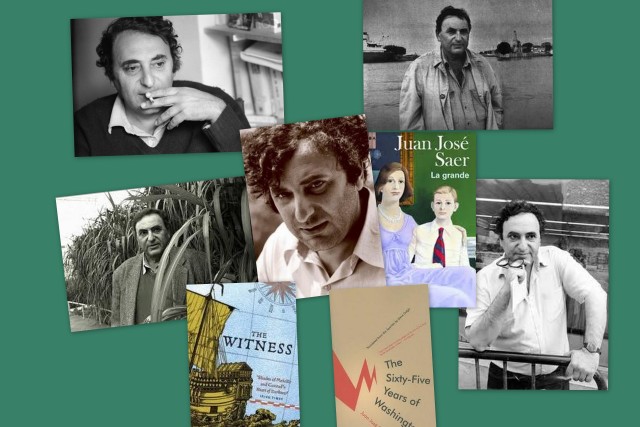


The Sixty-Five Years of Washington
By Juan José Saer
Translated by Steve Dolph
Open Letter Books
ISBN-13:978-1-934824-20-7

To be clear: the soul, as they call it, is not translucent, it seems, but murky.
—Juan José Saer

WHEN IS THE LAST TIME you went on a good walk with a friend? Cell phones off, eyes fixed on the path in front, minds alert and the conversation buzzing?  A good walk opens the ears and the heart to storytelling, creating a sacred space in between two individuals as they make their way.  Juan José Saer invites us on such a walk in The Sixty-Five Years of Washington.  But, reader be warned: this is no ordinary stroll and this is no ordinary novel.

The Sixty-Five Years of Washington follows Angel Leto and “the Mathematician” as they walk through the city center of Santa Fe, Argentina. “Suppose it’s October,” the narrator begins, “October or November, let’s say, in 1960 or 1961, October, maybe the fourteenth or sixteenth, or the twenty-second or twenty-third—the twenty-third of October in 1961 let’s say—what’s the difference.”  This uncertain narrator interrupts frequently and becomes a third protagonist in the novel as he narrates the journey, conversation and thoughts of the characters and supplies ongoing, humorous commentary.  The conversation quickly turns to the sixty-fifth birthday party for Jorge Washington Noriega, a party which neither man attended.  Washington is an elusive character; we don’t know much about him.  He writes lectures on the Colastine Indians (“Location, Lineage, Langauge & Logic”); he was arrested once, and avoided prison by going to a mental hospital; he throws wild birthday parties for his younger friends. The Mathematician heard his version of the party a week earlier from one of the attendees, Botón, as the two men rode a ferry.  Leto hears his version from the Mathematician.  The reader, of course, hears all of these accounts from the narrator. The party attracted les enfants terribles of Argentina, young artists, poets and political activists ready to disrobe, fight and snort coke into the wee hours of the morning. You want to be at this party, but, like Leto and the Mathematician, you can’t attend, so you must be willing to accept a re-telling (hyphenated emphasis intended throughout) of the event as the men stroll through the city.

This device of re-telling is crucial. By not going directly at the events the way a traditional narrative might, Saer creates distance between the characters in the novel and the dramatic action.  This recursive structure forces us to question the very idea of what happened at this party, and, on a deeper level, what is happening in the novel. Saer challenges the notions of verisimilitude and truth.  And with this technique, the re-telling of the events at the party mimics our reading of the novel itself (of any novel, really), by recreating a version of reality through the description of events not directly experienced by the characters or the reader.  Saer seems to be jack-hammering at the foundations of storytelling.

Continue reading »

Mar 302011
 

/

A foolish consistency is the hobgoblin of little minds, adored by statesmen and philosophers and divines.  If you would be a man, speak today what you think today in words as hard as cannon-balls, and tomorrow speak what tomorrow thinks in hard words again, though it contradict everything you said today.

-Ralph Waldo Emerson

/

My car has a factory-installed blind spot detector, a system that the manufacturer, Volvo, calls BLIS, or Blind Spot Illumination System.  (The actual device, fortunately, works better than the acronym.) It consists of a camera mounted below the mirror that is wired to a tiny orange light inside the car.  The dime-sized, triangular light illuminates when another vehicle is moving somewhere in my car’s blind spot.  I’ve grown quite fond of BLIS, quite accustomed to the orange glow, especially in the dizzying commutes on Southern California freeways.  It’s a helpful aid.  A cheat, if you will, a machine doing the vigilant work that the driver is supposed to do. With only a quick glance at the side mirrors, my peripheral vision catches the orange light and I know that something lurks in those hidden spaces.

I wonder what it would be like to install an automated blind spot detector on myself, BLIS for the soul, illuminating the parts I fail to see.  What would such a device show?  Would it light up when my hot temper flares, or when I’m impatient with my kids or insincere with my wife?   Perhaps it would reveal  buried things about my desires, expose my snap judgments toward other people, or render visible my hidden fears and anxieties.  How embarrassing it would be to have at a party, in a room full of strangers, glowing as a boorish lawyer droned on about his wonderful job, or lighting up like Rudolph’s nose on Christmas Eve as a pretty woman crossed the room. But if I’m already aware of these shortcomings, even in brief, then maybe that’s not what this blind spot detector would do at all. Maybe it would only flash on when least expected, revealing aspects of myself I can’t see, or don’t want to.  How often would that little orange light glow?

For a good portion of my adult life, I’ve turned to Ralph Waldo Emerson, the great nineteenth century American transcendentalist writer, whenever my vision gets cluttered .  When I wonder about the world and my place in it, his writings have a restorative effect on me. I own this wonderful, worn paperback book, Self Reliance: The Writings of Ralph Waldo Emerson as Inspiration for Daily Living.    It’s a condensed version of Emerson’s essays edited by Richard Whelan.  My copy is almost twenty years old, the cover worn to a sun-bleached smoothness, the pages gently yellowed. A small part of me is ashamed that I turn to this much-abridged, ‘best-of’ version of Emerson’s work rather than reading the whole text, but the Whelan book has been with me since I was a young man more prone to short cuts and self-help aisles in the bookstore. I’ve underlined and starred dozens of the pages. In many ways, the book has been a trusted companion for most of my adulthood.

The voices which we hear in solitude grow faint and inaudible as we enter the world. Society everywhere is in conspiracy against the manhood of every one of its members, Emerson writes, always speaking directly to my heart, always illuminating the dark corners of my introverted being.  He may ignore the danger of his philosophy, that tendency toward self-righteous solitude and mild paranoia that self-reliance can engender, but he reassures me.  This world can be a transcendent place.

Continue reading »

Mar 172011


The Soul’s Habitation: Emotion and Writing

By Richard Farrell


Contributor’s Note: This essay is based on my graduate lecture delivered at VCFA in January, 2011.

When I was eight-years-old, I started hanging out with the older boys in my neighborhood, many of them already teenagers. They nicknamed me ‘Head,’ because I had, or rather I have, a large head.  At eight, I also had a tangled mass of blonde wavy hair, hair which made my already considerable melon twice as noticeable atop of my scrawny body.   Today, my son is likewise afflicted.  But getting a nickname in that world was also a sign of acceptance.  I was the only boy under the age of ten so honored in my neighborhood.

One summer day ‘Bessie’, who was fifteen at the time, who lived next door to me, and who hung himself five years later, suggested that we go behind the Doherty’s house and throw crab apples at a nest off field mice.  The mice had been recently discovered by my twelve year old neighbor, ‘Burger.’ A hunting party formed.  Six or seven of us set out for the field, armed with fistfuls of crab apples and barbaric energy.

We found a piece of plywood lying flat in a field of summer grasses.  We circled round it in a phalanx, armed and angry, our eyes brimming with the thrill of the hunt, our weaponized apples cocked and at the ready.  Bessie reached down and lifted a board of rotting plywood from the matted rectangle of bleached yellow grass.  A second later, half a dozen mice scattered in every direction.  Apples flew like arrows.  Someone whooped as the fruit ricocheted off the dirt.  Boys jumped.  The mice darted between our feet.  Dozens of apples pummeled the ground, but the mice evaded them, scurrying into the grass and safety.

Somehow, I ended up holding the last apple.  And somehow one tiny mouse kept running around in circles, spiraling around the center of the flattened yellow grass, dazed, while I took aim.  It circled once more.  I clenched the spotty apple in my hand, then I chucked it with everything I had.

My shot pelted the mouse square in the head and it flipped in the air. The boys screamed and laughed.  The mouse flopped on its side, a streak of blood leaking from its mouth, which hung open in a grim smile.  Its legs twitched, then went still.  Bessie raised my hand in the air as the boys howled their approval, but I stood there, frozen, staring at that dying mouse.

Much of my desire to write seems to stem from that moment, if not directly, then at least indirectly, at least in the sense of my need to reconcile that act with all that has followed it.  That mouse still haunts me, even after so much time.  I’m neither a pacifist nor a vegan and I still love football.  I know that many worse things have happened in the world than the death of a tiny mouse. But the emotional core of who I am has not strayed very far from that eight year old boy standing in a summer field.  It’s not just that single incident, clearly, but all the things which have followed, all the joys I’ve felt, the sorrows, the loves, the passions, the rages, the tears.  When I stop and analyze what I love about good writing and why I want to be a writer, it strikes me quite plainly that writing retains the ability to express profound emotions through language.  I should broaden the scope a bit.  Art does this, not just writing, though I can’t paint and I can’t make music, so I struggle to sing on the canvas of the page.  And it’s not intellect, though clearly good writing does challenge my brain.  The intellect is necessary to take something as abstract as an emotion and to convey it plainly.  But my desire to write seems tied up with a deep need, with a desire to express that swirling, muddied mess of interior emotions.

Margot Livesy

Margot Livesey says that “one of the main ambitions of art is to depict and evoke emotion.”  At its best, a work of art furiously explores, conjuring and capturing the full palate of human emotions with unflinching honesty.  A well-written story guides us toward thought, compassion, and insight; it points the way toward wisdom.  Good writing does not teach by brutalizing the intellect, or by subduing the spirit or proselytizing to the uninitiated, but by finding a way to make contact with another soul. Art teaches emotionally.

An object of art is a negotiation, the artist bartering with the observer, the transaction conducted between song and ear, between painting and eye, between story and reader, and the primary currency of these transactions is emotion.  We write, because through the act of exploring our ideas conceived in words, we stumble toward meaning, toward a deeper, more complex understanding of ourselves and of others.  Through writing, we radicalize the emotional core of life, which for me is the sacred center.  Poet Pattiann Rogers echoes Bertrand Russell when she calls for us to build the ‘soul’s habitation’ in our work, a place we write from and towards, a place of exile and yearning.  In the end we attempt to create an enduring object through writing because this remains one of the few affirming ways left to communicate our unadulterated selves:  our fears and desires, our grief and hope, our love and our desperation.    The artist speaks, first and foremost, from his soul’s habitation, which for me has a secular but no less powerful meaning.  It can be touched only within the emotional transactions of art.

Jane Kenyon offers this:

Why do we want to write?  What is behind this crazy impulse?  The wish to connect with others, on a deep level, about inward things.  The pressure of emotion, which many people prefer to ignore, but which, for you, is the very substance of your work, your clay.  There’s the need to make sense of life behind the impulse to write.

But how?  How do we transform these ideas, these feelings, into stories, essays and poems?  This exploration, this journey in, must have techniques, right? There must be clues.

In fiction, at least, it begins with characters.  The fiction writer must put characters into dramatic situations and figure out how those characters will feel things, how they will explore their world with action and thought, but with the emotional baggage always in tow.  Only after this can the writer consider how that depiction will conjure a response in the reader.  John Gardner says,

The first business of the writer must be to make us see and feel vividly what his characters see and feel.  However odd, however wildly unfamiliar the fictional world—odd as hog-farming to a fourth-generation Parisian designer, or Wall Street to an unemployed tuba player—we must be drawn into the characters’ world as if we were born to it.


The first step, then, is to build a world that characters can experience through their senses, actions, thoughts, and memories.  A world we construct, word by word, image by image, on the page.

Before a writer can evoke any emotional response in the reader, she must give her characters their due.  And characters demand to be heard; they insist on feeling things deeply—to laugh, cry and punch holes through the page.  Only then can the reader be drawn in.  Only then can the reader hope to feel something too.

This is an area where I struggle in my writing.  I have a difficult time entering my characters’ space. I don’t dwell in their soul’s habitation. I’m not experiencing the emotions first-hand, but through the filtering lens of my intellect.  And this holds my writing back.  It prevents my stories from conveying emotion because the initial, primary depiction is off.  I’m like an actor dutifully memorizing my lines, but unable to inhabit my characters, unable to make my characters believable.

Before emotion can be conveyed to a reader, it must be authentically, honestly depicted within the story.

Yet none of this should take on the appearance of dogma.  This is not an argument for strict realism. The artist doesn’t gerrymander emotions.  She doesn’t manipulate, she explores.  The outcome is never certain, and the pathway often less so.  And technique alone is never enough.  Depicting emotion in a story a certain way can arouse strong feelings in one reader and none in a second.  Every person brings his or her own emotional histories to their reading.  And the emotions portrayed and evoked can often be unpleasant, disturbing, even downright brutal.  Also, the feelings we experience as readers are often very different than those characters feel within the story.

Dostoevsky’s murderous student, Raskolnikov, evokes a powerful reaction in me, but I don’t share his emotions as he bashes in the skull of his pawn broker and her sister. So why do I identify with him? Douglas Glover once said in a workshop that we don’t identify with a character so much as we do with their desires. To wit: I feel the restrictions of Raskolnikov’s life; I feel his desire to break free; I have sympathy for his desire to make something out of his life.  I might even understand his murderous impulses at times.  I can feel these things in myself because Dostoevsky depicts Raskolnikov’s desires so vividly.  But as the axe blades shatters the skulls of his victims, I feel very differently than the character does.  What’s depicted and what’s conveyed are almost diametrically opposed, but it is effective because Dostoevsky paints such vivid interior details of his characters.

The day I slaughtered that mouse, I also slaughtered the first innocence of myself. I spent the next twenty years trying to prove that what I felt that day was not weakness.  I spent most of my life bound to male rituals, to contact sports and the military and the systematic suppression of my emotions.  I hoped, like many men and women, that the rituals would toughen the core of me, would harden the exterior and overcome what I perceived to be softness.  Because I couldn’t celebrate with those other boys, because I couldn’t share their mutual joy at my kill, I spent twenty years distancing myself from the pain of watching that mouse die at my hands.  I ran away from my soul’s habitation.

I’d like to think that I’ve stopped running, and I’ve spent the last ten years trying to figure out how to render the complexity of emotions that life can evoke. I’ve tried to express that through writing.  In part, this is why I want to write.  I want to time travel and tell that little eight year old boy that what he’s feeling is okay.  And while I can’t do that, I can hope to reconstruct in my stories a place where my characters, my readers and my self can feel things without worrying that what we feel is wrong.  I haven’t accomplished this yet, but it’s a long race back to that summer field.  Sometimes, the only guides I have are other writers who’ve succeeded.

In the end, we are bound to structure and ritual in writing.  But as Bob Vivian once eloquently stated, structure, technique, grammar, words, even genre, only provide only the vessel, the container which holds the water.  And though we need the vessel, and we struggle so much to build it, what we desire is the water inside.  We desire not the walls which make up the soul’s habitation, but the fire burning in the hearth inside those walls.

I don’t know if anything I write can ever heal that first wound.  But maybe healing isn’t the goal.  Maybe the goal is not inward, but outward.  Maybe the goal is discovering ways to express the internal, to share it, and not hide it away.  Maybe that’s what all good stories do.

—Richard Farrell
Mar 072011
 

Evidence of Life, by Richard Farrell
Micrograph of “Alien”

I recently read about a scientist who claims to have found evidence of extra-terrestrial life inside a meteorite.  Not the bulbous-headed, green-skinned Martian type, but simple life, unicellular remains of bacteria trapped inside the deepest pockets of a four-billion-year-old meteorite. Accompanying the article was a micrograph of a ghostly white, worm-shaped thing, two microns long, ‘floating’ in a cave of spongy space rock. The scientific community remains appropriately skeptical, demanding more evidence, expecting this claim to be debunked under the scrutiny of peer review and more plausible explanations.  It’s entirely possible, perhaps even likely, that earth bacteria simply slid inside the meteorite long after it landed on our planet. But if it turns out the other way, if this bacterium is one day confirmed to be from a place other than our own world, it should shake us up.  It should erase long-held perceptions about our sense of privilege and uniqueness, and it should quell the uneasy loneliness we feel when we stare off into the vast universe.

I doubt, however, that it would do much of anything. We, as a species, would probably be far too busy with mundane things to notice or appreciate the sublime.

My mother is having her gallbladder removed today at a hospital some three-thousand miles away from where I live.  I worry about her in the silence of my California home as I sit here thinking about extra-terrestrial microbes.  Memories come back to me, in the shape of broken bones, sore throats, scraped knees and a mother’s healing touch.  And though gallbladder surgery is routine, and at sixty-four my mother’s health remains good, the cascading nature of growing old must weigh heavy on her.  How many organs can be safely removed?  How much surgical trauma can the body withstand?

I like to imagine we humans retain a burrower’s gene, some long-lost prairie dog instinct spliced onto our twelfth chromosome, right next to the gene for opposable thumbs or back hair.  For even after thousands of years of civilization, we still sift through the past as if it contains answers.  We dream of dinosaurs, ancient kingdoms and long-lost ancestors, archaeologists all of us, in one way or another.  We remain yearning creatures, hell-bent on digging our way out of loneliness, determined to find even the faintest pulse of another life buried beneath the rubble of time and space before we do indeed shuffle off this mortal coil. Or maybe that’s just me.

Maybe it wouldn’t matter one damn bit if life existed on places other than earth.  But can anyone deny the thrill of the search?

I worry about my parents now.  Only twenty-three years my senior, the snapshots of their health are like a coming attractions reel for me: my mother’s surgery, my father’s recurrent prostate cancer and heart trouble. I feel the pull of time, too.  I pre-vision my body turning brittle, bones thinning out, organs misfiring, the pieces crumbling due to time, a process already well underway in the invisible cellular forces pulling me towards silence. The inevitability of degeneration.  I wonder, sometimes, how we persevere in the face of it all.

Those scientists searching for evidence of bacterial life in meteors must spend a lot of time with their hats in their hands, probably avoiding class reunions and UFO conventions with equal dexterity. I think about those men and women with awe, highly trained physicists and biologists who toiled in graduate schools along the Charles River, but now spend their careers sifting through space rubble, scouring cosmic dust with patched-together grants in a desperate search for microscopic evidence of life from outer space. It’s hard not to ask myself why they care so much, why they scrounge up dollars and lab spaces from fringe organizations while their Harvard classmates rake in the big bucks working for drug companies and defense contractors.

This morning, I overhear a conversation between my daughter and a little girl while they wait for their carpool ride.  It’s about birthday parties. My daughter is not being invited to the little girl’s party. Names are given–names of the invited girls. I don’t know the reason for any of this, nor why my nine-year-old has been left out. She pretends not to care, but it must sting.  Still, it’s not the sadness of being left out that gets to me, not the hurt feelings of rejection and confusion that linger after the girls climb into the minivan and head off to fourth grade.  It’s important that my daughter learn some of life’s hard lessons.  What bothers me is the telling. One child’s need to point out the snub, her need to belittle, to isolate, to marginalize. It’s the nature of kids, mine included, that a thin layer of cruelty exists below the innocent surface. Something that makes one want to hurt another.  It must be empowering in a way. How this relates to gallbladders or cosmic life forms I can’t honestly say.  But it seems to fit my mood.

The moments I most regret in my life are the ones where I was cruel toward other people.

Would it matter much if we found space bugs?  Would we lift our eyes heavenward more often, knowing that something existed beyond the boundaries of earth?  I suspect not. We’ll probably need the little green men to land before we’ll take notice.  Archaeological bacteria won’t cut it in our sophisticated times.

I’m out walking my dog when the ‘all-clear’ comes, a terse message on my phone from my mom’s husband.  The operation is over.  My mom will be going home soon.  All is well. And this of course comforts me, makes me relieved, desperate contingencies avoided.  But the lingering effect is one of wonder, maybe even resignation, that the worst outcome is only delayed, never avoided.  Of course I’ll happily take the delay.

I’ll pick up my kids in a few hours from school and ask my daughter about what happened this morning. I’ll try to patch whatever wounds were opened and try to explain to her that life, even in its worst moments, is far less limiting than she imagines. She’ll make a card for her grandmother and put it in the mail.  They share a close bond, my mother and my daughter.

Perhaps I’ll take her outside tonight, if the rain stops and the clouds part.  I’ll try to show her the Milky Way, try to explain to her how that gossamer web stretching out across the night sky like paint strokes of the gods is actually light from billions of suns.  And that around some of those suns are planets.  And how on some of those planets, there is surely life.

–Rich Farrell

Mar 042011
 

Tom Greene, founding President of Vermont College of Fine Arts, writes an occasional column for the Montpelier, VT, bi-monthly The Bridge. It’s called Notes from the Hill. Click the link (or the text image) and read the current issue where he reminisces about the January graduation just past, Richard Farrell’s magnificent speech, and the amazing coincidence that Rich and Tom had played Little League baseball against each other in days long gone. (In his spare time, Tom also writes novels.)

dg

Mar 022011


Deforming Forms: Outlier Short Stories and How They Work

By: Richard Farrell


I once spent an entire day at The Art Institute of Chicago, wandering alone for hours through the vast museum.  I began in a gallery filled with artifacts from ancient civilizations and moved chronologically through the collection, passing the pharaohs’ coffins from ancient Egypt, the shards of classical Greece, the religious art of late antiquity, the medieval tapestries, and the Renaissance sculptures.  I marveled at the massive rooms filled with Impressionist paintings, and eventually ended the day in galleries filled with the strange pieces of ‘modern art’, the often abstract objects, difficult to categorize or comprehend.  I never studied art or art history in school—Annapolis tended to ignore the humanities in favor of the art of war—so what I knew of art came mostly from pop culture.  I recognized the famous Seurat painting A Sunday on La Grande Jatte because I had seen it in Ferris Bueller’s Day Off.  Though embarrassed by my ignorance, I began to experience a visceral understanding of the progression of styles as I moved through the collection.  I became aware that these shifting styles related to one another, that classical forms evolved slowly into more modern, abstract expressions. Standing in front of a Kandinsky painting, with its strange geometric shapes, or a Jackson Pollock painting, with its seemingly chaotic splashes of colors, felt very different than standing in front of a painting by Pissarro.  Yet the essence of what I experienced felt connected.   I kept asking myself the question: What makes something a work of art?

Modern abstract art had always seemed inaccessible before this experience.  I was guilty of appreciating works of art for little more than what Douglas Glover calls “the resemblance they bear to old dead people in funny clothes.” (Notes Home from A Prodigal Son)

Standing in the modern gallery that day in Chicago, I learned that the formal aspects of art accomplish more than recreating a sense of reality.  Though I saw connections to historical forms and styles, I had no context for the experience, no intellectual background to support my emotional reaction.  This glaring hole in my intellect (one of many) has continued to gnaw at me ever since.

As I’ve begun to study writing more seriously, my interest has focused on the aesthetic principles that make a story or a novel work.  And just like in the museum, there is a vast continuum of story-types, stories which refuse to follow traditional models.   I’m particularly fascinated by stories which stretch the boundaries of storytelling.  Call them experimental, avant-garde, or ‘outliers,’ but some stories refuse to follow long-standing techniques.  I should say up front that I enjoy stories in the realist tradition.  I enjoy writing that creates a strong sense of verisimilitude and stories that rely on conventional devices.  Well-made, conventional stories are the stories I most often read and try to emulate when I write, but I have to admit, I’ve never asked myself why.  The premise goes unquestioned.  And not questioning convention can lead to bland, unthinking products.  By exploring the unconventional, the outlier in short story form, I hope to arrive at a deeper appreciation of story architecture in all its varied forms, conventional and otherwise.  I hope the following pages will help re-envision the idea of a story and expand the boundaries about what makes a story.


 From the Conventional to the Outlier:

The well-made, conventional short story rests on certain structural foundations, and though there is no strict definition, those foundations typically include point of view, character, plot, setting, and theme.  These devices create a recognizable pattern for the conveyance of meaning to the reader.  Most stories I read employ these devices rigorously, so much so that when I come across an outlier, the effect is startling.  Glover, in Notes Home from a Prodigal Son, talks about these assumptive structures in an essay on a Leonard Cohen novel, Beautiful Losers:  (These same conventions hold true for short stories as well as novels.)

“The conventional view of the novel has it developing out of the late Renaissance picaresques.  It becomes the literary vehicle of the rising middle class in England and elsewhere, and, in the nineteenth century, the novel becomes, for the capitalist bourgeoisie, what the Gothic cathedral was to an earlier version of Western civilization.  The novel expresses, often ironically, the bourgeois ethos with its will to power and its will to love, in short its conflicted and inauthentic soul.  But the bourgeois, conventional novel itself, with its emphasis on plot (a unidirectional series of causally related events), character (based on a common-sense theory of self, the individual and personal identity), setting and theme—on verisimilitude, the quality of seeming to be real—challenged the middle class only ever so slightly.  The assumptions of the novel—in structure and presentation—remained the assumptions of its primary readers.  In other words, the novel is a modern art form and its structure reflects the assumptions of modernity, the individual and bourgeois capitalism.”

Within the conventional story, devices can become so ingrained that they disappear into the background, and a dangerous assumption (one I’ve made) can occur: that these devices, these methods of writing, are mistaken for rules, for ideology instead of methodology.  The devices, “the assumptions of the novel” (or story), once expected, go almost unnoticed, “reflecting the assumptions of modernity,” leading to what the Russian Formalist Viktor Shklovsky in Theory of Prose calls “automatization,” the inability to see what is before us.

“The object passes before us, as if it were prepackaged.  We know that it exists because of its position in space, but we see only its surface.  Gradually, under the influence of this generalizing perception, the object fades away. “

Conventional stories rely on these devices and the reader expects them.  And conventional stories remain a predominant form in fiction.   As these devices gain ascendancy in the creation of conventional stories, they easily fade from our awareness.

At this point, another dangerous assumption can occur (and again, one I’ve been guilty of making): that these devices, these methods of writing fiction have arisen naturally, that they are inextricably linked to the act of writing fiction itself.  Terry Eagleton, in Literary Theory, talks about the dangers of ‘naturalizing’ social realities, which could include things like fictional devices.

“It is one of the functions of ideology to ‘naturalize’ social reality, to make it seem as innocent and unchangeable as Nature itself.  Ideology seeks to convert culture into Nature, and the ‘natural’ sign is one of its weapons.  Saluting a flag, or agreeing that Western democracy represents the true meaning of the word ‘freedom’ become the most obvious, spontaneous responses in the world.  Ideology, in this sense, is a kind of contemporary mythology, a realm which has purged itself of ambiguity and alternative reality.”

Now I do not suggest that there is a sinister conspiracy behind conventional fiction.  I don’t think that the progression from assumptive forms of story construction will lead us to the lockstep mentality of fascism in writing.  But if Harry Potter is a commercial literary phenomenon, the merits of which are highly debatable, it is also a phenomenon that has created a cottage industry of wizardry and magic books around it.  The marketplace demands uniformity, and repetition is the model.  It craves methods that go unnoticed, unquestioned and unchallenged.  Like medieval bishops selling indulgences to raise money for grander and grander cathedrals while the peasants starve, the contemporary publishing industry sells its brand of indulgences in the form of homogenized books, driven by a relentless march toward the bottom line, the capitalist equivalent of Judgment Day.

One function of art must be to resist this automatization and present alternatives to the expected, to fight assumptions and to force the reader to see freshly, leading to what Shklovsky calls a “vision” of the object, rather than a “recognition.”  Shklovsky again:

“And so, in order to return sensation to our limbs, in order to make us feel objects, to make a stone feel stony, man has been given the tool of art. The purpose of art, then, is to lead us to a knowledge of a thing through the organ of sight instead of recognition.  By “estranging” objects and complicating form, the device of art makes perception long and laborious.  The perceptual process in art has a purpose all its own and ought to be extended to the fullest.  Art is a means of experiencing the process of creativity.  The artifact itself is quite unimportant.”

This leads me to the topic of outliers, to stories which might be called experimental or unconventional, where some estrangement of the expected form is at work.  In these stories, the conventional devices of plot, character, setting, point of view and theme are altered, often radically.  Yet these stories still function and meet the expectations of a story, as opposed to a poem or an essay.   In outlier stories, the goal remains to create what Leon Surmelian calls “a coherent account of a significant emotional experience, or a series of related experiences organized into a perfect whole,” but with the conventional forms ‘deformed’ into something that challenges the reader’s understanding of a story.   It requires labor and effort to apprehend.  The outlier story asks the reader to read as if for the first time, as if discovering something entirely new.

Glover, In Notes Home From a Prodigal Son, refers to this deformation of structural devices in his essay on the Canadian writer Hubert Aquin:

The primary devices of the well-made novel—plot, character, setting and theme—are designed to imitate the structures of this so-called reality.  They situate and reassure the reader by promoting verisimilitude, the quality (or illusion) of appearing real.  By emphasizing the difficulty, or even impossibility, of producing meaning over meaning itself, by piling up alternative but equivalent semiological systems, Aquin obliterates these conventional novelistic devices.

Notes Home from a Prodigal Son

The outlier story piles up alternative but equivalent systems to replace the absent devices.  It works against convention, like the construction of a different type of cathedral, using different blueprints, different materials, but with the ultimate goal still the same.  The risk, of course, is that such variance can lead to unstable, unsatisfying, or incomplete stories, a cathedral which collapses under the weight of its own design.  The alternative methods risk making the story so abstracted that it becomes unreadable.  Glover addresses this too:

For Aquin, difficulty resides in substituting the proliferating unsystematic, non-structures of “institutional delirium” for the conventional structures of the well-made novel.  But this does not mean his novels are insane, nonsensical, unstructured or impossible to read.  The phrase “institutional delirium” is itself a trope, a metaphor for the kind of structure Aquin uses to oppose the structures of the conventional, well-made novel.  His novels only appear to be unstructured so long as we apply to them the same criteria for structure as we apply to the well-made novel.  In fact, Aquin’s novels do have plots, characters, settings and themes; it’s just that when Aquin uses a conventional novelistic device, he deliberately and relentlessly deforms it in order to prove that he doesn’t need it.  In the jargon of the Russian Formalists, Aquin makes things strange.

By estranging the conventional device, by bringing attention to it, or by directing attention away from it, the writer creates an equivalent structure that reinvigorates the reader’s awareness of form.   By de-emphasizing conventional devices, by eliminating characters, narrators, settings, conventional plots, the reader is challenged to discover new criteria for the judgment of art and to reexamine the very idea of a story.  If done well, I would argue, the outcomes of the well-made conventional story and the well-made outlier story are the same:  the “perfect whole.”

In the following stories, each author has manipulated conventional devices and attempted to create an alternative version of a story.  With varying degrees of estrangement, playfulness, cleverness and success, each of the following stories reorients the reader’s expectation.  Yet outliers do not indict the conventional story.  They are oppositional, but also complementary.  They force the reader to acknowledge form as different, and hopefully to consider the purpose behind form.  Glover puts it this way in The Enamoured Knight:

What seems to be the case with experimental fiction is that it is always written with other, more conventional books or conventional notions of reality in mind; one of the primary effects of experimental works is the denial of expectation, the surprise the reader feels when form is inverted or twists back on itself or is in some other way subverted.  Most commonly the experimental artist does this simply by drawing attention to the work of art as a work of art.  A painting isn’t about the image it represents; it’s about surface, shape and colour.  A book is a book.  In this way, oddly enough, the experimental novel is tied to the strict realist novel, the same but opposite, like the right and left hand.  They are both committed to a species of honesty, authenticity, or “realism.”  But the larger novel tradition swears allegiance to verisimilitude while the experimental tradition diminishes the importance of illusion and highlights the reality of the work itself, its materials, tools and process.  The goalposts, as I say, have been moved.

Rather than goalposts, I’ll return to the religious metaphor: the pilgrim is asked to look beyond the walls of the Gothic cathedral, past the rituals of the mass, and into the realm of a different church, one that reminds him of the reason for all this prayer and devotion: not the building, but of the great mystery of being which the story tries to understand.  It’s the reason for all the bricks and mortar in the first place.


“In the Fifties” by Leonard Michaels

Leonard Michaels’ six page, first-person short story “In the Fifties” uses an unnamed narrator to recount a list of events that happened during the eponymous decade.  The story is told as a fragmented series of episodes from the narrator’s life, not unlike the structure of a list.  No apparent chronological order exists in recounting this list beyond a loose geographical orientation (he mentions New York, Michigan, Massachusetts, and California as places he lived) plus the assumptive time period of ten years.  Certain patterns repeat throughout the story: women, sex, roommates, an anti-establishment sensibility, language, academics, violence and suicide.  At four points in the retrospective story, the narrator establishes a present narrative time period with the word ‘now’ or with a present tense verb construction, so that the reader knows the story is being told reflectively.

The story opens with the narrator learning to drive a car, studying, attending college, reading, having personal relationships, meeting card sharks and con men, and interacting with women.  When a respected teacher is fired at NYU, the narrator expects an uprising that does not happen.  He moves to Massachusetts and works in a fish-packing plant where he notices old Portuguese men cleaning the fish.  He falls in love (though it is unrequited), becomes an uninspired teaching assistant, is arrested, does drugs, witnesses an abortion and drives a car recklessly through the fog.  After this, the first named character, Julian, appears.  Julian and the narrator spend a period of time as friends.  Then the list resumes, and the narrator remembers playing basketball and shooting a gun.  He then lives with a roommate who ‘suffers’ from life and eventually kills himself.  The narrator then works as a waiter in the Catskills, lives the life of a hipster in Greenwich Village, and moves to California.  After this, the second named character enters, a man named Chicky, who burns his face and wants to kill himself because his girlfriend is ugly.  The story concludes with the narrator going to a demonstration in support of a friend who has been arrested.  He witnesses a large crowd gathering to protest this injustice (the friend has been arrested for wanting to attend the HUAC hearings) and he hears a mother telling her little kid not to unleash a bag of marbles under the police horses.  Within the chronicled ten years, the narrator experiences a range of events, including rigorous study, teaching, passion, despair, death, disillusionment, and maturity.

This story posits a number of difficulties for the reader expecting a traditional, realist story.  The first challenge I’ll examine will be Michaels’ unconventional method of character development. The pattern in a conventional story typically involves two (or more) characters thrown into repeated conflicts, the progression of which gradually reveals more about each character.  Michaels turns this convention around, primarily through an ironic foregrounding and backgrounding of characters.

While the first-person narrator’s presence dominates the pages, other characters exist mostly as un-named figures who weave in and out of the narrator’s awareness.  Only two fictional characters are actually given names, Julian and Chicky, though twenty historical figures are mentioned by name. (A third character, Leo, is mentioned by name by never appears in dramatic action.)  While this story involves a large cast of characters, most remain in the background because the narrator refuses to name them.  They are called variously, “my roommate,” “a fat man,” “a man,” “two girls,” “a sincere Jewish poet,” “three lesbians,” “a friend,” and “a girl from Indiana.”   Even though the narrator says “Personal relationships were more important to me than anything else,” very little about most of the characters in the story appears personal.  Is there anything less personal than refusing to name a character?

Even the narrator remains elusive.  We learn about events that happened to him, not how those events affected him.  We do not know where he is now, how he views these events, nor how these events have shaped his character.  Though present significantly on the page in the form of the pronoun, “I,” he remains hard to define.  Curiously, he is more easily understood by his absence than by his presence.

About halfway through the story, a shift occurs.  One character is given a name, another character is foregrounded, and the narrator begins to recede.  This is first noticeable in a subtle point of view shift that occurs when Julian enters the story.  The relentless first-person singular narration momentarily switches into the plural:

I drank old-fashioneds in the apartment of my friend Julian.  We talked about Worringer and Spengler.  We gossiped about friends.  Then we left to meet our dates.  There was more drinking.  We all climbed trees, crawled in the street, and went to a church.  (Italics mine)

This run of plural pronouns occurs after a string of fifty first-person, singular ‘I’s’.  The effect is striking.  The only other time ‘we’ is used in the story occurs at the story’s end.   I will return to this point below.

The narrator (and the story) appears suddenly conscious of other people besides himself.  Soon after the Julian section, the narrator returns to talking about himself, about his basketball scholarship and his classes, but then another character takes the stage.  His roommate (unnamed) suddenly comes forward for an extended sequence.  There is a run of twenty-three verbs all directly linked to the subject of his roommate.

Though very intelligent, he suffered in school.  He suffered with girls though he was handsome and witty.  He suffered with boys though he was heterosexual.  He slept on three mattresses and used a sunlamp all winter.  He bathed, oiled and perfumed his body daily.

This section ends with the simple statement: “Then he killed himself.”  The entire paragraph centers on this roommate.  The narrative “I” does not appear once.  In a sense, this section operates as an inset story, a brief but complete story on its own and focused away from the narrator.  It would seem that the narrator has slowly become aware of other people, and this trend continues.

One of the most stirring, un-self-conscious passages comes soon after this ‘roommate string’, when the narrator sees Pearl Primus dance.   The images expressed are carefully composed as he watches her dance accompanied by an African drummer:

Pearl Primus

“I saw Pearl Primus dance, in a Village nightclub, in a space two yards square, accompanied by an African drummer about seventy years old.  His hands moved in spasms of mathematical complexity at invisible speed.  People left their tables to press close to Primus and see the expression in her face, the sweat, the muscles, the way her naked feet seized and released the floor.”

Absent from this passage is the narrator’s recurrent narcissism.  Gone again are the “I’s.”  He was captivated by what he saw, and we are captivated by his description of it: the spasms of the drummer, the seizing and releasing feet of the dancer.  These images hearken back to the Portuguese men in the fish factory, as something that affects the narrator more deeply than the rest.

Michaels uses these shifts in narration to reveal the narrator’s character more deeply.  When the narrator comes forward significantly, we learn only facts, nothing of depth.  Though none of the other characters, named or otherwise, compete for the reader’s attention, true development of the narrator’s character occurs by omission.  By repeating the first-person, singular pronoun, ‘I’ over ninety times in this short (maybe 2000 words) story, and by making the narrator appear simply obsessed with himself, especially in the beginning of the story, Michaels generates an effective pattern: when the narrator recedes, the readers understands more.  Character growth occurs.  Michaels makes the first-person narrator such a prominent aspect of the narration that the effect, when ‘I’ is not used, is jarring.  It becomes what Glover calls an “anti-structure,” a structure that works by its absence rather than its presence.

Closely related to the way Michaels manipulates character development is his deformation of point of view.  There are two distinct ways that the point of view shifts.  The first way has to do with time, the second with perspective.

The majority of this story is told in the past tense.  “In the fifties I learned to drive a car.  I was frequently in love.  I had more friends than now.” Michaels signals at the opening that the story is being told from a distance, but this narrative perspective remains vague.  It could be six months or it could be twenty years.  The reader never learns.  The story continues to use this narrative distance until the narrator breaks in from his perspective a few more times in the story.

I knew card sharks and con men.  I liked marginal types because they seemed original and aristocratic, living for an ideal or obliged to live it.  Ordinary types seemed fundamentally unserious.  These distinctions belong to a romantic fop.  I didn’t think that way too much.

The shift in tense here on the verb ‘belong,’ acts again from the narrative present-time.  The sentence works thematically, shedding light on the story.  Are we supposed to think of this narrator as a ‘romantic fop’?   There does seem to be a disowning here, a disavowal of the younger, more isolated self from the perspective of the future narrator, the narrator looking back for purposes of telling this story, but the narrator quickly undercuts the disowning by telling us that he “didn’t think that way too much.”  The use of the present tense also reminds the reader that this narrator is out ahead of this story somewhere, but the narrator remains vague and unclear, almost detached from the story he is telling.  The present-time narrator interrupts the flow of the recollection four times but offers no real commentary or perspective on who he is now, or how this story has affected him.  The effect of this interruption forces the reader to ask a lot of questions that will go unanswered in the story.  We will never learn who this narrator is ‘now.’  We will never learn what effect these chronicled events have on the present narrator.  We will only have questions, but the effectiveness of this story rests more on the questions it raises than those it answers.

Michaels also manipulates point of view with respect to the narrator’s perspective.  Again, the abundant use of the pronoun ‘I’ creates an unusual effect in the story.  There are two points when the narrator’s consciousness seems to merge with the circumstances around him, when the ‘I’ becomes a ‘we,’ and these two instances indicate a significant shift in perspective.  The first, already mentioned, occurs with his friend Julian.  The use of ‘we’ in this small section is underscored by the fact that this is also the first named character in the story (other than the aforementioned historical characters.)  The use of ‘we’ occurs only one other time, in the penultimate sentence of the story, after he has gone down to the courthouse to protest the arrest of a friend.

I expected to see thirty or forty other people like me, carrying hysterical placards around the courthouse until the cops bludgeoned us into the pavement.  About two thousand people were there.  I marched beside a little kid who had a bag of marbles to throw under the hoofs of the horse cops.  His mother kept saying, “Not yet, not yet.”  We marched all day.  That was the end of the fifties.

Michaels’ whole story builds to this tiny point of view shift.  The narrator’s expectations are confounded; instead of forty like-minded people, there are two thousand.  He notices the kid, and for the first time, he uses attributable dialogue, then the shift in narration:  “We marched all day. That was the end of the fifties”  This merging of the narrator’s sensibility with that of the other protesters reflects a structural complexity that, while anti-conventional, works to achieve an important effect.  These narrative ‘wobbles’, whether in tense or number, signify shifts are occurring.  Were this story told without them, its effectiveness would suffer.

The final variation from the conventional story involves plot.   Michaels writes this story as an extended list.  There is no apparent causality, no apparent connection between the events.  What he substitutes for plot steps, however, are thematic repetitions.  There are several examples of this in the story, but social unrest is one of the most important, and I think it works as one of the thematic repetitions that stands in for the absence of a conventional plot.

The fifties were a time of growing social discomfort with the established institutions of American life.  The tension between the old and the new social realities may have exploded in the following decade, but the roots of that social discord reach back deeply into the decade Michaels chooses to examine.   I think this history, though outside the text, is important to the consideration of the thematic repetitions I’m about to examine.

In the second paragraph, the first example of this social-discord occurs, and this example is related to the House Un-American Committee, or HUAC.

I attended the lectures of the excellent E.B. Burgum until Senator McCarthy ended his tenure.  I imagined N.Y.U. would burn.  Miserable students, drifting in the halls, looked at one another.

The narrator expects the campus to explode, but instead, there are only sad looks.  Two curious things occur: the intrusion of the conservative government into the life of the narrator, and the impotence of the response (especially on the part of the narrator.)  Later, the narrator is arrested and photographed, and though the alleged crime is not mentioned, we can surmise that it had to do with his growing social awareness.  He has likely done something subversive, but nothing so bad as to merit the arrest. “In a soundproof room two detectives lectured me on the American way of life, and I was charged with the crime of nothing.”  The soundproof room, the crime of nothing, juxtaposed with the American way of life, point to a growing dissatisfaction, however muted, growing.  The next example involves Malcolm X, and how the narrator no longer had black friends after the black activist became prominent.

In Ann Arbor, a few years before the advent of Malcolm X, a lot of my friends were black.  After Malcolm X, almost all of my friends were white.  They admired John F. Kennedy.

The unstated premise is that the black friends became active and followed their ideals, while the white friends placed their hopes in the system.  Later, the narrator mentions meeting Jack Kerouac, an iconic figure of the counterculture.

The final paragraph though, is most interesting.  A friend is arrested at the HUAC hearings.  He goes to protest this arrest (the second act in a row of supporting a friend) and “expected to see thirty or forty people like me,” but instead finds that “about two thousand people were there.”  Compare this scene to the earlier encounter with the HUAC, when he “imagined NYU would burn.”  By the end of the story, he acts.  And others are acting with him.  He joins the swirling mass of protesters.  He becomes subsumed by them.  The last lines of the story underscore this transformation.  “We marched all day.  That was the end of the fifties.”  After ninety references to “I,” the story and the decade closes with “we.”  His idealism, his expectation to be part of a small (thirty or forty) group, is met with the reality of a huge crowd of people.  Suddenly, the narrator is reduced.  He disappears and is absorbed by the crowd, and perhaps by the decades which follow.  These ‘steps’ are not created through traditional plot devices, but rather through a subtle repetitions of social disharmony, most clearly represented by the two instances where HUAC is mentioned and by the references to counter-culture figures or circumstances.

Michaels radically alters the form of the short story in a number of ways.  By turning conventional devices of character development, point of view and plot into alternative structures, he creates a difficult but emotionally ‘whole’ story.  The specific images are all grounded in realism, but the structural devices of conventional stories are manipulated and deformed to create an anti-story, a story that works off of a list rather than a plot, a story that works without named characters, and by raising many more questions than it answers.


“Axolotl” by Julio Cortázar

“Axolotl” is a seven page short story told primarily by a first-person narrator who visits animals in a Paris zoo until he turns into an axolotl (a neotenic species of Mexican salamander.)  Most of the narration occurs in the past-tense, though at times the story shifts into the present tense and also into the third person.  During these shifts, the narrator-as-axolotl shifts also occur.  There are only two characters in the story, the narrator and a zoo guard.  The primary setting is the aquarium at the Jardin des Plantes in Paris, and except for a short description of the city itself and a brief description of the library, the setting does not shift, though the perspective of that setting does, from outside the tank to inside the tank.  There is only one line of dialogue in the story, spoken by the guard to the narrator.

The story opens with the narrator thinking about the axolotls then stating that he has turned into one.  Then the narrator explains how he came to discover these creatures inside the aquarium at the Paris zoo.  He feels an immediate and deeply personal connection with the axolotls, and he goes to the library and researches them.  He begins to obsessively visit their tank, staring at them through the glass.  His obsession at first seems mysterious, artistic, even resembling a love story.  He visits daily, sometimes twice a day.  The only other character, the zoo guard, coughs, and makes only one comment.  The narrator begins to identify with one axolotl in particular, then, in a strange sequence, the human narrator becomes an axolotl.  After this, a climatic reversal occurs, and the object (the axolotl) becomes the subjective narrator commenting on the new object (the human narrator from the first part of the story).  The story ends with the narrator-as-axolotl looking out from the cage at the narrator-as-human, now transformed.

Cortázar creates a dramatic and narrative metamorphosis with the use of a shifting narrator.  He accomplishes this playful transformation by manipulating the narrative consciousness of the story in very un-conventional ways.  The point of view ‘bounces’ between the narrator-as-human and the narrator-as-axolotl—a transformation that occurs in three distinct steps.  The dramatic, physical metamorphosis, from human to axolotl, parallels the actual physiologic metamorphosis of animals (and it represents an ironical reversal of reality, since the axolotl never undergoes metamorphosis and the creature remains trapped in a juvenile stage of development.)  The narrator’s metamorphosis is dramatized through a sequence of narrative shifts until the transformation is completed.  As the point of view shifts, the character shifts, the subject-object orientation shifts, and reversals of perspective take place.  All these things occur in unconventional ways through the deformation of the point of view, a typically conventional device.

In the beginning, the narrator-as-human appears to be a typical first-person narrator:

There was a time when I thought a great deal about the axolotls.  I went to see them in the aquarium at the Jardin des Plantes and stayed for hours watching them, observing their immobility, their faint movements.  Now I am an axolotl.

Axolotl

From this opening paragraph, the reader might conclude that the narrator could be insane, he could be ironic, or he could be joking.  The reader simply doesn’t know.  What follows this opening statement are seemingly rational statements about the narrator’s growing obsession with the axolotls.  While strange, nothing about his obsession is unconventional, except for the closing sentence of the first paragraph: “Now I am an axolotl.”  This sentence triggers the reader to think that something very unusual is going on, and Cortázar’s decision not to comment on it underscores the weirdness of the story.

The next distinctly odd shift comes in the form of a parenthetical statement amidst a description of the animal cage:  “The axolotls huddled on the wretched narrow (only I can know how narrow and wretched) floor of moss and stone in the tank.” Which ‘I’ is talking?  The narrator-as-human wouldn’t know this fact, but the reader can’t be sure (yet) whether or not the narrator-as-axolotl will appear as a distinct voice.  We’ve begun to see a narrative metamorphosis, the transformation from human narrator to axolotl narrator, but in this stage, both narrators coexist.  Another example of this larval stage occurs when the narrator-as-human is staring into the cage and the perspective flips:

Once in a while, a foot would barely move, I saw the diminutive toes poise mildly on the moss.  It’s that we don’t enjoy moving a lot, and the tank is so cramped—we barely move in any direction and we’re hitting one of the others with our tail or head—difficulties arise, fights, tiredness.  The time feels like it’s less if we stay quietly.

It was their quietness that made me lean toward them fascinated the first time I saw the axolotls.

The first sentence is in the human perspective.  He’s watching the movement from the outside.  Then the divide is crossed and the perception becomes that of the narrator-as-axolotl.  The point of view is now fluidly jumping across the narration divide between human and axolotl but the two narrators remain distinct.   Then he breaks the paragraph and immediately returns to the narrator-as-human point of view.  ‘We’ is replaced with ‘them.’

The final shift occurs near the end of the story.  The narrator says, “So there was nothing strange in what happened,” though the clear irony of this statement makes the next sequence all the more strange.  Once again, the narrator-as-human is staring into the tank of axolotls, his face pressed against the glass, when the final transformation occurs:

“Only one thing was strange: to go on thinking as usual, to know.  To realize that was, for the first moment, like the horror of a man buried alive awaking to his fate.  Outside, my face came close to the glass again, I saw my mouth, the lips compressed with the effort of understanding the axolotls.  I was an axolotl and I knew that no understanding was possible.  He was outside the aquarium, his thinking was a thinking outside the tank.  Recognizing him, being him himself, I was an axolotl and in my world.”

The narrator-as-axolotl now refers to his human self in the third-person construction.   The possessive pronouns shift again, from ‘my face’ to ‘his thinking.’  This metamorphosis completed, the narrator-as-human recedes entirely, becoming the object—the perceived animal—and the narrator-as-axolotl takes over as the subject for the rest of the story.

Cortázar has taken a traditional device, point of view, and deformed it radically.  The narrator shifts occur fluidly, without any real conventional transitions like section breaks, scene shifts or asterisks.  The transitions occur in mid-paragraph or even mid-sentence.  Cortázar deforms the traditional device of consistent point of view and establishes a pattern that parallels dramatically the physical metamorphosis of nature.

But point of view shifts are not the only ‘deformations’ that occur in this story.  Consider what other conventional devices are absent or backgrounded in this story:  1.) Characters.  There are no real characters except for the narrator, and even he shape-shifts early and often.  We know almost nothing about this narrator’s life outside the aquarium and no other people are even mentioned, such as family, friends, or lovers.  2.) Conflict.  No force resists the narrator’s movement.  The guard offers only the slightest resistance but does nothing to intimidate or stop the narrator.  Nothing else (such as reason or science) interferes or prevents this most unusual transformation.  3.)  Time.  While there is forward movement of time in this story, it’s unclear when these events have taken place.  We don’t know where the narrative time grounds itself with respect to the dramatic events presented in the story.  4.)  Plot.  While there is a semi-plot in the conventional sense, (“A unidirectional series of causally related events”:  He obsesses on, then becomes, an axolotl.) the only real action in this story is staring, looking and gazing.  There is very little physical movement, very little in the way of dramatic action.  With so much missing, it becomes important to understand what stands in place of these holes, what works to undergird the missing framework.

Cortázar builds this story by the careful selection of recurring images and by ‘splintering’ those images to create a web of related images that effectively stand in for  character, conflict, time and plot.  Cortázar uses patterns instead of more recognizable devices and Glover, in his essay “Short Story Structure,” says that the patterns can help establish a quality of literariness in a story or novel, which works against verisimilitude.

“Now add to this some sense of how image patterning works: an image is something available to sensory apprehension, or an idea, as in Kundera, which can be inserted into a piece of writing in the form of word or words.  An image pattern is a pattern of words and/or meanings created by the repetition of an image.  The image can be manipulated or “loaded” to extend the pattern by 1) adding a piece of significant history, 2) by association and/or juxtaposition, and 3) by ramifying or “splintering” and “tying-in”.  Splintering means splitting off some secondary image associated with the main or root image and repeating it as well. Tying-in means to write sentences in which you bring the root and the split-off image back together again. “

One pattern we’ve already seen in Cortázar is a point of view shift.  The next pattern will be in the form of a primary image, the eyes, which Cortázar splinters and effectively ties-in repeatedly throughout the story.

“Above all else, their eyes obsessed me,” the narrator says. “‘You eat them alive with your eyes, hey’ the guard said laughing.”  (Notably, this is the only line of dialogue in the entire story.)  The word ‘eye’  repeats seventeen times, then splinters off into a variety of forms, including disc, orb, orifice, brooch, iris, and pupil.  The main image also splinters into images of glass, transparency, color (especially gold, pink and rose) and shape.  The verb ‘to see’ is repeated fifteen times, and splinters into other verbs, including watch, observe, look, peer, notice and gaze.  The narrator’s obsession centrally recurs through images associated with seeing, which, in the end, leads to his metamorphosis.  The earlier point of view shifts also occur through a primarily visual transformation.  The narrator-as-human, which opens the story, observes intently the axolotls in their cage.  The story concludes with the narrator-as-axolotl watching the human through the glass until he disappears.  “The eyes of axolotls have no lids,”  the narrator says at one point, a most fitting image to close out this reversal.

The reader is meant to witness a transformation, to read (visually) a story about a man turning into an axolotl and pronounce a judgment about the story.  This would seem to be, in a thematic parallel, the fate of the fictional axolotl as well:  “The axolotls were like witnesses of something, and at times like horrible judges.  I felt ignoble in front of them; there was such a terrifying purity in those transparent eyes.” (p. 7) Cortázar renders this transformation through a shifting point of view and through repeated and splintered visual images.  He concludes this story with a wonderfully playful passage that reflects back on the strangeness of the story that has been told.  This passage occurs in the narrator-as-axolotl mode:

“I am an axolotl for good now, and if I think like a man it’s only because every axolotl thinks like a man inside his rosy stone semblance.  I believe that all this succeeded in communicating something to him in those first days, when I was still he.  And in this final solitude to which he no longer comes, I console myself by thinking that perhaps he is going to write a story about us, that, believing he’s making up a story, he’s going to write all this about axolotls.”  (p. 9)


Conclusions:

Outlier stories work in defiance of conventional forms.  They operate without the formal architecture and yet still attempt to function with the logic of a story.  They are, after all, not essays, not poems.  For all their deforming variance, the consciousness of the outlier remains a story.   At times they alter conventional devices in strange ways, as both Michaels and Cortázar do with point of view.  At other times, they substitute patterns and repetitions to stand in for conventional forms.  Glover summarizes this well when discussing aspects of the experimental novel in The Enamoured Knight:

Essentially, experimental novelists do what Bakhtin did and flip an aspect of the strict realist definition to make a new definition.  The late American experimentalist John Hawkes once said that “plot, character, setting and theme” are the enemies of the novel, while “structure—verbal and psychological coherence—is still my largest concern as a writer.  Related and corresponding event, recurring image and recurring action, these constitute essential substance and meaningful density of writing.”  Generally speaking, plot, character, setting and theme are the structures that promote verisimilitude in a work of fiction, whereas repetitions, image patterns and subplots, the sorts of repetitions and correspondences Hawkes is referring to, while necessary in a work of art, tend to undermine verisimilitude.  Such structures promote coherence, focus and symmetry in a way that insists on the bookishness of the work rather than concealing the author’s guiding hand.

“Experimental novelists intensify these aesthetic patterns or accentuate literary process and technique or invent anti-structures designed to destroy the structures of verisimilitude.”

These substitutions, deformations and estranged methods can lead to a new way of appreciating the conventional story and can lead to more expansive understanding of the story form itself.

—Richard Farrell

Works Cited

Cortázar, Julio.  Blow Up & Other Stories.  (New York: Pantheon Books, 1985)

Eagleton, Terry.  Literary Theory.  (Minneapolis: The University of Minneapolis Press, 2008)

Glover, Douglas.  The Enamoured Knight.  (Normal, IL: Dalkey Archive, 2005)

Glover, Douglas.  Notes Home from a Prodigal Son.  (Canada: Oberon Press, 1999)

Glover, Douglas.  “Short Story Structure: Notes and an Exercise.”  (The New Quarterly, No. 87, Summer 2003)

Michaels, Leonard.  A Girl with a Monkey.  (San Francisco: Mercury House, 2000)

Shklovsky, Viktor.  Theory of Prose.  (Normal, IL: Dalkey Archive, 1991)

Sumerlian, Leon.  Techniques of Fiction Writing: Measure and Madness. (Garden City, NY: Anchor Books, 1969)

Feb 092011


(DISCLAIMER: The editors of NC do not recommend trying this at home or abroad.  NC does not assume financial or legal responsibility for readers who attempt to disprove theories contained herein.)

Life after the MFA: The pay sucks, publication feels insurmountable at times, a book contract even more so, and landing a job teaching creative writing has been compared to finding a needle in a haystack with a thirty-seven foot pair of tweezers.  But, ah! the serendipitous joys of stumbling across random bits of arcane knowledge when researching a new story!

As I surfed the vast encyclopedia of human knowledge and experience known as the world-wide web, searching for answers to my burning creative questions, I unearthed multiple  websites that offered serious advise for how to fall out of an airplane (or off a building, cliff, etc.) without a parachute and survive the fall.  Yes, I said without a parachute.

The industry-standard, “expert” site, greenharbor.com, offers multiple scenarios, techniques, anecdotes and evidence about this rare and utterly unnerving phenomenon. The number of documented survivors of a radical free fall is truly staggering (something over 40 since people began recording these things.)  And barring divine intervention and/or hoaxes, there are indeed ‘tips’ an unlucky person might follow if one suddenly finds oneself falling from on high.   Snow, for example, offers a good landing zone if you hit it at the right angle. (No hints how to adjust falling body for impact angle at the terminal velocity of 120 m.ph.)  One site suggested looking for large bodies of water, and failing that, to search for swimming pools. (Contributor’s tip: Aim for the deep end.)  Trees are good targets, too, but only with  certain types of leaves and branches.

A Popular Mechanics article actually simulates the time it would take to free fall from 22,000 feet as you read down the article, offering ‘scientific’ suggestions on how to best prepare for the inevitable impact.

My interest in this topic grew significantly last week, after reading about a climber who fell 1000 feet from a cliff in Scotland and survived.  Since said climber kept hitting the side of the cliff as he tumbled, he was technically (according to some sources) not in a ‘free fall’.

Where else could such random, odd information be useful for crafting a new project at work?  Where else could a person not only advance his or her career, but also learn valuable skills to boot? Now if I just need to find a way to make this pay the rent!

By the way, when are the Numéro Cinq 2010 bonus checks arriving?

Jan 102011
 

Contributor’s Note:  DG and Lucy requested that I put up the speech I delivered at graduation during the recent residency at VCFA.  The last time I gave a speech was at my 8th grade graduation, so, needless to say, the tension was riding high.  That being said, the speaker was (is) aware of the fact that the poet in attendance was Matthew Dickman, not Michael, and was playing off a joke which began early in residency.  My entire time at VCFA can be summed up in one word: humbling.  I failed to mention that anywhere in this address, but it should have been said. —Richard Farrell

DG adds: This was perhaps the finest graduation speech I’ve heard at Vermont College. Rhetorically deft, comic, heartfelt and inclusive. There was barely a dry eye in the house. The phrase “non-commencement commencement address” is, I think, what VCFA President Tom Greene called it.


Vermont College of Fine Arts MFA in Writing

Graduation, January, 2011

By Richard Farrell
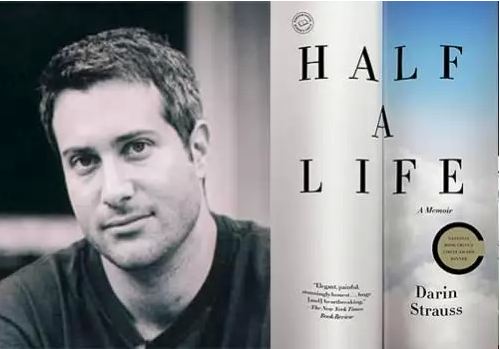
/

I wanted to write a graduation speech about the war on language, about the struggle we face every day as writers.   But my friends wouldn’t let me.  They told me to talk about living in a dorm again, about softball games and swimming holes and cafeteria food.

I wanted to talk about the real fears we face going forward as writers.  But my friends told me to celebrate this moment.  They told me to talk about the surprise birthday party we once threw for Gary Lawrence when it wasn’t his birthday.  How we bought him a cake and sang to him.  And how Gary had no idea what the hell we were doing, but how he smiled and blew out the candles anyway.

I wanted to remind you of the difficulties of finding work, about the strength we would need to make it in the writing world.  But they said to tell you the story of how terrified we were at our first student reading, how shaky our voices were.  But how we persevered, with dry lips and racing hearts,  and how proud we were of each other when we finished.

I wanted to frame our experiences here at Vermont College as a proving ground, and to tell you that we were crusaders ready to sweep out across the world in defense of language.  But my friends wouldn’t let me.  They told me to talk about the wine we drank in Dewey Hall, the conversations till dawn.  How we wrote erasure poems on potato chip bags and formed facebook groups and sent each other text messages and long emails between packets.   How we helped each other navigate through our doubts and believe in our words.
I wanted to talk about how scared we were as we approached graduation and how we wondered what we would do next, but my friends told me to talk instead about the laughter we shared at Charlie O’s, about New Year’s Eve in Montpelier, the fourth of July, about dinner at Sarducci’s and conversations on the porch of the Martin house.   They told me to talk about joy.

I wanted to quote Toni Morrison and Shakespeare and convince you of our earnestness.  They told me to tell you the story of our class readings at each residency, how we listened to each other’s poems and stories for hours, never once calling time on a reader who went too long.   And how nowhere else in our lives was this possible.

I wanted to speak about our resolve going forward, how we would rise up to the challenges of the world of publishing.  But they told me to talk about the friendships we’ve formed, about the dysfunctional family we became over the course of these ten day retreats from our lives.

I wanted to talk about how College Hall was built on the ruins of a Civil War hospital.  How it was a place of healing, but my friends told me not to talk about our wounds.  That pain was not nearly as important as laughter.   Not today.

I wanted to discuss writing, but they told me not to.  They reminded me that we almost never speak about writing itself.   That while we talk all the time when we’re here, it’s never about our own process.  They told me to celebrate our accomplishments, not dwell on the ineffable.

I wanted to make this speech about language, but they said that never could happen.  This experience, who we are as a class and who we want to be as writers, is not just about the words, but also about bonds between us.   We may write in a vacuum, but we formed a community here, one  without assumptions or judgments.  Well, maybe with a little judgment.  Did you see Michael Dickman dancing the other night?    

I wanted to close this speech with a metaphor of a soldier returning to battle, but they laughed at that and told me to lighten up.   Then, last night, Michael Bogan gave me a great piece of advice.  He told me to tell a personal story instead, something about what Vermont College has meant to me and to let that represent our collective experience.  So here it is.

Before each reading I delivered here, I had a friend who listened to me rehearse my words.  Danielle and I would go off to a quiet dorm room or find a bench in the shade of College Hall, and no matter how awkward my story was, no matter how tentative and unseemly, she helped me reshape the story until it was better.   She would never allow me to fall flat on my face.  And after I finished, I would do the same for her story.  And as much as any craft book or workshop  or packet letter, it was her friendship that made me a better writer.  And how we have all found those people here.  In our classmates and in our teachers.  And how such people are rare.

I wanted to write a graduation speech but I couldn’t.  Not until I turned it over to my classmates and they wrote it for me, perhaps not the words, but the spirit behind the words.

We can’t encapsulate what Vermont College means in 3 pages.  We can only tell you that it has changed more than just our writing.  It has changed our lives.

—Richard Farrell

/
/

Nov 042010
 

Joan Miro, "Nocturne"

I haven’t done any ‘spontaneous posting’ in a long while on NC.  Not since this wonderful site gained a steady following.  Now I write my posts out in MS Word first, and edit them, and read them again and again.  But DG keeps talking about the ‘renegade’ aspect of NC, the need to be playful and have fun.  So here goes.  Maybe the key is to keep it short.  I hope I still have a ‘job’ tomorrow at NC.

I woke up at 1:38 this morning, wide awake, to the sounds of a homeless person rummaging through recycle bins in the alley.   I’m going through a period of crisis over my graduation lecture.  I don’t like the damned lecture anymore, even if it’s been pre-approved (like a home loan?) by my advisor, so I came down to peck away at it again.  But how can this fact, my ‘crisis’ over a lecture in two months, begin to compare with that other person’s reality, that other person, out there in the alley, also awake at this ungodly hour, digging through garbage bins for scrap tin cans?

I brought my copy of Words Overflown by Stars to my five year-old son’s soccer practice the other day, with kids running willy-nilly, chasing that white ball wherever it went in spite of their coach’s warnings to spread out, to pass.   Eight little boys and girls simply chased, colliding, falling down, laughing, sometimes crying, but always chasing.  After the requisite time as a doting father had passed (about 4 minutes…I coached high school sports for 8 years…parents shouldn’t even be at practice…if they are present, they should be out-of-the-way, silent, not shouting…let the kids have fun, they aren’t there for you, they are there for themselves…do something with your time…read a book…trust the coach…yes, even at five!…sorry for the rant)  I flipped my book open to Jack Myers essay, “Collaborating with Chaos.”  It seemed, considering the shouting parents and crazy kids, a most appropriate choice.  Just a few selections from this essay:

The secret of artists and other creative people throughout the millennia-whether they are conscious of it or not-is that they know how to collaborate with chaos.  Yet, oftentimes, it is the very presence of chaos and confusion that leads to the fear of failure and instills resistance in us at the very beginning of the creative process.  The most oft-cited characteristic of creative people (aside from popularly being thought of as slightly crazy) is their ability to remain open during the rain of uncertainty, to embrace the difficult states of paradox, opposition, and ambiguity that are gateways of opportunity.

There are as many entrances into chaos as there are kinds of people entering it.  But there is only one way out, and that is the ‘con-fusion’ of disparities.  That’s why every time we make a new poem or story it seems as difficult to do as it did the first time.

…if you think writing poetry is like making a hamburger, that there’s some specific method to be learned and repeated over and over again, you’re in the wrong business.  Like everything else in creation, we, too, have been thrown into and live in uncertainty and indeterminacy.  There is no one, safe answer or secret to writing.

…complexity and simplicity  are not things, but ephemeral results of an interaction of these processes within other larger and smaller processes, within other larger and smaller processes, etc.

This is a wonderful, short essay that resonates with much larger issues.  It brought me a moment of calm amidst the chaos of that hour at the soccer pitch.  The best writing can do that, can open up a space for us to crawl inside.  My lecture’s still a mess.  I will go back to writing more carefully edited posts on NC, if I still can.  Parents will continue to believe that screaming at their five year-old is important, that it teaches competition, even though it masks something else: the fear of failure, the resistance, that Myers talked about, to chaos.  Homeless men will continue to eke out an existence on the detritus of others, of me.

It’s three fifty-one now.  Time to go back to bed and dream.

-Richard Farrell

Contributor’s Note: DG posted a tribute to Jack Myers after attending a memorial for him at the last residency.  Read that tribute here.

Oct 182010
 

Spaceships Spotted in Montpelier?  Reflections on Close Encounters at VCFA.

By Richard Farrell

In Steven Spielberg’s 1977 blockbuster Close Encounters of the Third Kind, an alien spaceship scorches half of Roy Neary’s face as it flies over his truck. (Richard Dreyfus plays Neary.)  Like anyone shaken by such a sublime and weird experience, Roy becomes obsessed with finding the source of those lights.   (Call to Adventure.)

The Winooski River wraps around downtown Montpelier like an untied blue ribbon and drains mountain ranges to the northeast of town.  The river then meanders northwest toward Burlington, before it empties into Lake Champlain.  The word Winooski comes from the Abenaki language.  It means “wild onion.”

I walked in the door of Dewey Hall on that first day of grad school, collected a plastic bag filled with paper-thin sheets, and felt certain that I was more talented, more dedicated, more well-read and more likely to succeed in this program than anyone else.  I thought I had travelled further, worked harder, and understood the world better than most.  I believed my talent would be quickly rewarded.

Roy is the quintessential everyman: he has a wife, three kids, a dog, a modest brick house in Indiana, and a steady job.  Until baked by the alien lights, there is nothing unique or particularly interesting about his life.

Dewey Hall, the dormitory on campus, appears to be named for Admiral George Dewey.  Admiral Dewey commanded the U.S. Navy ships at the Battle of Manila Bay during the Spanish-American War, and issued the famous order, “You may fire when ready, Gridley.”  (Well, it’s famous to Annapolis alums who spent 4 years learning naval lore.)  George Dewey was born in Montpelier in 1837 and once attended Norwich University before heading off to the Naval Academy.  VCFA merged with Norwich from 1972 until 1993.

On that first night of my first residency, I ate dinner across a table from Douglas Glover in Dewey Hall cafeteria.  He tried to explain image patterning to me. I didn’t get it. Fortunately, I had read Elle before coming to Vermont, so I managed to stumble through my half of the conversation by talking about his book. I feigned intelligence and somehow choked down a few bites of whatever root-vegetable medley was on my plate.

After seeing the lights, Roy becomes obsessed by a strange shape.  The form mysteriously keeps appearing: in his pillow, his shaving cream, in the mud castle of a little boy, and in mashed potatoes.  He can’t identify the source of the shape, but it begins to occupy more and more of his waking thoughts.  He believes the shape holds the key to his understanding, but he vacillates, trying to decide if he should pursue this obsession or return to his normal life.  (Refusal of the call.)

Completed in 1872, College Hall rises atop Seminary Hill.  The venerable building originally served as a theological seminary and was constructed on the remains of a Civil War hospital for chronically ill vets.  College Green once served as a racetrack and fairgrounds.  I found no mention of ice rinks or July 4th softball games.  The pipe organ was installed in 1884.

DG writes this: “Of course, what drives from a writer’s hand always remains secret, sometimes even from himself.  We surge toward the shapes we love without knowing why we love them.”   (from his essay “Reading a Mark Jarman Story” in The New Quarterly) From dinner, I walked across the snowy sidewalks to College Hall.  Continue reading »