Oct 012011
 

Carrie Cogan

.

Set in New Orleans “The Filthiest of Shiny Things” is a gorgeous excerpt from a novel-in-progress by Carrie Cogan who lives on Salt Spring Island, off the coast of British Columbia, with her husband and two small sons. Carrie earlier contributed a “What It’s Like Living Here” essay to Numéro Cinq. The two photos of New Orleans architectural details were snapped by Sarah Gadola Campbell, her old friend and long ago co-worker at Aunt Sally’s Praline Shop in Jackson Square. Everything Carrie writes is a treat. “The Filthiest of Shiny Things” is also a bit of a tease, not only because of the amazing title, but also because after reading this bit, you’ll want to read the whole thing.

dg

.

AS ROSE GETS OLDER she gets more stunted. Shorter, and skittish. Her eyes dart around so much that by afternoon a blink will feel so good she’ll draw it out, stop short on a sidewalk or halfway across the kitchen floor with her lids down, settling into the dark. If pressed–and she moves around enough no one knows what she started as, to ask how she slipped–she’ll trace her deterioration to the years she spent living alone on dry, deserted land, in a shed just bigger than a closet. But she knows she probably wouldn’t have chosen to live there, if she wasn’t stunted already. In that parched isolation she followed lots of bugs, and unlearned some grammar.

Now she’s in a city–the one they call The Crescent City, The City that Never Sleeps–and she speaks properly. She hardly speaks. But when she watches people, she can tell the ones who are chasing or being chased from the ones who are just sitting peacefully inside themselves, settled to the ground like musk beetles to a leaf. Some people, they are flat on their backs flailing in panic, and she can spot this even as they glide along fine.

.
She tries tricks–the little ones she can manage–to give her appearance the illusion of moisture. Something called Face Dew, with a bright pink applicator brush. As she spreads the shiny, heavy blots of Face Dew into her cheeks, she envisions a snail inching forward and recoiling across her face. She buys hand cream made for horse hooves, and lip gloss infused with silver glitter.

Down at the Walgreen’s on Canal Street, Rose watches a young black girl reach for a hair gel on the shelves while a kinky strand of her hair, seemingly electric, crackles free from a barrette. Now Rose uses the same product–it is thick as shellac, and smells like a stick of clove doused in gasoline. When she works it through her hair the strands fall heavy and damp, like drenched wool socks dipping a clothesline. She has noticed more than once, upon walking into a store, the way people glance worriedly from her gelled hair to the windowpane, expecting splatters of raindrops on the glass.

All these efforts to look moist–in the city with the wettest air. But Rose still appears on the outside how she feels underneath. Something like rust on a corroded battery. She suspects the landscape where she’d isolated herself–cacti, bones, flint and rusty barbed-wire–was the one that marked her.

People always look surprised when she says her name is Rose.

.
Rose has washed dishes all over the country. It whets her appetite. The plates here get filthier than any she’s seen–tourists like their creme brulees creamy and their jambalayas thick. She doesn’t make friends with the cooks, because it feels like she’s changing their diapers. Rose once caught a waitress named Junie picking at a piece of cornbread on a plate waiting to be washed. She’ll say say Hi to Junie. Otherwise she keeps her eyes on the dishes, or–while in transit to the sink–on the water and bits of food speckling the rubber tips of her sneakers into an abstract painting.

A large man, so black he sometimes looks purple, shucks oysters on Sundays, and Rose will step away from the sink to watch that. It’s no safer than juggling swords. His hand never slips and he lays the shells apart as smooth and easy as stepping one leg away from another. Sometimes when she’s watching him she pictures him shucking oysters inside a giant oyster, the shells parted just a slit. In that dark only his eyes, teeth, and the diamond shooting off the knife blade show. He whistles through his teeth and the whistle ricochets off the walls of the shell, becoming in its pearly hollows a cold, spinning wind.

After work her old red motorcycle boots, scuffed grey in places, hit the pavement chuck chuck chuck. And as she tromps she schemes, arranging and re-arranging the delicate details of abduction. But it’s easy to be distracted. Whole blocks go by with her half-drugged on the sights and smells. The wavering flames of gas-lamps, snapping without sound. A carriage horse’s hoof thudding softly into the shit left by some other carriage horse. The beads and vomit decorating naked chests; the unreachable gardens and fountains, framed in wrought iron shadows.

Some people paint their bodies silver, even their eyelashes, and stand comatose on pedestals. For that stillness Rose gives up her coins. One girl is solid white with golden hair and wings, an angel. And when she breaks her perfect freeze to bow she manages to make the bow look stiller than her stillness. People set flowers and 20 dollar bills at her feet. Rose bets she’s an old lady under all that. Still, she drops what change she has. She doesn’t give to the stilted Uncle Sam, or to the escape artist with a megaphone, or to the man who walks barefoot across broken glass, hefting the biggest person from the crowd on his shoulders.

.
She wasn’t completely isolated back in the desert. And it wasn’t just the landscape that dried her up into nothing. She blames a boy. He wasn’t technically a boy but he had giant dark eyes that never seemed to blink and a fresh take on things, like he had just arrived in the world. He drove a truck with a bullet-hole in the hub-cap, and tore open her bra with his teeth. So, man. Boy, man. Ghost. When one day his truck wheels failed to crackle the gravel leading to her shed, when one day the silence hollered and kept on getting louder, Rose became one of those people haunted by a living ghost. She despises such people. Crying into their drinks, re-playing the same moldy scenes on an endless loop. Pitiful people, pinned by cobweb shackles. For fifteen years she’s been mute, rather than talk the lovesick crap screaming inside her.

Now her ghost resides seven miles south-west of her apartment, and the air is full of music. Some guy in a red lumber-jack coat sitting on the corner of Dauphine and Ursulines wails a blues song like he’s sliding a knife from his wool picket, setting a heart out on the curb, and stabbing it ruthlessly. He’s just singing. But Rose, she doesn’t collapse. She doesn’t think of the way that boy made perfect sprinkler sounds beside her ear, to cool her off. Or the bits of smashed orange bicycle reflector he stuffed into his pocket. Grubby treasure, he called it, and strung some of it into a mobile he tied above her bed. Rose doesn’t care. I’ve been places way over the sea, the musician cries. She doesn’t falter or flinch. That’s how I know you’ve done forgotten about me. If anything, Rose’s step quickens. The blues pulse her forward with the force of a battle hymn.

.
If not for the constant machine sounds and traffic barreling by, Rose might think–by the smell of her apartment–that she lives beside the ocean. She rents a second story in the Bywater, beside a fish factory. The toilet is broken, and that constant gushing inside the bowl could be shoreline. Also the floorboards are rotting, and they give under her feet like sand. One of the workers at the fish factory sings, but the machinery there is so loud it took Rose two weeks to figure out he was singing in French. When she walks out her door each morning, she stops short with her face tilted down, admiring how the pavement sparkles with scales and guts.

She has a time-tested theory about moving into an apartment: unless you drag in a good piece of furniture that first day, or have a good meal, good drug trip, or good fuck in it within that first twenty-four hours, it’s destined to be a miserable space. When she got the keys to this one, she shook all the clothes out of her pack, into the middle of the empty floor, and fell asleep on them. It was light when she went to sleep and light when she awoke, but a day had passed. So she knows there’s no hope for this place.

In the first weeks she draped some of the beads she’d found along the gutters–dice, camels and fleur-de-lis–around the nails in the walls. But they looked too pathetically hopeful–like lawn ornaments in dead grass. She is grateful to whoever left the nails behind, because depending on the light they flash or give a dot of tar black in the familiar places and her eyes automatically travel to them, as they would to paintings.

.
Inside the Quarter, behind a fence of wire diamonds, looms a large brick elementary school: Bishop Acadamy. If she’s in the area Rose consults her watch–an old Mickey Mouse one repaired, in the split leather strap, with silver duct tape. The children spill out into the schoolyard for recess at 12:20. If she arrives even a minute early, she gets to witness the transformation of the absolutely still asphalt bombarded by flailing limbs and screeches. The students remind Rose of ocean: they spill out the door fast and roaring, then seem to slow and murmur as they spread out to the far reaches of the yard. They sizzle quietly in the peripheries, like sea-foam. She lifts one hand above her eyes against the glare, scanning through the heads of hair, searching.

After passing so many half-naked people in the Quarter, the student uniform of plaid skirts or shorts, white shirts, and black neckties lend a surreal feel to the scene, like Rose has stumbled into an Opera.

One afternoon a short man with bleached hair and mirrored sunglasses sidles up to her. An undercover cop? A parent? Or a plotting child-snatcher, like her? He curls one hand around the fence, the other around a go-cup.

“Which one is yours?” she says curtly. When he turns to her she spots a shrunken image of herself in his lenses. Leering at him with her frazzled hair. A wolf.

“None,” he says. It takes just one word to reveal a southern drawl. His lips stretch out, impossibly slowly, into a smile. “I was just trying to remember what that was like.”

“Oh,” says Rose. “Recess, you mean?”

“Yes Ma’am,” he says. He takes a sip from his cup, which could be water but for the swizzle stick and lime wedge floating in it. “I figure it’s something you either like or don’t, and I was just trying to remember if I did.”

“My son doesn’t, usually,” Rose says. “Or he doesn’t like the idea of it. I think he actually has a good time during recess.”

The man takes his hand from the fence and pushes his sunglasses to the top of his head. Rose takes this to be a gallant and old-fashioned gesture, this show of eyes to prove that he’s listening. They gleam blue, a little wetter than they should, which makes Rose wonder if he’s lying and does remember his childhood after all. The possibility makes her like him ferociously.

“He’s kind of a loner, see, so he stresses over group games.” She gushes. “But on the other hand, once he’s out there’s much more space between him and other people.”

“Which one is he?”

Rose was hoping he would ask.

“Just there,” she says. He’s the whitest in the crowd–almost pale-blue. He’s over in the corner on one knee, sorting through gravel. They can’t see his freckles from here. His hair is sticking up where it shouldn’t, styled like only the wind would’ve done it. Alexander, he’s called. She’s pretty sure never Alex or Zander. If he got glasses, Rose thinks, by the next day the kids wouldn’t be able to remember him without glasses. He would be difficult to lure away. Harder than Ryder, the one Rose is going to take. Rose hasn’t seen Ryder in his schoolyard yet, but she assumes he talks to all sorts of people. Still, she suspects she’d have a better time with Alexander. She’d want to keep a tally of what he said.

“He looks like you.” The stranger, her new best friend, the confidant she’ll never see again, says.

“Really?” Rose is smiling, her lips up close to the fence.

“Yeah. You’ve both got that really smart look, like you just woke up.”

.
Rose remembers all kinds of crazy things from her childhood as she’s washing dishes. It’s not like tea leaf readings, not that the soap suds drift and bond into visible images. Maybe it’s the sloshing of her hands repeatedly into the warm water, dipping her right back into the womb, into baby baths. Or the flashes hypnotize her–the light bouncing off of soap suds, silverware, spanning bellies of plates in the drying rack. As a toddler she hoarded the filthiest of shiny things, mistaking them for treasure. She remembers her mother feeding this fervor, carefully twisting off the tabs from her beer cans or gingerly handing over the cellophane from inside her cigarette packs. You be very, very careful with this. On the other hand, her mother once handed Rose a thick envelope with a small sparkling seal embedded into it. The square flashed silver from a distance, but up close revealed a spectrum of colors, pale blue green yellow and pink–all those you’d see in a dragonfly wing. It’s a hollowgram, Rose murmured. Her mother laughed and said sweepstakes were for suckers.

.
A few times weekly Rose takes the streetcar uptown, and walks two blocks to her ghost’s house. A towering three-story white house beside a cemetery that would stand out as monstrous were it not sandwiched between similar houses. It has gables and wrought iron balconies–and from the faint, constant whirring she suspects it also has an elevator, or a pool.

The boy Rose loved lived in a trailer and tacked polaroid photographs to the walls with chewing gum. Now he’s married to a famous pop star: skinny, with long shiny yellow hair and a white smile. Rose isn’t sure the radio would play her if she were homely. She’s right in tune, but her songs repeat the chorus at least three more times than they should, and always end on it. Her lyrics sometimes allude to being haunted, but her voice stays smooth and so never seems to agree.

The lyrics in his wife’s songs are nothing like the perfect sentences the boy had scrawled in his letters. Now those were songs. Astounding details of the every day noted in a crazy mix of capital and little letters Most of the pages he sent were penciled faintly, so that even as she clutched them, freshly-salvaged from the tin jaws of the mailbox, Rose would sense her letters–they were hers! They had her name at the top of them!–disappearing. Reading those letters felt like looking into a mirror and seeing, beyond your face, a faraway bird dipping and soaring and somersaulting end over end through gaudy blue sky. There is so much beauty in the world, his letters said without saying. And you’re facing it. You’re it the most. Because you see it.

.
Rose perches in the cemetery, at the fence-line, where she can see his house from a part in the hedges. The hedges are otherwise packed tightly together; just this one break, where a child or a spirit or a mourner mad with grief broke through. No one ever sits on the front porch chairs, or on the ones on the higher balcony. They’re just there for parades, Rose supposes. All the empty porches and balconies in the neighborhood seem strange coming from the Bywater, where bodies lounges on every stoop, stair, or plot of sidewalk.

The house is so still. Rose has no way of knowing, by staring at the house, if anyone is inside. They might have been out of town for weeks. How boring is architecture? She thinks. So private and unmoving. So unlike the human face that has me standing here, staring at a house. Even the memory of a face is like dancing, dancing on fire, compared to this line of still white houses. Rose sighs, and turns around. The tombs too are massive, impenetrable. The head of a flower–pink, with crispy brown edges, as though it has been set in an oven and timed just so–lies quivering atop one, impossibly fragile.

.
Sundays, the restaurant spills outside to a patio with tower-high bloody marys and oysters on the half-shell. Rose is on her break, sipping the dregs of the kitchen coffee. Chewing on the grinds. And watching the oyster shells fly. She knows customers don’t like seeing the person who has to wash up after them–it’s like being told goodbye before they’ve even ordered. So she stays over to the side, in the shadows.

The oyster shucker pauses, raises a bottle of orange pop to his lips. The lump in his neck bounces five times on one sip. Crush, the bottle says. In big puffy letters, more inflated than crushed.

“Hey,” says a voice beside her, “You don’t have a light, do you?” Rose is dismayed she didn’t see Junie coming, in her bright green-and-white checkered waitress uniform with the starched white half apron in the middle. She shakes her head.

Junie sighs. “I guess it’d be bad policy to ask him,” she says, nodding towards the oyster shucker. “Seeing as his hands are busy.”

She slouches back against the wall and holds the cigarette up, squinting at the tip of it. Rose can’t tell if Junie’s honey-colored hair is dry or greasy because she always has it in braids. Today the braids are pinned up into curls on either side of her head, Princess Leia style. Her lips are pillows of bright red, the kind of brightest red that makes you think before she approached you were watching a black-and-white world without knowing it. She probably puts powder on her lips first, so the lipstick will stay. Rose read about that in a magazine.

“Those bloody marys have whole salad bars in them,” Junie says. “But I guess you know that.”

Rose shakes her head again. “Most of the bloody mary glasses come back empty.” They are slippery to wash: long diamonds with many sides and thin bases.

“Well, let’s see. They have olives, and celery, and artichoke hearts, and marinated mushrooms, and dilly beans, and those tiny corn-on the-cobs that don’t taste like corn.”

“All that?” Rose says.

Junie nods. “I have to constantly reassure people they’re not lacking vodka.”

Junie lifts the cigarette to her mouth, inhales as though it were lit. When she pulls it away the end blazes crimson. She is pretty, Rose realizes suddenly. If you look past the plaid uniform, past the clumsy and distracted way Junie moves. She remembers thinking once, as she saw Junie stepping across the restaurant with a tray of dishes, in that jerky and spacey way: She looks like someone who is bird-watching. Someone who might trip over her own feet and bust the binoculars around her neck. But now, up close, Junie looks regal, like someone who should glide. She has good cheekbones–twin diagonal pillows that add gleam and shadow and dale, a whole landscape, to her face. And perfect skin, like she drinks twelve cups of water every day. If this were the movies, Rose thinks. Junie would pull out a cigarette and five different men would appear out of nowhere to light it. Why are you working here, she wonders. But it’s not a question Rose would ask, since it’s a question she would hate to be asked.

“So ends my break,” Junie says. She reaches into a pocket beneath her apron and pulls out a cigarette box, carefully feeding in this one with the stained tip. “I’m trying to quit anyway.”

“Good luck there,” Rose says. She saw how delicately Junie treated that unlit cigarette.

“New Orleans is the shits for trying to quit things. Do you find that?”

Rose gulps, and looks down. Beside her shoe is a stray oyster, naked and leaking. So much of the litter on these streets looks like it’s alive, she thinks. Alive, or newly dissected out of someone.

“I do,” she manages.

.
Rose knows if she spends a couple hours with his son–the youngest one, who looked almost Three in the internet photo–she will get over her ghost. The boy has his father’s huge dark eyes and his mother’s silk-yellow hair. They will eat sundaes at the ice cream parlor she passes on her way to work, their long spoons clinking against the deep tear-drop dishes she sees dangling in a long line above the counter (sparkling, because all dishes look well-washed if you hang them high). Dada this, he will say, between mouthfuls of ice cream, Mama this. Dada Mama do this, Dada Mama say this. Brother Other Brother Sister Dada Mama Doggie together in House. Rose feels certain, hearing this toddler talk about his family, that she will get it then. She will suddenly and thoroughly understand, in a way she can’t seem to otherwise, that the boy from her past is gone from her. She can finally put the past in the past.

If only his family lived in the suburbs somewhere, in a simple house without a fence or alarms. Maybe she wouldn’t have to borrow the boy. She could peek into their yellow-lit windows one dinner hour, watching them all interact around a table, and have the same yearned-for epiphany. Your locks and alarms, your shutters and massive square footage, she whispers. They’ve made your house dangerous.

.
The daiquiri shops are a skewed sort of laundry-mat. Pitch dark laundry-mats, so you can never see if your clothes got clean. Laundry-mats with frozen drinks instead of clothes spinning in the line of silver dryers. And the background radio music suddenly shifts to loud metal in the later hours, to distract potential re-orderers within from the fact that they’re drunk.

Rose wouldn’t mind working in one. The new people, the tourists–some from places where you have to drive a long ways to get bottles of alcohol you can’t open in public–they can’t hide their glee. They think they’re dreaming. Here you go, she might shout, over the music, and wave her hand down the line of whirring colors. Dispensing the dream. Here is a 180 proof drink resembling the Icee of your childhood, as big around as a trash can, in so many more flavors than cherry and cola. Take it out into the heat with you. Walk with it. Meet the cop’s eyes as you take a long draw on the straw.

Initially Rose tried all the flavors, but she found the High-Octane made stuff that wasn’t moving dance real pretty, and froze all the pretty people she saw dancing to slow-mo. So she sticks with that. As a bonus it gives her lips a nice application of dark red.

Junie orders the Blue Hawaiian. She turns at the register and says something Rose can’t hear, smiles. She reminds Rose of Day of the Dead decor: big white skeletal teeth sandwiched between cheekbones, which are sandwiched between braids.

“You got the small,” Junie says, when they are back on the street.

Rose has to be careful. She wouldn’t want to moan heartbreak. Or boast revenge. She doesn’t want Junie to have a single glimpse into her. And yet, and yet. She wouldn’t mind a friend like Junie. Junie’s the kind of bug who could lug an entire dead rat away, millimeter by millimeter.

“I’ve broken my wrist a few times,” she lies. She nods at Junie’s cup. “That size could snap it.”

.
When Rose collapses down on her single mattress, in the triangle of floor cast white by street-light, she weakens. Her mother made her pray before she fell asleep, and Rose still hears her voice, prompting. What are you thankful for? What did you do that you’re sorry for? The mere memory of her mother’s voice dissolves her plotting warrior and she writhes, flopping, twisting the tail of her long white undershirt. It was her ghost’s shirt once, so it almost reaches her knees. The hole just beneath the left armpit has spread enough she sometimes wakes up with her elbow, caught inside it.

She worries into the dark that when she snatches his son after school, and takes him for ice cream, he’ll order pistachio. And just because his dad always did, as stupid as that–Rose will fall in love with him. She worries time will go all funny when they’re together, the way it had when she was with his dad, so that the minutes won’t slide into each other but stand apart in magical chunks, unrelated. She worries this boy will already have the same slanted take on things his dad did, which made everyone afterwards sound so sickeningly predictably. Then she’ll have to keep him. Just to stop his beautiful observations from that day repeating in She’ll have to keep him so her ghost can know what it is to be haunted.

And what if? Humans walk by her window all night, laughing and singing, cursing or vomiting, and Rose begs silently for their sounds to carry her firmly into the present, into this room in this city. She focuses sharply on the geometry of the window-frame, then of the perfect shadow it casts, but her worry seeps everything blurry and yanks her backwards through time into this one what if.

What if this boy is somehow the living re-incarnation of the child she aborted when they were together?

(The baby-that-never-was is sleeping deeply, drawing her down with it. She closes her eyes to better see it. Tiny, damp and stunned, snatching breaths so big they make its translucent red chest bubble out and in, out and in, like the throat of a frog.)

With her eyelids lowered Rose practices saying the name out-loud, so it will sound casual. It has to sound like she just now heard it. Ryder, she says. Hi Ryder, she says. I’m Rose.

—Carrie Cogan

Sep 112011
 

To write false novels

Whoever you may be, if the spirit moves you burn a few laurel leaves and, without wishing to tend this meager fire, you will begin to write a novel. Surrealism will allow you to: all you have to do is set the needle marked “fair” at “action,” and the rest will follow naturally. Here are some characters rather different in appearance; their names in your handwriting are a question of capital letters, and they will conduct themselves with the same ease with respect to active verbs as does the impersonal pronoun “it” with respect to words such as “is raining,” “is,” “must,” etc. They will command them, so to speak, and wherever observation, reflection, and the faculty of generalization prove to be of no help to you, you may rest assured that they will credit you with a thousand intentions you never had. Thus endowed with a tiny number of physical and moral characteristics, these beings who in truth owe you so little will thereafter deviate not one iota from a certain line of conduct about which you need not concern yourself any further. Out of this will result a plot more or less clever in appearance, justifying point by point this moving or comforting denouement about which you couldn’t care less. Your false novel will simulate to a marvelous degree a real novel; you will be rich, and everyone will agree that “you’ve really got a lot of guts,” since it’s also in this region that this something is located.

Of course, by an analogous method, and provided you ignore what you are reviewing, you can successfully devote yourself to false literary criticism.

via Manifesto of Surrealism.

Sep 052011
 

As a riposte to the doom and gloom about writing these days, the End of Times sentiment let loose by the marketing people of the world who sense, yes, alas, that the current spasmodic writhings of capitalism bode ill for the bottom line, here’s an interview with Tom McCarthy in the magazine The Days of Yore. McCarthy is ever cheerful, smart, well-read and positive–for someone who makes a living dwelling on failure. You might say he has made a success of failure–read the McCarthy interview in the context this Zadie Smith essay in The New York Review of Books in which she contrasts the “successful” well-made middle-brow novel with McCarthy’s novel Remainder, which, as Smith says, rather “gleefully” tears apart everything we’ve come to expect from a good novel.

These aren’t particularly healthy times. A breed of lyrical Realism has had the freedom of the highway for some time now, with most other exits blocked. For Netherland, our receptive pathways are so solidly established that to read this novel is to feel a powerful, somewhat dispiriting sense of recognition. It seems perfectly done—in a sense that’s the problem. It’s so precisely the image of what we have been taught to value in fiction that it throws that image into a kind of existential crisis, as the photograph gifts a nervous breakdown to the painted portrait.

via Two Paths for the Novel by Zadie Smith | The New York Review of Books.

dg

That’s some good advice. Any other advice for young writers?

I remember seeing an interview where William Burroughs was asked this question and he said, “Learn to type.” Anything I could say would be totally bland. Read a lot. See? That’s totally bland. But that would be the best.

Go smoke hashish on a bed?

[Laughs.] Go smoke hashish on a bed in Paris! No, I don’t know. Read. Read, read, read. That would be the thing. Because, ultimately, it’s not about having something to say. It’s what Kafka said, “I write in order to affirm and re-affirm that I have nothing to say.” Writing is not about having something to say. It’s about an intense relationship with the symbolic. Which means being completely immersed in literature, which means in other literature, but also in the world and all its mediations. So, maybe that would be the advice: Go and get immersed.

Everyone is grumbling about the end of the book. What do you have to say about that?

People who proclaim the end of the book just haven’t read their literary history. I mean, the first novel, Don Quixote, is about the end of the book. That is the premise of literature.

via Tom McCarthy « Visual Artists « The Days of Yore.

Aug 182011


.

Ian Colford is an author and librarian (not a bad side occupation for a writer) at Dalhousie University in Halifax, Nova Scotia. He has had stories and commentary published in about 20 different print and online literary journals including “Laurianne’s Choice” in Numéro Cinq. His 2008 story collection, Evidence, was shortlisted for several prizes, among them the Thomas Raddall, the Danuta Gleed and the ReLit. It won the Margaret and John Savage Award for best first book. 

The Crimes of Hector Tomás is a novel the action of which takes place in an unnamed South American country during a period of political turmoil in the 1960s. Hector is fifteen. He has committed an assault, and rather than risk his arrest his parents are sending him away to live with his aunt and uncle on their farm in Envigado. For a number of months his father’s behaviour had aroused Hector’s suspicions, and the assault was motivated by Hector’s jealousy of another boy, Jorge, on whom his father had been lavishing attention. Nadia is Hector’s girlfriend. Hector’s brother Carlos is also mentioned. A few years earlier Carlos became involved with a resistance group. One night he was abducted by armed thugs. He has not been seen since. Parts of the novel were composed at writing retreats in the US (Yaddo) and Scotland (Hawthornden Castle).

dg

.

From The Crimes of Hector Tomás

By Ian Colford

.

The rickety train skirted the mountains, passing villages that were no more than clusters of huts and shanties, occasionally winding its way up into the hills and chugging laboriously across a high plain. There were frequent stops. Hector could hear and see, in the warmth of greetings and in the eyes of children trying to sell plastic Virgin Marys, molasses drops, and dried figs to the passengers, that the train’s arrival was a momentous event for the people who inhabited these parts.

Progress was slow. He had plenty of time to drift from one sweltering compartment to another, to watch the ocean pass by on his right and the mountains on his left.

His belongings filled a single small valise: clothes, toiletries, a deck of cards, a few prized superhero comic books: The Flash, Spiderman. He wore his only pair of shoes, which still bore traces of Jorgé’s blood. The lazy swaying of the train made him restless and he did not like the way his traveling companions looked at him—sullenly, as if he represented all that was troublesome in their lives. The soldiers in particular, of which there were many, seemed annoyed by his presence. He did not trust any of these people and when he roamed from one compartment to another he carried the valise with him. He took it with him to the toilet. He saw how the other passengers watched him and knew they did not trust him either, and for the first time in his life he began to suspect that the black hair and swarthy complexion he had inherited from his mother’s family marked him in some way. The man who examined his ticket did so with a wary frown, as if he could hardly believe there wasn’t some trick being played on him. Sitting by the window half dozing, Hector inadvertently met the glance of a young mother, and at the moment of contact she gathered her baby close to her breast as if to protect her from the evil eye. What did they think? That he was dangerous? A murderer? Many people had black hair and skin darkened by the sun. It did not mean they were murderers. He smiled at the woman with the baby, but she lifted her chin and did not smile back. A few moments later she stood, collected her things, and left the compartment.

The landscape was parched. The sun beat down without mercy and Hector recalled the geography lesson in which his teacher had told the class that certain regions of the country had not seen a drop of rain for a hundred years. In some areas people working the fields paused and stared as if mystified, watching the train pass them by. Hunched and motionless, they seemed like stumps from huge felled trees. Oxen and goats huddled behind sun-flayed wooden fences had a look of doomed resignation about them.

Continue reading »

Jul 052011
 

Matthew Stadler

Publication Studio recently released Matthew Stadler’s fifth novel, Chloe Jarren’s La Cucaracha.  With this book Stadler challenges our ideas about authorship. The story is a “cover” of another book (ala rock-and-roll cover songs). In this case, Stadler has shoehorned his own creativity into the tightly defined structure of John LeCarré’s 1962 novel,  A Murder of Quality. It is a stunningly original work riding on a classic tale.

Herewith, Numéro Cinq is pleased to bring you chapter one.

LQ

.

Chloe Jarren’s La Cucaracha

By Matthew Stadler

Chapter 1

The city fills a great bowl in the steep Sierra Madre, the meeting place of three river canyons that the Chichimeca Indians called “the place of the frogs.” There were frogs here, and Chichimeca, for centuries before the arrival of Spanish armies. Today the only frogs are on tee-shirts and the shelves of ticky-tack tourist stands. The Chichimeca have been bred away or simply disappeared into the immensity of the surrounding Mexican countryside. The name survived, altered slightly by the conquerors from “Xuana Huato,” to Guanajuato, a word so serenely Spanish sounding that tour guides must remind the visitor of its Chichimeca origins. It is a mestizo name, a halfbreed, hiding its native blood behind the pleasing sonority of a well-fed Castilian lisp.

The basin holds a colorful patchwork of buildings, all of them forever under construction, four centuries of architecture tossed carelessly together, like so many toys in a spoiled child’s treasure chest. The rim of the canyon is bare, an empty mountainous plain of scrub brush and rock, but below it the city presses up from the depths of the basin, surpassing the busy ring road, the panoramica, to reach the upper limits of the delivery men who hand-carry their heavy canisters of gas and agua into the crowded warrens of houses.

It doesn’t matter what day it is; always, as the late afternoon sun burnishes the ridge of the cerro de Serena to the east, a series of cannon blasts echoes up the steep canyon walls, like rocks skipping on water, plonk plonk plonk plonk, further and further, until with a last dim splash they disappear. Puffs of smoke lift from the houses. It is impossible to tell who is firing the cannon or why, the scene is too closely packed and confusing.

The blasts are followed shortly by the machine gun staccato of hundreds of schoolboys pounding on drums. Dressed in white and green, they’re visible in glimpses as they serpentine their way down the hill into traffic. There is some kind of saint or a dead person laid on a bier with ribbons and candles at the front. Templo de San Francisco’s rough stone towers catch the last sunlight, golden against the blue sky. Birds lift from the plaza, disturbing the trash, and men pulling on long ropes ring the bells of the church. By the entrance to the tunnel, scores of trumpets mew like sick calves as the absent minded boys keep pounding on their drums and traffic pools behind them. It could be any day of the year. There is always a parade, always the fugitive cannon blasts, always the haphazard ranks of boys in their school uniforms raising a holy hell as the day tumbles forward.

Continue reading »

Jun 252011
 

Years ago when I had my radio show (The Book Show at WAMC, the public radio station in Albany, NY,–the show still persists under different management) I interviewed William Gass about his amazing novel The Tunnel. Usually I interviewed authors by phone, but Gass was in town for a reading and so we met in the studio. I had always admired Gass, who seemed to have learned his moves at the feet of Gertrude Stein but then vaulted himself into a whole other planetary system. His essay “On Being Blue” is a classic, the place I learned about image patterning and thematic forcing (that essay and Margaret Atwood’s novel Cat’s Eye). But I brought a baseball bat and placed it on the console between us and started the interview by suggesting he would probably want to hit me with it after I asked him a few questions. Critics were up and down about The Tunnel. Some, whom I would now describe as Tea Party Lit Crits, even went so far as to claim it wasn’t a novel at all. These were the kind of critics who only allow novels firmly in the tradition of the bourgeois epic starting with Defoe. (Sadly this is also the tradition out of which most creative writing students think they descend.) But there is a Bigger World out there, and this is a lovely reminder of the shapeliness of complexity (complexity being a whole other value system lost on conservatives of all kinds). Read this piece and think about structure, form, elaboration and the spirit of play—what should be at the heart of all great writing. Needless to say that bat was handy as a talking point, and Gass and I had a great conversation (which you can  no longer hear because of copyright squabbles–although I have a tape). You can, however, read an interview with Gass at The Believer and at the Paris Review. Or read Gass’s introduction the Burton’s Anatomy of Melancholy–for what he says about Burton’s sentences.

Thanks to Brad Green for sending me this link.

dg

How to Design a Lump of Darkness

William H. Gass has long been interested in design, particularly in the marriage of language and art. In his experimental 1968 novella Willie Masters’ Lonesome Wife, Gass used images and an array of fonts, colors, and symbols to suggest a text as female body below its male reader, the language the love being made. The author has admitted that some of these visual efforts were more conceptually interesting than successful, and at least one of his reasons why—”I was trying to find a spatial coordinate to go with the music”—is tellingly unhelpful. Gass’s interest in the visual arts would continue for decades, through his own photography, the Dual Muse exhibition and conference his International Writers Center put on in 1997 (painters writing; writers painting), and projects relating to what he calls “the architecture of the sentence.”

Thus it’s clear, reading this previously unpublished “Designing The Tunnel” document, that we’re hearing from a writer who cares deeply about the look of a book. “I regard these instructions and the general layout of the text only as indications of my intentions,” Gass began, welcoming the suggestions of a “sympathetic designer” who might take him closer to his goal. That said, he doesn’t sound like an author uncertain of what he wants. Having requested that the book be bound in rough black cloth, with a spine like Viking Press’s edition of Finnegans Wake, Gass stated that the reader “should be holding a heavy[,] really richly textured lump of darkness.” The cover should not have the author’s name. “Why not put the author’s name on the book? Because it is Kohler’s book. Because, in a sense, it is not a book.” Gass sounds like an art-class enthusiast describing his hopes for typography—”I would love it if every line looked like a length of barbed wire”—as well as the treatment of Kohler’s doodles, which might, if successful, bring to mind Hitler’s architectural sketches of camps. “I want something at once naive,” Gass instructed, “a little charming, and a lot unsettling.”

via Basking in Hell: Returning to William H. Gass’s The Tunnel | Quarterly Conversation.

Jun 172011
 

Winterbach
Of The Book of Happenstance, a novel from the award-winning South African author Ingrid Winterbach, our reviewer wrote: “The Book of Happenstance is about memory and death, yet paradoxically so, for the novel is ebulliently alive, ironic and smart. The characters seem hyper-linked to Google and Wikipedia; the book is full of spontaneous eruptions of intelligence, and that is fun to read.” Here’s a delightful excerpt from a new translation hot off the presses at Open Letter Books. Read the whole Numéro Cinq review here.

dg

Capture


The dead move along their own orbits, like planets. Like celestial bodies they encircle me in their elliptical courses. My mother, not urgently present in my thoughts for a long time, now appears in my dreams night after night. Her soft, elliptical path is at its point of closest proximity to me, and each of her appearances ushers in a great sadness. I see her lying in a small room, with only a bed and a tiny window. She is sleeping. She is abandoned, she is sick or dying. There is something indescribably desolate about her sleeping form under the blanket. There is something about the blanket which lends it an unbearable emphasis. I cannot hold on to the dream to reflect on it. Even worse is when I know that I have dreamt of her, but cannot remember the dream.

If Marthinus Maritz should describe an orbital course, it would be that of a distant, cold planet. Would he be one of the outer planets? Neptune with its howling winds? Uranus with its aeons of darkness, where time gets infinitely extended? Saturn, so light that it could float on an enormous lake? Or Pluto, the smallest, coldest, darkest, and most distant—the only solid outer planet, with its surface of ice and methane, a frozen rock?

Sof phones again late one night, shortly after we had sat in the car looking out over the sea in the manner of Mrs. C and Vercueil. At least this time I am not asleep. I am still immersed in my unravelling, in my laborious journey through evolutionary and geological history. I am still trying to make sense of the magma ocean, of iron pools, of the cooling earth crust, of the crystallising of the earth’s mantle. (How in God’s name should I conceive of all these processes?) My eyes are burning. Much more than a therapist (and here I have to differ from my lover), I need a geologist to guide me step by step through this inaccessible and treacherous terrain.

“Am I disturbing you?” Sof asks.

“No,” I say.

“I’m thinking of taking a lover,” she says and clears her throat slightly.

What can I say to this? Have you anyone particular in mind? Who is the lucky man, or woman? Nowadays anything is possible, and I am not yet familiar with the ambit of Sof’s sexual preferences.

“Who is it, Sof?” I ask.

“It is my children’s paediatrician,” she says, and gives an exculpatory little cough.

“I see. What does he look like? She? What kind of person is this—a kindred spirit, a concordant fellow being? Is there a future in it for the two of you?” I am tired, the nightly acquisition of complex knowledge is taking up much of my energy.

“He’s a cripple. I think he had polio as a child. He has reddish hair. He has heavy eyelids that flutter slightly when he speaks, as if he can open his eyes only with great effort,” she says with the unmistakeable tremor of erotic excitement in her voice.

“That has to be irresistible,” I say.

I know the type; I am familiar with the erotic persuasiveness of a russet complexion. (Perhaps I should never have terminated the relationship with Felix du Randt.) As regards the other afflictions, I do not need much convincing, since I have been beguiled by a variety of aberrations and deviancies—physical as well as psychological—myself. Consider the bony brow and the blunt death’s-nose. I should have re–mained true to Felix du Randt. He would have been a good man for me. He would have kept me on the straight path, the virtuous way. I would have been less exposed to temptation and spared many woes. My impressionable spirit would have been less contaminated. I am suddenly under the impression of the lifelong burden of emotional sullying (from the French souiller, to soil, Theo would have pointed out).

“It is!” Sof says. “It was the fluttering, half-mast eyelids that finally did the trick.”

“When was the deal clinched, so to speak?”

“This afternoon.”

“What is the next step? Where will you meet? Will you go dancing? No, sorry, I guess that’s not an option.”

“I’m meeting him in his consulting room on Friday afternoon after five. We will take it from there.”

“Sof,” I say, “this is unexpected. I don’t know what to say to you. I wish you luck. Happiness, ecstasy if needs be.”

(If I had the choice now between the bitter excitement of a drawn-out erotic intrigue and the grind and risk of writing—to which Becket refers as the “bitter folly”—which would I choose?)

“I’ve just read an interesting article,” Sof says with a little cough. She is embarrassed; she wants to change the topic. “All writers are actually pursuing a single ideal, namely the universal.”

“I’ve always thought the universal to be suspect.”

“It is,” she says, “but it does not make the striving of writers less valid. All writers intuitively know this—the one who gets a grip on the so-called universal attains the upper hand. The trump card. Whatever. I thought it would interest you.”

During this time Theo sometimes leaves the office in the afternoon for an hour or two to attend auctions. He returns with a feverish glint in his eye. In this state of heightened excitement he listens to Schubert’s piano sonatas to calm himself down. He breathes deeply, closes his eyes, and surrenders himself to the music. Only then can he resume his work.

Did you see lovely things? I ask cautiously. (What is the ironic undertone doing in my voice?) Beautiful, he says, but does not elaborate.

Enamoured of something? His heart set on objects of beauty? With that I am well acquainted.

His hands are not small, but well-formed, like his wrists. His nails are somewhat fan-shaped, the way I like them. He is no longer a young man. The well-defined, youthful male form has begun to soften. The eyelid is softer, it looks more vulnerable, as does the skin of the neck—I know how desirable I find that in my lover. The hair on his chest (what is visible of it) is beginning to turn grey. All these things appeal to me. I am here to assist him. The documentation of words no longer commonly used, that is our shared purpose.

I return to the cards. Eindera, regional term for eintlik—actually. Eindjie—archaic form of entjie—a little way (stap ’n eindjie met my saam, my lief—walk a little way with me, my love). Einste, originally eienste—decidedly the same. Eindtyd—the end of time, end of the earthly dispensation. Êit!—restraining exclamation: êit, kêrel, nie so onverskillig nie—easy, lad, not so reckless! Elkedaags and elkedags—outdated variants of everyday. Elkelike—regional term de-noting regularity. Elkaar and elkander (each other); elkend-een (everyone); elkendeur or elkensdeur (time and again); elkenkeer or elkenmaal (every time)—all of them outdated forms. Ellend (variant of ellende—misery).

Die ellende staan blou in die blom,” I say. (Misery stands blue in the bud.) “A lovely expression. What would be the origin of ellende? Of the word, I mean.”

Theo explains that the Dutch ellende is derived from the Middle Dutch ellende,which means another country, or exile, also a disastrous condition, grinding poverty, and privation. This may be compared to the Old Dutch elelendi from the tenth century, the Old Saxon elilendi, and the Old High German elilenti, of which the el was abbreviated from elders, alja, and lende, landa—which literally means land elsewhere, that is to say, sojourn in a foreign country, exile, and its accompanying feelings of uprootedness.

“Thank you,” I say. “Now I understand that our earthly existence is essentially wretched.”

Theo smiles, but will not take the bait. I wonder how often I am mistaken about him.

We often listen to Schubert during this time. When Theo is relaxed, he sometimes whistles softly to the music.

A day or two later he shows me a ring that he has bought at an auction. It is an antique Indian ring, white gold, inlaid with countless small amethyst stones. He must have paid a fabulous sum for it.

“Is it a gift for someone?” I ask (cautiously).

“Yes,” he says.

“For your wife, perhaps?”

“Yes,” Theo says, “yes. It’s a present for my wife.”

“Then she is a lucky woman,” I say.

“Do you think so?” he says, and looks at me searchingly for a moment.

He holds the ring in his left hand with the tips of four fingers and a thumb. I notice that his fingers are trembling slightly. He is under the impression of the beauty, of the costliness of the ring, his face suffused with blood, his eyes gleaming with gratification. I can see that it gave him plea-sure to buy it. He turns the ring ever so slightly for the stones to catch the light. He slips it on the little finger of his left hand and spreads his fingers. He looks at it as a woman would look at it. I have seldom seen him so pleased, elated even.

At the end of July we have completed the letter D. From doodbabbel (babble to death), to deurween (to thoroughly bewail). From dadedrang (the urge to act, to do the deed), to dabbeljasgras (edible grass, on which the man from Am-ster-dam survives in the riddle). From diepborstig (deep-chested) to donkerbloedig (dark-blooded—with or from blood of a non-white, sic). From droeflik (a sorrow-filled state), to duiwel,sometimes duwel: the devil incarnate and carnal, the real, the one and only, undisguised and palpable, Beelzebub and Belial, the Foul Fiend, old Nick, old Scratch and Harry, the Evil One, lord of the evil kingdom and underminer of the salvation of our soul. All his folk names we have written up: Asmannetjie and Bokbaard (Ash Goblin and Goatbeard); Bokhoringkies and Bokspoot (Little Goat’s Horns and Goat’s Hoof); Broesa, Damoen, Drietoon (Three-toe); Gratebene (Fishbone Legs); Herrie, Horrelpoot (Club-foot), and Hans Jas (Hans with the Coat). Jasbok, Jonkers, Joos, Josie. Kantvoet (Lacefoot)and Klamhandjies (Little Damphands). Knakstert (Snaptail); Kopertoon (Coppertoe); Oortjies (Small-ears); Oupa langoor (Grandpa Longear); Ou Vale (Old Grey); Penkop (Peghead); Pikhakskene (Tarheels); Pylstert (Arrow-tail); Stofjas (Dustcoat); Swart Piet (Black Piet); Vaaljas (Old Drabcoat); Vaalkaros (Greykaross); Vaal-toon (Greytoe); Veins-aard (Trickster); Vuilbaard (Dirt-beard); and Woltone (Wool-toes). All the devil combinations we have written up.

Duiwelsnaaigare?” I ask. Devil’s serving thread. Also called monniksbaard (monk’s beard), nooienshaar (maidenhair), perdeslaai (horse salad), or duiwelstou (devil’s rope), Theo Verwey explains. Duiwelsloënaar (devil’s denier), and duiwelsprenteboek (devil’s picture book). Duiwelstuig (devil’s instrument), and duiwelstoejaer (jack of all trades—my role as Theo’s sidekick and factotum).

The endless death combinations have been rounded off and written up. The cards have been alphabetised, brought up to date, catalogued. We move on, the devil and death and all the possible names and combinations we leave behind us. Too long we have tarried there.

—Ingrid Winterbach, translated from Afrikaans by Ingrid Winterback & Dirk Winterbach

.
.

Jun 172011
 

WinterbachAuthor Photo by Val Adamson

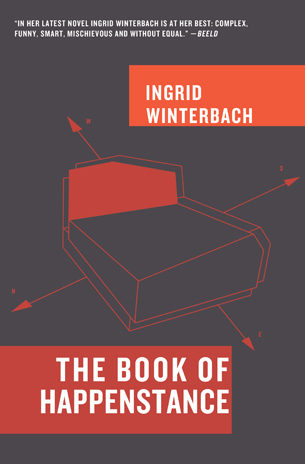
book_happenstance_large

The Book of Happenstance
Ingrid Winterbach
Open Letter Books
Paperback, 254 pages, $11.95
978-1-934824-33-7

.

Though Ingrid Winterbach sets her novel, The Book of Happenstance, in contemporary South Africa, a country dominated by a history of racial oppression, the book is not about race or the inheritance of Apartheid. The Book of Happenstance is about memory and death, yet paradoxically so, for the novel is ebulliently alive, ironic and smart. The characters seem hyper-linked to Google and Wikipedia; the book is full of spontaneous eruptions of intelligence, and that is fun to read.

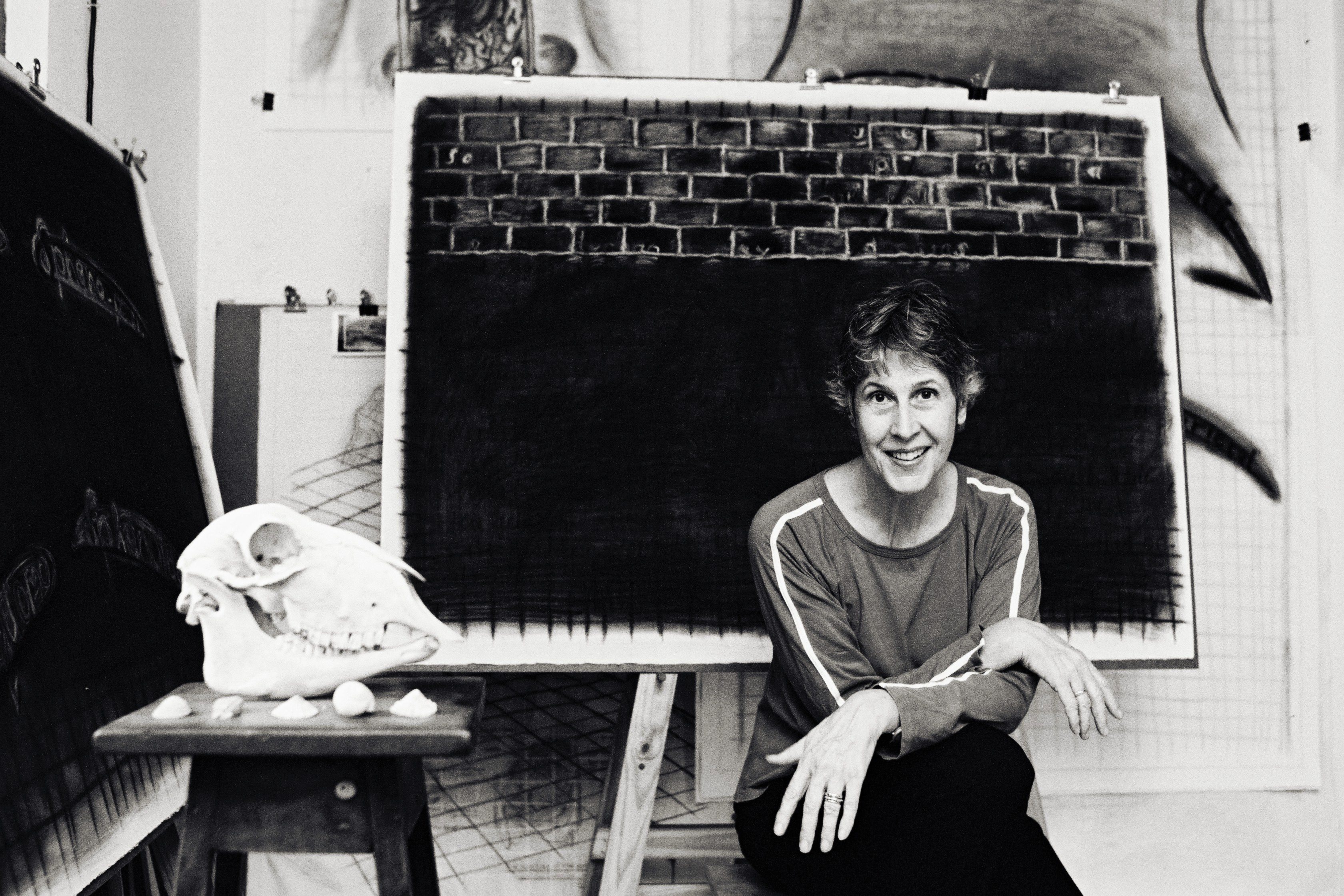
Winterbach (who wrote earlier works under the pseudonym Lettie Viljoen) lives in South Africa with her husband and two daughters. She has a degree in Afrikaans—one of the main characters of the novel is an expert in Afrikaans. She is also a visual artist and has won all kinds of awards for her work in her native land including the W. A. Hofmeyr Prize, the M-Net Book Prize (for the book in hand), the University of Johannesburg Award, and the Hertzog Prize. The new English version of The Book of Happenstance, just out with Open Letter Books, was co-translated by Winterbach herself and Dirk Winterbach (I checked but was unable to pin down the relationship).

The novel is about a middle-aged woman, Helena Verbloem, hired on a research grant to help compile a dictionary with the scholar Theo Verwey. One night thieves break into Helena’s house, steal her sentimentally priceless sea shell collection, and shit on the floor. When the police appear uninterested in helping her recover the shells, Helena starts investigating the robbery herself. Some of the missing shells have turned up at the feet of a recent suicide, a man who killed himself by hanging.

The shell investigation trajectory involves two visits to a town a day’s drive away where the suicide (and his family) lived. Helen and her girlfriend Sof meet the locals in bars, disguise themselves as members of a Bible group delivering pamphlets, take pictures of the suicide house, question family and friends and come up with precisely nothing. In fact, what they learn is that the shells are gone, who knows where, and that her house had been broken into by accident by men looking for drugs. At one point Sof quotes the opening lines of Kafka’s The Castle: K has just arrived, the Castle is hidden in mist and fog, the village shrouded in snow, gazes up into “seeming emptiness.” Of course, the passage is even more enigmatic because it’s quoted in Afrikaans.

The shell plot is comic and Kafkaesque and ends in apparent inconsequence. The novel’s parallel plot belongs to Theo and Helena in the museum—less action than the quasi-investigation plot but many delightful scenes. The work scenes go like this: Theo and Helena sit in an office organizing words into alphabetical order, Helena fantasizes, talks about books, sometimes she asks Theo about a word and he—a human dictionary—answers with comic completeness in little essays like entries in an etymological database. Helena is obviously attracted to Theo, but the attraction is an intellectual crush not so much a romantic longing and certainly not lust.

Slotted between the interwoven main plots are a series of recurring but unplotted scenes in a tea room, more often than not Helen and another museum friend drinking, yes, tea and discussing the origin of life and evolution. These scenes are comic, exasperating—Helena’s naïve and ingenuous questions prompting lengthy, erudite answers which she seems to ignore half the time (inserting lengthy parenthetical scene commentary in the middle of the explanations). Helena’s interest in life no doubt evolves out of the context of death that surrounds her. Already, as novel begins, Helena’s parents and sister are dead, her brother estranged, she herself is divorced, her daughter is out of touch.

The novel is written in the first-person present tense. The present tense conveys immediacy and a kind of spontaneous propulsion that more conventional past tense Freitag-ular narratives don’t. In other words, Winterbach’s novel didn’t happen it keeps happening, throwing itself forward with a kind of whimsical blind hopefulness, a summoning of eternity.

In the first two sentences Winterbach announces the time frame of the novel: March to October—in March Helena starts working on the Afrikans dictionary with Theo Verwey, and by October Theo is dead. At the outset, we know the parameters, we know the course of the novel; Winterbach seems to splice the story out of the larger reel of time and in the same act warrant its significance, as Walter Benjamin suggests in his essay “The Storyteller.” “Death is the sanction of everything that the storyteller can tell. He has borrowed his authority from death.”

Much of the novel consists of memories and reflections. When writing the memories Winterbach steps in and makes a stylistic choice. She writes a number of the memories in the past tense and some in the present and, a few times, seems to mix the two. The weaving of tenses together seems to add to the eternal bracket around the novel. Winterbach wants Happenstance to break out of linear time and rest securely in the present. Therefore, even the memories, past events, occasionally happen in the present. There is, I think, an ironized search for the eternal in the novel. The shells in their way seems to represent something beyond time to Helena, considering “their beauty restored [her] trust in all of creation” (59). At one point Helena’s friend Sof  says, “I’ve just read and interesting article… All writers are actually pursuing a single ideal, namely the universal.” To which Helena replies dryly, “I’ve always thought the universal to be suspect.” (130). But her denial rings with irony.

Happenstance is a terrific read. It is consciously intellectual without being pretentious or didactic. It is smart and knows it but the irony runs deep. Against the etymology, we have Helena obsessing over the shit on her carpet; she associates the lingering smell of aftershave in her apartment with crime, so that she qualifies every clean-shaven man with the thought: Could he have shat on my rug and stolen my shells? And then there is the whole Sof/husband subplot: Sof’s hatred for her husband and her desire to have an affair with a crippled pediatrician. Even Theo’s funeral has a comic aspect: a member of the museum staff, nicknamed Sailor, shows up drunk, wearing a natty white suit, and tries to jump into the grave with the coffin.

Finally: Why happenstance? The title of the English translation seems to refer the coincidental nature of the crime, the shell-robbery, perhaps the Kafkaesque and coincidental nature of all life. The novel forces the death of Theo Verwey and the loss of Helena’s shells together, but their juncture is conditional, fleeting and evanescent, means almost nothing except in the pleasurable connection of words, obsession, human affection, and our ultimate end (itself likely to be comic). It is all happenstance.

(Read an excerpt from the novel here.)

—Jacob Glover

.

Jacob Glover1

Jacob Glover is studying Classics & Philosophy at the University of King’s College in Halifax, Nova Scotia. His work has been published previously on Numéro Cinq: essays (on Kierkegard, Montaigne, and Spinoza), translations, and poems.

.
.
.

May 272011
 

Herewith, a short excerpt from Tammy Greenwood’s novel, Two Rivers, from Kensington Press (2009).  Harper Montgomery’s wife has been dead for a dozen years. He’s raising a daughter on his own and still grieving the death of his wife.  He’s also hiding his involvement in a violent crime. Everything changes when a train derails in the fictional town of Two Rivers, Vermont.  Amidst the wreckage, Harper finds Maggie, a fifteen-year-old pregnant girl with dark skin and nowhere to live. Harper takes Maggie into his home and begins his journey toward redemption.  Howard Frank Mosher described Two Rivers as ‘the story that people want to read: the one they have never read before.”

This excerpt is from the novel’s prologue.  Read an interview with Tammy Greenwood here.

-RJF

from Two Rivers

by T. Greenwood

1968: Fall

Blackberries. The man’s skin reminds him of late summer blackberries. The color of not-quite midnight. The color of bruise. This is what Harper thinks as he looks at the man they have taken to the river, the one who is half-drowned now, pleading for his life: the miracle that human skin can have the same blue-black stillness as ripe fruit, as evening, as sorrow itself. 

Of course he also thinks about what you might see (if you were here at the confluence of rivers). Three white boys. One black man, begging to be saved. The harvest moon casting an orange haze over everything: just a sepia picture on a lynching postcard like the ones his mother had shown him once. He’d had to look away then, both because the hanged man had no eyes, and because it was the only time he’d seen his mother cry. And he knows that if she were still alive she’d be weeping now too, but not only because of the black man about to die.

It was anger that brought him here. After he understood that Betsy was dead (not wounded, not hurt, but gone), everything else — the grief, the sadness, the horror — became distilled, watery sap boiled down into thick syrup. All that was left then was anger, in its purest form. It was rage that brought him here. But somehow, now, in the cool forest at the place where the two rivers meet, as the man looks straight into Harper’s eyes and pleads, the anger is gone. Swallowed up by the night, by old sadness and new regret.

“Please,” the man says, and Harper thinks only of blackberries.

He will see this color when he closes his eyes tonight and every night afterward and wonder what, if anything, it has to do with the most despicable thing he’s ever done.

May 082011
 

This Ancient World
A Review of Mathias Énard’s Zone
by Mary Stein

Zone
By Mathias Énard
Translated by Charlotte Mandell
Open Letter Books
ISBN-13: 978-1-934824-9

I am lucky enough to have experienced the horrors of war only indirectly in the form of newspaper articles and television newscasts. I remember small blue-on-black explosions of sparkling shards arching through Iraq’s sky, ticker tape reeling across the bottom of the screen attempting to quantify casualties like stock market quotes. But in 1991 during the First Gulf War, a series of wars began tearing Yugoslavia apart—a nation splitting at cultural and political seams—and in Serbia, Croatia, Bosnia and Montenegro, people were faced with an entirely different wartime experience: Instead of watching dim explosions on the television, they found war erupting in their cities, backyards, homes and bodies.

Translator, Charlotte Mandell

Zone, Mathias Énard’s fourth novel (of five), his first novel translated into English is an attempt to articulate the experience of the Balkan wars from the inside. Charlotte Mandell’s deft translation from French highlights Zone’s lyric quality, conveying the retroactive point of view of a narrator who condenses the personal and cultural impact of the Yugoslav wars along with historical war crimes, genocides and ethnic cleansings dating back to Troy.

Zone’s narrator, Francis Servain Mirkovic, is a French-born Croat, a former soldier who fought “…for a free and independent Croatia, a free and independent Herzegovina and finally for a free and independent Croatian Bosnia…,” thus, in his own mind, straddling the boundary between victim and perpetrator. In the present story of the novel, Mirkovic is a spy for French intelligence collecting stories of war crimes “…like someone who becomes a referee having been a boxer and himself no longer touches the faces that explode beneath fists, he counts the blows…”

Under the influence of alcohol and amphetamines, Mirkovic has just boarded a train from Milan to Rome intending to sell the Vatican another “sad piece of the past in an entirely ordinary plastic suitcase wherein is written the fate of hundreds of men who are dead or on the point of disappearing…” Using the identity of a childhood friend, Yvan Deroy, as a cover, Mirkovic finds himself “lost now with an assumed name between Milan and Rome, in the company of living ghosts.” A bizarre interaction with a stranger further unhinges Mirkovic, inciting a state of post-traumatic stress. As Mirkovic’s train crosses city boundaries, his erratic mind wanders, and he finds himself unable to separate his own trauma-tainted memories from the stories and names of the dead that fill his suitcase.

Continue reading »

Apr 152011


Herewith an excerpt from Juan José Saer‘s novel The Sixty-Five Years of Washington translated by Steve Dolph and recently published by Open Letter Books.  Two friends walk stroll an Argentine city, relishing tales of a wild party neither of them attended (one cannot escape the allegorical parallel with Latin American colonial self-deprecation). They reminisce about the past, expose their anxieties, jump proleptically into a future filled with repressive violence. (See Richard Farrell’s review here.) In this flashback scene, the main character, Angel Leto, has gone away to the countryside with his mother. Leto is returning home on a Sunday evening to discover his father’s body. In their absence, Leto’s father has committed suicide.

dg

from The Sixty-Five Years of Washington

By Juan José Saer

Translated by Steve Dolph

They’ve left behind the wide, residential section of the street and are now walking down a narrow, treeless sidewalk where more and more frequently the windows and doors of businesses sit open. Bringing the stem of the unlit pipe to his lips, the Mathematician distractedly starts stroking them with the tip, its bowl hidden in his closed hand. He doesn’t say anything now. Above his eyebrows, on his smooth forehead, his skin wrinkles a little, into horizontal furrows, and be–tween the two little blonde brushes appear two oblique fissures, forming a vertex at the bridge of his nose. Leto, meanwhile, remembers: Isabel, the past year, Lopecito, the wake, the closed casket, etc.—and five days before all that, that is, before the wake, Lopecito, etc. no?—as we were, or rather I, yours truly, no?, was saying: green wheat, already so tall, from the bus window. He has left Rosario Norte an hour before, with his mother. They’re on their way to Andino, to his maternal grandparents’ house, to spend the weekend. It’s a Friday in late spring. They left Rosario at 1:00. When they leave behind the San Lorenzo industrial complex, the land fills with tall green wheat, fields of flax, and, sometimes, yellow sunflowers right up to the shoulders of the road. Every once in a while they pass a farmhouse, with its windmill and eucalyptus, which interrupts, as they say, the fields, the same way stations divide the scant towns in two like a river or a railroad would in other places in the world. A parallel dirt path separates, in the country, the geometrical grains from the road—and on that path, every once in a while, a solitary carriage travels, hardworking and unreal, which the bus, as slow as it is, leaves behind with ease. He, helpful and enthusiastic, went along to the station. That man who, ever since Leto has had use of his reason, has always been silent, distant, shut away with his unsuspected chimeras in his radio workshop, for the last month or so seems to have broken the bell jar that separated him from the outside world, and has come with them, seeming euphoric, close, warm, and open. Leto observes him at a distance, incredulous. At first the change was so sudden that, in his skepticism, he was sure it was some kind of joke, or a tactical transformation, but his persistence and his conviction to the role were so intense that Leto’s initial incredulity was replaced with doubt—is he? would he?—all that, no?, telling himself at the same time, but from then on without concrete ideas or words and almost without realizing it, though not only his mind but also his whole body are for some reason saturated with those senses that more and more resemble the shudder or the silent beating or the contraction of nerves, temples, veins, muscles, telling himself, he would say, but in that way, no?, that if it was a comedy the intended audience was Leto himself, because for Isabel, Lopecito, and the rest, who were convinced in advance, no persuasion was necessary—he, Leto no?—the only one who suspected that the man had something up his sleeve, that the man had realized—and decided I was the last obstacle to demolish before his magical circle could finally close, the straggler he had to force in before sealing, hermetically, from the inside, the capsule, and launching it into the interstellar space of his own delirium, Leto thinks, this time with clear and well-formed thoughts, walking, next to the Mathematician, always to the south, on the shady sidewalk, where, more and more frequently, the windows and doors of businesses are open. On a bright, warm, and calm November afternoon, the bus drives past rectangles of blue flax, of yellow sunflowers and green wheat, leaving behind, slow and regular, the repetitive uprights of the telegraph poles, while Leto, sitting next to the window, candidly observes Isabel who, in the seat ahead of him, calmly and serenely flips through the latest issue of Ms & Mrs. The comedy that Leto, after several weeks, has convinced himself is real, produces a tranquilizing and at the same time euphoric effect in Isabel, inasmuch as her old phantasms of marital bliss, upward mobility, sexual satisfaction, economic stability, familial harmony, religious tranquility, and physical well-being have seemed, in recent weeks, to have found their long-awaited substantiation, de–spite the resistance of a hostile world. Isabel’s attention, detached from the intense perfection of the land, is fixed on the page—a weight-loss plan? the horoscope? an interesting recipe? the opinions of a movie star? sentimental correspondence? Leto doesn’t wonder anymore, feeling nonetheless, indifferently, definitively perhaps, the abyss that separates them. The magazine, elevated almost to her chest, lets him see the belly which, under a modest skirt, ends at the vertex that the crossing muscles form with the pubis—he was in there, for nine months, and then funneled out, fell into the world. What should he feel? First of all, the ubiquitous mother, the amazing plain, fascinates him just then more than his own; the vast world, so indifferent, nevertheless seems more familiar than the one he was raised in at home. His coldness isn’t quite hatred—still, the censure he himself ignores, buried for a long time, feeling now that it’s too late to want them to have been different, makes him see his own feelings as though they were controlled remotely by others, an older and distinct species—not hatred, no, but instead a sort of quiet and curious outrage that makes him observe them constantly to see how far they’ll go, with the wild hope that, after so much time, with laughter and a shift in pose, they will finally say: Okay, that’s enough, show’s over, time to start being our real selves. He, the kind and helpful man, has gone with them to the bus station, in Rosario Norte, has given the impression, for the last month, of being something else, not his real self, but still very different—his concentrated detachment has become lightheartedness; his distracted indifference, friendly attention; his limp and depressive inertia regarding his family and work, enthusiasm and projects. The day before, he came out of the workshop with his eyes tired from connecting so many thin cables and adjusting so many tiny screws, and while he helped Isabel get dinner ready and set the table, he told Leto that next week, when they came back home, they would go fishing together; they would cross the river on a canoe with Lopecito and camp on the island for a couple of days. He even rang up Lopecito who, of course, sounded excited. And in Rosario Norte, just as they were getting on the bus, he, that man, reminded him: on Wednesday, at the latest, because Lopecito was busy Monday and Tuesday, they would row to the island. In fact, Leto has to put effort into showing that he finds the outing as attractive as Lopecito and his father seem to, but the slightly irked, wary curiosity these altered people inspire allows him to give himself over, to persist, with the same affected detachment one would use to observe the behavior of a colony of laboratory mushrooms, in acting out the different scenes of the comedy, hoping to finally unravel the heart of the plot and its characters. Many years later he will understand, from the overwhelming evidence, that the so-called human soul never had, or will ever have, what they call substance or essence, that what they call character, style, personality, are nothing but senseless replications, and that their own subject—the body where they manifest—is the one most starved of their nature, that what others call life is a series of a posteriori recognitions of the places where a blind, in–comprehensible, ceaseless drift deposits, in spite of themselves, the eminent individuals who, after having been dragged through it, begin to elaborate systems that pretend to explain it; but for now, having just turned twenty, he still believes that problems have solutions, situations outcomes, individuals personality, and actions logic. Leto observes, with some pleasure, the countryside through the window. Every ten or fifteen kilometers the bus stops at a station for a few minutes to drop off or pick up bags of mail, travelers, the ticket taker, the shopkeepers returning from their restocking trips to Rosario, the packets of newspapers and magazines, the passengers going from one town to another, few compared to those coming from Rosario, as though contact among those towns were prohibited and it was only possible for them to connect by way of the abstract and distant city, those towns on the plains, squared off like the country, regularly and strictly consisting of two rows of houses, most of unplastered brick, four blocks long, one on each side of the highway and separated—each row of houses, no?—from the bus station by a wire fence, a windmill, and a wide dirt street—and on the ends of the four blocks, two lateral streets that close the quadrilateral and rise slightly at the shoulder, towns that are, to put it one way, like a miserly concession from the plains to roughen, at brief and regular intervals, its simplistic, monotonous geometry. To Leto those towns are childhood—that is, in his case, the coming and going by train or by bus, the vacations, in winter or summer, at his grandparents’ house, his grandfather’s general store with its big, dark shelves, the colored fabrics, patterned with flowers, stripes, polka dots, blocks, or with little black and white flowers, stacked on top of each other and lined up diagonally in the cases, the carefully situated yellow bags of sod, the logo and the letters of the brand repeated on several rows, the pyramids of identical cans of preserves, piled up at the back of the store, the bins of caramels, the rows of cigarette packs organized by brand, the ones with blonde tobacco on the left side of the case, with black tobacco in the middle, toscanos, toscanitos, matches, loose tobacco, and rolling paper on the right, the big bins of sugar, of lentils, of garbanzos, of noodles, the rows of dried cod, stiff and covered with rock salt, the harvesting bags smelling of leather and oil, the bottles of wine, by type, by brand, by size, the glass cases with toiletries, the cooler, the scales, the wood countertop, smooth, dark, and weathered, the calendars and the cardboard advertisements with pictures of movie stars, of soccer teams, funny or artistic drawings, the shoeboxes, the kerosene cans and cooking alcohol in the storeroom, next to rows of detergent, flour, salt, oil, and above all, the boxes of Quaker Oats with the drawing of a man holding a smaller box of Quaker Oats with a smaller man holding an even smaller box of Quaker Oats with an even smaller man holding, no?, an even smaller, no?, to infinity, no?, like . . . no?, childhood, we were saying, or rather yours truly was saying, or rather, that is to say, no?, childhood: internal construction and external wandering, convalescence of nothing, corporeal truth versus social fiction, hope of pleasure versus generalized deception, just like that thing on Sundays, the pursuit, torture, and murder of grasshoppers and frogs between the trees in the back yard, the terrifying nights under the crucifix hanging on the headboard with dried olive branches from the last Palm Sunday, the white nightgowns of his aunts, cousins, grandmother, his uncles drinking cold beer under the trees, the afternoon, the whistles of the express passing through town and filling it with fear, the childhood Leto is already starting to tell himself, without words or concepts—not even with images or representations, no?—Isn’t what I had expected. It’s still not what I think it should be like. This can’t be all there is.

Ultimately, as they say, and to say it a second time, though it’s always the Same, no?, every thing. He even rang up the man he calls his best friend, Lopecito, to suggest going fishing on the island the following week. And Leto, on the bus, is willing to let himself be carried along, with a somewhat uneasy sense of calm, through those warm and beautiful spring days, to the following Wednesday, on the island near Rosario. That anticipation saturates the entire weekend: arriving in the town, crossing the streets and the bus station, passing the windmill, arriving at his grandparents’ house, the dinner, the evening walk through the town, the croaking of the frogs, the intermittent song of the crickets that has always attended, and no doubt preceded, the human night, the intermittent, phosphorescent glow of the fireflies, the smell of the paradise trees, the family gathering on Saturday with the relatives who have been arriving from nearby towns in cars or on the bus, the organized abundance, formed by identical objects repeated over and over in the store, the night spent under the crucifix, the mass, the cookout at noon on Sunday, the women’s flower-patterned dresses, the walk around the station with the cousins, and more than anything else, the perfect hour on the plains, the afternoon, and also, every once in a while, in little outbursts to someone in the family, Isabel’s foolish declarations of her marital bliss, her upward mobility, her sexual satisfaction, her economic stability, her familial harmony, her religious tranquility, her physical well-being, which he lets run on like background noise whose fictitiousness intrigues him less than its obstinate and emphatic repetition. That insistence betrays her uncertainty, the same way that, on Sunday night when the bus arrives at Rosario Norte, the thing she murmurs, slightly distracted, Hopefully he hasn’t made anything for dinner because I could pop after everything we ate in Andino,could be translated, Leto thinks, into a way of saying the opposite, because the fact of him waiting with a warm dinner would help dispel the uncertainty that’s working on her and which is of such a curious nature—when it manifests itself externally, it always appears to be the opposite.

The man is not at the station, It’s good he didn’t come, murmurs Isabel, after scrutinizing the walkway and the entrance. It’s good he didn’t come because anyway we don’t have suitcases and the train leaves us a block away. Leto, who after so many years has become an expert in the art of pretending he hasn’t heard anything, or of responding, almost inaudibly, with vague monosyllables, to every irrational, or, as he refers to them privately, false bottom argument laid out by Isabel, turns the conversation to fresh eggs, their bouquet of flowers, the greasy chorizos just made at the farm stand and plied on them in the town.

Slowly they leave the train, walking away from the palm trees lining the avenue to enter the dark, tree-lined block that separates them from their house. Isabel isn’t, Leto thinks, in any hurry to get there, as if through some physical inertia her body, contrary to her reason, were trying to express things more truthfully. Twice in a single block she stops for several minutes to talk with neighbors who, sitting in folding chairs on the sidewalk near their front doors, or leaning out a window, have come out to enjoy the cool night, while Leto, keeping a polite distance, with the basket of eggs and chorizo in one hand and an unlit cigarette in the other hand, asks himself if she isn’t trying to gain time so that he, who she supposes innocent of machinations and exempted from her intuition, will overtake her and get home first—and all of this in spite of the fact that, to the outside world, they are just a mother and son, a silent twenty-year-old young man, coming back, respectable, straightforward, and a little tired, from a weekend in the country, neighborhood people, apparently the husband is an electrician who works on televisions and doesn’t mix much with the neighbors, the boy studies accounting, and she’s still pretty even though she’s around forty, the men more or less silent and withdrawn, while she sometimes maybe has the habit of talking too much, like she can’t stop, or she’s trying to hide, to cover up, with words, deep dark fissures which her words, despite her intentions, open at their multiple, secret edges. But she doesn’t give up. Leto waits, patiently, or a little callously, rather, at every stop, and when they get to the house, which is dark, silent, and lifeless, and he slides the key in the lock, and turns it, he feels again, coming through the door, the trail of the snake, the indefinite but distinct presence of the scorpion, whose signs, weakened in the previous weeks, have returned, unequivocal and palpable. When he turns on the light, this presence draws him, sucks him, slowly, toward the bedroom, and when he sees the man sprawled on the floor, his skull shattered by the gunshot, the revolver still in his hand, the floor, walls, and furniture splattered with blood, with chunks of brain, hair, bone shards, he says to himself, calmly and coldly, So that’s what this was. Specifically, this meaning the days, the nights, the time, the body, the world, the thick beating life, how the man, in his little electrical workshop, had dismantled them, detaching and separating them into separate pieces, colored cables, copper wires, gold screws, spreading them over the table to inspect them one at a time, neutral and merciless, limiting himself to reaching what he no doubt considered objective conclusions, and later, during uniform and meticulous hours, putting everything back together according to the indisputable logic of his delirium. To achieve his goals he had to construct the comedy, setting a stage, the visible universe, and making all of his so-called loved ones take part, modifying the plot sometimes to convince the most reticent, as had been happening for the previous weeks with Leto, whose mistrust had forced him to make appearances outside his “workshop,” transforming his personality slightly and preparing, with Lopecito’s unconditional support, when he swallowed whole the supposed week of fishing on the island, for Leto, his reticence becoming hope, to fall, on his return from the country Sunday night, from an even higher rung. Put briefly, and by the man himself, no doubt to himself, and no doubt without words as well, more or less like this: When I say dance, everyone dances. No excuses.

Two or three days later the autopsy reveals that he shot himself on Friday at around 2:00 or 3:00 in the afternoon, meaning that he said goodbye with a grin at the station, reminding him before he left that on Wednesday they would cross to the island with Lopecito, then, still grinning, boarded the train back to their neighborhood, walked the block between the train stop and the house at a calm and regular pace, and no doubt without losing his grin entered the house, crossed the hallway, shut himself in the bedroom, and without hesitating or losing the fixed, vindictive grin, blew his brains out.

—I call that an insolent suicide, said César Rey, a few months later, at the bar Montecarlo, in the city, while they watched the sun, through the window, rising into a cold autumn dawn. And Rey can speak with authority because the day before, in fact, he had gotten a hotel room, intending to slit his wrists, but at the decisive moment he had suddenly changed his mind, and after leaving the hotel, he had run into Leto at the arcade’s bar, where they proceeded to go on a bender.

—The insolent suicide, says Leto, shaking his head. Isabel and Lo–pecito were left stupefied by the event—in the director’s absence they no longer knew exactly what role they played in the comedy—but Leto himself thinks he has known how to conserve enough cold blood to keep him from the path of the gunshot, though the suspicion of having been the primary target for the last few weeks could be, without his realizing it, proof of the opposite.

The insolent suicide, he thinks, discreetly watching the Mathematician, whose eyebrows indicate a laborious reflection that Leto cannot know, and is not interested in knowing, but which is more or less the following: Where does instinct come from? Does it belong to the individual or the species? Is there continuity between individuals? Does the latter individual take over the instinct from the point where the former left it or does he reconstruct, from zero, the whole process from the start? Is it substance, energy, reflex? What is our idea of instinct? How was it first formed? By whom? Where? As opposed to what? What, in a living thing, isn’t instinct? And then, forgetting Noca, Noca’s horse, instinct, the images he has built up thanks to Botón’s story on the ferry, the previous Saturday, on the upper deck, images of Washington’s birthday at Basso’s ranch, which he didn’t attend but will remember for the rest of his life, the other questions, always stirring, underground, and sometimes rising to the surface, suddenly, that follow us, form us, lead us, allow us to be, the old questions first brought up in the African dawn, heard in Babylon and asked again in Thebes, in Asia Minor, on the banks of the Yellow River, which sparkled in the Scandinavian snows, the solilo–quy in Arabia, in New Guinea, in Königsberg, in Mato Grosso, and in Tenochtitlán, questions whose response is exaltation, is death, suffering, insanity, and which stir in every blink, every heartbeat, every premonition—who planted the seed of the world? what are the internal and the external? what are birth and death? is there a single object or many? what is the I? what is the general and the particular? what is repetition? what am I doing here?—that is to say, no?—the Mathematician, or someone else, somewhere else or at some other time, again, though there is only one, only one, which is always the same Place, and always, as we were saying, once and for all, the same Time.

—Juan José Saer; translated by Steve Dolph

Apr 152011
 

Elegant Uncertainty

A review of Juan Jose Saer’s The Sixty-Five Years of Washington

By Richard Farrell


The Sixty-Five Years of Washington
By Juan José Saer
Translated by Steve Dolph
Open Letter Books
ISBN-13:978-1-934824-20-7

To be clear: the soul, as they call it, is not translucent, it seems, but murky.
—Juan José Saer

WHEN IS THE LAST TIME you went on a good walk with a friend? Cell phones off, eyes fixed on the path in front, minds alert and the conversation buzzing?  A good walk opens the ears and the heart to storytelling, creating a sacred space in between two individuals as they make their way.  Juan José Saer invites us on such a walk in The Sixty-Five Years of Washington.  But, reader be warned: this is no ordinary stroll and this is no ordinary novel.

The Sixty-Five Years of Washington follows Angel Leto and “the Mathematician” as they walk through the city center of Santa Fe, Argentina. “Suppose it’s October,” the narrator begins, “October or November, let’s say, in 1960 or 1961, October, maybe the fourteenth or sixteenth, or the twenty-second or twenty-third—the twenty-third of October in 1961 let’s say—what’s the difference.”  This uncertain narrator interrupts frequently and becomes a third protagonist in the novel as he narrates the journey, conversation and thoughts of the characters and supplies ongoing, humorous commentary.  The conversation quickly turns to the sixty-fifth birthday party for Jorge Washington Noriega, a party which neither man attended.  Washington is an elusive character; we don’t know much about him.  He writes lectures on the Colastine Indians (“Location, Lineage, Langauge & Logic”); he was arrested once, and avoided prison by going to a mental hospital; he throws wild birthday parties for his younger friends. The Mathematician heard his version of the party a week earlier from one of the attendees, Botón, as the two men rode a ferry.  Leto hears his version from the Mathematician.  The reader, of course, hears all of these accounts from the narrator. The party attracted les enfants terribles of Argentina, young artists, poets and political activists ready to disrobe, fight and snort coke into the wee hours of the morning. You want to be at this party, but, like Leto and the Mathematician, you can’t attend, so you must be willing to accept a re-telling (hyphenated emphasis intended throughout) of the event as the men stroll through the city.

This device of re-telling is crucial. By not going directly at the events the way a traditional narrative might, Saer creates distance between the characters in the novel and the dramatic action.  This recursive structure forces us to question the very idea of what happened at this party, and, on a deeper level, what is happening in the novel. Saer challenges the notions of verisimilitude and truth.  And with this technique, the re-telling of the events at the party mimics our reading of the novel itself (of any novel, really), by recreating a version of reality through the description of events not directly experienced by the characters or the reader.  Saer seems to be jack-hammering at the foundations of storytelling.

Continue reading »

Apr 142011
 

Johannah Rodgers is a brilliantly witty, protean experimental author/artist and culture critic. Please take the time to visit her web site (click on her name) and marvel at some of the work on display there. See especially her little book 10 Things You Need To Know About Writing, her drawings of places, her word drawings, and her provocative and idiosyncratic “Highly Subjective Recommended Reading Lists.” Rodgers is the author of the book, sentences, a collection of short stories, essays, and drawings, published by Red Dust, the chapbooks, “The Coop Articles: Dispatches from the Park Slope Food Coop 2004-2007” and “necessary fictions,” published by Sona Books, and numerous short stories, essays, and reviews, which have appeared in Fence, Bookforum, Fiction, CHAIN Arts, Tantalum, Pierogi Press, and The Brooklyn Rail, where she is a contributing editor.  She lives in Brooklyn, NY and teaches writing and literature courses at The City University of New York, where she is an Assistant Professor in English at The New York City College of Technology.

The excerpt here published is from her futuristic, hypertext novel DNA.

dg


from DNA

By Johannah Rodgers

“For does not society modify Man, according to the conditions in which he lives and acts, into men as manifold as the species in Zoology?”

— Honore de Balzac, Introduction to the Comedie Humaine

February __, 2075

I have identified four individuals in a ten block radius with whom I share the same genetic code.  I will begin profiling each based on the information  collected to date, as well as through direct observation to determine which are the best candidates for complete identity theft.

February __, 2075

I can’t say that I completely dislike myself, but there are times when I wonder whether I shouldn’t be something more than I am.  These moments then lead me to speculate that it is not what I’ve done, but who I am that is the problem.  And, based on the statistical overview of those in my common gene pool, i.e., all of those individuals conceived from sperm A51326 and egg C84327, I am, in all five categories of comparison—total net worth, happiness index, number of children, square feet of living space, professional recognition—clearly well below average.  Why this would be when we share 99.9 percent of the same biochemistry can only be attributed to non-biological factors.  In other words, “nurture” issues, i.e., how we were raised, which has led to some slight differential in the various choices that each one of us has made over time, resulting in, ultimately, who we are now.  What all of this means is that it is purely for reasons of chance that I am who I am today, as opposed to, someone else, i.e., one of those who are, to borrow from the clinic-approved language, my “code partners.”

Continue reading »

Apr 112011
 

¶ Why would a novel be, in Chabon’s parlance, “wrecked”? Authors, always sensitive creatures, might abandon a book in a fit of despair, as Stephenie Meyer initially did in 2008 with her “Twilight” spinoff “Midnight Sun,” which she declared herself “too sad” to finish after 12 chapters leaked to the Internet. More dramatically, in 1925 Evelyn Waugh burned his unpublished first novel, “The Temple at Thatch,” and attempted to drown himself in the sea after a friend gave it a bad review. (Stung by jellyfish, Waugh soon returned to shore.) More dramatically still, Nikolai Gogol died a mere 10 days after burning the manuscript of “Dead Souls II,” for the second time.

¶ Sometimes success intrudes on a writer’s plans, transforming what once came easily into an impossible slog — as happened to two old friends, Harper Lee and Truman Capote. Lee had written more than 100 pages of her second novel, “The Long Goodbye,” before “To Kill a Mockingbird” was even published in 1960. But the attention accompanying the wild success of “Mockingbird” slowed her output to a trickle. After years of fitful work, she seems to have given up, telling her cousin, “When you’re at the top there’s only one way to go.”

¶ Capote, meanwhile, published chapters from his long-gestating “Answered Prayers” in Esquire, and the resulting fallout — longtime friends, recognizing themselves in the barely veiled portraits of desperation and decadence, cut Capote off — infuriated and hurt him. “What did they expect?” he asked his editor. “I’m a writer, I use everything.” Some think that Capote wrote more, but that the chapters were destroyed or lost; many, including his longtime partner, Jack Dunphy, believe he never wrote another word.

via Why Do Writers Abandon Novels? – NYTimes.com.

Mar 232011
 

Ann Ireland is an old friend and a brilliant novelist. I knew her novels long before I knew the author. I recall reviewing her first book,  A Certain Mr. Takahashi (winner of the $50,000 Bantam-Seal First Novel Award), a brilliant, comic and poignant tale of two teenage Toronto girls smitten with an exotic, foreign symphony conductor who happens to move into the house across the street. Her second novel, The Instructor, was nominated for Trillium Award and Barnes and Noble’s Discover These New Writers Award, and Exile was shortlisted for a Governor-General’s Literary Award  and the Rogers/Writers Trust Award for fiction. Ann lives most of the time in Toronto (not far from where my brother lives); she is a past president of PEN Canada and coordinates the Writing Workshops at The Chang School of Continuing Education at Ryerson University.

This chapter is taken from a brand new novel called The Blue Guitar. Much of it takes place at an international Classical Guitar Competition where (mostly young) musicians come from around the world to compete for a grand prize and career liftoff. Ireland is interested in examining the reasons why musicians put themselves through this grueling event and how they hold up. Or don’t. This section introduces Lucy Shaker, the oldest competitor, as she does her level best to make time to practice her instrument – despite domestic distractions – in the lead up period to the contest.

dg

A Chapter from The Blue Guitar

A Novel by Ann Ireland

NINE

Mark’s uncle has finally pushed off. Out the door he goes, spry as a bird, tossing his vinyl suitcase down the front steps, not bothering to thank Lucy or Mark for their hospitality, nor to offer a farewell to the boys who’d already left for school. His forehead shines as he smiles; in his mind he’s already disappeared from this sorry excuse of a city. The limo idles curbside, plumes of exhaust meeting autumn air while Uncle Philip’s suit jacket whips in the wind.

He wears no overcoat, having left this bulky item stashed in the cupboard down the hall; it is an unnecessary burden in the torrid climate that he is about to enter. He will return in six months to reclaim it. Mark’s uncle insists on limousine service to Pearson International because he likes plenty of leg room before the arduous flight to Southeast Asia. Of course he was too cheap to pitch in for food or wine when he stayed here, en route.

Lucy feels a faint spasm of guilt on thinking these thoughts for it was Uncle Philip, music lover extraordinaire, who quite unexpectedly mailed her a cheque last year with the note: ‘If you’re going to enter this competition, you’ll need an excellent teacher. I hope this will help.’

Thanks to him, she’s been working with the divine Goran.

Lucy watches the driver fit suitcase into trunk then hold the passenger door open for Uncle Philip who, once settled, rolls down the window and calls out in his sunny voice, ‘Back in the spring, dear.’

As if she’ll be counting the days.

She shuts the front door, twists the lock and breathes clove – scented aftershave mixed with breakfast bacon, a now – familiar brew. With luck, there will be no interruptions until four o’clock when the twins amble home from high school. Her husband, Mark, works as a security guard at the Art Gallery of Ontario and doesn’t get off shift until supper time. It’s his dream job, or so he claims. He loves standing in the 18th century room, surrounded by lacquered paintings by little – known artists, making sure school kids don’t jostle or touch anything, or some jackass doesn’t take a knife to the brittle canvases. He claims to thrive on the long stretches of nothing, punctuated by bursts of activity. It gives him time to think – about what, Lucy has no idea. She pictures him standing guard in front of the portrait of some long – forgotten Cornish merchant whose manicured hand rests on a globe.

Continue reading »

Feb 172011
 

Here’s a fascinating review of an even more fascinating book. All of you are familiar with Barthe’s essay “The Death of the Author.” I like here the potential contrast between the haiku and the novel, which contrast never actually eventuates apparently.


Part II returns both author and work centre-stage. Barthes investigates the emergence of writing as an intransitive activity, determined not by its object but by a “maniacal” urge in the author’s body. It focuses on the “operations” by which he (the writers considered are all male: Flaubert, Kafka, Mallarmé, Chateaubriand, Proust, etc) passes from the desire to write to creating the work. We learn about the minutiae of authors’ habits: where they write, when, at what rhythm or speed (“at a gallop”, in Proust’s case). For the writers Barthes discusses, the space of writing offers a retreat from worldly preoccupations: Flaubert asks for no more than a quiet room with “a good fire in winter and a pair of candles to light me at night”, whereas Proust favours the bed: “you can work, eat, and sleep in it”. Similarly, the time at which they choose to write often suggests a withdrawal from the world. While Barthes cites Paul Valéry as an example of an early morning writer, he devotes most space to those who wrote at night: Flaubert (sometimes), Rimbaud (once), Kafka (joyous at having written “The Judgment” in one night-time sitting) and, of course, Proust (always). The latter’s “complete inversion of day and night” leads on to a broader discussion of inversion in general as the source of a “perverse pleasure”: perhaps the reason why night work enjoys such privilege in Barthes’s imagination.

via The Preparation of the Novel by Roland Barthes reviewed by Mairéad Hanrahan – TLS.

Jan 302011
 

Jacques Callot's "The Seven Deadly Sins:Envy"

1. “When Writers Hate”

Morrissey is right, we hate it when our friends become successful. Gore Vidal is even more honest, confessing, “Whenever a friend succeeds, a little something in me dies.” Near the end of the film Sideways, the rivalrous friendship of Jack and Miles is echoed by the novel Miles has assigned one of his young pupils to read aloud, John Knowle’s 1959 A Separate Peace, a tale of envy, perhaps even murderous envy, between schoolboy friends. Shakespeare’s Iago is envy on two legs. Adrift in a life before talking cures, support groups or good yoga, Cain walked alone with envy.

A fifteenth-century image of Cain and Abel

In life and art, friendship often oscillates between admiration and envy. Two recent shows at New York’s Museum of Modern Art showcased the reciprocal rivalry between Picasso and Matisse, as well as Cézanne and Pissarro. The 2004 documentary DiG!, chronicles the not-so-friendly rivalry between the bands The Brian Jonestown Massacre and The Dandy Warhols. When envy worms its way into writing, particularly into the novel, subject and medium collide. Writing is envy’s preferred medium.

Hiroshighe's "Great Bridge, Sudden Shower at Atake" and Van Gogh's (Later) "The Bridge in the Rain""

Writing slides someone else’s thoughts through our brain, and those thoughts come through the public medium of language. In the incomplete neuroscience of thought, writers and visual artists can admire and envy each other: humans may think more quickly through images, but, some contend, we think more specifically through language. And when we do think visually, we don’t necessarily see another artist’s brushstrokes, another photographer’s composition. When we think verbally, however, we think through the shared property of words and the evolving codes of language.  Words are only made by humans, whereas the stuff of visual art—color, texture, scale, shape, line, etc.—partially pre-exist in the world. When this latent alterity of language is combined with the novel, which many regard as the ideal genre of the self, we hold in our laps the perfect testing ground for one of life’s dirty little secrets. We hate it when our friends become successful. We do, at least a little.

Continue reading »

Jan 222011
 

Patrick Downes alerted me to this provoking article in the NY Times, provoking because like many myopic American critics this person cannot see beyond the shores of the continental U.S. (except for very, very obvious outsiders like Sartre and Murdoch). I can’t start a list, but maybe I will. Broch, Kundera, Musil, Frisch… Anyway, this is a good example of creeping provincialism in the contemporary c(v)ulture industry.

dg

Can a novelist write philosophically? Even those novelists most commonly deemed “philosophical” have sometimes answered with an emphatic no. Iris Murdoch, the longtime Oxford philosopher and author of some two dozen novels treating highbrow themes like consciousness and morality, argued that philosophy and literature were contrary pursuits. Philosophy calls on the analytical mind to solve conceptual problems in an “austere, unselfish, candid” prose, she said in a BBC interview broadcast in 1978, while literature looks to the imagination to show us something “mysterious, ambiguous, particular” about the world. Any appearance of philosophical ideas in her own novels was an inconsequential reflection of what she happened to know. “If I knew about sailing ships I would put in sailing ships,” she said. “And in a way, as a novelist, I would rather know about sailing ships than about philosophy.”

via The Philosophical Novel – NYTimes.com.

Dec 202010
 

C. M. Mayo is a former-student-turned-old-friend. We met years ago when I taught at the New York State Summer Writers’ Institute at Skidmore College. She was working on a story collection called Sky over El Nido which eventually won the 1999 Flannery O’Connor Award for Short Fiction. She is a tremendous story writer, a travel writer, a translator, editor and novelist as well as an indefatigable teacher of writing. She is from northern California but has lived much of her adult life in Mexico and Washington. A visionary publisher, she started her own magazine, Tameme, specializing in translation of writing in English into Spanish and vice versa, an amazing cross-border cultural and literary project.  This excerpt is from her historical novel The Last Prince of the Mexican Empire, named a Best Book of 2009 by the Library Journal. Based on a true story, the novel focuses on the heartbreak and tragedy of a half-Mexican, half-American toddler adopted by Mexico’s childless Emperor Maximilian and his wife Carlota. Maximilian was a hapless Austrian archduke parachuted into Mexico in the 1860s to stop the endless series of revolving-door governments, revolutions and social chaos. Even as things begin to go badly, Maximilian refuses to give the child back to his parents. Eventually, Carlota goes mad, and Maximilian is shot by firing squad. And the child…? Read the book.

dg

from The Last Prince of the Mexican Empire

By C. M. Mayo


March 4, 1866:  RÍO FRÍO

The Belgians had enjoyed their visit to Mexico City immensely. Although it had not gone unremarked (feathers had been ruffled) that Maximilian had remained in Cuernavaca, and that certain senior French officers had not attended the entertainments, in all, they judged their mission a success. They were proud of Charlotte— their own princess— “swan of our Old World gifted to the New,” as one of their members toasted her, after having imbibed a few too many cups of champagne (and made some tasteless remarks about ‘our ginger-colored protegés.’) Also, they had seen an exotic land; they’d had a true-blue adventure and their steamer trunks and valises were crammed with the souvenirs to prove it. Of the delegation, no single member was more satisfied, more inspired, more, well, overflowing with joie de vivre about the whole thing than Baron Frédéric Victor d’Huart.

An intimate friend and officier d’ordonnance of Charlotte’s brother, Philippe, Duke of Flanders, Baron d’Huart might have been described as dashing had he not developed a paunch and double chin. Since departing Ostend in late January, he had been unable to follow his regime of fencing and hunting. The crossing had been brutal. For days, frigid gales had tossed the ship like a firkin in a tub; some feared they’d be shipwrecked off the Azores. Unlike the others, confined to their cabins with nausea, Baron d’Huart, who often joked that he must have had Viking blood, had gone on eating and drinking without pause.

By the time they docked in Veracruz, he had consumed prodigious quantities of foie gras, bonbons, and champagne. And in Mexico, well, was there anything more delicious than a humble taco of beans with this marvelous sprig of an herb called the epazote? And he indulged in the candies— dulces de cacahuates, the cigar-shaped camotes, lime-skins stuffed with sugared lard, and the almond nougat “buttons” soaked in honey— baskets of candies had been left in his quarters, replenished each day. At the farewell dinner at Chapultepec Castle, under his cummerbund, he’d had to leave the waist of his trousers undone.

The round of balls and dinners had been intense. All of the Belgians, and especially Baron d’Huart, had been limp with relief to finally get out of court dress: the coats bristling with decorations and epaulettes, the clanking swords, the hats with feathers. This morning, for this first leg of the journey home, he’d thrown on his roomiest breeches and favorite deer-skin jacket.

He is riding up top with the driver, who wears a sombrero with the circumference of a buggy-wheel. Baron d’Huart had started out wearing his sombrero— a loosely woven one, not so big as the driver’s but the biggest they had in that labyrinth of an Aztec market— but once the coach had climbed to altitude and the air turned chilly, he’d exchanged it for the poppy-red cap he wore for grouse hunting in the autumn.

It is late; their coach has just departed from the inn at Río Frío. The sun having fallen behind the trees, the road is bathed in the blue shadow of the brief, disconcertingly brief Mexican twilight. Baron d’Huart throws his shoulders back and fills his lungs with the pine-scented air.

Que fresco,” How fresh, he says, eager to practice his Spanish on his companion.

The driver, throwing his lash, makes no reply.

Continue reading »

Nov 162010
 

Barnes

Mike Barnes and dg met years ago at The New Quarterly WILD WRITERS WE HAVE KNOWN CONFERENCE (see the famous 400-page double issue Volume XXI, Numbers 2 & 3) in Stratford. He appeared twice in Best Canadian Stories during the decade dg was editor (which tells you what dg thinks of his fiction). He is the author of numerous books—novels, story collections, a book of poems and a stunning memoir of his own struggle with psychosis The Lily Pond: A Memoir of Madness, Memory, Myth and Metamorphosis. He writes occasional entries in a blog called 2009 which nowhere mentions his name. But if you go there you can find links to readings and talks he gave based on The Lily Pond, also gorgeous poems and photographs. What dg is printing here are three excerpts from a work-in-progress, a sneak preview of a dystopian future, not to be missed.

dg

These excerpts are from a novel-in-progress, a future-fantasy about an ever-expanding world-hospital, or “medically based consumer imperium” as the resistance movement terms it. The world-hospital is part “real” (e.g. concrete and steel) architecture and part mass consensual hallucination. It is “total architecture.” The novel is a mosaic of dispatches sent by telepathic scribes, assembled by central collators in the aftermath of a disastrous battle between the resistance and the world-hospital. This phase of resistance—what happened? amid the wreckage—thus consists of attempts at accurate polyphonic reportage and archeology. The name in small letters below each dispatch is the moniker, or “scribesign,” of the scribe that submitted it. Sometimes multiple scribes collaborate on a dispatch. Two of the bits (“Mixer” and “Little People”), show the world-hospital’s furthest extension, beyond life itself, and feature the same character, for continuity, and the other (“Blowback”) is a short comic glance at the resistance movement.

—Mike Barnes

/
Mixer

Steve and Randy meet each other at a mixer for the newly dead. They went to the same high school but are a few moments placing each other before they break into grins of startled recognition.

“It’s you!”

“Yo, Steve.”

So much has changed, so many reversals, in the passage across. Randy, a depressive back in the warm world, has taken to the après-vie like nobody’s business and is already doing well for himself. Steve, a doctor’s son who except for an ill-advised romance in his senior year has mostly had a blast, is having trouble finding his footing.

“It’s a whole new ballgame, Stevie,” says Randy, a shy stutterer so recently but now empowered by fluent clichés. “Look at me.” Steve is looking. “I used to have trouble carrying off a change of sweater and a haircut. Here, though. Here I’ve given myself a brand-new name and not one person has laughed. “I’m”—he hesitates a moment, a hiccup of life reflux; it’s little Randall Maggs for Chrissakes talking to SH the football captain—then declares confidently, “I’m Randy Raven.”

Steve doesn’t laugh. Doesn’t even feel like it. At first he heard razor, Randy Razor, and even that seemed possible. Doable. Like any good athlete, Steve is a fast study of the field, and he sees that Randy really can be anything here. He can stop the identity wheel on any slot he likes.

It reminds him of changing schools when none of your friends comes with you. You can carry on as before—the old game in a new location—or you can find yourself holding a brand new hand of cards, getting strange new urges to bluff, bet, fold. It’s not always symmetrical. Losers can win, winners lose, sometimes it’s a yawning steady-on, and there’s every sort of mix and halfway state.

In his new, bullet-spray voice, gaining confidence the way a rocket gains swerve and speed with altitude above the launching pad, Randy Raven disabuses Steve about any myths he may be clinging to about their present circumstances. Not about sin. Punishment. Purgatory. Not reward either. It really is an afterthought, a nowhere zone into which the fastest, sleaziest operators naturally move first and grab hold.

“Your dad. That hospital project with St. Bar-Laz. I’ve seen some pictures of it here.”

Here.”

“Sure. The smart advertiser goes to where the clients will be, not where they are. Be there to greet them. Who knows what kinds of postcards they’ll send back.”

“Send back?” Steve’s head is whirling. All around the room he sees pairs of people in the orientation postures he and Randy have assumed: the leaner-in, the knower, crisp, assured; the dazed recipient, wobbly of stance and expression.

“It’s a two-way street, man.”

As Randy goes on rapping, his eyes lambent with the newfound pleasure of holding forth, Steve tries to distract himself with thoughts of unbuttoning Cathy’s blouse, but the well-worn grooves of erotic revery don’t work so well here, the fantasy feels tackily remote, its old allure now discordant—like memories of a piñata party in solitary—and Randy’s patter keeps breaking through, and by the time he’s unzipping Cathy’s Levi’s Steve is hardly even surprised by the hard-veined icy cock that springs into his hands.

“By the way”—Randy is smirking, the ghost of an Old-World Randall peephole- in-the-girls’-changeroom leer—“telepathy is the rule here. You have to learn to shut it down. I’ve almost nailed it. No one can show you. It’s a knack, like wiggling your ears.”

Randy fills Steve in on the basis of the afterlife as a credit scam and protection racket, a Ponzi/pyramid scheme on a vast scale of interlacing levels.

In a pause, Steve says, “I thought it would be, I don’t know…pure. Or something.” Now it’s his turn to pause as he realizes he had no opinions about the afterlife, he was 18 when he sailed his father’s Buick LeSabre off the mountain brow, the girl, Cathy, with her top off screaming beside him.

“Nothing pure about it, man. It’s the oldest and dirtiest neighborhood there is. No wonder Wardworld set up shop here. Stands to reason. It’s poorly regulated and mostly out of sight. Hell, not even many people believe in it anymore. That’s an added bonus.”

Steve doesn’t get the Wardworld reference, but there’s something else he needs to know first.

“What do I need protection for? I’m dead.”

“Which means you’ve lost your last line of defense. You’re like a snail evicted from its shell. And”—Randy leans close, lowers his voice—“the universe wears big boots.”

“What could happen to me?” The involuntary quaver in his voice used to be in Randall’s all the time.

“What couldn’t? If you can dream it up, it’s probably here. And if you can’t, it definitely is.”

Steve buys a basic protection plan from Randy with the only currency he’s got—time. 10,000 years to start, with a vig of 2% (“for a friend”). He’s soon in way over his head. The pyramid scheme is the usual bucket brigade of downhill pain. A guy tells you you’re on fire and hands you a bucket to put it out. But the bucket is the fire, and the only way to turn it into water is to hand it off to another sucker. On earth it ends with a bottom layer engulfed in flame, roasted alive. But with infinite time the wall of flame expands forever. Steve understands how it works, but can’t rouse himself to find a newbie to pass the bucket to. (Self-immolation from inertia/apathy causes certain local collapses in any downward construction.) He holds on to the pain bucket, staying on his level.

Leaving the mixer, he wanders dispiritedly down streets that are also like corridors, wide spaces that close high overhead, and which with their gradual curves, inclines and declines, give an impression of a vast architecture he’s treading. It’s twilight or it’s dawn, he can’t decide about the pearly gleams. Through gaps between the storefronts, he sees other corridors, semi-opaque tubes, slightly below or slightly above the level he’s on, with dark bars above and behind them which may be yet other passageways. The impression is of a labyrinth, but not a conventional labyrinth, rather a maze that swallowed other mazes, incorporating their twists and turns into its own, the way an engulfing bacterium ingests its prey’s genes, or a colleague’s, which alter and complicate and enlarge its own blueprint. He’s not alone, but he might as well be. The many people he passes, of all types and ages, share a single facial expression of faintly frowning preoccupation. And yet, it’s weird to say, but this face of inescapable concerns looks settled into, almost relaxed. It formulates a resignation verging on peace. As if they’ve finally found their way to a narrow band of tolerable strife, a treadmill of hassle and hustle…but it’s the treadmill they know. All they’ve really lost is the desire to escape it. Could lost without the desire to be found be…found?

Envy is immortal, Steve learns. Just as status is. Steve’s car crash was fiery front-page news, a crater in someone’s lawn and in many hearts; Randy’s pill-and-vodka exit in his room—in June, after graduation, when not even the principal needed to react— was “sadly missed” by elderly parents and a sister in Florida who couldn’t get home for the funeral. But now he’s—Randy the Raven. And I’m….

Steve takes to watching the living, a pastime of only the most insolvent dead. It’s every bit the declaration of bankruptcy that, in life, is signified by sitting around thinking of vanished times and faces, fixing your gaze on the departed.

Glass Union


Blowback

LIn six-foot-high brown letters, spray-painted on an exterior wall of a Gerontology hub:

200 IS THE NEW 90

Local Medcrimes takes the case, which looks an obvious if spectacular instance of patient breach. The lab report identifying the brown paint as human excrement confirms the investigation’s routine progress in the direction of vandalism and/or dementia.

But complications (“wrinkles, ha ha”—Constable Tippett) soon emerge. First is the location of the graffiti on the 22nd floor, a billboard-sized slab of concrete bordered by a few small windows and distant from any doorway. “How would a wacked-out Gero even get up there?” (Constable Warren, Tippett’s senior partner)

A second lab report adds the details that the excrement a) came from at least 27 different bodies, and b) was fired with enough force, perhaps from a high-pressure hose, to fuse it with the concrete by embedding it deeply in every pore and fissure. Effacement is expected to be costly and protracted.

Copies of the reports forwarded to Administration, attention Budgeting and Long Term Planning.

Bill Richards


Little People

LIt feels strange to watch your lover when you’re dead. Not nice, not not-nice, necessarily. It isn’t anything necessarily. Just…strange.

The strangeness comes, Steve thinks, from not knowing or feeling anything you didn’t know or feel before, with one exception: you know and feel you’re dead.

You’ve gained and lost. What you’ve gained is knowing and feeling you’re not alive. What you’ve lost is not knowing and feeling you’re dead.

And it’s that trade or transfer, he thinks—that switch from non to on, on to non—that adds the weight you feel around the dead. A kind of heavy fluid sense of accrued density. Not age, since you no longer exist in organic time, but it feels like old, old age might feel to the living.

That seabottom sort of pressure makes a newly dead fetus twice as old as the oldest ever living person. Without being in any sense wiser. Without being wise at all. The dead fetus doesn’t even know what a nipple is, it never got to find out. Yet it’s ancient.

Passing these wizened pygmies, Steve sometimes thinks with a shudder, That could be my son or daughter for all I know. I had a few girlfriends, we weren’t always careful….

One of them is his child. Something he can’t know because the only person who could tell him is on the other side. On the side of the non-dead.

“You have to size death up, same as any other opportunity,” says Randy Raven. “Sure, some doors close, but others open wide.” Steve relates Randy’s growing tendency to speak in brassy bromides to the shadowy corporate entities he’s seen him talking to (or listening to), dark oily vapors, like congealed smoke, who have given up maintaining organic semblances (which takes an effort of will as well as recall) in favour of drifting in stormcloud congeries down streets and corridors, sometimes massing in a front that hangs in the sky, low and oppressive, curtailing views and moods. These heavy new friends give Steve another reason, besides his mounting unpayable debt, to duck down alleys at the approach of his earthly classmate, who is as gormlessly attracted to power as ever, but who power has now perhaps decided has something to give back.

Since he no more occupies the space of organic life than its time, when he visits it, Steve can assume any vantage point large or small.

One morning he watches Abigail from behind a walnut, chewed on his side by a squirrel, near the park bench she is sitting on. She looks unwell. Listless and without expression. Two canes lean against the bench and she wears braces on her lower legs. A thick white bandage covers her left eye. When he goes through it, he is shocked to find not a damaged eye but no eye. He explores the spongy black socket, touching its cauterized nerves and vessels.

Another time he is stretched across the winter sky. It’s a nice thinned feeling, being everywhere, noplace more than any other. She breathes him in, sucking the cold air through her teeth. Her lungs are pink, but more mucusy than they should be. He’s no doctor—not even a dead one—but from pictures he recalls from his dad’s textbooks, or maybe a health class—the smoking lecture—these bronchial trees have too much gummy fog, some thick drippy liquid, oozing between their branches. Yet he doesn’t smell smoke.

On his next visit, he doesn’t see her smoking, though he stays with her through what a wall clock says are several hours, sitting on the roof of a barn in an ugly oil painting on the wall of the crowded waiting room she is stuck in. Why are doctors so cheap? he wonders, floating out from the barn to take in the tacky farmscape. Two hundred grand a year, and what? Crappy paintings a flunky found at a yard sale. Old Reader’s Digests, again probably brought in by a secretary. Lumpy chairs with torn upholstery. Abigail deserves to wait for their verdict in at least minimal comfort.

It’s like the musty Used Books and $1 Charity Bake Sales at banks. $1. From a bank. Maybe $42 on a busy Friday, the tellers cranking out the Rice Krispie and date squares with curses the night before. Wherever money pools, life dries to a trickle. Even the dead feel it. The dead more than anybody.
Lost in these thoughts, he looks out to find the clinic dark, everyone gone.

This kind of thing happens often. He has a guess why. He’s too attuned to Abigail’s welfare to keep up with her comings and goings, her biography. He thinks that could be why his visits to her skip about so randomly, and seem to come about independent of his will. He’ll want to visit her, but can’t. Then suddenly, he’s there.

She’s in a single bed in a dingy bachelor, fucking a skinny, balding man with a bad tattoo of a leprechaun on his shoulder. The movements of his shoulder blade make the leprechaun kick in a spastic jig. Abigail seems into it, she’s moaning with her eyes pressed shut, but Steve, sitting with his back against the base of the bedside lamp, watching the shadows jerk and tremble on the wall, grows disconsolate.

Abigail has some silver hairs threaded in with her brown. When is this? he starts to wonder, but the question falls like a pebble dropped down a bottomless mine shaft or canyon. No plink or echo.

She doesn’t think she can do any better, he thinks.

Glass Union
Yggdrasil

—Mike Barnes

/
Mike Barnes is the author of Calm Jazz Sea, shortlisted for the Gerald Lampert Memorial Award, Aquarium, winner of the 1999 Danuta Gleed Award for best first book of stories by a Canadian, The Syllabus, a novel, and the short fiction collection Contrary Angel. His stories have appeared twice in Best Canadian Stories, three times in The Journey Prize Anthology, and won the Silver Medal for Fiction at the National Magazine Awards. He lives in Toronto.

/
/

Sep 122010
 

Genni venice

Here are the opening pages of Genni Gunn‘s new novel Solitaria. Genni is an old friend of DG, dating back to the time before he had children and used to fly across the country to this or that summer workshop (the summer he met Genni, he did three in a row in New Brunswick, Ontario and Saskatchewan). Once upon a time, Genni used to tour with bands in western Canada, which always struck DG as exciting and romantic (given his own sheltered upbringing). Now she writes novels, stories, and poems and the occasional opera. She is Italian by heritage. The photo above was taken in Venice and seems to DG to be iconic–Genni in the mysterious aquatic city, only half-western, caught in the embrace of the golden and opulent east.

By way of a further introduction, here is the novel trailer.

http://www.youtube.com/watch?v=oaXiH_NSRqE

dg

From Solitaria

By Genni Gunn

Facilis descensus Averni:
noctes atque dies patet atri ianua Ditis;
sed revocare gradium superasque evadere ad auras,
hoc opus, hic labor est.

It is easy to go down into Hell:
night and day, the gates of dark Death stand wide;
but to climb back again, to retrace one’s steps to the upper air,
there’s the rub, the task.

— Virgil

Prologue
Fregene, Italy, July 15, 2002

They navigate through thick traffic, from Rome, for an hour and a half, in stifling heat, among stalled cars and angry drivers. Finally, the Fregene exit leads them off the freeway, and onto Viale di Pineta through the ancient pinery, down to Lungomare di Levante, where they turn left at the seashore, and continue until they stop in front of iron gates, chained and padlocked. Visible through the bars, a dilapidated villa rises among pines and wild hibiscus whose magenta petals shimmer in the July heat. Yellow police tape girdles the entire area.

Once, this villa was the pride of its owners, nestled in a sprawling lot facing the Tyrrhenian Sea, surrounded by palms and oleanders on manicured lawns where children played and cats sunned themselves. Over time, the children grew and moved to the cities. When the owners died, the villa was sold to foreigners who came only in summer. In the winter months, small boys climbed over the fence and played in the tall grass no one tended. Sometimes, they built fires on the beach, and tried to pry open the green shutters. The villa was sold and resold, neglected and abandoned by owner after owner, none of whom lived there.

“This must be it,” the cameraman says, pointing to the number on a pillar whose plaster has broken away in chunks to reveal old bricks and mortar. He turns down the air conditioner.

The show’s anchorwoman sits beside him, fanning herself with a small spiral notebook. On the side of the van, the familiar logo — a large c ending in a question mark, inside which are the words: Chi L’Ha Visto? Who Has Seen Him?

A policeman unlocks the gate, checks their ids, and lets them in. While the crew unloads the van, the anchorwoman walks around, surveying the area for appropriate footage.

The villa looms over her, casting a dark shadow to the east, eclipsing the tent erected over the excavation site — a makeshift lab where forensic specialists gather specimens. She shivers under the unrelenting sun, then searches for the demolition foreman, interviews him, and jots his answers in the notebook.

The new owners want to tear it down and build something new.

We were going to take out the trees first, and that’s when we found him.

Continue reading »

Aug 242010
 

from Robert Collins, “The Novel: Rewound and Remixed,” The Sunday Times 4 July 2010

Less than a century ago, James Joyce and Virginia Woolf took the 19th-century realist novel and forged it into the blinding experimental thunderbolt of high modernism. Ninety years later, with more novels being published than ever, and most of them uniformly aiming for the same realist goal, it’s as if Ulysses, Finnegans Wake and Mrs Dalloway had never happened. Where did the zeal for unfettered innovation go? Even in the brilliantly able hands of David Mitchell, Zadie Smith or Ian McEwan, the novel has regressed almost completely to its realist origins. With commercial expectations in publishing more desperate and unforgiving than ever, the room for experimentation has shrunk to virtually nil.

A recent book, Reality Hunger, by the American author David Shields, has generated febrile literary chatter about the novel’s future. Shields argues that the form, tied to phoney invention and creaky artifice, is no longer a viable medium for the tastes of the hyperconnected age, with its urge towards hybridisation and cross-pollination. Nonfiction — memoir, the lyric essay, rap, all freed from fiction’s dusty strictures — is where it’s at.

Read the rest at Surplus Matter here.

dg

Jun 112010
 
David Homel

David Homel on location on a film shoot in the Dominican Republic, on the Puerto Plata-Sosúa road. Photo courtesy of the National Film Board of Canada.


Here’s an excerpt from a forthcoming novel by my friend David Homel who, not coincidentally, is going to be the visiting translator at the Vermont College of Fine Arts MFA in Writing winter residency (January, 2011). Go to his reading, walk up and say hello, give him the secret Numéro Cinq handshake, whisper the Words of Power. David is a novelist, translator, and screenwriter. He has won the Governor-General’s Award for Translation, not once but twice. His novel  The Speaking Cure won the Hugh McLennan Prize. Last year David and his wife, children’s book author Marie-Louise Gay, co-authored a picture book entitled Travels with my Family.

The Midway is due to be published by Cormorant Books in Toronto in September.

Excerpted from Midway


Author’s note: In this excerpt, the novel’s hero Ben Allan confronts the heart of the male mid-life crisis which manifests itself to him as the fear of death and a desire to destroy everything his life is built on. The real problem, Ben is discovering, is with death itself: it refuses to let itself be known, even after it has visited. Ben has two allies in his attempt to work out a new way of living with his wife. Unlikely allies, it’s true: a couple of plastic dinosaurs. They prove to be pretty good therapists.


“I’m afraid I’m turning into a cliché,” the stegosaurus lamented to the tyrannosaurus. “You know, the one with the discontent middle-age male. The mid-life crisis from which there is no escape. The red convertible and the blond girl with the wind in her hair.”

“Sounds delicious. But don’t worry about being a cliché: there are no new emotions,” the tyrannosaurus answered in his pontificating manner. “The genius is in how you experience them.”

“And I am experiencing them,” the stegosaurus said ruefully. “Human, all too human.”

“Are you complaining by any chance?” the tyrannosaurus asked. “Night after domestic night, isn’t that what you wanted? What you pined for, like in one of those sentimental ballads you liked to listen to when you were a teenager and that formed – deformed is more like it – your emotional universe to this very day? And now that you have a few of those wild, inconvenient emotions you once craved, you hesitate. You retreat. You are becoming human. Careful what you pray for – you just might get it.”

“I was hoping for more empathy from you,” the stegosaurus said. But even in the lower forms of vertebrate life, among the prehistoric, the extinct, empathy was hard to come by.

The tyrannosaurus snorted. “You know my nature. It’s a world I never made.”

Typical, the steg thought to himself, for his brother reptile to quote James T. Farrell, the pugnacious pride of Chicago, that tough-guy writer whom he personally considered one-dimensional. But he kept that thought to himself. He had been drinking, albeit modestly, but he didn’t trust his own thoughts after two glasses of wine. Unlike the tyranno, he was an inexperienced drinker. The stuff went to his head, and sometimes he couldn’t tell which thoughts were his, and which belonged to the wine. The effect wasn’t very pleasant.

Both dinosaurs had been drinking, though they were still within the domain of “moderate.” You couldn’t call them “social” drinkers, since their society had long since disappeared. They were just a couple of lonely guys, up late at night, egging each other on, a meditation for two, spoken out loud. They were lonesome monsters, and they knew it.

The steg was a worn green color, like the copper roof of some university pavilion in an Ivy League school. He carried his characteristic bony plates of defense on his back as if they were a burden, which they had become, now that his place in the world was assured. The tyrannosaurus had no other defense than his famous teeth and nails, powered by an aggressiveness that even scared him if he bothered to consider it. He was earth-brown, but his drab color made absolutely no difference to him. They were both banged up from a lifetime of play: the stegosaurus was missing a horn, and his companion had his tail twisted up at a jaunty angle that seemed out of character for this most fearsome of predators.

Continue reading »

May 052010
 

I’m pleased here to present the first  few pages of Steven Heighton’s new novel Every Lost Country, published just yesterday (really! May 4) by Random House in Canada. Many Numéro Cinq readers will already be familiar with Steven, having read his poem “Herself,  Revised” published here a couple of weeks ago. The poem is from his recently published collection Patient Frame. It is not my intention to flood the market with Steven Heighton prose and poetry, but the man is a walking definition of the word “prolific” and ambidextrous and a compatriot and his words are good companions in the long summer evenings.

dg

from Every Lost Country

Air this thin turns anyone into a mystic.  Dulling the mind, it dulls distinctions, slurs the border between abstractions—right and wrong—or apparent opposites—dead and alive, past and present, you and him.  The brain, rationing oxygen, quiets to a murmur, like a fine-print clause or codicil.  You’re at high altitude for the first time and this mental twilight is a surprise as rewarding as the scenery.  This recess from judgement, sedation of the conscience.  How your sleep here seems too shallow for the nightmares that await you at a certain depth.  You and the rest of the party are basically drunk.  Till now you’ve had to treat others for minor problems only, small cuts and contusions, headaches, insomnia, so this intoxication remains a luxury, not a medical challenge.  Or a moral one.

To you, right and wrong are not abstractions.

Still, think of the freedom of those summit squads dreamily bypassing climbers fallen in the Death Zone—the strange luxury of that.  What Lawson himself has done.  You might have thought twice about joining his expedition as doctor, and bringing along your  daughter, if you’d known his story when you signed the contract.  But at this altitude your numbed mind has to wonder.  Camp One.  Put yourself in his boots if you can.  Now say for certain what you’d have done, or will do.


September 20, 2006, 4: 17 p.m.

She sees the trouble coming because she knows her father.

Sophie sits where she has sat for the last few afternoons, on the flat top of a concrete cylinder rebarred into the glacier, her backside in Nepal and her boots in China—Tibet.  The seat of her favourite ripped jeans covers the line of Chinese characters inscribed in the concrete.  Beside her stands a lightweight aluminum flagpole not much taller than she is and skewed some degrees off vertical.  The breeze cooling her back can’t stir the small Chinese flag, because monsoon winds or, more likely, mischievous Sherpas like Kaljang and Tashi have spooled and tangled the flag tightly to the pole.  Come to think of it—and the notion pleases her on a number of grounds, playful, political—she is likely seated a dozen steps or more inside China now.  Chinese border patrols have to hike up the glacier and adjust the markers from time to time.  A week ago, she and her father and Kaljang and Amaris stood at the edge of base camp and watched the Chinese set up a device on a tripod and take readings and untangle and lower the flag and remove the flagstaff and pry out the marker and roll it laboriously upslope and core new holes in the ice and slot it in.  Some of the men were in blue coveralls and black toques like a SWAT team, others in olive down vests over camouflage gear.  They trudged from chore to chore and said little.  They ignored their audience, though one of the men in camouflage, maybe eighteen or so, waved shyly and blew kisses to her and Amaris.  Amaris ignored him.  Sophie waved back.  Beside her, Kaljang’s eyes narrowed merrily in his brown face and he showed his nicotine teeth.  She snuck a glance at her father on her other side, but he too seemed tickled by the scene, rubbing his salt and pepper stubble, shaking his head affably.  He seemed almost himself again up here.

Read the rest!

Apr 272010
 

jacob-10-09_115-edited

Jacob Paul is a former student of mine, a VCFA graduate, a ferocious mountain climber, and the only person I know who was in the World Trade Center when the planes hit on 9/11. 

This is a hot-off-the-press excerpt from his first novel Sarah/Sara, a book that reflects Jacob’s own orthodox Jewish upbringing, his love of Nature’s astringent extremes, and, yes, the haunting mystery of political terror and death.

dg


August 10

What will become of me? Yesterday, I skipped out on Shabbat. I wrote all day, cooked over my stove, didn’t da’aven. Basically, the only violation that I could conceivably have done, but didn’t, would have been to travel in my kayak.  And that’s the one thing it might have made some sense to do (though the fog was really too thick to travel; it seems to be fog season here). Today, on the other hand, I da’avened three times, morning, noon and night (the distinctions between which I’m coming to accept as any sense of ongoing wonder at this unmitigated day bores me now).  It makes no sense.  I don’t transgress smartly.

And here is the other thing that doesn’t quite jive. Those days on which I da’aven, do follow my structure and order, are my best; and yet I so rarely bother to pray anymore. But really, today was a perfect day. I woke up on time; promptly washed my hands and said the bruchah for that; doused myself in mosquito repellant; said Shemah and Shemonah Esrai; ate, saying bruchahs before and benching afterward; rowed out past the breakers in the fast sea like I am trained; pulled ashore for lunch saying bruchahs before eating, benching afterward, and then saying Shemah and Shemonah Esrai before getting back in the boat.

The afternoon session on the water was equally productive. I felt strong and elected to row rather than sail, blissfully blanking my mind in an exegesis of physical endurance. A small pod of white whales breached intermittently on my left – generally a common sight but anomalous in the dense fog – atomizing a sardine-scented mist that drifted in wisps of otherwise indiscernible wind and precipitated along the lee side of my boat and myself. I really stink now.  And then past that interlude, and late in the day, I rounded a rock-corniced jetty, a jumble of leaning shattered gray rock testifying to a lost glacier’s ocean border. On its far side, a concavity of black sand beach steeply shelters the facing side of a frigid trickle rushing through tundra from the hills. I set up camp on a step in the beach’s curve well above the high-water mark. Above the beach, all still passes for summer, but the sun will set soon, and once it starts to do that, darkness grows like a bad habit, staying out a little longer each night until it loses itself in a months long binge of black night and effervescent celestial light and death-cold.

I prepared a dinner of rice and beans cooked with butter and rehydrated eggs and ate it wrapped in flour tortillas. Gradually, while I ate, lifting fog uncloaked a broadening landscape. Finished eating, I benched and da’avened for the third time, leery of saying nighttime prayers proscribed for sometime after three stars come out, in what passes for broad daylight here. Finished with the day’s obligations, feeling good, swaddled in fleece, top, bottom, head and toes, and able to see the landscape for the first time in a while, I delicately felt my way down the deep rut my hull carved on the way up to what passes for surf here, my down booties finding there slightly less tenuous purchase than on the rest of the steep slick sand.

Near the waterline, the grade relented and I comfortably walked along surf-scum tailings towards a large flat rock I’d noticed on the way in.  The rock was about four feet high, and I easily climbed on top of it. Scanning the now-visible horizon, my intention was to lose myself in a meditation on my mother. I perused the ocean in front, beach and jetty to the left, mountains behind, wondering what she might think if confronted with this brutal landscape, empty of people, jagged and raw and colorful. She’d made fun of it for years. I continued my revolving watch. To my right, where the beach abruptly ended in a scrub of brush, I saw the glint of glass. I focused. Yes, the low sun caught something amber and reflective. I thought, well here’s evidence of people; trash is everywhere. I thought to go pick it up and pack it out, but figured that with all the corroded oil drums I’d passed and not thought to remove, what difference could this infinitely smaller relic make?

But I have all the time in the world, in a certain sense. There’s nothing for me to do, really, once I’ve rowed for the day. I was under no obligation or discipline to stay on my rock, thinking about my mother, and staring off into space (literally, when the clouds clear, the horizon here ends in space. I’m confident of it).  So I sort of slid-slash-jumped off the rock, smashing out twin bootie prints that seeped water like a rotten hull, and picked my way across to the shrub.

I have to say, I’ve never felt so self-consciously awkward as I did walking over, completely unobserved, to investigate this oddity in the bush. After several weeks of purposeful motion, this luxurious amble made me feel guilty. And how innocent and clear my mind was then. Because this is what I found in the shrub: my whiskey.

Abba and Eema, if you guys are watching over me, please explain what this all means. Am I being tested? Am I meant to hurl the bottle back into the surf whence it reemerged having so successfully followed me here? Am I supposed to carry it out as trash? Or am I being regranted the right to drink having had a recovery of sorts these past several days? Or is the world in fact entirely random as my mother believed? No, I’m way to creeped out to believe that this is entirely accidental.

And have I mentioned how pissed I am that in two week’s hard effort rowing – has it been two weeks since I cast off the booze? I should check this journal – I’ve made no better time than a drifting bottle. Though, in my defense, I have at my best rowed twelve hours in a day while this bottle has plugged ahead twenty-four seven, no rest stops for it. Or has it? Can’t it be possible that it too washed ashore from time to time, only to be sucked out by a changing tide, all the while wondering whether it would be better to go backwards or forwards or just stop for once and for all? Could it not have in fact been carried by a playful polar bear great long distances?

Ursus Marinus may well have seen that glinting, highland confection and taking it for a reflective bauble playfully pushed and batted it along the frozen shoreline, carrying it like a dog’s toy baby on long northward detours to ice floes past the 85th parallel. Perhaps he showed it to his friends, and in the face of their ridicule – what ferocious white bear, god of the natives, carries a manmade, glass liter bottle around with him – abandoned it back to the waves. Or maybe he had it beside him as he lurked on top of a seal’s breathing hole and when making that fateful lunge, slipped, tragically on the smooth, rolling glass, and succeeded in losing at once both libation and dinner. And maybe the seal, inquisitively trailing the stream of bubble accompanying the bottle’s temporary plunge, pushed its savior along the bottom of the ice until it reached open sea again, bidding it alas farewell, safe home, good journey. Or maybe the bear stashed the bottle here temporarily. Or maybe it wasn’t a bear at all but some people in a boat, or on a beach, who found my whiskey and expecting some special message in that buoyant bottle instead found the best of clan McCallan, aged in oak twelve years. And those people, as they passed this piece of shore, stashed the bottle for safekeeping (unlikely, the bottle hardly seemed stashed, it looked as if it had been entrapped on the backwash of wave, held back in a sieve of stunted willow as the water dropped. No, if in its journey it encountered other humans, they did not willing leave it there. And yet, they may have parted with it as willingly as I, taking that piece of dangerous trash far out into the ocean and dropping it, hopefully to never return.

Or perhaps Hashem, creator the universe, simply ceased the bottle’s existence once I cast it from me, and now, for reasons only known to the divine, has recreated it in my path.

I don’t know.

I also don’t know whether to have a drink or not.

I don’t think I’ll throw it back just yet.

August 11

Like a donkey after a carrot, I followed The Whiskey bottle duct-taped to my bow all day. It sits there, glowering, an ever-watchful, never-sleeping bowspirit; baruch Hashem.

/

August 12

White-knuckled, not-sleeping, hanging-on-for-dear-life, tehillim-reciting me is still here. And so is It, unopened. Baruch Hashem.

But I passed a long abandoned sod and wood hut today. Something I expected to see far more of than I have. I stopped there for lunch. A track where the last visitors hauled boats out persisted above the waterline. I reached and circled the hut. Behind it, meadows broken by rain-pools stretched back at a gentle but increasing slope into the foothills of the mountains, which are growing ever nearer. In a week or so, I expect to reach their near-confluence with the ocean, which will be the closest I come to the tree line on this journey, one of only two stops in towns, and the Canadian border. The hut’s roof was well set into the small rise of land on which, and undoubtedly, from which, it was built. It faced out towards the water. I went inside, an easy feat in the absence of doors. Ancient cigarette filters – lone survivors of butts long pilfered for remnant tobacco – mixed with bits of fur and random decomposition on the floor.  The space would have been claustrophobic had the front opening been closed and the sod washed away from the wood walls. In other words, restored, the hut would have been quite unpleasant.

Yet there were conveniences and comforts that made sense for a small outpost on a near empty arctic shore. The center of the floor was carved in lower, the way snow caves are, so that cold air sinks out of the structure. The walls were well shaped to accommodate sitting backs and stacks of fur. A small oil fire in here would be very warm. No longer. This place is like nature now. For decades, passing itinerants, what few there are, have probably used it to get out of the wind, maybe cook a meal. But no one vests an interest in maintaining the hut, or what others like it persist. No one counts on it as a point of return. No, nomadic arctic life is a failing experiment, even amongst those born into it. What am I doing here?

—Jacob Paul

From Sarah/Sara pages 98-103, courtesy of Ig Publishing, Copyright 2010

/
/

Apr 162010
 

breckenridge-cropped

It’s a huge pleasure to introduce Donald Breckenridge to these pages. He’s an old friend and supporter, the fiction editor at The Brooklyn Rail, editor of The Brooklyn Rail Fiction Anthology and co-editor of the Intranslation web site. He’s written a dozen plays as well as the novella Rockaway Wherein and two novels, 6/2/95 and YOU ARE HERE.

The following is an excerpt from his forthcoming novel This Young Girl Passing (Autonomedia, 2011). A while ago I read the ms. and wrote the following: This Young Girl Passing is a deceptively short, dense, ferociously poignant novel of sexual betrayal and despair set in impoverished upstate New York, a Raymond Carver-ish milieu of never-weres and left-behinds. Breckenridge is a pointillist, constructing scene after scene with precise details of dialogue and gesture, each tiny in itself but accumulating astonishing power and bleak complexity. The novel’s triumph though is in its architecture, its skillfully fractured chronology and the deft back and forth between the two main plot lines, two desperate, sad affairs twenty years apart and the hollow echoes in the blast zone of life around them.

dg


Monday April 19, 1976

Bill had kept Sarah after the bell to find out why she was failing his class.  She dutifully asked him to recommend a senior who would be willing to tutor her. He wrote a name and number down on a scrap of orange paper then offered her a ride home.

“And the photographs,” Sarah glanced at Bill, “you should see them,” as they continued along the narrow path, “the models are wearing casts and some of them even have black eyes,” they walked by a cluster of bluebells as she concluded, “it’s like pornography only worse.” A chipmunk scurried across a large rock then disappeared into a pile of leaves. “Women being beaten by groups of men in suits… How could anyone find that beautiful?” Bill stepped over a tree trunk that had fallen over the trail, “I know I don’t,” turned to her and held out his right hand. The cloudless sky was teeming with dozens of songbirds in flight. She placed her left hand in his, “it’s like the feminist movement never happened,” and stepped over the trunk. The plaster cast on Sarah’s right arm extended from her elbow to her wrist. He stepped on a brittle weed and a cluster of brown thistles clung to the cuff of his pant leg. Her best friend Laura had covered the cast in tiny red hearts and flowers with fingernail polish. When a blossoming willow caught Bill’s eye he stopped walking, “I think they’ve run out of supposedly wholesome ways,” and pointed it out to her, “to sell expensive clothes to wealthy women.” The willow’s flowering limbs swayed as the breeze cast off a shower of yellow petals. “What does that say about the way society treats women?” A multitude of bees, undeterred by the breeze, pollinated the tree. Bill realized that he was still holding her hand, “but the models are just well paid mannequins.” She frowned, “What does that mean?” “It isn’t that complicated Sarah,” beads of sweat appeared on his forehead, “the people behind the camera simply script fantasy roles for women and those roles have little or nothing to do with reality.” The air around them was enriched by the scent of the blooming tree. “Well,” she looked at him closely, “don’t you think it says a lot about the kind of people who buy them?” and noticed the faint outline of her reflection in his brown eyes. “I suppose,” he nodded, “but aren’t most of those designers gay?” A robin in a nearby tree began to sing. They saw each other in class, their last class of the day, five-days a week, and yet she never looked the same. He was almost twice her age, “I mean, that really doesn’t have anything to do with it, but it does seem strange that you would get so worked up about advertisements in fashion magazines.” She smiled tentatively at her reflection while asking, “How is it not complicated?” Bill had been married for three years, “things like that are very temporal,” and he was as bored by his wife’s passionless lovemaking as he was repulsed by the middle-class existence that pacified her. He was as embarrassed by his wife’s ideals, “next year they’ll find something else,” as he was resigned to them. “Like what?” “Who knows,” Bill shrugged, “maybe next year they’ll use vivisection to peddle their dresses.” Sarah let go of his hand, “that’s very funny,” and began walking away. He watched her hips sway beneath her blue jeans, “Can I ask you something?” She turned around, “you just did.” He stepped toward her, “Why does that bother you so much?” She lowered her eyes, “I really thought you were different,” and scratched at the rash above her cast, “So, why make jokes about something you obviously don’t understand?” Her fingernails left faint whitish trails around the rash. “I was being ironic, Sarah.” A bee hovered above a cluster of dandelions just inches away from the tips of her sandals. “You’re being an asshole.”

She had told him in the car that the cast would be removed next Monday and that she was very self-conscious about the way it smelled. When asked if her parents were concerned about her grades she looked out the open window of his Impala and laughed. When asked why that was funny she spoke enthusiastically about Truffaut’s 400 Blows that he had shown the class a month ago—then made it clear to him that the only place she didn’t want to go was home.

“What is it that I don’t understand Sarah?” She placed her hands on her hips, “What is it that you wanted to show me, mister Richardson?” He took two steps forward, “I thought that maybe we could talk and that you could tell me-” “Tell you what,” she held her ground, “that I’m going to love playing in your magic tree-fort?” “You can start by telling me why you’re failing my class.” She shrugged before looking intently above his head. He softened his tone, “there’s a beautiful lake a short walk from here,” then motioned toward the tail, “are you coming or not?” She nodded sullenly and they continued along the trail. “I don’t care if you call me an asshole, we can always disagree, but please don’t ever call me mister.” “Why not?” “Because it makes me feel like an old man.” “What about mister Asshole,” she laughed, “Can I call you that?” “That really doesn’t work either,” furrowing his brow, “I’d really like for you to think of me as a friend… okay?” She took his hand and asked, “How old are you?” “I’ll be thirty-one this August.” “Oh, that’s right, you’re a Leo… you are the most willful.” “Not that nonsense again.” “It’s not nonsense Bill, you can tell a lot about a person from the sign they are born under.” “For instance?”  “The Zodiac is how we, as mortal beings, have passed from the spirit world into the material one.” Holding Sarah’s warm hand while being lectured about the Zodiac made Bill feel like he was sixteen again. “The world is divided into two opposing parts, involution and evolution.  The first six signs of the Zodiac represent involution and-” “What are the first six signs?” He asked. “Aries, Taurus, Gemini, Cancer, and then you the Leo,” squeezing his hand for emphasis, “the willful lion and then Virgo, the soulful giver.” “And when were you born?” With a smile, “my birthday is in February, under the sign of Aquarius.” “Isn’t that a water sign?” “Right, it’s the eleventh sign in the Zodiac and it’s a water sign, on the side of evolution. Aquarius symbolizes the disintegration of existing forms. It’s a symbol of liberation.” Bill’s foot got caught on a root and he almost tripped. “Be careful there…” he nodded sheepishly as she continued, “the Egyptians identified Aquarius with their god Hapi who personified the Nile and when it flooded it was a tremendous source of both agricultural and spiritual importance.” He was tempted to suggest that if she spent half-as much time studying French as she did astrology then she wouldn’t be failing his class. They passed a rusting black and white sign nailed to a tree warning trespassers that they would be prosecuted. “So,” Sarah concluded, “we are from opposite sides of the Zodiac and I think that is a very good thing.” The trail opened onto a small clearing. “And you consider yourself a liberated person?” They startled a pair of Mourning Doves foraging in the tall grass and their wings made an airy whistling sound as they flew away. “I do,” with a solemn nod, “to the extent that a woman can be in a society dominated by men.” He turned to her, “And how much of that has to do with the sign you are born under?” She said, “everything,” with conviction. “Come on Sarah, don’t you think your environment has more to do with shaping the person you are and the one you’ll turn out to be?” “No I don’t,” she stopped walking, “I think it’s the other way around,” then let go of his hand. “It’s all up to your astrological sign?” “You know,” noting his smirk, “arrogance is another one of the Leo’s traits.” He placed his hands on his waist, “it seems to me that you’ve got it all backwards.” “How so?” A crow cawed as it flew above the meadow. He looked away from her before asking, “How did you break your arm?” “I fell off my bike,” she bit her lower lip, “I told you that.” He frowned, “yes, you did.” She looked down at the clump of green grass between them, “So how far away is this world famous lake of yours?” He nodded in the direction they’d been walking, “it’s just beyond this meadow.” She tried to sound apathetic, “Are we going there or not?” He cleared his throat before stating, “the most important virtue in any relationship is honesty.” She stepped toward him, “you are nothing like any of my other teachers.” “I think most of your teachers are in school because of the paycheck they get every other Friday.” She nodded, “it is so easy to talk to you.” “If they had to sell shoes instead of teaching to pay the bills it wouldn’t faze them one bit.” Her curly blonde locks, “everyone in class thinks you’re really cool,” were rearranged by the breeze. He glanced at her chest, “it is very important to me that we are always honest with each other.” Her dark brown nipples were erect and visible through the light cotton blouse. “Sure Bill.” He scratched the top of his head, “I’m really glad you feel that way Sarah,” and looked down at her sandals, “let’s not keep any secrets from each other.” Her toes were perfectly symmetrical and the nails were dark red. “Sure Bill, I think that honesty-” “I think you already know that I really care about you,” he looked into her eyes, “and I always want you to tell me the truth.” Her smile, “sure,” revealed the narrow gap between her two front teeth. “Don’t you have a boyfriend?” “No, I did,” shaking her head, “but he broke up with me right before Christmas.” “Did he hurt you?”  The trees cast shadows around the edge of the meadow. “Not really, he was a real jerk though… I still don’t know why I went out with him.” “No,” Bill shook his head, “I meant physically,” while looking at her intently, “Did he break your arm?” “No way,” her eyes widened, “I don’t like guys like that… jocks or violent ones.” A jet silently streaked across the blue sky leaving a thin vapor trail behind. “What kind of guys do you like?”  She began to blush, “older ones I guess, most of the guys my age are so immature… they behave like little kids.” “What about married men?” She laughed out loud. “Why is that so funny?” The last thing she wanted to do was offend him, “it’s not,” but he had such a constipated expression on his face, “you make it sound so serious,” she took hold of his left hand and examined the gold band, “Aren’t you married?” he nodded before she quickly added, “I’ve even met your wife.” Bill slowly pulled his hand away, “When?” “She’s almost as tall as me and she has long brown hair and,” Sarah winked, “and her name is Mary.” “How do you know her name?” She felt like a lawyer on television presenting a surprise witness to a stunned jury, “Mary chaperoned a dance in my sophomore year,” with a giggle, “your not very happily married to Mary though.” “Sarah,” he began to blush, “I asked you a question and I’d like for you to answer it.” She held up her left hand, “okay,” and whispered an oath, “I’ve never dated a married man,” before placing her left hand on his shoulder and kissing him on the mouth, “but in twenty years you’ll still be fourteen years older than me.”
/

Friday March 28, 1997

Sarah contemplated his tranquil expression before saying, “I always thought that you had,” in a soft voice. Bill pulled the damp condom off his flaccid erection, “that isn’t true.” The pounding in his chest had begun to subside. Sarah possessed a glowing intensity that radiated between them, “a lot of girls in school,” her cheeks were a rosy pink, “said they slept with you,” and her eyes were wide open. Sperm collected in the tip of the condom he held between the thumb and forefinger of his right hand. She pressed her thighs together and sighed. He weighed the fluid with an absentminded pride, “that certainly doesn’t mean that I did.” A television could be heard through the wall behind the bed. She reached behind her back with both hands and undid the tangled clasp of her bra. He leaned over and placed the condom in the ashtray. She pulled the black bra away from her breasts and cast it onto the edge of the bed. To the right of the ashtray there was a beige touch-tone phone. “How could you believe something like that was true?” To the right of the phone a red and white brochure instructed the occupants on how to exit the building in the event of a fire. A metal lamp with a beige lampshade was mounted to the wall above the nightstand, a sixty-watt bulb illuminated a portion of the room. She waited for him to adjust the thin foam pillow beneath his head before claiming, “because you never took me seriously.” Long brown watermarks ran across the ceiling above the bed. He closed his eyes, “that isn’t true,” clasped his hands and rested them on his stomach.

Bill had saved a batch of color photographs of Sarah from the spring of ’76 and would remove them from the cardboard box marked poetry that was buried in the bottom of the closet in his study at least twice every five years. Mary would be spending the weekend at her sister’s in Bridgeport and he would be home alone and very drunk. Bill and Sarah had driven up to Sylvian Beach on a sunny weekday during the Easter break of her junior year. The image of Sarah standing on the beach with her jeans rolled up to her knees as small waves broke before her pale ankles. The image of Sarah feeding a seagull (with outstretched wings) French-fries while sitting at a dark red picnic bench. The portrait of her looking directly into the 50-millimeter lens—her blue eyes almost mirrored the cloudless sky. Sarah sitting on the back of a green bench overlooking Oneida Lake. Sarah holding a melting chocolate ice cream cone with a sardonic grin. Bill would spend hours pouring over the images until he was seeing double.

The springs in the mattress creaked, “like you were just testing the bath water with the tip of your foot,” as she placed her right arm on his chest. He opened his eyes, “What does that mean?” The television on the dresser reflected their faint silhouettes on its darkened screen. She noticed the crows-feet, “That you were just interested in having sex with me,” etched around the corners of his eyes, “and that you just saw me as some dumb, needy girl-” “How can you-” He tried to interject.  “-Who really couldn’t give you anything else.” “-You were sixteen years old,” Bill shook his head while adding, “and I couldn’t believe how lucky I was to have found someone who was as… as passionately interested in me as you were then,” then lowered his voice, “it was like a dream come true,” as the realization that it had taken two decades to tell her that descended upon him. “You never made me feel like you were committed to our relationship.” “I certainly tried,” he nodded with conviction, “the sex was very important, the sex was incredible, as it should be in every relationship, although it never is… but we shared a lot of the same interests as well.” Her eyes narrowed, “you never made me feel appreciated.” That she would berate him about the way their relationship ended didn’t come as a surprise, “I think that had a lot more to do with your upbringing and besides-” “I always felt like you were taking me for granted,” she pursed her lips, “like that letter you gave me.” “Twenty years ago,” he shrugged his shoulders, “you can’t change the past so why live in it?” Wasn’t renewing their relationship a way of reliving the past? Televised laughter could be heard through the wall as she thought about his question. How could she have harbored his betrayal for twenty years?

Sarah took her arm off his chest and sat up, “you know that I kept it.” Bill looked puzzled, “Kept what?” “That letter you gave me on the last day of school,” Sarah rested her shoulders against the headboard. “Oh that,” he contemplated their reflection in the television screen. “Oh that,” she placed the tip of her index finger on her chin, “I should have brought it tonight,” while watching his expression turn sullen, “Do you remember that day?” He nodded, “I don’t remember what I wrote in it though.” “You don’t?” “No of course not… Jesus Christ… not word for word.” She saw herself sprinting through the teacher’s parking lot, “I guess you’ve done it before,” and reached his car just as he was turning the key in the ignition. She was about to ask him what was wrong, “it was in the parking lot,” as he rolled down the window, “on the last day of school,” and shoved the envelope into her hands. He noticed the burgundy lipstick, “yes,” smudged around the corners of her mouth, “I do remember that.” “I’ll have to show it to you sometime… maybe that will freshen your memory.” Bill recalled how idiotic it felt waking up with a hangover on the daybed in his study to discover those photographs scattered across his desk. “What good would that do,” he shrugged, “I’m sure that you can find a lot of faults with anyone in retrospect.” “And I would get so angry with myself for wanting that life with you,” she brushed his right hand off of her thigh, “you had convinced me that you didn’t love her and I gave myself to you… unconditionally… and then you-” “I think you were being delusional,” Bill unclenched his fists, “I was never going to leave Mary,” before changing the subject, “What happened with your parents?” Sarah swallowed hard, “my mother is in a nursing home and I haven’t spoken to my father in thirteen years.” A door down the hall slammed. “Really?” She leveled her eyes at him, “if anyone hurt Kate the way he hurt me I would kill them.” “And no jury would ever convict you,” He cleared his throat before adding, “what if you got pregnant.” “I wanted that life with you so badly,” she hadn’t taken her eyes off his chest, “and I…” “What then Sarah,” he pressed his hands on hers, “what sort of life would we be living now?” “And I…” she blinked twice while looking intently at his face, “and I’ve never loved anyone the way I loved you. Not even my husband,” she squeezed his hands, “even when things were really good between us. I’ve compared every man I’ve been involved with to you and none of them have even come close.” He leaned forward, “I’m right here,” and kissed her on the forehead. “I had an affair,” she turned her head away, “with my boss.” “The dentist?” She nodded, “at one point he wanted to leave his wife and kids for me and I told him I would quit and end our relationship if he even suggested it again.” “How long did this go on for?” “The other night I realized that I was never really able to love any of them… it was more like a role that I was playing,” she cleared her throat, “after we ran into each other last month I ended it with him.” Bill managed to mask his skepticism, “just like that,” but how many hours had she spent with her boss in a room like this, “you didn’t know,” he swallowed dryly, “you didn’t know that we would be intimate again?” “That didn’t matter,” she leaned forward, “knowing that you still cared about me was enough,” and kissed him on the mouth. Bill thought of taking her picture as she stood on the shore of Sylvain Beach. Sarah had removed her sneakers and socks, rolled up her jeans and stepped into the dark gray water. “It’s sooo fucking cold!” He was standing five yards away when he framed her in the viewfinder and focused. She looked down at the miniature waves breaking around her ankles just before he took the picture.

“Why were you playing a role?” Bill asked. Sarah’s shoulders were covered with gooseflesh, “I guess in some stupid way I felt that if I couldn’t be fulfilled by one person than two might make me feel,” she stopped herself from saying happy, “the thing is I could never convince myself that it was true.” He shifted on the bed, “That what was true?” She frowned, “that I was unhappy,” shrugging her shoulders, “or that I was just really lonely,” then looked closely at his face, “or maybe I had finally convinced myself that things would never change and that I would never have another chance with you.” Bill examined their entwined fingers, “When did you start sleeping with your boss?” comparing their mismatched wedding bands. “In December.” “That wasn’t very long ago,” he sighed, “you made it sound like-” “December of ’94,” she bit her lower lip, “it was three years ago… right after I started taking Prozac.” “And you’re still working there?” When she smiled and said, “I just got a raise,” he noticed how white her teeth were. He took his hands away and stood up. “Where are you going?” He slowly crossed the room, “to the bathroom.”

Dearest Sarah, She saw him in the teacher’s parking lot and ran over to his car. We have had the very real pleasure of each other’s company for more than a year now, but this relationship cannot continue any longer. She got there just as he was turning the key in the ignition and breathlessly asked, “What’s the matter with you?” I know this will not be easy for you to understand and it wasn’t easy for me to reach this decision but I need you to be strong for me and for yourself. He rolled down the window and gave her the letter. I have carefully thought through the plans we have made and the dreams we share for our life together and I honestly feel that I will be nothing more than a blight on your future. When she asked what was wrong he replied, “I think it’s time to move on.” The love and passion we have shared has been a real blessing and you have helped me rediscover a part of my youth that I thought I had lost forever. “What,” she pressed her hands on the car door, “what are you talking about?” I am ashamed to admit that I could never be willing or able to leave my wife for you. He revved the engine while asking, “How is this being discreet?” And instead of living a lie that would have only created greater unhappiness for us in the future I think it’s best that we come to our senses now and honor the secret love and friendship that we have shared. The car pulled away as she stood there. I will never forget you and I will always be devoted to the memory of our time together.

With much love and gratitude,

Bill

She was smoking when he returned. “Does it bother you that I’m on anti-depressants?” He stood at the end of the bed, “Isn’t everyone in America on Prozac?” She exhaled, “I’m being serious,” while scrutinizing his torso. “Well,” shifting his feet, “is it helping?” She said, “sometimes,” before placing the cigarette between her lips. “Then it doesn’t bother me,” the mattress sagged beneath him, “I didn’t know that you smoked,” as he sat next to her. “Maybe a pack every other week,” she noticed a tiny bit of flesh-colored wax on his earlobe, “why were you looking at me like,” picked it off with her index fingernail and flicked it onto the floor, “like you were afraid of me.” Bill shrugged, “Did you hear about that cult in California?” Their clothes had slipped off the back of the wooden chair and formed a pile on the gray carpet. “Heavens Gate?” The smoke from her cigarette swirled above the lampshade.  He nodded, “it was all over the news again tonight.” She cleared her throat, “they thought the comet was coming to take their souls away,” and placed the cigarette between her lips. “And maybe it did,” he turned to her, “you know it’s flying above our heads right now.” She exhaled slowly, “Hale-Bop,” and the smoke was pushed beneath the lampshade, “that is just so sad,” where it lingered in the yellow light, “they claimed their bodies were only temporary vehicles holding in their souls and when Kate and I saw that clip on the news she said that all of those bodies, that the way they were dressed in those uniforms, made them look like envelopes.” “I really loved you Sarah.” Her eyes were downcast, “Then why did you end it?” Shaking his head, “I wasn’t.” She reached over and crushed the cigarette in the ashtray, “you used me.” “That was twenty years ago.” She crossed her arms beneath her breasts, “Can’t you just apologize for hurting me?” “Why have you victimized yourself over this?” Clenching her jaw, “I want to know why you took me for granted.” He let out a long sigh, “The risks were just impossible.” She placed her hands on her knees, “Just tell me why you gave up on us.” He frowned, “Answer my question.” “It’s not like I could have gotten pregnant anyway,” she looked at him uneasily, “I was on the pill, remember that, that was your idea.” He nodded, “Weren’t you on the pill in college?” The off-handed way she said, “I really wanted to have your baby,” stunned him.  Bill shook his head in disbelief, “I wouldn’t have given you that choice.” “You’re an idiot,” she looked away and whispered, “I wanted to spend my life with you.” “That’s not what I thought was best for you,” he examined the tufts of hair below his knuckles, “that was a mistake on my part, a selfish and –” “Is this a mistake?” He didn’t hesitate, “No, no it isn’t.” She stretched her long legs out on the bedspread, “I’m going to see you again?” He nodded before asking, “If we had married then do you think we would still be happy?” “Why,” she placed her hands on his shoulders, “wouldn’t we be happy now?” and kissed him on the cheek. He cleared his throat before saying, “that’s an interesting question.”

—Donald Breckenridge

/
/

Mar 152010
 

During our packet discussion this weekend, Doug and I had a long conversation on critical thinking as a writer. I also read last night and this morning his essay “The Novel as a Poem” from Notes Home from a Prodigal Son (and also Cynthia Huntington’s “Poetic Technique in Nonfiction Writing” from the VCFA anthology). I think I might have made a breakthrough, or at least found a foothold. In his essay Doug mentions two types of patterns, patterns of verisimilitude (or “aboutness”) and patterns of technique. This distinction is one I think I’ve reacted to a bit emotionally in the last couple of months, and I think I might know why – in my non-fiction work, I think I’ve focused almost exclusively on patterns of verisimilitude. I think this might be because of the form itself. Until the last three or four years, I wrote almost exclusively fiction and poetry. My transition to non-fiction has been one I didn’t necessarily consciously make – people told me I needed to write about my crazy family, and I also was getting more publications in online media for the more journalistic work. Perhaps, in this not-entirely-conscious transition between forms, I made some assumptions, one being that, since non-fiction is about things that actually happened, it was more important to tell them as they happened (or at least how I remember them happening) rather than imposing structural forms on them. I’m starting to think this was a grave error. Two of the people in my writers’ group have said they like my fiction better than my non-fiction, that it just seemed to get to the “heart” of human experience better – I’m starting to think now that they were reacting to the “completeness” of the form, as they also said my fiction “pays off” better. I’m not sure what this says about the direction my non-fiction is heading, but I am now having a bit of a renaissance of formal introspection. It makes writing a bit less fun right now, but as Doug says in the essay:

Getting the balances right in any given work is part of the art of art and its mystery and is a skill that cannot be taught. It leads to a feeling…of submission, of loss of freedom, of loss of expressiveness. But there is a point in the process of writing a novel  [or personal essay – my note] at which you must submit to the strictures of pattern that you have chosen.

—John Proctor