Nov 062014
 

lodovico

The narrator depicts a Milan where everything is a carefully constructed series of symbols, never representing anything more profound than the artist who made them, the store they were bought from. It’s a Milan that “exists only as much as the name of a city stamped on a luxury brand shopping bag,” where self-actualization isn’t any sort of expression of a fundamental self, but a recurring fashioning and refashioning. —Charlie Geoghegan-Clements
Nicola Milan

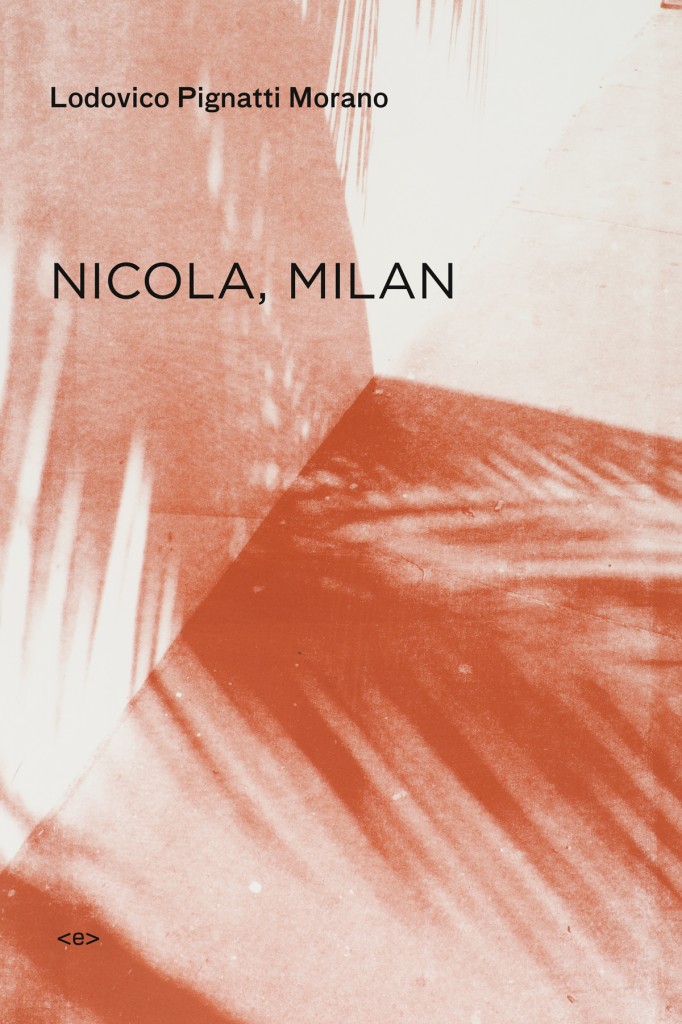
Nicola, Milan
Lodovico Pignatti Morano
Semiotext(e) Native Agents, 2014
$14.95, 127 pages

Lodovico Pignatti Morano’s Nicola, Milan is in many respects a coming-of-age novel, but it affects less a traditional bildungsroman and more a postmodern shrug. A novel about a young man who moves to Milan “to steal someone or something’s cultural authority,” it is a search for meaning in a milieu made up of only surfaces, where identity appears to be little more than a snakelike change of skins. The dubious triumph of Nicola, Milan’s narrator amounts to a forfeiture, a realization that his feelings of emptiness and barren insignificance which characterize the book’s world are indicators that the present is thinning at the elbows, pointing toward the next attractions in postmodern capitalism’s perpetual changing vogue.

Restless and unnamed, Nicola, Milan’s narrator is a twenty-five year-old expatriate from London, who works as a “brand strategist,” but this is mostly titular since he never seems to work at all. The narrator meets Nicola at a party, and quickly becomes obsessed with him. Nicola, in his thirties, is the creative superior to Morano’s narrator. He has access to all the parties, drugs, and new artist; he has age, experience, and connections that the narrator doesn’t. Almost immediately the narrator imbues Nicola with mystery and power. Indeed, Nicola has the “cultural authority” the narrator covets, and the older man becomes a role model of sorts. Early in the novel, the narrator begins consciously aping Nicola’s behavior: “I try to familiarize myself with [Nicola] descison-making process, to get comfortable with his intuitions…I try to find situations similar to his and superficially behave the same way I observed him behaving.”

And much of the book continues this way. Nicola moves, and the narrator follows, watching his every move, puzzling over who he is, what his motivations are, and what, if anything, they mean. In the way that echoes the Existentialist fiction of the earth 20th century, Nicola, Milan is a novel of a young man’s experience of meaninglessness and alienation. But unlike the existentialists’ discovery of authenticity in profound freedom and individual responsibility, Morano’s narrator comes to the realization that there’s no essential self to be alienated from, and no significance more meaningful that pulling off a daring new fashion.

In 1967, French social theorist Guy Debord described our world in his influential text Society of the Spectacle as one where “everything that was directly lived has moved away into representation.” Morano’s world could just as accurately be described in this way, and it comes as no surprise that Morano’s publisher is Semiotext(e), which has been long at the forefront of publishing writing on capitalism and the individual under the shadow of Debord and other likeminded theorists. Morano’s description of Milan seems to draw directly from Debord’s understanding of the contemporary world—what he called a “spectacular society.” For Debord, all individual activity is mediated by capitalism and the to-and-fro of commodities. Finding meaning outside of the market is impossible. For Morano’s narrator, this takes the form of his inability to find any sense of himself or Nicola as an individual outside of purchase and affectation.

Mid-way through the novel, the narrator and Nicola discuss a jacket that Nicola is having custom made. The jacket will have “all my personal references, the things people know me by, my hotel room number I always take, my old nickname, the logo of my more famous blog from when I was in L. A….” Nicola’s jacket is emblematic of the spectacular form of identity itself. He is attempting to create some stable sense of self through designing his own commodity. And soon, after this discussion, the narrator imagines himself wearing the jacket, becoming Nicola, but in doing so, realizes that there’s nothing beneath the symbolic spectacle that Nicola uses to represent who he is, that his life is no less a playacting than anyone else’s: “‘Anything he can do I can do,’ I tell myself, believing it sincerely, somewhat moved by the truth of the statement I’ve made to myself…It is true, a profound realization, another shifting of the ground bboreeneath my feet.”

This fundamental hollowness of the individual is mirrored in Morano’s dispassionate style of writing. At times his prose reads like the disengaged notes of an ethnographer writing a study of the moneyed and schmoozing members of Milan’s creative class: “He’s wearing a white suit, it probably cost a million euros.” There is a semiotic allowance made for these Tweet-like observations of who’s present at dinners, bars, and parties, what they are wearing, what Nicola is doing and with whom as Morano shows how each person who populates this Milan has carefully crafted their exterior personas. Morano never gives away any more than the characters do, never dips into omniscience. As the narrator says when describing Nicola’s apartment: “Things appear as signs, they exist in a descriptive capacity.”

In this way, the narrator depicts a Milan where everything is a carefully constructed series of symbols, never representing anything more profound than the artist who made them, the store they were bought from. It’s a Milan that “exists only as much as the name of a city stamped on a luxury brand shopping bag,” where self-actualization isn’t any sort of expression of a fundamental self, but a recurring fashioning and refashioning. To read Morano’s short, sharp book is to follow a narrator in a fruitless quest for something more, some kind of agency beyond the spectacular world. In a sense Nicola, Milan is a search for a round character in a sea of flat ones, which makes for somewhat disconcerting reading, as the emptiness of everything is described literally, and yet through the seeking eyes of Morano’s narrator, potentially hiding significance. This terseness, combined with the narrator’s suspicion that there is some depth beneath the façades resemble the tension and suspense felt in the best literary thrillers.

Late in the novel, the narrator stalks Nicola online, finding pictures from Nicola’s mythic time abroad—in Mexico, China, and Los Angeles. Despite the narrator vividly imagining Nicola in these places, the pieces never fully fit together to form a whole person. The narrator’s obsessive Goggle-ing also leads him to a blog that refers to a man whom he presumes to be Nicola. The blog outlines a sadomasochistic relationship between Nicola and the blog’s author:

The girl writes about things that, as far as Nicola’s image is concerned, never happened—and this makes me nervous as I sit in front of the computer, reading material freely available to the public, with nothing but a genuine curiosity; they are the zones one never sees in him. It dawns on me that these things she describes actually happened with him, in Milan. And later, as I begin to attach his face to the action, I grow perturbed.

After so long seeing only surface it finally seems the narrator has found some sort of hidden self to Nicola: an identity or a core, an essence. Like a ball of mud rolling down a hill, as the narrator obsesses over Nicola’s online artifacts, imagining him in all manner of situations beyond his ken, the Nicola-fetish picks up more and more significance completely independent from reality. In studying Nicola, the narrator begins to see how the styles and affections don’t cohere and form a whole, cogent identity. When, beneath it all, the narrator discovers a private life to Nicola—a somewhat transgressive one, but still essentially common love affair—he is thoroughly disappointed and quickly begins to fade away from Nicola’s circles in Milan.

It is perhaps no accident that Lodovico Pignatti Morano has made his narrator a brand strategist. After graduating from London’s Goldsmiths University, where he studied Fine Arts, Morano moved to Italy to work in the cycling industry, working with such legendary Italian bicycle brands as Cinelli and Columbus. Although Nicola, Milan is his first novel, Morano is the author of the book Cinelli: The Art and Design of the Bicycle and the editor of a monograph on the Italian Sportswear pioneer Massimo Osti. As Morano explores the emptiness and ciphers of the Milanese creative class in his identity thriller we sense that he knows firsthand the banality of corporate branding, the fiction behind commodities, all of which he dramatizes in Nicola, Milan. These fictions, these banalities are at the core of Nicola’s betrayal because it isn’t that there was another hidden and more significant life, but that it was just as lacking in depth as the surface life which Nicola publicly enacted. When the fetishized commodity is truly viewed up close, it can be seen as the imperfect object it is.

Morano’s narrator’s dissatisfaction that beneath the surface of Nicola is nothing less quotidian than secret sex is also at the heart of the fast changing, never significant, setting of the novel. Fundamentally, dissatisfaction is built into the world of this book, for if a brand (or identity) were to satisfy, the consumer would never need to buy another, or another, or another. Nicola, Milan is a search for the unmediated, and the acceptance that doesn’t exist. And this tense and somewhat fatalistic book is a bored sigh, the resignation that in a world structured by the fickleness of postmodern identity there is no “self” putting on the clothes, just a person-shaped rack.

—Charlie Geoghegan-Clements

.
CharlieOs
Charlie Geoghegan-Clements‘ work has been published with theNewerYork, Marco Polo Quarterly, Tin House, 3:AM Magazine, and Versal. His short story collection Superhero Questions is available from ELJ Publications. More information can be found at ACrannog.com.

.
.

Oct 032013
 

glasses

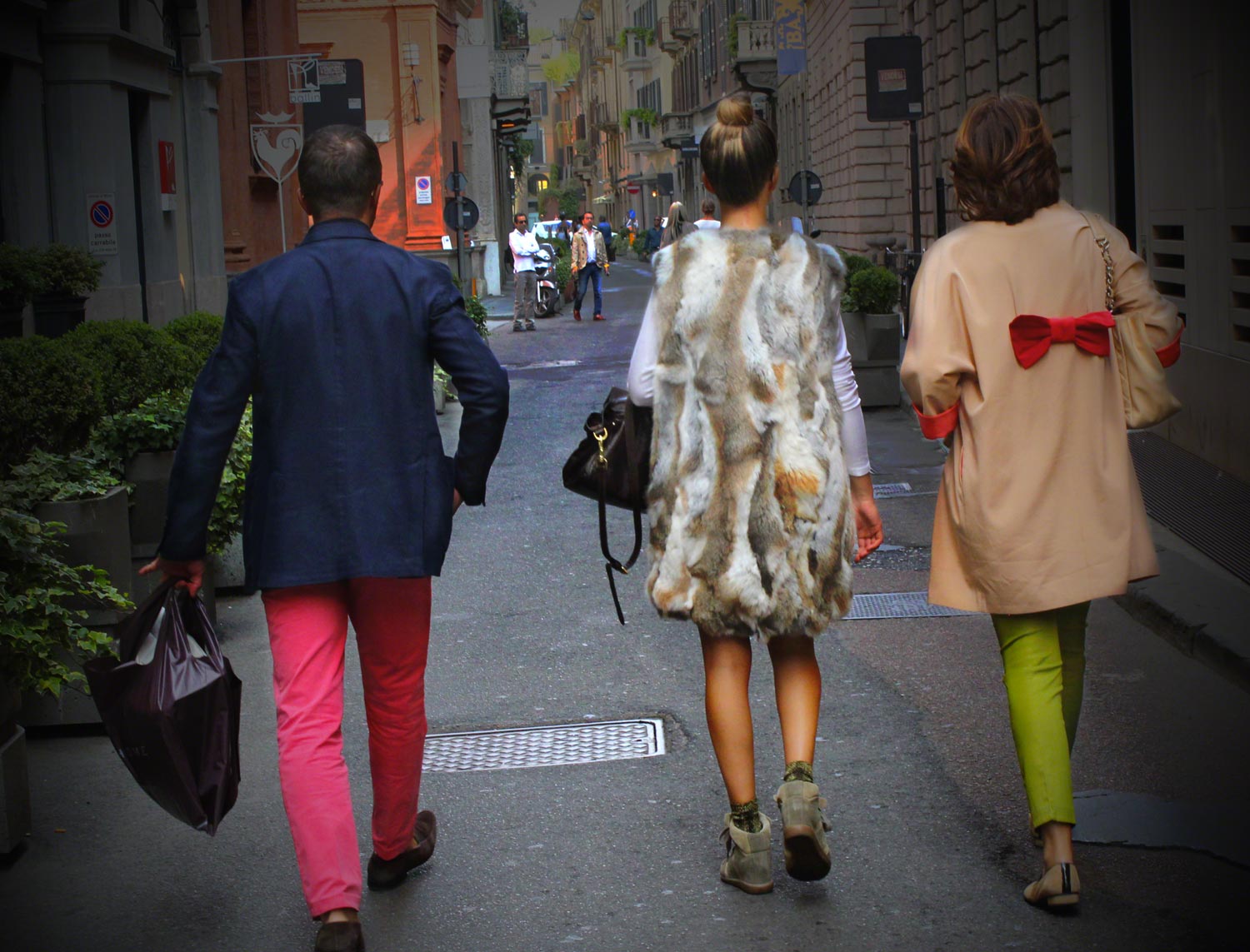
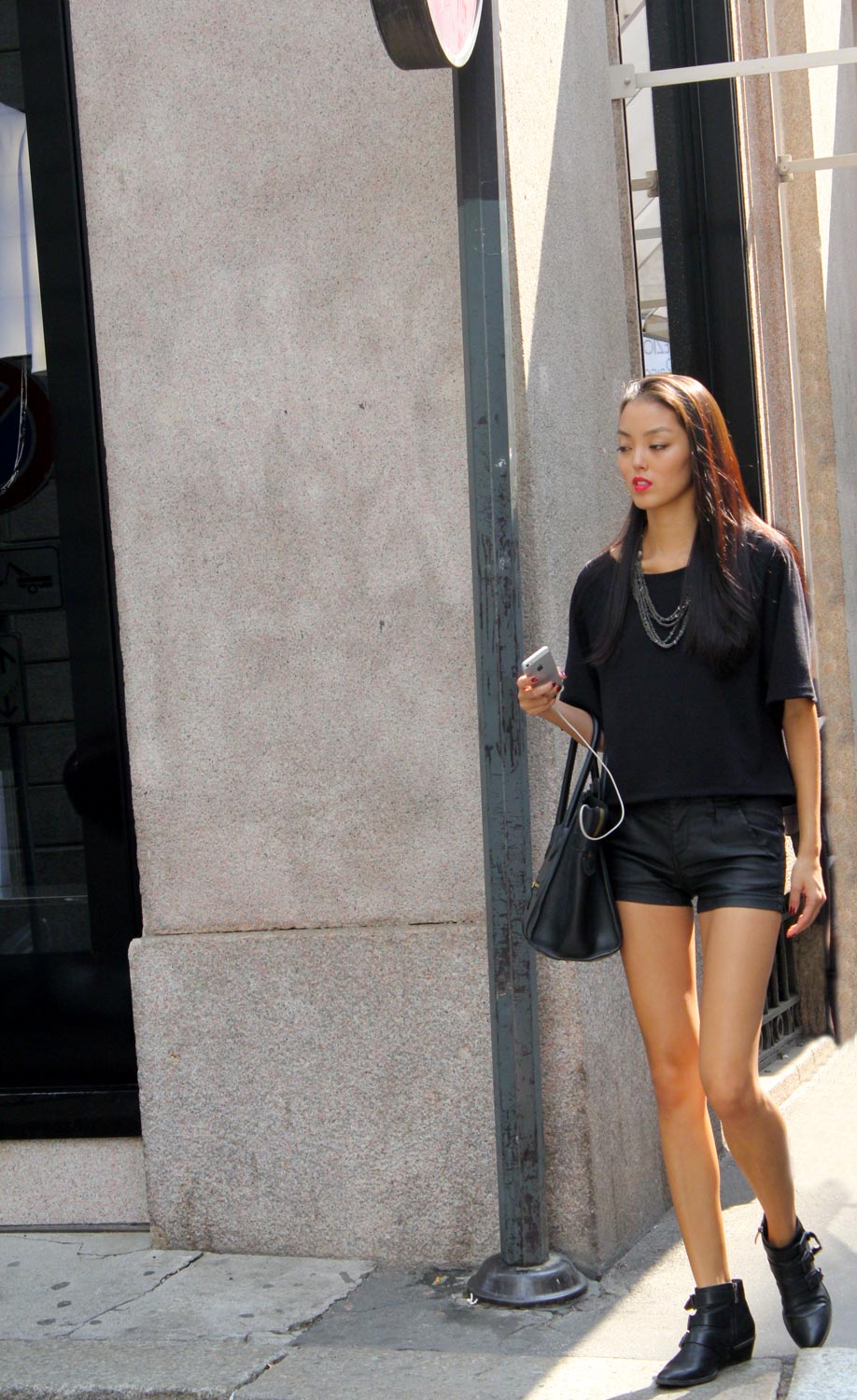
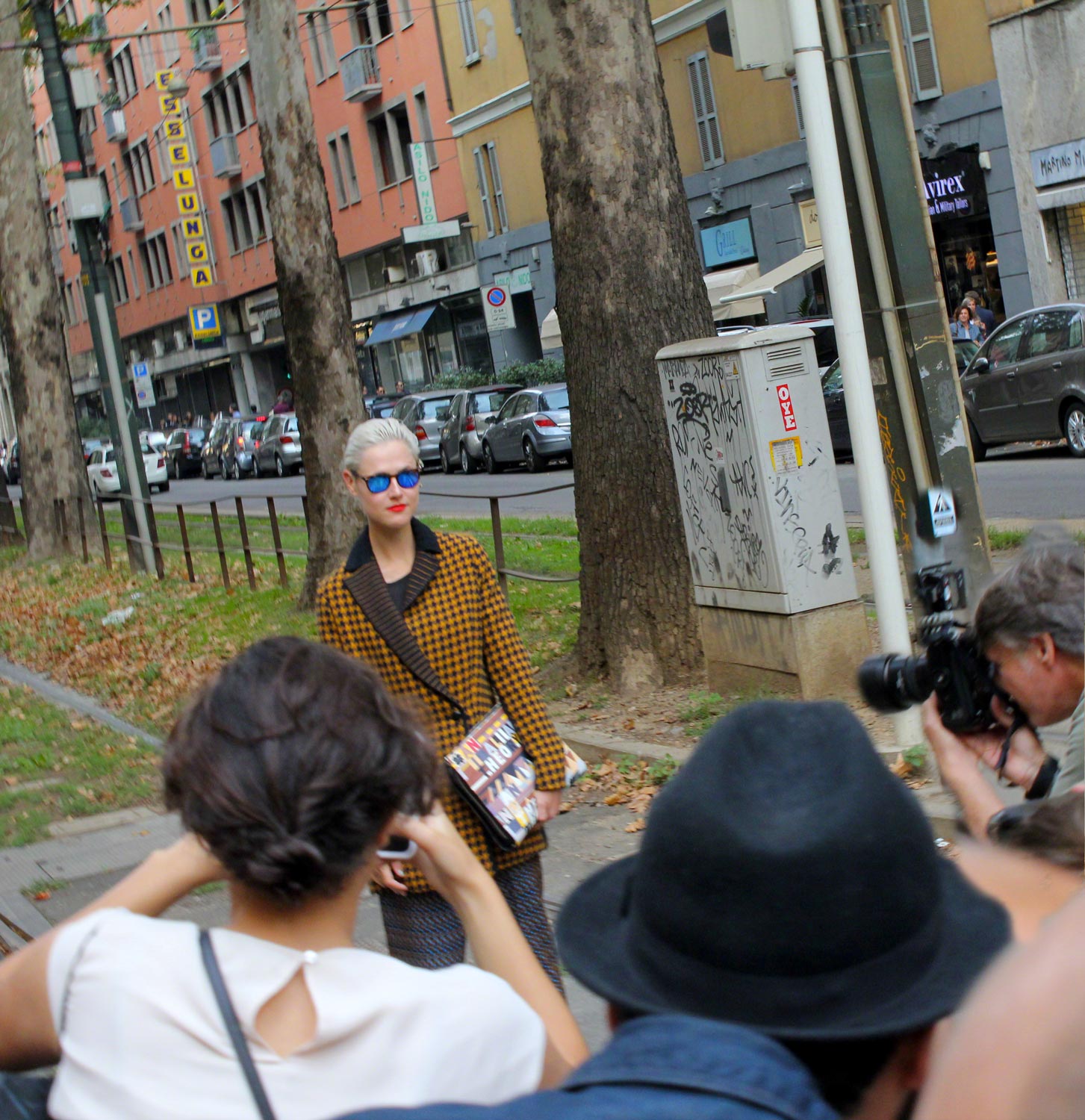
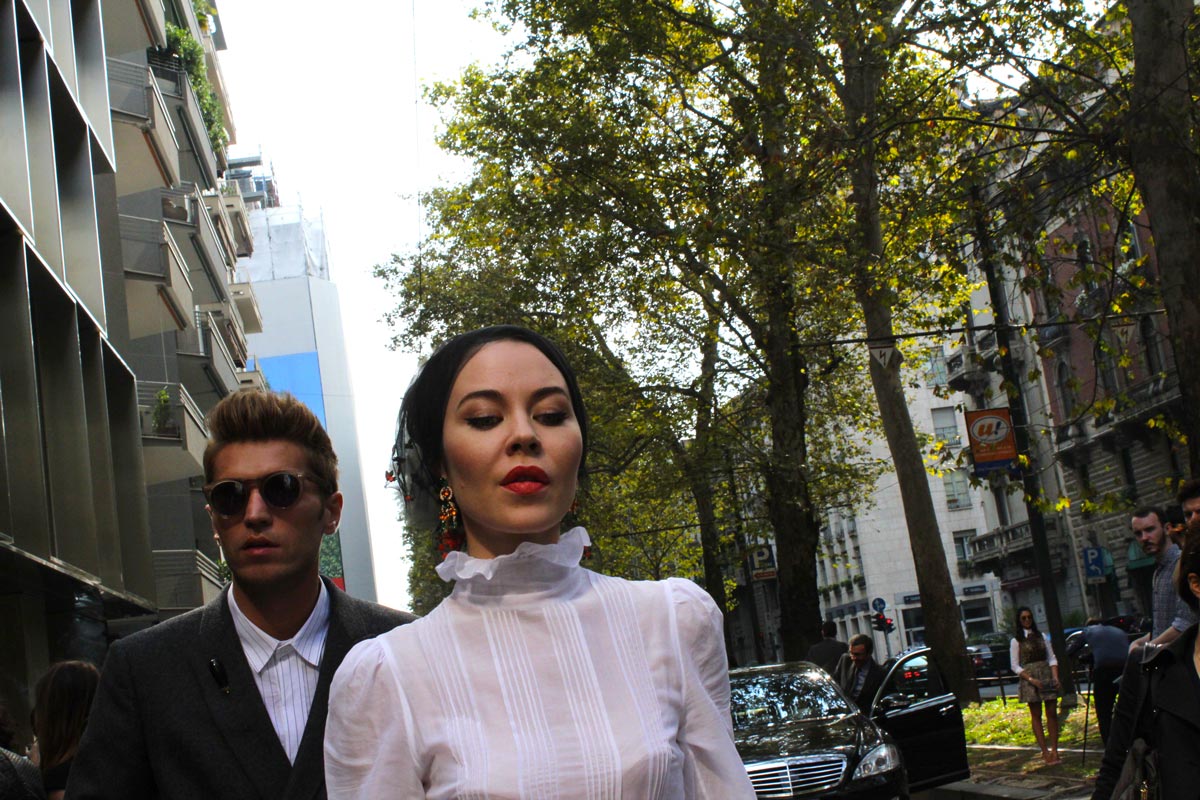
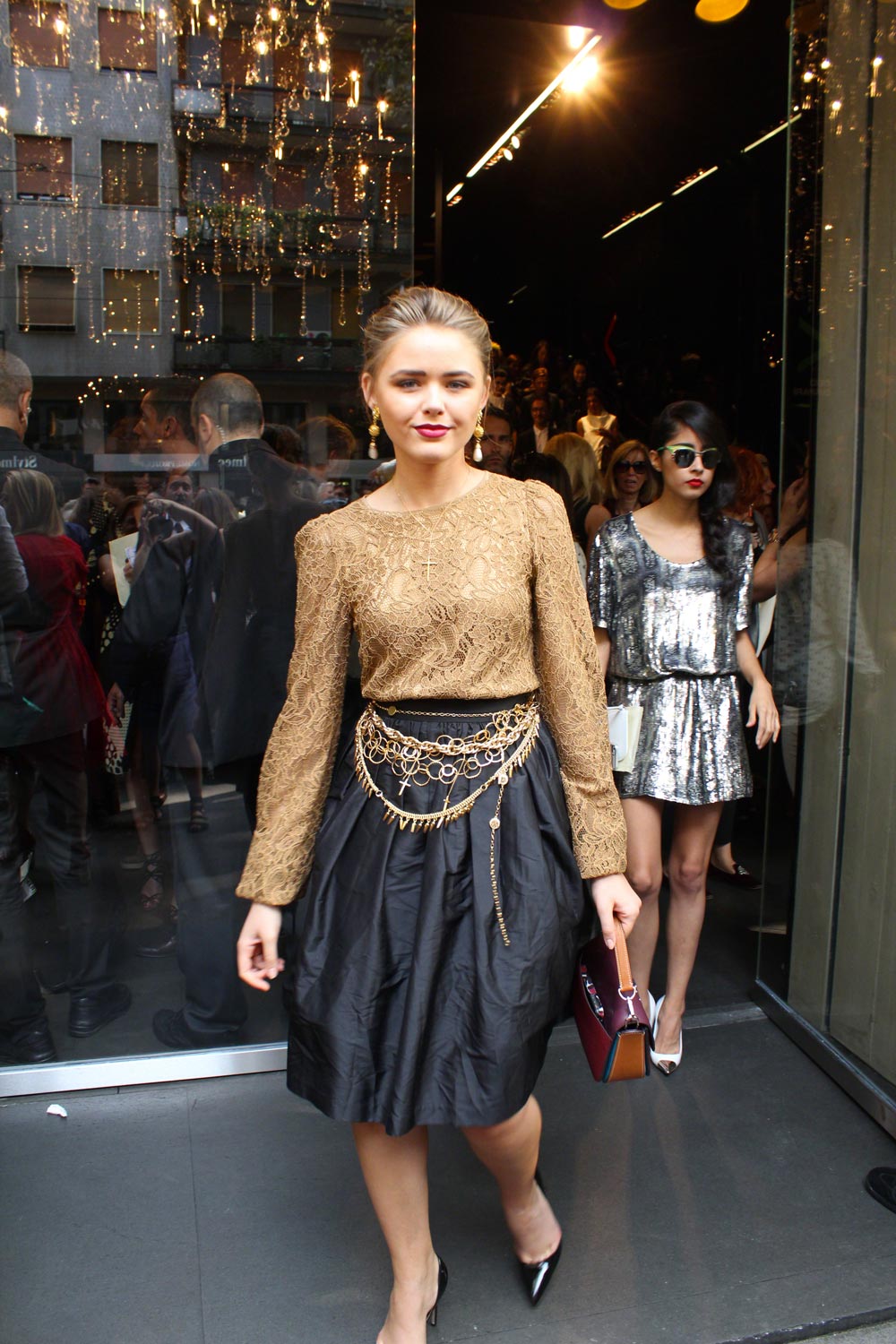
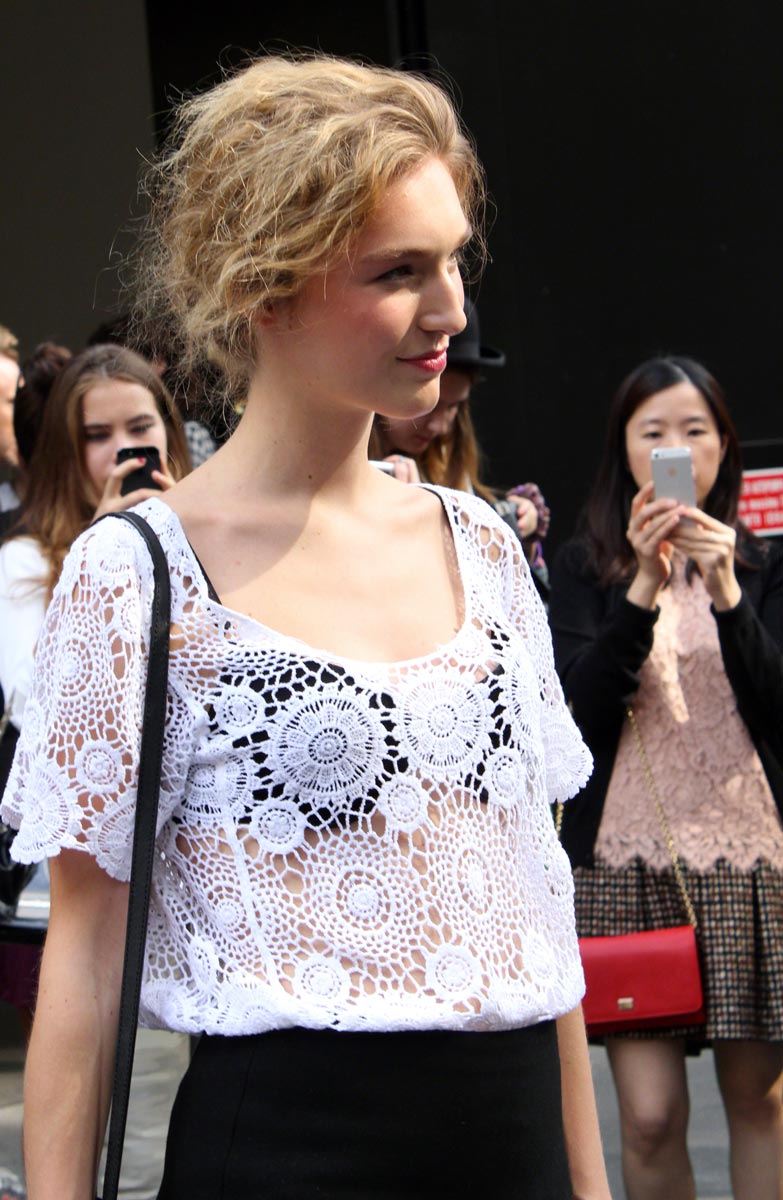
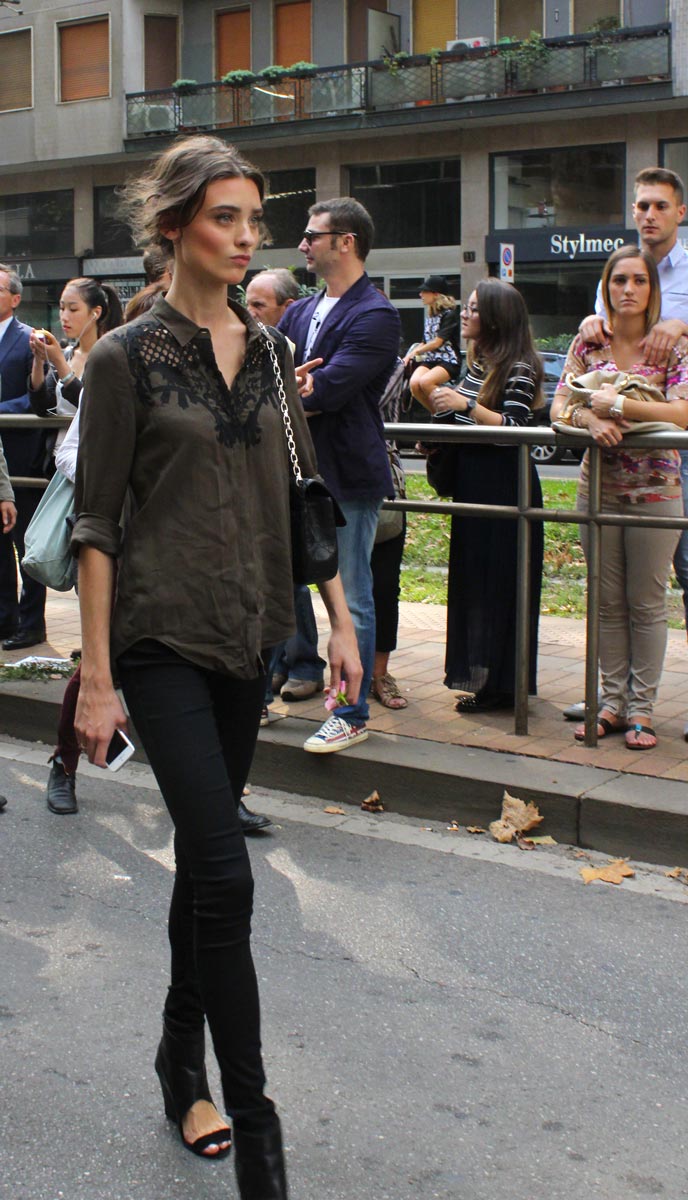
Recently we went photo hunting–it was a beautiful Sunday in Milan and fashion week was wrapping to a close. The streets in the fashion district brimmed with trendy types and photographers with telephoto lenses stalked them, hiding behind traffic signs or at the curb between cars. We did likewise, snagging a few frames with our gear.

Prada

trioBorgospesso

ModelViaMonteNapoleone

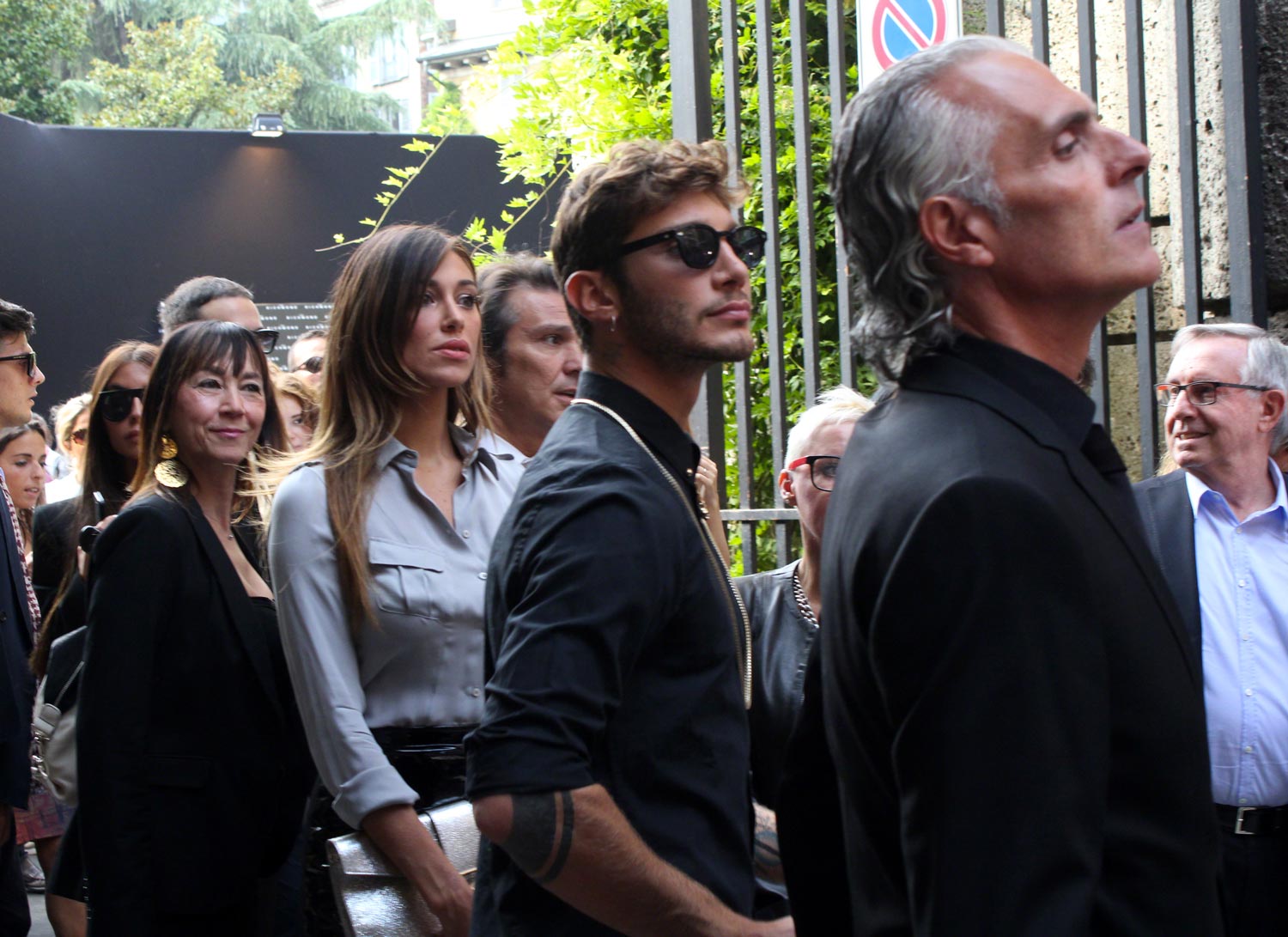
Later, we followed the sounds of loud music and found the venue for the John Richmond show, held in a lush garden behind Corso Venezia. It was lunchtime; only a small, steadfast group waited outside the gates for celebrity attendees to exit. When Italian television star, Belen Rodriguez (of Argentine descent), and her brand new husband, Stefano, emerged, people scrambled, clicking madly.

(from left) Belen, Stefano and a guard

(from left) Belen, Stefano and a guard

“You’re so beautiful,” one woman said, gushing.

“I love your ring,” said another, referring to her huge diamond. “Good luck on your marriage.”

“Thank you,” Belen smiled. She seemed tired by the hoopla; she had married Stefano just two days prior in the midst of a media frenzy.

JaneAlexander

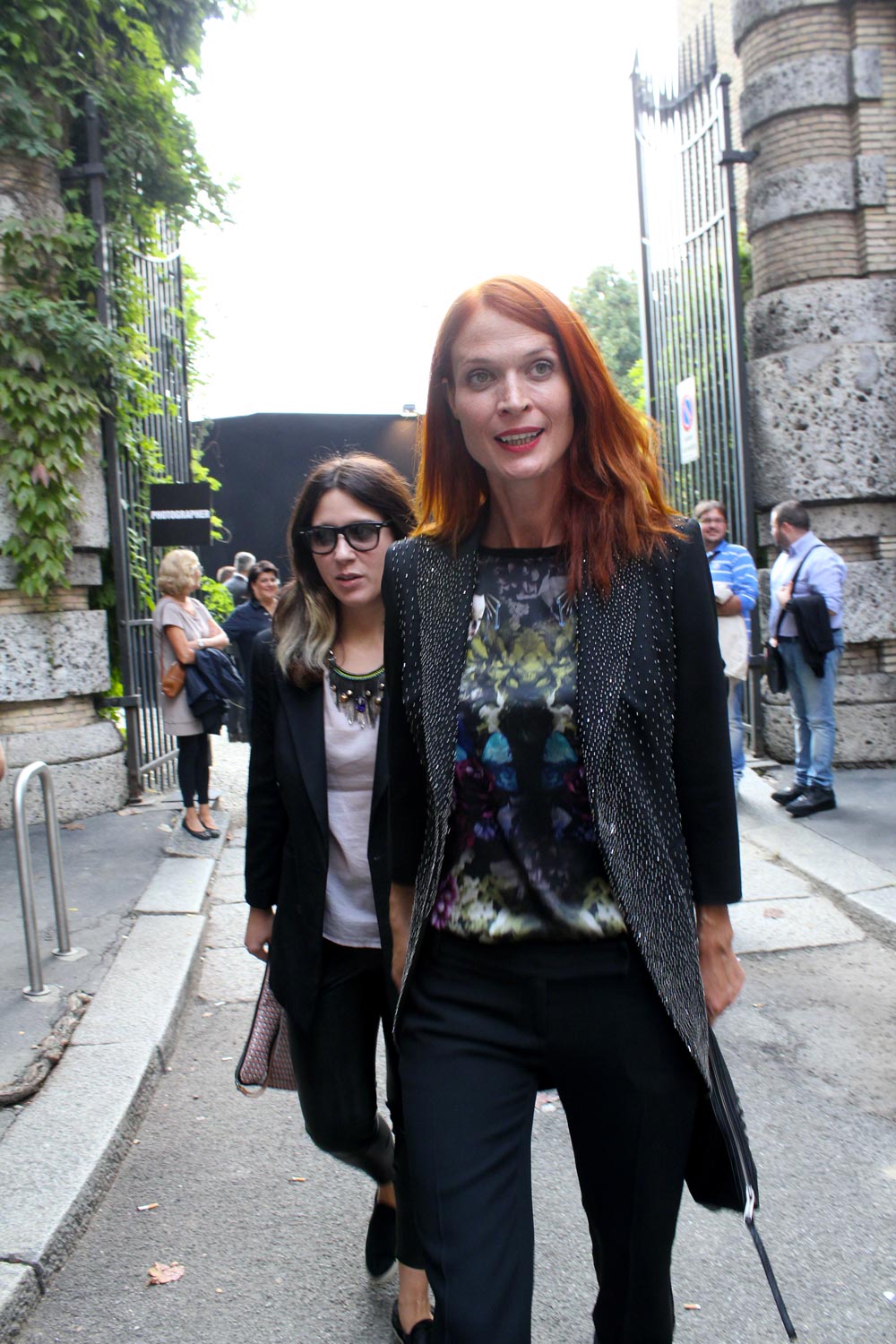
The crowd thinned and by the time Jane Hamilton, star of the TV serial, “Elisa di Rivombrosa,” emerged, just a few bystanders were on hand. Two men asked to have their pictures taken with her; she graciously complied.

triofashionweek

interview

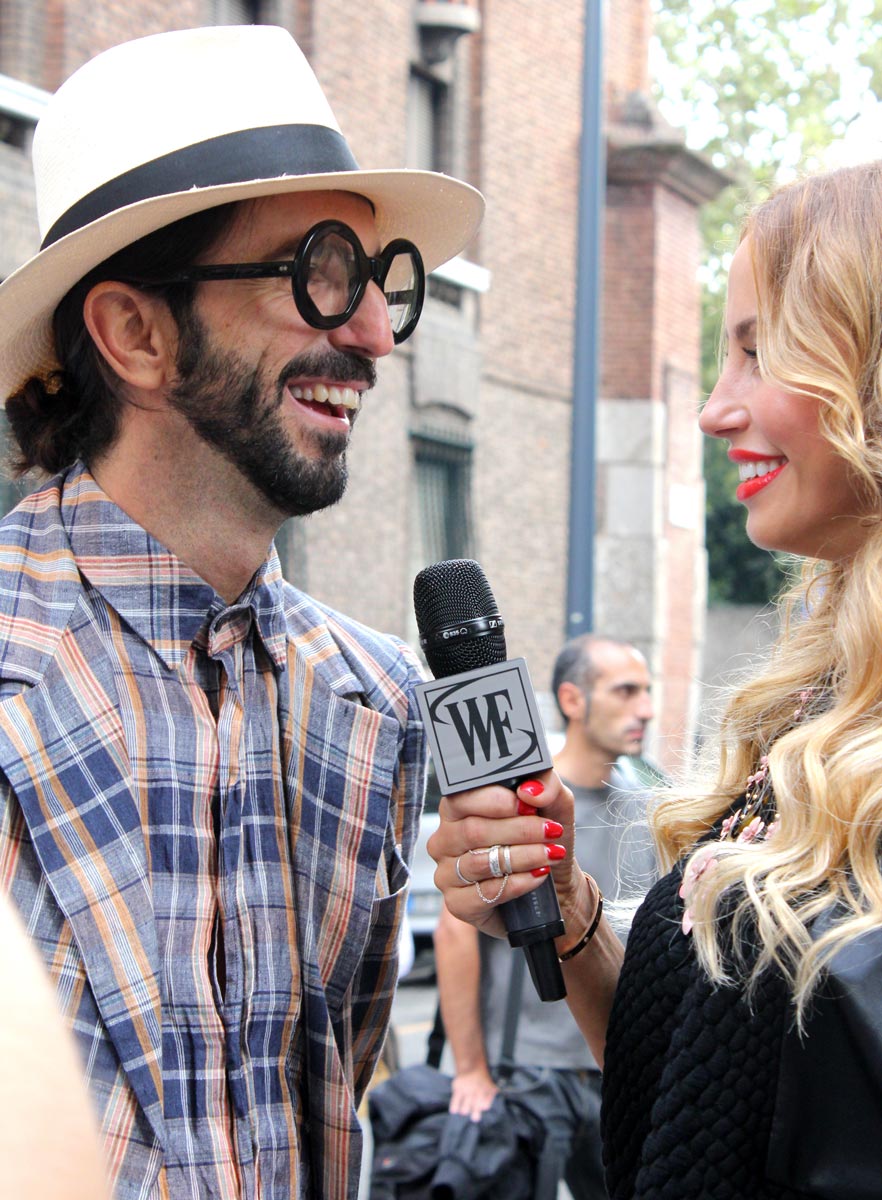
Journalists from the Russian World Fashion network worked the crowd. “I like  your shoes,” said the journalist to one man in a fedora. “Where did you buy them?”

LindaBlogger

Later, to one side of the Metropole theater where the D&G show was underway, the ticketless congregated on the street, here too snapping their cameras at anyone who looked fashionable.

“Who is that?” I asked one man in a baseball cap who was avidly immortalizing a blond. The man shrugged.

“I don’t know, but she looks good doesn’t she?” he said.

“She’s a blogger,” said a woman in a black tunic printed with green dinosaurs. “No, don’t know her name,” she answered when I asked.

MetropoleModel

We drifted toward the corner where several tall, thin, photogenic types in eccentric costumes—former models I wondered?—paraded back and forth as if they themselves were on the runway, enjoying D&G’s reflected light. A masquerade rave in via Piave.

DolceGabbanashow

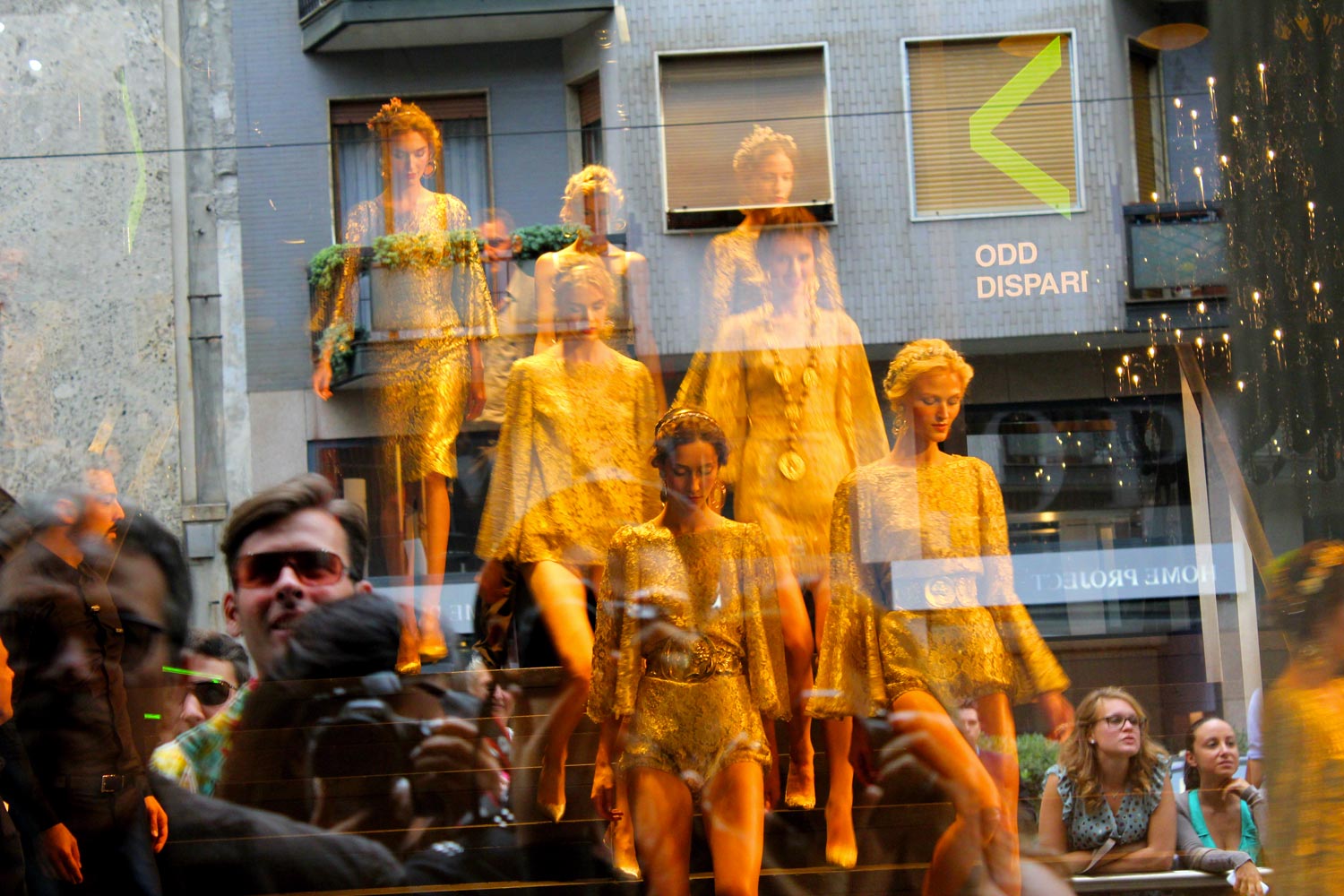
We were back at the Metropole entrance in time for a glimpse of the D&G grand finale.  From our vantage point, we could see through the glass doors into the lobby. Models in gold–with Stefano Gabbana in their midst–filed through.

RussianGirlD&G

Some in the audience likewise wore precious metals.

Fashion pundits write in The Guardian that with this 2014 summer collection laden with gold coins, “Dolce and Gabbana seemed to be saying, ‘If you’ve got it flaunt it.’ [The whole collection] seemed like a metaphor for wealth.” This may be Milan’s last D&G show; convicted in June of tax evasion, rumor has it that the designers may vacate the city.

Several minutes later, the models had changed into street clothes and mingled on the street, some stopping and posing, others heading for the tram.

blondmodelMetropole

D&GmodelVialePiave

Then the street crowd began to hurry away; the Missoni show was about to begin elsewhere. Economic times are difficult but during fashion week the Milanese find it satisfying to watch, take pictures and dream.

—Natalia Sarkissian

————————————-

Natalia Sarkissian holds an MFA in Writing Natalia Sarkissianfrom the Vermont College of Fine Arts. She was an editor and contributor at Numéro Cinq from 2010-2017.

Jan 052013


.

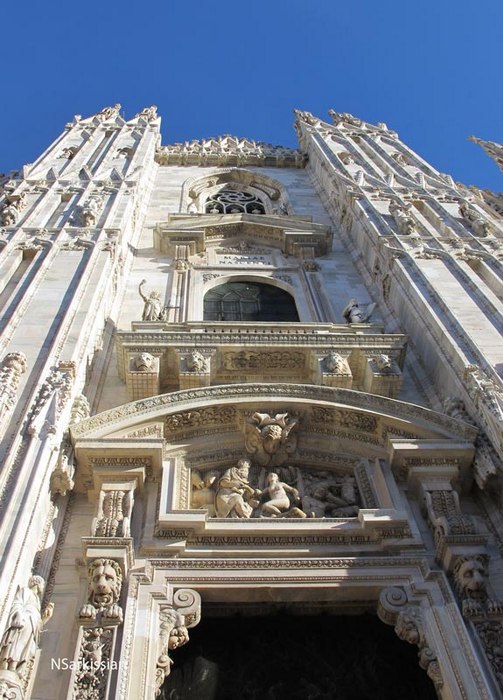
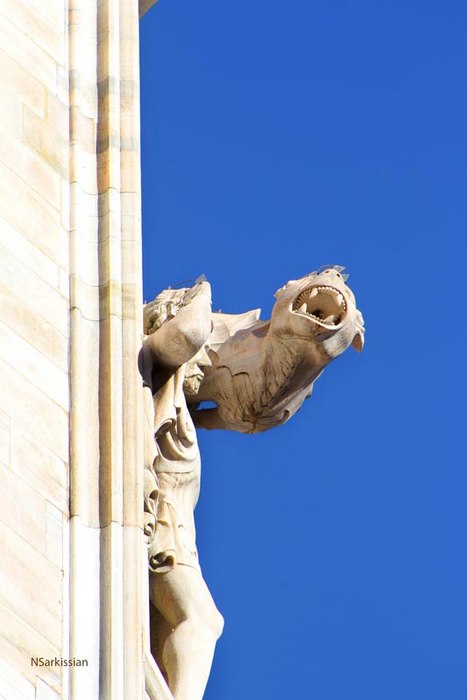
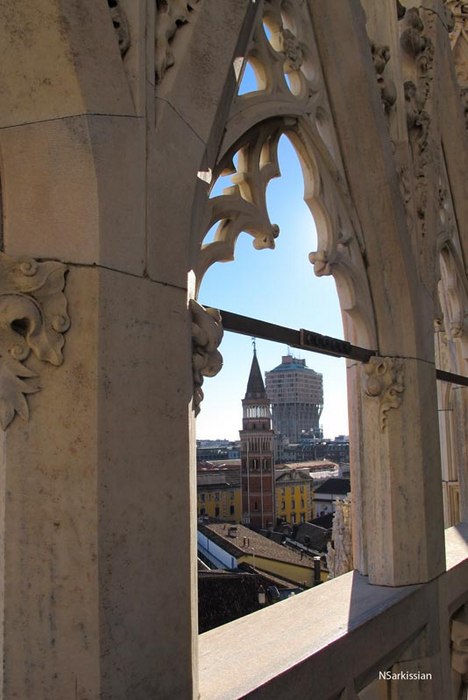
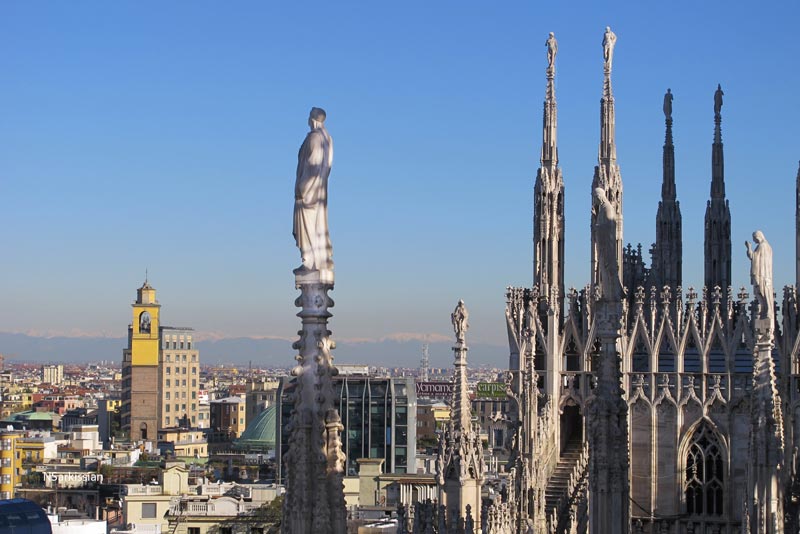
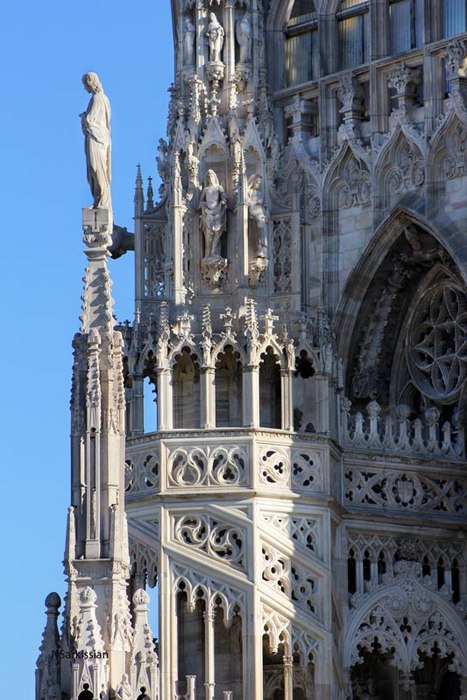
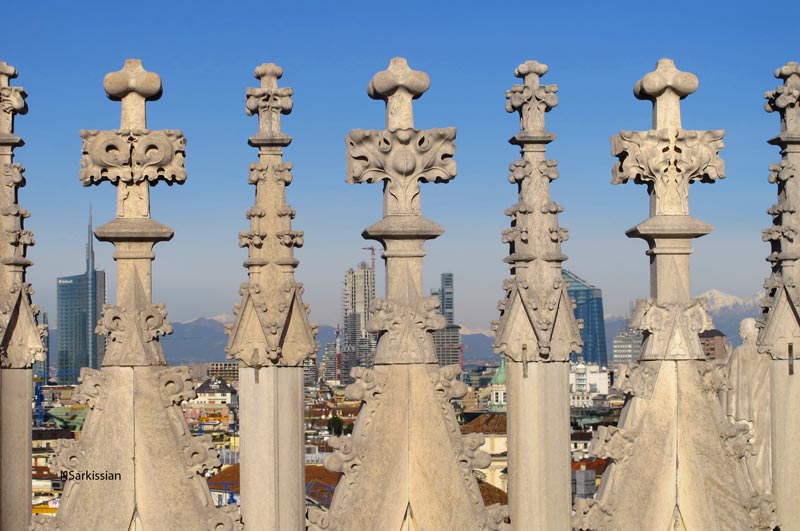
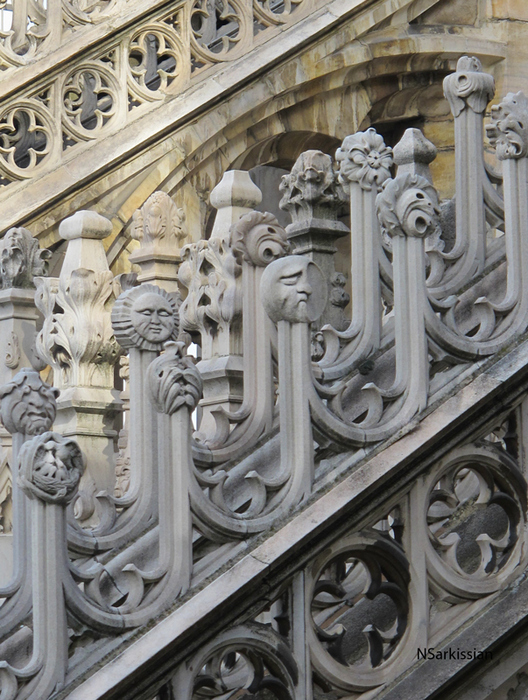
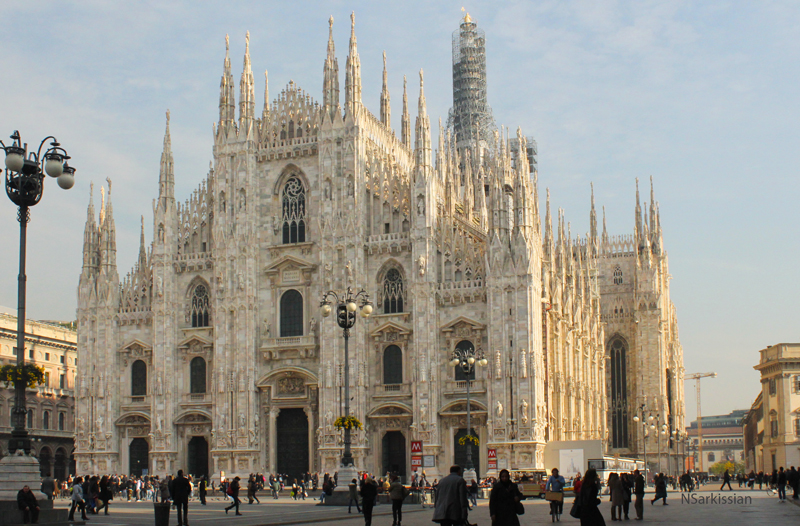
On the roof of Milan’s Duomo amidst the spires and gargoyles and saints and angels, it’s noon on a late fall day and I’m here shooting. The sun shines over the city that spreads out like a bristling blanket; new skyscrapers and old bell towers puncture the worn brick and stone fabric of the town. At the edges, the Alps gleam, snowy in the distance. Above, the cathedral glows white against the sky. And all around me, friendly Romanian tourists in black jackets and thigh-high boots jostle, vying for vantage points from which to take pictures. They elbow in, admiring, snapping and clicking. Another group—this time from China—bursts from the stairs. Chattering and hopping about like hungry little sparrows, they freeze the landscape and their trip with hundreds of shots.

.

.


.

I retreat from the crush, thinking of Shelley and Tennyson and Henry James and Mark Twain who traveled here, part of their century’s onslaught: the privileged class that toured Italy, its monuments and museums serving as a finishing school. They climbed here too. Equally ecstatic but without cameras, armed with pens. They wrote letters to friends and poems for periodicals and chapters in books praising the Duomo. And of a different opinion, John Ruskin and Oscar Wilde came. They hated what they saw; their words were scathing.

.


.

On the rib of the roof, in the sun but with a brisk breeze stirring, I think of their descriptions and train my lens back on the cathedral, to see what they once saw.

.

.

At last, a forest of graceful needles, shimmering in the amber sunlight, rose slowly above the pygmy housetops, as one sometimes sees, in the far horizon, a gilded and pinnacled mass of cloud lift itself above the waste of waves, at sea—the Cathedral! We knew it in a moment.

Mark Twain, Innocents Abroad, 1869

.

.

This cathedral is a most astonishing work of art. It is built of white marble, and cut into pinnacles of immense height, and the utmost delicacy of workmanship, and loaded with sculpture. The effect of it, piercing the solid blue with those groups of dazzling spires, relieved by the serene depth of this Italian heaven, or by moonlight when the stars seem gathered among those clustered shapes, is beyond any thing I had imagined architecture capable of producing.

PB Shelley, letter to TLP Esquire, 1818

.

.

.

.

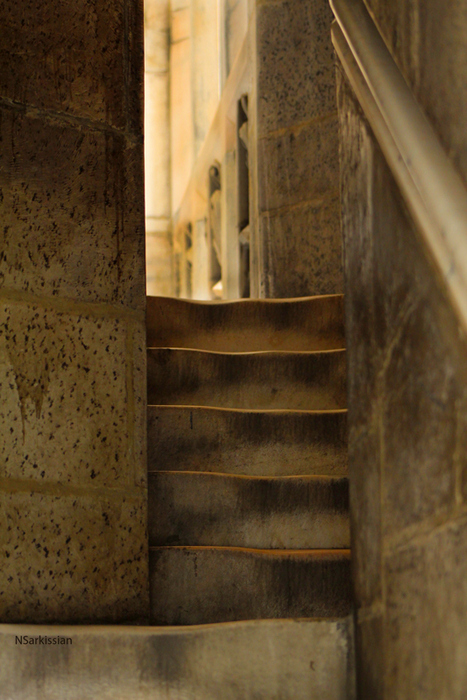
We wished to go aloft. The sacristan showed us a marble stairway and told us to go up one hundred and eighty-two steps…. We were tired by the time we got there. This was the roof. Here, springing from its broad marble flagstones, were the long files of spires, looking very tall close at hand, but diminishing in the distance like the pipes of an organ. We could see now that the statue on the top of each was the size of a large man, though they all looked like dolls from the street. We could see, also, that from the inside of each and every one of these hollow spires, from sixteen to thirty-one beautiful marble statues looked out upon the world below.


Mark Twain, Innocents Abroad, 1869

.

.

………………………………….I climb’d the roofs at break of day;
………………………………….Sun-smitten Alps before me lay.
………………………………….I stood among the silent statues,
………………………………….And statued pinnacles, mute as they.

Alfred, Lord Tennyson, “The Daisy,” 1851

.

.

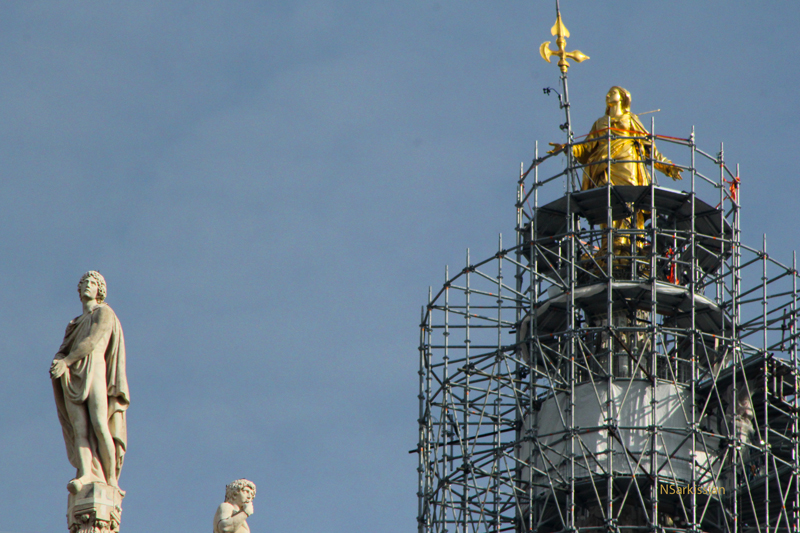
Every face is eloquent with expression, and every attitude is full of grace. Away above, on the lofty roof, rank on rank of carved and fretted spires spring high in the air, and through their rich tracery one sees the sky beyond. In their midst the central steeple towers proudly up like the mainmast of some great Indiaman among a fleet of coasters.

Mark Twain, Innocents Abroad, 1869

.

..

.

The cathedral is a mixture of Perpendicular with  Flamboyant, the latter being peculiarly barbarous and angular, owing to its being engrafted, not on a pure, but a very early penetrative Gothic … The rest of the architecture among which this curious Flamboyant is set is a Perpendicular with horizontal bars across: and with the most detestable crocketing, utterly vile. Not a ray of invention in a single form… Finally the statues all over are of the worst possible common stonemasons’ yard species, and look pinned on for show. The only redeeming character about the whole being the frequent use of the sharp gable … which gives lightness, and the crowding of the spiry pinnacles into the sky.”

John Ruskin, Notebooks, October 17, 1849

.The 

The Cathedral is an awful failure. Outside the design is monstrous and inartistic. The over-elaborated details stuck high up where no one can see them; everything is vile in it; it is, however, imposing and gigantic as a failure, through its great size and elaborate execution.

Oscar Wilde, letter to his mother, 1875

.

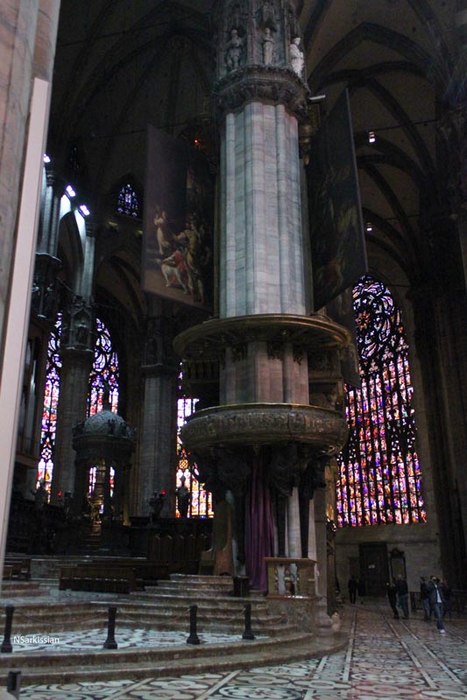
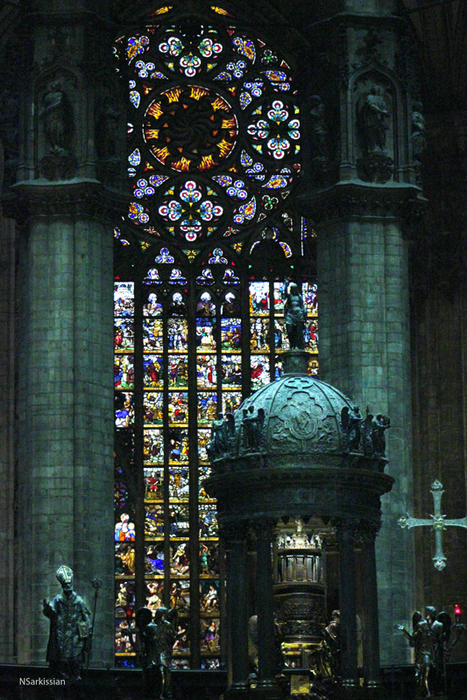
While I study the roof, the Romanians finish taking pictures and sun themselves, propped against pinnacles. An hour or so later, they get up and file down the stairs, off perhaps to go Christmas shopping at Rinascente department store across the way. I follow them down but enter the cathedral to take pictures of the interior for this essay. Today’s strong sunlight blazing through the stained glass windows has set the somber interior burning.

.

..

.

The interior, though very sublime, is of a more earthly character, and with its stained glass and massy granite columns overloaded with antique figures, and the silver lamps, that burn forever under the canopy of black cloth beside the brazen altar and the marble fretwork of the dome, give it the aspect of some gorgeous sepulchre. There is one solitary spot among those aisles, behind the altar, where the light of day is dim and yellow under the storied window, which I have chosen to visit, and read Dante there.

PB Shelley, letter to TLP Esquire, 1869

.
.

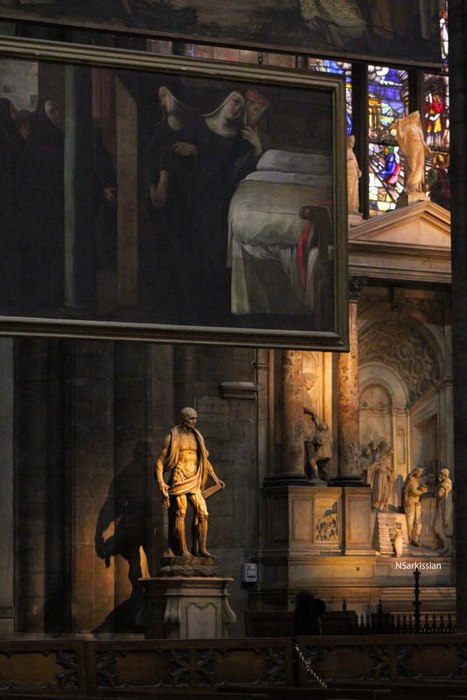
The guide showed us a coffee-colored piece of sculpture…. The figure was that of a man without a skin; with every vein, artery, muscle, every fiber and tendon and tissue of the human frame represented in minute detail. It was a hideous thing, and yet there was a fascination about it some where. I am very sorry I saw it, because I shall always see it now. I shall dream of it sometimes. I shall dream that it is resting its corded arms on the bed’s head and looking down on me with its dead eyes; I shall dream that it is stretched between the sheets with me and touching me with its exposed muscles and its stringy cold legs.

Mark Twain, Innocents Abroad, 1869

.

.

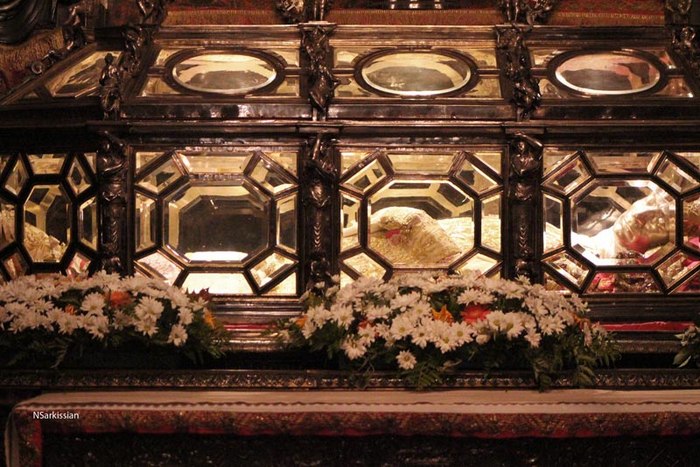
St. Charles Borromeus lies at his eternal rest in a small but gorgeous sepulchral chapel…and for the modest sum of five francs you may have his shrivelled mortality unveiled and gaze at it with whatever reserves occur to you….  The black mummified corpse of the saint is stretched out in a glass coffin, clad in his mouldering canonicals, mitred, crosiered and gloved, glittering with votive jewels. It is an extraordinary mixture of death and life; the desiccated clay, the ashen rags, the hideous little black mask and skull, and the living, glowing, twinkling splendour of diamonds, emeralds and sapphires.

Henry James,  “A European Summer, VI.”  The Nation, Nov. 21, 1872.

..

They say that the Cathedral of Milan is second only to St. Peter’s at Rome. I cannot understand how it can be second to anything made by human hands.

Mark Twain, Innocents Abroad, 1869

.

As I
 strolled beside its vast indented base one evening, and felt it,
 above me, rear its grey mysteries into the starlight while the 
restless human tide on which I floated rose no higher than the 
first few layers of street-soiled marble, I was tempted to 
believe that beauty in great architecture is almost a secondary
 merit, and that the main point is mass–such mass as may make it 
a supreme embodiment of vigorous effort. Viewed in this way a
 great building is the greatest conceivable work of art. More than 
any other it represents difficulties mastered, resources
 combined, labour, courage and patience. 

 Henry James,  “A European Summer, VI.” The Nation, Nov. 21, 1872.

.

.

At the Duomo, I’ve lost track of time. When I finally squeeze onto the metro I realize I’m going to be late picking up my son to take him to the dentist, but strangely, down here in this dark tunnel, I don’t feel pressured. Words and images of the Duomo swirl in front of me and I’m uplifted.

 ––Natalia Sarkissian

——————————-

Natalia Sarkissian has an MFA in Writing from Vermont College of Fine Arts and has been an editor and contributor at Numéro Cinq since 2010. Natalia divides her time between Italy and the United States.


Dec 032010
 

This is Natalia  Sarkissian’s second “What it’s like living here” piece. The first brought us the shocking news of her son’s illness. This one delivers the aftermath, hope and dogs and gorgeous cityscapes from Milan.

dg

What it’s like living here

By Natalia Sarkissian in Milan

December, 2010

Dear DG:

You ask about Nick, his heart, the operation. He’s pretty much himself again; kids are resilient that way (their mothers and fathers less so). We’re picking up where we left off before we put everything on hold. Not easy these days with life everywhere often a challenge:


“Camera da Letto” means refuge

The alarm rings in the pearly gray of morning.

White sheets—from a transatlantic trip to Macy’s in Boston—slide like silk as you stir, your dreams of sand and sun on the Sound dispersing with the squeal.

You reach out an arm. You fiddle with a button. Silence ensues.

You blink in the shadowy room. Then you light the alabaster lamp from Volterra, the one you bought on sale years ago when Rinascente department store revamped and unloaded merchandise—60% off. Now a milky glow shines encouragement on your side of the bed.

Don’t move quite yet. Study instead the India-ink drawings of cocktail parties and frivolity facing you—the ones you sketched when you were twenty and going to be a painter. Then contemplate the alcove where your desk sits piled with papers, the old dresser loaded with a tower of books. You’re a mother, a part-time translator, part-time English teacher and when time permits—writer—now. A translation project (small) awaits. A lesson plan (a doctor wants to converse in English for an hour) awaits too. Not much money, but at least it’s some. In the afternoon you’ll do homework with Chris. And then there’s that novel you’re writing.

Sigh, and say, “first things first.”

Kick the sheets back.

Slip into your jeans, your t-shirt, your sweater.

Turn off the light: a mound still snores gently under the white sheets from Macy’s.

Tiptoe: the mound, in the old days (how many months of joblessness is it now?) used to be up first, shaving and showering before a day directing strategic sales in a large multinational. Now, if roused, the mound remonstrates.


“Cucina” means good morning

An old-fashioned door from the twenties (two panels, with glass, bolted across the middle with a brassy lock) bars entrance to the kitchen. On the far side, a six-month-old beast whimpers and jumps and the doors rattle and shake.

“Come girl,” you say, releasing your as-of-yet-un-housebroken pup from her nightly exile to the tiled floor and newspaper inside. Tail wagging, she hops and jolts, somersaulting with joy.

“I love you too,” you say, patting, but rushing. Bladders are small, muscles are weak, minutes are precious.

Seize the leash, grab a parka, open the front door. Step out onto the marble, lock up, press the button. But then wait for the old-iron-bird-cage elevator to crank up to four.

Say, ‘accidenti—goodness,when you note a spreading yellow stain beneath your wriggling puppy. And then louder, ‘cazzo—fuck.’

Across the landing the neighbor lady—up early too—flings her door open.

“Not again!” she cries, her hands on her hips, her feet stuck in felt slippers, her white hair in scruffy clumps about her gray face. “Aren’t you going to scold her?”

“Yes,” you say, and you do, but your heart’s not in it, not when you’ve got a disapproving audience.  Apologize again. Say, “she’s just a puppy.”

Promise to clean up when you return.

When the neighbor lady says, “things were fine before you went and got that dog,” and then slams her door, you shrug and step into the elevator. You know things weren’t fine before you went and got that dog. You know you went and got that dog to help things be fine.

Decide you’ll walk her long and languid.

“Parco delle Basiliche e Le Colonne di San Lorenzo” mean survival

A green expanse stretches from the Basilica of San Lorenzo to the Basilica of Sant’Eustorgio where, according to legend, relics of the Three Magi once were conserved. At one time infested marshlands, the land was reclaimed and fashioned into a park in the twentieth century. Students eat their lunches here on sunny days. Children swing from monkey bars in the afternoon. Along the park’s fringes, fashionable establishments serve elegant food on iron tables in vine-draped niches at midday and in the evening.

You used to have aperitivi here at sunset when brick buildings glow red. You haven’t had an aperitivo here, or anywhere, in months. Nor have you watched bricks glow as the sun sinks.

Nearby stand sixteen Corinthian columns, Roman ruins of the 3rd century. They were moved here in the 4th century as part of the construction project of San Lorenzo. Survivors of Roman Mediolanum, Barbarian invasions, Austrian invasions, World Wars, and urban re-edification, the columns symbolize survival against all odds.

You like to walk Wendy here, in this piazza and park strewn with evidence of survival, of rejuvenation.

This morning, cars rush by at 7:30, their taillights fuzzy red globes in the early morning fog. The green 94 bus wheezes along, leaving a wake that tastes of petroleum. Thick and gray it clogs your throat. You cough, cross the street, enter the park, your dog pulling on her leash, a flock of pigeons in her sights.

“Area Cani” means leashlessness

In the midst of the park of the basilicas a fence encloses trees and grass and muddy patches: a dog run.

Open the gate, release Wendy.

Throw a ball, toss a stick.

Soon Signora Mastini and her beagle arrive.

“You’re here early,” you say to Signora Mastini. You watch the dogs roll together in muddy orange leaves and enjoy their nips and jumps and yips.
“Volunteer work at church today,” says Signora Mastini.
“Volunteer work?”
“The homeless. I feed them. I clothe them. So many these days. So many.”
“Oh,” you say, inhaling the damp smell of autumn rot.
“Single men. Divorced men. Family men. They lose their jobs, can’t pay the rent, then they’re out on the streets.”
“Oh,” you say, “oh.” You zip your zipper against the chill.
“Did you know they fight over clothes? Winter jackets are in short supply. But I’m never worried. ‘Basta!’ I say. ‘Cut it out, or I’ll throw you out.’ They always listen. They can’t afford not to.”

Yes. You nod.

Then whistle. You yank Wendy away from her frolicking friend.

“Come on, girl,” you say and shut the gate. You can’t afford to think about homelessness. It isn’t looming, is it?

Walk. Then walk some more so you won’t think.

“Via Torino” means thoroughfare

Cut around the perimeter of San Lorenzo, then through the Carrobbio, an old intersection where the Roman Ticino Gate once stood. Walk north, along via Torino, a shopping artery that connects San Lorenzo to the center of town. Admire a door spray-painted by a graffiti artist but ignore the attractive shop windows up and down on either side. Forget what you don’t need and can’t have.

Pause in front of S. Giorgio al Palazzo, an 8th century church, the name of which comes from a no-longer-extant Roman Imperial palace built by Diocletian. The church houses a cycle of paintings by Bernardo Luini and a late medieval relief of St. George and the Dragon.  

Decide to view St. George slaying his dragon. Consider it good for morale.

The doors are open for morning mass, but a frowning man in a cleric’s collar says you can’t enter with your dog. Even if you carry her. Even if you fit her in your bag.

Traipse north. Stop while a concierge washes the sidewalk in front of her apartment building. Enjoy the hiss of her hose on the pavement.  Approve of how,
with deft flicks, she sends debris sliding to the gutter.
Wait until she finishes spraying. Squelch past, listening to your rubber soles slapping against the wet. Then stop again.

Consult your phone. The battery’s low, but still, it’s enough. Scroll and find it. Piazza San Babila, 3.

Walk where your directory tells you.


“Piazza San Babila” means shelter

Piazza San Babila, with fountains and gardens, surrounded by porticoes filled with boutiques, long considered the ‘salotto buono,’ or the living room of the affluent, perches at the crossroads of the swankiest streets of Milan: Via Montepoleone, Corso Venezia, Corso Europa. Lined with neo-fascist buildings, it’s named after the venerable brick church that oversees the bustle at one far end.

Head here, to this piazza, at 9 am, your little dog following.

Quit Via Torino, cross Piazza Duomo, traverse the pedestrian walkway of Corso Vittorio Emanuele II, still silent, still empty of tourists and street vendors. Ignore Rinascente, Pollini, D&G as you go.

Forget what you don’t need and can’t have.

But as you near Diesel boutique, nod at a middle-aged man with a sleeping bag in a shopping cart. When he asks you for money, hand him a euro. Realize you think you’re buying distance, you think you’re buying time.
“Nice dog,” he says when Wendy sniffs his feet. “I had a dog once.”
You smile and nod again but he doesn’t.

A few steps further, a young couple, sitting on cardboard, plastic bags filled with old clothes strewn around them, eats breakfast from McDonalds. Wendy barks and the woman spills coffee on her dirty pink track suit.
“Shhh,” you say. Eyes averted, you hurry your dog past.

Still further, nearing the piazza, an old man with a grizzled beard and gray hair sprawls in the doorway. Think: when the shoppers disperse, the dispossessed find a night’s worth of relief.

“No, Wendy,” you say when she starts to growl, “Piazza San Babila has many faces. Right now it still means shelter.”

You know that soon, when the stores open, the men and the woman will be made to move. Maybe they’ll go to Signora Mastini for a hot lunch and to fight over shoes.

“Ufficio di Lavoro Interinale” means temp agency

Rounding the corner, you’ve made it. San Babila, 3. But although you search, you can’t find the shelter you seek.

The temp agency. Where your phone says it was. It used to be here. You’re sure it was here. Wasn’t it here? Hadn’t you been here, seeking a job once, not so many years ago?

A fashion house occupies the offices here now.

You perch on a granite bench facing a fountain to rest. You’d imagined a listing for which he was qualified. Something more substantial for you.

No matter.

“Let’s go home,” you say to your dog. “We’ll get on the computer. It was crazy to try legwork. Things have changed.”

But then, you think, maybe legwork wasn’t crazy, after all. You walked to escape when you first started out. Now you’re energized.

Wendy wags her tail. She likes legwork with you. You stick her in your bag, sneak her through the turnstile, carry her onto the metro, ride the red line home.

“Cucina” now means hope

The mound is out of the bed and no longer a mound. He’s in the kitchen, making espresso. He’s bright and cheery. And he’s wearing a red tie. Wendy hops and jumps when she sees him and he scratches her behind the ears, laughing when her pink tongue flicks against his hand.

The kitchen seems different now. Full of light, you think.

“I’ve got an interview,” he says, straightening, stirring sugar, his spoon clinking against the cup. “A second interview.” He smiles. His eyes are green and his teeth shine.

“A second interview?”

“That head of operations job in Cairo.”

“Oh my God,” is what you say. “Cairo? Cairo?”

You don’t want to hope too much. But still, for him—for all of you—you do.

–Best,

Natalia

—Post text and layout by Natalia Sarkissian

Oct 052010
 

.

October, 2010

Dear DG,

Thanks for your email. You ask about Milan. What it’s like living here. You ask for descriptions, for photos…. Enclosed please find my views :


“Duomo” means cathedral.

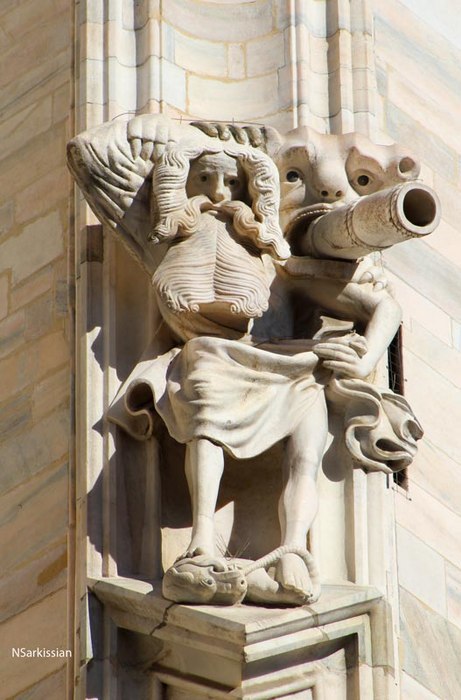
A Gothic version wrought with grimacing monsters presides in central Milan. Recently renovated, the marble shines a bright white in direct sunlight, blushes at dawn, or grows ruddy in the gloaming of nightfall.

Pickpockets roam the piazza spread out like a large, bumpy placemat beneath the Duomo. Their glittery black eyes home in on the naïve tourist. Hand to your pocket, or arm firmly over purse, please. You have treasures to lose.

Merchandisers sell Inter, Milan, Juve soccer scarves—blue&black, red&black, white&black—from small wooden kiosks; marketers ring the perimeter with fluorescent neon in pink and blue that exhorts purchases of Gucci, Prada, Sony. Close your eyes to (un)subliminal messaging. Times are tough. Save your dough.

Pigeons squat on the equestrian bronze of King Vittorio Emanuele. White streaks drip from his greened shoulders. Hurry past, head hunkered down.

Seven o’clock shadows lengthen and grow violet while the sun sinks. Cut across the cobblestones of the piazza, wind through pickpockets, tourists, merchandisers, marketers, and pigeons. Climb the steps, enter the Duomo through tall bronze doors, choose the side altar where the Renaissance panel of the Virgin and her Son hangs. Light a candle below the image. Kneel. Even if you’re not Catholic, even if you’re not religious.

The smoky sputter of burning wax. The golden light ringing bowed heads like glowing halos. The sting of incense wafting from the main altar—hundreds of yards away—where evening mass reaches a crescendo.
 The intonation of millions of prayers, seven hundred years’ worth, reverberates in the cavernous, vibrating enclave.

You listen, knees against the stool, fingers laced together on the rail.

Dive in, again today, as you have every day since disaster struck. Add to the swirling mix.

When you finish, fall back into your wooden pew.

You remember that John Ruskin hated the aesthetics of this place. That Oscar Wilde called it monstrous in taste. But that Mark Twain, like you, scoured the thousands of niches decorated with statues of saints, and bugs and birds, and all of nature, and knew here, in the Duomo, he wasn’t alone.

“Salsamenteria” means Sauce-eria.

A new one, near the recently-opened Abercrombie and Fitch, waylays the hungry in a narrow street not far from the Duomo. Salt-cured pig haunches hang from hooks on the walls and rafters in the ceiling. Brown paper mats plaster square oak tables. Kegs of cheaper wine sprawl on a hutch to the left of the bar, bottles of finer wine march across a shelf.

Study the menu taped to the window.

Coppa, it says. Prosciutto, Culatello di Zibello. Tortellini, Ravioli. Lambrusco. Bardolino. DOP–the best of the best. 5 Euros. 6 Euros. 10 Euros. 3.5 Euros. 2 Euros. 4 Euros. 3.9 Euros. Eat. You need to eat. Mangia. Mangia. Keep your strength up.

Take a break from your vigil. Enter. Choose a table for one near the door.

Black eyes, black hair, brown skin. The waitress from Kenya, poised to serve. Pencil on pad.

Order a sandwich. Select some wine.

Pink slabs fall from thick slices of peasant bread. Green sauce—made from parsley, capers, oil and anchovies—glistens in a finger bowl on the middle of your table. Unkegged Bardolino fizzes in the white ceramic bowl the graceful Kenyan girl serves it in.

Dip your sandwich into the oily green, slurp the slick red.

Forget while you eat and drink. Listen to the clinking in the kitchen, the tap of forks against ceramic plates. Watch the girl glide and whirl.

Chew.

And when wine splats on your blouse like blood (drops of crimson on white gauze) blot and wipe in the room with the skirted stick figure on the door.

Remember.

Hurry out to evening mass at the Duomo.

“Ca’Granda Policlinico” means Hospital.

Designed in the Renaissance by Filarete, the Florentine, with perfect courtyards, graceful loggias and brick fretwork, the first Ca’Granda is where the ill of the city was nursed back to health. Now university students occupy Filarete’s harmonic spaces, while the Ca’Granda has migrated across the street to become the Ca’Granda Policlinico and occupy dozens of buildings of eclectic styles and dubious periods.

Rush your teenage boy here one ill-fated Monday. See how he is classified code red.

Tell the doctors: He’s healthy. Nothing like this has ever happened before.

Tell the doctors: His heart’s fine. But then listen to it beat 200 times a minute.

Wait, sitting on linoleum lit by neon.

An orderly changes rumpled blue sheets on an abandoned gurney. An infant, red with fever, cries in its father’s arms. A small pink girl in a wheelchair, her broken wrist held to her chest, fusses at her gold-jewelry-laden-black-leather-jacketed mother. And a blond boy lies down the hall, behind closed doors, in intensive care, monitors hooked to his chest and fingers.

Wait, sitting on linoleum lit by neon.

Relatives of the injured arrive. One, with stiff gray hair and sturdy brown pumps, holds the infant so his father can go to the men’s room. The pink girl’s burly grandfather bellows into his cellphone. The mother in black and gold lights a cigarette beyond sliding glass. Soon, her exhaust curls up through the night.

Your husband calls. He’s home, caring for your youngest. How is our boy? He asks.

Ask a nurse, How is my boy?

Then wait, sitting on linoleum lit by neon.

“Parco” means park.

A nineteenth-century park—the parco Sempione—sprawls around the Castello Sforzesco, the imposing castle that was built in the early Renaissance where Leonardo da Vinci frescoed rooms for Ludovico il Moro. The parco encompasses the Triennale Art Museum too, and DeChirico’s beach house sculpture.

On sunny autumn afternoons boys bring their dogs to the happy corners of Parco Sempione and run. Disks of red plastic spin through the air, dogs fetch, their pink tongues curling and flapping.

Don’t worry about curbing your dog here—no one does. But check your shoes—wipe them on the graveled walkways—when you quit the grass.

On sunny autumn afternoons boys play soccer on the grassy knolls of Parco Sempione. Under the elm, off to the side. And here, one boy, a teenage boy with blue eyes and a chipped front tooth who plays soccer in autumn crumples one graying afternoon. His chest thumps at two hundred beats a minute—like a golden hummingbird’s—while the parco fades into black.

Call 118 when this happens. Climb into the wailing vehicle. Bump over old, winding streets, ancient alleys, circular passageways, through centuries of urban sprawl and nonexistent urban planning. At rush hour.

Say faster, please faster, as you watch your boy’s lips turn blue.

Hold his hand, whisper a prayer when you see his eyelids twitch.

Plan to light a candle at the Duomo every evening until he wakes.

Best,
Natalia


—Natalia Sarkissian

.
.