Jun 012015
 

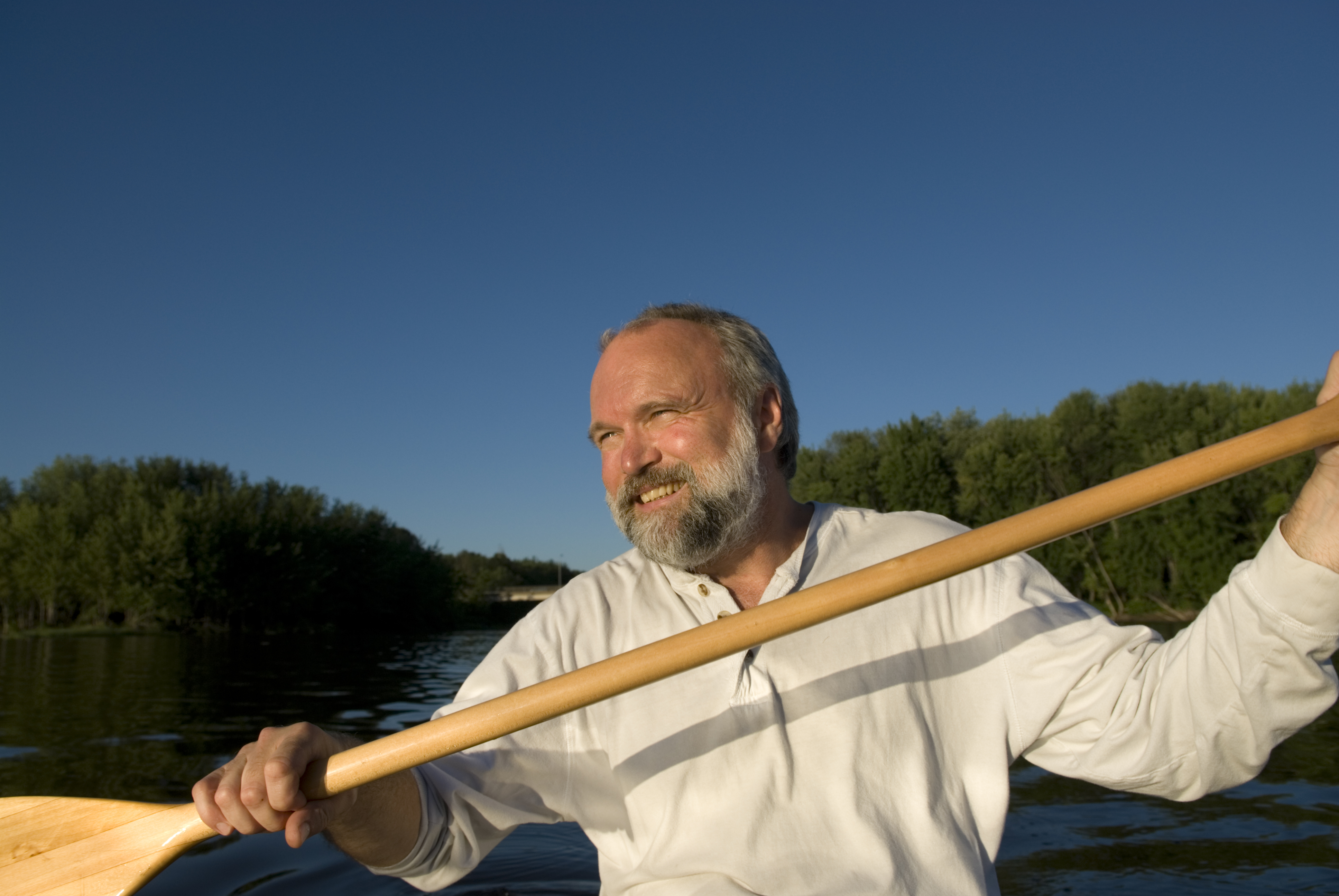
Mark-Anthony-Jarman-2Mark Anthony Jarman

.

Ladybug, ladybug, fly away home
Your house is on fire, your children all alone

OUR CASKETS LAND at Dover Air Force Base draped in flags; the boys fly home, the rookie drivers who were trapped in the roadside ambush, in the incendiary daisy chain. We tried to add hillbilly armour to the suicide wagons, but it didn’t help. All night the planes with the wounded lift off to the surgeons in Germany and I finally fall asleep to find my mother and father smiling in their sunlit yard, my childhood yard, but rising high above their garden is a murky medieval fortress on a broad hill. On the rampart walls are the silhouettes of bearded warriors in their distinctive headgear, on high paths tribal fighters in pie-crust hats walk with bulbous rockets hoisted on their shoulders – RPGs – carrying the weight of the rockets casually, the way a school-kid carries a baseball bat.

In their sunny yard I hold up a .22 rifle, pose for a photo like Lee Harvey Oswald, my childhood rifle, a gun that was later stolen from my car and used in a drugstore robbery that time my vintage coupe was in for repairs at the Green T Texaco and Lloyd the mechanic forgot to lock my car.

I hold the familiar rifle in my hands, open the oiled bolt, slide a tiny brass shell into the chamber, close the bolt, and I aim the sleek rifle up the hill at the outline of a distant head on the ramparts. I breathe out, squeeze the trigger slowly, and the human outline recoils from the blow. I have hit a man up on the medieval wall. Someone shouts and men start down the hillside paths. My mother and father smile and relax in the suburban sun, chatting in Adirondack chairs, seemingly unaware of my rifle’s report and the hajji hornet buzz I’ve drawn upon their heads, the scores of bearded men trotting down paths, robes picking up burrs in the long yellow grass.

I leave my parents, run under the elms to the railroad station, though I’ve never noticed this brick station before. On the iron platforms are more scared reservists – not even real soldiers. Some rummage in their gear, try on gas masks and night goggles, as if that might help them see where they are going next. I mingle in the great crowd and my father sits in his green and sunny yard in dark glasses and a yellow golf shirt, an exile some distance from his birth, but with his garden chair and daisies (she loves me, she loves me not) and honeysuckle hedge he looks very English and very happy with my mother and his life. My parents don’t mind fading away, they forgive me, they seem all right with what is coming for them in the sunlight.

—Mark Anthony Jarman

.

Mark Anthony Jarman is a short story writer without peer, heir to a skein of pyrotechnic rhetoric that comes from Joyce and Faulkner and fuels the writing, today, of people like Cormac McCarthy and the late Barry Hannah. He edits fiction for a venerable Canadian magazine called The Fiddlehead which, in the 1970s, published some of my first short stories (and another story is coming out in the summer, 2011, issue). Jarman has written a book of poetry, Killing the Swan, a hockey novel, Salvage King Ya!, five story collections, including Dancing Nightly in the Tavern, New Orleans is Sinking, 19 Knives, and My White Planetand nonfiction book about Ireland called Ireland’s Eye. His latest collection, Knife Party at the Hotel Europa (Goose Lane Editions, 2015), is reviewed in this issue of NC.

May 312015
 

Mark Jarman Story- St. John RiverMark Anthony Jarman

…in the end the strength of the writing itself is like magic, few authors can pull this off, and the final impression is absolute: Italy – dry, beautiful, graffiti strewn, tourist ridden, sexy, fake – and the narrator – lost, bored, amused, searching, lustful – are far too complementary and this is no haven for lost souls seeking redemption, and no one will be rescued from firestorms of ash and lava. —Lee D. Thompson

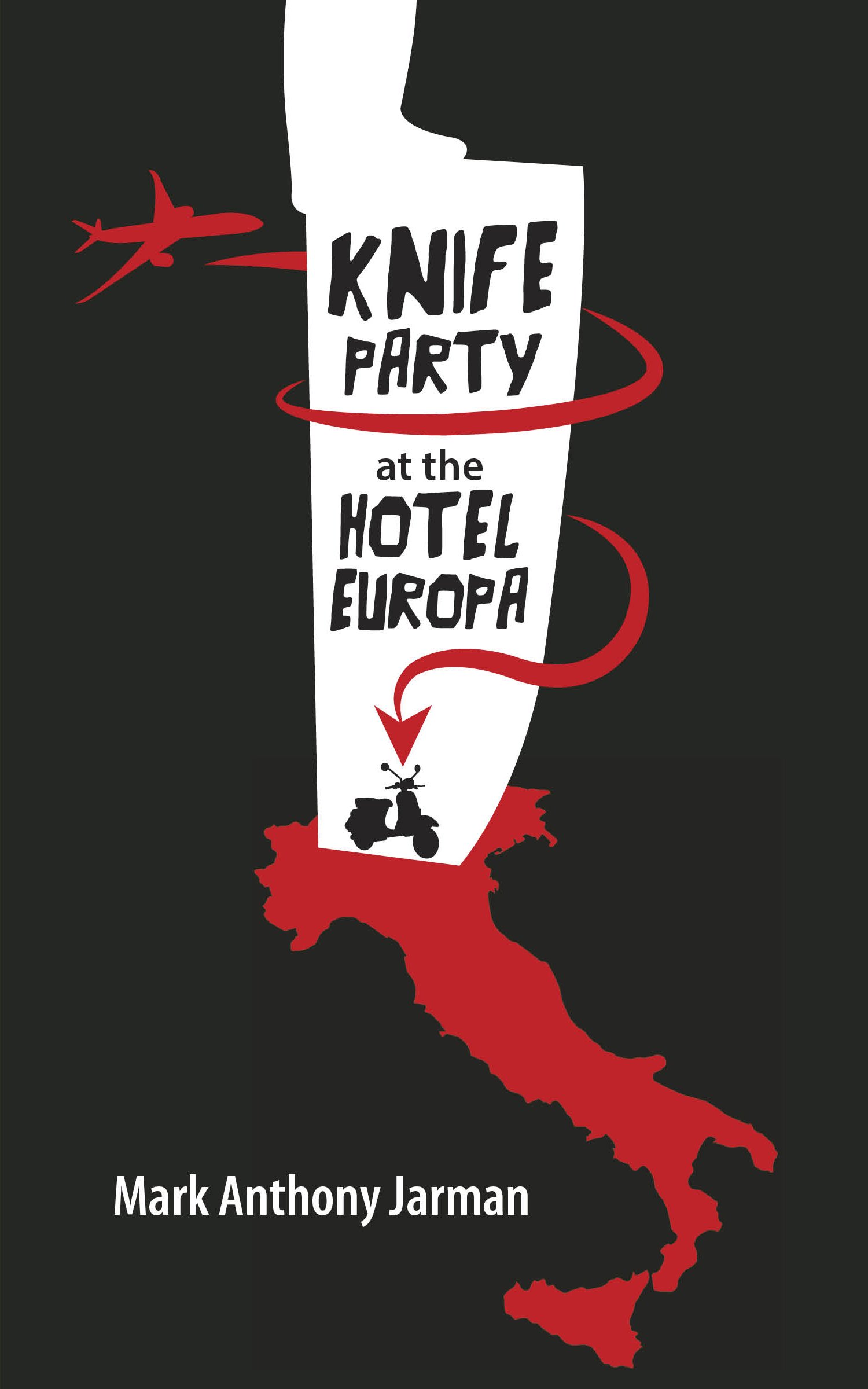
cover

Knife Party at the Hotel Europa
Mark Anthony Jarman
Goose Lane Editions
HC 285pp.; $29.95

.
The twelve short stories in Mark Anthony Jarman’s fifth collection, Knife Party at the Hotel Europa, form a strange, wandering, quite aimless narrative that runs throughout the book. I almost wrote “throughout the novel,” because by a third of the way in, as characters and settings reappear, it begins to feel like a novel, though not a typical novel. The sections do work as short fiction, and Jarman, one of Canada’s most-respected short story writers, is no stranger to the form, and the stories here have all appeared separately in journals or online. So, is this a story collection, or a novel? Well, it’s a bit of both, really, and it also feels like a travelogue, though this is no Fodor’s Guide to Italy.

Not that I think it’s important what category Knife Party at the Hotel Europa fits into. This lack of definition is part of the appeal and likely Jarman’s design.

As is the aimless narrative, the wandering narrator.

This narrator, who is never named, this I in Italy, is in turns all mind, and all… cock.  Can I say that? Well, I already have. He is on a vacation, or in exile (it’s hard to tell), renting an apartment in Italy, where there is something he is trying to forget (so says a gypsy woman). He’s down, he’s dour, he has unconvincing thoughts of snuffing himself, but he’s invited to join an ‘art group,’ a tour run by one Father Silas, who owns an illegal art school in Italy and is a friend of the narrator’s aunt. The nature of the art group or school is never really specified (but you’re in Italy, so there’s art, and there are tours), but does act is a kind of binding thread to the collection, as do the few recurring characters on the tour. We never get to know Father Silas, or Ray-Ray, or Tamika much, or the narrator’s dear aunt, but we need bearings, even if the actual viewing of art seems of little importance to the narrator (but he catches on, follows, drifts away). Adding to the man-adrift theme is the narrator’s current life-mess: he’s middle-aged, in existential crisis, separated/divorced from his wife, reeling from the loss of an all-consuming affair with Natasha (who had cancer, but also left him), and suffering a general lack of direction.

The book’s themes are ones of wandering, of gypsies, tinkers.

And decay, and false idols.

It’s a dense, rich book, but the opening story, “The Dark Brain of Prayer”, hides little:

My tainted life, my travels: vaguely free to travel to Italy, Ireland, Death Valley, to ski distant peaks on a whim, mobile, but always a trade-off, no stable home life, no one to depend on. Perhaps because no one can depend on me?

A strong story in its own right, “The Dark Brain of Prayer” also serves to situate the reader in the narrator’s life. We see that he’s Canadian, lives in a city with streets called Queen and King and travels to towns with names like Sackville.  These touches serve to keep us close to the narrator, who, like Jarman, appears to live in Fredericton, New Brunswick, a city of flooding rivers, fiddleheads, and crab-apple blossoms.

“Butterfly on a Mountain” follows. It’s meditative, mostly plotless, meandering, funny. And, importantly, we meet Eve. She’s all old world temptation to his new world snake.

Eve is the narrator’s cousin, though their relationship is never explained beyond that, she lives in Switzerland  and she comes in and out of the stories (in the recursive Eve entries and with the occasional return also of Natasha we can see how the collection has been purposefully linked, though it’s not quite a novel, but right, that’s not important), meeting up with the narrator, and they stray from the tour, and she, inevitably,  becomes his lover (but there’s no sin here, sin in their minds having been worn to rubble like ruins in Rome). Eve is well drawn, sophisticated, educated, unpredictable.  The narrator can never get to know Eve, he muses, just as he can never get to know Italy. But he is, once again, infatuated, and Jarman’s stunning prose captures it all.

The bone-green air between the tree trunks, the green shadows between the trunks; who owns that property? I feel Eve owns any part of the world where my eye strays.

Introduced to Eve, we come to the book’s glittering gem, the harrowing, surreal, and utterly believable story “Knife Party”, a nightmarish, drug-induced excursion to a party of strangers, of cocaine and Italian testosterone and a crazed neighbor with a staple gun. There’s a menace throughout the story, and as the title lets us know, it won’t end well, but Jarman’s ability to introduce both humour (“I want to start a new dance craze […] do the Lazy Lawyer, do the Dee-vor-cee dividing his assets into shekels.”) and suspense (“The neighbour makes it to the door, but falls in the hall like a Doric column. He has bled out. […] Spying blood and a body, the woman dials her silver phone, whispers, Madonna save us.”)  gives the story a gory, car-crash appeal. We can’t turn away; it’s too lurid, too new. Too life affirming?  A strange thought, but in the quieter, meditative story that follows, “Hospital Island (Wild Thing)”, a retreat to Rome, the narrator does feel this trauma has somehow lessened the impact of the loss of Natasha, providing “gruesome perspective,” he says.

But disaster now follows the narrator and Eve, as if they’ve been cursed in their journey (in fact, the narrator is cursed by a gypsy woman in the opening story, though he complains that her curse is far too unspecific to be believable). They flee the knife party into the night, only to stray into the next story, another of the book’s highlights. “Adam and Eve Saved from Drowning” is a story that muses on Canadian soldiers and tanks in World War II rolling through Italy, on a dear uncle killed in battle in Ortona, and where our less-than-adamant narrator and his Eve stroll upon a Roman explosion, a mail bomb at an embassy and man’s lost hand, and where, later, a brilliant day of sea kayaking leads to a small cove and men fishing men from the sea, fishing drowned boat people, migrants to a country that allows so many migrants, yet seemingly welcomes none. The bodies are lain upon the shore:

Men with mustaches and suitcases with wet sand glued to their black coats; this crescent beach was not their destination, but now they are stopped on the sand, their mouths stopped, now they are at their destination. Their skiff sank in riptides, and long lines of spray, their hands let go and their mouths let in sea and sky.

This is a turning point. At the end of the story, Eve leaves at handwritten note under his door while he’s away, writing that while the thought of never seeing him again is intolerable, it might be best. “You do make me happy, but I can’t seem to feel calm.” The narrator then muses:

Eve said I was detached, difficult, maddeningly stubborn.

I thought I was easygoing.

It’s this introspection that gives the book much of its uncanny appeal. Do we even like the narrator? Yes, we do; everyone does.  Throughout Knife Party at the Hotel Europa we see a mind at work, a mind that’s endlessly male, musing, heat-addled, a mind made vivid through Jarman’s jazzy, poetic, associative prose. We see his mind’s inner workings, the intimate thoughts, the fantasies, the reveries, the trivia. In a book of travels, Jarman often goes farther afield in his head than on the map, and the book at times takes on the feeling of a confessional stall.

Take, for example, the final section/story, “The Pompeii Book of the Dead”, a near novella-length story that for all its surreal touches, has the feeling of non-fiction, but it’s as if Orwell, before writing one of his book of travels, came across a clump of peyote and found narrative liberation. When approached by a prostitute in Pompeii (at a cafe called Irish Times), the narrator muses:

I flirt with the Croatian maid, I flirt with the cryptic Spanish woman, I stare at my cousin’s form, I stare at every waitress. Then a woman and I share a tiny table in Italy, in Europe, on the planet, and for a handful of Euros I can do certain things for a certain time. How perfect it no longer seems.

There is a young American traveler, an attractive Iraqi refugee, there are women at every corner, in every dream. But Jarman, before getting too deep in his narrator’s self analysis, pulls us into a surreal section involving the narrator and several small statues (come alive from his apartment windowsill and which include a distractingly priapic Priapus) and sends us prowling the alleyways for deep-fryer grease with this ridiculous gang of lard thieves:

The Italian PM must pay his estranged wife a hundred thousand Euros a day; how can he have that much and we don’t? The grease in our alley reeks. Lewd Priapus is with us, but he is not doing well, is not popular, his huge phallus gets in the way of lugging the sloppy plastic drums.

Why does this work? Why can certain writers lead us down a path of folly and not lose our interest? There’s something always on the cusp with Jarman’s fiction, beauty quickly turns to horror, play turns tragic, reality loses all meaning, and we accept that this world, his world, is unstable. It makes for thrilling reading.

In this final story, a masterpiece of pacing, tension, and setting, we also have Jarman’s most haunting touch, the narrator’s observation of a young Italian couple in love. They could have been plucked off a postcard, or tourism billboard. He observes their tenderness, their perfectness as they lie on a bench above a cliff, and wonders if anyone (Natasha) had ever been as tender with him. But he forewarns us, tells us they will die when his tour bus collides with their scooter along the Amalfi Coast. When the scene comes pages later we still hope for another outcome. Surely he won’t? But the young lovers die horribly, almost tragicomically. Jarman seems to be saying there is no postcard Italy, just as there is no postcard love, everything is throwing itself into the sea.

So Knife Party at the Hotel Europa is not a  novel with a happy conclusion, and it shouldn’t have one. The narrator does appear to have learned something about himself, but it’s a vague, sloppy realisation. He is who he is.

Does the book have flaws? At times Jarman’s riffing may be predictable (not in what’s written, but that it’s coming), something that works for an individual story can seem repetitive after 285 pages. The tendency to go off on tangents till reason falls off a cliff, or add an absurd third thing to a previously serious list, might wear on a reader. But in the end the strength of the writing itself is like magic, few authors can pull this off, and the final impression is absolute: Italy – dry, beautiful, graffiti strewn, tourist ridden, sexy, fake – and the narrator – lost, bored, amused, searching, lustful – are far too complementary and this is no haven for lost souls seeking redemption, and no one will be rescued from firestorms of ash and lava. Like Pliny the Elder rowing to Pompeii, there’s not much he can do to save the situation, but it’s quite the spectacle and well worth watching.

—Lee D. Thompson.

.

Lee D, Thompson.

Lee D. Thompson was born and raised in Moncton, New Brunswick. His fiction has been published in four anthologies, including Random House’s Victory Meat, New Fiction from Atlantic Canada and Vagrant Press’s The Vagrant Revue of New Fiction, and in more than a dozen literary journals across Canada and the US. Lee’s first novel, S. a novel in [xxx] dreams, was published in 2008 by Broken Jaw Press. An e-book, Diary of a Fluky Kid, appeared with Fierce Ink Press in February 2014. In addition to writing fiction, Lee is a guitarist and songwriter who records under the name Pipher..

.

Apr 182014
 

DG is on his way home, though at this stage of life home is a moving target, indeterminate and scattered, more like a field of destinations than a particular place. Let’s just say he gets mail at a lot of different addresses.

But his sojourn as Writer-in-Residence at the University of New Brunswick is over and on April 16, as new snow blanketed Fredericton and the St. John River continued to rise across the street from Mark Jarman’s house, he left town (and was subsequently nearly swept away outside of Lancaster, NH, where the Connecticut River had flooded over Bridge Street in two places).

Last events included a reading at Odd Odd Sunday’s on Friday at Molly’s (postponed from the week before due to a blizzard) on April 11 and another reading at the Qwerty Reading Series at the Grad House Pub (which used to be Alden Nowlan’s house where dg, in a different incarnation, went for dinner a couple of times in the early 1970s) on April 14.

Most fun in the last weeks? Shoveling water with Mark in the flooded backyard where the cars were parked. Yes, shoveling water. Don’t ask. Just think: a couple of guys, estimable writers, trying to avoid work, shoveling water and drinking beer in the sun. Clarissa’s response? Irrepressible disbelief and glee at the strangeness of men. Rob’s response? This will go away if I ignore it.

What does dg feel like leaving? Time to move on but lots of regrets. What does Lucy feel? No, I don’t want to go. This is the best place ever. I have friends. I have put down roots. You can’t make me leave.

For anyone wishing to review the whole unseemly chronicle of events since last September, you can click through the Writer-in-Residence Blog.

dg

Jack Lucy and FifiJack, Lucy and Fifi

DSCF7573Mark on top of the snow mountain in the backyard, April 3

DSCF7547

mMark Anthony Jarman

DSCF7557

DG at gradhouseDG’s last reading as Writer-in-Residence at the Grad House (formerly Alden Nowlan’s house), April 14 (Photo by Stephanie Doucette)

DSCF7651-002Lucy and  Clarissa go for a last run together

Back yad Apr 16Backyard from second floor window, April 16

DSCF7654Lucy refusing to get in the car, tucked in her favourite spot on the loveseat, where she spent many happy hours watching television, reading and offering editorial advice to Mark and Clarissa

Jan 212014
 

Len Falkenstein & Mark Anthony JarmanLen Falkenstein & Mark Anthony Jarman

The University of New Brunswick faculty strike is still on! Jeff Picka of the Mathematics Department took this photo of NC multi-contributor Mark Anthony Jarman (my roomie, with the beard) and playwright Len Falkenstein in the English Department. This was over the weekend. Much colder now. I was talking to guys on the line this afternoon; they had icicles hanging from their beards. No negotiations; nothing new.

dg

Sep 112013
 

Here’s a teaser to the third in my series of short essays on Building Sentences at the National Post. We are, yes, in the drumroll phase of my book launch for Savage Love.  Much appreciation to Mark Medley, the book editor at the National Post, for giving me the opportunity to write these.

dg

Parallel construction was another one of those structures English teachers taught me in high school without also telling why it was in the least useful or beautiful. Drone, drone, eyeballs rolling back in my head; another C- on that test. Later I learned the lesson. Here is an example from Mark Anthony Jarman’s great short story “Burn Man on a Texas Porch.”

“I’m okay, okay, will be fine except I’m hoovering all the oxygen around me, and I’m burning like a circus poster, flames taking more and more of my shape–am I moving or are they? I am hooked into fire, I am hysterical light issuing beast noises in a world of smoke.”

What you have here are two sentences built on a series of parallels that invert briefly at the parenthetical em-dash and then modulate into a variant (I’m, I’m, I’m, am I, I am, I am). The simple meaning of the sentence is that the narrator is on fire. But Jarman uses parallels to throw the sentence forward in a series of waves of energy, each surge encoded with another grotesque and moving image of self-incineration. The parallels delay the end of the sentence (as the Russian Formalist Viktor Shklovsky tells us, delay is the first problem in writing a story) and create a passionately dramatic telling. Instead of mere description, the sentences become a poem.

    Each new iteration of the parallel creates more of that mysterious thing I call aesthetic space, a blank spot into which the author has to imagine new and surprising words. Form never limits a writer; it creates openings for fresh invention. It also creates an opportunity for what I call narrative yoking, syntactically juxtaposing two or more ideas to create astonishing new connections, or psychological parallelism.

Read the rest at the National Post


Aug 092013
 

Christ Church Cathedral, Fredericton

Lucy and I are heading to Fredericton, New Brunswick, in September for a gig as Writer in Residence at the University of New Brunswick (I am going to be the writer, Lucy will be the dog in residence). I’ll be there until May more or less. There will be no disruption in service to NC readers, except for the usual disruptions. I will dedicate a page on NC to my activities as WIR, readings, special workshops, parties, masked balls, protests, riots, police arrest reports, and such. No doubt many of you will be chartering jets and buses (bring your passports).

New Brunswick is familiar ground to me. I taught philosophy at the University of New Brunswick in 1971-72. I worked as a reporter at the Evening Times-Globe, a daily newspaper in Saint John, 1972-73, my first (of many) newspaper jobs. I was the Writer in Residence for a year at the university in the the late 1980s. The Saint John River Valley is a beautiful and mysterious place to me. I particularly love walking home down University Avenue late in the evening on a fall night. And I have many friends there. My longtime, loyal, and beloved publisher, Goose Lane Editions, is located in Fredericton. I’ll be living in Mark Anthony Jarman‘s vast warren of a house on Waterloo Row (another denizen is NC Senior Editor R. W. Gray). NC’s famous weight-lifting poet Sharon McCartney also lives in Fredericton. As does Gerard Beirne among others including several contributors to the NC at the Movies slot.

dg


May 282012
 

Book News, Reviews, Orders

“…a master of narrative structure” (Wall Street Journal)

“…every literate person in the country should be reading Glover’s essays.” (Globe and Mail)

———–

Order Attack of the Copula Spiders

———–


April 25, 2013

Brendan Riley review in Review of Contemporary Fiction:

This is not literary craft reduced to statistical formulae and write-by-the-numbers word-bytes. Glover’s admirable ability and patient willingness to cast a careful—not cold—eye on what makes sentences hum and flow is fueled by a vital, infectious fascination with words, enabling him to reveal the inspired, alchemical, verbal concatenation at work in the most alluring and memorable fiction writing.

Read the whole review here.

§

March 30, 2013

3 Canadian Writers with Buzz @ The Reader


attack

§

March 9, 2013

A Canadian author’s book on writing went viral on social media recently, leading to thousands of would-be fiction writers searching their manuscripts for “Copula Spiders.”

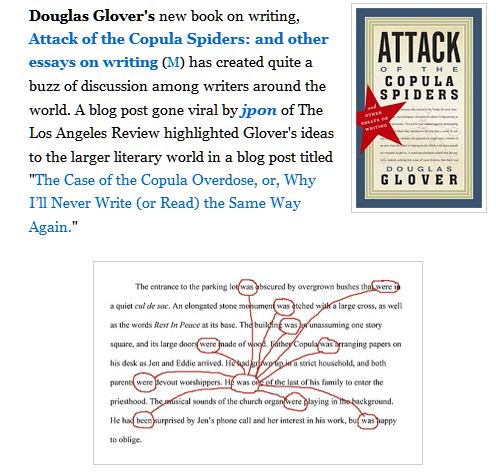
Douglas Glover’s book Attack of the Copula Spiders (Biblioasis) coins the term to refer to the multi-appendaged mess created by circling and linking all of the variations of the verb “to be” in a paragraph. (Copula is a term for the link between subject and predicate of a verb.) Excessive use of sentence constructions like “he was happy” or “the building was unassuming” lead to “flaccid and uninteresting prose,” he writes.

Joe Ponepinto, book review editor of the Los Angeles Review, brought Glover’s ideas to the literary world in a much-circulated blog post subtitled “Why I’ll never write (or read) the same way again.”

via Cameron Dueck’s arts column – Winnipeg Free Press.

§

March 2, 2013

from Joe Ponepinto @ The Saturday Morning Post

I reviewed a book a while back that has stayed with me for many months and has affected the way I write and read, and it’s opened my eyes to a weakness in much creative writing, even in published books. Douglas Glover’s Attack of the Copula Spiders (Biblioasis, 2012) criticizes many aspects of fiction, but saves its most withering scorn for the rampant and indiscriminate use of copulas.

The Secret of Maimonides-Submission for 2-26

I hear you asking, “What’s a copula? I admit I had to look it up. Webster’s definition says: “the connecting link between subject and predicate of a proposition.” In most cases, this refers to a form of the word “be.” But what does that mean to us everyday writers? It means banal, didactic, often passive sentences, almost completely lacking in action or depth.

As Glover says: “A copula spider occurs when a student uses the verb ‘to be’ so many times on a page that I can circle all the instances, connect them with lines, and draw a spider diagram. Now there is nothing grammatically wrong with the verb ‘to be,’ but if you use it over and over again your prose is likely to be flaccid and uninteresting.”

via The Case of the Copula Overdose, or, Why I’ll Never Write (or Read) the Same Way Again by Joe Ponepinto @ The Saturday Morning Post

§

December 9

From Chapman/Chapman’s Favorite Longreads of 2012.

“‘A Scrupulous Fidelity: on Thomas Bernhard’s The Loser’ by Douglas Glover, The Brooklyn Rail

Close reading doesn’t get much better than this. Glover expertly unpacks the logorrheic hilarity of Bernhard’s text without ruining any of the fun.”

 §

November 24

Attack of the Copula Spiders named one of the top non-fiction books of 2012 by The Globe and Mail.

“[By] by the time I reached the penultimate chapter, a brilliant examination of, among other things, the catastrophic meeting of the 15th-century book cultures of Europe and the oral cultures of the new world, I had decided that every literate person in the country should be reading Glover’s essays.” — Charles Wilkins

via Non-fiction books from this year that are worth a read (or two) – The Globe and Mail.

§

November 9

Governor-General Podcast Interview with Sky Hornig in Calgary during Wordfest in mid-October.

The Governor-General Podcast Interview – Douglas Glover

via Douglas Glover – CJSW – Calgary’s Independent Radio 90.9 FM.

§

September 29

A few months ago I read a book by Douglas Glover titled Attack of the Copula Spiders. At the time, I didn’t even know what a copula was. Once I understood, I spent days fixing copula-laden writing, and sweated over every sentence I wrote to make sure I was using more active verbs. In time, though, those fixations fade into the subconscious, which is where they belong. The key to good writing, I believe, is not to ignore rules and not to obsess over them. It’s to incorporate the ones you believe are true into your writing psyche so that you are aware of them without thinking about them. — Joe Ponepinto, Book Review Editor at LA Review. Writer, editor, teacher. Occasional curmudgeon. Dad to henry, the coffee-drinkin’ dog

§

September 29

 §

September 5

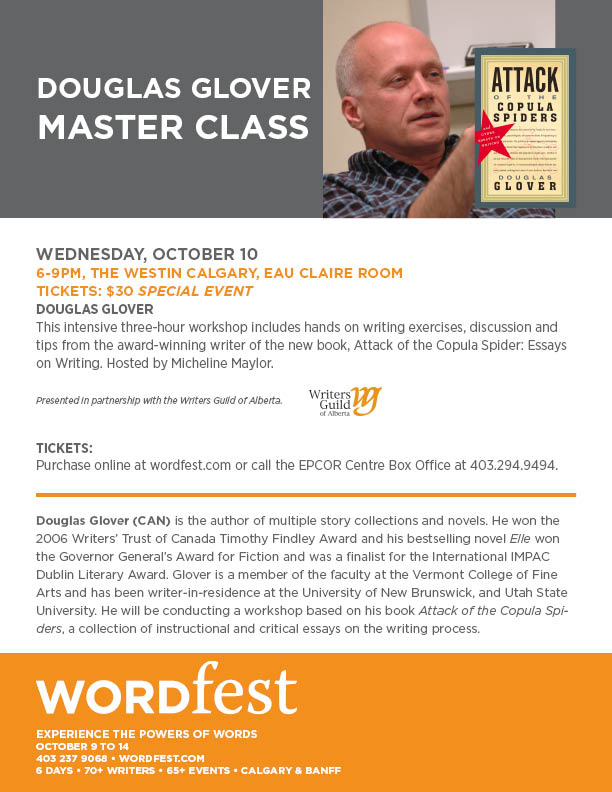
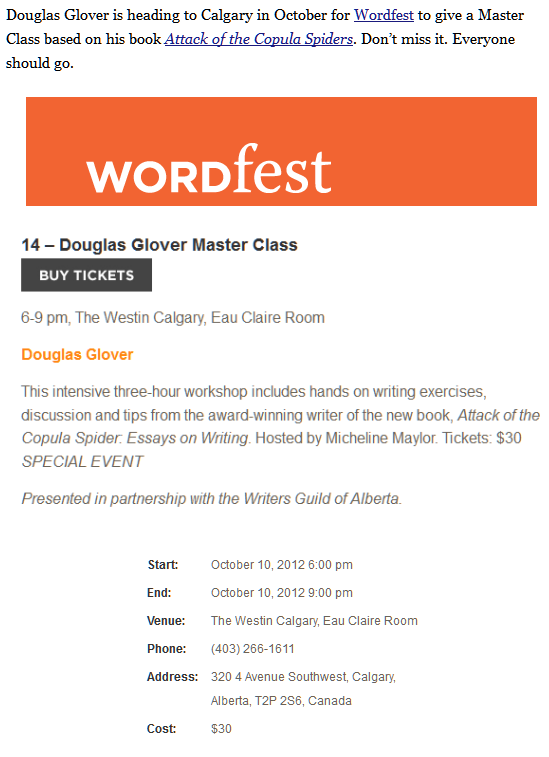
If I had to guess what events will sell out first, my money would be on the Douglas Glover Master Class. He’s a spectacular Canadian writer who has kindly agreed to do a three hour class on the mechanics of good creative writing for WordFest patrons. The best part about it? It’s only 30 bucks per person. What are you waiting for? Follow this link and buy tickets now!

via Post-Launch Blog: A Response | WordFest Blog.


§

July 17

Shelagh Shapiro interviews dg on his new book Attack of the Copula Spiders at Write the Book, Shelagh’s long-running radio show, which, by the way, is fast becoming an institution in its own right, a vast trove of writerly advice and experience. Listen to the interview on Shelagh’s site or download the podcast — it’s also available at iTunes.

Douglas Glover – Interview

Award-winning Canadian author Douglas Glover, on his latest book: a collection of essays on writing, Attack of the Copula Spiders, published by Biblioasis.

§

July 15

Douglas Glover and How to Write a Novel

by Jane Eaton Hamilton

I’m reading “Attack of the Copula Spiders” by Douglas Glover. i remember him trying to drill the matters in his first piece, “How to Write a Novel,” through my thick brain back in Saratoga Springs in the early 90s. It was the best advice I had ever gotten on making a novel. Really, it still is, and I’m glad to see it again in other than my own scrambled notes. 

§

July 6

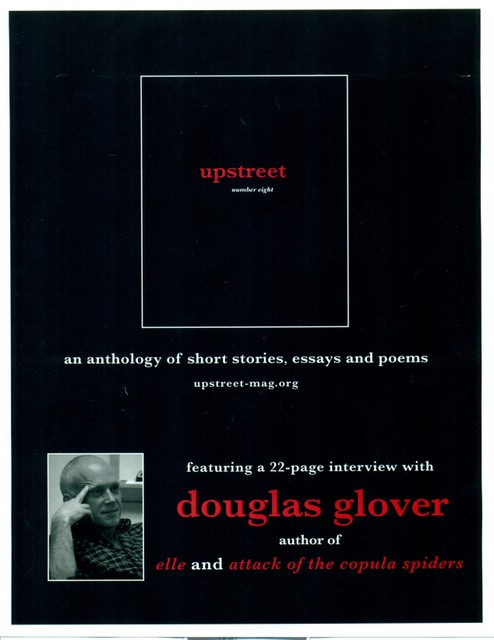
Vivian Dorsel interviews Douglas Glover in upstreet 8.

upstreet with Douglas Glover

Dorsel:  What do you emphasize in your teaching of writing?

Glover: Reading. The first thing I give students is a reading rubric and an analytical check-list to begin to reform their reading skills. As I say in Attack of the Copula Spiders, we live in a post-literate age. On a certain level that book is about the act of reading. I am pushing a critical aesthetic that is a bit like New Criticism and a bit like Russian Formalism; but, to my mind, as a writer, it just seems reasonable and immeasurably expands comprehension. You read a story and pay some attention to how it’s put together and, beyond the illusion of fictional narrative, you suddenly engage with the text on a whole other, rather exciting, level of grammar, rhythm and meaning. You begin to see connections that hitherto you vaguely passed over supplying your own dreamy connotations (as you’re taught to do in high school). We’re at a moment in our culture when differences in the ability to read and comprehend a text are critical.

I can’t remember the moment when I actually invented the phrase “copula spiders,” I only foggily recall circling over and over again all the “to be” verbs and then noticing that I could make a diagram on the page and that the diagram resembled a spider (with far more legs than it should have). The real issue, the shocking point, is that when you teach writing you are basically teaching the same student over and over again. It doesn’t matter whether the student is writing nonfiction or fiction or that the student thinks the burning piece of paper in his hand is the next War and Peace because he has put his heart into it and it comes out of his own original personal thoughts and is different (he believes) from anything ever written before (or in the future). The shocking thing is the uniformity of mediocrity. The shocking thing is that intelligent adults can’t think of another verb to use (actually most students jog along with a verb repertoire of about five: to be, to look, to sit, to stand, to see—absolutely the most popular verb choices).

The crucial connector here is to realize that part of the reason proto-writers don’t notice they are doing this is because they don’t know how to read. Eighty percent of what I do every semester is teach students how to read like writers, that is, with attention to structure and the felicities of well-written prose. So the two aspects of my book are necessarily joined: you can’t teach people to write simply by telling them what they are doing wrong; you have to show them where it is done right, that is, you have to show them how to read.

Once you learn to read you can teach yourself how to write. Literature is an encyclopedia of technique.

§

June 5

“The best essays in this collection come further in as Glover, like a physicist dissecting atoms, breaks down the prose of several great writers of the past few decades. A successful fiction writer in his own right, he wants not only to identify the techniques of stylists such as Alice Munro, Mark Anthony Jarman, and Thomas Bernhard, but to understand the grand logic behind the structures, the God-like plans that such geniuses hatch to produce their greatest works. Although this is not specifically a “how-to” book, Glover’s analyses in Copula Spiders prove far more insightful than traditional criticism, and by extension far more helpful to writers who are serious about approaching perfection in their craft.” — Joe Ponepinto @ The Los Angeles Review

§

June 5

It’s a great book. Look for my review in the next issue of Broken Pencil. — Nico Mara-McKay @ nicomaramckay.com

§

June 3

The first bad review; always a landmark. DG taken to the barn and whipped with limp squibs by Daniel Evans Pritchard at The Critical Flame, a young man apparently lacking a sense of humor and a delusional optimist who seems to think all those e-books coming out are worth reading. Without a trace of irony, he quotes, um, a Gallup poll to tell us the state of literary culture in America. At least he spelled my name right (although he didn’t manage to copy Mark Anthony Jarman’s name with the same accuracy — Mark suddenly becoming French in the translation — Marc Anthony Jarman). Tiresome as it is, I herewith issue my usual challenge to a duel.

§

May 21

Such was the pace of my conversion, that by the time I reached the penultimate chapter, a brilliant examination of, among other things, the catastrophic meeting of the 15th-century book cultures of Europe and the oral cultures of the new world, I had decided that every literate person in the country should be reading Glover’s essays and was fixing to present them to my eldest daughter, who is about to begin literary studies at UBC.

Glover is at times rather detached in his assessment of the value of storytelling. And yet there is a subtext to his work, a sense that if a story is to have life beyond the intrinsics of its existence, it must, sooner or later, ease up to the imponderables at the heart of what it is to be human. As Joni Mitchell said of songwriting, if at some point a song’s lyrics don’t extend themselves into a larger orbit, “it’s all just complaining.” Charles Wilkins, The Globe and Mail

§

May 13

His sortie on the verb “to be” in “Attack of the Copula Spiders” is particularly brilliant. Mark Sampson at Free Range Reading

§

April 28

Attack of the Copula Spiders is a practical guide for anyone interested in writing. Glover’s first chapter, “How To Write A Novel,” alone is worth the price of the book. Telegraph Journal SalonBooks

§

Caroline Adderson, author of A History of Forgetting: “Just ordered it. The essay on “Meneseteung” alone is worth the price.”

§

April 13

“These essays are not just for writing students, however. Whatever heightens student awareness of craft also sharpens the awareness of the general reader who has no desire to try his or her hand at writing but would like better to understand literature. Glover has an essay on Alice Munro that is of value to any short story writer but also should be required reading for anyone interested in Canadian fiction.” Philip Marchand in the National Post

 §

April 10

“You should have a look at Douglas Glover on what may be the Mexican classic, Pedro Paramo, which was once described to me as “Mexico’s Joyce.” (The essay appears in Glover’s recent Attack of the Copula Spiders, which looks to be a great book of literary essays.)” — Scott Esposito at Conversational Reading

 §

April 9

“Thoughtful and erudite books such as Attack of the Copula Spiders are always useful as roadmaps for developing better readers and writers. Now if we could only get the world to read them carefully.” George Fetherling review in Quill and Quire

§

“I’m a few chapters into reading it a second time. All of it is wise and clear and exciting. The book is chock-full of good stuff, but the first and third chapters are especially brilliant. And the first paragraph of your essay on the Rooke novel is itself worth the price of the book. ” — Jack Hodgins, Governor General’s Award winning author of The Resurrection of Joseph Bourne and The Invention of the World

§

March 25

Douglas Glover interview re Attack of the Copula Spiders on The Danforth Review.

§

Douglas Glover’s Craftwork talk on the novel at the Center for Fiction — based on “How To Write A Novel,” one of the essays in Attack of the Copula Spiders

§

March 14

Craftwork: Douglas Glover — Wednesday, March 14, 2012, 7:00 pm, at

The Center for Fiction
17 E. 47th Street
(between Fifth and Madison)
New York, NY 10017
(212) 755-6710
info@centerforfiction.org

§

March 15

Douglas Glover Read at Celebration of The Literarian

The Center for Fiction
17 E. 47th Street
(between Fifth and Madison)
New York, NY 10017
(212) 755-6710
info@centerforfiction.org

Thurs

day March 15, 2012
07:00 pm

Come join us for drinks and micro-readings in celebration of our online magazine, The Literarian, featuring contribs Alan Cheuse, Anne Landsman, Barbara O’Dair, Carmela Ciuraru, Christine Schutt, Diane DeSanders, Douglas Glover, Elissa Schappell, Jane Ciabattari, Kim Chinquee, Leigh Newman, Leopoldine Core, Terese Svoboda, Tracy O’Neill, and Victoria Redel.

§

February 9

The Thomas Bernhard essay in Attack of the Copula Spiders quoted in The New Yorker online Book Bench.

§

Among the essays included in the book:

  • How to Write a Novel (dg’s famous Novel Lecture)
  • How to Write a Short Story: Notes on Structure and an Exercise (see examples of student stories written from the exercise here and here)
  • The Drama of Grammar
  • The Mind of Alice Munro
  • Novels and Dreams
  • A Scrupulous Fidelity: On Thomas Bernhard’s The Loser

§

February 5

UK Guardian reviewer and columnist and editor of the magazine 3 a.m. Andrew Gallix quotes from Attack of the Copula Spiders.

(This is in his Phantom Book category, related to language theory and a modernist aesthetic. dg is up there with Walter Benjamin, George Steiner and Herman Melville.)

§

February 1

Essay excerpted from Attack of the Copula Spiders in The Brooklyn Rail

Linked on A Piece of Monologue, ReadySteadyBook, and wood s lot.

“…excellent essay” — @ Who Killed Lemmy Caution?

“…excellent essay” — @ Three Minutes’ Chewing

“…a great essay by Douglas Glover about Thomas Bernhard’s novel The Loser (it is serialized from Attack of the Copula Spiders and Other Essays on Writing, published by Biblioasis. The essay makes a fine rundown of the various rhetorical devices that makes Bernhard Bernhard. So if you ever wonder how he manages to attain those typically Bernhardian effects, look here.” Scott Esposito @ Conversational Reading

§.

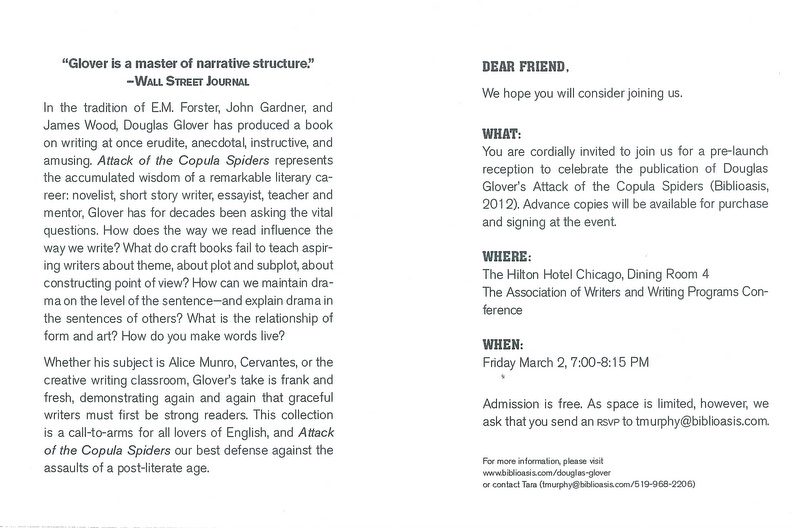
Attack of the Copula Spiders Book Signing at Vermont College of Fine Arts booth, AWP ChicagoThursday, March 1, 2-3:30pm. Books available. Bring cash or checks.

§

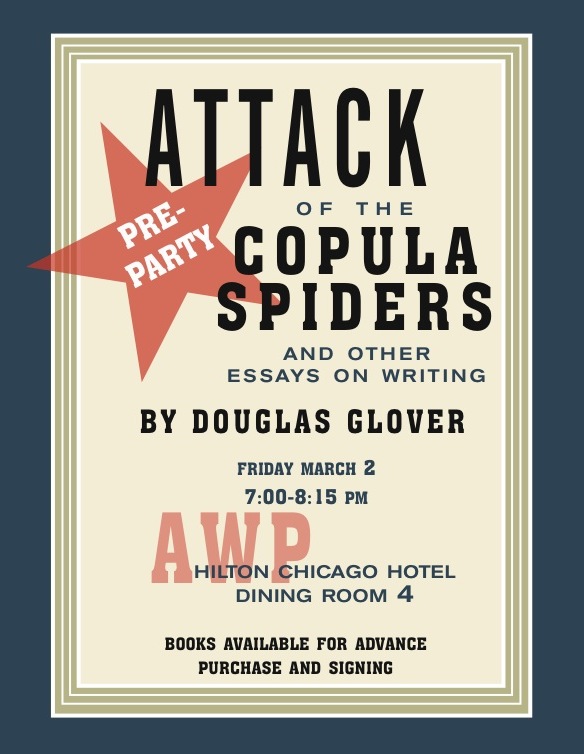
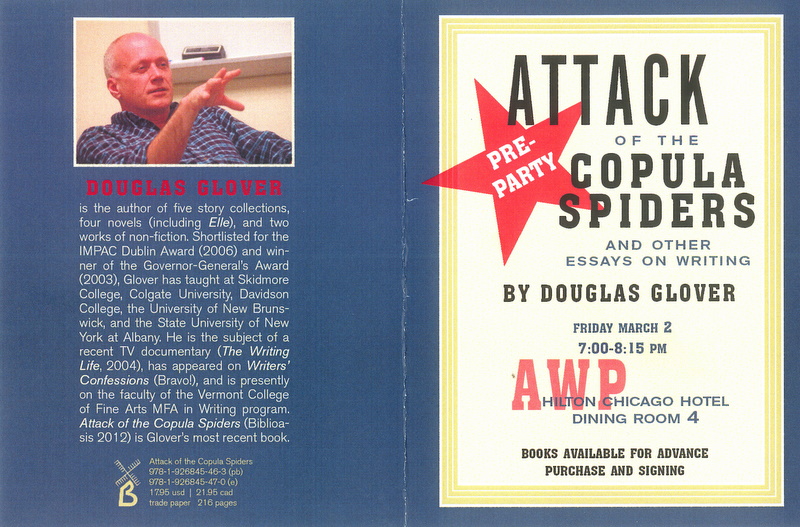
Attack of the Copula Spiders Party at AWP Chicago Friday, March 2, 7-8:15pm, Hilton Chicago Hotel Dining Room 4. Invitation below.
.

§

Invitation Flyer

§


Visit the NC Bookstore.

Buy books here and a percentage comes back to NC for the upkeep of the magazine.

Apr 112012
 

Mark Anthony Jarman

Confessional: Years ago, some time in the mid-1990s, I took up hockey again and played for two years in the nascent Saratoga Springs men’s hockey league. At the time this was one step up from pickup games. Mostly we played in an ancient barn-like wooden arena that, as it turns out, had been built on PCB-contaminated land that is now vacant (forever, possibly) and sewn with grass. I got so serious about this, I would drive to Troy once a week for skating lessons  in a tiny private rink (also inside a barn). We would practice edging by skating round and round holding onto a metal hoop anchored at the center, first one way, then they other. One summer I went to a hockey camp run by professional hockey players. Of such things an old man still dreams. Four years ago I went back to the league and played one game. Awful.

Here’s is a Mark Anthony Jarman short story about playing Oldtimers Hockey in  New Brunswick. (Okay, more confession: Once, long, long ago, I won the Canadian Oldtimers Hockey League Sportswriter of the Year Award — the high water mark in my literary career.)  Mark is an old friend dating back to our days at the Iowa Writers’  Workshop. He’s from Alberta, lives next to the Saint John River in Fredericton, New Brunswick, where he teaches at the university. He plays hockey, wrote a hockey novel, has three sons, and was a regular pick when I edited Best Canadian Stories. He is the subject of my essay “How to Read a Mark Jarman Story” which originally appeared in The New Quarterly and can be found in my essay collection Attack of the Copula Spiders. He writes the wildest, most pyrotechnic stories of anyone I know. This particular story appeared earlier in Mark’s story collection My White Planet.

dg

———

Drive the night, driving out to old-timer hockey in January in New Brunswick, new fallen snow and a full moon on Acadian and Loyalist fields, fields beautiful and ice-smooth and curved like old bathtubs.  In this blue light Baptist churches and ordinary farms become cathode, hallucinatory.  Old Indian islands in the wide river and trees up like fingers and the strange shape of the snow-banks.

It’s not my country, but it is my country now, I’m a traveler in a foreign land and I relish that.  The universe above my head may boast vast dragon-red galaxies and shimmering ribbons of green, and the merciless sun may be shining this moment somewhere in Asia, but tonight along the frozen moonlit St. John River the country is a lunatic lunar blue and the arena air smells like fried onions and chicken.  We park by the door, play two 25 minute periods, shake hands, pay the refs, knock back a few in dressing room #5, and drift back from hockey pleasantly tired, silent as integers.  And I am along for the ride.

Why do I enjoy the games so, enjoy the primal shoving and slashing and swearing and serious laughing at it all afterward?  In these games I have taken a concussion, taken a skate blade like an axe between my eyes and I jammed brown paper towels on the cut to staunch the blood.  Stitches, black eyes, and my nose is still broken from a puck running up my stick on its mission.  Might get my nose fixed one of these days.  One opposing player, when younger and wilder, is reported to have bitten another in the meat of the eye!

Today the inside of my thigh is a Jackson Pollock splatter painting: yellow green purple nebulas under the skin, flesh bruised from pucks hitting exactly where there is no padding (the puck has eyes).  At night my right foot pulses and aches where I stopped a slap-shot years ago.  My elbows are sore and they click when I move my arms.  My joints are stiff when I climb the pine stairs, especially now, since yesterday I took the boys skiing and then I played hockey at night.  Rub on extra horse liniment.  My neck won’t move freely and a check wrecked my shoulder last April and for weeks I had to sleep on my back or the pain awoke me.  Never got the shoulder looked at.  I pay money for these injuries, these insults to my spirit.

So why pay, why play the game?  As the Who sing, I Can’t Explain.  Hockey is my slight, perverse addiction.  Certainly I crave the physical side, especially versus working at the desk on 300 e-mails or doodling in a dull meeting. I enjoy the contrast, the animal aspects.  I crave a skate, a fast turn on the blades.

And I play because I am a snoop.  I learn things I would never otherwise know about New Brunswick, receiving a kind of translation, a geography lesson mile by mile, a roadmap, gossip, secrets, an unofficial oral history of this place’s lore and natives.  My team translates and I am along for the ride, a spy in Night-town.

We ride the highway down from Nackawic where we always lose to the Axemen or the Bald Eagles, millworkers on both teams up there.  I’m deep in the backseat of Al’s 4×4, but I spy a deer waiting by the shoulder like a mailbox.  I point it out to Al at the wheel.  The deer is hunched, nose out, poised to run across the busy lanes, its dark eyes inches from my face as our metal box blows past its snout and ears and private insects.

“I seem to hit one of those every two years,” Al says.  “Wrecked more damn vehicles.”  Al, as did his father, works fitting people with artificial limbs.  The passengers in our 4×4 all hold bags of gas station chips and open beer — what we call travelers.  I take up their habits.

Powder the goalie says, “I hit a deer last year and it was stuck across the windshield, this stupid face staring in at me in the damn side window.  Damn deer’s fault, up in grass above, everything hunky-dory, and doesn’t it decide to cross right when I’m there.  I must have drove 200 feet before the deer finally dropped off.”

“You keep it?”

“Didn’t want to get busted.  3 a.m. and I was drinking.”

“That’s when you keep them.  Toss it in your freezer.”

“Ain’t got no freezer.  Had to stop later at the gas station, headlights all pointed every which way.”

People are killed every year hitting moose on the road to Saint John.  Off the highway there’s a moose burial ground where they drag the carcasses and scavengers have their way with the organs and bones.  First they offer the dead moose to the Cherry Bank Zoo for its lions or tigers, I forget which.  The moose the lions don’t eat end up in the pile off the highway.

Dave the RCMP says, “Man, when I was in Saskatchewan I was driving to Yorkton and came across this guy who had hit one cow square on, killed it, and he clipped another and it flew down in the ditch.  It was still alive and I had to dispatch it.  I come back up and this guy is crying about his van, some red Coca Cola van, vintage I guess, front all pushed in, big V pushed in, crushed the grill, and this guy is just fucking crying about it and I said, Mister, I’m here to tell you you’re lucky to be alive.  But my van!  Just fucking crying about his little red Coca Cola van.

Powder the goalie is in possession of beer stolen from the truckload of Spanish Moosehead ale.  I’d like to have one can as an illicit souvenir.

“I’ll bring you some,” he says to me one game.

We do not let Dave the RCMP know this.  Dave, also known as Harry and the Hendersons for his furry back, also known as Velcro for the fur on his back, gets a hat trick one night, four goals the next game.  Velcro works hard.  “Come hard or don’t come at all,” he says.  Bad games he smashes his stick out of frustration, famous for ruining expensive sticks.  Powder’s goalie gear is chewed up by his dog, same dog that ate his rug and his plants and his pet iguana.

After the game in the locker room no lockers, but a cooler full of bottles and ice or if there is no ice then snow from the Zamboni.  My team stocks Propeller Bitter just for me.

“Any pussy drinks there left?” Thirsty the defenceman asks.  “Pass me over a wildberry.”  6 or 7 empty bottles by him.  He’ll drink anything.  Takes a traveler with him for the drive.  He’s not at the wheel; someone else is driving.

Thirsty was at the wheel on the road to Campbellton when his truck nearly went off the highway in a snowstorm, truck going sideways, going in circles on ice, his hands in deft circles on the wheel. They laugh about it now.

Big Billy says, “Thirsty’s arms were going like crazy, he looked like a cat digging in the litter box.”  Both are good rushing defencemen, often way ahead of the forwards.  Coach yells at them to stay back and play D.  Thirsty complains of a lack of fellatio at home, complains that he’s living what he calls a no hummer zone.  Or was that Big Billy the traveling salesman?  They sit side by side and joke and laugh and drink.

“Getting no leather,” they complain, “getting no skin.  Boys I tells yas, a woman gets married and she stops giving hummers.”

My wife says she likes the way I smell after hockey.

Get home late and buzzing and I can’t sleep, try to watch TV:  Ringo says to an overturned rowing scull:  “Come in #7, your time is up.”  I am 50; how long can I keep skating?  An 87 year old still skates for the Stinkhorns team.  I am still waiting for the Oilers to call, say they need a stay at home D man.

Funny that I didn’t really start playing hockey until I was about 30, playing with jazz musicians on Sunday nights in Calgary.  No helmets, few pads.  I was a pylon.  My nickname was Snepts.  Then I played nooners with the Duffer Kings at Oak Bay Rec in Victoria for a dozen years.  More and more pads, a helmet, then a visor.  My nickname was The Professor.  Same name here in NB.  Maybe I should take up a pipe.

Some games are lighthearted, a lark, others are grueling, violent.

Across the river in Nashwaaksis I chase a loose puck behind our goal.  #16 shoves me from behind, shoves me face first into the boards, exactly what players are told over and over not to do.  Neck or back injuries, paralysis, broken teeth, concussions, low self esteem, etc.   I get up yelling and pointing at #16 for a penalty, but it doesn’t matter as our team calmly gathers the puck, takes it down the other way and scores a goal.  The ref points into the net.

In Burtts Corner two of us race to a puck rolling in our end.  Different angles.  If he gets the puck he’s in on net.  I get close, swing my lumber and knock the puck away from their player, #10.  He knocks my stick right out of my hands, yells, accuses me of hacking him.  I played the puck, I know I made a good play.  He’s just pissed off I caught up.  When we’re all shaking hands after the game their goalie tells me, “#10 has gout.  He was owly before the game even started.”  Maybe he thought I was whacking his gouty ankles.  What is gout?  Some games I don’t shake hands.

“What are you doing to them back there?” a forward asks.  “Someone is always after you.”

Ted says, “He gives as good as he gets.”

They all join in.  “Oh he’s hacking and whacking, he’s clutching and grabbing like an octopus back there.”

I am innocent of all charges.

“That’s ok, boys,” says Ted, “that’s how we win games.”

Am I not a gentle soul?  Am I not always on the side of angels?  As Melville says in The Confidence Man, Many Men Have Many Minds.

A mining town.  Some regulars are missing from our team: a wonky knee or sun-tanning in Florida.  We look at the subs and judge our chances.  If we can just keep it close, respectable.

Clean ice and we skate in circles warming up, loosen our legs and bad backs and eyeball the team at the other end as they eyeball us.  Their goalie: is he good with his glove.  Go low? Go high?  Jesus didja see the size of his pads?  I try to find reasons to dislike the other team.  They ran up the score last game, made us look bad, they’re chippy, they probably like Bush, they probably kick orphans, their jerseys are too nice.  The ref blows the whistle and we line up, see what the first shift reveals to us, the mystery of the first two minutes.

The last two minutes tick so slowly when you’re hanging on to a lead; the last two minutes slip past too fast when you’re trying to scrabble for that one goal, to change that arrangements of bulbs glowing inside a scoreboard.

We get mad when Barker’s Point runs up the score on us.  A week later we run up the score on Munn’s Trucking and they get mad at us.  Some nights we’re piss-poor, but some nights our A-team shows up and we’re smooth, raised on a diet of ball bearings and motor oil.

Drive the night, drive the hills and hollows and bridges.  Ancient apple trees descend hills to the river in troop formation; arthritic looking, hunched over and no apples anymore.  As in New England to the south, many pioneer farms are grown over or subdivided into Meadow Lanes and Exit Realty signs, which my bad eyes translate as Exit Reality.

Drive the daylight to a hockey tournament and huge potato barns rise out of the earth, doors into cavernous earth, part of the hill.  JESUS HAS RISEN.  Spavined barns sulk, sun and snow destroying each fissured shake and shingle and hinge, molecule by cedar molecule.

The boys like the tournaments up in Campbellton, the North Shore of New Brunswick.  There they can cross a foggy bridge to take in the peeler shows on the other side of the water, watch what they term the Quebec ballet.  More strippers and neon signs than in bible-belt New Brunswick.  Last year Thirsty the accountant had a few and climbed up on a table and shimmied his own stripper dance, was disturbingly convincing.  He likes a dark dancer, stares and ruminates.  “Brown shutters on a pink cottage,” he says tenderly of her labial vicinities.  “Man she’ll get you going, get you up so a dog can’t bite it and a cat can’t climb it.”

Balmoral, Matapedia:  Scottish names and Acadian names on the highway signs and Franglais spoken in the bars.

A business-minded player on another team queries a woman as to how much money she makes in the Quebec ballet.

“125 a night, and ten of each dance is mine.  I have a pager and a cel and hook for 150 an hour.  I clear 140,000 tax-free in a year.”

One of the strippers writhing at the pole tosses off her leopard-skin g-string and Thirsty at ringside grabs her garment and hides it under his ball cap.  Later she searches the stage for her undies.  Where oh where is my g-string?   He saves this item as a souvenir.  Such behaviour is frowned upon in my other worlds, and this may be why I get a kick out of time lost in this world.

The ice is Olympic-sized, hard on the d-men with all that room to roam. But we don’t want to win too many games, we don’t want to get into the tourney’s final game because we’ll crawl home too late Sunday night. It’s a long drive from the North Shore.  Ted misses an open net.

“Bet you boys were relieved,” he says.  Ted is a tall drink of water, long reach, can corral the wildest passes.  In the city he runs an old family car dealership.  We lose 2-1 and are happy.

A crowded motel room, bodies stretched everywhere, hockey equipment everywhere, hockey on TV.  Thirsty places a ketchup pack at the base of the closed bathroom door and stomps hard on the ketchup pack, trying to spray Big Billy inside the bathroom.  The ketchup sprays all over Thirsty and in a fan up the beige door and wall.

My bottles of Propeller Bitter are gone down my throat.  I steal the last Heinekin from Thirsty.  He sits on a bottle: “Try and get this one,” he says.  The second day we have a very early game at the tournament: some of the guys are already drinking at 7 a.m., bottles beside them as they don gear.  Too early for me.  We stink in that early game, but are giant killers in the afternoon game, knocking out a very good team that planned to roll right over us.  There is no predicting.

Sugarloaf Mountain looms over the town.  The Restigouche River, the Bay of Chaleur, ice-fishing shacks lined up like a little village.  Snowmobiles worth hundreds of thousands of dollars are parked nose to nose outside our motel rooms; an intergalactic gathering, wild plastic colours and sleek nosecones and fins, looking like they’d rocket through space rather than over the old railroad routes that cover the snowy province.  Someone is killed that weekend on a Polaris going 90 miles per.

The lazy joys of beer after we win.  Griping and grousing and the lazy joys of beer after we lose.  I see an eagle on the way home, arcs right over my windshield.

Limekiln, English Settlement Road, Crow Hill, Chipman, Minto, Millville.  Narrow logging streams, dead mill towns.  Elms fit the world, the winding country roads to country arenas, our headlights on the underside of sagging power lines, wires painted by our light.

Coach’s car slides a bit on black ice by the Clark hatcheries where the wind and snow scour the low road.  Coach often gives me and Dave the RCMP a ride to the arena.  Coach is a burly retiree in a ballcap and windbreaker, a former goalie and back catcher, ferociously competitive when he played and he cannot understand those who aren’t the same.

“Jesus I’m sick of it, they show up and don’t have a stick, they don’t have skates.  Before I went out the door I’d make sure I had everything.”  His relatives are buried around here, a graveyard in a cliff.  He is a good driver.

“Been on these roads since I was a young fellow.  Ice in the same places every year.  Water runs off Currie Mountain and then freezes up.”  Coach keeps a supply of mints in his glovebox.  I sit in the back.

We skate our warm-up, Dave the D gazing up into York Arena’s old rafters, soon to be demolished.  Dave is my new partner on D, works for Purolator, not to be confused with Dave the RCMP.  Dave the D seems mild enough, is not imposing, but he is famous to older players as a former berserker.  They talk about how he used to get right out of control fighting in the industrial league.  Played in this arena for years.  Now he skates around and looks about in a contemplative manner.

“Lot of memories?” I ask at the bench.

“A lot of punches to the head,” he says in a quiet voice.

Dave the D gets flattened late in the game.  When he picks himself up I can tell he is calmly considering how to take it, what to do.

“Pick your spot,” I say.

“No, too old.  I’ll get hurt and I’ll hurt someone else.”  He sounds plaintive but smart.

After the game he dresses and leaves.  We think he’s gone home.  He flies back in the door later with a bottle of pop, surprising us, allows he was out in the parking lot.

“Thought I left that foolishness behind.  Guess I didn’t.”

We look at his knuckles; is he kidding?  Did he tune the guy?

“We wrestled a bit,” he says lightly.

I still don’t know what happened in the parking lot.  In the summer Dave tossed his hockey equipment into a dumpster downtown; he decided it was time to stop, his body was telling him to stop, but he worried he’d keep playing just one more winter unless he physically got rid of his gear.

Rough hockey at Burtts Corner two weeks ago.  A series of chippy games really, and I like them, I play better when there’s some turbulence, some contact.  I don’t want to glorify being moronic, but it’s an adrenalin charge, a cheap thrill that makes me interested in what’s underneath the mask, the visor, underneath the charges and swearing and grand gestures.  Is this a meaningless masculine pose; are we wanna-bes?  Or is it what Ken Dryden calls learned rage, what is taught and approved?  Or is it what waits in all of us just below the civilized veneer?  I find it so easy to summon.  It’s masochistic and childish, but I have to admit the threat of imminent violence is alluring (it’s fun until someone gets hurt, some childhood guardian intones inside my head).  Maybe it just beats paperwork.

“You don’t belong in old-timers,” Coach shouts at the player who hacked me.

After the game we tease him.  “Coach, you going out to the parking lot after that guy?”

“I could handle it.  Growing up in Zealand no one’s a pansy, it was a tough life.”

He continues on the drive home.

“I have a cousin three miles up the road, he’s got to be over 70 now, but talk about tough, big big hands and long arms.  Five years ago, so he’d be about 65 then, five years back two young guys from Kingsley were after him in Bird’s General Store, he was at a table, they knew his rep, he kept warning them and they kept after him and finally he gets up and BAM BAM, flattens both of them.  He used to fight every Saturday night at the dance on Stone Ridge.”

Coach stares ahead and talks as he drives and hand out mints.  The white river to our right, stars undulating above, and clusters of mercury vapour lights like coals spread to cool on a snowy hillside.  In the back seat I clear a tiny porthole in the frosted window and feel like a child listening to stories.

Coach says, “When I was a kid my parents would go to the Stone Ridge dance.  We had an old International half-ton and I spent a lot of time in that, sleep on the seat or get up and wander around, maybe the crowd would wake me up rushing out of the dance.  They’d go this way and that way following the fight.  I guess word got around and guys used to come up from Fredericton to fight him.”

It’s hard to imagine Coach as a little kid sleeping in the International at the Stone Ridge dance.  Navigator has known Coach a long time, Navvy has played with some of our players since they were in grade school.  He has horses, sulkies, and a bad back that’s making him miss most games this year.  He works in a halfway house.  Man coming back in the evening sets off a metal detector.  Navigator navigates him to the doctor who will examine him.  The doctor says there is a snub-nose pistol up his rectum.  The doctor says to Navigator, “Want me to pull the trigger and save us all a lot of trouble?”

Navigator tells prison stories, says, “50% of women in jail are lesbians, 50% are dykes, and the rest are just wild!”

Powder the Goalie says a woman who lives down the road calls him up, bit of a burning smell in her trailer, she says.  Powder goes over to see.  The panel is hot, smoking, what to do?  Goalie turns off the breaker, but the lights stay on.

“Oh, oh,” says Mike the insurance agent.

“Don’t call me, call 911.  Three fire-trucks come out, and two hydro trucks.”

“She was a looker in high school,” says Danny.

“Field dressed she’d be about 350 pounds.  Knees like this.”  Powder holds out his hands as if around a fire hydrant.

Mike winces, shakes his head. “Field dressed.”  Mike’s been on the team from way back, a slick skater.  Mike and Ted play well together on a line.  Big Billy calls them The Golden Girls.  “Coach, who’s playing with the Golden Girls tonight?”

Our goalie puts the puck in our own net; he has done so several times.  Bad game.  Mike gives the goalie a dirty look.  Ref skates over, plucks the puck from back of the net for the seventh time, says to our goalie, “Well the beer will still be cold.”

“You sir are correct.”  Laughs.

Coach is not laughing, wants a new goalie.  “He doesn’t have his head in it!”  He’s going to watch other teams, look for a new recruit.

Coach is tossed out of the game in Oromocto.  He stepped on the ice to yell “Fucking homer” at the ref.  A bad ref.  You can swear at the refs, but you can’t step on the ice.  Automatic suspension.  He walks off the ice in his city shoes: “Fucking homer!  Fucking homer!”

The other team is puzzled; most old-timer teams don’t have a coach.  “Who was that?”

Ted says, “You don’t know Scotty Bowman?”

Wheel!  Wheel!  Man on you!

Slow it down.  Make a play.

That guy couldn’t put a puck in the ocean.

Up the boards, up the boards, the glass is your friend.

Don’t put it up the boards; make a play.

Got time!  Got time!

Short passes, guys.

No centre line – hit the long pass.

16 slashed me, I’m going to kill him.

This goalie goes down right away; hang onto it and shoot high.

Shoot low boys, right on the ice.

I have to skate, love to skate, the action, the speed, feel physically uneasy if I don’t get a skate in.  Navigator has to quit his hip is so bad.  Pinky quits, Jerry quits, Mike quits, all the originals.  When will I stop — that moment with your gear poised at the lip of the dumpster.

They don’t know your life, but they know whether you back-check, whether you try, whether you can pass on the tape, whether you paid your beer bill, who is the weak link, who to give the puck to, who has the touch, who is cool under pressure (not me), who has a cannon (not me also), whether you can be relied on.

The group can be superficial, callous, sexist, racist, homophobic, insensitive, but I don’t feel motivated to correct anyone.  The range of our conversation, what is safe, is incredibly narrow and repetitive, i.e. Don’t bend over in the shower.  We don’t discuss the new CD by Arcade Fire, we don’t dissect books or Hamlet’s worries, we don’t display our worries.  There is a kind of censorship, but that is also true of my other worlds.  In the group some may dislike me, but we are intimate, tied up in a camaraderie that is worth something, to shoot the breeze, use stupid nicknames, tell bad jokes, drink cold beer together in boxers, laugh at stupid stories, and delay going back to dress shoes and duplexes.  Laughter is good, the doctors tell us.  And win or lose, I laugh more with these guys, strangers really, than anyone else I know.  When I moved to New Brunswick I wondered if it was a mistake, but I get home from hockey still laughing at some goofy story and think, This is a life, this is doable.

Gord Downie, the singer for The Tragically Hip, is hanging in Fredericton, auditioning for a hockey movie re-enacting the 1972 Canada-Russia series.  He wants to play Ken Dryden or else Eddie Johnston, the backup goalie.  I hope he gets a part.  If I met Einstein at the Taproom I’d likely have little to chat about.  Gord and I could talk hockey; hell, we could even play hockey.  The crews film at Aitkin Centre and Lady Beaverbrook Rink will be the Russian arena.

“They still need Yvan Cournoyer for the movie.  Anyone look like the Roadrunner?  Know any French?”

My TV last year, before the NHL lockout; Vancouver was playing, maybe the playoffs; it all seems so long ago.

“Naslund is open.  The offside forward has to collapse and help out.”

I can collapse.  I can try to help out.  But this is not our language.  Coach just yells “C’mon boys!” over and over in a disgusted voice, an exasperated voice.  This is the extent of our playbook.

“It’s such a simple game,” he moans.  Coach gets mad almost every game, folds his arms over his chest and turns his big back on our game, refuses to run the door.   It’s a simple game and a complex game.

Our cars cruise the Loyalist countryside, Acadian land, Maliseet land, prehistoric land; our cars drive up the river and turn into snowy corvid valleys, over covered bridges, past dark mills and swaybacked railroad stations where no tracks run, the rocky country the Thirteen Colonies dismissed as the tail and hooves of the ox.  Over and over we line up at the circle.  We pay 200 in November, we pay 200 more in January.  We are driven.  It’s like a devotion to winless horses.

Lace them up in an unheated pig barn.  There is no crowd noise, no music.  We play the game in silence except the players yapping at each other or at the refs.  There are no cameras, but we play our parts, hit the marks.  No one watches us, there is no first place, no last place, it all means little, really, but we keep playing.  Our skates glide in silence and noise, we step lightly, fleetly, fall into each other’s airspace until the rink melts into grass.  We don’t watch, we drive to the net.  We drive and we play.

—Mark Anthony Jarman

—————————————–

Jan 272012


This was only a few years back, snow fell and fell and blinding winds heaped huge drifts around my old house and at night it seemed some furious kingdom of darkness had descended on us, our sedate world overtaken and altered permanently.

The problem is that our old-timer team has a hockey game, a game miles away in a country arena.  Do we go out on a night like this?  The few vehicles visible are spaced out in hesitant convoys, roads looking terrible and blurry and the ditch beckons.

Coach phones with the word, the game is on and he will pick me up at the usual time.  We may be the only old timer team with a coach.

We drive back-roads and loopy hills and hollows where sawmills once buzzed beside rivers and now the mills are gone.  Coach is a good driver and we make it to the old sheet-metal arena that smells of chicken fries and our goalie’s Tiger Balm and, a bonus, we win the game and, another bonus, Darcy invites us afterward to his garage, to his iron stove and beer and deer sausage sizzling.  He played pro for Montreal and Ottawa and has some good stories.  He played pro, but we are bringing him down to our level.  We stay up late and devour all of his victuals as the storm rages.

Continue reading »

Oct 052011
 

0

Mucking Up the Landscape: Poetic Tendencies in Prose

by Mary Stein

.

There’s a certain trend I’ve noticed among some essays and craft books on writing fiction: It hints at the idea of a beleaguered prose writer, imprisoned at her desk—a person who narrates rather than directly experiences life for the sake of fiction, a person held hostage by the endless pursuit of the right-hand margin. It’s an idea of the prose writer as sacrificial lamb for the god that is verisimilitude. Prose and its process can be intoned with a sense of drudgery—particularly in comparison to poetry. In “Rhyming Action,” Charles Baxter jokes, “Prose writers have to spend hours and hours in chairs, facing paper, adding one brick to another brick, piling on the great heap of endless observations, going through the addled inventory of all the items they’ve laboriously paid attention to, and it makes them surly—all this dawn-until-dusk sitting for the sake of substantial books that you could prop open a door with … Fiction writers get resentful, watching poets calling it quits at 9:30am.”

Now of course I don’t agree with the literal assessment of this statement—I know poets who work at least until 10:00, maybe 10:30 in the morning. (Poets must forgive me, I have to believe this farce exists, otherwise I’ll never have anything to aspire to.) But there’s something about the spirit behind the statement, the implicit (or, I suppose, explicit) idea of drudgery inherent to the prose-writing process leading to an implicit drudgery of prose itself—an idea that the reader is led through a corridor of scenes, narratives, backstory, interior and summary to get somewhere. In an interview with Lydia Davis, Sara Manguso asks, “How do you know a story’s a story?” Davis says, “I would say a story has to have a bit of narrative, if only ‘she says,’ and then enough of a creation of a different time and place to transport the reader. But, of course, it is not a narrative poem. It is flatter, rhythmically different from a poem, and less elliptical.” This is interesting coming from Lydia Davis considering her prose often slants toward all these poetic tendencies—elliptical movement, a poetic attention to rhythm, and a use of language that certainly doesn’t flatline by any means. In fact, many of Davis’s stories exemplify how poetic attention to syntax creates resonant effects in prose.

.

.

Eileen Myles is one example of a poet crossover. Her self proclaimed “poet’s novel,” Inferno, explores the confluence of poetry and prose. In her critical essay on novel writing, “Long and Social,” Myles says, “Poets should write novels en masse and reinvent the form and really muck up the landscape.” Although I don’t intend to discuss murky genre distinctions, if genres paralyze or constrict your writing process, I’d say forget about them or invent your own—at least while you’re writing.

I want to consider how these same poetic elements might help the reader engage with the text: regardless of genre, the manipulation of or play with syntax can demand a reader to become conscious of his or her interaction with the work. I want to examine how some fiction writers use syntax to amplify image patterns and create rhythm in order to motivate narrative movement—to muck up the landscape of prose.

Continue reading »

Jul 272011
 

Photo by Emmanuel Albert

.

In this amazing story, Mark Anthony Jarman tells the tale of Custer’s Last Stand in a way it’s never been told before–surreal, phantasmagoric, funny and horrid all at once. I put this story in Best Canadian Stories when I was editor of that estimable annual collection. And you can also find it in his collection My White Planet. Jarman is a short story writer without peer, heir to a skein of pyrotechnic rhetoric that comes from Joyce and Faulkner and fuels the writing, today, of people like Cormac McCarthy and the late Barry Hannah. He edits fiction for a venerable Canadian magazine called The Fiddlehead which, in the 1970s, published some of my first short stories (and another story is coming out in the summer, 2011, issue). Mark has written a book of poetry, Killing the Swan, a hockey novel, Salvage King Ya!, four story collections, Dancing Nightly in the Tavern, New Orleans is Sinking, 19 Knives, and My White Planet, and nonfiction book about Ireland called Ireland’s Eye. He teaches at the University of New Brunswick and lives in a very large house fronting the Saint John River. His story “The December Astronauts (or Moonbase Horse Code)” appears in Numéro Cinq’s Best of Vol. 1. See also his interview with NC Contributor Mary Stein here.

dg
.

Winter Coat, Winter Count (Assiniboia Death Trip)

By Mark Anthony Jarman

.

Each man is fain to pluck his means, as it were, out of his neighbour’s throat.

—Mourt’s Relation: A Journal of the Pilgrims at Plymouth

.

She buttons up her tiny sweater, not knowing I study her.  She is vanishing like a bridge in fog.  Crow Jane is not a ghost, but I know now she will haunt me.  I want to see her unbutton the same garment for me.  Nothing stays the same in fashions.

.

The bridge vanishes in fog and I discover we are fretful devices wrapped in such thin skin.  Or we are ghosts on river ice.  What’s the difference?  Inside the erect palisades of Fort Robinson Crazy Horse sings his death song; Crazy Horse lies on his red blanket on the floor.  Have you met?

.

My good friend Private Gentles runs Crazy Horse through with a bayonet and now ostrich feathers are in vogue on our ladies hats.

To our hats we also add veilings, side combs, pompadour pins.

.

Her kind sad face by the icy shore, her long wrists.  Does she have any feelings for me?  I think she does, but I cannot be sure.

Did you see me in the bakery? she asks me.

I thought our paths would cross, she says.

.

Louis David Riel swings over the shop’s mannequins.  See the fine glass display cases, our high ceilings of slotted tongue and groove, see the snipers on the high ground, tied into trees like hanged men, and our poor young shop-girl run off her feet.

Hat boxes, invoices. O Miss! O Miss!

The bullet passes my head.  You missed!

Continue reading »

Apr 072011


Herewith the inaugural instance of a new Numéro Cinq series, the NC Interviews. Our first interviewee is my old friend Mark Anthony Jarman and our first interviewer is contributor Mary Stein. Mark and I knew each other at the Iowa Writers’ Workshop at the beginning of the 1980s. A long friendship with legs—last September, late one night (maybe early morning), Mark and I sat in his backyard with my publisher Susanne Alexander, drinking beer under the stars in Fredericton, New Brunswick, like old times. He edits fiction for a venerable Canadian magazine called The Fiddlehead which, in the 1970s, published some of my first short stories (and another story is coming out in the summer, 2011, issue). Mark has written a book of poetry, Killing the Swan, a hockey novel, Salvage King Ya!, four story collections, Dancing Nightly in the Tavern, New Orleans is Sinking, 19 Knives, and My White Planet, and nonfiction book about Ireland called Ireland’s Eye. He teaches at the University of New Brunswick and lives in a very large house fronting the Saint John River. His story “The December Astronauts (or Moonbase Horse Code)” appears in Numéro Cinq’s Best of Vol. 1.

dg

Mixes and Collisions: A Numéro Cinq Interview with Mark Anthony Jarman

By Mary Stein


MCS: Why don’t you start by telling me a little about your relationship to writing poetry versus writing prose. It seems it’s been decades since you’ve published a collection of poetry. Have you continued to write poetry since Killing the Swan, or does your prose writing satisfy your poetic impulses?

MAJ: After I published Killing the Swan, I had the feeling it had gone into a vacuum, and decided to put the same images and ideas into prose if I could manage.  There are things in poetry you can do that you can’t in an essay or story, but I feel it’s a very good influence on the latter in terms of editing, compression, attention to language, imagery, odd juxtapositions, implication, developing an eye and ear, etc.  I also feel there is too much weak poetry around and I don’t want to add to it; perhaps the government could pay us to not write poetry rather than fund more.  Great poetry is great, I was influenced by Eliot, Richard Hugo, Denis Johnson, Philip Levine, Sharon Olds, and had good teachers, PK Page, Phyllis Webb, but a lot of poetry strikes me as pointless.  Maybe I’ve been to too many bad readings.

MCS: In Burning Down the House, Charles Baxter writes, “Fiction writers get resentful, watching poets calling it quits at 9:30 a.m.” Do you ever lapse into moments of “poet envy” or does the fiction writer’s tireless pursuit of the right-hand margin suit you?


MAJ: I do torment the poets I know, teasing them that they can whip off a poem before breakfast whereas a story rarely happens quickly.

Continue reading »

Jun 152010
 

Mark Jarman Story- St. John River


Mark Anthony Jarman is an old friend dating back to our days at the Iowa Writers’  Workshop. He’s from Alberta, lives next to the Saint John River in Fredericton, New Brunswick, where he teaches at the university. He plays hockey, wrote a hockey novel, has three sons, and was a regular pick when I edited Best Canadian Stories. He is the subject of my essay “How to Read a Mark Jarman Story” which originally appeared in The New Quarterly and can be found in my essay collection Attack of the Copula Spiders. He writes the wildest, most pyrotechnic stories of anyone I know.

This story originally appeared in Darwin’s Bastards: Astounding Tales from Tomorrow, edited by Zsuzsi Gartner (Douglas & MacIntyre, 2010).

dg

/

The distance I felt came not from country or people; it came from within me.
I am as distant from myself as a hawk from the moon.

James Welch, Winter in the Blood

I was lost in the stars, but not lost, my tiny craft one of many on a loop proscribed by others, two astronauts far out in a silk road universe of burning gas and red streaks, and one of us dead.

Then the land comes up at us, the speed of the land rushing up like film and our Flight Centre men at serious blinking screens.  Our valves open or don’t open, the hull holds, the centre holds, little I can do.  The dead man is not worried.  I will not worry anymore, I renounce worry (yeah, that will last about three seconds).  The angle of re-entry looks weird to my eye.  I had to haul his corpse back inside for re-entry so he wouldn’t burn up.

In the city below me traffic is backing up into the arterial avenues.  They want to see us return, to fly down like a hawk with the talons out.

“Units require assistance.  All units.”

We are three orbits late because of the clouds and high wind.  They want to be there if there is a memorable crash, our pretty shell splitting on the tarmac into several chemical flash-fires engraved on their home movies.

We were so far up there above the moon’s roads, my capsule’s burnt skin held in rivers and jetstreams that route our long-awaited re-entry.  Up there we drive green channels riven in the clouds, ride stormscud and kerosene colours in the sky, then we ease our wavering selves down, down to this outer borough, down to rumpled family rooms and black yawning garages, down to the spanking new suburb unboxed in the onion fields.

I’m a traveler, an addict.  I descend from the clouds to look for work, I was up there with the long distance snowstorms.  It’s hard to believe I’m here again, hard to believe Ava became so uncaring while I was gone from the colony.


Ava’s messages are still there.  “This message will be deleted in 2 days.”  I press 9 to save it yet again.  I save her messages every ten days, my private archives, my time capsule, a minute of her lovely voice.

“Loved your last transmission,” Ava said in September. “It made me laugh!  And I loved the pictures you sent!  I can’t wait to see you.”

But then the change in October, the October revolution.  We are changelings locked in a kingdom of aftershave ads and good shepherds, lambs and lions and the Longhorn Steakpit’s idea of a salad bar.

Her messages were so very affectionate, and we’d lasted so long, so long, but in the end our messages were not enough.  Our words were not enough.  A week of silence and then a new message.  I knew it.

“Some bad news,” as Ava termed it.  She’d met someone else, she’d had a lot to drink, one thing led to another.  And I was so close.  Only a few days more.  But she couldn’t wait for me.  So long.

In the Coconut Grove bar in the afternoon I’m feeling all right.  I’m good at clarity and appreciation, but I’m slightly out of time.  Time slows and I lurk in it, I can alter it.  Do you know that feeling?  I drink and carefully move my head to study my world.  Venetian blinds layering tiny tendrils of soft light on us, the purple tennis court on TV, an AC running low, the lack of real sky.  It all seems okay, it all seems significant, it all seems deliberate and poised for some event.  But only to me, only I know this mood, this valiant expectation, this expedition into the early realms of alcohol.

Perhaps I am not quite right, but I savour the strange interlude.  I’m a lonely satellite in space, a craft drifting alone, drinking alone.  In this room the music is fine, the hops have bite – the perfect bar moment.

Then the bartender cranks up the volume on Sports TV and snaps to his phone, “The girl who cut my hair butchered it.  I didn’t have the heart to tell her, you suck.”

And that’s the end of my spell, the end of that little mission to Mars.  And I was so enjoying it.

“Hey dog, you flew with that dead guy, didn’t you?  And then your girl dumped you.  She’s hot.  Bummer, man.”  I wait until the bartender goes to the washroom to work on his hair and I exit without paying.


Maybe not the smartest idea, but I call Ava in Spain.  She left me, but she’s the only one who will know what I mean.

“What do you want from me?  Why are you talking like this?”  Her slight laugh.

Apparently I have some anger to work out.


Turquoise mountains at the end of the street remind me of Tucson or Utah.  The mountains of the moon.  I kill time walking.  Funny to be on foot once more.  The sun and earth – what are they to me?  I still orbit Ava, but she’s not there, no there there, so to what furious solar system do I now pledge my allegiance?  I still orbit her blue-eyed summer kitchen memories and the cordwood and pulpwood childhood in the north.

Need to change that orbit, need orbit decay.

In the building where she used to live they now deal ounces and eight-balls.  I was gone, Ava’s gone, the moon has changed.

Not sure I like the messages I’m picking up re the new frontier.  No one foresaw this, crystal and crank smuggled in to the colony, dealers and Albanian stick up crews and crummy walk ups, the adamantine miners working the face under Dwarf Fortress, all the single males earning big bucks in the catacombs and mineral mines, but with nowhere to go, the shortage of places to live, the exorbitant cost of milk, the new gang unit brought in, dead bodies on the corner with splayed hands and wrists smeared red with their own blood, and bouncers at the door working hard at that Russian look.  With the economy in the toilet the Minister of Finance is studying the feasibility of holding Christmas four times a year instead of two.


At the reception for me and some other space cowboys the party crackers lie like ashes on my tongue.  The fruit salad fallen from soldered tins; taste the fruits of duty.  My long periods of radio silence and now the noise of crowds and halls of ice cubes.

My brother-in-law Horse the detective is at the reception with a woman he says has just moved to the moon from Babylon to escape the war.  Delia looks nervous, as if still in a war zone.  Her family made her leave her home, smuggled her over the border, they feared for her life if she stayed.

Forget this place, they said of the only home she’s known, it doesn’t exist anymore.

“How do you like it here so far?”

Delia says, “People are very kind to me, but it’s not what I thought.”  She shrugs.  “All my life I wanted to see the moon, stared up at it.  But I miss my home, my family, my car, my brothers, the path to the river.”

“Can they visit?”

“No, it’s impossible now.”  The family had money, but now it is all gone, they are bankrupted by the war, the stolen gold, the extortion, the journey to other lands.  Her English is very good.

“How is the new job?”

“Horse can tell you better than I.”

“Brutal,” says Horse, “A ton of movement with the gangs, a lot of old grudges, eye for an eye.  We just had a 27 before we came here.”

“27?”

“It means he was already dead before we got there,” Delia tells me.  “Another young guy,” she says.  “They get younger and younger.  Children.”

Five phones ringing on the silent body, once so talkative, now so grave.  How may I direct your call?  How come it’s so easy to become a body?  He is past saving, his messages will be deleted in ten days unless someone who loves him presses save.


The woman from Babylon asks about my last trip in the light years, where I slept in far stars like fields sown with salt.

“Is it boring out there?  Is it better than here?”

“It was wild, hard to describe, almost religious.”

“What about when Curtis died?”

“I don’t know, he was just dead.”

Was it an accident or did he do it to himself?  This question is not in the press.  One time, after he was dead, I swore I heard a fly buzzing inside the windshield, that manic little taptaptap.  I turned my head slowly; there was no fly.  I had wires to my skin, an extended excellent dream.

I hear Delia speaking Arabic on her phone.  Her uncle is a consul in Vietnam with an Irish wife.  We, all of us, have come so far from home.


Very few of the December class returned alive.  There is a chance they are still out there, or else something is killing them, making them martyrs.  Or perhaps some Decembrists stumbled onto a beautiful world, and chose to not steer back to this one.  Why am I the only one who found a course home?  And to what?

It’s just survivor’s guilt, the detectives insist.  Take up golf.  Some good 18 hole courses on the moon, especially the Sea of Mares, Sea of Tranquility, condos with fake pools stocked with trout fingerlings.

“You can rent an AK at the range,” says Horse.  “Or sled down Piston Alley.”

Piston Alley is named for all the sled engines that have blown pistons on the long straight stretch.  The engine runs the best ever just before the piston shoots out like a tiny rocket.  I don’t really want an AK47.

In the NASA gymnasium the trainee astronauts play tag.  Astronauts get lots of tang; that was the old joke.  Poontang.  When I was out there I craved smoked salmon and dark beer.  The dead man went on for hours about steak and ice cream.  I have a few too many bank loans.  Curtis was outside when it happened, his air.


The woman from Babylon stares at me with her very dark eyes, says, “I wonder if perhaps you would help us in the interview room.”

Did Horse put her up to this?

He says, “The Decembrists are famous with the school-kids.”

“But with these jokers you pick up?”

Horse says, “You’ve always been better than me at reading faces.  You can let us know when it’s a crock.  We’ll have signals.”

Horse makes it seem like a job selling vacuum cleaners.

“Think about it.  Something to do.”

Something to do — he has a point.  Maybe a distraction from Ava in my head.  I have escaped gravity and achieved a kind of gravitas.  Yet I feel a broken shoe.  I can’t sleep (night and day), my mind locked on her with someone else (day and night I think of you), and the lymph nodes each side of my groin are swollen tight as stones inside a cherry; no idea what that’s about, what’s next, what’s approaching me.


They are ploughing a new road by the graveyard, by the old settlers and the new settlers in the cemetery under Meth Mountain.  The lumpy graves look to be making their slow way across the whitemoon’s dusty field, the dead in their progress to us, their magnetic message under clay walls and organic reefs and the moon’s Asiatic peaks just past the plywood windows of the closed mall.

Ava quit her job and got away, but when I filled out a Planet Change Request Form it was turned down by upstairs.  I know it’s not a planet, but that’s the form they use.  At the drive-through window on Von Braun Boulevard I order a combo and a willowy uniformed teen hands me a paper bag.

“Enjoy your meal.”

I drive to the carved-up picnic tables by Lost Lake.  Opening the bag, I find $6000.  They have handed me the day’s receipts.  Or gave something to the wrong car.  Someone will be pissed off.  And where are my fries?  I’m not driving all the way back down the mountain.

Now, how to use $6000?  Pay down the loans or just buy a giant TV?  I’ve always wanted a jukebox or to buy a bar in Nebraska.  Maybe I will.  I can learn things.  Ava said, Whosoever wants to be first must first be slave to all.  That night I sleep among the fences under stars where I rode so long.  Perfect carpentry is a thing of amazing beauty.


Downtown I see Delia walking by the Oppenheimer Fountain.  She seems shy.  I feel her lovely eyes hide something, some secret limit inside her.  Is she resigned to it?  I like the idea of a secret, like her face.


“So I can just ride along in the car?”

“Hell yeah you can ride,” says Horse.  “That’s it exactly.  A goddam team!”

I can ride, privy to the children selling ghost pills stepped on a few times, dividing the corners, eyes like radiogenic freeway lights.  It’s the Zombies versus the 68th Street runners, yellow flashes on a dark wall and the Indian Head Test Pattern, and from this world of instant grudges we pluck the sad eyed murderers and take them into Interview Room #2, where we strive to arrive at some form of truth acceptable to most of us.

Everyone loves truth.  Ava told me the truth, did she not?  She loves me, she loves me not.  It’s a gamble, shooting dice while clouds boil around the sun, goading the dominos.

Who controls the corner, the zoo?  We travel to the far corners of the universe, but we can’t control the local corner, can’t control the inside of our head.


In the interview rooms prisoners must be checked every 15 minutes.  Someone slumped there in a chair killed a son, a cousin, killed in the triple last time.  Horse walks in with his coffee.  It goes on, it goes on.

They seen you riding with Moonman and Mississippi and Ghost.

Seen me?

You been slinging dope?

I don’t know no Mississippi.

Tight bags of meth hidden in the torn baby-seat.

Where were you rolling?

Nowhere.  You know, just rolling nowhere.


By the fountain her gasmask matches her dress.  Males never quite exist for me — only women.  I don’t carry a mask; the air inside is fine, but she is very cautious and keeps it with her briefcase.

Five p.m. and the moon goes violet.  Free Fanta for all teens at the moon-base chapel.  She doesn’t drink and I am a spastic snake.

At dinner she doesn’t know she saves my life just by being there in front of me.  I’d rather she not know my sad history, my recent heartbreak.  It’s so pleasant to meet someone so soon after Ava, but still, the joy is tempered a tad by the prospect of it happening again, of another quick crowbar to the head.  But I resolve to be fun.  After the attack on the Fortran Embassy I resolve to be more fun.


Delia says she swam a lot in Babylon before the war, and she has that swimmer’s body, the wide shoulders.  She says, “I am used to pools for women only, not mixed.  I don’t want to swim in the moon-base pool.”

“Why not?”

“You’ll laugh.”

She doesn’t want to swim with strange men, but also fears catching some disease.

“I was hesitant to tell you about the pool.  I feared you’d laugh at me.”

“No, I understand perfectly.”

But now I want to see her in a pool, her wide shoulders parting the water, her in white foam, our white forms in manic buzzing bubbles, her shoulders and the curve of her back where I am allowed to massage her at night when her head aches.

Strange, Ava also had migraines, but I was rarely witness to them; she stayed alone with them in the whimpering dark and I would see her afterward.  Beside me in her room, Delia makes a sound, almost vomits over the edge of her bed, almost vomits several times from the pain, her hand to her lips, her hands to her face.


Delia is very religious, very old-fashioned, jumps away in utter panic if I say one word that is vaguely sexual, yet she delights in fashion mags and revealing bras and cleavage in silk and she allows my hands to massage her everywhere when she aches, allows my hands to roam.

“How do you know where the pain is,” she asks me, her face in pillows.

I don’t know.  I just know how to find pain.

At Delia’s kitchen table we study maps in a huge atlas, Babylon, Mesopotamia, Assur, where she says her ancestors were royalty in a small northern kingdom.  I love the small kingdom we create with each other in our intimate rooms or just walking, charged moments that feel so valuable, yet are impossible to explain to someone else.  I saw her in the store, saw her several times in the middle aisles, knew I had to say something.

“I noticed you immediately, thought you were some dark beauty from Calcutta or Bhutan.”

“You saw me several times?  I didn’t notice you.”

“But you smiled at me each time.”

“Everyone smiles at me,” she says brightly.  “And you whites all look the same,” she adds, and I realize she is not joking.


Her white apartment looks the same as the other white apartments, windows set into one wall only, a door on another wall.  I realize both women have apartments built halfway into the ground, a basement on a hill.  Yet they are so different.  Ava’s slim Nordic face pale as a pearl and her eyes large and light, sad and hopeful — and Delia’s dark flashing eyes and flying henna hair and pessimism and anger and haughtiness.  Ava was taller than me, tall as a model.  Delia is shorter; I find this comforting.


I close my eyes expecting to see Ava’s white face, but instead I’m flying again, see the silver freighter’s riveted wall, the first crash, then sideswiped by a Red Planet gypsy hack, a kind of seasickness as the Russian team ran out of racetrack, Russians still alive, but drifting far from the circular station lit up like a chandelier, their saucerful of secrets, drifting away from their cigarettes and bottles, from a woman’s glowing face.  So long!  Poka!  Do svidaniia!


The young woman in Interview Room #2 speaks flatly.

They killed my brother, they will kill me if they want.

We can help you.

She laughs at Horse.  You can’t help me.

Who to believe?  I want to believe her.  She got into a bad crowd, cooking with rubber gloves, the game.  Our worries about cholesterol seem distant and quaint.  She’s not telling us everything, but we can’t hold her.


“I’ve come into some money if you need a loan.  It’s not much.”

Delia raises her dark eyebrows in the Interview Room, as if I am trying to buy her with my paper bag of cash.  Maybe I am trying to buy her.

“And how am I supposed to pay you back?  I have no prospects.”

On her TV the handsome actor standing in for the President tells us we must increase the divorce rate to stimulate the economy.  We need more households, more chickens in the pots.  I am sorry, he says, I have only one wife to give for my country.  We switch to watch Lost in Space re-runs.


At night I ask my newest woman, my proud Cleopatra, “Is there a finite amount of love in the universe?  Or does it expand?”

“What?”

“Well, I didn’t know you and no love existed, but now I love you, so there is that much more.”

“Say that again,” she asks, looking me in the eye.

I repeat my idea.

“I think you are crazy,” she says.  “Not crazy crazy, but crazy.”

I am full of love, I think, an overflowing well.  Perhaps I supply the universe with my well, perhaps I am important.  Her full hips, the universe expanding, doomed and lovely, my mouth moving everywhere on her form.   The bed is sky-blue and wheat gold.

“How many hands do you have,” she asks with a laugh in the morning, trying to escape the bed, escape my hands: “You’re like a lion!”

She is trying to get up for work.  My first time staying over.  I am out of my head, kiss me darling in bed.  Once more I can live for the moment.  But that will change in a moment.


My ex on earth watches our red moon sink past her city.  The huge glass mall and my ex on an escalator crawl in silver teeth, at times the gears of the earth visible.  We are all connected and yet are unaware.  Does Ava ever think of me when she sees us set sail?  We hang on the red moon, but Ava can’t see us riding past.


“How many girlfriends do you have?” Delia asks, tickling me.  “Many?”

“Just you.  Only you.”

“I don’t believe you.  I know you flyboys.”  She laughs a little at me.

“How about you?” I ask.  A mistake.

She turns serious, conjures a ghost I can never hope to compete with.  “My fiance was killed,” she says quietly.  “He was kidnapped at a protest and they found him in the desert.  His hands were tied with plastic.  My fiance was saving to buy me a house.  My parents told him that I wished to go to school before we married and he didn’t mind.  My parents sold their property for the ransom, but the men killed him regardless.”

I remember my parents’ treed backyard; I tilted the sodden bags of autumn leaves on end and a dark rich tea came pouring out onto the brick patio.  Do the dead watch us?  There were bobcat tracks: it hid under the porch.


Horse says, You know why we’re here?

I watch the boy’s face; he is wondering how much to admit.

Got an idea, he says.

The rash of robberies and bodies dumped in craters and the conduit to the Interview Room and my irradiated bones that have flown through space and now confined in this tiny Interview Room.

You never sell rock?

Like I told you, never.

He’s got a history.

Somebody’s took the wallet before they killed him.

Holy God.  Holy God.  Dead?

The man is dead.  We need the triggerman.

This the t’ing.  I have no friends.  I learned that.

The young man wants to pass on his impressive lesson to the interrogators, but he has misjudged, his tone is all wrong.  He thinks he is good, world-weary, but he hasn’t seen himself on camera, has no distance.  The face and the mind, O the countless cells we represent and shed, the horseshit we try to sling.

Man, they had the guns!  I was concerned with this dude shooting me in the backseat.

Down the road, what will haunt the victorious young tribes?  They’ve heard of it all, but still, nothing prepares you.


You have your ways, Delia says, you can control me.

I wish.  I can manipulate her, get some of her clothes off, but I need her more than she needs me.

She says, I don’t think I can control you.

I can’t tell if she thinks this is good or not.  We spend time together, but I have trouble reading her, can’t tell if she likes me.

Delia is not adjusting well to being here.  She hates the lunar landscape, the pale dust and dark craters past the moon’s strange-ended avenues.  She is weary of the crime, the black sky.

“The weather,” she says, “never a breeze, never normal, either one extreme or another.  Killer heat, fourteen days!  Boil to death!  Or else so cold.  Fourteen days, freeze to death!  Cold then hot, hotthen cold.  And there are no seasons.  At home summer is summer and winter is winter.  Food here has no taste, has no smell.  I hate everything and then I hate myself.  All my life I wanted to meet the man in the moon and now I’m here.”

“You met me.”

“Yes, that’s true.”

I wish she spoke with a bit more enthusiasm on that topic.

She is losing weight since moving to the moon.

This is not acceptable, she says to the waiter. You would not serve me food like this on earth.

But we’re not on earth.  Forget earth.

I’ll make you some of my own, she says to me later.  Which she does, a creamy and delicious mélange at her tiny table in the apartment.

Sunday I bring my bag of illicit cash and we shop for fresh spices.  We hold hands, touching and laughing in the store, fondling eggplants that gleam like dark ceramic lamps.  We are the happy couple you hate, tethered to each other like astronauts.  I am content in a store with her, this is all it takes, this is all we want now, red ruby grapefruit and her hard bricks of Arabic coffee wrapped in gold.


Romance and memories and heartbreak: One war blots out an earlier war, one woman blots out the previous woman’s lost sad image, one hotel room destroys the other, one new ardent airport destroys the one where I used to fly to visit her.  The only way I can get over her.  We are prisoners, me, her, bound to each other like a city to a sea, like a kidnapper to a hostage.

Why did Ava leave me when we got along so well?  It was so good.  I think I lost something human in the blue glow of that last long flight.  Will it keep happening to me?  Now I am afraid. The Russians from Baikonur Cosmodrome never returned, the sky closed over them like a silver curtain, like the wall of a freighter.

They went away and I was inside my damaged capsule, inside my head too much, teeth grinding in ecstasy, quite mad.  They had me on a loop, my destiny not up to me.  We are abandoned and rescued, over and over.  But who are our stewards?


We went backwards to the stars.  For months rumours have suggested NASA is near bankruptcy, bean counters are reorganizing; my pension is in doubt, as is the hardship pay I earned by being out there.  Now we are back to this surface, back to the long runway and smell of burnt brake pads by the marshes and Bikini Atoll.

Me alone in the photograph, the other travelers erased.  Or are they out there still, knowing not to come back?  You can’t go back to the farm once you’ve seen the bright lights, seen inside yourself.


One day I delete Ava’s sad lovely messages.  Why keep such mementos?  You burn this life like an oil lamp.  You make new mementos, wish they could compare.

I remember parking the car by the dam with Ava.  The car was so small we had to keep the doors open as I lay on top of her, but the dome light had no switch.  To keep us in darkness I tried to hold one finger on the button in the door and my other hand on Ava.  That ridiculous night still makes me laugh, but I need to forget it all, to delete every message and moment.


You are unlucky in love, Delia says.  The God is fair and distributes his gifts and clearly you have many talents, but not luck in love.

Is she right?  I had thought the opposite, that I had inexplicably good luck that way, but now I wonder; she does seem to know me better than I do myself.  I was lucky to know Ava, but now my thoughts are distilled: Ava was too tall, too pretty, too kind.

What I thought was good fortune was bad fortune.  Was I bad luck for the Russians?  Did I kill Curtis?  Strangely, I feel lucky to have met her, to have crossed paths in the long florescent aisles of the store.  With my cash from the drive-thru I buy her shoes, an ornate belt, French dresses.  She is very choosy, but I like to buy her things.


In her room when I squeeze her hard she calls me a lion.  Says I will devour her.  I want to devour her, her ample flesh.  My tiger, I call her.  My tiger from the Tigris will turn.  Friday night and we don’t talk, no plans do we make.  I thought that was kind of mandatory.  Are we a couple or not (Is you is or is you ain’t my baby)?  It is odd to not know.

Desire has caused me so much trouble in my life, but I miss it when it is not around.  Living without desire – what is the point of life without desire?

Perhaps that is a question an addict would ask.

Perhaps I am not unlike that French youth – you must have read of his sad sad plight – rejected by a circus girl with whom he was in love.  A circus girl!  I love it.  The poor French youth committed suicide by locking himself in the lions’ cage.


I was locked in a cage, tied in a chair, in a capsule’s burning skin, hairline cracks like my mother’s teacup.  A rocket standing in a pink cloud and I am sent, her pink clitoris and I am sent, 3,2,1, we have ignition, my missions hastily assembled, mixed up, my mixed feelings as I move, my performance in the radiation and redshift.  The officials and women are telling their truth about me.  I was thrown like an axe through their stars.  I was tied in a chair, a desert, waiting.  When the engines power up – what a climb, what a feeling!  And who is that third who hovers always beside you, someone near us?  When I count there are only you and I together – but who is that on the other side?  1,2,3.  3,2,1.


Why can’t Delia say something passionate to erase my nervousness?  I have to live through someone else.  Why can’t I be aloof, not care.  I used to be very good at not caring.  But when Delia hates the moon I feel she hates me, when she says she has no money and that the moon is dirty!, too hot!, too cold!, then I feel I’ve failed her with my moon.

Why does she not say, Come to me my lion, my lost astronaut, I love you more than life itself, my love for you is vaster than the reaches of the infinitely expanding universe, oh I love you so much, so very much.  But no one says this.  Her expanding clitoris under my thumb.  She is calm, she is not passionate.  But she is there, I’m happy when she is near.  After my trip I crave contact.


I am being straight with you, swear to God.  I had a couple of ounces.  He was on me – it was self defence.

Did he have a weapon, Delia asks.  How can it be self defence if he didn’t have a weapon?

Friends we question say the dead man was always joking, always had a smile.

We were sitting there, the kid says.  The gun went off, the kid says, and he fell out.

It went off.  Delia tells me they always word it in this passive way, as if no one is involved and, in a kind of magic, the gun acts on its own.


Government people contact Delia.  Don’t be afraid, the government people say to Delia, which makes her afraid.  They visit her at her apartment, claim they are concerned that a faction in the war at home may try to harm her here.

Has anyone approached her?

No, she says.  No one from home.

Has she heard from her uncle in Vietnam? they wonder.  Is he coming here?

They were very nice, she tells me, they bought me lunch.

I look at the white business card they gave her; it has a phone number and nothing else.  My hunch is that they are Intelligence rather than Immigration.  She asks questions for a living and now she is questioned by people who ask questions for a living.  Now I worry we are watched, wired, wonder if they hear me massage Delia’s shoulders and her back and below her track pants and underwear, if they hear us joke of lions and tigers.


In the interview room: He owed me money so I hit him with a hammer.  He was breathing like this, uh uh uh.


A day here is so long.  At Ava’s former apartment building I pick up my old teapot, books, and an end table from the landlord’s storage room.  The aged landlord’s stalled fashions, his fused backbone.

“Young man, can you help me with the Christmas tree?”

Of course.  I like to help.  He was one of the first here.

“The moon used to be all right,” he says.  “Now it’s all gone to hell.”

He gives me a huge apple pie from the church bake sale.  They attend church religiously, they’ll be in the heavens soon.

And poor Mister Weenie the tenant evicted from his apartment down a red hall.

What was his life like, I wonder, with a name like Weenie?

Horse laughs when I tell them, but Delia doesn’t get the humour.

Now it’s on the books as The Crown versus Weenie. How he yelled in a red hall.

“I belong in there!” he hollered, pounding at the door closed to him.  “I belong in there!”


Mister Weenie pounds at doors that once opened for him, and I wonder where we belong and who do we belong with.  In times of great stress, says science, the right brain takes over like a god and the left brain sees a god, sees a helpful companion along for the ride, an extra in the party.  Does Mister Weenie see a helpful companion?

My ex quit her job to move to Spain.  Ava has always loved the sun, the heat in Spain, the food, the language, the light.  On a weather map I see that Spain has a cold snap and I am happy, as I know Ava hates the cold.  I want her to be cold and miserable without me.  I am not proud of this part of me.


Delia reads from a childhood textbook that she found in Ava’s belongings: “Our rocket explorers will be very glad to set their feet on earth again where they don’t boil in the day and freeze at night.  Our explorers will say they found the sky inky black even in the daytime and they will tell us about the weird, oppressive stillness.”

“It’s not so bad,” I say.  “The stillness.”

“It isn’t at all beautiful like our earth,” she reads.  “It is deadly dull, hardly anything happens on the moon, nothing changes, it is as dead as any world can be.  The moon is burned out, done for.”

Delia endured a dirty war so I admire her greatly. She gets depressed, refuses to leave her room.  Where can she turn?  Her Babylon is gone, the happy place of her childhood no longer exists, friends dead or in exile or bankrupt or insane.

My dark-eyed Babylonian love, my sometimes-passionate Persian – where will she move to when she leaves me?

Out the window are astral cars and shooting stars.  Where do they race to?  I know.  I’ve been out there, nearer my god to thee, past the empty condo units, the Woodlands Nonprofit Centre for New Yearning, the Rotary Home for Blind Chicken-Licken Drivers (hey, good name for a band), the Rosenblum Retirement Home (Low Prices and Low Gravity for Your Aching Joints).

My happiest moments with my mouth just below her ample belly, I forget about outer space, her legs muffling my ears, a gourmand of her big thighs, her round hips, surrounded, grounded by her flesh; I have never liked flesh so much as with her.  The world only her in those charged moments, my brainstem and cortex and molecules’ murky motives driven by her and into her.  The devil owns me.  No devil owns me.

The valves on my heart are wide open.  I have no defences, sometimes I am overflowing with affection – and I have found this is a distinct disadvantage when dealing with others.  I never want this to end; so what do you suppose will happen?


The crowd pays good money to file into the old NASA Redstone Arena, into the band’s aural, post-industrial acres of feedback and reverb.  The band used to be someone, now they play the outposts.  We are happy to see them here.

The woman singer moans, Don’t you dog your woman, spotlights pin-wheeling in the guitarist’s reflector sunglasses.  She sings, I pity the poor immigrant.

We will remember, we will buy t shirts, souvenirs, get drunk, hold hands on the moon.  We will remember.

Later the ambulance enters the moonbase arena, amazed in pain and confusion.

The white ambulance takes away one body from us so that we can see and not see.  Carbons linger like a love song for all the coroners in the universe.  One casualty is not too bad.  Usually there are more.  An OD, too much of some new opiate, some cousin of morphine, too much of nothing.  You pay your money and you take your chances.

Who calls us?  The ambulance tolls for someone else.  Who owns the night, owns the night music of quiet tape hiss and music of quiet riches and debts in messages and missives from the crooners and coroners and distant stars?  I have learned in my travels that the circus girls own the night, and the Warriors and Ghosts and Scorpions run the corner.  They have the right messages.


And come Monday or Tuesday the interview room still waits for us, will open again its black hole, its modest grouping of table and walls and the one door.  But Delia books off work: the war, the government people, the questions.

Say that one more time?

Who do you think did this?

Dronyk.

Dronyk says you did it.

Who’s bringing it in?

Who.  That’s a good one.  Who isn’t!  Man, who’s bringing it in.  Can I have a smoke?

The room – it’s like a spaceship for penitents; we climb in and explore a new universe, their universe.  Fingers to keyboard: does he show up on the screen?  A hit, a veritable hit, he’s in the system, the solar system.


I don’t want her to worry, but I want to know that she knows.

“Those government people asking you questions; they may not be who they say.”

“I know that,” she says.  “I wonder if they are watching us now?”


We watch Delia’s TV.  In the upscale hotel room the actor states to the reporter, Friend, for this role I had to go to some very dark places.  He was gone for a while, celluloid career gone south, the actor is hoping for an award for this project, a comeback in the movies.

Gone?  I’ll tell him about being gone.  I went up past the elms and wires, past the air, past the planets.  Where did he go?  A piano bar, a shooting gallery in the Valley, a dive motel in the wilds of Hollywood?  The actor went nowhere.


When you return to a place that is not your home, is it then your home?  I insist she go out with me and then I fall into a fight on Buckbee Street in the fake Irish bar (yes, fake Irish pubs are everywhere).

“Hey, look who crashed the party.  It’s that rug-rider cunt who sent me to jail.”  The slurring voice in the corner, a young man from the interview room.

The brief noise of his nose as I hit him and he folds.  Granted, it was a bit of sucker punch.  Why oh why didn’t I sprint out of the fake Irish pub at that point?  I stuck around to find myself charged with assault.  Aren’t you allowed one complimentary punch at Happy Hour?


Now it’s my turn to be asked the questions in Interview room #2.  I’ve been here before, know the drill, I know to stonewall, to lawyer up.

What the hell were you doing?

Wish I could help you, Horse.  Really do.  Beer later?  Chops on the grill?

Mine may be the shortest interview on record.


Delia says to me, Stand against that wall.  Face forward.

The camera flashes in my eyes.

Now please face that wall.  The camera flashes.


After the fight in the fake Irish bar Delia gets depressed and doesn’t want to see me for a week, lunar weeks, it drags on, which gets me depressed that she is depressed in her subterranean room andwon’t let me even try to cheer her up, have a laugh.

“No, I’m in a hopeless situation,” she says on the phone.  “I don’t want a temporary solution.”

“Everything is temporary.”

“That is true,” she admits.  “Everything is temporary.”

But, I wonder, what of Curtis?  Gone, permanent.  Ava?  Gone.  Is that permanent too?  I feel myself falling from the heavens.

“Are you hungry?  Let’s go out,” I beg.

“There’s nowhere to go here.  I’ve told you, I don’t want temporary solutions.”

“Can I come over?”

“I’m tired of questions.  No more questions.”


The other astronaut, Curtis – I wonder if I’ll ever know for sure whether it was a malfunction or suicide.  Curtis might have tinkered with his air and made it look like an accident, a design flaw, or his air went and it was horrible.  I often wonder where I’d like to be buried; perhaps he wanted to die out there.  Flight Centre instructed me to tether him outside to the solar array until just before we got back; didn’t want him stuck out there burning up when we made our grand entrance.  Maybe Curtis wanted to burn up, the first outer space cremation.  It’s almost poetic, but the Flight Centre would not see it as good PR.


You know who strangled the old man?  You know who did it?  A fuckin stupid crackhead!

He is pointing at himself and in tears.  It’s Ava’s landlord who is dead.

I fouled up good, says the aged addict.  Using that stuff wore me slap out.

His craggy face.  He is sincere, his hard lesson.  But he is somehow alive.  His prints don’t match his face, but I can read his mind.  By the power invested in me.  He is thinking like a cheerleader, he is thinking, I must look into the future.

Yes, I tell myself, I too must remember there is a larger world out there, a future.  I too must think like a cheerleader.


“This has worked a few times,” my lawyer says before we file into the courtroom.  “You guys are the same build. Both of you put on these glasses and sit side by side.”

The judge asks the victim, “Do you see him in the courtroom?”

“He bumped my table, he spilled my drink and then it all went dark.  I had a bad cut over my eye.  I couldn’t see nothing.  Dude was on top of me wailing all over me, and it went dark.”

Wailing?  I hit him once and he dropped.

“So you can’t point out the assailant?”

“Hell if I know.”

His girlfriend takes the stand, says, “It might be one of them over there.  I thought he was going to kill him, beating him and beating him.  I remember the third guy, that tall white-haired feller.”

They cannot ID me.  The judge throws out the case, my lawyer makes his money, the truth sets you free.


After my lawyer takes his cut I still have $3000 of the $6000 cash in the paper bag.  She’s so sad.  Delia saved me, but can she save herself?  Delia believes that her God takes care of her.  I guess I don’t need to buy a bar in Nebraska.  With my cash I buy her a ticket back home to the Hanging Gardens, a visit, but I suspect she’ll stay there or land a more lucrative job in Dubai and never return from the sky.

You are nice, she says.

Because I like you.  I like you a lot.

Thank you, she says.

She never says, I like you.  Just, Thank you.


The Interview Room is never lonely for long.  Who did it?  Why?  Someone always wants to know.  We come and go like meteors, Horse at his desk staring.

That’s the one was running.

Did you see the shooter?  Did you see?

I ran off, I didn’t see anything.

No one sees anything.

Why did she leave when I was almost there?  Who shot him?  Who was the third guy?  Don’t know a name.  I ran.  Give me your money, I heard him say, then Pop pop pop!  Man I was gone.  No need for it to go that way.  I don’t want to do nothing with nothing like that.  Maybe Eliot did it.


This is good, this is rich: a collection agency calls my voicemail using a blocked number.  The young hireling tries to be intimidating.  It may be the loansharks or skip tracers or maybe the poor Burger King clerk at the drive-thru wants his paper bag back.

“Reply to this call is mandatory,” the dork voice speaks gravely on my voicemail.  “Govern yourself accordingly,” he says, obviously proud of this final line.

Govern myself?  I love that, I enjoy that line immensely, much the way the roused lions enjoyed the French youth’s heartbreak as he walked in their cage, as he locked himself in their interviewroom.  You sense someone else with you, you’ll never walk alone, and the empty sky is never empty, it’s full of teeth.


Maybe I’ll re-up, sign on for another December flight, collect some more hazard pay, get away from everyone, from their white apartments and blue eyes and dark eyes.  Be aloof, a change of scene; maybe that will alter my luck.  I’ll cruise the moons of Jupiter or Titan’s lakes of methane, see if I can see what’s killing the others.  Once more I renounce worry!  And once more that notion will last about three seconds.


One Sunday Delia phoned at midnight, barely able to speak.

What?  I can’t hear.  Who is this?

A delay and then her accented Arabic whisper: I have headache.

I rushed over with medicine for her migraines and some groceries, sped past the walled plains and trashed plasma reactors in the Petavius crater.  I was happy to rush to her at midnight, happy that she needed me to close the distance.

In her room I saw that she had taped black garbage bags to the windows to keep light from her eyes, her tortured head.  I unpacked figs and bananas and spinach as she hurriedly cracked open painkillers.

“Thank you for this,” Delia murmured quietly with her head down, eyes hidden from me.  “I know I bother you, but this is hard pain.  Every day I will pray for you.  Every day I pray the God will give you the heaven.”

—Mark Anthony Jarman

/
/
/

Mar 202010
 

For research on a story (sorry Doug, I’m tipping my hand), I spent last week reading Lemay, The Life and Wars of General Curtis Lemay, by Warren Kozak. Lemay rose rapidly through the Army Air Corps as WWII raged.  He became the youngest two star general in the army, and later commanded the Strategic Air Command.  Lemay coined the phrase “MAD”, or Mutually Assured Destruction, the theory which justified the arms race in the name of the Cold War ‘peace’.  The premise of this policy, infamously being: if you attack us, we attack you, and everyone (literally) dies.  He is often considered the inspiration for General Jack Ripper in “Dr. Strangelove, or: How I Learned to Stop Worrying and Love the Bomb.”   Of course my understanding of the man changed considerably after reading the biography.  My grandfather fought in the Pacific during WWII, and used to tell me that had we invaded Japan, a lot of people would have died, meaning, more or less, that I wouldn’t be here, one way or the other…but I digress.

I also picked up 19 Knives, by Mark Anthony Jarman, The Shell Collector, by Anthony Doerr, and a craft book recommended by our own Robin Oliveira, Writing for Story, by Jon Franklin.  The Jarman frustrates me (in a good way, if possible)…he seems to get away with so much in his compact stories.  How do you write a story about a guy who changes oil?  Yet there it is:  “Song from Under the Floorboards.”  Doerr writes with a very wide grasp for such a young writer.  I admire his skill and his touch.  The Franklin book has challenged my understanding of structure in stories.  More to follow…

—Richard Farrell