Aug 112017
 

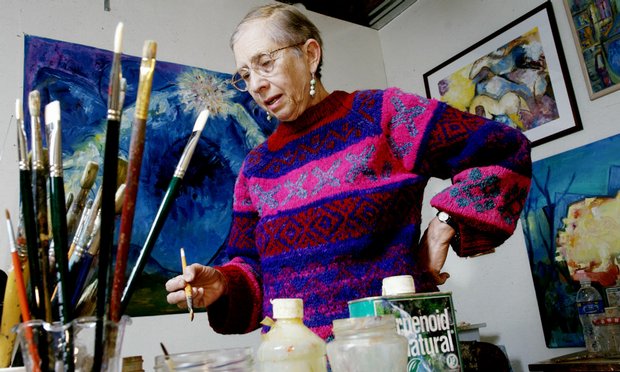
Josh DormanJosh Dorman in his NYC studio

.

I have placed there a little door opening on to the mysterious.
I have made stories.

—Odilon Redon

I  read Josh Dorman’s works like a Mary Ruefle essay. See how she writes about a revelation she had and the connections it revealed for her in her essay “Someone Reading a Book Is a Sign of Order in the World:”  “I was reading the dictionary, where I came upon the meaning of the word speculum: 1) an instrument inserted into a body passage for inspection; 2) an ancient mirror; 3) a medieval compendium of all knowledge; 4) a drawing showing the relative position of all the planets; and 5) a patch of color on the secondary wings of most ducks and some other birds.” Ruefle asserts, “there can be discoveries, connections… that explode the day and one’s heart and the long years that have led to the moment.”

Just so, artist Josh Dorman discovers a scrap, a tidbit, a piece of tinder, something recognizable (or not) and turns and turns it in his hand or mind appropriating it in his collage/multi-medium works, intuitively painting, drawing, layering, until it becomes more, becomes Other. The connections in his mind are revealed to him and/or us — or not; the lush, deep labyrinths open to some Home, or swallow us entirely blissfully lost.

Mary Kathryn Jablonski (MKJ): I’m very interested in how a piece begins for you. Do images you find suggest a narrative? Do you collect some images for use in collage based on the intrigue or beauty they hold for you alone? Do some images, which to the outsider might seem to have nothing in common, beg to be grouped with other images? I’m picturing files upon files named for various subjects in your studio, not unlike in collage artist Michael Oatman’s vast studio space! Tell us some of your sources. I’m most familiar with your paintings on antique maps, but you seem to be moving away from these a bit.

Camel CliffsCamel Cliffs – ink, acrylic, antique paper on panel, 12 x 14 inches, 2009

Josh Dorman (JD): I’m first struck by your mention of Oatman’s vast studio space. Picture my studio as more of a small cave packed with collections and piles of moldering detritus. Overflowing shelves filled with hundreds of antique books and yellowing paper: catalogs, diagrams, ledger books, topographical maps, player piano scrolls, but mostly textbooks. I use only printed materials from the pre-photography era: 1820s-1950s. They’re categorized by subject: Engineering, Biology, Botany, Architecture, Ornamentation, Cellular Structure, Human Anatomy, Geology, Geography, etc. It’s an obsession.

I still can’t resist when I stumble across a crusty tome at a yard sale. It’s not that the items are valuable, but that they contain images made by hand and knowledge that is outdated. Last summer I found a hardware catalog that’s eight inches thick, bound with rusty metal shackles. I’ve been mining images from it all year. It moves me that each hammer, hinge and screw was rendered and printed so carefully and beautifully by an artist whose name we’ll never know. I see it as part of my mission to give these drawings a new life.

Only once did I hire an assistant for a month to cut out collage bits from my books. Though those categorized clippings served me well, my process now is more organic, and I usually cut out images as I go. I have no set system for creating a painting (to be honest, I’m skeptical of art that arises out of preconception).

A piece for me can take several paths. As you mentioned, sometimes the beauty of an image can call out to me and I’ll build a painting around it. A good example of this is “A Knight Errant,” where the hardware bits I mentioned were the inspiration. In a clear case of pareidolia, I formed bodies around the faces I saw in the hardware. These then interacted with pieces cut from a 1790s Italian architecture book, and finally, reminding me of a childlike fantasy/delusion, I inserted a quixotic mounted rider.

Knight ErrantKnight Errant – ink, acrylic, antique paper on panel,
16 x 16 inches, 2014

I work in a subconscious state. A narrative may assert itself, but more often, multiple narratives and connections emerge. You guessed right when you asked about images that beg to be grouped together. It’s almost as if they’re whispering when the pages turn. It may come from my formalist training or it may be much deeper rooted, but I feel the need to connect forms from different areas of existence. A birdcage and a rib cage. A radiolarian and a diagram of a galaxy. Flower petals and fish scales. Tree branches, nerves, and an aerial map of a river. It’s obviously about shifting scale wildly from inch to inch within the painting. I think the reason I’m a visual artist is because it sounds absurdly simplistic to say in words that all things are connected.

As I write this, it occurs to me that most of my closest friends are poets and novelists, who can do this with words. I recently did a large commissioned version of “The Tower of Babel” for the writer Michael Chabon. He’s a “maximalist” novelist who takes dozens of tangent paths and generates stories within stories. I’m often inspired by writers: Italo Calvino, Richard Brautigan, and Li-Young Lee. I’m drawn to work that suggests rather than prescribes. I’d say the same about my art heroes: Klee, Redon, Turner, Pinkham Ryder, Brueghel.
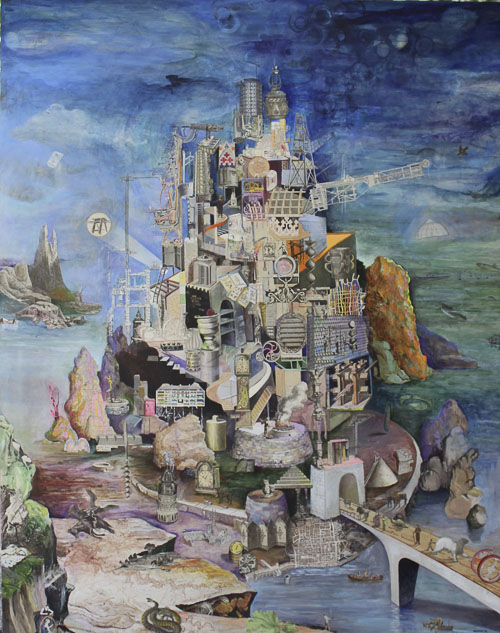
BabelTower of Babel (for Michael Chabon and Ayelet Waldman) – ink, acrylic, antique paper on panel, 48 x 38 inches, 2016

MKJ: Oh, make no mistake, your studio still sounds a lot like Oatman’s in many ways, believe it or not, as does your sensibility regarding preserving the past. Although I cannot speak for him, I don’t think he’d mind me saying that. And his studio may have been vast, but that does not mean it was not also cave-like and jam-packed, sorted obsessively, floor to ceiling. I love what you’ve just said about these artists and writers, especially since you’ve included one of my favorite poets. I do see what you mean about generating stories within stories. Like Mary Ruefle, Li-Young Lee is a wonderful example of one who makes remarkable, unique associations. You’ve mentioned to me that you titled a solo exhibition of your work in London The Missing Pages of the Sea, a phrase found in the first few lines of his poem “Pillow,” which has superb examples of just such associations.

Li-Young Lee is also a perfect example of a poet for us to compare with you because often, like Brigit Pegeen Kelly’s, his poems circle back on themselves over and over as they are woven, or as they unravel in deep meditation, just as I feel your artwork does in some way. And his poems at times are inexorably linked. Labyrinthine, they form an intricate network of passages that could lead only to the next poem or story, with no other possible exit. Take a look at “Words for Worry” and “Little Father,” printed consecutively in Book of My Nights. I feel this sensation too in some of your works, both within them, and when seeing them together. Lee also judiciously and poignantly uses the Question in his poems, as I feel you do in your works, Josh, addressing both yourself and the viewer.

I imagine that once a work starts going for you it takes on a force of its own. Do you find this to be true — that what you had in mind for a piece or a group of images can end up being far from the direction in which the piece eventually leads you? Tell us about some of the detours your work has taken you on. In this way, what has the act of making art taught you or revealed to you? What would you be doing if you weren’t an artist?

JD: In the 90s, I would begin a painting by gluing down topographic maps and letting the swirling lines guide my drawing and collaging. More often now, my works (especially the larger panels) begin with a compositional sketch, and maps are only used tangentially. In fact, many recent panels begin with a base layer of player piano scroll paper. This provides a tone, a history, and beautiful perforations that generate a rhythmic structure. I then sketch forms quickly and lightly in charcoal and begin the layering of paint and collage. I work on five to 10 paintings simultaneously. Some emerge in a matter of days; others can take a year or more.

If any element of a painting happens too easily, I’m skeptical, and I usually destroy it. Part of the reason I use collage is to remove my hand from the process. For the same reason, you’ll see areas in most of my paintings where I’ve rested living plants or metal gears and wires, poured ink and allowed it to evaporate. These “stain/stencils” for me, feel like a natural phenomenon, outside of my self. I’m not saying that I give over to Dadaist chance in my work. I need composition and structure. But within that initial framework, it’s about endless improvisation.

Night ApparitionsNight Apparitions – ink, acrylic, antique paper on panel,
38 x 48 inches, 2017

Looking at one recent piece called “Night Apparitions” might illuminate a bit about my process. This might sound laughable, but I consider this a minimalist work for me, since I managed to pare it down to a reduced palette and space. It began with a ream of rice paper I purchased on a trip to Taiwan. In this case, I broke my own “rule” by using non-antique paper. Since the paper was lightly gridded or lined for calligraphy practice, I cut it into varying sized rectangles and soaked them in India ink of different densities. My initial sketch had two essential structures: the central mountain form and the halo surrounded by a dark border. I expected multiple mountainscapes and horizon lines to emerge, but in this case, the gradation of light to dark from the center kept insisting itself until the end. As soon as I’d add a new landscape element, I’d wipe it out with the light or dark. In recent years, I’ve been trying to avoid imagery (animal, vegetable, machine) that identifies as only one thing. So, each hovering entity is a conglomeration – a hybrid form. Only one (located at 11 o’clock) contains human-made forms, and there’s only a hint of architecture in the contour of the mountain. I’m always aware of the disconnection we humans imagine and reinforce between ourselves and other living things.

Here, I could go off on a lengthy tangent about the election, and the fear, anger and ultimate despair I felt while making this piece. That’s all in there, and that may be why the painting is so dark. But again, I’m not interested in artwork that illustrates or prescribes meaning. I’m interested in what each viewer will bring to the piece.

There are creatures that are buried under the pink haze or in the dark black. Things that aren’t visible to the viewer are still crucial to the evolution of a piece. Some detours and quirks — I can say that the seashell mountaintop came late to eliminate a silhouette effect. The “whole” birds also remained at the bottom, to ground the piece and further call the reality into question (birds should fly). In the end, as with most of my work, I suppose my goal is to generate a feeling of joyful apocalypse. My dreams do influence my work deeply, but I shy away from association with Surrealism, most of which I view as too pat and literal.

It’s a never-ending cycle, trying to understand the world, art, my own process. In the same way that I don’t like to interpret dreams, I also shun too much breakdown of my work. I need to know just enough to guide me, but not too much to remove the mystery. As Georges Braque said, “The only thing of value in art is that which cannot be explained.” As for your question about what I’d be doing if not this, I’ve always been fascinated by archaeology and I began college as a psychology major, but I quickly realized that it was not for me. Frankly, I can’t imagine doing anything else.

MKJ: I appreciate that you say you’ve been trying to avoid imagery that identifies as only one thing. I’ve always admired this quality in the written word as well: poetry whose lines slant in both directions, tying them to the previous or following line, which can happen with well-thought-out enjambment and punctuation (or lack thereof). And when you say you value things that aren’t visible to the viewer, which are still crucial to the evolution of a piece, I couldn’t agree more. Perhaps these are the most important aspects of a creative work.

Most viewers expect your collage pieces to be two-dimensional surfaces, yet in your new works you are exploring depth as well, carving pockets into panels and pouring in resin, at times in pools up to two inches deep with a watery shine difficult to reproduce in photographs. What inspired this sculptural necessity? Do you see it going further?

Welcome MachineWelcome to the Machine II – ink, acrylic, antique paper on panel, with resin, 12 x 12 inches, 2017

JD: The poured resin layering is yet another manifestation of my own rule-breaking. While I have never been drawn to making sculpture, I’m intrigued by creating illusions of depth, and in this case, tricking the viewer with a bit of tangible depth.

I’ve found in my artistic life that a medium or subject will present itself, and only years later will it find it’s proper home in the work. It was this way with the topographical maps, which lingered in my studio for five years before I dared draw on them, and it was this way with the clear resin, which I tried out twenty years ago and failed. I’ll admit that Fred Tomaselli, with his resin-embedded pills and leaves left me daunted. I admire his work, but I’m after something different. In fact, just as with collaging gorgeously rendered engravings, one runs the risk of gimmickry with resin. Pour this glossy stuff on a child’s drawing or a newspaper page and suddenly it looks luscious. I’m still experimenting with it, but it’s incredibly exciting. I’d fallen into a rut for a year or so, and creating these space pockets is reinvigorating me. It has reminded me that play is crucial. Ha! Perhaps, I can also credit Trump with causing me to seek new territory. I suspect many artists right now are on fire, making protest statements or constructing even richer worlds to escape to.

MKJ: Yes, at a time when we could all use, as Mary Ruefle says, some Sign of Order in the World, we’ll leave that struggle in the category of more things that aren’t visible to the viewer.

Your paintings are really multi-medium works that include collage, painting and drawing (and as we’ve said, now sculptural processes as well). How do these pieces differ in your mind from the black and white drawings that you make, which to me seem very fluid and in some mystical way reminiscent of William Blake.

WheelsWheels – graphite with antique collage elements, 10 x 20 inches, 2017

JD: The graphite drawings are almost a form of meditation for me. In making them, I eliminate all questions of medium, color, size, and layering. Even composition and subject matter disappear. I’d never encourage a drawing student to do this, but these horizontally oriented works emerge from the lower left and move eastward, with no sketch or outline. I love the traveling journey aspect of Chinese and Japanese scrolls. For me, it’s a mysterious process and not unlike a physical journey. I rub the pencil until shapes and images start to reveal themselves. They are not sketches for the paintings. They exist on their own.

MKJ: I am delighted to learn about this drawing process! And now I see them as even more riveting. I hope you do not find this in any way a diminishment of your collages/paintings, but the drawings may be your works I favor most. They are magical to me and unfold or reveal themselves, to this viewer at least, in perhaps the same mysterious ways in which they were created, which I find marvelous and complex.

Although it took place awhile ago now, I do want to mention that I also found your project for the Memory Bridge Foundation, which “maps” the internal geographies and memories of Alzheimer’s and dementia patients, moving and inspirational. Describe how this project has changed you. Tell us how memory plays a role in your work, if in fact you find that it does.

JD: The Memory Bridge project influenced me in ways I didn’t understand at the time. The obvious answer is that the old paper I use has it’s own memory: it’s physically from another time and place. The images I use were created in a world without the ubiquitous photograph, let alone computers and the thousands of images we’re barraged with daily. I’d like my work to feel like it’s not of this time and place.

When I was commissioned to create the Memory Bridge portraits, I listened and sketched as six people with dementia were interviewed. I could see bits of memory coming and going, interweaving with the present, imagination, and chaos. Later, back in my studio with my notes, while making a “portrait” of one particularly unreachable woman, I found myself in a mental state not unlike hers. It was disturbing and liberating. I sat on the floor with my canvas and piles of books and papers. I began reaching for images in a frenzy of free association, pasting them down and drawing on top. This state of unknowing is where I try to be now when I work.

Thelma Memory BridgeThelma, Memory Bridge portrait – ink, acrylic, antique paper on panel, 34 x 42 inches, 2006

We can never be certain that we are communicating on a common wavelength with anyone else. I trust in that lack of tangibility and certainty. If people ask me what my paintings are about, I stumble. I know they are not about nothing… I know, in fact, that they are utterly specific. But some people will embrace the ambiguity within the specificity, and others will reject the work, needing a concrete meaning and resolution I can’t provide.

x
Josh Dorman was born in Baltimore, MD and lives and works in New York, NY. He received his MFA from Queens College, Flushing, NY and his BA from Skidmore College, Saratoga Springs, NY. Josh has been the recipient of numerous residencies and fellowships including Yaddo, Art Omi, and the Millay Colony. He has been a visiting artist and lecturer at numerous institutions including most recently Skidmore College, Saratoga Springs, NY and Mass Art Graduate MFA Program, Boston, MA. His work is held in numerous collections across the country and he has exhibited nationally and internationally. In 2014, a collaboration of seven animations he made with composer Anna Clyne, titled “The Violin,” was released on DVD. Currently, Josh is represented by Ryan Lee Gallery in New York City, Koplin Del Rio Gallery in Seattle, and John Martin Gallery in London.
http://www.joshdorman.net

x
x

Mary Kathryn Jablonski
x
A gallerist in Saratoga Springs for over 15 years, visual artist and poet Mary Kathryn Jablonski is now an administrative director in holistic healthcare. She is author of the chapbook To the Husband I Have Not Yet Met, and her poems have appeared in numerous literary journals including the Beloit Poetry Journal, Blueline, Home Planet News, Salmagundi, and Slipstream, among others. Her artwork has been widely exhibited throughout the Northeast and is held in private and public collections.

x
x

Sep 052012
 

“I simply wrote stories whenever I got bushwhacked by inspiration and kept my fingers crossed in hopes that in the end they would somehow cohere…” — Steven Heighton

——-

“The writing life, like life in general, has a sacramental and a secretarial side,” Steven Heighton writes.  “As years pass and debts and duties accrue, the secretarial, clerical mode spreads like a lymphoma and starts to squeeze life from the sacramental, creative side.” Heighton’s own writing stands in defiance of this clerical mode. Prolific and diverse, he has published more than a dozen books, inlcuding collections of poetry, short stories and essays as well as four novels. He is a writer hell-bent on summoning the sacramental in his ever-expanding body of work, yet one dedicated and disciplined enough to sustain a steady output of consistently superior writing.

Heighton works and lives in Kingston, Ontario. His most recent book is a collection of short stories, The Dead Are More Visible (read my review at Numéro Cinq). In 2011, Heighton released Workbook: memos & dispatches on writing, a lively, eclectic gathering of aphorisms and memos about writing and art. I first encountered his work in the essay “The Admen Move on Lhasa”  (from a collection of essays with the same title). This essay remains one of the finest I’ve read on writing and the process of making art.

We exchanged a series of emails over the course of several weeks in preparation for this interview.  I confess to some initial nervousness. How often do we get to talk with the people whose work we truly admire?  But Heighton was both generous with his time and personable in our exchanges. He asked me about San Diego, about my family and my writing.  He confessed to a ‘minor’ bike accident which he described using the term cheese-grater in reference to the skin on right side of his body.  He talked about camping with his daughter, about finding a way to earn a living as a writer, about the blazing summer heat and the long, uncertain process of books being optioned to films. (Two of his novels have been optioned recently, Afterlands and Every Lost Country).

This sort of informal formality bleeds over into his writing as well. His stories are accessible but carefully crafted. They are filled with recognizable, often working class characters but written with a meticulous detail for language—a poet’s ear for melody combined with a prose writer’s eye for drama, a sort of genre-bending, cross-pollination of  W.S. Merwin and Raymond Carver, Ann Carson and Alice Munro.

Talking to Heighton, I feel myself in the presence of an affable high priest, a hardworking visionary whose polite chit chat is really just clearing the way for what he does best, which turns out to be two distinct things: both writing and talking about writing. The former is obvious; but the latter—the ability to articulate the process, to demystify the act of creativity, is a much rarer thing. Not every succesful and talented writer is able or willing to do this. At times, and especially in Workbook, it feels as if Heighton is lowering a rope ladder down from the Elysian fields and inviting others up. He offers no schmaltzy shortcuts, no write-your-novel-in-a-weekend workshops here. “Interest is never enough. If it doesn’t haunt you, you’ll never write it well. What haunts and obsesses you into writing may, with luck and labour, interest your readers. What merely interests you is sure to bore them.”  Haunted is a good word to describe his stories, poems and essays. To read Heighton is to intuit the effort that goes into the creation of something important and lasting. It is to “gape and loiter” in the sacramental, and all the while wonder what it means.

—Richard Farrell

 ————-

Richard Farrell: Your latest collection of short stories, The Dead Are More Visible, contains eleven stories. Can you talk a bit about how long it took you to gather that collection?

Steven Heigthon: I wrote the eleven stories over a period of six years—2006 to the end of 2011—but during that time I also worked on other things: a novel, a book of poems, and a book of aphorisms & fragmentary essays.  I wrote a few other stories as well—stories that my editor, Amanda Lewis, suggested we cull from The Dead Are More Visible on the grounds that they didn’t fit the book tonally.  In the end I agreed with her.  I’m hoping those orphaned stories will fit into some future collection.

RF: Does making a collection of stories influence the way you write the individual stories? In other words, do you have a thematic sense of where the collection is going before you start, or do you cobble together the book after the stories are written?

SH: In the ’90s I published a book called Flight Paths of the Emperor—a collection of linked stories that use Japan as a point of thematic reference and departure.  At a certain point in that book’s making, I did start writing stories with a view to filling in thematic gaps, filling out a larger project.  Not so with The Dead Are More Visible.  I simply wrote stories whenever I got bushwhacked by inspiration and kept my fingers crossed in hopes that in the end they would somehow cohere, not in an overtly “linked” fashion but through loose tonal kinships imposed by my voice, my angle of vision, the particular mannerisms and mechanisms of my writing.

RF: In “A Right Like Yours,” a female boxer falls in love with her sparring partner.  I daresay it’s a love story with a happy ending.  I might make an argument that a few other stories in the book have happy endings, or at least resolutions that favor the protagonists. Are happy endings harder to write?

SH: Like any romantic, I have to keep an eye on myself.  I want to avoid lapsing into sentiment, avoid poeticizing or aestheticizing the world.  So I’ve trained myself to avoid positive endings, or at least prettified endings.  With “A Right Like Yours” I took a different approach.  I decided to tune out my captious, critical faculty and allow myself to end on a slightly sentimental note.  I’m glad I did.  It felt like a reprieve, a remission, for me as much as for the main character.  There’s a simple sweetness to her voice and I decided not to mute or undercut it at the end.

RF: By contrast, “Journeyman” and “Heart & Arrow” strike me both as particularly sad stories. I’m wondering if the process is different for you.

SH: The female boxer in “A Right Like Yours” is very young.  Like anyone, she has experienced a certain amount of loss, but not nearly to the extent that a middle-aged person has.  The protagonists of “Journeyman” and “Heart & Arrow” are, respectively, in late and early middle-age—and the tone and point of view of those stories are, in contrast to “A Right Like Yours,” retrospective, elegiac.  They’re stories about loss and how we decide what to do with it.  But does the writing process differ—is writing a comedy (“comedy” in the classical sense: a story that ends with a wedding instead of a funeral) fundamentally different from writing tragedy?  It’s a good question.  I guess I’d have to say the process doesn’t differ, if only because the technical demands of writing a story are always the same: keeping it tight, choosing the right words so that each word resounds forward and backward through the text, nailing each physical detail, somehow defibrillating those characters who won’t come to life.

But on second thought: in a “comedy” you can get away with caricatured secondary characters, which makes the process of creation a touch less demanding, and maybe you can also have a bit more fun in writing certain scenes, certain passages of dialogue.  But it’s still going to be hard to get the thing right and fictionally true.

RF: Do you ever abandon stories?  If so, do those stories haunt you or do you let them go?

SH: I do abandon stories.  Do they haunt me after the fact?  Rarely.  They failed because their material didn’t haunt and obsess me enough during the process of composition.  They failed because they lacked the power to haunt in the first place.  So I move on to new work and forget them.

But the essence of one jettisoned story stayed with me for years.  Around 1992 I started something I called “Nearing the Sea, Superior” and over several drafts it bloated up to thirty pages, and I kept adding more, trying to make it work—like an engineer trying to fix a flying machine that’s too heavy to fly by adding more and more heavy parts.  In the end I threw up my hands.  Then, a few years ago, I thought I’d take another run at the basic narrative concept—or what I remembered of it.  So I searched for a print-out of the original version.  Couldn’t find it, and I believe that was a lucky break, because if I’d read that original I might have mined it for a few good details, or lazily used the whole story as a platform for the new version and its protagonist.  Instead, I had to take a fresh run at the whole thing.  It’s just ten pages long now and, published in The Dead Are More Visible, I think it finally works.

RF: You write novels, stories, poems, essays, and reviews.  Do you write all these forms during the same period or do you compartmentalize your writing brains?

SH: During the same period, yes, but usually not on the same day.  If the things I’m working on are alive, molten, inclined to flow toward their natural culmination, I can walk away and write something different for a week—say, a review for which I have a deadline—then return to the abandoned thing and, within an hour or two, be back inside the vortex.  Partly it’s a matter of sheer curiosity.  I never know how my poems or stories will end—I want to write toward my endings with the same interest and excitement I hope readers will feel, reading toward them—so my curiosity about where things will end up helps draw me back into whatever I’m writing.

RF: I recently completed your novel Afterlands, which was terrific. In many ways, it felt like a 400 page poem, yet it was fully articulated as a dramatic story too. Are you a poet who writes novels or a novelist who writes poems? 

SH: I think of myself as a writer who channels his narrative impulses into fiction and lyrical impulses into poetry—I don’t write typical “poet’s novels” and I don’t write narrative poetry—but there’s definitely some spillover on the level of language.  The thing is, poets like me who also write fiction are saddled with a sensitivity to verbal acoustics.  They can’t help lugging their poet’s tool belt into the atelier where they build their stories.  So, unlike pure fiction writers, who work stylistically at the level of the sentence, the poet/fiction writer works at the level of the word, even the syllableWorse, they habitually, helplessly use poetry’s staple technique, re-enactive writing (i.e., the orchestration of verbal rhythm, sound, level of diction, punctuation etc. so that the writing embodies and becomes the action or sensation being described).  Bummer.  There are ten thousand syllables in the average story and a few hundred thousand in the average novel.

Come to think of it, one of the reasons I’m more and more drawn to narratives that involve physical action and overt dramatic momentum—as with Afterlands—is because I’m hoping those traits will balance the prosodic density of the writing.  I don’t want to create 400-page blocks of static, preeningly poetic prose.  I’m not writing “re-enactively” to show off—I’m just trying to make my narratives more vivid and vital.  So, yes, the poetry is there, but in service to the narrative and the characters.

RF: Is there a style (genre) of writing that feels most natural to you? 

SH: Depends on the day.  Honestly.  Some days I’m a poet, pure and simple.  Other days I want to tell a story.

RF: A friend of mine recently told me that she often tries to quietly do ‘beautiful things as an act of defiance.”  You quote a Buddhist teacher, Thich Nhat Hahn, who says, “Don’t just do something, sit there.” You’ve indicated that you see the making of art as a defiant or subversive act. Could you expound a bit on this?

SH: Making something slowly and conscientiously, the way you have to build a poem, story or novel, is subversive in the context of a hyperkinetic culture that promotes haste and speciousness—speed and loudness over slowness and quiet, surface over substance.  On the other hand, as that second quote suggests, Nhat Hahn extols the importance of sometimes doing no work at all—or at least no material, external work.  He too wants people to defy our culture’s manic forward momentum, but by simply sitting, breathing and smiling—“being”—rather than getting too caught up in doing and achieving.

RF: In Workbook you write, “If it doesn’t haunt you, you’ll never write it well.”  Do you remember the moment when you first felt haunted? 

SH: The truth is I can’t remember a time when I didn’t feel haunted—haunted in the sense of inspired to try to make meaningful things: first drawings and paintings, then poems and stories, and for a while, in my last year of high school and throughout my twenties, songs.

An interesting point about the songwriting.  I’ve probably written about a hundred songs and they’re all bad or mediocre except for one, which is pretty good.  One good song in three decades.  At this rate I’ll have a solid album in about three hundred years.

RF: You bang the drum loudly for the purity of art, for art as a haven apart from the corrupting influences of capitalism and advertising, schlock. But how do you encourage a young writer starting out, who has to pay the bills and feed the kids? How do you advise her or him to stay true to this calling?

SH: Cultivate low material aspirations; you’re going to need them.  Remember you can live on a lot less money than consumer culture would have you believe.  Abolish all bourgeois vanities about the source and branding of your clothes and other stuff; you can dress yourself decently at a thrift store.  Try to find jobs that leave you time to write, real time, three to five hours a day (waiting on tables at night is perfect: decent and quick money, good exercise, and your days stay free).  Don’t marry anyone who cares a lot about material comforts and possessions, or who has high ambitions for you.  Never marry anyone who doesn’t see your calling as worth a lifetime of effort—and deep down, you know how he or she feels.

[Sheepish addendum: If you have a strong enough constitution, you can produce a stream of books by writing, say, from five to eight every morning before going out to earn a conventional nine-to-five living.  I doubt I could do it—manage a tandem twelve-fourteen hour workday on five or six hours’ sleep a night, and with no idling time—but there are people who can.  Famously, Laurence Durrell wrote The Alexandria Quartet on the small-hours shift (and I mean small hours—he got up and started writing at three a.m.) before going off to teach schoolchildren.  He also managed to make time in that crushing schedule for committed boozing.  Stephen Henighan (people are always mixing up our names) is a tenured academic and works on his fiction and non-fiction books in the very early morning, every morning, before going off to teach at the University of Guelph.  So that approach is an option for the athletic, the heroic, or persons of Paleolithic toughness.]

RF: I’ve been travelling a bit this summer, and I pay attention to what people are reading.  And people are still reading, but sadly, it seems like many people are reading the same few books.  (This summer, in particular, it seems the majority of people I’ve seen buried in a book were reading Fifty Shades of Gray.)  In Workbook you call lazy readers narcissists.  Do you suppose there’s any redeeming value in such group think?  From reading anything as opposed to just watching television?

SH: It’s a great question.  I guess I’ll say that reading is always different, less passive than TV, more interactive, collaborative, even if you’re reading trafe.  And who can blame people for reading trafe?  We’re all stressed and scared, one way or another.  I fully understand why most readers would prefer an unchallenging, escapist book to The Golden Bowl.  (Actually, I think I might find the Shades of Gray series an enormous challenge—which is my way of admitting I haven’t read a word and shouldn’t be commenting on it.)

To get back to that quotation from Workbook.  It was part of a three-part “memo” in a section called “On Reading.”  I argued in the first part that “Lazy readers are unwilling or unable to empathize with characters different from themselves.  Seeking some kind of personal corroboration, they want to read about versions of themselves.”  I added that lazy readers are unable to love a work of fiction—or even respect it—if they don’t love the protagonist.  Hence my charge of narcissism.  I could as easily have accused lazy readers of a failure of empathy, a narrowness of sympathy.

In your question I think you’re addressing a different kind of laziness: the simple need for escape and diversion, which we all share to some extent.  Frankly, escapist readers don’t bother me compared to those readers who think of themselves as literary but nevertheless read in the narcissistic way I describe in Workbook.  They want to have it both ways.  They want to associate themselves with books that look and smellliterary—just as they want to have jazz records, modern paintings, and a decent wine cellar in their home—but they don’t want to read things that actually confront, wobble, even upend their tidy haute-bourgeois vision.

RF: I would use the word prolific to describe you as a writer and the oeuvre of your work.  Could you talk about diligence and persistence in terms of your success as a writer?

SH: The prospect of the poorhouse—of failing to support myself and my daughter, then ending up in a rooming house eating Puss ‘n Boots—is a potent creative motivator.  I simply lack the luxury of suffering from writer’s block.

RF: In “Heart & Arrow” (which is an absolutely heartbreaking story, lovely, true, haunted), you play with memory as a structural device in the story. The themes of faulty memory appear in Afterlands as well. How important are your memories, both of the real and of the literary variety?

SH: Flannery O’Connor once said (roughly: I’m going on memory here, speaking of memory) that anyone who has reached the age of twelve has enough material to fuel a lifetime of writing.  I doubt I was nearly as attentive a child as O’Connor, so probably I didn’t hit that threshold until twenty or so, but I think the point is essentially right.  I know that if I concentrate now and revisit some part of my life I haven’t thought of for a while, I’ll quickly locate riches—not because my life has been exceptionally rich in experience or adventure, but because significant stuff is happening to all of us, all the time.

A key thing about the memories we draw on is that time and compound mental revisions have corrupted them—and that’s a good thing for a fiction writer.  I travelled through Tibet in 1986 but didn’t start writing about it till twenty years later (in my novel Every Lost Country).  Friends asked if I planned to go back, revisit the country, do some on-site research, and I told them no, I couldn’t bear to see how the Chinese occupation had changed Tibet.  My rationale was only true to a point.  Mainly, I didn’t want my contaminated memories of the place and people to be jarred, readjusted by reality.  I was embarking on a novel, not a non-fiction project, and for better or worse the Tibet of my book had to be my version and vision of the place.

RF: You are going to be marooned for the rest of your life on a desert island. You can only take 1 book.  What will you take?

SH: You’re not going to let me take a big fat anthology, right?  Or the collected works of Shakespeare?  Or Proust’s magnum opus, which is really a number of books, a roman fleuve?  Fair enough.  You want to make it hard for me.  I get just one book.  So let me spend the next year or two pinning down an answer, because that’s how long it’s going to take me to narrow my longlist of seventy or eighty favourites.

RF: What are you working on now?

SH: For the past year I’ve been working on new poems and stories.  Last month I finally got started on a novel, as I have to, since realistically the novel is the only form that can put bread on the table.  I think I’ve just finished the first chapter.  Now I’ll turn my back on it and work on other things for a few days.  When I return to that opening it will either hook me, haul me in and surprise me, in a good way, or leave me cold.  If I detect no vital signs, I won’t go on tinkering endlessly the way I used to—a process I now compare to doing chest compressions on an Inca mummy. Nowadays, I just tag the toe and start over.

Thanks for your careful reading and your questions.

— Steven Heighton & Richard Farrell

 ——————

Steven Heighton is the author of the novel Afterlands, which has appeared in six countries; was a New York Times Book Review Editors’ Choice and a best book of the year selection in ten publications in Canada, the US, and the UK; and has been optioned for film.  His first novel, The Shadow Boxer, was a Canadian bestseller and a Publishers’ Weekly book of the year for 2002.  Heighton’s fiction and poetry are translated into ten languages; have appeared in London Review of Books, Poetry, Tin House, Brick, London Magazine, TLR, Agni, Numéro Cinq, and Revue Europe; have been internationally anthologised (Best English Stories, Best American Poetry, The Minerva Book of Short Stories, Best Canadian Stories, Modern Canadian Poets); and have been nominated for the Governor General’s Award, the Trillium Award, and Britain’s W.H. Smith Award.  He has received the Gerald Lampert Prize, the P.K. Page Award, and four gold National Magazine Awards for fiction.  He writes occasional  reviews for the New York Times Book Review and in 2013 will be the Mordecai Richler Writer-in-Residence at McGill University.

*Author photo credits: Mary Huggard & Michale Lea


Apr 062012
 

Over the past four decades, Gladys Swan has published six collections of short stories and two novels, Carnival for the Gods (Vintage Contemporaries Series), and Ghost Dance: A Play of Voices, nominated by LSU Press for the Pen/Faulkner Award.  Her short fiction appears in a variety of anthologies and in such literary magazines as the Kenyon Review, Sewanee Review, Virginia Quarterly Review, Colorado Review, Shenandoah, and the Ohio Review.  She is the recipient of numerous honors and awards, including Prairie Schooner’s Lawrence Foundation Prize for Fiction, and a Tate Prize for Poetry from the Sewanee Review.  In addition to receiving multiple fellowships for residencies and retreats in both the visual arts and in writing, she was awarded one of the first Open Fellowships from the Lilly Endowment, for a study of Inuit art and mythology. Swan’s The Tiger’s Eye—A Collection of New and Selected Stories was published by Servinghouse Books in the fall of 2011.

To view a selection of Gladys Swan’s paintings published earlier on NC, click here. Read her wonderful short story “The Orange Bird” (from The Tiger’s Eye), click here.

§

Joyce J. Townsend: What prompted the publication of your latest short story collection at this point in time?

Gladys Swan:  The Tiger’s Eye is a milestone of sorts, representing forty years of work in the short story.  It serves as a retrospective, a chance to look back and see where I’ve come in this particular genre.  I hadn’t read most of the stories for years, so it was interesting to see what has held my attention, what motifs have recurred, what I’ve discovered along the path.

JJT: How were you drawn to the writing life?

Swan: I suppose at heart it’s a matter of temperament and thereby a kind of fate.  I was propelled early on by an impulse I didn’t really understand.  A need, I think, to define my experience somehow, to discover a way of looking at the world, to find some kind of orientation in a place where I was a stranger.  Then it became a fascination with what the imagination could know, a satisfaction in doing the work no matter what, after a long struggle, “a lonely impulse of delight,” to borrow a line from Yeats.

JJT: What moved you from creative writing to the visual arts?  Or did it happen the other way around?

Swan: I was drawn to the visual arts as a child.  I remember trying to paint a horse and being terribly frustrated when it didn’t come out right.  When I got to high school, I took a painting class sponsored by New Mexico Western College.  Dorothy McCrae, a wonderful artist and teacher, oversaw the class and came in at various times to work with the student instructor.  She put me in touch with my imagination.  I didn’t realize how much I owed Dorothy until later.

Although I was also trying to write, and felt great excitement about literature, I took another painting class when I attended New Mexico Western College, and I continued to sketch and paint a little as I went along.  As it began to appear that I was never going to get published, I started working in ceramics—making bowls was better than collecting typescript.  A pivotal moment for me came when I was awarded a Lilly Endowment Open Fellowship for a project in art and mythology.  I went up to Purdue and took every art course I could manage, and then I put all that aside when, all of a sudden, my writing began being published.  But I couldn’t stay away: I had spent so much time over the years in art museums that finally I couldn’t stand it any longer—I had to paint.

After I began teaching creative writing at the University of Missouri, I took art classes there.  I’ve had some fine teachers along the way, people I still spend time with, to whom I owe a great deal for their support and inspiration, among them Woody Johnson from New Mexico Western College, and Curt Stocking with whom I studied figure-drawing at Purdue.  Here in Missouri, Frank Stack, Brooke Cameron, Ben Cameron, and William Berry have been influential, and Robert Friedman and Bede Clark in ceramics.

JJT:  In what ways do you see the two creative processes affecting each other?

Swan: The visual arts engage the senses in a different way, perhaps closer to the way the mind works when rational thinking is not imposed on it.  You have a flow of images.  Art works with those images—words and definitions come later.  The process is non-linear.  Its language is color, line and mass, pattern and rhythm, light and dark.  It offers me a great refreshment to get out of words, and I love playing with color.  Attention to the act of seeing makes me observe the world more closely, its lights and shadows, its tones and variations, its people, their expressions and gestures.  Art offers a new and continuing opportunity for discovery.  I believe that is reflected in my writing.

JJT: Do you find similar patterns between writing and the visual arts emerging for you?

Swan: Patterns there are, and more.  I believe that it is very beneficial for an artist to work in another medium, whether it be music or dance, drama or painting.  There is no direct equation, but one art form influences the other in interesting and subtle ways.  You learn things about form and pattern, rhythm and emphasis.  You get another take on how you see the world.  Also, when you are learning to work in a different medium, you recognize similarities in the creative process, what stages you have to go through before you reach any kind of mastery.

JJT: When you first started out as an artist and writer, whose work most influenced you?

Swan: Strong influences shaping my mind and imagination came from the writings of Carl Jung and Joseph Campbell, and the works of Homer and the Greek playwrights.  I discovered Jung when his books were first translated: Psychology and Alchemy and Symbols of Transformation.  They introduced me to the idea that there was another kind of thinking beyond that of the rational mind, and it was one to be equally valued, with treasures to be gained from it: enrichment from unconscious sources, the potentials for human growth and realization, as well as insight into the dark side of human behavior.  Joseph Campbell was especially helpful in locating the patterns and stages of human experience, the truths embodied in mythology.  It was helpful to return to origins.  Those insights were certainly underscored by Dante, that great psychologist, and the work of Dostoyevski, Conrad and Hawthorne, among others.  All the writers mentioned gave me a sense of the heights literature can reach.

Probably the writer who influenced me most when I was starting to write short stories was Katherine Anne Porter.  Her stories were gems.  She set me on the path.

There were a good many artists who inspired me in the visual arts, particularly the Impressionists and early Modernists.  Curiously, as my writing has moved more in the direction of the fantastic, my painting has gone more in the direction of the abstract.  Klee, Kandinsky, Diebenkorn, and Joan Mitchell have been very important to me lately.  In watercolor, John Marin, Charles Burchfield, Georgia O’Keefe, and Keith Crown have influenced me strongly.  Keith Crown is an artist who deserves to be better known.

JJT:  What has been the best advice you received along the way and, conversely, what was the worst?

Swan: I think the best advice came from Thoreau: “Live in the direction of your dreams.”   Maybe the worst advice was embodied in the question an agent asked me with great irritation after she’d read the first fifty pages of Carnival for the Gods, “Can’t you just write a good commercial novel?”  From Frank Stack, a well-known underground cartoonist and fine painter, came the statement: “Only you can empower yourself as an artist.”  From him, I also learned not to destroy work—always a temptation—until you’ve let it sit around for a while.  That way, you have some distance and can make a better judgment about it.

JJT:  You’ve written essays, translations, poetry, prose, and various other forms.  Do you have a favored format or genre?

Swan: I thought I would live and die a short story writer since I played in that form for so many years.  But as I have made other rewarding ventures, I would say that I’m wedded to whatever form I happen to be engaged with at the moment.  Each allows a certain kind of emphasis and way to explore.  I am guided by an old aesthetic principle: vision dictates form.  The materials themselves make the suggestions emerge in the way they require.  You have to keep listening.  The novel allows a broader reach, and I appreciate its scope: with the chance to develop more characters, to give more time to social and political issues.  With poetry, I love the focus on image, the chance to engage all the resources of language, to link them to narrative and song.  The essay is rather a late development for me, and I find a satisfaction in exploring a subject through a process of thought.  I could say that the short story is my first love, since I keep coming back to it, but I enjoy the excitement of playing with form.  There’s an unfinished play still lying in the drawer . . ..  And the visual arts—that’s a whole other territory.

JJT: In retrospect, what emerges as major recurring themes in your short fiction throughout your career?

Swan: I think a major preoccupation has been the effort to determine what is meant by “experience.”  Flannery O’Connor once said something to the effect that the greatest tragedy is not to have experience.  What I think she meant is that there is considerable difference between event and experience.  At first I thought that experience meant that something of great magnitude had to occur.  Then I discovered that some people have extraordinary things happen to them, but essentially nothing much changes except the addition of a few anecdotes.  “We had the experience, but we missed the meaning,” as Eliot notes.

I believe that experience brings about a different perspective, a way of seeing and, for better or worse, a different way of being in the world.  It can awaken new potentialities for growth or bring about a shattering of illusions.  The subject of experience is complex and takes one into deep mysteries.

JJT:  What effect does change of locale have on your writing in terms of both story content and the act of writing?

Swan:  Any change of local is like traveling to a foreign country.  Some offer strong contrasts in language and people, landscape, and way of life.  So whether I’m in Maine or Missouri, New Mexico or France, there is a great deal to take in.  Locale has certainly had a great effect on the content of both my novels and my short stories.  I left New Mexico at a young age, but in a strong sense, I’ve never left.  It has been the primary territory for my imagination although other work is set in places where I’ve spent long and short periods of time.  I’ve written half a dozen stories set in Maine, where I have lived for nearly forty summers, taking in the whole ambience of the place, its landscape, the coastal region, Down East, as opposed to the central and western parts, etc.  And in Europe where I’ve spent a lot of time—Paris, Florence, Yugoslavia, Greece, Spain—I’ve found stories I need to tell.  One of my as-yet unpublished novels has sections set in Copenhagen, Venice, and Prague.  In some ways, I’ve gone the route of both James and Hawthorne in considering how the consciousness of an American is influenced from abroad.  Certain stories seem to arise from the landscape, and I am in many ways influenced by what is around me for content and for the act of writing.  A quiet place near a window that looks out on water and/or woods does very nicely.  For a number of summers the landscape in Maine was so compelling I could barely concentrate on anything else.  I just wanted to follow the light on water and in the trees—to dream.

JJT: In looking over your work, what discoveries have you made about yourself as a writer?

Swan: My first novel, Carnival for the Gods, was a complete surprise to me.  A writer friend once told me I should try writing comedy, and I just laughed.  I had no thought of moving toward the fantastic.  I thought I was a realist, of a serious disposition at that.  Then I ended up writing a comic fantasy about a small circus/carnival and the adventures they have in a mythical territory: the Seven Cities of Cibola, supposedly with roof tops of gold, such as the Spaniards were looking for when they came north to New Mexico.  They didn’t find it, but I did, inventing the cities as I went along—my first discovery that I wasn’t a realist.  I had to wrestle with the half-hatched insight that my supposed “real bent” was heading in a direction I hadn’t banked on.

JJT: You mentioned being surprised at how the circus has become a preoccupation of yours.

Swan: At first I was fascinated by carnivals, and I wanted to write about one.  I thought I’d like to travel with a carnival, but at the time it was not possible.  I was whining to a friend about this state of affairs, and she said,  “Why don’t you invent one?”  So I did—the result was Carnival for the Gods, a combination circus and carnival.  I thought I was finished with that particular world, but ten years later I found myself making notes for a series of other novels, based on characters from the first.  They were born of reading and imagination, but by the time I got to the fourth of the series, I had a strong desire to see a circus firsthand.  I called up David and Laura Balding, the producers of the Circus Flora in St. Louis, told them what I wanted to do and asked if I could be on hand. They invited me to meet with them.  I didn’t want to be just a spectator, so they gave me something to do.  I ended up pulling the back curtain for all their performances in St. Louis that season, thereby seeing what went on backstage.  Later they invited me to do the same during their season in Phoenix, so I went out there as well.

It was a wonderful experience.  I spent time meeting and talking to various performers—the Flying Walendas, the Cossack riders, the clowns, the expert juggler they had, Flora-the-elephant’s handler, and others.  Being with that group of dedicated artists was a real education.  I learned things I could never have learned otherwise and gained an appreciation for them beyond what I already had.  In the Arizona performance, I was given a small part: wearing a cloak and monster face, I had to run into the ring with two other performers, all of us carrying various signs which we waved in front of the crowd. Mine said,  “Don’t talk to the animals.”

I thought I had finished the sequence with the fourth novel, Down to Earth, but another character, Amazing Grace, had to have her story told as well.  I’m in the midst of that novel now—Dancing with Snakes.

The whole experience was so important to me that it affected more than the novels I’ve been working on.  I wrote a long poem entitled, “The Dream of Circus,” and gave a copy to the performers.  “The Dream of Circus” was published in the Sewanee Review and awarded their Tate Prize for Poetry.

JJT: Have your short stories followed the same trajectory into fantasy?

Swan: My short fiction pretty much kept its feet on the ground until I came to The Tiger’s Eye, inspired when I heard about a man who held conversations with a tiger in England’s Bristol Zoo.  Recent stories have moved more and more in unexpected directions.  My work has as its basis actual events, which take off from there towards other dimensions.

Perhaps I have simply fulfilled a certain suggestion in my work that I recorded a number of years ago: “My stories seem to be a kind of dreaming awake.  Impressions float along the surface of consciousness in a coherent but diffuse manner—the thinking is associative, digressive, imagistic.  The event becomes a cluster of impressions that work the same way an image or symbol does in a poem.  The cumulative effect of these images is a meaning that is hinted at but not stated.  There is change, usually the coming of awareness.  I suppose that my stories are the reflection of a singularly untidy mind—there is an order in my work, arising from diffuseness, not imposed on it.”

I think that probably characterizes a good deal of what I’ve done and why perhaps, under the influence of Yeats and Stevens, Bachelard, Toni Morrison, Garcia Marquez and others, I’ve been exploring what kind of knowledge can be apprehended through the imagination.

JJT: How would you challenge writing students to better their craft?

Swan:  Mainly to read and learn from really good work, and to explore the tradition to reach a sense of where they came from.  Though it’s important to read one’s contemporaries, I think it’s a mistake to spend all one’s time with them.  A lot of books speak only to a particular moment and then become dated.  Of course if your aim is simply to produce a best seller, that’s another matter and takes some study of what seems to be important to the culture at a given time.

JJT: What moods, thoughts, and impressions do you hope your stories leave with readers?

Swan: A writer creates a world, whether it’s Bernard Malamud’s Lower Ease Side or Flannery O’Conner’s Georgia, and the reader is being invited to enter it, meet the inhabitants, enter their experience with its predicaments and opportunities.  All good writers speak to a dimension of our experience and illuminate it in some way.  Malamud and O’Connor explore the implications of a certain religious identity; Philip Roth goes to great depths in presenting characters entwined in the political and social realities at certain moments of our history.  We have Nadine Gordimer’s South Africa, and so forth.  All of them give us a sense of the triumphs and deficiencies of the human condition.

I hope that my fiction does the same, that it touches some aspect of a reader’s experience and leaves the reader with a sense of recognition and aesthetic satisfaction, a feeling of having been somewhere and that the trip was worth it.  I’d like to leave behind a sense that there’s a language different from the Newspeak that we meet on a daily basis, that there is a sensual and emotional depth to our experience, a dreaming self that is worthy of our attention.  That within us are ways of valuing our experience that the culture doesn’t emphasize.

JJT: Do you prefer working in certain environments, surrounded by talisman-type objects, say, or wearing certain clothing?

Swan: I like to work alone in a quiet place.  Except on one occasion, I’ve not gone in for talismans or particular behavior, but that one occasion was quite extraordinary.  I was in Prague, in 1988, right when everyone was celebrating the election of Vazclav Havel.   Except for foreign tourists, the square had been deserted before.  Now there were crowds on Wencelas Square, and music everywhere, of all kinds.  I went on an excursion with a woman who wanted to show me her village, which she hadn’t been back to for years.  I didn’t know this when we started off through the fields, but finally it was clear that we were lost; she didn’t know the way.  After walking a stretch, we finally came to an abandoned quarry, with translucent stones of various colors in the ground—black, green transparent, pink, blue.  It was a great discovery.  We went around like a couple of kids gathering them up.  I took home a bagful.

I was working on a novel that had to do with an American woman who comes to an understanding of the suffering of Europeans during the Hitler-Stalin era, and each morning I’d make an arrangement of the stones, working with them until the pattern satisfied me.  Only then could I begin work on the book.  Sometimes, I left the stones where they were for several days, but then I’d have to make another arrangement.  I did this until the book was finished.  Then I put them away, and that was that.

JJT:  How do you usually edit your work?

Swan:  I write draft after draft and after it’s fine-tuned, I may send it to a friend to read.  Then I consider any suggestions and go back to it.

JJT: You’ve said that except for a six-week class in creative writing, you learned the craft through practice, and by reading.  What would be your advice to someone who is considering an MFA-type program?

Swan: There are many good programs, with some excellent writers and teachers, so I think it’s a matter of defining your priorities and going after the program that best provides for you.  Do you need financial support, for instance, and how much?  Do you want to spend a winter navel-deep in snow, or do you have a liking for mountains or the desert?  These things figure in along with everything else.  What happens to the graduates of a particular program?  Can they earn a living?  I think you learn as much from your colleagues as you do from your instructors.  Finally, whether you’re in a program or doing the job on your own, you have to educate yourself.  I didn’t come through any formal training program and I didn’t know any writers.  If the choice had been open, I’d have done things differently.  On my own, I was a very slow learner, and perhaps a degree might have saved me from some mistakes, might have let me make better use of my time.  Sometimes, though, I think I might have been unteachable.

JJT:  What’s next for you?  Are there as-yet-unexplored aspects of your work that you have a yen to discover?

Swan:  My major work has been the sequence of five novels, beginning with Carnival for the Gods.  I hope to complete the final one this summer.  I might like to do a series of poems with paintings or even music.  I have a strong yearning to do something with music, but I’m not sure I can get everything into one lifetime.

JJT: Where does the bulk of your work stand in relation to contemporary culture and politics?

Swan: For the most part I haven’t taken a political stance, except in Ceremony of Innocence, a novel that is yet to be published, although one section of it appeared in the Beloit Fiction Journal and another section in The Literary Review.   Ceremony of Innocence is an attempt to explore the fragmentation of personality that occurs under despotism.  But I do consider my work strongly political in that a writer can’t avoid revealing the values she stands for and which, because they affect the individual, affect the society, the polis.  There is a strong connection to the natural world implicit in my work.  I see nature as the basis for all value.  A feeling that there is an underlying order that needs our respect if we’re not to be destroyed.  I think a value system has to grow out of the recognition that we are a part of nature and deeply connected to all life.  We’re doing terrible things at the moment, beginning with our food, the chemicals we use, the willingness to sacrifice the landscape and the purity of air and water to mining interests and oil production, as well as to untrammeled development.  I deplore the waste embodied in our endless consumerism, our worship of money—the triumph of the Ayn Rand philosophy.  At what price are we producing a generation of technical experts and financial wizards?  What kind of mental and spiritual life are we creating with our devouring need to be entertained by sit-coms, reality shows, sports heroes, rock stars, and the like—so many passive entertainments?  Although we have great energy and tremendous human potential, these are the things I find deeply troubling.  I feel that life is the great miracle, terribly precious, and I’m strongly in favor of what will foster it.  I hope that is revealed in my work.

Joyce J. Townsend holds a Master’s in Social Services Administration from Case Western Reserve University. Her poetry, fiction, and nonfiction has appeared in a variety of literary journals and newspapers.  In 2009 she received a fellowship from the Elizabeth George Foundation for a novel. A chronicle of her family’s involvement in the alternative school movement of the 1960s and 70s appears in Three Rs and the Other F Word—FREEDOM! (Excerpts appear on WebdelSol.)  She narrates for The National Library for the Blind and Physically Handicapped and is a regular reviewer for the Library Journal.