Aug 152017
 

Grant Maierhofer

.

I walked through the city limits
(Someone talked me in to do it)
Attracted by some force within it
(Had to close my eyes to get close to it)

xxxxxxxxxxxx“Interzone” – Joy Division

Whether factually or not, I’d trace the severe, consequent moments throughout my life to stretches of movement. I pace. I walk. When writing my first novel, I’d finish some mornings at four and walk outside in my father’s neighborhood in underwear and lie down on the street at the intersection. Nobody came, I wasn’t worried. I’ve convinced myself somewhere over time that all we do is bound up in all that’s done: i.e., you pore over documents researching projects, say, and feel it’s this that leads to good days of work done. What about the menial tasks? The mailbox walks. The family calls. The television watched. The food prepared and not; eaten, not. We pay attention to apparently massive events of import and neglect the steps it takes from where you sit to the place wherein your bladder can be let. I do this, in turn. I care little while the small moments are happening and even belittle them to my detriment, often feeling I’ve done nothing all day when to recount them would require sincere attention. I think of walking in these terms. I thought of it as necessary toward a particular kind of relief nothing else brought. It wasn’t constant, I didn’t walk great lengths daily but when I made time for it something else seemed to happen.

Walking for me changed when architecture changed, cities or long rural stretches suddenly took on meaning, became signs of something, warped. In Jarett Kobek’s novel of the 9/11 attacks, ATTA, his iteration of Mohammed, Atta, wanders cities hearing voices in their materials. I hadn’t known this prior to reading but Atta was a student of architecture, had written a dissertation in fact regarding the imperialist dominion of metropolitan architecture over the Middle East. The heft of these sentiments is largely unimportant to my purposes here, but I often wonder about the post-9/11 psyche and its relationship to architecture. Like the possibility of burned, sacked, destroyed works of art—either by the hands of their creators or fascists or mere accident—I wonder if anticipation of destruction alters our sense of the landscape in ways it simply couldn’t prior to the explosive power of our present. To be sure, it isn’t only terrorists who alter our cities, our landscapes. I grew up in a town in apparent constant search for redefinition amid advancing norms. Restaurants in husks of old diners, college campuses redone in glass opposed to brick, these are familiar shifts to anyone alive today. Although his final acts warp any logic one might glean from either the real or fictional Atta, this notion of an intensely personal, intimate, physiological relationship to one’s comparably inanimate surroundings would seem a thing not duly mined, considering its likeness to questions of AI, the Singularity, or our soured relationship to ecology.

***

In Tsai Ming Liang’s brilliant short film, Walker, perhaps the polar opposite to Kobek’s citydweller can be found. What happens: a bald monk walks slowly, almost frustratingly so, through the city. He holds a bag and by film’s end removes—slowly—a burger from the bag, taking slow, meditative bites. It’s my understanding that this sort of movement is occasionally a form of actual meditation. This makes sense to me. Turning inward and simply sitting there is often trying, but doing this while focusing in minute detail on every movement made, taking deliberate steps, asserting the body’s form against the horror of the world, this makes perfect sense.

I’ve always viewed walking as a literary matter, an artful matter, long before discovering figures like Iain Sinclair, or Guy Debord, or Baudelaire and conceptions of the flaneur. Walking has always proven therapeutic, whether doing so aggressively late at night and letting the apparent danger of the world present itself, or doing it mildly one afternoon after being inside for too long, the act of walking has simultaneously transcended a basic corporeal state, and asserted one.

***

Rogers Park is a neighborhood in north Chicago. Where I lived you’d exit the El and through a smear of shops and bodies have encountered a wonderful nodding of demographics. I lived in an apartment on my own with one room surrounded by large family apartments always hubbubing and boiling these complicated wafts. I never came to know them of minor nods and kept to myself that year from this perpetual tendency I have of eating or not the wrong medicine, worldview, or daily set of acts that led through all their variation to the same gutless solitude, a bitter living spoken aloud to myself and only made to wane through incredible heaps of television and the few far-between obsessions with the arts.

Leaving my apartment after turning right once you’d find entry to a beach. This beach is on Lake Michigan and I typically walked along it late at night. At my entry, a jut of large rocks allowed for a sort of pier whereon you could easily fall into water were you careless. I was often careless and ill-dressed for whatever occasion it was but I never fell in. I’d walk out, say, mildly winded from the trek from studio there, and sit on some rock’s jagged seat to watch the sky and water. This area isn’t exactly dangerous regarding crime but all the same one would do well to focus on matters and turn any potential needs—directions, whatever—inward. For myself these were paranoiac times. I’d come upon a unipolar depression summer previous after meddling with my skull since a youth and being poked at by various abbreviated meds. Then I took a heap of medicine each day and returned to Chicago bright-eyed. Then I threw my medicine into the toilet and sat in the bath without good light and read at pages of Jim Thompson or Céline until dropping the former into the tub to watch it waterlog, and leaving apartment night on night with latter gripped to ward off the world’s moods and chisel numb idiot notes upon my head.

***

So this beach was particular, dirtied, humming and full of death. I’d wear what clothes were there and sit on wet sand spreading my arms out beside me making bellows.

An aside: on arriving second year in the city of H.H. Holmes I wound up broke downtown without means to ride the L back up to Rogers Park. It being midday and having eaten—I, bodily, have diabetes mellitus and thus would note these things at moments—I decided to walk home. This walk took me eight hours and for the last two I dug in the garbage bins lining the lake for sips at discarded Powerades as my blood sugar had made its plummet.

***

Endless hubbub has, can be made of the opening to Wim Wenders’s masterpiece, Paris, Texas. I first saw this film when living in Chicago. I watched it and, some point after Harry Dean Stanton’s miserado “Travis” made his long walk through the desert valley, I said to myself “this is my favorite film.” What happens in its opening, as noted: a man in a tattered suit and red baseball cap walks. He’s returning, it seems, as he’s so disheveled, and carries a two gallon jug with remnants of dirty water. Simple, droney guitar emanates, and his walk continues. I know of nothing like it in cinema, not to mention films taking place in America, and I can’t watch it without feeling buried in some abstract sense.

Just as often as walking shaped my days and hours were spent focused on the few feet of ground just next, I’d create arbitrary treks to add small blips of meaning to otherwise empty, useless days. This was at a time when I’d begun work on my second novel. I’d turned 21 and lived alone. I’d read Frederick Exley’s trilogy and Céline’s Journey and thus when I’d come home from school or movies or walks, I’d etch away at staccato bits of narrative I then called Shadows to the Light. I’d wake and have coffee and work, then walk for X amount of time. I’d return with ideas or scribbled notes and work until I couldn’t, then leave and scale the aisles of an all-night grocery not wanting to go home just yet.

***

Long walks then along the beach and through the park as long successful coffee’d stints of work. Short, staccato blips I’d map out imagined lines from block to block nearby so as to stave off this constant note of failure.

Exley walked, if memory serves, after a hospitalization; he’d sat on his mother’s couch with dog to watch television for months. Eventually, and abruptly, he took to foot and spent his days walking until he couldn’t breathe or take it. I admired this and understood. All my life I’ve tended to saturate my head in often rotten media: literature sure and film but also hours upon hours of television. I’d do this then and came to realize that movement, physical movement, could right the muck. Perhaps it’s never entirely right but it at least put the muck to work in interesting ways. I’d walk say after reading Jim Thompson in the tub or watching police procedurals and edges of paranoia scattered my thinking.

There is, then, at best, a kind of art ingested through covering the city, letting the city cover you. My body would be anxious, slow of step and in my head I’m frantic. In retrospect it becomes simple to toss figures at it. Remember the monk, remember Baudelaire, remember Rebecca Solnit and the foundation here, walking as transmutative, walking as compelling, fundamentally human, Iain Sinclair covering the M5 and allowing himself to become swathed in the narrative where he stepped. I’d aspire to it, and perpetually fail. I remember Molloy and steps taken into the unknown and bodies affected by their environment until all that’s left is a withering tramp, a citizen without shoes sucking on stones and keeping time this way. Once I felt chased through the park. I listened to music. I turned Beethoven loud in my ears and covered ground where nobody would follow. Followed still, I turned and faced the person. I screamed at them and wandered off. I was losing myself. An older man saw me later and spoke with me. He flattered me. He flirted with me, he told me all would be O.K. and the person likely just wanted to speak to me. I imagined a life with that old man. I wanted to hug him, to kiss him and feel his history pass through me. I stood there with him and eventually he did hold me. I do not know how I looked. A confused person, thinned by anxiety and in search of something. I sometimes met older men that way, though typically it never went beyond conversation, always in transit. He was sweet, however. He sort of held me in his words. That night I returned to my apartment and received a strange message. I didn’t know where it came from and it showed a male stood up in his kitchen, a kitchen. I didn’t respond but it didn’t make sense. I was losing it. I’d continue my frantic pacing contacting strangers online and speaking with them on the phone, always older men and women and always touched with some bit of the anxiety of lust. The problem of walking is imagining your lives in every step, what might’ve been. The problem of reflecting is you’re brought back, wherever you’ve been, to feel the heap of potential history wash over you. I walked, then, to put myself at the feet of living and submit to human beings, to open myself and fail to welcome entirely the lonely glints returned in eyes as I went past.

—Grant Maierhofer

x
Grant Maierhofer is the author of Postures, GAG, Flamingos and others. His work has appeared in LIT, Berfrois, The Fanzine and elsewhere. He lives and works in Idaho.

x
x

Jul 122017
 

McCarthy’s MC Hammer-Conrad connection speaks to the collection’s willingness to not only grant credence to the highbrow and the lowbrow in equal measure, but is also a call to ignore brow-ness altogether. As a consequence, the more disparate the subject matter McCarthy chooses to splice, the more surprising, and, yes, whimsical, the results end up. — Andrew MacDonald 

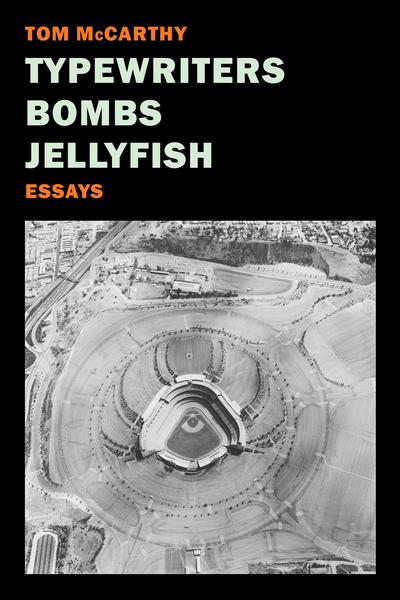
Typewriters, Bombs, Jellyfish
Tom McCarthy
New York Review Books, 2017
$16.95, 288 pages

.
Before he made the avant garde novel cool again, Tom McCarthy was having trouble getting his first book, Remainder, past the marketing departments of big publishers. It was too weird, the plot too circuitous and repetitive. Eventually Metronome, a small art house publisher, took the novel on. It became a word-of-mouth success, the buzz culminating in a Zadie Smith review, ranking it among the greatest works of the last ten years. The rest, as they say, is history, though McCarthy himself would likely object to such a fraught, limiting term. Since Remainder, McCarthy has produced a book-length critical work on TinTin, the Booker shortlisted C, described by Jennifer Egan as “Pynchonesque revelry in signs and codes with the lush psychedelics of William Burroughs,” and another Booker-shortlisted novel, Satin Island, about someone named “U” who works for “the Company.” Given the success of his novels, it’s easy to overlook the dozen plus short critical pieces McCarthy has written about literature, art, technology and culture. With the publication of Typewriters, Bombs, Jellyfish, a collection of fifteen of those brilliant, challenging, and at times frustrating essays, readers have the chance to appreciate the intellect behind McCarthy’s longer fictional work.

The essays in Jellyfish cover broad terrain, from the films of David Lynch to the novels of Jean-Philippe Toussaint. Some of the pieces, like “Why Ulysses Matters,” started as invited talks or lectures; others found their way into places like Artforum or, as is the case with “18 Semiconnected Thoughts on Michel de Certeau, On Kawara, Fly fishing, and Various Other Things,” museum catalogues accompanying exhibits at the Guggenheim. Others tread more conventional paths, becoming introductions to critical works (like Kafka’s Letter to his Father) and critical essays The Guardian. They are a potpourri of critical thought that the author likens to masses of the eponymous seafaring invertebrates that often reach “a critical mass of goo in circulation . . . coming back, lodging, sticking.”

The obsession with discursive circulation, of coming back in loops to stick, lodge, and accrete, is among the collection’s chief interests. In “From Feedback to Reflux: Kafka’s Cybernetics of Revolt,” McCarthy contends that “no other writer…has presented a more fundamentally cybernetic aesthetic than Kafka.” Lest one confuse the term “cybernetics” with computational technology, McCarthy defines the term, coined by Norbert Wiener, as “a networked mechanism formed of and driven by a set of circuits, relays and, most importantly, feedback loops.” From K, the surveyor of Kafka’s The Castle‘s endless attempts to gain access, to the mise en abyme of judicial infrastructure Josef K must face in The Trial, McCarthy sees Kafka presaging the NSA and Google – institutional structures that contain loop after loop of information within themselves.

While the feedback loops of cybernetics are “corrective,” McCarthy dubs those in Kafka’s writings as “fuckuptive” – that is, the response pattern the loops engender is self-defeating. Put another way: “the circuitry or system-architecture here is configured in such a way as to render unworkable any operation that the user (Kafka) might actually want to use it to perform.”

Among the system-architecture of which McCarthy, a champion of the avant garde, is particularly distrustful is the ism – positivism, moralism, psychologism. In “Get Real, or What Jellyfish Have to Tell Us About Literature,” he presents us with a lengthy excerpt from Ford Maddox Ford to show how conventional realism, with its compulsive urge to reshape in accordance with post-facto logic, is at odds with “how both events and memory of them proceed: associatively, digressing, sliding, jolting, looping.” By creating fertile ground for the associative, the 20th century avant-garde, McCarthy argues, gets “the real” more than their 19th century counterparts, who, to their credit (and in opposition to those writing today who take up the ‘realist’ banner) nonetheless “fully appreciate the scaffolding of artifice holding their carefully wrought edifices up.”

Scaffolding, artifices, edifices – readers will detect in McCarthy’s lexicon more than trace amounts of the post-modernist’s distrust of tautologies. In an interview with The Guardian, McCarthy tells us that “the avant garde can’t be ignored, so to ignore it – as most humanist British novelists do – is the equivalent of ignoring Darwin.” Those who do are, in McCarthy’s eyes, “just a creationist” with “ostrich-like” tendencies.

When it comes to understanding McCarthy’s modus operandi, his role as “general secretary” of the International Necronautical Society is as good a place to start as any. Together with philosopher Simon Critchley, McCarthy founded the INS, a semi-parodic, semi-serious, maybe-performance-art-but-that’s-missing-the-point organization “devoted to mind-bending projects that would do for death what the Surrealists had done for sex.” Among the INS’s more public hijinks are cryptic radio broadcasts, the hacking of the BBC website, exhibits that may be called art and hearings with committees that may, or may not, host officials and organization members with such lofty (and possibly made-up) titles as INS Chief Obituary Reviewer, and INS Chief or Propaganda (Archiving and Epistemological Critique).

Maybe.

And maybe, a reviewer of the critical work of McCarthy might be inclined to say, the blurring between the factual and the fictional is perhaps the point. Or, possibly more accurately, that the point is to reject the ism of easy dichotomies altogether, in favor of more freewheeling signification, where meanings are swapped, integrated and ousted.

Take, for example, the weather. An early essay in the collection, “Meteomedia,” draws richly from sources as diverse as Seneca and close to home as McCarthy’s own apartment to arrive at a thesis possessing unmistakable echoes of McLuhan: not only is the meteorological a medium, it also constitutes media. “Like all media,” writes McCarthy of the weather, “it bears a plethora of messages – perhaps even the message – while simultaneously supplying no more than conversational, neutral, white noise.” Moreover, like a tree falling in the woods without its audience, so too is weather as media devoid of signal without an audience to receive it.

“Stabbing the Olive,” an essay on Jean-Philippe Toussaint, poses another mind-cruncher that nobody in history, apart from McCarthy, has likely asked: do Toussaint’s novels engage in “deconstructing literary sentimentalism or sentimentalizing literary deconstruction?” For McCarthy, and, eventually, his readers too, the distinction is everything. McCarthy sees in much of the work of Toussaint a refiguring of structure, a gesture away from the ism of realism: “we don’t want plot, depth, or content,” he notes, “we want angles, arcs and intervals; we want pattern. Structure is content; geometry is everything.” He goes deeper: “We exist and assume subjectivity to the extent that we occupy a plot in or traverse a grid: an implicit philosophical assert that’s part Descartes, part Deleuze.”

Passages like that, theory-rich and many-claused, will likely alienate some readers and entice others. However, a strength of the collection, and of McCarthy-as-Teacher (separate from McCarthy-as-Critical-Theorist), is his instinct for strategic simplification; he seems to know just how far to push his reader out to sea before throwing out a floatation device. He corks the above meditation on grids and subjectivity plotted thereupon by asking if there is a “retro-move going on [in later Toussaint]? A crypto-reactionary step backwards towards humanism, sentimentalism, positivism, and the whole gamut of bad isms that the vanguard twentieth-century novel has expended so much effort overcoming.” His answer: hard to say. Challenged to the point of breathlessness, we likely feel the same way and are, at the very least, enlivened at being privy to the discussion.

Devotees to art and film will also find much to love in the collection, since many of McCarthy’s finest essays focus on art and film. His piece on the painter Gerhard Richter, for example, expertly knits complex visual theory to practical visual analysis. For McCarthy, Richter’s work resists easy categorization, “reducing these binaries” – concept vs. craft-based, abstract vs. figurative – “to rubble.” Richter’s trademark is the blur, “a corruption of an image, an assault upon its clarity, one that turns transparent lenses into opaque shower curtains, gauzy veils.” Corruption becomes clarity, the transparent becomes gauzy – McCarthy’s critical skillset allows him to reconcile inverse values, creating, as all great paradoxes (and artistic works) do, a new species of idea.

McCarthy’s finest creation might be his essay on “The Prosthetic Imagination” of David Lynch. Casual viewers may have missed the proliferation of prosthetics in Lynch; not so with McCarthy, who notes that “the continual, almost systematic replacement in [Lynch’s] films of body parts and faculties by instruments…produces is a whole prosthetic order, a world of which prosthesis is not just a feature but a fundamental term, an ontological condition.” McCarthy sees the first of Lynch’s problem films (so-called) as “the outsourcing of the self and of reality to their prostheses.” Ditto Mulholland Drive, where “technology is no longer an appendage to the human; rather, humans have become technology’s prosthesis.” In the end, the prosthete serves those very bodily additions: prosthesis becomes puppetry, the prosthete a marionette.

Big ideas are at play here, but it would be a mistake to ignore the undercurrent of whimsy, wit, irony, and playfulness that flows beneath the surface of most essays in Jellyfish.

Exhibit A: first published in an anthology of fiction inspired by Sonic Youth, “Kool Thing” bears the provocative subtitle “Why I want to Fuck Patty Hearst.” McCarthy catalogues a panoply of Hearsts, dating to when he first heard the Sonic Youth song “Kool Thing,” featuring Hearst as lead singer. We get Marxist Patty Hearsts calling her parents bourgeois pigs, Patty Hearst as pulp novel-heroine, Patty Hearst as Che’s lover, then Patty Hearst as gaming heroine Lara Croft – Patty Hearst “multiplying into a thousand different women” before attaining one of the most addictive metonyms out there – the Patty Hearst McCarthy wants to fuck as America, “all of it, sitting in a motel bedroom, watching the apocalypse on television.”

For Exhibit B (Whimsy, McCarthy’s Use Thereof), see, “Recessional, or the Time of the Hammer,” a study of fictional time, from Conrad to Pynchon. The essay features a curious aside in which McCarthy describes listening to MC Hammer during the essay’s creation and finding, on some associative level, a niggling link between Hammer’s hit, “U Can’t Touch This,” and the writing of Conrad. The collision is no accident, for, as McCarthy laconically, notes, “for doesn’t [Hammer’s “Can’t Touch This”], like Conrad’s novella, feature a black man who tells us to wait?”

Cue guffaw.

McCarthy’s MC Hammer-Conrad connection speaks to the collection’s willingness to not only grant credence to the highbrow and the lowbrow in equal measure, but is also a call to ignore brow-ness altogether. As a consequence, the more disparate the subject matter McCarthy chooses to splice, the more surprising, and, yes, whimsical, the results end up.

The intrusion of MC Hammer highlights another of McCarthy’s habits – a willingness to use meta-textual asides where the author, in mid-writing, pauses to comment on the text he is in the middle of generating.

More Exhibits for the Court to consider:

While exploring the connection between jellyfish and literature, McCarthy writes: “As I wrote this essay I couldn’t remember what it was that Van has brought Mrs. Tapirov”;

Contending with the warp-speed productivity of the French novelist Toussaint, McCarthy informs us that “in the time’s taken me to write this piece, it seems [Toussaint]’s managed to knock out yet another novel”;

Finally, another essay with fixes itself at the time of its own creation: “Alain Robbe-Grillet died while I was writing this essay”.

McCarthy the funster, meet McCarthy the astute critic and thinker.

The production of text, wherein McCarthy has, for example, forgotten a detail and makes the choice to record that forgetting, and the reanimation of the forgetting, for the reader who now takes part, however ephemerally, in the construction of the very text he or she is reading, all of which could have been avoided had McCarthy, in the editing room, simply inserted the information forgotten in the first place.

Which is, given what we’ve covered so far, a lot to wrap one’s head around.

But you don’t need to dig this deep to enjoy the collection. Eating breakfast cereal with a spoon once used by a famous person can still be used effectively to eat breakfast cereal, whether or not it possesses that extra Benjamin-ian aura that comes with close contact with celebrity or fame[1].

In his essay on Richter, McCarthy introduces us to the term ansehnlich, “or ‘considerable,’ to describe the effect of rescuing an image from the endless rush of media and paying it the attention – the devotion, we could say – of crafting it into a unique work of art.” This is, in the end, what McCarthy seems to be after when he takes on his disparate subjects; his essays are devotionals in their own right, not fawning or strict in the sense of worship, but rather in the compulsive attention paid to each of them.

— Andrew MacDonald

N5

Andrew MacDonald won a Western Magazine Award for Fiction, has been shortlisted for two Canadian National Magazine Awards for Fiction, and is a four-time finalist for the Journey Prize. He has an MFA from the University of Massachusetts, Amherst, and lives in New England and Toronto, where he’s finishing a novel.


Footnotes    (↵ returns to text)

  1. Immersion in McCarthy’s critical works will also have the pleasantly deleterious effect of making its readers search for complicated metaphors to explain the world.
May 062017
 

In this piece, Moore explains how Ted Morrissey’s postmodern work on Beowulf has opened his mind to fresh interpretations. Far from thinking everything about the poem has been answered, Moore shows, first, that when a critic approaches a work with new eyes the result can be invigorating, and second, that the trauma enacted in these old verses have relevance to our world. —Jeff Bursey

.

Not having studied Anglo-Saxon since grad school, nor having kept up with Beowulf criticism in particular, I’ll take Ted Morrissey’s word for it in The Beowulf Poet and His Real Monsters that most recent criticism on the Anglo-Saxon poem remains fixated on old-fashioned philological study. While these textual issues are important—especially when one’s interpretation hinges upon a proposed emendation or the accurate identification of the dialect of a certain word—Morrissey’s illuminating monograph demonstrates the advantages of bringing newer critical strategies to bear on the poem, especially “postmodern” ones that might seen incompatible with this premodern work. Looking at Beowulf through postmodern eyes fosters a greater appreciation of the craftsmanship and subtlety of this masterpiece.

For example, one the earliest theorists of postmodernism, architecture critic Charles Jencks, argued that po-mo works are characterized by “double-coding,” whereby the artist appeals to both popular and elite audiences by encoding for the latter group subtle allusions, references, and ironies that will probably go unnoticed by the larger popular audience who focus on the more obvious and appealing aspects of a work. In his essay “What Was Postmodernism?” (electronic book review, 2007), Brian McHale gives as an example animated movies like Aladdin, which “appeal to children through slapstick and cuteness, and to their parents through pop-culture allusions and double entendres that go right over youngsters’ heads.” Beowulf strikes me as a deliberately “double-coded” work, with exciting fights scenes that would delight the scop‘s mead-muddled audience, but at the same time encoded with theological and political issues, intertextual references to other works, and some dazzling wordplay for the benefit of the connoisseurs and intellectuals of his time. Double-coding is also in effect as the poet ostensibly tells a tale set in Denmark and Sweden in the sixth century but that is also (if not really) about England in a traumatized period several centuries later, a transhistorical strategy that would probably go over the heads of the tipsy masses but would not be lost on the more sober thanes in the hall. The popular aspects of a double-coded work will always appeal to a larger audience; Howell D. Chickering Jr. speculates that “Beowulf’s tragic third fight with the dragon was more frequently read than his earlier adventures, since folio 182, where this adventure begins, is quite worn out” (Beowulf: A Dual-Language Edition [Anchor Books, 1977], 246). In contrast, Hrothgar’s serious sermon on pride (lines 1700 ff.) shows little sign of wear.

Postmodern works also flaunt a heightened self-consciousness about their status as artificial literary creations, metafictionally drawing attention to the artist behind the work. No one would mistake Beowulf for a chapter in the Anglo-Saxon Chronicle, partly because the poet frequently draws attention to himself and to his artistry. On a half-dozen occasions, the first-person “ic” pops up to remind the reader that the tale isn’t telling itself, but is rather a dramatized reconstruction of what the scop has only heard. The scop is self-consciously aware that he is performing his story, not merely reporting it, and highlights this process at line 871, the morning after our hero’s first encounter with the monster Grendel. The anonymous author self-consciously introduces his stand-in into the proceedings, whereupon this wordsmith

found new words,…..bound them up truly,
began to recite…..Beowulf’s praise,
a well-made lay…..of his glorious deed,
skillfully varied…..his matter and style. (trans. Chickering)

Suddenly the reader realizes the previous 870 lines have not been a historical account of Beowulf’s actions but a fanciful re-creation—a literary performance; the poet, having “unlocked his word-hoard” (l. 259), has armored himself with words to perform a glorious linguistic deed to rival if not outdo Beowulf’s wrestling match of the night before. For the story of Beowulf’s deeds, you can read the Cliffs Notes; the poem is a performance of the story, a showy display of the poet’s wrestling match with words in which he emerges triumphant. (Beowulf only tears off an arm.) Look at me, at my prowess, the word-warrior proclaims, not at Beowulf, whose own later account of his fight with Grendel (lines 2069 ff.) is deliberately bland in comparison. One of the few interesting things about Robert Zemeckis’s comically crude film version of Beowulf (2007)—aside from the golden splendor of Angelina Jolie—was Beowulf’s postmodern awareness that he was the protagonist in a work-in-progress to be called The Song of Beowulf.

The poet’s innovative, unconventional use of words is another feature associated with postmodernism, as Morrissey argues in his second chapter, and which he goes on to align with the obsession with diction that trauma victims display. I was previously unaware of trauma theory, but Morrissey argues convincingly that this branch of postmodern theory shines new light on several murky aspects of the poem, on what some readers call its disjointedness and downright weirdness. Beowulf enacts on both a formal and verbal level the effects of trauma on a people (and on a gifted poet) subjected to centuries of warfare, sickness, and disorder, resulting in a poem closer to nightmare than elegy. Morrissey shows how other postmodern strategies illuminate the poem, and respectfully suggests these new approaches can supplement, not supplant, the more traditional philological approaches. Those earlier approaches have for too long treated Beowulf as a period piece, but these new approaches give the lay a startling relevance in the 21st century: I am writing this at the end of 2012, after the quick succession of Hurricane Sandy, the slaughter of children in Newtown, Connecticut, and fears of going off a fiscal cliff have somewhat traumatized Americans—who are not as bad off as the Anglo-Saxons of the Dark Ages, to be sure, but are now in the appropriate mood to appreciate the traumatized world of Beowulf.

—Steven Moore

.

Steven Moore is the author of the two-volume study The Novel: An Alternative History (2010, 2013), as well as several books on William Gaddis. His new book, My Back Pages: Reviews and Essays, is just out with Zerogram Press.

.
.

May 062017
 

My Back Pages is the closest Moore will ever come to completing his massive study of the emergence and development of the novel —Jeff Bursey

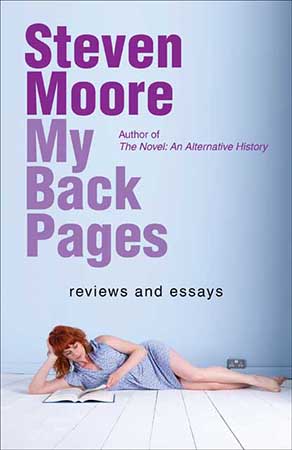
My Back Pages: Reviews and Essays
Steven Moore
Zerogram Press, 2017
$30.00, 767 pages

.
Introduction

In the mid-1980s, while doing research for my thesis on Henry Miller—a person and subject not popular within Memorial University of Newfoundland’s English department, the choice solidifying my dubious reputation among conservative professors from England and Newfoundland—I read Frederick R. Karl’s critical survey, American Fictions: 1940-1980 (1983). Apart from a few generally dismissive remarks on Miller, indicating a lapse of judgment, this work introduced me, in one giant, dual-columned flow of crackling prose and sharp observations, to authors that I never heard about in university classes. One of them was William Gaddis, whose two published novels (at that time) were discussed at great length. What I read intrigued me, but thesis writing and an imminent marriage, as well as a subsequent move, occupied my mind. In 1986, shortly before leaving Canada, I ordered Gaddis’ three works (a new one had come out the year before) and they accompanied me to London, England, where my then-wife’s studies took us. I resisted reading them as the final draft of the thesis required attention. At some point I needed a break, and soon found myself 600 pages into The Recognitions (1955) with 300+ to go, my spirits uplifted by Gaddis’ monumental first book, a reminder of how genius trumps talent, a salutary blast of corrosive satire and humour in a bleak time (little money, grey weather, England under Thatcher), a rebuke to the palsied minimalism of the 1980s that infested magazines and publishing lists—and suddenly Karl’s term for Gaddis, “tribune,” made sense. With the thesis finally sent to MUN, I turned to the remaining pages of The Recognitions, then to J R (1975), whose technical brilliance and humour helped preserve my sanity while I worked in a warehouse, and then the less impressive Carpenter’s Gothic (1985).

Back in St. John’s in September 1989 I came across a segment from another Gaddis novel in a 1987 New Yorker—what would be published in 1994 as A Frolic of His Own—and also, for the first time, read critical books devoted to his work. There weren’t many. At a guess, 1990 marked the year I first encountered Steven Moore (b. 1951) through his invaluable guide to The Recognitions. For 27 years, in one form or another, my Gaddis reading has been deepened and expanded by Moore. A recent example of the continued efforts at explicating Gaddis, who Moore considers “the greatest American novelist of the 20th century,” and how that can lead to a profounder understanding of his literary worth—and the worth of literature itself—can be found here in a joint review of books by Moore, and Joseph Tabbi, another Gaddis scholar who completes, for me, the triumvirate of Gaddis’ best critics.

In the early 1990s, Steven Moore worked for Dalkey Archive Press, home of The Review of Contemporary Fiction (RCF) and one of the most eclectic publishers around. From 1988-1996 he reviewed for RCF and eventually, as an editor, helped bring into print, among others works, David Markson’s Wittgenstein’s Mistress and Reader’s Block and several Rikki Ducornet novels. Behind the scenes, and in front of my eyes, Moore shaped some of my reading (and I daresay that of others). There aren’t many critics so tireless in fighting critical indifference, small sales, and much more for high-risk writing.

There are reasons for this autobiographical introduction. While My Back Pages contains much about Gaddis that, as a fan, I appreciate seeing either for the first time or between covers at last, in this immensely readable, encyclopedic, and essential work there are almost 400 pages of concise reviews, published between roughly 1975 and 2016, of short-story collections, novels, and nonfiction, followed by almost 350 pages filled with meditations on key figures in Moore’s life, including his friend David Foster Wallace, Alexander Theroux, and W.M. Spackman. In these pages—revealed incidentally when its contents were first printed and forming a more than rough sketch when collected—is a partial intellectual autobiography that reveals, now and then, and almost always unexpectedly, his beliefs, his likes and dislikes, his confrontations with ideas and people, and reversals, criticisms, and disappointments in his career and personal life.

Certain figures recur: apart from Gaddis, Markson, Ducornet, and Theroux, there is much on Ronald Firbank, the Beats, Malcolm Lowry, Gilbert Sorrentino, and James Joyce. Certain predilections are as numerous: metafictional and/or experimental works, with occasional excursions into other forms. “It’s the books I write about, many of them forgotten by now, more than the pieces themselves, that deserve to be remembered,” he states outright, though that note of humility goes against the many years in service to literature exemplified by the length and depth of this book (indeed, the length and depth of each Moore book). In individual pieces he is not as shy in taking credit where it’s due.

One of Moore’s best qualities as an explicator is in communicating complex or complicated material in the clearest possible terms, and with humour when possible. Not all is sunshine, though, since every book is written, implicitly and explicitly, against something. There is even the presence of a dark figure that, while not a villain, is an adversary. And there’s sex. How-to guides to crafting correct fiction by James Wood or dreary musings on the uselessness of writing by Tim Parks aren’t going to offer this combination of features.

.

I.

My Back Pages is the closest Moore will ever come to completing his massive study of the emergence and development of the novel: The Novel, An Alternative History: Beginnings to 1600 (2010), and The Novel, An Alternative History: 1600–1800 (2013). (In 2014, the second title won the Christian Gauss Award for literary criticism.) “Rethinking the History of the Novel,” an essay placed near the end of the new book, supplies several reasons why he didn’t proceed with a third volume. Partway through the second volume his self-appointed task “became more like a chore, which is exactly what I had hoped to avoid when I began… by the time I wrote the last page of the second volume, I had no desire to go on to the third volume that I had been planning on from the very beginning.” Further:

Even though I had planned to narrow my focus at that point and concentrate only on innovative, experimental novels, I realized it would take me another five years at least working full-time and another thousand pages to cover 1800 to the present, and I finally had to admit that I had bitten off more than I could chew. Now I understood why no one had written a comprehensive, universal history of the novel before, and also understood why such things are only attempted in multi-volume university press series overseen by general editors with troops of contributors at their command.

Moore states he had no grand plan in mind when he began his labours, and yet, thanks to perseverance, missionary zeal, and an enthusiasm buoyed, I suspect, by ceaseless reading, this full-time independent scholar completed what only university presses could achieve. Perhaps it’s best that writers unthinkingly create their own follies. He felt provoked by “the conservative Bush [the Younger] administration of evil memory”—how those years must now seem, while in no way golden, less terrible than the present Republican government—that allowed “a corresponding reactionary backlash against the innovative, unconventional novels I love…”

Considering the fatigue factor, then, My Back Pages might be a better work than the never-realized third volume. Its content differs from that of the Novel works, which together are a magisterial, yet colloquially spoken, introduction to hundreds of fictions from ancient Egypt, Greece, and Rome, on to Ireland and Iceland, then Mesoamerica, Japan, China, Europe, and North America. Moore’s new work comprises spirited defenses, campaigns, and hosannas for the lineage of “unconventional” writers he has long admired. The tempo is that found in breaking news, in Ezra Pound’s sense, excited but not sensationalized. (I’m reminded of what Sven Birkerts says in Changing the Subject [2015]: “I recognized at that moment that if art really is an act of concentrated attention, then it is also at the same time a power, not only carrying its messages, the content that is its pretext, but also storing—and making available—an enormous compacted energy. I’m talking about the energy that made the vision and expression possible in the first place.” Substitute criticism for “art” and that suits Moore’s energetic prose.) Instead of plot summaries devoted to the literary output of one country, we are provided with brief summaries of works and essays focused on single topics. After the Introduction and Acknowledgements, the sections are: Reviews; Miscellaneous Nonfiction; and, in three parts, Essays (“William Gaddis and Friends”; “Significant Others”; “Personal Matters”).

Set out alphabetically, the reviews (sometimes single entries, at other times sequences devoted to the same author), to provide a brief list, are of works by Djuna Barnes, Robert Coover, Stanley Elkin, Mo Yan, Severo Sarduy, Arno Schmidt, and Marguerite Young. In addition to what Moore has written for Rain Taxi and the Washington Post, among other places, most of the reviews appeared in RCF. He is most often a polite and eager reader, inclined to treat with the greatest respect metafictional works and meganovels that display erudition and contain recondite language used in a playful way, works that emphasize style over plot (or character) and that break the constraints of the novel. The “anemic stories” of minimalists rarely capture his attention, but in considering Stephen Dixon’s Frog (1991) he does concede that this book “represents an interesting new hybrid: a long novel made up of short episodes, a maximalist meganovel written in a minimalist style.” So he can be won over if the writer has done something original. A writer can also be a “vixen,” but only if they write well, like Mary Butts or Karen Elizabeth Gordon. (He doesn’t offer an equivalent term for males.)

Moore’s enthusiasm is contagious, as it’s often combined with casual displays of his wide and deep reading. Plucked almost at random are three samples of his writing style. The first is the opening to a review of Nicola Barker’s Darkmans (2007):

’Tis the season of huge literary novels. Those of us for whom size matters welcome with holiday cheer Denis Johnson’s Tree of Smoke, James McCourt’s Now Voyagers, two new translations of Tolstoy’s War and Peace, Paul Verhaeghen’s Omega Minor, Alexander Theroux’s Laura Warholic, and the 900-page Adventures of Amir Hamza, an old Urdu novel (by way of Arabia and Persia) newly translated for the Modern Library. Crashing this boys’ club from England comes Nicola Barker’s 838-page Darkmans, her seventh and longest novel, and a finalist for this year’s prestigious Man Booker Prize (which went to a much much shorter novel).

After reading a 3,300-page work by William T. Vollmann, Moore concludes:

Rising Up and Rising Down is a monumental achievement on several levels: as a hair-rising survey of mankind’s propensity for violence, as a one-man attempt to construct a system of ethics, as a successful exercise in objective analysis (almost nonexistent in today’s partisan, ideological, politicized, spin-doctored, theory-muddled public discourse), and a demonstration of the importance of empathy, whether in writing a book like this or simply dealing with fellow human beings. It can be an exhausting, depressing read, but with the ever-growing role of violence in our lives, it is an essential read. And the amazing fact that during the 20 years he spent writing Rising Up and Rising Down Vollmann also published a dozen extraordinary books of fiction—many in the 700-page range and packed with historical research as deep as that on display here—elevates this achievement beyond the realm of mere mortals.

Though Moore generally prefers those whose language sparkles with new thoughts set out in long sentences, he can appreciate other styles, as shown in this review of the first volume of Zachary Leader’s biography of Saul Bellow:

The amount of detail here is staggering; Leader apparently left no stone unturned, and succinctly summarizes all the cultural upheavals surrounding Bellow in those heady days. (The biography doubles as a primer on the intellectual climate of the times.) But the details never become too dense or overwhelming, thanks largely to Leader’s clear, brisk style.

This compliment applies to Moore. Apart from providing readers with a long list of titles to look for, his reviews are models of how to balance an examination of style, a short summary of salient points, and a decision as to a book’s worth.

The Miscellaneous Nonfiction section contains essays and reviews ranging in subject from critical works on literature and postmodernism to human anatomy and Buffy the Vampire Slayer. While of varying interest and engagement, this section offers further proof of the diversity of Moore’s taste, which is, incidentally, also shown in the music citations that appear now and then.

.

II.

In Essays, Part 1, under the section “William Gaddis and Friends,” Moore brings together previously isolated pieces on Gaddis (and those who knew him), including Pynchon, Markson, and Chandler Brossard. Particularly noteworthy is “Sheri Martinelli: A Modernist Muse.” She was an artist-model in Greenwich Village who Gaddis and Anatole Broyard (author of, among other books, Kafka Was the Rage [1993]) pursued romantically, “a protégé of Anaïs Nin,” friends with H.D., Charles Bukowski, Charlie Parker, and the Beats. She later entered into a hazily defined friendship or relationship with Ezra Pound when he was at St. Elizabeths Federal Hospital. (This is the stuff of a biopic.) The concentration of influences and animosities (Broyard versus Gaddis, Pound versus almost everyone) that congregated in this almost unknown artist is fascinating.

Part 2, “Significant Others,” deals with, among others, Kurt Vonnegut, Edward Dahlberg, Brigid Brophy, Leopoldo Marechal, and Wallace again. Barring Wallace and Vonnegut, Moore is paying close attention to the obscure, the out-of-print, and the forgotten, something that other critics could seek to imitate. Firbank, one of “the more recherché modernists” who is invoked often and gets connected to Francesca Lia Block and Alan Hollinghurst, as well as many others, is looked at for his playwriting. While I can agree with Moore on many things, we part ways on Firbank, who he admits is a writer “so idiosyncratic that one instinctively likes or dislikes [him], and no amount of critical persuasion one way or another is going to change anyone’s mind.” This may be a blind spot of mine, just as Moore’s low regard of a fellow Modernist, Henry Miller, is inexplicable considering his influence on and way with language, on issues concerning freedom of expression, and as a figure who supported Jack Kerouac’s The Dharma Bums and The Subterraneans, about whom Moore has much to say (as he does on other Beat writers like William Burroughs and Alan Ansen).

Theroux is both reviewed and the subject of an in-depth description of his second novel, Darconville’s Cat (1981), “a dazzling 700-page satire… that surely will soon come to be celebrated as the finest example of learned wit ever produced in American literature.” As Moore mentions in the Introduction, he sometimes wrote with an “optimism” that was misplaced. Theroux’s work matches Moore’s taste for length, wit, language, digressions and allusions, and several modes of presenting material (“poems, fables, nightmares, a diary, an abecedarium, a blank-verse playlet…”), and he offers a persuasive set of reasons for the importance of this novel. What also arises is one of those welcome contradictions that spring up in any person’s record of literary commentary if they do it long enough. In expressing fervent enthusiasm for and belief in Darconville’s Cat—“I want to be buried with this novel clasped to my heart”—Moore has to restrain from commenting negatively on Theroux’s Catholicism. Critics of the Novels volumes, such as Steve Donoghue and Roger Boylan, noted the evident anti-religious stance, the latter saying that Moore “seems constitutionally incapable of finding any redeeming value in the 2,000-year history of Christianity that has been so much a part of Western culture.” This sentiment extends back to when Moore reviewed Lawrence Durrell’s Livia: or, Buried Alive in 1979: “Denis de Rougemont, to whom Livia is dedicated, is the author of the classic 1940 literary-theological study Love in the Western World (still in print and still worth reading in spite of its Catholic bias).” If we didn’t muzzle ourselves now and then when faced with a work that leaps over our convictions we’d hardly be human, so I’m not going to fault Moore for his surprising moderation.

The third section of Part 3, “Personal Matters,” contains “Nympholepsy,” “Rethinking the History of the Novel,” and “Publishing Rikki Ducornet.” The second has been referred to already; the third details Ducornet’s history with Dalkey—who published her books The Fountain of Neptune (1992), The Jade Cabinet (1993), The Complete Butcher’s Tales (1994), and, both in 1995, Phosphor in Dreamland and The Stain—and her and Moore’s author-editor relationship, of which he is clearly proud. As to “Nympholepsy,” that will be dealt with below.

.

III.

As already noted, Moore wrote his two Novel books to stand up for the kind of fiction he saw under assault from 2000-2008, and in his introduction to the first volume he addresses, with withering scorn and an abrasive tone, the narrow-minded criticism that Dale Peck, B.F. Myers, and Jonathan Franzen dealt out to writers of so-called difficult fiction. In My Back Pages there are literary theorists to argue with for their instrumental use of texts “as a springboard to explore socioeconomic/political issues, theories of reading… drifting further and further away from the actual words on the author’s page,” and attempts to redress the “little critical attention” and “critical neglect” experienced by authors like Rudolph Wurlitzer and Richard Brautigan. That’s not to say Moore doesn’t admire this or that critic (full- or part-time); he praises Tom LeClair, Marilyn R. Schuster, and Samuel R. Delaney. Yet the chief foes are those who use this or that text for their own ideological thoughts, and the review outlets that are indifferent to writers, in English or in translation, who present new visions.

One individual does stand out. Those familiar with Dalkey know that John O’Brien is its founder and main force. In the Index there are references under his name, but when the pages are consulted he is identified most often as “boss,” “editor,” and “Dalkey’s publisher.” The Introduction provides context for later remarks:

While at the local warehouse buying stock, I noticed a recently published novel with an irresistible title, An Armful of Warm Girl, read it, and became a devoted Spackman fan thereafter. Shortly after he died in 1990, I began planning an omnibus edition of his complete fiction; it was typeset and ready to go by 1995, but was continually postponed by Dalkey’s boss until a year after I left. (During that time, he moved my introduction to the back and called it an afterword because, as Spackman’s daughter told me, “he felt the length of the introduction might discourage less scholarly readers from starting to read the book.”) The Complete Fiction of W. M. Spackman (1997) was very well received, and I was especially flattered that John Updike referred to my piece as “excellent” in his New Yorker review (but disappointed when he dropped that adjective in his More Matter collection a few years later)… At that time I also prepared a collection of Spackman’s essays that I wanted to publish as a companion volume, but my exit from Dalkey (and the boss’s indifference to Spackman) made that impossible.

The grinding of the axe is audible. Pitting Updike against the “boss” provides pleasure and vindication. Another note airs a different grievance:

I wanted to publish this book [Five Doubts] when Mary [Caponegro] submitted it to Dalkey Archive in early 1996, but the boss adamantly rejected it: “I will not publish this book,” he declaimed in a memo. Upon publication two years later [by Marsilio Publishers], it was very favorably reviewed by Robert L. McLaughlin in Dalkey’s journal, the Review of Contemporary Fiction.

Once again, “the boss” is set up against someone whose opinion dovetailed with Moore’s.

Two final peeks into the workplace demonstrate the toll this took: “Working with Karen [Elizabeth Gordon] was one of the few bright spots during my final dark year at Dalkey Archive.” Lastly: “My years at Dalkey Archive were depressing and frustrating, but Rikki and a few other writers kept me sane and entertained.” The theme here is that Moore felt his editorial instincts were often acute, but that he, apparently, had to wage combat within Dalkey every day. At a future time the full story of the Moore-O’Brien relationship will come out; it won’t be a pretty sight. Without adversaries our lives might be easier, but they do provide fuel for the kind of cold fury that allows a snap to enter one’s sentences.

.

IV.

Above I mentioned this book contains sex. While there are reviews that touch on that, to be accurate I should say that frustrated desire is more often present.

In “A New Language for Desire: Carole Maso’s Aureole,” one of the essays in “Significant Others,” Moore appraises the author’s 1996 novel: “rarely in literature has desire been explored with the intensity Maso brings to Aureole: a pyrotechnic display almost reckless in its abandon, daring in its subversion of literary propriety, and voracious in its erotic hunger.” He goes on to say that Maso

exhibits the kind of bravado and self-exposure that I associate more with rock music divas than with her literary sisters. She has something of Courtney Love’s swagger, P J Harvey’s erotomania (both are mentioned on page 81 of her book), Liz Phair’s bluntness, Kate Bush’s bookish romanticism, Siouxsie Sioux’s dramatic flair, Jane Siberry’s wit, Liz Fraser’s mellifluousness, Shirley Manson’s aggressive sexuality, Tori Amos’s introspection, and Lisa Germano’s heartbreaking insecurity.

This eight-page analysis of a Sapphic love story takes us through each chapter of what Moore considers “Maso’s most innovative book to date.” He adds: “Maso goes further than any writer working today to create a style that does justice to the polymorphously perverse energy of eros.” As literary analysis, it is at the usual high standard of Moore’s criticism, showing sensitivity to language use, to how themes reverberate and parallel other content, and exhibiting deftness in locating outside sources (literary, musical) that contribute to an understanding of the text under investigation.

What interests me most is the curious verdict rendered on a psychological condition mentioned in the novel: “Lust here isn’t the devouring hunger of ‘Anju’ or the sexy games of ‘Make Me Dazzle’ but ‘sex addiction’…, that dreary concept from 1980s pop psychology that seems to have some validity here.” Sex addiction is considered a mental condition that, according to some opinions, is a form of compulsive sexual behaviour. It has at times been labelled nymphomania or satyriasis. Moore, who as far as I know is a medical layman, offers begrudging acceptance of the possibility this condition exists. Present as well is an appreciation for the sexual content of Maso’s novel. For me, this 1996 essay ties into the very personal “Nympholepsy” (2001) from “Personal Matters,” which outlines Moore’s self-diagnosis of a condition brought about by his everyday interaction with Morgan, a female fellow employee at a Borders store. Both deal with lust/love, and both reveal an aspect of the critic that heretofore has not been revealed. To say it comes as a surprise is an understatement.

Listing the three “factors… [that] had led to the attack,” Moore gives as the third: “the realization that soon I would turn 50, and that I was still alone—never married, no long-term relationships—and in all likelihood I would die alone without every knowing what it is like to love and to be loved.” He assesses the qualities in Morgan (not her real name) that attract him:

But she was more than just a pretty face (there were other teenage girls working at Borders, as attractive as Morgan): she was quiet, a bit shy, introverted, bookish, artistically inclined—qualities I shared and that led me to regard her as a soul mate, despite our age difference, qualities I had always looked for in a girlfriend but had never found. And of course she possessed numerous lovable qualities I lacked; I could fill the page with them. I had been waiting all my life for someone like this on whom I could lavish all my dammed-up care and affection, and thus Morgan became the unwitting victim of this flood of emotion.

In time he terms his ache nympholepsy, and consults Vladimir Nabokov’s Lolita for a definition. (In addition to having himself as a client, he is getting a second opinion from a literary work.) Moore being Moore, he can’t resist a joke: “Taking down my hardcover copy of Alfred Appel’s annotated edition, I fumbled beneath Lolita’s tight white jacket for a few minutes until I found what I was looking for.” The rest of this poignant confession involves consulting dictionaries, poetry, music, several bouts of self-criticism and misery, and much else. In the Introduction he says this about the essay: “It’s my favorite largely because its subject inspired me—which was what nympholepsy originally meant—to open up my style, one that I’ve used ever since whenever possible. (You can see that style develop over the course of the essay, which begins in a flat, documentary voice that turns more lyrical, scholarly, and fanciful as it goes along.)”

We can, indeed, look at this admission primarily as a style issue. Yet this is sensitive ground. The essay is surprising and touching in its discussion of desire and loneliness. Consequently, I’ve decided that even though Moore’s life has been filled with words he’s read and words he’s written, a literary review wouldn’t pay proper respect to this piece, and also that every reader will want to arrive at his or her own interpretation.

.

Conclusion

People wonder why criticism exists and what its function is. When voiced by writers this can be unsubtle code for these thoughts: “What’s the point of it if not to get the good news out about my work?” and “Why do I care what some critic I dunno thought? And what’s exciting about reading a review for a book I haven’t read?” There is also a disdain for those who judge art. Moore doesn’t hesitate to discriminate the good from the bad—he has choice words on Norman Mailer’s The Gospel According to the Son (1997)—based on a simple criterion that he finds also expressed in the works of Spackman: “The content of his novels, and his characterization of women especially, will always create problems for some readers, but not for those who agree that style is what a writer is to be judged by.”[1] For some people, this will come across as elitism that verges on canon making. As well, as Stephen Mitchelmore points out, there is often a “prideful disdain for anyone who attempts to articulate the fascinating void, which actually reinforces respect for this aspect of art it is supposed to be dismissing…” We are fortunate to have a handful of astute critics who bring us reports gathered from the outskirts of the familiar literary world about innovative authors busily deepening our collective literary heritage. Steven Moore has been at the vanguard of criticism and publication of outliers and explorers whose artistic visions reinvigorate the capacious form of the novel and the short story, and we are in his debt.

—Jeff Bursey

N5

Jeff Bursey is a literary critic and author of the picaresque novel Mirrors on which dust has fallen (Verbivoracious Press, 2015) and the political satire Verbatim: A Novel (Enfield & Wizenty, 2010), both of which take place in the same fictional Canadian province. His newest book, Centring the Margins: Essays and Reviews (Zero Books, July 2016), is a collection of literary criticism that appeared in American Book ReviewBooks in CanadaThe Review of Contemporary FictionThe Quarterly Conversation, and The Winnipeg Review, among other places. He’s a Contributing Editor at The Winnipeg Review, an Associate Editor at Lee Thompson’s Galleon, and a Special Correspondent for Numéro Cinq. He makes his home on Prince Edward Island in Canada’s Far East.


Footnotes    (↵ returns to text)

  1. In Rebecca Swirsky’s review of Danielle McLaughlin’s short-story collection Dinosaurs on Other Planets, titled “Something else entirely,” the first sentence reads: “Good writers rely on style. Even better writers rely on empathy.” If, as a writer, you prioritize empathy, seek a counsellor; if you prefer writing, look for a stylist who has the ability to show empathy if he or she wishes. Times Literary Supplement, May 13, 2016, Issue No. 5902, p. 22.
Apr 112017
 

.

This is the story, I said, looking at the blank page, and she said to me she knew it was written for her, but I knew I had not written it for anyone.

This is the story, I said, listening to the blank page, and she said she’d heard it before, and I said it is not possible because it is being told still.

This is the story, I said, can you hear it? Silenced it wants to be told, so the screen can crack.

*

I want to tell you of reading The Blank Page, the short story by Isak Dinesen in which a storyteller tells the story of the blank page.

I have been reading the story repeatedly, over the last few months—not to interpret its mysterious parable: I’ve been reading The Blank Page as an echo chamber, listening to the voices that speak to me through it, and through me to it and to you.

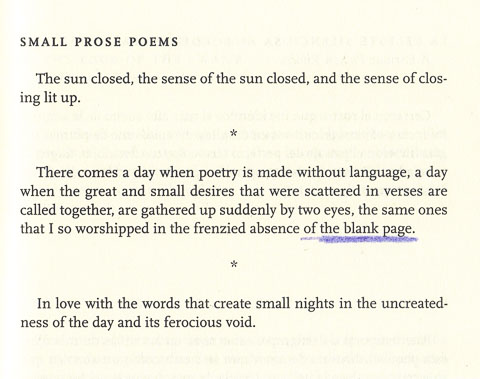
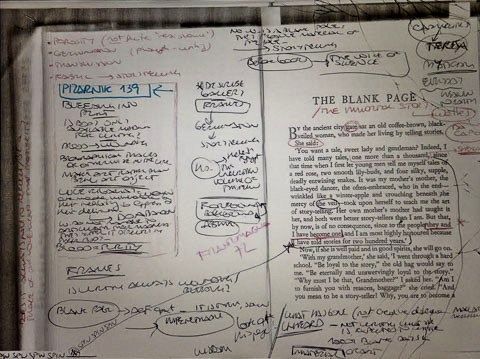
Today I’m not reading The Blank Page: I’m looking at a photocopy I made of the first page of the story.

The photocopy is not quite so blank, and I’m reading the notes I wrote on it during my repeated encounters with it, some of which appear obscure to me since the thoughts that prompted them have been lost, while others continue to generate further thinking. I am looking at this photocopy of the first page of The Blank Page as a record of past beginnings, disorderly poured into the ever-present of each repeated reading, return, rewind, da capo.

I am listening to and reading into this blank page as volume.

*

*

My eyes linger for some time on the title, and soon they move around my nearly illegible handwriting as they try to reconstruct in vain the sequence of these incomplete writerly incursions. I can’t resist the temptation of starting from the least obvious connection, from the most remote one.

Turquoise capital letters, on the left: PIZARNIK 139. Three turquoise thick lines around it. An arrow on the right: look at this, it matters.

How promising. My reading of The Blank Page begins with a diversion that precipitates me straight into another book.

I open Alejandra Pizarnik’s collected poems, Extracting The Stone Of Madness, page 139, and I remember the sense of urgency I perceived at the time, in finding an echo while reading Pizarnik during the same days as I read Dinesen:

Here is how I can go about reading this heavily annotated photocopy, entitled The Blank Page and anything but blank: with two eyes looking at the frenzied absence of the blank page, in ferocious void, listening. And, following Pizarnik’s suggestion on the page before, to let there be language where there ought to be silence.

*

Pizarnik’s blue handwritten name actually appears slightly off the page, although in close vicinity to it: on a rectangular scrap of paper that I glued onto the photocopy. There’s ambiguity between foreground and background, between the told and the teller, between who writes and who is being written, what is held and what holds: it enwraps the entire operation of Dinesen’s story and, inevitably, of my words with it.

Or: the glued scrap of paper that holds a specific instance of reading could be an attempt at staying very close to the material of such reading, while performing those small gestures of variance from which writing always rebegins.

*

Top right corner: CARMELITES. In a convent in Portugal, for centuries, Carmelite nuns have been keeping a collection of framed linen sheets, each one holding the trace, in blood, of the first nuptial night of a princess. One of these sheets is completely white, shows no trace of blood, and continues to attract pilgrimages of people who stare at it and interrogate its enigma: it is the blank page that gives the title to the story.

Why the sheet is blank, it is not told.

How the sheet in the story becomes a page in the title of the story, it is not told.

It is not told because it’s not what is expected to be heard, so I try to hear through its absence: something more, and something else than words, Pizarnik suggests to me. Like in Scheherazade’s 1001 blank nights (‘one more than a thousand,’ Dinesen wrote, I underlined) so much happens outside the frame. The blank page continues to compel readers who, like the procession of pilgrims described in the story, couldn’t resist the riddle of the blank sheet that it is generated from, and that it perpetually generates.

A strange and silent museum keeps the collection of bodily inscriptions framed by the stillness of gold, framed in turn by the telling of the story by the old woman at the gate of the town, framed by Dinesen’s own telling although, I’d underlined in red, ‘they and I have become one’. Dinesen haunts her stories, becomes one with them.

I want to hold on to this sense of porosity allowing the told and the teller to become one, rather than to the staccato of the framing devices. I’m drawn to the merging. Rather than considering spatial arrangements I want to think through time, and transmission. Scheherazade as transmitter, Scheherazade who continued speaking and being spoken through, Dinesen as transmitter, Dinesen who said she was not a writer but a storyteller, Pizarnik as transmitter, Pizarnik who wrote I cannot speak with my voice, but I speak with my voices.

At the bottom of my photocopy, after reading the story once, I wrote in capital letters:

“WHAT HAS GONE UNHEARD”. And untold, I add now. The blank page is the site where a more silent tale can be found, through the unheard and unspoken weaving that makes its material. The storyteller disappears in the story yet is present in it, as channel and substance.

I keep staring at The Blank Page through Pizarnik’s eyes and through her inner ears, to hear the place where silence is formed.

*

Have you read The Blank Page yet? Or perhaps you remember it from long ago? And if not, what do you think it is, beyond the first photocopied page? Are these words very abstract? What have you been reading so far in these words: a chronicle of blank, or a chronicle of engagement? Are you more drawn to what is missing, or to what is here? What holds the story, what emanates from it, and why this one? The story unfolds its charms and chances. You read the words and beyond them, something more and something else. Can you tell, now?

*

Top left, in red, thin marks:

POROSITY (not quite “resistance”)

GERMINATION (plough-writing)

TRANSMISSION

I read again Dinesen’s story in the aftermath of Elena Ferrante’s ‘unmasking’. Today the lack of blood on the sheet bears a defiant statement: to be materially present within words does not call for a bodily mark, the material presence of a telling does not need to be legitimated or verified by a trace of the teller. I am tempted to read the storyteller’s disappearance into the blank page not as a symptom of hiding, but as a deliberate gesture that gives space to what Ferrante calls the truth of language, present and significant without the need for biographical evidence. Further down my photocopy I read: IS WRITING ALWAYS WOUNDING/BLEEDING? I wrote these while reading Susan Gubar’s acute analysis of Dinesen’s story in relation to female creativity, in which she refutes the claim that the evidence of a body is the only way for women to be recognised in art. The blank page is not a retreat: it holds meaning whose form is its truth. Along the left border, in red capital letters and referring again to Gubar: ‘Does writing always have to reflect / be a trace of the movements and motions that produce it?’

*

There is no way to enter the page because you are already there, and there are many ways of being there: I learned this from Teresa of Avila. The storyteller is there, through the blank page and its story, in absentia. Her presence is porous, it enables and hosts fabulatory activities as transmissions, and transmissions can be spurious. That’s how I read Dinesen’s storyteller’s / Dinesen-as-storyteller’s statement, ‘silence will speak when the narrator is faithful to the story’: the silence of the blank page is the storyteller’s poiesis, and the words it generates exceed the page: can you hear them? The people in the story keep watching, and I keep listening while watching, with Pizarnik’s eyes looking for the place where silence is formed.

*

In the lower centre, a mark in capital letters, red pencil: FRANTUMAGLIA 72. I recall, but shall not quote, the words of another invisible storyteller, Ferrante, in La frantumaglia, page 72 (Italian edition), discussing the truth of the story as keeper of its own truth, literary truth, with no need for external legitimisation—writing, later on, that the more effective story is the one which allows to gaze out at everything that’s been excluded from it, outside of the frame.

*

THE BLANK PAGE: I look at the title on the photocopy and beneath it, handwritten in red: THE IMMORTAL STORY. Outside of the frame I see Orson Welles, who’d once declared to be in love with Dinesen and who directed The Immortal Story as a homage to her eponymous tale of a rich man at the end of his life, who can’t believe that a story he hears and knows never actually took place, and who makes it happen: at the end, the protagonist of the story realises that, because he has actually been inside the story, he will no longer be able or willing to tell it.

That silence is the story’s porous boundary.

In the inversion of foreground and background, the blank is the material of muteness that exceeds the page. A telling, a spinning of a nothingdense: the truth of that form of silence, sounding with stories passed on, and with voices streaming into the volume of the blank page.

*

I turn the page:

‘Where the story-teller is loyal, eternally and unswervingly loyal to the story, there, in the end, silence will speak. Where the story has been betrayed, silence is but emptiness. But we, the faithful, when we have spoken our last word, will hear the voice of silence…. Who then… tells a finer tale than any of us? Silence does. And where does one read a deeper tale than upon the most perfectly printed page of the most precious book? Upon the blank page. When a royal and gallant pen, in the moment of its highest inspiration, has written down its tale with the rarest ink of all—where, then, may one read a still deeper, sweeter, merrier and more cruel tale than that? Upon the blank page.

‘We,’ she says at last, ‘the old women who tell stories, we know the story of the blank page.’

In the previous page, the woman’s voice is introduced by ‘she said’.

She says, she said.

She says, she said, I read. This is happening now, it happened before, I’m stuck in the looped timing of da capo.

*

Sometimes the photocopy of the blank page can be disappointing, opaque. It’s a material of time. It doesn’t always have to hold meaning. It allows a germination whose movements are slow and difficult to perceive. I can’t exhaust the blank page. Some days it’s impenetrable and I’m drawn to this relationship that doesn’t always have to be meaningful but allows me to drift, or stay still, and nothing changes and its material does. I can’t extract too much from these marks. Only reread them and repeat them, and I’ll be able to hear something then: a troubling urge. This reading is not to find purpose, but to look with a purposive eye, and listen. I hear the sound of a spinning. That is the material of The Blank Page today. In the story, the fabric of the linen is spun from flax grown in the fields surrounding the convent. The making of the linen through spinning is the invisible/inaudible activity of every day which leaves no mark, but makes the material of silence possible. The blank page is dense with unseen work, its silence full with the sound of spinning.

*

I wrote of the linen of the blank page but I want to misspell it as limen, border.

And then I want silence to erode those gilded frames and see them rot.

*

On the border of my photocopy, bottom left: SPIN SPIN SPIN SPIN —— The urge to spin words in a succession of da capo. On the back of the photocopy, my words in cursive sound much like a curse:

On a page, not too different from this one. Out of sync but no. But the attempt. But the gestures. I know I’m writing, but I do not feel I’m in the place where my hands are. These words came before me. They inhabit the page from outside. The voice of the storyteller, that never stops beginning, torments these words, I hear in them what they apparently do not tell. Language is disturbed. The blank page beyond language. These words never finish leaving. Their beginning is absent. I wasn’t there. The muted perturbation of the copied page is the interval between the words I can’t remember. It shakes them but they are muted and cannot say what shakes them. Maybe it will never be named but it moves, shakes them. They gently shake by way of the specific quality of silence the surrounds them. A beginning doesn’t know how or what: it senses its where. It’s impetus before content. An absolute volitive. The space of the blank page transgresses the order of facts to affirm a rebeginning. A small variance allows writing to begin. Not pleasing, orderly and smooth but as disturbance, scratch, crack.

 *

A desire for enchantment. I remember a voice from elsewhere:

These thoughts of mine… I have fetched them from far far away.

You’ll never hear her speak to you again. You’ll never hear her speak to you again. You’ll never hear her speak to you again.

She said. She says. I write. Will I tell? Is reading another way of telling the story of the blank page?

*

There is not a grand plan in my reading of the photocopy, but a daily engagement with its marks as interruptions, a sustained silent conversation with the page as material, and with the thoughts I hear through it: material. This is where syntax breaks, as it must attend to the rhythms of such material, not to a plan. This is how The Blank Page becomes a blank page and mine, through stillness. The blank page is the unnameable, yet visible and audible medium, that amplifies, transmits, echoes, extends, connects voices between interferences and unsteady unison. To lay it bare would be absurd. And to read it is not attached to the privilege of having certain doors opened, to the privilege of access: it is not tied to the ‘discovery’ of new material, but to the thrill of working through what is on the page, available as opaque substance, and rediscover its density and its excess.

*

Isak’s actual name was Karen. Isak means laughter. I think Karen meant some laughter too: at the thought that anyone might claim for the enigma of the blank page to be solved. Today I hear Karen’s laughter across the decades, defiant and distorted, against solutions, spinning more and more words, da capo.

*

There is no blank page as an absolute condition, no purity marked by bleeding: the blank page, loaded with the marks of its making, calls for the presence of more marks, voices, other copies, and screens, many more notes and scratches: the teller disappears into the story so more stories can be heard through her and through it while generating more. Silence holds the excess of words: anything that occurs off the page, and yet wouldn’t be there without it, states of stillness, and rewind, and mishaps, and sometimes nothing happens.

But, still, there. There I can disappear too: in listening, in channelling. I try to read the marks on the photocopy but the marks aren’t the only bearers of meaning: the whiteness is as dense. The blank becomes manifest as the material of muteness that exceeds the page.

I close my eyes. I too have something to tell, it’s not a story: a spinning of silenced motions in and out of languages, made of the debris of stories passed on, and half-forgotten voices. Reading the canonical from a partial view, placing the opaque in a position of prominence.

I look again at a snapshot of my photocopy of The Blank Page on my iPad, it’s full of noise, the screen is cracked, a telling in writing can rebegin.

—Daniela Cascella

List of References

Alejandra Pizarnik, translated by Yvette Siegert, Extracting the Stone of Madness. Poems 1962-1972, New York: New Directions, 2016.

Elena Ferrante, La frantumaglia, Roma: Edizioni e/o, 2003

Isak Dinesen, The Blank Page and Echoes, in Last Tales, London: Putnam, 1957.

Isak Dinesen, The Dreamers, in Seven Gothic Tales, London: Penguin, 2001 (1934).

Isak Dinesen, The Immortal Story, in Babette’s Feast and Other Stories, London: Penguin, 2013 (1958).

Orson Welles (dir.), The Immortal Story, 1968.

Susan Gubar, ‘The Blank Page’ and the Issues of Female Creativity, in Critical Inquiry, Vol. 8, No. 2, ‘Writing and Sexual Difference’ (winter 1981), 243-263.

.

Daniela Cascella is a London-based Italian writer. Her work is concerned with impossible silences, their residues and disturbances. She is the author of F.M.R.L. Footnotes, Mirages, Refrains and Leftovers of Writing Sound (Zero Books, 2015) and En Abîme: Listening, Reading, Writing. An Archival Fiction (Zero Books, 2012). Her texts have been published in Gorse, The Los Angeles Review of Books, The Wire, 3:AM Magazine, The Scofield, minor literature[s]. She is a Contributing Editor at minor literature[s]. Her next book, a hybrid text prompted by a reflection on rebeginnings and the transmission of knowledge, is entitled Singed: A Transmission of Muted Voices, After the Fire. Twitter: @enabime www.danielacascella.com

.
.

Mar 022017
 

J P McEvoy image 37 J.P. McEvoy portrait by James Montgomery Flagg, from a 1951 print

x

The 1920s saw a surge in experimentation with the form of the novel. In Ulysses (1922), James Joyce used a different style for each chapter, including the play format for the notorious Nighttown episode. Jean Toomer’s “composite novel” Cane (1923) consists of numerous vignettes alternating between prose, poetry, and drama. John Dos Passos in Manhattan Transfer (1925) abandoned traditional narrative for a collage of individual stories, newspaper clippings, song lyrics, and prose poems. Taking his cue from European Surrealists, Robert M. Coates likewise deployed newspaper clippings, along with footnotes, diagrams, and unusual typography, in The Eater of Darkness (1926). Djuna Barnes’s novel Ryder (1929) includes a variety of genres—poems, plays, parables—and is written in a pastiche of antique prose styles. William Faulkner scrambled chronology and used four distinct narrative voices in The Sound and the Fury (1929), and later even added a narrative appendix. These were all serious novelists who disrupted nineteenth-century narrative form to reflect the discontinuities, upheavals, and fragmentation of the early twentieth century, a time when many new media emerged that would rival and in some quarters supplant the novel in cultural importance and popularity.

But literary historians have overlooked a novelist from the same decade who deployed these same formal innovations largely for comic rather than serious effect, adapting avant-garde techniques for mainstream readers instead of the literati. Between 1928 and 1932, J. P. McEvoy published six ingenious novels that unfold solely by way of letters, telegrams, newspaper articles, ads, telephone transcriptions, scripts, playbills, greeting card verses, interoffice memos, legal documents, monologues, song lyrics, and radio broadcasts. Ted Gioia described Manhattan Transfer as a scrapbook, which could describe McEvoy’s novels as well, and in fact a reviewer of his first novel used that very term.[1] Given their concern with a variety of media (vaudeville, musicals, movies, newspapers, greeting cards, comic strips, radio) and their replication of the print forms of those media, they might better be described as multimedia novels. But perhaps the best, if anachronistic, category for McEvoy’s novels is avant-pop,  that postmodern movement of the late 1980s/early 1990s which (per Brian McHale, quoting Larry McCaffery) “appropriates, recycles and repurposes the materials of popular mass-media culture, ‘combin[ing] Pop Art’s focus on consumer goods and mass media with the avant-garde’s spirit of subversion and emphasis on radical formal innovation.’”[2]

Since McEvoy is all but unknown, a brief biographical sketch follows.

An orphan, Joseph Patrick McEvoy told the Rockford Morning Star later in life that he didn’t “remember where he was born—but he has been told that it was New York City and that the year was 1894.” Newspaper comic historian Alex Jay, who records that remark in a well-researched profile,[3] gives a number of possible birthdates ranging from 1894 to 1897; the consensus today is 1895. Possibly born Joseph Hilliek or Hillick, the boy was adopted by Patrick and Mary Anne McEvoy of New Burnside, Illinois. The same Rockford Morning Star piece reports him as saying “he didn’t go to school—he was dragged. This went on for a number of years, during which time McEvoy grew stronger and stronger—until finally he couldn’t be dragged any more. This was officially called the end of his education.” In the contributors’ notes to a 1937 periodical, he wrote (in third person): “While he was still a guest in his mother’s house, J. P. McEvoy started his writing career at the age of fifteen as Sporting editor of the South Bend Sporting-Times.”[4] He later admitted (in first person), “I remember my first assignment as sports editor for the News-Times [sic] was to cover a baseball game. I was a descriptive writer. I became so interested in what was going on that I omitted the detail of scoring the game. I had to call The Tribune (a rival newspaper) to get the score.”[5] In 1910 he enrolled at the University of Notre Dame, which he attended until 1912.

In 1920, a stationery industry journal called Geyer’s Stationer gave this account of his early career (again from Jay):

It is interesting to take a peep into Mr. McEvoy’s past. He early acquired the art of hustling—perhaps that is why he is able now to do the work of two or three men. At Christian Brothers’ College in St. Louis he was the star bed maker. One hundred and fifty a day was his regular chore. Later, at Notre Dame University, he was a “waiter” at meal times and a newspaper man in the evenings. He worked on the South Bend News from six in the evening until two in the morning. When pay day came he required no guard to protect him—$4.00 constituted his salary!

When he came to Chicago, after graduating, he obtained a position as cub reporter in the sporting department of the old Record-Herald.

McEvoy in the 1920sMcEvoy in 1920 (l.) and 1922 (r.)

He created several comic strips there beginning in 1914, and moved on to the Chicago Tribune in 1916 for further strips before joining the P. F. Volland Company, which published books, postcards, and greeting cards. McEvoy published two illustrated books of sarcastic verse with Volland, both in 1919: Slams of Life: With Malice for All, and Charity Toward None, Assembled in Rhyme—with a postmodernish introduction in which McEvoy refers to himself in the third person as “his favorite author”—and The Sweet Dry and Dry; or, See America Thirst!, a mélange of poems and strips protesting the passing of the Eighteenth Amendment prohibiting the sale of alcohol. Slams of Life in particular trumpets the linguistic ingenuity that enlivens his later writings. The mostly comic poems are bursting with wordplay, slang, raffish rhymes, typographical tricks, and flamboyant diction: the first sesquipedalian word in one poem is “Absquatulating,” and the opening stanza of “The Song of the Movie Vamp” reads:

I am the Moving Picture Vamp, insidious and tropical,
The Lorelei of celluloid, the lure kaleidoscopical,
Calorific and sinuous, voluptuous and canicular,
And when it comes to picking pals, I ain’t a bit particular.

Many are quite literate, even erudite: “That’s a Gift” namedrops the historians Taine, Gibbon, and Grote, while another ranges from “the Ghibelline and Guelp” to “Eddie Poe.” The latter’s “The Raven” is parodied in “A Chicago Night’s Entertainment,” and “Lines to a Cafeteria or Glom-Shop” is a takeoff on a canto from “Kid” Byron’s Don Juan.[6] A poem with the baby-talk title “Bawp-Bawp-Bawp-Bawp-Pa!” acknowledges the ancient Greek orators “Who slung a mean syllable over the floor / Isaeus, Aeschines, Demosthenes, too,” and McEvoy seems to have been au courant with the latest poetry and art as well, for another one is entitled “An Imagist Would Call This ‘Pale Purple Question Descending a Staircase.’” He introduced Sinclair Lewis at a talk before the Booksellers’ League in Chicago in 1921; reporting the event, Publishers Weekly identified McElroy as the author of Psalms of Life, a sanctification of his Slams that probably amused him.[7]

McEvoy wasn’t happy at Volland, despite his lavish salary ($10,000 a year, equivalent to around $130K today) and the prestige of being “the first writer of greeting-card sentiments to be admitted to the Author’s League.”[8] In the author’s note at the end of his Denny and the Dumb Cluck—a 1930 novel satirizing the greeting-card business—he writes:

For many years I was editor and poet laureate of P. F. Volland and Co. and the Buzza Co., leaders in the manufacture and distribution of greeting cards, and among other minor atrocities I have compiled 47,888 variations of Merry Christmas. Also I have sat in on art conferences without number, where we met such important crises as “Shall we face the three camels east, or would it be better to put one of those Elizabethan singers out on the doorstep, holding a roll of wall paper?”

Until he resigned from Volland in 1922, McEvoy continued to write for the Chicago Tribune. It ran a serial called The Potters in 1921, illustrated by a friend he had made at Notre Dame named John H. Striebel (1891–1962), with whom he would later collaborate. The Potters was described as “a new weekly humorous satire in verse on married life in a big city” and was later turned into a successful play and published in book form  in 1924.

By then McEvoy had left Chicago and was living in New York City, leaving behind both greeting cards and comic strips to write for the stage. First he wrote a revue called The Comic Supplement (1924), which was produced by Florenz Ziegfeld and starred W. C. Fields.[9] McEvoy wrote the original “Drug Store” sketch, one of Field’s favorites and reprised in some of his later films. Ziegfeld forced unwanted changes on McEvoy’s script, but later repented and invited him to begin writing for the Ziegfeld Follies. McEvoy cowrote the 1925 production (with Fields, Will Rogers, Gus Weinberg, and Gene Buck), and continued to contribute skits and songs until 1926.

In 1926 he wrote a two-act revue entitled Americana,[10] a smart but zany show that Gershwin biographer Howard Pollack describes in terms that anticipate McEvoy’s novels: “Americana . . . satirized American life, including an after-dinner speech at a Rotary Club and an awkward attempt by a father to talk to his son about sex; it also took aim at opera (‘Cavalier Americana’) as well as Shakespeare by way of [composer Sigmund] Romberg (‘The Student Prince of Denmark’). Critics welcomed the show as refreshingly clever—a ‘revue of ideas,’ as the Times headline stated. . . .”[11] His other revues—No Foolin’ (1926), Allez Oop (1927), and New Americana (1932)—were less successful but provided plenty of backstage material for his novels.

It was at the Ziegfeld Follies that McEvoy met the inspiration for his first novel. Louise Brooks (1906–1985) was a featured dancer in the 1925 edition, and caught the eye of Paramount Pictures producer Walter Wanger, who signed her to a five-year contract later that year. McEvoy thought the wild-living Brooks would make an attractive heroine for a comic novel, and after naming her “Dixie Dugan” began writing a fictional account of her madcap adventures in show biz. Show Girl—made up of letters, telegrams, newspaper clippings, and so forth—was serialized in Liberty Magazine from 14 January to 14 July 1928, illustrated by his Notre Dame classmate John Striebel, who modeled Dixie on Brooks.
J P McEvoy Showgirl illus by John H StriebelJohn Striebel illustration, Liberty serialization of Show Girl

It was published in book form by Simon & Schuster in July of the same year, and was an immediate success, going through five printings in two months for a total of 31,000 copies in print—not to mention reprints by two other publishers, two British editions, and a German translation (Revue-Girl, adapted by Arthur Rundt). Show Girl deals with Dixie’s zigzagging path to success on Broadway; in its sequel, Hollywood Girl, Dixie (like Louise Brooks) travels out to Hollywood for further risqué adventures. Like its predecessor, Hollywood Girl was first serialized in Liberty (22 June–28 September 1929), then published by Simon & Schuster in book form later in 1929. Both were quickly made into movies, Show Girl (1928) and Show Girl in Hollywood (1930); it was initially reported that Brooks would play Dixie, but she didn’t get the part, possibly because she was under contract to another studio (though she had been loaned out before). Both films starred Alice White instead, who resembled It girl Clara Bow rather than the vampy Brooks. Stills from the films were tipped into later printings of both novels, an early example of media synergy.

In 1929, McEvoy’s former employer Florenz Ziegfeld, who appears as a character in Show Girl, produced a musical entitled Glorifying the American Girl with a script cowritten by McEvoy, and then staged a musical version of the novel, on which Gershwin again collaborated.[12] The lamest but longest-lasting spin-off of Show Girl is the comic strip Dixie Dugan, which McEvoy and Striebel began in October 1929 and which ran until October 1966, long after both had died.[13] The show-biz premise was soon dropped for a series of light romantic adventures, and today the strip is held in low esteem by most comic book historians. As Jay notes, McEvoy appeared in the 17 October 1939 edition of the strip, metafictionally depicted arguing with Dixie over money made from the franchise. A forgotten movie version, also called Dixie Dugan and starring Lois Andrews, was released in 1943.

J P McEvoy in Dixie Dugan comic stripMcEvoy in Dixie Dugan comic strip

Dixie Dugan comic stripLater Dixie Dugan strip

McEvoy followed Hollywood Girl with four more novels in the same multimedia format. Denny and the Dumb Cluck (Simon & Schuster, 1930), is about a greeting-card salesman named Denny Kerrigan, who was first introduced in Show Girl as a long-distance love interest of Dixie’s. (The “dumb cluck” of the title is Denny’s new girlfriend, Doris Miller.) In the same author’s note quoted earlier, McEvoy admits

The truth is Denny and The Dumb Cluck is a grudge book. It was I who originated the most famous Christmas Greeting of all—Wishing you and yours a Merry Christmas and a Happy New Year. You have probably used it yourself, not knowing—nor caring, which is worse—that it was stolen from me, that I have not received one cent of royalties for it.

I was robbed of that beautiful sediment [sic: a pun often used in his novels] and I swore that I would bide my time and some day I would get even. Denny and The Dumb Cluck is my answer.

McEvoy’s fourth novel, a satire of the comic-strip business entitled Mr. Noodle: An Extravaganza, was serialized in the Saturday Evening Post from 15 November to 20 December 1930 (a little too elegantly illustrated by Arthur William Brown) and published in book form by Simon & Schuster in April 1931. In the fall of that year they also published Society—serialized as Show Girl in Society in Liberty between 30 May and 8 August, again illustrated by Striebel—which picks up the Dixie Dugan story where it left off at the end of Hollywood Girl and, after a satiric view of high society in both Europe and the U.S., brings her zany story to an end.

Striebel illustration from Show Girl in SocietyJohn Striebel illustration, Liberty serialization “Show Girl in Society”

McEvoy’s final novel, Are You Listening?, was serialized in Collier’s Weekly between 17 October and 12 December 1931 (illustrated by Harry L. Timmins) and quickly made into a movie with the same title before it was published in book form by Houghton Mifflin in August of 1932. McEvoy’s last two novels apparently didn’t sell well, for they are nearly impossible to find today.

In 1930, at the height of McEvoy’s success, Broadway columnist Sidney Skolsky ticked off some amusing if questionable trivia about him:

His first piece of writing appeared in the South Bend News. He inserted a job-wanted advertisement.

For some unknown reason he is afraid to enter a laundry.[14]

Lives at Woodstock, N. Y. Is the proud possessor of two blessed events and a St. Bernard dog. The two children are now attending school in California. The dog, dying of loneliness, is to be shipped there next week.

The only jewelry he wears is a black opal ring. Wears this because everyone says it is unlucky.

Is very fond of people who resemble him.

He saves unused return postal cards.

Never actually writes a play or story. He dictates everything. Always has two secretaries working. Never revises any of his manuscripts. Show Girl has fourteen chapters. It was dictated at fourteen settings.

He is unable to part his hair.

Believes there should be a law against bed makers who never tuck in the sheets at the foot of the bed.

As far as comedians go he starts laughing if he’s in the same city as Jimmy Durante.

Always buys two copies of a book. One to read and one to lend.

His full name is Joseph Patrick McEvoy. His mother named him Joseph. His father named him Patrick. Not caring for either, he became J. P. McEvoy.

He has a picture of his wife in every room.

Still receives royalties on some of the greeting cards he wrote. His favorite is the following:

Eve had no Xmas
Neither did Adam.
Never had socks,
Nobody had ’em.
Never got cards,
Nobody did.
Take this and have it
On Adam, old kid.

He was once an amateur wrestler. Gave it up because he didn’t like being on the floor.

He hates to see people in wet bathing suits.

His first book to be published was a volume of poetry titled Slams of Life. He has the names of those who bought it. Two more sales and he could have formed a club.

Smokes a cigar from the moment he turns off the shower in the morning until he puts on his pajamas at night.

His pet aversions are women’s elbows, chocolate candy all melted together, fishing stories, fishermen, fish, Laugh, Clown, Laugh; radio talks on how to make hens lay, buying new shoes, mixed quartets, Laugh, Clown, Laugh; runs in silk stockings, three-piece orchestras, waiters who breathe down his neck and Laugh, Clown, Laugh.

When in New York he puts up at the Algonquin. If working on a story or play he and his wife occupy separate rooms.

His first writing for the stage was a vaudeville sketch. Out of the Dark, written with John V. A. Weaver. It played only two performances in a four-a-day vaudeville house.

His favorite composers are Tchaikovsky, and George Gershwin. His favorite conductors are Toscanini and Frank Kennedy of the Fifth Avenue bus line.

Has two mottoes. One for the home and one for the office. The motto hanging in his house is: “Let No Guilty Dollar Escape.” The motto hanging in his office is: “Watch Your Hat and Coat.”

Dislikes all the Hungarian Rhapsodies from number one to twelve.

His idea of a grand time is hearing Paul Robeson sing anything, going to Havana, being petted by any brunette not over five feet five, depositing royalty checks from Simon & Schuster, throwing pebbles into a lake, reading anything by James Stephens, eating kalteraufschnitt mit kartoffelsalat and attending a Chinese theater with a Chinaman.

He once got sick eating a sandwich that was named after him.

After he quit running a column in the Chicago Tribune the circulation of the Tribune dropped from forty thousand to a million.[15]

McEvoy continued to work in movies and publishing throughout the 1930s and 1940s. He appears in the opening credits of the 1933 film The Woman Accused as one of the ten authors who wrote a chapter each of the serialized novella (in Liberty) from which the screenplay was adapted; he collaborated again with W. C. Fields on the latter’s 1934 films You’re Telling Me! and It’s a Gift; wrote nonfiction accounts of his life in upper New York State; published a children’s book called The Bam Bam Clock (Algonquin Publishing Co., illustrated by Johnny Gruelle); and he wrote a humorous advice column called “Father Meets Son” for the Saturday Evening Post (published in book form by Lippincott in 1937).

J P McEvoy with W C Fields 1934McEvoy with W.C. Fields at a Paramount banquet, 1934

He coauthored the screenplay for Shirley Temple’s musical Just around the Corner (1938), along with an article on her (“Little Miss Miracle”) in the 9 July 1938 issue of the Saturday Evening Post, which reproduces a photograph of the author sitting next to the ten-year-old actress. He wrote the book for Stars in Your Eyes, a 1939 Broadway revue starring Ethel Merman and Jimmy Durante (the latter had a cameo in McEvoy’s first novel). Other notable magazine contributions include an interview with Clark Gable about Gone with the Wind in the 4 May 1940 issue of the Saturday Evening Post (there’s a photo available of a tuxedoed McEvoy dancing with Gable’s co-star Vivien Leigh), and a profile of Walter Howey, editor of William Randolph Hearst’s Boston American, in the June 1948 issue of Cosmopolitan. He was famous enough to be featured in magazine ads for White Owl cigars, “just off the plane from Havana” (reproduced by Jay).

J P McEvoy with Shirley TempleMcEvoy with Shirley Temple, 1938

J P McEvoy dancing with Vivien LeighMcEvoy dancing with Vivien Leigh, 1939

J P McEvoy White Owls Havana cigar adMcEvoy in White Owl  cigar ad, 1940

McEvoy spent the rest of his life contributing to Reader’s Digest as a roving editor, travelling with his third wife, and entertaining a veritable who’s who in America. Visitors to his large estate near Woodstock included members of the Algonquin Round Table, Frank Lloyd Wright, Clarence Darrow, Rube Goldberg, and avant-garde composer George Antheil. “One hectic weekend,” a local newspaper reported (per Jay), “almost the entire membership of the American Society of Artists and Illustrators attended a fabulous weekend party.” In 1956, McEvoy published his last book, Charlie Would Have Loved This (Duell, Sloan and Pearce), a collection of humorous articles. He died on 8 August 1958.

x

“Get hot!”: The Dixie Dugan Trilogy

Show Girl cover image

For most readers in 1928, Show Girl looked utterly unlike any novel they had ever seen. Preceding the title page is a teaser with some hype from the publisher’s Inner Sanctum imprint,[16] and the title page itself is an elaborate cast list “In the order of their appearance,” as in a theater program or the opening credits of a silent film. Each “performer” is followed by a saucy descriptive line, beginning with “Dixie Dugan: The hottest little wench that ever shook a scanty at a tired businessman.” The novel proper begins with a dozen pages of letters—familiar enough from epistolary fiction—which are quickly followed by a cavalcade of telegrams, Western Union cablegrams, newspaper articles (in two columns and a different font) and letters to the editor, playlets in script form, police reports (IN SMALL CAPS), poems and greeting card verses, a detective agency log, various  theater materials (ads, reviews, notices, house receipts), one-sided telephone conversations, a dramatization of a business convention, radiograms, even a House of Representatives session reprinted from the Congressional Record.

Show Girl title pageTitle page for Show Girl

All of this narrative razzmatazz supports a screwball-comic Broadway success story that occurs over a six-month period in 1927. (Nearly every document is dated, from May 1st to October 22nd.) The first half of the novel tracks Dixie’s hectic rise to notoriety. As this 18-year-old Brooklynite explains in a letter to her long-distance boyfriend Denny Kerrigan, she’s hell-bent on joining the chorus line of the Ziegfeld Follies.[17] He, on the other hand, writes that he wants to “get married and get a little apartment in Chicago, and I’ll come home to you every Saturday night after my week on the road selling mottoes and greeting cards in Indiana” (98).[18] Failing her Ziegfeld audition, Dixie instead becomes a specialty dancer at the Jollity Night Club, where she attracts the smoldering glances of “a tall, dark-haired, black-eyed tango dancer” named Alvarez Romano, who turns out to be the son of a South American president. (She enjoys making out with him: “And when he kisses—well the kid goes sorta faint and dreamy and don’t care-ish and can barely get through the front door and slam it shut” [19].) She also attracts the attention of a 45-year-old Wall Street broker named Jack Milton,[19] who one night after the show invites Dixie and other dancers to a party with his Wall Street buddies. He gropes and mauls her, only to be interrupted by Romano, who stabs him.

The New York Evening Tab turns it into a salacious scandal, and as a result Dixie is deluged with job offers, endorsement deals, and marriage proposals. The Evening Tab begins running Dixie’s first-person life story, ghostwritten and completely fabricated by reporter Jimmy Doyle, whom Dixie describes as “cute as a little red wagon and writes beautiful and I think he’s hot dog” (98). Fairly literate (though he confuses Swinburne with Browning), he describes his “bogus autobiography” to a Hollywood friend as follows, in a representative example of McEvoy’s jazzy style and his contempt for tabloid readers:

Well, I’m still Dixie Dugan and my contribution to the Fine Arts is monastically entitled “Ten Thousand Sweet Legs.” Boy, it’s hot. With one hand I offer them sex and with the other I rap them smartly over the knuckles with a brass ruler and say “Mustn’t touch. Burn-y, burn-y.” Then I sling them a paragraph of old time religion and single standard and what will become of this young generation. (I hope nothing ever becomes of it. I like it just the way it is.) And then another paragraph like the proverbial flannel undershirt that is supposed to make you hot and drive you crazy, and presto! the uplifted forefinger, “But this is not what you should be interested in, children.” And then a little Weltschmerz and then the old Sturm und Drang—a Sturm to the nose followed up with a Drang to the chin—the old one-two. So, as you may gather, this opus is the kind of love child that might result from an Atlantic City week-end party with the American Mercury and True Stories[20] occupying adjoining rooms. So much for literature! (77–78)

Spying on Dixie one night outside the theatre of her new show, Jimmy sees Romano abduct Dixie (to take her back to “Costaragua” to marry her), abducts Dixie himself when their limousine crashes, and then convinces her to lay low while his newspaper milks her disappearance for weeks. The recovering Jack Milton hires detectives to find her, offers to underwrite a musical for Dixie, and enlists Jack to write the book and lyrics for it.

Show Girl sample pages 1Pages from Show Girl

The second half of the novel documents the progress of the musical from its contentious beginning—Milton hires show-biz producers who rewrite Jack’s script and bring in outside contributors[21]—to its disastrous out-of-town opening, to its eventual success after Jack takes charge and restores his original conception. Retitled Get Your Girl, the musical makes Dixie a star, and Jimmy realizes he loves Dixie as much as she does him: “Besides being cute and all that she’s got a quick mind, a keen sense of humor and says just what she thinks,” he writes to his Hollywood friend. “And she really thinks” (195). Meanwhile, Dixie’s three suitors come to different ends: she rejects the marriage proposal of her sugar daddy, Jack Milton. Denny Kerrigan, still pining for Dixie, makes a big splash at a greeting-card convention in Atlantic City (where he catches Dixie’s show), and heads home with a promotion if not with the girl. On a darker note, Alvarez Romano returns to Costaragua to help his father lead a counter-revolution, is captured, and  sentenced to death. He escapes, but all his fellow prisoners are slaughtered, as a two-page article from the Evening Tab reports in gruesome detail. McEvoy places that tragedy near but not at the conclusion of the novel in order not to spoil the happy ending: Dixie finds success and love, conveyed by some clever parodies of notable theater critics of the day (Percy Hammond, Alexander Woollcott, Alan Dale, Walter Winchell) and a flurry of giddy radiograms.

Aside from the novelty of its format, the most appealing aspect of Show Girl is its language. Often sounding like a risqué and snarky P. G. Wodehouse, McEvoy offers a fruity cocktail of slang and flapperspeak, most of it from Dixie herself. She slings words and phrases such as “into the merry-merry” (show biz), “a good skate” vs. “a wet smack” (a fun vs. dull person), “gazelles” and “gorillas” (young women and nightclub predators), “butter and eggers” (theater audiences), “ginny” (tipsy), “static” (unwanted advice), “goopher dust” (a legal loophole), “blue baby” (a dud play), “clucks” (dumb people), “crazy as a brass drummer,” and exclamations like “Tie that one,” “skillabootch,” and “Get hot!” (encouragement shouted at a good dancer). Glib Jimmy Doyle has already been quoted, and throughout McEvoy inserts some clever song lyrics, parodies, and greeting-card verse; he even has Denny quote and praise a song from his own musical Allez Oop. There are times when the insider theater lingo becomes hermetic (“the old comedy mule stunt . . . an easy hit in the deuce spot . . . an unsubtle comedy team in ‘one’ with Yid humor and soprano straight . . . novelty perch turn in four . . . the choice groove next to shut” [52]), but all the slang and shoptalk is a constant delight. One reviewer said “Five years from now Show Girl and Hollywood Girl will need a glossary.”[22] Dixie agrees: she starts a diary in the latter for the benefit of her future biographers:

I can refer them to you Diary and they can see for themselves I’m not handing them a lot of horsefeathers. I suppose too Diary we should keep posterity in mind because when they came across a word like horsefeathers and didn’t know what it meant we should have it defined somewhere, so for the sake of posterity horsefeathers means a lot of cha-cha and cha-cha means what diaries are usually full of. (Hollywood Girl 35)

Dixie is the first of many independent, untraditional young women in McEvoy’s novels. She is a self-proclaimed representative of “flaming youth” (a 1923 novel and silent movie), and at times sounds surprisingly 21st-century: “The real ambition of our young generation . . . is to be cool but look hot” (7). At a time when most young woman wanted to get married as soon as possible, Dixie tells Denny, “I don’t want to marry you or anybody else. . . . I’m young and full of the devil and want to stay that way for a while” (94)—a sentiment that will be voiced by many of McEvoy’s young heroines.

Show Girl sample pages 2Pages from Show Girl

In Show Girl McEvoy introduces other themes that will run through all of his novels, dark undercurrents beneath their playful surfaces. His contempt for the general public has already been noted in Jimmy’s condescending remarks on his newspaper readers, an attitude that McEvoy will later extend to theater audiences, greeting-card customers, comic-strip fans, and radio listeners. When Jimmy meets with the Broadway producers who want to dumb down his play, we get this exchange:

DOYLE (bitterly): I suppose if you got “Romeo and Juliet” you wouldn’t produce it unless you could buy a balcony cheap.

EPPUS: “Romeo and Juliet”? Pfui! I seen that once. There wasn’t a hundred dollars in the house.

KIBBITZER: That kind of play don’t make money. You got to stick to things people understand. (112–13)

Kibbitzer later makes a pass at Dixie, and sexual predation in show business is another recurring theme. Dixie breezily dismisses that incident—“Well, that’s what a female gets for having Deese, Dem and Doze” (118)—but along with her earlier sexual assault at Jack Milton’s party and the lascivious advances of club “gorillas,” McEvoy dramatizes how dangerous show biz is for “gazelles” like her.

The mendacity of the media is mostly played for laughs here, with the joke on the dumb clucks who take celebrity gossip as gospel and actually believe the “sediments” expressed in greeting cards, but corruption is handled more seriously. When the police arrive at Milton’s wild party and arrest Alvarez, Dixie notes that one of the guests, “Wilkins his name was, a big politician I found out later—got the cops off to one corner and gave them some sort of song and dance” that keeps their names out of the papers the next day (30, 32). Near the end, Alvarez’s father travels to New York and promises Milton the oil concession in Costaragua in exchange for financing his revolt; Milton gets a few of his Wall Street pals together and decide “that would be the patriotic thing American thing to do. Our country may she always be right,” Dixie remembers him saying, “but right or wrong we’ve got to have oil.” Milton enlists an Alabama congressman named Fibbledibber to convince his fellow representatives via patriotic rhetoric that America’s honor depends upon &c &c &c, and sure enough Congress authorizes the Marines to intervene in the South American country. These darker elements add depths to what would otherwise be a light entertainment—depths that were drained by the producers of the 1928 movie version (no doubt of the same mindset as Kibbitzer & Eppus), according to those who have seen it. The novel is dark and daring, like Louise Brooks; the movie is blonde and harmless, like Alice White.

Scene from movie Show Girl starring Alice White 1

Scene from movie Show Girl starring Alice White 2Alice White in 1928 movie version of Show Girl

Show Girl’s reviews were as boffo as those for Dixie’s performance in Get Your Girl. Marian Storm quite rightly praised it as “a show-case of language. Whirling, whizzing, dizzying—a bombardment upon eye and ear of monotonous, accurate, faithful ugliness, of snappy similes.” Proposing a new criteria for literature, the Springfield Republican said, “If making ‘whoopee’ is one of the aims of literary art, Mr. McEvoy has scored a literary success.” Ziegfeld himself reviewed it for the Saturday Review of Literature—despite appearing in Show Girl as a character!—and described it as “show business ‘hoked up’ to the saturation point. . . . The action races by and every typographical ingenuity is used to emphasize and amplify the ‘punch stuff’”—slinging slang as deftly as Dixie, but perhaps not entirely comfortable with seeing his profession mocked.[23]

***

Hollywood Girl cover image

Published a little over a year later, Hollywood Girl is one of the first and still best satires of Hollywood—a clichéd subject today but a novelty in 1929, when the industry was still young and making the transition from silent films to talkies. It begins seven months after the conclusion of Show Girl, and ends a year later (i.e., May 1928–April 1929), and features a similar story arc. Get Your Girl having run its course, Dixie is back in Brooklyn looking for work while Jimmy tries to write a new star vehicle for her, vowing to marry Dixie as soon as it is staged. When Dixie learns that flamboyant movie director Fritz Buelow[24] is in New York casting his next epic—Sinning Lovers, based on “The Charge of the Light Brigade”[25]—and is “hot for a jazz-mad baby that could make yip yip and faw down in a new squeakie,” as Dixie puts it (14), she finagles an interview and passes a screen test, on the basis of which she’s given a tentative contract and sent to Hollywood. She gets only bit parts at first, and then none at all, and learns the studio will not be renewing her contract.

At this low point, nearly halfway through the novel, Dixie delivers an emotional, 18-page interior monologue modeled on Molly Bloom’s at the end of Ulysses, at the end of which Jimmy calls her and vows to help. (He too is now in Hollywood as a screenwriter.) He feels a publicity party is what she needs to attract work, which results in a remarkable chapter entitled “Hollywood Party: A Talking, Singing, Dancing Picture with Sound Effects,” another 18-page tour de force that ends with the suicide of an “aging” actress. (“I’m thirty two,” she tells Dixie, “and in this business if you’re [a woman] over thirty you’re older than God” [124].) While the party rages, Dixie goes off with Buelow to another party and is nearly raped. All this Sturm und Drang is heightened by troubling rumors that a Wall Street syndicate of bankers, including Dixie’s old admirer Jack Milton, will be merging the major studios, eliminating jobs, and moving the whole business back east.

Hollywood Girl sample pagesPages from Hollywood Girl

At about the same structural point in Show Girl where Jack regains control of his musical, Dixie learns she has been given the lead in Sinning Lovers, once again thanks to Jack Milton. (Ironically, the studio had decided to give the role to the aging actress the same night she committed suicide.) Dixie is tempted to accept Milton’s marriage proposal after she and Jimmy have the last in a series of fights, but after the preview version of the movie flops, she drops him because he wants to give up on the film (and on her career). She is shocked at his philistine views: “Jack says so far as the bankers are concerned if it doesn’t make money it’s not a good picture and I says what about Caligari[26] and he says I never saw it and from all I’ve heard of it I never want to see it . . .” (205). Fortunately, another producer and director step in, save the film (retitled Loving Sinners under pressure from the censorious Hays office), and the movie makes Dixie a star, as attested by another raft of rave notices (more real-life reviewers, this time representing Los Angeles).

But this is where the novel takes a surprising turn. Unexpectedly, Jimmy Doyle is not called in to save the screenplay, make up with Dixie, and marry her at the end. Instead McEvoy lets fame and riches go to her head: Dixie starts hanging out with silly rich people, indulges in trivial pursuits, and only two weeks after meeting Teddy Page, a “New York millionaire sportsman and young society aviation enthusiast” (227), she elopes with him in Las Vegas. She’s aware he’s a binge-drinking, hell-raising skirt-chaser, but she’s convinced she can change him. “It’s only because he hasn’t met the right kind of girl” (235). (Cue reader’s rolling eyes.) The penultimate page of the novel features a tipped-in wedding photo of the couple (with a dead ringer for Louise Brooks as Dixie), followed by an announcement in the New York Times that Page’s wealthy family has cut ties with him.[27] This unexpected ending is a daring subversion of the wedding bells convention typical of most romantic books and movies, but Hollywood Girl is not a typical novel.

Final pages of Hollywood Girl (book)Final pages of Hollywood Girl

Final pages of Hollywood Girl (serialization)Final pages of Hollywood Girl, Liberty serialization 

In addition to all the narrative bells and whistles of Show Girl, the sequel sports a publicity release, cast lists and shooting schedules, the morality clause from an actor’s contract, interoffice memos, six drafts of the opening sentences of a letter, screenplays (complete with camera directions), a full-page ad in Variety, and some unpunctuated, modernist-looking dialogue. Plus there’s a parody of Edgar Guest (reminiscent of the poems in The Sweet Dry and Dry) and that Joycean monologue. Dixie starts and abandons a diary, which feels like a narrative crutch on McEvoy’s part, but Dixie is so entertaining that it would be churlish to complain. There’s another slew of slang: “maddizell,” “laying down a few flat arches” (dancing), “belchers” (talking pictures), “dog house” (a bass violin), “sitzplatz” (sitting place=ass), and “Hot cat!” (expressing excitement). Jimmy is as glib as ever, as when he is asked by a reporter for his first impression of Hollywood: “Offhand, it looks a little bit like Keokuk [in Iowa] on a Sunday afternoon, except that the houses and vegetation seem to have been retouched by one of those disappointed virgins who go in for painting china” (67). But he can’t top Dixie on the difference between the Big Apple and the Windy City: “New York is a jazz-band playing diga-diga-doo but Chicago is just a big megaphone with an overgrown boy hollering through it: Look at me, ain’t I big for my age” (40).

Like the first novel, there are a few celebrity cameos, including Dixie’s counterparts Louise Brooks and Alice White, aptly enough, and Aimee Semple McPherson via the radio airwaves. Von Stroheim is seen working with Gloria Swanson on Queen Kelly, a production as costly and strife-ridden as Sinning Lovers, and fans of old Hollywood will revel in all the namedropping, tech talk (UFA angles, lap dissolves), and insider dope.

Sexual predation is even more prominent here than in McEvoy’s first novel, and creepier: Show Girl is PG-13, Hollywood Girl R-rated. Director Buelow is a letch who indulges in Trump/Bush “locker room banter” and seduces the Evening Tab reporter who interviews him near the beginning of the novel (and who begins dating Jimmy at the end, when he returns to his job there), and plans to do the same with Dixie. (First, she has to fend off his manager with a joke about pedophilia.) Warned by Jimmy that Buelow “was on the make for me,” Dixie tells her diary “of course he’s on the make and what of it, all men are, only some are sneaky and don’t admit it . . .” (42). Jimmy tells her she will have to put out to be put in Buelow’s movie, which causes their first spat, but Dixie sees plenty of that after she’s been in Hollywood a few months. She keeps saying no to all the men who hit on her, including Jimmy’s Hollywood correspondent, unlike those who say yes: “that’s how you get along say yes talk about yes-men you never hear of the yes-girls but they’re the ones with the Minerva cars and three kinds of fur coats I guess I could get there too if I said yes . . .” (81).[28] The novel is frank about the sex appeal of movies. The aging star says of the latest starlets,

they’ve got one thing I haven’t got—youth. They’ve got young necks and young legs and young eyes. And nice slim, soft young bodies. And you can’t fool the camera when it comes to those things. And that’s what they want out here in this business. Youth. Young flesh. And they feed it into the machine and out comes thousands of feet of young eyes and young legs and young bodies. Reels and reels of it. And that’s what people want to see. Men go there and watch them hungrily all evening and then go home and close their eyes when they kiss their wives. (124)

McEvoy would have used a different verb if he thought he could get away with it. A month later Dixie is almost raped by Buelow, and after her success she speaks of budding actresses in terms of prostitution:

Hardfaced mothers from all over the country dragging their little girls around to studios ready to sell them out to anyone from an assistant director to a property man just to make a little money off them. Agents with young girls tied up under long term contracts at a hundred a week leasing them to studios for ten times that and pocketing the difference. Hundreds of pretty kids from small towns, nice family girls, church girls, even society pets going broke and desperate, waiting tables, selling notions, peddling box lunches on the street corners—I could tell you stories that would curl your hair. (223–24)

Passages like this are what make Hollywood Girl closer in tone and intent to Caligari than Singin’ in the Rain.

These intimations on immorality in show biz perhaps account for the curious number of biblical allusions in the novel, beginning on the first page, when Dixie blithely answers an imaginary interlocutor: “Where’ve you been? On Broadway, sez I. Where on Broadway, sez you. Up and down, sez I—up and down, between Forty-eighth and Forty-second, looking for a job”—the final word punning on the source of Dixie’s diction, Job 1:7: “And the Lord said unto Satan, Whence comest thou? Then Satan answered the Lord, and said, From going to and fro in the earth, and from walking up and down in it.” Over the next few pages there are allusions to the twelve apostles, Jonah and the whale, the book of Genesis, Noah’s ark, and the Four Horseman of the Apocalypse. Though based on Tennyson’s poem, Sinning Lovers inexplicably begins with the Garden of Eden (with Dixie in Eve’s role), and when Dixie resignedly decides to marry Milton, she says, “sometimes I feel like that bimbo in the Bible who sold out for a mess of pottage” (cf. Gen. 25:29–34; “bimbo” is used of men and women in the novel).
Show Girl in Hollywood pagePage from Hollywood Girl, Liberty serialization

The most sustained biblical allusion is the radio broadcast Dixie and Jimmy endure while in a restaurant: from L.A.’s Angelus Temple Aimee Semple McPherson delivers a hokey sermon on Daniel in the lion’s den, spread over four pages in small caps (174–77), exhorting her listeners to tune out “all the jazz bands and the frivolous things of this world” and to sing along with her (to the tune of “Yes Sir, She’s My Baby”):

Yes sir here’s salvation
No sir don’t mean maybe
Yes sir here’s salvation now
Goodbye sin and sorrow
Welcome bright tomorrow
For we’ve got salvation now (177)

This is too ludicrous to take seriously, and though Dixie occasionally refers to herself in terms such as “a devil on wheels” (231), she is hardly Satan, much less Eve, Esau, or Daniel, and her thoughtless elopement at the end makes a mockery of finding salvation. Nor is McEvoy calling for readers to renounce “the frivolous things of this world” like Broadway musicals and Hollywood epics; for his purposes, the Bible is no longer a moral guidebook but a source of wisecracks, but the recurring biblical references add one more unexpected level to the novel.

As with Show Girl, the reviewers ignored the dark depths and stayed at the bright surface of the novel, which they found a little dimmer than its predecessor. “The book is amusing, filled with Hollywood madness and Hollywood slang,” said the New York Times, “but it lacks the easy, hilarious fun of ‘Show Girl,’”[29] not considering the possibility that McEvoy was aiming at something more than “easy, hilarious fun.”

***

Society cover image

Two years later, McEvoy concluded Dixie’s sassy saga with Society, which picks up the same day Hollywood Girl left off.[30] The first half of the novel documents the first few months of Dixie and Teddy’s impulsive marriage: honeymooning down in Mexico and then up in Monterey, Teddy continues drinking and chasing after women, which soon drives Dixie to Hollywood to resume her career. But they make up, and Dixie begins learning more of Teddy’s rich family: his 18-year-old sister Serena, whom he calls “a wet smack and dumb as a duck” (6), who is preparing to make her debutante debut that fall; his 16-year-old sister Patricia, a hellion already wearing heels who has seen Dixie’s film and runs away from private school to pursue a similar career in Hollywood; and Teddy’s predictably stuffy mother and father; in order to trace his daughter, the latter hires the same Open Eye Detective Agency that searched for Dixie in Show Girl. Mr. and Mrs. Teddy Page, as they are called—Dixie loses much of her independent identity after she marries: “Teddy is my career now” (42)—then  sail to France to continue their honeymoon, but during the crossing Teddy lusts after an Apache dancer called Le Megot—“cigarette butt or a snipe,” as Dixie translates, and described as “one of the sexiest little devils I ever saw with a wild shock of hair, a slim lazy body, big black eyes and a red mouth that must drive men crazy” (70). Upon arrival in France, Dixie sends a telegram wittily announcing “LAFAYETTE I AM HERE” (74), but no sooner is the honeymooning couple settled in Paris than Teddy sneaks off to London “on business” to catch Le Megot’s act at the Kit Kat Club. Meanwhile, Dixie is escorted around Paris by an Italian gigolo who had tried to seduce her during the ocean crossing. After another big fight—Dixie throws “a complete set of Victor Hugo at [Teddy], all of which he managed to dodge with the exception of Volume II of ‘Les Miserables’” (109)—they make up and head down to the Riviera.

At that point, halfway through novel, the plot takes a metafictional turn: we learn that Jimmy Doyle is in Paris, working for Colossal Pictures again and “gathering material for a high society movie” (105–6). Excited to learn that Dixie is also in France, he telegraphs his producer with a revised idea: “COULD COMBINE EUROPEAN ANGLE SOCIETY AND DIXIES POPULARITY” (108, sic)—which sounds like a note McEvoy made to himself after finishing Hollywood Girl. Dixie continues to party with the idle rich and tells Jimmy she’s having fun, or “fun in a way. But it’s no pleasure—if you know what I mean. We’re all so bored—Teddy’s friends and their friends—and they work so hard to be amused—and nothing really makes ’em really laugh—only when they’re full of champagne and are their real selves but don’t know it” (123). Dixie is excited to learn she’s pregnant, but just then Teddy gets involved in a sex scandal and both have to sneak back to New York. As the Page family prepares for Serena’s obscenely expensive coming out ball at the Ritz-Carleton on Thanksgiving Eve ($50K, around $750K today), Patricia reconnects with the young communist radical she had met while en route to Hollywood, and attends a rally in Bryant Park at which he speaks the night of Serena’s ball. Learning the cost of the ball, her Red beloved leads a protest march to the Ritz, which is broken up by the police—or as the headline in the communist Daily Worker puts it (177):

TAMMANY COSSACKS DEFEND SACRED RITZ
FROM CONTAMINATION BY STARVING WORKERS
THOUSANDS OF DOLLARS FOR ORCHIDS
WHILE MILLIONS CRY FOR BREAD.

Early the next year, Jimmy returns from France, manuscript completed, and tracks Dixie down in Palm Beach, where she is drinking to excess, experiencing cramps, and having doubts about becoming a mother: “I’m so tired of this silly empty life and realize the baby is going to tie me down tighter than ever” (188). On the next page we read a news account of an explosion on a yacht, in which Dixie was seriously injured. When she learns she has lost the fetus, she declares herself through with it all. Her decent father-in-law arranges a quickie Mexican divorce (and a generous stipend for life), and Dixie agrees to star in Jimmy’s movie Society Girl, “A Sensational Expose of the Haut Monde At Play” as a full-page ad on the penultimate page describes it. The movie is a “smashing hit” (with more fake quotes from real reviewers of the time), and Dixie and Jimmy decide to rest by sailing together for France. Meanwhile, Teddy is already on to his next showgirl, who Walter Winchell informs us (in a tidbit from his column) is “the third gel from the left in Earl Carroll’s Fannyties” (205).[31]

Though Society lacks the hellzapoppin’ energy and jazzy lingo of its predecessors—which in fact would be inappropriate for the leisurely pursuits of the rich and fatuous—the novel is more ingenious than the average satire of high society due, once again, to the novelty of its materials. The title page resembles a formal invitation, set in a copperplate font and even blind-stamped.

Title page of SocietyTitle page from Society

In addition to the usual letters, telegrams, playlets, and news clippings, we’re treated to Dixie’s ocean crossing diary, shipboard schedules and announcements, formal invitations and cards of introduction, menus, invoices, legal documents, a Junior League report by Serena on “A Trip through a Biscuit Factory,” and best of all, several chapters from The Memoirs of Patricia Page (To Be Opened Fifty Years After Her Decease),” an amusingly self-dramatizing, misspelt account of the 16-year-old’s runaway adventure. There are self-conscious narrative winks from McEvoy, as when the stage direction in one playlet describes the head of the Open Eye Detective Agency as “one of those fiction detectives who can only be found in real life” (33), and when Jimmy remarks on the coincidence of booking a hotel room next to Dixie’s: “If a fellow wrote that in a book they’d say he certainly had to reach for that one” (118). As Jimmy adapts his film plans to fit Dixie’s life, and even asks her to supply background material on debutantes (which she does in snarky fashion), it becomes obvious that his Society Girl is a metafictional mirror image of McEvoy’s Society, a film of the novel/novel of the film.

Pages from Society

Pages from Society 2Pages from Society

The darker themes in the first two novels are lighter here: sexual predation takes the forms of handsy gigolos and rampant adultery. As early as page 3 Dixie reports that one of Teddy’s rich friends “went right on the make for me—didn’t seem to mind I was on my honeymoon. Teddy didn’t either. Seemed flattered if anything.” A dozen pages later he shacks up with his ex-fiancée, and his tomcatting ways result in the suicide of one betrayed husband. Prostitution imagery is used for both debutantes—their coming out balls are sales displays for the marriage market—and for “society girls who are poor as church mice and yet have to keep up a swank front and be seen everywhere in the swellest clothes and what they won’t do to get by would put a Follies girl’s gold digging into the ‘come into the drug store with me while I get some powder’ class” (18). Patricia’s communist friend reprises Alvarez Romano’s role in Show Girl to introduce political elements in the novel, railing against the decadence of capitalist society in America and aristocratic privilege abroad, which McEvoy records in garish detail.

He also slips homosexuality into the novel. In a brilliantly rendered playlet set in a Paris nightclub called Le Fétiche, two Harvard boys “doing post-graduate field work in abnormal psychology” marvel at the lesbians. “A rosy-cheeked, bright-eyed contralto in tweeds” sings three new stanzas of Cole Porter’s “Let’s Do It, Let’s Fall in Love” (1928), another opportunity for McEvoy to show off his gift for parody:

Bugs do it—
Slugs do it—
Evil-looking thugs in jugs do it—
Let’s do it—
Let’s fall in love.
In holes the nice little mice do it—
Tho they are pariahs—lice do it—
Let’s do it—
Let’s fall in love.
. . . . . . . . . . . . . . . . .
The Infusoria in Peoria do it—
And the better classes in Emporia do it—
Let’s do it—
Let’s fall in love. (93, 98)

This scene is followed by a letter from a Variety reporter describing the sights to be seen on the way south to the Riviera, including “a little hideaway tucked between [San Rafael and Toulon], entirely populated by the most delightful pixies, male and female, but you’ll never find it unless you meet one of three people, names enclosed here in sealed envelope. They’ll take you there if they like you” (103). In a trilogy about show business, it’s about time McEvoy mentioned the gay element, though it was a daring move for a commercial novelist in 1931.

Though Dixie takes up with high society, she’s never taken in by it. She mocks as she learns “society patter” and affected enunciation, yet can still deliver snappy similes such as “he closed up like Trenton on a Sunday night” (89; i.e., stopped talking). As she occasionally reminds people, she’s still just an Irish “punk” from Brooklyn, and despite a number of poor choices throughout the novel, she retains her best qualities. Teddy’s father praises her “spirit and independence in refusing alimony or settlement” (202), and the news item that concludes the novel indicates she’s single: she has reunited with the love of her life from Show Girl, but she hasn’t married him. Perhaps McEvoy merely wanted to leave the door open for another sequel, but it’s more likely that he intended Dixie to follow in the dance steps of his original model, Louise Brooks, who except for two very brief marriages spent most of her life single. (We can only hope that Dixie doesn’t wind up like our Miss Brooks did.)

Society is blander than its predecessors, but together the Dixie Dugan trilogy is an endlessly inventive portrayal of female independence as well as a damning indictment of show business, politics, sexual attitudes, and society at large. “To those who have followed him since ‘Show Girl,’ Mr. McEvoy has always meant humor and bite,” wrote the Saturday Review of Literature of Society. “The ridiculous and the sharply ironical were always blended,” and though the reviewer felt “the irony has wilted and the humor become worn” in the third novel, it’s that blend of humor and bite, of ridicule and irony—shaken and stirred with linguistic and formal ingenuity—that makes the trilogy as a whole a mordant, madcap masterpiece.

x

Fade to Black: The Final Novels

McEvoy’s 1930 novel Denny and the Dumb Cluck is a spin-off from Show Girl, which documented the failure of greeting-card salesman Denny Kerrigan to convince Dixie to abandon show biz and move to Chicago to marry him. Denny gets top billing in this novel, which begins two years later with a letter dated 11 May 1929 and ends about a year later, and which marks McEvoy’s turn toward darker, more bitter satires of American culture.[32] The novel is festooned with greeting-card verse, whose saccharine sentiments are undercut throughout by the vulgar businessmen who peddle the stuff and the “dumb clucks” who fall for it. Although marketed as a humorous novel,[33] the novel contains attempted suicides, mental breakdowns, divorce proceedings, Chicago mob slayings, and concludes with the murder of the president of Denny’s card company. Even the Hollywood happy ending, in which Denny regales his bride (the “dumb cluck” of the title) with the story of that murder during their honeymoon near Niagara Falls, is undercut by signs of what a terrible husband he will be. The novel is dedicated to Santa Claus.

Denny and the Dumb Cluck cover image

Like McEvoy’s earlier novels, Denny is an assemblage: letters, press bulletins and newspaper clippings, company memos (some shouting in ALL CAPS), telegrams, divorce papers and trial transcriptions, a hotel bill, two lengthy monologues, and selections from a lonely hearts newspaper column penned by “Carolyn Comfort”—actually a “white-haired [male] tobacco-chewing reprobate” (148).[34] It differs from his earlier novels in its structure: they proceeded chronologically, with their multiple story-lines interlaced, but Denny is divided into eight semi-independent sections that focus on specific story arcs. Part 1, dated from 11 May to 12 June 1929 concerns Denny’s modus operandi to selling the Gleason Greeting Card Company’s wares to the female owners of card shops (all with twee names like “Ye Arte Moderne Snuggery”); as he writes to his supervisor Al Evans, this entails “taking out the lady buyers and getting them all warm and confused so they’ll overstock themselves and have to work like hell making profits for you and me eh Al?” (22).[35]

Pages from Denny and the Dumb CluckPages from Denny and the Dumb Cluck

At loose ends one Sunday in Chicago, he meets “the dumb cluck”: a young woman named Doris Miller, estranged from her rich family in Indiana because she moved to Chicago “to make her own way” as a singer—another of McEvoy’s admirably independent young women. But when Denny recites one of his company’s lovey-dovey greeting cards and passes it off as his own spontaneous creation, Doris falls for him. “Poetry always gets dames,” he smirks to Al (15). But after she spots the poem in a greeting-card shop window, she attempts to drown herself. She is rescued, then explains her reason for the attempted suicide to a reporter who gussies it up for a human interest story for the Chicago Herald Examiner (reproduced on pp. 23–25), which leads to a spike in sales for the “Heart Throb” card Denny quoted. Denny hears about the sales but is unaware of his role in the spike.

The next section, however, begins with a letter by Al dated more than two months earlier (3 March) instructing his salesmen to make a big push for the new idea of a Father’s Day card, and concludes with a newspaper report dated 17 June 1929 noting Al’s admittance to a sanatorium for a nervous breakdown, the result of his stress-inducing sales efforts.  This section features heart-rending letters from his wife to her mother on the disastrous effects of his work on their marriage, and also introduces the Gleason Company’s “staff Poet Laureate” (3), Terence McNamara, a hard-drinking party animal (obviously a stand-in for McEvoy himself) whose marriage is likewise troubled. Section three is undated but apparently takes place in April, for it deals with sales plans for Mother’s Day cards. Denny gets nowhere with the proprietor of Ye What Ho Gifte Shoppe, “One of those long legged short-haired Greenwich village gals that wear batik bloomers and talk about their complexes” (60). She has eyes only for a milquetoast customer who shops frequently for cards to send home to mother. (In an ironic twist typical of McEvoy’s novels, he turns out to be a hired assassin.) Denny reports to Al about a crime wave in Chicago, and passes along his (and apparently his creator’s) doubts about his profession and his country: “Boy, you and I picked a piker’s game when we decided to spread cheer throughout the land. It’s nothing to cheer about if you ask me” (69).

Section four documents McNamara’s divorce proceedings, dated between 14 September and 5 October 1929.[36] His wife testifies to his numerous drinking binges on greeting-card related holidays and irresponsible behavior, including the time when McNamara flipped out when his kids recited a Valentine’s Day greeting-card poem to him. But when the poet takes the stand, he wins over judge and jury by answering entirely in greeting-card “sediments” (as it is often spelled in this and other McEvoy novels).
Pages from Denny and the Dumb Cluck 2Pages from Denny and the Dumb Cluck

The final four sections are undated. Section five apparently takes place later in October 1929, for greeting-card president George Gleason is in New York City looking for a replacement poet after firing McNamara for bad publicity. This startling section is a 23-page monologue delivered by Gleason to a Ziegfeld showgirl in his hotel room—she is currently dancing in Whoopee!, which closed 23 November 1929—whom he plies with liquor and tries to seduce until she panics and attempts to jump out the window. In section six, which seems to take place in late October or early November (though there’s no mention of the Wall Street crash during the last week of October), Denny searches for Doris, while the dumb cluck pours her heart out to Carolyn Comfort’s lonely heart column. Section seven must be set in late January of 1930, for football season has just ended and Denny is peddling Valentine Day cards. He’s having a difficult time making a sale to the owner of Ye Merrie Lyttle Nooke in South Bend, Indiana, “a little pug-nosed Mick” who is distracted by unrequited love for a theology student at Notre Dame, and is secretly contemptuous of her wares: “There is a card lying here on the table before me as I write, a sample Valentine given me by that fool salesman, Denny Kerrigan, who sells the Gleason line. It says ‘Love is bright as sunshine, love is sweet as dew’ and a lot more. But it isn’t anything like that at all, darling. Love is bitter and dark and cruel beyond all the cruel dark and bitter things of this world” (177). Her heartbroken letters to the student express true emotions in stark contrast to the false ones offered on greeting cards. After reading a newspaper announcement of her beloved’s ordination into the priesthood, clueless Denny writes to the woman about his new idea for a line of cards: “CONGRATULATIONS ON YOUR ORDINATION.”

The final section jumps ahead a few months to Denny and Doris’s honeymoon, and is mostly taken up by Denny’s account of George Gleason’s murder the previous February by a disgruntled customer. There’s no explanation for how Denny found and made up with Doris, for since Denny is talking to her (another one-sided monologue to a silent woman), there wouldn’t need to be. Doris obviously knows how it happened, but the reader doesn’t, who might be excused for thinking McEvoy grew impatient and didn’t want to write a penultimate section on their reunion and courtship. Denny had suffered some sort of accident in section six that entailed a hospital stay with his face in bandages, and unbeknownst to him Doris nursed him and took dictation for his letters to Al about his search for “that dumb cluck” (156). They obviously reconnected, so McEvoy apparently felt he could cut to the honeymoon and wrap it up.

Despite the ostensibly happy ending, this is a harsh novel, which is to be expected from an author who set out to write a “grudge book” to “get even” with the greeting-card industry, as he admits in the author’s note at the end. It was too harsh for some reviewers: “The book is American in the same way that chewing gun, comic supplements and loud speakers are American,” complained Edwin Seaver in the New York Evening Post. “It is a violent, noisy book.” Contemptuous of the publisher’s attempt to market the novel as light humor, V. P. Ross wrote, “It is too ugly to be delectable, too grotesque to be tragic, and too longwinded to deserve the laurels of humor.”[37] But it is precisely those qualities that give Denny and the Dumb Cluck its edge, its Voltairic clash between ideals and reality, its anticipation of the irony-clad black humor of 1960s novels. A standard boy meets-loses-marries girl novel taking jabs at greeting cards would be too simple. McElroy used that sideline to stand for American business practices in general, many aimed at persuading “dumb clucks” to purchase their goods and services. He even hints that the New Testament’s promises of immortality are as false and hollow as greeting cards when Denny flips through a Gideon’s Bible in a hotel room.

The language isn’t as slangy as that in the Dixie Dugan novels, though there are some amusing euphemisms (“you illegitimate sons of Rin-tin-tin’s mother”) and synonyms for drinking binges (“out on a bat”). There is also what appears to be McEvoy’s self-conscious defense of his “humorous” approach to writing versus that of “serious” writers, many of whom flocked to Paris in the 1920s. Denny writes to Al about the old drunk who writes the lonely hearts column:

For years he has done everything in the newspaper racket and found that nobody cared, so now he runs the Lonely Hearts Corner and hopes to save enough money to retire and go to Paris to write a novel. He says he needs a couple of years off from the job so he can gather material. I says, what about all these letters you get from the Lonely Hearts? I should think that would be swell stuff for a writer. A lot of hooey! says he. Now, take that story you were telling me about that girl you tried to find—you know, the one you picked up in a restaurant and took for a lake ride. She jumps off a boat because she thinks you wrote those bum sediments you’re always quoting! Well, I don’t blame her. I’d jump off myself to escape you. Now, I suppose you think there’s a story in that? Sure, says I. Crazy, says he. That just proves you’d better stick to peddling cheer. You’d starve to death if you tried to write. Now me, for instance, I know how, but I’ve nothing to write about and I can never save up enough to get ahead and settle down for a couple of years to do serious work. You know my dream, says he. I want to get a little studio in Paris near Montparnasse, and just sip wine, nibble cheese, and observe life and write about it. (150–51)

You can imagine what that novel would be like, if the old sot ever got around to writing it. But McEvoy did find “a story in that” attempted suicide, a polyvalent one that expands to indict all of American society at the bitter end of the Roaring Twenties when it all came crashing down, and didn’t need to take a few years off in Paris to write it.

***

Having settled his score with the greeting-card business, McElroy turned next to the comic-strip industry. The first half of Mister Noodle takes place in Chicago, where McEvoy got his start in strips, and I can’t improve on the plot summary provided by James A. Kazer in The Chicago of Fiction:

The story of Charlie “Chic” Kiley from Gum Springs, Illinois, is told through letters to his mother, news clippings, telegrams, and transcripts of conversations. Kiley takes drawing classes at the Art Institute and works in the art department of the Chicago Star. Overnight he becomes a nationally known comic strip artist when he introduces Mister Noodle, a strip composed only of profiles (since that is all Kiley can draw). He also effortlessly achieves social status, receiving memberships in the Chicago Athletic, Forty, and Midday Lunch clubs. With his newfound security he is able to marry his girlfriend and he soon has a one hundred thousand dollar per year contract for his syndicated strip. However, when he relocates to the syndicate’s offices in New York City he succumbs to the temptations of beautiful women, nightclub entertainments, and drink. When an actress falls from the balcony of his penthouse the scandal fills the Midwest with moral indignation and his comic book gets cancelled. Only when he returns to Chicago and reconnects with his small town does he get the inspiration for a new comic strip and rediscover success. This satire of the syndicated comic book industry makes pointed comparisons between Chicago and New York to the detriment of the latter.[38]

Illustration of Mr. Noodle from Saturday Evening Post 1Arthur William Brown illustration, Saturday Evening Post serialization of Mr. Noodle

It’s important to note that the novel satirizes only certain aspects of the comic industry, specifically the undeserved success of certain hacks and low-brow taste of many readers. The first time Kiley submits his poorly drawn strips to the editor of the Chicago Star, his boss tells him, “This paper has printed hundreds of questionnaires and prize contests for the correct answers on the simplest subjects, and we have found by experience that the average person knows only three things. . . . He knows his name; he knows his parents; and he knows where he lives. And that’s all he does know. Remember that if you’re going to be a comic-strip artist. . . . Always tell ’em something they already know. The better they know it the better they like it” (41). Talentless hacks pandering to the lowest common denominator is what irked McEvoy, not the genre itself; later in the novel, when a Russian director named Ivan Stalinsky sails to America to make a movie of Kiley’s strip,[39] the director expresses what might be McEvoy’s own views during a gangplank interview with the New York Evening Tab (the same rag that figures so prominently in Show Girl):

“The comic artist is the real modern artist. Comic artists were the first expressionists, and the colored supplements in your Sunday papers, with their vivid reds and greens and blues, are brutal and frank as the life they underscore, and it is only because I have always made pictures with real people rather than actors that I welcome this opportunity to come to your America and make a new comédie humaine, using the real Noodles of American life to reënact and interpret the salty humors of everyday existence. . . . You can say for me,” he added, “that the Supreme Author is a Humorist, and Life is a mad comic supplement He created to amuse the angels.” (125)

McEvoy placed the final sentence upfront as the epigraph to the novel, but then again, the entire statement may only be a swipe at the lofty claims sometimes made for the genre. The author definitely has his tongue in cheek when Kiley’s editor tells him, “Don’t forget the last frontier of old-fashioned virtue is the comic strip” (47).

Unlike the previous novels, the documents that make up Mister Noodle are not dated, except for a clip from Vanity Fair on the last page dated 1932, a year after the novel was published. Apparently the events occur between 1929 and 1930—a character on page 71 recites lyrics from “Just You, Just me,” a hit song introduced in the 1929 musical Marianne, though again there’s no mention of the Crash of ’29—and everything happens at a more rapid pace than in the previous novels, effectively conveying the “overnight-success” aspect of Kiley’s career. This is a deliberately unfunny novel about the funny papers, featuring one of McEvoy’s most despicable protagonists. Not only is he talentless, but he owes his success to others: his girlfriend Dorothy—whom he meets at the Art Institute and later elopes with—gave him the idea for the strip in the first place, which Kiley then adjusts to his boss’s low view of comics (which Kiley later parrots as his own). After he becomes successful, he has a team produce the strip for him while he gallivants around New York City, and even when he returns to Illinois in disgrace at the end, he has learned nothing. Kazer’s description of the conclusion is misleading: Kiley returns to Gum Springs to recuperate, but is subjected to a brilliantly rendered monologue by his ignorant Irish Catholic mother about murders, mayhem, and madness out in the sticks: hardly the stuff of inspiration. When Kiley then meets with his former Chicago Star editor and claims he has ideas for a new strip, he junks them as soon as his boss feeds him an idea for a new strip called Mister Whoosis, which Kiley claims for his own creation when he boasts to his New York syndicate boss of his imminent return to the big leagues. The novel ends with another hick comic artist arriving in the New York and getting carried away at the idea of living the high life, obviously on course to repeat Kiley’s fall. Or not: the last page of the novel reproduces a clip from a future issue of Vanity Fair stating, “We nominate for the Hall of Fame, Willie Timmerman, because—“ (186).

Illustration for Mr. Noodle from Saturday Evening Post 2Arthur William Brown illustration, Saturday Evening Post serialization of Mr. Noodle

The Chicago Star editor’s final lecture to Kiley is a cynical but informed overview of the comic-strip business, especially its lack of originality, and undoubtedly represents McEvoy’s conclusions after fifteen years in the business. When Kiley tells him that he has an idea for a strip that has never been done before, the editor (named James P. Mason) cuts him off:

Worse. Doomed to failure. The most successful strips running today were always successful, long before they were strips. Mutt and Jeff was a big hit when it was called Weber and Fields, and it’s a bigger hit now when it’s called Amos ’n’ Andy. Same idea. Big dumb guy picking on a little smart guy. German dialect, colored dialect, Brooklyn dialect—same thing. Little Orphan Annie is Cinderella. Bringing Up Father—Abe Kabibble—every burlesque show for the last fifty years has had a Jiggs and an Abe. The Gumps? Mr. and Mrs.? Any family comic? Has anything ever happened in any of ’em that hasn’t happened a million times in a million homes?

CHIC: I know, but they aren’t funny.

MASON: They don’t have to be funny. Did you ever watch anyone read a comic page? Did you ever see him laugh? Was there ever a laugh in Little Orphan Annie? One of the most successful comic strips running. People don’t want to laugh so much as they want to feel superior to somebody else. (179–80)

There are discussions like this throughout, with references to many strips and comic artists, which should make Mister Noodle valuable for comic historians, written by someone who was there at the beginning. For literary historians, Mister Noodle is valuable as a demonstration of how to take an unoriginal story-line (rube seduced by the big city) and make it new by way of formal and linguistic innovations. In addition to McEvoy’s usual documents, which as always provide a you-are-there immediacy to the proceedings, there are some amusing parodies of the gossip columnists of the time. Kiley’s arrival in New York is announced by a word-drunk columnist reaching for the literary stars:

AVE! MISTER NOODLE!
An Inquiry into the Irrefragable Tenuities
(From the Editorial Page of the New York World)

Swims into our ken a new planet—the algebraic mystification of orbital aberrations, the torturing ellipse of tortured ellipses, the Theseus before the throne of the Minotaur, half bull, half man, quaint Cretan symbol of American ideology—Mister Noodle—planet X—crying in the wilderness, eating the wild locusts of ephemeral fame, preparing the way for a greater-than-he, forsooth, or peradventure, if you will quibble—but I shout “Gold! Gold!” as did wild-eyed Sutter long ago—and mayhap I will grant you, a Fool’s Gold, but your Au may be my FeS₂, and who will bid me nay, for fool’s gold is the guerdon of fools—always the king on the throne has paid the fool on the stool stones for bread, darkness for light, the louring brow for the laughing lip—and so, in like manner—Measure for Measure, said the Mortal Poacher with immortal finality, or vice versa—we too long and too smugly, I fear, have been paying Mister Noodle of the earth earthy—Punchinello Redivivus!—with Jovian frowns from our high, crystal parapets, remembering not that Jove walked with the sons of men by day and talked with the daughters of men by night—Danaë? Shower of gold? FeS₂? Why not?—and from the little despairs of men, brewed by an alchemy lost to us the great courage of the gods against the cosmic crepuscle of the Götterdämmerung. (Ya sagers, all, shouting in the terrible twilight that finally swallowed warm, shining Olympus and cold, dread Erebus alike.) Vale, Great God Pan! Ave, Mister Noodle! (97–98)[40]

Columnist Walter Winchell is parodied twice, once upon Kiley’s arrival and once after his disgrace: “A certain cocky alien from Chicago, who was King Fish in the ookie-ookie racket a few months ago, and then faw down on his you-know-what with a big phfft is out of the camphor again and trying to merge a meal ticket on a local rag . . . no soap” (163). On the train from Illinois to New York, Kiley makes the acquaintance of “The Boop-a-Doop Sisters,” two nightclub chippies who provide an sassy stream of slang throughout the rest of the novel, even some pig Latin.

As in his previous novels, McEvoy takes the faults of a minor—some in the 1920s would have said trivial, even disreputable—medium of pop culture as a metonym for the faults of America at large. He presumably wrote Mister Noodle in the gloomy months following the Wall Street crash, which perhaps justifies the New York World columnist’s despairing evocation of Wagner’s Twilight of the Gods. Reviewers used to the fizzy fun of the Dixie Dugan novels were shocked at the novel: one complained “Its humor is cruel,” another that “There is a great deal that is coarse and unnecessarily realistic,” and a third that it “is hard, brittle, cruel almost to literary sadism”[41]—which sound like the reviews Faulkner’s Sanctuary received the same year. Neither Mister Noodle nor Society (also published in 1931) sold well, and perhaps for that reason McEvoy changed publishers for his final novel.

***

In contrast, reviewers were very impressed by Are You Listening?, and quite rightly so. It is his most compelling performance, his most technically ingenious “stunt” (as one reviewer called it), his grittiest and most realistic novel, and his most powerful dramatization of the impact of new media on the public. The media in question is commercial radio: only a decade old by 1932, “The invasion by this sort of blah is now history,” one of the novel reviewers lamented (William Rose Benét, he who labeled it a stunt):

One hears it not only in every apartment but on every street corner. It has turned any imaginative life that exists for the man in the street into a mixture of ballyhoo slogans, thickly syrupy sentiment—usually about all the wrong things—and sensational thought images. . . . [T]he industry in its infancy has so far managed to spread more blatant vulgarity on the air than one would even have suspected. This is probably what a democracy loves. It is certainly what it continues to listen to without noticeable protest.[42]

McEvoy’s “noticeable protest” puts it even more dramatically: a broadcaster describes radio as going “into every home, every factory, every story, every place where men and women meet to eat, sleep, drink, work or play; this tremendous voice from which there is no escape; this modern jungle drum beating from coast to coast . . .” (236). For some lonely souls in the novel radio provides companionship—“Turn it on in the morning and let it run. Keeps them company” (143)—but one character who can’t escape it lambastes radio for “babbling all day like a half-witted relative” (129).[43]

Are You Listening ColliersAre you Listening?, Collier’s serialization, illus. by Henry L. Timmins

The main story-line concerns the three O’Neal sisters, who have left Middletown, Connecticut, to try to make it in New York City. The eldest, Laura, went there to become a concert singer, but now performs for Radio WBLA (pronounced blah, as Benét notes). She shares an apartment with her younger sister Sally, who works as a receptionist at WBLA all day and parties all night. Their airhead kid sister Honey, nearly 18 when she moves in a little later, is “trying to crash Broadway” (40) but has to settle for bit parts on the radio, and eventually for a gig as a celebrity gossip reporter for the New York Morning Tab. All three have trouble with men, none more so than Laura, who is romantically involved with Bill Grimes, a continuity writer for WBLA. He’s stuck in a hellish marriage with a shrew who won’t grant him a divorce until he can afford to pay a huge alimony; near the end, he accidentally strangles her to death, then flees with Laura as WBLA, in cahoots with the police department and the Morning Tab, livecasts the manhunt for them. Because of the radio reports’ reach, the couple is ID’d and arrested in Florida, Bill is convicted of manslaughter, and is sent to Sing Sing (which was recently wired for radio). The novel ends with all three sisters listening, from different locations in different moods, to a live radio broadcast of Cab Calloway and his Joy Boys singing “Life Is Just a Bowl of Cherries” from the Cotton Club.[44]

The novel elapses over about a year’s time—undated, but apparently from May 1931 to spring 1932—and and is partly conveyed by way of radio broadcasts, set in boldface italics: announcer palaver, jingles, speeches (including one from the Vatican by the pope), skits plugging ludicrous products, musical interludes, and live shows from various locations, including the notorious Nut Club in Greenwich Village. (There are also some short-wave police bulletins near the end.) The broadcasts alternate with the main mode of the novel: unpunctuated dialogue, one-sided telephone calls (with unspaced Célinesque ellipses …), monologues, and italicized shouting in a larger point size. The earthy dialogues are often interrupted and undercut by the airy nonsense of the broadcasts, usually for darkly ironic purposes. (Saccharine love songs provide musical background for spats between couples; a noted judge delivers a speech praising Prohibition hours after his all-night, booze-filled yacht party; peaceful Christmas hymns are interrupted by the barked police reports on the manhunt.) And as in all of McEvoy’s novels, there is extensive behind-the-scenes dramatizations of putting a show together, especially the frustrating attempts of creative people to meet the needs of their commercial sponsors. WBLA’s producer regards radio as “a theater of the air. The advertising is incidental, but so far as the public is concerned, a necessary evil” (90). The sponsors, of course, feel precisely the opposite: one client, after hearing a Shakespearean skit created for the Eureka Exterminator Quarter Hour, wonders “if some of it won’t be hard to understand. Of course I understand it, but then you know how the average person is—especially when it comes to words like—like—like well, some of those words the girl used. . . . Seems we use a lot of time on the air without saying something about our product. Couldn’t we mention that it comes both in liquid and powder form, or something like that?” (184). The frequent time-of-day announcements are called M-O-R-I-S-O-N WATCH TIME after its sponsor, which anticipates the subsidized years in David Foster Wallace’s Infinite Jest.

McEvoy’s reliance on dialogue to carry the narrative is reminiscent of other novelists of the time such as Ronald Firbank, Ivy Compton-Burnett, Evelyn Waugh (Vile Bodies), and Virginia Woolf (The Waves). In the radio bits, he demonstrates his gift for satire and pastiche, but the dialogue is impressive for its unvarnished realism from a wide variety of characters, from radio personnel and sponsors to Wall Street investors to speakeasy owners and gangsters. (Just before he strangles his wife, Grimes tells her that her psychologist “just wanted to lay you” [219], perhaps the first appearance in fiction of the vulgar verb.[45]) By way of dialogue McEvoy ingeniously conveys everything that a third-person narrator in a conventional novel would—appearances, actions, settings—putting the reader in the same position as a radio listener creating visual images from dramatized scripts.

Pages from Are You Listening 1

Pages from Are You Listening 2Pages from Are You Listening?

The best lines are delivered by McEvoy’s female characters, most of whom reveal how difficult it is to be a woman, especially in what Sally O’Neal calls “this man’s town” of New York. When station announcer Buddy Law tells her he can’t see how girls stand it, she answers, “Buddy, when you’re a girl you learn to stand almost everything. That’s what being a girl means” (15). Both Sally and Honey party hearty in defiance of their conventional, religious mother, who visits and lectures them on a woman’s place in the world (safely married at home in an apron), while older sister Laura is so exasperated by her failed career and troubled relationship with Grimes that she attempts suicide. She complains of her neighbor Mrs. Peters, who turns on her radio “in the morning and never lets up until two o’clock the next morning,” but her mother tells her she does so because “She’s lonesome and sad. How would you feel if you used to be a famous actress, and now because you’re not young any more you can’t get a job and have to sit home and listen to the radio.” Laura replies, “Well, that’s just tough if she grows old and gets out of step. Who can help that?” (129). Later, Mrs. Peters offers some sound advice to Honey, who can’t decide whether to accept a rich man’s invitation to attend a football game in Chicago: “Remember, it’s always the woman who holds the key to any situation like this. It can be any kind of situation she chooses, and the man must abide by her decision. If I haven’t learned anything else in my fifty years, I’ve learned that men accept a girl on her own valuation of herself. If she wants respect for herself, she must have it for herself first” (167). As in his other novels, McEvoy portrays independent women in a positive light, but in Are You Listening? he poignantly captures the despair of women trapped in hopeless situations. The psychologist who treats, “lays,” and then abandons 50-year-old Mrs. Grimes doubts his smart secretary’s diagnosis that she’s dangerous: “Why? Just because she’s emotionally starved, repressed, and somewhat inclined to hysteria? What of it? Most married women of that age are.” “True,” his secretary responds, “but she’s a potential manic-depressive, starved, thwarted, on the edge of her menopause and fixed on you. You know that’s a bad spot” (195; like “lay,” this may be one of the earliest appearances of the word “menopause” in fiction). Both Laura and Alice Grimes suffer psychotic meltdowns, Sally and Honey fend off near-rapes, and in another scene a gangster Sally is dating knocks a woman unconscious. The plight of women alternates with the ubiquity of radio both formally and thematically in this gender-sensitive novel.

Despite its grim theme, there are some amusing bits. Answering the phone while the station’s broadcast blares overhead, Sally wisecracks, “If there’s anything that’s good for a hangover, it’s German on a loudspeaker” (45). There are clever Gilbert and Sullivan parodies that recall the McEvoy of Slams of Life, and the listening audience is treated to musical performances by such groups as the New Art Plumbing Symphony Orchestra (under the direction of Arturo Garfinkel) and the Beau Brummell Dandruff Dandies’ Jews’ Harp Trio playing the overture to Wagner’s Tannhäuser. (His Tristan and Isolde is incorporated into an ad for bathroom fixtures.) But as in McEvoy other late novels, the humor is black.

Even though the aforementioned William Rose Benét called Are You Listening? a “‘stunt’ novel” and stated “There is nothing a bit ‘literary’ about the book,” he praised it to the skies, pompously concluding his review: “Mr. McEvoy has been ere this a champion of the comic spirit. He has also, however, seen the cruel significance behind all the moronic chatter now burdening the ether, and has praiseworthily evoked it in this novel for us to see. Underneath all the japery, it mutters in our ears like the ghost of Hamlet’s father!” Hollister Noble, in a rave review for the New York Times Book Review, praised the “consistent balance between the serious delineation of character and the mocking irony of [the radio station] environment,” and complimented McEvoy

for two distinct achievements. He has re-created with amazing fidelity, through the rapid-fire conversation of his characters, the very breath and life of the studio. And at the same time he has skillfully handled a great variety of characters, each of them early delineated and definitely individual. All of them have the full flavor of reality, and Mr. McEvoy is most adept in depicting their collisions with the fantastic complexities and whirling enigmas surrounding them.[46] Perhaps heeding the show-biz advice of always leaving them wanting more, McEvoy ended his performance as a novelist on that high note.

***

The final line of McEvoy’s final novel is “Are you listening?,” which would be echoed 43 years later in the final line of William Gaddis’s multimedia novel J R, spoken into a telephone: “Hey? You listening . . . ?”[47] McEvoy resembles Gaddis in many ways: both have a caustic sense of humor and dim view of America; a high fidelity ear for dialogue and the vernacular; and a penchant for the comic-ironic juxtaposition of public statements vs. private sentiments, high art vs. low entertainment (in J R Gaddis uses Wagner much the same way McEvoy does). Both use documents in fiction—J R has several, and his novel A Frolic of His Own is filled with legal documents, a play script, letters, newspaper clippings, brochures, even recipes—and both satirize the frivolous uses of technology in the arts: like the Russian director in Mister Noodle, Gaddis in his final, posthumous novel Agapē Agape stares agape at “the lavish opulence of American technical resources and at the same time secretly frighten[ed] and depress[ed by] the remorseless rhythm of this great machine, spawning and spewing in callous complacence an endless flood of elegant marshmallows” (Noodle 136–37). Three other innovative fictions of the 1970s that come to mind are the vaudevillian skits, speeches, and news reports that make up Philip Roth’s Our Gang (1971), Jerome Charyn’s novel in the form of a literary quarterly, The Tar Baby (1973), and Robert Coover’s use of show-biz tropes to indict American culture in The Public Burning (1977), another novel comprised of documents, monologues, poems, and parodies. Whether regarded as a covert avant-gardist of the 1920s, as a harbinger of the Black Humor of the 1960s and certain multimedia novels of the 1970s, or as an avant-popster avant la lettre, J. P. McEvoy deserves to be rediscovered and reprinted.

J P McEvoy still from Woman Accused 1933Still from Woman Accused, 1933

—Steven Moore

.

STeven Moore

Steven Moore is the author of the two-volume study The Novel: An Alternative History (2010, 2013), as well as several books on William Gaddis. His new book, My Back Pages: Reviews and Essays, is forthcoming from Zerogram Press.



Footnotes    (↵ returns to text)

  1. Manhattan Transfer: The American Novel as Scrapbook,” http://www.fractiousfiction.com/manhattan_transfer.html. T. S. Matthews, New Republic, 25 July 1928, 259. The most famous predecessor for the “scrapbook” novel is Bram Stoker’s Dracula (1897); for a literal example, see The Scrapbook of Frankie Pratt by Caroline Preston (2011).
  2. The Cambridge Introduction to Postmodernism (New York: Cambridge University Press, 2015), 83.
  3. “Ink-Slinger Profiles: J. P. McEvoy,”<http://strippersguide.blogspot.de/2015/06/ink-slinger-profiles-by-alex-jay-jp.html>, posted 8 June 2015. This treasure trove of research is the source for many of the biographical details that follow.
  4. North American Review 244.1 (Autumn 1937): 206.
  5. Quoted in Ray Banta, Indiana’s Laughmakers: The Story of over 400 Hoosiers (Indianapolis: PennUltimate Press, 1990), 115.
  6. The Sweet Dry and Dry includes a parody entitled “The Boobyiat of O Howdri Iam.”
  7. “Lewis Talks to Chicago League,” Publishers Weekly, 19 March 1921, 914.
  8. James Curtis, W. C. Fields: A Biography (New York: Knopf, 2003), 157.
  9. For details, see Curtis (157–64) and especially chapter 23 of Simon Louvish’s Man on the Flying Trapeze: The Life and Times of W. C. Fields (London: Faber and Faber, 1997). Louvish says they had a lot in common, physically and temperamentally, and concludes, “McEvoy’s influence on Bill Fields was profound and long-lasting” (254). They appear together in a photograph on p. 255.
  10. It was registered with the Library of Congress as Americana: A Novel Revue—an inadvertent (or not) pun setting the stage for the revue-like novels McEvoy would soon write.
  11. George Gershwin: His Life and Work (Berkeley: University of California Press, 2006), 377. Gershwin wrote a song for the show (“That Lost Barber Shop Chord”). McEvoy was assisted by Morrie Ryskind and Phil Charig, and worked with composers Con Conrad and Henry Souvaine on the score. Conrad (1891–1938) writes the music for the musical in McEvoy’s first novel, Show Girl.
  12. See Pollack 451–61 for a detail account of the musical, who notes that the script “lost much of the charm of the original novel” (453). Ethan Mordden agrees: “Very little of McEvoy’s satirical view of how scandal and crime sell fame came through” (Ziegfeld: The Man Who Invented Show Business [New York: St. Martin’s Press, 2008], 268).
  13. Jay records McEvoy’s remark that he stopped writing the strip around 1936 and turned it over to his son Denny and Striebel. See the feature story on the origins of the strip in Modern Mechanix, April 1934, 57, 143–44 <http://blog.modernmechanix.com/dixie-dugans-fathers/#mmGal>.
  14. For the reason, see McEvoy’s “A Jeremiad on Laundries” in Slams of Life (58–59).
  15. Times Square Tintypes (New York: Ives Washburn, 1930), 245–48.
  16. Show Girl was what The Inner Sanctum calls a Life Saver. Part of it showed up on a gray afternoon and promptly ran away with the working day of our staff. It was read and accepted in twenty-four hours. Laughter is an irresistible salesman. A number of other customers fell in line. Liberty laughed and bought Show Girl for serial publication. First National is filming it and a musical comedy is in the offing.”
  17. Her age is not given in the novel, but in the sequel set a year later, Dixie writes: “As for me I am nineteen years old and what is technically known as a virgin although I have been most thoroughly and thrillingly mauled on many occasions . . .” (Hollywood Girl 37). She also states “I am now five feet two inches tall and weigh 110 pounds” (36)—Louise Brooks’s stats.
  18. Barry Shank offers some informed observations on Denny and his profession in A Token of My Affections: Greeting Cards and American Business Culture (New York: Columbia University Press, 2004), 148–51, one of the only treatments of McEvoy in recent criticism (though he gets some plot details wrong). Of McEvoy’s Slams of Life, Shank writes, “As an attempt at satire, the book fails to sustain a critical viewpoint. But it functions quite well as a document of the cheap cynicism that seemed to haunt those who produced culture on demand for commercial purposes in the first half of the twentieth century” (147).
  19. His formal name John Milton is given a few times; apparently McEvoy liked the idea of naming a horny Wall Street broker after the Puritan poet.
  20. American Mercury was the leading literary journal in the 1920s; True Story [sic] featured sleazy “sin-suffer-repent” confessions by women (often male ghostwriters).
  21. Real-life Broadway veterans Con Conrad (music), Sammy Lee (choreography), Herman Rosse (scenic design), and Walter Donaldson and Gus Kahn (additional songs). Several celebrities make cameos in the novel, including Florenz Ziegfeld, Jimmy Durante, and evangelist Aimee Semple McPherson, and many others are namedropped.
  22. Saturday Review of Literature, 30 November 1929, 491.
  23. All quoted from the 1928 edition of Book Review Digest.
  24. He is called Fritz von Buelow only on the cast list in the front of the book, and is apparently based on McEvoy’s friend Erich Von Stroheim, who also makes a few cameos in his novel under his real name.
  25. In 1929, the idea of making a romantic movie out of Tennyson’s 55-line poem was absurd, but in 1936 there appeared The Charge of the Light Brigade, starring Errol Flynn and Olivia de Havilland.
  26. The Cabinet of Dr. Caligari, the 1919 German Expressionist masterpiece.
  27. The final page of the Liberty serialization (28 September 1929, 73) is much more elaborate: the Times announcement mimics the paper’s actual display and text fonts, and the extended photo includes several wedding guests and a caption, not just the wedded couple as in the published book.
  28. This is occurs in Dixie’s monologue, echoing the closing line of Molly Bloom’s monologue in Ulysses: “. . . and yes I said yes I will Yes.” Like alcohol, Ulysses was prohibited in America at this time, but McEvoy managed to obtain both.
  29. Quoted in Book Review Digest for 1929.
  30. However, there is an inexplicable dating discrepancy: Hollywood Girl ends in April 1929, but Society begins in April 1930. A few references in the past tense to the Crash of ’29 indicate the novel is indeed set in 1930, the bulk of it from April to December, and concluding around the time of the book’s publication in the fall of 1931. Cf. note 33 below.
  31. A pun on Carroll’s stage revue Vanities. “Known as ‘the troubadour of the nude,’ Carroll was famous for his productions featuring the most lightly clad showgirls on Broadway” (Wikipedia).
  32. Thus the novel occurs during the inexplicable 1929–1930 gap between Hollywood Girl and Society, which is perhaps what McEvoy intended by re-dating the latter, hoping nobody would notice.
  33. The novel was published by Simon & Schuster’s Inner Sanctum line, an experiment at pricing new novels at $1.00 (instead of the usual $2.00) and using stiff paper rather than cloth covers. They were color-coded: blue for “books in a more or less serious vein,” green for detective and mystery novels, and red for “books of a lighter nature” (ii). Denny was classified as red.
  34. Nathanael West’s Miss Lonelyhearts was published three years later in 1933.
  35. Al and a few other characters from the greeting-card subplot in Show Girl reappear here.
  36. McEvoy drew upon his own 1922 divorce trial for this section. Jay quotes from a news story in the Portland Oregonian (27 August 1922), in which McEvoy accused his estranged wife of failing to take proper care of their children despite a generous alimony and “of gay ‘carryings on’ in her home at late hours after the children had been put to bed.” She countercharged “that McEvoy was too friendly with other women.”
  37. Outlook 155 (27 August 1930): 667. Seaver’s review appeared in the 9 August issue of the Evening Post, p. 5
  38. The Chicago of Fiction: A Resource Guide (Lanham, MD: Scarecrow Press, 2011), 236–37.
  39. When Stalinsky finally visits a Hollywood movie lot, a scene rendered in play form, the stage directions state he is shown around by a studio exec “overawing him with the lavish opulence of American technical resources and at the same time secretly frightening and depressing him with the remorseless rhythm of this great machine, spawning and spewing in callous complacence an endless flood of elegant marshmallows” (136–37), which can be read as McEvoy’s final verdict on the movie industry.
  40. This sounds like Percy Hamilton, who is parodied near the end of Show Girl (212).
  41. All quoted from the 1931 edition of Book Review Digest.
  42. “The Ghost in the Radio,” Saturday Review of Literature, 20 August 1932, 52.
  43. This recycles a stage direction in a restaurant scene in Hollywood Girl: “Above the clatter of dishes and the bumble bumble of voices a radio loud-speaker, pleasantly ignored, drools and cackles with the idiotic insistence of a half-witted relative at a family dinner” (168).
  44. There are footnoted permission acknowledgments for this and some other songs quoted in the book. McEvoy hadn’t done so in previous novels and may have run into legal problems.
  45. The earliest example recorded by the OED is John O’Hara Appointment in Samarra (1934).
  46. “Tuning for the Moonstruck Static of Radio land,” New York Times Book Review, 28 August 1932, 4.
  47. J R (New York: Knopf, 1975), 726. There’s no evidence Gaddis knew McEvoy’s work.
Nov 082016
 

I have praise to offer that you can trust if you are looking for something good to read that spins your head in spare American prose that cannot be safely stashed in any genre. —Lawrence Sutin

.

My Private Property
Mary Ruefle
Wave Books, 2016
128 pages, $25.00

.
As I am a friend of Mary Ruefle, I will not pretend to be an objective reviewer, if there is such a thing. But as I loved her writing before I ever knew her, I am no mere shill. I have praise to offer that you can trust if you are looking for something good to read that spins your head in spare American prose that cannot be safely stashed in any genre. Ruefle kneads imagination and thought together into a delicate yet chewy dough that rises into brilliant little lyric rolls and pastries. The kicker is that, after eating your fill with delight, you may find yourself unsettled. Nothing you think makes sense any more because Ruefle’s language has untamed your mind.

In the two longest pieces in the book, “Pause” and the eponymous “My Private Property,” Ruefle makes use of diametrically different forms. “Pause” is made up of multiple short sections that are sometimes only a single sentence. “My Private Property” is one long paragraph that goes on for fifteen pages. “Pause” is about menopause of which Ruefle writes in bile-filled warnings as one who has moved on to “happy old age” with its “grace and gentle words, and ways that grim youth has never known.” The essay thus encompasses the lifespan of woman, as viewed by Ruefle, with menopause serving as the liminal passage out of the past of human ties, procreative ties, that have inhibited one’s creative evolution—“there are no longer any persons on earth who can stop you from being yourself.” “My Private Property” is about shrunken heads in all senses, not only the fearful physical shrinkings but also the bejeweled, bedaubed and photographed miniatures favored by every human culture as a form of remembrance. Ruefle takes in colonialism at its worst, the sketchy consolations of her own psyche, and the tenderness of loss and death. Having seen the Congo Museum in Brussels as a teenaged student abroad, she recounts in vividly accurate prose the shock of waking up, as an adult, to the history behind the museum’s sanctimonious cultural acquisitions—“wealth acquired by force of so filthy an unspeakable an evil our heads cannot fathom it and have no single word for it, but must resort to endless corridors of words, each corridor turning into another corridor a thousand miles longer than the last in our hopeless search for some inner chamber of understanding that does not exist.”

The inadequacies, the pliabilities, the mutabilities of language are frequent points of exploration for Ruefle, who well knows the roles of both writer and reader in language games. In “Lullaby,” Ruefle sketches in a Daoistic manner the pleasures of succumbing to somnolence, an oft-overlooked effect of artistic receptivity, be it to music, the visual arts, or writing. The examples Ruefle employs are the classical composer Brahms (his Lullabies), the Swiss sculptor Giacometti (his supple elongated figures) and—the surprise choice—the American writer Henry Miller. Ruefle’s portrayal of her hypnagogic psyche taking in Miller is a model of how, languidly and hilariously, to disarm a male language harangue without disturbing one’s composure: “I often fall asleep while reading him. When he uses that hard word cunt again and again, it finally becomes something soft, so very soft, which is startling because a cunt really is soft, it’s a warm, soft, wet-while-young place, a spot really, given the size of the universe, the way a star is a spot, but there are so many of them—I mean cunts—who can keep track?”

Scattered throughout the book (untitled on the pages themselves, though single-word color labels—Blue; Purple; Black; and so forth—are given in the table of contents) are a sequence of eleven short takes on sadness keyed by color—the other shades being gray, red, green, pink, orange, yellow, white, brown. These allow Ruefle to display her gift for imagistic writing as emotionally compelling as Expressionist paintings. Ruefle does not stray into psychological judgments of the natures of her sadnesses. By using precise details that are not strictly tied to color scheme (so as to avoid becoming too matchy-matchy), she rivets the reader by revealing the prismatic secrets of her sadness spectrum. Take, for example, green sadness, which is, among other moments in Ruefle’s imagination, “the funeral silence of bones beneath the green carpet of evenly cut grass upon which the bride and groom walk in joy.” Because vivid, specific details inherently (given the nature of human consciousness) contain multiple emotional valences, Ruefle’s pieces take on a trans quality. Ruefle’s note at the back of the book is astonishingly accurate: “In each of the color pieces, if you substitute the word happiness for the word sadness, nothing changes.”

To be fair, something does change. With the substitution, each piece remains subtle, vivid, and true. But the reader discovers that happiness and sadness happen in the same colors, which we can paint howsoever our minds allow. My one complaint about the design of the book is that I think the color-sadness pieces should have been given a sequential section of their own so as to foster their cumulative impact, rather than be scattered here and there between other writings.

My single favorite piece in My Private Property is a short work entitled “The Sublime.” In it Ruefle employs a trick often employed by poets though relatively seldom by prose writers. One chooses a title that serves, as it were, as the answer to the riddle of the ‘secret’ meaning of the piece. In this case, Ruefle describes a literally hair-raising drive over hair-pin mountain roads. The closing line: “Could see from the corner of my eye that there was an incredible view, but couldn’t look.” Again, as in the color-sadness pieces, Ruefle allows us to see that first-rate writing reveals more than we can possibly expect, which is why we read.

—Lawrence Sutin

N5

Larry Sutin

Lawrence Sutin is the author of a novel, When to Go Into the Water (Sarabande 2009), two memoirs, A Postcard Memoir (Graywolf 2000) and Jack and Rochelle: A Holocaust Story of Love and Resistance (Graywolf), two biographies–of Philip K. Dick and Aleister Crowley, and a historical work on the coming of Buddhism to the West. In addition, his erasure books can be seen at Lawrencesutin.com. In 2014, he and his wife Mab Nulty founded See Double Press, devoted to unique interfusions of text and image.  Its first two titles are Mary Ruefle’s An Incarnation of the Now and his own The Seeming Unreality of Entomology.  An essay written and illustrated by Lia Purpura is coming out in Fall 2016.  For more, check out seedouble.press. Sutin teaches in the creative writing programs of Hamline University and the Vermont College of Fine Arts.

.
.

Jan 032015
 

michel-de-montaigne-006


Each summer and into the early fall, my wife, the painter Kathryn Jankus Day, and I take up residence at L’Étang, a 16th-century farmhouse on the estate of Michel de Montaigne just outside the village of St. Michel de Montaigne. The farmhouse sits in a valley near a pond below the Montaigne castle—a huge Disney-like 19th-century Loire valley imitation built after a maid set fire to the original castle in order to steal some jewelry. Or so the local story goes. Montaigne would be skeptical.

Montaigne’s tower (where he wrote his essays) did not burn, and to this day you can take a narrow, circular stone stairway up to his round study where there sits a full-sized cloth mannequin of Montaigne himself. He is arranged as if reading the facsimile of the Bordeaux edition of his essays on the table in front of him.

Above this faux Montaigne are carved into the ceiling beams his beloved quotations from the ancients: I don’t understand, I am in doubt, (both from Sextus Empiricus) among more than 50 others. The judgments of the Lord are a vast abyss (Psalm 35); There is much to be said on all matters, both for and against (Homer, The Iliad).

montaignes-tower-13

It will bring you luck (again, according to local lore) if, during your visit to Montaigne’s tower, you see on the stairs—or in the study itself—a black and white cat. The cat’s name is Balzac. He was once our cat, a lost-and-found kitty we rescued from a poplar woods near St. Michel de Montaigne, a woods we have since named Bois de Balzac. My wife and I not only have our patois, we are the ones who started the story about spotting Balzac in Montaigne’s tower bringing good luck. We believe in local lore.

Montaigne’s famous inquiry is persistent: What do we know? As is its modern corollary: How do we know? The first question was Montaigne’s motto: Que sais-je? The second concerns our age of “expanding information,” superhighways of information that race in an infinite number of lanes around the earth on cosmic beltways, complete with cloverleafs and exits—Paris, Rome, Athens, Bombay, Hong Kong, Los Angeles, Chicago, New York, St. Michel de Montaigne, Bly, Kansas—all going faster by far than “break-neck speed,” a phrase my mother would use to describe cars that passed our two-door Champion Studebaker as my father drove the R&P speed limit (Reasonable and Proper) on the roads of rural Kansas. Where are they going at “break-neck speed?” my mother would wonder. What madness is it? my father would reply.

Where are we all going at our 21st-century cosmic pace?—a pace that is not only to be contrasted with the R&P limits of 1950s Kansas roads, but with the walk-along rate of the Dordogne River that flows in the valley below Montaigne’s tower: past the village of Lamothe, Montravel, then west to Castillon, Branne, Libourne and Fronsac—after which it joins the Gironde near Bourg. Then to sea. Where is the strong brown god of the river going? At what speed? Are we flowing with it? What do we know?

montaigne_towerMontaigne’s Tower

Does it mean something to how we know that it would have taken Montaigne four days on horseback to follow the Dordogne to Bourg and back in order to learn—and return with—the news that the grape harvest along the Côte de Bourg was just as bad as it had been for the Côte de Castillon? Does it make a difference to what we know that my father had to drive to see my uncle (who had no phone) to tell him of a death in the family? And to return with my uncle who wanted to stay with us that night because, as my mother said, he was feeling “mortal,”—and that that was the first time I had heard that word and was afraid to ask its meaning. Is there a ratio of speed to knowledge? Of information to knowledge? Of information to ignorance? Which of these ratios are literal? Which are inverse, ironic? What do we ever know? Seeing Balzac brings you good luck. If you say so.

I like Montaigne’s way of thinking. In college I came to study him—as perhaps we all did—as the père of the essay. He was a master of “form.” There were forms of literature in those days: novels, poems, short stories, essays. We were taught that the French word essai meant “to try,” “to attempt.” I don’t remember any of us asking what we were to “attempt” when we took to writing our own essays; but over the years, it has occurred to me that in main we are to try to think. Not so much to “reason”—as if an essay were a pudgy syllogism—but to think in a contemplative way, a tentative way. An essay as a walk along a road taken in search of a discovered thought provoked by a singular image: the black bird in the cedar limbs just as it is beginning to snow—and is going to snow.

In this way we let our words discover our reason. Is it a way of knowing? Maybe. Is it a way of knowing everything? Maybe. It is a way of knowing yourself, then, to wit Montaigne: “There is nothing so contrary to my style as continuous narrative.” Walks with stops as digressions. Not a four-day, but a six-day trip to Bourg and back if on the way you ride your horse up the steep hill to St. Emillon and consider what there is to see. The Dordogne in the valley below. Someone on horseback riding toward Bourg. An essay on the move. The essay as a form of life. A way of knowing as a way of life.

—Robert Day

g
Robert Day

Robert Day’s new novel Let Us Imagine Lost Love premiered here on Numéro Cinq in its entirety as a serial novel and will be published in fall 2014 by Mammoth Publications. Prior to that, his most recent book was Where I Am Now, a collection of short fiction published by the University of Missouri-Kansas City BookMark Press. Booklist wrote: “Day’s smart and lovely writing effortlessly animates his characters, hinting at their secrets and coyly dangling a glimpse of rich and story-filled lives in front of his readers.” And Publisher’s Weekly observed: “Day’s prose feels fresh and compelling making for warmly appealing stories.”

Jun 072013
 

AdamRegnArvidson

Former NC contributor Adam Regn Arvidson makes a return visit with some salutary advice for the beginning essayist (and maybe the not-so-beginning essayist) on where to find submission venues. The advice he gives happens to accord with my own practice in the dark eons before time, the years of my apprenticeship. The  best way to give your story or essay or poem a chance at a life is to submit to magazines that are reviewed by the standard anthologies: Best American/Canadian (Stories, Essays…), Pushcart, O’Henry, etc. While you’re here, check out Adam’s Nature Writing in America series on NC and his short craft essays in the NC Craft Book.

dg

BAE2012BAE2011BAE2010BAE2009

Like it or not, the Best American series has a certain gravity. Whether you feel it actually publishes the best American writing, this annual compendium is eagerly awaited by writers everywhere. It’s a little easier to digest than the Pushcart doorstop, and somehow the overall system—regular editors that winnow down and pass along a selection to a guest editor that makes the final selections—seems to have the right combination of consistency and nuance, populism and expertise.

But this isn’t a review of the Best American vehicle.  This is an analysis.

A while back, when I started thinking maybe, just maybe, a couple of my essays might be “ready,” I asked the essayist Patrick Madden where I should submit them. As always at the ready with sage advice, Patrick told me (and I’m taking some liberties with the quote here): “Most places you publish will doom your essay to an inglorious death: one issue that few people read, and then the trash heap. Sure you can list it in your cover letters, but wouldn’t you like people to actually see your essay. I’d recommend looking at the Best American Essays—especially the back section, the “Other Notable Essays”—and find out which journals are represented there. At least you know that a BA editor is (possibly) reading your stuff.”

So, like a good student (and the data-curious, research-driven writer I am), I went ahead and catalogued a few years of Best American Essays, and Best American Science and Nature Writing, and Best American Travel Writing. Then I went back and did a few previous years, just to flesh out the sample size. Yes, I have a spreadsheet of each journal that has appeared in these three BA series and the number of times it has appeared. Give me a journal and I can tell you exactly how many times it has had included essays and notable essays in any year since 2008.

BASNW2012  BATW2012

I can hear the “holy crap, that guy’s got too much time on his hands” echo through the datasphere. But wait, because I tell you it helps.  First, this is how I find journals. That lesser known annual magazine creeping up in numbers of notable essays: perhaps a good up-and-coming venue for a newer writer. Second, this is how I work some hierarchy into my submissions. Maybe I send something out to one of the more represented journals first, then, upon rejection, work my way downward on the list.

I know this is an imperfect science, but essay (or short story or spiritual writing or poem) submission is inherently imperfect. This gives me a guide.  And it’s kind of fun to know how everybody’s doing. So I’d like to share my data with you.

But first, a few parameters. I’m an essayist—a nature and environment essayist. The data here deal just with the “Essays” and “Science and Nature” volumes of BA.  Next, I make no distinction whatsoever between the “notable” essays in the back of the book and the 20 or so actually printed. The notables are selected by the main editor. The 20-or-so are the result of one annually selected big-name’s own sensibilities. Getting printed is a crap-shoot, in my opinion.

Some of the names in these lists won’t be surprises to any of you (what! The New Yorker dominates the Best American series??!). Some will.  So without further dithering, here we go:

Top 10 Journals: Best American Essays, 2008-2012

1. The New Yorker, 47
2. Harper’s, 42
3. American Scholar, 23
4. Fourth Genre, 23
5. Granta, 20
6. Southwest Review, 20
7. The Sun, 18
8. Missouri Review, 17
9. Michigan Quarterly Review, 16
10. New York Times Magazine, 16

Frankly, I was surprised to see Missouri Review and Michigan Quarterly Review on this list, considering how few essays they publish in each issue. Might be interesting to discover the journal with the best percentage of total essays that appear in BA…  Hmmm.

SciAm2013

Top 10 Journals: Best American Science and Nature Writing, 2008-2012

1. The New Yorker, 48
2. National Geographic, 41
3. Discover, 36
4. Scientific American (with this one’s name, it ought to be here), 32
5. Orion, 22
6. OnEarth (including on-line), 19
7. The Atlantic, 18
8. Outside, 18
9. Harper’s, 17
10. Wired, 17

Ok, so this batch can barely be called literary magazines. There’s not a university journal among the top ten. And frankly (though I hate to be critical of a particular magazine, even if I read it religiously), I wonder if all the pretty pictures are skewing everyone’s opinion of the actual writing in National Geographic

Ecotone_14_CoverLooking down through the top 25, the only literary journals here are Ecotone (#19, 7 inclusions) and Isotope (#23, 5 inclusions), but the latter is defunct. (Oddly, just above Isotope is the Bulletin of the Atomic Scientists, perhaps publishing lively essays on gluons and quarks!)

I have done different methods of totaling these two series, but honestly the Science and Nature tends to dominate and skew the number, since a much smaller set of journals appears in that series. For you generalist essayists, it is probably more useful to dig a little deeper into the BAE rankings.  So here are all the journals that averaged at least two appearances per year (at least 10 appearances total) for the five years I have kept track. These are probably middle-of-the-road submission venues for you. Not the most incredible work, but still credible according to BAE. (Also, plenty of literary magazines here.)

Gettysburg Review, 15
Massachusetts Review, 15
Orion, 15 (ooh, they can do S&N AND Essays!)
Salmagundi, 15

The Atlantic, 14
Ecotone, 14
Georgia Review, 14
New York Review of Books, 14
Southern Review,14
Iowa Review, 13

Alaska Quarterly Review, 12
Boulevard, 12
Harvard Review, 12
Kenyon Review (and KR Online), 12
Ninth Letter, 12

Colorado Review, 11
Image, 11
New Letters, 11
Oxford American, 11
River Teeth, 11
Washington Post Magazine, 11

Creative Nonfiction, 10
Hotel Amerika, 10
New Republic, 10
Sewanee Review, 10
Under the Sun, 10
Vanity Fair, 10

CNF2013

Of course, how you use this data is up to you. If you’re curious about a particular magazine, or want to know all those with a certain total number, just comment here. At the very least, think about subscribing to some of these. They are consistently publishing excellent essays.  Support them so they can perhaps some day support you.

— Adam Regn Arvidson

—————————–

AdamAdam Regn Arvidson is an essayist, editor, and landscape architect based in Minneapolis. His work, including his Nature Writing in America series, has appeared previously in Numéro Cinq, as well as in Creative Nonfiction, Michigan Quarterly Review, flyway, and Briar Cliff Review. He is a recent MFA graduate of the Vermont College of Fine Arts.

Apr 042012
 

Robert Vivian


Someone once said to Robert Vivian that real writers write novels, not essays, fighting words that in part inspired this wonderfully personal essay on essays by my indefatigable and otherwise gentle friend and colleague (at Vermont College of Fine Arts) who herein describes his own turn to the essay many years ago in a London cemetery when he was 22. Robert Vivian is a Nebraska native (now living in Michigan where he teaches at Alma College), and a former baseball player (sorry, I DO have to keep mentioning this because it is fascinating—Nebraska and baseball: some echo of the American epic in those words). He is a prolific writer of superb meditative essays and a fine novelist, also a playwright and poet. Of the second novel in his The Tall Grass Trilogy, I wrote: “Robert Vivian’s Lamb Bright Saviors is a brave and profoundly moving novel of faith and forgiveness. A closely-observed novel of voices, it speaks the tongues of America’s impoverished underbelly and reveals, amid the squalor, mystery, goodness and salvation.” He is the author of The Tall Grass Trilogy (The Mover Of Bones, Lamb Bright Saviors, and Another Burning Kingdom) and the essay collections Cold Snap As Yearning and The Least Cricket Of Evening. His next novel, Water And Abandon, will be out this fall. Earlier on these pages, I published is “Thoughts on the Meditative Essay.”

dg

§

Out beyond ideas of right and wrong doing, there is a field.
I will meet you there.    
— Rumi

Many years ago I turned to essay writing in a most fundamental and organic way, like some human kind of turning plant whose leaves and petals reached out for the miraculous nourishment of photosynthesis, even though I wasn’t quite aware of it at the time. I was 22 and abroad in London for the first time away from my native state of Nebraska, volunteering at Highgate Cemetery to clean headstones under the guidance of a wise and proper old English lady named Edith. One of my American professors there required that we keep an extensive journal of our time abroad, and so I was doing my part to meet this requirement when a subtle but ultimately life-altering thing happened that I only realize fully now with the benefit of hindsight: I found that having to write about what I saw, thought, felt and experienced or observed without apology or reservation on this first trip out of America was oddly satisfying and absorbing, so much so that I began to care about this kind of writing in a way I never had before; that is, I wanted and was even grateful to do these assignments, and when my professor handed these writings back, I saw that he had responded mostly favorably to them. He liked the way I tried to describe the cemetery and kindly, old Edith and how they registered in my awareness, and no one had ever really communicated such sentiments about my writing ability before this time.

Among the snowdrops and the damp, chilly air of Highgate Cemetery and London, I was reborn, but again I didn’t quite realize it then, for it was the first time someone had ever taken my humble observations about the world at all seriously. About a year before the trip to London I was not what you would call a promising or hardly stellar student, but I had—cliché of cliché’s—been gob smacked one day sitting in a course on the Romantic poets taught by a rather glamorous and beautiful professor and had fallen in love with poetry or with her, and it scarcely mattered which it was. That spark had led to the visit to London and my deepening desire to become a writer as I tried to write poems and prose about what I was observing in England as a wide-eyed visitor. Both professors did me an incalculable service as a human being and incipient writer, and I will forever be grateful to them for catalyzing in me a love of language along with the frame-work to practice at it—in the case of extensive journal-writing—as I tried to make sense out of the English way of life around me. After London I stopped writing essays but turned to writing poetry and then to plays, and it would be several years before I went back to essays as a reprieve from the oftentimes bleak and incomprehensible plays I had hung my hat on at the time.

I mention all this as a prelude to the subject of creative nonfiction today as I wish to give you all some slight idea of how I ended up as a practitioner of the form, or as one of the characters in Edward Albee’s “Zoo Story” says, “Sometimes you have to go a long distance out of the way in order to come back a short distance correctly.” I would usually resort to writing essays as a reprieve from other forms only to turn to them more often and with greater and deeper dearness that continues to this day. Annie Dillard once wrote that “Essays can do everything a poem can do, and everything a short story can do—everything but fake it,” and I heartily agree: writing those first essays back in London, I sought to make sense of what I was seeing and experiencing, and how a woman like Edith could touch me so profoundly and forever by her dignity and kindness as reflected in her deeply wrinkled face whose every line and furrow bespoke years of living and suffering along with a quiet, ineffable joy. I was pretty naïve and open then, though I still believe that writing essays comes primarily out of a sense of asking and wondering about people and things and speculating on their meaning and significance, including the life that was given to me to live. I wanted to bring up all the aforementioned as an apology of sorts (or maybe species of bemusement is a better way to put it) for my lack of an utter staunch or definitive stand for what creative nonfiction is or purports to be or any pleading stance on this contested form or why it is so often bedeviled as a genre and quite controversial, more so, perhaps, than any other literary genre.

We know—etymologically speaking—that poets make poems, that fiction writers invent narratives, that playwrights work on plays and drama, and that essayists try or attempt to articulate through crafted language to arrive at some truth or observation about their own experiences. We know this because the deep history and definitions of these words tell us so. And yet—for good and solid reasons—many people are a little troubled or even put off at the very label of creative nonfiction: How can one be creative with something that is supposed to be factual and true? And why is nonfiction the only genre defined as much by what it isn’t than by what it is? Imagine for a moment genres like non-poetry, non-drama: How could such hypothetical genres hold their heads up or defend their integrity, let alone be taken seriously?

But if you if feel and believe, as I do, that writing about what a person actually sees, feels, and experiences as a human being in this world is relevant, important, sometimes even revelatory as a way to make sense of oneself and others and that this is inherently worth doing, like James Baldwin does in “Stranger in the Village,” chronicling his time in a remote Swiss village writing his first novel Go Tell It On The Mountain and reflecting on the fact that he was the first person of color to ever visit this remote place, or E.B. White in “Once More To The Lake” and his meditation on his own mortality vis-à-vis observing his son’s visit to the lake and the memory of his dead father that hovers over him with a haunting sense of déjà vu and his very own doppelganger, or what Joan Didion does in The Year Of Magical Thinking, articulating and somehow trying to come to terms with her profound grief in the face of her husband’s death and daughter’s life-threatening illness along with countless other moving examples of nonfiction then maybe, just maybe we need not be so unduly troubled by the controversies surrounding CNF and writers like John D’Agata and his books About A Mountain and The Lifespan Of A Fact or James Frey and his A Million Little Pieces or even Truman Capote’s In Cold Blood who admitted in the writing of this book that he was “seeking truth but not necessarily accuracy.” All of the writers I mentioned write essays or kinds of creative nonfiction (or did), and regardless of one’s opinion on the merit of their work or stated credos, they all to a person pay keen attention to the style and impact of their prose just as much as any writer does in any genre, and it is this same artistic emphasis that makes creative nonfiction literary.

Not everyone agrees on this, and to my mind, this is okay: as Yeats instructs us, the most important arguments we ever have are with ourselves. But I remember a good friend in graduate school, a mentor of sorts and one of the most profoundly read people I’ve ever met, tell me one day with great passion and even vehemence, “Bob, real writers write novels, not essays”—a seething pronouncement he leveled at me when I mentioned to him how much I was enjoying teaching Annie Dillard’s Teaching A Stone To Talk. His comment didn’t offend me very much, because the more I read of Dillard in this particular book and the more I tried to teach it, the more I found myself trying to write essays like her, and I found the whole process absorbing and rewarding, joyful even, despite my friend’s scathing disavowal. But the bugaboos surrounding creative nonfiction are not so easily dispatched, especially considering the fact that Justin Beiber has written a memoir: because there will always be writers who do not think facts are sacrosanct in nonfiction, who believe facts can be manipulated like so much clay for a desired effect. John D’Agata, for example, uses 34 for the number of strip clubs in Las Vegas in one of his essays when he knew the actual number to be 31, claiming that 34 is somehow more interesting and artistically pleasing than 31: I don’t quite see or understand his aesthetic argument here, but I do see how this kind of conscious manipulation might offend, anger, or disappoint readers and thus further stain and besmirch the genre of creative nonfiction and call into question its status as a serious art form.

In writing essays myself, by the way, I try to be as factually accurate as possible because I don’t see that very much can be gained by consciously manipulating them; I don’t view them as obstacles or enemies but just another element that can be every bit as mysterious as the imagination and sometimes even more so. I have no beef with the fact that there are 31 strip clubs in Las Vegas anymore than I care overmuch that I had a Subway sandwich for lunch and not lobster bisque. I’m much more interested—infinitely so—in how or why it is that the essays of James Baldwin, for example, an African-American writer who grew up in Harlem, could speak so personally and movingly to me as a young white man growing up Omaha as if in the act of reading his work we had somehow swapped souls. When I read “Notes Of A Native Son”back in Omaha shortly before leaving for England (one year, it seemed, and one class turned me forever in the direction of literature) I knew what he was writing about expressed a deep and troubling truth about living in America, that the color of one’s skin then and now profoundly influences how one is viewed, but I also came to know through Baldwin that despite the outer circumstances and backgrounds that we were somehow also spiritual brothers in a way and that he had so much to teach me about myself and others even as he was writing about his own experiences.

Somehow it was the intimacy of Baldwin reflecting on his own life and daring to be so honest about it that instilled in me a sense of great dignity and nobility of spirit, which I think are the hallmarks of what the best essays and forms of creative nonfiction can confer every bit as powerfully as any poem, novel, or play. I feel very strongly about this because I’ve worked and published in all the genres and I’ve taught and studied all of them also, and I’m quietly but firmly convinced that the “I” in a serious essay or memoir is not a character or simulacrum of the author but her or his truest self or essence, a claim I understand is not always true in some cases, though those same some examples may prove the rule, not the exception. The essay as a form has been around at least 300 years or so in the Essais of Michel de Montaigne, and some contend the form is even older than that: only the acronym creative nonfiction is new or recent, along with perhaps some of its subgenres like immersion essay, though even this is debatable. So in many crucial ways the controversies surrounding the form do not in any way detract from the deep currents of its tradition, which feels almost scandalous to admit out loud.

For me, the best essays function as places of intimate encounter as we get to know the “I,” the writer at a very deep level even as we come to a better understanding of ourselves. Come with me now to a passage from Thomas Merton’s beautiful book When The Trees Say Nothing: “Again, sense of the importance, the urgency of seeing, fully aware, experiencing what is here… Clear realization that I must begin with these first elements. That it is absurd to inquire after my function in the world, or whether I have one, as long as I am not first of all alive and awake. And if that, and no more, is my job (for it is certainly every man’s job), then I am grateful for it. The vanity of all false missions, when no one is sent. All the universal outcry of people who have not been told to cry out, but who are driven to this noise by their fear, their lack of what is right in front of their noses.” I love this passage, and return to it often; it comes from first person nonfiction prose, and Merton did not even intend to publish the musings in this book. This is one man, one person alive and awake in the world, commenting on his deepest convictions and felt truths in order to make sense of something for himself, and, by extension, to reveal these truths for others like myself, even if he did not intend to accomplish this. This is the unique and personal power of nonfiction prose, for Merton is utterly vulnerable and authentic here on the page for anyone who would read and absorb these words.

That is why my evolving metaphor for the personal essay is an open field where reader and writer encounter each other; like Rumi instructs in his poem, there is a world beyond good and bad doings, and it’s possible to meet someone there. This is what the best of creative nonfiction has to teach or by way of invitation, to meet the “I” of nonfiction prose in the field of an essay only to realize, if the work is real and true, that you are always meeting yourself in the guise of another, and that this same paradoxical encounter is one of the hopeful human lights of this world.

—Robert Vivian

———————–

ROBERT VIVIAN’s first book, Cold Snap As Yearning, won the Society of Midland Authors Award in Nonfiction and the Nebraska Center for the Book in 2002. His first novel, The Mover Of Bones, was published in 2006 and is Part I of The Tall Grass Trilogy. Part II, Lamb Bright Saviors, was recently published–and Part III, Another Burning Kingdom, will be published in 2011. His next collection of essays, The Least Cricket Of Evening, will also be published in 2011. His most recent novel, Water And Abandon, will be published in 2012; and he’s just completed another novel, The Long Fall To Dirt Heaven. He also writes plays, over twenty of which have been produced in NYC. Many of his monologues have been published in Best Men’s Stage Monologues and Best Women’s Stage Monologues. His most recent foray into playwriting was an adaptation of Ibsen’s Ghosts that premiered at Studio Arena Theatre in Buffalo in 2006. His stories, poems, and essays have been published in Harper’s, Georgia Review, Ecotone, Numéro Cinq, Creative Non!fiction, Glimmer Train, and dozens of others. He is Associate Professor of English at Alma College in Michigan and a member of the faculty at Vermont College of Fine Arts.

Nov 292010
 

‘Tis the season of eating and eating and eating and drinking.  And drinking.  Whether you drink to make the extended family table seem humorous rather than grim, or because “holidays” is a better excuse than “Tuesday,” or because you love the sounds of the drinks—Beaujolais, Tobermory, Stolichnaya, Boone’s Farm—you’re probably about to embark (or have already embarked) on a late-year bender.

A cabernet glass, a shiraz glass, and glass for pinot noir

What does this have to do with writing? (Need I respond, really?)  Well, I recently wrote a triad of essays on Scott Russell Sanders’s “Under the Influence,” which is about Sanders’s alcoholic father.  It’s a wide-ranging and powerful essay that charts a life of drink, in a way that is neither judgmental nor sentimental.  Tough to do.  I have an alcoholic father, so I know this essay was deliberately assigned by DG for some diabolical ulterior motive (and I thank him…I think).

The third of my essays is about lists.  For it, I narrowed my beer-blinders from my more typical whole-essay examinations of structure and techniques and instead took apart just one sentence.  Yup, one sentence—but it’s a doozy.  (I think I’ll memorize this and say it as next year’s Thanksgiving grace.)

Consider a few of our synonyms for drunk: tipsy, tight, pickled, soused, and plowed; stoned and stewed, lubricated and inebriated, juiced and sluiced; three sheets to the wind, in your cups, out of your mind, under the table, lit up, tanked up, wiped out; besotted, blotto, bombed, and buzzed; plastered, polluted, putrified; loaded or looped, boozy, woozy, fuddled, or smashed; crocked and shit-faced, corked and pissed, snockered and sloshed.

Continue reading »

May 112010
 

I recently started reading Steven Heighton’s essay collection, The Admen Move on Lhasa, after discovering his writing on Numero Cinq.  The title essay elegantly compares a work of art to a “living and visionary” city, in this case, Lhasa, Tibet.   He contrasts art (and Lhasa) with advertising and schlock (and modern, planned cities.)  There were many illuminating points which I will not be able to do justice to here.  The following are just a few quotes, the ones I underlined and double starred.

…art usually involves an invitation and solicits the entry and collaboration of the audience, while advertising usually implies a threat.  Or, to continue this meandering trip towards Lhasa: art invites you into the city along any available road, while advertising dictates where you enter.  And when.

Perhaps artists can begin to suspect they’ve created a memorable city, a god-haunted world or visionary town—some site worthy of a repeated pilgrimage—only when responses to the work are unpredictably  and ungovernably divergent, diverse, off the wall, missing the point that good artists do sometimes try to make but without ever quite succeeding—always seeming instead to convey something else.  Something impossible to signpost.

Schlock makes us understudies loitering in the wings of our own lives.

It’s not that art cannot be entertainment, the way schlock is, or is advertised to be, but rather that art, while entertaining us, also unsettles.  For whatever sedates us is shuffling us off towards the great sleep of death.  Art, on the other hand, is a persistent wake-up call, the setting off of a quiet siren in the heart.

This entire collection is filled with great essays, insightful, honest and so well-written.  I hate to be simple-minded and say, This is really good, go read it, but…This is a really good collection.  Go read it!

See also Heighton’s poem and novel excerpt on Numéro Cinq.