Douglas Glover

Jan 202012


The Parkinson’s Diaries

By Steven Axelrod

.

.

Leaving the Breakers: Escape from Assisted Living


My mother had been diagnosed with Parkinson’s disease ten years ago. Still ambulatory in her late eighties, she was now living in a retirement community in Long Beach, California, on the fifth floor of a beautifully restored hotel from the golden era of Hollywood called The Breakers. The ceiling of the lobby floated twenty feet above the marble floor, with intricately worked plaster panels that put the tin ceilings of Greenwich Village cafes to shame. The peaked red tile of its roofs and turrets lent it a Mission revival feeling, and the top floor restaurant, the Sky Room, earned its name with a spectacular panorama of the harbor, while retaining  a heady whisper of old time movie glamour. The staff was charming and helpful, the suites themselves were spacious and sunny, sparked with period detail in the moldings and baseboards, with high ceilings and water views. The dining room was spacious and congenial, the other residents friendly and patient. You couldn’t ask for a more pleasant and professional assisted living arrangement.

And I hated it, with every fiber of my being.

I hated the way the impeccably courteous, and hard-working staff treated my mother and the other residents as a separate, feeble race, inferior but privileged like hemophiliac dwarf royalty, simultaneously catered to and patronized, deferred to and dismissed. I hated the smell in the hallways, some tragic perfume of disinfectant and decay – the sense, so much like the sense you get in a hospital, of a world where human volition and dignity have been sacrificed to the mechanisms of medical technology and routine.

I also hated the dining hall food, tasteless and generic as if the management actually calibrated how many of the residents had no working taste-buds left and arranged the meal preparations accordingly. I hated the weak coffee and the fuzzy sausages, and the cardboard pancakes, the sense that the particular texture of life, the look and feel and taste of things, didn’t really matter any more.

Continue reading »

Jan 192012
 

.

Tom Tykwer’s “Faubourg Saint-Denis” tells the story of a moment of confusion between two lovers, Francine and Thomas (played by Natalie Portman and Melchior Beslon) where, briefly, the man thinks things are over and the relationship flashes before his eyes. The voice-over addresses the beloved in the second person, a love letter the audience intercepts, and the breathless montage recounts the varied history of these two lovers. It’s a love story of all the small moments, the screams, the tears, the laughs, the repetition of days.

It’s an excessive discourse that recalls other excessive expressions of passion: Elizabeth Smart’s By Grand Central Station I Sat Down and Wept. Marguerite Duras’s The Lover. And yet, in its passion and direct address, its lovely claustrophobia, maybe more accurately Pablo Neruda’s Captain’s Verses.

The film is intimate, excessive, and yet made up of an abundance of small moments that on their own might be insignificant. It’s the repetition of these small moments that makes up the pattern of the couple’s days, the accumulation of memories that shapes the intimacy here. As their history flashes by, the repetitions layer like a palimpsest, the images becoming part of a larger passionate body. “I see you,” says Thomas at the end of the film, as though this were only possible through the crisis and remembering he has just experienced.

Such passionate expression requires a talented hand. It’s difficult to distill so much dramatic history down into a short film without lapsing into melodrama or without drama turning into comedy. Tykwer seems to meta-comment on this here with the film within the film, the cheesy pimp and prostitute story that Francine stars in. When she calls Thomas back to figure out why he hung up, Francine asks him, “How are you supposed to say [it]  . . . without sounding completely melodramatic?”

Their story avoids melodrama through montage and the pure adrenalin of the piece. This is in a sense the polar opposite of the Wong Kar Wai offering a few weeks ago: where Wong lingers and hangs all granite gravity on an image in slow motion, Tykwer races past images like a water slide of vodka.

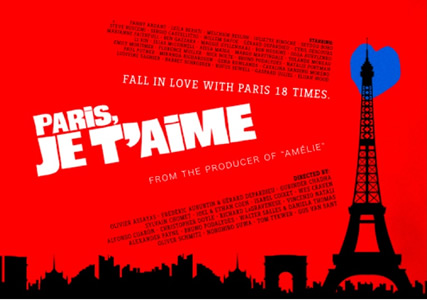
“Faubourg Saint-Denis” is one of the eighteen short films featured in Paris, je t’aime, an anthology of short films by several significant directors, each set in a different arrondissement of Paris. Other directors in the project include Gus Van Sant, Richard LaGravenese, The Cohen Brothers, Alfonso Cuaron, and Alexander Payne.

Tykwer has masterly told passionate tales before, matching star-struck and tortured romances with a sort of fairy tale sensibility: the questions of fate, free will and running in Run Lola Run; the innocence and violence of The Princess and the Warrior; the dark, damaged passion of Perfume: The Story of a Murderer.

Tykwer, with The Matrix’s Wachowskis,  is adapting and directing David Mitchell’s novel Cloud Atlas for the big screen (it’s listed as currently in post production).

—R. W. Gray

.
.

Jan 192012
 

Here are the opening paragraphs of a new story just published at The Literarian, the magazine at the Center for Fiction in New York. The story invented itself late last fall when I happened to stop at a Barnes and Noble in Colonie and discovered huge walls of books categorized as PARANORMAL ROMANCE (see photo above taken by NC Contributor Cheryl Cowdy). This was a completely new literary genre to me—you can tell I don’t get out much. But it seemed very popular. I thought, I can write one of those. So I did.

Read the rest of the story at The Literarian, link below.

Also, if you’re in New York on March 14, come to my craft talk at the Center for Fiction (see the link at the bottom of the story).

dg


Everything Starts at a Bookstore

I was supposed to meet Zoe for lunch at a chic Parisian restaurant she had discovered on the Internet, a crucial rendezvous during which I intended to propose marriage, but I was running late. A fierce, cold rain lashed down suddenly as I bounded up the Metro steps, rain as I had never experienced before. It drove me back into the underground, where dozens of African Parisians discussed the weather in languages other than French. I glanced at my watch and leaped up the stairs again, blinded by the torrents of rain.

Wind whipped the leafless plane trees along the avenue. I spotted a flower shop and ducked in, thinking to buy a bouquet for my love. But I must have slipped through the wrong door, for I found myself in a neat, closet-like secondhand bookstore with dark oak shelves marching back toward an ancient desk fortified with parapets of leather-bound tomes. I hovered, dripping in the doorway, loathe to enter and perhaps spatter some valuable books with water but also reluctant to dive back into the deluge. I wiped rainwater off my watch face, frantic with vexation and indecision. I naturally blamed all my troubles on the Parisians, their precious City of Light, and Zoe’s love of travel, which I did not share.

via The Literarian at The Center for Fiction.

Jan 182012


In this brief, trenchant memoir, Jean-Marie Saporito combines four elements—an ancient native religious rite, a fatal shooting, a mink coat, and a cowboy—and contrives a haunting and mysterious effect in a style as terse as Hemingway. Jean-Marie is a former student of mine at Vermont College of Fine Arts where she received her MFA. She lives in Taos, New Mexico. She wrote, “If you want, you can add to my bio that I’m dating a cowboy. You know what a cowboy is? A man who can handle cows — ride, rope, herd. I’m learning a lot.”

dg


Letter from Taos: Too Horrible, Too Beautiful

By Jean-Marie Saporito


On Christmas Eve, The Procession of the Virgin, a Tiwa tradition, takes place at the Pueblo. After Vespers in the San Geronimo Church, The Virgin, a statue with dark hair and Indian looking features, is paraded through the Pueblo’s plaza, amidst firing rifles (real bullets) and two-story high bonfires. I attended Vespers and then the spirit moved me to follow the Natives out of the Church, and join in the procession. Yes, I was wearing my mink coat. I sang what must have been prayers, along with the Tiwa choir. Hundreds of people from Taos, along with tourists, gathered to witness the procession, the massive bonfires, the drums and singing.

Several hours later, early Christmas morning, my son’s friend, the drummer in their teen-age band, shot and killed another boy. I say boy — the dead boy was 21, and Charles is 19. Charles will be tried as an adult. The cause of the shooting was a girl. When my son got the call or more likely the text from one of his friends, I was skiing at our ski valley with my cowboy lover, whose kisses I was avoiding, because of his entanglement with another woman.

Continue reading »

Jan 172012
 

We all know the excitement of discovering a hitherto unknown (to us) writer “who dazzles and beguiles.” This happened to Halifax author Ian Colford when he read Jesus Hardwell’s story collection Easy Living. But instead of just looking Hardwell up on the web and leaving it at that, Ian went after the man, tracked him down and interviewed him and wrote this beguiling profile/review/interview (dare I add: detective story). Would that we could all have this level of response to a book.

dg

My Search for Jesus Hardwell

By Ian Colford


It is a still mid-morning, the ides of July, and hot as Hades.  Detective weather, I tell myself, craving a beer. I reconnoiter. There’s not much to see. The house is ordinary: a modest bungalow on a tidy corner lot in a residential section of Guelph, Ontario.  The lawn is healthy, the shrubbery tended with a meticulous hand.  Not a blind pig in sight, not even a hooker.  In other words, not what I expected.  I know, William Burroughs wore a three-piece suit; but this grass looks vacuumed.  Where’s the topiary?  I’m half relieved, half disappointed.

What am I doing here?

It started with a book.

Continue reading »

Jan 162012


Robert Vivian is a good friend and colleague at Vermont College of Fine Arts, a Nebraska native, and a former baseball player (a fact that I find endlessly fascinating—Nebraska and baseball: some echo of the American epic in those words). He is a prolific writer of superb meditative essays and a fine novelist, also a playwright and poet. Of the second novel in his The Tall Grass Trilogy, I wrote: “Robert Vivian’s Lamb Bright Saviors is a brave and profoundly moving novel of faith and forgiveness. A closely-observed novel of voices, it speaks the tongues of America’s impoverished underbelly and reveals, amid the squalor, mystery, goodness and salvation.” Robert Vivian teaches at Alma College in Michigan. He is the author of The Tall Grass Trilogy (The Mover Of Bones, Lamb Bright Saviors, and Another Burning Kingdom) and the essay collections Cold Snap As Yearning and The Least Cricket Of Evening. His next novel, Water And Abandon, will be out this fall.

dg


A Few Thoughts On The Meditative Essay

By Robert Vivian


The meditative essay hinges on stillness, on a moment delicately teased out of the cogs of time to live in the timeless present: it is not interested much in opinions or even ideas, preferring instead to live in the realm of pondering and contemplation (though the aforementioned may be used as initiating sparks). Its primary focus is not the self, though it uses the self and all that it has to give as a kind of booster rocket that, once the prose reaches certain insights, is jettisoned or spent, much like shuttles that are launched into outer space as we see those burning hoops fall back into the pearly clouds after they have done their proper work of achieving escape velocity. The meditative essay is comfortable and downright friendly with paradox and has no real axe to grind: it’s too intent on paying attention to what bids it keenest focus and delight, be it a button, a homeless woman, the changing of the seasons, or the prevalence of roadkill in a certain area. It is not concerned with hierarchy or competition or anything that goes by the name of ambition or force and draws attention to itself only for the music of its cadences and what these cadences reveal, which are very often surprising to its practitioners, so much so that this same quality of surprise is the meditative essay’s own intrinsic and unshatterable reward.

It lives most abundantly—thank goodness—in what the French philosopher Paul Ricoeur called a “post-critical naïveté”—a term he coined that, according to Thomas Berry in his forward to Thomas Merton’s lovely book When The Trees Say Nothing, “brings together the response of both innocence and experience as we pass through the unfolding events of these times.” But the meditative essay is also a very elusive creature, as elusive as anything, perhaps, in any genre. Why is it elusive, and what do I mean here by elusive? Because the meditative essay cannot be willed or forced and certainly not argued into existence; it comes, like Keats says about writing good poems, like leaves to a tree—that is, the meditative essay comes organically, holistically, though of course not without the patient practice and observance of its creator. More than anything, the meditative essay is like a shy wild animal that will bolt at the slightest sign of undue ego or aggression, though it may occasionally use tiny bits of these to furnish its lair. When the meditative essay is fully and truly itself, we know its author so intimately that we swap souls with her or him: it is a consummately intimate form of exchange, as tender as a confiding lover propped up on his or her elbow in bed after lovemaking. Fear is not in its nature, nor is blame or accusation; indeed, intimacy may be its single-most distinguishing characteristic, the way it takes us into the heart, mind and soul of its author.

Continue reading »

Jan 152012
 

Poems from Jorge Carrera Andrade’s Micrograms

Translated by Joshua Beckman and Alejandro de Acosta


Newly released from Wave Books, Micrograms, by the Ecuadorian poet Jorge Carrera Andrade, pays meta-homage to the brief yet visceral impact of the microgram. Featuring a meditative body of short works translated by Joshua Beckman and Alejandro de Acosta, the collection also includes Andrade’s hermeneutical “Genealogy” of the microgram that serves as a primer to the form while simultaneously providing a substantive look at Andrade’s innately philosophical consciousness. In Andrade’s words, “The microgram is but the Spanish epigram deprived of its subjective hue. Better: an essentially graphical, pictorial epigram. Through its discovery of the deep reality of the object (its secret attitude) it arrives at a refined emotional style.”

As we learn in the translators’ introduction, Andrade was a world traveler who believed in a universal human solidarity that transcended borders and united him to all men. Evidenced in his introduction and his poetry, Andrade was also a tireless observer of the natural world who remained committed to illuminating the metaphysical through an examination of the miniscule. Micrograms, with Zen-like clarity, offers earthly, object-centric writing that informs our perceptions and emotions with refreshing brevity.

Jorge Carrera Andrade (1902-1978) was born in Quito, Ecuador, and was a diplomat as well as a poet, essayist and journalist. His distinguished literary career comprises a wide range of work, including editing, translation, criticism, and poetry. William Carlos Williams described Carrera Andrade’s images as “so extraordinarily clear, so connected to the primitive I imagine I am … participating in a vision already lost to the world.”

I have included a sampling of Andrade’s poems below along with one of the translators’ reinterpretation of Andrade’s Japanese to Spanish translation of Basho.

Martin Balgach

WHAT THE SNAIL IS

Snail:
tiny measuring tape
with which God measures the field.

  Continue reading »

Jan 132012
 

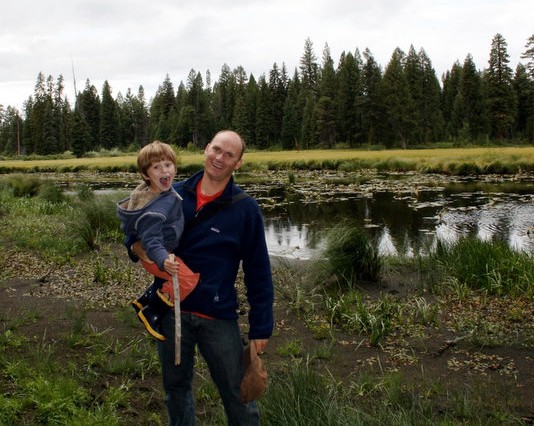
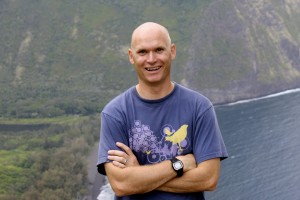
Anthony Doerr

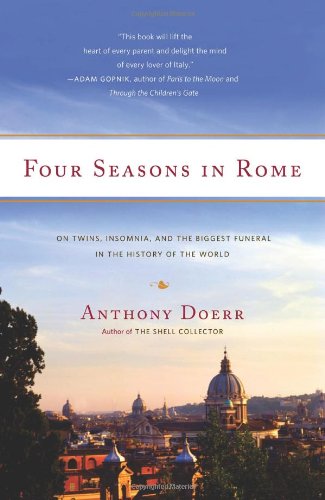
In his 2007 memoir, Four Seasons in Rome, American writer Anthony Doerr describes his desire to see snow falling through the oculus of the Pantheon. “If it ever begins to snow, we should run to the Pantheon, because to see snowflakes drifting through the hole at the top of the dome is to change your life forever.” At the time, Doerr is living in Rome with his wife and twin boys after winning the Rome Prize, a prestigious award from the American Academy of Arts & Letters. The Academy has provided him with a fully funded year in Rome, a studio, a place in a community of artists, and uninterrupted time to write, travel, read and think. Winter passes without snow and spring arrives in Italy. Doerr’s wife, Shauna, comforts him over the missed opportunity: “Sometimes, she says, the things we don’t see are more beautiful than anything else.”

Those of who have had the good privilege to read Anthony Doerr are fortunate.  Through his words, we have, indeed, seen the snow falling through the ancient dome. Crackling with beauty, intelligence, lyrical prose, heartbreaking characters and a rarefied wisdom, Doerr’s work challenges many of the basic traditions of contemporary fiction. His short stories often run unusually long, brushing up against such uneasy labels as novella. He writes about characters from other cultures, other races, other genders. His prose is dense, filled with science and history and more than an ample supply of the magical powders that make good fiction fly off the page. A reader might find herself in the Liberian civil war, on Caribbean beaches, inside memory (literal memory) stored on a computer disc. But it hardly matters. I’ve yet to begin a sentence of his and find myself disappointed.

I reach Doerr in December of 2011. Like in much of the nation, winter has yet to arrive to the Boise foothills. An uneasy tension seems to hang over the unusually dry, warm season. It is raining and chilly here in San Diego, where I am. We talk about the weather, about raising children, about Santa Claus and about trying to keep kids believing in magic and fat guys delivering gifts through chimneys without directly lying to those we love.

The fact that such an accomplished writer can be such a nice damned guy is very reassuring. Doerr retains the humility of a seeker, of a fellow traveler on the road to discovery, even if he is light years further down the path.

Doerr’s describes his process of writing this way (from Four Seasons In Rome): “…A story—a finished piece of writing—is for its reader; it should help its reader refine, perceive, and process the world—the one particular world of the story, which is an invention, a dream. A writer manufactures a dream. And each draft should present a version of that dream that is more precisely rendered and more consistently sustained than the last.”

Anthony Doerr’s short fiction has won four O. Henry Prizes and has been anthologized in The Best American Short Stories, The Anchor Book of New American Short Stories, and The Scribner Anthology of Contemporary Fiction. He has won the Barnes & Noble Discover Prize, the Rome Prize, the New York Public Library’s Young Lions Fiction Award, a Guggenheim Fellowship, an NEA Fellowship, the National Magazine Award for Fiction, two Pushcart Prizes, the Pacific Northwest Book Award, three Ohioana Book Awards, the Sunday Times EFG Short Story Award and the 2010 Story Prize. His books have twice been a New York Times Notable Book, an American Library Association Book of the Year, and made lots of other year end “Best Of” lists. In 2007, the British literary magazine Granta placed Doerr on its list of 21 Best Young American novelists.

—Richard Farrell

.

Richard Farrell (RF):   The Paris Review once asked John Gardner this question: How do you name your characters? Is this something you think about as you write?

Anthony Doerr (AD): Names comes to me primarily through research. I’ve found last names on a gravestone and written on the back of a photograph and in the works cited at the end of a scientific paper.  And I’ve found first names in the fiction of other writers or overheard them in conversations.  For my short story “Village 113,” for example, I was reading lots of dry U.N. reports about the construction of the Three Gorges Dam, and whenever they would mention an engineer’s name, I would scribble it down. So for Li Qing I ended up simply mixing together two different names.

Right now, I’m writing a novel set in France and Germany during World War II, and am reading, among other things, a book called Voices From the Third Reich.  I’ll pull Uwe from Uwe Köster, who lived through the Hamburg firebombings as a young messenger, and Kühn from Klaus Kühn, who was Hitler Youth flak auxiliary during those same raids—and suddenly I have Uwe Kühn, a new person with at least a remotely plausible name.

That’s got to be a pretty common technique, don’t you think?  Once you have a name and you start spending months with a character, he or she begins to embody the name.  It starts to feel right; it starts to feel as though the character could never have been called anything else.  Like a child, probably.

RF: Can you talk about your earliest influences? Perhaps even the influences before you became a writer, such as the things that drew you toward reading?

AD: Sure. My earliest influence was maybe C.S. Lewis.?  I remember my mother reading The Chronicles of Narnia to me and my brothers; I was probably eight.  And I remember asking her: “How did they make this book?  How did they invent Narnia?”  And she’d always say, “It was just one person who wrote these books.  And he’s dead now.”

Dead!  What?  Dead people could tell stories that still held power over the living?  I had always had a sense that books were like oranges on a tree, that they pre-existed in the world, and humans came along and plucked them.  But now my mother was saying people made them.  One person, one book at a time.  That was a revelation: One weird old guy could use language, the cheapest of materials, and conjure whole worlds with it?  Then he could die and those worlds could still hold sway?

My childhood was very immersive. Very imaginary. I was making up pretty complicated narratives with my toys.  Sometimes I’d write them down. My brothers were older than I was, often doing things without me, and so I learned to make up stories about my Lego guy or G.I. Joe or whatever, and that was probably good training to be a fiction writer.

My kids are seven now, and because they are twins, they very rarely play alone.  Sometimes I worry about that; I feel like one of the best parenting strategies my mother had was to trust me to play by myself with my little toys out in the woods for hours.

I had the usual influences too, like writing for the high school newspaper. I was a history major in college,  and wrote a silly column with a friend for the college paper.  But I always had my eye on the English department. I would write long, lousy stories in notebooks about avalanches and keg parties and dogs that walked across Alaska and show them to nobody.  It felt precocious and impertinent to say to my parents, “I want to be a writer.”  It was hard to even say that to myself.  But that’s what I wanted to do.

RF: You’ve been described by other writers as being ‘scary smart’.  (I’m not naming names!)  How do you balance the intellectual side of writing with the more artistic/emotional parts?

AD: (Laughs) I don’t feel very smart sometimes.  I can feel like a failure all day long. Sometimes writing is like baseball, where you can hit .300 and be considered a good hitter.  What I mean is that I feel lucky if 30% of my sentences end up working out, if 30% of my ideas wind up turning into finished projects, if 30% of my hours can be productive.

When I read, I try to learn as much as I can.  Sure, I also read to escape, to enter other lives, but I also read to learn, and I don’t mean just to learn about extrasolar planets or conditions on slave ships. I mean to learn about the experiences of other people in other years, other eras, other climates.  A book like Moby Dick, for example, is so formally risky because Melville has no problem disrupting his narrative momentum and cramming in whole chapters about the history and techniques of whaling.  Often my students resist those chapters, but I love them: they have that classic duality of good writing: that it both teaches and entertains.

For me, writing fiction is often an excuse to explore curiosities. I get curious about venomous snails or hibernating ladybugs or the construction of dams or orphans during WWII; then I try to pull that information into a human story.

This is probably where I fail the most. I get carried away by the science sometimes, the information, the cool historical stuff, the wonders of the world, and I tend to lose sight of why a reader, in her guts, wants to turn the page: because she wants to learn what will happen next.

RF: I’m thinking of Steven Millhauser. He does this kind of writing, lots of cool, weird facts.  Do you read him?

AD: Oh sure. I haven’t read him much since I was in grad school, but he’s great. I love when he’ll make a story spiral in on itself, building all these crazy, whimsical details until he’s lost sight of narrative altogether, and is just building tiny boxes within tinier boxes.  Love that stuff.

I think of Calvino, too. He’s a writer who sometimes subverts narrative for the sheer glory of invention, playfulness, whimsy.  He was a very important writer to me when I was trying to figure out how to translate my own interests to the page because he seemed to say: yes you can be silly, you could love science and fables at the same time, you can be an intellectual but you can also tell stories.

RF: In “The Caretaker,” which is one of my all-time favorite stories, you build a long story with a very unusual structure.  There are so many distinct parts to it, so many disruptions. You have the Liberian civil war and the long trip to Oregon, the time with the family, the whale hearts, the garden, the survivalist section. I’ve noticed a lot of your stories tend this way.  More than most writers, you blur the line between the short story and the novella.  Sometimes, your work is almost indistinguishably close. Why do you write such long stories? Do you plan it out consciously or does it arise from the inner workings of the story itself.

AD: The latter. They just turn out that way. I probably do too much writing in my stories. Even for shorter stories that I do, I’m writing around a hundred pages, spiraling out long paragraphs that eventually get cut or severely trimmed.  It takes time to learn how much you can get away with not saying. Once you understand what the reader needs to make sense of the story, a lot of the choreography–the “Then they got out of the car and walked up the sidewalk and turned the doorknob and went into the kitchen”—can go.

But the material has to determine the structure.  Take “The Caretaker.” I felt like that section of the journey from Liberia to Oregon could have been a lot longer, and I wondered if the reader would forgive me the shortcuts I had to take, that I basically teleported Joseph to Oregon from Liberia.

One of the things I like to do is to open up spatial tensions in my work. Liberia versus Oregon in “The Caretaker,” for example, or the tension between the palace Joseph is caretaking and his subsistence in the woods around the property.  I played with it a lot in About Grace, in the way I use Alaska and the Caribbean.  The dialectic of those things interest me.  Place a character far away from home and immediately there’s longing implicit in her story.

But it’s not planned that way. I can’t just sit down and write a 9,000 word story for a magazine for $500.  It’s seven months of my life, and  I never quite know how long it will be or what structure it will take.  I guess I could say that I’m drawn to certain lengths, both in reading and writing.  I’m not a big reader of short-short stories, for example, and I agree with Poe who said that undue brevity can fail a reader.  Here’s Poe: “A poem too brief may produce a vivid, but never an intense or enduring impression. Without a certain continuity of effort–without a certain duration or repetition of purpose–the soul is never deeply moved. There must be the dropping of the water upon the rock.”  I feel like, in a short story, I’m not dropping water on the rock unless I’m pushing past some sort of moveable threshold: maybe 3,000 words?  You need time to establish a certain level of repetition, to establish a pattern, and then deviate from it.

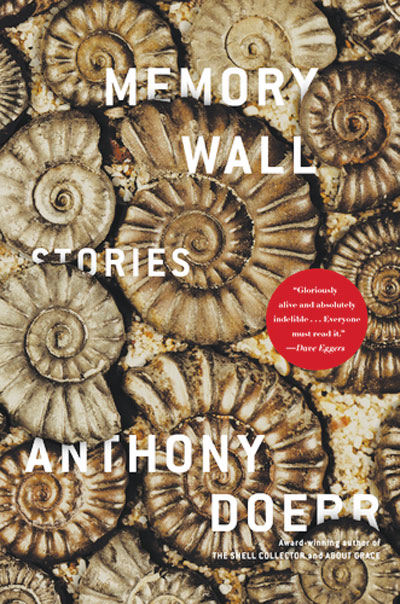
RF: In the epigraph of Memory Wall, Luis Buñuel says “Life without memory is no life at all.”  Clearly all of these stories deal with memory, many of them, like the title story, deal with it overtly. But so much of a character’s memory must happen off the page.  How do you go about creating memories for your characters?  Are you ruminating a long time before a character gets on the page or are you writing drafts and finding the memories that way?

AD: The latter.  Characters are made and at the start of their lives they are lumpy and soft pieces of clay.  I form them through trial and error.   I ask myself: what could her life be if this happened in her past?  Should I invent a situation in her past that made her how she is now?  And do I need to present that in scene or summary to my reader?  But you can paralyze yourself with too much of this.  So often, the situation in a story will present the need for a memory, and then you spend a couple days inventing the memory.  And then, more often than not, you realize you don’t need to include it at all.

What I love about reading a short story is that a writer can spend days and weeks and months ruminating on her characters and their places and problems.  Maybe she spends years on it, honing them, trying to invent their pasts, guess at their futures. So a writer spends a year of her life on something and a reader gets to drink it down in an hour or two.  That’s a great gift of concentrated time, the ultimate milkshake.

RF: You were quite successful while still a relatively young writer.  Did you pass through a period of bad writing?  If so, when was it?

AD:  Writing can always be changed, improved, deepened, sharpened; that’s the beauty of what we do.    So when I was first starting out, I don’t know if I was in a period of bad writing; it was more like I just didn’t yet know how to get my writing ready for a stranger to read it.  In the beginning of a person’s attempts to write books, it’s more about learning to recognize what’s weak, what’s relying on false truths, what’s cliche, and repairing it before asking someone to be generous enough to read it.

RF: Another quirk of what I might call Anthony Doerr’s writing style is that you inhabit characters that are wildly different than you are.  I assume from your author photos that you are a white, male American writer, yet your stories are filled with Liberian refugees, Chinese villagers, South African men and women, teenage girls, blind shell collectors.  How did you learn to give yourself permission to be so versatile?

AD: When I get that question I usually ask myself why I read.  I read to enter the life of someone else, to leave myself and enter other selves.  I read to feel less alone–David Foster Wallace said something like that.  So I believe that the human experience can be communicated, can be shared.  I can go read Madame Bovary and in a couple of paragraphs I get to become a randy housewife in 1856.  That’s a miracle, isn’t it?

So I think that some human commonalities are shared. Things like loss, heartbreak, love.  These things happen everywhere. They happen in Iran, Vietnam, Ohio. So yes, it is a risk; I run the risk of not beginning to understand the subjects I’m interested in.  But I’m not going to write about some bald white Idahoan in a supermarket all the time. There are things about being a bald white Idahoan in a supermarket that interest me too, but not all the time. I’m drawn to discovery.

This can often be confusing for a young writer. So often, they’re told to write what they know.  Fundamentally, the things they want to write about they already know all too well: feeling lonely, feeling scared, feeling inadequate.  That doesn’t mean they can’t write about a lonely, scared, inadequate person on a space station in 2641.  The trappings of a person can be researched. If you want to write about a violin maker in 1743, you can do it with a lot of research and care.

RF:  Could you talk about travelling and how it has influenced you as a writer?  You make reference in Four Seasons in Rome to Viktor Shklovsky and the concept of defamiliarizaiton. Does living and writing abroad help you do this?

AD: Ah! Making the stones stony again!  What Shklovsky is talking about is estrangement, right, the way our homes, our lives, become invisible to us over time, and that the role of art is to make those things strange to us again.  When we become encrusted with habit, we stop noticing things.  But art breaks through that encrustation.  That’s what he’s saying, roughly.  That’s why my favorite novels can do things like show me a bald white Idahoan, and show me him in a new way.

So by travelling, I’m forced to see things new again: even very simple things, like how people get water, how they get to work, how they think about ambition.  But travel can also work against what I’m trying to do. I recently went to Ecuador for a New York Times piece I was writing. It was easy to take notes there, to come home and write 3,000 words from those notes. But it disrupted the work I was doing on my novel. In my fiction I was trying to conjure February and mist and gray oceans and hedgerows and instead I’m standing in primary forest in a plastic rain poncho with butterflies flapping past me.  But here’s what I tell myself: it all goes into the pot.  I take journals wherever I go and I fill them with crappy sentences I’ll never show anyone but I can still, maybe, use those sentences—or at least those memories—in the future.  And who knows, maybe someday I’ll go back to them and write about Ecuador. The images will still be there.

RF: How are your twins?

AD: (Laughs) They’re great, Rich.  Thanks for asking. They’re seven now.

(We proceed to talk about kids, Christmas and how fast they grow.  I tell him a story about visiting the Sistine Chapel when my son was two. My wife was pushing him in a stroller and he screamed for the entire time. Doerr and his wife lived in Rome for a year just after their twin boys were born. We talk about Santa Claus.)

AD: Does your daughter still believe in Santa? (She says she does.)  Did you ever have to tell a straight lie to your kids about it? (I answer that I’m not sure.) I love that children retain the power to want to believe.

 RF:  Is writing difficult for you?  Is it hard work?

AD: I have great days sometimes, mornings or evenings when it’s going well. Sometimes when you’re writing well, you look up and it’s noon and your leg is asleep and you’re hungry because you forgot to eat.  Those are great days, days that feel short because you’ve been dreaming all day.

But sure, it’s not easy.  It’s like working out. I know that’s a trite analogy, but it’s effective. Sometimes the last thing you want to do is go outside and run, but then you do it, and you’re a few miles in and it’s snowing but your body is warm and you just feel alive.

RF: Was there a particular writer or artist or teacher who most influenced your writing?

AD: Andrea Barrett, who I didn’t meet until recently. Her collection, Ship Fever, had science and history and good writing, and I thought, “You can do this?”  You can write short stories and novellas and be responsibly accurate about science and history and still be creative?  Rick Bass, too.  I still haven’t met him.  His story collection, The Watch, blended magic and love and setting and the natural world and he got away with it and it rang a bell in my soul because those were all the things I wanted to do.  Alice Munro, too, and how she deals with time; that she could take on time scales much larger than a single day in her stories showed me that I could try that too.  You have to give yourself permission to try these things and when you see older, accomplished, hugely passionate writers doing it, it helps so much.

RF: You say that a writer manufactures dreams. What dreams can we look forward to next?

AD: I’m working a novel that’s seven years in the making. It’s about a German boy and a French girl in World War II and how their lives intersect, though that intersection happens very late in the book. It has to do with radio, too: how radio was employed both as a tool of control and resistance.  Mostly I want to conjure a time when it was a miracle to hear the voice of a stranger in our homes, in our ears.  Nowadays we’re bombarded by electronic messages, of course.  It’s to the point where my house can seem too quiet if my kids are outside and my wife is away; I feel like I have to turn on the radio, just to keep me company.

Anyway, among the thousand challenges this book presents is this: Can I tell the story about how a boy got sucked into the Hitler Youth, made some bad decisions that led to terrible, unforgivable consequences, and still make the boy an empathetic character?

RF:  In Four Seasons in Rome, you describe a writing this way: “But to write a story is to inch backward and forward along a series of planks you are cantilevering out into the darkness, plank by plank, inch by inch, and the best you can hope is that each day you find yourself a little bit farther out over the abyss.” It’s such a nice description.  What gives you the confidence to take the next step?

AD: Some days, it’s not there.  But here’s the thing: when those voices are loudest, those critical voices which are telling you not to do something, often that’s when the story is really about to takeoff. Because that means you’re standing on the edge of something dangerous.

Take “Memory Wall,” for example.  I was writing a long story about whales and Alzheimer’s and it was a mess.  And when McSweeney’s asked for a story set in the near future, I had the idea to put memories on cartridges. That was a ridiculous idea; that’s when the voices started getting loud, saying, “Don’t do that, that’s science fiction, that’s silly, that’s a gimmick.”  Thankfully I had grown up enough to know that that was the sign that said, Try it.

So you have to train yourself to shut out the voices.  Writing is tough. It’s easy to question what it is you’re doing. I have friends with a fair degree of stability in their life, in jobs they’ve had for maybe two decades now, mostly on autopilot, making good money. I have some good friends out on the golf course right now as we speak!  You can get locked into that way of thinking, of worrying about what you don’t have. You have to come back down from that and tell yourself: I am doing what I love to do, I am blessed,  my family is healthy, and I’m healthy, and I need to keep challenging myself because who knows how much time any of us has left on Earth?

—December 2011

.
.

Jan 132012
 

doerr2

.
Herewith, an excerpt from Anthony Doerr’s award-winning short story, “The Deep.”  Recipient of the prestigious Sunday Times EFG Private Bank Short Story Award in 2011, “The Deep” is included in the paperback edition of Doerr’s 2010 Story Prize winning  collection Memory Wall.

Born with a heart defect in the early days of last century, Tom is told he will not live past the age of eighteen. His concerned mother protects him at every turn. ‘Go slow’ his mother says. But Tom discovers life in the midst of fainting spells and industrial collapse, falling in love with the beautiful, red-haired Ruby Hornaday, a girl who dreams of diving on the ocean floors. Set against the salt mines of Depression era Detroit, the reader is transported in time and space in this heartbreaking story of love, hardship and the irrepressible human spirit.

Listen to a reading of “The Deep” by the actor Damian Lewis at the 2011 Oxford Literary Festival.  Read an Richard Farrell’s interview of Anthony Doerr on Numéro Cinq.

—Richard Farrell

§

 From “The Deep”

Tom is born in 1914 in Detroit, a quarter mile from International Salt. His father is offstage, unaccounted for. His mother operates a six-room, underinsulated boardinghouse populated with locked doors, behind which drowse the grim possessions of itinerant salt workers: coats the colors of mice, tattered mucking boots, aquatints of undressed women, their breasts faded orange. Every six months a miner is laid off, gets drafted, or dies, and is replaced by another, so that very early in his life Tom comes to see how the world continually drains itself of young men, leaving behind only objects—empty tobacco pouches, bladeless jackknives, salt-caked trousers—mute, incapable of memory.

Tom is four when he starts fainting. He’ll be rounding a corner, breathing hard, and the lights will go out. Mother will carry him indoors, set him on the armchair, and send someone for the doctor.

Atrial septal defect. Hole in the heart. The doctor says blood sloshes from the left side to the right side. His heart will have to do three times the work. Lifespan of sixteen. Eighteen if he’s lucky. Best if he doesn’t get excited.

Mother trains her voice into a whisper. Here you go, there you are, sweet little Tomcat. She moves Tom’s cot into an upstairs closet—no bright lights, no loud noises. Mornings she serves him a glass of buttermilk, then points him to the brooms or steel wool. Go slow,she’ll murmur. He scrubs the coal stove, sweeps the marble stoop. Every so often he peers up from his work and watches the face of the oldest boarder, Mr. Weems, as he troops downstairs, a fifty-year-old man hooded against the cold, off to descend in an elevator a thousand feet underground. Tom imagines his descent, sporadic and dim lights passing and receding, cables rattling, a half dozen other miners squeezed into the cage beside him, each thinking his own thoughts, men’s thoughts, sinking down into that city beneath the city where mules stand waiting and oil lamps burn in the walls and glittering rooms of salt recede into vast arcades beyond the farthest reaches of the light.

Sixteen, thinks Tom. Eighteen if I’m lucky.

—Anthony Doerr

.
.

Jan 112012
 

Denise Evans Durkin writes poems that glow with a gentle melancholy (all memory is tinged with melancholy) unexpectedly laced with joy and wonder. They are wonderful to read, not just for their warm humanity, but for their loving attention to detail, details that seem to accrete spirit and luminescence as the poems develop. She was raised in Brooklyn and lives in Putnam County, New York, with her husband. She wishes me to note that the poem “Letter to My Sister from Bellevue’s Prison Ward” includes a line from Gil Scott Heron’s “Dirty Low-Down.”  These are her first published poems.

dg

.
Impedance
………(circa 1979)

The girl downstairs waits mostly. Sitting on her luggage
by the cattails, side of the road. Embroidered each star
on the velvet pillow of sky — they glitter
through the pin-pricks.

She waits, lonesome as the notions in her felted sewing box —
mismatched buttons, thimbles and threads in bright
remembered colors — bobbins and hat pins —
good things going away.

She’s there in the spaces where the dime store and
the pay phones used to be. The cart that sold ice-cream and
hot waffles. Relics.

Seeping cold. Click, drag, stop — over
imperfect stones. Her gradual world — ohms build
between receiver and vintage turntable on the dresser
in the bedroom she has not visited in thirty years.
Glass & leaves falling. Dust falling down in the hush —

.

Letter to My Sister from Bellevue’s Prison Ward

Traveling up from blue-black dreaming
those first pin-pricks of pale blue light give such sudden joy.

Once at a farm I saw eggs that color blue; the class learned
about farms, about far-off things and places where people
know their food, know their land and don’t live like we do.

Do you remember when we used to sing it?
Said I wonder, wonder, wonder, wonder who put those ideas in your head?
You closed your eyes when you sang back up; we got it right.

Mornings are my best time — even the doctors agree — when I wake
full of hope, and my hope is the color of morning, and my eyes

the color of the sea and I know all that the seas know.

A thrum of bees where my heart should be when my eyes flutter
open mother your face dissolving in the water swirling in the silver bowl —

were you here in your white nurses’ shoes? I thought I saw you
in your white dress adjusting the tubes that feed me, that dispense
the medicines, checking my bandages, and my restraints I thought
I felt all the little red lights on the living machines
silver mechanical fireflies that blink and glow redder
through the gauze of my forgetting pieces of what I thought was
my life and I can no longer remember how I got here —
I watch your white shoes walk away squeaking on the tiled floor.

Don’t think I don’t know nothing but the sea stays around
long enough to get old — and all I do in here is imagine
this gossamer daylight everyday — all just going by —

.

Come September

This morning the darkness is thicker — like spider’s webs
spun especially for the heavy snow they know is coming.
Crickets sing in the perpetual twilight of the field beyond my patio —
my small wilderness — where even now leaves are falling.
The vine wound up around that oak; some of its leaves
are already red. This is how I measure time: by leaves
changing color, by feeling the dew clinging to grass,
to wildflowers, waiting for the late summer sun.

The day you left draws nearer now.
Noted on my calendar, of course, but I don’t need reminders.
This is how you return to me: in the small twigs I pick up
for kindling, in the rain battering my old house,
beating the glass skylight, letting me know everything
is the way it’s supposed to be. I walk my solitude
past the fading clapboard and the weeds, deer at dusk
and whitecaps on the lake. These are what you left me.

.

Fall Notebook: Prayer & Dream

Inside a deep longing I dream alone by the sea.
Wooden table laid ready with black beans, rice and cornbread.
I imagine an indigo sky and wild horses.

Here I dream closer to the weather, to the light, to any decision.
Angel, how long is this bridge?

Over my heart on a lanyard of silver stars, my tiny imagined locket
opens into a mansion where my necessary delights reside.
These rooms full of one wish: for the sisters who
look in on me when darkness falls, who brush sweet almond oil
into my skin, my hair. Lord, my needs are small.

Mother returns in firelight, starshine, moonlight — her fingers
touching the top of my head, reminder that everything is what it is.

Deep cobalt sky and then the moon laying on its cold blessing —

.

Soothsayer
………spoken by my mother

Rootworker they call them in the Carolinas where I was married far from Georgia
where I was born and raised — farther still from these misty Coney Island streets
strewn with blown paper, dirt and sand.

Across the street from the Mount Zion Baptist Church where I sing in the choir,
collect tithing baskets and light white votives at sunset, my sisters wait at the bus stop —

old women with knitting in their straw totes, they nod without looking for me —
like they know I’m in here —

and they do. They know rootworkers are never welcome in this church or any other —
unnecessary anyway with the devil in the first pew every Sunday loudly singing
hymns he knows much better than my choir ladies in their cloches tipped down
on one side threaded with beads like bits of sea glass keeping close together
moving in tune as they file down into the pews, careful
not to touch him whom they have always known.

Lord, I am your child, walking and talking right, gone to the river and
baptized into the ease of your arms, my heavenly home.

Choir leader of my church under this indigo sky —
vesper-quiet in here with this cross and these candles
constant flame of love in my heart —

ruler of this elemental kitchen magic
my sisters call me Soothsayer
and I know what I know.

—Denise Evans Durkin

.
.

Jan 102012
 

Here are a selection of stunning landscape paintings from Anne Diggory’s solo exhibition Turbulence, currently on display at the Blue Mountain Gallery in New York (January 3rd – 28th). Not only do we get the paintings, but for Numéro Cinq Anne added reference photos and images of early versions of work and works-in-progress, delivering an amazingly revealing glimpse into the artist’s process and the provenance of these lovely paintings.

Anne Diggory has a BA in Studio Art from Yale and an MFA from the University of Indiana. We have been friends for years in the Saratoga Springs, NY, demimonde. She has been featured in Adirondack Life, American Artist Magazine, and The NY Times. She is known for her combination of accurate detail with expressive painting and strong abstract structure – an outgrowth of education at Yale and Indiana University and many years of exploring and painting the natural world. Her painting locations include the Adirondacks, the Hudson River Valley , Alaska and Arizona. A current series based on Lake George vistas was inspired by her research on John Frederick Kensett for an article that will shortly be submitted to the Metropolitan Museum Journal.

Diggory shows regularly at the Blue Mountain Gallery in New York City. She recently had solo exhibitions at Fairleigh Dickenson University and Suffolk County Community College, Selden, NY. Those two shows focused on her hybird works that combine photography and painting in a multi-layered process.

Her work is included in many public and private collections including the Hyde Collection in Glens Falls, NY, the Yale Art Gallery, and DePauw University.  Recent commissions include several large murals for the Adirondack Trust Company in Saratoga Springs (one is a 22 foot high mural of a waterfall), a collaborative commission of art work for the Saratoga Springs Train Station and a large interactive public artwork for the Albany Institute of History and Art.

Here is the text of the Blue Mountain Gallery press release for the show:

Shifting surfaces of waters and skies inspired the artworks for Anne Diggory’s solo exhibition, Turbulence, at the Blue Mountain Gallery in New York City that runs January 3rd – 28th,, 2012.  The exhibition includes motifs from the Adirondacks, the shores of Long Island and South Carolina as well as scattered tabletop arrangements.  Diggory’s preference for images featuring dynamic instability extends to her choice of medium in many works that combine sections of photography and painting in a multi-layered process. Further disruptions, slightly tempered by stable horizons, occur with deep spaces, off-kilter compositions and irregular perimeters that energize the work.

The artwork in the exhibition is mainly from the past year and a half. The title “Turbulence” is both a reference to the imagery and a reference to the process of making art, which involves disturbing the surface of the canvas or paper.

dg


Turbulence

Paintings by Anne Diggory


The Water Improvisation Series

While all representational painting is of necessity an invention in order to create illusion out of paint on a flat surface, some of these images are more fictional than others. Some started as plein air paintings that selectively used elements within a motif and were then finished in the studio.  The larger works and those with photographs inserted were started in the studio based on smaller works or photographs I had taken. The Water Improvisation series began with water-like patterns of paint and were developed from a well-informed imagination.

Cross Currents

  Continue reading »

Jan 092012
 

Herewith a gorgeous story from Dave Margoshes, who has contributed already two poems–“Theology” and “Becoming a Writer“–to these pages. I have long admired his work; I put him in Best Canadian Stories when I edited that estimable annual collection (over a decade of editing). “A Bargain” is excerpted from the author’s new collection A Book of Great Worth to be published by Coteau Books in April. A Book of Great Worth is a collection of linked stories based loosely on Dave Margoshes’ father. The title story was actually published in Best Canadian Stories, but in 1996, just before I took over.

Dave Margoshes is a Saskatchewan writer whose work has appeared widely in Canadian literary magazines and anthologies, including six times in the Best Canadian Stories volumes. He was a finalist for the Journey Prize, Canada’s premier short story award, in 2009. He’s published over a dozen books, including Bix’s Trumpet and Other Stories, which was named Saskatchewan Book of the Year in 2007. He’s been fiction editor of the literary magazines Grain and Dandelion, and was literary editor at Coteau Books for several years. He lives on a farm outside Saskatoon.

dg

 A Bargain

by Dave Margoshes


My father used to say that my mother was the one in the family who wore the pants. As he said it, he would invariably be wearing pants himself, either the pants of his suit or one of the Sears catalogue blue jeans my mother ordered for him, and she would be wearing one of her many flower-printed skirts, so the remark was surely meant to be ironic, though at the time, and until I went off to college and learned its delicious meaning, irony was a concept I was unfamiliar with, and what my father said was merely puzzling. The closest my mother ever came to wearing pants was the voluminous denim culottes she put on to tend her garden in the summer. Beyond those, and the one-piece swimsuit she wore when we went to the beach, I never saw her out of a skirt or dress, though she would occasionally walk around the house in her slip for a while after coming home from work. She was never embarrassed to be dressed that way in front of me, and so I in turn was never embarrassed to see her.

I think what my father meant by the remark was that my mother made all the big decisions in their life together. Another of his favourite remarks – again, ironically – was that he made the big decisions, on war and peace, world hunger, the economy and other weighty matters, while my mother contented herself with the small decisions, those related to the family and household, things like spending money, feeding and clothing them and the children, what movie to go to and so on. My father also often said that he and my mother did everything around the house together, with him doing the physical labour and my mother “supervising,” if it was something to do with the outside, and her doing the work and him supervising if it was inside – chores like the dishes and the laundry. All of these comments – conveyed in a joking voice but with a serious undertone – related to my father’s often-expressed grievance that my mother was “bossy.”

It was true that she almost always got her way. But not always. My father liked a drink now and then, meaning several times a day, I don’t know how many. She would have liked him not to drink at all. His concession to her was to rarely drink his preferred rye whisky in her presence – never at home, but he would let his guard down and have one or two at family gatherings where liquor was flowing. “I’m just doing this to be polite,” he would say, a little too loudly but usually with a wink, and the uncles would smile. But he kept a flask in the glove compartment of his car, a bottle in the bottom drawer of his desk at The Day, the Yiddish newspaper where he worked as a reporter and columnist, and during the course of his day he made occasional stops at barrooms where he was a familiar customer. At home, at night, usually seated at the kitchen table in his undershirt, he would have a glass or two of sherry or port, usually the cheapest brands. My mother bought it for him, and that’s what he specified, the cheapest, which, I imagine, also appealed to her own sense of frugality. This was her concession to him, these fortified wines, “a gentleman’s drink,” he would say when he unscrewed the bottle, as if to imply it was no drink at all then, and didn’t count.

Although I was a witness to them all through my growing up, this to-ing and fro-ing, these nuances of their life together, it wasn’t until I was grown and involved in a relationship of my own that I came to understand the delicate balance they had constructed and maintained. Well, not understand, but begin to.

Continue reading »

Jan 082012
 

“Let’s start by making ourselves unfamiliar,” Laura Behr begins one poem, and she does, continuously through her poems that are filled with sudden leaps, surprising twists, non sequiturs, surrealistically tinged phrases—anything to let us see the world and our relationships in it anew. Laura has been a private student of mine for a few years now, starting after we met at the Iowa Summer Writers’ Festival. To be honest, when she began I wasn’t enthusiastic about the work but she is a voracious reader and reviser, and she has become one of my favorite all time students. I look forward to every poem she sends and shake my head in wonder at the new ways she finds to see herself, all of us, in the world. She’s the kind of original that makes us more original ourselves.

—Richard Jackson


Cave Diving With Einstein

Poems by Laura Behr


Reflections on Magritte’s Painting The Therapist: You Are My Suitcase


Let’s start by making ourselves unfamiliar.
Listening, to the puzzles of silence. Travelling
as far as we can go. We’ll form an Optimists Club.
Rewriting ordinary things: a straw hat, reed cane,
the red blanket. I can see every third page is missing,
so you can wear the blanket first.  Later, I’ll try it on
for you and invite you into my lap. I want you
to look into my bird cage. If you’d like I’ll turn
and show you my dove-heart, and you can sit
on the heart-ledge of my cage cooing, and keeping
my dove-heart company. Sky and water open the illusion.
Every particle of yellow sand, atoms of myself sitting
resolutely on the beach, the darkness of a midnight-blue sky,
my Sunday hat, meld with every particle of you
collecting inside my portrait. Bring your Lindy Hop,
and uncover me in the quiet music of waves. Breathing in
the scent of sand pines. Stop and rest with me in these
exotic blues of children’s books and imagination.
We’ll lose our bearings, mixing up horizon-lines and dreams,
falling open to each other, learning to love in solitude.
We’ll need a pair of carrier pigeons, trained to carry messages
written in invisible ink. Let’s wash away the old answers,
letting the horizon form a new tracing-line decoding the cipher
between us leading on to the future. Sit with me. The future
of the thing, sees for us without a face, with its well-trained heart
and finds itself in balance, if mystery lifts her veil. The weight
of things, two birds: one free, the other caged by a lover’s cross,
as primal navels open insides first to love all bird-cage heart.

On the Banks of the Cedar River Finding a Rare Igneous Rock


All he wants. A soul’s weight. Washed up
from a century’s flood. Not the rock he pressed
into nameless hands long ago. The felt how
of living. His words bent by gravity and time.
Her name long forgotten.  Smooth, black,
almost volcanic. The world outside is not enough.
Pressing his rock into her small hand at recess.
He imagines her now. Her face, nameless.
And every word exchanged transgresses memory.
Working things through as the world wakes.
At the mercy of one task. He wants to be
a time traveler. The best day of his life could be
in the future. Stripping down.  Jump and crossing over.
Freed by the river’s forward moving questions.
The chaos seems insurmountable. Time moves truth
into view. Where to go from here? A still quiet moment
poses in dark woods. He wants to go back, capturing stars
hanging above the silent pines. Falling back
into night’s silver lining, as its spirited double-helix hums
an incantation in star-speak counter measures.
And even his affection for living can’t hold him safe
enough to see his own ignorance. He wishes he had
been smarter, moved faster. A regret. Still, the future
is alive with a promise which marks the things he carries
of her into infinity. Uncharted in shadows, he wants.
The world’s beauty, recovering eyes that wonder.
Silent, in a moment that doubts the mystery. Its haunting
stripped and smitten as words lose meaning slipping
into ambivalence. A perfect set of magnets, and closeness
enough to touch fingers and toes. That is all he wants.
Eternity, reliving what has yet to be lived.


Owen Meany at the Alamo


A few stone buildings, a neatly trimmed lawn,
a nice place to take a picture. A reason
to take off a hat. None of it changes the ending.
It’s happening now, expected signs and all the rest.
A home for missionaries and Indians,
a freak storm hits in shirt-sleeve weather.
If you dare ask what will kill you. The ghosts
will tell you. Or ask how you know
what you don’t know. Be willing to do something.
Act like a baby or a fallen star. Both roles have merit.
When life isn’t so beautiful it’s hard
to put into words. Faith isn’t pure
or sure of itself or of you.  It’s a word born and blurred,
in veils and regret.  It proves itself against
the disorder.  Blow it up, you can’t leave it undefended.
How do you hold happiness? It’s the oddest things,
the unexpected turn of a moment you don’t see coming
but you see, and there are no survivors. Practice.
Living with what is missing, an arm,
a father, it’s a no win argument, chosen, human.
Faith in faith means walking, not figuring it out.
A hero is only a street light away.


Cave Diving with Einstein


Two minutes underwater and the last thing
you see is the pale gray shadow of clouds
falling down to uncover angels dancing
within the electric blue glow. Eternity is blue,
holy as the first touch of skin radiating light
thru deep black waters. Within its light lies
the weight of everything that we cannot say.
And, waiting on the lap of gods for a second wind
or a kiss, as ghosts walk, as rain falls clearing the air,
we laugh. Dreaming of love’s savages warm
and expecting summer rains. Suppose the earth
above us is the illusion. Water rushes, siphoning silt
thru a slit in the rocks. Grounded by live oaks
and scrub jays the sandy path above is the netherworld.
The Harrier hawk mid-flight and lost is a Firebird,
his feather tips are your hands. Will you believe
with me in implausible things? A turbulent
storm-tossed sea. Electric blue spheres of light.
Enwombing us, in the binding intensity of heat.
Gravity healing and unruly, shifts its boundaries
and leaning in forces jumps of spiritual force
that spread out and over the tides to woo us away.
Facing the whiteness of surf light, looking into
the blue-sky water, I watch as the shadow borders
of ordinary life disappear. Entering with you
into dimly lit worlds, hidden below a glassy surface,
I hold my breath. Listening for the strange music
of a seashell over a roar of waves, the music tells stories
of our very natures and of places beyond this, where
things are truer than real. Waiting to see this murky
dreamscape with the soul’s eye, we uncover in the quiet
music of waves the taste of salt on tongues, the scent
of ambergris and an ever growing feeling of buoyancy.
Sometimes, when we talk about things the light seems
to go away from us, as lightening over the sea
follows the wind. We almost always need more
than we can ask for and so we don’t ask for anything.
And though we can make anything out of light,
darkness into tender night, we cannot make
things un-happen. This is what makes all the rest
so hard. Even as night is grave, waves erase.
The way it used to be. The way you want it to be now.


This Land Who Could Know


Smelling of cigarettes, you ask me
to turn my bones into a beaded necklace
for Timordee bartering. It’s not that easy.
It wasn’t so much that I didn’t want to tell you
what I felt that night, I didn’t know how
to tell you. Splayed out like a broken cross,
my chest rising and falling like fire coils inside a star
or a wave of slaked breath crosses, a catch of longing
wanting more. I was willing to be with you, asking
nothing, taking what comes. Pretending with you,
this can go on forever. There was only one star
in the sky, the moon hidden by a navy haze.
I took that as permission, the moon’s illusion
of what counts. I was older than I’d ever be,
commanding the star to reverse. Giving myself away,
learning the business of love, stuck in the past
where anything worth knowing looms contented
and even the future doesn’t know everything.
Where everything beautiful is a trick. If you knew
anything, you’d know how to run your hand
up my thigh, running your hand over my why not,
until practiced eyes leave off unexpectantly and pass
over truth. But it’s not that easy. Neither of us can say
when it started or how long it took the wind to carve
an arch thru the flagstone wall. I walked thru at the place
where truth pleads for a way to betray or to put up
with each other and the world. It felt like an invitation.
I can’t remember the beginning. So ask
a different question. I remember wavering
and waiting for you in dangerous moments
with empty hands. I remember trying all night
to convince the light to mold itself into an apology.
Wanting to hear, All is forgiven. Learning instead
what goes unsaid never gives fair warning. Today,
the lavender sky takes the light away with you,
all tangled purple-heart. And I can see in the secret goings
of stars the advantages of losing. The night looked
into me to speak. My eyes stripped and final,
a reason to love is destination enough. A lasting solo.
What comes after? All that exists is love’s simple intent.
More than anything precious a cooing then sleep.

—Laura Behr

———————————————————————————

Laura Behr lives in Montgomery, Alabama. She is a psychotherapist, a partner in a business consulting group advising business and its leaders on mental health and preventative wellness from a combined Neuroscience, CBT, and Psychoanalytic framework, and the mother of two girls. She has published in The Café Review.

Jan 052012
 

EDITOR’S NOTE: Utne Reader, The Best of the Alternative Press, reprinted Sion Dayson’s excellent essay “Life Lessons in Père Lachaise Cemetery” in its July/August, 2012, issue. This is terrific recognition for Sion’s work and for the magazine. Congratulations all around. Raise a glass of Talisker, everyone.

See all of Sion’s work on NC here.

dg


Life Lessons in Père Lachaise

By Sion Dayson

 
Stunned to stillness
by beauty
we remember who we
are and why we are here…

In the immense
darkness
everything spins with
joy.

 —From “Winter Solstice” by Rebecca Parker

For the past three and a half years, I’ve lived a ten-minute walk from Père Lachaise, the famed Parisian cemetery that’s home to many historic luminaries – everyone from Abelard to Chopin, Edith Piaf to Marcel Proust.

In recent weeks, talk has centered on writer Oscar Wilde; his tomb now stands encircled by thick glass, a barrier aimed to protect the stone from endless admirers’ kisses. (Of course people have already started leaving their lipstick prints on the Plexiglas instead).

Continue reading »

Jan 022012
 

To begin the New Year at Numéro Cinq, here’s a terrific addition to our growing collection of literary craft essays from Erin Stagg. In “The Mind’s Eye—Character Thought in Fiction,” Erin gives a terse, clear explanation of some of the basic techniques of character thought using a gorgeous Lorrie Moore short story as her example quarry.

Erin Stagg is a freshly-minted graduate of the Vermont College of Fine Arts MFA in Writing Program. She grew up in Taos, New Mexico, studied Spanish at Wellesley College in Massachusetts and now lives in New Zealand where she teaches skiing in the winter and works in retail in the summer. She was awarded the 2002 Wellesley College Johanna Mankiewicz Davis Prize for Prose Fiction. Her short fiction has also appeared in The Battered Suitcase.

dg


The Mind’s Eye – Character Thought in Fiction

By Erin Stagg


Character thought is text in the story that tells the reader what is going on inside the character’s mind. When I started looking for it in other writers’ work I suddenly realized that good writers are constantly weaving their characters’ consciousness into their stories. They write it into their stories using the techniques of narrative inscription, direct indication, free indirect discourse and imaginative reconstruction, all of which we will look at in depth. We will also look at how character thought functions in fiction as backfill, motive and thematic interpretation.

I was astounded at the sheer volume and density of character thought as well as a bit embarrassed that I had never really noticed it before. It’s everywhere. Flannery O’Connor begins “A Good Man is Hard to Find” inside her main character’s mind, telling the reader what that character wants: “The grandmother didn’t want to go to Florida. She wanted to visit some of her connections in east Tennessee and she was seizing at every chance to change Bailey’s mind.” (O’Connor, 9) Jane Austen’s Emma is constantly thinking her way through what happens in the novel Emma and reflecting upon it:

Her own conduct, as well as her own heart, was before her in the same few minutes. She saw it all with a clearness which had never blessed her before. How improperly had she been acting by Harriet! How inconsiderate, how indelicate, how irrational, how unfeeling had been her conduct! What blindness, what madness, had led her on! It struck her with dreadful force, and she was ready to give it every bad name in the world.

James Joyce uses it in “The Dead.” Here is a section from the final scene. The character thought is in bold.

The air of the room chilled his shoulders. He stretched himself cautiously along under the sheets and lay down beside his wife. One by one, they were all becoming shades. Better pass boldly into that other world, in full glory of some passion, than fade and wither dismally with age. He thought of how she who lay beside him had locked in her heart for so many years that image of her lover’s eyes when he had told her that he did not wish to live. (Joyce, 160)

 Good writers insert character thought into every story and novel – characters think their way through stories. And it’s important here to realize, because I know some of you are thinking that character thought is telling and we should not tell, that character thought is not telling at all. In his essay “Notes on Novel Structure” Doug Glover writes, “Thought is action.” (75) Thinking is something characters do. Not only that, but it drives a story forward by giving every action and reaction a motive. Writers use it to give their characters a past, an imagination and the ability to interpret what is happening to them. In other words good writers use character thought to flesh out the bare bones of the plot and fill their characters with the semblance of life.

Continue reading »

Dec 312011
 

Author photo by David Penhale.

Here’s a very smart, fresh, angular essay about Martin Scorsese, a recapitulation of his films, his trajectory in the art, but crucially focused on the idea and markers of success (material and otherwise) and tainted success, the kind of success that betrays authenticity. What makes this essay especially fascinating is that the author writes from the perspective of a Catholic intellectual, a stance not necessarily popular in this arid post-liberal climate we inhabit but nonetheless full of hermeneutic vigor. Scorsese is a lapsed Catholic, but a world view founded on ideas of sin, the fall, and redemption suffuses his gritty films—at least, when the case is made, it makes sense.

Philip Marchand is an old, old friend. See his complete and charmingly self-written biography below the essay. Suffice it to say here that he wrote the best biography of Marshall McLuhan ever, a book that I revisit and treasure and not just for what it says about McLuhan—it actually helped me understand how subplots work in novels. And he also wrote a gorgeous book called Ghost Empire about the great French explorer La Salle (but also about the author himself, the history of North America, and the decline of the west, which yet managed to be amiable and friendly and charming). Here’s the opening of a review I wrote at the time:

In Ghost Empire, Philip Marchand’s new book about the voyages of the great and peculiar 17th century French explorer Robert de La Salle, the author doesn’t tell us much that is novel about La Salle. But in recounting the daring explorer’s epic wanderings Marchand manages to compose an amazingly fresh, surprising take on North American history, French-Canada, Catholicism, and the author himself, a faintly quixotic character, bookish, erudite, and appealingly self-ironic.

dg

.
Martin Scorsese ends King of Comedy in the same way he ends many of his films — with a man alone, overshadowed by a huge moral question mark. In this case, the question mark is also a narrative one. The final scenes of the movie show a cascade of newsmagazines featuring on their front covers the face of this man alone — the movie’s protagonist, the wannabe stand-up comic Rupert Pupkin. Pupkin, these magazine covers tell us, has finally become a somebody, a celebrity. But are those magazine covers “real,” or are they part of Pupkin’s fantasy?

There is an answer to that question, and we shall come to it, but more interesting for the moment is how starkly this movie’s ending dramatizes a dominant theme in Scorsese’s work. Pupkin is a character who, despite huge odds, obtains what he has long sought, a moment in the spotlight. Unfortunately he has accomplished this by kidnapping a genuine celebrity and refusing to release him until given a spot on the network so he can perform his comedy routine. Pupkin knows he is committing a crime but defiantly assures himself that it is better to be a “king for a night than schmuck for life.” He is expressing in milder form the same imperative that drives the gangsters in Goodfellas, who would rather be “whacked” or imprisoned than remain “content to be a jerk” (Tommy DeVito) or a “sucker” (Henry Hill).

On his own terms, then, Pupkin succeeds. It is a success, however, like the temporary successes of Scorsese’s gangsters, obtained by criminality and loss of conscience. This phenomenon of tainted success — a phenomenon rich in social implication — lies at the heart of Scorsese’s work.

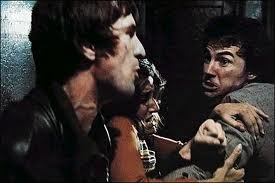
In his breakthrough movie, Mean Streets, Scorsese dramatizes the opposition between virtue and tainted success in the soul of Charlie, the protagonist. Charlie’s moral struggle begins when he is offered a restaurant by his mafioso uncle. It is an item he dearly wants. On other hand he also wants to be a good man. In his voice-over narration at the beginning of the movie — a conversation with himself — Charlie lays out his basic religious beliefs, the beliefs of a Do-It-Yourself Catholic.  “You don’t make up for your sins in the Church, you do it in the streets, you do it at home,” he says. “The rest is bullshit and you know it.” There is never any doubt in the movie about the sincerity of Charlie’s spiritual ambitions, despite his involvement in poolroom brawls, despite his uneasy relations with his epileptic lover Theresa, despite episodes in which he rips off a couple of teenagers looking to buy fireworks and tries to beguile an exotic dancer with a job offer in his new restaurant. At one point, Charlie tells Theresa, “Saint Francis of Assisi had it all down. He knew.”

Can he “make up” for the sin of coveting this restaurant, which he is given only because the previous owner — who commits suicide — has failed to generate enough business to pay off his (presumably usurious) loans to Charlie’s uncle? The offer of the restaurant, which functions in this movie as a symbol of tainted success, or at least the possibility of such success, comes with a heavy price. Charlie’s uncle demands that Charlie stop seeing his friends, the wildly irresponsible Johnny Boy and Theresa.  “Honorable men go with honorable men,” he says, which clearly rules out Johnny Boy, and also Theresa, who is “sick in the head.” Charlie attempts to compromise. “I’ve got to stay away from you and Johnny,” he tells Theresa. “I don’t want to stop seeing you…Just let me get the restaurant first. Then things are going to be easier.”

Such deviousness is hardly the role of a St. Francis, and it’s no wonder that Johnny Boy, fully aware of Charlie’s desire not to jeopardize his chances of getting the restaurant, calls him a “fucking politician.” In the end, however, Charlie refuses to quit entirely on St. Francis. The fate of the characters is unclear after the movie’s violent ending, but it does seem, in the light of that ending, that Charlie has decisively turned his back on the restaurant. What matters about this movie, however, is not its ending but the way in which it has set the terms of the drama in which all of Scorsese’s characters, who do manage to get their hands on the restaurant, so to speak, will become embroiled.

These characters, for one thing, will not be victims. They will not be spiritual depressives, like the characters of Bergman, or neurotics (Woody Allen) or helpless witnesses to existential futility (Antonioni.)  Marie Connelly states the case well in her book, The Films of Martin Scorsese.  “Scorsese’s characters are out hustling, making it in a world that still holds out the possibility of fulfillment of hopes and dreams. Unlike other characters, his do not live lives of ‘quiet desperation.’ His characters are shown from the point of view of the swirling vortex of camera movement punctuated by the beat of contemporary rock music drawing us into their lives.”
In almost all of Scorsese’s movies there is a scene visually confirming worldly success, or at least affirming its promise, usually in the form of certain objects that are almost transcendent in their materialism, objects that seem to validate his characters’ hustle. The materialistic side of Charlie, for example, is established in a scene showing him lovingly tying his tie, with a brand new shirt,  in front of a mirror. The hero of Scorsese’s early feature, Who’s That Knocking on My Door, played by the same actor, Harvey Keitel, also meticulously adjusts his topcoat in a gesture of sartorial satisfaction. A nice car — “That’s the only toy I need,” says its owner — is another symbol of material success in that same movie. Eddie Felsen, the hero of Scorsese’s The Color of Money, his sequel to Robert Rossen’s The Hustler, combines fetishism of cars and fetishism of clothes in a scene where, dressed in an expensive topcoat, he gives his protégé, Vincent, a ride in his Cadillac. “It’s been very good to me,” Felsen says of the liquor business. “I mean, you’re sitting in it and I’m wearing it.” (Viewers of The Hustler will recall that Felsen’s nemesis in that picture, the gambler Bert Gordon, bought himself a fancy new car every year to validate his success.)

“Nice car,” says Vicki, upon being introduced to her future husband Jake La Motta in Raging Bull — what girl doesn’t appreciate a suitor with a hot set of wheels?  Scorsese certainly understands this, but between cars and clothes he seems more fascinated by clothing as a status indicator. The progress of Jimmy Doyle, hero of New York, New York, can be charted by the clothes he wears. At the beginning of the movie, Doyle stands amid the cheering throngs in New York celebrating V-J Day (the entire country enjoying its own tainted success as victor in World War II) dressed in two-toned brown and white shoes, white trousers and a Hawaiian shirt — an outfit he won in a card game. “Do I look like a gentleman in this shirt and these pants to you?” he asks the girl he is inelegantly trying to pick up. (The answer is no.) By contrast, at the end of the picture, Doyle is dressed in a natty dark gray suit (complemented by a pair of black shoes) with white shirt and silver tie. Add a topcoat and an umbrella, and the now successful Doyle is positively dapper.

In general, Scorsese’s gangsters are sharply dressed, if not always in the best of taste. One of the scenes establishing Henry Hill’s tainted success in Goodfellas is the shot of his endless bedroom closet full of suits. In Casino, protagonist Arnold Rothstein, manager of a casino for the mob, is perpetually turned out in matching suit, shirt and tie — red on red, white on white, blue on blue, green on green, cream on cream, lilac on lilac, tangerine on tangerine. “Look at you,” a fellow gangster says at one point. “You’re fucking walking around like John Barrymore. A fucking pink robe and a fucking cigarette holder.”

But there are many other material symbols of tainted success in Scorsese. One of the most notable is the championship belt — “a very rare item,” a pawnbroker tells its owner — won by Jake La Motta in Raging Bull. “I got a nice house, I got three great kids, I got a wonderful, beautiful wife — what more can I ask for?” La Motta tells a reporter in his retirement, sitting by his driveway where two convertibles are parked — but it is this championship belt which radiates talismanic power, the power suited to a winner, and when La Motta literally attacks that belt with a hammer, extracting jewels from it, his fall from grace is graphically demonstrated. (The wife and kids, by contrast, simply drop out of the picture.)

In Casino, the magical object signifying worldly success is the house Rothstein shows his new bride, complete with swimming pool and baby grand piano. This house, plus a chinchilla coat and a drawer full of jewelry, marks his marital covenant with her, in lieu of romantic attachments. (His bride frankly admits that she does not love him, but allows that his house is “great.”) Real estate in another form plays a similar role in The Departed, when the corrupt police officer Colin is shown an apartment in Boston with “a great view of the State House,” by a real estate agent. It’s such a desirable apartment, the agent says, “You move in, you’re upper class by Tuesday.” Colin takes it. He is, after all, a success as a member of an “elite unit” of the Massachusetts State Police, acquiring more and more influence within that unit as the movie progresses. The last scene of the movie shows the view of the State House and the parquet floor across which the blood from Colin’s head oozes. It’s Scorsese’s most succinct and vivid demonstration of the price of tainted success.

The signifiers of tainted success in Scorsese are not always, broadly speaking, material. In Taxi Driver, the hero Travis is hustling for a peculiar kind of success. “Listen you fuckers, you screwheads,” Travis proclaims in his empty apartment. “Here’s the man who would not take it anymore…Here’s the man who would not take it anymore. The man who stood up against the scum, cunts, the dogs, the filth, the shit. Here is someone who stood up.” When Travis fulfills this ambition to “stand up” by fatally shooting a pimp — “the worst sucking scum I’ve ever seen,” Travis says — his success is validated not by material objects but by press clippings.  TAXI DRIVER BATTLES GANGSTERS reads one admiring headline. TAXI HERO TO RECOVER proclaims another. The same form of validation occurs at the end of New York, New York when Francine’s success is shown by a montage of magazines — bearing such names as Screen Idol, Glitter, Stargazer, Fan Club, Photoplay — featuring her face on the cover. It’s the same technique used at the end of King of Comedy, which is why, I think, the latter display of magazine covers is not simply dreamed up by Pupkin.

This affirmation of tainted success via journalism — and news photography in particular — has no direct connection to filthy lucre, but is just as disgusting in Scorsese’s eyes. In The Aviator, photographers are constantly in Howard Hughes’s face — when he unveils a new airplane, when he crash lands and nearly kills himself, when an outraged girlfriend rams his car. These photographers validate celebrity-hood, and in that sense they validate success, but as Kate Hepburn tells Hughes, they are relentless. “When my brother killed himself, there were photographers at the funeral,” she says. “There’s no decency to it.” At best, photographers and journalists miss the point, as in the case of Travis’s press clippings.

All the more interesting, then, when Scorsese himself becomes a photojournalist of sorts in The Last Waltz, his cinematic tribute to The Band. In this documentary Scorsese displays the same sensibility and the same obsessions — including his interest in tainted success — that he brings to many of his films. The success-establishing scene in this movie, for example, is the shot, early in the film, of the long line-ups of fans waiting to buy tickets to the concert. This shot functions in the same way as shots of Henry Hill’s bedroom closet or press clippings do in other movies. After this introduction, the discovery of a hint of corruption in The Band’s success is not long in coming.

That discovery begins when Scorsese, in his interviews with the members of The Band, elicits a sense of innocence lost. One of the band members, Garth Hudson, evokes an idyllic period, in the early days of The Band’s existence, before their fame, when they all lived in Woodstock, N.Y. “We got to like it, just being able to chop wood or hit your thumb with a hammer,” Hudson recalls. “We would be concerned with fixing the tape recorder and fixing the screen door, you know. Stuff like that. Getting the songs together.”

Then came the years on the road, with ever-growing fame, and a different set of rewards. Scorsese delicately raises the subject of groupies and Band member Richard Manuel displays a roguish, slightly goofy grin. “I love ’em.That’s probably why we’ve been on the road,” he says. He pauses. “Not that I don’t like the music.”

This is reassuring news. We wouldn’t want the music to be forgotten. At the same time we are aware that things have changed since Woodstock days, when music was everything. Hudson still clings to some notion of virtue and the performance of music by recalling old jazz musicians in New York who were “the greatest priests” and healers, but the last word is Scorsese’s, and he chooses to end the movie with a curious tableau of The Band playing the melody to the English Renaissance tune “Greensleeves,” about a prostitute.

Some equivalent of Woodstock days, some authenticity, is the flip side of tainted success in Scorsese. It’s not necessary for a character to have explicit religious concerns, like Charlie in Mean Streets — indeed, explicit spirituality drops off the horizon after Mean Streets. (With the striking exception, of course, of Scorsese’s films about Jesus and the Dalai Lama.) But characters still need to remain in contact with something real, something that is not “bullshit,” in Charlie’s words.

A striking instance is The Color of Money, a movie that would seem to be totally devoted to “bullshit,” in the form of successful hustling, and to the naked materialism of its rewards. “It ain’t about pool,” Felsen tells his protégé. “It ain’t about sex, it ain’t about love, it’s about money.” When Vince takes pity on a sucker, Felsen reads him the riot act. “You never ease off on someone like that,” he says. “Not when there’s money involved.” In pursuit of money, Felsen himself not only sets up hustles but also manipulates Vincent and neglects his own lover. “Do you understand me?” Felsen says to Vince and his girlfriend. “We’re business people.”

It’s a funny business, to be sure. “Money won is twice as sweet as money earned,” is its credo. Under the circumstances it is hard to say which is the purer example of tainted success — the success of the sucker who wins a pool game in the process of being strung along by the loser of that game (the hustler), or the triumph of the hustler who walks away with all the money he can extract from the sucker. Yet this is not the last word, either. Even Felsen, at the end of the day, wants to define himself as a great pool player rather than a great hustler or a great businessman. After he beats Vince at the pool table, in what seems to be a genuine contest between the two men, Felsen is dismayed when Vince subsequently reveals that he “dumped” — that he let Felsen win. Felsen pleads with Vince’s girlfriend near the end of the movie, “I want his best game.” There is no doubt about the sincerity of his plea. It is about pool, after all.

This clinging to a measure of authenticity in a corrupt world can seem senseless, as in Jake La Motta’s taunt to Sugar Ray Robinson after the latter has beaten him to a pulp in the ring — “You never got me down,” proclaims the pulverized La Motta, while an unsettled Sugar Ray stares at him in disbelief — or Arnold Rothstein’s insistence on placing his fate in the hands of his prostitute wife, because, as he says, “When you love someone you’ve got to trust them. There is no other way. You’ve got to give them the key to everything that is yours. Otherwise, what’s the point?” These points of honor do seem senseless — but La Motta must be able to see himself, despite everything, as a man who does not give up or surrender, and Rothstein must be able to see himself as a man who knows the value of trust and lives by it. If they lose this ability, then, as Rothstein says, what is the point?
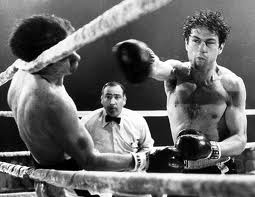
A man must define himself as something. Scorsese’s Howard Hughes, in the course of unsavory relationships with young girls and involvement in the corruption of military contracts, never loses sight of his self-definition as aviator. That is what he is, and no one can take this away from him. A vague sense of the male imperative of self-definition lies behind the comment made by the hero of Who’s That Knocking On My Door to his girlfriend. “Everyone should like westerns,” he says. This curious statement clearly has something to do with the protagonist’s notion of the western hero. What can that notion be? Robert Warshow articulated it most clearly in a 1949 essay on the western. The western hero, wrote Warshow, in an essay republished in his 1962 collection, The Immediate Experience, “fights not for advantage and not for the right, but to state what he is, and he must live in a world that permits that statement.”  Scorsese’s Hughes is a businessman, but he is not really interested in corporate empire building. He is interested in stating what he is, and that thing is not a businessman but an aviator. Scorsese’s Felsen may insist that he is a businessman, but when the pressure builds within him to state what he is, that something is a pool player.

The western hero is also a figure for whom love is notoriously an irrelevance, a reality Scorsese confronts in a number of his movies. “This is the most important thing to me besides you, you understand?” says Jimmy Doyle to his wife Francie, referring to his saxophone. “If I can’t do this, then I’m no good for you and I’m no good for anybody.” (The symbol of his authenticity seems to be the scene in which he uninhibitedly plays this saxophone in a Harlem nightclub.) The equally talented Francie, a singer, seems to have a more relaxed attitude towards her art — it does not define her quite so urgently. Yet New York, New York is one of Scorsese’s most interesting pictures precisely because it does portray a marital union of equals, in which love and self-definition should presumably co-exist. Certainly Francie is never in danger of becoming an irrelevance. When she starts making compromises with her art it undermines her husband’s self-definition. “You got everything, man,” he tells her. “You got it easy and I got nothing.”

In the end both settle for tainted successes. Echoing Charlie’s desire for a restaurant in Mean Streets, and answering his own complaint that he has “nothing,” Doyle becomes owner of a restaurant/night club — a classy joint, but Doyle is no longer the sax player who “blows a barrel full of tenor.” Francie goes Hollywood and stars in a sentimentalized version of her own career and marriage in a movie entitled Happy Endings, which Doyle aptly calls Sappy Endings.

The sluggish and rather forced quality of the movie — whatever spark it possesses comes not from music or sexual tension but from Doyle’s obnoxious qualities, which De Niro, in his fashion, plays all too well — is an indication of how uneasy Scorsese is with romance. Behind romance lies domesticity, and his men are too restless for domesticity, no matter how enticing home and hearth might sometimes appear. Jesus’s yearning for a happy family life with Mary Magdalen is literally The Last Temptation of Christ. He rejects it, of course.

 In portraying this search for authenticity via some skill, art, talent or hustle, it is very difficult to escape the male point of view. In Alice Doesn’t Live Here Anymore, Scorsese gives us a female point of view, which is very instructive. His heroine, Alice Hyatt, goes on the road in pursuit of a career as a chanteuse. It’s not a promising pursuit. There is no reason to suppose she is any more talented than Rupert Pupkin, and unlike Pupkin, she is unwilling to enact some desperate gambit in order to succeed. Eventually she gives up and accepts happiness in the arms of David, a solid character. In some remarks on this film, Scorsese has indicated he views the ending as an unfortunate reversion to domesticity on Alice’s part, but few viewers will feel that Alice has made a huge mistake in embracing Kris Kristofferson. It’s not as if she has a promising career up her sleeve. There is no success, tainted or otherwise, for Alice, but not a sappy ending either. It’s just not the kind of ending Scorsese can imagine for his male protagonists.

Why is it so difficult in this world for a man to attain a success untainted by sacrifice of his integrity? For a Catholic like Scorsese, the answer is no mystery — we are fallen beings, in a fallen world. Scorsese’s work dramatizes, more than the work of any other American director, the anguished complaint of St. Paul: “For the good that I would, I do not: but the evil which I would not, that I do.” It may be the case, given lapsed Catholic Scorsese’s own comments about his reprobate status, that he views his own body of work as a tainted success, purchased at the price of his immortal soul.
Certainly Scorsese seems to have lost interest in his earlier theme of redemption, exemplified by movies such as Mean Streets and Raging Bull. Whether the redemption of Jake La Motta is convincing or not, the ending of the movie certainly nudges the reader to drop the Pharisee attitude and look at La Motta’s life through supernatural lens — to see La Motta as the unlikely recipient of grace. Latterly, there seems to be no such attempt on Scorsese’s part. The overtly religious movies he has made — The Last Temptation of Christ and Kundin — may have actually hastened his retreat from the realms of theology because of the failure of either his Christ or his Dalai Lama to emerge as vibrant characters or because of his own failure to overcome the extremely difficult narrative challenges presented by these movies. They call for a degree of sincerity that Scorsese can’t provide — they aren’t his stories and he has only so much leeway to make them his own. How much more excited Scorsese is in dealing with the character of Howard Hughes. There’s a man — an artist demanding perfection at whatever cost, a maverick, a daredevil — close to his own heart. The screen bristles with life and tension every time Hughes appears. But Scorsese can’t redeem him. Hughes demolishes his enemies at a Congressional hearing and proves he is an aviator one last time with the successful flight of the Spruce Goose, but neither of these triumphs wards off the madness waiting to overwhelm him.

 His recent concert film Shine A Light, has a dismal effect on the viewer. Scorsese clearly admires the Rolling Stones as a supreme example of hustle, which is why their music is so often heard on the sound track of his movies. But the spark has long since gone out of this particular hustle. Asked recently by an interviewer, “Are you amazed, surprised, delighted that the Stones have lasted this long?” their first manager Andrew Loog Oldham replied, “I wasn’t aware they had lasted this long.” Watching this movie, Oldham would have no grounds for changing his mind. Certainly in this concert movie there is none of the emotional resonance of The Last Waltz, which evokes a complete narrative arc from Woodstock days to the death of the Band. The Rolling Stones never had a Woodstock period of chopping wood and fixing screen doors and writing songs, and it appears they will never bid farewell to public performances while they are physically capable of walking on stage. In the rock solid wall of this dogged careerism and unrelenting appetite for adulation, there is no place for redemption to catch hold. In one of the cleverer moments of the film, Mick Jagger bursts out of a side door to sing “Sympathy for the Devil” with his off-key “woo woos.” Scorsese lights that space behind the door a lurid red, as if Jagger is just emerging from some kind of cheesy inferno. It’s a playful touch, but not entirely a joke to the director whose character Charlie, in Mean Streets, muses on the eternal flames of hell.

An interesting question is whether Scorsese has dropped this theme of redemption because of an intellectual or emotional change in his own makeup, or whether he has dropped it because he has perceived, with his highly sensitive antennae, something increasingly dark in the American landscape.

—Philip Marchand

.

Philip Marchand was born and raised in Pittsfield, Massachusetts, and attended the University of Toronto, where he obtained a B.A. and an M.A. in English literature. Afterwards he spent several years as a free lance magazine writer in Canada. A collection of his 1970s journalism was published in 1976 under the title of Just Looking, Thank You: An Amused Observer’s Views of Canadian Lifestyles, by Macmillan of Canada.  An unsympathetic critic termed the book the poor man’s Tom Wolfe and he may have been right. The author is not sure he wants you to look it up if you are so inclined.

A more credible book was his 1989 biography entitled Marshall McLuhan: The Medium and the Messenger. A slightly revised edition, with a foreword by the late Neal Postman, was published by MIT Press in 1998. It is still in print for all I know. In a recent article in the New York Review of Books, Pico Iyer called it “delightfully readable.”

Marchand has also written a crime novel, the 1994 Deadly Spirits. Again, the author is not sure he wants you to look it up. It’s okay, but not great.

Finally McClelland & Stewart published Marchand’s  Ghost Empire: How the French Almost Conquered North America in 2005. (An American edition was published by Praeger in 2007.) This is a great book and you really should read it. It’s a mixture of travel, memoir and history.

From 1989 to 2008 Marchand was books columnist for the Toronto Star. He currently writes a weekly book review column for the National Post.

He is married and lives in Toronto.

.
.

—Philip Marchand (himself)

Dec 292011
 

This is a classic music video (in the ironic sense). A brilliant avant garde something or other written by John Cage. You might want to think of the famous blank chapter in Laurence Sterne’s Tristram Shandy as you watch/listen to this magnificent work.

I myself am making preliminary notes toward a complete blank novel, epic in scope, called, poignantly enough, Emptiness.

dg


Dec 232011


Everything Starts With Language: Gary Lutz’s divorcer

A Review by Jason DeYoung


Gary Lutz
divorcer
Calamari Press, 2011
117 Pages, $13.00

Gary Lutz’s seven stories in divorcer are preposterous—in the best possible way. They disobey logic, scorn common storytelling technique, and frolic with destabilizing off-plot descriptions that are at once powerful and confounding. Yet Lutz never loses sight of his character’s emotions and how they squirm to “get around to” their lives.  He respects his characters—despite the grim maze of humiliations he puts them through—by giving them some of the best writing out there to take breath in. Built from an intense, ferocious vocabulary, Lutz’s fiction decries the mere functionality of language. Each unnerving story uproots expectations and delights with showing the reader the sun of a new approach in sentences that range from the overgrown to the monosyllabic to the fill-in-the-blank.

divorcer is Gary Lutz’s third full-length collection of stories (Stories in the Worst Way from Calamari Press and I Looked Alive from The Brooklyn Rail/Black Square are the two others, and A Partial List of People to Bleach is fourth collection, which was published as a pamphlet from Future Tense Books).  Lutz lists Barry Hannah, Sam Lipsyte, Christine Schutt, and F. Scott Fizgerald as influences, and he is a former student of Gordon Lish, who published many of Lutz’s early stories in the legendary The Quarterly, the avant-garde journal Lish ran between 1987 and 1995 (publishing (and introducing) such writers as Don Delillo, Nancy Lemann, Thomas Lynch, Tim O’Brien and Numéro Cinq’s Capo di tutti capi Douglas Glover).

Continue reading »

Dec 222011
 

The tried and true revenge plot takes on a decidedly yuletide flavour as “Treevenge” explores the trauma and abuse Christmas trees face, and then offers a cathartic glimpse into their ultimate, bloody revenge.

The film was created by local (to me) Halifax filmmakers Rob Cotteril and Jason Eisener who first got notice for their fake film trailer for “Hobo with a Shotgun” which won Robert Rodriguez’s SXSW Grindhouse Trailer Competition and was featured as part of the double feature theatre release of Rodriguez’s and Quentin Tarantino’s Grindhouse. They have since developed the fake trailer into a real film featuring Rutger Hauer.

Happy Holidays to everyone. Especially the trees.

–RWGray

Dec 212011
 

Here are three spoken word poems & recordings from a brand new collection by Toronto poet Liz Worth who is also the author of an unforgettably named nonfiction book Treat Me Like Dirt: An Oral History of Punk in Toronto and Beyond. The poems are personal/social commentaries, incantatory, and replete with surrealistic detours and juxtapositions and the three-syllable latinate nouns characteristic of the genre. The collection is called Amphetamine Heart, published by Guernica Editions. Liz Worth has also written three chapbooks, Eleven: Eleven, Manifestations, and Arik’s Dream. She lives in Toronto. (Author photo by Don Pyle.)

dg


Amphetamine Heart: Poems & Readings

By Liz Worth
.

.

On Cheetah’s Speed

we are taut and directionless,
networks of revolutions suspended
like fingertips to a temple,
poised and blurring into white spider legs,
their ends painted an intrusive shade of red.
At this angle everything looks better from the left,
even the accelerated aging of blondes.
Warts of perspiration radiate,
glossed by black lights and exit signs.
We are marked as wounded, fragile,
the stimulated strength beneath us, between us,
imperceptible.

. Continue reading »

Dec 202011
 

Here’s a wild and extravagant fictional account of a parallel-Barack Obama, a Barack Obama who never was but exists—as the imaginary biracial Dexter Arjuna—in the fevered imagination of a writer who, like Robert Coover or Thomas Pynchon or Don Delillo, takes contemporary events and re-invents them as satire and myth (and, yes, a teachable moment). Adam Lewis Schroeder was one of my favourites back in the Paleolithic when I edited Best Canadian Stories (his stories appeared in the 1999 and 2004 editions). He had traveled and lived in the Far East, especially Indonesia, and his inspired stories were rich with mystery and cultural observation and the clash of tradition and modernity.

Adam grew up in Vernon, British Columbia, and now lives in Penticton with his wife and kids.  He is the author of the fiction collection Kingdom of Monkeys (2001) and the novels Empress of Asia (2006) and In the Fabled East (2010.) Douglas & McIntyre will publish All-Day Breakfast, an apocalyptic road novel, in Spring 2012.  He teaches Creative Writing at University of British Columbia Okanagan.

dg


The Fairy Tale of Dexter Arjuna, President-Elect

Adam Lewis Schroeder


Since the election on November 4 the fact of Dexter Arjuna’s biracial identity has been extolled even more often than the 2:1 majority with which he dominated the Electoral College, as though those mundane descriptions heard early in the campaign—“the candidate, whose mother was Indonesian” or “the Democratic nominee, who is half-Asian”—could suddenly not do him justice.  The very moment the election was called—11:07 EST, as many will recall—CNN, Fox News, the BBC World Service, Al Jazeera and the regular networks simultaneously took the phrase “the first biracial president-elect” into their mouths like dogs with a particularly meaty bone, as if simply being half-white and half-Indonesian were far too narrow a description for the epicentre of such support from the American electorate.  Because a president-elect who is biracial might be any combination of half-black, half-Latino, half-white, half-Jewish, half-Asian, half-RFK, half-Gandhi or half-MLK.  His heritage is the heritage of the beholder—hybrid vigour indeed.  What’s more (and could the networks have been unaware of this?) biracial seemingly straddles interracial and bisexual so that as Dexter Arjuna delivered his acceptance speech beneath Seattle’s Space Needle he was not just throwing the gauntlet down at the feet of foreign oil, terrorists, corporate bullies, bipartisan whips and extremists of any stripe save those committed to freedom, he appeared as all people to all people while simultaneously having carnal knowledge of all people.  “Yes, we can,” he declared, and a billion viewers world-wide were simultaneously sated and seduced (with the meagre exception of some 40 million American Republicans.)  Such was the power of President-elect Arjuna’s voice; his profile; his dreaming-yet-wrought-in-iron, 1000-yard stare; the untapped power at the corners of his mouth; and his cosmic new label—Biracial!  (Eternal! a hysterical crowd might mouth in the same breath.  Unyielding!)  Yet to side-step the plain fact that he is Indonesian on his mother’s side is to never comprehend the events which truly brought Dexter Arjuna to power.

  Continue reading »

Dec 192011
 

L’Immacolata: The Feast of the Immaculate Conception, in Liguria,[1] Italy,
By Natalia Sarkissian


http://www.youtube.com/watch?v=5P-cFj57ar4

Vivaldi-In Turbato Mare Irato, RV 627

(click and listen to the motet[2] sung by soprano Susan Gritton while viewing the following photographs)

.

On December 8, schools and businesses close throughout Italy. It’s the Feast of the Immaculate Conception.[3][[3]]A doctrine of the Roman Catholic church, the Immaculate Conception signifies that the Virgin Mary was conceived free of original sin. As dogma, it is conceptually distinct from the virginity of Mary and the virgin birth of Jesus.

Continue reading »

Footnotes    (↵ returns to text)

  1. Liguria, a narrow strip of land to the north of Italy, lies on the Ligurian Sea and is ringed by mountains (the Alps to the north and the Appenines to the east). Liguria is one of the smallest regions (1.18% of the total land mass of Italy). Of this, 65% of the Ligurian region is mountainous with the remaining 35% made up of hills.
  2. According to musicologist Margaret Bent, “a piece of music in several parts with words” serves as definition of the motet from its inception in the 13th century and beyond. The Medieval theorist, Johannes Grocheio, believed that the motet was “not intended for the vulgar who do not understand its finer points and derive no pleasure from hearing it: it is meant for educated people and those who look for refinement in art.”
Dec 162011
 

The Irish writer John Banville once said, “Under the artist’s humid scrutiny the object grows warm, it stirs and shies, giving off the blush of verisimilitude; the flash of his relentless gaze strikes and the little monsters rise and walk, their bandages unfurling.”  Brad Watson’s characters come to life thusly, little monsters dreaming through Gulf Coast towns, lazing on the beach, jumping off garage roofs, walking into the path of shotguns, being abducted by aliens or seduced by palm-reading, poolside gypsies. His stories are inhabited by flawed, fascinating and fully realized characters. They come to life in places so heartbreaking and familiar, so thoughtfully imagined, that to read a Brad Watson story is to leave yourself, which is the point, after all.

Watson was born in Meridian, Mississippi in 1955. He now lives in Wyoming and teaches writing and literature at the University of Wyoming. A self-described ‘misanthrope’, Watson was anything but misanthropic over the course of several email exchanges and a phone interview. Warm, affable, funny and blunt, Watson’s personality is a mirror of his writing. What’s most admirable about his stories are their willingness to stare life down, in all of its infinite complexity and messiness. His characters survive, even transcend, the darkest moments of being, and though the journey is often dark, it is also tender, funny and real. They are abundantly human stories,  yet dreamy, wispy things in their rendering.

 Watson has written two collections of short stories. His first, The Last Days of the Dog Men, won the Sue Kaufmann Prize for First Fiction from the American Academy of Arts and Letters. His most recent collection, Aliens in the Prime of Their Lives,  was a finalist for the PEN/Faulkner Prize in Fiction and the St. Francis College Literary Award.  Two of his stories, “Visitation” and “Alamo Plaza,” were selected as PEN/O’Henry Award winners and included in the 2010 and 2011 PEN /O’Henry anthologies respectively. His novel, The Heaven of Mercury, was a finalist for the 2002 National Book Award.

I reach him in his office in Laramie. It is late afternoon, and he has just finished making copies of his students’ theses. Watson speaks softly, with just a hint of a Mississippi drawl, more noticeable in the slow cadence of his words than by any twang in his speech. He asks if can call me back because his son has phoned with a homework problem. His son is a senior in high school and lives in Alabama. Watson apologizes (unnecessarily) for the interruption. We talk for the better part of an hour. At times, I lose track of the fact that I’m trying to takes notes on what he’s saying because I find the conversation so interesting.

—Richard Farrell


Making the Little Monsters Walk: An Interview with Brad Watson

 By Richard Farrell


Richard Farrell (RF): I’d like to start with a question The Paris Review once asked of Arthur Koestler: What do you dislike most of all?

Brad Watson (BW): (laughing) Rules. Rules and the people who follow rules, who are obsessed with keeping them and enforcing them. Assholes who get uptight and yell at you if you cross the street the wrong way. That kind of bullshit. But you can apply it across the board.

RF: You’ve travelled around a lot.  You’ve grew up in Mississippi and you lived and worked in Alabama, Florida, in Los Angeles and Boston. You’ve lived in Wyoming for the last 6 years. And one of the things that struck me about your writing is how deeply important a sense of place is to your work. I wonder if your sensibility about place in your writing evolved out of so much movement in your personal life.

BW: In a sense, yes. My life and imagination are deeply rooted in Mississippi and Alabama, so my stories still seem to arise from that and there. But being away also intensifies that imaginative connection and even frees it up, somewhat. You’re able to be there in your head, unaffected by the present circumstances of actually being there. So in a way it’s more purely imagined.

Continue reading »

Dec 162011
 

Brad Watson’s novella, “Aliens in the Prime of Their Lives,” is like a recursive dream.  You’re never certain about where one dream ends and where reality (or the next dream) begins.  At first glance, it appears to be a simple love story about Will and Olivia, two high school kids living in Mississippi. When Olivia becomes pregnant, they marry, rent a small apartment near a mental hospital and suffer through an oppressive, breezeless summer. Their ambitious love-making disturbs the landlady; their families object to the arrangement; they survive on leftovers and beer. One night, Will wakes and finds a strange couple sitting in his living room. They are familiar yet unnervingly strange. “‘We’re what you might call aliens,’ the woman said.” After this, things change in the story, in dramatic, funny, hopeful and heartbreaking ways.

Watson has re-written the contemporary love story. He challenges the basic assumptions of dreaming and waking states, questioning the idea of destiny and meaning. Part fantasy, part social commentary, part meta-fiction, part Southern Gothic, part autobiography, Watson’s novella bends conventional boundaries in weird and wild ways.  “Young people don’t just drive around, bored, drinking beer and crashing into trees and other vehicles, slashing and flailing away at one another in parking lots and vacant lots out of rage or boredom,” thinks the narrator near the end of Aliens.  Watson makes you wistful for those times.

Watson has written two collections of short stories. His first, The Last Days of the Dog Men, won the Sue Kaufmann Prize for First Fiction from the American Academy of Arts and Letters. His most recent collection, Aliens in the Prime of Their Lives,  was a finalist for the PEN/Faulkner Prize in Fiction and the St. Francis College Literary Award.  Two of his stories, “Visitation” and “Alamo Plaza,” were selected as PEN/O’Henry Award winners and included in the 2010 and 2011 PEN /O’Henry anthologies respectively. His novel, The Heaven of Mercury, was a finalist for the 2002 National Book Award.

Read an interview with Brad Watson here at Numéro Cinq.

—Richard Farrell


From “Aliens in the Prime of Their Lives”

By Brad Watson


In the moment after the couple from the asylum had left us that previous night, when I had begun to construct our little paradise in my mind, Olivia had awakened, dressed quietly, crept from the house, down the steps from the rickety deck, and walked away.

As she walked, and as dawn seeped into the cooled August air, the landscape began to change until she knew she was no longer in our little hometown.  It was as if she didn’t know where she was, or where she wanted to be, and the landscape continually reshaped itself with the beautiful, disorienting whorl of a kaleidoscope turned by an invisible hand.

She put her own hand to her belly as she walked.  It was flat and soft.  Well, that was gone.  That had ceased to exist.  That was not a problem anymore.

Continue reading »

Dec 152011
 

“Why don’t clouds float along the ground?” one of the young girls in Jane Campion’s short film “The Water Diary” asks. The film itself meditates on things as unreachable as these: the clouds, a child’s comprehension of all these adult mistakes, and any solution to the environmental disaster these people are enduring.

Campion’s contribution to the United Nations’ 8 film project tackles the seventh goal of the United Nations’ eight Millennium Goals: “ensure environmental sustainability.” Numero Cinq already presented the fifth film, Jan Kounen’s “”The Story of Panshin Beka” (you can see it and the intro here). The film shares a quirkiness with the Jane Campion’s “Passionless Moments” short films which Numero Cinq also presented (you can see them here).

The film places the central issue in the hands and imaginations of children. The child whose diary narrates the film has a perspective limited by her innocence but unlimited by her imagination. She cannot see where the horses have gone at first, her friend calls the central issue “global warning,” and she imagines impossible worlds where there are clouds on the ground and dancing mattresses. So where the adult response to the catastrophe in the film is to have dreams of rain and commit awful sacrifices, the children are able to each take their own small steps and imagine a possible solution.

What fuels the children and this story is the way the children seem to understand sacrifice and pain better than the adults. The horses provide the most visceral and material metaphor for the price these children are paying for their parents’ poor environmental choices. The narrative sees no solution in this sacrifice though, just further adult missteps. As one child warns, “If they think we’re going to look after them when they’re older, they can just forget about it.”

Campion uses extreme long shots to emphasize the landscape and its relationship to the small children in it. The children often appear in the lower corners of the frame or to the side, as in the last shot of the girl playing the viola. Though the children are perhaps diminished, what Campion emphasizes through these shots is how connected these children are to their environment and that small gestures, even single tears in a glass of water, can cause change.

Campion leaves the ending ambiguous. On the one hand what we imagine comes next depends on our own cynicism or imagination. On the other, the point of this story is not the rain, but the spirit, drive and sacrifice to cause change in the world – to fix what has been broken.

–RWGray

Dec 142011
 

Sprezzatura is a Renaissance term/style: nonchalant, natural, apparently careless though, in fact, the opposite—a pose in a sense, an attitude, a rhetorical stance.

Alan Michael Parker is a poet-novelist, that is, he began his career as a poet, has published five volumes of poetry, an impressive and expanding opus. The last book Elephants & Butterflies is, as it should be, perhaps his best, confident, urban, urbane, knowing, acerbic, witty, quick, cutting and surprising. Parker has a way of talking about God and TV dreck in the same moment. He has made sprezzatura his own.

Dear God who made me act
in whose gaze I am rerun
now I lay me down

Alan is an old friend and colleague from dg’s stint as the McGee Professor of Writing at Davidson College in North Carolina. He had the good taste to marry a Canadian, the painter Felicia van Bork. He is a prolific poet and a novelist, a poet-novelist, a wry, energetic presence with a gift for teaching and satire.

dg

Sprezzatura with Two Rabbits

By Alan Michael Parker

.

Talking to the two rabbits in the herb garden, I could be Gerald Stern,
the way he talks to everything, my god,
and really Gerald Stern is always singing to everything,
and everything is singing back.

I tell the rabbit on the left her name is Plato,
and the rabbit on the right she’ll have to wait for a name
because so many names are just a necessarily lesser quality
of an original thing. I call both rabbits “she.”

I describe to the rabbits Gerald Stern’s childhood in Pittsburgh,
his Greek roses and his Borscht Belt beauty and his poem about Auden;
predictably, the rabbits don’t seem to care about my story,
jittery and motionless in their agitation, while the stiller I have to stand

to keep my audience, the more some muscle in my left arm
starts to twitch like a bad rhyme,
or like a captive princess kicking over the table
in a fable when the witch wants rabbit stew.

But since I killed so many rabbits in a poem in 1996
with a shotgun—my best weapon then, before I learned to
write about my family—I feel too guilty in advance
to kill and skin and cook and eat

a rabbit named Plato or her pal.
Writing poems makes me hungry for what I can’t have, sometimes,
which I think Plato probably knew about poetry, but I need to Google it.
FGI, I tell myself all the time, Fucking Google It.

But now one of the rabbits is named Plato and the other’s Gerald Stern,
a combo I’m surprised by, although I suspect that
this poem suspected so all along, and named both rabbits
“she” only as a ruse. Hop away, hop, hop,

hop away free, you bunnies: go back to the greatness
of the garden, your fur dusted with sage and thyme, your lives
opening into a warren filled by the mind of God,
with carrot tops, twenty-seven brothers and sisters, and endless sex;

free of the human need to name, or our crude ambitions
to see whatever light we hope to see,
and hop up and down as we shout the light! the light!
before we’re gobbled up by mystery.

—Alan Michael Parker

Dec 132011
 

Kazushi Hosaka ©Yomiuri Shimbun
.

The In-Between Generation

A Review of Kazushi Hosaka’s Novel Plainsong

By Brianna Berbenuik

.

Plainsong
Kazushi Hosaka
Translated by Paul Warham
Dalkey Archive Press
176 pages; $17.95

Kazuchi Hosaka’s first novel Plainsong is full of characters who read like Japanese versions of Bret Easton Ellis’s narcissistic, directionless young Americans.

They seem trapped in limbo, on an aimless pursuit while an older generation overtakes them. They suffer from what you might call premature nostalgia, a Quixotic expectation, an empty yearning for something that doesn’t exist for their generation but was ever-present for generations before.

Hosaka’s characters are like ghosts; they are never quite fully fleshed out and remain incomplete – an eerie transience, in a sense trapped in the plight of their generation. None of the characters is particularly rebellious, though perhaps the more eccentric ones, like the jobless and outwardly childish Akira, think of themselves as rebels.  They are, after all, an “in between” generation.

Hosaka was born 1956 within the same decade as two better-known Japanese authors: Haruki Murakami (IQ84 and Kafka on the Shore) and Ryu Murakami (Almost Transparent Blue and Coin Locker Babies). Haruki Murakami established himself as a literary giant with a distinctive style often aligned with magic realism (in Plainsong the nameless protagonist mentions that he once wrote an article about Haruki Murakami); Ryu Murakami writes about sex, drugs and the disenfranchised youth of Japan; Kazushi Hosaka, in contrast, has taken on the subtle and quiet themes of everyday people, exploring relationships with a delicacy and sensitivity that gives his writing a “naked” feel without being too revealing.

Hosaka’s prose is sparse and minimalist. His slender novel is a meandering journey, almost dream-like despite the plain, everyday details.  The action takes place in 1986 (when Hosaka would have been thirty). The nameless narrator’s girlfriend has just left him; he suddenly finds himself accumulating a steady stream of strange house guests.  The novel allows you to watch the characters through the eyes of the narrator, but does not allow you intimate access to their thoughts or feelings.  They are passing acquaintances; simple, transient people entering and exiting the reader’s field of view in the course of the novel.  At the end, they are easy to let go.  Like a passing satellite view – you’re there, then you’re gone and over different terrain.

Continue reading »

Dec 122011
 

Xu Xi (Photo by W. McGuire)


XU XI is an old friend, and colleague. This short story “Lady Day” is XU XI channeling Charles Dickens, at least to the extent that she originally wrote it for serial publication in the Hong Kong magazine Muse, much as Dickens did with his novels (serial publication, not in Hong Kong–in London–oh, the horror of dangling modifiers!). XU XI used to live in Plattsburgh, NY, and oscillate back and forth to New York. Often she would stop in Saratoga Springs, and she and dg would have coffee at a restaurant called  Scallions. There is less of that now, regrettably, since XU XI spends much more of her time in her native Hong Kong where she also teaches writing. DG misses those visits. But it is some consolation to be able to publish this lovely story, which, besides being in the magazine, also appears in XU XI’s brand new collection Access Thirteen Tales (Signal 8 Press, 2011). See early reviews of the book here http://www.susanbkason.com/2011/11/14/book-of-the-week-access/ and here at The Hindu.

XU XI is a Chinese-Indonesian Hong Kong native and the author of nine books of fiction and essays, including the novel Habit of a Foreign Sky (2010), shortlisted for the Man Asian Literary Prize.  In 2010 she was named Writer-in-Residence at the Department of English, City University of Hong Kong, where she established and directs the first international low-residency MFA in creative writing that focuses on Asia and writing of Asia. “Lady Day” was serialized in a three-part bilingual (Chinese/English) publication in Muse, Hong Kong, Issue 11, 2007 & Issues 12 & 13, 2008.

dg
.

Lady Day

by XU XI

.


It’s the stiff collar—tightly buttoned, covering the entire neck—that draws the eye to the lips. Makeup, high heels, and the walk are second nature; thighs—firm, barely, silkily there—flash through the fitting cheongsam’s side slits. Their glances, discreet or longing, slide up the leg, over the hip, away from the front and round back to where my black hair falls, like some endangered feline’s tail, long enough to sit on. I pass as easily here in Amsterdam as in New York, with less complications.

Medical complications are something else. Outwardly, nothing’s changed, not yet. But inwardly, I feel different, and know that the onset about which I’ve been warned has probably begun. There are things inside you can’t deny, and the best physicians and all the money in the world won’t yield the desired return.

Right now, though, I’ll live these nights, playacting a little longer. Tonight’s the “dynamic duo.” Double jeopardy, double the return. It’s their third transaction this week, the last night of their little “business trip” to the continent. They’re having the time of their life. Those boys obviously like my wares.

What I miss, what I’ll never get back, is the rush of control, the game of being her. Running the whole show on my terms. Many returned. Repeat business; Bernard taught me well.

Waan yuen, as Daddy might have said. Party’s over. No one to blame, not even Hewitt.

But most of all, I’ve missed daylight.

Continue reading »