Apr 042011
 

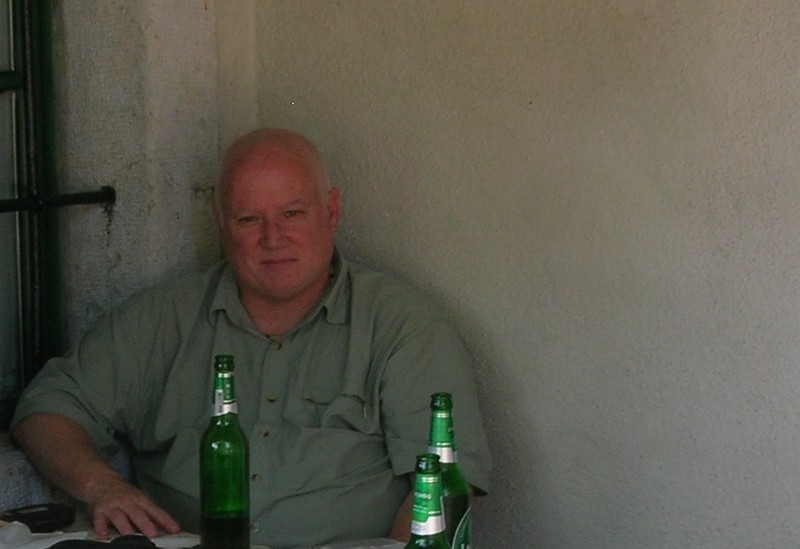
Here is a gorgeously bittersweet new poem by Sydney Lea whose ninth collection of poems, Young of the Year, has just been published by Four Way Books. Syd is an old friend from my early Vermont College of Fine Arts days (see my introduction to his fine essay “Weathers and Places” published earlier on NC). I also interviewed him when I had my radio show, The Book Show out of WAMC, the Albany, NY, public radio station. Somewhere in the Black Hole of a crawl space accessed through my sons’ bedroom there is a box of tapes I saved from that show. I always mean to dig out the interview and replay it—lovely talk of dogs, birds, hunting and nature. Syd tells me he wrote this poem after watching the movie Away from Her which is based on an Alice Munro short story called “The Bear Came Over the Mountain.” The movie stars Julie Christie and the Canadian actor Gordon Pinsent whom I have always admired, especially his great and underrated movie The Rowdyman. Pinsent plays the bereaved husband of a woman who suffers from dementia, forgets him and, in a mysteriously touching reversal, finds new love in the home where she is kept. In my mind, Sydney Lea and Alice Munro have a great deal in common; they are both achieved artists in whose hands even the most difficult things are elaborated with force, delicacy and apparent ease. Syd’s poem captures beautifully the wistful mystery of lost memory and love, the strange turn (just sailing away, it seems) of the long-loved one into the open sea.

dg

Forever

By Sydney Lea


She wonders if it’s cliché to think of the husband
with whom she’s lived for decades,
most of which she’d call, all things considered,
a pleasure — if it’s cliché to imagine her partner
a ship at the lip of a clouded horizon.

In fact he’s sailed the whole way over.
And then she wonders why she should wonder this,
why it would make any difference, trite or fresh?
And what does she know about ships?
Early on, as they sat one morning together,

he felt in his pocket for his car keys,
held them up against the kitchen’s skylight,
whispering “Bullet. Bullet.”
It passed, they embraced, both a little uneasy,
but he left for work as always.

For what seems to her now quite a while they kept it away,
that morning, unmentioned, conspired into absence.
After all, there seemed nothing
that either could do about it then, and nothing
of course to be done today.

What does she know about ships, about sailors?
No, nothing either,
though once as a girl she was carried out on a bay
in a rich friend’s yacht. The cold white spray
flew gunwale to gunwale. And there’s more she remembers:

they all could have slept in the boat’s tidy cabin
in comfort, if that had been part of the outing’s plan.
And the tiller wheel was made of such dark lovely wood,
and everything else on board
showed some sort of glass or some bright brass fitting

and the life-rings that hung on the taffrail
were stenciled Claire C., the name of the boat.
It all made her feel she could never want anything more
when it came to beauty. That gleam. That air.
He had beauty as well.

back when he was the young man she chose
to live and sleep with ever after.
They made children together. They said they were blessed.
The beauty, which changed of course with the decades, was nonetheless
beauty. She still supposes it so,

though it swamps her soul
to watch him sink out of reach, unheeding.
Why can’t she call him up? Why can’t she call him to her?
Her mind shifts back to her girlfriend’s father,
who kept inspecting a tiny crack in the sleek sloop’s hull,

no matter his pretty wife’s counsel
that he relax, that he live for this day
of wheeling seabirds, foam and speed,
sharp-edged, slam-bang clouds,
heady squeaks and snaps from mast and mainsail.

The husband worried, the husband
insisted it might be only a matter of time
before that inconspicuous fissure turned into much more.
He was looking for something to do about it there
and then — as of course he couldn’t.

He said he hated to think of his treasure,
his own Claire C., beyond recall, to imagine the day
when off it might be
— he used the cliché —
to Davy Jones’s locker with her. Forever.

—Sydney Lea

Mar 252011


—Photo by Carl Olsen

Nancy Eimers has been a colleague and a friend at Vermont College of Fine Arts longer than I can calculate. Very long. She has this look, when I see her, as if she’s a bit worried about me, as if there is something to worry about besides the stuff I already know. Then she smiles—such a relief. Her readings at our residencies are always occasions. Here are four Nancy Eimers poems from her hot-off-the-press poetry collection, Oz, published in January from Carnegie Mellon University Press. Her three previous collections are A Grammar to Waking (Carnegie Mellon, 2006), No Moon (Purdue University Press, 1997) and Destroying Angel (Wesleyan University Press, 1991). She has been the recipient of a Nation “Discovery” Award, two National Endowment for the Arts Creative Writing Fellowships and a Whiting Writer’s Award, and her poems have appeared in numerous anthologies and literary magazines.  Nancy teaches creative writing at Western Michigan University and at the Vermont College of Fine Arts, and she lives in Kalamazoo, Michigan.

dg

Four Poems from Oz

By Nancy Eimers

.

Confession of a Luddite

(28-hour power outage)

It had been raining, and it would rain.
Without the streetlights tending them
trees turned into a forest,

the houses had fallen back,
I found myself coveting old brass keys
to doors that are lost

and the keys to my old typewriter
for like piano keys,
when you pressed them

something pressed back.
Bill beside me, the two of us walked along
in an elder dark

though an oaf-ish light blared
in a couple of houses powered by the roar
of generators draining the dark

as if it were a basement of water.
But dark was a folk art, dark was a primitive
science composing the very wetness

of bark.  No government
could have taken over0
so quietly.  Without newspapers or stars.

Without the sounds of cars or shoes.
For a moment, nothing needed anything.
Every now and then we came upon candles

deep in houses
and throwing a see-through light,
light that had no argument

with the dark.


My Parents Contemplate Moving a Last Time

They speak as if they have ten thousand years

To go about recalibrating numbers,
The distance from home to church and shopping, couch to television,

Degree and slant of light in the laundry room.

Light to dark and wall to wall they have been traveling,

Years of back and forth
Between each other’s eyes and mouths,

He, asleep in his chair at night, she, riding the dip
She always rides at her end of the couch.

They seem to know time as an ordinary thing

As they sit and procrastinate forever
Over USA Today and the Arizona Republic,

Half-decaf, melon and toast.

No map of future’s day or night, the shallows marked with squiggly lines,
The depths not marked, they are that steep, will guide them;

Nor do they seek the blueprint of a wave.

More coffee, honey?  Pass me the Jumble, please.

I watch them contemplate their move so quietly
It resembles just sitting there over breakfast

Talking themselves backwards, toward the smallest house in the universe–

Glacier

To watch this losing part of itself—

this frozen dash,
a sign, a pause, a being poised—

cliffhanger
at the speed of ice—

just think, says the ranger, it is made of individual snowflakes-
I love that bend of her voice
into my head where her sentence goes on—

compressed into a vastness, making this one incredible thing
moved along by the force of its enormous weight,
finding its way down out of the mountains

in the shape of an S—relentless plurality—all those battered snowflakes—
to the sea.

At one place in its side
three ice-caverns—two eyes and a mouth—so like

—so strange—Munch’s “The Scream.”

Each calving’s a fusillade—
the sound an “outpouring of anything,”

an inner surge.

If there is a waiting, it is ours.
Watching the face change its expression

every time a chunk of ice breaks off—

and yet behind it this entirety—boundless, immense, this tidy sum—
the face forlorn—dejected—hangdog now—
our faces turned to it, our eyes and cameras trained on it

as if to document the very moment
something in us changed,
the ship turning in place—deft for so big a thing—

while all along immensity recedes so incrementally we can’t—
we just can’t
put a human face on it—


Grassland

There is something furtive about the water
here.

It is most itself at dawn or dusk.
It falls in a haze,

it speaks to the grass in a whisper.

But the outgoing, voluble grass

fills in gaps in the conversation.
There are citizens who attend to it

better than others.  Grass refers to itself
or it overflows.

As a matter of policy, all it witnesses
and all you ask

the grass denies:

in the end, every lawn mower
is just a trailing off.

First there were streets and driveways,
then the houses, one by one,

amid the ploughed-up loneliness,

and the people
to come and settle it.

Only then the grass.  Around.  After, before.

There are over 9,000 species.  The terrestrial, not to mention
the aquatic.

Its fruit is dry and dull
on stalks that bend to the shear of wind.

It used to roll and roll without impediment
and say expanse.

On a windless day it still resembles a body of water
but only

once you’ve closed your eyes.

—Nancy Eimers

See also: an interview with Nancy Eimers.

(Post design by Mahtem Shiferraw)

Mar 222011
 

What a civil, undomesticable, and heartening poet is Mary Ruefle: fond of experiment, but just as pleased to write of tilapia or county fairs; always novel, but never pandering to a mode; refusing neither the absurd nor the sublime. Any Ruefle poem is an occasion of resonant wit and language, subject to an exacting intelligence. For more than thirty years, she has freshened American poetry by humbly glorifying both the inner life and the outward experience. Her Selected Poems, like the work of William Carlos Williams, is a testimony not only to the power of artfulness, but to human empathy.via Mary Ruefle – Poetry Society of America.

Mar 122011
 

Here is a Richard Jackson translation of an ever so slightly upbeat Leopardi poem. Giacomo Leopardi was one of the 19th century greats, an Italian patriot and a great pessimist in the Schopenhauer mode.  Rick Jackson is poet, translator and teacher at Vermont College of Fine Arts and the University of Tennessee at Chattanooga. You might want to read this Leopardi poem in conjunction with Rick’s terrific essay, “Translation, Adaptation and Transformation: The Poet as Translator,” published on Numéro Cinq earlier this week.

dg


The Infinite

By Giacomo Leopardi

Translated by Richard Jackson


Always dear to me was this hermit’s hill,
And this hedge that always separates me
From looking at the distant horizon, but
Seated here and lost in an endless meditation
Which discovers a vaster space within,
Boundless silence and deep inner quiet,
My heart is nearly overcome. And like the wind
Murmuring among the leaves to which I compare
Its beating, this infinite silence, this inner voice
So with my mind I encompass an eternity,
And the seasons die, and the present lives
In that sound. And in the middle of all that
Immensity, my thought drowns itself:
Sweet to me, to be shipwrecked in this sea.

—Leopardi, translated by Richard Jackson

Mar 072011
 

Richard-JacksonRichard Jackson, Betanja, Slovenia, June 2008. Photo by Douglas Glover

Richard Jackson is an old friend, an eminent colleague at Vermont College of Fine Arts where he teaches poetry and translation, and an indefatigable traveler and spirit guide (dg spent nearly 2 weeks in Slovenia with Rick, during the 2008 VCFA summer residency—see  photo above—dg is still recovering). Richard Jackson is a prolific poet, a great humanitarian, a man of immense culture and erudition, and a gifted translator. He raises the bar. When you’re around Rick, you want to read more, see more art, learn more languages, and travel to distant fabled places.

dg

.

I

Why translate? Kenneth Rexroth, one of the most influential translators, writes in his essay, “The Poet as Translator,”– “The writer who can project himself into exultation of another learns more than the craft of words. He learns the stuff of poetry.” Translation is at the heart of poetry– a poet like Rilke writes in his “Ninth Elegy” that when the poet

returns from the mountain slopes into the valley,
he brings, not a handful of earth, unsayable to others, but instead
some word he has gained, some pure word, the yellow and blue
gentian. Perhaps we are here in order to say: house,
bridge, fountain, gate, pitcher, fruit-tree, window–
at most: column, tower….But to say them, you must understand,
oh to say them more intensely than the Things themselves
ever dreamed of existing.

Rilke’s notion that words only metaphorically stand for ideas, sensations and feelings suggests that they are themselves a form of translation. Of course, this could lead us quickly into a maze of problems and suggest that even a poem in our own language must be “translated.” What is at issue in translating poetry is the very nature of poetry, and the very nature of language. The main problems and debates that arise concerning the translation of poetic works occur when one realizes to what extent the essence of a poem lies, as Rilke and Rexroth suggest,  beyond the words per se.

First, I want to point out that literary translation differs in many important respects from the kind of translation that is usual in a language class. Literary translation, for one, involves a good deal of interpretation about intent and effect. For another, it is often not so interested in a literal “transliteration” as much as finding a corollary mood, tone, voice, sound, response–any number of issues can be raised here. John Dryden, the great neoclassical poet, wrote in his “Preface to Pindaric Odes,” that translation should be “not so loose as paraphrase, nor so close as metaphrase.” A poet such as John Nims feels that the most important thing to translate is sound; for him, the pure music of the poem is most crucial. James Wright in translating Hesse’s poems aims to duplicate their emotional effect more than any technique such as sound per se. Robert Bly’s translations are extremely loose yet often capture the essence of Neruda’s and Rilke’s spirits.

“Poetry is what is lost in translation,” wrote Robert Frost, a notion we have probably all heard. “Poetry is what is gained in translation” wrote Joseph Brodsky, the Nobel prize winning Russian poet who also spoke several languages. Or as Octavio Paz, the Mexican Nobel prize winning poet says, “poetry is what gets transformed.” Ezra Pound, in “How To read,” describes three aspects of the language of poetry: melopoeia, its music; phanopoeia, the imagistic quality; and logopoeia, “the dance of the intellect among words.” It is this last aspect that Pound says is the essence of poetry, Rilke’s unsayable. What Brodsky, Pound and Paz were driving at was that there are intangible things, that the realm of the wordless and visionary, as Dante himself says in Paradiso XXXIII , is both untranslatable while also being the essence of poetry. Brodsky may be echoing Boccaccio’s notion in Genealogia Deorum Gentilium, X,7, where Boccaccio says that in listening to the Greek Iliad in Latin translation “some passages I came to understand very well by frequent interpretation.” And the renowned Swedish poet, Tomas Transtromer, writes that a poem is a manifestation of an invisible poem that is written beyond languages themselves. “Languages are many but poetry is one,” says the Russian poet Andrei Voznesensky.

Where does this leave us? Yang Wan-Li, a Chinese poet, once wrote about poetry and translation: “If you say it is a matter of words, I will say a good poet gets rid of words. If you say it is a matter of meaning, I will say a good poet gets rid of meaning. ‘But,’ you ask ‘without words and without meaning, where is the poetry?’ To this I reply: ‘get rid of words and get rid of meaning, and still there is poetry.’” It is that intangible that is left that is the object, I suggest, of good translation. That is why the contemporary poet and translator, Jane Hirshfield, says: “A literal word-for-word trot is not a translation. The attempt to recreate qualities of sound is not translation. The simple conveyance of meaning is not translation.” She is perhaps echoing the great Latin poet Horace who writes in his “Art of Poetry” (Ser. II,iii)that a good translation of Homer can exist only:

if you don’t try to render word by word like a
slavish translator, and if in your imitation you do not
leap into the narrow well, out of which either shame
or the laws of your task will keep you from stirring a step.

The step image, by the way, is a pun of the use of “poetic feet,” a way to measure rhythm. Horace’s and Wan-Li’s notions have been echoed through the ages. In our own day Octavio Paz says: “After all, poetry is not merely the text. The text produces the poem: a sense of sensations and meanings….With different means, but playing a similar role, you can produce similar results. I say similar, but not identical: translation is an art of analogy, the art of finding correspondences. An art of shadows and echoes….of producing, with a different text, a poem similar to the original.” This leads us to an essential irony: Stephen Mitchell, the well known translator of Rilke, says that “with great poetry, the freest translation is sometimes the most faithful.” And the great English poet, translator and critic, Samuel Johnson, who was one of the most conservative critics of the neoclassical period, wrote: “We try its effect as an English poem; that is the way to judge the merit of translation.”

.

II

Let’s look at a small portion of Dante’s text, the opening stanza of the Inferno, as a way to see look at the problems involved in such judgements . The four versions I’ll briefly look at are John Ciardi’s standard translation which strives to duplicate the colloquial effect of the language as well as some rhyme, Mark Musa’s relatively accurate literal version which uses a three line unrhymed stanza which renders an accurate sense of the poem’s meaning and scope, even the play of its metaphors, yet does not provide any of the poem’s tonal qualities,  Robert Pinsky’s terza rima version strives to capture more of the varied aspects of Dante’s language, and Michael Palma’s new colloquial terza rima version that adds a great deal of interpretive material. One could say, as with Ovid, that in all these translations one is not reading Dante but only a translator, but of course that is also true for an Italian of today who must not only cope with archaic words and word forms, but also the different force and even connotative meaning of images and metaphors. We can gain a basic insight into these versions by looking at the opening stanza:

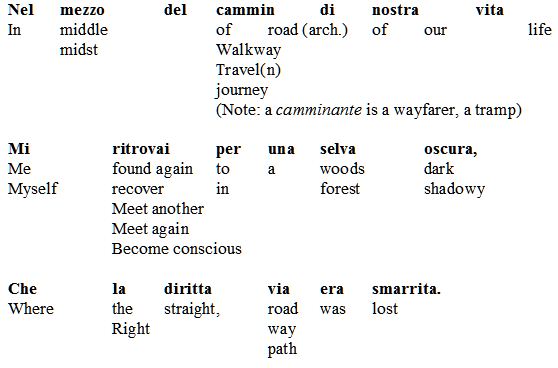
First here is the Italian and a literal transcription:
jackson-trans-image

The road, first of all, is both literal, and as we soon learn, spiritual, the Biblical, “straight and narrow” road to salvation. Note that the loss is in the passive voice—Dante the pilgrim narrator is incapable of admitting at this point in the poem what Dante the poet knows: he is ethically confused and about to lose his soul. Ritrovai has special problems: to be lost and found is a basis of the Christian faith Dante is writing out of, yet the primary meaning of the word in the reflexive (mi ritrovai) is to meet another, also to come to consciousness, —which explains why some translators will use “came to myself” (though some use the reductive “awake”) emphasizing the spiritual split inside the narrator. Similarly, “straight” and “right” might be spiritual equivalents, but they suggest two different moods, the second being more directly a matter of ethics. Similarly dark and shadowy pose two distinct choices, both with Biblical connotations, shadowy suggesting more of the Hebrew Bible.  Note also that Dante uses two words for the road—perhaps suggesting the road mortal people usually take as opposed to the correct path of righteousness.

While Ciardi’s version retains much of the colloquial energy of the original, he makes the narrator admit his fault (“I went astray”), which goes against the dramatic unfolding of the poem, for Dante’s narrator does not understand his own guilt and is in fact filled with pride and the inability to perceive sin accurately. Ciardi gives us:

Midway in our life’s journey, I went astray
From the straight road and woke to find myself
Alone in a dark wood. How shall I say….

Much of the drama of the poem rests in his struggle to separate his emotional sympathy for sin from his rational knowledge of evil. This sort of split is not something common to Ciardi’s own poems, either, which are straightforward and confessional– as is his translation. In many ways we are reading Ciardi using Dante as a way to describe his own self. To really understand what Ciardi is doing and the relation between his poem and Dante’s, one should read some of Ciardi’s poems along with his translation: what we find is the same forceful, direct, driving voice that the translation offers. Understanding this, we can extrapolate in order to imagine Dante’s quieter and more lyrical voice behind Ciardi’s. We can under stand, for example, that “Went astray” seems to lower the stakes while it lowers the linguistic level in a way that works better in Ciardi’s own poems than in this translation. We begin, in other words, to understand Ciardi’s approach as a sort of “common man” approach to the poem.

Mark Musa’s version suggests that Dante’s drift was part of a sleep, for now he awakens, a very literal and reductive interpretation of mi ritrovai not as a coming to consciousness, but a mere waking up– Musa’s pilgrim also states that the wandering was his own fault, as Ciardi’s does. By using “path” he also emphasizes the physical dramatic setting of the woods:

Midway along the journey of our life
I woke to find myself in some dark woods,
for I had wandered off from the straight path.

Musa’s use of “some” suggests a kind of casualness, at least as much as Ciardi’s, though he probably means it to heighten the narrator’s sense of being lost. This casualness– perhaps a product of our age’s fascination with freer verse forms and the looser Wordsworthian and Frostian blank verse– dominates Musa’s account, which is hardly a poetic step above the plain prose account of Mark Singleton. Musa doesn’t really provide a range of rhetoric, a range that is essential to Dante’s poem, and which a translator like Pinsky strives for. If we use Musa’s account, then I think we have to look at the influences that have led him to his form– to much of the poetic strategies of mainstream contemporary American poetry (he’s not a poet himself). Still, understanding that allows us to start to be able to perhaps take a step back towards understanding the difference in poetics between our world and Dante’s world, and gauge at l4ast the force of his metaphors which Musa remains absolutely loyal to.

For my money, the best current versions are those by Robert  Pinsky and Michael Palma. Pinsky’s tries to be formal where Dante is formal, more rough and colloquial where Dante is Colloquial, imitates formal elements in the rhetoric such as anaphora and parallelisms, and generally keeps the tone. He also suggests something of the pace of the original, ironically by condensing it somewhat. Here is Pinsky’s opening:

Midway on our life’s journey, I found myself
In dark woods, the right road lost. To tell
About those woods is hard—so tangled and rough…

Pinsky leaves the responsibility for the way being lost ambiguous which I think is a good interpretation of Dante’s sense of things at this point. Pinsky places the reference to the tangled wood, which occurs in Dante a few lines later, at this point, allowing, as dante intended, the tangle refer to the pilgrim’s words nand ideas as well as the physical path. If we continue through his version we find Pinsky echoing the harsh onomatopoeic effects Dante uses to describe the lawyers in later in the poem, and imitating the song-like anaphora Francesca uses to seduce the Pilgrim in her “imbedded” lyric within canto V. Pinsky raises and lowers the linguistic register just as Dante does and the reader leaves the poem with a pretty fair sense of what the poem is trying to do.

Michael Palma’s version, which seems to lean on Pinsky’s, uses slant rhymes as well as full rhymes, and also the interlockings of terza rima in an interesting new version, though one must be also aware of interpretive additions or juxtapositionings which place in a half notch below Pinsky’s version:

Midway through the journey of our life, I found
Myself in a dark wood, for I had strayed
From the straight pathway to the tangled ground.

Of course, some of what he adds is to fill out the rhymes, but in doing so he inadvertently emphasizes the physical journey over the spiritual with “tangled ground”  by including it in this first sentence rather than a tad later where it actually occurs. And he also allows the narrator to be more conscious of what his own culpability is than Dante’s narrator, as Ciardi and Musa do– all three of them perhaps falling prey to the sort a sort of guilt complex that seems to have entered much contemporary poetry and consciousness. Palma’s very colloquial version also seems to sometimes create a suburban inferno; his use of “pathway” here suggests a kind of jogging path, an effect one also sees in Longfellow’s 19th century version.

One could say that in all these translations one is not reading Dante but only a translator, but of course that is also true for an Italian of today who must not only cope with archaic words and word forms, but also the different force and even connotative meaning of images and metaphors. One answer is simply to not read any version because it is not the author per se, but that would lead to a pretty narrow view of our literary heritage. (What would happen if the same principle were applied to the UN where speeches are given and translated but cannot translate nuances of meaning, tone, voice, rhythm, etc.?)

.

III

In recent years translators have taken to collaborative efforts, often translating language they do not know or know very little. Such collaborations, usually between a good linguist or native speaker and a good poet have resulted in some stunning translations. Usually the poet is provided with a literal translation, then works with the translator over phrases and words with colloquial, historical or metaphoric resonance, and then the poet comes up with a poem that is a version, imitation (fairly close) or adaptation (loose). This, too, is an old practice: Johnson, for instance, describes it in his description of Pope’s work on The Iliad. When Pope or any translator poet felt himself “deficient” in understanding, he would make “minute inquiries into the force of words.” Chapman, for example, besides Pope, clearly worked this way. The aim of these efforts is to provide, as Johnson, sought, the best poem in English. The result of translation in the context I have been discussing is, as Johnson notes, a way to enrich both languages just as Pope’s translation of Homer “tuned the English tongue.” Pond puts it this way: “it is in the light born of this double current that we look upon the face of the mystery unveiled.” Pound says that his translations of Cavalcanti are not line by line by rather “embody in the whole of my English some trace of that power which implies the man.” Clearly the notion of translation here is far different than what the average person thinks.

The French poet, Paul Valery, in his The Art of Poetry, writes that in translating Virgil he wanted to change parts for he felt a merging with the author: translating was creating, he felt. In a similar way, in our own time, Pulitzer Prize winning poet and translator Charles Simic writes: “translation is an actor’s medium. If I cannot make myself believe I am writing the poem I’m translating, no degree of aesthetic admiration for the work will help me.” Judith Hemschemeyer, who translated perhaps the greatest poet of the century, Anna Akhmatova, describes a slow process of first getting a basic sense and then working to duplicate various effects depending upon what she felt the main strength of a particular poem to be. And well known American poet Galway Kinnell describes, in his preface to Villon’s poems, how “one can be impeccably accurate verbally and yet miss the point or blur the tone quite badly….I wanted to be ‘literal’ in another sense. I wanted to be more faithful…to the complexities of the poetry, both to its shades of meaning and its tone. At the same time I wanted the English to flow very naturally. Therefore I avoided transferring ‘meanings’ from one language directly into another.” Kinnell goes on to say he attempts to “internalize” the French: I would not merely be changing language into language but also expressing what would have become to some extent my own experiences and understandings.” If that seems strange, remember that whenever we read a poem in our own language we bring our own experiences, contexts, and notions to the text, and they interact to form a unique experience called the poem. One could argue– and many critics and linguists today do so– that we translate even as we read within our own language. reading Kinnell’s poems and Kinnell’s translations involves similar activity, and not unlike what we would do when reading Villon in the original. So what is Villon’s poem? As read by a French scholar? a French poet? a good reader of French? a bad reader? Do the poems exists in some absolute Platonic place where all the meanings and effects are intact? Do they exist in individual reader’s responses? Somewhere in between? These are precisely the issues a translator and a reader of translations must face. “It is because it is impossible that translation is so interesting,” wrote William Matthews who has translated Ovid, Horace and Martial.

In a letter about the nature of poetry to his brother, Gherardo, Petrarch wrote of the Biblical poetry that they “never have been, or could be, easily translated into any other language without sacrificing rhythm and meter or meaning. So, as a choice had to be made, it has been the sense that has been more important. And yet some trappings of metrical law still survive, and the individual pieces are what we still name verses, for that is what they really are.”  Still, unsatisfied finally with that, Petrarch wrote his own sequence of Salmi Penitenziali in a single year in imitation of the Biblical psalms, but using phrases and ideas from the originals. In the “Preface” to his “Familiar Letters” Petrarch wrote that “The first care of the poet is to attend to the person who is the reader; this is the best way to know what to write and how to write it for a specific audience.” In a sense he prefigures Johnson’s concern, cited above, that the purpose of poetry is to be read.

How, then, to restore poetry’s original sense of freshness, of movement, and yet take into account a modern audience is always the issue. Translators like David Slavitt, with Ovid and Virgil, and William Matthews, with Martial and Horace, have magnificently transplanted these poets to our own times so that they seem to come alive, filled with their own concerns, but as they would speak in our own age, as Johnson had wanted. Matthews, for instance, adds current references, Slavitt’s Virgilian Eclogues are as much interpretations as translations. In other words, they have considered the contemporary reader, as Petrarch urged, along with the meaning and rhythms. This is precisely the example of Horace and of Pope. As Johnson wrote of Pope’s Homer: “To a thousand cavils one answer is sufficient: the purpose of an author is to be read, and the criticism which would destroy the power of pleasing must be blown aside.”

Literary translation comes close, as Pope suggests in a letter about his Imitations of Horace, to the notion of imitation. One anonymous wrote that Pope’s versions were “bound hand and foot and yet dancing as if free.” Earlier, Ben Jonson had defined imitation in his Timber as merely a poem loosely based on another poem. Dryden in his “Preface” to his translation of Ovid,  then defined three kinds of relationship a poet could have to a prior text.  “Metaphrase” for Dryden was a slavish, “word by word” account. “Paraphrase” was a “translation with latitude” that kept the original meaning but often with “amplification.” “Imitation,” on the other hand, meant, for Dryden, a process where the “translator (if now he has not lost that name) assumes the liberty, not only to vary words and sense, but to forsake them both as he sees occasion; and taking only some general hints from the original, to run division on the groundwork, as he pleases.” This is precisely the sort of thing Robert Lowell does in his Imitations from various poets, and what Pound does in his “Homage to Sextus Propertius,’ a sequence of loosely translated lines rearranged into a sequence of totally new poems. And it is related to what Stephen berg does in  gathering images, tones and lines from Anna Akhmatova in his With Akhmatova at the Gate . Dana Gioia has written an essay describing how Donald Justice makes use of various lines, poems and forms of previous poets in over a fourth of his own poems.

We’ve become so used, in our own time and place, to valuing the new and the different above all else, that we have lost sight, in our own art of poetry with its rich tradition, of, as Roethke says in the title of a revealing essay, “How to Write Like Someone Else.”  Indeed, poets through the ages have learned to write by imitation, from Catullus adaptations of Callimachus, Horace’s borrowings from Lucilius, Petrarch’s use of Dante and Cino di Pistoia, Wyatt and Surrey’s use of Petrarch, and so on. Pope in fact said he turned to imitation to tighten his own verse and to find a voice to say things he was not ready to speak in his own voice. Petrarch, an early champion of learning from the past,  writes in a letter to his friend Boccaccio: “An imitator must see to it that what he writes is similar, but not the very same; and the similarity, moreover, should not be like that of a painting or statue to the person represented, but rather like that of a son to a father, where there is often great difference in the features and members, yet after all there is a shadowy something– akin to what the painters call one’s air–hovering about the face, and especially the eyes, out of which there grows a likeness…. [W]e writers, too, must see to it that along with the similarity there is a large measure of dissimilarity; and furthermore such likeness as there is must be elusive, something that it is impossible to seize except by a sort of still-hunt, a quality to be felt rather than defined…. It may all be summed up by saying with Seneca, and with Flaccus [Horace] before him, that we must write just as the bees make honey, not keeping the flowers but turning them into a sweetness of our own, blending many different flavors into one, which shall be unlike them all, and better.” Imitation, in other words, is creation: just taking a glance at what Samuel Johnson does to Juvenal in his “Vanity of Human Wishes” or what Frost does with  Virgil’s Georgics in his North of Boston the Greek Anthology in A Witness Tree ought to show us how one can learn from the past and still be original. Curiously, Frost gave a January 1916  lecture called “The discipline of the Classics and the Writing of English” which extolled imitation. One can see how James Wright’s middle poems were influenced by his reading of Lorca, Jiminez, Neruda and various imagistic poems from China and Japan. In fact, a glance at W.S. Merwin’s poems in The Lice (1967) and the translations he was doing at that time show an incredible similarity of the type Petrarch describes. Of course, sometimes imitation is very close to the original: in fact, one translation of Merwin’s , “The Creation of the Moon” derived from a South American Indian tale is almost rendered step by step in  in The Lice but with a different ostensible subject.

Even more  loosely, we can see a number of influences: Kunitz, Horace and Robinson on James Wright; Greek and Roman epigrams on Linda Gregg and Jack Gilbert; Vallejo, Rimbaud and the beats on Tomaz Salamun. Longinus, the Roman critic wrote: “Emulation will bring those great characters before our eyes, and like guiding stars they will lead our thoughts to the ideal standard of perfection.” Perhaps one of the greatest examples is the way Petrarch borrows the idea of creating an evolving self in a sequence of poems from Horace’s Odes and his sense of how to address the reader from Cicero’s letters. Ultimately the point here is that poets learn to advance their craft by reading other poets from other ages and other cultures, adapting impulses, lines, forms and ideas to their own times. Not to read, not to “emulate,” is to isolate one’s art, to leave it static.

.

IV

My personal history of ideas by poet-translators on their art is a far ranging one that extends from the Romans like Catullus who saw it as a “combat” with the original, to poets like Petrarch and Samuel Johnson who judged a version by its effect in the so called “target language,” to Robert Lowell’s and Alexander Pope’s loose “imitations.” I know that some of these practices would startle if not horrify most of my language teachers. Yet even a respected academic like Wilhelm Humbolt, in his introduction to his translation of Aeschylus’s Agamemnon, says: “the more a translation strives toward fidelity, the more it ultimately deviates from the original, for in attempting to imitate refined nuances and avoid simple generalities it can, in fact, only provide new and different nuances.” This is perhaps why a poet like Jane Hirshfield, also a translator from Japanese, writes: “Translation’s very existence challenges our understanding of what a literary text is.”  I think what has intrigued me about the various possibilities of various kinds of translation is precisely that challenge; it offers a way to understand my native language better, to pay more conscious attention to kinds of detail that I approach on a more subconscious level in writing my own poems, and to appreciate some relationships between my own poems and those of poets in another language with whom I have found a kindred spirit.

For my own part, I have done three separate and very different translation projects that I would like to describe for what light they might cast on the the poet as translator. I felt that each poet’s poems demanded a different approach. Perhaps what links these three very different projects is Milan Kundera’s notion, in Testaments Betrayed, of the importance of the original author’s “personal style.” In many ways he extends Humbolt’s theory when her says that “every author of some value transgresses against ‘good style,’ and in that transgression lies [his] originality. The translator’s primary effort should be to understand that transgression.” For me this has meant reading everything, from letters to journals to work in other genres, to the author’s own translations of other writers’ works, and to the author’s own contemporaries, in an attempt to get to the source of his style, the structure of his mind. The results have been variously:  a fairly traditional approach, a radical transformation of the original, and a collaborative project.

First, the traditional approach. Several years ago I stumbled across a book of last poems by Cesare Pavese in a bookstore in Firenze, poems not then availabe in English, and very different from the William Arrowsmith versions I knew. This book, his last poems before he committed suicide, contains a number of poems in narrow lines where the metamorphic aspect of his earlier work is much intensified. A number of these poems of “Disamore,” “Disaffection” or “Lost Love,” as it might literally or figuratively be translated, identify the land of northwest Italy, especially from Torino to Genoa with a woman, and that land as variable, enticing, dangerous, beautiful, forbidding and distant.

Most translators translate one section of these last poems, originally published in a pamphlet, as “Death Will Come and It Will have Your Eyes.” I translate the title as “Death Will Come and She Will have Your Eyes.” This small difference suggests a huge difference in what Pavese is trying to do. The whole section, in fact, deals with a woman or women who potentially betray him—leading up to his suicide reportedly after his rejection by an American actress. The personification, using “she” rather than “it” is warranted first by the way he personifies other things such as the land, which he sees as feminine, in earlier sections from this book. (While “morte” is technically feminine in Italian, this of course does not carry over into English, though one wonders if Pavese, so careful with images, might have felt this more than we do.) For example, in one poem in this book he writes: “You are the land and death.” In another he says the woman is a “clump of soil.” In another section he is even more direct in linking womanhood to death, something he does in his journals where he says that one kills himself for the love of a woman, “any” woman because of the way the self is humiliated by all women. Obviously, Pavese’s attitude towards women throughout his poems could have benefited from serious counseling.

In any case, my version reads:

Death will come and she will have your eyes.–
this death that accompanies us
from morning to evening, sleepless,
deaf, like an old remorse,
or an absurd vice. Your eyes
will be one empty word,
a hushed cry, a silence.
Things you see each morning
when you alone gather yourself
into a mirror. O dear hope
when will we ever know that
you are life and you are the empty day.

For every death looks the same.
Death will come and she will have your eyes.
It will be like giving up a vice,
like seeing in a mirror
the face of death come to the surface,
like listening to closed lips.
We will descend to the abyss silently.

Personifying death this way also makes the image of seeing death, the woman, in the mirror, more powerfully, for in many ways the idea of a deadly woman took over and controlled his own identity. So the Pavese project has been one where the basically accurate translation tends to emphasize Pavese’s peculiar humanizing of his landscapes more than other translations.

I should also add that these later poems have an entirely different rhythm than his earlier ones: there are quicker turns and the emphasis is more on words and their placement in the line than on phrases and sentences as in the earlier poems. I feel, because of the rhythm of thinking in the original, that, as much as possible, the original word order should be kept. In translations of earlier poems, on the other hand, I have placed more emphasis on the phrase and image order, for it is in those poems that Pavese practices his theory of the “image narrative.” So for example, my last line in “Death Will Come” reads “we will descend into the abyss silently” rather than the more normal American English order, “we will descend silently into the abyss.” The word, silently (“muti”),  comes as a kind of afterthought in the syntax, and yet its place at the end of the line also emphasizes the relationship between silence and death.

The effect on my own poems, if I can judge that, has been first of all an increase in the use of personification, and related to that, a more functional use of landscape. I think I have also noticed a greater attention to different effects of lineation. And as far as understanding Pavese goes, I have gained a more sympathetic understanding of the pathology of his torment.

The second project is not really translation at all, but rather “Poems based on Petrarch,” where I have taken an entirely other approach, using the originals as take off points for what might be likened to jazz riffs. I have in mind the way Coltrane uses a few bars of “Bye Bye Blackbird” in his Swedish date and then takes off into the stratosphere for 13 minutes until we are so far afield all we sometimes hear are a few of the original notes in various patterns. In a way I am following Petrarch’s own advice when he writes in a letter to his friend Boccaccio: “An imitator must see to it that what he writes is similar, but not the very same; and the similarity, moreover, should not be like that of a painting or statue to the person represented, but rather like that of a son to a father, where there is often great difference in the features and members, yet after all there is a shadowy something– akin to what the painters call one’s air–hovering about the face, and especially the eyes, out of which there grows a likeness…. [W]e writers, too, must see to it that along with the similarity there is a large measure of dissimilarity; and furthermore such likeness as there is must be elusive, something that it is impossible to seize except by a sort of still-hunt, a quality to be felt rather than defined…. It may all be summed up by saying with Seneca, and with Flaccus [Horace] before him, that we must write just as the bees make honey, not keeping the flowers but turning them into a sweetness of our own, blending many different flavors into one, which shall be unlike them all, and better.”

I suppose another model for me was the way Ben Jonson had defined imitation in his Timber as merely a poem loosely based on another poem. Besides, for me there was a problem of the quality of the English version, for even by the time of Shakespeare’s mocking of Petrarch in “My mistress’ eyes are nothing like the sun” many of Petrarch’s fresh images and comparisons had already become clichés. This was a problem I experienced with my first versions of Petrarch which were standard conservative translations. These early versions led me to realize that I wanted a sense of what I felt Petrarch might sound like if he wrote today in America. In this context I think of what Pound does in his “Homage to Sextus Propertius,’ a sequence of loosely translated lines rearranged into a sequence of totally new poems and  what Jo Shapcott does in Tender Taxes, based on Rilke’s French poems, which, as she says,  “re-imagines Rilke’s brief and fugitive lyrics as English poems.”

Here, for example, is Petrarch’s #234. ‘O cameretta che già fosti un porto’, literally translated:

O little room that sometimes served as a port
In these fierce daily storms of mine,
You are the fount, now of my nightly tears,
Which, because of the shame I feel, I hide by day.
O little bed, that used to be a comfort and a rest
In many trials, from what  doleful urns
Love bathes you with those hands of ivory,
So cruel to me alone, so unjustly!

I flee not only from seclusion and my rest,
But flee myself and my thoughts even more,
Which used to raise me in flight as I followed.
And now for asylum, I seek out the crowd,
My hated foe — who would believe that?
I am so afraid of finding myself alone.
(my translation)

My riff, “The Exile,” tries to extend the mood of the poem, keeps some allegiance to the setting, but radically changes the images, making them more surreal. I suppose I had in mind what Dryden called “imitation” and what Pound logopoeia, “the dance of the intellect among words. It is admittedly a far cry from the original, in fact I would really consider it more of an original poem that, in Eliot’s phrase, “steals” from the original. Here, then, is my “riff”-

Grief frames the doorway to that room I used to call my port
against whatever storms came careening down my street,
that room with its memories now crumpled on a table, a fleet
of hopes wrecked by words that regret what they alone distort.
Thorns fill the bed. A taunting night shakes its keys to closets
of desire I can no longer open. Who sleeps there, indiscreet
rival, while I flee his shadows that loiter like a disease
which waits for a soul to pummel, a love to perfectly thwart?
The doorknob of the night is always turning, but it is myself I flee–
my dreams, my rhymes, that lifted me towards a heaven
I thought was the love these words might finally create.
Maybe now I’ll hide in those city crowds I’ve come to hate
since I can no longer face myself, no longer be alone.
Longing rings the doorbell, but the house is empty.

My first idea was how to make this remarkable poet and influence fresh again, more contemporary. So there’s the doorbell is a contemporizing effect, and the doorknob, and the colloquial American English in general. But in all of them I have kept the original rhyme scheme, or one of the schemes, using a lot of slant rhymes. I also loosened the line from his pretty strict classical 11 syllable Italian line, but within those constraints I was often thinking through Petrarch’s mind as I understood it, especially after reading all the 365 poems in his conflicted book about Laura, his Ciceronian and Familiar letters, his other poems and prose and several biographies and critical works.

The poems vary considerably in what they owe to the original, because my ultimate aim was what I could apply to my own work. As I worked with more of his poems I saw much in his life and times similar to my own, and so I began to absorb that personality. Oddly, then a great number of these poems are in effect more autobiographical than my other poems from about 1993 on. This project effected a greater sense of the possibilities for contradictions and arguments within the evolving movement of my own poems, a move also towards more concise poems than I had been writing, a greater sense of the odd and sudden twists and turns metaphors can take, and the way a controlling metaphor can move in and out of a poem’s surface. I’ve done about seventy poems, mostly sonnets, with a few canzoni, and am probably done with it for now.

My third translation project is a collaborative effort with two other American poets, Susan Thomas and Deborah Brown, with occasional help from a few of our friends. In our versions of Giovanni Pascoli, a turn of the last century poet who spent his last years in rural Barga, in northwest Tuscany, we have used John Hollander’s notion of finding an analogue in English poetry to use as a kind of base. (As with the Pavese and Petrarch, I have visited Pascoli’s home and favorite haunts to gain a further feel for the landscape that is so important to him.)  Pascoli, by the way,  was a terrific influence on Pavese. Just as Nabokov found an analogue for his translation of Pushkin in Andrew Marvell,  as part of our procedure, we found an analogue in a combination of Hardy and Frost, that is, a voice that is at once rustic and cosmopolitan, melodious and rough, minute in its natural observations and ready to imply larger analogies.  We have not kept strictly to Pascoli’s format, never the rhymes which his rustic syntax allows him to sound more natural in Italian, though we have tried to duplicate the inner form, the appearance on the page and many of the sound effects.

Our procedure, after deciding we wanted an accurate translation that also conveyed the mood and tone– was for one of us– this varied  poem to poem — to provide a version to work on. Then the other two would offer comments, suggestions, sometimes radical rephrasing. This was mostly done by email. A number of problems surfaced immediately. For one, Pascoli writes in a particular dialect from the mountains of northwest Tuscany above Lucca. A number of words had to be deciphered contextually through the meanings of the poem in question, its companions and through the online version of the poems that also contained a useful concordance. Stylistically, Pascoli often drops part of a sentence, uses pronouns in an ambiguous way to extend meanings, and puns in sometimes very subtle ways (both verbally and visually). As with Pavese, I felt the word order with its rhythm and lineation was crucial.  Some of his references are to specific places near Barga, and to particular folk events and sayings. He also has a habit of linking clauses together by semicolons to suggest a kind of linking of the particulars of a scene in a kind of image narrative that may have later influenced Pavese’s theory of the “image story.” His poems range from dialectic sequences of brief lyrics about rustic life to odes and other longer poems, and then later in his career to political poems and poems based on classical and mythic themes, on artists and other famous figures.

One example of the problems of translation here stems from his extensive knowledge of astronomy and mythology. For example, one of his most interesting sequences is “The Last Voyage,” a narrative of Odysseus wanderings after the Odyssey to plant an oar where Poseidon is not known, certainly a sequence influenced by Tennyson’s “Ulysses.”  Susan rendered the opening poem’s lines 3-5 as:

Because of an error made on land,
He was exhausted and foot weary,
Supporting an oar on his strong shoulder.

Now the word for shoulder is “omero” which, capitalized, is also “Homer.” The poem itself is a carrying forward of Homer: should we try to account for this pun? Would the phrase “Homeric shoulder” work? The adjective for shoulder is “grande” which can mean here “big” or “strong.” Someone even suggested “epic shoulder” which we rejected. Also, the “error made on land” is that he is lost — (the root of “error” in English and the Italian original here is to wander– as in Spenser and Milton, for example). Lines one and two had referred to Ulysses as the great navigator– on sea. So, for now, our committee of three has settled on the following, also changing the word order to reflect the original:

Because he had lost his way
He was exhausted and foot-weary,
Carrying, on his strong Homeric shoulder, an oar.

Even the title of the poem, “La Pala,” or “blade,” though, poses problems. “Pala del remo” is the blade of an oar, but the oar here is mistaken for a harvest flail, and in the second poem “L’Ala” (literally, “wing” or even “oar blade”) the oar is perceived as a wing. So should we render the two titles as “The Oar as Flail” and “The Oar as Wing”? We are still wrestling with the possibilities.

With references to constellations and stars we have consistently described them as the animals and figures they were seen as in ancient times because Pascoli seems to be using them this way. For example, Deb’s literal rendering of one section of a later poem in the sequence would yield:

It is time to plow the field, not the sea,
from which you can see not even
a handful of the seven stars.
It is sixty days till the sun returns,
Until Ursa Major, the stars that guide you,
will return. By then the breeze is sweet,
the sea is calm, the shining Bootes will be visible.

The seven stars are possibly the Pleides according to an Italian editor’s notes, but most likely the big dipper, Ursa Major, the great bear because Bootes, after all, is the hunter who follows after her. Indeed, the handful of stars is what is probably referred to as the tail of the bear — or the handle of the dipper.  Actually, Pascoli uses the word “Carro” (capitalized) for Ursa major which is its astronomical meaning, but its more common meaning is cart, and so the tail of the bear is also the cart’s handle and the dipper’s handle. The association with the cart is important because it relates to the plowing image. There is a kind of furiously quick web of associations here that is probably impossible to translate. Here’s our version:

It is time to plow the field, and not the sea,
From which you can not even begin to see
A handful the seven stars in the Great Bear.
It is sixty days till the sun will return,
Until the Bear, your guiding constellation,
Will return. By then the breeze is sweet, the sea
Calm, the brilliant hunter will be visible….

There is an interesting play between what can and can’t be seen, between finding one’s way and being lost. And this version tries to maintain some of the traditional 11 syllable line length that Pascoli deploys. We have kept “handful” to suggest both the plowed earth and the handle of the cart. Finally, turning the constellations into the figures they represent gives, we hope, a greater sense of visual drama.

Working on this collaborative effort has been immensely rewarding for it has the advantage of having different minds, while adhering to the same general poetics, offer and discuss various alternatives. The result has been a deeper understanding of the process of translation, and of the inner workings of  Pascoli’s poetic mind, and also possibilities for using myths in our own poems. And we have been able to see how Pascoli’s descriptive poetry is later adapted and transformed into a more metamorphic vision by Pavese: in other words, we have been able to see a kind of translation between poets of the same language which has in turn influenced how we read our own influences.

The American Pulitzer Prize winning poet, Charles Simic, writes that “Lyricism, in its true sense, is the awe before the untranslatable.”  I suppose it is that sort of lyricism that these three projects aim for. Obviously, too, I have been using American rather than British English, a difference radically brought home to me this past September at Vilenica where I worked on a couple of poems by a Slovene poet with a British poet translator, Stephen Watts, the  Slovene translator, Ana Jelnikar, and the poet herself. Several times Stephen and myself had very different phrasing. Each of our choices, I believe, was appropriate to our audiences back home. I was reminded of the American teacher who had his class translate a sentence, “The evening passed,” from an English novel, and one student rendered it as “It got late.” And it has– so I’ll end here.

—Richard Jackson

Some Useful Sources

Arrowsmith, William and Roger Shattuck, eds., The Craft and Context of Translation: A Critical Symposium. Austin: University of Texas Press, 1961.

Baker , Mona, ed., Encyclopedia of Translation Studies. London: Routledge, 1998.

Barnstone ,Willis, The Poetics of Translation. New Haven: Yale University Press, 1993.

Belitt, Ben. Adam’s Dream: A Preface to Translation. Grove, 1978.  Interviews, essays, introductions on a variety of problems and poets.

Brower, Reuben, Mirror on Mirror: Translation, Imitation, Parody. Cambridge, MA: Harvard University Press, 1974

_____, ed., On Translation. Cambridge, MA: Harvard University Press, 1959. This landmark anthology includes Bayard Quincy Morgan’s critical bibliography of works on translation (from 46 BC. to 1958)—an essential historical survey of the topic.

Gass, William. Reading Rilke: Reflections on the Problems of Translation. Knopf, 1999. A well thought out, book length account of what it means to translate an author, his life, his work, his being.

Gentzler, Edward, Contemporary Translation Theories. New York: Routledge, 1993.

Graham, Joseph F., ed., Difference in Translation. Ithaca, NY: Cornell University Press, 1985.

Grahs, Lillebill and Gustav Korlen, eds., Theory and Practice of Translation. New York: Lang, 1978.

Hawkins, Peter and Jacoff, Rachel. The Poet’s Dante: Twentieth Century Responses. Farrar, Strauss, 1999. Essays by numerous essential poets such as Pound, Yeats, Eliot, Montale, Lowell, Auden, Merwin, Pinsky, Doty, Hirsch and many others.

Hirschfield, Jane. Nine Gates: Entering the Mind of Poetry. Harper Collins, 1998. This terrific book has a great essay on translation.

Kelly , Louis G.. The True Interpreter: A History of Translation Theory and Practice in the West. Oxford: Blackwell, 1979

Raffel, Burton, The Art of Translating Prose, University Park: Pennsylvania State University Press, 1994.

_________, The Art of Translating Poetry, University Park: Pennsylvania State University Press, 1988.

_________, The Forked Tongue: A Study of the Translation Process. Hawthorne, NY: Mouton de Gruyter, 1971.

Schulte, Rainer and Biguenet, John. Theories of Translation: An Anthology of Essays from Dryden to Derrida. University of Chicago Press, 1992. Includes major works by Goethe, Rossetti, Benjamin, Pound, Nabokov, Paz and others; the best single source of theory.

Schulte, Rainer and Biguenet, John. The Craft of Translation. University of Chicago Press, 1989. Excellent practical essays, many being introductions, on translating writers such as Celan, Eich, Japanese Poetry, medieval works, and some theory.

Steiner, George, After Babel: Aspects of Language and Translation. London: Oxford University Press, revised edition 1993 (original edition 1975).

Warren, Rosanna, ed., The Art of Translation: Voices from the Field. Boston: Northeastern University Press, 1989.

Weissbort, Daniel, ed., Translating Poetry: The Double Labyrinth. Iowa City: University of Iowa Press, 1989

Wechsler, Robert. Performing Without a Stage: The Art of Literary Translation. Catbird Press, 1998. General introduction to major issues.

/

Other Sources

Some examples of Adaptation include: Jo Shapcott, Tender Taxes (Faber and Faber, 2001); Stephen Berg, Oblivion (Illinois, 1995) and With Akhmatova at the Black Gates (Illinois, 1981); Robert Lowell, Imitations (Farrar, Strauss, 1961).

Two excellent examples of various versions of two major poets, from translation to imitation are:

  • Dante’s Inferno: Translations by 20 Contemporary Poets, ed. Dan Halpern, Ecco Press, 1993. Widely different approaches by Heaney, Strand, Kinnell, Graham, Plumly, Mitchell, Williams, Wright, Clampitt, Forche, Merwin, Digges, Hass, etc.
  • After Ovid: New Metamorphoses, ed, Michael Hofmann and James Lasdun, Faber and faber, 1994. Everything from strict translation to tangential relationship is represented in versions of Ovid’s Metamorphoses by Hughes, Graham, Fulton, Pinsky, Boland, Carson, Muldoon,  Simic and others.

The Nov/Dec 2002 Poets and Writers magazine has a complete section on translation.

See also the comprehensive web site sponsored by P.E.N. International.

There is a terrific Manual For Translators with bibliography and resources at http://www.pen.org/translation/handbook1999.html#_Toc452369688

/
/

Mar 022011
 

Artist Paula Swisher (photo by Andrew Huth)


The Quirky Bird Art of Paula Swisher

text by Anna Maria Johnson, bird imagery by Paula Swisher


I was privileged to meet Paula Swisher in 1997 while she and I were both studying art at Houghton College in rural western New York.  Many late nights, we stayed up painting, drawing, and sharing our life stories.  Paula is probably the hardest-working visual artist that I’ve met, and in the past decade or so, has created a rich and wide-ranging body of work in a variety of media–painting, drawing, graphic design, web design, and most recently, interactive media.

In light of recent NC community posts about the relationship between text and images, notably Wendy Voorsanger’s “An Exploration of Poem Painting,” I thought it would be appropriate to share some of Paula’s images which she painted directly onto the pages of discarded business textbooks.  Many of her images are direct responses to the pre-existing graphs and phrases from these textbooks, but she re-interprets the business-speak through the lens of her personal experiences to say something entirely new and different.

For instance, Paula Swisher began this particular bird-and-text series during an extended bout of unemployment.

"Unemployment"

“Unemployment”

Continue reading »

Feb 152011
 

Here are three poems by three friends, Elaine Handley, Marilyn McCabe, & Mary Shartle, all three part of “the Greenfield Crowd,” a disparate and rowdy group of writers, painters, cellists and cross-country skiers loosely based in Greenfield, NY (though Marilyn McCabe actually lives in Saratoga Springs). Laura Von Rosk and Naton Leslie, who have both appeared on these pages, are part of the group. These three women in particular have combined their talents since 1998 and have produced multiple chapbooks of poetry together, including Notes from the Fire Tower: Three Poets in the  Adirondacks and Glacial Erratica: Three Poets in the Adirondacks, Part Two which won the Adirondack Center for Writing best poetry book award two years in a row. These poems come from their new collection Winterberry, Pine (30 Acre Woods Publications, 2010).

Marilyn McCabe is already familiar to NC readers. We published her Rilke translations earlier on these pages. She has published work in, among others, Nimrod, Beloit Poetry Journal, and Hunger Mountain. Elaine Handley has published in, among others, Dos Passos Review and Connecticut River Review. And Mary Shartle has appeared in Blueline and Sow’s Ear Poetry Review.

dg


A Poem by Elaine Handley


GroundHog Day


Demeter sits at the kitchen window
chain smoking, staring at empty maple and birch.
She imagines the smoke as rage leaving her body.

Outside all that moves are chickadees at the feeder,
only color, winterberries like splatters of fresh blood
in the snarl of grapevines by the shed.

Her husband’s abandoned chamois shirt—frayed
at the cuffs, a hole in one elbow—
provides an odd, familiar comfort these days
so much like the last, the next,
full of his cold emptiness.

It’s been months since Persephone ran off,
stolen by a charming woodchuck, full of pipe
dreams, and she suspects, cruel ways.
“My queen” he called her daughter.
No email, no call, not even a text.  The house
so quiet she can hear the little murmurs
of the sleeping cat.

Some like it hot, she tells herself, thinking
of her daughter, and then the cat,
who inexplicably sleeps under the sizzling woodstove.

On the Today Show that morning, Punxsutawney Phil
was paraded out, fussed over. “What an ass!”
she’d said out loud.  What groundhog comes out
of hibernation early?  Who would willingly give up
the sweet coma of sleep–and for what?
Food hard to find, too much snow, constant cold,
the loneliness.

She pours a bourbon, neat.  It’s her third this morning.
She stubs out the cigarette butt, lights another.
The scald in her throat feels right.
A little blaze flares up in her chest.
For a moment, it almost feels like love.


—Elaine Handley


Continue reading »

Feb 092011
 

Karen Mulhallen

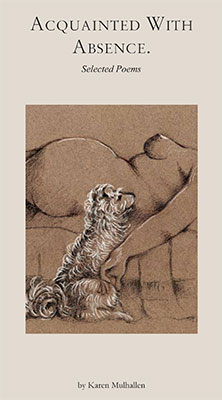
Here are three achingly poignant yet transgressive poems frommy old friend Karen Mulhallen, yes, dear friend, extraordinary woman-of-letters, poet, Blake scholar, and publisher and editor of the amazing Toronto-based literary magazine Descant (this summer’s issue marks the magazine’s 40th anniversary). Karen has published close to a dozen books of poems, the latest, her selected poems entitled Acquainted With Absence, published in 2009, was edited and introduced by dg (see poems from that book published earlier on NC). These new poems are from Karen’s forthcoming collection, The Pillow Books (forthcoming 2011 with Black Moss Press).

dg

February/Raise High The Red Lantern

He is coming. Raise it high
My red lantern burns in the bright light of day
disappearing in the glare of the sun.

in the evening the lantern of the Other Wife
bursts through the darkness.
Her light more brilliant than any other lantern.

I am the Daylight Wife.
Take my light.

Continue reading »

Feb 042011
 

It’s a great pleasure to present here four poems from William Olsen’s new collection, his fifth book of poems, Sand Theory, forthcoming in April with Northwestern University Press/Triquarterly.  Bill is a colleague and and a friend from the Vermont College of Fine Arts MFA in Writing Program where we both teach, yes, and where we meet up roughly twice a year in an atmosphere of intense literary camaraderie that somehow combines the ethos of a Left Bank cafe and a New York subway station at rush hour. For years we have listened to each other read in the College Hall Chapel or Noble Lounge, watched the new books come out, observed each other working with students — Vermont College constructs relationships that are like lightning bolts, distant flashes of brilliance, brief, poignant, and indelible, which is also how I think of Bill Olsen’s poems.

dg

I can tell you, simply, that the Leelenau Peninsula is a place I go to not only to write but to write about. I used the old fashioned “en plein air” method at first with many of these: you go outside, you write down what you see in a notebook, and you go home and try to put down the right words for what blew you away out of your own confined life.   I think in these poems I was trying just for a few looks at the natural world, how the mind always has and still can find inclusive models for itself in its surroundings.  Which in this case are striking “original”– nothing like the Michigan Dunes, their relative youth (3000 yrs), the youth of the glacial lakes (some 800 years old).  Or how their stability is destabilized and re-stabilized  every season.   I think that nature poems, or eco-poetics, are often politically driven, and that is great. I just wanted in these to preserve what it is like to look at places and things while they’re still around. — William Olsen


Four Poems from Sand Theory

By William Olsen


.

You


The hills the lakes the shorelines only
three thousand years old. Some faces
have this same settled freshness every time.
Few voices do. I have been trying to walk
out of my body all my life. The flesh
doesn’t belong to itself. Not a breath
we can understand so why this trust?
Understanding itself is a shape-shifter.
Even if I must accept your mortality,
I stay in love like nowhere else I stay.
.

.

Dune Grass


It is what sand would look like if it could just
escape itself and grasp the diffuse and clump around
pilings like stumps of teeth ground by tide,
risen to whatever inhuman trial it is

to have threadbare wind for a coat and a body
that has no eyes and no face to love,
bent in scarcely rooted supplication.
When have we not seen it praying

in its own loose unison of piety,
in its strength to waver and stay put and outreturn
the hulking one-time-only beachfront condos—
I’ll worship something that would return to all this.

Repeatedly this need to be somewhere real again
comes upon land with features that never settle,
this treasure so openly fragile it’s beginning
to dawn on me that we should all be singing—

no place like this anywhere in the world,
even the ground one stands on taken up,
what it means to escape damnation and holiness
and be forever risen into being used

right here at my glowing naked toes.
We walk right over all this we love the sight of
that in it we can love our transience,
our hills, their lakes no older than our species,

as it turns out earth never belonged to itself,
till even despondency seems hopeful evasion.
So why this trust, this sudden drop from bluff
to lake where sky resides and spars of buried trees

are disinterred from dunes, the beached hulls
of ghost barns are open houses, bare rafters
almost fallen in on their blessed ghost cows?
Why do ears settle on lone islets of seething birches,

tremblings near an even vaster trembling?
For however much I meant to find a human likeness
down on its knees, its hands churched together,
there’s more room than ever for the booming distances

and sand enough for wind to blow beyond
all of us who abandoned, betrayed, trampled repeatedly
haywire paths, shown nothing new, no, this,
right here where there is no dogma or heresy,

shimmering just a little above the earth,
in its strength to waver and yet stay put
lifted by sun and rain into being used,
hanging on and letting us come and go.

.

.

Lake Leelanau Goes Still One Day in Fall


The ear wants what it hears to rain in language,
The rain wants images to puddle, flow,
Canoe, thrust paddles through lacustrine looking glass,

Shudder, touched, smoothed beyond sigh
Once flow wins back clarity, that afterlife
That wears its while with absolute unconcern,

Ripples ironed out by transparent cease,
The oldest memoir of language, fluidity
Liquefying sadness, its concentric rings,

The lovely roundness of those spoken vowels,
The vegetal phonemes alive in meadows,
In rooted reveries that obliterate ideals,

Here where fishes fly and clouds congress
With pebble-cobbled bottom worlds
Stocking sky with crappies, trout, and bass,

Undulations leveling to bluest pupil,
Lappings lulled to inaudible lullaby,
Glide of last spring’s goslings grown to geese,

Windexed cessation of windrow waves,
Glacial sorrows melted, the bewilderments,
Even the slightest, even the most garrulous

Frog’s gargoyle consonants gobbled up,
Gutter-mouthed gutturals, gusts and gales
Gone to glaze, an aimless, amiable gaze,

The furies flatlined to catoptromancy,
Calm and compromise materialized,
Leavetaking leaves loosened from leasehold

Mirrored, and carried by their own reflections.

.

.

Good Night


I left an office lamp alive for ghosts,
let go any hope
so easily

and tried to sleep.
But sleep left me on
like a night-light.

Some passing car
would be seen on its way,
some lasting meteor

anyone can see
forever fall,
some moon like an unsent letter,

some long-distance glance
stare from the bottom of the deepest
fare-thee-well.

Dear self, please say the sun.
The sun sets.
Say the moon,

the moon rises.
All these years
don’t bring it an inch closer,

no telephone back to childhood either.
All America,
good night,

sleep tight,
but not yet.
A few stars have no distance,

their arrangement is lenient,
a moon sawn in half,
that half hanging on,

a cleaver over every waker and sleeper,
what on earth can I do,
waves lapping out lake

good and all alone,
where are they going,
what have I done?

Through the trees
their audible transparence,
each wave

always the first and
ever the last,
a few boat lights rocking,

wide awake is motion,
all’s to come and the ordinary wait
is a vast devotion but first,

Sleep, bless
any dreams
with merciful instruction.


— William Olsen


A Note on the Author: William Olsen is Professor of Creative Writing at Western Michigan University and a member of the poetry faculty at Vermont College of Fine Arts. He is the author of four books of poetry, including Avenue of Vanishing, Trouble Lights, and Vision of a Storm Cloud, all published by Northwestern University Press/TriQuarterly Books.

These poems were all published previously: “You” in Poetry Northwest, “Lake Leelanau Goes Still One Day in Fall” in Gettysburg Review, “Dune Grass” in Dunes Review, and “Goodbye” in Little Review.


Praise for Sand Theory

“With each book, William Olsen’s work centers more intensely upon ordinary experience.  And with each book Olsen’s work becomes at once more empathetic and more visionary.  The real world in Sand Theory is not a world of mere appearances.  It is real.  Temporality makes it so, as does mortality.  And yet Olsen maintains a permeable boundary beyond which is what?  The eternal?  The spiritual?  Whatever name one chooses, its illuminations shines through these poems.”—Stuart Dybek

“Sand Theory is a book of poems that sound as if they belong to the life after this (and I am reminded of Rilke’s musing that one should be given a day and a room, after death, in which to write) and as such  the book does not belong to a singular voice (astonishing as it is) but to the very idea of voice, what it means, and meant, and  why this trust; so  when this book gives good advice about hanging on, or ‘merciful instructions’ for letting go, know it is a  book that is talking you back to life, as it leaves you breathless.” —Mary Ruefle

“To walk into Bill Olsen’s poems is to enter a mind so weirdly curious, you can’t be released to sadness, not yet: it’s just too surprising.  But this book–half microscope, half telescope–shadows grief, our shared and ordinary life where an old neighbor obsessively gathers twigs to wish back the tree, where the moon is regularly ‘sawn in half,’ where sprinklers give off ‘little wet speeches.’  What else?  It’s brilliantly instead and odd.” —Marianne Boruch


See also  In Praise of Darkness, an Exchange with David Wojahn,


(Post design by Mahtem Shiferraw)


Jan 212011
 

Editor’s Note (Jan 13, 2012): Amanda Jernigan’s book Groundwork, from which these poems were excerpted, was named one of the top five poetry books of 2011 by NPR.

Amanda Jernigan writes poems that make your brain fizz with their rhetorical flourish, the chops and changes of her lines, their dense, active language, their allusiveness, and their brawny intelligence. She writes out of what she calls a scholarly aesthetic, a formal and referential rootedness in tradition and wide-reading. Besides poems, she writes essays and plays. She is a contributing editor at The New Quarterly and Canadian Notes & Queries. With her partner, the artist John Haney, she has produced limited-edition books and broadsides under the imprint Daubers Press. Her work has been published and performed in Canada, the United States, and Germany, and is featured in the online archive of the Poetry Foundation. The dog’s name is Ruby. The photos are by John Haney.

These  five poems are from Amanda’s first collection Groundwork: poems, published by the exciting Canadian literary press Biblioasis in fall, 2011.

Groundwork comprises three poetic sequences, the first situated on and around an archaeological dig in modern-day Tunisia, the second situated in and out of a distinctly heterodox Garden of Eden, the third testing the waters of Homer’s Odyssey as a medium for the working-out of the relationship between artist and traveller. Written over a period of eight years, alongside other, unconnected lyrics, these poems represent stages in the development of a poet’s thinking about language and place; at the same time, they form a series of parallel meditations on past, present, and the mythological constructs with which we seek to join them. —Amanda Jernigan


Five poems from the sequence “First Principals”

From Groundwork

By Amanda Jernigan


Aubade

The time, if time it was, would ripen
in its own sweet time. One thought of dawn.
One felt that things were shaping up,
somehow, that it was getting on.

Day broke. Upon the waters broke
in waves on waves unbreaking and
night fell, unveiling in its wake
one perfect whitened rib of land.

I slept, and while I slept I dreamed,
a breaking wave, a flowering tree,
and all of one accord I seemed.
I woke, and you divided me.
.

§

.

The Birds of Paradise

Adam and Eve and Pinchme
went down to the river to bathe.
Adam and Eve were drowned.
Who do you think was saved?

Between her pills, his poisons,
the water in which we bathe
is less than pure: I rather doubt
that even I’ll be saved.

My pet canary, William, died.
But, I am reassured,
there is a factory upstream
to replicate the bird

in polyvinyl chloride: moving
parts, a voice-box cheep —
with proven nightengalish means
of putting one to sleep.

Do I wake or sleep? Indeed,
the answer is the same.
Ask Finnegan. In fact, ask me,
if you can guess my name.

.

§

.


Adam at the Altar

The name shall answer to the beast
………………………..without a moment’s staying:
fish and fowl — and flesh, not least —
………………………..all honour-and-obeying.
But save your ‘wilt thou’, parish priest:
………………………..for she goes without saying.
.

§
.

Soliloquy

All make-believe amounting to pretending
to the throne, I banished Eve, and Adam,
loath to go it on his own, went after.
That year the grapes fermented on the vine,
the fields lay fallow. I thought I’d take a stab
at beekeeping, but years have passed: you almost
wouldn’t know there was a garden here. The streams,
uninterrupted, flow from Eden as they always did.
The apple trees, untended, go to crab.
.

§
.

Refrain

Imagine it, Adam: old woman and grey,
I found myself walking again in the garden,
the trees in full fruit as they were on that day.
Therein lies the question: again, did I eat?
Again. It was as we remembered. More sweet.
.


—Amanda Jernigan


See also “Adam’s Prayer,” “Bats,” and “Lullaby.”

Jan 162011
 

Pierre Joris. Photo by Joseph Mastantuono


Pierre Joris is a poet and translator who teaches at the University at Albany-State University of New York. I got to know him in the mid-1990s when I taught graduate creative writing students at the university and did a weekly radio show called The Book Show (two years, over 80 interviews with famous and infamous writers from Europe, Canada and the United States) at WAMC, the Albany Public Radio affiliate. One of my  interviews was devoted to Pierre who is not just a poet and teacher but a protean dynamo of translation, theory, criticism, editing, and international literary promotion. One of his many accomplishments is the massive multi-volume Poems for the Millennium: The University of California Book of Modern and Postmodern Poetry which he co-edited with Jerome Rothenberg. In 2005 he won the PEN Poetry in Translation prize. Later this year ‘Exile is My Trade:’ The Habib Tengour Reader, edited, translated & introduced by Pierre Joris will be published by Black Widow Press.

Tengour is an Algerian poet, novelist and ethnologist, a post-colonial, surrealist, and self-described mestizo writer who has lived, worked and studied in Algeria and Paris. As Pierre Joris writes, Tengour is “one of the Maghreb’s most forceful and visionary francophone poetic voices of the post-colonial era. The work has the desire and intelligence to be epic, or at least to invent narrative possibilities beyond the strictures of the Western / French lyric tradition, in which his colonial childhood had schooled him.” Few of Tengour’s works are available in English, but a Joris translation of the narrative poem “The Old Man of the Mountain” was published in 4X1: Works by Tristan Tzara, Rainer Maria Rilke, Jean-Pierre Duprey, and Habib Tengour by Pete Monaco & Sharul Ladue (a former student of mine) at Inconundrum Press (which was subsequently taken over by another former student and NC community member Nina Alvarez). Herewith I am pleased to present two new Tengour works translated by Pierre Joris.

dg


“Five Movements of the Soul” and “Hodgepodge”

By Habib Tengour

Translated by Pierre Joris

2 Sections from: Etats de chose suivi de Fatras.


Five Movements of the Soul (new version)


Gray this voice

goes to earth

worried

oh

has sung

has taken

body of evocation


In silence
at
threshold


at a loss

to stretch


stone                                river
a door


clear

this did not last

Continue reading »

Dec 092010
 

In the last years of his life, Rilke wrote hundreds of poems in French. Not widely translated, they continue his meditations on and imaginings about the things of the world but in the fresh expression of this adopted language. Marilyn McCabe is poet and essayist and an old friend, part of “the Greenfield Crowd,” a disparate and rowdy group of writers, painters, cellists and cross-country skiers loosely based in Greenfield, NY (though Marilyn actually lives in Saratoga Springs). Laura Von Rosk and Naton Leslie, who have both appeared on these pages, are part of the group. Marilyn has published widely, including an essay in VCFA’s own magazine Hunger Mountain. With Elaine Handley and Mary Shartle (two more members of the Greenfield Crowd), she published a collection called Three Poets on Themes of Love, Death, and Sex. It’s a great pleasure to be able to introduce her here.


from Vergers (Orchards)

Poems by Rainer Maria Rilke

Translated from French by Marilyn McCabe


1

Ce soir mon coeur fait chanter
des anges qui se souviennent….
Une voix, presque mienne,
par trop de silence tentée,

monte et se decide
à ne plus revenir;
tender et intrépide,
à quoi va-t-elle s’unir?


Tonight my heart makes sing
the angels who are remembering….
A voice, close to mine,
lured by too much silence,

rises and decides
to never return;
intrepid and tender,
with what will it unite?

Continue reading »

Nov 302010


Poems from Privanje na svetlobo (Adjusting to the Light)

By Andrej Hočevar

Translated by Andrej Hočevar and Kelly Lenox


Kelly Lenox is a poet, translator and Vermont College of Fine Arts graduate. Some of you have attended the VCFA summer residencies in Slovenia where Kelly has been the boots-on-the-ground facilitator and interpreter for ages. DG particularly recalls a day he and Kelly spent wandering around Venice together during the 2008 residency. She was a delightful Virgil to dg’s Dante, though, as dg recalls, Kelly was nearly as lost as he was. In part because of her connection with Slovenia through VCFA, Kelly has made something of a specialty of discovering Slovenian poetic talent. Herewith, a series of poems by the young Slovenian poet Andrej Hočevar.

Don’t miss these poems. There are some lovely, heart-breaking lines:

I re-stack the books, I lie on the sofa,
my presence only thickening the dark,
my stillness but a thing among things.

And this:

I drink another glass of wine
out of another glass. Where are you.
There is a new color forming as the birds
breathe with the evening. Where are you.
I don’t know how to put this; I mean,
look, how I struggle with myself
for you to see me at all.

Born in 1980 in Maribor, Hočevar has published four books of poetry. He also writes essays and reviews of books and music, is a member of the editorial board of the Literatura magazine, and plays bass guitar in the rock group Mrtvi psi. His poems have been translated into Croatian, Macedonian, Serbian, Italian, Hungarian, English and German.

dg


Untitled

Meja med mano in zrakom se je
dvignila čez vrhove dreves, zdaj je
oddaljenost dneva najbolj otipljiva.
nebo je narobe obrnjeno jezero,
naježene veje, ke jih bo zdaj
zdaj pogoltila tema, stojijo
pokončno kot moški v osemdesetih.
Danes je rojstni dan mojega deda
in nov letni čas mi k nogam polaga
stare užitke, v katere začenjam
spet verjeti. A dnevi so zdaj kratki,
zato začnemo hitreje misliti
na tistega, s komer jih želimo končati.


Untitled

The border between me and the air
has risen above the treetops—
the remoteness of the day at its most tangible.
The sky is an inverted lake,
the bristled branches, soon to be
swallowed by the dark,
stand upright like a man in his eighties.
Today is my grandfather’s birthday
and the new season brings me
old pleasures I’m beginning to believe in once again.
But the days are short now
and so it is earlier when we begin
thinking of the person
we want to end them with.

Continue reading »

Nov 292010
 

Here’s a new poem by my friend John Lee who hails from Brantford, Ontario, (Wayne Gretzky’s hometown and the place where Alexander Graham Bell lived while experimenting with early telephones), just fifteen miles down the road from the Glover family farm. “In the Muddy Shoes of Morning” is the title poem of John’s new book, the last of a trilogy, what he calls The Port Dover Trilogy. You may all remember Port Dover from last summer when Jonah and I spent an afternoon at the internet cafe there, also because it is Fred Eaglesmith’s homebase. Port Dover was once reputed to have the largest fresh water fishing fleet in the world and was famous for its distinctive steel-hulled boats called turtlebacks. My grandfather built a cottage in Port Dover, and I spent a good deal of my growing up time on the beach or in the bars of that town.

This poem is absolutely gorgeous—a giddy couple staggers across a muddy field in the rain, but at the turn, the poet changes keys, softly and gently modulating his poem into a meditation on the ages, on life and death and love. I particularly like the biblical rhythm and reiteration “…the very breath of their going/ and their having gone.

and I think now as I write this poem
of  hundred-thousand-year-old preserved impressions
of a man and a woman
following the almost permanent footprints
to the very breath of their going
and their having gone

say this of me, reader
after the voice-vanish of this life
I felt the joy of foolishness
and in the muddy shoes of morning
saw love

The book, In the Muddy Shoes of Morning, is being released by Hidden Brook Press in December.

dg

In the Muddy Shoes of Morning

By John B. Lee


Last night in the dark
we walked mud-blind
crossing the sludgy roadwork
between house and car
and we seemed to find
in the unfrozen ground
of early spring
with every mucky step
the deep wet weight
of a puddleplace
or the clay-heavy suck
of something that wanted our shoes
and we clung together
laughing and yawing
and seeking a way
when earlier in the light
we had simply followed our eyes
over the sure dryness
of a mother-lucky path
but somehow
this sinking-in was far better
this sticky yellowing of shoe soles
feeling an almost toppling
and joyful giddiness
of shared fate
a commingling
as we sank and rose and pitched
like children
over the new-plowed furrows of a rain-soaked field

and I think now as I write this poem
of  hundred-thousand-year-old preserved impressions
of a man and a woman
following the almost permanent footprints
to the very breath of their going
and their having gone

say this of me, reader
after the voice-vanish of this life
I felt the joy of foolishness
and in the muddy shoes of morning
saw love

—John B. Lee

See also “Burning Land.”

Oct 112010
 

CockatooheadshotHere is a poem by the prolific and amazingly energetic (I tried to count the number of jobs and teaching gigs she has but didn’t have enough fingers) Nickole Brown. Nickole is a Vermont College of Fine Arts graduate in fiction (I have been reminded that, in fact, she was in a workshop with me, yea, these many years ago). As a student and a graduate assistant, Nickole was a graceful, kindly presence on campus. I do recall her brightening my day now and then in the lunch line at Dewey. She worked for Sarabande Books for ten years. She’s made her way in publishing, teaching and as a woman-of-letters. She is determined, focused and persistent, qualities I admire. And it’s a great pleasure, after all these years, to still be in touch and to publish her here.

dg

A Diet Plan That Works

By Nickole Brown


“One cannot think well, love well, sleep well, if one has not dined well.”
—Virginia Woolf


Do not buy like the nouveau riche: tin of black
caviar, sad plate of parrot fish,
marbled pink slab of exotic
meat served with expensive
and appropriately bitter
wine.  Fill your cart instead with
things to make you feel rich: the oiled flesh
of artichoke hearts, the slippery vowels
of asparagus and arugula and asiago,
bread with an uneven
leaven of holes.  Buy things
still teeming, invisible cultures
swimming in a cup, taut colors
soaked in sun so far from this winter
your palms ache with the bright hot
light of oranges. Display the carrots
with their full peacock
greens on the counter next to cheese
that glistens with a softness of slow
time. This is what you’ve worked for, leaving
behind those dim nights
nuked with infomercials, the florescent
maraschino, the milky dressing’s cheap blue
water. Let go a past of unwieldy portions,
perishables sealed in boxes and cans,
all those puffed, sugared, colored
mornings that tore
your mouth to shreds.

This is what you always wanted: the cool
fruit held to your face,
its sweetness given
to your hunger. Cherish it,
thank it, let your teeth
break the skin with a sound
that reminds you of weeds
pulled from the garden, a pop
that sounds like one sound
but is in fact made of many,
each white strand snapped
from the dark
a sound of letting go, a hundred letting
go’s, a sound of a thing
dying under your grip, yes,
but not unlike the sound
made by that stubborn
horse who refused the trail
for a moment to lean his bridled
head down to this earth to stop,
to chew.

—By Nickole Brown


Oct 062010
 

author-u6-a53Herewith a sequence of poems from Steven Heighton‘s book Patient Frame. Numéro Cinq readers will (or may not) recall Steven from two earlier appearances on these pages (here and here). He is an old friend, a hurting hockey player, father of a daughter, and he published a book of poems and a novel this year, which is more than I have (probably you, too). He sent me “A Strange Fashion horaceof Forsaking…” months ago for fun and it’s been biting at the back of my brain ever since, not the least because he refashions Horace after Thomas Wyatt, one of my favourite poets. I leave it to Steven to introduce Horace and these translations—which he prefers to call “approximations”—in his own words.

dg

/
/

/

Horace, or Quintus Horatius Flaccus, was a Roman poet. During his lifetime (65 BCE – 8 BCE) he served briefly as a military officer, as a functionary in the Roman treasury, and as a writer, producing satires, epodes, epistles, literary criticism, and poems. He was a highly versatile poet, both formally and thematically; his Odes comprise work ranging from personal lyrics to moralistic verse, and from private, occasional poems to public, ceremonial verse. Horace’s words survive not only in Classics departments and in translation (David Ferry’s The Odes of Horace is deservedly respected and widely read), but in common parlance: the phrase carpe diem ­comes from one of his poems.

In approaching these four odes of Horace I’ve stuck with my usual practice as an amateur translator, giving myself the freedom to make each approximation as “free” or as “faithful” as the original inspires me to be. So “Pyrrha” sticks close to the untitled original in its structure, imagery and level of diction, while “Chloe” has morphed from an unrhymed twelve line poem into a short-lined sonnet. “A Strange Fashion of Forsaking” is inflected and re-gendered by way of Sir Thomas Wyatt’s famous poem “They Flee from Me”, while “Noon on Earth!” has gone from a linguistically formal eight lines to a highly colloquial seventeen.

Robert Kroetsch once observed that every poem is a failed translation. What a translation can’t afford to be is a failed poem—or at least an uninteresting one. My aim in approximating a poem that I love is, of course, to make a compelling counterpart in English—something to entertain you, startle you, pry you open—while in the process entertaining myself: sitting up, by candlelight, with dictionaries and a glass of Douro red, the house silent, even the bats in our walls asleep; reciting the original lines aloud, in some cases two thousand years after their conception; weighing how best to re-conceive those cadences in English; serving as a kind of stenographer to the dead, a medium at a prosodic séance, an avid collaborator, an apprentice always learning from the work. And for me, the most mysterious, engrossing work lies in finding a way into old or ancient poems and making them young again. Hence Horace.

I’ll conclude by quoting the middle section of a poem I translated several years ago—a poem by the contemporary Italian writer Valerio Magrelli, which suggests some of the addictive bustle and exertion of the translator’s work. (The unquoted opening lines introduce the metaphor of the translator as a one-man or –woman moving company.)

I too move something—words—
to a new building, words
not mine, setting hands to things
I don’t quite know, not quite
comprehending what I move.
Myself I move—translate
pasts to presents, to presence, that
travels sealed up, packed in pages
or in crates . . .

The final unpacking, of course, is the task of the reader.

—SH, Kingston, Ontario


Pyrra (i:5)

What slender elegant youth, perfumed
among roses, is urging himself on you,
Pyrrha, in the fragrant grotto? Have you
bound your yellow hair so gracefully

for him? How many times he’ll weep because
faith is fickle, as the gods are, how often
will the black, sea-disquieting winds
astonish him, although for now

credulous, grasping at fool’s gold, he enjoys you,
hopes you’ll always be calm water, always
this easy to love. Unconscious of the wind’s wiles
he’s helpless, still tempted

by your gleaming seas. But high on the temple wall
I’ve set this votive tablet, and in thanks
to the god for rescue have hung
my sea-drenched mantle there.


Chloe ( i, 23)

You flee from me, Chloe, a young deer
urgently in search of mother, lost
in lonely, high forests
tremulous with fear

at the mountain’s slimmest breeze, or
springtime’s delicate revealing
of leaves, or a leafgreen lizard’s spring
from thickets. (What terrors seize

the fawn then!). But Chloe, I’m neither
a tiger nor a lion, intent
on savage appetites, or upon

causing you any pain. Forget
looking back for your mother
now, woman:
it’s time to love a man.


“A Strange Fashion of Forsaking . . .”
(i, 25: via Thomas Wyatt)

The wilder girls hardly bother anymore
to rattle your shuttered window with fists, or
pitch stones, shatter your dreamfree sleep, while your door,
once oiled and swinging,

nimbly hinged, hangs dead with rust. Less and less
you wake now to ex-lovers crying, “Thomas,
you bastard, how can you sleep?—I’m dying for us
to do it again.”

Seems to me your turn’s long overdue—solo
nightshift when, like some codger in a cul-
de-sac, you’ll moan for all the women (scornful
now) who one time sought you.

The cold will be what finds you then—northeasters
whining down in the gloom of the moon, and lust
in riddled guts twisting you like a stud in must
who has to stand watching

his old mares mounted. You’ll know then, the desire
of girls is for greener goods—such dry sticks
and wiltwood, blown only by the cold, they just figure
who has the time for.

.

Noon on Earth!
(starting from i, 11)

Why trouble wondering how long
breath will last, how long your eyes
will still bask in the heavenshed
lucence of noon on earth. Horoscopes,
palmistry, the séance gild pockets
but confide nothing sure. We have to take it—
the future’s shrugged whatever, that weather
of uncertainty—unknowing whether gods
will grant us the grey of further
winters that’ll churn the sea until the sea
gnaws, noses into the littoral
of our lives, eroding whatever is
so far unclaimed.
Enough.
Better open the red, pitch the cork, toast
our moment—tomorrow’s an idle
nevering, ghost of a god
unworth such wasted faith.

—Translated by Steven Heighton

/

Steven Heighton, born in 1961, is the author of nine books, most recently the novel Afterlands. His poetry and fiction have appeared in many magazines and anthologies, including the London Review of Books, Poetry (Chicago), Europe, Tin House, Agni, The Independent, the Walrus, and Best English Stories. His work has been widely translated, has received a number of prizes, and has been nominated for the Governor General’s Award, the Trillium Award, a Pushcart Prize, and Britain’s W.H. Smith Award.

/
/

Sep 142010
 

DG’s friend and colleague at VCFA Nance Van Winckel has sent in two new photocollages to grace our pages. These are cross-genre, off-the-page, photo and graffiti mash-ups that push against the constrictions of conventional form in delightful ways and fit rather nicely in the Numéro Cinq aesthetic. Think of them as Not-Not Poems. Look at Nance’s web page for the latest news and links to online poems and stories. But also check out her Off The Page video from the summer residency and her Pho-toems by Nance Van Winckel video.

WORMHOLE IS TO THEORY AS FLAME IS TO FLINT (photocollage, 30″ by 18″)

ROO ‘N BOOM LOVE MORE THAN YOU (Photocollage, 16″ x 24″)

Jun 032010
 

It’s great pleasure to post here a poem by Julie Larios, a generous and playful Numéro Cinquoise and a member of the faculty of the Vermont College of Fine Arts MFA in Writing for Children and Young Adults program. In a way, we already know her and she needs no introduction. But there are links here  to various sources and interviews where you can find the hard data–books, teaching, publications.

dg


On Reading the Poems of Someone Buried in Poet’s Corner

“Dear Lizbie Brown…”
that’s all our hero Hardy needed for a letter.
But he was better at it than the rest of us.
The best that we can do is “Sir or Madam,”
and “Sincerely Yours.”—even when love stirs
the soul and bakes the brain, our best refrains
fill with adolescent templates and clichés,
not Lizbie,
Lizbie,
Lizbie Brown.

Even Hardy’s frowns went deeper down than ours—
his stars were brighter, fields greener, cows cleaner,
cream more clotted,  world more Wessex, thrushes darkling,
and his Bettys were all Lizbies,
Lizbies,
Lizbie Browns.

Darling, if we lived in England and you died in time,
before me, I would love you Hardy-style, epistolarically
and lyrically and all seized up by grief and elm trees.
As is it, you’re hale and hearty, and I’m hardly Hardy.
But I’m sincerely yours. Love, Julie,
Julie,
Julie,
Julie.

P.S. I’m sorry but
the toilet’s running
and I tried to fix it
but I can’t. Just thought
you’d like to know.

—Julie Larios

See also “What Bee Did” not to mention Julie’s entries in the Numéro Cinq Villanelle contest. And here are a couple of interviews with the author: The Miss Rumphius Effect and  Cynsations.

/
/

May 252010
 

Okay, this was an evil contest for the judge who has been tortured trying to decide among the Final Five (not to mention the other estimable entries). Never mind that after the aphorism contest the judge had to hide out in Sea Hills, NJ, for five weeks to avoid violence and public opprobrium. This time the pain was in the judging (and, believe me, the judge tried to hand off the honours but was flatly turned down several times). This time the general quality of the entries was so high, surprisingly high–it seems the NC crowd is upping its game, rising to the occasion. (I hope I haven’t turned you all into poets!) The Final Five are all just fascinating poems. And Gary Garvin may hedge about his “Spam Villanelle,” but you have to grant him the wit of the initial conception and the follow-through. The poems Gwen Mullins and Anne de Marcken entered are definitely the most “felt” poems, delicately threading emotion, language and thought. Of these two, the judge possibly admires the Anne de Marcken poem the most but he likes the Gwen Mullins poem on personal grounds–he has sons growing up. But then the judge appreciates the brash humour, the pure joy of Julie Larios’s ratty-ness poem. He wanted that one to win, especially because his dog makes a brief appearance (apparently a part of Julie’s inner menagerie, go figure). And finally he decided that Julie’s “At Play” should win because he admired it spareness and clarity of line and thought and its lovely description of the act of thought or writing. And so he thought he was done. But then he read them all again–torn, torn as he was upon the rack of ART!–

Continue reading »

May 202010
 

The judge and his dog

After an orgy of gin & tonics, a sleepless night, and a long, heartfelt discussion with a blue dog, the judge (anonymous) has rendered a decision. (Remember him in your prayers.) Below, please find the poetic finalists for this year’s contest.

“Spam Villanelle” made the final cut for its outrageous inventiveness. Julie placed two poems in the top five which will no doubt embarrass her, but what can one say? Gwen Mullins, obviously. And Anne de Marcken for the lovely juxtaposition of the inner and outer sea.

There are some wonderful poems in the entry list, all worth reading, especially dg’s  (alas, he can never win) and Jacob’s sheepfold poem written after reading Tristan Tzara and Natasha’s cell phone poem and Anna Maria’s snake poem and Julie Marden’s students’ heart-breaking poem. And more. It’s amazing to see the NC crowd pitch in and enjoy writing for writing’s sake, to try unaccustomed forms and genres. In pretty much every villanelle, there was a moment of inspiration, a line with zing, a bit of quirky humour or a thought well-turned. I love watching these contests unfold, watching the minds at play. It’s also lovely to see Sage & Sarah join the fray and the general atmosphere of welcome and support. Five months and it already seems like a special place.

Continue reading »

May 162010
 

Voting is now CLOSED for the 2010 Numéro Cinq Annual Villanelle People’s Choice Competition. Gary, this time you cannot vote more than once (although if you are indecisive, you can change your vote). The judges are puzzling over what to do with David Helwig who wants to be considered in the Golden Age category. Also there are three entries from authors under 16. Since voters have already begun splitting their votes, we shall just continue except that the new “Barracuda Class” will be for authors under the age of 16 (Sage, Sarah & Julie Marden’s students Danny & Anibelys).

In any case, let popular opinion reign here. Remember that so far no one has been expelled from Numéro Cinq for over-indulgence of psychotropic drugs or expressing incorrect ideas.

The official entry list is here. Vote for your preference in the COMMENTS section below this post. Voting closes midnight next Saturday, May 22, 2010. Remember, ANYONE can vote!

And for your edification, I attach a photo of Hobbes which proves without a doubt that he is not fat as suggested in one of the entries.

————–

As of Saturday midnight the votes cast are:

NC People’s Choice Open (Shark Class) Competition

Jacob’s dating poem 1 vote

Farrell A Dream Deferred 1

Axelrod This is why I rant 1

Gary’s Spam Villanelle 2

Julie’s Art of Rat… poem 1

Sandy’s Villanelle No 2  1

Julie’s Mind at Play 1

Gary’s Blue Dog 2     1

Anna Maria’s watersnake poem 2

NC People’s Choice Barracuda (Under 16) Class

Sage’s poem about Hobbes & the mouse 3

Sarah’s “Unlikely Hero” poem 2

Danny & Anibelys 1

dg

May 122010
 

Swoon

redel

/

Hazlitt said, “Every word must be a blow.” And that’s the way Victoria Redel writes. Every word and phrase a hammer blow, crafted along the edge of a twisty syntax that is taut, teasing, emphatic and lascivious.

Swoon is something else, is gorgeous, a complex triptych of a book, a classic three-step structure held together by the strings of eros and femininity and point of view (that woman poet) and the technical threading–the repetition of the italicized “Such Noises” prologue poems and the smaller linguistic and image parallels (see, for example, how “…bend into the microphone…” on p.4 in “Somewhere in the Glorious” transforms into “And with that she’d sing, tilting and leaning into/ the purpled head…” on p. 71 in “Tilted Woman”; and how Akhmatova, the “Russian woman” and “my mothers” in “Such Noises” on p. 3 return as the “old Jew” who kvelts in “Noisy Woman” on p. 77). And so, though the book moves through its sequence–the young lover in the throes of eros the bittersweet, to the mother, to the multiple female characters of the austere, Chekhovian prose poems in the last section–it is one complexly woven whole.

In Swoon, Redel has hit her form in a spectacular fashion. She is alive in language. She’s a mature poet, a knowing poet, a wild, romantic poet. But, in the end, what she is most besotted with (what the poet in the poems is besotted with) is language itself.

Look at that second poem already mentioned “Somewhere in the Glorious”; two lines in the middle go: “I have only all my waiting. For what have I waited/ by cross street and elbow, for what gadget of transformation?” Then, two poems later, in “Cabin Note”: “We are still waiting./ But for what?” And then in the next poem “Damsels, I”: “If not for paradise then for what/ do I rut, incorrigible in the palm of your hand?” Nevermind that I’d give anything to have written any of these sentences myself with their insistent and erotic parallel constructions, their open-ended and endless interrogatives, their theological and sexual weavings, their surprising turns of phrase. But Redel has actually managed to thread and suspend the thought through three different poems over several pages so that the mind of the reader, in the middle poem (with its acute exploitation of white space, the emptiness of waiting, quite specific to this poem), is really suspended, in suspense, unconsciously waiting for the syntactic pay-off. And the pay-off is spectacular, not because of the thematic surprise (the connection between desire for spiritual transformation and for love is an ancient theme) but because of the language, the bull’s-eye perfect “what”/”rut” rhyme in the third poem. It goes straight to the heart and the mind. It’s what makes Redel a masterful poet.

I love things like this: “What we do we do in this life with our clothes still mostly on.” A line I could write an essay on, an epigram made poetry by the atypical verb placement. Think how a line like this gets built up. It starts with the idea: We do what we do in life with our clothes on. (A slightly anti-romantic, pretty realistic view of what life is like after you’re grown up.) Redel inverts natural word order–“We do what we do” to “What we do we do”– to make the line surprising, give it rhythm and zing. What we do we do in life with our clothes on. An interesting idea but still not a line Redel would write. She adds the word “still” so that we get: “What we do we do in life with our clothes still on.” Which builds in the antithetical picture of what we do with our clothes off which, accordingly, is not what we really do in life. And finally she adds the amazing “mostly”–“our clothes still mostly on” which twists the whole sentence with a wry, ironic tweak. The epigram becomes story, it becomes the image of a couple doing what they do in life but half-in or half-out of their clothes, that sad, comic moment of struggling, half-dressed transition from passion to so-called real life.

—Douglas Glover

See also “Swoon.”

/
/
/


Apr 242010
 

ENTRIES ARE OFFICIALLY CLOSED. COMMENTS STILL WELCOME.

Herewith the first ever (annual) Numéro Cinq villanelle writing contest. I am announcing it early so that you can work on your entries. Entries will be accepted between May 1 and May 15. Entries, as with the aphorism contest, should be posted as comments on this page. Entries are open to anyone in the world, but only if they are written in  English, French, Latin, or classical Greek (the only languages anyone can speak in this house). As with the aphorism contest, I encourage you to familiarize yourselves with the form. See the craft and technique page for help. Roughly speaking, we’re talking about a 19-line poem written in tercets (except for the last stanza which has four lines). The first and last line of the first stanza become the last lines of the following stanzas and also turn into a couplet at the end of the last stanza. These are fun to write and can actually turn out surprisingly well if you arm yourselves with strong refrain lines (think: panache, drama, obsession, schizophrenia). You need not be a poet to enter. And it’s always a good thing for prose writers to extend themselves; it makes their prose more interesting. One lesson to be drawn from writing a poem like this is the way form drives content instead of the other way around.

Continue reading »

Apr 212010
 

Herewith, a lovely poem by my friend Steven Heighton from his new book (his fifth poetry collection) Patient Frame. Steve is also a prolific novelist, story writer and essayist. He has a fourteen-year-old daughter and recently took up hockey–has been trying to lure me into a comeback (not going to happen). Read him and look up his other books. Something here not to be missed.

dg

—-

HERSELF, REVISED

There’s a final bedtime when the father reads
to his daughter under the half-moon lamp.
The wolf-eyed dog sits guard on the snowy
quilt at their feet—ears pricked, head upright
like a dragon on its hoard—while the daughter’s
new clock ticks on the dresser.  When the father
shuts the book, neither feels in the cool sigh
cast from its pages a breath of the end—
and how can it be that this ritual
will not recur?  True, this latest story
is over, Treasure Island, which held them
a dozen nights, but “the end” has arrived
this way often before.  Maybe she’s tired
of the rite, or waking to a sense of herself
revised?  Maybe he’s temporarily bored,
or unmoored, reading by duty or rote,
turning deeper inside his own concerns.

How does the end enter?  There’s a hinging
like a book’s sewn spine in the raw matter
of time—that coded text, illegible—
and stretched too far, it goes.  An innocent
break, the father off one weekend or the child
sleeping at a friend’s, followed by a night
or two she wants to read alone, or write,
for a change, in her new padlock journal.
She has no idea what has changed.  She
can’t know that the enlargement of her life
demands small death after death, and this one,
the latest, is far from last.  She will not
notice this death, being so intent on life—
so implied in its stretching crewelwork
of seconds.
Some nights later, suddenly,
writing cheques or checking email, he might
notice and wonder at the change.  In a sense
such minor passings pre-enact his own.
For a moment he might lay down his pen,
forget the figures, peer over the roofline
and find she was right—Orion, rising,
is more blueprint of butterfly, or bird,
than hunter.  How does it enter, through what rift
or flaw?  Maybe it doesn’t enter at all.
It was there in every sentence: the end.

–Steven Heighton

Apr 132010
 

I can do no better than repeat what I said when I introduced David’s translation of the Chekhov story “About Love,” published earlier on these pages. David Helwig is an old friend, a prolific novelist, story writer, translator, and poet, and a mighty gray eminence on the Canadian literary scene. In 2007 he won the Writers’ Trust of Canada Matt Cohen Prize for distinguished lifetime achievement. In 2009 he was appointed to the Order of Canada. His book publication list is as long as your arm. He founded the annual Best Canadian Stories which he edited for years. He is also a very graceful human being as evidenced by his comments on Numéro Cinq.

I had my choice of new Helwig poems to post here, but I picked this one because I really like it. The last stanza alone is worth the trip. It’s a rare poet who can make you feel the fever and mystery of  life in as few words.

Unfortunately, the poem is written in Canadian, so I’ll have to translate a few of the words for my American and Mexican readers. Lower Canada College is a venerable Montreal private school, Lower Canada being the former name for what became the province of Quebec. There is an Upper Canada College in Toronto, another venerable private school (not a college in the American sense, a grade school and high school). Upper Canada is what we used to call Ontario. Upper Canada and Lower Canada as designations don’t make a lot of sense intuitively to Americans since they are actually east-west neighbours. But in the days when the St. Lawrence River was the major highway east and west, Ontario was upriver and Quebec was downriver.

Hugh MacLennan was a great Canadian novelist, whose book Two Solitudes invented the myth or metaphor that, for decades, defined the way we thought about relations between the French and English sides of the nation. His other fine novel, Barometer Rising, about the Halifax Explosion of 1917 I gave to my son Jacob when I took him to Halifax for his freshman year at the University of King’s College last September. MacLennan taught at Lower Canada College and later McGill University.

The rest you can figure out for yourselves.

dg

La Rentréé

The dignity of a considered rhythm: today
the school year begins. Across the dappled green lawn
of Lower Canada College children of privilege
kick a soccer ball, foregather in little groups;

by the fence a red-head and her friend exchange news.
The ghost of Hugh MacLennan in his teaching days
observes from the shade of a tall tree. He can hear
the plock of tennis balls from further up the street,

the sacred precincts of the Monkland Tennis Club.
A seasonable invention, all these memorable
hours, a cherishing of slowness, as eyes might observe
the infinite seconds of fine craftsmanship,

afforded to some in their best bargain with time,
the finely grained and cut and carved, its artifice
emulating the splendour of the eternal,
the existential calm of the elegiac.

Then turn the wrong corner. A house has disappeared.
As if entrapped in the suicide’s murderous mistake
or the muddle and depletion of dementia,
you come upon maddened wasps in all the cities,

sea giants, monsters, dragon, roc, sphinx, mermaid,
a phoenix tattoo paints resurrection on a pale skin.
Retrace your steps toward the pragmatics of freedom
in the grace of the familiar, that shape of our being,

the chosen hour of the chosen day, though the lost
slip from the slender thread of their living, yet first
and last the taut and shining wire vibrates
with tunefulness, proposes such fine music.

–David Helwig

Mar 242010
 

acquainted

Karen Mulhallen

This is my introduction to Karen Mulhallen’s book of selected poems Acquainted With Absence, published last year by Blaurock Press in Canada. I selected the poems, did some editing and wrote this introduction.

dg

/

This isn’t a book, it’s a keen and a lament. It’s words shimmering over the void. It’s whistling in the dark. It’s lusty, lorn, fearful, lonely, melancholy, defiant, ebullient, mischievous, loopy, solemn, comic, mysterious, fragile, erudite, and grand. In “Letter V” (from In the Era of Acid Rain, 1993), the poet addresses an interlocutor: “You complain of my limited subject matter. Death, you say, it’s always death. Let’s hope we can keep up the supply of men, to fuel your ruminations.” To which the poet replies: “But, my dear, you are mistaken. It is not death but union, mating, bridgeworks, which is my subject. Yin and Yang. The severing of bridgeworks, my lament.”

Love and death, then are the subjects, and they are the same, for love implies loss, and death reminds us always of the living thing that was before and the two together are located at the limits of language where each word suggests its opposite and together they create diapasons of wholeness and loss. In the poem “Sheba Oenone” (from Sheba and Solomon, 1984) from which the title of this book is taken, Sheba addresses Solomon after returning to her desert kingdom.

The chronicler warned me
Of the return from your kingdom
Too long you will remain, she said,
After dark is dangerous.

She has remained too long in Israel, the lover’s realm, and, home now, she addresses him as if from the Land of the Dead in a series of paradoxes interspersed with the physical signs of arousal. So that love, loss and desire form a triumvirate of modalities defining the poet’s impossible state.

When it is damp, the water sinks
Eyes flicker
When it is dry, the fountain sprays
Veins pulse
When it is sunning, the prisms crack
Core throbs
When it is darkling, the stars shine
I am waiting.

Acquainted With Absence is about longing for the mysterious one, the fatal flawed lover, it is about travel–the poet goes away and writes back, the lovers call from far away or visit and disappear or hover just beyond reach–it is about the deaths of loved ones, a litany of loss with which we are all, yes, familiar, though for each of us the litany is different. That first book Sheba and Solomon seems now so significant, though it’s early and a kind of trailing harbinger–much later the books come faster–but it’s about a pair of legendary lovers whose courtly affairs mixed with affairs of state seem to belie the passion and eros that inspire the poems. Impossible loves are the only kind, it seems, in Karen Mulhallen’s poems, yet in Sheba’s realm eros has a bite, and an impishly libidinal smile hangs over heart and bier.

These are poems culled from each of the poet’s books, also some are uncollected, and one is unpublished till now. The result is a Frankenstein if we assume that the author’s intent was to create a separate living organic whole with each collection. A very elegant and original Frankenstein, to be sure, a Rudolf Nureyev of a Frankenstein, though no less the child of a radical surgery. I have put the arms and legs from one book with the heart and ears of another. The things I have left out haunt this collection and me. There is a rough narrative arc that is only notionally chronological (the author has had a notable life–Woodstock childhood, Blake scholarship, academic career at Ryerson University, more than thirty years of fostering the country’s writers with Descant Magazine, marriage and aftermath, romances, periods of creative sequestration, fierce, loyal friendships, wanderings, and, always, the writing). But I start with a poem from the author’s first collection and try to dance through marriage, lovers, family deaths and deaths of friends, and travels, vectoring toward that moment when she herself perished, technically, at least, in a diving accident and then came back. (Examining her afterwards in Toronto, doctors discovered her skull to be populated with several mysterious and charmingly named UBOs, Unidentified Bright Objects.)

Ripped from their settings and reordered intuitively (my intuition) the poems now hint at an autobiography that is not Karen Mulhallen’s autobiography but somehow recollects her emotional passage, her obsessions and the idiosyncrasies of an original and remarkable mind. Reading and rereading her, one begins to notice, beyond the narratives of love and death and the concrete references to loved ones and beloved places (ripped from context, the loved ones and beloved places become mysterious and mythic–the lover is a Demon Lover and the earth is Gaia, fecund, damp, sensual), insistent recurrences: water, islands, plant lore, horses, seahorses, even dogs–lovely to watch the imagery unfold into myth, comedy, eros and personal anguish.

Bear with me. An aside on horses. Watch the web and reiteration of words:

Each day on the beach the horses appear.
There are four of them, and a man.

Horses came with the dawn, hyracotherium,
and the dawn horse was small,
only four hands tall from withers to ground…

This is from “The Horses of the Dawn” (from Sea Light, 2003) in which the poet observes four Arabian horses on a Caribbean beach and her mind casts back to the earliest horse (she is always going back to the beginnings of things and tracking the eons forward). And it speaks to a parallel moment on the Toronto Islands in a gorgeous blank verse piece “The Changing Light at Gibraltar Point” (also from Sea Light):

The horses appear at the verge, closer to the studio window than to lake. The light is
strong, the lake is blue, cirrus clouds at horizon, beyond them a pale blue lofty sky. The
black raises its head…

And then, with a modulation of tone (the horse, by the logic of poetic structures, metamorphoses into sea horse, sea monster, part of the brain and a lover’s penis), to this poem “The Sea Horse” (from the book Sea Horses, 2007):

The Sea Horse

preoccupies me
its sweet curve at the edge of the crook of your loins and your thigh
enfolded like the hippocampus, a sea monster/
sea horse, no need to lift up to aggression,
so easily it can be asked to dance;
in repose it is simply at rest,
and age carries that tranquility
in its most sweet form

In Acquainted With Absence, the horse-sea horse-penis brings to mind flutes (for obvious reasons) and iguanas (which, the poet reminds us, have two penises and can be made into an aphrodisiac soup–mentioned twice), but the horse is also death (in a tanka she wrote as part of a multi-year back-and-forth poetic collusion with her friend Virgil Burnett–Renga Talk, 2007):

Death’s the grand stallion
leading us, not to finis,
but to ever, anon–

And at the end of the book it becomes the poet herself.

Wind

on the grass/
my fingers on these keys.

I have come to the place where what I desire
is not what others desire.
I have not yet reached the place where I know this instinctively,
but it is now part of my deep knowledge of myself
And of my relation to the world.

Some Sable Island horses do not drink from the freshwater ponds.
They dig their own holes for their water.

The title of this poem is “Wind” (from Sea Horses) which resonates with an earlier poem called “Winds” (from Sea Light) in which the poet touches on horses and horse latitudes, the verb “horsed” (to be placed in irons), horsing around and horseshoes, but the tone, the somber sublunary self-consciousness, recalls this tanka.

I wonder if I
am lonely, living as I
do. What do you think?

Is it wrong to be alone
always? Is solitude a vice.

For which there is an answer:

You’re right, of course, what’s
needed now is pleasure, of
almost any kind–love,

travel, friends, poetry, sun,
food, art, beauty, music, wine.

I indulge myself in following the horse motif (and there is more to it than I have mentioned) not because I think horses mean anything in the way of a hefty symbol but because with any good book of poems you can take a thread and begin to untangle the skein and it will lead you everywhere else in the book. Who can tell the deepest leanings of the poet’s mind, or would want to, except to say there is joy in metaphor, metamorphosis (a kind of pun, really) and the play of language? “Horse” is a word, and in the end the horses lead us back to the solitary poet and her Mediterranean pleasures (Woodstock, after all, is in Canada’s deep south–we are sun-lovers and pleasure-seekers, the whole lot of us), pleasures which, in the style of the book, take on a melancholy air of bravado. In “Dirge of the Polar Bear” (War Surgery, 1996), the poet writes:

I confess I am old:
In particular, this morning,
as I catch myself in the glass of ice and ocean,
as I begin musing, a-musing
on anabasis, the long march,
the eternal return of my alitros,
my rascal.

Pinpricks of light, entire rainbows
on the points of ice, prisms of air
where Socrates leads the dead to judgement
in the Phaedo, enchanted each by his own genius
entering the realm of myth
led by a daimon, the demon of self
our rascal, our genius, guide
into a territory where ghostly ice shrouds rise up
with each gust across the lake.

The poems in this book date from the 1960s to yesterday and the poet went through several stages of development corresponding to allegiances, discoveries and experiments: Charles Olson’s open field writing–that essay “On Projective Verse”, Whitman’s New World long line, William Carlos Williams’ three-line stanza, James Merrill–unlike many Canadian writers, Mulhallen is willing to admit the richness of American writing. But she is just as likely to be thinking of Thomas Wyatt or Yeats or Keats. The Grace of Private Passage (2000), for example, is written with a lot of those Williams three-line stanzas. The Caverns of Ely (1997, 2000) has a Tennyson poem in the back of its mind, but also contains two Michael Drayton poems, a line from a Jean Rhys novel and a passage of Laurence Sterne’s A Sentimental Journey rendered as poetry .

having been in love almost all my life
may I go on so ‘til I die

Sometimes Karen Mulhallen’s poems look like poems and sometimes they look like prose, although the prose look of, say, “Letter V” is illusory–the poem is written in blank verse buried in a somewhat Miltonic long line of iambic pentameter phrases; the lines run although the ear can pick up the line and stanza breaks and the caesuras throughout. Sometimes she explodes her lines with spaces to create open field poetry. Sometimes the ends of lines stand in for punctuation–periods or commas. Sometimes she runs capital letters at the start of each line and sometimes she doesn’t. All these variants have been left as they were despite the occasional incongruity in the current setting because to homogenize them would have insulted the original organic integrity of inspiration and the poet’s delight in self-transformation and growth. And what you find if you read carefully enough is a text in which the vectors of intention, influence, allusion, word-play, context and specificity (of place, time and gesture) criss-cross to form a densely layered and fascinating poetic matrix.

But this is house-keeping, and I really mean for this mysterious book and the passionate intelligence of the poems to carry themselves without explanation or caveat. Karen Mulhallen is a magnificent poet, prolific, protean and deeply, intensely personal. She is a metaphysical poet, concerned with ends and existence, yet she grounds everything in the specific and the concrete. Just to remind you of how this works, here are lines from “The Caverns of Ely” which echo the wind/horse pattern, quote from a Jean Rhys novel, speak of love and the writing of poetry and close with taking down the laundry.

The wind came up strong today, when you were absent–
I wanted to say away, but feared the closure of a rhyme–
I felt the sadness in the wind, so much sadness in the wind,
and thought of sending cards inscribed to all whom I love
‘It is very windy here’,
as I gathered the laundry from the line.

Everything (love, line, word, laundry, poet) hangs in the windy air between I and you, and the space between is absence, a state of being that informs every poem in this book. To be is to be in a relation and to write is to bridge the gap (watch the “bridge” pattern throughout the book). The paradox (the romantic paradox) is that if there were no gap, if love succeeded, there would be no room for poetry. Think of those courtly troubadour poets singing rhymes to their chaste and irreproachable lovers, the mystical she/other who might be a real woman, or God, or an occasion for a line. Then mull the implications of this elegant turn at the end of the brilliant “Spel Against the Author of Spel Against Love Poems” (from Modern Love, 1990) wherein the poet evades the lover in order to make the writing of love poems possible.

So I write this spel against the speller
I keep silent
evade you here in the light
where my mind is
and not in the body
losing itself to darkness and dreams
to the writing of love poems
I loved you with so bright a light
so wise
I could not write.

—Douglas Glover

/
/

Mar 152010
 

During our packet discussion this weekend, Doug and I had a long conversation on critical thinking as a writer. I also read last night and this morning his essay “The Novel as a Poem” from Notes Home from a Prodigal Son (and also Cynthia Huntington’s “Poetic Technique in Nonfiction Writing” from the VCFA anthology). I think I might have made a breakthrough, or at least found a foothold. In his essay Doug mentions two types of patterns, patterns of verisimilitude (or “aboutness”) and patterns of technique. This distinction is one I think I’ve reacted to a bit emotionally in the last couple of months, and I think I might know why – in my non-fiction work, I think I’ve focused almost exclusively on patterns of verisimilitude. I think this might be because of the form itself. Until the last three or four years, I wrote almost exclusively fiction and poetry. My transition to non-fiction has been one I didn’t necessarily consciously make – people told me I needed to write about my crazy family, and I also was getting more publications in online media for the more journalistic work. Perhaps, in this not-entirely-conscious transition between forms, I made some assumptions, one being that, since non-fiction is about things that actually happened, it was more important to tell them as they happened (or at least how I remember them happening) rather than imposing structural forms on them. I’m starting to think this was a grave error. Two of the people in my writers’ group have said they like my fiction better than my non-fiction, that it just seemed to get to the “heart” of human experience better – I’m starting to think now that they were reacting to the “completeness” of the form, as they also said my fiction “pays off” better. I’m not sure what this says about the direction my non-fiction is heading, but I am now having a bit of a renaissance of formal introspection. It makes writing a bit less fun right now, but as Doug says in the essay:

Getting the balances right in any given work is part of the art of art and its mystery and is a skill that cannot be taught. It leads to a feeling…of submission, of loss of freedom, of loss of expressiveness. But there is a point in the process of writing a novel  [or personal essay – my note] at which you must submit to the strictures of pattern that you have chosen.

—John Proctor

Mar 132010
 

Hathaway

/

Bitterness

For sure that sea is bitter in its seethe
bitterly cold between cold black rocks
below us and one of us remarks
the wind shivering these scrawny aspens
into so much panic feels bitter and raw
across bare faces and I can tell you
if you were to pluck and chew just any
of these leaves around us you’d find
just how much more bitterness lies
beneath the skin of so many things
you thought you knew and so yes it’s true
these words taste bitter that we
are us no more but cold as the black sea
that seethes so raw behind cold eyes
and across hidden hearts frozen faces
never bare except beneath remarks
about weather that taste to us
each apart as savorless as the wind
we chew with every bitter word
fluttering like this monotonous uproar
of bitter leaves whose only fear
trembles in words we dare not say.

—William Hathaway

See also “Bufflehead Dawn,” “Martin Points

Author Interview with Adam Tavel in Poets’ Quarterly


Mar 132010
 

I was just looking through Keats’ “Ode on Melancholy.” It had never occurred to me to think of it as a poem about the aftermath of a fight with your significant other, the massive, hugely depressive feeling you get when things go south in the kitchen or the bedroom and the person you thought was your nearest companion turns out not to have the faintest clue about your inner being and no sympathy whatsoever. But, of course, that couldn’t be what the poem is about, right? Compare with D. H. Lawrence’s “Kissing and Horrid Strife” discussed in an earlier post.

I love the train of poisonous medicaments in the opening stanza, the piling up of death. This appeals to the baroque and macabre side of my nature which, as you know, doesn’t come out much.

dg