Aug 032013
 

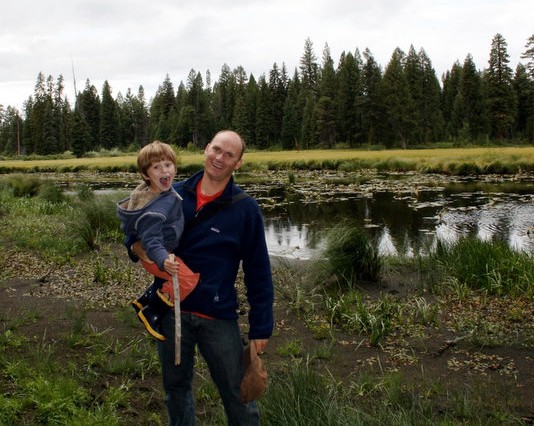
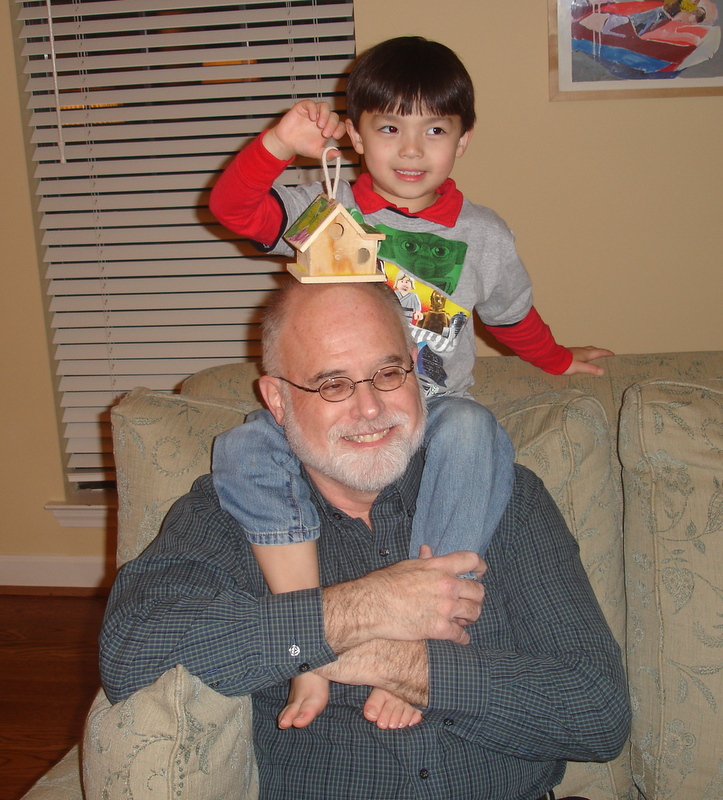
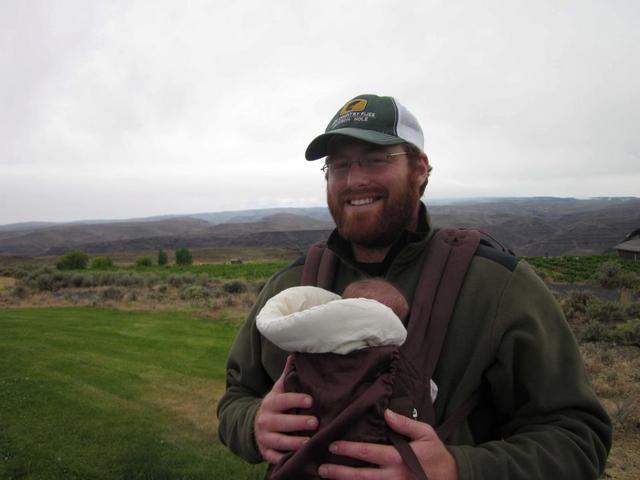
David Jauss and grandson Galen

For your Saturday morning delectation: the never-before-seen image of David Jauss wearing a birdhouse for a hat (with grandson helping) along with Ross McMeekin’s fine tribute interview on the occasion of the publication of David’s new book Glossolalia: New and Selected Stories (which, at this moment, you can pre-order). David Jauss is a powerful story writer, one of the best the country can offer, and a man of profound moral and political commitment. Many of us in the NC community are fortunate to be able to call him friend, colleague, editor, teacher and mentor. You should also know that David has cut a deal with Dzanc Books to bring out his earlier work as ebooks — this is a Great Good Thing. Black Maps can be ordered now at Dzanc Books and Crimes of Passion will be available soon at Dzanc Books.

dg

§

1. I know of your admiration of the stories of Anton Chekhov. What is it about him and his work that you find most compelling? Why do his short stories remain relevant?

He’s just great company.  I can always count on him to show me something significant and true about human nature, and to do it in a way that puts the characters first and himself last.  He doesn’t try to impress us with the flash and dazzle of his prose or the wisdom of his insights; instead, he writes prose that is so clean and clear that we can look through it like a windowpane at the characters and world he’s writing about.  He also brings to his fiction the paradoxical gifts of the good doctor he was: the objectivity and intelligence to diagnose and dissect his characters’ flaws and foibles, and the subjectivity and compassion to sympathize with his characters rather than to judge them.  He has, as someone once said, a cold eye and a warm heart.  And in his nearly 600 short stories, he created an enormous range of characters, far more than any novelist, and he completely reinvented the short story genre.  And while he was at it, he reinvented drama as well, and today he is the second-most-produced playwright in the world after Shakespeare.  He also wrote a book on the need for prison reform in Russia that greatly improved penal policies throughout Europe (but not, alas, in America).  And he did all of this by the age of 44, when he died of the tuberculosis he’d battled most of his adult life.

I also admire the fact that Chekhov wrote to discover and/or test his own beliefs, not to inculcate them.  He was an atheist, for example, yet he wrote sympathetically and movingly about many religious characters, including the title character of his great story “The Bishop.”  Chekhov didn’t create different selves, different heteronyms, the way Fernando Pessoa did, but his fiction reveals the same impulse to see the world from as many perspectives as possible.  As this suggests, Chekhov had, like Shakespeare, like Pessoa, the quality Keats called Negative Capability, the ability to remain “in uncertainties, mysteries, doubts, without any irritable reaching after fact and reason.”  And this is the quality, Mr. Keats and I agree, that is most essential to literary greatness.

Finally, I’m drawn to Chekhov’s stories because his characters and their predicaments seem remarkably modern to me.  I love Dostoevsky, Tolstoy, and Turgenev too, but their characters seem to be of a different age than Chekhov’s.  Chekhov died in 1904, yet his work feels contemporary to me.  I think he’s an absolutely indispensable writer, one of the few everyone should read and reread throughout their lives.

[SPACE]

2. Glossolalia contains stories written and published more than three decades ago alongside stories published recently. What was your process – editorial and otherwise – of revisiting those old stories and organizing a book that spans such a long period of your writing life?

Although I’ve written an essay on ways to structure unified story collections [“Stacking Stones: Building a Unified Short Story Collection”], I was utterly stumped when I sat down to select and organize the stories that would become Glossolalia.  I eliminated a dozen or so stories that I didn’t think were up to snuff, but then I still had 500 pages of stories to choose from.  I tell you, I felt like Styron’s Sophie, having to choose which of my children would die.  Eventually I took the coward’s way out and sent all 500 pages to Press 53.  Ultimately, I have to give credit to Christine Norris, my editor there, for the selections.  She sent me a list of her favorite seventeen stories—250 pages’ worth—and if I remember right, I made only one substitution.  Then I went to work on organizing the stories.  And believe me, that wasn’t easy.  The oldest story in the collection was published in 1976, and my fiction has changed a good deal over time, so I quickly realized that there was no way I could even attempt to achieve the kind of stylistic and thematic unity that I had aimed at in my previous collections [Crimes of Passion and Black Maps].  But I didn’t want to arrange the stories chronologically either, since I felt some of them gained resonance and meaning by rubbing shoulders with other ones.  So through trial and error, I hit upon an order that I felt worked as well as the wide variety of stories would allow.  I sent the list to Christine, and she suggested one very smart change, and the table of contents was set.

[SPACE]

3. “Apotheosis” is a wonderfully complex epistolary story, told through a recently discovered sixteenth-century letter written by a friar defending his actions to the Grand Inquisitor of Spain. Within this letter is another letter, which we discover was read by the friar to a group of followers as a warning against other religions – a message whose intentions were misunderstood by the audience, leading to the friar’s questioning by the inquisitor. The contents of this embedded letter are the story of a South American missionary who himself becomes caught in the blur between the messages of two different religions and cultures. This seems, to me, like a perfect story for our file-sharing, hyper-textual, misunderstanding-rich digital age. I’m curious how the structure of the story emerged, as well as your understanding what happens to a story–and the author–once the piece goes out into the world.

It’s interesting that you find “Apotheosis” to be a perfect story for our particular age since it’s by far the oldest story in the collection; it was originally published in 1976.  And the earlier version of the story was even more “hyper-textual”: it had two additional frames, one narrated by the scholar who edited the two letters and the other narrated by the letters’ translator.  Instead of the brief impersonal editorial note that now appears at the beginning of the story, the original version had a very personalized introduction and conclusion from the point of view of the scholar, who also intruded on the narrative regularly via clueless, obsequious footnotes, much in the fashion of Charles Kinbote, the “editor” of Nabokov’s Pale Fire.  The translator also stepped in to comment in footnotes from time to time, and some of his footnotes even had drawings in them—representations of the hieroglyphic-like Cakchiquel words that the Spanish narrator of the central story occasionally used.  So the original version of the story was far more hyper-textual than the version included in Glossolalia.  Rightly or wrongly (but I’m betting on rightly), I decided that all of this hyper-textual foofaraw detracted from the meaning and emotion of the story and drew too much attention to me and to the story’s artifice.  So I gave both the editor and translator pink slips.

As to what happens when a story goes out into the world, I think misunderstanding—or at least re-understanding—is fairly common.  The natural impulse of most readers, I believe, is to simplify the meaning of a story—after all, this is what we’re taught to do in high school, if my own experience and that of my friends and colleagues is any proof—so the more complex a story is, the more misunderstanding that results.  The ultimate example, of course, is Hamlet.  The attempts to simplify the complexity of both the character and the play are legion.  My stories have none of Shakespeare’s complexity, of course, so, to my everlasting shame, I’ve always been well understood by readers.  The frame narrator of “Apotheosis” isn’t so lucky; the Inquisitor General misunderstands his intentions and he’s executed as a result.  Outside of a couple of bad reviews, that’s a fate I’ve managed to avoid.

[SPACE]

4. Did you give many pink slips to aspects of your earlier work? Was there a common thread to your edits? I’m curious as to how you’ve changed as a writer since your first collection.

I gave a lot of pink slips to all of my work, not just my early work—though that got the most pink slips, of course.  Every story in Glossolalia has been revised, some of them fairly lightly and others quite drastically.  I also revised all of the stories that don’t appear in Glossolalia but are included in the ebook versions of Black Maps and Crimes of Passion that Dzanc Books is publishing as part of its rEprint series. (Black Maps has just been released, and Crimes of Passion will be published shortly.)  The revisions range from factual corrections and minor sentence-level changes to deeper explorations of characters and added scenes.  If there’s a common thread in the edits, it’s the attempt to call less attention to myself and my writing than to the characters and the story.  When I first began writing, I made the mistake that virtually everyone does when they start out: Because I wanted to convince the reader (and myself) that I was a Real Writer, there’s a “Look, Ma, no hands!” aspect to some of my early writing that now makes me cringe. In my revisions, I tried to get out of my characters’ way and let the stories be about them, not about my writing ability.  I hope that any attempts at linguistic pyrotechnics that remain are there to illuminate the character, not to impress the reader.

[SPACE]

5. I had the opportunity of hearing you read “The Sacred Drum,” a story included in Glossolalia, at a writing conference a few years back. Before introducing the story, told from the perspective of a Hmong refugee living in the United States, you mentioned how even though you’d lived for decades in Little Rock, you still felt like an outsider. A handful of the stories in this collection are told from the perspective of characters at odds with the dominant culture. How has your personal experience as an outsider influenced your writing, and how do you view the relationship of the fiction writer to the dominant culture and those excluded from it?

For the record, I’ve felt like an outsider all of my life, not just since I moved to Arkansas.  I suspect that most people feel like outsiders a good deal of the time.  And I think writers almost always feel like outsiders.  If they didn’t, why would they devote their lives to observing others?  Instead of observing the dominant culture, they’d be participating in it.  Or so it seems to me.  At any rate, I’ve been drawn in my fiction to characters who feel they don’t belong where they are.  This is most obvious in the story about the Hmong refugee you mentioned and in “The Bigs,” which is about a Dominican baseball player for the Arkansas Travelers minor league baseball team, but I think the feeling of being outside—outside the culture, outside the family, outside whatever—is something that recurs throughout my fiction.

Of all the places I’ve ever been, the place I feel least like an outsider, the most at home, is Vermont—and, particularly, Vermont College of Fine Arts.  The very first time I went there to teach—in the winter of 1998—I immediately felt like I was at home, and I felt that way even before I knew much of anything about the state or the college.  I think it was a visceral response to the landscape, the quality of light, something in the air—who knows?  Whatever it was/is, I’m grateful for it.  And from what I can tell, it’s a feeling almost everybody connected with VCFA shares.

[SPACE]

6.  An aspect of this collection I admire is the fact that so many of the stories, including the three we’ve mentioned (“The Bigs,” “The Sacred Drum,” and “Apotheosis”), have narrators from different time periods, societies, and cultures than you. This diversity is something I aspire to in my own writing, but I’ve also met other fiction writers who fear writing from socio-cultural perspectives other than their own. Tell us about your perspective of fiction writing as an act of empathy.

There is no worse advice for a fiction writer than “Write what you know.”  I like Grace Paley’s revision of that shibboleth: “Write from what you know into what you don’t know.”  That, to me, is what makes fiction fiction instead of just some glorified form of nonfiction.  In the name of misguided political correctness, many writers have shirked what seems to me the essential task of fiction: the attempt to imagine our way into the minds and hearts of people very different from ourselves.  As I’ve said in my essay “Autobiographobia: Writing and the Secret Life,” I’m not interested in writing about myself.  I write for the same reason I read: to experience other people’s lives.  In Glossolalia, I write from the perspective of a wide variety of characters, including a nineteenth-century Russian dwarf [“Misery”], a serial killer [“Shards”], a couple of Vietnam vets [“Freeze” and “Hook”], a young mother [“Constellations”], and an elderly nun [“The Stars at Noon”].  I’ve taken my licks, both from editors and readers, for writing outside of my own experience.  The editor of one literary journal rejected “The Sacred Drum,” saying “Our readers found your colonialist appropriation of another culture offensive.”  And I once got a phone call from a man who’d read my story “Freeze” and wondered if we’d met.  “I remember that guy you wrote about,” he said.  “The lieutenant.  And I think we must have been at Lai Khe at about the same time.”  When I told him I’d never been in Vietnam, or even in the military, he was outraged.  “What gives you the right to write about a war when you weren’t even fucking there?” he demanded.  He hung up before I had the chance to tell him what gave me that right: the imagination, the most precious faculty human beings possess.  It’s what allows us to empathize with others, and without empathy, we’re all lost.  If fiction writers limit themselves to writing only from their own socio-cultural perspectives, they’re sacrificing the imagination on the altar of political correctness.  And that, not the attempt to imagine what someone from another race or culture thinks and feels, is what’s truly offensive.

[SPACE]

7. In August 2011, after eighteen years of unjust imprisonment, the State of Arkansas granted the release of the West Memphis Three. I know you were deeply involved in their exoneration. Would you tell us a bit about that experience, and how it has affected your life and writing?

Unfortunately, the WM3 were not exonerated.  They were released as a result of a little-known and even less-used legal maneuver called an Alford Plea, which allowed them to plead guilty while maintaining their innocence.  The State of Arkansas agreed to this maneuver because the WM3—Damien Echols, Jason Baldwin, and Jessie Misskelley—were about to be awarded new trials after DNA tests of hundreds of pieces of crime scene evidence excluded them as suspects.  After the WM3 were released, the prosecutor said that, if they had been found innocent in a new trial, they would have been entitled to as much as sixty million dollars in reparations from the state.  By striking this deal, the state avoided this expense.  In return for the Alford Plea, the state resentenced the WM3 to time served—eighteen years and seventy-eight days—and then released them immediately.  The WM3 took the deal because they most likely would have had to wait two or three years for a new trial, and even then there was the possibility a jury could have convicted them again, despite the fact that there was no physical evidence connecting them to the crime whatsoever.  After all, that’s exactly what happened to them in 1994.

In any case, I worked for the WM3’s release from 2005, when I first met Damien, until their release in 2011, and I continue to work for their exoneration.  I was far from alone in this, of course; literally thousands of people in Arkansas and worldwide were involved in their cause.  Even though I played only a small role in the effort to free the WM3, the work I did with and for Damien is the most important work I’ve done in my life.  It’s one thing to publish books and win literary awards, but it’s quite another to help free someone unjustly condemned to death.  And I take much more pride in Damien’s book Life After Death, which I helped him publish, than I do in any of my own.

[SPACE]

8. You teach creative writing at both the University of Arkansas-Little Rock and Vermont College of Fine Arts. How has your teaching influenced your writing?

It’s influenced it both positively and negatively—positively because it’s forced me to think hard about matters of craft and come to an understanding of my own personal aesthetics, and negatively because it has taken a considerable amount of time away from my own writing.  But ultimately, both writing and teaching are very positive ways to spend one’s life.  I’m with Jean Rhys, who said, “All of writing is a huge lake.  There are great rivers that feed the lake, like Tolstoy and Dostoyevsky.  And there are mere trickles, like Jean Rhys.  All that matters is feeding the lake.  I don’t matter.  The lake matters.  You must keep feeding the lake.”  I feel both writing and teaching are ways to feed the lake, even if all I can add is a drop.

But teaching hasn’t only influenced my writing, it’s influenced my life.  Thanks to teaching, I’ve met many extraordinary students and colleagues who have become dear friends and enriched my life beyond all measure.

[SPACE]

9. What projects do you have in the works next?

If Glossolalia: New & Selected Stories does well, Press 53 may publish a follow-up volume that contains another dozen stories and a novella that we didn’t have room for in Glossolalia.  Also, since Alone with All That Could Happen, my book of essays on the craft of fiction, is now out of print, I’d like to put together a new edition, one that includes some of the essays I’ve written since the book was originally published in 2008.  I also plan to continue writing stories toward another book.  And I’ll keep feeding the lake at both Vermont College of Fine Arts and the University of Arkansas at Little Rock as long as I’m able.

—Ross McMeekin & David Jauss

————————————————-
RossMcMeekinphoto

Ross McMeekin’s fiction appears or is forthcoming in publications such as Shenandoah, Passages North, Doctor T.J. Eckleburg Review, Green Mountains Review, and Tin House (blog). He received a MFA from Vermont College of Fine Arts, edits the literary journal Spartan, and blogs at rossmcmeekin.com. He lives in Seattle with his wife and daughter.

David Jauss is the author of three story collections, Crimes of Passion, Black Maps, and the forthcoming Glossolalia: New & Selected Stories; two volumes of poetry, Improvising Rivers and You Are Not Here; and a collection of essays on the craft of fiction, Alone with All That Could Happen (reissued in paperback as On Writing Fiction).  He has also edited three anthologies, most recently Words Overflown by Stars, a collection of essays on the craft of fiction, creative nonfiction, and poetry by the faculty of Vermont College of Fine Arts.  His awards include the AWP Award for Short Fiction (for Black Maps), an O. Henry Prize, a Best American Short Stories selection, two Pushcart Prizes, a National Endowment for the Arts fellowship, a James A. Michener fellowship, and three fellowships from the Arkansas Arts Council and one from the Minnesota State Arts Board.  He teaches at the University of Arkansas at Little Rock and in the MFA program at Vermont College of Fine Arts.

[SPACE]

[SPACE]

Jul 092012
 

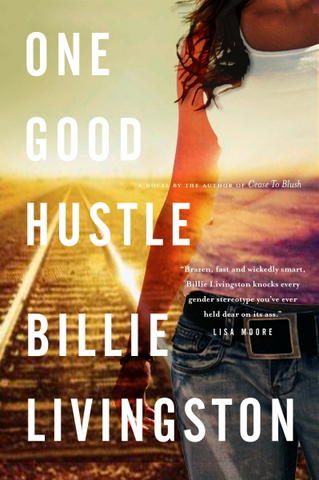
Herewith a rare and exceptional treat for Numéro Cinq readers, two writers — Billie Livingston and Susie Moloney — in conversation; an interview ostensibly, but at a certain point the convention breaks down and they just talk. Both are prize winners, both are too young to be at the peak of their careers but both on the hyper-ascendant. They are from opposite sides of the literary tracks, so to speak, one literary, the other a superb horror novelist, but they respect and like each other. Ebullient, witty, brash and challenging — they take us on a breakneck tour of the relationship between genre and literary faction, on the strange business of writing, and the love of art.

I first met Billie Livingston last year when I was on the jury for the Danuta Gleed Literary Prize. Billie won. And this is what the jury said about her story collection Greedy Little Eyes: “In this collection the writer’s eyes are wide open, taking in the world and then reflecting it in all its strangeness and beauty. She pushes edges, teeters on brinks, creating the exhilaration that comes only with taking risks. Her characters are real people in a real world who achieve break-out velocity and recreate themselves by signal acts of courage and self-definition. Frequently, her plots hinge on a demand for justice in a world clouded with calculation and evasion, resulting in a collection as strong in content as it is in style.” Billie is also a novelist and poet — her third novel One Good Hustle is coming out later this month.

Susie Moloney is the hugely popular author of four best-selling horror novels including The Thirteen: A Novel just out in March, described in the Toronto Globe and Mail as “a gonzo, mirror-universe, occult version of The Stepford Wives, with a dash of Stephen King thrown in.” The reviewer goes on to say the book is “a compellingly uncanny narrative, binding the tropes of small town paranoia and cliquishness with the chokehold of family obligations and religious fervour, and the very real claustrophobia of poverty and desperation” which sounds so uncomfortably close to my own life that I am afraid to pick up a copy (though I will).

It’s a huge pleasure to give these two authors a place to talk on NC.

dg


BILLIE: As writers you and I are slotted into different categories in the publishing world. You’re considered a “genre” writer (horror) and I’m a “literary” writer (whatever that means).  We don’t appear in the same festival events, we’re not asked to sit on the same panels—It’s as if we’re different animals at the zoo and we might rip one another’s fur off if we come in close contact.  Meanwhile readers, for the most part, don’t use those terms and don’t give a damn what they mean.  The idea is that literary works are complex and multi-layered (dull and plotless) whereas genre work is about romance and scary capers (shiny and trivial). John Updike said the term “literary fiction” was created to torment people like him who just set out to write books. What do you think? Does this kind of grouping effect you? Please you?  Limit you?

SUSIE: You know, I answered this about three times, and deleted all three responses, because what it comes to is this: I love labels when I’m buying a book, and I hate them when I’m writing one.

There’s something juvenile about ghettoizing storytelling. It’s separation, stereotyping: blondes are dumb, jocks are bigots. As Stephen King said when he was accepting his National Book Award—that’s right, a horror writer won the NBA in 2003—he said, “When readers are deeply entranced by a story, they forget the storyteller completely. The tale is all they care about.” That’s some ninja chastising there. You can hardly tell he was schooling those folks. But he was. In fact, I think his whole speech is somewhat of a canon for how we’d like to be seen, us genre writers.

I think the greater issue with genre v literary, is, who gets to decide if something is literary or not? It should be the reader, and I would bet you’re right, the reader doesn’t give a shit. The Wendigo is one of those horror concepts that comes up in literary fiction. Is that because it’s mythological? So, if I write about the Wendigo, is it still literature if I call it a dead cannibal? What if my Wendigo is succubus?

Ray Bradbury, Edgar Allen Poe, Stephen King—they all wrote horror fiction designed at source to make you pull the covers up over your head. They’re also damn good writers. The kinds of writers you “take in school,” as my grandmother used to say. She had great respect for anything you, “take in school.”

I’m curious to hear the other side of this. Do you guys, you smarty pantses, ever peer over the fence at us genre writers and moan while we walk our comically large cheques to the bank? Or is it just us cupping our hands around our eyes and staring through the candy story window at your black-tie galas where you pick up shiny statues (that we immediately believe will make an awesome murder weapon in our next tome)?

BILLIE:  Do we moan?  That’s about all we do.  And rend our garments.  The only people who moan more than the literary fiction crowd are the poets.  We look at your big barrels of genre money and shriek, “Nobody understands me!  Maybe they’ll recognize my artistic genius when I’m dead.”  Then we wonder how hard it would be to fake our own demise.

SUSIE: Ha ha. You poets! Always with the funnies. In any case, I’m with King on this one. The reader doesn’t care. Not when the book is in her hands.

As for literary novels being dull and plotless, you’re being too hard on your own people, and I thank you for that.

The real thing is here, how come you get all the accolades when you’re mining your own backstory, and I get fewer even though I have to go through all the extra work of making it all up? From scratch. What about that? Is it easier to mine your own stories, or is it easier to just go to the therapist and make the rest up?

BILLIE: So, let me get this straight, the way you figure it, I just cut and paste from my diary and call it fiction, whereas you, clever girl, pull from the thin air of your magical mind?

SUSIE: Yes. That’s exactly what I think.

BILLIE: Ha! You’re just yanking my chain.  Any writer who claims that there is no autobiographical component to his or her work is either a liar or an emotional chicken. I think it’s true of fiction and non-fiction writers.  I think it’s true of biographers!  I was struck with that when researching Cease to Blush.  If you read two or three biographies about the same historical figure, each will be very different. People can’t help but see through the lens of their own lives and, because of it, even biographies begin to suggest more about the biographer than their subjects.

SUSIE: Okay, I’ll cop to some autobiographical elements to my work, probably most obviously in The Dwelling. But I leave it to the reader to discover which of the stories is the most autobiographical. Did I have sex with a ghost? Am I dead and living in the walls of a house? Did my computer try to make me kill myself? Or was it all autobiographical? Hmmm.

That first person voice you use gets me every time. It’s so intimate. You can’t read “I” statements and not get personally involved with the character.

Do you think of them as inspired by real life, ripped from your own personal headlines, so to say, not a memoir, but memoir-ish? The memoir has been huge for a few years. If you had a drinking problem or had killed a man in Reno just to watch him die, you would kill with a memoir.

BILLIE: The most autobiographical book I’ve written was, as one would expect, my first. My family was rather disconcerted to recognize bits that mirrored our lives juxtaposed with scenes that bore no resemblance to anything in memory. But it’s a novel not a memoir, and as they say, sticking to “truth” can limit the larger truth that fiction reveals.  Which is why it’s so dreamy and lovely to go into that trance-like state when writing… it’s as though the ghost of Christmas past is being the docent of my own weird story gallery.  The thing too is, you come to a point when you realize that what doesn’t kill you makes you stranger.  So why not mine the strangeness and make art out of it, baby.  If I could paint worth a damn, you better believe I wouldn’t be doing landscapes.

I’m fascinated with the way you use the close third person.  Particularly impressive in The Dwelling, as there were different stories within the story, so the voice changed as their particular worlds unfolded.  Each character’s mind is woven through the voice and yet it still allows for a kind of omniscient overview.  I have a hard time writing in the third person. It’s as though I can only feel characters when I can hear them in my head and when I do they always say, “I.”

SUSIE: There also seems to have been a real uptick in novels with a first person narrative. Have you noticed a correlation between memoir, first person narrative and the rise of social media? Do we just want to listen to stories that are about “I”?

BILLIE: Haven’t noticed an uptick in first person narratives— I see more third-person!  (Perhaps we each notice “the other.”) There has definitely been an obsession with memoirs though.  Seems a lot of people have a craving to catch a glimpse of “this all happened.”  And publishers, in a cynical ploy to extract cash from the rubberneckers, have bought lot of vaguely autobiographical novels and repackaged them as memoirs.

SUSIE: That’s probably some of the beauty of writing genre fiction. The truths that the author believes and would like to promote or at least mention in passing are buried under piles of corpses, or bricked up in the walls and allowed to scream. We get to use really broad metaphors, because when there’s a monster, for crying out loud, it’s probably representing something. I mean, it’s a monster. That’s often, however, when the horror fiction genre writer (full title) is underestimated. At first blush, that monster might well be the crushing helplessness of man versus the industrial complex … but it might also be something more human and heartbreaking and universal. Maybe I’m overreaching. This last couple of years I’ve noticed another uptick: the number of dead children in Susie Moloney stories. Maybe you’ve all noticed. I know that it’s because my youngest is mostly grown up now and it’s a loss. I was a single mom for most of his life, and we were pretty tight. It’s been like an amputation (look for the broader “amputation” metaphor in future stories). Anyway, that’s a universal, heartbreaking truth that all mothers understand, and it’s been subtly marked in most of my work. Or so I like to think.

BILLIE: Your recurring themes are hanging out! Ha! I see dead children…. and children in peril, motherhood and the fear of maternal failure, suburbia, isolation and the horror of “you made your bed, now lie in it.”  I think all of those things come to the fore in your most recent novel, The Thirteen.  On its surface it probably has the breeziest feel of your books — I mean it’s fun and playful in its satire of suburbia — but, it’s been compared to The Stepford Wives which has become an iconic shorthand for women who are so desperate to fit in that they become more like obedient pets.  The women in The Thirteen have a more hungry and defiant desperation to be successful wives and mothers.  When you wrote it, did you set out with that theme in mind or did you just tell the story and let the themes fall where they may?

SUSIE: Well, I’ve been a reluctant suburbanite. I was raised in the suburbs mostly, and so when I went back to Manitoba to lick my wounds, I think I subconsciously retreated to a childhood I wanted to remember (never happened) to raise my youngest son. It’s just easier in the ‘burbs. The schools, parks and community centres are all there, everyone is more or less the same. There’s no challenge, really, to living there. Or so that was the great dream when I bought my house.

There is challenge there, turns out. I didn’t really fit in. I had a potty mouth. I kept my wine in a go-cup. I homeschooled for the first two years. I didn’t have a job—not one you could see me coming home from. The thing that saved me from utter insanity, were the women. It might have been some true divine intervention there, but I happened to have great neighbours, each of them just a little different in their way. The woman across the street from me was bat-shit crazy, I swear to god. Up a little from her was a lady who had a monkey. A gay couple lived one house over. My closest neighbour became my best friend. But the story of The Thirteen started out as a short piece about the crazy woman across the street. I started to wonder what would happen if a witch went crazy and was no longer of use to her dark god. It started off a lot of fun, but turned very serious in the end, kind of a “chickens coming home to roost” thing.

At the heart of that story—whether it shows or not—is the feeling of being an inadequate parent. Wanting your child’s life to be smooth and successful, and how little power we have to make that so. Every bad decision–that seemed like a good, well-thought out decision at the time—not working out, and it being All Your Fault. Such power we tiny little mothers have! To ruin whole lives! Oh my. The book started out as a wish-piece, to wave a magic wand, or compact with the Devil, to make our lives flawless whatever the cost.

Also I fucking love the suburbs. So much grass.

BILLIE: One thing I’ve noticed too is that religious faith comes up in your work, but it’s not as the boogieman, the way it often does in a lot of contemporary fiction.  There’s a general sense among those who consider themselves intellectuals that belief in any sort of deity is the hallmark of a moron. Religion definitely comes up in my own work, in part because, like it or not, it is something of a cornerstone of who we are and how we live.  I also tend to write about people who are broke and who are outsiders and the church is often the only community to step up to the plate with the down and out. As a kid on welfare, that was certainly my experience. It was the church-crowd who consistently offered help and who were happy to be a second family–A superstitious, loony family sometimes, but still, their doors were open and they gave a damn. Did you grow up with much in the way of religion?  I get the sense from your writing that you have a soft spot for it.

SUSIE: Oh I love religion. I was raised orthodox heathen and my first exposure to religion was through a Catholic friend. I went to church with her a few times. It all seemed so glamorous and fulfilling. Like you, I appreciated the fact that it was a community and you could be part of it. And there was wine. And the BODY of Christ. You know that old saw, “Home is the place where they have to take you in (sic)?”

BILLIE: Robert Frost!  He’s always good for an aphorism that sums it up nicely. Home is the place where, when you have to go there, they have to take you in.  Sounds like church to me.  Or at least what the church should be.

SUSIE: It seemed like that sort of thing to me. I wanted to have a place where they had to take me in, just because I was part of it.

When I was a teen mom, I was born again. I lived in Winnipeg Regional Housing at the time, and the born again-s seemed to sweep the whole block, like germ warfare. In retrospect, it was a pseudo-religion, a kind of pop-god era in my life where Jesus was your bud, your boyfriend, the guy who would carry you over the sand so no one knew you skipped work and went to the beach (only one set of footprints, eh?) The soundtrack was Amy Grant and Michael Smith and Petra. It was fun. Mike Warnicke and his “book of do’s,” not “book of don’ts.” I went to a bunch of churches, all my friends were hyping their churches. I was kind of a buffet gal. It was all great until I went so some church in some community centre basement on Edison Avenue and met the minister there. I was carrying my beautiful toddler, the centre of my life. My friend introduced me to the pastor and he looked at my kid and said, “Where is this baby’s father?” Turned out he wasn’t looking for an address. That was kind of the end of religion for me.

BILLIE: Wasn’t it Ghandi who said, “I like your Christ, I do not like your Christians.”? The born-again judgment was what ultimately drove me out of that church too. And the theology: very literal, not terribly nuanced. Of course, it’s the parade of those very things that I love when I read Flannery O’Conner’s writing.  She always seems able to get to the heart of the simultaneous impulse toward redemption and revenge.

I still do take a pleasure in church hopping though. Churches, synagogues, temples…I like going to different places of worship, and listening for the poetry that illuminates or challenges in a way that hadn’t occurred to me before.

SUSIE: I know what you mean. God and spirit and the wonders of the possibilities, all of that has hung around.

Telling that story makes me feel naked and 18 again. So, while I hate to belabour this point, but frankly, I love this point: I find that your voice is so real and so intimate that as a reader, I can’t help but feel naked and vulnerable while I’m in that world. Your voice melts into the page and ceases to be a separate voice. It’s my voice. Is that what all writing is supposed to do? All of it doesn’t, but yours does. And I have an example of this, two really, one funny.

I loved, just loved One Good Hustle, which is newly released and I think, my new favourite Billie Livingston novel. It’s about Sammie and her mother Marlene and a tough patch (your PG-13 elevator pitch). There’s a moment when Sammie pulls the drugstore hustle, very cool, very doable. That was the problem, it was so doable. I was reading that section and for the next few hours I just had this feeling that we were going to get caught. You know, me and Sammie. Because we ripped off that drugstore. But of course, “we” didn’t, Sammie did, but that coal of guilt in my belly was real. That’s my funny example, and a true story. Ha.

On a more upsetting note, the night Sammie goes to pick up her mother from that place, with the people—I’m being deliberately cryptic so not to deprive your readers of this, a very glorious/gruesome scene—she’s with a friend, and mortified. The friend claims to be less mortified. That scene was so raw, so human that while reading it, the instinct is to look away. While that never actually happened like that in my life, the discordant feelings of defense, protection, rage and humiliation are so perfectly executed that later when I was thinking about it, for a moment I thought it a part of a story from my own life. With complete acceptance—oh I remember this one time when I had to pick up my dad at …

Except, it didn’t happen to me. But it stabbed into me so thoroughly, the wound so clean, that I was independently humiliated for hours later. (Thanks). I think that is that first person voice, exactly. It’s so intimate and naked, that it must be my own. The power of first person—or maybe that shiv, as wielded by you—is so sharp, so fine, so accurate, that it just becomes the “I” statement that I, the reader, have been too terrified to speak out loud.

BILLIE: I have a compulsion to argue with compliments but I’ll stick a sock in it and say, thank you from the bottom of my heart.  I’m a bit relieved that the scenes you mentioned were made up – ie not ripped from my own personal headlines.  I probably shouldn’t say that. Is there any point to saying what is true? Discerning what “true” means is a bit of a rough hustle in itself.  Is a story “made up” if it comes from the closet where something similar is buried under the dust bunnies? John Irving has come up with story after story that involves Maine, wrestling, teachers, bears and a hirsute woman.  These are such a part of his mental furniture that regardless of how differently he treats them, we know by now that they are a significant part of his personal truth.

I can’t help thinking that labels like genre and literary (and their various sub-categories) mainly give comfort to critics and academics— who love to invent rules. Neither of us went to creative writing school and we are in the minority in that regard. Early on, I used to wonder if there might be some special information that I wasn’t privy to. Were you concerned about formal instruction when you set out to write your first novel? Did you give much thought to “voice” and “structure” or did you just wing it?

SUSIE: My first novel was a complete wing. I had just finished reading a novel that I particularly liked. I believe it was Margaret Lawrence’s A Bird in the House. Do you remember that book? A beautiful family dynamic study. When I was finished, I wanted to continue the feeling of being in the story—and so I wrote my own. No kidding.

The voice, style, structure, all of it was instinctive. I was writing like a reader. For better or worse, that’s still my process. What I read has changed somewhat, it’s probably broader than it was when I was a teenager, and my life experience of course is off the fucking charts—for better or worse—and so it’s getting harder to “wing it.” It certainly takes longer.

What about you? Is it instinct? Your work flows so effortlessly, as I mentioned earlier, it’s like listening to the voice in my head, I always know what you mean. It seems like you must sit down and put the end of the quill in your mouth, give a quick eye roll to acknowledge the muse and then … write a book. Is that it? Has it ever taken you literally years to sort something out to the point where it makes it into a story?

BILLIE:  I do a lot of meandering and babbling before I find anything close to a story. It’s almost like I weave a giant tarp and then I stare at it and wonder if it was really meant to be a dress. Or a skirt. In which case I have to go back and cut away everything that doesn’t look like a skirt.

I hadn’t met any writers before I started my first book. I kept writing in circles for close to four years until I came up with this idea of different POVs – one of them being the voice of authority, which would involve government documents. I did worry a bit. “Are you allowed to do this?  Is this just weird and silly?” I decided to apply to the Banff Centre for the Arts, in part to get over my fear of big institutions and authority and, in part, because I felt a craving to talk to someone who had written a book. When I was accepted into their five-week program I was so sure it was a clerical error that I started bawling at the airport, afraid they’d send me home when I arrived.

SUSIE: And in that vein, we’re both from that unschooled school of writing. So are we outsiders, practicing outsider art? http://en.wikipedia.org/wiki/Outsider_art

I personally love the label art brut to describe my work, and certainly, my circumstances.

BILLIE:  Art brut. So raw and yet sophisticated! Sure, I’ll go for that. Even if it is French for “finger painting sociopath.” I definitely felt like an outsider at Banff. Most of the other program participants had graduated from a creative writing program and they spoke in a kind of academic patois that I didn’t understand. They often talked about what you should and shouldn’t do in fiction and poetry. I probably used the phrase “Oh yeah? Tough,” a little too often in response.  Halfway through the program I had the great fortune of sitting down with Rachel Wyatt, the program director, and telling her about my idea for a novel, the (to me) crazy structure.  And she said in her sweet English goose of an accent: “Write it. There are no rules!”  She jumped up and plucked novels with unorthodox structures off her shelf to show me. I loved the hell out of Rachel.

SUSIE: I have never been to Banff as an artist. Back in the day I used to apply to things, but I would rarely be accepted, and I suspect it was because I don’t fit the “literary” form, although my partner—a playwright–says that it’s because you have to apply again and again, which appears to be a sort of dues paying thing.

BILLIE:  He’s right. You do have to apply a lot. I think part of it too is learning the type of phrasing and presentation these places like to see.  They are institutional bodies and yet they do act with a kind of human ego. If you squint, they’re almost like petulant lovers asking, “Why do you want to be with me?  What’s so great about me?”  So, if you want to court the Banff Centre or The MacDowell Colony, you tell them how much they mean to you and what you could learn from them.  It also helps to send work that is as polished as you can get it.  Otherwise, it’s as if you’ve come a-courtin’ with a stain on your shirt and spinach in your teeth.

SUSIE: I don’t have the energy to do that, frankly. Rejection sucks, ha ha. I’ve had my own Rachels over the years. People who read my stuff and commented and gave me guidance based on the quality of my writing rather than the subject matter. I also believe that your Rachel is right: there are no rules. You can be sure that if there were, I would be following them. My process is so bizarre and painful that I would love a few rules. Every year I think about applying to some creative writing course and starting from scratch, seeing if there is some kind of magic information that I’m missing. That’s the tragedy of being an outsider, I’m always thinking I’m out of the loop, even if I suspect that by now, I’m in it.   My agent wants me to have another book by end of summer. Some writers are writing TWO books a year. Two!

Seems most agents want their clients to do that, because that’s how books get on the bestsellers list. When you’re reading the list and you go, who the hell is that, chances are it’s somebody who had 27 books to their name. Are you feeling this kind of pressure to produce?

Billie: The “genre” and “literary” difference again.  In the “literary” universe, they don’t want us putting out more than one book every two years. With the lit stuff, publishers rely heavily on press and the potential for awards to drive sales rather than the kind of buyer’s momentum that comes with genre fiction. With literary fiction, there’s a terror that if you saturate the media with someone’s name and picture one year, no one will review another of her books the following year.

I assume writers who churn out semi-annual quickies must have a template in mind and they just rearrange the events and change the names. Which is fine if its easy and fun and all you want is to help people pass time in a crowded airplane. But if doing that leaves you feeling empty and unchallenged and untapped, then I say fuck it, go home to your soul. Otherwise you’ll start to feel like a five-dollar whore. Not that there’s anything wrong with whores — why some of my best friends….

SUSIE: I will include myself in that, if by “whore” you mean someone who will write for cash. For me to write that fast, I think I would give up a lot of what defines my prose, my (ahem) deep characterizations and what I feel are pretty rational motivations, regardless of whatever supernatural backdrop I’m using. I tried to write really fast, pump something out, but I found that I lost my way doing that. It gets to where I have no idea who these people are anymore, and I have no idea what story I wanted to tell.  Turns out, I just can’t pump them out. I’d love to be Stephanie Meyer, or even just the Susie Moloney people think I am, ha ha. I need my downtime, the time it takes to recharge that internal battery that allows us to fall into that beautiful trance state where all the good shit happens. I need to live in their world. Hell, I need to research their world! My current character is an insurance adjuster, and let me tell you, everything I know about insurance burned in the fire.

BILLIE: No kidding. I think one of the biggest surprises to me was that even when I was working with material that was second nature, as I was with Going Down Swinging, I still felt the need to research.  I went to AA meetings (though I’d been dragged to dozens as a kid), went to Jehovah’s Witness Kingdom Hall meetings, (I’d been to many of those as a kid too) and met with social workers to get a sense of things from their prospective (I couldn’t count how many social workers I had growing up).  That kind of personal involvement feels like something I need to do in order to feel any kind of authenticity when I write.  I’ve been working on a story about a woman who turns to spiritualists in her grief and I’ve gone to half a dozen spiritualist services in order to listen to mediums and watch them in action.  Are you that way?  Do you have a need to immerse yourself in the world of your characters?  Your portrayal of Glenn the real estate agent was so believable that I assumed you must have flogged houses at some point in your work history – specific details, and dialog that rang true and helped flesh out the way she dealt with that world and her colleagues.

SUSIE: Spiritualists! I’m terribly impressed. I love a good medium. I went to see the Antiques Psychic in Calgary a few years ago to find my mother. She died when I was very young then I wrote about it and tried to sell it to The Walrus. They never got back to me. I bet they get back to you (and that right there is the difference between literary writers and genre writers).

By the time I was writing The Dwelling, I had bought my first house, sold it and then was buying another. When I was looking for what would be my second house, I really knew what I wanted and so I spent about 3,475,987 hours with my realtor, walking through other people’s houses. It was sad after awhile, all these people selling their houses. I tend to get very attached to places, and leaving them is always sad. After awhile I just saw all these people leaving their homes and offering them to me. I think that came out in The Dwelling.

BILLIE: It did.  One gets the sense that the Dwelling feels lonesome, dejected, and misunderstood, that it wants people to embrace it.  Of course, in this situation, the only way to be one-with-the-house is death. Just one character was capable of loving that house in the way it needed to be loved.

SUSIE: Few people ever mention the underlying sadness in Dwelling, but I think it’s there because of that. As for my realtor, she was terrific about showing me the game. I hung out with her at her agency, I went on open houses with her. I pretended to be her assistant on a couple of calls.

Right now I’m writing about demons, “literal” and personal. It’s a metaphor. (I hope.) And it takes place is a very large city, hmm, like New York. I’ve tried to get a sense of the undercity here, there’s a lot of steel and concrete, a lot of isolation and abandonment of whole areas, and there can be hopelessness, at least to the person passing through. I’m calling that research. And I’m claiming my Metrocard on my taxes next year.

BILLIE:  Demons— That could be really fascinating in a big city. One of the things I’ve learned, being married to a former seminarian, is the origin of some of these old words like Satan.  In Hebrew Ha-Satan translates as “The Accuser,” which, for a fiction writer, is much more interesting than a red guy with horns and a pitchfork.  More frightening is the idea of an insidious voice that says, “You’re a loser. You’re incapable of anything worthwhile so why don’t you just lie down and never get up again.”  Those thoughts, if left unchecked can be really monstrous –especially in the strange isolation of a megacity like New York.

It occurs to me that the house in the Dwelling uses the sadness of its inhabitants in order to coax them more deeply into itself.  The lonely accuser!  In The Thirteen, your most recent book, there is a more overtly Satanic figure – the Accuser is the dark beastly man who encourages the belief in these women that on their own, they aren’t good enough.

That’s what I love about theology and mythology— hours of amusement! They help me tap into the basics of who we are though. We’ve told these stories for thousands of years, trying to make sense of our fears and madness and we keep dreaming up new ways to tell them.

SUSIE: Exactly! It’s all demons. They might be less obviously demonic in the literary world, more shaded in grey. Your characters from Going Down Swinging, Cease to Blush, One Good Hustle, Marlene, Sammie, Eilleen, and Vivian are all running from, and running into demons. Alcohol, isolation, despair, abuse, neglect, all universal demons.

OMG. Billie. I’m you.

(Cue music by John Williams)

— Susie Moloney & Billie Livingston

———————–

Susie Moloney is the author of the award-winning humour column, Funny Girl. She is also the author of four novels, including the 2011 Globe and Mail Best Book, and winner of 2012 The Michael Van Rooy Memorial Award for Fiction, The Thirteen. She lives in Winnipeg and New York City.

Billie Livingston published her critically acclaimed first novel, Going Down Swinging, in 2000. Her book of poetry, The Chick at the Back of the Church, was a finalist for the Pat Lowther Award. Her novel, Cease to Blush was a Globe and Mail Best Book as was her story collection, Greedy Little Eyes, which went on to win the Danuta Gleed Literary Award and the CBC’s Bookie Prize. One Good Hustle will be published July 24, 2012


Jan 132012
 

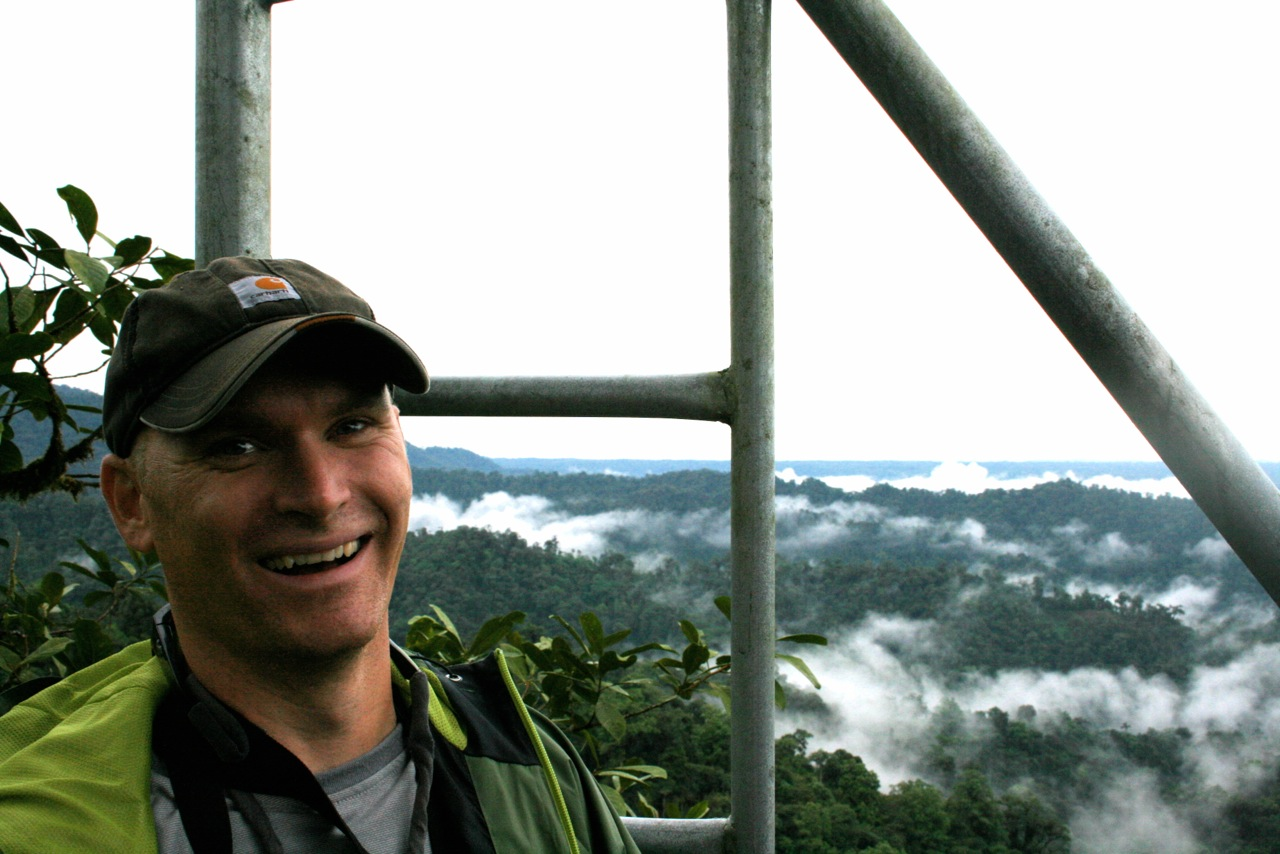
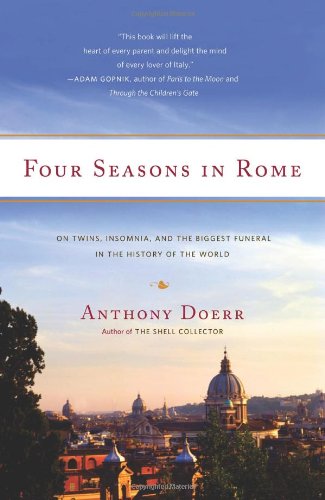
Anthony Doerr

In his 2007 memoir, Four Seasons in Rome, American writer Anthony Doerr describes his desire to see snow falling through the oculus of the Pantheon. “If it ever begins to snow, we should run to the Pantheon, because to see snowflakes drifting through the hole at the top of the dome is to change your life forever.” At the time, Doerr is living in Rome with his wife and twin boys after winning the Rome Prize, a prestigious award from the American Academy of Arts & Letters. The Academy has provided him with a fully funded year in Rome, a studio, a place in a community of artists, and uninterrupted time to write, travel, read and think. Winter passes without snow and spring arrives in Italy. Doerr’s wife, Shauna, comforts him over the missed opportunity: “Sometimes, she says, the things we don’t see are more beautiful than anything else.”

Those of who have had the good privilege to read Anthony Doerr are fortunate.  Through his words, we have, indeed, seen the snow falling through the ancient dome. Crackling with beauty, intelligence, lyrical prose, heartbreaking characters and a rarefied wisdom, Doerr’s work challenges many of the basic traditions of contemporary fiction. His short stories often run unusually long, brushing up against such uneasy labels as novella. He writes about characters from other cultures, other races, other genders. His prose is dense, filled with science and history and more than an ample supply of the magical powders that make good fiction fly off the page. A reader might find herself in the Liberian civil war, on Caribbean beaches, inside memory (literal memory) stored on a computer disc. But it hardly matters. I’ve yet to begin a sentence of his and find myself disappointed.

I reach Doerr in December of 2011. Like in much of the nation, winter has yet to arrive to the Boise foothills. An uneasy tension seems to hang over the unusually dry, warm season. It is raining and chilly here in San Diego, where I am. We talk about the weather, about raising children, about Santa Claus and about trying to keep kids believing in magic and fat guys delivering gifts through chimneys without directly lying to those we love.

The fact that such an accomplished writer can be such a nice damned guy is very reassuring. Doerr retains the humility of a seeker, of a fellow traveler on the road to discovery, even if he is light years further down the path.

Doerr’s describes his process of writing this way (from Four Seasons In Rome): “…A story—a finished piece of writing—is for its reader; it should help its reader refine, perceive, and process the world—the one particular world of the story, which is an invention, a dream. A writer manufactures a dream. And each draft should present a version of that dream that is more precisely rendered and more consistently sustained than the last.”

Anthony Doerr’s short fiction has won four O. Henry Prizes and has been anthologized in The Best American Short Stories, The Anchor Book of New American Short Stories, and The Scribner Anthology of Contemporary Fiction. He has won the Barnes & Noble Discover Prize, the Rome Prize, the New York Public Library’s Young Lions Fiction Award, a Guggenheim Fellowship, an NEA Fellowship, the National Magazine Award for Fiction, two Pushcart Prizes, the Pacific Northwest Book Award, three Ohioana Book Awards, the Sunday Times EFG Short Story Award and the 2010 Story Prize. His books have twice been a New York Times Notable Book, an American Library Association Book of the Year, and made lots of other year end “Best Of” lists. In 2007, the British literary magazine Granta placed Doerr on its list of 21 Best Young American novelists.

—Richard Farrell

.

Richard Farrell (RF):   The Paris Review once asked John Gardner this question: How do you name your characters? Is this something you think about as you write?

Anthony Doerr (AD): Names comes to me primarily through research. I’ve found last names on a gravestone and written on the back of a photograph and in the works cited at the end of a scientific paper.  And I’ve found first names in the fiction of other writers or overheard them in conversations.  For my short story “Village 113,” for example, I was reading lots of dry U.N. reports about the construction of the Three Gorges Dam, and whenever they would mention an engineer’s name, I would scribble it down. So for Li Qing I ended up simply mixing together two different names.

Right now, I’m writing a novel set in France and Germany during World War II, and am reading, among other things, a book called Voices From the Third Reich.  I’ll pull Uwe from Uwe Köster, who lived through the Hamburg firebombings as a young messenger, and Kühn from Klaus Kühn, who was Hitler Youth flak auxiliary during those same raids—and suddenly I have Uwe Kühn, a new person with at least a remotely plausible name.

That’s got to be a pretty common technique, don’t you think?  Once you have a name and you start spending months with a character, he or she begins to embody the name.  It starts to feel right; it starts to feel as though the character could never have been called anything else.  Like a child, probably.

RF: Can you talk about your earliest influences? Perhaps even the influences before you became a writer, such as the things that drew you toward reading?

AD: Sure. My earliest influence was maybe C.S. Lewis.?  I remember my mother reading The Chronicles of Narnia to me and my brothers; I was probably eight.  And I remember asking her: “How did they make this book?  How did they invent Narnia?”  And she’d always say, “It was just one person who wrote these books.  And he’s dead now.”

Dead!  What?  Dead people could tell stories that still held power over the living?  I had always had a sense that books were like oranges on a tree, that they pre-existed in the world, and humans came along and plucked them.  But now my mother was saying people made them.  One person, one book at a time.  That was a revelation: One weird old guy could use language, the cheapest of materials, and conjure whole worlds with it?  Then he could die and those worlds could still hold sway?

My childhood was very immersive. Very imaginary. I was making up pretty complicated narratives with my toys.  Sometimes I’d write them down. My brothers were older than I was, often doing things without me, and so I learned to make up stories about my Lego guy or G.I. Joe or whatever, and that was probably good training to be a fiction writer.

My kids are seven now, and because they are twins, they very rarely play alone.  Sometimes I worry about that; I feel like one of the best parenting strategies my mother had was to trust me to play by myself with my little toys out in the woods for hours.

I had the usual influences too, like writing for the high school newspaper. I was a history major in college,  and wrote a silly column with a friend for the college paper.  But I always had my eye on the English department. I would write long, lousy stories in notebooks about avalanches and keg parties and dogs that walked across Alaska and show them to nobody.  It felt precocious and impertinent to say to my parents, “I want to be a writer.”  It was hard to even say that to myself.  But that’s what I wanted to do.

RF: You’ve been described by other writers as being ‘scary smart’.  (I’m not naming names!)  How do you balance the intellectual side of writing with the more artistic/emotional parts?

AD: (Laughs) I don’t feel very smart sometimes.  I can feel like a failure all day long. Sometimes writing is like baseball, where you can hit .300 and be considered a good hitter.  What I mean is that I feel lucky if 30% of my sentences end up working out, if 30% of my ideas wind up turning into finished projects, if 30% of my hours can be productive.

When I read, I try to learn as much as I can.  Sure, I also read to escape, to enter other lives, but I also read to learn, and I don’t mean just to learn about extrasolar planets or conditions on slave ships. I mean to learn about the experiences of other people in other years, other eras, other climates.  A book like Moby Dick, for example, is so formally risky because Melville has no problem disrupting his narrative momentum and cramming in whole chapters about the history and techniques of whaling.  Often my students resist those chapters, but I love them: they have that classic duality of good writing: that it both teaches and entertains.

For me, writing fiction is often an excuse to explore curiosities. I get curious about venomous snails or hibernating ladybugs or the construction of dams or orphans during WWII; then I try to pull that information into a human story.

This is probably where I fail the most. I get carried away by the science sometimes, the information, the cool historical stuff, the wonders of the world, and I tend to lose sight of why a reader, in her guts, wants to turn the page: because she wants to learn what will happen next.

RF: I’m thinking of Steven Millhauser. He does this kind of writing, lots of cool, weird facts.  Do you read him?

AD: Oh sure. I haven’t read him much since I was in grad school, but he’s great. I love when he’ll make a story spiral in on itself, building all these crazy, whimsical details until he’s lost sight of narrative altogether, and is just building tiny boxes within tinier boxes.  Love that stuff.

I think of Calvino, too. He’s a writer who sometimes subverts narrative for the sheer glory of invention, playfulness, whimsy.  He was a very important writer to me when I was trying to figure out how to translate my own interests to the page because he seemed to say: yes you can be silly, you could love science and fables at the same time, you can be an intellectual but you can also tell stories.

RF: In “The Caretaker,” which is one of my all-time favorite stories, you build a long story with a very unusual structure.  There are so many distinct parts to it, so many disruptions. You have the Liberian civil war and the long trip to Oregon, the time with the family, the whale hearts, the garden, the survivalist section. I’ve noticed a lot of your stories tend this way.  More than most writers, you blur the line between the short story and the novella.  Sometimes, your work is almost indistinguishably close. Why do you write such long stories? Do you plan it out consciously or does it arise from the inner workings of the story itself.

AD: The latter. They just turn out that way. I probably do too much writing in my stories. Even for shorter stories that I do, I’m writing around a hundred pages, spiraling out long paragraphs that eventually get cut or severely trimmed.  It takes time to learn how much you can get away with not saying. Once you understand what the reader needs to make sense of the story, a lot of the choreography–the “Then they got out of the car and walked up the sidewalk and turned the doorknob and went into the kitchen”—can go.

But the material has to determine the structure.  Take “The Caretaker.” I felt like that section of the journey from Liberia to Oregon could have been a lot longer, and I wondered if the reader would forgive me the shortcuts I had to take, that I basically teleported Joseph to Oregon from Liberia.

One of the things I like to do is to open up spatial tensions in my work. Liberia versus Oregon in “The Caretaker,” for example, or the tension between the palace Joseph is caretaking and his subsistence in the woods around the property.  I played with it a lot in About Grace, in the way I use Alaska and the Caribbean.  The dialectic of those things interest me.  Place a character far away from home and immediately there’s longing implicit in her story.

But it’s not planned that way. I can’t just sit down and write a 9,000 word story for a magazine for $500.  It’s seven months of my life, and  I never quite know how long it will be or what structure it will take.  I guess I could say that I’m drawn to certain lengths, both in reading and writing.  I’m not a big reader of short-short stories, for example, and I agree with Poe who said that undue brevity can fail a reader.  Here’s Poe: “A poem too brief may produce a vivid, but never an intense or enduring impression. Without a certain continuity of effort–without a certain duration or repetition of purpose–the soul is never deeply moved. There must be the dropping of the water upon the rock.”  I feel like, in a short story, I’m not dropping water on the rock unless I’m pushing past some sort of moveable threshold: maybe 3,000 words?  You need time to establish a certain level of repetition, to establish a pattern, and then deviate from it.

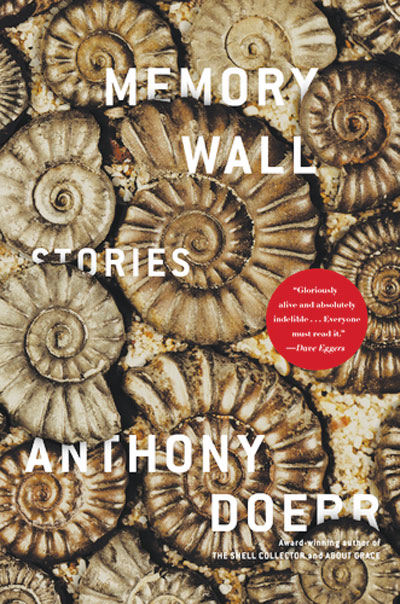
RF: In the epigraph of Memory Wall, Luis Buñuel says “Life without memory is no life at all.”  Clearly all of these stories deal with memory, many of them, like the title story, deal with it overtly. But so much of a character’s memory must happen off the page.  How do you go about creating memories for your characters?  Are you ruminating a long time before a character gets on the page or are you writing drafts and finding the memories that way?

AD: The latter.  Characters are made and at the start of their lives they are lumpy and soft pieces of clay.  I form them through trial and error.   I ask myself: what could her life be if this happened in her past?  Should I invent a situation in her past that made her how she is now?  And do I need to present that in scene or summary to my reader?  But you can paralyze yourself with too much of this.  So often, the situation in a story will present the need for a memory, and then you spend a couple days inventing the memory.  And then, more often than not, you realize you don’t need to include it at all.

What I love about reading a short story is that a writer can spend days and weeks and months ruminating on her characters and their places and problems.  Maybe she spends years on it, honing them, trying to invent their pasts, guess at their futures. So a writer spends a year of her life on something and a reader gets to drink it down in an hour or two.  That’s a great gift of concentrated time, the ultimate milkshake.

RF: You were quite successful while still a relatively young writer.  Did you pass through a period of bad writing?  If so, when was it?

AD:  Writing can always be changed, improved, deepened, sharpened; that’s the beauty of what we do.    So when I was first starting out, I don’t know if I was in a period of bad writing; it was more like I just didn’t yet know how to get my writing ready for a stranger to read it.  In the beginning of a person’s attempts to write books, it’s more about learning to recognize what’s weak, what’s relying on false truths, what’s cliche, and repairing it before asking someone to be generous enough to read it.

RF: Another quirk of what I might call Anthony Doerr’s writing style is that you inhabit characters that are wildly different than you are.  I assume from your author photos that you are a white, male American writer, yet your stories are filled with Liberian refugees, Chinese villagers, South African men and women, teenage girls, blind shell collectors.  How did you learn to give yourself permission to be so versatile?

AD: When I get that question I usually ask myself why I read.  I read to enter the life of someone else, to leave myself and enter other selves.  I read to feel less alone–David Foster Wallace said something like that.  So I believe that the human experience can be communicated, can be shared.  I can go read Madame Bovary and in a couple of paragraphs I get to become a randy housewife in 1856.  That’s a miracle, isn’t it?

So I think that some human commonalities are shared. Things like loss, heartbreak, love.  These things happen everywhere. They happen in Iran, Vietnam, Ohio. So yes, it is a risk; I run the risk of not beginning to understand the subjects I’m interested in.  But I’m not going to write about some bald white Idahoan in a supermarket all the time. There are things about being a bald white Idahoan in a supermarket that interest me too, but not all the time. I’m drawn to discovery.

This can often be confusing for a young writer. So often, they’re told to write what they know.  Fundamentally, the things they want to write about they already know all too well: feeling lonely, feeling scared, feeling inadequate.  That doesn’t mean they can’t write about a lonely, scared, inadequate person on a space station in 2641.  The trappings of a person can be researched. If you want to write about a violin maker in 1743, you can do it with a lot of research and care.

RF:  Could you talk about travelling and how it has influenced you as a writer?  You make reference in Four Seasons in Rome to Viktor Shklovsky and the concept of defamiliarizaiton. Does living and writing abroad help you do this?

AD: Ah! Making the stones stony again!  What Shklovsky is talking about is estrangement, right, the way our homes, our lives, become invisible to us over time, and that the role of art is to make those things strange to us again.  When we become encrusted with habit, we stop noticing things.  But art breaks through that encrustation.  That’s what he’s saying, roughly.  That’s why my favorite novels can do things like show me a bald white Idahoan, and show me him in a new way.

So by travelling, I’m forced to see things new again: even very simple things, like how people get water, how they get to work, how they think about ambition.  But travel can also work against what I’m trying to do. I recently went to Ecuador for a New York Times piece I was writing. It was easy to take notes there, to come home and write 3,000 words from those notes. But it disrupted the work I was doing on my novel. In my fiction I was trying to conjure February and mist and gray oceans and hedgerows and instead I’m standing in primary forest in a plastic rain poncho with butterflies flapping past me.  But here’s what I tell myself: it all goes into the pot.  I take journals wherever I go and I fill them with crappy sentences I’ll never show anyone but I can still, maybe, use those sentences—or at least those memories—in the future.  And who knows, maybe someday I’ll go back to them and write about Ecuador. The images will still be there.

RF: How are your twins?

AD: (Laughs) They’re great, Rich.  Thanks for asking. They’re seven now.

(We proceed to talk about kids, Christmas and how fast they grow.  I tell him a story about visiting the Sistine Chapel when my son was two. My wife was pushing him in a stroller and he screamed for the entire time. Doerr and his wife lived in Rome for a year just after their twin boys were born. We talk about Santa Claus.)

AD: Does your daughter still believe in Santa? (She says she does.)  Did you ever have to tell a straight lie to your kids about it? (I answer that I’m not sure.) I love that children retain the power to want to believe.

 RF:  Is writing difficult for you?  Is it hard work?

AD: I have great days sometimes, mornings or evenings when it’s going well. Sometimes when you’re writing well, you look up and it’s noon and your leg is asleep and you’re hungry because you forgot to eat.  Those are great days, days that feel short because you’ve been dreaming all day.

But sure, it’s not easy.  It’s like working out. I know that’s a trite analogy, but it’s effective. Sometimes the last thing you want to do is go outside and run, but then you do it, and you’re a few miles in and it’s snowing but your body is warm and you just feel alive.

RF: Was there a particular writer or artist or teacher who most influenced your writing?

AD: Andrea Barrett, who I didn’t meet until recently. Her collection, Ship Fever, had science and history and good writing, and I thought, “You can do this?”  You can write short stories and novellas and be responsibly accurate about science and history and still be creative?  Rick Bass, too.  I still haven’t met him.  His story collection, The Watch, blended magic and love and setting and the natural world and he got away with it and it rang a bell in my soul because those were all the things I wanted to do.  Alice Munro, too, and how she deals with time; that she could take on time scales much larger than a single day in her stories showed me that I could try that too.  You have to give yourself permission to try these things and when you see older, accomplished, hugely passionate writers doing it, it helps so much.

RF: You say that a writer manufactures dreams. What dreams can we look forward to next?

AD: I’m working a novel that’s seven years in the making. It’s about a German boy and a French girl in World War II and how their lives intersect, though that intersection happens very late in the book. It has to do with radio, too: how radio was employed both as a tool of control and resistance.  Mostly I want to conjure a time when it was a miracle to hear the voice of a stranger in our homes, in our ears.  Nowadays we’re bombarded by electronic messages, of course.  It’s to the point where my house can seem too quiet if my kids are outside and my wife is away; I feel like I have to turn on the radio, just to keep me company.

Anyway, among the thousand challenges this book presents is this: Can I tell the story about how a boy got sucked into the Hitler Youth, made some bad decisions that led to terrible, unforgivable consequences, and still make the boy an empathetic character?

RF:  In Four Seasons in Rome, you describe a writing this way: “But to write a story is to inch backward and forward along a series of planks you are cantilevering out into the darkness, plank by plank, inch by inch, and the best you can hope is that each day you find yourself a little bit farther out over the abyss.” It’s such a nice description.  What gives you the confidence to take the next step?

AD: Some days, it’s not there.  But here’s the thing: when those voices are loudest, those critical voices which are telling you not to do something, often that’s when the story is really about to takeoff. Because that means you’re standing on the edge of something dangerous.

Take “Memory Wall,” for example.  I was writing a long story about whales and Alzheimer’s and it was a mess.  And when McSweeney’s asked for a story set in the near future, I had the idea to put memories on cartridges. That was a ridiculous idea; that’s when the voices started getting loud, saying, “Don’t do that, that’s science fiction, that’s silly, that’s a gimmick.”  Thankfully I had grown up enough to know that that was the sign that said, Try it.

So you have to train yourself to shut out the voices.  Writing is tough. It’s easy to question what it is you’re doing. I have friends with a fair degree of stability in their life, in jobs they’ve had for maybe two decades now, mostly on autopilot, making good money. I have some good friends out on the golf course right now as we speak!  You can get locked into that way of thinking, of worrying about what you don’t have. You have to come back down from that and tell yourself: I am doing what I love to do, I am blessed,  my family is healthy, and I’m healthy, and I need to keep challenging myself because who knows how much time any of us has left on Earth?

—December 2011

.
.

Dec 162011
 

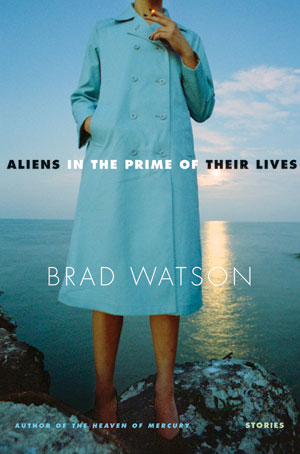
The Irish writer John Banville once said, “Under the artist’s humid scrutiny the object grows warm, it stirs and shies, giving off the blush of verisimilitude; the flash of his relentless gaze strikes and the little monsters rise and walk, their bandages unfurling.”  Brad Watson’s characters come to life thusly, little monsters dreaming through Gulf Coast towns, lazing on the beach, jumping off garage roofs, walking into the path of shotguns, being abducted by aliens or seduced by palm-reading, poolside gypsies. His stories are inhabited by flawed, fascinating and fully realized characters. They come to life in places so heartbreaking and familiar, so thoughtfully imagined, that to read a Brad Watson story is to leave yourself, which is the point, after all.

Watson was born in Meridian, Mississippi in 1955. He now lives in Wyoming and teaches writing and literature at the University of Wyoming. A self-described ‘misanthrope’, Watson was anything but misanthropic over the course of several email exchanges and a phone interview. Warm, affable, funny and blunt, Watson’s personality is a mirror of his writing. What’s most admirable about his stories are their willingness to stare life down, in all of its infinite complexity and messiness. His characters survive, even transcend, the darkest moments of being, and though the journey is often dark, it is also tender, funny and real. They are abundantly human stories,  yet dreamy, wispy things in their rendering.

 Watson has written two collections of short stories. His first, The Last Days of the Dog Men, won the Sue Kaufmann Prize for First Fiction from the American Academy of Arts and Letters. His most recent collection, Aliens in the Prime of Their Lives,  was a finalist for the PEN/Faulkner Prize in Fiction and the St. Francis College Literary Award.  Two of his stories, “Visitation” and “Alamo Plaza,” were selected as PEN/O’Henry Award winners and included in the 2010 and 2011 PEN /O’Henry anthologies respectively. His novel, The Heaven of Mercury, was a finalist for the 2002 National Book Award.

I reach him in his office in Laramie. It is late afternoon, and he has just finished making copies of his students’ theses. Watson speaks softly, with just a hint of a Mississippi drawl, more noticeable in the slow cadence of his words than by any twang in his speech. He asks if can call me back because his son has phoned with a homework problem. His son is a senior in high school and lives in Alabama. Watson apologizes (unnecessarily) for the interruption. We talk for the better part of an hour. At times, I lose track of the fact that I’m trying to takes notes on what he’s saying because I find the conversation so interesting.

—Richard Farrell


Making the Little Monsters Walk: An Interview with Brad Watson

 By Richard Farrell


Richard Farrell (RF): I’d like to start with a question The Paris Review once asked of Arthur Koestler: What do you dislike most of all?

Brad Watson (BW): (laughing) Rules. Rules and the people who follow rules, who are obsessed with keeping them and enforcing them. Assholes who get uptight and yell at you if you cross the street the wrong way. That kind of bullshit. But you can apply it across the board.

RF: You’ve travelled around a lot.  You’ve grew up in Mississippi and you lived and worked in Alabama, Florida, in Los Angeles and Boston. You’ve lived in Wyoming for the last 6 years. And one of the things that struck me about your writing is how deeply important a sense of place is to your work. I wonder if your sensibility about place in your writing evolved out of so much movement in your personal life.

BW: In a sense, yes. My life and imagination are deeply rooted in Mississippi and Alabama, so my stories still seem to arise from that and there. But being away also intensifies that imaginative connection and even frees it up, somewhat. You’re able to be there in your head, unaffected by the present circumstances of actually being there. So in a way it’s more purely imagined.

Continue reading »