.
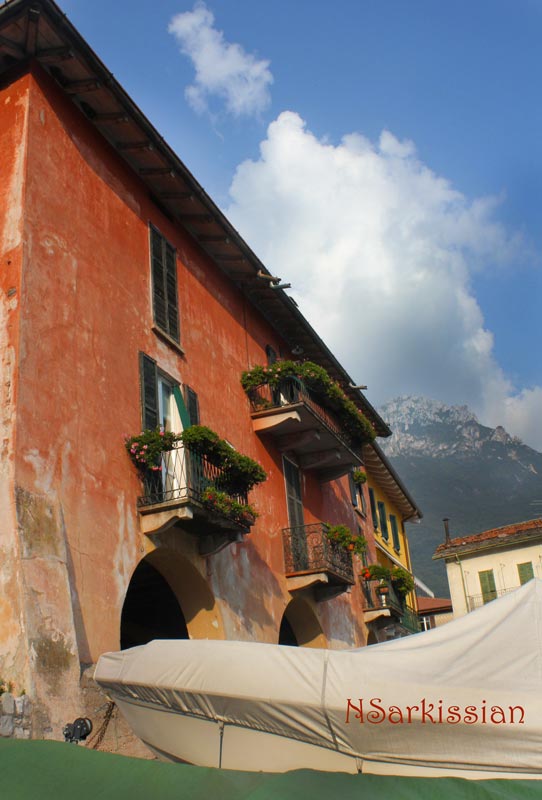
On Sunday afternoons
.
Where mountains loom,
.
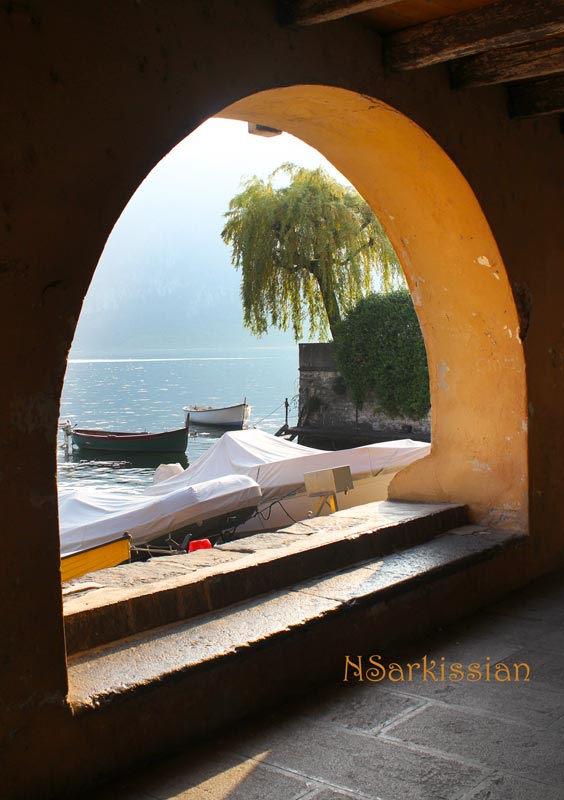
and trees grow yellow,
.
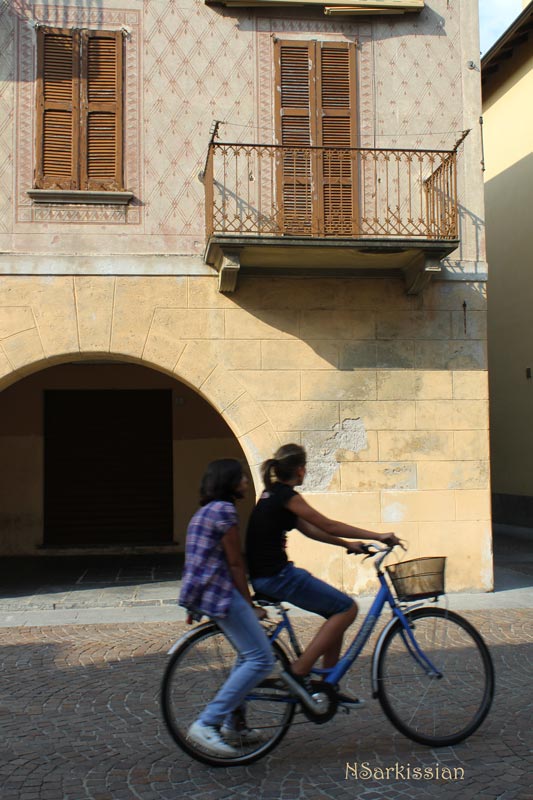
a pair of bare-armed girls bump on a bicycle.
.
On Sunday afternoons
.
Where mountains loom,
.
and trees grow yellow,
.
a pair of bare-armed girls bump on a bicycle.
 .
.
Once again Natalia Sarkissian goes cutting edge, writing the first in a new Numéro Cinq memoir series called “My First Job”—to go with the terrific “What it’s like living here” and “Childhood” series already under way. In the essay, Natalia recounts her early career as a Good Humor man, the ins and outs of customer base development, the advantages of having an ice cream truck for driving your friends around on weekends, and the day she made so much money she was throwing dollar bills into the freezer because there was no room left in the cash box. This is a piece of Americana—still in the evenings in my neighbourhood, we hear the musical notes of the Mr. Ding-a-Ling truck (our version of Good Humour). My sons don’t rush out anymore, clutching their dollar bills, but still we look up at each other smile. As with her earlier essays, Natalia brackets off a piece of her life and serves it up to the reader. If you read through all her NC texts (glance at Nonfiction contents page), you’ll see a life emerging: mysterious, scarey, adventurous, sad and triumphant.
dg
.

.
In the swing, on the shady side porch, with the sun breaking through chinks in the trellis, I’m thumbing through the Stony Brook newspaper, scouring the help wanted ads. I’m nineteen years old and it’s a silky June day in the late 1970s, one of those days when the light shines strong and white in a glowing sky while the breeze is still cool and fresh. Wafting up from the Long Island Sound, a rush of that cool, fresh air rustles the leaves overhead and the hair on my neck but still, I’m perspiring. Time’s running out. After three weeks hunting, I’m still jobless. On September 10, I’m to fly to Italy to spend a semester studying art. Such plans require significant cash. Although I have a student loan to cover tuition and airfare, I need spending money. It’s Italy after all. I need lots of spending money.
Turning the page of the paper, jostling the swing, I find an advertisement that catches my eye.
Sell pots and pans! Make $200 or more per week!
So. They’re back but their name and location have changed. Last year, when I visited their office in Great Neck and signed up to be a rep and plunked down $65.00 for a starter kit that never materialized, they were Deluxe Kitchen Gear. This year, they’re Culinary Designs in Smithville. Well, I’m a year older. A year smarter. No con’s going to swindle me out of another chunk of change. I continue to search but nothing I’m remotely qualified to do materializes.


Apartments

Recently I flew to Cairo, an exhilarating yet draining trip to that sprawling city that covers 214 square kilometers of desert and teems with 15 million inhabitants. Then to smaller cities along the banks of the Nile, from Assuan to Luxor.
Here are snapshots of Egypt, where amidst the crumbling buildings and poverty and the weight of daily life, hope for a more equitable future grows.

Tahrir Square

Mubarak’s National Democratic Party Headquarters, Tahrir Square


Boy, working Cairo

Boy, working II, Giza

Boy, working III, Assuan

Boy, sightseeing

Getting about

Transporting

Collecting

Touring

Shopping, the souk

At the butcher’s, Assuan

Furniture shop

Vegetable Market

The Mall

Selling Mint, Cairo souk

Selling tea

The drag, with scarves, Assuan

To the ballroom in Heliopolis

Worship

To the sun
–by Natalia Sarkissian


Dear Nick and Chris:
Fuzz from the poplar sticks to the windshield of our Ford. In the courtyard of our building, the birch bursts with pollen and I sneeze when hanging out sheets to dry on our balcony. The sky glows, the days lengthen, you both grow long and lean. A strange time, perhaps, to write you about Christmas, but your father’s gone, and writing this to you fills the hole he’s left.
You’re at an age where you’re interested. You’ve asked how a twenty-year-old man from Siena and a nineteen-year-old art history student from New York met. As an answer I’m writing you about the Christmas of 1977, the first Christmas the two spent together. A bizarre Christmas, with the young woman shut in a monastery—not unlike poor Pia de’ Tolomei in TheDivine Comedy (whom I’ll tell you about later)—while the young man came and went when curfew lifted. In a strange way that Christmas echoes the challenges facing us this spring. We’re here, stuck in Milan, going to school. Your father’s off to Egypt, making a living, returning on short monthly visits.
But you were both born in an advanced age. So before you read about Christmas consider:
In 1977, Siena was a different place from the one you find now. Thirty-odd years ago, no exhaust-belching tour busses clogged the narrow roads. No umbrella-toting guides led tourists up steep Medieval streets. No greasy clouds of McDonald’s fried air hovered in narrow passageways. Back in those days vegetables and fish were sold in the Piazza del Campo. Souvenir shops were few. Iran hadn’t happened. Frost still hobbled relations with Russia. The Red Brigades had assassinated several public figures but were still plotting the murder of Italian Prime Minister Aldo
  Moro. In the Siena of that time, Americans were considered an exotic breed from a futuristic, hedonistic place. In that place your mother, me—one of the supposedly advanced, wanton Americans— in 1977 met an Italian on a cobblestoned street near a Renaissance fortress and found that love in a foreign language and culture is anything but easy.
The girl you’ll find in the following collage seems very young, her choice of fancy words an effort to hide a naïveté that today seems antiquated but then was typical of her age and her background. You might find it hard to believe she’s your mother, just a couple years older than you are now.
Reading, reminiscing, reflecting on how conflict was resolved. That’s why history matters. But you know that. Your teachers at school have already told you.
I’m enclosing sixteen excerpts from a journal and class assignments together with old snapshots and this letter:

1. The semester is over! Three months have flown by. Segments of time have been consumed yet the waxing moon grows whole again.
Christmas is almost here. Classmates are packing their bags, getting ready to go home and back to their previous lives across the ocean. I’ll miss Elisabeth and Brian, but gloat when considering Rachel’s departure. No more competition from her re: Mauro. I long to say, “I’m staying…you’re going,” but curb the urge. The semester has flown by with an alacrity that’s impossible to comprehend. At the end of the next short term, I will be in her position.

2. During the Christmas holidays, while the Ticci family (my hosts when school’s in session) suns on the beaches of Sicily, I’ll retire to a monastery and embark on a trip to the 13th century and the contemplative life. On Thursday I’ll be locked away behind big iron gates.
The monastic solution to the holidays was Mauro’s idea and I agreed because it’s quite economical to rent a monk’s cell—information my guidebooks neglected to tell me. So while the Ticcis are gone, I’ll pay a pittance to stay at Monastero Ventoso, on the outskirts of Siena.
The Padre Superiore has given me a room by the main entrance. Reserved for stray visitors, it boasts two twin beds—iron bedsteads with old-fashioned mattresses stuffed with wool—a night table with an iron lamp, a high window, a crucifix, a cherry wardrobe, a small desk. A print of the Madonna hangs over the desk.
Don’t get the wrong idea. The Padre has no hotel business on the side. When we met he stressed his convent is a place of prayer and meditation. He said I mustn’t be a disruptive influence. I promised not to disrupt anything. But permission was granted only when Mauro’s parents, well-known members of the parish, vouched for me. I was surprised they went to such lengths considering their feelings for me, the son-stealing American; Mauro said it was nothing, his father made a short phone call.
The Padre will stretch curfew past the usual hour of 8:00 p.m. to allow me to eat dinner elsewhere. At 10:00 p.m. sharp the gates will be locked. If I’m late, I’m out. The gate will be unlocked again at 7 a.m.
Honor and virtue; silence, solitude and prayers; curfews and gates heavily clanging shut. These are the themes I have confronted so far in arranging my new lodgings. Fierce and monumental. Worthy of the Middle Ages. Worthy of Pia de’ Tolomei, the 13th century Sienese noblewoman who perished while locked up in her husband’s castle.

2. Dressed up in Christmas finery, Siena bewitches. In Via Montanini two hundred Christmas trees flaunt their red ribbons. The Banchi di Sopra glitters with garlands of green fir and gold pine cones. The Via di Città leading up to the Duomo shimmers with candles and blinking lights. Under these gaudy displays, shop windows—lavishly arrayed in seasonal glitter—beckon. They persuade wallets into emptying their contents for last-minute purchases. I spent too much on gifts for Mauro’s family and now have to wire Mom for more cash.

3. I transferred my belongings from the Ticci’s to the monastery with Mauro’s help. Then it was on to Mauro’s home for lunch. I brought his mother a bunch of exuberant pink lilies that had been steamed open in a greenhouse in the hills behind San Remo.
His family, unlike the lilies, acted formal and stiff. Mauro’s mother took the flowers and smiled, but only with the bottom half of her face. His father, after a quick “bon giorno,” disappeared into the far reaches of their home. His grandmother, a small wrinkled lady, frowned when I tried to shake her hand, disapproving of my presence at lunch. Mauro said afterward that back in her day, women needed an engagement ring on their finger before they could meet a young man’s family.
At the table we made conversation:
“So, Mauro, your friend isn’t going home for Christmas?” his mother asked in rapid Italian, figuring I wouldn’t understand.
“I have another semester to go and the fare’s expensive.” I said, answering for myself.
I could have told her I’d had an invitation to go Paris to visit an uncle—expenses paid by the uncle—but decided to stay in Siena because of her son. Instead, I decided not to fan the flames of her dislike and said nothing.
When wine had melted some of the frost in the atmosphere, between the two meat courses of fagiano and cinghiale (pheasant and wild boar that the head of the family had shot), Mauro’s father told me of his hobby. He opened his weapons cabinet behind the dining room table and showed me his hunting rifles, bullets and knives. Then he took me down the hall to see his boar’s head wall trophy.
Hunting, blood-letting—his favorite past-time. His eyes shone when he told me he especially enjoys hunting wild boar. The dogs, the chase, the kill.

4. It’s lonely in this monastery. And cold. Since curfew I’ve shivered in this bed with the lumpy mattress and thin blankets, reading melancholy stories of Pia de’ Tolomei, the noblewoman Dante relegated to Purgatory in the Divine Comedy. Apparently accused of infidelity and confined to a remote spot in the swamplands of Maremma by her husband, she languished and died there almost 700 years ago.
Like Pia I don’t see anyone, I don’t hear anyone. The monks live in a different section; I’m exiled to the wing near the head office where matters such as interviews with female boarders are conducted.
Tonight the howling of the wind keeps me company.
At least Pia had a maid.

La Pia de’ Tolomei, by Dante Gabriel Rossetti
5. On tiptoes, in my flannel nightgown with the lace around the neck, I peer out the tiny window over my bed.
The wind has ceased moaning and groaning and whipping past corners. No lone moto, no car, no pedestrian sputters or clips through the night. No one but me sees that the heavens glow with a majestic full moon that dispels, with its brilliance, the shadows of the sleeping town waiting for Christmas to arrive.
Cypress trees block much of my view but I imagine Siena quietly spread over the hills south of me. Close by are several brick high-rises built in the 60’s. Far off, toward the centro storico stand the black-and-white-striped bell-tower at the Duomo, the brick-and-marble Torre del Mangia in the Piazza del Campo, and the red bell-tower at San Domenico. Three far-off friends.
As I sink down to the mattress I wonder. How many Christmases did Pia linger at her solitary window before she succumbed to loneliness?
This monastery. Pia’s story. Mauro’s hostile parents. They’re casting a pall on the joy of this season.

Snow at the Duomo
6. Today, Christmas, Mauro gave me a small gold ring with a red stone and a card with a sonnet by Pascoli in impossible Italian. Then he said we were fidanzati but that we wouldn’t mention it to anyone right now. They wouldn’t understand. I agreed, but wished he’d stand up to his parents and tell them how he feels about me instead of keeping it a secret.
I gave Mauro a glossy book of New York City with photographs taken by famous photographers of the last twenty years.
He’s never been out of Italy.
He flipped through the photos not speaking. Then he slapped the book shut, coughed and squeezed my hand and said he’d like to visit me in New York some day.
I coughed too and retied the lace on my boot so he couldn’t see my face.
I don’t want to think about leaving. I don’t want to think about impossible visits in New York some day.
When I bought the book, it seemed perfect. Now I wish I’d given him something else.

7. Mauro and I went to visit the Palazzo de’ Tolomei this morning and study it. I’m writing an essay over the holidays for Italian culture class.
Affixed to the side of the austere building hung a small plaque, high up, engraved with two somber, melancholy lines from Dante Alighieri’s Divine Comedy:
Ricorditi di me, che son la Pia:
Siena mi fè; disfecemi Maremma:
Purg. V 133-134
(Remember me who am La Pia; me
Siena, me Maremma, made, unmade….
translation by Dante Gabriel Rossetti)
I’d admired the Tolomei Palace innumerable times, but the building had seemed just another beautiful remnant of Siena’s illustrious past. Now that I’d been reading about one of its inhabitants, it had acquired significance. As I stared up at the diamond-paned windows on the piano nobile with Pia’s sad words echoing round the piazza, I wondered. Pia had been “made” here. She’d been born and grew up within this edifice’s aristocratic walls. Once she had looked out over the square where I was standing. But how and why she’d been “unmade” in Maremma was a mystery that had attracted attention throughout the centuries and would likely never be solved.
In addition to the two lines reproduced on the plaque, Dante writes just two more lines about Pia. In them he alludes to who is responsible for her death: her husband, Nello Pannocchieschi.
salsi colui che ‘nnanellata pria
disposando m’avea con la sua gemma
Purg. V 135-136
(…This in his inmost heart well knoweth
he With whose fair jewel I was ringed and wed ….)
But Dante doesn’t explain why or how Pia dies and what Nello’s role is. No late 13th-century historical records to clear the matter. For centuries scholars have disagreed as to the nature of Pia’s sins. That Dante considered her a sinner up until the very last minute when she repented (but without receiving last rites) thereby saving herself from hell and the Inferno is clear, otherwise she wouldn’t be in Purgatorio. But was she an adulteress? Or was she guilty of some other crime? And was she thrown from a window in a castle in Maremma on Nello’s orders, who some say wanted to marry someone else? Or did she die of illness and solitude?
When I asked his opinion Mauro said he thought she’d cheated, gotten caught, said she was sorry but her husband rightly turned a deaf ear. Instead, I preferred the line of reasoning of one of the most popular legends. According to this version of events, Pia’s husband shut her up in his castle in Maremma because an associate—whose advances Pia had rejected—told Nello she’d been unfaithful but gave false evidence to back the charge. Locked away in swampy, mosquito-ridden Maremma marshlands, Pia got sick with malaria. In the meantime, Nello discovered the lie, returned to release her but instead arrived in time for her funeral.
“I don’t want to finish in the same way,” I said after giving Mauro my opinion. “Expiring on the outskirts of Siena.”
“I knew this Pia trip was going to end up back at the monastery,” he said, frowning. “I thought I was doing you a favor keeping you safe at night.”
Safe at night? Since when was safety in Siena an issue? And then I understood. He didn’t trust me.
“It’s not you I don’t trust,” he said when I asked. “It’s the men here. This is Italy. You’re American.”
I’m a twentieth-century Pia. And Mauro? He’s a twentieth-century Nello Pannocchieschi.

8. I spent the early morning writing in my cell. My neck was stiff after a bad night in the bumpy bed.
At ten thirty weak sunshine and a watery blue sky beckoned. I put down my pen, stretched, grabbed my coat and began a tour of the gardens.
To one side of the main building stood leafless trees, un-pruned hydrangea bushes replete with last summer’s flowers (though now brown and stiff), a potted lemon tree swathed in plastic to keep it warm on cold nights. I picked a dried rosebud from another bush in need of care.
“Signorina, what are you doing?” asked a voice from behind. I turned. It was the Padre. He frowned at the dead flower in my hand.“This area is off limits. Didn’t I tell you this already? You must stay along the gravel drive to the front gate.”
“But what’s wrong with a little walk? I’ll be quiet.”
“The brothers are in the vegetable garden. You must not disturb them. And please don’t pick anything else.”
“But, it’s dead,” I said.
“It’s not your place to say or to pick,” he said.

Pia de’ Tolomei, by Stefano Ussi
9. Signora Rossi makes wonderful meals every time I’ve been invited.
“I’m sorry if she feels obligated to extra fuss,” I said to Mauro.
“No,” he said. “She can’t help it. It’s her way when we have company.”
Today’s lunch menu consisted of the following:
crostini misti (paté and prosciutto hors d’oeuvres)
gnocchi alla romana (au gratin dumplings made of semolina wheat),
coniglio e gobbi fritti (fried rabbit and gobbi—a celery-look-alike from the artichoke family),
crostata all’albicocca (homemade apricot jelly tart),
panforte, panettone and pandoro (Christmas cakes),
ricciarelli and cavallucci (Christmas cookies),
espresso caffé,
cognac.
“I always cook like this, doesn’t everybody?” she replied when I complimented her skill and generosity and trouble on my account.
“No!” I said, belching softly into my napkin and unbuttoning the top of my skirt.
Soon after, Mauro and I fell asleep sitting up on the living room sofa. His grandmother found us. She jabbed me in the ribs with her finger and hissed something I didn’t understand at Mauro.
Then she yelled. “Get up!”
His mother came running in.
“What is going on in here! What are you doing?”

10. We are going to Pisa tomorrow for the day. Mauro will come and pick me up at 5 a.m.; the Padre Superiore will open the gates early so that I can get out in time to catch the train.
Such magnanimity in bending the rules! Perhaps he is glad to be freed of my presence for the entire day.
I, too, am happy to be leaving the claustrophobic atmosphere at Monastero Ventoso and the glacial stares of Mauro’s possessive family.
I don’t know how much more of this medieval nightmare I can take.

11. I’m in disgrace. The Padre Superiore called me into the office where he first interviewed me. A blond hair has been found in the spare twin bed in my room. Between the sheets. The sheets, in addition, were wrinkled. Clear evidence that someone has been sleeping in that bed.
“Was it Mauro?” he wanted to know. “Someone else?”
I denied any and all knowledge of any blond-haired persons sleeping in the spare twin.
“By the way,” I wanted to ask when the interrogation wound down, “what were you doing snooping?”

12. The Padre Superiore hauled me in again today for more questioning.
“Signorina,” he began, clearing his throat. “Have you thought about our talk yesterday?”
“Yes, of course I have.”
“Well?”
“How can you be sure there is no explanation other than I’m guilty of some crime? What if someone else used that bed before I got to the monastery?” I thought of Pia and false accusations.
“If you change your mind, please come to see me.” He said, staring at his fingernails.
“Don’t you think you should consider that there may be another explanation?” I said, thinking of Pia and her untold version of events, how she hadn’t been able to defend herself, how defenselessness had caused her demise.
But the Padre answered me with a chilling, “How long did you say you were staying here? Was it until the 10th, after the Epiphany?”
“At the very longest. I may be leaving even sooner, if I can make alternative arrangements.” I bluffed, wondering where I’ll go if he kicks me out.

13. Mauro tried to have curfew extended last night so we could celebrate New Year’s together but the Padre Superiore refused. He intended it as punishment, and perhaps as a moment for me to reflect, repent, recant.
I went to bed at 11 p.m. after drinking a Campari soda I had smuggled in. I felt very sorry for myself.
I should walk out, but after paying rent here and buying Christmas presents, I have no money left for a hotel. Mom’s cable hasn’t yet arrived.

14. “What to do about the monastery?” I asked Mauro as we walked in circles around the Castello di Belcaro, an exquisite spot outside Siena where tradition has it nobles once holed up to escape outbursts of the plague.
“What did he say exactly?”
“He said there was a short blond hair in the spare bed.”
“Mine.” Mauro swallowed. “Who do you suppose inspected the linen?”
“I don’t know.”
“Maybe things will die down.”
“He’s a bloodhound, after a scent. He’s not going to give up.”
“Funny isn’t it? ” said Mauro.
“Ridiculous.”
“You were late,” Mauro said, tugging at my hand, “it was your fault.”
I hadn’t woken up in time to catch the early train to Pisa and was not waiting by the front gate like we had arranged.
“But you were the one who breached the walls,” I said. He’d come to my room and had thrown rocks at my window—a misdemeanor. Then, when I opened it, he’d climbed in—a more serious offense. While I finished drying my hair, he’d sat on the twin bed—definitely a felony. And then the rumpling began. A crime of such gigantic proportions that if brought to the Padre’s attention he would lock us up and throw the key into the murky depths of the goldfish pond out back.
“Try telling him all we did was cuddle for a minute before running for the later train. He’d never believe it.”
“You’re right, as a matter of fact, I almost don’t believe it,” agreed Mauro.

15. Entering the Padre Superiore’s study, I found him writing at his desk.
Sinking back in his chair, he studied me. “You have something to say?” he asked.
“I’ll be leaving tomorrow, on the 6th, four days earlier than planned,” I said. “I wonder if I could have a refund on my rent? I’m broke.”
“You want a refund. I’d be glad to give you a refund. But first, is there nothing else? Isn’t something weighing you down?”
“No. I have nothing to say except that I’ll never forget my stay here.”
“It will be hard for us to forget you, as well.” He took his glasses off and put them on the desk. “We had you stay here as a favor to the Rossi family. I’m considering telling them what has happened. What will they think?”
I bit my lip. I wanted my money back. But on the other hand, I didn’t need it back that badly. Mauro said he’d help me out until my funds from home arrived.
“You’d be too late,” I said. “Mauro has already told them. Signor Rossi found it distasteful that someone scrutinized my sheets. But we all had a good laugh. He knows we didn’t do anything wrong.”
Later I told Mauro. We were sitting in his white sedan in a dusky lane near an abandoned school with shattered windows and a missing door where nuns once taught. Rumor has it they abandoned their newborn babies in the woods beyond.
“It was a stroke of brilliance to tell him you’d already ‘confessed’ to your parents, don’t you think? But, suppose I exaggerated too much? And he wants to tell your parents his side of the story?”
“He won’t. His best course is to keep a low profile. And then, even if he does talk to my father, what is the worst that can happen?”
“Your parents will be sorry that they went out of their way.”
“No, they won’t because they know I was home every night.”
“Vindicated only because you have an alibi. Not because anyone believes me.”
“By tomorrow at this time, the monastery will be a closed chapter. It was a bad choice. But it’s almost over.”
“Thank god,” I said, exhaling.
“You know, I’ve been thinking.” He leaned across the seat and brushed my bangs out of my eyes.
I waited for a while and then he told me. He wants his parents to know how he feels about me. That this affair isn’t some boyish infatuation.
I wondered about his change of heart. Had Pia and her unspoken thoughts and words affected him? Had the mystery of her life and death—one without truth and trust—swayed him? Had the monastery showed him that he should speak up?
Somehow—although he didn’t say—I figured this were so.

16. It’s a holiday, the Epiphany, and here’s mine:
Skip living in Medieval establishments such as castles and monasteries.
Pia died a lonely death in one, I was embarrassed and humiliated in one.
No wonder the guidebooks don’t recommend them.
Albergo Castellini—a modest two-star—will do. Mauro’s lending me the money. I’ll pay him back when Mom’s cable comes through.
He says not to worry. He doesn’t want the money. He says he’s hoping to see me smiling again.
Right now I’m waiting by the front gate at Monastero Ventoso. It’s 8:25 a.m. and he’s late, but only by 25 minutes. He’ll be along soon, as soon as he’s through telling his parents.

Boys, your father came along right before lunch. He took me to his parents’. We had a multi-course meal—your grandmother’s way of expressing emotion—and then another, after that. And then many more.
Since then we’ve faced difficult challenges—we’ve done some climbing so to speak. Most of our climbs have been without guides. The air’s been thin, the water’s been scarce, the sun’s been hot, we twisted our ankles, skinned our knees and once ended up badly dehydrated, but somehow we’ve always reached a scrap of shade.
We’re climbing again, all four of us. Your father’s on one side of the Mediterranean. We’re stuck on the other.
But we’ll make it. We can say we love each other.
Your father texted me a minute ago. Here’s what he’s typed in this new, poetic language he’s learning:
“Sabah Al Khair Habibti.”
It means ‘good morning, my beloved.’
After thirty-odd springs together, I think ‘good morning, my beloved’ sounds incredibly fine.
–Love, Mom

–by Natalia Sarkissian

by Natalia Sarkissian
Last Friday night my husband and I took a cab to downtown Milan. I’d invited him out to dinner at Il Bagutta, but it was a working dinner. Once again I had my Numéro Cinq press tags clinking around my neck and was hot on the trail of Italian literati. Because Il Bagutta is where the Premio Bagutta, the oldest Italian literary prize was established in 1926 (and first awarded in 1927) and ever since, Il Bagutta has been frequented by the crème de la crème de la crème.
“Please hurry,” I said to the driver, checking my watch. We were already late for our 9 pm reservation. What if the maitre gave our table away and we couldn’t get in and observe the literati wining and dining? What would I say to my editor at Numéro Cinq who was waiting with bated breath for this insider’s view?
“It’s on Via Bagutta, off San Babila,” I added when the cabbie began thumbing through his map of Milan. “Between Via della Spiga and Via Montenapoleone.”
“Relax,” said Mauro, grabbing my hand. “We’ll get there when we get there.”
I sighed and sank back into the plaid seating. Mauro can be so Italian about being on time at times.
As we sat in a traffic jam on flashy Corso Buenos Aires and then inched along stately Corso Venezia, I inhaled and told him about Paris and compared it to Milan.
 Back in the twenties and thirties famous Parisian cafés like Le Dome, La Rotonde and La Coupole had seen literary giants—Ernest Hemingway, Scott Fitzgerald, James Joyce, Jean Paul Sartre, Simone de Beauvoir—come and go. In his memoir, a Moveable Feast, Hemingway describes the atmosphere, when he was young and penniless, drinking in the company of Ezra Pound, Scott Fitzgerald and Ford Maddox Ford. Likewise, Milan’s Il Bagutta, established at approximately the same time as its Parisian counterparts, offered good food, good wine and attracted home-grown Italian talents of stature; one of its first artistic patrons was Riccardo Bacchelli (a prolific novelist, essayist, playwright and librettist) who, in 1926, rounded up a group of gifted friends one night for dinner. Together they started the Bagutta literary prize at the spur of the moment. Later, Dino Buzzati, Mario Soldati, Ingrid Bergman, Lucia Bosé (Miss Italia 1947), Arturo Toscanini, Sandro Pertini (President of the Italian Republic 1978-1985) and other legends flocked to the restaurant.


With Jo

Palazzo Cavalli Franchetti-Santo Stefano entrance
My friend Jo’s husband, Francesco Allegretto, has done the photography in the exhibition catalog for a show in Venice, Lino Tagliapietra: Da Murano allo Studio Glass. Opere 1954- 2011. (Showing from February 19-May 22.)
They invite me to the opening. Since I’m not usually invited to show openings in Venice by insiders—Jo and Francesco live in Venice and are part of the art scene—I hop on the early morning express train from Milan and go, Numero Cinq press tags clicking around my neck.

Palazzo Cavalli-Franchetti, Canal Grande facade
Four hours later, after a train ride, a vaporetto ride and a jaunt through town (I quit the ferry at the wrong stop), when I get to the Cavalli-Franchetti palace where Mr. Tagliapietra’s glass is exhibited, I point to my credentials. Nevertheless, the receptionist looks skeptical. I call Jo; Jo leads me into the luxurious rooms of the fifteenth-century palazzo that has been refurbished and renovated in the intervening centuries, stopping here and there, showing me the beautiful pieces she loves.

Near a sumptuous blue piece she stops. “There he is,” she says, pointing.

I Have a Dream
On Sunday, February 13th, thousands of women and men in 200 piazze across Italy demonstrated against Berlusconi and his excesses. Late night parties with underage escorts (“Rubygate”). Questionable political appointments. Etc.
You may have heard.
Another Egypt? Perhaps not quite yet. Berlusconi still has support (although he barely survived two no-confidence votes last December).

We’re All Vertical
In Rome, 500,000 people (according to organizers) attended Sunday’s demonstration in the Piazza del Popolo. Giulia Bongiorno, a member of the Future and Liberty party, was applauded when she said to the crowd, “I’m not here to criticize porno parties in and of themselves, I’m here to criticize them when they’re used by the ruling class to make choices (referring to some political appointees).
Read the rest of this entry


I can say I lost my father when I was six.
That was the year my parents separated. Although they weren’t divorced until a year or so later, I never spent long chunks of time with him after. I traveled from New York to Morgantown and later to Texas to visit him at Christmas and for two weeks every summer, but I was a kid. Instead of asking questions about his childhood (he grew up in Tehran, the son of well-to-do Russian émigrés) or his work (he was a professor of genetics), I roller skated in the driveway, swam in the pool at the complex or played Barbies in the bedroom with Rhonda, the girl next door. I didn’t know then that illness would cut his promising career and life short. And he never worried me with the fleeting nature of time.
 (My father is the boy in the sailor suit, front and center.)
Maybe, if I’d had an inkling.
Maybe, if I’d been older.
I’d have sat next to his recliner in the den in Morgantown or the family room in Texas on at least one of those bi-annual visits and listened.
Dad died in 1978 when he was 45, from complications of multiple sclerosis.
Ever since I’ve lived with regret. What was it like growing up on well-heeled Jordan Avenue, Tehran, in the middle of an extended family of musicians, engineers and dentists? Did he ever go with my grandmother, Babi, when she taught piano to the Shah of Iran’s sister? Did he ever accompany my grandfather, Dida, on the civil works projects Dida oversaw for the Shah? What games did he play with General Norman Schwarzkopf (a classmate) before the General became a general? Who the first girl he ever loved? When did he know he wanted to be a scientist? Did he ever regret coming to live in America?
I will never know the answers.

(My father is in the back row, center. Schwarzkopf is the blond boy to his right.)
But recently, through Numéro Cinq, I met Lynne Quarmby, a professor of cell biology at Simon Fraser University in Vancouver. We ‘friended’ each other on Facebook, and began to correspond. One day, on a whim, I asked Lynne if she’d ever heard of my father. I’d been thinking of childhood and essays for Numéro Cinq Magazine.
“His name was Igor V. Sarkissian,” I wrote. “Back in the 60s and 70s he was experimenting on hybrid corn and beans (which is about all I know of his work).”

(My father in his lab in the 1960s.)
Lynne said she’d look and see what she could find out. A few days later she sent me this gift:
Dear Natasha,
So far as I can tell, your father published 91 scientific papers (there may be others that my searching did not uncover). He produced a solid body of work, taking a biochemical approach to an important agricultural and intriguing physiological problem. There was a peak of interest in his work in the 70’s (during which time his work was cited 50 or more times per year in the published work of other researchers). As is typical of virtually all scientific papers, the citations tapered off over the years. However, and this is the remarkable thing, his work is still being cited today. The field of biology, including plant genetics is moving so incredibly quickly that the vast majority of papers drop out of sight within a few years. To be cited more than 30 years after publication is a significant accomplishment and your father achieved that with 5 of his papers. Because he worked in an area somewhat distant from my expertise, it is difficult for me to provide a synopsis of his body of work. In lieu of that, I choose to focus on his mostly highly cited work, a 1966 publication – which by the way, has already received a 2011 citation in a review paper (this means that a current expert in the field has commented on the impact of this particular piece of work by your father). –Lynne
Lynne then reviews my father’s 1966 paper, about hybrid vigor, translating it into laymen’s terms. I won’t summarize the 1966 article here—a future post—but the crux of the matter is this:
I’d had an idea that my father’s work had been important, but I had no idea as to its scope or that it was still generating interest. My father would be proud to know he made an impact.
When he found out, at age 24, that he had multiple sclerosis, he became single-minded, hoping to have enough time to be able to make some kind of contribution. And the fact that he was able to partially do so lessens the sadness I feel for his short and somewhat unlucky life.
–Natalia Sarkissian


Dear DG,
 Not too long ago, during a lull in the month-long rains that frizzed our hair, soaked our shoes and dampened our moods, one Saturday this fall I found myself in Sestri Levante, a town not far from Genoa, reading a book, enjoying the sun. Sometimes, when you relax in the sun reading a book you’re not much invested in, a loud voice, a sharp slap, or an acute whine attracts your attention. Attention attracted, you stare. Then you fish for paper, you dig for your cellphone, and you write and snap pictures, recording the play:
14:20
“Fede, Zitto! Shut up. You want a smack?” asks his mother, a round woman in her mid forties. Dressed in black stretch pants and a black sweatshirt, she sprawls on the beach ringing the Bay of Silence, a sandy crescent on the Eastern side of the peninsula of Sestri Levante. An unseasonably hot sun shines over the terracotta roofs of the pink-and-yellow ex-fishermen’s homes that stand as a backdrop to the water.
The woman in black is in Sestri on a day trip with shopping and picnicking her twin objectives. Piles of bags from Sottovento (a clothing shop), Top 2000 (a shoe store), Tosi (a bakery specializing in pizza and focaccia), Marco’s (a fruit vendor), as well as her accent (Milanese), attest to her transient status. Next to her, sharing her towel, lies her husband, also in black. Nearby, Fede in jeans, a sweatshirt, a cap and a bandana, digs in the sand with his red shovel. His older brother, outfitted in an identical manner, buries his own feet in the sand.
The four glisten like sunning beetles on fine white granules.

“But Mamma, why? Why can she go in the water?” Fede asks, squinting, pointing toward the horizon.
“Because her ball rolled in.” The woman sighs, not looking up from Chi? gossip magazine. She’s reading a back issue about the American émigré showgirl, Heather Parisi, who recently gave birth to twins at age fifty.
“No it didn’t,” says Fede, flipping his shovel, flinging sand on his father, “she doesn’t have a ball.”
“Watch it, stupido,” says his father. He raises himself to an elbow, spits out some granules and brushes off his shoulders.
“I’m not stupido,” says Fede.
“Oh,” says Fede’s mother, lowering her magazine, shading her eyes with her hand. “You mean that lady.”
“Yes, mamma, that lady.”
“Because she wants to go for a swim.”
“Me too. I’m boiling!”
“Shut up Fede! I’ll ring you like a bell if you don’t stop nagging. Have a tangerine?” She fishes one out of the bag of fruit, but Fede doesn’t take it.
“Don’t be ridiculous, Fede,” says his father. “It’s Autumn. Take your bandana off if you want, or roll up your pants.”
“Zitto, Giorgio! Shut up, will you? I’m handling this,” the woman says, peeling the tangerine, burying the peel in a shallow hole in the sand, and chewing. “Besides. There’s a breeze. Without his bandana he’ll get sick. You want him to get sick?”
“Can’t I take off my jeans and my sweatshirt? Like those kids?” Fede points to some boys playing soccer.
“Absolutely not. It’s Autumn. The summer’s long over.” Tilting her head, his mother frowns.
“These tangerines were a rip off.” She spits out a seed. “Look Fede. Those kids are foreign. See? Their red hair? Besides you can’t run around in your underpants.”
“Why, mamma, why?”

This is Natalia Sarkissian’s second “What it’s like living here” piece. The first brought us the shocking news of her son’s illness. This one delivers the aftermath, hope and dogs and gorgeous cityscapes from Milan.
dg
December, 2010
Dear DG:
You ask about Nick, his heart, the operation. He’s pretty much himself again; kids are resilient that way (their mothers and fathers less so). We’re picking up where we left off before we put everything on hold. Not easy these days with life everywhere often a challenge:
“Camera da Letto” means refuge
The alarm rings in the pearly gray of morning.
White sheets—from a transatlantic trip to Macy’s in Boston—slide like silk as you stir, your dreams of sand and sun on the Sound dispersing with the squeal.
You reach out an arm. You fiddle with a button. Silence ensues.
You blink in the shadowy room. Then you light the alabaster lamp from Volterra, the one you bought on sale years ago when Rinascente department store revamped and unloaded merchandise—60% off. Now a milky glow shines encouragement on your side of the bed.
Don’t move quite yet. Study instead the India-ink drawings of cocktail parties and frivolity facing you—the ones you sketched when you were twenty and going to be a painter. Then contemplate the alcove where your desk sits piled with papers, the old dresser loaded with a tower of books. You’re a mother, a part-time translator, part-time English teacher and when time permits—writer—now. A translation project (small) awaits. A lesson plan (a doctor wants to converse in English for an hour) awaits too. Not much money, but at least it’s some. In the afternoon you’ll do homework with Chris. And then there’s that novel you’re writing.
Sigh, and say, “first things first.”
Kick the sheets back.
Slip into your jeans, your t-shirt, your sweater.
Turn off the light: a mound still snores gently under the white sheets from Macy’s.
Tiptoe: the mound, in the old days (how many months of joblessness is it now?) used to be up first, shaving and showering before a day directing strategic sales in a large multinational. Now, if roused, the mound remonstrates.
“Cucina” means good morning
An old-fashioned door from the twenties (two panels, with glass, bolted across the middle with a brassy lock) bars entrance to the kitchen. On the far side, a six-month-old beast whimpers and jumps and the doors rattle and shake.

“Come girl,” you say, releasing your as-of-yet-un-housebroken pup from her nightly exile to the tiled floor and newspaper inside. Tail wagging, she hops and jolts, somersaulting with joy.
“I love you too,” you say, patting, but rushing. Bladders are small, muscles are weak, minutes are precious.
Seize the leash, grab a parka, open the front door. Step out onto the marble, lock up, press the button. But then wait for the old-iron-bird-cage elevator to crank up to four.
Say, ‘accidenti—goodness,’ when you note a spreading yellow stain beneath your wriggling puppy. And then louder, ‘cazzo—fuck.’
Across the landing the neighbor lady—up early too—flings her door open.
“Not again!” she cries, her hands on her hips, her feet stuck in felt slippers, her white hair in scruffy clumps about her gray face. “Aren’t you going to scold her?”
“Yes,” you say, and you do, but your heart’s not in it, not when you’ve got a disapproving audience. Apologize again. Say, “she’s just a puppy.”
Promise to clean up when you return.
When the neighbor lady says, “things were fine before you went and got that dog,” and then slams her door, you shrug and step into the elevator. You know things weren’t fine before you went and got that dog. You know you went and got that dog to help things be fine.
Decide you’ll walk her long and languid.
“Parco delle Basiliche e Le Colonne di San Lorenzo” mean survival
A green expanse stretches from the Basilica of San Lorenzo to the Basilica of Sant’Eustorgio where, according to legend, relics of the Three Magi once were conserved. At one time infested marshlands, the land was reclaimed and fashioned into a park in the twentieth century. Students eat their lunches here on sunny days. Children swing from monkey bars in the afternoon. Along the park’s fringes, fashionable establishments serve elegant food on iron tables in vine-draped niches at midday and in the evening.
You used to have aperitivi here at sunset when brick buildings glow red. You haven’t had an aperitivo here, or anywhere, in months. Nor have you watched bricks glow as the sun sinks.
Nearby stand sixteen Corinthian columns, Roman ruins of the 3rd century. They were moved here in the 4th century as part of the construction project of San Lorenzo. Survivors of Roman Mediolanum, Barbarian invasions, Austrian invasions, World Wars, and urban re-edification, the columns symbolize survival against all odds.

You like to walk Wendy here, in this piazza and park strewn with evidence of survival, of rejuvenation.
This morning, cars rush by at 7:30, their taillights fuzzy red globes in the early morning fog. The green 94 bus wheezes along, leaving a wake that tastes of petroleum. Thick and gray it clogs your throat. You cough, cross the street, enter the park, your dog pulling on her leash, a flock of pigeons in her sights.
“Area Cani” means leashlessness
In the midst of the park of the basilicas a fence encloses trees and grass and muddy patches: a dog run.

Open the gate, release Wendy.
Throw a ball, toss a stick.
Soon Signora Mastini and her beagle arrive.
“You’re here early,” you say to Signora Mastini. You watch the dogs roll together in muddy orange leaves and enjoy their nips and jumps and yips.
“Volunteer work at church today,” says Signora Mastini.
“Volunteer work?”
“The homeless. I feed them. I clothe them. So many these days. So many.”
“Oh,” you say, inhaling the damp smell of autumn rot.
“Single men. Divorced men. Family men. They lose their jobs, can’t pay the rent, then they’re out on the streets.”
“Oh,” you say, “oh.” You zip your zipper against the chill.
“Did you know they fight over clothes? Winter jackets are in short supply. But I’m never worried. ‘Basta!’ I say. ‘Cut it out, or I’ll throw you out.’ They always listen. They can’t afford not to.”

Yes. You nod.
Then whistle. You yank Wendy away from her frolicking friend.
“Come on, girl,” you say and shut the gate. You can’t afford to think about homelessness. It isn’t looming, is it?
Walk. Then walk some more so you won’t think.
“Via Torino” means thoroughfare
Cut around the perimeter of San Lorenzo, then through the Carrobbio, an old intersection where the Roman Ticino Gate once stood. Walk north, along via Torino, a shopping artery that connects San Lorenzo to the center of town. Admire a door spray-painted by a graffiti artist but ignore the attractive shop windows up and down on either side. Forget what you don’t need and can’t have.

Pause in front of S. Giorgio al Palazzo, an 8th century church, the name of which comes from a no-longer-extant Roman Imperial palace built by Diocletian. The church houses a cycle of paintings by Bernardo Luini and a late medieval relief of St. George and the Dragon. 
Decide to view St. George slaying his dragon. Consider it good for morale.
The doors are open for morning mass, but a frowning man in a cleric’s collar says you can’t enter with your dog. Even if you carry her. Even if you fit her in your bag.
Traipse north. Stop while a concierge washes the sidewalk in front of her apartment building. Enjoy the hiss of her hose on the pavement. Approve of how,
with deft flicks, she sends debris sliding to the gutter.
Wait until she finishes spraying. Squelch past, listening to your rubber soles slapping against the wet. Then stop again.
Consult your phone. The battery’s low, but still, it’s enough. Scroll and find it. Piazza San Babila, 3.
Walk where your directory tells you.

“Piazza San Babila” means shelter
Piazza San Babila, with fountains and gardens, surrounded by porticoes filled with boutiques, long considered the ‘salotto buono,’ or the living room of the affluent, perches at the crossroads of the swankiest streets of Milan: Via Montepoleone, Corso Venezia, Corso Europa. Lined with neo-fascist buildings, it’s named after the venerable brick church that oversees the bustle at one far end.

Head here, to this piazza, at 9 am, your little dog following.
Quit Via Torino, cross Piazza Duomo, traverse the pedestrian walkway of Corso Vittorio Emanuele II, still silent, still empty of tourists and street vendors. Ignore Rinascente, Pollini, D&G as you go.
Forget what you don’t need and can’t have.


But as you near Diesel boutique, nod at a middle-aged man with a sleeping bag in a shopping cart. When he asks you for money, hand him a euro. Realize you think you’re buying distance, you think you’re buying time.
“Nice dog,” he says when Wendy sniffs his feet. “I had a dog once.”
You smile and nod again but he doesn’t.
A few steps further, a young couple, sitting on cardboard, plastic bags filled with old clothes strewn around them, eats breakfast from McDonalds. Wendy barks and the woman spills coffee on her dirty pink track suit.
“Shhh,” you say. Eyes averted, you hurry your dog past.
Still further, nearing the piazza, an old man with a grizzled beard and gray hair sprawls in the doorway. Think: when the shoppers disperse, the dispossessed find a night’s worth of relief.
“No, Wendy,” you say when she starts to growl, “Piazza San Babila has many faces. Right now it still means shelter.”
You know that soon, when the stores open, the men and the woman will be made to move. Maybe they’ll go to Signora Mastini for a hot lunch and to fight over shoes.
“Ufficio di Lavoro Interinale” means temp agency
Rounding the corner, you’ve made it. San Babila, 3. But although you search, you can’t find the shelter you seek.
The temp agency. Where your phone says it was. It used to be here. You’re sure it was here. Wasn’t it here? Hadn’t you been here, seeking a job once, not so many years ago?
A fashion house occupies the offices here now.
You perch on a granite bench facing a fountain to rest. You’d imagined a listing for which he was qualified. Something more substantial for you.
No matter.
“Let’s go home,” you say to your dog. “We’ll get on the computer. It was crazy to try legwork. Things have changed.”

But then, you think, maybe legwork wasn’t crazy, after all. You walked to escape when you first started out. Now you’re energized.
Wendy wags her tail. She likes legwork with you. You stick her in your bag, sneak her through the turnstile, carry her onto the metro, ride the red line home.

“Cucina” now means hope
The mound is out of the bed and no longer a mound. He’s in the kitchen, making espresso. He’s bright and cheery. And he’s wearing a red tie. Wendy hops and jumps when she sees him and he scratches her behind the ears, laughing when her pink tongue flicks against his hand.
The kitchen seems different now. Full of light, you think.
“I’ve got an interview,” he says, straightening, stirring sugar, his spoon clinking against the cup. “A second interview.” He smiles. His eyes are green and his teeth shine.
“A second interview?”
“That head of operations job in Cairo.”
“Oh my God,” is what you say. “Cairo? Cairo?”
You don’t want to hope too much. But still, for him—for all of you—you do.

–Best,
Natalia
—Post text and layout by Natalia Sarkissian
.
October, 2010
Dear DG,
Thanks for your email. You ask about Milan. What it’s like living here. You ask for descriptions, for photos…. Enclosed please find my views :

“Duomo” means cathedral.
A Gothic version wrought with grimacing monsters presides in central Milan. Recently renovated, the marble shines a bright white in direct sunlight, blushes at dawn, or grows ruddy in the gloaming of nightfall.
Pickpockets roam the piazza spread out like a large, bumpy placemat beneath the Duomo. Their glittery black eyes home in on the naïve tourist. Hand to your pocket, or arm firmly over purse, please. You have treasures to lose.
Merchandisers sell Inter, Milan, Juve soccer scarves—blue&black, red&black, white&black—from small wooden kiosks; marketers ring the perimeter with fluorescent neon in pink and blue that exhorts purchases of Gucci, Prada, Sony. Close your eyes to (un)subliminal messaging. Times are tough. Save your dough.
Pigeons squat on the equestrian bronze of King Vittorio Emanuele. White streaks drip from his greened shoulders. Hurry past, head hunkered down.
Seven o’clock shadows lengthen and grow violet while the sun sinks. Cut across the cobblestones of the piazza, wind through pickpockets, tourists, merchandisers, marketers, and pigeons. Climb the steps, enter the Duomo through tall bronze doors, choose the side altar where the Renaissance panel of the Virgin and her Son hangs. Light a candle below the image. Kneel. Even if you’re not Catholic, even if you’re not religious.
The smoky sputter of burning wax. The golden light ringing bowed heads like glowing halos. The sting of incense wafting from the main altar—hundreds of yards away—where evening mass reaches a crescendo.
The intonation of millions of prayers, seven hundred years’ worth, reverberates in the cavernous, vibrating enclave.
You listen, knees against the stool, fingers laced together on the rail.
Dive in, again today, as you have every day since disaster struck. Add to the swirling mix.
When you finish, fall back into your wooden pew.
You remember that John Ruskin hated the aesthetics of this place. That Oscar Wilde called it monstrous in taste. But that Mark Twain, like you, scoured the thousands of niches decorated with statues of saints, and bugs and birds, and all of nature, and knew here, in the Duomo, he wasn’t alone.
“Salsamenteria” means Sauce-eria.
A new one, near the recently-opened Abercrombie and Fitch, waylays the hungry in a narrow street not far from the Duomo. Salt-cured pig haunches hang from hooks on the walls and rafters in the ceiling. Brown paper mats plaster square oak tables. Kegs of cheaper wine sprawl on a hutch to the left of the bar, bottles of finer wine march across a shelf.
Study the menu taped to the window.
Coppa, it says. Prosciutto, Culatello di Zibello. Tortellini, Ravioli. Lambrusco. Bardolino. DOP–the best of the best. 5 Euros. 6 Euros. 10 Euros. 3.5 Euros. 2 Euros. 4 Euros. 3.9 Euros. Eat. You need to eat. Mangia. Mangia. Keep your strength up.
Take a break from your vigil. Enter. Choose a table for one near the door.
Black eyes, black hair, brown skin. The waitress from Kenya, poised to serve. Pencil on pad.
Order a sandwich. Select some wine.
 Pink slabs fall from thick slices of peasant bread. Green sauce—made from parsley, capers, oil and anchovies—glistens in a finger bowl on the middle of your table. Unkegged Bardolino fizzes in the white ceramic bowl the graceful Kenyan girl serves it in.
Dip your sandwich into the oily green, slurp the slick red.
Forget while you eat and drink. Listen to the clinking in the kitchen, the tap of forks against ceramic plates. Watch the girl glide and whirl.
Chew.
And when wine splats on your blouse like blood (drops of crimson on white gauze) blot and wipe in the room with the skirted stick figure on the door.
Remember.
Hurry out to evening mass at the Duomo.
“Ca’Granda Policlinico” means Hospital.
Designed in the Renaissance by Filarete, the Florentine, with perfect courtyards, graceful loggias and brick fretwork, the first Ca’Granda is where the ill of the city was nursed back to health. Now university students occupy Filarete’s harmonic spaces, while the Ca’Granda has migrated across the street to become the Ca’Granda Policlinico and occupy dozens of buildings of eclectic styles and dubious periods.
Rush your teenage boy here one ill-fated Monday. See how he is classified code red.
Tell the doctors: He’s healthy. Nothing like this has ever happened before.
Tell the doctors: His heart’s fine. But then listen to it beat 200 times a minute.
Wait, sitting on linoleum lit by neon.
An orderly changes rumpled blue sheets on an abandoned gurney. An infant, red with fever, cries in its father’s arms. A small pink girl in a wheelchair, her broken wrist held to her chest, fusses at her gold-jewelry-laden-black-leather-jacketed mother. And a blond boy lies down the hall, behind closed doors, in intensive care, monitors hooked to his chest and fingers.
Wait, sitting on linoleum lit by neon.
Relatives of the injured arrive. One, with stiff gray hair and sturdy brown pumps, holds the infant so his father can go to the men’s room. The pink girl’s burly grandfather bellows into his cellphone. The mother in black and gold lights a cigarette beyond sliding glass. Soon, her exhaust curls up through the night.
Your husband calls. He’s home, caring for your youngest. How is our boy? He asks.
Ask a nurse, How is my boy?
Then wait, sitting on linoleum lit by neon.
“Parco” means park.
A nineteenth-century park—the parco Sempione—sprawls around the Castello Sforzesco, the imposing castle that was built in the early Renaissance where Leonardo da Vinci frescoed rooms for Ludovico il Moro. The parco encompasses the Triennale Art Museum too, and DeChirico’s beach house sculpture.
On sunny autumn afternoons boys bring their dogs to the happy corners of Parco Sempione and run. Disks of red plastic spin through the air, dogs fetch, their pink tongues curling and flapping.
 Don’t worry about curbing your dog here—no one does. But check your shoes—wipe them on the graveled walkways—when you quit the grass.
On sunny autumn afternoons boys play soccer on the grassy knolls of Parco Sempione. Under the elm, off to the side. And here, one boy, a teenage boy with blue eyes and a chipped front tooth who plays soccer in autumn crumples one graying afternoon. His chest thumps at two hundred beats a minute—like a golden hummingbird’s—while the parco fades into black.
Call 118 when this happens. Climb into the wailing vehicle. Bump over old, winding streets, ancient alleys, circular passageways, through centuries of urban sprawl and nonexistent urban planning. At rush hour.
Say faster, please faster, as you watch your boy’s lips turn blue.
Hold his hand, whisper a prayer when you see his eyelids twitch.
Plan to light a candle at the Duomo every evening until he wakes.
Best,
Natalia
—Natalia Sarkissian
.
.

Jacob, the contrarian, during the EPE (Photo by Jonah Glover)
[Augusto] Monterroso is perhaps most famous for his short story “The Dinosaur,” which is said to be literature’s shortest story. It reads in full:
When he woke up, the dinosaur was still there.
In an 1996 interview with Ilan Stavans for the Massachusetts Review, Monterroso recalled some early reviews of “The Dinosaur”: “I still have the very first reviews of the book: critics hated it. Since that point on I began hearing complaints to the effect that it isn’t a short-story. My answer is: true, it isn’t a short story, it’s actually a novel.”
Brevity was, to say the least, an important concept for Monterroso. His essay “Fecundity” is included in The Oxford Book of Latin American Essays. It reads in full:
Today I feel well, like a Balzac; I am finishing this line.
—from Tom McCartan’s Crib notes on “What Bolaño Read”
Okay, the long-awaited next Numéro Cinq literary contest, The First Annual Numéro Cinq Novel-in-a-Box/Memoir-in-a-Box Contest. The rules are pretty simple this time. You have to write an entire (don’t cut corners) novel or a memoir (personal narrative) consisting of 9 (a mystic number) chapters and each chapter can be no more than 5 lines long. (By lines, I mean the number of lines that appear on the comment box on the blog.) Fewer lines if you can. Try to remember what a novel is like: at least a couple of characters or more (usually), a conflict, development through a series of dramatic actions, etc. Alternatively, try to remember what a memoir looks like: a first person narrator (and a couple of other people or more), a thematically continuous narrative line often based on a conflict and or theme, development through a series of dramatic moments or incidents, etc. Indicate on your entry whether it is fiction or non-fiction (there will be separate prizes). (Note that in the Monterroso story quoted above there ARE two characters, the guy and the dinosaur.)
The contest is open to any living, sentient being in the universe. It is not limited to people who are already on the blog or VCFA students or former students. Everyone is welcome, and also welcome to join in other conversations or suggest topics.
Entries will be accepted between September 1 and September 15, 2010 (midnight), and should be written in English (Gary) and attached as comments to this post (the usual practice at NC).
Remember the values we hold dear here at Numéro Cinq: WIT & ARROGANCE. Remember Gordon Lish’s phrase ATTACK SENTENCES!
P.S. Anyone who mentions the insidious phrase “flash fiction” will have his or her comment deleted from the blog. I mean this! Delete it from your minds. This is not a flash fiction contest.
dg
Submissions June 12-30, 2010.
Enter by translating the sample passage below and submitting it as a comment on this post.
The competition is open to anyone. Just sign onto WordPress.com for free and contribute your translation.
Rule #1: Do not submit an entry if you actually speak the language in the sample below. It doesn’t help if you can read the sample and render an accurate translation because the judge can’t read the sample himself. (It goes without saying that you shouldn’t bother using a translation dictionary either.)
That’s the only rule.
Rule #2: Translations must be submitted in English. (Gary Garvin already submitted an entry in Chinese characters via email. This will not fly with the judge.)
Rule #3: Given the confusions we had during the last contest, the judge wishes to specify that there will be an open, ageless category (the Numéro Cinq Shark Class) and an under-16 category (the Numéro Cinq Barracuda Class).
Rule #4: Birth certificate and two pieces of photo ID required to qualify for the Barracuda Class competition (last time certain adult members of the Numéro Cinq community—a disreputable, rebellious, disaffected, and outlaw crowd of ne’er-do-wells and agitators—attempted to have their entries switched to the under-16 category).
Let go of your bourgeois yearning after sense and meaning. Forget certainty. (The judge is returning to his Sufi roots.) Think only of the sound of the words, their rhythms, and what you can invent from them.
As usual with Numéro Cinq contests, wit and arrogance will be appreciated. In fact, wit and arrogance are the only qualities the judge cares about.
Contest open to everyone including employees of Numéro Cinq, their significant others, children, and small pets (mammals only, up to 50 lbs).
First Prize — Instant Worldwide (e)Publication w/ commentary.
Plus honours & laurels.
A single malt Scotch at 9 Maple Avenue with dg or a hot chocolate at Virgil’s with Jonah if you’re in the under-16 Barracuda Class. (You have to get to Saratoga Springs on your own and dg will not put you up.)
Each entry must purport to be a translation of the following passage. Feel free to submit more than one translation.
Ja, er dreigde iets. En hij bleef daar zitten, ziek van angst, làf, zonder geestkracht, zonder moed…. Er dreigde iets en hij voelde het naderen, hem overvallen, met hem strijden op leven en dood, in eene overspanning van wanhoop: hij voelde zich wankelen, nederzinken, hij voelde zich gerukt worden uit de fluweelen zachtheid van zijn leven, neergesmakt worden op straat, zonder dak, zonder iets … Wat behoorde hem toe! Het linnen aan zijn lichaam, de schoenen aan zijne voeten, de ring aan zijn vinger, het was van Frank. Het souper daarginds, zijn bed boven, het was van Frank. Zoo was het geweest een vol jaar lang en als hij ooit weg zoû moeten gaan met alleen het zijne, dan zou hij moeten gaan … naakt, in den winter. En hij kón niet meer zijn, als hij geweest was in Amerika, dienstbaar scharrelend van den eenen dag op den anderen. Zijn lijf en zijne ziel waren beide als geweekt in een bad van lauwe weelde; hij was geworden als eene kasplant, die, gewend aan de vochte warmte der serres, vreest in de open lucht te worden gezet. Want het dreigde, gruwzaam, onbarmhartig: geen seconde was die bedreiging van hem af, en, in de lafheid zijner verweeking, wrong hij er zachtjes zijne witte handen om, en drupten er twee tranen langs zijn strak masker van wanhoop.
ENTRIES ARE OFFICIALLY CLOSED. COMMENTS STILL WELCOME.
Herewith the first ever (annual) Numéro Cinq villanelle writing contest. I am announcing it early so that you can work on your entries. Entries will be accepted between May 1 and May 15. Entries, as with the aphorism contest, should be posted as comments on this page. Entries are open to anyone in the world, but only if they are written in English, French, Latin, or classical Greek (the only languages anyone can speak in this house). As with the aphorism contest, I encourage you to familiarize yourselves with the form. See the craft and technique page for help. Roughly speaking, we’re talking about a 19-line poem written in tercets (except for the last stanza which has four lines). The first and last line of the first stanza become the last lines of the following stanzas and also turn into a couplet at the end of the last stanza. These are fun to write and can actually turn out surprisingly well if you arm yourselves with strong refrain lines (think: panache, drama, obsession, schizophrenia). You need not be a poet to enter. And it’s always a good thing for prose writers to extend themselves; it makes their prose more interesting. One lesson to be drawn from writing a poem like this is the way form drives content instead of the other way around.

The following is an email sent to dg from the anonymous contest judge who is in hiding, with his entire family and pets, somewhere in Argentina.
This was a tough go over the weekend for an indecisive judge. All the finalists were extremely good, very witty. In fact, the whole contest was a pleasant surprise–for the commentary as well as the entries. I loved Nina’s very short aphorism “A mapped world is always small” for its terseness; when you unpack it, the idea is huge–the unknown is always greater than the known. Steven Axelrod is a very witty man playing on glass houses, green houses and the greenhouse effect. (If there had been a prize for most prolific, he would have won; had their been a prize for the under-21 age group, Madeleine would have won.) C. M. Mayo’s entry grew and grew on me. I think I didn’t take it seriously at first because she was clearly just having fun with the contest, but she did an amazing little thing turning the idea of procrastination upside down (making it a pleasure instead of something to inspire guilt) with the egg and yolk idea. Gwen Mullins three-word line may not even be an aphorism precisely, but I liked the verbal play: fuck to effing to the letter f to the word “ineffable.” Natasha Sarkissian’s face entry was also a sleeper. It just kept staying in the mix as I found reasons to cut others out. It’s very clever: losing face, saving face, face lift, plastic surgery. Kit Hathaway is the old pro, the ringer. His aphorism worked as a rhyming couplet, but it also worked as a complex idea starting with the leap of putting Zoloft next to Nietzsche and coming up with the idea that they have a lot in common; Zoloft evens out the emotional peaks and valleys while Nietzsche delivered us from guilt and judgment (“neither bad nor good” plays off the title of Nietzsche’s book Beyond Good and Evil).
So I tried various criteria. Everyone was about equal on wit and verbal play. But when I asked myself about the profundity of the ideas behind the aphorisms, then Nina and Kit came out in front. Not that aphorisms have to be profound, but I was looking for some reason to separate the entries. Then I also tried to factor in syntactic and semantic complexity. I thought Kit had a slight edge there. But when it came to arrogance, Kit had a definite edge.
So by incremental calculations of relative value–even more Byzantine than hinted at here–I came to the conclusion that the winner is William Hathaway for his aphorism:
Zoloft does more than Nietzsche could
to make you feel neither bad nor good.
This is a preliminary announcement only. Press releases have gone out to major media. The winner was notified this morning by telephone and pronounced himself “over the moon.” The actual award, along with a considerable financial emolument, will be presented in Stockholm to coincide with the lesser known, yet no doubt estimable in its own right, Nobel Prize for Literature.
The judge will remain anonymous. Any attempt to contact him will be reported to the police. The cat in the earlier post is not the judge’s cat; it was a professional model posing as the judge’s cat. Contractual arrangements outlined in the entry form protect the magazine, dg, his family and staff from civil actions pertaining to the contest. Entry fees were clearly stated to be non-refundable.
dg

The judge's cat, clearly suffering from intense Aphorism Contest anxiety
Yes, the death threats, the bribes, and blackmail have begun. The pressure on the judge is incredible at this point. How do you decide between one great entry and another? The judge is drinking vodka neat morning til night; he’s taken up smoking; he’s found a bottle of painkillers from his knee surgery (or possibly they are antibiotics for the dog). Nothing helps. He is thinking of just taking all the entry fees and prize money and flying to Mexico til this blows over.
I should add that the People’s Choice contest is a complete mess at this point with a three-way tie. Could someone please go to the post and break the tie?
dg
The Finalists
A loss of face requires more than plastic surgery to fix.
Natalia Sarkissian
——————
Zoloft does more than Nietzsche could
to make you feel neither bad nor good.
William Hathaway
—————–
In the egg of procrastination, there is the yolk of fun.
C.M. Mayo
————-
People who live in glass houses understand the greenhouse effect.
Steven Axelrod
——————-
A mapped world is always small.
Nina Alvarez
—————-
Fuck the ineffable.
Gwen Mullins
THE FIRST EVER NUMÉRO CINQ APHORISM CONTEST
Submissions March 15-31, 2010
Submit by commenting on this post
Submissions must be no more than 150 words in length
Do not enter a submission unless you have figured out what an aphorism is first
Wit and arrogance appreciated
Contest open to everyone including employees of Numéro Cinq, their significant others, children, and small pets
First Prize — Instant Worldwide (e)Publication w/ commentary
Plus honours & laurels