Apr 032017
 

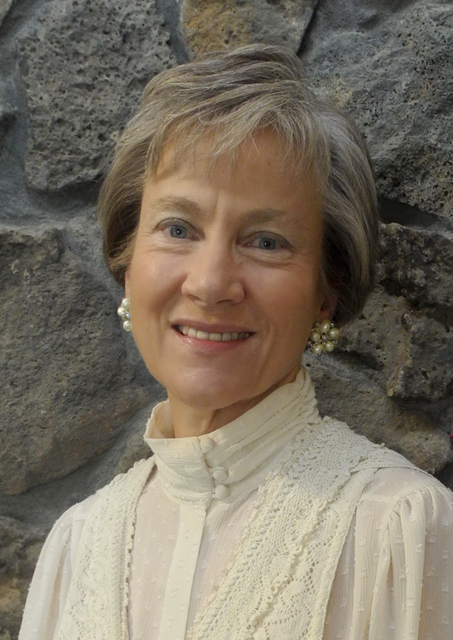
Nance van Winckel


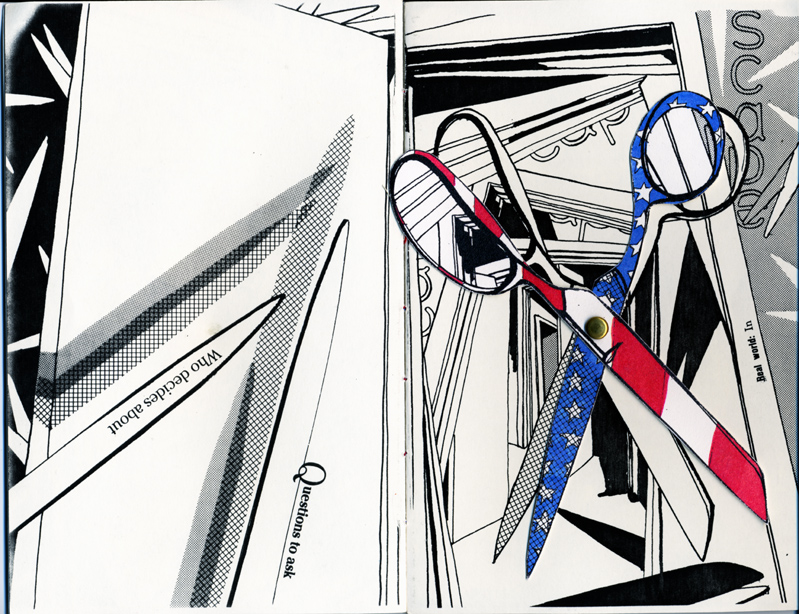
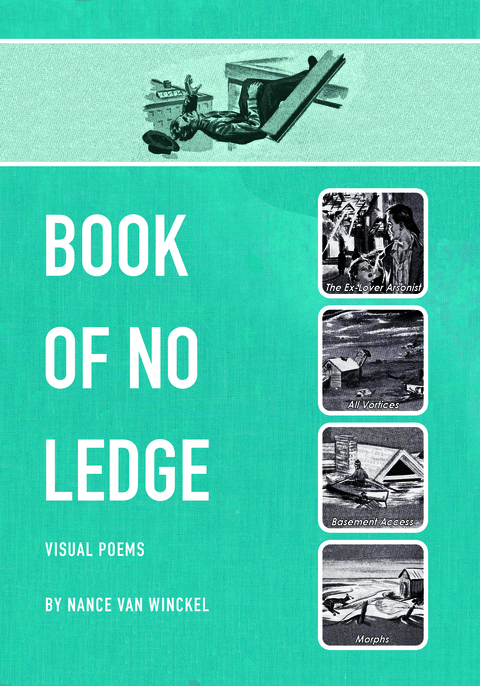
In Book of No Ledge, one of her new collections, poet and writer Nance Van Winckel brings together poetry and visual collage in a series of brilliantly reimagined encyclopedia entries and maps that are a pleasure to read. Witty, both lyrical and satirical, beautiful to look at, and wonderfully inventive, the collection lives up to poet Mary Ruefle’s description of it as “a book of wonder.”

rsz_bookofnoledge

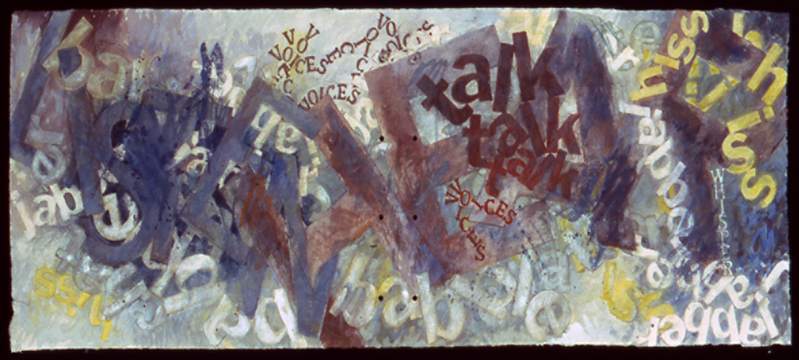
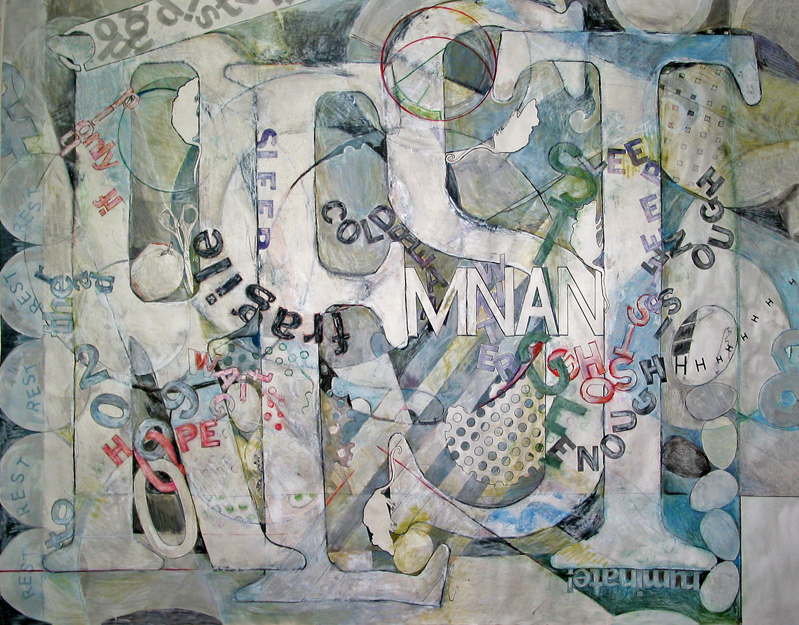
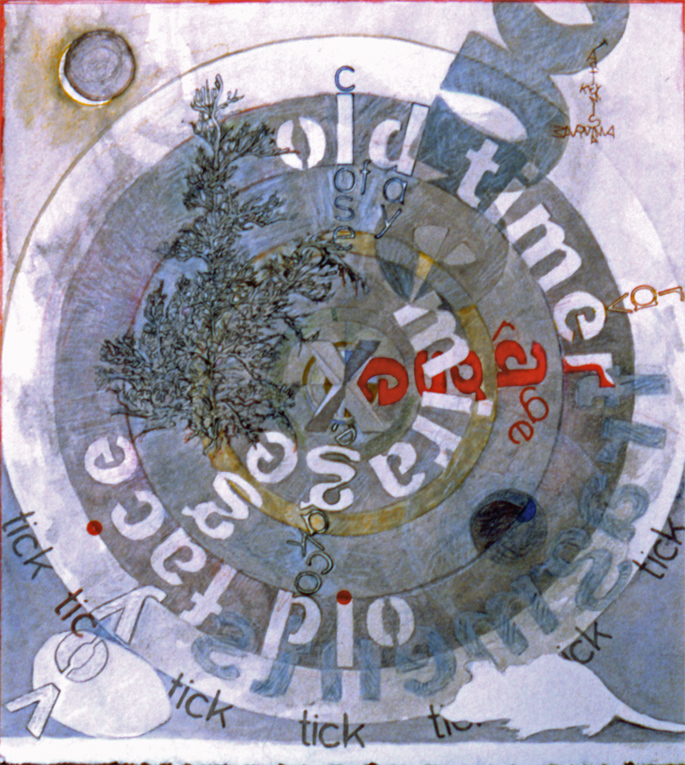
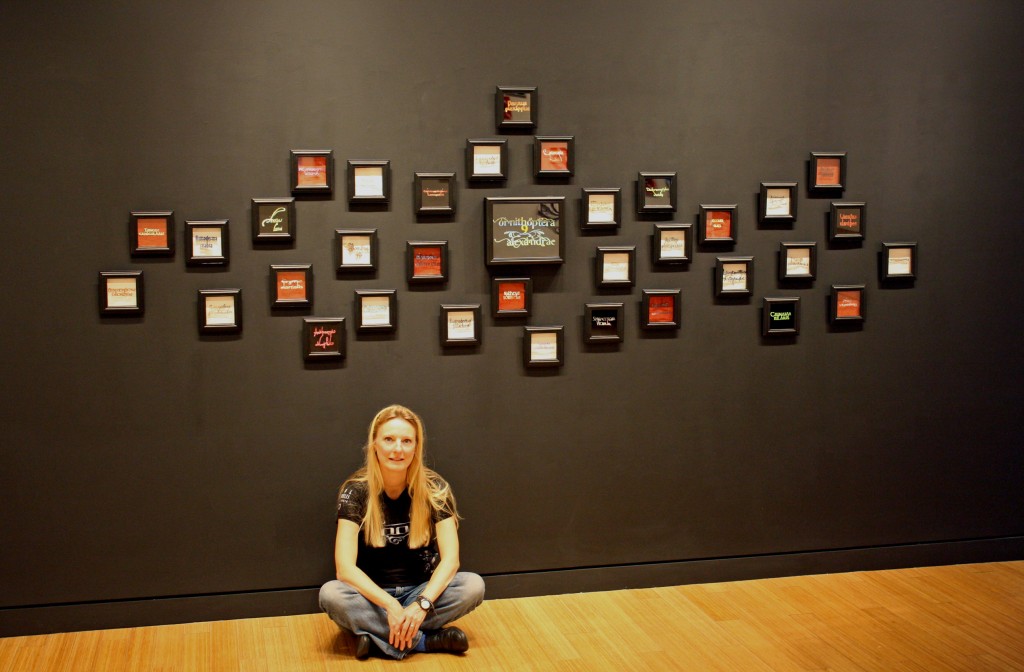
Recently Nance Van Winckel spoke with U.S. poetry editor Susan Aizenberg about Book of No Ledge in a series of emails. Numéro Cinq is thrilled to present here two of the collages from the collection, together with a summary of their conversation, and a third, more recent piece of what the poet calls “wall writing.”

Susan Aizenberg (SA): I love your charming Introductory note, in Book of No Ledge, in which you describe a child first infatuated with a handsome door-to-door encyclopedia salesman, and then in love with the books themselves. Though there was no handsome door-to-door salesman in my experience, I remember feeling as a child a similar fascination with encyclopedias and illustrated guides of various kinds. I’m wondering if you would talk a little about your childhood experiences as a reader as they relate to this book.

Nance Van Winckel (NVW): Well, I was a reader as a kid and I was very interested in the sciences. Because my family moved frequently, I was often the new kid in school, and I read in the lag time it took to make new friends. Books were a “constant” in my life. I liked the diagrams of how things worked— especially bodies and body parts. Early on in life I wanted to be either A.) a spy or B.) a laboratory scientist. And perhaps becoming a writer/poet was a sort of melding of those two professions.

SA: I love the idea of writer/poet as a melding of spy and scientist. I’m particularly drawn to your vivid description, in the intro, of the point of view and voice of the encyclopedia, wonderfully personified as “Mr. Explainer,” and how they change over time as Mr. Explainer realizes the “you” has become a much older woman with “nice sharp scissors and even X-acto blades” – another image I love – who questions his authority. This idea of voice or voices seems important throughout the book, which is rich with wordplay, satirical humor, puns, and seemingly effortless shifts in diction. I’m wondering if you would speak a bit about voice in your work, and how the idea of being in dialogue with Mr. Explainer shaped (if it did) the series of photo-collages.

NVW: Yes, exactly! Talking back to Mr. Explainer from a future quite different from the one he (Commandant of the Past) posited so definitively, so upbeat and full of happy endings—that was very much the tone, which for me is a kind of fuel. I have to get the stance before almost anything else. The attitude. If only as an adult I could again be the imp-kid, the sassy girl, I was when I was ten. That girl got smacked sometimes or sent to her room. I squashed her down. But hey, apparently she ain’t dead yet!

SA: Clearly, and thankfully, she is not! Can we talk a bit about the conception and creation of the book, which seems to me equally a work of literature and visual art? It is, first off, a lovely physical object; the pages are silky (like encyclopedia pages?) and the collages quite beautiful. There is so much to look at and read and consider on every page – I love the richness of it. I don’t think I can overstate what a genuine pleasure it is to read. Would you talk a bit about your process?

NVW: I worked on these pages over the course of about five years. The encyclopedia I altered is actually 13 volumes, and at about a sixth grade level. As I paged through it, it brought back those memories from girlhood and reading, and I fell back in love with all the graphic elements. So I mainly used pages that had a lot of visual material on them. My method was to work on these very “visual” pages, which were all in black and white, and part of what I was doing was teaching myself—as I most always am these days—new techniques in colorizing, cut-and-paste, and many other things available from my old friend, Photoshop. (I’ve been noodling around with that program since back when I was a magazine editor [of Willow Springs] and designing the magazine with a program called PageMaker, which evolved into Photoshop.) As I worked on the visual layout of a page, I would often write new text to replace the old text. Sometimes I just carried printouts of the pages around with me in their waiting-for-text states, i.e. big blocks of space where text would go. I liked this method because I could work on other projects simultaneously—linked stories, other “regular” poems, etc.—and these encyclopedia pages would wait patiently for me and, as I mentioned above, I sort of knew the persona to slip into when I returned to them.

SA: You’ve generously shared with us two of the pieces from the collection. Would you speak a little about them?

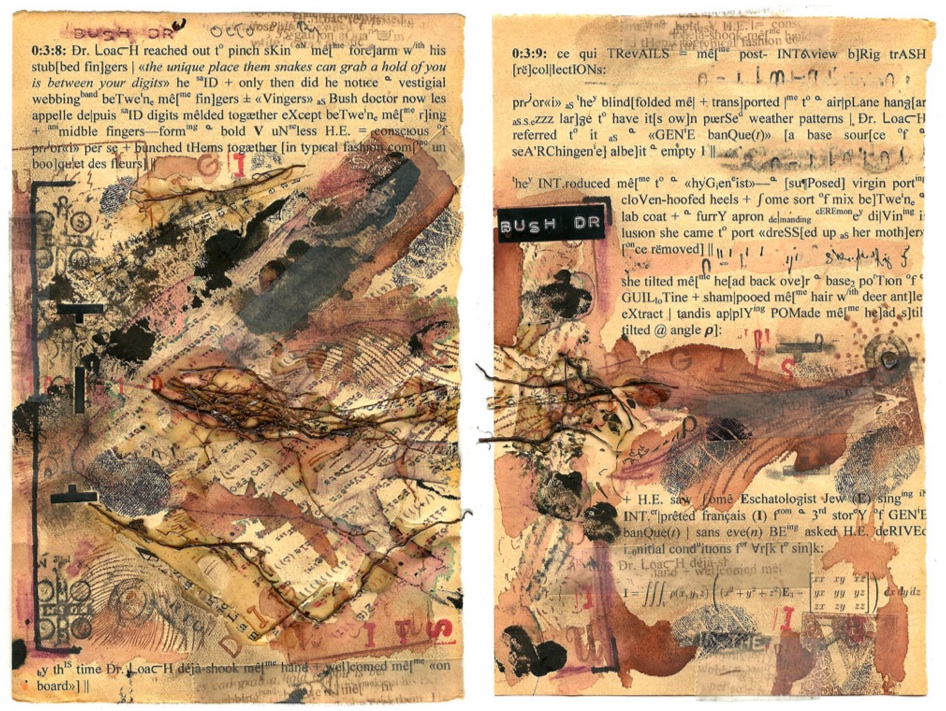
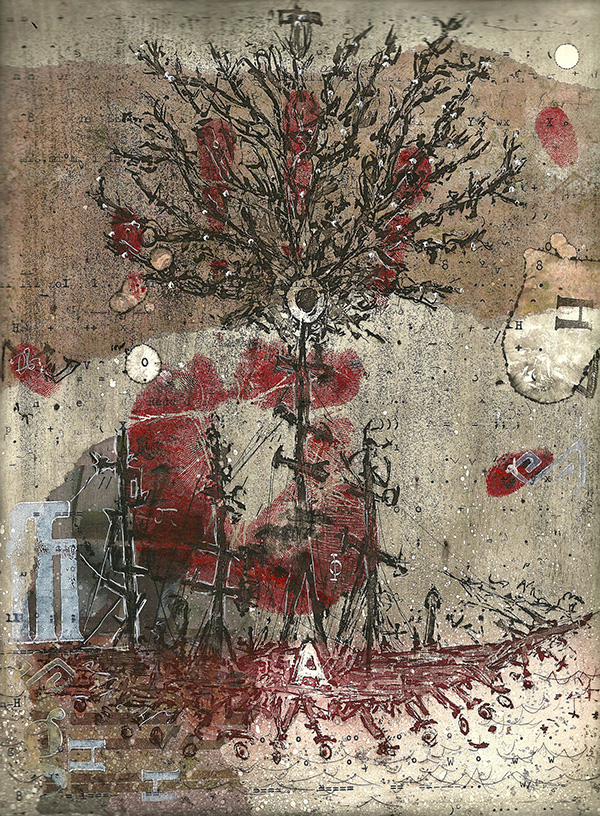
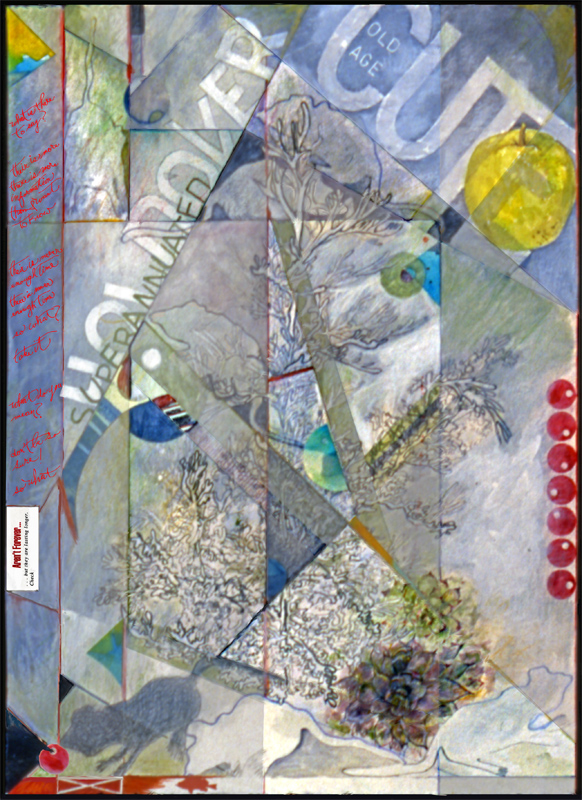
NVW: One of the aspects I’m drawn to in this work is how the visual material can interact with the text—fill in gaps in the “story,” provoke a nonlinear kind of logic, or suggest a larger worldview/context than the text alone permits. This page, now titled “He Who? She When?”, was originally called “Advancements in Medicine.” I don’t feel in any way obliged to stick with the original subject matter of a page. For me, it’s all about the interplay of words with images that have “tangential” connections, thread-like, or tonal. The sense the pieces make, I hope, is more intuitive than conscious and rationale.

He Who, She When?

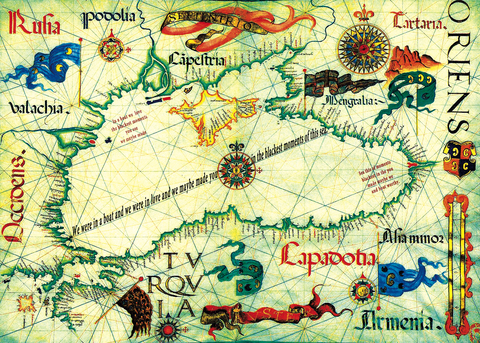
I haven’t said anything about the maps, and I’d like to. Most of these were not part of the encyclopedia I altered. Rather, they were from an online website (from New York Public Library’s “digital collection”) of public domain “rare” maps. I used these in the book a little like section dividers, and I am forever grateful to Pleiades Press for allowing them to be double-page spreads and displayed so well. (I’m grateful to Pleiades for so much! The support of the editors and designers there has been extremely helpful to me.) Here, my little bit of text—”We were in a boat and we were in love and we maybe made you in the blackest moments of this sea”—is spread out upon a map of The Black Sea, a place I’ve actually been. The text is stamped around into the sea with all sorts of variations on the arrangement of these words. This felt like a kind of homage to ancestry, not just mine but “ours.”

Map

SA: Thanks so much, Nance! Can we end with you sharing with our readers what you’re working on now?

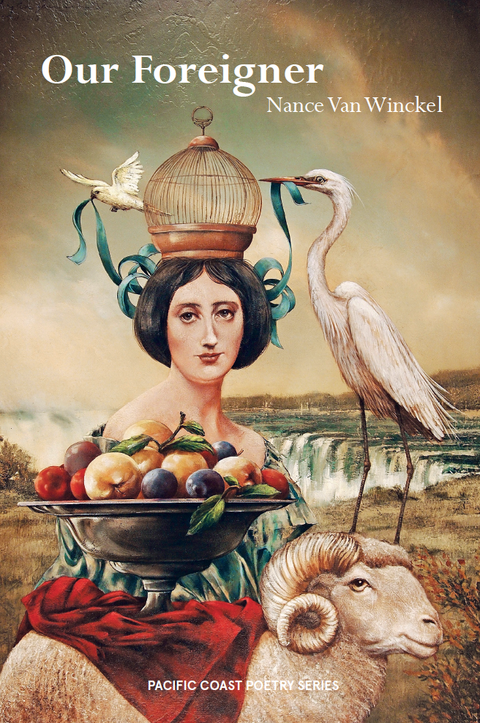
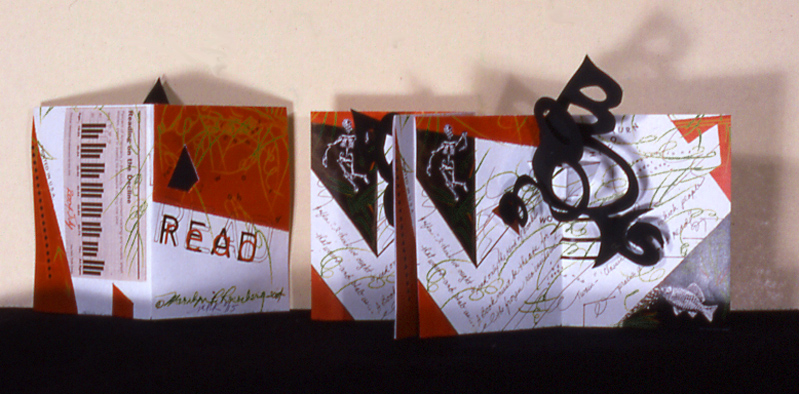
NVW: Yes, my eighth book, Our Foreigner, received the Pacific Coast Poetry Award and is just out from Beyond Baroque Books. I’m working on a book that’s primarily a memoir; it has many sorts of hybrid forms going on in it, including some visual black and white collages.

Our Foreigner book cover

And I continue to do a little wall-writing. This is a recent piece.
I have a website for examples of this work.

Wall Writing example


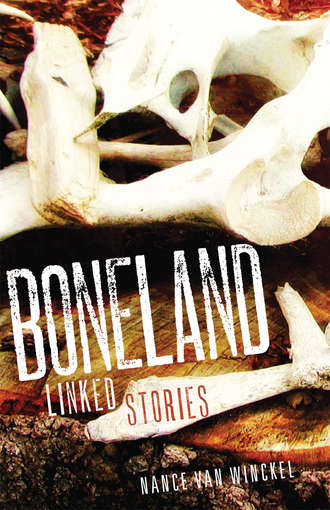
Nance Van Winckel is the author of eight books of poetry, most recently Our Foreignerwinner of the Pacific Coast Poetry Series Prize (Beyond Baroque Press, 2017), Book of No Ledge (Pleiades Press Visual Poetry Series, 2016), and Pacific Walkers (U. of Washington Press, 2014). She’s also published five books of fiction, including Ever Yrs, a novel in the form of a scrapbook (Twisted Road Publications, 2014) and Boneland: Linked Stories (U. of Oklahoma Press, 2013). She is on the faculties of Eastern Washington University’s Inland Northwest Center for Writers and Vermont College of Fine Arts’ MFA in Writing Program. The recipient of two NEA poetry fellowships, the Paterson Fiction Prize, Poetry Society of America’s Gordon Barber Poetry Award, a Christopher Isherwood Fiction Fellowship, and three Pushcart Prizes, Nance lives with her husband Rik Nelson in Spokane, Washington.

aizenberg-thumbnail

Susan Aizenberg is the author of three poetry collections: Quiet City (BkMk Press 2015); Muse (Crab Orchard Poetry Series 2002); and Peru in Take Three: 2/AGNI New Poets Series (Graywolf Press 1997) and co-editor with Erin Belieu of The Extraordinary Tide: New Poetry by American Women (Columbia University Press 2001). Her poems have appeared or are forthcoming in many journals, among them The North American Review, Ted Kooser’s American Life in Poetry, Prairie Schooner, Blackbird, Connotation Press, Spillway, The Journal, Midwest Quarterly Review, Hunger Mountain, Alaska Quarterly Review, and the Philadelphia Inquirer and have been reprinted and are forthcoming in several anthologies, including Ley Lines (Wilfrid Laurier UP) and Wild and Whirling Words: A Poetic Conversation (Etruscan). Her awards include a Crab Orchard Poetry Series Award, the Nebraska Book Award for Poetry and Virginia Commonwealth University’s Levis Prize for Muse, a Distinguished Artist Fellowship from the Nebraska Arts Council, the Mari Sandoz Award from the Nebraska Library Association, and a Glenna Luschei Prairie Schooner award.


May 072014
 

Ingrid Ruthig - at Station GalleryIngrid Ruthig

Ingrid Ruthig is a protean artist, a poet, fiction writer, editor, recovering architect (now dealing in architexts), hybrid artist, text artist (dealing in dBooks and recodings and TexTiles, i.e. puns, visual and verbal), the very epitome of the kind of artist we like to feature on Numéro Cinq, a hungry spirit who breaks forms and recombines them, who is always trying a little something new, the kind of artist Contributing Editor Nance Van Winckel is always on the look-out for, to interrogate and display, as in here, below, the latest in her amazing series of Off The Page art & interview pieces.

dg
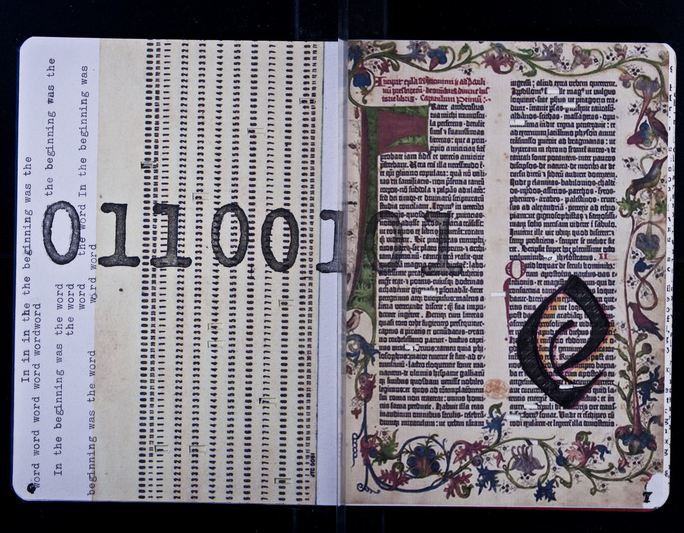
 

oneTwo facing pages from BinaReCodings: ‘In the beginning was the word’ Click on the image to view the entire book.

NVW: BinaReCodings. I recently read Kenneth Goldsmith’s book Uncreative Writing, in which he talks about these binaries (of 0 and 1) as the basis for all computer “language.” If a jpg image file won’t open, it comes to us as linguistic code. In referring to a Charles Bernstein poem, Goldsmith explains that the “text becomes active, begging us to perform it, employing the spaces as silences.” (p. 18) Goldsmith goes on to say that “Never before has language had so much materiality—fluidity, plasticity, malleability—begging to be actively managed by the writer.” (p. 25) And, I might add, re-managed by the reader! It seems to me your BinaReCodings sketchbook suggests similar ideas. Here, I’m thinking specifically about remaking and repurposing what has gone before, but with a focus on an elementary nature of linguistic activity, a 1 and a zero, a something and a nothing.

Ruthig: When a viewer responds to the work as you have, it’s both exciting and disquieting, because it forces the artist to revisit and reconsider what was deliberate, intuitive, serendipitous—that is, can she actually explain the work? does she want to? Well, here goes!

Yes, on the surface BinaReCodings breaks down language to building blocks, to the letter, in order to prod new connections as we re-see it. It also documents how, through a type of repurposing of pages from history, it has been key to human progress. However, in terms of language, I see the process as akin to translation or transposition. If I use music as an analogy, the original libretto remains, but the score’s been shifted into another key. And the soloist sings in Cantonese rather than Italian, and the oboes play the first violin’s part, and all this happens against a changing backdrop, a contextual repositioning. The result alters how the reader-viewer engages with the original. But let me backtrack a little . . .
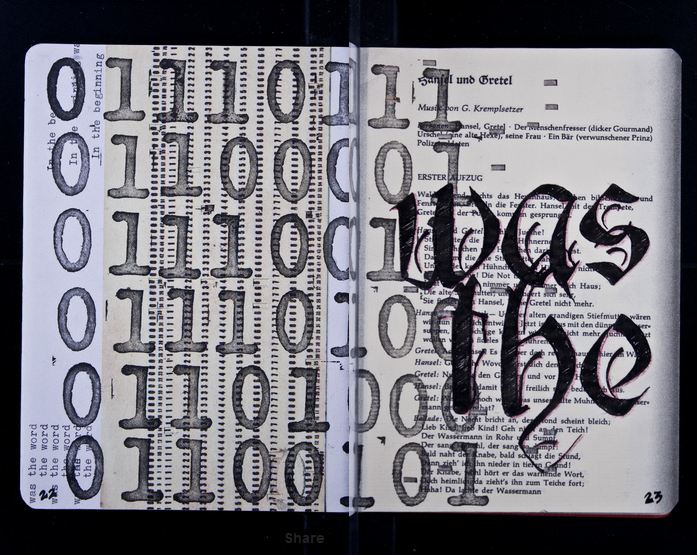
twoTwo facing pages from BinaReCodings: ‘In the beginning was the word’

While studying architecture at the University of Toronto in the early 1980s, I took an elective on computers. I must have been intrigued partly because I worked as a bank teller during summer holidays, and new ooo-aah robo-digited computer systems had recently replaced pen-on-paper record-keeping. It all sounds incredibly antiquated now, but this was the era of UNIX OS and dot matrix, that held-breath moment before software and personal home computers, such as the Commodore 64, exploded off the digital launch pad. Along with punch cards, much of what the elective offered has dissolved into the shadows of the ancients. Yet the basic premise that everything can be reduced to “On” and “Off”, “1” and “0” remains, and thirty years later, its impact infiltrates our everyday lives.

BinaReCodings reexamines language by putting it into a state that confounds immediate meaning. It draws on Viktor Shklovsky’s notion of “defamiliarization” and aligns with Goldsmith’s take on language as ever-present material. Words are symbols of ideas, holding meaning so long as we know the language and take time to decode it. Using the usually invisible 1 and 0 elements of binary code, I translated the biblical phrase “in the beginning was the word.” But “word” is no longer capitalized and, rather than referring to God, instead references the human facility for language. Letter by letter the recoded phrase then spreads throughout the sketchbook, superimposed on images of key historic pages, those language vehicles.

By showing us where we are, surrounded by invisible (binary) language, as well as where we’ve been, by presenting words from history, by mixing things up, by juxtaposing then and now, known and unknown, BinaReCodings forces the viewer to relinquish assumed meaning and look again, look harder, see something different. Significance is not quite lost, only less obvious. BinaReCodings does manage and demands managing of text as well as image. In the end, drawing connections is what matters.
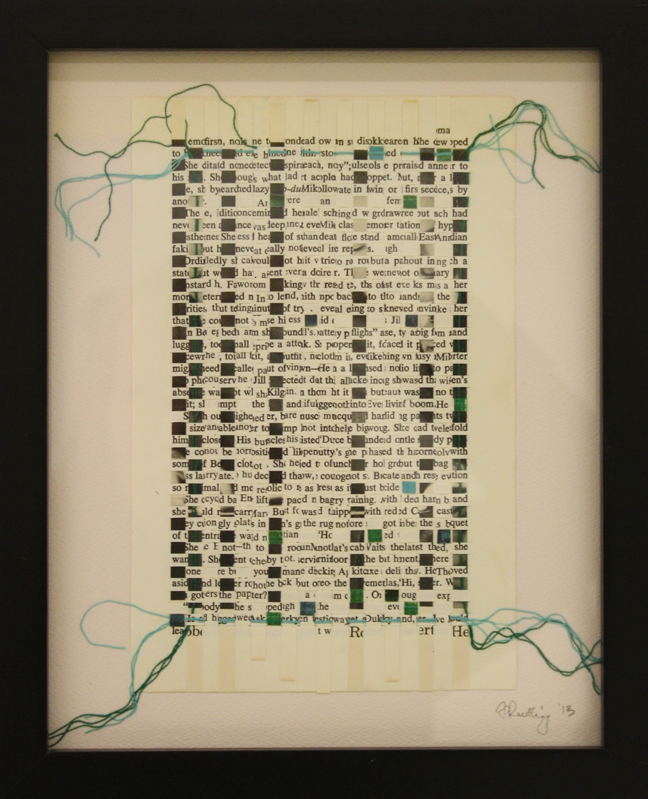
Sci Fi - from the TexTiles series 2013Sci Fi from the Textiles Series 

NVW: Several visual artist friends have told me this, or variations on this: “Nance, when people go to a gallery, they don’t want to READ; they want to LOOK.” This is an issue I struggle with— how to tempt someone not necessarily to “read” per se, but to want to interact with the text AS text. As both a poet and a visual artist, could you share your own thoughts on this, and perhaps with regard to this particular piece of yours I love, (detail) from TexTiles. To what degree does the semantic meaning of the words themselves illuminate or further the “looking” experience, or does it? Is it important to you that someone do something akin to “reading” while experiencing this piece?

Ruthig: A wild synchronicity is at work here… I tripped across this read/look issue a few days ago, so I’m glad you’ve brought it up. I understand the galleried inclination—I’ve caught myself responding that way to worded works. And if I’m honest, it usually stems from laziness on my part, especially if the text is oriented off-horizontal—I think, Seriously? I’m to stand on my head to read this? Just as we approach visual art with expectations, we approach language with assumptions, programmed so we have one less decision to make, and in a way that’s indolence on the collective scale. Yes, reading does require more from us. We have to process written language. To refer to Goldsmith’s Uncreative Writing—which, like you, I only recently read (another intriguing synchronicity)—“the act of reading itself is an act of decoding, deciphering, and decryption.” We can’t connect with the ideas or images until that language processing has taken place. I might argue with myself here, and say that, if words are recited aloud, it’s entirely possible to preempt meaning by connecting through sound—I think of how mesmerizing it is to listen to Gertrude Stein’s work. But if we accept the usual premise about text, gazing at an image seems less daunting by comparison, because it taps intuition and is more immediately sensual, regardless of how it makes us feel.

The way someone experiences any of my textworks is going to be as unique as the person. If she’s inclined to read each word, great. If not, that’s fine too. I’d be happy to know that someone simply liked to look at it, that it was visually appealing. Just as I reassure those who insist they “don’t get” poetry not to worry so much about getting it, similarly, I’m open-minded about how viewers take in my art. To a degree, response does depend on the work—certain pieces are configured for reading, while others aren’t. Any approach is valid, though I believe the deeper the engagement with any work, the more the reward—in other words, the more you put into it, the more you come away with. The only thing that’s critical is to engage. In the case of TexTiles (based on sketches I made while preparing other work for the 2012 exhibition Reading the Image), the work questions assumptions and hopefully prompts the viewer to look again, to see print language less for what it means and more for what it is—i.e. a vehicle with form, one we expect will tell us something. The work plays upon our compulsion to seek (even concoct) meaning, to uncover story in what we don’t immediately grasp. And if we can’t make sense of it, is it still true? Was the original text even true? What was it? And does it matter?
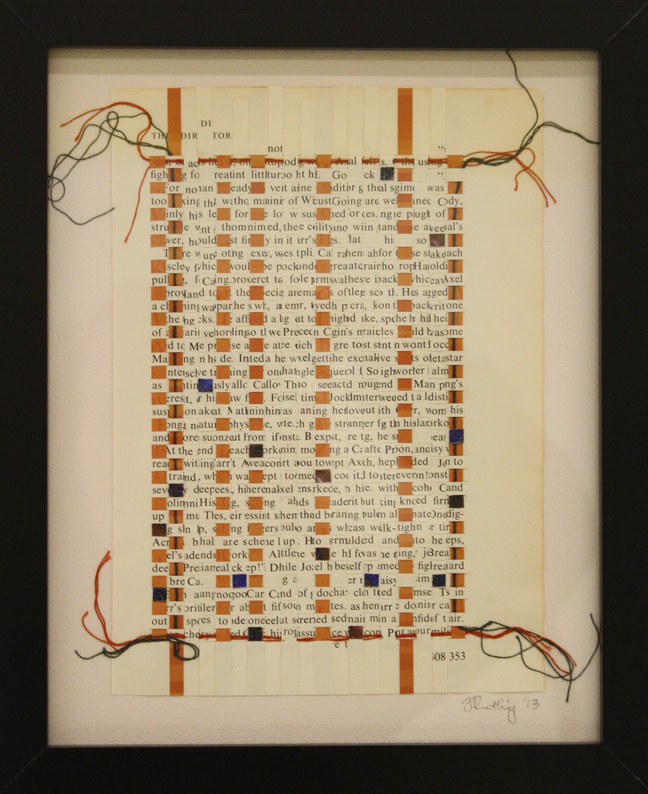
70's POTBOILER - from the TexTiles series 201370s Potboiler from the TexTiles Series

When TexTiles was first shown, a viewer asked if he could tell me what affect it had on him. Of course! He said he came to it believing he would read what were obviously pages from a book, and they would reveal something. Then he realized the language, while still familiar in form, was remade and now unreadable. He found he was seeing the pages in a new way, and reading his own expectations. He also found himself thinking that, if only he could access the strips of woven text, he could realign the words and unlock the mystery. By letting me in on his experience, he revealed my own work to me. It’s easy to forget that we’re never merely looking—we’re always reading and shaping connections, even when words are not involved.

dBooked by Ingrid Ruthig. (mixed media on canvas) dBooked (mixed media on canvas)

NVW: In your artist statement about dBooked  you talk about how with this work we “become archaeologists, asking What was the story? Who told it? Where? And with whom did it once connect?” I’m interested in this idea of reconstruction too, in ways the reader/viewer “remakes” a whole out of pieces. It seems to me this is quite akin to how we live our lives: gathering pieces that seem increasingly fragmented, then holding and sorting these pieces, hoping to infer connections or patterns, albeit not necessarily a “whole.” With this particular piece, can you talk about how you think a reader/viewer might engage with it, i.e. your own understanding of how this “remaking process” might best occur.

Ruthig: Driven by curiosity in a wired world bursting with the incomplete, we’re reclaiming or inventing back-story all the time now. It’s second nature. My own inner archaeologist can’t pass up a chance to puzzle the pieces. The first series I did, Fragments of the Missing, happens to echo something of Walter Benjamin’s preoccupation with the modern world’s fragmentary nature. As a series of deconstructions and reassemblies, Fragments visually stitches shards of language from a variety of sources into a figurative, semi-semantic, patchwork quilt. Lacking punctuation and the usual paratextual guides, the narrative is further remade by each reader, who forms connections with words and phrases and reads the text based on the way the panels are arranged in relation to each other.

In contrast, dBooked is a single work of dismantling and a remaking of a different sort. The viewer confronts in two dimensions the remains of what once existed in three: a skeleton of pages nearly devoid of text flesh; segments of dust jacket, cover, endpapers, its physicality; library markings indicating a previous life; conjunctions and a sequence of chapter headings. Paratext is otherwise absent, though its original locations are still apparent. Most of the language has been removed word by word from the first page of each chapter of a novel, then reintroduced as visual streams and pools without semantic continuity. As the words drain away, the vivid, colourful picture they painted evaporates, the story disappears. Anything that might have been an obvious clue has been deliberately erased. The reader becomes viewer who must look beyond the words.

dBooked is less a commentary on language’s inherent metamorphosis than it is a reflection of the book’s apparent decline as iconic cultural object, as quintessential container for language and conveyor of narrative. In a sense, it is reverse architecture applied to text, where mindfulness of context is achieved by dismantling. The exercise is to take what has come before and deconstruct it for a new perspective. I think the viewer arrives at a similar place as with Fragments of the Missing, by searching for clues that might answer the questions it evokes. Though the original story is undone by the book’s undoing, and may never be rebuilt, language continues to exist and to offer a fresh, if different, narrative.
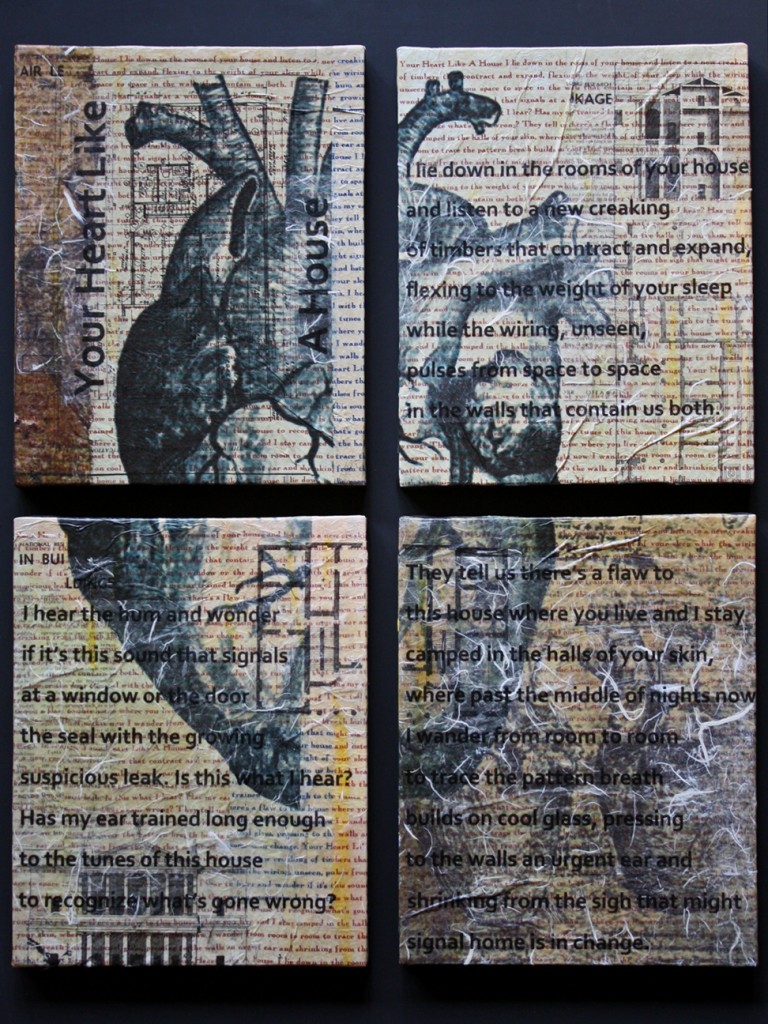
Your Heart Like A HouseYour Heart Like A House

NVW: Your Heart Like a House. With this one I think about the kinship of the actions of the heart and of reading: passages in and passages out, intake and output (responding). Little by little what enters us becomes us; the “house” is a construct. This piece is a sensuous mix of materials, of text and image so beautifully married. Those four quadrants/ventricles. And what is the text here? Might you speak a little about your process with this one: how did text and imagery find each other or “arrive” together?

Ruthig: Thanks, Nance. Words are at the heart (pardon the pun) of the textworks, usually arriving first, then driving the visuals forward. This piece is no different. It flipsides traditional ekphrasis, in that I wrote the poem “Your Heart Like A House” years before I thought to attempt a visual representation. The poem, which surfaced hard on the heels of unexpected news that overturned my view of the future, begins “I lie down in the rooms of your house / and listen to a new creaking / of timbers that contract and expand, / flexing to the weight of your sleep / while the wiring, unseen, / pulses from space to space / in the walls that contain us both. . . .” Years after it was published, after everyday life had again settled down, after I realized the poem’s images would not leave me, I began to experiment with a visual incarnation. I guess my architectural background is never far from the surface, because I’m inclined to interweave disciplines and mine the rich territory found in the crossover—as when a poem is visually transmigrated, or an image spawns words.

Yes, the quadrants mimic the cardiac chambers, and even at risk of pissing off the viewer, I chose imagery to reiterate that construct—I love how complex and beautiful the actual human heart appears, especially as rendered in historical anatomy books. The poem itself provides the rest of the framework. It loops in its entirety on and on in the background, circulating in red and blue from one space to another, reminiscent too of how we follow a stream of words from page to page when we read. In large font, foreground lines regenerate the stanzas, more or less, and also pass from room to room.

Adages are ingrained in us, and no doubt “home is where the heart is,” as well as Bachelard’s “abode” from Poetics of Space, found their way in, as did a lot of traditional residential and construction imagery—anything that felt as though it belonged. Your Heart Like A House has a lot to do with how we create and inhabit physical and psychic space, how we fill each with expectation, memory, our everyday vision of life, and what happens when that vision is shaken to its foundations.

The creative process, for me, is like stepping into a canoe and choosing a direction as I start to paddle. Then the current takes over. I can’t control it, but if I trust in the flow of words, images, textures, and imaginings into layers, discovery becomes arrival.
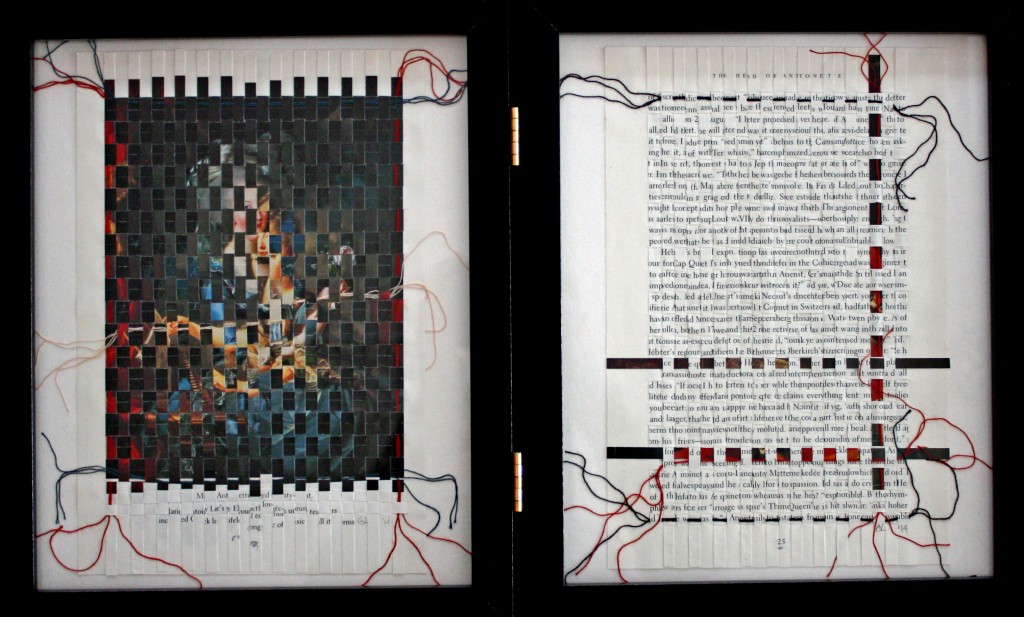
Antoinette's Head - a TexTileAntoinette’s Head 

NVW: Antoinette’s Head. Ah, a diptych, a hinged “book.” Here I like how the “head” image gives way—or opens upon—the more language-based material. Even the title  gives the work a luminous context. I think, for instance, of Marie Antoinette, and all that was in that lovely head . . . perhaps even as it left its body. You use weaving in some of your new work, and I wonder if you could talk about that craft in general with your work and perhaps in particular with this piece.

Ruthig: Here’s where I wax rhapsodic about titles for a moment! The way I see it, a title is a key to unlock the work, the point of entry, especially for a poem, that might also set the stage or mood. While providing one isn’t critical, it’s an opportunity for the artist to invite the viewer inside. I find, even as the artist, a well considered title helps gel the work in my mind. So I pay close attention to them, and it’s good to hear how this one let you in!

Antoinette’s Head is based on two portraits of Marie Antoinette and two pages of text, all from a fairly recent biography.  Reweaving the images and text let me confront a number of perceptions. On one level, it continues the exploration of the weft and warp of language, especially print language. On another, it examines our perception of books as repositories of truth. If we stop to consider what we take for granted as historically ‘true,’ we might realize a historic figure, in this case a queen, had to have been misread and a far more complex person than the one some historian or painter claims she was. There’s a literal warp to how people in history are portrayed. Even we ordinary people are storified differently by each person who knows or has ever met us, and each version is a reflection of the individual experience of whoever is relaying the image. In this era of the Web’s tightly woven net and social media’s image-massaging filter, it’s even harder to break the fictional code. What’s true? I want to suggest that we should recognize then question. Rather than read and accept, we should consider the fluid nature of text and image, the telephoning of story that inevitably takes place, even if fact-driven.

By physically shifting image and printed word to illegible states, Antoinette’s Head hopefully shifts assumptions of the reliability and integrity of any documentation, and encourages questions. Arguably, every work of documenting is the product of a narrator who filtered, translated, transposed, and in the process often composed a fiction, intentionally or unintentionally. What we think we know is more than likely false to some degree. Truth is threaded through the language we use to describe everything, but it’s tough to decode it then extricate it from the larger fabric.

Antoinette’s Head, as an extension of the TexTiles series, surreptitiously tapped into the personal. In the mid-1800s, my great great grandfather, an Austrian textile industrialist, founded the family business, which flourished despite war, upheaval, and relocation, and remained in the family until my grandfather died. The inherited stories linger in me, and some latent tactile knowledge, more tangible than one might think, prods me to visit his craft through mine. Antoinette’s Head is a way to explore the weft and warp of language, stories, history itself. It’s also carrying me into a new series of works. I’m well into the current now, and there’s no knowing where it will lead!

 —Ingrid Ruthig & Nance Van Winckel

.
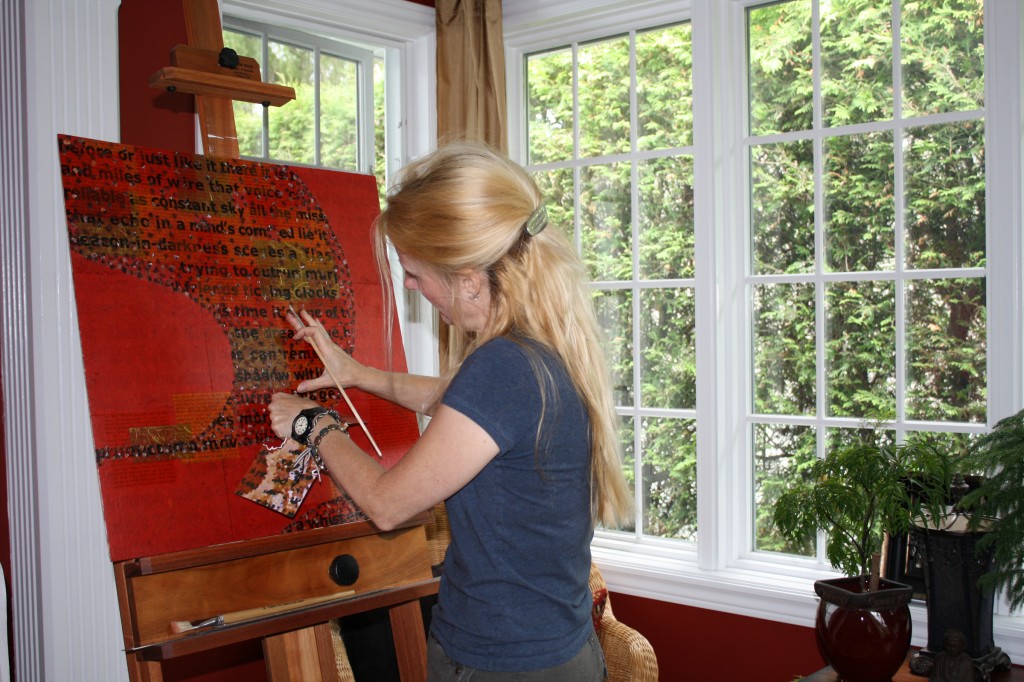
Ingrid Ruthig - in the studio
INGRID RUTHIG graduated from the University of Toronto with a Bachelor of Architecture in the mid-1980s. For more than a decade in Toronto she practised as a member of the Ontario Association of Architects – a profession in which word and image are inextricably linked – then retired her licence to write full-time. She also co-edited/co-published the Canadian literary journal LICHEN from 2000–2007, and later, was an associate editor for Northern Poetry Review. Her poetry, fiction, and nonfiction have appeared widely in Canada and abroad, in The Best Canadian Poetry in English 2012, The Malahat Review, The New Quarterly, National Post, Canadian Notes & Queries, and many other publications. Her textworks have been shown in galleries, public venues, and are in private collections. Her books include Slipstream (a poem sequence / artist’s book), Richard Outram: Essays on His Works (as editor/contributor), Synesthete II, and she recently edited The Essential Anne Wilkinson (Porcupine’s Quill, fall 2014). Ingrid lives with her husband and daughters near Toronto. Her web page is here: www.ingridruthig.com.
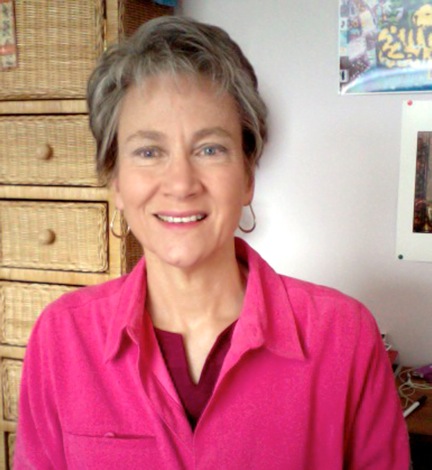
Nance Van Winckel

Nance Van Winckel is the author of six collections of poems, including After A Spell, winner of the 1999 Washington State Governor’s Award for Poetry, and the recently released Pacific Walkers (U. of Washington Press, 2013). She is the recipient of two NEA Poetry Fellowships and awards from the Poetry Society of America, Poetry, and Prairie Schooner. Recent poems appear in The Pushcart Prize Anthology, The Southern Review, Poetry Northwest, Crazyhorse, Field,and Gettysburg Review. She is also the author of four collections of linked short stories and a recent recipient of a Christopher Isherwood Fiction Fellowship. Boneland, her newest book of fiction, is just out with U. of Oklahoma Press. Her stories have been published in AGNI, The Massachusetts Review, The Sun, andKenyon Review. Nance’s photo-collage work has appeared in Handsome Journal, The Cincinnati Review, Em, Dark Sky, Diode, Ilk, and Western Humanities Review. New visual work and an essay on poetry and photography appear in Poetry Northwest and excerpts from a collage novel are forthcoming in Hotel Amerika and The Kenyon Review OnlineClick this link to see a collection of Nance Van Winckel’s mash-ups of poetry and photography, which she calls photoems. She is Professor Emerita in Eastern Washington University’s graduate creative writing program, as well as a faculty member of Vermont College of Fine Arts low-residency MFA program. She lives near Spokane, Washington with her husband, the artist Rik Nelson. Her personal web page is here.


Mar 102014
 

IMG_0486

Bianca Stone is an amazing poet/comic creator/illustrator/hybrid/amalgam artist who, yes, changes the weather a bit because she goes where she pleases, much like Anne Carson, with whom she collaborated on the book Antigonick (New Direction, 2012), Carson’s translation of Antigone. Stone has a new book just out, Someone Else’s Wedding Vows (Tin House/Octopus Books, 2014), and she has great genes, being the granddaughter of the of the poet Ruth Stone. We have today an interview between NC’s own amalgamated poet/artist Nance Van Winckel and Bianca Stone, delightful and knowing. Note especially Stone’s analogy between drawing and the poem on the page.

And when I draw—poof! There’s suddenly a physical thing there, that can talk, that can move. And I take advantage of that. The body itself, the air around the body, the expression on the face—these things can work just like a poem. Speaking, but not saying everything.

dg


NANCE VAN WINCKEL: In some of your comics the text can seem suggestive of a state of mind, a thinking-feeling condition. I’m thinking of, for example, “It’s like there’s a house in my skull with a woman waiting for someone to resurrect and take her outside.) The artwork itself, however, often gives this more “lyric” text a kind of narrative context: a physical space, characters, and situation. Can you comment on your own sense of how narrative and lyric impulses combine for you—in process and/or technique?

American+Sentances+American+Sentances+

BIANCA STONE: I’ve always had a great love of narrative. But I prefer also to allow surrealism in to complicate the narrative. I think that’s just how our minds work. In my poetry comics it’s the perfect space to explore the two. You have the push and pull of the visual image (which is so much more immediate than words), and perhaps work against the literal. And against abstraction.

That line you mentioned, for example—how could I possibly draw that without wrecking the imagination of it? I don’t want to draw it. I want to imagine it; more importantly, I want the reader to imagine it. So I draw something that lies beside it, so to speak, like another line of the poem. So that it moves forward, avoiding the didactic, the static.

NVW: Regarding the Practicing Vigilance Series in Notnostrums.

“No coins left in heaven/ you say every day/ to the coin-operated wind.”

In this series I especially like how you get at one’s impulse to “speak,” to give voice to inner turmoil, “someone’s lipstick burning in your skull.” The bats in this series fly like bits of language into the urban brew-ha-ha. Many of your poem comics seem to be haunted by what I’d call “incomplete linguistic transactions.”

Bianca StoneVigilant

BS: I love that you imagined that the bat was bit of language. Because isn’t language, in a way, an image? Especially a poem—which uses the page like a canvas, and appreciates white space, the shape and sound of words, the drop at the end of a line. It’s beautiful for the eye (or perhaps hideous to the eye).

And when I draw—poof! There’s suddenly a physical thing there, that can talk, that can move. And I take advantage of that. The body itself, the air around the body, the expression on the face—these things can work just like a poem. Speaking, but not saying everything.

And often I’ll use poems for a drawing that perhaps need a little more. That aren’t done enough to be on their own. I’ll be using a poem, and take a line out because suddenly, while it’s all alone on the page, I realize it’s not strong enough. Thus, it often creates the non sequitur method that you find in more experimental comics and poetry. But also that method resists the narrative and allows more for music.

Some day soon I’ll be making a comic that’s much more narrative…that’s more a prose poem.

IMG_1397

NVW: You say that in your poetry comics you “want to use the image as another element of form in poetry.” Could you talk a bit more about this text & image “gestalt?”

BS: Again, one is constantly resisting “illustration, ” in its traditional definition. You don’t want to draw what’s being said, because that’s redundant.

It’s damned abstract to talk about, frankly. An image as a line in poetry—it doesn’t make entire sense! But I believe it.

BlackTightsBlack Tights

NVW: Regarding Antigonick, your collaboration with Anne Carson, is it true you didn’t even see her written text until after you’d done the illustrations? But of course you no doubt knew the play. Did you come away from this project with any new understandings about the collaboration process?

BS: Not entirely true! What I did see (read, spend hours with) was Anne’s text. I had it beside me while I did the art. I worked from it, as I do with all my poetry comics.

However, Anne and Robert Currie didn’t show me the hand-written text until I was finished. And then Currie magically came up with a method to put the images and text together.

Collaboration is hard. Very hard. You make endless false starts, and you spend a lot of time alone, weeping internally, worrying about everything. But then you come together and put things together like a couple of curious, eager architects. You step back and you have this one giant product. And you’re so proud. Your ego isn’t too wrapped up in it, because you all did it together.

It’s something that you do with people you trust artistically, and emotionally. And it makes you a better, more humble person.

NVW: I loved the poem “Elegy with Judy Garland (and Refrigerator).” I so admire how the language synchs with the music and the graphics. The intermix of drawing and film, of music and voice-over make for one of the better poetry videos I’ve seen. Does the poem come first, and then the animation take shape around that? And is poetry video a main direction for your work these days?

BS: I’ve always loved making videos. Ever since I was a teenager and had a massive VHS camcorder. The past few years I’ve been doing it again, and it’s really something I’ll keep doing.

It takes a long time. But the main things to remember are:

1. Use a good, finished poem.

2. Make a high-quality recording of it. (Read it well. Read it slowly.)

3. As I preach in my poetry comics, avoid “telling” the poem. Let the poem speak for itself. Use ghosts of subjects in your poem, but not verbatim.

Then comes all the hard work of figuring out the visuals. I’ve developed a kind of stop-animation process with my drawings, which is time consuming and bizarre. The process itself is a kind of performance piece (drawing free-style with a camera blocking half my view; trying not to move the paper or my camera.)

Thinking of the video-making process as part of it will slow you down, and help you make a better video.

A lot of poem videos are kind of awkward…it’s important to pick the right tone (music, sounds, title font, footage).

FridgeFridge

NVW: I know you’re the granddaughter of Ruth Stone, a poet who’s near and dear to my heart, and I know too that you’re running the foundation to make her Vermont house a writer’s retreat and artist space. Could you talk a bit about how her life and/or her poetry have influenced your own? In your video, “Because You Love You Come Apart,” I could swear the first voice is Ruth’s.

BS: YES, the first voice is grandma’s voice, with me pantomiming it. She was an amazing reader.

Well, how to begin with this….grandma’s poetry is the most important poetry to me in the world. Her voice, her words, her love, is why I’m a poet.

I’ve written a lot about it. But to kind of sum-up, I spent my childhood with her (living with her in Binghamton while she was teaching there, traveling to readings, spending summers with her in Goshen, VT). We wrote together all the time, read her poems out loud; created together. I was raised by a single mother, so we spent a lot of our life dependent on my grandmother. My whole maternal family really revolved around her.

InfinityInfinity

Since her house in Vermont has always been a haven for her writing, and for students, poets, artists (and of course my mother and aunts), I’ve always dreamed of making it into a writer’s retreat. Sadly, the house needs about 500,000 worth of renovation (it’s also a historical landmark, so that price includes the parameters of restoring such a house). People tell me to tear it down, and I just want to scream! I wouldn’t dream of it! I’ve been toiling away with whoever will help, raising as much money as we can, trying to save it. All her writing and books and my family’s history is in there, getting eaten by mice and consumed by the elements. This summer I’ll be up there full-time. I’m going to get married there!

Honestly, anyone who can, please donate here at the Ruth Stone Foundation site and read more about what we’re doing.

weddingWedding

NVW: I know you have a new book, Someone Else’s Wedding Vows, just out with Tin House/Octopus Books. Does it include visual art? Or did visual art—your own or others—inspire the poems in the book?

BS: I did the cover. (Which, I at first said I wouldn’t do, because art sometimes trumps words.) But besides that, it’s all about my poems. However, you’ll notice in the book that several poems are also poetry-comics and/or poem-videos out in the world.

I’ve been looking forward to my first book for a long, long time. I was patient in the end, waiting until I had it right. Now I’m thrilled with the whole trajectory of my poetry. I just wish grandma were here to see it.

—Nance Van Winckel & Bianca Stone
.


Bianca Stone grew up in Vermont, and graduated with an MFA from NYU’s Creative Writing Program. She is the author of Someone Else’s Wedding Vows (Tin House/Octopus Books, 2014), several poetry and poetry comic chapbooks, and is also the illustrator of Antigonick, (a collaboration with Anne Carson). Her poems have appeared in magazines such as American Poetry ReviewTin House, and Crazyhorse. She lives in Brooklyn.
SPACE
§
Nance Van Winckel is the author of six collections of poems, including After A Spell, winner of the 1999 Washington State Governor’s Award for Poetry, and the recently released Pacific Walkers (U. of Washington Press, 2013). She is the recipient of two NEA Poetry Fellowships and awards from the Poetry Society of America, Poetry, and Prairie Schooner. Recent poems appear in The Pushcart Prize Anthology, The Southern Review, Poetry Northwest, Crazyhorse, Field, andGettysburg Review. She is also the author of three collections of short fiction and a recent recipient of a Christopher Isherwood Fiction Fellowship. Her stories have been published in AGNI, The Massachusetts Review, The Sun, and Kenyon ReviewBoneland, her fourth collection of fiction, is forthcoming in October from U. of Oklahoma Press. Nance’s photo-collage work has appeared in Handsome Journal, The Cincinnati Review, Em, Dark Sky, Diode, Ilk, and Western Humanities Review. New visual work and an essay on poetry and photography are forthcoming in Poetry Northwest and excerpts from a collage novel are forthcoming in The Kenyon Review OnlineClick this link to see a collection of Nance Van Winckel’s mash-ups of poetry and photography, which she calls photoems. She is Professor Emerita in Eastern Washington University’s graduate creative writing program, as well as a faculty member of Vermont College of Fine Arts low-residency MFA program. She lives near Spokane, Washington with her husband, the artist Rik Nelson. Her personal web page is here.
Dec 082013
 

Lowe in Studio

There is a line in Rilke’s “The Spanish Trilogy” — “…to make the Thing, Lord Lord Lord, the Thing” — that rings down through this amazing interview, NC Contributing Editor Nance Van Winckel with visual artist Lynda Lowe, an interview about art, making art, and the art of collaboration. All art is, yes, about making Things. We forget that sometimes. Expressing ourselves, making a point, sending a message, selling a line, finding a market, all take a back seat to the thingness of the Thing, its sudden and utter presence, sui generis and unique. Whether it’s a poem or a painting or some combination thereof (or a novel or a figure in a block of stone…).

dg

01 Installation Object of the Object

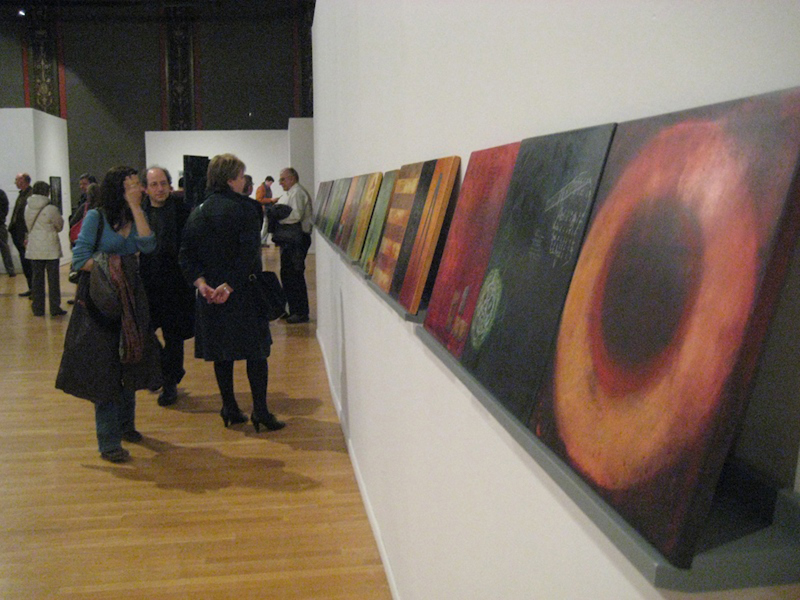
01 Installation view of The Object of the Object, for the Poetic Dialogue, 13”H x 20’W x 4”D, 2008
Collaboration with poet Nance Van Winckel

NVW: I thought we’d begin with a few questions about our collaboration for the Poetic Dialogue Project, a group exhibit of poets and artists who were paired to combine poetry and visual art. Since we both live in Washington, we were paired together. I remember coming to your lovely studio near Tacoma and seeing all the cool “tools” you’d collected and thinking about a poem I’d written called “Left to Our Own Devices,” which was also about tools, tiny clock-repair tools.

I sensed we were both interested in objects and, as we went on to discuss, “thingness” or “objecthood.” We called our collaborative project The Object of the Object. I particularly love the piece of yours with those calipers in it. I would suppose that as an artist you must have developed a close kinship with the “tools of your trade.” Can you describe a bit what our collaboration WAS (the series, sizes, etc.) and also talk a little about the subject of “things” and its appeal to you as a visual artist?

05 Object of the Object panel 15

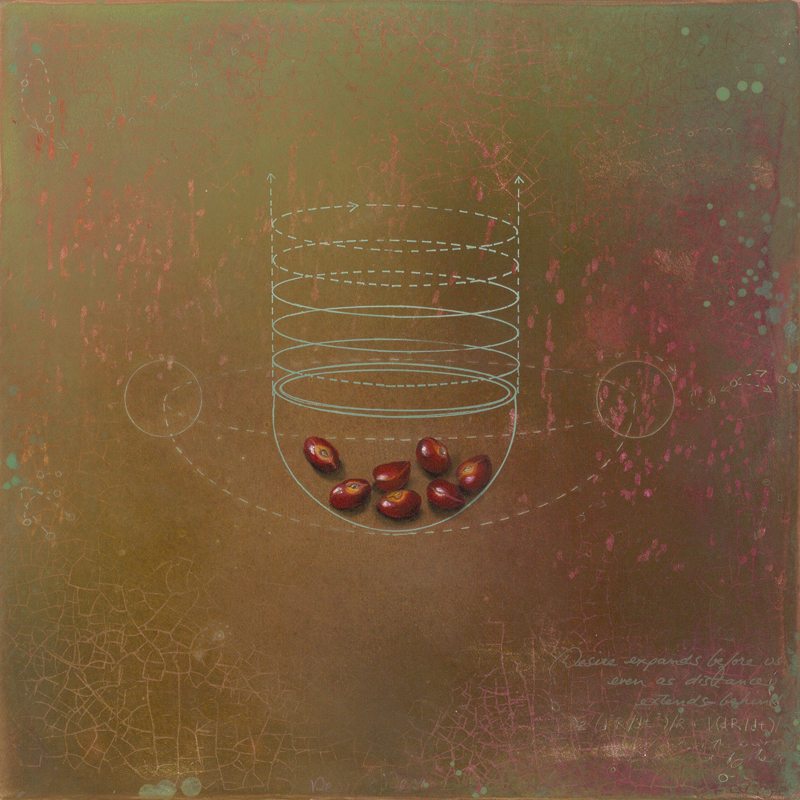
Panel 15, The Object of the Object, 12” x 12” water and oil media, wax on panel 2008

Lynda Lowe: The Poetic Dialogue’s intent was to have a visual artist and a poet collaborate in the creation of a new work for a traveling exhibition. It was on my mind to not just make an illustration for your poems or for you to write something in reaction to a painting, but to integrate these forms as much as possible. Since we didn’t know each other before beginning the collaboration, we spent time sniffing out the turf where we might find something common and fertile. We passed back and forth word lists, favorite readings, images, and poems to see where we might begin.

Through Rilke’s poetry we discussed the interiority of the object, its thingness: “to make the Thing, Lord Lord Lord, the Thing.”

Things contain narrative, perhaps even a kind of sentient presence. Humans make stories from, and meaning out of, even the most random collection of them. The idea seemed a good starting place as it shows up in your poetry and also in my imagery. Thus began “The Object of the Object.”

02 Object of the Object panel 1

Panel 1, The Object of the Object, 12” x 12” water and oil media, wax on panel 2008

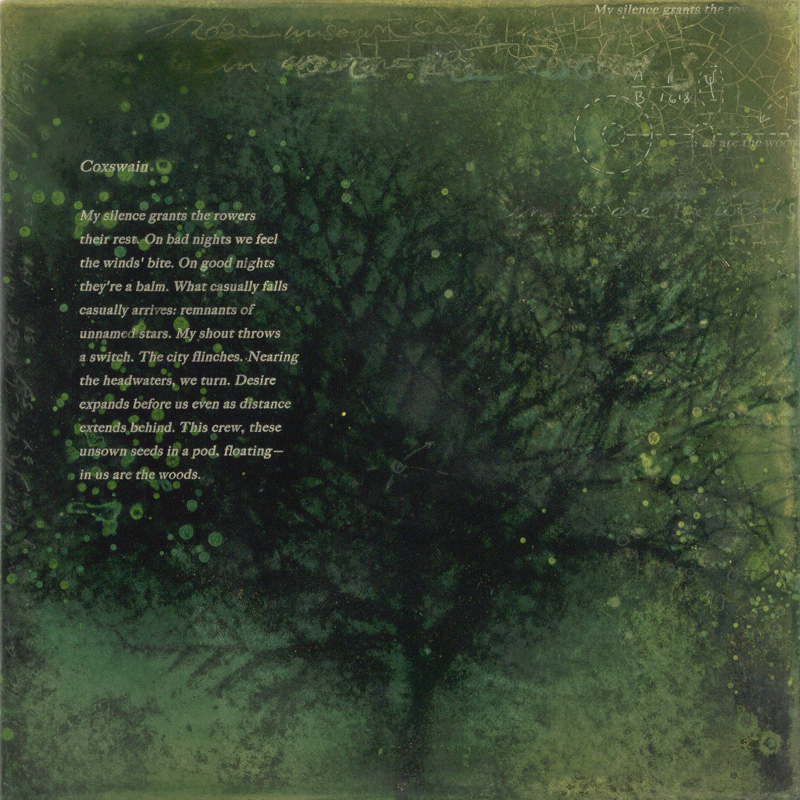
Our work had to grow organically between us and achieve a balance that honored both word and image. I started with a group of paintings on 12” square panels that were deliberately left unfinished and sent images to you. You sent poetry in progress. We had to meander about with some directionless hiking for a while. An “aha!” moment for me was reading the last line in your poem “Coxswain”: “in us are the woods.”

Beautiful! Imagery began to coalesce for me. Our circumvolution continued. I remember we discussed the creation of a codex form where a viewer-reader would have to physically walk the expanse of a series of panels, thereby engaging time and memory through repeated imagery and text. The final product was a twenty-foot span of eighteen panels that were seated on a shallow shelf, leaning against the supporting wall.

NVW: During our collaboration, I recall you also brought up another term that’s near and dear to my heart: wabi-sabi. I think you rightly sensed my simpatico with this idea as you so well described it in our email exchange back then, ” the worn beauty of age and the graceful disorder of nature.” I know your work is influenced by Eastern philosophies in general and perhaps by the concept of wabi-sabi in particular. In our collaboration, how did these ideas influence the process and/or product?

Lynda Lowe: We both pay attention to that earned patina: your marmot playground of rusting factory equipment and my hundreds of old wall photos taken on travels. The layers of wear, weather, the mark of a passerby build such beautiful surfaces that speak of narrative use and history. Nature has these cycles of age and re-growth too of course. Being a gardener you can’t miss it. Imperfection and disorder is an undeniable part of the landscape on every level. When I’m developing a painting, vestiges of many additions and subtractions layer the work and this is never quite predictable. It lends a wabi-sabi quality to it.

Object of Object (panel 4)

Panel 4, The Object of the Object, 12” x 12” water and oil media, wax on panel 2008

NVW: I know you’re a great lover of T.S. Eliot and in particular his Four Quartets. You’ve used passages of his poetry in your work before, as well as lines from other poets, myself included. Can you explain a little about how you think text—and perhaps specifically poetry—may best share the visual field with your incredibly textured and expansive imagery?

Lynda Lowe: Text and imagery are in some basic way, information. They comprise part of a larger perceptual field. I’m very interested in how we construct meaning from a personal blend of reason, intuition, memory, and spirit. In the combining of elements such as poetry, diagrams, equations, realism, intuitive mark, and abstract color field, I’m creating a matrix that suggests these are all part of a unitive whole.

Object of the Object (panel 6)

Panel 6, The Object of the Object, 12” x 12” water and oil media, wax on panel 2008

NVW: I was happy to reconnect with you recently in Tacoma at the Museum of Glass and the opening for your wonderful show, a series of 108 ceramic vessels called The Patra Passage. Again, I realized we had another mutual interest, Lewis Hyde’s wonderful book The Gift. I recall reading this book in the mid-1980’s and being very moved. It helped me to feel a better acceptance and even joy about my own life-choice: to make poems. Hyde speaks about art as a kind of gift the artist gives to her world. The gift is meant to be shared. This making and giving concern important aspects of community and shared values.

Hyde’s messages came to me at a time when I really need to hear exactly that. The promises of financial reward, publishing contracts and such sorts of “recompense” had begun to feel far off and unreachable to me, but I still loved and valued poetry and I wanted to continue with this art front and center in my life. Can you talk about your vessels which you gave away, and which the recipients (myself included) will again give away, and so on—and how, as an artist, you think about this interconnectedness of art-making and art-giving? And how The Patra Passage, in particular, was inspired? Here’s the wonderful video about that project:

http://www.youtube.com/watch?v=GKd7mLPFzes

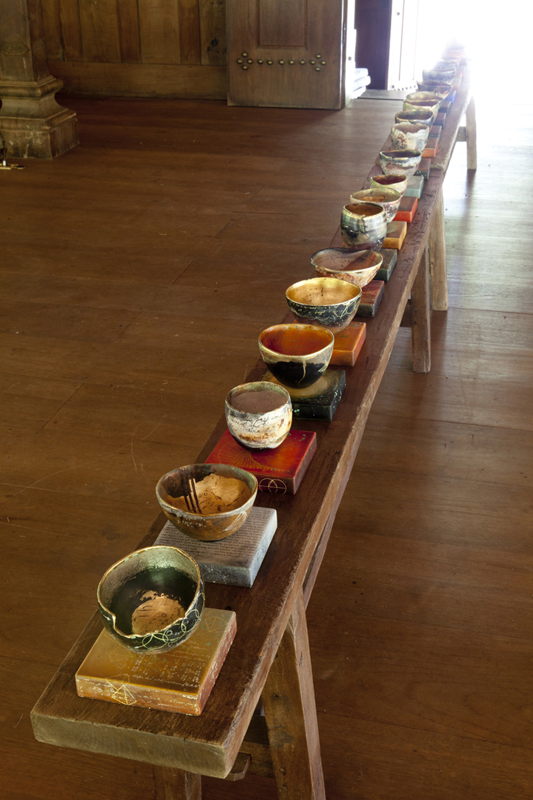
Lynda Lowe: After a rough couple of years and I felt I was looking at life through the other end of the telescope. What do I consider valuable when viewing things in reverse, not ahead? I’d been incubating ideas for the Patra Passage for over a decade. The image of a bowl repeatedly shows up in my paintings as a symbol for the fluid act of giving and receiving. Interconnectedness is of great interest to me.

I knew where I wanted to take the idea, but the project required a total change in media and a large commitment of time without income. Lewis Hyde’s writing was and is indeed a true gift and encouragement. Also hugely significant is the privilege of many wonderful supporters and participants – you being one of them! The Passage seeks collaboration and connection. The website more fully describes the project. I wholeheartedly invite interaction from all visitors to the site: www.patrapassage.com.

Patra vessels on bench

The Patra Passage, detail of some of the 108 vessels, 2013

Patra vessel

The Patra Passage, Patra vessel, 5” x 5” x 5” 2013

Patra  vessel

The Patra Passage, Patra vessel, 2013

NVW: What’s your next project?

Lynda Lowe: I’m in that transitional phase now after the launch of the Patra Passage where it’s back to the meandering path without a destination in mind. For the moment I’m playing again with my old friend T. S. Eliot and The Four Quartets. I don’t think I could ever mine that out. There are several exhibitions ahead, including the return of the Patra vessels at the Museum of Glass in Tacoma. And soon I’ll be working collaboratively with poet Joseph Heithaus on another project. I’m grateful to be doing something I love and that challenges me.

Path-to-the-Path

The Path to the Path, 24” x 56” water and oil media, wax on panel, 2008 (T.S. Eliot quote used in this painting, title credit to Nance)


Falling and Flying 2

Falling and Flying II, 48” x 48”, water and oil media, wax on panel. 2012 (Rilke quote used in this painting)

Oaxaca Wall

Oaxaca Wall, 38” X 32”, water and oil media, wax on panel. 2012

—Nance Van Winckel & Lynda Lowe

——————————————–

After completing an MFA at Indiana University, Lynda Lowe taught fifteen years at Wheaton College and Northern Illinois University.  In 1998 she left her academic position and began painting full-time. Soon after, a move to the Pacific Northwest brought fresh opportunities and the construction of a studio on the Puget Sound in Washington state where she currently resides.

Lowe’s overall imagery combines sections of color field, realism, text, and diagramatic figures. She employs fragments of poetry, handwritten scientific observations, and mathematical formula and layers them alongside highly rendered recognizable images to suggest that the construction of meaning is shaped from many different frames of reference. Archetypal symbols are deliberately integrated into her art, pointing out that the human experience is intrinsically connected the sentient world. Her surrounding environment and her travels abroad also profoundly impact her work.

A recent project, the Patra Passage. centers on the gifting of 108 hand-built ceramic bowls which are re-gifted at least three times throughout one year. After they return, the Museum of Glass in Tacoma, Washington, will host an exhibition February – May, 2015.

Lynda Lowe’s paintings have been widely exhibited nationally in galleries and museums. She has been the recipient of two Artist Fellowship awards from the Illinois Arts Council, a distinguished resident of the Ragdale Foundation, a finalist of the Neddy Award, and represented by the following galleries:

  • Gail Severn Gallery, Sun Valley, ID  www.gailseverngallery.com
  • Arden Gallery in Boston, MA   www.ardengallery.com
  • Forre Fine Art in Aspen and Vail, Colorado and Ft. Lauderdale, Florida  www.forrefineart.com
  • Abmeyer+Wood, in Seattle, Washington   www.abmeyerwood.com

More of Lynda Lowe’s work can be viewed on www.lyndalowe.com and www.patrapassage.com.

Nance Van Winckel

Nance Van Winckel is the author of six collections of poems, including After A Spell, winner of the 1999 Washington State Governor’s Award for Poetry, and the recently released Pacific Walkers (U. of Washington Press, 2013). She is the recipient of two NEA Poetry Fellowships and awards from the Poetry Society of America, Poetry, and Prairie Schooner. Recent poems appear in The Pushcart Prize Anthology, The Southern Review, Poetry Northwest, Crazyhorse, Field, and Gettysburg Review. She is also the author of four collections of linked short stories and a recent recipient of a Christopher Isherwood Fiction Fellowship. Boneland, her newest book of fiction, is just out with U. of Oklahoma Press. Her stories have been published in AGNI, The Massachusetts Review, The Sun, and Kenyon Review. Nance’s photo-collage work has appeared in Handsome Journal, The Cincinnati Review, Em, Dark Sky, Diode, Ilk, and Western Humanities Review. New visual work and an essay on poetry and photography appear in Poetry Northwest and excerpts from a collage novel are forthcoming in Hotel Amerika and The Kenyon Review Online. Click this link to see a collection of Nance Van Winckel’s mash-ups of poetry and photography, which she calls photoems. She is Professor Emerita in Eastern Washington University’s graduate creative writing program, as well as a faculty member of Vermont College of Fine Arts low-residency MFA program. She lives near Spokane, Washington with her husband, the artist Rik Nelson. Her personal web page is here.
Nov 082013
 

Rik NelsonRik Nelson

Almost every night my husband brings me home a fish. It’s been our ritual for a decade. A kind of seal on the day’s end. With the presentation of a fish, the workday endeth. Each fish gets a number on its back. Last night’s fish was #1362. That’s the total completed so far. Usually Rik’s fish are of the bright and colorful variety—made from repurposed materials like cookie tins and bottlecaps. They hang cheerfully, as these do, in various galleries and museum shops (e.g. The American Folk Art Museum shop) around the U.S.

In a spirit similar to that of Neo-Dadaist Jasper Johns’ variations of flags, targets, and maps of the U.S., Rik uses the fish to play traditional fine art/folk art expectations against consumer culture, setting up a natural/man-made dialectic from “trash.” After the Deepwater Horizon oil spill, Rik began work on a new group of sad-but-also-beautiful fish he calls CRUDE (The Oil Spill Series).

Nance Van Winckel

For us in the Inland Northwest, oil spills are tragic, yet distant catastrophes (even the Valdez spill in Alaska). It’s one thing for it to happen There and to empathize, but what if it happened Here? To our own waterways, beaches, flora, fauna, and economy? Translate such a catastrophe to our local fish, right in our own front yard. Might that be more of an eye-opener, have more impact on awareness and influence consumer practices? Don’t know, but I resolved to try to find out by taking my repertoire of fish forms and mutating them into a “school” of deconstructed/reconstructed oil-spill-despoiled flotsam. This effort has pushed my bas-relief fish forms to more sculptural representations. I’m continuing to expand this body of work until I have enough to offer it up for a show, a show entitled Crude.

—Rik Nelson

1080-1090-1110-comboBrown Trout Triumvirate

910-smallfrySmall Fry

King Salmon -1King Salmon

Smallfry Mashup-croppedSmall Fry Mashup

950-walleyeWalleye

Small Chinook in FlamesSmall Chinook in Flames

Rainbow TroutRainbow Trout

Rainbow and SmallfryRainbow Trout and Small Fry

930-bulltroutBull Trout

960-MonPetiteMon Petite

970-largemouthLargemouth Bass

920-redbulltroutRedbull Trout

990-KissinCousinsKissin’ Cousins

—Rik Nelson

—————————————

Rik Nelson Rik Nelson makes art out of cast-off consumer objects, recycled remnants and cultural detritus, and the art reanimates the natural world threatened by the very detritus he mines for his work. His work is shown and sold at: the Crow Valley Gallery, Orcas Island, WA; the Ohio Craft Museum, Columbus, OH; the New Morning Gallery, Asheville, NC; and the American Folk Art Musuem, New York, NY. As you can tell from the introduction, he is married to NC Contributing Editor Nance Van Winckel.

Oct 022013
 

Nance Van Winckel

NC Contributing Editor Nance Van Winckel has popped out two, yes, two! books simultaneously this year; Pacific Walkers, a collection of poems, and this one, Boneland, a collection of linked short stories. As we all know, one book is amazing enough; two books, in different disciplines, is tantamount to having the literary equivalent of Multiple Personality Disorder. Only this is a disorder we all wish we could catch. I have taught with Nance for years at Vermont College of Fine Arts. She never ceases to surprise me with her unconventional wisdom, her oblique and revelatory take on art, and her questing spirit.  We have here for your delectation a lively and intelligent interview with Nance by the inimitable Ross McMeekin.

dg

boneland-330

Ross McMeekin: Tell us about the Spokane area literary scene; there are so many great writers who call it home.

Nance Van Winckel: Yes, Spokane has some wonderful writers and I feel lucky to call many of them friends: Sam Ligon, Jess Walter, Laurie Lamon, Christopher Howell, Greg Spatz, Tod Marshall. There’s a very active spoken word poetry scene here too and many younger poets—with loads of great energy—involved with that. We have a literary festival, Get Lit, every spring that brings many writers of national prominence to town. And of course we have three outstanding universities in town, and all of those have good writers on staff and bring IN good writers. I’m still very connected to my former colleagues at E. Wash. U, and the MFA Program there where I taught for 15 years. I’m teaching a one-day workshop for them in November. And we have a great independent bookstore, Auntie’s, that has fabulous readings every week.

RM: Do you have some recommendations for books or literary journals that have impressed you recently?

NVW: With some of my Vermont College students I’m currently reading a very compelling book of stories: Guide to Being Born by Ramona Ausabel. I also just read a superb second book of poems by a former student of mine: Jennifer Boyden’s The Declarable Future. I’m also reading Proust for the first time. I’m half way through the six volumes and loving this work, savoring it. Wish I could read it in French. I talked with a French Canadian flight attendant who said he had read it all by reading one page aloud every day for several years. He had also loved it. Gorgeous prose. Luminous. Strange. Imagistically sparkling. And full of a sad interiority, a soul I find myself missing when I’m away from it for a few days.

As for literary journals, I’m trying these days to get to know more of the online journals and formulate a sense of what may be the BEST of those. Since I’m working now on combining text and photography (digital photo-collage), those journals—rather than print journals—seem to be better possibilities for me in terms of “publishing” these full-color hybrid art pieces. Of these journals I especially like ILK, EM, Cascadia Review, Diode, Sleeping Fish, and Drunken Boat. I’m also amazed at how many bad ones there are out there: badly edited with grammar troubles and/or typos everywhere, or badly managed. I had one journal (Glassworks) accept three pieces, and then email later that they’d changed their minds and weren’t going to use the work after all. What?! I wish there’d be more REVIEWS of online journals, or of ALL journals really. But clearly it’s also part of a writer’s job to do this sort of legwork and scope out the best homes for her work.

RM: The characters in your new collection, Boneland, are excavating everything from memories to ancient dinosaur bones in order to understand the past. This desire to piece together what’s happened seems to me an innate and universal human drive, even for those of us who choose to ignore it. But there’s a certain strangeness and sadness to this drive, as well, that I think the collection exposes. I wonder if you’d speak a bit to our drive to dig up the past.

NVW: Yes, very well put, Ross! Excavation is a big part of Boneland. So is reconstruction. As we see with the do-it-yourself dinosaur fossil reconstruction going on in the old dairy barn, and probably a few mastodon bones getting glued into the dinosaur, what was the ACTUAL past, the reality of the past, later becomes a mish-mash. A collage. Made up of facts and guesses. History may never be completely accurate since memory itself isn’t. But you’re right—we try anyway. As we mature, as these characters do, we try to understand better what haunts us, what lingers in unsettled ways, from our earlier lives. And we never can put together a full and perfect rendering of the BEFORE. There’re always going to be gaps and holes, things we can’t know, things that will continue, maybe forever, to remain hidden. But what remains hidden may give the resurrection an air of sadness and/or strangeness, as you say, but I hope it may also suffuse it with something beautifully human or humane—this living with uncertainties, accepting these, and going on from there.

RM: There’s a lovely passage in which your protagonist, Lynette, is piecing together the development of her relationship with another character that I think speaks to the nature of how imagination and memory and the physical bleed into one another.

“These last few mornings, I’d awaked imagining conversations that Steve and I might have. I varied the lines. There was, each day, a little more sexual innuendo in the exchanges I invented between us. I could almost feel on the inside of my left thigh the place I’d imagined his hand last night and this morning his mouth.”

I’d love to hear your thoughts on the nature of memory, and also how imagination and memory interact.

NVW: What I think about with this passage is how a friendship or a romance may often begin IN the imagination. One first has to SEE in the mind’s eye what a connection with another person might look like, might BE like—emotionally and physically. This facilitates—doesn’t it?—the making of the bond. So, really, I guess I’m talking about how the construction of the future itself is similar to the construction of the past in that one first has to “glimpse” the possibility. Then begins the building.

RM: I was fortunate to have the opportunity at a conference to hear you read a section from one of the stories in the collection, “A Kingdom Comes.” The piece involves a family’s discovery that their son is uniquely gifted in mathematics, and perhaps on the spectrum for Asperger’s Syndrome. What inspired the story?

NVW: Yes, I do think of Buster as having Asperger’s. I have two good friends who have autistic sons. One son is quite gifted, though. As a visual artist. As a writer I’m intrigued by sometimes seemingly contradictory elements that make up a personality. Though this particular character has trouble connecting with other humans in some ways, I found myself moved by how he tries to. This was an act of pure imagination, of course. I love that he finds a way to be a husband and father. I am not sure if this will be true for either of my friends’ sons. But in writing the story, I constructed a kind of future that I hoped for them.

RM: There’s some beautiful image patterning in the book, specifically the attention given to eyes and eyesight, both metaphorically and physically. How did it first emerge, and at what point did you recognize the pattern?

NVW: The “re-seeing” was something I recognized was going on in “The Funeral of the Virgin,” an early story in the book. A woman with some greater temporal distance on her husband’s death begins to wonder if the death might have been a suicide. The implication is that she may not have been able to contemplate such a version of events at the actual time of his death. Keeping that narrator, I subjected her in a series of small short-shorts to LASIK surgery. Those were interesting pieces to write in that I had the actual physical messed-up eyesight to work with. I could give a physical body to something that had seemed more cerebral or theoretical in other stories, that “re-seeing” of the past. And of course the surgery itself had to get a little bollixed up for this to work. I liked too the narrator having this “down-time” from ongoing dramatic events to ruminate. It seemed to me I could let the language get perhaps a bit more lyrical in these sections since they were small and interrupted the ongoing dramas in the longer stories. I liked coming back to her lying there, holed-up in a foreign country, blindly feeling around, sorting through what had been. This may have been partly inspired by the fact that back in the mid-1990’s a lot of people I knew were driving up to Canada to get this surgery done because it was, for some reason, hundreds of dollars cheaper there! There were ads in the paper for it every week.

RM: I also wondered at what point during the composition of Boneland you realized the interconnectedness of the stories. Did you intend it from the beginning? Was the process similar to your previous linked story collections?

NVW: Every book of my stories (and they’re ALL linked) has been linked in a different manner. This linking is, for me, something I just thoroughly enjoy experimenting with. The number of ways one might link stories seems infinite to me! I love series too. My last three books of poems I consider poem “series” as well. The stories in Boneland started to “form” their linkage in a way I hadn’t expected or intended. When I realized these characters were all cousins, that they hailed from three brothers, three sons who’d grown up on the Montana ranch together and worked themselves on the dinosaur fossil reconstruction—when I realized this particular commonality, the linkage began to come into focus. I have liked the family saga sort of novel sometimes, the large arc of time and history that can be covered, and so for me, the challenge and the experiment were to see if I could do something remotely like that with a group of stories. I’m not sure I finally did match the breadth and sweep of some of those novels, but I did enjoy being alive in a history that felt very very large and went WAY back. Way back.

RM: You’ve had both poetry (Pacific Walkers) and story collections come out in the last year. What’s next?

NVW: I have a new book of prose poems in progress. I’m tinkering with its shape right now, moving parts around, and still writing a few new prose poems that may yet be included.

I’m also working, as I mentioned, on these hybrid text-based photo-collage pieces right now. There are three distinct book projects, each of which I see as a possible ebook. (I suspect they’d be too pricey an undertaking for print publication. But maybe. Maybe black and white versions?) One is a novella in the form of a photo album/scrapbook/flash-fiction memoir. Another is a book of poems that consists of altered pages from the Official Guide to the 1964 New York World’s Fair. This is not erasure art, but rather text I have changed and integrated into text that was already there, and I usually add other graphic material as well. This World’s Fair was something I went to as a girl with my family and it was the first time I recall having my wee little mind blown. Blown by the huge wild international world and THE FUTURE suddenly all around me. In my project I talk back, some fifty years later, to these versions of the future I was given. And the third project is also an alteration project; it’s tentatively called THE BOOK OF NO LEDGE. Altered pages of an old encyclopedia. I’ve been sassing back, as my mother would say, to the All-knowing Voice of Certainty of this encyclopedia. Since there’re about nine volumes, all purchased for five bucks last year at a yard sale, I think this project may well last me the rest of my days. And to tell you the truth, if I die altering THE BOOK OF NO LEDGE, I think I’ll die happy.

 — Ross McMeekin & Nance Van Winckel
—————————————————–
[SPACE]
RossMcMeekinphotoRoss McMeekin’s fiction appears or is forthcoming in publications such asShenandoah, Passages North, Doctor T.J. Eckleburg Review, Green Mountains Review, and Tin House (blog). He received a MFA from Vermont College of Fine Arts, edits the literary journal Spartan, and blogs at rossmcmeekin.com. He lives in Seattle with his wife and daughter.
[SPACE]
Nance Van Winckel is the author of six collections of poems, including After A Spell, winner of the 1999 Washington State Governor’s Award for Poetry, and the recently released Pacific Walkers (U. of Washington Press, 2013). She is the recipient of two NEA Poetry Fellowships and awards from the Poetry Society of America, Poetry, and Prairie Schooner. Recent poems appear in The Pushcart Prize Anthology, The Southern Review, Poetry Northwest, Crazyhorse, Field,and Gettysburg Review. She is also the author of four collections of linked short stories and a recent recipient of a Christopher Isherwood Fiction Fellowship. Boneland, her newest book of fiction, is just out with U. of Oklahoma Press. Her stories have been published in AGNI, The Massachusetts Review, The Sun, andKenyon Review. Nance’s photo-collage work has appeared in Handsome Journal, The Cincinnati Review, Em, Dark Sky, Diode, Ilk, and Western Humanities Review. New visual work and an essay on poetry and photography appear in Poetry Northwest and excerpts from a collage novel are forthcoming in Hotel Amerika and The Kenyon Review OnlineClick this link to see a collection of Nance Van Winckel’s mash-ups of poetry and photography, which she calls photoems. She is Professor Emerita in Eastern Washington University’s graduate creative writing program, as well as a faculty member of Vermont College of Fine Arts low-residency MFA program. She lives near Spokane, Washington with her husband, the artist Rik Nelson. Her personal web page is here.
Contact: nancevanwinckel@old.numerocinqmagazine.com
Aug 112013
 

Nance cover art

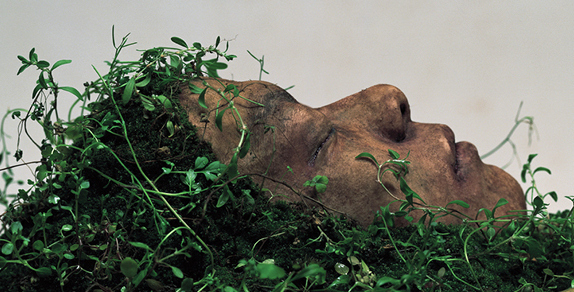
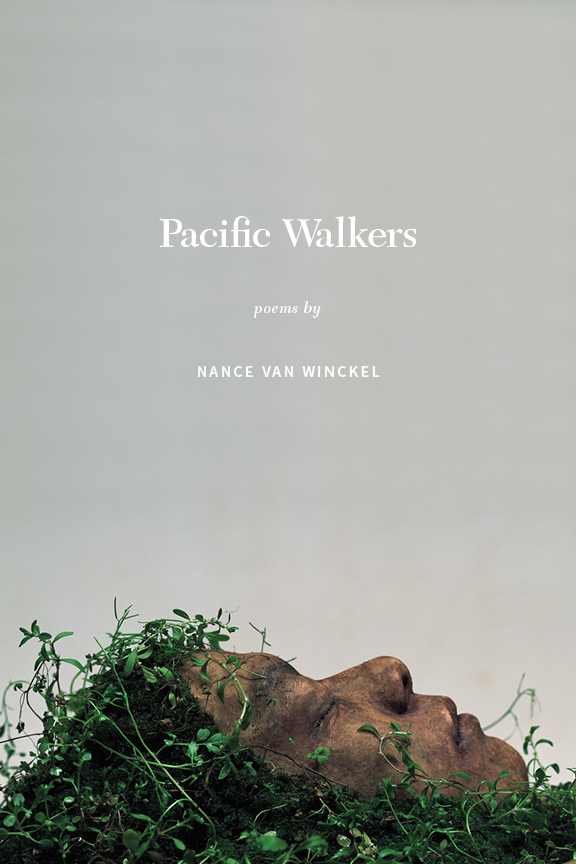
Four gorgeous poems this morning arrive to you from NC, the first four poems of Nance Van Winckel‘s brand new poetry collection Pacific Walkers, the central poem being an inquiry into the body of an unidentified dead man washed up on the bank of the Spokane River, the man’s body itself becoming an inquiry, “a small inquiry unfit for the big answer.” In a flash, in a phrase, the poet has told you of what all life and art consist: we are all small inquiries unfit for the big answer, but the small inquiry and the big answer fuse in the poem, and the poet accords the unidentified dead man a signal honour, knighting him with the epithet “Little Prince of the Reigning Question.” The poems are poignant, raw, mysterious and lovely.

…Once you were a bud
in someone’s belly. A swim, a sleep,

then to crown your way out. Keep
mum. Keep it to yourself, Little Prince

of the Reigning Question,
the would-you-do-it-all-again
there there, now now.

dg

van_winckel_2.

SPACE


§

Signing On with The Daily Sun

Nearing a thousand words a minute, I can type
to your health. I can input a print that’s fit
to all. Can get across baby without
a single b. I can keep my prayer mat
under wraps. Ditto the armband. I have the facts,
you have the contracts. Sure, you can change
my name to Lance in the byline.

Like jerking off Band-Aids, I can rip away
calendar pages so fast, no one will even know
we’re over the past. Day in, day out, I can
make them play along with my playing
along, can make them believe decedent,
can disseminate and disguise at the same time
what’s face up, fetid, gnawed at by weasels.

Just. The. Facts. I am like you. Or passing
through you like a taco. Easily rolled up
to swat a pesky moth. Spread wide to accept
your bounty of trout guts. Quick to appear,
pass the verbiage, and disappear.
I can stay anon. I can live anon.
I can keep anon in my heart.

§E

Last Address

What gold flitter has made of your ear
a hive? Clouds tug loose a last dream

and now the rainfall bears down
your secrets. The question’s not

if the river had its way with you,
spit you out as a small inquiry

unfit for the big answer. No,
the question won’t pertain to tattoos

or unmatchable DNA, but to what
world, under what sun, in what situ

we go on finding each you, each you,
the not-missed, the never missing.

* SPACE*SPACE *

We stand at the foot of you.
Bees and swallows rustle the grass

around half flesh, half bone, half
here, half gone. Dot of earth: nothing

owed or owned. Once you were a bud
in someone’s belly. A swim, a sleep,

then to crown your way out. Keep
mum. Keep it to yourself, Little Prince

of the Reigning Question,
the would-you-do-it-all-again
there there, now now.

SPACE

Found on the bank of the Spokane River at approximately 2200 W. Falls Street. Adult Caucasian male. This male was 5 feet 11 inches in height and weighed approximately 161 pounds. His hair was dark brown or possibly black. Clothing worn: a pair of black lace up boots with a brand name listed as “CORCORAN,” a pair of black socks, a pair of light blue denim pants with a brand name listed as “RUSTLER,” a pair of red slightly meshed under shorts, a dark colored T-Shirt with the size listed as medium and a name brand of “EDDIE BAUER.” Dental identification information obtained, no match found. Fingerprints unobtainable.
………Spokane County Medical Examiner’s Records

§

Briefing

When the intern asks why
hadn’t the animals eaten this man
the river months ago washed up,
the examiner numbers
his answers.

An order. Of course. Most
to least. The day animals
vs. the night ones. If six,
thorns. If thy right eye
offendeth. I doodle.

My sketch in the place of
reason: a moustache on Mr.
Numbers. If three magpies
flap away. Therefore an
ambiguity of eye color.

Sketch it: how weird,
the moustache needs
a matching beard. Hair
today. Eight trumpet vines.
Twelve solstice winds.

What had he gone by?
My reason. God’s hard.
If one. If the earthly
life. The this life. His
other car was a train.

§

SPACE

His Other Car Was a Train

My tapping for him
against the Corona. Ding
at the end of the line.
The trestle bridge,
a light table with a lean
negative him. The fording
of, the fire in the belly of.
Getting the outside air
coming in. Sleet as rain’s
sequel, and anxious
were the trees and good
the green fields pressing forward
and how great the distance.
Boxcars with zero sans serif,
with only space—space
maybe going somewhere.
Somewhere, how can we
leave it now?

Nance cover art

——————————-

new nance pix2Nance Van Winckel is the author of six collections of poems, including After A Spell, winner of the 1999 Washington State Governor’s Award for Poetry, and the recently released Pacific Walkers (U. of Washington Press, 2013). She is the recipient of two NEA Poetry Fellowships and awards from the Poetry Society of America, Poetry, and Prairie Schooner. Recent poems appear in The Pushcart Prize Anthology, The Southern Review, Poetry Northwest, Crazyhorse, Field, and Gettysburg Review.

She is also the author of four collections of linked short stories and a recent recipient of a Christopher Isherwood Fiction Fellowship. Boneland, her newest book of fiction, is just out with U. of Oklahoma Press. Her stories have been published in AGNI, The Massachusetts Review, The Sun, and Kenyon Review. Nance’s photo-collage work has appeared in Handsome Journal, The Cincinnati Review, Em, Dark Sky, Diode, Ilk, and Western Humanities Review. New visual work and an essay on poetry and photography appear in Poetry Northwest and excerpts from a collage novel are forthcoming in Hotel Amerika and The Kenyon Review Online. Click this link to see a collection of Nance Van Winckel’s mash-ups of poetry and photography, which she calls photoems. She is Professor Emerita in Eastern Washington University’s graduate creative writing program, as well as a faculty member of Vermont College of Fine Arts low-residency MFA program. She lives near Spokane, Washington with her husband, the artist Rik Nelson. Her personal web page is here.

 
Jul 142013
 

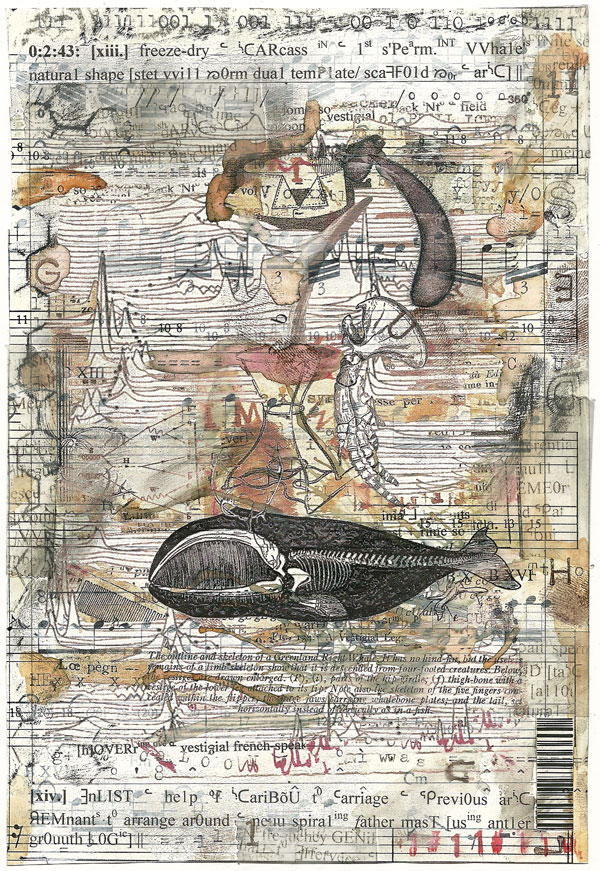
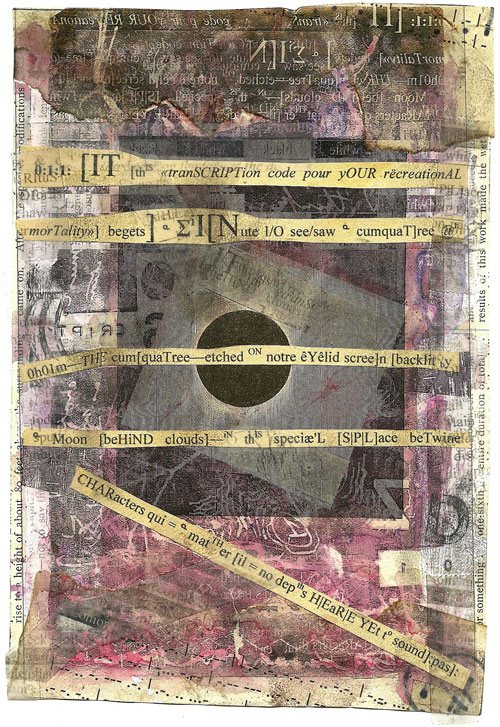
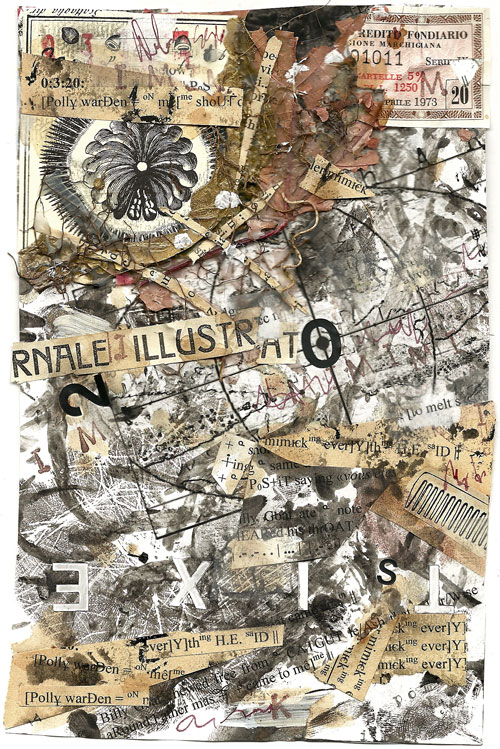
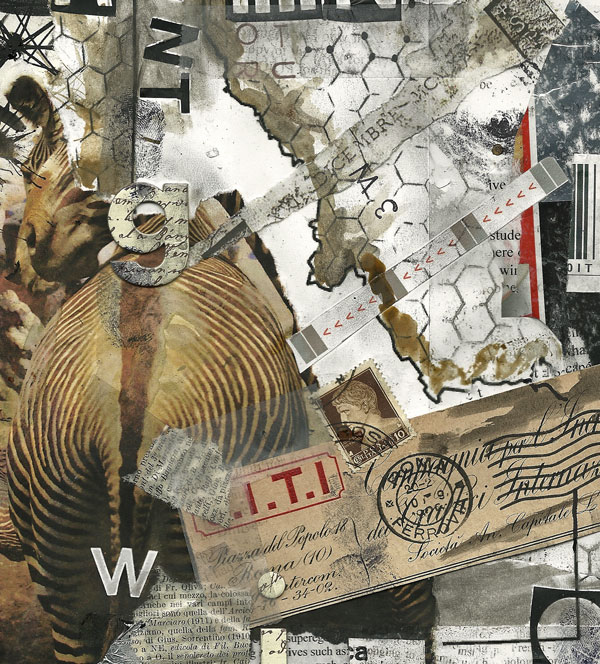
DW-Ark_Codex

I’m happy to report in on a recent joyous dance of my reader-self and viewer-self as I turned the pages of ARK CODEX, a thoroughly engaging visual/verbal collage “novel.” My curiosity about this authorless book led me to question its shepherd, the one who goaded this “mutated goat” of a book into being. Says Derek White, “Each word is a collage in itself . . . .” Yes! And the correspondences between the bits of text and gorgeous etchings bring an unusual intrigue to the pages and to the journey of this odd ark/book.

Derek White lives in New York City where he publishes Calamari Books and Sleepingfish Magazine. Do explore more of his work via the web links. You won’t be sorry!

— Nance Van Winckel

—–.

Ark Codex 0:2:43 13x19 cm, multimedia (collage/frottage) Derek White

Ark Codex 0:2:43 13×19 cm, multimedia (collage/frottage)

.

Nance Van Winckel: I know you’re interested in Derrida and his ideas that words refer primarily to other words, rather than to things and ideas, and also his view of texts as residing finally beyond authors, of literary works as collective enterprises generated by a concert of forces: reader, writer, cultural echoes surrounding them, etymologies, etc. I like how Ark Codex ±0 clearly allows the whole of itself to be “created” by those forces, and I appreciate how much I have to “bring” to the book myself. My own imagination and intellect are truly involved in furthering the book’s narrative momentum and visual journey. Could you talk a little about your own sense of authorlessness and the “concert of forces” that make the Ark Codex.

.

Ark Codex 0:1:1 13x19 cm, multimedia (collage/frottage) Derek White

Ark Codex 0:1:1 13×19 cm, multimedia (collage/frottage)

.

Derek White: Thank you, you are reading Ark Codex as i hoped it would be read. At the end of the day Ark Codex, any book, is a bound stack of paper on a shelf . . . until a reader comes along. Readers are the true “authors”—the ones who give meaning to a book. And your reading of it is just as valid and important as any other, including mine. Sure, my role is unique in that i experienced Ark Codex as it was coming together, but i think of my role more as a shepherd. Or, okay, maybe a breeder. And i personally prefer to think of goats rather than sheep, wherein the goats are other books and ideas . . . yes Derrida’s books being some of those goats. But Derrida is not one of those goats—I’ve never met Derrida. Sadly, he is dead. But his books aren’t (and in this sense, neither is he). Ark Codex is some sort of mutated goat that came about by such selective breeding. But again, don’t let me be the one to tell you what Ark Codex is or isn’t; you might have a completely different beast in mind when your eyes scan over this particular confluence of text & images, based on your own prior collective associations with certain words, phrases, images, etc.

.

ARK_CODEX_0-3-20

Ark Codex 0:3:30 13×19 cm, multimedia (collage/frottage)

..

NVW: Collage seems both a method of creation AND a method of participation in this book. As a reader/viewer, I was fascinated by how my reader-self and my viewer-self danced about on the pages. I loved this back-and-forth interplay and how when I’d read the small passage of text at the bottom of a page, what I’d just visualized in the imagery and graphics hooked in, “enlarged,” or somehow “played with” the linguistic elements. I think the text and the visual elements achieve an amazing symbiosis or amalgamation here, and I wonder if you could comment on that interactivity of visual and verbal elements.

.

H0MEovoID_8_private_gravesite_600

h0ME(o\v/o)ID 8: GRAVE[e|it]Y helps deSign find its private tombstone ID[enTITy]

.

DW: Ark Codex actually started as a text, a somewhat linear narrative. If you look carefully in the pages you might find traces of it, but most of its original form is probably lost, embedded into the page, bleeding into the collage of image and other underlying or superimposed text. The footnoted text came as an afterthought—a sort of associative narrative that came about by re-processing the images. I think of them as abstracts, in a scientific sense. Collaging feels more like how at least my brain thinks. Language in its pure form is a beautiful thing, but it can also be debilitating in that we risk detachment, severance even. Someone like Peter Markus (a true guru of pure language) is so enamored by language that when he hears a word, like “river,” the first thing he thinks of is how the word looks on the page. While i also share this reverence of, especially written, language, in all its type-faced forms, i don’t want to lose sight of the actual river. But even staring at a river (which is what i look at when I’m not looking at my computer) we can still forget, or take for granted, what the river means, or has meant to us. I’m not so interested in photography or still lifes—capturing images, reducing them to their iconic forms. Collage allows us to breed new images, new ideas. And yes, when i say collage i don’t mean just images from magazines cut and pasted together. Even if I’m writing something purely textual, i think of it as collage—the way combinations of words interact and morph, glued together by syntax and grammar. And each word is a collage in itself, a vessel that contains an accumulative amalgamation of every instance and use before us.

.

NVWimage1

Left to right: Ark Codex 0:3:8, 13×19 cm, multimedia (collage/frottage), and Ark Codex 0:3:9, 13×19 cm, multimedia (collage/frottage)

.

NVW: For me, Ark Codex ±0 has many qualities of a novel. I’m thinking about the journey undertaken on this strange ark, an ongoing narrative that’s a kind of quirky Noah story set in realms that are by turns ancient or futuristic, metafictional or metaphysical, scientifically “steeped” or mythically enriched. I could go on and on with my list. But let’s look, for instance, at a couple of my favorite pages, these two from the third section where “we” seem to have made landfall (or are within our museum diorama) and encounter the figure of the “bush doctor.” Here’s the text which reads a bit like a ship’s log:

0:3:8: Under such sea-snaking circumstances, the bush doctor warns us to not splay our fingers. He is not counting on the fact that our <>are webbed. Before we snap out of it, he blindfolds us for continuity. We can see all the way to the end of our own nerves from within our cloth cul-de-sac. Clogged fibers branch back into the roots of palms. At this point a puncture is made to drain any misleading perceptions. Even judgment of unreliability is deemed unreliable, so we are back to square 1 with each articulation.

And from the facing page:

0:3:9: At his juncture, the kernel become clearer. A system is in place to separate trash from recyclables—organic & non-organic (& sub-divided even further). We are in a hangar now (or a diorama of 1, still in the natural history museum)—an ark house so large that isolated weather patterns form from within. It is still below freezing on this page, but the rate of the rate of change is what matters. To determine our current coordinates (& capacity for change) we integrate this rate of the rate of change in each cardinal direction.

Wow! The brevity of each of these snippets makes me feel I’m getting just a small part of a huge—HUGE!—story. Plus each piece of information makes the ark tremble. Unexpectedness in each new sentence. Where will the ark go next; what fauna and flora will we encounter; what will happen to our own physical selves? For me, it’s an adventure story in the widest possible sense of that word. If not as author or even as “authority,” but rather might you comment on the book’s behalf about its proclivities toward story in general or the novel in particular?

.

Arc-incisione_H

Incisione H from Ark Codex (incised print)

.

DW: Ha, you made landfall! That’s further than i got—in my mind, the narrator is constrained to the North Pole, waiting for the ice to melt, for the flood. So in this sense, nothing happens. But in such a landscape, cabin fever sets in, the imagination runs wild. I’m not very good at making things up. And i am far from a reliable source as to what is happening. If there is any semblance of story, it likely rose out of a dream. And dreams came from a warped union of personal experience (the hangar—Hangar One in Moffet Field, CA—i actually delivered a pizza to!) and the tapping of our collective unconscious. As Joseph Campbell and others have showed us, we are telling the same story over and over—this four-pronged cycle or journey. Noah’s story is just one variation on the theme, that particularly appeals to me because it is about more than just the human condition, but is inclusive of all animals, and the inherent drive in us to preserve and propagate our underlying code. Which is to me what writing and publishing is all about. Story to me is just a framing device, a vessel for language, a boat that gets you down (or up) the river. Ark Codex is a fleeting condensation of collective unconscious that materializes to stain the page, then dissolves when read, into liquid—rain that falls on the landscape, flows into the river, back to the sea … to do it all over again. The ‘story’ comes in the reader reading it. They become the ark, the historical act.

05-under_pressure

Under Pressure

—Derek White & Nance Van Winckel

—————————————–

Derek White lives in NYC where he publishes Calamari Press & Sleepingfish magazine and blogs at 5cense.com. More about Ark Codex may viewed here: http://calamaripress.com/ark_codex.htm. Much more of his “bookish art” may be viewed here: http://www.5cense.com/art.htm.

Nance Van Winckel

Nance Van Winckel is the author of six collections of poems, including After A Spell, winner of the 1999 Washington State Governor’s Award for Poetry, and the recently released Pacific Walkers (U. of Washington Press, 2013). She is the recipient of two NEA Poetry Fellowships and awards from the Poetry Society of America, Poetry, and Prairie Schooner. Recent poems appear in The Pushcart Prize Anthology, The Southern Review, Poetry Northwest, Crazyhorse, Field, and Gettysburg Review. She is also the author of three collections of short fiction and a recent recipient of a Christopher Isherwood Fiction Fellowship. Her stories have been published in AGNI, The Massachusetts Review, The Sun, and Kenyon Review. Boneland, her fourth collection of fiction, is forthcoming in October from U. of Oklahoma Press. Nance’s photo-collage work has appeared in Handsome Journal, The Cincinnati Review, Em, Dark Sky, Diode, Ilk, and Western Humanities Review. New visual work and an essay on poetry and photography are forthcoming in Poetry Northwest and excerpts from a collage novel are forthcoming in The Kenyon Review Online. Click this link to see a collection of Nance Van Winckel’s mash-ups of poetry and photography, which she calls photoems. She is Professor Emerita in Eastern Washington University’s graduate creative writing program, as well as a faculty member of Vermont College of Fine Arts low-residency MFA program. She lives near Spokane, Washington with her husband, the artist Rik Nelson. Her personal web page is here.


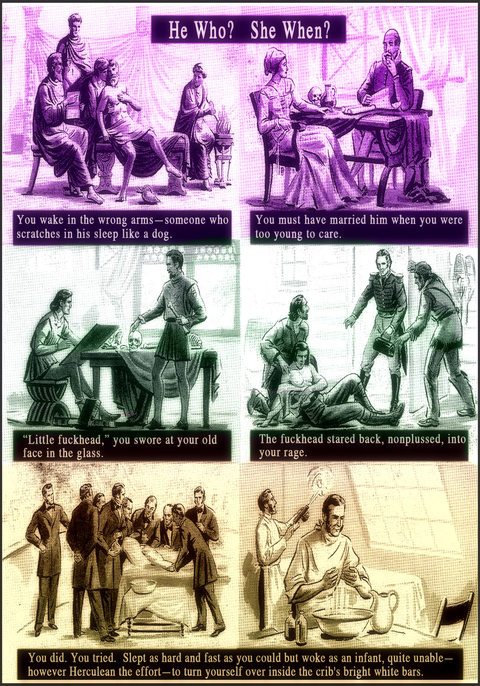
Mar 312013
 

Download1Marilyn R. Rosenberg & Nance Van Winckel

Nance Van Winckel, poet, fiction writer, and collagist extraordinaire, inventor of the pho-toem, has gone undercover for Numéro Cinq, searching out and interviewing a series of hybrid or conceptual artists (cross-genre art — ah, but is there any other kind?). Her first subject/artist was collagist Todd Bartel, and now she introduces us to the amazing book art of Marilyn R. Rosenberg of Peekskill, NY, who, yes, explodes the concept of book into a phantasmagoria of cutting, folding, sculpting, drawing, image layering, colorizing, painting — books become sculptures, words become objects, objects become poems, poems become objects AGAIN. We all love books, adore books, but mostly for their efficacy as carriers of words, which, if you follow the logic, leads us all to owning tablet readers; what Marilyn R. Rosenberg creates is the anti-Kindle; you can’t read these on a device; she creates unique books, not for dissemination but for themselves for the beauty of the thing.

dg

READ, 2004, MRR, 200 dpiREAD, closed 5 1/8”h x 4 1/8”w, color photo copy edition of 15 with collage, visual poetry artists book with hand made pop up.

VERBIAGE, MRR, 2007, 200VERBIAGE, 22 1/2 h x 16 1/2” w, visual poetry/drawing.

NVW: Spending some time with the inside pages of these amazing books of yours, I’m interested in how you think about finding the right “balance” for a page—the page as drawing and the page as poem. I so admire the convergence of those two.

MRR: Both a work’s theme as well as its obvious or hidden contents decide everything about a particular page or bookwork. But how do all components, word meld into image, image size happen next to word size? How do I select hue, value and blank and filled areas?  How does relationship and interaction and placement of each component happen?  Balance is based on many things: sometimes the influence of the ground, i.e. the page, size, paper, book, either found or ready to be created with my own binding; each choice, alone or in combination with mark-making materials, adds and alters compositions, in variations, within a singular statement. Or sometimes, a word or sentence, in juxtaposition with a complex concept, causes all elements, individual ingredients, to evolve, to merge or disperse into something other than what was there before. Sometimes this happens with a noted life situation’s influence.  A record of something quickly seen, or a theme challenge either starts or enhances the new or long evolving ideas. Then the entire content shifts and what was added alters that balance, again.

Each piece starts differently and has different measures of balance and discord.  I start with combinations of words from notes I almost always make, and place them on a page, moving back and forth as image grows and turns into color. I hear words when I read them. While I work, the words turn into the image, and the image is the word heard.  Each theme develops at its own required speed: pensive, or chaotic, or restful or at a fast pace.  Almost always I build pages and bookworks from the ground up. Working back and forth, page here and then there again, word and image as one grow. All this goes on all the pages of one bookwork in the same back and forth rhythm. I must create rhythm and pace, cause loudness or quiet, allow rest or activity, as I remember agitation or pleasure. Balance of weight of words and more words as image, with color and weight of line and mass, happens after contemplation then action, thought and reaction. One thing changes everything. All relationships are decided by trial and error, in the context, and environment. Everything happens in relationship to everything else. Word placement, line length next to line weight, color next to color, word next to image, and dark next to light—these are just a few components that cause weight shift and change. I consider all of these components consciously all the time. Experience, trial and error, and then instinct takes over. But the work itself directs me and tells me what it needs and wants.

A merging in the first work completed in the series DRIFTS is a combination of two pages. From the paper bookwork, 6 WATER VOICES, 35 mm slides of pages #4. PUDDLING and #5. PROCRASTINATE, were scanned into the Imac computer and were set one on top and another below. Sections were changed.  Words and images were added; a new work evolved.

drift again, 2003, MRR, 200 dpiDRIFT AGAIN, size variable, visual poetry/drawing/virtual collage

Variations of the original complex virtual collage follow now, with a letter or two, or an object added. Each offshoot, manifestation, is altered slightly, evolved, and is slightly different, with a different title – DRIFTS, DRIFT HERE, and DRIFT AGAIN. All happened while I remembered, seeing/hearing the sound of the country stream/river/creek  next to my  window, heard again in the city sounds. Daily reminders of water in its various forms and containers inform my thinking. Water towers imply water contained, water towers reflect on the water surface; my environment, reality adds images/layers to the work, that is now in virtual reality.

listen hear water voices 2002LISTEN-HEAR, about 12.50″h x 32 “w, visual poem/drawing, facing pages

As well, from 6 WATER VOICES, created as facing pages using stencils, ink pens, brush and gouache, plus misc. media, is LISTEN-HEAR.  Parts of the pages in the entire bookwork were written and rewritten first as lists/prose over months of word working. The stencils’ outlines were marked first with graphite on acid free paper, and often changed or corrected before the gouache was used. Color was selected while thinking of both water at various depths and times of day and year, and the sound of both shallow and rushing water. The brush size and collage were carefully and intuitively informed selections, depending on size and hue and  color value needed. All happened while remembering the stream’s gurgling sound again, in the city’s humming. Water: there in the rivers and rain, and imagined inside the multiple water tanks sitting on the buildings.

REST, 2009-10, MRR, 200 DPIREST, was 37″h x 48″w*, visual poem/drawing, facing page.

OR WORK, 2010, 200 dpi, MRROR WORK, was 37″h x 48″w, visual poem/drawing, facing page.

Each title REST and OR WORK took almost a year. The words are the image, and the image is the word.  The word REST filled a large piece of paper then was circled and nested with images and  words, back and forth, around the page as needed. The words OR WORK were done the same way later, on another sheet. Content was based on my life (always eggs/birth, growth/continuation, and mouse/the uninvited always returning), and while working on other things.  Although individual works, these two were created as a pair. Their edges fit together, either one on the right or left, or one above and the other below.  Largely from colored pencil over graphite outline with created and purchased stencils, on watercolor washes, the works grew ground up, changing  balance in sections, and weight in areas.  Except in their photos and in altered images in virtual reality, the experimental works no longer exist in the real world.

NVW: The term “asemic writing” was new to me, but now I’m seeing it everywhere. Language that is without semantic content. It looks like language, but we cannot glean a precise meaning. Could you speak a little about how you see this sort of language functioning in your own work?

MRR: In works without any words at all, the reading sensation still exists.  There are a variety of works or part of works that contain what seems to be indecipherable language as calligraphic type marks. I think of them as records of events or talks to the dead and newborn in a language only they will understand. They are in groups living in the context of their page and bookwork. They are language before language; they feel as if they are the same as reading poems in a foreign land in its language. They are thoughts marked in code, my thoughts, my code. The sound is like a hum, a whisper, or jazz scatting. The visual shapes and placement of the marks, in combinations, make the mass and color, the rhythm and pacing. My abstract language is almost never made with repeated sections or combinations since a new read/sound always happens in each cluster.

etcExcerpt detail from page 16 from the edition etceteras 
 

NVW: There often seems an ongoing narrative moving through your books. So do you think of them in some ways as novels or a series of visual poems?

MRR: Life’s situations in combinations, and the observation of the dying and death experience, have been highlighted during the turn of the century in my works: birth and life; before birth and after death; the past/memories; dead hopes and satisfied joys of life and living it intensely make up the content. Abstracted narrative is often included. Diaries and lists are often here as visual poetry, often in unbound or bound artists’ books or bookworks. Dense and intense, some of the works have the qualities involved in ritual and meditative objects. The pages are sequential, for sure. Often the bookworks have a beginning and a middle, and then begin again—cyclical, or spiral—like the circle or egg.  The two continuous shapes so often are in my works. Read the book first and at the end, turn it over, read again, and a new work emerges, one experiences it all differently. There is the fragmented circle, the broken unity and hesitations in continuity rather than that complete circle. One or more themes runs through a series or one bookwork that often has its later individual visual poems or artists’ stamp sheet commemorative. Each work or series has its own feelings portrayed and impressions in marks on paper, or in the computer image.  From the one image of a work, and seeing only one open folio or standing bookwork in exhibition, the visual is there but the verbal and theme are often hidden, waiting to be read/seen, the sequence totally lost. The image frustrates the reader/viewer since the actual is not there to see, to see what went before or after; the same frustration, or greater, is in an exhibition when the item is so close but still unapproachable, untouchable, although a complete section is shown.  This method both irritates and/or excites the reader/viewer’s appetite for more. What does this say about me, that I like to tease or agitate the viewer/reader? But that reader/viewer who holds the work in her/his hands is usually greatly satisfied while reading and seeing, and knowing the content and having the book’s secrets.

OPEN HOUSE, 1990, MRR, pp 10-11, 200 dpiOPEN HOUSE, closed 8 1/2” h x 5 1/2”w, especially pages 10-11 with the scissors collage, photo copy edition visual poetry artists’ book with movable collage. Edition 100, printed with five different photo printers.

NVW: How has your work changed the most over the years? And/or, how is what you’re working on now a departure from earlier work?

MRR: The only way to know what was and is now is to compare earlier works with later pieces, but I am not as objective about my works as I may often be about the works of others.

I think that my work is more available and open for interpretation and not as hidden and mysterious in content as it once was.

My long workdays cannot go on for weeks at a time anymore. Workdays replace weeks, and part days for full days, so concentration is broken. The body will not cooperate; time goes, much is not done, less work produced.

Different studio spaces change my works’ themes and size.

Although using the computer and copy machine for decades, to use as collage materials or to create editions, now I find I almost never use the copy machine.

For years, almost always my own publisher, now others invite me to publish my editions and I try to follow each of the size, page number, and shape and paper formats they need. They sometimes slightly edit or make minor suggestions, as in all collaborations I have done before.

Before my theme concerned a younger woman’s life experiences and thinking and young family; now the sources are an old woman’s.

Maybe the work is less complex, I am not sure.  But the angst and playfulness are there still, maybe redirected.

DOCKAGE, 2007, MRR, 200 dpiDOCKAGE, 16 “h x 14 3/4” w, visual poetry/drawing; master for a few prints of various sizes, image altered for stamp sheet edition

—Marilyn R. Rosenberg & Nance Van Winckel

 ————————-

Marilyn R. Rosenberg was born in Philadelphia, PA. In 1978 she completed a Bachelor of Professional Studies in Studio Arts at Empire State College, State U of NY and in 1993 a Master of Arts in Liberal Studies from the Graduate School of Arts and Science at New York U. While raising a family she continued creating works on paper. Her studies included painting, graphics, sculpture, a variety of other art, gender, history, literature, and religious studies, life drawing, advertising art, advertising publication, book and printing production (older style), book arts and more. Since 1977 she has amassed a body of work consisting of more than 600 titles that include visual poems, artists’ books, mail art, drawings, small press/chap books, unique sculptural bookworks, artists’ stamps, photos, paste on paper and computer collages, and other works.

Her art is included in public collections or archives at Harvard University, Fine Arts Lib., Fogg Art Museum, Bibliotheque Nationale, Paris, Brown University Library, Dartmouth College, The Tate Gallery, and many others. Her works are also in such anthologies as LAST VISPO ANTHOLOGY: Visual Poetry 1998 – 2008, Fantagraphics Books, 2012 and 500 HANDMADE BOOKS: INSPIRING INTERPRETATIONS OF A TIMELESS FORM, New York, Lark Books, 2008.

Just last year (2012) her work appeared in the following exhibitions:

  • 2012, FEMINISM AND THE ARTIST’S BOOK, Vespa Properties, Brooklyn, NY, Curator: Maddy Rosenberg for Central Booking Gallery.
  • 2012, POINT OF VIEW, juried invitational, WCC Gallery, Peekskill, NY. Jury and Curators: Sherry Mayo, Geoff Feder & Larry D’Amico.
  • 2012, VISUAL POERY EXHIBIT, General Store Community Arts Center, Mount Barker, South Australia.
  • 2012, REJOICE, Ceres Artist Friends Exhibition, New York, NY.
  • 2012, MINUTE Web exhibit,The University of Northampton, UK. Curators: Melanie Bush, Senior Lecturer in Graphic Design The University of Northampton, UK and Dr Emma Powell, Senior Lecturer in Graphic Design De Montfort University, Leicester, UK. http://www.flickr.com/photos/61714195@N00/7408594342
  • 2011-2012, WRITE-NOW, The Chicago Rooms Galleries of the Chicago Cultural Center, Chicago Illinois, USA. Curator: Keith A. Buchholz.
  • 2011-2012, Apocryphal, Traditional, et al, Georgia College & State University, Milledgeville GA, USA. Curators: Shannon Morris and John Coffelt.

More of her work may be viewed at:

——————–

Nance Van Winckel is the author of six collections of poems, including After A Spell, winner of the 1999 Washington State Governor’s Award for Poetry, and the recently released Pacific Walkers (U. of Washington Press, 2013). She is the recipient of two NEA Poetry Fellowships and awards from the Poetry Society of America, Poetry, and Prairie Schooner. Recent poems appear in The Pushcart Prize Anthology, The Southern Review, Poetry Northwest, Crazyhorse, Field, and Gettysburg Review.

She is also the author of three collections of short fiction and a recent recipient of a Christopher Isherwood Fiction Fellowship. Her stories have been published in AGNI, The Massachusetts Review, The Sun, and Kenyon Review. Boneland, her fourth collection of fiction, is forthcoming in October from U. of Oklahoma Press.

She is Professor Emerita in Eastern Washington University’s graduate creative writing program, as well as a faculty member of Vermont College of Fine Arts’ low-residency MFA program. She lives near Spokane, Washington with her husband, the artist Rik Nelson.

Click this link to see a collectionof Nance Van Winckel’s mash-ups of poetry and photography, which she calls photoems.

Mar 132012
 

Nance Van Winckel is on a roll. Two new books are coming next year (poems and stories). But much of her attention these days is focused on her pho-toems, collage art or off-the-page poems, if you will, or combinations of poetry, found and altered poetry, graffiti, ads, signage, and, well, walls. Photos and poems. Here’s what she wrote when she sent them: “So I thought I’d send you a couple of these altered ads, things I’m doing now for, Numéro Cinq. After I alter the text of the ads, it seems to me they need some place to live, so I stick ’em on walls.” Nance makes it sound easyand casual, but the images themselves are spectacular, surprising, expansive, witty and charged with a mysterious interaction of language and space. NC has published earlier pho-toems and a short pho-toem video. And here also is an interview about pho-toems Nance did with Diane Lockward.


NANCE1


NANCE2


Nance3

—Nance Van Winckel

——————————————————

Nance Van Winckel will have two new books out in 2013. Pacific Walkers, her sixth collection of poems, is due out from U. of Washington Press, and Boneland, her fourth book of linked stories, will appear with U. of Oklahoma Press. She is the recipient of two NEA Poetry Fellowships, an Isherwood Fiction Fellowship and awards from the Poetry Society of America, Poetry, and Prairie Schooner. New poems appear in The Pushcart Prize Anthology, The Southern Review, Poetry Northwest, Crazyhorse, Field, and Gettysburg Review. She has new short fiction in AGNI, The Massachusetts Review, and Kenyon Review. She teaches in the MFA in Writing Program at Vermont College of Fine Arts.

Her primary interest lately is Poetry-Off-the-Page, and she has had work in several juried art shows of her “pho-toems” (photo-collage with text). A solo show of this work opened in January at the Robert Graves Gallery in Wenatchee, Washington; examples may be viewed at:  http://photoemsbynancevanwinckel.zenfolio.com/

Apr 192011
 

Last month Prairie Schooner announced its annual literary awards, and Nance Van Winckel, who has already appeared on the pages of Numéro Cinq several times for her poetry, video art, photocollages and off the page pho-toems, won the Edward Stanley Award for nine poems that appeared in the magazine’s summer issue. It’s a huge pleasure to offer here three of the prize-winning poems. Nance is one of my favourite co-workshop-leaders at Vermont College of Fine Arts, a hip lady with a wry sense of humour and knowing grace. —dg


Three Edward Stanley Award-Winning Poems

By Nance Van Winckel


You Might Remember Her From Earlier

Sawing into my September mind, one step
and I’m on the crowded path, shoving
toward the vortex. Information in the place
of grief. Trafficking in it. The shirt had
a name, but the man didn’t. Girl, that’s
one lousy anti-Lazarusian report.

The boss wants newer news. Scrubbed
news. In fewer picas. Enter the underground,
pass through the turnstile, everyone trying
to say they told me so. Part of a horde
on pause in a train, I sat under my book’s
black awning. How I loved those cold mornings
of the early pages—turning up
the marble hallways of the vast B.C.


Negotiable Instruments

Work For Food, his sign says, so we
put him in our truck & truck him
to the building, condemned, & give him
a sledgehammer & a ham-on-rye & ditto
the same unto ourselves whose butt tattoos
read Work Will Make Us Free & we three
fall upon the struts & joists, we beat back
& swing low, we dig out & haul ass
so rubble is again as it’s always been
the rule of the world, until he whom
we carried with us we may carry away
& refeed and high five & bid adieu so he
may turn his sign at last to the flipside
that tells us to Have a Blessed Day.


The Red Line

The Mommy says her Little Man eats, page

by page, whatever romance she’s reading.

Eats headlines and bugs from the yard.

The train rattles around us

and every time the doors blow apart, Little Man leans

to lick the breeze. He leaves no unturned stone

uneaten. Everything’s fire-roasted, taste-

tested. What amplification

he gives space when his mouth opens. He may be

one part per trillion of the world,

but he plans to ingest the other

999.9 billion. He has

the stomach for it, for all us scarfed and hatted,

stuck in a paragraph of dashed hopes.

As the stops yank us in or push

us out, he sees me and nibbles

at my grudge. Little cloud in Little Man’s eye

is all that finally puts him to sleep,

and sleep on him is just too terrible

a beauty to behold. For even

asleep, Little Man punches the Mommy’s breast,

sure it’ll never empty, sure

he’ll always stay a bee

upon the white flower.


—Nance Van Winckel

(Post Design by Mahtem Shiferraw)

Sep 142010
 

DG’s friend and colleague at VCFA Nance Van Winckel has sent in two new photocollages to grace our pages. These are cross-genre, off-the-page, photo and graffiti mash-ups that push against the constrictions of conventional form in delightful ways and fit rather nicely in the Numéro Cinq aesthetic. Think of them as Not-Not Poems. Look at Nance’s web page for the latest news and links to online poems and stories. But also check out her Off The Page video from the summer residency and her Pho-toems by Nance Van Winckel video.

WORMHOLE IS TO THEORY AS FLAME IS TO FLINT (photocollage, 30″ by 18″)

ROO ‘N BOOM LOVE MORE THAN YOU (Photocollage, 16″ x 24″)