Jun 152017
 

A little Ken Kesey, a little Kurt Vonnegut, a little Richard Brautigan, Scott McClanahan would probably scoff at the literary label. His books are mostly easy reads. His clipped sentences breeze right by. The intimacy of his voice is a lullaby. —Jason Lucarelli

The Sarah Book
Scott McClanahan
New York Tyrant, 2017
150 pages; $15.00

.
Scott McClanahan’s latest novel The Sarah Book has been forthcoming since as early as 2011. It’s been called “the Chinese Democracy of indie lit,” and the cover is ripped straight from Guns N’ Roses’s Use Your Illusion II, while lyrics from Use Your Illusion I’s “November Rain” appear in the book. The final product is a “continuation of the semi-autobiographical portrait he’s been writing over the years about his life in West Virginia.” This portrait spans McClanahan’s previous books: Stories (2008, Six Gallery Press), Stories II (2009, Six Gallery Press), Stories V! (2011, Holler Presents), The Collected Works of Scott McClanahan Vol. 1 (2012, Lazy Fascist Press), Crapalachia (2013, Two Dollar Radio), and Hill William (2013, Tyrant Books). Many of these books were dedicated to his real-life wife Sarah. Now, The Sarah Book explores the breakup of his marriage to Sarah in the fiction-blends-fact format of his previous literary efforts.

A little Ken Kesey, a little Kurt Vonnegut, a little Richard Brautigan, Scott McClanahan would probably scoff at the literary label. His books are mostly easy reads. His clipped sentences breeze right by. The intimacy of his voice is a lullaby. (Listen to him read.) There’s no shaking his charming blend of comedy and tragedy. His simplicity is a spell. “I’m looking for little surprises,” he says in an interview at Oxford American. “I’m much more interested in amateurism than professionalism. Prose needs to get sloppy again and then maybe we can find something useful.”

Oxford American has called Scott McClanahan “one of the most unrestrained writers of our time.” Author Sam Pink says, “He writes in a way that is conscious of both his own absurdity and that of others, without overdoing either.” To corroborate these claims, here’s a passage from The Sarah Book:

The first time I met Sarah Johnson she told me I was going to shrink my penis.

She was wearing a black turtleneck and tights with a black skirt and black boots that came up to her knees. She looked like a cartoon character and she had big-big, big-big, big brown eyes. Her nose was small and her mouth was tiny like a dot. The dot turned down in the corner like a frown, but fuck descriptions.

I drank my Mountain Dew and she said, “You know that has yellow 5 in it? It’s been known to shrink penises.”

I took a chug from a big bottle and said, “That’s why I’m drinking it. Need to take a few inches off.”

She laughed like this: Say, O my god. O my god. Then say it for a million times.

It’s slightly sophomoric, but this seemingly careless flow of comedy is tinged with a poetic sensibility that perfectly captures Scott McClanahan’s prose style.

The Sarah Book is full of passages like this one, and it’s also full of a sense of loss that’s traceable through—what else?—word patterns. The dominant pattern begins in the isolated opening paragraph:

There is only one thing I know about life. If you live long enough you start losing things. Things get stolen from you: First you lose your youth, and then your parents, and then you lose your friends, and finally you end up losing yourself.

This passage foretells the entire novel, and repeated references to the pattern reinforce this feeling of losing, having lost, being gone.

The novel opens on narrator Scott grappling with anger, alcoholism, and depression in the manner of narrators from other of McClanahan’s fictions. There’s little indication for why this particular narrator is the way he is, and because the novel is told through the first person perspective, we’re left with the limited awareness of a narrator whose bad behavior precedes his marital woes. He drives drunk with his kids in the car, burns a Bible, energetically calls up 6.66 with Taco Bell orders, and destroys his porn-browsing history by sledge-hammering his computer and destroying his wife’s archive of baby photos in the process. After Sarah demands a divorce, he moves into the Walmart parking lot, tries killing himself with Tylenol and Pepto Bismol, sells his wedding ring for 250 dollars, and visits a strip club where he pays for a lap dance from a former student. The entire novel is a series of missteps that lead only to more missteps.

Inside the story of how Scott lost Sarah is how Scott met Sarah. Between all of the debauchery (narrator Scott even celebrates a “Day of Debauchery”) and self-inflicted wounding are continuations of the “lost” pattern from the novel’s opening:

As I drove through the mountains, I wonder if I knew I would marry Sarah ten years later and we’d raise children together in the house I just left. I wonder if I knew that one day I’d be writing about how we met and how we only love what we lose.

The reminiscent narrator bridges the past and the present through memories at the level of the paragraph and word associations at the level of the sentence. Here’s a variation of the pattern in a scene after Scott and Sarah attend a co-parenting class in preparation of their divorce:

I saw Sarah’s black Honda CRV. I saw Sarah inside. She had her hands to her face. And she was just sitting in her car and she was weeping. She was wiping away the tears from her face with a wadded up handkerchief and she was trying to stop crying, but still she sobbed. I saw that she wasn’t a rock. She was just a person who I had loved and now she was gone. I was gone too.

In another scene, after moving into an apartment with his friend Chris who is also going through a divorce, Scott discovers baby kittens beside the parking lot dumpster. Scott heads to the grocery store for food to feed the hungry baby kittens, but on the way home Scott accidentally runs over one of the kittens. He vows to bury the kitten when he returns home from work, but he returns to find that the garbage truck has run over the kitten again:

I made it a new monument that evening. A true one. When I came home again the next evening I whipped the wheel wide and I ran over the kitten lump. The next morning I backed up and watched the dumpster grow larger. I ran over this death. The morning after that I came back home and ran it over again. Then the next day I ran over it once more and I knew if I ran over it enough then maybe one day it would all be gone.

You could say there’s some symbolism here for the loss of his wife, his marriage, his family, even himself, or you could lay every instance of the pattern out in front of you, follow the connections, and feel that sense of loss for yourself. The pattern balances the tragic and the comedic, and when McClanahan’s writing is at its best, either emotion is never far behind the other.

The novel is mostly a series of memories from before, during, and after Scott’s his divorce to Sarah. At the end of the novel, during a dinner with Sarah, his kids, his new girlfriend Julia, and Sarah’s new boyfriend, the narrator has a sense of looking back, as if he’s beyond this moment in the life of his strange new family, as if all of life’s emotions are only a series of moments. The Sarah Book is the often-told story of a man who lost it all and finally loses himself on his way to becoming someone else.

In the same interview from Oxford American, McClanahan says, “This writing stuff has actually helped me to lose everything I ever cared about. I lost a family over the amount of time I’ve spent on it. It’s some weird graphomania I can’t stop. I wish a doctor could cure me. My books are my demons and I want to be rid of them.” If his books are our demons, in our hands his books are a reflection of how cruel we can be to each other and ourselves. But sometimes it takes a little cruelty to get away.

—Jason Lucarelli

N5

Jason Lucarelli is a graduate of the MFA in Creative Writing program at the Vermont College of Fine Arts. His work has appeared in Numéro Cinq, The Literarian, 3:AM Magazine, Litro, Squawk Back, and NANO Fiction.

.
.

Jan 092017
 

gary

So, summarize Lutz? Put forth tweet-worthy versions of the four stories in Assisted Living? Nope, no such luck. Experience on your own the sentential event for which Lutz has become known. —Jason Lucarelli

scoutmaybe

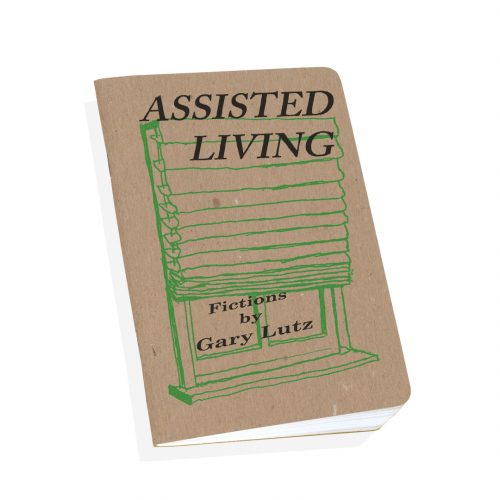
Assisted Living
Gary Lutz
Future Tense Books, 2017
32 pages, $5.00

.
People really make a fuss over Gary Lutz. Google his name. Read through the results. Read Justin Taylor’s interview at Bookslut, Derek White’s interview at BOMB, Kevin Sampsell’s mini interview at The Rumpus. Read one or two positive and critical Amazon reviews (do the same at Goodreads too). Maybe appreciate a more astute, more literary review (here’s one, two). In reading you might find, panned or loved, Lutz produces no subtle response in anyone. But Lutz is anything but subtle. His every story seems like a dare.

Sample the stuff: “She was the glummer of the two of us, more out of sorts with herself and the harangue of our heartbeats. She bulled into her sleep and came out of it with unperfected follies of feeling.”

These sentences from Vasovagal would wind up piecemeal in the stories inside Assisted Living, Lutz’s chapbook of new fiction out now from Future Tense Press. It’s his fifth collection of stories and his second for Future Tense editor and publisher Kevin Sampsell, who also published Partial List of People to Bleach as a chapbook at 56 pages. Assisted Living amounts to a mere 36 pages, yet the four stories inside are as fractured and syntactically textured as anything in previous collections (Stories in the Worst Way (1996), I Looked Alive (2003), Partial List of People to Bleach (2007), and divorcer (2011). These stories are less stories and more “concentrations of verbal matter.” Each highly wrought instance of inked language showcase a sick obsession with the sentence. His commitment to the form has been admired by authors from Amy Hempel to George Saunders. Ben Marcus has called Lutz “a sentence writer from another planet, deploying language with unmatched invention,” and Diane Williams has said, “His authentic language conquers any habit of speech.” In his own words, Lutz says readers encounter in his stories “instigated language, language dishabituated from its ordinary doings, language startled by itself.” He says, “To me, language is matter—it’s a substance to be fingered and disturbed… I like to see what happens.”

Born in Allentown, Pennsylvania and currently residing in Pittsburgh, Gary Lutz is an Assistant Professor at the University of Pittsburgh at Greensburg. He was the visiting writer at Syracuse University in the spring of 2003 and at the University of Kansas in the spring of 2007. In 2008, he delivered a pivotal lecture to Columbia University students titled “The Sentence Is A Lonely Place,” which was published by The Believer in 2009. In this instructive essay on the act of sentence-making, Lutz describes the kind sentences he wants to write: “the sort of sentence that, even when liberated from its receiving context, impresses itself upon the eye and the ear as a totality, an omnitude, unto itself.” Such sentences have “the force and feel of a climax,” and the “acoustical elegance of the aphorism,” where each word bears “physical and sonic resemblance to each other.” The essay introduces specimen sentences through the context of a set of poetics Lutz learned from his teacher Gordon Lish. These poetics involve a handful of maneuvers, one of which is called “consecution…a recursive procedure by which one word pursues itself into its successor by discharging something from deep within itself into what follows.” In a sequel of sorts, “The Poetry of the Paragraph: Some Notes,” appearing in 3:AM Magazine, Lutz discusses the “acoustical symmetry” and “verbal pressure” achievable by certain successions of sentences inside paragraphs. The essay looked at how paragraphs emerge from sentences by means of another maneuver Lutz learned from Lish called “the swerve.” The process of moving from sentence to sentence is “not one of addition or accretion but instead a revisionary process” so that each “new sentence breaks away from, or reconstitutes, its predecessor.” Such a paragraph resembles a “sequence of declarations, each of which is crying out for eternal visibility and audibility, and seeking preeminence.” Instead of “building to a climax,” this kind of paragraph “delivers a series of climaxes.”

While these essays reveal a few of Lish’s important workshop teachings, they also help to make sense of Lutz’s unique method of composition. Because the truest satisfaction from reading Lutz comes from considering how the text was made, these essays—like essays by Stein, Sarraute, or Robbe-Grillet—may be used by readers to read the work against and examine the merits of of the text. His sentences, their “forms and contours,” their “organizations of sound,” are so strange they should be studied for their selection.

So, summarize Lutz? Put forth tweet-worthy versions of the four stories in Assisted Living? Nope, no such luck. Experience on your own the sentential event for which Lutz has become known. Here is the title story’s opening paragraph:

Whether she came on to me or just came at me testily, without much sleep to her name, should make no bit of difference to anybody now. I tried to be a father to her, and she wanted to try being a daughter—that was to be the understanding, effective whenever.

The first sentence is held together by an “intra-sentence intimacy,” the “physical and sonic resemblance” of its words: the assonantal relations between “came” (2x), “name,” and “make”; and “me” (2x), “testily,” and “sleep.” (Note the musical flourish of “testily” before the prepositional phrase.) As for the content of the sentence, conflict is created between the story’s supposed characters of “she” and “me” in the first fifteen beats. Readers wonder what the nature of the relationship is between these characters. The verbal pressure of consonants in “no bit of difference to anybody now” emphasizes this conflict. The second sentence attempts to add context to the relationship (“I tried to be a father to her, and she wanted to try being a daughter”), but the infinitive of “to be” reaches meaningfully, distancing the “I” of the sentence from “father,” while “wanted to try” similarly implies a failure to subscribe to these rules of engagement: a kind of paternal relationship. The phrase post em dash (“that was to be the understanding, effective whenever”) reinforces halfhearted resolve. (Note the verbal symmetry of syllables and shared e’s in “effective whenever.”) In each sentence, the drama of content, the “subject matter” of these sentences—the relationship between the narrator and the girl—“is supplemented or deepened by the drama of the letters within the words.” These sentences contain what Stanley Fish calls “an angle of lean” and create motion by promising “content in prospect.” Lutz reveals content on one hand while concealing it with the other.

Instead of examining the relationship, in a kind of swerve, the next few sentences hover over the girl herself (“she was already sinking in a life of mild peril, of shortages sought out”). Sentences and paragraphs bat back and forth the content of their lives and the content of their relationship, the context of which is indeterminable. The narrator riffs about the girl’s siblings, her mother, the shape of the girl’s hair (“sketched onto the skull, then scumbled”), and her two jobs. Sentences centering on the narrator and the girl tend to point both backward and forward in the story: “She wanted to report to me. That was my importance to her,” or “There wasn’t enough testing of affections on each other.” These kinds of sentences may be deciphered over and over without getting any closer to conclusive certainty. In a Gary Lutz story, acoustics and ambiguity are dramatized at every turn.

At one point Lutz launches a “scene” from a turn of phrase: “Everything, I repeat, was on the level. It was so level we could set things out on it, the whole of whatever it was, with its jumpiness and discomposures, without anything of hers ever having to touch anything of mine.” The stickiness of their relationship, their situation, is simply implied. Yet the story seems to reach a climax when the narrator bumps into the girl after not seeing her for some time:

Nine, ten months later, I bumped into her at a bus terminal. Or maybe it was at a car service. She was wearing old-looking clothes that were new to me. She had a handbag—a first. She was applying to veterinary schools, she said. (We shook hands over it.) I said that at my age, you start to realize you might have loved only once, if that. This came out sounding newsy and impatient.

She said, “It’s been years.”

The semantic character of earlier sentences is evident, but here the narrator actually reveals himself through actions and language. The handshake resembles a fatherly gesture. The sentence right after undermines the handshake by putting forth thoughts on love. The narrator’s implied speech seems to rush forth (a humdrum phrase might be built with “blurt,” but here Lutz chooses “newsy and impatient”). Heartbreaking is the girl’s response, if you fuss with it, and you must because meaning-making is up to you. Has it been years since she loved only once? This is as funny as it is sad. Her phrase widens the gap that has been there from the beginning. She shows her age, her lack of experience. The narrator’s hurts turn out to be worse than hers.

While sometimes the lengths Lutz goes to when manipulating and arranging language in such cryptic chronicles are comical, it pays to seriously wonder where his language comes from. When all else fails, it’s this wonder that keeps you pinned to the page.

Each subsequent story in Assisted Living conveys a similarly disjointed “motion of moments” within collapsing marriages and fragmenting relationships. These are stories of lonely, sexually ambivalent characters never “lacking for a loss” interacting depressedly in the “physical hooey” that goes with being human. In “You Are Logged In As Marie,” the narrator describes his marriage to an ex-wife, “an ex if ex, just this once, is allowably abbreviative of expeller, or excluder, or exiler—take your pick,” and dolls out a line through which the entire collection might be viewed: “To wit: Wherever there are two people, people even anything like us, one is forever the casualty of the other.” In “This Is Not A Bill,” the narrator confronts the truth of “I was either a bad reflection on my parents or their one true likeness” by looking at his own children. But, by the end of the narrative, he doesn’t seem to get anywhere, and the final sentence responds to the very first: “I go into a day saying, “I won’t let myself know.”’ In “Nothing Clarion Came Of Her, Either,” a woman comes between two married women in an account of “an open marriage, leaking from both ends.” The narrative concludes with an epiphany (“when it finally just comes to you”) about the wife and their relationship, though this epiphany occurs, in effect, off the page.

Once, in an interview with David Winters, when asked where his writing fits into his life, Lutz replied, “My writing isn’t a career or a craft or a hobby or anything like that. It is more like a tiny annex to my life, a little crawl space in which I occasionally end up by accident in the dark.” That statement makes Assisted Living seem like a surprise, even mirage-like. Yet these stories are strikingly real, demand devotional attention, and make reading anything in their aftermath seem a little light, a little less the show.

—Jason Lucarelli

img_4092

Jason Lucarelli is a graduate of the MFA in Creative Writing program at the Vermont College of Fine Arts. His work has appeared in Numéro Cinq, The Literarian, 3:AM Magazine, Litro, Squawk Back, and NANO Fiction.

.
.

Sep 042016
 

toussaint

The most mesmerizing aspect of Toussaint’s narrative logic is how he blurs the temporality between events so that major moments during the breakup recall earlier corresponding moments. His narratives are so intricate, so pleasingly recursive, that the shape they take, the choices Toussaint makes, is where readers will find reward. — Jason Lucarelli

Naked1
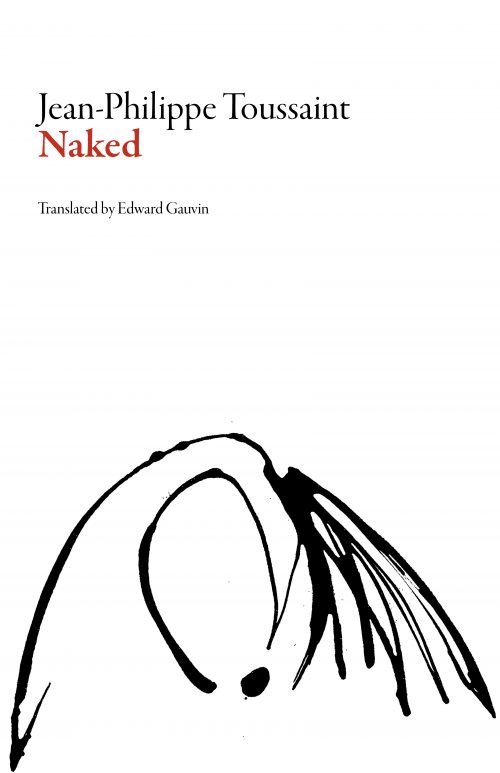
Naked
Jean-Philippe Toussaint
Translated by Edward Gauvin
Dalkey Archive Press, 2016
124 pages, $15.00

.

.Some couples are always breaking up and getting back together. Their love says no, says yes, sometimes in the same breath. Every apparent end is punctuated by a flash of renewal.

Take the unnamed narrator and Marie in Jean-Philippe Toussaint’s tetralogy—Making Love, Running Away, The Truth About Marie, and Naked—who spend all four novels (mostly) breaking up. “But breaking up, I was beginning to realize, was more a state of being than an action, more a period of mourning than a death agony,” says the narrator in Making Love. While each novel in the tetralogy follows Making Love, events do not always follow in chronological order.

In Making Love, Marie invites the narrator to accompany her during one of her exhibitions at the Contemporary Art Space in Shinagawa, and they spend most of the trip “separating for good.” Running Away occurs the summer before the breakup when the narrator travels to China on an errand for Marie, and later joins her on the island of Elba for her father’s funeral. The Truth About Marie, occurring the spring-summer after Making Love, concerns events surrounding Marie’s other lover Jean-Christophe de G. (Marie accompanying Jean-Christophe the day after her exhibition as he transports a racehorse, Marie watching Jean-Christophe have a heart attack in her apartment), and a few summer days on Elba where Marie and the narrator grow closer over crisis (a great fire burns over a section of the island). All of this is just what happens, the succession of incidents, plot stuff.

But the most mesmerizing aspect of Toussaint’s narrative logic is how he blurs the temporality between events so that major moments during the breakup recall earlier corresponding moments. His narratives are so intricate, so pleasingly recursive, that the shape they take, the choices Toussaint makes, is where readers will find reward. Describing Toussaint’s fiction, Tom McCarthy writes, “We don’t want plot, depth or content: we want angles, arcs and intervals; we want pattern. Structure is content, geometry is everything.”

Jean-Philippe Toussaint—Belgian-born writer, filmmaker, and photographer—is the author of nine novels, originally published in French by Les Éditions de Minuit, and published in English by E.P. Dutton, The New Press, and Dalkey Archive Press. He is the winner of the Prix Médicis for Fuir (Running Away) and the Prix Décembre for La Vérité sur Marie (The Truth About Marie). Early critics were quick to classify his work as part of the ‘nouveau Nouveau Roman.’ Toussaint prefers the term “infinitesimal,” which, he says, “evokes the infinitely large as much as the infinitely small…the two extremes that should always be found in my books.” He refers to Samuel Beckett as “the most important reading experience of my life” and “my only model.” While Toussaint’s earlier works contained loopy but concise narratives, detached yet analytic narrators, and plot opportunities offered but rarely exploited, his newer works give a little more, and build upon these earlier facets in exquisite and scrupulous detail. His authorial concerns for “energy,” “rhythm,” “dynamics,” and “the standards of the form” are on peak display in Naked, the conclusion to his magnum opus, translated by Edward Gauvin and published by Dalkey Archive Press.

From the beginning of Naked onward, Toussaint reaches back into the narrative, to previous novels, to reference events, and revisits them with variation in a cyclical, dizzying effect. Take for instance the beginning of Naked’s first half, as the narrator and Marie return to Paris after making love on their last night on Elba. Before separating, they share an extended exchange in the taxi. They hesitate to part. The narrator says, “…I was unable to tell Marie how I felt about her—but had I ever been able to?” It’s a sentence that recalls one from Making Love: “…I had not made the slightest declaration of love to her—but have I ever made her any declaration of love?” On the level of plot, the narrator’s passiveness is one of his primary traits. In some ways, it’s to blame for him staying on the wrong side of the breakup for so long. On the level of form, the two phrases showcase Toussaint’s signature parallel structuring of incidents.

The narrator spends the next two months waiting for Marie’s call. At his window, looking out at Paris, his mind goes back to the time they spent in Japan: “That was where everything had started, or rather everything had ended for us, for that was where we’d broken up…” Eventually he reveals that he was present during the exhibition at the Contemporary Art Space in Shinagawa and not, as Marie might have suspected, on his way back to Paris:

It was only now, more than seven months later in Paris…that I had gained the necessary distance to apprehend all the elements of the scene then underway…So where was I? Where—if not in the limbo of my own consciousness, freed from the contingencies of space and time, still and forever invoking the figure of Marie?

The narrator, “in memories or the resurrected past,” makes his way across the museum grounds as he did in Making Love, but this time on opening night as opposed to the night prior. As he tries to gain entry to the museum, a guard takes special notice of him (the same guard who caught him at the conclusion of Making Love looking for Marie), and the narrator climbs the roof to escape confrontation. On the roof, he peers through a porthole looking for Marie amongst the attendees. Searching the crowd, he sees a guest look up at the ceiling, and leans back to avoid being seen. At this point he realizes that this was the evening Marie met Jean-Christophe de G. and that he had likely been an “eyewitness to their encounter.”

In a perspective shift typical of the tetralogy—Toussaint turning first person perspective into a kind of speculative third person—the narrator describes how Jean-Christophe de G. found himself at the Contemporary Art Space in Shinagawa, how he decided to leave with Marie on his arm (a woman he had never met before), how he mistook another woman named Marie for fashion-designer Marie, and how he gazed up at the porthole to spot the narrator’s figure in the dark. Jean-Christophe, bewildered at having chosen the wrong Marie, considers:

an excuse to ditch everyone and slip out of the museum or even, if possible, to vanish from this story altogether, return to nothingness, from which it seemed he’d been plucked for a brief moment to beget, at his own expense, an evanescent ribbon of life, airborne, twirling, futile, and fleeting.

The narrator abandons Jean-Christophe and recalls the moment he finally spotted Marie through the porthole. He watches her: “I love you, Marie, I told her, but no sound came from my mouth, I couldn’t even hear myself say it, maybe I hadn’t even opened my mouth, maybe I’d only thought it…” He reveals his true feelings to no one but himself.

The flashback ends and the second half of Naked picks up back in Paris, when the narrator receives Marie’s phone call two months after returning from Elba. She says she has something to tell him and they should meet. The narrator recalls that every time Marie called him “out of the blue” was to inform him of a death: her father’s (in Running Away) and Jean-Christophe de G.’s (in The Truth About Marie). The narrator meets Marie at a cafe (he finds her looking “different”) and she informs him that Maurizio, the caretaker of her father’s house in Elba, has died (“when all was said and done, she only called me up in the event of a death,” he says), and that it would be good if they attended his funeral together. The narrator agrees, but holds on to the premonition that Marie held back what she really wanted to tell him.

Traveling to Elba by ferry, approaching shore, the narrator and Marie are greeted by the familiar sight of smoke: “It was so striking that it seemed to me the same fire as last summer, even if that was no doubt impossible, the same forest fire now finally winding down but still burning, and pursuing us, awaiting our return.” Always in the mind of the narrator the present parallels the past, every event mirrors another.

The narrator and Marie are greeted by Maurizio’s son, Giuseppe, who has been keeping watch over Marie’s father’s house. He tells them about the source of the smoke on the island, the burning chocolate factory. Instead of going directly to the house, they stop at the factory and the narrator observes Giuseppe (“…he seemed instead to know the place like the back of his hand…”). During the drive back to the house, Giuseppe explains everything he knows about the fire, “unable to hide a dark, grim satisfaction, the morbid pleasure that comes from announcing bad news when circumstances allow it.” An element of vague danger brought on by the arrival of Giuseppe’s character hovers over the second half of the novel, which chronicles the couple’s stay on Elba, Maurizio’s funeral and Marie’s withheld secret. But Toussaint is not one to tie up loose ends. A few plot options are left unresolved.

Naked is filled with constant ruminations on lost love, memory, absence, fantasy, loyalty, art. Sticking solely to its structure is to downplay its music, pacing, comedy, drama; its ability to captivate, to surprise. Take the prologue where the narrator, before addressing his relationship with Marie, depicts Marie the artist by describing her most ambitious dress design, a dress made entirely of honey:

Developing a theoretical reflection on the very idea of haute couture, she had returned to the original meaning of the word couture as the sewing of cloth using different techniques, stitching, tacking, hooking, binding, which allow fabrics to be combined on models’ bodies, twinned to the skin, and joined together, to present this year in Tokyo a haute-couture dress without a single stitch.

Later, he mixes his musings on “artistic creation” with those of love:

[A]ny true love and, more broadly speaking, any project, any undertaking, from the flowering of a bud to the growth of a tree to the realization of a work of art, has but one aim and intent, to persevere in being, doesn’t it always, inevitably, come down to chewing the same thing over? And a few weeks later, taking up this idea again of love as rumination or continual reprise, I would further refine my phrasing, asking Marie if the secret to lasting love was never to swallow.

It’s fair to say that in order to feel fully immersed in Naked is to have in mind the other books in the tetralogy. (Read at least Making Love and The Truth About Marie before proceeding.) The narrative in Naked constantly reinforces the “superimposition of simultaneous presents,” a concept spanning the entire tetralogy (see the opening of The Truth About Marie when both the narrator and Marie are “making love in Paris in two apartments” at the same time). In Naked, no passage balances this duality better than the final paragraph where Marie pulls the narrator into the guest room of her father’s house, the same room where they made love last summer (“The place was the same, the people the same, our feelings the same, only the season had changed”). They kiss and hold each other “tightly, madly,” and, in the final line, Marie says, “Then you love me?” It’s a phrase that points back to Making Love, to when Marie first accused the narrator of not loving her. The phrase creates the feeling the passage describes: being in two places at once. Now, in the present, the narrator is challenged with providing an actual answer—instead of whispering it on a rooftop—to the question Marie first posed seven months ago. But readers are left answerless, and one almost sees the entire breakup replaying, beginning all over again.

— Jason Lucarelli

N5
Jason Lucarelli

Jason Lucarelli is a graduate of the MFA in Creative Writing program at the Vermont College of Fine Arts. His work has appeared in Numéro Cinq, The Literarian, 3:AM Magazine, Litro, Squawk Back, and NANO Fiction.

N5
N5

Aug 052015
 
Gordon Lish photo by Bill Hayward

Gordon Lish photo by bill hayward

Tim Groenland has written a compendious and measured account of Gordon Lish’s editing practice (fascinating images of pages edited — Nabokov, for example) and influence, minus the Raymond Carver hysteria. The essay builds on some of the work we’ve published at NC, including Jason Lucarelli’s ground-breaking texts “The Consecution of Gordon Lish: An Essay on Form and Influence” and “Using Everything: Pattern Making in Gertrude Stein’s ‘Melanctha,’ Robert Walser’s ‘Nothing at All,’ and Sam Lipsyte’s ‘The Wrong Arm’” plus my own audio interview “Causing Damage — Captain Fiction Redivivus: DG Interview With Gordon Lish.” All are quoted in Groenland’s piece, putting NC at the front of the wave of new interest in Lishian studies.

dg

Here’s a teaser from the Groenland essay:

These studies make it clear that Lish was, in certain ways, “the minimalist in the machine” in Carver’s work (Churchwell n.p.) and it is clear that he applied similar techniques to the work of other young writers of the period: Lish was instrumental in the early careers of Barry Hannah and Mary Robison, for example, making him an essential figure in the development of what was variously known as “minimalism”, “Dirty Realism”, and “the new realism” (or, to use Mark McGurl’s recent formulation, “lower-middle-class modernism”) in the early 1980s (32). Michael Hemmingson has shown that Lish edited Barry Hannah’s fiction extensively throughout the late 1970s and early 1980s: he reports, for example, that the manuscript drafts for Hannah’s novel Ray (1980) are “a confusing, sloppy mess” and that Lish’s editing work here involved carefully rearranging sections into narrative coherence, much as Max Perkins did for Thomas Wolfe’s major novels (Hemmingson 490–491; Berg 119–130, 223–228). Lish performed line editing on photocopies of Hannah’s stories taken from the journals in which they had been printed, just as he did with Carver’s work: in several cases, the journal in question was Esquire, meaning that the editor often saw Hannah’s work through several iterations and could refine his vision of the stories in different stages. Hannah’s attitude to these changes was markedly different from Carver’s, and in a 2004 interview with the Paris Review he was unambiguous in his praise:

Gordon Lish was a genius editor. A deep friend and mentor. He taught me how to write short stories. He would cross out everything so there’d be like three lines left, and he would be right . . . This is your good stuff. This is the right rhythm. So I learned to write better short stories under him. (Hannah, “Art of Fiction 184”)

Read the entire essay @ Irish Journal of American Studies.

Apr 012014
 

Victoria_Redel_jpg_1-2

Herewith a superb interview with Victoria Redel, the brilliant and prolific author of stories, novels and poems, also a former initiate of Captain Fiction himself, the irrepressible and undaunted Gordon Lish. Redel’s most recent books include Woman Without Umbrella (poems) and a story collection Make Me Do Things, both reviewed in NC. Conducting the interview is Jason Lucarelli, our resident Lish expert, conversant in all things Lishian, author of the foundational essays “The Consecution of Gordon Lish: An Essay on Form and Influence” and “Using Everything: Pattern Making in Gertrude Stein’s ‘Melanctha,’ Robert Walser’s ‘Nothing at All,’ and Sam Lipsyte’s ‘The Wrong Arm’.”


What is “story”? What is “necessary fiction”? What’s the difference?

It’s funny, really, that it should seem at all a daunting question—what is story?—when each day, many times a day, we hear stories, we tell stories. We make artifice of our lives almost immediately—You can’t believe what happened at work today…I heard the most amazing exchange in line at the supermarket…You’re not going to believe this but…We shape narratives inventing bits of dialogue, implying motives though describing gestures—what someone did or didn’t do, what was or wasn’t said. We shape narrative—eclipsing, conflating, inflating events, facts, and characters—because, instinctually, we know when to speed up or hold back. We want our listeners to listen with urgency and so we engage engagingly.

What we know everyday is this human urgency to express the uncanny. And we really all appreciate that family member, that friend, that stranger at the next table who pays a story out slowly, circling back through strange phrases, observations, the teller who takes us down a weird circuitous path and we go along—wary, excited—because we can’t figure out where it leads and yet the teller has made it essential that we follow. The story can be ragingly funny or plain spoken, quiet or raucous. Oddly every method of telling works if it feels authentic. Authentic—seems like an abstraction but it’s not. We are authenticity hounds, sniffing for fraudulence all day, everyday.

We know the difference between the story that never stirs us—through shape or language—and the story that jolts us further awake and alive. Somehow the witness, the telling, the engagement of the speaker feels original. By original I don’t mean that they’ve used a new-fangled anything. I don’t mean they’ve worn a clown’s nose or written in Pig Latin. By original I mean that the speaker has allowed herself to look and speak without yielding to received vision or language. It is being told then exactly as it must be told. And we listen; we can’t stop listening because we feel that we stand the chance of living better of being changed. You’re not going to believe this but…and just sometimes, right away, we feel something stunningly possible in that simple even over-used phrase. Despite skepticism, resistance to being changed, fear of being hood-winked or manipulated—right away, we inch closer to the speaker, we hold our fork to our lips, we grip the book closer to allow something new to happen to us.

I’ve told this teaching story before to students but I’ll try to tell it again. I was invited to teach a weeklong workshop at a university in the Midwest. I had students write every night and each day we’d read in class. I kept trying to get them to identify sentences in each other’s work that were essential and that were necessary. They could do it. Ears were well tuned. But they found it harder to identify a true sentence in their own writing. I sent the group home every night saying, “How did it sound in your kitchen? What is a necessary object for you?” One woman, a Spanish Literature Professor, dauntingly the most learned in the room, came in day after day with sentences, with paragraphs of prose that were so god-awful, so full of bullshit, phony, fancy-assed sentences. And I kept saying, “Nope, nope, not this.” On the fourth day the Professor of Spanish Literature came in clearly agitated. I thought, “Yikes, I’ve gone too far and really pissed this woman off.”

Then what happened was extraordinary. She began to read a piece about a blue bowl in her mother’s kitchen. The language was syntactically like nothing I’d heard before. Was it actually even English? Who cares, it was beyond gorgeous. When she finished, when we could finally breathe, one of us said, “Read that again.” After her second—or was it her third reading—I asked, “What happened? What was that?” She said, “I almost did not come to class today.” I said, “But you knew, you knew.” And she didn’t answer. “Where did that language come from?” I asked. She was quiet, looking more agitated than ever. It turned out that she came from a crevice in the ArkansasMountains where the language seemed at once to have twists of Elizabethan English and French. She was the first in her family to leave the area, to go to college, to learn to speak “proper” English. Well, she’d actually gone further, now was a Spanish Professor. She told us that after she wrote the piece, she felt certain that her PhD would be stripped away, her tenure taken away. It made her actually feel ill. That gorgeous, original paragraph of literature felt more dangerous than she could manage. She felt exposed, betrayed.

The press of a human heart up against the page. Language in necessary disequilibrium, in jeopardy, most of all with itself. That blue bowl, her mother’s bowl. The collision of event and character and language. The possibility of seeing into another human heart. “Well that’s just what some folks will do,” a neighbor said to Flannery O’Conner after reading some of her stories. That is a necessary fiction.


In a BOMB interview with Honor Moore, you talk about how “collage is the only way that [you’ve] figured out how to write something long in fiction.” But I also see this strategy at play in your short fiction too. The elliptical movement that was your vehicle in your early stories, specifically in Where The Road Bottoms Out, seems dialed down, or, at least, more subtly employed in Make Me Do Things. How do you see yourself—as of late, and in your new collection—exploring new narrative techniques?

Maybe it’s something I’ve borrowed from poetry. The poem can move by association—by image or language patterning to accrue a larger sense and a larger mystery. The stanza can often signal that kind of leap. So can the line. Extending this kind of patterning—image and language—in fiction provides you with another narrative strategy. In the novel I used collage by which I mean I wrote sections in chunks, sections that were linked to other sections by image or place or situation. I didn’t know how exactly to think about ordering initially. But I knew that once I’d created a thread I had to use it again. That was how I created plot. It made sense to have that kind of fragmentation because of the narrator’s state of mind. With the second novel I was confident that I would do it differently. More of a straight shot. No such luck. Novels have proven different altogether—maybe more compositionally like a poem.

When I began to write fiction I discovered, in a wholly new way, possibilities within the sentence. I discovered the joys of syntax. This seems ass-backwards; I should have found syntax first as poet. It seems that it was simply developmental, I was at last seeing what the music inside a sentence, the intelligence inside a sentence, the personality within the sentence might be. In those first stories things seemed possible and more than possible it felt essential at times to have three prepositional phrases jammed up together, to take the sentence in one direction and then press it into another direction. I began to consider what I could do with postponement or preponement of, for example, the subject of a sentence. I love that book of stories if, for nothing else, how dizzy and blissed out I was with just how to construct story sentence by sentence.

But how I went about the composition of a poem and a short story was kind of different. I usually write a draft of a poem in one sitting. And then, subsequently begin to mess around, add, subtract, rearrange, merge it with other poems, turn it bottom to top. With short stories I write pretty much sentence by sentence by paragraph by paragraph. The revision happens line by line so that when I get to the end I’m not revising. I’m usually done. I take that back. I often have written it too tightly and need to go back in and dilate from within.

You asked about the first book of stories and the second—which were published 18 years apart with novels and poetry collections in between. As you can see in this book I’m pretty interested in a close third person—I wanted to have a third person voice that’s as close to a first person POV as I could get. At least that’s true for a bunch of the stories. You say they are less elliptical. Are they? I probably move in real time more in these stories. And I slow down, wanting to drill into a moment longer. But I wonder if some of the shift has more to do with age. Many more of the stories in Where The Road Bottoms Out focus on children—that collective voice of children that occurs in many stories. In Make Me Do Things the focus—even when there are kids in the stories—seems closer to the adults.

But maybe, it is all developmental—a lifelong apprenticeship with language, character, how what is story. And mixed in with that are the particular fascinations—conscious and unconscious—at any given moment.


You write “sentence by sentence by paragraph by paragraph” but in that fight to get to the sentence, how do you navigate between sense and sound? How soon do you squash possibility and clamp down on character, incident, and story? For example, recently, your contemporary and friend, Noy Holland said, “I go word by word by ear for as long as I can, according to my awareness of what I’ve said and did not mean to say…The ordering impulse is crucial but I don’t want it to be dominant or inhibiting. When it’s dominant the terms we commonly use—character, voice, plot, setting—begin to make sense; the story bleeds out; it’s anybody’s.”

I think I understand your question, Jason. And I believe I understand what Noy is getting at. A single sentence could potentially spawn many potential next sentences. Sometimes it is daunting. And the challenge is to find the one that is truest—not only true with respect to the linguistics and the acoustics. But the sentence has to move forward character, stance, action, and do so with inevitability and risk. It wants to complicate the mystery. Poets talk about sound and sense, Pope’s the “sound must be an echo to the sense.” Honestly, this all makes the writing seem so much more laborious than it really is.

.

How do you view your evolution as a writer of fiction, and how has your growth as a poet influenced your narrative tendencies in fiction?

My hope in these new stories is probably not unlike the hope I’ve always had in writing to push into the difficult places. Sure, that has something to do with the dark places of hearts and minds. But I’m also interested in Joy—the ways we shun it, why we fear joy. And why in midst of real happiness we conspire to fuck it up. I suppose how we understand bravery shifts with age and experience. One of my internal cajoling’s has been—you have permission—which on the page can mean permission to be plain spoken or exorbitant, permission to say what feels dangerous to say and, almost more importantly, to find language that isn’t worn thin, to have the permission to make the language singular. But right now I also find myself interested in the ways I can bend and keep bending inside the story to dig up something I don’t know. Which, heaven knows, is most days most things. What else and what else and what else is right here, right now. Because, of course, everything is right there, all the old hurts and hopes, all the new ones and all the invented convolutions of the current mind. I love the way in our dark moment we say hilarious things. I am interested in the way we bungle things up. Despite our certain efforts to get it right.

You ask about my evolution as a writer. Probably a writer is the worst person to try to identify her evolution. There’s the question of fascinations—with certain images, with kinds of situations. Sometimes I fear that I’m writing the same kind of story over and over, walking around some few subjects that emerge again and again, even when I imagine I’m breaking into new turf. Okay, maybe that’s simply that we can’t escape our deep concerns, our central objects. In this new story collection, people have noticed the last story, “Ahoy,” saying something different is happening in that story. Maybe I should be bummed out that every story doesn’t seem to break new ground but I confess excitement because it’s the last story I finished for the collection. So to feel that I broke into something new there feels hopeful. I’m not sure if others mean new subject or new form, I don’t know if I care. Probably, it would frighten me too much to look closely at my evolution. Where have I slackened? Where am I repeating old tricks? Why do so many of my characters behave in kind of obsessive ways?

As for how poetry connects with the fiction, I’m not sure. I used to maintain that they originated from the same impulse, the same desire to experiment in language, to render and make witness to the world. But I’m less certain of this now.

.

May I ask if you, when you write as a poet or a fiction writer, do you ever find yourself responding as a fiction writer to the pieces you’ve written as a poet, or vice versa?

Wow, your question makes me sound like a strange and divided person. Honestly, I don’t think it works that way. The work is the work and you try to come at it with a rigorous sense of possibility. It’s always a balance, right? On the one side to detect lapses, opportunities not taken by failure of sight or patience or heart. And on the other side is keep the composition playful so that you allow for accident and the unconscious to emerge. That’s true in whatever form one works.

But now that I’ve reread your question and wonder if what you’re asking is do I ever take on similar subject in fiction and in poetry? And, I suppose here the answer is yes. Not intentionally. But because ultimately I am not such a divided creature I’d like to believe that different forms allow me to come at my interests, obsessions, concerns from differing angles.


In “He’s Back,” a father comes home to his wife and son together in the tub. This bathtime, a way of being rather than a common nightly occurrence, has accumulated into a breaking point inside the narrator, who’s put off by the constant bathing. He questions the closeness between mother and son (“she was no doubt letting him look at the whole thing”), becomes jealous (“there was hardly a moment she would let him have alone with the boy”), and finally annoyed to the point of action (“He would teach them both a thing or two”). While this story seems to touch on familiar thematic territory for you (the nature of family and familial relationships), you chose the first-person male point of view. In certain stories, can the choice between the gender of a narrator propel the drama?

The story “He’s Back” arrived—as many stories will—with an initiating image. A father coming home to his wife and child who are in the tub. It’s not all that strange an image. All across the world, on any given evening or morning a parent is showering or bathing with a child. Not strange or scandalous. Easier to get in that shower to soap Junior. But what I glimpsed in that initiating moment is a feeling—also common—to come into a room and see your child and spouse engage in anything—a game, a conversation, a book—and feel out of their orbit. Feel displaced by that beautiful, exclusive place a parent and child might occupy for a moment. And even as we see the beauty of the moment, happy for their closeness, at the love and pleasure they share, we feel excluded. We feel jealous. This complex rub interests me in fiction. That displacement, real or imagined, interests me. You ask does the gender propel the narrative? One could absolutely imagine a mother displaced. It happens all the time. But in this story the triangulation is rendered from the man’s point of view and I hope it is specific and particular enough to feel that it is not an interchangeable voice, it’s not a woman. Triangulation always interests me; it is inherently dramatic. Spend any time with two parents and a kid and you’ll notice the pushes and pulls in every direction. Territorial displacement can shift ever so minutely and it is felt profoundly. That is true in marriages, in friendships, in parent/child relations.  And how jealousy manifests, well that’s endlessly interesting and usually not simple. The great challenge for people everyday is not to use a third person as protection or weapon against someone they love.

I didn’t set out to write a collection that featured writing from men and from women’s points of view but clearly it happened. It makes some sense (at least retrospectively) because no gender seems to have the prize for blundering personal lives or for trying to make sense and manage a life.


In between Where The Road Bottoms Out and the publication of Make Me Do Things, you published poetry, novels, and continued to publish short fictions. Can you talk a bit about your process in assembling this new collection? For example, “He’s Back” seems like an orphan of your first collection, and, in fact, I believe the story predates all other stories in the collection. What criteria did you use to decide which stories would make the cut?

You’re right that “He’s Back” is an older story. It predates Loverboy. And I suppose has some connections to Loverboy, or at least shows a bit of my path of inquiry that I had not exhausted. It was written around the same time as “Stuff” and “Third Cycle” and “The Horn”. The stories in this collection span from those stories to “Ahoy” which was the last story that I wrote. But to confuse things, I’d written some pages of “Ahoy” years ago and then couldn’t figure my way and left it. I remember interviewing Grace Paley some years ago. Grace had just had a story published in that week’s New Yorker. She told me it was one she’d begun a decade before and that she’d put those first pages in a folder which had the stories she couldn’t get right or finish. Her dud folder. She said that she often went to the folder, pulled out a story and, reading the pages, thought, “Hey, that’s not bad.” And right away started editing and playing with it and writing a bit more. It was so different than the way I worked but, boy, I remembered it. And, well, those opening pages were something I’d looked at more than once in the intervening years. Then last year I thought, I want that story. I want to figure it out, to figure him out.

There were other stories that didn’t make the cut. I’d keep them in the mix for awhile, mostly to make me feel good that I was close to a finished collection. But when I’d write a new story, I’d let another go. And when the story was knocked out, I’d feel relieved. What’s the criteria? If I can still feel surprised by a story. If I feel there’s sufficient language or sufficient true hard looking. If I don’t think I was faking somehow. I know there’s a lot of different tones in this book. Maybe some would feel critical of that—I don’t know—maybe it shows a lack of consistent music. But I like the variation. I want it. Hopefully, others do too.

.

As a teacher, how do you instruct students who are interested in reconciling the differences between fiction and poetry in their own work? Do you have a list of writers you cite as lyrically inclined, yet who still stick close to story?

There are so many interesting prose writers who have great density of language, a real lyricism in their work. Hello, Christine Schutt. Hello, Dawn Raffel. Hello, Michael Ondaatje. I teach their work in poetry classes. Others too. Anne Michaels who wrote Fugitive Pieces, a book I love. I teach Robert Frost in fiction classes.

The lyrical fiction writer (student) has to keep remembering not to get so lost in language that the importance of a dramatic situation, of an instigating problem is forgotten. The key is to keep swerving, letting language become part of the dramatic insistence. Otherwise, it all spins into pretty. We lose sight of characters.


Dawn Raffel and Diane Williams edited a story or two in your new collection, if I’m not mistaken. Can you speak about the differences or similarities in editing styles between these two friends and former Lish students? At what stage of a story might you allow these particular readers to read one of your pieces?

Yes, Dawn edited a story and so did Diane. Actually, Diane published two stories from this collection. One in NOON and the other in an issue of StoryQuarterly. I trust both their judgment so implicitly that I think I took the suggestions both gave. Dawn had two suggestions that were a function of hearing an off-ness in word choice. Dawn has a great, uncanny ear and, well, she was right.

As for when I show things…I don’t show stories early. In fact, not till I’ve got them as done as I can get them. My agent, Bill Clegg, is a great reader and he pushed on some of the last stories. Finding moments where he’d felt I’d lost nerve and gone an easier route. He was right. I knew it instantly. And I could even recall the failure of nerve. So it was good to go back and carve a tougher route.

.

You were quoted as once saying, “Everything you need to know about the next line in a story is actually present in the words of the sentence that preceded it.” Phrased another way, Amy Hempel’s way: “You do what you do because of what is prior.” Obviously, this is something Gordon Lish preached to his students, but it’s also, I’ve noticed, a phrase that his students, who now teach, seem to preach to their students. Why is this compositional strategy so powerful? What has this recursive principle taught you about story and the degrees of so-called story?

I simply cannot imagine anyone who has truly listened to Gordon Lish speak of writing not teaching a recursive principle. Gordon Lish spoke more persuasively and generously about composition than anyone I’ve ever listened to. I’m betting that you could walk into a class taught by Amy Hempel, Mark Richard, Christine Schutt, Dawn Raffel, Noy Holland, Ben Marcus, Peter Christopher (God rest his soul), Sheila Kohler, Patricia Lear, Rick Whitaker, Sam Lipsyte, Lily Tuck, and the list continues on and on of those who have gone on to write and teach—the notion of the prior would be, as you say, preached. This principle, once grasped, is essential. And once grasped, you see it in all stories. This is because story is composed. It is made. If you think of this composition as a weave, a fabric, then it makes complete, natural sense that you are pulling threads through from beginning to end. And those threads—call them objects, call them rhetorical elements, call them syntactical events, call them parts of the sentence—all need to be utilized. Do you knit? If you knit you know that you can’t drop a stitch unintentionally without creating a hole in the garment. Same deal with story. Why would you want to forget any element that is prior? What is prior provides the deeper mystery. What is prior provides what can—no—what must be unpacked. You go vertical with it, not just forward. What is prior is what informs the sound of the story. It is the mind of the story. It’s important, Jason, to realize that recursive writing does not create any specific sound or mind. What is prior presents the terms for what is ahead. Look, going back to my knitting analogy. If—for god knows what design reason—you made a garment with an intentional dropped stitch in the first rows. You’d probably want to create drop patterning throughout the garment. It might actually have been unintentional. But by noticing it, repeating it, shifting from one dropped stitch to three dropped stitches you take that which was error and make a rightness of it. A great sweater, maybe. Maybe not. Which is also to say that just being recursive does not make a story. This is where swerve comes in. This is where actually making sure you’ve plunked yourself down in a worthy domain that provides friction and jeopardy and dramatic possibility.

Look at any writer you admire and I’ll bet you a good sum that is there is this weave I’m describing. This is how patterning begins to occur in story and in the novel. It means that the architecture of the work is inevitably built from local materials as it were. I could really go on about this. But I’ll chill out and shut up.

—Victoria Redel & Jason Lucarelli


Victoria Redel is the author of four books of fiction (Make Me Do Things, The Border of Truth, Loverboy, and Where The Road Bottoms Out) and three books of poetry (Woman Without Umbrella, Swoon, and Already The World). Her work has been translated into six languages. She teaches at Sarah Lawrence College

jason-lucarelli-photo

\
Jason Lucarelli is a graduate of the MFA in Creative Writing program at the Vermont College of Fine Arts. His work has appeared in Numéro Cinq, The Literarian, 3:AM Magazine, Litro, Squawk Back, and NANO Fiction. He lives in Scranton, Pennsylvania.


Dec 132013
 

NC Logo

End-of-the-year praise for NC from Daniel Davis Wood, who teaches in Switzerland and is the editor of a recent collection of essays by Edward P. Jones. Wood also praises Music & Literature, which is edited by my former student Taylor Davis-Van Atta (also an NC contributor now and then).

dg

Douglas Glover’s Número Cinq, online since 2010, was a wonderful new discovery for me this year…. Most impressive about Número Cinq is the material being collected in its Book of Literary Craft, especially Jason Lucarelli’s two long pieces on the aesthetic legacy of Gordon Lish (one, two) which led to an equally impressive discussion on that subject between Lucarelli, David Winters, and Greg Gerke, available at The Literarian.

via End-of-Year Pleasures and One Disappointment | Infinite Patience.

Oct 122013
 

Gerke-thumb-298x298-6592

Herewith a new short story by Greg Gerke, a writer out of the tradition of Gordon Lish, the second generation, sentences that ring of Gary Lutz; characters reminiscent of Sam Lipsyte; the whole exuding panache and cool and the inner seediness of the soul, ever hopeful.

Last month Greg Gerke, David Winters and Jason Lucarelli published “Learning from Lish, a Roundtable on Style in Fiction” at The Literarian (published by the Center for Fiction in New York) — Gordon Lish, the tradition, Lish’s aesthetic and his influence, the place of art in life; I am still mulling over this amazing conversation. One thing Gerke wrote especially hit home:

Isn’t the way of literature to tap into the source self, since writing bores into the pit of the brain better than any other process? Maybe that “last thing you would ever want anyone to know” is exactly the first thing any reader wants to know—otherwise, what is the point? The world is so full of deception that not to spread oneself out naked on the page or the screen or the canvas is senseless.

Think about this as you read the story.

dg

—-

Though they had been friends for ten years, Bret never fully trusted Ted. They would make fun of the same people, praise a select set of dead artists, and stuff themselves with Indian food, but about women they did not agree.

Short with a gecko-shaped face, Ted could talk and after a few laughs and drinks, even men wanted to rub his bald head. We like this every day guy, this new century Ralph Kramden, they thought. Maybe if we touch him we’ll find a hundred dollar bill in the gutter.

On Fridays, Ted would hoist a drink, twist his thin lips, and stretch his red cheeks to construct something resembling cute. “To all my friends,” he said sanctimoniously, aping a movie scene, though he’d long forgotten the title, even the story. “Let’s just say I invented it. Where’d you get that shirt?”

Nervous since childhood, Bret came at things like he continually walked the side of a 2×4. “What do you mean you forgot the Frisbee, did someone steal it?” he would say, wrinkling his forehead under straw-colored hair spidering out from his crown. People tolerated him because of Ted, but couples who knew them whispered about Bret before they went to bed. If he did finally lose it, they hoped to God they wouldn’t be around.

Bret’s plight. That phrase stuck in Ted’s head one morning after he completed a cardio workout at the gym. He approached the new girl at the front desk. “One of my best friends is so shy, babe. What do you say about a guy who likes to put a time table on when he’ll sleep with someone?”

She turned a magazine page and avoided Ted’s oily face by moving her lazy eyes to the far wall of gold-plated trophies. “I’d say nothing.”

Ted wiped his neck with a towel. “He’s great. He’ll make you frittata for no reason. He’d drive twenty miles to help me with my car—the man is a living, breathing, fucking AAA.” After a harsh laugh, he quickly judged her bicep tattoo of the grim reaper a worthy effort.

“Yeah, well.” She went back to the magazine.

“Where do you live, Martha?”

“On a street you may know, but will never visit.”

One afternoon before they played tennis, the two friends sat on Bret’s porch drinking lemonade with a splash of rum. Bret had found a set of childhood pictures. He bunched his shirt sleeves and grinned, “Look, this was me as the sad clown. Don’t I look ridiculous? My mom spent two weeks making the costume.”

Ted pouted his lips in appraisal, “Your eyes are pretty expressive—they say I hate Halloween, I hate my mom, and I hate my life.”

Bret gathered the stack of Kodak processed photos into his lap and ordered them neatly. “Don’t be a dick.”

“What? You told me those things about your childhood, bro. It was a tear-stained day in the mighty month of May.”

Bret scowled. “I only told you half the story.”

“Why only half? Am I half a friend?”

Bret laughed. “Hey, arsehole, why do you always deliver the punch lines?”

“Cause you’re the straight man.” Ted burped and hearing a car’s passing music, shook his arms to the groove.

Bret put the photographs back in a bubble envelope. “I’ll show you some other time when we don’t have a big match pending. Now, who is this woman? You said she played tennis at Irvine?”

Checking the money in his wallet, Ted said, “Sherri or Sharon. I don’t know, it begins with Sh. And no, I don’t know if she played tennis there or knew someone on the team. All I know is she’s wanted to play for months. Does massage. You know she’s trying to find her way here.” Ted made a wind sound. “The skin, I’m telling you. She could be in a mag a couple notches below Vogue.” He stretched his arms proudly. “Maybe one notch.”

The trio hit balls for less than a half hour. Bret wanted to let them play one on one and sat down for five minutes. We’ll go out, get some drinks, and then they’ll go and sleep together, he thought. What do I really want in my goddamn life?

The ball bounced off his foot and Sherri bounded over. As she blocked his sun, she twirled her old racket, still carrying a smudge of cob-web just below the strings. “Is our little ball boy tired already?”

“I just want to watch the professionals.”

Sherri giggled and he smelt her apricot body wash. Ten years ago, after she finished high school in Seattle, she had joined the army. She’d been in Oakland only three months. A middle-eastern restaurant venture in Portland had failed and now she lived here with her sister. She was lonely and when she smiled her gums showed.  Dropping Cézanne’s name made Bret want to take her in a corner and rub colors into her muscular chest.

Ted announced the Giants had won in extra innings and then kissed his cell phone.

They drove into Berkeley and after three rounds of mojitos on a patio with Tibetan prayer flags waving, Bret started doing impressions. He tilted his head and spoke in a baby-like staccato, “Yeah, gotta see Wapner at 4:00, then Jep-Jep-Jeopardy.”

“Rainman, ole!” Ted cackled, calling their waitress to also salute Bret’s skill.

It had been months since Bret didn’t feel terribly dependent or stricken by a sense of not belonging. For one grand moment he didn’t care about childhood or not being able to swim. He pictured pummeling his abusive father and being celebrated for it with a ticker-tape parade on Fifth Avenue. His blood ran faster and all the ideas and words that could never get out in time were readily available, like they hung on a snazzy tool belt. Four hours ago he had cursed the wireless signal in his house. Now his life was heaven.

When Sherri touched his knee, he knew he’d gone about the enterprise all wrong. Be a loud ass like his beefy friend, not a timid, sulking bore who dusts when he can’t think of anything better to do. Be sloppy and ruin the tawdry perceptions people hold to. Invite them to be entranced by your feelings. Give them what they can’t give themselves.

Sherri reeled from his Katherine Hepburn, holding his shoulder for support. “My parents took me to On Golden Pond. I was five. I totally hated it.”

Bret’s eyes lit up. “Mine took me, too.” Then he stalled like his battery had died, like he didn’t believe his bullshit anymore. He looked to Ted who grinned devilishly while composing a text that would surely make someone miserable.

Sherri went to the bathroom and Ted snapped his fingers. “You have a mini-stroke?”

“Fuck off. I’m having fun.”

“I know you are, but she likes you and you have to close it. Talk her up. Tell her she has strong legs.”

“Why?” Bret snorted. “Why legs? She has strong everything. A strong, warm per— And I’m goddamn thirty-two, dad. I don’t need pointers.”

Ted sat back and made the peace symbol. “Loving you, brother.”

When Sherri returned, Bret yelled, “Basta!” She smiled and the tip of her tongue showed like a cat in the midst of licking itself.

Bret motioned toward her with his drink. “You must have jogged a bunch in the army, right?”

Ted went to a birthday party, and Bret and Sherri walked into the hills of the campus at dusk. Giant fir trees swayed. Heat bugs rattled. They scooted to a prominence overlooking the football stadium and sat down to kiss. With his hands fastened to her breasts, he ejaculated. Quietly, he sunk his head into his armpit, but she yanked his chin up and opened her eyes to him. “I have an incredible feeling about you, Bret. I want you to come to my bedroom.”

His face finally softened.

She nibbled at his ear and whispered, “I just put on clean sheets.”

In the morning they couldn’t stop laughing. They’d made love all night and the world smelt raw and unrelenting like it had been created a few hours ago. When Sherri went to the bathroom, he pressed the pillow to his face to keep her sweet scent in his head. Joyously he lunged over the bed and noticed a hairpin underneath, along with some popcorn kernels. Also a white object that after he dug it up turned out to be her vibrator. A yellowy streak on the side momentarily disgusted him. He shrugged his shoulders and put it back. There were probably stale tissues under his bed.

Sherri came back gleaming, her skin golden. Everything she had stood out before him in the daylight. She sang, I want to thank you, for giving me the best day of my life.

“Please,” he said, raising his arm like a matador.

Her sister was gone for the weekend and later they sat in the living room naked—cuddling and listening to music. “I wanna hear all about the army,” he said brightly.

“No, you don’t and I don’t really want to talk about it, baby. It’s very overrated. Nothing big happened. It’s just like living. You work, then you party and have fun.” She took an apple slice off the coffee table and wiped up a spot of cinnamon.

Bret did a double take. “What is it? Two o’clock and all we’ve had is an apple?” They laughed and hugged. Outside a dog barked.

“You like chihuahuas?” she said.

He stared at her genitals, judging her labia’s breezy swirl the greatest work of art in North America. “Chihuahuas are number one.”

She looked across the room. “I want to get a dog, but I don’t have any money.

“My sister’s getting me some stuff, but I’ve got to get a real job. I live off of two massages a week. That restaurant debt,” and she shuddered. She turned up the sound on one of the few cds she had brought from Portland—Coltrane’s Giant Steps. “No worries,” she said and she danced back to the couch.

“Let’s get a pizza!” he shouted.

Sherri leapt for the telephone book while howling like an Indian and Bret closed his eyes in triumph.

When the doorbell rang Sherri went to get some clothes. Normally skittish about showing his rail thin body to the public, Bret threw a towel around his waist. “Oh, just use my wallet. It’s on the kitchen table,” she yelled from the bedroom. He would insist on getting dinner.

He took the wallet and opened the door to a short, pimpled delivery driver with a pale face. Part of Bret wanted Sherri to show herself behind him so the teen could see more of his new life. Her wallet had a ten and a clip of twenties with handwriting on the back of the outside bill. Bret’s eyes buoyed slantwise. He took a twenty from the middle and impatiently tossed it to the driver. After he closed the door, he read the note on the last bill. You’re the best. Tubby

Sherri ran in, dressed in a white bikini and clapped her hands as she jumped up and down. “I smell artichokes!”

“Who’s Tubby?”

“Huh?”

He turned the clip and showed her.

“Oh, just an old friend.”

“He owed you money?”

“Yeah,” she said.  She reached for the bills, but he pulled them away.

There was a fork in the river and Bret could have taken the way that didn’t lead to the falls, but he knew she lied. He’d been made to pick at the slightest mark on the wall. Bret wiped his face and handed her the money—all four cold, heartless twenties.

Sherri kept staring at him and then opened the pizza, but he slapped the cardboard shut. “When did you meet Ted?” he said.

“This year.” Her head lowered like a dog. “Two years ago in Portland. We had a short thing, it was nothing. It was when the restaurant—”

“Stop talking.” Bret tried to step outside himself. The cords in his throat were going stiff and his right leg began to shake.

“Okay, Bret.” She felt the bikini’s pinching fabric on her once sleek body and crossed her arms over her breasts. “You alright?”

He sat down on the carpet and bunched the towel out to cover his parts. Silent tears slid off him. “He fucking paid you to sleep with me.”

“No!” she said. “No. I’m giving it back. It’s a misunderstanding.”

He beat the floor at his side.

“Stop, Bret. I like you. It’s not what you think.” She reached toward him.

“No,” he said. “It’s worse.”

Bret confronted Ted at his house. An embarrassing scene. Ted had offered himself to be pummeled. “Take me out, man. Do it. It was rotten, but I tried to help. I thought I was doing good.”

Six months later Ted again called and they exchanged pleasantries but when he tried to get him to go out, Bret laughed. “I can’t forgive you, Ted. I’m sorry.”

“Can’t or won’t?”

“Ahhhh.”

“Cut the shit. We’re  friends for a long time. You’re my brother,” Ted said mincingly.

Bret would often go to dinner by himself. It calmed him in some way. Chinese, Thai food—anything. He watched the slight waitresses and thought, Why can’t I let it go? I’d be happier. Bret once asked his waitress the same question. A smile raised her eyes and she walked to the back, returning with two spring rolls.

Ted had been out till dawn carousing. He bought a soda and drove up the foggy coast into Marin and parked at Muir Beach. Two couples had slept there and they were just waking up. A man with a bushy beard ceremoniously poured milk into cereal bowls while one of the women began tumbling on the shore. Dressed in purple yoga pants, she performed very precise somersaults and headstands, posing after each like an Olympian gymnast.

Ted sat on his patch of cold sand and felt the weakened sun on his neck. The limber woman sauntered before him—he wanted that dance. Twisting slightly, his bones ached and he ground his fingertips in the sand to erase last night’s woman. Then he stroked his growing belly like a slothful king.

The surf crashed loudly, almost otherworldly. Booming and bright white. A scene he hadn’t appreciated in years. Though fifty yards away from the group, he yelled and pointed at the ocean, raising his soda and laughing. They nodded briefly and went back to their breakfast. The woman in purple hadn’t noticed at all, she went onto cartwheels.

He’d had every kind of woman there was to have and they all felt amazing. Each time. The supply staying steady, with the women getting younger, but more disenfranchised, more insecure. He could easily relax. But he couldn’t. As the woman rolled about and yipped, as gulls strode the shoreline like pontiffs—he knew there was something in his life he hadn’t learned and women couldn’t help him with it. Massive and unwieldy, it kept stable at the top of his vision like a boulder fastened to his forehead. He couldn’t sit right until he faced it, but he didn’t exactly know what it was.

Ted burped and nodded, trying to assure himself everything would work. He looked for a big rock to toss into the ocean. He settled for a small black pebble.

 —Greg Gerke
———————
Greg Gerke’s fiction and non-fiction has appeared or is forthcoming in Tin House, The Kenyon Review OnlineDenver Quarterly, Quarterly West, Mississippi Review, LIT, Film Comment, and others.
Sep 252013
 

Jason Lucarelli, David Winters, and Greg Gerke discuss Gordon Lish, style & life, in a roundtable at The Literarian. Not to be missed, given NC’s commitment to Lish studies and Jason’s two essays here.

dg

When I think of the intersection of style and life, I think mostly of the typical Lish mode, the monologue form. In an interview between Rob Trucks and Gordon Lish, Lish defends his preference for the first-person point of view, saying: “Just to be able to point to a book that was rendered by reason of another kind of device wouldn’t be worth the price in not getting far enough in.” Lish often lectures about “going deep,” about how a writer can never go deep enough. In Tetman Callis’s “The Gordon Lish Notes,” Lish says, “If your work is to work, it must work the way your mind works—the way your mind really works, deep down inside your secret loathsome self.” These ideas, I think, at once dictate the content and the style of the writing produced by Lish and by others who learned from Lish. This daringness, this boldness is reflected in the way these writers often write and in what they are willing to offer up of themselves as they write. There’s often a balancing act—performed through the compositional act of consecution—concerning a secret that, as the poet Mary Ruefle says, “neither hides itself nor reveals itself.” This, I think, is the ethos you’re speaking of, David—the risk of redeeming one’s experience.

Read the rest at The Center for Fiction.

Aug 122013
 

Jason Lucarelli

Jason Lucarelli follows his brilliant essay on Gordon Lish, composition and consecution (published on NC in February) with an equally brilliant and challenging piece on Stein, Walser and Lipsyte and the use of repetition in constructing narrative prose. In many ways this is an extension of his earlier essay since it seems obvious that Gordon Lish and Gertrude Stein emerge from the same stream of American Modernism and play somewhat similar roles as inspirational figures in their different generations. Lish’s influence on Sam Lipsyte goes without saying. And Walser is a European avatar of that same tradition. Jason’s essay, based on a lecture he gave at Vermont College of Fine Arts in July, is cogent, erudite, intuitive and compulsively readable. He teaches you how to read.

dg


“The whole idea is that there is the pattern.”

– Diane Williams, “D. Beech and J. Beech”


Lately I have been thinking a lot about repetition.

More specifically, I have been thinking about patterns of repetition and compression and ways to compose a narrative so that certain words and phrases carry the burden of motion or narrative momentum.

This all started after I read Roland Barthes, a French literary theorist who published a book in 1953 called Writing Degree Zero. In an essay titled “Is There Any Poetic Writing?” Barthes says that written language has a “relational nature” and that “words are abstracted as much as possible in the interest of relationships” (44). Barthes continues, saying, “no word has a density by itself, it is hardly the sign of a thing, but rather the means of conveying a connection.” According to Barthes, words extend toward other words, forming, what he calls, “a superficial chain of intentions.” As a word stands for itself, it also points to other words in a “relational network” that drives narrative intention and momentum. Barthes suggests that a reading of these relations might function similarly to a mathematical language expressing either “operative equality” or “difference.”

barthes2

As I thought about patterns of repetition, specifically word patterns, this seemed very interesting to me. I started thinking about the inter-textual connections in narrative form and the need for readers to be able to derive meaning from those relationships since it is always necessary to understand where we are going, why we are going there, and what the relational elements of a narrative mean within the context of the work as a whole (47).

Barthes says that our function as writers is “not to find new words, with more body or brilliance, but to follow an order of an ancient ritual, to perfect the symmetry or conciseness of a relation,” and because I was thinking about word patterns, I took Barthes quite literally (45). I thought, what could be more concise or symmetrical than a relational network of the same words and phrases repeating throughout a narrative?

So my journey into the world of word patterns began, and I will attempt to construct that same tour for you by examining word patterns from three stories: Gertrude Stein’s “Melanctha,” Robert Walser’s “Nothing At All,” and Sam Lipsyte’s “The Wrong Arm.”

First, I would like to introduce a working definition of word patterns from the mouth of Douglas Glover. In his essay “The Mind of Alice Munro” from his book Attack of the Copula Spiders, he says, word patterns “begin with mere repetition and accumulate meaning by association and juxtaposition, splinter or ramify, sending out subsidiary branch patterns, and…discover occasions for recombination or intersection of the various branches…in tie-in lines” (95). As portions of a pattern repeat, each repetition conveys its relationship or connection to the pattern. Glover separates word patterns into categories of root pattern (identified as such by its connection to a story’s protagonist) and split-off patterns.

In an echo of the Barthes passage mentioned earlier (“no word has a density by itself…”), Glover says, “No word sits by itself; instead, each word vibrates in a dozen relationships with other words, repeating, competing, dominating, wrenching, transforming, shading, and subverting” (98). Similar to Barthes, Glover emphasizes the relationships between words and the nature of those relationships. In this way, repeating word patterns are charged with a variety of structural and thematic functions. Word patterns, for example, can initiate motive and intention, develop conflict and characterization, convey desire and resistance, action and counteraction.

Glover’s words are a contemporary explanation of word patterns, so before examining a portion of one of the many patterns in Gertrude Stein’s “Melanctha,” let’s take a step back and see what Stein herself has to say about her process since she wrote and lectured on it so extensively. In her lecture “Portraits and Repetition,” published in 1935—eighteen years before Barthes, sixty-eight years before Glover—she says “…if you like repetition, that is if you like the repeating that is the same thing, but once started expressing this thing, expressing any thing there can be no repetition because the essence is insistence, and if you insist you must each time use emphasis and if you use emphasis it is not possible while anybody is alive that they should use exactly the same emphasis” (167). In her own way, Stein is saying that repetition alone is not enough, for how can one say anything by merely repeating oneself? Rather, Stein stresses the importance of how that repetition is positioned in relation to its prior utterance. Stein unpacks this idea later in her lecture when she says, “the repetition consists in knowing that that one is a kind of one” and “each sentence is just the difference in emphasis” (198). Each repetition with variation carries its own emphasis, its own context, and as a “kind of one,” points back to the whole of where it came. As a rule, each sameness should carry its own difference.

In an examination of the work and life of Gertrude Stein, scholar and literary critic Fredrick J. Hoffman writes, “Repetition is an essential strategy in composition; it guarantees similarity and forces the consciousness upon the nature of the thing seen while at the same time it provides the avenue along which movement and change may occur” (Stein, 20). The momentum of Stein’s stories—published in the early 1900’s until the time of her death in 1946—do not rely on discernable plotlines, but rather, as Hoffman says, “subtle gradations of change” and “slow accretions of variant meaning” achieved through a careful balance of repetition with variation (21).

gertrudestein

In “Melanctha,” published in 1909, Stein builds a relational network of patterns that, as Douglas Glover might say, “controls development and meaning within the text” (96). Stein repeats a variety of words with varying emphasis as a way of progressing the emotional battle experienced by Melanctha throughout the story. The patterns in “Melanctha” are too numerous to name now in every instance, but some of the repeating words and phrases can be easily integrated into the following summary: Melanctha is a girl of mixed race who often feels “blue,” loves “too hard,” “too fast,” and can only find “new ways to be in trouble.” She “wanders,” and in her “wandering,” searches for “wisdom” and “understanding.” But poor Melanctha is “full of the excitement of many men,” and can “always only find new ways to get excited.” When her mother becomes ill, Melanctha meets Dr. Campbell. Melanctha and the doctor begin a relationship of “talking” and “listening,” and Melanctha pushes Dr. Campbell to do less “thinking” and more “feeling,” but Dr. Campbell believes Melanctha’s way of “feeling” is much too “hard” and “too fast.” Eventually Dr. Campbell comes to a new “understanding” and a new “feeling” about Melanctha, even though Dr. Campbell believes he is moving “fast” and ahead of his own “feeling.” Yet Melanctha only “suffers” and remains unsatisfied because Dr. Campbell still seems so “slow” in his “feeling.” This struggle of conflicting emotions continues between them, their “minds” and “hearts” never agreeing, until they finally end their relationship.

threelives“Melanctha” is told in the third person by an omniscient narrator who narrates closely beside Melanctha and other characters in the story, like Rose Johnson, Melanctha’s best friend, and Dr. Jeff Campbell, Melanctha’s love interest for most of the narrative. Much of the tension in “Melanctha” develops from and is controlled by word patterns, and I would like to look at a few patterns, a few examples, slivers really. The word patterns of “trouble,” “excited,” and “courage” are all connected to Melanctha’s character development, though these same word patterns also control aspects of the conflict between Melanctha and Dr. Campbell. The first instance of “trouble” is tied to Melanctha: “Melanctha Herbert was always seeking rest and quiet, and always she could only find new ways to be in trouble” (3). To give you a sense of its frequency, the word pattern “trouble” occurs 97 times throughout the story. The function of the pattern here is to reveal one of Melanctha’s flaws. The pattern continues on in other instances, though, most importantly, it appears in the sentence introducing Dr. Jeff Campbell: “Jeff Campbell had never yet in his life had real trouble” (14). Already, it’s easy to see the difference, the conflict, between the two characters: Melanctha is always in “trouble” and Jeff Campbell has never known “real trouble.”

Let’s look at a few instances of the intersecting patterns of “excited” and “trouble”: “Melanctha Herbert was always seeking peace and quiet, and she could always only find new ways to get excited” (3). For Melanctha, getting into “trouble” and getting “excited” are connected. One leads to the other, and Stein conveys this relationship in a sentence whose structure is parallel to that of the one with “trouble”: “Melanctha Herbert was always seeking rest and quiet, and always she could only find new ways to be in trouble”. Again, to give you a sense of its frequency, the pattern of “excited” along with its split-off pattern of “excitements” is repeated 27 times throughout the text.

During a conversation between Melanctha and Dr. Campbell early in their courtship, Melanctha suggests that Dr. Campbell do less “thinking” and more “feeling.” Dr. Campbell replies, “…I really certainly don’t ever like to get excited, and that kind of loving hard does seem always to mean just getting all the time excited. No Miss Melanctha I certainly never have mixed myself up in that kind of trouble” (18). Here, the patterns of “excited” and “trouble” intersect to reveal complication and growing tension in the relationship between Dr. Campbell and Melanctha. In this example, the patterns of “trouble” and “excited” indicate opposing viewpoints, alternate lifestyles.

 What makes Melanctha so prone to finding “new ways to be in trouble” is revealed in the following sentence: “Melanctha had always had a break neck courage…” (4) The relationship between “break neck courage” and “trouble” is defined in a later conversation between Dr. Campbell and Melanctha when she says: “…I mean real courage, to run around and not care nothing about what happens, and always be game in any kind of trouble” (37). Dr. Campbell replies, “…its all right being brave every day, just living regular and not having new ways all the time just to get excitements…I ain’t ashamed ever to say I ain’t got no longing to be brave, just to go around and look for trouble…” and, he continues, “that kind of courage makes all kind of trouble…” (38) Dr. Campbell’s idea of “brave” reflects “wisdom” that knows to keep away from certain “excitements” and “trouble.” Alternately, Melanctha’s idea of “courage” is one that leads to new “excitements” and “trouble” of all kinds. This succession of contexts forms a battle of opposites and, as Douglas Glover might say, “the competing points of view strive for interpretive primacy” (97). In other words, whose conception of love will supplant the other: Melanctha’s or Dr. Campbell’s?

Stein constructs the avenue for this struggle along threads of repetition and variation, sameness and difference, through the use of precise, complex word patterns. On “Melanctha,” Frederick J. Hoffman says, “Each of the significant phrases is repeated, again and again, in slightly new contexts, until one is aware of change within a central pattern of conscious experience” (30). Ultimately, the desired effect of Stein’s patterns, of all word patterns, is to produce some sort of change, or, in some instances, an awareness of staying the same.

robert_walser_01

In Robert Walser’s “Nothing at All,” published in 1917, the pattern making is even more transparent. Walser was a German-speaking Swiss writer who published short pieces of prose, novels, plays, and essays throughout 1901 to 1953 during the height of the Modernist period. “Nothing at All” (700 words) is much shorter than “Melanctha” (50,000 words), and while Walser’s patterning and use of repetition is equally interwoven, the compression of his narrative has much to do the transparency of his patterns.

“Nothing at All” is told by a first person narrator who narrates the story of a woman, a little “flighty” and a little “absentminded,” who goes shopping for something “good” for her and her husband to eat for supper that night. In town, the woman cannot keep her “mind on the matter,” a result of her “absentminded”-ness.  Between her inability to keep “her mind on the matter” and being a little “flighty,” the woman comes to “no decision” and goes home with “nothing at all.” At home, she explains to her husband how the “choice was too difficult,” and because her “mind wasn’t on the matter,” she bought “nothing at all.” The “good” husband accepts his wife’s explanation and that night they have “nothing at all,” which, ironically, tastes “exceptionally good to them.”

walserbook1The transparency of Walser’s patterning lends itself more easily to categories of root pattern and split-off patterns. Walser even tips off readers to the main pattern of “nothing at all” by initiating the pattern in the title of the story. Instead of tracing each pattern separately, I will trace the root pattern of “nothing at all” and its connection to the split-off patterns of “good” and variations of the phrase “mind on the matter.” As in Stein’s “Melanctha,” “Nothing at All” contains other patterns that carry all other prior utterances to the pattern they came from while relating to other patterns at work throughout the narrative.

The intersection or tie-in of all three patterns (“nothing at all,” “good,” and “mind on the matter”) occurs at the juncture, or climax, of the wife’s decision-making: “It isn’t good when minds aren’t on the matter, and, in a word, the woman finally got disgusted, and she went home with nothing at all” (110). When the woman gets home, her husband asks what “delicious and good” food she bought for supper, to which the wife responds: “nothing at all.” The woman explains: “‘I went to town and I wanted to buy something truly delicious and good for me and you, I wasn’t lacking in good will, over and over I considered, but the choice was too difficult and my mind wasn’t on the matter, and therefore I didn’t succeed, and therefore I bought nothing at all.’” Walser constructs this sentence using the ancient repetitive structures of polysyndeton and asyndeton. Asyndeton is the omission of conjunctions between phrases in favor of rhythm and speed, as in the first half of the sentence: “‘I went to town and I wanted to buy something truly delicious and good for me and you, I wasn’t lacking in good will, over and over I considered…” The final half of the sentence uses polysyndeton, a repetitive structure relying on excessive conjunctions also in the favor of rhythm: “‘…but the choice was too difficult and my mind wasn’t on the matter, and therefore I didn’t succeed, and therefore I bought nothing at all.’” In both cases, asyndeton and polysyndeton focus on the way clauses (or words and phrases) are linked. In other words, Walser uses these repetitive techniques to establish concise connections between three separate patterns: “good” and its split-off pattern “good will,” “mind on the matter,” and the root pattern of “nothing at all.”

Throughout the story, “good” is used in relation to the “something good” the wife wants to buy for supper. “Good,” in this case, represents intention or character desire. In other instances, “good” had the effect of characterization, like in connection with the “good intentions” or “good will” of the woman during her supper-search, and in the use of “good upright husband.” The woman’s motivation carried by the line, “A woman…went to town to buy something good for supper for herself and her husband,” receives its fulfillment in a tie-in line between “good” and “nothing at all” toward the end of the story: “And so they ate nothing at all and were both satisfied, for it tasted exceptionally good to them” (110). The husband is “in no way angry,” and this irony seems to suggest a resolution, because, in a way, the wife succeeds, at least until the final line of the story, which contains the final instance of the root pattern “nothing at all”: “Many other things would probably have tasted better to him than nothing at all” (111). This line reveals the only instance of judgment from the perspective of the “good” husband in the story, and extends the root pattern of “nothing at all” by complicating the narrative. This final instance also completes the circular momentum of the pattern—and the movement of the piece as a whole—as “nothing at all” moves from its connection of “good” into an implied connotation of “not good.” While “good” is a split-off pattern, it occurs more than any other pattern in the text, 17 times in all, 7 more times than the root pattern “nothing at all.” Here, the root pattern drives the avenue of progression, while the enriched pattern of “good” and all its variant meanings helps to elicit deeper meaning from the root pattern and the narrative overall.

lipsyte

The same kind of transparent pattern making is evident in Sam Lipsyte’s “The Wrong Arm,” a contemporary short story from Lipsyte’s collection Venus Drive, published in 2000.  Lipsyte’s root pattern of “the wrong arm,” initiated in the title of the story, controls the development of the narrative while the split-off patterns and repetitive phrases in the narrative initiate change.

lipsyte_venus_drive“The Wrong Arm” is told in the past tense from the first person point of view of an adolescent genderless narrator, who, for the sake of simplifying pronoun use, I will refer to as “he.” A family—consisting of a father, a mother, and three children—sets out on a road trip to see “the boats of the world” sailing up a river somewhere, but during the course of the trip, the narrator overhears his father and mother talking, and the narrator realizes there’s more to the trip than seeing “the boats.” The father says the boats are one thing and that there is another thing that they all need to talk about once they reach “the boats.” The narrator believes that what his father and mother have to tell the children has something to do with the “wrongness” in his mother, who has an arm with a visual history of “all the scars from all the times something tried to kill her in that arm.” Through the years, the mother’s arm has come to be known as the “the wrong arm.” There are strict rules against touching “the wrong arm”, or leading the mother anywhere by “the wrong arm.” Once the family arrives at the river to see “the boats,” in an effort to prove that “the wrong arm” is just like “anybody’s arm,” that they are “making it wrong by saying it was wrong,” the narrator suggests they “go closer” to the boats, and then he does “the wrong thing.”

As with Walser’s “Nothing At All,” “The Wrong Arm” contains a root pattern that centralizes the progression of the story by creating conflict, increasing narrative tension, and tying into the desires of multiple characters in various ways. The root pattern has branching associations of split-off patterns that, in one way or another, relate back to the root pattern. In Gertrude Stein’s words, each repetitive phrase, in connection to the root pattern of the story, helps to provide new insistence, new emphasis to the pattern. Lipsyte uses patternmaking as a way to compress the history of “wrongness” done to the mother’s “wrong arm” while also progressing the pattern in the present moment of the narrative.

Let’s look at an example that outlines the boundaries of the relationship between “the wrong arm” and the other family members: “All we knew about the wrong arm was that it was wrong to touch it, to pinch it, to rub it…The wrong arm was not for us to take her by and lead her. The wrong arm was not for us to tap it for her to turn” (117). This portion of the root pattern containing its split-off pattern of “wrong” wrenches with tension, and provides a source of conflict in the story. The fact that “the wrong arm” should never be touched acts as an obstacle for the narrator in his quest to discover the truth behind his mother’s mental and physical state. The root pattern of “the wrong arm” and all of its split-off patterns of “wrong,” “wronger,” and “wrongness” repeat 27 times throughout the text.

Lipsyte slowly unravels the history of hurt behind “the wrong arm” and its history of hurt through split-off patterns like “bees,” “bad nails in the porch door,” “porch-door nails,” and “scars.” Split-off patterns relate back to the root pattern in other ways, like the way “the boats” functions as the motive for the scene and the way “waste a wish” functions in the narrator’s evolving line of desire. Of course, there’s not enough time to look at examples of these patterns in any real detail, so instead, let’s look at possibly the most important connection to be drawn from the history of “the wrong arm” as seen in this example of the root pattern: “The wrong arm would never heal right.” Not only is it “wrong” to touch “the arm,” but the narrator also understands that “the wrong arm” would never heal “right.” This portion of the pattern is constructed on sameness and difference, or, as opposites, like in the instance of “good” and the implied “not good” in Walser’s story.

The next example of the split-off pattern “wrong” reveals a change in the narrator’s line of desire when the narrator says, “We were making it wrong by saying it was wrong. We should be holding it and rubbing it and taking her by it to lead her somewhere. To lead her by it to the boats” (121). This is the climax of the story, a turning point in the narrator’s understanding of his mother’s arm as he begins to form a new association in his mind. At the same time, this example recalls an earlier utterance of “the wrong arm” root pattern: “All we knew about the wrong arm was that it was wrong to touch it, to pinch it, to rub it…The wrong arm was not for us to take her by and lead her.” The change in the narrator results from his desire to deny the entire history of “the wrong arm,” to move beyond the prior association that touching “the wrong arm” is “wrong,” and so the story ends on the action of his following through: “And then I did the wrong thing.” All at once, the narrator’s actions extend the split-off pattern of “wrong,” complicate story action, and complete the circular momentum of the plot.

josipovici bookThroughout this essay I have looked at small examples of word patterns for the ways they function in narrative through a relational network of connections. On the relational nature of written language, Barthes says, “connections lead the word on, and at once carry it towards a meaning which is an ever-deferred project” (47). In these stories by Stein, Walser, and Lipsyte, the connections between words do not point immediately to one meaning, but rather, defer meaning through the act of repetition. This effect is something that contemporary British literary theorist Gabriel Josipovici, in his book Whatever Happened to Modernism?, calls the “playing off” of “forward movement against stillness and repetition,” an effect that has long been prevalent in poetry (Modernism, 87).

On the making of Three Lives, the book in which “Melanctha” was first published, Stein says, “In the first book there was a groping for a continuous present and for using everything by beginning again and again” (3). Stein’s “using everything,” her reliance on repetitions, and the varying of those repetitions allowed her to construct Melanctha out of a succession of contexts instead of a scene-by-scene based pattern of conflict. The resulting narrative seems temporally odd with a constantly churning, elliptical momentum. As readers, we move through the narrative without seeming to move at all.

In Walser’s “Nothing at All,” a story of only 700 words, 331 words span the arc of the woman’s journey into town for something good to eat, while 182 subsequent words amount to her re-telling of that journey to her husband after she returns home, a movement that is, essentially, a repeating of, or, using Stein’s words, a “beginning again.” Walser dilates the situation and achieves a complete deceleration of forward movement, or, as Josipovici might say, the staving off of forward movement in favor of “stillness” and “repetition.”

Roland Barthes says that narrative “is an act which necessarily implies a duration,” and by “duration” he means an “oriented and meaningful time” (38). In an essay by Ben Marcus in the June 2003 edition of The Believer, Marcus says, “One basic meaning of narrative [is] to create time where there was none” (2). He also says, “Fiction is the production of false time for readers to experience. Most fiction seeks to become time.” The stories by Stein, Walser, and Lipsyte are all concerned with influencing the way readers experience narrative time through using repetition and word patterning as orienting devices to compress time (in the way Lipsyte compresses a history of hurt into “the wrong arm”), or to subvert our narrative-based notion of passing time (in the way Stein carries out her concept of a “continuous present,” or in the way Walser decelerates the forward momentum of his narrative).

As writers, there’s no way to escape time, but there are alternative ways for building narratives outside of using an events-with-consequences based pattern of conflict. In word-pattern based stories, the duration of the narrative persists as long as the dominating or root pattern remains open, and in this relational temporality, the tension between a set of words behaves similarly to the way consequences separate events. Causality and consequence will always be concerns for fiction writers, but the contingencies that result from the textual connections between repeating words and phrases can also provide narrative movement or momentum, and new opportunities for finding ways in, around, and out of story.

—Jason Lucarelli

——————-

Works Cited

Barthes, Roland. Writing Degree Zero. New York: Hill and Wang. 1968.

Glover, Douglas. Attack of the Copula Spiders. Biblioasis. 2012.

Josipovici, Gabriel. Whatever Happened to Modernism?. New Haven and London: Yale University Press. 2011.

Lipsyte, Sam. “The Wrong Arm.” Venus Drive. New York: Farrar, Straus, and Giroux. 2000.

Marcus, Ben. “On the Lyric Essay.” The Believer. July 2003.

Stein, Gertrude. “Portraits and Repetition,” Lectures in America. New York: Random House. 1935. “Melanctha.” Three Lives. 1909.

Walser, Robert. “Nothing at All.” Selected Stories. New York: Farrar, Straus and Giroux. 2012.


Jason Lucarelli lives in Scranton, PA. He is a recent graduate of the MFA in Writing Program at Vermont College of Fine Arts. This is his second appearance on the pages of Numéro Cinq.


Jun 112013
 

Gordon Lish photo by Bill HaywardGordon Lish: Photo by bill hayward

Gordon Lish, despite his pesky notoriety vis a vis Raymond Carver, bestrides the American literary scene like a colossus but not, you know, in an obvious way because he stands outside the non-tradition of the marketplace, that other colossus. He is a restlessly prolific author, editor and teacher; his influence seeps into the interstices of the culture. He has established a taste and a method (see Jason Lucarelli’s “The Consecution of Gordon Lish: An Essay on Form and Influence“). His ghostly signature lies on what a lot of readers and writers today think of as good writing. There are websites devoted to listing the writers he has touched. The last American prose writer who had this kind of impact on the minds of the best writers of her era was Gertrude Stein.  Like Stein, Lish is in the ranks of the avant garde, the Modernists. Once he was known as Captain Fiction and edited fiction for Esquire and later books for Knopf. I always found that amazing, a disjunct. Because the first piece of Gordon Lish fiction I read was his 1989 novel Extravaganza, which was unlike any American fiction I had read before (and, I thought, completely NOT mainstream — how could this guy be working for Esquire?). Extravaganza is 200 pages of borscht-belt standup comedy, one Jewish joke after another. There is no story at all, but gradually the language of the jokes becomes infected with references to the Holocaust, the hoary old jokes are disrupted with references to whips and cattle cars. It is a beautiful, scary, maddeningly recursive adventure. The recursiveness, the throw of grammar, lulls the reader, defines expectation. Then Lish defies expectation; violence, depradation, sadism, mayhem explode into the sentences.

So, yes, when I think of Gordon Lish, I think of Gertrude Stein, I think of Flaubert (Extravaganza seems like an heir to Bouvard and Pécuchet). I think of the avant garde. I think of a writer super-conscious of the role of language in the shaping of reality. I think of a writer steeped in Continental philosophy (Deleuze, Kristeva — and I think how extremely small-minded and beside the point are the debates about his role in Raymond Carver’s career). I think of a writer who has an almost mystical appreciation for the relationship of words (type, text) and the white space, the frame. I interviewed Lish once (I have published the sound file on NC: Causing Damage — Captain Fiction Redivivus: DG Interview With Gordon Lish), and we spent some time talking about this, his idea of cutting words to expose the “mystery,” the word “mystery” having, yes, a technical armature, almost tangible for Lish. We are talking here not of a mere writer of stories, but of a man who self-dramatizes as being on the world’s rim, the space between language and not-language. He gets your blood up, does Gordon Lish. His sentences make you itch to write.

All this by way of introducing the following brief, shocking excerpt from Lish’s 1986 novel Peru, just republished by Dalkey Archive Press with an introduction by the author. Peru is a compulsively “spoken,” recursive, stylized monologue that circles around and around the moment in 1940, when, at the age of six, the narrator murdered another six-year-old boy with a toy hoe in a sandbox. I give you here one of the great death/murder scenes, bizarrely dispassionate, full of a kind of schizophrenic detail and a consciousness on the narrator’s part of wanting to tell you the story correctly. So, at the outset, the first detail he tells you about the murder is that he could hear water running for the garden spigot, a detail that seems irrelevant and then compelling. We see the pitted marks the hoe leaves on the victim’s face. We see the victim getting up from his dying and stumbling around, watching his own dying. Everything is strange, focused, and unexpected. Lish escapes the novelese of conventional expectation and launches us into a realm of language and horror.

In addition to the excerpt, I point you here to David Winters’ excellent essay on the novel in 3AM Magazine: “Truth, Force, Composition.” Also, as linked above, Jason Lucarelli’s essay on Lish’s compositional method, called consecution, and my interview with Lish. Finally, the photographer bill hayward, long an associate and friend of Gordon Lish, recently allowed NC to publish a series of Lish portraits: Gordon Lish: Photographs — bill hayward.

dg

Peru

§

I’ll tell you one of the worst things in my life.  This is one of the worst things in my life—a day when the nanny said that I couldn’t come over and play but one when she went ahead and changed her mind later on and said that I could actually do it—and then it started raining just a little bit after she’d said it, like just instants, just instants after she had given me her blessing—and then for the whole rest of the day, all the rest of that day after Andy Lieblich went in and the nanny went in with him, I sat down inside of our garage and kept feeling funny and out of the ordinary, like as if I was in some kind of trouble and that certain things which I did not exactly know about yet were probably dangerously unfinished, lying lopsided somewhere and being dangerous, and it made me feel a terrible wildness, this strange feeling, which I think, to my way of thinking as a child, was the worse one, the feeling before the feeling of wildness, the feeling of incompletion and of chaos, a feeling of things getting started and of never getting them over with, of parts of them being impossible for you to ever get them totally taken care of yourself.

In a halfway sense, I think I can say that the day I killed Steven Adinoff, that is, that that particular day—but only in this halfway sense of things which I have mentioned—was a day like that.  On the other hand, now that I have said that, I think it is only fair for me to say that I have the feeling that I am making too much out of the thing, that I am probably not really remembering anything.

I should be skipping the feelings and be sticking to other things, anyway.  To what I remember because I actually heard it or saw it or so forth and so on—I should be sticking to things like this before things start getting too mixed up.

I heard the water going.

The whole time I was killing him I heard the water getting out of where the colored man had it hooked up to the Lieblich’s spigot—the water he was using for the Buick, the whole time the other thing was happening, the water for the fit between the hose, on the one hand, and the spigot, on the other, was a little bit loose, even though it was the colored man who had it hooked up and who—next to me, next to me—was the world’s most watchful human being in the whole wide world.

Even afterwards, even when I was going home, it was still going then, the tiny hissing was, like a sizzle, like the way a frying pan with some drops of water in it will sizzle, or make a sizzle, or sound like it’s sizzling.

The nanny saw it.  Andy Lieblich saw it.  So did Steven Adinoff himself.  We all saw it.  We all watched.  Steven Adinoff watched just as much as anybody else.

That’s the thing about it—you watch.

That’s the unbelievable thing about it—that you watch it even if it’s you yourself that’s getting killed.

He watched himself get chopped up.

To me it looked like he was interested in just lying there and watching it.  Because isn’t it interesting to watch it even if it’s happening to you?  That you’re the one who’s getting it doesn’t make any difference.  Actually, if my own personal experience can be counted for anything, that part of it—my opinion is that that part of it is the part of it which just makes you al the more interested in it.

But maybe he did not understand what was going on anymore, what connection there was between him getting killed and the hoe anymore, between what was happening to him and what I myself was doing to him with the hoe anymore.  Maybe the thing was that Steven Adinoff was probably thinking of something else.

I don’t know.  Maybe that’s what you do—you think of something else.  Maybe you can’t even help it.  Maybe you can’t even stop yourself from just going ahead and thinking of something which doesn’t have anything to do with the thing that is happening to you, except I myself don’t think that’s it, that that explains it, no.

But I don’t know what does, what would.  I can’t even begin to guess, except for the fact that I think it’s got something to do with a nice feeling, with having a nice dreamy sleepy very special, very sleepy now feeling.

Or else I am overdoing it or am anyway just wrong.  Maybe he just wanted to see how getting killed looked.  Maybe it didn’t matter to him who was getting killed.  Because for a lot of the time he just lay there watching instead of trying to get up and fight back and try to kill me back—and then he finally did, finally did get up—except that by then he was almost dead, except by then I think he was almost dead, even though he wasn’t actually acting dead, even though he just got up and started acting baffled and shocked instead of being sorrowful or mad at me.  But I don’t think it was so much on account of someone having almost killed him as it was on account of his realizing how he’d missed the boat on this thing by getting distracted, by letting himself get distracted, and by not paying enough attention to it, or at least not to the part of it which really counted, until it was just too late and you felt silly for more or less being the center of attention of what’s going on but the last one to be informed as to what it is all about and means.  I mean, I’ll bet it’s like finding out that you are the last one to get in on a secret which turns out to have been much more about you than you ever dreamed it was, ever could have, in your wildest dreams, dreamed of or thought of anything.

To my mind, Steven Adinoff was just woolgathering and then caught himself at it and went ahead and woke himself up and then noticed he was almost dead.

Except that it was just probably only a gesture by then.

There were pieces of his face—there were all of these cuts which were deep in his head.

Not that he couldn’t actually get up when he tried.  He got right back up on his feet again and went and got the rake again and then he walked around for a while, then he walked in and out of the sandbox for a while, stepping up to get in it and then stepping down to get out of it, and meanwhile saying these different things and looking in his pockets almost all of this time, but some of it, some of the time, looking at me again and trying to get me with the rake again before I myself got ready to really buckle down to business again and kill him again and then he fell over again almost as soon as I got busy on him again and really dug in.

Anybody could tell that this time it was for good.  It didn’t matter if you were just a six-year-old boy.

Any six-year-old could have killed Steven Adinoff.


Gordon Lish

Apr 042013
 

lipsyte(Photo: Robert Reynolds)

Fun Parts

The Fun Parts
Sam Lipsyte
Farrar, Straus and Giroux
224 Pages, $24.00
ISBN 978-0374298906

About halfway through Sam Lipsyte’s comical, prickly new story collection, The Fun Parts, comes “The Worm in Philly,” a narrative wound around the nameless junkie son of a sportswriter and his desire to pen a children’s book about the middleweight boxer Marvelous Marvin Hagler (“Why Marvelous Marvin Hagler?” he ponders. “Why not?”). The story contains all the Lipsyte standards—absurdity, crudeness, punchy dialogue, and a strange, underlying sweetness. It also weaves two elements of the author’s personal life into the text: the well-known sportswriter/children’s author father (Lipsyte’s dad is Robert Lipsyte), and the moment when the narrator realizes nobody has any interest in pursuing his project:

“What about the book?” I said.
“The book.”
“The advance?”
“The advance,” said Cassandra. “Here’s your advance.”
She pulled bills from her bag, tossed them on the table.

Lipsyte’s first novel, The Subject Steve, suffered from an unfortunate publication date, September 11, 2001, and flopped so badly with the general public that when he completed his follow-up, Home Land, he couldn’t acquire US distribution. And though things eventually worked out—Home Land finally found paperback publication, and the author has since released another novel, 2010’s The Ask—this brush with failure seems apt, in a way, for an author whose stories repeatedly provide toeholds for similar situations. Dating back to his 2000 collection, Venus Drive, Lipsyte’s strong understanding of those existing on the fringe allows his narratives to crackle with an uneasy vigor. As such, the struggles of has-beens and never-weres flood The Fun Parts. Tovah D’Agostino, the part-time preschool assistant in “The Climber Room,” is a failed poet. The male mother’s helper in the witty “Wisdom of the Doulas” finds himself marginalized by his employer to the point where he takes desperate measures to regain his stature. And the namesake of “Ode to Oldcorn,” once a famous shot-putter, now rolls into town to party with a bunch of teenagers, declaring, “I want all the beer in your town … And I want teen poot, if that’s available.”

While the thirteen stories in the collection are not intentionally linked, like in the aforementioned “The Worm in Philly,” most find a thematic spine in their exploration—both closely and peripherally—of family bonds. In these tales, parents often come across as aloof, cruel, or manipulative. Doctor Varelli, the father of the title teenager in “The Dungeon Master,” calls his children “puppies,” and fawns over them as if a fanatic, rather than an authoritarian. Similarly, the parents of an overweight boy in “Snacks” pressure him to lose weight while simultaneously neglecting to help him achieve said goal. And, returning to “The Climber Room,” the character of Randy Gautier, adoptive father to Tovah’s young student, Dezzy, uses his power and money to influence the world around his daughter, controlling the schedules of daycare employees by dangling the carrot of an annual donation in front of their faces.

This parental scheming slinks into the relationships between Lipsyte’s adult characters and their aging progenitors, as well. “Nate’s Pain is Now,” one of the book’s strongest stories, chronicles the day-to-day of a once-popular author of drug memoirs:

I had a good run. Bang the Dope Slowly and its follow-up, I Shoot Horse, Don’t I?, sold big … My old man, the feckless prick, even he broke down and vowed his love. But as a lady at a coffee bar in Phoenix put it, what goes up can’t stay up indefinitely because what’s under it, supporting it, anyway?

Realizing his star has faded, the author bums around the city and finds nourishment in the faxes sent to him by his father, which begin “Dear Disappointment.” This, of course, is often quite funny. Still, at a later visit, the following transpires:

“Why don’t you drink a pint of lye and get it over with?” my father said. “Why don’t you have yourself a nice little lye-and-hantavirus smoothie? That’ll fix you up good, you piece of shit.”

My father flung himself across the table, flapped his hand in my face. It’s true he never hit me. A father need not hit. His coughs, his smirks, are blows. Even a father’s embrace confers a kind of violence. Or so I once pronounced on public radio.

Though clearly aiming for a laugh with the final line in this passage, Lipsyte’s own words argue a truth behind the contrasting ideas of love and violence within family. For even the few healthy relationships within The Fun Parts contain pointed edges. “Deniers,” concerning a recently clean woman, a man looking to escape the prejudices of this past, and her Holocaust-survivor father, presents a man who loves his daughter, yet rarely speaks to her from his nursing home bed. He’s lost in his memories of WWII, his own dementia, and in the middle of a conversation, asks her, “How’s the whoring? You make enough money for the drugs? You let the scvartzers stick it in you?” Though she replies with a clever retort, she looks up at her father’s attendant for “some flicker of solidarity.” A similar reaction occurs in “The Republic of Empathy,” where young Danny, a boy convinced he’s “the narrator of a mediocre young adult novel from the eighties,” waxes poetic during a drive with his father:

I generally want to hand it to him, and then, while he’s absorbed in admiring whatever I’ve handed to him, kick away at his balls. That’s my basic strategy.

Despite the fact that the surface relationships between these characters appear stronger than those in the collection’s other stories, they are still quite fragile. Verbal and physical violence, humorous or not, simmer under a thin façade. Such emotion, like the individuals who possess them, quivers on the fine line that divides success from failure.

This is not to say that The Fun Parts loiters in misery. If anything, the collection finds some of its finest moments laughing at despair. And much of this success comes from Lipsyte’s terrific use of language. A student of Gordon Lish, the author borrows liberally from his mentor’s literary toolbox, frequently employing Lish’s idea of consecution to his writing. As defined by Jason Lucarelli in his essay “The Consecution of Gordon Lish,” consecution is, “about continually coaxing action, conflict, and interest out of prior sentences by bringing out what is implied or suggested in what has already been written.” This technique includes the use of image patterning, alliteration, repetition, and parallel construction, among others, to construct strong, momentum-building narratives.

As an example, “The Climber Room” contains two repeated images: Jesus Christ and penetration. One, in a way, implies the other, and yet they transpire separately within the narrative. The first image echoing Christ occurs when Tovah is at a market checkout counter. “You didn’t die for my sins, lady,” the register employee tells her. “So don’t go building a cross for yourself.” Later, Tovah thinks about a past moment of comfort and equates it to “the way Jesus must have worked.” When she then considers having a child of her own, Jesus returns with the quip: “You couldn’t be pregnant if you hadn’t been laid in three years. A devout Catholic could still hope, but not Tovah.” And, finally, Jesus Christ makes an appearance in a panicked curse, when Randy exclaims, “Jesus fucking Christ.”

Similarly, the image and concept of penetration begins its patterning when Tovah suffers from a stomachache so painful, it is as if “a miniature swordsman flensed her gut with his foil.” In the next paragraph, her fountain pen is said to have “impaled” a pillow. This pattern continues throughout the story, from reference made to a heroin addiction, to “sharp” dollar bills and gold-digging implements “edged enough to carve.” And the ultimate payoff is the story’s final image: that of Randy standing in front of Tovah with his penis exposed, ready for sex, the ultimate penetration.

The two repeated images in “The Climber Room” create a kind of thematic consecution, providing, as defined in Lucarelli’s essay, “a deeper level of coherence and unity to a story with passages that offer insight into story meaning.”

Lipsyte also employs alliteration to add a bouncy depth to his narratives. The pregnant couple in “The Wisdom of the Doulas” is described as the type lost without “their antique Ataris and sarcastic sneakers.” Within the first two pages of “The Climber Room,” parents are called “crypto-creepy,” and Dezzy is complimented on her “sparkly shoes.” Talk of Dezzy’s sparkle shoes then leads to the memory of a home, which is called “dizzying.” Dezzy, sparkly, dizzy. Likewise, Lipsyte finds strong use for parallel construction in these stories. The boy at the beginning of “Snacks,” in considering the perks of losing weight, mentions the possibility of receiving “blow jobs,” “hand jobs,” and “all the jobs” from his sister’s friends. And when Tovah in “The Climber Room” meets an old flame for dinner, the third person narration notes: “The shock about Sean was his shock of white hair.” This playfulness creates action at the base level of sentence, and in turn strengthens the overall work.

In the end, though, what makes The Fun Parts such a joy to read is Lipsyte’s commitment to creating environments and situations that are often left in the shadows of contemporary American literature. In a 2010 interview with Paris Review, the author said, “I write what I want. I try to write what I’d like to read. I think about not wasting a reader’s time, my own included.” This personal enjoyment is evident in his stories, where the losers find a voice, even if they continue to stumble toward obscurity.

Benjamin Woodard

—————————-

Ben_WoodardBenjamin Woodard lives in Connecticut. His reviews have been featured in Numéro Cinq, Drunken Boat, Hunger Mountain, Rain Taxi Review of Books, and other fine publications. His fiction has appeared in Numéro Cinq. You can find him at benjaminjwoodard.com.

Feb 242013
 

Sam Lipsyte & Gordon Lish at Columbia University, February 21. Photo by Jason Lucarelli

Mr. Snorkel here, writing from Culebra PR. I got in last night (Casa Resaca — resaca means undertow), with the surf still ringing in my ears, and found this email waiting for me. It’s from Jason Lucarelli, the same who wrote the wonderful essay on Lish and literary compositon in the current issue of NC. I thought it best to just give you the uncut report.

dg

Doug,

Sorry for the half-crazy phone message I left you. I had just found out about Gordon Lish speaking at Columbia on the 21st and I figured I would try to see if I could convince you to go.
A few choice quotes:
“I’m willing to make an enemy of anyone here over the lightest pretext.”
“Take heart to the statement: Form is all.”
“If it cannot be framed, it just isn’t there.”
“I’m not here to talk about literature. It’s not about literature. It’s about staying alive.”
“The wound becomes, if you’re lucky, the life.”
“You have to be determined to make your craziness profitable.”
“We are helpless in the sway of all we have read.”
“Those who use the language have a lot to answer for.”
Sam Lipsyte and Ben Marcus escorted Lish into the room, and Richard Ford sat next to him too, which was surreal enough for me. You’ll be happy to know I approached Sam after the reading, talked a bit about Venus Drive and one of the stories I am looking at for my lecture. (Hopefully I wasn’t too much of a fan.)
Hope all is well with you. Attached is a creepy photo I took from the lecture.
Jason Lucarelli
Feb 042013
 
Gordon Lish photo by Bill Hayward

Gordon Lish photo by Bill Hayward

One gets tired of all the logrolling articles about Gordon Lish’s editorial dramatics and possibly malign influence on the likes of Raymond Carver, Barry Hannah or Amy Hempel. They are refulgent with schadenfreude and envy. He bought my novel The Life and Times of Captain N for Knopf on the strength of 50 pages and was decent and helpful to me. He would phone me, launching into monologues in that deep, stentorian voice. “Douglas, you have a contract with Knopf, the finest publisher in America, you have nothing to worry about. You are writing to God.” Something like that, meant, I am sure, to encourage me, although the effect was often rather more alarming. These phone calls were terse and epigrammatic (sometimes, though, he would talk about his wife dying or his troubles with his son) — and distracting. I ended up taking notes and putting some of what he said in the novel (the dwarf Witcacy occasionally speaks Lishian).

I don’t say he was perfect; he had some very eccentric ways. But through the editorial process and an interview I did with him later, I realized he had a method, a theory behind what he was saying, that he was not anything like the middle of the road, tell-a-good-story, sentimental realists that are so commercially successful in America. His own best fiction is monologic, obsessively recursive, relentlessly pushing the story and images forward, yet seeming to invent out of a few initial narrative axioms. He loved to cut words, he talked about the whiteness of the page, and about limiting explanation in order to reveal mystery. Mystery is a word that has a special meaning to him. Above all he was thinking about art, not the market.

We publish here a long and comprehensive essay, not about the the Lish-Carver debate circus, but a thorough and honest look at Lish’s theory of composition. Lish hasn’t written this down anywhere. Jason Lucarelli, a young writer from Scranton, Pennsylvania, had to work with class notes published by former Lish students, interviews with Lish and interviews with some of his former students. And then he looked at the writing, Lish’s own work, and the work of people he edited or taught. This is really the first essay of its kind, the first to take Lish seriously as a theorist and try to parse what he says. Lish comes out of an era, the sixties and seventies, the golden age of American experiment, the high modernist years of Hawkes, Barth, Barthelme and Coover (among others). But he is also deeply influenced by French critical theory, especially Deleuze and Guattari and Julia Kristeva. He has had a profound influence on American writers, something like Gertrude Stein in the 1920s. Jason Lucarelli here begins to balance a rather one-sided view of the man who was once known as Captain Fiction.

dg

.

Download2

“…a topic he took up had to be thought through to the end, everything involved in it had to be gone over point for point before he could be satisfied, to take up a topic means to think it though to the end, no aspect of it must be left unclarified or at least unclarified to the highest degree possible…” – Thomas Bernhard, Correction

“Let us endeavor to sum up. How much repetition does it take?”  – Diane Williams, “Scratching the Head”

W HEN I STARTED LEARNING TO WRITE, callow and rebellious like an adolescent, I wanted to repudiate tradition, deny the classics, and discover my art only in what was new and original. I found my natural bent in the modernist aesthetics of Gordon Lish and, especially, people he taught and edited — writers who seemed to me to be in full cry against every convention. Yet when I put my mind to studying Lish, painstakingly decoding his enigmatic nomenclature, I very slowly began to realize that what seemed like an eccentric focus on recursion and “attack sentences” was actually a brilliant way of re-describing the compositional process, how the repetition of words and sequences of events progress toward a naturally developed short story with a coherent plot structure. I gradually began to understand that what he was saying was not so very different from the advice of the classicists — good writing is, after all, good writing. Lish’s genius is in making it strange that we might see it better.

Fiction editor at Esquire from 1969 to 1976, editor at Alfred J. Knopf from 1977 to 1995, publisher and editor of The Quarterly from 1987 to 1995, Gordon Lish edited, taught and championed writers like Raymond Carver, Barry Hannah, Gary Lutz, Amy Hempel, Diane Williams, and Christine Schutt. Lish also taught private fiction writing classes where he talked at length about a compositional toolbox he called consecution, a writing process of “going forwards by looking backwards.” Decoded, consecution seems to mean moving forward in a story while keeping in mind what has gone before through the use of repetition.

Christine Schutt—whose first collection of stories Nightwork was one of the last books to be published by Lish at Knopf—was also one of Lish’s students. She defines Lish’s concept of consecution in the following way:

Each sentence is extruded from the previous sentence; look behind when you are writing, not ahead. Your obligation is to know your objects and to steadily, inexorably darken and deepen them…Query the preceding sentence for what might most profitably be used in composing the next sentence…The sentence that follows is always in response to the sentence that came before. (Believer, 71)

For Schutt and Lish, consecution is about continually coaxing action, conflict, and interest out of prior sentences by bringing out what is implied or suggested in what has already been written. Lish further outlines the type of plot-profitable narrative material most beneficial to a story when he says:

Examine your objects for the tension inherent in them, the polarity, the natural conflict, the innate conflict, what is already there, and in the unpacking of this tension, you will reveal…the whole of your story, and how each unpacked object relates in [the] story to every other object. (Lish Notes, 47)

This “relationship” between objects is the same relationship discussed by Viktor Shklovsky when he says, “A literary work is pure form. It is…a relationship of materials” (Theory of Prose, 189). Douglas Glover says that, “In many stories, much of the material is used again and again” (Copula Spiders, 36). This relationship between and recycling of materials begins at the sentence level and extends outward over the work as a whole. Progressive construction and narrative logic evolves out of clearly represented relationships between materials while indicating what these relationships mean within the context of the rest of the work.

Consecution involves repetition at the sentence level and at the larger structural level of a narrative. The recursive compositional methods of Lish’s principle of consecution are a means of using form to create content.


Starting the Narrative Riff

The start of any story is in its initial sentence, the goal of which is to create interest and draw readers into the world of the story while also announcing, in some way, the essential desire, topic or structure of the story. Lish calls the initial sentence of a story an attack sentence. In a set of class notes transcribed by Tetman Callis, a student who enrolled in one of Gordon Lish’s private fiction workshops, Lish is quoted as saying, “Your attack sentence is a provoking sentence. You follow it with a series of provoking sentences” (Lish Notes, 15). By provoking sentences Lish means sentences that initiate intention, action, opposition, and conflict—all words on loan from Douglas Glover.

Lish continues, “You take the initial sentence, your object, and you extrude and extrude, unpack and unpack, reflect and reflect, all in ways thematically and formally akin to the ways in the attack, the opening, the initial sentence” (Lish Notes, 41). In other words, the attack sentence starts the riff of the narrative, then what follows pushes the narrative forward through a kind of narrative logic that says whatever comes to the page must be a function of what is already present on the page. Consecution is about unpacking or revealing more and more of what is implied—the natural conflict, the innate conflict, as indicated by Lish—in what has already been written.

Lish refers to the process of querying the preceding sentence for what might be profitably used in composing the next sentence as refactoring. Refactoring is the mental process of finding a better or clearer way to word something through continually reinventing upon the initial conditions established in the attack sentence of the story. Think of refactoring as sentence-by-sentence refining, or exposing and excavating of details in the text only hinted at in the prior sentences. The objective of each successive sentence of the narrative is not to fill the narrative space with inconsequential details, but narrative details that further develop character, motive, and conflict.

In the lecture notes transcribed by Tetman Callis, Lish is also quoted as saying, “Curve back in your stories in every possible way: thematically, structurally, acoustically” (Lish Notes, 4). This is not only the key to consecution but to all forms of fine writing. When Lish says “curve back” he means repeat references to hints or clues deposited by earlier sentences through methods of consecution that aim at profitably extending the construction of the plot, the theme, the image or word patterning, or simply words mentioned previously.

Douglas Glover explains more of what should be considered narrative material:

Stories have a liner component based on the forward movement of plot and time. But the stuff, the textured density of material draped over this bare bone of plot, often takes on a churning, recursive quality. Words, thematic topics or motifs, images and memories start up and then recycle through the story, coming back again and again, with variation. (Copula Spiders, 36)

These materials naturally develop relationships as they repeat and recycle throughout a narrative. Glover’s compositional premise is in line with Lish’s consecution. Glover continues to articulate Lish’s recursive compositional method of “curving back,” adding:

A rule of thumb: during composition, when a gap opens up and the story seems to resist moving forward, reach back into the earlier text of the story, find something to bring in again and proceed from there. This recycling or juggling of a basic set of materials contributes to the overall effect of unity and coherence in the story. (Copula Spiders, 36)

This “juggling of a basic set of materials” is accomplished through compositional techniques of consecution that aid in the progressive development of a story by “curving back” or “reaching back.” These same strategies are at the heart of consecution.


Methods of Consecution

The main technique of structural consecution concerns the repetition—or recycling—of relevant plot elements or motifs through the progressive, step-by-step repetition of a story’s main desire and resistance pattern. Glover defines story plot as “a structure of desire and resistance (conflict) in which the same desire and the same resistance meet in a series of actions (events)” (Copula Spiders, 85). Glover uses words like “goal,” “intention,” and “motive” to describe desire while he defines resistance as “the force pushing against the achievement of the concrete desire” (5). Parallels between the main plot and subplot of a narrative are another technique of structural consecution.

A technique of structural consecution at the level of the sentence involves the use of a but-construction—a Douglas Glover term—to create tension at the level of the sentence. Glover defines a but-construction as “the use of the word ‘but’ or cognate to create contrast or conflict between what comes before and what comes after” (106). Lish’s name for this narrative turn is a swerve, meaning to contend with. But-constructions help formulate contrast and surprise or juxtaposition and opposition as a way of adding a surprising turn in the momentum of the narrative.

Parallelism at the level of sentences and paragraphs is another technique of structural consecution that uses sentence-to-sentence repetition in the form of parallel construction (using the same pattern of words to juxtapose or compare equal ideas), tautological repetition (rephrasing an idea using an alternate choice of words), and anadiplosis (ending a passage or paragraph with one word and following that passage or paragraph with that same word).

The thematic method of consecution is the technique of repeating references to the desire and resistance pattern of the story with the aim of adding narrative depth by exploring and questioning character action and motive and general story meaning. Another technique of thematic consecution is the use of rhetorical questions through varying forms and points of view that help to develop deeper insights into the narrative while opening up the possibility for new and surprising action. Another technique of thematic consecution is the use of aphorisms, or stylized assertions that offer insight into the actions and motives of characters in a story, and thereby providing observations about overall story meaning. Aphorisms can help enforce a story’s theme. Image patterning is a technique of thematic consecution that repeats the same image, word or set of words in altered contexts.

The acoustical method of consecution involves, as Christine Schutt says, taking narrative direction from sound. She says, “As a writer, I find that sound can give me meaning, narrative direction. Produce a sentence with any sound and respond to it” (Believer 67). Acoustical techniques include alliteration (the repetition of stressed first-syllable-sounds), assonance (the repetition of vowel sounds), and consonance (the repetition of consonants). Dating back to the classical Greeks, these ancient techniques are often used in harmonious and poetical combinations of sounds within the same sentence or paragraph.

At the level of the sentence, consecution focuses on carrying or pushing forward plot-profitable narrative material, like thematic passages, as the story progresses. At the level of the story as a whole, consecution aims at the progressive step-by-step development of the desire and resistance pattern relative to what has gone before.

As Gordon Lish, in his roundabout way, says, “A story must be about what it is about and continue to be about what it is about” (Lish Notes, 38).


Example Texts and Story Analysis

While these recursive principles abound in all examples of fine writing, I thought it would be interesting to look for examples of all three methods of consecution in writers edited by Gordon Lish or who studied under him—writers whose writing strategies were heavily influenced by Lish’s teaching and insights into composing prose under the methods of consecution. My examples of structural, thematic, and acoustical consecution will come from four stories: Gordon Lish’s “The Death of Me,” Barry Hannah’s “Water Liars,” Christine Schutt’s “Daywork,” and Gary Lutz’s “I Crawl Back to People.”

Gordon Lish’s “The Death of Me” is a story written in the past tense and told by a first-person narrator who remembers the event that evidently became known as “The Death of Me.” The story reads like a monologue or voice-driven fiction. Lish uses an unconventional plot, or, what is essentially a non-plot. All external action has occurred up to the start of the narrative, which begins with the narrator stating his desire (“I wanted to be amazing.”). The monologue traces the progression of that desire as it meets resistance inside the narrator’s obsessive mind. The boy narrator wants to be amazing and has become amazing by winning every field event during his camp’s annual day competition. However, after becoming the only boy ever to win every event in the day competition, the narrator begins to feel everyone around him forgetting his achievement. Lish’s narrative employs consecution at the sentence level where he employs techniques such as parallel construction and tautological repetition to slowly work his way through the ongoing desire and resistance pattern inside the mind of the narrator. At the end of the monologue, the narrator waits with his father and mother for the head of the camp, who comes to shake the boy’s hand. Then the head of the camp goes away and the narrative ends.

Barry Hannah’s “Water Liars” is written in the past tense in a first person, reminiscent point-of-view. “Water Liars” is self-referential and uses repetition to create meaning through the story’s thematic connections. The story begins in a monologue style similar to Lish’s “The Death of Me,” though without the obviously repetitive sentence constructions. The narrator begins by telling us what occasions typically send him down to Farte Cove where old men tell lies and invented tales on the dock. The plot begins when the narrator reveals that he is still upset over his wife’s revelation on the morning after his thirty-third birthday, a birthday that seems important to the narrator “because we all know Jesus was crucified at thirty-three.” On that morning, the narrator’s wife revealed that he was not her first sex partner as she had sworn when they married ten years before. The external action of the story begins in a scene in Farte Cove where the narrator and his friend Wyatt listen to “a well-built small old boy” tell a story about high school kids boozing, smoking dope, and swimming naked. Hearing this story reminds the narrator of his wife and the high school kids who had trespassed against her in the days of her youth. Then “a new, younger man, maybe sixty but with the face of a man who had surrendered” tells a story about being frightened during a fishing trip by “unhuman sounds” coming from shore. When the man went in search of the source of the sounds on shore, he discovered his daughter having sex with another man behind a bush. The other old liars are outraged at this story because it is not a lie. But the narrator feels a kinship with the old man who told the story because, as it turns out, they were both crucified by a sexual truth. The final line of the story coupled with the earlier reference to Jesus being crucified acts as the story’s resolution and evidence of Hannah’s use of thematic consecution to aid in plot development.

Christine Schutt’s “Daywork” is a present tense single scene story told by a first-person female narrator. The external action begins when the sisters enter the attic with the desire of cleaning out the attic, including their mother’s old, unused appliances—the medical and prosthetic devices she relied on to aid in her mobility. Conflict arises when the sister agree that they might be too early in taking apart their mother’s house since she is not yet dead. Each device or appliance in the attic triggers memories of the mother’s hospital trips and her long struggle with sickness and death. The items in the attic (“…these parts of mother that seem a part of her still…”) also trigger the subdued conflict between the sisters over varying care tactics (the narrator buys her mother cigarettes while the other sister spoon-feeds her), and the conflict each sister feels over sending their mother away to live under someone else’s care. Throughout the text, Schutt uses rhetorical questions—a technique of thematic consecution—in which the narrator calls attention to separate instances of resistance against the sisters’ desire to simply clean out the attic. Schutt’s use of image and word patterning links associations between the different appliances littering the attic. By the end of the narrative, the narrator realizes that the sisters are finally cleaning out the attic in the way that their mother wished she could have done herself: “Hose down, no care.”

“I Crawl Back to People” by Gary Lutz is written in the past tense and told by a first person narrator who recalls four separate love affairs all ending in failure. The title itself—“I Crawl Back to People”—is a tip-off to the technique of structural consecution Lutz uses in the story; after each relationship ends for the narrator, another one begins and the narrator moves on to someone new. The story is divided into four sub-headed sections containing parallel plots that detail the rise and fall of relationships. The first lover Leatrice leaves the narrator after discovering a hint in a dream or a diary that the narrator would not be having her much longer. The narrator takes her to the airport, and afterwards, begins searching other people for signs of her. In the second section about a male lover named Caulen, the narrator moves in with him and begins sending Caulen off to bars alone for reasons unknown to the narrator. The narrator’s third relationship with a female named Kell begins with mutual feelings of “I’m not going anywhere,” which eventually progresses to “I won’t keep you.” The final fourth lover is named Faisal, a woman the narrator loves but who eventually grows tired of the relationship and asks the narrator for a lift to the airport. In each story, there is an overlapping theme of the narrator continually looking for remnants of former lovers on the next one. The final section ends with the notion that the narrator has likely reconstructed his most recent lover’s features all wrong in memory, which suggests that the narrator is looking for remnants of someone that he or she cannot even accurately recall.


Techniques of Structural, Thematic, and Acoustical Consecution

I. Plot Structure as the Main Technique of Structural Consecution

Techniques of structural consecution at the level of the work as a whole include the step-by-step progression of the main plot via repetitions of the desire and resistance pattern, and plot doubling in the use of sub-plots and parallel plots.

On the “progressive structure” of plot construction, Viktor Shklovsky says, “The story usually represents a combination of circular and step-by-step construction, complicated by development” (Theory of Prose, 57). By “circular” Shklovsky means “action” and “counteraction,” another way of understanding Glover’s idea of plot as a repetition of a primary desire and resistance pattern. The step-by-step development of the desire and resistance pattern occurs within a series of scenes or event sequences in which, says Douglas Glover, the “central conflict is embodied once, and again, and again” (Copula Spiders, 24). The progressive construction of scenes or event sequences extends the desire and resistance pattern, which develops intensity over the course of the narrative.

Gordon Lish, Gary Lutz, Barry Hannah and Christine Schutt eschew the conventional scene-by-scene embodiment of the same desire meeting the same resistance. Instead, they choose to subvert the conventional linear progression of the desire and resistance pattern of conflict in favor of variation of form.

Let’s look at the progressive step-by-step development of the plot in Gordon Lish’s “The Death of Me.” The desire and resistance pattern occurs in a linear series of steps inside the mind of the narrator. The narrator’s concrete desire is initiated in the opening lines: “I wanted to be amazing…I had already been amazing up to a certain point. But I was tired of being at that point. I wanted to go past that point.” The narrator’s desire to be “amazing” is refined when the narrator becomes “the best camper in the Peninsula Athletes Day Camp.” This desire develops a step further when the narrator says, “I was better than all of the other boys at that camp and probably all of the boys at any other camp and all of the boys everywhere else,” and then refined even further when he says, “I felt like God was telling me to realize that he had made me the most unusual member of the human race…” Recognition for the narrator’s “amazing” feat comes in the form of a shield with five blue stars of which the narrator is the “only boy ever to get a shield with as many as that many stars on it.” Suddenly, the narrative momentum shifts and the narrator encounters resistance inside his own wobbly, obsessive mind. First, the narrator feels himself “forgetting what it felt like for somebody to do something which would get you a shield with as many as that many stars on it.” Then he feels “everybody else forgetting—even my mother and father and God forgetting.” More resistance occurs when the narrator says, “I felt like God was ashamed of me.” The narrator attempts to thwart this internal resistance when he says, “I had to be quick about showing God that I could be just as amazing again as I used to be and that I could do something, do anything, else.” Instead, the narrator oscillates between “lying down on the field,” “killing all of the people” or “going to sleep and staying asleep” until his parents are dead and there is a new God in heaven who likes him better than even “the old God had.” This indecisiveness represents the plateau of action and counteraction inside the narrator’s mind, and when his parents ask him where they should go, or what they, “as a family,” should do, the narrator says, “But I did not know what they meant—do, do, do?” which is repeated again, “I did not know what to do” and again, “I could tell my parents did not know what to do.” While the narrative continues for a few more paragraphs, this is where the desire and resistance pattern ends. In “The Death of Me,” Lish depicts the desire and resistance pattern, or action and counteraction, in an internal fight within the mind of the narrator using techniques of repetition in the form of parallel construction and tautological repetition.

Another technique of structural consecution is the repetition or reflection of a story’s main plot within the sub-plot. In Barry Hannah’s “Water Liars,” the main plot concerns the narrator and his inability to handle the truth of his wife’s past lovers: “I was driven wild by the bodies that had trespassed her twelve and thirteen years ago” (8). The sub-plot concerns the man on the dock who discovers his daughter having sex with another man. After the man tells his story, the narrator says, “He had a distressed pride. You could see he had never recovered from the thing he’d told about” (10). The conflict between the narrator and his wife mirrors the conflict between the man on the dock and his daughter. Coupled with a reference to the narrator turning the age of Jesus when he was crucified (“Last year I turned thirty-three years old…I had a sense of being Jesus and coming to something decided in my life—because we all know Jesus was crucified at thirty-three”), the last line of the story ties the main plot and the sub-plot together: “We were both crucified by the truth.” This level of repetition works on the structural and the thematic level. On repetition of this sort, Viktor Shklovsky says, “In spite of this symmetry, the repetition carries a different nuance the second time around, thereby revealing the full meaning of the story’s structure” (Theory of Prose, 58).

In another similar parallel or repetition in “Water Liars,” when the narrator in hears a story on the dock at Farte Cove concerning naked teenagers smoking dope and swimming, he is instantly reminded of his wife: “I could see my wife in 1960 in the group of high schoolers she must have had. My jealousy went out into the stars of the night above me” (10). This repetition represents a perfect instance of “recycling” or “reaching back” with the purpose of referencing and advancing the main desire and resistance pattern, which concerns the conflict between the narrator and his wife over the lovers she had before him.

Let’s look at structural consecution using parallel plots. On parallel structure, Viktor Shklovsky says, “In a story built on parallel structure, we are dealing with a comparison of two objects” (Theory of Prose, 120). In the case of Gary Lutz’s “I Crawl Back to People,” Lutz relates four parallel plots concerning the “displacement of one object by another” (Theory of Prose, 120). “I Crawl Back to People” contains four sub-headed sections titled for the narrator’s lovers: Leatrice, Caulen, Kell, and Faisal. Each sub-headed section is a depiction of a failed relationship that leads up to another depiction of a failed relationship. Lutz’s parallel plots are based on the same object being brought back in a different way, the same set of issues embodied in a different character.

Besides the repetition of plot structure, each parallel plot carries repetitive details of characters that are seemingly created through comparison. As Shklovsky might say, these details act as a way to “transition from one plot line to another” (Theory of Prose, 138). For example, the narrator cannot tell whether Leatrice was “on the mend or not yet finished being destroyed”; Caulen was “the type not ruinable ordinarily”; Kell “was none too grubby for having dug herself out from other people”; and, finally, Faisal “had suffered at all the right hands.” In the first sub-headed section, the narrator drives Leatrice to the airport after their relationship ends. In the final sub-headed section, the narrator drives Faisal to the airport after their relationship ends.

After Leatrice leaves, the narrator says, “In a couple of days I was already picking her out by the piece here and there on other people…” This is the narrator’s desire—to find pieces of former lovers on other people. After the narrator’s fourth lover Faisal leaves, the perhaps-purposely-genderless narrator is told that, “I would turn up something nicely remindful of her dry-boned elbows or collusive knees on somebody nearer my own age.” The narrator’s desire in this sub-headed section mirrors the narrator’s desire initiated after Leatrice left. While the narrator’s desire is to find these “remindful” remainders of previous lovers on other love interests, resistance occurs when the narrator finds reminders only to lose them once the relationship ends. In an after-story where the narrator meets a kid of seventeen after Leatrice leaves him, the narrator says, “In fact, it was this kid, a high schooler, that I mostly got her dwindled down to by the end of that first summer.” The “her” here is Leatrice, and there are two more instances where the narrator succeeds in finding a “piece” of her: “I could get him to feed me the seizing feel of her sometimes.” And again: “I milked his arms for further thrill of her farewell.” These are all repetitions of the narrator’s central desire.

The fourth section, concerning a female named Faisal, begins with, “There were holes in what I felt for people, and it was through these holes that I slid finally toward this fourth,” which is, essentially, an aphoristic statement that mimics the parallel plot pattern of each sub-headed section. “There were holes in what I felt for people…” is also peculiarly thematic in the way that it references the narrator’s desire to turn up “remindful” remainders of former lovers on new one. When skeptics of the relationship between the narrator and Faisal ask, “What does she see in you?” the narrator responds with, “I told them I was doubling for somebody.” The narrator’s response carries a hint of irony, since the narrator’s new lovers seem to be filling in for the ones of the past. Finally, the narrator’s assertion of the fourth lover (“I have probably got her features collated all wrong in memory anyway”) suggests that the cycle of thematically parallel relationships will never end.


II. Techniques of Structural Consecution at the Level of the Sentence

Techniques of structural consecution also happen at the level of sentences and paragraphs; these include parallel constructions, tautological repetitions, but-constructions, and the use of anadiplosis.

Douglas Glover defines a parallel construction as “a means of using the same pattern of words to show that two or more ideas have the same level of importance. This can happen at the word, phrase, or clause level” (E-mail from Douglas Glover). My first example of a parallel construction is an example at the sentence level: “I wanted to be amazing. I wanted to be so amazing. I had already been amazing up to a certain point. But I was tired of being at that point. I wanted to go past that point. I wanted to be more amazing that I had been up to that point” (160). In this series of parallel constructions, Lish begins with the attack sentence, “I wanted to be amazing,” which initiates the narrative by naming the desire of the narrator. While Lish adds slight variation to the next sentence, the sentence uses a parallel pattern of words to the one that preceded it (“I wanted to be so amazing.”) In the third sentence, Lish adds the phrase “up to a certain point,” further unpacking the circumstances surrounding the narrator’s desire within another parallel construction (“I had already been amazing up to a certain point.”) With each repetition, Lish lures readers deeper into the world of the story by baiting them with the narrator’s intensifying desire “to be amazing.” Each addition to the following parallel construction becomes the obsession or base formulation of the following parallel construction: “I had already been amazing up to a certain point. But I was tired of being at that point.” After a sentence turns the narrative momentum on a but-construction, Lish repeats “point” from the prior sentence (“I had already been amazing up to a certain point”) and introduces motive with “I wanted to go past that point.” The next sentence refines the desire again (“to be more amazing than I had been up to that point”). With each consecutive parallel construction, the narrator’s motive increases in intensity.

The next example of a parallel construction—an example at the clause level—comes directly after the first example:

I wanted to do something which went beyond that point and which went beyond every other point and which people would look at and say that this was something which went beyond all other points and which no other boy would ever be able to go beyond, that I was the only boy who could, that I was the only one. (160)

In this example, Lish elongates the construction on the clause level. In the first half of the parallel construction (“I wanted to do something which went beyond that point and which went beyond every other point and which people would look at and say that this was something which went beyond all other points…”), Lish elongates the sentence by inserting the conjunction “and” between a range of restrictive phrases that quickly raise the narrator’s motive in steps: “…to do something which went beyond…” 1.) “…that point…”; 2.) “…every other point…”; 3.) “…all other points…” The parallel construction continues on with the added contingent: “…and which no other boy would ever be able to go beyond, that I was the only boy who could, that I was the only one.” The narrator’s desire grows throughout the sentence until he arrives at a place attainable by no one other than himself.

The next example of a parallel construction continues along the same desire line: “It was 1944 and I was ten years and I was better than all of the other boys at the camp and probably all of the boys at any other camp and all of the boys everywhere else” (160). Here, Lish also refines the circumstances regarding the narrator’s desire “to be amazing” within consecutive clauses. The narrator was “better than all of the other boys” 1.) at the camp; 2.) at any other camp; 3.) everywhere else. Again, Lish uses the conjunction “and” in order to link the range of restrictive clauses. Lish might call each move within a parallel construction “refactoring the attack sentence,” but basically he is using repetition as a way of refining the narrator’s desire while feeling his way toward the story.

Viktor Shkolvsky refers to tautological repetition as an “impeded, progressive structure” with a “peculiar poetic cadence” and which “reveals a need for deceleration of the imagistic mass and for its arrangement in the form of distinct steps” (24). He also says that within tautological repetition “a parallel is often established, not between objects or actions of two objects, but between an analogous relationship between two sets of objects, each set taken as a pair” (25).

First, let’s look at Lish’s use of tautological repetition in “The Death of Me”: “They said that I was the only boy ever to get a shield with as many as that many stars on it. They said that it was unheard-of for any boy ever to get as many as that many stars on it” (161). This example offers a further refinement of the narrator’s desire (“I wanted to be amazing”) by establishing relationship between the narrator becoming the 1.) “only boy ever” 2.) “to get a shield with as many as that many stars on it.” At this point, the narrator has reached the pinnacle of his being “amazing,” and Lish employs tautological repetition to linger on this moment for added emphasis.

The next example of tautological repetition also comes from Lish:

My parents kept asking me where did I want to go now and what did I want to do. My parents kept trying to get me to tell them where I thought we should all of us go now and what was the next thing for us as a family to do. My parents kept saying they wanted for me to be the one to make up my mind if we should all of us go someplace special now and what was the best thing for the family, as a family, to do. (162)

In this example, the overall progressive structure of the narrative is also decelerated. The impeded progress of the narrative concerns where to go and what to do now that the narrator has reached the pinnacle of his achievement. The narrator is caught between action and inaction, and Lish uses tautological repetition as a way to emphasize the narrator’s internal conflict. Interesting enough, these tautological repetitions are also couched in a series of parallel constructions.

Here is an example of tautological repetition with slight variation from Schutt’s “Daywork”: “Here they are tiled against the attic walls: the legs, the arms, the clamshell she wore instead of a spine. Here is some of mother leaned up in the attic” (57). Schutt’s use of tautological repetition has a way of refocusing on and refining a specific detail in the narrative for emphasis, which is, in this case, the mother’s old medical devices that haunt the sisters as they clean the attic.

A but-construction is a grammatical swerve that torques a story’s progression with subversion, conflict and surprise. According to Douglas Glover, the use of a but-construction “demands content that might not initially be there in order for completeness” (Copula Spiders, 72). The use of a but-construction is a way of creating content—and conflict—at the level of the sentence. Again, a but-construction creates contrast or conflict between what comes before the “but” or cognate and what comes after.

Let’s look at a but-construction from the passage I previously referred to from “The Death of Me”: “I had already been amazing up to a certain point. But I was tired of being at that point” (160). Here, the narrator’s emotional state changes from a contentment at “being amazing up to a certain point” to being “tired of being at that point.” The but-construction undercuts the previous sentence and adds conflict to the narrative by suggesting that the narrator’s success in being amazing is not enough, that he is not satisfied, and that he is motivated to do something else. Lish applies the same sort of contrast in the next example of a but-construction: “They said that it was unheard-of for any boy ever to get as many as that many stars on it. But I could already feel that I was forgetting what it felt like for somebody to do something which would get you a shield with as many as that many stars on it” (161). In this example, Lish combines the but-construction with repetition (“…as many as that many stars on it…”) for easy-to-follow refinement and subversion as the narrator feels himself forgetting his “amazing” achievement. The but-construction initiates the issue of “forgetting” that intensifies to the point where the narrator is afraid that everyone is forgetting about his achievement.

Now, let’s look at an example of a but-construction from Barry Hannah’s “Water Liars”: “I could not bear the roving carelessness of teenagers, their judgeless tangling of wanting and bodies. But I was the worst back then” (10). This but-construction juxtaposes the behavior of teenagers—which, because of the recursive pattern of relation in Hannah’s text, also includes the “high schoolers [his wife] must have had”—with the narrator as himself as a teenager, whose behavior was “the worst.” The association provides temporary comfort to the narrator, who is bothered by the number of his wife’s past lovers. This but-construction is a crucial turn in the narrator’s desire and resistant pattern of conflict.

Let’s look at a cognate of the but-construction in which the narrative momentum of the text turns on “yet”: “It makes no sense that I should be angry about happenings before she and I ever saw each other. Yet I feel an impotent homicidal urge in the matter of her lovers” (8). The narrator introduces reason into his first statement (“It makes no sense…”) and then undercuts his previous assertion in the sentence that follows (“Yet I feel…”). This swerve helps increase the narrator’s conflict while developing the main desire and resistance pattern of the narrative.

Anadiplosis, another technique of consecution at the level of the sentence, is an ancient Greek device in which the last word of a preceding sentence is used in the beginning of the succeeding sentence. Schutt uses this technique a few times throughout “Daywork.” For example, here: “…the patched on nipples from when her breasts had seams and looked shut as drawstring purses. / Purses, there are none here in the attic…” (59) Here again: “…the nurses have been turning Mother, keeping Mother clean in a clean bed. / The nurses, I half expect to see them in the attic…” (63). Then another example with variation: “‘…Remember, will you, visit.’ / One of the visitors…” (58) Anadiplosis helps with continuity between narrative sequences, while also informing the narrative direction of the next narrative sequence.


III. Techniques of Thematic Consecution

Thematic consecution adds a deeper level of coherence and unity to a story with passages that offer insight into story meaning. On thematic material, Douglas Glover says, “A thematic passage is any text in which the narrator or some other character questions or offers an interpretation of the action of the story. Characters in the story explore the meaning of the story by asking questions of their own impulses and actions” (Copula Spiders, 37). These questions are sometimes literally asked through the use of rhetorical questions. Other techniques of thematic consecution that reinforce theme or overall story meaning include the use of image or word patterning and aphorisms. Glover says, “Authors use repeated images, words and concepts to reinforce the thematic encoding of a text” (125).

Rhetorical questions are a technique of thematic consecution that increase thematic narrative depth while opening up the opportunity for surprising new motivation that might aid in the development of the plot or the desire and resistance pattern of conflict. As Douglas Glover notes, rhetorical questions often take the shape of inquires like, “What am I doing? Why am I doing it? Why is that other character doing what he is doing? What does this look like? What does it remind me of?” (Copula Spiders, 7). Rhetorical questions speculate on character motive and overall story meaning. Glover continues, saying, “Thought is action. Characters don’t necessarily have to be right in their assessments, they just have to be true to themselves in the context of what’s gone before.”

Let’s take a look at two examples of rhetorical questions from Schutt’s “Daywork” that explore the theme of the mother’s dying. The first example: “What does Mother want? we wonder. For what cruel attentions does she still lie down?” (59) In this example, the long amount of suffering the mother has endured throughout her life is brought up as the sisters speculate on how long the mother means to live. Another rhetorical question: “Oh, why should it be strange how, loving death the way she has, our mother wants to live?” (64). While the sisters have withstood the mother’s long amount of suffering, this rhetorical question, from the point-of-view of the narrator, seems to suggest that the mother lives by “loving death.” This particular rhetorical question opens up the possibility for new action while speculating on the larger truth of the mother’s existence. Together, these rhetorical questions present the conflict the sisters feel over their mother’s way of living through sickness.

Aphorisms are another technique of thematic consecution that offer insight into the actions and motives of characters in a story, or observations about meaning in the story that result in references to the story’s theme. On aphorisms, Douglas Glover says, “Aphorisms are short, pithy, somewhat artificial statements…stylized forms of thought, or conjecture, mostly structured on the contrast of opposites…” and are good for “rendering thought vigorously, concisely and authoritatively” (37 and 76). An example of an aphorism comes from Gary Lutz’s “I Crawl Back to People”: “What I mean is that people shaded into each other pretty easily, and all I had to do was find her somewhere there in the gradients” (119). A bit ambiguous at first, the first half of this aphoristic phrase references the thematic nature of one relationship displacing the prior one, while the second half reveals character motive through the narrator’s desire to find traces of former lovers on new ones.

Regarding image or word patterning, another technique of thematic consecution, Douglas Glover says

Image (or word) patterns begin with mere repetition and accumulate meaning by association and juxtaposition, splinter or ramify, sending out subsidiary brand patterns, and finally, discover occasions for recombination or intersection of the various branches in…tie-in lines. (Copula Spiders, 95)

Schutt and Hannah use a variation of word patterning by using the same word or set of words within altered contexts, often splitting the main image into associated images throughout the text. Sometimes, these word patterns have a way of reinforcing the narrative’s thematic coding, and other times, these word patterns help to initiate motive and deepen overall meaning.

In “Water Liars,” Barry Hannah uses a variation of word patterning as a technique of thematic consecution, though Hannah’s use of word patterning also progresses the desire and resistance pattern of conflict concerning the narrator and his wife by creating parallels that aid the structure and form of the narrative.

Hannah initiates the main word pattern in the title: “Water Liars.” The main pattern continues in the first sentence: “When I am run down and flocked around by the world, I go down to Farte Cove off the Yazoo River and take my beer to the end of the pier where the old liars are still snapping and wheezing at one another” (7). The main pattern of “liars” continues, but with “lie”: “The lineup is always different, because they’re always dying out or succumbing to constipation, etc., whereupon they go back to the cabins and wait for a good day when they can come out and lie again…” Another reference: “On the other hand, Farte Jr., is a great liar himself.”

The main pattern splits into a subsidiary image of “ghost people” and “ghosts”: “He tells about seeing ghost people around the lake and tells big loose ones about the size of the fish those ghosts took out of Farte Cove in years past.” Then another branch pattern begins with “crucified” (portions of text in italics increase the significance of the image or word with history): “Last year I turned thirty-three years old…I had a sense of being Jesus and coming to something decided in my life—because we all know Jesus was crucified at thirty-three” (8). Here, the narrator establishes a significant parallel between his age and the age of Jesus when he was crucified. In the same scene, Hannah develops a branch pattern with “truth,” arranging a pattern of opposites, or juxtapositions: “On the morning after my birthday party, during which I and my wife almost drowned in vodka cocktails, we both woke up to the making of a truth session about the lovers we’d had before we met each other” (8). The branch pattern also reveals the conflict of the narrator’s wife having lied to him over how many lover she had before him: “For ten years she’d sworn I as the first,” or, in other words, she lied.

Hannah’s word pattern extends to include “liars,” “ghosts,” “crucified,” and “truth,” of which subsidiary branch patterns include “lies” and “sworn.” Hannah brings the main pattern back around to “liars”: “Then I’ll get myself among the higher paid liars, that’s all” (9). This is ironic—the narrator has been lied to, though he claims to be a liar himself.

Toward the end of the story, while on the dock with his friend Wyatt, the narrator overhears two old men on the dock tell stories about “ghosts,” continuing the branch pattern. The first story involves a man named Doctor Mooney having “intercourse” with a “ghost” while the second story involves the “ghost” of “Yazoo hisself.” What follows is a series of tie-in lines that serve an important structural purpose. First, comes the story from “a new, younger man…with the face of a man who had surrendered.” The man says, “We heard all these sounds, like they was ghosts” (10). This word pattern with “ghosts” seems to extend along the similar path as the ones before. Instead, the source of the sounds is revealed not to be ghosts, but the man’s daughter having intercourse with another man: “My own daughter, and them sounds over the water scarin us like ghosts.” Hannah ties the word pattern of “ghosts” and “truth” together when an “old geezer” on the dock asks, “Is that the truth?” Then again from the narrator: “He’d told the truth.” And finally, in the most important plot-profitable tie-in line: “We were both crucified by the truth” (11). Here, the narrator feels allied with the man at the dock who tells the true story of discovering his daughter having intercourse with another man. This tie-in line references the structural consecution technique of parallel plots between the main plot, which concerns the narrator and his wife over the narrator’s inability to cope with the truth of his wife’s earlier sexual relationships, and the sub-plot, which concerns the man on the dock who “never recovered from” discovering his daughter with another man. Hannah’s use of word patterning works two-fold by advancing the thematic coding of the text with “lies” and “truth,” and also progressing the parallel conflict between the narrator and his wife, and between the man on the dock and his daughter.

The next examples of image or word patterning come from Christine Schutt’s “Daywork” and concern the main image pattern of “the attic”: “We enter the attic at the same time, which makes it all the more some awful heaven here, cottony hot and burnished and oddly bare except for her appliances, the parts our mother used to raise herself from bed” (57). Here, the main image “the attic” begins and splinters into a subsidiary image pattern of “appliances” and “parts,” which is given meaning through revealing history. The next reference to “the attic”: “We make such terrible confessions, my sister and I, which is why we are uneasy in the attic in the presence of these parts of Mother that seem a part of her still, quite alive and listening in on what we talk about” (59). The image of “the attic” and “parts” are tied together for the significant reason that being in “the attic” means being in the presence of “these parts of Mother” that aided in her mobility around the house. References to “the attic” are related to setting while references to “parts” and “appliances” are related to the mother’s history with being ill. There are an additional four references to “the attic” throughout the text, but it would be best to trace the subsidiary image patterns. First, the subsidiary pattern with “appliances”: “So what are we going to do with these appliances, these sheets?” (63) Then, the subsidiary pattern with “the parts”: “Dark bags full of Mother’s house—so much we don’t know what to do with we throw out: old clothes cut to fit over the parts that Mother buckled on” (58). In this subsidiary pattern concerning “parts,” another pattern branches off from “Mother’s house.” An additional two references to “Mother’s house” occur in the text. The next example concerns a subsidiary pattern with “the attic walls”: “Here they are against the attic walls: the legs, the arms, the clamshell she wore instead of a spine” (57). Here, the main pattern of “the attic” splits into “the attic walls” where the pattern of “appliances” is extended by the naming of these “appliances.” Another pattern branches off “the attic walls” with a reference to “the legs”: “I look at Mother’s legs, how they stand up by themselves in the attic” (62). “Mother’s legs” is an extension of the subsidiary image pattern concerning “parts” and “appliances.” An additional reference to “the attic walls”: “She is looking at the hinged machinery hooked on the attic walls: a cane with teeth, a bedside pull, a toilet seat with arms” (58). Again, in this reference to another subsidiary image pattern of “the attic walls,” the “machinery” image pattern is detailed in similar fashion to the “appliances” pattern. Image patterning allows the details of the text to pursue themselves into other details later in the story that add depth and significant history when one image is tied to another. Schutt’s compositional patterning of images adds to the cohesion of the single scene story of sisters cleaning out their mother’s attic.


IV. Techniques of Acoustical Consecution

The final method of consecution, acoustical consecution, involves ancient recursive techniques in which sounds repeat in the form of alliteration (repetition of first syllable sounds), assonance (repetition of vowel sounds), and consonance (repetition of consonants). Viktor Shklovsky, advocating for poetical techniques in prose, cites Nietzsche’s aphorism on “good prose” in which Nietzsche says that only in the presence of poetry can one write good prose (Theory of Prose, 21). In a lecture delivered to writing students at the University of Columbia about the strengths of focusing on the effects of sounds in composing prose, Gary Lutz says:

The words in the sentence must bear some physical and sonic resemblance to each other—the way people and their dogs are said to come to resemble each other, the way children take after their parents, the way pairs and groups of friends evolve their own manner of dress and gesture and speech. (Believer, January 2009)

In acoustical consecution, sounds repeat when one word discharges something within itself into successive words in the same sentence. Whether in the composition of poetry or prose, writers often use multiple acoustical techniques within the same sentence or sequence of sentences. Before I highlight the effects of alliteration, assonance, and consonance at work in the same sentence, I would like to highlight examples of each effect separately, starting with alliteration.

On alliteration, Lutz says, “Avail yourself of alliteration—as long as it remains ungimmicky, unobtrusive, even subliminal. Such repetition can be soothing and stabilizing, especially in a sentence whose content and emotional gusts are anything but” (Believer, January 2009). An example Lutz’s use of alliteration: “Go-betweens impart important impromptu breadth to any population, keep cities backed up and abrim” (123). The alliteration is evident with the inclusion of “impart,” “important,” and “impromptu,” though Lutz also uses a slight variation of alliteration with “breadth,” “backed,” and “abrim.” Another example of alliteration from Lutz: “You get better and better at dialing down the light to the point where passerby decide the place is probably closed” (121). Here, the alliteration within the sentence also overlaps between one set of words (“dialing,” “down,” “decide”) and another set of words (“point,” “passerby,” “place,” “probably”). As Lutz says, the content and emotions of these sentences do not pack much of a punch, and so he relies on the repetition of sounds to briefly carry the momentum of the narrative.

On assonance, Gordon Lish says, “The force of English lies in its vowels. You want to resonate the stressed assonances in your work, in a phrase, a clause, a paragraph, a sentence…” (Lish Notes, 45). Similarly, Lutz says, “…reserve assonance for the words in a sentence deserving the greatest stress…” (Believer, January 2009). An example of assonance in a fragment from Lutz: “Jollied a lone, focal mole along the slope of the nose” (124). The assonance is evident in the force of the “o” in “jollied,” “focal,” and “along” and the “oe” sound in “lone,” “mole,” “slope” and “nose. A similar effect of assonance is created in this sentence from Schutt’s “Daywork”: “But we look and look at how the blistered skins of covered bins and trash bags have gone yellow” (57). The assonance is seen in the shared “i” between “blistered,” “skins,” and “bins.”

Now an example of consonance from Lutz: “I milked his arms for further thrill of her farewell” (120). Lutz’s use of consonance is evident in the shared “l” between “milked,” “thrill” and “farewell.” Another example of consonance from Lutz: “We were together one spring, briefly, tickledly, and then it came to her—in a dream, in a diary entry; I forget, that I would not be having her very much longer” (119). Lutz uses the consonantal sound of the shared “y” between “briefly,” tickledly,” “diary,” “entry,” and “very” to drive the rhythm of the sentence.

Finally, let’s look at a sentence bringing together the combined effects of alliteration, assonance, and consonance in another sentence by Lutz: “I could make out the timid din of who she had already been, a hum of harms hardly done” (123). The alliteration effects in the sentence: “hum,” “harms,” and “hardly,” “din” and “done.” The assonance effects in the same sentence: “timid,” “din,” and “been,” “harms” and “hardly.” Finally, the effects of consonance concerning the consonant “d” in the same sentence: “timid,” “had,” “already,” “hardly.” In this example from Lutz, the combined effects of alliteration, assonance, and consonance create a wholly recursive effect of sound throughout the entirety of the sentence. Christine Schutt says that she takes narrative direction from sounds. In a sentence that is so busy with overlapping effects, it’s easy to see how these sounds might have driven the narrative direction of the sentence during composition.

While acoustical consecution holds effects for strong prose at the most fundamental level of composition, Lutz advises against searching solely for sound when composing sentences without keeping in mind how this smaller technique works most effectively in the larger structure of narrative form.  In Lutz’s lecture to writing students at the University of Columbia, he says, “Such a fixation on the individual sentence might threaten the enclosive forces of the larger structure in which the sentences reside…” Something similar might also be said about the techniques within structural and thematic consecution at the level of sentences. In fact, what Lutz warns against is what Viktor Shklovsky also warns against when he says, “Images alone or parallel structures alone or even mere descriptions of the events do not produce the feeling of a work of fiction in and of themselves” (Theory of Prose, 52). Douglas Glover takes this point a step further when he says, “The structures which lend plausibility, focus and meaningful density to a piece of writing are primarily structures of repetition and it is by repetition that we know that reality through our ability to apply consistent and predictable descriptions to it” (127). While the techniques of structural, thematic, and acoustical consecution provide readers with a self-referential map for finding their way through a story, they are techniques that are repetitions—or reflections—of the development of a story’s plot. The logical sequence of events as a depiction of the step-by-step progression of the desire and resistance pattern of conflict is the main feature of narrative, and the recursive details relative to the ongoing action (desire) and counteraction (resistance) are what bind the narrative with unity and cohesion.


Conclusion

Reaching back into the text to pull forward something deposited earlier that can be used to further flesh out the world of the story is the heart of narrative logic. On narrative plausibility, Gordon Lish says:

In the business of world-making, logic is everything…Nothing can be there that you don’t put there, so be careful about what you put there, and be careful about what you assume is there but is, in fact, in the eye of your mind and not in the words on your page. (Lish Notes, 31)

Even with the structural, thematic, and acoustical methods of consecution in my pocket, my problem still lies in improving the situation between what I think is on the page and what actually ends up on the page. More advice from Lish that points to another limp of mine while composing drafts of stories: “You must learn to look and see if what you are writing is appropriate to the form of your story, or if it is mere decoration, empty and pointless fluff” (20). The point here, of course, is learning to write while staying true to the content or structure initiated in the attack sentence of the story, and never leaving the surface of the true narrative as it develops in the moment. As far as I can see, this will always be my struggle. The very least of what I have learned from Gordon Lish through the mouth of Douglas Glover is that the work is never over.

—Jason Lucarelli

Jason Lucarelli

Jason Lucarelli

.

Works Cited

Callis, Tetman. “The Gordon Lish Notes.”1991.

Glover, Douglas. Attack of the Copula Spiders. Biblioasis. 2012.

Hannah, Barry. Long, Last, Happy. New York: Grove Press. 2010.

Lish, Gordon. Collected Fictions. New York: OR Books. 2010.

Lutz, Gary. I Looked Alive. Black Square Editions and The Brooklyn Rail. 2010.

Shklovsky, Viktor. Theory of Prose. Illinois: Dalkey Archive Press. 1990.

.

Jason Lucarelli lives in Scranton, PA. He is in the final stages of completing his MFA in Creative Writing from the Vermont College of Fine Arts.

.
.