Dec 012012
 

This course began as Form and Theory of Fiction, became Form of Fiction, then Form and Texture of Fiction, then Surface Criticism, or How to Talk out of the Corner of Your Mouth Like a Real Tough Pro. It will probably be Animal Husbandry 108 by the time Black February rolls around. As was said to me years ago by a dear, dear friend, “Keep your hat on.

We may end up miles from here.”As for your term papers, I should like them to be both cynical and religious. I want you to adore the Universe, to be easily delighted, but to be prompt as well with impatience with those artists who offend your own deep notions of what the Universe is or should be. “This above all …”

via Kurt Vonnegut term paper assignment from the Iowa Writers’ Workshop. – Slate Magazine.

Aug 292012
 

Robert Day is the best teacher I ever encountered, also one of the most amiable of men and author of The Last  Cattle  Drive, a novel I fondly reread every now and then for its rich comedy, its distinctively clipped and forthright voice, its deft and delicate puncturing of the myth of the west, and its humane decency. Bob and I met at the Iowa Writers Workshop in 1981 when I was a student and he was a visiting instructor. The first day of class he walked into the room and wrote across the whole front wall of blackboard REMEMBER TO TELL THEM THE NOVEL IS A POEM. I have written about this in my essay “The Novel as a Poem” in my book Notes Home from a Prodigal Son. I include the opening paragraphs below (and I wrote about him from memory and no doubt reimagined or even fictionalized details for which sin I hope he will forgive me).

The best writing teacher I ever had was a Kansas cowboy named Robert Day who showed up at the Iowa Writers Workshop as a last minute, one-semester replacement for a sick colleague in January, 1981. The first day of classes he strode into the room wearing Fry boots, jeans and a checked shirt. Without saying a word, he picked up a piece of chalk and wrote across the full length of the blackboard in huge looping letters: “Remember to tell them the novel is a poem.”

At the time, Day had only published one novel, a book called The Last Cattle Drive. He was a tenured English professor at Washington College in Maryland. He had been one of the founders of the Associated Writing Programs. As a young man, he had worked at G. P. Putnam in New York and could recall for us the excitement over the publication of Vladimir Nabokov’s Lolita. Summers he went back to western Kansas where friends ran a borderline ranch. He kept a horse there, a horse which at various times had eaten loaves of bread through the kitchen window, or Day’s hat. All summer long he would hang out with his friends, their cattle and his horse.

That semester we read Queneau, Musil, Rulfo, Achebe, Nabokov, Tutuola, Abe and Marquez. Day did not tell us what he meant–“Remember to tell them the novel is a poem.” Maybe he forgot. Half-way through the semester he read the second draft of my novel Precious, three hundred typed pages of plot, dialogue and scene that stubbornly refused to come alive. I still have the notes I made during our conference, fifty-four words. It took less than fifteen minutes. But like a skilled surgeon he had opened the novel up for me and shown me its heart still beating, its bones, nerves and veins.

The bit about AWP needs expansion (and even now I am not sure I have this right). But according to Bob’s friend and colleague Walton Beacham, in 1971 the infant AWP, then being run by its co-founder R. V. Cassill (George Garrett was the other co-founder), was about to go under. Cassill was bowing out and Brown University was withdrawing its support. Bob and Walton arranged a new home and financing for the organization, and Bob made the trip to Providence to retrieve the AWP archives from Cassill. Cassill handed him a shoebox containing some notecards, the full extent of the AWP archives at the time. Bob remained director and/or sometimes president until 1982.

Bob Day and I have not been much in touch since those days in Iowa, a hiatus probably due to the diffidence that exists between a student and an important mentor. But it’s a huge pleasure now to reunite on these pages — one of the best things about publishing Numéro Cinq is the number of friendships it has revived. When he wrote to me a few weeks ago, he reminded me about the last time we were together. “The last time I saw you we were looking a new jeeps as I was to buy one for the ranch where I worked; they had gone up scale and you said:  Bob, they’re toys.  Right you were.”

Now I am deeply pleased to be able to publish a new Robert Day short story, also to applaud his new book of stories coming out in September: Where I Am Now.

The hunting photo above is by Denise Low.

dg

—–

I had not been a good enough high school student to go “East” for college.  My father had hoped for a scholarship to Yale or Harvard: an Ivy League education was to a young man from Kansas as a wealthy marriage was to a young woman. As for my mother, she had discovered that any college in Kansas had to take you if you had graduated from a state high school.

“I think he should stay in our domain,” she’d say, using in context one of the ubiquitous words she was forever trying to teach me out of her dictionary.

“He should go East,” my father would say without–I would learn later–any sense of history or irony: “Go East,” you could hear him say summer evenings in our front yard as he drank a beer in his webbed aluminum lawn chair.

“I think he should stay in our environs,” my mother said through the open kitchen window as she cleaned up. That spring I was accepted at Emporia State Teachers College.

“William Allen White’s town,” my father said.

“Teachers and government workers are never without a job,” my mother said.

The summer before I left for Emporia, I life guarded at the local pool and helped at home: I mowed the lawn, painted the basement walls, cleaned out the attic, ran errands, and hung the laundry on the backyard clothes line. Some days I fixed flats, pumped gas and changed oil at my father’s repair garage and filling station.  I didn’t know what I was going to do with my life, but I didn’t sit around looking into a gold fish tank.

At the swimming pool that summer, I saved a boy out of the deep end bottom but never said anything about it until my father saw it as a news item in the local paper.  I was the kind of kid who did not explain himself.  It seemed natural. The summer after my first year at Emporia I went back to work at the pool.

“Your uncle Conroy writes that he has a fellowship for you,” my mother said. I was home on lunch break from life guarding.  “It pays wages and you get college credit.  You need good grades in science.”

My mother has said this without much enthusiasm.   She was reading the letter a second and third time.

Uncle Conroy was my mother’s older brother, a pediatric researcher of international fame.   In the cultural gulf between our 1950’s linoleum-floor kitchen in Merriam, Kansas and Doctor Conroy Watkins directing a medical research lab in Berkeley, California, circa the mid-sixties, there was a pleasing pride–as if in our small house we had a first edition signed by Clarence Day.

“Let me see,” my father said.  He had closed the garage for lunch and was also home.

“At the University of California at Berkeley,” said my mother handing him the letter.

I have an hour before I have to be back at work.  After closing I am to take Muff LaRue to Winsteads for a Frosty. My plan is to drive back to the pool for a swim.

“That’s what it says,” said my father.  “A fellowship in Conroy’s research lab that could lead to medical school.  He should get there as soon as possible for training.”  My father left the kitchen with the letter in one hand, his meatloaf sandwich in the other, and headed for the front yard to sit in his aluminum lawn chair.

“I don’t know that General Science counts,” said my mother through the kitchen window.

“Two semesters of A’s,” my father said, talking straight ahead.

They were referring to my freshman grades.  I seem to be present only in the third person.

“I’m going to be a doctor,” I said to Muff LaRue as I unlocked the gates to the pool.

Muff dove in fully clothed and swam to the deep end.  When she got there she pulled herself out and said if I’d turn off the lights she’d skinny dip.  I flipped switches.

“I’ve never dated a doctor,” she said.  “What kind of doctor?”

She walked to the end of the low board, took off her summer shorts and tossed them on the deck.  Then she pulled her t-shirt over her head and threw it in the pool.

“A surgeon.  I am going to Cal-Berkeley to be a pediatric surgeon.”

I was treading water beneath her.

“I’m going to Sarah Lawrence to study Classics,” she said as she dove in.

The next day it was agreed I should accept my uncle’s invitation even though Berkeley might have “agitators” –as my father called them, not unlike Dustin Hoffman’s landlord in The Graduate.  On the other hand, my mother feared impertinence among the rich students.   She told me to find the word in the dictionary she had given me when I left for college, along with instructions to learn three words a day: aplomb, domain, environs.

§

It took me a week to quit my job as a lifeguard, say good-bye to Muff, and pack. My uncle met me at the airport.

“So you want to be a doctor?” he said.

“I don’t know,” I said.

We were driving over the Bay Bridge toward the East Bay.  You have to be a young man from a small town in Kansas to understand how astonishing it is to see the San Francisco Bay for the first time.  There is nonchalance about its grandeur.

When I said I didn’t know if I wanted to be a doctor to one of the most famous and accomplished physicians in America, a man who had no doubt made special arrangements to get me a fellowship, it sounds, even at this distance, something Californian-sixties:  Mellow.   Really, man.  Yeah. Wow. Far out.  That’s not what I meant.   Perhaps I thought–as we crossed the Bay Bridge to the East Bay– that if I couldn’t be a doctor like Uncle Conroy, I didn’t want to be a doctor.  I’d like to think that now.

“I don’t mean. . .” I said as we drove up Grove Avenue past the lab where I would be working.

“I understand,” he said. “Don’t worry about your future.  It is always there.”

“Thank you,” I said.

From Grove we drove into the Berkeley Hills behind the Claremont Hotel to my aunt and uncle’s house overlooking the Bay.

My uncle’s laboratory was the Hansen Pediatric Research Center. My first week at work, I had met Hazen:  Hazen Edmond Floren Reynald who was pleased to introduce himself by all or part of his name, just as it pleased him to pick one of his names (including his last) and use it for a week. Or this:

“My name is Hazen Edmond Floren Reynald, and you may pick the name you like and call me that from now on.  I will remember.  But sometimes I won’t.”

I picked ‘Hazen.’  My uncle and his step-father had picked ‘Edmond.’ His mother used Floren. Aunt Lillian picked ‘Howard,’ and no one had told her that was not one of her choices.

“You may change names as I do,” Hazen said.  “This week I am to myself ‘Floren’.  But you may call me ‘Edmond’.  That’s what my step father calls me.”

Hazen grew up on Russian Hill where he still lived with his mother and stepfather, Doctor Milton Reed. He was a large-nosed, black-haired, stout-chested, short guy four or five years older than I was.  He had dropped out of college after his freshman year to travel in Europe: a trust provided him with funds to “poke around the world and among the girls.”

“Hang up medicine unless it can create a Juliet,” he said when I asked him if he was going to be a doctor. “Hang up medicine unless it can create a Juliet,” he’d say as we worked medical experiments for the researchers who used my uncle’s lab.

“Do you have a girl friend back in Kansas?”  Hazen asked me one day.

“Muff LaRue,” I said.

“’Rue’ means ‘street’ in French,” Hazen said.  “My mother is French.  So was my real father.  I understand we are all coming to dinner at your aunt and uncle’s house.  Very formal.  Mother usually brings her favorite hors-d’oeuvres: pâté de canard.”

I must have looked puzzled because Hazen went on, as if to reassure me.

“Just remember, it is impolite to take the last hors-d’oeuvre, which, if you think about it, means you can’t take the second to last piece because you’re being impolite to the poor bastard who is stuck with not being able to take the last piece. And if you think about it from here to eternity, you can’t take anything off the plate.  You just starve.”

My mother’s fear of impertinence had come true.

“Doesn’t he look good, Conroy?” said my Aunt Lillian.  I was wearing a tuxedo borrowed from my uncle. I had seen myself in a mirror before coming out of my room and thought the same thing:  not bad for a rube from Kansas.

“Very good,” said my uncle who, I understood, did not put much stock in the formalities of social life but had come to a routine acceptance of it.

The reason for the dinner party was Hazen’s step father’s Nobel prize for experiments (done a number of years before) in which he had taken the amino acid  “package” off proteins, then put it back on.  At least that is how I understood it at the time.

Aunt Lillian was wearing what my mother would have called “a cocktail dress.”  Not the kind of dress you saw Harriet Nelson wearing on television in those days (and not the kind my mother owned), but the kind that Olivia de Havilland wore in the movies.  It was pale green with tiny gold flecks that seemed to have been woven into the fabric.  I had never seen anything like it. Later in the evening I would notice that her dress matched in a subtle way the dinner plates, goblets, and even a small glass dinner bell that were put out by Bella, my aunt’s maid.

“Now use your forks from the outside in,” said Aunt Lillian, taking me to the table.  “‘Outside’ being the fork all the way to the left.  And do not use the spoon or the fork above the plate until the plate has been changed, and then use the outer one first; in this case that will be the spoon for the sorbet, then the ice- cream cake fork for the ice cream cake that they make at the lovely bakery on Shaddock where they make so many fine things.  When you are finished with your courses, put your knife and fork at four o’clock on your plate.  That way Bella will know you are finished.  And hold your wine glass by the stem, although Howard’s mother takes hers by the bowl and puts her—I must say—rather large nose—into it.  And sniffs quite loudly.”

By this time my uncle had escaped to stand in the driveway to wait for his friend.

“Hazen,” I said.  “His name is Hazen.”

I had never been to a formal dinner party, much less in the presence of a Nobel Prize winner.  And I had never worn a tuxedo.   My brother rented one for the high school prom.  My sister’s boyfriend picked her up in one for the same dance.   I wore a dark suit, went without a date, and stood by the record player and watched Muff LaRue dance to Dean Martin’s Memories are Made of This.

Living with my aunt and uncle when I first got there had its pleasures.  Even after I moved to an apartment on Derby near the University in the fall, I was always welcome.   If they were away (to a medical conference or to a retreat in Mexico in which they owned an interest), I had the run of their house with its splendid view of San Francisco Bay.  I was well fed, and when necessary, could use one of their cars. For this, my uncle asked only that I drive Aunt Lillian to the store and on errands in her large green Cadillac, complete with fins and air conditioner scoops.

“Let him drive,” my uncle would say. “That way he can learn his way around Berkeley.”

When he had me aside he said:

“Lillian is many fine things, but while she can set an excellent table for a dinner party she cannot cook a breakfast egg nor drive a car.”

§

“Your uncle thinks I am a poor driver because I am alert,” my aunt said one day as we left for errands and to drop me off at the lab.

“That is why he wants you to drive.  He has told me more than once I am dangerous, but ask him how many tickets I have gotten?  None.   Or how many accidents I have had that were my fault?  None.  It is just a prejudice he has about women drivers because we are cautious.”

Aunt Lillian had stopped for a green light on Durant because–as she explained amid the honking of horns behind her–men sometimes run red lights.

“You must be defensive in your driving.  Defensive and alert.   Not alarmed.  But alert to what is coming at you from all sides:  front, back, right, left.  I am perched high and straight in my seat and I am always alert and defensive.”

She achieved her “perch” by sitting on a folded pillow so that her head was well above the steering wheel, and not all that far below the car’s headliner.  From there she could see as well as any present day SUV soccer mom.

“You must be careful of rocks rolling off the mountains,” Aunt Lillian said one day when she came to a full stop in the middle of West View Drive, not far from the end of their lane. I looked up the hill at a large rock protruding from underneath a few scrub trees.  It had probably been deposited by an ice age.

“Would you like for me to drive?” I said.

“Not at all.  You think that rock has been there a long time and will not roll down.  That is what Conroy says.  But because it has been there a long time means it is more likely to roll down.  Hills flatten into plains because rocks roll off them and grind themselves to dust.  That is what happened in Kansas.  It can happen in California.  We have earthquakes. There was a famous one years and years ago that started a fire.  They still talk about it.  You must be watchful wherever you are in a car.  On the small roads.  On the highways.  In traffic.  In the hills with rocks on them.  Just because we are very close to the house doesn’t mean an accident can’t happen.  Most car accidents happen close to home.”

“Did she stop at the top of the hill by the rock?” asked my uncle when I told him I had not been able to drive her that day.

“Yes.”

I drove Aunt Lillian very little, and I never understood why some days she was pleased to have me do so, but on most days she was insistent that she drive.  Nor could I determine why she stopped at some green lights (and ran red ones), but not at others.

“Has Lillian pulled off the road when a truck is coming?” asked my uncle on another occasion.

“No,” I said.

“She thinks some trucks are too big for the roads so she’ll drive off the shoulder to let them go by.  Once I had Triple A pull her out of a ditch, and all she would say was that it was better to be in the ditch than  ‘squished like a beetle.’”

A few days later Aunt Lillian veered the Cadillac onto a lawn because a large cement truck was heading our way, very much on its own side of the road.

“Better up on a lawn than squished like a beetle,” she said as we came to a thud of a stop in a well-tended yard. “A wreck involves the police and smashed fenders and a broken windshield and medical bills.  Just because your uncle is a doctor doesn’t mean we get hospital care free. “

Aunt Lillian looped back onto Stuart just ahead of a woman dashing across the lawn shaking a vacuum cleaner attachment like a fist.  At the next green light we made a full stop.  At the next red light we drove through.

§

“When Bella serves a new course,” my aunt continued, “it is polite to change the direction of your conversation.  You will be sitting between Doctor Reed on your left and Madame de Ferney on your right, and if you have been talking to Doctor Reed for the first course, you then talk to Madame de Ferney during the second course, then back to Doctor Reed for the next course.  Madame de Ferney may not converse this way.  She has a habit of talking to whomever she wants.”

Aunt Lillian paused for a moment and looked at the table, first at one chair, then another, slightly nodding at each, as if more than counting.

“At home we just ate,” I said.  I thought I should say something by way of thanking Aunt Lillian for telling me how to behave.

“It is all a bit fussy,” she said.  “Conroy doesn’t much like it.  He says dinner parties are “fork fetish feasts”.  I suppose he’s right, but we women have to keep up standards.  Do you see a young lady in Kansas?”

“Muff LaRue,” I said, thinking I didn’t know the meaning of “fetish”.

“When did you last see her?” said my aunt, now circling the table to make some adjustments in napkins and silverware.

“At the swimming pool where I work.”

“How nice.”

“Yes,” I said.

Aunt Lillian stepped back to look the table over at some distance. “Everything is in its place,” she said, more to herself than to me.

Then: “One more thing.  Madame de Ferney always brings the hors-d’oeuvres.  A duck pâté on toast points.  I will put them on a large plate and we will have them in the living room with some white wine before dinner.”

“I know it is not polite to take the last one,” I said.

“Yes,” said my aunt, and seemed pleased.  Then, looking past the table and around the dinning room and into the living room where Bella was putting out napkins and wine glasses on the coffee table, she said:  “Madame de Ferney has kept her curious name even though she has been married all these years to Doctor Reed, who as you know, is Howard’s father, just as Madame de Ferney is Howard’s mother, even though she doesn’t have the same last name as Doctor Reed.  Or maybe Doctor Reed is Howard’s step-father and Madame de Ferney is his mother.  I think that’s what Conroy once told me.  She came to America when he was very young and brought Howard with her.”

“Hazen,” I said.

“And for some reason I think Howard doesn’t have the same last name as either of them because Madame de Ferney named him for an uncle for whom a French village is named.  Or maybe she is named for the village.  Howard is an only child so I suppose it is easier to do that when you are an only child.  And Madame de Ferney always calls Doctor Reed, “Doctor Reed,” not by Milton as the rest of us do. So we all call her Madame de Ferney and have for so long by now I don’t remember her first name, but I think it’s Mimi.  You should ask Howard.  Very curious.”

§

“Here they are,” said my uncle from the doorway.

“There is something else,” Aunt Lillian continued, but in a lower voice. “Madame de Ferney keeps both her hands on the table, sometimes even her elbows.  She is French. They have peculiar manners. And her English after all these years is still odd.  A bit of French mixed in with English.  Very odd.”

“My mother said I should cut my food with my elbows down, not up.  And that I should bring my food to my mouth and not my mouth to my food,” I said, again trying to reassure my aunt.  But this time she seemed not to hear me and said: “I am thinking maybe I should seat you. . . but no I can’t. . . that would disturb the arrangement.”  I could hear my uncle at the door saying come in, now, come in and they all did.

§

“Is it the case,” Madame de Ferney said as Bella was clearing the table of the second course, “that in Kansas. . .how shall I put it? . . .comment dirais-je?  Je ne sais pas…”

She said something else in French to her husband.  I saw Hazen frown.  I saw Doctor Reed frown.   Doctor Reed said something in French.  Then Madame de Ferney said to me:

“Is it ‘provincial’ in Kansas?  Provincial?”

She pronounced her second  “provincial” with a certain prairie flatness, as if to make sure I understood.  Not that it mattered: It was not a word I had learned from my mother’s dictionary:  Rube. ff.

While it was true that Madame de Ferney had used her forks according to Aunt Lillian’s rules, she had not–as my aunt had predicted—abided by the formalities of conversation; also, her elbows had been on the table repeatedly, and–my mother would have been shocked—Madame de Ferney had removed her bread from the bread-and-butter-plate and put it on the tablecloth where it left crumbs.  And she not only stuck her nose into the wine glass, she swirled it around before holding it to the light and said: It is the first duty of a wine to be red.

“Don’t you agree?” said Madame de Ferney to my Aunt.

“Yes, indeed.”

“And also from what you call the environs.  Is that the right word Floren?”

“Yes,” I said.  Everybody looked at me for a moment and then Madame de Ferney asked me what kind of wine we drank in our environs.

“My mother has a glass of Mogen David as she fixes dinner,” I said.  “My father drinks Coors.  My mother is Polish.  My father Irish.”  In the small silence that followed everyone took a sip of wine.

“I ask about Kansas being provincial,” Madame de Ferney said, “because I am told they were provincial ici in San Francisco before the gros earth cake.  The gros earth cake and the fire did them a great good because the rebel lost their shanties.”

“Rabble, mother,” said Hazen.

Madame de Ferney paused only to mouth the word rabble silently with what seemed to me impatience toward the English language.

“Mother’s ‘gros’ is French for ‘large’,” Hazen said to me.  “The Great Earth Quake.”

“Thank you,” I said.  And to show I was going to learn French I repeated ‘gros’ out loud.

“You’ll need to work on your ‘r’,” Hazen said.  I had no idea what he meant.

At this point Bella came to serve another course, while Madame de Ferney continued:

“The families whose furniture came “around the Horn” began to assende and that gave the city its culture.  Some people who first arrived in San Francisco brought their furniture with them over the prairie ground in wagons.  It must have been very hard on chairs.  Not to mention desks and tables.  All of Doctor Reed’s family furniture came “around the Horn.”  Our chairs are very solid.  Tres solide.”

Madame de Ferney had been speaking to the table at large, but then she turned to me:

“They have no earth cakes in Kansas to make matters better.  C’est tres mal in that regards, don’t we all think so?    Maybe a dust storm or a prairie bison fire could do the same thing. Does your family have the particle?”

“’Quakes’, mother,” said Hazen. This time Madame de Ferney did not mouth the word.

“They have tornadoes,” said my aunt.  “Tell Madame de Reed about the tornadoes. How Dorothy went to see Mr. Oz on the Yellow Brick Road. That  might be just as good as earth quakes.”

I was about to ask “a particle of what?” thinking Madame de Ferney might have wondered if we owned a bit of farm ground when Doctor Reed coughed loudly a number of times to my left and we all looked his way.  My uncle patted him on the back and asked if he was all right?

“I was telling our nephew the other day,” Aunt Lillian said when Doctor Reed’s coughing spell stopped, “about that big rock at the top of the road, and how it might fall down if we had another earth quake like the one Madame de Ferney has mentioned.”  My aunt stopped and seemed befuddled for a moment.

“You were about to say something about the rock, Lillian,” said Doctor Reed.

“Yes!  Well, if it rolled down the hill it would squish that nice bakery on Shaddock where we got the dessert for tonight.”

“Ah oui!” said Madame de Ferney.  “It is a lovely bakery and Doctor Reed always get something from it whenever we are coming to the University.  There is rien like it even in San Francisco.”

“’Rien’ means ‘nothing,’” said Hazen.  I nodded.  “‘Rien,’” I said, this time doing no better with my “r” judging by Hazen’s look.

“’Nada’,” in Spanish, said Doctor Reed.

“’Nada’,” I said, thinking at least there wasn’t an‘r’.  Again a moment of silence while everyone took another sip of wine and Bella bustled.

“And they probably don’t have a bakery in Kansas like the one on Shaddock that we all like so much,” said Aunt Lillian. “Just like they don’t have hills down from which rocks might fall because they already have fallen down and that’s why it’s flat.   And maybe that is why Madame de Ferney has asked about it being provincial.  No quakes.  No hills.  No rocks.  No bakery.”

“Ah oui,” said Madame de Ferney, at which point Aunt Lillian rang the bell for Bella who was standing beside her.

“Maybe I should not have asked about Kansas being provincial,” said Madame de Ferney. “It is of no matter, but sometimes those of us who live la vie de chateau cannot imagine remote places in the United States as being other than provincial.  That is true in France as well.  We have peasants in many places south of Paris.  Some of them harvesting their own ‘poulet.’”

“’Chicken’, mother,” said Hazen.

“I know it is “chicken” in English,” said Madame de Ferney.  “But I prefer the French.  Who can like a word like “chicken” instead of “poulet”?  Or “duck” instead of “canard”?

“It is what we had this evening,” said Aunt Lillian.  “A recipe right from France.  Chicken Cordon Bleu.  Not that we raise chickens or ducks here in Berkeley.  I expect there is some kind of rule against it.  I know there is one about hanging your clothes out to dry, isn’t there Conroy?”

“There is indeed.  It is called a ‘covenant’,” my Uncle said to Doctor Reed who smiled.  “As if good taste were a religion. No rabbits in cages.  No chickens.  Or ducks.  No horses or goats.  It was quite a list they gave us when we moved here.  No clothes line, as Lillian says.”

“In Kansas we have a clothes line,” I said.  “I do the hanging out when I am home.” Uncle Conroy looked at me and smiled. I was about to say the Simms down the road had both chickens and ducks,  as well as pig they fed out but Madame de Ferney said:

“It is our own limitation, I suspect, and I would be pleased to learn otherwise.  How did your parents’ furniture come to Kansas?”

“Here is dessert!” Aunt Lillian said, and once again rang the bell, even though Bella had returned to the table.

The arrival of dessert and the clatter of plates and forks and the general talk about the bakery on Shaddock changed the course of the conversation and as we ate Madam de Ferney turned to Hazen and asked:

“Do you remember when you were an adultlesson and we took you to Paris?”

“‘Adolescent’, mother,” said Hazen.  “It is the same in French.”

“Yes, I suppose it is,” said Madame de Ferney.  “It is just that we were showing you where I was reared—is that the word?  You raise cows but rear children.  Do I have that right?”

“Yes,” said Doctor Reed to Madame de Ferney, and then to the table:   “Edmond was born in Paris as was Mimi, but after her husband died they moved to America and he was reared here.”

“Conroy and I have not reared any children,” said Aunt Lillian. “This is our nephew,” nodding toward me.   Aunt Lillian seemed either to have forgotten my name or was continuing my family’s tradition.

“Ah oui,” said Madame de Ferney to Aunt Lillian.

“Ah oui,” said Aunt Lillian.  “But do tell us about your rearing in Paris.”

“We lived in the Sixth, but below Saint Germain.  The Sixth goes all the way to Boulevard Montparnasse, but my father would not admit that.  For him it only went as far as Saint Germain.  So I was reared in that domain.  Is that the right word?” Madame de Ferney asked me.

“Ah oui,” I said. I saw Hazen smile. “Or you could say ‘environs’,” I said. Madame de Ferney seemed pleased at this information and this time said environs out loud with a peculiar guttural sound on the “r.”

“My father was tres formal and would not even ‘tu’ my mother.  Of course he did not ‘tu’ me or my sister.” Madame de Ferney paused for quite awhile and looked away from the table. The only sound was Bella putting out coffee cups in the living room.

For my part, I imagined Madame de Ferney was thinking of her days growing up in Paris; I imagined this because in between the rocks tumbling down and squishing the Shaddock bakery, the tornadoes that might be as good as earth cakes, covenants against chickens and clothes lines, I had been thinking in bits and pieces about home.  About my father’s webbed aluminum lawn chair and how he took my uncle’s letter and his meatloaf sandwich outside and read the letter while my mother cleaned the kitchen counter where on summer evenings we “just ate”, my mother having her glass of Mogen David wine while she cooked with no idea about the wine’s duty, my father with his beer in a bottle after dinner as he read the paper or, on Fridays, watched boxing on television.

And it wasn’t when Aunt Lillian asked me about a girl friend that I thought of Muff LaRue.  It was when Madame Ferney was talking about chicken and poulet and duck and canard.  How, after both Muff and I got dressed, not having gone “all the way”, we sat in two chairs under my life guard stand and talked into the night about our futures: me to California to become a doctor, she going East to Sarah Lawrence to major in Classics–and I thought then that studying classics at a fancy East Coast college for girls and skinny-dipping in a Kansas municipal pool with the life guard whose father had a car garage didn’t go together.  But I did not say so.  And how later I drove Muff home and we promised we’d meet again over Christmas break—at the swimming pool, cold and snow or not.

§

“Thank you,” my uncle said to Bella as she began clearing the table of dessert plates, all forks now at four o’clock.

My aunt fingered the spoon on the top of her plate.  She picked up her wine glass by the stem and studied the color.  She started to ring for Bella even though Bella had just left.

“Maintenant that you are ici in Berkeley,” said Madame de Ferney, “do you think it provincial in Kansas?”

My uncle was about to speak and so were Hazen and Doctor Reed when I said to Madame de Ferney and, with considerable aplomb, to the rest of the table:

“Sometimes it is, and sometimes it isn’t.”

“Ah oui!” said Aunt Lillian.

§

“Did you miss Kansas?” Muff said to me.  We are sitting in my father’s lawn chairs that I have taken to the pool and put beneath my old lifeguard stand.  It is snowing.  The pool has been drained, but not to the bottom.  There is a skim of ice on what water remains.  “I did not,” said Muff before I could answer.

“I did,” I said.

“Are you going back?” she said.  “To Berkeley to be a doctor?”

“Hang up medicine,” I said. “Unless it can create a Juliet. The guy I worked with at the lab used to say that over and over again.” She seemed not to hear me and said:

“I learned that Socrates took up dancing in old age.  So I’ve started dancing.  Modern dancing.”  She got out of her chair and did a small pirouette in the snow in front of me.

“I’ve never dated a dancer,” I said.

And then there was a long silence between us.  I took a sideways glace at her.  She was looking at the space just in front of us where she had done her pirouette.  The snow was falling faster now and it was filling her footprints. I never knew her well enough to guess what she might be thinking.  But I was thinking I would not see much of her ever again, and I would be right about that.

“You haven’t said if you are going back.”

“In Berkeley,” I said, “you don’t just eat, and you can’t hang your laundry on the line.”   Again she seemed not to hear me and said nothing but got up from her chair and did a second pirouette, this time putting her toes into the same place where they had been before, and in so doing her feet made their marks in the same place where the snow had almost filled in her previous pirouette. And in coming back to her chair she stepped into the same footprints she had made before, and smiled at being able to do so.

§

When I drove her home Muff asked me if it was true I had once saved a boy from the deep end.

“Yes,” I said.

And it was at the door of her house that she told me where Hazen had gotten his saying, and that was not about medicine, but about philosophy and that when Hazen said it over and over it became his mantra–a word I did not know until I came home that night and I looked it up in my mother’s dictionary.

—Robert Day

——————————

Robert Day’s novel The Last Cattle Drive was a Book-of-the-Month Club selection.  His short fiction has won a number of prizes and citations, including two Seaton Prizes, a Pen Faulkner/NEA prize, and Best American Short Story and Pushcart citations. His fiction has been published by Tri-Quarterly, Black Warrior Review, Kansas Quarterly, North Dakota Quarterly, and New Letters among other belles-lettres magazines. He is the author of two novellas, In My Stead, and The Four wheel Drive Quartet, as well as Speaking French in Kansas, a collection of short stories.

His nonfiction has been published in the Washington Post Magazine, Smithsonian Magazine, Forbes FYI,  Modern Maturity, World Literature Today, and American Scholar. As a member of the Prairie Writers Circle his essays have been reprinted in numerous newspapers and journals nationwide, and on such inter-net sites as Counterpunch. Recent book publications include We Should Have Come By Water (poems) and The Committee to Save the World (literary non-fiction).

Among his awards and fellowships are a National Endowment to the Arts Creative Writing Fellowship, Yaddo and McDowell Fellowships, a Maryland Arts Council Award, and the Edgar Wolfe Award for distinguished fiction.  His teaching positions include The Iowa Writers Workshop; The University of Kansas; and the Graduate Faculty at Montaigne College, The University of Bordeaux.

He is past President of the Associated Writing Programs; the founder and former director of the Rose O’Neill Literary House; and founder and publisher of the Literary House Press at Washington College, Chestertown, Maryland where he is an Adjunct Professor of English Literature.

Where I Am Now, a collection of his short fiction, will be published in September, 2012 by BkMk Press.

May 012012
 

I first heard Jordan Smith read poetry at the Iowa Writers Workshop in 1980 (or thereabouts) when we were both students in the MFA program. He was one of the poetry stars, at that time writing a series of poems on historical themes — yes, they were that striking, I still remember them (when I don’t remember much else). He went on to teach at Union College in Schenectady, win fellowships from the Guggenheim Foundation, the Ingram Merrill Foundation, and the National Endowment for the Arts, and publish six books of poetry including An Apology for Loving the Old Hymns (Princeton University Press) and Lucky Seven (Wesleyan University Press). His newest book, just out, is The Light in the Film  (University of Tampa Press).  It’s an immense pleasure to publish on these pages five new poems by Jordan Smith — beautiful dense poems that jam words and thoughts and quotations together, halt and reverse the vectors of meaning, and exude a light autumnal air of loss and fatality wrapped now and then in a sly bit of humor.

……The cemetery deed from the Twenties
Was filed neatly with my father’s will, signed
By his father’s father. I go to prepare a place,
The pastor read. Her black coat swirled. Dirt
In a wedge on my thumb. No frost on the flowers yet,
The caretaker said, though it’s so late. I shook
His hand. Come back, he said, now that you’ve been.

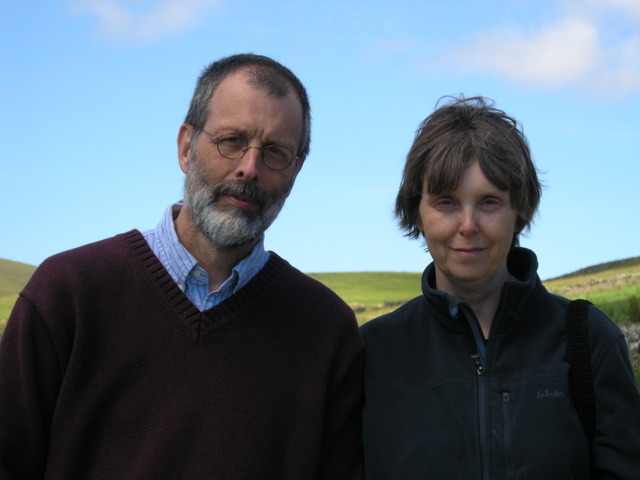
The photo of Jordan and Malie Smith above was taken by Evan Smith.

dg


A Poster of Steve Earle in Lerwick
— for Hugh Jenkins

In a grocery store window. The rain drives straight down
The glass, and no one’s on the glazed stone streets.  I buy
A couple of sweaters I couldn’t get anywhere else,
And a meal I could, and in the Shetland Times Bookstore
A Penguin edition of a saga about the earls of places like this.
It was brutal for years, the croft families scraping potatoes
Or barley from a little storm-raked soil, the men gone for months
In the sixareens for the offshore fishing, then salting
The catch to pay the laird his tax on a house that wasn’t theirs
In perpetuity and by divine right a bailiff enforced, so of course
It’s beautiful, this place people fled so as not to wreck themselves
In labor, and to sing of it you’d need a voice that calls
Us home, all of us, and not like sheep at shearing time, and not
To dwell on a cliff edge that was a mountain once, an earth
That was an earth, before history’s mantra of theft took another
Turn, and left us well enough alone, a tuft of wool on a stone fence.


Reading Another Swedish Mystery
One can still go slowly on skis in the winter sun…
                        — Tomas Transtromer, After a Death

We can go on skis. The body is always a little further
Than the snow, wandering a little further than sight. The snow
Is a cliff’s edge, the sound of skis a stalking. The detective
Drives a fine car, a necessary car though the suburbs,
Through the security of the state. He knows what we were promised,
How little we understand, how we undervalue it. He knows
Too little, too little for now. And somewhere, don’t ask yet,
The killer watches a dvd, or perhaps records one, a kind
Of documentarian. Is it cause or effect; is it ritual or enactment?
A grouse drums. The detective drums on his steering wheel.
In the intervals, consciousness seeks its level. Plumb and centered,
The man with the knife clicks Record.


Mr. Berryman in Ireland

The pictures in that Time-Life photo shoot,
Serious, kindly listening in the pub, the wild
Love of it, gestures rendering reason moot,
Embraces, his daughter helped through the stile
In the sheep fence and over wood and stone,
Such self-approving joy. For which, atone,

Atone. In the ruined chapel on Inish More
I built a little cairn upon the altar
As others had, as if I’d no more quarrels
With god or stone or self, as if I’d faltered
Happily into repentance, caught in the cant
Of going in fear of getting what I want.

The worst, he said, is the best gift.
On the Galway train, I want this calm of post-
Post-confessional, post-sabbatical thrift
Of heart, a solitary pint, a toast
To no one much. He interrupts. His songs,
Unquiet, grave brief lives. Art’s long.


On the Suicides at the NY/Canada Border

Yes, they step in the same river twice.
They present their bad passports, their reasons, their distracted evasions.
No, they will not be staying long, they tell the customs agents.
There are a thousand islands where they might reconsider,
Some with ruined castles, some with cabins that might have cramped Thoreau.
They stumble at the questions about age and destination. They swear allegiance
Too easily to our anger and our pity; they profess to honor
The deserters from the unjust war. They’ve had enough of fighting.
They imagine a city of bistros, accordions, tables on the sidewalks,
But it is under snow. They are safe. No tourist will mistake them for a compatriot.
In the bar, the old violinist plays a song that’s not sad enough,
And they share his panic as the notes fall off pitch. His fingers are stiff;
They share his suffering. They forgive his dissonance.
They forgive the fog, the geese that pass so loudly overhead.
They are in a position to forgive all imperfection, all transience, to forgive even us,
Burdened with our snapshots and souvenirs, who will not join them,
Not yet, at the café of good intentions and unmeant consequences
Where they have fallen—is it sleep?—into and despite of our sorrow.


The Burial of the Dead

The caretaker said there were five places left
In the family plot. My wife and I traded glances:
That’s one problem solved for our heirs and assignees.
A few minutes later I was kneeling, dirt caught
On my jacket sleeve and watchband as I placed
The urns, my mother’s, my father’s, in one grave.
It was windy now; October. The pastor read
Her sure and certain. What more could there be?
What solemn music? In high school band I played
William Byrd’s The Burial of the Dead. Sonorous,
And sad, and simple and tricky to make it so, not
Just the usual baroque complications.  The drive
From the interstate was all uphill on smaller
And smaller roads. My youngest son put a flower
On the grave; no one told him to. He knew.
The strife is o’er, the battle won. On every side,
Millers, Launts, Chamberlains, St. Johns. Kin.
No one told me to feel at home or offered a hand.
Not yet. The cemetery deed from the Twenties
Was filed neatly with my father’s will, signed
By his father’s father. I go to prepare a place,
The pastor read. Her black coat swirled. Dirt
In a wedge on my thumb. No frost on the flowers yet,
The caretaker said, though it’s so late. I shook
His hand. Come back, he said, now that you’ve been.

— Jordan Smith
—————————-

Jordan Smith’s sixth full-length collection, The Light in the Film, recently appeared from the University of Tampa Press. His story, “A Morning,” will be in the forthcoming issue of Big Fiction. He lives in eastern New York and teaches at Union College.

Jul 192011
 

Editor’s Note: Sharon McCartney’s poem “Katahdin” (below) has been selected by Carmine Starnino for inclusion in The Best Canadian Poetry in English 2012. The series advisory editor is Molly Peacock.

Sharon McCartney is an old friend, one of the Fredericton, New Brunswick (the centre of the universe—let’s be clear), literati, also a graduate of the Iowa Writers Workshop, also a prolific, prize-winning poet. These are poems about the body and transcendence, about the contradictions of love, about flying yet being buckled down—the normative tensions we all feel, in spades. Sharon is the author of For and Against (2010, Goose Lane Editions), The Love Song of Laura Ingalls Wilder (2007, Nightwood Editions), Karenin Sings the Blues (2003, Goose Lane Editions) and Under the Abdominal Wall (1999, Anvil Press). In 2008, she received the Acorn/Plantos People’s Prize for poetry for The Love Song of Laura Ingalls Wilder. It’s lovely to have her poems grace these pages. (Author Photo by Gabriel Jarman)

dg

Antiques Road Show, Kathadin & Other Poems By Sharon McCartney.

Antiques Roadshow, Katahdin & Other Poem

By Sharon McCartney

.

Giardia

The dog’s crushed mien, ears underslung, brow
low, as if he anticipates a cuffing, so mortified
by his unbidden inner turmoil, intestines bubbling.
He refuses his meat, corkscrews his torso, nose to ass,
as if to ask, Why? What does this mean? Or simply
to snap away the itching chigger of ignition. But
the root’s too deep, the inbound cysts redoubling
in subdermal subterfuge, his bowel’s womb warmth.
Poor sad thing. Empathy won’t cheer him, but I do
know how it feels, pain without meaning. Nowhere
to look but within. Whatever the cause, the impurity’s
source, he took it in, bad river water, morsel of carrion,
just as we all ingest delusion, denial, self-deceit,
the insalubrities that corrupt our gut and send us lurching,
chest-clutched, to the nausea of defeat, unmasked,
that demon in the mirror who points a digit and laughs.

.

Leg Press

Nearly prone, heels pushing ceilingward,
then ceding to gravity, to fear, knees descending
to sternum, a worthwhile grind in the hamstring.
The new pain is all self-inflicted, like gouging
a wound, a willingness to suffer and in that
extremity, transcendence, freeing oneself from
triviality. The bodybuilder says, pain is weakness
leaving the body. Each day a different muscle group,
yet always seeking symmetry, balance. He knows
it’s not what you lift, how many pounds, but how
you lift it, that the range of movement is what
quickens the muscle to consciousness. The bulge
of the quadricep surfacing like that awful awareness:
my love did not have to die, but I had to kill it.
.

Reverse Fly

Gravity’s the man beneath me, anchoring
me to the up-tilted bench, seductive, sweat-
beaded embrace that engages the rhomboid,
the rear delt. Not the weight, itself, but the force
that bestows weightiness, disheveled hombre
whose romantic fantasy feeds me, who would
drag me down if I did not resist, 17.5 lbs. in
each fist, straining back and away. Gravity’s
that urgency, the abyss of desire, divine madness
somewhere within that makes me not only gasp
for his illicit kiss in the dark, husk to husk, back
to wall, but also to beat him off, to disever.
Not the struggle, but the strength unearthed,
molten matter of nickel and iron inwardly spinning,
adamant and unrelenting, endless and unfathomable.
.

Katahdin

Why couldn’t I love him? He was all good morning
beautiful and you deserve to be spoiled, bringing me coffee
in bed, balancing the cups in that prissy way. Why couldn’t
I ignore that? His air of resignation, slumped behind the wheel,
always just under the speed limit, docile yes officer at the border.
Nothing on him to give those in authority what they want.
To my, this isn’t going anywhere, he said, well, I like what I see.
His respect for social order, corporations, the business section.
Not rights, but responsibilities. His regret for the years I spent
smoking dope. A whiz with engines, quadratics, but not overly
analytical. Something about beer, pizza and women, he said.
And mountains, escorting me to the top of Katahdin, a mile
high, on a lucent autumn day, a small Gore-Texed crowd
dazzled at the summit, taking in Chimney Pond, the knife
edge. But all I wanted to do was get back down.
.

First Flight in Five Years

No need for fear, nor hope, flight’s
timelessness coursing through me,
humming with the engine’s overture,
acceleration fueling euphoria as I dare
myself to look down, all of the paralytic
restrictions of the past, my anxiety of
incompleteness, grasping, as far away
now as the frost-heaved tarmac below,
wings tilting, banking, that wonky view
imparting a new perspective. Free of the
binary logic of groundedness, the be or
not be, pull and release. Yes, I’m buckled
in, book on my lap, as caged as the flock
of finches stowed, oddly, in the cramped
aft of this commuter aircraft, but I’m also
out there, aloft in the thin air, the updraft
of ambiguity, delimitation, giving in and
giving up and the transcendence of that,
birdsong, enginesong, dermis and hull,
indivisible as we ascend and turn.
.

Antiques Roadshow

But for his pearl buttons, he’s a dead-ringer
for my long-gone father, silver mop swept back,
comfortable paunch, blue hint of bemusement
in the iris. Arrives with an old Indian blanket
he’s slung over the back of a rocker forever.
Says it belonged to Kit Carson once. Dignified
in his discomposure, shifting on his toes.
He’s pleased to tell the story, his link to immortals,
but too proud to grasp. The appraiser’s apoplectic,
choking, his voice cracking, “Did you see my face?”
It’s a Ute “first phase” chief’s wearing blanket,
the purest form of Navajo weaving. Priceless
in its simplicity, yet the bidding would start
at half a million. More if the Carson link’s proven.
It’s like glimpsing my father crying in the garage
so many years ago to see this man’s unconcealed
confoundment. Overwhelmed, he confesses,
“There’s never been any wealth in the family.”
Now there is and all he can do is weep.
.

—Sharon McCartney

Apr 072011


Herewith the inaugural instance of a new Numéro Cinq series, the NC Interviews. Our first interviewee is my old friend Mark Anthony Jarman and our first interviewer is contributor Mary Stein. Mark and I knew each other at the Iowa Writers’ Workshop at the beginning of the 1980s. A long friendship with legs—last September, late one night (maybe early morning), Mark and I sat in his backyard with my publisher Susanne Alexander, drinking beer under the stars in Fredericton, New Brunswick, like old times. He edits fiction for a venerable Canadian magazine called The Fiddlehead which, in the 1970s, published some of my first short stories (and another story is coming out in the summer, 2011, issue). Mark has written a book of poetry, Killing the Swan, a hockey novel, Salvage King Ya!, four story collections, Dancing Nightly in the Tavern, New Orleans is Sinking, 19 Knives, and My White Planet, and nonfiction book about Ireland called Ireland’s Eye. He teaches at the University of New Brunswick and lives in a very large house fronting the Saint John River. His story “The December Astronauts (or Moonbase Horse Code)” appears in Numéro Cinq’s Best of Vol. 1.

dg

Mixes and Collisions: A Numéro Cinq Interview with Mark Anthony Jarman

By Mary Stein


MCS: Why don’t you start by telling me a little about your relationship to writing poetry versus writing prose. It seems it’s been decades since you’ve published a collection of poetry. Have you continued to write poetry since Killing the Swan, or does your prose writing satisfy your poetic impulses?

MAJ: After I published Killing the Swan, I had the feeling it had gone into a vacuum, and decided to put the same images and ideas into prose if I could manage.  There are things in poetry you can do that you can’t in an essay or story, but I feel it’s a very good influence on the latter in terms of editing, compression, attention to language, imagery, odd juxtapositions, implication, developing an eye and ear, etc.  I also feel there is too much weak poetry around and I don’t want to add to it; perhaps the government could pay us to not write poetry rather than fund more.  Great poetry is great, I was influenced by Eliot, Richard Hugo, Denis Johnson, Philip Levine, Sharon Olds, and had good teachers, PK Page, Phyllis Webb, but a lot of poetry strikes me as pointless.  Maybe I’ve been to too many bad readings.

MCS: In Burning Down the House, Charles Baxter writes, “Fiction writers get resentful, watching poets calling it quits at 9:30 a.m.” Do you ever lapse into moments of “poet envy” or does the fiction writer’s tireless pursuit of the right-hand margin suit you?


MAJ: I do torment the poets I know, teasing them that they can whip off a poem before breakfast whereas a story rarely happens quickly.

Continue reading »

Jun 152010
 

Mark Jarman Story- St. John River


Mark Anthony Jarman is an old friend dating back to our days at the Iowa Writers’  Workshop. He’s from Alberta, lives next to the Saint John River in Fredericton, New Brunswick, where he teaches at the university. He plays hockey, wrote a hockey novel, has three sons, and was a regular pick when I edited Best Canadian Stories. He is the subject of my essay “How to Read a Mark Jarman Story” which originally appeared in The New Quarterly and can be found in my essay collection Attack of the Copula Spiders. He writes the wildest, most pyrotechnic stories of anyone I know.

This story originally appeared in Darwin’s Bastards: Astounding Tales from Tomorrow, edited by Zsuzsi Gartner (Douglas & MacIntyre, 2010).

dg

/

The distance I felt came not from country or people; it came from within me.
I am as distant from myself as a hawk from the moon.

James Welch, Winter in the Blood

I was lost in the stars, but not lost, my tiny craft one of many on a loop proscribed by others, two astronauts far out in a silk road universe of burning gas and red streaks, and one of us dead.

Then the land comes up at us, the speed of the land rushing up like film and our Flight Centre men at serious blinking screens.  Our valves open or don’t open, the hull holds, the centre holds, little I can do.  The dead man is not worried.  I will not worry anymore, I renounce worry (yeah, that will last about three seconds).  The angle of re-entry looks weird to my eye.  I had to haul his corpse back inside for re-entry so he wouldn’t burn up.

In the city below me traffic is backing up into the arterial avenues.  They want to see us return, to fly down like a hawk with the talons out.

“Units require assistance.  All units.”

We are three orbits late because of the clouds and high wind.  They want to be there if there is a memorable crash, our pretty shell splitting on the tarmac into several chemical flash-fires engraved on their home movies.

We were so far up there above the moon’s roads, my capsule’s burnt skin held in rivers and jetstreams that route our long-awaited re-entry.  Up there we drive green channels riven in the clouds, ride stormscud and kerosene colours in the sky, then we ease our wavering selves down, down to this outer borough, down to rumpled family rooms and black yawning garages, down to the spanking new suburb unboxed in the onion fields.

I’m a traveler, an addict.  I descend from the clouds to look for work, I was up there with the long distance snowstorms.  It’s hard to believe I’m here again, hard to believe Ava became so uncaring while I was gone from the colony.


Ava’s messages are still there.  “This message will be deleted in 2 days.”  I press 9 to save it yet again.  I save her messages every ten days, my private archives, my time capsule, a minute of her lovely voice.

“Loved your last transmission,” Ava said in September. “It made me laugh!  And I loved the pictures you sent!  I can’t wait to see you.”

But then the change in October, the October revolution.  We are changelings locked in a kingdom of aftershave ads and good shepherds, lambs and lions and the Longhorn Steakpit’s idea of a salad bar.

Her messages were so very affectionate, and we’d lasted so long, so long, but in the end our messages were not enough.  Our words were not enough.  A week of silence and then a new message.  I knew it.

“Some bad news,” as Ava termed it.  She’d met someone else, she’d had a lot to drink, one thing led to another.  And I was so close.  Only a few days more.  But she couldn’t wait for me.  So long.

In the Coconut Grove bar in the afternoon I’m feeling all right.  I’m good at clarity and appreciation, but I’m slightly out of time.  Time slows and I lurk in it, I can alter it.  Do you know that feeling?  I drink and carefully move my head to study my world.  Venetian blinds layering tiny tendrils of soft light on us, the purple tennis court on TV, an AC running low, the lack of real sky.  It all seems okay, it all seems significant, it all seems deliberate and poised for some event.  But only to me, only I know this mood, this valiant expectation, this expedition into the early realms of alcohol.

Perhaps I am not quite right, but I savour the strange interlude.  I’m a lonely satellite in space, a craft drifting alone, drinking alone.  In this room the music is fine, the hops have bite – the perfect bar moment.

Then the bartender cranks up the volume on Sports TV and snaps to his phone, “The girl who cut my hair butchered it.  I didn’t have the heart to tell her, you suck.”

And that’s the end of my spell, the end of that little mission to Mars.  And I was so enjoying it.

“Hey dog, you flew with that dead guy, didn’t you?  And then your girl dumped you.  She’s hot.  Bummer, man.”  I wait until the bartender goes to the washroom to work on his hair and I exit without paying.


Maybe not the smartest idea, but I call Ava in Spain.  She left me, but she’s the only one who will know what I mean.

“What do you want from me?  Why are you talking like this?”  Her slight laugh.

Apparently I have some anger to work out.


Turquoise mountains at the end of the street remind me of Tucson or Utah.  The mountains of the moon.  I kill time walking.  Funny to be on foot once more.  The sun and earth – what are they to me?  I still orbit Ava, but she’s not there, no there there, so to what furious solar system do I now pledge my allegiance?  I still orbit her blue-eyed summer kitchen memories and the cordwood and pulpwood childhood in the north.

Need to change that orbit, need orbit decay.

In the building where she used to live they now deal ounces and eight-balls.  I was gone, Ava’s gone, the moon has changed.

Not sure I like the messages I’m picking up re the new frontier.  No one foresaw this, crystal and crank smuggled in to the colony, dealers and Albanian stick up crews and crummy walk ups, the adamantine miners working the face under Dwarf Fortress, all the single males earning big bucks in the catacombs and mineral mines, but with nowhere to go, the shortage of places to live, the exorbitant cost of milk, the new gang unit brought in, dead bodies on the corner with splayed hands and wrists smeared red with their own blood, and bouncers at the door working hard at that Russian look.  With the economy in the toilet the Minister of Finance is studying the feasibility of holding Christmas four times a year instead of two.


At the reception for me and some other space cowboys the party crackers lie like ashes on my tongue.  The fruit salad fallen from soldered tins; taste the fruits of duty.  My long periods of radio silence and now the noise of crowds and halls of ice cubes.

My brother-in-law Horse the detective is at the reception with a woman he says has just moved to the moon from Babylon to escape the war.  Delia looks nervous, as if still in a war zone.  Her family made her leave her home, smuggled her over the border, they feared for her life if she stayed.

Forget this place, they said of the only home she’s known, it doesn’t exist anymore.

“How do you like it here so far?”

Delia says, “People are very kind to me, but it’s not what I thought.”  She shrugs.  “All my life I wanted to see the moon, stared up at it.  But I miss my home, my family, my car, my brothers, the path to the river.”

“Can they visit?”

“No, it’s impossible now.”  The family had money, but now it is all gone, they are bankrupted by the war, the stolen gold, the extortion, the journey to other lands.  Her English is very good.

“How is the new job?”

“Horse can tell you better than I.”

“Brutal,” says Horse, “A ton of movement with the gangs, a lot of old grudges, eye for an eye.  We just had a 27 before we came here.”

“27?”

“It means he was already dead before we got there,” Delia tells me.  “Another young guy,” she says.  “They get younger and younger.  Children.”

Five phones ringing on the silent body, once so talkative, now so grave.  How may I direct your call?  How come it’s so easy to become a body?  He is past saving, his messages will be deleted in ten days unless someone who loves him presses save.


The woman from Babylon asks about my last trip in the light years, where I slept in far stars like fields sown with salt.

“Is it boring out there?  Is it better than here?”

“It was wild, hard to describe, almost religious.”

“What about when Curtis died?”

“I don’t know, he was just dead.”

Was it an accident or did he do it to himself?  This question is not in the press.  One time, after he was dead, I swore I heard a fly buzzing inside the windshield, that manic little taptaptap.  I turned my head slowly; there was no fly.  I had wires to my skin, an extended excellent dream.

I hear Delia speaking Arabic on her phone.  Her uncle is a consul in Vietnam with an Irish wife.  We, all of us, have come so far from home.


Very few of the December class returned alive.  There is a chance they are still out there, or else something is killing them, making them martyrs.  Or perhaps some Decembrists stumbled onto a beautiful world, and chose to not steer back to this one.  Why am I the only one who found a course home?  And to what?

It’s just survivor’s guilt, the detectives insist.  Take up golf.  Some good 18 hole courses on the moon, especially the Sea of Mares, Sea of Tranquility, condos with fake pools stocked with trout fingerlings.

“You can rent an AK at the range,” says Horse.  “Or sled down Piston Alley.”

Piston Alley is named for all the sled engines that have blown pistons on the long straight stretch.  The engine runs the best ever just before the piston shoots out like a tiny rocket.  I don’t really want an AK47.

In the NASA gymnasium the trainee astronauts play tag.  Astronauts get lots of tang; that was the old joke.  Poontang.  When I was out there I craved smoked salmon and dark beer.  The dead man went on for hours about steak and ice cream.  I have a few too many bank loans.  Curtis was outside when it happened, his air.


The woman from Babylon stares at me with her very dark eyes, says, “I wonder if perhaps you would help us in the interview room.”

Did Horse put her up to this?

He says, “The Decembrists are famous with the school-kids.”

“But with these jokers you pick up?”

Horse says, “You’ve always been better than me at reading faces.  You can let us know when it’s a crock.  We’ll have signals.”

Horse makes it seem like a job selling vacuum cleaners.

“Think about it.  Something to do.”

Something to do — he has a point.  Maybe a distraction from Ava in my head.  I have escaped gravity and achieved a kind of gravitas.  Yet I feel a broken shoe.  I can’t sleep (night and day), my mind locked on her with someone else (day and night I think of you), and the lymph nodes each side of my groin are swollen tight as stones inside a cherry; no idea what that’s about, what’s next, what’s approaching me.


They are ploughing a new road by the graveyard, by the old settlers and the new settlers in the cemetery under Meth Mountain.  The lumpy graves look to be making their slow way across the whitemoon’s dusty field, the dead in their progress to us, their magnetic message under clay walls and organic reefs and the moon’s Asiatic peaks just past the plywood windows of the closed mall.

Ava quit her job and got away, but when I filled out a Planet Change Request Form it was turned down by upstairs.  I know it’s not a planet, but that’s the form they use.  At the drive-through window on Von Braun Boulevard I order a combo and a willowy uniformed teen hands me a paper bag.

“Enjoy your meal.”

I drive to the carved-up picnic tables by Lost Lake.  Opening the bag, I find $6000.  They have handed me the day’s receipts.  Or gave something to the wrong car.  Someone will be pissed off.  And where are my fries?  I’m not driving all the way back down the mountain.

Now, how to use $6000?  Pay down the loans or just buy a giant TV?  I’ve always wanted a jukebox or to buy a bar in Nebraska.  Maybe I will.  I can learn things.  Ava said, Whosoever wants to be first must first be slave to all.  That night I sleep among the fences under stars where I rode so long.  Perfect carpentry is a thing of amazing beauty.


Downtown I see Delia walking by the Oppenheimer Fountain.  She seems shy.  I feel her lovely eyes hide something, some secret limit inside her.  Is she resigned to it?  I like the idea of a secret, like her face.


“So I can just ride along in the car?”

“Hell yeah you can ride,” says Horse.  “That’s it exactly.  A goddam team!”

I can ride, privy to the children selling ghost pills stepped on a few times, dividing the corners, eyes like radiogenic freeway lights.  It’s the Zombies versus the 68th Street runners, yellow flashes on a dark wall and the Indian Head Test Pattern, and from this world of instant grudges we pluck the sad eyed murderers and take them into Interview Room #2, where we strive to arrive at some form of truth acceptable to most of us.

Everyone loves truth.  Ava told me the truth, did she not?  She loves me, she loves me not.  It’s a gamble, shooting dice while clouds boil around the sun, goading the dominos.

Who controls the corner, the zoo?  We travel to the far corners of the universe, but we can’t control the local corner, can’t control the inside of our head.


In the interview rooms prisoners must be checked every 15 minutes.  Someone slumped there in a chair killed a son, a cousin, killed in the triple last time.  Horse walks in with his coffee.  It goes on, it goes on.

They seen you riding with Moonman and Mississippi and Ghost.

Seen me?

You been slinging dope?

I don’t know no Mississippi.

Tight bags of meth hidden in the torn baby-seat.

Where were you rolling?

Nowhere.  You know, just rolling nowhere.


By the fountain her gasmask matches her dress.  Males never quite exist for me — only women.  I don’t carry a mask; the air inside is fine, but she is very cautious and keeps it with her briefcase.

Five p.m. and the moon goes violet.  Free Fanta for all teens at the moon-base chapel.  She doesn’t drink and I am a spastic snake.

At dinner she doesn’t know she saves my life just by being there in front of me.  I’d rather she not know my sad history, my recent heartbreak.  It’s so pleasant to meet someone so soon after Ava, but still, the joy is tempered a tad by the prospect of it happening again, of another quick crowbar to the head.  But I resolve to be fun.  After the attack on the Fortran Embassy I resolve to be more fun.


Delia says she swam a lot in Babylon before the war, and she has that swimmer’s body, the wide shoulders.  She says, “I am used to pools for women only, not mixed.  I don’t want to swim in the moon-base pool.”

“Why not?”

“You’ll laugh.”

She doesn’t want to swim with strange men, but also fears catching some disease.

“I was hesitant to tell you about the pool.  I feared you’d laugh at me.”

“No, I understand perfectly.”

But now I want to see her in a pool, her wide shoulders parting the water, her in white foam, our white forms in manic buzzing bubbles, her shoulders and the curve of her back where I am allowed to massage her at night when her head aches.

Strange, Ava also had migraines, but I was rarely witness to them; she stayed alone with them in the whimpering dark and I would see her afterward.  Beside me in her room, Delia makes a sound, almost vomits over the edge of her bed, almost vomits several times from the pain, her hand to her lips, her hands to her face.


Delia is very religious, very old-fashioned, jumps away in utter panic if I say one word that is vaguely sexual, yet she delights in fashion mags and revealing bras and cleavage in silk and she allows my hands to massage her everywhere when she aches, allows my hands to roam.

“How do you know where the pain is,” she asks me, her face in pillows.

I don’t know.  I just know how to find pain.

At Delia’s kitchen table we study maps in a huge atlas, Babylon, Mesopotamia, Assur, where she says her ancestors were royalty in a small northern kingdom.  I love the small kingdom we create with each other in our intimate rooms or just walking, charged moments that feel so valuable, yet are impossible to explain to someone else.  I saw her in the store, saw her several times in the middle aisles, knew I had to say something.

“I noticed you immediately, thought you were some dark beauty from Calcutta or Bhutan.”

“You saw me several times?  I didn’t notice you.”

“But you smiled at me each time.”

“Everyone smiles at me,” she says brightly.  “And you whites all look the same,” she adds, and I realize she is not joking.


Her white apartment looks the same as the other white apartments, windows set into one wall only, a door on another wall.  I realize both women have apartments built halfway into the ground, a basement on a hill.  Yet they are so different.  Ava’s slim Nordic face pale as a pearl and her eyes large and light, sad and hopeful — and Delia’s dark flashing eyes and flying henna hair and pessimism and anger and haughtiness.  Ava was taller than me, tall as a model.  Delia is shorter; I find this comforting.


I close my eyes expecting to see Ava’s white face, but instead I’m flying again, see the silver freighter’s riveted wall, the first crash, then sideswiped by a Red Planet gypsy hack, a kind of seasickness as the Russian team ran out of racetrack, Russians still alive, but drifting far from the circular station lit up like a chandelier, their saucerful of secrets, drifting away from their cigarettes and bottles, from a woman’s glowing face.  So long!  Poka!  Do svidaniia!


The young woman in Interview Room #2 speaks flatly.

They killed my brother, they will kill me if they want.

We can help you.

She laughs at Horse.  You can’t help me.

Who to believe?  I want to believe her.  She got into a bad crowd, cooking with rubber gloves, the game.  Our worries about cholesterol seem distant and quaint.  She’s not telling us everything, but we can’t hold her.


“I’ve come into some money if you need a loan.  It’s not much.”

Delia raises her dark eyebrows in the Interview Room, as if I am trying to buy her with my paper bag of cash.  Maybe I am trying to buy her.

“And how am I supposed to pay you back?  I have no prospects.”

On her TV the handsome actor standing in for the President tells us we must increase the divorce rate to stimulate the economy.  We need more households, more chickens in the pots.  I am sorry, he says, I have only one wife to give for my country.  We switch to watch Lost in Space re-runs.


At night I ask my newest woman, my proud Cleopatra, “Is there a finite amount of love in the universe?  Or does it expand?”

“What?”

“Well, I didn’t know you and no love existed, but now I love you, so there is that much more.”

“Say that again,” she asks, looking me in the eye.

I repeat my idea.

“I think you are crazy,” she says.  “Not crazy crazy, but crazy.”

I am full of love, I think, an overflowing well.  Perhaps I supply the universe with my well, perhaps I am important.  Her full hips, the universe expanding, doomed and lovely, my mouth moving everywhere on her form.   The bed is sky-blue and wheat gold.

“How many hands do you have,” she asks with a laugh in the morning, trying to escape the bed, escape my hands: “You’re like a lion!”

She is trying to get up for work.  My first time staying over.  I am out of my head, kiss me darling in bed.  Once more I can live for the moment.  But that will change in a moment.


My ex on earth watches our red moon sink past her city.  The huge glass mall and my ex on an escalator crawl in silver teeth, at times the gears of the earth visible.  We are all connected and yet are unaware.  Does Ava ever think of me when she sees us set sail?  We hang on the red moon, but Ava can’t see us riding past.


“How many girlfriends do you have?” Delia asks, tickling me.  “Many?”

“Just you.  Only you.”

“I don’t believe you.  I know you flyboys.”  She laughs a little at me.

“How about you?” I ask.  A mistake.

She turns serious, conjures a ghost I can never hope to compete with.  “My fiance was killed,” she says quietly.  “He was kidnapped at a protest and they found him in the desert.  His hands were tied with plastic.  My fiance was saving to buy me a house.  My parents told him that I wished to go to school before we married and he didn’t mind.  My parents sold their property for the ransom, but the men killed him regardless.”

I remember my parents’ treed backyard; I tilted the sodden bags of autumn leaves on end and a dark rich tea came pouring out onto the brick patio.  Do the dead watch us?  There were bobcat tracks: it hid under the porch.


Horse says, You know why we’re here?

I watch the boy’s face; he is wondering how much to admit.

Got an idea, he says.

The rash of robberies and bodies dumped in craters and the conduit to the Interview Room and my irradiated bones that have flown through space and now confined in this tiny Interview Room.

You never sell rock?

Like I told you, never.

He’s got a history.

Somebody’s took the wallet before they killed him.

Holy God.  Holy God.  Dead?

The man is dead.  We need the triggerman.

This the t’ing.  I have no friends.  I learned that.

The young man wants to pass on his impressive lesson to the interrogators, but he has misjudged, his tone is all wrong.  He thinks he is good, world-weary, but he hasn’t seen himself on camera, has no distance.  The face and the mind, O the countless cells we represent and shed, the horseshit we try to sling.

Man, they had the guns!  I was concerned with this dude shooting me in the backseat.

Down the road, what will haunt the victorious young tribes?  They’ve heard of it all, but still, nothing prepares you.


You have your ways, Delia says, you can control me.

I wish.  I can manipulate her, get some of her clothes off, but I need her more than she needs me.

She says, I don’t think I can control you.

I can’t tell if she thinks this is good or not.  We spend time together, but I have trouble reading her, can’t tell if she likes me.

Delia is not adjusting well to being here.  She hates the lunar landscape, the pale dust and dark craters past the moon’s strange-ended avenues.  She is weary of the crime, the black sky.

“The weather,” she says, “never a breeze, never normal, either one extreme or another.  Killer heat, fourteen days!  Boil to death!  Or else so cold.  Fourteen days, freeze to death!  Cold then hot, hotthen cold.  And there are no seasons.  At home summer is summer and winter is winter.  Food here has no taste, has no smell.  I hate everything and then I hate myself.  All my life I wanted to meet the man in the moon and now I’m here.”

“You met me.”

“Yes, that’s true.”

I wish she spoke with a bit more enthusiasm on that topic.

She is losing weight since moving to the moon.

This is not acceptable, she says to the waiter. You would not serve me food like this on earth.

But we’re not on earth.  Forget earth.

I’ll make you some of my own, she says to me later.  Which she does, a creamy and delicious mélange at her tiny table in the apartment.

Sunday I bring my bag of illicit cash and we shop for fresh spices.  We hold hands, touching and laughing in the store, fondling eggplants that gleam like dark ceramic lamps.  We are the happy couple you hate, tethered to each other like astronauts.  I am content in a store with her, this is all it takes, this is all we want now, red ruby grapefruit and her hard bricks of Arabic coffee wrapped in gold.


Romance and memories and heartbreak: One war blots out an earlier war, one woman blots out the previous woman’s lost sad image, one hotel room destroys the other, one new ardent airport destroys the one where I used to fly to visit her.  The only way I can get over her.  We are prisoners, me, her, bound to each other like a city to a sea, like a kidnapper to a hostage.

Why did Ava leave me when we got along so well?  It was so good.  I think I lost something human in the blue glow of that last long flight.  Will it keep happening to me?  Now I am afraid. The Russians from Baikonur Cosmodrome never returned, the sky closed over them like a silver curtain, like the wall of a freighter.

They went away and I was inside my damaged capsule, inside my head too much, teeth grinding in ecstasy, quite mad.  They had me on a loop, my destiny not up to me.  We are abandoned and rescued, over and over.  But who are our stewards?


We went backwards to the stars.  For months rumours have suggested NASA is near bankruptcy, bean counters are reorganizing; my pension is in doubt, as is the hardship pay I earned by being out there.  Now we are back to this surface, back to the long runway and smell of burnt brake pads by the marshes and Bikini Atoll.

Me alone in the photograph, the other travelers erased.  Or are they out there still, knowing not to come back?  You can’t go back to the farm once you’ve seen the bright lights, seen inside yourself.


One day I delete Ava’s sad lovely messages.  Why keep such mementos?  You burn this life like an oil lamp.  You make new mementos, wish they could compare.

I remember parking the car by the dam with Ava.  The car was so small we had to keep the doors open as I lay on top of her, but the dome light had no switch.  To keep us in darkness I tried to hold one finger on the button in the door and my other hand on Ava.  That ridiculous night still makes me laugh, but I need to forget it all, to delete every message and moment.


You are unlucky in love, Delia says.  The God is fair and distributes his gifts and clearly you have many talents, but not luck in love.

Is she right?  I had thought the opposite, that I had inexplicably good luck that way, but now I wonder; she does seem to know me better than I do myself.  I was lucky to know Ava, but now my thoughts are distilled: Ava was too tall, too pretty, too kind.

What I thought was good fortune was bad fortune.  Was I bad luck for the Russians?  Did I kill Curtis?  Strangely, I feel lucky to have met her, to have crossed paths in the long florescent aisles of the store.  With my cash from the drive-thru I buy her shoes, an ornate belt, French dresses.  She is very choosy, but I like to buy her things.


In her room when I squeeze her hard she calls me a lion.  Says I will devour her.  I want to devour her, her ample flesh.  My tiger, I call her.  My tiger from the Tigris will turn.  Friday night and we don’t talk, no plans do we make.  I thought that was kind of mandatory.  Are we a couple or not (Is you is or is you ain’t my baby)?  It is odd to not know.

Desire has caused me so much trouble in my life, but I miss it when it is not around.  Living without desire – what is the point of life without desire?

Perhaps that is a question an addict would ask.

Perhaps I am not unlike that French youth – you must have read of his sad sad plight – rejected by a circus girl with whom he was in love.  A circus girl!  I love it.  The poor French youth committed suicide by locking himself in the lions’ cage.


I was locked in a cage, tied in a chair, in a capsule’s burning skin, hairline cracks like my mother’s teacup.  A rocket standing in a pink cloud and I am sent, her pink clitoris and I am sent, 3,2,1, we have ignition, my missions hastily assembled, mixed up, my mixed feelings as I move, my performance in the radiation and redshift.  The officials and women are telling their truth about me.  I was thrown like an axe through their stars.  I was tied in a chair, a desert, waiting.  When the engines power up – what a climb, what a feeling!  And who is that third who hovers always beside you, someone near us?  When I count there are only you and I together – but who is that on the other side?  1,2,3.  3,2,1.


Why can’t Delia say something passionate to erase my nervousness?  I have to live through someone else.  Why can’t I be aloof, not care.  I used to be very good at not caring.  But when Delia hates the moon I feel she hates me, when she says she has no money and that the moon is dirty!, too hot!, too cold!, then I feel I’ve failed her with my moon.

Why does she not say, Come to me my lion, my lost astronaut, I love you more than life itself, my love for you is vaster than the reaches of the infinitely expanding universe, oh I love you so much, so very much.  But no one says this.  Her expanding clitoris under my thumb.  She is calm, she is not passionate.  But she is there, I’m happy when she is near.  After my trip I crave contact.


I am being straight with you, swear to God.  I had a couple of ounces.  He was on me – it was self defence.

Did he have a weapon, Delia asks.  How can it be self defence if he didn’t have a weapon?

Friends we question say the dead man was always joking, always had a smile.

We were sitting there, the kid says.  The gun went off, the kid says, and he fell out.

It went off.  Delia tells me they always word it in this passive way, as if no one is involved and, in a kind of magic, the gun acts on its own.


Government people contact Delia.  Don’t be afraid, the government people say to Delia, which makes her afraid.  They visit her at her apartment, claim they are concerned that a faction in the war at home may try to harm her here.

Has anyone approached her?

No, she says.  No one from home.

Has she heard from her uncle in Vietnam? they wonder.  Is he coming here?

They were very nice, she tells me, they bought me lunch.

I look at the white business card they gave her; it has a phone number and nothing else.  My hunch is that they are Intelligence rather than Immigration.  She asks questions for a living and now she is questioned by people who ask questions for a living.  Now I worry we are watched, wired, wonder if they hear me massage Delia’s shoulders and her back and below her track pants and underwear, if they hear us joke of lions and tigers.


In the interview room: He owed me money so I hit him with a hammer.  He was breathing like this, uh uh uh.


A day here is so long.  At Ava’s former apartment building I pick up my old teapot, books, and an end table from the landlord’s storage room.  The aged landlord’s stalled fashions, his fused backbone.

“Young man, can you help me with the Christmas tree?”

Of course.  I like to help.  He was one of the first here.

“The moon used to be all right,” he says.  “Now it’s all gone to hell.”

He gives me a huge apple pie from the church bake sale.  They attend church religiously, they’ll be in the heavens soon.

And poor Mister Weenie the tenant evicted from his apartment down a red hall.

What was his life like, I wonder, with a name like Weenie?

Horse laughs when I tell them, but Delia doesn’t get the humour.

Now it’s on the books as The Crown versus Weenie. How he yelled in a red hall.

“I belong in there!” he hollered, pounding at the door closed to him.  “I belong in there!”


Mister Weenie pounds at doors that once opened for him, and I wonder where we belong and who do we belong with.  In times of great stress, says science, the right brain takes over like a god and the left brain sees a god, sees a helpful companion along for the ride, an extra in the party.  Does Mister Weenie see a helpful companion?

My ex quit her job to move to Spain.  Ava has always loved the sun, the heat in Spain, the food, the language, the light.  On a weather map I see that Spain has a cold snap and I am happy, as I know Ava hates the cold.  I want her to be cold and miserable without me.  I am not proud of this part of me.


Delia reads from a childhood textbook that she found in Ava’s belongings: “Our rocket explorers will be very glad to set their feet on earth again where they don’t boil in the day and freeze at night.  Our explorers will say they found the sky inky black even in the daytime and they will tell us about the weird, oppressive stillness.”

“It’s not so bad,” I say.  “The stillness.”

“It isn’t at all beautiful like our earth,” she reads.  “It is deadly dull, hardly anything happens on the moon, nothing changes, it is as dead as any world can be.  The moon is burned out, done for.”

Delia endured a dirty war so I admire her greatly. She gets depressed, refuses to leave her room.  Where can she turn?  Her Babylon is gone, the happy place of her childhood no longer exists, friends dead or in exile or bankrupt or insane.

My dark-eyed Babylonian love, my sometimes-passionate Persian – where will she move to when she leaves me?

Out the window are astral cars and shooting stars.  Where do they race to?  I know.  I’ve been out there, nearer my god to thee, past the empty condo units, the Woodlands Nonprofit Centre for New Yearning, the Rotary Home for Blind Chicken-Licken Drivers (hey, good name for a band), the Rosenblum Retirement Home (Low Prices and Low Gravity for Your Aching Joints).

My happiest moments with my mouth just below her ample belly, I forget about outer space, her legs muffling my ears, a gourmand of her big thighs, her round hips, surrounded, grounded by her flesh; I have never liked flesh so much as with her.  The world only her in those charged moments, my brainstem and cortex and molecules’ murky motives driven by her and into her.  The devil owns me.  No devil owns me.

The valves on my heart are wide open.  I have no defences, sometimes I am overflowing with affection – and I have found this is a distinct disadvantage when dealing with others.  I never want this to end; so what do you suppose will happen?


The crowd pays good money to file into the old NASA Redstone Arena, into the band’s aural, post-industrial acres of feedback and reverb.  The band used to be someone, now they play the outposts.  We are happy to see them here.

The woman singer moans, Don’t you dog your woman, spotlights pin-wheeling in the guitarist’s reflector sunglasses.  She sings, I pity the poor immigrant.

We will remember, we will buy t shirts, souvenirs, get drunk, hold hands on the moon.  We will remember.

Later the ambulance enters the moonbase arena, amazed in pain and confusion.

The white ambulance takes away one body from us so that we can see and not see.  Carbons linger like a love song for all the coroners in the universe.  One casualty is not too bad.  Usually there are more.  An OD, too much of some new opiate, some cousin of morphine, too much of nothing.  You pay your money and you take your chances.

Who calls us?  The ambulance tolls for someone else.  Who owns the night, owns the night music of quiet tape hiss and music of quiet riches and debts in messages and missives from the crooners and coroners and distant stars?  I have learned in my travels that the circus girls own the night, and the Warriors and Ghosts and Scorpions run the corner.  They have the right messages.


And come Monday or Tuesday the interview room still waits for us, will open again its black hole, its modest grouping of table and walls and the one door.  But Delia books off work: the war, the government people, the questions.

Say that one more time?

Who do you think did this?

Dronyk.

Dronyk says you did it.

Who’s bringing it in?

Who.  That’s a good one.  Who isn’t!  Man, who’s bringing it in.  Can I have a smoke?

The room – it’s like a spaceship for penitents; we climb in and explore a new universe, their universe.  Fingers to keyboard: does he show up on the screen?  A hit, a veritable hit, he’s in the system, the solar system.


I don’t want her to worry, but I want to know that she knows.

“Those government people asking you questions; they may not be who they say.”

“I know that,” she says.  “I wonder if they are watching us now?”


We watch Delia’s TV.  In the upscale hotel room the actor states to the reporter, Friend, for this role I had to go to some very dark places.  He was gone for a while, celluloid career gone south, the actor is hoping for an award for this project, a comeback in the movies.

Gone?  I’ll tell him about being gone.  I went up past the elms and wires, past the air, past the planets.  Where did he go?  A piano bar, a shooting gallery in the Valley, a dive motel in the wilds of Hollywood?  The actor went nowhere.


When you return to a place that is not your home, is it then your home?  I insist she go out with me and then I fall into a fight on Buckbee Street in the fake Irish bar (yes, fake Irish pubs are everywhere).

“Hey, look who crashed the party.  It’s that rug-rider cunt who sent me to jail.”  The slurring voice in the corner, a young man from the interview room.

The brief noise of his nose as I hit him and he folds.  Granted, it was a bit of sucker punch.  Why oh why didn’t I sprint out of the fake Irish pub at that point?  I stuck around to find myself charged with assault.  Aren’t you allowed one complimentary punch at Happy Hour?


Now it’s my turn to be asked the questions in Interview room #2.  I’ve been here before, know the drill, I know to stonewall, to lawyer up.

What the hell were you doing?

Wish I could help you, Horse.  Really do.  Beer later?  Chops on the grill?

Mine may be the shortest interview on record.


Delia says to me, Stand against that wall.  Face forward.

The camera flashes in my eyes.

Now please face that wall.  The camera flashes.


After the fight in the fake Irish bar Delia gets depressed and doesn’t want to see me for a week, lunar weeks, it drags on, which gets me depressed that she is depressed in her subterranean room andwon’t let me even try to cheer her up, have a laugh.

“No, I’m in a hopeless situation,” she says on the phone.  “I don’t want a temporary solution.”

“Everything is temporary.”

“That is true,” she admits.  “Everything is temporary.”

But, I wonder, what of Curtis?  Gone, permanent.  Ava?  Gone.  Is that permanent too?  I feel myself falling from the heavens.

“Are you hungry?  Let’s go out,” I beg.

“There’s nowhere to go here.  I’ve told you, I don’t want temporary solutions.”

“Can I come over?”

“I’m tired of questions.  No more questions.”


The other astronaut, Curtis – I wonder if I’ll ever know for sure whether it was a malfunction or suicide.  Curtis might have tinkered with his air and made it look like an accident, a design flaw, or his air went and it was horrible.  I often wonder where I’d like to be buried; perhaps he wanted to die out there.  Flight Centre instructed me to tether him outside to the solar array until just before we got back; didn’t want him stuck out there burning up when we made our grand entrance.  Maybe Curtis wanted to burn up, the first outer space cremation.  It’s almost poetic, but the Flight Centre would not see it as good PR.


You know who strangled the old man?  You know who did it?  A fuckin stupid crackhead!

He is pointing at himself and in tears.  It’s Ava’s landlord who is dead.

I fouled up good, says the aged addict.  Using that stuff wore me slap out.

His craggy face.  He is sincere, his hard lesson.  But he is somehow alive.  His prints don’t match his face, but I can read his mind.  By the power invested in me.  He is thinking like a cheerleader, he is thinking, I must look into the future.

Yes, I tell myself, I too must remember there is a larger world out there, a future.  I too must think like a cheerleader.


“This has worked a few times,” my lawyer says before we file into the courtroom.  “You guys are the same build. Both of you put on these glasses and sit side by side.”

The judge asks the victim, “Do you see him in the courtroom?”

“He bumped my table, he spilled my drink and then it all went dark.  I had a bad cut over my eye.  I couldn’t see nothing.  Dude was on top of me wailing all over me, and it went dark.”

Wailing?  I hit him once and he dropped.

“So you can’t point out the assailant?”

“Hell if I know.”

His girlfriend takes the stand, says, “It might be one of them over there.  I thought he was going to kill him, beating him and beating him.  I remember the third guy, that tall white-haired feller.”

They cannot ID me.  The judge throws out the case, my lawyer makes his money, the truth sets you free.


After my lawyer takes his cut I still have $3000 of the $6000 cash in the paper bag.  She’s so sad.  Delia saved me, but can she save herself?  Delia believes that her God takes care of her.  I guess I don’t need to buy a bar in Nebraska.  With my cash I buy her a ticket back home to the Hanging Gardens, a visit, but I suspect she’ll stay there or land a more lucrative job in Dubai and never return from the sky.

You are nice, she says.

Because I like you.  I like you a lot.

Thank you, she says.

She never says, I like you.  Just, Thank you.


The Interview Room is never lonely for long.  Who did it?  Why?  Someone always wants to know.  We come and go like meteors, Horse at his desk staring.

That’s the one was running.

Did you see the shooter?  Did you see?

I ran off, I didn’t see anything.

No one sees anything.

Why did she leave when I was almost there?  Who shot him?  Who was the third guy?  Don’t know a name.  I ran.  Give me your money, I heard him say, then Pop pop pop!  Man I was gone.  No need for it to go that way.  I don’t want to do nothing with nothing like that.  Maybe Eliot did it.


This is good, this is rich: a collection agency calls my voicemail using a blocked number.  The young hireling tries to be intimidating.  It may be the loansharks or skip tracers or maybe the poor Burger King clerk at the drive-thru wants his paper bag back.

“Reply to this call is mandatory,” the dork voice speaks gravely on my voicemail.  “Govern yourself accordingly,” he says, obviously proud of this final line.

Govern myself?  I love that, I enjoy that line immensely, much the way the roused lions enjoyed the French youth’s heartbreak as he walked in their cage, as he locked himself in their interviewroom.  You sense someone else with you, you’ll never walk alone, and the empty sky is never empty, it’s full of teeth.


Maybe I’ll re-up, sign on for another December flight, collect some more hazard pay, get away from everyone, from their white apartments and blue eyes and dark eyes.  Be aloof, a change of scene; maybe that will alter my luck.  I’ll cruise the moons of Jupiter or Titan’s lakes of methane, see if I can see what’s killing the others.  Once more I renounce worry!  And once more that notion will last about three seconds.


One Sunday Delia phoned at midnight, barely able to speak.

What?  I can’t hear.  Who is this?

A delay and then her accented Arabic whisper: I have headache.

I rushed over with medicine for her migraines and some groceries, sped past the walled plains and trashed plasma reactors in the Petavius crater.  I was happy to rush to her at midnight, happy that she needed me to close the distance.

In her room I saw that she had taped black garbage bags to the windows to keep light from her eyes, her tortured head.  I unpacked figs and bananas and spinach as she hurriedly cracked open painkillers.

“Thank you for this,” Delia murmured quietly with her head down, eyes hidden from me.  “I know I bother you, but this is hard pain.  Every day I will pray for you.  Every day I pray the God will give you the heaven.”

—Mark Anthony Jarman

/
/
/