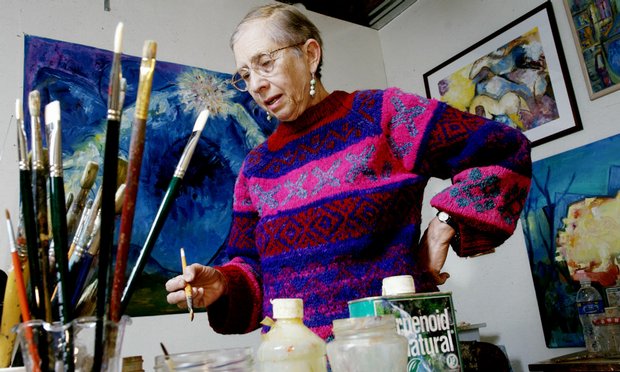
Apr 062012
 

Over the past four decades, Gladys Swan has published six collections of short stories and two novels, Carnival for the Gods (Vintage Contemporaries Series), and Ghost Dance: A Play of Voices, nominated by LSU Press for the Pen/Faulkner Award.  Her short fiction appears in a variety of anthologies and in such literary magazines as the Kenyon Review, Sewanee Review, Virginia Quarterly Review, Colorado Review, Shenandoah, and the Ohio Review.  She is the recipient of numerous honors and awards, including Prairie Schooner’s Lawrence Foundation Prize for Fiction, and a Tate Prize for Poetry from the Sewanee Review.  In addition to receiving multiple fellowships for residencies and retreats in both the visual arts and in writing, she was awarded one of the first Open Fellowships from the Lilly Endowment, for a study of Inuit art and mythology. Swan’s The Tiger’s Eye—A Collection of New and Selected Stories was published by Servinghouse Books in the fall of 2011.

To view a selection of Gladys Swan’s paintings published earlier on NC, click here. Read her wonderful short story “The Orange Bird” (from The Tiger’s Eye), click here.

§

Joyce J. Townsend: What prompted the publication of your latest short story collection at this point in time?

Gladys Swan:  The Tiger’s Eye is a milestone of sorts, representing forty years of work in the short story.  It serves as a retrospective, a chance to look back and see where I’ve come in this particular genre.  I hadn’t read most of the stories for years, so it was interesting to see what has held my attention, what motifs have recurred, what I’ve discovered along the path.

JJT: How were you drawn to the writing life?

Swan: I suppose at heart it’s a matter of temperament and thereby a kind of fate.  I was propelled early on by an impulse I didn’t really understand.  A need, I think, to define my experience somehow, to discover a way of looking at the world, to find some kind of orientation in a place where I was a stranger.  Then it became a fascination with what the imagination could know, a satisfaction in doing the work no matter what, after a long struggle, “a lonely impulse of delight,” to borrow a line from Yeats.

JJT: What moved you from creative writing to the visual arts?  Or did it happen the other way around?

Swan: I was drawn to the visual arts as a child.  I remember trying to paint a horse and being terribly frustrated when it didn’t come out right.  When I got to high school, I took a painting class sponsored by New Mexico Western College.  Dorothy McCrae, a wonderful artist and teacher, oversaw the class and came in at various times to work with the student instructor.  She put me in touch with my imagination.  I didn’t realize how much I owed Dorothy until later.

Although I was also trying to write, and felt great excitement about literature, I took another painting class when I attended New Mexico Western College, and I continued to sketch and paint a little as I went along.  As it began to appear that I was never going to get published, I started working in ceramics—making bowls was better than collecting typescript.  A pivotal moment for me came when I was awarded a Lilly Endowment Open Fellowship for a project in art and mythology.  I went up to Purdue and took every art course I could manage, and then I put all that aside when, all of a sudden, my writing began being published.  But I couldn’t stay away: I had spent so much time over the years in art museums that finally I couldn’t stand it any longer—I had to paint.

After I began teaching creative writing at the University of Missouri, I took art classes there.  I’ve had some fine teachers along the way, people I still spend time with, to whom I owe a great deal for their support and inspiration, among them Woody Johnson from New Mexico Western College, and Curt Stocking with whom I studied figure-drawing at Purdue.  Here in Missouri, Frank Stack, Brooke Cameron, Ben Cameron, and William Berry have been influential, and Robert Friedman and Bede Clark in ceramics.

JJT:  In what ways do you see the two creative processes affecting each other?

Swan: The visual arts engage the senses in a different way, perhaps closer to the way the mind works when rational thinking is not imposed on it.  You have a flow of images.  Art works with those images—words and definitions come later.  The process is non-linear.  Its language is color, line and mass, pattern and rhythm, light and dark.  It offers me a great refreshment to get out of words, and I love playing with color.  Attention to the act of seeing makes me observe the world more closely, its lights and shadows, its tones and variations, its people, their expressions and gestures.  Art offers a new and continuing opportunity for discovery.  I believe that is reflected in my writing.

JJT: Do you find similar patterns between writing and the visual arts emerging for you?

Swan: Patterns there are, and more.  I believe that it is very beneficial for an artist to work in another medium, whether it be music or dance, drama or painting.  There is no direct equation, but one art form influences the other in interesting and subtle ways.  You learn things about form and pattern, rhythm and emphasis.  You get another take on how you see the world.  Also, when you are learning to work in a different medium, you recognize similarities in the creative process, what stages you have to go through before you reach any kind of mastery.

JJT: When you first started out as an artist and writer, whose work most influenced you?

Swan: Strong influences shaping my mind and imagination came from the writings of Carl Jung and Joseph Campbell, and the works of Homer and the Greek playwrights.  I discovered Jung when his books were first translated: Psychology and Alchemy and Symbols of Transformation.  They introduced me to the idea that there was another kind of thinking beyond that of the rational mind, and it was one to be equally valued, with treasures to be gained from it: enrichment from unconscious sources, the potentials for human growth and realization, as well as insight into the dark side of human behavior.  Joseph Campbell was especially helpful in locating the patterns and stages of human experience, the truths embodied in mythology.  It was helpful to return to origins.  Those insights were certainly underscored by Dante, that great psychologist, and the work of Dostoyevski, Conrad and Hawthorne, among others.  All the writers mentioned gave me a sense of the heights literature can reach.

Probably the writer who influenced me most when I was starting to write short stories was Katherine Anne Porter.  Her stories were gems.  She set me on the path.

There were a good many artists who inspired me in the visual arts, particularly the Impressionists and early Modernists.  Curiously, as my writing has moved more in the direction of the fantastic, my painting has gone more in the direction of the abstract.  Klee, Kandinsky, Diebenkorn, and Joan Mitchell have been very important to me lately.  In watercolor, John Marin, Charles Burchfield, Georgia O’Keefe, and Keith Crown have influenced me strongly.  Keith Crown is an artist who deserves to be better known.

JJT:  What has been the best advice you received along the way and, conversely, what was the worst?

Swan: I think the best advice came from Thoreau: “Live in the direction of your dreams.”   Maybe the worst advice was embodied in the question an agent asked me with great irritation after she’d read the first fifty pages of Carnival for the Gods, “Can’t you just write a good commercial novel?”  From Frank Stack, a well-known underground cartoonist and fine painter, came the statement: “Only you can empower yourself as an artist.”  From him, I also learned not to destroy work—always a temptation—until you’ve let it sit around for a while.  That way, you have some distance and can make a better judgment about it.

JJT:  You’ve written essays, translations, poetry, prose, and various other forms.  Do you have a favored format or genre?

Swan: I thought I would live and die a short story writer since I played in that form for so many years.  But as I have made other rewarding ventures, I would say that I’m wedded to whatever form I happen to be engaged with at the moment.  Each allows a certain kind of emphasis and way to explore.  I am guided by an old aesthetic principle: vision dictates form.  The materials themselves make the suggestions emerge in the way they require.  You have to keep listening.  The novel allows a broader reach, and I appreciate its scope: with the chance to develop more characters, to give more time to social and political issues.  With poetry, I love the focus on image, the chance to engage all the resources of language, to link them to narrative and song.  The essay is rather a late development for me, and I find a satisfaction in exploring a subject through a process of thought.  I could say that the short story is my first love, since I keep coming back to it, but I enjoy the excitement of playing with form.  There’s an unfinished play still lying in the drawer . . ..  And the visual arts—that’s a whole other territory.

JJT: In retrospect, what emerges as major recurring themes in your short fiction throughout your career?

Swan: I think a major preoccupation has been the effort to determine what is meant by “experience.”  Flannery O’Connor once said something to the effect that the greatest tragedy is not to have experience.  What I think she meant is that there is considerable difference between event and experience.  At first I thought that experience meant that something of great magnitude had to occur.  Then I discovered that some people have extraordinary things happen to them, but essentially nothing much changes except the addition of a few anecdotes.  “We had the experience, but we missed the meaning,” as Eliot notes.

I believe that experience brings about a different perspective, a way of seeing and, for better or worse, a different way of being in the world.  It can awaken new potentialities for growth or bring about a shattering of illusions.  The subject of experience is complex and takes one into deep mysteries.

JJT:  What effect does change of locale have on your writing in terms of both story content and the act of writing?

Swan:  Any change of local is like traveling to a foreign country.  Some offer strong contrasts in language and people, landscape, and way of life.  So whether I’m in Maine or Missouri, New Mexico or France, there is a great deal to take in.  Locale has certainly had a great effect on the content of both my novels and my short stories.  I left New Mexico at a young age, but in a strong sense, I’ve never left.  It has been the primary territory for my imagination although other work is set in places where I’ve spent long and short periods of time.  I’ve written half a dozen stories set in Maine, where I have lived for nearly forty summers, taking in the whole ambience of the place, its landscape, the coastal region, Down East, as opposed to the central and western parts, etc.  And in Europe where I’ve spent a lot of time—Paris, Florence, Yugoslavia, Greece, Spain—I’ve found stories I need to tell.  One of my as-yet unpublished novels has sections set in Copenhagen, Venice, and Prague.  In some ways, I’ve gone the route of both James and Hawthorne in considering how the consciousness of an American is influenced from abroad.  Certain stories seem to arise from the landscape, and I am in many ways influenced by what is around me for content and for the act of writing.  A quiet place near a window that looks out on water and/or woods does very nicely.  For a number of summers the landscape in Maine was so compelling I could barely concentrate on anything else.  I just wanted to follow the light on water and in the trees—to dream.

JJT: In looking over your work, what discoveries have you made about yourself as a writer?

Swan: My first novel, Carnival for the Gods, was a complete surprise to me.  A writer friend once told me I should try writing comedy, and I just laughed.  I had no thought of moving toward the fantastic.  I thought I was a realist, of a serious disposition at that.  Then I ended up writing a comic fantasy about a small circus/carnival and the adventures they have in a mythical territory: the Seven Cities of Cibola, supposedly with roof tops of gold, such as the Spaniards were looking for when they came north to New Mexico.  They didn’t find it, but I did, inventing the cities as I went along—my first discovery that I wasn’t a realist.  I had to wrestle with the half-hatched insight that my supposed “real bent” was heading in a direction I hadn’t banked on.

JJT: You mentioned being surprised at how the circus has become a preoccupation of yours.

Swan: At first I was fascinated by carnivals, and I wanted to write about one.  I thought I’d like to travel with a carnival, but at the time it was not possible.  I was whining to a friend about this state of affairs, and she said,  “Why don’t you invent one?”  So I did—the result was Carnival for the Gods, a combination circus and carnival.  I thought I was finished with that particular world, but ten years later I found myself making notes for a series of other novels, based on characters from the first.  They were born of reading and imagination, but by the time I got to the fourth of the series, I had a strong desire to see a circus firsthand.  I called up David and Laura Balding, the producers of the Circus Flora in St. Louis, told them what I wanted to do and asked if I could be on hand. They invited me to meet with them.  I didn’t want to be just a spectator, so they gave me something to do.  I ended up pulling the back curtain for all their performances in St. Louis that season, thereby seeing what went on backstage.  Later they invited me to do the same during their season in Phoenix, so I went out there as well.

It was a wonderful experience.  I spent time meeting and talking to various performers—the Flying Walendas, the Cossack riders, the clowns, the expert juggler they had, Flora-the-elephant’s handler, and others.  Being with that group of dedicated artists was a real education.  I learned things I could never have learned otherwise and gained an appreciation for them beyond what I already had.  In the Arizona performance, I was given a small part: wearing a cloak and monster face, I had to run into the ring with two other performers, all of us carrying various signs which we waved in front of the crowd. Mine said,  “Don’t talk to the animals.”

I thought I had finished the sequence with the fourth novel, Down to Earth, but another character, Amazing Grace, had to have her story told as well.  I’m in the midst of that novel now—Dancing with Snakes.

The whole experience was so important to me that it affected more than the novels I’ve been working on.  I wrote a long poem entitled, “The Dream of Circus,” and gave a copy to the performers.  “The Dream of Circus” was published in the Sewanee Review and awarded their Tate Prize for Poetry.

JJT: Have your short stories followed the same trajectory into fantasy?

Swan: My short fiction pretty much kept its feet on the ground until I came to The Tiger’s Eye, inspired when I heard about a man who held conversations with a tiger in England’s Bristol Zoo.  Recent stories have moved more and more in unexpected directions.  My work has as its basis actual events, which take off from there towards other dimensions.

Perhaps I have simply fulfilled a certain suggestion in my work that I recorded a number of years ago: “My stories seem to be a kind of dreaming awake.  Impressions float along the surface of consciousness in a coherent but diffuse manner—the thinking is associative, digressive, imagistic.  The event becomes a cluster of impressions that work the same way an image or symbol does in a poem.  The cumulative effect of these images is a meaning that is hinted at but not stated.  There is change, usually the coming of awareness.  I suppose that my stories are the reflection of a singularly untidy mind—there is an order in my work, arising from diffuseness, not imposed on it.”

I think that probably characterizes a good deal of what I’ve done and why perhaps, under the influence of Yeats and Stevens, Bachelard, Toni Morrison, Garcia Marquez and others, I’ve been exploring what kind of knowledge can be apprehended through the imagination.

JJT: How would you challenge writing students to better their craft?

Swan:  Mainly to read and learn from really good work, and to explore the tradition to reach a sense of where they came from.  Though it’s important to read one’s contemporaries, I think it’s a mistake to spend all one’s time with them.  A lot of books speak only to a particular moment and then become dated.  Of course if your aim is simply to produce a best seller, that’s another matter and takes some study of what seems to be important to the culture at a given time.

JJT: What moods, thoughts, and impressions do you hope your stories leave with readers?

Swan: A writer creates a world, whether it’s Bernard Malamud’s Lower Ease Side or Flannery O’Conner’s Georgia, and the reader is being invited to enter it, meet the inhabitants, enter their experience with its predicaments and opportunities.  All good writers speak to a dimension of our experience and illuminate it in some way.  Malamud and O’Connor explore the implications of a certain religious identity; Philip Roth goes to great depths in presenting characters entwined in the political and social realities at certain moments of our history.  We have Nadine Gordimer’s South Africa, and so forth.  All of them give us a sense of the triumphs and deficiencies of the human condition.

I hope that my fiction does the same, that it touches some aspect of a reader’s experience and leaves the reader with a sense of recognition and aesthetic satisfaction, a feeling of having been somewhere and that the trip was worth it.  I’d like to leave behind a sense that there’s a language different from the Newspeak that we meet on a daily basis, that there is a sensual and emotional depth to our experience, a dreaming self that is worthy of our attention.  That within us are ways of valuing our experience that the culture doesn’t emphasize.

JJT: Do you prefer working in certain environments, surrounded by talisman-type objects, say, or wearing certain clothing?

Swan: I like to work alone in a quiet place.  Except on one occasion, I’ve not gone in for talismans or particular behavior, but that one occasion was quite extraordinary.  I was in Prague, in 1988, right when everyone was celebrating the election of Vazclav Havel.   Except for foreign tourists, the square had been deserted before.  Now there were crowds on Wencelas Square, and music everywhere, of all kinds.  I went on an excursion with a woman who wanted to show me her village, which she hadn’t been back to for years.  I didn’t know this when we started off through the fields, but finally it was clear that we were lost; she didn’t know the way.  After walking a stretch, we finally came to an abandoned quarry, with translucent stones of various colors in the ground—black, green transparent, pink, blue.  It was a great discovery.  We went around like a couple of kids gathering them up.  I took home a bagful.

I was working on a novel that had to do with an American woman who comes to an understanding of the suffering of Europeans during the Hitler-Stalin era, and each morning I’d make an arrangement of the stones, working with them until the pattern satisfied me.  Only then could I begin work on the book.  Sometimes, I left the stones where they were for several days, but then I’d have to make another arrangement.  I did this until the book was finished.  Then I put them away, and that was that.

JJT:  How do you usually edit your work?

Swan:  I write draft after draft and after it’s fine-tuned, I may send it to a friend to read.  Then I consider any suggestions and go back to it.

JJT: You’ve said that except for a six-week class in creative writing, you learned the craft through practice, and by reading.  What would be your advice to someone who is considering an MFA-type program?

Swan: There are many good programs, with some excellent writers and teachers, so I think it’s a matter of defining your priorities and going after the program that best provides for you.  Do you need financial support, for instance, and how much?  Do you want to spend a winter navel-deep in snow, or do you have a liking for mountains or the desert?  These things figure in along with everything else.  What happens to the graduates of a particular program?  Can they earn a living?  I think you learn as much from your colleagues as you do from your instructors.  Finally, whether you’re in a program or doing the job on your own, you have to educate yourself.  I didn’t come through any formal training program and I didn’t know any writers.  If the choice had been open, I’d have done things differently.  On my own, I was a very slow learner, and perhaps a degree might have saved me from some mistakes, might have let me make better use of my time.  Sometimes, though, I think I might have been unteachable.

JJT:  What’s next for you?  Are there as-yet-unexplored aspects of your work that you have a yen to discover?

Swan:  My major work has been the sequence of five novels, beginning with Carnival for the Gods.  I hope to complete the final one this summer.  I might like to do a series of poems with paintings or even music.  I have a strong yearning to do something with music, but I’m not sure I can get everything into one lifetime.

JJT: Where does the bulk of your work stand in relation to contemporary culture and politics?

Swan: For the most part I haven’t taken a political stance, except in Ceremony of Innocence, a novel that is yet to be published, although one section of it appeared in the Beloit Fiction Journal and another section in The Literary Review.   Ceremony of Innocence is an attempt to explore the fragmentation of personality that occurs under despotism.  But I do consider my work strongly political in that a writer can’t avoid revealing the values she stands for and which, because they affect the individual, affect the society, the polis.  There is a strong connection to the natural world implicit in my work.  I see nature as the basis for all value.  A feeling that there is an underlying order that needs our respect if we’re not to be destroyed.  I think a value system has to grow out of the recognition that we are a part of nature and deeply connected to all life.  We’re doing terrible things at the moment, beginning with our food, the chemicals we use, the willingness to sacrifice the landscape and the purity of air and water to mining interests and oil production, as well as to untrammeled development.  I deplore the waste embodied in our endless consumerism, our worship of money—the triumph of the Ayn Rand philosophy.  At what price are we producing a generation of technical experts and financial wizards?  What kind of mental and spiritual life are we creating with our devouring need to be entertained by sit-coms, reality shows, sports heroes, rock stars, and the like—so many passive entertainments?  Although we have great energy and tremendous human potential, these are the things I find deeply troubling.  I feel that life is the great miracle, terribly precious, and I’m strongly in favor of what will foster it.  I hope that is revealed in my work.

Joyce J. Townsend holds a Master’s in Social Services Administration from Case Western Reserve University. Her poetry, fiction, and nonfiction has appeared in a variety of literary journals and newspapers.  In 2009 she received a fellowship from the Elizabeth George Foundation for a novel. A chronicle of her family’s involvement in the alternative school movement of the 1960s and 70s appears in Three Rs and the Other F Word—FREEDOM! (Excerpts appear on WebdelSol.)  She narrates for The National Library for the Blind and Physically Handicapped and is a regular reviewer for the Library Journal.

Feb 212012
 

Gladys Swan recently showed her chops on NC with a gorgeous short story called “The Orange Bird” about a the process of learning to paint, to become an artist. The story is deftly comic and yet magical and limns the mysterious underground processes by which the work itself can transform the craftsman into an artist. So it seemed only fitting that we should also look at some of Gladys Swan’s paintings. These are mostly oils on paper 22′ by 30′ or small oils on canvas or linen, 8′ x 10′. Also one water color. The painting “Movements of Horses and Men” is in the 33rd annual exhibit of Paper in Particular, at Columbia College in Columbia, MO. Entries come from around the country and are judged by an outside judge. This is Gladys’s first national show. It opened February 8th.

A writer for most of her career, Gladys Swan has had a long love affair with the visual arts. She has done work in both ceramics and enjoys doing both figurative and abstract paintings. She was the first writer to be awarded a residency in painting at the Vermont Studio Center since its inception, and has returned a number of times to paint. She has also been a Guest Writer there. She has had individual shows at the Boone County Historical Society in Columbia, Missouri–“Imagined Landscapes,” and at Stephens College, “Paintings, Pottery, Poetry.” Several of her paintings have been published in or used as cover art for literary magazines, for three of her books, and for books by other writers.

Author photo by Gerik Parmele,  Columbia Daily Tribune.

dg

A Map of the InvisibleA Map of the Invisible


Movements of Horses and Men  jpgMovements of Horses and Men


Color StoryColor Story


Tree Spaces  1  jpgTree Spaces 1


Tree Spaces 2 Tree Spaces 2

—Gladys Swan

———————————————————–

Gladys Swan is both a writer and a visual artist.  She has published two novels, Carnival for the Gods in the Vintage Contemporaries Series, and Ghost Dance: A Play of Voices, nominated by LSU Press for the PEN Faulkner and PEN West awards. News from the Volcano, a novella and stories, set mostly in New Mexico, was nominated for the PEN/Faulkner Award and the National Book Critics’ Circle Award.  The Tiger’s Eye: New & Selected Stories is the most recent of her seven collections of short fiction and has been nominated for the PEN/Faulkner Award.  Her stories have been selected for various anthologies, including Best of the West.  Her fiction, poetry, and essays have appeared in the Sewanee Review, Kenyon Review, Virginia Quarterly Review , Chelsea, Ohio Review, New Letters, Southwest Review, Hunger Mountain, Hotel Amerika, Numéro Cinq, and others.

Jan 302012
 

“The Orange Bird,” by Gladys Swan, is a sly, knowing, witty, gorgeous story about a so-so painter becoming a true artist. It’s rare in fiction to find a text that conveys the mystery, torture, befuddlement and absolute joy of the moment of transcendence. I think of passages in Joyce Cary’s The Horse’s Mouth, maybe some bits in Somerset Maugham’s The Moon and Sixpence. Gladys Swan, who is herself both a writer and a painter, is very funny, yet very wise. Even her character doesn’t know what’s happening to him or where he’s going. And, as often is the case with an species of grace, art comes to him from a completely unexpected source.

This story is excerpted from Gladys Swan’s new book The Tiger’s Eye: New & Selected Stories, published by Serving House Books. The author photo above was taken by Harlan Mack at the Vermont Studio Center. Gladys is seated on a Harlan Mack work called “The Aftermath”—the photo was taken in Harlan’s studio during an “Open Studio.”

dg

.

The crate from Spain, long awaited, arrived at the gallery that morning. Mildred was all agog, a kid getting a birthday present, hovering over Mark as he cut the wires and pried up the planks. Carl and Antonia stood by, witnesses of the grand opening. She’d been on pins and needles for months—would the shipment arrive, would Diego come through? This was her baby. She winced as the nails came out, as though Mark might damage something, and it would be hell to pay if he did. He worked loose the lid, took out the packing. A blast of color struck him in the eye. Careful of the baby, he lifted the top canvas and set it up on a chair. The four of them stood back appraising. There it was: a vase of red and yellow flowers like fried eggs, a drape to one side; in the background an amorphous mauve shape next to what could have been a corner of the Alhambra. In front, a lobster, cooked and coral. On the other side, a basket with clusters of grapes spilling out, two apples in the neighborhood, an orange bird behind. As a finishing touch, the surface offered a crackled effect. Breathtakingly awful.

“It’s beyond imagination,” Mildred enthused. “Just look at the color.”

Mark caught Antonia’s eye, but her expression was neutral. “You can certainly see the Spanish touch,” she said. He covered his mouth to avoid some expression of horror, to still the laughter that threatened to double him over. Mildred shot him a glance, dismissed him. If she’d caught his disloyalty, it didn’t matter.

“Well, Diego’s really done me proud,” Mildred said, turning the paintings over to Carl, who did most of the framing. Eleven more lay in the crate, looking as though they’d been cranked out by a machine. “A black frame,” Carl said, “to lock in the color. Or maybe silver.” Carl, expert at measuring and cutting, never had an opinion about anything he was asked to frame. Just so there were no complaints from the customer. Antonia was a different kettle of fish.

“I’m just thrilled,” Mildred said. “It’s so hard to get a still life that’ll go over. People get bored with the same old stuff. I’ve seen too many pumpkins in my time. I’ve got to call the Steens.” She went off to do so at once.

Thrilled. To have hit upon Spanish kitsch instead of the mere domestic species. No doubt offering employment to how many struggling, or maybe not so struggling, Spanish artists.

“Thrilled? She can’t believe that’s art,” Mark said to Antonia after Mildred had left for the bank. It belongs in Wal-mart.”

“Does it matter?” She was a small energetic woman in her fifties, a photographer, who supplemented her income by working part-time in the gallery and by doing weddings. She liked the connection. She and Mildred had been on friendly terms for years. A few prints of her photographs, studies in light and shadow, offering haunting contrasts, hung on the walls, attracting an occasional buyer. To Mark, these were the best work in the gallery. “Believe me, Mildred knows what she’s doing. She’s had to learn the hard way.”

He tried for a title. “‘The Afternoon of the Lobster Quadrille’—how does that grab you?”

“It’s a pretty inert lobster.”

“A more Daliesque approach? ‘The Cornucopia’s Lament.’? ‘Sancho Panza Strikes Again’ or ‘The Persistence of Indigestion’?”

“You haven’t quite caught the essence. It has a certain genius,” Antonia said, cocking her head, as though to capture it more fully. “A genius of badness—that’s hard to come by.”

“I think Mildred’s outdone herself.”

Transcending the typical, the banal, the decorative, this was their bread and butter. Landscapes of houses and trees decked in summer green; seascapes with foam, and sometimes dramatic clouds; the snows of a New England winter—the “yesteryear stuff,” he called it—what would go well in a dining room or over the mantel of a fireplace. Technical skill to the grommet. (”Don’t knock it,” Antonia said. “Considering the way they come out of some of the art schools these days. Can’t draw for shit.”—“I don’t.” he insisted.) Still anybody could have painted them. No character, no signature. Early Motel. Late Professional Building. For the suburban nests of the up and grasping, fine for bank or doctor’s office. It didn’t offend—maybe even convinced people there was a place for art. For artists. For himself—or so he hoped.

He figured he’d hit it lucky when Mildred took him on his first year out of art school. Except for the one or two who’d landed on their feet, who’d somehow gotten connections and were consistently selling their work, most of his buddies had either gone into advertising or some form of computer graphics. A wonderfully talented water colorist was taken on by a greeting-card company. Left to his own devices, he’d managed to cobble together various part-time jobs. For a time, he worked nights in a bakery, after which he threw himself exhausted into bed. Then the gallery job opened up, offering him a glimpse into the art scene and actually allowing him time to paint on his own. For the moment, at least, he felt he was struggling in the right direction. If most of the stuff Mildred sold was nothing he’d ever paint himself, at least he didn’t have to think about it. His work there was varied enough to be interesting: talking to potential buyers, trying to connect them with what they were looking for, whatever it was, or else setting up the shows. These were often the work of artists who combined fabric and flower arrangements, did playful treatments of animals, or water colors of river, lake, and rocky abutment. Occasionally Mildred took in a painter who moved in the direction of abstraction or did something unusual with color. He’d hung a couple of shows that moved toward the pretty good.

So far the only work that genuinely interested him was Antonia’s photographs. When he tried to tell her how good they were, her face reddened, as though he’d discovered a secret that couldn’t bring her any benefit. “I’m very grateful to Mildred,” she’d say, as though her talent was owing to her as well. “She actually has one hanging in her living room.”

Her first years Mildred had taken up young and promising artists and given them shows, even though their work mostly didn’t sell, and more than once she’d been left in the lurch. She hadn’t done that for quite a while, but had subsided into success She had, in fact, hit the jackpot several years back when she’d been the one to handle the contract for the paintings and assorted art objects for a cluster of condominiums going up. A number of artists both in the area and outside had been commissioned to do paintings, even a few sculptures, suitable not only for living and dining rooms, but for bedrooms and hallways. Mildred had made it into a real competition, had worked up a lot of publicity in the papers. Artists had submitted slides for the project, and Mildred had made the selections. They’d filled up the place with beach scenes at sunrise and sunset, flower arrangements, birds in flight. Pinks and peaches, vibrant greens and blues and lavenders going from sultry to misty. The impression apparently, was to make the Midwestern city dweller believe he’d been transported to Florida. “Mildred made a bundle,” Antonia had told him. “Really expanded her collection. You should see that place of hers.”

By all descriptions a real showplace. Expensive woods, stone fireplace. One of the best private art collections she’d seen in the city. Not just prints and ceramics by Matisse and Picasso—the Names—but lithographs by Romare Beardon, paintings by Wayne Thiebault, Alice Neel, Chuck Close, and other notables. Work that took not just money—apparently she had plenty to throw around—but an eye too.

Mildred was a puzzle to him. Her little-kid excitement over the hopelessly bad seesawing with her aim to live with the good stuff. For investment purposes? To show she had class? She knew how to make a buck—you had to give her that. But beyond that? He wanted a way past equivocation, to where their sympathies might join—especially when she said just before the shipment arrived, “Hey, what are you painting these days? I’d like to see your work.”

He was flattered, yet reluctant, at the same time curious to see what her response might be. Actually, he felt pretty good about what he was doing. He hadn’t found an approach that satisfied him; he was still trying to break loose from the school stuff he’d done, mostly abstract expressionist displays with heavy impasto and a lot of surging shapes, work that now struck him as turgid and derivative, whatever praise he might have received. Now he was working into a more figurative mode, trying to use color with more finesse. After a long love affair with the German expressionists, Bonnard had become his idol.

Then she mentioned it again. “When are you going to bring something in? When he did, taking in half a dozen of his recent canvases, Mildred set them up along the wall, regarded them with a critical eye. “You’re working out of the dead stuff,” she told him. “That’s good.” Hardly the enthusiasm that met the Spanish still life, but better than nothing. “Keep moving. Bring some more when you get them done.”

He couldn’t help an occasional fantasy—her giving him a show, inviting him to her house to see her art work . . . . All very unlikely, he told himself.

“Twelve of them,” he said to Antonia. “How in the hell can she sell twelve of those? Impossible.”

“You want to bet on it,” Antonia said, giving a little ironic smile.

“Okay,” he said. “You win, I’ll buy you a beer at Stefanelli’s.”

“If I lose.”

“I’ll buy you a beer anyway.” If he could manage it. Right now he was pressed from all sides—student loans, a car going bad, a nagging weakness in the chest he hadn’t yet taken to a doctor.

She laughed. “You’re on. Only if you win . . . ”

“Trade me one of your photographs for one of my paintings.”

“A deal. You look like you could use some coffee. I’ll make some.” She moved toward the back.

“Thought it was my turn.”

“You can do it next time.”

He was bone tired. He’d stayed up most of the night working on a painting that refused to jell. Tonight he’d take a break, head off to Stefanelli’s and sit around with the old Italian men still in the neighborhood who frequented the place. For some reason he felt more at home with them than with the young guys that hung around. They were no longer trying to prove anything—a relief. Especially if you had everything to prove yourself. It was his only social life, as much as he could afford. As it was, he made barely enough to pay the rent on an apartment in a rundown, blue- collar neighborhood, the living room serving as his studio. He’d rigged up a set of lights so he could work nights after he got home. Usually Mark managed a couple or three hours of painting, but sometimes stayed up till all hours when he really got going. He dared not do it often—he couldn’t risk falling asleep on the job. He lived for his two days off, Sunday and Monday, when he could work uninterruptedly, sleeping late and working all day. He’d lost touch with most of his college friends. When one of them called, he was eager enough to talk on the phone but was vague about future meetings—at least for the time being. To all intents and purposes, he’d gone into hibernation. He had work to do, had to see what was in him.

The first of the Spanish still-lifes sold the next week. It was just what the Steens wanted. He drew a quick sketch of them in the little book he carried in his pocket: a large, hearty woman with graying hair, who wore huge earrings with smiley faces, and her balding mate, who spoke in quick explosive bursts: “Terrific color—light up that north wall come winter, won’t it, hon? Terrific color.”

“I was sure you’d like it,” Mildred said.

Antonia gave him a significant look. Okay, one down. Mildred hung up a second and sold it the same week, this time to a woman who came in with a handsome full-size poodle. The sketches became a series, expanding like a rogues’ gallery. As a preface, he’d written, What do these faces have in common?

After the eleventh had sold, in less than three months, Mark conceded that he owed Antonia a beer. That is, if he could afford it. He’d just gotten his car out of the shop, the eighteen-year-old TransAm he’d taken over from his uncle. Twelve hundred bucks on his credit card, not to mention the interest. The zeros on the bill haunted him. More out of desperation than hope, he decided to ask Mildred if she’d give him a show. His work was taking shape; it had some flashes here and there. If he could sell a few paintings. . . make a small debut. He went back over her responses as though he were counting credits. “Nice color going there.” “The shapes in that one—very organic.” Had anything impressed her?

He approached her at her desk cluttered with catalogs and brochures, the last Spanish still life emphatically occupying the wall just behind. She looked up from a catalog she was examining.

“An exhibit?” he asked.

“Old friend of mine from school,” she said. He drew up to look over her shoulder, while she turned the pages. Mountains, cactus-studded landscapes, horses. Portraits of Hispanics. Nothing new, but genuinely well done. “She’s got something,” he said, leaning forward to read the name. Heather Duncan.

“A lot of talent. She used to do things like you’d see in a dream. I’ve got one in my bedroom. Went out to Santa Fe a few years back. Now they’re selling everything she paints. Yeah,” she said. “She’s finally done it.”

“Some great artists have gone out there to the New Mexico. Such a powerful landscape.”

She didn’t seem to hear him. “All she needs are a few cows’ skulls.”

“You going out for the opening?” he said, feeling some idiotic need to put off what he wanted to ask her.

“Too many things pressing,” she said.

Then she said. “Sit down. There’s something I’ve been thinking about. I just wanted to be sure it was the right moment.”

His heart took a sudden leap, even as the Spanish still life met his eye and the orange bird seemed to stare right through him.

“Can you paint one of these?” she asked him, gesturing toward the painting.

You’ve got to be kidding, he almost blurted out. He was struck dumb. “Nobody’s ever asked me,” he said.

“I’m offering you a chance,” she said. “There are lots of young artists around who could use the money.”

Including himself. “Well, I . . .”

“Of course you can,” she said, suddenly beaming at him. “I know you can—I’ve seen your work. Two hundred apiece,” she said, “plus,” she added indulgently, “an allowance for canvases and paints. I want another twelve of them.”

Enough to get himself out of hock and have a little to float on. Would it be selling his soul? But then, maybe he could actually learn something, improve some of his techniques. Like the apprentices in the old days. The idea was beginning to appeal to him. “I’ll give it a whirl,” he said.

“Good boy,” she said. “I knew you had it in you.”

He spent the next Sunday stretching and gessoing canvases. He’d brought home the still life and hung it up on the wall, where, with the lights on it, it gave off an unholy garish sheen. He planted himself in front of it and tried to figure out the colors. Mix and match. When in doubt, lay on the cadmiums. Orange, red, yellow. After his initial drawing and painting classes, his struggling beginner’s efforts, he hadn’t done any close copying. But he figured he’d go about it the way he’d seen it done in the text books: make a grid, block out the forms, sketch in the details, set up some good background colors. Since this was a production job, he could try laying in the larger areas, moving from one canvas to another. He did the drape, the slab of building, the ambiguous mauve shape, then back to the first, working toward the more challenging objects. The flowers he found monstrously difficult—gaudy, truculent, but somehow elusive, innocent even in their vulgarity. He thought of Mildred. He had to keep the colors clean, pay attention to the parts but not neglect the whole. In its way, it all had to work—flowers, basket, grapes, apples, lobster, bird. As Antonia suggested, there was a certain genius in it. You had to find your way into that, on the terms it demanded. Harder than he thought—more time-consuming than he expected. For when he got through the first, the painting stood inert before his eyes. Still life indeed—nature morte. So what was wrong?

Every night he came home from work and after a quick supper—a sandwich, a can of soup heated up, or a frozen pizza he popped into the oven—he approached the painting with a certain dread, while the rest stood lined up against the wall. For two or three hours he tried to meet it on its own terms. He had to wipe away any trace of a smirk, humble himself; otherwise it wouldn’t yield. Sometimes he wanted to weep with vexation—the damned thing wasn’t worth the effort. Then one night when he’d almost despaired, it all came together. Just like that, as though something had sneaked in when he wasn’t looking. He worked in a frenzy till four in the morning. Then it was finished, sweet Jesus—it was done. He collapsed into bed but couldn’t sleep, fueled awake by a curious sort of excitement, even triumph. When he finally awoke from an exhausted sleep, he had to go immediately to look at the painting. It held, cohered, made a world, out of which the orange bird met his eye with a certain fierce partiality, seemed to follow him around the room, as though he’d somehow claimed it. He couldn’t bear its gaze.

“Perfect,” Mildred said, when he took it in. “Absolutely perfect. Look at this, will you,” she said, calling over Antonia. “I think you’ve even improved on it. Those flowers have a certain subtlety.” She considered. “Maybe with the rest you could give the bird just a few more touches.” He didn’t know whether to laugh or weep.

The subsequent paintings went more quickly. Mildred thought it best that he work from his own copy rather than the original. Let there be a few distinctive touches, so long as the painting had the same impact. He was learning quickly, discovering something from each one. Now that he’d got the colors down, he began to work up a kind of shorthand, laying in some of the areas almost without thinking. He’d got the flowers under control; the grapes had taken on a kind of fullness, as though they might explode into flavor on the palate. The apples, too, more and more appealing, were almost seductive. Now it was the bird that gave him fits. What was it doing there in its orangeness? Was there such a creature? Or a figment of dream caught in a landscape it too found unreal?

Now he painted in his dreams as well as his waking hours, painted endlessly in a kind of Sisyphean labor, so that he was more exhausted when he woke than when he went to sleep. Sometimes he was in an undersea realm, trying to paint a lobster as it disappeared in a mass of undulating bodies and snapping claws. Sometimes he found piles of wormy apples he had to sort through to find the two he needed to paint. And many a night he spent looking for the orange bird, who continually eluded him, at times leaving behind a single glowing feather. The bird challenged him in some uncanny way, and just when he’d given it up, it would appear for an instant, remote and formidable. On one occasion it landed on his shoulder, its voice in his ear, almost a human voice, but so gentle and caressing, it seemed more than human. When he woke, he felt he had gained something of incomparable value, though what he couldn’t have said. When he looked at the painting, the bird confronted him as imperiously as ever, returning only his stare; and could it have uttered a sound, he would have expected a voice harsh as a crow’s. From the finished canvas its eye followed him relentlessly around the room.

He wanted to be rid of its dismaying presence, wanted to be done with the whole ungodly mess. He worked as though under sentence, as though he’d entered a dimension where his dreams were part of the trial. Even as he brought in the canvases one by one, to Mildred’s extravagant praise, he had no sense that he was emerging from his predicament. Then when he brought in the twelfth—they had been selling almost as quickly as he could paint them—she said, “I want a dozen more.”

He broke into a sweat. It’s killing me, he wanted to protest. His mind leapt into consequences and options. She might can him—and anything else he found had the prospect of being worse. “Let me think about it,” he temporized.

“What’s there to think?” she said. “You’ve got it down to a fine science. You don’t have some foolish notion you’re prostituting yourself?” She looked at him in amusement.

What could he say that she’d be willing to hear? That the job had been a stop-gap affair. That he was going stale with the repetition? That he had to give his energy to his own work. “Mildred,” he said, “I’ve done twelve.”

“So you want to bail out, eh? Sick of it—up to the gills with it, eh? Yeah, I’ve seen them, all the little boys and girls who want to do art. Do something original. Burn with a hard gemlike flame—I’ve even given a few of them house room.” She gave a little sniff. “How many go on and do anything worth pissing on? Answer me. One in a thousand, when all’s said and done—maybe one in ten thousand. I know—the rest have their go at it. They paint their little canvases and write their little plays and audition for acting jobs, and scribble out their passionate prose. And you know what? I was among them. Can you feature that? I even won prizes.” For a moment she seemed to dip down into the some memory of herself that brought her to a shrug and a small ironic dismissal.

She looked at him sharply. “And what do you think you’ve got that’s so special? Even if you had the talent, you haven’t got the moxy to . . . ”

“Wait a minute,” he said, blindsided by her attack. What was eating her? “I thought you liked what I was doing.”

“Do you know how many are operating at that level of talent? Dozens. And not a drop more. No, you don’t have it. And if you ever do, it’ll surprise the hell out of both of us.”

“So who the hell are you?”

“I’m trying to do you a favor,” she said. “Save you some grief. Reputations are made in New York,” she said. “How many have got what it takes to hack it there? You may as well paint still lifes. It’ll get you farther than anything else you’ve done.”

It was all he could do to keep from hitting her. Only there was no arguing, no proof to offer. Only the nagging suspicion that she might be right. “Okay,” he said. “I’ll just do that.”

“Twelve more,” she said.

The next week he was fueled by some sort of fever that turned days and nights into one continuous reel of shifting images in his head—all with the intensity of the Spanish still life, but of a reality heightened beyond it. He hardly knew what he was doing. He called in sick, went to bed and slept and sweated for hours. When he woke, wrung out, thirsty beyond belief, he didn’t know day from night. He went to the sink and poured water down his throat until he felt bloated and mopped his face. For a time he sat staring at his hand, as though it were a strange attachment for which he had not yet discovered the use. He felt an overwhelming urge to paint.

He seized a canvas he had primed and set it on the easel. From the wall where the model hung the orange bird hunched as though it were shivering in its feathers. He hardly glanced at it. He could have painted the whole thing from memory. He had grown into habit and laid in the colors he’d used a dozen times before. No sweat. Then as he surveyed the pulsating blobs of color on his palette, he was seized by something equivalent to the fever that had taken him before, and from that point on he painted like a man possessed.

Whatever object he shaped with his brush took on a life its form could hardly contain. From the grapes, a bursting fullness—within each a small universe exploding into being. The apples rolled from their position lethal with temptation as the lobster moved in, straight from the sea, in its claw a wriggling frog with a human face. Beneath his hand, the drape and backdrop turned to rocks and trees, an original garden writhing with copulating human and animal forms. Monkeys swung from the vines. He struggled for order amid the riot of color and movement. Before he collapsed altogether, the eye of the orange bird caught his and wouldn’t release his gaze, as though they had made some sort of pact. It looked ready to take off for some other dimension.

He woke early, for the first time in days breathing easily. It took him a while to remember where he was or to collect any of the pieces of the previous days . He had no idea how long the fever had engulfed him. His head was cool, and he felt as though a sweet breeze was playing around him. He remembered he’d been painting. It was only six, he saw from his watch, of whatever day was dawning. He slipped on his clothes, stepped outside to breathe the air. Then he went back in, turned on the lights and stood in front of the painting. He couldn’t believe it. Someone else had painted it, not himself at all—taking inspiration from some source that lay beyond him. Well, he thought. Well. For all its madcap flourishes, it seemed more real than anything he’d painted before.

When Mildred arrived at the gallery, he was ready for her. As she walked in the door, he stood naked but for a hastily devised loin cloth, his hair matted and falling into his face—holding up the painting.

It required a moment for her to take him in. “What is this, some kind of joke? Look, I’ve got things to do. Are you out of your mind or what?”

“Number thirteen,” he said. “The lucky number.” He danced around the room with it. “I changed a few things.”

Suddenly there were monkeys everywhere, cavorting through the gallery hanging from the fixtures, crapping on the floor, monkeys somersaulting, hanging by their tails. The orange bird had risen from immobility and was flapping around the room. He saw in the middle Mildred’s face forming The Scream, best painted by Munch, the clock melting down the wall, courtesy of Dali, the chair she stood in front of suddenly grabbing her and closing around her ankles, thanks to Remedios Varo. The copulating figures tumbled through the gallery, while the red and yellow flowers grew gigantic as cabbages. “Get out, get out,” she yelled at him. Naked through the gallery he streaked, blowing her a kiss. Naked into the alley, monkeys clamoring around him.

—Gladys Swan

—————————————————————-

Gladys Swan is both a writer and a visual artist.  She has published two novels, Carnival for the Gods in the Vintage Contemporaries Series, and Ghost Dance: A Play of Voices, nominated by LSU Press for the PEN Faulkner and PEN West awards. News from the Volcano, a novella and stories, set mostly in New Mexico, was nominated for the PEN/Faulkner Award and the National Book Critics’ Circle Award.  The Tiger’s Eye: New & Selected Stories is the most recent of her seven collections of short fiction and has been nominated for the PEN/Faulkner Award.  Her stories have been selected for various anthologies, including Best of the West.  Her fiction, poetry, and essays have appeared in the Sewanee Review, Kenyon Review, Virginia Quarterly Review , Chelsea, Ohio Review, New Letters, Southwest Review, Hunger Mountain, Hotel Amerika, and others. Her paintings have been used for the covers of three of her books and for those of other writers and literary magazines.

She has received a Lilly Endowment Open Fellowship and a Fulbright Fellowship to Yugoslavia, as well as a Lawrence Foundation Award for fiction and a Tate Prize for poetry.