Aug 012016
 

Rikki Ducornet photo

 Brightfellow combusts with beautiful words and sentences. It builds a narrative that burns clean to reveal the complexity of our self-made identities and misplaced desires. —Jason DeYoung

Brightfellow1

Brightfellow
Rikki Ducornet
Coffee House Press, 2016
$15.95

.

The prized vision in Brightfellow is that of youth and innocence, where the dream of life is perhaps the purest, strongest, and most vibrant. Over and over we are shown this vision along with how the adult characters long to return to this state, yet they are most twisted by life events: by cruelty, by misunderstanding, by repression, by the denial of the imagination. It is a convincing portrayal by Rikki Ducornet of what she writes about in her slim volume of essays, The Deep Zoo (a skeleton key, if you will, to how she thinks and creates): “The betrayal of infancy is ubiquitous, and its forms are many.” Our main character embodies perhaps the deepest betrayal—the denied childhood.

Brightfellow is a dynamic short novel by one of our most linguistically creative writers. I don’t believe I’ve ever come away from one of Ducornet’s novels uninspired. They are all marked by a fecundity and richness, yet not overwrought. She is the author of nine novels—including most recently Netsuke (2011) and Gazelle (2003)—as well as collections of short stories, essays, and poems. She has twice been honored by the Lannan Foundation, and she is a recipient of an Academy Award in Literature. She is also a gifted visual artist and collaborator, which Numéro Cinq was pleased to highlight in July.

Like much of Ducornet’s work, Brightfellow packs multitudes into a small number of pages. The cast of characters is few, but Ducornet’s craft is so practiced that it feels like a larger novel. Brightfellow is divided into two sections. Part one is brief, running only about sixteen pages; part two takes up the rest of the novel. The first part recounts a few particular childhood memories of the main character, Stub[1]. We meet him when he is six years old, in the midst of imaginative play, an adventure he has devised of crossing pitfalls and evading animals he envisions into the linoleum. He is a lonesome boy, but happy. His mother is a local radio personality and his father is a traveling seed salesman. Of this time the narrator writes: “If you could peel him like an orange you would find laughter all the way through.” Yet there is suffering, too. Stub’s mother shakes him when she is angry, and his father, whom he knows will never hit him, is distant. When both parents are home we are told that Stub’s “secret life” is silenced.

Around this time, Stub’s parents hire Jenny, a young woman who has spent some time in a “madhouse,” to be his afterschool nanny. She is strange and vibrant—she easily enters the imaginative worlds Stub creates for them to play in, and she tells the boy of some of her hallucinations. Their play will become so intense one day that Jenny ignores the phone when Stub’s mother calls to check up on them. This becomes the reason, perhaps, for sending Jenny away. But Stub is a child, with a childlike understanding of the world and a limited understanding of how adults operate. All he knows is that his playmate has been sent away, and later, his mother, who will want “more of the world, more of life,” will leave too. “And there they are, Stub and his dad, sitting in silence face to face, the favorite green and white dishes scolding and cold to the touch, the linoleum purged of magic…”

We catch up with Stub years later in Part Two. He is now living in the shadows on the campus of the university nearby. He isn’t a student, but just someone who haunts the university. When asked who he is, he claims to be someone else. In truth, he is there researching Verner Vanderloon, an author Jenny introduced him to years ago. He lives by hook and crook—stealing food, stealing money when he can, going through the garbage at the end of each semester to retrieve the nice things well-off students toss. It’s hard to fix a time in this novel, but it is pre-internet, set after a dimming war, television is in black and white, and the Marx Brothers are still of interest and easily present in conversation.

Two people come into Stub’s life—one by observation, the other by accident. The first is a little girl around eight years old named Asthma, one of the professors’ daughters, who is “my own fairy child,” as Stub writes in his journal. “I hope to know her as well as…I know every pop and snap the library makes in the dark after hours and the taste of canned minestrone when you have spooned it into your mouth for twenty consecutive days.” For Stub she is a marvel to behold—imaginative, innocent, energetic. In Asthma, Stub believes that if “he could play beside her, he would recover all that is lost, all that was taken from him—so long ago now—when Jenny was sent away and all the games they had played together were reduced to the worst feeling of absence.”

The other character Stub meets is Professor Emeritus William Sweetbriar, ‘Billy.’ As with most encounters with professionals on campus, Stub invents a spur-of-the-moment identity for himself. He tells Billy that his name is Charter and that he’s from South Wales, and he affects a slight Australian accent. He tells Billy that he is on a Fullbright, there to study Verner Vanderloon’s archived papers and writings. Billy, a sympathetic and kindly old professor (also gay) takes a shine to the young scholar, and insists that he come by for dinner, which leads to Stub (who is now known in the text as Charter) moving into Billy’s upstairs. Billy lives on the “Circle,” where many of the professors live. Astonishingly, by proximity and angle, the upstairs apartment provides Charter an unobstructed view of Asthma’s room.

What we see between this point and the final (but brief) cat-and-mouse game that culminates the novel, is a kind of doubling of shaded relationships—Asthma is to Stub as Charter is to Billy. These relationships don’t necessary take on an erotic coloring (or if they do, it’s faint and something not necessarily recognizable in a common sense), in fact the erotic is often denied. These relationships are built instead on imaginative play; characters are nourished by other character’s imagination, vision, creativity. Billy is enlivened by Charter’s fanciful tales of Verner Vanderloon’s more esoteric and obscure writings—all of which Charter invents. Charter/Stub is enchanted by the earthiness and wonder of Asthma: “[He] relished the proximity to her skin, her little ears, her impossible eyelashes, a vague smell of piss, of violets. He thinks she is oblivious to her beauty, which is like a flame. He thinks, That is what angers Blackie. This flame. (Blackie is Asthma’s hateful mother.) Despite the intimacy of these details, however, it doesn’t seem to be erotic love Stub feels, but the “child’s promise,” which is described as “immeasurable.”

Running like a dark wave through the novel are quoted passages from Verner Vanderloon’s works. Vanderloon was a reclusive professor at the same university, his coevals being well-known scholars such as Levi-Strauss and Geertz. Known to be eccentric and irascible, his sociological writings describe a “dark” and “cruel” world; campus legend has it that at his retirement supper, he’d asserted “our species is doom to perish cursing its own boundless absurdity.” Some of the works cited by Vanderloon are quite kooky—as this fictionalized academia takes a disrespectful view of his work—but in one quoted section we grasp something at the center of Brightfellow, which offers a philosophical backdrop to the novel:

Vanderloon divides mankind into two constants: the one who ‘knows how to play, are full of mirth and fellow feeling, and the ones who are killjoys and combustible. Play, he writes, is a powerful form of magic—sometimes white, sometimes black. But always it is born of invention and intuition. Play is about becoming human, just as it is also about becoming a lion, a tugboat, a galloping stallion. The hallway that leads away for the child’s room and into the depths of the house is a river, a glacier, a bridge to the moon’

It is this passage that Charter dwells upon while gazing at Asthma from his window, knowing that he would “never get closer to life,” despite entered the “fabric of things” by creating the fiction of Charter. He laments that his new identity will not get him closer to “true life,” which he wants. Yet what he doesn’t know is that many of the other characters live a fiction. Mirroring Charter’s struggles are the sketched subplots of the other professors living on the “Circle”—each one isolated by desire, circumstances, misunderstanding, and envy. In Brightfellow, a portrait emerges of a lonesome boy surrounded by other lonesome people, their loneliness unbeknownst to one another—not one understanding, as Dr. Santa Fofana puts it toward the end, that the “world is a dream.”

As I mentioned above, Ducornet’s prose is consistently fun to read for it rhythmic qualities and primal exuberance. There is a kind of uplift to her writing, even if it’s dark; and there a potency and passion in its more quite corners too, where she sprinkles in a odd detail or gives a new name to the mundane. It’s somehow elemental and lights the mind. Here’s a lively passage, just as Charter is becoming a little more comfortable in his new skin:

How good it is to smoke a cigarette, one’s back against a solid wall, the breeze playing in the leaves, the Circle silenced, each window the promise of a shadow-puppet play. Pathos and terror, black comedy, tenderness and loss, fire and ice, pleasure and punishment—all this surging and ebbing in those ruthless, wondrous, persistent rooms. Such sweetness! Such menace! He looks on as lives grow stale, are renewed. As kittens grow into cats; as betrayal rustles the sheets, rolls under the crib, and comes to rest there; as Death catches a glimpse of a maiden and cannot turn away.

“Beautiful words are the mind’s animating flame,” Ducornet writes in her essay “The Deep Zoo.” A delicate and airy novel, Brightfellow combusts with beautiful words and sentences. It builds a narrative that burns clean to bare the complexity of our self-made identities and misplaced desires. Albeit a tragic short novel, its scope revals a hopeful glimpse into one of the things that make us human—our ability to imagine.

—Jason DeYoung

NC
Jason DeYoung

Jason DeYoung lives in Atlanta, Georgia. His work has appeared or is forthcoming in numerous publications, including Booth, REAL: Regarding Arts & Letters, Corium, The Austin Review (web), The Los Angeles Review, New Orleans Review, Monkeybicycle, Music & Literature (web), and Houghton Mifflin Harcourt’s Best American Mystery Stories 2012. He is a Senior Editor at Numéro Cinq Magazine.


[1] You’ll notice the character names in this novel are downright Dickensian: Stub, Pea Pod, Goldie’s Rod, Verner Vanderloon, Jiggs Wiznet, William Sweetbriar, and (my favorite) Dr. Santa Fofana.

May 112015
 

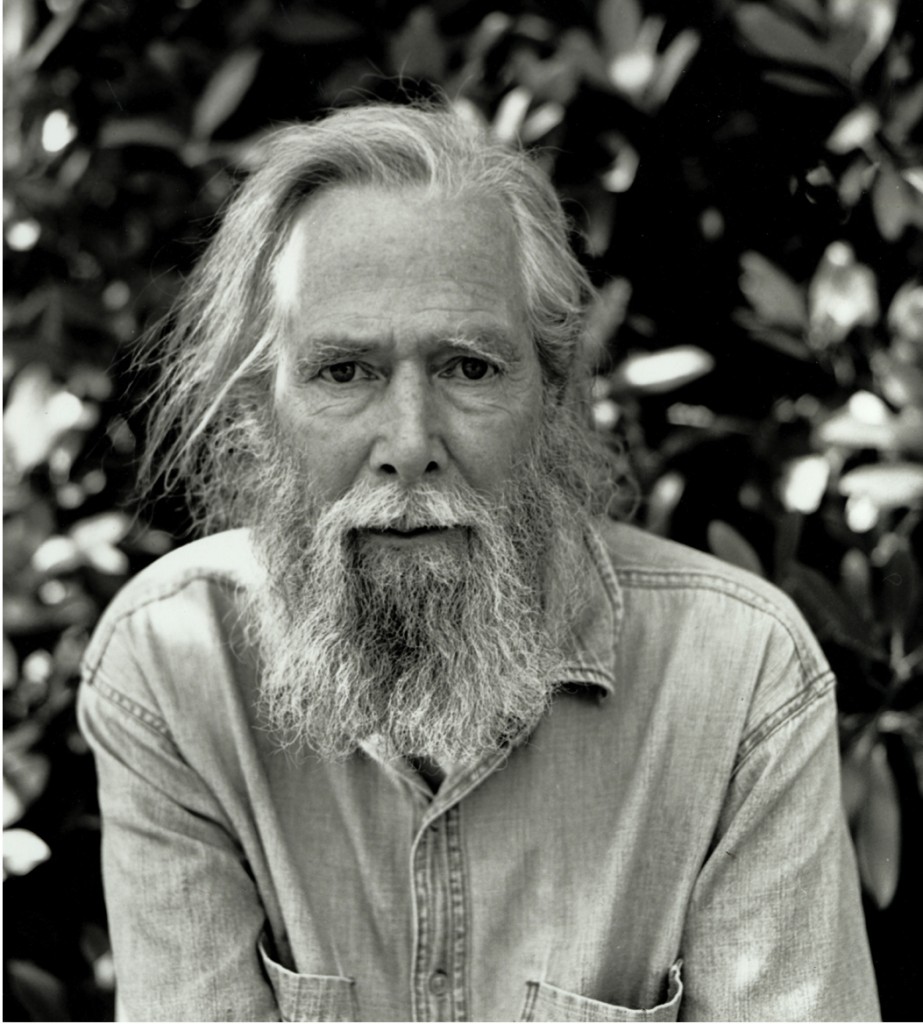
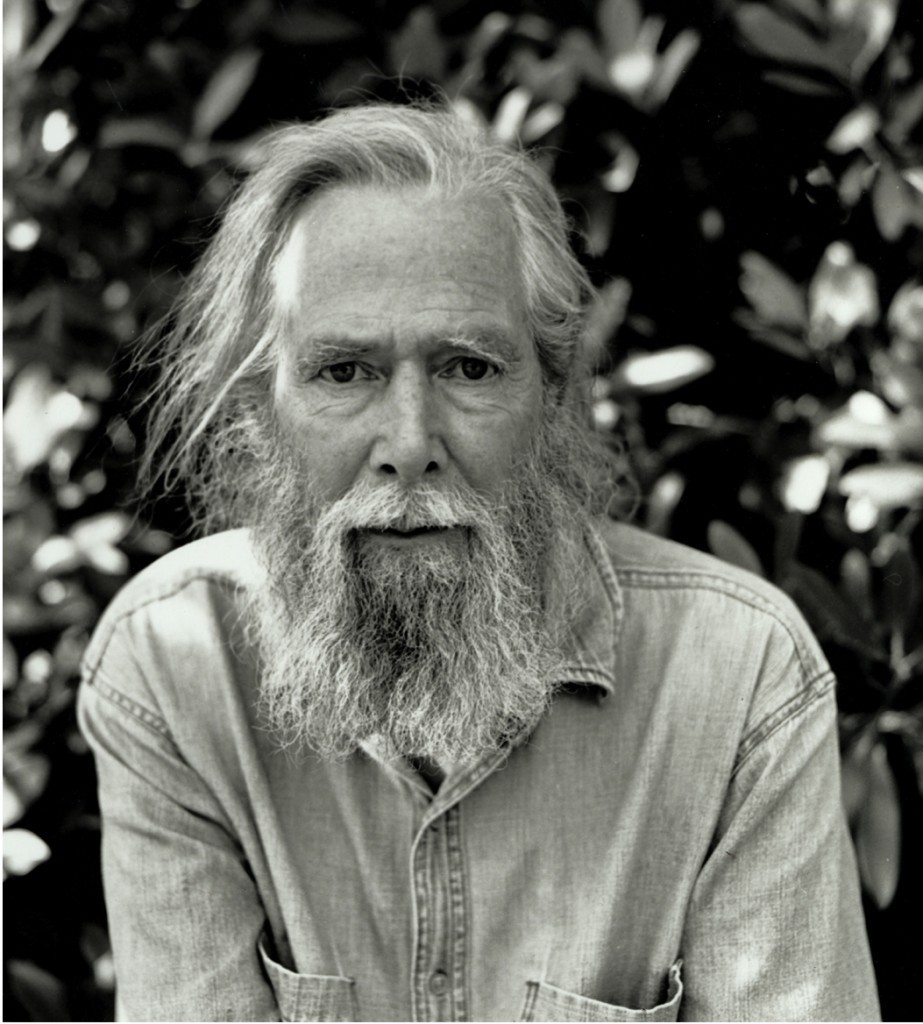
Sam-Savage-author-photo1-923x1024Photo by Nancy Marshall


.

Sam Savage was born in Camden, South Carolina, on 9 November 1940, the fifth of seven children of Henry Savage, Jr., and Elizabeth Jones Savage. Henry was, to quote the author, “a polymath: lawyer, architect, civic leader, historian, naturalist, and author of several books of history, biography, and natural history,” while Elizabeth’s tastes “were more literary. She was well-read to an exceptional degree.” Savage exhibits a combination of these skills. Though not entering school until age seven, as discussed below, he attended the University of Heidelberg and Yale, graduating from the latter with a degree in philosophy.

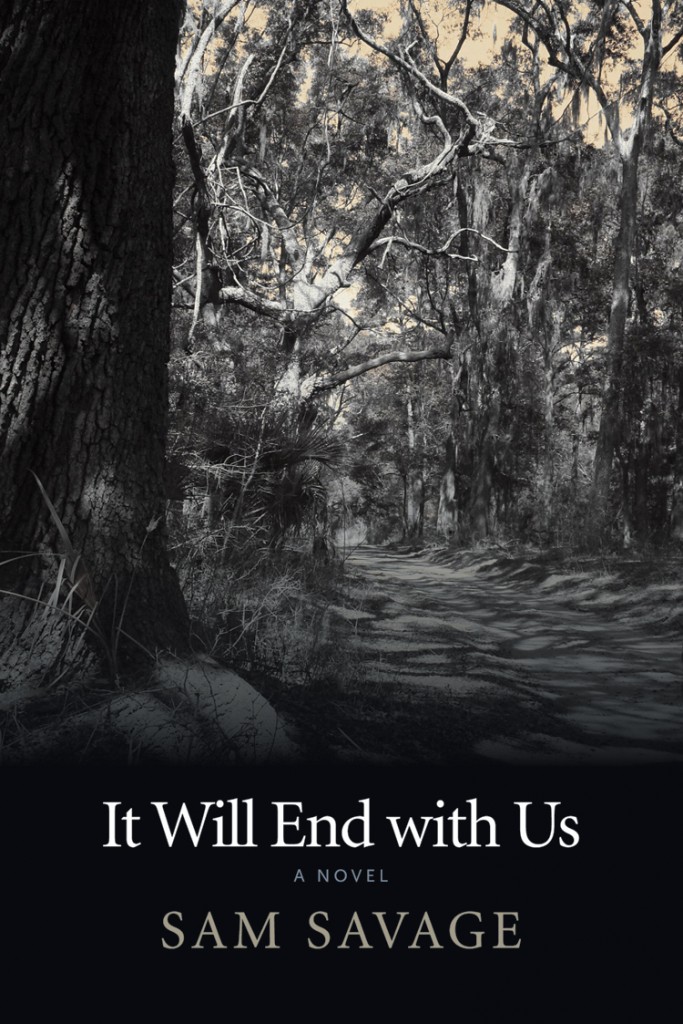
For much of his adult life Savage has written poetry and fiction, publishing intermittently from the age of twenty, but not finding his true voice until late in life. In 2005 his first book appeared, The Criminal Life of Effie O., a novel in verse that Savage considers an “amusement.” His career as a fiction writer changed with the publication the next year of Firmin: Adventures of a Metropolitan Lowlife (2006), a first-person narrative told by Firmin, a male rat that can read. The Cry of the Sloth (2009), an epistolary novel, features every word, right down to grocery lists, written over the course of three months by Andrew Whittaker, minor writer and small-time slum lord. In 2011 came Glass, a first-person set of reminiscences by Edna, who spends her days typing. The Way of the Dog (2013) is a set of reflections by a male narrator named Harold Nivenson, who observes things out the living room window of his home and recalls his former activity within the art world. Savage’s most recent novel is It Will End with Us (2014), a collection of connected memories put down by Eve as she recalls her Southern childhood. All works except the first have been published by Coffee House Press.

This interview was conducted in February and March 2015 via email. My thanks go to Sam Savage for his patience.

 * * * *

Early life and education

Jeff Bursey (JB): Perhaps we could begin with something about your family. What kind of people were they? What did you think of them when growing up, and what do you think of them now?

Sam Savage (SS): Both sides of the family have roots in America going back to the mid-1600s, my mother’s side in Virginia, my father’s in Massachusetts. My father owned large tracts of timberland. We were local gentry of sorts. My father was probably the town’s most prominent and certainly its most admired citizen.

What did/do I think of them? My parents were kind, upright, generous people, utterly devoted to their children. In manners they presented a seamless blend of Yankee restraint and Southern courtesy.

JB: What religion were you raised in?

SS: I attended the Episcopal Church until I was about twelve, when I lost faith in the existence of God.

JB: You had a period of rebellion in your teens, the kind that comes upon many. What were you rebelling against, and what form did that take?

SS: Against everything and nothing—mindless encompassing anger, a condition of such unrestraint that parents would not let their sons and daughters get in the car with me for fear I would entangle them in some catastrophe. It’s a miracle I got out of that alive.

JB: What does it mean for you to consider it a “miracle” you got out of your teens alive?

SS: My teenage years were marked by extremes of recklessness that I can scarcely compass today. The “miracle” is that they did not end with prison or death by automobile.

JB: If we can stay with this for a moment, I’d like to know how you mean the word “miracle” to be taken. It’s a charged religious term, and readers of your work know you are quite often exact, even when being ambiguous. Does it have a particular meaning for you?

SS: I just meant the odds were long.

JB: In The Way of the Dog, your lead character, Harold Nivenson, says: “By the time I was eighteen I was already practically insane. By the time I was twenty I was already completely crazy. I must have been crazy for a long time before that, perhaps from birth.” That sounds like your own experience.

SS: Well, the manner in which we were crazy was different.

JB: With reference to your parents’ manners of restraint and courtesy, where did the “mindless encompassing anger” come from, and where did it go? Were you antagonistic towards those manners? Did these feelings flare up from nowhere and burn out as mysteriously?

SS: I was intensely loyal to my family. No rebellion there. On the contrary, I experienced the house as a place of calm and refuge. Leaving the South lifted a great weight off me, in Boston first, then New York, then France. With each move I felt freer.

JB: Anyone reading your books would know that most of the main characters are simmering with anger, fear, resentment and other emotions, but the narrative only provides brief glimpses of their past. That repression coupled with the at times unhinged nature of Edna or Andrew—their manias, if that’s not an inapt word, shown more than their genesis—creates a lot of the energy and power found in your novels. Do their states owe anything to the intense feelings you had?

SS: I don’t suppose I could ascribe to my characters emotions or states of mind that I had never experienced, but the fact remains that the lives of these characters bear little resemblance to my own.

JB: You speak of losing faith at age 12. In his The Life of Ezra Pound, Noel Stock says one of Pound’s uncles “inclined towards the Episcopal Church because it interfered ‘neither with a man’s politics nor his religion.’” I read that Darwin was a favourite of your father’s. The dearth of any Supreme Mover or Higher Power or God, however one wants to phrase it, is noticeable in your books. In a review of Glass I suggested this: “One wonders if Sam Savage is indicating that we live in a Godless universe, with Edna just one more creature in a glass cage, unloved and not made to last. If so, then this is a chilling picture of old age and contemporary society.” Up to the loss of faith you mentioned, did you feel a tug between science and religion, or was there something more intimate going on?

SS: My answer to your earlier question about religion ought to have been more nuanced. I never had “faith” in any real sense. I attended church with my family when I was quite young, but I never gave two thoughts to what was said there. My first encounter with God was with an absence. I suppose the problem, put crudely, is that I have in the course of life developed a religious sensibility and a scientific mind – a problematic combination. Though I don’t explicitly talk about it, the absence of God is, I think, a presence in all my books, like a shadow falling over them.

JB: That combination—how do you see that working itself out in your life and fiction?

SS: The characters in the novels are searching for meaning in the world and in their lives. I regret if that sounds terribly old-school and cliché. Meaning is not something you can invent, something you can freely choose. If you can choose it you can unchoose it just as easily. It has come from without in some sense. It has to make a claim upon you. Nothing I have seen in the world as I understand it (the natural-scientific world) is capable of making such a claim, and all my protagonists experience that.

JB: It doesn’t sound old-school to me. I would ask where you think meaning resides when you say it “has come from without…”

SS: I mean it has to come from beyond and be independent of our ratiocination and whim. Meaning is something you discover. It is something you experience, not something you can just make up. Where it resides now I have no idea. For a large segment of Western culture there was a general collapse of meaning, a disenchantment and desacralization of the world, between Darwin and the end of the First World War. Modernism in literature and art can be seen as a response to this, an attempt to reckon with the new reality.

glass

JB: Where did the first years of your education take place, what type was it, was it satisfactory, and were there particular teachers you got something from or who saw something in you?

SS: I hated school from the moment I stepped through the schoolhouse door when I was seven. I hated the teachers, the books, the building. I was in and out, refusing to go and (when sent to boarding school) running away. I was twenty when I finally graduated from high school. Except for a smattering of mathematics, everything useful I had learned by that time I had taught myself or absorbed by osmosis from my family. I went to Yale (admitted on the strength of SATs), disliked it there, and dropped out after three months. I returned five years later, finished the undergraduate program in three years, graduating in 1968.

JB: Were your feelings about school, at age seven and a little more, understood or tolerated by your parents, even as, I assume, they insisted you keep attending?

SS: The Savage family did not have harmonious relations with schools. Some of my siblings had relations nearly as stormy as my own. My parents understood perfectly that the fault lay in the stupidity and unconscious petty brutality of the schools and not with their children, who wanted nothing better than to be encouraged to learn in their own way. They did not insist that we continue, once they had grasped what torture it was for us.

I started at seven because the school was overcrowded and there was no room for me the previous year. I had attended a total of seven schools by the time I graduated, and I had gone one year without attending school at all. For most of that epoch I was more interested in cars than books. I wasn’t made to feel peculiar. I always had friends. I think some people thought I was crazy, but that didn’t bother me. I was thoroughly miserable through most of my teenage years, but not more so than a lot of other people at that age. Given a time machine, it is not a period of my life that I would willingly visit.

The 1950s were an awful time—oppressive, violent, hypocritical, frightened, and suffocating, doubly so in the deep South. I don’t know if a decade can kill a man, but the 1950s came close to killing me, I think Norman Mailer remarked somewhere. I wasn’t quite a man yet, but it was a rotten epoch to come of age in. My wife jokes that I can’t talk about the 1950s without, as she puts it, “frothing at the mouth.”

JB: Did you know how to read before going to school at what seems a late age?

SS: I was read to, but with four older siblings I was not read to as much as I am sure my mother would have liked. I taught myself to read in the first week or so of school, and I had no use for school after that. In those first days we were drilled in the alphabet. There was a moment of insight: I suddenly saw how it all worked, how the code worked, with letters standing in for sounds. That was a Friday. My mother told me I sat in the house for two days puzzling it out. On Monday I could read.

JB: I’ve not heard of any child figuring out how to read like that. Was this something your siblings could also do?

SS: I don’t know. Understand that I wasn’t jumping into Dickens—I was just reading my first-grade books: See Spot run. See Jane run, and so forth.

JB: What did you like to read at that age?

SS: I read all sorts of things. Hardy boys of course, and endless comic books, Jules Verne, Conan Doyle, Rafael Sabatini, the historical novels of Kenneth Roberts, but also Walter Scott and Dickens. A child doesn’t read like an adult, processing language; he dreams the book. I read Ivanhoe, Rob Roy, Waverly, Quentin Durward, Great Expectations, Oliver Twist, A Tale of Two Cities, completely untroubled by the hundreds of words I didn’t know, sailing right over them. I would give anything to be able to read like that again.

JB: The words you didn’t understand in those books you read as a child, did you ever look them up?

SS: I don’t think so. I don’t remember making use of a dictionary as a child. I remember that my oldest sister, four years older than me, spent a long time memorizing Webster’s Collegiate Dictionary, so she wouldn’t have to bother looking up words anymore. I remember being terribly impressed by that. I must have been eleven or twelve when she was doing that.

JB: You say: “everything useful I had learned by that time I had taught myself or absorbed by osmosis from my family.” What were those things? And do you mean useful for you alone or useful for anyone?

SS: I mean useful to me as a writer—the capacity to recognize a good sentence, a fondness for clarity and wit, a boundless admiration for artistic achievement and its corollary: sympathy for those who strive and fail.

JB: Your phrase about how a child “dreams the book” brings two things to mind. First, in Henry Miller’s The Books in My Life, he talks about “the physical ambiance of the occasion,” and the feel of the book, the smell of the pages. In that book Miller also says he’d love to have a library of the books he read from childhood to becoming a young man, which seems to echo your thoughts.

SS: I have had feelings like Miller’s. I used to love buying new books. I loved having them in the bookcase. These days not so much. I use the public library when I can, except for books by living authors. Those I always buy: I don’t like depriving an author of his or her meager pittance. I got rid of almost all my books a dozen years ago, thousands of volumes, but now they are piling up again. As Edna remarks, books are rather unsanitary objects. They collect dust easily, have a tendency to mold, and are among the rare personal items that cannot be washed.

Sam&Son 1982 (637x640)Sam and Son, 1982

JB: Second, that phrase would seem to encapsulate the form of your narratives as spun out by your characters: they write letters, memoirs, notes, and impressions, on typewriters and by hand, all in an effort to reach some imagined or real Other. Though it might be more accurate to say they nightmare the book.

SS: I don’t see the narratives as dreamlike except maybe in the way they are not governed by any overarching schema, in the way the narrative wanders down a path that has no goal or preset destination, where paragraph 38 is there because paragraph 37 is there, or maybe for no reason at all, because it popped up in the narrator’s head at just that moment.

JB: Before talking further about your books, can you describe in a bit more detail your time at university, and your studies? Were there any professors you recall fondly or otherwise? What kind of philosophy did you prefer studying, and has that interest changed over time?

SS: In September 1960 I entered Yale the first time, disliked it there and dropped out after three months. I went to the University of North Carolina at Chapel Hill for spring semester 1961 and dropped out. I went to New York at the beginning of 1962, left for France in early 1963, and returned to Yale in the fall of 1965. I don’t remember the name or face of a single classmate from those years.

I was at the University of Heidelberg for three semesters in 1970-1971 while still in graduate school at Yale. I did not take a degree there. I went to Heidelberg to study philosophy and improve my German, and because Hans-Georg Gadamer, a prominent post-Heideggerian, was a professor there. Two professors at Yale had a strong effect on my thinking then, and even today to some extent: Karsten Harries, who taught Heidegger, and Robert Fogelin, who taught Wittgenstein.

Two hours after defending my doctoral thesis (on the political thought of Thomas Hobbes) at Yale I was on a train to Boston. I have never been back.


Career

JB: Though you left Yale quickly after the defense, while you were a student did you imagine a career as a philosophy professor or as a philosopher? What kind of philosophy did you prefer?

SS: I spent most of my time on German philosophy, Kant to Heidegger. But also classical Greek philosophy and Wittgenstein. In my final year as an undergraduate I was named “Scholar of the House,” which meant that I was exempted from course work that year and allowed to spend all my time on a thesis, rather like a Master’s program. I wrote my thesis on Nietzsche. I also taught Nietzsche at Yale during the three semesters I was hired as what they called an Acting Instructor, which meant basically a full-time teacher who was paid very little. I also taught an introduction to ethics and a course on Marx.

I enjoyed teaching, but I never wanted a university career. I finished graduate school in 1972, taught for a while, as I said, and got my Ph.D. in 1979. In the years between 1973 and 1978 I was living in France and making fitful stabs at writing fiction, actually imagining myself as a writer but not accomplishing anything, and at the same time doing nothing to advance my doctoral studies. In 1978 I decided to complete the doctorate, for no good reason, just so as not to have another abandoned project on my conscience. It took me six months to research and write the thesis. It was a fine, almost intoxicating feeling, to be through with the academic world for good. I went back home to South Carolina, to a little town of 400 souls, stayed there for the next twenty-three years, raised two children, and wrote doggedly, living all the while on my small income, occasional jobs, and the labors of my wife.

JB: On the academic world. Harold Nivenson says: “The university as presently constituted… is a death-trap for the mind, I have long thought.” Does that come close to your own beliefs?

SS: Yes.

JB: What about being employed, at odd jobs or more regular work, in childhood, as a student, or later?

SS: I never held after-school or summer jobs while growing up. My mother thought it wrong for the children of more affluent families to take summer jobs that would otherwise go to those who needed them more. She was right of course. I later worked at several jobs intermittently over the years, none for very long, except for those few years teaching, first as a teaching assistant and then as acting instructor.

It is important to note here that I always had a small inherited income, not enough to live on easily, but enough to keep me free of the economic restraints that drive many people into careers they dislike. I was fortunate in being naturally handy, I actually enjoyed physical labor of the less grueling sort, and neither I nor Nora minded living on little. People like to talk about the unusual jobs I have held, but some of those were actually of no importance, more like pastimes than work.

JB: Apart from studying, and writing, was there something enjoyable outside academia? Theater, museums, films, or travel, for instance. Or was it all work?

SS: Films, of course, especially those of the Nouvelle Vague, and I was crazy about ballet, used to sit all night on the sidewalk for a ticket to see Nureyev dance. Besides getting a degree, I read a lot of philosophy at the university. I am at a loss to say how or to what degree that immersion in philosophy has affected my writing.

JB: What did you like about ballet, and is that still an interest?

SS: I still love ballet. I love the brave and futile challenge to gravity and to the burden of a human body. Witnessing a fine ballet is for me like watching angels taxiing for takeoff.

JB: Do you go to live ballet performances now? How has that art changed, in your opinion, since you first started going?

SS: Every year, when we lived in South Carolina, Nora and I would attend the ballet performances at the Spoleto Festival in Charleston. Sometimes a decent dance company shows up in Madison, but I am not able to go anymore. With such sporadic attendance I am not in a position to comment on the evolution of the art.

JB: What did you take away from time in France and Germany?

SS: From Germany, mostly a little better understanding of the polyvalence of history and a lot better grasp of spoken German, which I have, alas, almost entirely lost in the decades since. France is different. I have always felt most at home there. I lived in France for a total of over eight years. Many of my closest friends have been French. I was married to a French woman for seven years. I have a son who was raised in France. Nora Manheim, mother of my two other children, who has stuck by me for forty years now, is an American who grew up entirely in France, daughter of expatriates there. I haven’t been back in a long time.

JB: You mentioned having friends when in school but not remembering anyone from university. Was socializing with classmates not important, or did whoever you meet at that time simply fall out of your life once you were done with the institution?

SS: You have to understand. I was 25 years old, I had been around, and now I was once again a freshman at an all-male institution that was, socially, indistinguishable from an elite New England prep school. Most of the students lived on another planet from me. Furthermore I was married and father of a child. I lived off-campus, something no other undergraduate students did at that time. I am talking about undergraduate years. I do remember some of my fellow students in graduate school, though I haven’t kept in touch with any of them.

JB: I understand you would like to leave some matters alone, so we can move on. What was the appeal of South Carolina? Where did you move after that, and why?

SS: It was a place where, after so many years, I found I was comfortable again. It was still unjust in many ways, but the violence was mostly gone and you could see progress every day, something that was hardly the case in the rest of the country. I like to sit with Southerners and talk. They still tell the best stories. I love the swamps and marshes. My wife and I, with the help of friends, built a house in the woods there. I would be there still if I could. We moved to Madison twelve years ago. We moved because we have a disabled daughter, and this is a better place for her than isolated among the pine trees in South Carolina.

With Nora 2013(640x424)Sam and Nora, Madison, Wisconsin, 2013

JB: What is life like in Madison? Are there storytellers there, like in South Carolina?

SS: Life in Madison? I work. I used to take walks in the neighborhood. Now I look out the window. In the warmer seasons Nora and I go out to lunch once or twice a week. My sons come for long visits every year. Friends come from South Carolina and from France. I don’t know anybody in Madison apart from neighbors, a couple of Nora’s friends, and doctors. I can hardly be said to live here. I feel I am just passing through, practically unobserved, like a ghost.


Health and writing

JB: In the 1970s you learned you had alpha-1 antitrypsin deficiency. What is that, in your own words?

SS: I am missing a blood component that protects the lungs from attack by some of the body’s own enzymes. The consequences vary widely. Chief among the more serious are liver failure and lung destruction in the form or early onset emphysema. I noticed breathing problems before I was thirty, but assumed it was asthma. It’s an ineluctable, irreversible process.

JB: Does your health feed into your fiction?

SS: It must, though I am hard put to say how. Illness is a world of its own. Everything is colored by it. I have outlived my prognosis by many years, but for decades the illness would not let me contemplate a “normal” life stretching into a vague and distant future. All my narrators are, one way or the other, in the process of dying.

JB: When you say you have “outlived your prognosis,” I think of the tenacity of certain characters in your novels, but it’s of a kind that comes from the most basic instinct for survival. No one in your books, human animals or non-human animals, to use a current distinction, lives well. As you say, they’re “in the process of dying.” Do you explore the extinguishing of life with your own health in mind because it’s a topic of interest, to have a conversation with yourself, to communicate something that can’t come out any other way, or for other reasons?

SS: Had I been in booming health, I might have written differently, I suppose, though there are also reasons to think otherwise. There was a long period, in my twenties and early thirties, before I became really noticeably sick, when awareness of death in the form of a boundless encompassing dread was so persistent and unbearable that I contemplated suicide in order to escape it. I thought: better die now than experience this dread every day, possibly for decades, and still die in the end. I am constantly amazed that not everyone seems to feel this. I suspect a cover-up. Maybe a genetically based survival mechanism that lets us be deliberately stupid in this regard, so we can get on with our lives as if nothing were amiss. Bad faith on a planetary scale. Maybe being sick—and during the last twenty years quite obviously so—has made me more sensitive to the blitheness with which we normally—and I suppose I can say mercifully—go about the business of living. But there is such a thing as truth in fiction. A novel, if it is any good, ought to let us see the lies we tell ourselves. It is not a novelist’s job to be merciful.

JB: That dread of death ended before you became sick. Obviously it never felt so overwhelming as to make you commit suicide. What kept you alive? And did the dread taper off or end because you became sick?

SS: What keeps anybody alive? Love, distraction, I suppose, and, above all, an unwillingness to do that to my children.

JB: Kjersti A. Skomsvold is the author of The Faster I Walk, the Smaller I Am. She had been diagnosed with an illness, and went home to her parents’ basement to die. There she began to write that novel. At a PEN event she gave a talk in which she said: “I was very lonely those years, and scared. When I was lying there, looking up at the ceiling, I started to think about death. I wonder if the inevitable loneliness of being human is due to the fact that when we die, we die alone.” That seems to be one of the merciless truths your novels explore, especially in Firmin and The Cry of the Sloth, but being alone is present in the other works too.

SS: We die alone, of course. No one can die my death for me. The awareness of death throws us back into the essential solitude of the self as nothing else can. We are talking now about something more fundamental than loneliness, which can be relieved by other people. We are talking about aloneness, that state in which we are genuinely ourselves and not anyone else, when the social world with its myriad deceptions has fallen away. All my protagonists dwell, each in his or her own way, in that aloneness.

JB: “All my protagonists dwell, each in his or her own way, in that aloneness.” With your health the way it is, and the early dread of dying, would you say that your awareness of aloneness is given to these characters or is it impossible to write them without that as a precondition?

SS: I think one can write about all sorts of things one has not experienced. I imagine that with enough research I could set a fairly credible novel in prison or in Moscow. But I doubt the same is true of states of consciousness.


Publication

JB: When did you start writing, and what did you start with? When did you start writing for publication? What sort of reception did it have? I know in Poets & Writers you stated there were only a few poems published and that you stopped writing at age 55. Had writing, as an activity, pleased you up to a certain point and then, due to not being accepted, ceased to be that? What had it become by the time you stopped?

SS: I was eighteen when I first imagined becoming a writer. By the time I dropped out of college at twenty I saw writing as what I essentially did, everything else being ancillary to that. And so it has been ever since except for the five or six years I was obsessed with philosophy. I wrote a great deal, mostly poetry, but fragments of novels as well, and disliked what I wrote, and threw it out. I was not discouraged by rejections. I submitted rarely, was accepted as often as I could expect. It was not a rewarding thing to do, publishing poems of no interest alongside other poems of no interest in journals that nobody read. Publication has never been the goal; rejection has never been the problem. The writing I did for forty-odd years was not coming from the place that real writing comes from, and I knew that, and that was the problem. Genuine writing, writing that is true and good, is a product of compulsion. It possesses the shape and content it does because you can’t do it any other way. It took me a long time to feel that what I wrote was coming out of that kind of necessity.

JB: What happened to change things?

SS: I don’t know. One day the writing was different, and I knew it.

JB: What kinds of poetry did you write at first, and what kinds of fiction?

SS: Between the time I left Yale and the time I returned I was primarily interested in the poetry coming out of Black Mountain: Olson, Creeley, Oppenheimer, Duncan. Also W.C. Williams and the whole objectivist school, George Oppen and Charles Reznikoff in particular. And behind them all, of course, the poetry of Ezra Pound. I wrote a fair amount in a sort of objectivist vein. Nothing survives from that time. I doubt it was any good. Most of my fiction efforts in those early years were attempts to make money so I could live as a poet: unfinished crime and science-fiction novels, and even an attempt at a romance novel. That one turned rather lurid, as I recall.

JB: What appealed to you about the Objectivists and the Black Mountain poets? Has that lasted?

SS: I think it was the economy, the avoidance of cliché and worn-out rhythms, and the sparseness of the verse. I haven’t read any of them in decades. The poet I feel closest to, the one who has spoken to me in the most personal way for decades now, is John Berryman. He alone in modern literature is able to achieve a truly Shakespearian pathos.

JB: What fiction writers, beyond Williams and, I suppose, Reznikoff, did you read? Who do you read now?

SS: I am not familiar with any fiction by Williams or Reznikoff. A list of the books I have read over my many years would be exceedingly tedious. Among the modern writers who “knocked my socks off,” as Firmin liked to put it, the first time I read them would be Céline, Hamsun, Joyce, Beckett, Bernhard, Faulkner, Gaddis, Lowry. I read less now than I use to, and I read more slowly now. I don’t know much about contemporary fiction, meaning the works of writers younger than me. I reread a fair amount. Here’s what I read this past winter: I reread The Brother’s Karamazov for the third or fourth time; I read two novels and a memoire by Natalie Sarraute (The Golden Fruits, Do You Hear Them?, and Childhood), The Mussel Feast by Birgit Vanderbeke, and Henry James’s The Bostonians. Not a long list. And I notice it contains only one contemporary writer. But it is typical, probably, of my reading in recent years.

JB: Does reading inspire you to write, or make you think, “I could do something with that”? A related question: when you’re writing, do you stay away from reading certain writers or genres?

SS: I received from my parents, from their own attitudes, the gift of admiration. While reading a novel I often think how wonderful it would be to write like that. This past winter I was reading The Golden Fruits. Nora passed through the room, and I said something to the effect that this was a wonderful novel. She laughed and said, “You always say that.” I was interested to see, when David Markson’s library ended up at the Strand, that he wrote marginal comments in the novels he read, often highly critical comments, as if arguing with the author. I don’t do anything like that.

As for avoiding certain writers or genres, I stay away from books that I suspect might resemble the thing I am working on.

Sam&Nora 1993 (640x433)Sam and Nora, 1993

JB: Did you, or do you, feel part of a community of writers? Here I mean not only connected to those who you read but those who you met. Not that you felt part of a group—that would surprise me—but if you perceived that individual contemporary authors were on the same wavelength as you. If that does exist, is that shared interest—in topics, approach, what have you—important for your morale? Does it help keep you going? Or do you feel lonely as a writer?

SS: I have two writer friends, one of whom I haven’t seen in fifty years, and neither are remotely on my wavelength. Do I feel lonely as a writer? I don’t know that lonely is the word. I feel isolated.

JB: In your published novels there is often a mystery as to what’s going on, where the fault lines are in a character, how they landed where we see them, and, as mentioned, with very little history given. The reader is expected to piece things together. Is that a lingering effect—a good one, in my opinion—from trying to write crime novels?

SS: I don’t think so. If that tendency came from anywhere it was more likely from reading Faulkner and Ford Maddox Ford. You are right that I require readers to be more active and engaged than maybe most novelists do. I want to make it so readers have to participate in the creation of the story. I want them to lend their consciousness and lifeblood to the characters, so those characters can come alive inside them.

JB: What kind of science fiction did you write? And romance—I’m imagining a younger and more cheerful Eve Taggart, from It Will End with Us, in a sweltering southern city, with beaus and such.

SS: Dystopias, of course. I don’t remember my attempt at a romance novel. I only recall my judgment of the fragments I managed to produce: dishonest and second-rate, even for pulp.

JB: If publication has never been the goal, what has been, and has that goal changed over time?

SS: I once, only half facetiously, made a list of three things I wanted to accomplish in life: run a marathon, learn to play the saxophone, and write a great poem. I have failed at all three.

In fact I have always had only one goal: to write one truly good poem, or later, one truly good novel.

JB: Twenty-three years writing. What did you learn about yourself in that time? Patience, I assume.

SS: I learned that I am a certifiable lunatic who can’t quite admit the jump is too high for him to clear.

JB: What keeps you trying to make that jump?

SS: God only knows. A lot of free time, maybe, and a mulish temperament.

JB: Before getting into what these books are about, I’d like to know when the title comes to you.

SS: All the titles were chosen after the novels were written. While in progress they bore the names of their narrators: Firmin, Whittaker, Edna, Nivenson, Eve. I would like to have kept those names as the final titles, but the publisher wouldn’t have wanted to do that.

JB: I know you like Gilbert Sorrentino, whose last books were also published by Coffee House Press. He wrote in an essay called “Genetic Coding” that he has “an obsessive concern with formal structure…” Many of your works could be said to fall into the category of memoir, since we don’t get the particulars of the lives of these figures. Is this revisiting of that form, if indeed that’s what it is, on one level similar to what Sorrentino is referring to?

SS: While I admire Sorrentino, his integrity as an artist, his capacity for formal invention, and the frequent brilliance of his writing, we have almost nothing in common. He once remarked, I believe, that for him content was an extension of form. For me the opposite is true. I am, I fear, an old-fashioned realist at heart. However, looking back on it all, I can see there is a structure common to all the novels. They are, as you observed, first-person narratives, confessions really. The speaker is always confined in a dwelling of some sort (bookstore, apartment, house, etc.). All the narrators/protagonists are attempting to complete a work of some sort, and in most cases that work is the one we are reading. Another odd thing, which I am at a loss to explain: every novel has an emblematic animal: rat, sloth, rat and fish, dog, birds. In one case (Firmin) the narrator might (or might not) actually be an animal. In another he imagines himself as an animal (Sloth). In The Way of the Dog the animal becomes emblematic of acceptance and wisdom. In Glass the rat and fish are emblematic of Edna’s confinement and separation from the world (by sheets of glass). In It Will End with Us the birds are emblems of transcendence, I suppose I can say.


The novels

JB: Was The Criminal Life of Effie O. your first completed book? Is there an earlier completed manuscript in a desk drawer? How long before your work was accepted by a publishing house, and did that experience work out as you had hoped?

SS: Nothing in the desk drawer of any interest. I found a publisher (Coffee House Press) in a matter of weeks—no dramatic tale of artistic suffering and perseverance there. I have no complaints about Coffee House Press. There are obvious disadvantages to publishing with a small house, but they have never interfered in the writing itself. They have stuck by me through thick and thin (a lot of thin lately), something no commercial press would have been able to do.

Effie O. was written as an amusement, a joint project with my sister, who illustrated it. I published it only because I didn’t want her to have wasted her time on illustrations for a book that would stay in a drawer. I don’t know if it will ever be of interest to anyone. I toy with the idea of taking it out of print. It would make a good basis for a musical, though, and maybe somebody someday will find some such use for it.

JB: Are you musical?

SS: Though I love music, I have no musical talent. Unhappy lessons on the flute as a child were proof of that.

JB: Can you say something about the kinds of music you like?

SS: Classical and jazz, for the most part. And Dylan. But he’s an outlier.

JB: Particular composers or epochs? Do you go to concerts?

SS: In classical, pretty much any epoch, though I am not musician enough to enjoy some complex modern works. Most of Schoenberg, Webern, and Carter, for example, is beyond my reach. In jazz, it’s the 1950s and 1960s. Coltrane, Davis, Monk, Mingus, etc.

JB: Do you write with music playing?

SS: Never. In fact I don’t understand how some people can do that. When I write I have rhythms in my head that are impossible to hear when other rhythms are being laid on top of them.

effie

JB: Why would you think of taking Effie O. out of print?

SS: I had hoped that the relative success of Firmin would prompt people to take a look at Effie O., but that seems not to have happened. It was not intended to be a great artwork. It was meant to entertain. If it fails to do that, I don’t see the point of it. It is like when you tell a joke and no one laughs. All you feel is embarrassment.

JB: Andrew Whittaker asks himself if his jokes “were ever funny, or did I just make them seem so by my laughter.” It’s one of the many sad comments he makes.

Could you say a little about how each book came to be?

SS: The process is always the same. I write the first paragraphs, more or less out of the blue, without knowing who is speaking or where it is going. Mostly those paragraphs go nowhere. But rarely (meaning it has happened five times) several other paragraphs follow, I catch a voice, a way of speaking and writing unique to that character. I am usually well into the novel before I get a glimpse of the shape it will take in the long run. I don’t know how it will end until I get there. Everything else in the novel gets revised or shifted about but those first paragraphs remain unchanged, almost word for word the way I wrote them.

JB: Where does the “voice” come from for the paragraphs that become novels?

SS: I have no idea. It is suddenly there. I don’t of course mean an audible voice: a way of speaking, a way of seeing the world from an angle so specific that it defines the character of the person who is viewing the world in that way.

JB: The first book of yours that I read was Firmin. That a rat—or an apparent rat, to keep your distinction in mind—could elicit sympathy is a feat of the imagination. He lives on chewing books, but also becomes literate, though he can’t speak anything other than, well, Rat. He is ostracized by his family for his astonishing abilities, and he can’t connect to the human world, represented by Pembroke Books, where he lives. He is outside everything. I assume that no one could have predicted the popularity of this book. Tell me about its reception and how it affected you.

SS: I thought the book was good, and I thought it would get a favorable reception, but I assumed this would come from a very narrow audience. If somebody had suggested the book would sell three thousand copies I would have scoffed. When it started selling in the hundreds of thousands in Europe I was flabbergasted. Flabbergasted by the numbers, of course, but also by the fact that people seemed to be reading a book I didn’t know I had written. They were encountering a lovable character, some even found him “cute” (the unkindest compliment of all), when I had meant to model him on the despicable self-loathing narrator of Dostoyevsky’s Notes from Underground. I thought I had a written a tragedy. I thought it was desperate book. I felt like shouting, “But that’s not what I meant, that’s not it at all.” This widespread reading was reinforced by Random House, which issued a hideous edition of the book with a big bite taken out of the cover and little mice in the margins of the pages in what I think was a deliberate effort to trivialize the novel, trivialization being, in the publishing world, widely viewed as a recipe for success. It might have been better if subsequent publishers had kept the marvelous illustrations Michael Mikolowski did for the original Coffee House Press edition, which have a much harder edge than the later ones by Fernando Krahn.

I recognize that an author’s intention is not the sole criterion for the interpretation of a work, that it is the reader’s privilege to see the novel differently from the way I meant it, but nevertheless I was thoroughly disconcerted by the discrepancy. I sometimes feel that I am not actually the author of that book that sold in those hundreds of thousands. A bystander, an innocent witness to the hoopla.
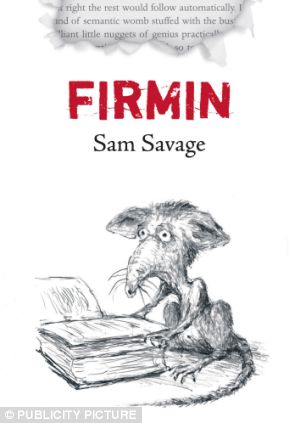
Cover_of_firmin_novel_by_Sam_Savage

JB: Especially since in Firmin there is this line: “I despise good-natured old Ratty in The Wind in the Willows. I piss down the throats of Mickey Mouse and Stuart Little. Affable, shuffling, cute, they stick in my craw like fish bones.” That would seem warning enough to a reader not to view this as a novelty tale.

You’re surprised by how this book was received, that you meant to convey something different than what many readers came away with. Do you think people misread the book? Do you think there were themes and emotions in that novel that might have seemed minor to you, or escaped you entirely, but that were primary for other readers? I wonder if you think eisegesis was performed by many.

SS: Clearly there are themes and emotions that escaped me. Some readers found a book I didn’t know I had written, that perhaps I might not have written had I been aware of it. But in no way am I denying that I wrote it, however inadvertently.

I certainly don’t resent the success. But I do think it has probably hurt the reception of my other novels. It has given a lot of people a wrong idea of the kind of writer I am. They come to those other novels with certain expectations, and they are disappointed. And then of course they blame me for it, as if I had written a bad novel rather than a pretty good novel that was just not for them. Or they don’t come to the other novels at all, thinking that I am only the author of a funny rat story.

JB: As you said, intention is not the only criterion. Leaving aside The Confessions of Effie O. and Firmin, which of your other novels has been received and understood more like you wanted?

SS: I don’t have any complaints in the case of the last three. The reception of The Cry of the Sloth was sometimes problematic for me. People tended to pigeonhole it as a satire of the so-called literary world, which it really isn’t, at least not fundamentally. I don’t know anything about the literary world and have no interest in satirizing it. The novel was meant to be a satire of the human capacity for ambition and delusion, in whatever milieu, and a study of a certain complex self-parodying individual at war with himself and his environment.

JB: Do you stay away from the literary world?

SS: Not expressly. I am simply not part of it, have never been part of it. I don’t live in a writerly world, in Brooklyn, for example, and I am not connected to a university. When I began to publish I was already too sick to do writerly things like readings, book fairs, and so forth, where I might have encountered denizens of that world.

JB: The diction and tone, grammar and perspectives, of your novels are always very precise. In a letter to his ex-wife, Andrew says: “Even at the time of your departure at least half of them”—he’s talking about houses they own—“were white elephants or worse, and they are now so heavily mortgaged, so deteriorated, they barely suffice to keep my small raft afloat while it is being tossed about on an ocean of shit, meager as it is and weighted with the barest of necessities. (I mean to say the raft is meager; the ocean of shit is, of course, boundless.)” Edna is also careful in her language: “And I ought not to have said that the doorbell rang suddenly. After all, how else could it ring? Unless it were outfitted with some sort of crescendoing device that would let it gradually work its way up from a tinkle.” Does this precision occur, or have to occur, in those first paragraphs, is it natural for you to write that way, or do you introduce this finicky aspect into the narrative as you build the character?

SS: No, it is not natural for me to write that way. This was a trait belonging to those characters, not to me, a trait reflective of their personalities, though it functions differently in the two cases. I don’t in fact write like any of my characters.

JB: After those first few paragraphs, if they look to be going well, do you make notes about things you would like the character to say?

SS: Yes. Things like that pop into my head at all hours, and I jot them down and later put them in a folder that I label “material.” Some end up in the novel, a lot more prove useless.

JB: How do you know when a project is or isn’t going well?

SS: I know it isn’t going well when it stops going, when further paragraphs fail to appear. I struggle with it for a while – where “struggle” means staring out the window – and if nothing comes, I drop it. That’s the usual way. Lots of false starts. But now and then the character takes over. It’s a feeling many novelists have, I think – that the character, or the writer’s unconscious mind, takes command of the story to such an extent that you feel you are taking dictation.

JB: I’ve mentioned how a tale about a rat can be affecting. Did you think that as you wrote? I don’t mean that you’re calculating how to wring pathos from vermin. But do you feel the emotional truth of your writing as you go on, line by line? In case anyone thinks that there is only misery and grief in your novels, I should say there are passages and lines that have made me laugh, unexpectedly most times. Do you feel enjoyment when you write?

SS: I frequently laughed out loud while writing The Cry of the Sloth. It’s an odd thing: I have to force myself to begin writing in the morning. I will find all sorts of excuses to put off doing it. When it is going well I can’t say whether I enjoy it or not, I am so completely lost to myself. Nabokov referred to his characters as his slaves. Maybe that is a common sentiment among grand Apollonian novelists. But in my case it is just the reverse of that.

JB: Are you, then, a slave to the characters?

SS: Absolutely.

JB: You say you’re “an old-fashioned realist…” I might differ when you leave it there. But perhaps you might define that term before we go on.

SS: I don’t mean anything technical by it, just that I hope I have created thoroughly believable characters who live in a world we recognize as our common world, however distorted it might appear when seen through the eyes of my narrators, and that includes Firmin. Most of the richest characters in literature belong to the realist tradition. I think it is mainly the subjectivity of my works that distinguishes them from classically realist novels.

JB: Whenever I read your books and the works of some others—Gabriel Josipovici, Cesar Aira, and Karl Ove Knausgaard are examples—I become wrapped up in them, even with pen and notepaper at hand, and my notion of reality gets nudged sideways. The intensity of the way you present manias and severe anxieties, set within a claustrophobic environment of one character’s consciousness and one person’s physical space, displaces my own consciousness temporarily, an aim I assume you have. It therefore robs me of whatever reality I own (however provisionally), a state of affairs that lasts for a bit after I close the book. I feel my presence and the narrator’s presence—or maybe saying the narrative’s presence is more accurate—mingling. Slowly my mind becomes my own again, but it is coloured—it has been coloured since Firmin—with what you have written. Hopefully—hopefully on more than one level—I’m not the only one who responds that way. I close the book and your reality is there, and what was mine is not, not right away, and not in the same way after.

What I want to get at it is that your version of a “common world,” perhaps against what traditional or current realists (Jonathan Franzen, perhaps) say is theirs, replaces what readers experience, if they allow themselves to sink into the writing. We can agree that the characters are subjectively realistic, but how are you only a realist when, first, the thinking and experiences of Firmin, Andrew, and Edna, to use the most extreme cases, are skewed or “distorted,” according to conventional standards, to the extent that they aren’t in what some would consider the real world—by which is meant the sane, commonsense world—and, second, when you posit alternate worlds with such fidelity and relentlessness?

SS: I am happy that in your case the books have had such an effect. And, as I said earlier, that is precisely my intention. But I insist, my characters are in the common world. All I have done, through the skewing and distorting you mention, is simplify that world so everyone can see, to use William Burroughs’ phrase, what is on the end of every fork. I would guess that if the state of affairs presented in the novel temporarily displaces your own consciousness, as you say, that is because you recognize that it is your world too.

JB: I’ll consider that last remark, but away from this interview.

That “sparseness of the verse” of the Objectivists and Black Mountain poets remains with you as you aim to simplify?

SS: I don’t think so, not in the sense they intended. Except for It Will End with Us I don’t think of my novels as sparse. “Concise” is the word I would choose. As I said, I feel closer to Berryman, who is about as far from those guys as you can get.

JB: Where and how do you write? By hand, on a typewriter or computer? And could you describe your process of revision? Is there much editorial discussion with Coffee House Press?

SS: I write on a computer. Before computers, I used a typewriter. On a computer I am able to try out sentences, turn them this way and that, as many times as I like, something one is loath to do on a typewriter or in longhand. I fiddle with them endlessly. When revising I save the work as a new file and rewrite from the beginning. I seldom go back and rewrite individual parts, since by doing that I would lose the feel of their place in the whole, the tempo, for example, or the overarching mood in which they are inserted.

I have rewritten a novel many times before Coffee House ever sees it. They get a clean piece of work. The editors make some suggestions, but they never attempt to override my decisions. All writers should be so fortunate. After reading the manuscript of Glass the late Allan Kornblum, publisher and founder of Coffee House Press, said, in a warning, “It’s hard to recover from a book like this,” meaning I was heading for disastrous sales and a reputation for not selling that would dog all future books. He was right, of course, but he published it anyway.

JB: Do you print parts of or the whole manuscript and edit by hand after writing on the computer?

SS: No. The only novel I printed out before finishing was Glass, and it is also the only novel whose parts were radically rearranged ex post facto. I printed the novel and chopped it into pieces, maybe forty or fifty, and spread them out on the floor of the living room. Then I walked around and rearranged them. It was the only way I could manage an overview of the whole thing.

sloth

JB: We’ve talked about the kinds of writing you attempted before finding your true voice. In The Cry of the Sloth Whittaker’s letters make up the bulk of the novel, and we are also presented with his diary entries and fragments of his own fiction. Did you use discarded writings of your own or were these bits created during the process of writing?

SS: They were all invented for the occasion.

JB: How was it to write those parts?

SS: Writing for me is a form of impersonation, I think I can say, and so this novel was the occasion for a much larger variety of “experiences” or, maybe, “performances.” If I had a chance to relive the writing of one of my novels, I would choose it.

JB: You mentioned laughing while writing this book. Was it fun to create such a waspish figure as Whittaker? He has some very good lines.

SS: Yes, it was often fun, but sometimes he would break my heart.

JB: What meaning does Whittaker search for, and do you think it’s fruitless? When I read that book, with its time setting in the Nixon era, it seemed to bring together the mess of his own home and the devaluation of property, as mentioned above, with systemic corruption of an organizing entity. How could Whittaker find positive meaning when surrounded by such competing forces?

SS: Near the end of the novel Whittaker says, “I have unpacked my soul and nothing is in it.” He has arrived at the end of his illusions. The image of himself that had guided and oppressed him has been shattered, and he is free. Free for death, possibly, but also free for another kind of life.

It is at that point, in that spiritual desolation, where the constructed self has come undone, that the next three novels begin.

JB: Are these novels a quartet or quintet, then, if we include Firmin? Or do Glass, The Way of the Dog, and This Will End with Us make up a trilogy? How would you characterize the sequence, and would you have an overall title for the works?

SS: I didn’t intend them that way, but in retrospect I can see that the last three do form a sort of trilogy. I would love to see them in a single volume. Maybe I would steal a title from Raymond Chandler and call it The Long Goodbye.

JB: Edna in Glass has to type. This seems to be what she does most. How did you come up with that?

SS: I’m not sure. She was already typing when I met her. But forty years ago I was friends with a man who lived in a basement and “processed” his life, as he put it, writing down everything he thought or experienced in one notebook after another. Though he worked at it for hours every day, he was falling steadily behind, life was unrolling faster than he could record it, to his great distress. He might have been the inspiration for Edna.

JB: In the novel there appears this passage: “I could not think of anything to type at Potopotawoc. Sometimes I copied things out of magazines, I typed an entire issue of the New Yorker, including the ads.” When critics responded to The Cry of the Sloth by thinking it to be a satire of the literary world, you found that not to your liking. But here is another of your characters who performs, unwittingly, an act of uncreative writing. Are there grounds for reviewers to wonder how far apart from the literary world you are? Or maybe you’re far apart from that world, but not from its interests, movements, and concerns.

SS: I am a writer, and writers of all stripes have concerns and interests in common. So in that sense I am a part of the literary world. I read the New York Times Book Review, I subscribe to Bookforum. It’s just that other writers are not participants in my social life, such as it is.

JB: We can’t trust Edna’s version of events any more than we can Whittaker’s. She has a very jaundiced view of her dead husband, Clarence Morton, a writer. The at times unpleasant Whittaker, though that’s not by any means a rounded view of him, is also a writer. Is it a simple convenience to choose writers as figures of derision or do you think negatively of them as a class or group?

SS: I don’t think negatively of writers generally. I don’t care for the ones who are windbags, pontificators, or arrivistes, but who does?

JB: In Glass Edna repeats a comment Morton made, that she thinks too much. Is that possible?

SS: If happiness is the aim then one surely can think too much. I suspect that’s what Morton was suggesting.

JB: Could Morton have meant something else that Edna skewed to her liking?

SS: Sure. He might have been expressing his frustration with a mind that turns in circles, or, better, in spirals, and with a woman whose “unmarketable” ruminations are a silent reproach to him and his hunger for “success.” But as to what he “really” meant, your guess is as good as mine.

JB: At the end of Glass there appears to be deliverance for Edna from her state, to speak vaguely so as not to ruin the experience for future readers. It’s one of the ambiguous endings frequent in your books. How much time did you spend on those last pages?

SS: A lot. I rewrote those pages dozens of times. There was the absolutely important final phrase, “and then I will see,” and I struggled to build a scaffold to it.

JB: To me, Glass is the most overtly philosophical novel you’ve written, due to Edna’s focus on language and her exactitude of impressions, and the dusty glass in her eyrie-like apartment that gets murkier as her economic state declines, speaking, perhaps, not only to Edna but to humanity’s condition of humanity. Do you view the book as your most philosophical?

SS: I don’t know that it is the most “philosophical.” I would apply that label to The Way of the Dog, with its ruminations on story and meaning. But I suppose the judgement here will depend on what sort of thing one regards as philosophical. That said, I have no objection to your description.

The-Way-of-the-Dog11

JB: In The Way of the Dog you move from the writing world to the art world, but the picture you provide is no more positive. Did you have bad experiences in the art world?

SS: I have known more painters than writers, but I have no bad experiences to report.

JB: What painters? What were those interactions like? Do you collect art?

SS: My oldest friend in the world is a painter in France. Impossible to describe such a friendship, short of a book. I don’t collect art.

JB: Harold Nivenson, the narrator, is unwell, and is missing Roy, his dog, who as you said is “emblematic of acceptance and wisdom.” I suppose I could start by asking about your experience with dogs.

SS: I grew up with dogs all around and have lived with dogs, often multiple dogs, whenever circumstances permitted. We have a dog now. I am fond of her, I show it, and she responds. Her predecessor, a marvelous fellow, was dying at my feet while I was writing the novel.

JB: Had you started the novel knowing he was dying, or did this start partway through?

SS: I wrote the first two paragraphs thinking of him, of his impending death, of myself without him. At the time I thought I would not live to write another novel. Hence the paragraphs:

I am going to stop now. A few loose threads to cut, some bits and pieces to gather up and label, so people will know, and then I stop.

I had a little dog. We went through the world together for as long as he lasted, through the world this way and that, just to be going. At the end he had grown so weak I had to prod him onward with my shoe. He is buried somewhere. His name was Roy. I miss him.

So the entire novel, in a sense, came from the presence of the dog at my feet at that moment. I should have listed him a co-author. His name was Bertram. I miss him.

JB: Nivenson is often mean, though to balance that he does love Roy, his dog, and is aware of how he behaved when younger. People drift back into his life, like Molly and Alfie, but before that has much effect we are treated to his impressions of his neighbours. For you, this is a large cast. Was there a different kind of thinking present to accommodate the presence of other characters than from your earlier books?

SS: I don’t see a big difference in the kind of thinking. More people make appearances in this novel than in the others, but none except Moll and the painter Meininger rise to the level of being characters.

JB: Unnamed family members and unnamed former wives are mentioned. This may seem an odd question, but what does it take for a character in your books to be bestowed a name? For it often seems like a dispensation.

SS: They get names if I want to be able to refer back to them in a later passage. If there is only one sister, for example, she becomes “my sister.” Her name doesn’t tell us anything, so why say it?

JB: The presence of Buddhist sayings in this novel is not a typical feature of your works. What significance do they have, and were they used only for the book, or do you see something in Buddhism that appeals to you?

SS: At one time I read a lot of Buddhist works. I still do sometimes. My younger son is in his ninth year at a Tibetan institute in India, undergoing the traditional training of a lama. When I am reincarnated I hope I will have the good sense to become a Tibetan monk.

It-Will-End-with-Us-683x1024

JB: We’ve come to It Will End with Us. Last year for Numéro Cinq I reviewed it, and I’d like to come back to something you said a while ago about your mother, as it relates to Eve Taggart, the narrator of this latest book. Her mother, Iris, is an unpublished poet who’s slowly losing her mind. Eve says this about her writing: “I was fifteen when I finally understood that my mother’s poems were not literature.” In your interview for Poets & Writers from fall 2011 you talked about your mother’s ability to recite poetry from memory, and how much she admired Keats. Did you find her abilities—and I think how you learnt to read, and your sister’s memorization of the dictionary—normal and worth emulating?

SS: Of course. She was a fabulous reader, a great “admirer” in the sense I explained earlier. My family was unusual in many respects, and for me unusual was normal. I can’t begin to even approach my mother’s knowledge of literature nor, I think, do I have the capacity to draw from it the comfort that she did.

JB: What do you draw from it?

SS: Pleasure, of course, at times exquisite; distraction from daily care; insight into what Yeats called the foul rag and bone shop of the heart

JB: In that same interview, you also say your mother “‘…had less of a life than she should have had.’” Readers of It Will End with Us will think of Iris and compare that portrait to what your mother was like. Elizabeth Jones Savage wrote poetry that was published, but I gather that was not enough. Could you say a bit more about her life, and how much she was a model for Iris?

SS: She was not a model for Iris, except very tangentially. My mother would probably have been happier in a Northern city than in a small Southern town, but she was not a tormented woman like Iris. She was extremely kind and gentle. She was soft-spoken and witty. She was, I think, a very wise person. She would have been happier elsewhere, but she had a rich life, and it was a happy life on the whole.

JB: In It Will End with Us Eve is conscious of the absence of animals in her new home, especially birds, and at one point she lists species she used to see in Spring Hope, where she was born. Her family has no descendants, the South is shown in decline, and in the largest sense, the world is fading away as animals slowly disappear from sight. Eve and Spring Hope could be Eve and Eden. Since your latest novel potentially includes everyone in its title, and addresses global concerns, are we meant to see it as an epitaph, an appeal, a warning? With humanity on the brink, is the first woman seeing herself as the last woman?

SS: As regards the natural world, the title can be seen as all three, I suppose, but the mood of the novel is mostly one of mourning, so I think “epitaph” would be best. It is important to note that the “declines” you mention are not at all parallel. In the case of the South the decline is of the old South, the premodern South, a conservative and deeply unjust region that during my childhood was rapidly vanishing beneath the homogenizing imperialism of American cultural sameness, and becoming what the “Old South” is today—a vulgar and ugly parody of itself, the historical wing of Disney World. My childhood is deeply attached to the old dying South (with no caps or quotes), and I can still summon the love I felt for it, but I can’t in good conscience mourn its passing.

JB: Do you have a dim view of our collective future? This isn’t that dystopian novel you tried to write in the science fiction genre, but is it aiming towards that?

SS: I have a bleak view of our collective future. That humankind will survive in the long run does not look like a safe bet at this point. I am not even sure that human survival is something we should wish for. I have no difficulty imagining a not-so-distant future so awful it would be better to have no future at all.

JB: Is there a connection between the use of Biblical imagery here and Buddhism in The Way of the Dog? I mean in your technical use of both and in drawing useful imagery from these sources for the narrators to comment on or, in Eve’s case, perhaps embody.

SS: The imagery was appealing, given the circumstances, but the two cases are quite different. In one it sets up a theme of compassion and acceptance against Nivenson’s bitterness and anger. In the other it evokes a lost paradigm of innocence and perfection in the life of the planet to parallel Eve’s recollection of her banishment from the small Eden of her childhood.

JB: You have a story in the latest Paris Review (No. 211, Winter 2014), “Cigarettes,” one paragraph over two pages of a man and his landlady talking about smoking. She says she should quit but can’t, and often borrows a cigarette from the unnamed male narrator. One thing she says is: “‘Next time I decide to stop, you need to tell me it’s not worth it.’” On the surface it’s an amusing sentence, in context, but here’s a woman looking to have her aim deflected even though she knows smoking is unhealthy. What makes your characters undercut their own motivations?

SS: Well, it seems to me that there is often, and maybe even always, a difference between what we tell ourselves we want or even sincerely believe we want, and what we really do want. The human project, so to call it, often involves finding the right lies to tell ourselves so we can get though the day, and the right tune to whistle as we walk past the graveyard. We are, needless to say, frequently unsuccessful in this project, often because we have other yearnings that undermine it. This is basic Dostoyevsky, by the way, and basic Freud: living characters are never mere collections of traits—they are collections of elements at war with one another.

JB: Is this story part of a collection or an excerpt from a novel?

SS: While I am waiting for a novel, I write little things. They are, I suppose, the debris left behind by my searches for a novel, outgrowths and trimmings of aborted starts. Some are ten or fifteen pages, many are not more than three or four sentences. Some of the shorter ones were published a few years ago in the journal Little Star.

JB: Are there plans for a collection of those pieces? I’d like to see them in book form.

SS: I play with the idea sometimes, of ways I might arrange them so as not to present just a grab bag of disparate stuff. I have a lot of trouble estimating the value of many of them.

JB: Who are you writing for? Do you have an ideal reader?

SS: The ideal reader, I suppose, would be myself as other. By that I don’t mean that I write for myself, far from it, but that I think of my reader as being someone with tastes and inclination more or less in line with my own. That is not, given my personality, a great formula for success in the market.

Savage 2007 (640x480)Sam Savage 2007

Conclusion

JB: Do critical reviews of your work mean much?

SS: By “critical” I suppose you mean negative and not the sort of literary-critical review that you, for example, have written. The answer, in that case, is that I have never received a negative review that I felt touched by. I have never in fact received a negative review at all, if by “review” we mean more than a half-dozen sentences and the granting of little stars, just like in first grade. That, I think, is because a reviewer doesn’t earn any stars for him- or herself by negatively reviewing a book which people weren’t going to read anyway. You get creds in the review world by climbing in the ring with somebody other than some weird old guy who just wandered in off the street.

JB: Is there any question you’ve wanted to be asked but have not been? If so, here is an opportunity to answer it.

SS: Maybe something like the question that Nora Joyce is rumored to have asked Jim: Why don’t you write something that makes sense so we can get a refrigerator?

His answer was not recorded. Nor will mine be.

JB: Before we end, I’d like to return to the subject of your unpublished fiction and poetry, as well as your letters, and any other material a writer might leave behind for institutions and biographers. I’m rather regretful, if you don’t mind me saying, to hear you tossed away so much, and I wonder why that’s your practice. Biographers will be frustrated.

SS: I am a very private person (weird in this day and age, I know). I don’t like the idea of strangers rummaging without restriction in my life, in my past, or in work that I thought not good enough to publish.

—Sam Savage & Jeff Bursey

NC

jeff again (3)

Jeff Bursey is a Canadian literary critic, and author of the forthcoming picaresque novel Mirrors on which dust has fallen (Verbivoracious Press), and the political satire Verbatim: A Novel (2010), both of which take place in the same fictional Canadian province. His academic criticism has appeared most recently in Henry Miller: New Perspectives (Bloomsbury, 2015), a collection of essays on Miller and his works by various writers. Bursey is a Contributing Editor at The Winnipeg Review and an Associate Editor at Lee Thompson’s Galleon. His reviews have appeared in, among others, American Book Review, Books in Canada, The Quarterly Conversation, Music & Literature, Rain Taxi, The Winnipeg Review and Review of Contemporary Fiction. He makes his home on Prince Edward Island in Canada’s Far East.

May 072015
 

A koan- or haiku-like style of description in bursts of short sentences…Lish’s writing is as composed as a soldier: methodical, precise, on mission. —Tom Faure

Preparation for the Next Life
Atticus Lish
Tyrant Books, November 2o14
417 pages, $15.00

Many challenges can assail the lost person in a single given night—when there’s no bed, no radiator nor space heater, no roof nor figurative womb to enfold and heal the daily shredded spirit. The forgotten characters of the night wade through a dark terror punctuated by McDonald’s arches, Chinese calligraphy, imperfect halogen, and harsh sounds like billy clubs dragging down fence railings and cash register ka-chings tearing at the tired mind’s fractious sense of reality.

Such muddled, taurine-riddled minds are front and center in Atticus Lish’s outstanding debut novel, Preparation for the Next Life. Released in November by boutique publisher Tyrant Books, the novel just won the 2015 Pen/Faulkner Award for Fiction. Lish’s characters live on the margins, but this is not a pity party. If anything, it’s an introduction to globalization. We do not distinguish between the empty roads of Queens and those of Mosul. Nor their trash-filled alleys, nor their migrant workers, nor their deceptive blue skies. The difference is not even clear to the well-trained eyes of Brad Skinner, a stop-lossed, three-tour Iraq War veteran who sees IED risks even in the tumbleweed saunters of an empty plastic bag. Now in the United States, Skinner and an undocumented fast food busser, Lou Zei, are star-crossed lovers trying to get by in the melting pot of Flushing, Queens.

Skinner and Zou Lei (Thunder, in her Uighur dialect) are from near-opposite worlds, but Romeo and Juliet is not the only analogy to draw—Lish’s protagonists are a Beauty and Beast who discover each other literally in an underground food court, an apt crossroads for an aspiring illegal worker and a traumatized, depressed soldier. Lish’s touch is so deft that he does not come off as cloying or contrived in choosing an overtly fitting setting like a black market for these lovers struggling to survive in the shadows of the crumbling towers of the American dream. On the contrary, the novel, while deeply empathetic, seems uninterested in heartstrings. It is caring, but unpitying and unforgiving.

Looking for work early one day, Lou Zei walks from neighborhood to neighborhood, noting that Roosevelt Avenue’s graffiti changes every few blocks, but what does not is the steady sound of locks pulled down and shutters pulled up—of business, the great Sino-American common ground, cranked manually by the working poor in the liminal limbo between twilight and dawn. The lucky ones still are senseless, hearing nothing: they are asleep. The rest are senseless, too: they are exhausted. The problem for Zou Lei and Skinner, ultimately, is that this melting pot of multicultural poverty does not mix well. Violence spills over, not willing to spare young love.

The most devastating aspect of Preparation for the Next Life is not its rich, understated description of wealthy nations and poor people in the Age of Terror. It’s the love story. It’s the characters in general—convicts, cops, veterans, immigrants, and the many combinations thereof. Everybody’s just trying to get by. Skinner rents a basement room, goes to the gym, and relives the horrors of combat on the internet. He sees mangled corpses in folded pizza slices; he holds his gun to his head and dreams of relief. His landlord’s son returns from a ten-year stint in prison; the house is not big enough for the both of them.

*

How to explain Atticus Lish’s prose? It reads first as if he is overly fond of sentence fragments—but he actually does not use fragments in abundance, save for the occasional litany of descriptive images. The seeming effect comes from a koan- or haiku-like style of description in bursts of short sentences, as well as the omission of dialogue indicators. A typical passage intertwines calm eddies of four- to eight-word sentences driven by rich, concrete verbs, with the occasional hypnotic sentence that stretches into Fitzgerald-like lyricism, employing active participles and gerunds to string images and observations together in a style resembling almost the stream of consciousness—though his prose does not suffer from the hectic spasmodic urgency of Beat sentimentality. Lish’s writing is as composed as a soldier: methodical, precise, on mission:

His body jerked. He moaned. […] In his dream, he knew what was happening. When they had first arrived, they hadn’t known, having yet to learn. Their unit had provided security for a colonel on daylong sector-assessment missions called SAMs that lasted into the night, and they had seen very little action. If this is war, I’m disappointed, Nowling said, pulling security in the spectacular heat. […] It was hard to sleep. People said I miss my girl. I wanna get some. They manned a checkpoint and shot up a car. Their doc from Opa-locka poured a bag of clotting factor in an Iraqi’s chest. Mom’s head was gone. White-faced, Sconyers ran and got a beanie baby for their daughter.

[…] In the basements, they found electronic equipment, stiffened rags, a crumbling prayer book. Children stared at them. The corpses were few at first, but then they started finding bodies every day. Some were mummified by fire. A bomb went off and spit a person out of a doorway. That smell is burning hair. A truck drove by them full of men with beards and satisfied expressions. Why are we letting them go? Sconyers asked. I don’t get it—Sconyers who carried a copy of the Report of the 9/11 Commission in his assault pack.

Because this is the army. Because this is their country. Because this isn’t supposed to make sense.

Lish’s writing is allusive without lacking concrete immediacy. The description mixes panoramic observations with implied exposition. Implied—because, he laces new expository detail into his scenes without pause or explanation. This is expertly done and contributes to the unsentimental tone of the novel. Take for example this revelation that Skinner has proposed to Zou Lei:

When she came outside in the purple dusk at quitting time, he was waiting. They ate pizza slices while the streetlights came on, went down past the gas station and walked along the river.

She was so moved she didn’t talk for nearly a mile.

What are you thinking?

You have a great heart, Skinner!

He liked it that she was happy

Just you say you will marry to me, it’s incredible.

Lish has suggested he avoided seeking help from his father Gordon—the renowned author, editor, and Raymond Carver’s blue pencil—but there’s something Lish-like here. Maybe it’s in the blood. The answer to this authorial originality question doesn’t matter. What the link does, rather, is illustrate how this author still early in his career is well on his way to becoming a master of story-telling:

The house was two houses. On the first floor, there were the lace curtains and plastic on the couch, the kitchen had a cuckoo clock on the wall, and there was a velvet picture of Elvis looking handsome above the couch his mother sat on. The saints and elves were in the yard. The rooms upstairs were a mess of clothes and junk where his mother and Erin lived among bottles of perfume and shampoo and tarot cards and curling irons and maxi pads and beer can empties and cigarettes and photo albums. You could open a drawer in a broken dresser and find a stack of Polaroids of people and scenes you did not recognize, then look at yourself in the mirror and wonder who you looked like.

He begs rereading.

I don’t know exactly when it was—maybe page 40, maybe 50—but I started rereading some of Lish’s pages backwards. I would reread each of its sentences in reverse order. This reading contained a strange wisdom. Here’s a glimpse of a typical Lish page in which we see the city, the lovers, and his writing style:

When she went back into his room to get her jeans, she saw what they had done to the bed, the mauled sheet. His camouflage gear and clothes were all over the floor. He slept in his poncholiner. On the bedside table were his pills and his lifter’s magazine and a strip of four condoms with blue wrappers. The room smelled like him and her, their sweat, latex, and tobacco. All about the room were empty beer cans he used as ashtrays. Under the bed, there was a used yellow wet latex condom. Another one was twisted in the poncholiner. Her eyes scanned over his cigarettes, his jeans. His boots were lying where he had kicked them off. A pair of blue faded cotton panties had fallen on them, hers.

He came up behind her and put an arm around her waist and put his face in her neck. She held his hand. His face smelled like tobacco. They rocked back and forth like that.

[…] They went out into the quiet night and started hiking down Franklin Avenue until the small American houses gave way to ghetto buildings and then the huge cathedral of Chinatown, over the hill through the dark trees and down the longblock that extended out to the freeway like a jetty.

Now you have to go all the way back, she said.

That don’t matter. I can’t sleep anyway.

[…] The sheds were built open at the top like changing rooms, and when she pulled the chain, her light disturbed her neighbor, who muttered behind the plywood. She switched the light off and kneeled down on her broken mattress, on her coverlet bought in Chinatown, showing teddy bears in bowties. By feel, she plugged her cell phone into the charger, her link to him, and the screen lit up indigo in her hands for several moments shining through her fingers.

Combined with the other characteristics of his writing style, the unified yet non-linear nature of Lish’s prose reminds the reader of the vast multitudinous nature of the various wars the characters are facing. There is no one voice in control, there is no up or down, no central organizing order or clear causality, no beginning or middle—but there is an end. A devastating end.

—Tom Faure

a

Tom Take 4

Tom Faure received his MFA in Fiction from Vermont College of Fine Arts. His work has appeared in Waxwing Literary JournalZocalo Public Square, and Splash of Red. He lives in New York, teaching English and Philosophy at the French-American School of New York.

Contact: tomfaure@old.numerocinqmagazine.com

.

Apr 092015
 

IMG_3722

.
IMG_0821

.

Late-Night Caller

LAST NIGHT, EXACTLY WHEN nothing was happening, I got a call from someone who couldn’t speak. He mumbled into the phone. His mumbling was fast, superabundant, and I think at one point he tried to tell me that he ‘never sleeps a wink.’ I said ‘Yes’ as many times as I could. And then there was a shift in his tone, a shift toward anger, toward annoyance, toward outrage, and it was all directed toward me. I told him to stay calm, to stay where he was, and that I would meet him in the next few minutes. I told him he was in distress. He ‘unhummed’ confirmation. When we hung up, I was relieved and grateful that in his distress he didn’t try to mutter an address to me. He was certainly a man without a tongue.

.

Val

In high school, I had a friend named Val and I believe she intentionally exposed her crotch to me one afternoon by propping her legs up and holding them just so her soccer shorts billowed, allowing sunlight to penetrate the fabric. She flashed a shaded panty-less groin in my direction while twitching her legs back and forth. Leaning back to take in the sun while our friends sat nearby unobservantly, she gave no knowing smile or wink. Cunning or clueless? How could I not look? This is what I remember of Val from high school: nonconformity concerned her the utmost. She read how-to books on the subject, she chose her boyfriends by their eccentricities, her face was trussed up with piercing and chains. But her crotch was normal, as perfect as anyone could find. She had great teeth, too.

.

Generosity

Pauline from next door said, ‘I’ll tell you the truth.’ I said, ‘Please don’t. Please don’t.’ We turned to face the T.V. to see a pugnacious cartoon selling soap hoot a good-humored halleluiah at the shine his soap wrought. We were watching a doc about priapism. Her choice. I’d wanted to watch something on nest building. I thought fondly about a tiny down of hair that ran from the top of Pauline’s cheek to the curve of her jaw. Pauline said it was all mental. ‘What is?’ ‘The truth, silly.’ ‘I said enough.’ Pauline arched an eyebrow in a disagreeable way and didn’t say another word until the end of the show, and then I said goodbye. And she hiccoughed a nearly honest goodbye, too. Her personal perfume stayed behind until morning, smelling it vigorously before starting my day.

.

Take Cover

For years I’d lived where lights polluted the sky, occluding the stars from view. As far as I was concerned stars could have blinked out existence, and I would have been one of the last to know. Then one summer I went to Canada to stay for a week, for rest, for recovery, fortification. I met a woman there who was from Boston, and like people who live in cities we stayed outdoors more than normal, and we walked faster than other people on the streets. She had dazzling shanks. One night near the end of my stay, a night I thought I might try to kiss her, we found ourselves at a public picnic table, where we slowed, and got all reflective and confessional. We shared a bottle of rum, our fingers touched—a crisp-lit moon (an authority on romance, if coldly) hung before our eyes and felt just for us. We were feeling young, selfish; we were feeling that nothing in our lives had been our fault. We felt a prefiguring. Who looked up first, I don’t remember, but we thought we saw a shooting star. It crept across the sky, and we said we’d never seen something so amazing as a falling star in ‘slo-mo,’ as if it knew we both wanted this night to last as long as it could. A homeless woman walked by and looked up and said, ‘Fucking satellite. Spying. Reading our brain waves. Stealing our thoughts! You kids better take cover.’

.

Mother’s Cats

My mother asks things like: ‘What are you going to do with your time?’ And I say something like: ‘Live?’ She corrects me: ‘Work.’ When I go to her house, I wake up puffy around the eyes, nearly blind, and tongue-tied. I think it’s her cats. She has four. She says: ‘You overact.’ Of course, I have no retort. Nothing much happens at her house except the occasional cat fights. She likes to brag about how well-balanced her life is now that she has just her cats and no husband (my father).

.

Speechless

This time I was trying to be serious when the man with no tongue called back. I told him not to ring me again. He grumbled. I asked him what made him think he had the right number. He hummed and grunted. I couldn’t agree or disagree with him, and felt nothing short of stupidity.

.

Tough, Tragic

I saw Val some time ago with her daughter—a skillful and cold child, who furrowed her brow like an adult when I asked her name. Val appeared tough, tragic, and terrifically dressed in slacks and a low-cut shirt—no longer so concerned with nonconformity. As she dithered to keep her other guests busy, I tried to make polite conversation, but I got lost frequently in words as I wondered if Val’s vagina had changed after childbirth. Would I even recognize the once-prime image from my adolescence? I took a beer she offered me and nearly asked, ‘Can I see inside your pants? Again?’ I’d plan also to say, ‘I imagine its image is vastly more important to me than it is to you.’ Which could be possible, I thought, knowing how seldom I looked at my own crotch. But I held my tongue, as it were. Everyone else at the party was being polite. And so what if Val’s genitals were changed? So what? I saw it. Glimpse it. I’m sure I understood its power even then.

.

Au Pied De Cochon

I took my Canadian love interest to a fancy restaurant, where we saw three men each wearing the same label on their shirts—a lightening bolt with a name written across it. They sat hunched, haunches to haunch. They were so close their smell had to be one. They scarf up meats, exotic meats. They ate tail, head, foot, tongue, eyeball. These men were hungry and their server was proud to bring them more. ‘I just love your enthusiasm,’ their server said, grinning at the slobbering bunch. They looked up, grunted, and put their faces down once again. ‘What on earth?’ my Canadian-love-via-Boston-brown-eyed darling said, eating a slice of pie with stonecutter patience. This spoiled our evening, somewhat. I told her my plans for law school. But nothing could take her attention from those men. So, I didn’t go to law school.

.

Fingers Around My Neck

‘The meanest dogs live in the smallest cages,’ Pauline said. ‘Still it felt like fingers around my neck,’ I reminded. The tongue-less man had shown up at my front door, frothing mad and ferociously mute. How had he come, car or carriage? He wielded a worn farm-knife, the kind you might clean a chicken with and then dice potatoes. To Pauline I said: ‘And then I held out my arms and said Welcome home. And then he throttled me, tossing the blade aside. He throttled me.’ ‘Obviously a man of action,’ Pauline said, admiringly, and then asked: ‘What then?’ I said: ‘I threw him off. He hit his head. I grabbed the knife and held it to his throat. He looked like some homegrown hillbilly hayseed, like he was from some small town.’ And then that was when Pauline said, wisely: ‘The meanest dogs live in the smallest cages.’ ‘Where is he now?’ she asked. ‘God knows.’ ‘Truth?’ ‘Not right now, Pauline. Not right now.’ I don’t think she felt insulted. She profited a can of cheese whiz toward my mouth, which I took smilingly. I think Pauline’s great. She stays so up-to-the-minute with our friendship.

.

Jamestown

Recently I spent a weekend with my mother touring historical sites. We strolled down one of the streets of God’s original world and came to a shop where they sold old-fashioned puppets. ‘You need to find yourself a girlfriend, Jake. You need someone.’ Grim was my mood over this. We each held up a puppet to our face, their little wooden limbs clacking together. ‘I’m not a virgin, mom.  There was Mavis and Molly and Maggie and Magda,’ I said to my puppet. ‘Of course you’re not. Of course you’re not,’ she said to hers, ‘besides, son, one of these days you’ll be married and you’ll be so bored by sex your eyes will fall out.’ ‘Did my father’s eyes fall out?’ ‘Yes, yes they did. When he died he was as blind as a mole.’ We left that shop, walked down the cobblestone path, dodging the great piles of horseshit. Perhaps I do overreact every time I get around my mother? Perhaps I project my overreactions onto her? Perhaps she just acts the way she thinks I want her to act? She tugged on my arm and pointed to a very large man in a mechanized wheelchair. ‘Don’t ever get fat,’ she whispered. ‘Don’t kill yourself, son.’ I don’t know if she meant those two things went together. A child in my mother’s presence still, I thought kindly about being on my best behavior, which must be both insufferable and pride-inducing for her. Not that I haven’t said unkind or unclean things to her. But I wonder if all this dancing around the subject wasn’t hurting me somehow. Mother and I always want to be our best for the other, which brings out, you know, irony.

.

Our Last Night

‘It’s not going to happen, is it?’ the woman from Boston said to me on our last night. ‘Why would you want it to happen?’ I asked, knowing that I had nothing to offer her except a small adventure. ‘Why wouldn’t you want it to happen?’ she retorted; she was desperate for something to happen. ‘What made you think we could make it happen?’ I said; I felt hopeless and depressed, the way I get when anything important could possibly occur. ‘Why not make it happen? It is our last night,’ her final words on the subject—the opening, the invitation, the entry. In the end, nothing happened. Something happening had become too heavy. When we parted at the hotel it felt like something important was missing. Pecks were exchanged. I’ve not spoken to her for years; I have to wonder if she seethes with as much disappointment as I do.

.

Questionnaire

1. Do you feel your life is without purpose?
2. If so, explain fully. Use complete sentences.
3. Would you prefer your spouse or love ones to die before or after you?
4. Have you ever been willfully blind? Explain.
5. What is your most personal demon? Give it a name.
6. What makes you think you’ve answered the proceeding questions correctly?
7. Mind your thoughts, in geological time?
8. Which memory means the most to you?
9. Name the bones you’ve broken.
10. Now the organs.

.

Showdown

The man without a tongue came to my door again, while I was filling out a questionnaire. For personal reasons, that is. This time he carried a broom and as soon as I opened the door he jabbed the broom’s bristles in my face. It felt like a thousand dull needles. He hummed and grunted the most terrible things to me. At one point I thought he called me a ‘whiskery pervert,’ but I couldn’t be sure. Nevertheless, I was soon on the floor, my face submerged in broom bristles. The tongue-less man, standing over me, howled. Why had I become the center of this man’s attention? I wished Pauline had been there to see this lunatic, perhaps she could have observed him and come up with a reason since the tongue-less man couldn’t explain for himself. He grunted and cried and garble-cursed and moaned and blubbered while jamming the broom into my face. I knew for certain that if I didn’t move quickly I would eventually loose an eye or both. I scrambled to my feet and rushed to other side of my den where I had a paint-by-number canvas on a homemade easel. I used the canvas as a shield. What was there to talk about? taking charge of my situation. Who needed a questionnaire? It was action and impediments to our will that makes us come alive (Pauline might have said this in her better moods; she was the smartest person I knew). I swung my paint-by-number canvas at the tongue-less man and he swatted at it with his broom. Things and thoughts were happening, quickly. And it is while we are fighting that I recognize that I’ve been assembling my whole life, mending back together something. My mother ever-so-often tells me how after she had me she was never ‘right again.’ Imagine the wrong. The tongue-less man clobbered me. I let him. I threw my paint-by-number canvas aside. As I allowed him to scar my face with the broom, I saw through his intermittent brush strokes the faint outline of an unfinished satellite, as if its image was flickering.

.

Tap

Veiled hunger, awkward leer, constant insipid smile: this is how I see myself as a young man, around the same time I saw Val’s cunt. (I cannot decide if I like that word or not, but what else to call it? The situation deserves a better word than its bloodless clinical substitute.) The man without a tongue rests on my couch. I suppose he’s homeless. He makes a tapping noise when he wants my attention. Sometimes, I swear, I think he’s asking me to go to church. My face wasn’t cut by the broom; slightly abraded, yes. My mother called asking how things were going. I lied and said nothing was happening, that I was painting and that I had plans to go out the following evening with a new friend. ‘Jake, whose there with you?’ ‘No one.’ I tell her I’m planning to make a phone call, though. ‘To whom?’ ‘To a woman in Boston.’ ‘Don’t be off-color, Jake.’

.

Ba-ba-ba-bam-boo

I called the young woman whom I had a near-fling with in Canada. I heard her child in the background, cooing and saying ba-ba-ba-bam-boo. As we talked, I cleaned out my medicine cabinet. I took out pills I’d not taken in years, swallowed them. I bandaged myself where I had no cut or abrasions: preparing myself, I guess, for whatever pain I might feel after the conversation. ‘You ever fill out questionnaires?’ I asked her. She said she did before she had her daughter, but not now. ‘Why? Is it because you think you’ve got it all figured out? Your child gives you some insight?’ ‘Maybe. Or… I guess I just don’t feel the need to question myself. I don’t want to disturb my thinking, perhaps. Children need consistency. I can’t crack open my skull and start searching for new answers this late in the game. I’ve got to go with what I know.’ ‘Do you wished something had happened?’ ‘God, Jake, don’t start it.’ Silence. ‘After childbirth was your vagina scarred or deformed?’ Silence. ‘Is that any of your business? Is that why you called?’ ‘No. I’m just curious.’ ‘Well, it’s fine. It’s fine.’ She sounded distant and hurt. We talked some more. She told me about her husband. I told her about the tongue-less man who lives in my apartment. She told me that it sounds weird. I told her his speech is weird. ‘I’m going to send you a painting I’m working on, of a satellite.’ ‘Oh, that would be nice,’ she said; she said it like I just told her I want to read her a poem. ‘Do you remember the satellite in Canada?’ She said she does, and then we dropped the subject and talked some more. She said vague and unimportant things, and I did similarly. We were both feeling out the conversation, searching for a stopping point. And then she said, ‘Ta.’ I went back to my painting. Now, I don’t think I’ll send it to her after all. Like Val’s vagina, the painting means more to me than it does to her, symbolically, of course. I take out some tapes and I pop one in the stereo. I hear the tongue-less man down the hall humming and growling to the lyrics. I had no idea he was a music lover. ‘Ta,’ she had said. And I think, ‘Ta-ta-ta-ta-ta-ta-ta-ta.’

.

Theatre

This morning I woke up thinking about the future. Ol’ Tongueless was scrambling eggs. He had written me a note: ‘Not killing you. Leaving today. Please don’t be afraid to speak to me. Invited Pauline over for breakfast.’ He had beautiful, jaunty handwriting. Why he had he waited until now to pass me a note? Maybe I’d ask Tongueless to stay. We three sit, eating omelets, talking about my conversation with the woman from Boston. I was still bandaged from head to toe and had awful hangover from the all the pills I’d taken. ‘What to do you think?’ I asked Pauline. ‘Do you think I would have been better off not calling at all?’ ‘Honestly?’ I sigh, ‘Yes.’ ‘You done good, Jake. You done good.’ Tongueless yarbbled and waggled his jaw in agreement. Bodily, we laughed, the picture of happiness. Pauline patted my leg under the table, and left her hand there. She was my best friend, the smartest person I knew. Idly I wondered what she looked like naked. Why not, she already knew me through and through; and she’d become fast friends with my one-time potential murderer.  Looking at Pauline across the table, she smiled, an open smile, not knowing what I was thinking. Things could really start happening now.

—Jason DeYoung

,
Jason DeYoung lives in Atlanta, Georgia. His work has appeared or is forthcoming in numerous publications, including Booth, REAL: Regarding Arts & Letters, Corium, The Austin Review (web), The Los Angeles Review, New Orleans Review, Monkeybicycle, Music & Literature (web), and Houghton Mifflin Harcourt’s Best American Mystery Stories 2012. He is a Senior Editor at Numéro Cinq Magazine.

.
.

Apr 012015
 
john connell author

Photo by John Minihan

Born in County Longford, where his debut novel is set, John Connell like many Irish before him emigrated to Australia. The success of his short story The Little Black brought him to the attention of Picador Australia publisher of The Ghost Estate. Set during the Celtic Tiger, the novel explores the psychological and emotional “boom and bust” of those reckless times:

“Gerard McQuaid has been waiting for his start in life: his house, his girl, his land. And with rural Ireland being swept up by the Celtic Tiger and villages becoming towns, the electrician’s moment has finally arrived. With the chance to run a big job, McQuaid finds himself on Birchview Manor, a decrepit estate where the dreams of modern Ireland crash up against the weight of history. As McQuaid gets further into the restoration, he falls deeper into the story of the estate’s previous owner, Lord Henry Lefoyle, whose fate begins to loom ghost-like over McQuaid’s own.”


Gerard Beirne (GB): John, your debut novel, Ghost Estate, somewhat unusually for an Irish writer is being published in Australia (Picador). How did that come about? Are their plans for it to be published in Ireland or England?

John Connell (JC): Yes it is quite unusual. I was an Irish emigrant living and studying in Australia and wrote a short story which was included in two short story anthologies in the country and happily for me it received quite a bit of attention and a few different publishers approached me with book offers. I decided to go with Picador as they said I could write about whatever I wanted so that was a really great gift. I have just engaged an agent at the moment who is looking to see about publishing the book in UK/Irl and other regions. So hopefully 2015 will see the Ghost Estate get an Irish release.

GB: Tens of thousands of Irish have move to Australia in the last decade with many staying on to become permanent residents or citizens? Why did you move there and do you intend on staying?

JC: I went to Australia as an exchange student studying journalism, I was then offered to finish my degree there and did my final degree project on the aboriginal communities in remote Australia and produced an investigative radio documentary, That piece won a journalism award and secured me work with ABC the national broadcaster. I had only ever intended on being in Australia for 6 months which later turned into four and a half years before moving to Canada.

GB: Many of those who have emigrated have done so because of Australia’s “booming” economy – having written a novel about the boom and bust in Ireland, do you see any similarities there, any concerns, warning signs?

JC: Ah yes of course, Australia is in a boom and the refugees of the Tiger are driving that boom in so many sectors. In my few years in Australia I saw the price of living increase, the price of houses, the proliferation of money and its wasting, all the hallmarks of a country running away with itself. Australia unlike Ireland has mineral wealth that won’t run out any time soon, but it is dependent on its trade relationship with China, its number one trade partner. In my opinion, Australia won’t crash like Ireland, but it will slow down (and it has started to slow down- I have Irish friends who work on rigs and mines that have been let go with that same slow down). The greed is fairly pronounced there at the moment sadly.

GB: Where was the book written? If Australia, did this make a difference to the writing of the book? If Ireland, was it necessary to go back to Ireland to write it? If both, was this a necessary part of the process and why? 

JC: The book was wrote in Ireland in a portacabin in a field in Longford. It was necessary to write the book in Ireland (I even did the rewrites here). I needed to be in the atmosphere of the place and listening to the local people talk, and I also gained so many stories from local people that ultimately found their way in some form into the book. It would not be the same book if it had been written in Australia. I just actually can’t imagine what it would have been. Ireland was the canvas and the book was the paint if you’ll pardon that bad analogy.

GB: How does the literary world in Australia compare to that in Ireland? — The literary community, the publishing scene, the literature itself? Is there an Irish literary community there?

JC: The literary scene in Australia is quite small compared to Ireland. There are lots of publications and publishing houses but not the sheer volume of writers as we have in Ireland. However, there are wonderful Australian writers with a unique Australian voice. It was only in living in Australia and Canada that I realized the tremendous output of Ireland in world literature. Thomas Keneally author of Schindlers’ List is Irish-Australian and would be the one stop shop for Irish literary scene to my opinion though other writers such as David Malouf have wrote books on Ireland or Irish-Australian subject manner.  Ireland and Irishness is part of the history and story of Australia and many Australians have Irish heritage so I suppose we are part of the Australian story in many respects. I mean Ned Kelly was Irish after all. Peter Carey would not have got his Booker without us convicts!

GB: The novel is set in Longford where you grew up – how did the Celtic Tiger and its aftermath affect your home and community? Depression plays a central role in the novel. We know that suicide rates increased due to the recession particularly amongst those in the property business. What has been the psychological impact of the “bust”?

JC: The Celtic Tiger and its death had a huge impact on Longford and other rural communities. Longford was a very quiet place as a child, but it gradually became very busy during the boom years, and in the death of the tiger a ghost county as opposed to a Ghost Estate. Suicide was sadly all too common and still is. We have 10 suicides a week in Ireland. 8 of those are men. Many young men who had known nothing but success in the boom years suddenly found themselves in debt, unemployed and caught; and sadly far too many remained silent, suffered quietly and took their lives. It is a sad, sad truth but one that has yet to be fully talked about. For many, it was either emigrate to Australia and now Canada or face the quiet lonely Longford nights and the dole queue.

GB: You grew up on a farm — how has that played a role in your life? How has farming been impacted by the Celtic Tiger years and how have the changes affected rural communities?

JC: I enjoy the countryside and I’m proud of my rural roots but that’s about it. The Celtic Tiger changed everything in Ireland even farming; farmers were builders and developers too.  Thankfully that has calmed down now and people are returning to the land in a more healing and respectful manner.

GB: On a final note, you mentioned that you know Yanis Varoufakis the current Greek Finance Minister. What is your connection to him and does it have any relevance to the book?

JC: Yanis and I talked a number of times after I heard a lecture he gave on the GFC. I was on the rewrite of my book at the time and Yanis’s ideas combined with those of Tony Judt whom I met before he passed away, really cemented some of my economic thinking on why things got as bad as they did. Yanis had offered for me to study with him in Texas, but I had a wedding to plan and he a country to run. Maybe in time we might get to reconnect on that one!

—John Connell & Gerard Beirne

.

Listen to John Connell read an excerpt.


cover

Excerpt: Kane – a short chapter about the developer

John Kane balanced the car keys and mug of tea in his hands as he opened the sleek black door of his new Landrover. It was a bright if somewhat cold morning. He let the engine warm before he turned the ignition. One, two, three. He sipped from his mug quietly, as the window slowly defrosted.

He was used to this morning routine now. The Landrover moved smoothly along the country roads. He could hear the scrape of briars and overgrown branches against the vehicle as the lanes narrowed towards the cottage.

How many times had he come up this lane? It was beyond measure now. The house was still the same, had been since Noel had lived there. Old Noel, his distant cousin, the bachelor, the man who had left him everything in his will.

But wasn’t that what he had wanted, he reminded himself, all those visits, the shopping trips to Longford, the dinner in the Landmark. Had it all been for the hunger, the want of land, those twenty acres and the plot of turf in Kelleher bog? Yes, he admitted, and no. He and Noel had shared a friendship, and while it was not a surprise that one day the man asked to be brought to the solicitors in town, some part of him felt that he was entitled to it. It was in a way a gift. Though Noel’s niece had never seen it in that light. Not at the funeral when he had taken the front pew reserved for immediate family, nor at the reading of the will when she had received nothing, despite nursing him in those last few months.

Friendship had a price and that was not his fault.

He rolled to the door and beeped the horn. The vehicle hummed quietly as he waited on the cracked concrete. The house was old. Sheds dotted here and there around the yard were filled with turf and old creamery cans. The turf was never burned any more. The house ran on oil.

The Poles emerged with their shaved heads and plastic bags full of sandwiches. Odd they never seemed to have a lunchbox, not one between them, Kane thought to himself.

They had lived here for over two years. He’d done little with the house: put in some bunk beds, a lick of paint and that cheap oil burner instead of the range. The walls were still damp on cold winter mornings. They had probably brought on Noel’s bad chest and would, in time, would make the Poles sick too. But they were young and hardy.

‘Good morning lads,’ Kane said as Jans and the others began slowly to climb into the vehicle.

‘Morning boss,’ said Jans quietly.

‘We’re all well I hope?’ asked Kane, looking in the rear-view mirror towards the others.

‘We well, yes,’ they agreed sullenly.

Each morning was the same. A talk, a half-hearted chat that petered out. There existed in the car two different worlds with many incomprehensions.

‘I drop you at the manor today, okay?’ he said.

The group nodded.

‘Jans, can you come with me to the office? I need you to give me a hand.’

The Polish had arrived with the boom, come like a wind indeed. The country had woken up to find new names and faces that spoke of towns and villages no one had ever heard of. They were good workers and in so many ways were what the Irish had once been, Kane thought. Strong-backed, fond of a drink and, yes, ignorant. They were in search of a better life in another land and yet dreamed only of returning home.

Jans, who spoke the best English, had been a teacher of sorts, but there was more money to be made lifting blocks than teaching children. He, like all the others, had made that Ryanair migration across Europe and somehow, somehow, ended up in Longford.

It still puzzled Kane, Longford being multicultural, and was there not enough trouble between the two native groups that lived here already, not to mention the travellers? How were they ever to come to terms with foreigners when they had yet to come to terms with themselves?

But there was work to be done, and these men, these Poles, were ready to do it.

They never complained, they never questioned, they simply shrugged and worked. They had become serfs in a way; a man’s success could be measured by how many Poles he had working for him.

Kane drove toward the estate. Big Jack would be waiting for them. It was the same routine each morning. And they would be set to work on some menial task around the sites, something a contractor would refuse to do. They were the workhorses of this boom and when it ended, whenever that might be, they would be sent away like all old nags.

On Fridays after work he would bring them to town to wire their wages back to Poland, back to their families. It was perhaps paternalistic but he knew the minds of young men well. If they had the money, they would spend it, and an arsehole pub in the middle of Ireland was no place to waste a week’s work. He would give them their pay slips and drive them to the Western Union branch and the rest was their own choice.

It was not really a life, Kane often thought, to work and save and never be able to fully communicate your thoughts and fears for the lack of words. It was little wonder the men took to the cheap bottles of vodka at the weekend.

They were not so different, not so very different at all, Kane thought. A picture of Poland instead of Ireland on the cheap bedroom walls and a set of rosary beads under each man’s pillow. Poverty had a way of repeating its motifs.

‘Come on, Jans,’ he said as Lech and the others packed out of the Landrover. ‘The gutters in the office need a good clean. They’re full of fucking weeds.’

‘Yes, boss,’ Jans said simply, and returned to silence.

Was it better than teaching, Kane thought. It must be. It must be.

—John Connell


John Connell was born in 1986. He grew up in County Longford, Ireland. An award-winning investigative journalist, playwright and producer, The Ghost Estate (Picador Australia) is his first novel.

.
.

Mar 112015
 

AVT_Edouard-Leve_8970

Few proper names appear in the book. No dateline attends the stories. Locations generally unspecified. It’s a newspaper, sans columns, a readymade novel, one event follows another. And like any daily newspaper, Newspaper can be riveting reading, and at other times dry (deliberately so) to the point of numbing.
—Jason DeYoung

Newspaper

Newspaper
Edouard Levé
Translated by Jan Steyn & Caite Dolan-Leach
Dalkey Archive Press, 2015
$13.95

.

“Approximately twenty people have died in a suicide bombing at a seaside resort hotel.”

“Two young people, ages sixteen and eighteen, are being investigate for the rape and murder of a sixty-night year old grandmother.”

“High-speed trains are once again running late.”

“A simulated airplane crash has gone badly wrong.”

“Internet site seeks numerologists and astrologists. Work from home, flexible hours. Urgent.”

“The rains that have been sweeping over the west since early this morning are moving across the region.”

Such is the news in Edouard Levé’s Newspaper, a 124-page fictional newspaper packaged as a book. Organized into eleven sections—International, Society, Economics, Science & Technology, Classifieds, Weather, Sports, Arts & Culture, etc.—each part is comprised of individual news stories or items of interest. Few proper names appear in the book. No dateline attends the stories. Locations generally unspecified. It’s a newspaper, sans columns, a readymade novel, one event follows another. And like any daily newspaper, Newspaper can be riveting reading, and at other times dry (deliberately so)  to the point of numbing.

Newspaper is Edouard Levé’s second ‘novel’ but his fourth book to be translated into English and published by Dalkey Archive Press. The first book was Suicide in 2008, followed by Autoportrait in 2012 (which I reviewed for Numéro Cinq) and Works in 2014. Owing a self-acknowledged debt to George Perec, a founding member of the Oulipo (short for Ouvroir de littérature potentielle—”workshop of potential literature”) Levé’s work is often formal experiments that reframe reality and bring into focus the fragmentary nature of memory. In his books Suicide and Autoportrait, he writes pointillisticly, without the traditional patterns and techniques of fiction, and the sentences seem written down at random. Works is a catalogue of 533 ideas for future art works—some he completed, most he didn’t (Levé committed suicide in 2007). What these singular books explore is a kind of aesthetics of the incomprehensible as it acknowledges the multiplicities within its author and his world.

As a book, Newspaper plays with some of these same ideas, and stands as an intriguing testament of life in the early aughts (it was first published in France in 2004). Themes of power and death and terrorism dominate the international news. Suicide, murder, rape, pedophilia, robbery, white-collar crime fill out the local news. The economic report is all about interest rates and household consumption, worker strikes and worker rights, money laundering and a downturn in the market. Science & Technology fills us in on meningitis scares and radiation exposures, experiments with human cloning and risings in average yearly temperature. And so on, with the banality of good and bad weather, triumphs and letdowns in sports, the weirdness of the classifieds ads, births and deaths, the smallness of arts and culture reporting. Finally the book peters out with its Entertainment Guide and Television listings. How do you want to spend your time? Naval sculptures in the morning, a film about parallel universes in the afternoon, and tonight we can check our lottery number at 8:25 before getting to the sports update and then falling to sleep while watching the nine o’clock movie. What’s it about? A woman who is “a member of a narcotics agency, [who] picks up a little extra money serving as bate for the vice squad.” I hear she’ll be scantily clad and heavily made up.

It could easily be today’s paper.

Like most of Levé work, Newspaper leads to speculation about how to read it: it is one thing that pretends to be another after all, and the mind wants to resolve this discrepancy. Before the publication of his novels, Levé was better known as a conceptual photographer. His photographs were often composed scenes that were not as transparent as their titles would suggest, as in his collection Pornography in which models, fully clothed, contort into sexual positions, or his collection Rugby, a series of photographs of men in business attire playing the titular sport. In both, the photos represent an action but are not the real thing. As Jan Steyn points out in the Afterward to Suicide: “We cannot see such images and naively believe in the objective realism to which photography all too easily lays claim: we no longer take such photos to show the truth.”

eEdouard-levésperet1Edouard Levé, Pornography

The college-like, frame-by-frame structure of a newspaper surely appealed to Levé’s sensibilities. In Autoportrait he says his own memory is like a disco ball, and in Suicide he goes a bit further in explaining his understanding of perception:

A dictionary resembles the world more than a novel does, because the world is not a coherent sequence of actions but a constellation of things perceived. It is looked at, unrelated things congregate, and geographic proximity gives them meaning. If event follow each other, they are believed to be a story. But in a dictionary time doesn’t exist: ABC is neither more or less chronological than BCA.

As with a dictionary, the daily newspaper is a fragmented view; instead of the potentialities of words, however, it’s a portrait of worldly and local events. Just as with his photography, Newspaper rejects “objective realism,” ironically by posing as something we often consider (perhaps incorrectly) to be the realest of the real. But the map isn’t the territory. Newspaper is an artifact that represents the on-goings of the world… as determined by whom?  In many ways, Newspaper reminds me of Alfredo Jaar’s Newsweek.

As a formal experiment, Newspaper is worth reading. Unlike common novels, its impartial and unadorned prose evades interpretation, while still revealing a human comedy. Here are two examples:

…The former dictator is coming back into style. The municipality, in agreement with the hotel-owner’s union, is promoting this image, hoping that this ‘fashionable’ dictator will attract tourists to the area. The leader’s former residence, which was commandeered from a rich family whose son committed suicide rather than collaborate with the regime, has been transformed into a five-start hotel wherein delighted tourists pay the equivalent of one month’s salary to spend one night in the ‘big man’s’ bedroom suite. The national poet responsible for writing all the dictator’s speeches lived nearby; his former chateau welcomes two hundred thousand visitors each year.

The government has stepped down from the power and the departing prime minister has formed a new cabinet. This new government, in which the prime minister is also the minister of defense, no longer includes any deputy prime minister. The ministers of home affairs and of foreign affairs have switched roles. The ambassador to an important nation has become the new head of diplomacy, and the home affairs minister’s chief of staff is now himself the minister.

Yes, there’s humor here, yet it doesn’t come with a gentle touch, but as an unsteady a last resort. By removing the context from these stories (and removing himself as a narrator) Levé shows a kind of stark gory truth about people—their avarice, chicanery, vice. There are very few stories here about kindness or selflessness. But the daily newspaper doesn’t report that anyway. Conflict, hopefully bloody, is what readers want, right? All the same, words like terrorist, minister, dictator are tossed around, but we are not made privy to who decided upon these terms, and the lack of history and understanding puts us at odds with what we’re reading. Ambiguity turns this world on its head. One of the things Newspaper seems to ask is do we really have understanding of our world or just a craving for spectacle.

In a small essay called “Approaches to What?” George Perec writes: “Has the newspaper told us anything except: not to worry, as you can see life exists, with its ups and its downs, things happen, as you can see.” Perec had a scornful view of daily newspapers, and I wondered while I read Newspaper if Levé didn’t feel similarly. The ‘novel’ didn’t move me in any way except toward the bigness of life and its confusion and its ultimate banality. What Newspaper provides is an oblique view of a ghostly and incomplete world. We all know more goes on that what is reported. What’s been left out? I cannot say whether I liked Newspaper. It’s not that kind of book. Like and dislike don’t really seem to matter, just as with a regular newspaper—generally criticized for its coverage and less as an entertainment.

—Jason DeYoung

NC

jason

Jason DeYoung lives in Atlanta, Georgia. His work has appeared or is forthcoming in numerous publications, including Booth, REAL: Regarding Arts & Letters, Corium, The Austin Review (web), The Los Angeles Review, New Orleans Review, Monkeybicycle, Music & Literature (web), and Houghton Mifflin Harcourt’s Best American Mystery Stories 2012. He is a Senior Editor at Numéro Cinq Magazine.

.
.

Mar 042015
 

perec

Meaningless, nothingness, lack of understanding, and events sans repercussions. As translator David Bellos makes clear, this novel captures more than a taste for graphic death. It reflects a substantial debate, summed up in a work on authenticity and inauthenticity by Jean-Paul Sartre titled (in English) Anti-Semite and Jew. –Jeff Bursey

il condottiere

Portrait of a Man Known as Il Condottiere
Georges Perec
Trans. David Bellos
University of Chicago Press
Cloth, 144 pp., $20.00
ISBN: 9780226054254

.

1. OVER THE LAST number of years small presses have been addressing gaps in the knowledge of English-language readers when it comes to the shorter works of the acclaimed French writer Georges Perec (1936-1982), best known for his novel Life A User’s Manual (1978; translated into English in 1987), by issuing An Attempt at Exhausting a Place in Paris (2010), The Art of Asking Your Boss for a Raise (2011), La Boutique Obscure: 124 Dreams (2013), and I Remember (2014). Now we have his first novel, Portrait of a Man. In 1960 it was rewritten for the publishing house Gallimard, who had issued a contract and paid royalties ahead of receiving the completed work. According to David Bellos, when Perec finished revising it he affixed these words to the typescript: “YOU’LL HAVE TO PAY ME LOADS IF YOU WANT ME TO START IT OVER AGAIN.” Even after that effort the manuscript failed to succeed, and it gradually fell out of sight until rediscovered by Bellos while he wrote Georges Perec: A Life in Words (1993; rev. 1995). In 1960 Perec predicted that his first novel would experience one of two fates: either he would revisit it in later years and turn it into a “‘masterpiece’” or he would “‘wait in my grave until one of my faithful exegetes comes across it in an old trunk… and brings it out.’” There’s no word on if the former approach was tried, but as Bellos says, “it’s not like anything else that he wrote,” and perhaps there was no way for the Perec we are more familiar with to venture back to that earlier version of his writer self. (What goes unexplained is why it took until 2012 for the novel to appear in French.)

The plot of the book is simple. Gaspard Winckler, a forger of painters, works for a group run by the shadowy Anatole Madera. After 12 years in this occupation, preceded by four as an apprentice to Jérôme, an older forger who also works for Madera, Winckler chooses, as his next task, to create a painting supposedly by Antonella da Messina, based on the latter’s Portrait of a Man known as Il Condottiere (1475). This new work would have to come from Winckler’s soul and not be a technical exercise, yet having inhabited for years the habits and work of other painters, it is not going to be easy for him to find out who he really is. In addition to burying himself in studies of the esoteric natures of painting, wood, and visual perspectives over the ages, Winckler has been cut off from people and world events since he started his career as a posturer in 1947. What he runs into is a blunt fact: masterpieces can’t be willed into existence, and originality doesn’t emerge based on wishes. The failure of his attempt leads him—or rather, it may be one of the reasons—to rebel against his employer, and to do that he must commit an act that irrevocably cuts him off from his former life. He kills Madera, and then flees the isolated house that contained his laboratory.

Portrait of a Man is divided into two parts: the first describes Gaspard’s attempt to escape from his past; the second is comprised of a set of chapters where he tries to describe, to an inquisitive friend named Streten who is sheltering him, what he had done and why, how he entered into a lucrative career, and what propelled him out of it. Part I is filled with action and pell-mell sentences, and for a while it seems like this novel will fall into a pattern found in the “detective novels” Winckler reads now and then for mental release from the pressures of work. (This puts in mind We Always Treat Women Too Well [1947] by Raymond Queneau, written under a pseudonym, Sally Mara. Apart from being set in Dublin in the mid-1910s and using names found in James Joyce’s Ulysses, this novel ramped up, in protest and with deliberate irony, the violence and sex present in gangster novels then popular in France. Perec and Queneau were friends and members of Oulipo.) The opening lines of Portrait of a Man are startling for their pulpiness:

Madera was heavy. I grabbed him by the armpits and went backwards down the stairs to the laboratory. His feet bounced from tread to tread in a staccato rhythm that matched my own unsteady descent, thumping and banging around the narrow stairwell. Our shadows danced on the walls. Blood was still flowing, all sticky, seeping from the soaking wet towel, rapidly forming drips on the silk lapels, then disappearing into the folds of the jacket, like trails of slightly glinting snot side-racked by the slightest roughness in the fabric, sometimes accumulating into drops that fell to the floor and exploded into star-shaped stains. I let him slump at the bottom of the stairs, right next to the laboratory door, and then went back up to fetch the razor and to mop up the bloodstains before Otto returned.

On the novel’s cover a cascade of crimson obscures the top half of the Antonella painting that gives the novel its title; and that passage, with its shadows, the descent, and that dance, brings to mind the fondness the French have for murder mysteries and Edgar Allan Poe.

2.

As Bellos makes clear, this novel captures more than a taste for graphic death. It reflects a substantial debate, summed up in a work on authenticity and inauthenticity by Jean-Paul Sartre titled (in English) Anti-Semite and Jew. The figure of the forger bundles that thorny topic together with Perec’s “extensive learning” in art history, the controversy in 1945 surrounding the arrested Dutch art dealer and forger Han van Meegeren (readers of William Gaddis’ The Recognitions [1955] will recall that name and his importance in the creation of that novel), and, to my mind, looks directly at uncomfortable historical events: in the 16 years covered by Winckler’s training and output to his abrupt retirement—so, beginning in 1943—France endured, among other things, the Occupation, collaboration with Nazi Germany, the role of its citizens in sending Jews to death camps, the Resistance, and the violence of the Algerian War (1954-1962). In these atrocities, state scandals, and actions some Frenchmen led false lives. Also, during the Second World War Perec’s father was killed in battle and his mother died either in Auschwitz or on the way to it. It’s impossible to read this book, which in the second half turns into a confession-cum-self-exculpation, without wondering, in a cautious and limited way, how Winckler’s half-life symbolizes an absence within Perec (what he might have been like if his parents had lived) and within the soul of his country.

Unlike the bloody events and fevered prose of Part I, the second part is hesitant and revolves around a set of intellectual and emotional questions. Asked by Streten why he killed Madera, Winckler replies: “‘But I had to wake up one day … It didn’t matter when or where … It happened, it had to. It happened because of Mila [a girl he had some interest in], but it could have happened because of something else. It doesn’t matter.’” Further along Winckler will say: “‘My own story written down once and for all, in a closed circle, with no way out other than dying ten or twenty or thirty years on. Needing to go on to the end without meaning, without necessity …’” Streten, in his search for precise answers—he comes off as a character who has been placed in the wrong novel—pursues what he sees as a vital question:

“Why did you kill Madera?”

“I don’t know … If I knew, I wouldn’t be here … If I’d known, I suppose I wouldn’t have done it … You think it’s easy … You commit an act … You don’t know … you can’t know … you don’t want to know … But after a while it’s behind you … You know you did it … and then …”

“Then what?”

“Then nothing.”

“Why do you say ‘you’?”

“No reason … It doesn’t matter … I killed Madera … And then? It doesn’t make things any simpler … A last act, the least act of all …”
“Just to see …”

“As you say … Just to see what would happen …”

“And what did happen?”

“You can see for yourself … Nothing yet … Perhaps one day something will happen … Something worthwhile …”

Meaningless, nothingness, lack of understanding, and events sans repercussions (Bellos points out that Winckler reappears in Life A User’s Manual)—these are themes returned to, with variations, particularly in Part II. Streten insists this or that “‘doesn’t make sense,’” acutely observes that Winckler “‘pretend[s] to be a victim,’” and repeatedly demands that there be explanations for why his friend behaved as he did, which Winckler argues against: “‘You’d like there to be a solid point of departure, a sudden insight […] There wasn’t any turning point in my existence … There wasn’t a story … There wasn’t even an existence … Of course, if things had been logical […]’”

(As an aside, Perec uses ellipsis to slow the momentum of the second part of Portrait of a Man, and it’s worth noting how the same device, in the hands of Louis-Ferdinand Céline, achieves the complete opposite: in his books those three dots act like stones that trip you down an endless set of stairs at breakneck pace, leaving you breathless, dizzy, and bruised at the fall of the last line.)

Inside the “false world… a world without sense…” occupied by Winckler, where there are no narrative arcs, where he is cocooned from national and world events, where other countries exist as study locations (galleries, libraries, museums) or vacation resorts, where nothing is connected, where the insignificant and the significant weigh the same, and where fate is first invoked and then denied, the forger fitfully dreams of the possibility of a cohesive existence: “To be at long last, in your own right, the captain of your soul and the world in an irrefutable ascent, a single movement towards unity.” Winckler believes he can achieve those aims by painting a new Antonello, with its subject a man who is kin to the Condottiere—a figure who “…has nothing to lose: no friends, no enemies. He is brute force.”—yet who is sufficiently distinct so that experts will accept the forgery. How the painting turns out is not predictable (like so much else in a novel that relies on the words logical, perhaps, nothing, and so on), and the result shows Winckler what he needs to know about himself:

I looked at myself in the mirror in the middle of the night. That was me. That was my face, and my year of struggle and sleepless nights, that oak board and that steel easel, that was my face too, and so were those pots and those hundreds of brushes and the rags and the spots. My story. My fate. A fine caricature of a fate. That was me: anxious and greedy, cruel and mean, with the eyes of a rat. Looking like I thought I was a warlord.

It might be this revelation that is the impetus for the murder and the escape, but as Winckler states numerous times, it could be any reason, or simply something that just happens; even the notion of fate, shaky though it is, could be why his life went along as it did. No final justification or motive will be found, and that debate is a sizeable portion of the content. What is easier to conclude is that in this novel Perec, via Winckler, tends to explain everything (while answering little), leaving less of the pleasurable ambiguity readers might prefer. As Bellos observes: “This is a novel, not an essay. Almost.” The action of the first part is replaced by rambling talk in the second, yet nevertheless, Portrait of a Man is at times an engrossing read, with early hallmarks of the later author—a fascination with exactitude, on painting techniques and on numbers, an intellectual apparatus that undermines the structure of the novel—as well as unusual features that Georges Perec fans will want to encounter for themselves.

—Jeff Bursey


Excerpt from Portrait of a Man Known as Il Condottiere
/
/

Bellos makes clear that Perec started educating himself in visual art in the mid-1950s, and proceeded from there. He “visited exhibitions and galleries in Paris and made a trip to Berne to see a large collection of works by Paul Klee,” studied general and scholarly works and catalogues, and engaged in discussion with “Yugoslav art historians he had befriended in Paris…” Using these sources and his imaginative powers, he invested Gaspard Winckler with the language and thought processes that get across the practical, physical, and mental aspects that lie underneath the act of painting, as this extract shows.

—Jeff Bursey

The hardest part obviously was that celebrated tautness in the jaw. It was impossible to pastiche without creating a double, and there was no sense in that. In the end I settled for using Memling’s portrait as my model: a very thick and powerful neck, with the first minute signs of a double chin, very deep eyes, a line on each side of the nose and a fairly thick mouth. I would put the strength into the neck, into the articulation of the head, in the very high and straight way it was held, and in the lips. It was all fine on the drafts. On the trial paintings in gouache it even turned out rather splendidly: a complex melange of Memling and Antonello sufficiently corrected, with a very pure look in the eyes, immediate contours that yielded easily at first and then thickened, became impermeable, turning hard and merciless. No cruelty, no weakness. What I wanted. Pretty much exactly what I was after . . . It was another month before I started really painting. I had to get my pots, brushes and rags ready. I took three days’ rest. I began to paint sitting in the armchair, with my palette within easy reach, and the panel set on the easel with its four corners wrapped in cotton wool and rags so that the metal angles that held it in place would leave no mark. I had an elbow support and a crutch to keep my hand steady, a huge visor to keep the glare of the spots off my eyes, and wore magnifying goggles. An extraordinary set of safety devices. I would paint for twenty minutes and then stop for two hours. I sweated so much I had to change three or four times a day. From then on fear never left me. I don’t know why but I had no confidence at all, I never managed to have a clear vision of what I was trying to do, I couldn’t say what my panel would be like when I’d finished painting it; I wasn’t able to guarantee that it would look like any of the dozens of more or less completed drafts lying around the room. I didn’t understand some of my own details, I was unable to get a grip on the overall project, to recognise it in the smallest touch, to feel it taking shape. I was stumbling onwards, despite the innumerable safeguards I’d set up. Previously, I’d been able to paint any Renaissance picture in a couple of months, but now, after four months’ work, in mid- September, I still had the whole face to do . . .

Reprinted with permission from Portrait of a Man Known as Il Condottiere by Georges Perec. Published by the University of Chicago ©. © 2012 by Éditions du Seuil Introduction and English translation © 2015 by David Bellos. All rights reserved. Published 2015.

.
NC
jeff again (3)

Jeff Bursey is a Canadian literary critic and author of the political satire Verbatim: A Novel (2010). He is a Contributing Editor at The Winnipeg Review and an Associate Editor at Lee Thompson’s Galleon. His reviews have appeared in, among others, American Book Review, Books in Canada, The Quarterly Conversation, Music & Literature, Rain Taxi, The Winnipeg Review and Review of Contemporary Fiction. He makes his home on Prince Edward Island in Canada’s Far East.

.
.

Mar 022015
 

Tom McCarthy
By allowing us to extend our perception to multiple images simultaneously, the image pattern creates a sense of multiplicity, a feeling of participation in a larger, more complex process than our experience in the present allows. That is one of the great rewards of reading, and when a story is crafted with the care and attention to detail like Satin Island, then sometimes, for brief moments, we might recognize something familiar, yet beyond; something we know is true, yet are unable to express. —Frank Richardson

satin-island-cover

Satin Island
Tom McCarthy
Alfred A. Knopf
Hardcover, $24.00, 192 pages
ISBN: 978-0307593955

.

S

ATIN ISLAND BEGINS, appropriately, with an epigraph from Stéphane Mallarmé’s “Limited Action.” Beyond anticipating themes and motifs, this epigraph is felicitous for two reasons: first, Mallarme’s symbolist poetry prefigures Tom McCarthy’s multilayered, intricately patterned novels, and second, like the French poet, McCarthy is hailed as his generation’s avant-garde. Now in his mid-forties and living in London, Tom McCarthy has been described as inheriting the literary mantle of unconventional authors such as Alain Robbe-Grillet, Maurice Blanchot, and J. G. Ballard.

Author of the acclaimed novels Men in Space, Remainder (winner of the 2007 Believer Book Award), and C (shortlisted for the 2010 Man Booker Prize and Walter Scott Prize), McCarthy has also published a book of literary criticism (Tintin and the Secret of Literature) and numerous essays. In 2001 McCarthy, with friend Simon Critchley founded the International Necronautical Society, a “semi-fictitious” organization of artists, writers, and philosophers that promotes a diverse range of art projects. McCarthy calls the INS “a literary project . . . played out through the art world.” McCarthy’s newest novel, Satin Island, a palimpsest of meditations on life in the twenty-first century, is as ambitious as it is rewarding.

.

The Construct

For now, let’s call the book a novel, the only subtitle not crossed out on the cover of the US edition. Some of the nixed ones? Confession. Treatise. Report. Confession comes closest, for that is the tone that the first-person narrator, known only as U., adopts. U., a 40-something man living in London in contemporary time, an anthropologist by training, works as a corporate ethnographer for “the Company” – the type of business whose least sinister operation might be the personalized pop up ads on your web browser. Consider how U. describes the Company’s Koob-Sassen Project:

It will have had direct effects on you; in fact, there’s probably not a single area of your daily life that it hasn’t, in some way or other, touched on, penetrated, changed; although you probably don’t know this. Not that it was secret. Things like that don’t need to be. They creep under the radar by being boring. (12)

Between U.’s single-initial name and organizations like the Company, the influence of Kafka’s legacy is clear.

Apart from his daily work for the Company, U. has been charged with creating a “Great Report,” a document that will be, in the words of U.’s boss Peyman, “The First and Last Word on our age,” a summary vision of the world, a “brand-new navigation manual.” Flummoxed by his exuberant boss’s request, U. spends most of his time compiling vast dossiers on subjects as diverse as oil spills, parachuting accidents, and the rituals of native Pacific Islanders. Eventually, his research begins to merge with the assignment, and he becomes lost in a quest of anthropological hermeneutics:

What fluid, morphing hybrid could I come up with to be equal to that task? What medium, or media, would it inhabit? Would it tell a story? If so, how, and about what, or whom? If not, how would it all congeal, around what cohere? (71)

U.’s attempt to complete Peyman’s mandate is the nominal plot of the novel. The chronology moves toward a notional present from a moment a few years in the past when U. was stranded in the Turin airport. Except for a few dips into the past, the narrative time is linear. The novel’s form, although of the memoir type, feels scientific, like entries in a lab notebook: fourteen numbered chapters are subdivided into numbered paragraphs designated by decimals (e.g. 1.1, 1.2). There are no other section breaks. The only dialogue is summarized by U. or reported within his paragraphs without quotation marks. As arid as this may seem, it is this very style that McCarthy mines for this novel’s greatest rewards. Like a Chuck Close portrait composed of a thousand painted squares, McCarthy’s mosaic of paragraphs has a gestalt quality – the whole is greater than the sum of its parts.

Chuck Close, Self Portrait, 1997Chuck Close, Self Portrait, 1997

 .

Call me U.

McCarthy said in a 2011 interview (The White Review) that his character Serge in C, like Leopold Bloom in Ulysses or Slothrop in Gravity’s Rainbow, is “a kind of prism.” The same could be said of U. – he filters information. When he introduces himself, McCarthy’s protagonist borrows the form of another famous eyewitness with the sentence “Call me U.” But U.’s occupation forces him beyond mere observation of the world; Peyman expects him to synthesize a meaningful interpretation of it. Inevitably, U. fails at his Great Report, for what could U. achieve that would satisfy Peyman’s requirements? Uncertain how to proceed, U. moves from day to day through a haze of depression and mounting obsessions (a signature characteristic for McCarthy’s protagonists). Besides his boss, U.’s only interactions are with his colleague Daniel, his friend Petr, and his girlfriend Madison. U.’s tone can be terse, clinical, the tone of a scientist. For example, when Peyman texts him the news the Company won the lucrative Koob-Sassen Project, U. replies:

Good, I texted. The answer came more quickly this time: Good? That’s it? I deliberated for a few seconds, then sent back a new message: Very good. (7)

But this isn’t U.’s sole voice, and while he may be a scientist by training, his musings are by turn philosophical:

People need foundation myths, some imprint of year zero, a bolt that secures the scaffolding that in turn holds fast the entire architecture of reality . . . (3)

poetic:

as I slipped into a flecked and grainy sleep, oil seemed to lie around the very cloud-patches the wing-lights were illuminating: to lurk within and boost their volume, as though absorbed by them, and to seep out from them as well, in blobs and globules that hovered on their ledges, sat about their folds and crevasses, like so many blackened cherubs. (11)

and mystical:

That final spur, the one that carried skydivers across the threshold, out into the abyss, was faith: faith that it all—the system, in its boundless and unquantifiable entirety—worked, that they’d be gathered up and saved.[1] (78)

Although haunted by the ghost of Camus’s Meursault, especially in his apathetic interpersonal relationships, U.’s character is buoyed up by sentiments such as these and his genuine desire to find meaning.

.

A Choir of Images

Several of U.’s favorite subjects are present in the quotes above. The subjects and words McCarthy chose are not accidental. Regarding Ulysses, McCarthy said:

Everything becomes this huge network in which any division between outer space and inner space collapses. There’s a total consistency and continuity. And I love that – it’s what life is actually like. It’s what literature should try and somehow produce. (The White Review)

In Satin Island, McCarthy delineates his own network. U. is obsessed with buffer zones and with domains both outer and inner: a parachutist falls from the sky, oil bubbles up from below, and both meet in the present. Between the poles of outer and inner extremes, U. searches for connections, for the networks that link them together. He compiles dossiers and connects literal strings between images pinned to his walls. The question is, will some “this is it” coalesce? This is what Peyman wants for the Great Report. He wants U. to “name what’s taking place right now” (57).

McCarthy is a master weaver of recurring images, and he does so to great effect in Remainder and C. Repetition of words and ideas in a novel creates patterns of images that lend structural coherence to the story and suffuse it with a poetic quality. Satin Island is a tour de force of interwoven image patterns. The central image pattern is of something lying beneath, some mystery that might be revealed. On the first page, U. is shown thinking about the shroud of Turin, and how the image of Christ (or so it was supposed at the time) emerged after people examined photographic negatives. U. tells us that “We see things shroudedly, as through a veil, an over-pixellated screen” – a metaphor that recurs at the end, framing the novel. If the allusion to Corinthians is extended, then U. might hope, despite seeing the world through a glass darkly, to someday see clearly. Indeed, this is his primary conflict: how to make sense of the world, to see it clearly, to reveal the underlying, secret substrata of existence. While working in his basement office U. hears noises through the ventilation, finds patterns in them, and indulges his imagination:

Sometimes these patterns took on visual forms, like those that so enchanted eighteenth-century scientists when they scattered salt on Chladni plates and, exposing these to various acoustic stimuli, observed the intricate designs that ensued – geometric and symmetrical and so generally perfect that they seemed to betray a universal structure lurking beneath nature’s surface . . . (15) [my emphasis]

Stephen Morris, Square Chladni plateStephen Morris, Square Chladni plate

Such musings on underlying structures, on something hidden beneath a surface occur repeatedly throughout the novel. For example, U.’s job is to “lay bare some kind of inner logic” (21); regarding his hero, the anthropologist Claude Lévi-Strauss, U. writes:

Describing sunsets, he saw spun webs of lit-up vapour [sic], a whole architecture of reflective strands that both revealed and hid the source that lay behind them; even landscape seemed to him to withhold, in its layers and strata, some kind of infrastructural master-meaning of which any one layer was a partial, distorted transposition. (28)

Revealed patterns, buried layers, structures hidden beneath – this is the language of McCarthy’s central image pattern. U. imagines giving a presentation on oil spills, claiming “Beneath all these dramas . . . there lies a source code” (103). The oil image repeats often; here in context with Petr’s cancer:

the dark lumps were still pushing up from under the skin’s surface, clouding it . . . . If Petr’s flesh was turning black it was because he’d let the world get right inside him, let it saturate him, until he was so full of it that it was bursting out again . . . (133-134)

All the Company’s actions “creep under the radar,” beneath the perception of the people it affects. Even in rare descriptions of physical movement, McCarthy capitalizes on the pattern: “We pulled into a docking bay beneath this building, parked beneath huge arches and got out” (93). Intersecting with this backbone, this infrastructure, are the recurring images of a different type of mystery, the mystery of faith: parachutists and Vanuatans taking literal leaps of faith; the shroud of Turin; Muslim pilgrims performing the Hajj.

.

Mysteries

From U.’s obsessions McCarthy composes a mosaic of images that forms the backbone of the novel. This harmony of images, more than a conventional plot, gives Satin Island its coherence and its poetry. Direct assaults on the mysterious, the ineffable, rarely yield anything but sentimentality. The image patterns that McCarthy creates are a method of approaching the mysteries of the human condition – what U. tries and fails to tap – indirectly.

By allowing us to extend our perception to multiple images simultaneously, the image pattern creates a sense of multiplicity, a feeling of participation in a larger, more complex process than our experience in the present allows. That is one of the great rewards of reading, and when a story is crafted with the care and attention to detail like Satin Island, then sometimes, for brief moments, we might recognize something familiar, yet beyond; something we know is true, yet are unable to express.

McCarthy has spoken of Remainder, C, and Men in Space in terms of the protagonists’ failed transcendence (Interview Magazine). And so it goes for U. But his loss is our gain, for in the wake of his failure to write the Great Report, comes “this not-Report you’re reading now, this offslew of the real, unwritten manuscript” (114). Where U. fails, McCarthy succeeds in letting image patterns work their peculiar magic. Here we can stretch our sensory perception from oil oozing from a cracked pipeline to the cancerous tissue bubbling up under Petr’s skin; here we can imagine a parachutist plummeting to his death at the same time a Vanuatan plunges off a tower in a jungle clearing; here we begin with the image of Christ emerging from the shroud of Turin and end with the image of a ferryboat crossing the river Styx. Here we might make a connection with the mysterious, with some meaning lying beneath the surface of our lives. McCarthy leaves us, not with a confession, manifesto, treatise, or essay, but “a novel.” He might equally have borrowed another line from Mallarmé’s poem and called this peek behind the curtain “a choir of pages.”

—Frank Richardson


Frank Richardson bio pict 2

Frank Richardson lives in Houston and is pursuing his MFA in Fiction at Vermont College of Fine Arts. His poetry has appeared in Black Heart Magazine, The Montucky Review, and Do Not Look At The Sun.

.
.

Footnotes    (↵ returns to text)

  1. Hear McCarthy reading this excerpt in a clip from a promotional film made by the author in collaboration with Johan Grimonprez.
Jan 102015
 

Lennon, J Robert

It is impossible not to be intrigued by some of the plights featured in this or that story, thanks in part to the kinetic and assured momentum of the sentences and word choices, but thankfully, there is no pressure or encouragement from Lennon to regard any character as a person. —Jeff Bursey

cover


See You in Paradise
J. Robert Lennon
Graywolf Press, 2014
236 page, $16.00/$18.50 Canadian
ISBN: 9781555976934

.

1. Since the appearance of his first novel, the award-winning The Light of Falling Stars (1997), J. Robert Lennon has built a reputation on taking ideas and, in novels and short stories, bending them to form alternate versions of the world. What starts off as a shared comprehension quickly dies a jolly death, though that pleasure is restricted to the chamber containing the narrative; outside a consideration of the structure itself, the substitution of Lennon’s vision for the actual world dislocates his characters and, by extension, Lennon’s readers. Put bluntly: I believe the world is such-and-such, but if I take to heart what See You in Paradise says is the way things truly are, then my naive perspective is overturned with an attentive and genuine malice.

After reading this newest collection of short stories, in addition to two earlier works, Pieces for the Left Hand (2005), a set of 100 stories, and Familiar (2012), a novel, it seems to me that, unlike Wordsworth’s resigned statement that the “world is too much with us,” Lennon believes the contrary: people are not concentrating sufficiently on what the world contains, are too comfortable (or complacent, or distracted) to look at it with their own eyes, are ill-suited for it, or are immature and therefore incapable of comprehending what is going on. His disapproval is present everywhere, but it is humorously presented, a point to which I’ll return.

2.

Lennon positions the reception of this book with the first story, “Portal.” It dwells on the ramifications felt within a family of a feature discovered by the two children on the property. Jerry, the father, starts off:

It’s been a few years since we last used the magic portal in our back garden, and it has fallen into disrepair. To be perfectly honest, when we bought this place, we had no idea what kind of work would be involved, and tasks like keeping the garden weeded, repairing the fence, maintaining the portal, etc., quickly fell to the bottom of the priority list while we got busy dealing with the roof and the floor joists. I guess there are probably people with full-time jobs out there who can keep up an old house in great shape without breaking their backs, but if there are, I’ve never met them.

My point is, we’ve developed kind of a blind spot about that whole back acre.

Jerry and his wife, Gretchen, are having marital difficulties, and their children, Luann and Chester, are typical youngsters, complete with mood changes and late-night phone calls from unidentified friends. While it’s stated that the family’s adventures in the portal start to change each one, Jerry is either unaffected or doesn’t have the awareness to look at his own conduct. His description of their property’s features and problems (one and the same) is amusing for its absence of abiding wonder. After the first few excursions to worlds with hovercrafts, robots, and faceless people, the portal comes to resemble a clapped-out amusement park attraction. Much like the raising of the dead in a later story, “Zombie Dan,” attempts at a scientific explanation are left out or only hinted at, and the conceit works because Lennon doesn’t expend any energy making this freak of Nature probable; it just exists, like the story itself, and has the same reality.

Confidence is required to place those opening lines at the beginning of a book. This story of a worlds-travelling device, one that hums and sputters, provoking Jerry to consider it as “out of whack” and “[l]ike an old guy in denial about the onset of dementia,” is a story about, among other things, story-telling itself. Chester gets lost in Xbox, and Luann spends hours out of the home. The portal can’t compete. What is Lennon saying about his own efforts, and about the regard for writing nowadays?

It is a sign of control, and of a firm hand in fashioning this book, that while its contents were written over the span of fifteen years, it is as unified as if it had been composed within a shorter time. With that in mind, it’s worth indicating certain themes, techniques, and moods present throughout the 14 stories.

3.

Categorizing people is important for Lennon, and for the characters in his fiction. Considering the previous owners of his home, Jerry tells us that they “looked like indoor types, frankly. Not that Gretchen and I look like backcountry survivalists or anything.” Edward and Alison in “No Life” vie to adopt a particular child with an older couple, the man a judge, “an honest-to-God member of the privileged class”; in the title story a hapless man is threatened by the rich father of the woman he’s somewhat interested in, and forced to take a job he’s never considered. Not everyone can resume life as “restored-life individuals” (italics in original) in “Zombie Dan”; it’s only for the privileged few: “The rich had been getting the goodies for millennia—why should that change now?” In one of the most harrowing tales—and many can qualify as Twilight Zone-like—bearing the evocative title “A Stormy Evening at the Buck Snort Restaurant,” a brother and sister are “running out of money” and people in those parts know there’s “something wrong with them…” Yet no one intercedes.

Examples of people slotting others above or below them are found throughout the book, with the most extended and naked assertion of difference saved for the final story, “Farewell, Bounder,” where two characters can see from outside the people gathered for the unusual party that’s underway, and which they are about to join:

… the town’s activists can be seen affecting solemnity, their caftans and rimless spectacles and gaunt, squirrellike bodies moving through the emptied front room. Here is Lydia Speyer, who lies down in front of idling bulldozers. There is Paul Waller, architect of the local scrip, earned in local health food stores and restaurants and redeemable at same… They are all here, the editor of the anarchist newspaper, the brewer of medieval beers, the used bookstore owner, the wan naturopath.

This is both true to life—who does not know that special someone who brings a guitar to rallies and sings made-up lyrics to popular tunes?—and almost underhanded in the undercutting of the commitment of these progressives. Lydia lies down only in front of bulldozers that are idling; the anarchist editor socializes instead of setting off an incendiary device somewhere; the unhealthy looking practitioner of healthy eating likely redeems Waller’s food-snobbish currency. And what comes to mind if the adjective “used” when applied to the bookstore owner is viewed as operating in parallel function to “wan”?

Class matters a great deal (this is also seen in Pieces for the Left Hand). The rich return from the dead and, like the judge in “No Life,” pick their descendants—extending their lives in ways not open to others—while everyone else stumbles along to extinction (like the brother and sister in “A Stormy Evening”). In “The Wraith” this is located in fantastical terrain: the depressed Lurene miraculously separates into lighter and heavier selves. Her husband, Carl, must accommodate the two halves, a sheer impossibility, especially as his efforts are half-hearted. The result of his failure is horrific and throws Lurene back into desperate confusion. Margaret and David in “Total Humiliation in 1987” are separated by her ambition to do more with her talents as a chef and his contentment at raising their two daughters, Lynnae and Lyrae. Whether it’s politics or money, domesticity or regeneration, career demands or accidents of birth, the lesson is that the great divide separating the majority of people from the minority cannot be crossed. In these stories society is not breaking down; that has already happened.

What would unite the two main groups? If an answer to that question was revealed, still it would be useless, in the end, for the prime agents here are not so much flawed as inadequately formed, resembling creatures out of the cosmogony of Empedocles. See You in Paradise is replete with women without a childhood that prepares them for adult life, men who have not emerged out of late adolescence (the train-obsessed narrator of “Weber’s Head” may be a candidate for Peter Pan Syndrome) and those who, like the teacher Luther in “The Future Journal” (who wants to classify his second grade students’ reading habits along evolutionary lines), are incapable of considering the impact their ideas might have on others. Nothing will go quite right or as expected.

It is impossible not to be intrigued by some of the plights featured in this or that story, thanks in part to the kinetic and assured momentum of the sentences and word choices, but thankfully, there is no pressure or encouragement from Lennon to regard any character as a person. The menace present throughout the collection, built up from “Portal,” exists on the atmospheric level, and doesn’t transform the figures into objects deserving of compassion. (Think of Joss Whedon’s The Cabin in the Woods [2012].) Though the opening line of “Total Humiliation in 1987”—“We rose at four in the morning—Margaret, the girls, and me—and zombied into the already-packed van to depart on our final family vacation…”—portends trouble, and a burial occurs, it isn’t a sentimental tale. Lennon’s roster of players includes failures, liars and whiners, the inept, the incurious, and those who are high maintenance but not high performance. What they are made to go through is fascinating, but if you stopped to think of them as your friends, you’d conclude that they’re dead losses.

Perhaps it’s needless to say that, for me, such a disregard for the importance of characters is a positive aspect to See You in Paradise.

4.

At the start I mentioned Lennon’s disapproval, and malice. These are motors that power most of the best stories. (When missing, as in “Ecstasy,” “Flight” and “The Future Journey,” the result is less interesting). These two features can be presented under the guise of geniality—in “Portal,” Jerry foregoes being a pioneer in favour of restoring an old house—and can also be sharply worded. The prickliness takes many forms. In “The Accursed Items,” a list of damned objects or memories, each described in a sentence that begins with upper-case letters and ends without a period, Lennon writes: “THE ORANGE TOBOGGAN whisking her to her death”. When former lovers meet due to a travel mishap in “Flight,” the woman offers the man a place to sleep at her apartment: “‘There’s a patch of cold floor with your name on it,’ she said.”

Apart from the phrasing of lines that bring out rueful laughter and leave a sting, Lennon has branded his characters in a way that opens them to ridicule. Though names contain importance for the characters—in “Hibachi,” Philip and Evangeline correct “anyone who mistakenly called them Phil or Angie”—they work here in specific ways, when characters are given one. A name will appear in more than one story, as though it’s been shoved in there for our convenience; a name can be dull (John, Dan); or in the case of Lurene, Ruperta, Lynnae, and Lyrae, names serve as markers of someone’s failed attempt at uniqueness. This dismissal of a convention highlights the inferior position identity has in relation to what is going on.

All that, in addition to the action, the shifting perspectives, the ambiguities, and the clever, entertaining, and unanticipated conceits that fill See You in Paradise, while important, would not be enough if J. Robert Lennon didn’t posses a fine command of tone. This is a rich collection that will repay rereading.

—Jeff Bursey


Excerpt from “Zombie Dan”
/
/

One of the main features of See You in Paradise is the way Lennon pays attention to language as he makes his various points. (By points I mean, in part, that he has his fixations, like most writers.) In the excerpt there is an appeal made to Dan’s friends on this basis: “as friends and neighbors and decent, compassionate Americans.” That there is nothing special about these people—they are as “thoroughly debased” as the narrator of “Weber’s Head” says he is—becomes obvious. But the appeal to their patriotism works on multiple levels: it’s amusing, and seems a ridiculous way to enlist people; it is rhetoric that the speaker, the rich Ruth Larsen, Dan’s mother, believes can clinch the deal; and it aims to elide the distinctions that separate her from the undifferentiated friends, who would never be her neighbors. It also speaks to the higher stature of Americans when compared to people in other countries. American exceptionalism, then, is class snobbery on the nation-state level, and that fits in with many other remarks and observations in this collection. In “Zombie Dan” money’s reach extends into the grave, putting a spin on the term voodoo economics. None of Dan’s friends stand up to Larsen because they are further examples of the half-formed men and women, those without a strong inner core, who populate Lennon’s collection. Maybe they are the truly dead.

—Jeff Bursey

.

Excerpt from “Zombie Dan”

They figured out how to bring people back to life—not everybody, just some people—and this is what happened to our friend Dan Larsen. He had died falling off a yacht, and six months later, there he was, driving around in his car, nodding, licking his pale thin lips, wearing his artfully distressed sport jackets and brown leather shoes.

​Dan’s revivification was his mother’s doing. Yes, it was his father, Nils Larsen, who greased the right palms to get him bumped up in the queue, but his mother Ruth was the one who had the idea and insisted it come to pass, the one who called each and every one of us—myself, Chloe, Rick, Matt, Jane, and Paul—to enlist our emotional support, as friends and neighbors and decent, compassionate Americans. When Dan revived, she explained, he would need to rely upon the continuing attention and affection of his loved ones, and it was all of us—his old high school chums—whom he would need the most.

​Of course we agreed, how could we not? Dan’s mother brought us all together in the living room of the Larsen penthouse—a place of burnished mahogany, French portraiture, and thick pink pile carpet which none of us had ever imagined we’d see again—and told us what was about to happen. We stared, petits fours halfway to our gaping mouths, and nodded our stunned assent. A thin, bony, almost miniature woman of sixty with an enormous dyed-black hairdo like a cobra’s hood, Ruth Larsen gazed at each of us in turn, demanding our fealty with hungry gray eyes. The procedure would take several days, and then Dan would need a few weeks to recuperate—could we be counted on to sit at his bedside, keeping him company in regular shifts? Why yes, certainly we could! Were we aware just how important a part of the revivification process it was to remind the patient of his past, thus effecting the recovery of his memory? And did we know that, without immediate and constant effort, the patient’s memory might not be recovered at all? And so would we commit ourselves to assisting in this informal therapy by enveloping Dan in a constant fog of nostalgia for the entire month of March? Sure, you bet!

​Excellent, Mrs. Larsen told us, her papery hands sliding over and under each other with the faint, whisking sound of a busboy’s crumb brush.

​What remained unspoken that day, and went largely unspoken even among ourselves, in private, as we waited for Dan to be brought back to life, was that we had pretty much gotten over Dan since the funeral, and could not be said to have greatly missed him. Indeed, by the time Dan reached the age of twenty-five, the year of his death, we had basically had all of Dan we could ever have wanted. He was, in fact, no longer really our friend. The yacht he’d fallen off of belonged to some insufferable blueblood we didn’t know—that was the crowd Dan had taken to running with, the crowd he’d been born into, and all parties concerned had seemed satisfied with the arrangement. Dan’s being dead was no less acceptable to us than his having drifted out of our circle.

But Ruth Larsen didn’t know this, and so we were the ones she called upon in Dan’s time of need. Either that, or the insufferable bluebloods had refused. At any rate, we agreed to do what Mrs. Larsen demanded, and for better or worse he would be our friend once again.

—J. Robert Lennon


jeff again (3)

Jeff Bursey is a Canadian literary critic and author of the political satire Verbatim: A Novel (2010). He is a Contributing Editor at The Winnipeg Review and an Associate Editor at Lee Thompson’s Galleon. His reviews have appeared in, among others, American Book Review, Books in Canada, The Quarterly Conversation, Music & Literature, Rain Taxi, The Winnipeg Review and Review of Contemporary Fiction. He makes his home on Prince Edward Island in Canada’s Far East.

Nov 102014
 

Sam-Savage-author-photoPhoto by Nancy Marshall

A common feature of the five prose novels is that  Savage assumes, without being presumptuous, that what he wants to get across about interior states can be told, despite the obstacle of language and in however provisional a fashion. Clearly his narrators don’t share that hard-won assurance, and we witness how their opinions often are not so much nuanced as worried down to a nub.
—Jeff Bursey

Layout 1

It Will End with Us
Sam Savage
Coffee House Press
Paper, 150 pp., $9.99

.

1.Sam Savage was born in South Carolina in 1940, and became visible as a novelist with his first prose work, Firmin: Adventures of a Metropolitan Lowlife (2006), published by Coffee House Press. (His first novel, The Criminal Life of Effie O.: An Entertainment [2005], is in verse). It is a first-person narrative told by a Boston-born rat, living in a bookstore, which can read, an ability that, unsurprisingly, ostracizes him from his fellows. This aptitude is insufficient to make him understandable to humans since he is not able to speak in a language they understand. Comic, at first, the tale darkens as the supports of life, such as family, shared experiences, finding someone to talk with openly and the bonds of community, depart or are denied, and the story moves into territory that is genuinely affecting without being sentimental. The Cry of the Sloth (2009), Glass (2011) and The Way of the Dog (2013) share those emotions as well as certain technical elements: one narrator, a restricted setting, a set of interconnected topics that are divulged slowly if incompletely, and exactitude of language.

In The Cry of the Sloth and Glass, instead of speech we are given typewritten letters and memoirs written by lonely people. Andrew Whittaker and Edna, respectively, sit and type whatever comes to mind, with a degree of articulateness that quickly shows itself as a disadvantage instead of an asset. Their precision, wit and energy provide no abiding pleasure or comfort and are useless when it comes to dealing with the real world, coupled as they are with obsessions, narrowness of vision and an isolating prickliness. Nothing good happens for Whittaker by the end; Edna has a moment of relief from the worst of her misery, but her ways of thinking will persist. In The Way of the Dog Harold Nivenson orders his thoughts on scraps of paper; most of his views are harsh about neighbours, former friends and others, but over the course of the novel a few people insert themselves into his life, against his will, and change things for the better, at least temporarily.

One might wonder if this is limited terrain. Savage addresses that in an interview with his editor, Chris Fischbach:

Chris Fischbach: Gilbert Sorrentino once said to me, “I just write the same book over and over. I don’t really have very much material.” Given the similarilies between Glass and your previous novel, Cry of the Sloth (the setting of each being a writer sitting at a typewriter in front of a window), would you say the same about yourself?

Sam Savage: I suppose that might be one of the reasons I like Sorrentino, that he keeps digging at the same vein. But I have to confess that I never noticed the similarities among his books, I just thought each time I opened one that here was another “vintage Sorrentino,” which was exactly what I wanted. Now that you bring it up, I suppose I would say the same thing about myself. Or maybe I write the same book over because I didn’t get it right the first time.

Savage persists, but his books do differ, and It Will End with Us is about more than it initially seems.

2.

A common feature of the five prose novels is that Savage assumes, without being presumptuous, that what he wants to get across about interior states can be told, despite the obstacle of language and in however provisional a fashion (thus the revisiting of concerns, something present in the works of his contemporary, the sadly under-read Gabriel Josipovici.) Clearly his narrators don’t share that hard-won assurance, and we witness how their opinions often are not so much nuanced as worried down to a nub. Generally, the voice we spend so much time with is firmly located in an apartment or house set in a nameless suburb or city. The narrator of It Will End with Us, Eve Taggart, writes notes, though we’re not told to whom or for what purpose, on memories of her childhood in South Carolina. (In addition to being born in the same state as her creator, Eve shares her year of birth with him.)

She is not a first-time writer—“I once wrote an entire book that I called A History of My Suicides”—and this collection of reminiscences of the mid-20th century South, often of only one- or two-sentence paragraphs, are not strung together to present a clear history:

Now that I am at my desk again for more time than it takes to write a postcard, I am fond of mornings in particular, especially when the sky is clear and the white of the building across the way is splashed with sunlight, splashing back onto my face.

Writing on typing paper in pencil. A little something, even if only a sketch.

On the first page Eve reveals that this is not the first time she has tried to set down thoughts on what her childhood and family were like. “I wasn’t going to begin again, having stopped, apparently, and started up again, foolishly, too many times already, attempting to write about my family and Spring Hope and myself there with them and later there without them.” (The commas indicate lingering indecision.) We slowly learn about the gradual decline of her family: parents Iris and an unnamed father, both dead, and her two siblings, Edward (perhaps dead, perhaps missing) and Thornton. The family home in Spring Hope has flaking paint, holes in the screens and mushrooms growing out of the wood; the father runs a furnishings store and instead of being able to build upon the successes of past generations must, like his predecessors, start from the bottom up; the land the house is on, and in the region generally, is in rough shape.

Images of unpainted shacks and tumble-down sheds in small acres of poor-looking fields, mules in paddocks, hogs in makeshift slab pens, and strange dirty barefoot children my own age standing among the wandering chickens in the yards, looking up at our car, staring, unsmiling usually but sometimes waving, unsure, flow through my mind the way they flowed past the car.

I remember looking out the rear window at a cloud of dust curling behind us, and coming to a stop and the dust catching up with us and rolling over the car.

While the father runs a failing business, and spends more time dismantling parts of the house instead of fixing anything, the mother, Iris, an artist in her heart who favours lavender-coloured dresses, fills notebooks with poems that are seldom published. “I was fifteen when I finally understood that my mother’s poems were not literature,” Eve notes. These two people—one mercantile and brutal, the other not temperamentally equipped for a provincial, hardscrabble life—do not comprehend the extent of their personal decline nor that of the surrounding area, and consider themselves above others, passing this false notion on to their children. “I remember always knowing that we were superior to other families of our acquaintance,” (86), Eve writes; “I thought of us vaguely as ‘illustrious.’”. Yet the evidence of their true station is everywhere: tattered fabrics or chipped paint can seem irrelevant when placed among other considerations, but in this way Savage shows, before being explicit, how Eve’s life in Spring Hope started in ruin and became worse, though she herself may have escaped becoming either her mother or father.

Told through haphazard recollections, It Will End with Us portrays the Taggarts as troubled by the father’s offhand brutality (arguments with his sons, bloodying Eve by dragging her across a schoolyard) and the mother’s unraveling mind (tearing out her hair, and almost daring her husband to shoot her), located within dire economic and environmental conditions. The myth of the fertile South is replaced with the reality of a parched region losing its resources—dusty land can’t bear crops, neither Eve nor Thornton produce children (the family line likely expiring with their generation), and the crumbling family home a rebuke to the prosperous Big House frequently featured in Southern history. Savage’s foray into Southern fiction bears some resemblance to Faulkner in its capturing of the deterioration of a self-important family and its host culture, but in Eve there is a larger theme at work, to my mind, than that of the decline of the South. She does not look back with self-pity. Whether we can trust her is open to question.

 3.

Like Modernist and Postmodernist writers, Savage prefers to dislodge certainty from its purchase rather than provide sudden plot twists. Eve sums it up: “If I had to describe my situation in a word… it would be indeterminate” (italics in text). To unsettle the narrative, Savage supplies details that look unrelated and, more obviously, removes the possible validity of Eve’s memories when, alongside having her say she imagines this or that or repeatedly uses the phrase “I remember”—books by Joe Brainard (I Remember [1970]) and Georges Perec (I Remember [1978]) come to mind—he has her confess: “I suspect a number of my early memories might actually belong to Thornton or even to Edward, and I just took them over, ingested them, so to speak, after hearing one or the other talking about them.” Iris is the name attached to her dead mother and to “a phantasm of no fixed or definite shape that draws and clusters to itself a host of other images like filings to a magnet [that was] born with the first opening of my mind onto the world and will die with me, finally.”  The concrete world vanishes, the real world is subordinate to what the imagination constructs, and we are asked to accept, and trust, a simulacrum of recall. What can be trusted when the memory is Eve’s and yet not hers, and who is Eve, really?

The integrity of the main character and of the story told, fascinating topics deftly handled, lead into another aspect of her that is equally rich. A character named Eve who focuses on a childhood when her family was intact invites us to entertain the possibility that this novel, certainly at one level about the mythical/real South, at a deeper level plays with religious myths through the creation of a Biblically-named figure from Spring Hope—a debased name for Eden—who is trying to retrieve a pre-lapsarian world that never existed. Throughout It Will End with Us we are told of dead bears, dried-up swamps, vanishing trees and other decimations of the natural world. After Eve declares that “National Geographic magazine is the saddest thing I have ever read” we are given lists of animals extinct and endangered, and ones more numerous in Spring Hope than the undefined “here” where Eve currently lives. Cats “kill two billion birds every year in the United States” creating “Dead Bird Mountain” on what Eve calls “Planet Dearth.”

Eve is the bearer of the names of creatures but does not bear children nor remember the names of classmates; her father’s killing of stray dogs illustrates the hardness of the male heart; and she mulls over the concept of the soul, eventually giving up this pursuit, but not before tying together the small and large themes of the novel with resignation: “The world seems to me such a poor and barren place, I can’t imagine what a soul would find to live on here.” This Eve, containing impressions of scarcity and imminent death—as the title suggests—and who is scarcely more, in her mind, than a mingling of “figments” named Iris, Spring Hope, and so on, is a figure we must consider taking seriously, and if we do, what happens then? Sam Savage, once more, elicits our admiration and aesthetic appreciation for reminding us not to be complacent, and to interrogate what Eve terms the “inner reaches”—our inner selves—and what we believe, in a compact with others, to be the real world.

—Jeff Bursey

.
jeff again (3)

Jeff Bursey is a Canadian literary critic and author of the political satire Verbatim: A Novel (2010).

.
.

Nov 062014
 

lodovico

The narrator depicts a Milan where everything is a carefully constructed series of symbols, never representing anything more profound than the artist who made them, the store they were bought from. It’s a Milan that “exists only as much as the name of a city stamped on a luxury brand shopping bag,” where self-actualization isn’t any sort of expression of a fundamental self, but a recurring fashioning and refashioning. —Charlie Geoghegan-Clements

Nicola Milan

Nicola, Milan
Lodovico Pignatti Morano
Semiotext(e) Native Agents, 2014
$14.95, 127 pages

Lodovico Pignatti Morano’s Nicola, Milan is in many respects a coming-of-age novel, but it affects less a traditional bildungsroman and more a postmodern shrug. A novel about a young man who moves to Milan “to steal someone or something’s cultural authority,” it is a search for meaning in a milieu made up of only surfaces, where identity appears to be little more than a snakelike change of skins. The dubious triumph of Nicola, Milan’s narrator amounts to a forfeiture, a realization that his feelings of emptiness and barren insignificance which characterize the book’s world are indicators that the present is thinning at the elbows, pointing toward the next attractions in postmodern capitalism’s perpetual changing vogue.

Restless and unnamed, Nicola, Milan’s narrator is a twenty-five year-old expatriate from London, who works as a “brand strategist,” but this is mostly titular since he never seems to work at all. The narrator meets Nicola at a party, and quickly becomes obsessed with him. Nicola, in his thirties, is the creative superior to Morano’s narrator. He has access to all the parties, drugs, and new artist; he has age, experience, and connections that the narrator doesn’t. Almost immediately the narrator imbues Nicola with mystery and power. Indeed, Nicola has the “cultural authority” the narrator covets, and the older man becomes a role model of sorts. Early in the novel, the narrator begins consciously aping Nicola’s behavior: “I try to familiarize myself with [Nicola] descison-making process, to get comfortable with his intuitions…I try to find situations similar to his and superficially behave the same way I observed him behaving.”

And much of the book continues this way. Nicola moves, and the narrator follows, watching his every move, puzzling over who he is, what his motivations are, and what, if anything, they mean. In the way that echoes the Existentialist fiction of the earth 20th century, Nicola, Milan is a novel of a young man’s experience of meaninglessness and alienation. But unlike the existentialists’ discovery of authenticity in profound freedom and individual responsibility, Morano’s narrator comes to the realization that there’s no essential self to be alienated from, and no significance more meaningful that pulling off a daring new fashion.

In 1967, French social theorist Guy Debord described our world in his influential text Society of the Spectacle as one where “everything that was directly lived has moved away into representation.” Morano’s world could just as accurately be described in this way, and it comes as no surprise that Morano’s publisher is Semiotext(e), which has been long at the forefront of publishing writing on capitalism and the individual under the shadow of Debord and other likeminded theorists. Morano’s description of Milan seems to draw directly from Debord’s understanding of the contemporary world—what he called a “spectacular society.” For Debord, all individual activity is mediated by capitalism and the to-and-fro of commodities. Finding meaning outside of the market is impossible. For Morano’s narrator, this takes the form of his inability to find any sense of himself or Nicola as an individual outside of purchase and affectation.

Mid-way through the novel, the narrator and Nicola discuss a jacket that Nicola is having custom made. The jacket will have “all my personal references, the things people know me by, my hotel room number I always take, my old nickname, the logo of my more famous blog from when I was in L. A….” Nicola’s jacket is emblematic of the spectacular form of identity itself. He is attempting to create some stable sense of self through designing his own commodity. And soon, after this discussion, the narrator imagines himself wearing the jacket, becoming Nicola, but in doing so, realizes that there’s nothing beneath the symbolic spectacle that Nicola uses to represent who he is, that his life is no less a playacting than anyone else’s: “‘Anything he can do I can do,’ I tell myself, believing it sincerely, somewhat moved by the truth of the statement I’ve made to myself…It is true, a profound realization, another shifting of the ground bboreeneath my feet.”

This fundamental hollowness of the individual is mirrored in Morano’s dispassionate style of writing. At times his prose reads like the disengaged notes of an ethnographer writing a study of the moneyed and schmoozing members of Milan’s creative class: “He’s wearing a white suit, it probably cost a million euros.” There is a semiotic allowance made for these Tweet-like observations of who’s present at dinners, bars, and parties, what they are wearing, what Nicola is doing and with whom as Morano shows how each person who populates this Milan has carefully crafted their exterior personas. Morano never gives away any more than the characters do, never dips into omniscience. As the narrator says when describing Nicola’s apartment: “Things appear as signs, they exist in a descriptive capacity.”

In this way, the narrator depicts a Milan where everything is a carefully constructed series of symbols, never representing anything more profound than the artist who made them, the store they were bought from. It’s a Milan that “exists only as much as the name of a city stamped on a luxury brand shopping bag,” where self-actualization isn’t any sort of expression of a fundamental self, but a recurring fashioning and refashioning. To read Morano’s short, sharp book is to follow a narrator in a fruitless quest for something more, some kind of agency beyond the spectacular world. In a sense Nicola, Milan is a search for a round character in a sea of flat ones, which makes for somewhat disconcerting reading, as the emptiness of everything is described literally, and yet through the seeking eyes of Morano’s narrator, potentially hiding significance. This terseness, combined with the narrator’s suspicion that there is some depth beneath the façades resemble the tension and suspense felt in the best literary thrillers.

Late in the novel, the narrator stalks Nicola online, finding pictures from Nicola’s mythic time abroad—in Mexico, China, and Los Angeles. Despite the narrator vividly imagining Nicola in these places, the pieces never fully fit together to form a whole person. The narrator’s obsessive Goggle-ing also leads him to a blog that refers to a man whom he presumes to be Nicola. The blog outlines a sadomasochistic relationship between Nicola and the blog’s author:

The girl writes about things that, as far as Nicola’s image is concerned, never happened—and this makes me nervous as I sit in front of the computer, reading material freely available to the public, with nothing but a genuine curiosity; they are the zones one never sees in him. It dawns on me that these things she describes actually happened with him, in Milan. And later, as I begin to attach his face to the action, I grow perturbed.

After so long seeing only surface it finally seems the narrator has found some sort of hidden self to Nicola: an identity or a core, an essence. Like a ball of mud rolling down a hill, as the narrator obsesses over Nicola’s online artifacts, imagining him in all manner of situations beyond his ken, the Nicola-fetish picks up more and more significance completely independent from reality. In studying Nicola, the narrator begins to see how the styles and affections don’t cohere and form a whole, cogent identity. When, beneath it all, the narrator discovers a private life to Nicola—a somewhat transgressive one, but still essentially common love affair—he is thoroughly disappointed and quickly begins to fade away from Nicola’s circles in Milan.

It is perhaps no accident that Lodovico Pignatti Morano has made his narrator a brand strategist. After graduating from London’s Goldsmiths University, where he studied Fine Arts, Morano moved to Italy to work in the cycling industry, working with such legendary Italian bicycle brands as Cinelli and Columbus. Although Nicola, Milan is his first novel, Morano is the author of the book Cinelli: The Art and Design of the Bicycle and the editor of a monograph on the Italian Sportswear pioneer Massimo Osti. As Morano explores the emptiness and ciphers of the Milanese creative class in his identity thriller we sense that he knows firsthand the banality of corporate branding, the fiction behind commodities, all of which he dramatizes in Nicola, Milan. These fictions, these banalities are at the core of Nicola’s betrayal because it isn’t that there was another hidden and more significant life, but that it was just as lacking in depth as the surface life which Nicola publicly enacted. When the fetishized commodity is truly viewed up close, it can be seen as the imperfect object it is.

Morano’s narrator’s dissatisfaction that beneath the surface of Nicola is nothing less quotidian than secret sex is also at the heart of the fast changing, never significant, setting of the novel. Fundamentally, dissatisfaction is built into the world of this book, for if a brand (or identity) were to satisfy, the consumer would never need to buy another, or another, or another. Nicola, Milan is a search for the unmediated, and the acceptance that doesn’t exist. And this tense and somewhat fatalistic book is a bored sigh, the resignation that in a world structured by the fickleness of postmodern identity there is no “self” putting on the clothes, just a person-shaped rack.

—Charlie Geoghegan-Clements

.
CharlieOs
Charlie Geoghegan-Clements‘ work has been published with theNewerYork, Marco Polo Quarterly, Tin House, 3:AM Magazine, and Versal. His short story collection Superhero Questions is available from ELJ Publications. More information can be found at ACrannog.com.

.
.

Oct 152014
 

Woodard Bigger

/

Daisy sits in a fast food restaurant booth, waiting for a man named Red Carnation to arrive and purchase her soft pebble of a baby, who is propped atop the Formica table, fast asleep inside a bassinet. She listed the child online as “like new” and included photographs of him clowning with a stuffed rabbit to up the cuteness factor.

Daisy’s unsure why, but over the past month, she has traded, sold, or discarded every item that ties her to this town. Gone are her souvenirs and trinkets, her albums and yearbooks. The purge feels cleansing, and the tyke is her final fragment to shed.

Questions had inundated her inbox: Is the father strong? What is the average height of the men in your family? How well can the baby see in the dark? In the end, Red Carnation seemed the most straightforward of potential patrons: He had few queries and plenty of cash dollars. There was also the fact that he too was named after a flower. Daisy saw that as a sign.

When she described herself to him in their last telephone exchange—medium height, medium weight, medium length blonde hair—Red Carnation didn’t reciprocate.

“Those who frown upon the selling of children are always listening,” he told her in a wise, gravely voice.

Her body begins to itch with anticipation.

Has the baby reacted unusually to a full moon?

The door opens and a small man enters wearing a tie-dyed t-shirt, jeans, and a red carnation tucked behind his right ear. He approaches Daisy with a smile; her pulse quickens. “Hello, Red?” Daisy says. Sitting across from her and the tot, he shakes her hand and replies, “You look conspicuous without any food.”

She eyes the blank table space in front of her. “Oh, I didn’t know. I’m sorry. I’ve never sold a baby before.”

“Baby or no baby, it’s about appearing normal.”

“I’m not very normal.”

“That’s all right,” Red Carnation says. He slides a five across the table. “It’s on me.”

She looks around for others. “And you’ll steal my baby while I’m away?”

“This isn’t my first rodeo, and I’m no monster, miss.” There’s a cowboy twang in his grit that appeals to Daisy. It’s the twang of trust.

Daisy slowly inches off her seat, keeping a close eye on Red Carnation as she walks to the register and buys a cheeseburger. A bead of sweat skates down her cheek. The boy serving her resembles a reflection in a funhouse mirror, and he concentrates on a Chemistry textbook resting on the counter. “You wouldn’t happen to know the difference between an ionic and a covalent bond, would you?” he asks as he makes change.

“One steals and the other shares,” Daisy says.

“Sounds like my friends.”

Daisy groans. “I’m talking electrons.” She takes the bills and coins from the boy. “Look, I’m no tutor, OK?”

Is the baby afraid of loud noises, particularly loud motors?

The child shifts as she unwraps the cheeseburger in the booth, but still does not wake. She holds the wax paper close to his face and scrunches it hard. Again, no reaction. Daisy nods at the impressive feat, at the perfect baby in front of her, with impeccable manners.

Red Carnation says, “Did you medicate him?”

“Who drugs a baby?” Daisy replies, then remembers why she’s here and feels a tad sheepish. She stifles a laugh and reaches out to give Red Carnation his change, but he tells her to keep it.

“Like a bonus?” Daisy says.

Red Carnation gently runs his fingers over the baby’s wisps of hair. He is about to ask her why she’s giving up the child. The inquiry hovers in the air, like a radio wave. Daisy inhales a mouthful of cheeseburger. “We don’t have much of a connection, I guess,” she says as she swallows. “He’s not good at reading my mind. And there isn’t a daddy.”

“He’ll be very happy with us,” Red Carnation says. He withdraws a phone from his pocket—not the phone he used to contact her, a burner most likely snapped in two and dwelling in a dumpster out back—this is his everyday phone, and he shows Daisy photos of his farm. On the small screen, the landscape looks pleasant, welcoming. He does not reveal the farm’s location, but extra radio waves tell Daisy it is upstate New York, or Vermont, or New Hampshire, or Maine, or maybe Arkansas, or Oregon.

The final photo he pulls up is of the rest of his family. They’re all dressed in white shirts, including the little ones, sitting and standing in a cornfield. There are so many faces and bodies they don’t fit in the frame.

Daisy imagines her son with this group. There would be bunk beds and campfires, sing-alongs and fishing. As a boy, he might climb trees, ride horses, pass through a screen door into a kitchen thick with the smell of broth. He could drift on vapors into a room full of couches, where a sister, the same age as him, practices a violin. The tune Daisy conjures is that of a lullaby, and the boy curls tight on a cushion and shuts his eyes. His mouth bends into a smile, a truly genuine smile. He is so very happy.

“You don’t have room for one more, do you?” Daisy jokes.

Red Carnation plucks the flower from behind his ear and hands it to her.

What is the precise sound of the baby’s cry? Have you played the lottery since the baby’s birth (and, if so, did you win)?

From here, the transaction lasts less than three minutes. A crumpled contract is signed: Daisy’s hand shakes and her name is illegible, but Red Carnation says it’s fine as he photographs her with the contract in hand. A small bag replaces the bassinet.

“Any last words?” Red Carnation says.

“You sound like an executioner,” Daisy replies, to which Red Carnation laughs. She places the bag next to her on the bench.

She doesn’t remember watching Red Carnation and the baby leave, but the flower remains on the Formica, a token, like in the movies when someone wakes, saying, “It was all a dream,” before finding an important object under the bedcovers.

Daisy thinks about that broth, the horse rides. She thinks about the sigh of the violin as she loiters in the restaurant. While she’d like to leave, she finds that she cannot separate her legs from the booth’s bench. It is as if all of her energy has evaporated during the transaction. The act of walking, of standing, feels too great, too grim.

Even as she swallows her fourth bite of cheeseburger and spies a long, brown hair, shocked golden with mustard, drooping from the sandwich bun, Daisy does not rise. Gummed to her seat, she looks back at the boy learning Chemistry, so very lost in science, in terms, then turns her attention to the restaurant’s large bank of windows. It is dark outside, and the restaurant’s neon sign, boasting of billions served, paints the night a wash of red and yellow, the colors of action and cowardice.

— Benjamin Woodard

Benjamin Woodard lives in Connecticut. His recent fiction has appeared in, or is forthcoming from, Cheap PopdecomP magazinE, and Spartan. In addition to Numéro Cinq, his reviews have been featured in Necessary FictionPublishers WeeklyRain Taxi Review of Books, and other fine publications. You can find him at benjaminjwoodard.com and on Twitter.

/
/

Oct 122014
 

daniel-kehlmann-5

Brisk, utterly readable, yet with philosophical drifts drawing from Zeno to Kant to Baudrillard, F is a powerful, unassuming novel exploring the contours of absence and the hallucination of truth, while refreshing the family novel with wonderfully drawn characters and plots awash in humor and irony. It is an unusual novel with familiar faces. —Jason DeYoung

F

F
Daniel Kehlmann
Translated by Carol Brown Janeway
Panthenon, 2014
$25.95, 256 pages

F is “for people who don’t trust family novels,” Daniel Kehlmann said recently in an interview. F is for fate and family and father and fake and fraud and forgery, too. Brisk, utterly readable, yet with philosophical drifts drawing from Zeno to Kant to Baudrillard, F is a powerful, unassuming novel exploring the contours of absence and the hallucination of truth, while refreshing the family novel with wonderfully drawn characters and plots awash in humor and irony. It is an unusual novel with familiar faces.

Daniel Kehlmann is famous in Germany, roughly a wünderkind, with something akin to the American readership of Donna Tart. His first novel was publish when he was twenty-two, while he was working on a doctoral thesis on the sublime in the works of Immanuel Kant. His novel Measuring the World (2005) became the best selling novel in Germany since Patrick Süskind’s Perfume (1985). Just thirty-nine, he’s written five other books, many of which have been translated into English by Carol Brown Janeway, including Me and Kaminski and Fame. But he doesn’t have the readership in America that he might deserve. The superb F might change that.

Broken into six sections, each part of F operates both as its own story and within the context of the novel. The opening scene sets up the family dynamics. Arthur Friedland is taking his twin son’s—Ivan and Eric—from a current marriage, and an older son, Martin, from a previous marriage, to see a traveling hypnotist show. Arthur is something of a stay-at-home dad who writes novels no publisher will take. He has a particular itch for quoting Nietzsche and a child-like disposition for arguing with his sons about animated movies and Yoda’s speech patterns.

The boys are set at odds by marriages and brotherhood. Martin is clearly intelligent but shy with his younger half-brothers whom he looks upon distrustfully because of their close bond. Eric, already at thirteen years old, is well-aware that his father is pitied by others for his failure and unemployment, and has resolved not to be like Arthur. Ivan is steeped in insecurities, worries about talent and intellectual gifts, and wonders how people without them “put up with their existence.” These opening pages subtly portray a fractured family, members who don’t know one another very well.

At the show, the hypnotist will call Arthur to the stage. Arthur will tell him that he cannot be hypnotized. But something happens, because after the show, Arthur will leave his family. In fact, he leaves them so swiftly, Martin is left stranded.

When we next meet the brothers, it’s some twenty-five years. Each brother gets his own section in F, and each section takes place on one day—8 August 2008. Martin is the first brother examined. Overweight and obsessed with the Rubik’s cube (an obsession he’s carried from youth), he has gone into the priesthood, yet his reason is too strong, and he’s not entirely certain he has faith in God. Eric has pursued money, but has committed fraud through a pyramid scheme, and he’s on the verge of being caught by his biggest investor. Lastly, Ivan has become a painter, who begins to paint pictures for a mediocre artist, yet Ivan adds innovative turns into the artist’s work, and this strange form of forgery grows the older painter’s reputation and makes him famous. With patient characterization and expansive narrative, Klehmann dramatizes each son’s fakery, each man’s simulation of their profession. The irony the brothers share is the belief that others—colleagues, family—can “see through them,” see their dishonesty and their small “wounded” selves. Of course, their sham is too convincing, their fake is too good.

Moving in and out of the novel’s story lines is Arthur who since leaving his family has gone on to write a number of successful, experimental novels, one so bleak and powerful as to cause a few of its readers to commit suicide. Whether it was the hypnotist’s doing or Arthur’s true character, we are never made privy to why it is he left his family. The hypnotist holds that a person under hypnosis will never do something he or she doesn’t want to do, but it’s a strange moment in the book, full of uncertainties and doublespeak, when the Great Linderman puts his hand on Arthur’s shoulder and says: “This is an order, and you’re going to follow it because you want to follow it, and you want to because I’m ordering you, and I’m ordering you because you want to me to give you the order. Starting today, you’re going to make an effort. No matter what it cost.” The “effort” referred to is Arthur’s ambition to be a novelist, the profession he tells the Great Linderman he’d failed at doing.

Perhaps he wanted the order, perhaps not? But unlike his sons, Arthur doesn’t have the same pretensions—he is not faking. Later in the book Martin will confront him about it. “Obligations,” Arthur says, “we invent them when required. Nobody has them unless they decide they have them.” Still, he will tell Martin that he had to learn to live with the guilt and regret of leaving.

Inspired by the work of Roberto Bolaño and magical realism, the novel acknowledges without examination a supernatural or otherworldly presence within our own. Martin is convinced that the devil attacks him on the subway; Eric sees cloven feet disappear around hedges; Ivan is met several times by different people trying to tell him his future. Ivan’s experience with the supernatural is particularly interesting and delves into the book’s more metaphysical issue. Is fate true or an illusion? F’s response in this instance is that it is true, as the universe is trying to tell one of the twins “not to get involved with the three,” which turns out to be the novel’s wicked subplot. As we are told in the beginning, the twins lose track of which one is which. The universe, however, doesn’t know the boys accidentally switched places (Eric and Ivan might not know it either) and thus the message goes to the wrong brother, and for one of the twins life ends tragically.

Although the central questions of the novel are the same ones we’ve been dealing with since our beginnings, F handles its material with originality and modern sensibilities, offering responses to the questions about fate and meaning, but not real answers. As Kehlmann himself has said: “Novels are all about ambivalence.” While F is built on traditional plot mechanics, it does have some experimental turns. For example in the third section of the novel, we have a short story written by Arthur about a linage of fathers. Working from his own generation back to the Middle Ages, it operates like the information dump found in traditional family novel. While Kehlmann might be satirizing the tradition, the actual story (which does disregard traditional plot structure) tells something far more horrifying about our lives—when they are all written out, they’re all unhappy in the end, that if our ancestors hadn’t survived there would be “others in our place, others who regarded their existence as inevitable.”

Yes, something of Tolstoy’s comes to mind here, but this is also integral to the novel’s overall ambiguity, and Kehlemann’s storytelling. Fate is part-and-partial with the sublime and ineffable. As Ivan asks late in the book: “What if you could read the universe? Perhaps that’s what is behind the terrifying beauty of things: we are aware that something is speaking to us. We know the language. And yet we understand not one word.” (By the way, the only ancestor in Arthur’s story who lived contentedly was a man who accepted that God had sent him on a “mysterious path” which he walked without complaint.)

Daniel Kehlmann said that with F he wanted to write a character-driven novel, a novel for which he had no clear destination for, just a general notion of wanting to write about three brothers and their various social milieus. The success of F lies partly in the fact that it is one of those rare philosophical novels that doesn’t shackle its story to a preconceived theory but sets its characters adrift with their own conflicts and demons, allowing them to have their own life-altering insights, even if those insights are contested, if not made fun of, by the other characters. Told slowly with gradual assemblage of deceptive details which are revealed in the end to be masterfully constructed, F is the best kind storytelling, filled with doubles and switchbacks, it constantly playing with what we know and what we think we know to bare witness to how many lives are built on that shakiest of foundations: faith.

—Jason DeYoung

 IMG_3723

 IMG_3723

Jason DeYoung lives in Atlanta, Georgia. His work has appeared or is forthcoming in numerous publications, including REAL: Regarding Arts & Letters, Corium, The Austin Review (web), The Los Angeles Review, New Orleans Review, Monkeybicycle, Music & Literature, and Houghton Mifflin Harcourt’s Best American Mystery Stories 2012. He is a Senior Editor at Numéro Cinq Magazine.

Aug 092014
 

Lee Thompson


George and Chiara spotted the sea monster not far from where they had set down their picnic blanket and basket.  It was George who had recommended this spit of rocky tongue that overlooked the sea, but not because he thought a monster might be floundering a stone’s throw from Chiara’s smooth, tanned knee, but because he wanted to be alone with her, away from the hotel, and on Chiara’s map she had written ‘hidden lover cove’.  But it was while gazing at her knee – which had small, pale scars – and while letting his gaze slip higher that something beyond her hip caught his eye.  That hip now, the hip he had held and pulled to him last summer, that hid beneath a thin summer dress, there was no reason for his eye to leave that hip, especially as his cock began to stir against his thigh.  It is not so easy this time, Chiara had said as they set the blanket down.  There are… complications.

It is hungry, was what Chiara said, after they had wandered to the shore.

It was green-black, serpentine, had a dog’s head and fur here and there where its stubby limbs joined the body. The fur was more a bronze colour, and thick.  It didn’t look real.  It had nostrils that flared and closed, like a seal, and Chiara said it is just a weird sea lion, George, and George remembered her way of saying weird, and other strange inflections.  Its mouth, when it opened its mouth, was wide, sucker-like.  OK, it is not one of those, said Chiara.

I do not like it.

But we should feed it.

.           

If there was divine form in the universe, it was that sweep of hip, that fall and cradle for a cheek or a palm. In bed last summer, in Chiara’s childhood bedroom, her mother having stepped out to get a few things at the market, George had thought this and tried to tell Chiara.  You think too much, George, she said.  Once, I thought too much.  But no more.  Do you understand?  And she had moved over him so slowly, like a curse, and took him in her mouth.  She did not stop when her mother returned, calling out from down the stairs, nothing George understood for he was distracted and not good at Italian.

How did he feel when she went below and then kissed her mother on the forehead?

And how did he feel when her mother kissed her, on the lips, and then met George half way up the stairs and kissed him, too?  I love… this man, she said, proud of her daughter’s choice, and her own passable English.  Keep him.  And they ate.

.

Why does it not like fish, George?  It is a thing of the sea, it has the smell of the sea, but look, you throw it fish, dead fish, alive fish, and it is like you give it shit.

George told her not to stand so close.

Why, it won’t eat me!  Chiara stuck her foot toward the monster, told it to take a bite, and before George could move – for they were on slick rock – the thing had lunged and perhaps only her falling back had saved her, that and her swearing.  She had bloodied her elbows but was never one to feel pain, unless it was the pain of the past.

It needs a pig, she said.

So they left it in its shallow pool on the edge of the spit and gathered their picnic blanket and basket and hopped in her old French car and drove inland, to the mountains, where she said they would catch a pig, a wild boar, with their hands, no, but with the blanket and put it in the basket, yes, that was a better idea.  George recalled last summer when she would not make love in the forest for fear of boars, and now she wanted to scoop one into a basket?  She laughed.  Just a baby one, but you will have to keep the mama away.

They did not catch a wild boar.

But she told him about the complications.

.

There once was a man and a woman, George.  And the man and the woman lived very far from each other.  They lived so far from each other that there was water between them.  So much water.  And the water was full of salt, like tears, like crying tears, not tears like rips.  Am I saying it right?  Tears. Teers.  Stupid language.  Why is your language like this?  Why do you not fix it?  How do you English talk to each other without every body saying what, eh, huh, excuse me?  Squid!  Stop the car, turn around, George!

It’s context.

What? Turn around.

At the roadside market she bought too much squid, but she liked it, too.  And squid was also a weird word, she said.  She squeezed her hands together, delighted.  Squid squid squid, she said, pretending to squirt something then looking him in the eye and saying oh Georgie, I want to squid you.  I am very serious. So they drove back to the serpent while the sun sank through the sea and set the blanket down once more and made love.  The serpent thrashed in its shallow pool.  Its odour, and the odour of the squid in the bag, and the scent of Chiara’s hair and the musk of her body lotion and the breeze from the shore had George drunk and not worrying about anything beyond Chiara’s movements.  Her mouth covered his and she held him between her thighs, would not let him pull out.

I am pregnant, she said afterwards.  So do not worry.

Naked, they threw squid into the tidal pool.

But it did not eat.

.

It wasn’t his, and that was the complication.  She would not say whose it was, saying only there is so much water, George. He had his hand on her brown belly, his pinky finger in her pubic hair and his thumb over her navel.  A baby?  She shrugged.  Are you sure?  She nodded.  I stopped bleeding, did the stupid test, now it grows in me.

Could he make love again?

She took hold, tried to tease it back to life.

Why won’t you eat, she said to it, then laughed.  She spread her thighs.

They left the motel and stopped the car alongside the highway, for there was a stench.  A bag of hot squid in the trunk.  George said it was a waste but Chiara said the sea birds and homeless cats would not let it go to waste.  But yes, it is sad to throw it out.

The tide had ebbed, flowed, left behind wrack and dreck, had easily washed over the sea monster’s pool, but had left the creature behind.  It is dead, said Chiara.  And I am hungry.  Throw a stone at it.  George lobbed a stone underhand and the sea monster sloshed its tail.  Chiara swore, said she would not spend her vacation doing this, said let’s grab it and George said we should just tell someone.  Who?  Isn’t there a marine centre, or?  They have seals and dolphins, George, not these.  She took off her sandals and before George could stop her – he had returned to the car for his camera – she  entered the pool.  Are you fucking crazy, George shouted. Chiara, turning, made a small sound deep in her throat and collapsed.

.

He would rescue his beloved with her car.  He would put it in neutral and push it over the edge where it would tumble down the rocks and land atop the beast. He stood at the edge of the pool and saw the car topple, pin the sea monster. Just kill it, kill it.  But how do you put a standard transmission in neutral?  Where are the keys? Hit it with a rock!  Who had she fucked?  Why did she do that?  There was a metre of water between them.  If he leaped in?  Distracted it? Call, call for help.  If it ate her it would also eat her baby.  He couldn’t watch it eat her.  He was doing nothing.  How could she just stroll in like that?  Really, how messed up is that?  It’s like you’re that kid who strolls into the tiger exhibit holding out his sandwich.  But that’s it, isn’t it?  That explains why she had fucked around.  And come on, there was Paul, remember?  George, Paul will not be happy with me, I should not see you.  What about Ringo?  She paused, then laughed, was sputtering, was crawling for the edge of the pool reaching for George, who pulled her out.


If anything, the sea monster had moved farther from her.

It won’t even eat me now, George.

It was electric, she said, lying in his arms.  Zap.  Zap zap.

____

Days later, when Chiara could walk again, for she had indeed taken quite a shock, they returned to the tidal pool. It was dusk and high thin clouds swirled.  On the salmon-hued horizon a sailboat’s mast swayed and they could hear the sea crashing.  This is the Ostro, Chiara said, or the unhappy wind, so we mustn’t stay long.

He told her he wished she wouldn’t.

My hair?  It is mine to do with.

But I love your hair.

You are leaving, George, what do you care?

On the drive along the rocky spit she had said she could feel it in her hair, the creature, that it had discharged in the pool, peed or squirted something, but you wouldn’t understand.  This is because no one understands.  She placed her hands on her stomach.

She hadn’t lost the baby.

At the hospital George changed the story Chiara had burbled while under pain killers.  Not a monster, he said, non e monstro, non e animale, era… uh, lightning… rumble sounds and sky gestures.  The doctor’s brow furrowed, una tempesta? ieri sera?  Si, George said, ieri sera, tempesta, ma… piccola tempesta.

You should not even try, Chiara had said.

Little storms pop up all the time, George had said.

You are foolish, Chiara had said.

And the mood was no better an hour later.  Why should he be bothered if she wanted to cut her hair?  It was long and black and cutting it would make her much less attractive and, but what did that matter, too?  She was expecting another man’s child.  How did that happen?  With him she was always  insistent on condoms, saying a baby would be a disaster, there would be rumours in her hometown, her father would know she’s not a virgin (she laughed), she’d have to quit her job teaching kids to dance, which would leave those kids with nothing to do all summer and maybe they’d start smoking, drinking, get pregnant…

The sea monster was still there.

.

We will get gasoline and set the pool on fire.  But we should do this at night, when no one will see the smoke.  I know what you are thinking, but smoke will hide the flames.  No, I do not have experience with this, George. But it is common sense.  This is cruel, though, so we won’t do this.  We should get a shark and put it in there.  Well, a small shark, please George I am not stupid.  But we have to do  it. It is our responsibility.  What if children come here to play?  It will kill them all.  We will be guilty.  Maybe you can throw a stone at its head?  You throw stones well.  But that could take a long time.  A gun?  No that is crazy, you cannot get a gun on the island.  Why are you looking like that?  You don’t think we should kill it?  It tried to eat me, George.  Let’s wear boots and drain the pool, OK?  Yes, this is the best way – it will leave the pool when there is no water, or it will die.  Both of these things are the best things.  So we need the little buckets and rubber boots.  But you cannot buy rubber boots here, we must steal them from fishermen, who buy them off the island.  They only sell sandals here, and flip flops.  No, no we don’t need to stand in the water, we’ll just scoop the water out.  We will do this tonight.  I will make us sandwiches. 

.

To Chiara, a sandwich was a brick of dry bread with a chunk of brie stuck in the middle and George wondered what kind of wife she would be.  She had a fear of corners, and she talked about this as if it were a common thing.  My fear of corners is worse than most.  She didn’t allow him to touch her clitoris directly, but would tear the hair from her loins with a brutal, buzzing device.  He watched her while she did this, one leg set on the bathtub ledge.  You like to watch me torture myself, George?  But everything was a kind of torture. 

In bed she was erotic, but a prude.

She often called him a sorcerer.

You have a big belly (he didn’t!), so how do you do this to me?

They lay in bed, the sheets soiled from two weeks of heat and secretions, his cock aching and his underarms rank.  She was two months along, she’d said.  She liked not having her period, not bloating like a seal.  It hadn’t set in, really, that she’d be a mother.  She asked if he was angry?  She said no you are not, you do not anger, and George shrugged.  Or is it only fucking, George?  He said it wasn’t, but it was, though it wasn’t, so he didn’t say anything for he saw her as volatile, not dangerous, not a storm, just…  Well, admittedly, if he’d arrived and she’d said I’m pregnant and we cannot have sex, it would have been different.  He’d be unhappy, yes.  She started to stroke him, no longer surprised that he was hard again.  She wondered if it, the monster, had a cock.  Maybe he only wants a girlfriend?  Maybe he is the last of his kind.  Poor guy.  She stroked him slowly.

.

As midnight approached and the rising moon slipped in and out of mackerel clouds, the creature began to keen.  Above the falling surf it keened, a sound that was not like a baby’s mewling, though that’s what George thought of.  It keened as they scooped seawater from the dark pool and Chiara said it knows what we are doing, George, but George said perhaps it keens every night.  Chiara started to cry.  George held Chiara.

They were racing against the tide.

There is too much water, said Chiara through her tears.

.

They slept in the car, the back seats set back and Chiara sprawled over George, who woke to the sound of rain.  The remnants of a dream slid across the rear windshield and the car shook.  His heart raced.  It had been in here, or it had tried.  Through the rust it had moved, the vents.  The car shook and it was the wind, he knew, lashing from the sea. The Ostro whistled through the rocks below and he moved out from under Chiara, an arm numb, moved out and slipped into the front seat, started the car and turned on the headlights, saw sheets of rain and white crests of waves, tried to put it into gear, stalled, remembered that she had parked too close to the edge, the drop was there, the passenger side.  He turned the headlights off, then the car, slept in the front seat until the sun woke him.

When it did, his lover was not there. The car’s rear hatch was open.

And he did not find her down at the shore, sitting at the edge of the tidal pool, watching over the  serpent, which was gone.  He walked, then ran along shore, stumbling over rock, seaweed, stung by plump purple jellyfish when taking to the water, thought he saw her offshore, on a jagged excuse of an island the locals called Scoglietta, the Little Stone, so he stripped nude and swam part way, but nothing was there and the current took him far from the spit.  He drifted, tread water, trusted the tide would return him to shore.  After an hour he stopped calling her name.  After two a local on a surfboard helped him to a beach, which was filling with sunbathers.  His nudity did not shock them, but the violet blisters from the stings did.

____

George, wake George.  Wake up please.  Why can’t you wake up, George?   We don’t have all day.  Can I slap him?  Why did he swim?  What kind of fool swims with jellyfish before breakfast?

George.

He felt a soft touch on his face, then his cheek being pinched.

Were you looking for me, George?  You were?  Yes?  No?  He heard her ask if people swim in their sleep, heard a grunt in reply, heard her say he talks in his sleep all the time, talks nonsense.  He could see her gestures, but the rest was a blur.

You are a mess, George. You are like… bubble wrap.

Crap, he said.

I don’t think we can have much fun on your last week.

Damn, he said.

She whispered, Well maybe you can watch.

She said that, he knew, to wake him, rouse him under the sheet.  Was there stirring?  He was very tired, he said, but tried to smile.  You swim for, like, ever, George.  They found you in the lido next over!  I drove to the hotel for my phone, and then there are sirens so I thought yes, those are for George….

You know me well, he said.

And then I thought no it’s just a crazy man showing his penis to every body.

Oh…

She sat on the bed next to him.  But I kind of recognized…

.

Chiara drove George back toward the hotel the following morning, happy that he’d only truly been suffering from dehydration and exhaustion.  The stings would heal, but leave purple scars.  She liked scars, she said, scars told the truth.  Her mother, she told him, was arriving later that evening, so they had to meet her at the port.

My mother likes you, George.

The sea monster, she said, laughing, it was some kind of plant.  Like a vine.  She’d gone down to the pool while he’d slept snoring like a toad, and everything was a mess, seaweed and sand and garbage and there it was, George. I gasped. It was trying to get out. It was crawling toward the car and I had no time to wake you so I grabbed a piece of drifting wood and I thought it’s going to eat me and my baby but I smashed it.  I am a tiny woman, you know, but when I get angry, bam bam bam.  She laughed, then shuddered.

It had strings in it, and green blood!

Strings?

You know, like rope, like… sedano.

Fibres?

It was a stupid stupid plant. That is all.

Well, but… no, Chiara, that’s not

Yes, and it lives in the ground, George.  I bashed it and it started to move, just a little bit.  And I said George, George come and see and then like, like a noodle it was sucked back in.  Into the hole, George!  And then all the water, too.  I must be hallucinating, I must be dreaming this.  And then I go back to the car and you are gone, so I run down the road looking for you.

Crazy, crazy morning.

.

Chiara did not stop at the hotel, but drove on through the royal palms and roadside agave saying she hated the hotel and wasn’t it too much like a hospital room?  You smell like a hospital, my lover.  On the west side of the island there will be no one, she chirped, the beaches are too rocky, but the wind is happier.  It is the Mistral. We will lay you out on the shore, George, take off your bandages, cover you with a soothing balm and we will kiss you where you have not been stung.  Will you show us where you have not been stung?

George’s cock stirred against his thigh.

And then we will go get mother.

—Lee D. Thompson


Lee D. Thompson was born and raised in Moncton, New Brunswick. His fiction has been published in four anthologies, including Random House’s Victory Meat, New Fiction from Atlantic Canada and Vagrant Press’s The Vagrant Revue of New Fiction, and in more than a dozen literary journals across Canada and the US. Lee’s first novel, S. a novel in [xxx] dreams, was published in 2008 by Broken Jaw Press. An e-book, Diary of a Fluky Kid, appeared with Fierce Ink Press in February 2014. In addition to writing fiction, Lee is a guitarist and songwriter who records under the name Pipher.


Jul 142014
 

photo(7)Michael Bryson & friend


There was the matter of the orgasm. Years later he suddenly remembered. She hadn’t been the first, but she was the first on a regular basis. She wanted him, and he wanted her, and they did it almost every day. He was thirty-one and his sexual self-esteem had crashed harder than the Leafs in the playoffs. Woody Allen had called masturbation “sex with someone you love,” and Barry had long lost any shame associated with being alone. Then he met Sherry, and she would unzip him almost before he’d closed the door to her apartment. She would fondle his penis when they went to the movies. One time he was watching the news and she told him to relax. Unzip. Ping. She went down on him as Peter Mansbridge went out of focus. But she almost never came.

That was a long time ago now. Thirteen years ago. He was with Sherry two years, and their second Christmas together he knew she was angling for a proposition. Knew it very late. He thinks now the thought crystallized on Christmas Eve at her sister’s house. Sherry had made mashed potatoes and fretted over them. She had told him how the dinner would go. Everyone was making a different dish. A certain standard had to be upheld. The potatoes had to be creamy without being milky, spiced with a hint of garlic but not rot full. The food would be served, places taken, minor words of religiously neutral thankfulness spoken. Dig in. Dished out. That’s nice, oh, that’s nice, oh, that’s nice. And that’s exactly how it happened.

You learn something in every relationship, and what he learned from Sherry is that two years isn’t long enough to get to know anybody, but then again maybe they were just at that age when they were still changing. They were in their thirties and unmarried, childless, living out an extended youth. He knew she wanted four children. He’d said he was okay with that. He’d thought about marrying her, but he wasn’t going to propose over Christmas, and he wasn’t going to do it at New Year’s either. Then he suddenly caught the hint that she was expecting it. Who had given her that idea? Certainly not him. Her mother, probably, or her sister, or some girlfriend. Some girly conspiracy had indicted him in a test case. They were watching. He would fail.

Getting through Christmas, having fun, sharing laughs about the silly family stuff, these were his tests. In the first week of January, would they still be friends? Could he imagine himself with these people, her people, twenty years hence? Would they show any interest in him? Any empathy? Any common cause? Sherry had already warned him repeatedly about her father. Mid-way through dinner he would go off. “Just duck,” she said. “Let him blow it off.” And he did, J. Edgar Hoover style. Barry was good at nodding. Listening, noncommittal. Something similar had happened at Thanksgiving. This was 2001. The American’s hadn’t yet attacked Afghanistan. The towers were still smoking. “It’s terrible how they treat women,” Sherry’s mother had said. She was prepared to go to war for that.

He remembered walking home through the park after that October dinner, Sherry raging at her parents’ stupidity. She had a Master’s degree in Public Administration. They weren’t interested in her opinion on any subject. She worked for a major polling firm as a senior manager. Her title was Vice President. In her spare time, she painted. She wanted to paint more. She was tired of statistics and politics, but she knew she was good at statistics and politics, and it paid the bills. Barry was the antithesis of her parents. He encouraged her art. He affirmed her social analysis. He got hard for her every night, but he couldn’t make her come. Sometimes she came close. She would squeeze tight and the friction on the head of his penis would make him explode.

He didn’t propose, and she got mad at him, and on New Year’s Eve she didn’t want to touch him. “I want to be alone,” she said, so he went back to his place. Two days later she called him. “I want to see you.” They were all over each other in the hallway. Her roommate was away. They went into the roommate’s bedroom, and she came, the best ever. “Why can’t we do that every time?” He didn’t know. He hadn’t done anything different. When he thinks of her now, he remembers her easy smile and her soft tongue, the struggle of her personality to find peace in the world. She was tall and beautiful. Sweet and large-breasted. Smart and confused. Talented and lost.

Weeks turned into months, the new year progressed, her unhappiness worsened. “So quit your job if you want to,” he said. “Let’s move in together.” It wasn’t marriage, but it was something. He still needed to know they could be happy together, not just compatible. She quit her job and became more unhappy. Barry became more concerned and suggested that she see her doctor. “I think you’re depressed,” he said. He went to work and came home and she said she hadn’t done anything all day except watch TV. “Don’t tell my parents, okay?” She hadn’t told them she’d quit her job or that they were moving in together. They practically lived together anyway, just he still had his place, which he was giving up. He’d given notice.

Then one morning she woke up with a dead zone look in her eyes. “I don’t feel well,” she said, “and we didn’t even have sex last night.” Barry said, “Yes, we did.” He straightened up and touched her face. Whatever this was, it wasn’t depression. This was a separation from reality. He told her to lay down and went to fetch a glass of water. What else? What to do? Buy time. She sipped the water and laughed. “I feel strange,” she said. “Strange how?” he asked. She said, “Just strange.” He considered calling his mother. No, this was his to deal with. He couldn’t leave her like this. Something had to be done. “Do you want me to take you to the hospital?” he asked. “Do you want me to call your sister?” Sherry indicated she wasn’t sure, then she was. “Sister. Call my sister.”

Her sister came, and by then Sherry’s confusion had multiplied. She asked the same questions every ten minutes, not remembering she’d asked them before. The sister decided to take her to her shrink, the one Sherry had ridiculed for the weak marriage counseling the sister and brother-in-law had sleep walked through. “She told them they don’t have any issues! They just need to talk more!” Well, that day she spent an hour with Sherry and then told everyone that they needed to back off. Everyone was putting too much pressure on Sherry, and she needed to be able to make her own decisions in her own time. Then she sent Sherry home with Barry, but this time they went to his place.

He tried to feed her, but she wasn’t interested in eating, and a day later they hopped in a cab back to the shrink because Sherry felt crazy sick again. Then they went back to her place, and she called her parents. “I need to go home with them,” she said. “I need them to look after me.” Okay, he’d said, but he should have taken her to the hospital. Fuck your parents, he should have said. You’re coming with me. But he wasn’t that kind of a person, not then. He wasn’t that kind of a hero. A month later, though, he knew what he should have done, but then maybe she wouldn’t have let him. When her parents finally did take her to the hospital, it didn’t take the doctors long. Her brain was ringed with lesions. Her sister told him Sherry had a brain of a 70-year-old. Multiple Sclerosis, significantly progressed.

When he visited her in the hospital, she was happy. What she had had a name! She wasn’t going crazy! Holy shit! When he visited her in the hospital, her father was sitting in her room and he wouldn’t leave. They made small talk until he got the hint. She had an IV on a poll, and she took him on a stroll around the ward. The woman across the hall was a couple of years older. She had a six-year-old and a husband, and she came to the hospital about once a year for treatment. Steroids. To calm the inflammation. It was a quick, brutal and effective intervention, best administered as soon as possible. Barry thought about that month-long wait and knew he would never forgive himself.

They went into a room full of exercise equipment and closed the door behind them. He leaned in for a kiss and put his hand under her shirt. “I missed you,” he said. “I missed you, too,” she said. They wandered back into the corridor and around a corner where they came to a dead end and encountered a man with half a face. “Oh,” she said, “I thought this went somewhere.” She looked at the half-face man and asked, “How are you?” He smiled at her and went back into his room. Barry loved her then, more than at any moment before or since, her uncomplicated compassion on magnificent display.

He was concealing on that visit the encounter he’d had with her father shortly after her parents had spirited her away a month earlier. “If I find out you’ve given her drugs,” her father had confronted him, “I’ll fucking kill you.” “I haven’t given her anything.” “We’ll see.” It was unbelievable! Him! A drug pusher! Of all people, no, no, never! And what a crime noir fantasy anyway. A ludicrous cliché. But Sherry had warned him, hadn’t she? Those were her parents, ludicrous clichés. Her father a hardened GM executive, her mother a neurotic housewife turned late-life real estate agent. They had separate bedrooms and would never divorce, Sherry had told him. Her father couldn’t get it up.

“How do you know this?”

“My mother told me.”

He went to visit his own doctor, who advised him to break off the relationship and prescribed him anti-anxiety pills to help him sleep. Oh, what crazy stress. He started smoking. He stopped eating. He had to move out of his apartment because he’d given notice. There was no way he was going to move into her apartment, so he had to scramble to find a new place. One weekend he came home from work on Friday and went to bed at 6:00 pm. He got up the next day at noon, then went back to bed at 6:00 pm. Then did that again on Sunday. No, he thought now. I was never going to marry into that family.

He didn’t follow his doctors orders immediately. He tried to stay friends with Sherry, who moved back in with her parents after leaving the hospital. He spoke to her on the phone and she was getting bored. She wanted to get away. He suggested he book a hotel and take her away for a night. Dinner and dancing. He picked her up, and she was in a foul mood. “I don’t want to talk about it.” They drove in silence. He tried to make small talk. Finally she said, “My father said something that made me mad at him. I don’t want to tell you what.” Barry said, “Okay.” By this point, he didn’t want to talk about it either. He just wanted to forget about it, forget about her father, forget about everything that had happened and try to pretend that they were together like they had been before. They had had good times. They had been happy. Was that all they were going to get? Was there more?

The dinner was okay, the hotel room standard. They were tentative with each other as they undressed, washed, brushed, slipped between the sheets. He reached for her, but she was unresponsive. She rolled towards him and kissed him, but she was cold.

He said, “I know what he said.”

“Who?”

“Your father.”

“What did he say.”

“He said, ‘Barry only wants sex.'”

She nodded. “How did you know?”

“I can’t believe it,” Barry said. “I can’t believe he actually said that. Like we were teenagers. Like you weren’t thirty-one. Like we need his permission.”

“I didn’t want to tell you,” she said. But you did, he didn’t say.

And then they had sex, but it was dry and uncomfortable, and very, very bad.

A month later, she visited his apartment for the last time, and they fucked every which way, but she didn’t come, and then she said, “We probably shouldn’t see each other any more,” and he said, “You’re probably right.” A week later, she called him, she wanted to see him, and he said he would see her, but he had to say this first. “I’m not going to sleep with you. That’s over.” So they got together and talked, and she said she guessed she would never have children, but he said she shouldn’t think like that. “You would be a great mom,” he said, and she cried, and he kept smoking nine months after that. Four years later, he met Jessie and her two kids and proposed inside six months. Three years after the wedding, she was diagnosed with breast cancer. Twenty-one months later, she was dead.

—Michael Bryson

.

Michael Bryson tweets @buzithecat. He is interested in how things fall apart and what’s left after that. In 1999, he founded the online literary journal, The Danforth Review, http://www.danforthreview.com/, which has just published its 51st issue of new short fiction. He blogs at http://www.michaelbryson.com/ and posts the odd book review at The Underground Book Club, http://thenewcanlit.blogspot.com/.


Jun 122014
 

 Tim Conley

This is a wry, witty, ingenious story, a tour de force of whimsy, not really a single story, but ten completely different micro-stories hung on the same peg. Tim Conley is a bit like Scheherazade; you get the feeling he could spin out a different story every night ad infinitum. He sets you up with an introduction in the voice of a folklorist or linguist who’s found a peculiar idiom in rural Quebec — le voisin n’a qu’une maison. It means something like “the neighbour has only one house,” which, well, makes no sense. But the folklorist opines that there might have been a story behind the idiom, a tale lost to the ages. With that, Conley is off to the races, inventing those tales, from slapstick to faltering romance, completely different sets of characters and life-situations, wonderfully told.

dg


In a small agrarian town in northern Quebec, they have a saying: le voisin n’a qu’une maison, “the neighbour has only one house” or “the neighbour only has a house,” depending on where one prefers to hear the emphasis. Exactly what this phrase means has proved a puzzle for linguists and sociologists. Though not altogether inhospitable, the steely-eyed townsfolk do not much care for the questions of outsiders. Suggestions of an unknown story behind the expression –of its being a mnemonic tag (of no known specific use), of its being part of an allegory or homily (perhaps distorted by abbreviation, the way “the proof of the pudding is in the eating” has disintegrated to the incoherent “the proof is in the pudding”), or of its having some historical basis (an account of a specific someone’s neighbour, maybe, or a particular house)– all remain unverified. Unfortunately, it has not even been determined whether the following scenarios are accounts of real incidents or inventions produced for the very purpose of illustration, but they are faithfully recorded here as they were found, received, or told, with as much detail and context as were available.

After a long rainstorm, a man out walking is struck by a large, sodden branch that breaks off from a very old tree and pins him to the ground. Two sawyers working nearby rush to his aid and he informs them that he is barely able to breathe; they must hurry. But the branch is too heavy for them to lift. The first sawyer offers to run and fetch a saw, not sixty paces away, but the second sawyer becomes concerned that the pinned man might die in the interim, and while the first sawyer would be subsequently commended for his fast thinking and valiant efforts, the second sawyer would look like a dolt waiting and helplessly watching the man die, and so the second sawyer tersely accuses the first sawyer of not lifting his part of the branch with all of his apparently little strength. So the sawyers again try to lift the branch, and ultimately collapse with even more huffing and panting than before. The pinned man signals that he is without air. The second sawyer announces that he will fetch the saw, and the first sawyer, seeing what his unscrupulous partner is playing at, promptly socks him in the jaw. The second sawyer gets up from the ground and rushes headlong into the first, the two of them crashing together into the tree. This impact causes another branch to break off, and it bounces off of one end of the first fallen branch, neatly knocking it off the gasping man, who crawls toward the other people who have now gathered at the scene. The two sawyers have hit each other half a dozen more times before they realize what has happened. A witty bystander might aptly remark: le voisin n’a qu’une maison.

Children play in such tall grass that they cannot see one another. They soon become separated but, each thinking that the others must be together, none wants to be the first to cry out for help, and thus the first branded a coward and surely taunted ever after. One finally has the ingenuity to call out accusing another of being lost. Years later, the friends recount this story at a reunion and own up to their common fears, but they cannot agree which of them came up with the solution. Angrily the inspired one leaves the party, muttering, c’est vrai que le voisin n’a qu’une maison.

Making summer afternoon love by a stream, a young couple is interrupted by cries for help, but they cannot see who is calling and cannot bring themselves to break their exquisite rhythm. The voice shouts that it is drowning, drowning, drowning, but neither lover can see anyone in the unconcernedly flowing water, and their ardor won’t let them part. By the time they are sated, the cries have stopped. They explore the area, and walk downstream a good mile or more before they give up. When they say goodbye to one another, each seems embarrassed and uncertain. Each attends closely to the local news and town talk for days afterward, but neither finds any report of any drowning, and the absence of any such report stymies their communications with one another. They can speak of nothing else, but of this subject they have nothing to say. She changes her hair, and he silently judges the style wrong. He is offered a new job in the next town, a town the two of them had habitually remarked upon as an undesirable place to live, and she tries to be encouraging. After he has moved and eventually finds that the job and the town both suit him, he writes a letter to his friend and tells him about the incident that summer afternoon, and reflects on how fickle the heart is. His friend’s reply: “You idiot, le voisin n’a qu’une maison.”

A father accuses his son of stealing his boots, and the offended son leaves home. In a distant town he finds work as an assistant to a rheumatic sawbones, a kindly man who recognizes the young man’s talent for swift and acute diagnosis, begins to teach him about more than the ordinary ailments and tried remedies. The young man devotes himself to medicine and becomes so trusted by the local people that he very gradually takes over the old doctor’s practice. Within a few years he finds himself brought in to deliver the mayor’s child, a difficult operation because the woman’s cervix is, like her husband, anything but flexible, and the labour lasts three days. On the morning of the third, a message is brought to the physician: it is from his father, who reports that he has found his boots, and all is forgiven. The mayor’s wife pauses in her shrieking when she sees her doctor’s face momentarily lose its imperturbable aspect, and asks him what is wrong. He answers, le voisin n’a qu’une maison, and resumes his work.

Complaining of his breakfast at an inn, a guest unconsciously runs his fingers through his beard as he is dressing down the manager, a woman who takes this gesture as a lewd suggestion. She takes greater offence than she might because, sordid truth be told, she was feverishly fantasizing about this very guest’s beard the night before, which is not at all the sort of thing she would normally do. She more than matches his barrage of insults. Not accustomed to hoteliers abusing him, and surprised and upset to hear that his beard-stroking was in any way vulgar, the guest begins stammering an apology, whereupon the manager, realizing that she has overdone it, herself begins to apologize. She says that his dinner will be on the house, and he replies that he will only accept if she will dine with him. Just then the manager’s miserable, lazy, and cleanshaven husband, who has just been stealthily coming down the staircase behind them, snarls, le voisin n’a qu’une maison, but chokes on the last word, and rolls down the remaining stairs to the floor, never to be revived. On his headstone his widow has written: le voisin n’a qu’une maison.

An unmarried schoolteacher arouses the distrust of a student’s mother, who thinks that such situations are ghastly beyond words. This mother circulates the story that the schoolteacher is known to walk the streets at night, perhaps asleep but perhaps not, and the story’s vagueness ensures that it spreads like wildfire in a high wind. The schoolteacher finds herself unwelcome in certain places and unacknowledged by certain people. One day she overhears two of her students recounting a version of the story, and she decides to take up walking the streets at night, but dressed in her mother’s bridal gown. The story evolves and diversifies in quick response to witness accounts of her wordless, almost ethereal perambulations: she is a widow, longing for her dead husband, in love with a ghost; she has been seduced by some man in the community, who will not do right by her, perhaps because he is already married, and these nightly marches are her mute but moving protest; she is a lunatic, imagines herself wed to the moon; she has been hypnotized by the wicked schoolchildren, and unknowingly seeks a groom every night; she is holy; she is cursed; she is the picture of sorrow; she is a sign of hope. The mother’s original story and spite are eclipsed. Without exception her students all become more attentive to their studies. One cloudless night a man walks out to intercept her in the middle of the street, falls to his knees and asks for her hand in marriage. She says with a voice not her own, le voisin n’a qu’une maison.

A man loses his boot walking through an extremely muddy field one rainy evening. He arrives home and his father-in-law, with whom the man, his wife, and their children live, asks him what inspired him to go out in such weather in one boot. Trying to assume the patience necessary for dealing with this suspicious, narrow-minded old goat, the man explains that on the eve of the feast of St. Bunions it is considered good luck to walk in the evening with only one boot. His father-in-law scoffs but is still thinking about it when he retires to his room. He wonders whether there is some truth to the story, or whether it is simply some excuse meant to conceal something, and his inability to decide between these possibilities sends him out later that night, when the others are asleep in bed, in one boot, determined to find out which is the case. In the now quite fierce wind and the rain he hobbles and anxiously looks about, without having any set idea as to what he is looking for, and before long he is completely lost, though he does not admit as much to himself, and keeps hunting for his answer. He is found, shivering in a small wood, early the next morning. A doctor asks him some questions as he examines the old man sleepless in his bed, but obtains only nonsensical answers about hidden treasure, his many enemies, a saint nobody has heard of. The doctor is asked by one of the children whether grandfather will be all right, and he answers, “It is difficult to say, but le voisin n’a qu’une maison.”

A daring fox has been attacking a number of adjacent poultry farms, inspiring wagers in a popular tavern as to who is to be the next victim. One evening, when the betting is high and the laughter loud, the odds-on favourite, a grizzled and gruff man to whom life has seldom been kind, loses his composure and openly sobs into his drink. Early the next morning, the fox is killed by hunters and its carcass is brought to the sad farmer. He holds it up by the tail and says, le voisin n’a qu’une maison. The next day he puts the farm up for sale and leaves the country.

Recounted by a nonagenarian in a Sherbrooke nursing home: “If you threw a stone in a pond, and there was this large pond near the old cottage, one of my cousins nearly drowned there, and we teased him for years afterwards, called him the fish, there goes the fish, he hated that. What they don’t know, I’ll tell you, is how long a grievance can last. And I doubt their medical credentials, I’ll tell you that. But it was the pond wasn’t it, to return to our subject, if you threw a stone in a pond, you would naturally expect what are they called ripples, yes, but if you threw a stone in the pond and there were absolutely no ripples, and though this has never happened to a stone I threw, and look at me, I’m not going to be throwing any stones now, but do you know, never count anybody out, I’ll tell you that, never count anybody out. But that pond. Any pond, really. The trick is to throw a stone into it without causing a single ripple, and once I saw this done by a small girl nobody thought capable of anything, she was always following our gang around, and after all of us gave up on the game, she picked up a stone and threw it right in, not a single ripple. That girl went on to marry a big shot, I heard, I don’t remember who told me, but what I said when I heard about it was le voisin n’a qu’une maison, as my grandmother used to say when she cut up the lemons. And that really summed it up, you know.”

A talented singer finds herself unable to master a particular score that she has agreed to perform. The piece is not especially demanding, she admits to her mother, but invariably her breathing becomes irregular somewhere in the middle and her enunciation falters. She must impress this patron and cannot turn down the commission without injury to her reputation and career. Her mother assures her that everything will be all right, that she will surely master the piece soon, that it is probably just nerves. The daughter seethes in silence: how she wishes her mother could be more severe with her, slap her across the face and shout at her to work harder, or else be less encouraging, say to her that the commission doesn’t matter, that this only shows that music was never really her future; but instead it will always be all right, according to her mother. She decides that she will disgrace herself on stage to shatter her mother’s unwavering faith in her, and ceases practising for the concert. The night before the concert, however, her mother accidentally reveals that she is having an affair with her daughter’s patron, and it is only as a favour to his lover that he has invited her daughter to perform. The daughter appears to applause the next evening wearing the gown her mother has bought her for this occasion and, instead of singing the advertised work, trills the words votre voisin, n’a-t-il qu’une maison? to the tune of a ditty she learned in childhood.

—Tim Conley

.

Tim Conley’s short fiction, poetry, essays, reviews, and translations have appeared in various journals in seven countries. He is the author of two collections of short fiction, Whatever Happens (2006) and Nothing Could Be Further (2011), and a book of poetry, One False Move (2012).

May 132014
 

Photo on 2014-01-28 at 09.48

This is Donald Breckenridge’s brutal, sad memoir of his father dying. Stark and beautiful and full of our common humanity; pity, love, kindness, stubbornness, squalor and valor. The language is matter of fact, the only apparent artfulness is in the unconventional punctuation and, sometimes, the way the dialogue breaks up the sentences. There are two narratives: one works back and forth over the story of a life, two lives, father and son, and the father’s declining days; the other, more mysterious, follows Breckenridge to a diner, the subway, the train station. We get detailed accounts of conversations with the diner owner. We oscillate between donuts and staph infections, but by the genius of construction and understatement, horror and hopelessness accumulate. The word “love” isn’t thrown around, but the son patiently bandaging dabbing medication on those awful sores tells you more than words. You are fascinated, cannot turn away.

This is from a memoir/novel in progress, a new book (please read the NC interview with Breckenridge and two earlier pieces of fiction we’ve published here — links at the bottom of the piece), equal parts fiction and autobiography. This is the first autobiographical section.

dg


I asked the waitress for a chocolate donut and told her that I didn’t need a bag. She handed me the donut with a serrated sheet of wax paper folded over it, “That will be ninety cents,” and two napkins. I removed a dollar from my wallet and gave it to her. She rang up my purchase then handed me a dime. When I thanked her she told me to have a nice day. I pocketed the dime, pushed open the door and ate the donut while walking to the corner. I wiped my mouth with the napkins then dropped them and the wax paper into a trashcan before descending the stairs at the subway station entrance.

I was washing the dishes when the phone rang. “Can you get that?” A cigarette was burning between his fingers, “It’s not for me,” another one smoldered in the ashtray. Poker chips, two soft packs of Marlboro 100’s, wallet, magnifying glass, notepad, checkbook, beige coffee mug filled with ballpoint pens, and a worn deck of cards were crowding his end of the table. Three chairs, “Of course it’s for you,” with the brown vinyl cushions torn open, “it’s your birthday,” that leaked powdery chunks of yellow foam all over the floor. “So?” December sunlight filled the broad row of casement windows in the living room, “Why would they be calling here,” facing the tall trees, “if it wasn’t for you?” Brown paper grocery bags, empty cigarette cartons, five or six months worth of the Washington Post, beige plastic shopping bags overflowing with the blue plastic bags the Post was delivered in, glossy color circulars for Christmas, Thanksgiving, Halloween, Labor Day, Back to School, July 4th were piled on the floor. He tried sounding resolute, “You get it.” Pizza boxes stacked atop the microwave. My hands were submerged in warm water, “I’m busy.” Blackened chunks of rotten countertop surrounding the sink held puddles of suds. My sister hired a maid service to come and clean his townhouse twice a month but they quit a few years ago. My father got up, “It’s a robot,” and made his way into the kitchen. I turned to him while saying, “You can’t know that until you pick it up.” He was wearing flip flops and tube socks, jeans that were baggy at the knees and stained with urine from the crotch to the waist, an oversized grey cable-knit wool sweater pocked with cigarette burns, long wispy grey beard, an eye patch coated with dried mucus, and a Band-Aid that covered most of the large open sore near his right temple. “Someone is trying to sell me something.” I saw him, “You shouldn’t be getting those calls anymore,” once and sometimes twice a month during the last few years of his life. He cleared his throat, “They still call.” I washed the dishes and did his laundry, bought groceries, vacuumed the carpet, and occasionally cleaned the bathroom. “A hundred dollars says it’s not a robot.” Coffee grounds, dropped food, ashes, spilled milk, strands of pasta glued to the splintered linoleum floor. He had a distinctive smokers croak, “You’re sure about that,” that I still hear while recalling this conversation. I would open the window above the kitchen sink to get some air and frequently lingered there—especially in winter. “Absolutely.” The window overlooked a well-tended lawn, clusters of bushes and trees, a park bench at the foot of a towering Sweet Gum tree, and rows of two-story red brick townhouses constructed during the Second World War. A high-rise dominated the skyline and the faint drone of traffic from 395 always accompanied the view. Despite his grumbling, “We’ll see about that,” there was no mistaking the anticipation in his voice. He picked up the phone and said hello. I turned off the faucet then dried my hands with a paper towel. He told the caller that he had, muttered thanks and hung up. Tomato sauce was smeared on my elbow. “And?” He walked through the kitchen, “The phone company was asking about the yellow pages,” returned to his chair. “What?” He picked up the cards, “They wanted to know if I got the new one,” and began to shuffle them. I stood in the doorway and said, “Those assholes.” He turned to me with a deflated smile, “You owe me a hundred dollars.” I balled up the paper towel and tossed it in the trash. The garbage disposal was still working. Filmy water vibrated in the sink before being sucked down the drain.

I encountered the owner of the diner and an elderly waitress standing behind the counter. They were discussing the best place to display the sign for a new online delivery service. The owner greeted me like a long lost friend while handing me the sign, “You can order what you want on there.” I recognized the logo, “I’ve seen this advertised on the subway,” placed it on the counter and asked the waitress for a coconut donut then added that I didn’t need a bag. The owner proclaimed, “You can now order that on your computer through the internet.” I was taken by his enthusiasm, “That’s really great,” although I’ve never purchased anything, “I hope you get more customers that way,” except the donuts, “Your donuts are really great,” the food has never looked appetizing, “the best in the neighborhood.” Bleached color enlargements lining the walls above the counter are backlit by dim fluorescents and feature dozens of greasy dishes undoubtedly made with the cheapest ingredients available. The waitress handed me the donut with a serrated sheet of wax paper folded over it, “That will be ninety cents,” and two napkins. I removed the dollar from my wallet and handed it over while wondering if a purchase this small would make the minimum for free delivery. If I asked the owner that, even if he knew I was joking, it would only prolong our conversation. He proclaimed, “This will change the way my customers order food.” The waitress rang up my purchase then handed me a dime. When I thanked her she told me to have a nice day. I pocketed the dime then congratulated the owner while pushing the door open.

I removed the metrocard from my wallet and swiped it at the turnstile. A woman picked up her baby in the stroller and hoisted it over a turnstile. Another woman was pushing an old man in a wheelchair. They were headed toward the stairs leading to the Manhattan bound trains. A rowdy group of high school kids were on the platform yelling at each other and clearly enjoying the aggravation they were causing around them. All of the seats on the bench were taken—the West Indian homecare attendant eating a bag of BBQ potato chips, two old Asian women talking quietly, a teenage boy dressed in black with techno leaking out of his earbuds and two teenage girls in Catholic school uniforms engrossed in their cell phones.

In 1968 (the same year I was born and adopted) the doctors removed a small growth from the tear duct of my father’s left eye. Further tests revealed a massive brain tumor behind his nose. After being told of his condition, he overheard a group of doctors in the next room discussing his x-rays, and one doctor expressed surprise he was still alive, all of them doubted he would live more than a few years. He was 31. My father underwent a number of invasive brain surgeries over the next decade to remove those tumors. My brother and sister were born in ’76 and ’77; having two biological children with my mother while fighting for his life gave him the strength needed to defeat cancer. In the early 80’s he took part in an experimental neutron procedure to rid his brain of the tumors. The operations of the previous decade had taken an awful toll on him and the doctors were out of options on how to approach his cancer. At the time only three patients were willing to undergo this experimental procedure, of those three, he was the only one who survived.

When the donut was gone I wiped off the corners of my mouth with the napkins then dropped them and the wax paper into a trashcan before descending the stairs at the subway station. I removed the metrocard from my wallet and swiped it at the turnstile. The train arrived and the doors opened. It had been a long day and I was (finally) on my way home. I took a seat. I was going uptown to my job on 207th street. I was going to the Port Authority to catch a bus. I was on my way to JFK. Our flight to Athens was in three hours. I had to catch a train at Penn Station. The Chinatown bus left for DC every other hour. I was meeting my publisher for drinks at Grand Central. My corduroy jacket was too thin and I left my scarf at the office. They couldn’t start the reading without me. The subway ride to the bus that went to Laguardia would take an hour. I had to meet with the bank manager before 5 o’clock. The library book was overdue. I promised to mail all of these documents yesterday. I needed to take a piss so hopefully the train wouldn’t be delayed. I was late for my next appointment across-town and hadn’t called ahead. I should have brought a book. It was a warm spring evening growing dark and I wouldn’t get to Alexandria until early in the morning.

I would dab at the sores on his forehead with a paper towel that was soaked in rubbing alcohol before covering them with an over the counter ointment for Staph infections. “That hurts.” After searching the Internet I’d concluded that it was a Staph infection. The puss-filled lesions were black around the edges and gradually tearing through his broad forehead already scarred by repeated brain surgeries. “Does it burn?” The most familiar looking images of Staph infections that I found were from photographs of corpses. The sweet smell of rotting skin is stronger than cigarette smoke.  He looked up at me with obvious discomfort, “It tingles.” In the summer of ’04, a horn-like bump appeared on his forehead, instead of consulting a doctor and getting it removed, he simply cut it off with a pair of scissors.

Seated across from me were two teenage boys in blue tracksuits and running shoes, an Orthodox Jew with poor eyesight reading the Talmud, an old woman staring vacantly at the subway floor.

Cigarette smoke effectively mutes your sense of smell and it’s only hours after leaving a smoke filled environment that it returns. My sense of smell would come back on the bus, usually a few miles before we pulled into the Baltimore Travel Plaza, and although I knew what to expect, the stench of nicotine on my hair and clothes always embarrassed me.

IMG_0556

When you sleep time no longer exists. Sleep is the best relief for pain. Death is better but you cannot will yourself to death. The sores gradually burrowing into his forehead began as an ugly thumb-size wound that appeared above his right temple in the late spring of ’08. He refused to see a doctor, and the infection gradually spread from there. My father passed two kidney stones in the summer of ’08, alone and lying on a couch in his sweltering living room, with a broken air conditioner, no fan, and the windows closed. When I saw him that August, I begged him to go to the hospital, pleaded with him, cursed him, and ultimately failed to convince him to get any medical attention. A few years earlier my siblings and I attempted an intervention—to get him to give up his car, sell the townhouse and move into an assisted care facility—we only succeeded in hurting his feelings. “I think that means that it’s working.” He was tired of living and wanted to die but dying is hard work. “How would you know?” Understanding why someone you love wants to die isn’t the same thing as accepting that decision. “I don’t.” Standing by as my father continuously refused medical care while living in absolute squalor was one of the hardest things I have ever experienced. “Why don’t you go and see a doctor?” If you can go through your life without entering into this kind of agony, you may be short on experience, but you are very fortunate. “I’ve had enough doctors.” We were nearing the end of our very long thread. “Then tingles means it’s working.” I stood above him and applied band-aids to what became the lethal skull infection that killed him ten months later. I was completely helpless and tremendously grateful for all of the time we had together. My father lived far beyond everyone’s expectations. I was so afraid that he would die at any time, and my only regret, now that he is gone, was not lingering after saying goodbye. I never rushed out the front door but leaving him in that filthy townhouse after we embraced always made me feel unkind.

He would go weeks without answering the phone. I would call the fire department and ask them to check up on him and tell them to tell him to call me. I got so fed up with being unable to reach him, after the third or fourth time of having the fire department check in on him, that I took a Chinatown bus down to DC and woke him up long after midnight. The ringer was off because answering the constant barrage of telemarketing calls was a pain in the ass and he simply forgot to turn it back on. Getting those calls to stop was as simple as putting him on a do not call list. Surviving could have been as simple as making an appointment and taking a cab ride to a doctor’s office. His insurance offered fairly good coverage but getting him to care about his health was impossible. “Ok, doctor.” He was still smoking three or four packs of cigarettes a day depending on how many hours he slept. He would only leave the house to go to the supermarket. “It’s almost finished.” The ancient looking man with grey hair and a scraggly beard, eye patch, glasses with heavy black frames, brown windbreaker, white dress shirt, worn at the knees blue jeans, canvas sneakers dyed beige from nicotine slowly pushing a shopping cart through the Giant on South Glebe Road once a week. That was my father. Maybe you saw him there? He always paid with a check. His diet consisted of waffles drowned in syrup, black coffee, tall glasses of milk, candy bars, ice cream, occasionally canned vegetables, bananas, sometimes pasta, mashed potatoes, and grilled meat that would frequently begin to rot in the fridge before he got around to cooking it—unless one of his children found the souring Styrofoam packages first and threw them away.

The West Indian nanny feeding grapes to an unhappy child strapped in a stroller, the young Mexican mother with her two daughters wearing identical pink dresses and haircuts although one was a few years older and taller than the other, the West Africans standing around the metal pole having an animated conversation in French, a scowling Haitian teenager texting someone, the Dominican boy playing with a Spiderman action figure, an attractive brunette reading a paperback and showing plenty of thigh, two young black boys jumping on their seats antagonizing their distracted and clearly exhausted mother, an old drunk with his eyes closed and head resting on the window, the Chinese man slowly walked by playing something that sounded vaguely like Mozart on a bamboo flute and there was a lull in the noise as everyone took in his waltz-like refrain.

The neutron procedure worked and my father beat cancer although he lost an eye and his ability to smell. His marriage ended soon after, my mother had stood by him through some of the most difficult years of his life, but now found him changed physically and mentally to the point where she could no longer live with him. They split-up in ’83 and he moved from Virginia Beach to Alexandria for work. I joined him in his townhouse two years later, attended high school and lingered under his roof for another year before moving to New York City. My father never remarried, never dated, after being downsized in the early ’90s he never held another job, and rarely left his townhouse.

I grabbed a few pairs of socks and some underwear. Monday was our laundry day so my options were limited. A few clean T-shirts, a dress shirt, a pair of jeans, toothbrush, and the phone charger went into the backpack. A paperback copy of Théophile Gautier’s My Phantoms got tossed into the backpack—although I doubted I’d be able to read on the train.

Born and raised on a dairy farm in Oneida County, New York, my father was the third of six children. Photos from his teens reveal a very handsome and ambitious young man. He was the high school senior class president and the only one in his family to finish college. He earned a masters degree in mechanical engineering from the US Naval Postgraduate School in Monterey, California. He commanded a Swift Boat in Danang, Vietnam in ’69 -’70 and saw combat although he never talked about it. He was the cool sailor in dress whites and the decorated officer with a storied and distinguished career. He was a plainspoken dairy farmer. He possessed an intrinsic sense of decency and extraordinary tenacity in the face of impossible odds. He was an epic procrastinator. He had a terrific sense of humor. He never locked the front door to his townhouse. He was incredibly stubborn–pigheaded to the point of being a public menace. It was only after plowing into a DC Metrobus and totaling his car while driving legally blind on an expired license that he started taking a cab to the supermarket. My father wasn’t vain, and although he rarely acknowledged it, the drastic alterations to his physical appearance were extremely difficult for him to accept. Every look in the mirror—regardless of how diminished his sight or filthy the reflection—was a reminder of what cancer had taken from him.

I tried calling after purchasing the ticket—thinking he would be able to get off the couch, walk across the living room and answer the phone. Or maybe the phone was on the coffee table and he would be able to reach it. I wanted to tell him that I was on my way. I would be there as soon as possible.  It rang and rang as I crossed Penn Station then the line went dead. I tried again and finally gave up after a recording informed me that the person I was calling was unavailable, that I should try calling later. The TGIF was nearly empty. I ordered and downed a shot of Jameson but didn’t have time for another because the train to Washington was boarding.

Wake up around 8, have coffee and waffles, read the funnies, do the crossword, play a few games of Solitaire, Sudoku, then nap until lunch, nap after lunch, watch television, more Solitaire or left hand vs. right hand Scrabble, have dinner, watch the local and national news, Wheel of Fortune, Jeopardy, sports or sitcoms then fall asleep on the couch around 10—nearly everyday for two decades. I walked to the supermarket while he napped and picked up a steak, some potatoes, and a container of mixed greens. I brought down a strawberry cheesecake from Juniors and a bottle of red wine. We always drank good wine together. If I’d known this was going to be his last birthday I would’ve bought more wine. Why hadn’t I forced him to go to the hospital? I could have just picked him up, tossed him into the back of an ambulance—strapped him onto the gurney and away we go. I could have prolonged his life. Everyone who loved my father tried to convince him to take better care of himself and now he is gone. A few bites of steak and half a helping of mashed potatoes, he barely touched his salad after drowning it in Ranch dressing and only drank half a glass of wine—it was a Saint-Chinian—but managed to eat a sizeable wedge of strawberry cheesecake and washed that down with a tall glass of milk. I finished off the wine and smoked his cigarettes with the filters torn off while we sat at the table talking and playing poker. My brother called while we were watching How I Met Your Mother to wish him happy birthday. He was 72.

Four months later he took a cab to the supermarket and fainted in an aisle. He told me later that he was simply tired and needed to lie down. The manager called an ambulance. He spent three days in the hospital before he was released, took a cab home, made it up the stairs and collapsed on the floor. He lay on the carpet for two or maybe three days before a neighbor called to tell me that the newspapers were piling up on the porch, that he wasn’t answering the door, or the phone. Should she call an ambulance? Would it be okay to check on him? I told her to go in and that I would stay on the line. Instead she promised to call me back when she knew what was happening. I spoke to him after she got him onto the couch and he assured me that there was nothing to worry about, that I shouldn’t come down, everything was going to be okay.

I was lulled to sleep after Newark and woke up just as the train pulled into Baltimore. I could have been the only person in the car. The weirdly glowing vegetation that clung to the rocky embankments surrounding the empty platform and my reflection in the window gradually superimposed over a warehouse. We crawled by deserted loading docks, a staggered sequence of orange lights as the train curved through a tunnel, slipping by blocks of desolate row houses, theatrically lit graffiti adorning brick walls, running along a tall chain link fence topped with razor wire, a billboard glaring defiantly into the darkness, carried above empty intersections, through swaths of dark green, long white lights and patches of trees, flashes of suburban lawns, parking lots, illuminated vegetation glistening beneath streetlights, prefabricated condos, darkened strip malls just off the highway now adjacent to the tracks, red taillights vanishing into headlights casting onto rain-slicked roads, gas stations like small islands awash in cold fluorescents, empty intersections, darkened houses, churches, restaurants and racing over a large body of water while watching for a sign that never arrived.

When hailing a cab outside of Union Station I learned that drivers pick up two or three passengers going in approximately the same direction before leaving the station. Since the Metro closes at midnight and there is a shortage of cabs I shared the ride with a chubby Delta Airlines pilot who had been stranded at BWI due to a thunderstorm and a sleep deprived Army officer just back from Afghanistan. The officer, seated on my left, remained silent throughout the ride to Crystal City. The pilot was seated beside the driver and never stopped talking about how he had been inconvenienced by the weather. His car was in the long-term parking lot furthest away from the arrivals building at Reagan National. He drunkenly apologized for parking so far out of the way, had he known that the storm was going to cause his flight to be diverted, had he known that he was going to take the train down from BWI in the middle of the night, had he known that he would have to take this ridiculous cab ride, had he known all of that he would have parked much closer to the airport. He wouldn’t shut the fuck up and when we finally reached his car he couldn’t get out of the cab fast enough. I was relishing the thought of kicking his ass until I realized that would have only prolonged this unbelievable delay. I asked the driver stop at the 7/11 closest to my father’s place so I could get cash out of the ATM to pay for the ride. It was two-thirty in the morning when I finally pushed open the door and climbed the stairs. My father was lying on his back between the couch and the coffee table. He had fallen while attempting to answer the phone. He was soaked in piss and shit. I picked him up and got him onto the couch, assuring him that I was there, and that everything was going to be okay. Would he like a glass of water? Yes. A cigarette? No. Would he like to take a shower and change his clothes? No.

 —Donald Breckenridge

Donald Breckenridge is the Fiction Editor of The Brooklyn Rail, co-editor of InTranslation, Editor of The Brooklyn Rail Fiction Anthology (2006) and The Brooklyn Rail Fiction Anthology 2 (2013), and the managing editor of Red Dust Books. In addition, he is the author of more than a dozen plays, the novella Rockaway Wherein, and the novels 6/2/95You Are Here, and This Young Girl Passing. He recently completed his fourth novel, And Then, and he is currently working on a new book and a one-act play.


May 042014
 

CaptureGiulio Mozzi via www.wuz.it

“I read Giulio Mozzi’s first book with real enthusiasm. What struck me most was his everyday language. Even when his subjects rely on metaphor, his words are plain, and so turn mysterious.”
—Federico Fellini

Giulio Mozzi’s This Is the Garden is an astonishing debut short story collection that English readers can now enjoy thanks to Open Letter Books. First published in 1993 (and winner of the Premio Mondello) and translated this year by Elizabeth Harris, these short stories all play in some way in the garden of the mind, the sandbox of introspection. Reminiscent of the work of Borges and Kafka, Mozzi’s psychologically acute, trenchant prose explores the self-conscious idiosyncrasies of the troubled mind. 

The story below is “Claw,” in which Mozzi imagines the later years of Yanez, the right-hand man of well-known Italian fictional pirate Sandokan. The once-infamous Yanez, known as the Tiger’s white brother, has now for years sat peacefully in his small, square, and white house, relying for subsistence and cigarettes on the daily visit of a woman from the nearby village. He sits in his small, square, and white house, smoking his cigarettes and looking meditative—but we do not believe he is meditating. The villagers react to the arrival of their “first real Englishman,” a threatening missionary who claims to be a saint sent by God. The villagers wonder how their own outsider Yanez will react. You can read my review of This Is the Garden by clicking here.

—Tom Faure

Capture

.

T

he house is small, square, and white. The roof is flat. The door, centered on the eastern side, is just a curtain with red and yellow flowers. The other sides have one square window, also centered. There’s no glass in the windows, just yellowing, loosely woven cotton rags nailed to the wood like mosquito netting. The house sits on a slight rise in the middle of the plain, and anyone looking out the windows could see a long way. Down the slope from the door, there’s a water pump. A leather razor strop hangs from a couple of nails in the pump’s wooden handle. A small washboard rests against the pump. The house has just one room. A hundred feet to the west, there’s a small shack for bodily functions. The house has a packed dirt floor. Two feet off the floor, a built-in shelf or bench runs along all four walls, interrupted only by the doorway. At the center of the room, there’s a wooden table, a single chair. A few things sit on the shelf: a bowl with a set of flatware, one fork, one knife, one spoon; a covered metal bucket with a curved handle and inside, a thick soup or mash; a basin with a few soap chips and a brush; a tiny, round mirror in a metal frame, a straight-edge razor resting on the mirror; a small rectangular basket with a lid, probably for linen or clothing; a rolled-up mat. On the table, there’s a white enamel pitcher with a blue rim and next to it, a slightly flared drinking glass, the bottom thick, rounded. The glass is cloudy, tinted pink. On one corner of the table, there’s a canister of cigarettes with a lighter. There’s a white man sitting on the chair. He has on khaki trousers and a light, collarless jacket, also khaki, but faded nearly white. He’s extremely thin: those clothes were meant for someone more muscular. The man’s face has a few deep lines. He doesn’t have a hair on his head. He could be fifty, someone who’s spent his life outdoors, but you can tell he’s extremely old because he’s so unnaturally thin. Another way you can tell his age: he barely moves. The man sits, facing the door, smoking. He’s not looking at anything in particular, or maybe he’s focused on the red and yellow curtain stirring just slightly in the breeze. The man sits rigid on the chair, left hand in his lap, right hand resting on the table, holding the cigarette, bringing it to his lips now and then. This man is Yanez, the Tiger’s white brother, and this ground where his house stands is far, far from any sea, in a part of India that appears on British maps as just a milk spot scratched with a few uncertain paths that could be swallowed up at any time by thriving forests or flooding rivers.

Once a day, in the morning, a woman comes from the village (which is close, just past the line of trees to the south), and she carries the bucket of food, and once a day, in the evening, she takes the empty bucket back again. Yanez has lost his teeth and his sense of taste; the bucket holds a milky broth with small bits of meat, boiled vegetables, rice. When he started eating only from the bowl, he gave the woman his metal plate but kept the fork and knife in case a large piece of meat needed cutting. Over the years, his throat has nearly closed. The woman also brings him soap and cigarettes when he runs out and sometimes a lantern wick or a piece of flint for the lighter. Sometimes the woman brings Yanez a shirt or a pair of pants, used, but still good enough to wear. She’s the only one who goes inside his house. Anyone could, but no one does. Yanez hasn’t asked to see anyone in years. For what the woman gives him, Yanez gives her nothing in return. When he dies, his few belongings will clearly go to her. But no one will live in the house—no one in the village can live outside the village. Yanez only leaves the house to fill the pitcher at the pump, or to wash his few clothes or to wash himself, pouring water over his body with the soup bowl; or else he’ll go to the small outhouse and relieve himself. To work the pump, Yanez must lean on the handle with all his slender might. Once a year, around the time of her wedding anniversary, the woman goes to Yanez’s house with her three sons dressed in their newest, cleanest clothes. She has her sons wait by the door, she pulls back the curtain, and Yanez looks at them a while. Years ago, there were two sons, and before that, one. Yanez looks at the young man, the youth, the child, and after a while, he smiles. Then the woman drops the curtain and sends her sons away. They’re healthy, handsome boys, and she’s a healthy, handsome woman—she hasn’t really changed with age. Yanez has never seen her husband. Years ago, Yanez went to the village by himself sometimes for supplies. The villagers knew who he was, but they never asked him any questions. The woman went to his house for the first time after they all realized no one had seen Yanez in nearly twenty days. She went once a week in the beginning; for years now, she’s gone every day. The two times she was in labor, her mother-in-law took her place, but didn’t go inside the house; the bucket of food she left outside the door in the morning was there by the door in the evening, empty. Yanez has given the woman two gifts: the metal plate, and on another occasion, his one book, a volume the size of his hand, three fingers thick, an English merchant vessel’s log of a voyage along the eastern coast of China.

The book was filled with small pictures: strange animals, strange plants, strange buildings, men and women with narrow eyes and strange clothing. The woman’s sons spent hours on boring or rainy days staring at those pictures, imagining all the strange and wonderful things he must have seen in his long, long life—this thin, silent man that people spoke of as a hero, a sea voyager, a great hunter of man and beast, brother in spirit to the Tiger. One day, before the youngest could even walk, the two older boys crept as close as they could to Yanez’s house and hid in the high grass and brush and watched Yanez leave his house with a torn shirt, the basin, the brush and soap. They watched him strain to pump a little water in the basin and wash the shirt, scrubbing it on the small washboard with the soap and brush. Then Yanez pumped a little more water, rinsed the shirt, and hung it over the pump handle to dry. They were quite impressed that he’d done this women’s work so easily, and they decided he could do anything at all. They never told anyone about their expedition and only admitted it to their little brother a few years later, after he swore a thousand oaths of secrecy. Their little brother knew he’d been made part of a great mystery, and he always kept his pledge.

No one knew what went on in Yanez’s mind. Some of the villagers thought he’d grown old and simple. Others thought he passed the time, in the absolute silence of his house, remembering his great adventures, his friends and brothers in spirit killed by accident or men, the thousand places where his name had been pronounced with reverence or rage, friendship or fear, love or loathing. When he first arrived from an unknown place and built his isolated, small white house, even then, Yanez was silent. He only said his name. And apparently, though he’d never been to this or any other nearby village, he knew his name would be enough for whatever he needed. And he needed little. He barely spoke, only if he needed something. When he still went to the village marketplace, he barely spoke a word. For years, the rumor had been that Yanez had died, but then he arrived in the village. The village boys imagined he’d taken refuge in this safe and tranquil place to plan his next great adventure. And they waited for him to tell them that they had to choose: either the safe, boring life of the village or the brief, glorious life of the hero.

But Yanez never told them. After almost a year of talking, meeting, stalling, the most spirited boys finally gathered up their courage and went to his house. They sat by his door and waited. Yanez came out almost at once, and then the boys spoke to him, taking turns, speaking passionately, for a long time. They recalled his great adventures, told him of their own desires to win glory in this life and honor in the next. Any adventure would do—it didn’t matter—it would be a glorious adventure, and they were ready for victory or defeat, because defeat at the hands of an overwhelming enemy would also bring glory on earth and honor in the heavens; they didn’t know their enemy, but they weren’t afraid; they’d fight anyone in his name, on the plains or in the mountains, in the rocky desert or the woods, even on the ocean that no villager had ever seen, but they knew it must be like a river with just one bank, and they weren’t afraid of any river or riverbank. Yanez stood in the doorway and listened, paying close attention to each boy, fixing his eye on the one who spoke, and when they’d all said their piece, and it was clearly his turn, the minutes passed in silence, and then he bowed stiffly and stepped behind the curtain. The boys spent a long time talking about this silent answer, what it could mean. Some boys started belittling Yanez, almost mocked him. Suddenly his race mattered. Others said, “The Tiger’s Claw has broken,” and they were sad. It took a few years—time for the village boys to become village men—before most of them realized what Yanez’s answer meant. The village was isolated, distant, and no one had ever seen an Englishman, but there still wasn’t a home without something made in England that had passed through a thousand peddlers’ hands. One villager, though quite suspicious, bought a sack of seeds from a bragging peddler, and it yielded thirty times the normal crop; from that year on, the children grew stronger. Some of the young men who longed to travel had gone off with peddlers to villages closer to the English, and they came back with stories of English medicines that cured almost anything and tools and machines that helped with every sort of labor. Who could resist the English when they brought such useful things? The village men wanted to consult with Yanez—he’d know everything about the English, everything good and bad—he’d fought them for so long and, really, was almost one of them, and the men wanted to know whether it was right or wrong to let the English take the village, even with fertile seeds, and strong medicines, and useful tools. The men talked a long while, but in the end they never went to Yanez—it was absurd, really—they could never keep something out that made life so much better. And then, around that time, a small caravan of peddlers arrived and brought the village its first real Englishman.

He was extremely robust, both muscular and fat, dressed all in black, with strange hair the same color you saw behind your eyelids when you closed your eyes and faced the sun. The Englishman’s hair shone in the sun, seemed almost to course with blood—not the dark blood of the body—a thinner, brighter blood. The Englishman could almost speak their language, but he used strange-sounding words, and once in a while, he’d go on and on when he was really saying something fairly simple, the same way children ramble when they’re first learning to talk. In the village square, the Englishman’s voice thundered that he was a saint of the English god, come for their own good, to save their souls from certain death, a death they’d all soon face, he insisted, if they refused his help. The village elders met for a long time, and finally they went to the square and told the Englishman they truly didn’t understand how a god, even the English god, could want or even allow men to die whom he hadn’t known existed until yesterday. The English saint laughed and said he admired the village elders for their intelligence and thought their answer was especially appropriate, coming from men who had understood the best ways of thinking when considering gods; but, he added, perhaps he hadn’t made himself quite clear, or the elders hadn’t quite understood. He asked permission to stay a while in the village, and they agreed. For a year, all the children, women, men, and elders listened every night while the English saint told stories about his god and the people to whom his god had first appeared. The English god treated his people (who weren’t English yet) like any good, stern father might treat his young son bursting with energy, both good and bad. When his people made mistakes, he punished them severely, and when they behaved, he rewarded them with his moderation. In the end, the English god wanted to teach his people a definitive lesson about the one true path, so he came down to earth as a man, yes, a real man who left his home and family when he was thirty and traveled around teaching the true path and living off the charity of others. Was he a buddha? the village asked. No, he wasn’t a buddha: he was god. An avatar? Something like that. A person could get along with this English saint; his topics were interesting and sparked debate. And he knew so many other useful things: how to cure certain childhood diseases, how to get an even larger yield from English seeds. The village men thought the god of the English saint seemed just and good, though they weren’t sure what to make of this idea of one god only; they might be willing to admit that he was a great god, and maybe—and this was extremely delicate—even a god more dignified and powerful than all the rest; but the English saint just kept insisting, ignoring all the evidence, that his was the one true god, and this, the village elders thought, was virtually insane; this pretense, this boundless pride was so out of character for a god who seemed so just, and kind, and good.

The English saint had been there almost a year, when much to everyone’s surprise, Yanez—who hadn’t left his house in years—showed up one night in the village square. He asked for the Englishman—so this was why he’d come. The English saint was astonished to see him, though Yanez didn’t say his name, at least in public, and somehow no villagers had mentioned it, either, so they’d kept Yanez hidden almost a year by just not saying anything. The English saint and Yanez wanted to be alone; they shut themselves away in the room of a house, and someone spying on them through a crack in the planks said Yanez dropped to his knees before the English saint, and stayed on his knees for over an hour, almost whispering—you couldn’t tell what he was saying—and the English saint listened, face attentive. You couldn’t see Yanez’s face, but his voice, that voice you couldn’t understand, that was the voice of a crying man, a man pleading to a vast superior, even pleading to a god. After a long time, the English saint and Yanez came out from the house, the saint in front, looking as if he could scarcely believe what he’d seen with his own two eyes; behind him came Yanez, his face, as always, revealing nothing. Together they went to Yanez’s house; meanwhile, in the village, people were making up stories; some were furious that Yanez had bowed down to this English saint, who maybe wasn’t so saintly after all; some said if the Tiger’s Claw welcomed the English saint into his home, the English saint must be good; but then others wondered if this applied to him and him alone, or whether all English saints were good (the English saint had said there were many saints like him spread all over the world, commanded by a saint of saints who lived in a very ancient city with a name that rolled beautifully off the tongue . . . Rome); and then what about the rest of the English—saint or otherwise—were they good, too? They discussed this in their homes; later, in the village square; finally, in the council of the adults and elders; and since they couldn’t send a delegation to Yanez and violate his privacy, they went directly to the English saint and questioned him in the square for an entire day, the people crowded all around him. They wanted to know—and the English saint could see the change right away—they wanted to know what his intentions were, not as a saint of his god or a saint in general, but as an Englishman, if he was there on his own or if he’d been sent by other Englishmen, and if anyone else, saint or otherwise, might be coming; quite simply, they wanted to know who he was, this man who’d made Yanez kneel down and cry and plead, this man who could break the Tiger’s Claw with just his presence, or better, who was so powerful, the Tiger’s Claw had come down to the village of his own free will, to be broken. But their questions served no purpose. The English saint still seemed like a good man, English, yes, so different from other men, but a good man all the same.

He’d lived in the village nearly a year and told wonderful stories. He’d taught the children new ways of doing figures. He’d taught the boys and men how to make English seeds yield more. He’d taught the women how to lower a child’s fever. He’d talked with the men and elders about the gods, about suffering and death. He’d laughed at births and cried at deaths, always in good measure. But he’d humiliated Yanez, they all said or thought. That isn’t true, someone stood up and said: Yanez humiliated himself. Following this day of questions came a night of talk, and in the morning they all said: Yanez humiliated himself. It was a surrender, not a defeat. The English saint could stay.

After his confession, Yanez barely slept. When it grew dark, he would unroll his reed mat and lie down, but he barely slept. He’d always been a light sleeper, but he slept often. Now he lay stretched out on the mat with his eyes closed, not sleeping, and this was like sitting and staring at the curtain moving slightly in the doorway, and really, if staring at the curtain was doing nothing, staying awake with his eyes closed was doing even less. He had only a short time to live, and he wanted to live every second of it, awake. He’d made himself a bet: if the priest absolved him and kept his confession, then god existed and was good and great, because only a true, and good, and great god could do great deeds with small men; and Yanez knew that he’d committed many large sins and pardoning them was a great deed, but above all, Yanez knew that even the smallest sin was enough for damnation, so even pardoning the smallest sin, and saving a soul from damnation, was a very great deed. If the priest refused to absolve him, then he had every reason to doubt the priest’s god. Yanez always knew the only one he could really count on was himself. He’d sailed a hundred seas, built and destroyed cities, been king and beggar, Portuguese and Oriental, loather and lover, friend and foe, only to find in the end that salvation comes not from what you take or lose, but from the gifts you’re given and keep forever. Yanez had been given three gifts: the friendship of the pirate Sandokan, the Tiger of Malaysia; the friendship of the woman who brought him food; and, maybe, the friendship of god. Sandokan had been dead for many years now, but their friendship wasn’t dead. They were friends together and friends apart, and now the great distance between them didn’t matter at all. Sandokan died young and handsome, as he should—a life like that couldn’t end with a frail body, a toothless mouth, a nearly closed throat, and soup trickling down your chin. This was Sandokan’s gift: the lesson that all lives are different, and each ends as it should. The woman was alive and gave Yanez almost everything, asking almost nothing in return; she fed him, honored him, named her sons for him. Yanez didn’t mind the woman’s devotion; he knew the woman considered this to be right because of what he was: an old man who needed her. Yanez knew the woman honored him for his age and for the wisdom gained with age. That’s why Yanez wanted to gain some wisdom, after so many years of life, because it was all he could give the woman in return for all her silent care. His desire for wisdom was the woman’s greatest gift. The English priest came just when Yanez realized that, for all his effort, wisdom was slipping away, because, quite simply, he wasn’t worthy: he’d wanted to live a thousand lives instead of one, the right life, his life. Perhaps the priest had the power to free him from all those superfluous lives, to strip him down to the least, the poorest. This power, perhaps the priest had it, and Yanez went to the village the day he felt strong enough and weak enough to find out. Now Yanez lies stretched out on the reed mat, awake, eyes closed, and he feels like a newborn child in a basket of rags who doesn’t know yet that he has arms, legs, a belly, and a back, who sees those limbs waving all around him without knowing that they’re his. Yanez grabs his left hand with his right; he clasps his hands, knits his fingers; he touches his face, his neck, his chest, his belly, and his thighs; he squats, hugs his knees, caresses himself, lightly kneads his lower back; he counts his toes, touches his hard soles, the backs of his knees; he hugs his shoulders, touches his throat, the back of his neck. He struggles to his knees, as he’s done only a few times by choice and as he was forced to do as a child. On his knees, almost without thinking, he prays, he gives himself.

Now he can die. When god’s claw decides to strike him.

—Giulio Mozzi, Translated by Elizabeth Harris

Giulio Mozzi was born in 1960 in the small town of Camira Vicentino in Northern Italy. He is the author of over two dozen books of fiction, poetry, and writing craft, and is credited with helping to launch the careers of numerous young writers in Italy. “The Apprentice,” a story from This Is the Garden, appeared in the anthology Racconti italiani del Novecento, edited by Enzo Siciliano for Mondadori Press. Mozzi lives in Padua.

§

harris

Elizabeth Harris‘s translations include Mario Rigoni Stern’s novel Giacomo’s Seasons (Autumn Hill Books), Giulio Mozzi’s story collection This Is the Garden (Open Letter Books), and Antonio Tabucchi’s novel Tristano Dies (forthcoming with Archipelago Books). Her prizes include a 2013 Translation Prize from the Italian Ministry of Foreign Culture (Rome), a Banff Centre Translation Residency, and a PEN/Heim Translation Fund Grant from the PEN American Center.


May 032014
 

Capturevia www.paolomerenda.it

Beyond the raw emotion and deft psychology contained in these stories, each of Mozzi’s parables drifts into the tall grass of that other garden—the garden of creation, of story-telling, of finding the right word. —Tom Faure

Capture

This Is the Garden
Giulio Mozzi
Translated from the Italian by Elizabeth Harris
Open Letter Books
Paperback, 121 pages, $13.95
978-1-934824-75-7

.

What is a garden? For Adam and Eve, it is the warm kingdom of innocence from which they have fallen. For Candide, it is the final plot he must dedicate his life to cultivating. For Giulio Mozzi, the garden resembles a Borgesian labyrinth—a mysterious, perplexing place in which people constantly write, read, and rewrite the ever-shifting planes of some elusive salvation. Mozzi’s garden is both the sandbox of the imagination and also an idyll his sad, thoughtful characters can never seem to achieve.

Mozzi’s This Is the Garden is easily the most rewarding book I’ve read this year. First published in 1993 (and winner of the Premio Mondello) and translated this year by Elizabeth Harris for Open Letter Books, these short stories each explore a combination of metaphors that plague and sanctify the human experience: the word, the letter, the sheltering garden, and the postlapsarian dream of succor.

The first piece in this brief, eight-story collection gives us a petty thief writing to his most recent victim. He is returning two letters he found in the purse he snatched. While detailing the thought process of a criminal observing potential victims, he digresses into disclosures such as that letter-writing seems more honest than the ephemeral, blunt honesty of direct conversation: “I don’t want you to get the wrong idea about me, and perhaps that’s making me too verbose; my apologies.” Such an existentially conscious and narcissistic character offers his victim enough gems about the letters that perhaps she’ll even forget her material suffering:

“Anyway, since your friend’s descriptions were completely unreal, I took to them at once. Children view reality this way, too, and I’m not sure if it’s instinct or habit that makes adults tell fairytales and stories to reinforce this idea of the world as somehow magical, or if adults are too lazy to explain the way things really work.”

A perfect opening to a story collection, “Cover Letter” tells us what to expect: very fine sentences, outcast characters, tacit ruminations on everything from first impressions to deontology and consequentialism, all held in check by a steady hand. Control is the order of the day and it is mesmerizing to see how much Mozzi packs into just under 120 pages.

His Kafkaesque characters—old, young, male, female, adroit, spacey—do not know what plagues them, necessarily. The second story, “The Apprentice,” tells of a young man who wishes to be more than just a delivery boy, but rather a true apprentice who might grow in time into “a man, a worker.” He experiences the joys and pitfalls of laboring for an uninterested boss who might hold, not only the keys, but the existential manual, to his future. He suffers the futility and anomie of his work, furiously certain that “he’s certainly much more than nothing, even if he doesn’t know what.” The boy haplessly considers the merits of punishment as biblical path to salvation, recalling the garden in which men first foolishly attempted to be like gods.

Each of these stories does indeed evoke or otherwise explicitly depict a garden, but the collection is not purely religious in nature. It’s thoroughly human, it’s Kafka, it’s experience of love and the puzzles of human connection and communication.

“To Mario, the dreams you can’t remember are the most important kind—they protect your vital secrets.” Mario is whiling the time on a five-hour train ride that reminded me in its style of Venedikt Erofeev’s masterful fugue Moscow to the End of the Line.  “Today, Mario is headed to Rome where, perhaps, a woman is waiting for him. A few days ago, he got a letter from her saying: ‘I miss you’ and ‘I wish you were here.’ But the letter didn’t say: ‘Please come.’”

“What he thought were her dreams turned out to be his instead.” What a line—and Mozzi offers many like this. “Trains” is my favorite for its relentless burrowing—again, a Kafka reference of Mozzi’s—into the seismic trepidations of the romantic experience.

Beyond the raw emotion and deft psychology contained in these stories, each of Mozzi’s parables drifts into the tall grass of that other garden—the garden of creation, of story-telling, of finding the right word.

“You might say that in some letters, maybe all letters, the important thing is only said after the final sentence, in the silence that follows.”

Or: “I ask myself what compels all this to hurl itself headlong into something so precise and defined as a story that has a beginning and an end. I think there must be some kind of grudge against reality in all this.”

But fear not—Mozzi does not stake his claim to meta-narrative navel-gazing. The experience that fascinates him most seems to be more primal, more guttural: a person’s simple search for how to speak to another, for how to begin, for how to end: “There’s something I keep trying to say, that grammar won’t permit, won’t allow.”

“I’ll never forget this pain. I beg you, all of you here, and I think I’ve finally managed to say what I had to, after all this hemming and hawing that was more from fear than anything else, because just bringing up certain things is scary, I beg you, please, try and understand my pain even a little, or at least try to accept it as something that could happen and could be true. The books I’ve read have taught me many things, but above all, they’ve taught me to preserve my life and to tuck my voice away inside my life and keep it safe—my voice, unique and private: my unique treasure and my health. I love you all.”

This is not easily digestible and forgotten. Mozzi’s is a European sentence—meandering, introspective, borderline Proustian at times. It is a sentence that demands its place on the page, that, without meaning to, reminds us of how many sentences don’t merit the space we give them. His words breathe in the vastness of their own possibilities, do not want to waste their breath.

“There have been many times, during intense conversations full of affection and emotion, with people I loved very much or at least wanted to love very much, that my words slowly disappeared, until all I had left in my head was one tiny phrase, or a few phrases, incongruous, but full of meaning, mysterious phrases, impossible to say. And in those moments, you can almost hear your brain creaking, straining to raise too great a weight. To say these words, to transform their mystery into a simple sequence, compressions and decompressions of air, to hear them disperse, scattered, useless, this would have been too much. As I stop writing this letter, I apologize to you that I can’t even sign it. Good luck.”

But to rave about the maestro’s sentences is insufficient—what of plot, drama, explosions? There is plenty of that here, in Mozzi’s dream garden. The conflict is buried deep in and burrows deep into the psyche of these perturbingly mundane characters. Mozzi’s little gem is not called This is the Garden, but rather This Is the Garden. The first thought upon finishing the last story of the collection is: ah, yes—there—I must return.

—Tom Faure


Tom Take 4

Tom Faure is an MFA in Fiction student at Vermont College of Fine Arts. His work has appeared in Zocalo Public Square, Splash of Red, Chattanooga Times Free Press, The Journal News, and undergraduate magazines at Columbia University. He lives in New York, teaching English and Philosophy at the French-American School of New York.

Contact: tomfaure@old.numerocinqmagazine.com


Feb 142014
 

sl, bird dog pete and sharptail, Montana

On Valentine’s Day, of all days, a beautiful, yes, and uncannily disturbing short essay from Contributing Editor Sydney Lea that approaches the sex & death theme not in any trite pop-phil way, no, but in the way of poetry, juxtaposing two porcupines fucking (oh, man, the teeth chattering of two porcupines going at it) and the author’s rage and also the author’s own youthfully naive “savage romance” and the squalid death and the Wagnerian rise of “the deafening whistles of great churning trains; the shrieks of taloned raptors; the clamor of enraged men” at the end. Life is savage and strange. Something here of the ancient hunting myths: you kill (out of rage, out of necessity) and call down the curses of the dead upon your head for you have stretched your hand into the bitter lands. But brief, flashing, language that explodes. Also a story of love gone tragically bad.

May I draw your attention to Syd’s new author photo, which delights me. Author, gun, bird and dog. Bird dogs come into the essay. Ekphrasis. (Well, almost.) The author’s essays on bird hunting and dogs are among the best pieces of nature writing/observation I have ever read.

dg


I hesitated, doubtful I really wanted to learn just what that racket could be, mere yards into the woods behind our house. Hilarity seemed to blend with loud despair in that caterwaul, a mix somehow expressive, though of what I couldn’t have said.

Uncanny. The word flew into my thoughts unbidden. Once you dig up its roots, of course, it really means nothing more than unknown, yet in common usage it often holds some hint of horror.

I longed to go indoors, unhorrified, where fall’s first fire waited in the woodstove. Now that the house had lost its children, I looked forward as well to a romantic, last-of-the-workweek meal with my wife. I wanted to get away from … what? a windigo? a lycanthrope? a djinn? Nothing ordinary, at all events. I couldn’t associate that clamor with any local fauna, which I’d always thought I knew so thoroughly.

My flashlight found two forms, not big, not small, the size perhaps of new fawns, but far darker–dark as dark ever was. I saw an eye-gleam, then another, and finally four, each the color of a coal: two porcupines, carnally clinched, hooting and cackling. I still can’t think quite how to describe those squalls.

My childhood hero Frankie de Angelis once showed his own eyes’ glint and, laughing meanly, proclaimed he wanted to die at what these beasts were so roughly up to. I wasn’t entirely sure what he meant, though I recall managing a comradely, pseudo-manly chuckle.  Frankie, twice my age, could knock men out. He could walk on his hands forever. He could do a back flip from a standstill.

A porcupine is not even good at climbing the trees that make up his diet, so these two looked awkward in their noisy act of sex. Or maybe just careful, as in the lame old joke. Indeed, they chattered their teeth and tittered as if their behavior were just that, a sort of petty farce.

But then they’d hiss like bobcats, or scrabble or bark. Graceless, ugly things. I considered the hours I’d spent over the past summer, pliers in hand, plucking quills from my swift but stupid bird dogs, all yelp and twitch and tremble, their blood flecking our mudroom. So perhaps it was simple rage that drove me now, though surely that’s too simple a description.

When I got a little closer to Frankie’s age, my very first sweetheart and I would chafe and scrabble at each other’s bodies, as if we meant to do each other harm. Ignorant, savage romance.

I ran to the shed, grabbed a shovel, rushed back, and clubbed that pair of animals dead. It takes some doing to murder creatures with brains the size of warts, and it’s not as though I wanted violence anyhow, only peace and calm.

As I quelled one set of noises, however, others rose to mind: the wails of sirens; the deafening whistles of great churning trains; the shrieks of taloned raptors; the clamor of enraged men. I heard them all, uncanny.

— Sydney Lea

Sydney Lea is Poet Laureate of Vermont. He founded New England Review in 1977 and edited it till 1989. His poetry collection Pursuit of a Wound (University of Illinois Press, 2000) was one of three finalists for the Pulitzer Prize for poetry. Another collection, To the Bone: New and Selected Poems, was co-winner of the 1998 Poets’ Prize. In 1989, Lea also published the novel A Place in Mind with Scribner. His 1994 collection of naturalist essays, Hunting the Whole Way Home, was re-issued in paper by the Lyons Press in 2003. Lea has received fellowships from the Rockefeller, Fulbright and Guggenheim Foundations, and has taught at Dartmouth, Yale, Wesleyan, Vermont College of Fine Arts and Middlebury College, as well as at Franklin College in Switzerland and the National Hungarian University in Budapest. His stories, poems, essays and criticism have appeared in The New Yorker, The Atlantic, The New Republic, The New York Times, Sports Illustrated and many other periodicals, as well as in more than forty anthologies. His selection of literary essays, A Hundred Himalayas, was published by the University of Michigan Press in September, and Skyhorse Publications just released A North Country Life: Tales of Woodsmen, Waters and Wildlife. His eleventh poetry collection, I Was Thinking of Beauty, was published in 2013 by Four Way Books.

Feb 112014
 

Trey Sager

“The Plot” is a pun that pays off at the end of Trey Sager’s terrific new story “The Plot,” which is notable, yes, for its plotlessness. Instead of a plot, the author rather brilliantly substitutes a couple of backstories that keep weaving into the text and a set of motifs that he juggles like colored balls before the reader. There is even a sex scene; it’s in a dream. “The Plot” is thus an anti-story of sorts that depends on structure and the strength of the author’s wit and writing skills to capture the reader’s interest. And wit and writing skills Sager has in abundance as well as a poetic sensibility that makes the words into images on the page. I love the way the dead birds that collect outside the windows of the protagonist’s house turn into letters. And the way the poet is described as “an indecisive shopper in the dead mall of language.” Also the lush word “passerine,” which means, yes, what it means but passes over the story like a dead hand. The poet is a passerine and the word sounds like melancholy itself. Trey Sager is the fiction editor at Fence; you can read a terrific interview with him on the subject of his novel Fires of Siberia

dg


At the end of his life, Ronald Reagan raked his lawn each day, and at night the Secret Service dumped the leaves back onto the grass. Guy wondered if whatever degrading plot the future had in store was already upon him and, like the Gipper, he was simply oblivious to it. But he was only fifty-three. Surely there was more time for him to disappear into his lawn. He sat in front of a half-eaten English muffin and a damask-patterned mug of coffee, both of which looked abandoned, as if part of a crime scene. A Sunday abduction. No, a murder, he speculated, picturing himself prone on the living room rug, his assailiant’s skin under his fingernails, his fish eyes open and staring at the carpet fibers and dust particles he could no longer see. He felt unhappy to be dead. Then he heard a knock at the door.

He thought it might be the mailman. Everyone else would be at church or at home, playing with their round, overemphasized children. He was friends with the mailman. They’d met at the grocery store shortly after Guy moved to town, standing in line with a young girl singing “escargot, my car go.” The mailman lifted his eyebrow as an invitation to deride her, but Guy opted for a joke about snails. Occasionally Guy brought Dickel whiskey to the tracks and the two of them passed the sweetened gasoline back and forth, taking tolls on their mutual emptiness. The more the mailman drank, the more he acted like a thirteen-year-old girl.

It could’ve been a bird at the door, Guy speculated. They were often slamming into the back bay window, beckoned by the reflection of the pines and, for someone who isn’t fully paying attention, the sound of a fist clapping against a wooden door resembles a bird thunking against a house. Guy hated the birds more than he felt sorry for them. He was a poet, and spent his time laboring over which words to pair, an indecisive shopper in the dead mall of language. But the birds were ever oncoming. One was always on the verge of cracking its sunflower seed–colored beak and feathered skull on the glass. At a party a woman asked him what’s the last thing that goes through a bug’s mind when it hits your windshield. Its asshole, she laughed. The birds (he looked them up) were passerines.

Of course Susan came to mind, as she often did, but it would not be her either. He’d last seen her a month ago when she came to collect her toothbrush, a package of aromatherapy candles from Target, a few Sade CDs, and an unwashed yellow summer dress. She’d called out of the blue. “I want my things,” she said. Guy lamented the idea, that words came from the blue. The sky. He worked hard to find his. Susan was happy to retrieve her belongings, though she did not expect the toothbrush. She took it in her hand the way a policeman handles a piece of evidence.

Once, Guy dreamed that he and Susan were at a bus station in Los Angeles, and she wanted a package of Razzles. Somehow she slipped inside the vending machine. “I want you to buy me,” she flirted through the glass. Guy checked his wallet but it was empty, and Susan slinked to the bottom of the machine, pretending that she’d been purchased, hiding behind the flap. “Come on, buy me,” she repeated. “Guy, buy me.” A woman whistled behind him. Guy turned around. She was wearing a chinchilla coat and cheap pink scuffs, and although she was not very attractive and wore too much makeup, Guy reached under her skirt and his middle finger whished inside her. She slipped a dollar bill into his other hand and pushed him away. Guy hurried to insert the dollar into the machine, but when he turned back the woman in the chinchilla coat was gone.

“You want to hear a joke?”

“Sure.”

“A guy breaks up with his longtime girlfriend and moves across town. He’s carrying a chair to the front door when he notices a snail on the welcome mat. He brings the chair inside and on his way out, he picks up the snail and chucks it onto the lawn. He finishes moving everything inside and settles in nicely. A year passes. One Sunday afternoon, the man is at home. He hears a knock at the door, so he puts down his bag of potato chips and gets up and opens the door. To his surprise, there’s no one there. But then a voice says, ‘Hey, what’d you do that for?’ He looks down at the ground and sees the snail staring at him from the edge of the welcome mat.”

More than once Guy fantasized about standing outside the back bay window, knocking the birds down with a rake. But he hated that the birds died so it didn’t make sense. Anger offered only a sideways path. Early on he wanted the dead birds to transform somehow into the letters or even the words of a new poem, as his karmic reward for enduring their deaths. He tried to write about that idea in a poem, but it turned into a drawing of a deer wearing an army helmet. Eventually Guy decided the birds were killing themselves on purpose. They knew the glass was glass and, like so much on Earth, their lives had nothing to do with him.

He once considered tossing the dead ones into his neighbor’s pool. What else could he do other than imagine them. It was difficult to watch them convulse on the mulch as their broken necks communicated death. Susan said his poems were like cut flowers in a vase, and that she wanted to have sex with the flowers. But you can’t have sex with flowers, she complained, because they’re too delicate. What about a bird of paradise, he asked. After she left him, the mailman brought over whiskey and the two drank in silence, looking at the constellations from his back lawn. Guy convinced the mailman to drive drunk to the supermarket. They bought a giant can of red Kool-Aid powder and, after a few more whiskeys, they dumped the Kool-Aid into the neighbor’s pool so that in the morning it’d look like blood.

What had gone wrong with Susan was the same thing that always went wrong. She loved his books, loved the idea of them, of being with a poet, she thought he was special, and he was special, but special in the way a salamander’s asshole is special. He had interesting secret thoughts, he once imagined straightening her pubic hair with a flat iron, but he could not share those thoughts with her, or in his poems, and she grew bored with her safety. It seemed that a salamander needs its asshole to be interesting.

His poems were full of fruit on crooked tables, a spray of young forsythia, the weary baker walking home to a family saga. He’d made a living off his work, won the Walt Whitman prize and published every year in the New Yorker. Like a telescope he revealed the world in constellations, but Guy did not love the stars. He was the kind of telescope that wanted to spy on his neighbors having sex. Not his new neighbors, of course—the ones he’d abandoned in Los Angeles, they were attractive. But he’d sickened of their enthusiasm, so many charlatans declaring themselves poets, like chocolate chip cookie bakers telling Julia Childs they cook.

If everything is possible, can something be impossible? Guy had discovered the question as a child and felt proud for coming up with it. Some kids got good at baseball, while Guy relished articulation. He hated sports. He thought them uncomplicated symbols of sexual processes, golf the crudest of all. “Get in the hole,” the crowd shouted, like an audience cheering on sperm. You could practically see the flagella in the tracer paths of Titleists. Each competition whittled down the field to a single winner. Unless there was a tie, which they say is like kissing your sister. Always a ball trying to penetrate a goal, usually a circle or a net. Once on television he came across a basketball player dancing at center court after a game, and the man bellowed toward the rafters, tears mixing with sweat on his face. “Nothing is impossible!” he screamed.

Barefoot and in chinos, no shirt, corrugated hair on his lower arms and across his chest, much more than what was on his head, Guy found himself outside. He continued down the street, passing the homes of people he knew the last names of: the Riggs, the Lyons, the Lims, the Carters, the Hardens and the Agbayanos. Their houses were stanzas in a sestina called “Eggshell.” The Carters were right next door, the ones with the aboveground pool. Their son practiced free throws well into the night and everyone knew it would amount to nothing. A few homes down Mrs. Harden had a flower garden, and there she was, crouched on all fours, transferring mums from clay pots into the rich soil. Guy wondered if it had been her at the door. Mrs. Harden sensed someone and turned. She put down her spade, then clapped her garden gloves together and said his name.

Guy.”

“Do birds ever kill themselves on your windows?” he asked her.

“I’m not sure what you mean.”

Guy nodded.

“Are you well?” she asked.

“No, lately I’m not myself,” he confessed.

“Maybe my mums will inspire you,” Mrs. Harden smiled.

Quietly he watched her scoop the dirt and deposit a bright yellow mum into the earth. He remembered an art installation he’d once seen in Los Angeles. There was a giant representation of a forest, about forty square feet, inside a gallery. When he walked into the room, he heard something squeaking, a machine with an A-B-A-B-A-B rhyme scheme. Soon he discovered the source of the sound was a man made out of plastic having sex with a tree. The man wore a suit, with his trousers at his ankles, and his face was solemn yet ambivalent. Guy thought it was a lurid variation on the myth of Apollo and Daphne, but after watching Mrs. Harden in her garden, he was no longer sure.

“Maybe,” he replied.

“What do you think of my hair?” she asked Guy, her eyes stuttering upon his chest.

A flock of Canada geese passed overhead, honking and honking, a southward bound V.

“I should probably go,” he said.

“Nice to see you.”

Shortly after collecting her toothbrush, Susan had sent a letter in the mail. The stationery smelled like jojoba. Sometimes he took the note from the drawer and breathed it in. All she’d written on the perfumed page was “Thank you.” Guy drove through her neighborhood once or twice. He wanted to write a poem with her looking out the window, forlorn, unemployed, smoking again, terrified. A mirror, in other words. But Susan was never home.

The mailman had announced early on that he did not like poetry. He didn’t want there to be any misunderstandings. At the town lake, they sometimes fished from a rust-trimmed canoe. What a way to pass the time, the mailman said. One afternoon his friend pulled up a small porgy, nothing worth keeping, and he flashed Guy a wolfish grin. He swung the rod in the air, whipping the fish back and forth, then slammed the porgy onto the side of the canoe. Don’t do that, Guy pleaded. The fish bled through its silver scales while suffocating outside the water. Guy had childhood friends who’d strapped fireworks to toads and poured gasoline down the holes of anthills. He wanted to tuck a large metal hook into the mailman’s mouth and swing him into the sun where he would be annihilated in flames. The mailman ripped the fish off the hook and tossed it into the water, where it lilted down, a feather in the breeze.

On his front lawn, three passerines pecked at the grass. Guy went to the front door and rang the bell. No one had been outside. No one would be inside. He waited, regarding the birds with a mild suspicion. They kept their heads down, snapping at insects and hidden grubs. Soon Guy wandered to the back, where he stumbled across a rake and a shovel leaned against the house. He’d once read that John Hinckley was allowed to visit his mother from time to time, and that he roamed the grounds of the mental hospital feeding stray cats. That Ronald Reagan was something else, the pundits often said, but no one knew what. Guy grabbed the shovel and went to the center of the lawn, where he slid the blade into the ground. The earth was surprisingly soft. If April showers bring May flowers, what do May flowers bring?

Guy worked for hours. The passerines watched him as if he were a different kind of glass. They disappeared at sunset. Crickets replaced the birds, along with a half-hearted moon, which, as the night wore on, faded behind a thick prison of clouds. All the while Guy shoveled dirt from the hole. He dug through the night, and only stopped when the light returned, a mystical pre-dawn that illuminated brush strokes of pine trees and houses and aboveground pools, all cast upon the window that was really the Earth.

The hole, a six-foot pocket, was narrow but deep enough to stand in. Guy slid into it, leaving his arms at his sides, his eyes level with the edge, a gun in its holster. He tiptoed in a small circle, taking in his surroundings, the world of living pine trees and all the rotting houses mocking him with their false precedents. Soon one would become the other. The rising sun would flash across the back bay window, summoning the passerines. They would fly, they would flee one world for another, and each desperate bird would break its neck on the glass. Each would become a word in Guy’s poem, the same word. New life born from death, as if that were possible.

—Trey Sager

Trey Sager is the author of Fires of Siberia, a romance novel loosely inspired by Tea Party champion Michele Bachmann, published by Badlands Unlimited. He’s also written two chapbooks with Ugly Duckling Presse (O New York and Dear Failures), and is a fiction editor at Fence magazine.

Jan 152014
 

JenSteelePhotography_073Author photo by Jen Steele

Oh, yes! This is a wickedly smart, wise story, artful, too, told from the point of view of a dissatisfied husband with an alcoholic wife, a man who only wants to be free of what he thinks of as his own worst nightmare, a man who abandons his wife, finally, in a Puerto Vallarta bar as she dances drunkenly with a stranger, but a man who, in the end, discovers that his nightmare wife was not the real woman, that he had never paid attention, that, without him, she wasn’t even a drinker. Like James Joyce’s “The Dead,” “To Mexico” focuses on the moment when the husband discovers the essential otherness of his partner, when he breaks through the assumed intimacy of couples to the real, secret woman beyond. In this case, it’s too late; in Joyce’s story we are left to wonder. The artfulness is most obvious in the pattern of bookish juxtaposition: she (the apparent drunk) loves Malcolm Lowry’s Under the Volcano while he prefers the ersatz magical heroism of Carlos Castaneda, two visions of Mexico, two visions of the world, false contraries as it turns out that only feed the narrator’s mis-perceptions of his wife, himself and love.

dg


The first night, Dale was standing by himself out on the balcony, in the early dark. Somehow he relaxed enough to notice the sky. “Relaxed” wasn’t the word, it was more that he was worn down, not just by a day’s airport grind but by the months at home that came before. On the balcony, gently mouth breathing, Dale was tiredly alert and the moon caught his eye. It was the famous curled white sliver, but instead of vertical it lay flat. A tiny coy smile. A tiny smile in a black face the size of eons. The two could hardly be comprehended together. He saw more: one pale star up in a far left corner of sky, and then up in the right corner, another. Two tiny eyes for the tiny smile. He had to pivot his head to see the whole face, which gave off wall-eyed irony the size of the universe. He tried to relax and feel amused by it. He knew a nose would appear if he looked for one.

He heard Anna emerge from the bathroom. When she clunked a glass down, loud on purpose, Dale turned from the comical sky to his worst nightmare, who wasn’t looking at him from in there on the couch.

“Want some?” Anna waggled her empty glass in his direction.

“Sure,” he said. “You should see this sky.”

“It’s completely dark out there.”

“No, it’s not,” he said, regretting it right away, not wanting to show her the impossible face. She wouldn’t get it. That is, she’d get it but wouldn’t let herself enjoy it, the magical distortion, the brain stretch, because it was his idea. It had come to this. At one time she would have joined him and they’d have laughed together, excited by the size of space. She would have found the nose.

Anna brought Dale a glass of tequila and sat in one of the balcony’s wrought iron chairs. She had refilled hers; he’d see how that went. Back when they were planning this trip she’d asked him, straight-faced, “You think I’ll do a Lowry down there?” Though a binge could happen anywhere, her joke haunted him. Tequila was a favorite poison and here it was almost free. Her hangovers were when they usually almost ended it.

The chairs were heavy and ornate and Anna was surprised how comfortable hers was. Normally he didn’t care for heights, and they were perched way up a hill, their balcony hanging cliff-like over Puerto Vallarta’s southern outskirts and the sea. Maybe because it was dark and he couldn’t properly see the danger it couldn’t grab his gut. Or maybe he was too drained to be afraid. Of anything. Chances were—he mused as he touched tequila to his lips—if things got ugly between them tonight, if they started coming apart, he just wouldn’t care.

“It’s beautiful here,” she said to the darkness. It sounded like a peace offering.

“I knew I’d love it,” Dale agreed. He added stupidly, “I really want to see an iguana.”

“Hey. To Mexico. We did it.” She held out her glass and they clinked. She tossed her whole drink back, so he did too.

That night there were no eruptions and no plummets off the cliff. Anna was tired too and there on the balcony they barely managed some mumbling about tomorrow’s plans. She wanted to check out silver shops, he wanted to hire one of those boats to go snorkeling. They both wanted to eat authentic Mexican and she asked him, still friendly, if he was going to challenge himself with hot sauces. They had one more tequila each then yawned and stared dumbly into the dark. When they went in and she was in the bathroom he scanned the TV channels to see if there’d be any point ever watching it, and when he came to bed Anna was asleep, her back to him.

Which was fine, which was as usual. And it would make things easier. They were intending to split up here. Nothing had been discussed or announced, but Dale was almost sure that this was her plan.

He hired a boat for not very much money, making the arrangements at the public dock with a tall and handsome man, Vasiliev. Why the man had a Russian name, Dale never did learn. He announced the deal to Anna somewhat proudly because it included all snorkeling gear, which she’d thought they might have to buy. Now, chugging off toward Los Arcos, a trip that at this speed would take an hour, he wasn’t pleased to be crammed on board with another couple and their two kids. They didn’t look pleased either. His assumption had been that fifty bucks got them their own boat, which seemed to be the assumption shared by the dad, a guy older than him, maybe pushing forty. The boat had one seat too few and the dad was standing. At one point Dale shrugged at him, but he didn’t shrug back. His kids, a boy and a girl, looked about ten, and his wife never stopped rifling through her day pack for treats, lotions, water. The motor roared too loud to talk over. Vasiliev, apparently just the fixer, was back on the dock. Their captain was a Mexican with an eternal smile, caricature of a Mexican mustache and not much English.

But it was a beautiful afternoon. Anna leaned on the boat’s side, face into the breeze, which blew her hair back, a whipping bronze flag. She let her eyes close. She was into her own day pack for the mickey of tequila and discreet sips. Disappointed by the silver prices, which were double what she’d expected and which meant she probably wouldn’t be buying anything, Anna had been quiet most of the day. She was in that mood where something badly startling might emerge.

Dale watched the slow approach of Los Arcos—small islets that arched high from the water. The breeze was a relief. He caught the dad’s eye again, stood and pantomimed him coming and taking Dale’s seat and he waved, smiled this time, shook his head. He was fine, clinging to an iron post, hand to his brow like a pirate.

It was paradise, it truly was. The swelling blue sea, the friendly heat, a quaint old boat that smelled of rust and bait, taking them somewhere they’d never been. Arking frigate birds, diving pelicans. Chased by something larger beneath, schools of small fish thrashed at the surface where they ran out of water. The view landward was of old Puerto Vallarta, its white masonry, palm trees, wild green hills up behind, and then the hills above Conchas Chinas, where their villa was. Dale couldn’t quite see their place, or their balcony, but he knew there were green and yellow parakeets in those trees. Anyway, what could be better? At one point Anna caught the captain’s eye and pointed languidly at something off the bow. The captain slowed, quizzical, then pointed himself and shouted, “Turta! Turta!” Dale finally saw it, a turtle’s head, maybe thirty yards off, a sleek black fist sticking out of the water, then it was gone. Anna had already ceased looking at it. The boy never did see it, apparently, and when the engine roared them back to speed again, he was crying.

A few minutes later, when the little guy had calmed down, and after another pull from her bottle, Anna gestured Dale in close and said, “Next time we’re here, let’s pick door number 3.”

That she was mocking this boat, and his arrangements, was clear. He always despaired when Anna became a willfully hateful person, because it wasn’t her, it really wasn’t. And when he pulled back and looked at her, what also became clear was that she mostly mocked the notion of a “next time.”  She smiled dramatically and falsely, and her eyes, her beautiful deep-sky hateful eyes, dared him to join her and say something back and take things up a notch.

Now the captain was pointing and shouting, “Manta, manta!” They slowed and all of them saw the black fin cut the surface, identical to a shark’s, a big one. And then another fin, ten or twelve feet from the first, the manta ray’s second wing tip. A plankton eater, harmless.

“Are there any sharks here?” he asked the captain.

The captain thrust his finger at the gliding wing tips. “No shark. Manta!”

Dale shrugged and pointed all around them. “Sharks? Any sharks? Ever?”

“No way sharks, no way!” he yelled, smiling non-stop, shaking his head, for far too long a time. Dale didn’t believe him. He could imagine every captain in town agreeing not to see the sharks they saw every day, keep the tourists coming.

The third night, they were in J’s Corruption, a bar they chose for the name alone. Puerto Vallarta had lots of colourful names and they figured it was the gay influence. Some buildings, they’d noted, had rainbow flags painted on an outside white wall. J’s was nearly full but people sipped at their pink or green margaritas as an afterthought, many heads propped on a hand, elbows on the table. It looked like the end of a long hot day. Dale had learned that, like them, most tourists arrived on a Saturday and left on a Saturday and so, city-wide, each new batch went through the same rhythms of recovery and liveliness. Anna, for one, had a formidable hangover from the night before. The cruise back from Los Arcos, her first mickey of the day empty, she’d leapt off the bow at full-speed, shouting in Spanish. But tonight she didn’t show it. Dale was used to this, how she climbed up through her pain to appear pretty much normal. Because there’s no way she wasn’t in pain. She masked it well, though she wasn’t saying much, or meeting his eye. Dale stared at the severe part down the middle of Anna’s head, wondered if that dark freckle had always been there.

He recalled how they’d decided on Mexico three years ago, after a particularly tectonic fight, the one that resulted in them reaffirming never, ever to have a child they were sure to ruin, and then also agreeing never to buy a place together. They’d been lying in bed after making restorative love and she was being wryly humorous, but in the air hung the dire truth that, before long, one of these fiery bouts would end them. At some point she’d said, “Let’s at least get to Mexico.” She’d said it twice.

They both had involvements with it, with Mexico, and neither had ever been. Years ago she’d written her M.A. thesis on Under the Volcano and it was her all-time favorite book. That it was deemed inappropriate to teach her high school English class—not due to content but difficulty—depressed her, perennially, beyond words. And, also years ago, Dale loved Carlos Castaneda, enchanted by the instructive maybe-not-quite-fiction, the magic that just might be true, and he’d read them all. And so they’d often agreed it was a shame that they’d never made it down, to see the world of their favourite books.

Now that they were finally here, Dale wondered if she remembered having said it. Let’s at least get to Mexico. Of course she did. All the travel plans had been made, and the flights taken, the bags checked, the bed turned back and the turtle spotted—all with those words chiming in her ears. It was almost grotesque to think about. He eyed her as she took medicinal sips of her margarita. No. What was grotesque was that he couldn’t ask her. That they wouldn’t talk about these things, their difficulties, was a mark of how far apart they were. Funny, but it used to be the opposite—it was a mark of how close they were that they didn’t have to speak. It had been clear right off the bat—maybe when they started having sex, maybe even at the party where they met, Jonathan’s, that birthday—that they somehow saw each other inside out, right to the embarrassing bones, without having to cloud the view with words. It was a starkest intimacy, and they decided to call it love. Yet it hadn’t taken long—though they never talked about it—for this involuntary nakedness to feel more chilling than warm, and under her biting gaze he lacked enough hands to cover himself up.

J’s huge dance floor was empty. The music tended to retro, 80’s, new wave. It was probably ten-thirty. Anna commented on how dead things were, flicking a finger at the seated crowd, languidly sipping. Dale joked that everybody, like them, was trying to digest several days of tortillas and tequila. When she said nothing, he asked if she wanted to try another place.

“All these heads are knobs,” she said, “waiting to be flowers.”

Because they were at tables and the tables were in rows, in the dim light the heads did look like a pattern of knobs. “Flowers?”

“Why not.” She still didn’t bother looking at him.

“What kind of flowers?”

“Crazy come hump me flowers, I don’t know.”

“Maybe peonies, dripping pheromones,” he said. He wasn’t funny like her but he was trying to go along, add to it, join in. That’s all he was doing. “You know peonies? Those big bulbous lush—”

“I know what peonies are.”

“That have to be opened by ants? They’re like weird foreplay machines.”

“I know the peony.”

“Why,” he asked her, brave, or maybe just really tired, “do you hate me right now? Right this second?”

Anna turned away, shaking her head. She didn’t hate him, the sadness said. Her look was desolate. He knew was that he wouldn’t be getting any straight answers from her. Maybe there were no straight answers to give, but she wasn’t even going to try. The day before at Los Arcos, snorkeling, after they’d anchored and gotten into the mismatched masks and flippers, she’d had him swim with her around to the other side of the first small islet where, making sure they hadn’t been followed, they found a ledge about four feet deep, to stand on. She doffed her bottoms and got him going and got herself going and they managed a fast one, underwater, surrounded by yellow and blue fish and the horrendous squalling of birds roosting on the island ledge twenty feet above  heads. Pelicans, frigates, boobies almost shoulder to shoulder. The smell of bird-shit was so ripe that Dale felt its sour acid in his nose and throat once he got to breathing hard. Her seduction was aggressive, and more of a dare than anything else: since they were in slap-dash Mexico they might as well fuck in public. He truly didn’t like it that those two small kids were a few fins kicks around a corner. And he was still thinking about sharks, and what he’d do if he saw a manta wingtip. But he managed her dare, glad when it was over. She said only, “Okey-dokey,” caught her breath, squeezed his bicep, got her bottoms back on, and swam away from him. Sex was never a problem for them. Unless you saw it as a thing that had kept them together too long.

In J’s Destruction, saying banyo under her breath, Anna stood and walked from their table, snapping her fingers and popping her hips to a Bowie, one of the dancy ones. For two days she’d been surprising Dale with Spanish words, like banyo. She somehow knew the difference, in Spanish, between mackerel and tuna, when she ordered a skewer from a beach vendor. Without resorting to a word of English she had haggled over a T-shirt. She knew how to get the good tequila and the darker beer. She told him that “diablo” wasn’t the real hot sauce. Had she been studying? When he asked her this she regarded him with cool concern, and said, “You don’t pay attention, do you?” It was the kind of accusation he no longer pursued.

She didn’t go to the banyo but made right for the dance floor. It was a bad sign, maybe the worst sign of all, when she danced solo to start off an evening. As if conspiring with her, the instant she set foot on the dance floor some staff person in the dark recesses flicked a switch and the floor lit up in glaring red and blue squares, popping off and on randomly, hideously. If colour was noise, it would have been deafening.

After gulping all the ice-mush of his margarita down so fast he got brain-freeze pain, Dale left the bar. And left Anna.

He’s been back home a year now and it’s been six months since he stopped checking the mailbox compulsively. He has no idea if news would come in a letter in any case. That was just romantic, archaic. If word from her ever comes, it would be her voice on the phone, a simple, “Now what?” Or it might be email, just as flippant, the subject line “Geoffrey Firmin Needs Money.” He hasn’t seen her for a year. She might be dead. Though he doubts that. He knows she might be anything at all.

He sees that he now thinks of her fondly. It helps him with the troubling times, though you’d think it would be the opposite. When he pictures her she’s usually in the pool, there in Mexico, where he watches her swimming from up on their balcony where he stands slightly frightened, two feet back from the railing, not touching it, and leaning forward to peer over it. She wasn’t a fluid swimmer and the punchiness of her stroke was somehow juvenile, and oddly sexy for it. He was perched three storeys above, so if he called her up for a sandwich or if she cajoled him into joining her they had to shout. The time he remembers most was when, poolside, on the lounger reading his Carlos Castaneda book, Anna suddenly dropped it, unfinished and unbook-marked, beside her onto the concrete. Done. It looked like she’d read maybe twenty pages. She dropped it sadly, gently, maybe because she knew she was dropping something dear to him. He witnessed the whole thing. It was the third book in the series. He really should have brought the first one for her, because it did a better job of preparing for the wise insanity that followed. The third book assumed a lot, too much. So maybe it was his fault. In any case she dropped the book and stared off, her sadness continuing, probably deepening, at what she saw to be the naivety of the man she’d married. Then she looked up. He doesn’t know if she already knew he was up there watching. But she looked up, saw him, tapped the dropped book with a finger and shouted, funny and sad both, “Come on.” And then, “Really?”

She knew that he wanted it to be true. She knew that he respected its instructions on how to live, on how to hunt life’s hidden purpose. How to see. When Anna dropped the book, there was nothing of her feeling superior. Nor was she sad for him. She was sad for them, this much was clear. She hopped up from her lounger then and, without another word, dived in. Whenever she wanted to feel better, Anna jumped into water, went for a fresh walk, or uncapped a bottle.

They did try. She’d also brought Under the Volcano, for him. He’d been sitting up there on the balcony with it resting on his lap. Heavy as hell and intimidating. Likely because he was trying to read it only for her, he found it impenetrable. And in the end, despite the colourful self-torture of Firmin drinking himself to death, surrounded by spiky Mexican exotica, it was boring. Let’s call a spade a spade. In any case, the two books only proved how wrong they had been that the two Mexicos they’d imagined might be remotely the same country.

“Why do you hate me right now? Right this second?” was the last thing he’d asked Anna, there in that bar, in J’s Corruption. He’d stood for a while watching her dance, by herself, for two songs. Her unabashed style wasn’t unlike her swimming. Using her body to get a job done. At the start of the third song, a well-built guy, white shirt so tight that Dale suspected he was Mexican, joined her. No conversation, but their chests stayed pointed at each other through the dance, George Thorogood’s “Bad to the Bone,” which made Dale snicker through his nose as he hurried out. He had no evidence that she’d ever cheated on him, and he didn’t want evidence now. On his way out he stopped in the banyo. As he peed, something smelled wonderful–he looked up to see real vanilla beans—that is, the long black pods–maybe a dozen of them, dangling from the ceiling, just out of jumping reach. He remembers that, even at the time, angry as he was, right away he realized that the women’s banyo would have them too, and so he’d wondered, when Anna did visit the banyo, what would she think of them? She’d instantly see the contradiction between their look and their smell. She would call them God’s little shits, or something like that. Something wittier and better. Satan’s dreams.

He doesn’t know if she came back to their villa that night, after J’s, because he didn’t go back himself. Technically, he left her more than she left him. Two days later, when he did return to their villa, he timed things for when the maid would be going through it so if Anna was around she’d be down at the pool. Dale didn’t go to the balcony to check this because he didn’t want to know. Nor could he tell if the bed had been slept in because it was already made. There was no scatter of empty bottles, but they might have been cleaned up. He noticed a new birdcage, of ornate bamboo wicker. The fruit bowl was full of green papayas and the small, wrinkled, yellow mangos she loved. He nodded to the shyly smiling but perplexed maid, stuffed his clothes into his suitcase and taxied to his new room on the modern, less colourful side of town.

The next afternoon Dale saw Anna for the last time. He encountered her by accident, on the Malecon boardwalk. It had been their favourite haunt so he shouldn’t have been walking there in the first place. He don’t know what he was up to, maybe he wanted to see her. Maybe he wanted to grab her back and protect her from everything, especially herself. Maybe she wanted him to, and maybe he knew that. He’d even got badly drunk, in a bar by himself, the night before, telling himself he was doing it in sympathy, in communal spirit, sharing that magical expansion, that wise loving embrace that alcohol can sometimes perform. It was in the seediest corner of the seediest bar he could find, no English to be heard anywhere, and on a windowsill he saw a dirty brown lizard that made him laugh and swear and point, and some macho caballero shouted something at him, and Dale may actually have been in danger, even as he turned to him and smiled dumbly and shrugged. All that kept him from going off in search of Anna that night was his staggering state—he felt certain he was embracing her in any case with his own Lowry-drunkenness, and he felt certain she’d wait for him every night at J’s Corruption, because that’s what forlorn lovers did.

But when he saw her that next afternoon on the Malecon, she wasn’t drunk. Dale followed at a distance. He noted bracelets and bangles, silver, stacked halfway up both wrists. She was carrying a bouquet of dyed feathers in the most garish colours. She wore a new peasant blouse, that unbleached cotton. She appeared pretty much carefree. She wasn’t looking for anyone, for anyone at all, that was clear enough. Every twenty seconds or so Dale mumbled “No, gracias,” to the latest vendor shaking a trinket or T-shirt in his face, and he watched her strategy for handling the same. She had the pockets of her shorts pulled out, and to turn down a vendor she shook her bangled silver wrists at them and then pointed to her empty pockets, smiling. She had a phrase or two to share with them and, to a man, they laughed back and left her alone.

Leaving the Malecon, after several blocks she entered a cafe called The Blue Shrimp. The way she turned into it, without looking, told him she’d been there before. He waited outside long enough to hear her say something in Spanish, hear something said back, a clutch of women it sounded like, and then Anna laughed as loud as Dale had heard her laugh in years.

He realized what was different about her. She had the look of someone who hadn’t had a drink in three days. The exact amount of time since she’d last laid eyes on him. She looked uncomplicated, and fresh. She looked free of both of them.

No, she’s not dead, though they do say it’s either all or nothing for people like her. It’s not a case of being smart or stupid. Lowry was a genius, as Anna never ceased pointing out. It all might just be luck. Or who your companions are.

But what’s she doing? He doesn’t know what she’s thinking right now, doesn’t have a clue. He suspects that their famous fatal intimacy was bullshit all along. How could he not have a clue? He opened new bank accounts but kept their old joint account with enough in it to keep her going a while, though the two times he peeked it hadn’t been touched, and he’s since forced himself to stop looking. He’s checked and knows she would have had to come north to get her visa renewed by now. So likely she’s been in town. She might still be. Her work never did call, nor had any of her friends–so they all must know, and they must have been given instructions. He takes nothing from it; it could mean love or it could mean hate, and isn’t that funny? Mostly what it means is confusion, because that was their epitaph. In any case he bets he’s not far off when he pictures her wearing something colourful—turquoise, white, yellow—and giving lessons of some sort, maybe working in that café where he heard her laugh. Keeping up a simple, clean, one-room place. Keeping birds. He sees her as someone he’d like to meet, and take walks with. Have adventures.

Dale was back home over two months before he noticed the Speak Spanish! book. He was in the process of packing everything up to move to a smaller apartment, because a single man does not need two bathrooms, and he found one with a decent view from the balcony, a silver-blue glimpse of Burrard Inlet up through to Indian Arm which, irony of ironies, was where Lowry lived when he wrote Volcano. (Delighted, speechless as a little girl, Anna had taken him along to explore Lowry Walk there, a surprisingly serene path through beachfront forest.)

Dale found the bright red Speak Spanish! book in the small bathroom, as they used to call it. The book was sitting plain as day on the back of the toilet where she’d left it, ready for her to pick up and commit one or two more words to memory. As soon as he saw it he realized he’d seen it quite a bit, lying around the place. He thinks he’d seen Anna lying on the couch reading it, saying words aloud, trying her accent, excited for their vacation and boning up for it–but to tell the truth, she was right, he hadn’t been paying attention. None at all.

Only since finding the book had he begun seeing the size of their mistake.

Now every few days he opens her closet to check her clothes, feeling the fabric, trying to remember her wearing this blouse, or those jeans. Sometimes he can. But these clothes of hers, which was what she chose not to bring to Mexico, feel like cast-offs, and part of what she’d happily left behind.

—Bill Gaston

“To Mexico” will appear in Bill Gaston’s next collection, Juliet Was A Surprise, due out in this spring with Penguin/Hamish Hamilton. His latest novel, The World, won the Ethel Wilson Prize, and his previous collection, Gargoyles, was nominated for Canada’s Governor General’s Award in fiction. He lives in Victoria, British Columbia.
Jan 072014
 

john mackenna

In the mid-nineties, I returned to Ireland from Washington State having completed my MFA in Creative Writing at Eastern Washington University. I was young, heady on a mix of Russell Banks, Ray Carver, Tobias Wolff, Richard Ford et al. Ford, it seemed had taken it up a notch. His characters less inclined towards defeat (than many of the other so called “minimalist” writers) and more inclined to take some control upon their lives, to seek some form of transcendence or at the very least self-knowledge. But the landscapes were harsh, crude, rugged, the lives equally so- in any case, I was a visitor and intoxicated with the abundance of, for me, unexplored literary territory. I returned to Ireland with an expectation of disappointment – back home to a familiar landscape, a familiar literature.

Into this entered John MacKenna’s collection of stories, A Year of Our Lives, published shortly after I returned – at first glance, as far removed from Ford and my intoxication as I could imagine and yet… strangely similar – minimalist yes, the landscapes harsh, the narrative confessional but revelatory –It provided me with a way back in, a fresh vantage point. A few years later I was off on my journeys again, but the beauty and lyricism of MacKenna’s writing has remained with me since….soberly beckons me home.

“The Angel Said” is from a new collection, Once We Sang Like Other Men – “a book of thirteen stories based on twelve men who followed a socio-political leader  to his execution and now, twenty-five years later – are scattered across the globe.” His novel Joseph (coming from New Island Press in September) is a contemporary telling of Joseph the carpenter’s story and the collection is a contemporary retelling of the stories of the twelve apostles – Peter telling the first and last stories, thus the thirteen.

— Gerard Beirne

§

I sit at the small table and eat my breakfast, wondering, as I wonder every morning, where my brother is. I ask myself the questions I ask first thing each morning and last thing each night. Is Peter alive? Will we ever find each other again? Does he wish to meet or has too much icy water flowed under the bridges of experience? Then I wonder if he’s well and if he’s enjoying his life greatly or to some extent or at all. Is he happy or at least content? And then I stop this gradation of life, this slotting of emotions into pockets.

I wish him only happiness.

I don’t wonder if he thinks of me. That thought has no part in this daily process. That’s for a time I rarely dare to dream about, a time when we might meet and sit and drink coffee and talk or not talk, a time when we might recapture in silence the warm energy and the familiarity of our comradeship.

And then I finish my breakfast and watch the passing shapes of the figures in the street – quavers and semi-quavers with minims in tow; figures of darkness and, occasionally, figures blessed by the light of the falling snow.

Once my morning meal is over, I go and wash in the small bathroom that is never bright and never warm. Snow piles halfway up the thick little windowpane in winter and pigeons squat there, blocking and unblocking the light with their comings and goings all year round. In winter I stop shaving; it’s easier that way. My beard sprouts in all directions and for those few months I can imagine that I might have been born here, might be one of these people and not an interloper from somewhere beyond the Black Sea.

In the small room that houses my bed and my instruments and music, I perform my little ritual of tidying, as I do every morning, carefully straightening the sheets, punching my pillows into shape. I take my violin from its case, randomly choose a piece of sheet music – probably the only random thing I will do in any day – and place it on the music stand. I pause and then play the chosen piece through twice, before carefully replacing my violin in its case and putting the sheet music back in its ordered spot.

Beyond the window, in the cemetery, young boys are throwing snowballs, dodging behind the headstones, squatting in the shelter of small crosses before launching their next attack on each other. Their voices come faintly across the ledgered lines of memorials, some as dour as those they commemorate; some sporting bowed ribbons for the season of the living; a few splashed with the petals of winter flowers. Two young girls in very short skirts and skimpy tops stand at the gate of the cemetery watching until the boys, in a show of bluster, turn their icy fire on them and drive them laughing through the gates of death and back onto the living street.

I leave the room, closing the door behind me, and complete the other odds and ends that need doing – making sandwiches, washing my cup and plate before putting on a coat, scarf and hat and leaving my apartment for the short walk to the church where I work as choirmaster.

I am a creature of habit. Perhaps I was always so, though I like to think there were weeks and even months when I was otherwise, the weeks and months when Peter was about.

There is a young boy sitting on the narrow stairs of his parents’ house. It is late in the night; more than late, it is the early hours of the morning. The boy sits in the most uncomfortable position possible, his back arched and aching, his hands clasped tightly about his knees, his fingers welded painfully together. He does not move. His pyjamas are thin and the night is cold, but he wants to suffer. He hopes that he can barter with God, swap his discomfort for his parents’ happiness. If he sits here for another sixteen minutes and forty seconds, if he counts to a thousand – slowly – then the arguing will end, peace will flutter through the winter window like the angel of the Lord and happiness will, at last, be tangible. Despite his youth, he understands the meaning of the word tangible.

What he doesn’t understand, though he has an intimation of it, is why he is being used as a shield in a marriage that seems incapable of generating anything but anger and discontent. Even he, a boy of ten, can see how much better life would be for everyone if the owners of the voices from the kitchen were to move elsewhere, one to one end of the village, one to the other. But, instead, the war goes on, and his welfare is invoked as a justification by both parents.

If it wasn’t for….

Well I’m not going to walk out and leave ….

An intermediary without power, the phrase pops like an organ stop as I’m locking the door at the foot of the stairs.

That is what I was. An ineffective go-between, my role defined by those who needed to justify themselves.

“Without power or respect,” I add out loud.

A passing figure looks up, frowns an even deeper frown and then returns his eyes to the frozen snow that pleats the footpath. I turn my key a third time and the lock creaks into place. I try the door: locked, tight.

I look up, as I do every morning at the massive edifice that is my workplace. It sits like a great bird, its profile moving slowly across the summer days, its darkness a permanence on the winter skyline. Nothing in this part of the city can exist without this reference pile impinging on its being. No one who lives in this quarter can get into or out of bed without its real or imagined shadow gouging a deep, slow path across their dreams and imaginings.

The young boy, who sat on the winter stairs, stands at the edge of the sea. The late summer sun is bending and creasing the horizon in shades of red and orange and ochre. The setting sunlight is still warm on his face and he knows that it will hardly be gone from one sky before it pushes like a cerise mushroom into the other sky, sidling above the morning mountains.

As yet, the rising dread as the time for his brother’s return to sea approaches has not become the uppermost thought in the young boy’s head. He is happy in the knowledge that the dark shape in the crimson water is his brother’s punt, moving between the lobster pots, and that before the sun has gone down Peter will be stepping from that small boat into the water and he will rush to help. They will paddle through the shallows, each with a hand on the light gunwale, lifting the boat clear of the sea, leaving a track on the pale sand as they drag it above the tidemark.

“Good man,” his brother will say. “Only for you.”

“You’d have got it clear on your own.”

“But together we’re better.”

The phrase will stick in his mind. The phrase will become his mantra and will keep him afloat in the days after Peter has gone back to his naval training.

“I like when you’re here,” the young boy says, uncertainly.

His brother turns the punt over and it lies like a turtle on the sand.

“I know. It’s tough for you. Being here with them when they’re like this. But it probably seems a lot worse for you. I don’t think they even notice that they’re arguing. It’s a way of life for them. They’d miss it if they couldn’t bicker.”

His brother smiles but the young boy feels a frozen rock lodged in his stomach.

“Hey, I’m not gone yet,” Peter laughs. “Let’s do something tomorrow. Let’s take the sailboat out and have a picnic and when we get back we’ll go to the cinema. A day away, just the two of us, all day. We’ll get up early, be gone before they’re even awake. Ok?”

The young boy smiles a big smile and his brother puts his arm around him and they do the elephant walk all the way up the beach.

I make my way, as I do each morning, through the cemetery, wandering between the stones, walking every path. I have my own reason for taking this circuitous route. It’s not to familiarise myself with the faces and names and dates on the monuments; nor is it the strange attraction of the military section of the burial ground – though I always stop there and consider the remarkable cholera of loss with which the twentieth century infected this country: the Great War; the Revolution; the Second World War, an infection that recurred with devastating consequences.

But it’s not this remembered wretchedness that is the object of my morning walk. My stopping is simply a way to justify the other stop I make on a daily basis, putting it in the safe keeping of the routine. If I linger among the war dead, then why should I not stop, too, at the grave of Nikolai Kalinnikov? If one is habit, why should the other not be just the same?

Sometimes my caution angers me. Why should a choirmaster not stop to remember his choirboy? Why should one human being require an excuse to linger at the grave of another? What is it that I fear?

Nikolai Kalinnikov will have been resting here for two years in one month’s time. His anniversary is bearing down upon us and we will remember him in word and music when the day comes round and I, perhaps, will remember him more than most. His burning eyes and sweet laughter, his energy and constant sense of fun, that occasional and guarded smile that was the antithesis of laughter. A smile that was as infrequent as it was promising.

Other than in the course of my duties, I doubt I spoke personally to Nikolai more than a dozen times in the almost three years we spent together as teacher and pupil. But when I did, I saw a different person, not the wild young thing who was always rushing; not the urchin who laughed at every joke; not the boy who was forever involved in pranks, and not the chorister whose voice was deeply beautiful. I saw a child becoming a young man; eyes that were intense and a smile that asked and promised everything.

I loved Nikolai Kalinnikov. Not with some seedy, leering intent. Not with thoughts of touching or being touched by him. Not with the intention of his sleeping in my bed, but with a love that made me happy and sought only for his happiness. I never laid a finger on his skin, never kissed his face, never considered such possibilities and yet something in that enigmatic smile made me believe that he might some day kiss my mouth, touch my skin, that he might suggest we lie together in a distant future – not here but, perhaps, on the warmer shores of my own country.

And then, one bitter morning two winters ago, he leapt, as he always did, from the open door of the city tram as it slowed on the corner beside the church. Not for Nikolai the one-minute walk from the next stop. Life was too full to waste time in walking backwards from a point that had no necessary place in that day’s itinerary.

So he leapt, as he always leapt, running to keep pace with the tram before making the safety of the footpath. I had seen him do it many times but I wasn’t there that morning to watch his legs go from under him and his knees buckle as the tram unexpectedly picked up speed. He slipped – not for the first time – and skidded on the packed ice beside the tram tracks, but on this occasion, rather than tumbling harmlessly, to the amusement of his fellows, he slid across the ice, body spinning until the force of his skull against the pavement kerb brought his fall and his life to an end.

I saw his body that afternoon. Two of us teachers were dispatched to formally identify his remains, to spare his parents the trauma. Ironically, we travelled on the very tram from which he had slipped. Someone had placed a small bouquet of winter evergreens on the rear platform from which he had so impulsively and carelessly leapt.

In the hospital we were led to the dismal morgue where Nikolai lay beneath an icy sheet. His handsome young face had barely been scratched by the packed ice, but it had been grazed by death, and I wondered whether that kind of death is any less demeaning than if his features had been ripped and burned by the sharpness of the ice. His vigorous body looked out of place in that charnel house and I thought of another emaciated body, that of a young man who had survived at another time and in a different place, and I was perplexed.

Often on summer evenings, when the young boy’s older brother was away fishing on one or other of the half-dozen trawlers based in the small harbour close to their home, he would walk down to the dock wall and stare at the distant horizon, willing the trawler bow to slice through the evening mist. And sometimes a trawler would appear and the young boy would patrol the low wall, wishing the hull to be red or blue or yellow, depending on which boat his brother had shipped on.

And once, once only, when the boy was at the harbour, the hull was red, as he had hoped, and his brother brought him on board and allowed him to assist with the unloading.

“You have a good helper there, Peter,” one of the trawler men had said.

“None better,” his brother had replied, tousling his hair and smiling at him, and the young boy had felt a pedestal rise beneath his feet and wished he could travel for ever in the light of his brother’s shadow.

But more often the young boy is sitting at the kitchen table in the silence. From outside come the sounds of summer children at play and then the silence is broken by his father’s booming rant about something or other that is of no importance and the young boy sits and listens but he does not hear. He is watching the notes that climb slowly and slide quietly, up and down the stairway of the treble clef. And as his father’s voice becomes intolerably loud, the young boy recites the words that cast a spell, silencing his father’s spitting tongue – tonic solfa; stave; staff; ledger; space; brace; rest; interval; quaver; semiquaver; demisemiquaver; hemidemisemiquaver.

These are beautiful words that have no place in his father’s vocabulary.

And he hears his mother say: “I’m not sitting here if you two can’t be civil to each other” and he’s tempted to smile because he hasn’t spoken a word but he doesn’t smile because that would bring his father’s palm crashing against the side of his face and leave his eardrum ringing, his hearing muffled. Instead, he satisfies himself with the knowledge that there is no one who can disturb the words inside his head because no one can hear their soft hum and their sharp jingle or see the way they wind about each other, one touching the next and that, in turn, caressing the next. Tonic solfa – he loves the warm encouragement of the word tonic, the way it says wellness. It touches him like his mother’s hand touches his forehead when he has a winter fever, with sureness and compassion, telling him everything will be all right. The word is there for him, as she would be. Then there’s the sharper sound of the word solfa. When he sees the word, he sees an axe head and then a very short handle and the axe head is of a gleaming, steely silver. It rests in the comfortable arc of his father’s skull. Around the silver head there’s a pool of quiet blood, fresh but not flowing. His father is sitting calmly in an armchair, the axe lodged in his cranium. He is watching television and the young boy knows his father will never shout again, never raise his hand in anger. The axe has dulled his viciousness and made him content to sit and watch whatever tripe the set beams at him. And everything is peaceful in the house. Tonic solfa, he thinks but he doesn’t forget himself; he doesn’t smile or invite the violence of the real world into the serenity of his imagination.

But sometimes he sits on the cold stairway, wishing his father would strike him, wishing his scalded skin, his shaken jawbone, the burning in his ear, the pain in his head could replace the words and tears pouring up through the dark floor of the sad, brutal world. Believing that one act of acceptance on his part, one rain of blows might wash away the stale stink of anger and frustration that hangs about the house like the smell of rotting fish. He would willingly sacrifice his eardrum or his jawbone or the straightness of his nose or the sight in his eye for an end to this cacophony. And, in the dark of night, the magic words become nothing more than a collection of letters, ineffective and useless. Space; brace; rest; interval; quaver. Mere words.

There is a photograph of Nikolai Kalinnikov in the corridor behind the church altar. It hangs in a space shaded by two pillars, so that his beautiful, smiling face peers from the shadows and seems just beyond reach.

One afternoon, some jostling boys dislodged it from its hook and shattered the glass in the plain timber frame. I volunteered to have the glass repaired and, at the same time, had the photograph copied. I put the copy carefully in the sheet music of Tchaikovski’s Happy is the man in my bedroom.

Occasionally, when by chance I pull that piece of music from the shelf and play it through, I spend a moment or two looking closely at the face of the boy I loved. Love.

Otherwise, I try not to catch his eye in the gloomy church corridor. I prefer to imagine his voice among the voices of the young men hurrying to choir-practice. And, as they crowd into the rehearsal room, I keep my eyes firmly on my roll-book, postponing the moment when I must look up and destroy the illusion that he is still among them.

“Gentlemen,” I say quietly and they fall silent and some of them smile and some are clearly concentrating and some simply wait in that great silence that precedes the music we shall sing together.

Once, when the young boy was a young man and was travelling in his brother’s company, and in the company of other young men, they were crossing a choppy sea in a small sailboat and the waves were high and the night was dark and no one seemed sure if the boat would float or sink. Peter came and sat by him and put his arm around him and whispered: “Do you remember the night we went out in the punt to check the lines and we pretended there was a storm and we rocked the life out of the old flat-bottom?”

“Yes,” the young man says.

“Well tonight is just like that. All these other guys are terrified. You and me are the only ones who know it’s all a joke. We know we’re not going to sink, but let’s not tell them,” and then Peter delivered a conspiratorial pat to encourage him to mask his terror.

“What’s going on?” John, one of the other young men, asks. Even in the darkness his face is a moon of fear.

“Nothing going on, just talking,” the young man says.

“Are we sinking? Is this thing in trouble?”

“No trouble. Peter has it all under control.”

“You’re not just saying that.”

“We’ve been out in worse, him and me, and survived. We’ll be alright.”

“I don’t understand you sea-people,” John says, his voice a little calmer. “I’ll bet you can’t even swim. I’ve heard that about sea-people – they don’t learn to swim; it only prolongs the agony of drowning.”

“I can swim,” the young man says. “I think I swam before I walked. Stop worrying. Peter will get us safely across.”

“I hope you’re right.”

And the young man smiles in the darkness because he has been infected with his brother’s optimism and belief; they have shared something private and personal. Even in the midst of all these other people, the threshing of the waves and the slap and scream of the straining boat-timbers no longer frighten him and he turns his face into the rain and laughs quietly.

Occasionally, when I’m relaxing after choir practice, sitting over a steaming mug of tea, and I hear one of the choir-boys in the corridor singing a pop song he has heard on the radio, I think of the Captain and his love of music.

I was the first one in our town to fall under his spell but it wasn’t his music that cast it, though it was his singing that first caught my attention. I heard him perform at a reading in the back room of a coffee shop. His singing was harmless, in tune but lacking any power or subtlety – bland is the word that best describes it. At the time, he’d sing only his own songs and they, too, were bland, without identifiable tunes and lyrically nothing better than rhyming propaganda. But when he spoke, between the songs, and when he told stories, it was an entirely different experience. The words and images drew you in, taking you to the place about which he spoke. For me, it was like being back at the silent table in my boyhood kitchen. The words he used echoed the words and images I had used to keep my father’s anger at bay. They were different but their effect was the same. They had the power to render the present obsolete and make what he was saying the only reality that mattered.

It was the stories and the characters that peopled them that made his words electric. When he talked of someone he had met in a village square and what that person had said or done, I was there. The sun was toasting my back and the hot sand was caught between my sandaled toes. I was sitting on the low wall of a well. The cup he handed me was filled with clear, cold water and, as I drank from it, I felt a freshness and a cleanliness that made it different from the bottled water of the city bars and cafés.

And it had to do with more than taste or smell. It was filled with the possibilities that suddenly fell into my lap, the thought that everything need not always be the same; the notion that the generals, whose nailed boots dug into our shoulders, would not always be in charge; the belief that freedom was not a delusion. Belief was the key – I had believed in Peter when I was a boy, known that his presence would protect me from violence, silence and noise. And now there was someone else in whom I could believe, a man who was telling me that things could change and would change. His faith was infectious, his words beyond denial.

On Friday nights, after the folk-club had closed, we’d go back, ten or fifteen of us, to the Captain’s house and play music and swap songs. And sometimes, when the Captain sang, I’d strum his guitar and play the harmonica. Once or twice I put tunes to his words and we’d struggle over the compromises of song writing until the sun came up, reminding us that we had work to do.

I was a music student then and the Captain was not yet the man he would soon become. The charisma was there and the stories were there but he hadn’t quite found his direction.

Peter was living in a village just over an hour from the city. He had married and had children, built a boat shed, got into building and repairing boats. He still fished but only to feed his family and to supplement his income from the boat-building. I took him to see and hear the Captain a couple of times and I knew, very quickly, that he was as impressed as I was – more so, even.

After a couple of months, I began to recognise that the Captain’s forte was as an entertainer and the nature of the music he enjoyed was different from the music I love. Music was a means for the Captain; it is an end for me.

I was still intrigued by his stories but I could see an emerging pattern. The characters were becoming less important, the message more so. The group of friends who had gathered around him began to solidify, Peter at the helm. I stayed within the group, more out of habit than out of the commitment that Peter and Jude and some of the others possessed. Perhaps I stayed because Peter was such an integral part of the whole thing and leaving would have seemed, to me at least, like a betrayal.

Mostly, now, when I think of those days, it is as an adjunct to memories of my brother and to the recurring question of whether or not I will ever see him again. He had been my saviour and, as I grew up and moved out of the fear of my father’s pathetic need for control, as I began my musical studies, in the holidays when I went to stay with Peter and his wife and their children and watched him at work in his boat shed, I recognised how much I owed him. And the only thing I could do to repay him was to sit on the porch of his house and play the sad songs he loved on the harmonica.

Now, all these years later, I regularly wake sweating, the source of my certainty gone. I get out of my bed, strip it of its soaked sheets and throw them in the laundry basket before stretching clean, dry sheets in their place. Then I step into the shower and wash away the perspiration of fear and loss. This doing keeps my mind occupied but the warm water in the small, freezing bathroom cannot wash away the sadness that envelops me. And afterwards there come the anger and the other questions.

Who keeps their word?

Even my brother disappeared after the Captain’s death. Yes, I went before him but I kept in touch, by letter and by telephone, whereas he seemed simply to disappear from the face of the earth,

Who considers another more than they consider themselves?

If my love for Nikolai were unadulterated, would I still be here, alive and healthy and working, as his skin and flesh and eyes and hair turn to whatever it is they become before turning into dust.

In the face of failure, our lives are a lie and the lie becomes a road to nowhere. There is a moment when summer turns to autumn and a moment when autumn turns to winter, but we can never identify that moment. All we can do is recognise it after at has happened.

Once, when we were camping in the desert, I heard someone singing a song around the campfire and one of the lines lodged in my head: It’s just that I thought a lover had to be some kind of liar too. It’s one of the few maxims that has remained in my memory from that time.

“Gentlemen,” I say and the choristers fall silent, “before you go home, I want you write down some words.”

The students fumble in their bags, producing pens, pencils, notebooks, tattered sheets of paper.

“We’re ready, sir,” one of them says. “Well, all of us except Popov.”

“I’m ready, sir,” Popov says earnestly.

“Write this, please: ‘The angel said: Don’t be afraid, Mary, for you have found favour with God.’”

Bent heads, pens and pencils moving and then a hesitation as they wait for more.

“Is that it, sir?”

“That’s it.”

“And what are we to do with it?”

“You could think about it.”

“Not a lot to think about, sir,” Popov says. “In fact I’ve thought about it.”

The others laugh.

“And the conclusion you’ve come to?”

“It’s from the Bible,” he says.

There’s further laughter and cries of: “Brilliant.” “Popov the genius.”

“Wow, did you work that out yourself, Valentin?”

The uproar seems to frighten Popov. He is afraid that I’ll blame him for the din.

“I’m not being funny, sir. It’s just that I’m not sure what we’re supposed to get from it. That’s all.”

He looks about him, willing the other boys to be silent.

“You’ve probably got all you’ll get from it – ever,” someone sniggers.

He blushes.

“It’s all right,” I say quietly and I wait for the clamour to die down. “It is, Valentin, as you say, from the Bible, from Luke’s gospel, to be precise: the annunciation.”

“I knew that, sir,” Popov says, too quickly.

“Yeah, you did! We believe you,” the voice comes clearly, sarcastically from the back of the room.

I wait, again, for silence and, finally, it falls.

“All I want is that you think about those words and I want you to listen to this.”

Reaching behind me, I press Play on the CD player and the music begins, Mussorgski’s The Angel Said.

The students listen, enthralled, their faces beaming, already mouthing the unfamiliar tune, listening for the words, wanting to sing. And then the music ends.

“Tomorrow we’ll begin work on that piece. In the meantime, think about those words.”

Notebooks and pens are put away, satchels are thrown over shoulders and the students begin to shuffle out.

Popov stands at my desk.

“Sir.”

“Yes, Valentin?”

“I wasn’t being smart with you, sir, about the sentence you gave us to write.”

“I know that,” I smile. “It’s not a problem.”

“Good,” he says but he doesn’t leave.

“Is there something else, Valentin?”

“Yes, sir, but I don’t know if it’s something I should say to you. It’s difficult, but I need to talk to someone about it.”

I look into his face, the stern face of a nineteen-year-old who is still at sea in the world.

“Would you like to come for a cup of coffee?” I ask. “We could walk to the Chay restaurant. If you like, but only if it suits you to talk today.”

“It suits me, sir, if you have the time.”

Popov packs his bag and I gather my bits and pieces and we walk together to the tearoom on the corner of the street, music huffing from the shadow of a doorway.

“One thing,” I say, as we sit down. “In here, you are Valentin and I’m Andrew. ‘Sir’ stays outside with the accordion player.”

Valentin winces and swallows.

“I’ll try.”

I order two coffees and sour cherry vareniki.

“So, are you enjoying the music?” I ask.

He nods.

“Actually, let me withdraw that question. Let’s leave ‘sir’ and ‘music school’ outside the door and enjoy our food without giving academia a thought.”

Valentin smiles and I’m reminded, for a moment, of the shadowed smile of the man I once knew, the young man dismounting from horseback, elated but cautious about sharing his elation.

The waitress arrives and the coffee and cakes are served.

“Eat up,” I laugh. “These are most definitely not going back to the kitchen!”

Valentin and I eat and drink and make small talk about the goings on in the city.

“It is ok for me to say something to you that may surprise you?” he asks.

“Of course.”

“And…”

He sputters, a crumb of cake catching in his throat, so I pick up his sentence. “And you can be assured of my discretion. What we speak of here remains here and if we speak of it again, then that will be all right, too. This conversation will have no bearing on anything that happens in the choir.”

He nods and breathes deeply, staring at his cup, uncertain, uneasy.

“We’ll have more coffee,” I say, signalling the waitress.

While we wait, I listen to the music coming from the street. The wheezing of the accordion reminds me of my own harmonica playing from twenty years before.

“I played the harmonica,” I say quietly.

Popov looks up.

“Did you, sir? I can’t imagine that.”

“Ah, we all have skeletons in the cupboard. My brother liked me to play it while he worked in the evenings.”

“You have a brother, sir?”

“Yes,” I say with more certainty than I feel. “Just the one.”

“Does he teach music, sir?”

I let the formality go, knowing how hard it is to break a habit.

“No, he builds boats.”

“That’s different. From teaching music I mean. Chalk and cheese.”

“Yes.”

The waitress arrives with the fresh coffees.

“It’s about Nikolai Kalinnikov,” Popov says quickly, once she has left.

“Really?”

“Yes, sir.”

“His death was such a waste of talent…of life,” I say. “He was a bright young man.”

“And great fun.” Valentin’s eyes are suddenly bright and more alive than I’ve seen them before. “I was in love with him.”

I say nothing, not because I’m surprised or hurt but because I’m thinking of Nikolai, remembering his smile and his hair tossing as he hurried along the corridor or crossed the street.

“I’ve shocked you, sir.”

“Good heavens no, not at all. It’s just that I was thinking of his hair, how beautiful it looked, even in death. It was still bright and full of life. I identified him at the morgue and I remember how vibrant his hair seemed. His skin was blue and lifeless, but his hair still looked as though it was waiting for him to get up and run so that it could lift in the breeze. I know that sounds strange but it’s true.”

Popov shakes his head and there is a film of tears about to shatter in his eyes.

“I’m sorry,” I say. “I’m talking too much. I came here to listen.”

“No, sir, it’s wonderful to talk about Nikolai. Some of the other fellows talk about him now and then, but almost as though they’re afraid, as though his death might be contagious. Some just want to forget the accident ever happened but that means forgetting him, denying his existence.”

“You two were close. I hadn’t known.”

“Not in choir. We were careful not to be too close in choir – people talk and snigger. We didn’t want that.”

“I understand.”

“Every day I pass his photograph in the corridor and every day I think about him, sir, and I don’t just miss him as a friend. I loved him. I loved the way he kissed me. I loved touching him. Does this make any sense, sir?”

“It does,” I say, thinking again of the young man on horseback but thinking, too, of Nikolai.

“He liked you, sir. Not that we don’t all like you, but he talked a lot about you.”

“I’m glad to hear that.”

I can feel my own eyes filling, so I drink deeply, the bitter coffee cauterising my senses.

“How do I go on, sir? Does it get any better or does the pain ever get any duller or do I give up?”

“I haven’t seen my brother in almost twenty-five years,” I say. “I have no idea if he’s alive or dead, but I can’t give up. I need to go on believing that I’ll see him again.”

“I thought it would be easier, sir, by now. I thought things would have become more bearable but they just seem to be getting worse.”

“I don’t believe, if you truly love someone, that their loss ever becomes bearable. You learn to accommodate the pain; I think that’s as much as you should expect.”

And then we are silent and each of us in turn sips his coffee, an excuse for avoiding speech, and the music outside stops and, a few moments later, I see the accordion player pass the window of the coffee shop.

“I’m sorry for taking so much of your time, sir. I needed to tell someone. I don’t know what else to say but I’d like if we could talk again, if you didn’t mind, sir.”

“Nothing at all to be sorry about, Valentin. Of course we’ll talk again. I’d like that. Nikolai was a fortunate young man and so are you – you had each other and you will always have each other.”

“Thank you,” he says. “Thank you.”

Outside, darkness has descended. We walk to the street corner without speaking and stand at the spot where Nikolai died.

“Will you pray for me, sir?” Popov whispers.

“I think they shovel my prayers into the bottom of a bucket with the ash from hell,” I say.

He laughs.

The tram rail hums at our feet. We walk together to the tram stop.

“Thank you for the coffee and cakes,” Popov says.

“You’re most welcome.”

A tram judders into sight and eventually squeals to a halt beside us.

“This is mine,” he says.

“Safe travelling. And we’ll talk again about Nikolai, about anything. Nothing will ever change what was between you. That’s a wonderful thing. Love is never truly lost,” I say.

He smiles gently and I can understand what Nikolai saw in him. And then he’s gone and I turn and trudge slowly back towards my flat, avoiding the cemetery, taking the longer way through the evening streets, remembering the sound of harmonica music and something that was a long time ago. And I think of Valentin and Nikolai and I know that soon it will be time for me to think about going home to the warmth of the summer sand.

— John MacKenna

———————-

John MacKenna is the author of fifteen books – novels, short story collections, memoir and poetry. He is a winner of the Irish Times, Hennessy and Cecil Day Lewis awards. His novel Clare, based on the life of the English poet John Clare, will be republished by New Island Books in their Classic Irish Novels series in spring 2014. His new novel, Joseph, will be published in autumn 2014, also by New Island.

Gerard Beirne is an Irish author who moved to Canada in 1999. He is a past recipient of The Sunday Tribune/Hennessy New Irish Writer of the Year award. He was appointed Writer-in-Residence at the University of New Brunswick 2008-2009 and continues to live in Fredericton where he is a Fiction Editor with The Fiddlehead. He has published three novels, including The Eskimo in the Net (Marion Boyars Publishers, London, 2003) which was shortlisted for the Kerry Group Irish Fiction Award 2004 for the best book of Irish fiction and was selected as Book of the Year 2004 by The Daily Express (England). His poetry collections include Digging My Own Grave (Dedalus Press) which was runner-up in The Patrick Kavanagh Award. His personal website is here.

Jan 012014
 
Herbert Read

Hulton Getty Archives

The Green Child is a triptych of allegories…
The little book is part Arthurian legend, part Candide, part Plato,
strung together with the expertise of Barthelme.

0green

The Green Child
Herbert Read
New Directions, October 2013
208 pages, $15.95

What do you do when the stream of time—which has always, in your memory, flowed forward, or at least in a certain, unwavering direction—one day appears to have taken upon itself to reverse course and headed in the opposite direction? Do you follow the current as it traces its way back to its source?

This is just one of the various mythopoetic—not semantic—possibilities that puzzle the Quixotic hero of Herbert Read’s The Green Child, an entrancing fairy tale of the highest order. The British critic’s only novel, it was originally published in 1935 by Heinemann, then introduced to the American public by New Directions in 1948, with a lovely afterword by Kenneth Rexroth. Now New Directions has reissued it with an introduction by Eliot Weinberger.

Once a renowned Marxist-cum-anarchist literary critic, Read has faded out of the fickle canonizing history books—but those he influenced have not. A Bunny Wilson of his time, Read counted T.S. Eliot, Ezra Pound, Stravinsky, and Picasso as friends. He died in 1968 remembered as a knighted anarchist and mediocre poet, but he was first and foremost a prolific critic who celebrated (and in some cases, helped launch) Eliot, Barbara Hepworth, the British Romantics, the early Surrealists, Carl Jung, and Jean-Paul Sartre in equal measure.

The Green Child is a triptych of allegories. After faking his own assassination, General Olivero—a.k.a. Schoolmaster Oliver, in his native England—returns to his homeland out of existential angst and curious boredom. While walking along a favorite path of his, he notices that the stream no longer runs from, but rather towards, the old church. Heraclitus knew that one can not step into the same river twice and Olivero does dip his hand into the stream,  perplexed as he is into a dualist examination of his own senses, his memory, his existence.

“For something like an hour Olivero remained as if transfixed to the white railing; for the whole structure of his memory was challenged.” A few pages later the small quest continues: “He was now quite certain that his memory had not deceived him, and that the direciton of the current had actually changed. The reason was still to seek. He recrossed the culvert and took the path which led round to the back of the mill, to the dam and the weir.”

In this first of three parts, he follows the stream until he discovers the green child, a waif-like woman of verdant tint, held captive and forced to drink lamb’s blood by what turns out to be her husband, Kneeshaw—who, as a boy, wound his teacher Mr. Oliver’s model train too tight and broke its spring, leading to the schoolmaster’s early-life crisis and departure[1]. When he sees this tortured woman, Olivero’s revolutionary instincts kick in and he frees her.

The little book is part Arthurian legend, part Candide, part Plato, strung together with the expertise of Barthelme. Though the largest section of the book (Part II) tells the story of how Olivero became, rather passively, the president of a Latin American colony, The Green Child is not strictly speaking a satire, but rather more celebratory—like an ode to form and tradition. That middle section, which switches to Olivero’s point of view, plays with the inspiring ideas and military improvisations of a good revolution. The narrative is complete with its own hybrid Declaration of Independence and Constitution, geared toward the Marxist language of Historical Materialism. We see here Read’s skepticism of bourgeois liberal revolutions, of the ease with which the “display of intellectual arrogance” of one leader can quell the spirit and judgment of a people. In his introduction Weinberger notes Read’s cynicism about American democracy:

One of the most curious characteristics of this people is their complete misunderstanding of democracy. They do not believe in equality, but in “equality of opportunity.” They confess that again and again, with pride, without realizing that “equality of opportunity” is merely the law of the jungle, that they are not egalitarians, but opportunists…

Olivero’s conquest of the fictitious Roncador colony comes down to a matter of necessity. Self-assured, European, he is mistaken for a revolutionary when he steps off the boat from Cadiz: “Though oppression had engendered the spirit of rebellion, yet the agents necessary to organise and lead such a popular movement were completely lacking.” After twenty-five years of rule, Olivero has his little republic running like a well-oiled machine. Bored and devoid of existential meaning, he plans his escape—because, indeed, he must escape, cannot simply walk away from the machine he has helped erect.

But this political adventure is sandwiched between a myth—a reimagined story of the green children of Woolpit, which Read had praised as “ideal fantasy” in his 1931 English Prose Style.  And just who is this green child?

Feeling infinitely tender towards such a helpless victim of man’s malice, Olivero lifted one arm and began to chafe the bruised wrist. It was then that he noticed a peculiarity in her flesh which explained her strange pallor. The skin was not white, but a faint green shade, the color of a duck’s egg. It was, moreover, an unusually transparent tegument, and through its pallor the branches of her veins and arteries spread, not blue and scarlet, but vivid green and golden.

In one margin I noted, “she’s a fucking mood ring.” At another I marked, “E.T.?” She is passive—like Olivero in his rise to dictatorship—and turning yellow, dying in the domestic prison her husband has created. She only lights up when she can spend time by the stream, in the woods. Kneeshaw had found her so compelling in part because of her lack of sexuality: “He could not conceive that anything so feminine (and therefore so strongly attractive to his masculinity) could be without what we in the learned world call sexual characteristics, and the blind motive of all the attention he devoted to the Green Child had no other origin. It was a research into the mystery of the Green Child’s heart. But pursued in a dumb instinctive fashion.”

The story begins and ends with Olivero and his perplexed existence in a vacuum of time. The book is thoroughly existential, every sentence infused with Olivero’s psyche, the story resembling a dreamlike escape from Plato’s cave, in which Olivero accompanies the green child back to her home under the water basin from which his stream originates (and now ends), his eventual Socratic mausoleum. When Olivero rescues her, he first becomes maître to her sauvage, until she leads him to the end of this stream. Once they descend, in Part III, under the water, they do not die but instead enter a new world, the one the green children came from (an ideal). The green child has returned to her people, indicating that Olivero would like to live among them. Then Olivero separates from his alien guide and moves deeper into the grotto-like world, alone, in search of the highest of existential meaning.

The village sign showing the children.  Photo by Rod Bacon

The village sign showing the children. Photo by Rod Bacon

Can a critic, well, create? It’s a fallacious question[2] that The Green Child will fail to answer. Without a doubt the first part is superior to the later ones—scholars suspect he might have penned it in a single sitting. The novel is at least an exquisite illustration of what one can do with a mastery of language. As Rexroth wrote, “certainly the book is one of the most sustained products of conscious rapture in our literature.”[3] The writing is economical yet expansive, imbued with a diction that cannot but purposely invoke other writers’ narratives. Perhaps it takes the mind of a critic to craft such different textures as:

He sat listening to intimate sounds—voices in the soft dialect he had spoken, the click of a raised latch, the rattle of a milk-pail, the chiming of clocks in the houses; and underneath all these occasional sounds, the persistent lapping of the stream in its pebbly bed. A white railing opposite him ran along the edge of the stream, and presently he got up and went across to this railing, and leant against it as he gazed down into the rippling water.

and

Kneeshaw had lived a life of isolation. He was unread and almost inarticulate, facing the problems of life with direct instincts, acting from day to day as these instincts dictated. He was now faced by a man who obviously belonged to another world—a world of easy speech, of ideas and sentiments, of complicated experience. There was no natural impulse to communicate with such a man. But tragedy drives us beyond natural behaviour, on to a level where imagination and phantasy rule.

and

I answered blindly, at first with the desire to be complaisant. But I had not taken these three steps before I perceived that I had entered on a strange path, which led I knew not whither. Never had I been more conscious of my destiny, that obscure force which drives us to impersonal action, to the surrender of the self to the event.

The heavy presence of Read’s influences and interests lends the allegory an openness to very different interpretations—Freudian, Platonic, anarchist—that bear the mark of either quiet genius or a lack of control. I cannot presume to know. What I know is that Read’s writing and the world he creates carry such crystalline purity that the story, in its own fabulous way, works. I’ve certainly never read anything like it. They don’t make them like they used to, I guess. Here’s one for the lovers of nature, myth, and the finally solitary individual’s quiet, fatal search for wisdom.

—Tom Faure

————————————————————-

Tom Take 4

Tom Faure is an MFA in Fiction student at Vermont College of Fine Arts. His work has appeared in Zocalo Public Square, Splash of Red, Chattanooga Times Free Press, The Journal News, and undergraduate magazines at Columbia University. He lives in New York, teaching English and Philosophy at the French-American School of New York.

Contact: tomfaure@old.numerocinqmagazine.com

Footnotes    (↵ returns to text)

  1. My favorite passage of the novel, a brutal and not uncaring articulation of the teacher’s despair: “‘It was a little thing, but it broke a tension in me. My mother was dead; I disliked my father. I had never planned to spend my life as a village schoolmaster, a calling for which I had neither the physical nor the mental aptitude. I thought I might become a poet, but my poetry was gloomy and obscure, and nobody would publish it. I felt impotent and defeated, and longed for external circumstances to force action upon me. I struggled feebly with the ignorance and stupidity of you and your companions, but as I had no faith in knowledge, my only desire was to leave you in possession of innocence and happiness.”
  2. Then why ask it? As Weinberger’s introduction explains, the question of whether Read could or should write fiction is a pertinent one. Ford Madox Ford had recommended he become a novelist so “as to avoid turning your soul into a squirrel in a revolving cage.” Read went literally to the woodshed (in his garden) and turned out the retooled myth in about six weeks. The book was very well received by some, deemed inscrutable or boring by others.
  3. Rexroth writes: “The sheer perfection of the writing is very rare in English since the loosening of standards in nineteenth-century fiction […] Landor wrote this way, and Bagehot, and Mill, and Clerk Maxwell, and various explorers and scientists, but the novelists mostly have forgotten how.” Later, Rexroth throws down the gauntlet: “I am not going to tell you the meaning of Read’s allegory—the secret of his myth. […] All myth, all deep insight, means the same as and no more than the falling of the solar system on its long parabola through space.”
Dec 162013
 

Emma Jesse

I’ve been hoarding these Letters from Saskatchewan from Byrna Barclay. This is the last until she sends me more. They are a delight just for themselves — Byrna’s quick, direct sentences are packed with charming detail and wonderful to read. But then she offers the old photos, and the memories turned into fiction, into poetry — a deft lesson on the uses of the past, on the power of personality. The subject of this “letter” is Byrna’s Grandmunch, Jesse Emma, who married a tea-planter in Indian, then ended up moving to Saskatchewan with her prized violin and came to be friends with none other than John Diefenbaker, the wobbly-jowled prime minister from Prince Albert (whom I once interviewed as a cub reporter in 1972 in Saint John, New Brunswick — he proudly showed me his gold-topped cane that once belonged to an even earlier prime minister, the great Sir Wilfred Laurier).

dg

Emma Jesse

Micro-Memoir

Pics of Jesse Emma done electronically for me on disc ready in a.m. so will send them then for your selection.  One of my mother & J.E. in the same boat.  One of her young in India when she met my tea-planter husband some time before 1904, quite lovely, and the other of her in Canada in HBC coat, with dog likely named Diefy, most definitely in the Days of the Flapper, given the HAT…

Jesse Emma would arrive Christmas Eve on the train, dressed in a muskrat coat dragging behind her red high heel shoes, “bottled up for hours.”  She always wore a black straw hat so smothered by violets purchased at the Blue Chain Store in P.A.  When she was blue & alone she pinned violets to the hat, and when the top brim was full, she pinned them to the under brim, so her face was shadowed by lilacs.  She also wore an Isadora Duncan scarf to hide her goitre. I could never invent such a character. I hid behind my mother, embarrassed by Jesse, which worsened when we arrived home and Jesse called Prime Minister Diefenbaker and made me screech/squawk the vilon. He always said, “That’s very nice, and don’t forget to practice.” Shortly thereafter, I received a telephone call from Mrs. Claus, telling me to go to bed, Santa was on his way. Years later, Grandmunch confessed that it was Edna Diefenbaker, John George’s first wife.

After she died, Diefy wrote me a long letter that began: I am so sorry to hear of the passing of my dear friend. I knew her from the time of my first campaign in 1925…  The rest of the letter is only about him!  I’m giving it to his archives in Saskatoon, along with the letter the second Mrs. D. wrote me on the night of her honeymoon. Olive. Really and truly.  She asked me to write to my grandmother. I now feel guilty. But how Jesse Emma must have touched them. She had an enormous campaign poster of Diefy in her window even between elections.  The junk dealer took that too.  Regrets, I have some. That’s why I write. Well, not the only reason.


Fiction

Halt, Those Are My People: from House of The White Elephant

THE VAULTED AND DOMED CEILING of the Canadian National Railway Station echoes with bygone farewells of troops being shipped off to Halifax, of brass bands playing Will Ye Nae Come Back Again.

Every Christmas Eve, for as long as Annika Robin can remember, her mother brought her here to meet her grandmother’s train from Prince Albert.  First she took her into the Ladies’, lifted her high onto the window ledge so she could watch for the train.  Farr off, at first, a haloed yellow light, but it grew stronger and larger until the rumbling of steel on steel could be heard, and just when she was afraid the one-eyed, screaming monster would crash into the umber-brick building, it slowed and grumbled past, its coaches partly obscured by steam escaping from its brakes.

They rushed into the great hall.  Soon, passengers trudged up the grand staircase, none of them Grandmums. There was some kind of elaborate maze down there, with short passages and doors leading to platforms beside the tracks, and it was all strange because she had seen from the window that the train was not underground.

Grandmums could never manage those broad steep stairs.

Finally, the side door opened for a prancing redcap, his eyes rolling upward with disbelief, and he clutched under one arm a small bulging valise that Annika recognized and knew contained oranges and jars of rhubarb chutney.  Its locks has long since broken and it was stoutly belted, with the ends of an Empire scarf trailing from its sides.

An outlandish, dark-skinned woman tottered on high, red heels behind him.  Heavy ankle-length muskrat coat, with a matching muff dangling from a cord wound round one wrist.  Her black straw hat was so smothered with silk violets, even on the underbrim, it was a wonder she could see where she was going.  When she was blue she always bought a bunch of violets at the Blue Chain Store, and when the rim was full, she pinned more to the underside.  In one arm, she carried her Derazey violin, and in the other her sterling silver champagne cooler, not trusting either one to a redcap she called a Darkie.  Of course, she explained to Annika, she couldn’t leave her prized possessions behind for fear of those black damnable thieves who first stole her diamonds and sapphires when she lived in India.

“Halt!” she cried to the redcap.  ‘Those are my people!”  She suddenly had a dignified, almost regal bearing, her head uplifted; she appeared accustomed to issuing commands and having them obeyed.  If the sight of her was not mortifying enough, her air of superiority and prejudices made Annika Robin cringe and try to hide behind her mother’s wide, crinoline skirts.  Older now, she simply lowered her head, pretending she didn’t know the woman who caused everyone to turn their heads and stare.

The worst part was yet to come when Jesse Emma would phone her friend John George whom she called Diefy – as well as her Irish setter – and make Annika Robin play the violin for him over the telephone.

Why oh why couldn’t she have been given a grandmother who made peanut butter cookies instead of chutney and crocheted doilies instead of dancing the Can-can for the Prime Minister of Canada?

Poems

The Music Teacher

After she died no one wanted
furniture worn beyond use,
not even the junk dealer
who carted to the dumping ground
a mahogany gramophone,
chipped records, Caruso’s voice
cracked.  A metronome without a timer,
sheets and sheets of thin music
yellow as old skin.  The last to go
a battered case.  He didn’t know
the violin was a Derazey.

It’s all I have to give you

Bottled up for hours, she sought relief.
I failed to hide the violin under the clawfoot tub.
After chutney and oranges, she’d ring up her Diefy.
Forced to screech and squawk the violin
over the telephone, I cringed and cried.
Our Man from Prince Albert told me
not to forget to practice.

Before bed, she let down her hair, a miracle
how the unfastened braids never unraveled,
her boot-blackened bangs reeking,
olive skin sleek with glycerine.  She tuned
the Derazey applied resin to the bow,
then tucked it in its nest of Isadora Duncan scarves,
chiffon to hide a goitre the size of an orange.

.

You must never part with my Derazey.  Promise me.

After my grandmother died
her sister shipped the violin
wrapped in her moth-eaten leopard skin,
stoutly bound with her red belt,
the one she used to strap
my wrists together if I failed to practice,
preferring to turn magic circles
around the music stand, while Jesse Emma
pounded out the Sailor’s Hornpipe on the piano.

Something must be done about Grandmums’
violin.  Lend it to the youth orchestra?
Give it to my own grand-daughter?  Surely,
Jesse Emma would forgive that kind of parting,
never the neglect.  After all these years
dare I open it?

I’m afraid to open the box.  Shelved
for thirty-odd years.  Against night noises.
Hinges creaking.  The case might open
like jaws.  Snapping.  Shrieks
like a fingernail on a blackboard.  Freed,
the violin will float over my bed, bow drawn
by my grandmother’s disembodied hand.

Peel away the leopard skin.
Hinges broken on the box.
Inside: the smell of old resin,
Midnight in Paris wafting from chiffon.
Coil and spring of snapped cat’s gut.
Wood warped.  Neck broken.  No wonder
the Derazey wailed nightly for oily palms,
glycerined fingers ringed with cat’s-eyes,
and the sweat of a musician’s brow.

In the dead of night
I dig a hole in my flower bed
big enough to bury a box
the size of a child’s coffin.
I leave off the lid, cover the violin
with rich damp loam.  Rose petals.

I will water it every morning,
just as the sun that long ago set
on my grandmother’s British Empire
rises at the call of new robins.
I will tend this small cairn
until the wood absorbs the dew.
Renewed, will someone play
a new song of forgiveness?


Fear of Falling

The three-legged teak table was a trap
laid in the middle of the passage

between rooms in Jesse Emma’s suite
above the Hudson’s Bay Trading Post.

Deeply etched with thistles & exotic birds
her music pupils could not name

the tea table was a precarious perch
for her multi-dented silver champagne cooler,

a monument to more affluent days in India
where turbaned servants set the table

at sundown with quinine and soda
for artistocrats believing the sun

would never set on their Empire,
never on Jesse Emma’s.  Every Saturday morning

farmers’ daughters from Duck Lake,
awkward & gangly fledglings,

failed safe passage past the table & cooler
to the ballet bar fastened above a steaming radiator

that would scorch their leotards
if they didn’t lift higher their wobbly legs & toes

often bruised from the crashing cooler
when the table’s tripod unhinged and collapsed

sending the cooler toppling, lid clanking
& to the floor hundreds of Christmas card

addressed to Mrs. Robert Hand-Burton,
postmarked Calcutta, London, Winnipeg.

Not easy putting it all back, making it
right, one hinge broken the tripod legs

unable to withstand the weight
of the cooler, so heavy two pupils

lifted & heaved while two more
tried to hold steady the tabletop,

& backing away, gingerly, hands held out,
willing it not to fall

the table crashed again, the cooler lid
cracking an ankle this time,

but greater than the students’ fear
of toppling table & crashing cooler

was Jesse Emma’s need to place furniture
in the middle of rooms, her terror of insects

red & black ants, roaches & malaria-carrying
mosquitoes & other beasties

falling from walls.


In the Same Boat

This poem isn’t about me..  I wasn’t even born when the women climbed into the boat & I don’t know where they are, the north end of Turtle Lake, maybe, because of the tall sentinel pine on the shore.  Yet the poem pulls me in, like a lover already immersed reaches out and grabs you on the dock by the ankles, oh yes sweeping you off your feet so you fall, of course you do.   And now I emerge inside the poem, gasping with recognition.

The woman at oars is radiant in this northern light. Her flared tweed skirt has curled up just above her knees, showing off the sheen of the white silk stockings, a gift from her intended, the man I cannot see, the one who makes her toss curls the colour of a sunset, the one who causes lights to dance on water.  She will never be this happy again.

Behind the woman rowing the boat, perched on the prow, is a dark-skinned woman craning her neck like a startled drongo shrike from her homeland far away, trying to speak words of caution to the man who makes the young beauty pull bravely shoreward.  All that can be seen of her are the stab of light in her black eyes, the dark stray of fringed bangs beneath a cloche the colour of sun-burnt oranges.  Oh, do sit down, you juggins. 

The man disappears.  I never saw him, yet I know he was my father wearing his white wedding suit, moss clinging to his soft-soled shoes the way it grows on the north side of birch,    He leaves forever captured there, in a moment at once as prolonged & as fleeting as the click of his Brownie Kodak, his wife and his mother.  In the same boat.

 —Byrna Barclay

——————————-

Byrna Barclay

Byrna Barclay has published three in a series of novels known as The Livelong Quartet, three collections of short stories, the most recent being Girl at the Window, and a hybrid, searching for the nude in the landscape. Her many awards include The Saskatchewan Culture and Youth First Novel Award, SBA Best Fiction Award, and City of Regina Award,  YMCA Woman of the Year, CMHA National Distinguished Service Award, SWG Volunteer Award, Sask. Culture Award, and the Saskatchewan Order of Merit.  In 2010 she published her 9th book, The Forest Horses, which was nominated for Best Fiction for the Saskatchewan Book Awards.  Her poetic drama, The Room With Five Walls: The Trials of Victor Hoffman, an exploration of the Shell Lake Massacre, won the City of Regina Award.  She has been president of SWG twice, President of Sask. Book Awards, and Fiction Editor of GRAIN magazine.  A strong advocate for Mental Health as well as the arts, she served as President of CMHA, Saskatchewan, was the founding Chair of the Minister’s Advisory Council on Mental Health, and for twenty years was the Editor-in-chief of TRANSITION magazine.  Vice-chair of the Saskatchewan Arts Board from 1982-1989, she is currrently the Chair. Mother of actor Julianna Barclay, she lives in Regina.

Dec 132013
 

My Nine Daughters

A man has nine daughters, including Emily A and Emily B, by nine different wives, and one day he sits down to write the stories of their births. This is the concept behind Marty Gervais’s charming tour de force “Nine Lives: Reunion in Paris.” There is no domestic angst, no break-up melodrama here; just a man who seems sweetly committed to romantic entanglements and no birth control. And what do you know? Things turn out well. The story has the feel of Latin America about, just this side of Magic Realism; something like Vargas Llosa’s Aunt Julia and the Script Writer, which also shares the hilarious recursiveness of plot(s). Marty last appeared on these pages as a poet. You can read more about him there.

dg

This is fictional. I really only have one daughter. But I was in France with these lovely young women — students from the University of Windsor. We were down by the Seine one night drinking red wine, and some young men — very drunk — strolled by and asked why I was with all these beautiful women. Before I could say anything, one of them, Krysten, piped up, “This is our Papa!” (She spoke French to them.) They stepped back, surprised. She added, “He was married to each of our mothers, and this is our reunion where we get to meet each of our step-sisters. Nine different wives, nine different mothers.” The young men shook their heads in disbelief. One exclaimed, “That is a good life!” And so, on the flight back to Canada, I started writing this piece.

—Marty Gervais


That last night in Paris, we went down to the river with two bottles of Burgundy wine. We watched the river come alive with lights. I spied the young boys cavorting in the darkening landscape. And waved away the men hawking cigarettes and small bottles of wine. Saw a man coaxing a thin young woman to join his five buddies. I sat silently watching and sipping red wine out of a plastic cup, half listening to the nine of you trading stories of one another, talking about your mothers, my nine wives. You, my nine daughters. Nine different mothers. Nine stepsisters meeting for the first time. A rendezvous in Paris. These are your stories. This is how I met your mothers.

§

Dear Sarah

You danced along the Seine in the fading light above the rooftops, the river rejoicing in the thin shadows that lift and play on a cobblestone night. You are the first, your mother a gypsy I met in Bologna, a young girl riding the commuter train. I’d see her every morning on my way to the library. Her hips sashaying through the aisles, dark and brooding eyes, and a smile that lit up the faces of men everywhere. I spoke to her one dark morning when it was raining, and I let her take my umbrella and trailed after her to a small albergo in the fish market. A room overlooking the street. I watched her unlatch the big windows that ran from floor to ceiling, and she opened them to the rain, the men in the market hurrying to cover the tables with tarps, and scrambling for shelter. She made me tea, boiling up water on a small stove down the hallway, and I sat on the edge of the bed, and cupped a rounded clay mug, and I listened to her to speak about her family from Vienna. Street musicians. How her father wasn’t happy with her — she couldn’t play the fiddle to save her soul. But she could dance. They would play, and she would dance. Her body, light and lively, her skirts catching the wind… That afternoon, she danced in the dark room above the fish market, moving with such grace, such wonder. We stayed for a week, and I quit my job to join her family in Vienna where we were married… It couldn’t last. I knew that. Perhaps even that day in Bologna. I knew nothing of her pregnancy until I received a telegram telling me of your birth. By then I had crossed the ocean, returned home and was working at the University of Toronto medical library. I disappeared into the labyrinth of stacks, and slumped in its silence and read about you: She is a daughter. Dark eyes, delicate hands. Looks nothing like you.

§

 Dear Jacklyn

I met your mother in Krakow. I had gone to the opera house in the late afternoon.

Shocked to hear the trains rumbling so close by, just outside the tall narrow windows, the place shuddering like a startled puppy. It annoyed me and took my attention away, and when I looked up I saw her across the aisle. She was by herself. Her hand clutching a leather purse or bag. A scarf covering her head. She glanced at me, and gave me that look as if she knew me, had met me somewhere. I instantly turned away. I didn’t want her to think I was staring, but I wondered what it was about me that caught her attention. Out of the corner of my eye, I could see that she had turned to look at me again. I tried to fix my attention on the concert program. The pianist was playing Polonaise in A-flat major. I was in Krakow on a research grant. I was searching for a family that I had been swept up in the Nazis in the war — it was thought they were Jews, and both the mother and father had been arrested and sent to the camps. They perished there. My interest, however, was a boy who had survived, and had lived with an uncle who worked as a shoemaker. I was having trouble finding people who knew him. That afternoon when I walked out into the courtyard outside the theatre, your mother was there. Once again, she glanced at me, but this time, I nodded and smiled. She paused, then shyly stepped over in my direction, and we stumbled through introductions. I knew no Polish, but she knew some English … Three months later, we were married. I was the only English-speaking person at the wedding. My parents refused to go. They still weren’t happy with my marriage. We lived in a small flat above a café. I continued my research and wanted to return to Toronto, but we ran into difficulties with her emigration to Canada. I had to leave, but I promised to smooth the way for her to join me. I was very much in love with her. At night, in the four-room flat in Krakow, I would sit with her in the kitchen. A bare tungsten lightbulb dangling above us, cupboard doors sagging on their hinges, the floor cold against the soles of our bare feet. I held her hands in mine, and we talked about the future. A life in Toronto. That April when I left, I promised I would return by summer. She need not take anything. But after a few months of wrangling with immigration authorities, and getting nowhere, sadly I gave up. It was in September that she told me she was expecting. It took your mother another 10 months before she let me know I had yet another daughter. After a year, she sent me a photograph. My second born.

§

 Dear Samantha

I left a steamer trunk behind in Bologna with my first wife. Some day I might let you see it. I have it stored away — its contents a miscellany of notebooks, post cards, dried flowers, Russian watches and hats, things I picked up on my trips to the book fairs in that city. I met your mother one night in January when I decided to go Tre Poetes, a café of the three poets. The waiter was leaning up against the doorframe, a cigarette dangling from his lips as he spoke, the ceiling fans whirling like lazy dancers. Your mother was clearing the tables. The most beautiful smile as she gazed up. I am not sure why I did what I did — it was not at all characteristic of me to be so bold, but I reached out and took her wrist and thanked her. Surprisingly, she smiled. She never spoke a word. Months went by before I saw her again. This time at the market. Three days before I was returning to Toronto. She recognized me and nodded. I can’t believe what happened next. I cancelled my flight. The next afternoon, we were in the plaza when it started to rain, and we ran for cover under the colonnaded streets, and found shelter in a noisy cramped café. A soccer game blinking away on the TV behind the bar. Italy versus England. We could hardly hear each other, but there was something special in that moment. We slept that night on the third floor of the same albergo where I had my first wife. A different room. I told her all about the gypsy wife. Men do that. They talk. Maybe it’s to make sense. Maybe it’s to boast. Maybe they think women are interested. We talk. We talk too much. But that night, she didn’t care as we snuggled in this quilted winter night. We were married in the summer. Our wedding night in the big room at the front of the house. I am not sure why your mother left me. I returned home to find her suitcases packed, and a man I had never seen conveying them to the car outside. We were still residing in Bologna. I knew of your birth from a newspaper clipping that arrived in the mail nine months later. An eight-pound baby girl.

§

Dear Victoria

I was at the post office in Rome when I met your mother. She was arguing with the clerk over a package that had arrived at her home in Malta. Somehow it had been ripped open, and its contents damaged. She wanted compensation, maybe an apology — I am not sure. It made little sense. She just wanted someone to talk to. She was getting nowhere, when suddenly she began directing everything at me. I nodded. I frowned. I sighed. Finally I was holding her hands as they dipped up and down, her dark eyes fixed upon me as if I could solve all the problems in the world. I am good listener sometimes. Maybe it’s because I really have little to offer. Maybe it’s because I really don’t care. I’m not sure. Maybe I care more than I think. In any case, for her, I was the only one willing to hear her story. Soon we had wandered far from the post office, and we were walking in the square— the afternoon light fading over tiled rooftops and the city exhaling its tired sounds. Your mother was the sweetest woman I had ever met. I was leaving that night for Sicily and asked her if she wanted to join me. I drove a 1964 Fiat 500. Its leather seats slightly ripped. Our suitcases taking up the entire back seat. We drove through the night, and she talked about her family in Malta, and begged me to join her. She wanted me to meet her parents. They owned a small hotel, and sometimes she worked in the kitchen. I couldn’t resist. A month later, we sailed for Malta. Two months later, we were married. Our honeymoon in a village by the sea. Four days. We never left our room. I was there for your birth. The doctor bundled you up and carried you down the narrow hallway, his shoes clicking on the tiled floors.  Your beautiful beautiful girl. Your mother left me in six months. I sailed to the mainland. I made my way to Prague. Another research grant. This gave me time to think.

§

Dear Emily B

I wasn’t surprised to meet you and see a camera in your hands. You are so much the image of your mother.  I can’t forget that moment when I met her. She was that lean, and elegant woman who moved right in front of me just as I stepping out of a taxi. She apologized for standing in my way. I noticed she was holding a Leica. She was photographing the cathedral that towered above the street. It surprised me that she spoke English. I paid the driver and turned to her again, for it seemed she was waiting for me to say something. Instead, she apologized awkwardly, then offered to carry my leather bag, or at least my satchel. I smiled and told her I really didn’t mind — she had not inconvenienced me in any way. Well, can I buy you a coffee? I agreed. We made out way to a small café. We were the only ones there except for the owner who was sweeping the floor. Your mother was a photographer then for a small news service. I know she gave this up a long, long time ago. That day her assignment was to photograph the restoration work being done on the cathedral. I asked her if she was married, and this surprised her. Actually she seemed offended. It wasn’t the kind of thing you should ask anyone. But she did tell me she had just broken up with a man that she loved very very much. He was notary, and made good money, and was well respected in the city. She had intended to marry him, but one morning she spotted him at the train station embracing a tall beautiful woman who was boarding the train. When she asked about this woman, he denied it. She was crushed. She stopped seeing him three months ago. That night, when I was unpacking some of the research material I had brought with me to the city, there was a soft knock at the door. It was your mother. She asked if I might join her for a drink. The rest is history. We were married in Prague. A small wedding. That night we drove to the Baltic coast. We stayed two weeks. It rained five days straight. We never left our rooms. Our meals were delivered from a nearby café. We were married for 17 months. You were born at Christmas when I was back in Toronto, struggling with a book I was researching. I received a phone call that night. A snowy night from your father. He seemed emotional. His first words were: She’s a girl. A little girl. That’s good. The marriage was doomed from the beginning. She wanted a career. I didn’t care, I guess. Or that’s what she claimed. It was always about what I wanted, never about her. I complained too much. I left for France that summer. You were eight months old. Your mother packed my suitcase and told me to leave. When I got to Paris, and walked from Gare Bercy to a nearby hotel, and opened my suitcase, there was a tiny photograph of you in the garden of our house in Prague. You were sitting on a blanket. Freckles, and pushing back strands of hair. I wrote you a letter and hoped your mother might read it to you one day. You were my fifth daughter. I told your mother nothing of the others.

§

Dear Emily A

I was surprised to find out that you played basketball. Your mother was an opera singer, as you well know. She gave it up by the time you were 12, and she had the most beautiful voice. In the early mornings when we were first together, I would be wakened by her at the other end of the flat we rented in High Park. As I say, I was surprised when we first spoke. I could see myself driving to the games in high school gymnasiums. I know nothing of the sport. But I look at you and beneath that athletic build is someone with culture, with intellect, someone who quotes philosophy and poetry as easy as breathing … You are like your mother that way. I met your mother when I was tired of Europe. I returned to Toronto, and within four or five months, I was looking for a job out west. I met your mother in Banff. I was at a conference. She was a singer, and had just finished a run in Calgary, and had joined some girlfriends for a weekend away. I was at the Rankin Hotel on the main drag. She was staying there too. We met in the lobby. I was reading the paper. She saw the headlines about the federal election taking place Monday, and asked if I was going to vote. Yes I said. Of course. She waved her hand as if to dismiss the whole affair. Well sure, she said. But really what’s the point? The same old stodgy bastards will get elected, right? I nodded, and then laughed. She smiled coyly. I asked lamely, What brings you to Banff? From there, we traded stories. I’m not sure what impressed your mother about me. But she was eager to hear all about my stories from Europe. She had always dreamed of singing opera in Bologna or Milan. I spoke about the colonnaded streets of the north, or the old opera house in Bologna. And the place by the sea in Malta. About travelling by train to the Baltic and Paris and Frankfurt. That afternoon, we walked down to the Bow. I rented a canoe and we kept close along the bank of the river. I told her its landscape reminded me of the poetry by Gary Snyder. I tried my best to quote from his work, and told her he was friends with Kerouac, that Kerouac had actually written a book about him called The Dharma Bums. The next day I returned to Toronto and for the next three months, I worked on my book. That fall, I flew to Paris for another conference. I hadn’t followed up with your mother at all since Banff. I had promised to write, and of course, I did not. She didn’t either. But there I was making my along Git-Le-Coeur one night when I ran into her. We stood in the street, police sirens wailing in the distance, and the street lights twinkling all around us, and it was if we were two long lost children finally finding one another. I remembered telling her in Banff all about Snyder and Kerouac, and told her she ought to check out Hotel de Vieux Paris, the place where Ginsberg and Bouroughs had stayed. That night, I walked her back to her hotel. She was in Paris to attend an opera. A friend had landed a job with a company travelling through Europe. She got me tickets, and we sat together the next night. I was in the city for a week. She spent two nights with me in a hotel with a view that overlooked the topsy-turvy coloured rooftops of Paris. I could see both Le Palais de Justice in the distance, and the Pont Neuf. By the fall we were married. We moved to a High Park in Toronto. That winter we went down to Grenadier Pond, and with the softly falling snow all around us, we promised one another we would stay together for ever. Forever turned out to be five months. I really did love her. But we argued over everything. Religion, politics, poetry, whether black was really black, neutello over chocolate, Mac versus PC, and the Leafs over the Canadiens … I finally moved out. You were born eight months later at the hospital right at the end of Roncesvalles. A plain, spiteful handwritten note: Your daughter was born yesterday. How many does that make now?

§

 Dear PAIGE

I saw a Polaroid shot of you when you were four. You wore glasses. Your smile was tender and earnest. You wore knee-high stockings, patent leather shoes and ribbons in your hair. I was dumbfounded and baffled as to why I was receiving this picture. That’s when I learned of your birth. That’s when I learned that you were the seventh daughter. I don’t blame your mother for keeping it from me. We were married for four months when she got pregnant. I knew nothing about it of course otherwise I might have stayed. But she kept it from me, perhaps to get back at me for leaving her. We were living in Saskatoon. I was working at the library. She was doing graduate work at the university. We met in Windsor, Ont. I was back in that region for some consulting assignments with the city over setting up its archives. I had become a specialist on French settlements. She was working at the museum there. We went out a few times. I didn’t think she was too serious, but when I got this appointment in Saskatoon, she asked me if I might consider living together. That’s when I popped the question. We were married in a civil service at City Hall. Our honeymoon was a bit old fashioned. We drove to Niagara Falls, and rented a motel room. From there, we drove to Saskatoon. I have to tell you, we really enjoyed each other’s company. And liked the same movies, same foods. I don’t think I ever loved your mother. It was more a matter-of-fact kind of marriage. Convenient. The day I left, I called a taxi and moved into a rooming house in town. I quit my job two months later, and moved to Windsor.

  §

Jessica

Your mother had red hair. I spotted her late one afternoon in Dublin. I had never been to Ireland before. This was the first time. A holiday finally. I was still smarting over the other marriages. Feeling pretty low. Wondering what had gone wrong. And daughters scattered across the globe. The taxi driver was welcoming me to the city, but I wasn’t really paying attention. We sped past a blur of shops, doorways, and men congregating outside of pubs. That’s when I heard the man tell me it was Bloomsday, the anniversary of when James Joyce and Nora Barnacle went out walking together for the first time, the day on which the novel Ulysses takes place. The 16th of June, 1904. A humid day in Dublin. You heard of Mr. Joyce? I nodded. Of course. And smiled. The driver’s face fragmented in the rear view mirror. He was smiling broadly and still talking. I got out at Finn’s Hotel. I knew that’s where Nora had worked as a chambermaid. I stepped out into the street, telling the driver I wanted to walk. Of course, I made my way to Merrion Square. After all that’s where James and Nora met, and passed by 68 Clare Street where Samuel Beckett’s father ran his business and where Beckett would write Murphy. Soon I was immersed in the culture and literature of the place, a city where each and every soul depends upon the weight of words. I found a tiny rooming house of sorts. The tiniest of rooms, as it turned out, on Upper Hatch. A garden flat with a sink in the room. The toilet was in a cramped little closet along the corridor. It was when I had opened the narrow window to the street that I saw your mother. The sun had just wedged itself between two storm clouds and it poured down upon her. Her red hair like an apparition. And she turned. I was on the second floor, and she saw me. I nodded a hello from the upper floor, and she bowed in dramatic fashion, sweeping her outstretched arms as if she stood on stage, then quickly glared at me. I was taken aback, and shut the window. This sort of thing never used to annoy me, but that night, she was part of my troubling dreams. The next morning in search of tea, I saw her walking ahead of me. A beautiful June morning. We both wound up at a take-away shop. She smiled coyly. The most heavenly face. She quickly apologized, and giggled a little. I didn’t know what to say, but she filled the silence with a flood of words. Suddenly I was learning everything about her — her father a ship builder, her mother, a nanny, and she, a librarian at the National Library. We stood in the street, my own words punctuating hers, but mostly with questions. A steady stream, her lively green eyes as fresh as mint, her soft white hands drawing out one story after another. I loved her instantly. That night, we met at a pub, and pressed close to one another because it was so rowdy and noisy. Again, I listened, and was taken into a maze of tales and adventures. A soft rain was falling when we made our way down the street to her one-room flat. I was pretty exhausted — still jet-lagged from my trip from Canada — and when she set about to boil up some water for tea, I fell asleep. I woke six hours later, still fully clothed, but my shoes were at the foot of the bed, one neatly placed beside the other. She was gone, but had left a note that she was at the library. We would meet later. And we did. I checked out of the damp little rooming house room, and your mother and I began living together. It was cramped in her squared-off flat, but I had little in the way of things. Mostly just clothes, and a typewriter. A portable. I would set it up by the window in the mornings and work when she was away. I stayed with your mother for three months. We were married by the same priest who had baptized her 20 years before. I wore a suit that her father gave me, one that had been worn by his brother to family funerals. I loved your mother, maybe more than anyone. The morning she told me she was pregnant, I did something inexcusable. I ran down the wooden steps to the street, and started walking. I wandered all over the city. I guess I thought I wanted her to have an abortion. She was Catholic. Her family wouldn’t have allowed it. Besides, she wanted children. When I returned that night, she glared at me from the wooden chair by the window. My typewriter was packed away in its case, and sat next to the tattered leather suitcase on the floor. She didn’t need to gesture to it. It was done. I told her that I loved her, but I didn’t want a child. She looked away, her right arm slowly gesturing in the gloom of the flat. It was done. I picked up the bag, and the typewriter case. Two nights later I was in London. I sent her a telegram to inform her of where I was staying. She never replied. I didn’t hear from her until I was back in Canada — spring, the following year. A modest note, unsigned: Your daughter Jessica is the eighth wonder of the world … red hair like her mother.

§

Krysten

I was in Montreal when a friend of a friend of a friend offered me tickets for a Canadiens game. I came out of the Metro at the old Forum at the last moment. It was early October. Uncommonly warm night. The crowds were still circulating at Atwater and Ste. Catherine streets. I wended my way through the mingling throng down to my seat. The puck had already been dropped. Next to me was a tall man who, within moments of me sliding into the seat beside him, had risen to his feet and left. He was frowning and silently pushed past the dark-haired woman next to him. That was your mother. She clearly was upset, fidgeting for some tissue. Glassy eyed. Her mind clearly not upon the game. Mind you, neither was mine. I was staring at her, and the empty arena seat stood yawned awkwardly between us. Finally, I spoke to her, and she pursed her lips, struggling to hold back a torrent of emotion. Then she spoke: He’s an ass. I listened. This wasn’t her husband. Not yet. He was her fiancé. A wedding planned for September. That wouldn’t happen now, she said. Too much had gone down. He had had an affair seven months before, and she kept raising it with him, despite promises she’d never to mention it again. She had broken that promise countless times. Then she apologized for spewing this all out in such a rush to a stranger. I said nothing, but moved into the empty seat next to her, and clumsily put my left arm around her shoulders, and surprisingly, she leaned into me. She apologized. We were strangers. She continued. I listened. She certainly didn’t need advice from someone married eight times. Your mother was such an elegant beauty — olive skin and winter dark eyes. When we left the game at the end of the second period, the Canadiens were ahead by two goals. I couldn’t tell you who scored. I couldn’t swear to anything about the game. We stepped out on to Ste. Catherine Street. It was the fall, and the air was warm. We waved down a taxi to take us to Le Spirite on Rue Ontario Est. Eclectic, crazy, cavernous, a décor of tin foil and mosaics, and that weird mixture of mellowy jazz. Your mother was hungry and polished off a huge bowl of leek soup, then a slab of chocolate cake. And I listened. By midnight, your mother was anxious to go home, and we parted. She really knew nothing about me — I had said so little. The next morning, I woke to her telephone call. She was working at a school on the west side of the city, and asked to meet me after work. We did. We met every night after work for about a month. She had ended her engagement. I finally wound up renting a small room in a boarding house. The room large enough to accommodate a solid arborite table, really a kitchen table where I’d work in the mornings by the window light. Writing a novel. It was going well. Your mother and I spent our time going for walks, though occasionally we would while away the time at a café, or take in a film. Once or twice, we went to a hockey game. It was about a month into the relationship that she felt confident enough to come to my place. That night, we slept together, huddled on a single bed. We woke in the morning to the blinds suddenly springing to action, and rolling up unexpectedly. We jolted from the bed. I nearly fell to the floor. We laughed about it. Somehow we felt guilty. Your mother hurriedly dressed and rushed to work. She was still smiling when I saw her to the door. The landlady scowled at her as she went out. Three months later, we went down city hall and made the arrangements. We were married in a civil marriage. The man presiding over it was a cousin to Jean Beliveau. We moved into a small flat above a tea shop, and life was good. I continued to work on the novel, and she at the elementary school. I’d wake up earlier and make porridge. Winter was upon us. I didn’t own a winter coat, but your mother brought one home for me from her mother’s. It had been her father’s coat, and though it was big, it served the purpose. Montreal was cold. And I hated the cold. I longed for Barcelona, or maybe Marrakech. I begged her to quit her job. I calculated that we could move to Europe. I was making good money from stories I was writing. She kept refusing. I swear I didn’t know she was pregnant with you when I left for Marrakech. I was strolling through the Berber market to find the man who would signal to me to sit down and have a cup of mint tea. He would smile, and signal to me, then would shift the large tin pot over the hot coals, and stuff fresh mint leaves into the steam. That morning, the boy who took care of my room and ran errands for me was suddenly standing beside me, out of breath. He told me of your birth. Seven pounds. Dark eyes. The most beautiful angel. Your little girl. Please come back. I drank the tea that morning, my insides burning. I made my way back to the rooms I rented by the month. It was near the old set that Hitchcock in 1956 had used for the opening scenes of The Man Who Knew Too Much with Doris Day and James Stewart. I smiled at the irony —I knew so little really. I felt compelled to send word back, and welcome you, but sadly I did not. I thought of your mother. I thought the others in my life, how I must seem to be such a cad. That morning I walked for two hours. Not sure where I went, or what I daydreamed. I was all over the map as my mind spun back to Bologna, Vienna and Prague. I should have written. So many times in my head, I wrote. I am now, and asking for this reunion. I see that you are playing hockey — I’ve read the notices in the paper. You grew up in Montreal, but now live in Windsor. From the photographs, you look so much like your mother. She was the sweetest. There are so many regrets. The biggest is leaving. I had wanted your mother to go away with me. I might not have left if I had known she was pregnant.

§

Tonight the nine of you drink red wine. This reunion of stepsisters is to say hello not goodbye. I tell each of you to catch the full moon that cruises over the Seine, where the nine of you have gathered. We see the moon bobbing among the rooftops and spires. I swear it is smiling. That big self-satisfied grin on its face tells me it has an opinion. Should I care? Listen? Maybe it’s time.

—Marty Gervais

————————-

martyphoto-copy

Marty Gervais is an award winning journalist, poet, playwright, historian photographer and editor. In 1998, he won the prestigious Toronto’s Harbourfront Festival Prize for his contributions to Canadian letters and to emerging writers. In 1996, he was awarded the Milton Acorn People’s Poetry Award for his book, Tearing Into A Summer Day. That book also was awarded the City of Windsor Mayor’s Award for literature. In 2003, Gervais was given City of Windsor Mayor’s Award for literature for To Be Now: Selected Poems. His most successful work, The Rumrunners, a book about the Prohibition period was a Canadian bestseller in 1980 and was re-released in an expanded format in 2010 and was on the top ten Globe and Mail bestseller list for non-fiction titles. Another book, Ghost Road and Other Forgotten Tales of Windsor was released in 2012. An earlier collection, Seeds In the Wilderness, of his journalism appeared with Quarry Press in Kingston. It includes interviews Gervais conducted with such notable religious leaders as Mother Theresa, Bishop Desmond Tutu, Hans Kung and Terry Waite. With this latter book, Gervais photographed many of these world leaders.

Dec 022013
 

Louis Armand at Jazz Republic 23.5.13

L

ouis Armand’s fiction saunters through the darkest underbelly of society, illuminating the forgotten and the discarded. His recent novel Breakfast at Midnight (2012) reads like a twisted, brilliantly savage acid noir: amid a decaying Prague, rechristened Kafkaville, a quasi-mystery unfurls through the addled mind of a nameless fugitive, a man looking to solve a murder and piece together his own history. Canicule, released this past April, finds purchase through the lens of cinema: a man commits suicide, forcing his friends—failing screenwriter Hess and terrorist-sympathizer Wolf—to reenter each other’s orbit. A narrative revealed in snippets—“I’m not able to put the pieces back together, because I don’t understand them,” Hess confesses. “They’re pieces of an alien life, a completely alien life.”—the novel’s elasticity feels like an experimental film, spliced together on a dusty Steenbeck. Constantly moving forward and backward in time, Armand refuses to coddle his audience, and the result is a tale full of irony, repetition, and alcohol-fueled remorse.

Now comes Cairo. Set for publication in January (Equus Press), the following excerpt fuses themes and beats from Armand’s earlier novels: a murder, followed by a mystery left for men out of their element to decipher. Cinema bubbles throughout, as well, as Armand’s characters employ film tropes to handle their increasingly odd situation. And yet, while these ideas resurface, Cairo’s aura is nothing like that of Breakfast and Canicule, for while those settled on a far more serious plain, Cairo is downright playful. What makes this excerpt so very interesting is that it showcases Armand’s gift for language, both in his wickedly funny character exchanges and in the way he describes locations: senses are explored, filling us in on not only the tangible space, but also its sonic properties, its perfume, truly creating in three dimensions the underbelly of the underbelly.

Benjamin Woodard

louis armand_cairo_front cover

ELEPHANT’S EGG 

T

he East Ham Mortuary off Barking Road was a squat cube of dark brick with a set of blue doors at the entrance. Nicky Cohn was waiting under a yellow CCTV sign, collar up, cigarette drooping from the corner of his mouth, somehow still alight in the drizzle, when Joblard wheeled up riding the clutch. A naked fluorescent blinked over the doorway, lending the journalist’s features a decidedly funereal cast. The light glistened on the wet chrome of the BSA’s petrol tank, catching the steam as it hissed up from the single cylinder. Then it didn’t. Then it did.

“You’re looking bright and chirpy,” Nicky Cohn said as Joblard yanked off his helmet, face a blur behind frozen breath. “Not half bloody cold.”

“Nice night for it alright,” Joblard said, “though I’d rather be in the back lounge getting intimate with a pint. You been in yet?”

“Nah, just got here. Thought I’d have a fag before trying to blague my way past the Homicide and Serious Crime boys. I recognised two of them when I peeked in through the door. They can be right cunts when it suits them.”

Joblard stuffed his gloves inside his bellstaf jacket, helmet under one arm.

“That’s good, I could fancy a couple of cunts on a night like this.”

“Not like these you wouldn’t. Speaking of which, what’s your Spielberg up to these days?”

“You on the square brother?”

“Eh?”

“Freemasons. Grand Lodge. He’s got some notion about poking a camera into the holy of holies. Ladies of the Illuminati.”

“The what?”

“Yeah, I reckon our mate Johnny Fluoride might’ve been getting him some of the more candid stuff. Kind of spank-and-tell exposé of the secret handshake brigade.”

“Tell me about it after,” Nicky Cohn said, tossing the unsmoked half of his cigarette on the ground. “I’m freezing my balls off out here.”

Behind the blue doors was a corridor and an office with a little window where Nicky Cohn showed his press credentials and signed in. Joblard took in the atmosphere. A couple of plods eyeballed him from where they were sitting beside a pair of swing-doors, like they were on stakeout duty waiting for a corpse to show up and trying to outguess each other about whose it might be. Joblard grinned at them. It was a rule he had with cops: you never break eye contact and always smile, drives the fuckers nuts. Nicky finished with the forms and they waited for a technician in a blue smock to come and give them the grand tour. He was a tall and skinny, with a straggly goatee and hair down past his collar and acne on his neck. Student-type. Taking full advantage of the opportunities society had on offer.

“This way gentlemen,” he said, taking a chit from the receptionist behind the window. “My name’s Zack and I’m your guide for this evening. The main attraction’s just through here and on the left.”

They ran the gauntlet of the two Homicide boys, busy giving Joblard the business with their cop stares, tongues working the backs of their teeth, but not making any more than a show of it.

Joblard jerked his thumb back at the swing-doors, behind them now as their guide steered them left along an underlit tunnel of half-tone green:

“What’s with the local entertainment, Zack?”

“One of our residents has attracted special attention.”

“Zack,” Nicky said, “I have a confession to make. That’s who we’re here to see.”

The technician stopped and scrutinised the chit he was holding.

Joblard, trying to get a look at it over the technician’s shoulder, found himself with an unobstructed view of a dandruff condition on the verge of spiralling out of control. Greenish flakes of dead scalp layered the back and shoulders of Zack-the-mortuary-technician’s smock, sifting down between greasy cords of black hair. Joblard edged back to maintain a safe interpersonal distance. Dandruff always made him think of leprosy. It was an association he’d had ever since childhood and the smell of antidandruff shampoo in the change rooms. Afraid he’d catch the stuff. At least they’d had the decency to wash. Some people, he thought, ogling the back of the technician’s head, lack the very basics of self-respect.

“You’re not here to see 856?”

“No.”

“We’re supposed to report anyone who wants to visit the new guy.”

Nicky slipped a freshly minted portrait of Queen Liz into the pocket of the technician’s smock.

“Put this towards your scholarship fund, Zack. No-one ever need know. You just got the numbers mixed up, that’s all.”

Zack glanced at the bill, which in the light of the corridor was the brown of a freshly minted turd.

“She looks kind of lonely, don’t you think? Got another one of those to keep her company?”

Nicky slipped the technician another royal likeness. The kid grinned.

“Right through here then, gents,” Zack said, leading the way.

Once when he’d been KO’d in the ring by the southpaw Mickey “the Hammer” Mulligan, Joblard had woken up on the floor staring at a light thinking he’d died already and was stretch out on one of those mortuary slabs they have in movies and any minute some geezer in a white labcoat was going to come in and poke a scalpel in his brain and pronounce the cause of death. Telling himself how “Hammer” wasn’t a name Mulligan earned in the ring but operating a protection racket off Brick Lane. But the room Zack the technician ushered them into wasn’t like anything in a film, more like a wholesaler’s stockroom. The far wall was lined with time-warped refrigerator doors you’d expect to find racks of frozen meat behind. Sides of beef, lamb, pork. A whole raffle bonanza.

The technician went straight to the third door down and yanked it open. Behind it there were three more doors, square, one above another, old paint a dozen hues of off-white cracked and flaking. Johnny Fluoride had taken up residence behind the door third from the bottom. Like those Japanese coffin hotels. Zack trundled out the slab. Joblard shivered. Johnny Fluoride’s body, sans head, was wrapped in semi-opaque plastic. The swim hadn’t done him any kindnesses. Even with the plastic on he looked terrible, like he’d been force-fed through the proverbial wringer. But whatever took his head off, that sure as hell hadn’t beaten around the bush.

“Jesus!”

The corpse, Joblard duly noted, had bare feet. Eventually, he supposed, the Coroner’s Office would release a report. He wondered what they’d make of the fact Johnny here had gone swimming without his boots on. Getting a head start, so to speak. The violent crime boys hadn’t made a positive ID yet. Their floater had washed up not only sans head but sans anything in his pockets. According to Nicky’s mate at the yard, Johnny Fluoride’s body had still been zipped into his army surplus when they found him. Which was how he knew it was Johnny Fluoride. The anorak had somehow kept him afloat, otherwise he mightn’t’ve turned up at all till next week, if ever.

Still, Joblard supposed, it’d only be a matter of time now before the Homicide boys rang the old widow’s doorbell over in Greenwich and got themselves an earful. And then from Greenwich to Canvey, which was all they’d need to put him on the spot. A knock on the door in the middle of the night. But at that moment, all Joblard could really think of was how the fuck…?

The three of them stared at the body for a while in silence. Nicky flicked at the chipped paint on the freezer door. The room seemed to Joblard to’ve grown noticeably colder. Nicky pulled a splinter of old paint from under a fingernail and held it up to the light.

“You know,” he said, breaking the silence, “they reckon lead paint’s accountable for half the violent crime on the planet. God’s truth. But just try telling that to the Homicide boys. And the people responsible for the stuff? Why, only the honest-living folk at Innospec, up on the Manchester Ship Canal, flogging tetraethyl lead wherever it hasn’t been banned yet. Fun places like Burma, Iraq, Afghanistan, North Korea. The fact it’s illegal to sell in good old Blighty doesn’t mean they can’t manufacture and export the stuff. Now if it was anthrax…”

“Somehow I don’t think it was lead paint did that,” Joblard said, pointing at the mess where Johnny Fluoride’s head formerly resided.

“The interesting thing,” the technician said, fingering the tag affixed to the big toe of Johnny Fluoride’s right foot, “is they found river water in your man’s stomach, but not in the lungs. Whoever blew his head off gave him a soaking first. Must’ve had something they wanted. That’s my guess. Held his head under till he talked. Then pop. No further use. Seen it before. The Albanian they found in a suitcase last year? He’d swallowed half a gallon of Thames water too, and not from any tap. Except they used a saw on him instead of a canon. Never found the head, either. Your mate involved in any funny business, then?”

“Nah,” Nicky said. “He ran nostalgia tours for old pub-rock fans. Didn’t know shit from clay. Probably a case of mistaken identity.” Turning to Joblard: “What do you reckon?”

“Yeah, mistaken identity,” Joblard echoed. “Poor sod.”

“Did he have a name?”

“Mmm,” Nicky said. “Can’t remember.” To Joblard: “D’you remember his name?”

“Frank maybe? Don’t rightly think he ever told us.”

“Too bad,” Zack said. “Too bad.”

A wedge of lemon floated in the glass of water Nicky Cohn was holding up to the light, eyeballing the citrus bits drifting around in it. He’d watched the waitress closely while she filled the glass straight from the tap.

“That stuff comes direct from the river, you realise?” Joblard said, trying on the tone of voice of someone attempting to be helpful. “If you’re lucky, there might even be a couple of particles of Johnny Fluoride in there. Not to mention all the other crap they dump in the Thames. London’s Pride.”

Nicky Cohn snorted and set his glass down in front of him. The bar they’d retreated to from the East Ham Mortuary was slowly filling up for the evening with what looked like a regular crowd. Joblard counted at least a dozen different types of Adidas tracksuit. The only beer they had on tap wasn’t beer at all but some foreign crap called Carlsberg, so he’d settled for a cup of tea. The publican had given him one of those looks. The de rigeur TV in the corner was running the day’s Ashes highlights. Depressing viewing. They’d’ve done better switching to one of the disaster channels. BSkyB or whatever. Rapping out the small print on why the world was going to shit. Global warming conspiracy nuts. The latest candidate for World War Three.

On cue the box cut from the cricket roundup to the news desk. Some joker in a flash suit talking to himself in a studio with lots of high-tech graphics making up the décor. Lip-syncing to a soundtrack that’d been swapped for the usual pub banter in competition with some sort of Kylie Monogue remix. Text scrolled across the bottom of the screen. Then cut to footage of what looked very much like riots on Wall Street. Archive material on the Twin Towers going down. Joblard registered crowd shots and helicopters. Something brewing on the other side of the pond, he thought. Nicky Cohn was still eyeing his glass in a manner you might describe at pensive.

“Gone to a better place, if you believe that stuff,” Joblard offered, thinking condolences of some sort might be in order. Though exactly what Nicky’s connection with Johnny Fluoride was, he didn’t know. Nicky looked up from his glass at the bulge Joblard’s gloves made inside his jacket.

“Your tea’s getting cold.”

“Don’t really fancy it anyhow.”

“My mum used to say cold tea’s good for piles.”

“That right?”

“She made my old man drink the stuff till the day he died. Sure enough, never did get piles. Fucked his liver good and proper though.”

“Eh?”

“Used to slip rum in the tea to make the stuff drinkable, when the old girl wasn’t watching. She’d keep a pot cooling on the windowsill for all occasions. Earle Grey. By the time he finished his third cup of an evening, the poor bugger could hardly stand up. Which the old girl attributed to the tea’s potent medicinal effect.”

Joblard sniffed his cup then set it back down on its saucer.

“Just regular tea, this. Probably doesn’t work.”

Nicky squinted up at him.

“They put out a call for witnesses. A couple of those lugs might want to have a talk with you. Canvey jetty. How many people saw you together?”

“Just the barman. And maybe this scarecrow character with some sort of skin disease on his face.”

“Mmm. Barman’ll probably just mind his own business, unless they make a point on it. Who’s the scarecrow?”

“Dunno. Followed me, though.”

“Followed you?”

“Yeah, him and a dwarf. They both followed me when I went over to Johnny Fluoride’s gaff. After the shithead decided to take a swim. That’s the bit I can’t figure out.”

“Dwarf?”

“Former associate of our headless friend, I do believe. Seems Johnny accidentally snapped a pic of him and he didn’t like it. Kind of, in flagrante delicto, as they say.”

“You’re not making much sense, old chum. Care to fill in the blanks?”

Joblard, against his better judgement, took a sip of the tea. Grimaced. Resisted the urge to spit it back out.

“Disgusting.”

“Like I said.”

Joblard wiped his mouth on his sleeve, pushed the cup and saucer aside, then folded his arms.

“Bludhorn paid Johhny Fluoride to take some candids. Some geezer getting his jollies being tickled with a riding crop. High class stuff. In the middle of which, this dwarf turns up, blows the geezer’s head off. On film.”

“Kosher?”

“One hundred percent.”

“So Johnny was tied up with Bludhorn, too, eh? And that’s why you were out on Canvey? Because of these pictures?”

“Except I never knew anything about what was in the pictures till after.”

“And I suppose Bludhorn has them safely under lock and key?”

“Curious are you?”

“Curious, old chum, is hardly the word.”

“Doesn’t look like you’re the only one.”

“You think whoever nixed Johnny might be after the pictures?”

“Stands to reason, doesn’t it? Besides, I spotted scarecrow and his mate hanging around Bludhorn’s club in Soho.”

“Maybe we should give the old bugger a call.”

“Maybe.”

“Got anything better to do for the next five minutes?”

Joblard creased his brow like someone trying hard to think, glanced sidelong at his teacup, then fished his mobile out of his inside pocket. Nicky Cohn looked at him in disgust.

“Knowing how you hate these things…”

“You’re begging for cancer of the brain, you realise that?”

Joblard grinned, fingered the keypad, stared at the screen. The background noise covered the dial tone, but a little icon on the screen indicated that the phone at the other end, Bludhorn’s, was ringing. Joblard had counted to five when the icon was replaced by a message saying his call had been interrupted and please try again later.

“Not answering?”

“Nope.”

“Mmm. You know, this could be one hell of a story.”

“Could be. Could also just be a coincidence.”

“Come off it. Why the heck’d anyone go to the trouble of saving a clown like Johnny Fluoride from drowning just to blow his head off?”

“Beats me. Maybe he washed up all by himself, emptied his own pockets, then blew his head off just for the hell of it. Or maybe he got sucked into another dimension. Dr Who stuff. And his head’s still on the other side, mashed into the vortex. One thing I do know, he was scared shitless of somebody. Said they were out to get him. Thought it was because he saw something he wasn’t supposed to see and they found out about it. Or maybe they wanted to send a message further up the line. Join the dots, you know, so whoever arranged to take the pictures in the first place’d get the connection. So they’d know not to fuck with it. Masonic conspiracy stuff, maybe.”

“Is that what Mr Undertaker says?”

“Bludhorn knows who the geezer is but he’s not saying. In the pictures you can’t really make out his face. There’s just this geezer tied to a chair getting whipped. Stiff upper-lip type. Then there’s a flash. Next thing the dwarf appears out of nowhere and the geezer’s head’s vanished. Just like that.”

“Too bad.”

“Hey, did you hear about that coke-dealer, blew some kid’s head off in Wapping last night?”

“Twelve gauge? Yeah. Sodomised the corpse. Made a real mess of himself afterwards, too. Think there might be a connection?”

“You never know.”

“Nah. It’s too crazy. The lunatic shot himself in the head.”

“What if it only looked that way and someone else shot him in the head?”

“Nah.”

“It’s a possibility.”

“Shit. That’d make four. Four headless fucking corpses in one day. One of whom we don’t know anything about. It’s too much.”

“Don’t forget the tart with the whip. If she copped the same treatment, that’d make five.”

“Five? I don’t buy it.”

“Why not ask your mate to scan the register. See if anyone else’s checked into a morgue lately without their head attached.”

“Bodies could’ve ended up anywhere. In a bleedin’ meat factory, for all we know. Fed into a mincer. Bzzzz. Like they keep finding horse DNA in beef paddies. What if it was human DNA instead? Soylent Green stuff. Kid munching on quarter-pounder spits out a couple of fingernails. Not the sort of thing they’d want to see on the six o’clock news. Imagine it. Wozzie the Cannibal Clown! Bad for business.”

“I’ll stick to being vegetarian.”

“You could do far worse, chum. Say, what’re the chances you can actually find this dwarf character?”

“Dunno. All look the fucking same to me. I was figuring they’d probably show up again by themselves. Unfinished business. You know Bludhorn’s got a thing about midgets?”

“Size.”

“Eh?”

“It’s all about size. Midgets. Small.”

“I know what a fucking midget is.”

“Same reason they go for the oriental girls, you know. Little hands.”

“What’re you talking about?”

“Nothing, chum. Over your head.”

“There’s a freak running around blowing people’s heads off and you’re on about some slanty tart’s manicure?”

“A dwarf. Blowing people’s head’s off. Apparently connected in some way to your Mr Undertaker. Capische?”

“What’s that mean, then?”

“What’s what mean?”

“Capische?”

“Don’t you watch films?”

“Not those sort of fucking films I don’t. You want to have a conversation with fucking subtitles, go to fucking Poland.”

“Maybe the dwarf’s fucking Polish, you ever consider that?”

Joblard blinked, looked thoughtful, creased his brow. Nicky Cohn shook his head, muttering to himself. He sniffed at his glass of water, took a sip.

“Oh, and I forgot to mention,” Joblard said, “they were driving a smartcar.”

Nicky Cohn peered over the rim of his glass, set it carefully on the table, picking a sliver of lemon seed from is lip.

“What?”

“You know,” Joblard said, “one of those poxy little jobs, like a golf buggy with an M.O.T.…”

Nicky Cohn made a sucking sound with his teeth, poking his tongue up under his lip.

“I’ll tell you something, chum,” Nicky Cohn said, straightening his mouth out. “If I hadn’t just seen Johnny Fluoride’s headless corpse with my own eyes, I’d swear you’re flaming nuts.”

Back during what used to be called The Troubles, old Uncle Hugo, ex-Sandhurst, had the good fortune to spend a tour of duty behind eight inches of plate glass in a pillbox in the fair city of Armagh. He’d been standing there one day watching the drizzle slowly mutating from bad to worse when some Fenian fucker, parked on a hillside a mile away, took a pot-shot at him with an elephant gun. He’d seen the shell embed itself three-quarters the way through the glass, big as his thumb. When he told the story afterwards, he’d always joke that if there’d been a tailwind, the bullet would’ve caught him right between the eyes. And taken his whole bleeding head off.

Joblard had been thinking of Uncle Hugo’s story while he watched the helicopters circle the Shard. It looked like the flattened head of an enormous glass prawn, sticking up above the Canada Square towers. Some Mujahadin types had tried to blow it up a week ago and now they had half the RAF up there every night at tax-payers expense, searchlights criss-crossing the rooftops. Every wisearse on the South Bank was probably laying bets on how long it’d be before some trigger-happy Afghan vet in a chopper went bezerk and did the job himself, like the one that smacked into the crane over in Vauxhall. Maybe blame it this time on a meteorite.

What killed Uncle Hugo in the end was a brain tumour. “Size of an elephant’s egg,” he’d say, while the nurse prepared his bed-bath. “Elephants don’t lay eggs, Captain Banks,” the nurse would tell him. “This one did.” And that, as they say, was the end of the matter. Joblard remembered the picture the doctor showed his mum. You could see the skull and what he supposed was brain tissue with a void right in the middle of it. Like that Fenian bullet had a bad karmic vibe that’d lodged in his uncle’s head and grown there for forty years into a knot of dead cell tissue, invading whole swathes of cortex till his motor neurons finally packed it in.

Joblard had tried calling Bludhorn once more after leaving Nicky Cohn, but the proverbial Undertaker still wasn’t picking up. Piss-taker, more like, Joblard thought. If things keep the way they’ve been going. He decided to swing by the Hindu’s hole-in-the-wall for a bucket of soy Vindaloo, papadums and sweet mango. Then back to the Fridge. Upstairs one of the regular parties was in full-swing, sub-sonic bass shaking the windows in their frames. He killed the engine and wheeled around to the service lift, chained the BSA to the grill and hung a tarp over it. The basement lights weren’t on, so he figured Bird Girl probably wasn’t back yet. Decided to go in quietly anyhow, in case she was there asleep. Though how anyone could sleep with that Moby shit playing, he didn’t know.

The basement wasn’t exactly luxurious, but it was big. A single room, about ten yards wide, ran the length of the building, a kitchenette with garret windows at the back. It’d been used once upon a time for storage. Upstairs was where the meat processing had gone on. Some of the residents practiced a type of voodoo to ward of bad spirits, appease the bovine gods. Joblard wasn’t interested in animal karma. The place stank of rat bait. Every other morning he took a bag of dead rats out to the trash. He burned incense. Told Bird Girl there must be some sort of rat disease going around. Had to be careful what he left the bait around in, though, in case one of the resident freaks from upstairs got to scrounging munchies on a comedown.

Joblard left the takeaway by the door, tiptoeing through the basement obstacle course in his boots and trying not to bang his head on any fixtures. The sound of snoring was audible despite the thumping bass. Joblard peered into the bed – a king-size mattress on trestles high enough for a dwarf to camp under. On account of the rats. The bed, though, was empty. The snoring came from the other side of it. Joblard made out something moon-like wrapped in an overcoat, lying on the couch. It didn’t look like Bird Girl. He went over and flipped on the lights. Ol’ Pasty, with his head back, felt hat tipped forward, mouth open, was snoring like a bullfrog. His coat was gathered at the neck in the ball of a skinny fist, blotchy like his face. His other hand was wrapped around the butt of a service issue .45.

By the time the scarecrow got his eyes open, Joblard already had an elasticated ocky strap round his wrists and was in the process of cocooning the bastard with an industrial roll of kitchen wrap. Ol’ Pasty’s eyes bugged. They bugged even more when Joblard shoved the .45 in his mouth and asked him very politely to sit still. Wearing about fifty feet of kitchen wrap, the scarecrow looked like a sick grub. He squirmed when Joblard pulled the gun out of his mouth. It made Joblard think of his first day in school.

“You’re not going to piss on my couch, are you?”

Scarecrow shook his head. His grey felt hat had tipped to one side, revealing a serious case of eczema. It gave Joblard the creeps.

“Where’s your mate?”

Scarecrow just looked at him.

“You’re not fucking Polish, are you? Rozumiesz anglielskiego, ty głupi pizdy?

Scarecrow glared.

“Suit yourself.”

Joblard tore off a strip of kitchen wrap and somehow got it around the scarecrow’s head without making contact with the eczema.

“Since you’ve got nothing to say,” Joblard pocketed the gun. “Any trouble breathing, just remember to holler.”

Joblard went to the kitchenette and grabbed a six-pack of Guinness from the fridge, then back to collect his vindaloo. He pulled up an armchair by the door and killed the lights, letting his eyes adjust to the gloom. Maybe, after he’d enjoyed a decent meal, he’d get the jumper leads out and see how the scarecrow responded to a little encouragement. Maybe the fucker was mute, hehe. That’d be a laugh. Better him than me.

Outside, the same Moby track was still echoing in the stairwell. There was the sound of the DLR rattling by. The usual peace and quiet. Joblard grinned to himself, spooned some rice into his curry, popped a can of stout and settled back, munching on a papadum, to see what the remainder of the evening might bring.

Nicky Cohn was standing in the middle of the room, toeing an orange-and-brown paisley rug Bird Girl had said blended with the couch. Joblard couldn’t help thinking she was right. He spooned some instant into two give-away Wozzie Burger coffee mugs and snapped off the kettle. Poured. Doused the mix with soy milk.

“Sugar?”

Nicky Cohn pulled a face like the very idea appalled him.

“Nice place you’ve got here. Pity about the stiff.”

Joblard brought over the coffee and stood beside Nicky Cohn. They both sipped their coffee, surveying the couch. The scarecrow’s brains had made a complete mess of it. But there was no denying it had a certain affinity with the rug. Little fractalised blobules of red, black and grey floating in a type of Rorschach amber that continued half-way up the wall, punctured by bone shard. Bits of the scarecrow’s brains were even stuck to the ceiling. Joblard thought he recognised a patch of eczematous scalp glued to the lightshade – a paper globe that’d once been white, but now looked like a sepia pock-marked moon. Sea of Tranquillity and all that.

At some point in the night Joblard had dozed off under a dusting of papadum crumbs and pilau rice. What woke him was a sound like rats trying to burrow out through the walls. He’d been dreaming of a boat, somewhere on a river. A sort of funeral barque. Egyptian. Head of a jackal at stern. Anorexis, or whatever it was called. Dog god. With a gold sarcophagus in the middle of it. Like Bludhorn’s museum. Naked midgets at the oars. Ol’ Pasty there, too, beating a big drum. A sail with billowing Rosicrucian eye. And Joblard himself, trapped inside the sarcophagus, gasping for breath, tangled in mummy wrappings, trying desperately to escape.

He spilled what was left of the vindaloo grabbing for the .45 wedged in his Bellstafs, lucky the safety catch was still on. At first he thought the scarecrow had gotten away. The place was quiet. The party upstairs must’ve ended. And then he saw it, a faint mock of paracelene from the back windows glinting on the kitchen wrap, casting a long shadow up the wall. Only it was no shadow…

“What d’you know,” Nicky Cohn slurped his coffee. “Looks like your pal must’ve wore falsies.”

“Eh?”

“Unless those are yours?”

He poked his mug towards a splotch on the back of the couch. Joblard squinted at it. A pair of dentures was embedded in the muck. They seemed to grin back at him.

“Yikes.”

“Think someone’s trying to finger you, old chum?”

Joblard pulled out the scarecrow’s gun. Sniffed at it. Nicky Cohn glanced at him with a vague look of apprehension.

“Hasn’t been fired. Beside,” he held the gun out for Nicky Cohn to inspect, “no .45 on Earth could’ve done that.”

 Nicky Cohn demurred.

“Still, doesn’t exactly look good, does it?”

Joblard stuffed the gun back in his pants.

“What’re we going to do?”

Nicky Cohn held out his empty mug, Wozzie-the-Clown smirking sideways from it.

“I’ll take another one of these, if you’re offering.”

It’d been just after four o’clock when Joblard called Nicky Cohn. Figured he slept in his office. Got the answering machine. Shouted something incomprehensible at it. Rang again. Third go, the answering machine cut-out mid-message and the real-life Nicky Cohn came on.

“D’you know what time it is?”

“Of course I know what fucking time it is!”

“This better be good, old chum.”

“What if I told you there’s a headless fucking corpse sitting on my couch?”

He’d made it there in fifteen minutes. The sort of thing possible in London only around four a.m.

“You weren’t kidding,” Nicky Cohn said, when he saw the scarecrow. “There’s a corpse with no head sitting on your couch. What’s he wrapped in plastic for?”

Joblard spieled it out while Nicky Cohn clicked his tongue, shook his head, toed the rug. Sniffed.

“Rat bait,” Joblard explained.

His visitor appraised the room without moving from the spot, keeping an eye out for stray rodents.

“Nice place…”

Handing Nicky Cohn a fresh mug of coffee, Joblard pondered the situation. Nicky was right. If the cops got hold of this, they’d be all over him. Wouldn’t matter what he said. Wasn’t a single alibi he could think of that’d hold water. So to speak.

“In the films,” Nicky Cohn offered, warming is hands around his coffee, “they always search the body first, get rid of any I.D., then put it – the body, that is – in a bin liner and dump it somewhere. Got any of those housewife gloves? You know, for washing dishes and stuff?”

“What about his mate?”

And that’s when Joblard knew he’d have to find the dwarf. But even then, none of it made any sense. He’d spent half-an-hour scrubbing the wall and ceiling, scooping bits of brain matter off the floor, then bundling the stiff into a couple of bright yellow bin-liners – the ones they sold cheep at the local Sainsbury’s. The couch was a goner. He tried getting the stains out with diluted bleach. It only made matters worse. Nicky Cohn sat over by the door and watched, throwing in the odd suggestion from time-to-time. Like why not just toss the carpet over the back of the couch and be done with it?

The only thing Joblard had been able to find on the scarecrow was a roll of tenners and a pawnshop ticket. Castle Square, Brighton. He could dump the stiff and get down there on the bike before the place opened. See what he could find out. But the first thing was where to do the dumping. He’d never been all that conscientious about recycling. And riding about with a couple of bright yellow bin-liners on the back of a vintage BSA wasn’t exactly low-key. But then, nothing he ever did was. He figured the best thing to do was drop the lot into the canal, over by Tequila Warf. It was only a block away. Nicky Cohn didn’t like the idea quite so much. It wasn’t the headless corpse that bothered him. It was being a possible accessory that gave him the heebie-jeebies.

“Don’t tell me you’re suffering from a case of journalistic ethics?”

“Do I work for the Sun?

“Thought you type were all the same.”

“Listen, chum, some of us have a future to think about.”

“What about the poor fucker with his head blown off. You reckon he didn’t have a future to think about?”

“Not sure I get your point, chum.”

“Nicky. There’s a headless stiff on my couch. If we don’t get it out of here, I’m screwed. You think I popped Johnny Fluoride? There were witnesses.”

“I just want to be able to write the story without calling down any heat. My mate at the Yard already smells a rat. Like where I got the tip-off on the floater. This could end up ruining my expense account.”

“Shut up and give me a hand, will you.”

Joblard bundled the disposal job in Bird Girl’s rug and left the stain on the couch to look after itself. Between the two of them they got the rug out into the yard, along the alley behind the Rajasthan Café. Nicky Cohn huffed and puffed at the back while Joblard shouldered most of the weight up front.

“For a skinny bastard, he sure weighs a bloody tonne.”

Once they’d made it across the parking lot off Brunton Place, it was easy going. Trees lined the canal, shrouding it in shadow. Bits of concrete rubble lay piled hither and yon. Bricks. Steel piping. Coiled wire. A body-disposal paradise. Across the water, a billboard stood up from the wharf, facing the Commercial Road Bridge, as if the plan was to get your average out-bound commuter worked up for the homeward run, and the missus-and-three-veg. Miss Big Tits in the Wonder Bra ad. Hello Pikers! Some local vigilantes had sprayed out the offending bits, adding WHORE across Miss Big Tits’s face. The marketing geniuses had really picked their demographic. It wasn’t called the East End for nothing. Any further east, you’d be in fucking Cairo.

“I heard somewhere,” Joblard said, hoisting the weighted bin-liners across the tow-path to the edge of the canal, “that if you cut the guts open, a body won’t float. On account of the gas. When it decomposes.”

“Not much good when it’s wrapped in a plastic bag, is it?”

“Shit. He’ll blow up like a fucking balloon.”

“Forget it. Your man ever floats, he’ll wash up in the locks. Maybe get pulled down to the river. Means they’ll have company for Johnny boy. Give the fuzz something to think about.”

“Shame about the rug.”

It made less of a splash than either of them expected, swallowed by the dark water. Joblard tossed the gun in after it. There were lights coming on over at the wharf. The six o’clock shift. Time to get a move-on. It was going to be another long day.

— Louis Armand

——————————

Louis Armand is the author of seven collections of poetry and five novels, most recently Breakfast at Midnight (2012) and Canicule (2013), both from Equus (London). His screenplay, Clair Obscur, received honourable mention at the 2009 Alpe Adria Trieste International Film Festival. He is an editor of VLAK magazine and has worked as a subtitles technician at the Karlovy Vary Film Festival. He lives in Prague.

Nov 122013
 

Stambolova

Everything_Happens_as_It_Does


Everything Happens As It Does
Albena Stambolova
Translated by Olga Nikolova from Bulgarian
Open Letter Books
120 Pages, $10.16
ISBN 978-1934824849

.

Everything Happens As It Does by Albena Stambolova is a 120-page novel broken into 54 short, individually-titled chapters. The title of the novel comes from a quotation from Wittgenstein that Stambolova uses as an epigraph: “All propositions are of equal value. The sense of the world must lie outside the world. In the world everything is as it is, and everything happens as it does: in it no value exists—and if it did exist, it would have no value” (Tractatus Logico-Philosophicus, 6.41). Though the novel is not simply an exploration of this utterly Wittgensteinian sentiment, we ought to take note of this idea as we dive into this rich and intellectually dense world Stambolova has created.

In a way, Stambolova invites us to begin her novel by not ascribing value to anything, or by ascribing equal value to everything. She suggests: “This story considers itself the story of everyone… It is simply the story of women and men who are mothers and fathers, sisters and brothers, loved ones and friends… or, in a nutshell, of people who are tigers and lions, oranges and lemons. This story is neither funny, nor sad. It is simply a story that takes place somewhere on the border between the world we know and the world we are no longer very sure about”

Most importantly, this novel is a story. Structurally speaking Stambolova has no less than eight major characters from whose perspective we get a glimpse of the world. Or, put differently: she presents us with eight different worlds contained by individual, yet occasionally overlapping, perspectives. The story of the novel seems to exist somewhere in the midst of these eight characters. In a way, the meat of this story or narrative comes out of the concatenated life-worlds Stambolova presents us with. I’m tempted to use the word weave here, but really the suggestion that Stambolova “wove X with Y” detracts from the real artistry of her play with presence. She is presenting us with these lives, which happen, as any two or three lives will do, to be mingled, mixed, or articulated together. The narrative begotten out of this articulation renders but a snapshot of these lives proper, yet it is only within the articulated whole that we find our story.

Now: What story? We begin and end with Boris, but Boris is by no means the main character or the protagonist. He is a strange child with a predilection toward what smacks of existentialism but often comes out as boredom. We stay with Boris until he is a young adult just delving into the world of computers. Then, Stambolova switches gears and introduces Philip, Maria and their twins Margarita and Valentin. We get a glimpse of this family for a few chapters until Philip leaves, and Valentin begins to date Raya and gets her pregnant. Then Valentin gets himself kicked out of Raya’s house. He goes back to his mother Maria’s home only to find Boris there and Maria pregnant with Boris’ baby. It turns out that Maria is getting divorced—from Philip. The lawyer is named Mr. V., and we now begin to follow his life and meet his family. Fanny is his wife’s daughter, but not necessarily his daughter.

By the time we meet Mr. V’s family, all of the characters have been introduced. What follows is a series of descriptions of the same Christmas Eve from different perspectives (all third-person limited). It is possible to say this series of descriptions constitute the climax of the narrative, however it would be a slippery argument because it is only in retrospect that this appellation would make sense. We get a description of three or four or five even Christmas Eves—depending on how you count them. Fanny, Valentin, and Margarita are all together, but Mr. V joins them. Boris is unaccounted for. Philip is depressed and drinking. Maria and her baby are driving to Boris’ parents’ home in the country. And Mrs. V is home alone waiting for Mr. V. These Christmas Eve scenes are quite beautiful and, I think, set out important ideas in the novel. They are about human interaction and the way we live together.

Fanny’s kitchen was busting with life. The spell was lifted from the appliances, pots and pans chittered on the hot stove, cabbage was being chopped on thick wooden boards and sprinkled with paprika, platters were being arranged with pickles and dips, glasses were being passed hand to hand, drinks were being poured generously. All guests, feeling truly welcome, had an air of devotion, regardless if their work was contributing to the common good.

After Christmas Eve, there is a lull of sorts, but we are aware that something has happened to Maria. Christmas morning she walks into the woods in the deep snow, but we are not sure if she makes it back. By New Year’s Eve forces have assembled, and it is confirmed within a couple of days that Maria is dead. This death which just barely happens on-screen is the climactic point of the novel.

The rest of the novel seems to resolve in some way after Maria dies, but it is important that we notice how much of the resolution is not directly related to Maria dying. Valentin, Fanny, Mr. V and Mrs. V, Philip, and Boris all in some way have a resolution prior to the discovery of Maria’s death. But in the chapter Philip tells Valentin that Maria is dead, we get this exquisite passage:

While [Maria] was still with them, her absence, which kept everyone at a distance and made her different, used to scare them.

Now, when she was no longer with them, they had to somehow domesticate her absence. Now the three of them had to make it — Maria’s life.

And maybe there were other lives to make, too.

So Valentin and Margarita and the baby have to learn to live without the oddness of Maria, which somehow grounded their worlds for them. Stambolova plays with this Derridean idea of presence and absence more than just in relation to Maria’s death. And it seems telling that Maria is often emotionally inaccessible, yet she remains defined fully in her presence or in her absence. There is a sense in which Stambolova’s novel is an experiment in presence vs. cognition/conceptualization. Even objects remain mysterious and enigmatic, e.g. Boris’ tapes, Margarita’s bag, even the baby.

Maria is somehow central, but she is also the character we know least. One is tempted to compare Maria to God. Possibly this is ingenuous or reductive or both, but Maria is intentionally complex, and her similarities to the divine are narratologically relevant. And this characterization of the divine Maria over-flows with a beautiful sort of mystico-biblical reference.

It was impossible to say “no” to this voice, which was now calling to him [Philip] from the receiver. Why him, and not someone else, he never understood. Here I am, Lord.

We first meet Maria on the day of Boris’ christening, though we don’t really know it’s her til later. Boris walks into the chapel as a young boy and sees “a tiny woman in black, whose eyes he was to meet again years later.” This is a fascinating moment for us as readers because it is explicit foreshadowing. But of what? Maria’s eyes, her gaze, become a motif throughout the novel. Boris doesn’t encounter Maria in the chapel as a person but as her awareness of him; he encounters her only as her gaze upon him. This image comes up again later when we read Philip’s first encounter with Maria:

Philip met Maria at a friend’s house. Although he never liked to admit it, he failed to notice her at first. She had been sitting in some part of the room, watching him. He had felt her gaze, though without being able to identify where it came from.

Maria’s name, of course, echoes both the mother of Jesus and the temptress-turned-apostle Mary Magdalene. And, in the language of the novel, she seems to conceive the twins immaculately: “She became pregnant almost by magic.” Her very presence seems to explode experience and stop time.

But [Philip] could remember situations in which her presence or her voice obliterated everything else.

And:

[Philip] proposed to her almost immediately, not knowing what he was doing. He knew only that he could not have done otherwise. [Maria] nodded, as if she had foreseen long ago that this was bound to happen.

And yet again:

The woman, having emerged from the numbing cold, sleeping baby in her arms, simply sat next to [Mr. V] as if her place had always been there. [Maria’s] presence, impossible to reference or classify, transfixed him.

Maria resists worldly definition because her presence is only determined in her absence. That is, only after Maria dies do we clearly see just how she wove meaning and cohesiveness into the stories of the other characters. In the chapter of Maria’s death, the only chapter from her perspective (again, third person limited), we get this revealing line: “Maria was not thinking about it, she was watching it. She was watching the world, and it was watching her.” Maria represents a way of relating to the world that neither assigns value nor conceptualizes (thinks), a way perceiving that simply happens without the distinction of subject and object (and thus, in the discourse of religion, is an analogue of the divine).

Everything Happens as It Does is a novel which operates under the maxim: “The world allows descriptions. And resists thought.” We should remember that in this world of happenings, we are part of that happening; we occur alongside every other occurrence; and our value and significance only comes out of these happy moments when on Christmas Eve, for example, we happen to be happening together.

 —Jacob Glover

.

Jacob Glover

Jacob Glover is a pursuing an MA in Classics at Dalhousie University in Halifax, Nova Scotia.

.
.
.

Nov 112013
 

Gerard Beirne

charlie tallulah cover

Charlie Tallulah is on the run, has always been on the run. He left Ireland to escape his family, now he is on the run across the Canadian prairies from a man named Krotz after, um, losing $40,000 (Charlie is possibly not the most dependable of men). The locale of this particular novel segment is woodland near a Cree reserve, the borderlands as it were, where there is precious little law and people live as in a slum except that you can walk out of your hovel and shoot dinner. Charlie has a girl named Cindy and a Gila monster (nameless) when they drop in on his old friend John Lee who lives in a hut and deals guns and homemade whisky.

This is from Gerard Beirne‘s new novel Charlie Tallulah, out imminently with Oberon Press in Ottawa. The language is sharp and precise, the dialogue is punctuated à la Joyce using em-dashes instead of quotation marks (see also Robert Day’s serial novel on NC). Two things to note especially: 1) Having lived in the Canadian north by a native reserve for  several years, the Irish-born author knows whereof he speaks; and 2) the author’s way of patterning his text with luminous phrases that reach out of their context toward some larger and more mysterious meaning.

He saw her eyes drift towards the open door. John Lee stood there watching them.
-Sorry. I was just passing. But he did not go anywhere.
– What is it you can’t see? Cindy asked.
– A way out, John Lee replied.

And there is a great scene with a girl and a bear skin (as you all know, this is right up my alley).

dg

Somehow the stories of Charlie Tallulah’s life never seem to add up, are always less than the sum of their parts, amount to nothing in the end. In this particular story, Charlie is on the run, not only from his past – a previous life and identity in Ireland – but from Krotz who believes Charlie has stolen money from him. Charlie believes otherwise and is surprised when Krotz gives chase – across the Canadian prairies. Charlie meets Lucinda working in a liquor store in Brandon, Manitoba. She too is unhappy with her life and when Krotz shows up, Charlie and Lucinda both take to the road together – in the back of the truck, beneath a tarp, a large glass tank with a Gila Monster Charlie bought, from a store dealing in illegal exotic animals, as a gift for both of them – in the glove compartment, a gun. With nowhere better to go, Charlie follows the back roads to where an old acquaintance of his hides out in a cabin in the woods – John Lee Harper, a gun-runner who had finally stopped running. John Lee now brews illegal alcohol which he sells up North on a ‘dry’ Cree Indian reserve. 

—Gerard Beirne

§

The cabin was set back in the trees, impossible to see from the road. It took five kilometers of dirt to drive there and then a five minute hike in. The structure was small. Three rooms and an outhouse. Water pulled from a well a hundred yards behind. Even at this hour of the morning Charlie and Cindy were sweating from the walk and the sun.

– How do I look? Cindy stopped at the edge of the clearing. Her hair needed washing. Her clothing was stained from dirt and sweat.

– You’re good.

– Well, Charlie, you look like shit.

She carried her soiled jacket in her folded arms. Charlie carried his over his shoulder. He climbed up the steps, opened the screen door and knocked hard on the inner one.

– This place doesn’t look lived in, Cindy said. Are we chasing wild geese?

Charlie knocked again. The thin shredded bark of paper birch lay scattered on the ground. Pine trees and Quaking Aspen. Charlie saw a patch of garden to the side, tall stalks of fresh corn, green potato leaves.

– Somebody’s living here.

He knocked again, called out John Lee’s name. He waited, then heard the sound of something striking wood, the squeak of door hinges. Cindy pulled at her grimy blouse, tucked it into her skirt.

A tall thin man, with a long down-turned moustache and stubble opened the door, looked out at them through the screen.

– Well fuck me!

He wore a red tee-shirt and blue and white striped boxer shorts. He opened the screen door which creaked.

– Charlie-fucking-Tallulah!

He took a double take on seeing Cindy, ran his hand through his swept back greasy hair.

– Can we come in?

John Lee shook his head in mock self-disgust.

– Forgetting my manners, Charlie.

He stood back to let them in. The room was bare except for an armchair, an old pioneers’ pine table and dresser, four mismatched chairs and two propane lanterns on the window sill. Magazines and newspapers were spread at the base of the armchair.

– You’re lucky. I usually greet my guests with Old Bess. He nodded to the shotgun leaning against the wall inside the door. Take a seat. I’m going to make some coffee.

Charlie and Cindy sat at the table. They heard him fill the kettle. He came and stood in the doorway of the kitchen and scratched at the back of his boxer shorts.

– I ought to dress.

– It’s your home, Charlie said.

– I’m not used to ladies here is the thing. Like to say I don’t have much need for them, but that would not be the truth. He pulled at the side of his moustache. As a race we’re a fucking mess. Slaves to our desires, you’ve heard it before.  He turned back into the kitchen. My bedroom’s through this way, he said. I will dress for the occasion.

– He’s okay, Charlie reassured her when he was gone.

John Lee came back a few minutes later wearing the same tee shirt, a pair of blue jeans and green socks. His hair was wet where he had thrown water on it. He carried a pot of coffee and three chipped mugs.

– So to what do I owe the pleasure? It is pleasure, isn’t it? He pulled at his moustache again. I don’t do guns anymore.

– I know, Charlie said. I know that.

– Just so’s you know.

– This is Lucinda.

John Lee nodded.

– You must be hungry, he said. I’ll cook you up my special.

Cindy and Charlie watched him cut up sausages, bacon, tomatoes, and potatoes. Then he fried it all up in beaten egg with shredded cheddar and mozzarella cheese, a little salt and pepper.

– Man! Charlie said when they had finished. It was worth travelling all the way for that.

John Lee opened the curtains a little. A shaft of light fell across the table. Their stomachs were full now, it was time to talk.

– All what way?

– Vancouver, Saskatoon, Brandon, I don’t know.

Cindy heard what sounded like children fighting outside. Neither John Lee nor Charlie seemed to notice.

– Sounds like you’re running, John Lee said.

The noise got louder, clearer. Geese. Cindy could see them through the gap in the curtains.

John Lee went over, picked up his shotgun and walked outside. The geese sounded excited all talking at once loud and unstoppable. Then the gunshot and the shocking momentary silence which followed as though even these basic animals were capable of recognizing their mortality and were stunned by it in turn. The silence that ended as suddenly. The scattering and screeching.

Cindy looked at Charlie. He held his mug, gave nothing away. They waited there until John Lee returned carrying a goose by its neck. He placed his shotgun back against the wall, then threw the goose on the table.

– Dinner. He washed his hands in the kitchen, came back in and sat down.

Cindy saw the red stained feathers. Its large limp body. Its dark grey head and neck, its soft white cheek and undertail, its gnarled webbed foot. She couldn’t look it in the eye.

– Who are you running from?

Charlie leaned back on his chair, watched the random motion of the specks of dust trapped in the shaft of light.

– A guy named Krotz, you know him?

John Lee nodded.

– Yeah, I dealt with him in the past.

– Maybe Lyle.

– Lyle? John Lee sounded surprised. Toque Lyle?

– He’s with Krotz now. They both came bursting in on me in Brandon. I was out at the time. Lucinda took the call.

John Lee looked at her with what could be mistaken for concern.

– Did they harm you?

She shook her head.

– I don’t know about Krotz, John Lee said. I don’t really know how far he would take it. I sold him two .375 magnums. What he does with them is anybody’s guess. I don’t want to be the one to find out.

Charlie took in John Lee in his home, this cabin of plywood and metal siding which contained him, his sparse room, bare floor boards, white and green cotton print curtains, stubble, drooping moustache, Old Bess. He didn’t seem happy or unhappy. He had a small garden, a dead goose on his kitchen table. There was a still, moonshine hidden away someplace.

Cindy looked at the two of them. She wondered how far back they really went. She was wedged in between them, stuck somewhere in the middle of Charlie’s life, caught up in her own.

– Do you have soap? The words just came out, almost unintended.

– Do I look unwashed?

– Not you, me, Cindy said. I haven’t had a proper wash in days.

– I have a tub out back. No hot water I’m afraid. But yes I do have soap.

John Lee brought her through the kitchen and out the back door. An old aluminum tub stood on a rectangle of dirt reclaimed from the wild grasses. A black plastic pipe ran from the faucet to a water tank perched on a plinth above it. The plug hole led directly to the ground where a channel covered in gravel drained the dirty water away.

– It’s the best I got to offer. He looked around at the grass and tall trees. Can’t ask for much more privacy than this. I got towels inside.

He brought her some towels and went back inside with Charlie. He knocked on the kitchen window. Cindy looked in at him.

– We’ll be up front. Take all the time you need, John Lee said bending down to open the cupboard beneath the sink. He took out a four litre milk container filled with a clear liquid. What time of day is it? he asked

– Time enough, Charlie said emptying the remains of the coffee from their mugs and washing them under the tap.

John Lee brought the container into the front room and sat down. Charlie put the washed mugs still dripping with water on the table beside him. John Lee filled them half-ways up.

He banged his mug against Charlie’s. Charlie took a sip.

– Jesus H!

John Lee laughed.

– Who buys this stuff? Charlie asked.

John Lee swallowed, savored the taste still fused to his throat.

– There’s a line. This is good, trust me.

– I do.

– 65 proof. That, he said pointing to the four liters, sells for sixty bucks.

– You’re joking.

– I kid you not.

Charlie took another drink and lit a fuse all the way to his stomach.

– It’s the fourth of July!

– I sell most of it to the reserves.

– So that’s your business.

– They’re good customers.

– What about the law, are they onto you?

– They don’t care. It’s like the good old days. Fire water. Keeps the natives distracted while the government shits on them more. Colored beads, that sort of thing.

– Doesn’t it bother you? Isn’t that why you gave up the guns, the unpleasant outcomes?

John Lee fiddled with the cap on the milk container.

– Maybe you’ve got me there, maybe you haven’t. The way I see it this stuff is in their own hands, under their control. Criminals always abuse guns, that I should have known, but people don’t have to abuse this. John Lee stood up, did not seem convinced by his own argument. Now, I could say I need to do something in the kitchen, he admitted, but if you don’t mind I would like to look at my tub. I have never seen it with a woman bathing in it before.

– What if she minds?

John Lee raised his eyebrows.

– Maybe I should go and ask her.

He stood to the side of the kitchen window and looked out. Cindy was stretched in the tub, her eyes closed, her shimmering breasts floating on the top.  Beneath the water the sheen of her stomach perhaps, maybe the shadow of her thighs. He would like to have seen her turn over, or for her to stand up and dry herself off. He came back in and sat down, pushed his lips together, twisted the ends of his moustache.

– I ought to feel ashamed, he said, be saddened by my behaviour. He took a drink, wiped his lips.  I am unworthy of her, that much I know.

Cindy lay back in John Lee’s tub unaware of his eyes upon her. The grass grew wild around her. The trees quaked in her presence. The cold water lapped at her body. She watched a blue jay fly overhead, perch on the nearby branch of a pine tree. Perhaps this was all it took, a chance encounter. Relationships were fraught with risk. When the fear subsided Cindy was happy to be with Charlie, happy to be on his arm. She closed her eyes, breathed in the fresh air. Her job in Brandon was tedious, her life uninteresting. Charlie was not the answer, but it felt to Cindy as though he was part of the solution. The problem was not so clear. It certainly had something to do with her father’s death and her absence. It was accentuated by this, amplified. But it had not begun there, had been at hand as far back as Cindy could recall. She had always felt absent as though her place in her family eluded her.

Cindy’s sister, Jackie, had phoned her shortly after she had moved out to complain.

– I thought you were supposed to be taking care of Father.

– Where are you? Cindy asked.

– You know I can’t come back. I am already obligated. But you had no reason to leave.

– No reason?

– He’s ill for heaven’s sake. I can’t believe you left our mother to mind him on her own.

– You left me on my own with them.

– You’re being unreasonable, Lucinda. He wasn’t ill at the time. There was no need for me to stay then. But you were needed. What were you thinking of?

My life, she should have replied.

When he died her sister called again to tell her what her own mother would not.

– Daddy died, Jackie simply said. You didn’t even know did you? Well I am here with her now. She says there is no need for you to come.

– Of course I’ll come, Cindy said. I’d have come sooner if I had known. Why didn’t you call me as soon as you heard?

– If you had been here, you would have known.

I’m not the only one at fault here, Cindy wanted to tell her. Yet I’m the one bearing the faults of all.

Throughout the time of the funeral her mother barely looked at her, speaking only when necessary.

– You can go now, she said the day after he had been buried. You have been here long enough.

Cindy returned to Brandon. She talked to her mother a few times on the phone, but her mother made it clear that she did not wish her to call anymore, made it clear she was not welcome anymore in their home.

How little it takes for a life to fall apart. Cindy lay in the tub with her eyes closed and listened to the songs of the birds, the rustle of the tall grasses. Despite all that had occurred she felt strangely at peace now. Such things were possible it seemed.

– So tell me, why is Krotz on your tail?

– He thinks I let him down.

– And did you?

– I don’t know. How do you know when you’ve let someone down?

– They tell you, I guess. In words or other ways.

Charlie put his hands flat on the table and held them there as though he could make it levitate.

– He wanted something I couldn’t give him.

– What was it? John Lee watched Charlie’s hands as though he thought levitation was entirely possible, could happen right before his eyes.

– I could say it was money, but that would not be entirely accurate. Charlie seemed to give up. He took his hands from the table, looked at them forlornly. He wanted a part of me, he said.

– Doesn’t everyone? John Lee looked disappointed as if Charlie had somehow let him down. So how much money?

– Forty thousand.

– That is by no means a small amount.

– It was not my money, Charlie told him. I was merely the delivery boy, but in the end I failed to deliver. Charlie folded his arms in front of him, trapped his hands beneath them.

– How wise was that?

– I know.

– So what did you do with it? You didn’t bring it here did you?

– The thing is, I lost it.

John Lee looked at him in disbelief.

– You lost forty thousand dollars?

– In a manner of speaking.

Cindy came back in the room wrapped in one of John Lee’s towels. They both glanced up at her, distracted now from Charlie’s tale.

– I washed my clothes out, she explained. They’ll soon dry in this heat.

John Lee grinned.

– I’m not complaining.

– I feel much better, thanks. I feel like the dirt of the world has been lifted off me.

– Another illusion, Charlie said.

Cindy made a face at him.

– Don’t be mean spirited.

– Speaking of mean spirit, John Lee said, fetch yourself a mug.

Cindy pulled the towel more tightly around her, twisted it under her arms. She turned around to enter the kitchen, the towel adhering to the line of her buttocks. John Lee glanced at Charlie forlornly.

– It’s early for me, she said, bringing the mug back in.

– It’s early for us all. John Lee unscrewed the cap and poured them a drink.

– Be warned, Charlie told her.

– I hear a voice, John Lee said.

Cindy took a cautious sip.

– Whoh!

John Lee looked at her, smiled. He had seen beneath her towel. Be warned, the voice repeated. Whoh! John Lee answered.

He was happy with them here. He hadn’t had company in quite some time.

– You can stay here as long as you need to, he told them. It’s no Super 8, but hey the liquor’s good.

– Appreciate that, Charlie said. Just until I get a plan, do some logical thinking. We’ve been running blind.

John Lee thought of Cindy’s clothes drying outside, felt oddly pleased.

– You two can take my room. I’ll make up something here on the floor.

– We’re good here, Charlie told him.

– This is the way I’d prefer it, John Lee said. It’d give you more privacy, me more peace of mind.

Charlie remembered Gila.

– There’s something else. Another guest.

John Lee looked uncertain.

– What are you springing on me now?

– Don’t you worry about it. He’s a man after your own heart. Charlie left the two of them there and walked back for Gila.

– So how long have you known Charlie? she asked.

John Lee scratched his head.

– I can’t say I’ve ever known him. We met in Vancouver about six years back. Moved in the same circles. John Lee laughed, showed teeth that were going yellow. We hung out together sometimes. He helped me, I helped him. Mostly we got drunk together. John Lee shrugged with one shoulder. Even then Charlie was not entirely committed. What about you?  How long have you known him?

– A few days.

John Lee’s lips drooped like his moustache.

– That figures. So what do you think?

– About what?

– Charlie, you both? I don’t know.

Cindy laughed.

– I don’t know either.

– And Krotz, what did you think of Krotz?

– He scared me. I thought he was going to do me some harm.

– He still could. You running with Charlie and all that.

– I know that. Cindy felt her fear return.

– Just so’s you do.

– I took off with Charlie because of Krotz. He knew where I worked. I was afraid he would come after me if he couldn’t find Charlie.

– It’s not unlikely.

Charlie came back in a short while later with Gila. He put the tank down on the table. John Lee squinted into the tank, screwed his face up in disgust.

– Jesus, Charlie, what is that?

– Gila monster. Sort of like an overgrown lizard.

– Is he safe? He doesn’t look safe.

– You’ve got to be careful. Can’t get too close. He must be starving though. We haven’t fed him more than a couple of mice in days.

– He’ll do alright then. We’ve got plenty of mice around here, rats too. Don’t worry, he told Cindy, they don’t usually come in the house.

John Lee fixed up the room for them, moved his belongings. Cindy was tired, woozy from moonshine. She excused herself to rest up a while. The room was small. Apart from an old double bed there was a chest of drawers with a propane lantern on top, a trunk, and a wooden chair. Traps hung from one wall, a large fish stuffed and mounted on another, and a bear-skin lay on the wooden floor as a rug. The window had the same cotton print curtains as the front room. Cindy pulled them over and stepped out of the towel. She lifted up the bear-skin and wrapped it around her, covering her head with its head. Then she turned the skin around and wrapped in its fur climbed into bed. She was losing track of the days already. She tried to trace them in her mind but soon drifted off to sleep.

John Lee told Charlie he’d bring him out to show him his still. He took his shotgun and walked with Charlie back out onto the dirt road where Charlie had parked. He walked over to the trees and moved some heaped up branches to disclose a hidden track. About fifty yards into the forest John Lee stopped and pulled away more branches to reveal a tarp covered truck.

He winked over at Charlie.

– I’m not at home if I don’t want to be.

He got in and started the engine. We can drive some of the way, but after that we’ve got to hike. They drove through dense forest hacked back to make way for a vehicle. They bounced over tree roots and rutted ground. Low branches scraped against the roof and windows. Sunlight filtered through the treetops. Wood pigeons flew from above. After about fifteen minutes of driving, John Lee abruptly stopped the truck.

– Road’s run out, he said taking his shotgun from the rack. We got to hoof it from here.

A small foot-worn trail led through the trees. John Lee whistled as he went.

– This is bear-country, need to let ‘em know we’re coming.

A grey squirrel ran up the tree-trunk to Charlie’s side. John Lee raised his shotgun, got the squirrel in his sights.

– Boom! He laughed, lowered his gun. Haven’t eaten a squirrel since I was a kid. You ever eaten one?

Charlie shook his head.

– Where’d you grow up anyway? John Lee swung the shotgun over his shoulder.

– I never grew up, Charlie replied.

– I guess not many of us do. You sound like you come from out east.

– Further east than you think.

John Lee lifted up a low lying branch and ducked his head under it.

– Are you telling me you weren’t born here?

– That’s right, said Charlie sidestepping the branch as it swung back at him.

– So where were you born?

– That’s a long time ago.

– Not so long you can’t remember.

– This is between you and me.

– Right.

Charlie saw a yellow and black ladybug land on his shoulder. He placed his finger in its path so that it walked on it. He held it out in front of him examined the frail shell of his spotted wings.

– Ireland.

– Ireland!

Charlie flicked the ladybug off his finger, saw it fall then fly to safety onto a branch. Charlie had never told anyone this before. He was on the run from his past. If he hadn’t been laden with John Lee’s moonshine, he most probably would not have told him either. If he hadn’t been running from Krotz. He regretted it immediately.

– Listen John Lee, I don’t want to talk about this.

– Well fuck me, Charlie, there’s a lot of things we don’t want to talk about. I mean I don’t want to talk about this moonshine, and yet here we are. They stepped into a small man-made clearing. John Lee pointed with his shotgun to a small wooden shed.

– Welcome to my world.

Charlie heard the whir of a pump. John Lee opened the lock and pushed the door inwards. A large steel barrel stood in the middle of the floor with a long copper pipe extending upwards from it. Clear plastic tubing attached to the pipe connected into a cylinder and out the bottom into another barrel. Eight ten-gallon oil drums were stacked to one side and a row of plastic containers on the other.

– Bush whiskey, John Lee said.

– How does it work? Charlie asked.

– A little bit of chemistry, nothing more. He pointed to the containers. That’s where I make my mash from. Cornmeal, sugar, yeast, malt, water. You just mix it and let it ferment in the boiler. He kicked at the base of the stainless steel barrel. You heat it up until the mash vaporizes and then condense it. I just keep it pumping around.  Fractional distillation if you remember anything from your school days. Separates the different substances. The water boils off at 100 degrees. The stuff you and I want is Ethyl-Alcohol. That separates out at 78.8 degrees. After that it’s Methyl-Alcohol, turns your brains to jello. That stuff I keep for fuelling my truck.

John Lee started the boiler up. Charlie watched as he fiddled with the faucet and thermostats adjusting the flow until a clear liquid trickled into the barrel. John Lee poured them off a sample in two tin cups. They brought them outside and sat down with their backs against the shed.

– A fucking Irishman! John Lee grinned over the top of his tin cup.

Charlie looked up at the sky through the gap in the trees. A large black mushroom cap cloud had blown in. Cream colored light played at its lower edges.

John Lee  took a drink, tasted its rawness on his throat. So why did you leave?

– I needed a break.

– How long ago?

– Fifteen or so years.

– That’s a long break, Charlie. You ever been back?

Charlie shook his head.

– But you still got family there, right?

– I don’t know.

– You don’t know?

– I never got around to telling anyone I was leaving. Charlie stared into his cup, leaned back against the shed. I needed to start over, he said. Take another shot at it. Turn into the person I wanted to be, not the one everyone else thought I should be.

John Lee nodded in agreement.

– I had a family who drove me to distraction too. A father who drank himself to death and a mother who followed him soon after just so’s she could watch him rot in hell. A sister who disapproves of my lifestyle, and well who can blame her? I do of course, so we hardly ever see one another. It’s possible for years to go by.

Charlie looked around at John Lee’s hiding spot. Another alternative. To clear a path into the heart of the wilds, cover your tracks, stay put.

– Who else knows about this place?

– It’s not a place I bring people to. This is my own illicit part of the universe.

– You’ve got it made.

– You know, Charlie, I believe I really do. He drained the rest of his cup. I’ve got a run to do tomorrow. You want to come with me, bring Lucinda too? There’s a reserve I got to deliver to. We just head north ‘til the road disappears. It’s gravel after that. It’ll take a good four hours to get there. I know a lady there. I sometimes stay a day or two then head back down.

– So there is a lady in your life?

– I wouldn’t put it like that. I see her on occasions. That hardly constitutes my life. So what do you say, Charlie, d’you want to come?

– I would like to go, he said. I believe I really would.

Charlie looked in on Cindy when they returned. He saw her tucked beneath the blankets. He went over and climbed in beside her. As soon as he did she shucked the blankets off them and leapt upon him covered in the bear-skin, growling hungrily.

 Charlie wrestled her down on the bed, rubbed her furry rump. She dug the bear claws into his chest, tore at him. He pushed hard and turned her over on the mattress. The bear-skin fell free of her naked body. Cindy’s arms were raised in the air holding Charlie’s strong wrists.

He saw her eyes drift towards the open door. John Lee stood there watching them.

-Sorry. I was just passing. But he did not go anywhere.

– What is it you can’t see? Cindy asked.

– A way out, John Lee replied.

/

Cindy said, why not, when asked about the trip north.

– You mean it? Charlie asked still recovering from their lovemaking. In the midst of her passion she had bitten him hard on the leg. Charlie screamed with the pain, almost kicked her in the face as he freed his leg from her bite.

– Have I complained this far?

– I just wanted to be sure.

– Well don’t count on that. I’m not sure about anything.

– You’re in good company, Charlie told her. He squeezed her bare shoulder, saw the flush of their passion on her neck and upper chest. He heard the geese again outside. The continual migration.

– What’s up with John Lee?

– Lonely, I guess.

– Aren’t we all, but we don’t go peeping in at other people.

Charlie looked up at the stuffed walleye. It stared back uneasily at him. A different fish entirely than the one John Lee had caught. Its innards removed, its painted skin, its false eyes which stared down at them. Trophy. The traps on the walls looked ready to spring.

Charlie and Cindy arose later that evening. The smell of goose cooking drifted in from the kitchen. John Lee had scalded the goose in boiling water, plucked it on the table. He fed Gila now the gizzard, heart and liver.

– So you guys finally got done. Come and join me.

– We were almost going to say that to you, Cindy said.

John Lee looked embarrassed, wiped his hands on his jeans.

– I’m not used to company.

The black clouds continued to blow in from the east. Thick rolled-over swathes of darkness folded towards the earth. Flat harvested fields, broken-down homesteads, lone trees, ancient machinery. The tireless steel wheels of early tractors, the rotted remains of fencing, loops of unattached wire, giant cylinders of pale nicotine fingered hay, torn strips of clear sky. The humid air was laden with heat, tension.

– It’ll break soon, John Lee said.

As he spoke the trees began to sway, and the forewarning winds swept through. A metal bucket rolled across the yard. A door slammed repeatedly on its hinges. A yellow fork of lightning flashed in the distant sky. Cindy waited for the sound of thunder which never came. The sound of rain, maybe hail, on the roof. Beating against her bedroom window. Huddled into her sister for comfort. Another flash.

– The last storm started a fire a few miles west, John Lee said. Lightning hit a tree. It was so dry the whole thing went up. They had to fly water bombers in, dropping thousands of gallons on top of it, took a couple of days before they got it under control. If the winds had changed, I’d have been out of here for good.

The door rattled and the flaps on the air vents outside smacked down. Gila looked uneasy, his eyes flicked back and forth.

– Had a dog once that would have spent the day howling, John Lee went on. When it finally came he would run and hide beneath the table. There are things those animals can intuit we cannot. A portion of our senses we have forsaken for consciousness. It’s a raw deal when you think about it. Just watch two dogs humping. Going at it as if nothing else mattered, then moments later not giving a fuck about that either.

He spoke now to Cindy as though to explain something to her that would make her feel better about his life.

-That’s why I am alone out here. I’m trying to regain my senses.

A purple sheet of lightning flashed through the window. Cindy felt the flesh of one thigh touching the other uncomfortably. She crossed and uncrossed her legs. A rumble of thunder, ongoing like simmering anger. Charlie remembered the gun in the glove compartment. Telling John Lee where he had come from had unsettled him.  For the first time since he had left, he began to doubt if there was any such thing as a clean break.

Another flash and a louder roar. The world a little edgy. These were the moments of bar room brawls, unprovoked attacks, inexplicable violence. John Lee tapped his feet on the wooden floorboards. Cindy shifted in her seat. Her recently washed clothing already damp with sweat. Charlie’s face unshaven.

John Lee challenged him to an arm wrestle. Cindy watched their gritted teeth, the hard lines of their tensed jaws, the clenched whitened hands, the thick veins of their forearms, the bulge of upper-arm muscle. She recalled the innards John Lee had torn from the plucked goose, how he had dropped them into Gila’s tank, slimy and red raw. Gila devouring them as John Lee devoured Charlie’s strength and resolve, slamming his arm to the table, the bones of his hand cracking down on the wood.

John Lee grunted, let go Charlie’s hand with no expression of pleasure in his friend’s defeat.

– The goose, was all he said and stood up to go to the kitchen.

Charlie looked at his hand and arm as though they were detached from him, and then across to Cindy as if to ascertain that she was not likewise removed.

– You put up a good fight, she said.

Charlie lifted his arm from the table, clenched and unclenched his fingers.

– You cannot depend on me, remember that.

Cindy walked over to the window. The dark cracked open into light. The loud retorts. Charlie looked at Old Bess lying against the wall beside her. Loaded, ready for action. John Lee came back in with the cooked goose on a large wooden breadboard. He laid it in the center of the table. Cindy sat back down. And as lightning flashed around them and thunder roared, they tore pieces off the goose’s plump body with their sweaty fingers and greedily ate the greasy flesh.

 —Gerard Beirne

—————————–

Gerard Beirne is an Irish author who moved to Canada in 1999. He is a past recipient of The Sunday Tribune/Hennessy New Irish Writer of the Year award. He was appointed Writer-in-Residence at the University of New Brunswick 2008-2009 and continues to live in Fredericton where he is a Fiction Editor with The Fiddlehead. He has published two previous novels including The Eskimo in the Net (Marion Boyars Publishers, London, 2003) which was shortlisted for the Kerry Group Irish Fiction Award 2004 for the best book of Irish fiction and was selected as Book of the Year 2004 by The Daily Express (England). His poetry collections include Digging My Own Grave (Dedalus Press) which was runner-up in The Patrick Kavanagh Award.

Nov 102013
 

proust

Ah, such lovely words. Though most of my time is spent teaching English, I also coach Varsity Girls basketball, and it was with dismay and wry pleasure that I received this excuse from a player who would be missing practice Sunday:

I can’t make basketball practice because of Proust.

That was it—no elaboration. Not exactly “my dog ate my homework.” Seriously, could there be a better excuse? What has Proust done?! It turns out, some of my students from the French-American School of New York will read during “Swann’s Way: A Nomadic Reading,” a week-long homage to the French writer’s sprawling In Search of Lost Time (a.k.a. A Remembrance of Things Past), published Nov. 14, 1913.

The novel’s long, complex, sinuous sentences will surely challenge the 120 or so readers recruited by the French Consulate to celebrate the centennial. For example, count the commas in this rumination on the tasting of a madeleine:

Mais, quand d’un passé ancien rien ne subsiste, après la mort des êtres, après la destruction des choses, seules, plus frêles mais plus vivaces, plus immatérielles, plus persistantes, plus fidèles, l’odeur et la saveur restent encore longtemps, comme des âmes, à se rappeler, à attendre, à espérer, sur la ruine de tout le reste, à porter sans fléchir, sur leur gouttelette presque impalpable, l’édifice immense du souvenir.

In French, we don’t really have “run-on sentences.” Proust’s dense prose style possesses a poetic rhythm (note the runs of parallel constructions in the passage above, the calmer bits, and then the insistent repetitions). It’s syncopated and jazzy, like Ella Fitzgerald. The kids and other readers will be up for the challenge, provided they’ve practiced!

So if you want to bail on your plans this week, just blame Proust. And yes, there will be madeleines.

—Tom Faure