Jun 082017
 

Clint McCown

.

Entropy

Knowledge
is to understand
the differences;
wisdom
is to bridge the
common ground.

Suspenders and
suspense, for example:
shoulder to shoulder
but otherwise unattached.

Which is the one
to learn from?

Even on our worst day,
we can draw abstractions
from the concrete.
Even an unanchored
suspension bridge
can be easily supported
by the simple suspension
of our disbelief.

But abstractions leave us
none the wiser.
Let’s get practical here.

The river is beautiful
only until
we have a need
to cross it.

The river is ugly
only until
we reach
the other side.

Back and forth
we go.

The earth is as much
pendulum as ball:
so even the
peaceable kingdom
will know a day
of slaughter.

And another.
And another.

Progress, it seems,
takes us nowhere
we haven’t already been.

The earth is as much
pendulum as ball.

The river is beautiful,
the river is ugly,
but the river is not
the flooded landscape or
the drought-cracked bed.
The river is only the river.

The pendulum
slows,
revealing every star
as finite.

Fire reduces
half the universe to ash;
what’s left will freeze
into atomic dust.

Don’t wait for the sun
to fill the sky.
If there’s a worm hole,
take it.

Remember that
shade tree
in your old back yard.
You’re there now.
Stay a while.

.

If Left Alone

every blade
unsharpens
over time

every color fades
toward neutral

every fruit drops

every drop dries

every strength
falters

every breath
every light
goes out, and

every memory,
good or bad,
is lost

I am now here
or
I am not here:

two states
separated by
one letter,
one infinity
of difference

which is the one
to celebrate?

which is the one
to mourn?

.

On Claudia’s Birthday

Friends aren’t what they used to be.
The circle has widened beyond
all horizons, and now people
we don’t know
wander in from the street
to rummage through drawers
and stare into the refrigerator.

In this third year after her death,
Claudia, or the fact of her,
prompts the ghosted internet
to tell the world
that it’s her birthday.
That’s not inaccurate, of course:
beginnings are indelible.
But still.

Old-fashioned friends, who know
a platform is no place to live,
send love and share the grief.

But here and there among the posts
the clueless barge right in:
Do something special today!
one tells her.
Have a fun week! says another.
Many happy returns!
Someone sends a birthday song.
A winking smiley-face.

Claudia herself
might have laughed off
these misplaced hints of immortality.
But who’s to say?

Every form of parchment
fades in constant light;
what once was clear becomes illegible.
Now we see through a glass darkly
and then darker still.
No doubt this same congratulation
will make the rounds again next year.

When you see it,
remember the snuffed light
of blown-out candles.
Think how much you’ve lost.

.

When Death Comes Knocking in the Night

Oh, you again, I say.
The terror has worn thin.

Habit teaches us to live
with anything, I guess —
the way I stopped worrying
about the atomic bomb
in sixth grade
after the fiftieth false alarm,
all us kids huddling
beneath our desks,
waiting for the final flash.

He still leans on that famous
scythe — a habit of his own.
I think he carries it
only to scare the children,
to keep them at a distance.

He’s not such a bad guy,
just lousy at making friends.
And in spite of what
you may have heard,
he’s terrible at chess.
He’s cool about it, though —
whether it’s a thousand
or ten thousand games,
one win is all he wants.

Our routine is almost playful now.
Stop me if you’ve heard this,
he says. But he never stops.

How many dead people
does it take
to change a light bulb?
He grins his trademark grin.
The number doesn’t matter!
he howls.
There aren’t any light bulbs
in the grave!
Then he cackles like a
drunken sorority pledge.

The humor, he believes,
lies not in the joke itself,
but in the way he tells it.

He tells it repeatedly.

How many dead people
does it take
to change a light bulb?
he asks again.
This is the only joke he knows;
for him it never gets old.

But for once I surprise him.
The number doesn’t matter,
I interrupt.
Dead people can’t climb a ladder.

Death gapes at me,
eye sockets wide,
grinning uncertainly
at my departure.

But the third time,
inspired, as he often is,
by the breaking of fresh ground,
he tries a variation of his own.

The number doesn’t matter!
he cries with sibilant glee,
The dead don’t need light bulbs!
They’re dead!

He thinks he’s hysterical
and laughs so hard
he unhinges his jaw.

How many dead people
does it take,
he begins again.

This goes on for a while.
He’s on a roll now,
as possibilities unfold
without end.

Eventually, boredom sets in.
I tell him I’m still listening,
that I’ve closed my eyes
only to concentrate
on his infinite comedic range.
I tell him his eternity
of punchlines is amazing.
I think he buys it.

How many dead people
does it take,
he intones
for the umpteenth time,

but I’m drifting away,
forgetting the joke entirely.

I ease down
through the sweetness
of the shadow.

Words release me
from their mystery,

and I sink, dreamless,
toward the usual slumber,

not knowing
how long, or how deep.

— Clint McCown

.
Clint McCown has published four collections of poems and four novels, the most recent of which, Haints, received the Midwest Book Award. He directs the MFA program at Virginia Commonwealth University and teaches in the Vermont College of Fine Arts low-residency MFA program.

.

Jun 032017


Mark Foss being tickled by his brother.

.

Jesus Understood

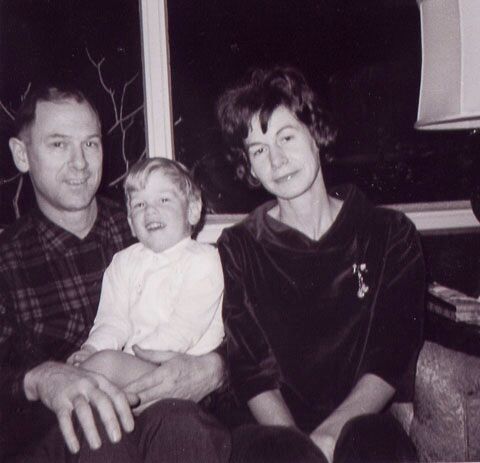
In 1961, my parents buy a split-level, four-bedroom house in a new subdivision in the west end of Ottawa called Pinecrest, a middle-class suburb where none of the mothers work (outside the house), and the kids walk home for lunch to find the front door unlocked. They are creating more space for their unexpected third child — me — although I never seem to find it.

I learn to tell time by the kitchen clock, which is seven minutes ahead so my father won’t be late for work. In the morning, I sit on his knee and eat half his breakfast grapefruit. In the afternoon, I kneel on the pink chesterfield, staring out the living room window for a sign of his imminent arrival on the horizon. I am in the crow’s nest of a ship, a pirate suffering from scurvy desperate for nourishment.
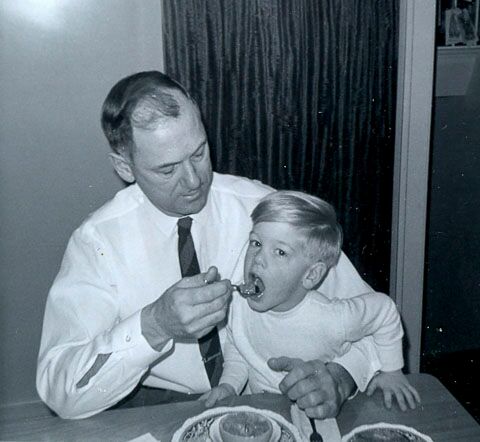
Like all of our neighbours, my family is white. Like most of them, we are vaguely Protestant. I have no religious instruction other than Uncle Arthur’s Bedtime Stories, which haunt my dreams. In one, a young boy is hit by a car. In the hospital, the boy in the next bed teaches him to hold his arm up at night to accept Jesus as his saviour. But the boy in the accident is pretty beat up. They have to prop up his arm on some pillows. The boy’s arm collapses when he dies overnight, but Jesus understood. I long to be understood too.

My father fears break-ins at the house during weekends to the cottage. Unsolicited, I pray the way I’ve seen on television with both hands folded to my chin. Fearing that Jesus will not understand, I cite a thesaurus of property crimes to ensure our house is not burgled, broken-into or robbed. Is it “A-men” or “Ah-men”? I hedge my bets, saying it both ways. A few times even, with variations, so that Jesus does not feel slighted and punish us for bad grammar or syntax.

A week after the minister from the United Church visits our house, my father drops me off at the church to join a friend in the choir. But my friend is not there. I am ten years old, too shy to put up my hand, too afraid to make waves. I sit alone, listening to the hymns in tears, waiting to be saved.

My mother doesn’t answer when the Jehovah’s Witnesses come to the door. She stays in the kitchen, and tells me to hide behind the pink chesterfield so they think no-one’s home. I wait forever, worried they will simply try the knob and find it unlocked. I want to understand who they are, but accept at face value the need to fear them. I lay low.

.

Ghosts

My father takes up so much space that, like my mother, I feel the only option is to be smaller-than-life. At a friend’s birthday party, I win the balloon for staying quiet the longest. It’s no effort at all since being well-behaved is my default position. It makes me invisible and, paradoxically, gives me the attention I crave.

Even my Old West action figures are unfailingly polite. Johnny West and Captain Maddox take turns watering their horses out of the back of the humidifier on top of the landing beside my parents’ bedroom. While my mother has one of her many five-minute rests, they tiptoe around the mesa and bring their mares back to the corral before my father gets home at 6:07 p.m. expecting dinner on the table.
My parents eat upstairs, while my brother and I dine in the rec room in front of the television. He’s ten years older and gets final say on shows, but allows me to switch during commercials. With all the back and forth, the channel selector on the Zenith starts to go, allowing ghostly images from one show to cross into another. In his workshop, my father files a groove into the broken shaft of a Sherwood hockey stick so it fits perfectly over the channel selector. A firm push — a poke check, really — sends the phantoms back to the world where TV shows live when you’re not watching them.

The stick demarcates space between channels, but also between the two of us. We keep it handy on the coffee table, a desk my father got surplus from work. He cut the legs in half, and my mother varnished the oak surface in a deep red. The TV Guide, our sacred text, is on my brother’s side. He forbids me to draw moustaches, beards, and eye patches on the celebrities featured on the covers until the week is over, and of course I comply.

My older sister is long gone and, after my brother moves out, I eat downstairs alone. I can watch what I want now, but sometimes I watch his shows to pretend he’s still sitting beside me. I respect his rule for defacing the cover because he might visit from Winnipeg and I don’t want to disappoint him.
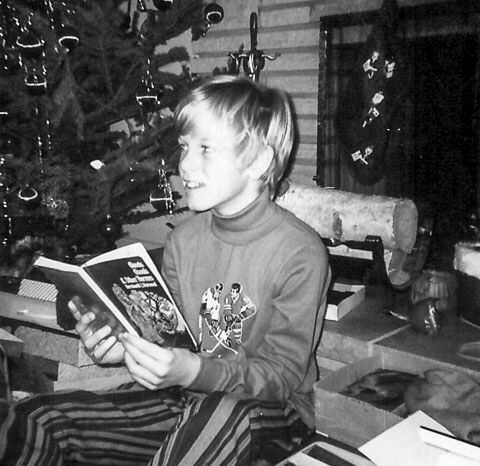
There are so few rules in my family that I need to make my own. On Christmas morning, I open my stocking and one present before waking the household. When I come home with a friend after school, the two of us play with my chemistry set on the deep freeze in the garage until my mother returns. I long for bigger rules and firmer principles. Unlike my action figures, I am malleable in all directions.

I don’t care for superheroes, identifying instead with the tormented vampire of my Dark Shadows comics. He pretends to be writing a book to cover his absence during daylight hours. I like how he flits between human and bat, how he moves between the past and the present, how he hides in plain sight. Now you see him, now you don’t.

.

Baby

In sixth grade, I start a five-year diary that gives four lines to take stock of the day. Not much room to express feelings, but that suits me fine. I look for them instead in the lives of others.

I hatch a plan to sneak into our classroom after school to flip through Nicole’s little black book. I fear the cleaning lady will see through me or that Nicole has not seen me at all. The best I can manage is writing her name in my diary that night. A few choice words.
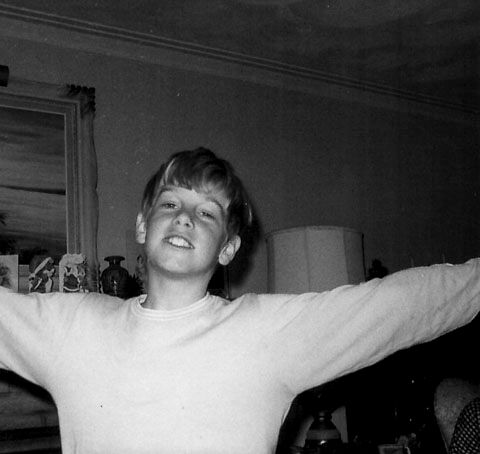
Nicole disappears with the other cool kids at recess while I play a ball game called “Baby” with my nerdy friends. Since players can twist their bodies but not move their feet, I roll the ball strategically to tag them out. I win a lot except the last game of the year. Because it is my last recess — the beginning of the end of childhood — my feet are glued to the earth, but my head is somewhere else. I am busy recording what to remember.

As the calendar year draws to a close, I am restless. Not for the excitement of a new year, but rather so I can repeat the description of last year’s “yummy dinner” in the space allotted for January 1. Echoes and symmetries. The promise of the familiar offers comfort I can find nowhere else.

.

Summers

One of my first books is Tommy Visits the Doctor, which offers a reassuring picture of a middle-aged male physician with greying temples who gives his child patients a lollypop when they leave. A parallel story shows a young bunny going to the rabbit doctor who receives a fat carrot on the way out of the burrow. I do not think to be afraid before reading the story.

I do not visit the doctor when the dead limb falls off the tree, carrying me to the ground. I lose my wind, look around for it in panic. How does my mother hear my gasps? I am in the woods, far from the cottage. She bids me rest in bed with the blinds closed, as if darkness itself will stop the new route my spine plans to take.
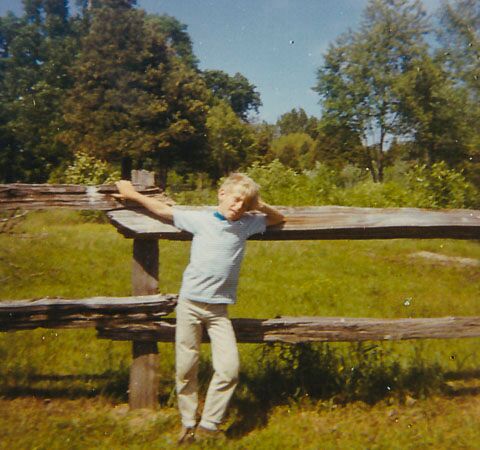
I live at the cottage with my mother all summer, dreading the arrival of my father on weekends. He is the great surgeon and I the nurse, expected to hand him the instrument required — a Phillips screwdriver, a square of coarse sandpaper, a pair of sidecutters or needle-nose pliers — before he himself knows it’s needed.

The tools are a mystery to me, much less interesting than the stories of Sherlock Holmes or Hercule Poirot. As I eliminate murder suspects, the troublelight droops in my hand, throwing my father’s work under the car into shadow. I have no defence, no alibi. But even as he chastises, I am secretly pleased since my guilt means he sees me.

.

Social Studies

I invite different friends to the cottage for a week at a time, but never Allan, one of my Chinese friends. I am not even sure we are friends at all. I share lockers with him from fifth to eighth grade. I play foot hockey with him at recess and when I curse for the first time at a bad play he enthuses that I’ve finally become one of the gang. The sense of belonging this creates makes me want to swear for joy.

I go to Allan’s birthday party every year, which is managed by his older sisters. We play hockey on the rink in back of the Catholic school near his home, and then play more games in his basement. I win first prize one year — a can of lychees in syrup. I feign appreciation, but it’s a strange reward, especially when the runner up gets a hockey puzzle in a can. It must be a Chinese custom, one more thing I don’t understand or question.
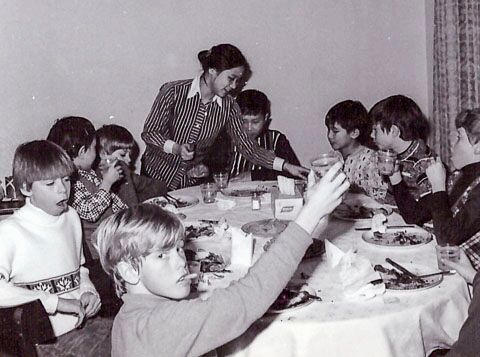
When Allan gets sick in eighth grade, I am the one who delivers a cassette tape of limericks recited by the class as a get-well-soon gift. My classmates record it dutifully, and I resent being picked as the messenger. The class knows without knowing this is no ordinary illness and no-one wants to get too close.

I visit Allan in the hospital where he wears a baseball cap. When he returns to school, he ends up on the “skin” team in gym class, and we all see the marks on his chest. He doesn’t seem to be the same. Even his hair is different.

He disappears again from school, and I deliver another tape of dumb poems. I bring him homework, too. Maybe his backdoor is unlocked, even if he lives on a less desirable street. But I don’t check. I don’t want to get trapped into spending time with him, of witnessing his decline. So I leave the books on the barbecue in the carport outside the door and call him from home. After all, I only go to his house on birthdays and he’s never been inside mine at all.

Allan misses graduation and the chance to leave five words to be remembered by in a cheap photocopied keepsake the teacher makes for all of us. So she writes something for Allan, making a joke based on his last name which rhymes with “wrong”. Like the limericks, it’s not so funny.

I wear brand new white wide-legged Howick jeans with four stars on the back pocket to the graduation party. Unlike everyone else who eats KFC, I get a plate of cold meat, which provokes many questions. Ask and ye shall receive. I want to be seen, and yet don’t stay for the dance, running home, faster than when I feared the bullies in third grade. Nicole will be there, and all the other girls I pine over and can’t approach.

The summer before high school I am up at the cottage, which is a good reason not to visit Allan in the hospital again. I don’t know whether he propped his arm up the night he died.

It’s a Chinese custom, I’m told, for the older children to handle the funeral. Same goes for the square of white paper containing a quarter and a candy they hand me at the wake. A candy to sweeten my loss, and money to buy more sweets.

He looks less real than ever, lying there, the first dead body I’ve ever seen. Our teary-eyed teacher hands out a tissue to everyone, a little melodramatically, but my own tears won’t come. Neither will words. Not here.

Ready or not, my childhood is over. What I have left is my desire to keep him alive. I hang onto the wrapped up sweet and the quarter, and the single page in Allan’s hand from Social Studies class. I must have borrowed it from him one day when I was sick and he got sick before I could give it back.

We were learning about Australians, how they have many of the same things we do in Canada. Most live in the cities. They enjoy life. These are the things worth remembering.

— Mark Foss

.

.
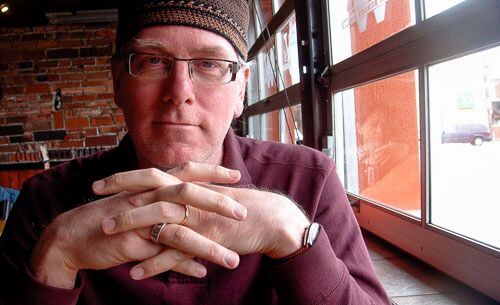
Born in Ottawa, and now living in Montreal, Mark Foss is the author of three books of fiction and numerous short stories. His most recent novel, Molly O, appeared in 2016. Spoilers, his first novel, was partly inspired by his radio drama, Higher Ground, which was broadcast on CBC in 2001. A collection of linked stories, Kissing the Damned, was longlisted for the ReLit Award in 2005. His stories have also appeared in such literary journals as The Fiddlehead and The New Quarterly, as well as in Canadian and American anthologies. He is currently completing a new novel. Visit him at www.markfoss.ca.

.
Jan 312015


.

Tom Take 4

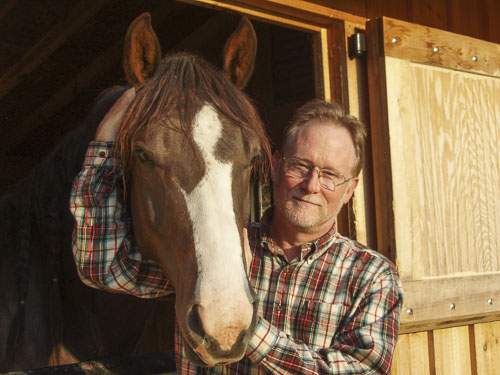
Tom Faure is a Contributor at Numéro Cinq. A graduate in the MFA program at Vermont College of Fine Arts, his work has appeared or is forthcoming in Waxwing, Zocalo Public Square, Splash of Red, Chattanooga Times Free Press, The Journal News. He lives in New York, teaching English and Philosophy at the French-American School of New York.

.
.

Feb 142014
 

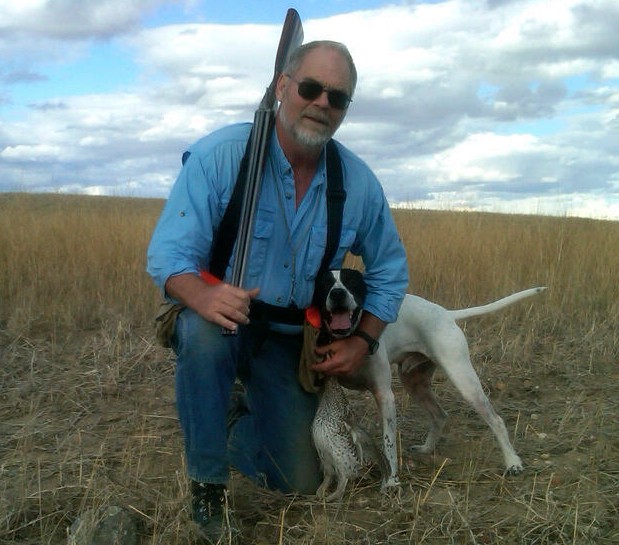
sl, bird dog pete and sharptail, Montana

On Valentine’s Day, of all days, a beautiful, yes, and uncannily disturbing short essay from Contributing Editor Sydney Lea that approaches the sex & death theme not in any trite pop-phil way, no, but in the way of poetry, juxtaposing two porcupines fucking (oh, man, the teeth chattering of two porcupines going at it) and the author’s rage and also the author’s own youthfully naive “savage romance” and the squalid death and the Wagnerian rise of “the deafening whistles of great churning trains; the shrieks of taloned raptors; the clamor of enraged men” at the end. Life is savage and strange. Something here of the ancient hunting myths: you kill (out of rage, out of necessity) and call down the curses of the dead upon your head for you have stretched your hand into the bitter lands. But brief, flashing, language that explodes. Also a story of love gone tragically bad.

May I draw your attention to Syd’s new author photo, which delights me. Author, gun, bird and dog. Bird dogs come into the essay. Ekphrasis. (Well, almost.) The author’s essays on bird hunting and dogs are among the best pieces of nature writing/observation I have ever read.

dg


I hesitated, doubtful I really wanted to learn just what that racket could be, mere yards into the woods behind our house. Hilarity seemed to blend with loud despair in that caterwaul, a mix somehow expressive, though of what I couldn’t have said.

Uncanny. The word flew into my thoughts unbidden. Once you dig up its roots, of course, it really means nothing more than unknown, yet in common usage it often holds some hint of horror.

I longed to go indoors, unhorrified, where fall’s first fire waited in the woodstove. Now that the house had lost its children, I looked forward as well to a romantic, last-of-the-workweek meal with my wife. I wanted to get away from … what? a windigo? a lycanthrope? a djinn? Nothing ordinary, at all events. I couldn’t associate that clamor with any local fauna, which I’d always thought I knew so thoroughly.

My flashlight found two forms, not big, not small, the size perhaps of new fawns, but far darker–dark as dark ever was. I saw an eye-gleam, then another, and finally four, each the color of a coal: two porcupines, carnally clinched, hooting and cackling. I still can’t think quite how to describe those squalls.

My childhood hero Frankie de Angelis once showed his own eyes’ glint and, laughing meanly, proclaimed he wanted to die at what these beasts were so roughly up to. I wasn’t entirely sure what he meant, though I recall managing a comradely, pseudo-manly chuckle.  Frankie, twice my age, could knock men out. He could walk on his hands forever. He could do a back flip from a standstill.

A porcupine is not even good at climbing the trees that make up his diet, so these two looked awkward in their noisy act of sex. Or maybe just careful, as in the lame old joke. Indeed, they chattered their teeth and tittered as if their behavior were just that, a sort of petty farce.

But then they’d hiss like bobcats, or scrabble or bark. Graceless, ugly things. I considered the hours I’d spent over the past summer, pliers in hand, plucking quills from my swift but stupid bird dogs, all yelp and twitch and tremble, their blood flecking our mudroom. So perhaps it was simple rage that drove me now, though surely that’s too simple a description.

When I got a little closer to Frankie’s age, my very first sweetheart and I would chafe and scrabble at each other’s bodies, as if we meant to do each other harm. Ignorant, savage romance.

I ran to the shed, grabbed a shovel, rushed back, and clubbed that pair of animals dead. It takes some doing to murder creatures with brains the size of warts, and it’s not as though I wanted violence anyhow, only peace and calm.

As I quelled one set of noises, however, others rose to mind: the wails of sirens; the deafening whistles of great churning trains; the shrieks of taloned raptors; the clamor of enraged men. I heard them all, uncanny.

— Sydney Lea

Sydney Lea is Poet Laureate of Vermont. He founded New England Review in 1977 and edited it till 1989. His poetry collection Pursuit of a Wound (University of Illinois Press, 2000) was one of three finalists for the Pulitzer Prize for poetry. Another collection, To the Bone: New and Selected Poems, was co-winner of the 1998 Poets’ Prize. In 1989, Lea also published the novel A Place in Mind with Scribner. His 1994 collection of naturalist essays, Hunting the Whole Way Home, was re-issued in paper by the Lyons Press in 2003. Lea has received fellowships from the Rockefeller, Fulbright and Guggenheim Foundations, and has taught at Dartmouth, Yale, Wesleyan, Vermont College of Fine Arts and Middlebury College, as well as at Franklin College in Switzerland and the National Hungarian University in Budapest. His stories, poems, essays and criticism have appeared in The New Yorker, The Atlantic, The New Republic, The New York Times, Sports Illustrated and many other periodicals, as well as in more than forty anthologies. His selection of literary essays, A Hundred Himalayas, was published by the University of Michigan Press in September, and Skyhorse Publications just released A North Country Life: Tales of Woodsmen, Waters and Wildlife. His eleventh poetry collection, I Was Thinking of Beauty, was published in 2013 by Four Way Books.

Apr 202012
 

A few years ago, I went to see Bodyworlds, an exhibition of plasticized corpses — real cadavers turned into permanent, plastic models through a process pioneered by German scientist Gunther von Hagens. There were pamphlets available, many of which dealt with questions about death and the impact of seeing skinned and dissected plasticized corpses — corpses that still had their eyes intact.

Although the signs said Do not touch, you could get incredibly close to the bodies. You could press your nose to them. And of course I ignored the signs and when no one was looking I ran my hand gently over the hardened, preserved muscles of the body of a male stretched out to permanently simulate diving for a soccer ball. I could feel every ridge, every bump, every bit of anatomy and yet there was no life. He stared, permanently, at the suspended soccer ball.

This is what is inside of me. This is what people are made of.

There’s a line in a song, “Indestructible Sam,” by hip hop artist Buck 65 describing the song’s namesake:

a man like any other, at the end of a long day
guts and muscle and maybe a little more

I have always liked that. I think it is a simple and astute definition of what people are made of, what life is made of.

We are meat machines.

Crime scene and autopsy pictures are all over the Internet. I once saw a video of a kid who dove off a bridge, missed the mark, and split his face open on the corner of a concrete wharf. Cut scene to the ER where he twitches, and his face falls away from his skull in two perfect halves, crushed to a split perfectly down the middle. Attending physicians try to hold the halves together and whoever has the camera is ushered away. It is surreal. The kid does not survive.

One of the multitude of reasons I don’t eat meat, particularly pork and beef, is because of autopsy photos — or rather how, reduced to our basic components, mammals are all very similar. On a metal slab, you are cut open, layers of fat and skin and muscle are peeled back to reveal bones and guts. Fat is an orangey hue, not like you’d imagine perhaps. Inside we’re all meat. Inside, we are indistinguishable from the pork chops and steaks. Pork, incidentally, is rumored to be the closest meat to human flesh in taste and texture. Pigs are routinely used for human stand-ins when performing research into certain after-death happenings, such as how bugs colonize a corpse.

I am often caught in Wikipedia link chains for hours — most recently on ways to die. Strange and unusual deaths, torture and execution methods, etcetera and ad nauseum. I learned about transanal evisceration, and death by a thousand cuts. I’m unsure whether or not this is useful information, but I have discovered people tend to not know how to handle it when you say, “Let me tell you about transanal evisceration, it’s when your guts come out of your butthole!”

I suppose my avid interest in pursuing an intimate relationship with and knowledge of the body and death (and by extension the expansive and creative realm of human cruelty) is an attempt to form a clumsy relationship with what will eventually happen to me. My consumption of information regarding dying and the various things that can lead to it and what happens to your body or can happen to your body after death is my way of saying, “Hello, how do you do?” to death. Not that I believe death is personified and comes to greet you when you finally kick it (although I have always been embarrassingly endeared by Brad Pitt’s portrayal of death in the otherwise kitschy Meet Joe Black). But I figure this event is something I should get to know, because, after all, it is unavoidable. I approach death like a timid fan would approach a celebrity. I love your work. May I have your autograph? Can I hang out backstage? 

I’m not entirely sure what I have learned that is useful per se. I am twenty five, and if you assume I’ll live to average old age, I can probably expect several more decades.

But that’s the thing — I’ve learned that you can’t expect to live to an average old age.

I recently found a photo of a car crash victim. It was a woman, and she was stretched on the metal table, naked and ready to be opened up. What struck me was that she had makeup on. Her nails were done. She’d had a bikini wax recently. And her bones were jutting out of her legs (probably cause of death: internal bleeding or alternately, head trauma). But everything about her now-dead-body said she didn’t have a fucking clue she was going to die that day, that she was going to end up on a cold, metal table, naked, pale, photographed with her bones showing.

But that’s the way it could go.

I don’t drive. Driving concerns me. Not because I lack ability, but because other people are idiots. Every time I get in a car I hear a dull ticking in my head. Those are the odds stacking against you — every time you get in a vehicle it could be the time you get in an accident.

Another line from a song, this time by Sarah Slean, and the song is called “I Want to be Brave (Madeline)”.

Over time luck runs out and fate is not your friend.

I imagine time slowing down in a collision. I imagine it as a moment of zen. I imagine thinking “oh, this is happening.”

I imagine I’d shit myself because a lot of people, especially in traumatic or violent deaths, shit themselves. That’s a fact. It doesn’t matter if you wear clean underwear. The truth is you’re likely to soil it anyway.

But I mean is it really that embarrassing if you die? Nobody’s gonna say, like at your actual funeral, “She was a kind soul, and it’s really too bad she totally dumped a load in her pants at her moment of death. That’s just…wow, that’s embarrassing.”

It startles me the things people concern themselves with to distract them from the fact that the issue at hand is you would be dead. In that state I don’t think anyone cares about poop.

Here are some other gross things:

If you die at home and have a cat or a dog, and they don’t find you for a while, your pets will more than likely eat your face off. It happens a lot.

If you die in water, particularly the ocean, you will probably come out gross and bloated, and animals enjoy eating your genitals, anus, eyes, lips and any other soft morsels of your flesh first.

If you die on land and are left for a while, birds will eat your eyes out of your sockets. Apparently, eyes are delicious.

In Tibet, they do something called a Sky Burial which involves the cutting up of a corpse and feeding it to the birds. This is actually done because there is no ground to bury bodies and this inhibits any potential spread of disease. Vultures and other birds are extremely good for body disposal.

I think about that a lot, too. Who would be the last to have an intimate relationship with my body after I die?

The doctor who sews me up after harvesting my organs?

The birds who eat my eyes to help my decay along?

Medical students, learning over my corpse?

Physio students, pulling the tendons of my detached arm to see how they make the fingers move?

I think about dying a lot, about what it would be like. I also think about surviving a lot. What could I survive? What could I conquer before I die?

And I celebrate getting older. Once I heard a doctor say that “unfortunately longevity means more old age, not more youth.” But that is okay, so long as I can maintain operational levels of health. Every day, every year I live is a celebration against all the things that could have and tried to kill me but didn’t. When my hair goes grey I want to dye it shades of blue and purple. I don’t care what my tattoos look like when I’m old. I have the general philosophy that as you age, you are fully entitled to simply give less fucks. We tend to meet our quota of fucks to give early on in life. Therefore, as we get older, we must be more sparse but more meaningful with the fucks we do choose to dole out.

There is a story by Amy Hempel called “The Harvest.” It’s about a girl who gets into a motorcycle accident and must recover after sustaining a grievous injury that left a large scar on her leg. In the end of the story, the girl is standing on a beach and a child asks her what happened to her leg. She tells him a shark attacked her. He asks “And you’re going back in?”

She says: “And I’m going back in.”

Every day the shark could attack, and sometimes it does. And, despite my time spent on forging an existential acquaintance with death, and knowing that eventually I’ll meet the real thing, perhaps while shitting my drawers, perhaps after my face has been licked off my skull by a beloved family pet, the whole point is that this makes me cognizant of the very fact that I am alive.

And I’m going back in.

— Brianna Berbenuik

——————————————

Brianna Berbenuik is a 20-something misanthropist living in Victoria in British Columbia. She is a fan of kitschy pop-culture, terrible Nic Cage movies, the philosophy of Slavoj Zizek, and Freud. She has contributed several essays and poems to NC. Look her up in the Poetry and Nonfiction tables of content.


Apr 122011
 

Here’s the first in a series of science essays from NC’s resident scientist (also painter, author, musician, mountain woman), Simon Fraser University gene biologist Lynne Quarmby, who promises to lead us into that fierce nexus of mystery, art, literature, beauty and science. Lynne has already contributed aphorisms, a “What it’s like living here” piece and paintings to the pages of NC. It seems only fitting that she now extend our reach into the laboratory, into the cell and atom. Lynne wrote her own short intro to the series. DG could do no better.

dg

It’s amazing all
this motion going
on and
water can lie still
in glasses and the gas
can in the
garage doesn’t rattle.

—AR Ammons

Have you ever watched a sunset and reminded yourself that you are standing on a ball that is spinning and that you are flying backwards away from the sun? It totally changes the experience. Try flying into a “sunrise”-– that’s really wild. On the evolutionary timescale, it has been the blink of an eye since Copernicus realized — and Galileo observed — that we have day and night because we live on a spinning world that orbits the Sun. We’re still trying to get used to the idea.

Our direct sensory experience of the world evolved with us; in our hearts the world is what our sensory organs tell us it is. Our senses are superbly effective for helping us function in the everyday world—that’s why we’re still here—so it’s understandable that when science reveals something counter-intuitive or paradoxical, we have difficulty integrating the new ideas into our worldview. But if we can recognize and acknowledge that our direct biological senses, as wonderful as they are, give us only a tightly pinched and cloudy view of the world, then we open ourselves to unimagined beauty.

From where I view the spinning world—as a cell biologist—I see our experience of the world expanding so much that what it means to be human is changing as profoundly as it did when Copernicus and Galileo bumped Earth out of the centre of the Universe. Our intellectual peripheral vision has picked up on the shift, but as usual, our spirits and souls are lagging behind, as though they fear that there isn’t a place for them. —LQ

Stem Cells and the Fountain of Youth

By Lynne Quarmby


I hope I die before I get old
—Pete Townshend (from “My Generation”)

In some societies the aged are venerated, in none are they envied. The inevitable decay of our bodies and minds is something we prefer not to contemplate. There is nothing appealing about decreased mobility, loss of muscle and bone mass, reduced immune function, decreasing liver, kidney and brain function, decline in ability to respond to stress and an increasing susceptibility to stroke, heart attack, diabetes and neurodegenerative disorders. A dollop of increased wisdom seems meager compensation.

Everyday we are witness to the inevitability of decay; our buildings and roads crumble, landscapes erode and holes appear in our socks. It is something we know more deeply as we grow older: if we manage to dodge the proverbial bus, our bodies will decay until one day we die. The idea of reversing this decay goes entirely against our experiential knowledge of the world. Yet time and again the tools of science reveal that the world is not as it seems. We are learning that ageing is not simply the inevitable decay we’ve assumed it to be.

Our bodies are not static structures. The cells lining our intestine turn over approximately every five days. Similarly, our skin cells last on average two weeks, our blood cells a few months and the cells in our liver turn over approximately once/year. The average age of our muscles is estimated at 15 years. Cells of the heart are longer lived, but they too turn over. There is a large variation in the lifetime of our brain cells: Olfactory neurons are short-lived, but the neurons of our visual and cerebral cortices may be the ones we were born with. The average age of the cells in an adult has been estimated to be something like 10 years.

Old cells die and new ones are born. The dying cells are those that have done specialized service (filtering urine, absorbing glucose, detoxifying drugs, secreting milk, engulfing bacteria, detecting odors, and so on). At the end of their life span cells undergo a process known as apoptosis, or programmed cell death, and housekeeping cells clear the debris away. New cells go through a program of specialization (known as differentiation) and assume the duties of the old cells.

The new cells are born from adult stem cells that reside in special niches in every tissue. Stem cells can divide indefinitely and with each division one of the daughters replaces the stem cell and the other becomes a progenitor for the differentiated cells of the tissue. Embryonic stem cells have the potential to produce any cell in the body – that is how we develop from sacs of cells – but so far as we know, adult stem cells are restricted in the variety of cells they can produce.

About five years ago scientists discovered that adding extra copies of a specific set of genes could convert differentiated adult cells (from your skin, for example) back into pluripotent stem cells – called iPSCs for induced Pluripotent Stem Cells. These cells earned the name “pluripotent” because their daughters can be enticed (by various combinations of hormones) to become any of a wide variety of differentiated cell types. iPSCs were big news medically because they suggested the possibility of grow-your-own replacements for diseased or damaged tissues. The original iPSCs caused cancer (in mice) and while it isn’t clear yet whether we will be able to overcome all of the problems that are hindering the use of iPSCs in tissue regeneration, these cells have already become hugely valuable for research. Ageing is one of the research areas that is benefitting from iPSCs.

Continue reading »

Oct 102010
 

The most beautiful death

Brave New World novelist Aldous Huxley was diagnosed with cancer in 1960, at which point his health slowly began to deteriorate. On his deathbed in November of 1963, just as he was passing away, Aldous – a man who for many years had been fascinated with the effects of psychedelic drugs since being introduced to mescaline in 1953 – asked his wife Laura to administer him with LSD. She agreed.

Read the letter with links: via Letters of Note: The most beautiful death.

Jan 202010
 

Up til 4 a.m. The Robert Wrigley epigraph sent me to D. H. Lawrence’s Selected Poems with the amazing Kenneth Rexroth introduction.

In a world where death had become a nasty, pervasive secret like defecation and masturbation, Lawrence re-instated it in all its grandeur–the oldest and most powerful of the gods.

Read “The Ship of Death” as soon as you can.

Piecemeal the body dies, and the timid soul/has her footing washed away, as the dark flood rises/ We are dying, we are dying, we are all of us dying/and nothing will stay the death-flood rising within us/ and soon it will rise on the world, on the outside world./We are dying, we are dying, piecemeal our bodies are dying/and our strength leaves us,/and our soul cowers naked in the dark rain over the flood,/cowering in the last branches of the tree of our life.

Also check out, for that matter, Rexroth’s gorgeous An Autobiographical Novel which isn’t really a novel but a memoir.

dg

Jan 192010
 

I finished reading the essay last night. A touch of hopefulness at the end.

“In a world or brutal and oppressed life, decadence becomes the refuge of a potentially better life by renouncing its allegiance to this one [life] and to its culture, its crudeness, and its sublimity.”

I too am admirer of decadence, of mixed form, parodies, anatomies and Menippean satires.

Now I am reading Lives of the Animals by Robert Wrigley, a book of poems mentioned by Cheryl Wilder in her graduate lecture at the last residency. The epigraph is from D. H. Lawrence’s poem “Ghosts.”

“And as the dog with its nostrils tracking out the fragments of the beasts’ limbs, and the breath from their feet that they leave in the soft grass, runs upon  a path that is pathless to men, so does the soul follow the trail of the dead, across great spaces.”

dg