Mar 122012
 

John B. Lee is Poet Laureate of Norfolk County on the north shore of Lake Erie where I grew up on a tobacco farm smack in the middle of a geologic formation called the Norfolk Sand Plain. He lives in Port Dover, home of the peculiar fresh water fishing boat called the turtle back (photos provided upon request), also Fred Eaglesmith, the singer, and a bar called The Brig in the basement of which several American interlopers were held captive during the War of 1812 (not an unpleasant prison experience, one imagines, as these things go). John is an old friend and a prolific author of more than 60 books. These poems are part of a forthcoming collection entitled Let Us Be Silent Here (Sanbun Publishers, New Delhi, India, 2012). The poems were translated into Spanish by Manuel de Jesus Velázquez Léon for a recent reading John gave in Havana, Cuba, and we also have, here, the Spanish versions. But the poems themselves are based on a trip John made to the Holy Land and his reading of Palestinian and Israeli poets. This is a vast message loop–Canada, Israel, India and Cuba–something to get your minds around as you read these poems. But the poems themselves are gorgeous meditations on that thorny, dry land, birthplace of great world religions, refuge for the Holocaust remnant, where the geology is a book of prayer and story blossoms in the ruins.

this is the closest I will ever come
to seeing
through the eyes
of the Messiah
this mask of stars
this moon

John has contributed to Numéro Cinq twice before. See those earlier poems here and here.

dg


Book cover detail from The Rooftop, a painting by Israeli poet/artist Helen Bar-Lev


Linen and Wool

 a poem in honour of Israeli poet Yehuda Amichai and Palestinian poet Mahmoud Darwish[1][2]

“you must not wear a garment woven from linen and wool”  — Deuteronomy

I have retted the linen
and carded the wool
of two voices
and my hands are rich
and smooth
with the lanolin
of my work
anointed by the silkening
oil of the seed of the field

and from these
I have fashioned
a garment of sky
for the mind and the soul
imaginary blue
haunted by the absent dazzle
of stars in the dark

and next to my skin
I fasten a shirt of earth
where the heart
falls in green
through green
like the crimson drop
of a peach hooked high
in the sun
let loose from the pull
of a ripening stem
and it plunges and subsides
plunges and subsides
like the soften gone still
of fruit on a bruise

it releases its colour from form
like the fading
of rain on damp loam

this gloaming
inclusion of grey

this wearing away
of the tattering light

this dew
on a web in the heat

unwinding a glistening thought

old memories dream
in dry land

when the water’s the past
in a well

one thirst will empty the cup

another’s a cup
we must fill


Lino y lana

un poema en honor al poeta israelí Yehuda Amichai y al poeta palestino MahmoudDarwish[1][2]

“No usarás ropas tejidas de lino y lana” — Deuteronomio

He humedecido el lino
y cardado la lana
de dos voces
y mis manos se han vueltofértiles
y suaves
con la lanolina
de mi trabajo
ungidas por el sedoso
aceite de la simiente del campo

y de estas
he confeccionado
un vestido celeste
para la mente y el alma
azul imaginario
hechizado por el resplandor ausente
de las estrellas en la oscuridad

y cerca de mi piel
me abrocho una camisa de tierra
donde el corazón
cae en el verde
a través del verde
como una gota carmesí
de un durazno suspendido alto
en el sol
soltado del tirón
de un tallo que madura
y se desploma y decae
se desploma y decae
como la suavidad aquietada
de la fruta en el cardenal

derrama su color desde la forma
como el desvanecimiento
de la lluvia en la arcilla húmeda

esta inclusión de
gris crepuscular

este desgastarse
de la luz desgarrada

este rocío
en la telaraña del calor

desdoblando un pensamiento resplandeciente

sueño de viejas memorias
en la tierra reseca

cuando el agua es el pasado
en un pozo

una voluntad sedienta vacía la copa

es la copa de otro la
que hemos de llenar


A Sadder Music: meditation on YadVashem

“the sad music of humanity”
—William Wordsworth

I have entered into this place
of the lost
lost elders, lost children of Europe
with its death-grey
housefly-grey   burnt-ash grey
crematorium
what the cruel past calls
historical
once horror beat in the breast
like a great-winged bird
where its flame-shadow
fell in the blood
and its season’s plunge
was a sea of fire

how is it that we set the lists
in volumes tall as life
and learn where quiet ladders lean
to say the darkness in the names
that burn the pages through
with ink gone into smoke—sing
softly, softly, let’s be silent here—

oh reverent grief
that war is done
those lives
have lined the earth with bones
like rootwork of a thousand-thousand-thousand
wind-broken trees

the soul of man
grimes over
like a lamp of oil
and shame shines through
the tainted light we touch


Una música más triste: meditaciones sobre YadVashem

“La triste música de la humanidad”
—William Wordsworth

He entrado a este lugar
de los perdidos
los ancianos perdidos, los perdidos hijos de Europa
con su crematorio
gris como la muerte
gris como las moscas   gris de cenizas quemadas
lo que el pasado cruel llama
histórico
una vez que el horror golpeó en el pecho
como un gigantesco pájaro alado
donde su sombra flameada
cayó en la sangre
y el desplome de su época
fue un mar de fuego

como es que fijamos el listado
en volúmenes tan altos como la vida
y comprendemos donde se apoyan las quietas escaleras
para decir la oscuridad en nombres
que queman a través de las páginas
con tinta convertida en humo—cantar
suavemente, suavemente, hagamos silencio aquí

oh la aflicción reverente
por la guerra que ha acabado
esas vidas
han cubierto la tierra de huesos
como el trabajo de raíces de mil millares de millares de
árboles fertilizados por el viento

el alma del hombre
se enturbia toda
como una lámpara de aceite
y la vergüenza resplandece a través de
la luz mancillada que tocamos


Night Sky Over Jerusalem

this is the closest I will ever come
to seeing
through the eyes
of the Messiah
this mask of stars
this moon
pale as a sickly child
and in the daylight
blue heaven blooms
with those invisible
constellations
subsumed by the sun

my son asks
“why did Christ make no mention
of dinosaurs?”
American critic Harold Bloom
says, “Christ was a mortal
god—and we humans
are immortal animals …”
one Toronto theologian suggests
“Christ’s life is the same
as the life of ancient
Egyptian god Horace
and the Beatitudes are
plagiarized
from mythologies
far older
than the gospels”and I
looking up at Cassiopeia,  at
Orion’s belt
at the inconstant drift of the milky way
with my contemporary
contemplation
of this much-storied universe

consider Aristotle, Copernicus
Galileo, Newton, Einstein
Hawkins, the resonant
music of cosmic strings
living here in these entropics
on this event horizon
my life like a snowflake
falling onto the surface
of a great water
or an ember
briefly breath-crimson in the grey glow
of a larger ash

pull the bow on the arrow of time
from nock to tip
at this motionless moment
the quiver is full
as a clutch of ornamental reeds
and the one wound I make is doubt
and the other
pure belief, and I feel
in the presence of placeless place
and in the absence of timeless time
a common faith
in the sorrowful joy
of letting the arrow      sing


El cielo nocturno sobre Jerusalén

esto es lo más cerca que alguna vez estaré
de ver
a través de los ojos
del Mesías
esta máscara de estrellas
esta luna
pálida como un niño macilento
y a la luz del día
el cielo azul florece
con esas constelaciones
invisibles
subsumidas por el sol

mi hijo pregunta
“¿por qué Cristo no mencionó
a los dinosaurios?”
el crítico americano Harold Bloom
dice, “Cristo era un dios
mortal—y nosotros los humanos
somos animales inmortales…”
un teólogo de Toronto sugiere
“la vida de Cristo es igual a
la vida del antiguo
dios egipcio Horacio
y las Beatitudes han sido
plagiadas
de mitologías
mucho más antiguas
que los evangelios”
y yo
mirando a Casiopea, al
cinturón de Orión
y la deriva inconstante de la vía láctea
con mi contemplación
contemporánea
de este universo tan celebrado por la historia

considero a Aristóteles, Copérnico
Galileo, Newton, Einstein
Hawkins, la música resonante
de las cuerdas cósmicas
viviendo ahí en los entrópicos
sobre este evento de horizonte
mi vida como un copo de nieve
cayendo hacia la superficie
de un agua magna
o una pavesa
brevemente alentada hasta el carmesí en el fulgor gris
de una ceniza más vasta

tiro del arco en la flecha del tiempo
desde la muesca hasta la punta
en este momento detenido
el carcaj está lleno
como un puñado de cañas ornamentales
y la única herida que hago es dudar
y la otra
creencia pura, y siento
en la presencia del lugar sin lugares
y en la ausencia del tiempo sin tiempo
una fe común
en el júbilo triste
de dejar a la flecha    cantar


In the City of Megiddo

 “in the city you didn’t find the city”
—Mahmoud Darwish from “Hoopoe”
 

I stand in the slipping heap
on the rocky berm
of a seven-thousand
year old excavation
and evidence is everywhere
that we vanish when we die
as in ashes
as in dust
on the sun-blackened stone
not one scrap
of bone, nor tool
to thrill the tell
the shovel turns
its voice on basalt
broken from a broken wall
imagine here
a house, and here        a well
wherein the water’s ghost
descends
beyond the darkest dark
to dry the falling cup

and yet, see here
they lived—
these ancient people
of a former time

they loved and thrived
and bore their children
out of hope
they worked the fields
and flailed the grain       and died
to keep their store
as heroes die and die again
in endless war

the sun
improves my shadow
with a sharp-edged light
what drums I hear
are of my living heart
please take my word
that I was here
and thought of you
as dry wells
think on rain


En la ciudad de Megiddo

“en la ciudad no encontraste la ciudad”
—Mahmoud Darwish de “Hoopoe”

estoy parado en el cúmulo resbaloso
sobre el borde rocoso
de una excavación de
siete mil años de antigüedad
y las evidencias están por todas partes
de que nos desvanecemos al morir
bien en cenizas
bien en polvo
sobre la roca ennegrecida por el sol
ningún pedacito
de hueso, ni de utensilios
que haga el relato emocionante
la pala devuelve
su voz sobre el basalto
roto de una rota pared
imaginen aquí
una casa, y aquí    un pozo
en el que el fantasma del agua
desciende
más allá de la oscuridad más oscura
para enjugar la copa que cae

y sin embargo, miren aquí
vivieron ellos—
estos antiguos
de un tiempo remoto

amaron y prosperaron
y parieron a sus hijos
desde la esperanza
trabajaron los campos
trillaron el grano    y murieron
por mantener sus provisiones
como héroes murieron y murieron otra vez
en una guerra sin final

el sol
perfecciona mi sombra
con una luz afilada
los tambores que escucho
son los de mi corazón viviente
por favor reciban mis palabras
de que estuve aquí
y pensé en ustedes
como los pozos secos
piensan en la lluvia

 —John B. Lee & Dr. Manuel de Jesus Velázquez Léon

——————————————————-

John B. Lee is the author of over sixty published books.  His most recent book, Let Us Be Silent Here, is forthcoming from Sanbun Publishers in New Delhi, India.  He is currently working on a memoir of his life in hockey. Under the working title, You Can Always Eat the Dogs: the hockeyness of ordinary men, it is forthcoming from Black Moss Press in the summer/fall of 2012.  Inducted as Poet Laureate of the city of Brantford in perpetuity, he was also recently appointed Poet Laureate of Norfolk County where he now lives in Port Dover, a fishing town located on the south coast of Lake Erie.  A recipient of over seventy prestigious international awards for his writing, the poems taken from Let Us Be Silent Here, were inspired by an eighteen day journey through Israel and Jordan.  He and Manuel have collaborated on translations on several occasions, the most substantial project being Sweet Cuba, a bilingual anthology of Cuban poetry in original Spanish with English translations.
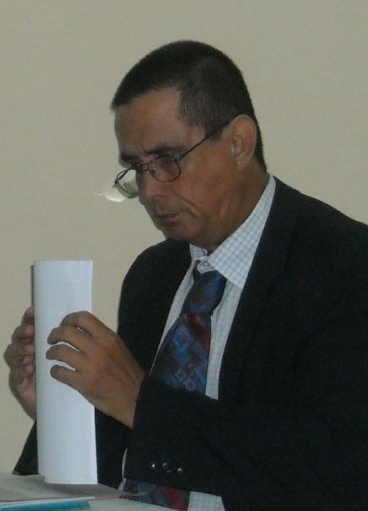
Manuel de Jesus Velázquez Léon is a professor at University of Hoguin.  A co-founder of the Canada Cuba Literary Alliance, he is editor-in-chief of the bilingual literary journal, The Ambassador.  He and John B. Lee collaborated on the 360-page bilingual anthology Sweet Cuba: The Building of a Poetic Tradition: 1608-1958, (Hidden Brook Press, 2010).  Sweet Cuba has been called “the most significant book of translated Cuban poetry ever published.”  He lives in Holguin, Cuba, with his wife and their young son and is the publisher of Sand Crab books which recently printed a bilingiual editon of Saskatchewan Poet Laureate Glen Sorestad’s book, A Thief of Impeccable Taste.

Footnotes    (↵ returns to text)

  1. … the poetry of Yehuda Amachai is a challenge to me, because we write about the same place.  … so we have a competition: who is the owner of the language of this land?  Who loves it more? Who writes it better?  — Mahmoud Darwish, Palestinian
  2. “the linsey-woolsey of our being together…”  is  from a poem by Jehuda Amichai inspired by the concept of ‘shatnez’
  3. … la poesía de YehudaAmachai es un reto para mí, porque escribimos acerca del mismo lugar. …así que tenemos una competencia: ¿quién es el dueño de la lengua de esta tierra? ¿Quién la quiere más? ¿Quién escribe acerca de ella major? — Mahmoud Darwish, palestino
  4. “la tela de dril de estar juntos…”  — de un poema de JehudaAmichai inspirado por el concepto de ‘shatnez’
Feb 152012


It comes as a shock to think that I have known Robin Hemley for over thirty years. I didn’t think, honestly, that I was that old. We met at the Iowa Writers Workshop in 1980, across a workshop table, I recall, with the then program director Jack Leggett chairing the proceedings. Robin looked too young to be in graduate school, and he still carries himself, even writes, with a kind of wide-eyed, cheery openness to EVERYTHING that is both charming and compulsively readable. Nowadays he’s achieved that remarkable state of being able to turn almost anything that happens in life into something worth writing about. He is an indefatigable world-traveler, prolific author, inspired teacher, and an amiable friend. Here he is taking a group of American undergraduates to Cuba for a winter course. Academia, life, politics and art merge.

Robin Hemley is the author of ten books of nonfiction and fiction, and the recipients of many awards for both, including a Guggenheim Fellowship and two Pushcart Prizes.  His most recent books are A FIELD GUIDE FOR IMMERSION WRITING: MEMOIR, JOURNALISM, AND TRAVEL (University of Georgia Press, 2012) and REPLY ALL: STORIES (Break Away Books, Indiana University Press, 2012).  Indiana University Press is also reissuing his novel THE LAST STUDEBAKER in 2012.  He is also the author of the popular books, TURNING LIFE INTO FICTION (Graywolf Press) and DO-OVER (Little, Brown), and the BBC is currently at work on a feature adaptation of his book INVENTED EDEN: THE ELUSIVE DISPUTED HISTORY OF THE TASADAY (Bison Books, University of Nebraska Press).  He is the director of the Nonfiction Writing Program at the University of Iowa, founder of the NonfictioNOW Conference, a senior editor of The Iowa Review, editor of the online magazine DEFUNCT, and a colleague at Vermont College of Fine Arts .

dg

§

The eighty-three-year old Cuban poet grasped my arm, whispered, “I love your people.  I feel a spiritual connection to them.”  I didn’t know what to say.  I had just met him.  He had spent a dozen years in New York, much like the Cuban National Hero, Jose Marti, who, before dying in battle against the Spanish in 1895, spent fifteen years in New York.  I had spent a total of two weeks in Cuba, and what was I to say?  To lie?  “Right back atcha, Cuba! I feel a spiritual connection to you, too.”  I didn’t.  But neither did I feel a spiritual connection to my own country. I thought that he and nearly every other Cuban we met idealized the U.S. the way Americans idealize Cuba.  The Columbus Syndrome works both ways. Columbus spent a few days in Cuba and then sailed back and said it was the loveliest place on earth, and certainly my students had an enormous case of Columbus Syndrome.

I and a colleague had brought thirteen undergraduates with us to Havana for a Winter term course, as had, it seemed, nearly every other U.S. university.  A bellman at the Presidente Hotel, Gringo Central, told me there were more Americans now than ever, but “they will all go when Obama loses the election.” True, the restrictions have lessened over the last year, allowing more short-term visits by educators, researchers, and students.

Every day, it seemed a new group from George Mason or Randolph College or American University showed up at the Presidente and we compared notes on our respective itineraries: who was going to visit Che’s grave or the hot springs at Las Terrazas or the beaches of Varadero. Canadians, Brits, Russians, Germans, Chinese, Argentines, Colombians, and Japanese have been coming here for years, but for the throngs of young Americans now legally entering Cuba, the approach is not unlike the hordes of shoppers awaiting a midnight sale at Target on Thanksgiving. And what are they waiting so impatiently to purchase? Authenticity, of course.  It’s what the country trades in when all is blockaded.  Cuba es autentica, the commercial warbles.  Tom Miller, a travel writer and Cuban expert along with us, warned my students never to use the words, “quaint,” “nestle,” or “local” in a travel piece, but his warning was of no use.  Any traveler infatuated with a new country sees nothing but quaint nestling locals.

And that’s not the half of it with Cuba, where a powerful strain of Columbus Syndrome, resistant to any known ideological antigen, infects most American tourists who find their way here legally or not. It’s not just the antiquated American cars from the fifties and sixties, belching smoke and plying the uncongested streets of Havana.  Or the two and three hundred year old buildings, some being restored, some too ruined to save.  It’s also the view from the rooftop of the Presidente Hotel at night – the modest skyline with only one or two signs lit by neon.  My colleague and I had wondered if our students would miss the Internet and Facebook and Skype and their cell phones.  Instead, they worshipped the lack of it.  It’s not the U.S. blockade against Cuba that blocks the Internet, but the Castro government, though nearly everything else seems the result of the blockade, including the cars and the crumbling buildings.

What the elevator operator in the Presidente Hotel said about the U.S. elections is true most likely.  If Obama loses the election, the Blockade will undoubtedly continue at least four years more.  No one, American or Cuban alike, could give me a good reason why the Blockade, in place since 1960, continues, except for the most obvious political reason, that the Blockade serves the interests of a minority of Cuban Americans in Florida.  And there’s too much money being made in the maintenance of the Blockade, (including spending 500 million taxpayer dollars annually on Radio and TV Marti, the latter which is blocked by the Cuban government in any event).  The word I heard most frequently was “inertia.”  The Blockade has been in place so long, no one has the energy or will to end it.

Romney must be a little embarrassed by a 2007 speech on Cuba, which he mistakenly ended with the phrase, “Patria o Muetre!  Venceremos!”  It means “Fatherland or Death, We shall overcome,” a phrase that Castro used for decades to end his speeches, and which my students and I glimpsed occasionally on banners strung across Havana’s streets (Gingrich has had a lot of fun with that Romney gaff).  Our tour guide admitted unabashedly as we passed under one such banner, “It works, growing up with those slogans, seeing them everyday.”  Of course, it works, but blockades and embargoes don’t work, unless we hope to push the blockaded country into war.  When was the last embargo that worked?  In the forties, we wanted Japan to leave China and stop massacring its population.  A noble desire on our part, but not an easy solution.  After we imposed an oil embargo against Japan (at the time, America supplied 80% of Japan’s oil), Japan asked FDR for a summit to discuss the matter, but the U.S. said Japan had to withdraw first from China and instead Japan attacked Pearl Harbor.  Go figure.  Why didn’t they just do the right thing and obey us?

Throughout World War Two, comics routinely portrayed Japanese as monkeys, inhuman, not worth a moment’s thought, but now of course, we’re the best of idealizing buddies again.  It could be so again with Cuba.  In his youth, Fidel Castro wrote to FDR addressing him as his good friend and asking him for a ten- dollar bill.  I’m sure he doesn’t give this youthful faux pas a moment’s thought now, and it means nothing because he was a child.  But grown men like Romney and Gingrich should at least be a little realistic when they ask the Castros for something.  They don’t want ten dollars from Raul or Fidel Castro.  They want, in Gingrich’s words to “promote democracy” in Cuba.  They want “free elections.”  Sure, we all do.  We want them in China.  Let’s blockade it.  We want them in Iran.  Let’s embargo it . . . oh, we are?

This just in: Cubans don’t want to drive junker cars.  They’d rather drive new cars, which they now get from China, along with scores of new Chinese busses.  They long to eat Pringles.  But I don’t want them to eat Pringles!  Or Big Macs.  I certainly never want to hear any quaint Cuban locals ordering skinny lattes.  Then all hope for humanity will be lost.  For this reason, I find myself curiously conflicted about the Blockade, on the one hand wondering what good it serves (beyond reasons to do with a small minority of Cuban Americans in Florida).  On the other hand, I was delighted to see so many old American cars so well preserved.  The country seems so real!

During our visit, a rumor spread in the Miami Cuban community that Fidel had died, relayed to me by Tom Miller, who added that such rumors crop up every eighteen months or so.  “Assassination by Twitter.”  I mentioned the rumor later to our Cuban tour guide who assured me it couldn’t be true because if it were, her mother, a well-known journalist, would have been in tears that morning.  Cubans mourning Castro?  Actually mourning him and not in the official North Korean way, in which a family of bears reportedly sobbed by the side of the road upon learning of Kim Jong-Il’s passing? Undoubtedly, few woodland creatures will mourn Castro’s passing, and not many more Americans, but now I wonder if even his passing will signal a change in our policy toward Cuba?

Honestly, ask yourself, don’t you want to visit Cuba before Fidel dies and/or the Blockade ends?  Of course you do.  You want to see Cuba as it exists now, poor and blockaded, but resilient and proud, one of the lone anti-U.S. bastions that’s any fun. If North Koreans had conga lines and made Pyongyang Club Rum, maybe they’d have more visitors, too.  But North Koreans don’t salsa.  At least, the Cubans know how to resist the U.S. with panache.  When the American Interests section, a tall building along Havana’s famous seafront, the Malecon, streamed electronic anti-Castro messages around the building’s rooftop during the Bush administration, Fidel retaliated by erecting over a hundred flagpoles flying enormous flags to block the messages.  The messages are gone now, but the Cuban flags remain, as well as an adjacent plaza, “Jose Marti Anti-Imperialist Plaza.” It was here, on January 1st, the anniversary of the “Triumph of the Revolution,” that my students and I listened to a Cuban singer belting out tunes with a string of young women straight out of a USO Show, as one of the savvier of my students remarked, line dancing on a stage before which thousands were gathered, most of them dancing too.  And between sets the enormous anti-imperialist video screens played the latest American music videos.

 —Robin Hemley

————————————————-

See also Stanley Fogel’s ¿Que Coño Pasa? Snapshots of my Wonderful Cuban Life, a book length essay on living in Cuba published earlier on NC.

May 182011
 

Stanley Fogel’s ¿Que Coño Pasa? Snapshots of my Wonderful Cuban Life is the first book-length text ever published on Numéro Cinq, another first, another huge milestone in our adventure in digital publishing. I am calling it a “What it’s like living here” because, in fact, it tells us what it’s like living in Cuba today. But, of course, it doesn’t fit the pattern: it’s a book. The first chapter, the introduction, takes the lesson of Edward Said’s Orientalism and applies it to the West’s construction of the so-called Cuban historical fact. The next three chapters are very much a memoir of the years Stanley Fogel has spent living and teaching in Cuba, the personal facts behind the wall of words. Snapshots is thus a blend of the critical and the personal (with a dash of Fidel Castro’s own rhetoric added for flavour). Stanley Fogel is in a good position to see what he sees. A Canadian scholar with a yen to be “displaced,” he has spent about four months a year since the early 1990s in Cuba. He is a quirky, perceptive, thoughtful (critical in the best sense) guide to that other world. He tells a story different from the received wisdom, he fills his story with people and anecdote—our Virgil.

dg

Me: I spent 36 years at the University of Waterloo/St. Jerome’s University where I was overcome by deconstruction and taught critical theory. A travel book, Gringo Star, ECW Press, only partly captures my desire to be displaced in the world. In 1999 I was awarded an honorary degree from Instituto Superior de Arte in Havana. Re. the opus at hand: I have spent c. 4 months per year since 1991 living in Havana, discovering the richness and distinctiveness of Cuban life–culture and politics transformed by the Cuban Revolution. I am retiring there shortly. (Do come visit if you’d like an ‘insider’s’ sense of Havana.) —Stanley Fogel

.

¿QUE COÑO PASA?

SNAPSHOTS OF MY WONDERFUL CUBAN LIFE

By Stanley Fogel

.

clip_image002

.

A mi hermano, Mario Masvidal, y la revolución cubana

.

Thanks to Elizabeth Effinger and Trieneke Gastmeier
for typing and grooming the manuscript.
Thanks, also, to St. Jerome’s University for grants
towards the preparation of the manuscript.
The photos, man with libreta and man with eggs,
were taken by Giorgio Viera.

.

Chapter 1: ¿COÑO, QUE PASA? An Introduction

.

A loose translation of “¿Coño, Que Pasa?” is “Jeez, whazzup?” “¿Que Coño Pasa?” is a grammatically skewed version of the first phrase. Its speaker is betraying more bewilderment and/or astonishment at what s/he has witnessed or heard than in that initial formulation. Both, though, transmit the effusive, gestural nature of Cubans’ speech and flamboyant responses to what is happening locally or beyond. Indeed, to absorb the import of the remark most fully, it is best to hear it uttered by someone, steeped in Cubans’ idiomatic lexicon and delivery, who shortens the noun to “’ño,” confident its meaning will survive. If you’re planning on spending time in Cuba and want to sound authentic, work on your “’ño”; remember, the shorter the syllable the better: taking the first, small bite out of the word “gnocchi” will suffice. Despite the possibly sexist dimensions (coño=cunt) of the formulations, no offense, feminist or otherwise, should necessarily be taken by the addressee of either remark, given that both men and women have been heard to repeat them, most often in gender-free contexts.

Too often, however, the voices of individual Cubans have been muffled or overwhelmed, most noxiously, of course, by pervasive U.S. media disseminating their political leaders’ rabid and hawkish views regarding the island. “A Caribbean gulag” is the mantra incessantly uttered, one which erases any sense of the lively, polyphonic voices existing there. Much more persuasive and compelling than dogmatic right-wing comments, to my ear at any rate, are Fidel Castro’s speeches which offer the vision of utopian and egalitarian possibilities for Cuba’s inhabitants and, indeed, for the world. That impressive voice, however, has come to represent, metonymically and univocally, the diverse people who live in Cuba. In addition, it often offers idealized visions that can by no means always or easily be translated into quotidian life. Nonetheless, not least because Fidel’s speeches have been so influential in shaping Cuban government policy and because they have not had the widespread reach of American anti-Cuban material, excerpts from some of those speeches are presented here, interspersed with my own commentary. They are meant to act more as a parallel discourse than as a countervailing commentary. While it is true, that they can draw attention to a discrepancy between the ideal and the real, they also point to genuine achievements as well as noble aspirations.

These pages, it is hoped, give some hint of the richness of Cuban life, a fecundity jammed, again, to a significant extent by American efforts to isolate the country and to caricature its unique political, cultural and social dimensions. While the U.S. bombards Cuba with messages, threatening, hectoring and proselytizing, Cuban versions of itself and its interpretations of world events and tendencies don’t get a hearing of any kind in North America, unless one subscribes to Granma International or accesses granma.cu on the web. With globalization of an American-capitalist kind that has produced homogenization in much of the rest of the world, the idiosyncratic qualities of Cuba since the Revolution are even more worthy of examination, respect and transmission. In Orientalism, his groundbreaking work that in many ways launched postcolonial studies and strove to articulate a postcolonial sensibility, Edward Said pronounced on the dangers and distortions inherent in a Western imposition of meaning on the East. Surely, U.S. constructions of Cuba are no less pernicious; they may, in fact, be more deleterious given Cuba’s size, its proximity to the belligerent presence immediately to the north and its pre-revolutionary interconnectedness with the U.S.A. To that list, one could add the current constellation of political forces in Florida which dictates, in large measure, the direction of Washington’s policies towards Cuba.

I have lived in Havana for approximately three months a year since 1992, the epicentre of the “periodo especial” [special period], when, after the fall of the Berlin Wall and the collapse of the Soviet Union, then Cuba’s sponsor and ally, food, gasoline and electricity all but disappeared for a time from the lives of ordinary Cubans. I witnessed the seismic shift firsthand when, early in my time spent in Havana, I happened to be passing by the University of Havana Library. Just outside the doors was a large, unsightly pile of Russian language books dumped there unceremoniously by the staff. The special period’s duress may have begun; at least, though, there was the satisfaction of jettisoning a Soviet presence that many felt was joyless, arrogant, oppressive and, possibly even, racist. Traces of that occupation do remain, principally in the numerous Ivans, Liubas and Vladimirs registered in Cuba’s census. Freed from naming their children from such imperialist sources, many parents opt for such freewheeling monikers as Misleidys (my lady) or Roelvis (you’re Elvis) that augment the sense, readily apparent, of Cuban expressiveness and buoyancy. Not that politically-based nomenclatures are passé; there is always the chance of encountering a Usnavi (U.S. Navy) or, more in line with official Cuban sympathies, a Hanoi. Famously, a kid with that latter name in the early 1970s was a “one hit wonder,” singing a song demanding the release of American dissident, Angela Davis, then in a U.S. jail. When she was freed, one of her first stops was Havana where she appeared at a huge rally in her honour.

Continue reading »