Jun 082013
 

Droll, mischievous and wonderfully intelligent confection, a Modernist riposte to the vacancy (absence) of E. L. James’s Fifty Shades of Grey, in which Gabriel Josipovici has a walk-on role and the protagonist imagines himself as Caspar Friedrich’s Wanderer AND Roy Scheider in Jaws in the same instant and someone wears a Clarice Lispector frock. It all begins with a mother telling a bedtime story, yes, yes, a scene of sadistic psychic violence like none other. Brilliantly witty. Deploys many of the Modern erotic  positions: sex and text, love as desire for absence, and self as ghost (we all have that sense of the self being something that haunts itself). The teaser below accurately describes love and art, or maybe not. By Andrew Gallix who edits 3AM Magazine.

dg

Your heart still skips like a trip of jackrabbits in the Arizona desert, where we carved our names on a bench close to the abyss. But when I look at you, well, I just feel dead inside. It has to be like this and no other way; otherwise it wouldn’t be art, would it? I’m in love with Jay now: I feed him mini Milano cookies and give him snug harbor. Anyway, I was never quite all there, was I? Long before we met, I was a character in one of your stories — ‘Sweet Fanny Adams.’ Young man goes looking for girl of his dreams in order to break up straight away. ‘At last,’ he says upon meeting her, ‘I have found my sense of loss.’ See? I haven’t forgotten. I started off as fiction, and to fiction I have returned. Our relationship was only a movement towards my disappearance. I am your sense of loss: the self-effacing subject of your work…”

“Emilie…” said Valentin.

“When you say my name, you retain nothing of me but my absence. And nobody is present behind these words I speak.”

Read the rest at Fifty Shades of Grey Matter | ANDREW GALLIX.

Jun 082013
 

Greg Hollingshead

Canadian politics has always been ripe for satire, perhaps never more than at this very moment. Two fat men dominate the situation: Senator Mike Duffy nailed for fiddling his expenses (currently under investigation by the Royal Canadian Mounted Police) and Rob Ford, the former mayor of Toronto famous for a video that appears to show him smoking crack cocaine. The Duffy scandal has reached into Prime Minister’s Office; his chief of staff has resigned, and the smoke cloud only grows (a criminal trial is currently on hiatus).

Enter Governor-General’s Award-winning short story writer and novelist Greg Hollingshead with a cunning literary instinct for the jugular. “Ottawa Confidential” is an absolutely hilarious satire on a certain unnamed Prime Minister and Canadian politics in general written from the point of view of the Prime Minister’s “intimate confidant,” his righthand man, a failed novelist (had to be) turned political hack (with a dog named Wags). This story really is brilliant, seething with dry wit. I have a list of quotable lines as long as my arm. “Of course, the Prime Minister was not exactly an old man, or even an adult, but something more along the lines of an enlarged boy.” “The Prime Minister further confided that as a child he had an imaginary friend, but when his parents found out about it they forced him to put it to death.” “Politicians tend to be human to a fault, which is to say they are first and foremost animals, whereas the Prime Minister, with his unreadable demeanour and that funny little smile, if that’s what it was, and his one-brick-at-a-time approach, had the personality of an algorithm…”

My favourite (it’s long but I can’t resist) is when Hollingshead draws an analogy between the rise of the Prime Minister (yes, yes, unnamed) and his party (also unnamed, wink) to the behaviour of slime mold. “Dynamic system theorists tell us we should not be surprised by the behaviour of slime mold, but what are they thinking? In good times, slime mold consists of an aggregation of cells, each going about its individual life. But when the going gets tough, these cells cohere into a slug, which proceeds, trailing slime, to a prominent location. There it grows a stalk with a head, which explodes, releasing spores, after which the mold reverts to a loose collection of cells with no apparent common interest, until the next time. It was the combination of tough times for the FPMC’s [Future Prime Minister of Canada] party and his rapid rise to dominance within it that would turn a desultory collection of politicians into a slime-trailing slug juggernaut with an exploding head.”

dg

.

Where on Earth Did He Come From?

According to his wife, with whom I have conducted a series of interviews in an attempt to arrive at a working sense of what the heck goes through her mind, it happened like this:

She was crossing what remains of the Columbia Icefield, just out of hearing of a small party of other guests from Jasper Park Lodge. Directly in front of her, walking backwards, was her fiancé at the time, Lt. Wayne McLeod, who was looking deep into her eyes as he verbally abused her for what he had detected over lunch back at the Lodge as a liberal view of Afghani cultural practices. Oh that’s very nice, he was saying, so you would willingly sell your firstborn daughter to the highest bidder even before she was born? Why, that’s extremely enlightened of you. I’m sure you’d make an excellent Afghani mother. The only problem, which even a dumb cluck like me might think would have occurred to someone as highly intelligent as yourself, but it just so happens we live in a civilized—

And so on.

The rest of the party had slowed their pace so as not to have to listen to this or to her saying over and over Wayne keep your voice down. It was possible that as a four-year veteran of our peacekeeping mission in Afghanistan, Lt. Wayne McLeod had once been a fine young man and was not to be held responsible for his current behaviour as a dull-normal abuser. Only the woman who loved him could hope to know the real Wayne McLeod, but how much more could she take?

Anyway, as McLeod was walking backwards in front of her, with his face so close to hers that she could smell the garlic on his breath from lunch, he suddenly dropped out of sight. When she saw the hole in the snow crust and screamed, the others came running, led by their guide, who had a rope. The rope was lowered into the hole, and when the tug came, everybody heaved, but imagine their surprise when it wasn’t Wayne McLeod they hauled up but the future Prime Minister of Canada (FPMC).

What an astonishing story! I cried. What happened to Wayne?

At first the FPMC’s wife didn’t answer, and then she shook her head slowly, holding my eyes.

And the FPMC? I cried. What was he doing down there?

Wedged, she said. It was a crevasse. And she explained that the FPMC had been staying at the Rimrock Hotel, near Banff, taking a weekend in the mountains to decide whether or not to go into politics.

A momentous mountain weekend for Canada, I pointed out.

Ignoring this, the FPMC’s wife continued her story. Familiar with the theory that cool air promotes effective decision-making and inspired by a brochure in a rack by the Rimrock check-in desk, the FPMC had gone for a walk on the Columbia Icefield. He started out long enough ahead of the Jasper Park Lodge party that they didn’t see him but not so long that he was wedged down there for more than a few hours. He reported that McLeod had passed him falling. Slighter of build than the FPMC, McLeod had longer to fall before wedging.

If he wedged, the FPMC’s wife added, with a significant look that I could do no more than mentally file before she’d resumed her story. So we stood around, she said, shouting down the hole and listening for an answer from Wayne. Nothing.

He must have been unconscious, I said.

Or playing possum.

Why would he do that?

A survival reflex. He was a mess of them. You should have tried to sleep through the night in the same room.

Hardly a useful survival reflex in this case, I pointed out.

Listen, she said. One went down, the other came up. What more do you want from me?

The one who came up—

I know. I married. Not as soon as I’d have married Wayne, but I’d known Wayne longer. With the FPMC it was a conventional courtship, a traditional wedding. Nothing unusual or untoward about any of it. Boy, was there nothing unusual or untoward.

And the marriage?

She threw back her head and laughed. The marriage? Are you kidding me? Where have you been? That’s when the circus came to town! Are you the only one in the country who doesn’t know this?

SPACE

Slime Mold Homology

Dynamic system theorists tell us we should not be surprised by the behaviour of slime mold, but what are they thinking? In good times, slime mold consists of an aggregation of cells, each going about its individual life. But when the going gets tough, these cells cohere into a slug, which proceeds, trailing slime, to a prominent location. There it grows a stalk with a head, which explodes, releasing spores, after which the mold reverts to a loose collection of cells with no apparent common interest, until the next time.

It was the combination of tough times for the FPMC’s party and his rapid rise to dominance within it that would turn a desultory collection of politicians into a slime-trailing slug juggernaut with an exploding head. And while this transformation required that the range of behaviours of individual politicians be radically reconfigured and restrained, in fact the higher-level behaviours enabled by their universal submission to top-down management so vastly outperformed anything they could have accomplished individually that even the mouth-breathers among them sensed the wisdom of their entrainment. If the FPMC cramped their style, never in the political life of this country has there been a concatenation of styles more in need of cramping. In fact so thoroughly were they cramped, so comprehensively under their leader’s control, that it was evident from early on that were this party ever given a chance to form a government, Watch out, Nellie! 

SPACE

Early Losses

Long before I became the Prime Minister’s trusted confidant, I was living with my dog on a small, remote lake in a rock tract of bush and muskeg equidistant between Sudbury and Timmins. Wags and I were all that remained of a three-couples-plus-chickens-and-pets quasi-commune that had lasted less than a year, owing to the close quarters, the same faces day in and day out, the constant physical work just to keep a fire in the stove and food on the table, and the endless grey winter skies. The only reason Wags and I stayed on was I had a novel to finish.

In those days I was the quintessential political bystander, but at the dump the day after a national election I asked the custodian who had won, and he told me the Opposition, by a landslide.

Really? I said. Wow. That wasn’t in the cards.

No, it wasn’t, he agreed.

That same day, conscious of history in the making and here I was living out in the middle of nowhere but what did the world care about that and why should I? I canoed to the village for a paper and was further surprised to see, on an inside page, a picture of the FPMC sitting in the back seat of a limousine looking ill. The picture reminded me that information from the custodian of the dump, although readily provided, usually had something the matter with it or was dead wrong.

Why do you even talk to him? my then-partner used to ask me. He’s an idiot.

I talk to him because I happen to believe that you can learn from anybody.

Another point on which you and I fundamentally disagree.

One day the dump custodian and I fell into conversation, and he revealed that as a young man he had gone out to Alberta, where he worked for several years as a cowboy. He told me that he loved the life and everything about it: the country, the living rough, the hard work. In fact, he had never been happier. He thought he’d died and gone to heaven.

But you came back, I said.

Why, that’s true, he said, as if he hadn’t quite thought of it that way.

Why? I asked.

He said he didn’t know.

Anyway, you had a good time, I said.

I sure did. The best time of my life. Bar none.

Sounds like the name of a ranch.

What?

Bar None. The name of a ranch.

Is that so, now?

Later the same day that I read about the Opposition’s devastating loss, I was in the liquor store. There I got caught up in a game of peekaboo across the Crown Royal display with a mad-eyed geek, hyper-alert with bush fever. It wasn’t until I noticed that the display was ranged along a mirror that I knew my novel had never been any good and it was time to return to the city and make a lasting contribution to society.

SPACE

His Man Friday

One of the more dubious strategies employed by the human male to justify his routinely sleazy behaviour is the appeal to Darwin. As a young man, I certainly wasn’t proud of the rage I inwardly experienced in the presence of an older man, particularly a kinder, gentler one. It was a blinding compulsion to take the old boy down, and it felt pretty Darwinian to me, but you didn’t catch me going around implying that that made it OK. By the same token, I think it said something about the Prime Minister that in all my years as his confidant these feelings never once surfaced. Even before I knew him, as I rolled and tumbled, inexorably as it seemed at time—though it was sheer luck, I swear—through the hoops and red tape that landed me the position, ultimately, of his intimate confidant, I was conscious of no hostility toward him whatsoever.

Of course, the Prime Minister was not exactly an old man, or even an adult, but something more along the lines of an enlarged boy. Also, he played the game on a whole other level. Politicians tend to be human to a fault, which is to say they are first and foremost animals, whereas the Prime Minister, with his unreadable demeanour and that funny little smile, if that’s what it was, and his one-brick-at-a-time approach, had the personality of an algorithm, a boy’s-own Turing machine, or a Crusoe, on his desert island. Because here’s the thing about Crusoe: he’s king, but of what? There’s a poignancy there. Not a figure you necessarily feel driven to bring down. Besides, I was there when one or two tried, and it was horrible to watch. They didn’t have a clue what they were getting into. Nothing in their political training had prepared them for this. The depth and range, the sheer anticipatory power, of the Crusoe method, was beyond their abilities. They were squawking gulls struck down by a brickbat tossed by a tall stout boy in goatskin, they were dead in the water.

SPACE

Election Day

On the day the FPMC would become the Prime Minister, I was standing by his side at the Plexiglass window of the press box high above the Ottawa Convention Centre, gazing down at a sea of waving placards. Chants and songs with lyrics rejigged to be topical were sweeping through the crowd that waited for him to go down there and restate what they already believed so memorably that they would be able to smell it and taste it and carry it home under their arm like a giant panda or Naugahyde ottoman.

How does it feel, I asked him, to know that every person down there is waiting to hear what you have to tell them?

The FPMC’s reply was enigmatic. I think what he said was it felt like every day from now on would be Pajama Day.

I nodded, thinking confusedly of the festive atmosphere of the classic Broadway musical The Pajama Game, but weeks later he would let fall a detail from his early life that revealed his true meaning here. (See below.)

Meanwhile, as we continued to gaze down at the swaying throng, he murmured, Isn’t that the most beautiful sight you’ve ever seen.

Yes, it is! I cried, but reaching across to seize his right hand in both mine, I found it unavailable, and so I pretended I was gripping a baseball bat to knock one out of the park but on second thought made it a hockey stick, which I used to drive the puck deep into the net.

SPACE

Early Life

Transferring power over an entire country into your own hands is a complex, thankless task, and not surprisingly the Prime Minister found himself with little time or inclination for emotional excavation. But that was not my style, and every once in a while I’d toss him a random question. Don’t try this at home. Sometimes his head was so packed with data that a question out of nowhere caused it to explode, most often, fortunately for me, in a contained way, and he would fade to smiling bemusement and from there sink into a quasi-narcoleptic stupor. But soon enough he’d rouse himself and resume his deliberations. On other occasions he’d return a thoughtful answer, sometimes stunning in its candour, as when he cleared up my earlier confusion concerning his Pajama Day comment by casually mentioning that as a child he attended Grades Two to Five in his pajamas. In response to my surprise, first that he had done this, and second that his parents and the school had allowed it, he assured me there was nothing in the schoolboard dress code to prevent it, as he knew because when he first got the idea he had checked. As for his parents, they considered it a phase he would soon outgrow.

I guess you showed them, I said with a smirk.

Let’s be clear, he said. All I wanted to do was stay in my pajamas.

Would he characterize his parents as liberals?

When her son pees in the teacher’s wastebasket, he inquired by way of an answer, does a liberal mother drive him to the gates of the local penitentiary and tell him that’s where he’ll end up if he fails to mend his course?

Good Lord, I said. That is hardball. How old were you?

Seven.

The Prime Minister further confided that as a child he had an imaginary friend, but when his parents found out about it they forced him to put it to death.

Why, that’s terrible! I cried. What were they—?

Good parents. It was a talking snake. Unlimbed Evil. Any child in his right mind would be grateful to get that thing off his neck. You know how on a plane you’ll sometimes hear Beatles songs in the roar of the engines? As I used my hockey stick to bash in its head, with each blow I heard my father say Good job. I can hear dad now. G’dj’b! G’dj’b! G’dj’b!

The Prime Minister also told me that as a child, on board ship once, he caught a glimpse of himself on the crowded foredeck.

In a mirror—? I said, thinking of my experience in the liquor store.

No, from behind. I recognized the haircut. I tried to push forward through the crowd but was lost to myself.

After a pause, I respectfully asked how being lost to himself had felt.

How do you think it felt? he replied irritably. Frustrating. Annoying. Disappointing. How would it feel to you?

Uncanny?

OK, fine. Uncanny. It felt uncanny. Woo-woo.

The Prime Minister’s favourite story as a child was the one about the master stonemason of Rosslyn Chapel, who set out on a ten-year journey in search of inspiration for the primary pillar, and when he returned with a first-rate idea for how to do it, his apprentice had already carved it exactly that way, so he killed him.

What do you think it is about this story that speaks to you? I asked, with a chill.

Its palpable unlikelihood, the Prime Minister replied. What obviously happened was, when the master stonemason saw the apprentice’s pillar, he knew right away it was far better than anything he himself could do. This was a guy who hadn’t lifted a chisel in ten years. Thinking fast, he told everybody that the pillar was exactly the way he’d have done it. It didn’t matter that people gave each other looks and thought, Yeah right, and pigs fly. The pillar problem was solved. Now there was only the apprentice to be punished, for the insubordination. That’s where the stonemason made his mistake: doing it himself. He’d almost certainly underestimate the amount of bottled-up energy he was carrying around, not just from being pumped to carve a primary pillar after such a prolonged build-up but from finding the job already done better than he could ever do it. I’m sure the unanticipated relief mixed up with the disappointment of a lost opportunity for a career-capping achievement, not to mention understandable intimations of inadequacy, failure, and mortality, made for a perfect cocktail of energy in need of an outlet, and though a perfunctory, face-saving, appearance-sake sort of beating was what was called for, he got a little carried away.

I never thought of the Rosslyn Chapel story that way, I admitted.

It’s the only way that crazy story makes any sense, the Prime Minister said. Unless the apprentice had a weak heart and keeled over dead at the first tap, but fly that one past the Occam’s Razor people and see how long you last.

When I asked the Prime Minister if there was any one thing he’d done as a child that he particularly regretted, his bottom lip wobbled as he confessed that he had once forced three kittens to swim back and forth across the neighbours’ pond, for over an hour. I don’t know what I was thinking, he said. The water was freezing. I still have nightmares.

Were they OK?

They didn’t drown, if that’s what you mean. For those kittens my fun game was a living hell.

Was there a moral in that for you?

A moral? In what? Shivering little kitty bodies?

Do unto others?

I was doing that! I love swimming, it’s the chlorine that gets to me, and this was a freshwater pond, with minnows! When I saw the consequences of my actions, I scooped out a couple for the kitties, but they were shivering too violently to focus.

Here the Prime Minister took his face in his hands and appeared to sob. Smoothly, with the tact he would come to know me for, I changed the subject. Let me ask you something, I said. Is a minnow a developmental stage of any number of kinds of fish or is it a piscine variety in its own right?

The Prime Minister lowered his hands from his face and gave me a look that was arguably grateful and yet, when all was said and done, utterly inscrutable.

Minnows don’t have rights, he said.

SPACE

Recreational Suspension

I’d worked closely with the Prime Minister for some time before I discovered his practice of relaxing, when he could make the time, by hanging in the doorway between his inner and outer office wearing nothing but his black dress socks and women’s underwear. The first time I blundered in on him like this, we both pretended he was “hanging” in the doorway in the usual, metaphorical sense of the term. But the third or fourth time I came upon him like this, despite the fact that I had never seen him hanging from anything except his ankles, I ventured an autoerotic asphyxiation comment.

It’s interesting, I said, that the root of the word embarrassment should be the old Portuguese for noose, baraça. Presumably the flush of embarrassment resembles the look on the face of a man being strangled. It’s always seemed to me that there can be few activities more embarrassing to be discovered engaged in than autoerotically asphyxiating oneself. And yet etymologically the act could be said to presuppose, if not actually render redundant, the embarrassment of being discovered at it.

Instead of considering my point, the Prime Minister brusquely informed me that any flush I saw down there was due to gravity, and I reflected how it’s funny but also a little bit sad when the Great, in their vigilance against being misunderstood, run roughshod over an observation however acute.

The whole idea, he added, is I’m upside-down. To increase blood flow to the brain while I connect with my feminine side.

Women are voters too, I verified.

He seemed to reflect for a moment. But you’ve probably wondered why you’ve never seen me even slightly embarrassed. I mean, considering everything.

I said I had noticed but never wondered. I’d always assumed he had nothing to be embarrassed about.

Oh, get off it. I weaned myself. I consciously set about to ensure that nothing can embarrass me. Too much depends.

You do, I shot back wittily. But his mind was on other things. So how did you do it? I prompted him.

Inoculation. I placed myself in one disgraceful and humiliating situation after another. Gradually I became inured. Literally free of shame.

This inspired me to tell him the story of my first summer in the bush, when I was so badly bug-bitten that I developed encephalitis and nearly died but ever since have been immune to insect bites.

A good analogy, the Prime Minister confirmed.

What kinds of disgraceful and humiliating situations? I asked.

You have been following this? I went into politics.

Sometimes a confidant to Greatness will be afforded a glimpse of the extraordinary dedication required of the one who would be Great. Those of us who have abandoned the quest for Mastery, let alone Greatness, will especially appreciate a reminder of how much harder and longer we would have needed to work, and even then it would have been a crapshoot. In this way we assure ourselves we made the right decision, for the truth is that the reason we are not Great is not because we lack potential for Greatness but because we are not made of stern enough stuff.

On the subject of transvestite autoerotic asphyxiation, I remarked that the notorious pirate Calico Jack had a fondness for wearing women’s underwear. I added that he and his all-female crew were finally captured in 1702, in Negril, I believed it was.

This Calico character was probably a woman, the Prime Minister said.

Gosh, I never thought of that.

Could you give me a hand down here, the Prime Minister said.

SPACE

In the Trenches

Before my relocation from deeper in the bush, like most people I thought of Ottawa as a dull city, a poor man’s Edmonton-in-Ontario sort of place, and yet too much a Shield town to be a feasible home for so many people wearing jackets and ties, or jackets and skirts, or pantsuits with blouses, or even turtlenecks some of them. But the town soon revealed itself as a go-for-broke playground of pomp and high-jinks, of wonder and intrigue.

That said, a little of the politicians went a long way. With the exception of the Prime Minister and a handful of others of assorted political persuasions, the politicians were the weak link. Specious, untrustworthy, expendable. Outsiders clamouring to be insiders. Incontinent talkers, broadcasting seamless flows so inchoate that the seamlessness was the seamlessness of no distinguishable parts. Not listeners. Their strategy was talk so incessant as to prevent a word in, and if one did get in and it wasn’t short and graspable by a non-thinker then it would be as if it hadn’t got in at all, and when you wearied of being talked at by someone incapable of listening and tried to move away, he’d follow you, still talking, until an aide appeared from a doorway to lead him away to his next meeting, and even as he disappeared down the corridor he would still be talking.

Fortunately, with the Prime Minister at the helm, even the members of his own party knew nothing and to that extent were powerless. Their briefing notes, in the form of loose-leaf pamphlets in 28-point font, children’s picture books without pictures, were tossed to them in their offices like bones to animals in their cages. All they knew, and all they needed to know, was the tops of the waves. Meanwhile the Prime Minister worked full-time to ensure a calm sea. This way, if anything happened, they found out about it no sooner than everybody else. This way, they could talk all they wanted and nothing would get out. Their noise was white noise. It provided necessary insulation as the Prime Minister worked away to remake the country in an image of Greatness entirely his own.

When the Prime Minister did meet with members of his caucus, nobody was left with any doubt who was boss, and this was just as well because they were morons. They assumed because the Prime Minister wanted them in shirtsleeves and always placed his hand on their back as they left the meeting that it had been an intense session of camaraderie and hard work. But the Prime Minister was not naturally a toucher, and when I asked about the hand on the back, he explained that he was making sure he could see his entire handprint. The ones who failed to sweat enough were soon out, the ones who regularly went so far as also to wet their pants he promoted, and those who found it necessary to wear brown pants became his closest “advisors.”

The politicians could have been, and often had been, insurance salesmen, mortgage brokers, petty thieves, outpatients. The bureaucrats were a cut above. The real shame of Ottawa was that the Prime Minister was never able to extract unquestioning cooperation from this remarkable pool of ability. Some civil servants were amenable, of course, on principle or because they had none, but not enough of them. Privately the Prime Minister said they were worse than Jews: too intelligent to be counted on, too likely to have a working moral compass. Even amongst those bureaucrats who did their best to be team players, as soon as a Prime Ministerial initiative entered a legal or parliamentary grey area, invariably somebody would suffer a failure of nerve or an attack of conscience, and a plan the Prime Minister had been working on for years would go sideways. Nothing caused the Prime Minister’s head to explode like being foiled by the foolish compunction of some latté-guzzling nonentity. We’d all duck for cover and wait for the relative calm that came with detumescence.

The reality is that when the rubber hits the road, every slime mold cell is either a component of the slug or it’s not. And every cell not a component is a potential enemy. Why didn’t it surrender its autonomy when it had the chance? The Prime Minister’s method for dealing with non-aligned cells was twofold, a double refusal: of money and of information. By cutting off funding to the civil service and keeping it in the dark, he reduced its capacity for creating impediments. How else do you get things done in a place so hide-bound? Fail to cut off renegades at the knees and you had a government at the mercy of precedent and what the Prime Minister during in camera sessions with his “advisors” would put on a droll face and use a God voice to designate as the democratic process. When he was in a good mood he’d sometimes insert this phrase with increasing frequency, until he had us falling about in our seats, weeping with laughter.

On the surface, for the most part, things proceeded smoothly: that calm sea. But every once in a while something would hit home vis-à-vis how things actually were. I remember on one occasion the Office of the Assistant to the Acting Assistant to the Deputy Minister of _________—which consisted, I later learned, of the Assistant himself in a poorly lit, badly ventilated temporary cubicle in a Ministry basement hallway—was given twenty-four hours to produce two substantive reports, which it did, right on time. Not widely available, the two reports were the sort of thing people would prefer to know existed than actually read. But somehow they both landed on my desk, simultaneously, and while I was leafing through them over lunch one day, it came to my attention that they were identical. Word for word. Different titles, same content.

When I called the Office of the Assistant to the Acting Assistant to let them know about this clerical glitch, the Assistant himself answered. When I told him there had been a glitch, he informed me there was no glitch. They were different reports because they had different subjects. Different referent, he said, enunciating clearly, as to a child, different meaning. Anyway, he added, what are the odds anybody’s going to read either one of these works of deathless fucking prose, never mind closely enough and close enough in time to notice any similarities?

I read both just now, at lunch, I said. Well, not read

I was going to say.

Checked through. The two texts are identical.

Yes, but who are you? Who listens to you?

The Prime Minister listens to me.

Give me a break.

On another occasion, when a respected member of the Opposition was making hay out of a claim that the Prime Minister’s party was guilty of some sort of mismanagement of party funds, the national press, at a loss for anything on this Government capable of holding the public’s attention for longer than a day, played up the story. It was clearly a let’s throw this one at the wall and see if it sticks tactic, but an unfortunate succession of leaks, gaffes, revelations, whatever, followed, and soon we were headed straight for a non-confidence vote in the House. (Let me just say here that whoever said a week is a year in politics got it right. How can nothing ever seem to get done and yet everything change in a day? In the morning you wake up a god, that night you pass out dead drunk a Muppet. Or vice versa. By the end of the week you’ve gone from god to Muppet and back again so many times you’re ready to say or do anything for anybody who can guarantee you’ll remain a god. But it doesn’t work that way. Not now. Not tomorrow. Not ever. Not for anybody. This is politics.)

So with a non-confidence vote barreling down the track toward us, I accosted the Prime Minister, practically wringing my hands, crying, What are we going to do?

His reply was worthy of Socrates. Has something somebody once said ever come back to you later, he asked me, and you were struck by its profundity, and then you remembered who said it, and suddenly it didn’t even seem especially true?

Why, yes. That has happened to me.

It’s happened to all of us. It’s why you so often hear the phrase Consider the source. Nobody likes the truth, so we put a human face on it and that way minimize it, making it easy to dismiss. With any luck it’ll be forgotten completely, until the next time it comes out of the mouth of some flawed individual and it becomes necessary to go through the process again.

Discredit the Honourable Member? I asked, shocked at how far we were prepared to go when push came to shove.

A human life is rarely pretty in the details, the Prime Minister affirmed quietly, with a smile, though perhaps only baring his teeth.

They speak like angels, I murmured, but they live like men.

Who said that?

Dr. Johnson.

Did he? Good. We’ll use it.

SPACE

The Stash

Unlike his wife, who told me herself that she would stay in one every single night of the year if she could, the Prime Minister wasn’t fussy one way or another about hotels—with one exception, the Ritz-Carlton in Montreal, but then it had to be Suite 1203. There were better suites than 1203 at the Ritz-Carlton , far better, but the Prime Minister always insisted on having that particular one. In fact, if for some reason Suite 1203 at the Ritz-Carlton proved unavailable, he would sometimes even choose to stay at the Four Seasons.

When this quirk became known beyond the PMO, some of the younger staffers were rumoured to be offering wagers on what exactly it was about 1203. These ranged from a weight-reducing mirror to a hole drilled through to the next room. One day, checking into the Ritz-Carlton to prepare for the Prime Minister’s arrival later that evening, I found the staffers in a giddy state. By informing the front desk that the Prime Minister needed certain files in place before his arrival, they had got hold of the key to 1203. The plan was to search the room for what it was about it that made it the Prime Minister’s suite of choice at the Ritz-Carlton.  When my own preparations were complete, I went along to see what turned up.

Since three of us had stayed or were now staying in rooms identical to 1203, only on different floors, it was easy to discount extraordinary features. The view, of Sherbrooke Street, was unexceptional. Nothing advantageous about the bathroom fixtures, no extra force from the shower head. Standard closet space. After half an hour of fruitless searching, all we could think was that something of sentimental value must have happened to the Prime Minister in 1203: news of the shaming or suicide of an opponent, or perhaps the number itself spoke to him in some Christian or Masonic way. When one of the staffers drew a Robinson screwdriver from his pocket, slipped off his shoes, climbed onto the desk, and set about unscrewing the grate over a ventilation duct, we quietly stood and watched. By that point, none of us had much hope. After lowering the grate to us, the staffer reached into the duct and finding nothing, reached deeper and drew out a pair of beat-up old Size-13, moccasin-style Sperry Top-Siders.

These, after examining closely, he handed down to us. When we too had finished turning these articles over in our hands, we passed them back to him and watched in silence as he replaced them deep inside the duct and rescrewed the grate. And then, like whipped hounds, we got out of there.

Nobody talked much afterward about what we had found. Some of us were pretty badly shaken, though I suspect most were simply disappointed not to have won the bet, or to have come anywhere close. For myself, I was left with the sober reflection that the discovery of a person’s deepest secret can leave you knowing far less about them than you knew before, not because it has opened up a whole new set of questions but because what you have found, this enigmatic object, or objects, that you may even have held in your hands and gazed at in queasy wonder, have tipped you into an aporia of absolute unknowing.

SPACE

Arts and Sciences

Two years into the Prime Minister’s second term, it was my great honour to be invited to attend a teepee handover ceremony on a grassy margin at the Delta Lodge at Kananaskis. Strictly speaking, only the Prime Minister and the Heritage Minister were allowed to join the Blackfoot elders inside the teepee, but the ceremony was held next door to a high-power, two-day conference entitled “Whither the Arts?” hosted by the Heritage Minister himself, and so I passed the time at that. But I found that despite being handpicked and not so much artists as arts administrators and lobbyists, the attendees’ general tone was surly and intemperate, as exemplified by the raucous laughter that erupted when somebody remarked that the h in “Whither” had surely been a misprint. This was beggar-on-horseback stuff. Rarely has this country been under the direct personal control of a Prime Minister so devoted to the arts. What people fail to realize is that Greatness is not just a quality you have, it’s a full-time job. Its unacknowledged cost to the Great One is the foregoing of every last glittering night at the opera and sleepy afternoon curled up with a tome penned by one of our army of international-household-name authors. These extraordinary pastimes, whose galvanizing effects on the Canadian soul have been well documented, are simply not in the cards when your creative energies are dedicated to remaking a country from the ground up.

At any rate, the teepee handover ceremony was held in the late morning of the second day of the conference, a day that began in a literally auspicious way. First, at dawn, a hawk swooped from the sky to carry off a prairie dog from the mouth of its burrow close to the door of the teepee. Not half an hour later, a passing coyote entered the (empty) teepee and sniffed around before continuing on its way. Finally, after the elders and the Heritage Minister had gathered inside and the Prime Minister was about to step in himself, a raven alighted at the tip of one of the teepee support poles. As the ceremony started up inside, with the Heritage Minister thus engaged, the rest of us broke from our conference, which had been taking place in a meeting room a few steps away, and stood around in the sun outside the teepee, cooling our heels.

It was nobody’s fault that we waited out there over three hours, and when the Prime Minister and the Heritage Minister emerged from the tent, their faces painted in celebration of the native titles that they had been awarded along with the teepee (the Prime Minister was The Grey One Who Toils in Secret, while the Heritage Minister was simply [unprintable]), they were visibly elated, but the Prime Minister, with a flight out of Calgary to catch, had to dash, and when the Heritage Minister rejoined our conference and the discussion resumed, you could see the elation draining out of him, and before we knew it he was pacing up and down, berating his aides for interrupting this crucial conference on the arts for a ceremony that had gone on far too long and chastising us for having achieved so little the day before and earlier today and now here we were with hardly any time left at all to continue to drill down on the question of whither the arts. After delivering himself of this senseless tirade, he shouted, And if you don’t think I know this is churlish behaviour on my part, you’re dead wrong, but that’s the kind of person I am, and then he stormed out and we never saw him again. We were forced to pass on our conclusions concerning whither the arts in the form of an email attachment and never did receive from his Office an acknowledgment of our efforts.

Later, when I mentioned this unprofessional outburst to the Prime Minister, he said,

Hal can be a bit of a hothead sometimes.

Hal? I thought his name was Bob.

It might not be Hal, the Prime Minister admitted, but I don’t believe it’s Bob. I think I might have heard him answer to Bill once or twice, but never Bob. Not that I couldn’t get him to answer to Bob, if I felt like it . . . .

The only other noteworthy exchange at the conference had occurred earlier, when the Prime Minister looked in on us. As it happened, the attendees, though all from the arts community and explicitly charged with talking about the arts, had got themselves into a lather about global warming—I know; go figure—and in response to a speech disguised as a question from a young native woman, the Prime Minister replied native-style, with a story from India. In a rice-processing facility, an employee comes running into the boss’s office with a cockroach he’s found in the rice. Here! he cries. Conclusive evidence, sir, that we have roaches! The boss says, Let’s see that. He pops the roach into his mouth, swallows it, and says, That was not a roach, it was a betel leaf!

The sheer, blinding wisdom of this story caused a hush to descend upon the attendees. You could practically see its ramifications causing them to reevaluate everything they had ever assumed about global warming. Finally the young native woman said,

But that’s completely dishonest.

Dishonest? the Prime Minister wondered. Or quick thinking in the name of an overriding economic reality? Who shuts down a rice facility in India because one problem employee starts running around crying Roach? Honest, dishonest, who’s what? Employee? Boss? Who can say? In China or Russia, a troublemaker like that would be jailed, or shot. In the West we do things differently. In Canada, for example, he’d be fired, and if not he should be, and once some of these laws we’ve been working on take effect, also fined, and if possible, deported.

This was something to think about, but before the native woman could continue to dominate the mic, the Prime Minister was obliged to step away to attend the teepee handover ceremony.

SPACE

First Trip Abroad

Though one or two commentators were on it right away, and several took to carping on it weekly, it didn’t seem to matter to the general public that the Prime Minister was in office for some time before he ventured abroad. The reason was simple: he needed control, and because he didn’t know what abroad was like, he couldn’t be sure that he would have it there. I remember as vividly as if it were yesterday the afternoon of the day he was scheduled to take his first trip outside the country—an early evening flight to South America. I had never seen him in such a state. He was like a drunk who does everything with overscrupulous care because he is too drunk to admit to himself how drunk he is.

He packed and unpacked and packed again. He chose and discarded reading material for his carry-on. At the last possible moment he took a bath, of all things. He’d just had his hair cut specially for this trip, but he’d decided it was uneven at the back, and I remember at one point him sitting on a dining room chair in the garden of 24 Sussex and me with a pair of kitchen scissors trimming his hair, while he held up a mirror that kept flashing the sun in my eyes, until I took it out of his hand. Now that I think of it, he was sitting there with his pant cuffs pinned up with safety pins. He’d convinced himself they were too long, but he hadn’t been able to get them the same length, whereas all I could think was who at this late hour we could possibly get to re-hem them. As I snipped, to take his mind off his anxiety and at the same time yank his chain a little, I described the classic Sid Caesar routine in which Sid tries to get his sideburns even and ends up taking his entire hairline back an inch, but the Prime Minister wasn’t listening. Already his thoughts were deep inside the jungle-green and beige-walled labyrinth that is South America.

Probably the reason we humans feel compelled on no evidence whatsoever to distinguish ourselves from the other animals is that 99% of what we do is pure animal routine: rote, unconscious, we’ve done it all so many times before we’re on automatic. Only when we move out into unaccustomed territory do we become what we think of ourselves as being all the time, “human,” because only out there do we become conscious and need to think about everything we do. Only out there is life arbitrary and fearsome, as well it should be. Out there is where the other animals wisely fear to tread, because out there is where the big mistakes are made. This was the place the Prime Minister was in that day, but what I would see in South America was a man who quickly made himself right at home. Once he’d met a few world leaders and witnessed for himself that they were only human, perhaps brighter or more assertive or more charismatic than the rest of us, though not, in the Prime Minister’s view, than himself, and certainly shorter and slighter, most of them anyway, he relaxed, and before long he was stepping on a plane and flying off to South-east Asia as casually as you or I would hop on a bus to Arnprior.

SPACE

Law and Order

The Halloween of my second year in Ottawa, my sister’s boy, who was eight, wanted to go trick-or-treating as a terrorist, and so my sister, who shares the family’s artistic bent even though she lives in Vancouver (joking!), spent the day with him and a friend, making pretend pipe bombs out of toilet paper rolls and sewing camouflage fatigues and headscarves. Once she had the boys kitted out as terrorists, she took a few pictures, which she dropped off at Costco, and on Halloween the boys in their gear were a big hit around the neighbourhood. But two weeks later, in the middle of the night, a SWAT team kicked down my sister’s front door and pulled the family from their beds and went through the house for weapons and ammunition. The last thing the officer in charge of the operation told my sister and brother-in-law as his team was packing up to leave was,

There’s something you people need to understand. This is the world we live in. From now on, what happened here tonight is how it’s going to be.

I thought of my sister and her unnerving experience when I recently found myself standing in the street, trying to snap a picture of the Prime Minister as he rode in a motorcade along Spring Garden Road in Halifax. It was a sunny day, and the people if they weren’t exactly cheering were trying, as people will, to register a glimpse of Greatness. Unfortunately, the group I happened to be standing with found itself on the wrong side of a police cordon. One minute everybody was straining to see, the next we were being unceremoniously pushed backward. When people objected and even tried to resist physically, truncheons started flying, and one must have caught me across the side of the head.

The next thing I knew I was sitting on the curb with the worst headache of my life. I tried to tell the officers who I was and that I needed a doctor because my brain seemed to be filling with blood, but they had people with injuries far worse than mine to deny assistance to. In all we were held for just under ten hours. During that time and for the next three weeks I kept passing in and out of self-awareness. At the end of the day I’d be missing entire blocks of time. But once the swelling went down and the headaches grew less severe and more infrequent, I gratefully put the incident behind me. Now I simply avoid crowds and arrange to be out of town on parade days.

When I told the Prime Minister about my experience, he proposed a thought experiment: A. Assume I’m a terrorist. B. Ask myself: Did this treatment meet with my approval as a law-abiding citizen?

Not really, I said.

You’ve assumed you’re a terrorist, he reminded me.

Assumed, until proven guilty, I countered.

There’s no proven, the Prime Minister said, eerily reifying the sentiment expressed by the SWAT team leader. Not any more. It’s too late for proven.

To explain where I was coming from, I assured him that few people had ever felt more warmly disposed toward the police than I used to. All my life I’d found them almost painfully polite and considerate. To take just one example, when I lived in the bush, two of them crossed the lake to our dock in a motorized canoe. The one in the bow, a beefy fellow, got out and, after ascertaining who I was, snapped to attention, stood at ease, placed his hat on his heart, and said,

I regret to inform you that your grandfather has died.

And had he? the Prime Minister asked.

Yes. What a civilized country this is, where the police provide a service like that for a citizen. I wasn’t even on the grid!

If you’d been on the grid, the Prime Minister observed, they wouldn’t have needed to go out there. You could have saved the taxpayer a hefty chunk o’ change.

Still, I said.

Did you thank them?

Not at first. I laughed nervously, the way one does.

From the grief, the Prime Minister said.

Not really. Bamp was a hundred and two. He was ready to go. I tried to explain this, but it came out as Hey, no worries, the guy was incredibly old. I should have kept that to myself. They must have wondered why they’d gone to the trouble of putting a boat in the water.

Did you get any good pictures? the Prime Minister asked.

What? Of the police on our dock?

No, of the motorcade.

I told him I got one or two, but they were blurry with flying truncheons.

SPACE

Last Days

Talk of slime mold is all well and good, but every slug has its day, prominence is achieved, the stalk grows a head, the head explodes, and sooner or later the time comes for a return to its constituent parts. To put this another way, not even a Great Man can keep a lid screwed tight forever on a cauldron of monkeys. The Prime Minister saw the end coming long before I did. One day he told me a story that let me know without letting me know.

The Prime Minister’s father had supported his little family on the income from  a car-refurbishing business. One summer he came into the possession of a mint-green ’56 Cadillac Eldorado convertible, for next to nothing because someone had died in it. Several days must have passed before the body was discovered, because the car had a smell to it that the seller had been unable to mask. But as a skilled renovator of automobile interiors, the Prime Minister’s father replaced the floor mats and took out the seats and recovered them and essentially recreated the car’s interior. For two summers he drove it with the top down, but when the cold weather returned and the top went up, the smell was still there, and eventually he too had to sell it.

Why am I telling you this? the Prime Minister asked me.

I don’t know, I said.

I’ve been driving that mint green Cadillac Eldorado for seven years, the Prime Minister said. Summer and winter.

Who died? I said.

I don’t know, he said. All I know is it stinks and the stink isn’t going to go away.

That should have been my first clue that the Prime Minister had entered that late stage of an endeavour when, as we prepare psychologically to step away, all the dreadful things that, in our eagerness to be here, doing this, we’ve chosen not to see, rise to the surface and stare us in the face. The thrill has died, the bloom has gone off. Nothing is what it was. Peers and superiors, once gods to be emulated, to rebel against, are now Muppets, not worth the bother.

It’s at a time like this, when youth has fled, a time of disillusion and decline, that fissures form in the structure of reality, and the Lt. Wayne McLeods and their ilk crawl out and walk backwards among us, their faces thrust into ours. One thing that can’t be appreciated enough about the Prime Minister’s immigration policy was its friendliness to multicultural diversity. No one saw more clearly than he did the vote-generating potential of a platform designed to assuage newcomer fears of social instability while silencing any conceivable charge of structural governmental racism. McLeod’s party, with its Great White North bombast, was a knuckle-dragging throwback. If this was exactly what the country didn’t need, it was also the only kind of political challenge that could have at the same time unseated the Prime Minister and made him, and everything he had accomplished, appear to be—depending on your politics—either the step that had taken us closer to the world according to McLeod or the last great flowering of effective one-man government.

A tell-tale characteristic of Greatness is that no one, not even his closest confidant, can hope to possess the scope of mind necessary to grasp the larger picture. But then somebody will always come along with a story that seizes the imagination of the people, who will all of a sudden tire of the ineffable leader who served them with such unswerving devotion, and in their fickle way they will hitch their wagon to a little man who has told them a story they can hold in their minds. It doesn’t even need to be his own story, it can be a story he’s picked up somewhere, that happened to somebody else. All it needs to be is a story that will stick to him through the thick and thin of all the empty promises he will make and the lies he will tell. A master narrative, in other words, and thanks to the tour of duty and the row of medals on the chest and the nasty hectoring speeches and the crazy eyes and the crooked arm, this one stuck.

It was the Prime Minister’s wife, appropriately, who filled me in, some months before McLeod’s people put it out there for public consumption. The story went like this.

McLeod did eventually wedge in the crevasse, upside down, with a wall of clear ice between him and the melting face of the glacier. Requiring an implement to chip his way through, he snapped off his left arm just above the wrist and used the sharp end of the compound fracture to dig himself out. His account of this ordeal always ended with the passionate declaration that human life can offer no greater thrill than the one experienced by a man as he plunges from glacial entrapment into freezing water. McLeod’s promise to the Canadian people was that his election would result in an experience for each of us not unlike plunging into a glacial lake while cradling an arm we’d just used our free hand to break off.

This was heady stuff. It also left the impression that the Prime Minister had somehow kept us encased in ice, even though it was hardly like that at all, as anyone can tell you who ever ran for cover when his head exploded or luxuriated in the halflight of his smile, if that’s what it was. But the Canadian people, knowing even less about the Prime Minister and what he was up to than the politicians did, were hungry for a story, preferably, in this age of darkness and decline, something heroic, or its imitation, as we swim for our lives.

SPACE

Coda

The last time I saw the Prime Minister I was standing in the press box of the Ottawa Convention Centre, gazing down at that vast, lonely space, and there he was in his grey suit, moving heavily up and down the floor with an air hockey stick, and when he reached one end he’d take a hard shot on goal, pick up the rebound, stickhandle his way to the other end, and take another hard shot, and watching him down there I understood that after we hauled him up out of the ice like a Colossus, this was what his life had been, and in a vision I saw that it will be a cold day in Hell before we are again bestridden as the Prime Minister bestrode us in the full majesty of his Greatness.

–Greg Hollingshead

——————————

Greg Hollingshead has published six books of fiction, including The Roaring Girl, The Healer, and Bedlam. He has won the Governor General’s Award and the Rogers Writers’ Trust Fiction Prize and been shortlisted for the Giller Prize. He is Professor Emeritus at the University of Alberta and director of the Writing Studio at the Banff Centre. In 2011-12 he served as Chair of the Writers’ Union of Canada. In 2012 he received the Order of Canada. He now lives in Toronto.


Jun 072013
 

Full-cover-art Artist Mystic

The Artist as Mystic: Conversations with Yahia Lababidi
Alex Stein & Yahia Lababidi
Onesuch Press
86 Pages, $9.98
ISBN 978-0987276049

In Alex Stein’s book, The Artist as Mystic: Conversations with Yahia Lababidi, there are two central topics—conversation and the artist-mystic. Conversation and its relation to artistic-mysticism manifests in the magical coming-together of an artist and his inspiration; Stein and Lababidi describe this inspiration as conversation or a commune. Artistic-mysticism denotes firstly a form of self-induced suffering and sequestration and, secondly, a notion of attention. Stein writes: “I kept trying to clarify to myself this idea of the artist as mystic, the artist and the mystic and their disparate ways of summoning the spirit, and I kept coming back to the idea of attention. Attention is the artist’s mode of prayer.” This is the most beautiful moment in the book. Here, we have a true convergence of the artist and the mystic in this notion of attention.  What follows is an investigation into the different mystic ways and words of several authors who have inspired or intrigued both Lababidi and Stein.

This book becomes, in effect, a homage to these masters. Stein remembers that while writing the book he could hear Lababidi’s voice telling him to: “Make of your art an offering to those spirits (“literary masters” as Yahia calls them) with whom you would commune.” Stein weaves conversations between himself and Lababidi about Nietzsche, Kafka, Bataille, Kierkegaard, and Rilke, among others into a compiling of thoughtful reflections on what it means to do art and to be an artist, or more specifically, an artist-mystic.

For Stein and Lababidi conversation is much more spiritual than a Socratic dialog or the Hegelian dialectic. The spirituality or mysticism inherent to conversation in Stein’s book is the way in which conversation is inspiring. Conversation is a moment of commune in which an exchange of spirit happens, and the duality of dialog renders down to a monad of thought. In many ways, though they are the titular aspect of the book, the conversations between Stein and Lababidi are not the focus. Rather, the implicit conversations with those dead authors for whom the book is an offering are the focus. For Stein and Lababidi these references in conversation to these late thinkers and artists is akin to a conjuring, bringing with it a revelatory or mystical magic which compels those conversing toward art.

Being an artist-mystic, like those late “literary masters,” is a specific way of life typified by self-denial and suffering. This way of living, according to Stein, “cannot be a voluntary thing”; it is duty which neglects and ignores personal happiness in service to art. To Stein, “the life of the artist may not be apparently monastic, or holy, but there is the same sense of sacrifice, of vocation, of having been entrusted with something greater and dearer than one’s own happiness.” This sentiment follows Lababidi who says that the artist is “called to service” and “exalted.” There is a great deal of play between Christian religiosity and a kind of eastern self-denial throughout this book, however I don’t think it would be right to characterize Stein’s mystic as a version of the Christian monk. Rather this artist is someone inspired and willing to suffer to create art. This investigation into personal suffering and anguish is particularly interesting in relation to the importance which both authors put on conversation and “communal destiny.” Suffering for the sake of art or in the service of art sequesters the artist from the rest of society as a sufferer, while the idea of mysticism and communing with dead “literary masters” introduces these hyper-individuals to one another. There is an implicit play, then, on the idea of the conversation between a group of people who see themselves as rejected in some sense or, at least, have removed themselves, from society and thus are not predisposed to conversation.

The thinkers and authors Stein and Lababidi mention become case studies for their overarching thesis about artist-mystics. For example, they see in the philosophy of Kierkegaard and Nietzsche the same anguish in the face of self-induced suffering for the sake of art that appears in the literary work of Baudelaire and Rilke among others. Lababidi talks about watching Bataille in an interview: “But there he was, this shifty, shifting creature who looked as though he could be anything from a pedophile to mass murderer.” Lababidi’s characterization clearly puts Bataille outside of the norm of society, an outlier of law (murderer) and of socially acceptable practices (pedophile). Thus, for Lababidi, Bataille is an artist who refuses to acquiesce to social institutions. This construction is only confirmed or at least enhanced by Bataille’s own writing which focuses on death and necrophilia among other things. Lababidi and Stein see this peculiarity as a demonstration of Bataille’s mysticism. As Lababidi says, Bataille himself refers to writing as “dabbling in the black-arts.”

Stein and Lababidi are looking for a mystic quality that manifests in the writing of the author but also comes across in his actions and biography. Stein says that “it is this detachment, in its variety of permutations, that I admired in the lives of the artists whom I would eventually take for my models.” “[Kierkegaard, for example] determines to himself that he is ill-suited for marriage. He no longer believes it would be ethical to drag another person into the inward life to which he believes he has been called.” He breaks off his engagement with the woman who will turn out to be the love of his life and retreats into a mystical inwardness necessary for him to produce thoughtful and revelatory work. Of course, there is no way of knowing if Kierkegaard’s diagnosis of love-as-distraction was correct; but the question of how much writing he would have produced had her married will forever linger. As Lababidi puts it: “Maybe [Kierkegaard] thought that because he made the sacrifice, she would be returned to him the way faithful Abraham’s son Isaac is spared and returned to Abraham.”

This conception of mysticism and self-denial returns during the discussion of Kafka. Stein includes the following aphorism by Kafka:

“There is no need for you to leave the house. Stay at your table and listen. Don’t even listen, just wait. Don’t even wait, be completely quiet and alone. The world will offer itself to you to be unmasked; it can’t do otherwise; in raptures it will writhe before you” (Kafka’s Aphorism 109).

According to Lababidi, the world Kafka refers to in this specific aphorism “is the ‘there-world’ into which he enters to write, as the yogis enter theirs to breathe.” Lababidi’s comparison between Kafka and yogis suggests that Kafka’s mysticism takes the form of a trance or meditative state, that the ‘there-world’ is an achievable form of awareness or attention. In Lababidi’s words, the ‘there-world’ is “a paradox, like the snake that swallows its own tail until it has swallowed itself entirely. A double joint in time, or a space that is only a bit of fabric that gives, and one can just slip on through it.” Thus the ‘there-world’ is an escape of sorts—a break from reality.

There are nonetheless similarities between Kierkegaard’s choice not to marry, Kafka’s world, and Bataille’s unsettling topics. These all represent modes of escape. But it is crucial that these not be seen as ways of escaping from torment or suffering. Rather they are ways of escaping from a fixedness. In these moments of escape, “inspiration is able to move with more agility and vision to engage with more dexterity.” This is not a physical escape from X to Y, but a transformation of attention; rather than travel to a new place, we are looking at the world differently.

Stein rightly notices that art is a manifestation of what the artist is paying attention to, and correspondingly the mystical moment for yogis and for Kafka, as it were, is a certain way of directing attention toward something. The artist-mystic never goes to the there-world, for we are always already inside it yet un-attuned to it. Stein and Lababidi’s book investigates the way the artist, be he a phenomenologist or a poet, “prays” to that which is already before us in a more attuned and spiritual way.

 —Jacob  Glover

————

Jacob Glover

Jacob Glover is a pursuing an MA in Classics at Dalhousie University in Halifax, Nova Scotia.

Jun 062013
 

I watched this lovely movie on the weekend, Mademoiselle Chambon. A building contractor falls for his son’s teacher, a violin player, despite being already married to, er, his son’s mother. The clincher comes when the teacher hesitantly plays Elgar’s “Salut d’Amour” with her back turned. What a scene. Later in the movie the teacher comes to a birthday party for the contractor’s dying father and plays the piece again (she starts about three minutes into the segment). This is where the wife figures everything out (what a great actress she is). I seemed only to be able to find a version that is dubbed in German, which somewhat spoils the effect. I also offer David Garrett playing the piece in the second video.

dg


Jun 062013
 

transformed volumes final

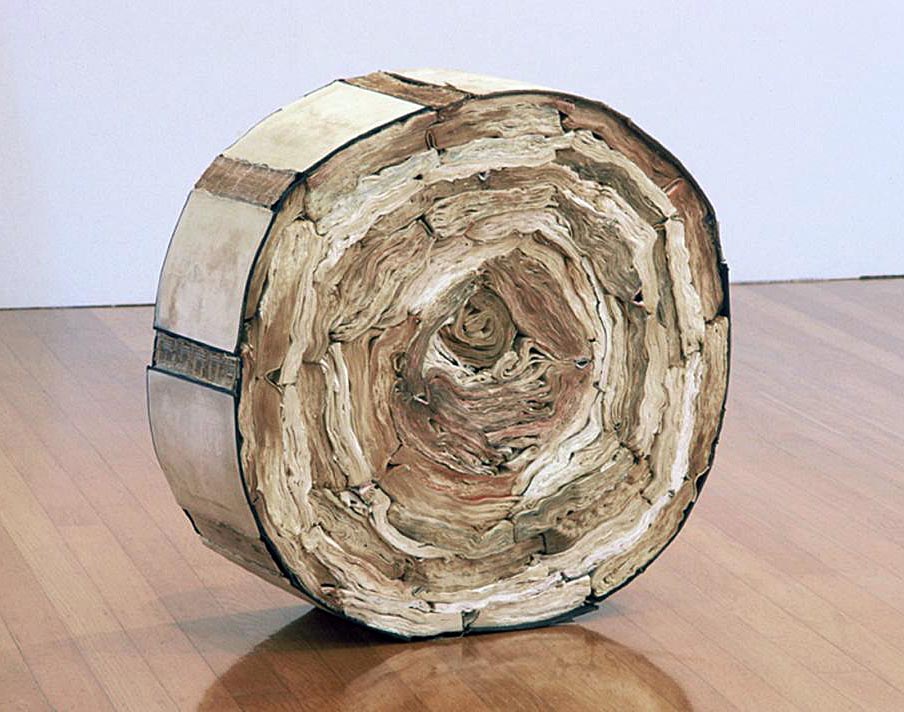
The book is disappearing into the ether, becoming electrons assembled on screens, or maybe not — you never know with books. The obituaries might be premature. But the mere threat of the disappearance of books has prompted a fascinating surge of art related to books, not images in books or book cover art, but books as objects converted into works of art. All of which connotes, yes, a vast nostalgia amongst thinking people for the book and a multimedia inquiry into the meaning of the book.

Numéro Cinq is carving out a niche for itself in the field of book art (hybrid text and art, conceptual art, art using typography, typesetting and media, books made into objects of art) and hence it only seemed just and fitting when Paul Forte asked me to use NC as a venue to announce and promote a major new show of artist’s bookworks, Transformed Volumes, scheduled to run at the Hera Gallery, Wakefield, RI, June 15 to July 13. Forte has assembled a stunning, surprising, witty, gorgeous collection artist’s books by six artists, also provided us with a short essay on the concept of the artist’s bookworks along with mini-essays by each of the artists, a trove of  art and information. Who can resist Doug Beube’s self-description as a biblioclast? And Donna Ruff’s use of the word scarify, relating her work to scars and script? These are smart, wonderful artists. The work dazzles.

dg

§

The “artist’s book,” as publisher and poet Dick Higgins once defined it, provides a good basis for understanding what artists are doing when they use a book format to make art. In the preface to Artist’s Books: A Critical anthology and Sourcebook, Higgins writes: “It is a work. Its design and format reflect its content – they intermerge, interpenetrate.  It might be any art: an artist’s book could be music, photography, graphics, intermedial literature.  The experience of reading it, viewing it, framing it – that is what the artist stresses in making it.” [1] Higgins points out that the artist’s book is nothing new, that it has a venerable history that can be traced to the work of luminaries like the 18th century Romantic poet, William Blake, a master printer and bookmaker who was also an accomplished visual artist.  Books by artists–whether the livre d’ artiste of the late 19th and early 20th centuries or the experimental works made since the mid 1960’s–have long provided a kind of portable venue for the dissemination of art.  But it wasn’t until the mid 20th century that artist’s books gained mainstream recognition as a legitimate genre.  There have been countless exhibitions over the years devoted to the artist’s book, but much less attention has been paid to a more recent development: the artist’s bookwork.[2] Artist’s books and artist’s bookworks are not the same thing.  Whether considered something distinct from or a sub-genre of the artist’s book, the bookwork–or art object based upon some formal or material aspect of what we recognize as a traditional book–departs from the medial concerns of both ordinary books and most artist’s books.  And it does so in a cognitively interesting way.  The defining feature of bookwork art is its “de-mediated form, which means that the basic function of the book to convey ideas or expression through its content (usually text and or images) is disrupted or suspended in some way.[3] The artist’s bookwork does away with or occludes content in any number of ways.  And yet, the most successful examples of this art form can still be read in some sense, not for what they contain, but for what they embody. While no longer acting as, strictly speaking, receptacles or vehicles for words and or pictures, bookworks can nevertheless rise above mere reduction to a formal or material basis and take on or acquire symbolic or semiotic functions.  Such unusual art objects succeed as significant or meaningful things when exhibiting an imaginative engagement with the material and or form of the book while also maintaining clarity of purpose embodied by that material or form.  This is exactly what makes the bookwork cognitively interesting.  Viewing and reading, sense and thought are brought closer together. The point, according to interdisciplinary scholar, Garrett Stewart, is: “reclaimed or fabricated, the de-mediated bookwork, as we will come to understand it, is a conceptual object: not for normal reading, but for thinking about.”[4]   

The bookworks assembled for this exhibition explore various facets of de-mediation through two related transformative processes: 1) the alteration of found volumes and 2) the fabrication of new objects based in some way on the traditional book.  This exhibition has two objectives as well.  The first is to turn the usual way that books convey ideas on its head and present the bookwork as a primary or immediate mode of thought, thus also distinguishing it from the better known genre of artist’s books.  As Stewart puts it: “One way or the other, to become book art, rather than an artist’s book in any sense, requires in the main a  surrender of pagination to sculptural form, message to sheer mass.”[5]  This is understood, although, again, the “sheer mass” of the book might be used in some way to convey ideas by acquiring a symbolic or semiotic function.  And Stewart agrees with this in principle because he made it clear to me that what was de-mediated (by occlusion or effacement) was text alone (although, I would also include images here as well) leaving the medium or material of the bookwork sculpture as a trope or metaphor; which is to say, a sign or symbol. The second objective is more nuanced and perhaps problematic: to mount a show that counters the prevailing notion that bookwork art is largely in response to the displacement of physical books by digital technology.  This is less a reaction to such a possibility and more a matter of offering an alternative view.  For those who believe that physical books are on their way out, bookworks are inherently elegiac.  But there is another way to understand the bookwork phenomenon, this recent development that deploys what appears to be a passing mode of cultural conveyance: bookwork is an art form that summarizes, encapsulates, and exemplifies a cognitive turn in the arts.[6] A half-century ago the arts took a conceptual turn.  In time we regained our senses, so to speak, newly informed by our conceptual bearings.  The phenomenon of the bookwork speaks to this cognitive turn in ways that other art cannot.  After all, books have always been the great repositories of thought and feeling. Now they and the objects that represent them have become vehicles of sense as well.

— Paul Forte

——————————

Transformed Volumes

Doug Beube

“Fault Lines” 2003
Altered Atlas, 18 x 25 1/2 x 8 1/2 inches

1. Doug Beube

Doug Beube: Why do I perpetrate acts against the book?  I have a love-hate relationship with the medium of my art. I love the collection of concrete words and ideas set in their fixed margins, the heft of its pages, the exposition, the narrative, the linearity and curvature of a story, the unfolding of a point of view, the simplicity, even the assumed preciousness, of this object, the codex. Yet, its technology in this digital millennium is outmoded, even frustrating, as a method for recording, preserving, and transmitting culture and information. On computer, I can delve into ideas with a series of clicks on a keyboard; I can drill down through websites into an almost infinite library of human expression. I can reshape, rearrange, erase, and restore, at will. All such acts, so intrinsic to digital technologies and so unnatural to books, is nevertheless what I am driven in my art to do. I view the codex with the span of its body and its spine, as a metaphor for the human form, and with its story, as a metaphor for human expression, on the one hand; and as an artifact of civilization, on the other. And, so like a physician or an archeologist, I am compelled to examine it, to dissect it, to cut it open, to dig into it, literally and otherwise. And, ever the biblioclast, I am compelled to unfix margins, make tomes weightless, empty volumes of their stories, and twist a point of view into its opposite.

Doug Beube is a mixed-media artist working in bookwork, collage, installation, sculpture and photography.  Since 1993, he has been curator of a private collection, The Allan Chasanoff Bookworks Collection: The Book Under Pressure, in New York City.  Beube has taught classes at Parsons The New School in artists’ books, collage, mixed media, and photography and given workshops at Penland School of Crafts, in Penland, NC, Haystack Mountain, Deer Isle, MN and The Center for Book Arts in New York City. He regularly lectures on his work throughout the US, Canada and Europe. Prior to receiving an MFA in Photography from the Visual Studies Workshop in Rochester, NY, graduating in 1983, he was a darkroom assistant to Minor White in Arlington, MA. Doug has exhibited nationally and internationally and his bookwork and photographs are in numerous private and public collections. In the fall of 2011 a monograph entitled, Doug Beube: Breaking the Codex: Bookwork, Collage and Mixed Media, was published by Etc. Etc. The Iconoclastic Press, Brooklyn, with an introduction by David Revere McFadden, chief curator of the Museum of Art and Design in New York City.  The volume presents an in-depth overview of Doug Beube’s artwork over the past thirty years, with essay contributions from several well-known writers, critics and curators.


Claire Dannenbaum

“The Red Line” 2011
Book mounted on board, 10 x 6 1/2 x 6 inches

2. Claire Dannenbaum

Claire Dannenbaum: In this recent work I explore the conceptual life of the book.

My artwork is constructed from fiction, holy books, guidebooks, instructional manuals, and all types of books recycled from thrift stores, used book stores, and library book sales. In these pieces, I rearrange texts, disrupt, reveal, or obscure the narrative and the authority posed by the printed word. I use the graphic quality of text on the page to create a layering of visual narratives.  I have purposefully flattened the book so that it can be appreciated as a vehicle for associations, without even being read. For me there are many compelling contradictions in books. They are mass-produced yet precious; they are sacred, they are pulp. They can carry profound personal connotations as we carry our experiences into reading.  Books can be rare, lost, digital, or dog-eared, and still convey loaded meanings and conventions that fuel daydreams, revolution, the social imagination, and far-reaching historical dogmas.

I come to this topic from several vantage points. As a librarian I have, quite literally, built my professional life on the book form.  I see books as social agents: of inquiry, of personal fulfillment, of self-determination, and fundamental to the very fabric of knowing. Despite an onslaught of data, and routine access to trillions of bytes of information, there remains an enigmatic resonance to the book and the written page. Reading is a kind of magic one performs on oneself.  Every act of opening a book poses potential transformations:  of heroic escapes, of redrawn borders, of ecstatic pleasure, or a reconstructed sense of oneself in the world.  In my work I explore how the book is both inanimate and a living organism.

Claire Dannenbaum is an academic librarian and visual artist living in Eugene, Oregon.  Her current work explores the conceptual life of books through manipulation, destruction, reconstruction, and collage. Claire’s bookwork has been exhibited in Oregon, California, and Rhode Island.  She was awarded a Celebration Foundation grant in 2012.  Working as a librarian continues to be a rich source of inspiration for her projects.  Previously, Claire was a filmmaker and her work has screened internationally. She has participated in public panels, been a visiting artist, won a few awards, and has films in university libraries on both coasts. 


Paul Forte

“Liber Dermis (Skin Book)” 2008
Medical illustrations (human skin cross section) on sealed medical book, mounted on wood, 17 1/2 x 12 1/2 x 3/4 inches

3. Paul Forte

Paul Forte: My use of a book format to make art began in the mid 1970s when I produced a series of small booklets in editions of 50 in offset lithography.  At about the same time I was also making simple one-of-a-kind book objects, what were then called “unique volumes.”  The first book objects experimented with typewritten signs, graphic symbols and materials such as graphite and Mylar in an attempt to blur the distinctions between form and content.  Such early works were precursors to what are now called “artist’s bookworks.”  As with much bookwork today, the unusual content of these pieces was meant to be visually metaphorical.  By simply placing such “content” between the covers of a book, the material signaled intention, thus inviting the viewer/reader to explore it for significance. Visual metaphor is a primary vehicle of or for meaning in all my work, bookworks included. Philosopher, Noel Carroll, calls visual metaphor, “a device for encouraging insights, a tool to think with. This is not to deny that visual metaphors can provide insight, but only that they do so by way of having a meaning.”[7] An artwork that is visually metaphorical can elicit more than one interpretation, although, these readings are usually constrained by both the material parameters of the work and the context in which it is presented or understood.  Appreciating such art, much like creating it, requires focus and openness, judgment and imagination.  This conceptual attitude or orientation is in my view the key to opening a new chapter in our understanding of the relationship between art and the world. Liber Dermis is an illuminated manuscript of sorts, but one that celebrates the body or flesh instead of the Spirit. The color illustration on the book’s open pages is an enlarged image of a cross section of human skin. The implicit humor of the title is meant to create some tension by raising the specter of the sacred versus the profane. In keeping with those extravagant medieval works of piety, the surface of the open pages of Liber Dermis has an almost jewel-like quality. The skin image has been duplicated in reverse and both sides are rendered in low relief to provide an appropriate tactile experience.

Paul Forte’s career began in the San Francisco Bay Area in the early 1970’s. Primarily a visual artist, he also writes poetry and essays. Forte has exhibited at the San Francisco Art Institute, San Francisco, California  (1975, 1976, 1983); A Space Gallery, Toronto, Canada (1978); 80 Langton Street Gallery, San Francisco, California (1981); The Center for the Visual Arts, Oakland, California (1986); The Wadsworth Athenaeum, Hartford, Connecticut (1991); the Kim Foster Gallery, New York City (1998); Francis Naumann Fine Art, New York City (2007 & 2008); and The Wattis Institute, San Francisco, California (2011). Forte’s work is included in the Sol Lewitt Collection, Chester, Connecticut; the Museum of Modern Art, New York City (artist’s books); and the Yale University Art Gallery, New Haven, Connecticut, among others. Forte has lectured on his work at Hera Gallery in Wakefield, Rhode Island; The University of Rhode Island; The Rhode Island School of Design; Brown University (Honors Program); Pratt Institute in Brooklyn, New York; The California College of the Arts in Oakland, California; and the University of California at Berkeley.  Paul Forte is a past recipient of a National Endowment for the Arts, Artist Fellowship (1978), and a Pollack-Krasner Foundation Fellowship (1990). A resident of Rhode Island since 1987, Forte lives in Wakefield with his long time partner, Laura Beauvais.


Donna Ruff

“Fanatic 2” (from Fanaticism Series) 2009
8 x 10 inches

4. Donna Ruff

Donna Ruff: Paper has a very real and tactile appeal for me.  I’m attracted to paper’s fragility and pristine beauty – yet my work involves scarring, incising, burning and puncturing its surface. These processes are simultaneously destructive and constructive, providing an image that confounds reductive comprehension as drawings. The word “scarify” is etymologically related to stylus and script, and creating works in this way developed from my interest in language, books and the written word. I’m inspired by geometric systems- celestial, fractal, graphical: the basis of visual language and the historical means of informative communication.

Donna Ruff grew up in Miami Beach, and moved to New York to pursue a career in graphic design and illustration. She earned an MFA from Rutgers University, where she focused on printmaking and installation. In 2010 she moved to Santa Fe, NM. She has been chosen to create site-specific installations at the Eldridge Street Project on the Lower East Side of New York, PS 122, and for ArtSPACE in New Haven, Connecticut. Exhibitions include Speaking Volumes at the Kohler Art Center in Wisconsin; Fireworks at the Hunterdon Museum in New Jersey; Paper[space] at the Philadelphia Art Alliance; Qville, at the Flux Factory in Long Island City, NY; 4th International Graphic Trienniale in Prague; and Feedback: Artist to Artist at Kunstlerhaus Bethanien in Berlin, Germany, as well as numerous gallery exhibitions. Recently her work was purchased by the New Mexico Museum of Art. She has curated several exhibitions, including Off the Wall>Rethinking the Print at the NewArt Center; and Status Update at Heskins Laboratory at Yale University. Her work was recently featured in Book Art: Iconic Sculptures and Installations Made from Books, published by Gestalten.


Jacqueline Rush Lee

“Inside Out” (from Volumes series) 2001
Soaked, dried, book components, 21 x 22 x 9 inches

5. Jacqueline Rush Lee

Jacqueline Rush Lee: My work focuses on the book as object, medium and archetypal form. Working to reveal or transform the nature of a book, I’m interested in the aesthetic of books as cultural objects that come with their own histories of use and meaning.  By using books as my canvas or building block, I can transform their formal and conceptual arrangement through a variety of practices in which the physicality, and thus the context of the books have been altered. I’m also interested in creating evocative works that are cerebral with emotional depth.  Remaining open to the physical and metaphorical transformations that occur in my working process, these residual sculptures or installations emerge as a palimpsest – a document that bears traces of the original text within its framework but possesses a new narrative as a visual document of another time.

Jacqueline Rush-Lee is a sculptor from Northern Ireland who lives and works in Hawaii (USA). Jacqueline has been working with books for fifteen years and is recognized for working with the book form through artwork features in blogs, magazines, books and international press. Selected bibliography include: BOOK ART: Iconic Sculptures and Installations Made from Books; PAPERCRAFT: Design and Art with Paper and PLAYING WITH BOOKS: The Art of Upcycling, Deconstructing, and Re-Imagining the Book. Jacqueline’s work will be featured in ART MADE FROM BOOKS, Chronicle Press, 2013 by Laura Heyenga, writer and former editor for SFMOMA. 

She has a Bachelor of Fine Arts with Distinction in Ceramics and a Master of Fine Arts in Studio Art from the University of Hawaii at Manoa, with a background in [‘O’ level] drawing and painting from Northern Ireland. She exhibits her artwork nationally and internationally and her work is in private and public collections, including The Allan Chasanoff Book Under Pressure Collection, New York City.  

Irwin Susskind

Untitled 1998
Altered paperback book (series), 8 ¼ x 7 x ½ inches

6. Irwin Susskind

Irwin Susskind: Books are tactile – computers are not.  I started working with books eight or nine years ago when I felt this impending shift.  I create these objects as if books have already passed into history.  As if they are archeological discoveries from another time.  They can no longer be read, but by means of tearing, cutting apart and re-assembling, concealing, revealing and other manipulation, I try to reveal the lives of these books.

Irwin Susskind has worked as a graphic designer at Lippincott & Margulies. Inc., a firm that specializes in developing corporate identities, where he designed logos for Fortune 500 in the United States and world wide.  His artwork has been exhibited at the Bertha Urdang Gallery in New York City and in the Members’ Gallery in the Albright-Knox Art Gallery in Buffalo, New York.

—Curated and introduced by PaulForte

——————————-

Paul Forte

Footnotes    (↵ returns to text)

  1. Dick Higgins, Artist’s Books: A Critical Anthology and Sourcebook, p. 11. Joan Lyons, Ed. Visual Workshop Studies Press 1987.
  2. One of the earliest bookworks was Duchamp’s Unhappy Readymade of 1919.  Bookwork art or “book objects” first appear in the mid 1970’s as a development with roots in Conceptual art.
  3. De-mediation is a relative matter, whether it involves text or images because the effacement, disruption, or occlusion of such content is often partial or incomplete. Instances of purely de-mediated bookwork are probably rare because, among other things, the refashioned material embodied by most transformed books and their surrogates could be broadly construed as image content.
  4. Garrett Stewart, Bookwork, Medium to Object to Concept to Art, p. 14. The University of Chicago Press 2011.
  5. Ibid. p. 97
  6. A good working definition of cognitive can be had from philosopher, Nelson Goodman: “Under ‘cognitive’ I include all aspects of knowing and understanding, from perceptual discrimination through pattern recognition and emotive insight to logical inference.”  See Goodman, Of Mind And Other Matters, Harvard University Press, 1984. p.84   According to Goodman, “cognitive” and “conceptual” are not interchangeable terms.  Cognitive is the more inclusive term, lending depth and breadth to how we know and understand.
  7. Noel Carroll, Visual Metaphor, in Beyond Aesthetics, Philosophical Essays, Cambridge University Press, 2001. P. 365
Jun 052013
 

Let me count the reasons…

It has long held true that elderly people have higher suicide rates than the overall population. But numbers released in May by the Centers for Disease Control and Prevention (CDC) show a dramatic spike in suicides among middle-aged people, with the highest increases among men in their 50s, whose rate went up by nearly 50 per cent to 30 per 100,000; and women in their early 60s, whose rate rose by nearly 60 per cent (though it is still relatively low compared with men, at 7 in 100,000).

via Baby boomers are killing themselves at an alarming rate. Why? | Toronto Star.

Jun 052013
 

All That Is
James Salter
Alfred A Knopf, 2013
290 pages, $26.95


In an age and a culture that have seemingly lost a sense of discrimination and taste, James Salter has once again elevated the American novel to a place of punctilious dignity, gimmick-free prose, and passionate sexuality. All That Is, Salter’s first novel in over thirty years, is an exquisite story of love, betrayal and humanity set against the backdrop of the New York publishing world.

All That Is chronicles the life of Philip Bowman, an editor at a small, literary publishing house. The novel opens in 1944 with Bowman standing watch on a warship crossing the Pacific. As sailors search the skies for signs of the dreaded Kamikaze, a young Bowman worries how he will respond in battle. “How he would behave in action was weighing on his mind that morning as they stood looking out at the mysterious, foreign sea and then at the sky that was already becoming brighter. Courage and fear and how you would act under fire were not among the things you talked about. You hoped, when the time came, that you would be able to do as expected.”

Salter is obsessed with rites of passage. Combat, sexual experience, home ownership, marriage, divorce, parental death and career success are among the many trials through which Bowman must pass. “What are the things that have mattered?” a woman asks Bowman at a London bar after the war, and this question might well form the narrative spine of the book. Is it a quest for a fulfilled life? Is it love, or the meaning behind love? Whatever the answer, we may rightly expect that many of the things that matter will be rendered.

After the war, Bowman returns to America, attends Harvard and eventually lands a job in New York.  He meets his future wife, Vivian Amussen, in a bar, and soon woos her into bed.  His first sexual encounter ends quickly, but he feels “intoxicated by a world that had suddenly opened wide to the greatest pleasure, pleasure beyond knowing.”  Alas, the marriage is not meant to thrive. Vivian comes from a gentrified, Southern family and Bowman never quite fits in on the Amussen farm. There’s a brief period of somewhat muted happiness between the young couple, but on a business trip in Europe, Bowman has a passionate affair with Enid Armour. “It seemed his manhood had suddenly caught up with him, as if it had been waiting somewhere in the wings.” We aren’t surprised by any of this, of course, because his marriage seemed destined for trouble from the start.

Told in a kind of limited omniscience (anchored for the most part in Bowman’s perspective), the narrative bends the most important characters (and even some lesser characters) into the text with terse, jump-cut bursts of interior narration and point of view shifts. There’s something brash about this approach. It hearkens back to the nineteenth century when authors exercised complete authority over their creations. In a brief scene at Bowman’s wedding, Salter uses nine different points of view  in just under three pages. The effect is appropriately dizzying, as though we are drunk and dancing at the reception.

Salter renders his secondary characters fully in quick, highly compressed flashes. For example, in the that wedding scene, he briefly cuts to Bowman’s mother, a woman whose presence heretofore has been muted:

“Be good to one another. Love one another,” she said.

Though she felt it was love cast into darkness. She had doubts that she would ever know her daughter-in-law. It seemed, on this bright day, that the greatest misfortune had come to pass. She had lost her son, not completely, but part of him was beyond her power to reclaim and now belonged to another, someone who hardly knew him. She thought of all that had gone before, the hopes and ambition, the years that had been filled, not just in retrospect, with such joy. She tried to be pleasant, to have them all like her and favor her son.

Notice the superlatives, the subdued hyperbole, the broad brushstrokes used to create a sense of time and history. The delivery is economical, a method prone to abuse by writers who don’t do the deep emotional thinking behind such narration. Salter refuses to fill in the blank spaces, but we feel them deeply, little resonant pools of mystery and being.

Bowman and Vivian break up, and he licks his wounds by briefly rekindling his affair with Enid in Spain. After the death of his mother, Bowman begins to stare down middle age, and becomes intent on finding a house in the country. There’s a certain disjointedness about the book’s pacing, and the reader must struggle a bit to assemble these moments into a coherent narrative. Then again, Salter has long been the master of minimalism and negative space. He manages to make vivid and vital characters, sometimes at the expense of plot. But a trust develops between the reader and the author, born of the latter’s wisdom and experience. We believe in the crafted dream, and don’t require much in the way of explanation. The gaps and questions are easily overlooked because Salter does the heavy filtering for us, removing the dross and delivering what he deems are the necessary parts, the distilled story, flowing in crisp sentences, swift and stripped-down scenes, strange juxtapositions, and whole characters rendered perfectly in only a few paragraphs. This is the quintessential Salter styling, and few do it better.

The third great love of Bowman’s life is Christine, a married woman trapped in a dead-end marriage. For awhile, she seems to be the perfect match. “He was free to do anything. It had never been this way, not with Vivian, certainly not with Vivian, and not with Enid.” Christine and Bowman eventually buy a home together, sharing it with Christine’s daughter, Anet. But again, for Bowman, this love will exact a heavy toll.

Salter, now 87, is a West Point graduate; he was fighter pilot in the Korean War. His first novel, The Hunters (1957), recounts some of what combat flying must have felt like. Several novels  followed, including The Arm of Flesh (1961), A Sport and a Pastime (often considered his finest novel, 1967), Light Years (1975) and Solo Faces (1979); his short fiction was published in Dusk and Other Stories (1988) and Last Night (which includes one of my all-time favorite short stories, “My Lord You,” 2005). In addition to his fiction, Salter has written numerous screenplays, poems, travel essays, and even a literary cookbook of sorts, Life Is Meals: A Food Lover’s Book of Days, which he co-wrote with this wife In 1997, he released Burning the Days, his captivating and powerful memoir.

Never one afraid to shove aside cultural sensibilities in search of a good story, Salter swipes at the social and historical changes which blew across America during the latter half of the twentieth century in All That Is.  While not necessarily a critic of feminism, or liberalism or even of capitalism in general, Salter does critically examine the shifting effects of those movements on his subject, in this case, the middle-class, white, American male. In so doing, he offers an unsentimental, post-Empire look back on all that was Empire. The stultifying decadence of America after World War II stood in sharp contrast to the all-but destroyed, majestic cities of Europe (we visit a few in the book). But even unscathed, America was rife with problems below the glistening surface: prevalent racism, the objectification of women and the cracking structures of family. Salter seemingly wants to show us the dry rot in the clubhouse walls of white privilege and old-boys networks. The world is changing, but the Architects of Empire continue to sip their Scotch and sodas even as the clamor in the streets grows ever louder.

At first glance, many of Salter’s characters appear to typify the myth of the brusque, strong-shouldered American male. Yet Salter transcends this myth, taking aim at the American Dream and pulling the trigger. Bowman, in many ways, is a feckless hero. Love eludes him, but he carries on in spite of his setbacks and disappointments. Though a virgin when the novel opens, Bowman’s primary fault lines are sexual ones, and, for him, love and sexuality are inextricably linked. “It was love, the furnace into which everything was dropped.”

It’s hard not to think of Hemingway when you read Salter, except a less vainglorious version. Whereas Hemingway wants to drink you under the table and shut down the bar, Salter wants to order a bottle of Château Latour. They both want to seduce you, it’s just that Salter will still be upright and semi-sober when he does it, and he’ll buy your breakfast in the morning; Hemingway won’t even leave a note on the pillow.

And make no mistake, Salter likes to write about sex.

She lay face down and he knelt between her legs for what seemed a long time, then began to arrange them a little, unhurriedly, like setting up a tripod. In the early light she was without a flaw, her beautiful back, her hips’ roundness. She felt him slowly enter, she reached beneath, it was there, becoming part of her. The slow, profound rhythm began, hardly varying but as time passed somehow more and more intense. Outside the street was completely silent, in adjoining rooms people were asleep. She began to cry out. He was trying to slow himself, or prevent it and make it go on, but she was trembling like a tree about to fall, her cries were leaking beneath the door.

Notice how he leaves much to the reader’s imagination, and how the act and the emotion fail to fuse. Like life itself, love and sex are deeply sad and fleeting things. And this may indeed be Salter’s point, the emphasis falling on moments rather than on the prevalent myth of permanence. Words like eternal love and forever seem rather cloying and foolish when placed next to the reality of experience.

Love, finally, eludes Bowman. His affairs of the heart end badly. What makes Bowman empathetic and heroic is his refusal to be defeated. He remains stalwart and upbeat, even as setbacks befall him. He retains something of a quixotic delusion about love, but this makes his failures less pathetic and his forbearance admirable. By the close of the book, Bowman arrives at a certain wisdom, even if he must first pass through a stage of numbed-out cruelty. In the book’s most shocking reversal, Bowman executes a brutal, cringe-worthy, act of revenge-sex that creates a complex emotional space for the reader: you simultaneously root for and hate the hero.

Of course, Bowman is not heroic in a traditional sense. His trials are hardly the stuff of legend. He wins quiet victories, endures muted disasters, and carries on through authentically human struggles. Remember, he’s a book editor, itself a quiet job that hides in shadows. But there’s an abundance of dignity in Bowman’s life. He works hard at his job, maintains virtuous standards toward his work. A certain decorum surrounds his struggles and triumphs. There’s also nostalgia for now old-fashioned independent publishing houses like Braden & Baum. Parties, business trips, working dinners, talented authors and exotic women make Bowman’s world quite full, quite rich, by almost any standard.

The French writer Marguerite Duras wrote that “the person who writes books must always be enveloped by a separation from others.” With Salter, one might well suppose the opposite to be true. He seems to be a writer who has lived life fully even while writing many of the books that have helped define a culture. In a recent interview at Guernica, Salter was asked about immortality as a writer:

You would have to be very optimistic to think that any of your books will be among the books that survive in the very long run. I think if a writer is lucky enough to still have a few books around after he’s gone, a few that are still being read, then he’s accomplished quite a lot.

While Salter is correct about the uncertainty of predicting trends and tastes, few writers today are more deserving of a long literary legacy.

—Richard Farrell

—————————

 Richard Farrell

Richard Farrell is  the Creative Non-Fiction Editor at upstreet and a Senior Editor at Numéro Cinq (in fact, he is one of the original group of Vermont College of Fine Arts students who helped found the site). A graduate of the U.S. Naval Academy, he has worked as a high school teacher, a defense contractor, and as a Navy pilot. He is a graduate from the MFA in Writing Program at Vermont College of Fine Arts. He is currently at work on a collection of short stories. His work, including short stories, memoir, craft essays, interviews, and book reviews, has been published or is forthcoming at Hunger Mountain, upstreet, A Year in Ink Anthology, Descant, New Plains Review and Numéro Cinq. He lives in San Diego.

Jun 042013
 

Mavis-Gallant-at-Le-D-me--001

I don’t think I found Mavis Gallant through anybody—one day I just picked up My Heart Is Broken, somehow, on my own. It had a girl on the cover, that much I remember. The first story I read is called “The Ice Wagon Going Down the Street.” It wouldn’t be an exaggeration to say that it changed my reading life forever. The story is about how the love of a couple changes over a long period—from early hope to beautiful, even comic, resignation. No, all their dreams didn’t pan out, but hell, we’ve got our stories and they’re good stories, and nobody can take those away from us. Rather than belittle her characters’ failures, Gallant celebrates them. It’s the sort of story that makes you pause, breathe, and take in all that you have as opposed to worrying over what’s missing.

Gallant’s work reminds you to think more deeply about the people you deal with—as a writer, with your characters, and in your life. She reminds us of how fathomless we are, how there is always more to know.

So it’s character that moves me about Gallant’s work. It isn’t her plots—which are wonderful—but her obsession with the infinitely strange ways we people behave. Gallant’s characters are complex and inconsistent: Their most deeply held beliefs easily dissolve in the face of what it takes to simply get through the day. And lets be honest, don’t they? In the morning, yes, we’ll wake up and do our best to believe again…And Gallant has faith in that too, in our ability to pick ourselves back up. But she’s peerless at showing all the ways we fall apart.

Via The Atlantic

—Jason DeYoung

§

See also:

“The Ice Wagon Going Down the Street” by Mavis Gallant

FRANCINE PROSE

Perhaps one reason why I so love the ending of Mavis Gallant’s story “The Ice Wagon Going Down the Street” is that I’ve never quite understood it. I always think that if I reread it one more time, its meaning will disclose itself. Like the story it concludes, the ending seems perfect, mysterious, profound. It is also wildly original, almost “experimental.” I can’t think of anything else, in fiction, remotely like it.

Via Brick.

§

And, of course, read Jason DeYoung’s interview with Gallant at Numéro Cinq.

Jun 042013
 

Leon Rooke

Leon Rooke has always been an inspiration and a muse. He has written some of the most delightful short stories I have ever read. Also those truly amazing novels Shakespeare’s Dog and A Good Baby, which, if you haven’t read them, you have to read (I have written an essay on the latter, which you can find in my book Attack of the Copula Spiders). And then, late in life, as if he hasn’t done enough damage already, he takes up painting and turns out passionate, sensual, witty canvasses that exude desire, subversion, irony, and an acute adoration and attentiveness to the feminine — unapologetic, insouciant, even scabrous. Oh, Leon! A man who follows the electric current of creativity wherever it leads. A model for us all.

dg

DSC00857 Beale Street Memphis, 2013  (oil on canvas, 16 x 20 in.)

SPACE
DSC00903The Manicurist, 2012 (oil on canvas, 30 x 20 in.)

SPACE

DSC00909Beach Girls 1, 2013 (acrylic on canvas, 8 x 10 in.)

SPACE

DSC00938Sirens, 2013 (oil on canvas, 16 x 20 in.)

SPACE

DSC00948Brideshead Revisted, 2012  (acrylic on canvas, 60 x 36 in.)

SPACE

DSC00949Red Hair District, 2013 (oil on canvas, 18 x 24 in.)

SPACE

DSC00961Untitled (Holland), 2013 (oil on canvas, 12 x 16 in.)

SPACE

DSC00975The Magistrate, 2013 (acrylic on canvas, 48 X 60 in.)

—Leon Rooke

————————————-

Leon Rooke exhibits his paintings at the Fran Hill Gallery in Toronto. He has published more than 30 books, including novels, short story collections, plays, anthologies, and “oddities,” and more than three hundred short stories. Rooke’s many awards include the Governor-General’s Award for Fiction (for Shakespeare’s Dog, 1985), the Periodical Association of Canada Award for the English-Language Paperback Novel of the Year (for Fat Woman, 1982), a Pushcart Prize (1988), the North Carolina Award for Literature (1990), and the Canada/Australia Literary Prize in 1981, for his body of work. Also the W. O. Mitchell Literary Award, for his writing and his mentoring, and the ReLit Short Fiction Award. Rooke has taught at more than a dozen Canadian and U.S. universities. He lives in Toronto.
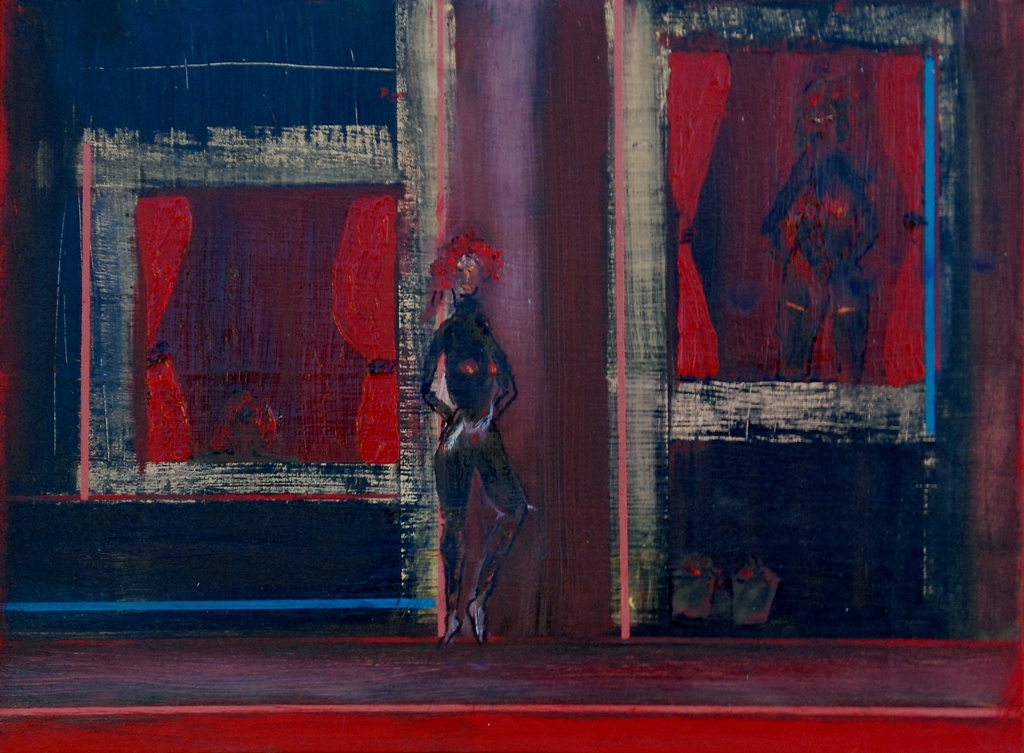
Jun 032013
 

Just over two years ago, I was – to put it plainly – shitting myself. It was January 2011, and the novel I needed to write, the historical novel that was to be the creative component of my PhD, could no longer be avoided. The problem was, I had no idea how to write a book.

I first heard the story of Agnes Magnúsdóttir when I was an exchange student in the north of Iceland. It was 2002, I was 17 years old, and I had left Adelaide for Sauðárkrókur an isolated fishing village, where I would live for 12 months. This small town lies snug in the side of a fjord: a clutch of little buildings facing an iron-grey sea, the mountains looming behind.

via Burial Rites and the loneliness of the long-distance writer | Books | guardian.co.uk.

Jun 032013
 

What a strange and alien idea! Teach kids philosophy, give them ideas, show them how to articulate ideas in argument, make them conversant with the intellectual themes of the age? Elitist poppycock! Let them eat Freedom Fries! No wonder the French are so easily satisfied with things like universal health care!

dg

Why this emphasis on philosophy in France?

Other countries have school-leaving exams which cover the history of ideas and religion and so on. But the French are very clear that that is not what theirs is.

The purpose of the philosophy Bac is not to understand the history of human thought but to leap into the stream that is the actuality of human thought.

If you learn about what Kant or Spinoza once said, it is not so much to understand their argument as to use their argument.

Napoleon launched the Baccalaureat in 1809, and philosophy was one of the subjects in the first ever exam (though back then it was oral, and in Latin, and only 31 males took it).

The idea behind philosophy was itself entirely philosophical.

In the newly created republic (and yes, I know Napoleon had just made himself emperor, but the point still holds) it was important to create model citizens.

Had not the great writer and thinker Montesquieu himself said the republic relied on virtue, and virtue consisted in the capacity of individuals to exercise their own freely-formed judgment?

So the purpose of teaching philosophy was – and remains, in theory – to complete the education of young men and women and permit them to think.

To see the universal arguments about the individual and society, God and reason, good and bad and so on, and thus escape from the binding imperatives of the now – by which I mean the dictatorship of whatever ideas are most pressingly forced on us in the day-to-day by government, media, fashion, political correctness and so on.

How wonderful, you cannot help thinking. What a great idea. Now that is what I call civilisation.

via BBC News – Why does France insist school pupils master philosophy?.

Jun 032013
 

Umbrellas 

“You should choose the finest day of the month and have yourself rowed far away across the lagoon….”

Henry James, Italian Hours, 1909

.

SanGiorgioClouds

It’s five a.m. in Milan and my alarm rings. Outside I hear rain beating on my windows. I mute the clock and sling a leg out of bed. I’m going to Venice on the 6:30 train even though the entire Italian peninsula sloshes like an overflowing bathtub.

I stumble for the shower—some hot water to wake me up. And then for the espresso maker. Soon I’m ready and out the door. Dark clouds spit raindrops like shrill warnings. The wind upends my umbrella.

On the train, map open, I review my Venetian attack. So many have been to Venice, photographed Venice, written about Venice—from Michel de Montaigne to Byron and Dickens and Browning and Ruskin and Henry James and Mark Twain and Hemingway (and many in between and afterward) and I’m following in their footsteps.

Cad'oro

.

Cà d’Oro — “A noble pile of very quaint Gothic, once superb in general effect.”

John Ruskin, Stones of Venice.

.

SantaMariadellaSalute
.

Santa Maria della Salute — “…the grace of the whole building being chiefly dependent on the inequality of size in its cupolas, and pretty grouping of the two campaniles behind them….”

—John Ruskin, Stones of Venice.

.

Today I’m on the trail of Henry James and John Ruskin. Both men loved Venice and visited it often. Ruskin documented his passion for the city in several tomes, most notably the Stones of Venice, a three-volume best-seller when it was published mid-century (1851-1853). In the later part of the 19th century, James wrote a series of essays for journals about his stays in Venice (as well as other Italian cities) which were compiled into the 1909 Italian Hours.

I plan to take pictures of the palaces and churches and squares both men loved as well as those they abhorred, and accompany the photos with their words. I locate the Cà d’Oro, a palazzo Ruskin liked, and circle it on the map for easy reference later. I find Santa Maria Formosa, a church whose architectural flights disgusted him, and circle that too. And I star the location of the Ducal Palace, a building both men loved. I plan to chug along the Grand Canal in a vaporetto, not an elegant vessel, but serviceable and cheap when compared to the eternally classic gondola. From a perch in the prow I’ll take photos. I’ll have more than ten hours; I arrive in Venice at 9:30 am and my return won’t be until 7:50 pm. With so much time at my disposal I’ll be sure to get my shots right. And while I’m shooting, I’ll spend a marvelous day like others I’ve spent in the city. I’ll revel in the light, the merging of sea and sky, the shining domes, the golden lions glinting from columns, from lintels, from façades.

Although. From the sound of the reverb on the roof of the train—fortissimo like Ligeti’s The Devil’s Staircase—the rain doesn’t seem to be abating. And we’re in Padua with just one more stop to Venice. But I won’t worry yet. A lot can happen in a few kilometers. And no doubt the rain won’t hold too long in Venice. After all, this is the city that James said was mutable “like a nervous woman whom you know only when you know all aspects of her beauty. She has high spirits or low, she is pale or red, grey or pink, cold or warm, fresh or wan….” [Italian Hours.]  So if flighty, changeable Venice starts out wet, she’ll soon turn dry. Right?

Just as I’m quitting the train station the storm worsens. I fling myself onto a vaporetto for cover without paying attention to which one. And so, instead of threading through the Grand Canal that snakes through the city’s protective embankments like I planned, the boat I’m on veers wide, toward the wind-tossed sea. Waves soon blast over the bow. Water drums in at a slant. My hair is soaking but at least my camera’s (relatively) dry; I thought to wrap it in a plastic shopping bag before leaving the train.

VeniceLagoon

Like an ungainly walrus, the boat plows onward through the swell, past the fish market, some cranes, a garbage vessel. It carves a leftward swathe in the green sea near smokestacks, circles the city’s outskirts and finally, approaches those genteel structures that have entranced visitors for centuries. I spot the onion-shaped outlines of St. Mark’s five domes, off in the soggy distance. No inimitable views in my viewfinder quite yet, but as soon as I’m in the vicinity I’ll nab some. That is, rain permitting. Right now it’s lashing those of us foolhardy enough to stand in the prow. I see that droplets now splotch my lens; I need to clean it, pronto, but have nothing dry at hand.

Approachfromsea

.

The Ducal Palace — “the central building of the world….”

— John Ruskin, Stones of Venice

.

The boat rounds the Isola della Giudecca. St. Mark’s Basin churns with waves and whizzing motor boats. There I spot the mouth of the Grand Canal, gaping like a toothy eel. There’s Santa Maria della Salute with her stately steps, a large white pearl gleaming in the mist. And San Giorgio Maggiore with its Palladian façade and soaring campanile, a gushing brick and marble proclamation. And on the opposite shore, the Ducal Palace, Ruskin’s model of all perfection in architecture, “the central building of the world.” [Ruskin, Stones of Venice] But I’m not immortalizing anything with my camera yet. I’ve got the water-splotched lens twisted off and, in spite of the downpour, am switching it for one that’s clean.

PiazzaStMarcoDalMare

.

View of the Piazzetta — “We pass into the Piazzetta to look down the great 
throat, as it were, of Venice …”

—Henry James, The Grand Canal

.

When the boat stops at San Zaccaria, not far from St. Mark’s, I hop off and flick my umbrella open. I navigate slick alleys to the Campo Bandiera e Moro where I find the Palazzo Badoer, “a magnificent example of 14th century Gothic, circa 1310-1320, anterior to the Ducal Palace showing beautiful ranges of the fifth-order window….” [Ruskin, Stones of Venice].

Palazzobadoer

.

A magnificent example of 14th-century Gothic…. 

—John Ruskin, Stones of Venice.

.

touristsCampoBandieraMoro

But a tour group stands between me and my picture. Like me, they were caught ill-prepared for the weather and have bought bright raincoats from a street vendor. Unfortunately their plastic wrappings seem to keep them dry because they continue to stand listening to their guide with rapt attention. While I wait I find myself agreeing with James who wrote: “The
 sentimental tourist’s sole quarrel with his Venice is that he has 
too many competitors there. He likes to be alone; to be original; 
to have (to himself, at least) the air of making discoveries. The
 Venice of to-day is a vast museum where the little wicket that 
admits you is perpetually turning and creaking, and you march 
through the institution with a herd of fellow-gazers.”  (Italian Hours).

Equestrian

.

Riva degli Schiavoni — [From his rooms here] “the waterside life, the wondrous lagoon spread before me…”

—Henry James, Italian Hours.

.

Then I head down the glistening Riva degli Schiavoni toward the center of the universe—the Ducal Palace and St. Mark’s. As I go, my shoes squelch—not rainproof after all—and my coat flaps like wet wash on the line. My camera’s dry inside my shirt but then, in a rush of air, my umbrella flips its underbelly and entrails up. Flapping, I grab at the nylon and wrench it down but not before I douse myself.

Mayhem

Dripping, I decide to abandon my plan—at least temporarily—of tracing Ruskin’s and James’s footsteps through the city. Under the loggia ringing the Palazzo Ducale, I merge with a horde of fellow Venice-gazers standing in line for the Manet exhibition: a way to stay dry and warm. No photographs are allowed of the interiors of the sumptuous rooms of the Ducal Palace themselves, but the courtyard is fair game.

ArchPalazzoDucale

.

Courtyard view — “Within the square formed by the building is seen its interior court (with one of its wells)….”

—John Ruskin, Stones of Venice.

.

DomePnnclesStMarks

.

A dome and pinnacles of St. Mark’s from the Ducal Palace courtyard — “All European architecture, bad and good, old and new, is derived from Greece through Rome, and coloured and perfected from the East. The history of architecture is nothing but the tracing of the various modes and directions of this derivation.”

—John Ruskin, Stones of Venice.

.

After an elbow-to-elbow tour of the small show and a bit of yellowed mozzarella and wilted lettuce in the teeming cafeteria, three hours later I emerge into St. Mark’s Square. The rain has stopped. With the reprieve from the wet grimness of the morning, a charge of excitement pulses through the crowd outside, a jumped up beat, verging on hysteria. And I see that many of the hooting visitors are stripping themselves of their shoes. Because now the square is filling with the sea.

RedcoatsLibrary

.

St. Mark’s lion and St. Theodore atop columns in the Piazzetta — “Whether St. Mark was first bishop of Aquileia or not, St. Theodore was the first patron of the city; nor can he yet be considered as having entirely abdicated his early right as his statue, standing on a crocodile, still companions the winged lion on the opposing pillar of the piazzetta.”

—John Ruskin, Stones of Venice.

.

burrasca

Wind whips water over the embankment fronting the lagoon. Water bubbles up from holes in paving stones. I dodge the deepening rivulets, looking for higher ground while people around me dance and splash in the greening stuff that smells like rotting mackerel.

It starts to rain again. On the raised platform of the Library, under the loggia there, I find refuge from the flood. Protected by the arcade that’s higher than the level of the water, I skirt around one side of the square marveling at the show of people prancing through the water. And when I’ve had my fill, an hour later, I decide to catch that vaporetto I’d missed in the morning. I’ll go back to my original plan and take photos of palazzi along the Grand Canal. But there’s no way off the Library’s plinth. It has turned into an island. Rising water maroons me.

Campanile

.

View with the Pillars of the Piazzetta — “The two magnificent blocks of marble … [that] form one of the principal ornaments of the Piazzetta, are Greek sculpture of the sixth century.”

—John Ruskin, Stones of Venice.

.

FromAfar

A shopkeeper in a fancy jewelry store says the water will still keep rising. “Forecasts vary,” she says, “but we could get another 10 or 20 centimeters.” I can’t tell if she’s serious. She tells me to take my shoes off, roll up my pants and brave it. “This is nothing. In November the water rose to my waist,” she says, scoffing. “Bidet level,” she adds, batting her waist with her palm.

But I don’t want to wade through stinky deluge even if it is only ankle-deep. The water’s cold too. I’m cold. I want my boots. Why didn’t I wear my boots?

Greencoats

“Where can I buy some cheap rain boots?” I ask.

“I told you,” she says, rolling her eyes. “We’re cut off. Cheap boots are at the Rialto. And the way to the Rialto is flooded.”
FlorianviewPiazza

.

Florian’s café — “I sat in front of Florian’s café, eating ices, listening to music…. The traveler will remember how the immense cluster of tables and chairs stretches like a promontory …. The whole place … under the stars and with all the lamps, all the voices and light footsteps on marble … is like an open-air saloon.”

— Henry James, Italian Hours.

.

Musicians

I wander away, wondering what I should do. At Florian’s—where James and Hemingway and who knows who else once sat—I pause to listen to a quartet under a white canopy play the Titanic theme song. The bandleader has a sense of humor. I linger, reading the menu but nix a warming cup of cappuccino (over $10) as too expensive. Traipsing on, I watch people wade through water that is now over their ankles. The shopkeeper was right. The water’s still coming in. I’ll never get off my island unless I take my shoes off.
Chairs

But then I overhear a couple in new blue boots telling another couple with plastic bags tied around their feet that a boot sellers is a stone’s throw away. “Round the square,” they say, “cut through that glass shop at the end of the arcade. Go out the back door,” they say. “The alley beyond was still dry moments ago.” They stick their feet out so that their boots can be admired. “Only 12 Euros each.”

Having listened to their directions, I dash off—ahead of the bag-clad duo.

 Gondola

I find the glass shop. The owner frowns as I cut through to the back door and out into the alley behind. The alley’s puddling, but still traversable. It flanks a canal. In the canal water is rising. And in the canal there’s a gondola jam—gondoliers clog a passage under a bridge racing to bring tourists and boats back in. But they must lean and tilt their craft: 40 degrees, 50 degrees, 60 degrees. They risk spilling occupants and belongings. Tourists on board scream with glee, as if they are at a museum-cum-amusement park, which, as James noted over 100 years ago, they are. And I suddenly realize that for most of the day most of the gondolas have stayed lashed at their moorings; only the audacious have been out and about.

Leaving the stream of paddling boatmen, rounding the corner, I find the store with blue boots in the window. The price has gone up to 16 Euros. I stand in line, and, when it’s my turn I pay the extra without complaint. I’m just glad they have my size.

Newly booted, I splash to the embarcadero where I wait for my vaporetto. When the boat comes, I check my watch. It’s almost 7 pm. The hours have slipped by too fast. I’ll have time for just a one-way ride down the Grand Canal and a few shots of some of the palaces and churches I set out early this morning to admire.

The Grand Canal

.

The Grand Canal – “The noble waterway that begins in its glory at the Salute and ends in its abasement at the railway station.”

—Henry James, Italian Hours.

.

I sink into a wet seat—it’s sprinkling. I think how this day’s touring of the city has been different from others I’ve spent. Drenched in Venice by Venice.  Inundated. With James and Ruskin for company.

The boat groans forward. Foam flies over the bow. We leave Santa Maria della Salute behind and wind our way down the Grand Canal. Beautiful old palaces rise up, their lacy windows turning luminous with evening lights. Venice always inundates I think as we surge past. One way or another.

PalazzoPisaniMoretta

.

Palazzo Pisani Moretta — “[the] capitals of the first-floor windows are … singularly spirited and graceful, very daringly undercut, and worth careful examination….”

—John Ruskin, Stones of Venice.

.

Contarinidellefigure

.

Palazzo Contarini delle Figure — “I must warn [the traveler] to observe most carefully the peculiar feebleness and want of soul in the conception of their ornament which mark them as belonging to a period of decline….”

—John Ruskin, Stones of Venice.

.

I spy a Renaissance building with fanciful decoration coming up–the Palazzo Contarini delle Figure.  I hoist my camera and click.

.

I would endeavour to trace the lines of this image before it be for ever lost, and to record as far as I may, the warning which seems to me to be uttered by every one of the fast-gaining waves, that beat, like passing bells, against the stones of Venice.

— John Ruskin, Stones of Venice

There is nothing new to be said 
about Venice certainly [.…]  I write these lines with the full consciousness of having 
no information whatever to offer. I do not pretend to enlighten 
the reader; I pretend only to give a fillip to his memory [of Venice]; and I
 hold any writer sufficiently justified who is himself in love 
with his theme.”  

Henry James, Italian Hours.

 .

—Natalia Sarkissian

———————————————————

Natalia Sarkissian has an MFA in Writing from Vermont College of Fine Arts and has been an editor and contributor at Numéro Cinq since 2010. Natalia divides her time between Italy and the United States.

Accademia bridge


Jun 022013
 

Robin Oliveria 

Herewith a cogent, revelatory, insightful essay on the inner complexities of novel construction, to be precise, the often ignored (unthought, unimagined) techniques of character gradation and grouping. Don’t scratch your heads and ask what character gradation is. It never fails to amaze me how few people who want to be writers have the vaguest idea of how a novel is put together. Plot and subplot, for example. How are they related, how is the subplot introduced through the text? Too many proto-novelists naively assume that a novel is just a 300-page story (um, without having thought much about what a story is either). Character gradation and grouping is related to subplotting; it’s a technique for deploying other characters (plots) as devices that reflect the concerns and themes of the main plot characters. It’s a form that helps the novelist invent content and also create a consistence and cohesive thematic whole. It is an old technique (though few readers actually notice it).

Robin Oliveira has thought long and hard about the structure of novels. She is a former student of mine, a graduate of Vermont College of Fine  Arts, who rocketed into the ranks of published novelists with her well-received Civil War novel My Name is Mary Sutter. Her second novel, based on the painters Mary Cassatt and Edgar Degas, is due out with Viking next year. She has contributed to Numéro Cinq from the outset. And it is always wonderful to have her back.

dg


For the most part characterization in novels has not been discussed in terms of coherence, that is, in the scientific meaning of the word as the intermolecular attraction that holds molecules and masses together.  Coherence is important because a novelist must corral the differing, wayward elements of a novel into a whole, making associations and connections between characters and events.  An efficient way to do this is through character gradation and grouping.

Character gradation is a cousin of the tried and true literary device of comparing and contrasting characters, but it is more than that.  In his book The Enamoured Knight, Douglas Glover explains that parallel and contrasting characters do not just share traits, but that “traits are varied, diminished or intensified from one character to another, that is, they are graded.”[1] I like to think of gradation as a spectrum, with the full shade of a trait, from fully realized to fully opposed, deliberately manifested in the population of a novel.  This spectrum is crafted by the careful writer in order to flesh out the themes and story question presented.  Grading ensures that the novel’s central issues reappear again and again in a number of guises.  In essence, grading does the difficult work of achieving the coherence necessary to reinforce the meaning of the book.  In addition, groupings and cross-groupings have a kind of cascading effect that helps to build momentum.  As Glover explains, “The effect of character grouping and gradation is…to create a thematic and structural cohesiveness, a critical intensity of focus which prevents the long story (with all those extra characters) from sprawling and dissipating its energy.”[2] These gradations cause echoes, reminding the reader of how the characters are connected and also what they have at stake, what emotional issue is tantamount, and ultimately what the story is about.

Character gradation is the child of echoing and repetition, which E.K. Brown discusses in his book, Rhythm in the Novel.  In his first chapter, “Phrase, Character and Incident,” he comes to the conclusion that repetition, combined with variation of action or character trait or even phrasing, establishes the “rhythmic process, the combination of the repeated and the variable with the repeated as the ruling factor.”[3]In his discussion of James and Thackeray, he makes another point, which is that “flexibility” and the use of “antithesis” “irradiates the characters.”[4]   Therefore, variation of character traits combined with alternating groupings of characters achieves a sense of connectedness that is a powerful tool when devising a novel’s population.  This coherence not only solidifies theme, as Glover says, but these variations and repetitions graded on a spectrum amplify the story, which gives the novel vibrancy and the sense of a larger world.

With these principles in mind, I begin my discussion of gradation and cohesion as manifested in novels by Jane Austen, Anne Tyler and Mark Haddon with assertions fundamental to my thinking on characterization.  They are: that a novel is a story about people, and people act in such a way as to secure that which they desire.  They desire something because of who they are, where they have been, who they love, of what they have been deprived, what they perceive they need, and what they do not consciously understand about themselves (though the author does, or will come to, as the characters develop).  That a novel by design is a cohesive entity.  That nothing is inserted into a novel by accident.  That each element of the story serves the larger whole.  That a novel or story is built, brick by brick, rather than spilled onto the page, and each brick is the result of who the characters are and what they want; their desire dictates plot.

With these assertions in mind, I will argue that in Austen’s Pride and Prejudice, Anne Tyler’s Dinner at the Homesick Restaurant, and Mark Haddon’s The Curious Incident of the Dog in the Night-time, character gradation is a fundamental and indispensable tool.

pride2In Pride and Prejudice, Austen populates her novel about the Bennet family daughters’ romantic fortunes with neighbors, family friends and extended family.  But it is how she characterizes them that gives the novel its cohesive feel of being about one thing.  The story revolves around the question that if one wishes to marry for love, as Elizabeth and Jane Bennet do, how does one choose a marriage partner when faced with class and financial obstacles?

The principal characters in this story are the two eldest daughters of Mr. and Mrs. Bennet, Jane and Elizabeth, and the two men with whom they will fall in love, Mr. Bingley and his friend Mr. Darcy.  Again, if we think of gradation as a spectrum, diminished to heightened, or opposite to opposite, we see how Austen crafted her principal characters.  Notice how alike Jane and Bingley are, and how singular Mr. Darcy and Elizabeth are; how opposite Jane and Elizabeth are, how dissimilar the two male friends are.  Elizabeth is lively, playful, witty and can easily see peoples’ base motivations, though she fails to perceive, at first, Mr. Wickham’s base character.  She is a more vibrant character than Jane, who is sweet, kind, never finds fault in anyone, and would never ascribe dishonorable reasons for anyone’s actions.  Mr. Bingley, who will eventually marry Jane, is described in terms similar to Jane: he is gentlemanlike with a pleasant countenance and excellent manners.  Mr. Darcy, Elizabeth’s opponent and future husband, is deemed by all to be proud, class-conscious and disdainful of those beneath him; different from Bingley, but like the vivacious, independent-thinking Elizabeth in that both share the trait of pride, causing them each to prejudge the other, resulting in dual, unfavorable impressions that are not easily unseated.

Austen uses these principal characters’ gradations to craft a spectrum of attitudes toward the story question.  She employs this method by setting off Bingley and Darcy as opposites, though they are also grouped as friends.  This opposition is interesting, since they are not opponents in this story.  They are parallels.  Bingley’s courtship of Jane runs a very close second plot to the Darcy/Elizabeth romance.  But from the beginning, Austen writes:  “Between him and Darcy was a very steady friendship, in spite of a great opposition of character.”[5] They act out this opposition of character in a variety of ways:  Darcy refuses to dance at a party where Bingley dances every dance; Bingley falls in love with Jane immediately despite her poor family connections while Darcy must overcome his pride; Bingley yields to his friends’ and sisters’ opinions, while Darcy defies them.

Jane and Elizabeth are at odds as well, though they are grouped as sisters.  Jane quickly falls in love with Bingley, while Elizabeth initially despises Mr. Darcy before comprehending his true character and falling into love.  Jane pines away for Bingley in London, accepting her fate, while Elizabeth visits Darcy’s home, Pemberley, accepts dinner invitations from him, and fights his aunt, Lady Catherine de Bourgh, even when Elizabeth has no evidence that Darcy is in love with her.  These articulate variations are a type of repetition.  Both the sisters are in love, they are in love with two friends, yet their personalities and actions are dissimilar.  Furthermore, Austen groups each pair of lovers.  Jane and Bingley are parallels.  As Mr. Bennet says to Jane, “Your tempers are by no means unlike.  You are each of you so complying, that nothing will ever be resolved upon; so easy, that every servant will cheat you; and so generous, that you will always exceed your income.”[6] Elizabeth and Darcy, however, remain in opposition, and everyone is amazed when they are engaged—sisters, father, mother, friends, relations.  But the careful reader knows that they acted in the same way, just as Jane and Bingley did: they each disliked the other at first.  This variation of action and intention in groups has a wonderful, dynamic effect on the novel as the reader experiences all the permutations of love and desire.

How does this pair of lovers feel about marrying despite class and financial obstacles, the story question at hand?  Again, they are graded.  Jane and Bingley provide the calm backwater to the more tempestuous love affair between Darcy and Elizabeth. For Bingley and Jane there is no obstacle.  Jane wishes to marry for love, falls in love and remains true despite the class and financial obstacles in her path.  Bingley perceives neither class nor financial obstacles, and is only persuaded not to marry Jane because his sisters and Darcy, who are very conscious of the issue, persuade him that Jane is not in love with him.  Elizabeth and Darcy, however, confront the issue and each other.  When Darcy proposes the first time, and Elizabeth wisely but pridefully turns him down, Darcy verbalizes the class and financial differences between them, saying he is proposing in spite of them.

Reinforcing the central question of how to choose whom to marry, Austen presents a series of couples to echo the two main couples.  Elizabeth’s dear friend Charlotte Lucas, who eventually marries Mr. Collins—Elizabeth’s second cousin who proposes first to Elizabeth and then, when refused, applies to the acquiescent Charlotte—is drawn in opposition to Elizabeth by a differing perspective on marriage.  Charlotte believes that “Happiness in marriage is entirely a matter of chance…It is better to know as little of the defects of the person with whom you are to pass your life.”  Elizabeth counters, “It is not sound.  You know it is not sound, and that you would never act this way yourself.”[7] But Elizabeth is wrong.  Charlotte will and does act exactly in this way, marrying Mr. Collins, a man invariably described as absurd, conceited and obsequious.  This direct opposition of Charlotte to Elizabeth, though they are friends, serves to dramatize the story conflict and further illuminates Elizabeth’s desire to marry for affection, not money or class associations.  Were Charlotte merely a friend who did not wish to marry, she would have no parallel plot, and Charlotte as a character would neither resonate nor reflect on the story question.  But she is constructed in such a way that she serves as an antithesis to Elizabeth’s desire to marry for love, then enters into a marriage that will serve as the antithesis to her marriage to Mr. Darcy, all the while being grouped with Elizabeth as a dear friend.

Furthermore, Austen inversely mirrors the Charlotte/Mr. Collins marriage to the coupling of Mr. and Mrs. Bennet.  In the elder Bennet marriage, it is Mrs. Bennet who is universally considered absurd, and Mr. Bennet the man who chose poorly.  Mr. Bennet, however, upon learning that Collins and Charlotte were about to be married, thinks “Charlotte Lucas, whom he had been used to think tolerably sensible, was as foolish as his wife….”[8] But while Mr. Bennet believes himself to be sensible, he is as foolish as Charlotte, a sober person marrying for the wrong reasons.  Elizabeth contemplates her parents’ marriage thusly: “Her father, captivated by youth and beauty, and that appearance of good humour, which youth and beauty generally give, had married a woman whose weak understanding and illiberal mind, had very early in their marriage put an end to all real affection for her.  Respect, esteem, and confidence, had vanished for ever.”[9] So, ultimately, Mr. Bennet was the foolish one, not his wife.  This question of who exactly is the foolish one again reinforces the story question of how to choose a desirable marriage partner.  This inverse mirror reinforces the theme and aspiration of both Jane and Elizabeth that choosing well in marriage will provide the only possibility of future happiness, and fattens the peoplescape, or population, of Austen’s novel.

Yet another iteration of a poor coupling is that of Lydia, Elizabeth’s youngest sister, with the officer George Wickham, a dissipated fortune hunter who preyed first on the young Miss Darcy, the very minor character Miss King, and finally Lydia, who was deluded and silly enough to behave without any deliberation, on the basis of flirtation alone.  Lydia’s actions serve as the brightest opposite to the more sober method of obtaining a husband adopted by both Jane and Elizabeth, and Wickham and Lydia as a couple are the stunning opposites of both Bingley and Jane and Darcy and Elizabeth.

The Gardiners, Elizabeth’s aunt and uncle, are yet another couple echoing the main couples, serving as an example of a fine partnership to which Elizabeth and Jane aspire.  They are also relatives.  Darcy has an aunt, too, Lady Catherine de Bourgh.  Note the symmetry here, another kind of grouping. But here is where the similarity ends. While the Gardiners are egalitarian and helpful, Lady Catherine is autocratic and obstructive.  Where the Gardiners hope for the union of Darcy and Elizabeth, Lady Catherine campaigns against it.  Where the Gardiners cooperate in helping Darcy mend the miserable connection of Wickham and Lydia, thereby tacitly agreeing to a union between the two families, Lady Catherine visits Elizabeth to sunder the possibility of her marriage to Darcy and to decry the poor family connections that Darcy also once disdained.  At the close of the novel, Mr. and Mrs. Gardiner are grouped with the Darcys as representative of the happiest of couples, as well as Jane and Bingley.

These couples populate the novel as echoes of the main characters, providing numerous contrasts to the way Jane and Elizabeth are going about their romantic affairs, showcasing imprudence and resignation (Charlotte) and foolishness (her mother and Lydia) in order to highlight Jane’s and Elizabeth’s more prudent approaches.  Their stories of course are subplots, but they are subplots because of how they mirror and magnify the main characters’ plots, and they mirror and magnify those plots because their desires and character traits are grades of the main characters and their conflict.  These multiplications not only populate the novel but also give it coherence, imparting that sense of a whole world with teeming inner connections.

Austen also groups individual characters.  Elizabeth’s three younger sisters are all shades of Mrs. Bennet.  Austen echoes Mrs. Bennet’s character in the headstrong, silly Lydia.  Lydia is a younger variation of Mrs. Bennet, who also once loved a redcoat: “I remember the time when I liked a red coat myself very well—and indeed so I do still at my heart; and if a smart young colonel, with five or six thousand a year, should want one of my girls, I shall not say nay to him.”[10] When the regiment leaves Meryton and Lydia is pining for the loss of the officers’ society, Mrs. Bennet says, “I cried for two days together when Colonel Millar’s regiment went away.  I thought I should have broke my heart.”[11]


Kitty is first grouped with Lydia—considered by their father to be “two of the silliest girls in the country.”[12] —but toward the end of the novel, when she is “removed from the influence of Lydia’s example, she became, by proper attention and management, less irritable, less ignorant and less insipid.”[13]

Mrs. Bennet has lesser echoes in her sister Mrs. Phillips, whose behavior is likewise “vulgar”[14], and in Lady Lucas, who echoes Mrs. Bennet in her singular desire that her daughter Charlotte be married, no matter what the cost.

The other sister, Mary, is a minor echo of Mr. Collins and, though it is never directly stated, is the obvious marriage partner choice for her double.  She sounds like Mr. Collins when she speaks: “ [Lydia’s elopement] is a most unfortunate affair; and will probably be much talked of.  But we must stem the tide of malice…loss of virtue in a female is irretrievable—that one false step involves her in endless ruin….”[15] He stupidly ignores her, underpinning the theme that most people make foolish marriage choices.

I think it is important to note that the techniques of grouping need not be as obvious as those previously discussed.  Notice that Austen makes Mary seem the best choice for Mr. Collins only by inference.  Mary’s opinions are his opinions; when she speaks, she mimics his self-righteousness.  Never are the two described as being alike, yet every reader knows that Mr. Collins should have chosen Mary, an association achieved merely by this more subtle method of grouping.

Elizabeth’s suitors are also graded.  Mr. Collins appears at first to be primary on the least desirable.  However, Mr. Wickham, at first grouped with Bingley in appearing to be the best choice for Elizabeth, is revealed instead to be the worst when Darcy reveals Wickham’s attempted elopement with his younger, vulnerable sister.  And when Wickham instead succeeds in eloping with Lydia and extorting a fortune from Darcy, Mr. Bennet has this to say of him:  “He is as fine a fellow…as ever I saw.  He simpers, and smirks and makes love to us all.  I am prodigiously proud of him.  I defy even Sir William Lucas himself, to produce a more valuable son-in-law.”[16] This reevaluation regroups Mr. Wickham at Mr. Collins’ end of the spectrum.  A fainter echo is Colonel Fitzwilliam, who is presented and grouped with Mr. Bingley as a better alternative to the proud, disagreeable Darcy.  In Charlotte’s mind, Fitzwilliam was “beyond comparison the pleasantest man,”[17] but in the end, he remains nothing but a faint echo of Mr. Bingley and yet another contrast to the incomparable Darcy.

The lesser characters of Miss Bingley and Mrs. Hurst serve as opposites to Elizabeth.  Miss Bingley wishes to marry Darcy and goes about it all the wrong way, using teasing and jealousy in an attempt to alter his emerging affection for Elizabeth.  Mrs. Hurst is an echo of her sister, and her marriage to the frequently drunken Mr. Hurst echoes the ill-advised marriages of other couples in the novel.

In summary, in Pride and Prejudice, grouping and regrouping of the characters magnifies the theme of the novel and coheres the whole.

dinnerDinner at the Homesick Restaurant, by Anne Tyler,is the multi-generational story of the Tull family: Pearl, the matriarch, her husband Beck and their three children, Cody, Ezra and Jenny.  Like Austen, Tyler uses character gradation to enhance, emphasize and reinforce her novel’s essential question, which is: Can a family, divided by a history of pain, come together?  Like Pride and Prejudice, Dinner at the Homesick Restaurant is populated by family members, their spouses and friends.  But Tyler’s novel employs a more interior POV and hence the characterization is less firm.  The reader’s view of the characters in Dinner shifts as the characters regard themselves and each other at different points in their lives.  Memories are unreliable, conflicting; assessments change, not in the way that Elizabeth’s opinion of Mr. Wickham and Mr. Darcy changes, but in a more complex, unstable way.  Therefore, the characters can be viewed only in their shifting relations to one another.  But this shifting characterization still provides its own kind of cohesiveness, because the shifting groupings further link each of the characters one to the other.  In effect, Tyler has taken this technique to its most articulate expression, further enhancing her story of this unstable, troubled family. It is important to note that Tyler tells the story in third person, shifting from one character’s view point to another as the novel progresses, a perfect approach in this instance since Dinner is the story of a broken family. Still, Tyler’s employment of character gradation works in much the same way that Austen’s does.  The foundational principle is the same: repetition and variation of character traits in order to group the characters to reinforce theme and story.

Dinner at the Homesick Restaurant begins with Pearl’s story.  The matriarch is on her deathbed, having willed herself to die by deliberately catching pneumonia through self-induced immobility.  Intermittently conscious, she reviews her life: her relationship with the husband who deserted her, and her life with their three children, Ezra, Cody and Jenny.  We learn that Pearl experienced moments of explosive anger, that she was never very happily married, that she considered herself unreliable, at times, as a mother.  She wonders why her children did not find themselves a substitute mother: “You should have got an extra mother, was what she meant to say.”[18] Before she dies, she instructs Ezra to call everyone in her address book, knowing full well that the only one left alive is Beck, the absent husband.  It is this dual wish/act—dying and having Ezra call her estranged husband—that will ultimately unite this sundered family.

The characters in this novel shift associations as in a kaleidoscope of literary Venn diagrams, in which character traits and associations are grouped and regrouped again and again.  The shifting and regrouping, both of desire to reunite and the characters’ assessments of one another, are so fluid that they are difficult to outline.  As in Pride and Prejudice, the groupings in this novel are based on desire.  In this case, the groups shift on the basis of whether or not reunion is desirable.  In the first grouping, Pearl and Ezra want the same thing, for the family to be reunited.  Pearl wants the family to be together so much that she does not tell the children that their father has left, and pretends to them and the neighborhood that someday Beck will return.  Ezra spends the novel trying to unite the family over meals, adopting the traditional mother role and thereby becoming the substitute that Pearl insists her children need.  He is also grouped with her by both her and his siblings.  We’re told that “Ezra was her favorite, her pet…The entire family knew it. ”[19] And Pearl thinks Ezra will stay with her, “the two of them bumping down the driveway, loyal and responsible, together forever.”[20]

But the novel’s Venn diagrams constantly shift as the characters make associations with the other characters.  At various times, Ezra is grouped with Luke, (Cody’s son) and Ruth, the woman Cody will steal from Ezra.  However, as soon as Cody marries Ruth, his regard for her, and therefore the way he associates her, changes.  Where once he grouped her with Ezra, he now groups her with his mother, using the same description he used to describe Pearl.  Later, Cody reassociates Ruth with Ezra because she, too, tries to feed him.  But just after Cody steals Ruth from Ezra and marries her, he encounters an old girlfriend whom he had dropped because he thought she preferred Ezra instead of him.  As soon as she relates that she had always considered Ezra “a motherly man,” Cody develops an heretofore unheard-of affinity for Ezra because “she really hadn’t understood Ezra; she hadn’t appreciated what he was all about.”[21] You see the cascade effect here, the kaleidoscope.  One character is grouped to another, is grouped to another, then is regrouped again.  These subtle cascading impressions link Cody to Ezra, enhancing in the end the plausibility of this damaged family being able to reunite.  Gradation, therefore, serves to cohere and reinforce the story question.

Pearl is grouped with others beside Ezra and Ruth.  Pearl and her daughter Jenny are both characterized as tidy, though later Jenny will abandon that trait when she becomes a substitute mother to her third husband’s brood of children, whose mother abandoned them, an act which creates two more groupings: one of abandoned children and another of parents who abandoned their families.  To further reinforce the theme, Becky becomes a substitute mother to all of Joe’s children, a split off from Pearl thinking they all should have found a substitute.  Also, Jenny leaves her first husband Harley and never tells the family, just as her mother did when Beck left.  And Jenny loses her temper with her daughter just as Pearl did with her: “’No,’ said Becky, and Jenny hauled off and slapped her hand across the mouth, then shook her till her head lolled, then flung her aside and ran out of the apartment…All of her childhood returned to her: her mother’s blows and slaps and curses, her mother’s pointed fingernails digging into Jenny’s arm, her mother shrieking, ‘Guttersnipe!  Ugly little rodent!'”[22] In another cascade, Jenny’s daughter Becky later develops anorexia, as Jenny had as a child—Jenny was once referred to as looking as if she had come from Auschwitz.  And to further illustrate how complex the groupings are, in an even more convoluted reflection, Jenny thinks Cody perceives that everything she says “carries the echo of their mother.”[23]

The men, too, are linked in this cascading fashion.  Previously, we observed the cascade from Ezra to Luke and Ezra to Ruth.  Tyler groups Cody with Beck—the father he could never please—in that he takes a traveling job like his father and ends up living the life he lived as a child, unconnected to his neighborhood.  Unlike his father, however, Cody takes his family with him wherever he goes, echoing Ezra’s desire that the larger family be reunited.  Note here the subtle method of grouping by action.  While Darcy and Bingley acted in opposite ways, Cody and Beck act alike.  Yet Cody would never be able to consciously admit that he is anything like his father.  Indeed, he prides himself on being the exact opposite.  But he is the same.  While Ezra takes on motherly qualities, Cody takes on paternal characteristics.  It is a way for the reader to see the grouping without the character ever being aware of it; indeed, if Cody ever admitted to being like his father, I am not certain he could survive the psychological blow.  Toward the end, when Ezra has invited Beck to the restaurant for the funeral meal just as Pearl wanted and Beck, feeling out of place, leaves, it is Cody who ultimately finds his father and, more importantly perhaps, recognizes his son in his father: “There was Luke, as if conjured up, sitting for some reason on the stoop of a boarded-over building.  Cody started toward him, walking fast.  Luke heard his footsteps and raised his head as Cody arrived.  But it wasn’t Luke.  It was Beck.  His silver hair appeared yellow in the sunlight, and he had taken off his suit coat to expose his white shirt and his sharp, cocked shoulders so oddly like Luke’s.”[24] This grouping has, again, the effect of delineating the associations between characters and answering the story question of whether or not a family can reunite after pain.  And the answer is, Yes.  Cody, the one who feels most responsible for the breakup of the family, the one who develops the paternal qualities, the one who thinks, “Was it something I said?  Was it something I did?  Was it something I didn’t do, that made [Beck] go away?,”[25]and the one regarded by his mother as “Always cheating, tormenting, causing trouble…”[26] is the one who ultimately invites Beck back into the family circle.

Other characters’ situations reflect and comment on the Tull family situation.  Echoing the abandoned children plot are Joe’s children, most specifically embodied in Slevin: Slevin is Jenny’s stepson, whose mother walked out on them, an inversion of Jenny’s history.  Mrs. Scarlatti is portrayed as Ezra’s substitute mother because she is also husbandless and had a deceased son who was a soldier, as Ezra is about to become at one point.  She also acts as Ezra’s mother, calls him her dear boy, and upon her death leaves him her restaurant, supporting his dreams in a way that Pearl could not.  And Ezra attends Mrs. Scarlatti in the hospital (as he will later tend his mother on her deathbed).  Mrs. Payson is also presented as a surrogate: “[Ezra] has been like a son to me.”[27] In a further iteration of the substitute mother idea, Ezra replaces the waiters in the restaurant with “cheery, motherly waitresses.”[28]

These connections, Venn Diagrams, and shifting groupings have the effect of, again, “reinforcing theme,” as Glover saysThese groupings are wrapped up with desire: Ezra wants the family to stay together, as does Cody, as does Jenny, as does Pearl.  Tyler sets her characters to act as one whole as they stumble about trying to achieve this.  Again, it is character associations and gradation that accomplish the task of coherence most successfully.

curiousWe even find this device of character gradation in Mark Haddon’s book, The Curious Incident of the Dog in the Night-time, which would at first seem impossible, because this story is narrated by an autistic, savant teenager, whose disability is distinguished in part by an inability to discern character.  To illustrate how deep a challenge the use of gradation is in this instance, when Christopher, the narrator, describes his two teachers, he writes, “Siobhan has long blond hair and wears glasses which are made of green plastic.  And Mr. Jeavons smells of soap and wears brown shoes that have approximately 60 tiny circular holes in each of them.”[29] This characterization is not even characterization.  It is merely a description, telling us nothing of who these people are.  As Christopher tells us at the beginning of the narrative, he cannot read any other emotion than happy or sad, that all others are far too complex, lead to confusion and cause him to resort to screaming and groaning as coping methods, or to retreat by going outside at night to pretend that he is the only one in the world.  Therefore, it would seem impossible that character gradation could be used as a literary device to convey theme and enhance cohesion in this novel.  But character gradation is nonetheless a significant element in the book and Haddon uses it seamlessly, without ever unraveling the autistic cocoon.  Haddon employs this device to answer the story question in this novel, just as Austen and Tyler did.   The story question in this case at first appears to be Who killed Wellington?, the neighbor’s dog, but percolating underneath is the question of which even the narrator is unaware, though the reader is made aware of it immediately.  It is the question of whether or not Christopher is going to survive emotionally in a world in which he is handicapped.

Because Christopher’s disability prevents him from being able to speculate about the other characters’ thoughts, feelings and motivations, Haddon must resort to subtler ways of grading and grouping characters.  Though Christopher is unable to grade himself, he can, however, grade himself against someone who is not a fully developed, three-dimensional character.  Throughout the book, Christopher compares himself to Sherlock Holmes, a two-dimensional character in another story in which a dog gets killed, The Hound of the Baskervilles.

He says,

I also like the Hound of the Baskervilles because I like Sherlock Holmes and I think that if I were a proper detective he is the kind of detective I would be.  He is very intelligent and he solves mysteries and he says

The world is full of obvious things which nobody by any chance ever observes.

But he notices them, like I do.  And it says in the book

Sherlock Holmes had, in a very remarkable degree, the power of detaching his mind at will.

And this is like me, too, because if I get really interested in something, like practicing maths, or reading a book about the Apollo missions or great white sharks, I don’t notice anything else.[30]

Christopher not only compares himself to Sherlock Holmes, he compares the act of writing his book to Sherlock Holmes solving a mystery:

Also Doctor Watson says about Sherlock Holmes

His mind…was busy in endeavouring to frame some scheme into which all these strange and apparently disconnected episodes could be fitted.

And that is what I am trying to do by writing this book.[31]

He can also grade himself in relation to characters he himself imagines.  He fantasizes about the kind of people he wishes populated the world.  In his dream, “there is no one left in the world except people who don’t look at other people’s faces and don’t know what these pictures mean [in the text there is an illustration of complex facial patterns indicating shades of emotion] and these are all special people like me.  And they like being on their own and I hardly ever see them because they are like okapi in the jungle in the Congo, which are a kind of antelope and very shy and rare.”[32] Christopher is saying that he is special like these imagined people and that they are shy and rare.  It is an indirect way for Christopher to state that he is shy and rare.  It is the most intimate thing he will say about himself, but he expresses it in a dream.

When it comes to real people, not literary characters, Christopher ungroups himself.  He is never like anyone else.  For instance, he might be going to school at a Special Needs school, but he is unlike any of the other students.  “All the other children at my school are stupid.”[33] But while Christopher doesn’t grade or group characters, Haddon does, and he does this by making us aware of parallels and contrasts Christopher is not aware of.  For example, at another point in the book, Christopher says that he does do stupid things: “Stupid things are things like emptying a jar of peanut butter onto the table in the kitchen and making it level with a knife so it covers all the table right to the edges, or burning things on the gas stove to see what happened to them, like my shoes or silver foil or sugar.”[34] Here, Christopher is unaware of himself, but Haddon deftly uses this list to group Christopher with the classmates he scorns and to convey how Christopher is seen not only by society, but by his parents, too.  Christopher knows he is not stupid, because he plans to sit for “A Level maths” and pass them, yet society regards him as stupid.  He may not be willing to make the association himself, though he does without fully expressing it—he says, “I’m going to prove I’m not stupid”[35]—yet Haddon groups Christopher with his Special Needs classmates to make us reflect on the essential question of whether or not Christopher will survive in a society which regards him as incapable and odd.  Haddon also groups Christopher with other characters in the book.  Christopher says he is different from others because “the pictures in my head are all pictures of things which really happened.  But other people have pictures in their heads of things which are real and didn’t happen….”[36]

But as Christopher’s dream about the okapi-like people suggests, Haddon is grouping Christopher with those Christopher is ungrouping himself from.  This is most clear when Christopher reports, as an example of how “others” think, a fantasy very like his own: “And Siobhan once said that when she felt depressed or sad she would close her eyes and she would imagine that she was staying in a house on Cape Cod with her friend Elly, and they would take a trip on a boat from Provincetown and go out into the bay to watch the humpback whales and that made her feel calm and peaceful and happy….”[37]

Through these fantasies, both of which involve rarely seen animals, Haddon subtly groups Siobhan with Christopher.  This grouping reinforces the story question yet again, because one of the reasons Christopher begins to come out of his autism is that Siobhan encourages him to investigate the death of Wellington, an investigation that forces him at first only minimally out of his shell—talking to the neighbors—but ultimately leads him to the previously impossible solitary train trip to London to find his mother.  By encouraging him to investigate and write the book we are reading, Siobhan enables Christopher to believe in the end that he can move away to a university in another town.  She has helped him to survive.  They are a team.  Siobhan and Christopher act in the same way, dream the same things, work toward the similar goal of solving both the small mystery of the death of Wellington and the larger mystery of his survival.

All of these groupings are indirect—implied rather than stated—but there is one direct instance of grouping in the novel, that of Christopher and his father.  But Christopher does not make this connection, his father does.  When Christopher is unable to control other people, when they cross the bubble of his self-protection, he becomes angry and hits.  He hits a policeman, he hits his father, he hits a girl at school.  When his father is revealed as the murderer of Wellington, and the two get into a fight, his father says: “But, shit, Christopher, when that red mist comes down…Christ, you know how it is.  I mean, we’re not that different, me and you.”[38] Not only does this passage reveal that his father and Christopher are alike, it reinforces the subtler meaning that although Christopher is shy and rare, he is not as unlike others as he thinks he might be.

Through Christopher’s efforts to place himself in the world by comparing himself first to the two-dimensional Sherlock Holmes and then to okapi, the reader understands that Christopher will always be isolated; however, we also believe that Christopher will survive because in the end he is able to face the future and make plans and hope: “And then I will get a First Class honors degree and I will become a scientist.  And I know I can do this because I went to London on my own, and because I solved the mystery of Who Killed Wellington? and I found my mother and I was brave and I wrote a book and that means I can do anything.”[39] There is a tension in the novel between what Christopher understands about himself—that he is different and always will be—and the possibility of being able to make his way in the world.  At the beginning, we fear he will be unable to.  But by the end, the possibility exists that he will have a bright future.  This change in Christopher and in our attitude toward his future is because of the shifting and grouping of characters.

Therefore, even in a novel narrated by an autistic savant, character gradation exists,not as densely, perhaps, as in Dinner at the Homesick Restaurant and Pride and Prejudice, but in all three of these novels, grouping and gradation serve to cohere the theme and answer the story question.

To what end, all this?  What does it matter if a character is grouped, graded or opposed?  Just this: in our daily lives we meet people randomly.  The important and the unimportant pop in and out, at important and unimportant times.  We begin our days with the letter carrier or the clerk at the grocery store, or our spouses after a quarrel or our teenagers sullen over some unrevealed irritation (as teenagers have).  Our daily lives have only the cohesion we assign it.  But whereas we have little or no control over the people in our lives, a novelist has all the control over all the lives in a novel, and this constitutes an obligation to the reader that the world in which she immerses herself will be one of cohesion and import; that the author will not introduce characters willy-nilly; that the author will have something to say, a story to tell, and that the fictional world will be contrived in such a way that it will make sense of the story dilemma presented.

Novelists promise the reader something that real life rarely yields: the illusion that a reader can make sense of her own life.  And an effective tool for accomplishing this magic trick is by constructing subtle associations and connections between characters that reinforce meaning and intent, that help solve the characters’ problems, that yields light on the confusion and tumult of everyday life and helps the reader understand what drives mankind to weep, love, adore, disdain, despair, abandon and sometimes yield to the hope that life matters in some shimmering way.  But a writer cannot achieve this mystical, ephemeral thing without precise craft.  I submit that character grouping and gradation, as daughters of echo and repetition, underpin our fiction with a sturdy backbone that will achieve the goal not only of illumination, but of coherence.

—Robin Oliveira


Robin Oliveira is the author of My Name is Mary Sutter, winner of the 2007 James Jones First Novel Fellowship, the 2011 Michael Shaara Prize for Excellence in Civil War Fiction and the 2010 Honorable Mention from the David J. Langum, Sr. Prize in American Historical Fiction. A Registered Nurse, she also holds a B.A. in Russian, and an MFA in Writing from Vermont College of Fine Arts. She lives in Seattle, Washington with her husband, Drew, but longs to live in Paris where she recently traveled to do research for her historical novel on Mary Cassatt and Edgar Degas, just published by VIKING.


Footnotes    (↵ returns to text)

  1. Glover, Douglas, The Enamoured Knight (Ottawa: Oberon Press, 2004), 128.
  2. Ibid., 130.
  3. Brown, E.K.,  Rhythm in the Novel (Toronto: University of Toronto Press, 1950), 17.
  4. Ibid., 27.
  5. Austen, Jane, Pride and Prejudice   Ed. Donald Gray. 3rd ed. (New York: W.W. Norton & Company), 2000. 11-12.
  6. Ibid., 227.
  7. Ibid., 16.
  8. Ibid., 7.
  9. Ibid., 155.
  10. Ibid., 21.
  11. Ibid., 150.
  12. Ibid., 20.
  13. Ibid., 252.
  14. Ibid., 251.
  15. Ibid., 187-188.
  16. Ibid., 214.
  17. Ibid., 120.
  18. Tyler, Anne,  Dinner at the Homesick Restaurant  (New York: Fawcett Books, 1996), 2.
  19. Ibid., 37.
  20. Ibid., 186.
  21. Ibid., 166.
  22. Ibid., 209.
  23. Ibid., 84.
  24. Ibid., 299.
  25. Ibid., 47.
  26. Ibid., 65.
  27. Ibid., 78.
  28. Ibid., 122.
  29. Haddon, Mark,  The Curious Incident of the Dog in the Night-time  (New York: Vintage Books, 2003), 5.
  30. Ibid., 73.
  31. Ibid., 73-74.
  32. Ibid., 198-199.
  33. Ibid., 43.
  34. Ibid., 47.
  35. Ibid., 44.
  36. Ibid., 78.
  37. Ibid., 79.
  38. Ibid., 121-122.
  39. Ibid., 221.
Jun 012013
 

img001

“Love bears the name of our fathers, of their leaving themselves behind,” writes Byrna Barclay in her self-reflection upon this suite of poems upon, yes, her lost father. It’s nearly impossible to go mentally from the sweet photo above — father and daughter in a hammock, a book, the daughter sleeping safely in the cradle of his legs — to the idea that Byrna Barclay never actually knew her father, that he was dead before she was three. Byrna Barclay’s poems are poignant reconstructions of absence, they are like the light from a cosmic event millions of years old, the light filters through the universe but the star is gone.

Byrna Barclay lives in Saskatchewan. She is prolific writer of novels and short stories. She is not exactly an old friend. We shared a car ride from Saskatoon to Regina one summer day in the last century and managed not to keep in touch until Numéro Cinq brought us back into contact. A wonderful thing about the magazine is that it picks up lost threads.

See more work in the NC Fathers Collection here.

dg

It seems to me that every writer has a Robertson Davies’ snowball, a traumatic event in early life after which nothing is ever the same again.  So many spend their writing life avoiding the telling, but that single moment not only informs their work but is the pressure beneath the lines.  It always erupts in imagistic and recurring threads, like dream.  Mine was the death of my father on the day before my third birthday.  That loss punctuates everything I write. 

Sometimes,  in the search for father one must go through the mother to find him.  The absent father.  So shape-changing he disappears at the point of contact.  Yet love bears the name of our fathers, of their leaving themselves behind.

—Byrna Barclay


From the Land of the Dead

I once knew a poet who took three naps a day
then wrote poems about his dreams.  Mine
are wild these nights, with flying
red tea-table chairs from my childhood,
empty closets, bookshelves bereft
of my father’s unfinished stories.

When I wake up I feel as if I’ve been held
by someone who didn’t appear in the dream.
How did that old song go?  Darn that dream.
I can still hear the sugar-sprinkled-on-cream-
of-wheat voice, but can’t recall the singer’s name.
I remember stories but forget the authors,
how between Great Wars a plum burst
in a poet’s mouth.

Tonight my mother takes my children
to the merry-go-round-man
I once wanted her to marry
so I could have all the rides she couldn’t afford.
Too much money spent on story-books treasured
in the linen closet.  I read my self to sleep.  At school

I made up the story.  The King of the Dead Sea
looked like my father & rode a seahorse out of clouds,
twirling a seaweed rope that turned into a ladder
to save trapped in the turret of the castle school
a pigtailed child who looked too much like me.

From the land of the dead my mother
lugs home my teacher father’s scarred desk,
his steamer trunk full of Dime novels,
his portable Royal typewriter, its red ribbon
shredded, even his ink blotter.  A feather pen.
She puts them in all the wrong places.

She brings me his manuscripts:
a radio play, a textbook on how to teach
Drama.  A story about Riel.  Rebellion.  His last
memory about his home in India: Ivory hunters
& elephants long walks, their struggle to die
in ancestral graveyards.

With indelible ink he signed his name.  Letters
squirm like unfolding larva, leap
to a height undreamed of by a moth,
final landing soft.  In my palm:
proof that my father lived, his ivory voice
no longer lost
among elephant bones.


Always, Father

More than I wanted the big kids
to boost me up to the window
so I could kiss Dougie
just back from the sanitorium
I wanted his sloe-eyed father
just back from the War
to marry my widowed mother
so she would stop her nightly fall
down a bottomless well.  Stop
screeching about boys spreading germs.
She made a doctor take pictures of sacs
in my chest the same way
Dougie’s shoe-salesman father
let me see how the bones of my feet fit
inside brand-new Mary Janes
through a magic box that made snow.

More than I wanted to marry Allan
when I grew up, I needed his shoemaker
father who hid red licorice in his leather apron
to marry my mother when his mother died.
In the pockets of his father’s pants
hanging on the line we found matches
and struck them on the stucco house.
His mother screamed and slapped Allan,
and mine warned me about the danger
of playing with fire.  She never knew
how Allan and I practiced for our parents,
he wearing his father’s airforce jacket and cap,
me trailing my mother’s lace curtain veil
in a ceremony fired by loss.

Years later, more than I wanted to marry
a man with the same initials as my father’s
I needed to get away from my mother.


Red is the Colour of Mourning

My father has finally come
not for me, twenty-one years older
than he was when he died,
but for my winter-weary mother.

He waits on the other side
of a window.  Large
so my mother can look out
at a changed world: Sun-grilled
dunes ripple away from scrub
towards a calmed river
as far-reaching as the sky.

Only three when he left,
I never knew him,
yet I’m awed by suddenly remembered
perfection of features clearer
than the line where a lowering sky meets earth.

Humped nose broken three times
on the rugby field.
Eyes as large and mild as a sacred cow’s
in the country of his birth.  He wears a red turban,
an out-of-place scarlet coatee
as if he’s just come from a ghat.

In India red is the colour of mourning.
Here, it’s the deep shade
of my mother’s passion,
of her anger at his leaving her,
of her forgetting his name.

I hear my father’s voice
modulated and muted
as if coming from the bottom of a river.
More than a call to my mother, or a comfort to me,
it’s the knowing: I heard this voice
before I was old enough to remember
riverside
a swaying hammock, his singing
me to sleep and every little wave had its night cap on…

I expect my father to come for my mother
in a winter caboose pulled by Clydesdales,
but he beckons from a refurbished roadster,
the one my mother crashed into a ditch
to avoid hitting the Rainbow
bridge where he carved their initials.
He won’t let her drive now.

Leaving me behind glass,
they’re away, river-bound,
with a salute from him,
a promise to return for me.

img002 

.
Love Stories You Just Can’t Tell

Your widowed mother picked up a stranger
on a train. He wore a suit just like your dead father’s.

She said she’d sub-letted her barn of a house
& you had to stay in a hotel until the renters left.

He said his name was the same as the hotel’s,
only backwards: George King.

When you fell asleep he was taking off
your father’s identical trousers.

.

Among My Father’s Curios

In this chanber of glass
this cabinet of teak carved
with thistles and flights of birds
I find the jaded head of the judge,
my father’s grandfather.

Against the scent of jasmine
against the blowing up of sand
his nose turns down. Brief & jagged
line of lip & curve of jaw
juts above his court tabs
stiff with starch. They say in India
he ordered hung sixteen sepoys
each mutinous day.

One severed lock of his powdered wig
lies safe in a silver snuff box
with monogram: W.L.H.

Here is a photo of my faher,
a sultry turbaned boy
astride a country pony. They say
he spoke only Hindustani. Forbidden
his grandfather’s English tongue
lest he speak improper Cheechee
learned from the servant holding the reins.

On the first shelf
a blue chiffon violet
folds its leaves
into a square of silk.
…………………………………………My first Elizabeth was my first love.
On the second shelf
in a curry dish
a single hook & button of jade
a wooden brooch: cherries
dropping redly
…………………………………………My second Elizabeth was the mother
…………………………………………of my children.
On the third shelf
a shop girl’s bright brass camel,
ivory tusks of her trade. They say
to her he left all his worldly goods,
disinheriting his children. My father.

…………………………………………\My third, Eliza, the delight of my dotage.
Beneath crossed sabers
…………….whips & spurs
I staring stand & dare not
touch the jade(d) head
sitting in judgement
on the skin of a leopard.

.
Did He Dance?

Dorothy told me they buried my father under the ice. She was four whole years older. She took me to her church after supper. The girl with the brilliant hair twirled, flimsy skirt flared. She’s going straight to hell, Dorothy said. The girl’s red mouth opened: she howled. She fell down and her hair hid her face. See? Dorothy said. She gripped my hand. The screen went dark, the lights came on, and Dorothy led me down the rows of bowed heads to the back of the hall. A woman in a blue dress made me kneel on the seat of a chair. The scabs on my knees hurt. Her father died, Dorothy said. They put him in a box lined with satin and buried him under the ice. Was he baptized or christened? the woman said. Did he drink? Did he smoke? Did he dance? Pray for your father’s soul! On the way home, crossing the skating rink, I twirled circles on the ice. I fell down. I brushed away the snow. The ice was clear and blue. I pressed my face into think snow, tried to see my father buried there, his last pale unshaven face, his last dance.

.
How I Want to Remember Them

1. I must forget how I moved
….in…. slow…. motion
through air white as a blank page.
So white. My father’s freckled face,
his raven-wing hair fanned on a pillow.

In my mother’s black photo album
he holds me aloft, as if awed
by his own small reflection.
This is how I know
………………………he knew me.

2. I must forget my mother’s death mask,
the sharp beak of a squab,
her hair cropped albino crow-feathers,
a crone’s toothless mouth agape.

This is how I remember her:
Saturday morning opera from New York.
Jan Peerce’s voice filled with light.
My mother’s let-down braids
the colour of sun’s early song, red
chenille robe whirling, me on her hip,
she dances me
………………….Till doors change places with windows.

3. Only a dream can give memory
to a child too young to remember them
together. I find them mirrored
in the silver tea service tray he gave her.
Every day he brought her breakfast in bed
until he fell ill, and she served him
while in the mountain ash outside
a robin sang of morning.

Picture them in pillowed bliss,
honeyed lips, a bit of döppa, dunking
thin strips of toast in soft-boiled egg
or in coffee made in the Swedish way
just for her. Braided life-
bread, sticky with icing and jam.
He won’t let her lick her fingers,
dipping the tips in a silver bowl,
then dabbing them with starched white serviettes
saved for these mornings reflected
in a silver dream she polished for me.

img003

.
My Father’s Gloves

Found in my mother’s steamer trunk
the suede gloves she saved
have taken the shape of paws
yellow backhair curried
padded underside cracked
& each long finger
the curl of a claw.

I hold palm against palm
smell the dampness
of an old cave
close(d)
into winter sleep.

My hands grow a second skin
yellow fur.

.
My Surrogate Father

I called him Uncle, my mother’s cousin, Karl Mauritz The Moose Millar. When he was thirteen and the eldest of ten, his switchman father died, and his mother left one porkchop on the window sill so the neighbours would think they hae meat for dinner. That night The Moose left home and didn’t return until he found a job as a stockboy for the Buffalo Nut & Bolt Co. He worked his way up to Vice-president, one of the last of the self-made men.

The Moose looked after everyone in the family. Leg braces for sister Maimie. Food for sister Violet when her steel-maker-man boozed away his pay cheque. When he found his first wife in bed with his brother he paid for her care in an asylum. He lost his son Missionary Bob to malarial anger, the chill of grieving too long for an absent mother.

Every week The Moose wrote to me, the Canadian half-orphan, stories about our great-grandmother who swept the streets of Ystad to pay their way to America, how my grandmother looked like the gleaner in The Song of the Lark. His own painting of her granary house failed when he forgot her woodflowers transplanted from the grave of her father to her husband’s beneath our Canadian cold-blue spruce. When I turned thirteen he wrote: Never dance with a kilted man. It all started when our Swedish ancestor, with grog jug in on hand and the hair of his woman in the other, dragged her up the Celtic shores.

The Moose gave me away when I eloped with the son of a Scot, his glasses splashed with old tears.

.

Love Bears the Name

I am the child lifted
onto my father’s heaving chest.
His raven hair sweeps back
into wings.
……………………….What’s going to happen
””””””””””””””””””’to my holy-hecker? His last words
beating through halls turning.
A dark-hooded woman leads me to another room
where stained glass refuses morning.

A box lined with satin
will hold his sleep.
I believe I took away
his last long breath.

He has gone to the War.
He floats under ice.
He has gone to Winnipeg.
I will find him if I reach
for the red sky.

I dream of the men who took my father away
on a bed with straps, away in a wailing car.
Into my hands my mother thrusts
a small red box. A snake
writhes around her fingers. In side the box
her wedding ring sinks into leaves soft as dust.
On a sleigh-shaped bed
my mother slides over ice.
She screams herself awake
from an endless fall.
Morning is the hardest.
Basement cold. Night ashes
in the furnace. No coal.
She struggles to her school,
falls on ice. And stars
stare down: red.

She tells me my father’s dream:
when his father died
he found him boarding a plane.
He couldn’t stop his father
from flying away.

Love bears the name of our fathers,
of their leaving
…………………..themselves
………………………………….behind.

—Byrna Barclay

———————————-

Byrna Barclay

Byrna Barclay has published a series of novels known as The Livelong Quartet, three collections of short stories, the most recent being Girl at the Window, and a hybrid, searching for the nude in the landscape. Her many awards include The Saskatchewan Culture and Youth First Novel Award, SBA Best Fiction Award, and City of Regina Award,  YMCA Woman of the Year, CMHA National Distinguished Service Award, SWG Volunteer Award, Sask. Culture Award, and the Saskatchewan Order of Merit.  In 2010 she published her 9th book, The Forest Horses, which was nominated for Best Fiction for the Saskatchewan Book Awards.  Her poetic drama, The Room With Five Walls: The Trials of Victor Hoffman, an exploration of the Shell Lake Massacre, won the City of Regina Award.  She has been president of SWG twice, President of Sask. Book Awards, and Fiction Editor of GRAIN magazine.  A strong advocate for Mental Health as well as the arts, she served as President of CMHA, Saskatchewan, was the founding Chair of the Minister’s Advisory Council on Mental Health, and for twenty years was the Editor-in-chief of TRANSITION magazine.  Vice-chair of the Saskatchewan Arts Board from 1982-1989, she is currrently the Chair. Mother of actor Julianna Barclay, she lives in Regina.

May 312013
 

Okay, clearly the world is coming unglued, coming to end. The time of Revelation is at hand! This is a Sign!

Kelly: In this country in the ’50s and ’60s there were huge, huge numbers of people that believed that the children of interracial marriages were biologically inferior and that is why it was illegal for blacks and whites to marry in some states in the country up until 1967. And they said it was science and fact if you were the child of a black father and white mother or vice versa you were inferior and you were not set up for success. Tell that to Barack Obama.

via Megyn Kelly Rips Erick Erickson: I’m Not An Emo Liberal (VIDEO) | TPM LiveWire.

May 312013
 

I remember this movie, one of the first I ever saw. Another connection: My father went to Mexico for a vacation with the town doctor some time after WW 2 but before I was born. They went out for dinner, and Tyrone Power, who was in  Mexico filming, was eating at the same restaurant. Things got mixed up. My father got served Power’s meal by mistake. He went over and said, I think this is yours. I think Power invited them over, and they all sat around for a while. This was my brush with greatness. I have been trying to turn it into a story ever since.

This is a very authentic movie about the Royal Canadian Mounted Police. The dialogue is authentic. “The white dog has killed my brother.” “The Long Knives are as many as the pine needles in summer.” James Joyce never wrote lines like that. And the anthropological detail is obviously authentic. Even the trees look authentic. Some day they will study this movie to know how things were in early Canada.

Actually, things haven’t changed much.

dg

May 302013
 

16 Categories of Desire

Coincidentally — never happened before — after yesterday’s affectionate review of my story “The Obituary Writer,” I found Steven Buechler’s informal (and affectionate) review/notice of my story book 16 Categories of Desire at his site The Library of the Found Inkwell. Yes, yes, a discriminating and saintly reviewer is  Steven Buechler. I love it when people quote me back to myself. I remember writing those words! I think. I was never happier.

dg

Douglas Glover’s 16 Categories of Desire is a collection of short stories that detail where love goes; right, wrong, unknowing, confused or even weird. Although the plots of each story are wonderful, Glover writes great paragraphs to each piece that detail the emotions of the human heart that speak to the reader. (And the reader should learn from those examples to apply to their lives.)…Douglas Glover’s 16 Categories of Desire is a book about love and its passions. It is a book that any adult can learn from and maybe understand themselves  and perhaps forgive themselves a bit.

via The Library of the Found Inkwell: Review; “16 Categories of Desire” by Douglas Glover (2000), Goose Lane Edition, Fredericton, New Brunswick, Canada.

May 292013
 

Obviously a discriminating critic (possibly a saint), Steven Beattie writes and curates That Shakespearean Rag where he has just published this appreciation of my short story “The Obituary Writer” from which, coincidentally, the name Numéro Cinq is taken (you can read about that in the About page underneath the testimonials). The story is from my book A Guide to Animal Behaviour.

dg

Glover, one of the great unsung story writers this country has ever produced, tips his hand with the epigraph, from Philippe-Paul de Ségur, an aide-de-camp to Napoleon during the disastrous French invasion of Russia: “We drifted along in this empire of death like accursed phantoms.” Glover’s story locates itself in an “empire of death,” in which the inhabitants do, for the most part, drift along like accursed phantoms, not cognizant of their essential mutability and ephemerality.

Read the rest @ 31 Days of Stories 2013, Day 28: “The Obituary Writer” by Douglas Glover | That Shakespearean Rag.

May 262013
 

Fascinating, but I am of two minds. The way Murdoch dismisses abstract art raises a red flag for me (and reminds me of the time I had dinner with Joyce Carol Oates and she startled me by casually dismissing all experimental literature as work done by lazy writers). It tells me that she is speaking out of a stance (philosophical, ideological, aesthetic) that one might call Anglo-Realism, or maybe Shopkeeper Realism, the kind of stance that suggests the novel begins with Defoe, not Cervantes. Nonetheless, I value Murdoch’s words. She wrote a little book of essays called The Sovereignty of Good that changed the way I composed my thesis at Edinburgh, these many years ago. A brilliant little book that speaks of art, love, and prayer and makes sublime sense of the three together.

dg

https://www.youtube.com/watch?v=maGN8–MhIQ


May 252013
 

Ford, who turns 44 this month, is clearly a man of appetite, the embodiment of Toronto’s ravenous id struggling against the city’s notoriously well-developed, patrician inner father. In person, a near-constant lamina of sweat lends him the appearance of something that’s just crawled up from out of the ooze, half-formed and shapeless.

via Rob Ford’s insatiable appetite for destruction – Canada – Macleans.ca.

May 252013
 

The average smartphone user checks his or her device 150 times per day, or about once every six minutes. Meanwhile, government data from 2011 says 35 percent of us work on weekends, and those who do average five hours of labor, often without compensation — or even a thank you. The other 65 percent were probably too busy to answer surveyors’ questions.

via How the smartphone killed the three-day weekend – Red Tape.

May 252013
 

I‘m going back to 1945. I found myself in Krakow. I was going to study Art History at the Jagiellonian University, and it wasn’t accidental that what I chose to study was the history of art. It was in order to reconstruct the Human Being bit by bit. It was as if I had two different men living inside me then. One was full of admiration and respect for ‘fine’ arts – music, literature, poetry; the other was full of mistrust of all the arts. The site for this struggle inside me, between those two personae, was my poetic practice. I felt admiration, reverence, for works of art – the aesthetic experience replaced the religious experience – but at the same time I felt a growing disdain for those ‘aesthetic’ values. I felt something had ended forever – for me, for humanity – and it was something that religion or science or art hadn’t protected. As a young poet – and one who worshipPed all the great poets, living and dead, like gods – I came to understand Mickiewicz’s words, too soon: ‘It’s harder to live well through a day than to write a book’.

via Maintenant #97 – Tadeusz Różewicz » 3:AM Magazine.