Aug 082013
 

Norberta-Reyes-JPEG-002

TERRIBLE AND TRUE shriek the headlines beneath the gorgeously demonic murder scene. Scene and headline typify the remarkable broadsheet publications from the famous Mexican printshop of Antonio Vanegas Arroyo in the latter years of the 19th century and the early 20th century. Brendan Riley’s translation of Hypothermia by Álvaro Enrigue was just published by Dalkey Archive Press in May, and he has two more books forthcoming. Yet he managed to find time to deliver these gems to NC, marvelous combinations of poetry, cartoon and text, vaguely reminiscent of the tabloids you see at the grocery store checkout counter but not nearly so culturally peripheral in their day. Hyperbolic, true, political, journalistic, satirical, they are an art form unto themselves, a wonderful conjunction of publishing acumen, art and a hungry public.

dg

Some of the most powerful combinations of text and graphics of the early 20th century are to be found in the celebrated broadsheets produced by the Mexico City printing shop of editor, writer, and dramatist Antonio Vanegas Arroyo (1850-1917), with accompanying cartoon illustrations created by the legendary printmaker José Guadalupe Posada (1852-1913).

These broadsheets were printed on coarse paper and sold cheaply for widespread public consumption. They were the penny press of the day, frequently compared to our contemporary tabloids. Lurid, melodramatic, and eye-catching (though not tainted by quite the same kink of today’s scandal rags) they were also soundly relevant socially as well as potently satirical, often dispensing indictments of widespread corruption and misery suffered by Mexicans under el Porfiriato, the regime of president-cum-dictator Porfirio Díaz.

The Library of Congress holds a large collection of original examples of these inexpensive gacetas callejeras (street gazettes). The stories they offer are sensational, tragic, and sometimes scandalous. They are typically accompanied by a corrido, the traditional ballad form still used in Mexico to relay and celebrate the popular news of the day. Vanegas Arroyo was one of the best-known publishers of his time, and from 1880 until his death in 1917, he oversaw the production of thousands of these broadsheets. His family carried on the printing business until 2001. One of the main writers for the Vanegas firm was the poet Constacio S. Suárez who may have composed the corridos translated below. Although some of the sheets include the phrase “propiedad de (property of) Antonio Vanegas Arroyo” there is no specific byline or other claim of authorship.  Guadalupe Posada’s vivid illustrations often provided appropriate visual accompaniment to these startling episodes. The images presented here are freely available for download from the Library website which also provides extensive archival data for each artifact.

While these historic periodicals have been surveyed and reproduced in a number of different books (Posada’s Broadsheets: Mexican Popular Imagery, 1890-1910 by Patrick Frank; Posada: Illustrator of Chapbooks by Mercurio Casillas; and Posada’s Popular Mexican Prints, edited by Roberto Berdecio and Stanley Appelbaum, to name a few), the texts themselves are typically described or summarized but not always translated in full.

Here are translations from three different broadsheets from the Vanegas Arroyo shop. The first one describes the calamitous flood in Guanajuato, Mexico which occurred on Friday, June 30, 1905. The other two are from 1910, the first year of the Mexican Revolution. One deals specifically with those early days of uprising in Puebla, describing a protracted firefight between the family and allies of the anti-reelectionist leader Aquiles Cerdán and local police and soldiers which resulted in scores of dead and wounded, including police chief Miguel Cabrera who is named in the headline. The third text relates the macabre, cautionary tale of Norberta Reyes, a rebellious, prodigal, only daughter who abandoned her house to follow her lover, then returned home in misery a year later seeking refuge only to murder her doting parents when they tried to move the family to another town to repair the damage her scandalous affair had caused.

—Brendan Riley

Guanajuato Flood JPEG #1

The Guanajuato Flood and Its True Cause

Many years will pass before the horrific catastrophe at Guanajuato, already an unforgettable date in Mexican history, shall be forgotten. The tragic events which took place in that city will, without a doubt, move even the world’s most indifferent and skeptical soul. Such anguish! Such tremendous upheavals!

Only the Great Flood described in the Bible could be compared to this one. Based on accurate calculations, the true cause of this unsettling disaster can be explained as follows: built along the flanks of a canyon, the city of Guanajuato has streets which are narrow, winding, irregular, and not the least bit flat. Most of them form slopes and steep grades, a characteristic which favors flooding. Crossing back and forth through the town is a narrow river which is, in places, sealed over to facilitate traffic. Of course, it is also a well-known fact that the nearby dam has a spillway for those times when the river overflows; this current joins up with the water cascading down from the hills and goes surging through the narrow, covered riverbed. After an hour of the water rushing down through Guanajuato one could hear, above the noise of the pouring rain, a horrendous roar: it was the vaulted coverings over the river which proved inadequate to contain the flood. The floodwaters burst through them, wiping out the city. And after that deluge many people who had saved themselves by climbing up onto their rooftops fell into the water as their houses collapsed underneath them due to the force of the flood. In the wake of this disaster, the few remaining inhabitants face the horrible threat of hunger; as of this writing, groceries are commanding a very inflated price; suffice to say that a tortilla costs now two centavos and a piece of bread, ten.

 * * *

Pride of the Republic
For its rich minerals
The city of Guanajuato
Amassed vast capital wealth.
The cradle of liberals
Who always honored their country
And as brave men must, fought
For its progress and greatness
Among the most loyal Nations.

And rightly so, it came to be
That lovely capital city
The first in the country
For its massive splendor.
Buildings without equal
Made from beautiful quarries
Which are the true pride
Of that rich region
And which give the country
Renown among the greatest nations.

Such celebrated riches
Are now practically washed away,
By the terrible flood
Which overflowed the river’s course,
The wall of the great and famous Dam
Torn away from the shore
Joined with the spillway stream
Deluging all the people
The desolation came rushing on
As fast as they could fly.

And all the town of Marfil
Suffered the same, no less
The countless poor, who wander
About with no place to rest.
It’s said that the victims number
More than one thousand dead
In the furious deluge
Which destroyed those cities,
The horror we lament today
Unlike any other of the ages.

 * * *

Bloody Events in Puebla - Death of Police Chief Miguel Cabrera JPEG #1

Bloody Events in the City of Puebla – The Death of Police Chief Miguel Cabrera

This past month in the city of Puebla, in the early morning hours of Friday, November 18, quite near the downtown and the Plaza de Armas, various individuals appeared at 5 o’clock in the morning, shouting and firing guns at a house on Santa Clara Street, home of the anti-reelectionist Aquiles Cerdán.

The police arrived to investigate the house, headed by the chief of security Señor Miguel Cabrera who tried to gain entrance, but they were received with gunfire, with Sr. Cabrera and many police officers dying on the spot.

Word was sent to the local barracks and the “Zaragoza” Battalion rushed to their aid, sparking a terrible battle that lasted three hours, resulting in nearly one hundred dead and injured.

In the end, the house was taken by assault and various persons were apprehended. The lifeless body of Sr. Cabrera was recovered from where it lay sprawled on the porch of the house.

The City now finds itself in dismay. All shops are closed, and families are fleeing in search of safe places, for the revolution is terrible and the killing is horrifying.

Santa Clara Street is deserted, its sidewalks stained with blood. Inside the house of Aquiles Cerdán were found some 200 rifles, a large quantity of explosives, attack plans, and many artillery shells and dynamite bombs, several of which were hurled at the federal forces, along with a veritable rain of bullets. A general anti-reelectionist revolution is underway and the general state of panic is very great.

Among those wounded are the First Captain of the Zaragoza Battalion, Don Francisco Aguilar, who, like Colonel Mauro Huerta, fought valiantly against the reelectionists; also wounded are Lieutenant Colonel Abel Licona; Colonel Gaudencio González, a visitor from the headquarters of the State of Puebla; sublieutenant Camilo Ojeda; mounted policeman Wilifrído Cervantes; and countless policemen, soldiers, and passersby.

Among the dead are first counted Police Chief Sr. Miguel Cabrera, and Máximo Cerdán who seems to have directed the revolutionary movement, and who is the brother of the owner of the house on Santa Clara Street; private Angel Durán; Second Sergeant Manuel Sanchez, and two women who were walking along the street at the very moment when the fighting erupted.

Aquiles Cerdán, owner of the house and principal ringleader, was not found and remains at large, a fugitive from justice.

The Government has taken the necessary measures to suppress a growing revolution.

The whole city of Puebla is now deserted: doors are shut, inhabitants hidden in their houses and all business suspended.

Fourteen hours later, an underground vault was discovered in Cerdán’s house. When the hiding place was searched, Aquiles Cerdán appeared, declaring his wish to surrender, but before he could speak another word he was shot dead and carried to the police station on a stretcher.

Four rebels have been brought in from Tlaxcala; their names are Manuel Sánchez, along with Trinidad and Nicolás Sánchez, and Gregorio Florez.

In Orizaba authorities apprehended Victoriano García, José Ventura Sánchez, and Benjamín Rodriguez.

Prisoners brought in from Pachuca were Francisco Noble, a school teacher, Loreto Salinas, Mateo Angeles, and Eligio Ramírez.

Those arrested in San Luis Potosí were: Antonio and Adrián Gutierrez, Luis Martínez, Ernesto and Juan Espinosa and Lucrecio Montejano, a very wealthy man from that city. Others arrested later on were Bacilio and Concepción Regalado, Francisco Padilla, José Rico, José Tamayo, Pedro Torres, José María Espinosa, Francisco Herrera, Antonio Buendía, and Antonio Rangel.

All of these individuals have been confined within the following prisons: Santiago, Cuartel de la Montada, Belem, and the Federal Penitentiary.

Bloody Events in Puebla - Death of Police Chief Miguel Cabrera JPEG #2

Sad Lamentations from the Distraught Citizens of Heroic PUEBLA

Oh Peace, lovely Peace!
Why do you abandon us?
Politics and rumors
Now drive people’s meetings…
And you, that always adorns
Progress so tenaciously,
And the flourishing commerce
You’ve always brought to Puebla
Why do you now fall to chaos
Why do you abandon us
Oh Peace, lovely Peace?

War no matter where you turn!
Great and terrible alarm!
The whole world trembles
If war shows its face,
Brandishing its cruel weapons
Made for spilling blood;
Sowing bitterness,
Filling the heart
and soul with fear,
Now crying out ceaselessly
War everywhere!

Dying! Oh, why die?
Peace is so precious!
The Mother of Progress
Incense of our history
Fragrant and lovely rose
Of the richest garden
The happiest fortune
of life’s pleasure;
Oh venerated Goddess!
Exclaim now proudly:
Dying! Oh, why die?

Oh Peace, lovely Peace!
Do you abandon your children?
But your motherly love
Will never, ever accept that
Because your absence perhaps
Convulses the very future!
Without you, all is broken;
Neither science, nor progress:
Because you thrive on that
Why do you abandon us,
Oh Peace, lovely Peace?

Printed by Antonio Vanegas Arroyo
43 Calle de Santa Teresa, #2
Mexico City, 1910

Norberta Reyes JPEG #1SPACE

The True, Terrible, and Shocking Affair of Norberta Reyes, who murdered her parents near the city of Zamora on the 2nd of last month.

 In a small town on the outskirts of the city of Zamora, in the State of Michoacán, lived Anselmo Reyes and Pascuala Rosa, whose marriage only produced one child, their daughter Norberta, whom both parents loved with warmth and affection, as much for her being a girl as for being the only fruit of their love.

From a very young age Norberta showed herself to be possessed of a volatile and indomitable spirit; this being fomented by her parents’ indulgence, she grew up to become an insufferable creature for everyone except her mother and father, who in their blind devotion accepted all her caprice as their daughter’s natural grace and charm. And so she reached the age of 16 and not being an unpleasant looking girl, did not take long to meet up with a rascal who won her affections. As she was accustomed to do as she pleased, in spite of her parents’s advice, she reciprocated his desires and, when it was least suspected, disappeared with her lover.

A year and a half had passed without Norberta’s parents knowing anything more about their daughter in spite of their many efforts to discover her whereabouts. One evening she suddenly appeared in their doorway in a truly pathetic state, nearly naked, miserable, filthy, covered with lice, and bearing countless scars on every part of her body.

Upon seeing their daughter in such a lamentable state, her unhappy parents forgot her ingratitude and with a thousand caresses tried to console her sad condition; but this ungrateful daughter, far from being thankful for her parents’s goodness and kindness, each day behaved worse towards them. Norberta could not stop wondering what had become of her despicable seducer. This drove her increasingly out of her mind, and she caused a scandalous uproar day after day in their house, so much so that the neighbors became alarmed, for the which reason Norberta’s elderly parents decided to abandon their town and move to another where they were not known. Harboring hopes that her wicked lover would return in search of her, their depraved daughter was dead set against such a move; but seeing that her parents had made up their mind, she sheltered in her heart the cruelest, most horrible plan.

When the day came that they finally left the town, Norberta carefully concealed on her person a sharp knife and, even pretending to be happy, she set out with her elderly and beloved parents who could not imagine the sad fate their daughter had in store for them.

To reach the town they were headed for, they were obliged to pass through a very solitary spot, and there, in order to rest, they stopped and prepared their meager lunch. After eating, overcome with fatigue, the old couple lay down on the grass. When the vile Norberta saw them asleep, she took out the murderous knife and leaping first upon her old father, struck him a terrible blow to the neck which nearly severed his head from his body.

The noise of the bloody drama awoke the old woman; but before she could rise from the ground her wicked daughter hurled herself at her, plunging the knife repeatedly into different parts of her mother’s body until most of her innards were hanging out, leaving the unfortunate woman completely cut to pieces.

Her horrible crime now committed, Norberta set out on the road back towards her town; but without realizing it, she lost her way. After walking all day long, she found herself by nightfall in a dry, desolate place near a deep ravine.

There she paused, because by now her fatigue prevented her from walking farther. Around eleven o’clock at night she heard a chorus of hellish sounds that seemed to rise out from the depths of the ravine, and a few moments later she saw emerge from the same, two enormous black dogs baring their teeth and jaws with a frightful sound. They leapt upon the wretched Norberta, tearing her furiously, dragging her down into the ravine, and hurling her to the bottom. There she finally died five days later, tormented by hunger, thirst, and the terrible sharp pains from the bite wounds, by now festering with maggots.

The same day of this terrible occurrence, the police discovered the corpses of the old couple, who were then buried in the cemetery, unlike the body of their heinous daughter. Although her body was spotted at the bottom of the ravine it could not be removed from there because when they tried to, the body was lost to sight and was only glimpsed again the following day.

This extraordinary event serves to show parents the obligation they bear to not indulge their children, and that from their earliest infancy they must always curb their bad inclinations.

Norberta Reyes JPEG #2

* * * * * * * * * *

I hearkened to the seductions
of a depraved and vile man
Who at last abandoned me
Making me sadder than before.
His wicked wounded heart
Did mine, in turn, pervert
So that now I do suffer
The very torments of Hell,
Which shall be punishment eternal
For my horrible sin and transgression.

Like a wild, furious beast
I killed my beloved parents,
Tearing out their life
With strange, unspeakable cruelty.

Forgive me, dear Mother!
Forgive me, worshipful Father!
Now my punishment has arrived,
If only I might have died alone
In that desert a thousand times
Before I’d murdered them!

Last month I committed
an atrocious crime
I delivered death unto them both
With horrible cruelty.
But the punishment decreed by God
Came down like lightning
And my body was flung
From atop a ravine into the depths
And there lay broken and lifeless
To be by worms devoured.

Blinded by love and affection
My parents indulged me,
Leading to my disgrace,
They saw their mistake too late.
And for not being reprimanded,
They both became victims
Of my too-kind upbringing,
And twisted inclinations.
And this love, badly entertained,
Has now wrought my perdition.

Printed at 29 Calle de la Penintenciaría #2, Mexico City

—Translated by Brendan Riley

—————————–

Brendan Riley

Brendan Riley has worked for many years as a teacher and translator. He holds degrees in English from Santa Clara University and Rutgers University. In addition to being an ATA Certified Translator of Spanish to English, Riley has also earned certificates in Translation Studies and Applied Literary Translation from U.C. Berkeley and the University of Illinois, respectively. His translation of Eloy Tizón’s story “The Mercury in the Thermometers” was included in Best European Fiction 2013. Other translations in print include Massacre of the Dreamers by Juan Velasco, and Hypothermia by Álvaro Enrigue. Forthcoming translations include Caterva by Juan Filloy, and The Great Latin American Novel by Carlos Fuentes.
Aug 072013
 

John Barth

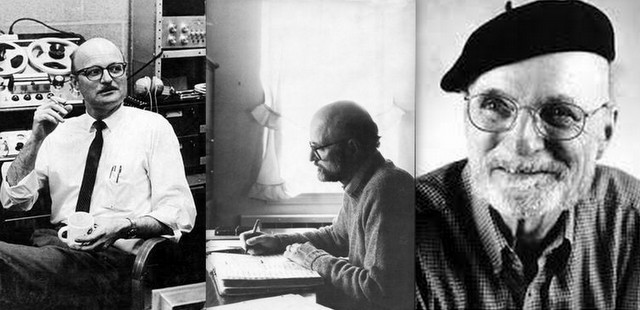
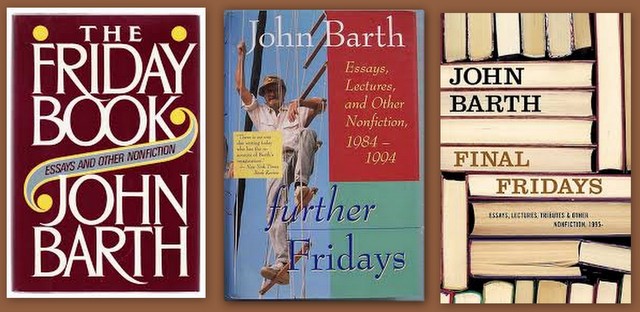
In his continuing series of chance encounter essays, Robert Day reminisces about his years long friendship with John Barth, their regular Friday lunches and the jokes they told each other. Barth once described Day in an essay as “a writer-friend from Kansas who knows about water-wells informs me of the important distinction between dry wells and gurglers.” These meetings eventuated into a trio of books by Barth: The Friday Book, Further Fridays, and Final FridaysAs always, Robert Day is an amiable and witty raconteur, slyly self-deprecating, and obviously a loyal and valuable friend. You just wish you’d been there, all those Fridays.

dg

We met by chance in the late 1970’s when Jack and I tried to convince one another that I should be the Director of the Johns Hopkins Graduate Creative Writing Program.  I was then teaching at Washington College, in Chestertown, where it turned out I stayed.  But from those first days when I toured the Hopkins Writing Seminars, meeting the faculty and students, Jack and I became friends because of — as Montaigne writes — who he is and who I am.

Not long after our pas de deux at Hopkins, Jack called to say he would be coming to Chestertown (where he and Shelly had recently bought a house) the following Friday and would I join him for lunch?  Agreed.  It was to be the beginning of scores of Friday lunches, continuing to this day.

Where we met that first time I do not remember, but I do remember that our talk was rangy, ebullient, and exclusively literary.  Well, not exclusively literary because from the first we’d swap jokes — Jack beginning with a series of hillbilly pig jokes when he learned I had studied a stint at the University of Arkansas, and I, in trade, ranch jokes imported from West Jesus Land, Kansas, where I live part time. The second thing I remember is that someone must have spotted Jack (a new book of his was just out with his photograph appearing in the papers) and took our picture.

Avid readers of John Barth will know that those Friday lunches were because of, or resulted in (or some formulation thereof) his three collections of essays. The Friday Book, Further Fridays, and Final Fridays — the latter volume including a piece published in Granta titled: “The End? On Writing No Further Fiction, Probably.” Toward the conclusion of that essay I am mentioned as an anonymous co-conspirator to his muse: More on this later.

Desktop19

Thus our literary lunch Fridays commenced and continued.  Not every Friday, but many over the years until Jack stopped teaching at Hopkins and was more often in Chestertown, in which case our Fridays turned themselves into Wednesdays or Mondays—or encore, a real Friday itself.

In the beginning, one of us would pay the lunch tab then the next time the other way around, even though sometimes we’d get confused.  At one lunch I said I thought it was my turn but Jack said no, it was his, and he insisted.  To which I said, I’m not sure we’re even, to which Jack replied:  Friends are never even.   And about that time, once again, someone took our picture.

“What do you think the caption will be?” I had asked Jack. “You first,” he said.  “Nationally famous author lunching with unidentified man,” I said.  “I’ll pass,” he said, but in the moment of silence between us, I thought that his fertile and fervent literary imagination could have made an entire novel out of my minimalist caption.  And maybe yet it shall.

What my friend has accomplished with his fervent imagination is the creation of a world of fiction unlike any other American writer.  And the landscape of that fictive world is immense:  From the early realistic and nihilistic novels, The Floating Opera and The End of the Road, to the faux historical novels, The Sot Weed Factor and Giles Goat Boy, and then changing course to On With the Story, Letters, The Tidewater Tales, Lost in the Fun House, The Last Voyage of Somebody the Sailor, and back to On with the StoryComing Soon, The Development, and his most recent book: Every Third Thought, A Novel in Five Seasons.

Jack’s writing is not so much a landscape of fiction as an Ocean of Story.  But writers are not unique just because of the breadth of their oeuvre.  There has to be something else.  An editor we shared at the Washington Post Magazine called that “something else” The Pyrotechnics of Prose.

It is as if my friend’s muse is a character in his fiction, at least the muse that is his gift of language.  Surely some critic has noticed the jazz improvisations in Jack’s writing:  I have.  Those are what we who write call invention.  It comes from where we’ve been coming from in the paragraphs before.  And the chapters before that.  And it comes from where we’ve come from as readers:  In Jack’s case, back to Lawrence Stern in English and further back than that in ancient languages and oft told old tales told on a thousand and one nights.  All of these he spins into tales of his own, with his own voice and muse doing the spinning.  Like Joyce and Nabokov and Garcia Marquez and Italo Calvino,  he conjures a maelstrom into his own Ocean of Story.  He is Tradition and Individual Talent. And fireworks at sea. About his extraordinary achievement in American letters and my modest one, we never talk.  Friends are, in many ways, never even.

By design we had lunch again the other day, a Wednesday as Zeus would have it.  Before we met I read the Granta essay in which Jack muses that his muse is not musing these days. In it he writes, “A writer-friend from Kansas who knows about water-wells informs me of the important distinction between dry wells and gurglers which may cease producing for a time but eventually resume; he encourages me to believe I’m still a Gurgler.”

There is a custom among writers that we do not ask each other about work-in-progress.  It is like telling an actor “good luck” before the curtain goes up, thus the tradition of “break a leg.”  Are gurgling or non-gurgling muses covered by our custom?

Lunch was at Evergrain in Chestertown.  We took an outside table to enjoy the sunshine. After all these years we tell many of the same jokes, but sometimes I tell one Jack has told me and take credit for it, and Jack does the same.  He doesn’t recall his early hillbilly pig jokes and I need to be reminded of my Kansas parrot joke. In this way at least we are even. Then we talk about Philip Roth and how he has recently resigned from writing fiction — as opposed to—? But neither of us mention it.  About this time, someone takes our picture.

Between that first photograph and this one I have taught thousands of students at Washington College, and those students are sending their children, and in some cases, their grandchildren to Washington College.  Mothers and fathers and a few grandmothers and grandfathers were now coming back for Parents’ Weekends and Graduations.  And having lunch out. Some stopping to reintroduce themselves.

“What’s the caption?” I ask Jack.

“Locally famous professor having lunch with unidentified man,” he says. To which in the small silence between us I think:  Lucky me to have had a duel oeuvre of Friday lunches with my friend talking books and telling jokes. And lucky all who are avid readers of muse-inspired American literature to have had John Barth with his firecracker prose going off like St Elmo’s fire in his Oceans of stories.

As we walk down the street to our cars, I ask Jack if he is the one who told me the aphorism that as we get older, Sex goes, memory goes, but the memory of sex—that never goes.

 “I think you told me,” he says.

“Let’s both take credit for it,” I say.

“Co-authors?”

“We’d be even for once if you don’t mind.”

“My pleasure,” he says. In this he speaks for me.

 —Robert Day

—————————-

Robert Day‘s most recent book is Where I Am Now, a collection of short fiction published by the University of Missouri-Kansas City BookMark Press. Booklist wrote: “Day’s smart and lovely writing effortlessly animates his characters, hinting at their secrets and coyly dangling a glimpse of rich and story-filled lives in front of his readers.” And Publisher’s Weekly observed: “Day’s prose feels fresh and compelling making for warmly appealing stories.”

Aug 062013
 
Sheehan1

Photo credit: Mark Montague

Today is the Russian Orthodox Feast of Transfiguration, also Hiroshima Day, a day of near absolute contradiction. Hilary Mullins takes the opportunity to explore the person and teaching practice of the late Don Sheehan, whose spirituality (Russian Orthodox) and spirit made him perhaps one of the most remarkable writing teachers ever. Part portrait of the man, almost a hagiography (an ancient genre, not to be dismissed), part exploration of what a writing workshop might be if suffused with spirit, part exploration of technique (chiasmus, a little form, strewn through the Bible), part homage, part homily, Hilary’s essay crosses genres and practice in a remarkable and loving way.

dg

Nine a.m. August 6th 2004, and at The Frost Place in Franconia, New Hampshire, we are assembled in Robert Frost’s old barn. It’s the second-to-last day of the annual week-long poetry conference, and though lots of us are tired at this point, there’s still a quietly-bright buzz in the air: every day here brings good things. But before the morning’s lecture gets underway, Don Sheehan, founding director of The Frost Place, rises and walks to the lectern, clearing his throat to make his customary morning remarks.

At this point, Don, with the quiet assistance of his wife Carol, has been running The Frost Place for almost thirty years, handling the multitude of various tasks involved. But I know very little about all that: the thing I have been learning about Don Sheehan is how, through all his teaching, he helps people bring forth their best and deepest selves and change their lives.

This morning he begins by noting the date: August 6th, going on to explain how it is one of the high holy days in the Russian Orthodox calendar, the feast of Transfiguration. This of course is not a common topic at most writing workshops, but his Russian Orthodox faith is a common topic for Don, and he begins to elaborate on the biblical story, describing how Jesus, taking three of his disciples, climbs a high mountain where suddenly he is transfigured by light, his face shining like the sun, his clothes dazzling white. The wonderful thing about this, Don stresses, is that this moment of Jesus’ transfiguration is also a transfiguration of the world: the holy is here. Not somewhere else, but here, now.

Sheehan2

Photo credit: Maria Sheehan

Nine years it’s been since Don spoke those words and he himself now is no longer here.

And yet, I think of him almost every day. And looking back, part of what strikes me is how truly unusual he was, not only in the largely secular world of writing workshops but probably in most places he went. At the most obvious level, the reason for this was his devout Russian Orthodox practice. But it went far deeper than that, as did his gifts to those of us who knew him.

Though I am a Unitarian Universalist myself, I had the great fortune to know him first in his own context, tagging along with a friend one evening to what I thought was a Bible study class for members of St. Jacob’s, a small Russian Orthodox congregation in Northfield, Vermont. What I was expecting was a small circle, primarily women, gathered around the priest in chairs, nibbling cookies perhaps, leafing through Bibles balanced on their knees, commenting perceptively but mildly on lectionary passages.

What I got was something altogether different. For one thing, the people who came to the class that evening, men and women both around the table, were serious in a way I was not used to. That was partly a function I’d guess of the devotional character of Russian Orthodoxy, with its calendar structuring life around faith. But it was also Don himself. A scholar with a poet’s heart dedicating the bulk of his energies to the Russian Orthodox tradition, he taught by spreading out the fruits of his scholarship and inviting us to take and eat. My own beliefs, theologically speaking, run along more liberal lines than his did, but I knew right away on that first night in his class, he was the religious teacher I’d prayed to find. So I kept attending and sometimes too visited him and Carol in Sharon at their home, sharing meals, spending time in the garden and, wonderful pleasure, spending time also with the rest of their family.

Even then, Don was already ill, suffering with the beginning symptoms of the condition that three years ago ended his life, probably an undiagnosed case of Lyme Disease. And yet though I remember him being bone-tired, he never lost his gentleness or his characteristic bright clarity. He was in his mid-sixties then, with fly-away eyebrows and look-clear-at-you blue eyes–a shy, soft-spoken man, reflexively self-effacing, who appeared like the scholar he was in his well-used, rumpled khakis and button-up shirts–except that because he and Carol were off the grid on their somewhat remote hillside in the woods, he also wore things like serious boots in the winter and a faded blue hand-knit hat to keep away the cold.

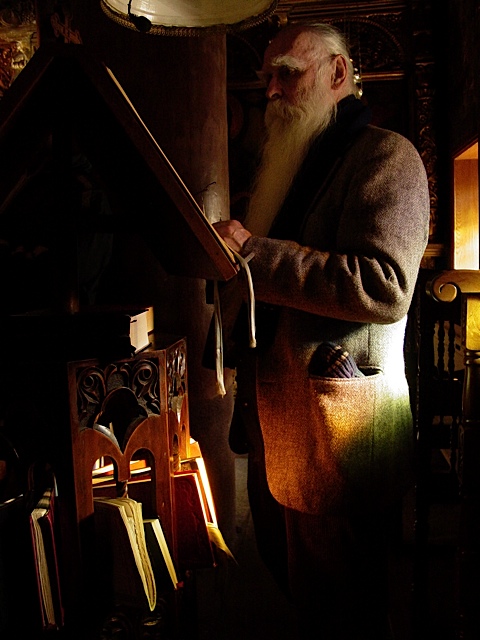
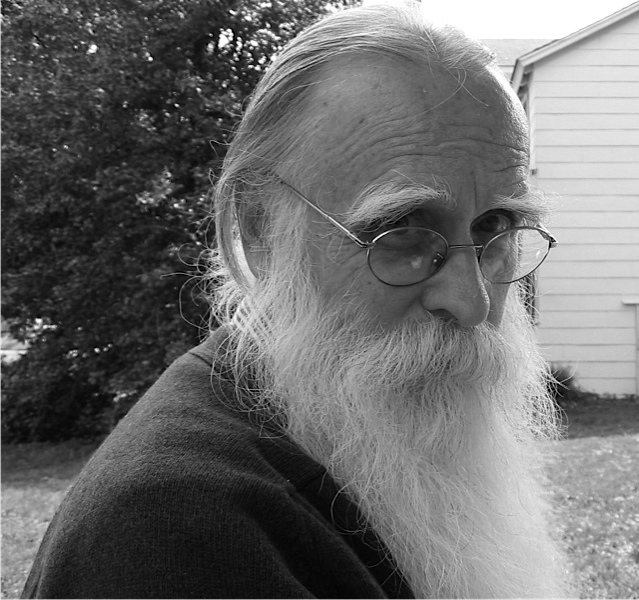
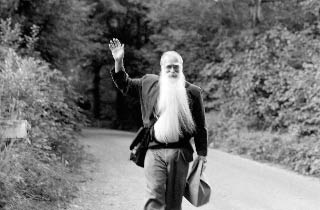
And that is another key thing to understand about Don: money and position were never his goals. This is clear for instance, in the decision he’d made much earlier in his life, before his conversion, to give up a tenure track job at the University of Chicago. In fact, even though he was at Dartmouth, Don Sheehan was an adjunct professor—a low-rung position on the academic ladder. But I doubt he regretted his choices–not because he lacked ambition, but because his ambition aimed for what he thought were worthier things. And this dedication of his to higher callings had a tendency to rub off on others. For Don Sheehan had a way. He was never one to call attention to himself, but in a room full of people, he was still someone you’d notice, not least of all because of his unusually long beard, the kind older Russian Orthodox men seem to cultivate. It draped down over his chest, a fluffy white wing attached to his chin.

I don’t mean to claim by this Don was angelic exactly, but the truth is, the man was so immersed in soul-work, he threw off a little light. And he was always casting that light toward you. That was one of the remarkable things about him: given his teaching at the church, and at Dartmouth, and particularly as director of The Frost Place, he was continually in situations perfectly rigged with opportunities for misusing his power and padding his ego. But he passed all that by, leading in the humblest way I’ve ever seen. And I don’t think this was because he failed to understand power: I think it was because as a man and as a Christian, he understood the best thing to do with power is give it away. Not to dissipate it, as if it were a dangerous electrical charge, but to transform it into love, keeping the circles of its impact ever rippling out into the world at large.

Another element fundamental to this practice of self-extending was the way Don did not strike. Having survived a childhood that was at times shattered by brutal violence, he understood the multitude of diverse, often subtle blows we deal one another. And he made a practice of not passing them on. So, in class at St. Jacob’s for instance, he never engaged in the far-too-common disheartening practice of chopping up or dismissing our responses. There were even times when I wished he would—a little anyway—be a tad more corrective perhaps—for instance, when it seemed another student’s reading of a passage was clearly off the mark. But it was Don’s habit instead to say yes and keep us walking with him, all the while modeling the way through his own fine work–essays and lectures that were deep and wide and reflective, pathways into marvelous complexities.

This approach of his he made explicit in The Frost Place workshops, starting off the week each year with these words:

“If you must make a flash choice between sympathy and intelligence, choose sympathy. Usually these fall apart—sympathy becoming a mindless ‘being nice’ to everyone, while intelligence becomes an exercise in contempt. But here’s the great fact of this Festival: as you come to care about another person’s art (and not your own), then your own art becomes mysteriously better.”

And it was true. We were all always becoming mysteriously better under Don’s tutelage. And happily, he had a way of making the work itself deeply satisfying, approaching writing not only as a believer but a lover too. In our classes at church for example, passages from the monastic Saint Isaac of Syria or the chapters in 1st and 2nd Samuel were not abstract ‘texts’ to be deconstructed: Don was no vivisectionist. Instead, he turned all the powers of his scholarship towards bringing out a passage’s depth, approaching each one as real, as a lovely, created thing, like a chapel or a shaded pool, a place to be entered with reverence and wonder and pleasure.

Likewise, it seems to me that what Don did at The Frost Place was very similar, renewing poetry for others because he believed it too was real. And this is not just a pretty way of speaking. Where our secular culture denudes the sacred properties of poetry, of all art in fact, Don was deeply grounded in a tradition that has never lost its sense of the holy in art. As I understand it for instance, a Russian Orthodox icon, properly prepared and painted, is not just a painting: it is a portal for the holy, an actual opening through which God moves toward us and through which we can move toward God, where indeed we are invited to do so.

Isaac_the_Syrian

The same goes for the written word: just as St. Isaac of Syria had explained in the 7th century, holy books in Russian Orthodoxy are understood to be places where the light of God shines through: “Those who in their way of life are led by divine grace to be enlightened are always aware of something like a noetic ray running between the written lines which enables the mind to distinguish words spoken simply from those spoken with great meaning for the soul’s enlightenment.”

The first time I read those words off a Xeroxed sheet in Don’s classroom, they made the lights come on in me, as if a Christmas tree in a darkened room had just been plugged in, glowing suddenly with the light I’d always known was there in things I read and loved, bits of bright color weaving in and out of the branches, deep glimmerings from within all the recesses.

The psalms too, were places Don brought us into the same way, teaching us the ancient chiastic pattern they’re written in. That is to say, psalms move not only from start to finish in the linear way we’re used to, they also move in a call and response fashion across the whole of the psalm, back and forth across the center, calling us, as we read, to pay attention to how the first and last verses are related, along with how the second and second-to-last are connected too, and all the others in just the same way, until we reach mid-point, which is the place where, one way or another, God appears, turning the poem in some way. But of course for Don whose religious practice for years had included praying the psalms every day, this appearance of God wasn’t simply a reference that functioned in the narrative logic of the poem: it was, just as in icons, the place where  touching and being touched by God was actually possible.

To us this chiastic doubling-back-and-forth pattern across the center is so counter-intuitive, it can take some getting used to, but one inexact analogy is this: think of yourself again as a child, hopping along a slate sidewalk, coming down from every hop with one foot on each of two paired slabs—hop, hop, hop–until then you come to the center, the deepest point of the journey, where the presence of God wells up like a sweet water spring in a hollow. Then imagine laying down, here, now, in this marvelously still, green-grass place.

Sheehansketch

A sketch of Don Sheehan by Hilary Mullins

Now you might think from these kinds of descriptions that what I’m going to relate next is the story of my own conversion. But that is not what happened: I was certainly changed by Don’s teaching, and I loved the way his tradition approached things that usually are understood as merely metaphorical, rendering them instead as vibrantly and powerfully real. But still, I have never shared his—or anyone else’s–certainty about the workings of the divine. And Don knew this. Yet, in spite of that deep commitment to his own faith, he never cajoled conversion or conversely set me outside the walls in any way: these too were the sorts of corrections he did not engage in. Even while we were studying Isaac’s lovely passage about the noetic ray glimmering in amongst the written word, and I said I’d experienced the same thing in, say, a poem by Frost, Don did not close the door. “Orthodoxy points to where the truth is,” he said. “It doesn’t say where the truth is not.”

It was this sort of catholic approach that meant poets even more secular than I could benefit from Don’s sense of the holy in poetry. We never talked about this explicitly, but my guess is that his daily contemplative reading of the psalms did lead him to find many contemporary poems to be empty, echoing forth a hollow space where he was accustomed to sensing God. And yet it seems he did sometimes see more in them too. For instance, once, on the wooded hill beside his house, I asked him, theologically speaking, for his definition of grace. He smiled in his unassuming way and told me he thought it was like the passage in Frost’s poem The Death of the Hired Hand, where the farmer and his wife, in the course of deciding whether or not to take in their occasional (and historically unreliable) hired man, are talking about the definition of home:

“Warren,” she said, “he has come home to die:
You needn’t be afraid he’ll leave you this time.”

“Home,” he mocked gently.

“Yes, what else but home?
It all depends on what you mean by home.
Of course he’s nothing to us, any more
Than was the hound that came a stranger to us
Out of the woods, worn out on the trail.”

“Home is the place where, when you have to go there,
They have to take you in.”

“I should have called it
Something you somehow haven’t to deserve.”

The last lines of course embody the generosity of Don Sheehan himself, a generosity he shared through all his teaching, be his subject a homily of St. Isaac’s, a poem of Robert Frost’s, or a theological concept he thought could bring something deeply good to our lives too. But he was remarkably kind in smaller, everyday acts as well, even in the very way he gave you all his attention in a conversation. And the sum total of all this of course is that this ongoing generosity of his quietly but powerfully influenced many, many people.

And because he knew the healing power this practice had for him as well, the mysterious way it had of making him better, he was always enjoining us to do the same: “Your work at this conference,” he would say at The Frost Place, “is to make the art of at least one other person better and stronger by giving—in love—all your art to them.”

Sheehan3

In the end I think he stressed love so much because he knew and understood its opposite so well. He and I never discussed what went on in his home when he was a boy, but in an essay on the Orthodox concepts in The Brothers Karamazov (still easily found online), he referred to that history to make a point, writing,  “I was raised in a violent home where, until I was nine years old, my father’s alcohol addiction fueled his open or just barely contained violence, a home where my mother was beaten over and over (I remember her face covered with blood).”

Nine years ago, on August 6th, 2004, when Don Sheehan got up before the morning’s craft lecture and spoke, of all things, the Transfiguration, of the miracle of the holy transfiguring the world, he turned next to its opposite, bringing our attention in his measured way to another event marked by August 6th: the bombing of Hiroshima: “This,” he said, “we can refer to as a disfiguration of the world.” Knowing disfiguration as he’d had in his own life, his phrasing was deliberate as quietly he urged us to choose transfiguration in our own lives, yielding not to the innumerable temptations to slight or demean others but instead to make the kinds of gestures that embody the practice of love.

This of course was how Don Sheehan himself transfigured the world as he traveled through it, bringing light wherever he went. And it was what he was pointing to again and again in everything he taught, just as he did each year at the beginning of The Frost Place Festival: “The key that unlocks all truth,” he said, is “taking very great and very deliberate care with each other.” This infinitely exacting, transforming task was his greatest lesson, the one that is up to us all to carry on.

— Hilary Mullins

Editor’s Note: Don Sheehan did finish his translation of the Psalms and the book will be published shortly by Wipf and Stock.

—————————

HMullins

Photo credit: Phil Crossman

Hilary Mullins lives in Bethel, Vermont, teaching public speaking for Vermont Technical College and cleaning windows in the warmer months. She also does occasional preaching for local churches. Along with an MFA from Vermont College, her education includes classes at the UU’s Starr King School for the Ministry, as well as completion of a three-year study program run by the Vermont UCC.

.

.

.

.

.

Aug 052013
 

A. Anupama

A. Anupama used to be on the NC masthead, but she decided to take time off from her onerous duties here to do necessary things such as care of her family, finish her MFA, and polish her book manuscript. Now she is back. Look for more of her poetry reviews, poems, essays, and translations on a more regular basis. She has already contributed a LOT! Please check out The A. Anupama NC Archive Page for the whole collection.

dg

A. Anupama is a U.S.-born, Indian-American poet and translator whose work has appeared in several literary publications, including The Bitter Oleander, Monkeybicycle, The Alembic, Numéro Cinq and decomP magazinE. She received her MFA in writing from Vermont College of Fine Arts in 2012. She currently lives and writes in the Hudson River valley of New York, where she blogs at seranam.com.

Aug 052013
 

My hometown — Port Clinton, Ohio, population 6,050 — was in the 1950s a passable embodiment of the American dream, a place that offered decent opportunity for the children of bankers and factory workers alike.

But a half-century later, wealthy kids park BMW convertibles in the Port Clinton High School lot next to decrepit “junkers” in which homeless classmates live. The American dream has morphed into a split-screen American nightmare. And the story of this small town, and the divergent destinies of its children, turns out to be sadly representative of America.

via Crumbling American Dreams – NYTimes.com.

Aug 052013
 
George Starbuck

George Starbuck

Poetry is a fickle profession. The muse is fickle, the audience is fickle, fame is fickle. Critics and scholars have Alzheimer’s — the one-time darling is often simply forgotten. This happens to an author whether his or her work deserves neglect or not; great poets go down before the scythe of forgetfulness. Today NC is launching a new series called Undersung to try to fill in some of the gaps for the dementia-riddled reading class. Contributing Editor Julie Larios suggested this, and there is none better to write the series because she has a reading memory like a wolf trap and can call to mind verse at the drop of a hat. She is also just really smart about the technical aspects of a poem. And she has her favourite neglected poets to whom she brings brio and passion. Today, we have George Starbuck, the man whose manuscript beat out Sylvia Plath for the Yale Younger Poets Prize in 1960 but whose life was less notorious. Often wrongly pigeonholed as a light verse poet, he was a technical master and superb ironist. He should not be forgotten.

dg

—-

“Do not go into the light,” the woman screams. “Stop where you are. Turn away from it.  Don’t even look at it.”  Fine advice, if your name is Carol Anne and you’re the victim of a poltergeist. Listen to your mother as she shouts to you through the television static.  Believe her: The light is not your friend.

But in poetry, you might be better served by ignoring the voices that discourage the light (verse, that is) in favor of the dark, or that denigrate the light in favor of what is “heavy.”  As in “Wow, that’s heavy, man.” For “heavy,” you’re expected to understand significant and serious; it weighs something and is important and has a chance at entering The Canon.  It should not (repeat: should not) make you laugh. And it probably should not come wrapped up in anything sneaky that makes you think what you’re reading is dandy candy but then turns out to be good for you. That’s not fair.

Enter the poetry of George Starbuck, once named “the thinking man’s Ogden Nash.”

His reputation for “light” verse (a misnomer, I think – if that’s what it is, then Starbuck’s version of it is a sledgehammer disguised as a feather) kept him out of several of our most important anthologies and thus out of Poetry 101 classes across America. Actually, one of his poems (“A Tapestry for Bayeux”) did make it temporarily into the influential Little Treasury series edited by Oscar Williams, but was dropped from the anthology (and Starbuck “consigned to a special poetic oblivion,” according to poet Anthony Hecht) when Williams was informed that the initial letters of the first 78 of 156 lines spelled out “Oscar Williams fills a need, but a Monkey Ward catalog is softer and gives you something to read.” Who does that, writes a brilliant poem about naval operations during WWII, and builds in an acrostic poking fun at the anthologist who can make or break your reputation? George Starbuck, that’s who.

A Tapestry for Bayeux

1. Recto

Over the
….seaworthy
cavalry
….arches a
rocketry
….wickerwork:
involute
….laceries
lacerate
….indigo
altitudes,
….making a
skywritten

filigree
….into which,
lazily,
….LCTs
sinuate,
….adjutants
next to them
….eversharp-
eyed, among
….delicate
battleship
….umbrages
twinkling an

anger as
….measured as
organdy.
….Normandy
knitted the
….eyelets and
yarn of these
….warriors’
armoring—
….ringbolt and
dungaree,
….cable and
axletree,

tanktrack and
….ammobelt
linking and
….opening
garlands and
….islands of
seafoam and
….sergeantry.
Opulent
….fretwork: on
turquoise and
….emerald,
red instants

accenting
….neatly a
dearth of red….

On it goes, for twelve 13-line stanzas, every single line three syllables, accent always on the first syllable (dactylic monometer.) And it makes sense, in terms of its subject matter. And the language – vocabulary, music – is brilliant. And it’s an acrostic. As Hecht says in his introduction to The Works, published after Starbuck’s death, it is a poem of “needlework intensity.” Starbuck himself, in this poem, praises “opulent fretwork.” Of course, that might be exactly the problem. Fretwork and needlework are delicate, and American poetry – as with many things American – prefers muscle.

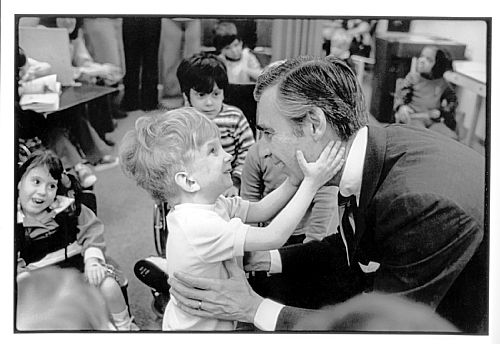
Perhaps no one needs to scream at us to stay away from the light. After all, we’re culturally drawn to the dark side, James Cagney with his tommy gun, Bruce Willis with an AK-47, aren’t we? It’s often High Noon in America, and whoever comes out of the fight alive wins; America seems, even in the year 2013, predestined to favor the gunslinger over the Quaker (as Starbuck says, “Saturday night’s a longshot / Contraption as it is. / A man without a Magnum’s / A piece of agribiz. // He might as well push daisies / And model for a wreath / And pick a granite afghan / To cuddle up beneath.”) Arnold Schwarzenegger takes out Fred Rogers in the first minute of the first round, no doubt about that.

Fred Rogers

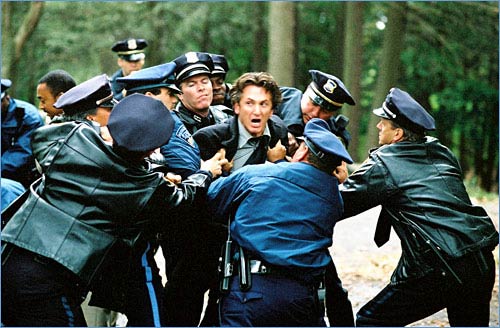
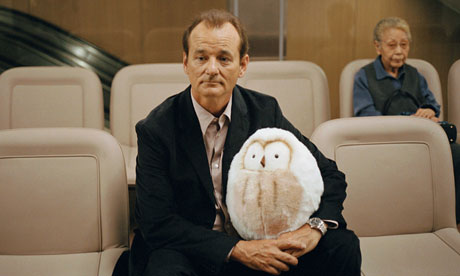
Heavyweights rule the American roost. Farther down in the pecking order come middle and welter, then featherweight, and even farther down is the pesky bantam. Does flyweight even need to be mentioned? The boxing analogy holds for poetry: The lighter the fighter, the smaller the size of the prize. Come to think of it, the analogy holds for theater and film, too – Sean Penn’s suffering father in Mystic River gets the 2003 Oscar over Bill Murray’s sardonic film star in Lost in Translation.  Who said comedy is king?

Sean Penn

Bill Murray

Anne Sexton, definitely a Canon-weight poet, once wrote “I have to be great,” and many people admired her and still admire her for it. Ambition is more attractive to some people than it is to others. (My own reaction, when I read those words: Imagine an artist thinking that, much less confessing it – unless confession is your thing.)  Fellow poet Starbuck – who was Sexton’s lover early on while she honed both her poetry and her appetite for fame – seemed not to care as much about the size of his pistol or his reputation, nor did he spend time thinking about categories like welters, bantams, flies and feathers, not unless he could turn the words themselves to good use with a clever rhyme (feathers / weathers / death spurs / breath verse / meth purrs…no, I can’t do it, not the way George Starbuck could.)

This rhyming thing is hard, god-awful hard if you want to do it with panache; that’s why so many poets, caring not just about the basic message of a poem but about the messenger’s ability to deliver it in a breathtaking way, appreciate George Starbuck’s gifts.

Fable for a Blackboard

Here is the grackle, people.
Here is the fox, folks.
The grackle sits in the bracken. The fox hopes.

Here are the fronds, friends,
that cover the fox.
The fronds get in a frenzy. The grackle looks.

Here are the ticks, tykes,
that live in the leaves, loves.
The fox is confounded,
and God is above.

Technically dense, emotionally delicate, intellectually profound.  Try doing that – hitting that trifecta. He was a poet’s poet, as they say. And Starbuck himself said, about his choices, “For me, the long way round, through formalisms, word-games, outrageous conceits (the worst of what we mean by ‘wit’) is the only road to truth. No other road takes me.” His obituary in the New York Times echoed the sentiment: “If the scope of his verbal talent sometimes seemed at war with his reputation, Mr. Starbuck could not seem to help himself.”

If you haven’t read his work, do so. He published individual poems widely during his lifetime and gathered them into books only occasionally (two excellent collections, Visible Ink and The Works were put together by his widow and published posthumously.) His first collection, Bone Thoughts, was awarded the Yale Younger Poets prize in 1960. Sylvia Plath’s manuscript for The Colossus competed with Starbuck’s that year; they studied together (along with Sexton) in one of Robert Lowell’s famous workshops at Boston University. Plath, in her journals, rails against losing out to Starbuck.

Certainly, not everything Starbuck wrote for that first book would be considered light verse, though it did produce an introduction by the judge – the critic Dudley Fitts, who took over the Yale Younger Poets series from W. H. Auden — which indicates Fitts didn’t quite know what to think of it.  Not only did Fitts state, in that introduction, that Starbuck was “a man awake in the nightmare of our day” and predict that “a great song is begun,” but he also wrote, “I was also attracted, and sometimes repelled, by Mr. Starbuck’s wit….[He] could use an intellectual sedative.” Fitts cites this poem as an example:

War Story

The 4th of July he stormed a nest.
He won a ribbon but lost his chest.
We threw his arms across the rest
…………..And kneed him in the chin.
…………..(You knee them in the chin
…………..To drive the dog-tag in.)

The 5th of July the Chaplain wrote
It wasn’t much; I needn’t quote.
The widow lay on her davenport
…………..Letting the news sink in.
…………..(Since April she had been
…………..Letting the news sink in.)

The 6th of July the Captain stank.
They had us pinned from either flank.
With all respect to the dead and rank
…………..We wished he was dug in.
…………..(I mean to save your skin
…………..It says to get dug in.)

The word when it came was three days old.
Lieutenant Jones brought marigolds,
The widow got out the Captain’s Olds
…………..And took him for a spin.
…………..(A faster-than-ever spin:
…………..Down to the Lake, and in.)

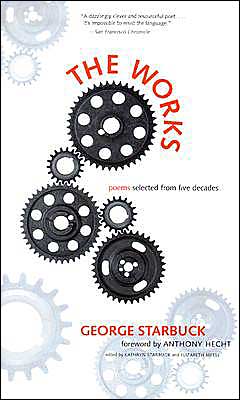
Unfortunately, Fitts’s early assessment in 1960 turned out to be the final critical assessment when Starbuck died of Parkinson’s in 1996: Critics admired his work (perhaps not as much as fellow poets) but were unnerved by it because tonally and technically it was so complex, at once delicate and obsessive, intricate and blunt, playful and brutal. After an extended time with it, even a respectful reader becomes exhausted, or better said suspicious, and a real tumble of questions begins to overtake the pleasure:  If it is “bravura technique” (as Hecht says – and he goes on to say “it has no match among English-language poets of this century”) does it come from the heart or is the poet himself intoxicated with formal intricacies? Does the man never come up for air and write a more relaxed poem? Do the technical restrictions inflict a straightjacket on the poet rather than provide a source of inspiration? In fact, is it a poem or is it a math puzzle? Starbuck began his university studies at Cal Tech in mathematics at only 16 years old – was he more interested in mathematical patterns or in poetry? Even the cover of his collected work shows us a system of interlocking gears, more mechanical than human:

The Works

Maybe the answer to both parts of all the questions above is yes…and yes. One of my favorite poems in the book (“Unfriendly Witness”) begins this way: “I never played the Moor, / I never looked to see, / I don’t know what my hands are for, / I know they’re not for me” and ends with this: “And yet the world is heavy / and filled with men like me—/ with tired men, with heavy men / that slip my memory / if that be perjury.”

We hear a nursery rhyme in the treble clef of “War Story” and “Unfriendly Witness,” but there is no doubt they are serious poems, with a bagpipe-type dirge underneath the melody.

Ahh, “serious.” There it is again, that word. Can a poet who says in his poems “Love is a strange coot” and who indulges extravagantly in clerihews and double dactyls ever be taken seriously? Take this double dactyl from “Troves from the Natives of 1992”:

Higgledy piggledy
Fifty Columbuses,
Fifty times richer in
Trinkets and beads

Couldn’t provision the
Quinquecentennial
Memorabilia
Business’s needs.

Far be it for Starbuck, of course, to be satisfied with one complete double dactyl; instead, he continues this poem for another eight stanzas (four more complete double dactyls) in a tour de force of the form, which requires not only the double dactylic line for each 4-line stanza, but a six-syllable single word, often as the entire second line of the second stanza. Notice how one six-syllable word is followed by another in the Starbuck excerpt – “quinquecentennial memorabilia” – which few poets could pull off.

Starbuck goes for those multisyllabic lines with gusto: “miniconquistadors,” “made-in-Rumania,” “demimillennial”…that’s where the challenge and the fun of the form come together and burst into flame, and that’s where you’ll find Starbuck at his game-playing, neologistic best. Does he self-combust? The answer to that is a matter of taste, a little like the fried grasshoppers sold by the handful in Oaxaca – tasty but scary. Fitts, remember, was both delighted and repelled, and Starbuck is an acquired taste, that’s for sure.  He was, as one NPR commentator described him, “high bard of the big pun and the even bigger idea.” That’s a heady and unusual mix. Sometimes you want to stand back from that kind of chemistry.

George Starbuck should be well-known to anyone who writes and teaches. When he was just a young man working at the library of SUNY-Buffalo, he was fired for refusing to sign the loyalty oath required of all employees. Starbuck recognized the repressive abuse of power inherent in New York’s Feinberg Law (enacted in 1949) which sought out teachers who used “propaganda” in the classroom on “children in their tender years.” Three faculty members joined Starbuck in suing the university, but it was Starbuck himself who was the acknowledged instigator of the suit (this is well-documented in Marjorie Heins’s Priests of Our Democracy: The Supreme Court, Academic Freedom and the Communist Purge.) Ultimately, the case was taken up by the Supreme Court, which ruled in the group’s favor and found the law unconstitutional. Starbuck remained a fiercely committed political activist, most visibly in his opposition to the war in Vietnam. For a blistering example of that, read his poem, “Of Late,” addressed to Robert McNamara, about Norman Morrison, the Quaker who burned himself alive to protest the war (he “…burned and was burned and said / all there is to say in that language.”) You can see the whole poem here.

A read-through of obituaries which followed Starbuck’s death at age 65 is impressive: He studied for two years at UC-Berkeley, three years at the University of Chicago (where he met and became friends with Philip Roth, whose work he later edited for Houghton Miflin), a year at Harvard, and additional time at the American Academy in Rome, never earning even a BA degree. He was an inspirational teacher at SUNY-Buffalo, the Iowa Writers Workshop and (returning to his roots) Boston University. Both Maxine Kumin and Peter Davison studied under him. He won the coveted Lenore Marshall Prize in 1983, administered by the Academy of American Poets (other winners have been Mary Oliver, Philip Levine, Stanley Kunitz, John Ashbery, Robert Pinsky, Adrienne Rich, C.D. Wright – the entire list reads like a Who’s Who of American Poetry.) He invented an entirely new poetic form called the SLAB, a “Standard Length and Breadth” poem written in fourteen-letter lines that form a “slab,” typographically as does this excerpt from one SLAB entitled “Cargo Cult of the Solstice at Hadrian’s Wall” [Note: slabs are at their best using Courier font, which lines up precisely]:

OTinyBombOTiny
BombWhatGangOf
MadmenMadeThee

OMiddleeastern
MasterpieceNoT
NTBetrayedThee

OEensieWeensie
IndyCarOCreamy
HalvahCandyBar….

Well, as I’ve said before, it goes on for quite a few more stanza. Or slabs. The man was unstoppable.

There are a few poets who “played” (read “worked”) with language the way Starbuck did. John Hollander and Anthony Hecht, his contemporaries, famously invented the double-dactyl, which Starbuck took up with glee. The British poet James Fenton, slightly younger, found the same strength in nursery-rhyme rhythms, especially in his anti-war poem, Out of the East:

Out of the South came Famine.
Out of the West came Strife.
Out of the North came a storm cone
And out of the East came a warrior wind
And it struck you like a knife.
Out of the East there shone a sun
As the blood rose on the day
And it shone on the work of the warrior wind
And it shone on the heart
And it shone on the soul
And they called the sun – Dismay.

I sometimes hear Fenton as I read Starbuck, though I find myself missing Starbuck’s humor. Auden often had both light and dark in the same poem, as in his poem “As I Walked Out One Evening,” which starts out with its Mother Goose images this way:

As I walked out one evening,
Walking down Bristol Street,
The crowds upon the pavement
Were fields of harvest wheat.

And down by the brimming river
I heard a lover sing
Under an arch of the railway:
‘Love has no ending.

‘I’ll love you, dear, I’ll love you
Till China and Africa meet,
And the river jumps over the mountain
And the salmon sing in the street,

‘I’ll love you till the ocean
Is folded and hung up to dry
And the seven stars go squawking
Like geese about the sky.

Like Starbuck, Auden provides us with a light melody at the surface, and a funereal bass-clef as the poem proceeds:

But all the clocks in the city
Began to whirr and chime:
‘O let not Time deceive you,
You cannot conquer Time.

‘In the burrows of the Nightmare
Where Justice naked is,
Time watches from the shadow
And coughs when you would kiss.

‘In headaches and in worry
Vaguely life leaks away,
And Time will have his fancy
To-morrow or to-day.

Both Auden and Starbuck manage to use child-like rhythms to subvert our expectations – and subverting expectations is an important element in poetry. Starbuck, however, gave himself permission to be more relaxed with breaks in the rhythm, as well as to break words in two at  line endings, and to invent words in order to reach a rhyme, as these lines do from his poem “Dylan: The Limerick”:

He did his Old-Man-Memphis
Empathy with emphys-
…………..Ema schmooze.
Did his minstrel Ham-and-Shem fuss.
Did THE OLD MAN’S ABM FAC-
ILITY DEEMPHAS-
…………..IS BY DEMOLITION BLUES.
…………..He brung the teenyboppers their bad news.

Starbuck’s rambunctious combination of Low Culture and High Culture has become more common in the postmodern, post-9/11 poetry world –  I’m thinking of the recent work of poets like Richard Kenney, who can be equally witty, compressed and riveting, and sometimes equally hard to parse:

March

Sky a shook poncho.
Roof   wrung. Mind a luna moth
Caught in a banjo.

This weather’s witty
Peek-a-boo. A study in
Insincerity.

Blues! Blooms! The yodel
Of   the chimney in night wind.
That flat daffodil.

With absurd hauteur
New tulips dab their shadows
In water-mutter.

Boys are such oxen.
Girls! — sepal-shudder, shadow-
Waver. Equinox.

Plums on the Quad did
Blossom all at once, taking
Down the power grid.

Another poet who comes to mind is Cody Walker. I read him with the same pleasure as I do George Starbuck. Walker is not afraid of going for a laugh, and in his book Shuffle and Breakdown he tosses in those same wry High/Low Culture references that not every poet is brave or crazy enough to make:

With Ms. Rule on One Arm

Impolitic as it may sound,
gimp-witted idiots abound.
They give the lexicon a whirl.
The get the gasworks and the girl.
MacArthur? Guggenheim? Booby
prizes, we find. Better to be
a stumbler, a throttlebotom.
Lower our eyes. And don’t dot ‘em.

Sometimes the work of Kay Ryan, a recent Poet Laureate, takes on rhyme in a similar, playful way:

Lime Light

One can’t work by
lime light.

A bowlful
right at
one’s elbow

produces no
more than
a baleful
glow against
the kitchen table.

The fruit purveyor’s
whole unstable
pyramid

doesn’t equal
what daylight did.

But Starbuck was unique. So why have so many people never heard of him? Well, as one obituary pointed out, he indulged in such a “dazzling display of pun, parody and pyrotechnic wit that critics sometimes seemed too busy laughing out loud to take him seriously….” Starbuck tried to excuse his weakness in one stanza of a long poem titled “Tuolomne.”

I have committed whimsy. There. So be it.
I have not followed wisdom as I see it.
You avalanche me sermons and I make
Rhymes for the sake of rhymes.
This sinner, Lord, of his lamented crimes.

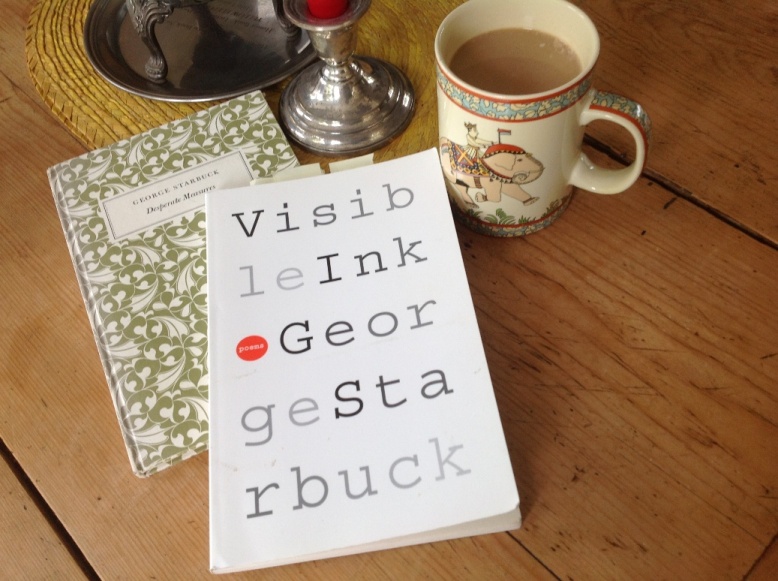
That poem is from his 1978 collection Desperate Measures – even Starbuck’s titles are double entendres.  The poet Eric McHenry suggests you have three cups of coffee as a way to prepare for reading the buzzy, caffeinated work of George Starbuck. I suggest you do just that: Sit down, sip, read, marvel.

Cup of Coffee and George Starbuck

—Julie Larios

——————————–

Heads

Seattle poet Julie Larios has had poems published in a variety of print and online journals.  Her work won a Pushcart Prize and has been selected twice for inclusion in the Best American Poetry Series. Recently she collaborated with the composer Dag Gabrielson and other New York musicians, filmmakers and dancers on a cross-discipline project titled 1,2,3. It was selected for showing at the American Dance Festival (International Screendance Festival) and had its premiere at Duke University on July 13th.

Aug 042013
 

Richard Farrell

Rather than words comes the thought of high windows:
The sun-comprehending glass,
And beyond it, the deep air, that shows
Nothing, and is nowhere, and is endless
—Philip Larkin, from “High Windows”

It seems to me that reverence, as something intrinsic to an individual’s sense of meaning, as a principle of human communities, has been on the decline, if not under downright assault, in the culture at large. I’m not arguing that there’s a scarcity of people leading reverential lives. From monks to poets, from special-education teachers to astronauts, we live amongst many still capable of being awestruck. Nor is the raw material which inspires reverence eroding, like polar ice caps and old-growth forests, under pressure for mankind’s increased footprint. Just a mile from my front door, a traffic jam occurs each night as hundreds of people crowd along the cliffs to watch the sun drop into the Pacific.

When I was young, I would wake early and head off to serve as an altar boy for the weekday, sunrise mass. The same rag-tag band of true believers filed into the pews at 6:30 every morning. Something about being tired, a whiff of candles, incantations, and carefully articulated rituals always mesmerized me. I’ve yet to encounter a more consistently sacred sight in my life than dawn breaking through the stained-glass windows at Christ the King Church. At twelve, I gave serious consideration to the seminary, and heretically repeated the priest’s gestures in my living room, with Ritz crackers for the body and grape soda for the blood. But I had no calling from God. In time, the rituals themselves lost meaning.

Looking back, it’s hardly surprising that I chose to go to college at the Naval Academy, an institution awash in rituals and codes. Anyone who’s ever witnessed a sunset dress parade along the Severn River—four-thousand midshipmen marching in lock step, bayonets and belt buckles polished, blue and gold spinnakers billowing on the river—and not felt something akin to awe, surely has lost the ability to be stirred by great pageantry. By the time I was 18, I’d traded in the vestments of the altar for the vestments of war but marveled no less at the lore and history of it all, the flag lowered at sunset, the distant bugle call of taps.

During my sophomore year at Annapolis, a plebe committed suicide by stepping out of his fifth-floor window. The young man had wanted to quit the Academy, but was encouraged to stay by well-meaning parents and company officers. I watched as paramedics attempted to resuscitate the broken and bloodied midshipman, his once-pristine, navy-blue uniform suddenly a torn and grisly mess. Later, as fireman sprayed his blood from the brick walkway, I felt a desperate emptiness about the institution I’d committed to. The shame of quitting was certainly not worth that young man’s life.

“Reverence is an ancient virtue,” Paul Woodruff writes in Reverence: Renewing a Forgotten Virtue. Woodruff, a humanities professor, approaches the subject of reverence with a philosophical lens. Handed down from early cultures, across a variety of religious and secular systems, reverence has less to do with mystery and mysticism and more to do with shaping individuals and societies who can recognize the limitations of what humans can (or should) control. Reverence, according to Woodruff, begins in a capacity for awe and wonder for the world around us. This capacity for awe leads to a deepening respect for fellow human travelers. “This in turns fosters the ability to be ashamed when we show moral flows exceeding the normal human allotment.”  Shame arises, in part, when humans fail to remember that each person, whether prince or pauper, is dwarfed by the sheer grandness of existence.

Reverence, Woodruff also argues, is on the decline in contemporary culture.

My children have recently begun their summer vacation and the moments in my day which might let in a little reverence have been few and far between. It’s hard to experience awe amidst battles over television remotes, pop-radio stations and who gets to play on the iPad. At times, it seems that the experience of reverence demands things in short supply these days: silence, stillness, time to think. And in most of my daily life, the once sacred rituals have either lapsed into quaint memory or feel contrived. Perhaps I’ve convinced myself that I’ve outgrown them, like acolyte robes and military uniforms. Perhaps the only solution is to get away from it all for a while.

So at the end of June, I leave California for Massachusetts with my kids—Maggie, almost 12, and Tom, who’ll be 8 in a few weeks. These are transitional times as a parent. Maybe all time and ages are transitional, but these years in particular feel downright seismic. Less and less snuggling, more and more driving, from horse lessons to baseball practice to sleepovers on the other side of town. Because I’ve taken Maggie and Tom to see their grandparents in Massachusetts most summers since they were born, these trips retain something of a ritual in our family. The grandchildren, welcomed as mini-deities, are worshiped with burnt offerings of Cheetos, ice cream bars and endless hours of over-indulgence.

Children make for wonderful case studies of reverence. Anyone who’s ever spent ten minutes waiting for a child to stop staring in wide-eyed wonder at a green caterpillar on a leaf knows that a child’s capacity for awe is without peer. And anyone who’s ever chastened that same child for being distracted certainly knows how deeply a child feels shame. Respect, awe, shame—a child’s life is awash in reverential moments. What child does not, as Annie Dillard says, live in all they seek? If only they could articulate their experience. Because what a child lacks, it seems, is the eloquence to communicate that experience. This comes with maturity, with reading the great books, studying the big ideas, sharing in the human conversation.

This point is driven home most clearly by one of my son’s friends in Massachusetts. John, 6, suffers from significant autism. What might well be a deep, if scattered, concentration and intelligence (John knows all the world’s countries and their capitals, knows all the elements of the periodic table and hears and repeats verbatim anything you say) crashes around him when he encounters other people. While John twirls around on the beach, gathering shells with a naturalist’s curiosity, he also seizes up, clenching his hands into tight fists and his face into a grimace, when given basic commands by an adult. He remains isolated in a room of children, able to make only the slightest contact. The simple, if cruel, reality is that John doesn’t fit into the world as typically constructed. It’s like he hears the music playing in the background but can’t find the rhythm.

And yet it’s hard not to wonder and marvel at his freedom, the absolute and unadulterated pleasure he finds in a vibrating restaurant pager or the garden hose at my mother’s house. For John, it’s as if all the moments in his world were reverent ones, but they remain utterly trapped inside, un-spoken, only thinly connected with those around him, and thus those moments verge on being lost to meaning.

“We live in all we seek,” Annie Dillard writes. “The hidden shows up in too-plain sight. It lives captive on the face of the obvious – the people, events, and things of the day – to which we as sophisticated children have long since become oblivious. What a hideout: Holiness lies spread and borne over the surface of time and stuff like color.”

Dillard reminds us that the sacred surrounds everything, waiting only to be noticed. And intellectually, this makes perfect sense, though it’s another thing entirely to live this way, to actively overcome the obliviousness of daily pursuits, all those small tasks that take up so much time and energy. Reverence, for the most part, always feels set apart, reserved for mountaintops, cathedrals and forest trails. The trick of recognizing the numinous in the mundane, seeing the sacred patterns—the color, as Dillard calls it—in the landscape we walk everyday, seems elusive, frustrating at times, the stuff of dreams.

What Dillard seems to be arguing, and Woodruff no less, is that reverence involves a choice. “We have not lost our capacity for reverence,” Woodruff writes. “The capacity for virtue belongs to all of us as human beings. What we are losing is a language of behavior—a self-conscious sort of ceremony—that best expresses reverence in daily life.” But how to learn that language?  Harder still, how to remain fluent in it? In my youth, the rituals of the church or the military helped shape those choices for me, or perhaps they co-opted them, no matter. The priest used the mass to dramatize the crucifixion. What stood behind the dress parade were not just shiny shoes and individuals submitting to the larger unit, but also history, the great battles of the past, the fallen, the horror of war, camaraderie, sacrifice, virtues, regardless of how tenuously political these things may have been. Those rituals always pointed the way for me, like an illuminated highway sign on a dark and lonely road. The destination, the actual feelings of profound mystery and awe, must remain just out of reach, ineffable and abstract. But the road signs reassure, keep us moving on what appears to be a path, however dimly lit and confusing. The stylized and polished constructs become containers for the missing virtue (courage, honor, integrity, deity), for those things that can be felt but not grasped. And in this, the rituals themselves become imbued with meaning and importance.

But most of the rituals are gone now, at least for a large portion of people I know, myself included. Routine has taken over, and routine and ritual are very different creatures. Routine shares none of the symbolism, none of the communal aspects of ritual. Taken to an extreme, routines can become neurotic prisons of obsessive rigidity, closed off from the world at large. Whereas rituals, even the most esoteric and sealed, exist within part of the larger human society.

In the town center of Holden, Massachusetts, just a short walk from my mother’s front door, there is pre-Civil War cemetery. Holden is the quintessential New England town, with flags fluttering, white church spires and sun-dappled maple trees. The granite, moss-mottled headstones, tilting in all directions like teeth in need of braces, want to tell a story, if only I could listen. Many of the markers contain poems chiseled into the face, and many of the graves are for young children. In the cemetery, I think about Robert Bly’s introduction to William Stafford’s poems, in which Bly talks about the golden thread. “I asked Stafford one day, ‘Do you believe that every golden thread will lead us to Jerusalem’s wall, or do you love particular threads?’ He replied, ‘No, every thread.’ He said, ‘Any little impulse is accepted, and enhanced.”

The golden thread is, of course, a form of reverence. The transformation of the objective experience into a poem, into the holiness of Jerusalem’s wall, is precisely what my son’s friend, John, lacks. For children like John, and for many others too, the golden thread is only a piece of string.

Dillard and Bly arrive at similar conclusions. Any little impulse can lead to the sublime. Every detail can become a golden thread, garden hoses, church spires, and headstones. The sacred is all around us. Why travel across the country to look for it? We hear this message again and again, but how to trust it? How to experience it as a real part of the day-to-day?

Instead, we seem perpetually distracted. We cash in on our humanity, and turn our backs to the sacred moments with such a blithe indifference that at times it feels as if life were one giant video game. I indict myself in all of this. As often as not, I am oblivious to awe, wandering around in an over-saturated haze of consumerist fervor, kinetic schedules and endless detachment. How to plug-in to reverence?

It seems easy to do here, in this old cemetery, where the light and the silence are vibrating with possibilities, with a type of sacred energy, with history and stories and the march of time. But reverence depends less on circumstance and more on how we transform what’s offered.

I arrive, at last, not at a conclusion, but perhaps at a bit of understanding. For the more I consider it, the more reverence begins to seem like a type of triangulation. There is, on the first level, the phenomenon itself. The sunset. The caterpillar. The ritual of the mass. The dress parade. The suicide. These things exist independently, whether observed or not, whether intended or attended. If a tree falls in a forest, as Bruce Cockburn and a thousand Zen monks sing, does anyone hear? The event is indifferent to our attention. Barry Lopez can describe the thousand-mile migrations of polar bears with such detailed elegance that I can imagine the journey happening before my eyes, but the bear remains utterly ambivalent about who’s watching.

Enter the observer. The poet, the prophet, the biologist sailing on a brig sloop between the Galapagos, the astronaut hurtling through the heavens. Humankind bears witness as much as anything else we do. As Dillard points out, we uncover what lives captive on the face of the obvious. The witness shuttles forth into the unknown and comes home with a tale to tell, whether that tale is On the Origin of Species, Arctic Dreams, the Upanishads or worn letters carved into the face of granite headstone.

It’s not that Neil Armstrong’s experience of stepping onto the lunar surface was any less personally reverent for him, with or without the world watching on television. But, as Armstrong’s own words remind us, in order for that one small step to live beyond itself, for the unity of experience to become that giant leap for mankind, it needed to be shared. Thus the third side of the triangle, the reception, the acknowledged and expressed substance of what it all might mean.

I am certain that John experiences reverence in his life; I’m certain that in every tactile roll in the grass, in every confusing (to us) choice he makes, John ingests the sensory world with a ravenous hunger and perfect pitch. But the circuit is shorted somehow, and no signal passes from his interior experience to others. This seems the great tragedy of autism. Also the great tragedy of tyranny, suicide, repression, violence and the apathy of tuning out. When we lose the ability to form the connection, the world suffers.

The poem needs the poet, but the poet needs the reader. In this triangular symmetry, the three sides form the whole.

Reverence lives somewhere inside this sacred geometry, somewhere between my ability to be stirred by something greater than myself, my ability to articulate that experience, and my willingness to hear that message when its shared with me. For in the end, aren’t we working out the mystery on our own? Aren’t we all lonely fishermen, perpetually taking in the world through a small hole each of us carves in the ice? And when we get a nibble, or when we get too cold to continue, or when we just get too damn lonely to go it alone any longer, don’t we all yearn to share that experience with others?

And where better to find the sacred than in the sky above and the earth below. “Reverence at home is so familiar to us,” Woodruff writes, “that we are hardly aware that this is what it is, and we may have to visit homes of a different culture before we recognize the places where family pictures hang, or where a grandmother’s unused teacups gather dust, are shrines.”

Somewhere between California and Massachusetts are those shrines. Somewhere between Annie Dillard, William Stafford and an autistic boy trying to make sense of a confusing world, lies reverence. In the epigraph to Dillard’s For the Time Being, she quotes Evan S. Connell, who asks, “Should I mark more than shining hours?” The ambition, if not the answer, as best as I can figure it, is, yes. Mark all the hours as sacred. Many more of them are actually shining than I’ll ever recognize.

“Reverence is all around us,” Woodruff writes, “so there are plenty of starting points.”

And so Maggie, Tom and I come home to California, to the long and restless routines of summer. They hug their mother and rub their dog’s belly and quickly re-acclimate to home. It so happens that we return on the 4th of July. Fireworks fresco the cloudy sky, booming explosions echoing around us like cannon fire. The dog cowers. The kids ooh and ah. These days, perhaps, will not always feel as sacred as I might wish. Many of the hours that follow will glide past without meaning or context. I’ll wake up, play with my kids, read a little. I’ll clean the house and get dinner ready for my wife. There will be quiet hours, busy days, whole weeks that will blend from one into the next, with little to mark them as shining, except, of course, by their very accumulation, by their unfolding. The only meaning they acquire is that which I attach to them. I’ll only find reverence by seeking it out, by listening to it, by sharing it. This conclusion may lack the certainty of the altar or the parade field, but it is girded with a realization, both terrifying and awesome, that time is fleeting, and that soon, all this will have passed.


Sunset Cliffs1

—Richard Farrell

Richard Farrell is the Creative Non-Fiction Editor at upstreet and a Senior Editor at Numéro Cinq (in fact, he is one of the original group who helped found the site). A graduate of the U.S. Naval Academy, he has worked as a high school teacher, a defense contractor, and as a Navy pilot. He holds an MFA in Writing from Vermont College of Fine Arts. He is currently at work on a collection of short stories. His work, including fiction, memoir, essays, interviews and book reviews, has appeared in Hunger Mountain, A Year in Ink, upstreet, New Plains Review, Descant (Canada) and Numéro Cinq. He lives in San Diego.

Aug 032013
 

David Jauss and grandson Galen

For your Saturday morning delectation: the never-before-seen image of David Jauss wearing a birdhouse for a hat (with grandson helping) along with Ross McMeekin’s fine tribute interview on the occasion of the publication of David’s new book Glossolalia: New and Selected Stories (which, at this moment, you can pre-order). David Jauss is a powerful story writer, one of the best the country can offer, and a man of profound moral and political commitment. Many of us in the NC community are fortunate to be able to call him friend, colleague, editor, teacher and mentor. You should also know that David has cut a deal with Dzanc Books to bring out his earlier work as ebooks — this is a Great Good Thing. Black Maps can be ordered now at Dzanc Books and Crimes of Passion will be available soon at Dzanc Books.

dg

§

1. I know of your admiration of the stories of Anton Chekhov. What is it about him and his work that you find most compelling? Why do his short stories remain relevant?

He’s just great company.  I can always count on him to show me something significant and true about human nature, and to do it in a way that puts the characters first and himself last.  He doesn’t try to impress us with the flash and dazzle of his prose or the wisdom of his insights; instead, he writes prose that is so clean and clear that we can look through it like a windowpane at the characters and world he’s writing about.  He also brings to his fiction the paradoxical gifts of the good doctor he was: the objectivity and intelligence to diagnose and dissect his characters’ flaws and foibles, and the subjectivity and compassion to sympathize with his characters rather than to judge them.  He has, as someone once said, a cold eye and a warm heart.  And in his nearly 600 short stories, he created an enormous range of characters, far more than any novelist, and he completely reinvented the short story genre.  And while he was at it, he reinvented drama as well, and today he is the second-most-produced playwright in the world after Shakespeare.  He also wrote a book on the need for prison reform in Russia that greatly improved penal policies throughout Europe (but not, alas, in America).  And he did all of this by the age of 44, when he died of the tuberculosis he’d battled most of his adult life.

I also admire the fact that Chekhov wrote to discover and/or test his own beliefs, not to inculcate them.  He was an atheist, for example, yet he wrote sympathetically and movingly about many religious characters, including the title character of his great story “The Bishop.”  Chekhov didn’t create different selves, different heteronyms, the way Fernando Pessoa did, but his fiction reveals the same impulse to see the world from as many perspectives as possible.  As this suggests, Chekhov had, like Shakespeare, like Pessoa, the quality Keats called Negative Capability, the ability to remain “in uncertainties, mysteries, doubts, without any irritable reaching after fact and reason.”  And this is the quality, Mr. Keats and I agree, that is most essential to literary greatness.

Finally, I’m drawn to Chekhov’s stories because his characters and their predicaments seem remarkably modern to me.  I love Dostoevsky, Tolstoy, and Turgenev too, but their characters seem to be of a different age than Chekhov’s.  Chekhov died in 1904, yet his work feels contemporary to me.  I think he’s an absolutely indispensable writer, one of the few everyone should read and reread throughout their lives.

[SPACE]

2. Glossolalia contains stories written and published more than three decades ago alongside stories published recently. What was your process – editorial and otherwise – of revisiting those old stories and organizing a book that spans such a long period of your writing life?

Although I’ve written an essay on ways to structure unified story collections [“Stacking Stones: Building a Unified Short Story Collection”], I was utterly stumped when I sat down to select and organize the stories that would become Glossolalia.  I eliminated a dozen or so stories that I didn’t think were up to snuff, but then I still had 500 pages of stories to choose from.  I tell you, I felt like Styron’s Sophie, having to choose which of my children would die.  Eventually I took the coward’s way out and sent all 500 pages to Press 53.  Ultimately, I have to give credit to Christine Norris, my editor there, for the selections.  She sent me a list of her favorite seventeen stories—250 pages’ worth—and if I remember right, I made only one substitution.  Then I went to work on organizing the stories.  And believe me, that wasn’t easy.  The oldest story in the collection was published in 1976, and my fiction has changed a good deal over time, so I quickly realized that there was no way I could even attempt to achieve the kind of stylistic and thematic unity that I had aimed at in my previous collections [Crimes of Passion and Black Maps].  But I didn’t want to arrange the stories chronologically either, since I felt some of them gained resonance and meaning by rubbing shoulders with other ones.  So through trial and error, I hit upon an order that I felt worked as well as the wide variety of stories would allow.  I sent the list to Christine, and she suggested one very smart change, and the table of contents was set.

[SPACE]

3. “Apotheosis” is a wonderfully complex epistolary story, told through a recently discovered sixteenth-century letter written by a friar defending his actions to the Grand Inquisitor of Spain. Within this letter is another letter, which we discover was read by the friar to a group of followers as a warning against other religions – a message whose intentions were misunderstood by the audience, leading to the friar’s questioning by the inquisitor. The contents of this embedded letter are the story of a South American missionary who himself becomes caught in the blur between the messages of two different religions and cultures. This seems, to me, like a perfect story for our file-sharing, hyper-textual, misunderstanding-rich digital age. I’m curious how the structure of the story emerged, as well as your understanding what happens to a story–and the author–once the piece goes out into the world.

It’s interesting that you find “Apotheosis” to be a perfect story for our particular age since it’s by far the oldest story in the collection; it was originally published in 1976.  And the earlier version of the story was even more “hyper-textual”: it had two additional frames, one narrated by the scholar who edited the two letters and the other narrated by the letters’ translator.  Instead of the brief impersonal editorial note that now appears at the beginning of the story, the original version had a very personalized introduction and conclusion from the point of view of the scholar, who also intruded on the narrative regularly via clueless, obsequious footnotes, much in the fashion of Charles Kinbote, the “editor” of Nabokov’s Pale Fire.  The translator also stepped in to comment in footnotes from time to time, and some of his footnotes even had drawings in them—representations of the hieroglyphic-like Cakchiquel words that the Spanish narrator of the central story occasionally used.  So the original version of the story was far more hyper-textual than the version included in Glossolalia.  Rightly or wrongly (but I’m betting on rightly), I decided that all of this hyper-textual foofaraw detracted from the meaning and emotion of the story and drew too much attention to me and to the story’s artifice.  So I gave both the editor and translator pink slips.

As to what happens when a story goes out into the world, I think misunderstanding—or at least re-understanding—is fairly common.  The natural impulse of most readers, I believe, is to simplify the meaning of a story—after all, this is what we’re taught to do in high school, if my own experience and that of my friends and colleagues is any proof—so the more complex a story is, the more misunderstanding that results.  The ultimate example, of course, is Hamlet.  The attempts to simplify the complexity of both the character and the play are legion.  My stories have none of Shakespeare’s complexity, of course, so, to my everlasting shame, I’ve always been well understood by readers.  The frame narrator of “Apotheosis” isn’t so lucky; the Inquisitor General misunderstands his intentions and he’s executed as a result.  Outside of a couple of bad reviews, that’s a fate I’ve managed to avoid.

[SPACE]

4. Did you give many pink slips to aspects of your earlier work? Was there a common thread to your edits? I’m curious as to how you’ve changed as a writer since your first collection.

I gave a lot of pink slips to all of my work, not just my early work—though that got the most pink slips, of course.  Every story in Glossolalia has been revised, some of them fairly lightly and others quite drastically.  I also revised all of the stories that don’t appear in Glossolalia but are included in the ebook versions of Black Maps and Crimes of Passion that Dzanc Books is publishing as part of its rEprint series. (Black Maps has just been released, and Crimes of Passion will be published shortly.)  The revisions range from factual corrections and minor sentence-level changes to deeper explorations of characters and added scenes.  If there’s a common thread in the edits, it’s the attempt to call less attention to myself and my writing than to the characters and the story.  When I first began writing, I made the mistake that virtually everyone does when they start out: Because I wanted to convince the reader (and myself) that I was a Real Writer, there’s a “Look, Ma, no hands!” aspect to some of my early writing that now makes me cringe. In my revisions, I tried to get out of my characters’ way and let the stories be about them, not about my writing ability.  I hope that any attempts at linguistic pyrotechnics that remain are there to illuminate the character, not to impress the reader.

[SPACE]

5. I had the opportunity of hearing you read “The Sacred Drum,” a story included in Glossolalia, at a writing conference a few years back. Before introducing the story, told from the perspective of a Hmong refugee living in the United States, you mentioned how even though you’d lived for decades in Little Rock, you still felt like an outsider. A handful of the stories in this collection are told from the perspective of characters at odds with the dominant culture. How has your personal experience as an outsider influenced your writing, and how do you view the relationship of the fiction writer to the dominant culture and those excluded from it?

For the record, I’ve felt like an outsider all of my life, not just since I moved to Arkansas.  I suspect that most people feel like outsiders a good deal of the time.  And I think writers almost always feel like outsiders.  If they didn’t, why would they devote their lives to observing others?  Instead of observing the dominant culture, they’d be participating in it.  Or so it seems to me.  At any rate, I’ve been drawn in my fiction to characters who feel they don’t belong where they are.  This is most obvious in the story about the Hmong refugee you mentioned and in “The Bigs,” which is about a Dominican baseball player for the Arkansas Travelers minor league baseball team, but I think the feeling of being outside—outside the culture, outside the family, outside whatever—is something that recurs throughout my fiction.

Of all the places I’ve ever been, the place I feel least like an outsider, the most at home, is Vermont—and, particularly, Vermont College of Fine Arts.  The very first time I went there to teach—in the winter of 1998—I immediately felt like I was at home, and I felt that way even before I knew much of anything about the state or the college.  I think it was a visceral response to the landscape, the quality of light, something in the air—who knows?  Whatever it was/is, I’m grateful for it.  And from what I can tell, it’s a feeling almost everybody connected with VCFA shares.

[SPACE]

6.  An aspect of this collection I admire is the fact that so many of the stories, including the three we’ve mentioned (“The Bigs,” “The Sacred Drum,” and “Apotheosis”), have narrators from different time periods, societies, and cultures than you. This diversity is something I aspire to in my own writing, but I’ve also met other fiction writers who fear writing from socio-cultural perspectives other than their own. Tell us about your perspective of fiction writing as an act of empathy.

There is no worse advice for a fiction writer than “Write what you know.”  I like Grace Paley’s revision of that shibboleth: “Write from what you know into what you don’t know.”  That, to me, is what makes fiction fiction instead of just some glorified form of nonfiction.  In the name of misguided political correctness, many writers have shirked what seems to me the essential task of fiction: the attempt to imagine our way into the minds and hearts of people very different from ourselves.  As I’ve said in my essay “Autobiographobia: Writing and the Secret Life,” I’m not interested in writing about myself.  I write for the same reason I read: to experience other people’s lives.  In Glossolalia, I write from the perspective of a wide variety of characters, including a nineteenth-century Russian dwarf [“Misery”], a serial killer [“Shards”], a couple of Vietnam vets [“Freeze” and “Hook”], a young mother [“Constellations”], and an elderly nun [“The Stars at Noon”].  I’ve taken my licks, both from editors and readers, for writing outside of my own experience.  The editor of one literary journal rejected “The Sacred Drum,” saying “Our readers found your colonialist appropriation of another culture offensive.”  And I once got a phone call from a man who’d read my story “Freeze” and wondered if we’d met.  “I remember that guy you wrote about,” he said.  “The lieutenant.  And I think we must have been at Lai Khe at about the same time.”  When I told him I’d never been in Vietnam, or even in the military, he was outraged.  “What gives you the right to write about a war when you weren’t even fucking there?” he demanded.  He hung up before I had the chance to tell him what gave me that right: the imagination, the most precious faculty human beings possess.  It’s what allows us to empathize with others, and without empathy, we’re all lost.  If fiction writers limit themselves to writing only from their own socio-cultural perspectives, they’re sacrificing the imagination on the altar of political correctness.  And that, not the attempt to imagine what someone from another race or culture thinks and feels, is what’s truly offensive.

[SPACE]

7. In August 2011, after eighteen years of unjust imprisonment, the State of Arkansas granted the release of the West Memphis Three. I know you were deeply involved in their exoneration. Would you tell us a bit about that experience, and how it has affected your life and writing?

Unfortunately, the WM3 were not exonerated.  They were released as a result of a little-known and even less-used legal maneuver called an Alford Plea, which allowed them to plead guilty while maintaining their innocence.  The State of Arkansas agreed to this maneuver because the WM3—Damien Echols, Jason Baldwin, and Jessie Misskelley—were about to be awarded new trials after DNA tests of hundreds of pieces of crime scene evidence excluded them as suspects.  After the WM3 were released, the prosecutor said that, if they had been found innocent in a new trial, they would have been entitled to as much as sixty million dollars in reparations from the state.  By striking this deal, the state avoided this expense.  In return for the Alford Plea, the state resentenced the WM3 to time served—eighteen years and seventy-eight days—and then released them immediately.  The WM3 took the deal because they most likely would have had to wait two or three years for a new trial, and even then there was the possibility a jury could have convicted them again, despite the fact that there was no physical evidence connecting them to the crime whatsoever.  After all, that’s exactly what happened to them in 1994.

In any case, I worked for the WM3’s release from 2005, when I first met Damien, until their release in 2011, and I continue to work for their exoneration.  I was far from alone in this, of course; literally thousands of people in Arkansas and worldwide were involved in their cause.  Even though I played only a small role in the effort to free the WM3, the work I did with and for Damien is the most important work I’ve done in my life.  It’s one thing to publish books and win literary awards, but it’s quite another to help free someone unjustly condemned to death.  And I take much more pride in Damien’s book Life After Death, which I helped him publish, than I do in any of my own.

[SPACE]

8. You teach creative writing at both the University of Arkansas-Little Rock and Vermont College of Fine Arts. How has your teaching influenced your writing?

It’s influenced it both positively and negatively—positively because it’s forced me to think hard about matters of craft and come to an understanding of my own personal aesthetics, and negatively because it has taken a considerable amount of time away from my own writing.  But ultimately, both writing and teaching are very positive ways to spend one’s life.  I’m with Jean Rhys, who said, “All of writing is a huge lake.  There are great rivers that feed the lake, like Tolstoy and Dostoyevsky.  And there are mere trickles, like Jean Rhys.  All that matters is feeding the lake.  I don’t matter.  The lake matters.  You must keep feeding the lake.”  I feel both writing and teaching are ways to feed the lake, even if all I can add is a drop.

But teaching hasn’t only influenced my writing, it’s influenced my life.  Thanks to teaching, I’ve met many extraordinary students and colleagues who have become dear friends and enriched my life beyond all measure.

[SPACE]

9. What projects do you have in the works next?

If Glossolalia: New & Selected Stories does well, Press 53 may publish a follow-up volume that contains another dozen stories and a novella that we didn’t have room for in Glossolalia.  Also, since Alone with All That Could Happen, my book of essays on the craft of fiction, is now out of print, I’d like to put together a new edition, one that includes some of the essays I’ve written since the book was originally published in 2008.  I also plan to continue writing stories toward another book.  And I’ll keep feeding the lake at both Vermont College of Fine Arts and the University of Arkansas at Little Rock as long as I’m able.

—Ross McMeekin & David Jauss

————————————————-

RossMcMeekinphoto

Ross McMeekin’s fiction appears or is forthcoming in publications such as Shenandoah, Passages North, Doctor T.J. Eckleburg Review, Green Mountains Review, and Tin House (blog). He received a MFA from Vermont College of Fine Arts, edits the literary journal Spartan, and blogs at rossmcmeekin.com. He lives in Seattle with his wife and daughter.

David Jauss is the author of three story collections, Crimes of Passion, Black Maps, and the forthcoming Glossolalia: New & Selected Stories; two volumes of poetry, Improvising Rivers and You Are Not Here; and a collection of essays on the craft of fiction, Alone with All That Could Happen (reissued in paperback as On Writing Fiction).  He has also edited three anthologies, most recently Words Overflown by Stars, a collection of essays on the craft of fiction, creative nonfiction, and poetry by the faculty of Vermont College of Fine Arts.  His awards include the AWP Award for Short Fiction (for Black Maps), an O. Henry Prize, a Best American Short Stories selection, two Pushcart Prizes, a National Endowment for the Arts fellowship, a James A. Michener fellowship, and three fellowships from the Arkansas Arts Council and one from the Minnesota State Arts Board.  He teaches at the University of Arkansas at Little Rock and in the MFA program at Vermont College of Fine Arts.

[SPACE]

[SPACE]

Aug 022013
 

A. Anupama

Stunning poems from A. Anupama who also translates classic Tamil love poems (in Numéro Cinq: here and here): you can see the traditional Tamil markers (the lotus, Shiva, the hibiscus blossom, the poem to a lover). But A. Anupama has welded the old to the new, the new being an American vernacular, an easy, confident humour, and a lovely way with line breaks and rhyme (internal and slant rhymes). There is a surprise, a turn in every line. And, oh my goodness, the parrot — the parrot that disappears into the hibiscus in the first poem (the flower ends up in Minakshi’s hair) returns in a later poem to croak the words of Shiva: “Will destroy you all, all, all, all…” over its sleeping mistress. These are the poems of a mature, cosmopolitan poet, a poet who can mix genres and traditions and, instead of a muddle, create poems of surpassing impact and beauty.

dg

Listening

A red hibiscus flower in a tall hedge
attracted me with its color
and its long bright stamen,
extended in a sort of greeting.

I didn’t notice until I got closer
the green parrot sitting directly above it.
I stopped still, for fear of startling the bird.
It looked at me with one eye, then hopped
deftly into the flower,
where it disappeared.

I was startled.
I stood in front of the hedge
examining the branches behind the flower.
The parrot was gone, maybe flown out
from the back of the hedge, or disappeared
into higher branches, I reasoned.
Since it seemed to be done
with the flower, I picked the bloom
and put it in my hair behind my ear.

§

SPACE

When a man and a woman are very much in love with each other, and, not thinking of any pain or hurt, embrace each other as if they were entering into each other’s bodies either while the woman is sitting on the lap of the man, or in front of him, or on a bed, then it is called an embrace like a ‘mixture of milk and water.’

–from The Kama Sutra of Vatsyayana, tr. by Sir Richard Burton

Minakshi Meets Her Shiva

When her third breast disappeared, her blouse sagged in the middle.
It had been specially tailored for her with that extra point and fold.
It lay empty, and she covered it with the drape of her sari,
pulling it higher on her chest, as though with modesty, her downturned eyes
implying chaste shyness were just her observation of her newly balanced chest.

He looked up from his ascetic practice and saw her, with her chin pointing down.
He looked down, tilting his head with the crescent moon toward her, and felt
the eye in the center of his forehead fill.
Not with tears, with milk.
It overflowed, and an ocean
of milk was made
for us.

§

SPACE

Lotus Heart

I see small islands in oceans of clouds.

Kilauea is over there, some Rockies,
and the sphere turns. Old tectonics.

In several hours I see Kailasa
and the archipelago of Himalayas.
Let me down, I want to say.

Why am I exiled here, I ask instead.

I sit down again on the lotus seat,
letting the petals slowly close again.
I weep.

The tears run down my face
and into the cup of the flower.
Some nectar spills out in a little trickle
running down the stem.

Why was I suddenly brave?

§

SPACE

A Poem and Its Translation, Line by Line

The river is frozen today.
It doesn’t shimmer the way it did that day,
the end of the warm summer
when daybreak leapt on the ripples,
which this morning are limited to the creek,
water still running from under the streets.
Under, the water flows under the ice
and runs toward the sea.
The sea receives it, the warm under-water.
A still gleam of sunlight here,
but sunlight there shimmers still
on the never still, always churning ocean.

I am cold.
I miss you.
We were making our own warmth.
You saw my nipples for the first time.
We didn’t restrain ourselves.
We are still running from ourselves.
Our feelings are not frozen.
We will die too soon.
Something vast receives us.
I still love you.
It is a shining memory, our lovemaking.
I live.

§

SPACE

After Moon Salutations, Outdoors

Savasana
SPACE looking at stars and
SPACE SPACE in front of them, fireflies
occasionally a bat
SPACE across the clouds’ dark shapes
SPACE SPACE and the blue that is leaving.
The sky will be dark
SPACE soon and the moon
SPACE SPACE will have a blue halo.
I don’t close my eyes.
Bugs pass close
SPACE I can hear
SPACE SPACE and hear the droning of their families and families
in the trees.
SPACE The bell rings
SPACE SPACE more stars.

§

SPACE

Minakshi’s Parrot

She is sitting on a shelf in their bedroom
watching him with one eye.
Her head is turned
so her hooked beak shows its powerful profile.
“Kill you,” it squawks.
“Destroy you,” it croaks.
“Destroy, destroy you,” and Shiva looks up
from where he lies in bed.
The sheets just cover his shoulder
and he looks around the morning room,
remembering where he placed his keys
the night before and checking to make sure
the damn bird hasn’t moved them.
The parrot turns her head too
and then stretches out her neck,
letting the feathers on her back
restack themselves more neatly.
Her mistress is still asleep and
hasn’t moved, and she’s waiting
impatient
for the morning smile, calling her to her hand.
Shiva has closed his eyes, put his head back down,
and the parrot cries out now,
“Will destroy you all, all, all, all,”
while bobbing its head.
Shiva turns and opens all his eyes
and the bird vanishes into
dust, a light white ash coating the shelf
where the colorful feathers had gleamed before.
His glare closed again,
Shiva puts his head back down in the cool pillow
turning his face now to his wife.
Minakshi still sleeps
her face calm as a mango
and heavy.
He caresses her hair
and a new smile cradles her lips.
As her dream leaves her,
her eyes open and her hand rises
from under the sheets
to the air above their bed.
A whir of feathers beats a breeze on their faces
as the parrot alights on her middle finger.

— A. Anupama

——————-

A. Anupama is a U.S.-born, Indian-American poet and translator whose work has appeared in several literary publications, including The Bitter Oleander, Monkeybicycle, The Alembic, Numéro Cinq and decomP magazinE. She received her MFA in writing from Vermont College of Fine Arts in 2012. She currently lives and writes in the Hudson River valley of New York, where she blogs about poetic inspiration at seranam.com.

Aug 012013
 

Laura K Warrell

Shopping while black — I had never heard the phrase before Laura Warrell mentioned it in a phone conversation and then went on to relate the anecdote that begins this essay. The Trayvon Martin shooting was in both our minds, in the foreground, not the background. I was astonished because I know Laura, who is a bright, intelligent, sophisticated, graceful human being, astonished that in a cosmopolitan city like Boston, the stigma of skin colour, the taint of slavery, could still attach to her. And I was thinking of words like profiling, stereotyping, paternalism, racism — words that describe the ongoing effort to single out, repress, infantilize and criminalize African-Americans. The Stand Your Ground laws and recent voter suppression laws coming on the heels of the Supreme Court decision against the Voting Rights Act are reminiscent of the vagrancy and contract laws the Southern states used to try to reconstitute slavery-in-all-but-name after the Civil War. You are guilty if you are black, and you should be afraid.

This is Laura K. Warrell’s third contribution to Numéro Cinq. She has an edgy, contemporary take on social issues from the ugly manipulation of race in Quentin Tarantino’s Django Unchained to the Boston Bomber.

dg

There’s been no mistake. After all, our department, as far as I know, and I only know the lowest level, doesn’t seek out guilt among the general population, but, as the Law states, is attracted by guilt and has to send us guards out. That’s the Law. What mistake could there be? – The Trial, Franz Kafka

It was half past three on a bone-crackling winter afternoon in Boston and I needed a watch. Standing between me and the nearest subway station home was a skywalk leading from a chichi shopping mall to a Lord & Taylor department store. Until then, the upscale chain had not been tops on my list of shopping destinations considering I had been scrounging around on a teacher’s salary for years. But I was freezing and loathe to spend another second outside. And who knew, maybe I would luck out and find a watch I could afford.

I should admit to feeling some apprehension before going into the store. As a black woman, I have suffered my adopted hometown’s notoriously prickly racial climate long enough to know there are some places my movements might be “observed” and deemed worthy of confrontation. Moreover, I have lived in the United States long enough to know that the minor stresses of retail shopping – crowded aisles, greedy customers, ill-mannered counter help – pale in comparison to the traumas black shoppers endure everyday, an experience often referred to as Shopping While Black.

Being followed while shopping has happened so much now I don’t even remember specifics anymore. Every time you turn around there’s the clerk pretending to be folding or rearranging things near you. Sometimes they ask if they can help you. Sometimes they don’t. It’s reached a point that whenever I go shopping I get tense about dealing with the clerks. – Duane, 37, sexual violence educator, email to the author July 24, 2013

Shortly after I entered the store and started poring over a display table of watches, a saleswoman came over and asked, “Can I help you?”

So jazzed was I to have found a watch I both liked and could afford that I hardly noticed my surroundings. But then I looked up and quickly registered two things: first, the clerk, a white woman in her early fifties, was ringing her hands and staring back at me with a panicked expression, and second, there were three other white women looking at the watches yet the clerk was only talking to me.

“No thanks,” I told her. “Just looking.”

Usually when shoppers say, “just looking,” salespeople go off to bother other customers or linger perkily in order to lend a hand. The Lord & Taylor clerk did neither. Instead, she folded her arms and kept an eye on me, hovering by a display case a few steps away from where I was shopping. The woman seemed nervous, afraid, even though I was doing nothing more than browsing the watches. Whenever I glanced up, she would flinch as if her spying had been discovered then feign interest in the items in the display case, shuffling the watches around the shelves and wiping at phantom lines of dust. For several minutes, I tried to ignore her but she kept standing there. She didn’t ask if I was looking for something special, didn’t compliment the watches I held against my wrist, neither smiled nor spoke. She just hovered and watched.

I had no intention of stealing. I do not steal. So, if I’m not a criminal and had no inclination whatsoever of committing a crime, it would seem scientifically impossible that my body language, facial expressions or any other type of behavior could have given off any signal that might suggest I was planning on taking something from the store. True, in my worn winter boots and knock-off designer coat I was clearly not a typical Lord & Taylor customer. But if memory serves, the powers-that-be in this country have yet to pass a bill forbidding shoppers from frequenting retailers whose price tags stretch beyond their salary range. Regardless, the clerk was drawn to me, a near middle-aged woman whose only criminal offense over a lifetime was a speeding ticket in high school.

I had arrived at the second stage of the Shopping While Black experience: responding. Should I confront the woman, speak to her manager or stomp out in a huff? Did I have the energy for a battle or would I let this one go?

Rather than decide, I stalled. I just couldn’t believe this was happening. Almost forty, I thought I had long surpassed the age when I could be seen as a threat. Besides, I was on staff at two universities, was completing work on a Master’s degree and had managed to build a decent life in one of the priciest and most elite cities in the country. Hadn’t I transcended this bullshit?

Just to be sure I wasn’t imagining things, I casually strolled over to a nearby display of sunglasses. Two aisles away, the clerk followed. I went to a case of necklaces. She wasn’t far behind.

Finally, I walked up to her. “You’re not watching me, are you?”

“No,” she answered like a question.

I waited, imagining this would be the moment for her to apologize for the confusion or express outrage for my having accused her of such an offense. But she didn’t say or do anything except glare anxiously at the watch in my hands.

“Good,” I said and went back to shopping. And, surprise, she went back to trailing me.

Later, when I would tell people what happened, white friends and family would say what they often say after such events occur; “maybe you were imagining things, maybe the woman was only trying to help, maybe there was someone who looked like you who’d stolen something earlier in the day.” Black friends and family would only sigh wearily.

Being followed around in retail stores is a common occurrence. It happens so often I don’t often take note of it as much as I should nor am I as enraged as I should be. Not long ago, I was perusing the shoes and clothing at a store. While I shopped, one salesperson followed me to every section of the store. She would pretend to fix something, and when she finished, she would stand in the same section and watch me awkwardly. After about fifteen minutes of this, I left, leaving the dress and two pairs of shoes I wanted on a table in the middle of the store. The same thing happened another time and after following me, the clerk just looked at me and said, ‘the dresses in here are very expensive’ then paused like that would make me leave. – Leandra, 33, journalist, email to the author, July 23, 2013

Which raises the question: what was the Lord & Taylor clerk’s goal? To avoid a robbery she had no sensible reason to believe would occur? Or to just keep people like me out of her store? And by “people like me” I mean people who buy watches and clothes.

Unable to stand it any longer, I walked over and placed the watch on the counter in front of her. “I was going to buy this. But now I’m not going to.”

“Oh,” she said, with an infuriating mix of docility and snottiness.

“You shouldn’t follow people.”

“I know,” she whined like a child.

“I don’t know why you’re watching me but I can assume the reason,” my voice quaked. “And I want you to know it’s offensive…”

I went on with the kind of speech we curse ourselves for having come up with only after we’ve abandoned a situation, but I got lucky and thought of it on the spot. I told the woman how anyone has the right to shop wherever they want and how inexcusable it was for her make assumptions about people. The woman didn’t deny watching me or apologize for any misunderstanding but only kept insisting, “I’m the only one here,” although she clearly wasn’t. As if the defense was relevant anyway.

I left the store soaring with pride having stood up for myself. But it didn’t take long until I sank into a funk. The rest of my day and several days after were ruined, as if in an instant, everything I had ever accomplished had been reduced to nothing. I cringed thinking of the people who fit the “profile” even more than I do, especially young black men, and how taxing their daily lives must be if a fortysomething university instructor can’t even fly under some fool’s radar.

You know, when Trayvon Martin was first shot I said that this could have been my son. Another way of saying that is Trayvon Martin could have been me thirty-five years ago. And when you think about why, in the African-American community at least, there’s a lot of pain around what happened here, I think it’s important to recognize that the African-American community is looking at this issue through a set of experiences and a history that doesn’t go away. There are very few African-American men in this country who haven’t had the experience of being followed when they were shopping in a department store. That includes me. There are very few African-American men who haven’t had the experience of walking across the street and hearing the locks click on the doors of cars. That happens to me — at least before I was a senator. There are very few African Americans who haven’t had the experience of getting on an elevator and a woman clutching her purse nervously and holding her breath until she had a chance to get off. That happens often. – President Barack Obama, address to the nation, July 19, 2013

The list of reasons the Trayvon Martin case gives us to be horrified by modern American society is endless: the purpose of a Neighborhood Watch shifting from folks keeping an eye on things to arming themselves; an adult man deciding for no reason other than race that a seventeen-year-old boy is up to no good; the same adult man, or any human being, feeling surprise when the boy defends himself after being confronted (what else does a person walking alone at night do when a stranger in a goddamn van is following him for several blocks?) Then there’s the law that exists to protect the adult man and the apparent effectiveness of his defense, i.e., to portray the boy as a “thug,” the beloved term of narrow-minded people who seem to want to group all black, inner-city youth – whether or not they’ve ever gotten into any real trouble – into an easily discarded population of violent, parasitic monsters.

“That is exactly what George Zimmerman saw: a trope,” writes UC-Riverside English professor Vorris L. Nunley in the Los Angeles Review of Books. “Not Trayvon Martin. Not a person. Not an American or even a human being, just a Black trope – a disruptive figure occupying the anxiety-ridden terrain of his White imagination.”

While the nation prides itself, justifiably, for the phenomenal social strides that have been made, Trayvon Martin stands as a reminder that black citizens continue to suffer the lingering legacy of racism. Black bodies still signify guilt in the eyes of too many Americans: in department stores, on city streets, even in shared community spaces.

As soon as I got in the library the security guard decided I was the only one in the place that needed help. What was that the president was saying about every black man in America knowing what it feels like to be followed? BUT THIS IS A LIBRARY!!! [I guess] everyone knows black people don’t read. – Christopher, 42, poet/educator, Facebook status update, July 22, 2013

Shopping, driving and walking while black happens to young black people.

“My son and his friends were coming from work when they were accosted by the police. They were thrown on the ground, put in the cruiser and made to wait without really knowing what they were being stopped for. They discovered that the police thought they were a group of black males who robbed a store. When the officers realized they were wrong, they dismissed it by saying to my son and his friends, ‘we have the wrong f—g car.’ – Al, 63, teacher, Facebook status update, July 14, 2013

Shopping, driving and walking while black happens to older black people.

I was visiting Salem, Massachusetts with my two teenage daughters. We’d had a nice lunch and I was taking pictures of my girls as they toured an old cemetery. A police officer walked up and asked to see my ID. He said the police were looking for someone who was passing off counterfeit bills and the suspect fit my description. He asked to see my wallet and to look in my backpack. I said not before I know what all this is about. Meanwhile, a large crowd was gathering; to my surprise, many of them stepped up to challenge the officer, saying I was being harassed. My daughters were nervous. After radioing his sergeant, the office was told to take me around to the merchants who had been scammed and see if they could ID me. As my daughters were left to fend for themselves, I was put into a police car and driven to the local mall. Two shop owners claimed to recognize me as the thief. I was put back in the police car and the cop said, ‘For the record, I don’t think you fit the description but I have orders.’ Fortunately, the last shop owner said I wasn’t the guy and I was taken back to my girls. An elderly white couple had brought them ice cream and was keeping an eye on them. The cop dropped me off, apologized for the ‘inconvenience’ and went on his way. I remember thinking, ‘does this ever end? Does being black in America, no matter where you live, always make you a prime suspect to whatever has gone down somewhere? – Rick, 61, public relations professional, email to the author, July 24, 2013

Even leaving the country doesn’t make one immune.

[Since moving to Europe], I hadn’t been back to the States for two years. At U.S. customs, the guy asked if it was true I’d been out of the country for twenty-four consecutive months and I said yes. He asked where is my military I.D. I told him I wasn’t in the military. He then asked which teams I played for in Europe. I had a smirk on my face by this point and said I was too short to be playing basketball. He asked what it was I did in Europe and I told him I teach English. His answer was, ‘They don’t speak English in Europe.’ Then I was in an interview room. They wanted to know how I really made money in Europe and I had to explain in detail. The guy who interviewed me said it’s not often they get black guys who travel that long out of the States without being in the military. Even the ball players come back more than once every two years. He joked I needed to come back more often so as not to arouse suspicion ‘cause only hippie white boys traveled the world for years. Of course, every time I enter the U.S. now, I am stressed. – Carl, 37, English teacher, email to the author, July 24, 2013

That fateful winter day, the Lord & Taylor clerk most certainly was not looking for guilty shoppers in her store but instead was attracted like a magnet to what she identified as guilt: my brown skin. Her unapologetic attitude and apparent conviction that there was nothing wrong with what she was doing suggests that in her mind, she had made no mistake. If I hadn’t yet committed a crime, I imagine her thinking went, inevitably as a black woman I would. I was guilty before I even walked in the door.

After the incident, I contemplated what all this meant for my day-to-day life. Do I assume there are places in my community to which I don’t truly have access and stop going to them to avoid harassment? Or do I continue frequenting those establishments and risk fucking up my week?

Managing people’s fears and assumptions about my race has been a lifelong task; overcompensating in professional situations, being overly polite in social situations, grinning harmlessly to clerks when entering shops. By now, this oppressive style of self-defense is instinctive though I sometimes catch myself doing it and feel shame.

I mean, that is a crazy way to live. Seriously, imagine a life in which you think of other people’s safety and comfort first, before your own. You’re programmed and taught that from the gate. It’s like the opposite of entitlement…My friends know that I hate parking lots and elevators, not because they are places that danger could occur, but it’s a prime place in which someone of my physical size can be seen as a dangerous element. I wait and wait in cars until I feel it’s safe for me to make people feel safe. I know most of y’all are eye-rolling, but if you spent a good three months in these size fourteens, you’d understand why I take that position. – Questlove, 42, musician, writer, record producer, bandleader of The Roots and Late Night with Jimmy Fallon, in a New York Magazine essay entitled “Questlove: Trayvon Martin and I Ain’t Shit,” July 16, 2013

In truth, incidents like the one at Lord & Taylor are a rare occurrence in my world. But when something does happen – to me, to a friend, to someone somewhere in the country who looks like me, I’ll remember that I am on trial in perpetuity. American life can feel like a prolonged, Kafka-esque court appearance, as if I’m always being watched and judged, and at the drop of a hat may have to prove my innocence, my worthiness, my normalness. Every confrontation and insult feels like a hearing in which I’m forced to defend myself and then rebuild, to regain a sense of dignity and find comfort again in my own skin. I always recover but move on feeling a bit less trusting, more guarded and cynical.

The emotional aftermath of my confrontation with the Lord & Taylor clerk is negligible compared to the threats young black men in this country face on a daily, hourly, moment-to-moment basis. My now permanent anxiety when I pass the store pales in comparison to the harassment, the sitting in police cars, the prison sentences and murders too many young black men experience. Still, my own run-ins with self-appointed vigilantes and protectors of the common good are reminders that despite my own successes and the progress the country has made, I may always be considered a nuisance to some people. A threat. An eye sore.

How do we alter the nation’s consciousness so that black Americans don’t have to live with this permanent, unshakeable guilt for crimes they have never and will never commit? I wish I knew the answer. But one thing I know for certain is that we can no longer pretend it’s not necessary.

 —Laura K. Warrell

——————–

Laura K. Warrell is a freelance writer living in Boston. She teaches writing at the University of Massachusetts Boston and Northeastern University and is a July, 2013, graduate of the MFA program at Vermont College. She has previously published both fiction and nonfiction in Numéro Cinq.

Jul 302013
 

New studies clearly indicate that intra- and extra- marital sex is safer than getting mad. NC’s health desk medico suggests that if you feel like you’re going to lose your temper, channel that emotion into passion for the nearest available partner. Actually, this is not the NC health desk medico. I am an intern in charge of filing and photocopying. But my advice is as good as anyone’s.

The data consistently show that “men are the major victims” of sudden deaths occurring during extramarital intercourse, and that any underlying heart condition further raises a man’s risk of an early death, according to the authors.

The stress of illicit sex may increase blood pressure and heart rate significantly, they warned, “resulting in sudden death or cardiovascular events.” Even so, the risks appear to be very low, they added — “far less than that associated with anger and unaccustomed physical exercise.”

via Sex after a heart attack: New guidelines provide first formal ‘how to’ on resuming sex after heart disease | National Post.

Jul 262013
 

And my dog, Lucy, is definitely from another planet (not the same one I came from).

No matter how conservative or optimistic we are, the statistics tell us that something like an astonishing one out of every seven stars must harbor a planet similar in size to the Earth, and at roughly the right orbital distance to allow for the possibility of a temperate surface environment. In other words, roughly 15 percent of all suns could, in principle, be hosting a place suitable for life as we know it.

Since our galaxy contains at least 200 billion stars, this implies a vast arena for the universe’s ubiquitous carbon chemistry to play in — a process that, as here on Earth, might lead to the complex machinery of life. Indeed, there is a 95-percent confidence — give or take a few percent — that one of these worlds could be within a mere 16 light years of us. That’s a stone’s throw, practically our galactic backyard.

via A Universe Full of Planets – NYTimes.com.

Jul 252013
 

OTTAWA—Canada’s police services are once again reporting fewer crimes, a continuing trend that has cut the national crime rate to its lowest level since 1972.

Statistics Canada says the police-reported crime rate fell by three per cent in 2012 compared with the previous year.

The severity of crimes committed was also down by three per cent in 2012, according to StatsCan’s Crime Severity Index (CSI).

via Canada’s crime rates drop to lowest since 1972 | Toronto Star.

Jul 242013
 

Julie Larios has been a continuous presence on NC almost from the beginning: contributing poems, essays, contest entries — she has repeatedly joined the fray with élan and delight. It seems only fitting that now she should officially join the masthead. In the August issue, Julie will begin a series of contributions under the title Undersung, beginning with an essay on the life & poems of George Starbuck.

dg

Heads

Julie Larios is the author of four books for children: On the Stairs (1995), Have You Ever Done That? (named one of Smithsonian Magazine’s Outstanding Children’s Books 2001), Yellow Elephant (a Book Sense Pick and Boston Globe–Horn Book Honor Book, 2006) and Imaginary Menagerie: A Book of Curious Creatures (shortlisted for the Cybil Award in Poetry, 2008). For five years she was the Poetry Editor for The Cortland Review, and her poetry for adults has been published by The Atlantic Monthly, McSweeney’s, Swink, The Georgia Review, Ploughshares, The Threepenny Review, Field, and others. She is the recipient of an Academy of American Poets Prize, a Pushcart Prize for Poetry, and a Washington State Arts Commission/Artist Trust Fellowship. Her work has been chosen for The Best American Poetry series by Billy Collins (2006) and Heather McHugh (2007) and was performed as part of the Vox series at the New York City Opera (2010). Recently she collaborated with the composer Dag Gabrielson and other New York musicians, filmmakers and dancers on a cross-discipline project titled 1,2,3. It was selected for showing at the American Dance Festival (International Screendance Festival) and had its premiere at Duke University on July 13th, 2013.

Jul 242013
 

DW-Ark_Codex

The July issue of Numéro Cinq is up and complete. Featured this month is Nance Van Winckel’s stunning interview with Derek White, in which White talks about his “authorless book,” Ark Codex.  The interview covers the biblical Noah, collage art, Derrida, and much more. A must read!  Also featured are Jeanette Lyne’s lovely poems about the 19th century poet John Clare, a writer who imagined himself as Shakespeare and ended up dying in a lunatic asylum. And we’re proud to bring an excerpt from Anna Kim’s recently translated (from German) novel, Anatomy of a Night, a story about a small village in Greenland that endured eleven suicide attempts in a matter of a few hours one night.

The nights in Amarâq are an impenetrable black mass, what one imagines nothingness is, an image the eye cannot comprehend.

anna_kim from

Also featured this month is a translation (from Bulgarian) of Angel Igov’s mesmerizing novel of the Balkans, A Short Tale of Shame and the opening five chapters from Micheline Aharonian Marcom’s new novel, A Brief History of Yes.

Laura K Warrell

Rolling Stone created a controversy last week by featuring the “Boston bomber” on its cover, in a rock-star pose, but Laura Warrell got there first. Her short story, “Birthday Girl,” pits teenage obsession against the infamous celebrity of the hunted bomber, forcing the reader out of any place remotely comfortable. Staying on the theme of politics, Robert Day’s essay, “Chance Encounters of a Literary Kind: Sarah Palin and Coriolanus,” tackles Shakespeare, the former vice-presidential candidate and the Tea Party in a dialectical essay based upon a conversation (and attendance at a play) with the co-editor of the Folger Shakespeare.

Collages2

Shifting to zombies, senior editor Robert W. Gray writes a startling analysis of the movie Zombie Longings. Blood, guts and shocking sexuality abound. Maybe this is politics too?

Dad MM Bus stop-1

Steven Axelrod’s heartwarming/heartbreaking essay simply titled “Father.” (Part of an ongoing Numéro Cinq essay series, Fatherhood). Axelrod’s father was a big-time Hollywood screenwriter, and his essay recalls A-listers, including Frank Sinatra.

Reviews continue to be an important feature of each issue. This month Jason DeYoung reviews Micheline Aharonian Marcom’s A Brief History of Yes; Eric Foley reviews Ana Kim’s Anatomy of a Night; and the newest contributor to Numéro Cinq, Tom Faure, reviews Angel Igov’s A Short Tale of Shame

Cynthia Sample’s “On the Occasions that Lula Sought an Answer from her Mother’s Bible Concordance” is a witty, strange and wonderful example of genre displacement. Sample arranges Bible verses based on key words and a Bible concordance to compose a contemporary list story of love, marriage, lust and adultery.

Amber Homeniuk

Amber Homeniuk’s brings together lovely series of poems (and photographs) about life on an Ontario tobacco farm. Ben Woodard interviews fiction writer (and guitarist!) Ethan Rutherford about his prize winning collection The Peripatetic Coffin, with wisdom thrown in from no less than Charles Baxter and Jim Shepherd mixed in. Noah Gataveckas trots out a nifty treatise on philosophy and style that links together Nietzsche, Freud, Lacan, and James Joyce. And finally, two fine examples of  nonfiction craft essay, the first on voice from Maine writer Susan Hall the next on the personal essay by Sophfronia Scott.

Sophfronia Scott

A damn-fine lineup, considering the sequestration and heat waves and summer doldrums. It’s a staggering thing to step back and take it all in, even more staggering when you consider that this has become the standard fare, month-in and month-out, here at Numéro Cinq.

—Richard Farrell


Jul 242013
 

And, for that matter, what retirement phase? Was I taking a nap when they called that group?

One of the largest transfers of wealth between generations is starting to occur in the U.S. As baby boomers enter the retirement phase, the next generation of workers, Gen Y or the Millennials (those born in the 1980s and 1990s), are now entering the workforce and beginning their prime earnings phase.

According to research firm Iconoculture, Gen Y comprises over 76 million people with almost $900 billion in spending power. In contrast the baby boomers, also numbering 76 million, have $2.5 trillion in spending power.

via Why Generation Y fears the stock market – J.J. Zhang’s Winner Take All – MarketWatch.

Jul 222013
 

A study published in Nature Geoscience by researchers, from Imperial College London and their academic partners shows that 5-3 million years ago in the Pliocene, the last time it was as hot as it is going to be in this century, antarctic ice shelf melting caused a sea level rise of as much as 20 meters (65 feet).

At 65 feet sea level rise, we basically lose Louisiana and most of Florida, according to this useful intractive map:

via Bye, Bye Florida: Scientists find the last time it was this hot, Seas rose 65 feet | Informed Comment.

Jul 212013
 

While the overall homicide rate in the U.S. is declining, “homicides in self-defense nearly doubled from 2000 to 2010, driven by states with ‘stand your ground’ laws.” After Florida enacted its SYG law, ALEC (American Legislative Exchange Council) used the Florida statute as a model for states across our nation.

via Daily Kos: Stand Your Ground Laws Implemented As Privatized Vigilantism & Legalized Hate Crime Murders.

Jul 202013
 

Rimbaud is the most fascinating and disturbing of poets for his having touched genius and then retired to become a businessman (arms dealer). What if he was right? What if being a famous, queer, roaring boy poet was not all that great?

dg

.

Here’s a link to an NY Times review of a Rimbaud biography.

Still another biography of the poet who stopped writing before he was 20!

And here is “The Drunken Boat,” a poem he wrote when he was sixteen — I remember translating it for freshman French.

Comme je descendais des Fleuves impassibles,
Je ne me sentis plus guidé par les haleurs :
Des Peaux-Rouges criards les avaient pris pour cibles
Les ayant cloués nus aux poteaux de couleurs.

J’étais insoucieux de tous les équipages,
Porteur de blés flamands ou de cotons anglais.
Quand avec mes haleurs ont fini ces tapages
Les Fleuves m’ont laissé descendre où je voulais.

Dans les clapotements furieux des marées
Moi l’autre hiver plus sourd que les cerveaux d’enfants,
Je courus ! Et les Péninsules démarrées
N’ont pas subi tohu-bohus plus triomphants.

La tempête a béni mes éveils maritimes.
Plus léger qu’un bouchon j’ai dansé sur les flots
Qu’on appelle rouleurs éternels de victimes,
Dix nuits, sans regretter l’oeil niais des falots !

Plus douce qu’aux enfants la chair des pommes sures,
L’eau verte pénétra ma coque de sapin
Et des taches de vins bleus et des vomissures
Me lava, dispersant gouvernail et grappin

Et dès lors, je me suis baigné dans le Poème
De la Mer, infusé d’astres, et lactescent,
Dévorant les azurs verts ; où, flottaison blême
Et ravie, un noyé pensif parfois descend ;

Où, teignant tout à coup les bleuités, délires
Et rythmes lents sous les rutilements du jour,
Plus fortes que l’alcool, plus vastes que nos lyres,
Fermentent les rousseurs amères de l’amour !

Je sais les cieux crevant en éclairs, et les trombes
Et les ressacs et les courants : Je sais le soir,
L’aube exaltée ainsi qu’un peuple de colombes,
Et j’ai vu quelque fois ce que l’homme a cru voir !

J’ai vu le soleil bas, taché d’horreurs mystiques,
Illuminant de longs figements violets,
Pareils à des acteurs de drames très-antiques
Les flots roulant au loin leurs frissons de volets !

J’ai rêvé la nuit verte aux neiges éblouies,
Baiser montant aux yeux des mers avec lenteurs,
La circulation des sèves inouïes,
Et l’éveil jaune et bleu des phosphores chanteurs !

J’ai suivi, des mois pleins, pareille aux vacheries
Hystériques, la houle à l’assaut des récifs,
Sans songer que les pieds lumineux des Maries
Pussent forcer le mufle aux Océans poussifs !

J’ai heurté, savez-vous, d’incroyables Florides
Mêlant aux fleurs des yeux de panthères à peaux
D’hommes ! Des arcs-en-ciel tendus comme des brides
Sous l’horizon des mers, à de glauques troupeaux !

J’ai vu fermenter les marais énormes, nasses
Où pourrit dans les joncs tout un Léviathan !
Des écroulement d’eau au milieu des bonaces,
Et les lointains vers les gouffres cataractant !

Glaciers, soleils d’argent, flots nacreux, cieux de braises !
Échouages hideux au fond des golfes bruns
Où les serpents géants dévorés de punaises
Choient, des arbres tordus, avec de noirs parfums !

J’aurais voulu montrer aux enfants ces dorades
Du flot bleu, ces poissons d’or, ces poissons chantants.
– Des écumes de fleurs ont bercé mes dérades
Et d’ineffables vents m’ont ailé par instants.

Parfois, martyr lassé des pôles et des zones,
La mer dont le sanglot faisait mon roulis doux
Montait vers moi ses fleurs d’ombre aux ventouses jaunes
Et je restais, ainsi qu’une femme à genoux…

Presque île, balottant sur mes bords les querelles
Et les fientes d’oiseaux clabaudeurs aux yeux blonds
Et je voguais, lorsqu’à travers mes liens frêles
Des noyés descendaient dormir, à reculons !

Or moi, bateau perdu sous les cheveux des anses,
Jeté par l’ouragan dans l’éther sans oiseau,
Moi dont les Monitors et les voiliers des Hanses
N’auraient pas repêché la carcasse ivre d’eau ;

Libre, fumant, monté de brumes violettes,
Moi qui trouais le ciel rougeoyant comme un mur
Qui porte, confiture exquise aux bons poètes,
Des lichens de soleil et des morves d’azur,

Qui courais, taché de lunules électriques,
Planche folle, escorté des hippocampes noirs,
Quand les juillets faisaient crouler à coups de triques
Les cieux ultramarins aux ardents entonnoirs ;

Moi qui tremblais, sentant geindre à cinquante lieues
Le rut des Béhémots et les Maelstroms épais,
Fileur éternel des immobilités bleues,
Je regrette l’Europe aux anciens parapets !

J’ai vu des archipels sidéraux ! et des îles
Dont les cieux délirants sont ouverts au vogueur :
– Est-ce en ces nuits sans fond que tu dors et t’exiles,
Million d’oiseaux d’or, ô future Vigueur ? –

Mais, vrai, j’ai trop pleuré ! Les Aubes sont navrantes.

Toute lune est atroce et tout soleil amer :
L’âcre amour m’a gonflé de torpeurs enivrantes.
Ô que ma quille éclate ! Ô que j’aille à la mer !

Si je désire une eau d’Europe, c’est la flache
Noire et froide où vers le crépuscule embaumé
Un enfant accroupi plein de tristesses, lâche
Un bateau frêle comme un papillon de mai.

Je ne puis plus, baigné de vos langueurs, ô lames,
Enlever leur sillage aux porteurs de cotons,
Ni traverser l’orgueil des drapeaux et des flammes,
Ni nager sous les yeux horribles des pontons.

—text via http://www.mag4.net/Rimbaud/poesies/Bateau.html


Jul 182013
 

Angel Igov via www.programata,bg

Angel Igov’s A Short Tale of Shame, translated from the Bulgarian by Angela Rodel and published by Open Letter Books, is an ambitious, lyrical novel that succeeds in part by transplanting its story to a semi-fictitious version of the Balkan region. Igov experiments with setting and with an explosive style reminiscent of the Beats’ lyricism combined with Virginia Woolf’s free indirect discourse. His pages-long paragraphs build beyond bite-sized slices consumer readers favor—the reward is a sentential tension that delivers scene, exposition, and character thought all in one.

The following excerpt, taken from the end of the first chapter, captures the distinctive nature of both Igov’s setting and style. When asked via e-mail about the novel’s discomfiting mock-Balkan setting, he wrote:

“The main purpose in establishing this mock-Balkan background is precisely political irony, directed both ways: at Balkan nations, for making their history so crucial to their identity, and at the “West”, for being so eager to use ready-made stereotypes of the region. The Balkans in my novel resemble very much the ones we know from stereotypes even though the ethnonyms are different and history has gone some alternative way.

The mock-Balkan layer also has the idea to introduce some estrangement or alienation from the main story, in a somewhat Brechtian sense.

But I certainly didn’t try to establish a whole fictional world with its clearly cut geography and history. So I don’t expect readers anywhere to draw for themselves a clearer picture than the one I had in mind. The game of hints and ironies is purposefully vague, and it’s vague enough for Bulgarian readers too. As long as it holds and you are partially (but beneficially) lost, that’s good for you.”

—Tom Faure

See Tom Faure’s review of the novel here.

large_Short_Tale-front

Actually, it suddenly popped into Krustev’s mind, aren’t these three in college? It’s the middle of May, shouldn’t they be going to lectures right now? He received a full-on lecture in reply. All three of us are taking time off, Maya explained. At the end of sophomore year, lots of people begin doubting whether their major is really for them, they had, too. The three of them had gotten together at the end of last summer and decided that they would give themselves a year to clear things up, then they would decide whether to keep the same majors or to change, interesting, Krustev said, do the three of you always decide what to do as a group? Pretty often, the girl again gave her nervous laugh. It’s been like that since the beginning of high school, always the three of us together. In the beginning everybody thought it was weird, Spartacus cut in, then little by little they got used to it, at the end of the day there are people with much stranger relationships. Krustev couldn’t disagree with that, he himself handled strange relationships well, significantly more successfully than normal ones, take me, for example, Spartacus continued, I’m in law school. Sirma jokes that that’s why I’m such a chatterbox. Right now, I can’t say that I don’t want to study law anymore. It’s just that I need a year off to think things over and figure out whether I really want to go into law or if I’d rather do something else, and now’s the time, because afterwards it will be too late . . . Sirma wanted to know what Krustev’s major had been. Me? He had studied management. Only it was different then, he shrugged, I never really had the college experience, because of music I started my BA a lot later, after the Euphoria guys and I had ditched our instruments and decided to go into business. And I was in a hurry to graduate, even though I’m sure it would’ve been the same, even without a diploma. While they were teaching me how to run a company, I was already running three. He suddenly thought this sounded too arrogant and added that in those years, that happened a lot, it still does now, too, Maya said.

The road rushed on ahead and took the curves fast, narrow, but nice, repaved recently with the Union’s money, traffic was light, few drivers chose to pass through the heart of the Rhodopes on their way to the sea, and Krustev felt a fleeting, hesitant delight in the freedom to drive freely, without getting furious over the trucks and junkers blocking traffic. Below them, to the left, was the river, high since all the snow had already melted, running its course with a cold and no-nonsense determination; beyond it rippled the newly greened hills. They passed through several villages, long and narrow, built along the river, with two-story houses, their black wooden timbers sternly crossed over whitewashed walls. Since few cars passed, people were walking along the highway here and there, sinewy grandfathers and ancient grandmothers, some even leading goats and from the backseat Sirma for no rhyme or reason announced that she had dreamed of being a goat her whole life, but didn’t manage to expand on her argument, seemingly having dozed off again. Krustev put on some music, Maya and Spartacus, perhaps to make him happy, or perhaps completely spontaneously, sang along quietly and swayed in rhythm such that in their interpretation, the careless rock, designed for Saturday night and chicks in leather jackets, sounded and looked like some mystical Indian mantra. Krustev kept silent, he drove slowly through the villages and looked at the people. They spontaneously reminded him of his grandfather, a strange, scowling person, who always looked angry before you started talking to him, then it turned out that he gladly gave himself over to shooting the breeze and telling stories, mostly amusing tales, one, however, the most recent story, was swollen with darkness and violence, and Krustev thought of it from time to time. His grandfather’s village lay on the border of the Ludogorie region, the only Slavic village around, and his house was on the very edge of the village, near the river, a quiet village, pleasant, albeit a lost cause, the communists had forgotten it in their general industrialization, occupied as they were with the more densely Slavic regions, after the fall of communism the state had left the Slavs in peace once and for all, but back then it was the Dacians’ turn, they had moved into erstwhile Thracian towns, and, of course, in the end they fought, the Thracians called it “The Three Months of Unrest,” while everyone else called it the Civil War of ’73. Before the war, everyone from my grandfather’s village figured that the quarrels between the Thracians and the Dacians weren’t their business, they even joked about how the names of the two peoples rhymed, people for whom they felt equally little love lost, the civil war in the Ludogorie, however, made the hostility their business, too. The battles began, the Dacian militias defended their cities street by street and building by building against the army, who rolled in with tanks, but the tanks didn’t do much good in a war in which you couldn’t see your enemy. Everything really had lasted only three months and Krustev, no matter how young he had been then, could confirm that beyond the region and even in the capital, people were hardly aware of the unrest in practice, his father and mother said the same thing, his grandfather’s village, however, was a whole different story. For three days they heard machine gun fire from the direction of the city, all the radios were turned on in hopes of picking up some news, but they only played cheerful Thracian music around the clock. On the third day, the shooting ceased. A rumor spread that the army had taken the city and that the Dacian fighters had scattered, every man trying to save his own skin however he could. The village mayor warned them not to take any Dacians into their homes, should they arrive. Only five years had passed since the Slavic events in Moesia and everyone was afraid of what might happen if Thracian soldiers came to search the village and found hidden enemy fighters. That evening, my grandfather went out to feed his animals and when he opened the door of the barn, he saw two human eyes. It was a young man, no older than twenty, with dirty, matted hair, a gashed forehead and blood stains on his ragged striped shirt, like the shirts the Dacian militias had worn, he hadn’t even managed to take it off. He was severely wounded and feverish, wheezing, rolling his eyes from the cow to the mule and back again, he didn’t say anything. What could Krustev’s grandfather do? All alone in the very last house, just as his village was all alone between the hammer and the anvil of this war, which was not its own. Perhaps the boy would die before the soldiers came, but perhaps not. He left the barn, grabbed his hoe, went back in and brought it down on the boy’s head with all the geezerly strength left in him. He loaded him on the mule somehow or other and threw him into the river. The neighbors kept quiet. The next day a Thracian regiment really did arrive in the village, searched a few houses, sniffed around suspiciously, doled out slaps to a few young men whose looks they didn’t like, and went on their way. The river carried the corpse away and no one in the village mentioned it, his grandfather, however, for some unclear reason was sure that the neighbors had seen everything, he crossed himself surreptitiously, like under communism, and kept repeating, a terrible sin, a terrible sin, a terrible sin, but what else could I do? He lived a long life. He had told Krustev this story the same year that Elena was born and several months before he died. Much time had already passed, he had taken a second wife, a widow from the village, and he had continued living in the last house by the river. Senility was already getting the best of him and Krustev had even wondered whether he hadn’t made the whole story up, because who, really, who could imagine his grandfather killing someone in cold blood with a hoe? Yes, indeed, he had lived in a different time, he had fought in two wars and had won medals for bravery, so that means he surely had killed people, but not with a hoe and not in his very own barn, although do the place and the method really change anything, Krustev grunted and tried to keep his mind on the road.

Sirma announced her latest awakening with a powerful yawn and a quick commentary on her friends’ mantra-like chanting, and for the next half hour they all talked over one another, including Krustev. The asphalt was much better than on the last road. Maya, for her part, had never come this way. They argued for some time about whether she really hadn’t. Krustev asked them whether they hitchhiked often. Not very often, they had done it more in high school. Surely his daughter had tagged along with them as well, but in any case, his observations about the decline of hitchhiking were confirmed. The three of them generally tried to hitch together, sometimes they tried other combinations, but it never went as well. Spartacus had once hitched with three other guys and only a Gypsy horse cart had deigned to drive them between two villages, after which they split up, otherwise it was never going to work. Sirma, for her part, had hitched alone a couple times. Didn’t you ever run into any trouble? No, only once, when a woman had picked her up. Everyone laughed at that, even Krustev. He was feeling better and better, he was tempted to say more normal, but he was no longer sure whether this was normal or whether, on the contrary, the scowling pre-dawn, semi-twilight he had inhabited for such a long time was. There had been flashes during the winter, too, but then Elena had left and he had collapsed again, only he didn’t turn on the television, but read instead, first he read the books he had been given on various occasions in recent years, then the ones Elena had left in her room, after that he went to an online bookstore and ordered a whole series of contemporary titles in translation, they were delivered by van, an astonished young man unloaded two full cardboard boxes in his hallway and left, shaking his head pensively, Krustev read them, some were good, others not so good, but once he had closed the last one—a novel by a Dutch writer about a malicious, blind cellist—he decided that he wouldn’t read anymore and that he had to get out of the house. Maya said that she thought she had forgotten her bathing suit. As if we haven’t seen you without your bathing suit on, Spartacus replied, then realized that they weren’t alone and fell silent, embarrassed. The three of them seemed to spend so much time together that when they found themselves with other people, they quickly forgot about the others’ presence. With the involuntary habit of the male imagination, Krustev envisioned the girl sitting next to him without her bathing suit for an instant and felt uncomfortable about it, as if he had made her an indecent proposal. She was his daughter’s age. Sirma preferred Samothrace to Thasos. Samo-thrace, only Thracians, Krustev joked, without knowing whether they spoke Slavic, but at least Sirma seemed to get it and repeated in delight: Only Thracians, how cool is that! Thasos and Samothrace, the two islands the new state had managed to save when the Macedonian legacy was divvied up. Like many other Slavs, Krustev, with a nostalgia instilled by foreign books, sometimes dreamed of Macedonian times, when the Slavs were merely one of the dozens of people who had inhabited the empire and were in no case so special that they should be subjected to attempts at assimilation, but still, things were clearly changing. Twenty years ago, Thracian kids wouldn’t have taken a ride from a Slav. Twenty years ago, there weren’t many Slavs with their own cars and even fewer of them would have dared to drive straight through the Rhodopes. Had they been to any other Aegean islands? Last year the three of them had made it to Lemnos, while Maya had gone to Santorini with her father. We also want to go to Lesbos, Sirma announced. You two go right on ahead to Lesbos, Spartacus said, that island doesn’t interest me a bit, they all burst out laughing. Krustev was impressed, however. So now that’s possible, he said. We’re all part of the Union and the borders are open. Do you know how hard it was to get a Phrygian visa back in the day? Especially for me, Sirma suddenly blurted out, seeing as how my grandfather is Lydian. But she had never set foot in Lydia. Spartacus and Maya looked extremely surprised, apparently not so much at her parentage, rather at the fact that there was something about her that they didn’t know. The mood crashed for a whole five minutes, at which point Spartacus started talking about Euphoria’s first album again, asking Krustev whether he had it with him in the car and insisting on putting it on. Later, Krustev replied, because in disbelieving gratitude for this kind-hearted twist of fate, he felt himself wanting to sleep, the curves ahead were giving off warm sleep, and when on the outskirts of the next village he saw a shabby roadside dive, he stopped immediately to drink a coffee.
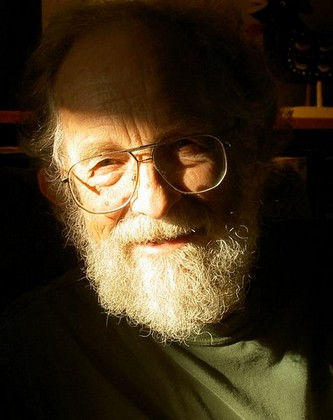
—Angel Igov


Jul 172013
 

This is just out. Print edition of Quill & Quire in Toronto. It’s very nice but, of course, I wasn’t born under a rock. What is this constant mantra: the unknown Douglas Glover? Why is it that people can only remember that they have forgotten me? There is some deep phenomenological issue to be explored here. Or possibly a medical trend?

Re. the photo: This is one of set of photos taken during a writing class at Davidson College. I had assigned the class an exercise: write a sex scene. They were reading them out loud, hence the uncharacteristic expression of quizzical delight on my face. I learned things during that class that I never wanted to know.

All this is beside the point. You can pre-order my book at immense savings.

p.s. I like being called “scabrous.”

dg

Quill and Quire preview of Savage Love by Douglas Glover

Jul 172013
 

Seawrack paper cover full

Two years ago we published a set of poems from “Seawrack,” a longer poem by the prolific Canadian poet and novelist David Helwig. Now the book is out, just published by the estimable Frog Hollow Press in British Columbia as part of its Contemporary Canadian Poetry series. The cover is a gorgeous George Loewen painting. Here is what I wrote at the time about the poems we published:

The DOW is down 266 points today; America waits for the consumer to spend money so we can get out of the current crisis; the consumer won’t spend money because the debt ceiling deal promises more uncertainty about pensions, medical insurance, and jobs; it’s a merry-go-round spiraling down; and the ancient gods appear as cartoon musclemen in 3D instead of guardians and saviours. In these David Helwig poems, Lady Godiva has joined the Tea Party to protest paying taxes and money distracts us from infinities. There is, perhaps, nothing to do but write comic poems about the current situation, Post-Empire poems, in the current NC jargon of the day. These poems are taken from a 47-page long poem or group of poems called “Seawrack.”

dg

David Helwig

Seawrack
Contemporary Canadian Poetry, volume 7
Poetry by David Helwig
Cover painting by George Loewen

David Helwig has written two-handed poetry: a lyrical seasonal record appears in series with a strange, discomfiting, valedictory narrative. The seasonal record is short and tight, the odd narrative explosive in subject and in emotion. Helwig has already found acclaim as a poet but this book will surprise his devoted readers and should attract new ones.

Offered in two bindings, both printed on 80 lb. Mohawk Superfine Text. Covers printer with K3 pigment inks. Typeface: Sabon, designed by Jan Tschichold. 108 pp.

Deluxe Edition: (HC) An edition of 30 numbered case-bound books, cloth-over-board; handmade Nepalese endpapers; headband.
ISBN 978-1-926948-09-6. Price $60.00.

Regular Edition: (PB) An edition of 80 numbered Smyth-sewn books with a St-Armand white cotton cover and Nepalese Lokta flyleafs.
ISBN 978-1-926948-10-2. Price $28.00.

Jul 172013
 

220px-Ottoor

In probably the most horrific and pornographic scene in Bruce LaBruce’s Otto; Or, Up with Dead People, one man sexually penetrates the gaping wound in another man’s abdomen. It is a shocking scene, and it marks the moment when we realize perhaps zombies have more erogenous zones and erotic options than we do. Though theorists like Georges Bataille, have pointed to how death is a structuring aspect of the erotic, the gory abject as it appears in Otto and LaBruce’s subsequent film L. A. Zombie puts a perhaps bolder more graphic face on the relationship between mortality, the body and eroticism.

Navigating these uncomfortable hinterlands between horror and pornography is a confused and confusing young man named Otto who thinks he’s a zombie and can’t remember his life from before. The perverse collision between horror and pornography for Otto opens the possibility of a narrative turn to melodrama and a possible connection with another, however untenable this might be in his zombie world.

eDhiYzV2MTI=_o_otto-or-up-with-dead-people---a-new-movie-by-bruce-001

Near the beginning of Otto, Up With Dead People, Otto rises up out of a grave with his name on it; the gravestone simultaneously names him and troubles naming as it is only his first name that appears there and there are no dates indicating his birth and death: the stone’s ability to name and identify him is limited. A voice-over reveals that, “Once upon a time in the not so distant future there unlived a zombie named Otto.” This underscores the fantasy and fictional aspects of his zombie identity.

This fictional status is further underscored through the film’s multiple narratives and texts: his first first-person narrative is intercut with the first-person essay-like narrative of a filmmaker Otto meets, Medea Yarns, and these are also intercut with several of Medea’s films, primarily a longer narrative telling the story of a gay zombie who rises up in a revenge plot against straight men who bash gays. These many narrative texts that make up the larger film Otto problematize classical Hollywood story structure that might offer Otto the protagonist a more privileged, unproblematized position. Whether or not Otto really is a zombie is more ambiguous as a result.

tumblr_lzqexx17wR1qagn8to1_500

Medea’s film within the film further problematizes Otto’s zombie identity: the narrative repeats the scene where Otto rises from the grave and this time discloses that it was staged by Medea for her film, “Up With Dead People.” Medea’s attraction to Otto as a zombie figure for her film and her desire to tell a fictional story of a zombie world where the gay undead seek revenge creates narrative ambiguity as it becomes unclear how much of a zombie Otto really is, what aspects of his identity and narrative are constructed by Medea, and which parts are his own invention or experience.

This collision of genres and narratives is characteristic of LaBruce’s work. Eugenie Brinkema in her essay “A Title Does Not Ask, but Demands That You Make a Choice,” observes that “[LaBruce’s] works bear witness to the aesthetic and historical crisis of this borderland, speaking the wild language of the indeterminable”(97). Like LaBruce, Medea, the filmmaker within the film, is overtly ideological.  Yet, oddly, she is making a fictional film about zombies and is attracted to Otto because “there was something different about [him]. Something more authentic.” In the confusion of texts and in the face of the indeterminable, Otto stands as perhaps more determinable than the others, and as the possibility of something authentic in among the ambiguous texts, at least for Medea.

Both Medea and Otto script scenes with zombies and sex (Medea’s more graphic, the penetration scene already mentioned and the film’s climactic zombie orgy) so that zombies are sexualized and fetishized in the film in a pretty common way. While naked zombies have appeared in films before, (in the opening to Day of the Dead and the self explanatory Zombie Strippers) and, faced with impending death, live people in zombie films have been known to fornicate, as a generalization most film zombies are interested in one thing: eating live humans. There’s a beauty to that simplicity and however it might serve as a metaphor for other drives, it removes all the complicated issues of desire. There is the drive to eat. That is all.

Ottoanddouble

Otto as an ambiguous character signifies in both the genres of horror and pornography. Medea points out that Otto works perfectly: “In a way he fits the typical porn profile: the lost boy, the damaged boy, numb, phlegmatic, insensate boy willing to go to any extreme to feel something, to feel anything.” This, too, could describe the horror figure of the zombie: Otto’s detachment, his extreme repression make him something to fear or be repulsed by.  As Fritz, the star of Medea’s zombie film, describes him when Medea tries to hook them up, “he’s homeless, delusional, and possibly schizophrenic. Plus he seems to have some kind of eating disorder . . . if you think I am going to sleep with him you’re crazy.” Indeed, even in scenes where he encounters other zombies he seems more detached than them, too zombie even for the zombies.

tumblr_m1utr8gU8L1qh7kymo1_500

For Otto, however, zombie identity seems to be a coping mechanism, as though he has opted to feel nothing even in the presence of sex. Near the beginning of the film, on his journey to Berlin, he sits in an abandoned carnival where he finds other zombie gays cruising one another, two of whom proceed to have sex in front of him, almost on top of him as he sits paralyzed. Later he is picked up by a man in zombie make-up out front of a bar aptly called Flesh (the man warns, “it’s dead in there”). The man takes him home to his apartment where he has what we must assume was sex. We have to make this assumption as we are visually given a before and an after but the narrative (and by extension Otto) seem to black out for everything in between. In the aftermath, the man lies disemboweled, his walls and sheets sprayed red with blood and his furniture overturned and destroyed. But he still asks Otto “Can I see you again?”

What the one-night stand in particular points to, something underscored by the films within the film, is that gay sex in the film Otto carries something of death and infection with it. This carries all kinds of significances mirrored in LaBruce’s follow up film L.A. Zombie and its profound reversal where the zombie creature there is able to bring dead bodies back to life through his sex and fluids. What is of primary interest for me in Otto is simply that Otto sees sex with men as potentially harmful and the destruction in this one night stand also reads back over Otto’s own attempts to only satiate on non human flesh (road kill, stray cats, butcher market chickens) as a way of repressing what he sees as his own destructive impulses with other more lively men.

Picture14-2

Otto confesses, “I wanted to consume the living, to devour human flesh but I couldn’t bring myself to do it. At first I thought it might have something to do with the time before. When I was alive. It occurred to me I might have been a vegetarian. Or worse, a vegan. But that wasn’t exactly it.” Otto’s zombie hungers are something he tries to repress, but both the hunger (via the zombie identity) and the desire to repress it refer to a back story that is inaccessible to him.

What undermines these scenes is that they are told unreliably from Otto’s perspective. As the film unfolds, it becomes more and more apparent that carnage and disembowelment, cannibalism and death are metaphors for Otto, not reality based: he sees the world through zombie-coloured glasses. This is partly revealed via the fragmented structure of the film as it moves from Otto’s first-person narrative to the filmmaker, Medea’s first person narrative and her “real” engagements with Otto. It’s in one of these “real time” moments, when Medea asks Fritz to let Otto stay with him for a few days and Fritz describes Otto as “homeless, delusional, and possibly schizophrenic.” This response is both comedic and tragic as the ambiguity drops out from under Otto’s first-person narrative. Medea’s fictional gay zombie dystopia and Otto’s performed zombie identity are compatible, but Fritz’s reality-based response undermines both, grounding everything in a rather disappointing realism.

What we must gather then is that Otto’s perspective and experience of the men cruising in the abandoned carnival and the his one-night stand with the man from the bar called Flesh are unreliable, a fantasy of zombie bodies. We are then left to ask, why does he see these experiences as laced with death, objectification, and the abject? What is the lure of a corpse-like abject identity? In Powers of Horror, Julia Kristeva theorizes that the corpse has a significant place in terms of the abject: “the corpse, the most sickening of wastes, is a border that has encroached upon everything. It is no longer I who expel, “I” is expelled” (3-4). Further, she theorizes that “The corpse, seen without God and outside of science, is the utmost of abjection. It is death infecting life. Abject. It is something rejected from which one does not part, from which one does not protect oneself as from an object” (4). The zombie is both corpse and pseudo subject, animated and hungry.

For Otto, then, the zombie identity is in some way the obliteration of the ‘I.’ The key here, though, is as Kristeva asserts, “abjection is above all ambiguity.” Otto is neither corpse nor live body, neither self nor other, but maintains an insistent ambiguity. And this is not just a specific response to sexual situations, but a generalized response to his identity in the world at large.

otto-or-up-with-dead-people-tease

Pornography and horror contribute to a terrorized subject position for Otto. As Brinkema notes about Catherine Breillat’s theorizing of sexual acts in her films, “Breillat’s insistence that it is the sexual acts that themselves act on the spectator, that lead to physical or intellectual satisfaction, affirms that sexual representation is still conceived of in terms of affect, that sexual representation moves the spectator, displaces him or her from an otherwise stable spectatorial position” (102). The unsimulated sex scenes in Otto trouble the spectator’s position in much the same way that Otto’s voyeuristic eye is troubled. There is no safe, cold, zombie distance from which to watch these experiences for him or for us.

Otto’s one night stand with the man who is wearing zombie make-up reveals to us and him why he seeks that distance. When he fully embraces his zombie identity with that man, the resulting carnage, imagined or not, illustrates what Otto fears in his own hunger. In Otto’s world, sexuality is often a little horrific. In an interview with Interview magazine, LaBruce discussed how for him pornography and horror have corresponding real life collisions in some gay experiences: “If you’ve ever cruised a public toilet or a bathhouse, it’s like Night of the Living Dead. You’ve got people in this zombie-like trance, in dark shadows with disembodied body parts. And I don’t mean that negatively; it’s kind of exciting. But there is that aspect to gay culture and sometimes it can be kind of sad” (Speyer). For LaBruce, sex that is objectifying this way is both exciting and sometimes sad, and one could read Otto’s experience as similar. The room the one night stand lives in is full of sexual paraphernalia that intrigues Otto and the wall above the man’s bed is collaged like a teenager’s wall of magazine clippings, though here the images are of penises and various other body parts. This objectifying sexual experience is both exciting and overwhelming and Otto can no longer repress his zombie hunger. As a zombie having sex he can have the safety of numbness and the freedom to consume, but the carnage emphasizes his conflicted relationship with that release.

bruce-labruce-otto-01

Otto’s work with Medea the filmmaker at first promises to make his life easier, but then further troubles the boundaries between his zombie world and the real world. Initially, he notes, “With a camera following me around, no one would suspect I was a real zombie. I would just be playing one in the movie.” But through working with Medea in her fictional film, Otto’s sense of his zombie self wavers, and begins to fail. Where prior to this he would practice imagining live passengers on the train were zombies, shoring up his detachment from (and peculiarly also his affinity with) them, through Medea he builds relationships where he is in a sense normalized and not objectified. This dangerously opens him up to being a subject. When she pays him and tells him to put the money in his wallet to keep it safe, he realizes he has a wallet and subsequently that that wallet holds evidence of his former identity and self: a library card with his former boyfriend’s phone number. Details of Otto’s former life flood in and he’s left defenseless, able to only verbally parrot what the exboyfriend says: that Otto himself has mental issues, that the boyfriend left him because of this, that Otto’s father is a butcher and that Otto was a vegetarian in that life before, before he took to eating the flesh of roadkill, grocery store meat cases, stray cats, and the occasional gay man.

The exboyfriend’s disclosures point to both romantic loss and mental breakdown. Indeed the two become inseparable in Otto’s zombie identity. So the zombie identity, though an extension of his schizophrenia and mental illness, is also here a coping mechanism to block the memories of his former happiness and his loss. To be dead is to escape memory. The zombie identity protects him from the past and any other possible present vulnerability. As a dead man, the living should not be able to hurt him. This logic is challenged by the various interactions with the living throughout the film though that are the product of him being un-dead.

The last sex scene of the film occurs when Fritz, the lead actor in the film within the film, finds Otto outside the film studio beaten and bloody. He takes him home and checks his wounds and then a tender love scene occurs.

otto-up-with-dead-people-1

This scene stands in contrast to the prior sex scenes in the film as the emphasis is less on the objectification of the two men’s body parts and more on the kindness and tenderness between the two. Also absent is any zombiness, blood, or gore. Their bodies are left unbitten, uneaten, untorn, and, at least on screen, unpenetrated. Otto does not black out and no one dies. In the Interview magazine interview, LaBruce revealed that for him, “The idea was to lure in these horror geeks on the promise of a zombie movie and torture them with a tender love story” (Speyer). From this we could conjecture that Otto himself is lured in by the zombie genre, lulled into thinking it might protect him from the pornographic and melodramatic aspects of his life.

But the co-presence of both horror and pornography tropes do not provide explicitly safe havens for Otto. Linda Williams, in her essay “Film Bodies: Genre, Gender, and Excess,” argues that horror, pornography and melodrama are bodily genres, intent on bodily affect. What all three have in common is how they affect the body. This, in Otto’s case, is paradoxical then. He chooses an undead identity, partly to preserve himself, but that body performs the intersection between a horrifying sexual hunger and a terrible emotional vulnerability. The play of these three genres, all three aspects of his own experience, promises a numb and safe identity, but concurrently terrorizes him, provokes him bodily and emotionally. Around Otto, through the imagined films within the film and through his interactions with the men he meets, it turns out sex and death are not as safe a split as he might have hoped and yet might secretly wish. This abject place, caught between genre and fluid and decaying bodies, both promises and protects an ambiguous place between self and not-self.

tumblr_lty1qlvWoG1qa409eo1_500

Despite Otto’s desire to separate himself from the living and his own past, becoming a walking corpse in essence takes him to the ontological threshold of what it means to live. When after their more tender and less cannibalistic night, Fritz awakes to find a sign that Otto has left him that says simply “Otto. RIP.” It is an ambiguous ending for in a sense Otto kills himself, but the phrase is “rest in peace,” so his note also implies he has found some peace. Not enough that he will forgo the allure of his zombie identity, though, so he goes on lurching into the distance, still searching.

Otto, or Up With Dead People is available for viewing on Netflix.

 –R.W. Gray

——————

Bibliography

Bataille, Georges. Erotism: Death and Sensuality. San Francisco: City Lights Books, 1986.

Brinkema, Eugenie. “A Title Does Not Ask, but Demands That You Make a Choice: On the Otherwise Films of Bruce LaBruce.” Criticism: A Quarterly for Literature and the Arts (48:1) pp. 95-126, 2006 (Winter).

Kristeva, Julia. Powers of Horror. New York: Columbia University Press, 1982.

LaBruce, Bruce. Otto; Or, Up with Dead People. 2008.

Speyer, Ariana. “Up with Bruce LaBruce: an interview.” Interview Magazine February 13, 2009.

Waugh, Thomas. Romance of Transgression in Canada. Montreal: McGill-Queen’s University Press, 2006.