May 082015
 

walter


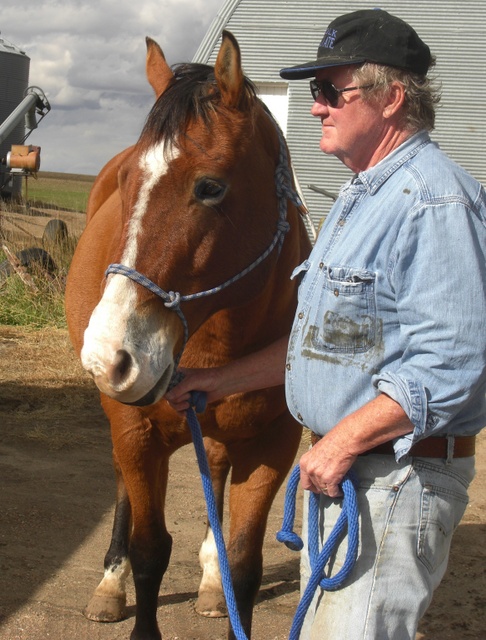
In 1977 Walter Bernstein was nominated for the Academy Award in screen writing. We met that same year at the MacDowell Colony in Peterborough, New Hampshire. To him I became “The Kansas Kid,” sometimes shortened to “The Kid.”

The movie was the Marty Ritt film, The Front staring Woody Allen. I had not seen it, nor did I know much about film scripts, and I knew nothing about Bernstein’s accomplishments: Fail Safe and the Molly McGuires among other movies.

The other writers at MacDowell at that time included Lucy Kamasar (who had recently integrated McSorley’s Old Ale House in the East Village); the poet and playwright Honor Moore; Milton Klonsky (who would win a McArther Award the following year); Iris Owens, who had just published After Claude, Mary Higgins Clark, the author of Where Are The Children, and a George X , working on his second book about Russia (I cannot, even with the help of Goggle find him, nor obviously recall his last name, even thought he loaned me his house on Ibiza the following year. Madness.)

I had just published a novel set in the west and in a moment of youthful vanity, I gave a copy to the MacDowell library where Walter checked it out. For what reason I would soon learn.

MacDowell in those days was (and maybe still is) a gift of time and place for writers.

You could stay up to about six weeks; they furnished you a small cabin where you could write and even stay over night if you didn’t want to use the dormitories, also provided. Around noon a handy man arrived with lunch. My cabin (and I guessed others as well) had a fire place and when the man who brought you lunch saw that you’d used you stash of wood from the front porch, he brought you more. As I was there in January, I went through more than my share. It was the custom of the country that only the wood-and- lunch man were to stop by your cabin, and he never came in, nor even knocked.

For dinner you went back to the main hall where many of us gathered in a large room (also with a fire place) for drinks. I don’t remember if we brought our own (I think we did) or there was a bar set up. Maybe there was a bar. There was much quick-draw and rapid-fire talk about politics and art, much of which (being who I was then) left me behind. I remember Iris Owens saying she had once worked for Maurice Girodias’s Olympia Press in Paris. Her job was to edit the first draft of Lolita. I thought no one had edited Nabokov, much less Lolita.

“Oh, she said. “It was a mess of motels going all across the country running to 600 pages with the two of them entangled in the sheets every ten pages. I’d cut motels by states: there goes three in Ohio, there goes four in Illinois, there goes all of Kansas.” (And here she looked at me because Walter’s name for me had gotten around). I believed her at the time.

The one subject that was off limits was our writing—the day’s work that just ended, or whatever project was in progress for the stay. As I had never been around so many accomplished authors I missed to chance to hear them on their writing. And how I understood I was not to ask came about because one evening at drinks I said to George X: “How goes it?” To which there was a collective silence, then: “It goes.”

“Hey, kid,” Walter said one evening to me at dinner. “I read your novel. Very good. Would you read a draft of my screenplay? It’s a western and I’m a furtive Jew from New York. What do I know about cowboys?

Walter was then writing The Electric Horseman, not for Robert Redford, but for Steve McQueen who, it turned out, was about to die. When that happened the studio sent the project to Redford who fired Walter. But all that was to happen later. For the moment, Walter wanted to know what I knew about horses and cattle and cowboys. I was flattered. Sure, I said.

ELECTRIC HORSEMAN, THERobert Redford, The Electric Horseman

A few days later at dinner Walter gave me a copy of the script made from the MacDowell Xerox machine. Mark it up, he said. Or put lines down the side where I’m getting things wrong. Then we can talk. Sure, I said.

I had never read a movie script. There was “Ext.” and “Int.” Also “Cut To” and “Back To,” with sometimes “Continuous.” There were numbers running down the page which I took to donate scenes.  There were some (but not many in Walter’s script) camera shots. Flush left on the paper were descriptions. Sometimes accounts of what the actors were to do, sometimes of the setting. In between and indented, was the dialogue.  I had no idea how I could be of help, but I knew I wanted to.

If you want to see Walter from those days, rent the Woody Allen film Annie Hall. You have to go all the way down the reel (to use Walter’s term from before DVDs) but there he is, standing outside a movie theater with Woody Allen, Diane Keaton, and Sigourney Weaver. Walter is Annie’s date. The script might have read: Scene 47: Ext. Movie Theater. Alvy with unidentified woman; Annie with unidentified man. Gestures. VO (Voice Over):

I did run into Annie again. It was on the upper West side of Manhattan. She had moved back to New York. She was living in Soho with some guy. When I met her, she was dragging him to see “The Sorrow and the Pity”…which I counted as a personal triumph.

As to Walter’s script, at first I found myself so mesmerized by the form that I didn’t read it with care the way Walter wanted me to: But yes, there was confusion about horses, sometimes they were horses, then they were stallions, then they were mares (when in fact they were probably all geldings).  I had to untangle bridles from halters; I had to take horns off cows, and change cows to steers (with or without horns, but I thought unless they were Texas Longhorns for show instead of ranch cattle, they had probably been de-horned.)

Somehow Walter had learned the word hackamore (probably from an East Coast riding friend) and so I had to take the hackamore off all horses and put bridles and bits back in their mouths. I also added lead ropes otherwise Robert Redford and Willy Nelson (in the final version) would be tugging horses (or mares or stallions) along by their halters, unless they were using reins attached to bits and bridles, which in two scenes at least they were not.  Saddle blankets were fine. Stirrups as well. Saddle horns, yes. Chaps, ok, but we called them leggings. Spurs, fine. But from I could tell they were never needed. Still, the audience probably needed them. Most of this was description and while I felt comfortable making those changes, when it came to dialogue, I was less sure of myself. However, I did without hesitation make one change: Walter had written a Willy Nelson line as: Tonight I’m going to find myself a little keno girl who can suck a tennis ball through a garden hose. My rewrite (which, as it turned out, did not get me screen work) was: Tonight I’m going to find myself a little keno girl who can suck the chrome off a trailer hitch. Arthur Laurents, eat your heart out.

“Thanks, Kid, “Walter said at dinner a few days after I had handed back the script. “I guess cowboys don’t play tennis.”

In this way, to paraphrase a bit dialogue from another movie, there began a beautiful friendship. But that was to be further down the reel for the two of us; in the meantime, it was the next week or so that Walter learned he’d been nominated for an Academy Award in screen writing which meant his picture was all over the papers, including New York Times that MacDowell subscribed to, plus various local papers when it was discovered that Walter was in residence at MacDowell.

I remember there was a toast in front of the fireplace one night. Then as well, pats and handshakes and cheek kisses over dinner as folk stopped. Our two person table grew chairs. Walter seemed pleased indeed.

About this time I got my first royalty check and I thought I’d like to share it with Walter by taking him to dinner. There was supposed to be a good place to eat in Keene, not far away: the Red something (Lion?) Inn. It will turn out that it is owned by a former student of mine from the college where I was then teaching. Not only was he the owner, but the chef as well.

“Sure, Kid. Thanks,” said Walter.  “But I have friends coming up in a few days, would you mind if they joined us. My treat.” Fine I said, but insisted the bill would be mine. “Then I’ll leave the tip,” he said. “We’ll use my station wagon.” I made a reservation for four in my name.

Why Walter didn’t tell me his two guests were Diane Keaton and Diane Carroll I don’t know, nor did I ask. He might have meant to surprise me, but it didn’t seem that way when we all met in the large hall, Walter saying to the two Dianes, this is Bob Day, he’s helping me with the Steve McQueen script. Bob this is…and… We all shook hands, although Diane Carroll gave me something of a hug and noted that it was about time Walter got the recognition. Then off we went out the door, bundled up in coats and sweaters against the New England January. I wanted to look back to see who was staring after us, but I did not. Grace under pressure. Cut to:

EXT: The Red Lion Inn:

Walter goes through the door first, followed by Diane and Diane. They stand there for a moment until Bob enters: Cut to:

INT: Full Shot: The restaurant is busy. A pretty receptionist asks for a name.

Bob

Four for Day.

Cut to:

Close up on Kitchen: A young man looks up from a steaming pot.

Back to:

Walter Bernstein, Diane Keaton, Diane Carroll, Bob Day

Young Man (VO)

My god, it’s Bob Day

Reaction Shot: (VO): Ad Lib: Audible Amazement. Fade to Close.

The End

—Robert Day

Read the entire “Chance Encounters” series here.

NCRobert Day

Robert Day is a frequent NC contributor. His most recent book is Where I Am Now, a collection of short fiction published by the University of Missouri-Kansas City BookMark Press. Booklist wrote: “Day’s smart and lovely writing effortlessly animates his characters, hinting at their secrets and coyly dangling a glimpse of rich and story-filled lives in front of his readers.” And Publisher’s Weekly observed: “Day’s prose feels fresh and compelling making for warmly appealing stories.”

.
.

Mar 062015
 

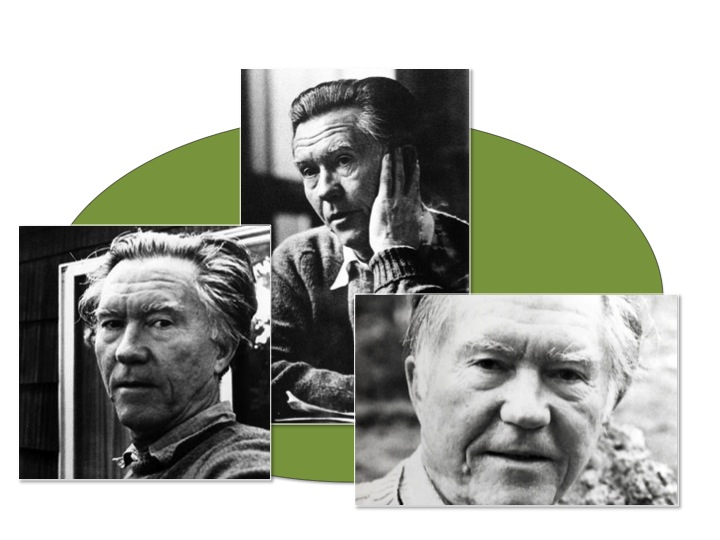
StaffordWilliam Stafford via the Poetry Foundation and others


At the library of Congress in 1994 there was a memorial tribute to William Stafford, the brilliant American poet who, in 1970, had been what is now called the Poet Laureate of the United States.

There were the usual accolades: Bill Stafford was a poet whose plain language fitted his flatland Kansas sensibility. He was a man who thought peace (Stafford was a conscientious objector during World War Two) was good; war was wrong. There were other kind words. About the self-evident and the oblique stories in his poems. About those poem’s gifted reticence. Then something extraordinary was said. One of his children, his daughter Kit I think, told us of her father’s repeated advice to them as they were growing up: “Talk to strangers.”

By chance I was Bill Stafford’s student in the sense that I learned from him about writing and life: Do it all and do it all now. The threshold is never so high as you imagine. The beginning may not be the beginning. The end may not be the end. These aphorisms applied not only to his craft and mine, but to the way we lived. And there was a sense in what I learned from Bill Stafford that the two might not be easily separated.

Not far where I live in Kansas (and about the same distance from where Bill Stafford grew up) there is a high school in a town of roughly a thousand that has a video security system of which they are especially proud. I had been asked to be part of a literary program there (my talk was on Bill Stafford), and came to know about the surveillance cameras because I saw one posted in the room where I was speaking. Later, I saw the black and white glow of the monitors in the school’s office. I watched as the system projected pictures of the gymnasium (empty on this autumn Saturday); various hallways (also empty); our meeting room (adults milling around drinking coffee and eating donuts); and finally a shot outside the school: the wide Kansas prairie as background, a small Kansas town in the foreground.

One of the school’s officials and a parent stopped to say that you couldn’t be too careful these days, what with Columbine and Amber alert. Bad things happen in schools. And out of schools. Better to be vigilant than be sorry. When they left, I could see them on the monitors as they walked across the buffalo grass lawn to where they were parked. They talked for a moment over the bed of a pickup truck, and then drove off, safe, I suppose, in the knowledge that someone might have been watching them.

Over the years Bill Stafford and I wrote back and forth: letters, post cards, copies of our work sent to one another with inscriptions. As he was one of the most prolific poets of the 20th century, I got plenty more of the latter than did he. But no matter how far apart we were, Bill in Oregon and me in Kansas or in Europe, he would sign off with something like “Adios” or “Cheers”, and then, as if we were just across the pasture, he’d note: “And stop on by.” My sense now is that when I’d get to him, windblown and dusty from the walk over, he’d want to know if I’d met any strangers on the way, and what stories they had to tell.

Have we become an America where it is stupid to give the same advice to our children that Bill Stafford gave his, and where stop on by means please don’t? Have we come to believe that surveillance cameras in the high schools of tiny prairie towns will teach our students the eternal vigilance they’ll need to live in towns beyond their own? Or in their own? What with Columbine and Amber alert. Or is the answer from Bill Stafford’s poem Holcomb, Kansas?

Now the wide country has gone sober again.
The river talks all through the night, proving
its gravel. The valley climbs back into its hammock
below the mountain and becomes again only what
it is: night lights on farms make little blue domes
above them, bring pools for the stars; again
people can visit each other, talk easily,
deal with real killers only when they come.

Or are we all real killers?

There may be no reclaiming Bill Stafford’s vision of America, but once upon a time, in his plain voice, didn’t he speak for you?

— Robert Day


Robert Day

Robert Day is a frequent NC contributor. His most recent book is Where I Am Now, a collection of short fiction published by the University of Missouri-Kansas City BookMark Press. Booklist wrote: “Day’s smart and lovely writing effortlessly animates his characters, hinting at their secrets and coyly dangling a glimpse of rich and story-filled lives in front of his readers.” And Publisher’s Weekly observed: “Day’s prose feels fresh and compelling making for warmly appealing stories.”

.
.

Jan 032015
 

michel-de-montaigne-006


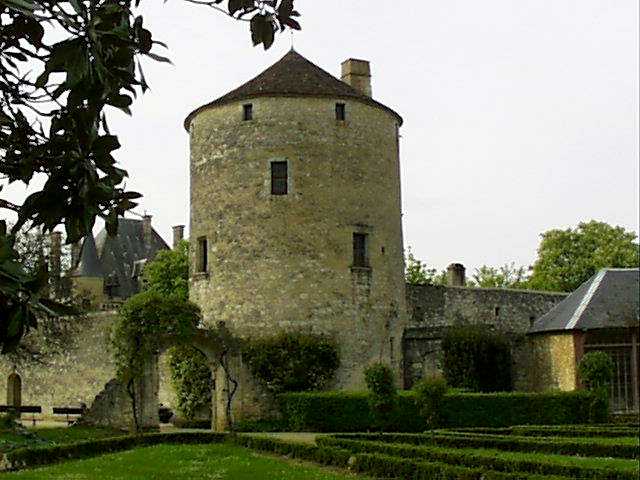
Each summer and into the early fall, my wife, the painter Kathryn Jankus Day, and I take up residence at L’Étang, a 16th-century farmhouse on the estate of Michel de Montaigne just outside the village of St. Michel de Montaigne. The farmhouse sits in a valley near a pond below the Montaigne castle—a huge Disney-like 19th-century Loire valley imitation built after a maid set fire to the original castle in order to steal some jewelry. Or so the local story goes. Montaigne would be skeptical.

Montaigne’s tower (where he wrote his essays) did not burn, and to this day you can take a narrow, circular stone stairway up to his round study where there sits a full-sized cloth mannequin of Montaigne himself. He is arranged as if reading the facsimile of the Bordeaux edition of his essays on the table in front of him.

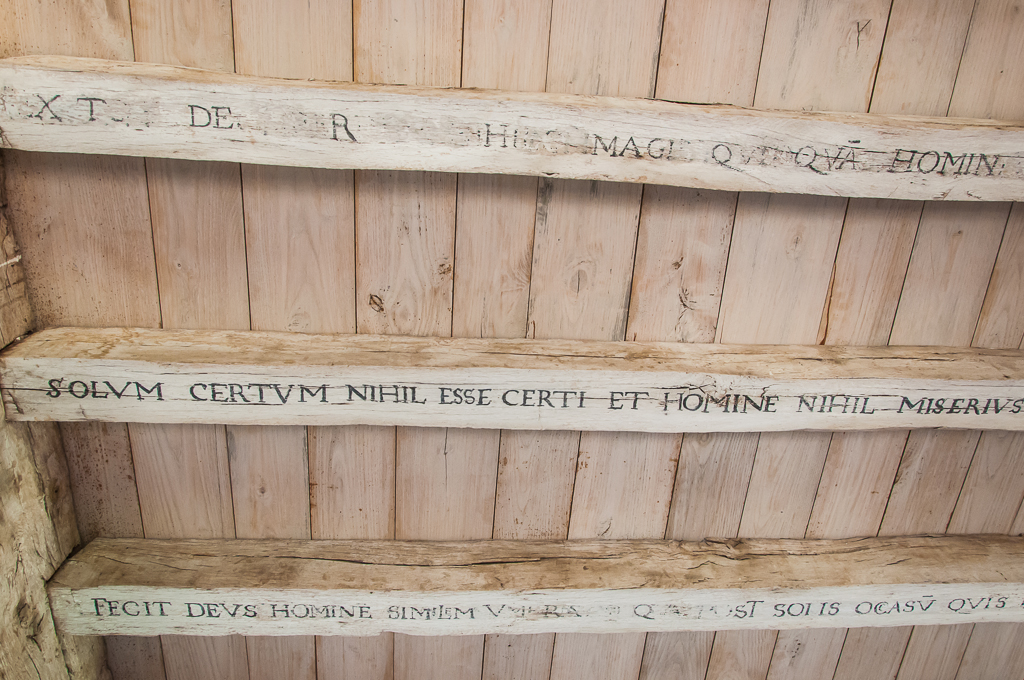
Above this faux Montaigne are carved into the ceiling beams his beloved quotations from the ancients: I don’t understand, I am in doubt, (both from Sextus Empiricus) among more than 50 others. The judgments of the Lord are a vast abyss (Psalm 35); There is much to be said on all matters, both for and against (Homer, The Iliad).

montaignes-tower-13

It will bring you luck (again, according to local lore) if, during your visit to Montaigne’s tower, you see on the stairs—or in the study itself—a black and white cat. The cat’s name is Balzac. He was once our cat, a lost-and-found kitty we rescued from a poplar woods near St. Michel de Montaigne, a woods we have since named Bois de Balzac. My wife and I not only have our patois, we are the ones who started the story about spotting Balzac in Montaigne’s tower bringing good luck. We believe in local lore.

Montaigne’s famous inquiry is persistent: What do we know? As is its modern corollary: How do we know? The first question was Montaigne’s motto: Que sais-je? The second concerns our age of “expanding information,” superhighways of information that race in an infinite number of lanes around the earth on cosmic beltways, complete with cloverleafs and exits—Paris, Rome, Athens, Bombay, Hong Kong, Los Angeles, Chicago, New York, St. Michel de Montaigne, Bly, Kansas—all going faster by far than “break-neck speed,” a phrase my mother would use to describe cars that passed our two-door Champion Studebaker as my father drove the R&P speed limit (Reasonable and Proper) on the roads of rural Kansas. Where are they going at “break-neck speed?” my mother would wonder. What madness is it? my father would reply.

Where are we all going at our 21st-century cosmic pace?—a pace that is not only to be contrasted with the R&P limits of 1950s Kansas roads, but with the walk-along rate of the Dordogne River that flows in the valley below Montaigne’s tower: past the village of Lamothe, Montravel, then west to Castillon, Branne, Libourne and Fronsac—after which it joins the Gironde near Bourg. Then to sea. Where is the strong brown god of the river going? At what speed? Are we flowing with it? What do we know?

montaigne_towerMontaigne’s Tower

Does it mean something to how we know that it would have taken Montaigne four days on horseback to follow the Dordogne to Bourg and back in order to learn—and return with—the news that the grape harvest along the Côte de Bourg was just as bad as it had been for the Côte de Castillon? Does it make a difference to what we know that my father had to drive to see my uncle (who had no phone) to tell him of a death in the family? And to return with my uncle who wanted to stay with us that night because, as my mother said, he was feeling “mortal,”—and that that was the first time I had heard that word and was afraid to ask its meaning. Is there a ratio of speed to knowledge? Of information to knowledge? Of information to ignorance? Which of these ratios are literal? Which are inverse, ironic? What do we ever know? Seeing Balzac brings you good luck. If you say so.

I like Montaigne’s way of thinking. In college I came to study him—as perhaps we all did—as the père of the essay. He was a master of “form.” There were forms of literature in those days: novels, poems, short stories, essays. We were taught that the French word essai meant “to try,” “to attempt.” I don’t remember any of us asking what we were to “attempt” when we took to writing our own essays; but over the years, it has occurred to me that in main we are to try to think. Not so much to “reason”—as if an essay were a pudgy syllogism—but to think in a contemplative way, a tentative way. An essay as a walk along a road taken in search of a discovered thought provoked by a singular image: the black bird in the cedar limbs just as it is beginning to snow—and is going to snow.

In this way we let our words discover our reason. Is it a way of knowing? Maybe. Is it a way of knowing everything? Maybe. It is a way of knowing yourself, then, to wit Montaigne: “There is nothing so contrary to my style as continuous narrative.” Walks with stops as digressions. Not a four-day, but a six-day trip to Bourg and back if on the way you ride your horse up the steep hill to St. Emillon and consider what there is to see. The Dordogne in the valley below. Someone on horseback riding toward Bourg. An essay on the move. The essay as a form of life. A way of knowing as a way of life.

—Robert Day

g
Robert Day

Robert Day’s new novel Let Us Imagine Lost Love premiered here on Numéro Cinq in its entirety as a serial novel and will be published in fall 2014 by Mammoth Publications. Prior to that, his most recent book was Where I Am Now, a collection of short fiction published by the University of Missouri-Kansas City BookMark Press. Booklist wrote: “Day’s smart and lovely writing effortlessly animates his characters, hinting at their secrets and coyly dangling a glimpse of rich and story-filled lives in front of his readers.” And Publisher’s Weekly observed: “Day’s prose feels fresh and compelling making for warmly appealing stories.”

Sep 062014
 

Desktop2


It was through Phyllis Springer and Goksin Sipahioglu, the owners of the celebrated photo agency SIPA press in Paris, that I met Mavis Gallant.  This was in the 1980s.

Mavis lived in the apartment next to Phyllis and Goksin on the left bank near Boulevard Montparnasse, not far from 27 rue de Fleurus.  In that same apartment building in those days lived the Czech novelist Milan Kundera, with whom I had no encounter.

I had been staying in Paris above a couscous restaurant on rue Xavier Privas that I shared with fullback-sized cockroaches.  In those days I drove a yellow deux chevaux I named Colette.  I would park her where I could, changing places in a failed attempt to avoid parking tickets, but at least not being towed.

Some days I’d buy a lunch from un marchand de rue and, with a bottle of vin de pays, take my meal on Square du Vert Galant, a point on l’Ile de la Cité where I’d watch the bateaux mouches on the Seine.  One such lunch I saw a barge going up the river packed with cars; Colette was among them—-in fact, on the bow, like a figurehead.

It took three days of my poor French and 300 francs to free her from the Fourrière, a kind of dog pound for cars. Later, just before I left Paris, I put an AV sign in the windshield and sold her to a sous chef of Café de Palais on Place Dauphine. Adieu: Colette.

Sometimes Phyllis and Goksin would invite me to join them for dinner at a restaurant where they were habitués. It was at one of those meals that I met Mavis: La Marlotte? Brasserie Lipp? Closerie des Lilas? Probably La Marlotte, as that was not far from where they all lived.

It was at that meal that Christiane Amanpour stopped to say hello to Goksin and Phyllis; she had worked for them at SIPA before she turned to television reporting.

—He is a great photographer, she said to me, putting her hand on Goksin’s shoulder. Do you know that? I said I did. And Mavis is a great writer, she continued.  I said I knew that as well.

I had, like almost any American author who writes short fiction, read Mavis’s stories in the New Yorker. Along with Salinger and John Cheever in those days, you could earn multiple graduate degrees in creative writing by reading these authors. At one point I typed (on a manual typewriter, it was that long ago) parts of stories from all three to see what they had accomplished, and how they did it.  I learned, among other things, what a fine sense of local detail these writers had:  Salinger for the parks and subways of New York City; Cheever for the upstate suburbs with roaming lovers and Labrador Retrievers; Mavis Gallant for the rues of Paris; her stories were their own Plan de Paris.

Also at that first dinner, Phyllis asked Mavis if she had walked that day. Paris has many rainy days, and that had been one of them.

—I walk every day in Paris, Mavis said. It is how I fetch my stories. Not to do so would be impossible.

Years later, when she was crippled by arthritis and diabetes, Mavis’s agent made her a Christmas gift: a year’s worth of taxi rides so she could continue fetching her stories.

I imagine her with the notebook of her writer’s mind open through her eyes as she has the driver take her toward Place de l’Odéon, and then down where the students rioted in 1968. The next day the taxi is driving her across the Seine toward the Hotel de Ville in the 4th, past the apartment buildings and cafes and art galleries of her characters, and beyond: to Pere Lachaise in the 20th–all the time Mavis not looking where she had been in her previous work, but where in her mind’s eye she would be setting new stories once she got back to her writing.

In the years that followed our first dinner, Mavis and I would eat entre nous at restaurants that her characters and mine frequented; she would order from my fictional menu, and I would order from hers–both being true to our characters. Because of the writer she was, and because of the writer I was, her characters were much better fed than mine.  Tant pis. At least I ate well, and in her company had bright and witty talk.

At one such lunch (at Le Cherche Midi I think because it was open on Sunday), she lectured me that I was not a writer because I did not make my living as one; beyond that, I taught creative writing, which is not how writers learn. I said I knew the latter from reading her stories.  She smiled.

As if to compensate for her rather pointed points, she ordered a split of Chateau D’ay (the appellation delighted her given the company), and toasted the quality of my fiction: très amusant, which was high praise, as she thought herself a comic writer. Très belle: To Mavis Gallant, after all these years I toast both the woman and her fiction, as if the two can be separated which, had you watched her walking through Paris in the rain (as I did one day on my way to join her for lunch, her head turned here and there to see what would become the facts of her fiction) you know is, thankfully, impossible.

 —Robert Day

Bob DayRobert Day in Paris

Robert Day’s new novel Let Us Imagine Lost Love premiered here on Numéro Cinq in its entirety as a serial novel and will be published in fall 2014 by Mammoth Publications. Prior to that, his most recent book was Where I Am Now, a collection of short fiction published by the University of Missouri-Kansas City BookMark Press. Booklist wrote: “Day’s smart and lovely writing effortlessly animates his characters, hinting at their secrets and coyly dangling a glimpse of rich and story-filled lives in front of his readers.” And Publisher’s Weekly observed: “Day’s prose feels fresh and compelling making for warmly appealing stories.”


Sep 082013
 

Editor’s Note:  Herewith, the opening section of Robert Day’s novel Let Us Imagine Lost Love, which we published in its entirety as a serial novel from September, 2013, to April, 2014. The novel remained online until August, 2014, at which point, as per our original agreement with the author, we deleted all the segments except for the first. We have left this opening segment, just as it was published, for your entertainment and to celebrate the amazing experience we had putting this book together. This was a first for Numéro Cinq, our first full length novel, our first serial novel — exciting times, wonderful experience watching the novel unfold month by month.
Bookbinding header, color-001

In the tradition of Charles Dickens and any number of 19th century novelists who wrote those triple-decker novels first published in serial form in magazines, Numéro Cinq today launches Robert Day’s new novel Let Us Imagine Lost Love, which will appear here in seven monthly parts. This is the long awaited follow-up to Day’s wondrous and acclaimed first novel The Last Cattle Drive; it’s not a sequel, but in Let Us Imagine Lost Love, Day returns to his native Kansas, of which he is a wry, witty and affectionate observer. His narrator is a book designer, who loves the jargon and paraphernalia of his profession, a man without a wife but a string of Wednesday lovers, his “Plaza wives,” he calls them. At his back, as we learn in the opening sequence, is a strong-willed Kansas mother who made him memorize three words a day and wouldn’t think of letting him go east to college (he ends up at Emporia State Teachers College). But this is vintage Robert Day: the humor is dry yet generous, the dialogue is laconic but rich with implication. You shouldn’t miss skinny dipping with Melinda or Tina, the narrator’s college girlfriend who would only begin to take her clothes off over the telephone (those innocent days). And stay tuned for the next installment.

dg

Part One: My Cosmic Smoke Signal

Since You Asked and I Promised: Here’s How It’s Turned Out

These days I design books.  Gutters and “case backs,” “rivers” and “verso,” “quarto,” and “signature” are the nomenclature of my trade.  Or were when I started.  “Format” and “galley proof.” Pocket Pal and Rookledge’s Type Designers are my codices.

I understand I am un-hip in my patois, as if I were to use “Hi-Fi” instead of “stereo”—which I do.   “Mono,” I am told by Lillian, my sister’s late-in-life daughter, is a disease.  It used to be music as well:  the kind that came from the lid of a forty-five record player:  Memories Are Made of ThisScotch and Soda.

At first I worked at Hallmark here in Kansas City.  Now I freelance.   My Plaza apartment is my office. The Country Club Plaza, Kansas City, Missouri.  Mr. and Mrs. Bridge’s domain.  Calvin Trillin slurping a frosty at Winstead’s.  Edward Dahlberg pissing and moaning about the city.

At Hallmark I designed “favorites:” 20 Favorite Poems by Shakespeare. 100 Favorite Love Poems. 50 Favorite Words of Wisdom. 100 Famous Quotations By American Women.   I also designed “paths”:  50 Paths to Wisdom.  25 Paths to Bliss.  No one suggested 50 Ways to Leave Your Lover. Or even one.  

I was not cynical about such work then, nor am I now.   When you grow up with webbed aluminum lawn chairs and a pedestal-mounted blue glass globe in your front yard, an Irish father who talked to himself but not much to anybody else (“I’m talking to a smart man when I’m talking to myself”), and a Polish mother who saved coins in Mogen David wine jars, you gain perspective. If my book buyers want their wisdom flush left in purse-sized octavos, who am I to judge?  We all have our paths.

I design address books.  I do not design novels.  I design recording calendars, sometimes called “agendas.”  I do not design memoirs (fictional or not). I do not design auto repair manuals.  Or medical texts.  I design exhibition catalogues: A Painter’s Room of My Own. Coffee table books: The Stalls of the Seine (into which I cut and pasted some of my own books that were—as far as I know—never there, unless you count them being vicariously there—which I do). More: Joyce’s Paris. Small Hotels of Italy. A Place in the World Called Seville.  And once, a tiny duodecimo for autographs.

I win awards. I am well paid.   I am praised for my “tailored elegance.” For “combining utility with beauty”:  For “fusing” the well-known  (a Degas auto point that looks like Allen Ginsberg as Allen Ginsberg got older) with an obscure Franz  Beckman auto point.

Among my favorite projects have been two “Abecedarians.”  One was about painting: M was for Matisse: with a young woman in an afternoon pose; a second was about writers whose pictures appeared like a water mark behind their letters with their text at the bottom:  C was for Chekhov: “It was said that a new person had appeared on the sea front: a lady with a dog.”

But my favorites are “Blanks”— books with empty pages for memoirs to be written or diaries to be kept.  Or not. I am Mr. Tabula Rasa of Kansas City.  And other cities as well.

Over the years I have spread into various rooms:  computers, scanners, light tables, and a recently purchased color copier configured to print and bind books.  With that addition I am a one-man, limited edition, publishing firm: Blanche de Blank Books, the bit of French added for a bit of cache, if not for Stella Kowalski’s sister.

This week I am finishing a series of “Artist Blanks,” each with a picture or text as the cover:  Van Gogh’s portrait on a sketch book. John Donne (I long to talk to some lover’s ghost who died before the God of love was born) for poets.  Notes from Pachebel’s Canon (it’s in fashion again).  I am trying to decide if Chekhov should be a short story writer or a playwright.

—Did you do this? my sister Elaine  asked when she and her husband Gerhard had me for dinner.

It was a coffee table book that featured paintings of women in New York museums: Madame X from the Metropolitan, a Vermeer from the Frick.  Picasso’s Two Nudes from MOMA.  Others. I had been inspired by an old Playboy photo series: The Women of Rome (they were riding topless on Vespas); The Women of San Francisco (they were hanging out of both their blouses and the cable cars on which they rode).

—Not that you always “fess up,” she said.

—Yes, I said.

—Lovely, she said.  I keep it out.

My sister’s diary, an early Blank of mine (a garden motif with both plants and flowers as a running head and end papers), also in the living room that night was (I took a peek) blank:  Hours without alphabets. Days without words. Impatiens without patience.  It was sitting next to another book I designed on the gardens in Tuscany, but since Elaine did not ask about either of them, I said nothing.

I like what I do.  There is a pleasing philistine sensibility about a well- designed, large-format book that features the flora and fauna from the French impressionist period.  The philistine sensibility is not in the book, but in the plush homes and apartments where Monet’s Water Lilies or Fantin LaTour’s Still Lives languish.  I test my designs against the horizontal of coffee tables, not the vertical of bookshelves.

At first, I would use an alphabet soup of Bs and Es and Ts and Hs on the page to make sure the design was working, even if the book itself might never find work. For recent projects I have been using authors I am reading:  Walker Percy, William Carlos Williams, Anton Chekhov.  Today I used Joyce Cary:  The Horse’s Mouth.  Gully Jimson.

I could scan these texts, but when Chekhov goes up my fingertips to the radial nerve, then through the brachial plexus, he arrives at my temporal lobe with all his faculties in intact.   Give me fifty words and I am the doctor in Ward Six.  A hundred words later I am Doctor Chekhov. Five hundred (plus a pull of vodka), and I am Mother Russia. The transmigration of texts.

Before I send the final designs to the publisher I “delete” and “expunge” Gulley’s London, Percy’s New Orleans, or Chekhov’s Yalta.  I don’t want my editors to know whose verbal masks I wear at work.

Nor do I want the finished book:  my contracts specify that I shall not get complimentary copies, nor credited with the design.   When I see my books I want it to be by chance, as in my sister asking:  Did you do this?  Or the other day in Barnes and Noble on the Plaza where I take coffee and browse:

—Lovely, isn’t it? said the elegant blond check-out woman when I bought a copy of my remaindered The Table of Chez Panisse.   Then, looking at me, she said:

—You’re somebody, aren’t you?

—Yes, I said.  She smiled, took a second look, but could not place me. It might come to her because Picnic is playing at the art theater nearby.

—I thought so, she said.

 Serendipity is my favorite royalty. Even if I don’t make use of fortuitous coincidences.  In this case the actor she has half in mind is fully dead.

—What are you working on now? Elaine asked.

Gerhard was in the kitchen with Rosetta (a cleaning woman we share) fixing martinis out of Sean Connery movies.   I have agreed to come “a few minutes early to talk entre nous.”

About the time the martinis are to be wheeled in, my “date” will arrive—a woman my sister tells me makes her own sweaters.  As the day has been surprisingly cool, she might be wearing one.  The evening is one of Elaine’s attempts to “hook me up” (my niece’s language).   Elaine wants me to  “settle down” with someone “solid,” someone with whom we can all travel.  I don’t travel.

—I’m designing an agenda for the Nelson-Atkins’s spring show. Also a book for a friend.

— It’s only August, she said.

—They need lead time, I said.

My sister studied me for a moment.  She and Gerhard are on the board of the Nelson and she probably knows about the spring show and its featured painter.  She is waiting for me to “fess up.”  I don’t. I had expected she’d ask about the “friend,” but she seems to have been distracted.

—Anything else?

—Freelance proposals, I said.  What would you think of a diary using Tom Lehrer Songs across the top:  “It Just Takes a Smidgen to Poison a Pigeon.”

—Too mean, my sister said. Shame on you.

My sister has a “suppressed” smile; she holds her lips together and that makes the rest of her face—eyes, nose, ears—break into a bemused grin. She might have been smiling under her hairdo.

—How about an agenda of Keane women coupled with Rod McKuen’s poetry? I said.

—Very too mean, she said.

I don’t tell her that for my amusement I’ve designed both:  The Vatican Rag with Paranisi prints; and The Shadow of Your Smile Meets the Windmill of Your Mind, using the big-eyed Keanes. They were practice for this very Blank which, when done, I will send it to Blanche de Blank Books. I knew I was on the right track when a cosmic high-sign smoke signal curled off my Latin language dialog dashes.

—Steve tells me the Keanes are in fashion again, said my sister just as their dog Precious limped into the room, came over to me, barked once and sat down.

—What’s the matter?

—She got a thorn in her paw this afternoon and we were waiting for you to take it out.

—Let me see, I said and made a rollover motion.  It’s not a thorn but a piece of glass.

—Should I haven taken her to the vet?  She’s afraid of the vet, she’s not afraid of you. It’s probably in her genes.   And you know how to…

—Get me some Neosporin, tweezers, and a paper towel.

When Elaine returned, I took out the glass, cleaned the cut, and filled it with Neosporin—all the while Precious was calm, only barking once from her back at the syncopated chime of the doorbell.

—My hero, my brother, Elaine said as 007’s martinis were wheeled in.

The Go-Slow Guide to William Allen White’s Town 

I had not been good enough in high school to go “East” for college.  My father had hoped for a scholarship to Yale or Harvard: an Ivy League education is to a young man from Kansas what a rich marriage is to a young woman.  It went unsaid that the young man in question was thought none-too-bright.

My father’s ambition had been fueled beyond reason because Steve had earned a scholarship to Princeton three years before, and a year later Elaine would win one to Vassar.  As for my mother, she discovered that any college in Kansas had to take you if you had graduated from a state high school.

—I think he should stay in our domain, she’d say, using one of the ubiquitous words she was forever trying to teach us.

—He should go East, my father would say without—I would learn later—any sense of history or irony: “Go East,” you could hear him say summer evenings in our front yard as he drank his beer on one of the two folding aluminum lawn chairs he had arranged on either side of the glass globe.

—I think he should stay in our environs, my mother would say from her kitchen window as she did the dishes.

I was often talked about in the third person

The summer after my high school graduation, I lived at home, not being a bother to my parents—in fact being considerable help when not life guarding at the municipal pool.

When my mother had to stay late at the county office where she was a clerk, I worked through her Chore List: “Start potatoes at 350, scrub them smooth”; “wipe kitchen counter, make it sparkle”; “shake throw rugs, make dust flit”). I didn’t know what I was going to do with my life, but I didn’t fret about it. I didn’t hang around my room looking into a tank of goldfish.

I mowed the lawn, painted the basement walls, cleaned out the attic, hung laundry on the clothesline, and ran errands. I picked Elaine up at the airport when she flew back for a visit. Some days I fixed flats, pumped gas and changed oil at my father’s garage and filling station.  There were evenings when I would help him restore an old Studebaker Champion convertible in which he had courted my mother.

—I bought it back, he would say routinely as we’d come into the shop.

At the swimming pool, I saved a boy out of the deep end bottom but never said anything about it until my father saw it as a news item in the local paper.

—Was that you? he said, reading the paper in his lawn chair.

—What? said my mother through the open window.

I was the kind of kid who did not explain himself.  Apparently I was saving myself.

The evenings I had off from the pool, I ran a movie projector for Al Roster who owned the local theater.

—You see Melinda in the back? he said

—Yes.

—Watch Bones McCall slip his hand into her blouse.

I watched.

—Watch how Melinda takes a breath.

I watched. Melinda tilted her head back and closed her eyes.  Bones stared straight ahead.  The movie was April Love.

Later that summer I got a few dates with Melinda as she didn’t seem to be going steady with Bones.  We’d take in a movie, and afterwards drive to Winstead’s on the Plaza for a hamburger, fries, and a frosty. I had a key to the pool so we’d go for a swim after it had closed.

Melinda wouldn’t skinny dip, but she’d pull down top of her bathing-suit.  I watched the way the underwater lights sparkled and bubbled around her breasts; I watched the way the bubbles cleared, and in so doing revealed her.

—When are we going to meet your girlfriend? my mother asked.

—She’s not my girlfriend.

—What is she? asked my mother.

Instead of an answer, I told her I had been accepted at Emporia State Teacher’s College for the fall semester.

—William Allen White’s town, my father would say by way of explaining my fate to his customers.  “Emporia,” he would say in the evenings polishing the blue globe with a clean red shop rag.  “William Allen White’s town.”

—You’ll need a dictionary, my mother said.  Pick three words a day, even if you think you know them.   But not in alphabetical order. That way you won’t get bored.  Open the dictionary, find a word, learn it, and then write it on a slip of paper.  Like a bookmark. Do you know what domain means? Do you know what plethora means? You need to make up for the words you missed.

She was referring to a grade-school year when I was a sickly child with an acute case of tonsillitis (probably misdiagnosed, now that I know better) that resulted in earaches, high fevers and many days absent from class.

—Words make a life, my mother would say, as much a mantra for herself as “go East” was for my father.  Words make a life, she’d say washing the evening’s dishes while drinking the last of her Mogen David. Do you know what divined means?

One night toward the end of summer, Al Roster came to the pool.  The evening had been chilly and there weren’t many swimmers left. We were about to close.  The manager had gone home. Al was waiting at the turnstile. We walked out and stood by my car—a used Ford that had been a family hand-me-down from my father’s garage.

—I’ll pay you a wage, said Al.  No more hourly.  Full time work.

He wanted to expand.  He was going to buy a theater in Overland Park and, after that, one in Roeland Park.  Someday I could have a “cut of the net.”

—There’s a future for you in movies, Al said.  And plenty of Melindas to watch. What’s an education good for these days?  Nothing but trouble.

He made a pair of binoculars with his fists and peered at the ground. —Plus all the popcorn you can eat.

That fall I drove to William Allen White’s town.

—Your grandmother was a teacher in western Kansas, my father said by way of goodbye.

—Teachers and government workers always have employment, my mother said.  Don’t forget:  three words a day from the dictionary I bought you.  It’s just like mine, so we can keep in conjunction.

Bottle James

When I got Emporia I took a room with Hulga, an Estonian who lived in a house her contractor son had built with the idea she could rent rooms to college students.  There were six of us.  I lived in the refurbished garage with Bottle James, whose car was a floating couch of a blue, four-door Hudson Hornet.  His real name is John Lee James, but he was called “Bottle” by the time I arrived.

—Hulga started it, he said. It’s because I booze.  Want a pull?  Vodka.

—No thanks.

Bottle James built sets for the college theater and he had remodeled the garage with bookcases and desks arranged throughout.  But he didn’t use them.

—No books, he said.

—How so?

—Library.  I have a place in the scene shop where I study.  Most of the time I sleep there.  I live on air.  Air and booze. Want a pull?

—No thanks.

—I’m going to Hollywood, he said. One night I’ll be acting the star role for the set I’m building, and the director will come along with an actress he’s going to ball and hear me.  That’s how I’ll get my break.  Then I’ll ball the actress.  In the meantime, use the place.  I built it as a set for somebody who’s into books and desks and pads on desks—and those calendars you flip over for every fucking day in the week of your life.  That’s not me.  We split the phone bill.  What’s that?

—A record player.  Plays both thirty-threes and forty-fives.  The speaker’s in the lid.

I unfolded it.

—You got forty fives?  Don’t tell me you got Dean Martin?

I didn’t tell him I had Dean Martin.

—That your Hudson in the driveway? I asked.

—Yes.  The last of its kind.  Next year I’m going to take it to Hollywood to scout the place.

I put my mother’s dictionary (Webster’s New World, College Edition) in the middle of the desk by the window.  I put out one of those calendars you flip over for every fucking day in the week of your life. I arranged my textbooks in the shelves.   I became a student with ease: English, psychology, history, general science, I liked it.  Especially History.  And three words a day: enigmatic, penultimate, erudition.

I Have Never Married

From the balcony that runs the length of my Plaza apartment I can see south across Brush Creek to my sister’s house in the neighborhood of Paul Newman and Joanne Woodward—as  well as Ernest Hemingway finishing A Farewell to Arms.  East is the Nelson-Atkins Museum.  West is the Kansas line. I cannot see the ten miles to our old house in Merriam.

To the north is Westport where the Santa Fe Trail started. By leaning over my railing I can see the Westport Inn  (now called Kelly’s Tavern), and next to it Jim Bridger’s “historic” outfitting store.  I am told that in the late nineteen seventies a cattle drive came in from western Kansas and wound up at Kelly’s.  I doubt it. But I like to doubt.

I have never married.  I have had—and am having—a series of Wednesday afternoon affairs.  My Plaza wives.  Nothing solid.  No one with whom to travel. All married.

Not long ago, I bought a second apartment in my building.  Across and down the hall.  It is smaller.  No balcony.   Still, it is pleasant in its way.

I do not rent it, nor do I intend to.  I have made it a showcase (complete with a stylish coffee table and two excellent end tables) for the books I have designed. I also arrange the gifts I get from my Wednesday wives:  French jams and Spanish olives and Belgian chocolate truffles they buy me at the Better Cheddar and bring to our assignations.  Soaps and body lotions from Williams Sonoma.  Bottles of wine if they need aging.  Tins of foie gras.  Silk flowers. Provençal napkins, Sardinian grappa.   What these women give me is their lingua franca for who they are; I know this, they do not.

A Guide to Housing, Circa 1960’s

Emporia was my father’s webbed lawn chair.  There was an honest earnestness to the town, and to the college.  The students were not worldly and not knowing so.  The boys talked about cars and girls; the girls talked about boys and lipstick.  Our education did not lead to an education. That year I found erudite in my mother’s dictionary (page 494) and thought that is not me (nor “not I,” as I would later learn).  Only Bottle James complained of Dean Martin:  The rest of us were happy with Ray Coniff and Johnny Mathis.  We were provincial and didn’t know it.  Nor the word. The Kingston Trio had not yet left the Seine. Joan Baez didn’t yet have a ribbon in her hair.

Tina, Hulga’s daughter, lived in an upstairs room of the main house.  There was a rumor that her father was a Professor Humbolt who had died in bed with Hulga the night of Tina’s conception.  You could see Professor Humbolt’s portrait in the History Department where each year at graduation a prize was awarded in his name.  By the dates on the portrait, Professor Humbolt had been dead long enough to be Tina’s father.  I never asked.

—Forget about balling Tina, said Bottle. Everybody’s tried.  Me included.

—She dating somebody?

—It’s because her father had a heart attack getting laid by Hulga and she’s afraid.

—She’s afraid she’ll die getting balled?

—You got to be afraid of something.

Tina was tall, had brown hair, a thin-lipped smile, and walked with a slight bump and grind.   Her hips seemed to be moving even when she was standing still.

—I’m afraid, Tina said.

—Of what?

—I don’t know.

—I do.

—What?

—You’re afraid of being naked in front of me.

—It’s just not right.

—You’re afraid of being embarrassed of me being naked in front of you.

—What happens if I get a disease?  Or pregnant.

—You’re afraid that you don’t know how to do it.

—Do you?

—I have a plan.

—What?

By Thanksgiving, Tina would unbutton her blouse while we were talking on the phone, me in the garage, she in her bedroom a hundred feet away.

—Will you take it off?

—No.

My record player lid was singing “When I Fall in Love.”

.

—Mother says you have a girlfriend, my sister said when we were back for the summer.  From Emporia.

—Not really.  Sort of.

—Have you…

—We’re working on it.

—I was about to say: “Have you thought about bringing her home?”

—No.

We were sitting on our mother’s chartreuse couch; she was still at the Water Department; our father was at the garage putting chains on tires.  Steve was spending Christmas in Cambridge working at a law firm.   I had picked up Elaine from the airport two days before. My sister seemed different, but I didn’t say so.

When you are a young man trying to get used to your body and what it wants, it is difficult to understand how strangely you behave. Tina taking off her clothes at the end of the phone line would not be all that ”kinky” today (as in the bumper sticker I saw on an art student’s car the other day at the Art Institute:  “It’s Only Kinky The First Time”).  But sitting next to my sister it seemed something I should be ashamed of.  Better to go swimming with Melinda.  And since “kinky” was not in my mother’s dictionary, nor in the lexicon of the sixties, I could not name the nature of my unease.  Nor, given my Wednesday wives, can I now.

—Are you in love? said my sister.

—No.

—I might be, she said.

—Have you…?

—I’m thinking about it, she said.

—Do you know about men? I said.

—I’m learning, she said.  From you.

Before she flew back East, Elaine asked me to drive her to Winstead’s for a Frosty; then into the hills behind the Plaza on the south side where the expensive houses are.  Our parents did not spend their Sundays “Wish Book” driving.  But both Elaine and I had friends whose parents did, and one of Elaine’s high school boyfriends took her for such rides.

—Do you want to live in houses like this? Elaine asked me we curved among the lawn-clipped mansions of Mission Hills, then down toward the Plaza and past the house where one day Precious would need to have a gash cleaned.

—I don’t think about it.

—Really.  Don’t you think about what you’ll be like when you are mother and father’s age?

—I don’t.

—How strange, she said.  Is it because you boys are always thinking about girls?  Not about getting married to them or anything like that.  Not about houses where you’ll raise children.  Just about girls…well, you know what I mean.

I had never heard my sister talk like this.  I wondered if that was what was different about her.  She had turned a corner at Vassar and ahead of her was life: a curved driveway sweeping through a manicured lawn.  And for her, life was the future with the past going out of view in the rear view mirror of my old Ford as we drove toward home.

Then I said something beyond my years; even as I said it I knew I didn’t fully understand its implications.

—You don’t grow up all at once.  It takes a lot of not growing up along the way to get there.   I think the trick is…

Then I remember not knowing what to say next.

—Will you let me meet Tina? My sister asked as we turned back onto Johnson Drive toward Lowell.

—No.

—Then it’s not right, she said.  For her or for you.

 But this was after she had been silent most of the way home, and then said: “Turn here—” just as we reached Lowell, as if somehow I would not have known how to get to our house.

Swimming Pools and the Practice of Medicine

I completed my first year at Emporia and came home for the summer to lifeguard.  Melinda did not.   But there were other girls to take to the movies and then for a late-night swim.  I tell my parents I am studying to be a high school history teacher.

—American history? asked my mother.

—Yes.

—Real American history? asked my father.  With heroes.

—Yes.

—And your words?  Three a day, said my mother.  You don’t want to be a rube.

—I left the dictionary in Emporia, I said.

—We can share, my mother said.

—When will we meet your girlfriend? asked my father.

—I don’t have a girlfriend.

—Who do you talk to on the phone? asked my mother.

—A friend from college whose father was in the History Department.

Our words started with alacrity, propensity, and serendipity.  A big week for the suffix.

Clarence Day and Berkeley: An Introduction to a Memoir

—Your uncle Conroy writes that he has a fellowship if you earned good grades in science, my mother said one day when I came home from the pool for lunch.  It pays wages and you get college credit. My mother said this without much enthusiasm.   She was holding the letter and reading it a second and third time.

Uncle Conroy was my mother’s older brother, a pediatric researcher of international fame. In the cultural gulf between our linoleum-floor life in Merriam, Kansas, and Doctor Conroy Watkins directing a celebrated pediatric research lab in Berkeley, California, there was a pleasing pride—as if in our small house on Lowell we had a first edition signed by Clarence Day.

—Let me see, my father said, who was home for lunch.

—At the University of California at Berkeley, said my mother.

I have an hour before I have to be back at the pool.  After closing I am to take Muff LaRue to the Plaza.   It is our first date.  We will drive back to the pool for a swim.  I am told by Bones she goes all the way.

—That’s what it says, said my father.  A fellowship in Conroy’s research lab that could lead to medical school.  He should get there as soon as possible for training.

—I don’t know that General Science counts, said my mother.

—Two semesters of A’s, my father said.

—He’ll need some lessons in manners if he goes, said my mother. Aunt Lillian will have more than one fork at dinner.  They don’t “just eat” in a society like hers.  They bring food to their mouth and not their mouth to the food.

I seem not to be present, even in the third person.

.

—I am going to be a doctor, I said to Muff LaRue as I unlocked the gates to the pool.

Muff dove in fully clothed and swam to the deep end.  When she got there she pulled herself out and said if I’d turn off the lights she’d skinny dip.  I flipped switches.

—I’ve never dated a doctor, she said.  What kind of doctor?

She walked to the end of the low board.  She took off her shorts and tossed them on the deck.  Then she pulled her t-shirt over her head and threw it in the pool.

—A surgeon.  I am going to Cal-Berkeley to be a surgeon.

I was treading water beneath her.

—I’m going to Sarah Lawrence to study classics.  If you have a rubber I’ll do it with you, she said.  A rubber and an air float.

She was trying to decide, long before Cybill Shepherd, whether to take off her bra next or her panties.  Not that she is shy about it.  Just before she dove in she laughed—a deep, throaty laugh.

.

It took me a few days to quit the pool and pack.  I drove to Emporia to pick up the record player, records, clothes, and my dictionary. I told Hulga I would not be back in the fall. Tina had gone to western Kansas to visit her grandmother.  Later that week, I parked the car at my father’s garage and took the bus to San Francisco.  My uncle met me at the station.

—So you might want to be a doctor? he said.

—I don’t know, I said.

We were driving over the Bay Bridge toward the East Bay.  You have to be a young man from a small Kansas town to understand how astonishing it is to see San Francisco Bay for the first time.  There is nonchalance about its grandeur.

When I said I didn’t know if I wanted to be a doctor to one of the most famous and accomplished physicians in America, a man who had probably made special arrangements to get me a fellowship I did not deserve, it sounds, even at this distance, something Californian-sixties:  Mellow. Really, man.  Yeah. Wow. Far out.  That’s not what I meant. Perhaps I thought—as we crossed the Bay Bridge to the East Bay—that if I couldn’t be a doctor like Uncle Conroy, I didn’t want to be a doctor.  I’d like to think that now.

—I don’t mean. . . I said as we drove up Grove Avenue past the lab where I would be working.

—I understand, he said. Don’t worry about your future.  It is always there.

—Thank you, I said.

—That is the hospital with which the lab is associated, my Uncle said as we passed by. And that’s where you can get a cup of coffee.

On the other side of the street was an all-night diner, its neon sign proclaiming:  MEL’S.

From Grove we drove into the Berkeley Hills behind the Claremont Hotel to my aunt and uncle’s house overlooking the Bay.  It was where I lived until just before the fall semester began when I rented a room on Derby.

 The Thor:  An Owner’s Manual

The other day Elaine and I drove to our home in Merriam.   I don’t have a car, so we used hers.  The house is twenty minutes west across the state line, 505 Lowell.

On previous trips we noticed the place was vacant; drapes pulled, its lawn not mowed.  I am thinking about buying it but I have not told my sister.   It might take me awhile to find the owner.  There was no “For Sale” sign.

505 Lowell is a small ranch affair with a one-car garage.  There is a basement my father refinished so my brother and I could have rooms of our own. They were on either side of the furnace out of which heating ducts ran upstairs.   When my mother wanted to talk to us she would speak into one of the floor registers; the one in the kitchen went to my room; the one in the living room worked for Steve.  When my mother made a mistake it was our joke to say “wrong number” and beat on the heating ducts. My sister lived upstairs and down the hall from our parents.

Steve and I had small windows onto the lawn.  After a few years our father refinished the front part of the basement with brown vinyl paneling, making it into a “rec room.”  There was a ping-pong table, a sofa on which Elaine necked with her boyfriends, and the portable forty-five record player that each of us would claim and that I took to Emporia:  “Summer Place.”  “Misty.”

We sold the house after my mother died; Steve wanted the money; my sister had married and moved to Mission Hills.  I wanted to keep it but didn’t say so.

The glass globe is gone, but the Christmas tree my father planted when Elaine was born is still there—now more than forty feet tall.   The wooden awnings he made to celebrate Steve’s birth are gone and the gravel driveway has been blacktopped, but as far as I know they are the only changes in all these years. Precious’ great grandmother is buried in the backyard.

Like the apartment, I would not rent the house. I’d furnish it with a chartreuse davenport and matching end tables on either side. Webbed aluminum lawn chairs. Early Ozzie and Harriet. The Thor All Purpose Domestic Appliance. We could probably get most of what we need from yard sales. Or E-Bay, if I did the Internet. Elaine has the record player in her attic.

—What happened to his globe? my sister said as we turned down Lowell from Johnson Drive.

—I don’t know, I said.

—And the Thor?

—It went to the garage when he died, I said.  It wasn’t there when mother died.  I expect the new owner had it hauled away.

—I got a tree and Steve got awnings, my sister said.  She leaves it unsaid that I got nothing.

Elaine and I have gone over all this before.  The furniture of memories:  familiar roads, familiar talk. The yard sale of our lives.  The repetition is pleasing:  even the pauses between us have been there before.  I should do a Blank: Silences.  Use stills from Woody Allen’s Interiors. Or Pakula’s Klute.

The Thor was a combination dishwasher, washing machine, vacuum cleaner, and clothes dryer. A round, menacing contraption, it was mounted on four hard rubber wheels that had to be locked before starting it.  The lid looked like a submarine hatch; the body a tank turret.  It took my father and two neighbors to carry it into the kitchen.  It was our mother’s anniversary present.  The following Christmas, he bought her a Western Flyer lawn mower.

Elaine and I have come to the end of Lowell and are making a turn down the hill at 52nd street.  Some trips she asks about the Thor, other trips she talks about the glass globe. Because she has brought up both, I wonder if she senses I am thinking of buying the house.

—Do you remember when the Thor attacked us? my sister asked as we took a right turn up Newton to take a left on Johnson Drive past the corner where my father’s filling station had been, but where is now a visitor’s parking lot for our high school across the street.  She has said this before.

—Yes, I said.

—Where did he get it?

—A friend of his in the military made them after the war, I said.

I have said this before.

We are a blank of silence the fifteen-minute length of Johnson Drive to Fairway Manor.

—I knew about you and Muff LaRue, my sister said as we crossed State Line road, then down Ward Parkway, along Brush Creek and into the Plaza.

Just as my sister and I repeat ourselves, it is also our routine to add something on our drives. Muff LaRue is what she has added.  I am wondering what I should add.  Not about buying the house, I decide.

—I’ll walk from here, I said.

Elaine has stopped at the corner of 48th street and Jefferson near the sitting bronze of Ben Franklin and across from a series of amusing busts atop an apartment building just out of reach of the “building covenant” of the Plaza.  In recent days a local rapper of national fame has been chanting up and down the streets, and my sister and I see him heading our way, his spray-dyed red hair bobbing and jerking.

—Did you know I knew about you and Muff? she said.

—I did, I said.

But I did not.  It is not that I lie to my sister, it is that. . ..well, what is it?   She is literal and I am not.  Some of my life needs to be fiction, and my sister is my best reader. I take that back:  I am my best reader, but I need someone to doubt me.  Present company excluded.

—I don’t believe you, Elaine said.

—Did you know about Melinda? I said.

—I do now, she said.

—Ben Franklin wrote an essay on the virtues of older women, I said as the rapper got closer.

It was what I have decided to add.

—Did he?

—Yes.

—Life comes around, Elaine said as I got out of the car.  Muff LaRue has moved back to the Plaza and wants to meet you.

Design Proposal for Blanche de Blank Books: One of X

1. Title:  My Cosmic Smoke Signal

A.   Quarto:   Neither paginated nor cut.  Acid free paper.

B.  Where a Section ends, there is a line drawing of your paintings (or segments of those paintings) mentioned in the text but scrambled so they are not where they are cited.

C. Typeface for text:  Bookman (old style).  14 point.

D.  Watermark: interlined subliminal text from California when facing text is Kansas, and vice versa.

E.  Typeface for watermark: Book (Antiqua, Italics). 10 point.

F.  Sample Text: “Clouds all streaming away like ghost fish under ice.  Evening sun turning reddish.  Trees along the hard like old copper.  Old willows leaves shaking up and down in the breeze, making shadows on the ones below, reflections on the ones above.  Need a tricky brush to give the effect and what would be the good.  Pissarro’s job, not mine.”  —Gully Jimson

G.  Edition Binding.  Title embossed in gold.

—Robert Day

Bookbinding header, color-001

Robert Day’s most recent book is Where I Am Now, a collection of short fiction published by the University of Missouri-Kansas City BookMark Press. Booklist wrote: “Day’s smart and lovely writing effortlessly animates his characters, hinting at their secrets and coyly dangling a glimpse of rich and story-filled lives in front of his readers.” And Publisher’s Weekly observed: “Day’s prose feels fresh and compelling making for warmly appealing stories.”

The novel banners at top and bottom are by Bruce Hiscock.
Aug 072013
 

John Barth

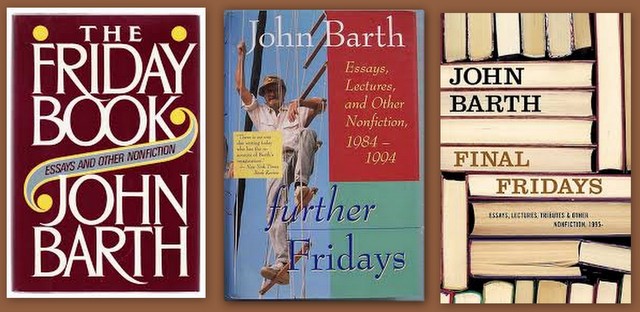
In his continuing series of chance encounter essays, Robert Day reminisces about his years long friendship with John Barth, their regular Friday lunches and the jokes they told each other. Barth once described Day in an essay as “a writer-friend from Kansas who knows about water-wells informs me of the important distinction between dry wells and gurglers.” These meetings eventuated into a trio of books by Barth: The Friday Book, Further Fridays, and Final FridaysAs always, Robert Day is an amiable and witty raconteur, slyly self-deprecating, and obviously a loyal and valuable friend. You just wish you’d been there, all those Fridays.

dg

We met by chance in the late 1970’s when Jack and I tried to convince one another that I should be the Director of the Johns Hopkins Graduate Creative Writing Program.  I was then teaching at Washington College, in Chestertown, where it turned out I stayed.  But from those first days when I toured the Hopkins Writing Seminars, meeting the faculty and students, Jack and I became friends because of — as Montaigne writes — who he is and who I am.

Not long after our pas de deux at Hopkins, Jack called to say he would be coming to Chestertown (where he and Shelly had recently bought a house) the following Friday and would I join him for lunch?  Agreed.  It was to be the beginning of scores of Friday lunches, continuing to this day.

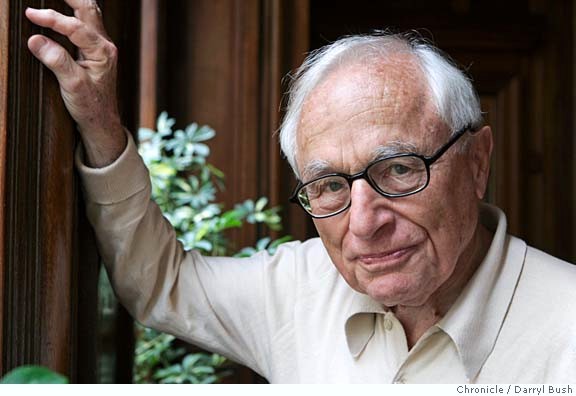
Where we met that first time I do not remember, but I do remember that our talk was rangy, ebullient, and exclusively literary.  Well, not exclusively literary because from the first we’d swap jokes — Jack beginning with a series of hillbilly pig jokes when he learned I had studied a stint at the University of Arkansas, and I, in trade, ranch jokes imported from West Jesus Land, Kansas, where I live part time. The second thing I remember is that someone must have spotted Jack (a new book of his was just out with his photograph appearing in the papers) and took our picture.

Avid readers of John Barth will know that those Friday lunches were because of, or resulted in (or some formulation thereof) his three collections of essays. The Friday Book, Further Fridays, and Final Fridays — the latter volume including a piece published in Granta titled: “The End? On Writing No Further Fiction, Probably.” Toward the conclusion of that essay I am mentioned as an anonymous co-conspirator to his muse: More on this later.

Desktop19

Thus our literary lunch Fridays commenced and continued.  Not every Friday, but many over the years until Jack stopped teaching at Hopkins and was more often in Chestertown, in which case our Fridays turned themselves into Wednesdays or Mondays—or encore, a real Friday itself.

In the beginning, one of us would pay the lunch tab then the next time the other way around, even though sometimes we’d get confused.  At one lunch I said I thought it was my turn but Jack said no, it was his, and he insisted.  To which I said, I’m not sure we’re even, to which Jack replied:  Friends are never even.   And about that time, once again, someone took our picture.

“What do you think the caption will be?” I had asked Jack. “You first,” he said.  “Nationally famous author lunching with unidentified man,” I said.  “I’ll pass,” he said, but in the moment of silence between us, I thought that his fertile and fervent literary imagination could have made an entire novel out of my minimalist caption.  And maybe yet it shall.

What my friend has accomplished with his fervent imagination is the creation of a world of fiction unlike any other American writer.  And the landscape of that fictive world is immense:  From the early realistic and nihilistic novels, The Floating Opera and The End of the Road, to the faux historical novels, The Sot Weed Factor and Giles Goat Boy, and then changing course to On With the Story, Letters, The Tidewater Tales, Lost in the Fun House, The Last Voyage of Somebody the Sailor, and back to On with the StoryComing Soon, The Development, and his most recent book: Every Third Thought, A Novel in Five Seasons.

Jack’s writing is not so much a landscape of fiction as an Ocean of Story.  But writers are not unique just because of the breadth of their oeuvre.  There has to be something else.  An editor we shared at the Washington Post Magazine called that “something else” The Pyrotechnics of Prose.

It is as if my friend’s muse is a character in his fiction, at least the muse that is his gift of language.  Surely some critic has noticed the jazz improvisations in Jack’s writing:  I have.  Those are what we who write call invention.  It comes from where we’ve been coming from in the paragraphs before.  And the chapters before that.  And it comes from where we’ve come from as readers:  In Jack’s case, back to Lawrence Stern in English and further back than that in ancient languages and oft told old tales told on a thousand and one nights.  All of these he spins into tales of his own, with his own voice and muse doing the spinning.  Like Joyce and Nabokov and Garcia Marquez and Italo Calvino,  he conjures a maelstrom into his own Ocean of Story.  He is Tradition and Individual Talent. And fireworks at sea. About his extraordinary achievement in American letters and my modest one, we never talk.  Friends are, in many ways, never even.

By design we had lunch again the other day, a Wednesday as Zeus would have it.  Before we met I read the Granta essay in which Jack muses that his muse is not musing these days. In it he writes, “A writer-friend from Kansas who knows about water-wells informs me of the important distinction between dry wells and gurglers which may cease producing for a time but eventually resume; he encourages me to believe I’m still a Gurgler.”

There is a custom among writers that we do not ask each other about work-in-progress.  It is like telling an actor “good luck” before the curtain goes up, thus the tradition of “break a leg.”  Are gurgling or non-gurgling muses covered by our custom?

Lunch was at Evergrain in Chestertown.  We took an outside table to enjoy the sunshine. After all these years we tell many of the same jokes, but sometimes I tell one Jack has told me and take credit for it, and Jack does the same.  He doesn’t recall his early hillbilly pig jokes and I need to be reminded of my Kansas parrot joke. In this way at least we are even. Then we talk about Philip Roth and how he has recently resigned from writing fiction — as opposed to—? But neither of us mention it.  About this time, someone takes our picture.

Between that first photograph and this one I have taught thousands of students at Washington College, and those students are sending their children, and in some cases, their grandchildren to Washington College.  Mothers and fathers and a few grandmothers and grandfathers were now coming back for Parents’ Weekends and Graduations.  And having lunch out. Some stopping to reintroduce themselves.

“What’s the caption?” I ask Jack.

“Locally famous professor having lunch with unidentified man,” he says. To which in the small silence between us I think:  Lucky me to have had a duel oeuvre of Friday lunches with my friend talking books and telling jokes. And lucky all who are avid readers of muse-inspired American literature to have had John Barth with his firecracker prose going off like St Elmo’s fire in his Oceans of stories.

As we walk down the street to our cars, I ask Jack if he is the one who told me the aphorism that as we get older, Sex goes, memory goes, but the memory of sex—that never goes.

 “I think you told me,” he says.

“Let’s both take credit for it,” I say.

“Co-authors?”

“We’d be even for once if you don’t mind.”

“My pleasure,” he says. In this he speaks for me.

 —Robert Day

—————————-

Robert Day‘s most recent book is Where I Am Now, a collection of short fiction published by the University of Missouri-Kansas City BookMark Press. Booklist wrote: “Day’s smart and lovely writing effortlessly animates his characters, hinting at their secrets and coyly dangling a glimpse of rich and story-filled lives in front of his readers.” And Publisher’s Weekly observed: “Day’s prose feels fresh and compelling making for warmly appealing stories.”

Jul 102013
 

Day image1

Robert Day meets Barbara Mowat (co-editor of the Folger Shakespeare) and they go to see Coriolanus together in Washington and discuss plays, Shakespeare and politics. This is the second in Day’s must-read, intermittent “Chance Encounters of a Literary Kind” series at Numéro Cinq, a series of apparently random personal meetings and literary juxtapositions that lead to surprising intuitions. “Chance Encounters” is intelligent, literate conversation at its best — all too rare these days — written with aplomb in Day’s trademark amiable and self-ironic style.

dg

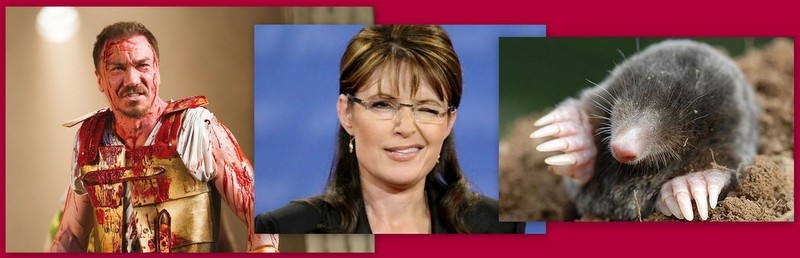
By design I am driving Barbara Mowat (who, along with Paul Werstine, is the editor of the Folger Shakespeare) to her Washington D.C. home on Capital Hill. We have been at dinner with journalist friends of mine where I shopped my theory that Sarah Palin is a plant of the Democratic Party, a deep, deep mole who was recruited as a college student when someone from the DNC saw her as Goneril in a production of King Lear.

What we have now is Sarah Palin as Rogue Sarah Palin, the woman who won the election for the Democrats in 2008 with her verbal gun-play, and even now looks through cross-haired scopes in search of anyone wanting to deprive Donald Trump of a tax break for his helicopter. Like Dustin Hoffman in Tootsie, Dame Palin will peel off her mask toward the end of the script—but not until Hilary has been elected President in 2016. Just you wait and watch.

“The Shakespeare Theatre Company is staging Coriolanus,” Barbara says as we cut across D.C. “I can get us good seats. Would you like to go? A matinee. ”

“I’ve never seen it,” I say. I am trying to remember if I’ve ever read it. “Sure.”

“It’s probably his most political play,” she says.

“In reference to my…?”

“Yes.”

Barbara and I go back. She was the Dean of Washington College in Chestertown, Maryland, when I was running a boisterous and politically incorrect literary center for student poets and writers. Barbara was amused. Most deans would not have been.

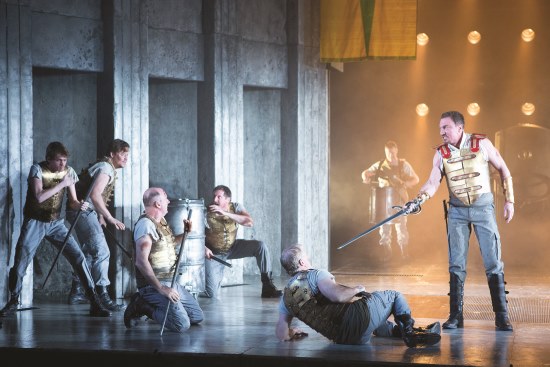
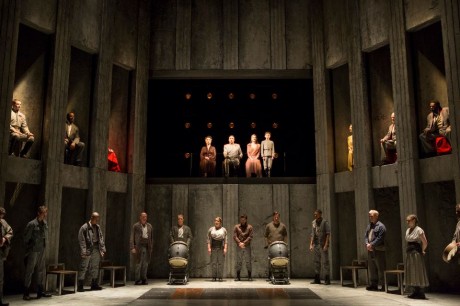
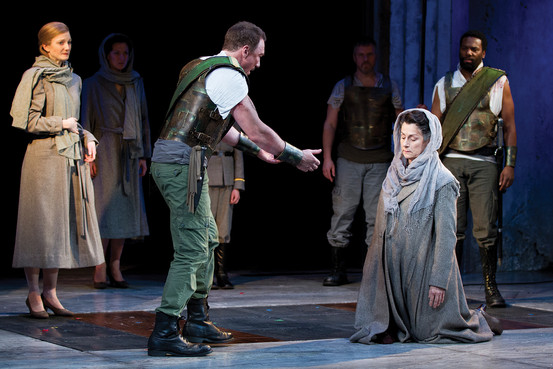
As we turn onto Connecticut Avenue I remember that I had read Coriolanus, among 13 other plays in a course called Shakespeare Rapid Reading–a play a week to the semester’s end. Coriolanus was the final one, and now that my brain is flooding (‘gurgling’ is a better word) with the details of that course, I recall that if our professor was not puzzled by Coriolanus, those of us who drank our red beers at the Gaslight Tavern after class were.

CORIOLANUS_347_resized

Coriolanus had no great flaw, only a series of arrogant mistakes; no fall from grace, in fact no grace at all but a mean-spiritedness from the start that takes on different forms as the play goes along—much like his name. And because this was the sixties, those of us listening to Joan Baez on the jukebox in the Gaslight thought Coriolanus’ trashing of the poor in want of food amounted to let them eat cake. Our revolutionary mantra was: Free Food and No Banking.

“The forty-seven percent,” I say out loud as we continue down Connecticut Avenue. “The Tea Party.”

“What?” says Barbara.

“I was just remembering how Coriolanus got all bent out of shape because the poor wanted food. And what Mitt Romney said. And how the Tea Party attacked Obama over Food Stamps.” We are quiet while I circle a circle. Twice, until I get off where I am going.

“Shakespeare calls the poor ‘Plebeians,” Barbara says. “And the nobles are the ‘Patricians.’ Coriolanus is ‘bent out of shape’—as you put it—because the Plebeians’ food riot won them tribunes in Rome’s new Senate.” Before she was a tolerant Dean, Barbara was a patient Shakespeare professor.

To continue the conversation I find myself hoping bits of flotsam from the play will rise to the surface after all these years: Something about Volumnia, Coriolanus’ mother. Wounds from battle. A Kent-like character trying to bring reason to the action (good luck). A kid who rips up butterflies. Coriolanus as traitor. Death in the final scene. That’s about it.

“Turn here,” Barbara says, taking me off Connecticut before we reach Dupont Circle. “Otherwise you’ll get entangled with traffic on Mass Avenue.” A woman who knows her way around texts and traffic.

“The play begins before Rome was Rome; have I got that right?”

“A city taking shape. Maybe the size of Washington. No empire. What it will become is up to Coriolanus. There is a scene toward the end where the Folio stage direction reads: ‘He holds her by the hand, silent.’ In that moment the fate of Rome is being decided.”

I am thinking that the only stage direction I remember from Shakespeare is ‘Exit pursued by a bear.’

“’Exit pursued by a bear,’” I say.

The Winter’s Tale,” Barbara says.

Drive on McDuff.

SPACE

coriolanus1-460x306

The canard in recent years has been how utterly modern Shakespeare’s plays are: Hamlet’s introspection is our Vietnam syndrome. Lear’s folly speaks to family values: what to do with a mad old father who won’t give out the password to his mutual fund account? There is Othello and all that goes with being a Moor in white bread America; Lady Macbeth and the dark side of feminism. Between theme and scene we’ve got it covered. And all of it imported with its modernity intact from the early 17th century to ours. Including Coriolanus.

Before we go to the Shakespeare Theatre Company production of Coriolanus, Barbara sends me the Folger edition of the play with the inscription: “For Bob, a Shakespearean in spite of himself.” Such stuff are dreams made of.

Reading it, I was struck by how much Coriolanus and his play are alike, as if he had fashioned it himself to be so. Being modern is one thing, being Post Modern is quite another. Still, there it is: our anti-hero and his play both misshapen from that disproportionately long opening scene (is it the longest opening scene in Shakespeare, I wonder?) to a plethora of mini-scenes scattered throughout, without a romantic balcony one among them. Nor a Fool to name the folly of the future should the present be prologue. Only the thoughtful Menenius as a mediator, who, like Kent fails against raging internal storms.

Then there is the brooding nature of both the text and the character. No soliloquy down stage, but instead flashes of anger to tell us who he is, not that we know for sure who he is even if he claims such knowledge himself. It is not so much what Coriolanus does that defines him as what he won’t do: show his wounds, for one; obey his mother, for another; reason when in need. The man and his play are defiant. Old fashioned ‘form and content’ gurgling up from my undergraduate studies.

I wonder where it comes from? Did our playwright get bored with the formula of his previous tragedies, replacing comic relief scenes with shards of black wit; dropping strong subplots that mirror main plots, then thinning out the plot itself until there is less of one than meets the eye? Even the memorable lines are few and not all that memorable: ‘Bid them wash their faces and keep their teeth clean.’ is no ‘To be or not to be.’ And ‘Nature teaches beasts to know their friends’ is not ‘But, soft! What light through yonder window breaks? It is the east, and Juliet is the sun.’ We Falstaffs at the Gaslight Tavern thought Coriolanus’ ‘The gods sent not corn for rich men only,’ worth memorizing until we realized it was delivered with contempt for the poor. In the end (and all through the play) you get the sense that our author, like his character, is not going to show off. Been there, done that.

SPACE

voluminacoriolanus

The play should have been a wreck to assemble because of its defiance at being well-wrought. And audiences are, after all, pulled along by what screenplay writers call ‘rooting interest.’ Other than the fate of fledgling Rome there is not much of a home team to root for. But still it was compelling, partly because of the acting and sets– and the virile violence it all conveyed. (I wondered if I were the only one afraid Coriolanus might smash the fourth wall and march his wrath off stage toward Row 26, Seats 4&5). And watching it in Washington D.C, the political heart of our country, we were struck by how, as Barbara had observed, political it was.

“It’s the extremes,” I say to Barbara afterward.

“Yes,” she says.

“Howard Baker as Menenius,” I say. I am fishing for connections.

“He, too, would fail in times like ours,” she says. “As would his wife.”

“A brief on sore losers: George Will. Fox News. Lindsey Graham?”

“Yes.”

“Obama?”

“He’s not violent; he’s not a traitor; he seeks common ground for common good, so no. But he won’t show his scars, that’s for sure.”

“Not like Lyndon Johnson.”

“Not at all.”

“Nancy Regan as Volumnia?”

“Very funny.”

“No Sarah Palin?”

“Too bad for you,” she says.

We talk on like this walking in the sunshine toward my car and discover equations are not easy to make; the play on stage became more a brew than a math problem. However, there was that moment Barbara had mentioned, the scene where Coriolanus holds his mother’s hand, a scene which I had spotted and nudged Barbara to make sure. When I bring it up, she says:

“Because the play takes place when Rome was vulnerable to the many tribes and armies nearby, had the Volscians, led by Coriolanus and Aufidius, been successful in defeating Rome, then Western history would have been a different story than the one we know.”

I have lost track of where I parked my car in thinking about what I am hearing. Barbara continues:

“Shakespeare shows Coriolanus impervious to the requests for mercy from Rome: he is determined to destroy the city. When his mother arrives, he starts out just as impervious to her pleas. Then something happens inside Coriolanus, and Shakespeare renders the moment that saves Rome not as a soliloquy but with that stage direction ‘He holds her by the hand, silent.’ This allows Rome to survive and seals Coriolanus’s fate (as Coriolanus well knows). I can’t think of any moment in drama quite like it.”

I see my car down a side street and steer us that way.

“Maybe it is not the politics we have these days that makes the play political” I say, “but fear of the politics we might one day have.”

“That too,” Barbara says, as I open the door for her and she gets in. On the way to Capitol Hill I ask:

“Who was your Shakespeare professor?”

“Fredson Bowers, at the University of Virginia. And yours?”

“Charlton Hinman,” I say. “We were told he was a great textual scholar.”

“He was,” says Barbara. “He also studied with Fredson Bowers at Virginia.”

“A chance encounter between us after all these years.”

“What fun,” she says.

Getting to Barbara’s house I explain my new theory that, like Sarah Palin, Dan Quayle was a deep mole for the Democratic Party, both of them unwittingly brought to America’s political theater by the Sol Hurok of the Conservative Movement, a.k.a. William Crystal of the Weekly Standard.

“But the Republicans won,” says Barbara.

“Somebody didn’t read the stage direction toward the end,” I say.

—Robert Day with photos by Scott Suchman,
from the Shakespeare Theatre Company production of Coriolanus

——————–

Robert Day‘s most recent book is Where I Am Now, a collection of short fiction published by the University of Missouri-Kansas City BookMark Press. Booklist wrote: “Day’s smart and lovely writing effortlessly animates his characters, hinting at their secrets and coyly dangling a glimpse of rich and story-filled lives in front of his readers.” And Publisher’s Weekly observed: “Day’s prose feels fresh and compelling making for warmly appealing stories.”

May 122013
 

robert_day_baby


MY MOTHER ALWAYS WANTED to live in a French Provincial house–but the house she imagined was in Fairway Manor, Kansas not in rural France.  And her idea of “French Provincial” was not a southwest peasant Perigord but a Midwest suburban ranch.  A shake shingle roof, wide soffits, and something called “weeping mortar” could turn a Frank Lloyd Wright Prairie House  into a domesticated Mansard.  Decorate the inside in late fifties chartreuse drapes and upholstery, put identical lamps on identical tables on either side of a three cushion couch (with a matching “coffee table” in front–on which you never had coffee, and in a living room in which you did not live), and you were in my mother’s Midi.

“I don’t know why you have to leave America,” my mother said when I told her I planned to settle in France.  “How am I going to call you if I need you?”  We are sitting (for once) at my mother’s coffee table.  I have come on a surprise visit over a May weekend that has lifted the ban on the living room.

“I’ll write out all the numbers.”

“They’ll be in French,” my mother said.

“French numbers and America numbers are the same,” I said.

“You’re talking,” she said.  My mother had a way of teasing me that I was never sure about.

“I’ll call you,” I said.

“I’ll be here,” my mother had said.  “But write me as well. You can’t reread a phone call.”

“Yes, mother.”

“Do you speak French?”

“Un petit peu.”

“What does that mean?”

“ ‘A little bit,’” I said.

“You can tell me other French words when you call.”

“Five a phone call and after a year you’ll be speaking French,” I said.

“I should live so long.”

My mother was suspicious of Europe, especially of France.  Not that she was ignorant of foreign countries.  Because my father had worked for TWA, we traveled when I was growing up:  Paris.  Rome.  Venice.  London. And a few car trips as well.  I remember a long drive from Athens to Paris along the peaceful Adriatic coast of Tito’s Yugoslavia, complete with a two-day stop in Joyce’s Trieste.

And not that my mother was the “Ugly American” of those days.  She traveled with patience and modesty, and with the understanding that if she did not always appreciate the local customs that was more her problem than others.  Still, it did not suit her in Paris to eat hard rolls in the mornings, nor to drink wine at lunch, nor for the stores to be closed from noon to two–nor for dinner to be served at eight in the evening.

“It is bad for the digestion,” she would say.  “You’ll just get fat and lazy eating so much at night and then going to sleep on a full stomach.  And the lunches they have!   With wine.  And corks in the bottles. No wonder they have to take a nap.”  It was my mother who insisted that we book reservations at our Paris hotel restaurant for six.  We ate in lonely splendor.  And then took a long walk along the Seine afterwards.

“That’s better,” she had said.  “Look at Notre Dame.  The name means ‘Our Lady.’  The French are Catholic. Tomorrow we go home.”  Home was Fairway Manor, Kansas.  Weeping mortar.  A privet hedge.  Anne Page bread from which she made “French Toast” on Sundays.  And dinner at six, with wine–my mother drank Mogen David.  No corks.  My father had a Jim Beam before dinner.  A Coors afterwards. On Fridays two Coors while he watched the fights.

But even given her relative patience with foreign travel, my mother was still wary of it.  There was the water problem.   The money was difficult to figure. Venice had an odor about it.  In Athens they spoke Greek.  In Paris it rained.    There were menus to read and misunderstand  (in northern Italy she once ordered what appeared to me then–and even now in my mind’s eye–to be the stuffed intestine of a small mammal). The traffic was impossible.  Especially in cities where her assignment was to be the navigator to my captain father.

“We are at via Vicenza and Polizia,” said my mother as we wound our way in and around Rome one day in desperate search of our hotel.  We had just come back from a two-day trip down the Almafie drive.

“That can’t be,” said my father.

“Now we are at Via Vicenza and Gelato,” said my mother.

“’Gelato’ means ice cream,” I said from the back seat.

“’Polizia’ probably means ‘police’,” my father said from his Captain’s seat.  When under pressure my father would resort to understatement.

“There’s the train station,” my mother said.  “Does that help?”

“We’re looking for Piazza Navona,” my father said.  “Our hotel is just off the Piazza Navona.”

“We’re at Piazza Maggiore,” said my mother, looking up from her map, then down, then up.  “Take the first left.”  Which my father did, going a number of blocks the wrong way up a one-way street against a full orchestra of Italian horns.

“I don’t think this right,” said my father.

“Oh dear,” said my mother.   “Now we’re at Via de Serpenti and Gelato.” In Rome all roads lead to ice cream.  Or to the Polizia–who stopped us just as we exited into Roman sunshine of some fountained circle–and then waved us on when they saw that my mother was an American housewife lost in her map.

“Oh dear.”

“When we get to the hotel may I get an ice cream cone?”

“Just what are you going to do in France?” my mother had asked that May Sunday.

“Live,” I said.   How else to explain to her what I was not sure I could explain to myself.

“Not like the French, I hope,” she said.  “Promise me you won’t eat late.  You’ll just get fat and lazy.  Or drink wine for lunch.  And tell the truth when you write me, not like those stories of yours.  The things you make up.”

“I won’t promise,” I said.  “But by this time next year, you can come and see for yourself.  I’ll pick you up at the airport. You’ll be speaking French.”

“I should live so long,” she said.  “Now where is it you are you going to be?”

“Southwestern France,” I said.  “Far from Paris.”

“Do they still have those hard rolls?” she said.  “And what about the water?”

“The water is fine,” I said.  “And yes they still have the hard rolls.  But I eat pain au chocolate for breakfasts.”

“What’s that?”

“You don’t want to know.”

“You must eat cereal for breakfast,” she said.  “Even in France.  And remember cheese constipates.  Eat salads with dinner. Prunes will help.”

“Yes mother.”

“I don’t see the sense in it,” she said.  “Show me on a map exactly where you’re going to live so I know where to call when I need you.”

“Yes, mother.”

I got out the map of France and southern Europe I had brought along for her to see where Bordeaux was, and where St. Emilion and Castillion were, and where the tiny village of St. Michel de Montaigne was–for it was in St. Michel and on the former Montaigne estate that I had made arrangements with Armel, a friend of mine, to restore an old farm house in exchange for living there.  Until the basic work was done I would be staying in Armel’s guest house in the village itself.

“Have we ever been there?” said my mother as she looked at the map, and the place on the map I had circled.  “Did we go there with your father?”

“No,” I said.  “I have been there, but you haven’t.   However the three of us drove up through Austria from Athens, then on to Paris.”  And I showed her the route we had taken.

“Where did I order the inside of the possum?”  she asked.  “You remember the time I ordered the inside of the possum?”

“I do,” I said.  And I pointed to northern Italy.

“Do you remember the time in Rome when I kept telling your father we were at the corner of Via whatever and ice cream,” she said.

“I do indeed,” I said.

“Those were good times,” she said.  “And do you remember how your father took us to Alfrado’s after we finally found the hotel, and that Alfrado served me the pasta in his own bowl with those golden spoons.”

“Yes.”

“And when the violinist came to our table your father asked him to play Come back to Sorrento, because that was the day we came back from Sorrento and how scared I was of the road.”  She is looking at the map and with her finger finding these places on it.

“I remember that as well,” I said.

“Your father was very patient with me,” said my mother.  “Now tell me again, why are you going to France?”

“It is a doctor for you from American on the phone,” Armel says. It is the middle of the night.  He has come over to the guesthouse to wake me.

Over the summer I had made it my habit to call my mother every Sunday.  In this way I have told her of my life in France: How the water is safe to drink; that I have named the swallows nesting at the farm house I am restoring; and about Hooter, a Dame Blanche that flies out of attic each evening at dusk.  I have not told her that I drink wine with corks in the bottles.

She wants to know about the weather and if I am eating my cereal.  And salads.  And prunes.  I tell her about the trips I make with Armel in his Deux Chevaux, and that its name means “two horses,” and that the French word for ice cream is glace, and the word for street is rue.  I have written her as well, but not as often as I should have.  You can’t reread a phone call echoes in my head after all these years.

As summer faded and September came on, I tell my mother about the grape harvest, and how I am helping at the Montaigne estate pick the grapes that will be made into wine, and that I will have the owner sign a bottle for her that will be her present when she visits me next May.  I tell her that we will use Armel’s Deux Chevaux and ride to Castillion and have lunch at the Hotel des Voyageurs and drink wine from a bottle that had a cork in it–and afterward, we will have glace from a pastry shop I know down the rue were the ice cream is rich and smooth.

I should live so long, she had said on the phone the Sunday before Armel came to the guest room to wake me.

 —Robert Day

.

Robert DayRobert Days most recent books are Where I Am Now, a collection of short stories published by the University of Missouri-Kansas City BookMark Press, Speaking French in Kansas (short stories) and The Committee to Save the World (literary non-fiction) can be obtained through Western Books.  His 1977 novel The Last Cattle Drive was a Book-of-the-Month Club selection and has seen multiple reprintings. Day is past president of the Associated Writing Programs and Adjunct Professor at Washington College in Maryland.

.
.

Apr 032013
 

Bob Day post

April is National Poetry Month and, to celebrate, Robert Day (my teacher at Iowa, the man who walked into the classroom the first day and wrote across the length of the blackboard REMEMBER TO TELL THEM THE NOVEL IS A POEM) herewith offers a witty and casually erudite meditation on the poems of John Ashbery and Tadeusz Różewicz, this “chance encounter” taking place in a dining room in Kansas City. Yes, folks, in America today, despite all the narrowness, spleen and vitriol exhibited in the legislatures of the country, it is still possible to find a dining room in Kansas City where two people talk intelligently about poems, quote lines, and pass books back and forth across the table. Now if we could just spread the light.

I should add that Bob, in his amiably noncommittal way, has allowed as he might do more of these literary “chance encounters” for NC, make them a semi-regular or irregular feature. Please help me twist his arm.

dg

Robert Day

§

“….that old woman who/is leading a goat by a rope/is more necessary/and more precious/than the seven wonders/of the world/any one who thinks and feels/that she is not necessary/is a mass-murderer…” 
—Tadeusz Różewicz, from In the Midst of Life

“…Ah nerts,/…this guy’s too much for me.”
—John Ashbery, from Self –Portrait on a Convex Mirror

By chance:  I was reading  John Ashbery’s poem “Resisting Arrest” in the April 30th , 2012, issue of the New Yorker at Fred Whitehead’s dining room table in Kansas City, Kansas.

–Look at this, I said.

–Look at this, Fred said, and handed me a copy of Tadeusz Różewicz’s  New Poems.

If the world of political religion were only as generous and accommodating as the world of poetry we could all live in un-interesting times, unless you count reading verse that makes nothing happen (in both senses of Auden’s famous phrase) as interesting.  Which I do.

That these two poets are popular and splendid in ways beyond their received definitions (Ashbery, the modern master of Ars Poetica yoked to back stories; Różewicz, the voice of poetry as assertion), is evidence that some small part of what passes as modern civilization is free from cant, hypocrisy, and contempt—not to mention drone strikes, suicide bombers, female circumcision, and the mass murders of innocents by tyrants fat and skinny.

An Ashbery poem—at least like “Resisting Arrest”—begins in the middle of…. what?  And goes from there with interruptions by folk mostly inside the poem. Exits and entrances pursued by themselves.  The stanzas are verbal brush stokes (in French coup de pinceau, as I recently learned from writing a short story) that are being applied (even as we watch) to the making of abstract expressionist verse.  It is what William Stafford called the “adventure” of writing.  But for most poets we don’t watch the adventure in process.  Ashbery’s process is his poetry.

He told a cheering crowd the infighting was over
at least for that day.  They had more affairs
to remember than just that one time. Why,
he went over it and that was that. Plethoras
 to be announced, etc.  You’re telling me.

That is not the first stanza of Resisting Arrest, but why not?  Begin anywhere, to borrow the title of Frank Giampietro’s astonishing poem from his book by the same name (Alice James Books).

However, Różewicz is narrative.  His strength is the absence of mystery about who is talking, and about what:

Tuesday April 23
the 113th day of 2002

today
I have the day off

I listen to the rain falling
I read poems
By Staff and Tuwim

…………………….(From:luxury”)

An adventure of sorts, but it does matter where we begin: elsewhere and everywhere in New Poems:

On the road
of my life
which has been straight
though sometimes
it disappeared
round the bend
of history

there were whirlings

on the road of life.

      ……..      (From:  “on the road”)

Różewicz’s is the road taken, and there are plenty of folk along the way:

Midnight
I read Chekhov smile at him
What a kind good man
He must have loved people…
“ich sterbe” he said and passed away

        …..    (From: “The poet’s other mystery”)

Pound
was right
not to be fond
of capitalists and money lenders
he sought to drive the merchants
from the temple…

P.S.
too bad Pound never finished
Mein Kampf
Before he started extolling
The Fuhrer

………………( From: “Too Bad”)

We meet people in Ashbery’s travels as well, but mostly they seem residents of the poem:

A pleasant smell of frying sausages
Attacks the sense, along with an old, mostly invisible
Photograph of what seems to be girls lounging around
An old fighter bomber, circa 1942 vintage.
How to explain to these girls, if indeed that’s what they are,
These Ruths, Linda, Pats and Sheilas
About the vast change that’s taken place
In the fabric of our society, altering the texture
Of all things in it?

……….( From: “Mixed Feelings”)

What both poets have in common is the allure of their language.  In Ashbery it is mystery coupled with glamour. In Różewicz  the language is  attractive because of his minimal bluntness.  And both poets are diarists; it is just that Ashbery’s entries are coded, and Różewicz’s are not.  That, too, is part of their respective allure.

–Poetry is what gets lost in explaining it, I say to Fred, sort of quoting (I think) Frost.

–Talking about literature is as natural as breathing, Fred says.  Eliot.

I am trying to remember what Philip Larkin said about all this so I can keep our verbal duel going, but my mind shoots blanks some days—and this is one of them.

“Globed fruit” comes to mind, but I know that is not Larkin. To cover my tracks, I read two poems out loud, one from each:

philosopher’s stone

this poem
should be put to sleep
before it starts
to philosophize
before it starts

to cast about
for compliments

summoned to life
in a forgetful moment

attuned to word
to glances
it seeks deliverance
from a philosopher’s
stone
passerby walk on
don’t lift the stone

under it a tiny white poem
naked
is turning
to ash

.

Paradoxes and Oxymorons

This poem is concerned with language on a very plain level.
Look at it talking to you.  You look out a window
Or pretend to fidget.  You have it but you don’t have it.
You miss it, it misses you.  You miss each other

The poem is sad because it want to be yours, and cannot.
What’s a plain level?  It is that and other things,
Bringing a system of them into play.  Play?
Well, actually, yes, but I consider play to be

A deeper outside thinking, a dreamed role-pattern
As in the division of grace these long August days
Without proof.  Open-ended.  And before you know it
It gets lost in the stream and chatter of typewriters.

It has been played once more.  I think you exist only
To tease me into doing it, on your level, and then you aren’t there
Or have adopted a different attitude.  And the poem
Has set me softly down beside you.  The poem is you.

Fred and I are quiet for a moment wondering (at least I am) can anyone not know to whom these poems belong?  Then we talk more about language, and how Ashbery’s vernacular  becomes literary in spite of itself:

The difficulty with that is
I no longer have any metaphysical reasons
For doing the things I do.
Night formulates, the rest is up to the scribes and the eunuchs.

………(From: The Preludes)

As for Różewicz and his plain style, at the end of “learning to walk” Jesus edits him as follows:

then He came to a stop
and said
friend
strike out one “big word”
from your poem
strike out the word “beauty”

Which apparently Różewicz did, as it does not otherwise appear.

By chance: It is also true that The Library of American’s edition of Ashbery’s Collected Poems 1956-1987 and Archipelago Books’ edition of Różewicz’s New Poems, are both elegant in binding and design—albeit, like the poets themselves, in different ways.  Which brings me to (in fact) the opening stanza of “Resisting Arrest.”

A year and day later the wolf stopped
by as planned.  He made conversation
about this and that but you could tell
from the way he favored his gums that all was not
well.  Later the driving pool shifted.
I had no idea that you were planning
to stage an operation but it’s all right
this time.  Then I read your account and
was dully impressed, right at the edge
of the sea where the land asserts itself.

 –What’s that about? Fred asked.

 –Beginning anywhere, I said.  And maybe the end of “No meaning except in things.”

 –William Carlos Williams, Fred said.

 –“Globed Fruit.” Archibald McLeish. I said.

 –I think so, Fred said.

 —Robert Day

———————–

Robert Days most recent book is Where I Am Now, a collection of short stories published by BookMark Press. His novel The Last Cattle Drive was a Book-of-the-Month Club selection.  His short fiction has won a number of prizes and citations, including two Seaton Prizes, a Pen Faulkner/NEA prize, and Best American Short story and Pushcart citations. His fiction has been published by Tri-Quarterly, Black Warrior Review, Kansas Quarterly, North Dakota Quarterly, and New Letters among other belles-lettres magazines. He is the author of two novellas, In My Stead, and The Four wheel Drive Quartet, as well as Speaking French in Kansas, a collection of short stories.

His nonfiction has been published in the Washington Post Magazine, Smithsonian Magazine, Forbes FYI,  Modern Maturity, World Literature Today, and American Scholar. As a member of the Prairie Writers Circle his essays have been reprinted in numerous newspapers and journals nationwide, and on such inter-net sites as Counterpunch. Recent book publications include We Should Have Come By Water (poems) and The Committee to Save the World (literary non-fiction).

Among his awards and fellowships are a National Endowment to the Arts Creative Writing Fellowship, Yaddo and McDowell Fellowships, a Maryland Arts Council Award, and the Edgar Wolfe Award for distinguished fiction.  His teaching positions include The Iowa Writers Workshop; The University of Kansas; and the Graduate Faculty at Montaigne College, The University of Bordeaux.

He is past President of the Associated Writing Programs; the founder and former director of the Rose O’Neill Literary House; and founder and publisher of the Literary House Press at Washington College, Chestertown, Maryland where he is an Adjunct Professor of English Literature.


Nov 102010
 

Okay, I lied in the previous post when I said I would stop posting about Robert Day. The OCD has me in its grip. The drugs are not working. Here’s a lovely very recent video interview with Robert Day. This is the man who taught me at the Iowa Writers Workshop. He did a so-called Forms class which I attended. The first day of class he walked into the room and, without saying a word, wrote in large letters that took up the whole length of the blackboard across the front of the room: REMEMBER TO TELL THEM THE NOVEL IS A POEM. As I mentioned, oh too recently, I wrote about this and the effect it had on me in an essay called “The Novel is a Poem” in Notes Home from a Prodigal Son.

dg

Students and colleagues have described Washington College professor and writer Bob Day as incorrigible, controversial, impossibly stubborn, radical, and egomaniacal.

via Spy Profile: Robert Day on Writing, Printing and Memory.

Nov 102010
 

Another little piece from my teacher Robert Day about his teacher William Stafford. I know, I know, I get little OCD now and then. No more Robert Day after today.

dg

“I was Bill Stafford’s student because I learned from him about writing and life: Do it all and do it all now. The beginning may not be the beginning. The end may not be the end. These aphorisms applied not only to his craft and mine, but to the way we lived.”

via Robert Day: Talk to Strangers.

Nov 082010
 

Here is a lovely essay by my long ago teacher Robert Day, the same man as wrote the words REMEMBER TO TELL THEM THE NOVEL IS A POEM across the blackboard that first day of classes in Iowa more years gone than I care to remember. I wrote about him in my essay “The Novel is a Poem” in my book Notes Home from a Prodigal Son.

dg

I was trying to be a writer. I had my portable Remington; the professor said I could use the kitchen table as my desk. To warm up, each day I’d add to my letter to Lola, typing on the small sheets of yellow sketchpad paper she had given me. After a paragraph or two, I would put what I had written into Mitchell’s McSorley’s as a sort of bookmark. Then I’d begin my own work—a novel set on the western high plains of Kansas into which I stuffed as many grotesque details (coyote hunters bringing into town bundles of ears, each attached by a strip of skin, to claim the bounty at the county office) and as much profanity (“He’s lower than snake shit at the bottom of a post hole”) as the prose could carry in hopes that one day a famous multi-adjective professor would lecture that western Kansas cannot be all that bizarre and profane. He, too, would be wrong. Neither the novel nor the letter was ever finished.

via We’ll Always Have McSorley’s: an article by Robert Day | The American Scholar.