Aug 092017
 

Ralph Angel

.

1.

When I think of art I think of an uncluttered state of mind, which doesn’t last, of course, and so call it inspiration.

And inspiration, well, it comes and goes, doesn’t it.

Little sister, arranging
bottle caps. Little brother, back

and forth you run
from one side of the pier

to the other.

Oh young mother
pulling your thin dress

to yourself
tighter

and tighter.

When I think of the artist I think of an attentive state of mind. There is no criteria. No possibility for criticism.

It’s risky business. There’s no help anywhere. The intellect is useless. Whether looking outward or in, what one discovers can be neither predicted nor controlled.

Paying attention is making oneself present, no matter what’s happening.

Immediacy is inspired. Presence is inspired.

Children, without having to think about it, make immediacy and presence possible all the time. Children pay attention.

Children and artists see with their minds.

Thinking is a secondary experience. The critic’s pince-nez glasses is the greatest symbol of secondary experience.

For the artist, giving up thinking is called discipline. Giving up hope, giving up certainty, comparison and judgment is called discipline.

For the artist, wasting time, which the French perfected, is called discipline.

“Those who depend upon the intellect are the many,” wrote the minimalist painter, Agnes Martin. “Those who depend upon perception alone are the few.”

Agnes

Here comes perfection. xWhen I think of art I think of beauty. xI put
xxxxxxxmy arm around it. Around my mind, I mean.

You may as well give up judging what you’ve done. xThe day is
xxxxxxyoung, the grey sun stayed that way.

Here comes an iron shade, partly down. xTheir heads are gone.

Please don’t print the negative. xI love their shoes. xIt’s where the
xxxxxxlight is.

.
2.

I am taking a walk in the city. I am enjoying a meal. Someone is running a bath. I have just spilled my cup of tea. The cat steps into a flower pot. A pencil rolls off the desk. I’m working! I’m working!

Two thousand five-hundred years ago, on her birth island of Lesbos, or in Sicily, the island of her exile, Sappho sang a lonely lyric:

for I would not be like these
toys

but may it happen to me
all

Artwork is not similar to something else. Artwork exists within itself, as tone, as mood, as state of being. All inspired artwork exists within itself. The insistence on art as reality when you’re doing art, or experiencing art.

messenger of spring
xxxxxxxxxxxxxnightingale with a voice of longing

sang Sappho,

and gold chickpeas are growing on the banks

xxxxxxxxxxxxxspangled is
the earth with her crowns

In response to an interviewer’s question, Sir Lawrence Olivier said: “I always thought that my job was to make people believe that the play was actually taking place.” Exactly. The insistence on art as reality when you’re doing art.

And is it not the same when you’re experiencing art? When Charles Simic experiences one of artist Joseph Cornell’s luminous, inexplicable boxes, the reality is clear.

Postage Stamp with a Pyramid

The lonely boy must play quietly because his parents are sleeping after lunch. He kneels on the floor between their beds pushing a matchbox, inside which he imagines himself sitting. The day is hot. In her sleep his mother has uncovered her breasts like the Sphinx. The car, for that’s what it is, is moving very slowly because its wheels are sinking in the deep sand. Ahead, nothing but wind, sky, and more sand.
xxxxxxxx“Shush,” says the father sternly to the desert wind.

In Cornell’s world, Charles Simic could see with his mind an essence of himself. Visceral, palpable, the whole narrative of a moment of a child driving a matchbox, of a child as voyeur among adults, of a child at home in a desert with “nothing but wind, sky, and more sand.”

Children and artists are happiest when they experience things in which they seem to be identified.

In solitude, children and artists can be happy for hours. And if they don’t recognize themselves in the artwork of others, they don’t return to it, they don’t remember it, it will never become part of them.

“An inspiration,” wrote Agnes Martin, “is a happy moment that takes us by surprise.”

.
3.

It would take an epic psychological study to explain why we gravitate toward any given poem or story, or film, or painting, or song. Or why we make the kind of art objects we make. And that study, of course–like human history, so drenched in blood–would be flawed.

The filmmaker Alfred Hitchcock investigated the possibility of having his belly button removed because he found it annoying and especially unattractive.

He was a neighbor and frequent dinner guest at the home of a friend of mine when she was a young girl in London. And one night in particular, when Mr. Hitchcock arrived with a sack of bones, he scarred her to this very day. Different kinds of bones, actually, which he passed around the table. And he took note of each one, as each one was snapped, until he heard the sound of a human bone breaking in his mind’s eye for the scene he would shoot the next day.

Alfred Hitchcock feared above all, by his own admission, arrest.

I don’t know why or how some of Hitchcock’s films have so become a part of me.

A lovably shallow Cary Grant being subdued by feelings.

A quietly intimate and refined Tippi Hedren’s emotional insecurity exploding into outrageous catastrophe.

An aristocratic Ingrid Bergman shunned by society for love.

Or the voyeuristic James Stewart and me sitting in the dark spying on the lives of neighbors.

Or James Stewart and me following the otherworldly Kim Novak around, and falling in love with her, and with her descent into madness, and killing it.

I watched a recently restored copy of Vertigo, and, as I am prone to do after such way-cool experience, I got up the next morning and watched it again. And I carried it around with me for some time, I suppose. It was already inside me, like an homage. And so I stole the title.

Vertigo

Only one is a wanderer.
And when she was sad she’d go into the street to be with people.
Two together are always going somewhere. xThey lie down beneath
xxxxxxcypress,
next to a bird. xI imagine the sky. xIt fans her mountains
and waves. xShe’d left some small town
where they used to make tires.
Stories are made out of stairwells
and rope. xI’d been interrupting for years and didn’t
know it. xThis old park. xThe dark hatchery. xWorkers in jumpsuits
throw down their poison at dawn.
Not everyone can be described. xIt’s perfectly
natural. xIf she’s thinking about love
does she break down

the door of the bedroom. xOf course not. xNot publicly
speaking. xTo the left there’s a sofa. xWe all lived in rented rooms.
That’s how it goes with subject matter.
Nude figures in profile
floating among palm trees. xThe idea was touristy,
like a postcard. xI was given a small auditorium. xI watched over
rush hour. xI write down everything as I forget it,
especially at night.
I lock the door from the inside.

.
4.

My studio is a mess:

Piles of papers. Piles of books, and open books, everywhere. Flowers, rocks, a toothpick dispenser in the shape of a crow. A turtle shell. Incense ash. An apple core alongside a stained demitasse. Flash drives and hand cream, pens and ink brushes, a gyroscope. Free weights of 10, 15, and 20 pounds. Boxes of discontinued Polaroid film. Eyeglasses, and glass tumblers, and blood-orange toffee. Cobwebs. Snorkeling gear.

And I like it, just writing it down. It serves no purpose, but keeps me real.

“All you have to do is write one true sentence,” a young Ernest Hemingway wrote one afternoon in a café in Paris trying to become a writer.

A thousand years ago, Sei Shōnagon, an empress of the 10th century court in Heian-kyo Japan, was given a pile of paper which she called “pillow.” A thousand years ago one of the first recorded journals, Sei Shōnagon’s Pillow Book, was listed by subtitle:

In spring, the dawn,” as in “when the slowly paling mountain rim is tinged with red, and wisps of faintly crimson-purple cloud float in the sky.”

Markets –”

Peaks –”

River pools –”

Things people despise –” as in “A crumbling earth wall. People who have a reputation for being exceptionally good-natured.”

Infuriating things –” as in “A guest arrives when you have something urgent to do, and stays talking for ages.” Or “to witness men getting noisy and boisterous in their cups, groping round inside their mouth with a finger or wiping their whiskers if they have them, and forcing the sake cup on others. ‘Go on, have another!’”

Rare things –” as in “A son-in-law who’s praised by his wife’s father. Likewise, a wife who’s loved by her mother-in-law.” “A pair of silver tweezers that can actually pull out hairs properly.” “A person who is without a single quirk.”

Refined and elegant things –”

Insects –”

I encountered Sei Shōnagon’s Pillow Book while researching a seminar, “The Art of the Journal,” that I thought to offer because I had yet to forgive myself for never journaling. But there they were, in many rooms, in the garage, even the Moleskines on this very desk, tens of notebooks of various sizes comprised almost entirely of what other people had said or written.

“You can always come back,” sang Bob Dylan, “but you can’t come back all the way.”

“Your shadow is—how should I put it? Faint.” wrote Haruki Murakami.

“Everything terribly,” wrote Guillame Apollinaire.

“In poker, it’s better to tell the truth. The others think you’re bluffing,” spoke Jean-Paul Belmondo in Jean Luc Godard’s Breathless.

“Doing almost nothing,” Marina Abramovic said, “is the hardest performance, because your story’s gone.”

“I’m not going to get my Coca-Cola,” yelled Louise Bourgeois. “My make-up is wrong. I am afraid to be interrupted. I am afraid not to remember what I intended to do.”

“Let us take down the old notebooks,” wrote Virginia Woolf, “which we all have…and find…beautiful things.”

Among the pages of Joseph Cornell’s journals, tens of lists:

January 4, 1943

Into town late – bank – down to Lexington and 24th. Goldsmith’s – assortment, Mexican midgets, dancing bear, Hungarian cards, Bay of Naples litho. colored. Over to Madison Square for bus. A brief swirl of snow suddenly came covering everything with a fine coat and then letting up before the short bus ride to Twelfth Street. Unexpected illumination and evocation of the past in these circumstances with feeling about Madison Square, etc. Lunch with Pajarito and Matta. 2 hours. At Reading Room then to Motherwell’s. Penn Station 1:42. Interest in Savarin Restaurant seen through glass windows in waiting room, etc.

And the poet, James Schuyler, made the list into art:

Things to Do

Balance checkbook.
Rid lawn of onion grass.
“this patented device”
“this herbicide”
“Sir, We find none of these
killers truly satisfactory. Hand weed
for onion grass.” Give
old clothes away, “such as you
yourself would willingly wear.”
Impasses. Walk three miles
A day beginning tomorrow.
Alphabetize.
Purchase nose-hair shears.
Answer letters.
Elicit others.
Write Maxine.
Move to Maine.
Give up NoCal.
See more movies.
Practice long-distance dialing.
Ditto gymnastics:
The Beast with Two Bucks
and, The Fan.
Complain to laundry
Any laundry. Ask for borrowed books back.
Return
junk mail to sender
marked, Return to Sender.
Condole. Congratulate.
“…this sudden shock…”
“…this swift surprise…”
Send. Keep. Give. Destroy.
Brush rub polish burn
mend scratch foil evert
emulate surpass. Remember
“to write three-act play”
and lead “a full and active life.”

.
5.

And music.

Always music in the other room.

And the songbirds there, too. The Beeptones, Slick and Trina, from Nicaragua, and Ella and Louie, from South Africa. And the gran canario, Cesar, a jazz-cat god, the Caruso of the household, belting out one aria after another.

Like waking up in the morning in a pensive, sour mood. “Lighten up, King Baby,” they’re singing, ever since the light came.

Today it’s Coltrane, A Love Supreme, replaying itself over and over and over again long into the afternoon. Long into evening.

Part I: Acknowledgment
xxxxxxxxxxxxxxxxxxxfor John Coltrane

We spin
and we deny it.
We speed through space and
hold our ground. xWe stand firm.
We sprawl out
in the shadows of cobwebs
and swim to the surface
and toast again the staggering
stars and the planets
and our getting away from it all.
We’re nobody’s business—
and the truth,
the truth’s wooden-clock voice
actually lives here.

When the night sky
for example is spattered with paint
and the forest is reduced
to a few glowing windows
and a curlicue of smoke
above a train,
I was at once inside
our cabin after all, and frankly
sick of friends, though
not the close ones,
of people, maybe,
not you.

Like something in the body
reflecting streets and chance interiors
and yelling Silence,
Camera,
your heart, your
family, inappropriately,
your clothes
against my idiocy,
not you.

.
6.

Upon a mountain top in China, sculptor and performance artist Zhang Huan piled five naked bodies, his own included.

He recalled the ancient idiom: “There are always higher mountains behind a high mountain.”

“When we left the mountain,” he said, “it was still the same mountain. Without change. Life is full of limitations and failed attempts. We tried to make the mountain higher but our attempt was futile.”

In Canberra, Australia, Zhang Huan gathered a hundred sheep and a large number of naked volunteers.

In New York City, a few months after 9/11, Zhang dressed his naked body in a hundred-pound suit of beef. “In New York I see many bodybuilders who, for long periods of time, do training exercises beyond their bodies’ capabilities. They have every kind of vitamin or supplement imaginable…, oftentimes it’s more than their hearts can bear.”

Zhang Huan invited three calligraphers to write the story and the spirit of his family on his face. By evening his face was ink-black. Its features had disappeared entirely, and nobody could tell the color of his skin. He disappeared. As if he no longer had an identity.

The calligraphy told a well-known story, and its moral is that as long as a person is determined, there’s nothing that he or she cannot achieve. Other characters included predictions of one’s fate. For example, the symbolic meaning of the shape of a cheek bone and the location of a mole.

Zhang Haun hung on to the roots of a tree rubbed with dog food and flour, which the dogs devoured greedily.

*

The Belgrade-born performance artist, Marina Abramovic, said she “wanted attention to my work, but much of the attention I got was negative.”

“The photographs of me naked in Galleria Diagramma were especially scandalous.”

“What if instead of doing something to myself, I let the public decide what to do with me?”

“In black trousers and a black t-shirt, behind a table of many objects: a hammer, a saw, a feather, a fork, a bottle of perfume, a hat, an axe, a rose, a bell, scissors, needles, a pen, honey, a lamb bone, a carving knife, a mirror, a newspaper, a shawl, pins, lipstick, sugar, a Polaroid camera. Various other things. And a pistol, and one bullet lying next to it.”

“For the first three hours, not much happened…someone would hand me the rose, or drape the shawl over my shoulders, or kiss me.”

“Then, slowly at first, and then quickly…the women in the gallery would tell the men what to do to me, rather than do it themselves (although later on, when someone stuck a pin into me, one woman wiped the tears from my eyes).”

“After three hours, one man cut my shirt apart with the scissors and took it off. People manipulated me into various poses.”

“A guy took Polaroids of me and stuck them in my hand.”

“A couple people picked me up and carried me around. They put me on a table, spread my legs, stuck the knife in the table close to my crotch.”

“Someone stuck pins into me. Someone else slowly poured a glass of water over my head. Someone cut my neck with the knife and sucked the blood.”

“There was one man—a very small man—who just stood very close to me, breathing heavily.”

“After a while, he put the bullet in the pistol and put the pistol in my right hand.”

*

Holding You Sober Close to Me

The city’s
behind us. The water’s calm. There are many heads
above the water.

Show me a victim and I’ll show you
a bathroom–a man slathered
in honey, a carpet

of flies.

Orange blossoms
and salt. Even the creepy doorman
tastes the salt

in the air.

If a child’s brought in, well, that’s something
different. We don’t want
our animals

to suffer.
You’re the last person on earth
prepared for the death

of your parents.

.
7.

When I think of art I think of beauty.

It’s where the eye goes, autonomously, on its merry way. For children and artists the message is about happiness—all across the sand.

Beauty is writing itself, and I’m always one step behind. Where the throat is. And the tear.

“And to speak again of solitude,” wrote the poet Rainier Maria Rilke, “it becomes increasingly clear that this is fundamentally not something that we can choose or reject. We are solitary. How much better it is to realize that we are thus, to start directly from that very point….”

“For all the points upon which our eyes have been accustomed to rest will be taken away from us, there is no longer any nearness, and all distance is intimately far….”

“A [person] who was taken from his study, almost without preparation and transition, and placed upon the height of a great mountain range, would be bound to feel something similar: an uncertainty without parallel, an abandonment to the unutterable would almost annihilate him.”

Immediacy is inspired. Presence is inspired.

Being this close is everything. It’s a discipline, like a child at play.

You’re the Rub

Murmured in loneliness, round and round.
Let’s not go inside. The cliffs drop off, and the ocean’s
a friend–on the boardwalk
enough people alone
have died.
So relax, take your feet
off–nobody’s
missing. There are many parts
of the mind. On that old
open day we let out our long green grass. A night’s passed
and you expected it
to be there.
You’re the rub–the love
that loves the loves. I like especially the puddles
and your wire. I like your mud.
I like your part
of it.

—Ralph Angel

x
Ralph Angel’s latest collection, Your Moon, was awarded the Green Rose Poetry Prize. Exceptions and Melancholies: Poems 1986-2006 received the PEN USA Poetry Award, and his Neither World won the James Laughlin Award of The Academy of American Poets. In addition to five books of poetry, he also has published an award-winning translation of the Federico García Lorca collection, Poema del cante jondo / Poem of the Deep Song.

x
x

Apr 162014
 

dms 2

Where is poetry? the poet asks at the beginning of this poem/essay — call it an epode, call it an extended epigram, a form that somehow contains balanced contraries in dynamic tension, the heart of metaphor, of art. Written in response to an essay by Ralph Angel that we published in January last year, D. M. Spitzer’s “Mythology” oscillates between monster and marvel, labyrinth and sanctuary, fragment and whole, tapping ahead with his words for solid ground and offering, yes, a mythology of the poem, of the imagination (dangerous, contained within a force field — form). Beautiful to read, surging and lapidary in its rhythms, erudite and cunning in  its weaving together of legend, text, word play and reference.

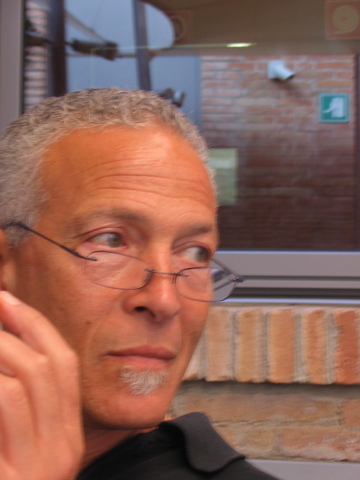
Also one of the best author photos in ages.

dg


part 1:  (muthos) labyrinth & sanctuary

“And if I can make a sanctuary of reading, of poems and stories complete unto themselves and, therefore, whole, I must make that which is not whole my sanctuary—its traces and glimmers, its countless fragments.”

—Ralph Angel, “The Exile and Return of Poetry:  Essay
Numéro Cinq vol. vi, 1 (January, 2013).

Unspool the thread given by Ariadne, in whom the ecstasy of oblivion awaits the coming of Dionysos. The end precedes the beginning and a certain movement of form collects both. Dionysos already presents himself in the form of desire. Unspool the thread down narrowing and widening passages. Daidalos, poet-exemplar, modulates light and darkness, clarity and obscurity in the labyrinth. To isolate the final cause of this structure, peel away at the Minotaur: Minos and shame, Pasiphaë and desire, desire and the god of translation (Zeus). Dionysos stands at the threshold of the labyrinth and in the mind of the poet-architect. Into the sacred labyrinth let thread follow. Thread protects against loss and wandering and a hungry monster inhabits the structure.  Monster is monstrum, something that elicits wonder, a marvel.

Risk:  to be consumed by the hunger and isolation that motivates wonder.

Where is poetry?

A poet designs a sanctuary into which imagination—a genuine monstrum—is led.  Fear of the creative imagination in the full range of license, and a shame, rooted in modality, of the creative imagination’s potency, force the creative imagination into the sanctuary—that is, a world-making creativity will also be world-devouring. Shelter it within sanctuary. Labyrinth is sanctuary.

Sanctuary:  a forbidden vein of dark blood writing the holy secrets across its innermost holy place, a place of healing.

Into the labyrinth unwind thread. Poetry is labyrinth, but a poem takes flight from the surrounding walls. Ikaros too with wings of syllables and breath lifts himself out of the sanctuary’s enclosure unto the bright morning air, the island’s craggy shoreline diminishing. Into the open.

Or sing the poem from the open place near the labyrinth’s center. Write poems on papyrus scraps and send them to the skies on wings of smoke and flame. Too near the sun they have already burned to ash and their flight continues. Poem needs no ground save the whole of things; air discloses the whole.

Unwinding thread towards the interior of labyrinth, find the shield of Achilles blazing in midday light. Everything reflects there. It burns the eye and the mind falls to its knees.  A fire-god rends the metal earth into folds that look just like earth and the poet’s god is the god of fire. There on the shield read one’s own face in bronze embossed where the surface is whole. Everything there terrifies. None dares to look.  Begins the fire-god a poetry of metal fragged from deep veins beneath the surface of earth. Tear open the surface of things and make beginnings in the dark material hidden there. A whole rent down to the interior of fragments stripped and reshaped in time-present’s forge where everything else collapses into forgetting. Unmake whole make fragment into whole in which a face echoed recalls its fragmentation. Tragedy builds its shield from the shield of fire given from god to man. Poet beneath it all, blindness shielding from the tragedy of wholeness. Where whole forms itself into stability there loses all into unself. Whole will encapsulate in its message of bronze the perishing of what you want:  the city of gold, walled with lapis tesserae and medallions of everything precious, gods’ hands pressing stone towards the sun into a wall impenetrable. Down tumbles wall and the quiet household gods into flame of the poet’s limping god. A fierce jaw breaks spear after spear into the torso of a warrior who is also a son, a father watching unable to look away. Down tumbles what the whole speaks in its ekphrastic visioning. Down.

At the labyrinth’s center, Minotaur shakes loose his must-covered voice:

mind sleeps and wakes and stirs and rests and poetry cycles

turning & turning the spirit moves as it cycles once more into itself[i]

Fragmentary remains in the manner of the cycling going-under of things.  Take it up from the ruins, or from the labyrinth where it was found lying in midday sun.  Out of a ruined whole brings forth the poet a second world that looks out upon another contained within itself.  The thread leads deeper into labyrinth’s ordered chasm.  Light is channeled into momentany into dark by the architect of moving-images[ii] and prisons.  The poet chains everything in artifice, released in the mouth and ear of the reader.

Back to sanctuary only ever half-finished, abandoned when tyranny fell. Footsteps glish in blood and stain the foundation.  The wonder is, after all, only half human.  The rest is untranslatable.  Leave the traces of holiness along the eastern wall where temple and labyrinth are one.

.

part 2:  (logos)  literary dynamism

“And if I can make a sanctuary of reading, of poems and stories complete unto themselves and, therefore, whole, I must make that which is not whole my sanctuary—its traces and glimmers, its countless fragments.”

This sentence traces the belonging-together of whole and not whole. The sentence says:  if a subject is able to produce a sanctuary out of literary wholeness, that subject must produce a sanctuary of the fragmentary.  It says, in fact, nothing about the making of a literary sanctuary, but rather about the power to make such a sanctuary and the necessity, because of that power, to create a sanctuary for the fragmentary.  Accordingly, the fragmentary involves a dynamism that exceeds and excludes the whole.

However, wholeness comes first.[iii] Only after the presencing of wholes to consciousness do the fragments begin to appear, light-catching as glass-shards. To be sure, wholeness as a concept both precedes and precipitates a notion of the fragmentary; coming across a potsherd on the island of Delos, for instance, one immediately recognizes the fragment of pottery as having been a part of a now ruined whole.  The sentence above, the starting point of this brief inquiry, on one level simply asserts that, since the production of a sanctuary for wholeness can be carried out, wholeness exists in some way, and then what applies to the whole applies necessarily to the parts.  Yet, this assertion is complicated by the idea that the sanctuary produced for wholeness exists in modality, while that produced for fragmentariness exists as a dynamic and necessary movement towards a whole.  It is further complicated by the notion that such a whole, as the sanctuary seems to describe, takes place as not only whole, but also fragmentary.  For, a sanctuary marks off an area that is described by its boundaries and is a kind of whole, yet one which also explicitly does not contain the wholeness for whose praise and worship it has been created.  In principle, that which is limited, while perhaps whole in itself, is nevertheless fragmentary insofar as it has been segregated from all else.  Emerson communicates something like this principle in the essay “Circles,” writing that “around every circle another can be drawn.”[iv]

Fragments exemplify the coexistence and belonging together of whole and fragmentary while also pointing to different ways in which the fragmentary is related to the whole.  A literary fragment, such as those attributed to Sappho, leans toward the imagination as a medium in which the dynamism of fragmentariness delivers itself and raises itself and exceeds itself into a poetically engaged wholeness.  This entails a dialectic, an inter-activity, a potent engagement of the imagination with the poetic fragment. “[N]ot everything can be given straight away to the understanding through the work of art,” as Schopenhauer noted, “but only what is needed to set the imagination on the right path; it must always leave out something—indeed, the final thing—for the imagination to produce for itself.”[v] Out of this engagement the fragmentary poem overcomes itself and reaches its latent wholeness, which consists in the belonging-together of literary art and the thoughtful auditor or reader.  All strives for wholeness.[vi] Imagination reaches out for the dynamism inherent to phenomena, as phenomena strive towards an outside-of-themselves that completes them. The ancient Greek epic phrase kluthi moi…ophr’ eipo (listen so that I might speak) expresses this cycle.[vii] Without the correlative of an outside-of-self listening, speaking cannot take place; the being of each depends on the other.

The Sapphic fragments also reach in the direction of the lost whole; splintered from that whole, the fragments bear an enhanced attitude of longing.  This raises the relation of fragments within a context of wholeness.  In complete works lines, phrases, and episodes exhibit a kind of ecstasy of their own whereby each part as a fragment overcomes itself by semantically stepping beyond and outside itself when taken independently, which is how the reader or hearer initially perceives them while also assembling these, by means of the memory and imagination, into and towards a wholeness.  Each phrase can be experienced both in its fragmentariness and in its condition of literary ecstasy:  a stance thrust beyond the self into and towards the self—the whole—it has power to become. The outside-of-self, however, can only emerge into being from the self’s unfolding, such that the outside-of-self towards which a thing strives consists within the self itself as a power to be that which the self not yet is.  A work’s literary dynamism in this sense takes place as its movement towards itself—its latent wholeness—through continuing its self-overcoming.  That is, the whole gains itself through each phrase-as-fragment overcoming itself, gathering and overflowing into the next and the next.  Each fragment inheres to the literary dynamism and does so because of a work’s wholeness.[viii]

Ecstasy—standing beyond self—shows itself as an essential feature of the relationship between wholeness and fragmentariness. This is at the center of literary dynamism, at once ecstatic in its reach for the ever-outside-itself and rootedly inward, inherent.  The shadow of this thought also comes forward:  in striving towards wholeness, fragments move away from a previous condition, fragmenting themselves in the very moment of overcoming themselves into wholeness. Herakleitos speaks this movement:

out from the teeming plenitude of all things one

out from the quietus of unity all things[ix]

The Herakleiteian double-move takes place in the manner of Angel’s articulation of the belonging-together of whole and fragment.

In the end, Angel’s “exile and return of poetry” traces the movement of entities coming-forth from wholeness into fragmentation and returning, in their time and by means of dynamism, from fragmentation into wholeness.  Relations with other entities provide the context and ground for the actuation of this dynamism and may point to an underlying unity of those related entities.[x]

n.b.  All ‘translations’ given above are original by the author.

— D. M. Spitzer

.

After undertaking graduate studies in liberal arts, philosophy, and classics (each at different institutions), D. M. Spitzer completed a Master of Fine Arts in writing (poetry) at Vermont College of Fine Arts.  He is currently working on a number of poetic projects:  eurydike relapse, a performance-poetry event that will incorporate choreography, large-scale mask/puppetry, and transfigurations of poems by Rilke, Goethe, and Ovid; a hybrid literary work tentatively titled Genealogy of the First Person; and another performance-poetry piece that transfigures the ancient philosophical poem of Parmenides.  In addition, Mr. Spitzer is developing an essay that explores the use of hyphenation in the work of the late American poet Gustaf Sobin.  Some of his work can be heard at exaudes.wordpress.com.  Mr. Spitzer lives in Pennsylvania with his wife and their three children.

Footnotes    (↵ returns to text)

  1. Transfiguration of Ecclesiastes 1:6.
  2. Plato uses as a simile the moving statues of Daidelos in the Meno [97d.6-10].
  3. Aristotle likewise observes, at the outset of Physics, that “for the most part to our sight and taste first arise things in a mixed-together state, and then later, from things of that sort, the elements and the sources (arkhai) that set things apart are discernable.  In light of this, inquiry should proceed from the wholeness of things (to katholou) towards each separate thing, since, aesthetically, the whole is more knowable and the wholeness of things is a kind of whole” [184a.21-25].  
  4. Ralph Waldo Emerson, “Circles,” in Ralph Waldo Emerson:  Essays and Poems, ed. Tony Tanner & Christopher Bigsby (J. M. Dent:  London; Charles E. Tuttle:  Vermont, 1995), 146.
  5. Die Welt als Wille und Vorstellung, vol. 2, ch. 34 (Stuttgart, Frankfurt am Main:  Cotta-Insel, 1960), 523:  “…durch das Kunstwerk nicht alles geradezu den Sinnen gegeben werden darf, vielmehr nur soviel, als erfordert ist, die Phantasie auf den rechten Weg zu leiten:  ihr muß immer noch etwas, und zwar das letzte zu tun übrigbleiben.”  
  6. Compare Aristotle’s thought at Physics A.9 [192a.16-25] that hule (typically translated as “material”) yearns for eidos (“form”).
  7. See, for example, Hesiod, Theogony, 644-645:  keklute meu…ophr’ eipo ta me thumos eni stethessi keleuei.  The last part of the expression emphasizes the impulse to reach beyond the self.
  8. For example, Robert Creeley’s poem “Fragment,” in Echoes (New York:  New Directions, 1993), 67 achieves its art through appealing to the reader’s sense and expectation of wholeness, even if it intends to show the radical absence of a whole.  Similarly, Sappho’s poems are so alluring on one level because they never attain themselves, they leave in play the desire for wholeness, a taut bow never released.  
  9. This is a transfiguration of the last section of Herakleitos, fragment 10 (Deils-Kranz).
  10. The image of literary dynamism may work to understand the more practical problem of “writer’s block,” which I take to be at issue in Angel’s “exile and return.”  If the practice of what is called “writing” can be thought in terms of a dynamic interplay of fragmentariness (or silence, or a period without writing) and wholeness (productivity, writing), we might make a sanctuary of the whole process that includes periods of speaking and hearing, of writing and reading, of reading and quiet, a process that is inherently fragmentary in its wholeness.
Mar 092014
 

author photo color

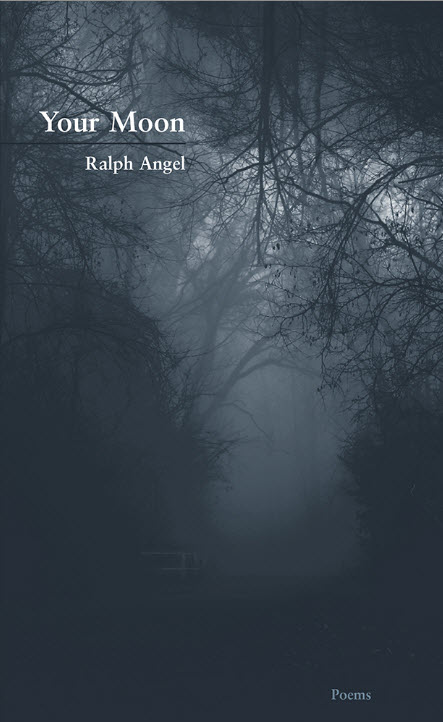
Your Moon Cover

Ralph Angel is a brilliant poet, master of the laconic veering toward silence. Like his beloved Pierre Reverdy, he writes lines that turn your mind inside out, something always yielding to its opposite, presence and absence intertwine.

I painted the walls and the ceiling an even white.
Then I knocked out a wall.

The words emerge from the white space of the page, hesitant, whispered into the silence, uncertain of return. Melancholy, mysterious, precise.

These are poems from Angel’s new book, Your Moon, just launched from Western Michigan University’s amazing press New Issues Poetry & Prose.

dg

Ralph_Angel

Panic

In one breath of air
I swam to the bottom of the ocean and brought back the earth.

I painted the walls and the ceiling an even white.
Then I knocked out a wall.

On the lake a swan folds herself into her wings
forever.  It was that

time of year.  The snakes are making rain.


Being Back

Sooner or later I am out folding chairs again, and so
leave myself behind, though flirting
with an angel a few stairs
above me
feels just as real
and keeps things moving.

A golden retriever licks my hand.  It’s Christmas
in Chicago.  The family’s here
and from the cemetery
there’s talk of food
and family.

It’s flat
and cold in Dallas.  And then a bursting
cloud of grackles.

An old man pees himself.  His wife
takes her seat and thanks me.  In Louisville,
Kentucky, a baby’s
handed me.

In Seattle (must I go there, too?), I’m here
for you, and I know

I won’t be back.


The Traffic Is Going Down the Hills

The traffic is going down the hills
above the city to the harbor

and back again, past the statue
of a goddess poised

in her abandon.  Her arms
hang to the side

without touching her body.

At her feet a beautiful young girl
holds a plastic bag

in her hand, ready to pick up
her pet’s

droppings.

Little sister, arranging
bottle caps.  Little brother, back

and forth you run
from one side of the pier

to the other.

Oh young mother
pulling your thin dress

to yourself
tighter

and tighter.

 —Ralph Angel


Ralph Angel’s latest collection, Your Moon, was awarded the 2013 Green Rose Poetry Prize. Exceptions and Melancholies: Poems 1986-2006 received the 2007 PEN USA Poetry Award, and his Neither World won the James Laughlin Award of The Academy of American Poets. In addition to five books of poetry, he also has published an award-winning translation of the Federico García Lorca collection, Poema del cante jondo / Poem of the Deep Song. Angel is the recipient of numerous honors, including a gift from the Elgin Cox Trust, a Pushcart Prize, a Gertrude Stein Award, the Willis Barnstone Poetry Translation Prize, a Fulbright Foundation fellowship and the Bess Hokin Award of the Modern Poetry Association. He lives in Los Angeles, and is Edith R. White Distinguished Professor at the University of Redlands, and a member of the MFA in Writing faculty at Vermont College of Fine Arts. His personal website is here.


Oct 142013
 

Ralph Angel

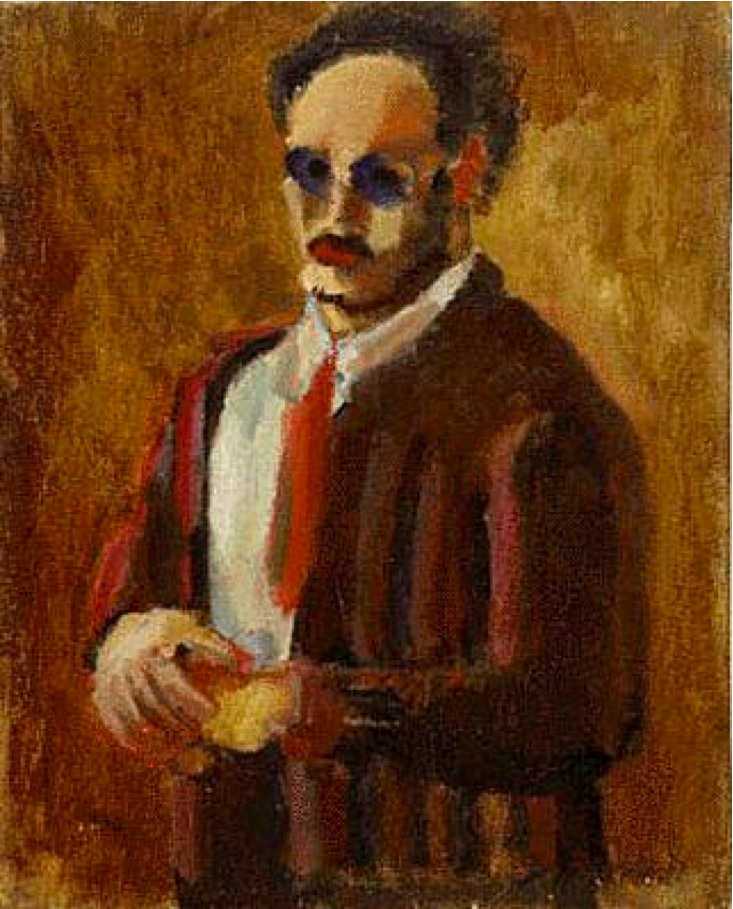
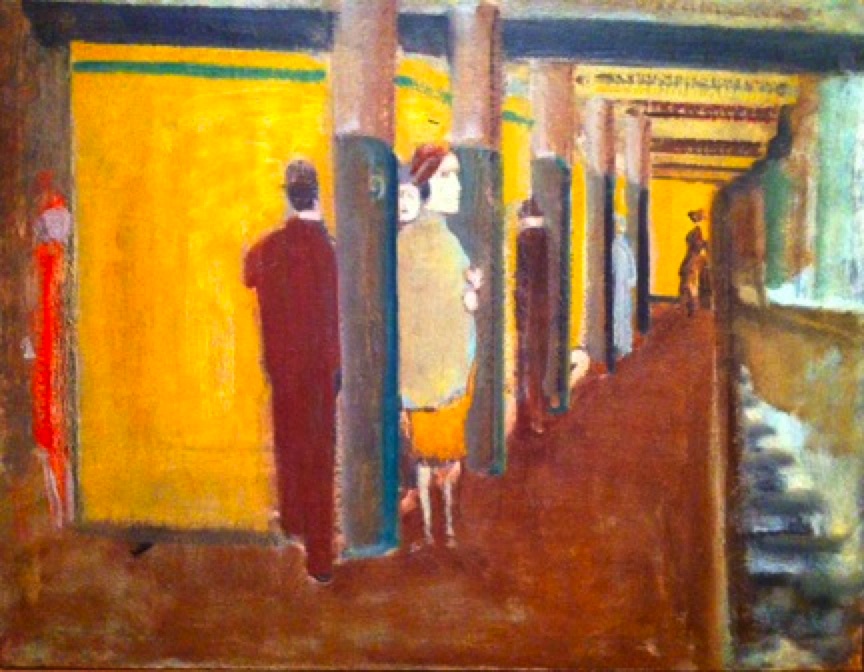
Ralph Angel’s lectures are theater pieces; he enacts meaning; he breathes presence; he speaks with quiet reverence and passion of great artists. He is my colleague at Vermont College of Fine Arts (along with Mary Ruefle, who has the same theatricality, reverence and passion but in a different key — it’s rare air that we breathe in Montpelier); so I watched him give this lecture; he starts by pulling your brain inside out like a sock (reading the Reverdy poem backward and forward); then he teaches a lesson about craft and art, not just by telling (Ralph is so NOT into telling) but by a series of images, Mark Rothko paintings that illustrate the true artist’s journey from craft to clarity and essence.

Watch for Ralph Angel’s new book of poems Your Moon, coming out next year with New Issues Press.

dg

§

Departure

A long time ago a short poem by Pierre Reverdy changed my life forever. Its title is “Departure,” as translated by Michael Benedikt.

The horizon lowers
SPACESPACEThe days lengthen
SPACESPACEVoyage
SPACEA heart hops in a cage
SPACESPACEA bird sings
SPACESPACEAt the edge of death
Another door is about to open
SPACEAt the far end of the corridor
SPACESPACEShines
SPACESPACEOne star
A dark lady
SPACELantern on a departing train

And for whatever reason, a long time ago—maybe because it retained its mystery each time I read it, maybe because each time it took me to some unnamable and wholly present, wholly immediate place—for whatever reason, I read this poem backwards, from last line to first line.

SPACELantern on a departing train
A dark lady
SPACESPACEOne star
SPACESPACEShines
SPACEAt the far end of the corridor
Another door is about to open
SPACESPACEAt the edge of death
SPACESPACEA bird sings
SPACEA heart hops in a cage
SPACESPACEVoyage
SPACESPACEThe days lengthen
The horizon lowers

And voilà! This short poem, read from last line to first line, or from top to bottom, so validates the mind’s capacity!

I understand things in my mind—I understand things in my heart. There are times when I understand things in my knees.

Meaning involves the mind. The brain is a receptor. It’s like a dream machine. It receives impulses and it receives image upon image upon image upon image, but the mind craves meaning. The mind is assembling stuff all the time. It’s what makes the human species pretty interesting. We crave meaning by our very nature and by the size of our brains. If you think about language, it can be understood, it seems to me. You have twenty-six abstract symbols that mean absolutely nothing. And yet, in any arrangement, arbitrary or contrived, any arrangement whatsoever, we are orchestrating meaning. Those symbols, as they interact with one another, generate something greater than themselves. So it’s kind of like the brain itself. Impulse upon impulse upon impulse, and yet the mechanism is constantly, without our having a whole lot of say in the matter, making meaning out of what we receive.

The mind craves language, and Reverdy trusted that. Reverdy trusted language, and, therefore, a long time ago, trusted me, an embryo yet to be and waiting for a taxi.

SPACE

The Metamorphosis

In the first sentence of Franz Kafka’s “The Metamorphosis,” “Gregor Samsa awoke one morning from uneasy dreams….” And he can’t get up—he’s on his back!—and he’s late for work. Sound familiar? He hates his job. He loathes his boss. It’s a tedious, boring, undervalued job, but his father’s retired, and he’s the only son. His sister is a prodigy, and she’s young; she has a future ahead of her as a concert violinist. But Gregor’s arms and legs don’t work. He can’t turn himself over. The door is locked. His mother and sister and father and the char woman are outside the door. And then his boss arrives, and they are all exhorting him to get out of bed. But he can’t communicate with them in a way that they can understand. He just sort of squeaks.

Now Gregor lives with his family in a five-room flat, and his room is at the center, right at the center of the family. And, yes, he eventually tumbles from his bed—because he has will power and guilt and anger, and because he doesn’t know anything different—and he even gets a tiny hand to the key. But what’s on his mind? “…they should all have shouted encouragement to him, his father and mother too. ‘Go on, Gregor,’ they should have called out, ‘keep going, hold on to that key!'”

Not one time in this story does it ever occur to Gregor Samsa that he is a bug! And why should it? How may times have I awoken and not wanted to get out of bed? Or resented having to make money, or envied the sanity and good fortune of others, or hoped someday soon to murder my landlord? On any given morning I wear my skeleton on the outside because I am an insect at the center of the family and maybe could use some applause and a little more encouragement for once in my life! On any given day, friends, I am a bug. How else could I communicate with you? How else might you recognize me?

Gregor Samsa does not awaken one morning feeling like an insect. He is an insect. As time goes by he abandons cleanliness and stops sleeping. He loses all interest in food. “I’m hungry enough, but not for that kind of food.” He is the size of an insect now and does what insects do—skittering this way and that, climbing on things, collecting dust on his tiny legs, and leaving a weird sticky substance everywhere he goes.

Kafka’s title, “The Metamorphosis,” is a bit of a ruse. Gregor Samsa does not become a bug in this story. He is simply, from beginning to end, in spite of himself, who he is.

SPACE

Poppies In October

Even the sun-clouds this morning cannot manage such skirts.
Nor the woman in the ambulance
Whose red heart blooms through her coat so astoundingly—

A gift, a love gift
Utterly unasked for
By a sky

Palely and flamily
Igniting its carbon monoxides, by eyes
Dulled to a halt under bowlers.

Oh my God, what am I
That these late mouths should cry open
In a forest of frost, in a dawn of cornflowers.

In the last months of her life, Sylvia Plath, one of the supreme craftsmen of the last 75 years of American poetry, did not suddenly make transcendent poems by perfecting her craft. No poet or writer or artist or musician ever perfects his or her craft. The poet, for example, has only two tools with which to work: the language in which one composes, and the fact of one’s reality—and each is in flux. Just as one’s orientation to language evolves and changes over time, so too does one’s life.

Every poem is a revelation. Instead of perfecting her craft Sylvia Plath became, without much say in the matter, precisely who she was. She could not help but look outside of herself, at anything at all—in this case, at a bed of poppies in autumn—without discovering herself!

Like Reverdy who, at his purest, jettisoned the story of his reality for the fact of his reality. Poems comprised of essential language only—simple catalogues of details and images without exposition or explanation, without connectives, referents or transitions.

Language is powerful stuff. And essential language does the work. Inexplicable experience can never be explained, but it can be said.

Impulse upon impulse upon impulse, when we were born our brain weighed about three pounds, and our body was a mere appendage of it. Metaphor upon metaphor upon metaphor, isolating out metaphor is a futile task. Everything is simply what it is. Situations are not similar to something else. Situations exist within themselves, as tone, as mood, as state of being. Just ask Gregor Samsa!

Sylvia Plath and Pierre Reverdy and Franz Kafka were great artists in part because they did not endeavor to explain reality. Rather, they were attentive to reality, which is the job of the artist, and each found a language to depict it. They were not tricked by the idea of perfecting one’s craft in order to make great art possible. Rather, they aspired to more than that. To immediacy and absolute presence.

To become themselves, they learned how to get out of the way.

.

RothkoSPACE

Rothko2

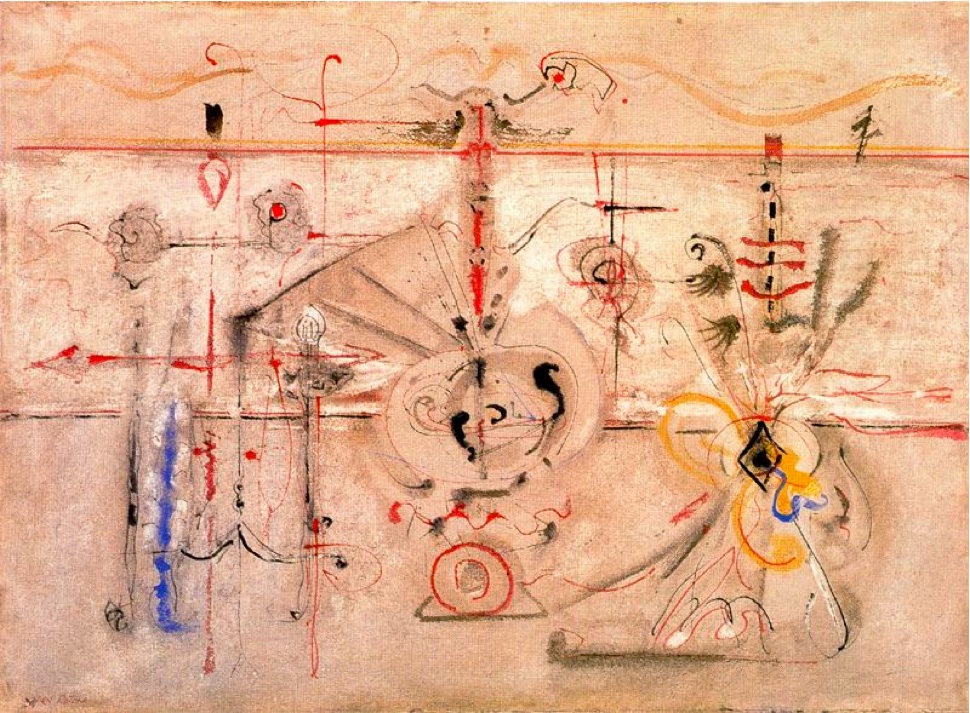
Like all the great American abstract expressionists, Mark Rothko began painting with marvelous technique and craftsmanship.

Rothko3

But for years his paintings resembled closely the early paintings of many of his contemporaries,

Rothko4

Rothko5

like early Gorky, for example, or early de Kooning or Pollock.

Rothko6

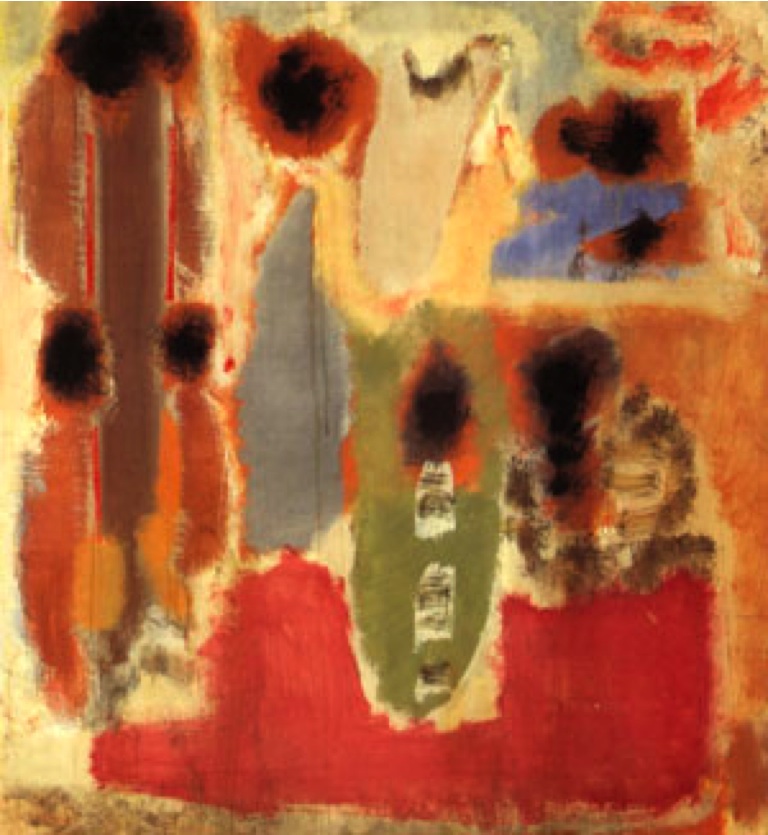
But as he progressed in his work and began to make utterly unique, transcendent paintings

Rothko7

he learned to get out of the way, to become indivisible with his tools,

Rothko8

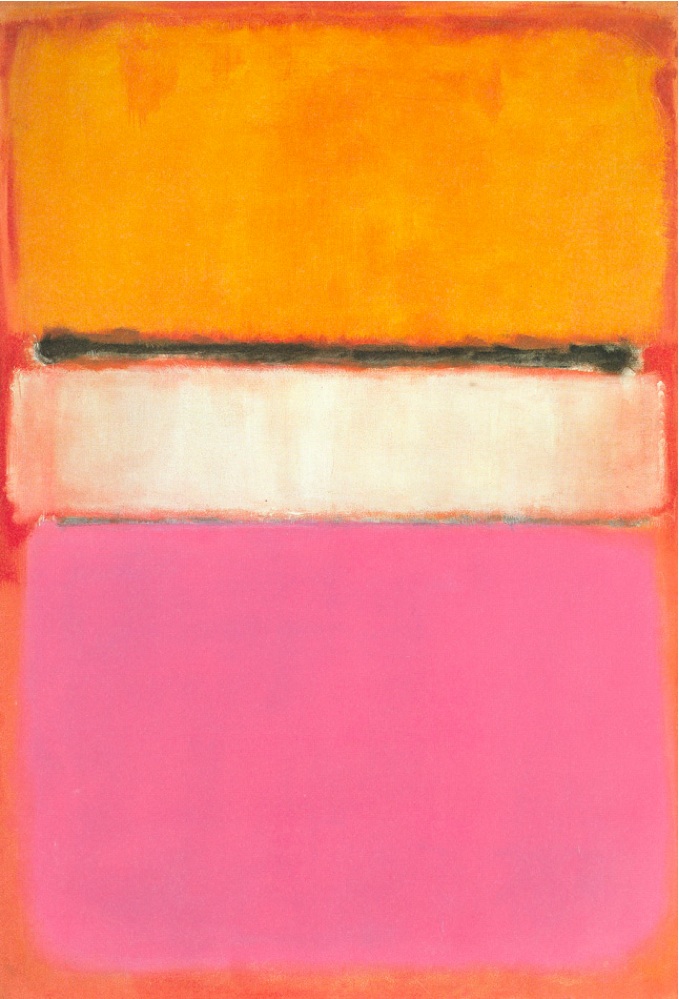
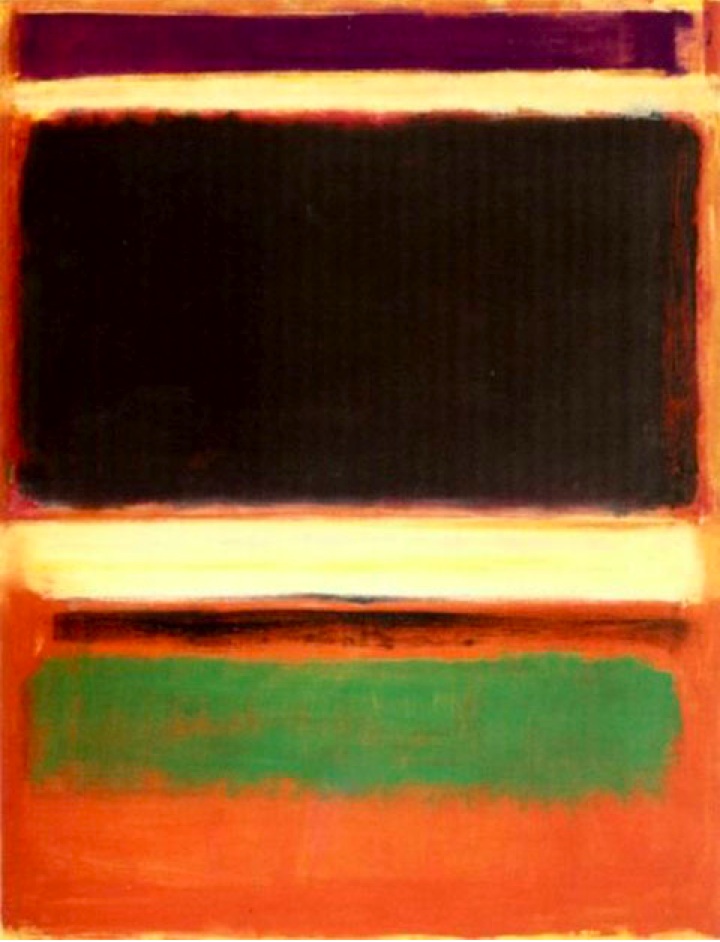
and to trust that, without referents or points of departure,

Rothko9

they could spin a viewer into his or her own ineffable interiority.

Rothko12

That they could make presence possible.SPACE

Rothko11

“The progression of a painter’s work,” wrote Rothko, “as it travels in time from point to point, will be toward clarity: toward the elimination of all obstacles between the painter and the observer….

Rothko13

As examples of such obstacles, I give memory, history, or geometry, which are swamps of generalizations from which one might pull out parades of ideas (which are ghosts) but never the idea itself.”

Poems, stories, paintings—art objects are like mirrors. No matter what we think we’re up to when we make them, they reflect precisely who we are at the time.

But it’s our job to be there. Attentively.

But we don’t always want to. To be there, I mean. I mean we all want to be liked, and we all want to spin things in a way that will make us look interesting and important and likable and smart.

It’s why not everyone is an artist.

“It takes ten years to master the art of basket weaving,” said the Master. And that’s just the first sentence of this story!

— Ralph Angel

————————–

Ralph Angel is the author of five books of poetryYour Moon (2013 Green Rose Poetry Prize, New Issues Press, forthcoming); Exceptions and Melancholies: Poems 1986-2006 (2007 PEN USA Poetry Award); Twice Removed; Neither World (James Laughlin Award of The Academy of American Poets); and Anxious Latitudes; as well as a translation of the Federico García Lorca collection, Poema del cante jondo / Poem of the Deep Song.

His poems have appeared in scores of magazines and anthologies, both here and abroad, and recent literary awards include a gift from the Elgin Cox Trust, a Pushcart Prize, a Gertrude Stein Award, the Willis Barnstone Poetry Translation Prize, a Fulbright Foundation fellowship and the Bess Hokin Award of the Modern Poetry Association.

Angel is Edith R. White Distinguished Professor of English and Creative Writing at the University of Redlands, and a member of the MFA Program in Writing faculty at Vermont College of Fine Arts. Originally from Seattle, he lives in Los Angeles.

Jan 042013
 

 Ralph Angel

A delicate trace of narrative runs through these three Ralph Angel poems, trace as in a whisper barely emerging from the silence of the white page. The narrative is romantic, the tone affectionate, erotic, connubial, ever so slightly comic (such an endearing mess the poet makes spilling his coffee, falling asleep in a bed of popcorn, cleaning up for his love who’s on her way). The poems are stripped down, reduced to essence, the words that remain are perfect embodiments of mood, character, relation. And they insist by rhythm and repetition. Note in the first poem “Willing” how

A kiss, a lick, “Miss me?”
“Of course, yes,”

goes to (by the logic of parallels) “a nudge, a squeeze…” and then modulates back closer to the original

some bread?”  A kiss, a lick,

“Miss me?”  “Yes, yes.”  “I put your book
with the magazines.”

And how the word “perfect” in the third line

a perfect cloud shadow,

and the word “brilliant” in the middle of the poem

dear.  “Hungry?” “Brilliant, yes,

fold together at the end (capped with a sly innuendo).

“Perfect, brilliant.  Might I have another?”
“Another what?”

These poems come  from Ralph Angel’s new book Your Moon, forthcoming with New Issues Poetry & Prose. And you might read these poems in conjunction with Ralph’s essay “The Exile and Return of Poetry” which also appears in this issue.

dg


§

Willing

And further in…the train clacking and lulling…

rolling green hills coming toward us…

a perfect cloud shadow,
the lonely oaks.

And cows, one, and another, closer to heaven…
what’s up with that?

A kiss, a lick, “Miss me?”
“Of course, yes,”

you’re killing me here, my
dear.  “Hungry?” “Brilliant, yes,

absolutely.”  “And voila,” a nudge, a squeeze…
my stockinged foot curled

around your ankle, your shoulder
propped up on mine,

“we have grapes and brie, will you tear us
some bread?”  A kiss, a lick,

“Miss me?”  “Yes, yes.”  “I put your book
with the magazines.”

“Perfect, brilliant.  Might I have another?”
“Another what?”

.,

Vacuum Cleaner

I erased the message.  You were
already on your way.  I barely heard you
pull the scent out of my ear
and put it in my
mouth again, where
I will kiss you.

Then I knocked over my café con leche.
What a mess.  Papers, piles
of books, I had a book
in my hand.

I like it better now,
the table.  The light cuts right
through.  I think you’ll
like it too.

Last night I woke myself up
in a sea of popcorn.  The movie
had long since
ended.  It was disgusting.
So we’ve got clean
sheets.

If only I had a little more
time.  I take that back.  I really
mean it.  I wish
we hadn’t yelled goodbye
last time.  I mean we
really screamed it.

No wonder there was a beautiful
fish in the market.  The sky
dimmed the living room.  And peonies
opened.  No wonder
the cat’s lounging on the edge of the tub
while I’m making myself
presentable.  She
makes it look
easy.


Blue Hydrangea

Five trucks are enough.
The neighbors
are home.  We’re married

and handsome
and covered.  Nobody
dies

for the first time.
I’m still
fighting you.

You wait on me. I wait on
you. Your memory’s
my body’s

devotion.

—Ralph Angel

———————————-

Ralph Angel is the author of five books of poetry: Your Moon (2013 Green Rose Poetry Prize, New Issues Press, forthcoming); Exceptions and Melancholies: Poems 1986-2006 (2007 PEN USA Poetry Award); Twice Removed; Neither World (James Laughlin Award of The Academy of American Poets); and Anxious Latitudes; as well as a translation of the Federico García Lorca collection, Poema del cante jondo / Poem of the Deep Song.

His poems have appeared in scores of magazines and anthologies, both here and abroad, and recent literary awards include a gift from the Elgin Cox Trust, a Pushcart Prize, a Gertrude Stein Award, the Willis Barnstone Poetry Translation Prize, a Fulbright Foundation fellowship and the Bess Hokin Award of the Modern Poetry Association.

Mr. Angel is Edith R. White Distinguished Professor of English and Creative Writing at the University of Redlands, and a member of the MFA Program in Writing faculty at Vermont College of Fine Arts. Originally from Seattle, he lives in Los Angeles.

Jan 022013
 

Author Photo by Ales Debeljak

The first time I saw Ralph Angel lecture I was mesmerized and went away muttering to myself. He’d done something I’d never seen before. He  had not only lectured about a poet and a form, but he had also ENACTED the form, the aboutness, in the PERFORMANCE of the lecture. In other words, to my mind he had invented a completely new way of lecturing, one which I have not yet been able to replicate myself (mutter, mutter). Although we do not  have Ralph here to PERFORM this lecture, he does include an epigraph — the performance of the poem which is the poem — to remind us that this is his modus operandi and his way of conceptualizing both prose (lecture, essay) and poetry.

Ralph Angel is a dear and old friend and a colleague at Vermont College of Fine Arts and a graceful human being whose inveterate coolness does not hide the fact that he wears his love of beauty and art on his sleeve where it is a constant challenge to us all to do the same.

dg

§

It is the performance of the poem which is the poem.  Without this, these rows of curiously assembled words are but inexplicable fabrications. –Paul Valéry


I was reading W. G. Sebald.  I’d been reading his novels for a month or two.  I was nearly finished with my fourth one, Austerlitz, the last of the four novels he published during his lifetime.  And so I read the sentence:

When we took leave of each other outside the railway station, Austerlitz gave me an envelope which he had with him and which contained [a] photograph from the theatrical archives in Prague, as a memento, he said, for he told me that he was now about to go to Paris to search for traces of his father’s last movements, and to transport himself back to the time when he too had lived there, in one way feeling liberated from the false pretenses of his English life, but in another oppressed by the vague sense that he did not belong in this city either, or indeed anywhere else in the world.

And I stopped reading there, though it was early in the day, and I had no commitments or responsibilities to speak of.  And the sentence itself was not of particular significance, I mean no more or less significant than any other deeply haunted, contextually complex, beautifully-composed ongoing sentence in this or any other Sebald novel.  I mean there were only forty or fifty pages left in a book I was in love with, but I stopped there because I couldn’t bear to finish it.  I mean, like I said, he only wrote four novels.

***

I thought back to Jose Saramago, the Portuguese writer I read and read before I started reading Sebald.  And as with Sebald, I’d read little else than Saramago novels for months, literally.  I thought back to the sanctuary of his language.  Luxurious and running on, each sentence composed of a number of sentences strung together, wave after wave of solace and connectedness.  And I longed for the comfort of “the Iberian peninsula breaking off at the Pyrenees from the European continent and drifting off to sea” because the language of the novel could contain and make perfectly believable such fantastical reality.

***

I love the true and beautiful lie of the novel.  The illusion of completeness it provokes.  The way it makes everything whole.  Like a great poem, of course, a world unto a world unto the world of itself.  A sanctuary I can withdraw to.  A language that can nurture and sustain me.

And so I thought of Nicanor Parra and Rimbaud and Dickinson, the poets I’d been reading obsessively and compulsively before bathing myself in Saramago and Sebald.  And that was my morning, lost in thought and longing and the uncomfortable sense that reading the last few pages of Austerlitz would be my ruin.

***

But the damage was done, I suppose.  I finished reading Austerlitz because I could not bear the very idea of reading anymore.  I was sick of it, frankly.  I took long walks in the city.  I visited a favorite painting or two.  I rummaged through many stores.  For the first time in a long time, I felt at home again in neighborhood cafés.

And I felt horrible, too.  For it had been a terrible time, those last months.  A horrible, wretched, awful time.  But not so much.  I mean everyone was more or less okay, everyone I knew, I mean.  And I’d been luxuriating in the sanctuary of poems and novels, hadn’t I?  And in such completeness I’d felt whole.  Or I think I did.  Everything had changed.  That sense of wholeness was breaking down, breaking apart, like a tulip, before my very eyes.

It was as if I had just finished making another poem.  Compose a last line, and then what?  Nothing, that’s what.  And nothing is the reason that whatever else my experience has taught me, it has taught that no matter how I think a poem can be made, it will get made some other way, if it gets made at all, and then I’ll be struck by amnesia again for the how many-eth time in my life.

And the truth of the matter is that for all those months of reading novels and poems and collections of poems, books of history and science and everything under the sun, I’d made nothing.  Call it what you will, a period of transition, a blank page, a kind of exile.

All a writer wants to do is put words upon a page.  I mean I spent time in my study each day, each day I was in town.  And I read and read and read.  And some days I put down a few lines, and felt good, and that was that.  And maybe the next day I put down a few more lines, or not, that’s the way things go.  But sure as rain I’d make the same discovery.  The lines were bad.  It was all crap.  For months I’d failed.

You see, if I allow myself to finish something I tend to trust it, trust it enough even to put it into the world.  And if I don’t, well, I throw it away, literally, into the garbage can where it belongs.  You see, if some orchestration of language or other is important it’s inside me somewhere, sometimes for a long time, and it’ll make itself heard again when it’s good and ready.

***

One morning. like most mornings, I was sitting out back having a cup of tea and listening to the birds and the leaves of the trees.  There is a lovely Florentine birdbath in the yard.  Tucked away somewhat, among a loquat, an avocado and two eucalyptus trees.

And while drinking my tea, the birds, as they visited the birdbath, reminded me of Joseph Cornell’s “Dovecot” (American Gothic), a favorite of mine.  It’s quite abstract, as are all the boxes that were inspired by Emily Dickinson.

Cornell’s dovecot is very white, or sun bleached, or whitely weathered somehow.  Many of the arched entrances are still in tact.  Of course the wood is old, and the paint, too, is old, and some apartments have long gone derelict and vacant.  A small white ball is perched just inside a few of the entrances, like the fluttering dove or pigeon that surely lives there, or will surely pass through someday.  They are, of course, the little balls, implacably what they are.  The don’t look at all like eggs.

I went inside, of course.  I mean I thought of Saramago.  After an hour or two of searching, I read this passage:

For several moments [the two men] remained silent, then José Anaiço rose to his feet, took a few steps in the direction of the fig tree as he drank the rest of his wine, the starlings kept on screeching and began to stir uneasily, some had awakened as the men spoke, others, perhaps, were dreaming aloud, that terrible nightmare of the species, in which they feel themselves to be flying alone, disoriented and separated from the flock, moving through an atmosphere that resists and hinders the flapping of their wings as if it were made of water, the same thing happens to men when they are dreaming and their will tells them to run and they cannot.

It was, of course, a familiar landscape, the way landscape is huge, and it gets bigger and bigger, what with travel and change and moving around in one’s life.  I think, in fact, that I carry my sense of place inside me.  And it gets altered over and over again, and so too, therefore, does my sense of who I am.

It was a piece of something, that Saramago passage.  A fragment.  Like a construction site or a cathedral, the undulating surface of a river I walked along somewhere, a face that stood out among a group of faces at a crosswalk.  It’s what I wanted.  A broken tile.

It took me I don’t know how long to find a paragraph in Gabriel Garcia Marquez’s One Hundred Years of Solitude, a novel I hadn’t read in twenty years.  It was only two sentences:

As soon as José Arcadio closed the bedroom door the sound of a pistol shot echoed through the house.  A trickle of blood came out under the door, crossed the living room, went out into the street, continued on in a straight line across the uneven terraces, went down steps and climbed over curbs, passed along the Street of the Turks, turned a corner to the right and another to the left, made a right angle at the Buendía house, went in under the closed door, crossed through the parlor, hugging the walls so as not to stain the rugs, went on to the other living room, made a wide curve to avoid the dining-room table, went along the porch with the begonias, and passed without being seen under Amaranta’s chair as she gave an arithmetic lesson to Aureliano José, and went through the pantry and came out in the kitchen, where Úrsula was getting ready to crack thirty six eggs to make bread.

A few days later I found another sentence in One Hundred Years of Solitude that I wanted to hear:

‘Open the windows and doors,’ [Úrsula] shouted.  ‘Cook some meat and fish, buy the largest turtles around, let strangers come and spread their mats in the corners and urinate in the rose bushes and sit down to eat as many times as they want, and belch and rant and muddy everything with their boots, and let them do whatever they want to us, because that’s the only way to drive off ruin.’

I thought of “The Dead,” the James Joyce story.  But not the story.  Not the whole.  Just the last paragraph:

A few light taps upon the pane made him turn to the window.  It had begun to snow again.  He watched sleepily the flakes, silver and dark, falling obliquely against the lamplight.  The time had come for him to set out on his journey westward.  Yes, the newspapers were right: snow was general all over Ireland.  It was falling on every part of the dark central plain, on the treeless hills, falling softly upon the Bog of Allen and, farther westward, softly falling into the dark mutinous Shannon waves.  It was falling, too, upon every part of the lonely churchyard on the hill where Michael Furey lay buried.  It lay thickly drifted on the crooked crosses and headstones, on the spears of the little gate, on the barren thorns.  His soul swooned slowly as he heard the snow falling faintly through the universe and faintly falling, like the descent of their last end, upon the living and the dead.

I went back to Stevens.  To the last stanza of “Man On the Dump”:

One sits and beats an old tin can, lard pail.
One beats and beats for that which one believes.
That’s what one wants to get near.  Could it after all
Be merely oneself, as superior as the ear
To a crow’s voice?  Did the nightingale torture the ear,
Pack the heart and scratch the mind?  And does the ear
Solace itself in peevish birds?  Is it peace,
Is it a philosopher’s honeymoon, one finds
On the dump?  Is it to sit among mattresses of the dead,
Bottles, pots, shoes and grass and murmur aptest eve:
Is it to hear the blatter of grackles and say
Invisible priest; is it to eject, to pull
The day to pieces and cry stanza my stone?
Where was it one first heard of the truth?  The the.

And to a fragment from Sappho:

…………………and I on a pillow
will lay down my limbs

I could no longer bear the sanctuary of feeling whole.  It didn’t feel right.  Without thinking about it or knowing what I was doing I’d moved away from that.  I walked in my own dark.  Every novel is a fragment, I thought.  Every poem.

***

Another favorite Cornell box is titled L’Égypte de Mlle Cléo de Mérode: cours élémentaire d’histoire naturelle.  It is lined with marbled paper. It’s made up of rows of glass bottles with glass trays and compartments along the sides.  Everything there, and everything here, is in his exotic desert apothecary.  “A layer of red sand with a broken piece of comb, slivers of plain and frosted glass, and a porcelain doll’s hand and arm broken at the elbow.”  “A plastic disk and three tiny metal spoons.”  “Plastic rose petals.”  Each bottle is labeled.  “Each label refers to an aspect of Egyptian life:  Sauterelles refers to grasshoppers and locusts: Nilomètre is an instrument used to measure the Nile’s waters, especially during floods.  Another contains a photo, set in yellow sand, of a woman with hair parted in the middle and pulled back into a loose bun; she wears a choker and a dress with a revealingly low neckline and puffed sleeves.  She is Cléo de Mérode herself, as captured by Nadar and preserved in this bottle for eternity.”

All this stuff.  All these things.  Joseph Cornell understood that it was his job to walk the city, and to rummage through the fragments that are there, and to collect them, and that it was his job, too, to go back home and, in his quiet, to do the work, time and time again, in his quiet, to get things done.

***

I often wonder how we would live our lives as they were lived forever and ever before time was standardized and we became so enslaved to it.  And when was that?  A hundred and fifty years or so ago.  For as with my sense of place, I carry my past and my present and my future inside me, and all of it’s fair game.  I mean my life comes to me like that, doesn’t it, as a kind of ongoing dialectic.  My imagination doesn’t unfold in any linear way, for example.  And memory, too, is a collage at best, fragments of experience in hairline fractures of time.  The present can be as impressionistic and surreal as dream.  And who doesn’t sense profoundly one’s connectedness to a vast, immeasurable continuum.  It’s wacky out there, in the world, but it’s precisely how we experience our lives, I think.  In fragments and moments, in glimpses and strange, delicate solitudes.  It’s what presence and immediacy are made of.

I don’t believe there is any such thing as writer’s block.  All I know is that there are periods of time, and, at times, protracted periods of time, when I have to throw everything away.  And if I can make a sanctuary of reading, of poems and stories complete unto themselves and, therefore, whole, I must make that which is not whole my sanctuary—its traces and glimmers, its countless fragments.

I remembered a few lines from Henri Michaux:

Draw without anything particular in mind, scribble mechanically: almost always,
……….faces will appear on the paper…
And most of them are wild…

So much for memory, I thought.

And then the last page of Anne Frank’s diary:

A voice within me is sobbing, ‘You see, that’s what’s become of you.  You’re surrounded by negative opinions, dismayed looks and mocking faces, people who dislike you, and all because you don’t listen to the advice of your own better half.’ Believe me, I’d like to listen, but it doesn’t work, because if I’m quiet and serious, everyone thinks I’m putting on a new act and I have to save myself with a joke, and then I’m not even talking about my own family, who assume I must be sick, stuff me with aspirins and sedatives, feel my neck and forehead to see if I have a temperature, ask about my bowel movements and berate me for being in a bad mood, until I just can’t keep it up anymore, because when everybody starts hovering over me, I get cross, then sad, and finally end up turning my heart inside out, the bad part on the outside and the good part on the inside, and keep trying to find a way to become what I’d like to be and what I could be if…if only there were no other people in the world.

And that was that.

Just silence.  I’d stepped into it again, before I heard it.  Outside the sanctuary of books and things, I pace around.  I don’t read anything.  Outside the language of the worlds of others, and of their images, their chipped off fragments, their deadly shards and petals, I grow quiet.  I don’t read anything.  For days and days, sometimes, I don’t leave the house.  I don’t read anything.  I step out into the silence of my own darkness.  And I can hear there.  Just silence.  And in silence, my own language returns to me.  I feel euphoric.  Mostly I’m just skittish.  But I can hear myself, in my unknowing, word by word, line by line, and sometimes things get done.

Every novel is a fragment.   Every poem.  And every fallow period, too.

It’s what I do.

[Skittering]

There is no staying here
except we who are set apart and different
observe ourselves and say “Thank you, a coffee,
yes, and toast, too.”
This is tomorrow.  Scissors
and silverware, a pencil on the table,
we have to keep escaping
always into something like a courtyard
where the salt breeze trembles with branches
and nothing has changed
for decades.  No one is lost again
on the surface of the pool.

Then all of a sudden
I am as much as sitting at the desk
of a man bewildered by my being here
and by the clouds behind me
skittering across
the skyline, and maybe
somewhat shaken, too, it’s hard to say,
what with loneliness and
everything alive inside
fitting easily
into its metal frame.

You are the perfect distance
when I think of you
I can’t see down the road too far, thank God,
not all the time.
This late in the season
the promenade is nearly deserted,
its few words wandering aimlessly
here and there in the quiet
occurring just now.
Pigeons have battered
senseless the archways and the highest doors,
but my heart is not complaining.
That’s why, but never mind,

what I’m trying to say
makes faint scratching sounds
upon the paper,
and if the message is less than clear, tonight,
my love, please know
that I’m just a little
out of practice.

 —Ralph Angel

——————————–

Ralph Angel is the author of five books of poetry: Your Moon (2013 Green Rose Poetry Prize, New Issues Press, forthcoming); Exceptions and Melancholies: Poems 1986-2006 (2007 PEN USA Poetry Award); Twice Removed; Neither World (James Laughlin Award of The Academy of American Poets); and Anxious Latitudes; as well as a translation of the Federico García Lorca collection, Poema del cante jondo / Poem of the Deep Song.

His poems have appeared in scores of magazines and anthologies, both here and abroad, and recent literary awards include a gift from the Elgin Cox Trust, a Pushcart Prize, a Gertrude Stein Award, the Willis Barnstone Poetry Translation Prize, a Fulbright Foundation fellowship and the Bess Hokin Award of the Modern Poetry Association.

Mr. Angel is Edith R. White Distinguished Professor of English and Creative Writing at the University of Redlands, and a member of the MFA Program in Writing faculty at Vermont College of Fine Arts. Originally from Seattle, he lives in Los Angeles.