Herewith a lovely, sombre essay on living in New York City, almost a threnody in its preoccupation with the dead, the wintry weather, the rain, the weight of living, yet rich in observation, lived detail — the description of the Hudson is a word-painting. This is New York like no other.
I met Tiara Winter-Schorr when she took an undergraduate writing class with me at the University at Albany a dozen years ago. She was the class star, stylish, courteous, curious and smart. She had the spark every teacher is looking for. We’ve been friends ever since, hardly ever seeing each other, sometimes silent for months and months, but always ready to catch up, find out how the story is going. Shortly after we met, Tiara dropped out of school to help care for her dying father. Just last year, she graduated from Columbia University with a degree in creative writing.
dg
.
Hudson, Part 1
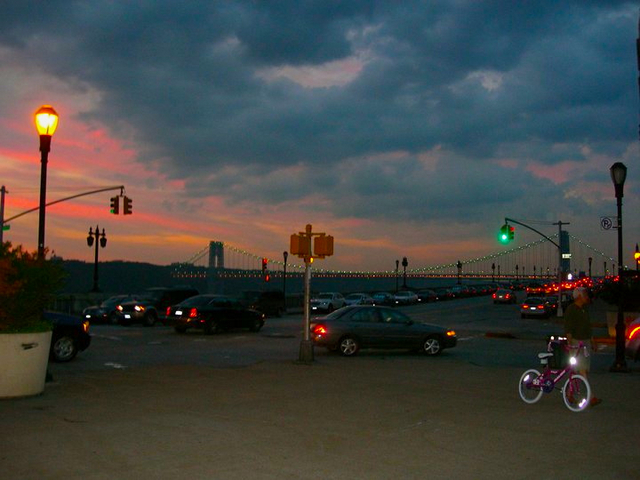
I live nine stories above the water, above a river. I arrived to stay seven years ago just after my father’s death, during the kind of deluge that occurs in Manhattan only at the water’s edge. The streets around here are always desolate, yet densely populated with trees and cars. But as sheets of solid rain splattered onto my windshield that night, I sat waiting for a parking spot and looking into the brightly lit windows of apartment after apartment. I imagined that the circle of buildings around me held a teeming mass of people. I watched the sky change from shades of deep red to grey and then to shades of off-black. The river has no self. It is never blue or green. That night and every night, the water canvasses the moods of the sky for deep or pastel shades, the George Washington Bridge for green light, the artificial street lamps for putrid yellow, and then lays out a palette in globs of motion and color. Several hours later, I parked three inches too close to the only fire hydrant in a two block area and received my first parking ticket.
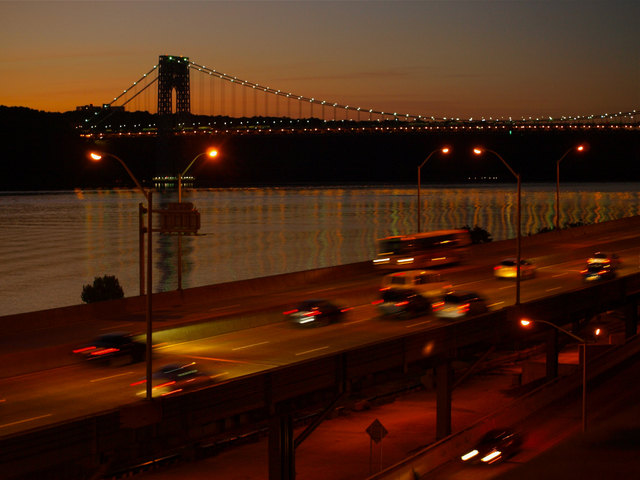
The river has almost convinced me that my apartment exists at the edge of a flat world. My living room is dominated by a large expanse of glass, a window too large to be called a window. But the view is cut short, endless until it abruptly stops beyond the George Washington Bridge and a cluster of low-income housing projects. Here is where the world seems to stop. Boats fall off the edge and disappear into another world that is not-city. Boats come into the city this way too, of course, and I know they are most likely heading to a waste-processing plant about a half mile from my building.
Stretches of the West Side highway race above and alongside the river, which is the most stunning place to drive in northern Manhattan. The Hudson catches the glare from the sky and coats itself in whatever shimmers it can trap from the sun. But you will be constantly reminded of the gross show of engines against the flow of the water. Drive fast enough and you are convinced that the narrow strip of water is motionless, as if boats drag slowly along an inferior liquid ground.
This narrow strip of the Hudson has harbored me, defending against the twin illusions of the city that you are both landlocked and free. The traffic at rush hour teaches me differently. There is no room between bumpers; there is music from other cars, pure cacophony pouring into your car windows even in cold weather; there are children and teenagers who stare with unimpressed faces into mine. Here next to the river, I find that I am not landlocked, yet not free.
My first winter living above the Hudson was one that offered no refuge, not even the double panes of glass that barred me from the elements. The wind was the river’s first omen that cold was coming into the city. The lights in the sky turned to different shades of grey each day and the river pushed forth choppy whitecaps. Living here will send you searching for refuge and you will find it when you realize there is none in a city like Manhattan – save for what the river offers you in smells of salt or the illusion that the humidity coating your skin is a kind of armor.
.
The Dead
My neighbor directly to the south is Trinity Church Cemetery and Mausoleum, a shelter for the dead that expands over 24 acres up rolling hills. The decrepit entrances are not trustworthy except for the most modern, which is a glass door leading to cramped office where you can inquire about obtaining a small plot in this place, Manhattan’s only active cemetery. I did this once, spoke to stout woman with grayish skin about a place to put my father’s urn that now sits in my living room. I am gently informed that only mausoleum spaces are still available at the cost $9,000. The high stacks of marble niches look too much like the low-income housing projects which blacks out the view from my living room window.
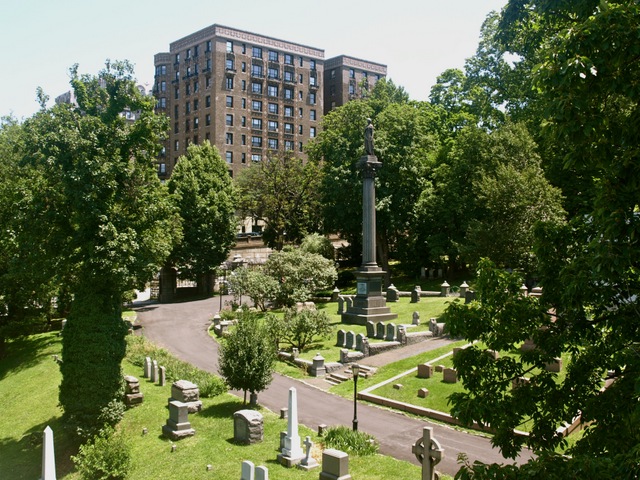
But the grass is greener and softer here than in most parks, and the concrete pathways are cleaner too. Never mind that the dead only share this space with bats, coyotes, and desperate or crazily brave homeless people. The coyotes arrived sometime last summer, most likely making a long trek down train tracks from more forsaken neighborhoods in the northern Bronx where packs of feral dogs and coyotes still roam free. One small female was found shot dead, not far from the grave of Jacob Astor IV, who died in 1912 when the Titanic sunk. Looking around at the building-size statues of angels and Virgin Marys, you may have the odd feeling that a gated community for the dead has been invaded by wildlife, both human and animal. The ground plots have been taken up entirely, and the bones of the former people are a reminder of old New York opulence and the artists who eked out a living nearby. There are a series of Astors, including the Titanic victim; there is Greta Garbo’s lesbian lover, and the son of Charles Dickens. Ralph Ellison also came to rest here, most famous for his novel The Invisible Man. Most of us in upper Manhattan – Harlem and Washington Heights – are still the invisible to likes of the wealthier classes living further south on the island. But here at Trinity, they are all invisible, save for the luxurious statues and monuments erected in their honor. The further uphill you trudge through the winding acres of lush green life, the older the graves become. At the peak of the hill, you will find the oldest carved grave in New York, that of Richard Churcher who lived a mere five years before coming here for a final place of protection. I often wonder how he died, perhaps because my own brother lived only ten years himself. But I cannot imagine leaving my father in one of these claustrophobic mausoleum spaces surrounded by ghosts of opulence and live coyotes. At night I watch the bats fly between the trees like night birds who look down at our dead.
New Yorkers die at a faster rate than most people in the United States: our hearts are ensnared by disease, or our organs by cancer, or we kill ourselves with drugs. Influenza is still a leading killer and probably was the cause of death of many people at rest in Trinity. Although there are nearly 20,000 grave sites buried under the island, they are invisible and long forgotten. You easily forget that the cracks in the concrete are held up and held together not only by earth but by the dead who still vibrate beneath the rhythm of relentless footsteps and tires.
September 11, 2001 was the day of New York City’s largest mass death. Almost 3,000 people vanished, turned from flesh to ash that spread out into the air, the Hudson River, the East River leading to the ocean, and the concrete sidewalks. Manhattan had never experienced such a mass of invisibility and the dead of 9/11 found their final shelter in the same place they lived their lives – the streets, the air, the water. You cannot feel the death at the new Freedom tower, not in the way that it is palpable at Trinity Cemetery. The dead of 9/11 are part of our atmosphere as New Yorkers. During the impossibly slow construction of the Freedom towers, 2000 graves belonging to African slaves were found. The city gave a gentle nod to centuries of invisibility by finding and preserving 419 bodies. But unlike Ralph Ellison and the inhabitants of Trinity, they will never have names.
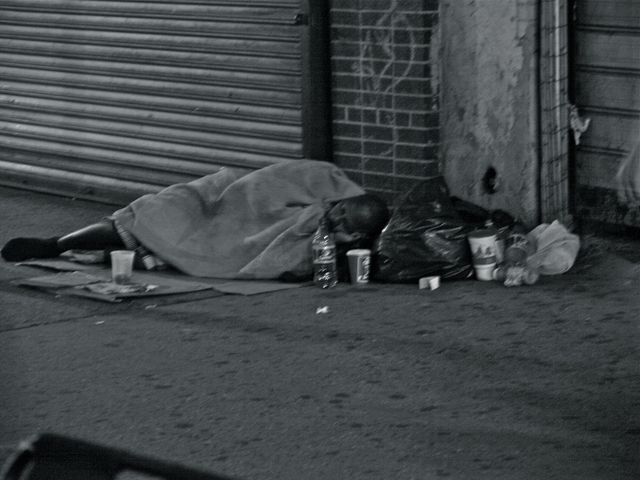
On sleepless nights I wander Manhattan, often passing Trinity and ending up on deserted streets further down the island, streets marked by sleeping homeless. There are shelters but you more likely to die in one than on the street. I do not know where the homeless go if they die in Manhattan. The ones who wander up to Trinity to sleep will not be allowed to stay when they are dead. The doors to the Church of the Intercession are locked six days a week, as most churches are. You are landlocked. You are not free.
.
The Border
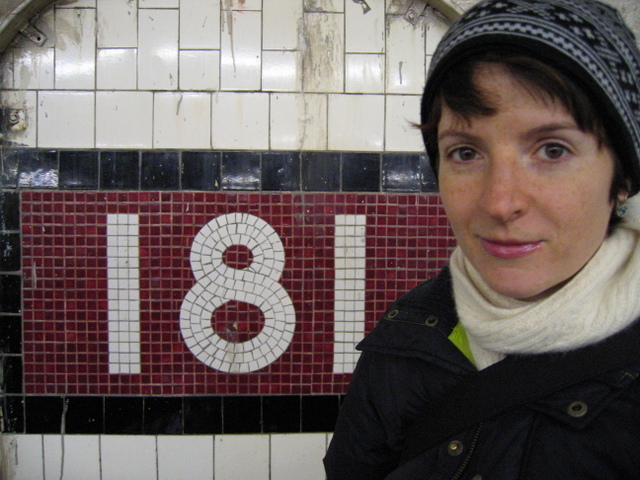
Walk one block east from Riverside Drive and you will find yourself on the border between Washington Heights and Harlem. The boundaries between the two neighborhoods are questionable divisions held in place more by ethnic and racial differences than the lines of a city map. These maps are untrustworthy anyway, victim to the whims of realtors and an ever-growing push towards gentrification. Let’s assume that Trinity Cemetery at 155th street acts as an unofficial divider between a neighborhood that is predominately African-American and a neighborhood dominated by Dominicans and other immigrant Hispanic groups. Most maps insist that Harlem ends somewhere around 153rd st and gives way to Washington Heights, which has been dubbed “Little Dominica” in tones of affection by residents and in tones of trepidation by non-residents. No matter which direction I turn, south toward Harlem or north toward Little Dominica, I find that I am foreigner here with bits of Puerto Rican and Native American and Filipino and German blood filling my veins. Maybe living life in liminal zones is my way of finding shelter.
.
The Heights
Little Dominica is known for its history – the fiercest fighting of the Revolutionary War, which has given way to some of the fiercest gang fights in upper Manhattan; the assassination of Malcolm X, the site of which is now a BBQ Rib & Bar dive; The Cloisters at Fort Tryon Park which is medieval structure hauled here from Europe and rebuilt and now boasts Christian art from the same time period; and of course the endless expanse of the Columbia University medical center, begun in the 1960s and still extending its reach through the area.
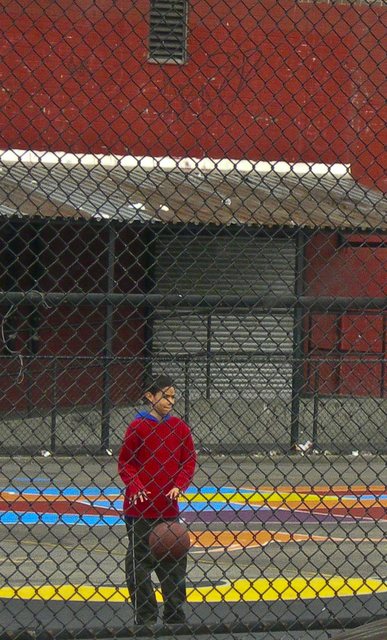
The Heights is called so because we are 265 feet above sea level, the highest in Manhattan. My ears fill and pop as a constant reminder that as I walk the streets, I am growing closer to or farther away from the sea. The abrupt hills are actually miniature mountains. Street steps have been constructed to try to ease the pedestrian exertion, but climbing 130 steps to reach a given street does nothing to offer rest. What it does is strength your legs and maybe your heart, if you are lucky. The alternative is that you avoid walking into the upper reaches of the Heights.
The summer street culture is what holds the residents in a tight grip. Old men sit at tables in front of apartment buildings playing dominoes, but are quick to shield their faces from photographs. So are the boys who collect on street corners selling whatever wares are tucked into their bulging pockets. The hottest days squeeze the oxygen from the air by the smells of illegal street barbecues and marijuana and sweat. We are overrun by children who roam freely as if it is a small town and not an area burning with crime and gang life. Music is ever-present, usually salsa or some rhythm that reminds me of my foreignness in this land. The streets are always crowded, always festive, always dirty, and dotted with reminders of plenty amidst poverty. Roughly 97% of Little Dominica lives below the poverty line. Many are undocumented and receive no help from the government. They avoid photographs for this reason – there is no refuge for them either, no place where “La Migra” is not allowed to hunt and deport. But the stores are not folding to gentrification, and if one closes then another opens and bursts forth with toys for $1 and women’s dresses for $3. You can live here below the poverty line and make your way through crowds of families in bargain stores and emerge with an armful of whatever you were lacking when you entered. There is plenty here even among the poorest.
.
Harlem
My Harlem is a 30-block stretch that I use to get from home to a specific destination and back again. This Harlem is not the historic central area that boasts the Apollo Theatre, not the area where African incense chokes the car fumes, and not the gentrified part that swarms with Caucasian shoppers at newly-opened designer boutiques. My mile and a half of Harlem is almost a forgotten area, mostly residential and peppered with mom & pop businesses. Yet look closely and you can see the decay from the pressure of gentrification pressing forward. I see it daily as each store closes, a “mom” dragging sales tables of vintage soul records and African masks on to the street for 80% clearance sales. I see it again days later when the same store is boarded up and a street kid on the corner informs me that the rent around here for businesses has been hiked to $10,000 a month. He also offers me a dime bag of marijuana. His business may be the only one to survive around here. The African-American families who settled here years ago during the height of the Harlem Renaissance are being dispossessed and moved. Where will they go? There is no asylum or place of protection from the stress of developers who see only land, never bothering to acknowledge the people living on that land or those buried beneath it.
Columbus Circle
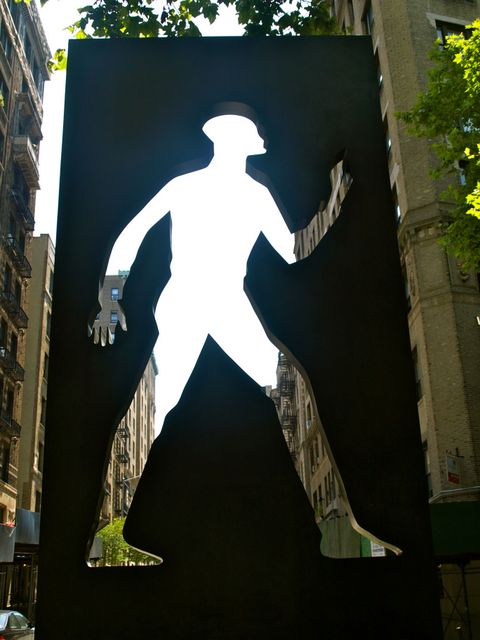
The Upper West Side of Manhattan commences here in a speeding circle of cars that centers around a monument of Christopher Columbus, erected some centuries ago to honor his discovery of the New World. The location is appropriately troubling to me, a place where the Columbus legacy has been mercilessly fulfilled. For a moment, emerging from the subway, you can absorp the immediate beauty of the statues, the fountains, the shopping, the park, bustling streets of New York City that each of us has seen in the movies. But the reality of the space, the buildings that inhabit the circle are a futuristic reflection of what Columbus intended for the New World. The monument and fountains and racing vehicles are eclipsed on the west side of the circle by the world headquarters of the Time Warner Corporation, the NYC studio headquarters of CNN, and Lincoln Center’s Jazz Center. Looming to the north is the Trump International Hotel and Tower (boasting a solid gold escalator inside that terrifies me for its height and its glaring shine) and the headquarters of Gulf and Western Oil. The rank display of corporatism is easy for me to gawk at, such a shockingly conspicuous show of empire even for a native New Yorker. Glamour may be NYC’s most ruthlessly apparent illusion and it is here that you feel it the most. You are landlocked among blinding skyscrapers and the sudden luxuriousness of Central Park that seems to reach endlessly in every direction. Beyond the lush display of opulence around the circle, there is a jarring reminder of nature among concrete repression. You may even abruptly feel free, giddy at the sight of paradox rushing around you in one sweeping move. The glamour and illusions are what holds so many us on this island, one that is barely large enough to contain so many bodies. I suspect that the tourists who arrive daily in packs do not see much beyond the allure of shopping and the sweet green grass across the way.
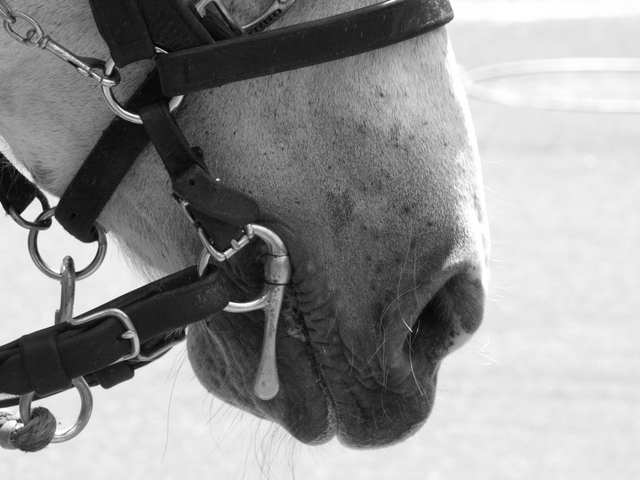
The circle is also one of the major transportation hubs for the city. The circle and the park crash awkwardly only at this moment, are bound in a tight juxtaposition of old tradition and modern movement. Your first impression might be one of strict boundaries: the circle, the park beyond, each bus stop and underground subway station a discrete unit with organized movements. But look at the streets just outside the park and you will find about 68 carriages drawn by horses, not the kind of fierce beast you might see in Victorian Era photos of the city, but rather the kind animal whose ribs rise in an arc from under sallow coats. The kind of horses that NYC allows to work the streets are lame, limping from the weight of their load and uncomforted by the blinders meant to shield them from the terrors of the engines rushing by them. The rank display of cruelty could almost be lost against the gentility of the park and the profusion of wealth. I was not there the day a horse collapsed and died under a heat shroud of 91 degrees, in turn causing a pile-up of cars and busses. But the tourists who rode in that carriage may know more about the savagery beneath the affluence and the persistent repression that is part of living here.
Times Square
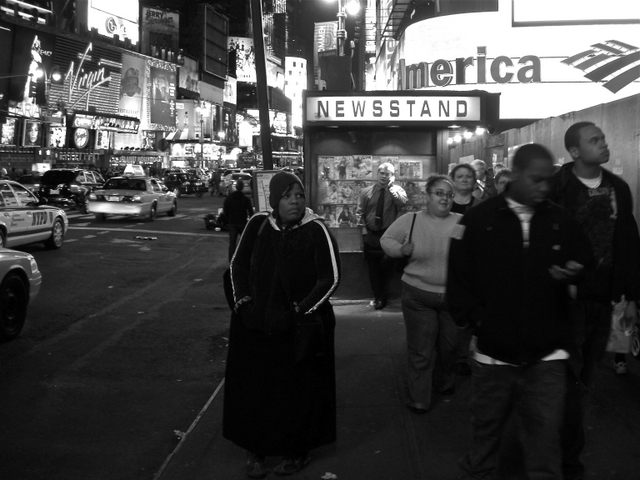
Otherwise known as the crossroads, this roughly seven-block area is paced by 39 million tourists a year. Every light in Times Square went out once, during the northeast blackout of 2003. The darkness must have been majestic. I pace here a lot, either to ward off restless legs and insomnia during winter nights or to find relief from the humidity in the pre-dawn hours of summer mornings. The late nights hours leading to dawn are the dimmest and emptiest here, mostly because the corporate offices like Ernst & Young and Morgan Stanly have closed up. Firms like this hold more space in Times Square than the more appealing corporations like MTV and Toys R US but this is harder to see when all the lights shine equally bright. Keep pacing the tiny area until you notice the most infinitesimal changes, until you become accustomed to the gaze of late night workers leaving through the backdoors of nightclubs and the same faces waiting blocks away to catch the last bus uptown. If you do not cultivate a personal way of seeing Times Square, you risk the vision of a tourist and then there is nothing, no relief for the restlessness and nothing left to notice.
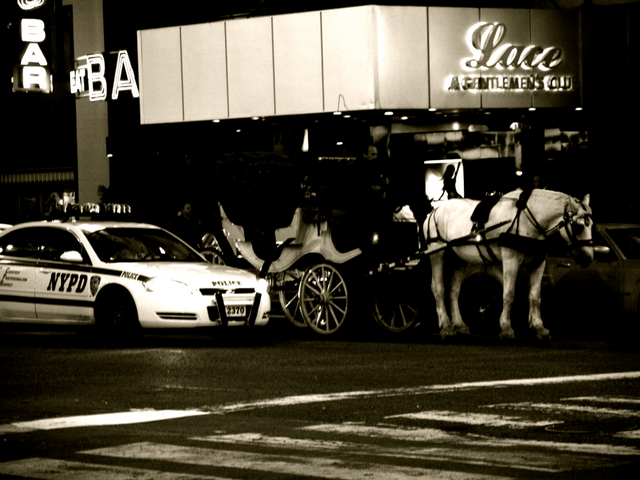
Two a.m. is kind of cut-off point, when the streets become less of a wasteland of overdressed theatre-goers and bright-eyed tourists. The streets become emptier and lights seem dimmer, but empty here does not mean deserted. This is my Times Square, a place where you become aware of every detail around you, the different shades of blinding lights, the rats that chameleon with shadows underfoot, the stretches of concrete that double as cardboard homeless shelters, and the changing faces of child-like prostitutes that lean against subway stops and eat from plastic containers. From about 2am to 5am, the Disney-led gentrification weakens enough for the lights to shine on the reality below it.
Times Square sits near to the center of the city and you cannot smell the river from here, you can only see lights and faces but you can walk until there is nothing left in your limbs except exhaustion that feels like freedom.
Hudson, part 2
The river, after holding me for these seven years, seem to be pushing me along like one of the ice chunks that break up after the end of a winter that brings only ice storms. Last winter was like this, cold but no snow, no blankets of white, just icicles along the windows and the stillness of the river as it froze inches deep. I only went outside a handful of times, I think, kept in by the icy wind that makes my heart feel weak.
But I have found my sanctuary here for so long because of the river and the bridge. Nothing that moves as fast as the water and the traffic above it can make you believe you are trapped on this island. You may be free but you are as pushed in one direction or the other as a floating chunk of ice coming down the river. I have considered moving but cannot think of where to go. The expanse of sky pushes against the edges of the New Jersey and New York skylines and beyond into a world that is not flat.
— Photos & Text by Tiara Winter-Schorr

.
.