Jul 132017
 

“The Black Lace Veil” is one of the stories from Fleur Jaeggy’s collection, I Am the Brother of XX. It was translated from the Italian by Gini Alhadeff.

— Joseph Schreiber

.

My mother had an audience with the Pope. I found this out from a photograph of the Holy Father with her looking at him, wearing a black veil. From that photograph I understood, perceived, in fact clearly saw, that my mother was depressed. Depressed in a definitive way. The smile is sad, the glance, which is trying to be kind, is without hope. Mother was a rather sociable person, elegant, lovely jewelry, a lot of charm, Givenchy, Patou, Lanvin — ​in fact many aesthetic qualities which are not dissimilar to internal ones. In the photograph I noticed for the first time that Mother was all in all a desperate woman — ​or almost desperate. In spite of her little bridge tables. She entertained a great deal, now some of the bridge tables have been left to me and sometimes I hear the calls: sans atout, passe, hearts. Then I ask myself why she went to see the Pope. I am her daughter and would never have thought of going. What made her seek the blessing of the Holy Father? Maybe her despair: she wanted to be blessed. Wearing the dark lace veil, partly obscuring her face that was so sad. There is something frightful in realizing from a photograph that one’s own mother was depressed. Definitively depressed. Or perhaps she only was at that moment. The presence of the Holy Father threw her into such a state of bewilderment that it made her expression unhappy. With no way out. As she desperately tried to smile and the eyes were already in darkness. They are — ​one could say right away — ​extinguished, dead, closed. Yet she was still beautiful. Beauty could not conceal the despair, as the grim veil she wore on her head could not hide her beauty.

Now I’d like to know why she went to see the Holy Father. Did she seek solace? Maybe I was wrong. It was the first impression that made me say that her gaze was desperate. She looked the Holy Father in the eye, with a distant and very direct gaze. She looked him straight in the eye. Even though her gaze was far from cheerful. It was cold and hopeless. She had no hope. Her son was beside her. And he, too, had a sad expression in his eyes. And so her son looked at the Holy Father in the bored manner of a little boy who doesn’t believe in anything. The mother wants to take him to the Pope, an audience for the very few. It is a luxury to be able to see the Holy Father, they say. I don’t know if the word luxury is a suitable one, but it is not common to be received by the Holy Father, so close that one can kiss his ring or bow one’s head or genuflect. Perhaps genuflecting is too much. I don’t know a great deal about ritual behavior toward the Holy Father. But my mother who knows the etiquette and was immediately granted an audience, she must have bowed as she started to bow before destiny. Before a not too favorable destiny that was undermining her life. Her beauty hadn’t altogether faded, there were still flashes of it, which to a careful glance might have been quite fascinating and moving. Her daughter, who does not have the depth of the mother, has always believed in the surface of things. And so in beauty. In appearance. What does she care about what is inside? Inside where? And what is the inside? Anyway the daughter believes more in photographs than in the people portrayed. A photograph might tell more than a person. Perhaps. Naturally perhaps. Always perhaps. No affirmation could lead her to grant total credence to the affirmation itself. So, to return to despair. A theme that is dear to her. What could be better than despair? If one discovers from looking at her in a photograph that a person is desperate, after the first shock a kind of calm sets in. A remission. I had never seen my mother so desperate, I would never have thought she could be desperate. It was we, her daughter and her son, who always thought we were — ​the two of us, he and I — ​desperate. Not Mother. That was our prerogative. Mother does not even know what despair might be, we thought. Well, she deceived us. To put it crudely. The card player, and perhaps a player in life, the woman who for a while protected us, who protected her children — ​and then let them go. Because all that was around her left her. Like a flash of lightning, there is an instant that descends, wounds, and is gone. And leaves an aura of spoliation. All it took was a photograph, the photograph of Mother in the presence of the Holy Father, to convince her daughter that she was desperate. She will continue to repeat that word, because she, the mother, never uttered it. She never uttered a word that concerned her. That concerned any malaise of hers. Any possible malaise of hers.

Even now, though many years have gone by and Mother is no longer here, I’d like to know what made her go to the Pope. Why the audience? And why that look in her eyes. If she felt the desire to see the Pope, and perhaps receive his blessing, why did she have that terribly sad look in her eyes? So much so that her daughter, many years later, was jolted — ​as though her mother were alive at that moment and told her that she’s had enough of life. Sufficit. The daughter was jolted, felt a pang of love for her mother who perhaps had always hidden from her that she was terribly unhappy and let herself be found out in a photograph.

— Fleur Jaeggy, Translated from the Italian by Gini Alhadeff

Published with permission from New Directions Publishing Company.

.
Fleur Jaeggy (1940– ) was born in Zurich, Switzerland and lives in Milano, Italy. In addition to her own work, she has translated the works of Marcel Schwob and Thomas de Quincey into Italian as well as written texts on them and Keats. The London Times Literary Supplement named Jaeggy’s S.S.Proleterka a Best Book of the Year: and her Sweet Days of Discipline won the Premio Bagutta as well as the Premio Speciale Rapallo.

§

Gina Alhadeff is the author of The Sun at Midday and Diary of a Djinn. She translated to great acclaim Patrizia Cavalli’s My Poems Won’t Change the World.

.

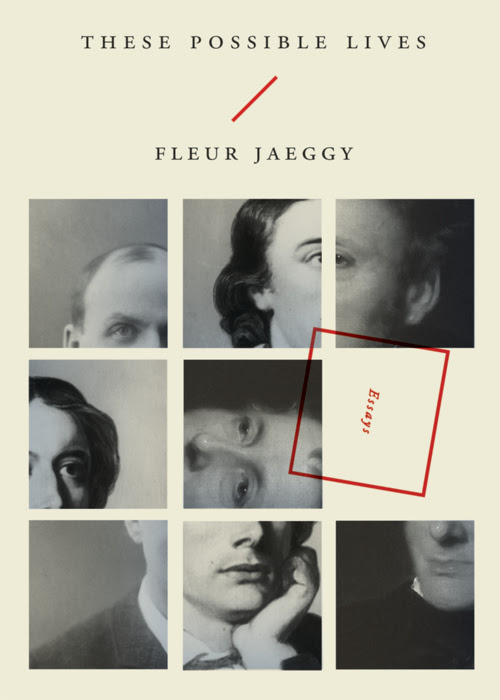
Jul 132017
 

Her new short story collection, I Am the Brother of XX, serves to showcase her exceptional ability to create an atmosphere of brittle, gothic claustrophobia with a contained, simmering intimation of violence that, on occasion, rises to the surface. And the three brief biographical essays that comprise These Possible Lives are a delight. — Joseph Schreiber

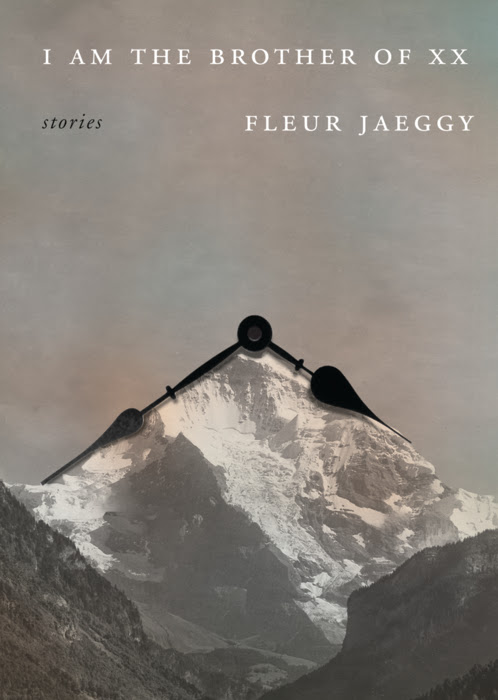
I Am the Brother of XX
Fleur Jaeggy
Translated by Gini Alhadeff
New Directions
128 pages; $14.95

These Possible Lives
Fleur Jaggy
Translated by Minna Zallman Proctor
New Directions
64 pages; $12.95

.
One might argue that Fleur Jaeggy does not write so much as channel language, allowing her words to form imaginary spaces that exist on an altered plane of experience. To read her is to inhabit, for a moment, that space—one that exists in the shadows, one that contains, to borrow an expression from one of her earlier stories, a certain “sacred inertia.” [1] You can almost feel it. There is an unmistakable current of brisk, melancholic foreboding that courses beneath the surface of her prose. The chill can make you shudder, the stark beauty of her terse sentences catch your breath. Atmospheric. Disconcerting. And strangely alluring. It is a rare author who manages to sustain an emotionally intense voice that is at once distinct, abstracted, and tightly restrained. However, anyone who has fallen under the spell of Jaeggy’s fiction will know its undefinable appeal.

Of Italian-speaking Swiss heritage, Jaeggy was born in Zurich in 1940. Raised and educated in Switzerland, she moved to Rome when her studies were complete. There she met Thomas Bernhard and Ingeborg Bachmann. The latter would become an especially close friend. In 1968, she relocated to Milan to work with the famed publishing house, Adelphi Edizioni. She married writer and publisher Roberto Calasso, and established a reputation as a novelist and translator over the following years. But it was her masterful fourth novel, I beati anni del castigo (1989), translated as Sweet Days of Discipline (Tim Parks, 1991), that introduced her to an English speaking audience. Exquisitely spare, this subtly disturbing tale of obsession set in a boarding school in the Swiss Alps, examines themes that continue to resurface in her work: familial dysfunction, emotional detachment, and a preternatural obsession with sadness or, as her narrator so poignantly puts it, the “pleasure of disappointment.”

Subsequent publications, a collection of dark gothic fable-like stories, La paura del cielo (1994) and the autobiographical novel, Proleterka (2001) found their way into English translation as Last Vanities (Tim Parks, 1998) and SS Proleterka (Alistair McEwen, 2003) respectively, but to date, her earlier works remain untranslated. Consequently, the announcement that two new, relatively recent (2015), releases—I Am the Brother of XX, a collection of short stories, and These Possible Lives, a set of three tightly abbreviated literary biographical essays—would be forthcoming from New Directions was received with anticipation and a revived interest in this notoriously elusive author. For the attentive reader, one of the greatest rewards of this renewed attention, is the publication of a rare English language interview in the Summer 2017 issue of TANK Magazine.

Jaeggy is a reserved and reluctant interviewee, but her modest responses are simultaneously generous and mysterious. She is clearly uncomfortable talking about her craft, unwilling perhaps to even acknowledge her role in the creative process as more than a passive one. She describes her precious manual typewriter—a swamp green Hermes—as the generative source of the letters and words that appear on the page. “I believe you can almost write without me,” she says. “Once I have finished a book, it doesn’t count any more; I don’t want anything to do with it any more.” As to the works she keeps close at hand, she admits to reading little new literature. Beyond a fondness for W.G. Sebald and, of course, her friend Ingeborg Bachmann’s novel Malina, her reading tends to the mystical:

. . .Francis of Assisi and Angela di Foligno, who was born in 1248 in Tuscany and left everything behind. The saints are truly wonderful writers. But more than anyone else I read Meister Eckhart. I almost know him by heart. He is always close to my Hermes. One should read pretty much everything by him. He was for renunciation.

This admission, if surprising given the dark undertones of so much of Jaeggy’s writing, goes a long way towards explaining the eerie, intangible and otherworldly beauty of her work.

Her new short story collection, I Am the Brother of XX, serves to showcase her exceptional ability to create an atmosphere of brittle, gothic claustrophobia with a contained, simmering intimation of violence that, on occasion, rises to the surface. With twenty-one stories in 128 pages, some of the pieces are no more than two or three pages long—exercises in tightly condensed sentiment. There are, however, a number of tales that have a more reflective, nostalgic, and personal tone. Some of these even feature appearances from real-life friends and acquaintances like Ingeborg Bachmann, Joseph Brodsky, Italo Calvino, and Oliver Sacks. The translation by Gini Alhadeff, captures well the crisp poetry of her prose.

The title story, easily one of the stand-out pieces, is a finely executed exploration of a territory Jaeggy visits frequently—the uncanny landscape of dysfunctional family dynamics. The narrator, a melancholic young man, obsesses about the strange nature of his relationship with his older sister, whom he refers to as XX. He is convinced that she has long been spying on him, determined to write his future and ultimately, write him out of his own life. With a pensive, melodramatic spirit, fueled, in part, by his mother’s early regimen of dosing her children with sleeping pills, the narrator’s distrust of his sister’s intent grows, especially after their mother dies and she makes his future her concern:

She, my sister XX, leaves the room. And I am alone with my books, the desk, and I find myself, the brother of the voice that has just spoken, having a great urge to hang myself somewhere. Coming to my own aid, I think again of solitude, of the solitude that surrounds my existence. And that thought, always so lugubrious, distressing, now, after the importance of succeeding in life, becomes almost light. Words have a weight. Importance is weightier than solitude. Though I know that solitude is harsher. But the importance of succeeding in life is a noose. It’s nothing but a noose.

So articulate and careful in his account, it is impossible to tell if his paranoia is justified, or part of a deeply imbedded neurosis, and if his gradual unravelling is allegorical or real. Either way, in this story, as in much of Jaeggy’s fiction, her characters often demonstrate an emotional detachment and indifference to pain, in themselves or others, that makes them strangely tragic and engaging. It is not unlike catching a sideways glimpse of oneself in a darkened mirror.

“The Visitor,” another particularly impressive, beautifully rendered piece, is a fantastical little tale featuring one of her favourite mystics, Angela di Foligno. On an undated day, Angela, patron saint of those afflicted by sexual temptation, makes an appearance at the Archaeological Museum of Naples. As she passes through the halls, the inanimate inhabitants quiver and come to life, slipping off their pedestals and emerging from the surface of the frescoes.

The Nymphs step out of their representations, step down from the painted garden decorating the wall. The wall closes in on itself like a sepulchre. They are nearly all minute, damp, rapacious. They are still cloaked—Angela knows this—in a somber voluptuousness and a wild inebriation with which she identifies. The Nymphs give the impression that they listen to dreams. Not entirely awake, like those returning from an apparent death, they blindly contemplated the halls of the museum, without daring to move. The light wounded them. A pallid terror flutters across their eyelids. There is silence. Only the sound of shards falling was heard, colored shards, as they have left their mooring. A silence of dust.

Released, the Nymphs panic, desperate to return to the security of mindless existence in painted terra-cotta. The drama of their brief taste of freedom and desired renunciation returns them to a state of dark happiness as the museum resumes its formerly static existence.

Short story collections can present particular challenges. It can be difficult to maintain a consistent level of quality while avoiding a sameness that blurs the distinction between the stories. The twenty-one pieces here cover a range of styles, and although definite themes recur, Jaeggy’s inimitable style is such that there are bound to be passages that redeem even the weakest offerings. But it must be said that a few of the pieces do feel more like writing exercises than finished works, even for a writer who is well known for her suspended imagery and willingness to leave much unsaid. By contrast, the few more conventional gothic horror stories—“Agnes,” “The Heir,” and “The Aviary”—also seem slightly less satisfying because they are a little too neat, the protagonists too obviously sociopathological. The language and mood is still classic Jaeggy (“A modest gray afternoon. Vitreous.”), but it could be argued that there is something more unsettling when her characters’ neuroses are less clearly defined, more ambivalent, a little closer to home.

Entirely different in scale and intent, the three brief biographical essays that comprise These Possible Lives are a delight. Here she enters into the worlds of three writers she has either translated or written about—Thomas De Quincey, John Keats, and Marcel Schwob—to create ultra-compressed, finely detailed portraits that capture the essentials of their lives, and the details of their deaths, from her own unique vantage point. Her prose, translated here by Minna Zallman Proctor, is precise and poetic, but with a hyper-focused, intentional quality that is less apparent in her fictional works. Like hand-painted miniatures, she pays attention to the appearance and style of each of her subjects, while filling in the background with curious diversions that allow for an intensely personal, unforgettable encounter.

With each of her subjects, Jaeggy’s concern is with choice elements of life experience—background, education, inspiration, adventure—as forces driving their creative energy, rather than with the works they produced. One might say that she imagines each writer as a character in his own life and death, to craft an essay that assumes a space somewhere between biography and literary folk legend. Her intention is to glance into their hearts. With Thomas De Quincey she introduces him as an imaginative, visionary child, follows him through his early experiments with laudanum, diverting her attention briefly to catalogue his literary contemporaries’ obsessions with the quality of their dreams, and then proceeds to chronicle his growing eccentricity and eventual descent (or ascent?) to a state of madness:

He was sometimes overcome with sleepiness in his studio and dropped, pulling the candles down with him. Ash reliefs adorned his manuscripts. When the flames got too high he’d run to block the door, afraid someone would burst in and throw water on his papers. He put out fires with his robe, or the rug—a thin cleric wrapped words in smoke, chains, links, captivity, bondage. When invited to dinner, he promised attendance, holding forth on the subject of the enchantments of punctuality. At the appointed time, however, he was elsewhere. Perhaps he was studying pages piled up like bales of hay in one of the many shelters that he never remembered having rented. Paper storage, fragments of delirium eaten away by dust.

The John Keats essay begins with a reflection on the barbaric nature of the children’s toys popular in the early years of the nineteenth century and ends with an extended account of the young poet’s tragically romantic death. This is the longest piece, while the shortest is a brilliant, dizzying distillation of the impressive lineage, unconventional life and exotic adventures of Marcel Schwob. Remarkably, each one of these perfect little portraits leaves one eager to explore further the writer’s life and work. And that is quite an accomplishment for a book that is only 64 pages long. But then, this is the meticulous magic one comes to expect from Fleur Jaeggy.

— Joseph Schreiber

N5

Joseph Schreiber is a writer and photographer living in Calgary. He maintains a book blog called Rough Ghosts. He is an editor at The Scofield. His writing has also been published at 3:AM, Minor Literature[s], The Quarterly Conversation, and Literary Hub. He tweets @roughghosts


Footnotes    (↵ returns to text)

  1. Fleur Jaeggy, “The Wife,” in Last Vanities, trans. Tim Parks (New York: New Directions, 1998), 24
May 172017
 

When asked if Compass is a political novel, Énard replied affirmatively, but said its politics are unifying, to show our dependence on each other for growth and to emphasize the strength in great diversity. —Frank Richardson
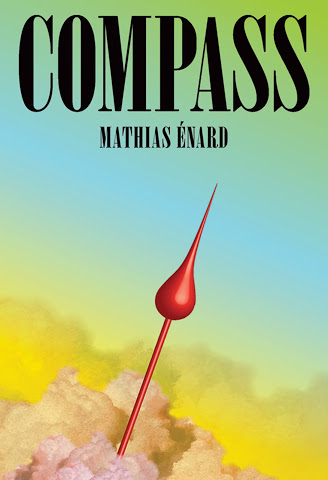
Compass
Mathias Énard
Translated by Charlotte Mandell
New Directions, 2017
$27.95, 448 pages

.
On a drizzly December night in Vienna, a solitary man stares out his window, his agonized reflection another self with whom he feels interchangeable, as indistinct as the water molecules within a droplet condensing on the glass. The window vibrates with Shahram Nazeri singing a poem by Rumi, and the shadow self becomes interlocutor in an internal monologue that will last through a sleepless night—a night of remembrance, regrets, and desire—a night in which a dying man considers his past and present.

But Compass (Boussole)—Mathias Énard’s ninth published work and third novel to be translated into English by Charlotte Mandell; winner of the 2015 Prix Goncourt and longlisted for the 2017 Man Booker International Prize—is not only a novel of memory and identity, it is a novel that celebrates centuries of cross-cultural exchange between the East and West: a vital novel, arriving when we need desperately to be reminded of the strength in diversity, of the reason in embracing the other.

Born in 1972 in Niort, France, Mathias Énard studied Arabic and Persian languages at INALCO, has traveled widely in the Middle East, and is now a professor of Arabic at the University of Barcelona. His multi-award-winning 2008 novel Zone (reviewed by Numéro Cinq’s Mary Stein), a stream of consciousness meditation on the cycles of war, finds a perfect companion in Compass, where the interconnected lives of fictional and historical musicians, writers, explorers, and asylum seekers are woven in a great tapestry of thought, a balm for one man’s soul and an appeal for peace to all.

.

The Blind Owl

The man at the window, Franz Ritter, a forty-something professor of musicology living alone in Vienna, should be reviewing a student’s dissertation, or better yet, sleeping. But this will not be a night for sleep, even if he didn’t suffer from chronic insomnia, a symptom of his undiagnosed disease. We are plunged directly into the stream of Ritter’s consciousness and his first-person narration in a page-length sentence. The exhausted professor has received a disturbing communique from his friend Sarah, a scholar of oriental literature and a specialist, like him, on Middle Eastern culture.

Sarah, who has a “passion for monstrosities” and a “penchant for the lower depths of the soul,” has sent him an old-fashioned offprint of her most recent academic article, an article whose frightening subject Franz will spend the rest of the night contemplating. For Sarah, writing from the distant jungles of Sarawak, Malaysia, isn’t just another “orientalist” colleague, she is the unrequited love of his life.

Franz gives himself up to thinking about Sarah, whose guiding philosophy is that “there is no such thing as chance, everything is connected.” He struggles to find some significance in the article which arrived without an enclosed letter. The Sarawak article sends him to sifting through every trace of her he owns: books, photographs, academic articles, letters—all become fuel for his fervent reconstruction of his memory of her. Excerpts from this archive, printed in different fonts, are sometimes accompanied by photographs, reminiscent of the novels of W. G. Sebald.

The first excerpt from Franz’s memorabilia comes from Sarah’s doctoral thesis, Visions of the Other Between East and West. Her thesis, significantly, concerns Sadegh Hedayat and his novel The Blind Owl—a novel that inspired Compass and with which it shares many parallels. Apropos his unrequited feelings for Sarah, Franz begins reading her thesis at the opening sentence of The Blind Owl: “There are certain wounds in life that, like leprosy, eat away at the soul in solitude and diminish it.” Like Hedayat’s narrator, Ritter is ill, feverish, obsessed—a man whose only interlocutor is his own shadow. Ritter isn’t writing a story as a conscious attempt to arrive at some general conclusion, but we follow his internal monologue and thus learn his history with Sarah, his desires, his regrets, and, along the way, a vast history chronicling the interconnectedness of Eastern and Western culture.

Franz’s sleepless night takes place on December 1, 2014, in Vienna, the apotheosis of European music cities and Hugo von Hofmannsthal’s “gateway to the East.” Although the novel’s chronological time follows the course of the night and Franz never leaves his apartment, his a-chronological reconstruction of his past with Sarah ranges from their first meeting seventeen years prior in Hainfeld, Austria, to other locations and time points throughout their shared history. The cities of Paris, Vienna, Damascus, Aleppo, Palmyra, Tehran, Istanbul, and others, serve as nexuses in the web of Ritter’s recollection.

Throughout the 451-page novel, Énard uses paragraphing and chapter breaks to indicate interruptions in Ritter’s thought. Ritter periodically notes the hour, and nine of these times are labeled chapter headings: 11:10 p.m., 12:55 a.m., etc. Furthermore, as Ritter’s meditations weave through his subjects, to entertain himself he composes a whimsical, imaginary book he titles On the Divers forms of Lunacie in the Orient with subdivisions such as “Orientalists in Love” and “Encyclopedia of the Decapitated.” These pseudo-chapters serve as a second set of breaks (including a table of contents listing them); however, these divisions are only part of the stream of his thoughts and always arrive mid-sentence, although they do provide opportunities for Énard to shift the focus of Ritter’s contemplations.

Ritter displays a prodigious erudition as his thoughts glide from one subject to the next. Nevertheless, he is modest to the point of self-deprecation and disparages academics (often hilariously). Whether he’s feeling nostalgic, contemplative, or even despairing, Ritter’s tone is engaging, especially when uses the first-person plural: “let’s try to breathe deeply, let our thoughts slide into an immense white space . . . let’s mimic death before it comes.” We share his space through his thoughts; we turn the pillow with him, listen to his neighbor’s dog, read Sarah’s letters, and look at her photographs.

One of the greatest strengths of the novel is the seamlessness with which Énard effects shifting between use of the present and past tense: the present tense for when Ritter describes his puttering around the apartment and current thoughts; and the past tense which Ritter uses to narrate his recollections. Adding to the verisimilitude of a man talking to himself, his interior monologue also includes rhetorical questions that range from the mundane (“Where did I put my glasses?”) to the philosophical (“What is universal?”). Naturally, these questions often serve as segues for new associations.

The narrative is necessarily discursive in so far as the story is Ritter’s mind unleashed. But rather than an unhinged, amateur historian like the narrator of Zone, here Énard gives us a scholar with an encyclopedic knowledge of music, literature, and history. In Zone, an endless run-on sentence mimics the protagonist’s disturbed mind, and as such complements his identity, i.e. form follows function. In Compass, the style Énard chose to depict Ritter’s consciousness serves greater goals; he wants to mimic consciousness but also create a platform for illustrating the cross-cultural influences of East and West. The interior monologue of a scholar is as appropriate for the content of Compass as the interior monologue of a war criminal was for Zone.

Strict autonomous monologue—exemplified by the “Penelope” chapter of Joyce’s Ulysses—presents thought undisrupted by characters reporting their actions using action verbs and the first-person pronoun. Énard never pushes his style to such an extreme, and Ritter’s internal monologue departs from a high-mimetic mode in several ways, including Énard’s use of (mostly) conventional punctuation, Ritter declaring his perceptions and reporting past events with dialogue, and the inclusion of objective, external documents (e.g. Sarah’s texts).

Despite his insomnia, Ritter does give indications that he falls asleep, or at least enters a semi-sleep borderland where dream mingles with his conscious memory. According to Ritter’s mental state, Énard modulates the narrative distance, using more conventional syntax during Ritter’s lucid moments and fluid, run-on sentences for those times when Ritter is either in a semi-dream state or emotionally disturbed (excited or angry). The shifting between these narrative modes, especially as Ritter’s subjective recollection is shaped by his perception of objective documentation, is a tour-de-force in the representation of consciousness.

Sadegh Hedayat, 1951

Alterity

Throughout the night, Ritter seeks refuge in music[1] and each selection triggers a new set of associations. After all, he is an expert in the history of music, and so it is not surprising that whether he hears Berlioz or Beethoven, he will know their (and everyone else’s) stories. He knows that Mozart used a Turkish march for his Piano Sonata No. 11; he knows that Goethe’s West–östlicher Divan was inspired by the poetry of Hafez; and he knows that Schubert, Mendelssohn, and Strauss (among others) composed music for Goethe’s poems.

Énard favors run-on sentences whenever Ritter becomes indignant, as he does when he thinks of Félicien David, whom he describes as the “foremost Orientalist musician, forgotten like all those who have devoted themselves to body and soul to the ties between East and West” (paralleling how Ritter sees himself):

I’ve shown that the revolution in music in the nineteenth and twentieth centuries owed everything to the Orient, that it was not a matter of “exotic procedures,” as was thought before, this exoticism had a meaning, that it made external elements, alterity, enter, it was a large movement, and gathered together among others, Mozart, Beethoven, Schubert, Liszt, Berlioz, Bizet, Rimsky-Korsakov, Debussy, Bartók, Hindemith, Schönberg, Szymanowski, hundreds of composers throughout all of Europe, over all of Europe the wind of alterity blows, all these great men use what comes to them from the Other to modify the Self . . .

Alterity, otherness, is a concept Énard introduces conceptually on the first page with Franz confronting his reflection in the rain-soaked window, and a few pages later, specifically, in the excerpt from Sarah’s thesis. The relationship between oneself and the other—the central theme of the novel—emerges repeatedly though the patterns of interconnected musicians and writers, through the histories of Franz and Sarah, and through Sarah’s articles and Franz’s preternatural memory. Énard continually circles back to this concept, giving textual realization to Sarah’s philosophy of interconnectedness.

Occasionally there is a storm of references and Ritter will meditate on a dozen or more historical characters in the span of a page. For example, on a single page we learn of Joseph von Hammer-Purgstall’s attending a soiree in Vienna, hosted by Antoine and Thérèse Apponyi—friends of Chopin, Liszt, Sand, Balzac, Hugo, and Lamartine—at which Beethoven plays as Europe celebrates peace after the exile of Napoleon, whose army stormed the Orient beyond the Balkans:

Knowledge rushes behind the soldiers and the merchants, into Egypt, India, China; texts translated from Arabic and Persian begin to invade Europe, Goethe the great oak started the race; long before Hugo’s Les Orientales, at the very time Chateaubriand was inventing travel literature with his Itinerary: From Paris to Jerusalem, as Beethoven is playing that night for the little Italian countess married to a Hungarian surrounded by the finest costumes in Vienna, the immense Goethe is putting the final touches on his West-östlicher Divan, directly inspired by the translation of Hafez that Hammer-Purgstall published . . .

Such barrages of names and works are not the norm, and Ritter’s associations usually move at a less frenzied pace. But it is these associations that make the novel more than just a catalogue of facts. The philosophical and moral foundation of the novel—specifically articulated through Sarah’s guiding mantra—is that everything is connected in a meaningful way; that without the one, you would not have the other. Énard presents Compass as a metaphor itself—the story as a compass with which to get our bearings, and if the needle seems to spin at times, it should only serve as further reminder that regardless of the direction in which we look, everything and everyone is connected.

One the many pleasures in reading the novel is discovering (or rediscovering) new writers and musicians. Ritter’s description of the premiere of Félicien David’s symphony Le Désert, for example, traces its immediate influence:

The desert invades Paris—“by unanimous opinion, it was the most beautiful storm music had ever produced, no maestro had ever gone so far,” Théophile Gautier writes in La Presse, describing the storm assailing the caravan in the desert; it’s also the premiere of the “Danse des almées,” the Dance of the Almahs, an erotic motif whose subsequent fortune we know, and surprise of surprises, the first “Chant du muezzin,” the first Muslim call to prayer that ever sounded in Paris: “It’s at that morning hour we hear the voice of the muezzin,” Berlioz writes in Le Journal des débats on 15 December, “David limited himself here, not to the role of imitator, but to that of simple arranger; he erased himself completely to introduce to us, in its strange nudity and even in the Arabic language, the bizarre chant of the muezzin . . .”

Comparisons of Compass with The Thousand and One Nights and with Proust (and Ritter thinks about both) are not only inevitable, but necessary. And some historical figures you might assume should be present—Khayyam, Rumi, T. E. Lawrence—all have their place. But Énard excels in his revelation of the unexpected: musicians like Félicien David and his student Francisco Salvador-Daniel, the influential diplomat and translator Joseph von Hammer-Purgstall, or the journalist and explorer Annemarie Schwarzenbach (one of Sarah’s heroes and whom her character parallels).

Raymond Bonheur, Félicien David, c. 1835

Where East Meets West

When Franz opens Sarah’s thesis at the novel’s beginning, we hear in Sarah’s voice what could serve as a prologue for Compass:

we propose to explore this crevice, to go look inside the cleft, to enter the drunkenness of those men and women who have wavered too much in alterity; we are going to take the little man by the hand to go down and observe the gnawing wounds, the drugs, the elsewheres, and explore this between-space, this bardo, this barzakh, the world between worlds into which artists and travelers fall.

In Zone, Énard used a train trip for his frame story to explore history, much as W. G. Sebald used a walking tour of England or Claudio Magris[2] a boat ride down the Danube. Here, Franz’s delving through his collection of Sarah’s writings is the framework for Énard’s excursions into the links between East and West. These authors all share an exceptional talent for storytelling and revealing, with a poet’s voice, the history of people and place.

While Compass is not plot-driven in a conventional sense, Franz’s retelling of his relationship with Sarah is a compelling narrative, complete with its own mysteries: Why is he so ashamed? Do they have a sexual relationship? What is the nature of Sarah’s enigmatic Sarawak article? Considering Franz’s discursiveness, these questions are like a Javier Marías mystery, namely it’s about the journey, not the destination, although the destination will unify and underscore the novel’s intricate image patterns.

Sarah is Franz’s idée fixe, his emotional compass—she gives him direction. How ironic then, that she gifts him an actual compass, a reproduction of one owned by Beethoven, but with a flaw—it’s designed to point east. Metaphorically, Franz is to Sarah as West is to East. He is marooned in the west, in Vienna, famous as a central hub for the Orient Express, while Sarah recedes ever farther to the east, to India and Malaysia. The name “Ritter” is German for “knight,” and Énard conceived of a medieval romance for the two. Franz’s quest is for Sarah, his unreachable love; hers is for “a long road to the East . . . ever further towards the Orient in search of something indefinable.” When he remembers their time in Aleppo—a painful memory that fuels his feelings of shame—he thinks:

Time has reasserted its power over the Sissi House; the Baron Hotel is still standing, its shutters closed in a deep sleep, waiting for the throat-slitters of the Islamic State to make it their headquarters, transform it into a prison, a fortress, or else blow it up: they’ll blow up my shame and its ever-burning memory, along with the memory of so many travelers, dust will settle again over Annemarie, over T. E. Lawrence, over Agatha Christie, over Sarah’s room, over the wide hallway (geometrically patterned tiles, walls painted in high-gloss cream); the high ceilings will collapse onto the landing where two great cedar chests rested, coffins of nostalgia with their funereal plaques, “London-Baghdad in 8 Days by Simplon Orient Express and Taurus Express,” the debris will swallow up the pompous staircase I climbed on a sudden impulse fifteen minutes after Sarah decided to go to bed around midnight: I can see myself knocking on her door, a double wooden door with yellowing paint, my fingers right next to the three metal numbers, with anxiety, determination, hope, blindness, the tightness in the chest of one who is undertaking a great endeavor, who wants to find the being guessed at under a blanket in Palmyra in an actual bed and pursue, hang on, bury himself in oblivion, in the saturation of the senses, so that tenderness will chase away melancholy and greedy exploration of the other opens the ramparts of the self.

This passage shows how Ritter’s thoughts flow from current events to historical figures to the specific memory of his anxious sexual overture; the refrain of the relationship between the self and the other frames the memory. The Baron Hotel is now a refugee shelter and the Zenobia Cham Palace Hotel in Palmyra (another significant location of the novel) and the nearby 2,000-year-old Temple of Bel, once viewable from its terrace, have been destroyed.

§

Porochista Khakpour writes in her introduction to The Blind Owl, “we are taught to read a novel all over again—in its pages there exists a collection of codes, variants, repetitions, cycles . . . .” Such is the case with Compass. As dawn approaches, Franz reads an account he wrote of his and Sarah’s time in Tehran and the story of Sarah’s thesis advisor, Morgan. Morgan’s story is also a tale of unrequited love and serves as a mirror for Franz. Franz describes the process of rereading himself as a strange sensation, and he is “attracted and repulsed by this former self as by another.” He concludes that “Being exists always in this distance, somewhere between an unfathomable self and the other in oneself.” As a unifying dual concept for the novel, alterity means not only seeking an understanding of others, but of the other in ourselves.

East and West are words of convention and it seems archaic today to speak of an Orient and an Occident. Besides, every country has its own idea of “east.” Of course, such divisive denominations persist, somewhat out of convenience perhaps, but surely also from our natural tendency to separate ourselves into families, groups, tribes, and nations. When asked if Compass is a political novel, Énard replied affirmatively (WDR), but said its politics are unifying, to show our dependence on each other for growth and to emphasize the strength in great diversity.

At his lowest, Ritter despairs of the human condition: “The human species isn’t doing its best these days,” now when the “stench of stupidity and sadness” are omnipresent. But, when have we ever done our best? During the Renaissance? The Enlightenment? We’ve always burned people alive, beheaded them, gassed them, and Énard doesn’t fail to remind us. Ritter’s despondency notwithstanding, the novel offers the opposite message: that cultural diversity stimulates great art and music and literature; and that, despite our exceptional talent for butchering one another, we also help one another, and we learn from one another.

Compass is dedicated to the people of Syria.

—Frank Richardson

N5
Frank Richardson lives in Houston and received his MFA in Fiction from Vermont College of Fine Arts. His poetry has appeared in Black Heart Magazine, The Montucky Review, and Do Not Look At The Sun.
 

Footnotes    (↵ returns to text)

  1. Compass is a music-lover’s delight with over forty references to specific works. Fitzcarraldo Editions assembled a playlist available here: Compass playlist.
  2. ]Franz and Sarah argue about the “Austro-centrism” of Danube.
May 142017
 

Everyone knows the best conversations come on long walks, where speech naturally matches pace, and where silences are almost always comfortable. Walking was thus the ideal way for Seelig to draw out the reticent and mistrustful Walser. —Dorian Stuber

Carl Seelig
Walks with Robert Walser
Translated by Anne Posten
New Directions, 2017
$15.95; 127 pages

.
For years readers seemed regularly to be rediscovering the work of the idiosyncratic Swiss modernist writer Robert Walser (1878—1956). To be sure, Walser had always had his partisans—readers who delighted in the syntactical and tonal shifts of his quicksilver and devious prose. Already in 1929, for example, the cultural critic Walter Benjamin made Walser the subject of a perceptive and still influential essay. More recently, W. G. Sebald included a lyrical meditation on Walser in his collection of linked essays, A Place in the Country. Yet Walser remained relatively unknown. Even though the great Austrian writer Robert Musil once described Kafka as “a special writer of the Walser type,” Kafka not Walser became a literary and cultural adjective.

In the last decade, however, Walser has become a fixture, not least in the English-speaking cultural world. (This is a turn Walser himself, who never travelled further than Germany in his whole life, and who wondered, “Why should writers travel, as long as they have imagination?” could surely never have anticipated.) Yet I don’t think it’s right to say Walser is now canonical. Something more interesting has happened to him. He inspires creative homage rather than dutiful respect. His most ardent admirers aren’t academics but rather contemporary filmmakers, visual artists, and of course writers. This resurgence has been made possible by the dedication of translators like Damion Searls, Tom Whalen, and above all, Susan Bernofsky, who have made more of Walser’s work available in English than ever before.

But perhaps nothing demonstrates Walser’s unlikely ascent more than this edition of Carl Seelig’s Walks with Robert Walser, first published in 1957 and now translated into English by Anne Posten. English-speaking audiences are getting not just Walser’s own books but also books about him. And this book is definitely worth it. To use a word much favoured by Walser himself, it’s delightful. In it, Seelig resurrects the nearly forgotten Walser and lovingly shows him in all his contradictory but mostly charming moods.

Born into a wealthy family, Seelig was a writer, editor, publisher, and patron to writers across the German-speaking world. His correspondents included Joseph Roth and Kafka’s close friend Max Brod. In 1949 he helped Albert Einstein compile a best-selling autobiographical volume.

Undoubtedly, however, his greatest legacy is his friendship with Walser. Seelig, who became Walser’s literary executor, orchestrated the first Walser rediscovery: the current revival wouldn’t have been possible without Seelig’s attention to the man and his work.

Seelig first corresponded with Walser in 1922. But they didn’t meet until 1936. In the intervening years, Walser had been admitted to the psychiatric clinic Waldau near Bern and then transferred to a sanatorium in the Appenzell. He had written nothing since entering Waldau. Seelig, who “felt the need to do something for his work and for him personally,” arranged with the head doctor to be able to go for a walk with Walser.

Over the next twenty years, until the writer’s death on Christmas Day in 1956, Seelig and Walser met several times a year to go for extensive day-long rambles across eastern Switzerland. Walks with Robert Walser records their itineraries, their conversations and, indelibly, their meals. Walking in Switzerland, then as now, is a civilized affair: even on the remotest mountaintop a refreshing inn or a café awaits.

Walser had always been a passionate walker, as he described in his brilliant autobiographical novella The Walk (1913). In the 1920s, as his mental health frayed and his writing began to dry up, Walser ever more desperately sought solace in walking. He once made it from Bern to Geneva in a single night without stopping, and, another time, again in the middle of the night, from Bern to the top of a mountain in the Bernese Oberland, where, as he later told Seelig, he “blithely devoured a piece of bread and a can of sardines.”

Walking was thus the ideal way for Seelig to draw out the reticent and mistrustful Walser. Everyone knows the best conversations come on long walks, where speech naturally matches pace, and where silences are almost always comfortable. In his description of their first walk, Seelig called silence “the narrow path on which we approach[ed] each other.”

Seelig seems to have been a true mensch: gentle, kindly, and unassuming. We never see him make demands of Walser or expect anything in return for his interest other than the pleasure of the older man’s company. Seelig’s literary talents seem to have been fairly modest, but in Walks with Robert Walser he wisely sticks to a straightforward style and, as his title suggests, focuses his attention firmly on his companion rather than himself.

For the most part Seelig lets Walser be himself, though he can’t help but occasionally prod the older man to resume writing, suggesting for example that the asylum would surely make great material for a novel. (Walser dryly responds, “I should hardly think so.”) Later he asks again: if it could be arranged for Walser to leave the asylum, would he start writing again? Walser is categorically and characteristically evasive: “There is only one thing to do with this question: not answer it.”

Over and over, Walser declares himself satisfied with his life: “In the asylum I have the quiet I need… It suits me now to disappear, and inconspicuously as possible.” He rejects Seelig’s proposal to arrange for Walser to have a room to himself: “ I wish to live with the people and to disappear with them. That is the proper thing for me.” He takes seriously the work asked of him in the asylum—sorting lentils and gluing together paper bags, among other menial tasks—and becomes grumpy when it is interrupted by anything other than the chance to go walking. He seems reasonable, interested in the world, eminently sane.

Robert Walser, c. 1898

Yet he is also withdrawn, sometimes moody, unresponsive to the news of the deaths of his brother Karl and sister Lisa, the siblings he was closest to. He vividly describes the tribulations that led him to be institutionalized: “During my last years in Bern I was plagued by wild dreams—thunder, shouting, a choking in my throat, hallucinatory voices—so that I often woke screaming.” And when Seelig asserts Walser’s literary importance, the writer becomes so agitated—“Quiet, quiet! How can you say something like that! Do you really think I believe your society lies?”—that Seelig has quite a job of it to soothe him.

Seelig has more success getting Walser to talk about what he has written than anything he might write in the future. Walser proves a shrewd, though sometimes harsh reader of his own work: “That is the error of my novels. They are too whimsical and too reflexive, their composition often sloppy.” He describes his writing process, explaining he couldn’t write to commissions: “Everything must simply grow out of me without being forced.” He speaks admiringly of writers, like Dickens and Gottfried Keller, about whom “one is never quite sure whether to laugh or cry.” When Seelig rightly suggests Walser is such a writer himself, Walser begs him not to make such comparisons: “Don’t even whisper it. It makes me want to crawl into a whole, being named in such company.”

Yet Seelig is right, both about sudden shifts in register that characterize Walser’s prose and its general brilliance. Although he also wrote four novels, Walser is best known for the hundreds of miniatures he wrote for European newspapers in the decade before and after WWI. In these small prose pieces, Walser—who once called himself “a clairvoyant of the small”—considered in sometimes rhapsodic and sometimes arch prose encounters with ordinary things: one of his most beautiful pieces is called “Ash, Needle, Pencil, and Match.” He also drew liberally on his own experiences: working as a bank teller, enjoying a balloon ride with his publisher, studying at a school for would-be servants.

Example of Robert Walser’s Microscript

For this reason, to write about Walser’s writing is invariably to write about his life, even though it was by his own account singularly modest and largely undramatic. His prose, almost always told by a first person narrator who like Walser is bemused and surprised by the world’s richness, is at once autobiographical and not, neither fiction nor non-fiction. He offered a fine description of the strengths of his own work when he told Seelig:

I am immediately wary of writers who excel at plot and claim practically the whole world for their characters. Everyday things are beautiful and rich enough that we can coax poetic sparks from them.

With their vivid first-person narration, wealth of observation and reflection, and total disregard for the trappings of conventional plot or character, Walser’s texts anticipate those of contemporary writers like Lydia Davis, Teju Cole, and Ben Lerner.

But in traipsing with Walser through the Swiss landscape, Seelig reminds us that Walser is a small giant of world literature only because he is grounded in such a particular place. For me, Walser exemplifies a particularly Swiss impishness, the kind I encountered regularly in my Swiss relatives, most of whom came from the villages near Biel, the little city where Walser was born and where he spent many of his most productive years. These relatives loved to tease, to take the piss out of everyone and everything, even while they espoused a conventional morality that often descended into sententiousness. Walser’s genius is to ironize these conventional sentiments, so that readers never quite know to take what seem like ingenuous, almost artless exclamations of delight, especially since they reverse so quickly into sharp criticisms of all manner of conventional pieties, from bestsellers to car culture to banking regulations.

Yet although the ideal reader of Walks with Robert Walser will already know and love Walser’s work—anyone who doesn’t will without doubt want immediately to seek it out—and will therefore be intrigued by Walser’s assessment of that work, the real attraction here is Walser himself. By the time Seelig knew him, Walser had largely withdrawn from the world, in his younger days he had cut quite a figure in artistic and even high society. From 1905 Walser joined his brother Karl, an artist who found fame as the set designer for the theater director and impresario Max Reinhardt, in Berlin, where he spent most of the next eight years. The Walser brothers were famous for eating everything at the parties they were invited to or crashed. Their refusal to follow rules of genteel decorum extended to the literary world. Walser impressed the playwright Frank Wedekind with a canary yellow checked suit and mocked Hugo von Hoffmansthal, whom he is said to have asked whether he ever got tired of being famous.

We get glimpses of that impish young man from the provinces in Seelig’s portrayal of the much older mental patient. We watch Walser devour eight tartlets in a single sitting. We observe his horror of overcoats (even with 20 cm of snow on the ground he refuses to wear one) and his love of umbrellas (“under an umbrella one can feel quite at home”). We see him steering clear of barking farmyard dogs, adding “Have you noticed that dogs nowadays are much quieter than they used to be, as if electricity, the telephone, the radio and such robbed them of speech?” And we see him warm up to the patient and kind Seelig, revealing the excitable boy inside. At the end of their outing on April 15, 1938, Walser “shakes my hand several times, runs after my train, and waves until it disappears around the corner.”

Above all he eats. Despite the privations of the war years (on a walk in January 1943 Walser is “amazed” that he and Seelig “need ration cards for a portion of cheese”), food seems plentiful, and he and Seelig eat and drink with gusto. A typical passage reads: “Lunch at Schäfli in Trogen. We both have a huge appetite and clean every plate: the oatmeal soup, the bratwursts, the mashed potatoes, the beans, and the pear compote.” They’ll have a few drinks, smoke a cheroot or a cigar, and then walk ten more miles. None of the food and drink is particularly fancy, but it’s devoured with the gusto and glow of wellbeing of those who have been out in the fresh air no matter the weather.

Earlier I named some of the excellent translators who have tackled Walser’s difficult works in recent years. All of them follow in the footsteps of the great Christopher Middleton, the poet and scholar who was the first to translate Walser into any language. In an entry dated Good Friday, 1955, Seelig tells Walser that Middleton has translated two of his texts “with admirable subtlety,” Walser answers “with a curt ‘Really!’”(In the original, Walser says “So, so!”, a response that acknowledges the interlocutor without committing to agreeing with what he’s said; it’s the very phrase my uncle would use all the time when our conversations reached an impasse and, in its passive aggression, quintessentially Swiss.).

Robert Walser, 1949

Anne Posten—admittedly translating Seelig’s Walser rather than Walser himself—is not quite up to the high standards of English language Walser translations. Her work is more dutiful than excellent. She struggles in particular with Walser’s Swiss idioms. Some of these are impossible to translate (Znüni, literally “a little something at nine o’clock,” is a second breakfast: calling it a “morning snack” is reasonable; I don’t know anything that can capture the full sense of this lip-smacking diminutive except maybe Paddington Bear’s “elevenses,” though that is too twee even for the Swiss). Others are easier to translate, but Posten misses the mark. A Grind is a head, even, depending on context, a mug; Posten’s “noggin” sounds impossibly quaint. And the Postauto is a bus, not a mail van.

Writing this review I came across a reference to a translation of Seelig’s book in progress by a Bob Skinner. I don’t know anything about Skinner or the fate of his translation. Presumably it’s been nipped in the bud by this one. (None of the links I’ve found online to the text of his draft work anymore.) That’s too bad, because the excerpts I’ve seen are terrific, more lively and vivid than Posten’s.

Take this excerpt from the entry for February 5, 1950. Here is Skinner:

In a confectioner’s Robert rolls a shapeless cigarette which starts a little fire when it’s lit. A couple nearby snickers; they think he’s a hick. He says that in the sanitarium he’s now sorting and untying string for the Post Office. This work is all right with him; he’ll take what comes.

And here is Posten:

In a pastry shop Robert rolls a misshapen cigarette. Since it isn’t well tamped, it flares a bit when lit. The couple next to us begins to giggle; they apparently take Robert for an unworldly farmer. He tells me that now he sorts and unravels twine for the post office. But he is content with the work. He simply takes what comes.

Seelig’s original reads:

In einer Konditorei rollt sich Robert eine unförmige Zigaretten. Da sie nicht gut gestopft ist, gibt as beim Anzünden ein kleines feuer. Ein benachbartes Paar beginnt zu kichern; es halt Robert offenbar für einen weltfremden Bauern. Er erzählt mir, dass er jetzt in der Anstalt Schnüre für die Post sortiere und aufknüpfte. Aber ihm sei diese Arbeit auch recht. Er nehme eben, was komme.

Posten’s version is more faithful to the original than Skinner’s. She keeps the explanation of the poor tamping, which Skinner cuts out, and “an unworldly farmer” translates “einen weltfremden Bauern” literally. But the passage is better with the elision, and “hick” is punchy and effective. When it comes to the string, “untying” is a better translation than the portentous “unraveling.” And saying the work is “all right with him” reads better than “he is content with the work.” Skinner makes Seelig come alive. In fact, he seems to be a better writer than Seelig is himself.

But if Posten’s translation sometimes disappoints, this sensation is quickly overcome by gratitude to her and the publisher for bringing the book into English. We’re lucky to have it.

Walks with Robert Walser is a joyous and affirming book. Readers will be left feeling as Walser does when, at the end of one of their excursions, exclaiming over the beauty of the day, he tells Seelig, “Are we not returning richer than we left?”

—Dorian Stuber


Dorian Stuber teaches at Hendrix College. He has written for Open Letters Monthly, The Scofield, and Words without Borders. He blogs about books at www.eigermonchjungfrau.wordpress.com.

.
.

Aug 122016
 

moya_nina_subinAuthor Photo: Nina Subin

A blistering novella that satisfies the darkness clouding
the cynical side of our souls. — Benjamin Woodard

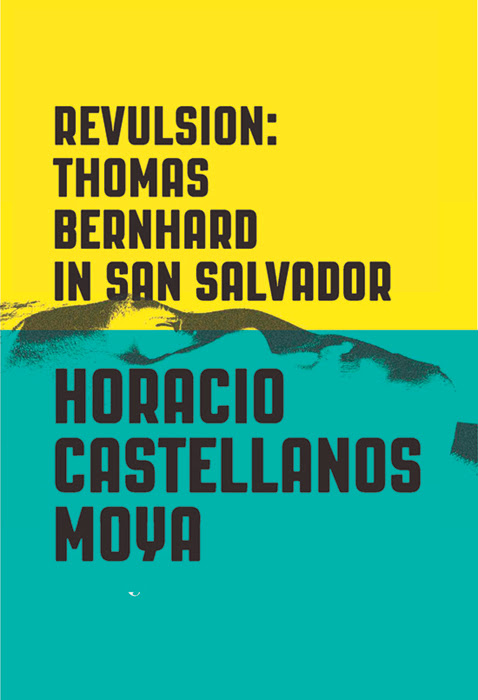
Revulsion

Revulsion: Thomas Bernhard in San Salvador
Horacio Castellanos Moya, translated from the Spanish by Lee Klein
New Directions
88 pages ($14.95)
ISBN: 978-0-8112-2539-7


Originally staged in 1995, multimedia artist Bill Viola’s “The Greeting” plays over a tall, vertical video screen, and functions like a painting come to life. From the left side of the frame, a visibly pregnant woman in a flowing orange dress approaches a pair of similarly dressed women chatting on a stylized city street, and as their conversation is interrupted, the group acknowledges each other and the woman in orange pulls the woman closest to the viewer in for a hug. The natural flow of the trio’s movements, in real time, takes less than thirty seconds to transpire. But in his installation, Viola slows his footage so that it spreads over ten minutes. Under these specifications, the figures crawl toward each other, and subtleties lost at normal speeds become amplified. The simple gesture of a hug opens itself up to endless nuanced observations. For example, during this embrace, the woman in orange whispers something—it’s impossible to know what—into her friend’s ear, while the woman outside of the caress peers toward the viewer, her face stressing disappointment as a slight breeze wafts her loose clothing. It is a hypnotizing display, and by the end of the sequence, Viola implies to the viewer a narrative much larger than the small moment depicted.

“The Greeting” was inspired by Jacopo Pontormo’s painting, The Visitation, yet literature enthusiasts may see a bit of writer Thomas Bernhard floating on the screen, too, for like Viola’s installation, Bernhard’s novels often cover very little present time, instead dwelling on the thoughts and memories of characters as they experience brief physical exchanges: sitting idly at a table, or walking into a remote inn. Regular readers of Numéro Cinq are no doubt familiar with the work of Bernhard (in fact, we recently ran a review of some of his short stories), yet I offer Viola’s artwork as a visual equivalent for those yet to experience one of the late Austrian’s narratives.

Bernhard, through his darkly funny, rambling, oddly italicized, tense shifting, comma splicing, yet verbally thrilling storylines (typically published as one long paragraph), cemented himself as one of the most respected and original literary figures of the 20th century, and his popularity among readers has only risen since his death in 1989. Such celebrity often lends itself to imitation, and Horacio Castellanos Moya’s Revulsion: Thomas Bernhard in San Salvador is a brilliant parody of Bernhard’s stylistic tics, a slim novella that winks with fans of Bernhard while also recounting the hilarious tale of perhaps the least cheerful man in El Salvador. When originally released in 1997, though he had already published several books and worked as a professional journalist throughout Central America, Moya’s rambling story earned him death threats. Prideful residents of El Salvador, the author’s homeland, failed to find his bitter cultural critique funny and Moya avoided the country for two years. Now nearly twenty years later, Moya’s Revulsion (or, as he refers to it in an included author’s note, “the little imitation”) is seen as his signature work, and for the first time, it is available to the English-speaking world, thanks to a superb translation by author Lee Klein and publisher New Directions.

The entirety of Revulsion takes place at a bar in San Salvador between the evening hours of five and seven. The only speaker is Edgardo Vega, who has returned to El Salvador for the first time in eighteen years to bury his mother, and who has coaxed his friend Horacio Castellanos Moya to meet him for a few drinks. Over about 90 pages, Moya sits and listens to Vega’s monologue dedicated to what he really thinks about El Salvador.

As the story opens, Vega greets the fictional version of Moya with a sentence that immediately brings to mind Bernhard’s style:

Glad you could come, Moya, I had my doubts that you would come, so many people in this city don’t like this place, so many people don’t like this place at all, Moya, which is why I wasn’t sure you’d come, said Vega.

Here, Moya exaggerates Bernhard’s penchant for repetition for comedic effect, employing variations on “come” three times, the name Moya twice, and the phrase “don’t like this place” twice. Vega cannot speak with economy. He must find multiple ways to express each thought. This repetition continues as Vega tells Moya that he is the only one he feels comfortable around, and that he must vent his frustrations about El Salvador before they consume him. He says, “I have to chat with you before I leave, I have to tell you what I think about all this nastiness, there’s no one else I can relate my impressions to, the horrible thoughts I’ve had here.” Again, we see Vega rattle off variations of the same statement, and once more, Moya the author lets these repetitions string themselves together without inserting an expected period, splicing commas instead. The result is a barreling sensation, similar to that of Bernhard’s work, yet one swelling to the point of ludicrousness.

The reader learns that Moya was the only of Vega’s childhood friends to show up at the funeral. “What luck I didn’t run into any of them, except for you, of course, we have nothing in common with them, there isn’t a thing that unites me with one of them,” Vega proclaims. “We’re the exception.” From here, Vega, now a Canadian citizen, begins a verbal assault on El Salvador, which essentially consumes the rest of the text. He complains of the country’s beer (“it’s only good for inducing diarrhea”), its residents (“a putrid race”), its politicians (“so ignorant, so savagely ignorant, so obviously illiterate”) and its cities (“truly vomitous…where only truly sinister people can live”). After spending the previous two weeks living with his brother and his family, waiting to finalize paperwork for his mother, Vega has moved out and checked into a local hotel to escape the household noise:

…I want to make it clear that my brother has three televisions in his house, you wouldn’t believe it, three televisions they often turn on at the same time to different channels, a true hell this place is, Moya, I’m thankful to have left that house of lunatics this morning, they only spend their time watching television…

In condemning everything he has encountered while back in his birthplace, Vega shouts in a hyperbolic manner that, like his heavy use of repetition, mimics the diction of a Thomas Bernhard protagonist to an extreme. Take, as illustration, the narrator of Bernhard’s The Loser, who readily complains about both Austria and Switzerland about a third of the way through the novel. He calls the sights “nothing but utter tastelessness,” and claims that Switzerland is “where cretinism reigns supreme.” Recalling the city of Chur, Bernhard’s narrator notes, “the taverns…served the worst wine and the most tasteless sausage,” and “the Churians struck me as despicable in their Alpine cretinism.” When placed side by side with Moya’s Vega, these complaints feel comfortably at home, yet the major difference between a Bernhard narrator and Vega is that Bernhard’s narrators drift in and out of hyperbolic rants, whereas Vega’s entire monologue builds itself on a foundation of hyperbole. There is never a time in Revulsion where Moya lets his character slip from this mindset, for even when he shifts to rare moments of offering compliment, he speaks in an exaggerated register. Early, while acknowledging Moya’s various achievements, Vega can’t help but temper his kindness with the query, “how could it occur to you to return to live here in this shithole, to settle in a city that sucks you down more and more into its pit of filth.” Then later, after a long diatribe against local politicians (“they dedicate themselves now to a feast, an orgy, of plundering”), Vega attempts to shift gears again, only to fall back into a hyperbolic rage:

But we should hope, Moya, we don’t want to spoil our reunion thanks to these castrated politicians that each day ruin my meals, appearing on the television that my brother and his wife turn on the minute they sit down at the dining table.

Very deliberately, Moya constructs Vega to be a Bernhard character to the nth degree, and the result is a comical curmudgeon with certainly less intelligence than Bernhard’s fictional counterparts, but one who contains an overabundance of the verbal flair that lovers of Bernhard cherish in his writing.

Moya slips other nods to Bernhard in throughout Revulsion, most prominently Vega’s insistence of listening to various concertos while he and Moya sit at the bar, but perhaps the greatest tribute in the novella comes when Bernhard’s name is actually uttered by Vega himself. This occurs at the end of the story, and though divulging too much here would ruin the conclusion of Moya’s narrative, it’s safe to reveal that, after mentioning Bernhard’s name, Vega claims him as a writer nobody in San Salvador would recognize. It’s one final act of hyperbole on Vega’s part, and yet the real life controversy that surrounded Revulsion in El Salvador upon its first publication seemed to prove Vega right. Where Moya produced a biting parody, albeit one with the intention of challenging San Salvador’s culture and politics, readers saw it simply as an attack on their homeland. With death threats came the idea that Bernhard’s legacy in El Salvador was exactly as Vega claimed. Yet, knowledge of Bernhard only enhances the pleasure that is reading Moya’s Revulsion. Operating as both a parody and a darkly funny, explosive rant of a man who detests his homeland, it’s a blistering novella that satisfies the darkness clouding the cynical side of our souls.

— Benjamin Woodard

.

Woodard

Benjamin Woodard lives in Connecticut. His recent fiction has appeared in StorychordCorium Magazine, and Maudlin House. In addition to Numéro Cinq, his criticism and nonfiction has been featured in The Kenyon Review OnlineGeorgia ReviewVol. 1 Brooklyn, and other fine publications. He also helps run Atlas and Alice Literary Magazine. You can find him at benjaminjwoodard.com and on Twitter..

.


Apr 112015
 

19Max Blecher

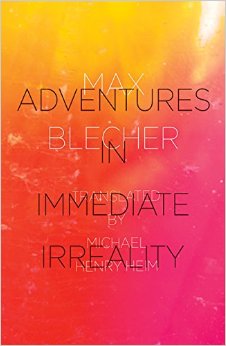
Adventures in Immediate Irreality is a short, powerful dispatch from the heart of European literary modernism—part idiosyncratic coming-of-age novel, part prose poem to the terrifying intensity of the everyday. The book traces, in retrospect, a series of internal crises a young man undergoes in a provincial Romanian town of the 1920s. —Eric Foley

cover

Adventures in Immediate Irreality
Max Blecher
Translated by Michael Henry Heim
New Directions, 2015
112 pages ($14.95)
ISBN 9780811217606

.

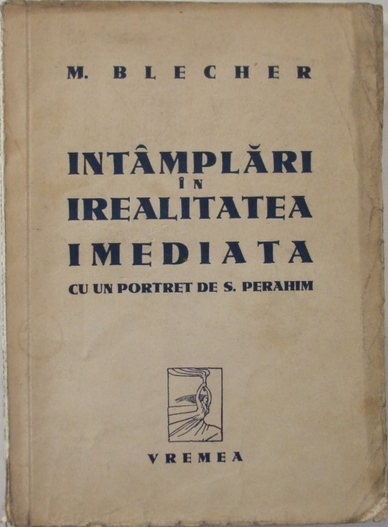
In his Journal 1935–1944: The Fascist Years, Mihail Sebastian recounts a visit he paid to his fellow Romanian writer Max Blecher in September of 1936, the same year Blecher’s first book, Adventures in Immediate Irreality (Întâmplări în irealitatea imediată), was published:

I left overpowered and exhausted. He lives in intimacy with death. Not with the abstract, unclear, long-term death. It’s his death, precise, defined, known in every detail, just as an object . . . I wanted to burst into tears a few times when looking  at him. At night I heard him moaning and screaming in his room, and I felt that there was another person at home with us, maybe death or faith—I don’t know who.

At the time of Sebastian’s visit, Blecher had just turned twenty-seven. He had less than two years left to live.

Born in 1909 in Botoşani and raised in the town of Roman, Max Blecher belongs to a remarkable group of Romanian writers who came of age in the 1930s—a generation that included, among others, Mircea Eliade (b. 1907), Mihail Sebastian (b. 1907), Eugene Ionesco (b. 1909) and Emil Cioran (b. 1911). Like his friend Sebastian, Blecher was born a Romanian Jew, yet neither man was fated to die from the fascist exterminations that demolished nearly half of Romania’s more than 700,000 Jews during World War II. Sebastian survived amidst increasing persecution only to be hit by a truck mere weeks after the Nazis surrendered, dying on May 29, 1945, while Blecher succumbed to spinal tuberculosis at age twenty-eight on May 31, 1938. Blecher had contracted the disease nearly a decade earlier while studying medicine in Paris. Thereafter, he spent his adult life confined to various European sanatoria, and finally to his parents’ estate outside of Roman. His condition required him to wear a painful body cast; the majority of his work was completed while reclining in a state of partial paralysis.

blecher2Max Blecher

Adventures in Immediate Irreality is a short, powerful dispatch from the heart of European literary modernism—part idiosyncratic coming-of-age novel, part prose poem to the terrifying intensity of the everyday. The book traces, in retrospect, a series of internal crises a young man undergoes in a provincial Romanian town of the 1920s. It’s the kind of place that gives the unnamed narrator “the vague feeling that nothing in the world can come to fruition,” and a time in his life when he has nothing to do “but saunter through parks, through dusty clearings burnt by the sun, desolate and wild.” Although they coincide with the onset of adolescence, the narrator’s crises have little to do with the usual growing pains. Rather, they stem from a profound confusion between his internal and external worlds. The crises arise particularly through the young man’s interaction with objects, what Blecher refers to as brute matter. “I had nothing to separate me from the world,” the narrator tells us, “everything around me invaded from head to toe; my skin might as well have been a sieve.”

Eugene Ionesco referred to Blecher as “the Romanian Kafka,” while others have compared his work to that of Bruno Schulz, Marcel Proust, and the French Surrealists (Blecher corresponded with André Breton, not to mention André Gide and Martin Heidegger). Adventures in Immediate Irreality reads like a searing combination of Dostoevsky’s Notes from Underground and Sadegh Hedayat’s The Blind Owl (a book Blecher could not possibly have read), yet Blecher also possesses a great deal of originality as a writer. His use of similes, for example, brings an unexpected depth to his images. As Herta Muller points out in her introduction, “Blecher’s eroticism of perception requires the constant comparison of one thing with a hitherto unimaginable other.” You know you’re reading an unusual work of literature when the narrator doesn’t bother to describe his appearance until the book is more than half over:

I was tall, thin, and pale. My spindly neck rose awkwardly out of my tunic. My long arms hung from my sleeves like newly skinned animals. My pockets so bulged with papers and objects that I could scarcely extract a handkerchief to wipe the dust off my shoes when I arrived in the ‘city center.’

The simile here—arms that hang like newly skinned animals—is visually appropriate, in keeping with Blecher’s death-haunted prose, while simultaneously conjuring the image of a boy who feels he has been violently thrust into adolescence. The simile also evokes the narrator’s extreme sensitivity: this is a young man who lacks the ordinary layer of protection between himself and the world that others possess. Earlier in the novel, he tells us: “It was what was most humdrum and familiar in the objects that disturbed me most. The habit of being seen so many times must have worn out their thin skins, and they sometimes looked flayed and bloody to me—and alive, ineffably alive.” If the narrator’s arms are like flayed animals, so are the objects that surround him. Both are skinned yet “ineffably alive,” forced beyond their comprehension to participate in this thing we call life. Nearly all of the objects the main character perceives so intensely come from the human world. Even the landscapes he interacts with have been shaped by people:

There was another cursed place at the other end of town on the high, loose banks   of the river where my friends and I would go to bathe. At one point the bank had caved in. Just above it there was a factory that made oil from sunflower seeds. The workers would throw the discarded seed husks into the section of the bank that had caved in, and over time, the pile grew so high that it formed a slope of dry husks extending from the top of the bank to the water’s edge.

My playmates would descend to the water along that slope, cautiously, holding one another by the hand, sinking their feet deep into the carpet of rotten matter. The walls of the high bank on either side of the slope were steep and full of outlandish irregularities—long, fine channels sculpted by the rain, arabesque-like but as hideous as poorly healed scars, veritable tatters of the clay’s flesh, horrible gaping wounds. It was between these walls, which made such an impression on me, that I too climbed down to the water.

One of Blecher’s great themes is the intensity of perception, particularly as regards the faculty of sight. His prose wrestles with the call and the challenge of the visible world: “Such is what I had to struggle with, what implacably opposed me: the ordinary look of things.” An individual of the narrator’s uncommon sensitivity might have encountered such crises in any era, but Blecher came of age in the 1920s, and his book is awash with reference to the technologies, old and new, that proliferated at that time; photography, cinema, chemical experiments, mirrors, and waxworks all provide the narrator with reflections of the unreality that surrounds and inhabits him. They also provide him with the opportunity to repeatedly, playfully, interrogate the process of mimesis. Blecher’s narrator sees imitations as paradoxically more “real” than life itself: “The bullet-riddled, blood-stained uniform of a sad, sallow Austrian archduke”, he tells us, “was infinitely more tragic that any real death.”

Early on, in what could stand as a central trope of the book, the narrator watches a young woman apply her make-up. “The mirror was so old that the polish had completely worn off in places and actual objects showed here and there through the back of the mirror, merging with the reflected images as in a double exposure.” This is only one of numerous occasions where Blecher presents us with an image of a world that consistently breaks through the attempt to represent it. Blecher’s acute awareness of such crises of perception and representation, as well as his articulation of the necessity of searching for new means to express them, is one of the hallmarks of modernism:

Ordinary words lose their validity at certain depths of the soul. Here I am, trying to give an exact description of my crises, and all I can come up with are images. The magic word that might convey their essence would have to borrow from the essences of other aspects of life, distill a new scent from a judicious combination of them.

Throughout the book, Blecher blurs the line between representation and what is represented, calling into question both the act of perception and the act of rendering what one perceives in language. In the context of this interrogation of mimesis, it is perhaps worth remembering that 1936, when Adventures in Immediate Irreality was published, was also the year Erich Auerbach began teaching at the Turkish State University in Istanbul, where he would eventually write his epic Mimesis: The Representation of Reality in Western Literature. For Blecher, mimesis is always deliciously bound up in materiality. Here is how the narrator describes a movie-going experience in his hometown:

One day the cinema caught fire. The film tore and immediately went up in flames, which for several seconds raged on the screen like a filmed warning that the place was on fire as well as a logical continuation of the medium’s mission to give the news, which mission it was now carrying out to perfection by reporting the latest and most exciting event in town: its own combustion.

Scenes like this have led Andrei Codrescu, rightly, to call Max Blecher “a recording diagnostician of a type the twentieth century had not yet fully birthed”.

Blecher’s episodes flow not according to chronology, but via the associative logic of memory. By the end of the book, the narrator has even undergone a change of sorts, thus satisfying the requirements of a conventional narrative, yet this is hardly the point of the book. The real pleasure of Adventures in Immediate Irreality lies in how miraculously and minutely Blecher conjures a series of vanished surfaces—bringing an idiosyncratic collection of people, places, and objects to life while remaining focused on the question that Beckett’s Molloy asks: And what do I mean by seeing and seeing again? The “seeing again,” of course, refers to the process of memory.

If the provincial town the narrator inhabits seems at times excessively strange, perhaps many places were once so, before globalization. Indeed, one of many reasons to read this book is for a glorious reminder of just how unusual our planet once was. Blecher excels, in particular, at portraying how one layer of reality can quickly give way to another:

Once, as a child, I was present at the exhumation of a corpse, a woman who had died young and had been buried in her wedding gown. The silk bodice was a mess of long filthy rags, and what remained of the embroidery had mixed with the soil. Her face was more or less intact, however, and one could make out nearly all her features even if the head had turned purple and seemed modeled out of cardboard that had been soaked in water.

Someone ran his hand over the face as the coffin was being raised out of the ground. All present were in for a terrible surprise: what we had taken for a well-preserved face was nothing but a layer of mold about two inches thick. The mold had replaced its skin and flesh down to the bones, thus reproducing its form.  There was nothing but the bare skeleton underneath.

This is a world that will never come again, a world that may never even fully have existed except inside of one young man, but the beauty of literature is that it has been preserved for us, so that we may partake of it repeatedly, in all its strange melancholy.

Blecher3

One further reason to read the newest edition of Adventures in Immediate Irreality is to witness a literary translator at the height of his powers. This was one of the last projects Michael Henry Heim completed before his death in 2012. In order to demonstrate the degree to which Heim has succeeded in breathing new life into this English version, I’d like to take a closer look at the passage from Blecher’s original where the narrator finally gives a physical account of himself:

Eram un băiat înalt, slab, palid, cu gâtul subțire ieșind din gulerul prea larg al tunicei. Mâinile lungi atârnau dincolo de haină ca niște animale proaspăt jupuite. Buzunarele plezneau de hârtii și obiecte. Cu greu găseam în fundul lor batista pentru a-mi șterge ghetele de praf, când veneam în străzile din „centru”.

Here is Alistair Ian Blyth’s respectful, highly competent translation, published as Occurrence in the Immediate Unreality by University of Plymouth Press in 2009:

I was a tall, thin, pale boy, with a slender throat poking from the overly large collar of my tunic. My long hands dangled below my jacket like freshly flayed animals. My pockets bulged with objects and bits of paper. I used to have a hard time retrieving a handkerchief from the bottom of these pockets to wipe the dust off my boots, when I reached the streets of the ‘centre.’

And here, once more, is Heim’s version:

I was tall, thin, and pale. My spindly neck rose awkwardly out of my tunic. My  long arms hung from my sleeves like newly skinned animals. My pockets so bulged with papers and objects that I could scarcely extract a handkerchief to wipe the dust off my shoes when I arrived in the ‘city center.’

As we can see, Blyth is much more faithful than Heim to the syntax of the original, following Blecher almost word-for-word. In Blecher’s second sentence, for example, the Romanian word “Mâinile” unquestionably means “hands”, while “proaspăt” would indeed most commonly be translated as “fresh.” Heim inserts a period in the first sentence where Blecher employs a comma, and he omits the word “boy” (băiat) altogether. Interestingly, Heim turns Blecher’s final two sentences into one long one, thus retaining the same number of sentences (4) in the paragraph. Yet in taking such liberties, Heim arrives at a version that reads more crisply and elegantly in English. I would also argue that he succeeds more fully in transmitting the intensity and idiosyncrasy of Blecher’s prose.

“My struggles with uncertainty no longer have a name”; the narrator of Adventures in Immediate Irreality tells us; “all that remains is the simple regret that I found nothing in their depths.” Indeed, life often is sad. We don’t know why we’re alive, or for how long. One goes out for a walk in the street and feels baffled by each thing one sees. Yet sometimes, reading marks left by others on a page or screen, it’s possible to be lifted cleanly away from one’s confusion. Sometimes, if the vision is intense enough, we feel ourselves become more fully alive, our faculties of perception realigned. In such moments the act of existing even acquires a kind of momentary meaning. At the end Adventures in Immediate Irreality, I found myself looking up from the page like Blecher’s narrator:

I would peer around me wide-eyed, but things had lost their usual meaning: they were awash with their new existence. It was as if someone had removed the fine, transparent paper they had been wrapped in till then, and suddenly they looked new beyond words. They seemed destined to be put to new, superior, fantastic uses  beyond my power to divine.

The miracle of Blecher’s writing is the miracle of literature itself: that strange human endeavor that always must occur in “the immediate irreality.”

—Eric Foley

NC
eric foley2

Eric Foley holds an Honours BA in English and Literary Studies from the University of Toronto and an MFA from Guelph University. He was a finalist for the Random House Creative Writing Award and the Hart House Literary Contest, also winner of Geist Magazine and the White Wall Review’s postcard story contests. You can see his work at Numéro Cinq and InfluencySalon.ca. He divides his time between Toronto and Eastern Europe.

.
.

Oct 112013
 

Albertine-Sarrazin


Astragal_300_450

Astragal
Albertine Sarrazin, translated from the French by Patsy Southgate
New Directions
192 pages, $15.95
ISBN 978-0811220736

Cruel fortune followed author Albertine Sarrazin. Abandoned as a child, she faced abuse, a teenage life of theft and prostitution in Paris, prison, and, after a daring escape, lingering injuries. Dead before the age of thirty, Sarrazin was at the height of her sudden literary fame—two novels, written while incarcerated, found publication in 1965; she and her husband, Julien, another career criminal, had settled down—when a bungled kidney surgery ended her life. Known for her defiance, her dangerous existence, her mistrust of authority, she expired in July of 1967, not via dodgy escapades, but in supposed safe hands.

Astragal, the superb novel that helped make Sarrazin a star, recently reissued by New Directions, parses through some of the author’s unfortunate kismet. Semi-autobiographical, the short narrative concerns Anne, a tough nineteen-year-old thief serving a seven year jail sentence. The novel opens with Anne leaping over a prison wall. Plummeting several stories, she lands hard on her foot, shattering her ankle. Unable to run, or to hide, Anne is left to the mercy of Julien, a helpful drifter, who scoops her from the ground and shuttles her from one safe house to the next, weaving her around France. As Anne’s injury slowly heals—it takes some time before a doctor tends to her—she ends up at the Paris home of Julien’s acquaintance, Annie. It is here that Anne realizes her true love for Julien, her savior. Her heart melts for the man, who, himself a criminal on the lam, wanders in and out of her narrative, popping in for brief visits before disappearing for weeks, if not longer. The closer Anne gets to walking, to leaving Annie, the hideaways, to rejoining the world of prostitutes and thieves, to being independent, the more her love chains itself to Julien. He is a force she cannot escape. So she waits for his return, a prisoner able to roam, yet unable to flee.

The rhythmic quality of Sarrazin’s prose—expertly translated by the late Patsy Southgate—provides most of Astragal’s brilliance. This rhythm works on two levels, both in the motif of imprisonment that bounces along throughout the narrative, and also on the basic level of sentence. Speaking first to the motif, one need not look far to witness it on display. Anne, hoping to break free from prison and to find her female lover at the beginning of the story, instead breaks only her talus (or astragalus) bone. The result: she cannot walk; she cannot hide; she must rely on others to survive. This leads to physical imprisonment, as Julien drops her in three different safe houses for protection. Not only can she not move, but she cannot be seen by the public, either. She is a veiled being, a ghost to the outside world, able to control very little (“I double-lock myself into my room; it consoles and liberates me to bolt the door of my jail myself,” Anne proclaims, only somewhat convincingly). And even when Anne’s ankle does heal, when she finally is able to move on from life with Annie, panoptic paranoia and carnal desire prevent her from achieving true freedom. As she works the streets, every face turns into a potential nemesis, as Anne claims: “…I am frightened and leery of everybody. The thought of getting caught never leaves me: I learn to look it in the face, I tame it, I never chase it away.” And Julien, often hovering but rarely around, leaves her in an emotional state of limbo. Gone is Anne’s longing to find her girlfriend. Now all that matters is happiness with Julien. While Anne thinks, “…the constant thought of Julien conceals and protects me,” certain questions arise: How long must she wait for him to return? How far can she truly stray without him?

That Sarrazin continually finds new forms of imprisonment for Anne thematically binds Astragal’s otherwise episodic narrative: in order to move forward, Anne must constantly look back. On the basic level of sentence, Sarrazin also uses the rhythm of language to drive the pace of Anne’s story, often employing long, patterned passages to sweep the reader into the mindset of her protagonist. These extended sentences sometimes work to generate an accelerated effect, as in when Anne describes the pain from her freshly broken ankle:

“Circuits had been formed, cadences: in my ankle, suddenly, something would wake up hissing, like water spurting from a broken pipe, more springs would start gushing, then they would all run together and flow insidiously through the length of my body. Or else, the pain would gather into a ball above my heel, slowly twisting and winding itself up; when the ball was finished—I now could tell the exact moment—it would burst with a sensation of light; and the flashes would shoot through my foot and explode, in stars that quickly went out, in the ends of my toes.”

The intensity of this moment, the pure jolt of the experience, exists thanks to Sarrazin’s choice to include only one full stop while expressing the agony of Anne’s injury. The words steamroll forward, building momentum from every previous syllable. Astragal‘s story progresses through a constant reference to what has already occurred. Conversely, at other points in the novel, Sarrazin employs long sentences for an opposite effect, implying almost a dreamlike, lyrical, internal quality to the narrative, like in this description of cigarette smoke:

“I think of the warmth of the smoke which flows, liquid, with a slight bitter edge, into your throat and chest, making your blood tingle; I think of all the ashtrays I’ve emptied in my life; tortured by my cravings, I sit there, unable to care about what Annie’s saying, my eyes riveted on her pants.”

Here, nearly every word builds on what precedes it: “smoke” becomes “liquid,” “throat” becomes “chest” and “blood.” “Think” is repeated twice, and these thoughts turn to torture.

When Astragal was first published, Sarrazin’s style drew comparisons to Jean Genet, another criminal turned author, and while that link is valid—both loiter in the realm of the felon; both write with a poetic flair—in hindsight Sarrazin’s work may best be associated with the 1950s and 1960s cinema of the French New Wave. Her long, rhythmic writing mirrors the long takes of Goddard and Truffaut. Her rebel personality slots in comfortably with the youthful exuberance of the movement. And just as Michel in Breathless finds a persona in the guise of Humphrey Bogart, so too does Sarrazin discover her double in Anne. Not only that, but both Anne and Julien have their own variations in the characters of Annie and Jean, one of Anne’s johns. Annie, a former prostitute, is what Anne could grow into, while Jean—wealthy, lonesome, desperate—allows Anne to take full advantage of his generosity, moving her into his home with the full knowledge that she only loves Julien. Where Anne’s true love is often distant, Jean is the opposite: always there, always willing to bend over backward. He is everything she wants, only in the wrong package. Such is the life of Anne throughout Astragal: a negative for every positive, a cruel twist always waiting to pounce.

— Benjamin Woodard

—————————————————–

Ben_WoodardBenjamin Woodard lives in Connecticut. His recent fiction has appeared in decomP magazinE, Cleaver Magazine, and Numéro Cinq. His reviews have been featured in Numéro Cinq, Drunken Boat, Rain Taxi Review of Books, and other fine publications. He is a member of the National Book Critics Circle. You can find him at benjaminjwoodard.com.

Oct 012013
 
Photograph: Christopher Pillitz/Getty Images

Photograph: Christopher Pillitz/Getty Images

borges3

Borges at 80: Conversations
Edited by Willis Barnstone
New Directions, 192 pages, $18.95

Professor Borges
Edited by Martín Arias and Martín Hadis
New Directions, 288 pages, $26.50

Jorge Luis Borges: The Last Interview
Translated by Kit Maude
Melville House, 176 pages, $15.95

Jorge Luis Borges is a dead, white male. But he isn’t European. So he lacks imperialist cred and isn’t taught among the typical classics. As editor and translator James E. Irby remarks in the 1961 New Directions edition of Labyrinths, “Not being French has undoubtedly also relegated Borges to comparative obscurity in the English-speaking countries, where it is rare that a Hispanic writer is ever accorded any major importance at all.”

A lover of contradictions, he would appreciate the paradox of his current position: he is sometimes overlooked, often mislabeled. Some lazily lump him in with Marquez, with magical realism. Others tie him to dadaism, surrealism, modernism, post-modernism. Borges was a dreamer who described himself as constantly puzzled, stuck in a labyrinth, so perhaps he won’t mind being labelled so haphazardly. Probably aware of the futility of the exercise, David Foster Wallace attempted to classify him more accurately, calling him the “great bridge between modernism and post-modernism.”

He was barely even a writer—more a librarian, a professor of literature and philosophy who just happened to translate and write free verse poetry and brilliant experimental stories. His prose is usually short—compact yet expansive, deeply-rooted in a mixture of traditions yet simple in its fascination with time and eternity. A symbolist, Borges thought in metaphor from the beginning, but turned deeper into his imagination when he began losing his eyesight in his fifties. What results are his story-puzzles of infinite regression and infinite possibility.

New Directions was the first to bring Borges to an English-speaking audience when they published Labyrinths in 1961. That same year he and Samuel Beckett shared the Prix International, awarded by the Formentor Group (created by Carlos Barral). This brought more attention to his work. That collection of stories and short essays remains the essential primer to Borges. Now New Directions has released in short succession Borges at Eighty: Conversations and Professor Borges: A Course on English Literature. The former presents the interviews he gave to Willis Barnstone, Dick Cavett, Alastair Reid, and others during a visit to the U.S. in 1980. The latter is a transcription of twenty-five classes Borges gave in 1966 at the University of Buenos Aires. This spate of new material was just barely preceded by Melville House’s Jorge Luis Borges: The Last Interview, which came out in June, and contains a 1968 dialogue with Richard Burgin, a fantastic discussion with the editors of Artful Dodge, and of course the last interview Borges gave before his death.

In a short meditation written at Borges’ death in 1986, Sven Birkerts called him “the Euclid of the secret orders of time.” Birkerts, writing in the Boston Phoenix, captured the Argentine’s writing in as close to a nutshell as one can: “These are not stories at all. These fanciful narratives are the author’s way of telling us his truth; they are whimsical-looking ciphers in a most serious code.”

Nothing in Borges is superfluous or forgettable. But he was not much interested in character. Borges obliquely addressed this in The Last Interview. Burgin asks about writers like F. Scott Fitzgerald who have (Burgin’s words) “no metaphysical feeling.” Borges says, “They take the universe for granted […] They don’t think it’s strange that they should be living.” His stakes were metaphysical and only somewhat existential. One of his most memorable characters, Pierre Menard, decides to rewrite Don Quixote. To do this he seeks to immerse himself in old Spanish, recover his Catholic faith, and fight some Turks so as to become Cervantes. Menard’s work would be more formidable than the original, because Cervantes had the benefit of living in the sixteenth century. Cervantes had the benefit of being Cervantes. And the story is about identity and authority instead of personality.

In one article-cum-story, Borges invents a world where the spoken language contains no nouns (among other deformities). In the logic of Wittgenstein, the language dominates the world. On Tlön:

…they do not conceive that the spatial persists in time. The perception of a cloud of smoke on the horizon and then of the burning field and then of the half-extinguished cigarette that produced the blaze is considered an example of association of ideas.

Borges was a poet steeped in Leibniz and Spinoza, with a preference above all for Schopenhauer. He loved Whitman and Stevenson. He admired but also criticized Kafka and was fascinated by Zeno’s paradox of Achilles and the tortoise. He described himself not as an author but rather as an interpreter through which writers of the past were filtered. He found a fascination in mirrors and labyrinths, in the distortions not only of the senses but of the mind. Everywhere he saw tradition, variation, and the fictional hrönir.

Centuries and centuries of idealism have not failed to influence reality. In the most ancient regions of Tlön, the duplication of lost objects is not infrequent. Two persons look for a pencil; the first finds it and says nothing; the second finds a second pencil, no less real, but closer to his expectations. These secondary objects are called hrönir and are, though awkward in form, somewhat longer. […] Curiously, the hrönir of second and third degree […] exaggerated the aberrations of the initial one; those of fifth degree are almost uniform; those of ninth degree become confused with those of the second; in those of the eleventh there is a purity of line not found in the original. The process is cyclical. (Labyrinths)

borges4

Born in Buenos Aires in 1899 to a bookish father and a mother whose forefathers were criollo soldiers, Borges was outspoken against Argentina’s support for Mussolini. Early in his life he took firm liberal stances—especially against the ruling Perón family. He became disenchanted by his home country, or at least he became more careful in public proclamations, which lack nuance. He also became less productive in general when he began to lose his sight. As with Milton, blindness did not end Borges’ writing career. But it slowed him down and hampered his reading of contemporaries, which might have contributed to the complaints that he ignored his country, its literature, and its politics.

Meanwhile he was too shy (and, perhaps, too clever) to fully embody a public persona, presenting himself as humble and apologetic for all the fuss made over his work. In his short essay “Borges and I,” he plays with the duality of his life as both a public figure and a quiet, sociable person. Just read this and shudder:

I like hourglasses, maps, eighteenth-century typography, the taste of coffee and the prose of Stevenson; he shares these preferences, but in a vain way that turns them into attributes of an actor. It would be an exaggeration to say that ours is a hostile relationship; I live, let myself go on living, so that Borges may contrive his literature, and this literature justifies me. It is no effort for me to confess that he has achieved some valid pages, but those pages cannot save me, perhaps because what is good belongs to no one, not even to him, but rather to the language and to tradition. (Labyrinths)

Twenty-seven years after his death, these new books show how much he affected to prefer the non-writing Borges to the controversial, acclaimed writer. That said, whether at the podium or in an interview, it’s not always clear which one is speaking. Though he says he hopes his work will be forgotten, and that he’d like to become Ellison’s “invisible man,” he seems to enjoy these conversations too much to completely disown the public Borges.

borges2

Though Borges tells Richard Burgin in The Last Interview that he hates cameras (because “a camera is a kind of mirror”), Borges clearly enjoyed being interviewed, and evidently also loved to teach, to converse about the writers he felt a closest kinship to—not Marquez or Cortazar or Joyce but Whitman, Shaw, and James. In Professor Borges, he covers a selective history of English literature from kennings to Stevenson, for Spanish-speaking students who have never encountered the tradition before. The main pleasure of this collection is to wade into the mind of a lover of books, the one-time head librarian of the National Library of Argentina. Borges again seems more like a curator of tradition than an inventor of fictions.

In Borges at Eighty, the writer comes alive, touring various universities and the New York PEN Center. Of all places, he is most revealing on The Dick Cavett Show. The discussion ranges from the differences between Spanish and English, to Hitler, to Citizen Kane. When Cavett asks about Argentina’s fascist past, Borges sounds resigned:

Look here. I think the Argentine Republic cannot be explained. It is as mysterious as the universe. I do not understand it. I don’t profess to understand my country. I am not politically minded either.

Borges’ literary games were so much more than clever tricks—they were metaphors through which he conveyed as poetically the strange, lonely world he inhabited. Cavett asks whether they are artistic flourishes or “something alive.” Borges replies:

I am always being baffled, perplexed, so a maze is the right symbol. They are not, at least to me, literary devices or tricks. I don’t think of them as tricks. They are part of my destiny, of my way of feeling, of living. I haven’t chosen them.

In other conversations from Borges at Eighty, he explains why free verse is as difficult as prose, and how either is more challenging than structured verse. He describes immortality as a threat, rejects his early work as too baroque, and explains simply that he never wrote novels because he could not do it. He admits, “I am a bit of a prig,” and expounds on the importance of saving humanism. He bemoans his inability to reason, finding in himself instead a preference for dreaming.

In these new books there is much to like about Borges the dreaming librarian, but, oddly, neither the writer nor teacher seems interested in including women in the library. He will say things like, as he tells Burgin, “I think men are more prone to metaphysical wondering than women. I think that women take the world for granted.” When asked to identify significant women in literature, he offers Emily Dickinson. When asked whether there are more, he says, “Yes of course.” He then suggests Silvina Ocampo, “who is translating Emily Dickinson at this moment.” Sometimes his remarks borders on the condescending. In The Last Interview, he tells Burgin:

I have known very intelligent women who are quite incapable of philosophy. One of the most intelligent women I know, she’s one of my pupils; she studies Old English with me, well, she was wild over so many books and poets, then I told her to read Berkeley’s dialogues, three dialogues, and she could make nothing of them.

It can be argued that Borges’ gender gap is also a gap in the tradition he so loved. Borges might have recognized this flaw, though he did not address it very well. As Colm Tóibín notes when discussing the Menard story, Borges is keenly aware of his difficult role as a writer and “the concept of the writer as a force of culture imprisoned by language and time.” Like many of his compatriots, Borges faced a crisis of identity: embrace Western modernism or turn back to the “gaucho” sensibility and poetic style of the earlier Argentina, exemplified by José Hernández’s poem El Gaucho Martín Fierro. But nothing captures better Borges’ conflict with identity—personal, visual, aesthetic, national, gendered—than the short epilogue to Borges at Eighty, from an interview held at the National Library in 1979. The statement touches on a number of problems with the notion of universality:

Reading should not be obligatory. Should we ever speak of ‘obligatory pleasure’? […] I have always advised my students: If a book bores you, leave it; don’t read it because it is famous, don’t read it because it is modern, don’t read a book because it is old. […] If a book is tedious to you, don’t read it; that book was not written for you.”

It is a shame Borges did not recognize his weak position on female writers. His critics either will not forgive him this, or perhaps they do not understand the Argentine’s general appeal to cosmopolitanism. His accepting of an award from Pinochet and professed admiration for Franco did not help either. Such utterances form one contradiction too many for the contradictory universalist.

 Borges

Of the three new books, The Last Interview stands out in that it brings us the English translation of Borges’ last interview, with journalist Gloria López Lecube. He spoke with her right before his departure for Geneva, where he planned to die. In this “last” interview, he speaks fondly of his mother and describes for López Lecube how he dreams in color. We see a man anticipating his death with the air of a giddy boy who will finally learn how the magic trick worked.

Spinoza says that we all feel immortal, yes, but not as individuals, I assume, rather immortal in a pantheistic way, in a divine way. When I get scared, when things aren’t going well, I think to myself, ‘But why should I care what happens to a South American writer, from a lost country like the Republic of Argentina at the end of the twentieth century? What possible interest could that hold for me when I still have the adventure of death before me, which could be annihilation; that would be best, it could be oblivion…

This is the most interesting thing about these new books, ultimately—not the lectures on Stevenson, but the description of his late solitary walks through Buenos Aires, or the colors of his blindness:

It came like a slow summer twilight. I was head librarian of the National Library and I began to find that I was ringed in by letterless books. Then my friends lost their faces. Then I found out there was nobody in the looking glass. And then things grew dim, and now I can make out white and gray. But two colors are forbidden me: black and red. […] I live in the center of a luminous mist. […] Grayish or bluish, I’m not too sure. It’s far too dim. I would say that now I live in the center of a bluish world. (The Dick Cavett Show)

One of the problems with writing a review of three recent books about Borges is the books do not bring much new attention to Borges’ texts, but rather to his persona. He comes off sounding self-deprecating and amiable, curious and perhaps a bit embarrassed by his fame. Though the books are by no means a definitive take, readers will enjoy immersing themselves in the wandering, conversational writer/non-writer Borges. Professorial dictums and self-deprecating jokes aside, his writing is more important. It must be read, reread, and played with. His work is universal and cosmopolitan in nature, and generally runs shorter than the average New Yorker article. Within a five-page story you will find a new language, a labyrinth, a library.

—Tom Faure

———————

Tom Take 4

Tom Faure is an MFA in Fiction student at Vermont College of Fine Arts. His work has appeared in Zocalo Public Square, Splash of Red, Chattanooga Times Free Press, The Journal News, and undergraduate magazines at Columbia University. He lives in New York, teaching English and Philosophy at the French-American School of New York. Contact: tomfaure@old.numerocinqmagazine.com

Sep 092013
 

The Mehlis Report

First published in Arabic in 2006, The Mehlis Report is the first English translation from prize-winning Arabic author, Rabee Jaber, a love song and an elegy for his beloved home city of Beirut. The book transcends politics to become a tale of loss and memory, touching without an ounce of sentiment, uplifting without a speck of hope. –Steven Axelrod

The Mehlis Report
By Rabee Jaber, Translated by Kareem James Abu-Zeid.
New Directions, 2013.
218 pages. $11.98.

Like Joyce Cary’s London and Raymond Chandler’s Los Angeles, Beirut is a living presence in The Mehlis Report. The city has died and been reborn many times in the last 60 years, with all its incarnations superimposed on each other, like the acetate overlays in a mid-20th century encyclopedia, in the minds of the people who love the place. This is not a brooding Islamic casbah full of fanatics plotting carnage in the shadow of the minarets, the war-torn hellscape portrayed by western media.

Instead, the novel gives us a vision of Beirut from the inside: a seaside town with a lovely corniche and a human history stored in the images of human memory: the old athletic club where a hotel stands now; the highway that replaced a warren of narrow streets. It’s a city of bars and hotels,  mosques and bakeries, undergoing a construction boom in 2005, when the book takes place.

A man strolling from Monot to Abd-al-Whab street can buy a Mirinda orange soda and a manakish sandwich en route to his girlfriend’s apartment, even if he has to skirt the rubble from a recent car-bombing on the way.

The man in question is Saman Yarid, a local architect obsessed with the city in all its changing forms, unable to leave despite the entreaties of his two sisters. One of them has opened a bakery in Baltimore, Maryland; the other works as a translator for UNESCO in Paris. Neither of them can understand how Saman can stay on in Beirut, where sectarian violence still rages sporadically, fifteen years after the end of the Civil War. His third sister, Josephine, was kidnapped and killed at the height of that conflict, in 1983.

The first half of the book records Saman’s daily life among the specters and shifting landscapes of his beloved city: his various girlfriends, his work at the Yarid Architecture and Design Agency.

“I’m forty now,” Saman reflects. “and I’ve done nothing with my life.” Mostly he keeps track of the prominent citizens killed on the streets of Beirut – Samir Kassir, for instance, a professor of history at St Joseph University whose secondary career as a journalist writing editorials blasting Lebanon’s pro-Syrian regime in the daily newspaper Al-Nahar earned him an assassination by car bomb in front of his home on Furn al-Hayek Street.

The most horrific and newsworthy murder was that of Prime Minister Rafik Hariri, in February of 2005. The massive explosion wiped out his heavily armored car, his entire motorcade, and a good chunk of the street on which they were driving. Saman walks by that street every day. The threat of car bombs plague his thinking. He is certain he saw two men planting a bomb in a car, during one of his long nightly walks. The big Mercedes seems to stare at him with a ghoulish squint of imminent doom after that encounter – silent, temporarily intact, like Monot Street before the Hariri assassination.

The bomb never goes off, if in fact there ever was one. Nevertheless, Saman is so afraid, so certain of the coming explosion, that he feels as if he has already died. Death is everywhere in Saman’s world as he stalks through the night streets and past the new surveillance cameras of a city perpetually dying but never reborn, eternally haunting itself in poisoned nostalgia of its remaining champions.

All of them are waiting for the release of the Mehlis report, the U.N. Security council’s investigation of the Hariri assassination, authored by German judge Detlev Mehlism who has been investigating the attack at the highest levels of the Lebanese and Syrian Governments.

Fittingly enough, ultimately the report changed like the city itself, under the stress of politics and religious strife. The original document, leaked to the press, clearly indicated the involvement of Hezbollah and certain high officials in Syria. But key witnesses recanted their confessions, documents disappeared, and a much less provocative report became the official version of the investigation’s findings.

For Saman Yarid and his friends, waiting in a purgatory of anxiety and doubt for the verdict of the United Nations, none of that matters. Time stands still as they tip-toe through the minefield of daily life.

This fear-tipped banality finds an uncanny echo in the routines of Josephine Yarid, Saman’s sister. She narrates the second half of the book, starting with the moment she wakes up from what should have been a fatal beating at the hands of her kidnappers.

She walks through a strangely deserted “green line” between east and west Beirut, touching dried blood matted in her hair, feeling little but an overwhelming thirst and the memory of pain, rather than pain itself. The full moon above the city convinces her that somehow, against all odds, she’s still alive.

Then she sees an old man who looks strangely familiar, though she can’t place him.

Look at my face, he said, and imagine me with white hair – not black like this but white.

I said I was tired – so tired and thirsty I couldn’t imagine him with white hair. But I’ve seen you before, I said, and I know you.

I wanted him to help me. To pick me up and carry me home. I wanted him to pick me up and carry me in his arms like a child – I wanted him to take me to my family. Why doesn’t he carry me home? I wanted to open my eyes and see myself back on the familiar sofa in my own familiar house again. To open my eyes and see the faces I knew looking back at me. I wanted them to look at me and tell me I’d come back, tell me I’d been saved. Why wasn’t he taking me home right then and there?

I stared at him and noticed that he looked like my brother – he didn’t just look like my father, he looked like Saman as well. But he wasn’t Saman. This man was older than my brother. I’ll try to picture him with white hair, I thought. And then he spoke again.

“Josephine, I’m your grandfather.”

At that moment, I knew I was dead.

Josephine has entered the afterlife and the Beirut of the dead bears a striking resemblance to the stilled and stifled living city her brother still inhabits. She walks it as he does, and watches him on the television, the only visual connection to the land of the living. Also, she reads and writes. In Jaber’s evocation of the afterlife, everyone reads, all the time. It’s the only activity that brings the dead any peace of mind, though they also write. They even have an assignment: to compress their life stories into a single page. It takes many drafts, and you can’t help feeling that the first half of The Mehlis Report might wind up as Saman’s initial effort, when he reaches the other side.

He has a long way to go, and so does his sister.

Meanwhile, they walk, and chart the changes in their worlds, and remember. For Jaber, both life and death are defined by the futile effort to escape the past. The dead have giant rats who will eat the longing for the living world out of their souls; the living receive no such service. Throughout both worlds and ricocheting between them, the images appear and disappear, recur and reassemble themselves: the city, the green line, the lost buildings and sun beaten squares, and most of all the moon. It’s everywhere in this book – the first thing Josephine sees when she wakes into the afterlife, the last thing Saman sees before he goes to sleep, invoking life and hope and the illusions of both. The moon bathes the city in light, but it’s reflected light, borrowed light, the memory of light, pale and insubstantial. And that last sentence with its chanting rhythms and repetitions, mimics the hypnotic, classical Arabic style, Jaber employs, defttly captured by translator Kareem James Abu-Zeid, as in the extraordinary passage where Josephine addresses her unheeding brother from beyond the grave.

For weeks Saman’s cellphone has been ringing,  the caller disconnecting before he can answer, the number on his screen non-existent or incomplete. He senses that these calls are important, and the silence on the other end of the line haunts him. Literally:

Listen, Saman, I call you but you don’t answer. You look at my number and you don’t answer because you don’t know who it is … I call you but you don’t answer. I want to tell you things. I have so many things to tell you. I’m not alone. And neither are you … I call but you don’t answer.  You look at the number and you don’t answer because you don’t know it. Wrong number you think, or the lines must be crossed, and you tell yourself to call the company and ask about this, but you never call and you never ask, because you’ve already forgotten about it and you’re nor really interested. I all you, but you don’t answer. I want to ask you why you’re not interested … I call you and you look at the number, but you don’t answer. It’s as if you don’t care. Why don’t you care? I’m not just talking about the phone. That should be clear by now. I’m talking about a lot of things… You were born in an evil hour. The old aristocratic house, the whole district. It too is passing through dark times. It’s not your fault: time’s the culprit. How can you find a story for your life, how can you write one, when you’re in the city at this hour?

Finally, she describes the Anatolian Fault, which balances the city on the edge of a possible earthquake at every moment, and the tectonic shift in Saman’s life when Hariri was killed: “The motorcade explodes and a black chasm appears on the road, and the city falls into it. The whole country falls into it.”

Saman dies himself before the Mehlis report is made public, before he finds what he’s looking for or resolves his life into any meaningful direction. He sees the people he knew on the other side – his sister, Harir himself, Kahili Gibran, others. He sees a man, a professional writer when he was alive, who “used to write for the sake of prestige. In this world he writes only a single sentence: ‘I write so as not to choke.’”

You feel that Rabee Jaber, winner of the 2012 International prize for Arabic Fiction, writes for the same reason, under the same ambiguous moon, trying to make sense of this world and the next, well aware that his efforts will fail.

In that other world, the departed learn to read each book many times, to dismantle and reassemble it, over and over again, though few books deserve such study.

This novel is surely one of them, well worth searching out among the libraries of the dead.

— Steven Axelrod

————————

Steven AxelrodSteven Axelrod holds an MFA in writing from Vermont College of the Fine Arts and remains a member of the WGA despite a long absence from Hollywood. In addition to Numéro Cinq, his work has appeared at Salon.com and various magazines with ‘pulp’ in the title, including PulpModern and BigPulp. A father of two, he lives on Nantucket Island, Massachusetts, where he paints houses and writes, often at the same time, much to the annoyance of his customers.
Contact: stevenaxelrod@old.numerocinqmagazine.com

,

,

Sep 052013
 

Krasznahorkai_Laszlo600_300_338

“This is my recommendation: we must live more attentively.”

 – László Krasznahorkai

Seiobo_300_450

Seiobo There Below
László Krasznahorkai
Translated from the Hungarian by Ottilie Muzlet
New Directions
448 Pages, Paperback, $16.95

There was a time when, as a Romanian poet once put it, every rotten tree trunk held a god. In Seiobo There Below (Seiobo járt odalent, 2008), László Krasznahorkai reminds us repeatedly that this time is long past. Not only is the sacred in retreat from the world, but we have forgotten how to perceive it (two sides of the same coin, some might say)[1]. And yet the fifty-nine-year-old Hungarian author persists in speaking of transcendence. For Krasznahorkai, the spirits that once conveyed mystery and authority have not completely withdrawn; traces of the divine may still be discerned in the making and receiving of tradition-bound forms of art. Seiobo There Below represents seventeen remarkably diverse and ambitious forays into aesthetic grace.

Seiobo is the fifth of Krasznahorkai’s sixteen books to appear in English. The fact that his other major novels in English translation – The Melancholy of Resistance, War and War, and Satantango – have primarily been set in Eastern Europe makes this latest effort seem like more of a departure than it actually is. A large part of the North American perception of Krasznahorkhai as “the contemporary Hungarian master of the apocalypse” (as Susan Sontag famously labeled him), has to do with the epic film adaptations of Krasznahorkai’s work that he and his friend director Béla Tarr have collaborated on (Damnation, Sátántangó, Werckmeister Harmonies), as well as the order in which the author’s books have appeared on these shores (his first novel, Satantango took 27 years to make it into English). As Seiobo’s translator Ottilie Muzlet has pointed out, Krasznahorkai’s Hungarian readership would be aware of the fact that the years 1999-2008 marked a transitional period in his work, which saw him turning increasingly to the Far East for inspiration.[2]

Fittingly then, the original Seiobo is a work of fifteenth century Japanese Noh theatre, in which the titular goddess comes down from heaven to the earth below, bearing immortality. While the character Seiobo appears in one chapter of Krasznahorkai’s latest work, and Noh theatre pops up in a handful of others, the title Seiobo There Below describes more generally an arc that recurs in a variety of locations and tonal registers throughout the book’s seventeen sections. Each chapter presents an intersection (or failed intersection) between the sacred and the human, the immortal and the perishable, via aesthetic production and/or reception. Krasznahorkai alternates between Europe and Asia, ranging across 3000 years of cultural history, featuring familiar works such as the Alhambra, the Acropolis, and the Venus de Milo, but also a 500 year-old copy of Andrei Rublev’s Trinity Icon, the restoration of a Buddha sculpture, and the rebuilding of Japan’s Ise shrine.

1929933703_8c6cc973cc  a041-honden-(main-hall)--ise-mie-pref

In the book’s first section, entitled “Kamo-Hunter,” the object of aesthetic contemplation is a white bird standing in the middle of Kyoto’s Kamogawa river:

A bird fishing in the water: to an indifferent bystander, if he were to notice, perhaps that is all he would see—he would, however, not just have to notice but would have to know in the widening comprehension of the first glance, at least to know and to see just how much this motionless bird, fishing there in between the grassy islets of the shallow water, how much this bird was accursedly superfluous; indeed he would have to be conscious, immediately conscious, of how much this enormous snow-white dignified creature is defenseless—because it was superfluous and defenseless, yes, and as so often, the one satisfactorily accounted for the other, namely, its superfluity made it defenseless and its defenselessness made it superfluous: a defenseless and superfluous sublimity; this, then, is the Ooshirosagi in the shallow waters of the Kamogawa, but of course the indifferent bystander never turns up; over there on the embankment people are walking, bicycles are rolling by, buses are running, but the Ooshirosagi just stands there imperturbably, its gaze cast beneath the surface of the foaming water, and the enduring value of its own incessant observation never changes, as the act of observation of this defenseless and superfluous artist leaves no doubt that its observation is truly unceasing…

Vision is crucial in Krasznahorkai’s work. Even in the sad and hilarious thirteenth section, the sole chapter of Seiobo There Below to focus on sound, the visual trumps the aural when a failed architect delivers a hysterical lecture on Baroque music to a group of elderly villagers who cannot take in the man’s words, because “it was really his gut that captured the attention of the locals, because this gut with its three colossal folds unequivocally sent a message to everyone that this was a person with many problems….” In the Kamo-Hunter chapter, however, the white bird serves a dual function. If it were enough just to see this bird in the river, then the initial clause, “A bird fishing in the water,” would suffice. The bird is a living work of art, but Krasznahorkai also grants the creature “the artist’s powers of observation,” so that it possesses the very powers of aesthetic perception that the prose displays. From the outset, Krasznahorkai suggests that perceiving the sublime is going to take more than simply looking as we are accustomed to doing (though the indifferent bystander is incapable even of this).

In The Senses of Modernism, Sara Danius reminds us that, “The etymological meaning of ‘aesthetics’ springs out of a cluster of Greek words which designate activities of sensory perception in both a strictly physiological sense, as in ‘sensation,’ and a mental sense, as in ‘apprehension.’” The indifferent bystander never turns up, but there is at least one person who perceives the Kamo-Hunter with an etymologically faithful aestheticism bordering on obsession: our narrator. In this opening chapter, Krasznahorkai caresses his white bird in mesmerizing, exhaustive prose, returning to it again and again as he weaves his way through modern day Kyoto, the “City of Infinite Demeanor.” The above sentence continues for another half-page and is by no means one of the lengthier ones in the book (in defense Krasznahorkai’s long sentences, the man knows how to wield a semicolon). It is as if the author is attempting a feat of linguistic perception to rival the bird’s “truly unceasing” gaze of “enduring value.” This heroic effort ensures that, in a delicious paradox, even those chapters that present failed intersections between the sublime and the human enact a level of writerly attentiveness that approaches transcendence.

Let us note one further thing about this opening chapter: an adjective attached to the word beauty. “The bird is granted the artist’s powers of observation,” we are told, so that it may represent “unbearable beauty.” For Krasznahorkai, immanence is a terrifying proposition. Few of the encounters with the aesthetic sublime in this book lead to healing, redemption, or acceptance. In a later chapter, a migrant Hungarian labourer’s unintentional encounter with a Russian icon painting leads him to purchase a large, sharp knife. Given the volatile power of art, why would anyone desire to commune with it as intensely as Krasznahorkai and some of his characters do?

Desire itself is commonly held to be the engine of the novel. It is important to remember that Seiobo is a novel, albeit one that at first glance appears to unfurl beneath an entirely different logic. For starters, the chapters are structured according to the famous Fibonacci sequence, and vary in length from eight to forty-eight pages. In the absence of a single main character, one way to connect Seiobo’s episodes to a central longing is to consider what Krazsnahorkai has said previously about his writing, that the sentences “are really not mine but are uttered by those in whom some wild desire is working.” In this sense, the most obvious desire at work would be the Bernhardian compulsion to continue speaking, narrating breathlessly before that final end stop, death, is imposed.

Yet there is another, more commanding form of desire in Seiobo There Below. In a recent essay, Scott Esposito identifies in Krasznahorkai’s writing the aspiration to an “authority beyond the physical confines of our universe as we know it.” Is there another living novelist of whom this could be as convincingly said? Krasznahorkai’s search for this level of authority allies him with the high modernism of Joyce and Rilke (think Stephen Dedalus’s artist-God merging with the terrible angels of the Duino Elegies), and it may also be the driving force behind his search for transcendence in the process of making and receiving of art. There is a fine line between wanting to know God and wanting to be God, a fact which Krasznahorkai is well aware of, and exploits to his advantage. Esposito: “Modernism attempts to conflate the aesthetic with the religious.” Indeed.

The modernists’ desire for mastery has often been linked to the waning of traditional sacred structures in the West. In Seiobo, the European forms have long since been displaced, and it is only in Asia that we find contemporary cultures still connected to living traditions. Fredric Jameson has written that “Modern art drew its power and possibilities from being a backwater and an archaic holdover within a modernizing economy: it glorified, celebrated, and dramatized older forms of individual production which the new mode of production was elsewhere on the point of displacing and blotting out.” Certainly, on one level, this is precisely what Krasznahorkai is engaged in. But notice Jameson’s tense: Modern art drew. This quotation comes from Jameson’s Postmodernism: The Cultural Logic of Late Capitalism, published in book form in 1991, when Modernism and its concerns were considered passé. What then is Krasznahorkai up to? Is he merely inhabiting an unproductive nostalgia for the past? Why can’t we shake our desire for wholeness? Perhaps, as Gabriel Josipovici has argued persuasively, Modernism’s concerns need to be understood not as belonging only to a particular era, but “as the coming into awareness by art of its precarious status and responsibilities, and therefore as something that will, from now on, always be with us.”

This is ultimately the reason why a book that examines the notion that the divine inhabits certain aesthetic objects can feel both epically, off-the-radar strange, and at the same time perfectly relevant. That Krasznahorkai successfully traces this inexplicable presence through a sixty-four clue Italian language crossword puzzle, the making of a Noh mask, and across a twenty-three page single sentence essay on the mysteries of the Alhambra is evidence of an astounding ambition and mastery. Here we are solidly in the realm of what Steven Moore would call “the novel as a kind of delivery system for aesthetic bliss.”[3]

But Krasznahorkai doesn’t just dazzle, he terrifies. By the final chapter, Seiobo There Below has accumulated a horrifically beautiful, almost unbearable force.

tumblr_mkpm05LofK1r076xro1_400

Writing about William Golding’s Pincher Martin, Josipovici notes that the traditional purpose of fiction is to protect us from the reality of our deaths. Krasznahorkai strips this protection away. The reality of death is often close at hand in Seiobo; many of the encounters with art bring a sharp awareness of mortality. For Krasznahorkai, the mystery of art is the closest thing to truth that we can glimpse, aside from death. (Perhaps it is no coincidence that these days we have less and less attention to give to either). At the end of the Kamo-Hunter chapter, our narrator advises his bird on the wisest course of action:

It would be better for you to turn around and go into the thick grasses, there where one of those strange grassy islets in the riverbed will completely cover you, it would be better if you do this for once and for all, because if you come back tomorrow, or after tomorrow, there will be no one at all to understand, no one to look, not even a single one among all your natural enemies that will be able to see who you really are; it would be better for you to go away this very evening when twilight begins to fall, it would be better for you to retreat with the others, if night begins to descend, and you should not come back if tomorrow or after tomorrow, dawn breaks, because for you it will be much better for there to be no tomorrow and no day after tomorrow; so hide away now in the grass, sink down, fall onto your side, let your eyes slowly close, and die, for there is no point in the sublimity that you bear, die at midnight in the grass, sink down and fall, and let it be like that—breathe your last.

It is possible, of course, that art will one day no longer be with us, but it is more probable that we will no longer be with art. When there is no one left who knows how to perceive a work, then it may well as crawl off and die, like the white bird that opens Krasznahorkai’s book. But we have not reached this point yet. Against the odds, making and perceiving continue.

Eric Foley

———————

Eric Foley

Eric Foley holds an Honours BA in English and Literary Studies from the University of Toronto and an MFA from Guelph University. He has been a finalist for the Random House Creative Writing Award, the Hart House Literary Contest, and the winner of Geist Magazine and the White Wall Review’s postcard story contests. His writing can be found online at Numéro Cinq and Influencysalon.ca. He lives in Toronto and divides his time between his writing and teaching at Humber College.

Footnotes    (↵ returns to text)

  1. For a brief account of modernity and the loss of immanence, see Douglas Glover’s essay “Mappa Mundi, The Structure of Western Thought.
  2. For more on Krasznahorkai see the excellent Spring 2013 issue of Music and Literature, to which this review is greatly indebted.
  3. “Literature is a rhetorical performance, a show put on by someone who possesses greater abilities with language than most people. This is reading for the same reason we might go to the opera or the ballet: to be dazzled by a performance.” – Steve Moore, The Novel: An Alternative History, Beginnings to 1600