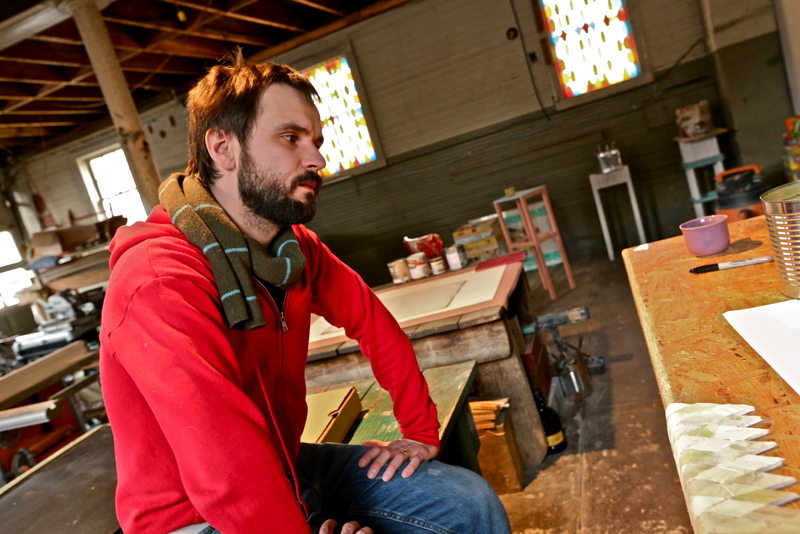
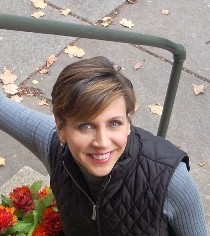
Josh Dorman in his NYC studio
.
I have placed there a little door opening on to the mysterious.
I have made stories.
—Odilon Redon
I read Josh Dorman’s works like a Mary Ruefle essay. See how she writes about a revelation she had and the connections it revealed for her in her essay “Someone Reading a Book Is a Sign of Order in the World:” “I was reading the dictionary, where I came upon the meaning of the word speculum: 1) an instrument inserted into a body passage for inspection; 2) an ancient mirror; 3) a medieval compendium of all knowledge; 4) a drawing showing the relative position of all the planets; and 5) a patch of color on the secondary wings of most ducks and some other birds.” Ruefle asserts, “there can be discoveries, connections… that explode the day and one’s heart and the long years that have led to the moment.”
Just so, artist Josh Dorman discovers a scrap, a tidbit, a piece of tinder, something recognizable (or not) and turns and turns it in his hand or mind appropriating it in his collage/multi-medium works, intuitively painting, drawing, layering, until it becomes more, becomes Other. The connections in his mind are revealed to him and/or us — or not; the lush, deep labyrinths open to some Home, or swallow us entirely blissfully lost.
Mary Kathryn Jablonski (MKJ): I’m very interested in how a piece begins for you. Do images you find suggest a narrative? Do you collect some images for use in collage based on the intrigue or beauty they hold for you alone? Do some images, which to the outsider might seem to have nothing in common, beg to be grouped with other images? I’m picturing files upon files named for various subjects in your studio, not unlike in collage artist Michael Oatman’s vast studio space! Tell us some of your sources. I’m most familiar with your paintings on antique maps, but you seem to be moving away from these a bit.
 Camel Cliffs – ink, acrylic, antique paper on panel, 12 x 14 inches, 2009
Josh Dorman (JD): I’m first struck by your mention of Oatman’s vast studio space. Picture my studio as more of a small cave packed with collections and piles of moldering detritus. Overflowing shelves filled with hundreds of antique books and yellowing paper: catalogs, diagrams, ledger books, topographical maps, player piano scrolls, but mostly textbooks. I use only printed materials from the pre-photography era: 1820s-1950s. They’re categorized by subject: Engineering, Biology, Botany, Architecture, Ornamentation, Cellular Structure, Human Anatomy, Geology, Geography, etc. It’s an obsession.
I still can’t resist when I stumble across a crusty tome at a yard sale. It’s not that the items are valuable, but that they contain images made by hand and knowledge that is outdated. Last summer I found a hardware catalog that’s eight inches thick, bound with rusty metal shackles. I’ve been mining images from it all year. It moves me that each hammer, hinge and screw was rendered and printed so carefully and beautifully by an artist whose name we’ll never know. I see it as part of my mission to give these drawings a new life.
Only once did I hire an assistant for a month to cut out collage bits from my books. Though those categorized clippings served me well, my process now is more organic, and I usually cut out images as I go. I have no set system for creating a painting (to be honest, I’m skeptical of art that arises out of preconception).
A piece for me can take several paths. As you mentioned, sometimes the beauty of an image can call out to me and I’ll build a painting around it. A good example of this is “A Knight Errant,” where the hardware bits I mentioned were the inspiration. In a clear case of pareidolia, I formed bodies around the faces I saw in the hardware. These then interacted with pieces cut from a 1790s Italian architecture book, and finally, reminding me of a childlike fantasy/delusion, I inserted a quixotic mounted rider.
 Knight Errant – ink, acrylic, antique paper on panel,
16 x 16 inches, 2014
I work in a subconscious state. A narrative may assert itself, but more often, multiple narratives and connections emerge. You guessed right when you asked about images that beg to be grouped together. It’s almost as if they’re whispering when the pages turn. It may come from my formalist training or it may be much deeper rooted, but I feel the need to connect forms from different areas of existence. A birdcage and a rib cage. A radiolarian and a diagram of a galaxy. Flower petals and fish scales. Tree branches, nerves, and an aerial map of a river. It’s obviously about shifting scale wildly from inch to inch within the painting. I think the reason I’m a visual artist is because it sounds absurdly simplistic to say in words that all things are connected.
As I write this, it occurs to me that most of my closest friends are poets and novelists, who can do this with words. I recently did a large commissioned version of “The Tower of Babel” for the writer Michael Chabon. He’s a “maximalist” novelist who takes dozens of tangent paths and generates stories within stories. I’m often inspired by writers: Italo Calvino, Richard Brautigan, and Li-Young Lee. I’m drawn to work that suggests rather than prescribes. I’d say the same about my art heroes: Klee, Redon, Turner, Pinkham Ryder, Brueghel.
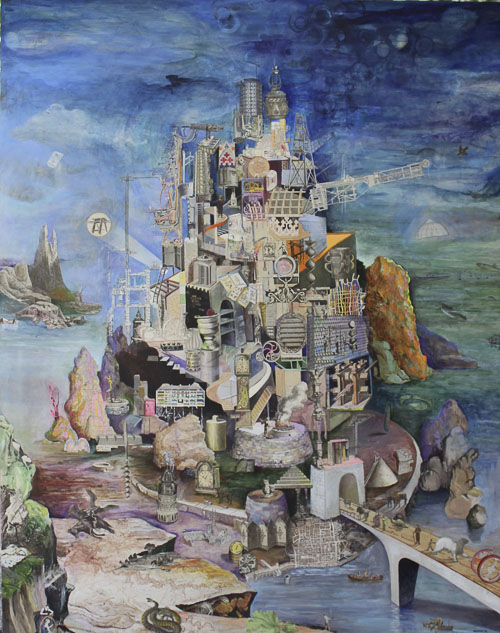 Tower of Babel (for Michael Chabon and Ayelet Waldman) – ink, acrylic, antique paper on panel, 48 x 38 inches, 2016
MKJ: Oh, make no mistake, your studio still sounds a lot like Oatman’s in many ways, believe it or not, as does your sensibility regarding preserving the past. Although I cannot speak for him, I don’t think he’d mind me saying that. And his studio may have been vast, but that does not mean it was not also cave-like and jam-packed, sorted obsessively, floor to ceiling. I love what you’ve just said about these artists and writers, especially since you’ve included one of my favorite poets. I do see what you mean about generating stories within stories. Like Mary Ruefle, Li-Young Lee is a wonderful example of one who makes remarkable, unique associations. You’ve mentioned to me that you titled a solo exhibition of your work in London The Missing Pages of the Sea, a phrase found in the first few lines of his poem “Pillow,” which has superb examples of just such associations.
Li-Young Lee is also a perfect example of a poet for us to compare with you because often, like Brigit Pegeen Kelly’s, his poems circle back on themselves over and over as they are woven, or as they unravel in deep meditation, just as I feel your artwork does in some way. And his poems at times are inexorably linked. Labyrinthine, they form an intricate network of passages that could lead only to the next poem or story, with no other possible exit. Take a look at “Words for Worry” and “Little Father,” printed consecutively in Book of My Nights. I feel this sensation too in some of your works, both within them, and when seeing them together. Lee also judiciously and poignantly uses the Question in his poems, as I feel you do in your works, Josh, addressing both yourself and the viewer.
I imagine that once a work starts going for you it takes on a force of its own. Do you find this to be true — that what you had in mind for a piece or a group of images can end up being far from the direction in which the piece eventually leads you? Tell us about some of the detours your work has taken you on. In this way, what has the act of making art taught you or revealed to you? What would you be doing if you weren’t an artist?
JD: In the 90s, I would begin a painting by gluing down topographic maps and letting the swirling lines guide my drawing and collaging. More often now, my works (especially the larger panels) begin with a compositional sketch, and maps are only used tangentially. In fact, many recent panels begin with a base layer of player piano scroll paper. This provides a tone, a history, and beautiful perforations that generate a rhythmic structure. I then sketch forms quickly and lightly in charcoal and begin the layering of paint and collage. I work on five to 10 paintings simultaneously. Some emerge in a matter of days; others can take a year or more.
If any element of a painting happens too easily, I’m skeptical, and I usually destroy it. Part of the reason I use collage is to remove my hand from the process. For the same reason, you’ll see areas in most of my paintings where I’ve rested living plants or metal gears and wires, poured ink and allowed it to evaporate. These “stain/stencils” for me, feel like a natural phenomenon, outside of my self. I’m not saying that I give over to Dadaist chance in my work. I need composition and structure. But within that initial framework, it’s about endless improvisation.
 Night Apparitions – ink, acrylic, antique paper on panel,
38 x 48 inches, 2017
Looking at one recent piece called “Night Apparitions” might illuminate a bit about my process. This might sound laughable, but I consider this a minimalist work for me, since I managed to pare it down to a reduced palette and space. It began with a ream of rice paper I purchased on a trip to Taiwan. In this case, I broke my own “rule” by using non-antique paper. Since the paper was lightly gridded or lined for calligraphy practice, I cut it into varying sized rectangles and soaked them in India ink of different densities. My initial sketch had two essential structures: the central mountain form and the halo surrounded by a dark border. I expected multiple mountainscapes and horizon lines to emerge, but in this case, the gradation of light to dark from the center kept insisting itself until the end. As soon as I’d add a new landscape element, I’d wipe it out with the light or dark. In recent years, I’ve been trying to avoid imagery (animal, vegetable, machine) that identifies as only one thing. So, each hovering entity is a conglomeration – a hybrid form. Only one (located at 11 o’clock) contains human-made forms, and there’s only a hint of architecture in the contour of the mountain. I’m always aware of the disconnection we humans imagine and reinforce between ourselves and other living things.
Here, I could go off on a lengthy tangent about the election, and the fear, anger and ultimate despair I felt while making this piece. That’s all in there, and that may be why the painting is so dark. But again, I’m not interested in artwork that illustrates or prescribes meaning. I’m interested in what each viewer will bring to the piece.
There are creatures that are buried under the pink haze or in the dark black. Things that aren’t visible to the viewer are still crucial to the evolution of a piece. Some detours and quirks — I can say that the seashell mountaintop came late to eliminate a silhouette effect. The “whole” birds also remained at the bottom, to ground the piece and further call the reality into question (birds should fly). In the end, as with most of my work, I suppose my goal is to generate a feeling of joyful apocalypse. My dreams do influence my work deeply, but I shy away from association with Surrealism, most of which I view as too pat and literal.
It’s a never-ending cycle, trying to understand the world, art, my own process. In the same way that I don’t like to interpret dreams, I also shun too much breakdown of my work. I need to know just enough to guide me, but not too much to remove the mystery. As Georges Braque said, “The only thing of value in art is that which cannot be explained.” As for your question about what I’d be doing if not this, I’ve always been fascinated by archaeology and I began college as a psychology major, but I quickly realized that it was not for me. Frankly, I can’t imagine doing anything else.
MKJ: I appreciate that you say you’ve been trying to avoid imagery that identifies as only one thing. I’ve always admired this quality in the written word as well: poetry whose lines slant in both directions, tying them to the previous or following line, which can happen with well-thought-out enjambment and punctuation (or lack thereof). And when you say you value things that aren’t visible to the viewer, which are still crucial to the evolution of a piece, I couldn’t agree more. Perhaps these are the most important aspects of a creative work.
Most viewers expect your collage pieces to be two-dimensional surfaces, yet in your new works you are exploring depth as well, carving pockets into panels and pouring in resin, at times in pools up to two inches deep with a watery shine difficult to reproduce in photographs. What inspired this sculptural necessity? Do you see it going further?
 Welcome to the Machine II – ink, acrylic, antique paper on panel, with resin, 12 x 12 inches, 2017
JD: The poured resin layering is yet another manifestation of my own rule-breaking. While I have never been drawn to making sculpture, I’m intrigued by creating illusions of depth, and in this case, tricking the viewer with a bit of tangible depth.
I’ve found in my artistic life that a medium or subject will present itself, and only years later will it find it’s proper home in the work. It was this way with the topographical maps, which lingered in my studio for five years before I dared draw on them, and it was this way with the clear resin, which I tried out twenty years ago and failed. I’ll admit that Fred Tomaselli, with his resin-embedded pills and leaves left me daunted. I admire his work, but I’m after something different. In fact, just as with collaging gorgeously rendered engravings, one runs the risk of gimmickry with resin. Pour this glossy stuff on a child’s drawing or a newspaper page and suddenly it looks luscious. I’m still experimenting with it, but it’s incredibly exciting. I’d fallen into a rut for a year or so, and creating these space pockets is reinvigorating me. It has reminded me that play is crucial. Ha! Perhaps, I can also credit Trump with causing me to seek new territory. I suspect many artists right now are on fire, making protest statements or constructing even richer worlds to escape to.
MKJ: Yes, at a time when we could all use, as Mary Ruefle says, some Sign of Order in the World, we’ll leave that struggle in the category of more things that aren’t visible to the viewer.
Your paintings are really multi-medium works that include collage, painting and drawing (and as we’ve said, now sculptural processes as well). How do these pieces differ in your mind from the black and white drawings that you make, which to me seem very fluid and in some mystical way reminiscent of William Blake.
 Wheels – graphite with antique collage elements, 10 x 20 inches, 2017
JD: The graphite drawings are almost a form of meditation for me. In making them, I eliminate all questions of medium, color, size, and layering. Even composition and subject matter disappear. I’d never encourage a drawing student to do this, but these horizontally oriented works emerge from the lower left and move eastward, with no sketch or outline. I love the traveling journey aspect of Chinese and Japanese scrolls. For me, it’s a mysterious process and not unlike a physical journey. I rub the pencil until shapes and images start to reveal themselves. They are not sketches for the paintings. They exist on their own.
MKJ: I am delighted to learn about this drawing process! And now I see them as even more riveting. I hope you do not find this in any way a diminishment of your collages/paintings, but the drawings may be your works I favor most. They are magical to me and unfold or reveal themselves, to this viewer at least, in perhaps the same mysterious ways in which they were created, which I find marvelous and complex.
Although it took place awhile ago now, I do want to mention that I also found your project for the Memory Bridge Foundation, which “maps” the internal geographies and memories of Alzheimer’s and dementia patients, moving and inspirational. Describe how this project has changed you. Tell us how memory plays a role in your work, if in fact you find that it does.
JD: The Memory Bridge project influenced me in ways I didn’t understand at the time. The obvious answer is that the old paper I use has it’s own memory: it’s physically from another time and place. The images I use were created in a world without the ubiquitous photograph, let alone computers and the thousands of images we’re barraged with daily. I’d like my work to feel like it’s not of this time and place.
When I was commissioned to create the Memory Bridge portraits, I listened and sketched as six people with dementia were interviewed. I could see bits of memory coming and going, interweaving with the present, imagination, and chaos. Later, back in my studio with my notes, while making a “portrait” of one particularly unreachable woman, I found myself in a mental state not unlike hers. It was disturbing and liberating. I sat on the floor with my canvas and piles of books and papers. I began reaching for images in a frenzy of free association, pasting them down and drawing on top. This state of unknowing is where I try to be now when I work.
 Thelma, Memory Bridge portrait – ink, acrylic, antique paper on panel, 34 x 42 inches, 2006
We can never be certain that we are communicating on a common wavelength with anyone else. I trust in that lack of tangibility and certainty. If people ask me what my paintings are about, I stumble. I know they are not about nothing… I know, in fact, that they are utterly specific. But some people will embrace the ambiguity within the specificity, and others will reject the work, needing a concrete meaning and resolution I can’t provide.
x
Josh Dorman was born in Baltimore, MD and lives and works in New York, NY. He received his MFA from Queens College, Flushing, NY and his BA from Skidmore College, Saratoga Springs, NY. Josh has been the recipient of numerous residencies and fellowships including Yaddo, Art Omi, and the Millay Colony. He has been a visiting artist and lecturer at numerous institutions including most recently Skidmore College, Saratoga Springs, NY and Mass Art Graduate MFA Program, Boston, MA. His work is held in numerous collections across the country and he has exhibited nationally and internationally. In 2014, a collaboration of seven animations he made with composer Anna Clyne, titled “The Violin,” was released on DVD. Currently, Josh is represented by Ryan Lee Gallery in New York City, Koplin Del Rio Gallery in Seattle, and John Martin Gallery in London.
http://www.joshdorman.net
x
x

x
A gallerist in Saratoga Springs for over 15 years, visual artist and poet Mary Kathryn Jablonski is now an administrative director in holistic healthcare. She is author of the chapbook To the Husband I Have Not Yet Met, and her poems have appeared in numerous literary journals including the Beloit Poetry Journal, Blueline, Home Planet News, Salmagundi, and Slipstream, among others. Her artwork has been widely exhibited throughout the Northeast and is held in private and public collections.
x
x