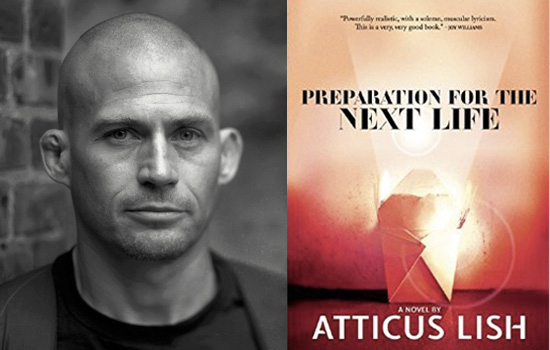
A koan- or haiku-like style of description in bursts of short sentences…Lish’s writing is as composed as a soldier: methodical, precise, on mission. —Tom Faure
Preparation for the Next Life
Atticus Lish
Tyrant Books, November 2o14
417 pages, $15.00
Many challenges can assail the lost person in a single given night—when there’s no bed, no radiator nor space heater, no roof nor figurative womb to enfold and heal the daily shredded spirit. The forgotten characters of the night wade through a dark terror punctuated by McDonald’s arches, Chinese calligraphy, imperfect halogen, and harsh sounds like billy clubs dragging down fence railings and cash register ka-chings tearing at the tired mind’s fractious sense of reality.
Such muddled, taurine-riddled minds are front and center in Atticus Lish’s outstanding debut novel, Preparation for the Next Life. Released in November by boutique publisher Tyrant Books, the novel just won the 2015 Pen/Faulkner Award for Fiction. Lish’s characters live on the margins, but this is not a pity party. If anything, it’s an introduction to globalization. We do not distinguish between the empty roads of Queens and those of Mosul. Nor their trash-filled alleys, nor their migrant workers, nor their deceptive blue skies. The difference is not even clear to the well-trained eyes of Brad Skinner, a stop-lossed, three-tour Iraq War veteran who sees IED risks even in the tumbleweed saunters of an empty plastic bag. Now in the United States, Skinner and an undocumented fast food busser, Lou Zei, are star-crossed lovers trying to get by in the melting pot of Flushing, Queens.
Skinner and Zou Lei (Thunder, in her Uighur dialect) are from near-opposite worlds, but Romeo and Juliet is not the only analogy to draw—Lish’s protagonists are a Beauty and Beast who discover each other literally in an underground food court, an apt crossroads for an aspiring illegal worker and a traumatized, depressed soldier. Lish’s touch is so deft that he does not come off as cloying or contrived in choosing an overtly fitting setting like a black market for these lovers struggling to survive in the shadows of the crumbling towers of the American dream. On the contrary, the novel, while deeply empathetic, seems uninterested in heartstrings. It is caring, but unpitying and unforgiving.
Looking for work early one day, Lou Zei walks from neighborhood to neighborhood, noting that Roosevelt Avenue’s graffiti changes every few blocks, but what does not is the steady sound of locks pulled down and shutters pulled up—of business, the great Sino-American common ground, cranked manually by the working poor in the liminal limbo between twilight and dawn. The lucky ones still are senseless, hearing nothing: they are asleep. The rest are senseless, too: they are exhausted. The problem for Zou Lei and Skinner, ultimately, is that this melting pot of multicultural poverty does not mix well. Violence spills over, not willing to spare young love.
The most devastating aspect of Preparation for the Next Life is not its rich, understated description of wealthy nations and poor people in the Age of Terror. It’s the love story. It’s the characters in general—convicts, cops, veterans, immigrants, and the many combinations thereof. Everybody’s just trying to get by. Skinner rents a basement room, goes to the gym, and relives the horrors of combat on the internet. He sees mangled corpses in folded pizza slices; he holds his gun to his head and dreams of relief. His landlord’s son returns from a ten-year stint in prison; the house is not big enough for the both of them.
*
How to explain Atticus Lish’s prose? It reads first as if he is overly fond of sentence fragments—but he actually does not use fragments in abundance, save for the occasional litany of descriptive images. The seeming effect comes from a koan- or haiku-like style of description in bursts of short sentences, as well as the omission of dialogue indicators. A typical passage intertwines calm eddies of four- to eight-word sentences driven by rich, concrete verbs, with the occasional hypnotic sentence that stretches into Fitzgerald-like lyricism, employing active participles and gerunds to string images and observations together in a style resembling almost the stream of consciousness—though his prose does not suffer from the hectic spasmodic urgency of Beat sentimentality. Lish’s writing is as composed as a soldier: methodical, precise, on mission:
His body jerked. He moaned. […] In his dream, he knew what was happening. When they had first arrived, they hadn’t known, having yet to learn. Their unit had provided security for a colonel on daylong sector-assessment missions called SAMs that lasted into the night, and they had seen very little action. If this is war, I’m disappointed, Nowling said, pulling security in the spectacular heat. […] It was hard to sleep. People said I miss my girl. I wanna get some. They manned a checkpoint and shot up a car. Their doc from Opa-locka poured a bag of clotting factor in an Iraqi’s chest. Mom’s head was gone. White-faced, Sconyers ran and got a beanie baby for their daughter.
[…] In the basements, they found electronic equipment, stiffened rags, a crumbling prayer book. Children stared at them. The corpses were few at first, but then they started finding bodies every day. Some were mummified by fire. A bomb went off and spit a person out of a doorway. That smell is burning hair. A truck drove by them full of men with beards and satisfied expressions. Why are we letting them go? Sconyers asked. I don’t get it—Sconyers who carried a copy of the Report of the 9/11 Commission in his assault pack.
Because this is the army. Because this is their country. Because this isn’t supposed to make sense.
Lish’s writing is allusive without lacking concrete immediacy. The description mixes panoramic observations with implied exposition. Implied—because, he laces new expository detail into his scenes without pause or explanation. This is expertly done and contributes to the unsentimental tone of the novel. Take for example this revelation that Skinner has proposed to Zou Lei:
When she came outside in the purple dusk at quitting time, he was waiting. They ate pizza slices while the streetlights came on, went down past the gas station and walked along the river.
She was so moved she didn’t talk for nearly a mile.
What are you thinking?
You have a great heart, Skinner!
He liked it that she was happy
Just you say you will marry to me, it’s incredible.
Lish has suggested he avoided seeking help from his father Gordon—the renowned author, editor, and Raymond Carver’s blue pencil—but there’s something Lish-like here. Maybe it’s in the blood. The answer to this authorial originality question doesn’t matter. What the link does, rather, is illustrate how this author still early in his career is well on his way to becoming a master of story-telling:
The house was two houses. On the first floor, there were the lace curtains and plastic on the couch, the kitchen had a cuckoo clock on the wall, and there was a velvet picture of Elvis looking handsome above the couch his mother sat on. The saints and elves were in the yard. The rooms upstairs were a mess of clothes and junk where his mother and Erin lived among bottles of perfume and shampoo and tarot cards and curling irons and maxi pads and beer can empties and cigarettes and photo albums. You could open a drawer in a broken dresser and find a stack of Polaroids of people and scenes you did not recognize, then look at yourself in the mirror and wonder who you looked like.
He begs rereading.
I don’t know exactly when it was—maybe page 40, maybe 50—but I started rereading some of Lish’s pages backwards. I would reread each of its sentences in reverse order. This reading contained a strange wisdom. Here’s a glimpse of a typical Lish page in which we see the city, the lovers, and his writing style:
When she went back into his room to get her jeans, she saw what they had done to the bed, the mauled sheet. His camouflage gear and clothes were all over the floor. He slept in his poncholiner. On the bedside table were his pills and his lifter’s magazine and a strip of four condoms with blue wrappers. The room smelled like him and her, their sweat, latex, and tobacco. All about the room were empty beer cans he used as ashtrays. Under the bed, there was a used yellow wet latex condom. Another one was twisted in the poncholiner. Her eyes scanned over his cigarettes, his jeans. His boots were lying where he had kicked them off. A pair of blue faded cotton panties had fallen on them, hers.
He came up behind her and put an arm around her waist and put his face in her neck. She held his hand. His face smelled like tobacco. They rocked back and forth like that.
[…] They went out into the quiet night and started hiking down Franklin Avenue until the small American houses gave way to ghetto buildings and then the huge cathedral of Chinatown, over the hill through the dark trees and down the longblock that extended out to the freeway like a jetty.
Now you have to go all the way back, she said.
That don’t matter. I can’t sleep anyway.
[…] The sheds were built open at the top like changing rooms, and when she pulled the chain, her light disturbed her neighbor, who muttered behind the plywood. She switched the light off and kneeled down on her broken mattress, on her coverlet bought in Chinatown, showing teddy bears in bowties. By feel, she plugged her cell phone into the charger, her link to him, and the screen lit up indigo in her hands for several moments shining through her fingers.
Combined with the other characteristics of his writing style, the unified yet non-linear nature of Lish’s prose reminds the reader of the vast multitudinous nature of the various wars the characters are facing. There is no one voice in control, there is no up or down, no central organizing order or clear causality, no beginning or middle—but there is an end. A devastating end.
—Tom Faure

Tom Faure received his MFA in Fiction from Vermont College of Fine Arts. His work has appeared in Waxwing Literary Journal, Zocalo Public Square, and Splash of Red. He lives in New York, teaching English and Philosophy at the French-American School of New York.
Contact: tomfaure@old.numerocinqmagazine.com
.